

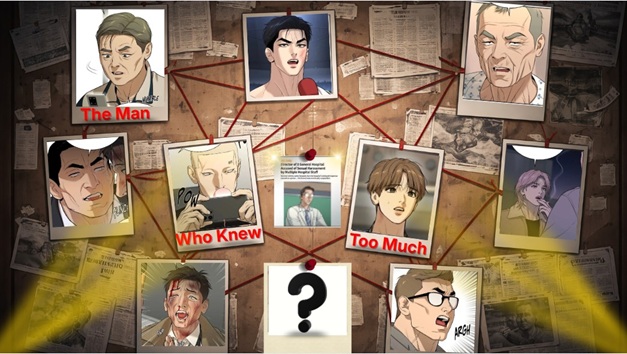
Please support the authors by reading Manhwas on the official websites. This is where you can read the Manhwa: Jinx But be aware that the Manhwa is a mature Yaoi, which means, it is about homosexuality with explicit scenes. Here is the link of the table of contents about Jinx. Here is the link where you can find the table of contents of analyzed Manhwas. Here are the links, if you are interested in the first work from Mingwa, BJ Alex, and the 2 previous essays about Jinx The Man Who Knew Too Much – part 2 and The Piercing Amber Shore
It would be great if you could make some donations/sponsoring: Ko-fi.com/bebebisous33 That way, you can support me with “coffee” so that I have the energy to keep examining Manhwas. Besides, I need to cover up the expenses for this blog.
In my previous essay, I ended with the observation that the photograph with the dogs 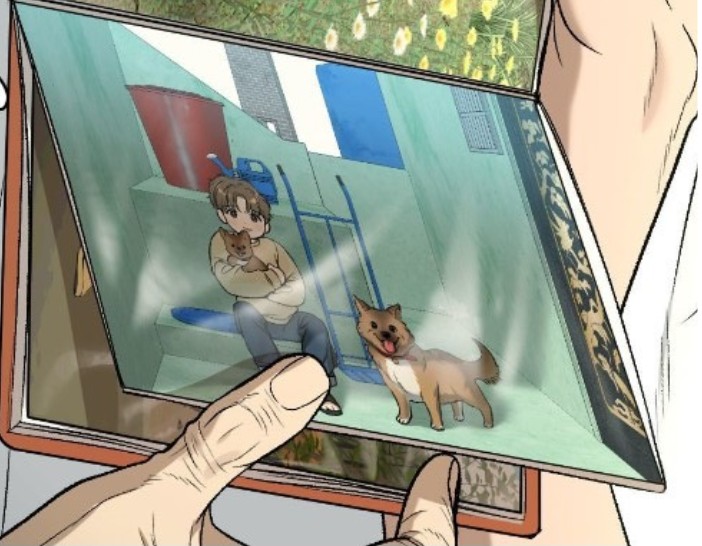 (chapter 94) was not simply a charming childhood image. It already contained the traces of loss, even if Joo Jaekyung did not recognize it as such. What appeared to him as innocence and warmth concealed a reality that remained invisible to him. This is where I want to begin.
If we look more closely at these images, we realize that they do not merely show fragments of Kim Dan’s childhood. 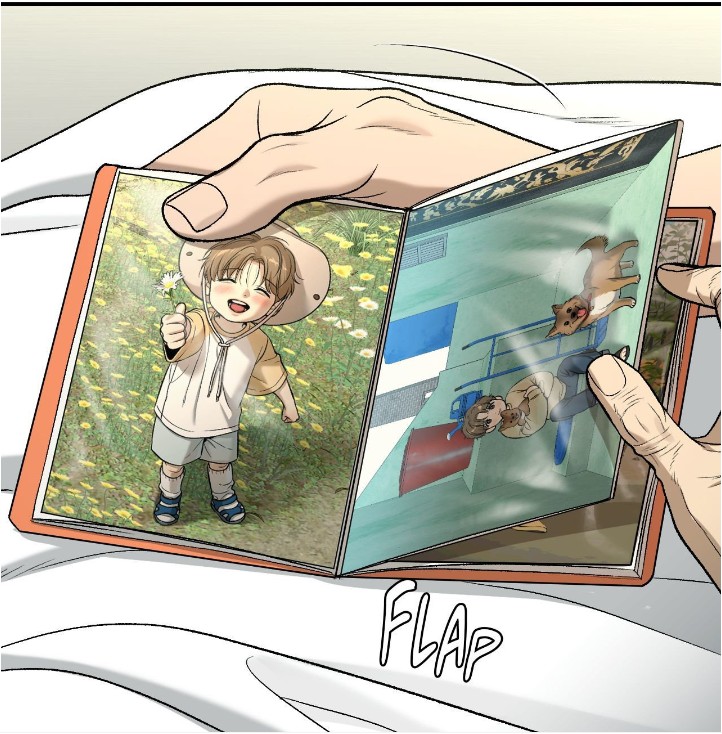 (chapter 94) They are traces of a life already shaped by forces that remain unseen. What appears as warmth and innocence is, in fact, embedded in a process of dispossession that has already begun.
In Jinx, there is one game that immediately comes to mind: Monopoly.  (chapter 27) Each time it is played, it reveals a rigid structure. One player accumulates, the other is gradually dispossessed. There is no space for coexistence or shared success. Loss is not accidental. It is built into the rules.
And what makes this dynamic even more revealing is the way each of them reacted to that loss. What makes this dynamic even more revealing is the way each of them reacts to it. One responds with anger, denouncing “highway robbery,” refusing to accept defeat. The other remains seated and resigned: 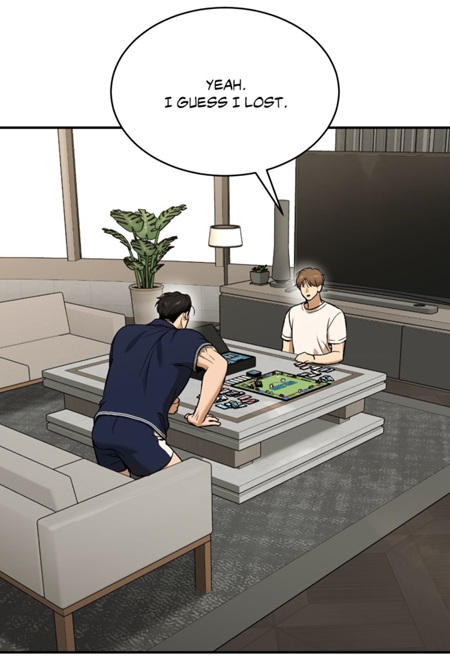 (chapter 80) These reactions were not incidental. They already suggest two fundamentally different ways of inhabiting the game. They already suggest two fundamentally different ways of inhabiting the same system. One resists and attempts to escape. The other endures and adapts.
This distinction becomes crucial in episode 94.
If we keep this in mind, we can sense the same logic in episode 94 again. It is already suggested by the way Kim Dan compliments the champion and views himself. When he admits, 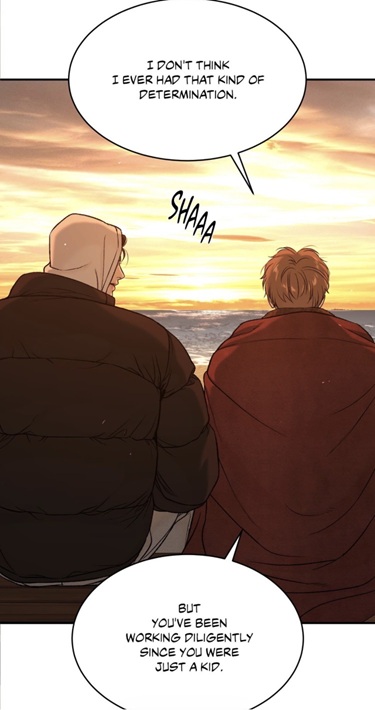 (chapter 94), he positions himself outside the logic of confrontation. He recognizes his lack of determination in the conventional sense. And yet, this does not place him outside the game. On the contrary, it reveals another mode of participation. His strength lies not in resistance, but in endurance, patience, and continuity.
This is where the structure becomes more complex. Because the same logic persists — only in a different form. This time, the game no longer takes place on a board. Instead of properties and rent, we are given photographs of a childhood (chapter 94). At first glance, they seem harmless. There is no visible competition, no immediate conflict, no explicit rules. What we see are moments of play: a child with a dog, a child offering a daisy, a child moving freely within his environment. These gestures suggest connection, spontaneity, and joy. They belong to a childhood experienced as something open and shared.
And yet, this is precisely what makes the scene deceptive. (chapter 94) Because if Monopoly makes loss visible, these images conceal it. What appears as play is already embedded in time, transformation, and conditions that remain outside the frame. The child is not competing, but he is not outside the system either. The game has not disappeared. It has become less visible.
This is why the photographs cannot be read as simple memories. 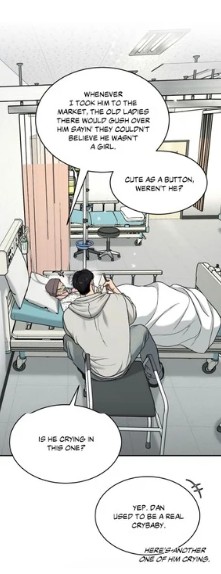 (chapter 94) They do not present a complete story. They offer fragments. Some are clear, others overlap, and one remains partially hidden. This fragmentation is not accidental. It requires reconstruction. We have to put them together, like pieces of a puzzle. And this raises a simple question.
And this immediately raises a question. How many pictures are actually shown in this scene? Most readers would answer: four. 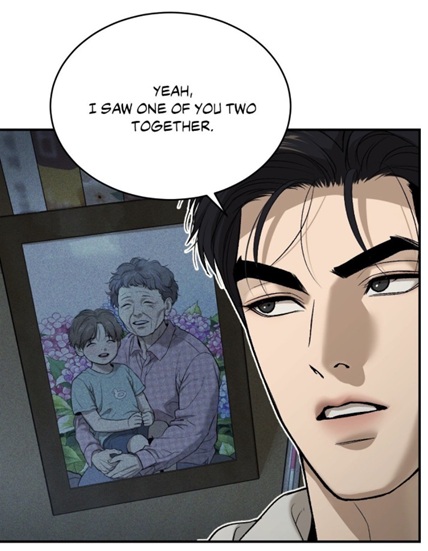 (chapter 94) And yet, this answer is incomplete. One image remains partially concealed, almost erased by another.
 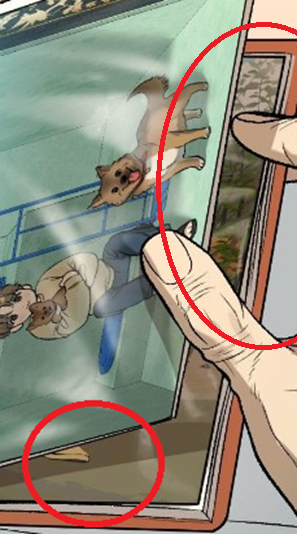 (chapter 94) It is easy to overlook, and that is precisely why it matters. Because once we begin to count more carefully, we also begin to see more carefully.
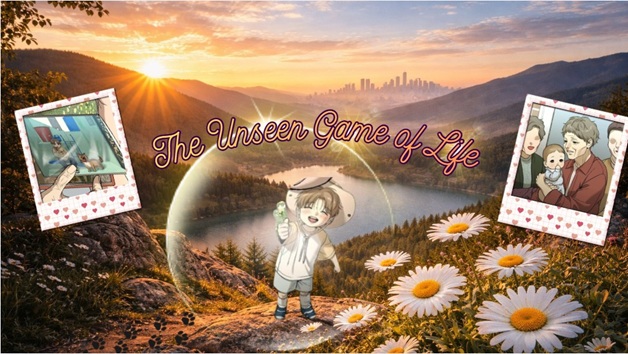
The images are not arranged randomly. They suggest a sequence. If we pay attention to clothing, landscape, and atmosphere, a pattern begins to emerge: spring, summer, autumn, winter. Childhood is not presented as a fixed and single moment, but as a cycle unfolding over time. This is where The Unseen Game of Life becomes visible.
The game is no longer limited to possession or victory. It unfolds through time, through what is shown and what is hidden, through what is remembered and what is ignored. It shapes not only outcomes, but experiences. It determines what kind of childhood is lived — and what remains invisible, even when it is right in front of us.
And this is where Joo Jaekyung’s position becomes revealing. He understands perfectly how to play Monopoly — not only within the game  (chapter 80), but also in reality, as he owns several properties. But he does not immediately understand what these photographs represent. What he sees are pleasant memories.
 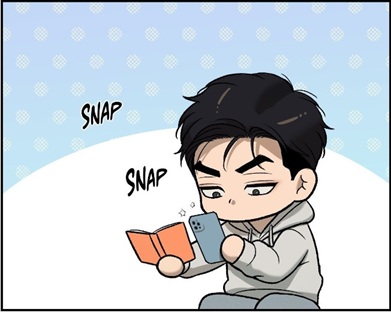 (chapter 94) And when he takes pictures of these pictures, his gesture exposes the limit of his perception. He preserves what is visible, not what it signifies. The stylistic shift reinforces this moment. Rendered as a chibi, the “Emperor” is momentarily stripped of his predatory gaze. His perspective is simplified, almost purified. He no longer sees Kim Dan as a function or a role, but as a cute and sensitive child. And yet, this remains incomplete. He captures the image, but not the structure behind it. He perceives the warmth, but not the cost that made it possible. He sees the surface of a life, but not the forces that shaped it.
This is why the game remains unseen.
Reconstructing a Childhood
If the photographs in episode 94 function like pieces of a puzzle, then the first step is not to interpret them immediately, but to examine them carefully. What do they show, and in what order should they be read? A closer look reveals that these are not static portraits, but carefully selected glimpses of Kim Dan’s childhood, each marked by a distinct posture, season, and emotional tone.
A closer look reveals that these are not static portraits, but carefully selected glimpses of Kim Dan’s childhood, each marked by a distinct posture, season, and emotional tone. (chapter 94) At first glance, these images appear simple. They are structured around play, companionship, and small gestures of joy: a child holding a puppy, offering a daisy, moving freely through his environment. In this sense, they seem to confirm what we might expect from childhood. Life appears light, open, and shared.
It is precisely this impression that makes Kim Dan’s confession on the beach so revealing. When he tells Joo Jaekyung that he has been working diligently since childhood (chapter 94), he constructs a clear contrast between them. The champion appears as someone shaped by effort from an early age, while he implicitly presents himself as someone who did not follow the same path. The statement suggests that determination belongs to one, and not to the other. This formulation echoes the logic we have already seen in Monopoly (chapter 80) In that game, positions are unequal from the very beginning. One player accumulates, the other is gradually dispossessed. What matters is not only the outcome, but the way each player responds to it. One resists, protests, and refuses defeat. The other accepts the loss and remains seated. Over time, this difference becomes internalized. The rules of the game are no longer questioned. They are absorbed.
This is precisely what happens in Kim Dan’s confession. He does not simply describe a difference. He accepts it as natural. He interprets Joo Jaekyung’s strength as something inherent, while reducing his own past to a lack. In doing so, he unknowingly adopts the logic of the game itself: one rises, the other yields.
And yet, this is where the photographs introduce a rupture. Because the child they show is not yet playing by these rules. One detail emerges with striking consistency: Kim Dan is always at the center of the image. (chapter 94) The photographs are not landscapes, nor are they focused on objects or environments. They are structured around him. He is the one being held, the one running, the one interacting, the one offering the flower. The gaze that frames these images is directed toward him. This has concrete implications. The child we see is not neglected. He is well dressed. His clothes are clean, varied, and appropriate to the seasons. He is also well fed. As his grandmother later remarks, he had a “hearty appetite as a kid” 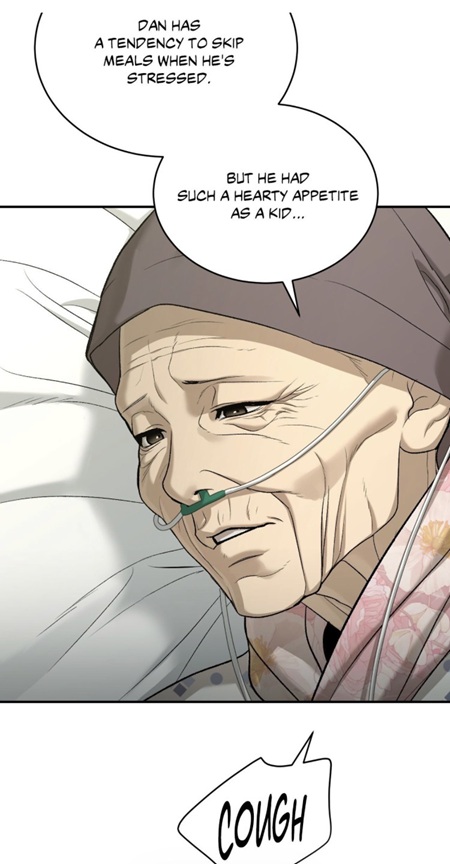 (chapter 94). These are not insignificant details. They indicate that, at this stage, his basic needs were met. He was cared for.
This stands in sharp contrast to his present situation. When Joo Jaekyung observes Kim Dan’s living conditions, he notices the absence of clothing 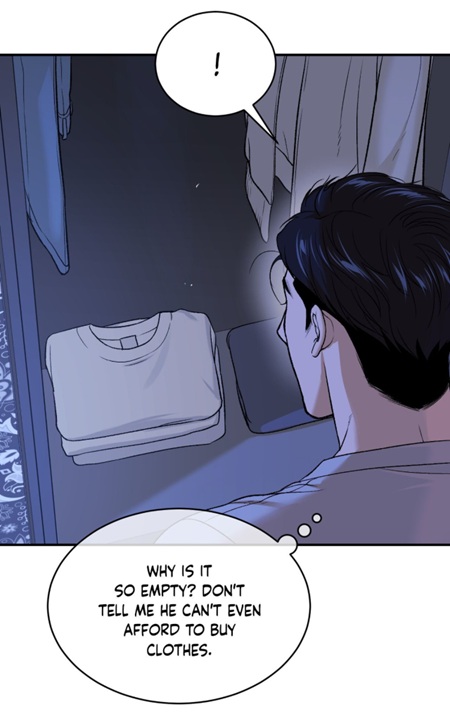 (chapter 80). The wardrobe is nearly empty. The implication is immediate: Kim Dan does not spend money on himself. This observation is confirmed by his own behavior. He uses his savings for others. He pays for his grandmother’s needs
  (chapter 41) and later spends a significant amount on a gift for Joo Jaekyung.
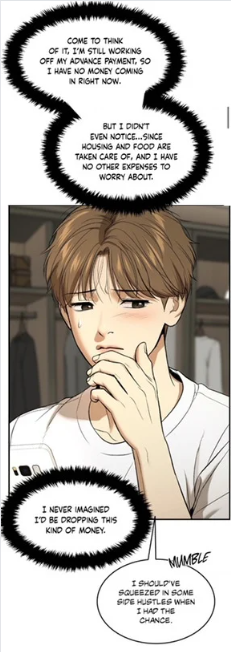 (chapter 42). This repetition is not incidental. It reveals a pattern: Kim Dan directs resources outward, not inward. He prioritizes others over himself. Even his relationship to food reflects this shift. As an adult, he skips meals when he is stressed, despite having once eaten well.
The contrast is therefore unmistakable. In the photographs, Kim Dan is the center of care. In the present, he has become the one who provides it. This inversion is crucial for understanding the structure of his life. The child who was once supported, fed, and dressed by others now assumes that role himself. Care has not disappeared. It has been reversed. This is what Kim Dan’s confession fails to recognize. (chapter 94) His statement on the beach creates the illusion that Joo Jaekyung alone was shaped by discipline and hardship, while he himself remained outside that logic. But the photographs reveal a different truth. They do not show a child who lacked strength. They show a child who had not yet been forced to transform strength into sacrifice. He was not yet responsible. He was not yet the one who gave. He was the one who received.
That is why these images matter so much. They do not simply preserve moments of happiness. They document a time before the rules of the game fully took hold of him. They reveal that Kim Dan’s later endurance did not emerge from a lack of determination, but from the reversal of a position he once occupied. What he now mistakes for weakness is, in fact, the trace of a childhood that was interrupted.
And yet, this is only one part of the story. If we read these images more carefully, a different structure begins to emerge.
The bodily positions already tell us something important. In one image, Kim Dan is held in his grandmother’s arms. 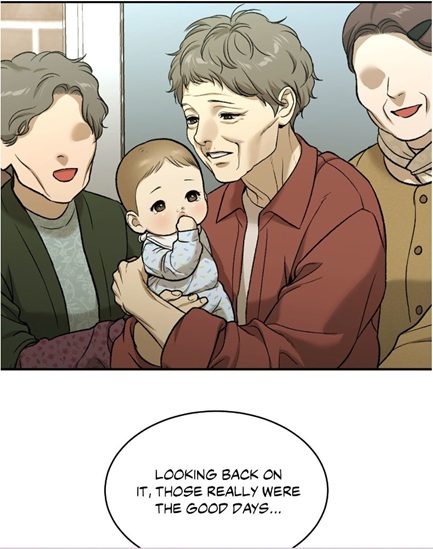 (chapter 94) His body is supported, carried, entirely dependent. In another, he is sitting on a step while holding a puppy close to his chest. (chapter 94) In the field, he stands on his own two feet and extends a daisy toward the person behind the camera.
 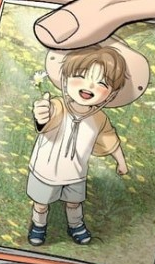 (chapter 94) In the almost hidden image, only one foot is visible, lifted off the ground: this is enough to conclude that he is running. (chapter 94) And in the photograph mentioned by Joo Jaekyung, he is seated on his grandmother’s lap among hydrangeas. (chapter 94) These positions are not accidental. They show a child who is allowed to inhabit many different states: dependence, stillness, affection, upright autonomy, movement. He is not fixed in one role. He is carried, he holds, he stands, he runs, he rests. Before we even interpret the backgrounds, the body already suggests a childhood marked by freedom.
This impression is reinforced by the objects that accompany him. In the image with the daisy, the flower is not simply part of the setting. It is held out toward the photographer. (chapter 94) The daisy, a simple wildflower, is traditionally associated with innocence, sincerity, and unfiltered joy. Unlike cultivated flowers, it grows freely, without constraint. By offering it, Kim Dan does not only interact with the person behind the camera, he shares something that belongs to his world. The gesture suggests trust, openness, and a spontaneous desire to connect.
A similar dynamic can be observed in the photograph with the puppy and the dog. (chapter 94) Animals, especially young ones, are often used to symbolize vulnerability, affection, and instinctive attachment. The puppy in his arms mirrors the child himself: small, fragile, and in need of care. At the same time, the presence of the adult dog introduces a second layer, that of protection and loyalty. Kim Dan is not alone in this image. He is part of a small relational world built on closeness and mutual dependence.
These elements are not incidental. They reinforce the impression that this is a childhood shaped not only by movement and freedom, but also by affection. The daisy, the puppy, and even the way these moments are framed suggest that the child is seen through a gentle and attentive gaze. They let transpire that he was loved. In other words, they actually prove my theory about his parents: he was raised by loving and caring parents. Hence he is placed in the center of the photography. But there exists another evidence for this interpretation: Joo Jaekyung’s lack of photos suggests he was never “beheld” with that same gentle gaze. If Dan was raised in a “natural cycle” (seasons, animals), Jaekyung was raised in an “industrial cycle” (results, training, utility). 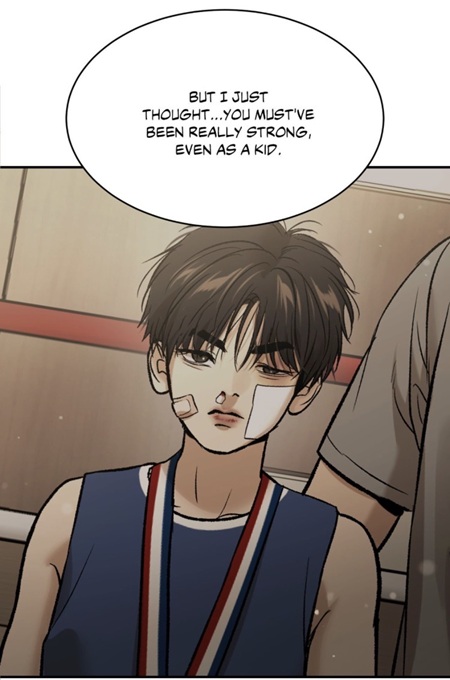 (chapter 94) Hence his only picture in his childhood is linked to a tournament and boxing.
This freedom becomes even clearer once the photographs are arranged in seasonal order. (chapter 94) The baby picture most likely belongs to early spring. The adults around him wear light jackets and scarves, which suggests cold but transitional weather rather than deep winter. Since Kim Dan was born on December 26th, this scene can plausibly be placed only a few months later. The woman on the far left wears a floral sleeve beneath a dark cardigan, a detail that subtly reinforces the idea of seasonal transition. Spring, then, is not only the season of beginnings. It is also the season in which Kim Dan first appears within a circle of adults, still dependent, still held, and still emotionally tied to others.
The image with the daisy comes later. (chapter 94) Here Kim Dan is dressed lightly, standing in an open field and offering the flower toward the photographer. The flower itself matters. Daisies belong to late spring or early summer, but they also symbolize simplicity, innocence, and spontaneous joy. Unlike a cultivated bouquet, a daisy is modest and wild. Kim Dan does not merely hold it for himself. He presents it. This gesture suggests trust, openness, and delight in shared attention. It is an image of a child for whom the world is still something to be explored and offered, not defended against.
The hydrangea photograph mentioned by Joo Jaekyung provides the clearest seasonal anchor. Kim Dan is wearing shorts and a short-sleeved T-shirt, and the hydrangeas behind him are in full bloom. (chapter 94) This places the image firmly in summer. Yet what matters here is not only the season, but the atmosphere. In contrast to the daisy picture, where he stands independently and reaches outward, he is now seated on his grandmother’s lap. Summer here does not simply symbolize expansion, but also fullness and protection. It is a moment of warmth, abundance, and secure intimacy. If spring marks origin and the daisy image marks early openness, the hydrangea scene represents the height of childhood ease but also its imminent ending.
The dog picture introduces a different mood. (chapter 94) Kim Dan is no longer in an open field, but in a structured outdoor hallway. Around him we can identify a trolley, a watering can, large containers, and in the background a large chimney. There is also a patterned door with birds and flowers, which echoes the decorative logic of the later cabinet without being the same object. These details suggest a hybrid environment where living and working coexist. His clothes are warmer than in the summer pictures, which indicates a drop in temperature. This does not allow us to assign the season with total certainty, but the heavier clothing, the functional setting, and the disappearance of open flowering landscapes point more convincingly toward late summer or early autumn. Symbolically, this matters. Autumn is the season of transition, upkeep, and preparation. The carefree openness of earlier pictures begins to recede. At the same time, this image introduces class more clearly than the others. The child still appears affectionate and gentle, but the world around him is already marked by labor, maintenance, and material necessity.
Finally, the hidden image completes the cycle. (chapter 94) Only fragments are visible: one foot in motion, a fence, a pale surface that resembles snow, and what looks like a hill in the background. Since only one foot is shown, the child must be running. This is not a posed portrait but a captured instant. The suggestion of snow or frost, together with the more closed landscape, points toward winter or perhaps late fall. The symbolism here is different from the others. Winter is not simply the season of hardship. In this sequence, it is the season of movement, exposure, and unfolding time. The child is no longer merely being shown. He is already in motion. This is not without significance. Kim Dan was born on December 26th, at the very beginning of winter. In this context, winter does not represent an end, but a point of origin. It marks a beginning that unfolds under conditions of cold and vulnerability, but also one that requires inner warmth and resilience. Rather than opposing warmth, winter redefines it. Since winter is his birth season and his “running” season, it suggests that Dan’s natural state is one of internal resilience. He is a “winter child”—he doesn’t need the sun to thrive; he generates his own warmth. This explains why he could survive next to Jaekyung’s distance. It is no longer given by the environment, but must be created and preserved. In this sense, winter becomes the season in which growth takes place in a less visible, more internal way.
Taken together, these images form a full cycle: spring with the baby in arms, late spring or early summer with the daisy, summer with the hydrangeas, late summer or early autumn with the puppy, and winter with the running child. The author does not show only growth, but a childhood unfolding through the seasons. This is not insignificant. Seasons imply rhythm, continuity, and immersion in a living world. Kim Dan’s childhood is therefore associated not with institutional milestones, but with natural time. That already tells us something about the kind of child he was and the kind of life he came from.
The symbolism of the clothes strengthens this reading. As a baby, he wears clothes patterned with little sweets (chapter 94), an image of softness and indulgence, as if childhood were still associated with comfort and delight. Later, he appears in a shirt with a duck, another gentle and playful motif. (chapter 94) These patterns are not random. They connect him to a childlike world of animals, tenderness, and whimsy. They suggest that he was once seen and dressed as a child who could be cute, soft, and playful. This matters all the more because, later in life, that softness will be reinterpreted as weakness.
Another recurring feature deserves attention. What matters is not whether Kim Dan’s eyes are open or closed, but how he relates to the presence behind the camera (chapter 94). In several photographs, he appears visibly aware of that presence. (chapter 94) In the image with the daisy, for instance, his eyes are closed, yet his gesture and expression clearly indicate engagement. He is blushing, smiling, and extending the flower outward. This is not withdrawal, but a form of shy openness. The gesture only makes sense if someone is there to receive it. The photograph captures an interaction. The child responds to the observer, and the observer is implicitly included in the scene.
A similar attentiveness can be sensed in other images, where his gaze is directed outward, alert and receptive. In these moments, Kim Dan appears fully present to the world and to the person who is looking at him. The photographs do not merely record him. They suggest a relationship with the photographer.
By contrast, the hydrangea photograph introduces a shift. (chapter 94) Here, Kim Dan is seated on his grandmother’s lap, and the composition is entirely centered on the two figures. There is no outward gesture, no attempt to reach beyond the frame. The scene is closed. The person behind the camera is no longer included in the same way, but remains outside, observing. The child is no longer interacting with that presence, but contained within a relationship that is already defined.
This does not diminish the warmth of the image, but it alters its structure. What was previously a shared moment becomes a framed intimacy. The child is no longer primarily engaged with the world around him, but situated within it. The difference is subtle, yet decisive. The closing of the frame mirrors the closing of his world; the open fields of the daisy photo (chapter 94) are replaced by the protective, yet narrow, lap of his grandmother. This picture announces Kim Dan’s imminent loss of innocence due to his parents’ vanishing.
This is what the photographs finally show about Kim Dan. He is presented as a child of openness rather than control, of movement rather than discipline, of relation rather than domination. He belongs to fields, flowers, animals, changing seasons, and spaces where work and life overlap. In other words, he embodies nature. He can be held, he can hold, he can stand, he can run. He is not yet trapped in one function. At the same time, the backgrounds complicate the apparent innocence of these scenes. The dog picture in particular reveals that this freedom existed within a modest environment already touched by labor and transformation. Kim Dan’s childhood, then, cannot be reduced either to pure happiness or to pure suffering. It appears instead as a life suspended between warmth and fragility, between natural abundance and quiet precarity.
This is precisely why these images matter so much. They do not simply preserve a past. They reveal a child who was still able to inhabit the world freely, even though the conditions of that freedom were already beginning to change. And that is where the unseen game starts to take shape.
A Changing Landscape
If the photographs (chapter 94) are read not only as personal memories, but as traces of a lived environment, they begin to reveal something more than childhood itself. They point toward the world in which that childhood was embedded.
The image with the dog and the puppy is particularly revealing (chapter 94). The setting is neither purely domestic nor entirely natural. It is a transitional space. The presence of a trolley, a watering can, and large containers suggests a place where living and working coexist. This is not a leisure environment. It is a space of small-scale labor.
At the same time, the child is not working. He is sitting, holding the puppy, fully absorbed in play. This contrast is decisive. It shows that his childhood unfolds within a world already shaped by work, but in which he himself is not yet subjected to it. This allows us to situate the family within a specific social context.
The environment suggests a modest, possibly semi-rural or peri-urban setting, where economic activity is directly tied to nature. The recurring presence of flowers, plants, and open spaces supports the idea that the family may have been involved in a form of small-scale production, such as flower cultivation or local trade. (chapter 94) The fact that Shin Okja later mentions taking him to the market reinforces this connection. The child is not isolated. He is part of a network of everyday economic life. This also explains why he is entrusted to her.
If the parents were working, possibly outside the immediate household or within demanding conditions, the grandmother’s role as caretaker becomes necessary.  (chapter 47) Her presence does not replace the parents. It supplements a structure already under pressure.
This pressure becomes more visible when we contrast these images with the later urban landscape.  (chapter 48) In the city view, nature has not disappeared entirely, but it has been pushed to the margins. Hills and trees remain in the distance, while the foreground is dominated by dense construction, commercial buildings, and rooftops. The naming of places such as “The Lake Shops” is particularly revealing. The reference to the lake suggests a natural environment that is no longer accessible. What remains is its name, preserved as a surface within a commercial structure. This transformation is not incidental. Striking is that this image mirrors the painting in the champion’s penthouse:
 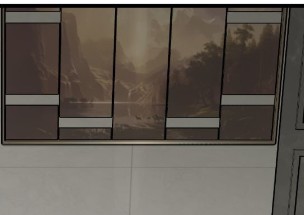 (chapter 93) But the lake has been replaced by a building. It corresponds to a broader process of urban redevelopment, in which natural or semi-rural areas are progressively absorbed into economic systems based on property, rent, and commercial use. In this context, land is no longer lived on. It is monetized.
To understand the “Unseen Game,” we must look beyond the frame of the photographs and into the historical shadow of the 1997 South Korean financial crisis. This was the moment the “Monopoly board” of the nation was violently reset. Triggered by a toxic cocktail of corporate debt, speculative volatility, and the sudden flight of foreign capital, the crisis forced the country into a brutal era of IMF-supervised restructuring.
For families like Kim Dan’s, this wasn’t just a headline—it was an earthquake. Property values didn’t just “fluctuate”; they collapsed. Debts became predatory. The “small-scale livelihoods” we see in the photographs—the gardening tools, the modest outdoor hallway, the flowers—were the exact type of “informal” or “traditional” economies that were liquidated to satisfy the demands of global capital. (chapter 94)
This is where the connection to Monopoly becomes more than metaphorical. The logic of the game — acquisition, accumulation, rising costs, and eventual dispossession — reflects the mechanisms at work in such transformations. Small-scale environments are gradually replaced by larger structures. (chapter 27) Those who cannot keep up with increasing economic pressure are displaced. Seen from this perspective, Kim Dan’s childhood does not only precede a personal rupture. It is situated within a world that is already undergoing structural change.
This also sheds light on his later relationship to money. And what did the physical therapist suggest back then, when the star was on the verge of bankruptcy? He could take a loan… that’s how the parents’ misery started. But there’s more to it. (chapter 42) As an adult, Kim Dan does not accumulate. He spends what he has on others. He supports his grandmother, pays for her needs, and later repeats this pattern with Joo Jaekyung. He does not invest in himself. He does not secure his own position. This behavior is not simply a matter of personality. It reflects a life shaped by instability, where resources are used for survival rather than growth. In this sense, his position within the “game” is already determined before he becomes aware of it. He does not enter it as an equal player. He enters it from a position marked by loss, adaptation, and necessity.
And this is what the photographs ultimately reveal.
They do not show a world that was stable and later broken. They show a world that was already fragile, already exposed to forces that would eventually transform it. What appears as a peaceful childhood is, in reality, a moment suspended between continuity and disappearance.
This context also allows us to comprehend the gap between the two main leads.
Kim Dan, who is three years older and approaching thirty, experienced the immediate impact of the 1997 financial crisis during his early childhood. He lived through a period of instability, displacement, and economic pressure without fully understanding its causes. The transformation of his environment, the loss of his family structure, and the increasing precarity of everyday life formed the background of his development.
Joo Jaekyung, by contrast, belongs to a slightly later moment. When he was a child, the crisis had already reshaped the social landscape. Its consequences were no longer unfolding, but had become part of a normalized reality. This is reflected in Hwang Byungchul’s description of his neighborhood
Joo Jaekyung grows up in its aftermath.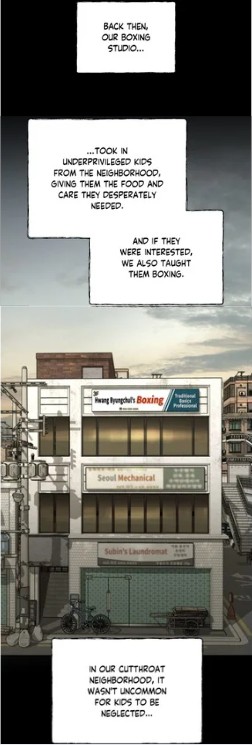 (chapter 72): a “cutthroat” environment in which neglect was common and institutions such as the boxing gym functioned as substitutes for basic care. The difference is subtle, but decisive. Kim Dan grows up at the moment of rupture. This is why the unseen game does not begin with loss. It begins much earlier, in the conditions that make that loss possible.
The Same Image, a Different Truth — Memory, Loss, and Reinterpretation
If the first set of photographs suggests a childhood shaped by freedom and affection, the images (chapter 94) involving the grandmother (chapter 94) introduce a more complex and unsettling dimension. At first glance, they appear similar. In both cases, Kim Dan is held close, framed within a moment of intimacy. The composition seems almost identical. And yet, a closer reading reveals a fundamental divergence.
In the image of Kim Dan as a baby, one detail cannot be ignored: his expression. (chapter 94) His eyes are wide, his gaze tense with tears, his mouth covered with his hand. He is not calm. He is not smiling. He has been crying. This raises an unavoidable question. Why?
If we take the image seriously, the tears cannot be dismissed as a trivial detail. They contradict the idea of a peaceful, happy moment. Instead, they suggest distress, discomfort, or even rupture. Such a reaction is not unusual. Infants often display what developmental psychology describes as stranger anxiety, a phase in which unfamiliar environments or faces provoke fear or distress. But in this context, the reaction points toward something more specific. Because this form of distress is not neutral. It implies the absence of a familiar figure. The child does not simply react to strangers; he reacts because the person to whom he is attached is no longer present.
In this sense, the image does not only show fear. It outlines a strong connection to the mother — a bond that is being disrupted at the very moment the photograph is taken. The child is no longer with his mother. He has been handed over, entrusted to Shin Okja. The presence of other women reinforces this reading. This is not an intimate, private scene. It is social, almost public. In this sense, the photograph does not simply show affection. It records a transition.
This reading becomes even more significant when we consider that Shin Okja refers to the “good old days” while looking at this very image. 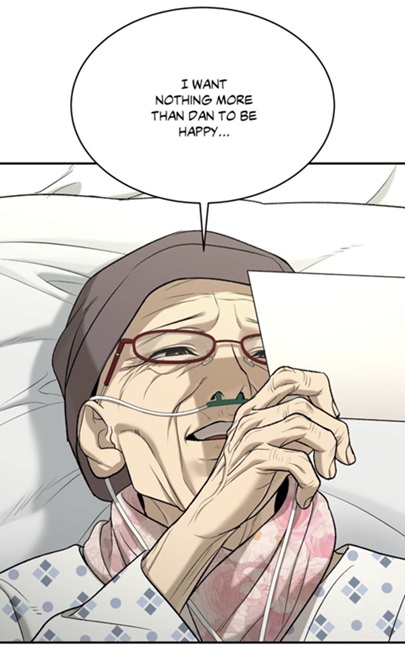 (chapter 94) She even associates this scene with Kim Dan’s happiness, while the photography contradicts this notion. The child is not at peace. He had just been crying. The moment is not one of stability, but of rupture. And yet, it is precisely this image that becomes the anchor of nostalgia. This creates a displacement.
This is where the contrast with the later hydrangea image 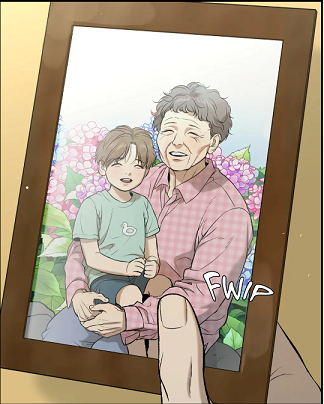 (chapter 19) becomes particularly revealing. In the first photograph, the women from the market are visibly present. (chapter 94) The moment is shared, exposed, embedded in a social environment. By contrast, in the hydrangea image, these figures have disappeared. They are replaced by flowers. What was once a public scene becomes a private one. At first glance, this shift may appear to enhance intimacy. The child is now alone with his grandmother, surrounded by blooming hydrangeas. The composition is softer, more harmonious, more contained. And yet, this transformation raises a question. What has been removed, and why?
What disappears is not only the social environment, but the structure that defined the earlier image. In the first photograph, the presence of the women from the market situates the scene within a moment of transition that is witnessed and shared. (chapter 94) The child’s tears unfold within this exposed space, and his reaction is oriented toward a presence beyond the frame.
In the hydrangea image, this structure has changed entirely. The scene is no longer oriented outward. The composition is closed, centered, and self-contained. The gaze that once participated in the moment is no longer included. This is not a simple shift toward intimacy. It is the consequence of a rupture. (chapter 94)
The hydrangeas do not merely decorate the scene. They occupy the space left by what has disappeared. Traditionally associated with apology, regret, and a desire for forgiveness, they introduce the idea that something unresolved persists beneath the surface. But they also carry another implication. Blooming fully, they mark a moment of completion — and, at the same time, of transition. They announce departure. Within this context, the image no longer represents a stable present. It captures a threshold. The child remains, but the relational structure that once connected him to the outside — and to the one behind the camera — has already begun to dissolve. (chapter 94)
Striking is that the image that most closely corresponds to a moment of calm, rest, and emotional balance is not part of the album at all. It is the photograph with the hydrangeas — the one Kim Dan himself has kept and framed. (chapter 94) In that image, he is older, composed, and seated on his grandmother’s lap, surrounded by blooming flowers. The scene is quiet, contained, and visually harmonious. According to my past interpretation, the last photography most likely represents the last moment before he lost his parents, a moment in which his world had not yet fully collapsed. And yet, this is not the image preserved in the album.
This difference is crucial. It reveals that the album does not simply gather memories. It reflects a specific point of view. 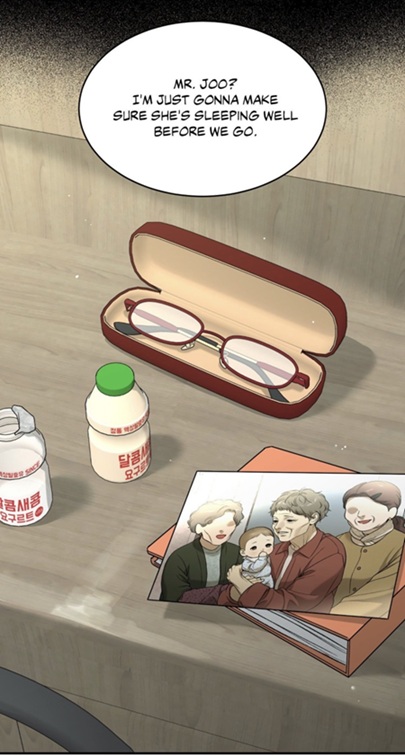 (chapter 94) The photographs it contains are not neutral. They are selected, arranged, and interpreted according to Shin Okja’s perspective. The image of separation becomes the “good old days,” while the image of relative stability is excluded from that narrative.
By contrast, the framed photograph belongs to Kim Dan. It is the only image he has chosen to keep. Unlike the album, which organizes memory collectively and retrospectively, the frame isolates a single moment. It suggests a different attachment, a different understanding of what should be preserved.
This divergence exposes two distinct relationships to the past. For Shin Okja, memory moves backward, reconstructing earlier moments and integrating them into a narrative of care and responsibility. For Kim Dan, memory condenses into a single image, one that he does not reinterpret verbally, but silently preserves.
The absence of the hydrangea photograph from the album, and its presence in his possession, therefore marks more than a simple difference in taste. It reveals a gap between two memories that do not fully coincide. Because if we follow the internal logic of the photographs, the moment that could most plausibly correspond to the “good old days” is not this one, but the later image with the hydrangeas. (chapter 94) In that scene, Kim Dan is older, calm, and seated on his grandmother’s lap, surrounded by blooming flowers. His clothing and the vegetation clearly situate the image in summer, a season associated with fullness and continuity. If your interpretation is correct, this photograph would mark the last period before he lost his parents — a moment when his family was still intact.
This creates a striking contradiction. (chapter 94) What we see is a child in distress. What is remembered and narrated is happiness.The gap between these two levels is crucial. It reveals that the photographs are not interpreted neutrally. They are reinterpreted through memory, filtered by emotion, and reshaped by nostalgia. Shin Okja does not lie consciously. Rather, she projects her own feelings onto the images. For her, these moments represent closeness, responsibility, and perhaps even purpose. The child’s tears disappear behind her own perception of care.
This becomes even clearer when we consider how she moves through the album. (chapter 94) Her gaze is not oriented toward the future, but toward the past. She flips through the pages in reverse, moving from the most recent images back to the earliest ones. This movement is not chronological. It is selective and directional. It functions as a form of regression.
In this sense, her gesture stands in direct contrast to the logic of a competitive game. A game such as Monopoly advances relentlessly toward an outcome, 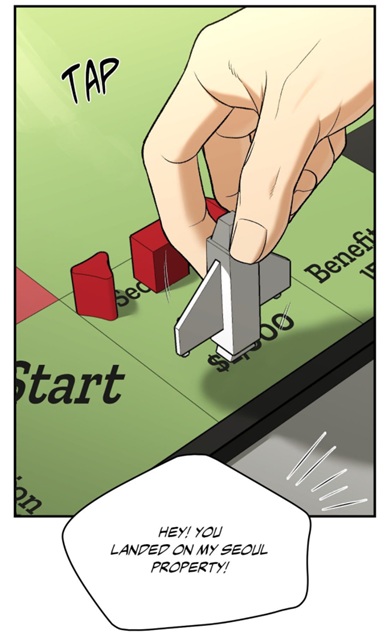 (chapter 80) structuring time as progression, accumulation, and eventual resolution. Her movement does the opposite. It moves backward, not toward victory, but toward a point of refuge. The album becomes a space in which time is reversed and the pressures of the present are temporarily suspended.
This reversal is not abstract. It is material and visible. (chapter 80) Each turn of the page, marked by the tactile flap of the paper, reduces Kim Dan. The sequence narrows. The independent boy who runs, stands, and interacts gradually disappears, replaced by a smaller, more contained figure. The movement through the album functions like a visual funnel: from autonomy to dependence, from mobility to stillness, from openness to enclosure. (chapter 94) At its endpoint stands the image of the infant.
Here, the contradiction becomes explicit. The baby had been crying, yet the grandmother is smiling in front of the photography. The scene contains two opposing emotional registers that are not experienced as such. The child’s distress is immediate, visible, and unresolved within the frame. And yet, for her, it does not signify rupture. It signifies need. This distinction is crucial. (chapter 94) Because a crying infant represents a form of suffering that can still be answered. It is simple, direct, and, above all, solvable. In that moment, she is able to position herself as the source of relief. The child depends on her, and that dependence gives structure and meaning to her role. This is why the contradiction does not appear as one. What we read as distress, she experiences as confirmation. She still views herself as his “source of happiness”.
By moving backward through the album, she does not merely revisit the past. She reconstructs a position in which her role is absolute and uncontested. The adult Kim Dan — the one who provides, who suffers, who exists outside her control — disappears from view. This psychological orientation explains why she continues to treat the professional physical therapist as a helpless infant 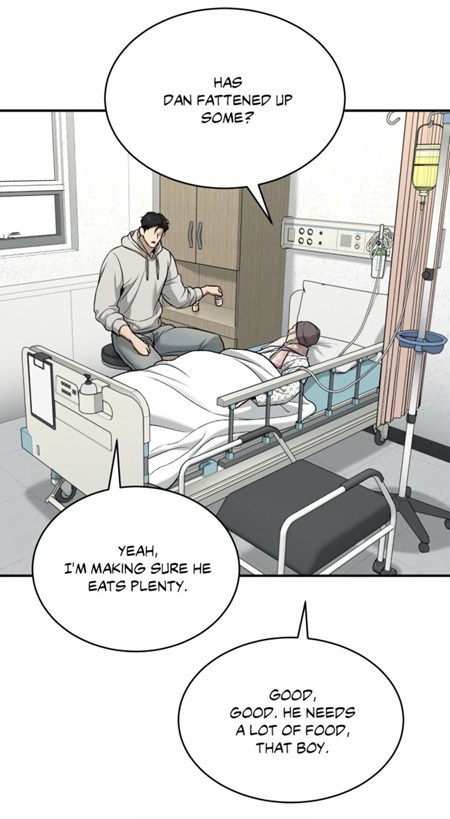 (chapter 94) Her persistent desire to see him “fattened up” is quite telling; it is not truly about the pleasure of eating, but about returning him to a state of physical dependence. To “fatten” a child is to exert a primary form of care that requires no complex dialogue or adult understanding—it is the most basic “rule” of her version of the game.
The photographs, then, are no longer treated as evidence of Dan’s life, but as emotional anchors for her own identity. This explains why the contradiction between his tears and her “good times” remains unaddressed. For her, the “good times” were a period of perfect dependence. In the space of the album, the 1997 crisis hasn’t arrived, the parents haven’t vanished, and the child’s only problem is a discomfort that a grandmother’s arms—and her “fattening” meals—can still resolve.
(chapter 94) What remains is a simplified structure in which the child’s distress is immediate and her response is sufficient. Not a time without suffering, but a time in which suffering was still manageable.This is what she calls the “good old days.”
Where the childhood images can be transformed into “good old days,” (chapter 94) the later photographs 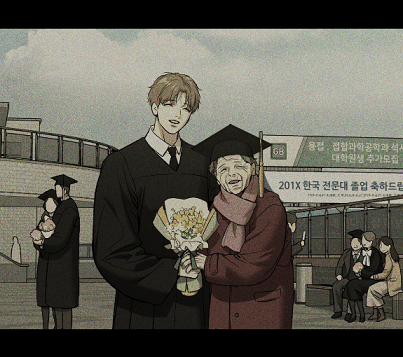 (chapter 47) remain tied to necessity. They reveal that, over time, the relationship between Kim Dan and his grandmother was no longer defined solely by care, but also by dependence.
The Mirror of Erasure: Doc Dan’s Compliance
The discrepancy between the photographs and Shin Okja’s verbal narrative reveals a profound structural shift in Kim Dan’s identity. On the beach, she insists that she  (Chapter 65), a statement that appears humble but subtly centers her own effort as the only relevant force in his life. When she speaks of her struggle, she envisions a calm baby. This makes her “failure” purely internal. By remembering him as calm while she felt “not enough,” she frames herself as the tragic martyr who was suffering even when things looked peaceful. It centers the entire era on her emotional state, not the child’s. But the picture from episode 94 displays a certain MO. She is simply ignoring reality. (chapter 94) In the physical photograph, the baby is clearly in distress (crying), but she is smiling. She is literally overlooking the child’s present reality in the photo to preserve her own feeling of “good times.” The child’s actual pain is invisible to her because, in that moment, she was the one holding him—and for her, being the “holder” is the only thing that matters. She frames his childhood through the definitive claim that he
  (chapter 65). This is not merely a description of loss; it is a transformation. By labeling him an absolute orphan, she erases the specific love and sacrifice documented in the early photographs, stripping him of his right to a specific grief. If he “never knew” them, he never lost them. In her version of the “game,” Dan is a blank slate upon which she has written her own narrative of care. At the same time, she
Strikingly, Kim Dan corroborates this void 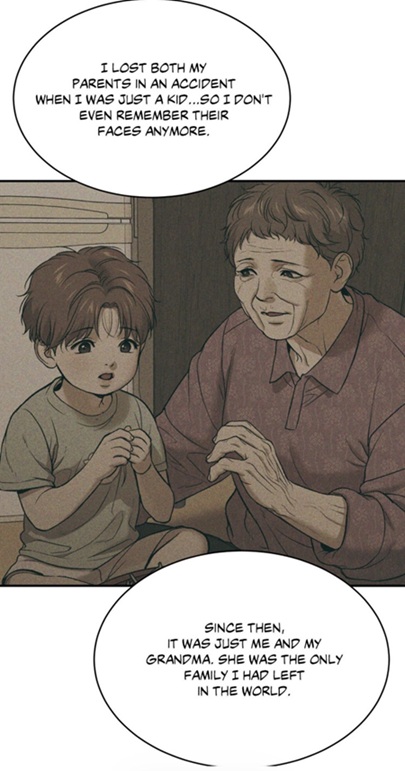 (Chapter 94). He speaks as if he were a baby when they vanished, yet the memory indicates the opposite. Moreover, the photos of him offering daisies and running prove he was old enough to know them. To survive under his grandmother’s care, Dan had to adopt her memory as his own, internalizing the image of a man who started from “nothing.” By erasing the parents, Shin Okja effectively erased the “Dan” who was once the center of a loving world, leaving behind only the “Doc Dan” who exists to serve the needs of others.
From Play to Performance: The Trophy Child
This shift becomes visible when comparing the childhood album shown to Jaekyung (Chapter 94) with the graduation photos Dan recalled at the hospital. (Chapter 47). The early images are structured around spontaneity—movement, animals, and open fields. However, as the timeline progresses toward his youth, the “Natural Cycle” is replaced by a trajectory of performance.
In these later institutional spaces—classrooms and stages—Dan no longer moves freely; he poses. 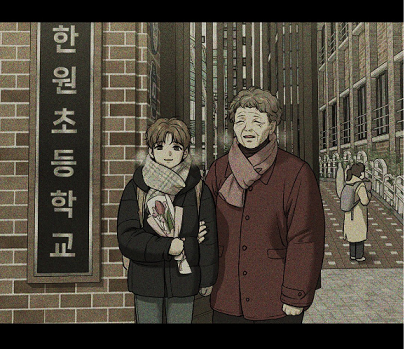 (chapter 47) He stands still, holding bouquets, looking at the camera to comply rather than engage. He is no longer a child “being,” but a trophy of successful care. His growth is recontextualized as the “interest” on his grandmother’s sacrifice, transforming his development into something useful and legible. This logic of appropriation is the “unseen rule” Dan eventually internalizes: his value is no longer grounded in his existence, but in his functional utility.
This is where the emotional register shifts again. The earlier photographs suggested a gaze directed toward the child — attentive, affectionate, and open. Here, the direction of that gaze becomes more complex. The child is still visible, but he is also being positioned within a narrative that exceeds him. His life is no longer only his own. It becomes intertwined with her need for meaning, recognition, and continuity. This is why these images feel different. They are not only more structured. They are more purposeful. The camera no longer captures a moment. It records a result.
The Crybaby
She looks fondly at this picture (chapter 94), she is able to position herself as the source of relief. The child depends on her, and that dependence gives structure and meaning to her role. This is why the contradiction does not appear as one. What we read as distress, she experiences as confirmation. And yet, her own words introduce a subtle tension within this dynamic.
When she refers to him as a “crybaby” (chapter 94), she does more than describe a child’s behavior. The term carries a judgment. It implies excess, weakness, a deviation from what is expected. Crying is no longer simply a response to pain or separation. It becomes something that must be corrected. This is where another layer emerges.
Because the child she describes is, in fact, behaving in a completely normal way. (chapter 94) He is a baby, or a very young child. If he cries in another one, it could be because he hurt himself, or he is frightened, or overwhelmed. The image of him crying after falling and injuring his knee 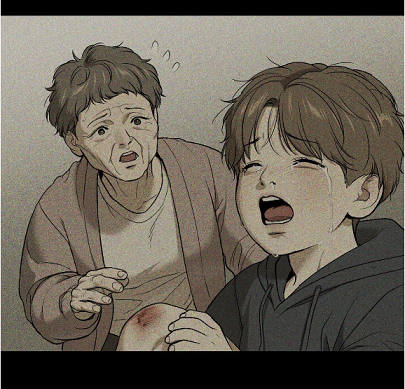 (chapter 47) confirms this. The tears are not excessive. They are appropriate. Thus he could have cried, because he lost the dogs for example. (chapter 94)
The label, then, does not describe the child. It reflects her perception. It reveals a discomfort with vulnerability, and more specifically, with the persistence of that vulnerability over time. The “crybaby” is not only the infant in distress. It is also the figure she does not want him to remain. This is reinforced by her later remark to Joo Jaekyung, where she praises his strength, his physique, and his masculinity 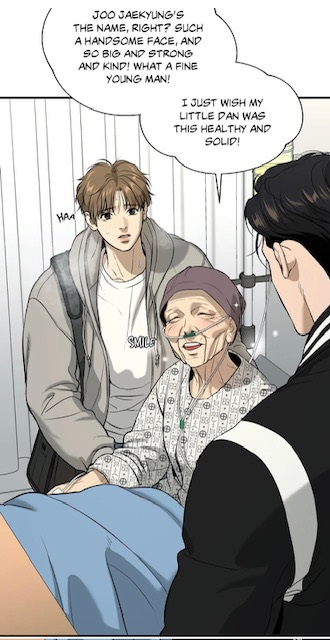 (chapter 21) The contrast is implicit but clear. The ideal is no longer the dependent child who cries, but the strong young man who does not. And now, you comprehend why he went to the restroom in order to cry. He is not allowed to express his sadness.
 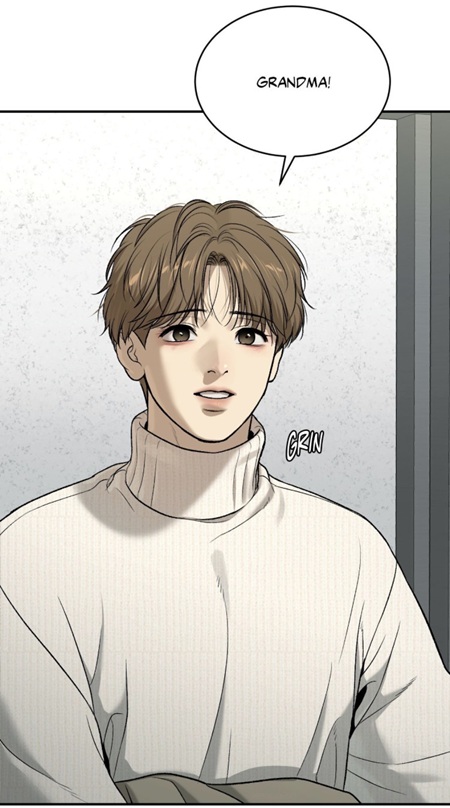 (chapter 94) In this sense, her perspective is structured by a normative expectation. A boy should be strong. He should endure. He should not cry. This creates a paradox.
On the one hand, she returns to the image of the infant because it secures her role as caretaker. On the other, she implicitly rejects the qualities associated with that same state. The crying child is both the foundation of her identity and something that must be overcome. This tension is crucial.
Because it helps explain the transformation we observe later. The child who once cried freely gradually becomes someone who suppresses his needs, who endures silently, and who defines himself through resilience rather than expression. In other words, the “crybaby” disappears. But what replaces him is not strength in the sense she admires. It is a form of self-erasure.
Because this transformation does not occur in isolation. It is mediated through her gaze. 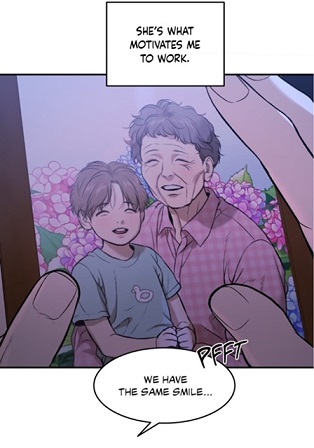 (chapter 47) Over time, Kim Dan learns to see himself as she sees him. The qualities that once defined his childhood — openness, sensitivity, emotional responsiveness — are no longer recognized as strengths. (chapter 94) They are recoded as weakness, something to outgrow, something to suppress.
This is why he cannot recognize his own strength. (chapter 94) What he has developed is not the visible, dominant form of strength embodied by Joo Jaekyung, but something quieter: endurance, patience, and an exceptional capacity for care. His strength lies in his ability to persist, to adapt, and to remain attentive to others even under pressure.
In other words, he stands for genuine empathy. And yet, because he perceives himself through the lenses of his grandmother, this form of strength remains invisible to him. What he sees instead is lack — a failure to meet an ideal that was never his to begin with.
The Production of Worthlessness
The consequences of this transformation are absolute. As Dan becomes the support structure of the relationship, he develops a pathological selflessness. His refusal to invest in himself—his empty wardrobe and skipped meals—is the continuation of a role where his only valid function is to provide. His lack of self-worth is not innate; it is a manufactured condition. (chapter 94) The original “Dan,” who offered daisies without expectation, has been overwritten by a provider who must justify his presence through constant sacrifice.
These later photographs (chapter 47) are excluded from the “happy” album because they resist reinterpretation. They cannot be turned into “good old days” because they document the exact moment care turned into dependence. They reveal a rupture that didn’t just remove his parents, but dismantled his entire environment—home, neighborhood, and unconditional joy. They expose her reliance on him and the doctor’s suffering and growth. By focusing on her role as the sole caretaker, Shin Okja reorganized the past, making the parents’ absence more visible than their existence ever was. Ultimately, Dan adopted this simplified history, losing the memory of the world that was taken from him.
The Glasses: Seeing the Past, Losing the Present
This dynamic becomes even more visible through a small but significant detail: the grandmother’s glasses (chapter 94) When she looks at the photograph, she is wearing them. This is not incidental. The glasses mediate her vision. They frame the way she perceives the image. She does not look at the past directly. She sees it through a lens. And that lens is not neutral.
It allows her to focus on what she wants to preserve: closeness, affection, meaning. At the same time, it filters out what cannot be integrated into that narrative: rupture, loss, contradiction. This is why the photograph can be reinterpreted.
The tears disappear behind the idea of “good old days.” (chapter 94) The moment of separation becomes a moment of connection. What is seen is not what is shown, but what can be emotionally sustained.
But this also implies a form of blindness. Her gaze is turned entirely toward the past. The present, by contrast, is only partially perceived. 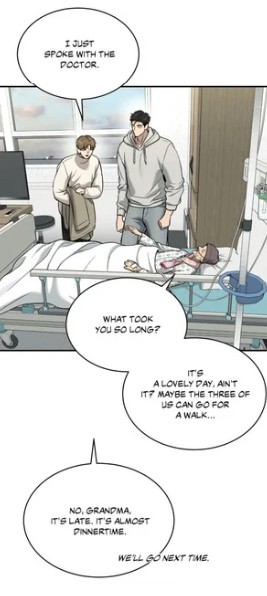 (chapter 94) She noticed his absence, but she failed to see his red eyes, his suffering. She does not fully register the adult standing in front of her. She continues to relate to him through the image she has preserved. This is where the gesture of removing the glasses becomes significant.
When she takes them off, the mediation disappears. The lens through which she has been interpreting the world is no longer in place. (chapter 94) This moment signals a possible rupture in her perception. The constructed coherence of her memory is about to be confronted by a reality that cannot be filtered in the same way. Her vision, quite literally, is about to collapse.
The Birthday: Time, Erasure, and the Illusion of Permanence
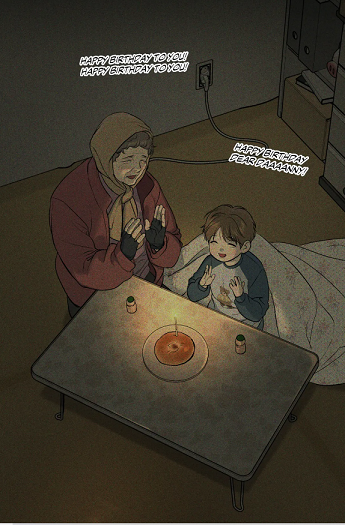
This tension between past and present becomes even more striking when we consider the question of the birthday.  (chapter 41) Birthdays are not trivial details. They function as markers of time, inscribing the individual within a social and temporal order. They acknowledge growth, change, and the passage from one stage of life to another.
 (chapter 11)
And yet, in this scene, the birthday is absent. This absence is revealing.
Jinx-philes already know that Kim Dan’s birthday follows immediately after Joo Jaekyung’s scheduled match on December 25th 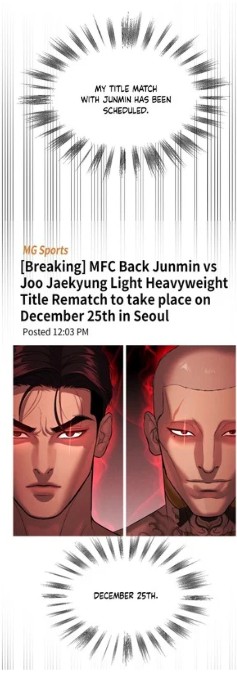 (chapter 88). The temporal proximity is clear. If the grandmother is aware of his matches — if, as she claims, they “give her strength”
 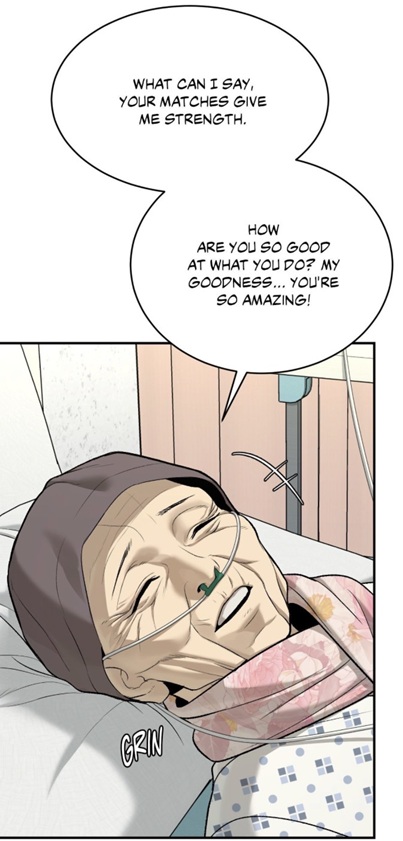 (chapter 94) — then she should also be aware of this date. But she does not mention it.
Instead, her attention is directed elsewhere. She complains that he does not spend enough time with her and asks him to come earlier next time. (chapter 94) She asks him to come earlier next time. 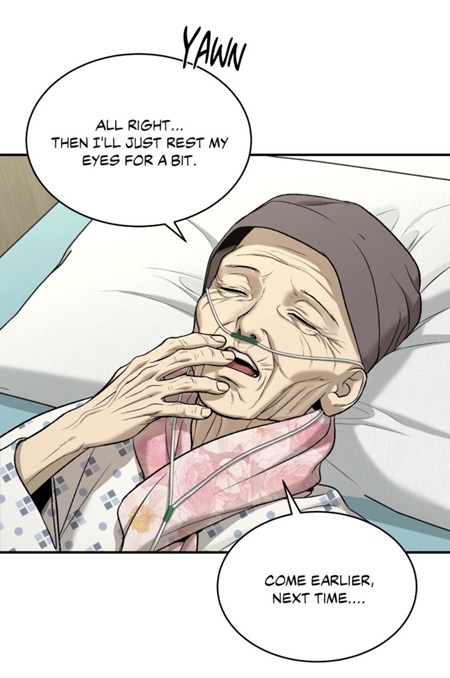 (chapter 94) Her concern is not oriented toward his life as it unfolds, but toward maintaining a certain relational dynamic.
This is where the contradiction emerges. She speaks as if she is connected to the present, yet her perception is anchored in the past. The fact that she only “heard” about his victory suggests distance rather than genuine involvement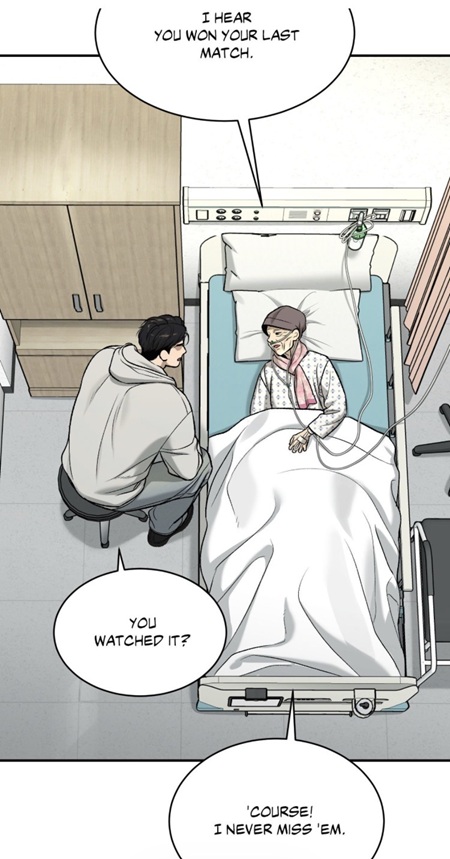 (chapter 94) Her knowledge is indirect, fragmented, and yet presented as intimacy. This gap is not incidental. It has structural consequences.
By not acknowledging his birthday, she does not acknowledge the passage of time. She does not recognize him as someone who is approaching thirty , as someone whose life extends beyond the role she has assigned to him. In this sense, the absence of the birthday is not a simple omission. It functions as a form of erasure.
Without temporal markers, the individual becomes fixed. He no longer moves forward. He remains suspended in a past that can be revisited, reshaped, and controlled. This is why he appears, in a certain sense, frozen in the end. (chapter 94) This also explains why she continues to treat him as a child. If time is not acknowledged, growth is not recognized. If growth is not recognized, the child never fully becomes an adult. He remains within a structure in which his role is defined by dependency, proximity, and care. This is where the notion of the “Unseen Game” reaches another level.
It is not only about economic structures or social conditions. It also operates through time itself. Through what is remembered, what is omitted, and what is allowed to change. And in this case, what disappears is not only the parents. It is Kim Dan as an individual. (chapter 11) When Jinx-philes encounter the birthday scene, they may assume that this celebration was a recurring ritual. But is that necessarily the case? The narrative does not confirm repetition. On the contrary, the absence of any reference to his birthday in the present suggests discontinuity rather than tradition.
This absence becomes even more striking when we consider the logic of the photographs. If, as suggested, one of the images corresponds to winter (chapter 94) then this season should have triggered her memory. And yet, it does not. The seasonal cycle that structures the photographs no longer structures her perception.
This indicates a deeper divide. She no longer inhabits the same temporal reality as her grandson. While his life continues to move forward, her perception remains anchored in a reconstructed past that she revisits selectively.
What disappears, then, is not only the parents. It is Kim Dan as an individual. He becomes, in a very precise sense, a ghost within his own life: present, functioning, necessary—but not fully recognized as someone who exists independently of the role he has been assigned.
And yet, this structure is not immutable.
Because the absence of the birthday does not mean that time has stopped. It only means that it has not been acknowledged. This is precisely where Joo Jaekyung’s role becomes decisive. By celebrating Kim Dan’s birthday, he does something that has been missing until now: he reintroduces time. He marks a transition. He recognizes not the child of the past, but the adult of the present. This gesture is not symbolic in a superficial sense. It has structural consequences.  For the first time, Kim Dan is acknowledged as someone who has grown, who has endured, and who has reached a stage that cannot be reduced to dependency. The celebration does not create his maturity. It makes it visible. So this image could be seen as a picture taken by the main lead on Kim Dan’s birthday. And observe that this image lets transpire the presence of the photographer and the strong connection between the main lead and the photographer.
In this sense, Joo Jaekyung does not simply “care” for him. He restores a dimension that had been erased. He gives him back a temporal position. And with it, an identity.
The Function of the Photographs
This allows us to understand the true function of the photographs. (chapter 94) They are not simply memories. They are instruments of perception.
At first, Joo Jaekyung looks at them and sees only what is immediately visible: a child, innocence, warmth. (chapter 94) He recognizes the purity of that image, but not the conditions that surround it. The past appears self-contained, detached from the structures that shaped it. This limitation has consequences.
When he later recalls the encounter between Kim Dan and Choi Gilseok, his interpretation follows the same logic. 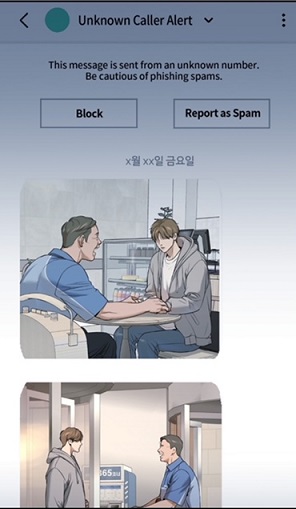 (chapter 48) He suspects manipulation, imagines betrayal, and attributes agency to the most visible figure, because he knows about the loan and debts. And don’t forget that in his mind, they are the result of gambling and not of an economical crisis. In this framework, Kim Dan appears as someone who could be bought
  (chapter 51), influenced, or used. Baek Junmin becomes the primary culprit, the one who acts openly, who attacks his wounds, who embodies threat. One might say that he looked at the pictures through the gaze of the photographer. But something remains unexamined.
Choi Gilseok. (chapter 48) He did not notice that these pictures were staged.
Because, unlike Baek Junmin, Choi Gilseok does not hide his position. On the contrary, he reveals it. In the café he owns, he lays out his resources with striking clarity.  (chapter 48) He speaks of his parent company, of pharmaceutical connections, of international treatment. He offers to cover medical expenses, to provide accommodation, to double Kim Dan’s salary, even to place a car at his disposal. This is not a conversation. It is a display.
What he presents is not simply help, but a system of possession. If we read this scene through the lens of Monopoly, the structure becomes unmistakable. Choi Gilseok is not a player struggling within the game. He is someone who already owns the board. The café, the company, the network, the capital—these are not isolated elements. They form a coherent system in which value is accumulated, controlled, and redistributed according to strategic interest.
Kim Dan, by contrast, is placed in the position of someone who has landed on another’s property. The offer appears generous. But like in Monopoly, generosity is never neutral. It is tied to incorporation. To accept means to enter the system, to become part of a structure in which the terms are already defined. This is where the illusion operates. Because what is presented as opportunity is, in fact, a form of capture. 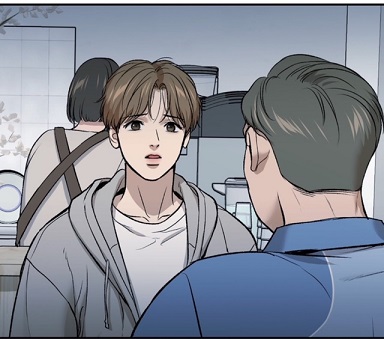 (chapter 48) And the switched spray was the price to pay for the “visit” at the café.
 (chapter 49) The meeting with Choi Gilseok is no longer a simple interaction between individuals. It becomes part of a larger configuration — one in which visible actions and invisible structures intersect. Responsibility is no longer attributed only to the one who strikes, but also to the one who orchestrates.
As you can see, the pictures can help Joo Jaekyung to see not only the director, but also his position within the game. This shift is crucial. (chapter 94) Because it allows him to recognize that Kim Dan is not defined by greed, weakness, nor by passivity, but by a history that required endurance, adaptation, and silent resistance. The child he saw in the photographs is not separate from the man he stands beside. It is the foundation of that man.
To conclude, this is where the photographs about Kim Dan’s childhood begin to transform Jaekyung’s perception. Indirectly, he has sensed the care and loving gaze of the parents. Because once he has learned to look beyond the surface — once he understands that what appears as innocence may contain loss, that what appears as simplicity may conceal structure — his way of seeing changes. He no longer looks only at what is shown. He begins to question what is hidden. And it is the same for Kim Dan (chapter 94) who could be forced to remember painful moments  (chapter 19)
 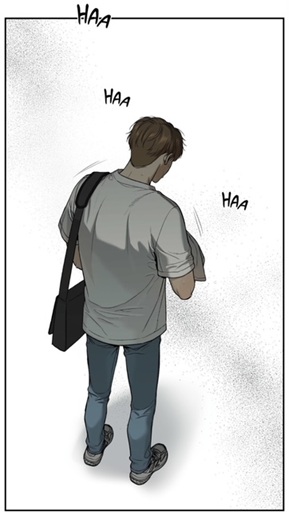 (chapter 59) by rediscovering the photos from his childhood, like the vanishing of the “puppy”. (chapter 94) I don’t think, it is a coincidence that Potato has pictures of the puppies as well.
  (chapter 60)
Feel free to comment. If you have any suggestion for topics or Manhwa, feel free to ask. If you enjoyed reading it, retweet it or push the button like. My Reddit-Instagram-Twitter-Tumblr account is: @bebebisous33. Thanks for reading and for the support, particularly, I would like to thank all the new followers and people recommending my blog.

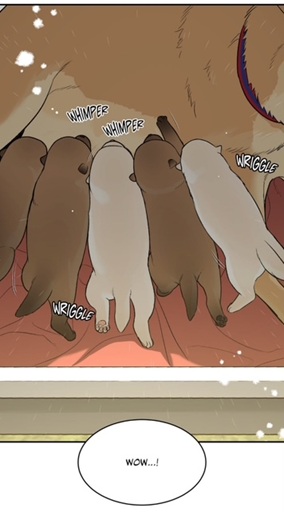 (chapter 57) and its future adoption which got reinforced with the reappearance of an old picture showing Kim Dan holding a puppy.
 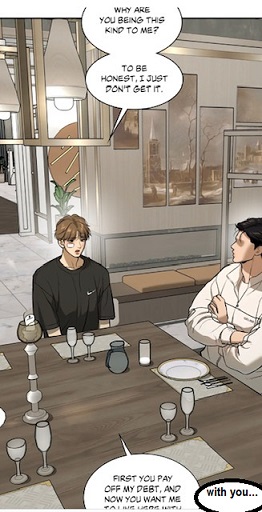 (chapter 18) Kim Dan and Joo Jaekyung are sitting together, but there is still a distance between them. And between them, almost quietly, hangs a painting: a winter landscape. Bare trees, cold tones, a distant city. Everything feels still… almost frozen.
  (chapter 18) This image reflects their state at that moment, that’s why it is placed between them, even behind them. They are close in space, yet emotionally far apart — trapped in silence, routine, and roles. Alive, but not truly living. At the same time, this shows how they treat their past and themselves. Additionally, they seem to draw a line between themselves and others, as if hiding behind invisible walls. Present, yet unreachable.
 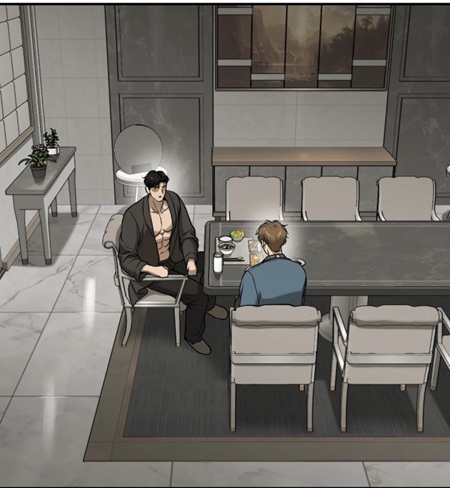 (chapter 93) The setting remains, but the painting has changed. Winter has given way to a living landscape: trees with leaves, a mountain rising in the background, and beneath it a stretch of water reflecting the light.
 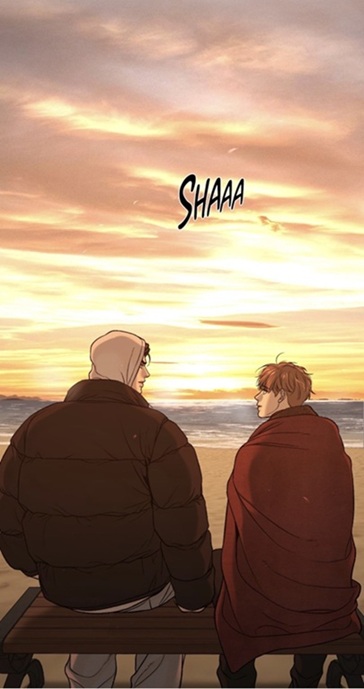 (chapter 94) A simple change in atmosphere? A moment of intimacy? Or the beginning of a deeper transformation in the way Kim Dan and Joo Jaekyung perceive themselves and, above all, each other?
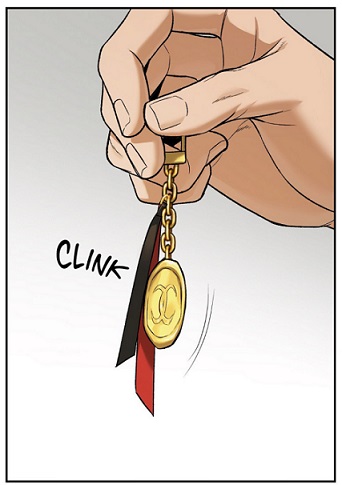 (chapter 55) —something polished, valuable, appropriate. Alongside it, he wrote a message that sounded careful, respectful, almost rehearsed:
 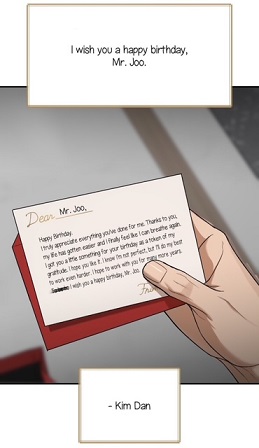 (chapter 55) “I truly appreciate everything you’ve done for me.” “I’ll work even harder.” “I hope to work with you for many years.” At first glance, nothing seemed wrong. The gesture was thoughtful, the words polite. And yet, something felt restrained.
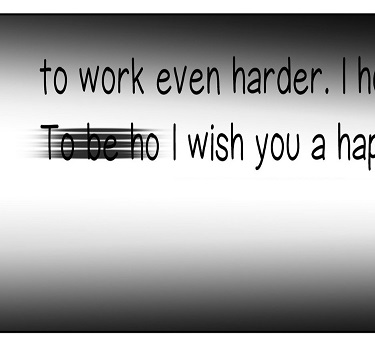 (chapter 55) The letters were erased before the sentence could even exist. This is not a correction. It is a hesitation made visible. The thought emerged—but it was interrupted. Before honesty could take shape, it was already suppressed.
 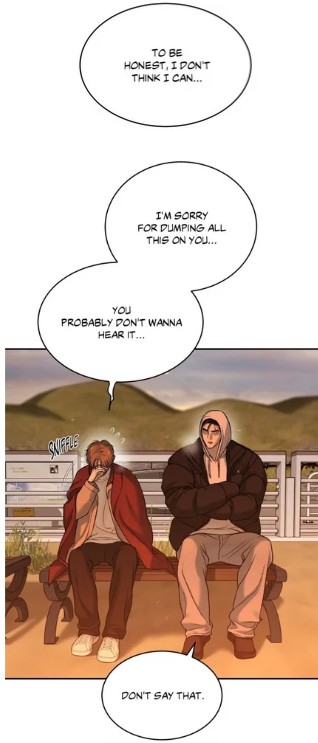 (chapter 94) There, when he finally spoke without the protection of formality, his words shifted. He admitted what had remained hidden at the time of the gift: To be honest, he did not think he could do it. He did not feel confident enough to stay by Joo Jaekyung’s side.
 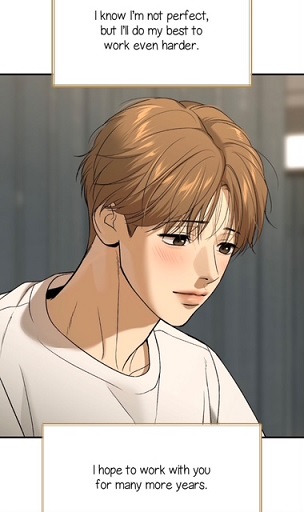 (chapter 55) Though his words seemed clear, this “hope” was not entirely his. It was shaped by something that had not yet been severed. At that point, Kim Dan had not truly separated himself from his grandmother.
 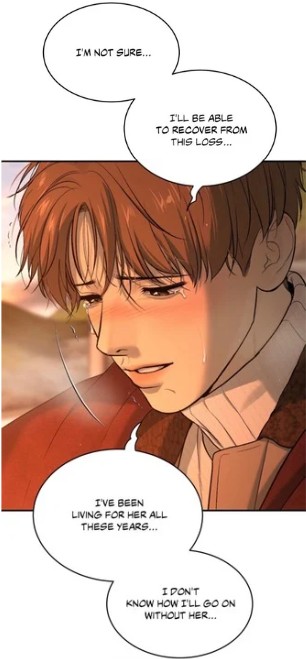 (chapter 94) His sense of self was still tied to her—emotionally, morally, almost structurally. He was not yet standing on his own, but continuing a role he had long internalized: enduring, adapting, staying where he was needed.
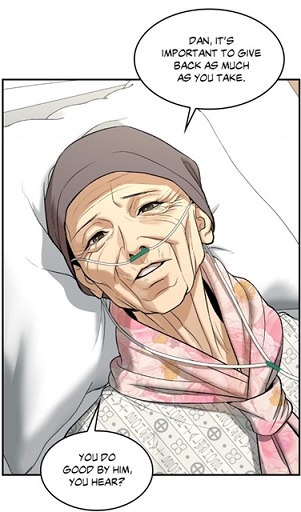 (chapter 41) A continuation of a life he had learned to accept, rather than one he had chosen. This is why the card feels so careful, so measured. Not because he lacked sincerity – but because he lacked strength in his eyes.
  (chapter 51) And because of that, he clung to Joo Jaekyung—not simply as an employer, but as a figure through whom he could stabilize his own sense of worth. Remaining by his side, working harder, staying useful… all of this allowed him to compensate for what he felt he lacked.
 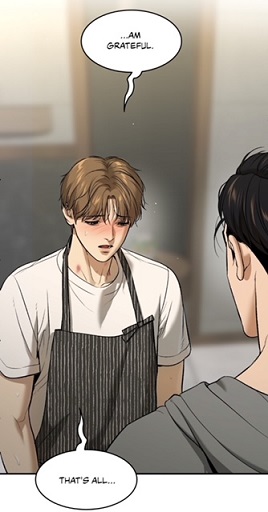 (chapter 45) Because gold, in that moment, could only represent value imposed from the outside—status, reward, recognition.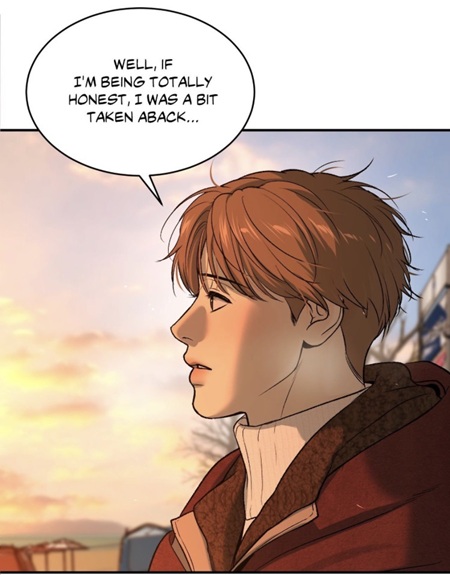
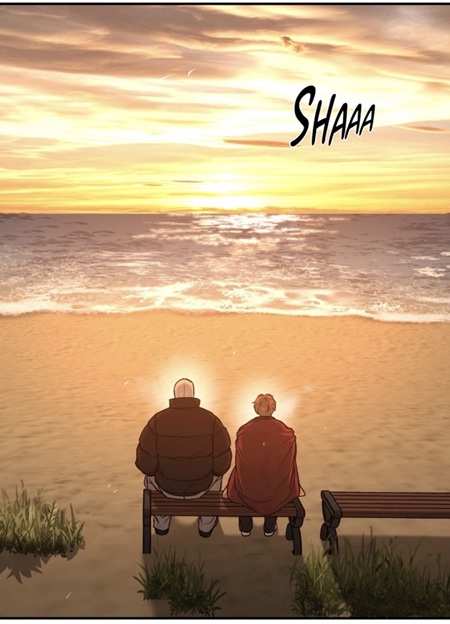 (chapter 94) The beach is not a random setting.
 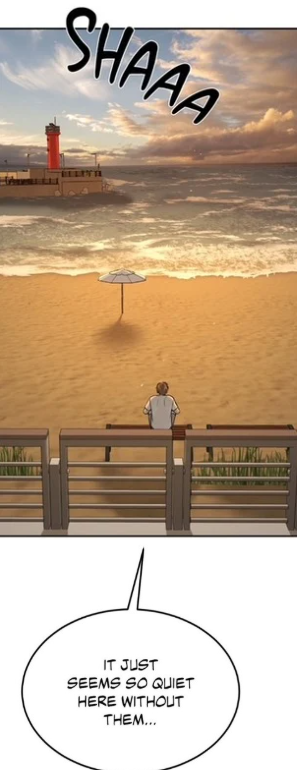 (chapter 59) He goes there when he is struggling—when something within him can no longer be contained.
 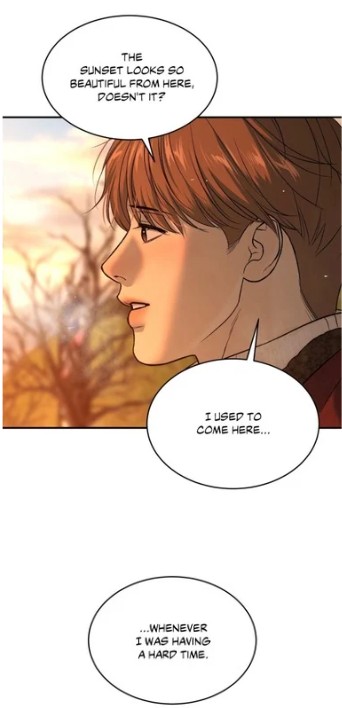 (chapter 94) In those moments, the usual mechanisms—enduring, adapting, maintaining balance—begin to loosen. The roles he has learned to perform no longer fully hold. And this is what links the beach to something more fundamental.
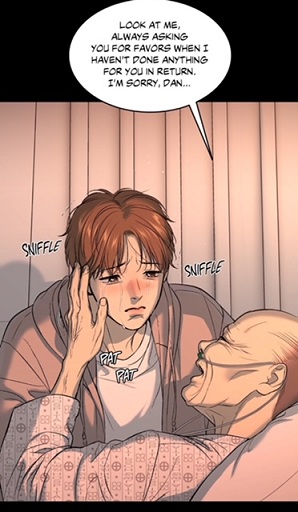 (chapter 53) At the hospital, she spoke openly. She expressed regret, desire, and a final wish without filtering it, without protecting him from the weight of it.
  (chapter 53) It was a moment of sincerity that did not try to reduce itself.
 (chapter 60) When he reaches his breaking point, it is here that the boundary between control and collapse begins to dissolve. The beach is no longer just a refuge—it becomes a space where everything that has been contained threatens to surface at once.
 (chapter 80) For him, the place becomes associated with something dangerous: loss, disappearance, the possibility of not returning. Hence he taught him later how to swim.
 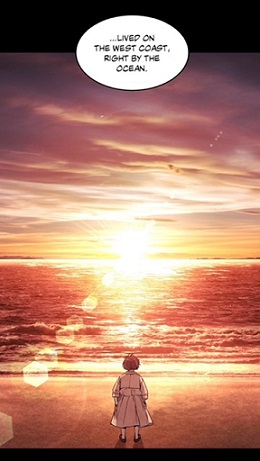 (chapter 53) Through his grandmother , the ocean had been described as something beautiful, something capable of giving strength and comfort
  (chapter 53) — even when experienced alone. It did not require company to feel complete. Kim Dan held onto that idea.
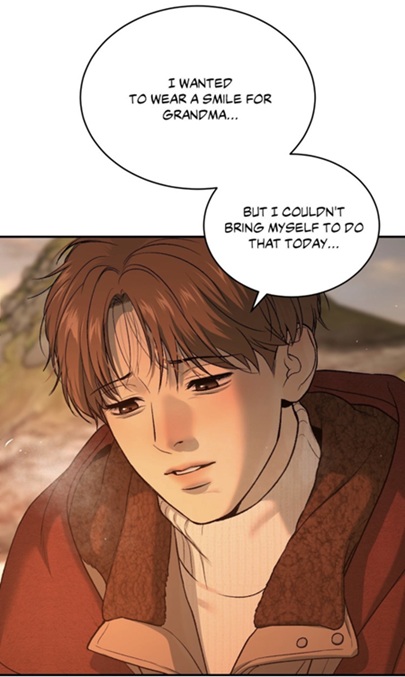 (chapter 94) For the first time, what had always structured him—enduring, adapting, protecting others—no longer works.
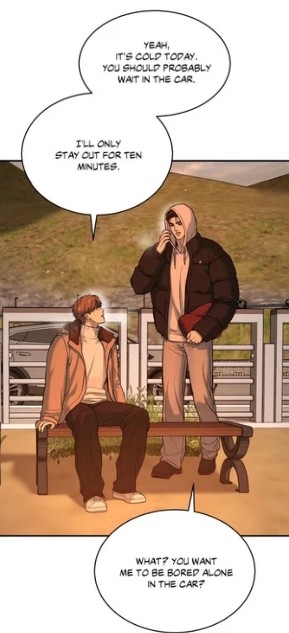 (chapter 94) He was even told to. But he didn’t. He chose to remain beside him.
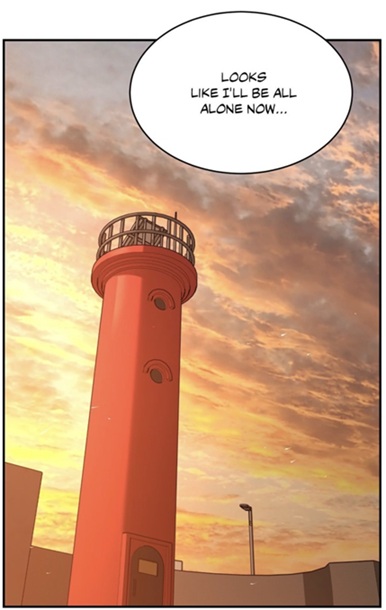 (chapter 94) And the presence of Joo Jaekyung created something new: A space where silence was no longer the only option. The sentence that once stopped at “To be ho” now reaches its end.
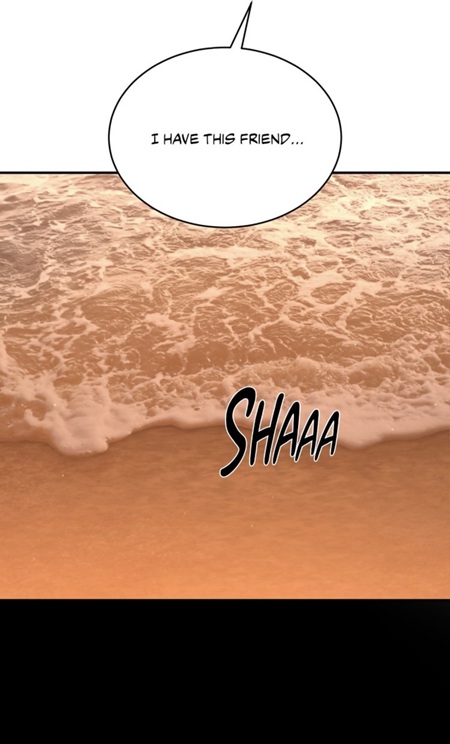 (chapter 94) The beach is not just a backdrop. It is a boundary.
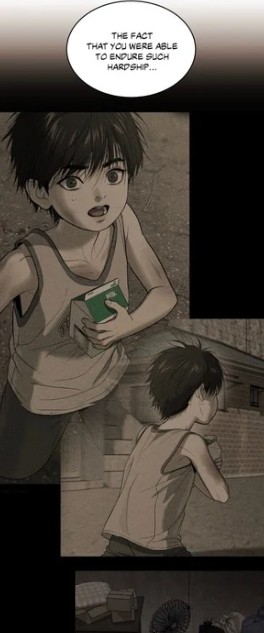 (chapter 94)
 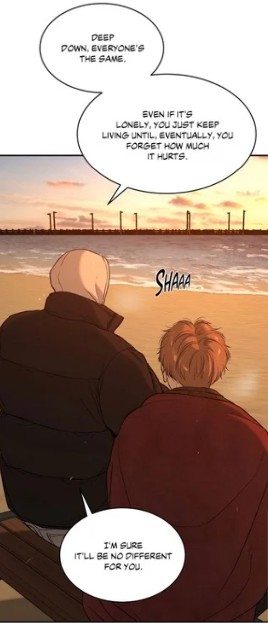 (chapter 94)
  (chapter 65) Even though they have lived together for years, she positions herself outside his inner world. She observes him—but does not truly reach him. And the image reflects this separation. The water and the sand remain clearly divided. The boundary holds.
 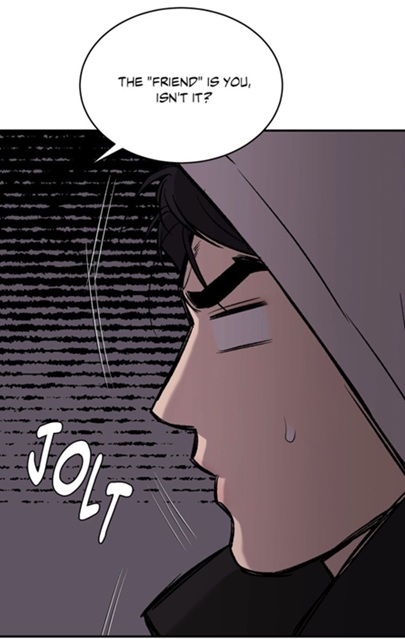 (chapter 94) Because he does not interrupt. He listens.
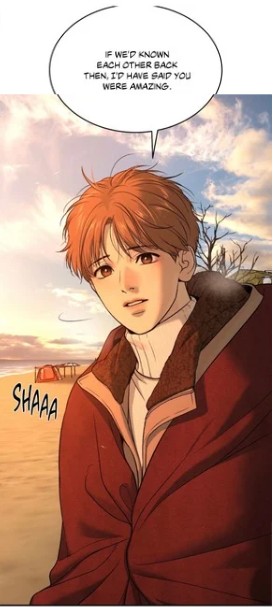
  (chapter 94) He allows the confession to unfold—even in its distorted form. And once it has been spoken, he does something no one else has done before. He recognizes it.
  (chapter 94) Not simply because of the place. But because of who is beside him.
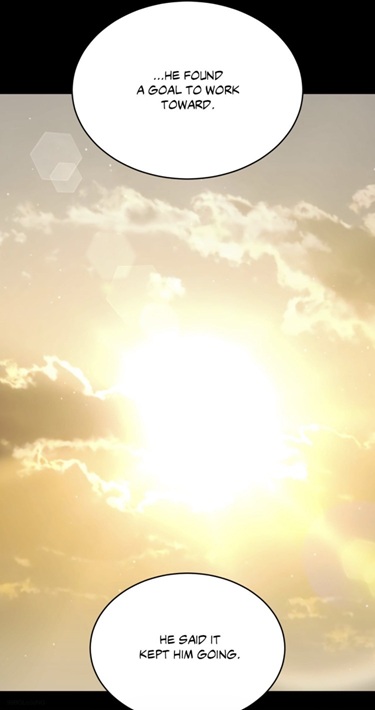 (chapter 94), the lighthouse
  (chapter 94). None of them is accidental. But their meaning is not only symbolic. They reveal something that neither of them have not yet fully realized. That they were never entirely alone.
 (chapter 59) In other words, it connects movement to orientation.
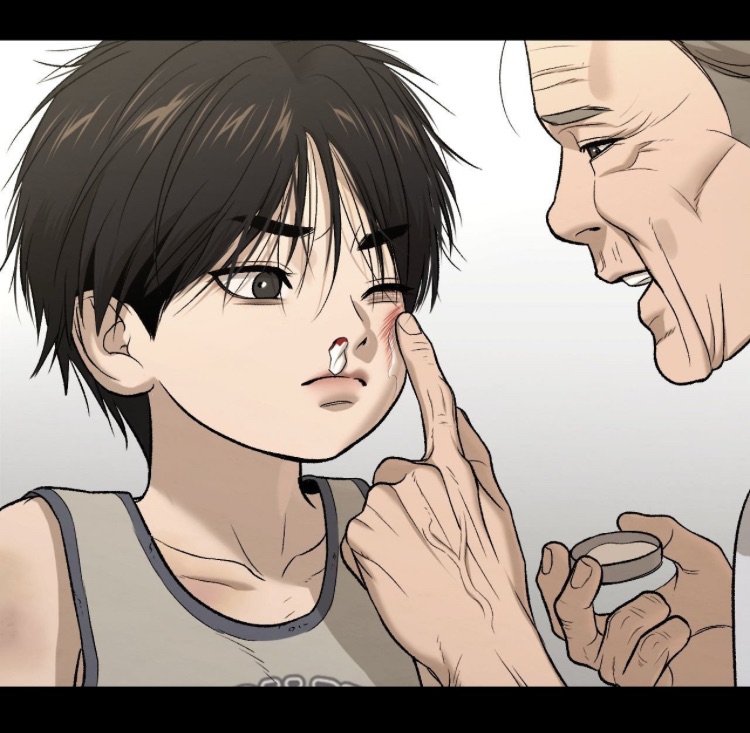 (chapter 72) or his mother. He resists any narrative of dependence because to acknowledge others is to acknowledge vulnerability. He looks at the horizon and overlooks the pier at his side, even though he has been standing on it all along. It is because he was constantly staring at the “sun”. Therefore his reaction is not surprising.
 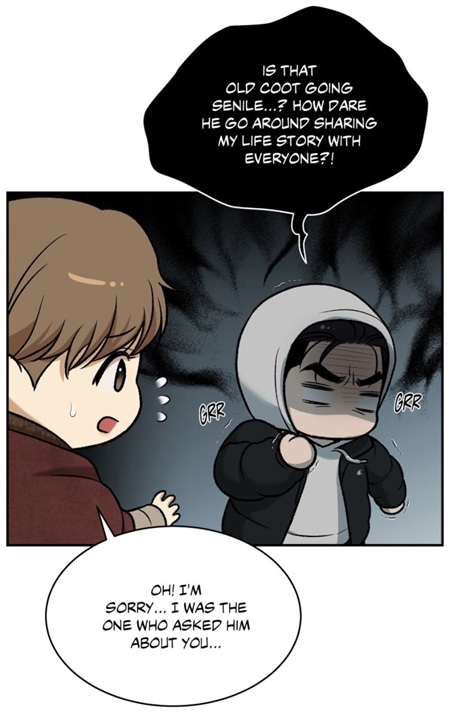 (chapter 94) To acknowledge others would mean acknowledging vulnerability—not just as a condition, but as something shared. So instead, he generalizes. He replaces relationship with sameness. And in doing so, he protects himself from the risk of trust.
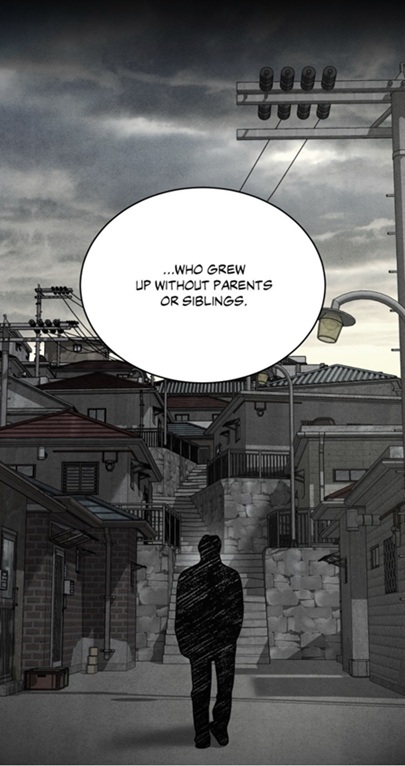
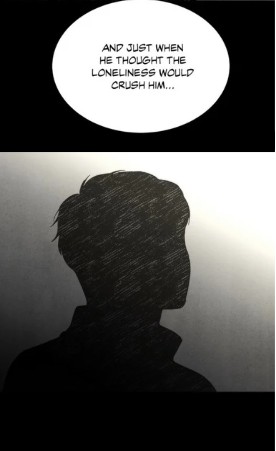
 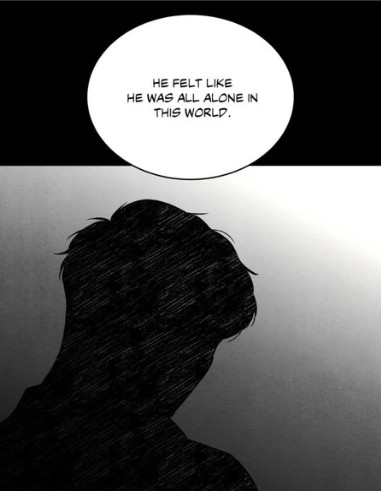 (chapter 94) Someone who grew up without parents, without siblings, without any form of support. The statement is absolute. It leaves no room for exception. And this is where the logic of the confession reveals itself.
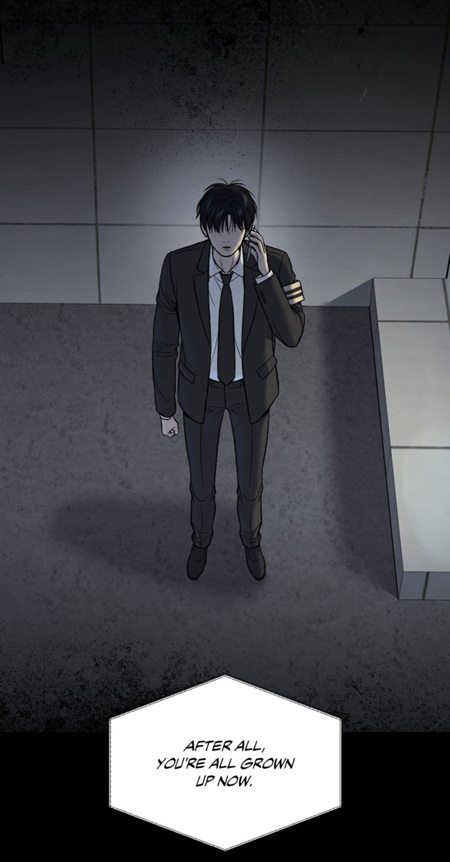 (chapter 74), she does not simply reject his suffering. She erases the condition that produced it. Which leaves him with no framework to understand what is missing.
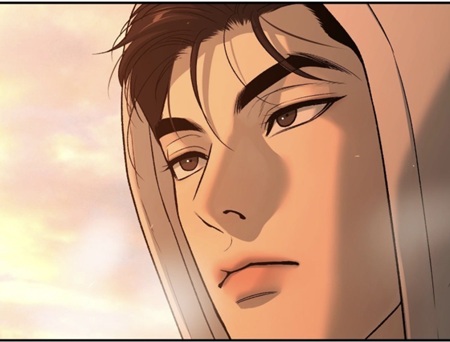 (chapter 94)
 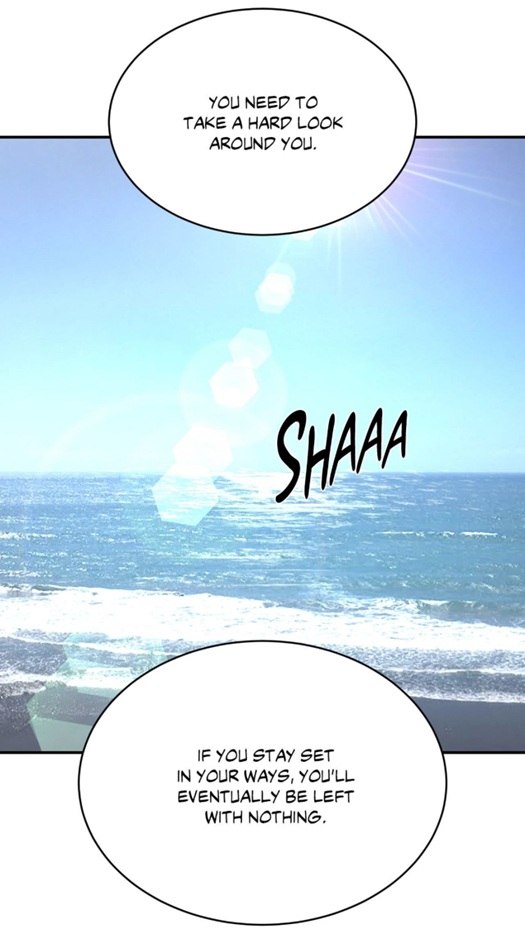 (chapter 75) This was never only about people. It was about environment. About perception. About everything that exists beyond the narrow structure in which Jaekyung learned to survive: shared experience.
 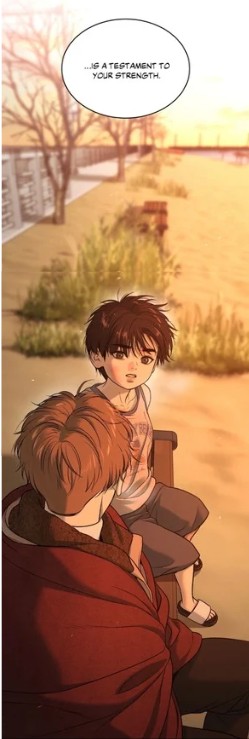 (chapter 94) He represents something else: a path. Not upward, like the sun. But outward. Toward a world that was always there— but never truly lived.
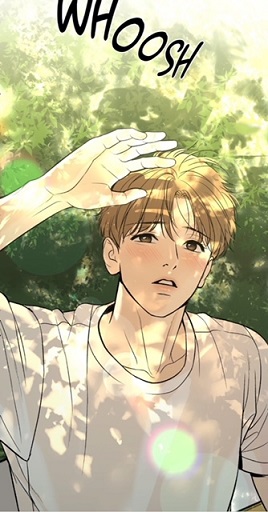 (chapter 41) from a place of growth, exposure, and vulnerability. This interpretation gets once again validated on the beach.
 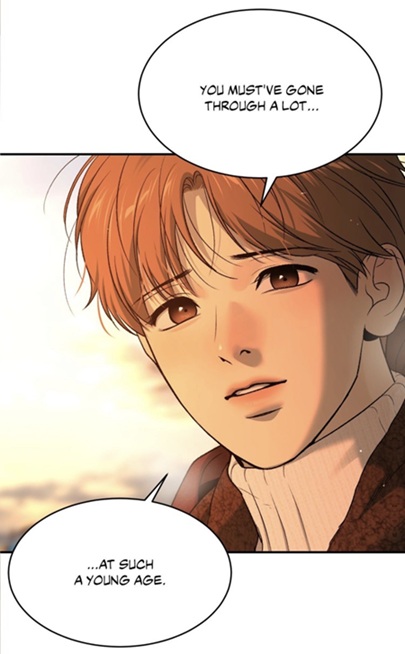 (chapter 94) When Kim Dan looks at Joo Jaekyung, he does not stop at the surface—the fame, the strength, the constructed identity. He perceives what lies beneath it, but he does not expose it in order to dismantle it. He preserves it differently.
 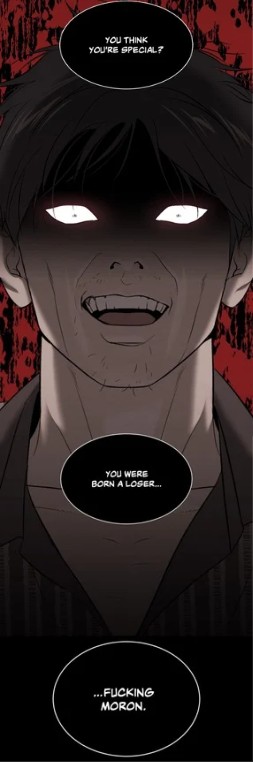 (chapter 73) A statement that reduced his existence to failure from the very beginning, leaving him with only one option—to prove, endlessly, that this judgment was wrong.
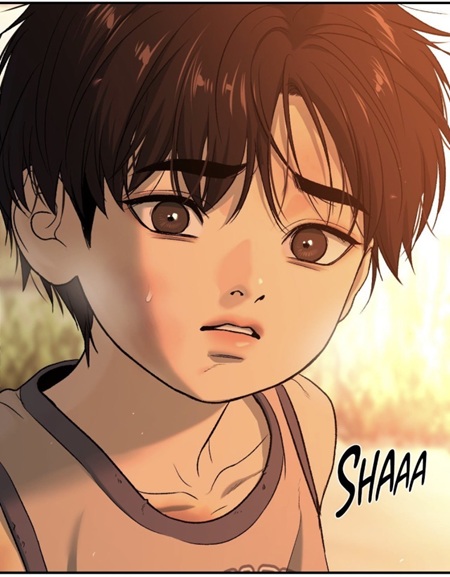 (chapter 94) The child, who had long been denied acknowledgment, is finally being seen—and more importantly, affirmed.
 (chapter 57)
  (chapter 89) Not expectation.
 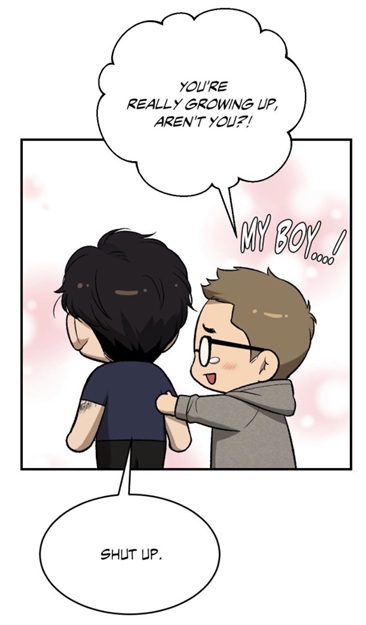 (chapter 88) But a form of recognition that restores his position in relation to others. For the first time, he is no longer defined by what was done to him. He is no longer confined to enduring in silence. Instead, he gains something he had been denied: the ability to respond.
 (chapter 9) The tension that once structured their encounters has disappeared.No imbalance of power. No role to perform. For the first time, their positions align.
 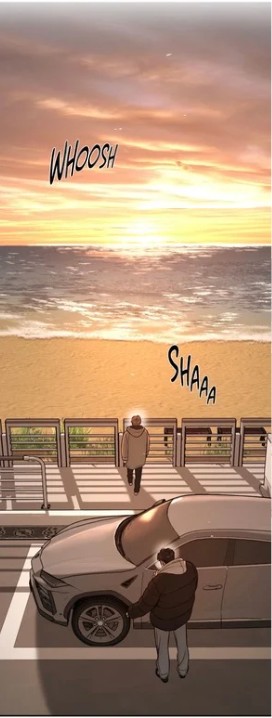 (chapter 94)
 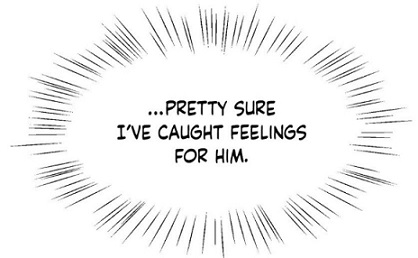 (chapter 41)
 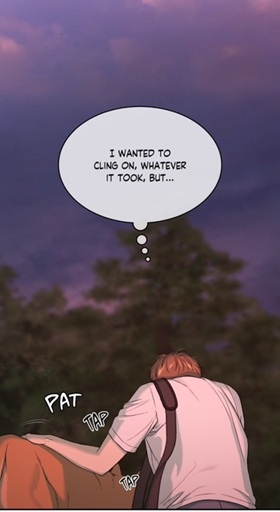 (chapter 59) The image of warmth we associate with it is, in reality, the trace of a loss. So he did not just lose his parents, but also pets.
 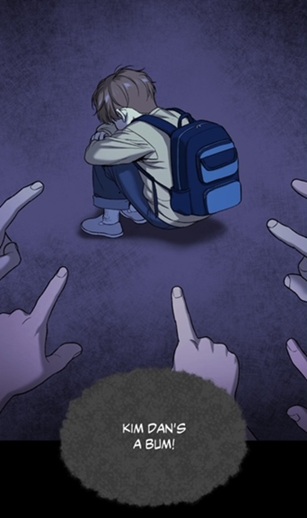 (chapter 57), nor reduce others to something distant or manageable. Instead, he remained capable of attachment. Of care.
  (chapter 7) Of returning, again and again, to places that carried pain—because they also carried meaning.
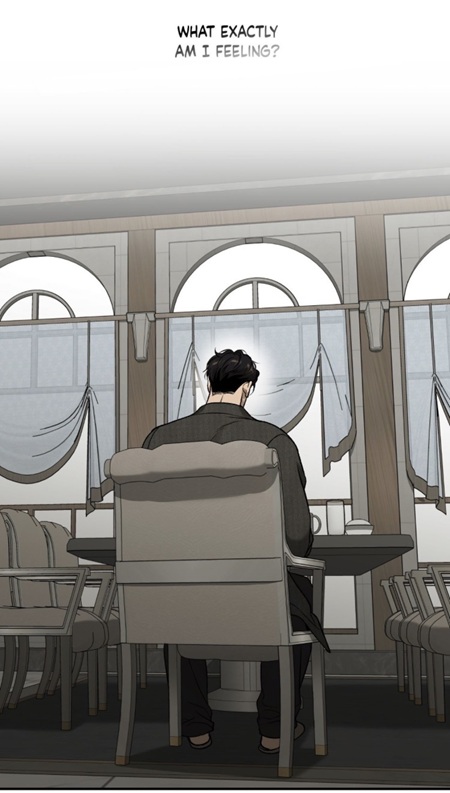 (chapter 93) “ The answer is not given to him directly. It appears in front of him on the beach.
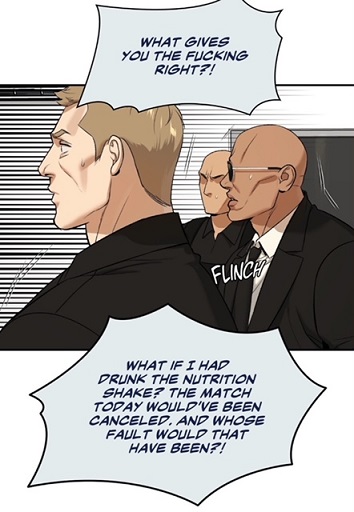 (chapter 40) What appears to be coincidence is often carefully engineered.
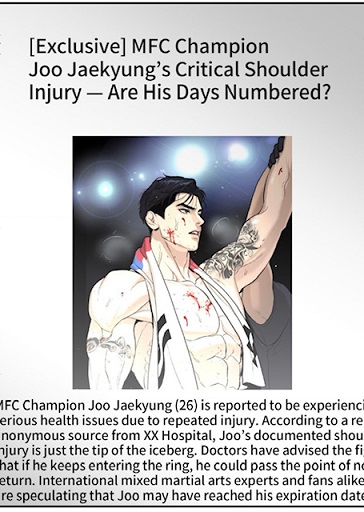 (chapter 36) At the same time, social medias were manipulated in order to stir public pressure and push the champion toward accepting the match in the States.
 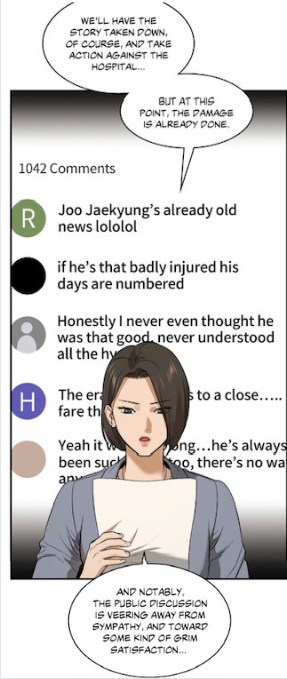 (chapter 36) But we only discover this MO thanks to the match with Arnaud Gabriel and the Entertainment agency’s involvement.
  (chapter 81)
 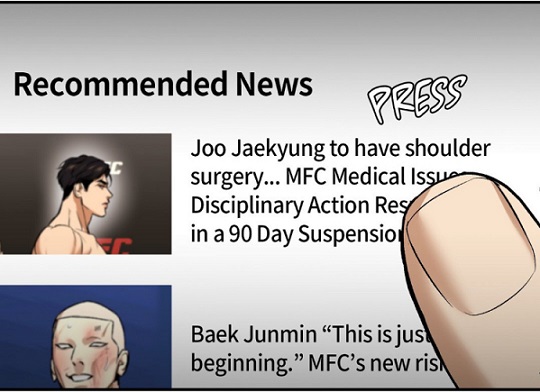 (chapter 52) Officially, the story suggested that his own behavior had caused the problem. In reality, however, this removal also had another function: it cleared space for Baek Junmin’s rise. That’s the reason why the article with The Shotgun was placed directly below the star’s and why the director Hwang Byungchul accepted easily the disqualification of his former pupil.
  (chapter 71)
 (chapter 54) He was increasingly portrayed as reckless and irresponsible for continuing to fight despite his condition.
  (chapter 54) In this new narrative, the original leak of confidential medical information was no longer treated as the real wrongdoing. The focus shifted entirely onto the athlete himself.
 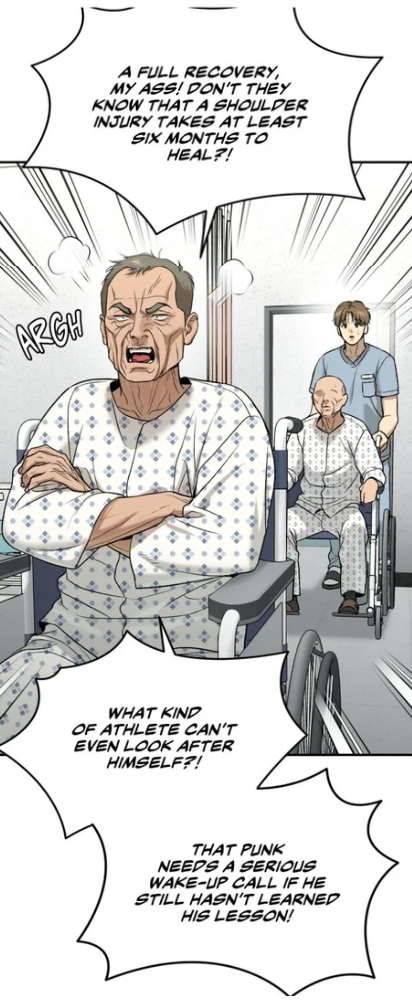 (chapter 70) Once such stories enter public discourse—injury, temper, arrogance—every later incident can be read as confirmation. The narrative becomes self-reinforcing. The media no longer merely reports events; it prepares the framework through which future events will be judged.
 (chapter 37) and the suspicious spray
  (chapter 49) used during the manipulated match both belong to this category. These substances create uncertainty about the athlete’s physical condition and about the legitimacy of his treatment. But this implies the involvement of the pharmaceutical industry.
  (chapter 41)
 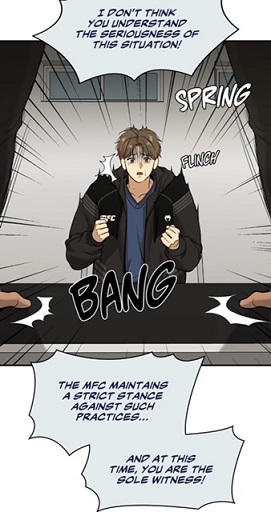 (chapter 40) The scene resembled a police investigation, yet these men were not representatives of the state. Hence there was no translator and lawyer. They were dressed-up employees of a private organization whose primary objective is to protect the company from scandal and as such from losing money
 (chapter 40) At first glance, this strategy appears effective. By redirecting attention toward the therapist, the organization can distance itself from the real problem: the suspicious beverage that had been introduced into the environment of the fight.
 (chapter 40) A doctor took a blood sample from Kim Dan, and the laboratory later produced a component analysis report.
  (chapter 41)
  (chapter 41) This coincidence exposes another layer of the mechanism. While the laboratory analysis confirms that an illicit substance had been present, the medical authorities simultaneously authorize the champion to continue fighting. The two decisions cannot easily be separated. Together, they suggest that the involvement of the doctors helps stabilize the narrative: the suspicious beverage becomes a secondary issue, while the focus shifts toward the champion’s physical condition and his decision to fight despite his shoulder injury.
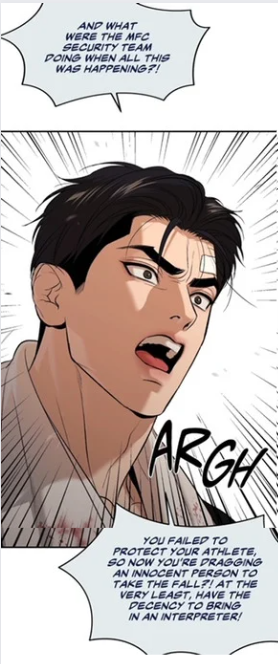 (chapter 40) That’s why they needed a scapegoat. First Kim Dan, later antis and finally the athlete himself. And who fears a scandal in Jinx? One might say Park Namwook
 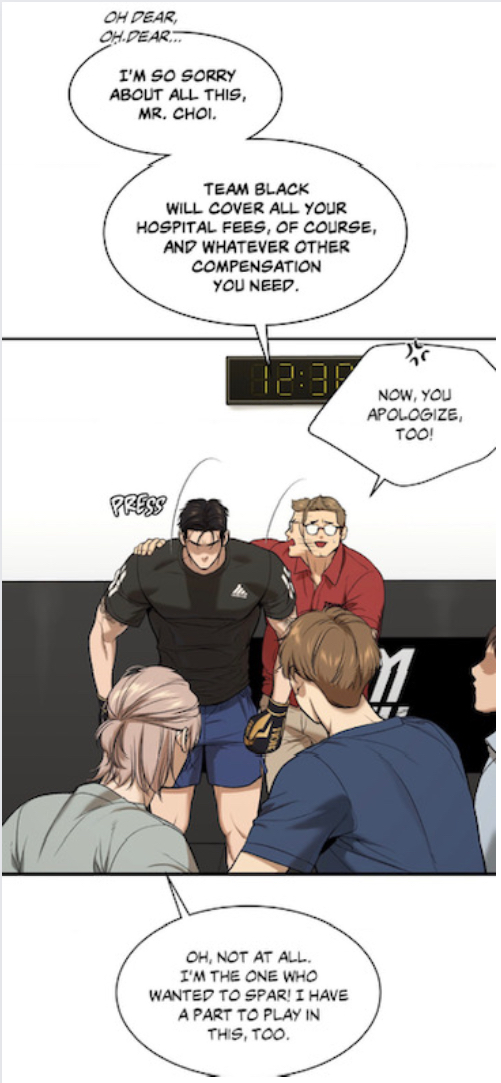 (chapter 31) who always hides behind authorities and shows distrust toward fighters. But he is just reflecting the attitude of the other MFC accomplices.
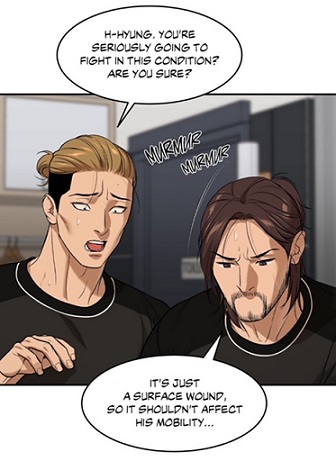 (chapter 50) Observe that in the locker room, the coach declares the athlete as fit despite the injury before going to the health center. The chronology is important, as the MFC doctors have the final saying. So when the champion is taken to the health center before the fight. the responsibility is shifted.
 (chapter 54) Hence Park Namwook remained passive.
  (chapter 69) apologized for the behavior of the security staff toward one of Joo Jaekyung’s team members.
 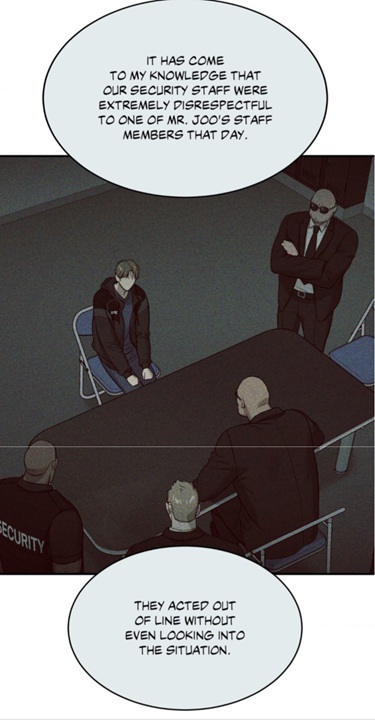 (chapter 69) Significantly, this apology took place behind closed doors, not in front of the media, and doc Dan is still left in the dark about it. The goal was therefore not transparency but damage control. They were in reality attempting to bury everything, to buy some time, until the athlete would lose his next match.
  (chapter 69) The problem was reduced to a matter of manners rather than a potential security failure or institutional complicity. In this way, the apology functioned less as an admission of guilt than as a mechanism to close the case quietly before it reached the public sphere.
 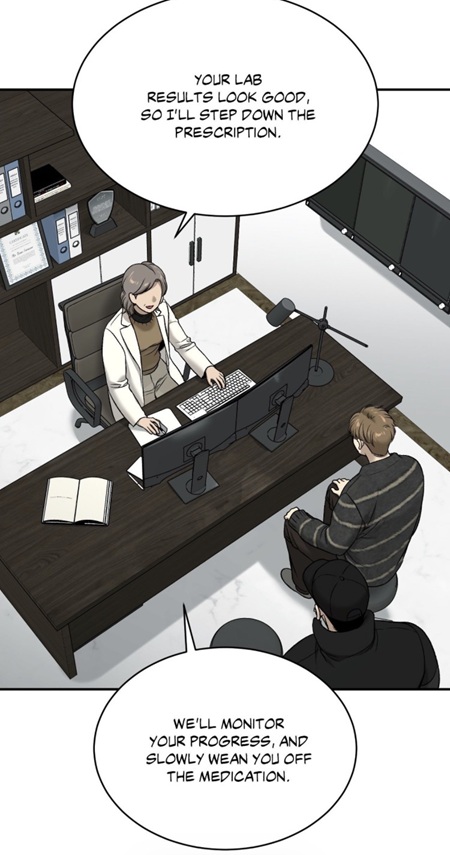 (chapter 91), drinks , smoking,
  (chapter 65), or other forms of contamination, each incident would undermine Kim Dan’s credibility as a medical professional. If the therapist can be portrayed as irresponsible, incompetent, or compromised by substances, the institutional narrative could once again shift responsibility onto him.
 (chapter 52), Kim Dan is no longer present. After confronting him and suspecting a betrayal
 (chapter 50)
  (chapter 50) He therefore has no knowledge of what happens there: the medical examination, the decisions taken by the doctors, and the institutional narrative that later emerges from this encounter.
  (chapter 51) But this time, the pattern is disrupted. Kim Dan is not there when the institutions intervene.
  (chapter 52)
 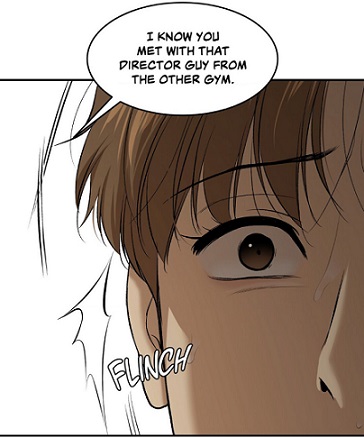 (chapter 51) Confronted with these images and the growing confusion surrounding the match, the champion reaches a painful conclusion: that his roommate may have betrayed him.
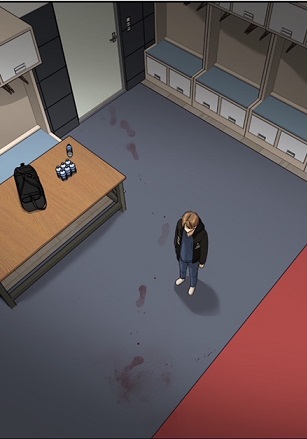 (chapter 51)
 (chapter 52) By that point, the circumstances have already changed. The use of the switched spray introduces a new dimension to the case, and with it the possibility that another authority must intervene.
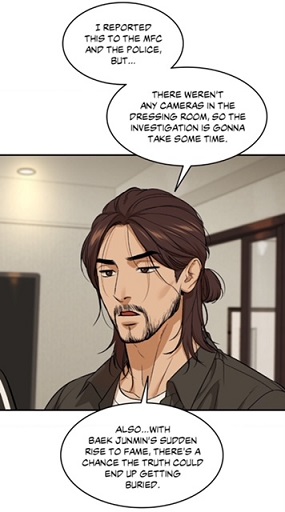 (chapter 52) The situation now risks attracting the attention of the police. As you can see, by remaining passive, Joo Jaekyung in his own way protected the physical therapist from real trouble. If he had truly blamed him, he could have “called” the police, but he did not.
 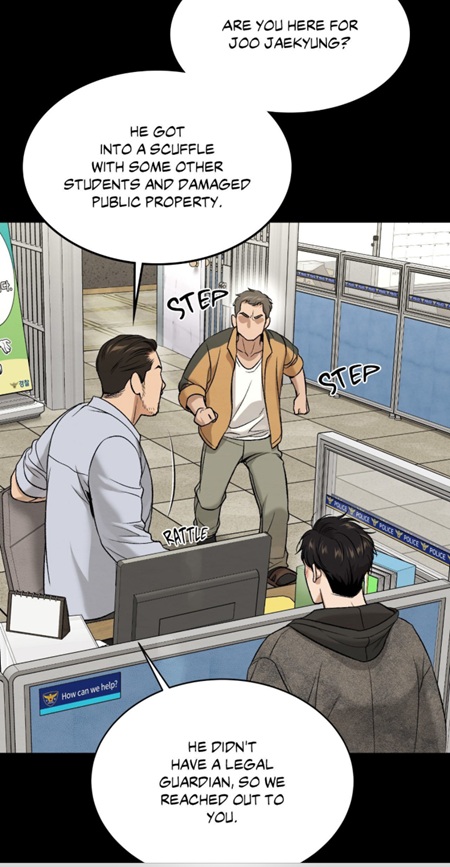 (chapter 74) The coincidence between these two moments—chapter 52 and chapter 74—suggests more than a simple narrative repetition. Both situations involve the same institutional actor: the police.
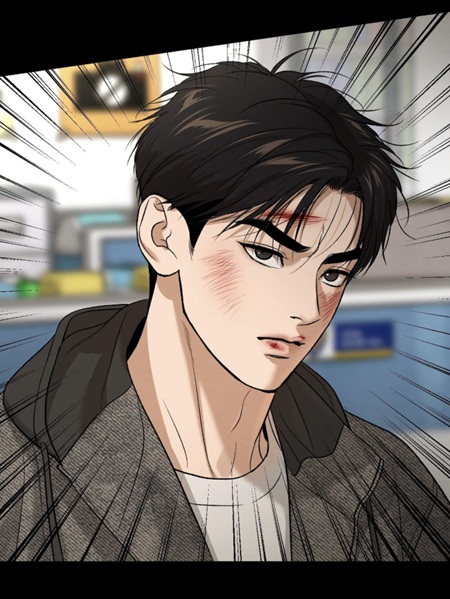 (chapter 74) has a similar wound on the forehead than The Shotgun.
 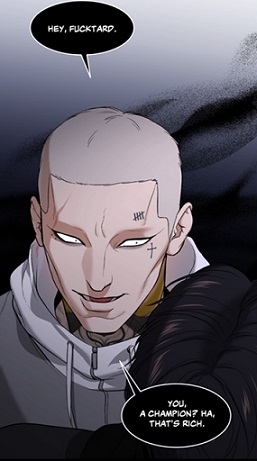 (chapter 74) If Baek Junmin had orchestrated that earlier event, the strategy would have been simple but effective. Instead of attacking his rival directly, he could create circumstances that forced the authorities themselves to intervene. But why would he involve the police, when he is involved in the criminal world? Such a tactic would allow him to remove or weaken Joo Jaekyung without openly violating the protection imposed by his hyung
 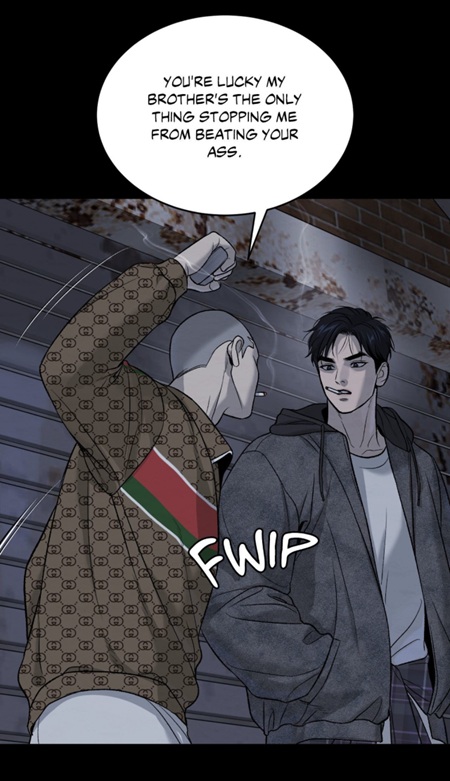 (chapter 74), who had explicitly forbidden him from harming the champion.
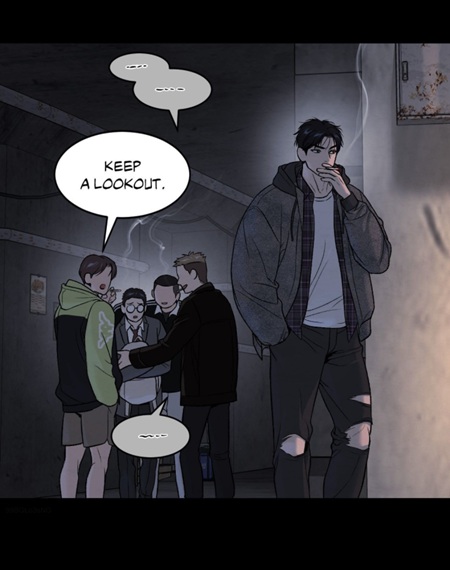 (chapter 74) —Junmin could ensure that the story presented to the authorities pointed toward Joo Jaekyung. For the students involved, the arrangement would offer a practical advantage: financial compensation and a chance to escape their own precarious situation. But for that stunt, The Shotgun got to pay a heavy price: not only the scar on his forehead
 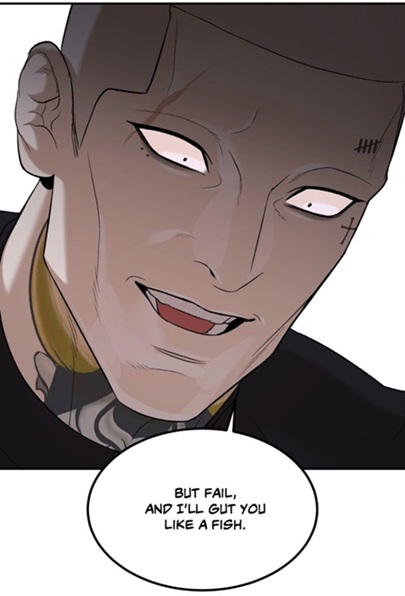 (chapter 93), but also a life in the shadow forever. It is clear that he could never get rich and famous through his illegal fights. Hence he resents the main lead so deeply.
 (chapter 93) The authorities perform the task that Junmin himself is forbidden to carry out.
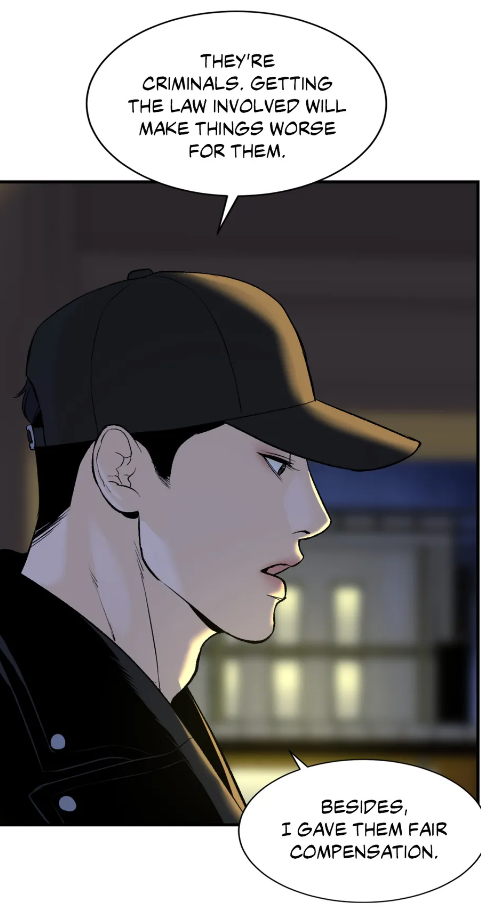 (chapter 18) He knows how the criminal world functions.
 (chapter 91) The article reports that the director of X General Hospital was accused of sexual harassment by several members of the hospital staff. The scandal eventually forced the institution to suspend his medical license. Yet the wording of the report also exposes an important detail: the hospital reacted slowly, and the affair was handled primarily as an internal disciplinary matter.
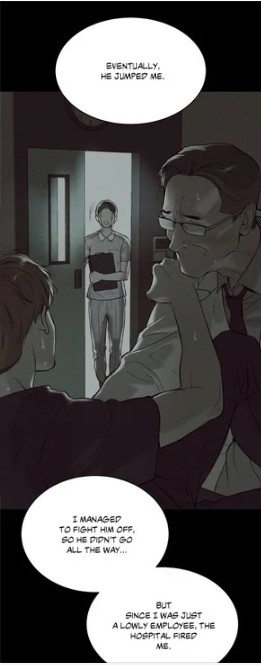 (chapter 90)
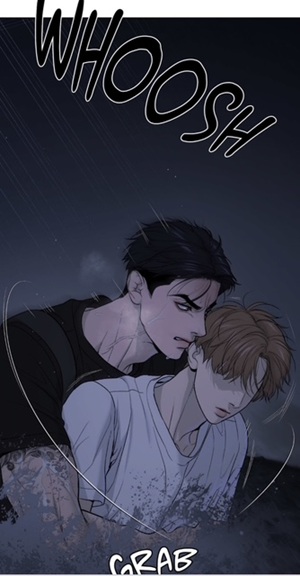 (chapter 59)
  (chapter 79)
 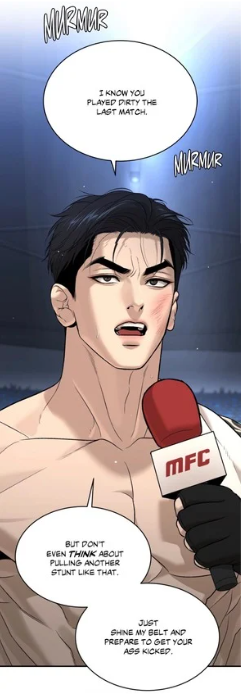 (chapter 87) By issuing the challenge in front of the cameras, the champion forces the MFC to respond. Even though the season had effectively ended, the public nature of the declaration creates pressure that the organization and the media cannot easily ignore.
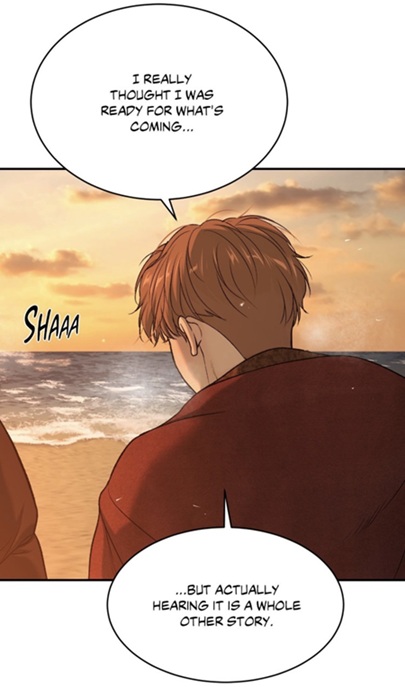 (chapter 94), the situation could disrupt the plans surrounding the anticipated fight with Baek Junmin.
 (chapter 47)
 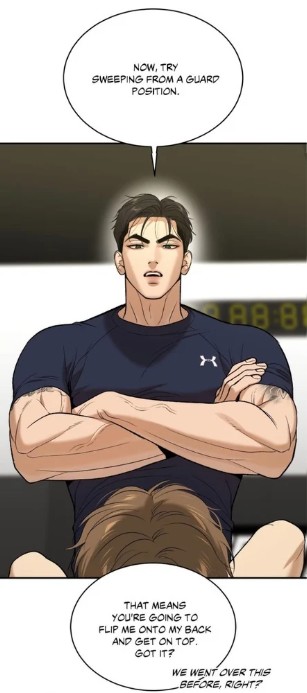 (chapter 88)
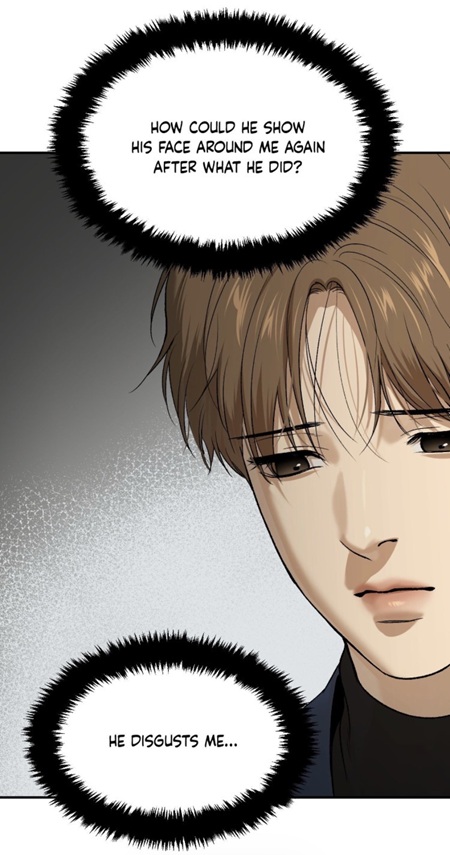 (chapter 91) The athlete exposed him to situations that forced him to grow stronger and more independent. He shared his thoughts and philosophy to his “pupil” as well
 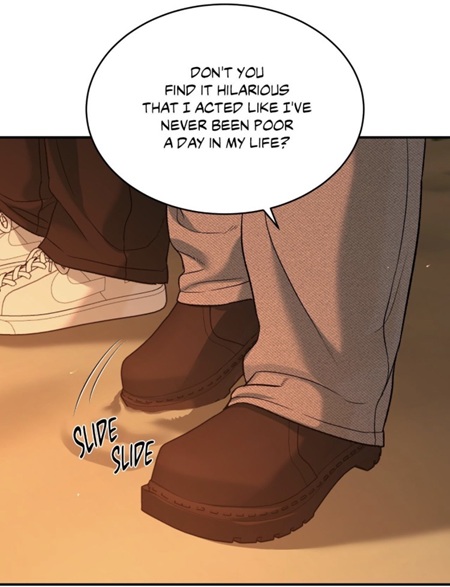 (chapter 94) The champion carried the weight of his past—his violent environment, the humiliation he endured, and the circumstances that shaped his rise. Speaking about these events would have meant revealing parts of his life he preferred to bury.
 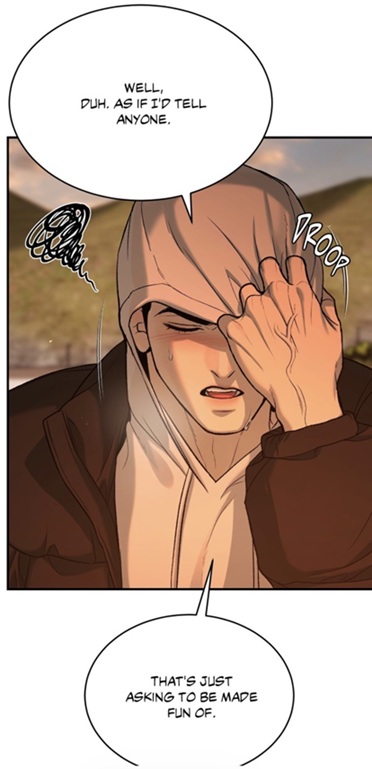 (chapter 94) The conversation on the beach changes this dynamic. By confessing his past to Kim Dan, Joo Jaekyung frees himself from the silence that had protected his enemies. The shame that once prevented him from speaking begins to lose its power.
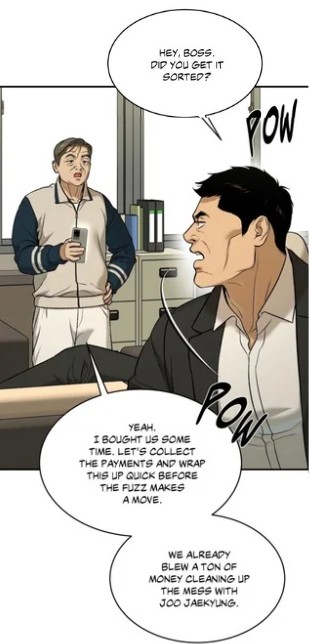 (chapter 93) Beneath the apparent calm of the chapter lies a growing tension: secrets circulate quietly, alliances remain uncertain, and certain characters may already know more than they should.
 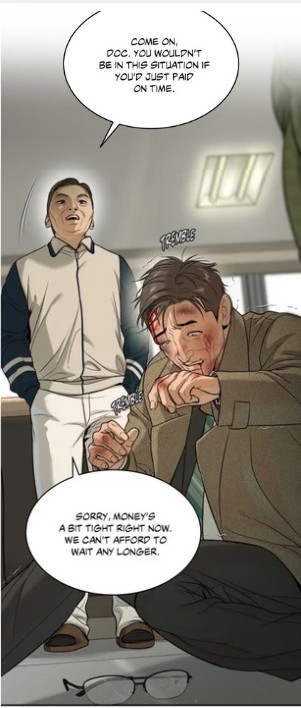 (chapter 93)
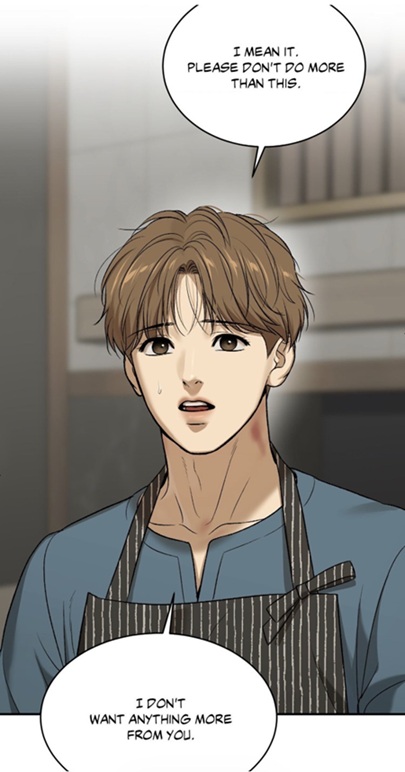 (chapter 93) linked to their previous night together. During the night they shared, the invisible wall that once separated them seemed to disappear completely. Their intimacy was no longer defined by domination or obligation. Instead, the encounter suggested equality (position of 69)
 (chapter 92) and reciprocity—an exchange, as Joo Jaekyung himself described it, of “give and take.”
  (chapter 92) In a striking reversal, Kim Dan took the initiative
  (chapter 92), after being asked about his own desires.
  (chapter 92) He was no longer driven by shame, debt or obligation.
  (chapter 92) For the champion, the moment carried the weight of something deeper than physical pleasure
  (chapter 92), for he was able to give pleasure to his partner. Thus his self-esteem could only be boosted. For Kim Dan, however, it remained simply sex.
  (chapter 92) The imbalance between their interpretations already foreshadowed the tension that would emerge the following morning.
 (chapter 93) For the first time, he establishes a clear boundary. The gesture signals a new stage in his personal development: for the first time, Doc Dan speaks as a professional, as a physical therapist
  (chapter 93) who knows his role and his responsibilities. He refuses the help with the meals not out of pride, but because he clearly frames it as part of his job. In the past, he would have simply listened, letting others decide or speak in their name
  (chapter 42); now he asserts his own authority and expertise. But just as this moment seems to mark a quiet step forward in their dynamic
  (chapter 93), the narrative abruptly widens its focus, drawing the reader away from this personal shift toward a far more ominous development unfolding elsewhere.
  (chapter 93)
 (chapter 93) separating him from Choi Gilseok and Heo Manwook. The atmosphere of that scene is strangely detached. Junmin seems unconcerned with the financial urgency discussed around him; his attention is fixed instead on the cellphone. Yet the readers cannot see what he is watching
  (chapter 93), while he casually blows a bubble of gum, creating a small moment of distraction that contrasts with the tension of the conversation around him. Only when he eventually reaches for the calendar on the desk,
  (chapter 46) Yet even before examining the room itself, the exterior sign already introduces an intriguing ambiguity. The building is labeled
  (chapter 93) The furniture thus reinforces the same strategy as the office name itself: it maintains the appearance of a respectable business while the violence of the operation is carefully kept out of sight.
 (chapter 93), who confronts victims and manages the loan shark operation. Yet the scene gradually reveals that he is less a true mastermind than a frontman—a visible intermediary who handles the dirty work.
  (chapter 46) Hence he calls Choi Gilseok “boss” and asks about the current situation.
  (chapter 42), delivering food or packages across the city during the night. His work is built on the same basic principle: completing tasks and transporting items for others which exposed him to dangers and shame.
  (chapter 42) The parallel is subtle but revealing. While Kim Dan runs legitimate errands for the athlete’s sake, the criminals in the Errand Center perform their own “services” within the shadow economy. Both operate within a system of delivery and obligation—yet one side does so out of feelings, while the other exploits the structure for predatory purposes. Gratitude versus Greed.
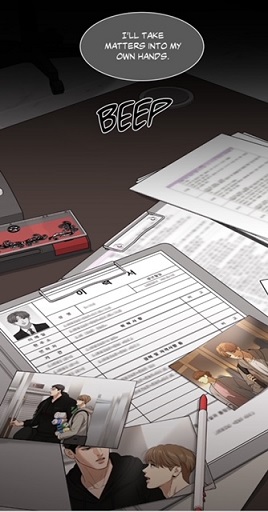 (chapter 46). The operation looked methodical, almost professional, as if a genuine investigative agency had been hired to monitor the champion’s environment.
 (chapter 11) At that moment, the loan shark explicitly raised the possibility of money laundering. This detail suddenly casts the entire network in a different light. The illegal gambling operations visible on Heo Manwook’s computer are therefore not merely a source of profit; they may also serve as a mechanism through which larger sums of money circulate and are quietly reintegrated into the legal economy.
  (chapter 46) In this structure, Choi Gilseok himself appears less like the true mastermind than another intermediary in a much larger financial chain.
 (chapter 46) In chapter 46, he was already acting behind the back of that parent company, manipulating events to influence the outcome of the fight. Later developments—such as the conversation at the café with Kim Dan and the suspicious use of the spray—suggest that he may eventually have received support from that higher structure.
  (chapter 52) and manipulating the situation through the switched spray, he appears to have pursued his own strategy within the system.
 (chapter 46) In other words, the champion was originally the system’s most valuable asset. His visibility and reputation attracted attention, betting activity, and therefore profit. However, once he disrupted the carefully orchestrated mechanisms behind the fights, that same visibility became dangerous. The athlete who once generated the most revenue suddenly turned into the network’s greatest liability. From that moment onward, the logic of profit shifted into the logic of elimination.
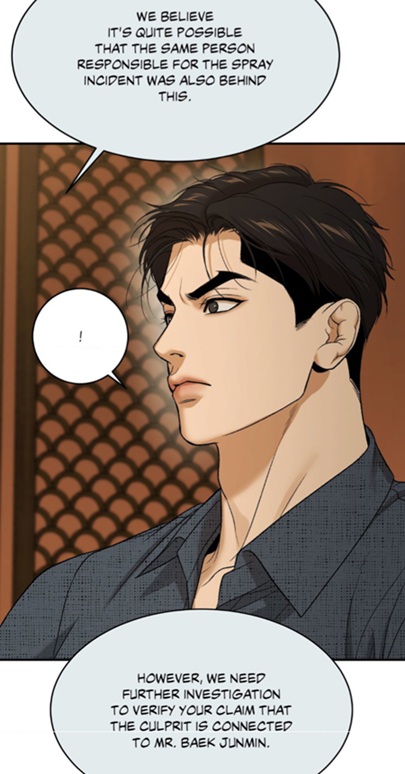 (chapter 69). They know, for instance, that Heo Manwook once misunderstood the name “Team Black,” interpreting it as a brothel rather than a gym
  (chapter 16). Jinx-Lovers have seen fragments of the schemes unfolding behind the scenes and can therefore begin to assemble the existence of several overlapping plots.
 (chapter 33)
  (chapter 93) He speaks himself. Addressing the disgraced hospital director, he offers to erase the man’s debt—on the condition that he carries out a task for him.
  (chapter 93) That’s why he is smirking. The wrongdoing will be carried out by someone else, allowing him to stay in the shadows as he always has. Yet Junmin underestimates the weight of his own words.
 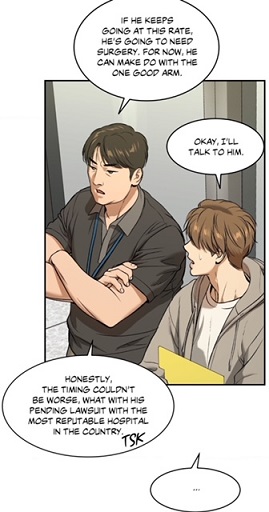 (chapter 42)
 (chapter 93) Hence the director asks him this question. He is now taking the lead. Knowledge and liability become inseparable. Once the doctor accepts the offer, Junmin’s words effectively pull the trigger: the moment the deal is spoken aloud, the hidden system that sustained the illegal fights begins to lose its stability. By drawing the corrupted medical world directly into the operation, the fighter who once thrived in the shadows may in fact become the spark that accelerates the collapse of the entire machine. I would even add, with this new stunt, he is not realizing that he could be blamed for the past crimes (drugged beverage, switched spray etc.).
 (chapter 16) Doc Dan’s hand got crushed and the former hospital warden is warned that he might lose his fingers; thus he might no longer be able to work.
  (chapter 46), collect debts
  (chapter 11), intimidate victims, and ensure that money continues to circulate through the laundering mechanism. In this sense, the repeated focus on hands and fingers becomes meaningful.
  (chapter 93) —the part of the body that allows people to work and generate the very income he seeks to extract. By threatening to destroy his victims’ hands, however, Heo Manwook undermines that capacity himself. The gesture exposes a certain narrow-mindedness: his violence contradicts the economic logic he is supposed to enforce, revealing not only his cruelty but also him as an enforcer who acts impulsively rather than strategically.
 (chapter 16) rather than locating him through documentation or surveillance. This observation corroborates my previous deduction: he is not the one following the physical therapist in secret and taking pictures of him. Secondly, observe his reaction, when he reads the money transfer:
  (chapter 16) The loan shark reads the name quickly or without interest, so that he can only remember the most striking word. In this case, “Black” stands out, while “Team”—a generic word—disappears from his memory. So his phrasing suggests he did not pay attention to the full name. This displays his lack of professionalism. He doesn’t investigate carefully.
 (chapter 16) Instead of verifying the information, he projects his own criminal assumptions onto the situation.
  (chapter 17) Instead of investigating carefully, he interprets every new piece of information through the lens of his past encounters and knowledge. His boss is rigging fights, so the others must do the same. When confronted with the name “Team Black,” he immediately assumes it must refer to a bar or brothel. What appears to be practical experience therefore becomes a liability. The man who believes he knows reality best may in fact be the one most vulnerable to misreading it.
  (chapter 16) demonstrate that Heo Manwook was already operating within that gray zone where medicine, crime, and financial exploitation overlap. It is therefore not surprising that the disgraced hospital director later appears within this environment. The medical world has long been entangled with the loan shark’s activities and this through Choi Gilseok who has a connection to a pharmaceutical company.
  (chapter 46) The “hand” of the organization may execute violence, but it does not decide the strategy.
 (chapter 16), emphasizing the asymmetry between predator and prey. Yet when he threatens the disgraced hospital director, the composition changes subtly.
  (chapter 91) Reflecting on the men who had abused Kim Dan, the champion bitterly admits that he is “no different from the fuckers who took advantage of you.” Although Jaekyung is still unaware that Heo Manwook actually attempted to rape Kim Dan earlier in the story, the scene nevertheless establishes an unsettling parallel between different forms of abuse of power. The disgraced hospital director exploited his authority as a physician, while the loan shark uses violence and intimidation to dominate his victim. Both belong to the same shadow world where institutional positions become instruments of exploitation.
 (chapter 17) he possesses extensive knowledge about the hidden mechanisms of the criminal network — rigging fights, illegal betting, debt collection, organ trafficking, and even the exploitation of vulnerable individuals. Yet this knowledge does not grant him control; instead, it entangles him more deeply in the system’s corruption. The more he knows about its secrets, the less clearly he perceives reality. Years of operating within the criminal network have isolated him from the logic of the legal world. Surrounded by corruption, intimidation, and bribery, he gradually begins to believe that these mechanisms can shield him from any real consequences. The knowledge that once gave him power therefore becomes a distortion: it convinces him that he can act with impunity, imagining that the system protecting him will always remain intact. What once appeared to be power gradually reveals itself as liability. I would even add. This protection could only function as long as the system itself continued to run smoothly. It depended on the uninterrupted flow of money circulating through the laundering network. The moment that flow is endangered—when bets collapse, scandals emerge, and funds begin to disappear—the shield of protection weakens. Figures such as the director of the gym and the loan shark suddenly become far more exposed than before.
  (chapter 17) The weapon signals impulsive violence rather than calculated strategy.
  (chapter 17) The knife belongs to the realm of direct physical force—the crude instrument of someone who acts rather than plans. At the same time, this weapon reveals why Heo Manwook believes that his power and strength are real. The latter stands for ultimate violence, someone can die with such a weapon. However, like exposed in a previous essay, MMA fighters can still die with bare hands. A wrong move or a mistake …
  (chapter 25)
  (chapter 47) The underground arena operates according to entirely different rules, where knives are not anomalies but part of the environment. In this sense, Junmin’s threat does more than intimidate the former hospital director—it exposes the violent logic of the system that produced him.
 (chapter 11) the loan shark refuses to rely on the transaction itself. Instead of trusting the digital record, he personally visits Kim Dan and continues the physical abuse. In his worldview, confirmation must come through intimidation rather than documentation.
 (chapter 17) When Joo Jaekyung later transfers the money directly to him using his own phone
  (chapter 17), the transaction itself becomes a form of evidence. What Heo Manwook perceives merely as a convenient payment leaves behind a record — one that cannot be erased by violence. The phone quietly transforms the power dynamic: intimidation may silence witnesses, but it cannot erase a transaction history.
 (chapter 91) The champion carefully reads the news article exposing the former hospital director’s crimes.
  (chapter 46) The computer visible on Heo Manwook’s desk quietly contains a record of the entire operation. The illegal betting site displayed on the screen is not merely a tool for profit; it is also a potential archive of evidence—transactions, accounts, and financial flows that could expose the laundering system. In other words, the machine that allows the network to generate money simultaneously preserves the traces of its crimes.
  (chapter 87) Joo Jaekyung’s public exposure of the stunt did not merely create financial problems for the organization. It inflicted a fresh narcissistic wound on Junmin himself. The humiliation was public, visible, and impossible to ignore. In that sense, the upcoming match is not only a sporting deadline but also a symbolic countdown: a chance to reverse the humiliation, reclaim his standing, and restore a damaged image. Time, for Junmin, does not move forward in a stable or mature way. It circles obsessively around injury, revenge and shame; he stores it.
 (chapter 87) The moment appears insignificant to most spectators. Yet for someone who already knew the identity of the person standing there, the gesture could reveal something important.
 (chapter 90) The only difference is the loss of his spectacles. They are not only broken, but also lying next to him. The loss of his glasses mirrors his situation: he is forced to face reality and as such he is discovering the true reasons behind doc Dan’s greed: despair and fear in front of the loan shark.
  (chapter 90) One could say, he is now receiving his karma. Like mentioned above, the behavior and words of the men
 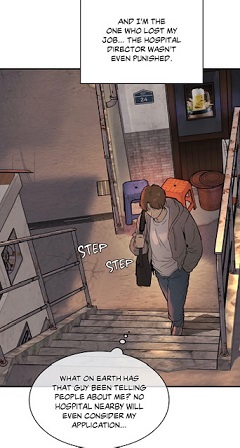 (chapter 1) So what did he hear at the office the whole time?
 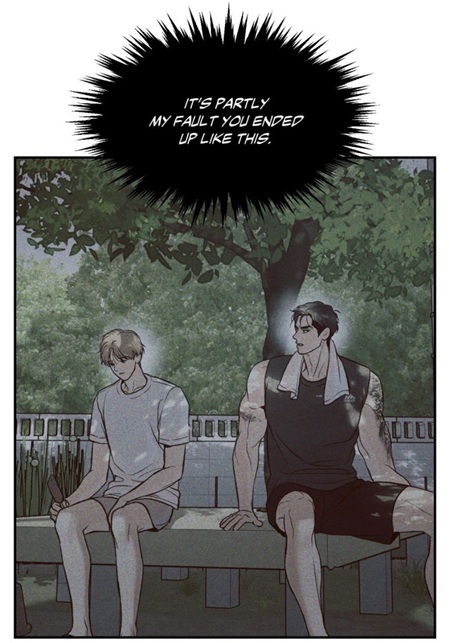 (chapter 91) Thus I deduce that the physical therapist has become the real target of the next plot.
  (chapter 50)
 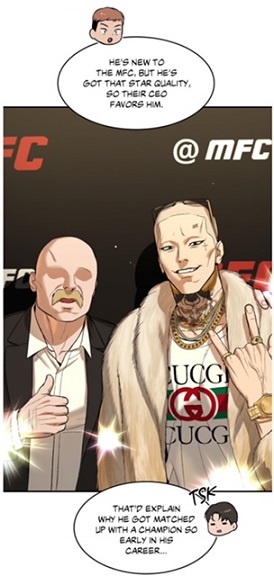 (chapter 47) Junmin’s “star quality” and supports his rapid rise within the organization. Such endorsement provides him with a form of institutional legitimacy that shields him from direct scrutiny. His authority does not come from discipline or merit alone but from the structures that elevate and protect him. And observe how the lady in red protected the “champion’s reputation”.
  (chapter 41) The official report contradicts the observations of the physical therapist. Moreover, they had allowed the fight, though the athlete’s foot had been injured.
  (chapter 50) Later, after the match, the examination of the fighters at the health center takes place in conditions that clearly lack privacy
  (chapter 59) Finally, because of the perverted hospital warden’s assault, the main lead ended up blacklisted. He could never get hired at another hospital. If the narrative surrounding the injury were manipulated, the responsibility for Joo Jaekyung’s worsening condition and the schedules could easily be redirected toward him.
  (chapter 46) Throughout the story, the coach frequently appears wearing glasses—a visual symbol traditionally associated with knowledge and clarity. Yet despite this apparent vision, he repeatedly fails to recognize the dangers surrounding Joo Jaekyung. As the champion’s manager, Park Namwook is responsible for organizing his schedule and protecting his long-term career. In principle, this role should place him in the position of a guardian. But he does not intervene
  (chapter 41), he just stands by his side.
  (chapter 17) Instead of acting as a protective barrier between the athlete and the pressures of the industry, Park Namwook frequently defers to the logic of the organization. When the CEO of MFC later invites the champion to an important meeting, the coach encourages him to attend, once again placing institutional expectations above caution.
  (chapter 69) In this sense, Park Namwook’s authority begins to resemble the same pattern visible in Baek Junmin’s behavior: responsibility is repeatedly shifted upward toward the organization MFC or Joo Jaekyung as the owner of Team Black
  (chapter 88)
 (chapter 61). Each layer appears authoritative, yet together they create a system in which accountability becomes blurred.
 (chapter 49) A shotgun is not a weapon designed for precision. When fired, it releases multiple pellets that spread across a wide area, striking several targets at once. Junmin’s strategy follows a similar logic. Rather than confronting Joo Jaekyung directly, he destabilizes the structures surrounding him: the media narrative, the medical establishment, the leadership of MFC, and potentially even the champion’s personal relationships. Each move strikes a different layer of the system protecting the fighter. The goal is not a single decisive blow but a gradual weakening of the entire structure around the champion.
  (chapter 93) Unlike the other men in the room, this individual already stands at the intersection of several narrative threads. He knows Kim Dan.
  (chapter 90) He has encountered Joo Jaekyung. And he has personally witnessed the dynamics between them.
 (chapter 90) Secondly, he was doing it for the money, hence he called him a slut.
  (chapter 90) This misunderstanding fundamentally shapes how he interprets the situation. In this sense, the disgraced director resembles Heo Manwook. Both men rely heavily on their past experiences when judging others. The loan shark assumes that Kim Dan must have obtained the money through prostitution or some other illicit activity, while the former hospital director interprets the closeness between the athlete and the therapist as evidence of a romantic relationship. In both cases, what appears to be practical knowledge becomes a source of blindness. Their experience allows them to recognize familiar patterns, but it also prevents them from seeing the complexity of the reality before them. The relationship between Joo Jaekyung and Kim Dan does not fit into a simple category such as business, manipulation, or romance. Their bond evolves gradually and reflects a far more complex emotional dynamic.
  (chapter 56), hospitals repeatedly responded that they had never heard of anyone by that name.
 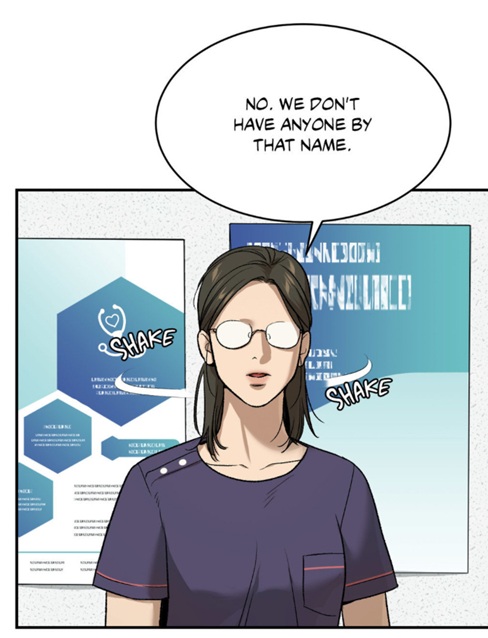 (chapter 56) This reaction suggests that the young therapist had already been erased from the professional network in Seoul. Far from protecting him, this invisibility places him in an extremely fragile position: without institutional recognition, he has no professional community capable of defending him.
 (chapter 5) The athlete might realize that the narrative emerging around Kim Dan does not match the reality he previously encountered while searching for him. What appears at first as professional criticism could therefore reveal the existence of a coordinated attempt to manipulate the story.
  (chapter 91)
  (chapter 36)
 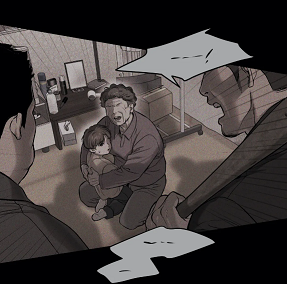 (chapter 5) or attacked in the street
 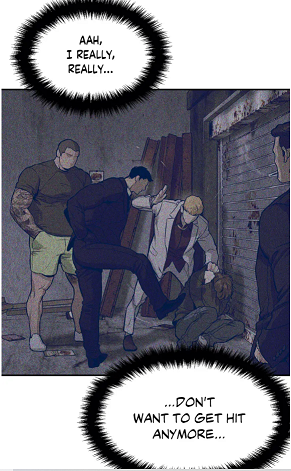 . (chapter 1) His office functioned as a hidden lair, carefully separated from the violence carried out by his subordinates. The presence of the disgraced director inside that office therefore represents a significant rupture in Heo Manwook’s usual methods.
  (chapter 93) Moreover, this time he is the one beating the victim, while one of his minions is standing.
  (chapter 74) Joo Jaekyung represents yet another form of knowledge: the knowledge of experiences. Through hardship, defeat, and survival, he has learned to recognize the realities of the world step by step. By living next to doc Dan, he learned to listen and observe so that he is now more aware of the world surrounding him. The true tension of this arc therefore lies not simply between ignorance and knowledge, but between three different ways of understanding reality. One man believes he understands everything, another quietly carries knowledge that could expose it all without realizing it, while the third slowly learns the truth through experience.That is precisely why, in the illustration, they now stand facing each other.


 (chapter 87) Not only the painter and the 3 noonas were sharing the same bed, but also they were taking their meals together.
  (chapter 87) They would even caress each other and laugh together. This scene oozes happiness. Consequently, it is no coincidence that during that night, they shared their honest thoughts to Baek Na-Kyum giving him good advices. But more importantly, the painter was there, when his noonas were struggling.
  (chapter 94) He cried in front of them. His tears symbolized his compassion and love for his noonas. He regarded them as his family. And it was the same for the artist. He had the noonas by his side, when he was in trouble or agony.
  (chapter 94)
 (chapter 107) However, at some point, it changed!
  (chapter 94) Jung In-Hun entered his life and consoled him. Thus I deduce that this image
  (chapter 68) represents a turning point in Baek Na-Kyum’s life. During that night, the scholar took away the young painter from Heena, hence he couldn’t help her. And now, observe the learned sir’s reaction. He didn’t allow the painter to cry. He shouldn’t share his pain.
  (chapter 70) In fact, he diverted Baek Na-Kyum’s attention from the incident to the moon. The learned sir was smiling the whole time.
  (chapter 70) He was acting, as if nothing had happened. The fact that he didn’t bear the tears from the painter exposes that the learned sir never considered him as a family. Therefore it is not surprising that he got abandoned, when the learned sir struggled:
  (chapter 75) But we have other scenes where Jung In-Hun didn’t behave like in the poem. When he discovered the truth, he had not been approached by Yoon Seungho due to his talent
  (chapter 19), he pushed away the painter.
  (chapter 19) He was mad, because Baek Na-Kyum was the cause for his sponsoring.
  (chapter 19) However, the family serves as pillar and protection. When the scholar’s pride got hurt, he rejected Baek Na-Kyum. He only approached the painter, when he needed him
  (chapter 10)
  (chapter 24)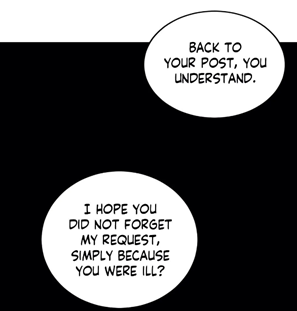
 (chapter 35).
  (chapter 111) For me, in episode 10, he was definitely aware of the existence of a plot, thus he led the painter to the pavilion. Then in episode 24 and 35, he wanted the artist to spy on his benefactor. Finally, in episode 111, he knew that by taking away his former pupil, he would hurt Yoon Seungho, for he was aware of his affection for Baek Na-Kyum. Under this new light, it becomes comprehensible why Jung In-Hun didn’t bid farewell to the main lead in episode 44. Baek Na-Kyum’s presence was not necessary for the preparation for the civil service examination. And this brings me to the last scene between the learned sir and the painter.
  (chapter 118) He is now crying in front of him, as if he was considering him as a part of his family. He is trying to create the illusion that he shares his suffering, just like he shared his happiness during the parade.
 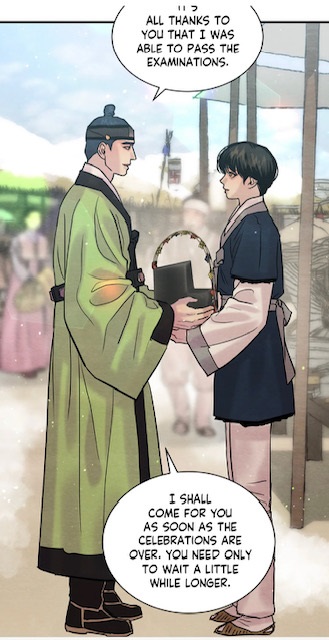 (chapter 111) But in the gibang, the learned sir changed his attitude towards his former pupil, for he kissed the painter.
  (chapter 117) It was, as if the former was starting his family. Baek Na-Kyum is now his “bride”. But naturally, everything is just an illusion. Why? It is because the Manhwaphiles never saw Jung In-Hun share his bed or room with the artist!
  (chapter 27)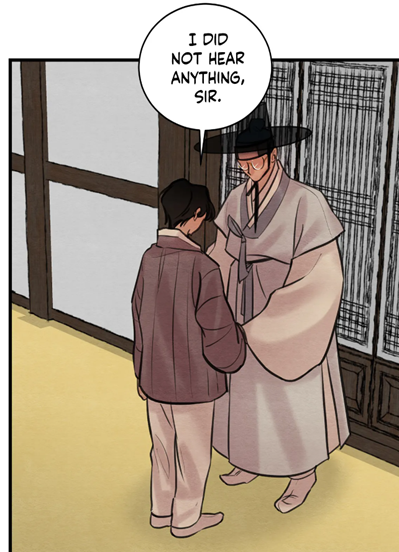
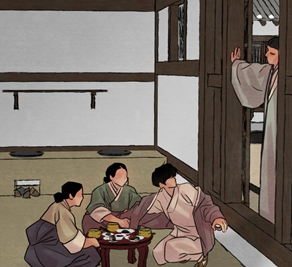 (chapter 38) He was also never seen taking his meals with him. This explicates why he never visited him, when the painter was sick. In fact, the learned sir is connected to the air and the courtyard. That’s the reason why he is always seen roaming around with Baek Na-Kyum (10: pavilion, 18-19-27-35-44: courtyard, countryside/city: 29-37-70 and
  ) But more importantly, he is not sharing his true thoughts and emotions to the young man.
  (chapter 118) He never explained how his face got bruised! This shows that he approached Na-Kyum for one reason. He was in trouble and he needed him. But he acted, as if he was becoming responsible for him.
  (chapter 118)
  (chapter 118) He didn’t expect a rejection. Why? It is because now, he was treating the main lead as family member. Nonetheless, don‘t get me wrong. In Joseon, servants were considered as a part of the household and as such of the „family“. I don‘t believe that the teacher views Baek Na-Kyum as an equal. Yet, the latter is in reality a free man.
  (chapter 118) Thus out of fear, he made a false love confession which resembles a lot to obsession and possessiveness. His words display his worries and despair. Another important aspect is the absence of the personal pronoun “we” in their conversation. We only have “you” and “me”.
  (chapter 118)
  (chapter 40), the latter learned the following lesson: Jung In-Hun had never been his new family. That’s the reason why he was so wounded. Therefore it is no coincidence that his karma is to be abandoned the moment he needs Baek Na-Kyum the most. But why did he not consider the painter as a family member? It is because he came from the gibang. Moreover, he was blinded by his desire to succeed on his own, not realizing the true role of a family.
  (chapter 86)
  (chapter 107) The sexual abuse is something they hid from Baek Na-Kyum! They could never share such a burden with the protagonist. But there is more to it. In fact, Byeonduck illustrated the slow deterioration of Na-Kyum’s s family in season 2, 3 and 4. First, the painter couldn’t talk to his noonas like in the past:
  (chapter 46) He was forbidden to announce his departure which indicates that Heena was hiding something from the other kisaengs. Moreover, notice that he never talked back to Heena. He listened to her, though he was in pain.
  (chapter 46) He could only express his sadness with his tears. Then when Heena reentered his life, she was seen next to his bed while hugging. by his side
 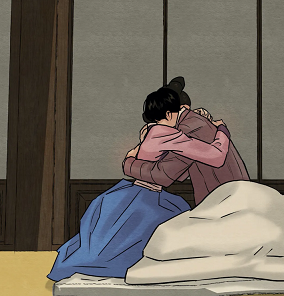 (chapter 66) This means that she would no longer share his cover. This is no coincidence that in the gibang, the noona could no longer enter her brother’s room.
  (chapter 96) Little by little, Heena got excluded from the painter’s life. She could no longer share her meals with him.
  (chapter 93) This explicates why in season 4, Baek Na-Kyum can not penetrate Heena’s room.
 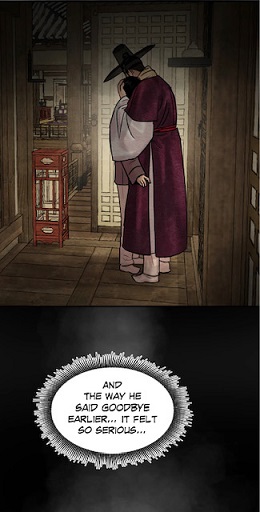 (chapter 105) She is hiding more and more things from her brother: her “illness”, her involvement in the murder of nobles and her lies. On the other hand, the painter still considered her as a part of his family because of her intervention in episode 68/69:
 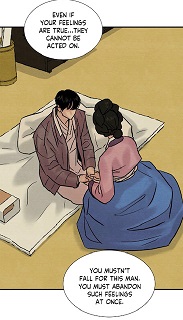 (chapter 68) Their argument was reflecting their trust, though here the kisaeng was questioning her brother’s maturity. Due to her concerns, Baek Na-Kyum felt that they were still a family. However, I sense a rupture, when they argued in the kisaeng house. The artist was no longer trusting Heena’s words:
 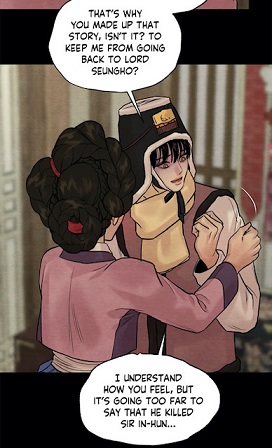 (chapter 97) Interesting is that from that moment on, Baek Na-Kyum and Heena never faced each other! She didn’t join his side during the parade. This means that their argument in the kisaeng house represents their last reunion. And what did Heena do in this scene? She cried
  (chapter 97), while the painter didn’t, though he looked disturbed.
  (chapter 97) He lost all his colors. However, such a scene could be perceived as a sign of indifference, especially for the kisaeng. And this observation made me realize why the kisaeng asked Yoon Seungho not to reveal his suspicions about Jung In-Hun’s involvement to her brother.
  (chapter 105) Here, she implied that Baek Na-Kyum would cry out of pain and shock. But she had seen that he had shared no tears, when he heard about his murder: And it happened again in the shrine.
 (chapter 99) Simultaneously, the request from Heena exposes that they are no longer sharing agony and as such struggles. Moreover, this made me realize why the artist left the mansion after the nightmare. It was out of fear and obligation. For me, he had sensed that Heena liked the learned sir and as she was still part of his family, he had to make sure that this was not true. Yet, even after witnessing the faked crime scene, he still trusted Yoon Seungho. Hence I am deducing that the absence of tears is the trigger for their separation which stands in opposition to their embrace in the mansion:
  (chapter 66)
  . (chapter 68) And what was her reaction, when she saw her brother in tears and yelling at his lover?:
 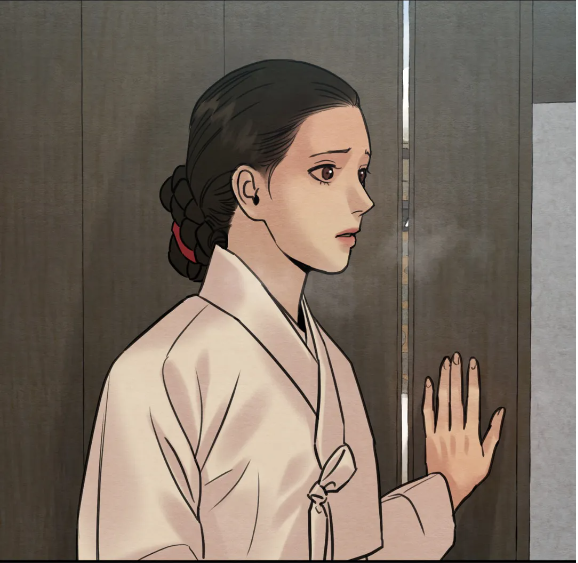 (chapter 105) She remained silent, passive and rather indifferent. This impression gets reinforced, when she is lying next to her colleagues. She is not sharing her thoughts and emotions, rather pensive contrary to these kisaengs:
  (chapter 105) She is even turning her back to them. This displays the dissolution of this family. The kisaeng is no longer sharing her fears, her tears and emotions to others. Therefore she can not sense “happiness or relief” like the others.
  (chapter 93), but the moment the lord joined his side, the honesty started vanishing. Notice that the painter couldn’t talk about his past (how he met Yoon Seungho and how he got abandoned by Jung In-Hun). It was reduced to “I was caught up with something”. He had so many secrets that he couldn’t share to his noonas. And it was the same for the kisaengs.
  (chapter 93) They also had secrets, hence they were seen whispering. Baek Na-Kyum could confide less to Heena. Why? He sensed that the kisaengs might show no understanding. And note how the painter reacted, when he met his noonas in episode 105.
  (chapter 105) He lied to his noona, he didn’t voice his worries. He didn’t enjoy his time spent by the kisaengs’ side. He didn’t eat with them either. This is the sign that he was moving on, he was on the verge of starting his new family. In other words, this scene
  (chapter 105) corresponds to the bird flying from the nest which was witnessed by Heena and the kisaengs. Because the painter was not sincere to his noonas, it is not surprising that they acted the same way. Here,
 (chapter 105), the kisaeng’s words are a reference to loss of virginity. Yet the painter didn’t grasp the true meaning. Only in his dream and nightmare, he realized the significance of her words:
  (chapter 109) Hence I come to the conclusion that we are witnessing to the birth of Baek Na-Kyum’s new family: Yoon Seungho.
  (chapter 118) That’s the reason why the painter decided to run away with his lover.
  (chapter 118) However, in order to become a real family, the painter needs to call his husband like this:
  (chapter 72) Under this new light, it becomes comprehensible why the noonas were no longer entirely honest with Baek Na-Kyum in the gibang. They couldn’t share their thoughts and secrets to the artist, as they had played a role in the separation of the couple
  (chapter 99) and the nobles’ execution. Besides, they also had secrets which they had to hide from their donsaeng.
  (chapter 57) I believe that it is related to the protagonist’s sensibility and intelligence. My assumption is that Yoon Seungho is a
  (chapter 85), his second son and even lord Song as his family
  (chapter 116) Hence they are sharing a drink, their secrets and emotions together, though it is obvious that the man in purple is deceiving the patriarch. However, the elder master still trusts and listens to his words.
  (chapter 107)
  (chapter 26) The latter was not allowed to cry! Therefore the artist heard the same reproach from the main lead.
  (chapter 26) The valet disliked the tears, because he refused to share the suffering. The reason is simple. If he did, this would have increased his guilt. Furthermore, Kim never shared the cover or his meals with Yoon Seungho in the past
  (chapter 83) and in the present. Here,
  (chapter 17) he even refused to bring him his breakfast. But one might argue that Kim cried in front of the protagonist in the shed, he even expressed regrets:
  (chapter 108) So we could assume that he was starting to view the main lead as a family member. But no… for me, it is just an illusion. First, note that he never let the lord see his gaze while weeping. Besides, the noble’s heart was not moved either. They were not crying together, a sign that the two were drifting apart. Moreover, in the shed, the valet never shared the information about the fire at the shrine.
  (chapter 108) The noble had to use threat and force in order to push the butler to voice his thoughts. Finally, at the end, the valet never vowed his loyalty to Yoon Seungho, but to Baek Na-Kyum.
  (chapter 108) Moreover, like exposed above, family in the poem symbolizes trust, love, responsibility, comfort and protection, but the valet failed to fulfil his duties which he admitted in the shed. As a conclusion, the butler didn’t keep such a promise. Moreover, what did the butler do after the painter’s abduction?
 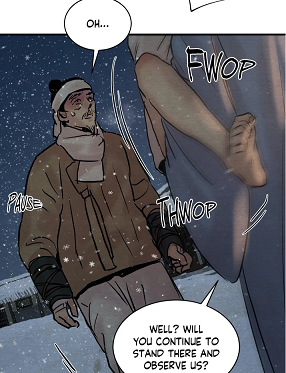 (chapter 64)
  (chapter 64) He ran away. He never saved the painter, just like he didn’t argue with his master in that moment. But he could have, since the latter had no sword by his side. Imagine that he had a heated discussion with Yoon Seungho the very next day, and in the courtyard, the protagonist had the sword in the hand.
 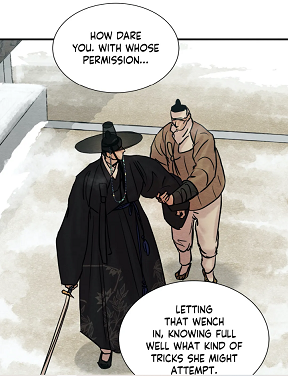 (chapter 68) A sign that he knew that the noble would never slay him! And in the past, the valet had not come to his rescue, shared his suffering or defended his honor. And now, you comprehend why I am more than ever convinced that the valet was never Yoon Seungho’s family: no tear, no joy or no secret shared! His expression “bird of misfortune” embodies the gap between the two characters.
  (chapter 109) The latter would even get the opportunity to eat sweets and sit in the patio
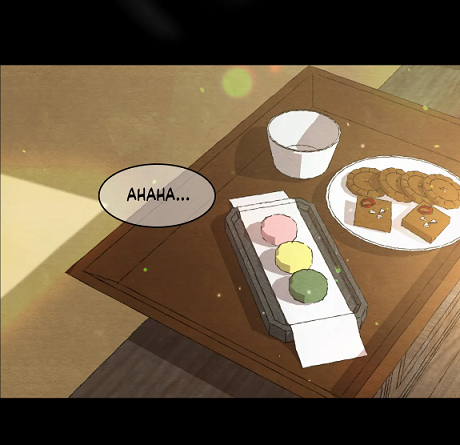 (chapter 109), while the lord was relegated to the courtyard.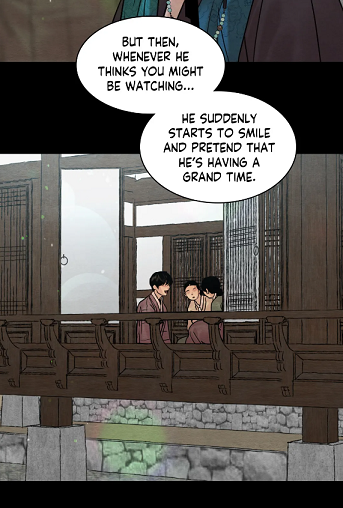
 (chapter 109) And the poem mirrors perfectly the birth of Yoon Seungho’s first family. Baek Na-Kyum is his very first family. Thus he could share his pain, his fears, his resent,
  (chapter 62) and his hope to be happy for one moment:
  (chapter 63) I selected the terrible scene in the shed for two reasons. It symbolizes the verse “how to become a family”. This explicates why in season 3, the artist was slowly using the personal pronoun “we”.
  (chapter 78) This means that the two protagonists were learning how to become a true family. And one of this important step was “crying together” which occurred after the sexual abuse in the shrine,
 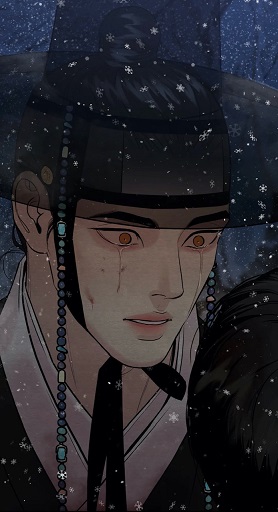 (chapter 102) However, Yoon Seungho had to learn the importance of “secrecy”! He kept his crime from his loved one hidden, not understanding that a real family is to “endure all hardships” together. Consequently, I judge this night
 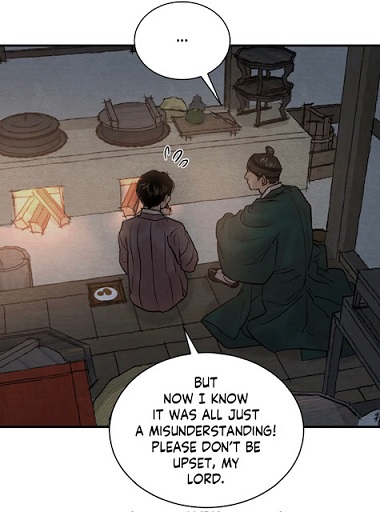 as the finalization of their “Wedding”, though it is still not official. During this night, we have all the criteria. They share their worries
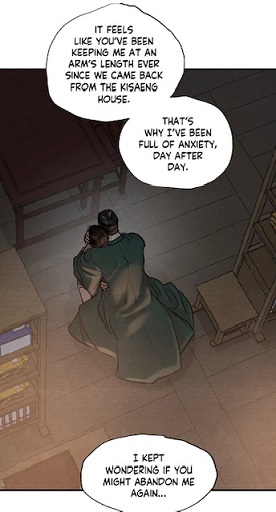 (chapter 110), their happiness
 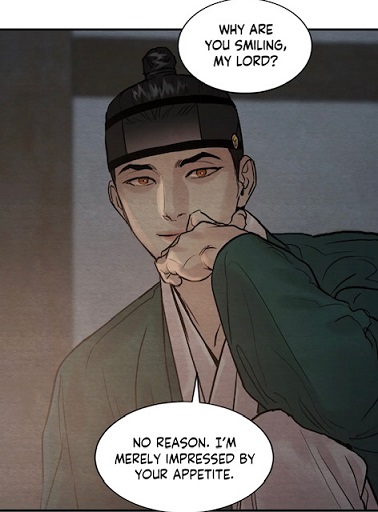 (chapter 110), they sit together while eating
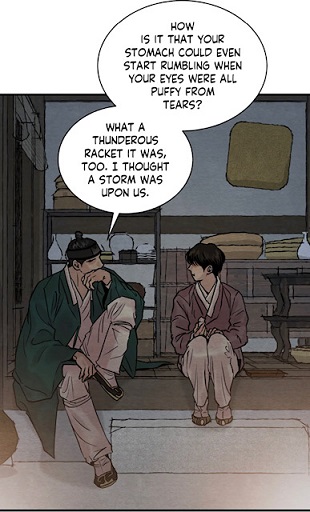 (chapter 110), they embrace each other, they share the same bed. And the lord makes the following promise: there won’t be any secret between them. He will share everything with his lover.
  (chapter 110) So when the brother gave the petition to the artist
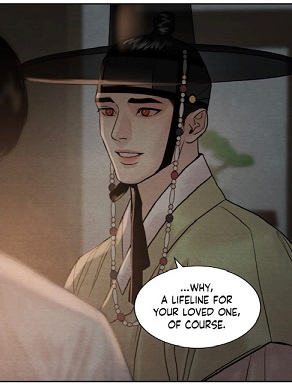 (chapter 116), he even reinforced their bond. It was, as if they had no longer any secret between them. Thus they talked about the document in the pavilion making sure that no one would listen to their discussion.
  (chapter 117) Therefore, it is not surprising that during that same night, the couple slept under the same blanket while hugging each other.
 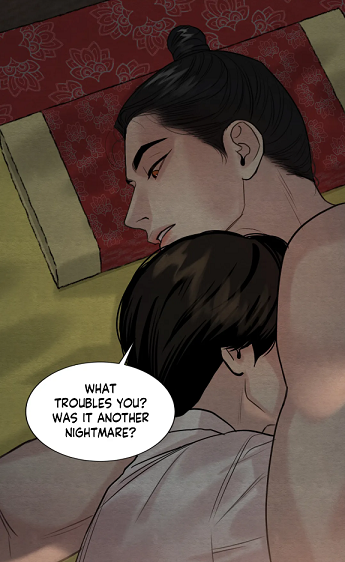 (chapter 117) The symbol for the new family! But a family is not made just of two members! Is Yoon Seungwon a part of Yoon Seungho’s family? Let’s not forget that he considered the artist as his brother’s wife.
  (chapter 116) What caught my attention is that Yoon Seungho was not followed by his lover, when he met his brother in the gibang.
  (chapter 118) And this reminded me of this scene:
  (chapter 37) He wished to send away the artist, but the host refused. Then if you pay attention to his behavior, you will notice that none of them were seen eating together!
  (chapter 118) Compare it to Black Heart’s behavior:
 (chapter 43) In fact, the two guests were drinking on their own! Yoon Seungwon had even started drinking before the protagonist’s arrival.
  (chapter 118) Moreover, exactly like the scholar, Yoon Seungwon is just employing the pronouns “you”, “I” and “father”. There is no WE at all.
 (chapter 118) Moreover, he doesn’t want to share the pain and suffering with his father. And while he shared a secret with Yoon Seungho in the past,
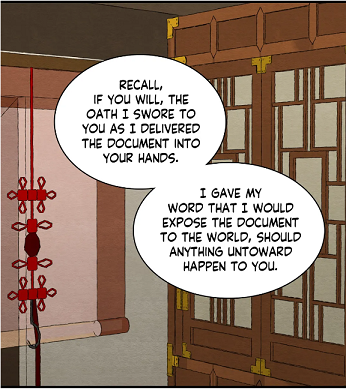 (chapter 118), I believe that he is hiding something from his brother again. Thus we see constantly him with a drop of sweat.
  (chapter 118)
  (chapter 118) Striking is that he is at no moment mentioning the painter, which actually represents the lord’s source of comfort and joy! He is more talking about the past than the present. He is hoping for a change of heart. That’s the reason why I come to the conclusion that Yoon Seungwon called the main lead as brother
 (chapter 118), but it is only a name! In reality, he desires to use the main lead. He needs him more than ever! Let’s not forget that the patriarch could discover Yoon Seungwon’s betrayal at any moment. Finally, I would like to outline that family stands for effort and understanding, nevertheless the younger master never showed compassion or worries for his brother, who had just recovered from a stabbing. His speech was full of blame.
  (chapter 22), the physical therapist still views her as his family. This corresponds to the verse “no matter where you are”. This explains why he listened to her and started treating the champion differently. From my point of view, they became a family, because they slept under the same cover
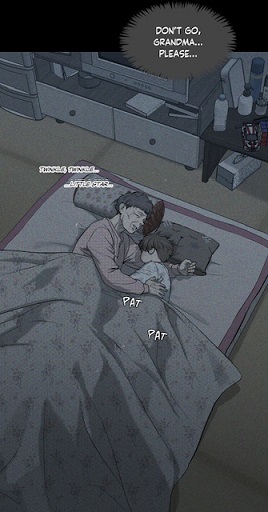 (chapter 21), shared their agony, fears
  (chapter 05) She is happy, when she hears good news from her grandson.
 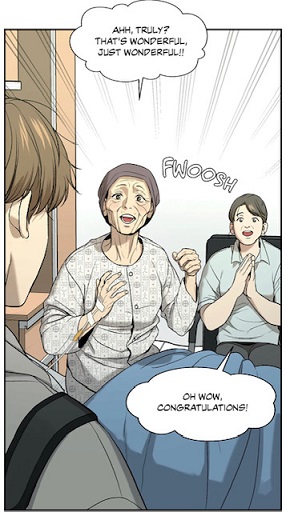 (chapter 07) When she feels lonely or miserable, she asks for his presence.
 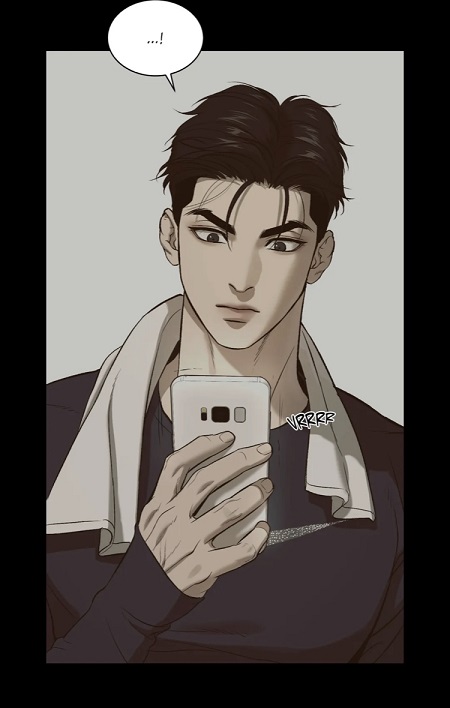 (chapter 21)
  (chapter 5) Nevertheless, there exist two negative aspects. First, I noticed that she didn’t question Kim Dan about his career, only when it was necessary.
 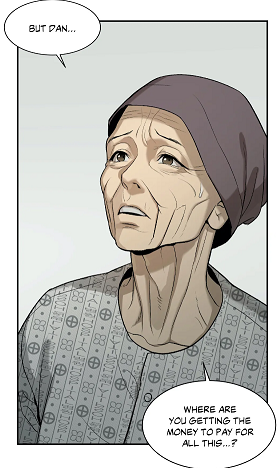 (chapter 07) She is not that involved in his current life.
  (chapter 05) Secondly, what caught my attention is that the halmoni is not letting her grandson weep. With her attitude, she implied that he had overreacted (“Now, now none of that”).
  (chapter 21) Moreover, the poem outlined the necessity of crying together (“be able to cry together”), yet the halmoni was not upset, when she found the little Dan in tears. She didn’t understand his abandonment issues. Thus I deduce that the shared agony was only in one way! If the grandmother was scared or suffering, her grandson should feel the same.
  (chapter 5) This explicates why Kim Dan was willing to sacrifice himself for his halmoni.
 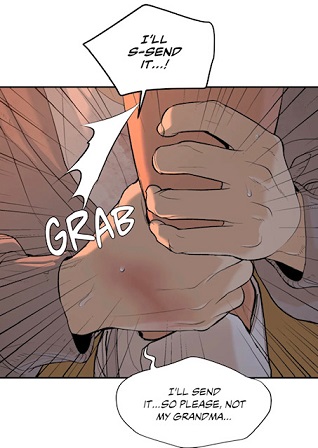 (chapter 16) It is because he knew that her grandmother disliked tears. Besides, in a previous essay, I had already outlined that such an attitude was considered as abusive, for such a young child should have been shielded from harm. However, he was exposed to violence very early on. Under this new perspective, it becomes comprehensible why Kim Dan started having secrets from her. Finally, the family portrayed in the poem implied the notion of effort and work. But the moment the grandmother refused to share his agony, she stopped putting energy in her relationship with Kim Dan. This means that as time passed on, she became more and more passive and relied more and more on the main lead. Another interesting aspect is that Kim Dan came to enjoy K-dramas because of his grandmother.
  (chapter 30) This shows that Kim Dan’s preferences are all influenced by the halmoni. We could say that he didn’t truly develop his own identity. It was, as if he had become the second version of “grandma”. And now, you comprehend why he rejected sex:
 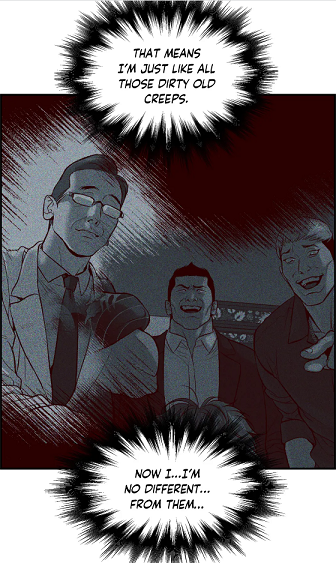 (chapter 20)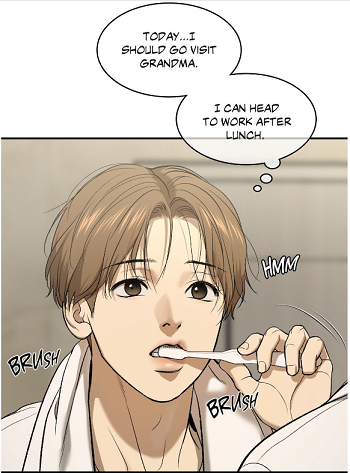
 (chapter 30) Because the grandmother didn’t allow her grandson to share his struggles (no tears), Kim Dan has been hiding many things from his grandmother
 (chapter 07): the beatings from Heo Manwook, his firing from the hospital, the sexual assault from the perverted hospital director and the moneylender, his deal with Joo Jaekyung and the fact that he moved to the penthouse. This means that little by little, the physical therapist is sharing less and less his happiness with her. I doubt that he told her about his trip to Busan, his first MMA fight as spectator
 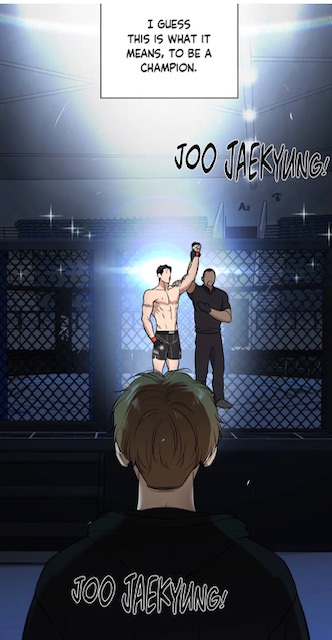 (chapter 15) and his first sparring with Joo Jaekyung
  (chapter 26). But this is a sign that Kim Dan is maturing. Therefore it is no coincidence that after their first day off spent together, Kim Dan is already under the champion’s spell.
 (chapter 30) And at some point, the grandma will notice her little boy’s transformation and the growing distance. And Choi Heesung could be the trigger for a first quarrel
  (chapter 22)
  (chapter 26), they get support from each other
  (chapter 14)
 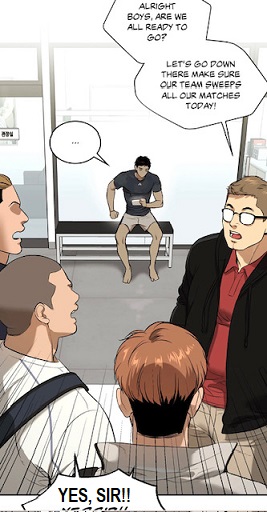 (chapter 23) or they argue
  (chapter 07). Moreover, they call the older members “hyung”
  (chapter 5)
  (chapter 23) which is another evidence that Team Black functions more like a family than like a company. What caught my attention is that the doctor is not addressed as hyung
  (chapter 30) but as Doc Dan or doc.
  (chapter 23), though the manager Park Namwook had introduced him as hyung.
  (chapter 07) The reason behind this different title is the champion. The latter addressed him like that:
  (chapter 22) It exposes that the physical therapist occupies a particular position at the gym. On the one hand, it could be interpreted that he has not been entirely adopted as a family member. On the other hand, the physical therapist didn’t exclude that he could have other clients.
  (chapter 25) This means that his “adoption” is not definitive and official. Nevertheless, I would like to outline that though Team Black’s structure resembles a lot to a family, we can not say that it is a true family. Why? It is because Joo Jaekyung is hiding many things from his hyungs and members. He is not sharing his problems to his coach (his insomnia, his jinx, his sexual orientation, his insecurities eg). Imagine that he preferred deceiving his admirer
  (chapter 15) than admitting that his shoulder had been plaguing him. And it is the same for Potato. He didn’t talk about the incident with the office room and the sofa.
  (chapter 25) According to me, Jeong Yosep knows about the true relationship between the physical therapist and the alpha black wolf. But he kept this information to himself as well. However, like pointed out before, family stands for communication and not secrecy! Moreover, so far, we only saw the fighters share their happiness. And what about their struggles or defeat? To conclude, Jinx is actually showing us the transformation of Team Black as company into a family. How they “become” a WE! Park Namwook does consider Team Black as his gym, but he has his own family. However, this is not the case for Jeong Yosep or Joo Jaekyung, who lives as a loner wolf! In my opinion, Team Black will turn into a real family, the moment Kim Dan loses his halmoni. Remember the quote from the poem: “If you can’t say you’re hurt when you feel hurt you’re not family“. Kim Dan won’t be able to hide his sadness and broken heart. In the beginning of the story, he lied to the coach and Kwak Junbeom about the reason for his injuries:
  (chapter 11), because he considered them as superior and colleagues. In other words, the fighters will share their pain with doc Dan helping him to overcome the loss. But this change can only happen, when the owner of Team Black has a change of heart himself as well. Remember how he pushed Oh Daehung and the other members away.
  (chapter 22) He didn’t want them to come to his house.
  (chapter 22) So far, he didn’t want people to cross the line, but thanks to the physical therapist, this will change. That’s how both protagonists will come to view more and more Team Black as a family. They will share their struggles and happy moments together. I have one evidence that Kim Dan is the key to turn Team Black into a real family. It is because Joo Jaekyung came to the gathering
 (chapter 30) But he is there an employee. Thus I am suspecting that the talent agency is working differently from Team Black. If there is a scandal, I doubt that the company would side with the star in trouble or they would try to find ways to get rid of the issue, like finding a scapegoat in order to bury the truth. As a conclusion, I am expecting to see companies run differently so that the readers can perceive Team Black as a family company, although it is an incorporation.
 (chapter 4) This was a reference to the blanket in the poem, though here Kim Dan slept in a cocoon. This was a sign that he didn’t feel safe. However, as time passed on, I detected a change in Kim Dan’s sleeping position. He is lying on his back and even in the middle of the bed.
  (chapter 29) It is because Joo Jaekyung always put him there! This exposes that the champion is still thinking that he represents a disturbance to the Sleeping beauty. One thing is sure: Joo Jaekyung will become the blanket taking over the grandmother’s past role:
  (chapter 1) This was the reaction from the champion:
  (chapter 1) He questioned the cause for the tears. He was naturally annoyed (“the hell”), but he didn’t make fun of the doctor. And now, pay attention to the memory Joo Jaekyung had from their first night. He remembered his tears which had moved him deeply:
  (chapter 6) This shows that the celebrity is not judging the physical therapist as weak due to his tears. In episode 28, he even showed concerns, when he heard the doctor crying.
  (chapter 28)
  (chapter 28) He questioned the doctor once again, why he was in tears. However, he didn’t ask the doctor to stop weeping or to wipe his tears. He wanted to understand him. This exposes the fighter’s tolerance and interest in Kim Dan. For me, it reveals that Joo Jaekyung is willing to share the pain or fears with Kim Dan. Therefore it is not surprising that Kim Dan is remembering this moment!
  (chapter 30) He was allowed to express his emotions. Interesting is that this image is now connected to red, not to grey/black.
  (chapter 30) The switch of color indicates the doctor’s increasing feelings and sensuality for Joo Jaekyung. That’s the reason why I am expecting that one day, the two protagonists will cry together, something that the grandma hasn’t done until now.
  (chapter 13), it doesn’t signify that they are a family now. And it is the same for the penthouse.
  (chapter 19) or it is necessary
  . (chapter 27) During the day off, they shared their thoughts,, their emotions
  (chapter 27)
  (chapter 27), their happiness
  (chapter 28) and their fears
  (chapter 27)
  (chapter 29) Because Joo JAekyung confessed his fears and health issues to Kim Dan, it shows that he was trusting him. For me, this night represents another step how to become a true family. “If you can’t say you’re hurt when you feel hurt you’re not family.” This day and night were so magical that it affected the protagonists’ life forever. From that moment on, Kim Dan is feeling more attracted to the champion, hence he is peeping at him.
  (chapter 30) And it is the same for the champion. Now, he is slowly regretting that they live in two different rooms and they have their own bathroom. Therefore he came to the doctor’s bathroom under the fake excuse that he had run out of toothpaste.
  (chapter 30) What was so funny is that he had opened the door like a huge bear. Why? It is because he was so annoyed how to explain his intrusion.
  (chapter 30) This shows that little by little, the champion is regretting his words to Kim Dan in the master’s room.
  (chapter 29) For me, he will be forced to recognize that work is not bringing him closer to Kim Dan, especially after Choi Heesung met the main lead.
  (chapter 30) For me, this scene is the bathroom represents another step how to become a true family.
  (chapter 30) However, like Mingwa voiced it, they have a long way to go, for Joo Jaekyung and Kim Dan are hiding their true thoughts and emotions from each other.
  (chapter 30) Kim Dan had to hide his blushing, while the champion had to lie for his appearance. Moreover, the fact that he tried to hide his underwear
  (chapter 30) indicates that their intimacy has not reached its peak. He doesn’t feel comfortable around the athlete to be seen in underwear. Moreover, the champion is also hiding his jealousy and possessiveness towards the main character.
  (chapter 30) But like I said, they need to open up their hearts and mind in order to become a true family. From my point of view, the halmoni could play a huge role in their union. How so? It is because she entrusted her grandson to Joo Jaekyung. The latter also conversed with her
 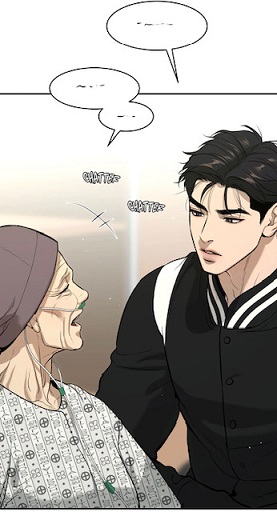 (chapter 21) and even paid her hospital bills. She even took his hand
  (chapter 22) and gave him a yoghurt.
 (chapter 21) So the moment the grandma vanishes, it could also wound the champion’s heart, especially when his sex partner is so heartbroken. It would be interesting if the champion came to voice his feelings about her. If you can’t say you’re hurt when you feel hurt you’re not family.“

 (chapter 117) The learned sir was tasked by the mysterious noble wearing a purple hanbok to retrieve the document. I would like to call my avid readers’ attention that we never saw the man introducing himself to the former teacher. He could have definitely impersonated someone, for this trick has often been used in this story. Anyway, in exchange for this favor, Jung In-Hun got promised a high position in the government.
  (chapter 115) Thus Jung In-Hun has only one option left. He needs to utilize a spy and traitor in order to get the document. Because Jung In-Hun has known the painter since his childhood, it is not surprising that he chose to approach Baek Na-Kyum. As you can imagine, episode 117 is a new version of episode 24
 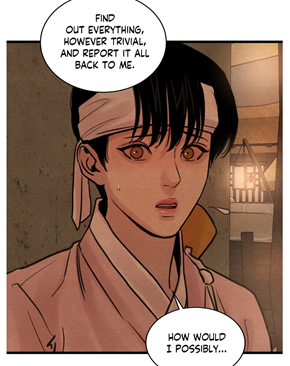 (chapter 24), where the angry learned sir asked the naive artist to spy on their benefactor and episode 35
  (chapter 35) He hoped for the painter’s understanding. All this because he needed the low-born more than ever. He had not renounced on discovering Yoon Seungho’s weakness yet. However, in season 1, he failed to achieve his goal, because after the night spent with the main lead, Baek Na-Kyum refused to divulge any information about the meeting between the host and his brother Yoon Seungwon.
 (chapter 117) Hence we should consider the scholar’s kiss as the kiss of Judas. The latter, known as the Betrayal of Christ, is the act with which Judas identified Jesus to the multitude with swords and clubs who had come from the chief priests and elders of the people to arrest him. Thus I am expecting an arrest of the painter in the future. Since he is the love interest of Yoon Seungho, he has once again become the target of the next plot.
 (chapter 115) However, this is impossible. Time is the proof for the lord’s innocence. 7 days have already passed since Yoon Seungho’s violent outburst in front of the learned sir’s home. Don’t forget that it took Yoon Seungho 6 days to regain consciousness.
  (chapter 116) And the manhwaphiles saw that the painter spent the night with his lover after their conversation at the pavilion.
  (chapter 117) This means that Na-Kyum’s visit to the gibang could only take place after that night. That’s how I came to the conclusion that the meeting took place after 1 week (6 days+ 1 night). However, the swollen cheek will easily vanish within one week contrary to the stabbing.
  (chapter 117) Therefore after the release of episode 117, I had imagined that the wound from the learned sir was faked with the rouge from the noonas. Yet in episode 118, I detected the busted lip which can not be faked. The scratch is the evidence that the wound is real. Jung In-Hun knew too well that he couldn’t frame his previous sponsor for this. Hence he avoided to reply to the painter’s interrogation.
  (Chapter 117) This must have happened on his way to the gibang or in the gibang itself! So who would do this? Yoon Chang-Hyeon? The noble with the purple hanbok? I will answer to this question further below.
 (chapter 57) It is less pronounced, for Jung In-hun only met this mysterious man once contrary to the main lead. Even Baek Na-Kyum noticed the transformation, hence he got scared.
  (Chapter 118) He couldn’t recognize his former teacher. The learned sir had become like a violent beast. But why would he be so frantic and hopeless that he became violent in his gestures and words? It is because he had been threatened again. The wounded lip and cheek are the evidences that he has been coerced to convince the painter that the latter should return to his side.
  (chapter 117) However, observe that in their meeting, Jung In-Hun spoke about affection
  (Chapter 118) and this doesn’t belong to this man’s world (power, lineage, yin/yang, education). And it is the same for Yoon Chang-Hyeon. The latter embodies hatred and rejection for sodomy!
  (chapter 86) He was even willing to kill his own son, moreover he threatened Yoon Seungho to have the painter killed.
  (chapter 116) That’s how I deduced that the person behind this intervention is actually longing and hoping for love from Yoon Seungho. Thus he requested from the learned sir to take back the painter.
 (chapter 94), then the kiss
  (chapter 95) The artist had kissed the main lead for two reasons. He desired to convey the sincerity of his attachment and to prove that this was real. Yoon Seungho shouldn’t imagine that this was just an illusion, as he often questioned his own senses and sanity. In the gibang, the learned sir changed the chronology: first the smooching, then the confession. Why? It is because he thought that the painter still loved him, when Baek Na-Kyum showed concern for him.
  (Chapter 118) Due to his arrogance and vanity (the negative aspects of self-love), he jumped to the conclusion that nothing had changed. The painter seemed to be still naive.
  (chapter 118) Hence his surrogate father smirked. The irony is that there exist different kind of love: friendship, family… At the beginning, the artist was still viewing Jung In-Hun as a friend. Thus he got worried about his wounds. Yet observe that he had no intention to bid farewell to the former teacher.
  (chapter 118) Baek Na-Kyum, as the mirror of truth, is not only confronting the scholar with his bigotry and dishonesty, but also the mastermind behind this encounter. This explicates why the learned sir spoke about love:
  (chapter 118) This was the same for Yoon Seungho. The sexual abuser had only been obsessed with his own reflection and desires to the point that he never paid attention to his sex partner’s gaze… the loss of light in the gaze, the absence of tears … Besides, there was no agreement, everything was based on coercion and Kim knows that. That’s the reason why Jung In-Hun had tears in his eyes! It is because the main lead used to cry as well… asking for his pity and mercy. Since the scholar never cried before, I believe that the latter had asked to shed some tears in order to move the heart of the counterpart.
  (chapter 118) Baek Na-Kyum was never his young protégé, only his student. Why? It is he never protected him, he just consoled him!
  (Chapter 11) Back then, the painter had the burst lip and the glowing cheek too.
  (Chapter 11) He had protected Jung In-Hun, when the latter was suspected of ruining the painting. And how had Yoon Seungho acted in that scene? He had spoken like a powerful person, like a ruler!
  (Chapter 11) As you all know, my theory is that behind the name “lord Song” is hiding the king. But since I made a connection between episode 11 and 118, I deduce that Jung In-Hun has been put in the same position than the painter. His karma… for feigning ignorance and letting Baek Na-Kyum take the fall. He is paying for his wrongdoings all at once (11, 29, 35, 40). And what had Yoon Seungho said to his future lover?
  (Chapter 11)
  (Chapter 11) Yes, so far no one has been talking or thinking about the king as someone involved in the main lead’s suffering. Yet, I would like to outline that the gibang belongs to the state and as such to the king. Only a rich and influential person could hire the kisaengs for the day
  (chapter 118) Not even “lord Song” or lord Haseon from episode 107 couldn’t pull such a trick.
  (Chapter 107) He had announced his visit and the kisaengs had to gather next to the gate. There, the mysterious man selected only one woman.
  (Chapter 107) However, in episode 118, the kisaeng talking to Baek Na-Kyum expressed that there were different parties. Each kisaeng was participating in a different festivity (“It’s not usually this busy”). She would have mentioned it, if there was a huge party in the gibang. But there is another clue for the king’s intervention: the pipe is no longer visible in the noonas’ room
  (chapter 96: it’s on the table), just like there are now two mirrors and the number of rouge has also increased.
  (Chapter 118) Finally, this painting, Hokjado, is actually mocking the monarch.
  (chapter 105) The tiger in the painting usually represents the ruling elite, and its ridiculous expression is a satirical commentary on their behavior. He is here portrayed as a lazy man focused on smoking and pondering.
  (chapter 116) It signifies that this panel is a new version of this scene:
  (chapter 103) And what is the common denominator between these two scenes? Both protagonists rejected the help from the staff, especially from butler Kim.
  (chapter 102) He was already giving up on everything, even his own life, if he had not the artist by his side. Under this new light, it becomes comprehensible why killing the painter is not the first option for the pedophile.
  (chapter 118) In fact, he blamed his brother and his father for everything, even Yoon Seungho’s way of life. His concern and affection for Yoon Seungho are totally superficial and trivial in the end. Why didn’t he ask about his wounds? He met him the next day after he regained consciousness.
  (chapter 37)
  (chapter 107), whereas the main lead had decided to protect his family despite their betrayal and abandonment. Under this new light, it becomes comprehensible why Yoon Seungwon has no interest to expose the petition contrary to the past.
  (chapter 76)
  (chapter 118) For this winning hand, Yoon Seungho had to suffer a martyrdom. Hence it becomes comprehensible why he is envisaging to renounce on everything.
  (chapter 117) He was only happy by the painter’s side.
  (chapter 25) On the other hand, I had made this connection, even before the release of episode 118. Why? It is because through deductions, I had already come to the conclusion that this was a stolen kiss.
  (chapter 24), then he hugged him
  (chapter 29). While the first embrace took place in a deserted area (close to the port), the second hug was witnessed by many people. It was in the open, moreover the so-called “hero” had jumped off the horse during the parade which could only catch the attention from the crowd.
  (chapter 34) His kiss is displaying his hypocrisy, which the artist could only feel. Hence he didn’t reciprocate the smooching. His lips remained immobile.
  (chapter 19) Therefore I come to the conclusion that this kiss is like the embrace from episode 29: fake! It is because the learned sir needs him! This statement stands in opposition to the protagonist’s love confession.
  (chapter 117) His presence and affection represent the biggest treasure for Yoon Seungho. Baek Na-Kyum is his only source of joy and happiness. However, for the learned sir, the “need” has a different foundation. He can lose everything, if the painter doesn’t choose him. And if he were successful, he would even get power! As you can sense, for the learned sir, Baek Na-Kyum is just a tool, while for the Black Knight, he is a necessity! Without him, he has no reason to continue living. Jung In-Hun is desperate to survive, while Yoon Seungho is pushed to give up on his suicidal thoughts THANKS TO His father:
  (chapter 111) His gaze oozed not only arrogance, but also blindness. Imagine that he was smirking in front of the painter while looking at the wealthy aristocrat. It was, as though he thought that the artist wouldn’t notice his disdain and vanity. He imagined that the artist was still naive and ignorant like in season 1. This explains why the painter expressed his disapproval about the learned sir with a smile later:
  (chapter 111)
  (chapter 111), for Baek Na-Kyum is always accompanied by his soul mate (chapter 40, 45, 74-75, 91-97, 104-105) In addition, people would have recognized him due to the previous parade and noticed his interaction with the artist. Nevertheless, the villain needed privacy, as he was inciting the main lead to commit a wrongdoing: betrayal towards Yoon Seungho. So their meeting could never be mere coincidence and happen in the open. Their reunion had to be planned properly and in secrecy. Thus it signifies that it had to happen behind the dark knight’s back. I would even add that the beloved couple needed to be separated! And now, you comprehend why their meeting had to take place in the gibang! In season 3 and 4, the kisaeng house is the place where the main leads got separated from each other, though the intervention from the noonas didn’t always work like expected.
  Here we witnessed his return. However, the kisaengs badmouthed Yoon Seungho
  (chapter 93) Their attempt was to create a riff between the couple.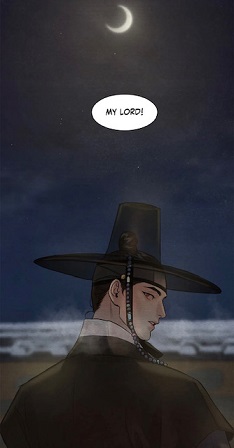
 (chapter 94), when the painter thought that they would go to the pond.
 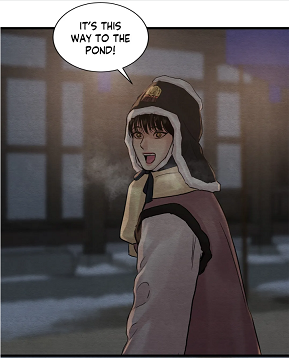 (chapter 94) Why didn’t the artist follow his partner right away?
  (chapter 97) But it can not be the officers, for they were carrying torches.
  (chapter 97) Yet, the light in the previous image is nearer to the ground than to the top of the door. Besides, carrying a torch in a building made of paper and wood is quite dangerous. For me, the person approaching their suite could only lift such a candle light
  (chapter 19) We have two possibilities left: the kisaeng Heena or the butler.
  (chapter 98) This confrontation didn’t occur in episode 93, for the kisaeng’s back was illuminated by the candle light, whereas the room was darker in episode 93.
  (chapter 93) The light was standing further away from her in this picture. Hence I deduce that the lord must have revisited the kisaeng during that night. Because she was not holding the candle light, I can only deduce that the person witnessing this second conversation was butler Kim! Besides, we have another allusion to him through the reflection of episode 19 and the first Wedding night. Then later, Heena tried to convince her brother to leave Yoon Seungho’s side
 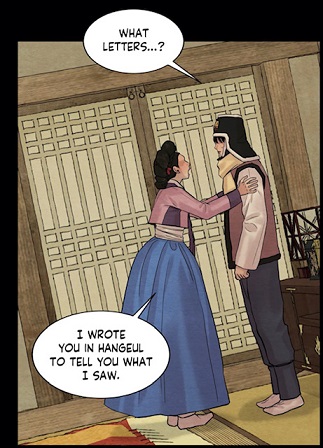 (chapter 97) by blaming him for Jung In-Hun’s murder, but her intervention failed. In reality, the separation could only take place thanks to the intervention of Yoon Seungho’s staff. In episode 97, the servants were definitely manipulating the painter with this corpse
  (chapter 97), whereas in episode 98, the maids had to play their role as well: badmouthing their master
  (chapter 98). He was a cruel and violent lord!
 (chapter 105: Heena was strong enough to follow her brother to the door, and this quite quickly, for she witnessed their argument), the other cast doubts in Baek Na-Kyum
  (chapter 105) Yoon Seungho had mentioned that he would return to the kisaeng house in order to fetch his lover.
  (chapter 105) Yoon Seungho was just thinking of a momentary separation, whereas the kisaeng implied that his departure was definitive. This shows that they had hidden the main lead’s true intention from the painter. This was no coincidence in my eyes.
  (chapter 118) However, I believe that Jung In-Hun was lying, for his visit could be leaked to the owner of the mansion. He has no idea that no one is siding with the main lead. But by saying this, he was covering up for the gibang, and as such Heena. She was definitely her source of information.
  (chapter 68) Why? It is because she has always loved the learned sir and projected her own thoughts and emotions onto the artist. In my eyes, this encounter is to prove the kisaeng wrong, to confront her with reality and her prejudices. What caught my attention is that each time, the painter couldn’t meet Heena, her absence was justified that she was serving a nobleman outside.
  (chapter 93)
  (chapter 118) Notice that the painter is already thinking that she was not expecting him. Yet, it is clear that he would come to the kisaeng house, for Yoon Seungho had been invited by his brother. The invitation had already been proceeded the day before:
  (chapter 117) So if something were to happen, Heena could feign ignorance and as such innocence. After their last argument, the noble has learnt that he shouldn’t keep his distance from the artist and he should confide to him, hence he talked about elopment at the pavilion.
  (chapter 25)
  (chapter 77) in a previous analysis. However, I will only focus on the comparison between episode 19 and 118, for both represent a first kiss!
 (chapter 118) And remember that in episode 19, the painter had caught the main lead by surprise, when he entered the room.
  (chapter 25) Thus I am deducing that this scene
  (chapter 96), this means that he has finally accepted his homosexuality. Consequently, the sexual abuser could have the impression that he just needs to remove the painter from the main lead’s side and that’s it. He can replace the artist… impersonation once again!
 (chapter 96) These notions are all reflected in the confrontation between Baek Na-Kyum and Jung In-Hun:
  (chapter 115) In my opinion, he will be framed for the incident in the shaman’s house.
  (chapter 115) Hence I have the impression that this stolen kiss will have huge repercussions not only for the learned sir, but also for Heena.
  (chapter 118) Observe that the painter wanted to ignore the words from the fake teacher. So he could have a change of heart and report the incident to the authorities. He doesn’t know that his lover killed Black Heart and his friends. The learned sir was admitting that his nightmare had truly happened.
  (chapter 83)
  (chapter 88) From my point of view, the schemers are projecting their own thoughts and emotions on Yoon Seungho. Moreover I am quite certain that they have already calculated the possibility of a rejection. The painter’s so-called wrongdoings from season 1 (chapter 11: the ruined painting, chapter 29: desertion) and season 2 (chapter 61: the desertion) were all perceived as rejections. If he is caught with Jung In-Hun alone, they anticipate that Yoon Seungho will react like his father. He won’t be able to discern the truth. Baek Na-Kyum is not faithful and is now tainted. Or even worse… Yoon Seungho might commit a crime. This thought seems to contradict my previous statement: Jung In-Hun is acting on the pedophile’s order. Nonetheless, my theory is that there exist two conspiracies:
 (chapter 107)
  (chapter 115)
  (chapter 115: flower pattern and no sleeve, the beard covers the jaw )
 (chapter 117: no pattern, the lips are covered by the moustasch, straight)
  (chapter 117) There are simply too many divergences to say that it is a mistake from the author. This would actually mean that she is quite sloppy. Furthermore, I decided to rely on my eyes and not a belief: there is only one lord Song. Thus you comprehend why I never called the man talking to Jung In-Hun lord Song. So if my theory is true, this would signify that these men represent the previous gang “dogs of Joseon”, the older version of this:
  (chapter 101) And No-Name was treated exactly like Lee Jihwa, but he got framed and sentenced. Finally, I would like to point out that there were 3 black men involved in the first fake sexual education:
  (chapter 107) Far away from the protagonist, he had to rely on his helping hands and his advisors. He trusted their words. Finally, we have the vision from Lee Jihwa:
  (chapter 101) That’s the moment when the truth will come to light. Someone will get angry, because he got confronted with the painful reality: he was a man consumed by lust, he was selfish, cruel, abusive, ignorant, coward, and even naive. He was never destined to be the protagonist’s life companion.
  , I detected a strong connection between chapter 10 and 117. The common denominator was the pavilion. The learned sir brought the artist under the pretense for a walk in order to seek seclusion and privacy. While he faked his worries
  (chapter 10), he wanted the painter to stop working for Yoon Seungho. He desired him to leave the propriety, for he saw Baek Na-Kyum as a rival. Unlike the painter, the scholar had not been invited to join the party the night before. Hence he had to portray Yoon Seungho in such a bad light!
  (chapter 10) Back then, the vain and stupid man thought that the main lead had truly liked his poem. Thus he imagined that he could get the attention from the protagonist, once he got rid of his competitor.
 (chapter 10) This is not surprising that the author employed a panel from that chapter.
  (chapter 118) Back then, the artist had not detected the manipulation. Hence he had protected his former teacher, when the latter got accused of ruining the painting. This confession from the scholar
  (chapter 10) stands in opposition to Yoon Seungho’s. The latter has no expectation from the artist.
  (chapter 117) The latter is the one deciding about the lord’s fate. But why did he go to the pavilion with the painter? For privacy and intimacy! They needed to discuss the matter about the brother and the petition, a dangerous matter.
  (chapter 117) Here, the painter was acting as the main lead’s right-hand and advisor. He is taking over the butler’s function. He was full of concern for his loved one asking him to postpone the reunion (chapter 117) And the moment the artist voiced his fears
 (chapter 117), the noble suggested to leave everything behind.
  (chapter 117) And what would people see from far away? 2 people showing closeness and attachment, they wouldn’t expect a desertion, an abandonment!! And now you comprehend why Yoon Chang-Hyeon was sitting in the pavilion in town
  (chapter 116) It was, as if he was trying to get an alibi for his crime: he had planned to have his son killed, but it didn’t happen as expected. Thus he was forced to join his son.
  (chapter 116) This means that he was exposing his crime to people in town. Furthermore, he even confessed his hatred for his own son. He yelled this:
  (chapter 116) Yet, by stating this, he was admitting that he was violating social norms (Confucianism). That’s how I realized that the pavilion is not only the place where Yoon Seungho’s emancipation takes place, it is also the symbol for betrayal and abandonment.
  (chapter 101) Finally, a long time ago, I had developed the theory that the pavilion was the place where Yoon Seungho got abused.
 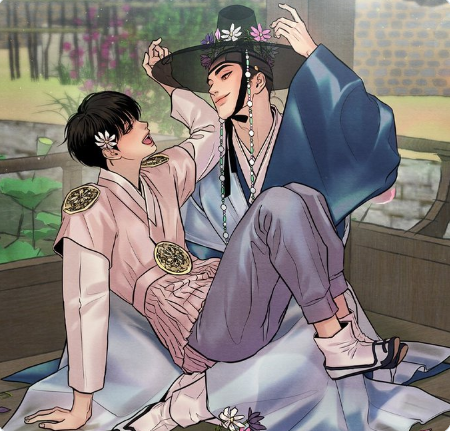 It is the same pavilion than Yoon Chang-Hyeon’s. This means that the couple will purify this place. At some point, the lord and his knight will come to admire the pond with the lotus flowers:
  (chapter 117) Byeonduck let us see a glimpse of their future.

 (chapter1) Or was she simply the noona?
  (chapter 70) At some point, I came to realize that Heena had acted as the surrogate mother, but she had never clearly stated that she was the painter’s mother. In other words, his adoption was never official, which explicates why the main lead only considered her as his older sister. This is important, because her ambiguous status can not only generate problems, but also expose her betrayal towards Baek Na-Kyum. Note that in chapter 97, the noona treated Baek Na-Kyum as her “child” who wouldn’t listen to her
  (Chapter 97), while later she implied that they were both equal, for she employed the personal pronoun “us”.
  (chapter 97) On the other hand, she used her seniority as status, when she called him a fool
  (Chapter 97). He lacked experiences, hence he was too naïve, and as such he would trust the protagonist too easily. As you can see, Heena herself had an ambiguous relationship with her brother. Nonetheless, thanks to chapter 93, I got finally a definitive answer about Heena’s true identity. She is indeed the head-kisaeng in the gibang. I realized that the protagonists were invited to stay in Heena’s personal room.
  (Chapter 93) That’s the reason why the seat of the host was empty and why Yoon Seungho didn’t go there. He would have violated social norms, if he had taken her seat.. Moreover, by doing so, he would have revealed that he knew where the woman was. This could have raised questions.
 (Chapter 68) was in truth a huge window. How do I know this? First, in this scene, the scholar was hiding a huge white vase with red flowers. Hence I deduced that Jung In-Hun couldn’t have walked through that “gate”, it was just a window. Therefore I assumed that he had to walk past the flowers, either turn to the right or the left. Secondly, observe that next to the lantern on the left, there is a small white panel. This means that the view from chapter 93 was more or less taken from the right corner. Moreover, in the next chapter, Heena is not facing this “window”, when she is in the same building.
  (Chapter 69) This time, the white vase with the flowers is standing in front of a wall. That’s how I deduced that Heena had to turn to the left in order to go to the hallway.
  (chapter 69) On the other hand, another element caught my notice. In this picture,
  (chapter 93) which is not present in episode 69.
  (chapter 93) Since I came to the conclusion that Heena’s private room was on the right side after the corner, I deduce that the kisaeng was not on her way to her room. Moreover, since the kisaeng was walking in the same direction than the scholar, I can only conclude that Heena was actually approaching the entrance of the building. I believe that she had turned around, but the author didn’t reveal this. One might argue that it is possible that in chapter 68, the learned sir could have gone with the painter to Heena’s bedroom. However, back then the latter was not the head-kisaeng. We know this due to the presence of a kisaeng standing right behind Yoon Chang-Hyeon during the sexual lesson.
  (chapter 69) It was done on purpose!! She wished that Min would take care of her brother. Under this new light, it becomes comprehensible why the noona has a drop of sweat on her cheek. She is faking ignorance, she is acting, as if she was very protective of her brother. She uses illusion to manipulate people. In reality, she was acting here. One might argue that I am overthinking again. This is not possible, for Heena didn’t know Min at all. Hence she couldn’t manipulate him. The latter had heard of her for the first time in Yoon Seungho’s mansion.
  (chapter 66) But let me ask you this. How could Heena have never met Min, when she was the head-kisaeng? Secondly, just because the servant had never heard of the noona, this doesn’t mean that it was the case for Black Heart. The domestic assumed Black Heart’s ignorance, just like the readers. Moreover, recently I had detected that Heena had been standing in front of a mansion belonging to a noble.
  (chapter 67) diverge. Moreover, Min has been seen in the kisaeng house in so many chapters
  , (chapter 19)
  (chapter 59). Here, I would like to point out that in episode 59, Lee Jihwa had visited the kisaeng house on different occasions, for his hair was slowly growing.
 (chapter 59) Moreover, note that his visits took place during the day and not during the night. Why? It was for privacy and so far, during the day, the manhwaphiles never saw any kisaeng in the gibang.
  (chapter 1)
  (chapter 94) Lee Jihwa was not supposed to meet kisaengs. As you can see, Min had strong connections with the gibang, just like Lee Jihwa. Hence Black Heart should have known Heena, for she was the head-kisaeng. But I would like to bring up a more conclusive proof for this interpretation.
  (chapter 19) This image was showing us that Yoon Seungho was visiting the gibang. However, pay attention to the pattern of the doors in the last picture and the next:
  (chapter 19) The motive diverges, it looks like the one from the hallway with the purple veils. This means that the party was not taking place in the room shown in the former picture. What caught my notice is the presence of the white vase with the red flowers in front of the building. It was present in each scene taking place in the gibang.
  (chapter 93) For me, the red flowers symbolize Heena noona. This explicates why during the painter’s dream, the flowers were not present.
  (chapter 44) Due to the similarities, I believe that in chapter 19, Byeonduck was actually exposing the ghost head-kisaeng. Exactly like the father, she was hiding. Why? It is because she is involved in Yoon Seungho’s suffering. And now, imagine her reaction, when she hears that Black Heart has organized a feast for the main lead’s honor. The woman could only avoid the main character. And now, you have the explication why Heena as the head-kisaeng was not present during that festivity. It was deliberate.
  (chapter 19) Striking is that the kisaeng had a similar hair dress than Heena, This is no coincidence. She was acting as the head-kisaeng. The manhwalovers will certainly remember that only two kisaengs had no braided bun or braids: this one
  (chapter 51)
  (chapter 93)
  (chapter 93)
  (chapter 95) The extravagant hair dress was exposing the kisaeng’s status. And now, you comprehend why the other noona explained the disappearance of Heena during that night.
  (chapter 19) But how could she sense that the noble was in a good mood? The latter was silent and not even smiling.
  (chapter 19) How could she claim this? In reality she was actually spying on him. Heena had no idea why the lord would come to the gibang, especially after suffering there so much. The kisaeng’s task was to dig up information. This visitation must have bothered the head-kisaeng.
  (chapter 69) She was even turning her back to him. But actually, she could have detected his presence, exactly like I had recognized him: through his laugh!!
  (chapter 99) He was wearing a veiled hat, yet in chapter 69, this was not the case.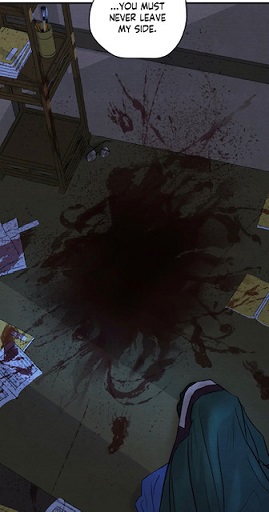
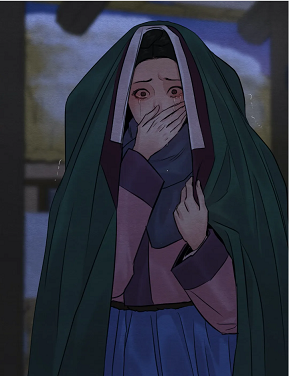 (chapter 88)
 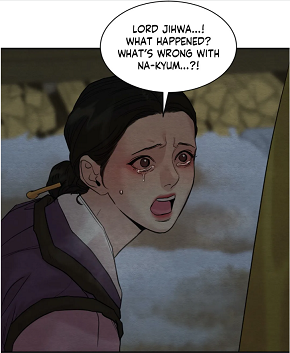 (chapter 99) Under this new light, Min’s words get a new signification:
  (chapter 99) He was implying that they knew each other for a long time! The irony is that the manhwaphiles had the impression that their relationship was recent, and his cynical tone contributed to it. Secondly, he called her Heena, a sign that they were close to each other. Note that Lee Jihwa never mentioned her name.
  (chapter 99) His words even insinuate that Black Heart had just given the following order. The red-haired master should just fetch a kisaeng and in my opinion, Heena was waiting for Lee Jihwa’s arrival to leave the gibang. According to his words, he had no idea about the kisaeng’s identity. But is it true? I have my doubts now, and this for two reasons. Why would he ask about her identity, when he already knows that she is a kisaeng? The drop of sweat on his face is an indication that he is lying. But the problem is to determine if the deception is only referring to “I heard not a word” and to all the questions. Let’s not forget that he knew about Min’s initial intention. The moment Lee Jihwa arrived in the gibang, she just followed him. That way, they would avoid to attract attention, and with her new hair dress
 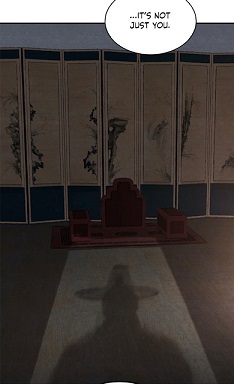 (chapter 86) The latter had been eyeing the throne in the family mansion, but he failed to take over the mansion. This was the negative reflection of Heena. Whereas the kisaeng had a powerful position in the gibang, it was the opposite for the patriarch. He was no longer recognized as the head of the Yoons. Yet, both have something in common. Both lost their position for good, for Heena and Yoon Chang-Hyeon couldn’t take or keep the seat. We could say that both got defeated by Yoon Seungho. In chapter 93, the main lead acted as a respectful and calm master, whereas in the bedchamber he showed no respect to his own father. He talked back and even made fun of him.
  (chapter 87) This picture stands in opposition to this one:
  (chapter 93) To conclude, the surrogate mother and the patriarch made a similar experience in season 3. Both got deceived by manipulations and in both cases, letters played a huge role.
  (chapter 94), definitely thinking that he was doing the right thing. He thought that he could never get into trouble. But this is just a deception in my opinion. As for the former head-kisaeng, she has to run away, for she did something wrong! In the past and in the present! She definitely plotted, and she is aware that her actions will have terrible repercussions.
  (chapter 99) No one would be looking for her. The problem is that the witnesses of her curtains all vanished. Lee Jihwa ran away, Black Heart got killed with his friends, and the only survivor, lord Jang, was confronted with real corpses in the shaman’s house.
  (chapter 102) That’s why I come to the deduction that her murder will be questioned. Why? There is no blood contrary to the bloodbath in the shaman’s house and there is no corpse!! Since Black Heart used different corpses in order to deceive Heena and the couple, there is no ambiguity that the head-kisaeng’s curtains will be doubted. Striking is that Heena staged her death out of cowardice and selfishness, while Yoon Seungho made the opposite decision. He was resolute to commit suicide in order to follow his lover in his death. During that night, Heena and Yoon Seungho lost their “home”, but at the end, he found his true home: the painters embrace.
  (chapter 102) He gave up on everything (fortune, house and life), hence he will be rewarded for all his sacrifices. Under this new light, I am more than ever convinced that Heena has not reached the bottom. Her karma is to be punished for her deceptions and acting!
  (chapter 96)
  (chapter 96), though he is a noble. Besides, I am suspecting her of suffering from genophobia (fear of sex and intimacy) Their behavior exposes closeness and a certain trust. But how is this possible? It is because she knows that Min is a sodomite, and he is not looking for sexual favors. That’s the reason why she trusted Black Heart in my opinion. Moreover, he is smiling like Jung In-Hun. Therefore it is not surprising that she was speaking like the Joker in chapter 97. Here, the man had actually projected his own thoughts onto Yoon Seungho, and due to her own belief, Heena was more than willing to believe Black Heart.
  (chapter 52) It is because Black Heart knew Heena! I even believe that he had already met the scholar. Note that the man with the black hanbok was repeating the rumors about the learned sir. And the other questioned the main lead’s action exposing that he had never heard about this grapevine before. Hence I am deducing that the one spreading this rumor could only be MIN!! That’s the reason why he just said this
 (chapter 52) That means that the noble knew the teacher in the end. Therefore it is no coincidence that Min was aware where the learned sir lived!!
  (chapter 83) And now, if you connect the two scenes
  (chapter 01) And who had covered up the incident? Heena, for she was the head-kisaeng! She had lied to her brother by blaming the biggest victim, Yoon Seungho, who was the man with the braid! This image is a real memory of Baek Na-Kyum from that night, yet from far away, the painter couldn’t see the face of the sodomite! This is another secret Heena has been hiding from her brother!
  (chapter 94)
  (chapter 97)
  (chapter 97)
  (chapter 92) That’s the reason why I believe that in season 4, the visage will play a major role! The couple will recognize people due to the face!! In my eyes, the former head-kisaeng knows the identities of all the persons involved in Yoon Seungho’s suffering.
 (Chapter 5) Baek Na-Kyum was apologizing for his past behavior. He had insulted the main lead because of the poem. And his words sounded really similar to the butler’s in the library, for they both employed the same expressions: “That day” and “I spoke out of”.
  (Chapter 77) Striking is that the painter employed the expression “hand”, while the valet talked about “turn”. Why did they do that? It is because when Kim was caught committing a crime, he turned his head!
  (chapter 68) Thus in the library, the butler excused himself in front of the lord by using the following expression: “spoke out of turn”!! On the other hand, the painter had used his hand,
  (chapter 4), therefore he described his wrongdoing with the following expression “out of hand”. In my eyes, his words indicate the interference of the butler. Furthermore, the two men had a drop of sweat, a sign that they were not truly honest.
  (chapter 77) Both were apologizing, as they had wronged the noble. As you can imagine, the similarity in the excuse is no coincidence. The proof that both incidents are reflections is that they have another point in common. The wrongdoings of the low-borns had taken place in front of a gate. The butler had disobeyed his master
  (chapter 68), and the painter had assaulted the lord by trying to retrieve the poetry.
 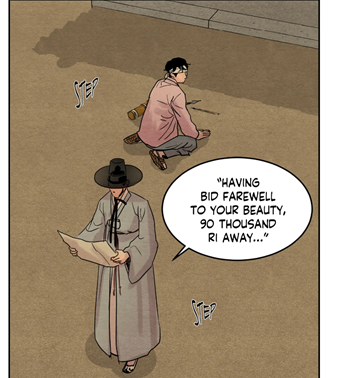 (Chapter 4) Because both characters had violated social norms, showing disrespect towards a noble,
  (Chapter 4) In other words, since Yoon Seungho had punished the butler due to the incidents in episode 67/68, I deduce that episodes 67/68 were reflections of episode 4/5 as well!! This corresponds to the rule 2 and 3.
  (chapter 4) Let’s not forget that just before the great entrance of Black Heart and the protagonist in chapter 67, this was what the author showed us:
  (chapter 67) And now compare the building to this one from chapter 1:
  (chapter 1) Under this light, my theory that Yoon Seungho was living with the Lees in the beginning of the story gets reinforced and even validated. In season 1, Yoon Seungho had sex with his friend in the pavilion so that the father and the staff could see the truth: the young master Jihwa was a sodomite. But since we saw Yoon Seungho in that building in episode 1, we jumped to the wrong conclusion that this was his house. But actually, from chapter 12 on, the author was showing us that we had been deceived. This was the lord’s house, and note that there is no building in the big courtyard contrary to the domain from chapter 67 and 1.
  (Chapter 12) (For more read the essay “Lee Jihwa’s special relationship with Yoon Seungho”) Then in season 2, the main lead forced the elder Lee to hear what he had been denying all this time
  (Chapter 67), while in chapter 3, he could only witness it from the patio. On the other hand, Yoon Seungho had been proactive during their sexual encounter, hence the father could only blame the main lead for his son’s debauchery. The intimacy in the pavilion was in verity hiding Yoon Seungho’s huge traumas. But due to Lee Jihwa’s confession in the inn, the red-haired master’s reputation got ruined in town and this must have definitely reached the father’s ears. Striking is that when Yoon Seungho confronted Lee Jihwa with his crime (abduction of a person from his household), the red-haired master ran away and hid behind the folding shield. Thus he never apologized to his friend. And it was the same with the elder Lee. The latter knew about his son’s wrongdoing, for he accused the intruder immediately.
  (Chapter 67) As you can see, the absence of the excuse from the uke and his father outlines that chapter 67 is a reflection of episode 5 and 77. I detect a pattern, chapter 5 contains a superficial apology, chapter 67 no apology and chapter 77 a fake excuse again. Furthermore the manhwalovers can recognize that in the same episode (episode 5), the antagonist Jihwa had indeed wounded the painter with his insult too, a reflection of episode 4.
  (Chapter 5) This confirms that chapter 5 is connected not only to episode 77, but also to chapter 67/68. We have the same elements: an incident linked to a door
  (chapter 67), a punishment, but also the absence or presence of an apology. But all of these episodes have other similarities: hypocrisy and arrogance. The Lees were looking down on Baek Na-Kyum and Yoon Seungho (chapter 5-67), while in episode 77, it was the butler who yelled and criticized the noble.
 (chapter 77) By detecting a reflection between these chapters, I had a new revelation.
  (chapter 5), while it was not the case. As you can see, anyone seeing the black guard leaving the owner’s study could have had the impression that the lord had written a letter. This means that this mistake must have taken place later again due to the rule 2! The manhwalovers could discover the deception in chapter 37/38!!
  (chapter 38) That’s how Jung In-Hun got misled.
  (chapter 38) Yoon Seung-Won had never received a letter, but the ruined painting. The readers only discovered the trick in the final episode, when the father was looking at the picture. And this connection between a letter and a painting was reflected in season 2. While Min stole the painter’s last creation
 (chapter 56), Jihwa sent a forged letter
  (chapter 56). Striking is that the butler was the one who received the paper before delivering it to his sick master. These two scenes (38-56) indicate that the valet is related to the correspondence. Moreover, he was seen delivering the message to Yoon Seungho in the courtyard.
  (chapter 35)
 (chapter 5) It was, as if he was not allowed to write any letter. So where did the table go? To the study!! What caught my attention is that after the first painting
 (chapter 2), the table had been removed from the study, just like the papers.
  (chapter 4) This was no coincidence. It had been sent to the lord’s bedroom, but after the lord had tasked the black guard, it was no longer there. This is the indication that someone was interfering with Yoon Seungho’s habit to take a brush. And this can only be Kim. As you can see, the appearance and the vanishing of the small table is the element which was reflected in chapter 1, 2,
  3, 4 and 5. And now, look at the scene where Lee Jihwa met Min.
  (chapter 67) The table had also disappeared. And when did it happen?
  (chapter 21) The noble had ransacked his own room with his sword. And what did we see in that episode? A paper folded in a book.
  (chapter 21) In other words, the First Wedding night is also a reflection from these chapters (4/5, 67/68, 77), for it contains the same elements:
  (episode 19) and the importance of the table. According to me, the valet had put the expensive wine on the painter’s table on purpose. To conclude, I see a connection between episode 4/5, 19/20/21, 67/68 and 77.
  (chapter 77) He can not trust his words, especially since he views the nobles as violent liars. Why? It is because there was this huge table. This is no coincidence that right after the valet betrayed the main lead and wrote a message to the patriarch. That’s how I had another revelation. The butler is symbolized by the table! Thus he was often seen with this small table
  (chapter 11)
  (chapter 97) written by Yoon Seungho, but he envisioned that this was the Spring poem!
 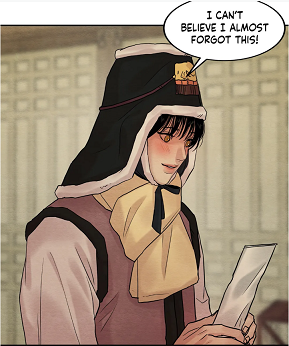 (chapter 97) We had the same situation. Black Heart had stolen the Spring poem, and the noonas had deceived the protagonists by faking admiration in front of an empty paper.
  (chapter 92) The latter’s work was a copy of Yoon Seungho’s poetry, the repetition from chapter 4. Hence you comprehend why I deduce that the paper in the annex was different from the Spring poem. So during that night, Yoon Seungho left a note to his lover, and that’s how the butler discovered that the artist could not read Chinese, for he saw his master writing in hangeul. But there exists another evidence for this interpretation. Baek Na-Kyum had wished this:
  (chapter 97) The goddess was actually fulfilling his wish, when she reminded him of the Spring poem.
  (chapter 97) If the lord had mentioned in the letter that they had found the corpse of Deok-Jae, the painter would have believed him. However, as you can envision it, the butler and Min were determined to generate a misunderstanding, to create the illusion that the scholar had died. Consequently, the servants deceived the main lead by omitting the existence of the paper. They had not delivered the message properly.
  (chapter 4) His own poetry got stolen. But let’s return our attention to episode 5. Since the lord had given the poem to the black guard, this signifies that the lord no longer had the sijo. Therefore he had to write the poem again in order to mask the disappearance. In my opinion, he must have copied the original poetry for the artist in order to prove that he had not been lying. Hence the paper looked different. And this brings me back to the painter’s apology in the patio.
  (chapter 04) That’s the reason why he had taken it in the first place.
 (chapter 7) But where is the sijo now?
  (chapter 65) Moreover, I believe that in chapter 65, he had collaborated with the noona. He had shown her the painting of Baek Na-Kyum, while in the study there was a blank paper. As you can see, in season 2, we had again this connection between a painting and blank paper. But let’s return our attention to chapter 5. The black guard was acting on the order of someone else, Yoon Seungho was not the one hiring him. The butler hates ruckus, his MO is to lie low and act in the shadow. If he had retrieved the paper, the man could report it to the master of the black guard. On the other hand, he could have asked the warden about his master’s request. He just needed to say that he desired to assist him, similar to this situation.
  (chapter 82) Thus I conclude that when the lord returned the paper to Baek Na-Kyum
  (chapter 7), Kim must have realized his error. He had mistaken the poem for a letter!! This explains why he repeated the trick with the younger master Seung-Won. But unfortunately for him, he was caught by the teacher who asked the painter about the letter the next morning.
  (chapter 38) Baek Na-Kyum could have realized that the butler had acted behind his master’s back. The problem is that during that evening, the lord had indeed written a letter to his brother
  (chapter 36), but the moment the latter interrupted the couple
 (chapter 37), Yoon Seungho chose to hide it. But why is it important? It is because if the painter had mentioned the paper given to the younger master to Yoon Seungho, the latter could have noticed the valet’s meddling and wrongdoing. On the surface, it looked like Kim had written himself a letter to the younger master. In other words, in episode 37/38, the butler gave the impression that he was a spy, for he was acting without his master’s permission. He had even left the propriety, as he was standing outside in front of the gate. Don’t forget that during the meeting, the brother had mentioned that he had sent him many letters
  (chapter 37), and there is no ambiguity that Kim had intervened. Here, the lord had said nothing, for he imagined that Kim had done it to protect him from his family.
  (Chapter 4) But on his way out, he met Yoon Seungho who had just missed the painter’s departure. But there, he discovered that the main lead had stolen his poetry.
  (chapter 5) He was looking at the gate and as such making sure that the artist’s departure would be noticed. By sending the low-born to the Lees’ mansion, Kim was encouraging the painter to commit a crime: trespassing! But the artist was fortunate, for he was not caught by the lord of the mansion, who preferred hiding due to the ruckus caused by his own son. 😉 As for Yoon Seungho, he came back to the mansion and saw the empty study. Kim just needed to say that the low-born had left to the Lees’ mansion. This is important, because this indicates that in chapter 4, the couple missed each other first! And this situation was repeated in season 3, precisely in chapter 98, when the lord returned from the bureau of investigation
 (chapter 98)! The lord arrived just after the painter’s departure. And who was with the main lead? Kim. As you can see, the lord’s luck seems not to be on his side, for Baek Na-Kyum had just left the propriety. Once again… the lord was standing in front of the gate!! As for season 2, this time, it was Kim’s fate to miss his master.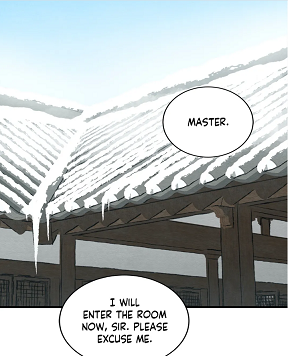
 (chapter 56) The reason for this punishment is simple. He had sent away the artist to the study just before Yoon Seungho regained consciousness. The latter didn’t see that the artist had taken care of him during that night. Thus the butler’s karma was not to notice his master’s departure which stands in opposition to chapter 4 and 98. And note that all these chapters have the paper as common denominator. So imagine the butler’s surprise in episode 4, when he witnessed the artist’s return to the mansion followed by his master. He had sent away Baek Na-Kyum with the hope that the artist would desert the town for good, but no…
 (chapter 23) The first similarity is the allusion to his bag. The butler was actually thinking that during the hunt, the painter would decide to run away. That’s the reason why he asked about his belonging, for in the past, he only wished to vanish after retrieving his tools. Naturally, the artist saw no harm in the butler’s question and answered truthfully. He must have narrated the argument in the courtyard about the poem. Yoon Seungho had kept the sijo, consequently the painter had used his hand to take it back and had by mistake removed the lord’s hat. Thus Kim must have told him that he just needed to apologize. But one might say that this is just a story imagined by me. The manhwaphiles never saw such a scene. But don’t forget the existence of the reflections. I have definitely an evidence for this theory. Since the butler had manipulated the painter in chapter 4 in order to get rid of this uninvited guest, his karma was to receive a new guest!!
  (chapter 7) This is not what the valet truly desired at all. He wanted to live in peace. But now, he had three new people he had to serve: Jung In-Hun, the painter and his own master Yoon Seungho who had lived for quite some time in the Lees’ mansion. He had to work!! And note that in this episode 7, we have the following elements:
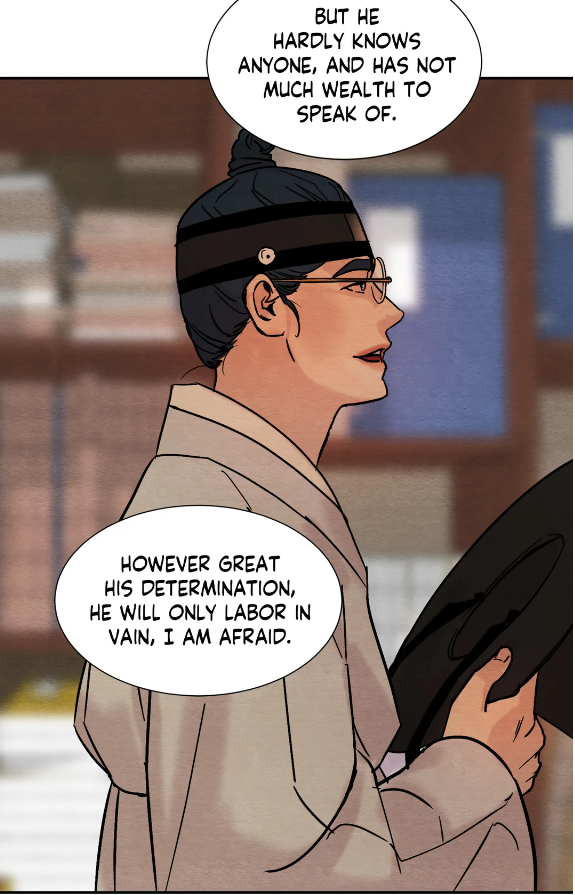
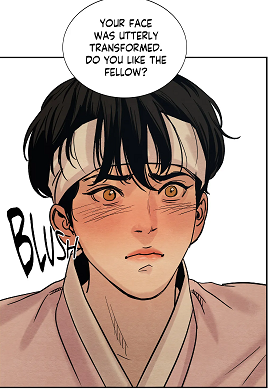
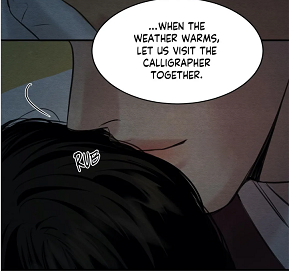
 (chapter 93) It was a futile dream. When I had analyzed episode 93, I had explained that the speech from the main lead was influenced by the butler. As you can see, the lord’s narration
  (chapter 6) There was a switch. That’s how I had this revelation. Heena is the missing link between the learned sir and the protagonist. And observe that in episode 93, we have the same elements again:
 (chapter 93) This time, Heena is the one standing behind closed doors, while it was Yoon Seungho in chapter 77

 (chapter 93) In chapter 99, the noonas still lied to him.
 (chapter 93), which was also present in chapter 4/5, 7 and 67
 /68 and finally 77
  (chapter 55) Who was lord Song’s contact person then? In the past, I used to think that he was the one receiving the letters. But now, I have a different opinion. I believe, it is Heena! Why? It is because Kim couldn’t identify lord Song’s writing. According to me, Yoon Seungho was sent to the gibang in order to entertain the mysterious “lord Song”. Thereby I am assuming that the kisaeng would receive a word from lord Song and have the main lead fetched from the mansion by the black guards. Heena and Yoon Chang-Hyeon are the only ones seen with black guards, I am excluding the main lead, as he was always more or less their prisoner. As you can see, there is a connection between the noona and the Yoons.
 (chapter 68)
 (chapter 69) and in season 3, the noona sent messages to her brother herself. In two different chapters
 (chapter 91), she is related to papers.
  (chapter 64), she was accompanied with 2 guards, which is quite similar to the lord’s situation in chapter 1. That’s the reason why I believe that she didn’t keep the learned sir’s poem. Her betrayal could have been noticed and this was the first time that Yoon Seungho was making such a request.
 (chapter 56) This would follow rule 3. Then according to rule 2 of the kaleidoscope, elements from one episode will be constantly mirrored in the next chapters. And what did we have in episode 19? A larceny… the bottle of wine vanished. Then in episode 20, the lord stole the scholar’s identity, while he stole the painter’s virginity. Hence the lord apologized to the painter for his wrongdoings.
  (chapter 21) And above I had already demonstrated the connection between the First Wedding Night and chapter 5 and 77! Here the lord was imitating the pedophile’s behavior, hence you comprehend why I think that lord Song was the recipient of the poem. I would like my readers to keep in their mind that the learned sir’s sijo was referring to a painful departure, the loss of a loved one and despair! The beholder could have the impression that the author was suicidal due to the mention of the well and the torment of the mind. Thus I am now assuming that the “mysterious lord Song” will consider the sijo as a farewell, the lord chose to commit suicide and his death was related to Jung In-Hun’s curtains. Why? It is because Heena wrote letters to her brother where she accused the main lead of killing the learned sir. Moreover, Yoon Seung-Won had definitely mistaken the painter for the learned sir.
  (chapter 34), and shortly after the painter was sent to the tailor. But during that night, the pedophile and Yoon Seungho had missed each other due to Baek Na-Kyum. He was not dead. So when the painter received new clothes, it was the same for Yoon Seungho. Yet, the pedophile was gravely mistaken. Why? The sijo had been stolen, and as such it was never addressed to the pedophile. Furthermore, it is because the lord was suffering from memory loss. Moreover, I believe that the main lead is not aware of the true identity of his sexual abuser. In his mind, it is just lord Song. But this doesn’t end here.
  (chapter 57) And who was behind this? Black Heart’s friend. But then it came to my mind that Black Heart had stolen the Spring poem… so he could have sent the paper to lord Song and the latter would have mistaken it as a letter from Yoon Seungho, the latter was reaching out to him. He was wishing him luck!! So imagine that when the man arrives in Jemulpo, he imagines that the main lead is waiting for him only to discover that Yoon Seungho vanished. He wished to die because of the loss of a loved one. And that’s how he will recall the poetry of the learned sir… the reflection of this night!!
  , and why she had planned to leave the gibang that night!! She was aware of the arrival of “lord Song”. She knows how cruel and ruthless he can be.
  (chapter 82)
  (chapter 82) It is because he didn’t want to leave any evidence of his intervention. No one should notice that he had paid a visit to the patriarch either. His visit should remain a secret. He was actually afraid of getting detected. The reason is simple. He was fearing the person standing behind Yoon Seungho, lord Song. He had two reasons for this. First, he could see that Yoon Seungho was no longer treated like an animal or male kisaeng.
  (chapter 67) Here, the lord had just insinuated that if something like that happened again, he would go to the authorities. However, since this threat was rather ambiguous, the patriarch Lee could only interpret it that way. The main lead would report the incident to the “mysterious lord Song”, alias the king. And father Lee knew that he could get into trouble. Furthermore, since these elders are all hypocrites and liars, there is no doubt that father Lee feared that the protagonist wouldn’t keep his words. That’s the reason why he approached the father. He hoped that Yoon Chang-Hyeon would intervene and impose his will onto his son. He would tame the main character. In other words, episode 82 is a reflection of chapter 4/5, 19/20/21, 67/68 and 77. The first common denominator is the allusion to letters. The messenger’s words revealed that Kim had contacted the elder Yoon, for he already knew his name, though the latter had never met the domestic. Secondly, the “letters” were delivered orally:
  (chapter 82), and even in person: Father Lee and the emissary. Third, the elder Lee badmouthed Yoon Seungho by mentioning the incident from chapter 67, and refused the invitation of his host
  (chapter 82). Finally, he called Baek Na-Kyum a peasant exactly like the main lead in front of the gate:
  (chapter 82). But more important, the old bearded man expressed this fear: the loss of his family home!
 (chapter 82) And remember that I had detected the presence of the Lees’ mansion in episode 4 and it was also present in chapter 21 and 67! And what had the butler done during these chapters? He had tried to chase away the painter and as such Yoon Seungho. The latter was not supposed to live in the Yoons’ domain. And this will be the Lees’ karma to be driven out of their own house!
  (chapter 83) It vanished, and as such it was stolen. Did the mysterious lord Song take it away in order to force Yoon Seungho to paint? The older version of this scene:
  (chapter 1) The paintings were illustrating that the pedophile was having sex with a minor.
 (chapter 89) The lord’s back is covered with marks. Yet, he was not brown-nosing here at all, for he was rejecting the lord’s advances. And now, it is time to take a closer look to season 1.
  (chapter 23) Baek Na-Kyum was seen holding an apple, here it looked like he was indeed polishing the fruit before eating it. Striking is that during that scene, valet Kim was interrogating him. He was acting, as if he was interested in him. It was, as if he was buttering up to Baek Na-Kyum. The purpose was to gain the artist’s trust so that at the end, he would listen to his advices.
 (chapter 23) However, the reality was that the valet was actually digging for information, spying on the main lead, so that he could create a new incident. As you can see, there were two apple-polishers in that scene, the painter and the butler. This was the reflection within the same episode. While Baek Na-Kyum was literally polishing the apple, the other was just cajoling Baek Na-Kyum in a figurative way. Yet, the former was not truly sweet-talking to the artist. He gave the impression that he was totally honest. And now, it is important to recall what happened to the painter in the next chapter. Jung In-Hun was kissing the painter’s hands.
 (chapter 24) In other words, he could never lower himself in front of the low-born. This was too much, explaining why the scholar failed with his request.
  (chapter 27) In exchange for saving Jung In-Hun’s life, Baek Na-Kyum was forced to do a fellatio. We could say that the artist was sucking up to the owner of the mansion. But the fellatio is not just an exchange of favors. It is also associated to forgiveness. At the tailor’s shop, the painter had blushed because of Yoon Seungho, The latter had embarrassed him. Thus the lord made the following suggestion:
 (Chapter 39) This was his way to apologize, though here he was teasing his lover. These were the principles he had been taught, therefore it is not surprising that he applied them for the painter. And now, you comprehend why in episode 71, Yoon Seungho sucked the painter’s phallus in the bathroom, he was also currying the artist’s favors. His goal was not to be pushed away, to be accepted.
 (chapter 71) He had wronged the painter so many times, that the blow-job was not enough. Thus he licked his ass in the bedchamber. He was hoping to seek his forgiveness.
  (chapter 71) It was, as if he was lowering his head, the kowtower. In this episode, the lord was on his knees in front of the painter, and this twice. One in the bathroom
  (chapter 71) and the other time in the bedchamber.
  (chapter 71) However, his nose didn’t get brown, as the painter is a pure and innocent person. 😉 That’s how I realized why Baek Na-Kyum was sent to the bathroom. His role was to divert Yoon Seungho’s attention from Kim so that the master would forget to ask for the butler’s punishment. In other words, the valet used the low-born to seek his master’s favors. This shows that Yoon Seungho had been taught that the blow-job and the ass-kissing are the means to obtain forgiveness.
  (chapter 73) He was licking the painter’s foot so that he could keep thrusting. Don’t forget that during the whole night, he behaved like a servant… the one who was “sucking up to Baek Na-Kyum”.
  (chapter 72) On the other hand, the latter scratched the lord’s back for the first time during that night.
  (chapter 72) This was the reflection within the same episode, yet the “back-scratcher” was not doing it for his personal gain at all. We couldn’t say that he was currying favor or buttering up Yoon Seungho. He believed that he was just a servant and nothing more. From the outsider’s perspective, he was treated indeed like a favored servant, though in truth Yoon Seungho viewed him more like his new master and lord.
 (chapter 45) In this scene, the lord was acting like a teacher, and the painter was supposed to do a blow-job in exchange for a favor. But since the painter was heartbroken, he was doing it absent-mindedly. Thus the roles got switched. After the noble licked the painter’s ass,
  and masturbated him anal, the painter was able to confess his pleasure:
  (chapter 45) This shows that the lord was slowly “currying favors” to Baek Na-Kyum. And this is no coincidence that Kim brought the ink and brushes to the mansion.
  (chapter 45) Once again, he was acting, as if he was buttering up to Baek Na-Kyum and indirectly to the host. But the reality was that everything was done for Kim’s interest…. On the other hand, we could say that Yoon Seungho was not really different from his surrogate father, for in that scene, Yoon Seungho was more thinking about himself than the painter’s. Yet, there is a slight nuance, the lord was sensing that the painter was not himself. He was talking to him, so licking the painter’s ass was not just done in order to obtain the painter’s support. His true goal was to be noticed and looked by the painter. He desired to have a true exchange of thoughts. Interesting is that by licking briefly the painter’s ass, he indeed succeeded, Baek Na-Kyum started thinking about him afterwards. The irony is that Yoon Seungho was just applying what he had been taught. That’s how I discovered the other reason why the main lead is not suspecting the butler of treason. Contrary to Yoon Chang-Hyeon or the pedophile, Kim was never seen asking Yoon Seungho for sexual favors: no fellatio or no ass-kissing. But this is just a deception, for we could clearly see that the butler is connected to the sex parties:
  (chapter 33)
  (chapter 52) He was the one who separated the couple. Because of his intervention, the painter deserted the mansion and got sick afterwards. Then in chapter 50, he revealed the argument between Baek Na-Kyum and Jung In-Hun. Striking is that in that scene, he was standing on the lord’s left side!!
  (chapter 50) No wonder that Yoon Seungho got furious. Simultaneously, while Kim was acting, as if he was defending the painter’s interest and as such feeling sorry for the painter, this signifies that he was no longer sucking up to his own master. Therefore, it is not surprising that the lord scolded him.
  (chapter 50) In fact, he should have “buttered up” his master and not pitied the painter. And now, you comprehend why the main lead misinterpreted Kim’s behavior. In his mind, the valet was actually “apple-polishing” to the painter. He had somehow “witnessed” it in the woods. But he had misjudged the situation, in reality he had caught Kim spying.
  (chapter 23) Unfortunately, the lord was not perceptive at all.
 (chapter 80) He enjoyed seeing the painter’s facial expressions and reaction. He looked so shy and pure.
  (chapter 80) However, during that night, three people were trying to bootlick someone figuratively speaking: the new version of Deok-Jae, Kim and the messenger. Let’s not forget that before the arrival of the messenger, the painter made the following request to the butler:
  (chapter 79) One might say that he was currying favor to the butler, when he asked the butler about the music box. But what did Kim do? He brought the item to the bedchamber.
  (chapter 79) But this is not what the painter had actually requested, since the butler said this “I thought”. He had taken the initiative on his own. In my opinion, the painter had just asked that the music box should be brought back to the study. However, Kim brought the expensive present to the bedchamber for one reason. He expected the arrival of the messenger. We could say that he was “ass-kissing” the painter in order to obtain his trust. Kim definitely imagined that Yoon Seungho was sleeping. As you can see, this scene was the reflection of Yoon Seungho’s action in chapter 80.
  (chapter 80) While Kim had asked the painter’s to clean his face himself, the lord was cleaning the painter’s ass himself. Or we could say that he was polishing the painter’s apples, for he has an apple-shaped buttock. 😂 This clearly indicates that Kim has never washed Yoon Seungho himself. In other words, while Yoon Seungho was totally selfless here, this was not the case for the valet. And this is no coincidence that right after, the new version of Deok-Jae appeared in front of the door calling his master. He was faking loyalty and dedication.
  (chapter 80) Here, he was acting, as if he was sucking up to Yoon Seungho, but his gaze betrayed him. In my opinion, he had been deceived by the butler, for the latter expected that the painter would open the door. This situation was reflected within the same chapter. Notice what the messenger said to the young master in the study:
  (chapter 80) He was implying that his father had to bootlick an official in order to hide the incident. And how did the lord react to this? He not only asked the servant to do him a fellatio, but also made an allusion to the sexual favor:
  (chapter 80) His father must have kissed someone’s ass. But as you already know, Yoon Chang-HYeon is not someone who will do such a thing himself. And this shows that he has definitely used his son in order to obtain favors in such a way. Yoon Seungho had to do fellatios and let people lick his ass for his father’s sake, as he was a uke in the past. This is not surprising that the messenger received such a beating in the end.
 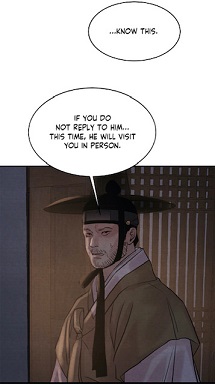 (chapter 80) He gave an order to the main lead, he threatened him. But actually, he was just a servant. He was not treating Yoon Seungho correctly. Interesting is that he showed more courtesy and respect to lord Lee than Yoon Seungho.
  (chapter 82) It was, as if the man was hoping to obtain father Lee’s support either. Another interesting aspect is that when the butler approached the wounded emissary, the former was definitely brown-nosing.
  (chapter 82) In my opinion, Yoon Chang-Hyeon had followed the butler’s suggestion. Since the painter would always sleep in the study alone, he envisioned that the messenger would suggest to the artist to meet Heena. The man could fake that he had been sent by his noona. He was dressed up for that reason!! Observe that the color of the hanbok is similar to this one:
  (chapter 82) This means that if father Lee or Yoon Chang-Hyeon are cornered, they could be forced to “ass-kiss” the king.
 Baek Na-Kyum is now imitating his lover. He is also licking the lord’s boot/foot. However, contrary to the signification, he is actually making love to his companion. This has nothing to do with selfishness and hypocrisy. We could even say that at the end of season 3, Yoon Seungho had become the teacher’s pet, the yes-man towards Baek Na-Kyum:
  (chapter 92) He could never refuse his lover’s requests. Thus in the gibang, he encouraged the painter to stay in the gibang.
 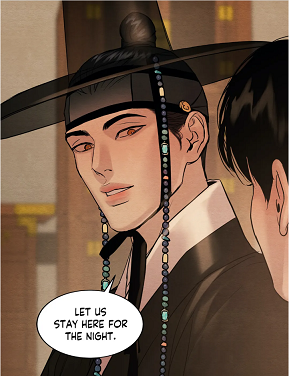 (chapter 93) It was, as if he was seeking the kisaengs’ support. Thus he chose leniency towards these women, though the latter had insulted him. At the same time, he was not hoping to receive any flattery from the noonas. He was the one “sitting on the painter’s right side”.
  (chapter 93) To conclude, the lord had been “tamed”, he was apple-polishing Baek Na-Kyum, but not in a negative way. It is the positive reflection of Kim who will act behind people’s back, and definitely use sex for his own advantage. We have the perfect example with the 2 sex marathons. He always let the painter suffer in order to cover up his own wrongdoings. But by allowing the main lead to act this way indicates that he was not helping Yoon Seungho. What people thought as assistance was in truth “brown-nosing”.
 (Chapter 95) In his eyes, the lord didn’t need it, for he was already aroused. Remember in the beginning of the story, Lee Jihwa had to prepare his lover
  (Chapter 3) Secondly, the painter was in the position not to ask for favors, to suck up to Yoon Seungho. In their relationship, the low-born had the upper hand. Finally, Baek Na-Kyum had done nothing wrong before, so he didn’t have to beg for the main lead’s forgiveness. That’s the reason why the lord was actually rejecting the blow-job!!
  (Chapter 95) It is the expression of affection and love.
  (chapter 101) The painter had to do a fellatio to lord Jang in exchange for protection.
  (chapter 101) The artist was not acting like the teacher’s pet,
  (chapter 101), hence he needed to receive some lesson. In their eyes, Baek Na-Kyum should have licked their boot, sucked up to them… due to their power and social status. Therefore, it is not astonishing that at the end, they were executed. Why? It is because Min and the others could never “curry Yoon Seungho’s favor”.
  (chapter 102) Without the painter, the lord had no reason to continue living. Baek Na-Kyum was his source of joy and of strength. Without him, he was powerless. And this leads me to the following observation. Since we have a situation of brown-nosing concerning Black Heart in the shaman’s house, this signifies that we should have a reflection earlier in season 3. And now look at this:
  (chapter 92) In that scene, Min was indeed “flattering” his ex-sexual partner, while he was rather dismissing the painter.
  (chapter 92) He was also indirectly currying the lord’s favor. This was the reflection of the night in episode 52 either. However, contrary to season 2, Yoon Seungho had the upper-hand, as the painter had already sided with him. But one might say that this perception of “apple-polishing and buttering up” stands in opposition to my previous statement: sex is like a battle, a fight where there is only one winner. But that one doesn’t exclude the other, since Min had also tried to eliminate Baek Na-Kyum before changing his mind. This truly shows that we had two different philosophies, yet both were evolving around sex. This truly outlines that someone was “consumed by lust” in the end.
  (chapter 86) Since the lord could see through Jung In-hun’s true personality, I believe that it is the painter’s duty to grasp the valet’s treason. In my opinion, since he caught Kim having sex with the maid, it is only a matter of time, until he realizes his true personality. In chapter 77, valet Kim had thought that he could rekindle with the owner of the mansion, hence he brought him tea and the medicine. He envisioned that if he acted like a loyal and dedicated servant, he could regain Yoon Seungho’s support.
  (chapter 77) In other words, he was buttering up to the young master. But observe that in that scene, he never lowered himself in front of the young man. He didn’t go on his knees or he didn’t bow to him either. This attitude exposes the valet’s true personality. He considers himself better than Yoon Seungho and Baek Na-Kyum, refusing to admit any crime or mistake. In that scene, he never said YES! In fact, he kept contradicting his master.
  (chapter 86) He envisioned that his elder son would return him the seat and as such he would become the owner of the family mansion again. Why? It is because of the main lead’s words in the library. His so-called respect towards the father was just fake. That’s the reason why the father imagined that he just needed to show up and he would get the mansion back. However, in reality, he should have sought his son’s support, and as such kiss his ass in order to achieve his goal. But the man has never done it himself. He has always been used to being fawned and ass-kissed that it is not surprising that he barged in the mansion. And this is the same for Yoon Seung-Won. The latter might have sent letters in order to obtain his brother’s support, but we can’t say that he was sucking up to Yoon Seungho. Thus it is no coincidence that at the end, the latter advised his brother to follow the father’s principles.
  (chapter 37) Here, he was implying that Yoon Seung-Won should do fellatios and other things in exchange for favors.
 (chapter 73). But keep in mind, this is related to the painter’s education. He had been raised not only to hide his homosexuality, but also to reject sexuality as such. Naturally, in reality a no means no and nothing else.


 The painter’s mouth is wide open. This implies that the painter is laughing! In other words, these pictures are showing a happy Baek Na-Kyum. The laughter is not just a symbol for joy, but also an indicator for social bonding, cooperation and as such social acceptance. Note that in all these scenes, the painter is not laughing alone. He is either facing his lover and the “witnesses” of his marriage.
  (chapter 87) Naturally, this vision reflected the past due to the presence of the noonas. But if you read my previous analysis, you are aware that the painter’s nocturne visions are always composed of three elements: memory, nightmare and desires which will come true at some point. The readers will certainly recall the painter’s wish in the bedchamber:
  (chapter 81) However, here again, this was not real, for he was imagining it. He had restrained himself, for he felt that his actual life was like an illusion. It was too good to be true. Thus I conclude that in both visions, the painter wished to laugh and as such to be happy. And this observation led me to the following deduction. In season 4, the manhwalovers will witness Baek Na-Kyum’s laughter. But this doesn’t end here. All the quoted pictures share another similarity which is the absence of the sound!! There is no HA, HA, HA…. Thus I deduce that in season 4, the readers will even hear Baek Na-Kyum’s laugh!! 🤣
 (chapter 1). His mouth was exposing his emotions: happiness. It was, as if he was laughing internally out of joy. Then in the pavilion, the author let us hear Yoon Seungho’s laugh, while we couldn’t see his face.
  (chapter 25) As you can see, Yoon Seungho was not truly seen “laughing”. This is what we saw right after:
  (chapter 25) Either the sound was missing, or the readers couldn’t see his open mouth. Then in chapter 51, Byeonduck created an ambiguous situation.
 (chapter 51) Who was laughing here? The main lead or Min recognizable with his green hanbok? This confusion was deliberate. It was to give the impression that the lord had moved on, he was not missing his partner. This image served to divulge the reality: this happiness was fake. Another interesting aspect is that we couldn’t see the lord’s mouth, for it was too far away. It was more or less drawn from the painter’s perspective who was walking in the courtyard.
  (chapter 51) The purpose of this trick was to deceive the painter, Yoon Seungho would no longer care for him. However, this trick didn’t work out like imagined due to the maid’s words. She wished that he would remain in the mansion. But let’s return our attention to the laugher in this panel. I would even add that there was no real social bounding, for Black Heart was enjoying about Yoon Seungho’s misery and loss. He believed that the painter had died. And if it was Yoon Seungho who laughed, then this was to mask his pain. Then in chapter 70, he was caught laughing. And observe that the author separated the sound from the face:
  (chapter 70) Yoon Seungho would even hide his face from the painter, as he was looking down. His laugh was barely perceptible, and when the author revealed his face, Yoon Seungho used his hand to mask his smile.
  (chapter 70) It was, as if Yoon Seungho was not allowed to smile or to laugh at all. I would even go so far to say that laughers were actually forbidden in the mansion. Striking is that in season 3, for the first time, we could see and hear the lord’s laughter contrary to season 1 and 2..
  (chapter 78) This illustrates the progression of the lord’s healing. He was getting happier, and he would interact more and more with people. Yet, in this scene, the lord’s laughter was not loud contrary to the one in the pavilion. Then in the gibang, his laugh was also fake, for he was masking his pain.
  (chapter 93) Thus the author didn’t let us see his mouth once again. But the painter could see the difference between a sincere laughter and a fake one, as he had already heard and see the lord’s true laugher! Because the lord laughed in all 3 seasons, I could only assume the painter’s laughing in season 4. But I have another proof for this prediction. In season 3, the painter’s laughter was shown in visions (chapter 81, 87) or through the testimony of the maid.
  (chapter 91) However, the manhwalovers have to envision that, when he caught the pervert with the maid together, he was totally embarrassed. Hence his laugh was fake! In other words, I am doubting that he truly laughed. That’s the reason why Baek Na-Kyum denied to find the situation funny.
  (chapter 91) As a conclusion, expect a picture with Baek Na-Kyum ‘s laughter reflecting his happiness and sincerity. And this is definitely related to his marriage:
 (chapter 102) There is no HAHA, this shows that this situation is not funny. Yet, Black Heart is still smiling, he is even explaining that they were just playing. However, this smile is totally fake, for he is already scared. Hence he is stuttering. Moreover, he is trying to downplay the whole situation, as he describes it as a game. But the closer Yoon Seungho got to him, the more the villain got scared.
  (chapter 102) On the other hand, Black Heart’s mouth remained wide open, but it slowly exposed his true emotions. As the manhwalovers can detect, the sound “Haa,” is not expressing joy or happiness, but huge anxieties. Thus I couldn’t help myself thinking that in season 4, the painter’s laughter will be reflected with the heavy breathing from fear and pain. Someone will have a mouth wide open out of fear!! And this connection was already present in chapter 1:
  (chapter 1) Baek Na-Kyum and Yoon Seungho had both flashbacks
  (chapter 66), while Min was smiling. He was internally laughing, for it found it entertaining. [For more read the essay HAHA Flashbacks”] And this fear was exposed by the sound: HAA
  (chapter 99) But this doesn’t end here.
  (chapter 84), but in the gibang, he dropped this habit for good:
 (chapter 96) This connection between pain, pleasure and laughter appeared in chapter 91, as the story is based on the following rule: there is always a reflection within the same episode. I would like the manhwaphiles to observe this image:
  (chapter 91) Here, the lord had changed position provoking pleasure to the artist. Before, the maid had laughed so loudly in order to get the painter’s attention.
 (chapter 91) According to my interpretation, she hoped that Baek Na-Kyum would discover the existence of the kisaeng’s letters so that the painter would feel betrayed by Yoon Seungho. He had ordered to hide the correspondence. But for that, she needed to explain the reason for her loud laughter. Hence she revealed the incident with the pervert. The irony is that due to his pleasure and embarrassment, Baek Na-Kyum didn’t pay attention to her words. He already felt ashamed, after the servant had exposed the situation in the bathroom.
  (chapter 91) Thus he avoided his lover’s gaze. And note that in chapter 25, the lord laughed, before he raped the painter.
 (chapter 37) and the one from Dong-Yi. The absence of the sound. Moreover, the manhwalovers can not see the mouths from the victims either. The torture was already finished, for they had removed the tools and the „suspects“ were covered with blood. And this leads me to the following observation. The author selected a perspective from far away, and didn’t add the sound on purpose. This shows that the pedophile was not present, when the torture took place. He only arrived afterwards. This exposes his cowardice. Secondly, since I had outlined that the author had separated the sound (HA HA) from the lord’s mouth concerning the laughter, I am quite certain that she will use a similar processes for the torture. Naturally, I am also assuming that torture from the past could be slowly revealed. Consequently, my prediction is that the negative reflection of the painter’s laughter will be the yelling combined with fear and pain. This signifies that people will suffer in season 4 and probably die. Another evidence for this prediction is that the author often focused on the characters’ mouth. And this is what we have:
  (chapter 77)
  (chapter 86)
  (chapter 99) Despite the “torture”, he still claimed that Yoon Seungho was no murderer. Thus I conclude that in the next season, it should be the reverse. Yoon Seungho has to make a new leap of faith believing in the painter’s innocence and purity. Hence I am expecting an arrest in season 4. Finally, we shouldn’t overlook that each word Yoon Seungho said became the truth, so when he stated this
  (chapter 65), he was already warning the sister. She could face human justice. However, this idiom suddenly caught my attention: “the wrath of humans”. It can be a reference to the authorities, but also to the inhabitants. The latter could get infuriated by the police work and put the officers under pressure or in the worst case, the inhabitants could decide to do their own justice: lynch mob. According to me, many commoners died in season 3. Hence this could upset the town folks who would ask for real justice. And if Yoon Seungho’s fiancée is acknowledged by them, then it will be impossible for the pedophile to use the authorities to achieve his goal, separate the couple and hide his own crimes. Thus his last puppets will have to take the fall. Another important aspect is that when Yoon Seungho warned the kisaeng, Kim was also present, though he still remained in the background.
  (chapter 68)
  On the other hand, when these persons got tortured, they closed their eyes out of agony,
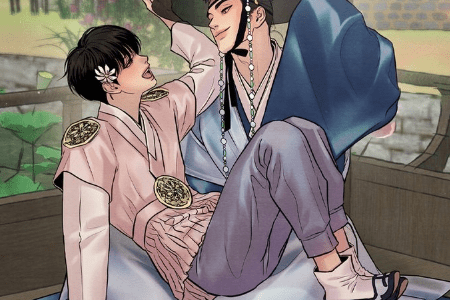
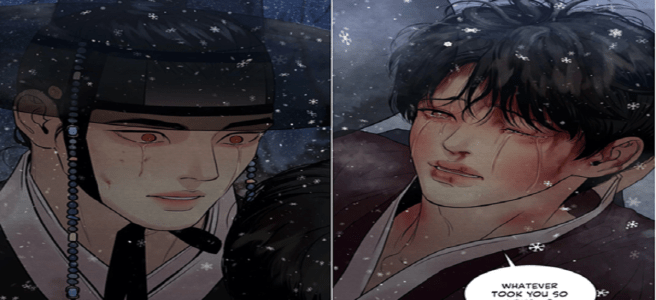
 Bebebisous33s' analyses in K-Dramaland and Manhwas