
This is where you can read the manhwa. https://www.lezhinus.com/en/comic/painter But be aware that this manhwa is a mature Yaoi, which means, it is about homosexuality with explicit scenes. If you want to read more essays, here is the link to the table of contents: https://bebebisous33analyses.wordpress.com/2020/07/04/table-of-contents-painter-of-the-night/
It would be great if you could make some donations/sponsoring: Ko-fi.com/bebebisous33 That way, you can support me with “coffee” so that I have the energy to keep examining manhwas. Besides, I need to cover up the expenses for this blog.
1. The significance of communication
In the essay “Respect and love” I demonstrate that both protagonists aren’t honest to themselves, exposing their lack of self-respect. This is one of the reasons why they keep disregarding each other. While they are hurting each other, they force each other to question their own action and words simultaneously. Hence the readers are witnessing their transformation. Little by little, the protagonists mature and turn into adults. They become more responsible. Their growth coincides with the development of attachment and the realization of their affection. At the same time, this evolution is strongly intertwined with the painter’s sexuality. The latter is making his first sexual experiences, which leads him to slowly accept his homosexuality. Yet he still fears his own strong libido and as such his love for the noble. Therefore till chapter 68, the artist is still dishonest with himself. As the manhwaphiles can see, the painter’s honesty is linked to respect and love. Striking is that both values are dependent on communication.
- “Love without communication is impossible”. from Mortimer Adler
- “Much unhappiness has come into the world because of bewilderment and things left unsaid.” from Fyodor Dostoevsky
2. Communication and relationship
With these quotes, it becomes obvious that communication represents the foundation of a good relationship, where there exist respect, love and trust. Silence or lies stand in opposition to communication, because they create a false perception or an illusion. Since manipulators employ lies by commission or omission, the latter can be judged as weapons. Moreover, unsaid things and deceptions display a lack of trust. That’s why the relationship between the noble and the low-born can only stabilize, the moment they talk to each other properly. Once Yoon Seungho and Baek Na-Kyum reveal their true thoughts and emotions to each other, they not only show trust, but also can discover the true personality of their lover. However, if you pay attention to the evolution of the story, you’ll observe two details:
- Yoon Seungho is the one who keeps talking, revealing his desire to exchange thoughts with the painter. This explicates why the lord was so hurt in chapter 49.
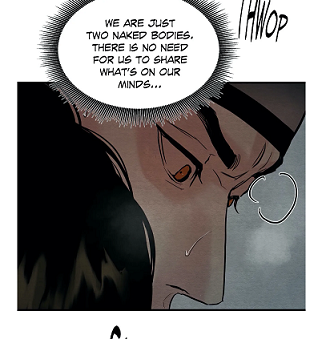 He wanted to communicate (“share what’s on our mind”) with the low-born, but the latter refused, because he just considered the noble as a sex toy to procure him pleasure out of fear to get hurt and deceived again.
 - The painter is only opening up once confronted with sex and his own sexual desires.
3. Words, sex and its impact on relationship
Now, I would like to elaborate more these observations, hence I will start with the first chapter as illustration. The manhwaphiles should remember that at the tavern, Yoon Seungho was very talkative.  (Chapter 1) He expressed his genuine admiration for Baek Na-Kyum’s talent and creations. Yet, at no moment the painter noticed the compliments. He had been forced to touch the loins, which shocked him, and then he remembered the lord’s bad notoriety. Therefore all the lord’s good words fell on deaf ears. The painter was more concerned with appearances and rumors than anything else. That’s why the conversation failed. Since Baek Na-Kyum was not interested in the main lead’s feelings, he feigned ignorance first, and lied at the end.
  Striking is that their first conversation was connected to books and sex, therefore this already limited their exchange. Moreover, this first chapter clearly reveals the lord’s interest in the low-born. He not only sent a domestic for the investigation about the mysterious creator, but also asked about his recent whereabouts. And curiosity usually initiates a conversation. But there’s more to it. From my perspective, the main lead felt no longer satisfied with the erotic pictures. He wanted to share his emotions and thoughts, when he looked at them. However, he had no one to talk to, so in his mind, if he met the artist, he could come into a conversation with the creator. That’s why he wanted to invite him in the end. The painting of sex sessions would give him the perfect occasion to discuss with someone.
And observe, when the first session starts, he can’t help himself talking to the artist, while Jihwa remains silent, as he doesn’t pay attention to him. If you read the story again, you’ll sense the master’s strong desire to communicate. When the painter arrives in the bedchamber in chapter 8, the lord welcomes him warmly with a huge smile and speech.  (Chapter 8) Observe the contrast. The main lead doesn’t reveal his anger towards the noble with the mole, it is not worthy for Yoon Seungho of giving him an explanation for the humiliation. He just smiles
 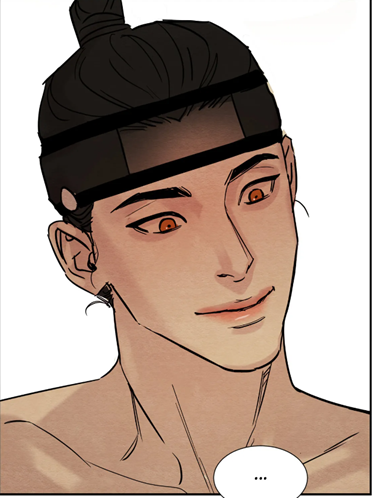 (Chapter 8) before grabbing him by the topknot. His words and behavior truly display a huge respect and a desire to exchange thoughts and observation.
Moreover, when the master is not talking during the sex sessions, then he is in a locked gaze with the artist. (Chapter 8) This mirrors the noble’s need to talk and now, you understand why the main lead had to evict the aristocrat with the mole in the end. By requesting to send away the commoner,
 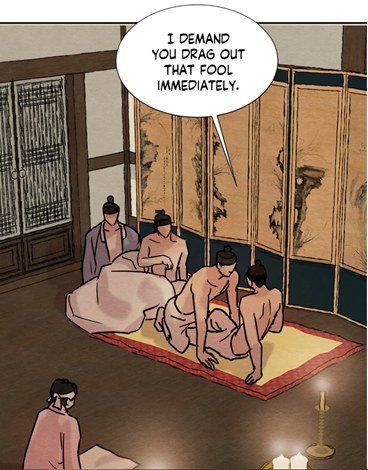 (Chapter 8) he was more or less asking from the host to remain silent.
 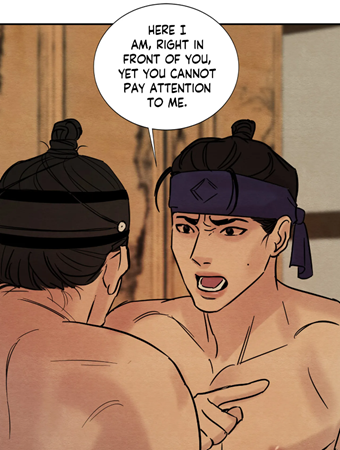 (Chapter 8) The latter just had to focus on the guest’s sexual desires which confirms my interpretation that the main lead is treated like a head-kisaeng. Since the noble showed him no respect, then the main character didn’t need to respect him either. But more importantly, the protagonist made sure that he would be treated the same way. He also wouldn’t listen to his words, because the noble with the mole didn’t want to hear him speaking either. Therefore the door is closed, before the man can protest. As a conclusion, the aristocrats only visited him for sex or other pleasures and nothing more, while the noble had to remain quiet. Hence we have a silent main lead in his relapse:
  (chapter 52) However, even here the manhwaphiles can notice the transformation. The guests are no longer here for sex, just for smoking opium and drink wine. That way, the noble doesn’t feel lonely.
And Jihwa was not different from the others. Like Yoon Seungho described it to father Lee, 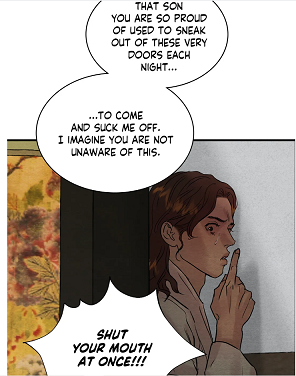 (chapter 67) the childhood friend would only visit him during the night (“used to”). However, it changed the moment the main lead paid a visit to the red-haired noble early in the morning (chapter 3). After that, Jihwa realized that he could also go to his friend during the day (chapter 5
  and 12
  ). And now, you comprehend why the lord questioned his presence in the morning and why he assumed that his visit was related to sex in the end. It looks like Jihwa never showed an interest in the lord’s thoughts and emotions too. And there exist two reasons for that. First, he had the impression he knew everything about his lover.
 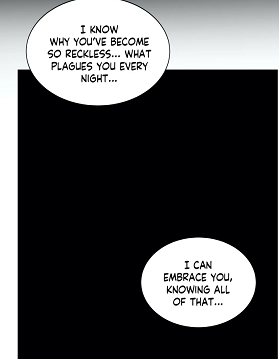 (Chapter 57) Secondly, there was a risk that the main character could talk about the past and as such mention Jihwa’s betrayal. The lord’s emotions (sadness, anger, pain) represented a huge burden to the red-haired master.
 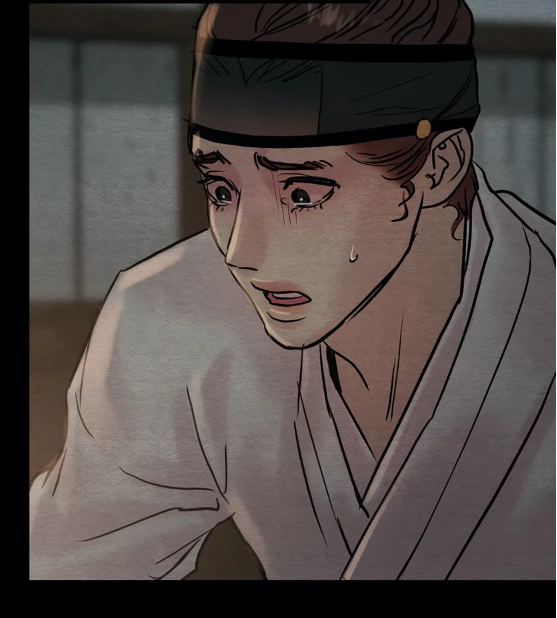 (Chapter 59)
This illustrates that the lord was never allowed to express his thoughts and emotions, until the artist arrived at the property. And now the readers can comprehend why Yoon Seungho said this in chapter 18:  (chapter 18) Thanks to the artist’s presence, Yoon Seungho had been able to talk and people would actually pay attention to his presence and words. They started listening to his words. Imagine, one word and the straw mat beating was stopped:
 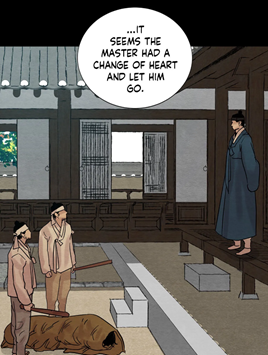 (Chapter 13) No wonder, why he thanked the painter in chapter 18. He could only be happy, when he confronted his childhood friend, as there was a real exchange for the first time.
  (Chapter 13) Argument is also a form of communication, and it happens between people in a relationship. Not only his words were finally noticed, but also he was able to draw lines to Jihwa.
  By influencing the host with the hope, Yoon Seungho would send away the painter, the childhood friend didn’t recognize that he was attempting to turn the protagonist into a puppet, therefore he could only fail. Moreover, Jihwa had no idea that Yoon Seungho’s true desire was to get close to someone, to engage a honest conversation. Therefore the main lead could only reject the friend’s words and proposition. As a conclusion, with the painter’s arrival, the lord’s words were little by little listened, he was able to communicate more with others: Jihwa, the nobles and the staff. After scolding the maids in the kitchen
  (chapter 38), the head-maid started showing her respect to her lord. But more importantly, he gave her the order personally to bring the painter’s lunch to his study.
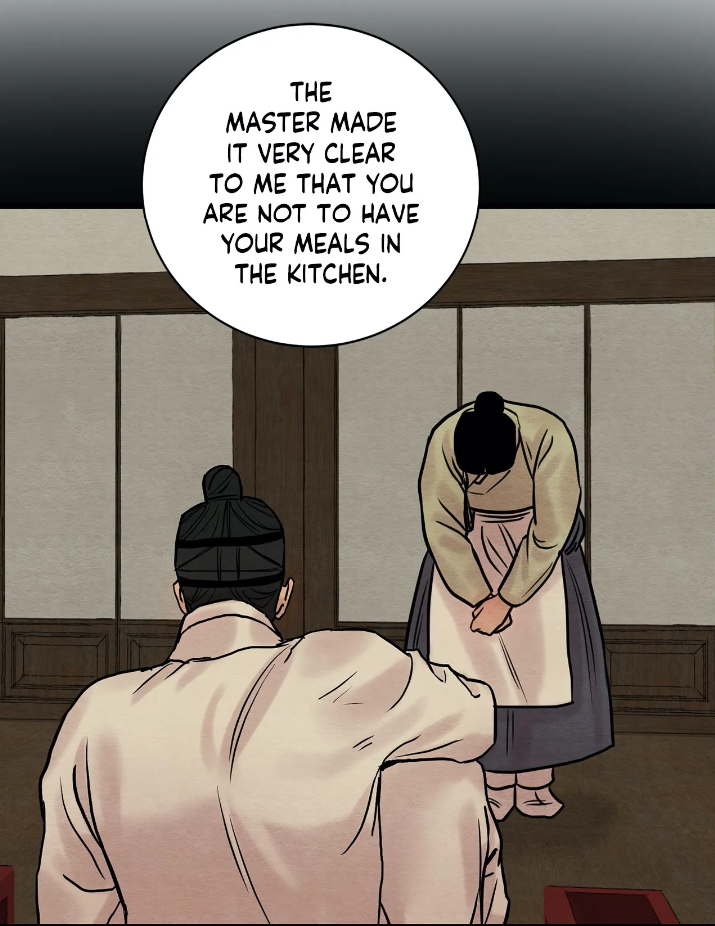 (Chapter 46) He could finally voice his thoughts, everything happened thanks to the painter. This explicates why Yoon Seungho kept seeking the artist’s proximity, although the latter kept rejecting him (his escape, his lies, his refusal to paint for him etc…). He had realized that his living conditions had improved despite the struggling with the low-born.
His strong desire to communicate exposes that he had no companion by his side. In my opinion, Yoon Seungho justified his existence as a free spirit in order to hide his loneliness and emptiness. It was his explication why the nobles and Jihwa wouldn’t listen to him and disrespect him. Yet, the real cause for this situation was his traumatic past, where he had been forced to silence. Moreover this explains why he never paid attention to intruders in the end. He didn’t have the impression, he would truly live in that mansion. Besides, because people were supposed to visit him during the night for sex, then he was never expecting visitors during the day. Hence he spent his days smoking in front of the window.  (Chapter 5) This outlines the main lead’s isolation and loneliness. Simultaneously, with this new approach, the readers grasp why Yoon Seungho couldn’t anticipate to become Min’s target in the end. He noticed Black Heart’s envious gaze
 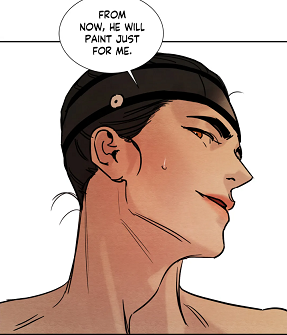 , (chapter 8) but he didn’t envision what jealousy and greed would provoke. In my eyes, he couldn‘t identify these emotions properly.
The problem is that Baek Na-Kyum refused to converse with the lord. In chapter 4, the artist didn’t allow the main lead to express his opinion about the plagiarized poem. 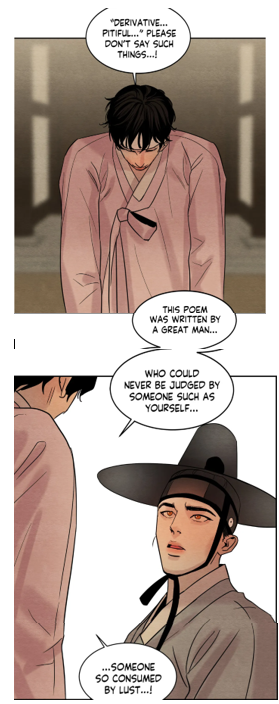 (Chapter 4) He was not worthy to comment this poetry, as he was just a man consumed by lust. However, the commoner never asked why the noble would judge the poem so poorly. He already assumed that he was just making fun in order to humiliate the scholar, while in reality the noble wanted to reveal the author’s true personality: Jung In-Hun was just a deceiver. And since he had been hurt by the painter’s comment, he retaliated too: since he was just a commoner, he had no right to criticize the lord.
And now, it is time to focus on the second aspect: Yoon Seungho and Baek Na-Kyum only started communicating properly through sex. The reason is simple: the painter was only honest, when his unconscious revealed his true desires. Right from the start, the artist was sexually attracted by the lord, but he kept denying it. However, the aristocrat did notice the painter’s genuineness in the sex sessions, which could only reinforce his strong attraction towards the low-born. He loved his art, and now he saw that someone was truly perceiving him.  (Chapter 2) Baek Na-Kyum was the first who made the main lead realize the existence of his body. For the first time, he felt attraction through the gaze and saw something beautiful in himself. And what was the lord‘s immediate reaction? He started talking about his thoughts, though this was more a monologue than a discussion.
 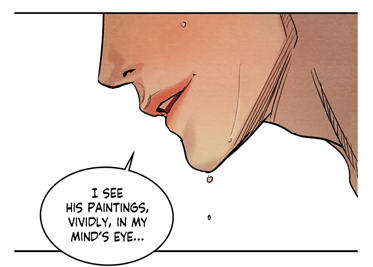 (Chapter 3)
 (chapter 3) Exactly like the painter, Yoon Seungho began talking while having sex. He even formulated his first desire in front of his childhood friend:
  (chapter 3) And now, you comprehend why his relationship with Lee Jihwa was doomed to fail. The red-haired master was more focused on sex and his own sexual emancipation than his lover‘s well-being.
 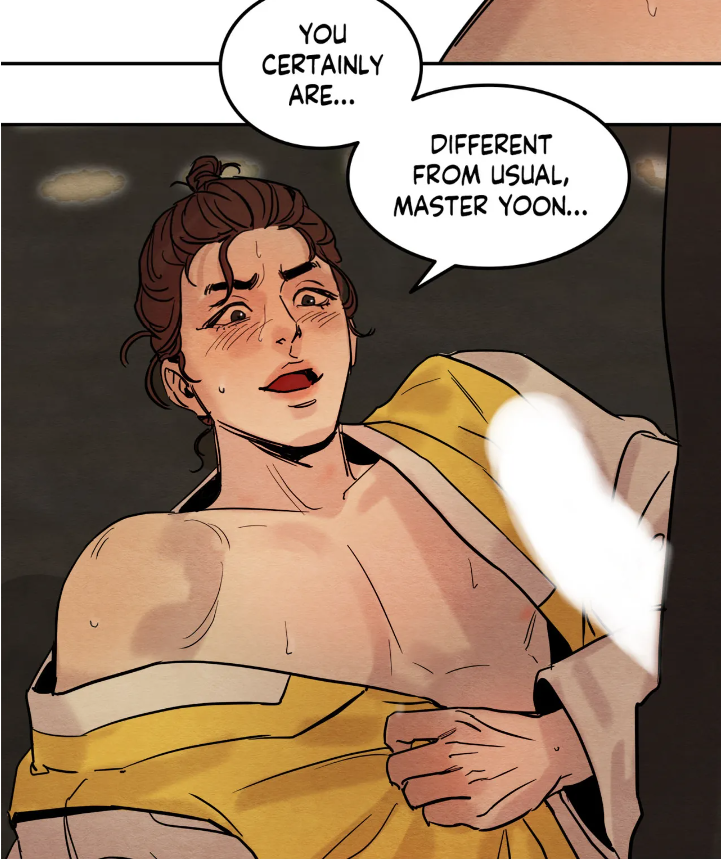 (Chapter 3) He never asked him why he was behaving so differently. He didn‘t notice that the lord was more communicative.
4. The first real conversation
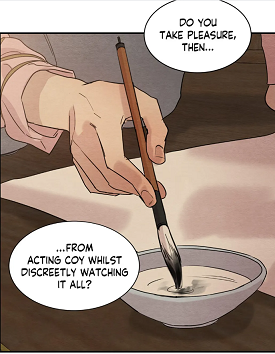
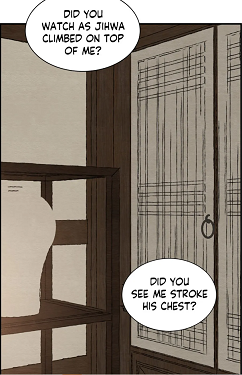
But let’s return our attention to the main couple. The real conversation between Yoon Seungho and Baek Na-Kyum only starts in chapter 16. Nonetheless, the only one talking is Yoon Seungho. He keeps asking questions about Baek Na-Kyum’s sexuality, waiting an answer from the artist:
1. 
2. 
3. 
4. 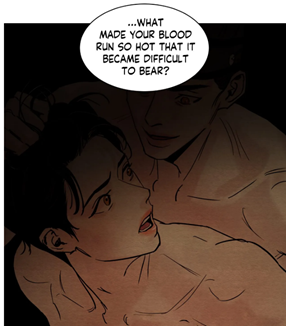
Here I only selected a few inquiries from the main lead, however what caught my attention is that with his behavior, the noble was putting the artist under pressure. The latter remained silent, but the beholder detect how these questions affect the artist. They actually excite him in reality. Why? It is because the lord’s words incite the painter’s imagination. Note that in the second panel above, he is describing the sex session. And the painter gets really excited, when the noble says this: 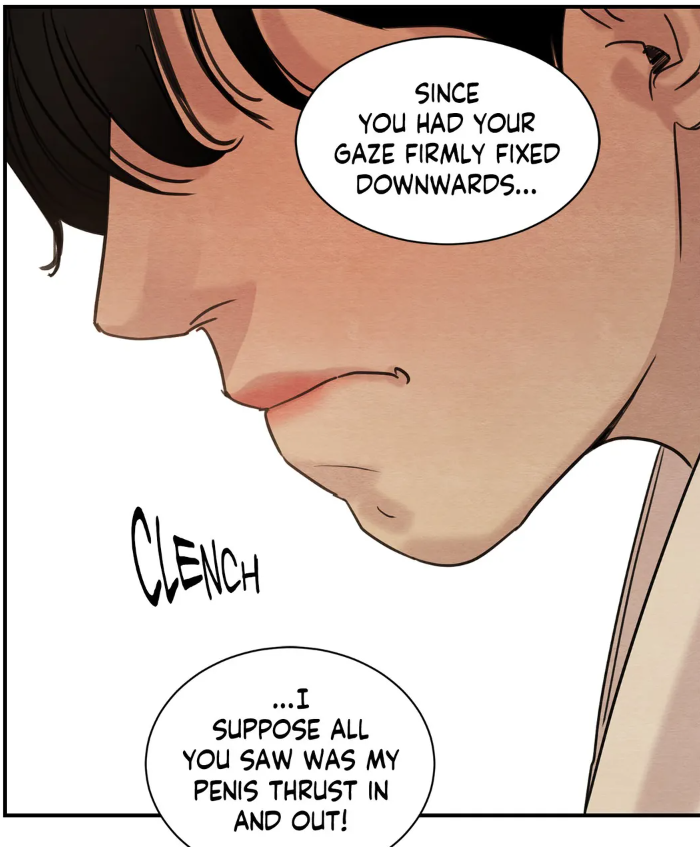 (chapter 16) On the surface, it looks like he is sulking, the reality is that he is already fighting against his urges. The hand is trembling due the arousal.
 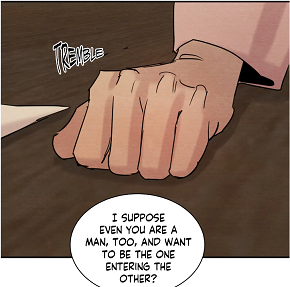 While you have the impression, he is bothered by Yoon Seungho, the truth is that the artist is getting more and more excited due the lord’s picturesque questions. Funny is that in this scene, the aristocrat is the more innocent one. He plays with the head-band
 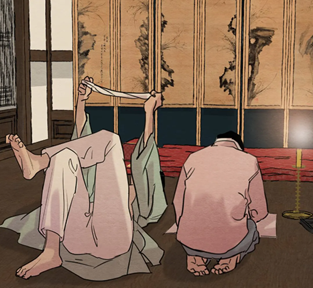 and his “innocence” is truly visible through his facial expressions too:
 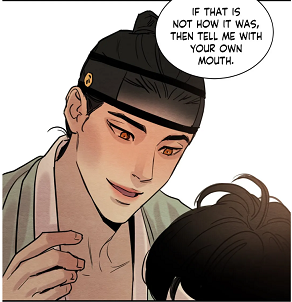 . What is the painter’s real sexual desire? We have the answer in this panel: Getting violated by a stranger! In the wet dream in chapter 6,
 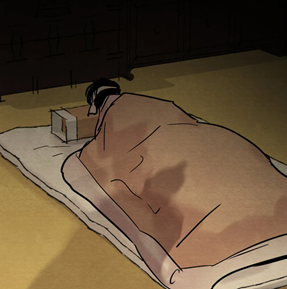 (chapter 6) a stranger in form of a shadow enters the artist’s room. The lord’s identity is only discovered at the end. But in his fantasy, the main lead was even grabbing him by the hair. It was definitely not a tender gesture.
 He was even caressing him against his will. And note that when Yoon Seungho questions when he got the most excited to the point that he had difficulties to breath, the commoner remembers this image and not the strokes. (Chapter 16) As a conclusion, the artist is actually a person who likes BDSM. This explicates why the painter’s trembling hand was grabbing the shirt in chapter 12 while facing the lord. He was hiding his erection
 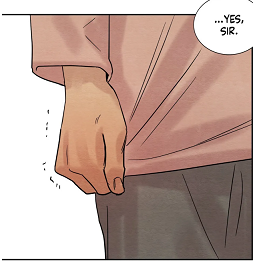 (chapter 12) triggered by fear. This new interpretation explains why the artist painted the sex at the pavilion in the end.
  (Chapter 41) If the forced sex had truly traumatized him, he wouldn’t have been able to do so. Furthermore, he questioned the authenticity of the lord’s affection, when he recalled the moment, he was offered to the other nobles. He was upset and offended.
  (Chapter 55) Yet he didn’t even think about the scene at the pavilion for one minute. This means that Baek Na-Kyum only accepts the main lead as his lover. Fear and pain are not perceived as something negative, they can evoke pleasure.
In chapter 16, Yoon Seungho got the painter so excited that he felt the need to run away in order to hide his erection. Striking is that when the lord starts masturbating him, the commoner starts blushing and crying. But these tears and reddening are not the expression of pain, they express the opposite: pleasure.  (Chapter 16) Moreover, he didn’t get angry at Yoon Seungho for touching his phallus. He got more scared that someone had seen him enjoying the masturbation and I would even say, getting grabbed by force. Therefore the lord got an erection and was so happy at the kisaeng house. Finally, he had been able to talk to the painter. He even got to receive a honest answer for the first time, where he was even called “my lord”:
  (chapter 16) To sum up, Baek Na-Kyum showed a certain respect to the main lead in this chapter. But more importantly, the master was in a good mood, because he kept thinking how he could procure pleasure to the commoner.
5. The secret meaning of „no“
However, he felt a little insecure at the same time, because the commoner had kept saying “no”. That’s why during their first Wedding night, the lord asked him about his first sexual experience: 
 (Chapter 21) The painter reveals the truth by replying that he enjoyed it very much, it felt like a dream. As you can see, chapter 21 was a reflection of the episode 16: we had a discussion, where the lord tried to initiate a conversation, tears of joy connected with pleasure, the lord asking to be called “my lord” and the realization of a dream. But we have another evidence that despite his words, he wanted the main lead to continue:
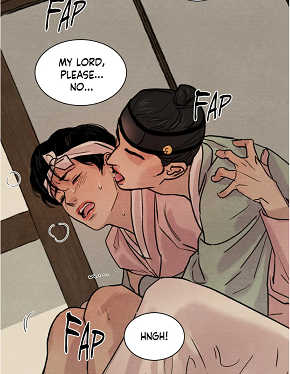 (chapter 16) The commoner’s hand is placed on the shoulder indicating that he is pushing Yoon Seungho to his side. He could have tried to remove the lord’s hand on his phallus, but he didn’t. The hand was even trembling from pleasure. That’s why the second sex marathon shouldn’t be judged as a rape in my opinion, although the painter kept saying no too. First, the painter makes the exact same expression than in chapter 16:
 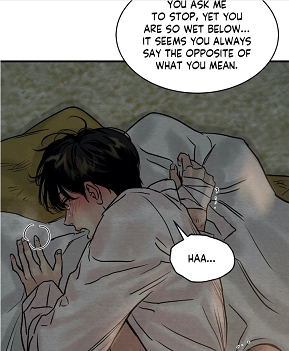 (Chapter 63) And even the lord notices that the painter is getting more and more excited by the roughness. He keeps describing how the painter is reacting below
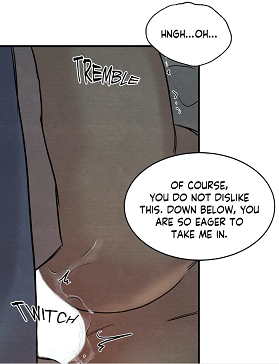 (chapter 63) which can only increase Baek Na-Kyum’s arousal, as his words are again very graphic. Note that the lord’s pictorial “filthy” expressions affect the painter deeply, exactly like in his second wet dream:
  (Chapter 63) Therefore I come to the conclusion that in chapter 63, the painter is not crying, because he is really hurt and angry at the main lead. These are tears of pleasure mixed with pain, which is linked to BDSM. That’s why he keeps blushing the whole time.
  (Chapter 63) This explicates why he kept ejaculating, despite saying “no” or recognizing that there was a witness. He felt no longer scared or embarrassed, like in chapter 16, where he ran away to hide. With this new version of the sex marathon, the painter truly discovered his sexual preferences. Therefore, when we see this
 (chapter 63), we shouldn’t project our own emotions into the artist: pain and disgust. Remember this: the painter felt his blood running hot, when the lord grabbed his hair violently in his wet dream. (Chapter 6)
And now, you understand why the artist is scared to admit his affection to the main lead.  (Chapter 68) He is still scared and embarrassed of his own sexuality. It must have felt strange in that historical period. What caught my attention is that we have two chapters where tears are mixed with pleasure and happiness (chapter 16-21), while we have two chapters where the tears are associated to pain and sadness (25-26; 41-42). Besides, in the last sex session from the first season, the painter was the one asking the lord to be quite rough!
  (Chapter 42) Yet, the noble couldn’t help himself showing tenderness and affection at the end with the passionate kiss. As a conclusion, the second sex marathon contains all these elements: sadness, pain, pleasure, anger and happiness.
6. Yoon Seungho‘s desires
And it is the same for Yoon Seungho. He likes BDSM and cosplay. That’s why he plays with the head-band  (chapter 16), and in chapter 35 he accepts to be a servant or in chapter 49 a sex toy. Due their different sex sessions, he discovered that he likes being rough too. Therefore he couldn’t enjoy, when the painter was so passive. He recognized that he took pleasure, when the painter was showing resistance too.
 (Chapter 63) This explicates why he couldn’t stand the expression “I like it”. This was too insipid. So when he became rough in chapter 48, he truly hoped to provoke tears of happiness caused by the sensation of pleasure.
 (Chapter 48) However, since the painter ended up crying and criticizing the lord, he had the impression, he had failed. As you can see, the lord might have had a lot of sexual experiences, yet with the painter, he entered a totally new world: full of warmth and love, yet there was pain connected to pleasure as well. This explicates why he could open up and reveal that his real dream was to make the painter smile
 (chapter 63), which contrasts so much to Baek Na-Kyum’s dream: cry of happiness.
I deduce that Yoon Seungho discovered BDSM through the painter, and we should see this as a treatment for the sexual abuse. First, he is put in the same position than lord Song. Thus he learned that sex could only be enjoyable, if there was consent.  (Chapter 79) Hence people saw the sex session in the shed as rape. Nonetheless, the manhwaphiles shouldn’t forget that Baek Na-Kyum was living in the mansion as a servant. Hence according to Joseon’s social norms, he was in no position to reject the main lead. However, for Yoon Seungho, it was different, for he was a young master. He had a title that was supposed to protect him. Consequently, the main lead can reproach the mysterious lord Song that he never asked for his consent and he would even treat him like a male kisaeng!
However, we shouldn’t forget that right from the start, the lord was seeking for a companion to share his thoughts and emotions. Due to the sex sessions, their honest conversations were limited to sex. First, they started arguing, because their couple had started on the wrong premise. Both were not honest to themselves in reality. Through their discussion, they were forced to listen to each other: chapter 25-26. Yet without any confrontation, they were not able to converse properly. Both of them were hiding something out of fear and pain, that’s why the conversation in chapter 47 failed too. As you can sense, their physical connection was never satisfying for the lord, he always hoped for more and tried to initiate conversations (chapter 35, 39-40, 41, 42). Both needed to learn to trust each other, but it was not possible because of their lack of self-respect.
7. Kim as a fake mediator
Remember that the aristocrat desires to talk to the painter right from the start, and later he wants to share his meals with him. And each time, Kim intervenes. First, he manipulates the lord to visit the artist in his study, well aware what Jihwa has already done. Then in chapter 50, he finally reveals the content of the conversation between Baek Na-Kyum and his scholar. And this conversation happens right after the lord asked to take his meal with the artist. He made sure that their interactions would only be limited to sex. In my opinion, Kim started meddling between the two protagonists, because that way he could refrain them to communicate directly to each other.
“There is only one rule for being a good talker – learn to listen” from Christopher Morley
That way, the butler hindered the painter to discover Yoon Seungho’s true personality. If they didn’t have an opportunity to talk, then the artist couldn’t learn through listening. That’s why the use of aphrodisiac in chapter 36 was actually an act of sabotage. The manhwaphiles shouldn’t forget that in chapter 35 the lord tried to discover the painter’s likes and offered the latter to join him to his room. But in order to ensure that there would be no conversation, Kim warned the artist about the lord’s bad mood. 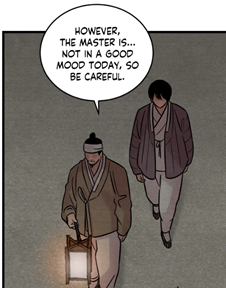 (Chapter 36) While, it looked like he was protecting the painter, he was undermining their relationship. He was actually using triangulation.
Triangulation is an approach used by many different people who share one thing in common: insecurity. As a result, they’re willing to manipulate others in harmful ways to get what they want or feel a sense of security in a relationship. Quoted from https://www.verywellmind.com/what-is-triangulation-in-psychology-5120617
I had described the protagonists as insecure, and Kim could sense these anxieties and took advantage of it. And this is no coincidence that the painter’s love confession took place in the gibang. Kim was not present, and he could only join them much later. As a conclusion, Kim made sure that there would only be sex between them and nothing more. But when he realized that sex would bring them closer, as they started communicating, he separated the couple. They should no longer have sex together. First the valet used the conversation in the library as a justification,  (chapter 50) Then he utilized the lord’s misconduct in the storage room. He should wait for the painter’s visit in his bedchamber.
 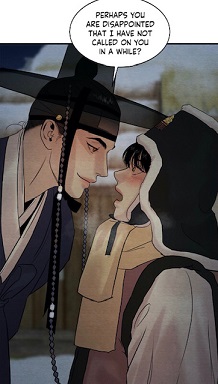 (Chapter 75) However, the valet could never stop the progression. The irony is that their first deep conversation took place outside the mansion.
 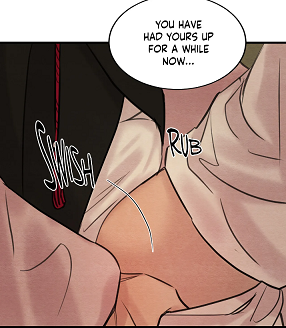 (Chapter 39) Once again, the lord had a teasing attitude, yet he was gentle and considerate. This is not surprising that due to their interaction, Baek Na-Kyum started listening to the lord. He took his questions and advices very seriously (chapter 40). Thus he confronted the learned sir about his future. As the painterofthenightphiles can detect, by communicating they began trusting each other more, and as such showing more curiosity and understanding to their counterpart.
After the kidnapping, the butler imagined that the lord would kill the artist for his abandonment, yet it didn’t happen. In reality, the lord prepared himself the painter’s bed. Then when he went to the barn in order to see what was happening, he heard and saw a painter saying “no”, while the lord was quite rough. So in his mind, after this sex session, the painter would be scared of the lord and would run away. What he saw was violence because of the past. Note when he tried to manipulate the master, he mentioned the main lead’s rape at the barn.  (Chapter 68) With these words, he was implying that the low-born suffered the same fate than Yoon Seungho, because it looks like that on the surface. He imagined that he would achieve his goal (sending away Baek Na-Kyum) by using his knowledge, but in my opinion the opposite happened, like I had expected. What caught my attention is that the butler only mentioned Yoon Chang-Hyeon
  (chapter 68), as he had sent the painter to the storage room like his father. Yet, at no moment he made an allusion about lord Song, though he saw the sex in the barn as sexual abuse. He was thinking of the pedophile’s crime. He couldn‘t bring up the pedophile for two reasons: As a domestic, he can‘t badmouth the king. Secondly, he has to blame the father, as his own responsibility in Yoon Seungho‘s suffering would come to the surface. Remember my theory: Kim was the one brought the young master to the king thinking that the latter would protect Yoon Seungho.
Yet the problem with BDSM is that the couple needs to set the rules first, and these are strongly intertwined with “respect and love”. They have to communicate. That’s why the moment the painter accepts his affection, he is forced to recognize his own sexual preferences. This is no coincidence that in the bedchamber, Baek Na-Kyum voiced his desires after vowing loyalty to his lover.  (Chapter 88) Furthermore, the chronology is important. The painter communicated first his thoughts and wishes, before they initiated the love session.
 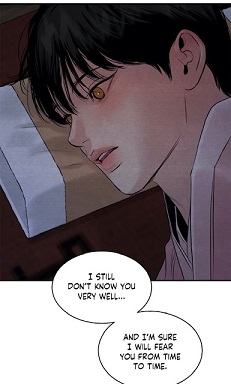 (Chapter 88) This contrasts to the sex session in chapter 48/49. The lord had used sex in order to force the painter to share what was on his mind. Finally, in the gibang, the painter had talked a lot about his childhood to his lover before kissing his lover.
  (Chapter 94) They had a long conversation, where the lord could ask questions. This conversation ended with a love confession.
  (Chapter 94) This is important, because sex had now a different function. Sex was now a real form of communication, they would share what was on their heart. With their bodies, they would convey emotions. They would use the hand
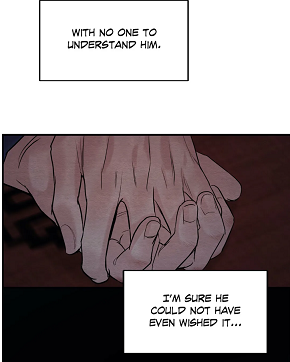 (chapter 88) or the kiss
  (Chapter 95) so that no misunderstanding would be created. Therefore it is not surprising that even during their love session, they would keep talking, and even express their desires: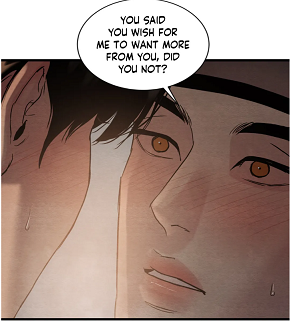
 (Chapter 96) And observe that even after the love session, they continued sharing what was on their mind and heart:
 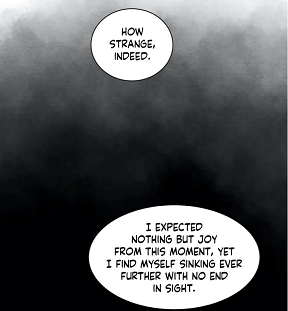 (chapter 97) And now, you comprehend why the schemers had to separate the couple! From this moment on, they would communicate constantly, and this outside sex. Thus when they are in the mountain, they can speak freely.
  (Chapter 102) They are no longer a noble and a commoner walking together, but a real couple. They are equals sharing their happiness and pain.
However, this doesn’t mean that their love story ends here. This marks only the beginning, because the lord has so much more to show to the painter. Their love will keep growing and affecting other aspects in their life. Moreover, they are now paying attention to what is happening around them  (chapter 102) Here, the painter wished to understand why they were separated for so long. This means that Yoon Seungho has to discover the circumstances which led to this tragedy. That‘s how they will realize that the enemies are close to them. The lord has to recognize that he needs to share everything, like for example the discovery of Deok-Jae’s corpse.
  (Chapter 97) As you can see, the topics of their conversation will diverge more and more. I do think that he was incited to let the painter sleep in order to „protect“ him. Yoon Seungho needs to recognize that warning and drawing lines are not enough to protect the loved one. He will have to take real measures to turn his statement (taking responsibility for the painter) into a reality: he will have to fight for his right to happiness.
 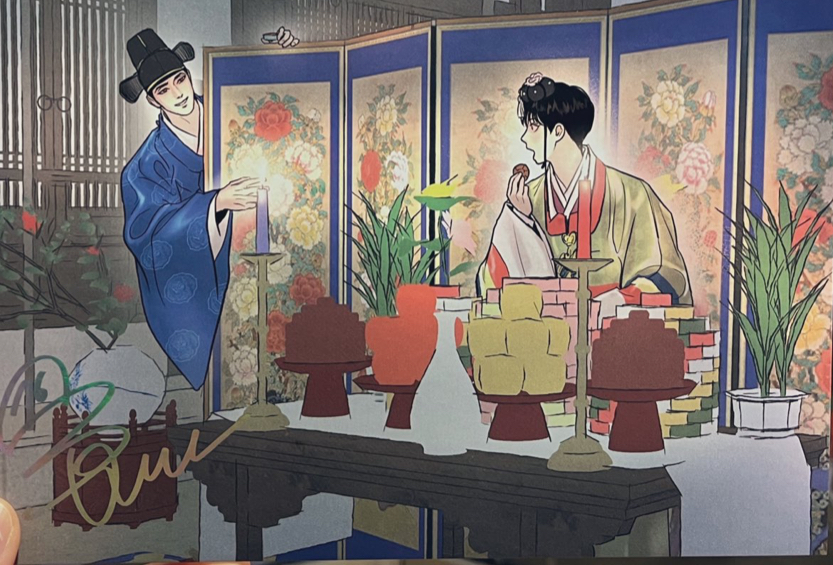 Taking the civil service examination only represents one step. Furthermore, appearances can be deceiving. The pure artist is not so “innocent” in the end. He has definitely met his match in Yoon Seungho, though I believe that his role is to heal Yoon Seungho from his PTSD and give him closure. And this can only happen, when the victim of sexual abuse confronts his perpetrators, the old bearded men!
Feel free to comment. If you have any suggestion for topics or manhwas, feel free to ask. If you enjoyed reading it, retweet it or push the button like. My Tumblr-Reddit-Instagram-Twitter account is: @bebebisous33. Thanks for reading and the support.

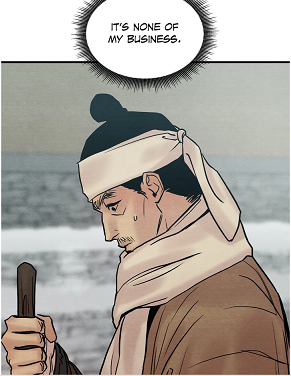 (chapter 65) As you can see, the valet Kim is not revealing the truth, not out of fear, but he has the impression, this is not his problem. He chooses indifference. With this single attitude, the readers discover Kim’s true personality and past, confirming my last analysis about him. When he heard the painter’s refusal,
  (chapter 65), he was brought back to the past. The domestic was a witness of Yoon Seungho’s rape and as such of his sexual abuse. Striking is that in episode 65, he didn’t even open the door, but instead of helping, he let it happened. He didn’t act according to his belief. This means that in the past, he must have acted the opposite. The door was open. This signifies that he abandoned the young Yoon Seungho, when the main lead asked for assistance.
 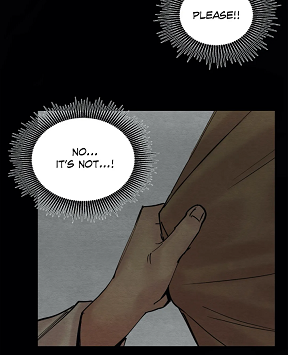 (chapter 65) He refused to listen to the young master’s plea. And now, you understand why Yoon Seungho had sex in front of him outside the barn. Unconsciously, he wanted to confront the valet with the consequences of his actions.
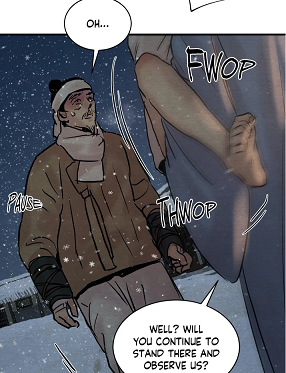 (chapter 64) The teenager was left behind by the servant, and his hand couldn’t even stop him. But since it is a reflection, I think that the butler was the one who brought the main lead to the predator, naturally his intention was not to have him raped. And now, I grasp why the lord feels the need to hurt people with his hand, like for example strangling the painter
  (chapter 61) or grabbing the topknot of a noble
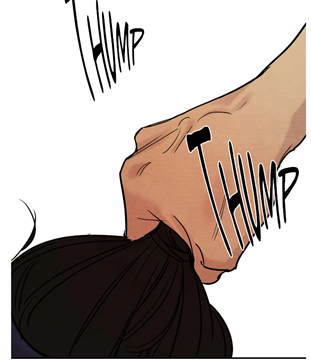 (chapter 8). His hand expresses not only his rage, but also his powerlessness. With his hand, he wasn’t able to stop the valet from leaving him behind. He had tried to stop his father from leaving his side with his hand too.
 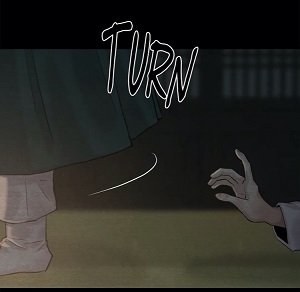 (chapter 86) Furthermore, Yoon Seungho couldn’t even punish the valet for betraying him, because he had no authority and no strength. Back then, he was just a teenager. In chapter 63 and 64, Yoon Seungho was indeed reliving his traumatic past. Because the butler was recollecting two different memories (the night before and the lord’s sexual abuse), my first impression was that the young boy had been abused in the shed.
 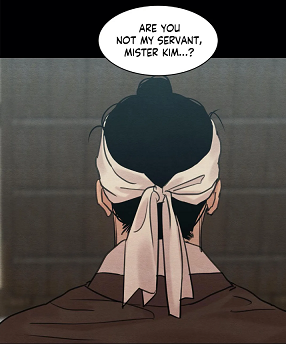 (chapter 77) My theory is that the main lead was raped by “lord Song”, the king. Therefore I assume that the man was invited by father Yoon. Remember that the kisaeng Heena proposed to her donsaeng to seek the protection of a nobleman, as he is a low-born.
  (chapter 97) My idea is that the valet thought that by seeking the monarch’s protection, the young master’s suffering would end, for the king stands above the scholars and elders. Anyway, I believe that the valet made a bad choice and regretted it afterwards. Due to his guilt, he developed resent towards Yoon Seungho. And this explains why Kim said this to the painter in order to ease his pain:
  (chapter 12) He couldn’t tell him details, since he would reveal his complicity to the crime. Furthermore, since the valet led the painter to the pavilion, it is very likely that Kim was the one who offered Yoon Seungho to the pedophile, which makes his crime even worse.
  (chapter 65) Since he had not assisted the young master repeatedly
 (chapter 77), he became more and more burdened by his guilty conscience. He turned into an accomplice, for he never revealed his involvement and mistakes.. He could no longer reveal the truth, because he would have to get punished. He feared father Yoon’s wrath and he had reasons too. He could definitely die. That’s the reason why he reproaches the doctor his passivity and silence, though in my opinion, it was not about the abduction, but about the tonic. Sure, in Joseon, there was no law called “Duty to rescue or Failure to provide assistance”.
 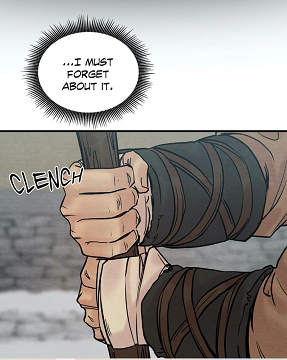 (chapter 65), they can’t, because they feel guilty and remorse. Note that right after voicing his wish to forget the incident, he recalls Yoon Seungho’s tragedy indicating his incapacity to forget. This explains why Kim gives the doctor the following advice:
 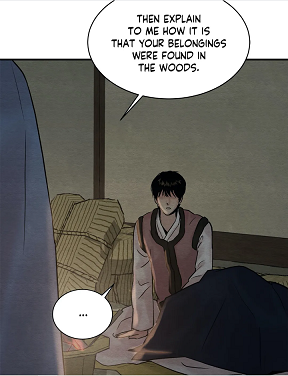 , (chapter 62) especially when you think that Baek Na-Kyum is just a commoner. But the problem is that he was biased, just like his father who had the impression that his son was a homosexual due to the testimonies of close people (Kim, Lee Jihwa and probably Yoon Seung-Won). After the rape, Yoon Seungho got punished. And this interpretation was proven correct in season 3
 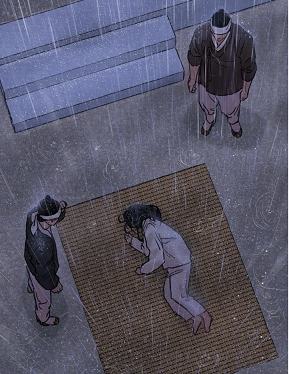 (chapter 77). But here Kim remained silent too.
 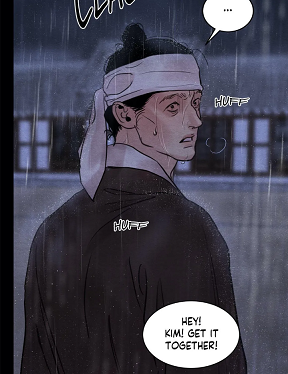 (chapter 77) It was even worse than before, because after the straw mat beating, he was paralyzed. No one spoke for him and believed his words, and Kim wasn’t willing to step in. Moreover, I believe that Kim had another reason for remaining silent.
 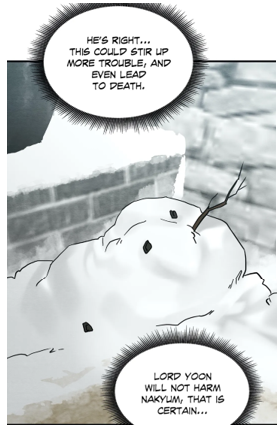 (chapter 65) He disliked the idea of a scandal and trouble. If he had told the truth, he knew that his punishment would be death. Out of convenience, he ran away from responsibility and from the uncomfortable truth.
  (chapter 65) That’s why I believe that the author is not showing that Kim and the physician chose secrecy and silence, because they feared for their life. They only started fearing for their life, when the truth is about to be revealed, as the painter was not dead yet. As the victim, he was a witness. Because once the lord discovers the butler’s passivity and complicity, it becomes a matter of life or death for him. According to me, there are two doctors. So the chapter 65 unveils that the first doctor didn’t testify, as he wanted to help the artist.
 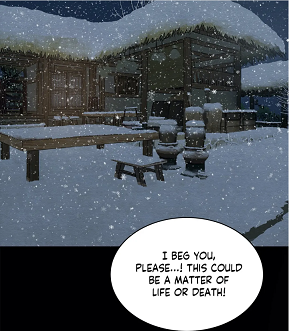 (chapter 65) In my opinion, the butler had deceived the commoner, he let him believe that Baek Na-Kyum had run away because of the lord’s violent temper. The painter had come wounded to his office. This negative perception of the young lord Yoon could only make the doctor jump to wrong conclusion. ,Striking is that this scene
 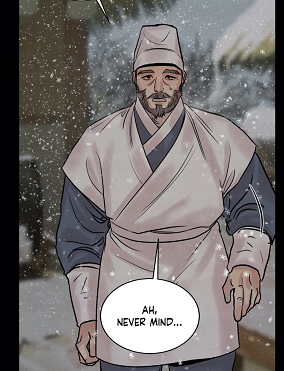 (chapter 63) revealed that the doctor was hesitating to give his opinion to the butler, he thought that the artist had run away. And what is the common denominator of all these scenes with the doctors. They all chose silence for different reasons. Just like Kim, the doctor had become an accomplice. As for the second, he remained silent out of fear, that he could get into trouble.
 (chapter 65) My theory is that the valet used the drug as an excuse to silence the physician. Now, the doctor is hoping that the boy says no word about it, so that his “wrongdoing”, the false medication, won’t be discovered. Kim blamed the doctor that after that, his master had behaved like a crazy man. The result was that both physicians chose silence!! Why? It is because the valet had pushed them to make this choice. And note the pattern. Kim used pity and compassion for the first doctor, and fear and brutality for the second! Exactly like in this scene:
  (chapter 65) This represents his attitude in life, therefore he is responsible for Baek Na-Kyum’s loss of innocence. His other leitmotiv is
 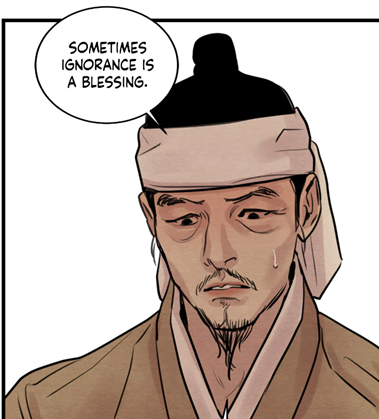 (chapter 23) He acts, as if he knows nothing reminding us of this scene.
 (chapter 28)That’s why I believe that the butler was lying back then and had even allowed the artist to run away that morning. I see a new version of chapter 29. But let’s go back to chapter 65.
 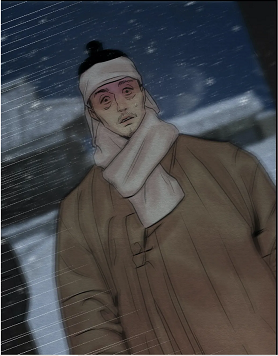 (chapter 64)
  (chapter 65) the artist after their intercourse and even gives him his own shirt. He shows a certain sense of responsibility.
  (chapter 82) Why didn’t he ask for a punishment after this humiliation? It is because he couldn’t. However, he must have definitely sought revenge. And the main lead became the sacrificial lamb, as in father Yoon’s eyes, his son was the reason for the purge: desertion, betrayal and probably drugs played a role in the purge. It is definitely possible that I have to change this theory about his traumatic past, but as you can observe, the main elements don’t change:
 (chapter 65) The lord realized that something had happened. Due to the painter’s reaction, he was brought back the past.
  (chapter 66) Striking is that the painter’s words were the trigger for revealing the truth.
 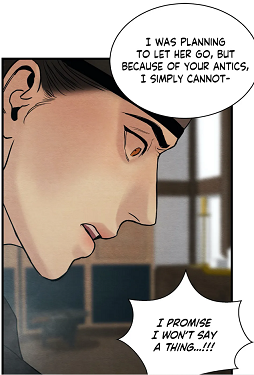 (chapter 66) This stands in opposition to silence. Therefore it is no coincidence that Min revealed the truth.
 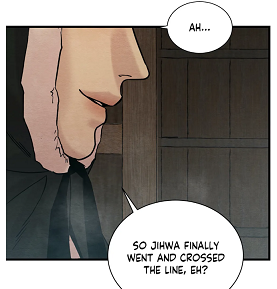 (chapter 66) The irony is that Heena suspected the main lead of kidnapping her brother and everything looked like her words were true: the wrist, the wounds around his wrist, his actual position (the mouth covered and his hands tied together…)
 (chapter 66)
  (chapter 66) Thus the circumstances were turned against him.
  (chapter 65) But she was not present, when Min admitted Lee Jihwa’s crime. That’s how I realized that while chapter 65 represents silence, deception, cowardice and passivity, chapter 66 embodies the exact opposite. Min told the truth, Heena tried to save her brother by creating a ruckus! For Yoon Seungho, silence is a sign of culpability which he learnt from Kim. Hence he lied to the kisaeng
  (chapter 65), and later never spoke to the painter about the incident. If he had done it, he would have been forced to admit his misjudgment and wrongdoing. And now, you understand why Martin Luther King said this:
 (chapter 57) It doesn’t matter, if the butler told lies to the physician in the past, as they are now perceived as truth. Remember what Kim confided to the painter:
 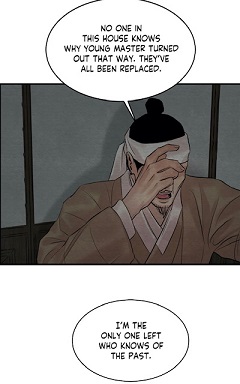 (chapter 86) He believes that he is the only one left who knows the past. But he is wrong, since the doctor also recalls the past. Hence how can Kim prove that he is telling the truth, since he told a different story to the physician? In addition, we have also lord Song. Besides, by giving the drug to Yoon Seungho without his knowledge and consent, Kim committed a wrongdoing. His knowledge won’t serve him in the end. I am deducing that the saying “silence is a true friend who never betrays” will no longer be valid. Therefore we have to expect a betrayal, and that would be from the physician, especially after we recall the butler’s warning in the first season, which was addressed to a different doctor from my point of view:
 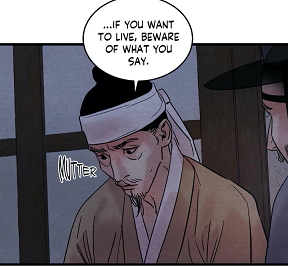 (chapter 33) Let’s not forget that in chapter 65, the servant tried to put the whole responsibility on the physician, making him feel guilty. And since Byeonduck is even using elements from the first and second season, I believe, we will have a reversed situation in season 4, where the doctor will speak up and put the whole blame on someone. Neither the physician nor Kim expected that the painter’s body wouldn’t remain silent
 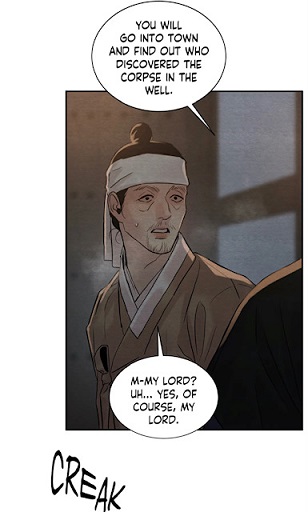 (chapter 98) As you can see, slowly people are forced to talk
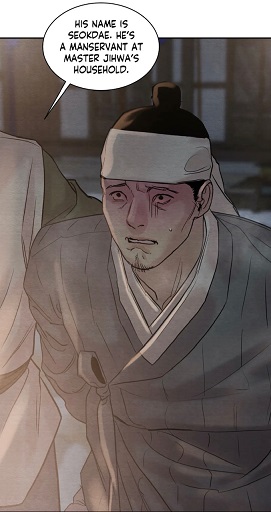 (chapter 99), hence their testimony can be questioned and perceived as lie.
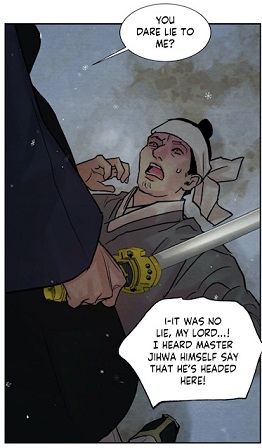 (chapter 100). This is important, because by getting confronted with lies, the lord will be able to discern the truth! In other words, silence embodies darkness and as such death.
  (chapter 74) Thus there was only silence in the lord’s nightmare. And this contradicts this statement:
  Bebebisous33s' analyses in K-Dramaland and Manhwas