Protected: Painter of The Night: „To be or not to be“
Bebebisous33s' analyses in K-Dramaland and Manhwas
Analyses of K-dramas and Manhwas (for the most part Yaoi)



This is where you can read the manhwa. https://www.lezhinus.com/en/comic/painter But be aware that this manhwa is a mature Yaoi, which means, it is about homosexuality with explicit scenes. If you want to read more essays, here is the link to the table of contents: https://bebebisous33analyses.wordpress.com/2020/07/04/table-of-contents-painter-of-the-night/
It would be great if you could make some donations/sponsoring: Ko-fi.com/bebebisous33 That way, you can support me with “coffee” so that I have the energy to keep examining manhwas. Besides, I need to cover up the expenses for this blog.
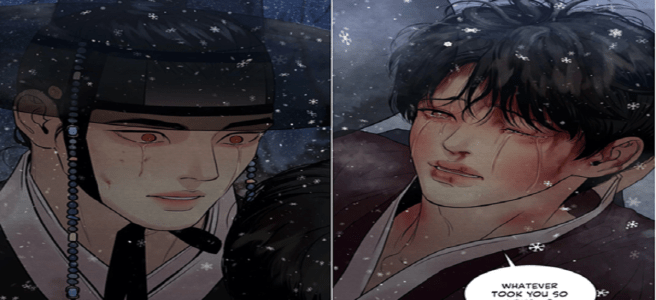
As you can see, this new analysis is quite similar to the last two, as I am paying attention to sound and silence again. Nevertheless, there exists one huge difference to the previous essays. I am combining these elements to the darkness and the light. I had already pointed out the contrast between the noble and the painter‘s nightmare. While Yoon Seungho‘s bad vision starts with the appearance of the light 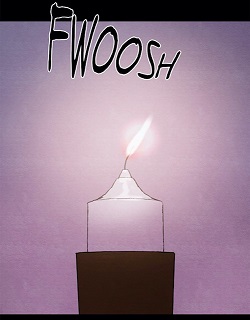 (chapter 74), it is the opposite with the painter.
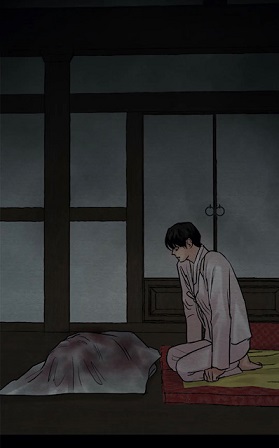 (chapter 98) Furthermore, the silence in the noble’s nightmare took over the moment the candle was switched on. That’s how I recognize a new pattern. The combination between silence and light plays a huge role in the story, for it helps to unmask the traitors. Under this new observation, I decided to revisit certain chapters.
As you can see, I am reexamining chapter 56, and more precisely the scene in the bedchamber. What caught my attention is that contrary to the other chapters, Byeonduck didn’t choose to repeat the ending of episode 55. (chapter 55) The chapter begins in medias res
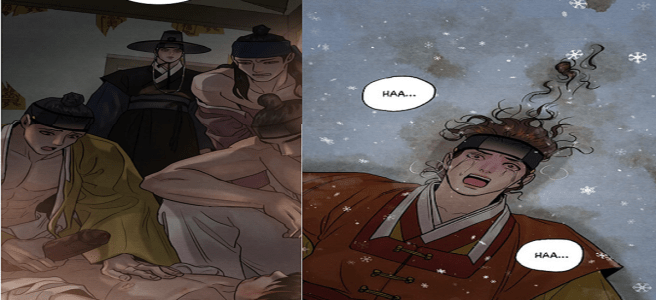
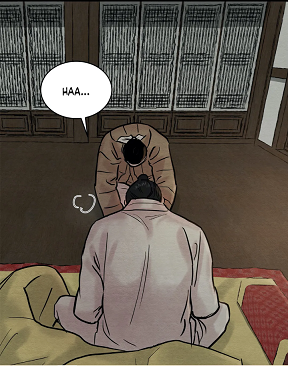 (chapter 56), which means that there’s no introduction, the story starts in the middle of the action. And now, it is important to question ourselves about the intention of the author. Why did she change her MO? I found the answer the instant I realized the importance of the two following aspects. The light… and the sound, in this case: HAA…
  (chapter 56) In the past I used to think that this scene had occurred early in the morning. But now, I am thinking otherwise. In truth, right after receiving the letter, the butler went to the bedchamber directly and woke up his master!! This signifies that this scene took place during the night. But how did he do it? He just needed to remove the light from the bed and lit other candles. That’s the reason why the candles are positioned like during the night of the brother’s visit.
  (chapter 56) Besides, the manhwaphiles should remember the way the room was enlightened, when Baek Na-Kyum was keeping company to his lover.
  (chapter 55) It was quite dark.
 (chapter 55) And strangely, the main lead could sleep comfortably. He was not plagued by a nightmare.
  (chapter 55) He could even sense the artist’s presence unconsciously, therefore he confirmed his affection for the painter. And now, you can imagine what happened. Once the valet received the letter, he went to the bedchamber directly and sent Baek Na-Kyum back to his bedroom under the pretense that he would take care of his master himself. However, the moment Baek Na-Kyum had left his side, the valet lit more candles (chapter 74) and positioned them far away, which triggered the lord’s nightmare. But why? It is because the light creates shadows like this one.
  (chapter special episode 3) Note that there’s no candle placed next to the entrance of the lord’s bedchamber for that reason. The noble only feels comfortable, if the light is situated close to his face, because that way he won’t see any shadow. Thus we have such a scene in the first season.
  (chapter 35) The candles are always placed next to his bed. And now you comprehend why the lord moved to the patio during their first night together.
 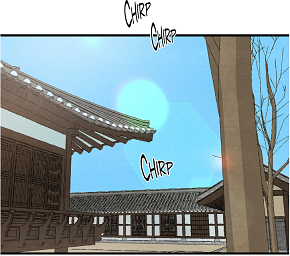 (chapter 38) He didn’t want to disturb the painter in his sleep, for he needs light during the night, but only next to him. This explicates why Yoon Seungho woke up from his nightmare right away, when the bougie had been blown out.
 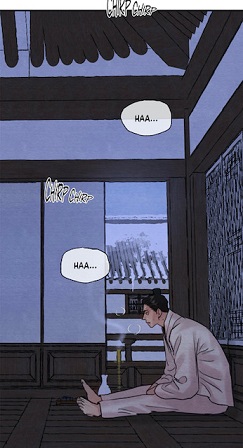 (chapter 74) But how did it happen? Was it the work from the wind or the candle was extinguished by the protagonist’s heavy breath or was Kim behind this? Because I had no answer before, I had not mentioned this observation. Fortunately, my friend Luzyla came to my rescue and gave me the answer which I totally support. Kim must have intervened during that night, because for the first time, the nightmare was becoming more precise. But how did she confirm my suspicion? It is because the butler had this image, when he tried to convince the painter that nothing would change. This panel
 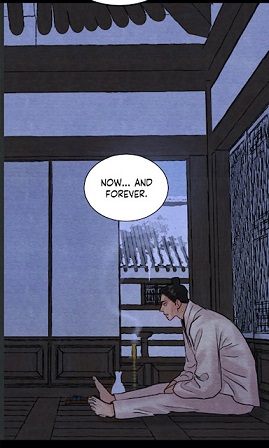 (chapter 87) represented the butler’s memory. This means that the butler must have seen him from the outside. He didn’t want the painter to discover the lord’s suffering. And it worked, for the lord never let this transpire to the painter after that night. And now, you comprehend why the butler had to make sure that the couple would no longer sleep together at the end of the second season. But let’s return our attention to episode 56.
So when the butler placed the candlestick on the commode, he caused a flashback to the main lead. But the valet knew about this. However, he chose to feign ignorance and must have said something similar: 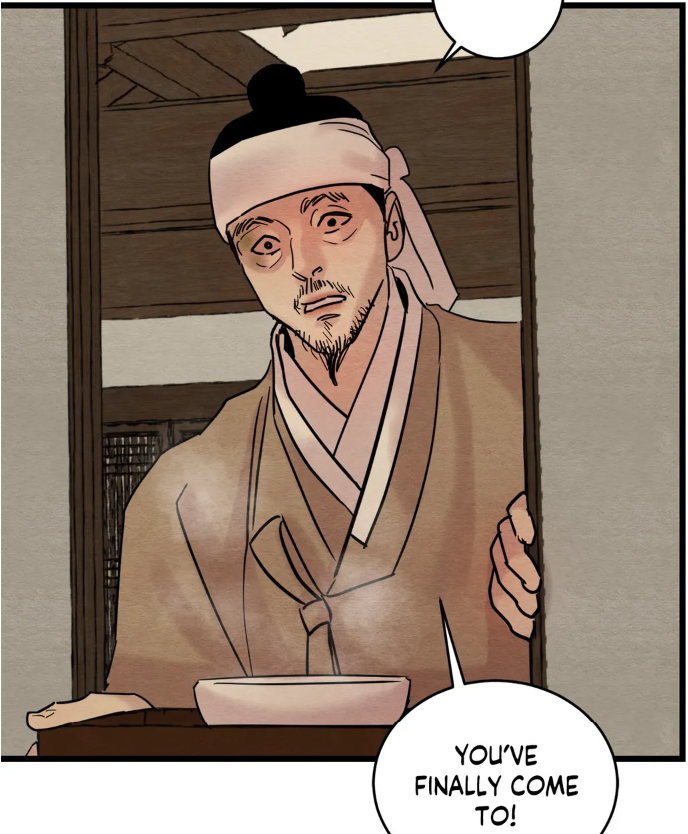 (chapter 34) The entire time he acted, as if Yoon Seungho was fine, for he was conscious. Then he gave the letter to his master and knelt far away from him while looking down. (chapter 56) On the surface, it looked like Kim was showing great respect to his lord. Yet the reality was totally different. He was avoiding his gaze and didn’t want to be near him. The butler’s attitude explicates why in chapter 86, the lord pushed the artist away.
  (chapter 86) The former has long internalized that he is scary and dirty. Yet the truth is that the butler’s gaze reflects his hatred, for he considers him as responsible for his own misery. Don’t forget that he is tormented in the presence of Yoon Seungho. The latter is a reminder of his own sins. To sum up, for Kim, the reason for his distance and avoidance is simple. He doesn’t want to be confronted with Yoon Seungho’s suffering, for he is refusing to admit his own guilt. The protagonist already knows about this unconsciously. Thus he hid his gaze the entire time.
  (chapter 56) The first “HAA”
  weren’t laughs, but the sign of a panic attack. Yes, for the first time the manhwaphiles discovered the lord’s health issue (flashback), but no one truly grasped, not even me. I had imagined that his heavy breathing was related more to pain and his illness. I only recognized the existence of the panic disorder in episode 66, though I was already aware of his PTSD.
In the scene from chapter 56, the valet was following his own philosophy: 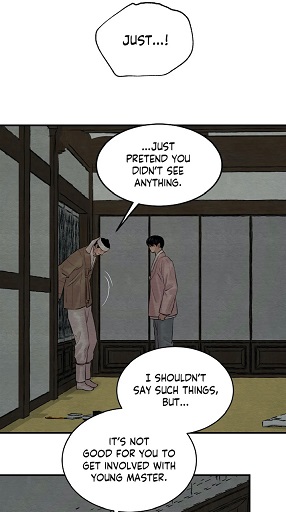 (chapter 86) He pretended he saw and heard nothing. But how can I be so sure that it was the night? Simply because all the windows were all closed. Thus Byeonduck drew such an image:
 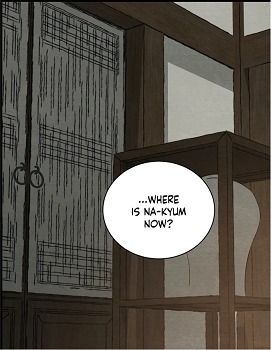 (chapter 56) Besides, observe that there is more light in the bedchamber, when the butler entered the room later:
  (chapter 56)
Another important detail is this. Kim was supposed to fetch the medicine for his master, yet when he was kneeling in front of the lord, the manhwalovers can detect the absence of water or teas. (chapter 56) So where is the medicine? But this question only came to my mind, as soon as I realized that this conversation took place during the night.
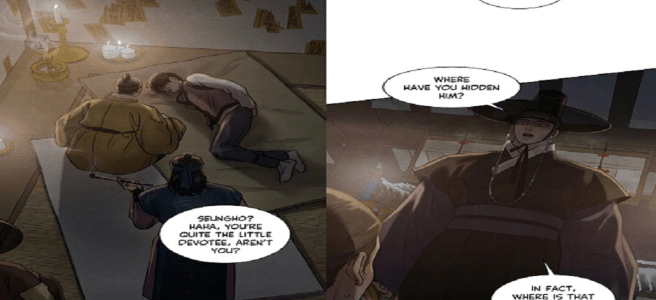
And now, it is important to determine the purpose of his intervention. Why would he lit the bougies and awaken Yoon Seungho, fully aware that this would trigger a panic attack? Simply because of the letter from lord Song. 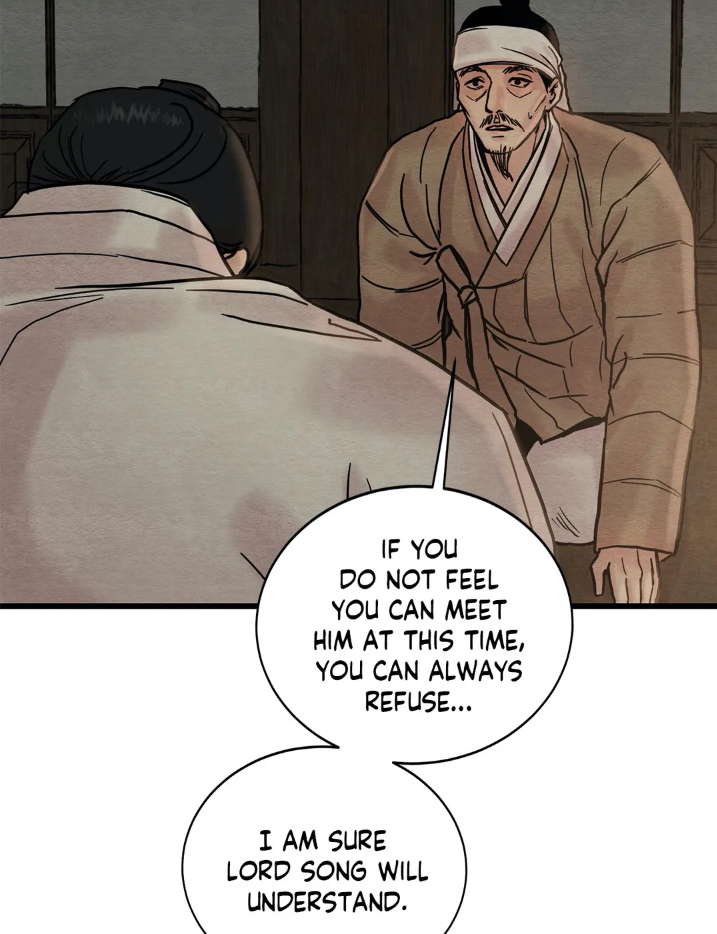 (chapter 56) He wanted to wash off his hands on this. The moment he conveyed the message to the master, it was no longer his responsibility. If lord Song had truly sent the missive, then Kim could say that this had been his master’s decision to refuse to follow the request, if they were confronted for their disobedience. This means that Kim was lying, when he said, “I am sure lord Song will understand”. He was just expressing an expectation, but there was no guarantee that the mysterious man would be very understanding. In addition, one idiom caught my attention: “If” This was a condition and not a real statement. Kim never said that since Yoon Seungho was ill, he could refuse the invitation. This signifies that the valet refused to confirm the noble’s illness. It was Yoon Seungho’s choice to say if he was feeling ill or not. To conclude, he refused to assume any responsibility. And now, you comprehend why Byeonduck added a drop of sweat on the butler’s face. This was showing his discomfort and deceptions. The man didn’t want to be associated to the noble and become responsible for him.
That’s how I realized another aspect: Kim has always been acting, as if he was helpless. “He couldn’t do anything!” However, this scene exposed his huge hypocrisy. He could have comforted his master with words here and offer real support. He was totally silent in that matter. He chose to occult the flashback. On the other hand, he was definitely good at lip service, for many readers saw his words as genuine concern. People had even the impression that Kim was oozing responsibility, calmness and rationality. But this was not the case, deep down he was so scared, thus the moment the name was spoken, he had some difficulties to swallow his saliva.  (chapter 56)
This explicates why at no moment, Kim was willing to protect Yoon Seungho. (chapter 56) The former would give him suggestions, but Kim never made a promise that he would help him as a witness. Note the absence of the personal pronoun “I”, whereas “you” is constantly used. The only time he employs “I” is concerning belief and expectation. But his cowardice doesn’t end here. Once he was asked about the artist’s whereabouts,  (chapter 56) he proposed to fetch the boy. Why? It is because the butler didn’t want to be confronted any longer with the lord’s panic attack, though he had been the one to trigger it! But he didn’t care, for his true goal was to save his own skin. Should lord Song get angry, Kim could definitely use the truth to his advantage. He had delivered the letter right away, and the noble had been well enough, since he woke up and read him the content.
  (chapter 56) 🙄 Under this new light, I couldn’t help myself shaking my head, when I read this from the butler.
 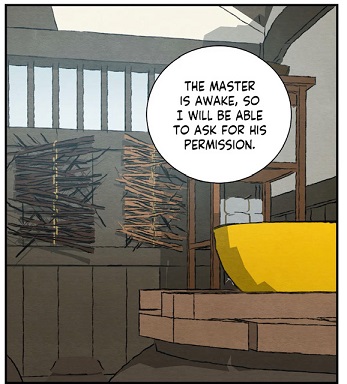 (chapter 56) His words implied that the lord had woken up on his own, whereas in reality the butler was the cause for this. Kim knew that his master would never go back to sleep after their conversation. This explicates why the candlestick was placed again at the head of the bed. (chapter 56) I can envision that the valet had left his lord behind under the pretense that he should go back to sleep, for he was still sick.
Then I wondered myself why Yoon Seungho would read the missive loud. It is because he believes that the butler can not read. However, what he doesn’t know is that the man can read calligraphes. This explicates why he handed over the letter immediately. He couldn’t keep it, for if the invitation was true, he could have been blamed. And this is important, because in the third season, we have the reverse situation. Kim let the maids deal with the kisaeng’s letters so that if anyone had to become responsible for them, it would be the maids and the lord, but not him. However, as you can envision, Kim must have talked to the maid similarly: “I am sure lord Seungho will understand.” And since the butler got away with it in the second season, it was the same for the maids. Why? It is because it creates the illusion that the maids were taking the lord’s best interests into consideration. However, they had become the painter‘s companions. This means that they had betrayed him. It was not their position to act on their own. As you can see, the maids had a similar behavior than the butler‘s. What caught my attention is that the aristocrat was viewing Kim as accountable for the actions of the staff. Yes, this was the result of Baek Na-Kyum’s desertion and abduction. The moment he used the painter as shield for his own safety and to cover up his disobedience (chapter 68), his fate was strongly intertwined with the artist’s. But it changed, when the lord heard that Baek Na-Kyum was blamed for his insomnia and he hadn’t been able to meet the artist during broad light
 (chapter 79), he punished Kim. It was, as if the butler had failed to protect the artist. And because the painter‘s visit to his bedchamber had taken place during the day, it revealed his loneliness. That‘s the reason why I believe that this conversation pushed the lord to give the maids to the artist. They should become his ladies-in-waiting so that he had someone he could talk to. However, Yoon Seungho never let the butler know about the true reason for his punishment. He used the father as subterfuge. Finally, we shouldn’t overlook the valet’s pledge: he swore that he would serve the lord.
  (chapter 77) This means that he was now judged as accountable for his actions in front of Yoon Seungho. However, Yoon Seungho made a huge mistake, because the moment he brought up the father, he was acting as if Yoon Chang-Hyeon was the owner of the mansion. He was now Young master and not Lord Yoon. Yet, his duty was to be a loyal domestic to the protagonist. And now, you comprehend why Kim was reminded of the past, it is because he was put in the same situation than in the past. And what did he do? He made the exact same decision. He sided with Yoon Chang-HYeon, but there existed two divergences from the past. The first difference is that the elder master would listen to his words, and the second is that he lied to his master. (Chapter 77) Here, he was pledging loyalty to Yoon Seungho. Moreover, he is viewed as the eldest servant in the mansion, this means that he is accountable for the staff’s words and actions. However, Kim is making a terrible mistake, for in his mind, past, present and future are the same. (chapter 87) But this is totally incorrect, for the lord is now an adult. Thanks to the painter, Yoon Seungho is on the verge of entering adulthood. Observe that the butler vowed his loyalty to young master Seungho. By calling him “young master”, he treated the protagonist as an infant, but this is no longer possible. This was perceptible, when the main lead met his father.
 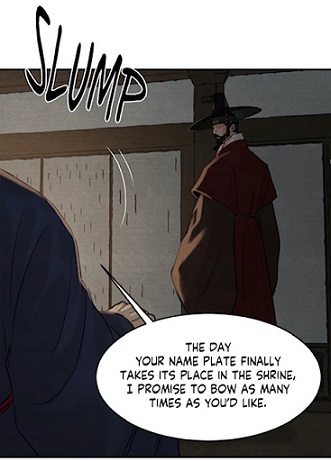 (Chapter 86) He refused to acknowledge him as the owner of the mansion. He took the seat in front of his father. He was now acting as the lord Yoon.
SLAM! What is this sound? I am quite sure that you can recognize it immediately. A door has been opened quite violently.  (chapter 85) Strangely is that in that scene, we never heard any STEP, STEP, STEP like here:
 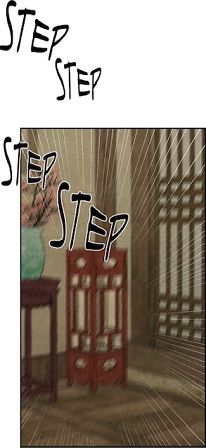 (chapter 97) There was no sound, therefore I deduced that Kim didn’t run to the study. However, observe that the butler is breathing heavily. It was, as if he was out of breath: HUFF HUFF.
 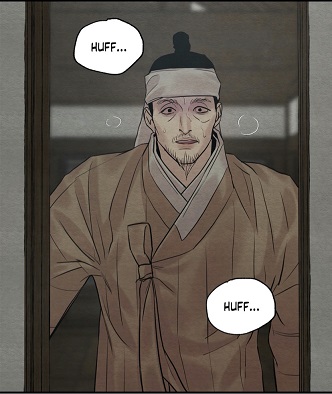 (chapter 85) So why would he fake his breathlessness? I am quite certain that you already have the answer. He was hiding the fact that he had been spying on their conversation, which I had mentioned in one of my previous analyses. However, there’s more to it. The other and major intention is to give the impression that he did everything he could for his master. In other words, he is creating the illusion that he could do nothing against the father!!
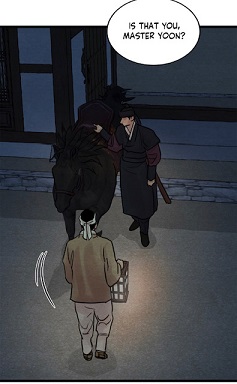
  (chapter 87) Yes, that’s his other principle to justify his cowardice, his fear of responsibility. He implied that he had rushed to his master’s side right away to alert him. If asked, he could legitimate his passivity by saying that the father had barged accompanied with 2 guards. But why didn’t he get caught by the protagonists? Simply because he is no longer caring a light contrary to the first season.
  (chapter 20)
  (chapter 25)
 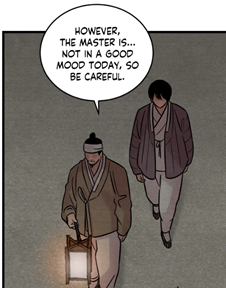 (chapter 36) The night had already fallen, when Yoon Chang Hyeon was present in the mansion. If the butler had carried a chandelier, the painter or the noble would have sensed his presence. Thus I deduce that the butler’s function in the protagonist’s suffering was to lit the room, the moment the pedophile and other sexual abusers approached his prey. That’s the reason why his nightmares are triggered by the sound of a lit bougie and the light accompanied with shadows.
However, this is just an illusion to think that Kim is always carrying a torch. I believe that the butler has more often moved around without light than with. Why? That way his spying activities could not be detected. In truth, he used the light to fake his loyalty and obedience. Even in the first season, he walked in the propriety properly without any candle: 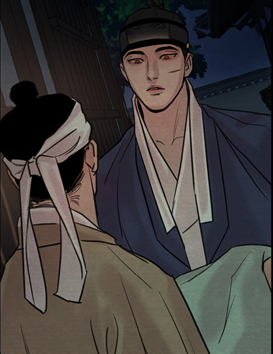 (chapter 26) This scene took place in the courtyard. This is the bathroom for the staff which you can see in the background
  (chapter 30), the grey building with grey bricks. And it happened again in episode 32
 , in episode 55 and chapter 64:
  And now look what we have in the third season:
  (chapter 77)
  (chapter 82),
  (chapter 94) and
  (chapter 98) He is no longer carrying any light, not even for his master. Why? It is because he can spy without being detected. Thus he approached the messenger only after the main lead had left the study. Don’t you find it weird that he acts as if he knew nothing
 (chapter 82), while he presents himself as the senior domestic in the mansion?
 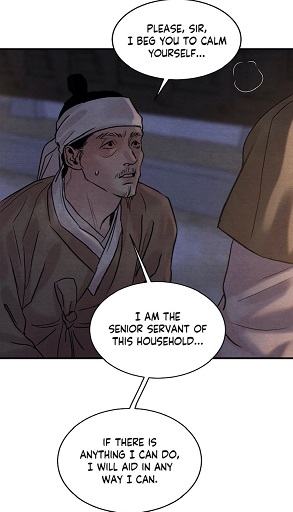 (chapter 82) This represents a contradiction. If so, he should have been informed immediately. Thus I come to the conclusion that this scene reveals his incompetence and betrayal. Did he aid the messenger, when the latter got beaten? No, he only made his appearance, after the incident had occurred. And this is not surprising that the other domestic looked down on the butler.
  (chapter 82) He already knew that he had betrayed his own master through the letters. So I doubt that he viewed Kim as trustworthy. Another important element is that when the butler is seen in connection with the light, he speaks much more, while in the darkness, he remains silent. This is naturally connected to his spying activities. Simultaneously, the words coming from the butler often appear as empty. They remain quite superficial, for the butler is always putting conditions. “If there is anything I can do…”. That’s the reason why the butler doesn’t feel any real concern for the main leads in the end. This is not his business. And now, you are probably wondering why I used “quarrel” in the heading. It is because in episode 85, the butler had heard the argument between the couple. This is relevant, because the butler chose to recreate the same situation in episode 98!! 😲
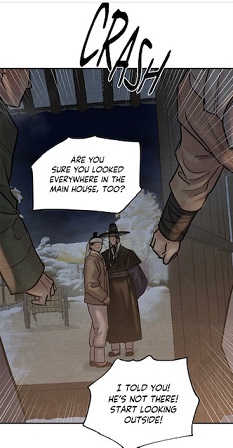 (chapter 98) In this image, Byeonduck portrayed the servants arguing. They are stressed and screaming at each other: “I told you”. They give the impression that they are trying to do anything for their master. Nevertheless pay attention to the previous image:
 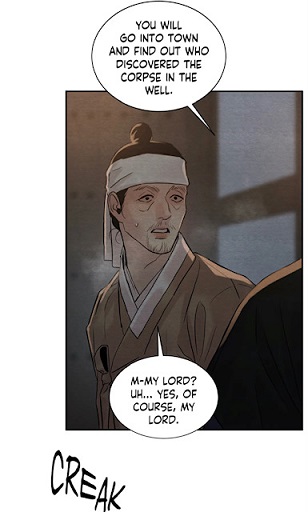 (chapter 98) The light is coming from the butler’s back. How is it possible, since there is no torch next to the gate? (chapter 98) Besides, you can see their shadows in the ground. And there is no street light either. (chapter 98) In reality, the light comes from the mansion. The domestics are carrying torches behind the door. Thus you can perceive some light coming from the top of the gate. But wait…. (chapter 98) Where is the sound in this panel? There’s only silence except the butler’s voice: “Young master”. If the domestics were so worked up looking for the whereabouts of the painter, then their voices would have been visible in this image. But no… there’s nothing. And this observation leads me to the following conclusion. The butler is trying to fool his master by repeating the prank in front of the study. The servants are supposed to fake their dutifulness. Yes, they are all acting, when the door opened abruptly. (chapter 98) But what are they staging? A fake research, but more they are acting, as if they would do anything for their master and as such as if the painter’s desertion was something they couldn’t stop. YES, the staff is following the butler’s principles. They act, as if they were powerless, there’s nothing they could do. (chapter 87) The painter deserted on his own. And now, you comprehend why the revelation occurs at the door. The gate symbolizes the butler’s deception and hypocrisy.
And observe that the gate could have been opened much sooner. The servants were all waiting for the lord’s return so that they staged this fake search. It was, as if the butler had given the signal by saying “Young master”. (chapter 98)
However, Kim never expected that his students would listen to him too well. 😉They even copied his words.  (chapter 98) By using the idiom “damn brat”, the servant reveals that he looks down on the painter. This can give the impression that the latter has been bullied, which is not wrong either. All the servants, including the maids, pushed the artist to leave the mansion. They also abandoned him in the bedchamber, which is something similar to episode 56!!
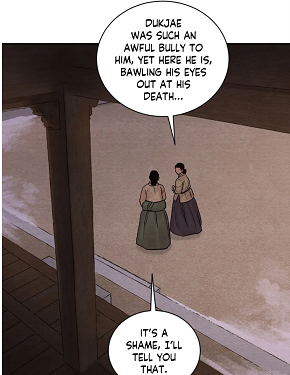 (chapter 98) The women knew that the artist wasn’t feeling well. But they never sent for the doctor and gave him any true comfort. They kept criticizing him. Yes, all the servants bullied the artist. The butler never realized that through his badmouthing, the staff would imitate him. They would chatter idly and fake concern, yet Kim is actually silent in front of his master. He just says the minimum, for the most part, he has to feign ignorance. He acts, as if he was blind and deaf, but in front of the staff he behaves the exact opposite. And this huge gap makes it possible to perceive his conniving personality. However, the main lead didn’t pay attention to the insult („damn brat“), as they had faked their concern. The lord had the impression that they had indeed done their best, hence the main lead felt the need that he had to do the research on his own.
  (Chapter 99) He believed them.
But why did Kim play such a prank? It is because he had succeeded once. (chapter 85) First, his tricks had not been perceived. Secondly, he had not been punished, though he had disobeyed the lord’s order. 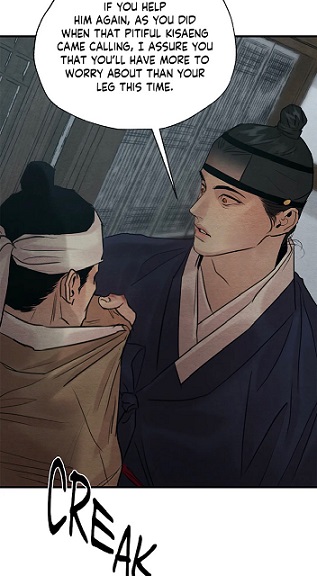 (chapter 86) So the valet had the feeling that nothing had changed. However, like I mentioned it above, he never realized that his fate was now linked to the painter’s and as such he was responsible for his well-being. Thus he got surprised with this new kind of order. For the first time, the valet was tasked to investigate outside the propriety. (chapter 98) In town, he can not really fake his obedience and honesty, for his lies can be perceived more easily. He has no control over the town folks. If the lord were to ask the tailor, the latter would definitely reveal that the body was not found in a well in town.
The domestics had to blame someone… and it can only be the kisaeng Heena. The latter is an outsider, she is not part of their “community”. Exactly like the butler had blamed Yoon Chang-Hyeon for his powerlessness.
How did I come to this interpretation? It is because of this scene. 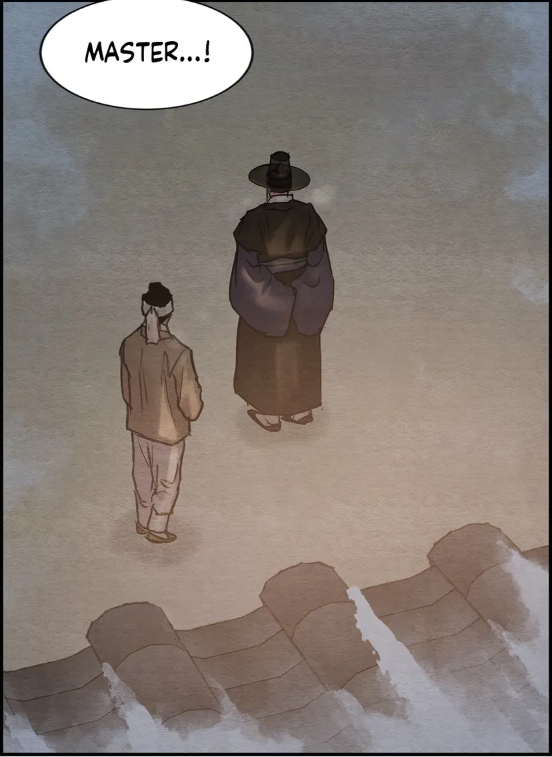 (chapter 98) Many readers, including myself, were quite confused first. However, note that there’s light coming from the building. From my point of view, this is the gate. However, this scene took place before the arrival to the mansion. I believe that this scene represents the moment, when the lord left the office of the investigator. But I can not be 100% sure. However, one thing is sure. Byeonduck wanted us to notice the importance of the light and the silence. The lord was pondering deeply, thus he didn’t pay attention to Kim. But now, the noisy domestics brought the main lead back to reality. (chapter 98) The death of the servant does concern him, for it affected the artist. I view this scene as a reflection from the previous chapter, where the gates were left wide opened.
  (chapter 97) The painter didn’t run away immediately. He remained quite some time in the domain, therefore after the last tragedy, the lord will have the time to ponder about the painter’s question.
  (Chapter 102) Yoon Seungho was separated from his lover for so long, because he had been deceived. It is only a matter of time, until he realizes that he had been deceived by his own staff. At some point, he will view the staff accountable for their misdeeds.
Since I had detected a connection between the darkness and the painter’s nightmare, I realized that the artist must fear the darkness. This is perceptible, when you realize that the painter had problems to fall asleep  (chapter 38) and he woke up in the middle of the night.
 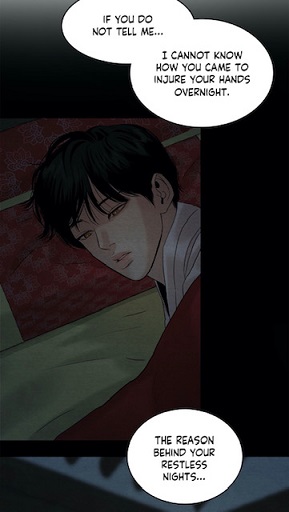 (chapter 84) However, the lord got the opposite impression, for when he entered the study, the painter was sleeping on the floor in the dark.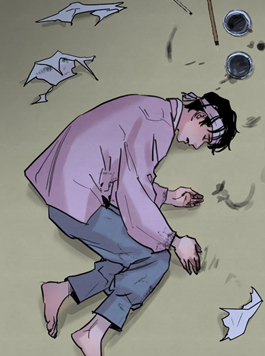
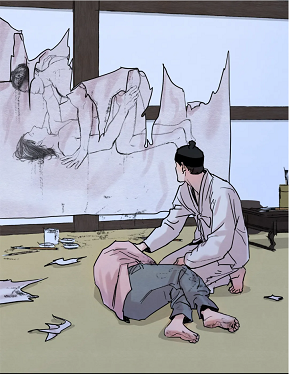 (chapter 02) This explicates why he would always extinguish the candles.
 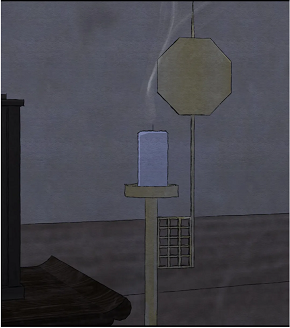 (chapter 97) However, he never realized that the painter could only fall asleep in the dark, because he always sensed his lover’s presence. This means that when he reached the aristocrat’s hand, it also gave him some comfort.
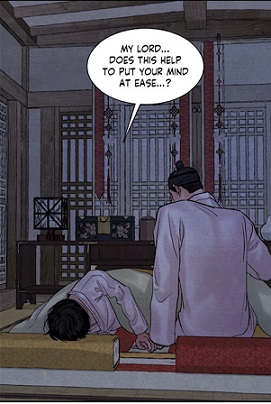 (chapter 97) Because the artist’s fate is similar to the noble’s, I deduced that this fear is connected to the artist’s past. Why does he fear darkness? It is linked to the vanishing of the candle light!
What caught my attention is that the painter’s dreams are all connected to light. 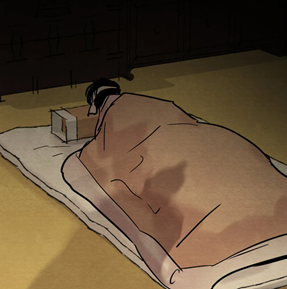 (chapter 6)
 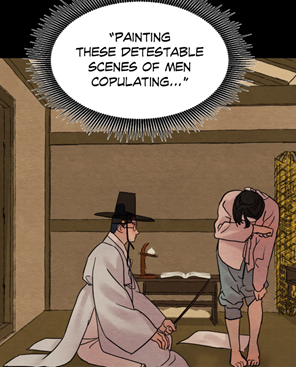 (chapter 34)
  (chapter 87) Thus in episode 56, Baek Na-Kyum had this vision too.
 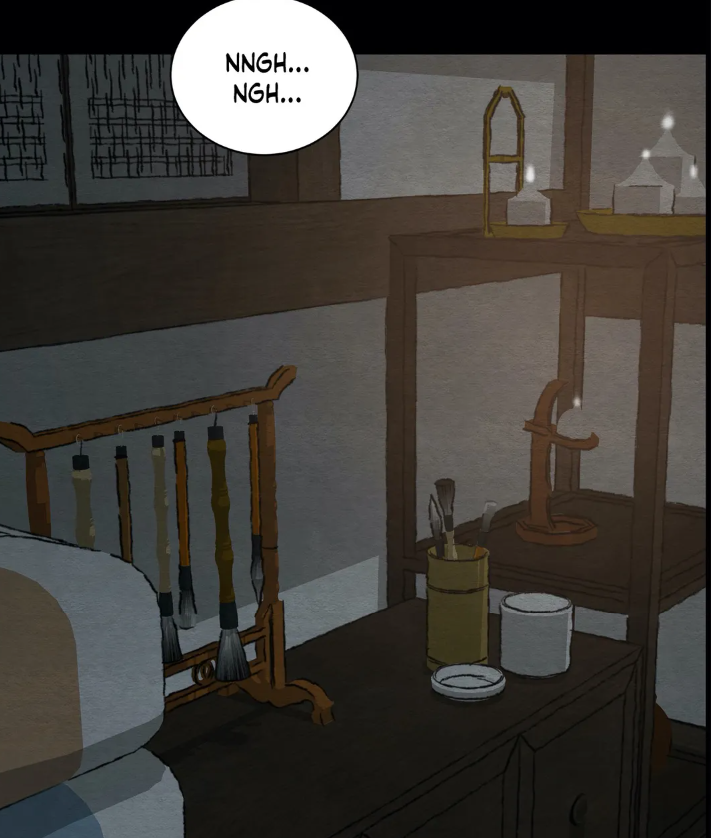 (chapter 56) In the past, the painter used to sleep with the candle night on. For him, the light gave a sense of safety. There’s no ambiguity that he wouldn’t sleep alone, though we have to imagine that the noonas would leave him behind at some point, if they had to work. Thus I came to the deduction that the candlelight was to create the illusion that he was not alone.
However, observe that in the latest nightmare, the darkness appeared with the entrance of the scholar. (chapter 98) And it was the same in the nightmare of the first season, though it was a little changed. The darkness appeared, for the ghost Yoon Seungho was confronting the painter with the truth. He liked painting erotic pictures of sodomy, which contradicted the scholar’s preaching.  (chapter 34) Finally, since the butler is a reflection from the learned sir, this signifies that he is also connected to light.
That’s how I came to develop this theory which is connected to the painter’s past. Why did Baek Na-Kyum appear in this scene? 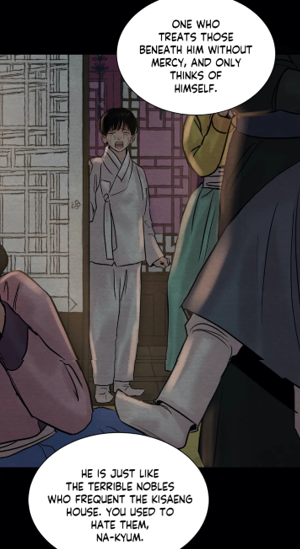 (chapter 68) What made him looking for his noona? What if the bougie was blown out during his sleep and Jung In-Hun was behind this? Byeonduck said that the scholar’s attachment to the boy was genuine, nevertheless there is no doubt that the learned sir was a greedy person. Maybe he woke up, because he detected the absence of warmth, as the noonas had left his side. Hence the painter sensed the abandonment in his sleep, which made him wake up. Consequently, he started searching for his noonas and he opened the door. No one would suspect a young child opening the doors in the kisaeng house. But by opening the door, the artist caused a ruckus, people could hear a protesting child in a room. And during that scene, the artist met Yoon Seungho who was captured by the guard!! This memory represents the night of the sexual lesson. Observe that the color of the hanbok corresponds to the one lying on the floor.
 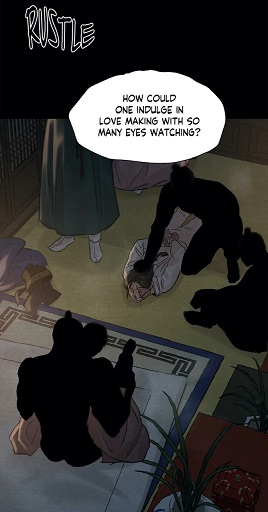 (chapter 86) This means that the one trapping Yoon Seungho was not Yoon Chang-Hyeon, for the latter had a green hanbok. Besides, I started wondering why Jung In-Hun carried away Baek Na-Kyum and left the gibang with him.
  (Chapter 70) Why would he do that? He could have bring him back to his chamber!! Why walk through the countryside and for a long time? It is because he was not allowed to be in the gibang. Remember that he used to sleep in the annex. (chapter 87) From my point of view, Baek Na-Kyum would have heard Yoon Seungho‘s struggling. Besides, we need to question ourselves this: Why is the annex empty?
To sum up my theory again. Jung blew out the candle during the night, the artist woke up and went looking for his noona. He opened the door, when the young master Seungho was protesting. Thus, as soon as they left the gibang, the young noble got tied up, and the „sexual lesson“ was supposed to take place. They used the incident to use violence on the main lead. There’s no doubt that Yoon Chang-Hyeon must have feared for a scandal. Then the father left the building and returned home.  (chapter 87) He entrusted Yoon Seungho to Kim. But in my opinion, during the same night, the young noble was dragged to the annex, where the pedophile was waiting for him with probably other guests. That‘s the reason why Jung had to spend a long time outside the gibang. Maybe that‘s how he received his position as teacher. Remember the commoner’s remark:
  (chapter 29) People believed that he had already passed the exam, while it was not the case. Then I started wondering this. Why does the painter associate the learned sir to the moon? It is because the learned sir would visit him during the night.
  (chapter 94) The light from the moon comforted the artist, it became his companion, for the artist still feared the darkness. However, since the painter described that he would always cry because of his noonas, I am sensing that the scholar must have dragged the artist quite often outside the gibang. And this could coincide to the sexual abuse Yoon Seungho was exposed to. Kim said that the sexual abuse took place in the bedchamber.
  (chapter 87) But is it true? I have my doubts about it. By making such a statement, he is putting the blame on Yoon Chang-Hyeon. Note that the start of the sexual abuse began in the kisaeng house. The more I am analyzing, the more I am sensing that the elder master was just a stupid, selfish and violent father. However, if this had happened in the gibang, then he was as guilty as the kisaeng and the other helping hands.
As a conclusion, the painter came to fall asleep in the dark thanks to the lord’s presence. Thus we had this scene: 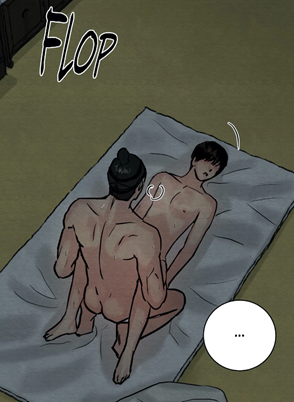 (chapter 50) Both give each other comfort and warmth so that they feel safe. Maybe the FWOP; FWOP sounded like a lullaby to the artist’s ears.
  (chapter 49) 😂
Feel free to comment. If you have any suggestion for topics or manhwas, feel free to ask. If you enjoyed reading it, retweet it or push the button like. My Reddit-Instagram-Tumblr-Twitter account is: @bebebisous33. Thanks for reading and for the support, particularly, I would like to thank all the new followers and people recommending my blog.
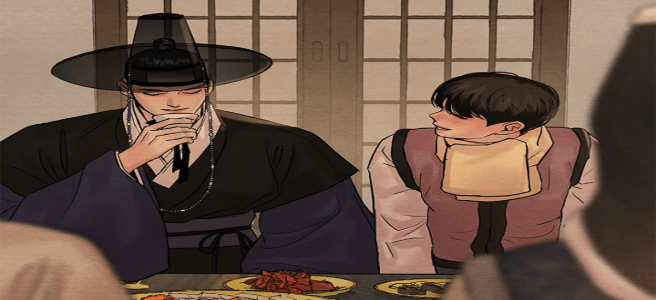
This is where you can read the manhwa. https://www.lezhinus.com/en/comic/painter But be aware that this manhwa is a mature Yaoi, which means, it is about homosexuality with explicit scenes. If you want to read more essays, here is the link to the table of contents: https://bebebisous33analyses.wordpress.com/2020/07/04/table-of-contents-painter-of-the-night/ I am also using doctor Frost as reference again. https://www.webtoons.com/en/mystery/dr-frost/list?title_no=371 I am also mentioning the K-drama “Bad and crazy”
It would be great if you could make some donations/sponsoring: Ko-fi.com/bebebisous33 That way, you can support me with “coffee” so that I have the energy to keep examining manhwas. Besides, I need to cover up the expenses for this blog.
You are probably wondering why I selected such a title, when the story in episode 93 took place in the kisaeng house. I was inspired by the new episode from Doctor Frost again. Right now, doctor Frost and his former student are fighting against a terror organization using brainwashing. Here, the author explains the birth of terror which can lead to war and even to a genocide. 
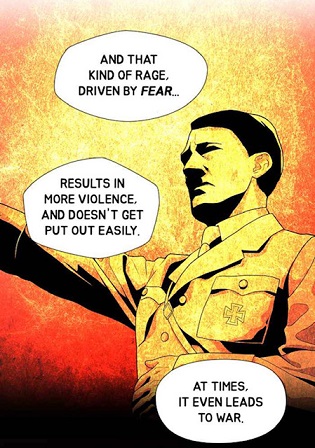 (Doctor Frost, chapter 180) As you can observe, fear and hatred are the main components for unleashing agitation and violence. But this can only work if the medias are amplifying these emotions. Yes, I am talking again about propaganda. And today in the newest episode, the commissar used the fire as a metaphor to describe the evolution of terror.
  (Doctor Frost, episode 183) This means that you can stop the fire from spreading, if you observe the fire path. In other words, if you pay attention to the evolution of the hate crimes, you can slowly put an end to the climate of terror. Important is to find its origin. Then she added this. The fire becomes the most effective in the winter forest.
  (Doctor Frost, chapter 183) Here the manhwaphiles should see the forest as a symbol for society and humans.
  (Doctor Frost, chapter 183) This signifies that the people will get easily influenced by their fear and rage, if there exists a cold climate. A society without compassion and affection. And with only one spark, the forest can get destroyed. This signifies, the absence of love and understanding play a huge role in creating an environment full of hatred and violence. This is not surprising that because of the Coronavirus, intolerance and violence are on the rising, since people are getting more and more isolated and scared. And now, here is the next question: What symbolizes the winter forest in Painter Of The Night and more precisely in episode 93?
When people read the episode 93, they had mixed feelings. On the one hand, they were moved by the way Baek Na-Kyum was treated by his noonas. It was such a warm welcome that it made the painter so happy. He was literally glowing out of delight. 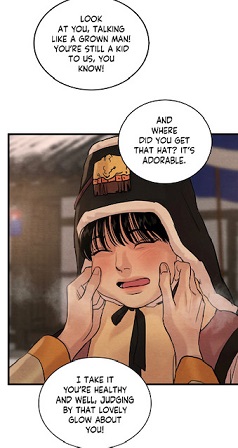 (chapter 93) On the other hand, many readers were greatly disappointed by Yoon Seungho’s behavior. He had prevented Heena from meeting her brother, and the painter was left in the dark. But the lord had also sentenced her to seclusion.
 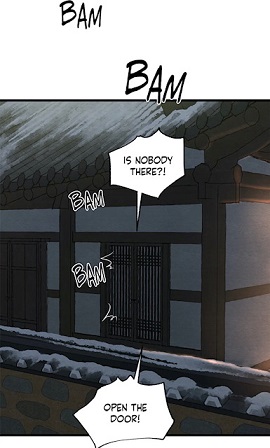 (chapter 93) In their eyes, he was indeed a hoodlum or a bastard. According to the blogger theprocrastinatingredkitty, in the Korean version Yoon Seungho was called a bastard
  (chapter 93) Yes, he had done it again… he hadn’t trusted Baek Na-Kyum and had become violent or ruthless again. But after reading my introduction, you can already anticipate what I am about to say. The winter forest was in fact Baek Na-Kyum’s family. The noonas and the painter had been missing each other so much, but because of Heena’s belief and intervention, she had destroyed this family. Yes, I see her as a religious fanatic who unfortunately got brainwashed by Jung In-Hun and now by Kim. This is no coincidence why Heena is sent to a cold and dark room
 (chapter 93), while the noonas and the artist are sitting in a comfortable room. Hatred versus love… even the colors in the picture reflect the true emotions of the characters. Now, it is time to elaborate my interpretation.
When the painter arrived in the courtyard of the kisaeng house, he was alone. 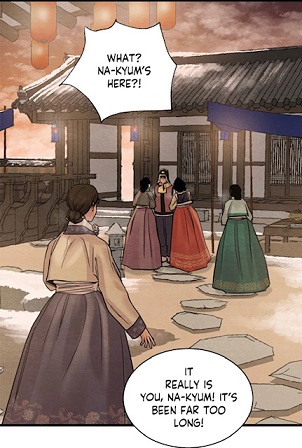 (chapter 93) So where was the lord? I will give you the answer below. Striking is that during the whole time, the artist didn’t notice his absence, until his lovely sister asked him about his whereabouts:
  (chapter 93) Her question reminded him of Yoon Seungho, therefore the artist looked for him, and got surprised, because he didn’t see his husband by his side.
  (chapter 93) This scene is important for two reasons. First, the behavior of the kisaeng clearly showed that she had been left in the dark as well. She was not lying, as there was no drop of sweat on her face. While she had no idea where her brother had been this entire time, Heena knew this the entire time!! 😬 But she kept silent and as such, she hindered her sisters to meet the painter as well. But this doesn’t end here.
  (chapter 93) The kisaeng had not only been left in the dark, but she had also been lied. How did I come to this interpretation? The caring noona employed the expression “you’ve flown the nest already”. With this idiom, she implied that Baek Na-Kyum had willingly left the kisaeng house. He had made this decision on his own, for he felt the need to leave the gibang, whereas the readers already know that this was the opposite. He had been forced to leave by Heena.
 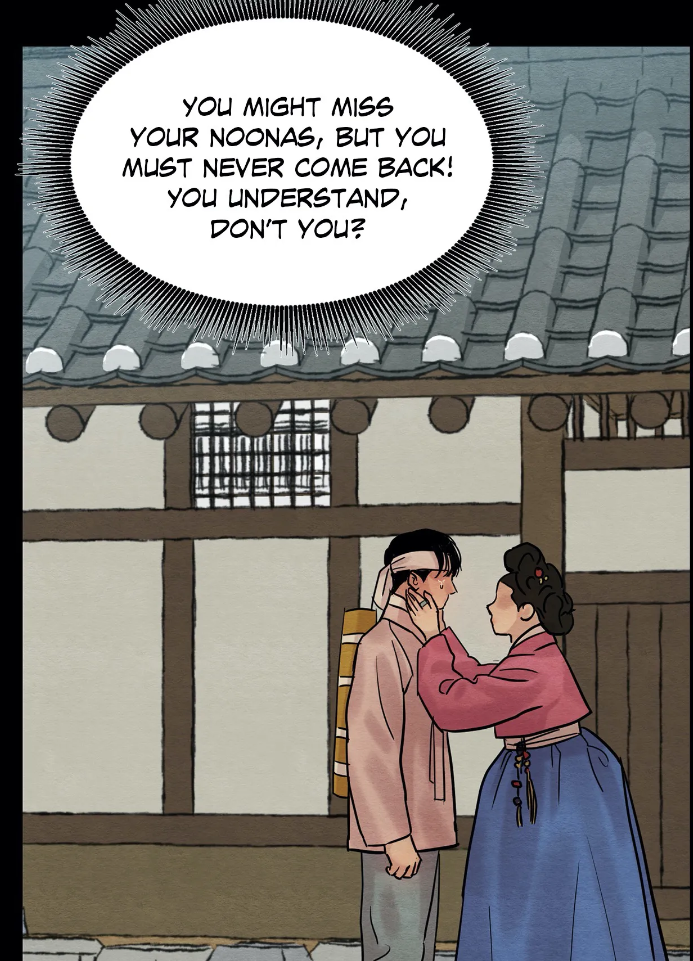 (chapter 46) Like I had already pointed out, the kisaeng had made sure that Baek Na-Kyum didn’t bid goodbye to his noonas. Heena had lied to them saying that this was the boy’s desire and he was now old enough to leave the mansion. This explains why the nice noona employed the idiom “I know”. This is a signal that she had been told by her sister!! But the most infuriating is that Heena left her colleagues in the ignorance for 18 months. None of them knew where the painter was exactly. In the beginning, they had actually no idea that he first lived with the scholar. Besides, notice that the kisaeng complained to the artist. Why didn’t he visit them once in a while? The older sister had given him an order not to!! The most astonishing is that the gentle noona showed great understanding. She accepted the painter’s white lie. (chapter 93) I couldn’t help myself smiling, when I read his excuse: “I was caught up in something important” (sex? spring poetry?😂). At the same time, it broke my heart, for he reduced his long suffering with a single sentence. The noonas had no idea how he got brainwashed and abandoned by the kisaeng and the scholar. The latter even abused him. Note the huge contrast between the noona’s attitude and Heena’s:
  (chapter 68) Heena put the whole blame on the painter, though the latter had been following her orders. She showed no understanding contrary to her sister. Besides, since she knew where he was, why didn’t she contact him in the end?
To conclude, Heena was the reason for the separation between the painter and his noonas. This means that she was responsible for the painter’s agony and trust issues. He had never been abandoned in reality. Hence we could say that she was paying for her sins. She was not allowed to participate in the family reunion. Striking is that when the kisaeng showered her brother with love (I would like to know her name!!), Yoon Seungho walked past them. (chapter 93) You can detect his presence on the left. This means that so far, he had been standing in the background observing the reunion attentively. I couldn’t help myself connecting this scene to this one panel: 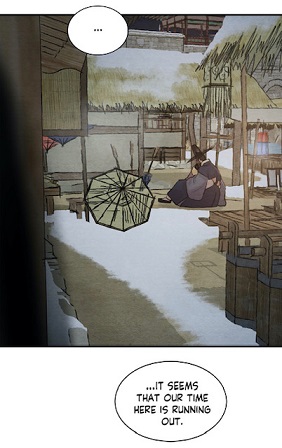 (chapter 76) Back then, Nameless had been confronted with reality: the protagonists were just two men in love and their affection was deep and genuine. So imagine what it meant for the lord, when he saw this scene in the shadow: (chapter 93) He could see what a real family was! This is not surprising that he spoke nicely to them later, and even didn’t take the seat of honor later. In fact, he showed humbleness, for he took the seat next to the door, the lowest in the rank.
 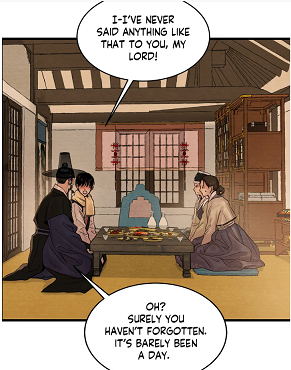 (chapter 93) There’s no doubt that he was seeking for their approval. To conclude, he remained in the background in order to judge the kisaengs correctly. Would they behave like Heena or not? In fact, Yoon Seungho had made a jump of faith. He had trusted the painter’s heart. However, he couldn’t let Heena ruin this happy reunion. Therefore she got excluded. She could have made a ruckus.
More striking is that when the lord walked past them, none of the kisaengs got shocked or condemned him. They couldn’t identify him right away. This means, they only knew him by his name, lord Seungho. Even one of them said this:  (chapter 93) In her eyes, he was a handsome man. Another fell under his spell as well:
  (chapter 93) This is important, because this shows that the kisaengs are not thinking like Heena at all. They don’t resent him, because he is a noble.
  (chapter 65) I would even add that they couldn’t recognize him, and I am now assuming that they had not heard about Yoon Seungho yet. They couldn’t put a name on him, he was just a fancy companion. (Chapter 93) They were not shocked or surprised. They had no reaction at all. This means that the smear campaign started much later: hate speech! The spark of the fire in the winter forest!
 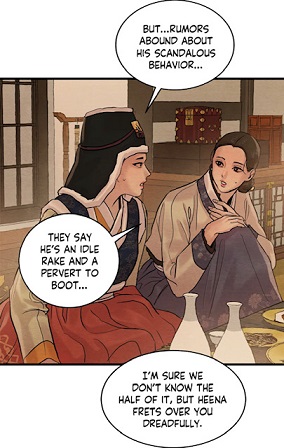 (chapter 93) In the first version, I had blamed Heena, yet I have to admit that I made a mistake, because I had paid too much attention to this image.
 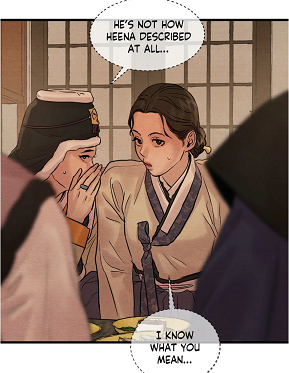 (Chapter 93) Here, they whispered quite loudly and actually blamed the noona for her negative description. But this declaration contradicts the previous one. (Chapter 93) Observe here that none of the kisaengs clearly said that Heena had been spreading rumors about the protagonist. The two women employed the following expressions: „They say“/„I am sure we don’t know the half of it“. The kisaeng with the purple hanbok was pointing out that these rumors were actually upsetting their colleague. This means that in the gibang, someone made sure to call him many names similar to this situation: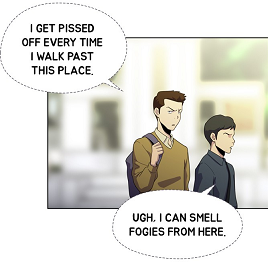
 (Doctor Frost, chapter 175) It created the illusion that Heena had been badmouthing Yoon Seungho and desired to obtain the support from her eonnies. But who had called him a rake and a pervert? The noona herself! (Chapter 93) We could say that they were spreading the rumors herself. Therefore their karma was to get caught!
  (Chapter 93) However, they were just repeating what they had been told. Hence it didn’t work. Why? First, it is, because the painter appeared alone. They could see with their own eyes how well he was doing. (chapter 93) In that scene, the kisaengs were pure and innocent. The other reason is that the noonas aren’t brainwashed, hence they are still selfless and compassionate. In other words, the winter forest was just sleeping, and as soon as the sun appeared, the forest was being reborn. Love and affection never disappeared despite the long separation. That‘s the reason why the fire couldn‘t spread in the end. But who described the main lead like that?
  (Chapter 93) Naturally Min!! How do I come to this conclusion? Simply by recollecting his words in the tavern:
  (chapter 93) He was actually portraying himself as an immoral person lacking in sexual restraint. He would not know fidelity. But the moment the kisaengs got caught, the lord proved their words wrong. He remained calm and treated them well despite the insult.
 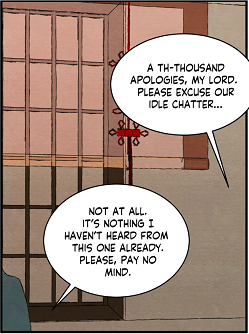 (Chapter 93) He made no fuss and accepted their apology. The most striking is that he ended up apologizing to the noonas.
  (Chapter 93)
And this leads me to the following conclusion. Heena was now under the spell of Kim, hence she insulted the main lead as a murderer, whereas the other kisaengs were under the influence of Black Heart, though it is very possible that they could have been influenced by another colleague, who was acting on Min‘s order.  (Chapter 95) The manhwaphiles should recall the following rule: a scene will be reflected in the next episode. There is no doubt that the valet was the one who ruined the Yoons in the end by causing mistrust and jealousy. He destroyed the family. Therefore Kim sent the ruined painting to the father, and even refused to give the letters from the brother. He made sure to create misunderstandings, silence and tensions between the Yoons, portraying each of them like a monster or a selfish and common brute. This is not surprising that for the father, the son is a monster:
 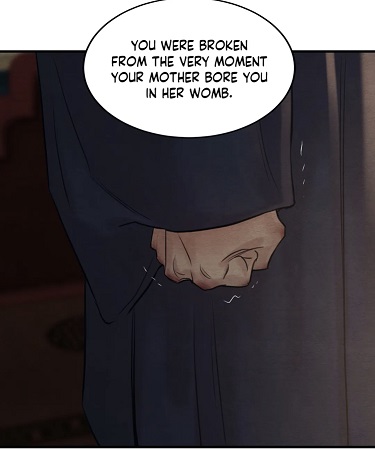 (chapter 86) Kim was successful, for he could change their personality entirely. He used social norms, people’s superstitions, fears and flaws to his advantage. Why? It is because he had to hide his own wrongdoings and betrayals. That’s the reason why the lord’s mansion could be considered as a winter forest as well. But since Heena resents powerful nobles, her negative emotions and her bias made her the perfect tool for the next scheme. But Min and Kim failed. Why? It is because they had two different approaches: The valet preferred using the scholar‘s death for the smear campaign, whereas Black Heart wished to destroy the affection and trust between our beloved couple. Moreover, since the noonas had stopped Heena from approaching her brother with their warm welcome, the kisaengs‘ attempts to ruin the relationship between Yoon Seungho and Baek Na-Kyum were rather half-hearted. The noonas were lacking determination and stubbornness.
First, it is important to examine why the lord even agreed to the painter’s request. What caught my attention is this panel:  (chapter 92) The lord saw that the painter was looking elsewhere and his gaze was full of longing. Secondly, he had promised his lover to fulfil all his wishes.
  (Chapter 91) He didn’t want to break his promise. I am wondering if this idea was not suggested by the butler, because the meeting in the inn was no coincidence. The noble Min made sure to trigger the painter’s memory with the presence of the kisaeng and the blue-lavender hanbok. As you can see, Yoon Seungho didn’t have much choice in the end,
What caught my attention is that Yoon Seungho went in direction of the party where Heena was participating. 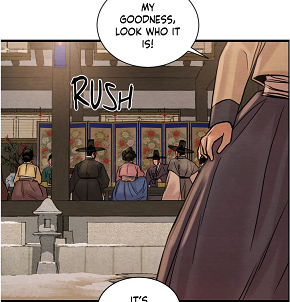 (chapter 93) First, I thought that the man with the green hanbok was Black Heart, since the kisaeng facing the man in green resembles to one who followed him to the tavern, the one under the purple jacket. The color of the skirt is the same.
 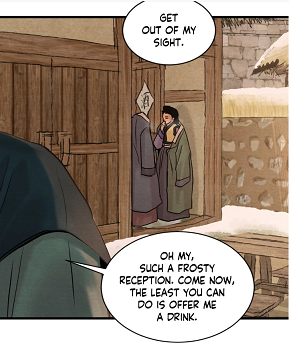 (chapter 92) However, at some point I began doubting this, for for the green shade is a little different. Moreover, I was reminded of this panel: (chapter 87) Yes, the same colors, the green hanbok and the kisaeng’s clothes are the same. On the other hand, since Min had wet clothes, it is also possible that once in the gibang, Min received a new hanbok from the host, similar to the scene in chapter 59, when Lee Jihwa was asked if he had played in the snow.
 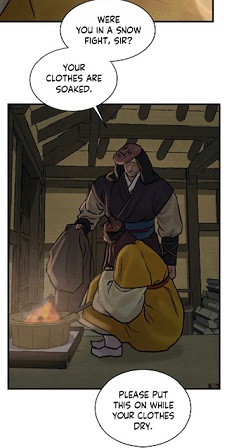 (Chapter 59) On the other hand, Min appeared later as the doppelgaenger of Lee Jihwa.
  (Chapter 96) So we have to wonder if Min switched clothes three times during the same evening. But it is definitely possible, for each episode is reflected in the next.
Another possibility is that Yoon Seungho met his former abuser, but I have my doubts about it, since the man kept his distance from the main figure for quite some time. In my eyes, he needed a reason for his return. Consequently, my theory is that the main lead met Black Heart again, and talked to him about Heena. Don‘t forget that the main lead was present, when the kisaeng had made a ruckus in his mansion.  (Chapter 66) The Joker could serve as a witness, and Black Heart couldn‘t lie at all, as he needed to keep his trust. Besides, it is possible that he must have noticed the disappearance of the Spring poem. Don’t forget that it had vanished in the inn, and Min was the last one seen with it.
 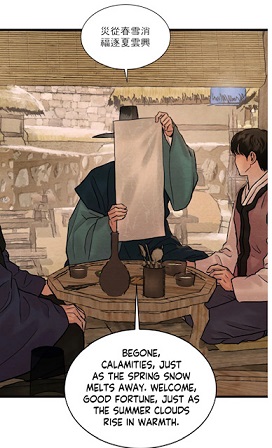 (Chapter 92). Their sudden meeting could be the reason why he disappeared. (Chapter 93) He didn’t wish to create a ruckus because of the painter, and Min had no interest to become involved so openly, as his image would have been ruined. The kisaeng could have caused a scandal. In my opinion, Yoon Seungho picked Heena there, and the man with the green hanbok didn‘t hinder him. Hence Heena was forced to follow the protagonist. So by going directly to the party, he put an end to the fire. The kisaeng couldn’t cause a ruckus or describe the main lead as a criminal or brutal murderer. Therefore there was no fire in the winter forest. If she had come close to her brother, she would have tried to make him feel dirty and have made him many reproaches. I have to admit that this episode was difficult to read, for they were a lot of blanks. We never saw what Yoon Seungho did, before he entered the room, just like there is a time jump between the moment the painter wants to leave the courtyard, and the moment he is sitting in the room. Furthermore, notice that the kisaeng with the green jacket disappeared as well. In fact, 2 noonas disappeared from 4! So where did they go?
What caught my attention is the contradiction between these two panels: (chapter 93)  (chapter 93) Now, they know that the young painter lived with the scholar. How come? Baek Na-Kyum didn’t tell them, because the noona asked him this question. This means that she wanted a confirmation. And now, we have to question ourselves this: who told them about the painter’s past? One possibility is that it was Yoon Seungho, but I doubt it, for the noona didn’t recognize him outside. From my point of view, the noona had left her brother’s side. There was a time jump, because the kisaeng was now wearing a different skirt, khaki!! This means that now, she was acting on the order of someone. Like mentioned above, it could be Min via the other kisaeng. But there exists another eventuality: the Yoons! Don’t forget that khaki is the color of Yoon Chang-Hyeon.
 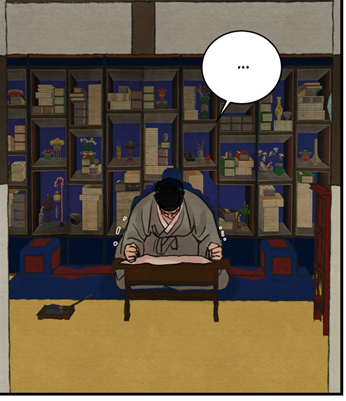 (Chapter 44)
 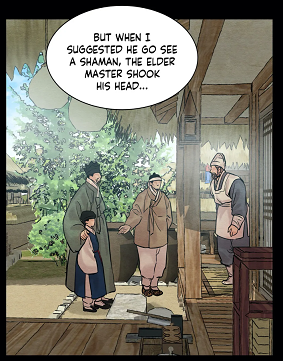 (chapter 57) Besides, just a few episodes ago, he had mentioned the scholar and the civil service examinations, and the story is following this rule: the next chapters will reflect the previous ones. Moreover, in season 2 and 3, the father was seen in the kisaeng house. Finally, in front of the learned sir‘s home, the manhwaworms could identify the guards from the patriarch.
 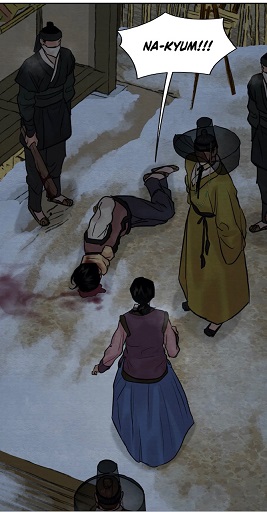 (Chapter 99) This scene outlined that Black Heart and Yoon Chang Hyeon were working together, and they had planned to blame the Lees. But the irony is that the father was doomed to fail, because he was using the noonas‘ goodness and innocence. So the scholar was mentioned for one reason. The kisaeng desired to push Baek Na-Kyum to question his sponsor about the learned sir‘s well-being and whereabouts. The purpose was to generate a quarrel. Note that the other helped her colleague. As you can see, the hat and the change of the color of the noona’s skirt was an indication that there was a time jump. Thus I am deducing that the kisaeng was not present the entire time. Remember that the magician Byeonduck is always creating a fake continuity.
First, the noona had the hat with the orange skirt:  (chapter 93) When she mentioned the learned sir, Yoon Seungho entered the room. (Chapter 93) But observe that the woman had a green skirt with the hat. This means that in the meantime, she must have left the room!! Striking is that he only opened the door, when Jung In-Hun was mentioned. This was no coincidence! He was putting an end to the fire by replying this:
 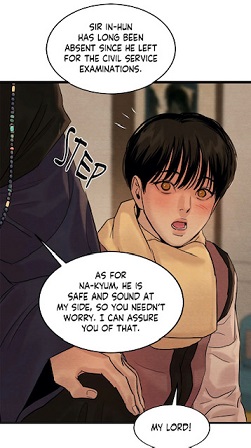 (chapter 93) What could the noonas say to this answer? They couldn‘t call the main lead a liar! And note how he introduced himself: (chapter 93) This means that he had heard their conversation for quite some time. He also must have seen the kisaeng leaving and entering the room too. She was still wearing the green skirt with the hat! (Chapter 93) So here we had no time jump! And now, you comprehend why the author made us hear the conversation from the hallway. (Chapter 93) This corresponds to the main lead‘s arrival. In my eyes, from that moment on, he was spying on the family. But contrary to the past, he had no outburst of rage because of their badmouthing and lie. Why? It is because he had seen their genuine affection in the courtyard. The lord had witnessed the artist‘s happiness and joy! Thus I am deducing that Yoon Seungho had been manipulated in the past. Heena had provoked our beloved protagonist with a deception (Chapter 68) which I had already sensed in the past. This chapter reinforces my previous interpretation. But why did the noona change her skirt? It is because it was wet! I had observed that the lit of the well had been removed. (Chapter 93)
  (chapter 94) That‘s the reason why Yoon Seungho went to the well later. My explanation is that he had been suggested to go there by the noonas, while the latter had proposed a different idea to their brother: the walk to the pond. But why? In reality, the schemers envisioned that Yoon Seungho would behave like a hoodlum, he would kill the kisaeng Heena. Remember the threat expressed to the noona: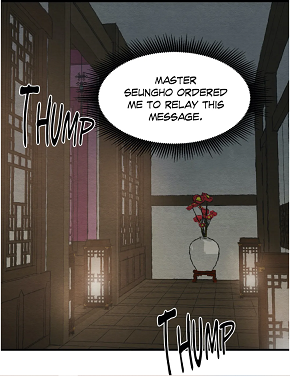
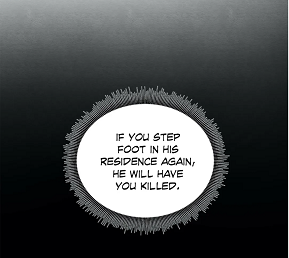 (Chapter 69) But like I had explained, this menace was voiced by Kim, which was only validated by Yoon Seungho afterwards. And naturally, this threat had been revealed to the schemers: Min and the patriarch. They all imagined that the main lead would punish Heena for her accusations. Kim had experienced this scene in the courtyard
 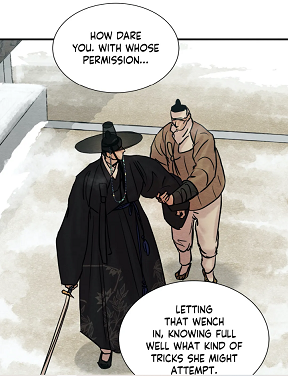 (chapter 68) He had taken these words as face-value. But he never recognized that the main lead would never use violence against Baek Na-Kyum‘s family, and this was already perceptible in chapter 68. He never barged in the study, when the noona called him a bird of misfortune.
  (Chapter 68) He respected their privacy, the opposite of the butler. (Chapter 85) This explicates why the kisaengs blamed Heena for the rumors. (Chapter 93) They were trying to fuel resent towards their colleague. But for a benevolent listener, their words reflected a different reality: the kisaengs’ open-mindedness. They were perceiving the main lead in a better light. That’s the reason why their „smear campaign“ failed.
Hence I come to the following conclusion. During that night in the gibang, Min and Yoon Chang-Hyeon had expected that Yoon Seungho would kill the kisaeng. And her body would have been thrown into the well. That way, the elder master could have used his messenger‘s death as another evidence for the lord‘s criminal activity. And now, under this new light, I believe that the silence and resignation from the noona (chapter 93) in the kitchen created the illusion that the main lead had silenced her. Besides, observe that the light from the room had vanished. It is visible, if you contrast the last two panels.  (Chapter 93) This gesture (blowing the candle) outlines that he was indeed trying to stop the fire, a symbol for hatred and fear, from spreading.
But let‘s return our attention to the conversation between the kisaengs and the couple. What caught my attention is that while the noble lost in his thoughts by recalling his conversation with Heena, he didn‘t realize that something had changed. 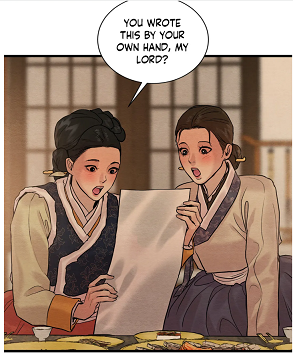 (Chapter 93) This time, the noona had no longer the hat, but she was wearing the orange skirt again. The only explanation is that she had left the room. Since the kisaengs had no drop of sweat on their face, their admiration and surprise were genuine. But now take a look at this
  (chapter 93) We have the return of the hat! Moreover, another detail caught my attention: the paper is blank! Where are the calligraphes? One might argue that it was too difficult for the author to draw them, but I can only refute this point by using this scene.
 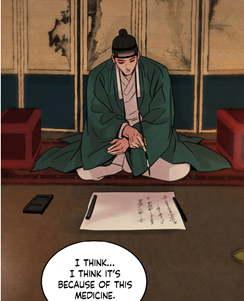 (Chapter 36) Here, the handwriting was even smaller compare to this calligraphy:
 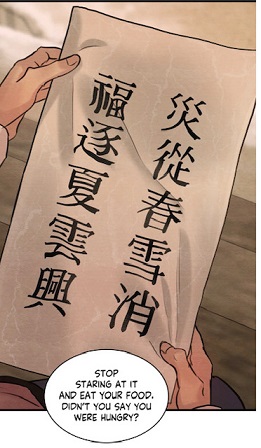 (chapter 92) From my point of view, the Spring poem got switched and was returned to the schemers. Another evidence for this theory is the length of the piece of paper. (Chapter 93) It is much longer here, as the end disappears under the table. But not here: (chapter 93) This was the famous blank piece of paper, a new version of this scene:
  (chapter 65) First, the noona couldn‘t see her brother‘s painting, until Kim showed her the picture with Jung In-Hun which he had kept!
  (Chapter 65) Kim was embarrassed in that scene, like the drop of sweat indicates it.This was the negative version of chapter 93. Don’t forget that Heena had been manipulated by Kim, when she visited the lord’s mansion. The latter had shown her the painting from the painter and then he must have told about the flashback in the bedchamber and the second marathon session in the shed.
 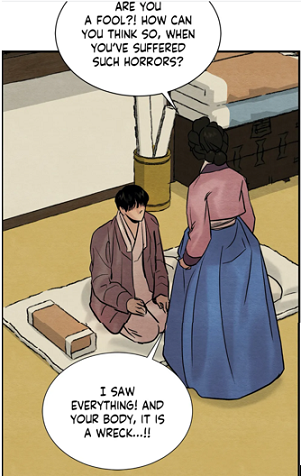 (chapter 68)
For chapter 93 represents the positive reflection from the noona’s stay in the mansion, I think that first, the noonas saw the original Spring poem, then they gave it to someone else and the woman returned with a blank page. Like I had already explained, they needed to remove the evidence that Yoon Seungho was highly educated. (Chapter 93) Striking is that neither Baek Na-Kyum nor his lover had eyes in this panel, a sign that they were blind to the noona‘s tricks. Nonetheless, I would like the manhwaphiles to keep in their mind that these women were just naive, and got manipulated too. They were definitely acting for their sibling’s best interests: Baek Na-Kyum. At the same time, we could say that this was Yoon Seungho’s karma! Don’t forget that he had stolen a poem from the painter too  (chapter 4) and he had never returned it. He had replaced it with another sijo, according to me with the original sijo.
  (Chapter 7) It doesn‘t matter, if the scholar had deceived the painter. The latter viewed the paper as a treasure, a memory from his learned sir.
So during the family dinner, the noonas had an ambiguous attitude towards the main lead, which I explained with their social status. How could they disregard a noble, especially an elder! From my point of view, Yoon Chang-Hyeon must have listened to their conversation, for we have to remember that there is always a reflection within the same chapter. So imagine how the patriarch must have felt, when he heard the lord‘s rejection: 
 (Chapter 93) The father was mocked for his dream!! He was portraying the elder master as a poor and weak noble! He was even compared to the learned sir. We have two proofs for this signification:
  (chapter 86) This was the father‘s karma. He had insulted his own son, made him feel little and even jealous
  (chapter 86) Remember that karma will always retaliate shortly, and the punishment will be even worse. The irony is that the lord was actually repeating the butler‘s words! (Chapter 93) This is what he had been told, when the lord had let transpire that he was thinking about taking the civil service examination. There’s no ambiguity that the noble was talked out of it, for if he went to the court, he would meet the pedophile and recognize the identity of his abuser.
What caught my notice is that here, the noona had no longer the hat again!  (Chapter 93) This symbolizes that she was not acting here. The drop of sweat on their face showed their embarrassment. They could not deny his statement, for the learned sir was indeed poor and with no connection. They anticipated that the lord would boost about his talent, but no he was showing humbleness. On the other hand, he outlined his wealth and power, which the noonas couldn’t contradict. His words were indeed reflecting a certain reality. Another important detail is their reply to the lord‘s statement: the points of suspension which I connect to the butler. Since chapter 77, the latter had switched loyalty and was now serving the elder master Yoon.
But let’s return our attention to the noona who tried to divert attention from their shame and guilt: 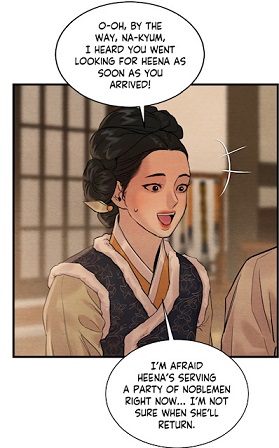 (chapter 93) “I heard” indicates that she wasn’t the entire time with Baek Na-Kyum. This proves my previous statement that the woman must have left the room leaving her siblings inside at some point. Secondly, the drop of sweat on the cheek is a signal for a lie. This means that the kisaeng was well aware of Heena’s arrest. She was actually covering up. It was, as if she was working for Yoon Seungho, while in reality she was acting on someone else’s behalf.
Heena was in the kisaeng house and there’s no ambiguity that she knew where her sister was. This means that she was deceiving her brother. This truly shows that she didn’t feel upset about the situation. I have the impression that the schemers must have discovered that Heena had kept hidden from her co-workers that she knew where her brother had been. They must have discovered her deception. For me, Heena was just receiving the punishment she had deserved. Don’t forget that she had barged in his mansion with guards 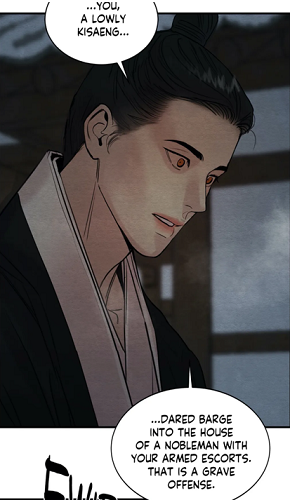 (chapter 69), and back then the lord had showed leniency. However, Heena didn’t want to acknowledge his benevolence. Thus she sent letters to her brother, in which she called Yoon Seungho many names: a rake, a hoodlum, a bastard and finally a murderer…
  (chapter 93) One might bring up the freedom of speech, but there’s a reason why in Germany total freedom of expression is not allowed. During the Republic of Weimar, parties were authorized to announce their hatred for democracy and republic. The result was that right-extremist parties as such the NSDAP led by Hitler became more and more powerful. This is no coincidence that this republic vanished. The NSDAP could spread fear and hate against democrats, Jews and other minorities. Hate speech encourages hate crimes. Yes, this is the consequence of the butler’s philosophy: “don’t take it to heart”. This saying symbolizes indifference and as such passivity and silence which contributes to create the perfect climate for hatred and fear.
But let us return to the letters. From my point of view, Yoon Seungho never gave the order to hide the letters, but once he discovered their existence, he didn’t decide to ignore them. I have the impression that he read them, when the painter took a nap first.  (chapter 91) They didn‘t go to the calligrapher right away. One week had passed, since the elder master Yoon had visited the mansion. This signifies that Heena is forced to face the consequences of her past actions.
 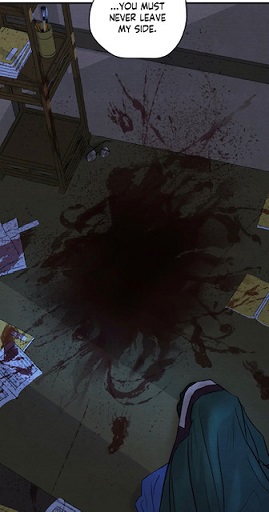 (chapter 88) This is no coincidence that she was sitting the same way in the “jail”, than when she discovered the blood. However, this time she was facing the door. (chapter 93) She was forced to face her isolation. One might say that these were just letters… The lord was just too harsh with her. But remember what I wrote above: calling names is the start of discrimination and terror. That‘s how the lord‘s downfall started too. People shouldn’t underestimate the power of words in the letters. Baek Na-Kyum already went through this terrible experience. Just because Yoon Seungho is used to this, he shouldn’t accept this. Besides, by acting so, she is tarnishing her brother’s honor. If the artist lives with him, he becomes guilty by association. Her goal is to make the painter leave the mansion. She could have confronted the main lead like in the past, but she didn‘t. She never went to the authorities either.
In addition, I would like to bring up the K-drama Bad and Crazy. In this story, teenagers got brainwashed by a so-called therapist who pushed them to commit crimes. He used their low self-esteem and lack of confidence to gaslight them. Striking is that in episode 9, the main lead Soo Yul discovered that a man got sentenced instead of the real culprit. However, when he met the convict, Soo Yul asked him why he didn’t ask for a retrial. The innocent man confessed his guilt immediately. He started explaining everything which confused Soo Yul. Until he saw this:  (episode 9) The real culprit had sent him letters each day for years… The content of the correspondence was always the same:
  (episode 9) That’s how he got brainwashed and convinced that he had indeed committed a crime. In jail, he was isolated and due to the suffered injustice, the prisoner definitely suffered from an emotional and mental breakdown, explaining why he was receptive to manipulations. That’s why you see the mouth and the letter together. So imagine that Baek Na-Kyum had read all the letters and all of them were saying the same thing over and over again. Since the painter is someone with a low self-esteem, he would have started doubting his own judgement. This is gaslighting. Naturally, Kim never intended him to read them. The whole purpose was to create a quarrel in the couple. I am quite certain that Heena never asked about her brother’s well-being. She was already convinced that the lord was a rake and a bastard. Her letters were full of contempt and hatred, something Yoon Seungho could sense in the correspondence.
  The reflection of this scene.
  (chapter 87) But note that Yoon Seungho never used any violence at all. He just asked her to remain quiet and cause no trouble. (chapter 93) We could see that once rumors about Yoon Seungho started spreading in the kisaeng house, Heena didn’t stop them, she heard them, and believed in them. The start of the smear campaign began in the gibang:
 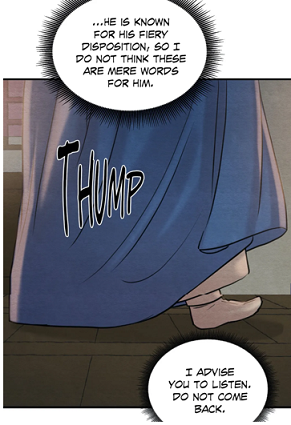 (Chapter 69) And who was there during that night? Black Heart. This is important, because in the first episode, the noona had badmouthed the main lead, but she was well aware of the truth.
 (Chapter 1) It was, as if the kisaeng was now paying for her past sin. She had become a victim of her own trick. (chapter 93) In her eyes, the main lead was just a man consumed by sex, hence he is a “rake” and a “pervert”.
But “rake,” when used in the context of a regency romance, has nothing to do with chores. A shortened version of the word “rakehell,” this category of carefree, libertine aristocratic men became popular in stage plays written during the Restoration period in 17th century England. […] He’s definitely someone who’s not interested in marriage. Celibacy is off the table. No serious relationships of any kind. Often, rakes really adore women of all shapes and sizes. They have an innate sense of how sexy they are, and how to use that sexiness to get what they want from anybody around them. Essentially, the rake is the bad boy with the heart of gold. quoted from https://www.oprahdaily.com/entertainment/tv-movies/a35034695/what-is-a-rake-person-romance-novels/
This means that her job was to deny the existence of the marriage between the painter and the noble  (chapter 87), since the rumors of his union in town were already spreading. The purpose of this smear campaign was to portray the lord as someone who was not interested in monogamy and fidelity. And who had an interest to oppose this union? The father!! As you could detect, through these comparisons I could connect Yoon Chang-Hyeon, Kim, Heena and Black Heart together. In the end, this badmouthing couldn’t succeed, for her eonnies were different. They were more innocent and less selfish, they had been left in the dark concerning the lord’s past. They never admired the learned sir in detriment of Baek Na-Kyum. They certainly don’t reject sexuality and they have less prejudices. As you can see, I detected a war of rumors, reminding me of the war of the waves during World War II.
Here, I would like to bring up the manhwa Doctor Frost again. 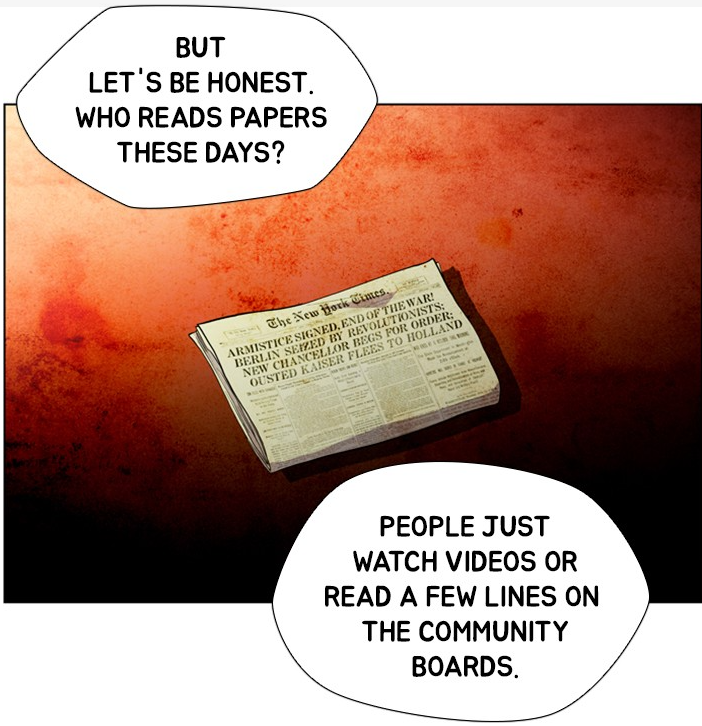

 (chapter 175) Because of this comparison, I couldn’t help myself thinking of the water vapor as the grapevines in Painter Of The Night. They’re everywhere and no one can stop them. And now, you comprehend how the noble’s reputation got ruined.
 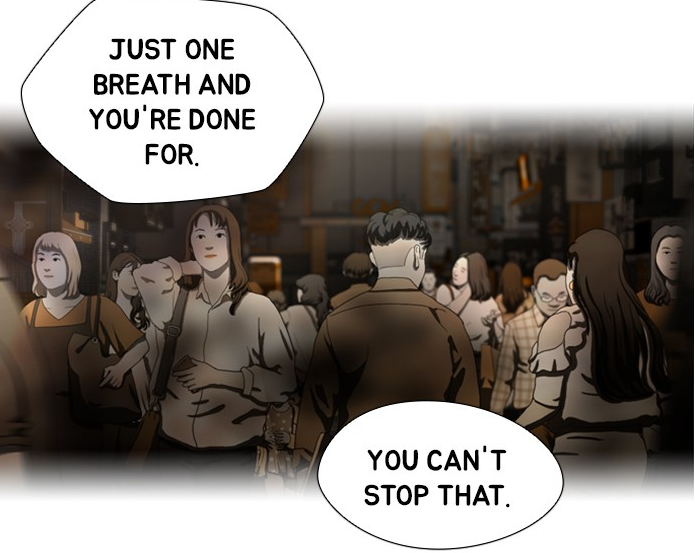 (chapter 175) That’s how hatred and contempt were spread. And Lee Jihwa listened to them, this is no coincidence why his mind and heart got poisoned. As long as he remained by Kim and Min’s side, his heart and mind would always be clouded. This means that Yoon Seungho was able to stop a fire, before it ruined the winter forest. People were upset, for he had such a cold gaze, when he remembered his interaction with Heena.
 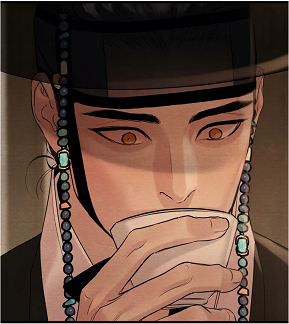 (chapter 93) But he was just mirroring the schemers‘ thoughts and gaze. He had to remain cold. So what does Heena’s isolation mean? Yoon Seungho has no idea, but he is clearing her mind from the brainwashing.
  (Doctor Frost, chapter 183) There exists two methods. First,
  (Doctor Frost, chapter 183) And we could clearly detect this in the confrontation between Heena and Yoon Seungho:
  (chapter 93: In the Korean version: Your little brother will be with me now) For Heena, the painter should live with the scholar. This was her faith:
  (chapter 46), though I am quite sure that it was in truth her biggest wish. She was in love with the learned sir herself. By looking him in the eyes, she could detect the lord’s determination and frankness. This was his choice. The problem is with deprogramming is
  (Doctor Frost, chapter 183) That’s the reason why nowadays, psychologists prefer the other method
  (Doctor Frost, chapter 183) And now, you comprehend what happened. The deprogramming didn‘t work out, for Heena was approached by the schemers again. They used another noona to deceive the sibling, for they could no longer use the women close to Baek Na-Kyum. Thus Heena was still under the influence of the haters.
  (Chapter 98) Since she resents nobles, I deduce that the so-called witness was a commoner. In my eyes, it can only be Kim who justified his silence by saying that he could do nothing. He was the only one who knew, because the other had been already killed.
Since the other kisaengs were not involved in the lord’s suffering, they were more innocent. This is the reason why it was important for the main leads to have some good time with the noonas first. The latter could see with their own eyes that the couple was happy.  (chapter 93). Hence their punishment for their deceptions couldn‘t be so harsh.
  (Chapter 99) The symbol of their dinner and reunion was pushed away. In my eyes, this ruckus put them in a bad light. However, I believe that these deceptions were necessary, for the bond between Heena and the other noonas
 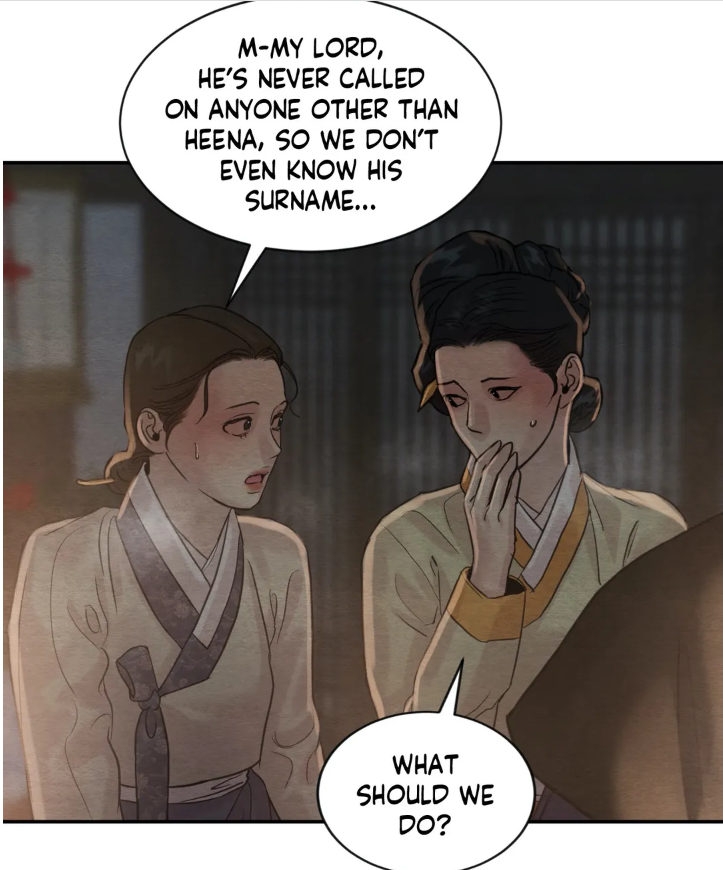 (Chapter 99) was quite strong. In this scene, they had sided with the kisaeng again, hiding the fact that they had seen leaving Heena with Lee Jihwa. They knew that the kisaeng was running away from the gibang, for she was not dressed up.
  (Chapter 99) Hence the moment the kisaengs see how the brother was hurt by Min, they will realize the deception from Heena who abused their affection and loyalty. They will definitely blame themselves for their lies, and since I discovered connections between Yoon Chang-Hyeon and the noonas, I have the impression that Yoon Seungho will discover the backstabbing coming from his own father. According to me, the schemers had planned to frame the main lead for Heena‘s death (well), but the puppet masters‘ karma is to receive the sentence that they had planned for the main lead: accusation of violence and murder. The more I am analysing, the more I am sensing that Yoon Chang-Hyeon will be judged as an accomplice of Lee Jihwa’s crime in the nobles‘ bloodbath. He had helped Lee Jihwa and deceived Black Heart. And if the kisaeng is alive, the survivor will recognize the deception from the guards.
Besides, I would like to point out how gentle the lord was, when he forced Heena to look him in the eyes. (chapter 93) Don’t forget how he grabbed the servant’s face:  (chapter 80) Heena could have pushed away his hand, her movements were not restrained contrary to the lord in the kisaeng house (chapter 86).
People have the impression that this reunion was too beautiful to be true, but the reality is that we are witnessing a war!! But each time, the main lead was able to defeat his opponent, for he was no longer avoiding the problems. He faced them head on. But he didn’t work alone. His wife assisted him. He already started by defending his husband’s honor.  (chapter 93) Secondly, he introduced his partner to his family properly.
 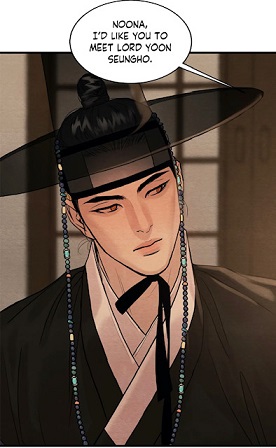 (chapter 93) It is here necessary to contrast this introduction with this one:
  (chapter 01) In the beginning of the story, the protagonist was not presented as a lord, but as a master!! This means, he belonged to the Yoons. However, Baek Na-Kyum is now viewing the protagonist as the real lord of the mansion. He is independent, which means that the artist is not truly acknowledging Yoon Chang-Hyeon and Yoon Seung-Won as his family. And if you compare the first episode with chapter 93, you’ll realize the similarities. Back then, Heena had mentioned the main lead in order to scare the painter, she had used rumors… (chapter 01) But exactly like in episode 10, where the grapevine was created to target the painter and Jung In-Hun, the “rumor” in episode 1 never reached the noonas’ ears. They only heard about the black sheep of the family recently. (chapter 93) In the last panel, we can detect Heena’s hypocrisy. She got worried the moment she heard her brother was living with the main lead. I would even say that her mind was in peace until the scandal in town, this explicates why she could enjoy buying clothes.
  (chapter 64) But she started worrying for her brother, when she realized that he wasn’t living according to her belief: abstinence. And now, we have to question ourselves this: why did Yoon Seungho encourage his bride to sleep in the kisaeng house?
 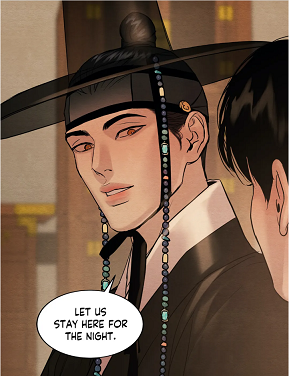 (chapter 93) Naturally, he had many reasons to do so. First, he wished to keep his promise. Secondly, he had sensed the painter’s sadness.
  (Chapter 93) But Yoon Seungho never imagined that he was himself the cause for this heartache. The painter could detect the lord’s agony and low self-esteem. He knew how hurtful it is to be called names like rake or bastard or hoodlum. And the lord’s selflessness got rewarded: his biggest wish came true during that night. There was someone who loved him despite his flaws and wrongdoings. We could say that their stay was to confirm his marriage with the painter to the noonas. At the same time, season 3 exposed the slow transformation of Yoon Seungho. Little by little, he was showing an interest to his own past and no longer accepting the justification that he was just a bird of misfortune. Don’t forget the master’s previous statement:
  (chapter 86) He was already pondering on the question why the family name was sullied. This shows that Yoon Seungho is slowly uncovering the truth, and he is now using Kim’s MO: deliver the information in delay, feign ignorance and act, listening to conversations behind the doors. This is no coincidence that he is recovering his memories as well. This is important, because he is less manipulable and as such no longer weak to brainwashing.
And here I would like to thank my follower @Spppeedy who made me discover another aspect. Yoon Seungho’s real emancipation didn’t occur just with the hug, but also with the whisper:  (chapter 88) When the lord got embraced, the painter whispered this to his ear:
“I like to hold you close.”
This explicates why he said this later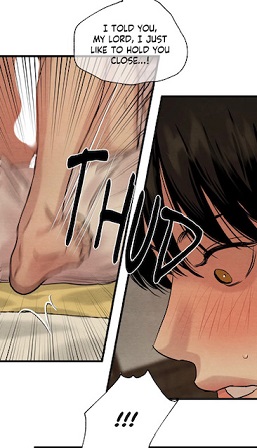 (chapter 91) This represented Baek Na-Kyum’s first mini-love confession. His action was supported by his words. Therefore the lord could realize the honesty and genuineness of the painter. He could be embraced and as such accepted, he was no monster. Yes, it was the opposite of the love session in the physician’s office. Back then, the painter had remained silent.
  (chapter 62) And this made me realize the signification of whispers in the manhwa. They stand in opposition to the hate speech and brainwashing!! This is no coincidence that the noonas whispered, when they noticed that Yoon Seungho was totally different from the description which Heena was supposed to have spread. (chapter 93) The whispers symbolize secrets, trust and intimacy. They embody love, honesty and truth, though here they blamed their noona. This means that the louder a character in the manhwa is, the more dishonest and insensitive he or she is.
  (chapter 18) The whisper contrasts so much to the rumors, anonymity versus personal. Thus I conclude that the whisper represents a weapon against the brainwashing and terror. This is not something that a spy can hear from the window or the door! Hence you have Yoon Seungho whispering this to Lee Jihwa
  (chapter 18) or Yoon Seungho saying this to Heena: (chapter 93) Due to the closeness, the lord incited them to face reality. He confided to them his wish and goal, though after 6 months, the master’s dream changed. He views Baek Na-Kyum as his wife. That’s why I believe that the lord’s whisper
  (chapter 92) reflects the nature of their relationship: Love and closeness. Even outside and in front of the calligrapher, the lord felt the need to know his lover’s thoughts, the positive version of this rumor: An aficionado for the painter with no regard for time and place. 😉
So when you read this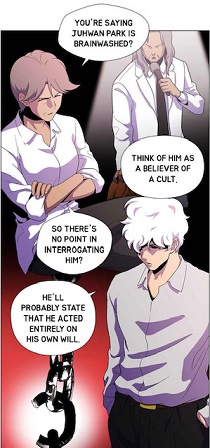 (doctor Frost, chapter 83), you should just replace the name Juhwan Park by Heena. She was just manipulated by the butler and Min’s trick. They used her strong belief and prejudices. However, I had the feeling that Heena could come to her senses, because she remained silent and her gaze was different.
  (chapter 83) Besides, what caught my attention is that she never replied to Yoon Seungho. She never fought back like in episode 65:
 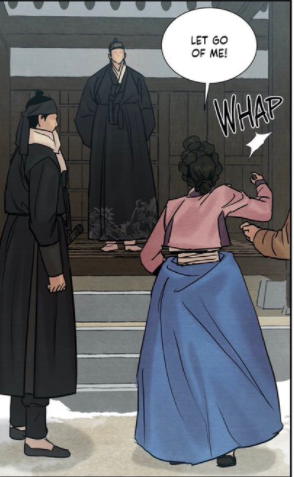 Why was she so passive? It is because the exclusion from the reunion represented the biggest punishment for Heena. She has always seen herself as a knight in shining armor. Imagine all the noonas could see the little brother and enjoy his company, while she couldn’t. I was hoping that she would start regretting her actions. As you can see, I really viewed Heena more as a victim, blinded by her faith and her own suffering than as a big perpetrator. There’s no doubt that she rejects sex because of a traumatic experience. Yet, due to her blindness and selfishness, she was an accomplice to her brother‘s suffering in the past, and unfortunately, she made the same decision.
  (Chapter 97) Seeing the corpse in the well was the trigger for her to believe everything she saw and heard without questioning the coincidences and appearances. She didn‘t doubt the testimony of the so-called witness. (Chapter 98) This image illustrates perfectly her fanaticism, her vision full of prejudices, for the author drew her without eyes. She shares some common denominators with the persons in this picture: (Dr. Frost, chapter 180) Fear, rage and the absence of eyes!! She chose the scholar over her brother.
And now, you comprehend why Byeonduck decided to let this season take place before the spring. The lord and painter needed to put an end to the terror and terrible rumors circulating about Yoon Seungho. They had to find and remove the source of the hatred and fear leading to violence. Once the winter ends, the climate of hatred and terror will vanish. The forest will come to life again… just like Yoon Seungho’s new home and family. Thus I am expecting that the noonas will come to accept the aristocrat. Hence the marriage takes place in the gibang 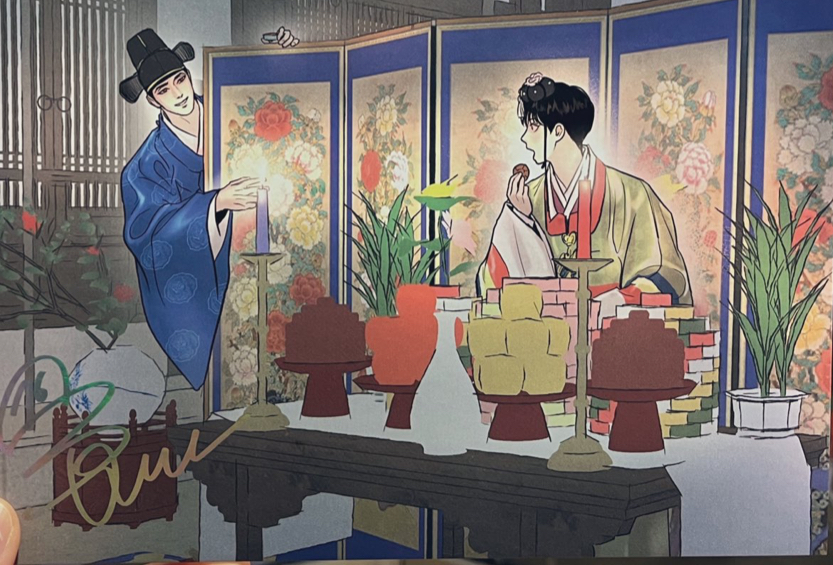 replacing these three fake feasts:
  (chapter 87) (chapter 93) (chapter 99) No scandal in the past and in chapter 93, but now it can no longer be contained!!
 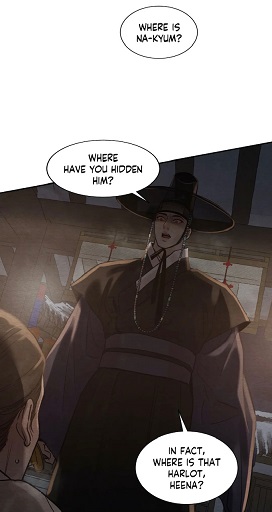 (Chapter 99) On the other hand, the resent for Heena didn‘t turn Yoon Seungho into a fool or a person full of prejudices! He still trusted the noonas, as he believed in his lover‘s heart and his genuine confession! The fire couldn‘t spread in the gibang! The lord showed mercy towards the kisaengs and the domestic Seok-Dae! Hence no one will ever come to believe that Yoon Seungho is a murderer. In their eyes, he makes nothing but hot air!! 😉
Feel free to comment. If you have any suggestion for topics or manhwas, feel free to ask. If you enjoyed reading it, retweet it or push the button like. My Reddit-Instagram-Tumblr-Twitter account is: @bebebisous33. Thanks for reading and for the support, particularly, I would like to thank all the new followers and people recommending my blog.

This is where you can read the manhwas. https://www.webtoons.com/en/mystery/dr-frost/list?title_no=371 https://www.lezhinus.com/en/comic/painter But be aware that this manhwa is a mature Yaoi, which means, it is about homosexuality with explicit scenes. If you want to read more essays, here is the link to the table of contents: https://bebebisous33analyses.wordpress.com/2020/07/04/table-of-contents-painter-of-the-night/
Before starting analyzing the manhwa under this aspect, it is important to define the term home. In a dictionary, this is what you find:
- the house, apartment, etc. where you live, especially with your family
- the type of family you come from
- a place where people or animals live and are cared for by people who are not their relations or owners
- someone’s or something’s place of origin, or the place where a person feels they belong
- your own country or your own area https://dictionary.cambridge.org/dictionary/english/home
As the readers can detect, home has a lot of significations. The reason is simple. It depends on the perspective. When people are asked where their home is, some will answer that their home is the place they are actually living, others will reply that it is the place where their family lives or where they were born and raised. But all have something in common: Home is where the heart is. To sum up, home is very subjective and personal.
Since home is related to our disposition (liking, family), it means that home represents a part of our identity, it even defines us. This explicates why psychologists sometimes visit their patients’ home in order to better grasp their personality and issues.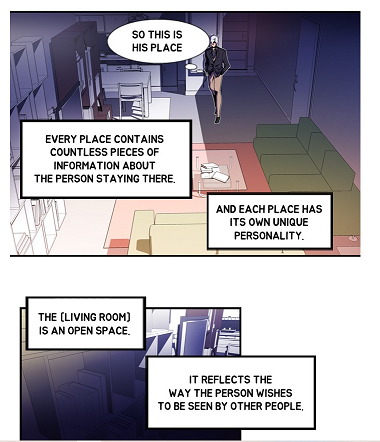 (Dr. Frost, chapter 8) As you can see, home is strongly connected to identity and personality. In other words, without home a person loses his identity. This is no coincidence that homeless people often have no ID.
Consequently, the manhwaphiles can comprehend why Baek Na-Kyum had huge abandonment issues and a low self-esteem in chapter 46.  He felt so lonely and lost, for he had no place he could call home. It was, as if he had no identity. When he deserted the mansion, he first thought of the kisaeng house and his noonas
 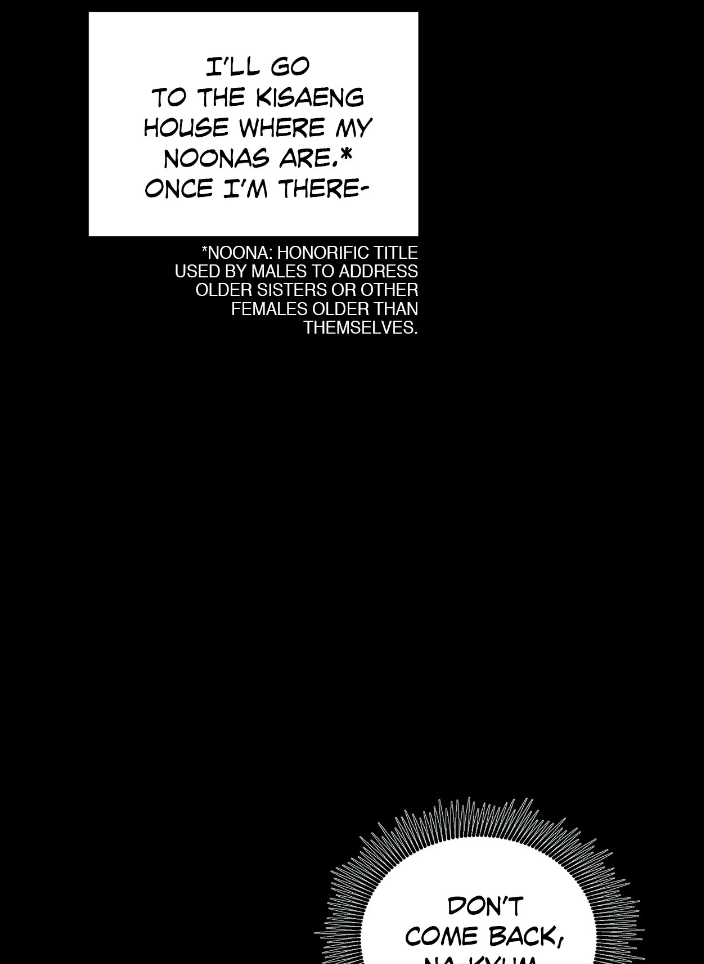 (chapter 46), until he remembered how he had been sent away by Heena noona. (chapter 46) This moment was terrible for the painter, because he had the impression to be abandoned a second time. Note that he is not calling the kisaeng house his home… for him, it was no longer a home, because his heart had been wounded there. Hence the manhwaphiles sense why the painter was using his mind in chapter 75
 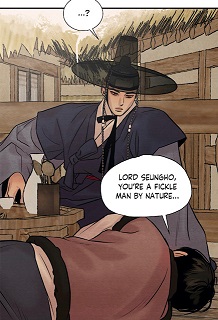 (chapter 75) and was restraining himself from falling more for Yoon Seungho. He had come to view the mansion as his home, and if he came to accept Yoon Seungho as his companion, then the latter would become his home, his family. Don’t forget my previous statement: Home is where the heart is. He was afraid of getting hurt a second time. If the lord came to have a change of heart, he could lose his new founded home.
Since the fight with Deok-Jae (which I am explaining more in details later), the painter had come to view the mansion as his home, hence he stated this to his lord: 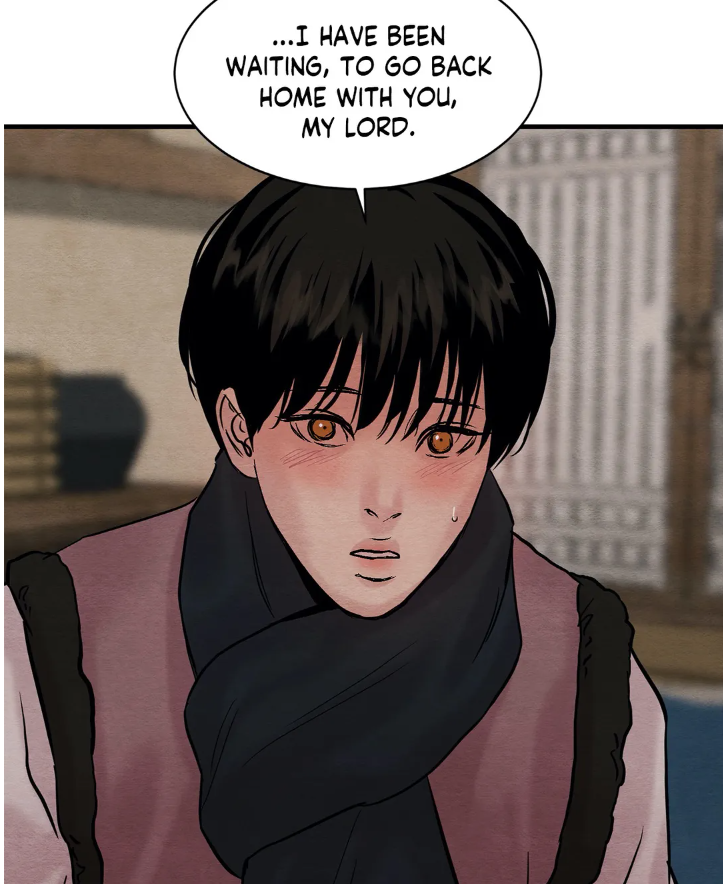 (chapter 58) And now, you comprehend why he stopped in the middle of the street during his escape. He had recalled how Heena had sent him away. (chapter 46) The painter had come to associate home to a family and as such to people. This explicates why the kisaeng had forbade him to bid farewell to his sisters. I am not saying that the kisaeng’s decision was ill-intended. She knew that if he met the kisaengs, the latter would have convinced him to stay. As you can see, he had experienced himself how his sister had abandoned him in the end. To conclude, for Baek Na-Kyum, in the past home was a synonym for family and a place.
But why would she coerce her brother to leave the gibang? Observe that she never gave her brother a choice. She never realized her wrongdoing, because she imagined that she had done it out of love, and it was for the painter’s best interests. Anyway, when Baek Na-Kyum reproached his lover his fickle nature (chapter 75), in my eyes, this perception should be applied to Heena noona who could send away her brother in such a way and never contacted him afterwards. That’s the impression she gives. (chapter 68) Observe how she blames her brother for not contacting her, while she had strictly forbidden him to come back. At the same time, the readers should question her behavior. How come that she never showed any concern for Baek Na-Kyum for 18 months, until she found out that he was living with Yoon Seungho? Why didn’t she contact him in the first place in order to check out if he was living properly? She gave him instructions, and the main lead listened to her, and now she is reproaching him that he should have disobeyed her. In my eyes, Heena noona acts more like a person with a fickle nature. She shows great care and concern in chapter 65 and 68, but she never searched for her brother’s whereabouts before. So far, the readers can only assume that she had no idea that he had been living as a drunk, and she only discovered his whereabouts by hazard. (chapter 64) Yet, this is just an impression because of this scene. Yet, in season 3, Heena confided to Min, and the latter revealed the content of her confession:  (chapter 99) The idiom “bittersweet affections” indicated that the learned sir had expressed regret and disappointment concerning Baek Na-Kyum. This means that Heena knew that Jung In-Hun’s affection towards the low-born had been changing. As you can see, I come to the conclusion that Heena was already aware of the existence of tension between the painter and his former teacher.
What caught my attention in chapter 68 is the following: 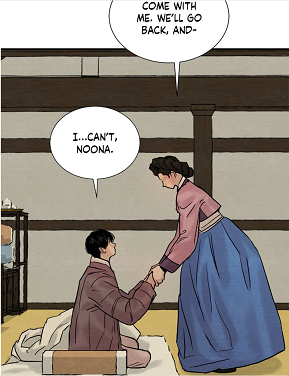 Heena noona is not even using the word “home”. At no moment, she employs this expression. When she parted from her brother in chapter 46, she mentions the noonas and when she asks her brother to follow her, she says: “Come with me”. As you can see, Heena doesn’t consider the kisaeng house her home. That’s the reason why I think that for her, the kisaeng house had been her workplace and she associated home more with people she cared about, similar to the painter. And this observation made me realize why the sister sent her brother away. Heena noona has never liked the kisaeng house, let’s not forget that she is a slave and she can not leave that place. And the guards could be judged as her wardens, they are keeping an eye on her, similar to the role played Yoon Seungho in chapter 45. For her, the kisaeng house was a synonym for prison and hell, where she kept meeting these terrible and violent rich nobles. (chapter 68) Hence in her mind, when she asked her brother to leave the kisaeng house, she imagined that she was helping the painter to escape from prison. Since she admires the scholar so much, she saw in him her helping hand. He would assist her brother to become a free man. The readers should notice that the learned sir always left the kisaeng house with the low-born
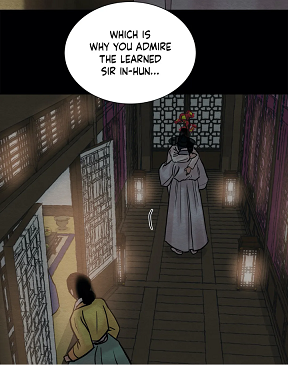 (chapter 68), when there was a ruckus. So when the kisaeng made the request to the teacher
 (chapter 46), she envisioned that he would acquiesce her request, since he had done it so many times in the past (taking care of Baek Na-Kyum and becoming responsible for him). Moreover, she knew that the artist liked and admired Jung In-Hun. For her, the scholar was a liberator, because he acted so differently towards the kisaengs and Baek Na-Kyum. That’s the reason why she thought, she was doing the right thing for her brother, while in reality she was just projecting her own desires into the artist. And this interpretation was proven correct, because when she vanished from the gibang in season 3, she was no longer dressed as a kisaeng.
 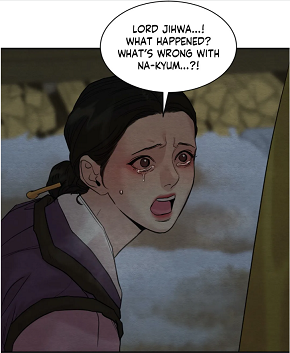 (chapter 99) She was deserting the kisaeng house, and as such the noonas. And note the parallels between chapter 46 and 97/99. In both cases, the painter couldn’t bid farewell to the other kisaengs. (chapter 46) (chapter 99) It is because she was using her brother. In the first desertion, her choice was influenced by her unconscious. She had just projected her own thoughts and desires onto the artist’s. In season 3, she had made a conscious choice. In exchange of her brother, she would gain her freedom. Thus she used the expression “us”
  (chapter 97) This time, it was for her own sake. But the price for her freedom was that she had to sell her brother. She could still have a clean conscience by convincing herself that Yoon Seungho had killed her idol. At the same time, she needed to fake her death.
 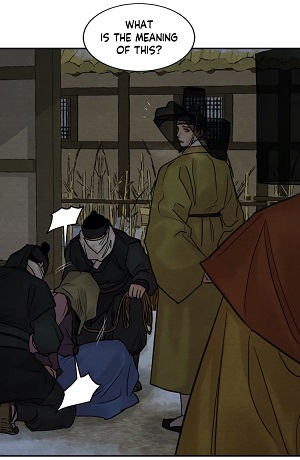 (chapter 99) [For more explanations read the analysis “Heena’s curtains”] This means that she was betraying the eonnies one more time. And that’s how I had another revelation. In my eyes, after their separation, Heena had come to view her life in the gibang differently. She had been able to perceive the good aspects of her life as a kisaeng. She could live a comfortable life and as such get new hanboks. (chapter 64) That’s why I believe that she came to forget her brother, like “out of sight, out of mind”. But how did she come to view the gibang as a place of hell? In my opinion, it is related to Yoon Seungho! She knew about his misery. Thus I am deducing that the painter’s vanishing from the gibang coincides with the end of the lord’s misery. Thus I have the impression that her definition of home came to change. It was less connected to the kisaengs and the painter, as such to family. She came to like the place.
But let’s return our attention to episode 46. (chapter 46) Because she didn’t allow her brother to speak his mind, she hurt his heart and created more wounds than before. That’s why I perceive the argument in chapter 68 as important. For the first time, Baek Na-Kyum is not listening to Heena. Since home is where the heart is, her brother could only reject her proposition to come back to the kisaeng house. He had been abandoned by the noona. However, because he was afraid of his own feelings towards the aristocrat, he created new problems with his confession. His description 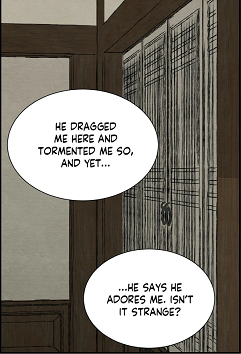
 reinforced her bad impression about Yoon Seungho. That’s why Heena noona will never believe that this place can become the artist’s true home. For her, this place can only represent a new prison, for she has a negative perception of nobles. Hence she needs to rescue her brother.
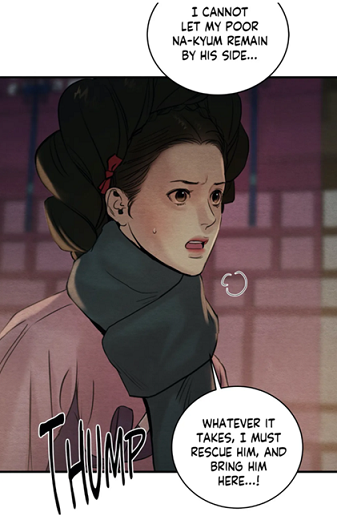 (chapter 69) Besides, I believe that she has another reason. The lord is connected to her own guilt, but she is not admitting her responsibility. In the first version, I had expected that due to his confession, the kisaeng would never trust Baek Na-Kyum’s words later. And this was proven correct. Why? First, Heena noona embodies a certain kind of knowledge: prejudices. Because she has already experienced many things, she has the impression that she knows everything. However, she is not realizing that her world view is based on her own perception. Secondly, her superficial knowledge turns her into a blind and deaf person. What she sees and hears will be interpreted the way she perceives the world. I had even written this back then:
“Even if her brother tells her how well Yoon Seungho treats him and how much he loves his companion, she will have the impression that he has been brainwashed or coerced. Why? It’s because she has always treated her brother that way.”
In addition, she knows a part of the truth, while her brother was left in the dark entirely. Thus she reproached her brother his stupidity: (chapter 97) Contrary to him, she knows, because she saw and heard things, when Yoon Seungho suffered! Yet, her knowledge is totally superficial, like the last panel exposes it. She just jumped to (false) conclusions. That’s how she got herself manipulated. Because of her bias, she became an easy target of deceptions. That’s the reason why she believes herself in rumors. Like the scholar said it himself,  (chapter 29) there exists a kernel of truth in the grapevine. Moreover, with her caresses and hugs, she used love to stop her brother from speaking his mind.
 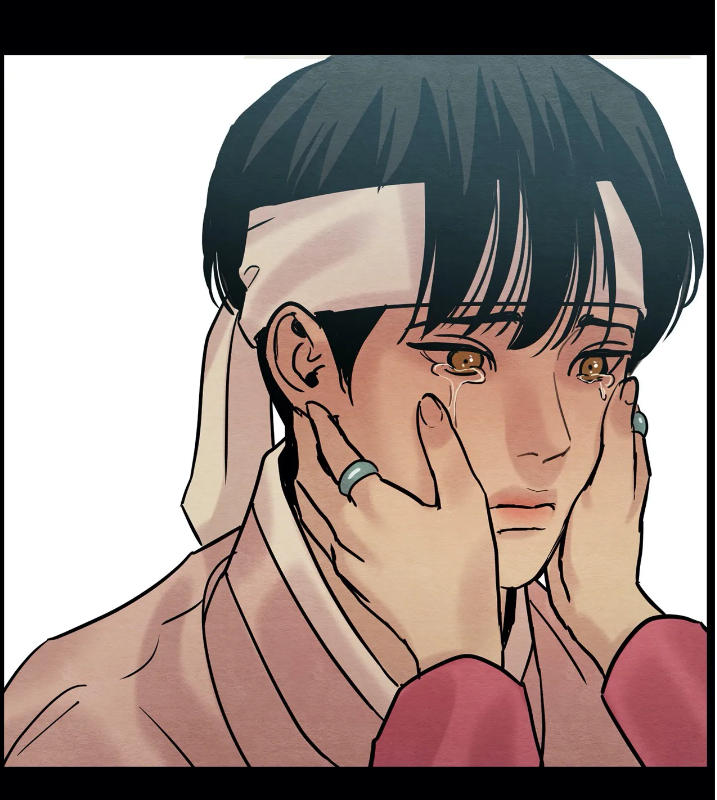 (chapter 46) That’s the reason why Baek Na-Kyum could only express himself through painting, as he had become mute. Due to her decisions and actions and the scholar’s, she contributed to turn the artist into a boy full of insecurities, unable to express himself. Consequently, Heena noona was put in front of the same choice in season 3. Note that the return of the painter to the gibang coincides with her departure. This means that due to the couple’s love session, she was reminded of her own past. She was forced to recall why she had associated the gibang to hell in the first place.
  (chapter 96) She was definitely scared in that scene. That’s the reason why at the end, she utilized her brother to leave the gibang. (chapter 97) However, the gods wanted to confront her with the true consequences of her choices. She wouldn’t live with her brother, their paths would get separated. (chapter 99) She had to choose between her brother and her life, and she selected freedom over Baek Na-Kyum. This is no coincidence that their bloody reunion happens in front of the scholar’s home. (chapter 99) This mirrors that her original dream was to live with her brother and the scholar, but this was just an illusion. She had hoped that once the artist was by Jung In-Hun’s side, the learned sir would come to buy her, and they would live together. She counted on the learned sir’s affection for the painter. But this was never Jung In-Hun’s intentions and he excused his behavior by putting the blame on the protagonist. (chapter 99) That’s the reason why the kisaeng mentioned the bittersweet affections. The scholar came to see the painter as a burden. This new approach gives us a clue why the artist chose the noble over his noona in chapter 68. The lord might have been violent, yet unlike all the other characters he allowed Baek Na-Kyum to be true to himself and to express his thoughts and emotions. Let’s not forget that in reality he was the only one encouraging the painter to paint, which was the commoner’s true passion. He even praised him, while even Heena couldn’t restrain herself from criticizing her brother. Freedom is an important condition for calling a place or people home, next to comfort and safety. But when the kisaeng left the gibang, it was just a fake freedom, as her safety is strongly intertwined to the benevolence of the noble protecting her! (chapter 97) Hence I come to the conclusion that Heena associates home to the learned sir and not to her brother. Exactly like the artist, she made a choice. She sided with Jung In-Hun, the poor learned sir, who got disappointed with Baek Na-Kyum. But she believes now that he is dead. Hence by leaving the kisaeng house, she doesn’t realize that she is abandoning everyone: the eonnies and Baek Na-Kyum. She has no one by her side… except the noble who sent the guards. From my point of view, she is trusting the butler.
In season 2, we could see the transformation of the meaning of home. For Baek Na-Kyum, the mansion of Yoon Seungho had become his home, like we could perceive it in chapter 46.  or in chapter 58. Why? It is related to the way he was treated by the head-maid, the butler and even Yoon Seungho. All of them considered him as part of the mansion. The head-maid gave him advices, the butler through his comment indicated that he belonged now to the mansion.
 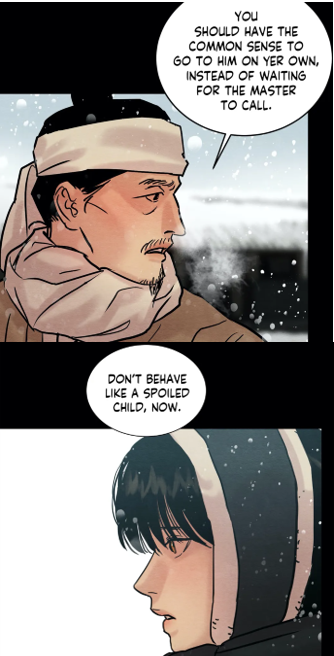 (chapter 52) And finally Yoon Seungho treated him well on different occasions by sharing his breakfast with him or sending him to the doctor or by protecting him from Deok-Jae. Yet I believe that the decisive factor is the momentary separation. Although the painter had lost his position as favored servant, the noble never sent him away. He let him live in the study and kept treating him well. The artist could sense that despite the distance, the noble was not willing to cut ties with him. This explicates why Baek Na-Kyum resisted to the vicious servant, when the latter tried to force him to leave the property.
 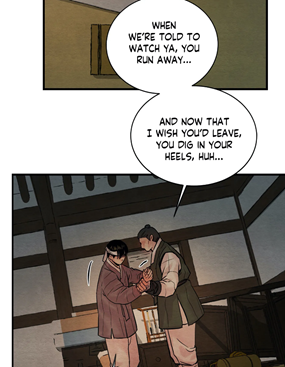 (chapter 53) This was his home now, and he wanted to protect what he had finally found. Despite the pain, he didn’t move. He was ready to do anything for his home. This gives us a glimpse of the painter’s future behavior, when his lover is targeted. There’s no doubt that he will fight for him. And now, if you compare the two following panels, you’ll realize the similarities between the two scenes: (chapter 46)
 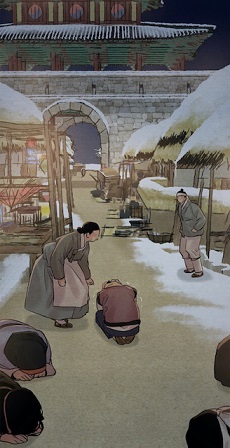 (chapter 76) In both scenes, the painter has a revelation. In chapter 46, he is alone and has no place to go. However, he is strong enough to stand on his feet, while in episode 76, he is paralyzed by fear and becomes so weak. Yet, exactly like in the first image, he feels lonely, but since he can’t escape, this position makes him realize his vulnerability. He needs help and protection. That’s why the moment he realizes the noble’s presence
 (chapter 76), he seeks his embrace and warmth.
 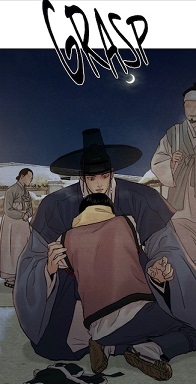 (chapter 76) Only there he feels safe. This terrible experience opened his eyes: he has to rely on someone.
 (chapter 76) Thus for the first time, he requests assistance. So while in the lord’s arms, the painter can slowly calm down, however he is still very shaken, as he has just experienced a life-threatening situation again, revealing the traumas left behind by the first abduction and the blackmail. Yet, after a while he expresses the wish to go home.
  (chapter 76) With these words, it truly outlines that the mansion has become Baek Na-Kyum’s real home, a place where he feels comfortable and secure, which represents a continuation of chapter 46. While in chapter 46, he just considered the mansion more like a refuge or shelter, now he connects it to family. It has truly become part of his identity. But the embrace on the street let him discover that Yoon Seungho could become a home too.
Striking is that there’s a difference between the Korean  and English version, when the lord replies to his request.
  In the original version, the lord is now admitting that the mansion is also his home now, whereas in the past it was just a prison and he wanted to have a companion by his side. In the English version, there’s only silence. This difference affects a lot the interpretation. By remaining silent, the noble is not acknowledging the mansion as his home, but this doesn’t mean that he has no home. In my opinion, Yoon Seungho perceives the painter as his home, hence he prefers remaining there hugging his lover. The painter gives him the warmth and love the lord has always been longing. That’s why he gives the excuse that they should stay there. It seems that the English version sounds colder than the original, yet I believe that Yoon Seungho is using his position in order to legitimate his refusal. Why do I think that the lord views the painter as his home? First, like I wrote above: Home is where the heart is. Secondly, I had already explained that Yoon Seungho would always follow the painter, because he considered him as his home and as such his family. So far, the lord has always perceived his mansion as prison and the bedchamber his cell. This explicates why the lord rejected the painter’s departure in season 3. He needed him by his side, as he had become his pillar.
 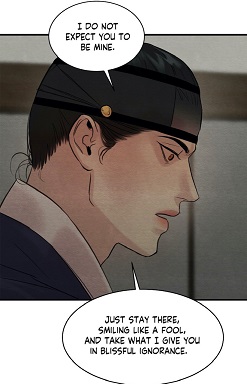 (chapter 85) Baek Na-Kyum represented the foundation of his home. Without him by his side, his “home” would crumble.
Striking in chapter 76, is that because the lord insisted to remain seated, the painter starts enjoying more and more the lord’s embrace,  hence his head moves closer to Yoon Seungho’s
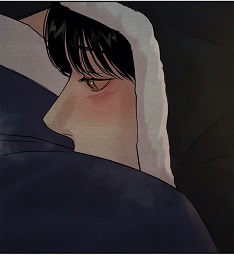 and at the end he even closes his eyes
 . From my point of view, this long and tender hug let him sense that the mansion was not truly his home, but the lord. But this was not entirely conscious. The latter has become his family. That’s why he had been longing for his presence and warmth in the last days.
  (chapter 74) This was a new version of the chapter 51 and 52. And you all know the saying:
“Absence makes the heart grow fonder”
This signifies that since both protagonists found their home, they found a part of their identity. Both protagonist could only become stronger. Thus the readers could assist to the return of the painter and lord’s memories. This is no coincidence that the painter could voice his wishes in front of his lover:  (chapter 78)
 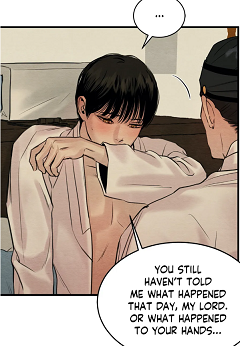 (chapter 84) And it was the same for the lord. That’s the reason why they both argued with each other and with others too. They could now stand on their own, but they still needed the support of the partner.
Under this new perspective, it becomes comprehensible why there was a change in season 3. There, both protagonists learned that home was not a place, but where the heart is. This is no coincidence that Yoon Seungho made the decision to renounce on his possessions, when he had the impression that his “bride” had died. That’s how he learned what home means. It is by his lover’s side, to be in his embrace, and not necessarily the mansion like during the argument exposed it. During the last scene, both protagonists were pushed to recognize that they are now a real family. Yoon Seungho is the painter’s home and it is the same for Baek Na-Kyum. This is perceptible in the final scene:  (chapter 102) It doesn’t matter where they are. Home is where the heart is. Hence the first question he has is:
 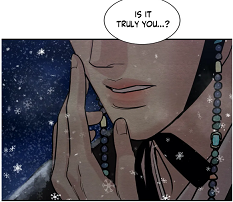 (chapter 102) As long as he is by his side, everything is fine. This new definition of home appeared, when the painter and the lord confessed to each other.
 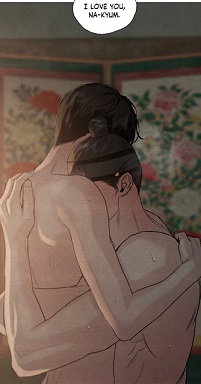 (chapter 96)
  (chapter 96) It didn’t matter where they were. Thus they could confess in a gibang. They felt safe together. And this is the same in the mountain. Observe that the painter is not asking why they are in the mountain and what the lord intended to do there. In fact, he was more focused on the past than the present. However, for the painter, home is not just a family, he liked to sleep in a warm bed and have a warm meal each day
  (chapter 68), since he had lived like a homeless for a while. Hence both will have to look for a real home, a house. Moreover, the lord will have to provide for the painter, and the latter will feel obligated to assist his lover. This means, in season 4, home should have a new definition. It is not just a family, but also the mansion and the country! Don’t forget that many people died in season 3.
Since I had elaborated above that home was part of an identity and the home would reflect the owner’s personality, I wish to examine Seungho’s bedchamber again. In other words, I will read his room: 
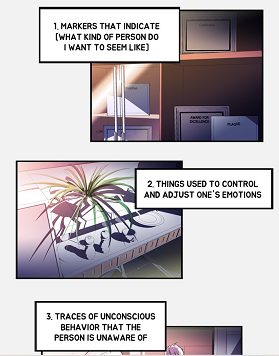 (doctor frost, chapter 9). What caught my attention is that the lord’s bedchamber is literally empty: There are only one big white vase, a red box, candles (chapter 55) and a windscreen.
 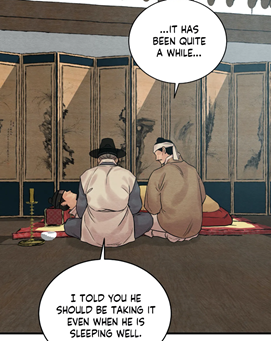 (chapter 55) The latter shows trees painted in black, there’s barely nature in the end. It mirrors the lord’s symbolic death. The emptiness of his room reflected the lord’s life. He was living like a zombie and avoided emotions, as he had no souvenir at all. Although he reads a lot, you never see them in his room. Why? It is because he separated his spirit from his body. In his bedchamber, he was a captive trapped in the past, hence he had nightmares. Moreover, I think that his bed is the source of his nocturnal panic attacks, as the colors are the same than the king’s. And now, the manhwaphiles can better comprehend why the noble has never considered his mansion a home. In this house, and in this room, he had traumatic experiences (abuse), which were so horrible that he had entirely repressed it. Nonetheless, the moment the painter calls the mansion his home, this has a huge impact on the lord’s life. The latter is now “forced” to consider the mansion as his home too. Hence in the Korean version, we have this panel: Then in season 3, the lord’s bedchamber became the painter’s bedroom too. Thus at the end of season 3, the painter visited the lord’s study in his lord’s absence.
 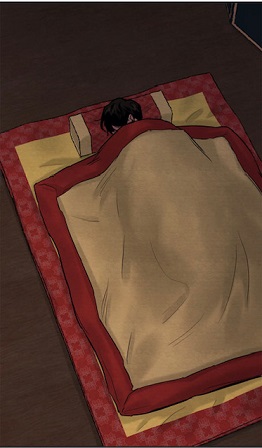 (chapter 98) This shows that he had conquered the bed. Season 3 exposes the painter’s conquest of the bedchamber. The turning point took place in chapter 87, when the artist went to the study on his own volition.
 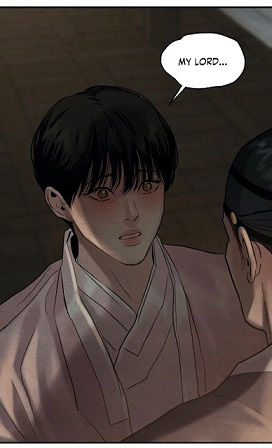 (chapter 87) I can’t help myself thinking that in season 4, the painter will bring his possessions to the bedchamber for good contrary to season 3.
 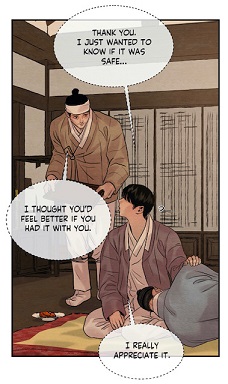 (chapter 79) The music box was brought back to the painter’s studio after the argument. Since the lord bought a music box for Baek Na-Kyum, and the latter treasures this item, it also has a special meaning for the lord too. The music box represents the lord’s heart, but the main lead didn’t grasp the true meaning, until it was too late. So far, the broken music box got neglected after their argument
 (chapter 85), yet I am still hoping for its return, for the lord had recognized its true signification to the painter afterwards.
 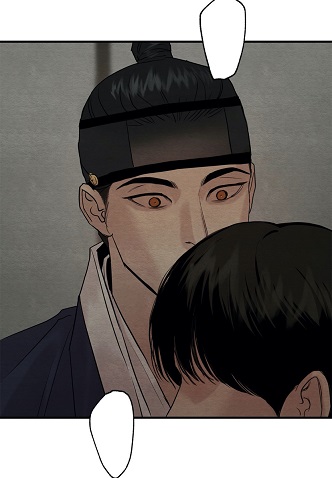 (chapter 85) But we shouldn’t forget the lord’s Spring poem (chapter 92) Little by little, the lord’s study will be filled with treasures belonging to Baek Na-Kyum which are connected to the noble. This is relevant, because thanks to them, the lord can recall the good moments with the artist. Slowly the lord’s bedroom will become more and more a study. With the arrival of souvenirs, the bedchamber will be filled with life again. This will symbolize that the lord is slowly taking over the bedchamber, and filling his room with things he likes. Where is the orchid? So far, all the nobles had plants in their room:
  (chapter 43)
 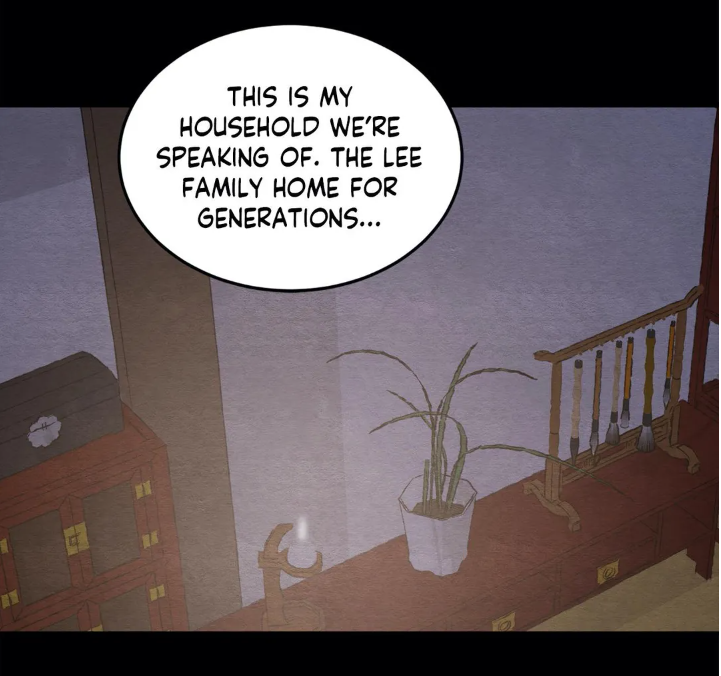 (chapter 82) Hence I am wondering if Yoon Chang-Hyeon didn’t punish his son by taking away the orchid, when he painted on the servant’s body:
  (chapter 36).
Through this examination, I could expose that each character had a different definition of home, and their perception of home was never constant. However, I have neglected one figure: Kim. The butler associates home to the mansion and nothing more. He is not even including the staff or the lords. That’s the reason why he is switching alliances all the time. But if he is on the verge of losing his mansion, he will do anything to stay there… like for example betraying Heena. Remember that she sold her brother for his own sake, and she didn’t feel deep remorse, when she saw her wounded brother. She even asked an explanation for his wounds:  (chapter 99) This new interpretation leads me to the following observation. In season 4, we will witness a new battle again, and it will be about the ownership of the mansion. Who is the true owner of the propriety? Kim, Yoon Chang-Hyeon, Yoon Seungho or lord Song?
Feel free to comment. If you have any suggestion for topics or manhwas, feel free to ask. If you enjoyed reading it, retweet it or push the button like. My instagram-tumblr-twitter account is: @bebebisous33. Thanks for reading and for the support, particularly, I would like to thank all the new followers and people recommending my blog.
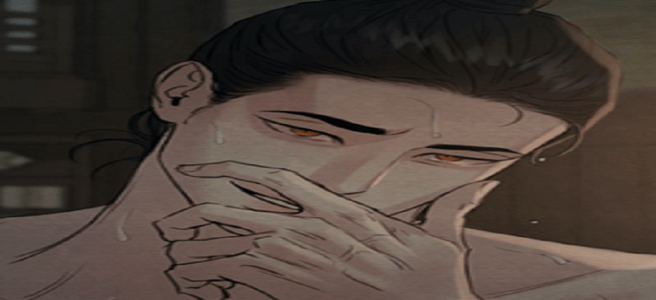
This is where you can read the manhwa. https://www.lezhinus.com/en/comic/painter But be aware that this manhwa is a mature Yaoi, which means, it is about homosexuality with explicit scenes. If you want to read more essays, here is the link to the table of contents: https://bebebisous33analyses.wordpress.com/2020/07/04/table-of-contents-painter-of-the-night/
It would be great if you could make some donations/sponsoring: Ko-fi.com/bebebisous33 That way, you can support me with “coffee” so that I have the energy to keep examining manhwas. Besides, I need to cover up the expenses for this blog.
I would like to thank Luzy 😉again for pushing me to ponder more about chapter 70 and its significance.
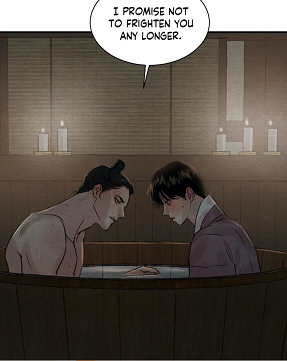 (chapter 70) When you look at the panel, you’ll observe that Baek Na-Kyum is represented by three white candles, while on the lord’s side there are just two white bougies. Since the color white symbolizes purity, this picture exposes that both protagonists are not just healing, but also getting less selfish and more open. Nonetheless, the noble’s purification is not complete yet. Here, I would like the manhwaphiles to keep in mind that since 3 is often associated with order, perfection, completion, reconciliation or fecundity due to the fusion of 1 and 2, it explicates why 3 is considered as magical and mystical. On the other hand, the number 2 symbolizes not only duality (light-darkness; ying-yang), but also balance and companionship. It is also related to kindness, and reflects a quiet power of judgment. At the same time, it indicates the need for planning and boundaries in order to keep the balance. And now, the readers can grasp why I view this panel as a confirmation that the master’s carthasis isn’t finished. In chapter 70, he has finally dropped his armor, this just means that he has finally abandoned father Yoon’s doctrines for good. But let’s not forget that Yoon Seungho’s life has not only be determined by father Yoon, but also by Kim, his surrogate father. Hence he is still under his influence.
But what are Kim’s rules?
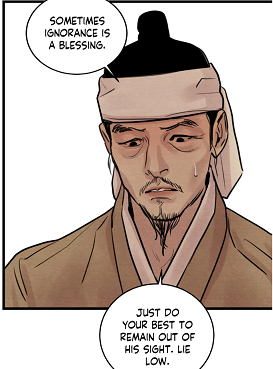 (chapter 23) Ignorance is a blessing for him, because it allows him to let his master to be in the dark. That’s why the master relied on the valet all this time. Kim was his eyes and ears, therefore certain rumors didn’t reach the noble’s ears.
 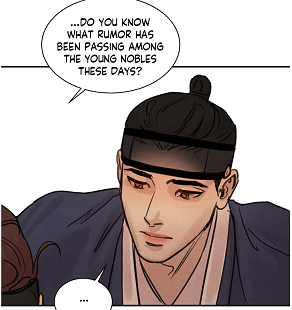 (chapter 18) On the other hand, the butler let him know about this gossip.
  (chapter 22) Since Yoon Seungho perceives himself as cultured, because he reads so much, he could only laugh about this rumor. However, he never realized the origin of these gossips. The valet utilized the rumors in order to deceive everyone, including the main lead. That’s why Kim could only judge “ignorance as a blessing”, because it helped him to manipulate the staff, the town folks and the nobles. He had an interest to create a bad image about Yoon Seungho. This helped him to keep the main character in isolation and in the dark. Moreover, it reinforced the lord’s dependency on his assistant. In order to corroborate my interpretation, I will use a panel reflecting the true nature of their relationship:
 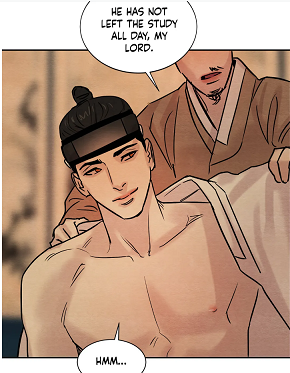 (chapter 11) Observe that the valet is not portrayed with eyes. This is not just an indication of the butler’s lie. The valet’s eyes became the master’s. This signifies that the words and the vision of the valet became the noble’s reality. At the same time, the noble’s mouth is closed and his hands are not present either. Note, he is getting dressed by his own valet. As a conclusion, he is entirely relying on Kim. He has no mouth, no hand, no ear and no eye. Everything belongs to the butler. This single picture exposes the butler’s true powers. The lord was totally deprived of all his senses and his own body, a real puppet. And this interpretation leads me to the following question: Who killed the servant in chapter 1? In my eyes, the noble was just the executioner, while the butler was the judge. Why do I see it like that? First, note that in the scene, the main lead has no eye
  (chapter 1) and he doesn’t want to know about the painter’s reasons for not painting any longer. I know, some readers might reject this idea, but I would like them to remember that we see the butler acting like a judge in front of the doctor, that’s why the commoner begs the valet (“Are you trying to have me killed”).
 (chapter 65) He uses Yoon Seungho’s power, yet the latter is described as a killer. In chapter 1, Yoon Seungho was the epitome of ignorance (narrow-minded, blind and deaf)
  (chapter 1) and the butler didn’t need to be by his side, as he had a real control over the lord’s hands, eyes and ears. Now you understand why Kim really treasures ignorance. Simultaneously, the valet values knowledge, as it procures him power.
  (chapter 50) This idiom doesn’t only imply to ignore your feelings, but also to deny the existence of your heart. If the noble has no emotions, then he can be the perfect puppet. This explicates why Yoon Seungho had a relapse after this conversation. Despite his warning, the master did listen to the butler’s advice.
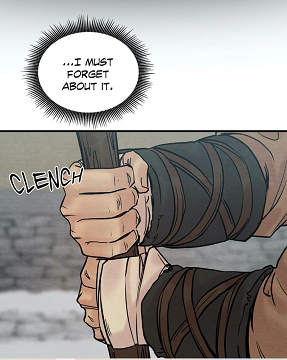 (chapter 65) That’s why there is no sincere apology.
  (chapter 65)
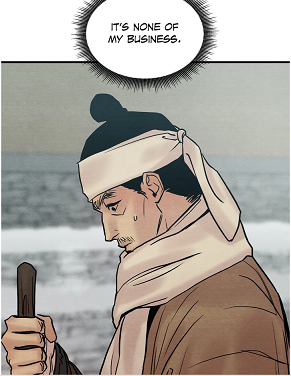 (chapter 65). He prioritizes his own life. He is not interested in people’s passion and well-being. He doesn’t care about people’s motivations. The latter just become relevant, the moment they affect his life. He needs to know about people’s behavior and thoughts for his manipulations in order to protect his quiet life.
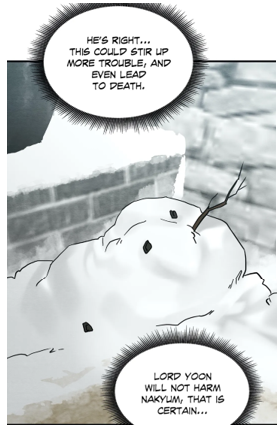 (chapter 65) therefore any incident must be covered up. At the same time, it implies as well that everything must be done in the shadow. That’s why without any spectator, he removes the snowman embodying the painter. The final panel contain all the butler’s doctrines. He will erase everything related to the past, acting as if nothing happened. It doesn’t matter, if someone gets destroyed in the end, because on the surface, it will look like he just cleared a way. He gives the impression that he helped the persons concerned, not taking into consideration how his actions and decisions will affect others. If someone has to pay the price for this, then so be it, as long as it doesn’t disturb his life. From my point of view, this scene is full of symbolism. From my perspective, he is ruthless and even willing to dirty his hand to a certain extent, since he is using a broom. However, this gesture exposes too that he is not directly soiling his hands. This is the reason why he is never directly involved with people’s wrongdoings. He will just push others to commit wrongdoings with remarks. They have to act according to his own thoughts and benefit. This interpretation is not exaggerated, if you compare this scene with Deok-Jae’s misdeed in chapter 46. The vicious servant used his own feet to ruin the artist’s creation
  or he pushed the painter with his own shoulder.
 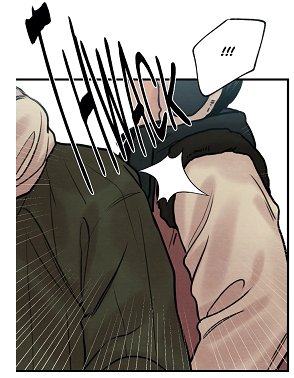 (chapter 46) At the same time, with this new approach, it helps to understand why the butler’s evilness was never caught. He could always feign ignorance with such a behavior and was never directly involved.
 , 17, 59). He also allowed the vicious servant Deok-Jae to betray Yoon Seungho and plan a murder
 (chapter 51). He hoped that Heena noona would take the painter away
  (chapter 68) and he is now expecting that Min organizes a second abduction while framing others: Nameless, Heena noona and Jihwa.
 After exposing the butler’s doctrines, I would like to describe the impact of these rules over Yoon Seungho’s life, and they slowly disappeared or diminished.
(chapter 62) Here, the noble stated that he adored the painter). This means that the light and warmth had finally reached the lord’s heart, which is also mirrored by the light in the panel. But the problem is that after the low-born’s disappearance, the master had the impression, he had been betrayed and abandoned. Hence he became enraged and blinded by his own wound. This is a sign that he definitely took it to heart. Moreover, we shouldn’t forget that despite the incident at the barn, the noble was not even able to stick to the rule, treating the artist like a sex toy. In the end, Yoon Seungho brought him to his own bed, indicating that he considered him as his partner. To sum up, the noble was still not honest to himself exposing the valet’s influence.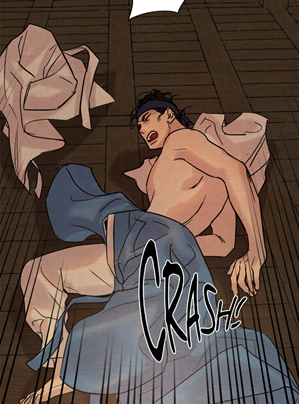 . Then another scandal appeared, when the lord punished the staff for not following his order (chapter 30).
 As you can see, the uproar remained within the mansion in season 1. This is the reason why the noble retreated in chapter 30, when he was pressured by the other aristocrats.
  (chapter 33) Here, he was definitely avoiding any scandal. He was running away, although he tried to deceive the nobles by declaring that the painter would belong to him. And during the second season, the readers can observe a progression, the scandal and uproar is now reaching the town (chapter 64)
  . Thereby the climax was reached in chapter 67, when Yoon Seungho visited the Lees’ mansion. For the first time, he was confronting a noble and didn’t fear to cause a scandal, when he showed up with a sword and didn’t even remove his shoes.
 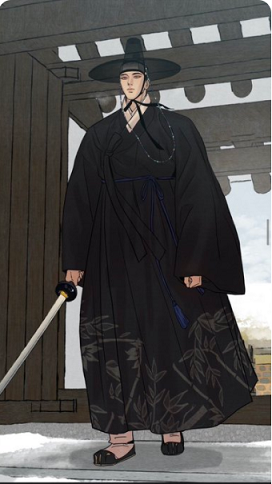 (chapter 67)
 (chapter 70) And this confession could be used against the lord later, hence after that night, Yoon Seungho kept his distance from his lover. Thus he said this to his lover in chapter 75
 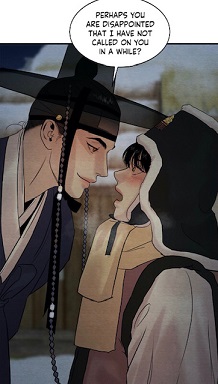 and later asked if the painter was truly resisting. Slowly, he had internalized that consent was central:
  (chapter 79) But this doesn’t signify that this doctrine had completely vanished. For me, it has been gradually weakened, the moment the lord started feeling remorse. The problem is that he still relied on the butler to correct his wrongdoings. That’s why he sent the valet to the artist in chapter 12 or left the artist behind in chapter 33. He ran away from his responsibility
 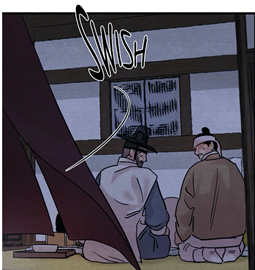 (chapter 33) and let Kim take the burden. Yet the more time passed on, the more the noble took his responsibility. He protected him from the maids and decided to buy him better clothes. This is no coincidence that in chapter 40, he implied to the painter that the latter could now rely on him. This progression is visible, when he took care of the painter in chapter 55. He covered him
 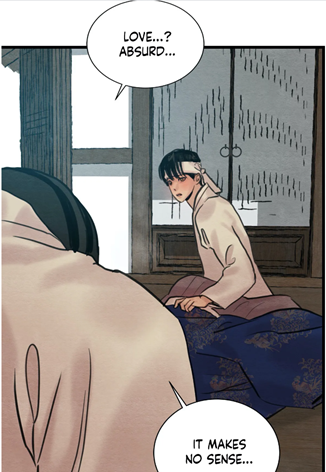 (chapter 55) and watched over him during the night. But this principle will be truly abandoned, the moment the lord apologizes properly, and this expectation was proven correct, as the real apology took place in season 3. (chapter 102) Nevertheless, for me, he truly changed a lot from episode 70, because there he expressed regrets for the first time
 in front of the painter. Notice that in episode 71, we had a semi-apology, for he was admitting his mistakes: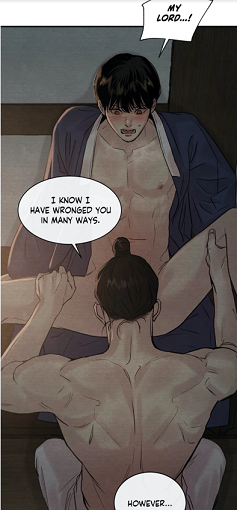
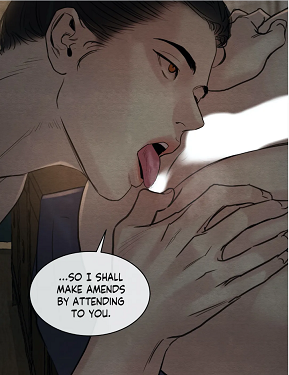 (chapter 71) The problem is that in the bathroom, he chose the wrong words. Hence the painter could only misunderstand him and pushed his hand away. While the manhwaphiles could witness his huge pangs of conscience, the painter never did. He was either unconscious (chapter 32)
  or asleep
  (chapter 50) or blind or deaf
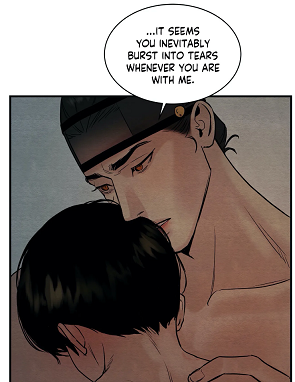 (chapter 49). And little by little, the lord learned how to apologize to his lover. In season 3, he admitted his wrongdoing right away.
  (chapter 82) Then later he tried to redeem himself.
  (chapter 84) Note that here, he was doing everything himself. He was no longer relying on Kim. Hence in the first version, I had voiced that the lord would apologize to Baek Na-Kyum, after the second abduction had been solved. And this expectation became a reality. The lord felt definitely huge pangs of conscience. (chapter 102) He knew that Baek Na-Kyum had been targeted. Yet he thought that by just warning his childhood friend, the problem was solved. He didn’t desire to cause too much trouble. However, I believe that after this crime, the noble will realize that he needs to take matters into his own hands. He can no longer live like that, he needs to become more reliable and not to fear scandal. We have another clue for this theory, the painter’s question: (chapter 102) He is tasked to investigate how this tragedy could take place. Why did they get separated for so long.
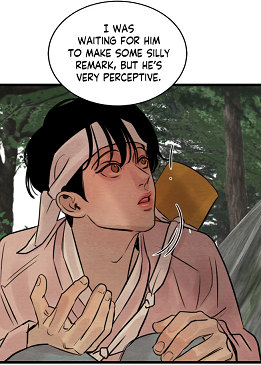 (chapter 23), because he liked keeping people in the dark as well. We had a perfect example with the deal between Jung In-Hun, the painter and the protagonist. First, Yoon Seungho gave the scholar the impression that the former was just an uncultured fool, whereas in truth the low noble was the one deceived, because Yoon Seungho was giving him just an empty promise. At the same time, the rich noble lied to the painter, when he claimed that Jung In-Hun had come to see him.
 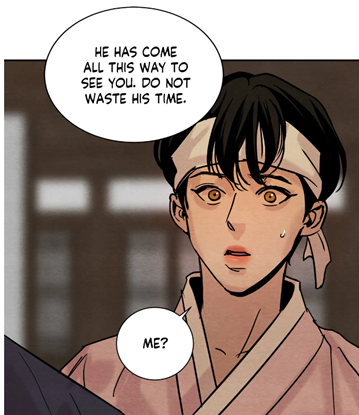 (chapter 7) However, it backfired on Yoon Seungho the moment the latter saw the painter’s reactions. He would run to his former teacher immediately, leaving the main character behind. Then he smiled to Jung In-Hun
  (chapter 7) and blushed in his presence. That’s the moment Yoon Seungho’s heart was moved, justifying the words in chapter 63:
  (chapter 63) No one has ever questioned how the master could treasure the artist’s smile so much? One might say that the first smile occurred in chapter 40
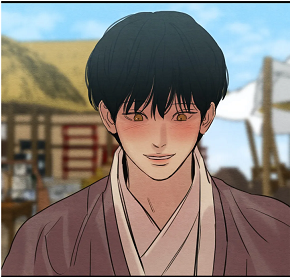 (chapter 40), but as you know, each event happens twice during the same season. So the lord experienced it much earlier. That’s why I believe that the first smile in chapter 7 played a huge role. The incident marked the return of the aristocrat’s jealousy, which had been buried for a long time. That’s why Yoon Seungho decided to reveal his plan. He hoped that with this new approach, Baek Na-Kyum would perceive him as a benevolent lord and look at him differently. He hoped that Baek Na-Kyum would smile for him. This explicates why the lord underlined the importance of connections and wealth.
 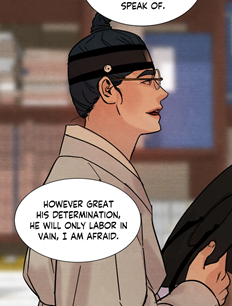 (chapter 7) Note that at the end of the chapter, he treated the painter as a real guest. He invited him to his bedchamber officially.
  (chapter 8) And observe that the noble was here smiling, he was already imitating the artist. This explicated too why not only his moves in this chapter were contradicting each other, but also Kim was introduced here for the first time. And note that from that moment, the lord never tried to trick the painter afterwards. Like I have already pointed out, the incident at the pavilion was definitely organized by the butler. And with this example, the manhwaphiles can see that the lord was applying the 6th rule as well, but dropped it due to the low-born’s reaction. This is not surprising why this manipulation ended up causing more and more pain. Yoon Seungho had brought him upon himself, revealing how the first doctrine “ignorance is not a blessing“. With this new observation, I perceive the episode 7 as a first major turning point. The lord was dropping the 6th rule (to utilize others in order to achieve his goal). However, this doesn’t mean that he abandoned the first doctrine. Quite the opposite… it took him a long time to realize why he couldn’t achieve his goal. In my opinion, the master started changing in chapter 67. Contrary to chapter 33
 , Yoon Seungho couldn’t bear to hear how people would talk behind his back: a sodomizer and a beast who corrupted Lee Jihwa and others.
 (chapter 67). Note that for the first time, the lord decided to defend himself
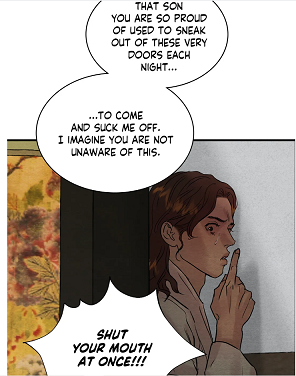 , correct people’s perception about him, which he never did before (chapter 18, 22, 57
 ). This coincides the return of the lord’s hearing and speech abilities. In chapter 67, he is using his own ears and mouth, he is no longer relying on the butler’s help. What the lord imagined to perceive as help was just an illusion. However, I believe that the lord decided to drop the first principle in chapter 68, when he heard the conversation between Baek Na-Kyum and Heena noona. Observe that he is listening behind the door, as if he was spying, which I perceive as another evidence for Kim’s spying activities. Nevertheless, this was never the main lead’s intention, hence he left quietly. Yet the painter’s words did push the lord to abandon the butler’s first principle. But what did he hear exactly? Here, I have to admit that I can’t be 100% sure, but I think that he heard the painter’s confession, because in chapter 70, Yoon Seungho asked the painter, if the latter was afraid of him
  (chapter 70). And note that when the painter confessed, he externalized his fear.
  (chapter 68) But what caught my attention is that when we see the lord’s feet in front of the door, we have to keep in mind, Yoon Seungho was not able to see the painter’s tears. He could only hear his words. Consequently he was relying on his own ears. However, this doesn’t signify that Yoon Seungho is blind. In my opinion, in this precise moment Yoon Seungho was able to envision Baek Na-Kyum’s tears, because he was forced to use his mind’s eye. Then with this new perspective, we have a new version of chapter 3
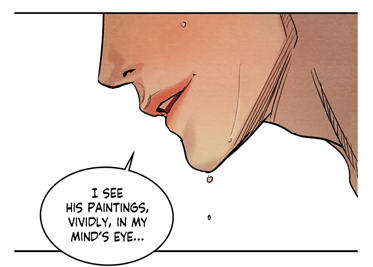 . However, the huge difference is that Yoon Seungho’s mind’s eye is no longer focused on himself, but on the painter. This explicates, why the master decided to retrieve and to give him space. Without seeing his face, he could sense that there was affection, because the painter was crying. The readers should recall that the painter’s tears have always had a huge impact on the noble, because they healed his eyes, hand and heart. The manhwaworms can comprehend why the lord chose to let the painter determine his own fate. The presence of tears and the painter’s voice were able to remove the lord’s veil on his eyes and ears for good. I would like to remind the manhwaphiles that in chapter 68, Kim tried to destroy the lord’s own judgement by recurring to gaslighting and distorting the past. [For more explications, read this essay: https://bebebisous33analyses.wordpress.com/2021/01/30/painter-of-the-night-heroes/ ] In other words, the discussion in chapter 68 represented the most important battle between the master and his domestic, where the latter wanted the main lead to lose his sight and hearing for a second time. However, the butler failed. The irony is that people perceived the argument as the butler’s victory, while in truth it should be judged as the valet’s loss of power. What Kim didn’t expect is that with his manipulations, he encouraged the main lead to rush to the painter’s study. The butler never expected that the lord would stop right in front of the door and listen to the conversation. For me, this marked the return of the lord’s senses. This is the reason why the lord is able to hear the door opening and the commoners leaving the study,
  (chapter 69) although he is sitting in his bedchamber. Imagine, he is no longer relying on the butler’s information contrary to chapter 56: (chapter 56) With this new approach, the readers can understand why the aristocrat can make such a comment in chapter 70:
  . Therefore I deduce that the butler can no longer control the lord’s body, since he is no longer required to be his eyes, ears and hands. However, this doesn’t mean that Kim is truly defeated. He still controls the staff, especially the male domestics. Here, I would like to make a little disgression. In my opinion, the butler played a huge role in the first abduction. How come that the servants were so sure that the painter had run away?
 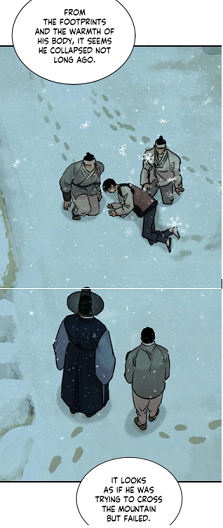 (chapter 61) They were not present, since both protagonists were at the physician’s. From my point of view, Kim must have manipulated the servants… he just needed to imply that Baek Na-Kyum had escaped, while in front of Yoon Seungho, he would say the opposite later due to the commoner’s return:
 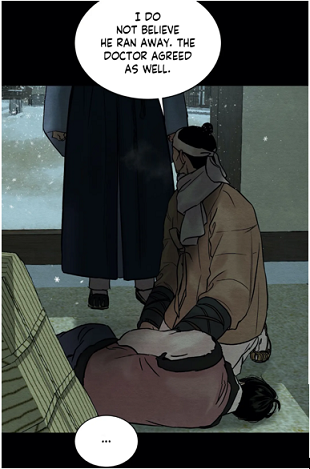 (chapter 62) There’s no doubt that with the painter’s appearance, he could use the incident to obtain more support from the servants. The painter had caused trouble again, he was responsible for their misery. But since he truly exposed his true nature to the main lead (abusing his authority, criticizing and judging his master), he can no longer appear in front of him. Right now, he has to lie low, hence he needs other people to be his eyes and ears. This explains why the servant is portrayed without eyes either
 (chapter 70). The absence of the eyes is an indication that they belong to Kim, just like the lantern indicates that the domestic is acting on the valet’s order. And in season 3, we can observe a similar situation. This time, they faked obedience
 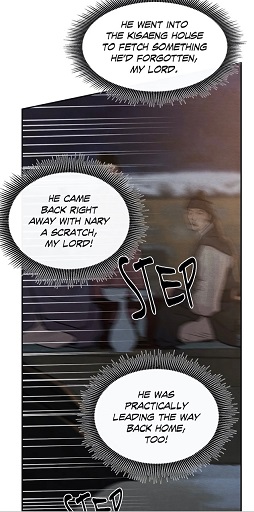 (chapter 99), while they badmouthed their master.
  (chapter 98) Because the lord feared to lose his lover, he didn’t pay attention to the domestic’s insult: (chapter 98) But the insult was the proof that they never treated the painter as a part of the household. He was just a spoiled brat.
  and gives orders
 . He is truly rude. We could say that he treats the low-born like a servant, as though he wanted him to feel so little. Kim’s strategy was to remind the painter of his position: he is just a servant, a new version of chapter 52. Remember that Kim’s intention from the start of the second season was always to diminish the artist’s status: he is just a temporally favored servant, nothing more. Striking is that the domestic never says that the lord gave him the order to bring the painter. He uses here a passive sentence “you are to attend to him” which is important. That way, the servant can hide the identity of the person who requested this. And since the lord was looking at the intruder in a rather cold way, I believe that he didn’t expect Baek Na-Kyum.
 However, when the door was closed loudly, the lord must have realized that this must have been Kim’s action. The lord didn’t mind, for it looked like the butler was helping him to improve his relationship with the painter. This interpretation was also confirmed in season 3. Yoon Seungho showed no desire to investigate the matter of “Jung In-Hun” or Deok-Jae’s death, for he was too much focusing on his lover. He kept saying that this was not of his concern.
 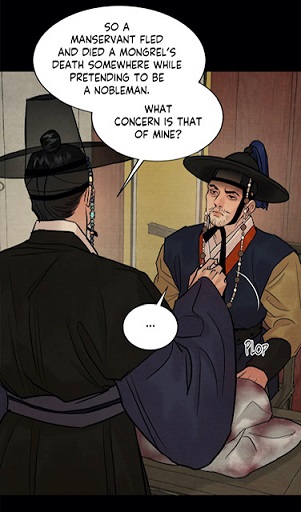 (chapter 98) However, he was totally wrong here. That’s the reason why the abduction could even take place. Because of the last incident, the main lead is forced to recognize that he needs to investigate the matter, as everything or everyone can affect his life. This is important, because that’s the only way for Yoon Seungho to recognize the butler’s wrongdoings. He encouraged him not to pay attention on others so that he wouldn’t detect his wrongdoings. Thanks this rule, Kim could live freely.
 All this leads me to the final observation: since the butler is relying on others, this signifies that these persons become his eyes, ears, mouth and hands. Therefore he becomes dependent on them. This indicates that the valet has switched his position with the noble. And this is relevant, because this announces Kim’s future demise. He will experience himself, how ignorance can’t be a blessing. In chapter 69, they heard from the kisaeng that the painter could write, hence he will take this info as face-value. I am assuming now that he knows that the painter can not read Chinese and will come to the conclusion that he can read Hangeul like any commoner. However, while in the past, I used to think that Kim had asked the domestic can only listen to their exchange, I realized that I was wrong. It was still Kim behind the window. (chapter 70) But he is deprived of his sight. And now, if you look at the conversation in the bathroom, we have to question what information the spy gathers: 
“You refuse to watch” and “Don’t push me away”
This means that the servant will have the impression that the artist is still resisting the lord, especially after hearing that the low-born corrected the lord. However, the spy can’t see what is happening in the room. He can’t observe how the painter is letting the lord caressing his face (chapter 70), kissing him tenderly
  . That’s why Kim will have the impression that the painter is still not accepting the lord. This explicates why after that night, they were separated. The butler imagined that if they had no longer sex, the artist would feel neglected and believe that the lord had already a change of heart. He hoped that after such a separation, the painter would leave the mansion, exactly like the lord had been encouraged to have a relapse in chapter 50. In my eyes, Kim was slowly viewing the artist as a man consumed by lust. How could he still accept to have sex with Yoon Seungho after the latter had treated him like a sex toy in the shed? The butler couldn’t grasp the protagonists’ thirst for love and warmth.
From my perspective, Kim had already realized the urgency of the situation at the end of season 2. He was on the verge to lose his position. The painter was getting more and more power, while the reality is that Yoon Seungho was slowly regaining his freedom, because he was just owning his own body. This explicates why he is now delicate and treats the painter’s hand as a treasure.  (chapter 70) Under this new light, it becomes understandable why Kim decided to betray his master and rekindle with Yoon Chang-Hyeon. The punishment was the signal for the valet to switch the alliance.
Therefore as long as the butler remains by the noble’s side, the transformation is not completed. That’s why we still have no proper apology and the lord is not determined to get justice for the artist. Yet, the light has already entered the master’s heart, irradiating his whole body. Consequently, the main lead could finally drop his armor: it melted away. To conclude, the final transformation took place in the mountain which was symbolized by the lord’s tears. 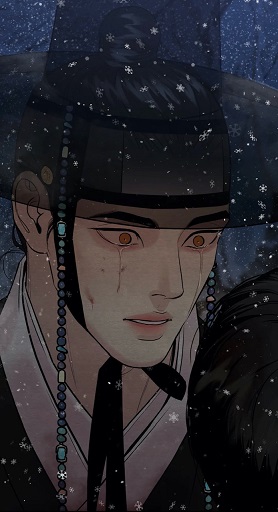 (chapter 102) From that moment on, the light had now reached the mind. He could drop his self-loathing finally which was the foundation of Kim’s principle. It was okay to cry. These were tears of happiness and relief… He had been able to rescue his lover. This means that Yoon Seungho did everything what the butler rejects: the embrace as a way to console and apologize and the tears as a sign of regret and happiness. But why does the valet abhor them? It is because he could never admit his own mistakes and as such he could never beg for forgiveness.
 (doctor Frost, chapter 211) 8chapter 50) Since he has been denying the existence of his heart, there can be no light in the heart.
  (chapter 50) Here, the butler never cried, he just showed pity and sympathy towards Baek Na-Kyum, however he was not speaking from the heart.
And now, I would like to close this analysis with three quotes from the book called “The Light in the Heart written by Roy T. Bennet which inspired me to write this essay, because it illustrates the lord’s metamorphosis:
“Attitude is a choice. Happiness is a choice (chapter 63/70 ). Optimism is a choice (chapter 68/69: the lord recognized that he still had some chance, though he was very scared). Kindness is a choice. Giving is a choice. Respect is a choice (chapter 69
 ). Whatever choice you make makes you. Choose wisely.”
“Don’t Just
Don’t just learn, experience.
Don’t just read, absorb.
Don’t just change, transform.
Don’t just relate, advocate.
Don’t just promise, prove.
Don’t just criticize, encourage.
Don’t just think, ponder.
Don’t just take, give.
Don’t just see, feel.
Don’t just dream, do.
Don’t just hear, listen.
Don’t just talk, act.
Don’t just tell, show.
Don’t just exist, live.”
With this quote, the readers grasp better why the lord was just existing like a ghost in the past before meeting Baek Na-Kyum. He was only a puppet, while he was lulled in the illusion, he was a free spirit haunting an armor. This explicates why he couldn’t feel remorse in the past, why he could neither hear, nor see, nor talk nor dream nor give etc. And since he has promised that he won’t frighten Baek Na-Kyum (chapter 70), he needs to prove it. He will never hurt anyone close to the painter, hence he spared the kisaengs. I have to admit that I have been thinking about the next step: asking the painter to brush his hair.  This would announce the butler’s complete loss of power. At the same time, it would signify that the lord is showing that he trusts Baek Na-Kyum and is using his hair to woo the painter. And this could definitely correspond to the master’s attitude: his will to open up. Simultaneously, he could express the following wish: he would like to comb his lover’s hair himself encouraging him to have a topknot.
And now, I would like to close this essay with the following quote from Bennet
“We are all different. Don’t judge, understand instead.”
Feel free to comment. If you have any suggestion for topics or manhwas, feel free to ask. If you enjoyed reading it, retweet it or push the button like. My instagram-tumblr-twitter account is: @bebebisous33. Thanks for reading and for the support, particularly, I would like to thank all the new followers and people recommending my blog.

This is where you can read the manhwa. https://www.lezhinus.com/en/comic/painter But be aware that this manhwa is a mature Yaoi, which means, it is about homosexuality with explicit scenes. If you want to read more essays, here is the link to the table of contents: https://bebebisous33analyses.wordpress.com/2020/07/04/table-of-contents-painter-of-the-night/
It would be great if you could make some donations/sponsoring: Ko-fi.com/bebebisous33 That way, you can support me with “coffee” so that I have the energy to keep examining manhwas. Besides, I need to cover up the expenses for this blog.
“The ultimate tragedy is not the oppression and cruelty by the bad people but the silence over that by the good people” from Martin Luther King
With this quote, the famous American Baptist minister denunciated the passive attitude of many Americans, who didn’t feel concerned with racism and segregation in 60’s. Why? (chapter 65) As you can see, the valet Kim is not revealing the truth, not out of fear, but he has the impression, this is not his problem. He chooses indifference. With this single attitude, the readers discover Kim’s true personality and past, confirming my last analysis about him. When he heard the painter’s refusal,  (chapter 65), he was brought back to the past. The domestic was a witness of Yoon Seungho’s rape and as such of his sexual abuse. Striking is that in episode 65, he didn’t even open the door, but instead of helping, he let it happened. He didn’t act according to his belief. This means that in the past, he must have acted the opposite. The door was open. This signifies that he abandoned the young Yoon Seungho, when the main lead asked for assistance.
 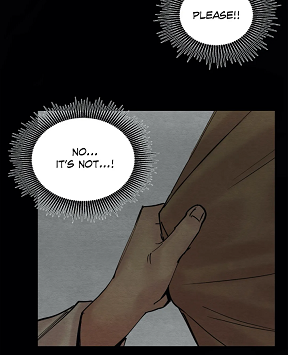 (chapter 65) He refused to listen to the young master’s plea. And now, you understand why Yoon Seungho had sex in front of him outside the barn. Unconsciously, he wanted to confront the valet with the consequences of his actions.
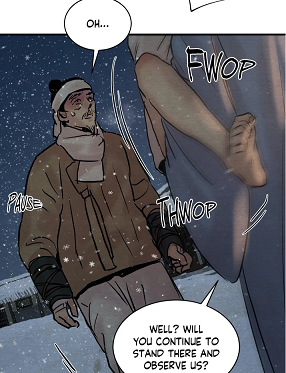 (chapter 64) The teenager was left behind by the servant, and his hand couldn’t even stop him. But since it is a reflection, I think that the butler was the one who brought the main lead to the predator, naturally his intention was not to have him raped. And now, I grasp why the lord feels the need to hurt people with his hand, like for example strangling the painter
  (chapter 61) or grabbing the topknot of a noble
 (chapter 8). His hand expresses not only his rage, but also his powerlessness. With his hand, he wasn’t able to stop the valet from leaving him behind. He had tried to stop his father from leaving his side with his hand too.
  (chapter 86) Furthermore, Yoon Seungho couldn’t even punish the valet for betraying him, because he had no authority and no strength. Back then, he was just a teenager. In chapter 63 and 64, Yoon Seungho was indeed reliving his traumatic past. Because the butler was recollecting two different memories (the night before and the lord’s sexual abuse), my first impression was that the young boy had been abused in the shed. (chapter 65) Yet, the storage room is the place where the valet betrayed him, as he changed his lord.
 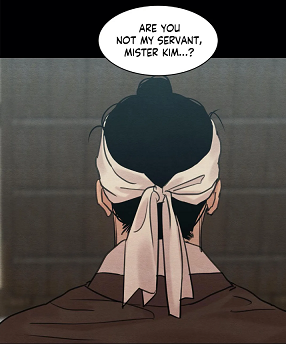 (chapter 77) My theory is that the main lead was raped by “lord Song”, the king. Therefore I assume that the man was invited by father Yoon. Remember that the kisaeng Heena proposed to her donsaeng to seek the protection of a nobleman, as he is a low-born. (chapter 97) My idea is that the valet thought that by seeking the monarch’s protection, the young master’s suffering would end, for the king stands above the scholars and elders. Anyway, I believe that the valet made a bad choice and regretted it afterwards. Due to his guilt, he developed resent towards Yoon Seungho. And this explains why Kim said this to the painter in order to ease his pain:
  (chapter 12) He couldn’t tell him details, since he would reveal his complicity to the crime. Furthermore, since the valet led the painter to the pavilion, it is very likely that Kim was the one who offered Yoon Seungho to the pedophile, which makes his crime even worse.
With Kim’s silence came a huge price: fear and guilt. (chapter 65) Since he had not assisted the young master repeatedly (chapter 77), he became more and more burdened by his guilty conscience. He turned into an accomplice, for he never revealed his involvement and mistakes.. He could no longer reveal the truth, because he would have to get punished. He feared father Yoon’s wrath and he had reasons too. He could definitely die. That’s the reason why he reproaches the doctor his passivity and silence, though in my opinion, it was not about the abduction, but about the tonic. Sure, in Joseon, there was no law called “Duty to rescue or Failure to provide assistance”.
“Failure to assist a person in danger is a criminal offence that condemns the failure to assist a person in danger. Contrary to most criminal norms, it is an offence of omission and not of commission, i.e. the perpetrator does not act when he should have done so.”
However, from a moral perspective, Kim committed a wrongdoing, and he knew it. That’s why he couldn’t forget and felt guilty. Even nowadays “Duty to rescue law” doesn’t exist everywhere, nonetheless many European countries, like Germany or France or UK possess one and its creation was partially influenced by the experiences made due to Nazism. And now, the manhwalovers can comprehend why my association to dictatorship was correct. Kim and other ordinary people are their willing assistants in the end. They prefer avoiding trouble out of convenience. Consequently, they turn a blind eye to injustice. Yet, though they try to forget (chapter 65), they can’t, because they feel guilty and remorse. Note that right after voicing his wish to forget the incident, he recalls Yoon Seungho’s tragedy indicating his incapacity to forget. This explains why Kim gives the doctor the following advice: (chapter 65) Although Kim’s words in the panel are addressed to the physician, they actually reflect that Kim is speaking out of experience. He knows by experience that “silence is a true friend who never betrays”. Observe that Kim’s complicity was never brought to light, hence he never got punished. This explicates why Yoon Seungho is acting differently from his biological father in reality. Each time there was a crime, the lord let the painter defend himself and asked questions: chapter 11 and 62 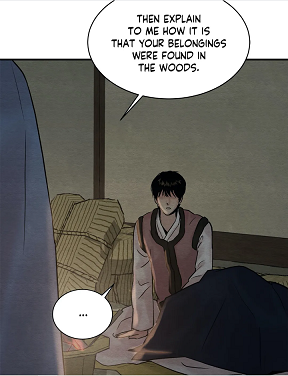 , (chapter 62) especially when you think that Baek Na-Kyum is just a commoner. But the problem is that he was biased, just like his father who had the impression that his son was a homosexual due to the testimonies of close people (Kim, Lee Jihwa and probably Yoon Seung-Won). After the rape, Yoon Seungho got punished. And this interpretation was proven correct in season 3
 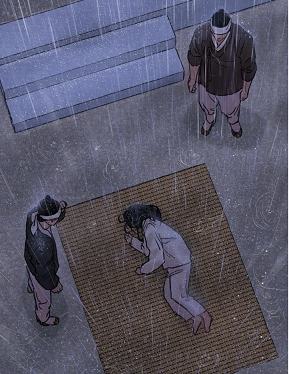 (chapter 77). But here Kim remained silent too.
 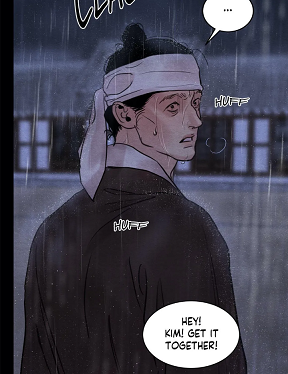 (chapter 77) It was even worse than before, because after the straw mat beating, he was paralyzed. No one spoke for him and believed his words, and Kim wasn’t willing to step in. Moreover, I believe that Kim had another reason for remaining silent. (chapter 65) He disliked the idea of a scandal and trouble. If he had told the truth, he knew that his punishment would be death. Out of convenience, he ran away from responsibility and from the uncomfortable truth. (chapter 65) That’s why I believe that the author is not showing that Kim and the physician chose secrecy and silence, because they feared for their life. They only started fearing for their life, when the truth is about to be revealed, as the painter was not dead yet. As the victim, he was a witness. Because once the lord discovers the butler’s passivity and complicity, it becomes a matter of life or death for him. According to me, there are two doctors. So the chapter 65 unveils that the first doctor didn’t testify, as he wanted to help the artist.
 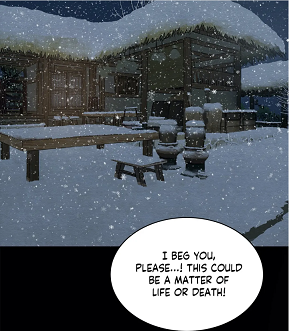 (chapter 65) In my opinion, the butler had deceived the commoner, he let him believe that Baek Na-Kyum had run away because of the lord’s violent temper. The painter had come wounded to his office. This negative perception of the young lord Yoon could only make the doctor jump to wrong conclusion. ,Striking is that this scene
 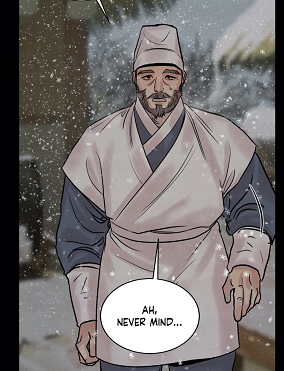 (chapter 63) revealed that the doctor was hesitating to give his opinion to the butler, he thought that the artist had run away. And what is the common denominator of all these scenes with the doctors. They all chose silence for different reasons. Just like Kim, the doctor had become an accomplice. As for the second, he remained silent out of fear, that he could get into trouble. (chapter 65) My theory is that the valet used the drug as an excuse to silence the physician. Now, the doctor is hoping that the boy says no word about it, so that his “wrongdoing”, the false medication, won’t be discovered. Kim blamed the doctor that after that, his master had behaved like a crazy man. The result was that both physicians chose silence!! Why? It is because the valet had pushed them to make this choice. And note the pattern. Kim used pity and compassion for the first doctor, and fear and brutality for the second! Exactly like in this scene: (chapter 12) In this scene, we have all three elements: pity, fear and silence (“can’t go into details”).
And despite knowing the truth, Kim makes the same decision like in the past. He chooses to sweep the incident under the carpet. He is glossing over the abduction with all fake excuses. (chapter 65) He has the audacity to say that his master won’t hurt the painter, although he even witnessed the roughness the artist was exposed to. Yet, for him harm was flogging or execution. From my perspective, this is no coincidence that the author showed us the valet sweeping.  (chapter 65) This represents his attitude in life, therefore he is responsible for Baek Na-Kyum’s loss of innocence. His other leitmotiv is
 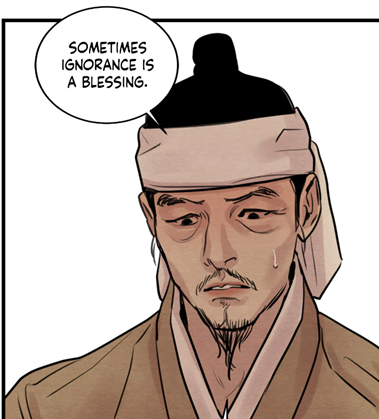 (chapter 23) He acts, as if he knows nothing reminding us of this scene.
 (chapter 28)That’s why I believe that the butler was lying back then and had even allowed the artist to run away that morning. I see a new version of chapter 29. But let’s go back to chapter 65. Notice that he is the one removing the snowman built by the painter, the last reminder of the low-born’s innocence. In two occasions, he chose cowardice and silence. First, he did nothing to stop his master (chapter 65), as he didn’t desire to feel his master’s wrath. Secondly, he asked the physician to keep silent by making him feel guilty. (chapter 65) But if he had seen this, he could have intervened and reasoned his master. But he chose not. He was too embarrassed, for he had been caught “spying”.
 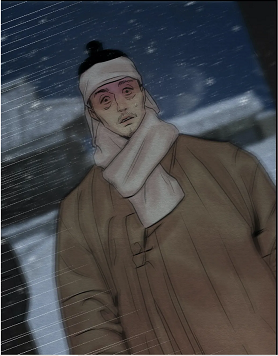 (chapter 64)
And the next day, he prefers to forget this incident. (chapter 65) What caught my attention is that he feels nothing for the painter, he doesn’t even express any regret or remorse. Since he knows that the artist won’t be killed, then everything will return to normal. He doesn’t consider the impact of Yoon Seungho’s violence used against the painter, which he witnessed on several occasions. For him what matters the most is silence, the absence of ruckus! And now, I can understand why the lord is not able to distinguish genuine from hypocritical care. When the lord was young, he saw in his valet a surrogate father, but he got betrayed in the worst way. He turned away from the wounded master. He closed his eyes, closed the door and ran away. Therefore, it becomes comprehensible why Yoon Seungho’s unconscious always expresses itself through the hand, the eye and the feet. This was the result of Kim’s abandonment, but not only from him: from his own family and even his best friend. And back then, the butler must have thought exactly the same in order to justify his behavior: (chapter 65). He legitimated his cowardice and passivity by saying that Yoon Seungho wasn’t part of his life and his adoptive son. He was just a noble, with such a statement, Kim was drawing a line. Due to his mistakes, he chose not to intervene any longer. But observe that in season 1 and 2, he meddled in his lord’s life, as he viewed it as his own business. Why? It is because he feared that he could lose his position. However, I think that in season 1, he was more influenced by his unconscious, but not in season 2.
After all these observations, I come to the conclusion that Kim has many common points with Lee Jihwa. He knows the past and feels remorse and repentance. But both are forced to hide their wrongdoings and as such their culpability. That’s why the chapter 65 reinforced my conviction that Lee Jihwa was indeed responsible for Yoon Seungho’s misery and the red-haired noble was aware of it. Yet, exactly like the butler, he denied his responsibility. Sure, many are to blame for the main lead’s tragedy as well: father Yoon, his brother and lord Song/the king. All of them lied and chose to remain silent.
From my point of view, Byeonduck has another reason for making Baek Na-Kyum going through the same experiences than the protagonist’s. This is not just to make Yoon Seungho realize what he has become and sees his own reflection in the end. In my opinion, the author uses the painter’s suffering to reveal the main lead’s tragic past. Since we all suffer for the artist, the manhwaphiles have to imagine that Yoon Seungho experienced it too, but in the worst possible way, as he had really no one by his side. While Yoon Seungho might be rough and hurtful towards the artist, he is still in love with the artist, hence he still cleans (chapter 65) the artist after their intercourse and even gives him his own shirt. He shows a certain sense of responsibility.
So my actual theory about Yoon Seungho’s past is the following: Yoon Chang-Hyeon got deceived by many people, making him believe that his son was an idle young master before being stigmatized as sodomite. The king had to ruin the protagonist’s reputation in order to approach him. The real puppet master was lord Song alias the king. But every culprits had to suffer the consequences of their crimes and deceptions. I don’t think that even the king was spared. He also got punished by the gods, yet he never realized it. Yoon Chang-Hyeon thought, he could benefit from such an alliance, but he got betrayed by father Lee, but the scholar never recognized it.  (chapter 82) Why didn’t he ask for a punishment after this humiliation? It is because he couldn’t. However, he must have definitely sought revenge. And the main lead became the sacrificial lamb, as in father Yoon’s eyes, his son was the reason for the purge: desertion, betrayal and probably drugs played a role in the purge. It is definitely possible that I have to change this theory about his traumatic past, but as you can observe, the main elements don’t change:
As a conclusion, silence is as terrible as words. Both can kill in the end.
Silence in the face of evil is itself evil: God will not hold us guiltless. Not to speak is to speak. Not to act is to act.” Dietrich Bonhoeffer
That’s why it is important not to turn away from injustice. This is not just a question of courage. Not helping someone in the need is committing a crime, and it contributes to reinforce injustice. Fear for life can not be an excuse in this story, since the matter of life and death appears afterwards. The silence is related to a misdeed. Besides, this kind of behavior explains why Third Reich could exist. First, while some people were convinced believers, many chose comfort over trouble. Let’s not forget that Hitler could install his dictatorship, because the MP from the Reichstag voted for Enabling Act (1933). That law gave Hitler the power to enact laws without the involvement from the Reichstag. One might argue that Hitler used terror to coerce the MP, but this is not correct, as Otto Wels gave a speech against it and the socialist party (SPD) followed him. This was the only party that voted against it. I have to admit that while reading the last chapter, I couldn’t help myself thinking of the Third Wave.
In our case, it is not about Nazism, but about civil courage. Once one remains passive, the other follows creating a common movement: all become inactive and silent. IT takes courage to admit a mistake and a wrongdoing. And we have to imagine that in the past, the servant Kim remained silent once leading the others to close an eye as well. And the phenomenon is occurring again. The physician was a witness, but did nothing (not even asking for help after the painter’s disappearance). He was convinced that if he shut his mouth, he would help the artist! But this was simply wrong, for with his passivity and false conclusion, the painter could have died. The irony is that Kim is following him after their conversation. (chapter 65) Slowly, he is recognizing that his master won’t hurt the artist. Yet, during his visit, he thought the exact opposite. (chapter 65)
However, this time it is different because of Baek Na-Kyum’s panic attack and his sister’s intervention. (chapter 65) The lord realized that something had happened. Due to the painter’s reaction, he was brought back the past.
  (chapter 66) Striking is that the painter’s words were the trigger for revealing the truth.
 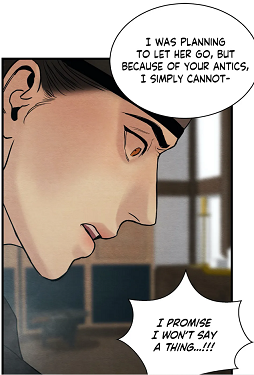 (chapter 66) This stands in opposition to silence. Therefore it is no coincidence that Min revealed the truth.
  (chapter 66) The irony is that Heena suspected the main lead of kidnapping her brother and everything looked like her words were true: the wrist, the wounds around his wrist, his actual position (the mouth covered and his hands tied together…)
 (chapter 66)
  (chapter 66) Thus the circumstances were turned against him. (chapter 65) But she was not present, when Min admitted Lee Jihwa’s crime. That’s how I realized that while chapter 65 represents silence, deception, cowardice and passivity, chapter 66 embodies the exact opposite. Min told the truth, Heena tried to save her brother by creating a ruckus! For Yoon Seungho, silence is a sign of culpability which he learnt from Kim. Hence he lied to the kisaeng
  (chapter 65), and later never spoke to the painter about the incident. If he had done it, he would have been forced to admit his misjudgment and wrongdoing. And now, you understand why Martin Luther King said this:
“The ultimate tragedy is not the oppression and cruelty by the bad people but the silence over that by the good people”
The physician and the butler are no evil men per se, as they don’t find pleasure in death and suffering. However, like the following idiom is revealing, people can change due to their decisions:
The way to hell is paved with good intentions.
That’s why in season 4, the tragedy won’t be repeated and the truth about Yoon Seungho’s martyrdom, strongly intertwined with the artist’s, will come to the surface. You are wondering why now. The reason is quite simple: The doctor revealed his knowledge to Baek Na-Kyum,  (chapter 57) It doesn’t matter, if the butler told lies to the physician in the past, as they are now perceived as truth. Remember what Kim confided to the painter:
 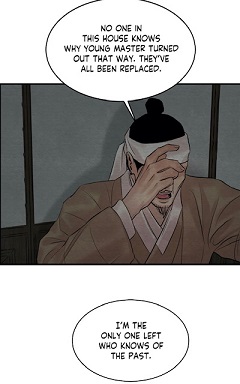 (chapter 86) He believes that he is the only one left who knows the past. But he is wrong, since the doctor also recalls the past. Hence how can Kim prove that he is telling the truth, since he told a different story to the physician? In addition, we have also lord Song. Besides, by giving the drug to Yoon Seungho without his knowledge and consent, Kim committed a wrongdoing. His knowledge won’t serve him in the end. I am deducing that the saying “silence is a true friend who never betrays” will no longer be valid. Therefore we have to expect a betrayal, and that would be from the physician, especially after we recall the butler’s warning in the first season, which was addressed to a different doctor from my point of view:
 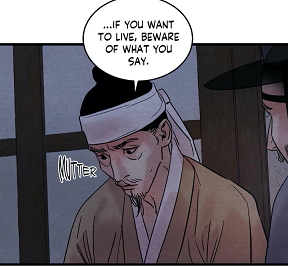 (chapter 33) Let’s not forget that in chapter 65, the servant tried to put the whole responsibility on the physician, making him feel guilty. And since Byeonduck is even using elements from the first and second season, I believe, we will have a reversed situation in season 4, where the doctor will speak up and put the whole blame on someone. Neither the physician nor Kim expected that the painter’s body wouldn’t remain silent (chapter 65), a proof that the truth needed to be unveiled. It was impossible to act, as if nothing had happened, just because the painter had been returned to Yoon Seungho. And it is the same at the end of season 3. The painter gave his husband a task: (chapter 102) He needs to find the answer, which stands in opposition to silence and burying the truth (sweeping it under the carpet). This signifies that this time, Yoon Seungho has to gather information himself, and he can not rely on Kim: (chapter 98) As you can see, slowly people are forced to talk
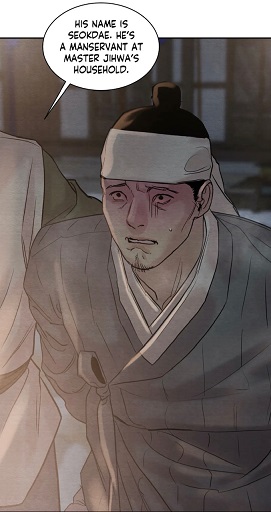 (chapter 99), hence their testimony can be questioned and perceived as lie.
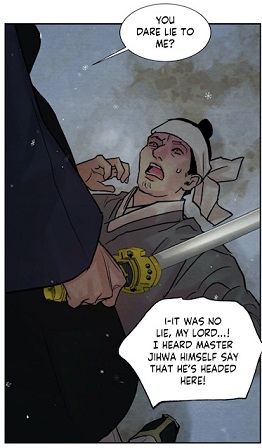 (chapter 100). This is important, because by getting confronted with lies, the lord will be able to discern the truth! In other words, silence embodies darkness and as such death.
  (chapter 74) Thus there was only silence in the lord’s nightmare. And this contradicts this statement: (chapter 65) Because Germans chose silence, the Holocaust could take place.
Feel free to comment. If you have any suggestion for topics or manhwas, feel free to ask. If you enjoyed reading it, retweet it or push the button like. My Reddit-Instagram-Tumblr-Twitter account is: @bebebisous33. Thanks for reading and for the support, particularly, I would like to thank all the new followers and people recommending my blog.

This is where you can read the manhwa. https://www.lezhinus.com/en/comic/painter But be aware that this manhwa is a mature Yaoi, which means, it is about homosexuality with explicit scenes. If you want to read more essays, here is the link to the table of contents: https://bebebisous33analyses.wordpress.com/2020/07/04/table-of-contents-painter-of-the-night/
It would be great if you could make some donations/sponsoring: Ko-fi.com/bebebisous33 That way, you can support me with “coffee” so that I have the energy to keep examining manhwas. Besides, I need to cover up the expenses for this blog
If you have already read my former analyses, you know that our protagonist Yoon Seungho is associated to the window, because he spends so much time in a room looking at his courtyard through the window.  (chapter 35). But what does the window symbolize?
In order to answer this question, let us take a look at the definition of the window:
It’s an opening in the wall or roof of a building or vehicle, fitted with glass in a frame to admit light or air and allow people to see out.
Since our story takes place in Joseon, there is no glass, only thin paper or an open frame, yet it doesn’t change the definition. It’s an opening… that admits air and light and allows people to see out. Striking is that the window is connected to fresh air and sun therefore we can say that through the view, people can definitely broaden their horizon as they are able to witness what it happening outside.
However, let us not forget that their view is limited. Yoon Seungho can only see what is happening in the courtyard, but not in the servants’ room or in the painter’s room. Therefore we come to the next conclusion, the window can represent a barrier, a hindrance. That’s the reason why f. ex. writer Emily Bronte used the window in that aspect in her novel Wuthering Heights.
The window can even symbolize the boundary between the inner world of a character (room) and the outside. Therefore the room could be seen as the personification of the protagonist embodying his inner thoughts and feelings trapped in his darkness. Hence he is seeking light and air through the window. Consequently, I interpret that Yoon Seungho sitting or standing in front of the window like the following. The room seems to be a prison, it is suffocating for Yoon Seungho, hence he looks out of the window in order to be able to breathe and survive. He is caught in his darkness, yet the window allows him to escape from his dungeon, from his past. His passivity reflects his resignation, he is already thinking that nothing exciting in his life will ever happen, until he met the painter. That’s why he said in the chapter 18:
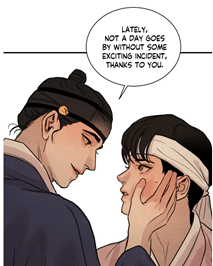
From the moment he met the low-born, he started acting differently. First he kept touching the painter and then he even started leaving the room behind and came to the door. It is interesting that in chapter 7, Yoon Seungho even followed the younger painter, after the latter had heard about the arrival of his admired teacher. Notice how the lord stands in the courtyard and looks at the welcome of the low noble.
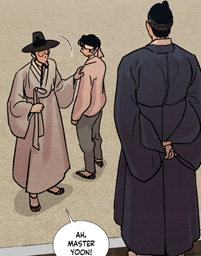
This picture reflects the social hierarchy. Yoon Seungho stands at the top, and the teacher is closer to him. However, if you pay attention to Jung In-Hun’s gesture, he is turning his body in order to face the powerful noble. It was as if he was pushing away the young artist. Now, you realize that such a single picture can contain so much symbolism. But now let’s return to our main topic, the meaning of the room and the window.
So the room with the window represented the situation of the powerful lord at the beginning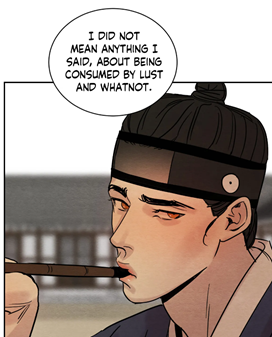 (chapter 5) and it is still there at the end of season 1.
 (chapter 44). It looks like there wasn’t much progression, yet this time, the painter walks towards his mansion and remains by his side.
 This is important, because I realized that with the vanishing of the learned sir, Yoon Seungho chose to remain in the lord‘s bedchamber. What caught my attention is that the lord always went to the courtyard because of the admired sir. We have two chapters for this interpretation: chapter 7 and chapter 35
 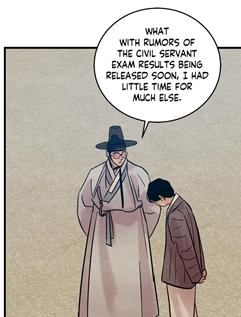 . What caught my attention is that when the lord visited the scholar for the first time, both were sitting in front of a door which looked like a window at the same time.
 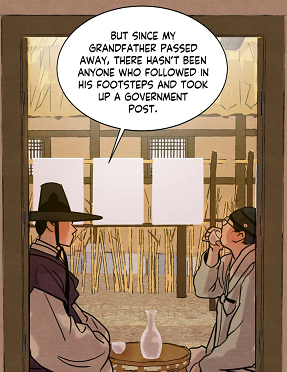 (Chapter 7) This is not random at all, as from my perspective, it introduces the role played by Jung In-Hun in the main lead‘s life. He will be the one forcing the lord to move away from the window so that he can leave the bedchamber. Thus we had this scene: Yoon Seungho is observing the learned sir and his student from far away.
  (Chapter 19) This explicates too why the noble remained so passive in season 2 in the end. Baek Na-Kyum was the lord‘s love interest, hence his „place“ is the bedchamber. So how can the lord move away from the window and as such from the bedroom? Jung In-Hun is the trigger. And note that only in season 2, we discovered how the learned sir used walks through the countryside to console the painter.
 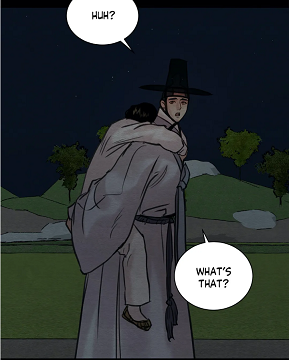 (Chapter 70) Finally, the main lead organized a hunt for the first time because of his honored guest.
 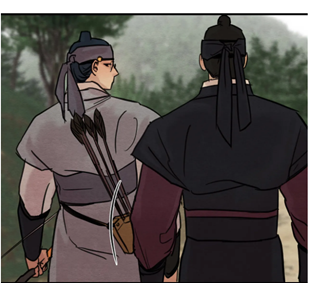 (Chapter 22) And if you recall the lord‘s behavior, you will notice that he left the city for the first time, when he wanted to meet the scholar.
 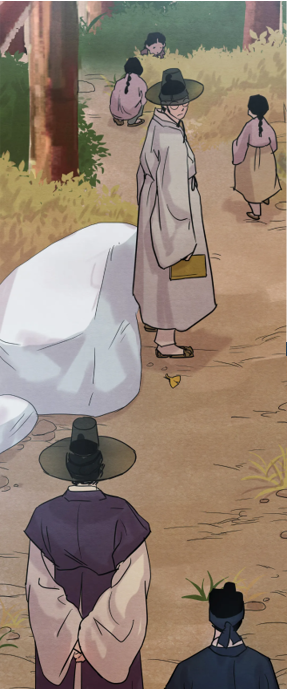 (Chapter 6) He encountered him in the woods. Under this new light, it reinforces my conviction that the learned sir‘s death will be the lord‘s motivation to become proactive and leave his past behind. Why? It is because of the painter‘s words.
  (Chapter 94) The painter still respects the scholar, but he already loves Yoon Seungho. He is not disloyal towards his former teacher despite falling in love with the protagonist. With the last incident, Yoon Seungho got aware how much the painter means to him, but at the same time, he realized the importance of the learned sir in Baek Na-Kyum‘s life. He needs to answer his question: (Chapter 102) And this question is strongly connected to the scholar, for the main lead was first sent to Jung In-Hun‘s home.
 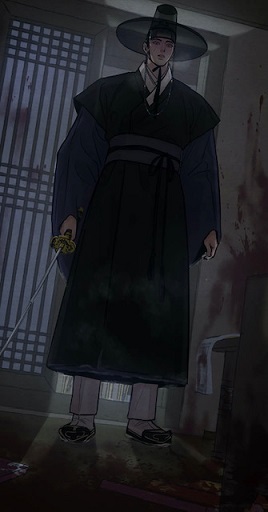 ( 100) Don‘t forget that the main lead saw the room covered in blood, though the latter had already dried. To conclude, the main lead was encouraged to walk thanks to the scholar, and as such to leave his window!
  (Chapter 100)
Therefore it is not surprising why Yoon Seungho remained in front of the window at the end of season 1. He no longer needed to seek him out and bid him farewell.  (Chapter 44) It was the painter’s role. This signified that he was still trapped by his past and trauma, something that he hadn’t revealed to anyone. Since Yoon Seungho is still inside the room smoking in front of the window, it reveals that the lord had not really let go of his past at all, he had not expressed himself in front of Baek Na-Kyum yet. If he reveals his inner feelings and thoughts, this means he will disclose his secret and unveil his vulnerability. This explains why there was no confession from the noble’s side for instance [there were other reasons why he hadn’t confessed anything too], why he was still not sharing his inner thoughts and emotions to his partner.
First, he has never opened up to anyone before. Trust is needed and the artist needs to win that trust, because so far, Baek Na-Kyum had always pushed the noble away. There was still a gap between Baek Na-Kyum and the lord, hence the former didn‘t go to his room, but to his own study. My prediction was that Baek Na-Kyum had to open up first so that the lord could learn from him. And it became a reality. The reason was that the seme was very inexperienced, for no one had ever confided to him. Moreover, he had long internalized that weaknesses must be hidden. Unconsciously, he had already claimed Baek Na-Kyum as his bride, nonetheless this indicated that there was still this distance, this invisible wall between them. We have to understand that Yoon Seungho had never learnt how to share pain and express emotions verbally to others. He had to hide his secret, his past and trauma.  (Chapter 37)
The shaking hand with the fist embodies his repressed inner feelings and thoughts. He had learned to keep everything to himself. Now, you are probably thinking that all this is not entirely new because I already mentioned his passivity. And now, you can grasp the origins of Yoon Seungho‘s silence and inactivity. This stroll through the mountain corresponds to his true revival. 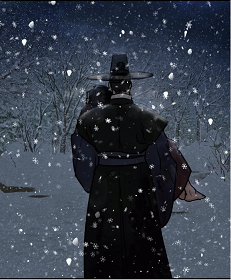 (Chapter 102) This signifies that Yoon Seungho will act differently in season 4: he will be proactive. Like I mentioned in the essay „Scandal(s) in Jemulpo“, he will become the scholar’s disciple and follow his footsteps: ruthless, but also caring and gentle. The only difference is that his affection for the painter is genuine.
However, I needed to describe this again in order to contrast Yoon Seungho’s position with the painter’s situation. What caught my attention is that Baek Na-Kyum is connected to the door, unlike the main lead. We have so many scenes where the low-born is seen close to a door or stands on the doorstep. This is what I could gather so far (I still might have missed some):
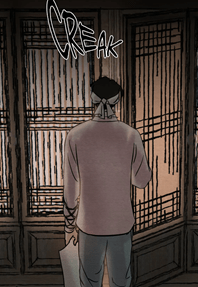

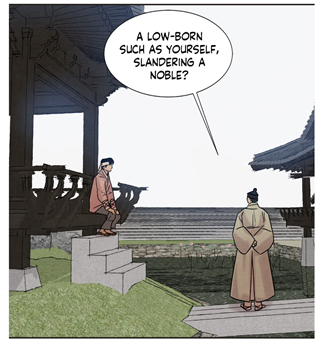 (chapter 10),
 (chapter 12)


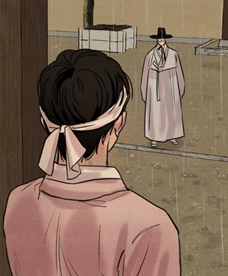
(chapter 20)
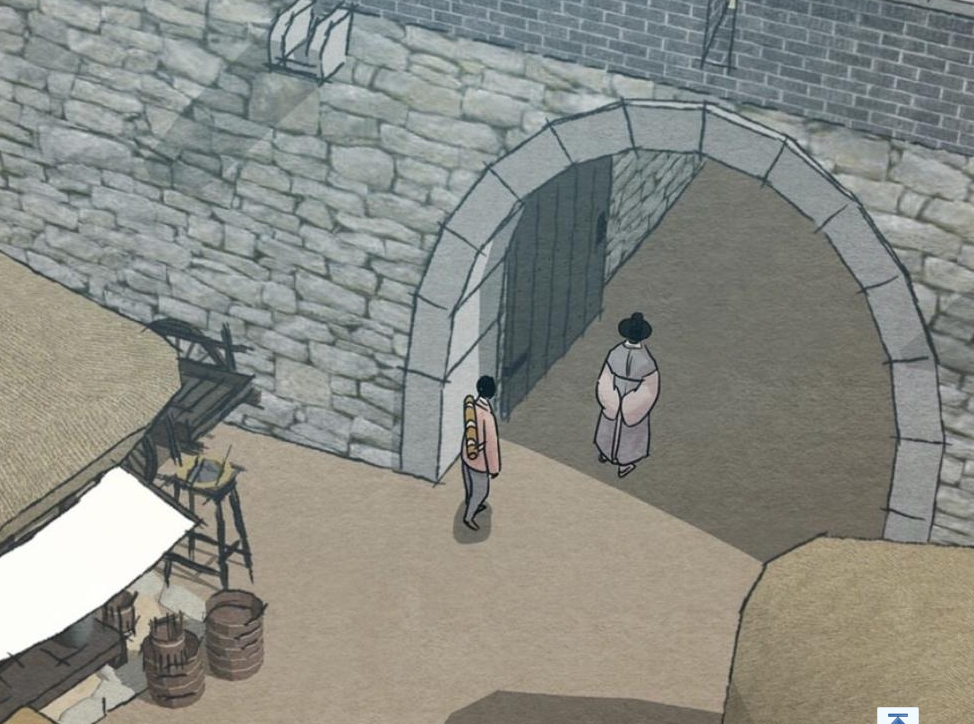 (chapter 29)


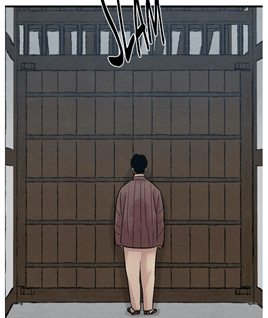


Now, you realize the importance of the door. But what does it mean? Why is Baek Na-Kyum related to the door? First, the window and the door have two common denominators: the room and the limited view to the outside world. However, since a door connects the outside with the inside, it allows to move. The person can leave the room behind, the painter has more possibilities, while with the window the person inside must feel more trapped.
Since I already pointed out that the room embodies the lord’s inner world, we have to imagine that for Baek Na-Kyum it is the same. However, the room represents something else: his unconscious, his hidden true personality and desires and not his past and trauma, like Yoon Seungho. That’s the reason why the room is not a prison like in Yoon Seungho’s case but rather a secret. The painter is hiding his secret behind the door. And now, you can understand the true signification of the door for the artist. The door embodies the doorstep where Baek Na-Kyum has to admit his homosexuality. Now, if we look back at the different situations where the door was seen. Byeondock even drew many pictures of the door in the same chapter underlining the significance and the true meaning of the door.
Now, I’ll interpret different scenes with the door which caught my eye. Little by little I am adding more and more images with the door. And this is what I found so far. I examined the following scenes: 8, 9, 10, 16, 20, 29, 35, 41 and 44.
When we look at the chapter 8, we have this situation. The young man is about to enter the lord’s chamber standing in front of the door. He has been asked by the lord to go there so that he can paint another erotic picture.
Here, the artist is opening the door. It was as if he was entering a forbidden world, where sex and homosexuality are indulged, where people enjoy their sexuality to the fullest. By entering this room, Baek Na-Kyum is reminded of his own repressed and natural desires. Then in chapter 9,
he leaves the lord’s chamber in a hurry after witnessing a sex session. Right behind the door, he can’t help himself and starts masturbating. Hidden behind the door, he feels his sexual urge growing and starts right away with his masturbation. Since he is touching himself so close to the door separating his room from Yoon Seungho’s room, it outlines that he has trouble to control his repressed sexual desires. His unconscious is urging him to become sexually active again. On the other hand, he ensures that the lord doesn’t see his erection demonstrating that he is still denying his own sexual orientation and attraction. On the other hand, the lord heard him which led him to the following conclusions: Baek Na-Kyum is somehow attracted to him and he has some experience with men as he shows no hesitation to masturbate very quickly. So the door served as a protection, he wanted to keep his sexual desires hidden from the noble. Notice how horrible he feels after his ejaculation. He is burying his face as if he was avoiding reality and his own sexual desires. He still wants to deny these urges.
Then chapter 10, the pavilion could be perceived as the unconscious hidden behind the painter’s body. (Chapter 10) Since the pavilion is open aired, it looks like there is nothing there… it was as if the true sexual orientation of the low-born didn’t exist but since there is a roof with beams, we can conclude that Jung In-Hun’s attempt to eradicate his true sexuality has in reality failed. There are rest of it. In other words, the pavilion mirrors Baek Na-Kyum’s denial and brainwashing through Jung In-Hun. This also explicates why Jung In-Hun used here emotional and cognitive techniques as a warning here. He was coercing him to drop the painting.
Then in chapter 16,
Yoon Seungho catches the low-born, because he wants him to experience sex. He has noticed the reluctance hence he just masturbates the young man. Striking is that the door is opened at some point by a servant. This opening of the door by someone else embodies the fear of being discovered. Baek Na-Kyum is determined to never reveal his repressed sexual desires. Consequently he wants the door to stay closed. So if he is seen then, he fears that his sexual orientation will be discovered, yet he wants it to remain a secret. Now, you can understand the meaning of the door in chapter 37.  It is still the same. Despite getting a blowjob, he still wants to hide his homosexuality to the outside. Hence he still gets scared and would like the noble to stop from exciting him. So for the first time, he is experiencing sex with someone.
Here, the door is wide open and this coincides with the commoner’s confession. The young man was drunk, yet he was hiding behind the door until it got opened by the lord. So Baek Na-Kyum’s unconscious wanted to reveal his repressed sexual desires (homosexuality) and his love to the outside world.
In chapter 29, the low noble is bringing him back to the mansion. Striking is that the door is completely open too. This picture illustrates the role played by Jung In-Hun in the painter’s homosexuality. He is the one who “forces” to become an official sodomite, therefore he can no longer hide his sexual preference behind a closed door. I believe that this is related to this incident.  Note the opened door. The learned sir caught him by surprise. That’s how the learned sir was forced to repress and hide his homosexuality. This is no coincidence that in season 1, the scholar had the opposite attitude.
  By feigning ignorance, he actually encouraged the artist to become a sodomite. After their return to the mansion, the teacher showed leniency. He accepted that his student would paint erotic paintings, but he was well aware of their sexual encounter.
 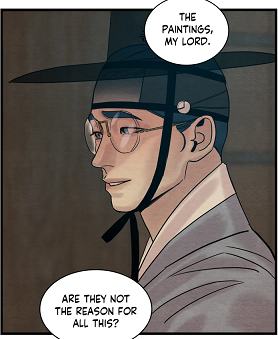 (Chapter 30) The moment he arrives back and the lord brings him back to his chamber, the nature of their relationship is no mystery any longer, though painting is used as a justification. (Chapter 29) Striking is the thickness of the wall. This symbolizes a long way for Baek Na-Kyum to admit his sexual orientation. Just because people know, this doesn’t mean that he is acknowledging his homosexuality immediately.
In chapter 34/35, there are three different scenes where the door plays a huge part. I have to say that the last scene was the one that caught my attention in the first place and that’s how I was able to connect the door to Baek Na-Kyum.
The first drawing shows the lord opening the door for Baek Na-Kyum. This signifies that the noble has somehow given up on forcing the painter to admit his homosexuality and his attraction to the lord. That’s the reason why Yoon Seungho spent the entire night thinking over how to convince the low-born to come to his side and become his partner.
However, the sex marathon has not left the young man unaffected. He hides behind the closed door, while his body is shaking and his heart is beating loudly. He eve feels butterflies. For the first time, we see Baek Na-Kyum confronting himself with his repressed feelings… for the first time there is a connection between his thinking and his unconscious. He is somehow admitting that the lord’s presence has left an impact on him. However, with his body he is making sure that no one will ever find out this secret. He is still denying his homosexuality to the outside world. He wants to keep it a secret, yet he is no longer denying the existence of these feelings.
Then in the same chapter, we see Jung In-Hun abandoning the low-born and he even closes the door in front of him.
This single action has so many significations. First, it visualizes the rejection of the teacher. He cuts ties with him. It also shows that Jung In-Hun is well aware of what happened 10 days before. It reveals his selfishness as he shows no concern. In fact, it was as if the low noble was pushing him back. It was as if Baek Na-Kyum was pressured to become a homosexual even without admitting it. The teacher is forcing him to accept his situation but at the same time, he is denying the responsibility. Imagine the hypocrisy of the lord’s action. In reality, he is the one who pushes the painter to sleep with the lord, since he needs a spy. But by closing the door, he ensures that Baek Na-Kyum doesn’t need to admit his own homosexuality. This scene symbolizes the prostitution Jung In-Hun referred later. The teacher wants to use the artist’s sexual orientation for his own needs and simultaneously he doesn’t need to require this from the painter. As a conclusion, Jung In-Hun is now pushing the low-born to become a homosexual without revealing it to the outside world. At the same time, he acts as if he has no idea what is happening to the commoner. That way, Baek Na-Kyum can never reproach him to have used him as a prostitute or to be a hypocrite.
Then in chapter 41, we see a certain progression. The door has been opened by Yoon Seungho but Baek Na-Kyum doesn’t care any longer. Since he is begging the lord to be held, he is finally admitting his true desires. He likes being embraced by a man. This marks a pivotal moment in Baek Na-Kyum’s life. And this explains why the door is wide opened at the end.
Baek Na-Kyum is no longer hiding his true sexual orientation. He is facing the world without being embarrassed. He waited for Jung In-Hun, hoping that the young man would still accept him, but he experienced rejection. He was literally left behind. However, his acceptance of his own sexual orientation doesn’t necessarily mean that he loves Yoon Seungho. In the beginning of season 2, he viewed himself as a prostitute. 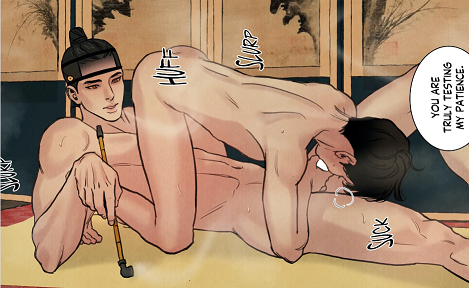 (Chapter 45) He just accepted him as his sexual partner, hence he went to his room and not to the lord’s side in chapter 44. If we compare their respective situation. Yoon Seungho hadn’t progressed much compared to the painter at the end of season 1, because he needed to express his emotions and reveal his secrets and vulnerabilities to Baek Na-Kyum. It took him a long time to open up, as he had been coerced to view himself as a bird of misfortune. He didn’t dare to voice any wish out of fear that these wishes would get ruined.
 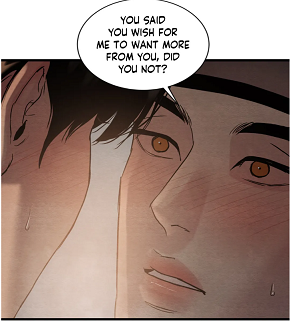 (Chapter 96) In his mind, he had no right to voice any desire, as they would be perceived as GREED!
  (Chapter 96)
But like I had written above, the low-born was in a better position right from the start. He had more freedom, while for Yoon Seungho the room is indeed a prison. Under this new approach, it becomes comprehensible how the main lead could leave the window and as such the darkness of his nightmare. Because of the painter, Yoon Seungho met Jung In-Hun, and the latter made him feel superior, but also jealous. That’s how his attention got diverted from the window making him discover the existence of the door! We could say that the painter as the butterfly led the poor protagonist to the door, and thanks to his mind, Yoon Seungho could release Baek Na-Kyum from his cage, as his mind was also trapped by social norms. And this sexual emancipation could only take place in the bedchamber. This explicates why the artist’s liberation was the first step for the lord’s liberation. But by opening the door for the painter, Yoon Seungho could free himself. Therefore it is not surprising that the painter‘s final confession took place in front of a closed door,  (chapter 96) and Heena could hear his words. Hence at the end, the door got broken:
  (chapter 96) This represented the final emancipation of the artist. He no longer cared, if he was seen. He was so moved that he didn‘t pay to his surroundings.
 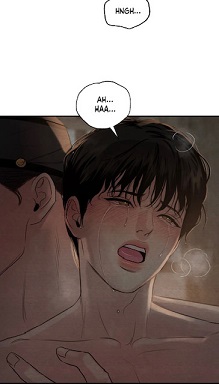 (Chapter 96), while it was not the case for the noble. The latter knew about the artist‘s shyness. This truly shows that Heena was responsible for the sexual oppression of her brother. The painter was no longer hiding his affection for the main lead, when he decided to wait for his master‘s return in the bedchamber.
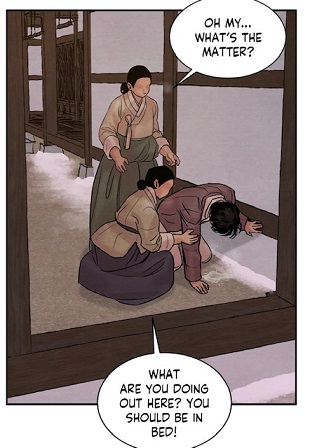 (Chapter 98) Observe that the artist was going there on his own will, and he was sharing his bed with his husband.
How did the scholar discover that Baek Na-Kyum was painting erotic paintings of sodomy? 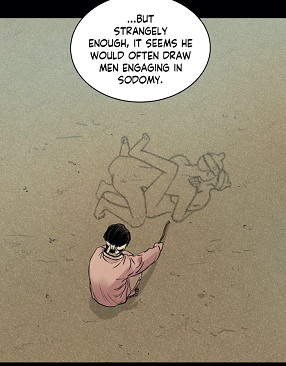 (Chapter 1) This memory was from the learned sir. Why was he approaching the painter during the day? Secondly, note that he only scolded the artist in his house! (Chapter 34) So he had discovered a secret, he imagined that the painter had assisted to an immoral love session.
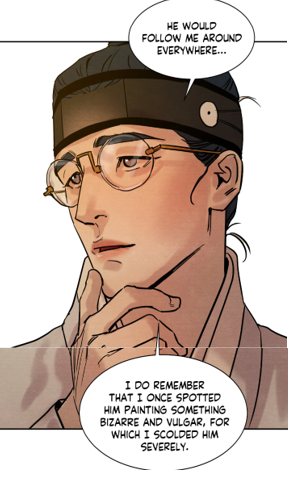 (chapter 6) In my opinion, the kisaeng was responsible for this incident. We have a clue for this interpretation:
 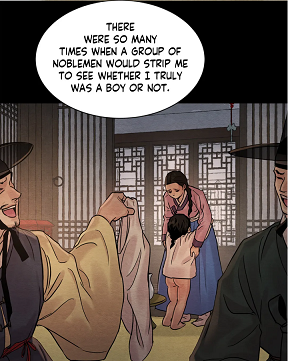 (Chapter 94) The noona is the one standing in front of the opened door with her donsaeng. Here, the artist was getting embarrassed and humiliated. That‘s how little by little, the artist associated the closed door to shame and safety. This is not surprising that the kisaeng is also standing behind the closed door, when she hears her brother making love to the main lead.
 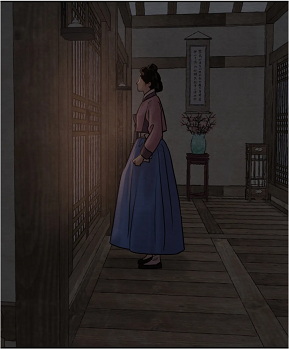 (Chapter 96) In addition, she is constantly seen in connection with an opened door, but this opened door is linked to anxieties, pain, shame and guilt: (chapter 68) (chapter 66)
 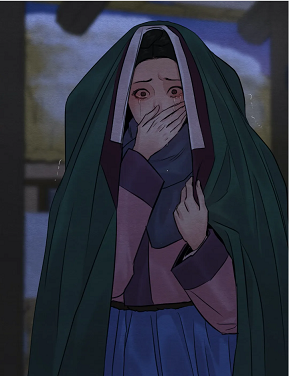 (chapter 88) I have the impression that she was acting out of jealousy, and she had intended to tarnish her brother‘s reputation.
And this leads to my final words. In my first version, I had expressed the following thoughts:
„Does it mean that the lord needs to leave the mansion behind in order to liberate himself from his suffering? If so, then we have two possibilities. Either he gives up his title and everything for the painter or he decides to move to the capital and helps the artist to develop his career and even starts meddling in politics.“
And look at the progression of the story. Yoon Seungho did leave the mansion behind and went to the mountain with the painter in his arms. (Chapter 102) This symbolized the final emancipation of Yoon Seungho. He could finally move on from his past, and as such leave the darkness of his mental prison. He no longer needs a window to view life. This scene announced that he was starting living again. Thus I am expecting to see Yoon Seungho becoming more proactive and funny in season 4. He will show his intelligence and strength in order to defeat his enemies because so far, he never revealed his qualities to others, only to the scholar. His past had left him somehow paralyzed, hence he has laid a low profile. In his past, he believed that his prison was his protection, for he could observe and remain quite wealthy and powerful. For me, Baek Na-Kyum is in reality his strength, the reason why he will be able to leave his cage and shows his true colors and skills.
But if the window symbolizes Yoon Seungho and Baek Na-Kyum the door, what is representing the teacher? In my opinion the open air. He is mostly seen outside.

 (chapter 7) (chapter 10)
 (chapter 19) (chapter 29)
  (Chapter 22) (chapter 35) He often strolls through the courtyard. Therefore I would say that the air embodies him so perfectly. He is seen with his nose in the air

which shows his arrogance. Simultaneously, he gives himself airs. How can he be touched by this low-born? The picture shows both aspects. Then in the chapter 6, he is just hot air (this expression means empty talk in order to impress) , when he says that he was the one who taught how to read to the painter. Here, he tries to present himself as a good teacher to Yoon Seungho. Furthermore, he is overestimating his own skills and he is definitely daydreaming  which is connected to the expression “castles in the air”. His aspirations are boundless, he is aiming at the highest position without being competent or even trying to improve himself. He also attempts to air dirty laundry, when he is hunting with Yoon Seungho. He wants to force the lord to admit his lie so that he can criticize him. But here he fails. As you can observe, many expressions with air reflect his personality. However, there is one scene that contrasts to this observation, that’s when he is in his library in the chapter 40. We actually see him at the library in two occasions:
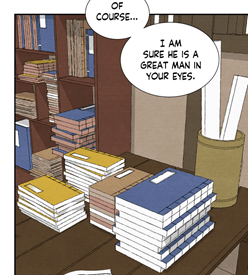

chapter 7 and 40. However only the scene in the chapter 40 is memorable. Therefore I would say that he is linked to two spaces: open air and closed room like the library. It seems strange that Jung In-Hun is linked to a world with no boundary and the opposite, a closed room. Actually, it is quite simple. The outside signifies that he is actually empty and superficial behind his smile. He is so fake hence he has no real personality. Besides, since there is no limit, then it can also signify that he has no conscience as he knows no boundary. Furthermore, it also illustrates that he has no past and no trauma too. Finally, it also indicates that he will never change, there will be no transformation and as such no progression. Air remains air. Yet he only shows his true thoughts in a closed door in the chapter 40.  His words there are suffocating the poor boy, that’s the reason why Baek Na-Kyum is left speechless.
  (Chapter 40) He can’t breathe properly. Since there is no view and no door to the outside visible in the drawing, we have to imagine this reflects his narrow-mindedness. He is surrounded by books (see the pictures from the chapter 7) therefore he lacks real experience and knowledge. He is literally buried behind his books, therefore his knowledge is superficial.
  (Chapter 27) Even in his bedroom there are books so his own bedchamber gives the readers a suffocating feeling. Since there is no window visible in his room and the library, there is no fresh air in the closed room which explains why it is asphyxiating. Usually, we say in a closed room that it smells musty. He only knows the world through his books and the moral standards. He is not even opened to the outside, only his words and thoughts count. Everything else has no value hence there is no life next to him. People living by his side will end up suffocated as he doesn’t allow them to breathe. He is stubborn and he will never change, a fake, empty and narrow-minded man with no conscience. Because of this connection, I realized that Jung In-Hun had no future in Hanyang. He would end up buried, and this became a reality. Because the moment he left for the capital, he ended up dead. And now, if you think carefully, you will recognize that the learned sir is associated to nature! Thus he was seen in the woods (chapter 6, 22) or in the countryside admiring the moon.
  (Chapter 70) Air means also breathing! Hence he represents the fresh air entering Yoon Seungho‘s bedroom, hence we had such a scene:
  (chapter 35) The lord witnessed the intimate interaction between the learned sir and the artist, thus he was incited to leave the bedroom. Strangely, we could say that he was the initiator for the lord‘s liberation. No wonder, why Kim wished to get rid of the learned sir in the end, and just viewed the artist as less annoying and evil!
So the moment he left the domain, the admired sir was confronted by reality. His stay in the mansion had made him dream 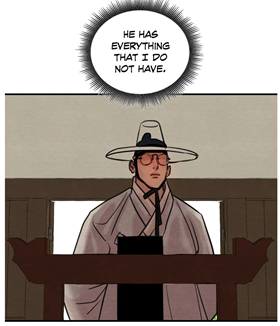 (Chapter 18) so that he ended up letting his guard down. He was not so competent and intelligent like Yoon Seungho, he relied more on the stupidity on others. He could deceive commoners, but not spies. In my first version, I had envisioned that the learned sir had many tricks up his sleeves so he would survive, but I had not realized that he had met a fake servant
 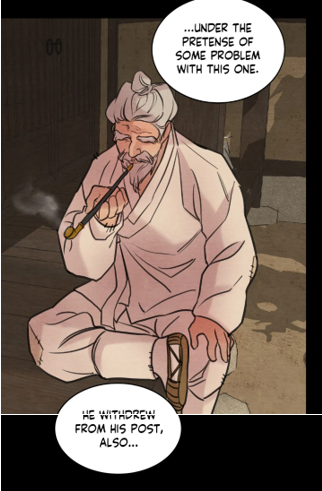 (chapter 37) definitely a noble who could see through him. For me, it was the pedophile himself. I had predicted that he would disappear into thin air, and it became a reality, especially if my theory about his assassination is correct. We could see the transformation of the scholar into a ghost,
 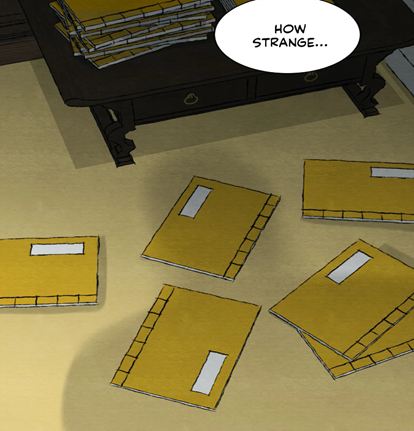 (chapter 50) who would come to haunt the couple because of his resent. (Chapter 98) As the air, he became a spirit! And note that the lord was encouraged to stroll too!
Feel free to comment. If you have any suggestion for topics or manhwas, feel free to ask. If you enjoyed reading it, retweet it or push the button like. My Reddit-Instagram-Tumblr-Twitter account is: @bebebisous33. Thanks for reading and for the support, particularly, I would like to thank all the new followers and people recommending my blog
 Bebebisous33s' analyses in K-Dramaland and Manhwas