
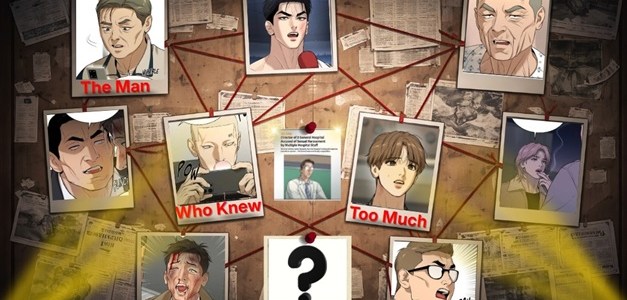
Please support the authors by reading Manhwas on the official websites. This is where you can read the Manhwa: Jinx But be aware that the Manhwa is a mature Yaoi, which means, it is about homosexuality with explicit scenes. Here is the link of the table of contents about Jinx. Here is the link where you can find the table of contents of analyzed Manhwas. Here are the links, if you are interested in the first work from Mingwa, BJ Alex, and the 2 previous essays about Jinx The Hidden Predators (Part 2) and The Man Who Knew Too Much – part 1
It would be great if you could make some donations/sponsoring: Ko-fi.com/bebebisous33 That way, you can support me with “coffee” so that I have the energy to keep examining Manhwas. Besides, I need to cover up the expenses for this blog.
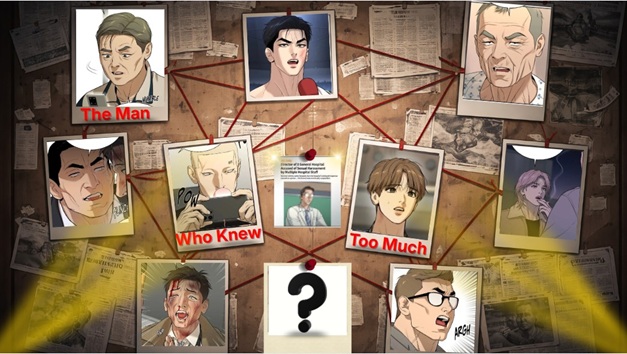
I know that my avid readers were expecting an analysis of episode 94, especially because the conversation between the two main leads was so moving. Actually, the illustration and the title are already prepared.  Beautiful, right? Yet I could not help myself returning once again to the criminals. My fascination with thrillers and investigations probably gives it away: when I read this story, I instinctively begin to examine every image, words and event like a detective reconstructing a case.
You may therefore wonder what triggered this sudden return to the question of conspiracy.
Surprisingly, it started with a very quiet panel. 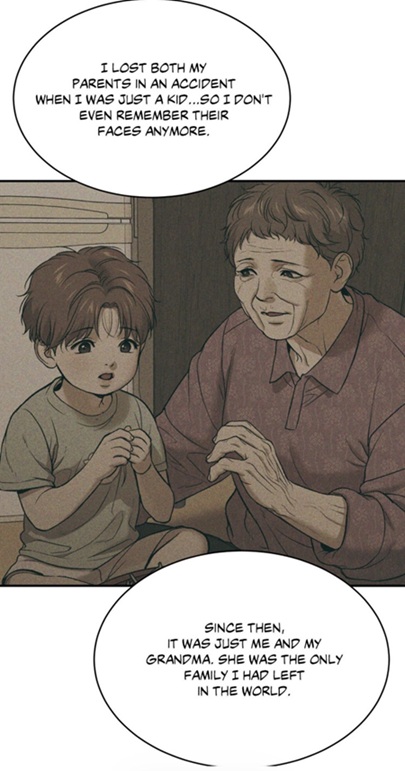 (chapter 94) In this moment we learn that Kim Dan lost his parents in an accident when he was a child, though we shouldn’t trust this confession as the truth due to the debts. Anyway, the word “accident” immediately resonates with a principle that has appeared again and again throughout the story: someone being at the wrong time, at the wrong place.
In Kim Dan’s case, however, the catastrophe is natural. It is not the result of manipulation or conspiracy. Fate simply intervened. The tragedy shaped his life, leaving him alone with his grandmother and forcing him to grow up prematurely. This explains the origins of his powerlessness and passivity. His entire existence is marked by the consequences of that accident. Yet precisely because this accident is natural, it casts a revealing light on the world of the criminals.
In their world, accidents are manufactured. 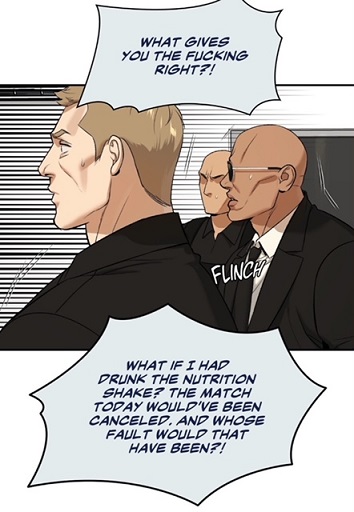 (chapter 40) What appears to be coincidence is often carefully engineered.
The Criminal Method
When we examine the schemes surrounding Joo Jaekyung and Kim Dan, a recurring structure becomes visible. The antagonists rarely attack their targets directly. Instead, they create situations where events unfold in such a way that someone appears to have been caught at the wrong place, at the wrong time.
The pattern is remarkably consistent. First, the media narrative is prepared. Hence an article about his shoulder injury was leaked to the press. 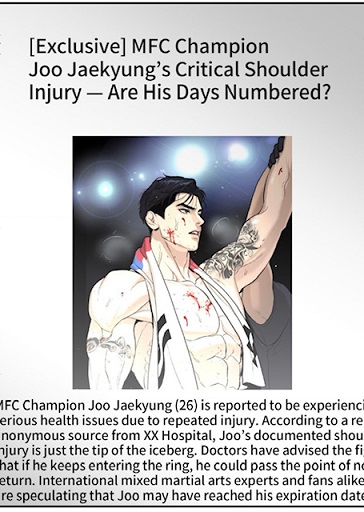 (chapter 36) At the same time, social medias were manipulated in order to stir public pressure and push the champion toward accepting the match in the States.
 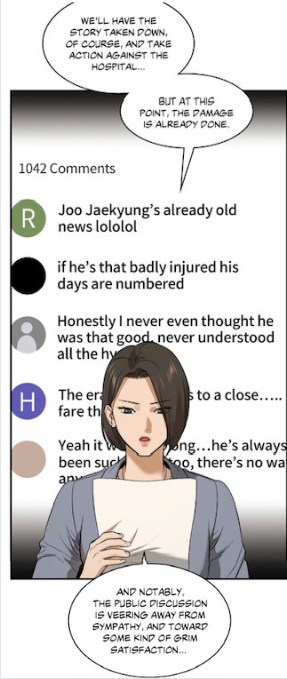 (chapter 36) But we only discover this MO thanks to the match with Arnaud Gabriel and the Entertainment agency’s involvement.
  (chapter 81)
After the incident in the United States, the manipulation did not stop. On the contrary, it entered a new phase. The media reported that Joo Jaekyung had been suspended because of his temperament. 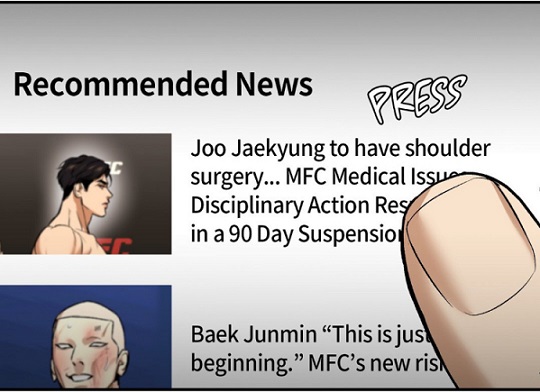 (chapter 52) Officially, the story suggested that his own behavior had caused the problem. In reality, however, this removal also had another function: it cleared space for Baek Junmin’s rise. That’s the reason why the article with The Shotgun was placed directly below the star’s and why the director Hwang Byungchul accepted easily the disqualification of his former pupil.
  (chapter 71)
At the same time, the public image of the champion was gradually reframed. (chapter 54) He was increasingly portrayed as reckless and irresponsible for continuing to fight despite his condition.
  (chapter 54) In this new narrative, the original leak of confidential medical information was no longer treated as the real wrongdoing. The focus shifted entirely onto the athlete himself.
Rumors about the champion’s injuries, his unstable recovery, and his arrogance could now circulate in advance, so that any later setback—including a possible defeat in Paris—would appear understandable, even inevitable.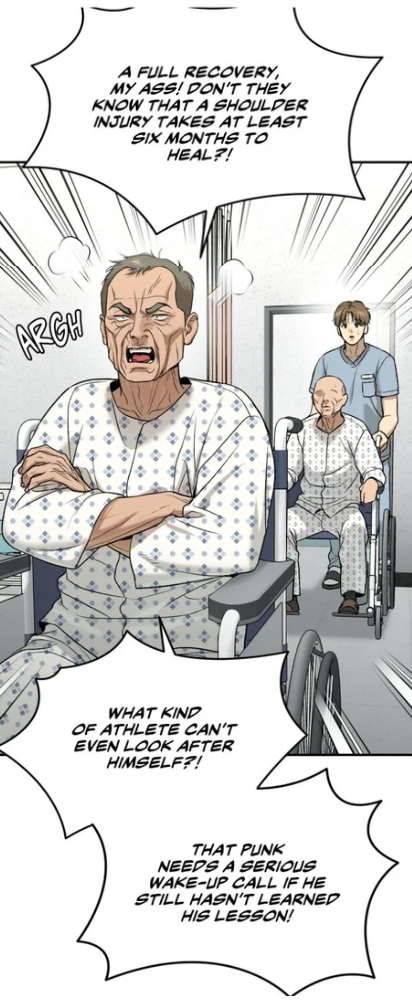 (chapter 70) Once such stories enter public discourse—injury, temper, arrogance—every later incident can be read as confirmation. The narrative becomes self-reinforcing. The media no longer merely reports events; it prepares the framework through which future events will be judged.
Second, a destabilizing trigger is introduced. Often this takes the form of drugs or pharmaceutical substances. The drugged beverage in the United States  (chapter 37) and the suspicious spray
  (chapter 49) used during the manipulated match both belong to this category. These substances create uncertainty about the athlete’s physical condition and about the legitimacy of his treatment. But this implies the involvement of the pharmaceutical industry.
  (chapter 41)
The third step in this pattern is the involvement of authorities and institutions. Once the destabilizing event has occurred, official actors step in: security personnel, referees, medical staff, health centers, or the sports organization itself. Their intervention transforms a chaotic incident into an officially documented event.
This stage is essential, because institutions possess something criminals do not: legitimacy. The incident in the United States reveals how institutional authority can be used to control the narrative. After the incident with the drugged beverage was reported to the MFC, security personnel intervened and brought Kim Dan into an interrogation room. 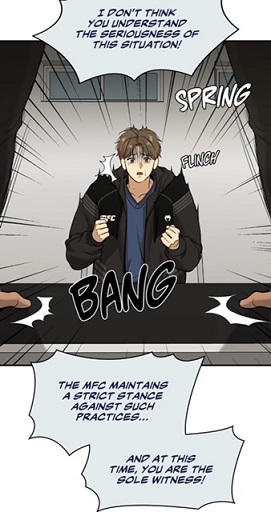 (chapter 40) The scene resembled a police investigation, yet these men were not representatives of the state. Hence there was no translator and lawyer. They were dressed-up employees of a private organization whose primary objective is to protect the company from scandal and as such from losing money
During the interrogation, the agents attempted to frame Kim Dan by focusing on the “nutrition shake” he had allegedly consumed. He seemed to be part of a scheme.  (chapter 40) At first glance, this strategy appears effective. By redirecting attention toward the therapist, the organization can distance itself from the real problem: the suspicious beverage that had been introduced into the environment of the fight.
However, the scheme overlooks an important detail. The incident did not remain entirely undocumented.  (chapter 40) A doctor took a blood sample from Kim Dan, and the laboratory later produced a component analysis report. (chapter 41) This report becomes significant for two reasons. First, it confirms that the contamination was real. The substance had indeed been introduced into the environment surrounding the fight. Such a finding inevitably raises questions about how the drink entered the system controlled by the MFC. In order to avoid institutional responsibility, the organization therefore needed a convenient explanation—someone outside its sphere of influence who could be blamed for the incident, antis.
 (chapter 41)
Second, the timing of the report is revealing. The results of the component analysis appear in the very same episode in which the MFC doctors give their approval for the next fight.  (chapter 41) This coincidence exposes another layer of the mechanism. While the laboratory analysis confirms that an illicit substance had been present, the medical authorities simultaneously authorize the champion to continue fighting. The two decisions cannot easily be separated. Together, they suggest that the involvement of the doctors helps stabilize the narrative: the suspicious beverage becomes a secondary issue, while the focus shifts toward the champion’s physical condition and his decision to fight despite his shoulder injury.
In this way, medical authority does not simply clarify the situation. It contributes to transforming a troubling incident into a new plot and manageable story. To conclude, the MFC medical authorities approving the fight are now part of the scheme, accomplices of the set up as well. Doctors have entered the chain of events. But why did all the employees (security agents, doctors) started helping? The fear of a scandal and the involvement of the media … and naturally loss of money 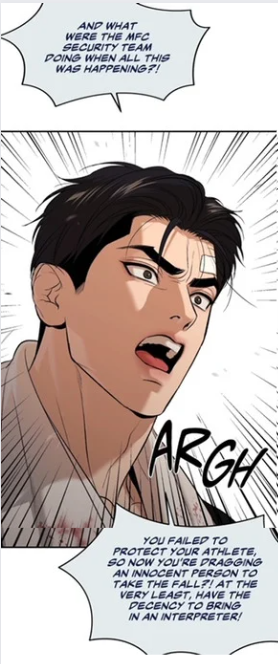 (chapter 40) That’s why they needed a scapegoat. First Kim Dan, later antis and finally the athlete himself. And who fears a scandal in Jinx? One might say Park Namwook
 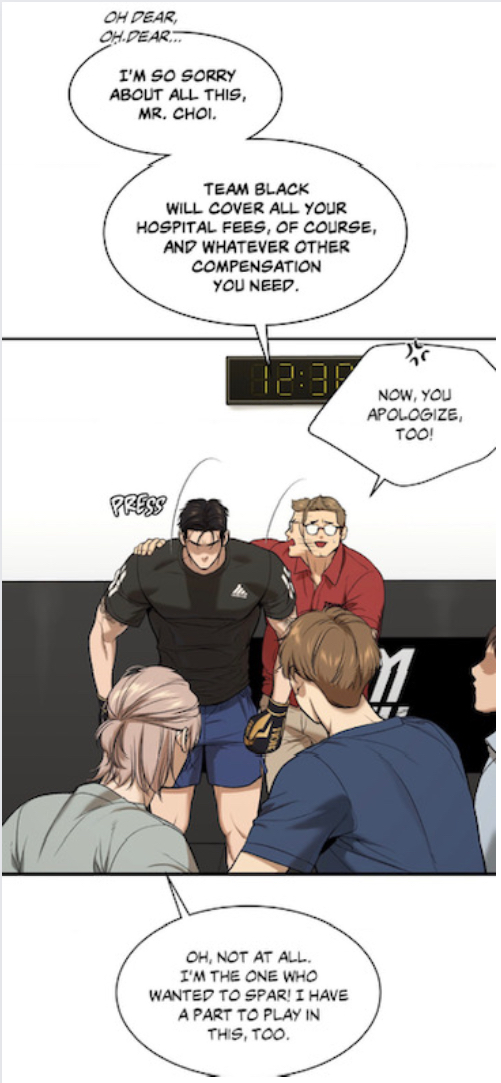 (chapter 31) who always hides behind authorities and shows distrust toward fighters. But he is just reflecting the attitude of the other MFC accomplices.
The same mechanism appears during the events surrounding the manipulated match and the switched spray. Joo Jaekyung’s ankle got injured after the substance had been used. 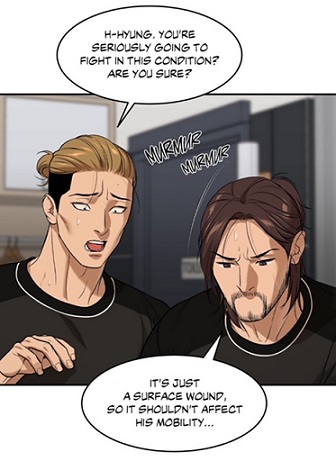 (chapter 50) Observe that in the locker room, the coach declares the athlete as fit despite the injury before going to the health center. The chronology is important, as the MFC doctors have the final saying. So when the champion is taken to the health center before the fight. the responsibility is shifted.
By examining the athlete and clearing him for the match despite the injury, the medical authorities effectively became responsible for the decision that allowed the fight to proceed. In principle, such a medical examination should have resulted in documentation of several elements: the condition of the ankle, the treatment administered, and the circumstances surrounding the injury. But I am suspecting that the documentation was either ignored or deliberately minimized the ankle injury. Why?
Keep in mind that the narrative that later circulated in the media tells a different story. Instead of focusing on the injured ankle and the suspicious spray, the discussion shifted almost entirely toward the champion’s shoulder injury. (chapter 54) The public narrative portrayed him as reckless for continuing to fight despite his physical condition. The responsibility for the situation was therefore redirected toward the athlete himself. MFC’s notoriety remained clean, the employees were all safe, they were not facing any financial or legal repercussion contrary to the star.  (chapter 54) Hence Park Namwook remained passive.
The later meeting at the restaurant confirms this strategy of containment. The CEO of the MFC  (chapter 69) apologized for the behavior of the security staff toward one of Joo Jaekyung’s team members.
 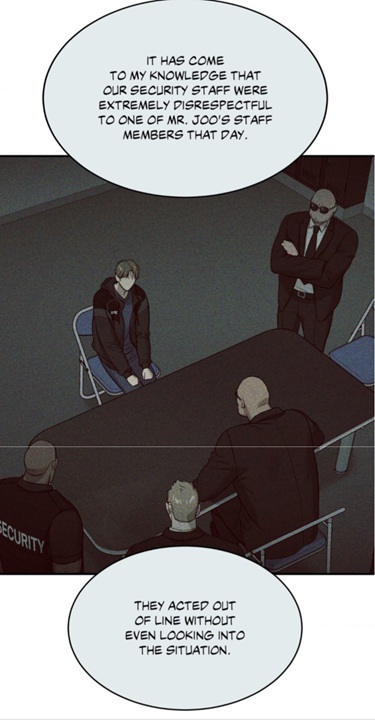 (chapter 69) Significantly, this apology took place behind closed doors, not in front of the media, and doc Dan is still left in the dark about it. The goal was therefore not transparency but damage control. They were in reality attempting to bury everything, to buy some time, until the athlete would lose his next match.
By presenting the incident as the result of overzealous security agents, the organization could deflect attention from the more troubling questions raised by the drugged beverage and the switched spray, the lack of security and neglect.  (chapter 69) The problem was reduced to a matter of manners rather than a potential security failure or institutional complicity. In this way, the apology functioned less as an admission of guilt than as a mechanism to close the case quietly before it reached the public sphere.
Interestingly, the executive describes the substance as a “fake supplement.” This terminology already reveals a subtle shift in language. The laboratory analysis had identified the compound as an aphrodisiac. In other words, a drug that can exist within the legal pharmaceutical sphere. By presenting the substance as a “fake supplement,” the organization avoids raising uncomfortable questions about the origin and distribution of the compound. The problem is no longer framed as the misuse of a pharmaceutical drug but as the circulation of a counterfeit product introduced by an external criminal actor. In this way, the language protects not only the organization itself but also the broader pharmaceutical system from scrutiny. And don’t forget that Doc Dan got informed about the connection between the rival gym and the parent pharmaceutical company in the States. 
And now, the modus operandi of the villains and schemers becomes clear. When these incidents are considered together, a consistent criminal method emerges. The antagonists try to trap their targets like hunters. Instead, they construct situations in which events appear to unfold naturally while responsibility is quietly redirected elsewhere.
The structure remains remarkably stable: first a compromised situation is created, then a destabilizing act of sabotage is introduced, and finally responsibility is redirected toward a convenient scapegoat. In this way, institutions remain intact while the blame falls on expendable individuals.
This is how the underworld functions. Someone is always placed in the wrong place at the wrong time, and the lowest figures in the hierarchy—the minions—are left to take the fall. For this very reason, criminal organizations and drug cartels are notoriously difficult to dismantle: the system protects itself by sacrificing those at the bottom while the structures above remain untouched.
If this pattern truly governs the criminal strategy, then the attack against Kim Dan cannot be limited to a single incident. The physical therapist represents the most vulnerable element in the entire situation: he comes from poverty, lacks institutional protection, and his professional credibility can easily be questioned. For this reason, it is likely that the conspirators will attempt not one manipulation but several. And the last one will force them to expose their true nature: they are criminals and no doctors, directors or athletes (kidnapping).
These stunts will almost certainly revolve around the same thematic field that has already appeared in the story: wrongdoings, drugs and substances. Whether through medication 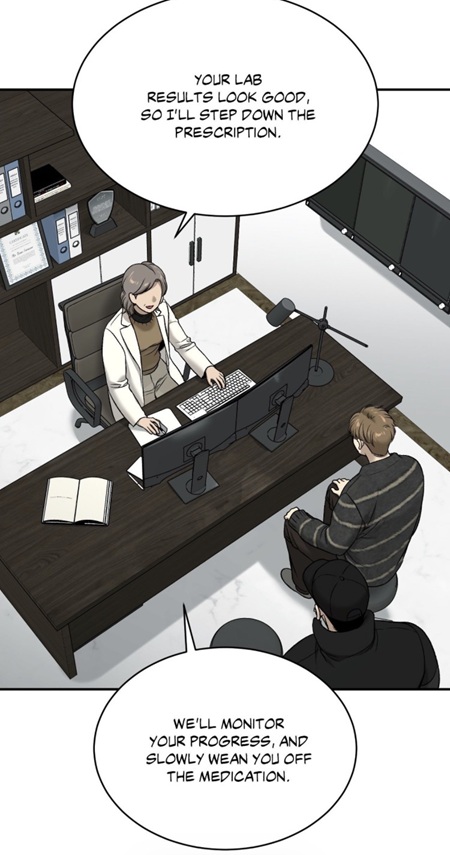 (chapter 91), drinks , smoking,
  (chapter 65), or other forms of contamination, each incident would undermine Kim Dan’s credibility as a medical professional. If the therapist can be portrayed as irresponsible, incompetent, or compromised by substances, the institutional narrative could once again shift responsibility onto him.
Kim Dan and The Medical Trap
Once this mechanism becomes visible, the events in the locker room acquire a different meaning. At the very moment when the scheme reaches its decisive phase 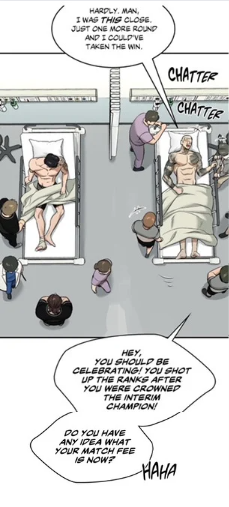 (chapter 52), Kim Dan is no longer present. After confronting him and suspecting a betrayal
 (chapter 51), Joo Jaekyung leaves the locker room alone and goes to the health center. And don’t forget that before, he even refused his treatment for the ankle injury before.
  (chapter 50)
As a result, Kim Dan is absent when the champion is treated at the MFC medical center and at the health center. 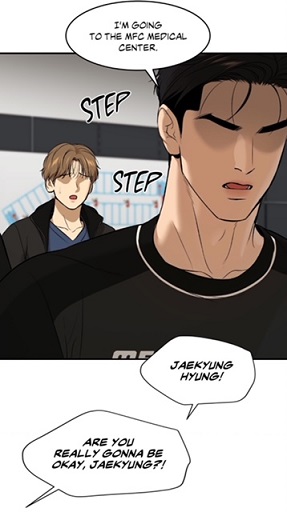 (chapter 50) He therefore has no knowledge of what happens there: the medical examination, the decisions taken by the doctors, and the institutional narrative that later emerges from this encounter.
This absence is crucial. The criminal method described above requires the presence of a convenient scapegoat at the moment when the official version of events is constructed. 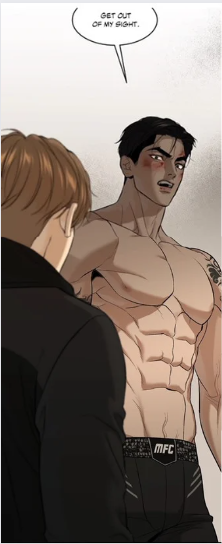 (chapter 51) But this time, the pattern is disrupted. Kim Dan is not there when the institutions intervene.
Paradoxically, the accusation that drove Joo Jaekyung to distance himself from his therapist also removes him from the very situation in which he might once again have been blamed. The scapegoat has disappeared from the scene.
That’s why Joo Jaekyung had to take the blame for the outcome and the “scandal”, the brawl burying the incident with the switched spray!!  (chapter 52)
To understand the consequences of this absence, we must therefore return to the locker room itself—where suspicion, photographs, and accusations first triggered the rupture between the two men. The confrontation in the locker room marks the moment when this criminal mechanism nearly achieves its objective. At this point in the story, suspicion has already begun to circulate around Kim Dan. 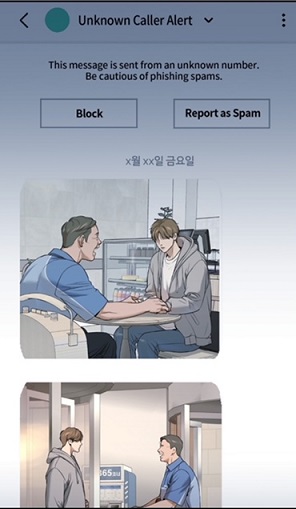 (chapter 48) Photographs of him had been sent to Joo Jaekyung, suggesting that the physical therapist might have been communicating with Baek Junmin through the director of the other gym.
 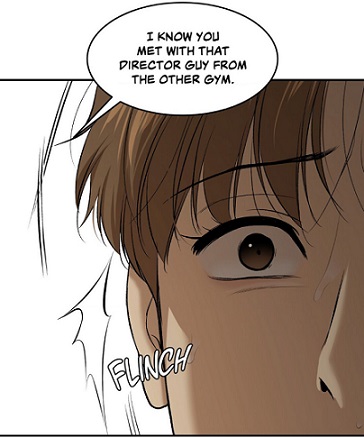 (chapter 51) Confronted with these images and the growing confusion surrounding the match, the champion reaches a painful conclusion: that his roommate may have betrayed him.
In the locker room, this suspicion finally erupts into open accusation. (chapter 51) Joo Jaekyung confronts Kim Dan directly and demands an explanation. For the first time, the therapist is placed in the exact position that the criminal schemes had been preparing all along: the position of the possible traitor.
From the champion’s perspective, the logic seems simple. The photographs appear to show a connection between Kim Dan and his rival. While Joo Jaekyung believes he has finally uncovered the truth behind the sabotage, he is in fact reacting to a carefully constructed illusion. He is not realizing that the match was rigged, the jury and moderator had been bought. They had planned the tie. That way, MFc appears as a legitimate sports organization. The images and circumstances that appear to implicate Kim Dan are themselves part of the larger mechanism designed to redirect suspicion toward the most vulnerable figure in the entire situation. 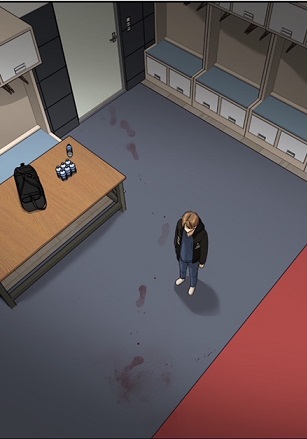 (chapter 51)
Timing, however, remains the key element in the criminals’ strategy: everything depends on placing someone at the wrong time and at the wrong place. Yet in this instance, the timing fails. The report of the incident surfaces only much later, after Potato hears about the situation.  (chapter 52) By that point, the circumstances have already changed. The use of the switched spray introduces a new dimension to the case, and with it the possibility that another authority must intervene.
For the first time, the matter can no longer remain confined within the internal structures of the MFC. 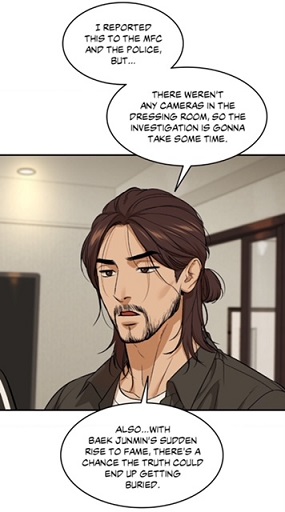 (chapter 52) The situation now risks attracting the attention of the police. As you can see, by remaining passive, Joo Jaekyung in his own way protected the physical therapist from real trouble. If he had truly blamed him, he could have “called” the police, but he did not.
In other words, the conspirators would have obtained their perfect scapegoat. The champion’s rejection therefore becomes a blessing in disguise. By removing Kim Dan from the scene, he prevents the therapist from being trapped inside the very mechanism designed to destroy him.
Baek Junmin and the Shadow of the Police
The appearance of the police in chapter 52 introduces an element that cannot be ignored. Up to this point, the incidents surrounding Joo Jaekyung have largely been contained within private structures: the MFC, its security personnel, and its medical institutions. These actors possess authority, but they remain part of a controlled environment where scandals can be managed internally.
The police represent a very different kind of authority. Interestingly, the narrative later reveals that Joo Jaekyung himself had previously spent time at a police station following an incident involving damaged property and a street fight. 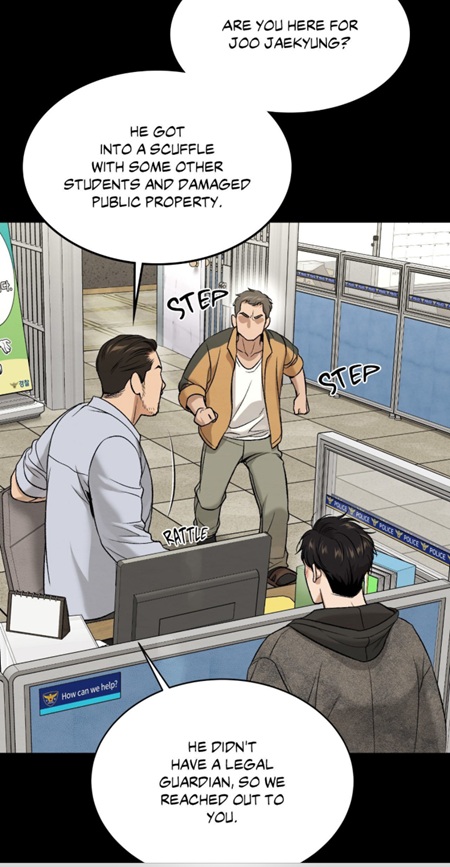 (chapter 74) The coincidence between these two moments—chapter 52 and chapter 74—suggests more than a simple narrative repetition. Both situations involve the same institutional actor: the police.
This connection raises an important question. Why does Joo Jaekyung immediately suspect Baek Junmin with the switched spray (chapter 51), when the pictures only show Choi Gilseok and he was not even present in the locker room?
The answer may lie in his own past experience. When the champion finds himself at the police station in the earlier incident, the situation appears similar to the pattern we have already observed elsewhere: a chaotic confrontation, witnesses present, and a narrative that quickly identifies him as the responsible party. Moreover, observe that during that night, the future champion 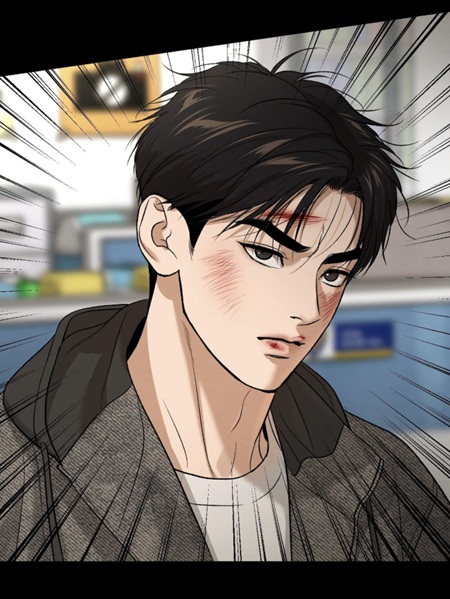 (chapter 74) has a similar wound on the forehead than The Shotgun.
 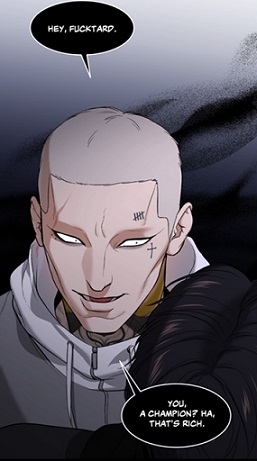 (chapter 74) If Baek Junmin had orchestrated that earlier event, the strategy would have been simple but effective. Instead of attacking his rival directly, he could create circumstances that forced the authorities themselves to intervene. But why would he involve the police, when he is involved in the criminal world? Such a tactic would allow him to remove or weaken Joo Jaekyung without openly violating the protection imposed by his hyung
 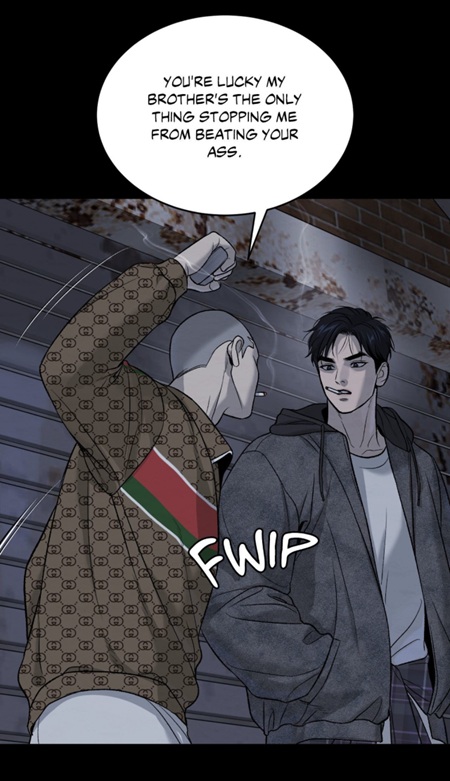 (chapter 74), who had explicitly forbidden him from harming the champion.
In this scenario, the police become an instrument. By manipulating witnesses—perhaps even paying students who had previously been bullied 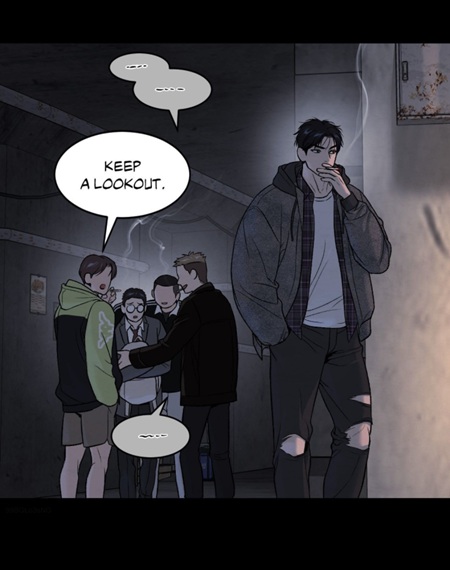 (chapter 74) —Junmin could ensure that the story presented to the authorities pointed toward Joo Jaekyung. For the students involved, the arrangement would offer a practical advantage: financial compensation and a chance to escape their own precarious situation. But for that stunt, The Shotgun got to pay a heavy price: not only the scar on his forehead
 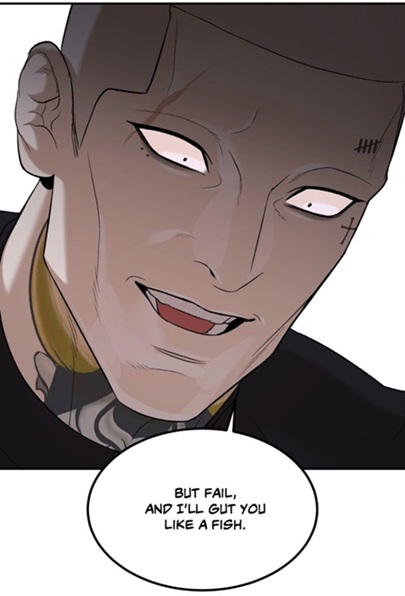 (chapter 93), but also a life in the shadow forever. It is clear that he could never get rich and famous through his illegal fights. Hence he resents the main lead so deeply.
The result would be a classic example of the principle that governs the criminal world depicted in the story: placing someone at the wrong time and the wrong place. His suspicion toward Baek Junmin does not arise from speculation alone. It is grounded in experience.
If this interpretation is correct, Baek Junmin’s strategy becomes clear. By orchestrating a situation that attracts police intervention, he can remove his rival without ever directly attacking him. IMO, he is on his way to play a similar trick than in the past. Hence he looks at the calendar, timing is essential. 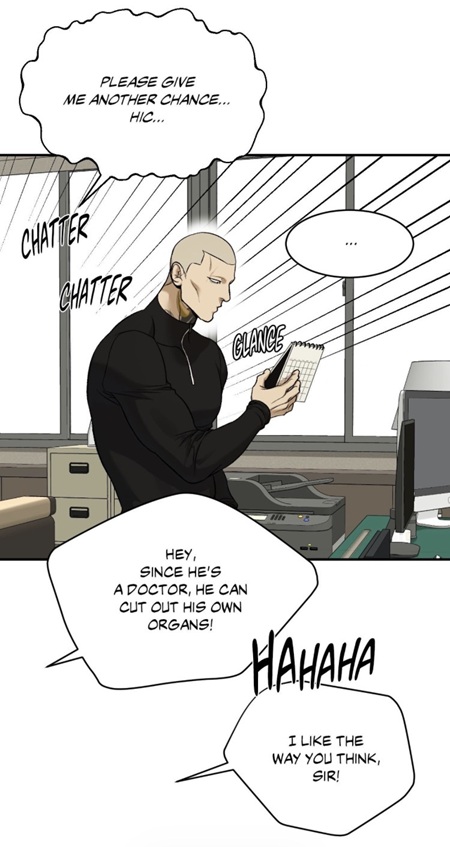 (chapter 93) The authorities perform the task that Junmin himself is forbidden to carry out.
Moreover, the champion understands another important rule of the criminal world: organized crime usually avoids the police whenever possible. The mob prefers to settle conflicts quietly through money, intimidation, or internal arrangements. Calling the authorities risks exposing the entire network. This interpretation also explains why Joo Jaekyung doesn’t report the trespassing and assault to the authorities.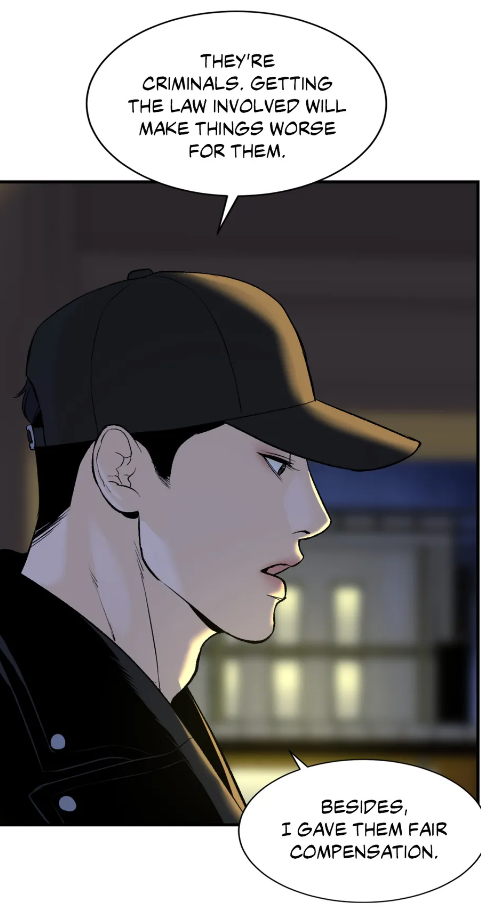 (chapter 18) He knows how the criminal world functions.
Thus I deduce that with this new offer to the former hospital director, the Shotgun is involving not only the medical world more deeply into the scheme, but also the police. 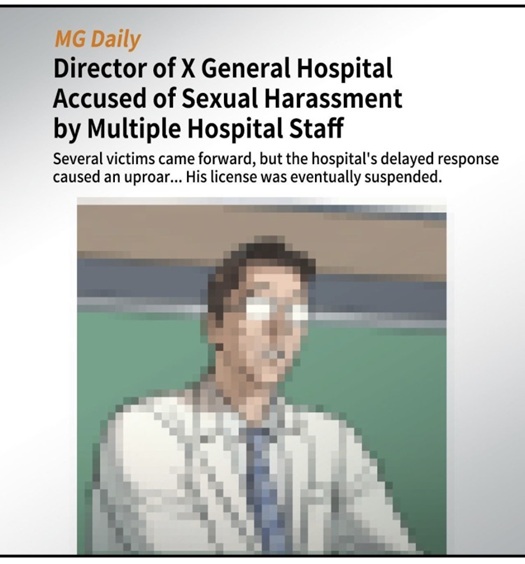 (chapter 91) The article reports that the director of X General Hospital was accused of sexual harassment by several members of the hospital staff. The scandal eventually forced the institution to suspend his medical license. Yet the wording of the report also exposes an important detail: the hospital reacted slowly, and the affair was handled primarily as an internal disciplinary matter.
In principle, repeated sexual harassment by a hospital director should not remain merely an administrative issue. Such actions constitute criminal offenses and could have led to a police investigation. Instead, the institution appears to have contained the scandal within its own structures.
In other words, the hospital followed the same logic that we have already observed in the MFC and within the criminal world itself: avoid the police whenever possible. The reasons are obvious. Once law enforcement becomes involved, internal arrangements lose their power and other crimes could come to the surface. Reports are reopened, testimonies are examined, and the entire chain of responsibility may become visible.
Another important ingredient of this plot is silence. The scandals are not denied outright; they are contained, privatized, and buried. The MFC admits the set-up only behind closed doors. The hospital treats criminal behavior as an internal disciplinary matter. The underworld, for its part, prefers money and intimidation to police reports. In each case, silence becomes a tool of power. What remains unspoken protects the system. That’s why the witnesses and victims need to speak up and report the crimes. Doc Dan has not reported the assault yet: 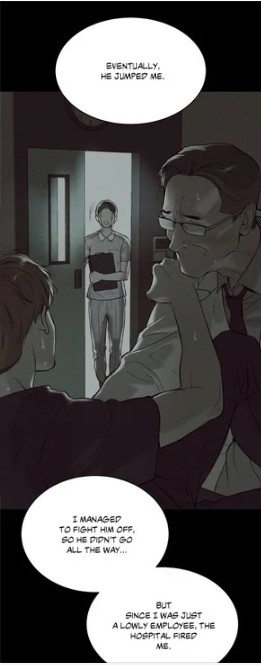 (chapter 90)
Seen from this perspective, the Shotgun’s proposal to the disgraced director acquires a new meaning. By recruiting a figure who already stands at the intersection of scandal and institutional cover-up, he introduces another fragile element into the situation. The director represents a man whose career collapsed precisely because a scandal nearly escaped the control of the institution that protected him. But in his eyes, he stands for “respectability and trust”, as he is called doctor. (chapter 93)
If such a person becomes involved in the scheme against Joo Jaekyung and Kim Dan, the consequences could extend beyond the criminal underworld or the sports organization. The medical world itself—and potentially the legal system—may be drawn into the conflict.
In that sense, the Shotgun’s move does not merely deepen the conspiracy. It risks bringing the one actor that all these systems usually try to avoid: the police. A lesson that he didn’t learn from the past.
And now you may wonder why I remain so focused on the earlier episodes instead of concentrating entirely on episode 94. The reason lies precisely in what this scene reveals.
The conversation between Joo Jaekyung and Kim Dan makes something suddenly clear: together, they embody the opposite principle of the one that has governed the criminal schemes throughout the story.  (chapter 94) Up to this point, the antagonists have relied on a simple but effective strategy. By manipulating circumstances, they repeatedly place others at the wrong place and at the wrong time. Each incident—whether involving the media, drugs, or institutional authorities—follows this logic. Someone is caught in a situation carefully arranged by others and must carry the consequences.
Episode 94 breaks this pattern. 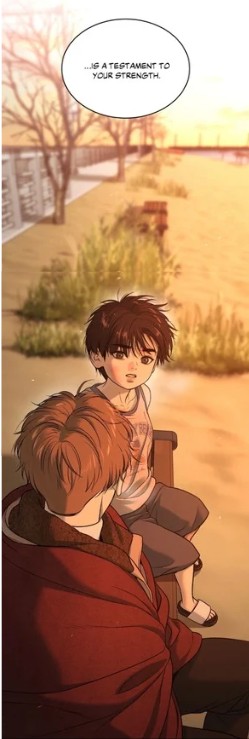 (chapter 94) There is trust, recognition, admiration and open-mindedness. In their mutual confession, the two protagonists do something that none of the criminals ever achieve: they seize the moment at the right time and in the right place. They speak and listen to each other. Instead of being manipulated by circumstances, they recognize the opportunity before them and act upon it.
The result is not merely emotional reconciliation. It quietly undermines the very mechanism that has been used against them. For the first time, the logic of coincidence and manipulation no longer dictates the outcome.
Turning the Method Against the Criminals
Yet the story introduces an important twist. The main couple gradually learns to use the same modus operandi against their enemies: at the right time and the right place.  (chapter 59)
  (chapter 79)
 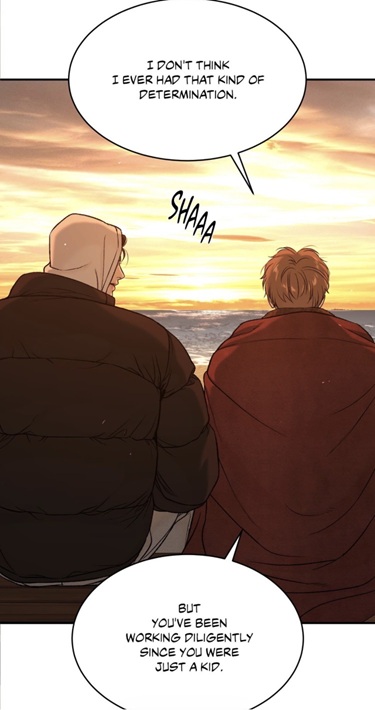 (chapter 94)
A revealing example occurs when Joo Jaekyung publicly challenges Baek Junmin after the fight against Arnaud Gabriel. 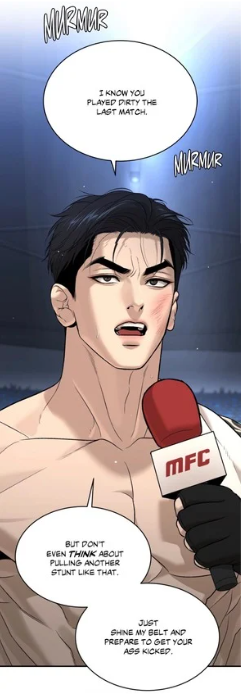 (chapter 87) By issuing the challenge in front of the cameras, the champion forces the MFC to respond. Even though the season had effectively ended, the public nature of the declaration creates pressure that the organization and the media cannot easily ignore.
In that moment, Joo Jaekyung takes control of the narrative.
Baek Junmin suddenly finds himself in the same position that his victims usually occupy: he cannot escape the situation. Instead of manipulating time and circumstances, he must react to them. His glance toward the calendar reveals his awareness that the timing is no longer in his control. (chapter 93)
The antagonists attempt to regain that control by scheduling events close to Christmas, a moment when institutions and public attention may be distracted. Time itself becomes another instrument within the conflict. A second possibility also emerges from the same logic of timing. If the grandmother were to pass away soon 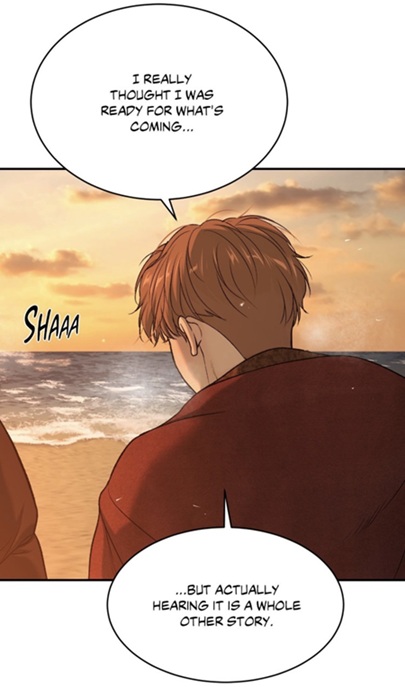 (chapter 94), the situation could disrupt the plans surrounding the anticipated fight with Baek Junmin.
A funeral represents the ultimate example of being at the wrong place and at the wrong time. Death does not follow the schedules of sports organizations or criminal schemes. It interrupts them. In such circumstances, Joo Jaekyung might decide not to appear at the match himself and instead send a replacement fighter, much as similar substitutions have already occurred in the past. (chapter 47)
But the champion’s public statement has already changed the balance of power. By drawing the attention of the media and the authorities, he forces figures like Choi Gilseok to operate under pressure and make mistakes. The latter must begin bribing officials and manipulating the environment simply to buy time. The system that once protected the criminals begins to turn against them.
The Man Who Knew Too Much
This development also explains the deeper meaning behind the title “The Man Who Knew Too Much.”
Knowledge in this story does not come from theory or speculation. It comes from experience. 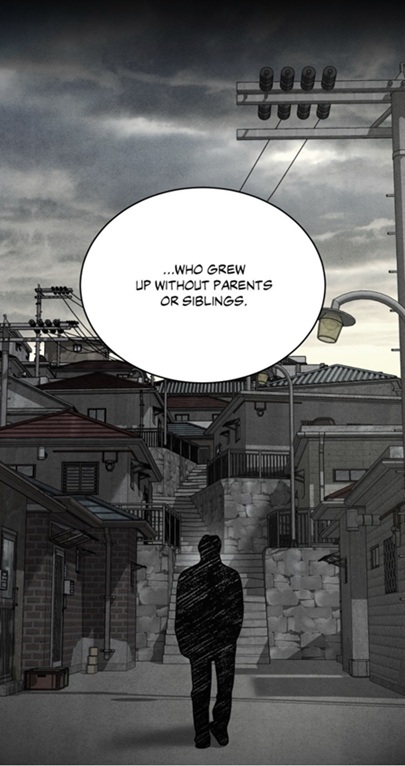 (chapter 94) Joo Jaekyung has survived the criminal world long enough to understand how its mechanisms operate. Through his actions, he gradually passes this knowledge on to Kim Dan.
 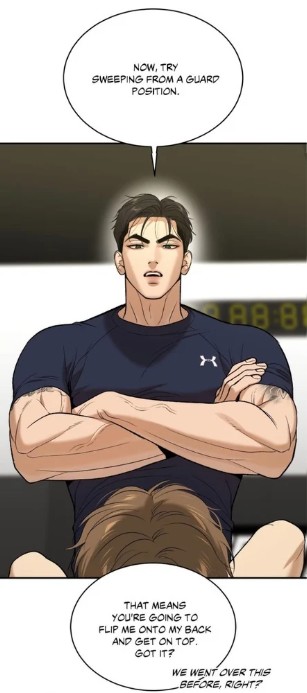 (chapter 88)
He taught him how to swim. He taught him how to fight. He taught him how to take care of himself and to express his opinion and desires. In other words, Kim Dan came to internalize that he also deserved respect. 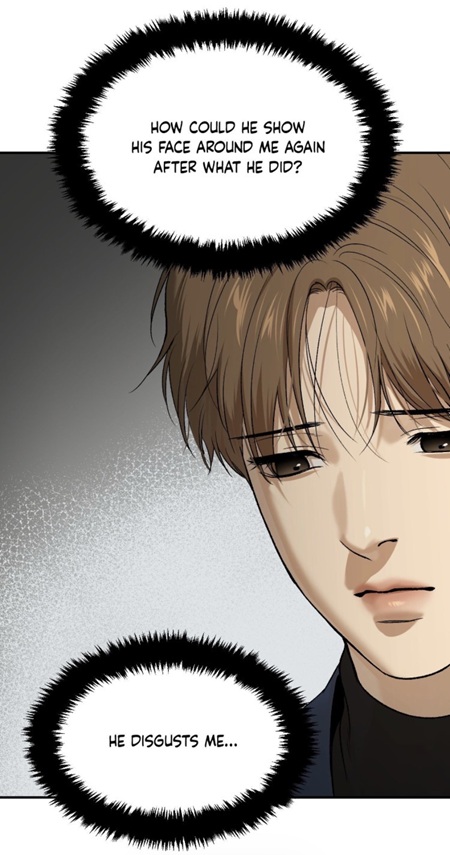 (chapter 91) The athlete exposed him to situations that forced him to grow stronger and more independent. He shared his thoughts and philosophy to his “pupil” as well
 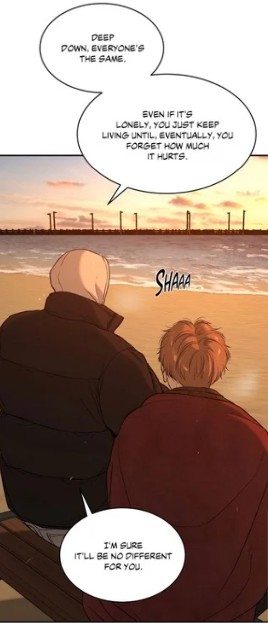 (chapter 94) so that at the end, Kim Dan admits to see him as a “younger sibling”. (donsaeng in Korean)
 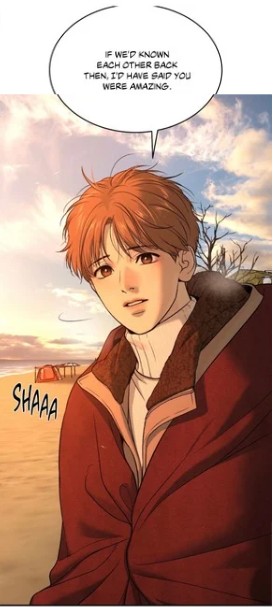 (chapter 94)
Yet his transformation has another consequence. Kim Dan has also become both a witness and a target of the champion’s jinx. By standing beside Joo Jaekyung, he has been drawn into the very chain of manipulations that once isolated the athlete. He can expose the existence of money laundering.
For the first time, the couple begins to grasp wrongdoings and even understand how this mechanism works. And once someone understands the trap, the outcome of the game can change.
The criminals may continue to rely on their favorite principles— money and placing others at the wrong place and at the wrong time. But the situation has now changed. In fact, the schemers will end up being caught at the wrong time and at the wrong place.
Until recently, however, Joo Jaekyung himself was unable to expose Baek Junmin openly. One reason lies in a more personal burden: shame. 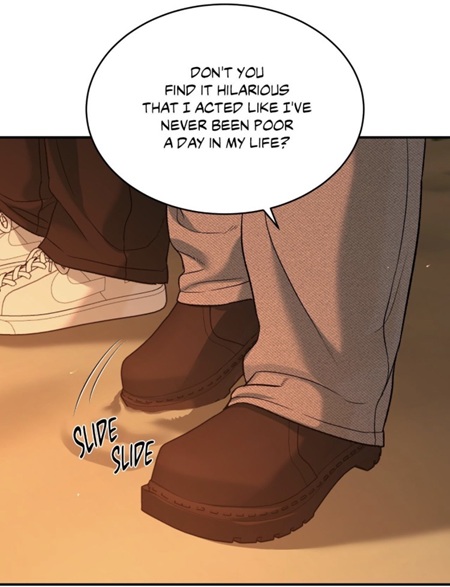 (chapter 94) The champion carried the weight of his past—his violent environment, the humiliation he endured, and the circumstances that shaped his rise. Speaking about these events would have meant revealing parts of his life he preferred to bury.
 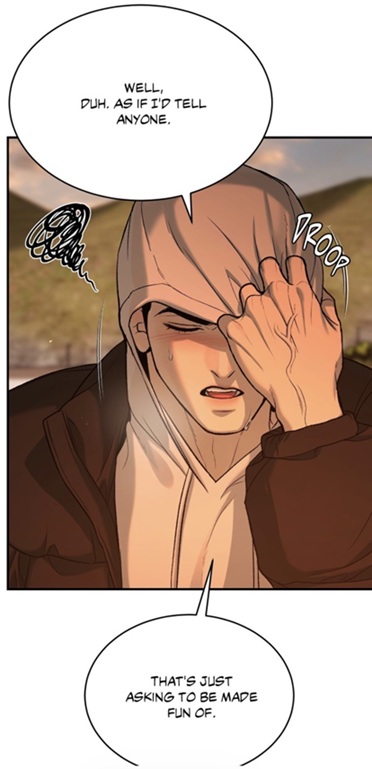 (chapter 94) The conversation on the beach changes this dynamic. By confessing his past to Kim Dan, Joo Jaekyung frees himself from the silence that had protected his enemies. The shame that once prevented him from speaking begins to lose its power.
And once the athlete is no longer bound by shame, he can finally do something he had avoided for a long time: he can speak and reveal his knowledge to the media.
Feel free to comment. If you have any suggestion for topics or Manhwa, feel free to ask. If you enjoyed reading it, retweet it or push the button like. My Reddit-Instagram-Twitter-Tumblr account is: @bebebisous33. Thanks for reading and for the support, particularly, I would like to thank all the new followers and people recommending my blog.
 Bebebisous33s' analyses in K-Dramaland and Manhwas