Protected: Jinx: Unseen 👀 Savior🦸🏼♂️ : The Birth of Jaegeng

Bebebisous33s' analyses in K-Dramaland and Manhwas
Analyses of K-dramas and Manhwas (for the most part Yaoi)


Please support the authors by reading Manhwas on the official websites. This is where you can read the Manhwa: Jinx But be aware that the Manhwa is a mature Yaoi, which means, it is about homosexuality with explicit scenes. Here is the link of the table of contents about Jinx. Here is the link where you can find the table of contents of analyzed Manhwas. Here are the links, if you are interested in the first work from Mingwa, BJ Alex, and the 2 previous essays about Jinx Perfect👼🏼 Defect and The Secret Doctor’s Jinx
It would be great if you could make some donations/sponsoring: Ko-fi.com/bebebisous33 That way, you can support me with “coffee” so that I have the energy to keep examining Manhwas. Besides, I need to cover up the expenses for this blog.

The Hippocratic Oath, one of the oldest binding documents in history, originates from Ancient Greece and has long been regarded as the ethical foundation of Western medicine. Traditionally attributed to Hippocrates, often called the ‘Father of Medicine’, the oath originally included commitments to treat the sick to the best of one’s ability, to preserve patient confidentiality, and to pass on medical knowledge without demanding payment.
The text of the Hippocratic Oath (c. 400 bc) provided below is a translation from Greek by Francis Adams (1849).
I swear by Apollo the physician, and Aesculapius, and Health, and All-heal, and all the gods and goddesses, that, according to my ability and judgment, I will keep this Oath and this stipulation—to reckon him who taught me this Art equally dear to me as my parents, to share my substance with him, and relieve his necessities if required; to look upon his offspring in the same footing as my own brothers, and to teach them this Art, if they shall wish to learn it, without fee or stipulation; and that by precept, lecture, and every other mode of instruction, I will impart a knowledge of the Art to my own sons, and those of my teachers, and to disciples bound by a stipulation and oath according to the law of medicine, but to none others. I will follow that system of regimen which, according to my ability and judgment, I consider for the benefit of my patients, and abstain from whatever is deleterious and mischievous. I will give no deadly medicine to any one if asked, nor suggest any such counsel; and in like manner I will not give to a woman a pessary to produce abortion. With purity and with holiness I will pass my life and practice my Art. I will not cut persons laboring under the stone, but will leave this to be done by men who are practitioners of this work. Into whatever houses I enter, I will go into them for the benefit of the sick, and will abstain from every voluntary act of mischief and corruption; and, further from the seduction of females or males, of freemen and slaves. Whatever, in connection with my professional practice or not, in connection with it, I see or hear, in the life of men, which ought not to be spoken of abroad, I will not divulge, as reckoning that all such should be kept secret. While I continue to keep this Oath unviolated, may it be granted to me to enjoy life and the practice of the art, respected by all men, in all times! But should I trespass and violate this Oath, may the reverse be my lot! Quoted from https://www.britannica.com/topic/Hippocratic-oath
Over centuries, this oath has undergone numerous revisions to reflect the changing nature of medicine and ethics in society. While its core values—non-maleficence, beneficence, and fidelity—remain intact, modern versions are more secular and inclusive, often omitting archaic references to gods or master-apprentice hierarchies. The intention behind the oath has always been clear: to put the well-being of the patient first and to uphold the dignity and responsibility of the medical profession. These noble intentions raise important questions in today’s context. To what extent are they still fulfilled? Do contemporary medical professionals act in the spirit of this oath? And can structural realities—limited time, profit-driven care, burnout—undermine a physician’s ability to live up to its promise?
These critical perspectives crystallized while reading Chapter 67 of Jinx, and triggered a thought-provoking exchange between my friend @Milliformemes2024 and me. Our diverging interpretations of the sleep specialist in chapter 67 helped to shed new light on the enduring relevance—but also the limitations—of the Hippocratic tradition. What began as a discussion about a single consultation evolved into a broader reflection on symbolic language, institutional care, and the ethical cost of modern medicine. In truth, both perspectives hold merit. Our conversation mirrored a larger dialogue between Idealism and Reality: one of us defending the emotional depth and symbolic resonance in care, the other grounded in the necessity of boundaries and pragmatism. This essay unfolds in three parts: first, a symbolic analysis of the sleep specialist and the contrasting figure of Cheolmin; second, a comparison of institutional care and how financial motives shape medical ethics; and third, a visual exploration of hospitals and their architectural relationship to nature.
Our discussion began with differing impressions of the sleep specialist in Chapter 67. My friend viewed her approach as textbook 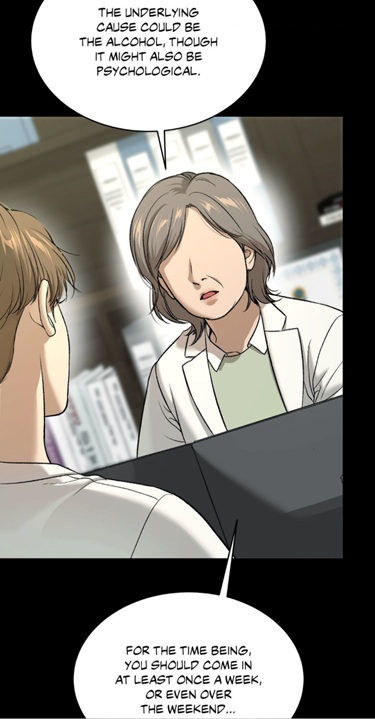 (chapter 67): the brief diagnosis, the recommendation for weekly visits, the specialist’s tentative attribution of Kim Dan’s condition to either alcohol or a possible psychological cause, emphasizing the need for continued observation and weekly visits before offering a definitive diagnosis —all standard responses. For her, this was a doctor following routine procedure without overstepping professional boundaries. However, I perceived her behavior very differently. I saw someone who remained emotionally detached and almost absent, reducing the complexity of Kim Dan’s condition to simplistic surface-level causes without genuine inquiry.
This divergence in opinion hinged on what each of us prioritized. My friend appreciated the clinical neutrality, interpreting it as a mark of competence. I, however, found it troubling—too minimal, the possible psychological cause was only mentioned. The symbolism in her appearance intensified my reaction. She is portrayed eyeless, a metaphor for her blindness—not in vision, but in perception. Her gaze is absent; her diagnostic process relies not on what she sees but on what others report, most notably, Joo Jaekyung.  (chapter 67) Rather than forming an independent assessment, she accepts the narrative of a third party, which introduces bias and limits her understanding. One might argue about that, because she is looking at a paper, probably result of a blood test which seems to corroborate the guardian’s statement. Hence the sleep specialist concludes that Kim Dan is suffering from insomnia, alcohol addiction and sleepwalking. The problem is that his statement is based on external observations (halmoni and the landlord) and their limited knowledge. Moreover, Jinx-philes should keep in mind two important aspects:
  (chapter 61) The champion had been himself suffering from similar symptoms which could be seen as a projection on his loved one. Additionally, based on previous observations, I have interpreted Kim Dan’s nightly walks not merely as sleepwalking, but as dissociative episodes—likely triggered by overwhelming guilt, unresolved trauma, and a chronic sense of disconnection from his body and surroundings. But how could the champion know about this? He’s not a doctor himself. In order to have a more accurate picture of the whole situation, she should have talked to the patient himself. But by relying on papers and the guardian’s testimony, she not only distances herself from the patient physically and emotionally, but also delegates the responsibility of interpretation. She is using the eyes of others.
She wears an open white coat, (chapter 67) revealing a light green pullover layered over a white shirt—clothing that clearly belongs to her private wardrobe. This visual detail suggests a separation between her personal identity and her professional role. It’s as if donning the coat is enough to signal her authority, without requiring emotional engagement. The coat becomes a badge, not a commitment.
Yet one could argue that this very distinction is essential. The boundary between self and profession is what prevents the physician from becoming emotionally overwhelmed. Without such a barrier, the practitioner might absorb too much of the patient’s pain—leading not only to fatigue but to burnout. 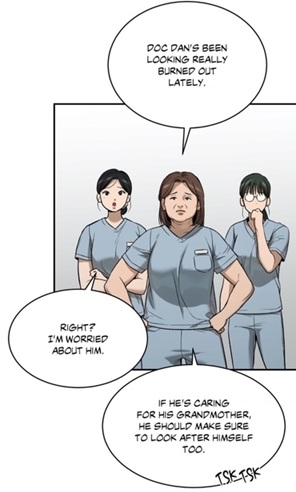 (chapter 57) Perhaps the doctor’s detachment is not indifference, but a survival mechanism in a healthcare system that demands efficiency over intimacy.
The white coat in this scene does not function as a symbol of care (chapter 67): it becomes an emblem of role-playing. What caught my attention is that she doesn’t directly address the patient, she doesn’t ask him any question either. She is not curious at all. If she had, she would have heard this:  (chapter 67) indicating that his alcohol addiction is not the real reason for his insomnia. Then she fails to examine Kim Dan physically, the desk is between them. Therefore she can not detect his visible malnourishment.
Both insomnia and malnutrition are quite common and can cause similar negative consequences, such as falls, depression, and cognitive impairment in older adults, but there is no study investigating the relationship between the 2. The aims were to investigate relationships between insomnia/insomnia severity and Mini Nutritional Assessment (MNA) score and serum nutrient levels. […] There is a close relationship between MNA scores and insomnia or insomnia severity in older adults. Therefore, when evaluating an older patient with insomnia, malnutrition should be evaluated, or insomnia should also be questioned in an older patient with malnutrition. Thus, more effective management of the 2 can be possible. Quoted from https://pubmed.ncbi.nlm.nih.gov/31109907/
But she couldn’t see it, as she relied on second-hand testimony (Joo Jaekyung’s words). The irony is that the latter failed to notice it. Each time he saw the doctor’s body, he got aroused. 
 (chapter 62) Moreover, both the landlord and the grandmother never brought up this aspect, though Shin Okja had observed this terrible transformation:
  (chapter 57)
And this raises the following question. Why did the sleep specialist not question the main lead directly and relied on other sources?  (chapter 66) It is because the physical therapist is just a number (2) and as such a file. Therefore the doctor is not seeing the patient as a human. I can not blame the woman either, for she has so many patients to treat during the day. And now look at the building of the hospital:
  (chapter 66). It is huge reminding me of a factory. This “modern hospital” with its sleek architecture, expansive buildings, and impressive specialization exudes a sense of advancement and trustworthiness. Yet beneath this polished surface lies a business-oriented structure, one that prizes efficiency, reputation, and patient turnover over genuine patient connection. This “modern hospital” (chapter 67) functions like one factory: patients are numbers in a queue, doctors are overloaded, and individual care becomes secondary to systemic goals. The very design of the building reflects this: towering facades and compartmentalized departments, where nature and warmth are pushed to the background. In such an environment, the Hippocratic Oath—rooted in ideals of empathy, presence, and personal responsibility—is reduced to ritual, overshadowed by institutional pragmatism and economic demands. Hence she is simply treating his symptoms: insomnia and “sleepwalking”! She is prescribing him “sleeping pills”.
 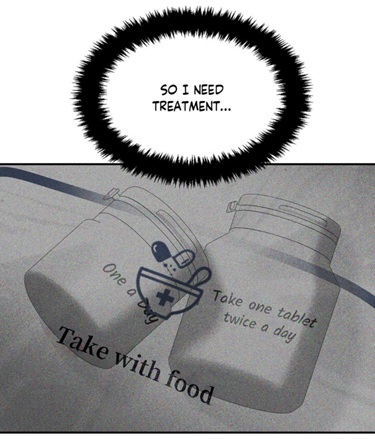 (chapter 67) She is doing exactly what Shin Okja wanted:
 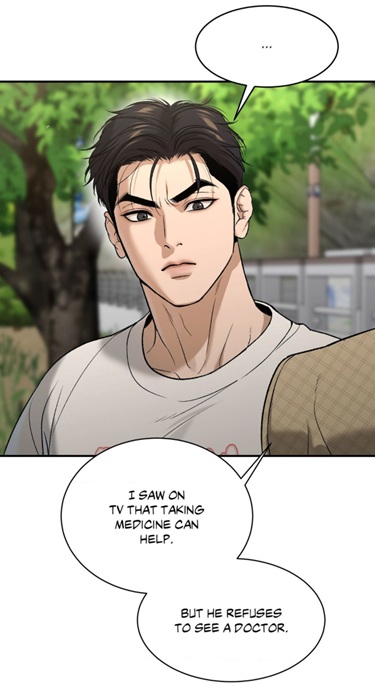 (chapter 65)
 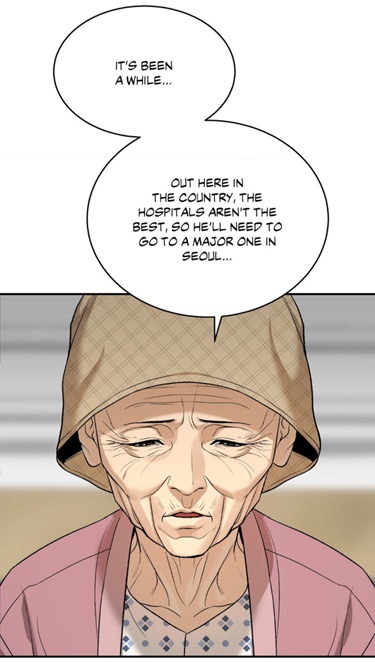 (chapter 65) It is as though thanks to the drug, the odd behavior from Kim Dan would simply vanish. (chapter 67) That’s the reason why Mingwa didn’t give the doctor a name. She has become a soulless doctor, like a robot. On the one hand, the absence of her name implies that she is not trying to seek fame like Kim Miseon
  (chapter 5) with the new medicine. On the other hand, it implies that the light-brown haired woman is doing her job for her paycheck which reminds me of Cheolmin’s statement:
  (chapter 13): “Oh no, no. That won’t do. My precious paycheck!”.
This “namelessness” is not a coincidence. It mirrors how large hospitals treat their staff: as interchangeable parts of a system that prioritizes efficiency and profit over personalized care. (chapter 67) The sleep specialist becomes a faceless figure in an institution where doctors are overworked, underpaid, and pressured to diagnose quickly. Her task is not to heal, but to manage—preferably in under 10 minutes. This reminds me of a confession I received from my own osteopath-orthopedist-chiropractor. He once told me that in hospitals (Germany), proper care is nearly impossible. Due to pressure and time constraints, most doctors are given no more than two or three minutes per patient. As a result, many end up recommending surgery as the default solution—not necessarily because it’s the best, but because it’s fast and system-approved.
Disillusioned by this assembly-line approach, he eventually left the hospital and opened his own private practice. There, he devotes at least one full hour to each new patient—first to examine, then to diagnose, and finally to treat them himself. I remain deeply grateful to him, because he was the only one able to resolve my long-standing shoulder and neck pain. While others focused on symptoms—treating the neck in isolation—he identified the true origin: spinal blockages further down the column. What struck me even more is that he once recognized signs of depression in a patient—not through tests or charts, but simply by observing how the symptoms would worsen or improve. He talks to his patients while treating them, listening not only to their words, but also to their bodies. This interaction allows him to adjust the treatment in real-time and to notice subtle signs others might miss. That’s what makes him a true healer. He doesn’t rush; he takes his time and creates space for the patient to be seen and heard. In doing so, he provides something that modern hospitals often fail to offer: attention without judgment, and care without hurry.
On the other hand, he also confided in me that he has learned to select his patients. Some individuals came to him with fixed expectations, treating him like a service provider rather than a medical expert. They arrived with their own self-diagnoses and requests, expecting him to execute treatment plans they had already designed in their minds. In those cases, he had to draw a line—because healing, in his view, depends on trust and dialogue, not on fulfilling demands. A doctor, he reminded me, is not a technician carrying out orders, but someone who must observe, assess, and guide with discernment. This dynamic reminded me of Joo Jaekyung, who often treated both Dr. Lee and Kim Dan  (chapter 27)
  (chapter 49) as mere service providers. Whether it was brushing off medical advice with “Don’t push it, I know my body better than anyone else” (chapter 27) or demanding instant pain relief to continue training (chapter 49), the champion positioned himself as the ultimate authority over his own treatment. Since his attitude echoed the confession of my osteopath, it is understandable why my osteopath-orthopedist began to select his patients carefully. This mirrors Kim Dan’s evolution, when the latter chose to reject the champion’s offer. Indirectly, he is “learning” to select his job and not take them by opportunism. He is also learning to select his “patients”. Striking is that Shin Okja has a similar attitude than the athlete.
  (chapter 7) She desired to have a treatment with less side effects and less painful. And the moment she was confronted with reality, this painful new treatment only brought pain and nothing more, she chose to leave this institution and move elsewhere.
 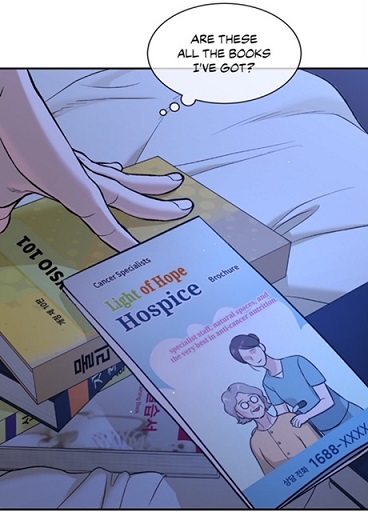 (chapter 53) Therefore it is not surprising that she is treating the protagonist the same way: she knows what is the best for him.
  (chapter 57) She is treating him like a service-provider, she is now rejecting that he has lost his “usefulness”. His pay here is not high, …
But let’s return our attention to the anonymous sleep specialist. The latter has just become a victim of this terrible health system. She is not engaging with Kim Dan’s trauma, nor investigating his psyche, for she doesn’t have the time for it. Her task is not to heal deeply, but to manage efficiently. Secondly, she is specialized in sleep medicine, so she is no psychologist or psychiatrist. Therefore it is not surprising that she is focusing on certain aspects. But sending him to a different department would mean that she would lose her „new patient“. If you have ever watched series about hospitals, you are aware of the competition between departments. Here I can recommend the K-drama LIFE. Since she is more treating him in such a short time, it is not astonishing that doc Dan is doubting her words,  (chapter 67) and not even following her recommendation.
 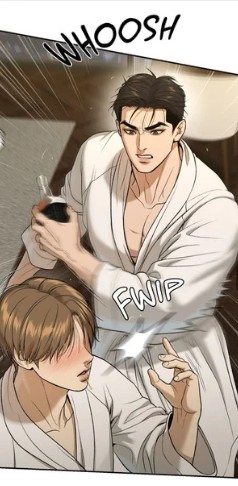 (chapter 67) He felt misjudged and misunderstood; reduced to a file number, not seen as a complex human being.
However, there’s more to it. Two details stood out to me in particular. First, consider what the anonymous doctor told Joo Jaekyung  (chapter 67) and second, what Kim Dan actually received as treatment: (chapter 67) pills in a plastic bag marked with a standard instruction: “Take with food”. These two panels capture more than a routine prescription, they reveal the institutional deflection of responsibility and the impersonal mechanics of care.
By printing the instruction on the packaging rather than saying it aloud, the doctor shields herself from accountability. If something goes wrong, she can point to the label. She doesn’t have to engage, explain, or ensure understanding. It’s a subtle but calculated transfer of responsibility—from physician to patient, and even more so, to the guardian. Now it’s not just Kim Dan who’s expected to monitor himself, but Joo Jaekyung as well. The burden of care is silently offloaded onto those least equipped to manage it.
What makes it worse is that Joo Jaekyung is never shown holding or reading the bag. The implication? He likely never noticed the fine print at all. No one is actively guiding the treatment. No one is watching over Kim Dan.
Her verbal emphasis is even more revealing. Instead of discussing the food requirement or giving Kim Dan any personal advice, she delivers a single, sweeping command: “Drinking is off-limits.” It’s not just vague—it’s scolding. The patient’s alcoholism isn’t treated; it’s sidelined. The system checks the boxes—and moves on. It frames her as an authority figure who cares more about issuing warnings than offering help. There’s no nuance, no tailored support, no effort to build trust. What Kim Dan hears is not empathy, but judgment. He’s treated as a risk to be managed, not a human being to be helped. She can only reinforce his low self-esteem: he‘s a burden.
This is what deepens his sense of being misdiagnosed, as if the doctor was painting his condition so negatively in order to scare him. He doesn’t receive insight or compassion—he receives protocol. And in a healthcare system ruled by efficiency and liability protection, the doctor’s priority becomes covering herself—not ensuring the well-being of her patient.
Cheolmin  (chapter 13), in contrast, enters the story with no white coat at all. He carries only a doctor’s bag, dressed in a green pullover and a beige checkered shirt.
  (chapter 13) Despite this informal attire, he immediately recognizes Kim Dan’s symptoms and engages both the guardian and the patient. He doesn’t need institutional support to assert authority; his presence and diagnostic clarity define him. While his clothes might elsewhere be read as conservative or emotionally restrained, here they highlight that care can come outside rigid systems.
Previously, we interpreted Cheolmin’s clothing as a reflection of a certain emotional reserve. The beige checkered shirt, covered by the green pullover, suggests a guarded personality; someone who perhaps maintains a protective layer between his professional and emotional worlds. And yet, this emotional caution doesn’t hinder his ability to act with warmth and competence.  (chapter 13) Quite the opposite. He doesn’t hide behind his distance; he manages it. His approach is practical and grounded, but never cold. He doesn’t wear a white coat, yet he brings with him a doctor’s case and an unshakable sense of responsibility. His tools are simple (his own body), (chapter 13) his posture relaxed, and his tone—often sprinkled with humor—adds a human touch that the eyeless doctor sorely lacks. And what is the cause for this huge difference? It is because the “famous sleep specialist” is relying on her institution (nurses, blood tests, drugs). She is following a procedure, as the visit took place at the hospital.
Unlike Cheolmin, who uses his emotional detachment constructively, the sleep specialist disappears behind it. She neither touches nor addresses the patient directly. She offers no humor, no effort to ease the atmosphere—only sterile authority and detached warnings.
Ironically, while Cheolmin may seem less emotionally expressive at first glance, he is far more emotionally present. His humor isn’t just a personal trait—it’s a therapeutic tool.  (chapter 13) It bridges the gap between roles, making the patient feel seen rather than categorized.
 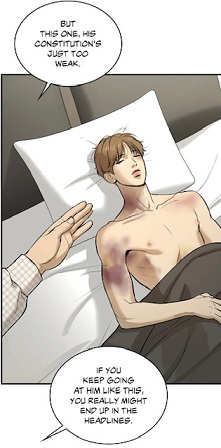 There’s no judgement in their relationship. The eyeless doctor may appear neutral, but in truth, she is hollow. Cheolmin appears reserved, yet his actions speak with empathy. Where she recites guidelines, he initiates dialogue.
  (chapter 13) Where she avoids involvement, he offers engagement.
In short, Cheolmin’s clothes reflect thoughtful distance—not absence. He remains attentive, responsive, and subtly warm. His restraint is a choice, not a flaw. And it is precisely this contrast that reveals what the Hippocratic Oath should still mean today: presence, humility, and care; and not money, drug and efficiency.
The positions between my friend and me reflect a core conflict between reality and idealism. She values adherence to clinical norms and sees the specialist’s behavior as a rational expression of professional boundaries. Emotional distance, she argued, is often necessary—not just to ensure objectivity, but also to protect healthcare professionals from burnout, especially in overburdened systems. I agreed in principle, but maintained that detachment becomes damaging to the patients and the doctors. It affects the relationship between them, because it prevents accurate diagnosis or erases the patient’s voice entirely or the patient starts seeing himself as a “client” and the doctor as his “service provider”. A middle ground must be found—where presence doesn’t equate to over-involvement, but where empathy still has space. My orthopedist found his solution: open a small office where he tries to help his patients to avoid surgeries. He told me: “The first surgery in his field is always an option, the second one will always be a necessity.”
Moreover, our analysis acknowledged the limitations the doctor faces. The specialist likely juggles a tight schedule. A queue of patients, like the one displayed before Kim Dan’s session, signals the industrial rhythm of care. In such a system, she may not have time for deeper engagement. But for patients like Kim Dan—vulnerable, undernourished, spiraling emotionally—this neglect can reinforce their invisibility. In contrast, Joo Jaekyung receives deferential treatment, because he is famous. The medical world depicted in Jinx bends toward prestige, not need.
This contrast reveals something vital: in medicine, presence matters. The specialist hides behind procedures. Cheolmin shows up. The white coat, then, becomes a mirror: does it reflect a vocation or disguise institutional distance?
In Jinx, medical care unfolds within a tapestry of institutions—anonymously vast hospitals  (chapter 61)
  (chapter 67), the Light of Hope hospice
  (chapter 61), the sleek University hospital dedicated to research
  (chapter 5), and more intimate yet modern facilities like this one.
 (Chapter 27) Each medical setting not only has its own architecture but also its own moral blueprint. In the essay “Doctor Romantic 3 (locked)“, I had already compared doctor Lee’s workplace and behavior to the “beautiful Kim Miseon” from the University Hospital. Season 2 introduced us to new institutions. Each place claims authority through professional codes and visual symbols, but the deeper narrative explores how care is either embodied or abandoned. Mingwa uses attire, body language, and structure to draw sharp distinctions between appearance and intent.
Kim Miseon (chapter 5) from Sallim University Seongshim Hospital: This research-driven university hospital is connected to Kim Miseon, the doctor who prescribed a new experimental treatment for the grandmother. (chapter 5) Despite the pristine exterior of the building and the promise of scientific advancement, her actions raise ethical concerns. She dilvuged information in the hallway.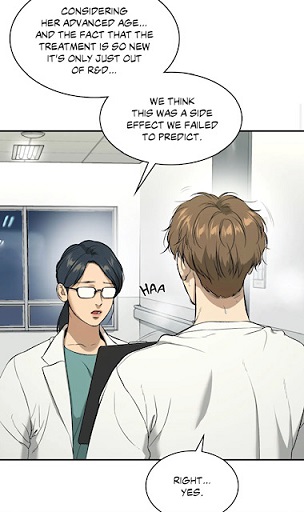 (chapter 21) Then the treatment’s failure is attributed either to the grandmother’s frailty or Kim Dan’s late arrival and absence, subtly shifting blame.
 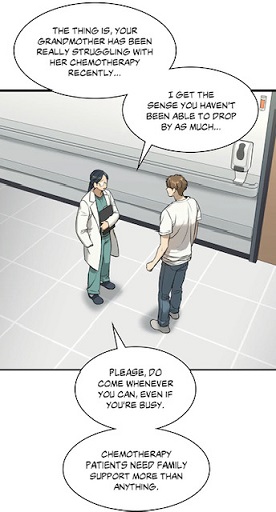 (chapter 21) Like mentioned before, this treatment wasn’t even properly recorded in the patient file raising the suspicion of deliberate concealment.
  (chapter 56) It appears as “pain killers”. Her open white coat (chapter 21), worn over a green uniform resembling surgical scrubs, aligns her visually with institutional authority, while her eyeless portrayal emphasizes detachment. (chapter 21) Her motivation seems driven not by compassion but ambition: a pursuit of recognition and success through experimental medicine, regardless of consequence. It seems that this new therapy didn’t bring her the results she hoped, and strangely later director Choi Gilseok
  (chapter 48) got aware of Shin Okja’s conditions, implying that patient confidentiality had been breached.
Park Junmin  (Chapter 61): In contrast, Park Junmin
  (chapter 61) represents the polished face of a business-oriented clinic. While his office projects sleekness and personalized care, his comments betray his priorities. He praises Joo Jaekyung’s fame and urges a return to the ring—not out of medical concern, but because it would guarantee the champion’s return as a paying patient. He wants to retain a high-profile client. His friendliness is strategic. (chapter 61) He does not embody the Hippocratic Oath but rather a service model. The coat becomes a costume that sells recovery. It is clear that he is promoting his own hospital. Joo Jaekyung, however, surprises him by refusing
  (chapter 61), highlighting that the athlete has become aware of what genuine care should look like. When the champion calmly declares, “I’ll be receiving rehabilitation services in another hospital,” Junmin answers with a stunned “Sorry?”. But this is not confusion. It’s a reflexive mask for shock. He did not expect to lose control of the situation. Beneath that one-word response lies disbelief, disappointment, and veiled panic. He’s losing a lucrative patient—and more importantly, a public endorsement. The moment exposes how fragile his authority truly is when faced with a patient asserting autonomy. Let’s not forget that when the champion was facing a mental and emotional breakdown, the latter offered no other support than “rest”. He even avoided his gaze.
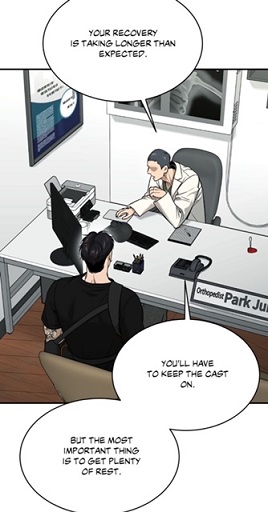 (chapter 54) The athlete was left on his own.
Light of Hope Director 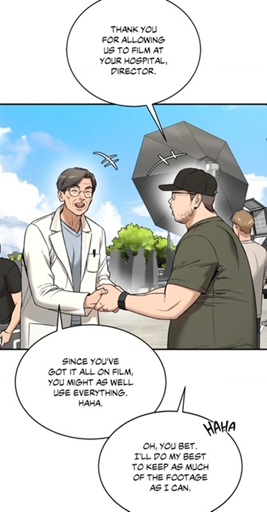 (Chapter 59): At first glance, the hospice appears to be underfunded and outdated.
  (chapter 61) However, its director breaks expectations. Unlike the smooth-talking or indifferent doctors at larger institutions, he is directly involved in patient care. (chapter 56) He informs the physical therapist about the grandmother’s condition, works late at night
  (chapter 60), criticizes people for their rude behavior
  (chapter 59) or actively disciplines staff
 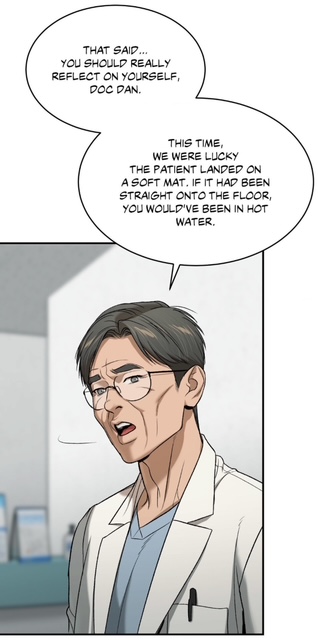 (chapter 59) when mistakes are made. Though he also flatters the champion
  (chapter 61) and sees promotional potential, he never exploits patients.
  (chapter 61) The juxtaposition of humility and responsibility in his demeanor, combined with his stunned reactions to sudden events, suggests an overworked and understaffed environment—but not one without moral grounding. His white coat and blue medical uniform echo the nurses’ attire, subtly promoting a sense of equity among staff. Despite being a director, he doesn’t separate himself from frontline caregivers. His uniform also contrasts with the green worn by Kim Miseon or Park Miseon, suggesting a focus on practical responsibility over prestige. By blending in with the team, he fosters a culture of shared accountability, not rigid hierarchy. Among all institutional figures, he comes closest to balancing authority with integrity.
Hospital Director  (Chapter 6): While this figure appears authoritative
 (chapter 1), the details of his attire tell another story. Wearing a suit beneath his coat implies professionalism, but here it also suggests a business-driven mindset. The coat becomes a sleek outer layer masking deeper intentions. His charming demeanor conceals a more sinister reality—he weaponizes authority for personal gain. His use of professional attire isn’t about respectability but manipulation. Beneath the surface, profit, control, and coercion drive his actions.
  (chapter 1) The white coat, in his case, is not a symbol of healing but a façade for exploitation. drives his authority. The coat becomes a literal cover for abuse—harassment disguised under professionalism. His entire persona is a façade: calculated, charming on the surface, but predatory and morally bankrupt beneath.
The Sleep Specialist (Chapter 67): (chapter 67) Eyeless and detached, the sleep doctor treats Kim Dan without any emotional or physical engagement. Her absence of a name symbolizes depersonalization. She doesn’t speak directly to Kim Dan, doesn’t examine him, and only echoes what she heard from Joo Jaekyung. The prescription she offers is another layer of critique. The instruction “Take with food” appears only in print—never verbally stressed—thus shifting liability. If Kim Dan suffers side effects or mixes medication with alcohol, responsibility falls on him or his guardian. This is institutional medicine in its most risk-averse form: impersonal, quick, and shielded from consequence.
Dr. Lee (Chapter 27): Dr. Lee is the only named and truly visible doctor. 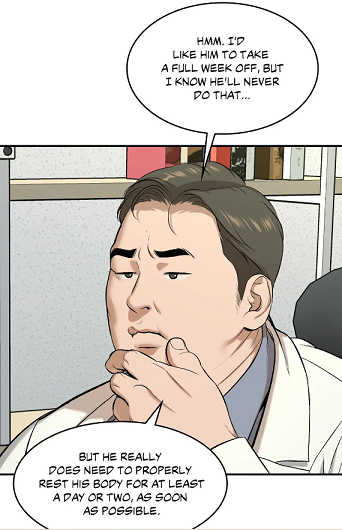 (chapter 27) His gray shirt signals a more relaxed approach,
 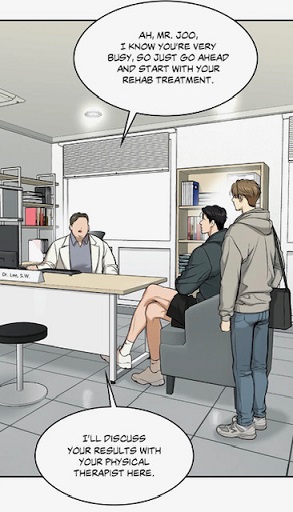 (chapter 27) and his facial expression conveys a certain empathy—though his words also betray resignation. He sits beside the patient, not opposite, visually erasing the typical hierarchical divide between doctor and athlete. His recommendation that Joo Jaekyung rest is gently delivered, but he knows it will likely be ignored. He represents the tension between medical idealism and the pressures of athletic performance. He is trying his best to protect Joo Jaekyung’s career.
  (chapter 27) Notably, he doesn’t chase fame or loyalty—he’s realistic, yet still rooted in care. (chapter 27) His clinic, with open blinds and wide windows, stands for transparency and modern ethics.
Cheolmin (Chapter 13): 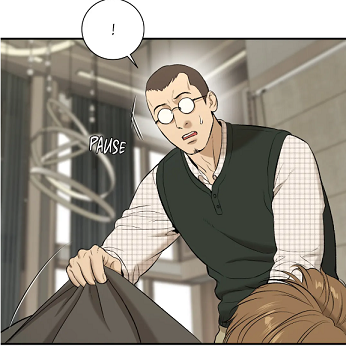 (chapter 13) Finally, Cheolmin exists outside the hospital system. He wears no white coat, but his behavior mirrors a true physician’s. He diagnoses accurately, gives immediate advice, and engages both patient and guardian. His attire—a shirt layered under another—might suggest emotional restraint, but it doesn’t interfere with his actions. He jokes and teases, breaking through tension and inviting trust. He acts not because protocol demands it, but because someone needs help. That’s enough.
This comparative tableau reveals that white coats do not guarantee compassion—and their absence doesn’t negate it. In Jinx, only those who break institutional molds offer real help. The rest follow protocols, serve systems, and sometimes cause harm through inaction or self-interest. It exposes that doctors are simply humans and not gods.
Furthermore, the financial aspect underpins all these interactions. Hospitals in Jinx are not purely charitable; they’re businesses. The emphasis on new medicine, fame, or facility branding often outweighs the patient’s actual condition. Misdiagnoses, evasions, and moral compromises follow from this reality.
Kim Dan’s journey through these institutions underscores how vulnerable patients are when medicine is transactional. Blame is subtly shifted. Responsibility is diffused. And yet, in emergencies, the expectation remains: doctors should act.
A striking feature in Jinx is the architectural integration of nature into hospital design. (chapter 67) Trees and greenery appear in every facility—but their placement and symbolism vary. These visual cues subtly reveal each institution’s philosophy of care.
At the university hospital where Kim Miseon works, 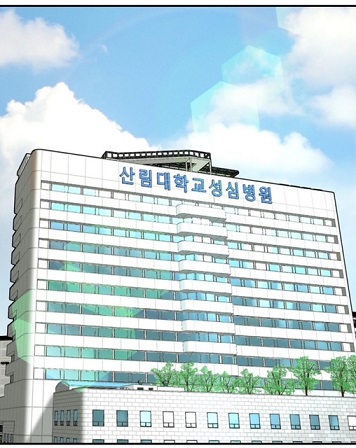 (chapter 41) nature is neatly confined. Rooftop gardens and structured greenery exist, but more as visual accessories than lived environments. The hospital is a towering research center, representing scientific advancement—but also bureaucratic coldness. Here, nature exists to impress, not to comfort. This artificial balance between concrete and green reflects a clinical detachment: nature is curated, not embraced. It aligns perfectly with Kim Miseon’s demeanor—professional, pristine, but ultimately distant and ambition-driven.the environment feels controlled.
 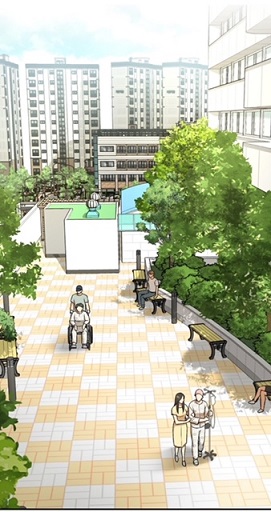 (chapter 41)
In the rain-drenched hospital  (chapter 54) where Joo Jaekyung receives treatment, the rooftop greenery appears remote and ornamental, disconnected from patient care. (chapter 61) Nature is present but removed, almost symbolic of lost ideals. The building is imposing, gray, and bureaucratic, which is quite similar to the university hospital.
In the sleep therapy hospital (chapter 67), the setting amplifies this detachment. Trees do appear, but they are overwhelmed by massive, impersonal structures. The greenery seems almost trapped, overshadowed by glass and steel. This mirrors the interaction with the sleep specialist, who issues warnings and prescriptions without genuine communication. In this environment, nature is not a partner in healing—it is background noise, a symbolic performance of care in a place that prioritizes liability and speed over connection.
By contrast, the Light of Hope hospice (chapters 61) is embedded in a hillside, its architecture low to the ground, surrounded by untamed, organic greenery. The trees are not ornamental—they embrace the building, echoing a kind of natural protection. Nature here is not only real, but alive. It reflects the ethos of the institution: flawed, underfunded, but grounded in human presence. The hospital director may wear a coat, but his modest blue uniform aligns him visually with the nurses, suggesting equity and participation rather than hierarchy. Just like the unpolished trees, he is there not to be admired but to serve.
A fourth setting appears with Dr. Lee’s clinic (chapter 27). The building is smaller,  (chapter 18) modern, and set among scattered trees.
  (chapter 18) Large windows suggest openness and transparency—the very qualities Dr. Lee brings to his interaction. This is a space that, while modest, is genuinely attentive. Here, nature doesn’t impress, it is integrated in the landscape. The park is not surrounded by huge buildings.
Through these varied landscapes, Jinx critiques the illusion of healing as something that can be staged through architecture. It exposes how hospitals, like people, can hide behind appearances. Trees and plants, like white coats and professional titles, can be used to mask indifference just as easily as they can accompany real care. Healing does not bloom in greenery alone—it flourishes through presence, attentiveness, and trust.
Yet these visual patterns also contain hope. The presence of even small parks and rooftop gardens within institutional designs reflects an underlying truth: nature matters. (chapter 41) These green spaces acknowledge, even if superficially, that human beings do not heal through medicine alone. They need sunlight, air, softness—a sense of rhythm beyond fluorescent lights and steel corridors. Nature grounds. It breathes.
The science of the healing power of nature
There are numerous studies that support the healing power of nature. A study of 20,000 people found that those who spend at least 120 minutes per week in nature, whether in a local park or other natural environment, were more likely to report better health and well-being.
The World Health Organization recently released a report called Green and Blue Spaces and Mental Health, which shows that time in nature, including urban areas, improves moods, mindsets and mental health. Furthermore, research suggests that exposure to forests, parks, gardens or coastlines can help mitigate the psychological impact of climate change, promote physical activity and provide opportunities for social interaction. Quoted from https://www.uc.edu/news/articles/2023/08/the-healing-power-of-nature.html
That is why the small town, 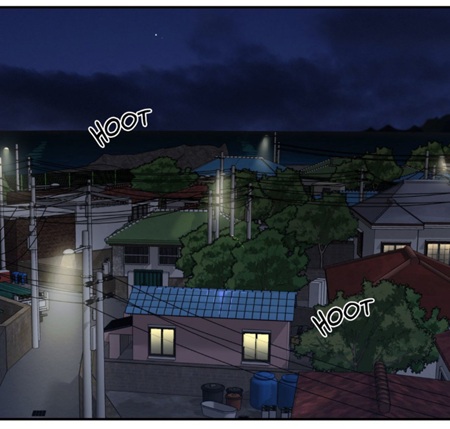 (chapter 65) nestled in the countryside and far from institutional rigidity, emerges as a space of true potential. In returning there, Joo Jaekyung and Kim Dan are not just escaping their past—they are moving toward a form of healing that modern hospitals imitate but rarely achieve. Closer to nature, they are closer to themselves. If hospitals imitate forests, the village becomes the forest. And in that simplicity, Jinx suggests, real happiness might grow.
From open to closed, from crisp to wrinkled, the white coat becomes a symbol of ideology. Some wear it like armor, others like a mask—and some not at all. But it is not just the coat that deceives. Buildings too wear their own uniforms. Grand glass hospitals draped in rooftop gardens and courtyard trees promise healing, yet often fail to deliver. Nature becomes another costume—just like the coat.
But Jinx reminds us: real care cannot be faked. It is revealed not through polished surfaces or institutional prestige, but in action—staying late, listening carefully, protecting the vulnerable. The doctors who truly heal are those who treat the person, not the file.
And why, then, do so few doctors recommend sunlight, trees, or quiet walks? The answer is simple: nature costs nothing. It cannot be patented or billed. And yet, its presence in every hospital design is a silent confession that healing lies outside the system. That, in the end, true recovery begins where profit ends. This is precisely what Jinx shows through Joo Jaekyung’s arc: once he leaves the sterile confines of the gym and begins spending time outdoors,  (chapter 62) surrounded by greenery, animals, and people who don’t treat him as a product—his health improves. His muscles may still ache, but mentally and emotionally, he is lighter. Research confirms what the story suggests: sunlight and time in nature significantly boost mental health. In that way, his borrowed floral pants and farmwork reflect something deeper—a return to balance. Nature becomes not just a background, but a remedy.
The Hippocratic Oath promised to do no harm. But in a medical world where patients are reduced to symptoms, empathy is replaced by protocol, and care becomes a product, harm happens quietly—disguised in good intentions and sealed with institutional polish.
And yet, what the Oath once embodied still exists—just not in the systems that claim it. It lives in a shared meal, a walk under trees, a quiet moment in the sun.  (chapter 57) It lives where no one is watching and no one is billing. In Jinx, the real medicine lies outside the chart—in the dirt on borrowed floral pants, in sweat earned under open skies. Nature becomes the unspoken vow that systems forgot.
The coat may still be white. The walls may be green. But healing comes not from the symbols, but from the soil.
That’s the truth behind the Oath of Hippocrates.
Feel free to comment. If you have any suggestion for topics or manhwas, feel free to ask. If you enjoyed reading it, retweet it or push the button like. My Reddit-Instagram-Twitter-Tumblr account is: @bebebisous33. Thanks for reading and for the support, particularly, I would like to thank all the new followers and people recommending my blog.


Please support the authors by reading Manhwas on the official websites. This is where you can read the Manhwa: Jinx But be aware that the Manhwa is a mature Yaoi, which means, it is about homosexuality with explicit scenes. Here is the link of the table of contents about Jinx. Here is the link where you can find the table of contents of analyzed Manhwas. Here are the links, if you are interested in the first work from Mingwa, BJ Alex, and the 2 previous essays about Jinx The Mermaid’s Illusion of Love and A Luminous Kiss Amid Shadows This is where you can watch the K-drama Love Scout
It would be great if you could make some donations/sponsoring: Ko-fi.com/bebebisous33 That way, you can support me with “coffee” so that I have the energy to keep examining Manhwas. Besides, I need to cover up the expenses for this blog.

Hope often implies the promise of a tomorrow, a continuation of life and opportunity. Yet in Jinx, the depiction of Kim Dan’s condition—his unconscious attempted suicide  (chapter 60), deteriorating physical health
  (chapter 60), and the ominous setting of the hospice
  (chapter 60) — challenges this notion. The photographs from episode 60 subtly introduce the fifth puppy’s death as a poignant symbol of Kim Dan’s precarious fate.
  (chapter 60) The puppy’s appearance in only one photo (the second one from left) among many mirrors Kim Dan’s fragile existence,
 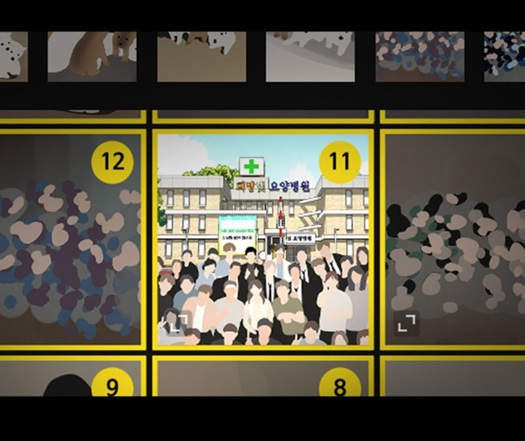 (chapter 60) deepening the parallel between them. This connection becomes even more striking when recalling that the grandmother once likened Kim Dan to a puppy
 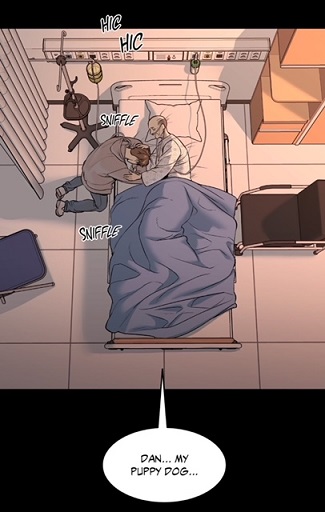 (chapter 53), emphasizing his vulnerability and dependence on others.
Without intervention, Kim Dan’s condition—both physical and emotional—could spiral into irreparable harm, reflecting the unnoticed demise of the puppy. 😭This essay will examine these events chronologically, beginning with Joo Jaekyung’s urgent rescue and arrival at the hospice. The narrative will then explore the symbolic meaning of the photographs, including the fifth puppy’s fleeting presence and its absence in subsequent images, as well as the profound symbolism of the room where Kim Dan is placed. This analysis will reveal how both elements intertwine to foreshadow Kim Dan’s increasingly tenuous grip on life and the unspoken realities of his condition.
Joo Jaekyung rushed to the hospice with Kim Dan in his arms  (chapter 60), he rested him on his healthy shoulder to provide support. This method of carrying, while practical in the moment, placed uneven strain on Jaekyung’s body. The weight resting on one side risked injury to his back and disrupted his balance, subtly reflecting the physical toll of his desperation to save Kim Dan. This small but significant detail underscores the sacrifices Jaekyung was willing to make in his attempt to protect him. However, since Kim Dan was unconscious, he couldn’t see the wolf’s kindness and selflessness.
Moreover, we have to imagine that while looking around for help on the beach,  (chapter 60) the green cross and the name “Light of Hope” likely caught his attention, inspiring him to believe the hospice could offer immediate assistance. Jaekyung’s desperation was evident in his drenched appearance after rescuing Kim Dan from the ocean (chapter 60), coupled with his labored breathing as he hurried into the hospice. His question
 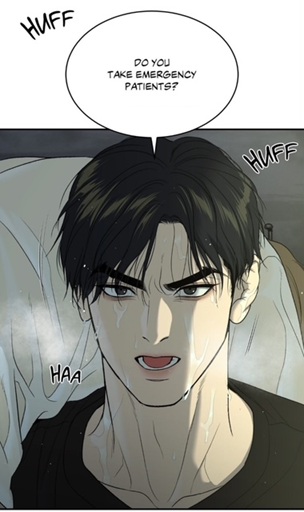 (chapter 60) reflected not only his uncertainty about whether the hospice could offer assistance but also the sheer urgency of his actions. This moment underscores the physical and emotional toll of his determination to save Kim Dan. Jaekyung risked worsening his own physical condition, driven by the hope that help would be available Yet the irony of this moment lies in the true purpose of the hospice: it is not a place for treatment or healing but a program dedicated to end-of-life care.
  (chapter 57)
This observation invites deeper reflection on why a small town would have a hospice rather than a hospital. The answer may lie in the demographic realities of the region. The aging population is evident in scenes depicting the town’s streets, where Potato and Heesung encounter primarily elderly individuals  (chapter 58), such as two older women
  (chapter 58). Yes, there were two small details, yet full of meaning. Even the landlord
  (chapter 58) nicknamed “old man”
 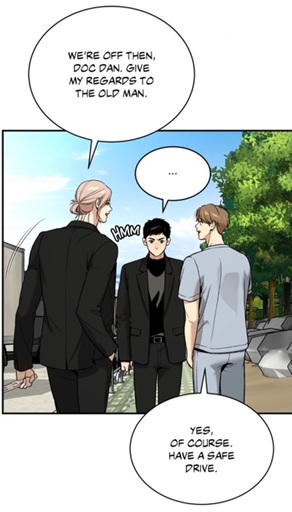 (chapter 59) by Heesung, symbolizes this demographic trend. The hospice’s focus on senior care reflects a broader societal issue in South Korea: a declining birth rate coupled with an increasing elderly population.
People aged 65 and older took up nearly 20 percent of South Korea’s population this year amid rapid aging and the ultra-low birthrate, data showed Thursday.
The number of senior citizens stood at 9.94 million in 2024, accounting for 19.2 percent of the country’s 51.75 million population, according to the data from Statistics Korea.
The proportion is forecast to surpass 20 percent in 2025, which will make South Korea a “super-aged society,” and is to rise further to 30 percent in 2036 and over 40 percent in 2050. Quoted from https://en.yna.co.kr/view/AEN20240926004100320?utm_source=chatgpt.com
Concurrently, the country recorded the world’s lowest fertility rate, with an average of 0.72 births per woman in 2023. This demographic trend is anticipated to continue, with projections indicating that by 2072, the population could decline by 30%, reducing the current 51.7 million to approximately 36.2 million. Quoted from https://time.com/6488894/south-korea-low-fertility-rate-trend-decline/?utm_source=chatgpt.com
These statistics underscore the challenges South Korea faces in balancing an increasing elderly population with a shrinking workforce, impacting economic growth, healthcare systems, and social services. While “Light of Hope” caters to the growing number of seniors, this approach inadvertently reinforces the exodus of younger generations. This migration from the countryside to Seoul or other major cities is subtly reflected in Jinx. Yoon-Gu, for instance, comes from the province of Gangwon-Do, embodying the trend of younger people leaving rural areas in search of opportunities. 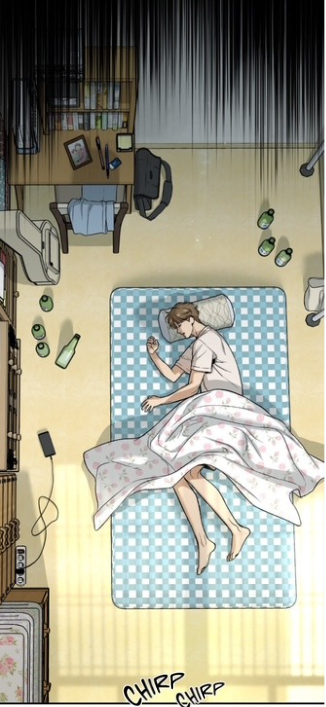 (chapter 57) In addition, the empty bedroom where Kim Dan is staying—with its untouched guitar, furniture, and books—suggests it once belonged to a teenager who left home and never returned. The unchanged state of the room symbolizes the stagnation and loss felt in these regions, further highlighting the broader societal issues at play. This shows that Jinx is not merely a classic love story; it also paints a nuanced portrait of South Korean society and its challenges. By prioritizing elder care without addressing the needs of the youth, the hospice embodies a false promise of hope—one that may ultimately exacerbate the very demographic crisis it seeks to alleviate. (chapter 57) This observation is further supported by the panel depicting the hospice’s exterior, which highlights its offer of free health checks. This detail suggests that the hospice is actively trying to attract new patients and has the necessary resources to conduct thorough medical examinations. For instance, when one of Kim Dan’s patients fell, the hospice staff were able to examine him properly (chapter 59), indicating their capacity for medical intervention. However, this approach reveals an underlying paradox: while the hospice caters primarily to an aging population, it lacks a sustainable strategy to address the exodus of younger generations, whose departure threatens its long-term viability. This issue is further illustrated by the hospice director’s decision to allow the facility to be used as a location for a movie shoot, (chapter 59) seemingly as an attempt to garner attention and improve its reputation. However, relying on such strategies means any potential benefits will only materialize months later, when the movie is released. This delay highlights the limitations of the hospice’s current approach to sustaining itself. In this context, Joo Jaekyung’s presence could play a pivotal role. It is possible he may become the driving force in revitalizing not only the hospice but also the town itself, potentially pushing the director to transform the hospice into a full-fledged hospital, addressing both immediate and long-term needs of the community. And this would fit his personality, as I connected him to a dragon. Let’s not forget that in season 1, the MMA fighter was introduced as a benefactor who organized a charity event
  (chapter 41), yet we never got to hear where the money went. This potential transformation underscores the underlying complexities of the hospice’s current operations, as it navigates between providing care for the elderly and responding to broader societal challenges. By situating Jaekyung in this dynamic, the narrative subtly hints at his capacity to influence change, bridging the gap between the hospice’s limitations and the community’s evolving needs.
This stark reality mirrors Kim Dan’s mental and physical state. The trail of blood he left behind 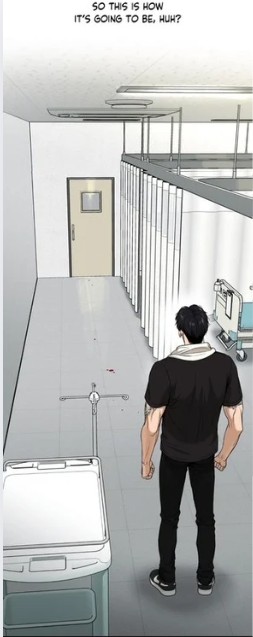 (chapter 60) —a consequence of removing his IV needle—symbolizes his quiet surrender and deteriorating health. When Kim Dan arrived at the hospice, he carried the faint hope of finding solace
 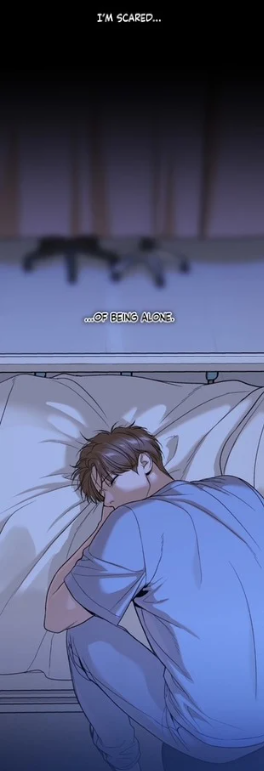 (chapter 56), particularly from his grandmother, who had promised to go to the beach with him.
  (chapter 53) However, this hope was met with disappointment
 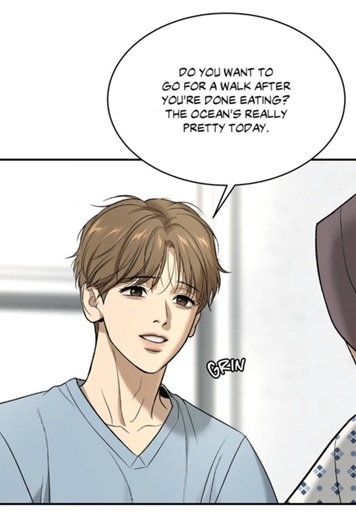 (chapter 57) – which he never expressed -, reflecting the deceptive promise of the hospice itself. Kim Dan’s fate seems to mirror not only the unnoticed death of the fifth puppy
 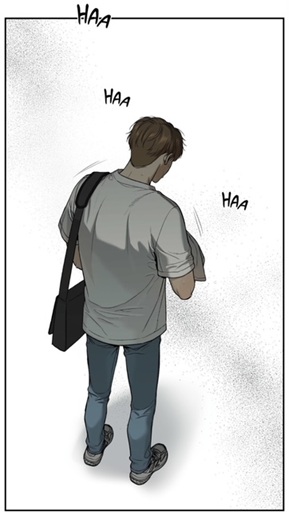 (chapter 59) but also his grandmother’s diminishing expectations of him.
  (chapter 56) She expressed twice that she no longer needed him. (chapter 57) However, all this time, she had been his motivation and reason to live. Once likened to a puppy, Kim Dan’s vulnerability and struggle for recognition remain central to his story, highlighting the fragility of his existence. His malnutrition, possibly linked to a deficiency in vitamin K and compounded by his alcohol dependency, exacerbates his fragility, making his situation increasingly perilous. Vitamin K, essential for blood clotting and bone health, is derived primarily from leafy green vegetables and produced by gut bacteria. A deficiency can result in symptoms such as dizziness
  (chapter 57), easy bruising
  (chapter 13), excessive bleeding and slow wound healing—all of which align with Kim Dan’s deteriorating condition and the trail of blood he left after removing his IV needle. (chapter 60) Is it a coincidence that a company with the green logo K was shown in different panels, like this one?
  (Chapter 54) Like mentioned before, this logo could be referring to a pharmaceutical company.
The room (chapter 60) where Kim Dan is placed raises significant questions about its purpose within the hospice. The presence of curtains, indicating multiple beds, contrasts with the lack of personal belongings or cupboards (see as a comparison, Shin Okja’s room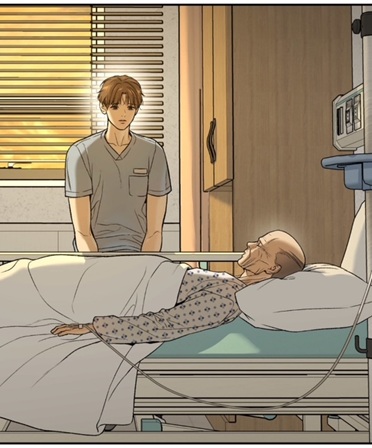 – episode 59), suggesting a temporary space for patients nearing the end of life. Moreover, observe that the colors of the curtains in the patients’ room is orange
  (chapter 56)
 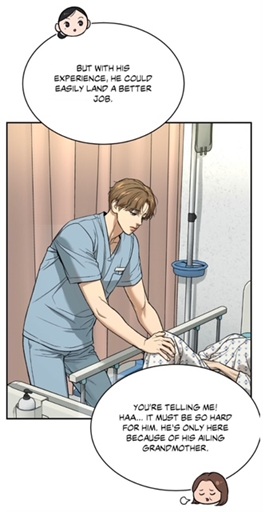 (chapter 56) and not white. This observation aligns with the assumption that this room is reserved for those on the verge of dying, shielding terminally ill patients from witnessing another’s death. 😨
This interpretation becomes clearer when contrasted with the emergency room depicted in the K-drama Love Scout.  In the drama, a character searches for his CEO and friend Kang by pulling back closed curtains in an emergency room,
 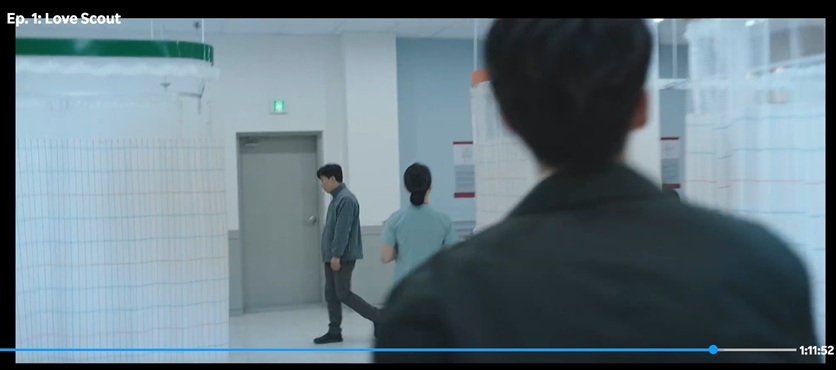 discovering different patients behind each one until finding the right person.
  This reinforces the notion that closed curtains signify the presence of others, even if their identities remain hidden. In addition, when the doctor treated the patient Park Jinchul, the curtains were closed. (chapter 56) (chapter 60) Like in Love Scout, the room in Jinx also has closed curtains, but instead of revealing activity or connection, it implies abandonment and isolation for those behind them. How so? Contrary to the transparent, automatic doors of the emergency room in Love Scout, the door in this scene is closed, manual, and opaque. Such a door symbolizes privacy and secrecy, further emphasizing the room’s association with isolation and death. In addition, the lack of anyone visibly attending to them suggests desertion. Everything is indicating that this space is not dedicated to immediate care and life-saving measures contrary to the emergency room. This contrast emphasizes that the room in Jinx symbolizes abandonment and death rather than rescue.
But there’s more to it. In Episode 52, the curtains in the health center were removed between two patients 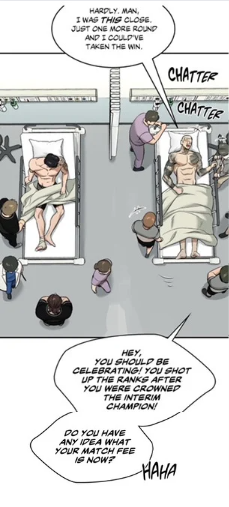 (chapter 52) to signify absence of confidentiality, contrasting with the closed-off nature of this space. This comparison not only exposes the manipulation of the staff at the health center, but also reinforces my interpretation that the emergency room at the hospice stands for danger and challenge. This detail underscores Joo Jaekyung’s assumption that he and Kim Dan are alone, but it also raises the possibility that their conversation could have been overheard by someone lying behind the curtains, such as the patient from Episode 57.
  (chapter 57) or the mysterious Park Jinchul
  (chapter 56)
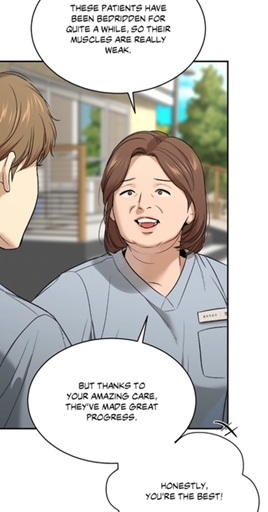 (chapter 56) If others are indeed present, their isolation hints at a bleak reality: death would occur behind closed curtains, without companions or acknowledgment. This setting forces Joo Jaekyung to confront the fragility of life and the limits of money, as even wealth cannot shield anyone from the inevitability of death. (chapter 60) The room’s atmosphere intensifies this realization, as the symbolism of abandonment permeates its design and the interactions within. Moreover, since many people could see parallels between this scene with the doctor’s situation in the locker room,
 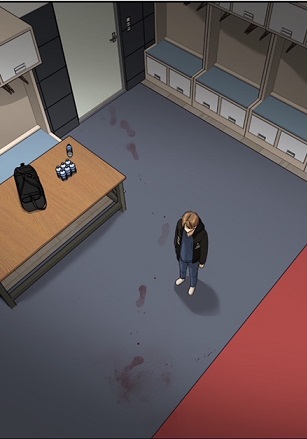 (chapter 51), they should remember that people were listening to their conversation behind the closed door, but they chose not to intervene.
 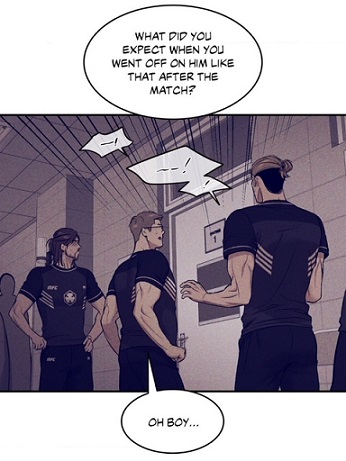 (chapter 53) That’s the reason why I am inclined to think that someone was /is present behind the curtain, but chose to remain silent. However, contrary to Team Black, such a person should intervene, if my theory is correct. And there is another evidence for this hypothesis. Since in episode 60 Joo Jaekyung offers a new contract
 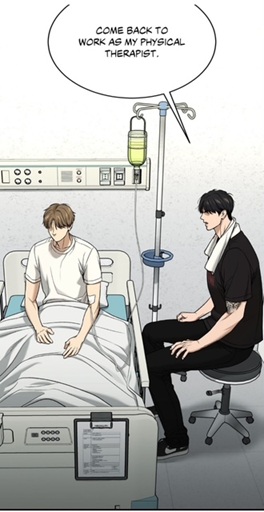 (chapter 60), it signifies that it is a reflection from chapter 6:
 (chapter 6) Nevertheless, back then, the deal was made without any witness. That’s the reason why I come to the conclusion that someone else was present in that room, yet contrary to the past, this person will intervene which stands in opposition to the symbolism of the room: death, secrecy and abandonment. And that can only be a patient who experienced the talent and care from Kim Dan. Joo JAekyung has never met any previous patient from Kim Dan before, but this is what readers got to hear from the nurse: (chapter 56) Only a bedridden person on the verge of dying can express such a gratitude towards the physical therapist.
If this interpretation is correct, the room’s symbolism is intertwined with death rather than rescue, then it conveys a sense of abandonment, as though the staff had already given up on Kim Dan. Furthermore, the decision not to place Kim Dan near his grandmother suggests an effort to keep the incident hidden from her (if she is not in the room), emphasizing the isolation surrounding his condition. On the other hand, the champion’s presence in that room could represent a chance for the athlete as well. This could represent the moment of his “rebirth”. Through a honest but painful conversation, the fighter would be encouraged to judge Kim Dan in a different light and nurture his maternal instincts. Moreover, he could give some comfort to a dying patient, similar to this scene: 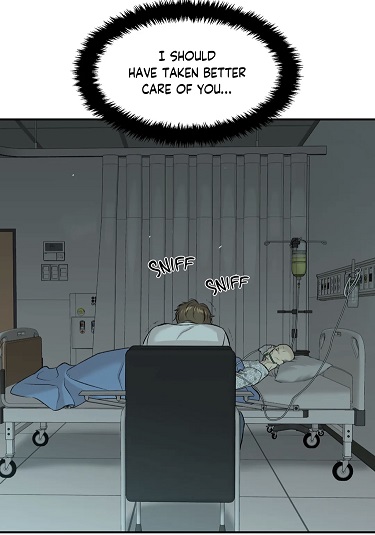 (chapter 21) which would push him to have a change of heart and show his vulnerability. What can he fear from a dying or terminally ill person? Nothing… hence he can only listen to the confidence and advice from such a patient.
And if my deductions based on observations are true, this signifies that the brochure from Light Of Hope (chapter 53) is indeed an illusion and deception, for the senior on the paper is portrayed as being accompanied by a nurse. The reality is different, for the patients are facing death alone.
Kim Dan’s interaction with Joo Jaekyung in this room is marked by lies and unspoken truths, which define the fragile dynamic between them. 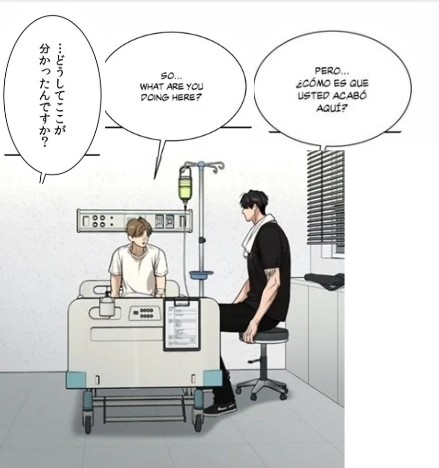 Their conversation begins with Kim Dan’s simple yet loaded question about how Jaekyung discovered his whereabouts. This moment, better captured in the Japanese, and Spanish translations, underscores Kim Dan’s curiosity and underlying desire for clarity. In the Japanese version, Kim Dan asks, “どうしてここがわかったんですか?” (“How did you find out about this place?”), while the Spanish translation reads, “¿Cómo es que usted acabó aquí?” (“How did you end up here?”). Both translations emphasize Kim Dan’s direct inquiry about how Jaekyung discovered his whereabouts, making Jaekyung’s evasive response even more significant. It is clear that he is trying to protect Potato here. However, Jaekyung’s response
  (chapter 60) immediately sets the tone for their interaction. His refusal to answer and his deliberate avoidance of Kim Dan’s gaze reflect a lie by omission. This evasive behavior not only highlights Jaekyung’s reluctance to reveal his vulnerability but also creates a significant divide between them, making it clear that they are not functioning as a unified team.
Kim Dan’s body language mirrors this emotional disconnection. 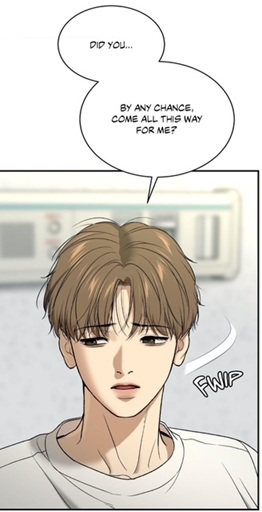 (chapter 60) Initially, he avoids Jaekyung’s gaze, signaling his own fear and insecurity. This avoidance reveals his worry about rejection and his deeper emotional vulnerability. On the one hand, he hopes deep down that the athlete would admit that he came looking for him, yet their last two interactions were arguments and rejections which the doctor didn’t forget.
 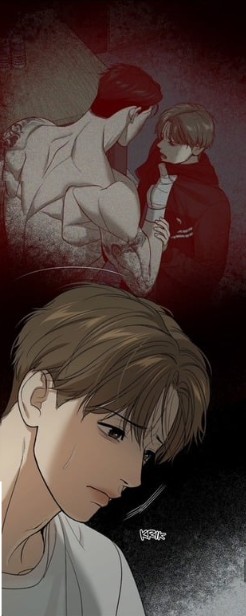 (chapter 60) Moreover, the idiom “by any chance” is exposing his low self-esteem. His words are exposing his internal struggles: between hope and despair. Later, his subtle act of turning his head away—a gesture often linked to dishonesty—indicates an effort to conceal his true feelings.
 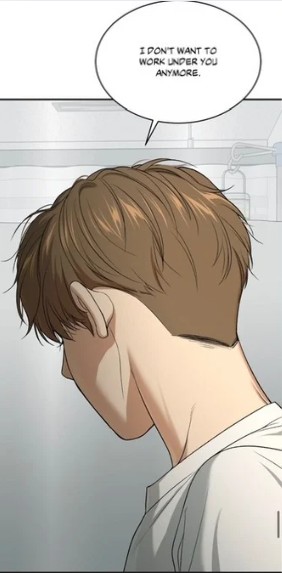 (chapter 60) He is still in love with Joo Jaekyung, but he is no longer hoping for any attachment and feelings from the fighter. On the other hand, his words are reflecting a different opinion: he is no longer trusting the athlete. This means that when the champion admitted his mistake indirectly, it was already too late.
 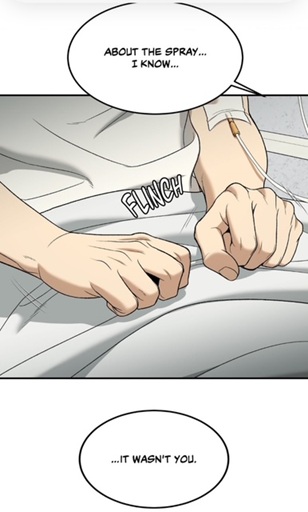 (chapter 60) The damage was done. In addition, he is rejecting the job offer because of the champion’s money.
 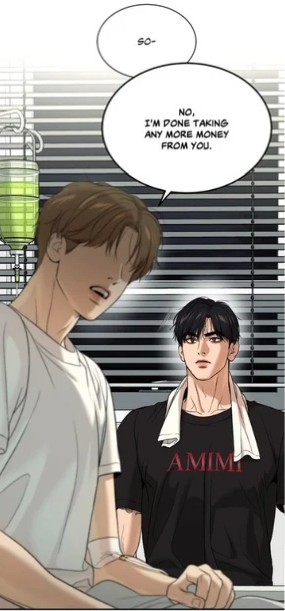 (chapter 60) He doesn’t want this fake generosity, since the athlete is reminding him of his “debts” towards him:
  (chapter 60) How ironic is that with his last remark, he ruined all his chances with Kim Dan. He was still viewing the physical therapist as someone below him. However, keep in mind that such an arrogance and “confidence” are just subterfuges from the MMA fighter. This act of concealment parallels Jaekyung’s guarded demeanor, as both characters are ensnared in a cycle of avoidance and denial.
Jaekyung, for his part, struggles with acknowledging his dependency on Kim Dan. 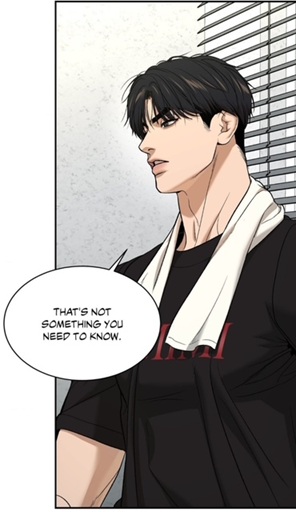 (chapter 60) This evasive remark suggests that Jaekyung believes keeping Kim Dan ignorant of his intentions is for the best. By withholding the truth, he feels he is protecting himself and Kim Dan from unnecessary burdens or complexities, reinforcing his perception that their relationship is better managed with clear boundaries. However, this attempt at concealment only deepens the divide between them, as it denies Kim Dan the clarity and emotional connection he seeks. In fact, he is not realizing that he is even afflicting more pain on his fated partner.
This dynamic is further emphasized when comparing their positions in Episode 6 and Episode 60. In Episode 6, Kim Dan was standing while Jaekyung sat (chapter 6), reflecting the power imbalance between them. Kim Dan momentarily held the upper hand by negotiating his terms, but once Jaekyung agreed, their positions shifted  (chapter 6), with Kim Dan ending up on the floor—a physical manifestation of his subservience. Later, in the locker room, both were shown facing each other
  (chapter 51), symbolizing a superficial moment of equality. In Episode 60, however, both are seated:
  (chapter 60) Kim Dan in bed and Jaekyung on a chair. Yet, this apparent parity hides a reversal of dependency. While Kim Dan is physically and mentally weaker, neglecting his own health to leave the bed, (chapter 60) it is Jaekyung who has become emotionally reliant on him. Kim Dan’s stubbornness to push through his fragility mirrors the fighter’s own traits, exposing an ironic role reversal that neither of them fully acknowledges.
Despite his outward confidence, (chapter 60) his refusal to engage truthfully exposes his internal conflict and fear of reliance. But why does he fear so much closeness and dependency? Naturally, Jinx-philes should keep in their mind his terrible childhood where he suffered emotional abuse. Moreover, he had been taken advantage from his previous sex partners.  (chapter 42) Despite the appearances, such relationships could only deepen his wounds and reinforce his anxieties. Thirdly, let’s not forget that the athlete read the doctor’s birthday card where the latter expressed the hope to work for him for a long time:
 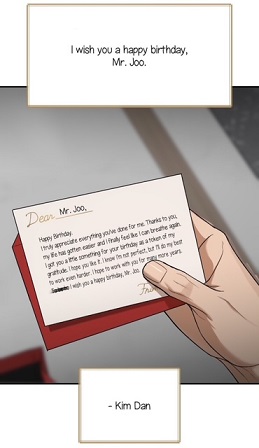 (chapter 55) That’s why he imagined that once he made his offer, the other would agree immediately. However, what he failed to realize is that he read the note too late. Besides, there were these erased words which left the fighter in the ignorance. Finally, he continues to misunderstand Kim Dan’s motivations
 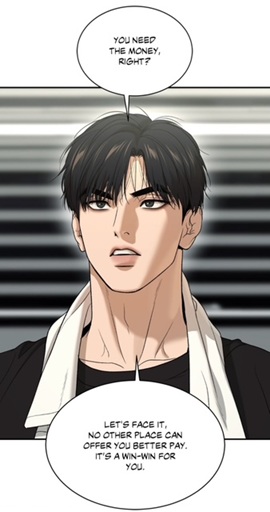 (chapter 60), as he did in episode 6.
 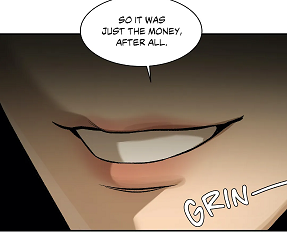 (chapter 6) Back then, Jaekyung assumed money was the sole driving force behind Kim Dan’s actions, and in the current interaction, he still believes this to be true. His internal monologue reveals this misconception:
  (chapter 60) I would even add, he believes to know Kim Dan so well, hence he mentions his grandmother:
 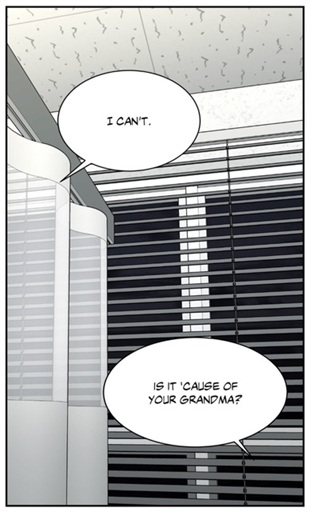 (chapter 60) However, Jaekyung is terribly wrong because he never talked to his lover. His interest and curiosity were quite superficial. Therefore he fails to grasp that Kim Dan’s longing is not for material wealth or familial obligation, but for genuine companionship and a place to call home. Kim Dan’s rejection of a boss-employee dynamic (chapter 60) underscores his desire for a deeper, more meaningful connection—something Jaekyung is unable to see due to his own emotional barriers.
But there is another reason why he got rejected. Fate wanted to punish the athlete for putting his own selfish desires over the doctor’s. He had seen the physical therapist in a dangerous situation  (chapter 60). Moreover he got to hear from the doctor that Kim Dan needed rest: (chapter 60). Yet, the first thing he talked about with the doctor was work (chapter 60), once Kim Dan asked him for the reason of his visit: (chapter 60) In other words, with his request, he implied that he had not been longing for Kim Dan’s company. With his attitude, he could only give the impression that he was not interested in the man Kim Dan, rather in the physical therapist, and that’s not what the main lead truly desires. To conclude, his behavior and words generated the impression that the fighter was only superficially interested in him. It was, as if his rescue on the beach had never taken place. He was definitely undermining his own “good deed”.
Their interaction becomes a poignant dance of unspoken fears and withheld truths, illustrating how deeply both characters are entrenched in their insecurities. From the very start, the conversation is undermined by these concealed emotions, dooming it to failure and highlighting the isolation each character feels despite their physical proximity.
Potato’s involvement adds another layer to the narrative. While the readers can notice the photo of Kim Dan in front of the hospice, they also detect the pictures of the puppies, which were captured later. (chapter 60) These images reveal that Potato visited the old man’s house to bid farewell to the animals. Among the photos, only one shows the fifth puppy—a small, brown one on the left—who appears less active than the others, symbolizing its declining condition. This shows that he was present, when the puppy was showing signs of being sick, but he did nothing. He was too focused on the moment cheering these animals on  (chapter 35) for his own “happiness”. Through Potato, the author is criticizing the attitude of fans who are only projecting their own emotions onto their idols. Their wish for happiness is quite rather superficial. This subtle oversight reflects Potato’s growing detachment, as his focus shifted to capturing moments for posterity rather than addressing the realities in front of him. The absence of the fifth puppy becomes a poignant symbol of unnoticed fragility and foreshadows Kim Dan’s own vulnerability. And how did Kim Dan react to the death of the small dog? (chapter 60) He blamed himself.
Additionally, Potato’s farewell request to treat Kim Dan to a meal if he ever returns to Seoul reveals his underlying doubt. 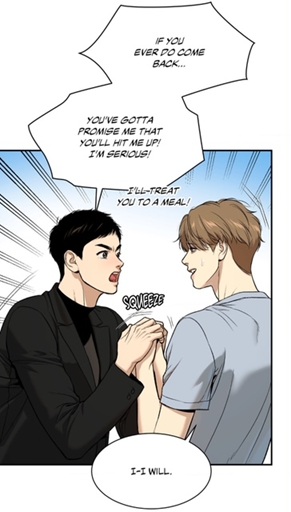 (chapter 59) Deep down, Potato does not expect Kim Dan to come back, reflecting his resignation to their fading relationship. Notably, Potato only asked for a picture of Kim Dan at the very end, never taking photos of him during their time together. (chapter 60) This lack of sensitivity and focus on celebrities, flowers, or the puppies instead of his friend underscores the growing emotional distance between them. Interestingly, while Potato returned to the old man’s house to bid farewell to the puppies, he has no intention of returning to the hospice. This contrast highlights how his farewell request serves as an acknowledgment that they are unlikely to meet again. This detachment mirrors Jaekyung and Heesung’s superficial connections, emphasizing how work relationships often overshadow genuine bonds.
Potato’s secret visit concerning the puppies and his silence regarding Kim Dan’s whereabouts reveal his growing resemblance to Heesung. 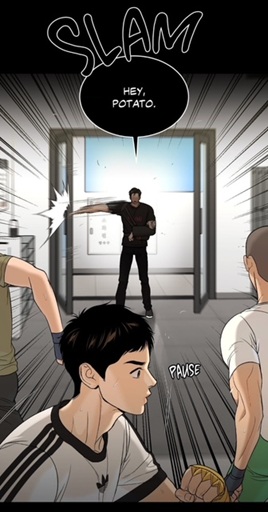 (chapter 60) When he got caught with his silence, Mingwa never showed us Potato’s justification. Yet, it becomes clear that the young fighter decided to give the following explanation: he respected Kim Dan’s wish to remain undiscovered
  (chapter 58) The reason for this interpretation is the champion’s reaction, when he was asked how he knew about his whereabouts (chapter 60) He deliberately avoided revealing that Potato was the one who disclosed Kim Dan’s location, shielding Potato’s role and perhaps attempting to protect the fragile connection they all share. This omission reflects Jaekyung’s misguided belief that ignorance might shield Kim Dan from further pain or complications. However, claiming he respected Kim Dan’s wish to remain undiscovered—was a lie, as his true motivation was Heesung’s request. (chapter 58) Therefore it is not surprising that through this omission, the main couple got affected. The lie from the chow chow had consequences for it increased the gap between the two protagonists. That’s how it dawned on me why Mingwa revealed the photo library of Potato. (chapter 60) The latter would serve as an evidence of his passivity and blindness towards Kim Dan, for the 5th puppy was still alive back then. The latter represents the fate of the doctor’s. These layers of deception highlight how characters like Potato become increasingly absorbed in their own worlds, blinded by their focus on superficial priorities.
This theme of being “too late” is also mirrored in Kim Dan’s experience with the puppy’s fate 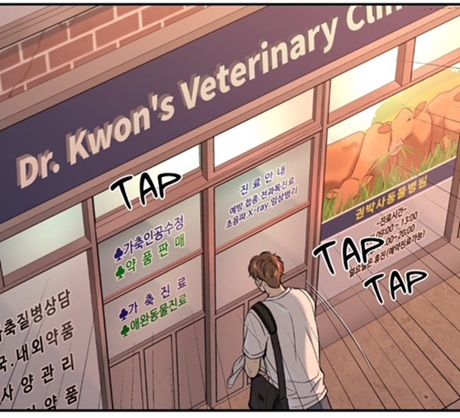 (chapter 59) and Joo Jaekyung’s rescue of Kim Dan. (chapter 59) In the case of the puppy, Kim Dan arrived too late to save the small animal, reflecting his self-doubt and hesitance to trust his abilities. Conversely, Joo Jaekyung arrived just in time to rescue Kim Dan from the ocean, demonstrating his decisive action. However, his failure to keep Kim Dan in a safe environment afterward suggests a broader inability to provide sustained support, echoing the narrative’s overarching theme of fragility and impermanence.
  (chapter 60) Though he is the one left behind, he is not realizing that by not following him, he is failing to protect Kim Dan.
The imagery of the fifth puppy serves as a poignant commentary on the consequences of neglect and inaction. The puppy’s decline—evident but unaddressed—parallels Kim Dan’s own struggles. Just as the fifth puppy’s fading presence is overshadowed by the activity of its siblings, (chapter 60) Kim Dan’s vulnerability risks being overlooked amid the chaos of the narrative. The missing puppy becomes a haunting reminder of what happens when fragility is ignored: a slow, quiet decline that ultimately goes unnoticed until it is too late. With too late comes regrets and remorse: 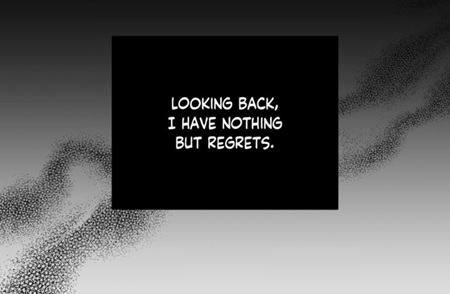 (chapter 57) Cheolmin already warned his friend in episode 13:
 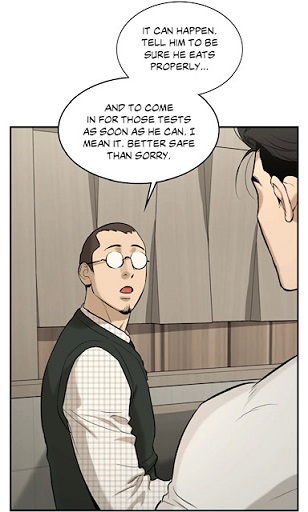 (chapter 13) But the man refused to listen to his advice, and now Kim Dan is leaving a trail of blood on the floor (chapter 60) indicating that his blood is not coagulating correctly. The last comment from the athlete implies that he is now accepting the challenge, he will do anything to have Kim Dan come back to him. Nevertheless, there exists one problem in my opinion: he is running out of time due to Kim Dan‘s physical and emotional deterioration, while he needs time to regain the physical therapist‘s trust.
The title, “The Deceptive Light of Hope,” encapsulates the essence of these intertwined narratives. The hospice’s name promises healing and solace, yet it masks the harsh reality of end-of-life care. On the other hand, since the couple reunited there, their relationship can be built on better foundations. They are surrounded by people who are definitely more attentive and less passive than at the gym. Moreover, the athlete has been living as a zombie all this time, the latter needs to die in order to be reborn as a human being. But it is the same for Kim Dan who has been living as a ghost for the last one and half month. On the other hand, rebirth is strongly intertwined with suffering, which reinforces my conviction that something bad to Kim Dan will happen. Since a beating heart is the symbol for humanity, it signifies that both will have to open up and confess their feelings. Similarly, the brightly lit hospital room, symbolizing purity, conceals the lies and unspoken truths exchanged between Jaekyung and Kim Dan. Potato’s photographs, seemingly innocent, betray a certain selfishness, ignorance and detachment, symbolized by the missing puppy. Each element contributes to the overarching theme: the fragile and often deceptive nature of hope in a world where appearances rarely align with reality. It is only a matter of time, until the wrongdoers realize their mistakes and apologize properly.
Feel free to comment. If you have any suggestion for topics or manhwas, feel free to ask. If you enjoyed reading it, retweet it or push the button like. My Reddit-Instagram-Tumblr-Twitter account is: @bebebisous33. Thanks for reading and for the support, particularly, I would like to thank all the new followers and people recommending my blog.
Please support the authors by reading Manhwas on the official websites. This is where you can read the Manhwa: Jinx But be aware that the Manhwa is a mature Yaoi, which means, it is about homosexuality with explicit scenes. Here is the link of the table of contents about Jinx. Here is the link where you can find the table of contents of analyzed Manhwas. Here are the links, if you are interested in the first work from Mingwa, BJ Alex, and the 2 previous essays about Jinx The Painful Mermaid’s Aspiration and The Mermaid’s Illusion of Love
It would be great if you could make some donations/sponsoring: Ko-fi.com/bebebisous33 That way, you can support me with “coffee” so that I have the energy to keep examining Manhwas. Besides, I need to cover up the expenses for this blog.

In Jinx, the evolution of Joo Jaekyung and Kim Dan’s relationship can be traced through the symbolic use of kisses [for more listen to Kiss Me], specifically the one in the locker room  (Chapter 15) and the life-saving kiss on the beach
 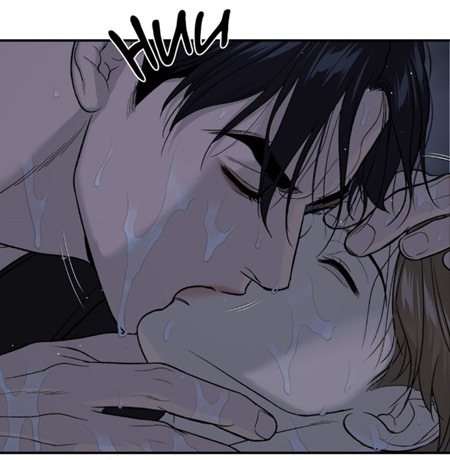 (Episode 60). Both moments carry significant emotional weight but reflect different facets of their dynamic, from selfishness to selflessness, secrecy to openness, and miscommunication to recognition. The setting and circumstances surrounding these kisses not only highlight the characters’ growth but also underscore the unresolved struggles they face.
The kiss in Chapter 14 and 15 was performed under the pretense of care but was marked by a sense of urgency and concern. Joo Jaekyung, lost in his thoughts and experiencing a form of derealization  (chapter 14), acted particularly rough with Kim Dan
 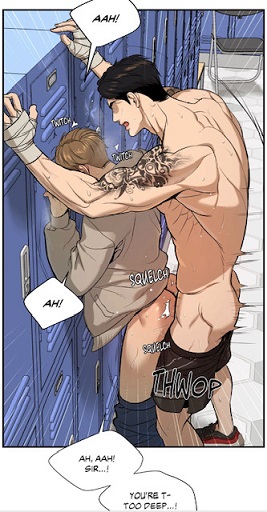 (chapter 14), only snapping back to reality when he felt Kim Dan’s body trembling.
 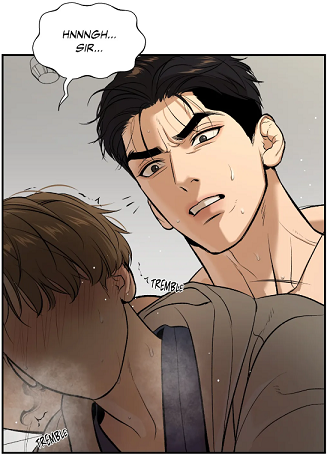 (chapter 14) This moment of realization, coupled with the doctor’s tears and plea
  (chapter 14), served as the trigger for Joo Jaekyung to recall Cheolmin’s recommendation
 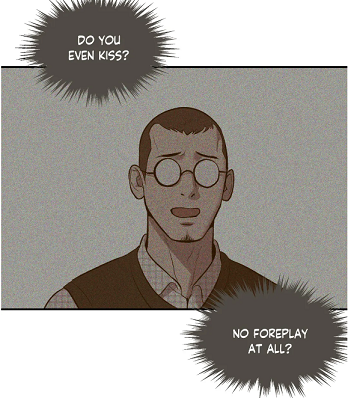 (chapter 14) of using foreplay and gentler methods, such as a kiss. While the kiss reflected care in the moment
 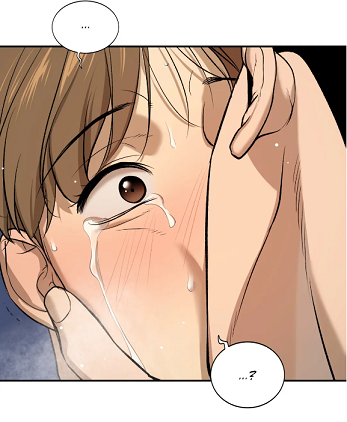 (chapter 14), selfish motives lingered in the shadows, as Joo Jaekyung sought to prevent causing visible harm that could lead to questions or even a scandal. It was, as if he wanted to silence his partner. Moreover, this decision was influenced by external suggestions, particularly from his friend, and not entirely by his own intentions. It was a calculated action to prevent immediate harm but lacked genuine emotional depth.
Interesting is that Kim Dan never dared to question Joo Jaekyung for this sudden kiss. 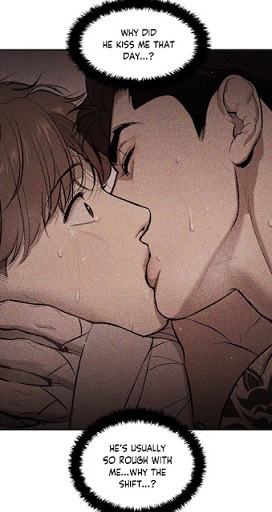 (chapter 16) Moreover, he never wondered why Joo Jaekyung had asked for sex in the locker room, which represented a change in his behavior. If he had done it before, then he would have forced the physical therapist to travel with him to Busan.
  (chapter 13) As you can see, through the comparison with the kiss on the beach, I realized the doctor’s passivity and lack of critical thinking in season 1. He never asked why the athlete was so rough during sex. He took this for a normality. His attitude exposed the doctor’s biased perception of his boss: a spoiled and rough man obsessed with sex. I would even add that the kiss had a positive effect on the protagonist
  (chapter 15), because for the first time, Kim Dan made a request. With his remark, he implied that the kiss was strongly associated with emotions. However, exactly like Joo Jaekyung pointed out
 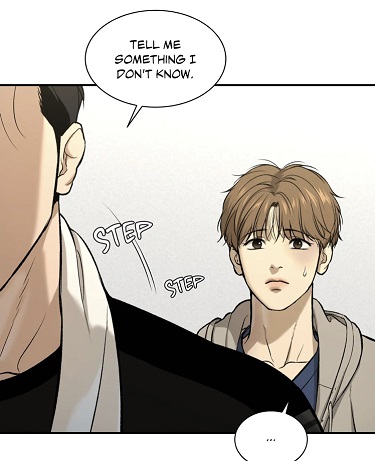 (chapter 15), the physical therapist omitted something important in the locker room. First, he didn’t share all his thoughts about the athlete, in particular his prejudices. Finally, he should have talked about his behavior before the kiss. What was he thinking, when he was having sex with him? In verity, he had been used as a substitute. In other words, the champion’s selfishness was rubbing on the doctor. Both were selfish, both had their heart and mind closed. And this remark brings me to the kiss on the beach.
In contrast, the kiss in Episode 60 (chapter 60) was executed purely for Kim Dan’s sake. It was a spontaneous, instinctive act of CPR to save his life, demonstrating selflessness and true concern. Unlike the locker room kiss, which carried both urgency and selfish motives, the beach kiss was entirely devoid of emotional connection, functioning solely as a technical gesture. Kim Dan was unconscious and unaware of the act, which stripped it of any emotional reciprocity. Here, Joo Jaekyung saw Kim Dan as a human being—detached from his social background and circumstances. This shift in perception is reflected in the location: the openness and natural beauty of the beach stand in stark contrast to the confined, artificial environment of the locker room. Joo Jaekyung’s willingness to perform this act in the open signifies a progression in his character—a gradual dismantling of his secrecy about his sexuality and his connection to Kim Dan. This shift from selfishness to selflessness illustrates not only Joo Jaekyung’s emotional growth but also the deepening of his bond with Kim Dan.
The locker room serves as a metaphorical closet  (chapter 15), a confined space symbolizing Joo Jaekyung’s need to keep his relationships private. Picking up partners at a VIP club
 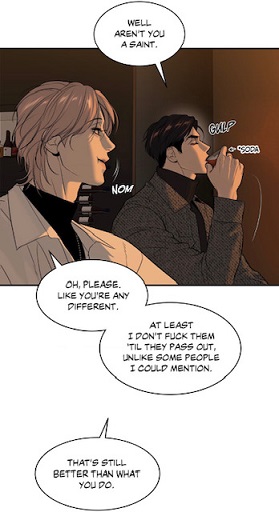 (chapter 33) was another extension of his desire to maintain secrecy. By contrast, the beach in Episode 60 is a public, open space, reflecting a significant shift.
 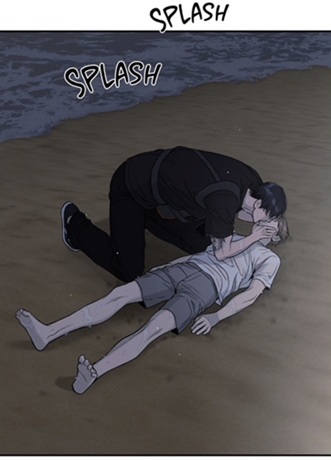 (chapter 60) Moreover, in the past, the locker room
  (chapter 14) was always filled with people surrounding the champion. However, once Kim Dan entered his life, this dynamic began to change. In Episode 14, Joo Jaekyung asked everyone to leave the locker room,
  (chapter 14) even excluding Park Namwook, who was even seen before stationed outside the bathroom door,
 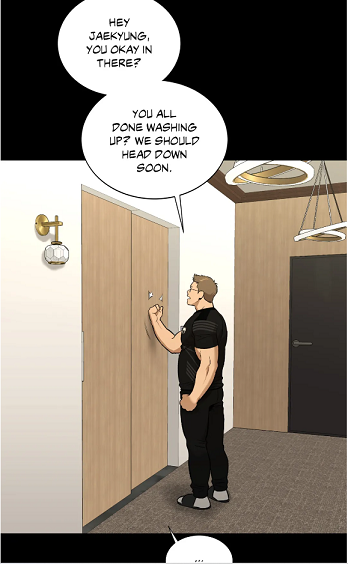 (chapter 14) signaling a gradual exclusion of others from his private life and emotions. By Episode 15, Joo Jaekyung explicitly sent away his manager to have a private conversation with Kim Dan.
 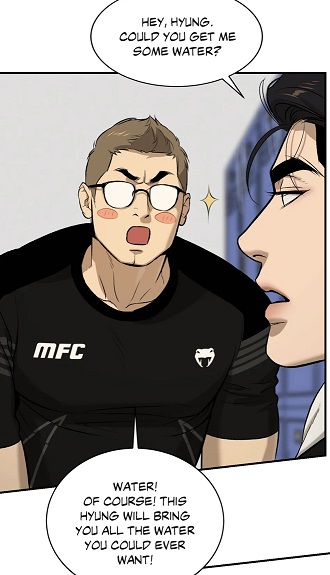 (chapter 14) This shift highlights the increasing importance of Kim Dan in Joo Jaekyung’s personal sphere. Interestingly, this progression is contrasted by Episode 49, where Joo Jaekyung deliberately ensured
  (chapter 49) he was not left alone with Kim Dan. This means that this place was no longer the synonym for privacy and secret. This reflects why director Choi could intrude with his minions. Following the incident with the switched spray, Kim Dan was left behind
  (chapter 50) in the locker room twice (chapter 51), which could only increase the physical therapist’s feelings that he didn’t belong to Team Black. He was not part of that “family”. And this coincides with the moment where Kim Dan cries for the last time:
 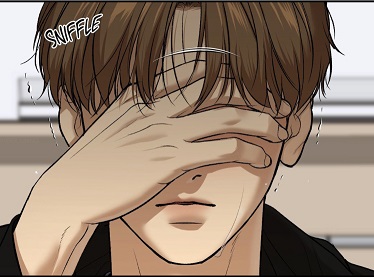 (chapter 51) From that moment on, the main lead won’t show his vulnerability and pain to others. This gesture announces the return of his “blue friend”, the depression.
Moreover, keep in mind what the grandmother used to say constantly to her grandson: “Don’t cry” 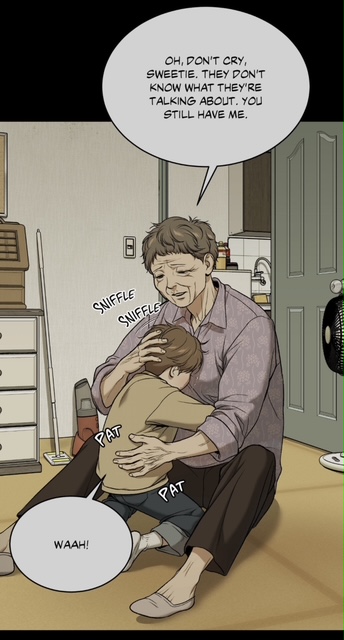 (chapter 57) Shin Okja must have felt uncomfortable with his tears and pain, therefore the doctor internalized not to show his struggling and burdens in front of his grandmother. This explicates why he denied his weeping in front of her first.
  (chapter 47) And now, you are wondering how this is relevant to the scene on the beach. Joo Jaekyung got shocked and scared, but he didn’t cry later and it is the same for Kim Dan. Hence the latter could deny his presence on the beach and even ignore the athlete’s words:
  (chapter 60) The absence of tears or a trembling body from the main leads indicate that both are hiding their emotions from each other. (chapter 60)
And because Kim Dan came to symbolize the fighter’s intimacy and privacy, it is no coincidence that their relationship ended in the locker room. There, the champion exposed his true thoughts about the doctor: his lack of professionalism, 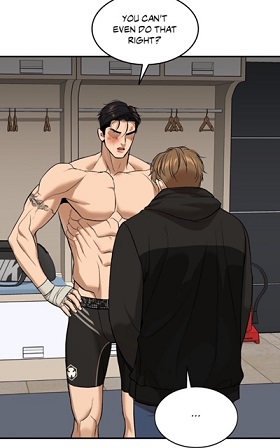 (chapter 51), his lack of loyalty, his greed and obsession for money. (chapter 51) Here, they were totally honest to each other:
  (chapter 51) Though the champion was restraining himself, he didn’t realize that his words were like punches to Kim Dan. The latter got to hear what he didn’t know.
  (chapter 51) Despite living together in the penthouse, he didn’t trust his room mate. After divulging his mistrust and anger to the physical therapist in the locker room, the former left Kim Dan behind and went to the health center with his hyungs. (chapter 51) What he didn’t realize is that the doctor stood for secrecy and closeness, so by leaving his side, he was destined to be exposed.
  (chapter 52) The conversation in the locker room symbolically announced the champion’s private struggles to the media, as his bad temper was made public shortly after.
Through these events, the kiss in the locker room becomes full of symbolism. It not only marked a moment of urgency but also served as an emotional awakening for Joo Jaekyung  (chapter 15) , representing his need for mental and emotional support, which his team and entourage failed to provide. While the CPR kiss could be dismissed as a rescue, it symbolically represents a step toward Joo Jaekyung revealing his true self. The kiss marks a moment where he unconsciously begins to acknowledge his feelings and his homosexuality, even in a setting where others could witness it.
By contrast, the couple on the beach in episode 60 (chapter 60) was surrounded by nature. Hence they could show their true self: their exhaustion, desire and emotions. While the doctor was suicidal due to his depression and fatigue, the champion’s worries were genuine. Yet Kim Dan was not able to hear them.  (chapter 60) This means that on the beach, Kim Dan could only detect one thing: Joo Jaekyung’s presence. But he didn’t sense his kisses and hear his words. That’s the reason why I come to the conclusion that this scene stands under the sign of “dream and illusion”.
  (chapter 60) Hence he came to reject his “intervention” as a lie and deception. The reality is that Joo Jaekyung does care for him, but he doesn’t know how to show it. He fears attachment. Because of his misjudgement, Kim Dan is not capable to notice the transformation in his former boss. . (chapter 60) The latter has now darker circles, and he lost a lot of weight.
 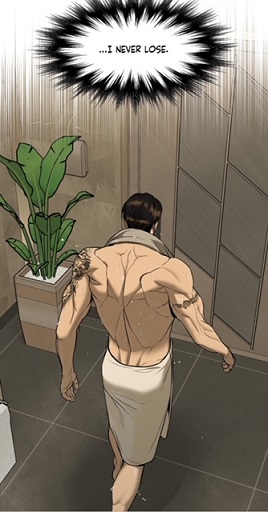 (chapter 49) His muscles are less pronounced. He is also wasting away.
This progression also ties to the concept of nature vs. artifice. The natural setting of the beach—the waves, the open sky—contrasts sharply with the sterile, artificial environment of the locker room. Nature brings out authenticity and raw emotion, whereas the locker room and the emergency room (chapter 60) reinforce control and suppression. In the locker room, the absence of time and space to relax or meditate highlighted the pressures placed on Joo Jaekyung by his manager and coach (chapter 14) 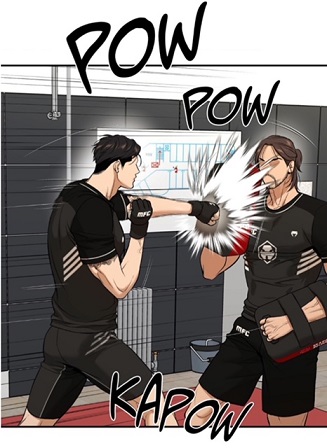 (chapter 49), who believed that physical strength alone would solve his problems. This environment denied him the mental and emotional support he truly needed. (chapter 15) The kiss in Chapter 15 became a moment where Joo Jaekyung discovered not only physical pleasure but also positive emotions, which acted like a sweet candy, a reward for his hard work. (chapter 15) It gave him emotional support. It symbolized a rare moment of relief and connection amidst the overwhelming demands of his environment. Joo Jaekyung’s actions in these settings highlight his gradual move from a place of concealment to one of openness and authenticity. While the CPR kiss could be dismissed as a rescue, it symbolically represents a step toward Joo Jaekyung revealing his true self. (chapter 60) The kiss marks a moment where he unconsciously begins to acknowledge his feelings and his homosexuality, even in a setting where others could witness it.
Another layer of complexity is revealed when examining the two kisses. From that wonderful night  (chapter 44) on, Kim Dan never got kissed again. The absence of a kiss in the locker room was revealing Joo Jaekyung’s lack of faith in Kim Dan. His mistrust left such an emotional wound, which is only visible to the third eye.
  (chapter 54) Because Joo Jaekyung saw it in a vision, it becomes clear that the athlete is still in denial about his wrongdoing. Therefore he didn’t apologize for his false accusations and his bad perception of the physical therapist: (chapter 60) By admitting that he knows about his innocence, he imagines that he can get scott-free. But he is wrong. His skepticism and dismissiveness wounded Kim Dan’s heart and mind, leaving scars that reverberate through their future interactions. Kim Dan can no longer trust him now (chapter 60) , though there is no doubt that the doctor is still in love with him. At the hospice, this mistrust resurfaces. The parallel conversations—in the locker room and the emergency room—highlight the ongoing cycle of miscommunication and emotional disconnect. Both characters, in their own way, lie to themselves and each other. Joo Jaekyung sees Kim Dan through the lens of poverty and greed (chapter 60, reducing his identity to his need for money, while Kim Dan rejects his offer, his help and conceals his pain. It is not surprising that Kim Dan left the treatment room.
  (chapter 60) By doing so, he is denying his rescue and assistance. It was, as if this night and as such the kiss had never happened.
The beach, however, offers a stark contrast. There, in the midst of the emergency, Joo Jaekyung’s perception of Kim Dan shifts. For the first time, he sees him as a human being—vulnerable and in need of genuine care.  (chapter 60) The lies and miscommunication fade in the face of the life-and-death situation. However, this recognition is short-lived, as the events at the hospice reveal Joo Jaekyung’s lingering selfishness (chapter 60) and inability to fully comprehend the seriousness of Kim Dan’s mental and physical state.
Episode 60 also underscores the parallels between Kim Dan and Joo Jaekyung. Both characters are struggling and mistreating their bodies, albeit in different ways. Kim Dan’s rejection of help and his deteriorating condition mirror Joo Jaekyung’s past behavior of ignoring medical advice and pushing himself to extremes. This dynamic serves as a reflection, forcing the champion to confront his own flaws. Kim Dan’s condition becomes a metaphorical mirror, showing Joo Jaekyung the consequences of neglecting physical  (chapter 27) and mental well-being. (chapter 27) When Kim Dan removed the needle carelessly (chapter 60), he was actually copying his lover’s behavior.
The dissociation and derealization evident in Kim Dan’s behavior 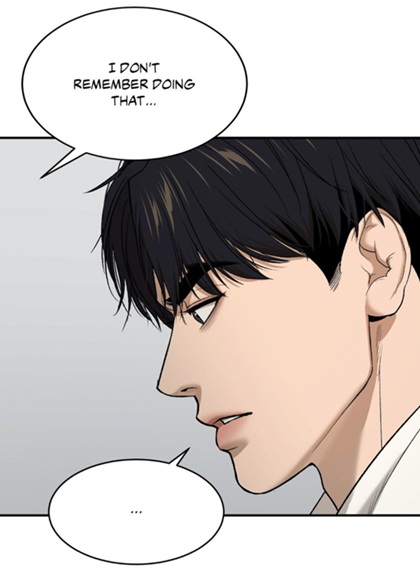 further highlight his mental fragility. This fragility contrasts sharply with Joo Jaekyung’s reaction during their interaction at the hospice. When the champion angrily asks, , his words reveal frustration and a superficial understanding of the situation. Rather than addressing the underlying psychological distress driving Kim Dan’s actions, Joo Jaekyung perceives them as reckless behavior. His focus remains on immediate danger rather than the deeper cause, showcasing his emotional detachment and inability to grasp the full seriousness of Kim Dan’s mental state. This misinterpretation underscores how Joo Jaekyung is still projecting his own coping mechanisms onto Kim Dan, assuming that sheer willpower and physical strength can resolve emotional struggles. This moment serves as a stark reminder of Joo Jaekyung’s ongoing growth and the gaps in his understanding of Kim Dan’s suffering. His denial of having gone to the beach, despite clear evidence, points to the depth of his trauma. (chapter 60) That’s why I can’t shake the feeling that the physical therapist is still in danger. The trail of blood on the floor could be interpreted as a bad omen. (chapter 60) Many Jinx-philes saw parallels between the champion’s departure from the locker room with the final image from chapter 60, (chapter 51) However, in the last image, the athlete had left the room to go to the health center, while Kim Dan is now leaving the treatment room, a sign that he is not just rejecting the champion’s help, but also the hospice’s intervention. (chapter 60) So he could get into trouble in his profession.
This moment becomes a turning point for Joo Jaekyung, as he is about to grasp the gravity of Kim Dan’s mental illness. However, his focus on money and material solutions (chapter 60) at the hospice contrasts sharply with the purity of his actions on the beach, underscoring his ongoing struggle with selfishness and superficiality.
As long as Joo Jaekyung hides his vulnerability and hides his true self to achieve his goal, Kim Dan will mirror his actions. He will deceive him too. However, we shouldn’t see their separation  (chapter 60) at the end of episode 60 as something negative. How so? It is because Kim Dan never said this:
 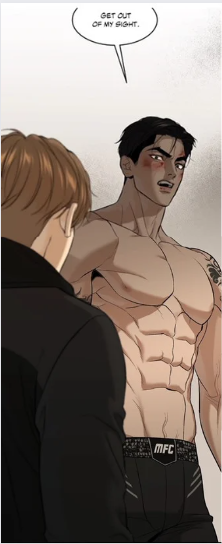 (chapter 51) He never wished to never see Joo Jaekyung again. Moreover, he never regretted their meeting either. (chapter 60) And now, pay attention to his hand, he is slightly clenching his fist, a sign that he is pained while saying this: “Have a safe trip home!” The word “home” and his gesture display that deep down, he was happy to see him. He is longing for home, but he can not express his true desire. Thus I deduce that Joo JAekyung’s words in front of the restaurant must have moved his heart:
 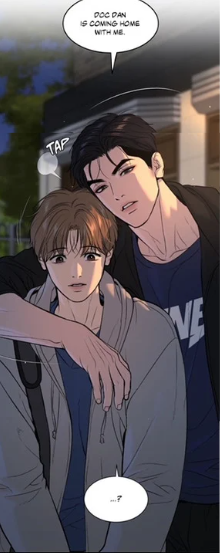 (chapter 43) No wonder why he thought that it was time to get to know the fighter during that night:
  (chapter 44)
On the other hand, by utilizing the word “home”, he is implying that the fighter doesn’t belong here. The doctor is actually mimicking his own grandmother. (chapter 57) 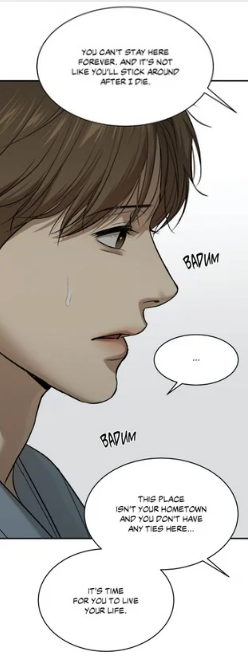 (chapter 57) However, Jinx-philes should detect the divergence: she is not using the word “home”, but Seoul. That’s the reason why in the end, Shin Okja’s confession to her grandchild will come back to bite her, as she described her own grandson as a stranger in this little town. It was, as if he had been an orphan all his life. He had no home all along.
And because of the doctor’s words, it is clear that Joo Jaekyung won’t return to Seoul. He just needs to stay by his side in order to gain his trust. The longer the fighter stays in that place, the longer he will be able to detect the deceptions surrounding the doctor: 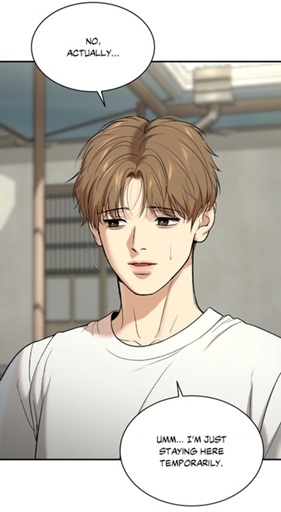 (chapter 58) Where are the parents? Who is the man where he is staying? Where did he plan to go after his stay there? The idiom “temporarily” could be perceived as an evidence that the doctor plans to end his life. According to my interpretation, Heesung believed that the landlord was Kim Dan’s grandfather. He was just denying his origins out of shame.
One thing is sure. Because of the doctor, Joo Jaekyung will be forced to admit that home is where the physical therapist is. With his goodbye, Kim Dan was challenging his former boss , (chapter 60) a new version of this scene.  (chapter 9) The athlete has now every reason to stay there and that’s how he will discover all the doctor’s secrets and misery.
The kisses in Jinx are more than just physical acts; they are symbolic markers of Joo Jaekyung’s emotional journey and his evolving relationship with Kim Dan. The locker room  (chapter 15) kiss represents selfishness, secrecy, and miscommunication, while the beach kiss (chapter 60) signifies selflessness, openness, and recognition. However, both kisses, initiated by Joo Jaekyung, were not truly expressions of deep love or genuine emotional pleasure. As technical gestures borne out of urgency and care, they left no lasting emotional trace in their relationship.
This lack of emotional permanence highlights the characters’ ongoing struggles. While Joo Jaekyung shows signs of growth, he has yet to fully understand or confront the complexities of Kim Dan’s mental and emotional state. Similarly, Kim Dan’s passivity and silence in earlier moments underline the barriers that remain between them. Trapped in his own misery, he fails to see the physical deterioration from his former idol. The juxtaposition of these kisses serves to illustrate the fragility of their bond and the slow, uneven process of their personal and relational evolution. Through these moments, the author masterfully portrays the intersection of urgency, care, and miscommunication, ultimately crafting a nuanced exploration of healing and connection amidst shadows. Once again, it exposes the importance of honesty and clear communication in a couple.
Feel free to comment. If you have any suggestion for topics or manhwas, feel free to ask. If you enjoyed reading it, retweet it or push the button like. My Reddit-Instagram-Tumblr-Twitter account is: @bebebisous33. Thanks for reading and for the support, particularly, I would like to thank all the new followers and people recommending my blog.

Please support the authors by reading Manhwas on the official websites. This is where you can read the Manhwa: Jinx But be aware that the Manhwa is a mature Yaoi, which means, it is about homosexuality with explicit scenes. Here is the link of the table of contents about Jinx. Here is the link where you can find the table of contents of analyzed Manhwas. Here are the links, if you are interested in the first work from Mingwa, BJ Alex, and the 2 previous essays about Jinx The Wolf’s Cure Among the Sheep and The Silent Shore
It would be great if you could make some donations/sponsoring: Ko-fi.com/bebebisous33 That way, you can support me with “coffee” so that I have the energy to keep examining Manhwas. Besides, I need to cover up the expenses for this blog.

The journey of Joo Jaekyung finding Kim Dan 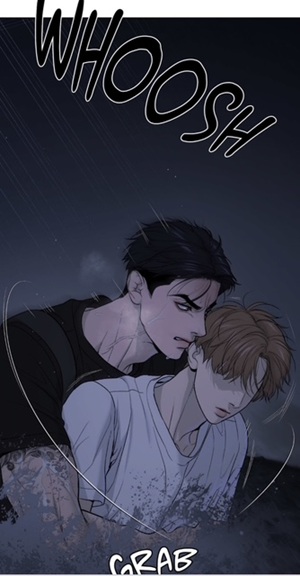 (chapter 59) is a masterful interplay of symbolism, reflection, and narrative breadcrumbs laid out by Mingwa. Central to this exploration is a photograph
  (chapter 59) —an innocent request by the nurses at the hospice
 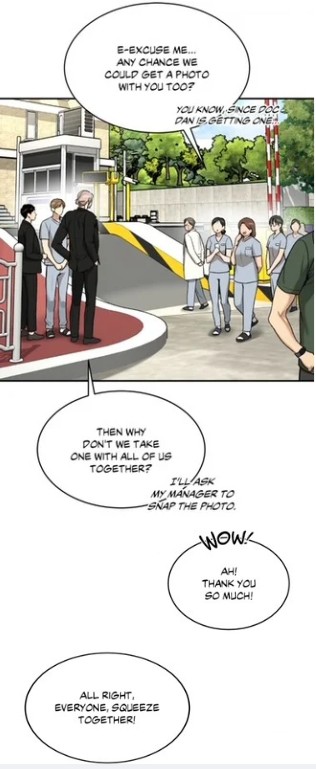 (chapter 59) —which becomes the pivotal clue leading Joo Jaekyung to Kim Dan. Through a careful analysis of the timeline and the use of contrasting events, it becomes clear that Mingwa’s narrative mirrors a kaleidoscope, reflecting positive and negative elements rooted in Taoist principles. While the doctor’s unconscious
 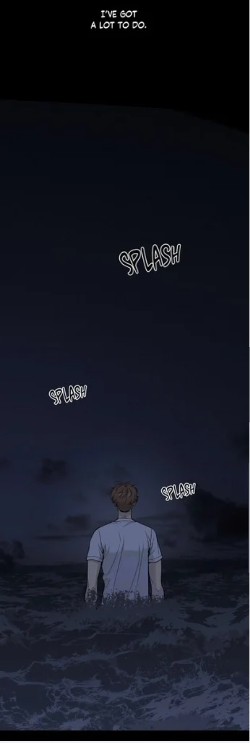 (chapter 59) led him to the shore, driven by despair and suicidal intent, the MMA fighter’s journey stands as its opposite:
 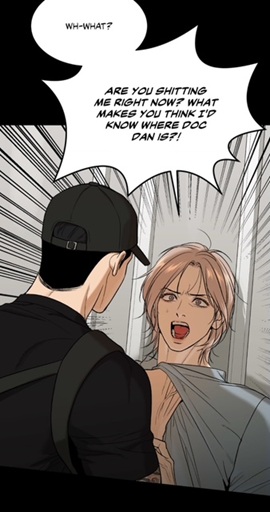 (chapter 59 ) a conscious choice to follow his heart, hence he was full of anger and frustration. Joo Jaekyung was no longer repressing his feelings, even if he had yet to fully recognize his affection. (chapter 59) This deliberate action underscores the contrast between their emotional states and sets the stage for their eventual reunion. The stay of Heesung and Potato
 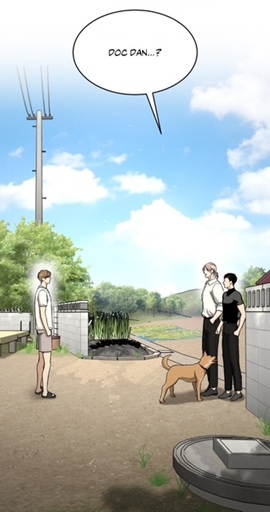 (chapter 59) embodies the negative reflection of Joo Jaekyung’s purposeful arrival. We can detect the divergences: day versus night, work versus break, healthy versus unhealthy etc. Through the juxtaposition of images and situations, Mingwa provides profound insight into the characters’ thoughts, desires, and intentions. The photograph’s role becomes pivotal: while it marks the end of Heesung and Potato’s visit
 (chapter 59), it simultaneously signifies the first crucial clue in Joo Jaekyung’s search. This marked the turning point where his ongoing efforts were given direction, transforming his pursuit into a decisive journey toward discovery.
At first glance, the photograph (chapter 59) features key individuals such as Heesung, Potato, the green-haired nurse, and the director of the hospice  (chapter 59) —each of whom had interacted with Kim Dan
  (chapter 57) during his time at Light of Hope. While these individuals appear as potential candidates for revealing Kim Dan’s location, the true helper remains shrouded in mystery. This ambiguity emphasizes the layered narrative of Jinx, where each small action—no matter how mundane—contributes to the larger theme of fate’s intricate web, offering insight into the power of both intentional and unintentional intervention. If Potato had not suggested the picture (chapter 59), if the nurses had not insisted (chapter 59), or if the photograph (chapter 59) had remained entirely private (only Kim Dan, Potato and Heesung together), the chain of events might not have unfolded. Each of these “ifs” reflects the delicate interplay of fate and intervention, where seemingly small actions cumulatively wove the threads that guided Joo Jaekyung to Kim Dan. This demonstrates how intentional and unintentional acts alike can influence the larger narrative, ultimately intertwining lives in unexpected ways. The “if” becomes a recurring symbol of fate and intervention. Through a process of deduction and analysis, the photograph emerges as the link that sets fate into motion, guiding Joo Jaekyung to his lover. The stay of Heesung and Potato, defined by inaction, lies
 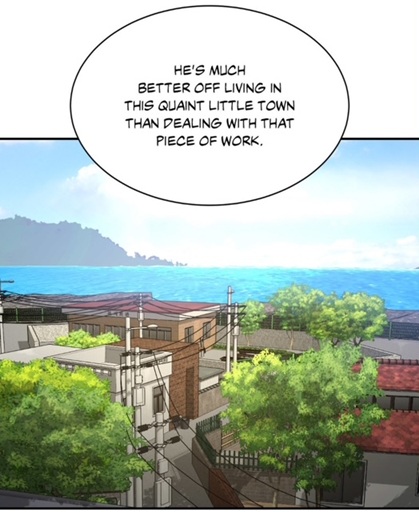 (chapter 58)
  (chapter 58)
  (chapter 58), ignorance and superficiality
  (chapter 58), becomes the shadowed reflection of the proactive search by Joo Jaekyung. This interplay of light and dark is central to unraveling how fate unfolded.
Heesung  (chapter 58) and Potato, despite their contrasting motivations (chapter 58), came to the same conclusion: they should not reveal Kim Dan’s whereabouts to Joo Jaekyung. Heesung argued that Kim Dan was better off in his secluded life, away from the chaos of Joo Jaekyung. Potato, deeply trusting his lover’s seniority and judgment, chose to follow Heesung’s lead. Their decision reflects not only their loyalty to Kim Dan’s expressed wishes but also their passive adherence to the belief that avoiding intervention was a form of help which reminds us of Potato’s former principle: (chapter 35) This shows that despite the last incident, Yoon-Gu didn’t drop this terrible principle. Notice that he is advocating the same philosophy than Shin Okja. Heesung justified his stance by claiming that it was in Kim Dan’s best interests (chapter 58), implying that the relationship between Kim Dan and Joo Jaekyung was toxic. However, his reasoning revealed a deeper selfishness: Heesung harbored resentment and sought to see his frenemy suffer as payback for the humiliation and damages he had endured. (chapter 58) This hidden motivation underscores the complexity of his actions and casts doubt on his proclaimed concern for Kim Dan.
This decision persisted throughout their ten-day stay at the hospice. 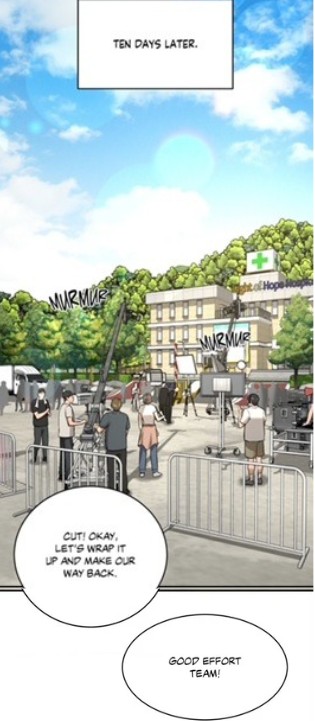 (chapter 59) Importantly, Joo Jaekyung did not arrive during this period, further affirming their resolve. The photograph taken just before their departure was the key turning point. However, the timeline—marked by the sunsets
  (chapter 59)
  (chapter 59) —suggests that Joo Jaekyung arrived only two days after Heesung and Potato left. This indicates that neither Potato nor Heesung leaked the information to Joo Jaekyung, as the champion would have sought Kim Dan immediately if informed by them. Instead, this photograph—seemingly public rather than private—became the clue he needed. Moreover, since the two friends knew where Kim Dan lived, I am assuming that he would have gone right to the doctor‘s rented room. But he did not. He went to the beach. Since the nurses didn‘t notice that Kim Dan was a friend of Potato and Heesung and mistook him for a fan, I am assuming that only the two friends know his address.
The photograph holds immense symbolic and narrative weight. It was not meant to expose Kim Dan (chapter 59); it was requested by the nurses as a keepsake for their time with the visiting celebrities. Initially intended as a simple memento, the photograph transformed into the thread that connected Joo Jaekyung to Kim Dan. Importantly, the identities of Heesung, Potato, the green-haired nurse, and the hospice director all become relevant, as each had interacted with Kim Dan during his time at Light of Hope.
This public nature of the photograph underscores the idea of “hiding in plain sight.” Kim Dan was among a crowd, blending into the background, not anticipating that anyone would recognize him. However, this picture became the critical link for someone who initially focused on Heesung, Potato, or the green-haired nurse or the hospice director. The person looking at the picture was not searching for Kim Dan but discovered him by accident, making the revelation both unexpected and serendipitous. This discovery highlights how fate operates through chance and unintentional connections. It serves as a prelude to exploring the contrasting dynamics of intervention, from misguided actions to purposeful assistance, which will be further examined in the comparative analysis.
Thus it is unlikely that the information came from members of Team Black, in particular from Oh Daehyun and Kwank Junbeom. Initially, I envisaged them as potential candidates, for Oh Daehyun has always had sharp eyes (he has an eagle as tattoo) 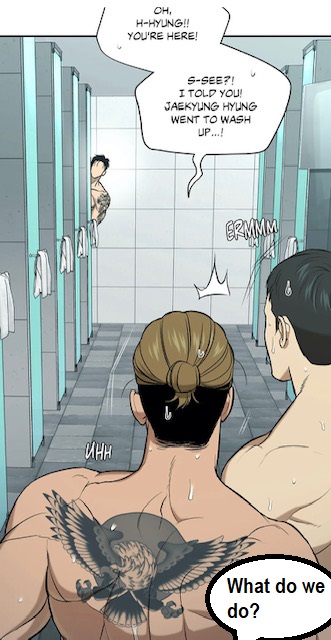 (chapter 8)
 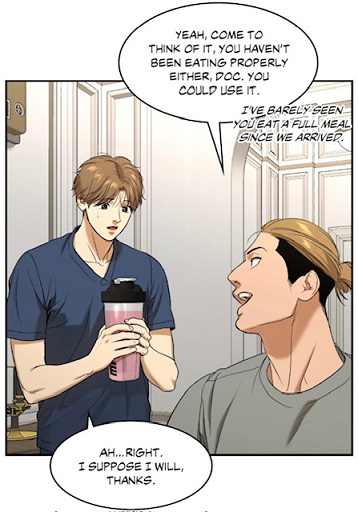 (chapter 37) and Kwak Junbeom was a witness of the encounter between Kim Dan and director Choi Gilseok.
  (Chapter 48) Nonetheless, there exist significant points against this theory. Despite their fondness for the actor
  (chapter 30) and their interactions with Heesung and Potato
  (chapter 35), they are unaware of the actor’s relationship with Potato. The author left many clues for this interpretation. They didn’t notice the maknae’s absence at the champion’s birthday
 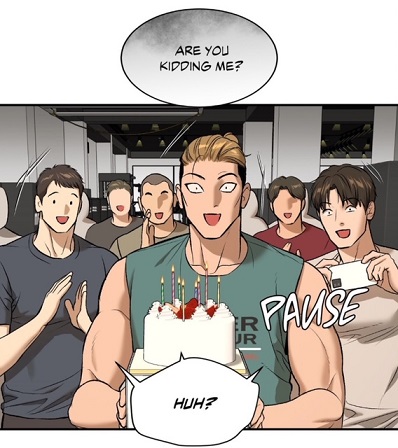 (chapter 43), but more importantly the presence of Yoon-Gu‘s embarrassment in front of his hyung indicates secrecy. .
  (chapter 58) His “redness” indicates that he doesn’t want to expose his special relationship with Heesung. Therefore I believe that he didn’t mention this trip to other members. Consequently, I doubt that the members were looking for Potato in such a photograph. Furthermore, from my perspective, members of Team Black are still left in the dark about Joo Jaekyung’s struggles. They are unaware of his drinking habits
  (chapter 56), or his emotional state. They think, he has not come to the gym due to his recovery. Furthermore, they don’t use his cellphone number to contact him. The hiring of a new physical therapist and
  (chapter 57) the interview suggested that Joo Jaekyung was taking a break to recover from his injury, leaving no indication of his active search for Kim Dan. However, Yoon-Gu got informed through Heesung that Joo Jaekyung was desperately looking for him:
  (chapter 58), but probably saw this as another “negative reaction” (bad temper) of a spoiled child. This makes it unlikely that members of Team Black could have provided the critical information.
This leaves only the green-haired nurse and the hospice director as plausible sources of assistance. However, the hospice director can be ruled out, as he did not make the request for the photograph. His lack of direct involvement in this key moment suggests that his role in connecting Joo Jaekyung to Kim Dan was minimal, leaving the nurse as the final candidate.
The green-haired nurse (chapter 59), while not pivotal in initiating the photograph (chapter 59) —this was driven by her colleagues’ request—holds a central position in the narrative due to her placement next to Kim Dan in the picture. Although quiet, observant (chapter 57) and unassuming (chapter 57), her positioning reflects Mingwa’s deliberate storytelling, emphasizing her subtle yet crucial role in connecting the threads of fate. She is also unlikely to have directly contacted Joo Jaekyung. As an average nurse living far from Seoul, she would not have access to the champion’s contact information or knowledge of his search for Kim Dan. However, this does not exclude her influence entirely. My idea is that she shared the photograph with someone close to her—a family member or friend—turning what was initially a public image into a private clue. Through this intermediary, the picture may have reached someone who recognized Kim Dan and understood his connection to the MMA fighter. This chain of events underscores the role of chance and intervention in the narrative and suggests that another, yet unknown, individual helped guide Joo Jaekyung to his destination.
In season 1, both Joo Jaekyung and Kim Dan became victims of schemes  (chapter 50)
  (chapter 49), highlighting the failures of relying solely on fate. The champion’s eventual discovery of Kim Dan underscores the necessity of teamwork and active intervention. Notably, this also reflects the flaws in Team Black, whose inaction and superficiality limited their understanding of both Joo Jaekyung’s struggles and Kim Dan’s situation. While Heesung’s stardom and blog
  (chapter 30) could have amplified the picture’s reach, it’s unlikely Joo Jaekyung relied on such sources directly. I can not imagine him spying on the actor’s blog. Instead, the role of the helpers — the nurse and her acquaintance— emerge as crucial to piecing together the connection. The inadvertent role of the nurses Mind and Heart, urging Heesung to take the picture, becomes an integral part of the story’s progression. (chapter 59) Symbolically, their request took place on the road, metaphorically paving the way for the reunion between Joo Jaekyung and Kim Dan. This act of intervention can also be compared to the three fairies in Sleeping Beauty
  (chapter 13) who played pivotal roles in lifting the curse, as Mingwa’s narrative often draws on such reflections. Here, the nurses’ actions, though seemingly minor, echo the same themes of fate and intervention.
And now it is time to show the table with the comparative analysis which helped me to determine the identity of the “decisive helper”.
| Aspect | Heesung and Potato (Bad Help) | The Anonymous Helper and Joo Jaekyung (Real Help) |
|---|---|---|
| Motivation | Coincidence – They visited Kim Dan for unrelated reasons and deferred to his expressed wishes to stay hidden. | Purposeful – Joo Jaekyung actively searched for Kim Dan, aided by the helper’s deeper insight. |
| Driving Force | Heesung dominated decision-making; Potato followed blindly out of trust. | Collaborative – The helper actively supported Joo Jaekyung with information and empathy. |
| Knowledge of Kim Dan | Limited to surface-level observations, unaware of his deeper struggles (derealization, isolation). | Comprehensive understanding of Kim Dan’s physical and emotional state, possibly worsened by isolation. |
| Knowledge of Joo Jaekyung | None; they did not factor in Joo Jaekyung’s struggles or his importance to Kim Dan. | Awareness of Joo Jaekyung’s emotional repression, suffering and need for reconciliation. |
| Action Taken | Chose not to reveal Kim Dan’s whereabouts, leaving him isolated and misunderstood. | Proactively helped Joo Jaekyung locate Kim Dan, recognizing their interdependence. |
| Impact on Kim Dan | Reinforced his isolation and emotional detachment, respecting his wish to remain hidden but worsening his condition. | Facilitated a reunion, offering support and an opportunity for Kim Dan to heal through connection. |
| Encounter Timing | During the day, casual and detached, focused on surface-level interactions. | At night, intimate and deliberate, focused on reconnecting and providing real help. |
| Interaction Depth | Minimal – They barely talked to Kim Dan and misunderstood his deeper needs. | Profound – The helper’s understanding of both characters allowed for meaningful assistance. |
| Emotional Tone | Misguided loyalty, passive adherence to Kim Dan’s expressed wishes without deeper consideration. | Empathy-driven, with active efforts to address both Kim Dan’s and Joo Jaekyung’s struggles. |
| Identity of the Helper | Heesung and Potato: Superficial understanding, driven by friendship and blind trust. | Anonymous Helper: Likely someone who knows both Kim Dan’s struggles and Joo Jaekyung’s challenges |
| Motivated By | Fear of “making things worse” by interfering, leading to inaction. Heesung sees Joo Jaekyung as a violent, drunk and selfish ruffian  | So the other person should stand for the opposite notions: Genuine care and understanding of the importance of reconnection for both parties. |
| Outcome | Left Kim Dan emotionally isolated and neglected Joo Jaekyung’s need to help him. | Enabled Joo Jaekyung to find Kim Dan, fostering potential healing and growth for both. |
The anonymous helper stands out as a figure of quiet significance, bridging the emotional and practical divide between Joo Jaekyung and Kim Dan. Acting out of genuine care and empathy, this individual demonstrated a nuanced understanding of the connection between the two protagonists. While they may not have known all the details of Kim Dan’s struggles or Joo Jaekyung’s emotional turmoil, their insight and actions played a pivotal role. By recognizing the doctor in the photograph and ensuring it reached the athlete, who could act upon it, the helper catalyzed the reunion. Their ability to intervene discreetly and purposefully exemplifies the transformative power of small, compassionate gestures. This role, often unnoticed in its quiet execution, serves as a symbol of how intentional yet modest actions can shape the course of fate.
And all these clues led me to Cheolmin! (chapter 13) The latter knew the PT’s face,  (chapter 13) but didn’t know his identity. He mistook him for someone who was selling his body for money.
  (chapter 13) In addition, Kim Dan never got to know the intervention of this hyung: he was the invisible helping hand in season 1. And now, if you reread the scene in episode 13, you will notice that this conversation between Joo Jaekyung and his friend contains all the ingredients in episode 59: the use of the phone, fainting, malnutrition, secrecy, neglect, secret suffering, pictures and public knowledge (chapter 13), the death of a man and finally urgency. Moreover, remember what his friend told him before: the importance of rest and (chapter 13) He should send him to the hospital for tests, but the fighter refused. Why? It is because the latter feared his “chingu”. The doctor seemed rather interested in Kim Dan, therefore he feared that the PT might dump him for a “colleague”. That’s why Heesung was sent later to his gym. Karma was punishing him for not listening to his friend’s advice. Finally, it is important to recall his advice: (chapter 13) His recommendation makes him a clear supporter of the couple which stands in opposition to the second couple: Heesung and Potato. That’s why I am suspecting that the actor is about to receive his own punishment!! Who is standing next to Kim Dan? (chapter 59) The Cute Potato! The actor is about to get a rival. But let’s return our attention to Cheolmin. Though in episode 13, he remained unaware of Kim Dan’s true identity and personal struggles, I have the impression that he got updated by the athlete later.
  (chapter 43) And during that evening, the champion called his penthouse with the doc “Home” for the first time. Finally, in season 2, Joo Jaekyung started visiting each hospital or Sports Rehabilitation Center in Seoul in order to find Kim Dan.
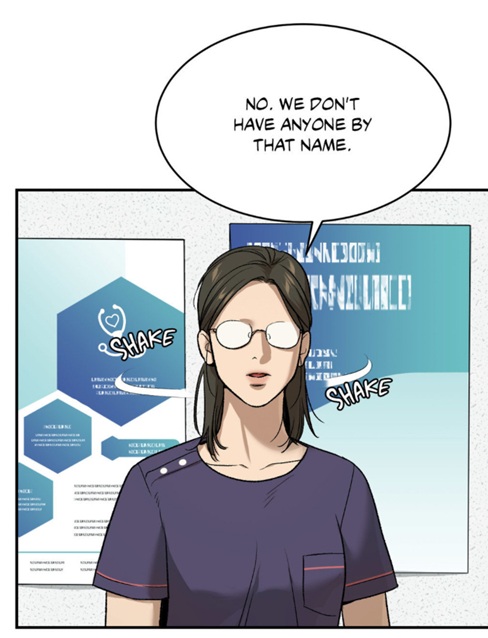 (chapter 56) And there’s no doubt that Joo Jaekyung got recognized by people forcing him to use a mask to hide his identity. So this frenetic search must have reached the mysterious doctor’s ears, but I doubt that he made the connection between the star’s lover and the physical therapist right away. Since he‘s a guest of XY club,
  (Chapter 13), it is also possible that he could have heard about the last incident in the restroom with doc Dan’s replacement. Since Cheolmin found Dan cute, it is very likely that he was also drawn to the surrogate „Dan“. But I don‘t think, this was enough to intervene, as Joo Jaekyung didn‘t ask for his help.
However, this must have changed, when Cheolmin came across the photograph and recognized Kim Dan, his prior connection to both men could have inspired him to act. Moreover, since he had examined Kim Dan before, as a detailed -oriented physician, he could have detected the pale face of Kim Dan. (Chapter 59) Moreover, if he talked with the green-haired nurse, he could have heard about his unusual tiredness and spacing out. This would reflect the theme of fate weaving unlikely connections into the narrative. Cheolmin’s invisible intervention would also underscore the contrast between those who act out of genuine care and those who avoid involvement due to fear or inaction. However, since the champion came at the right time, it is likely that Joo Jaekyung will feel deeply grateful to the person who informed him. This gratitude may pave the way for Joo Jaekyung to trust others more fully and recognize the value of relying on others’ judgment.
Finally, I would like to remind my readers about my previous portrait of the mysterious doctor Cheolmin: I compared him to an archangel  and to Neptune
  and strangely, the doctor moved to a place next to the coast. So maybe Cheolmin comes from that little town and the green-haired nurse is his relative. I had already outlined their similarities. Finally, look at the numbers, we have 4 in both episodes, 13 and 59 (13: 1+3 = 4 / 59: 5-9= -4) The -4 would coincide with Kim Dan’s vanishing, but also with the intervention of Cheolmin. And if my theory is correct, this means that the champion will come to regret his past decision (chapter 13), not to listen to his true friend, the one who was not called (chapter 56), but who reached to him, when Joo Jaekyung needed assistance the most. He was the only one who was accepting the fighter’s struggling, whereas Park Namwook chose to bury the truth.
The two significant photographs in Jinx—one of Kim Dan and his grandmother 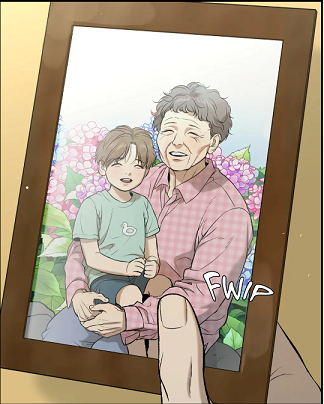 (Chapter 19) and the group photograph at the hospice
(chapter 59) (Chapter 59)—serve as visual metaphors for Kim Dan’s emotional state and his evolving journey. However, their contrast is best understood through an analysis of key aspects: location, subjects, feelings, and the importance of memory.
Location: The first photograph, taken in a garden filled with vibrant flowers, symbolizes life and nature. This imagery conveys warmth and innocence, yet in reality, it reflects ephemerality and death due to the flowers. Moreover, it is ironically undercut by the secrecy surrounding the picture, as it was hidden from view. That’s why the readers can not identify the location and occasion for this image too. In contrast, the hospice setting of the second photograph can be more easily identified and located. In addition, it represents a more clinical and structured environment. On the other hand, it contains a common denominator with the first image: death and temporality. This means that The “Light of Hope” sign in the background casts a dual shadow. On the one hand, it signifies the grandmother’s oppressive influence but also hints at the possibility of healing and reconnection. Someone else will take over her place.
Subjects: The first photograph features only Kim Dan and his grandmother, emphasizing their private and familial bond. This simplicity, however, underscores Kim Dan’s isolation and dependency on a single flawed relationship. The group photograph, on the other hand, is crowded with people: nurses, hospice staff, and celebrities. The collective setting reflects a growing sense of community, albeit one where Kim Dan remains on the periphery. His inclusion in this photograph marks the beginning of a tentative integration into a broader social circle.
Feelings of Kim Dan: In the first photograph, Kim Dan’s childlike happiness is genuine, hence I am suspecting that the halmoni’s smile was not sincere. How so? It is because in the hospice photograph, Kim Dan’s outward expressions appear subdued, reflecting discomfort and reluctance. Everyone is happy except him, but no one noticed it. Hence I believe that in the first picture, Kim Dan has been idealizing his grandmother’s happiness. However, since he is now struggling, I see this new picture as a good sign. This juxtaposition highlights his transition from stagnation and idealization to a fragile but growing acceptance of connection and support.
Importance of Memory: The childhood photograph was hidden, suggesting that it served more as a relic of the past than a tool for connection. For Kim Dan, it embodied a memory of his grandmother’s love, but for her, it likely held no such significance—highlighting her emotional distance. In contrast, the hospice photograph, initially intended as a lighthearted memento, became a pivotal clue in reuniting Kim Dan with Joo Jaekyung. Its transformation from public to private use underscores the power of shared memories in forging connections. Furthermore, since the second picture announces the future reunion of the protagonists, I am connecting the first picture to a future „separation“. On the other hand, the second image was taken just before they departed, so both photographs are linked to separation and departure.
Photographer’s Identity: The identity of the photographer adds another layer of contrast. The hospice photograph was taken by Heesung’s manager, someone connected to work and external responsibilities. In contrast, the photographer of the childhood image remains unknown, shrouding the moment in secrecy. This anonymity, combined with the hidden nature of the photograph, reinforces its association with private pain and toxic positivity. Both images carry “ghosts”—the grandmother’s influence and the silent presence of the anonymous photographer—highlighting the themes of temporality and loss in Kim Dan’s journey.
Through these comparisons, it becomes evident that the first photograph symbolizes stagnation, secrecy, and unspoken pain, while the second reflects progression, albeit hesitant, toward community and healing. These images serve as mirrors of Kim Dan’s journey, reinforcing Mingwa’s use of visual storytelling to depict the interplay of isolation, connection, and fate. This comparison serves another purpose as well. Keep in mind that the one who desired to have a private picture was Potato (chapter), he wanted to have a good memory of his stay there with Heesung and Potato. However, this is how it looked like in the end: (chapter 59) It became the synonym for “work” and “fame”. So should the news about Kim Dan’s action reach Potato’s ears, he can only get shocked. What he thought to be a happy memory, was not, because he was unable to detect his friend’s suffering. He was not a true friend. As you can see, I have the feeling that this image will drive an edge between the second couple in the end. Let’s not forget that the actor is now using friendship and work to hide his true relationship with Yoon-Gu. So far, he has not been honest to the chow chow. He used his innocence to his advantage. However, the doctor’s attempted suicide announces the loss of Potato’s real innocence.
Through the photograph and the green-haired nurse’s inadvertent intervention, Joo Jaekyung was led to Kim Dan. The story’s thematic underpinnings—fate, connection, and the contrast between isolation and community—culminate in this reunion. Joo Jaekyung’s journey was not simply guided by one person but by many, each playing a small but significant role in weaving the threads of fate. If Potato had not asked for the photograph, if the nurses had not encouraged its capture, or if someone like Cheolmin had not acted upon it, the outcome could have been vastly different. These small moments of intervention underscore the story’s larger theme: the quiet power of collective action. However, keep in mind that Kim Dan met the actor and the „puppy“ by coincidence. So in their meeting, fate still played a role: the beach. As you already know, my theory is that Joo Jaekyung recognized Kim Dan‘s back from the road, as the latter is higher than the beach. And where did the nurses asked for the picture with Heesung? (Chapter 59) They were standing on the road. On his way to the hospice, he arrived by the coast, from there he could see the ocean. Nature (sea) brought them together, just like the dog Boksoon let Kim Dan reunite with his friends.
Interestingly, (chapter 59) Kim Dan’s ocean scene—a night devoid of moonlight—symbolized his emotional turmoil and loss in the darkness which marks the end of the grandmother‘s power over her grandson‘s life. By contrast, Joo Jaekyung’s intervention represents the light of hope rekindled (chapter 59), offering Kim Dan a chance for healing and reconnection. He embraces him, something his grandmother has not been able to provide lately, Through this journey, Joo Jaekyung also learns to trust others and realize that self-reliance, bolstered by money alone, is insufficient. His disillusionment with Park Namwook, who failed to act on his requests, should further cement this realization. Gradually, Joo Jaekyung comes to value genuine support and collaborative effort, paving the way for both his and Kim Dan’s growth.
This narrative progression, captured through time, characters, and symbolism, ultimately reveals that Joo Jaekyung’s journey to finding Kim Dan was not simply one of chance. It was a testament to the interconnectedness of lives and the quiet power of actions—a snapshot of fate’s many hands.
Feel free to comment. If you have any suggestion for topics or manhwas, feel free to ask. If you enjoyed reading it, retweet it or push the button like. My Reddit-Instagram-Tumblr-Twitter account is: @bebebisous33. Thanks for reading and for the support, particularly, I would like to thank all the new followers and people recommending my blog.

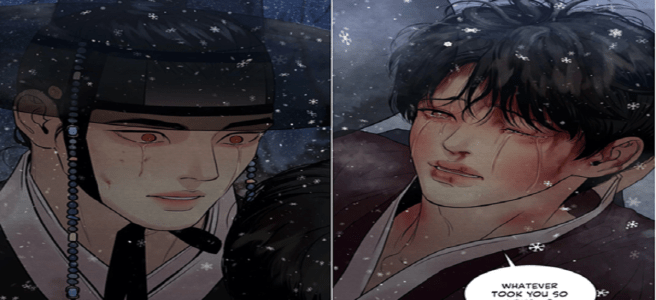

This is where you can read the manhwa. https://www.lezhinus.com/en/comic/painter But be aware that this manhwa is a mature Yaoi, which means, it is about homosexuality with explicit scenes. If you want to read more essays, here is the link to the table of contents: https://bebebisous33analyses.wordpress.com/2020/07/04/table-of-contents-painter-of-the-night/
It would be great if you could make some donations/sponsoring: Ko-fi.com/bebebisous33 That way, you can support me with “coffee” so that I have the energy to keep examining manhwas. Besides, I need to cover up the expenses for this blog.
This won’t be a long analysis compared to “Conscious versus unconscious” but I felt the need to examine the scenes from the first chapter, after I made this discovery while analyzing the chapter 54: Yoon Seungho’s hands and feet are under the control of his unconscious, while his mouth speaks for the mind representing the conscious. Under this interpretation, certain scenes from the first season have now another significance. This helps us to understand why the lord had his mood swings. This proves that the lord was never an unsensitive character, in reality quite the opposite. There is a fire burning inside his body, a metaphor for the intensity of his feelings and the moment he gets wounded, he literally explodes. There’s anger mixed with pain. 
However since his mind chose to live as a spirit, he could only repress any feeling. This explicates why due to the power of his repressed emotions, he could only get blinded by his rage and heartache, the moment they came to the surface due to a wound. As you can imagine, it is impossible for me to study all the scenes from the first season therefore I decided to pick the ones from the first chapter as an illustration. Consequently, when you read the manhwa from the start again, pay attention to the hands, the feet and the mouth because their actions mirror the inner conflict of this traumatized man and his growing desires for Baek Na-Kyum.
Let’s start with the first scene. What caught my attention is the noble is cleaning his sword while menacing in front of the servant that someone could die. Since the lord speaks about a bloodbath in a calm manner, he appears cold and even heartless. The cause for his lack of sensibility is that his mouth is controlled by his mind and the latter is denying the existence of any emotion. Striking is that his hands are busy as they are focused on wiping the sword. I perceive a contrast between the tranquility coming from the mouth and the activity of the hands. This scene already implies the first inner conflict between the conscious and unconscious. Notice that he is neither smoking nor drinking so that his feelings are not numb. The movement of his hands displays a certain edginess. With this first introduction, Yoon Seungho appears bloodthirsty due to the association of the blood and the sword. However, if you look again at the scene, you’ll notice that he only threatens, after hearing that the painter is no longer working. So the trigger for his menace is the fear that his wish to get new erotic paintings might not be granted. He denies that this news should concern him, yet right after he comes up with this thread. Someone could die. The contradiction between the hands and the mouth and even the disparity between “that’s nothing to concern myself” and “surely he won’t insist on it once he sees some blood” actually betray the aristocrat’s eagerness to have the artist by his side. He wants Baek Na-Kyum to paint for him. In other words, right from the start the noble felt the need to have the painter and his unconscious through the hands revealed his true emotions. However, in this scene he has never seen Baek Na-Kyum. He has no idea how he looks like but through the paintings, his unconscious had been triggered. The erotic images had aroused emotions in him.
And notice that when his servant has finally discovered Baek Na-Kyum’s real identity, the lord can’t wait to meet the artist. He follows the domestic to the tavern. As a powerful aristocrat, he could have sent his valet Kim in order to hire Baek Na-Kyum personally. No, he didn’t… his feet under the influence of his unconscious exposes his real desire and his dependency. He must see the painter himself and have him no matter what.
In the beginning of their first encounter, the lord shows a detached attitude. His face is expressionless, until the painter acquiesces about his identity.  From that moment, the lord’s visage changes. There is a huge smile on his face and grabs his hands with such a speed and strength that Baek Na-Kyum is unable to resist.
 The lord is not even aware that he has dropped his mask of indifference. His eyes are shining, his mouth is even smiling. Striking is that the mouth lets even transpire a lot of affection: “very much enjoy”, “my boy”. His actions contrast so much to the first scene. In my first analysis of the first episode, I had compared him to a fan meeting his idol. However, from my point of view, his emotions are actually much stronger than I had envisioned. The mouth is not under the control of the mind, the conscious. Why such a reaction? It is because the painter has just spoken to him. Therefore I come to the observation that right from the start, the artist’s mouth plays a huge role in their relationship. Baek Na-Kyum’s mouth is the trigger for the unconscious to reveal itself. However, at no instant, Yoon Seungho realizes the contradiction between his body and his mind. He is so happy to meet the painter he admired so much, because he felt a connection through the creations. It’s as if his unconscious had sensed the power of the artist’s emotions (love, warmth) behind his pictures. The unconscious through the eyes recognized the sensitivity in Baek Na-Kyum’s works. For me, the lord had already fallen in love with Baek Na-Kyum, even before he met him for the first time. Yet, I believe, the moment he sees his face and hears his voice, his feelings become even more intense to the point he already has an erection.
 His body, led by his unconscious, is attracted by the low-born. Interesting is that at no time, Baek Na-Kyum’s status as a low-born is relevant. The noble feels the need to touch his hands, even treasures them. He allows the artist’s hands to touch his loins. There is such a closeness exposing the noble’s desire: his body wishes intimacy, yet his mouth is still fighting the urges expressed by the unconscious. That’s why he keeps talking about the paintings and the effect they had on him.
  Why do I think that the powerful protagonist is so fascinated by the painter’s mouth and the latter serves as a trigger for his unconscious to reveal itself? Let’s not forget that I wrote that the low-born’s face serves as a mirror to the lord. His face symbolizes the mirror of the truth. Since the aristocrat’s mouth is under the power of his conscious, his mouth is never allowed to speak the truth. Due to his philosophy to live as a spirit and to never feel any emotion, the lord forced himself to use his mouth to disguise himself and to never let transpire any emotion: only rationality and coldness. Therefore his mouth is never honest in reality. Not only it lies to others but also to the main lead himself. The mind through the mouth is ruling his life, telling him and others that he is cold, distant and even heartless. However, deep down his unconscious wishes honesty and genuineness. In reality, Seungho is a very passionate person.
Striking is that the moment, the painter denies that he’s the author of the erotic paintings  the lord’s face slowly gets frigid and the smile vanishes gradually.
  For me, the lie triggered the return of his mask. Look at his faze: it was as if it was paralyzed. The conscious takes over the control of the lord’s face. He is disguising his emotions. He is deeply hurt. His feelings have been rejected, since the painter told him that he wasn’t the person he had been looking for. The conscious might control the face and the mouth for an instant, yet his hands are under the power of his unconscious. That’s why he grabs the sword so quickly.
  The manhwalovers only witness the sword leaving its protection outlining the rapidity of his hand. This gesture displays the anger he is hiding behind his frozen face. From my perspective, his hands and his feet are expressing what he is feeling inside. There is this rage and pain for being pushed away. He’s already the vengeful spirit, his unconscious feels the need to vent his inner emotions. However, since I observed the return of the lord’s mind, we have to imagine that the main lead has the impression, he is making decisions rationally. He is just following what he said the night before. If his wish is not granted, then someone has to pay. I believe, the speed of his hands and feet indicate that the latter are actually influenced by his unconscious, the lord can’t detect the power of his unconscious as they are actually obeying the order of his mind: someone needs to die. And note that soon after he rushes to the servant’s side.
  It was as if he was flying towards him, his feet are rushing demonstrating the intensity of his inner emotions. The painter’s mouth, which he is already treasuring, wounded his heart so deeply that he feels the need to punish someone but he can’t hurt the artist because he was somehow moved by the painter’s face. His unconscious must have sensed the innocence in the painter’s gaze. Let’s not forget that Baek Na-Kyum is sweating, when he lies to Yoon Seungho. As you can detect, there are many reasons why he didn’t touch the artist in the first place. Yet, since his mouth said that some blood would be spilled, he needs to find another target and that’s the domestic. Furthermore, the unconscious sees no problem with the killing. I would like to remind that the unconscious is something wild and knows no boundary, the emotions unleashed by the unconscious can be very violent. The mind might have decided that he would kill someone if his wish wasn’t granted and the unconscious might have agree to this in order to vent his fury. In other words, the lord’s body might seem now under the control of the mind, yet from my perspective, the lord’s emotions, led by his unconscious, are playing a huge role in this scene as well. Observe that the moment he is about to kill, his gaze is cold and ruthless, but his face seems like frozen.
 For me, he is here wearing his mask again. However, his eyebrows and mouth are betraying him. He has a frowning face.
A frown (also known as a scowl) is a facial expression in which the eyebrows are brought together, and the forehead is wrinkled, usually indicating displeasure, sadness or worry https://en.wikipedia.org/wiki/Frown#:~:text=A%20frown%20(also%20known%20as,less%20often%20confusion%20or%20concentration.
This reveals that the lord’s action to kill the domestic isn’t causing him some pleasure, quite the opposite. He is rather displeased and even a little sad, but he is angry as well, because his hand is the one killing the low-born. For me, this murder can be explained by the pain caused by the painter’s lie and not by his thirst for blood. Yet, he is not in a dissociative state either. This is perceptible, when you contrast this situation with the one in the shaman’s house. 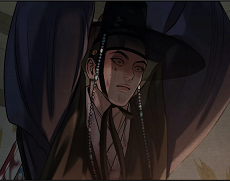 (Chapter 102) (chapter) Here, the gaze is focused. It was, as if he needed to prove to himself and to others, he is not joking. At the same time, his unconscious needs to vent his frustration and agony. However, I believe what we are seeing here is the result of indoctrination and brainwashing. He has been conditioned, as it is his way to cope with his PTSD.
In my opinion, the heartache is the reason why he is so selfish in the first half of the first season. Everything revolves around himself: his desires, his wishes, his pains and his emotions. Due to the Stockholm Syndrome, Yoon Seungho has turned into a blind and self-centered man. He has adopted the principles of his tormentors. Hence, he’s oblivious to anyone around him. Therefore he didn’t pay attention to the painter’s discomfort, while he was touching his hands. Furthermore, I see a confirmation that the aristocrat was acting on his unconscious too, when he eliminates the domestic.  Only after the murder, he sees the painter’s tool, while he explains the reason for his action in a rational and calm manner. My question is: Why didn’t he check out who lied in the first place? Why did he have to kill someone? From my perspective, in this scene, the lord’s heart played a huge part in his behavior. In my opinion, he’s already developed some feelings for the painter, hence he didn’t vent his anger on him. Deep down, he knew that his servant had deceived him, though he couldn’t tell how. He didn’t notice the servant’s discomfort.
  (Chapter 1) Thus he was portrayed with no eyes. Sure, not everything was a lie, yet the commoner mixed a lie with the truth, turning his testimony into a deception. What appeared as trivial was in truth betrayal. What the domestic didn’t know is that the lord hates lies, for they were the reason for his downfall. He needed to hurt someone, because he had been wounded by the painter’s lie. But the latter was just a white lie. So in the picture above, I see the lord’s conscious attempting to justify his action.
  Yet his gaze and smile contradict his mouth right after. There is a glimpse of a smile, his eyes are showing an interest. The idiom “the boy” illustrates a certain closeness. I mean, he could have called him “the low-born” but he didn’t. For me, this picture illustrates the lord’s satisfaction. He has obtained what he wanted: the painter.
Striking is that later at his mansion, the painter lies again. Yet compared to the first deception, the lord’s anger is less violent. He is even caressing the painter with his sword. It looks like the sword would remove the cloth so that he can see the artist’s naked body. The way he uses the weapon exposes that his unconscious doesn’t want to hurt the artist, although he is actually displeased to be lied again. This gesture expresses a certain sexual desire, but the counterpart is not noticing it due to his uncomfortable and frightening situation. That’s why there is no rage unlike at the tavern. The sexual desires have returned. Furthermore, we could say that the main character has got used to or that he is well aware that Baek Na-Kyum has the creator of the erotic paintings by his side. He feels less betrayed.
Observe that during this scene Yoon Seungho can’t stop his hands, therefore he starts getting touchy again.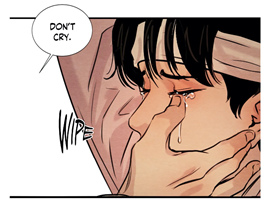 First, he wipes the painter’s tears and later he even grabs his hands again.
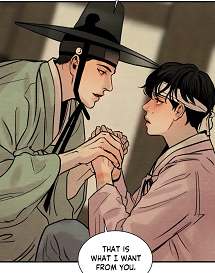 I would even say, the gesture with the sword is another caress showing the power of his emotions. His unconscious feels the urge to touch and caress his face and his hands. Both have already become Yoon Seungho’s weaknesses. Notice that he even lowers himself to the painter twice and gets very close to him.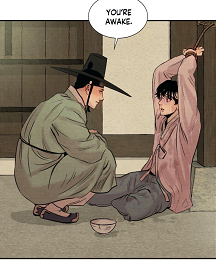
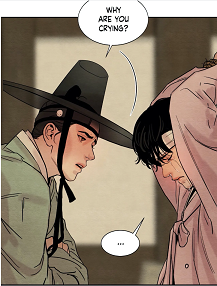 His feet always lead him to the artist’s proximity. He remains by his side, until he is lied a second time. From that moment, he stands up and starts walking revealing a certain uneasiness and edginess. He is troubled and frustrated because he has been indirectly rejected again. Yet, unlike at the tavern, his reaction is less violent and this for two reasons. First, his unconscious is definitely more attracted than before. Secondly, his mind is well aware that the painter is not telling the truth. In other words, his heart and mind are not fighting each other. Their goal is the same, they want to have the painter by their side. Yet the conscious doesn’t realize that behind its decisions, the heart is already influencing his mind. Why does he want the erotic drawings?
The last image where you see the lord weeping his tears is quite interesting, because for the first time, the lord is wondering about the painter’s actions: his lie and his tears. Yoon Seungho is already fascinated by Baek Na-Kyum. Why does he keep lying? Why does he cry? The commoner is quite a puzzle for the noble. His mind doesn’t understand the artist’s behavior. For me, this drawing reveals that Yoon Seungho’s mind has already started thinking about Baek Na-Kyum a lot. Compared to the scene at the tavern, he is less selfish. He pays more attention to the artist’s reaction and words. Everything is pointing out that his mind is already influenced by his heart but the noble hasn’t noticed it yet. That’s why he doesn’t get aware that he is falling in love.
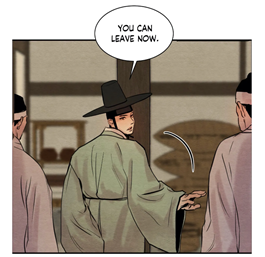 Striking is that he even sent his staff away, creating a certain intimacy. He definitely wants to get close to Baek Na-Kyum physically and mentally. But since he’s just a spirit, he doesn’t notice that his hands and feet have been acting on their own… led by his unconscious.
Yet compared to the chapter 54, the inner conflict between the lord’s unconscious and conscious is less palpable, as the heart and mind are not contradicting each other, since the noble is already rationalizing all his actions and decisions. This is only a matter of time, until his desires for the painter become so unbearable that he starts wooing him. The paintings become more and more just an excuse. I hope, with this essay, you will feel the desire to read the manhwa all over again under these two aspects.
Feel free to comment. If you have any suggestion for topics or manhwas, feel free to ask. If you enjoyed reading it, retweet it or push the button like. My Reddit-Instagram-Tumblr-Twitter account is: @bebebisous33. Thanks for reading and for the support, particularly, I would like to thank all the new followers and people recommending my blog.
 Bebebisous33s' analyses in K-Dramaland and Manhwas