

Please support the authors by reading Manhwas on the official websites. This is where you can read the Manhwa: Jinx But be aware that the Manhwa is a mature Yaoi, which means, it is about homosexuality with explicit scenes. Here is the link of the table of contents about Jinx. Here is the link where you can find the table of contents of analyzed Manhwas. Here are the links, if you are interested in the first work from Mingwa, BJ Alex, and the 2 previous essays about Jinx The Loser’s Mother: Fragments of a Mother and The Birth of The Shotgun – part 1
It would be great if you could make some donations/sponsoring: Ko-fi.com/bebebisous33 That way, you can support me with “coffee” so that I have the energy to keep examining Manhwas. Besides, I need to cover up the expenses for this blog.

For my avid readers, the title and illustration give the impression that I will focus on Joo Jaewoong’s death and its signification in the protagonist’s life. They are not wrong, yet it covers only one aspect of this analysis. Jinx-philes have already sensed that this moment was not only the night that ended a life, but the one that birthed a weight Joo Jaekyung would carry forward: guilt that refused to fade, and a self-loathing that no victory could silence. If these are the roots of the curse, then “Emperor” names the crown — a crown whose origin is far murkier than the public believes. However, people shouldn’t forget that in that moment, the main lead was just a teenager, who belonged to a boxing studio. He was not a MMA fighter, he was not the Emperor either.
Like readers who thought they knew the main lead (a psychopath, a jerk…), fans in Jinx believe they know their idol.  (chapter 26) They have watched his fights
  (chapter 23), memorized his moves and titles, and repeated the anecdotes told in gyms and on TV. They’ve heard how he was “saved” by sports from a darker path, and cheered for him as the “Emperor” — the handsomest fighter, the man who broke the arcade’s punching machine
  (chapter 26), the champion who stands above the rest. But if the champion’s life is already an open book, why did Mingwa wait so long to reveal his childhood and family? The answer is simple. It is because Joo Jaekyung has been called the Emperor till his fight against Baek Junmin! These public portraits — the friendly banter in the gym, the theatrical ring intros — show us the merchandise, not the man. They are the carefully polished surface presented to fans and fellow fighters alike, repeated so often that even those closest to him believe them. Yet behind this image
 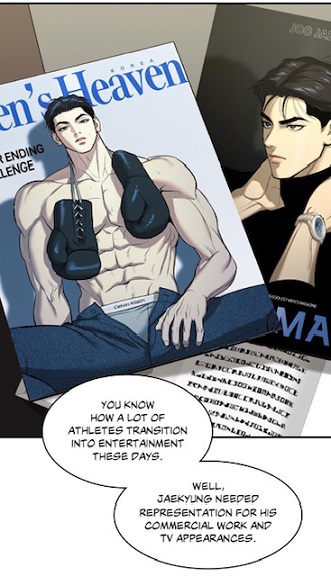 (chapter 30) lies a past left unspoken, a silence so complete that his own history became an empty space others could fill as they wished. This essay brings these two “stories” together — the Emperor and the boy. And now, you may be wondering how I came to connect the champion’s trauma to his future career as an MMA fighter. The answer lies in Joo Jaekyung’s own voice. 😮
The Emperor in The News
When the news broke in chapter 70,  (chapter 70), Hwang Byungchul’s anger fell squarely on the champion.
 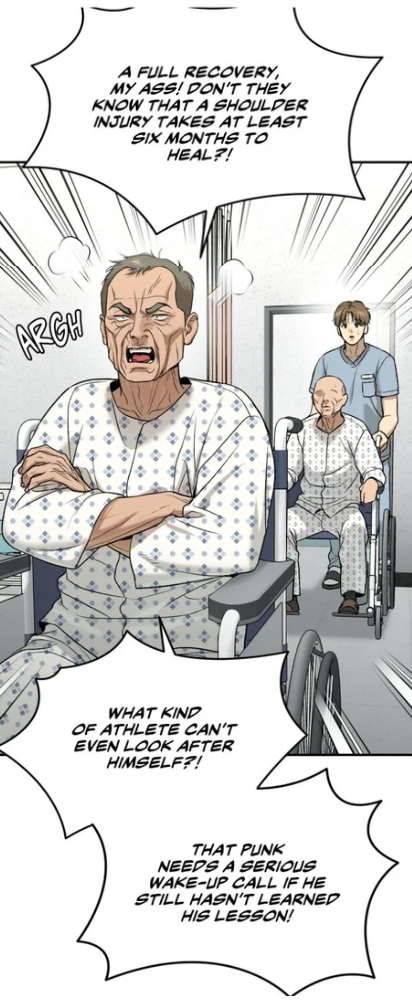 (chapter 70) To him, it looked as though Jaekyung had made the reckless choice to return to the ring so soon. That was the trap: the headline and phrasing were designed to make it appear that the decision was the fighter’s own. The opening line alone
  (Chapter 70) created the illusion that this break had been perceived as a punishment, and that Jaekyung was eager to prove himself once again. No wonder the director assumed he had given his consent.
The visuals reinforced the illusion. The entertainment agency recycled old images not just because they lacked recent photos, but because they wanted to tap into the nostalgia of his earlier popularity, before the match against the Shotgun. It was as if someone wanted to overwrite the present and rewrite his history, packaging him in the glow of past victories. Even within the same news segment, there were two distinct “voices”: the official announcer highlighting his return, and an unseen voice quietly bringing up the suspension again — a reminder meant to frame his comeback as a personal mission rather than a corporate decision. In truth, the match was arranged by “Joo Jaekyung’s team” and MFC — a convenient shield for those actually pulling the strings. (chapter 70) Thus I conclude that the first comment (chapter 70) was to divert attention from the other persons involved in the decision for the next fight.
Notice what the journalist does not say. The CEO’s name is absent. There is no mention of the closed-door meeting between Park Namwook, Jaekyung, and the CEO where the fight was proposed. 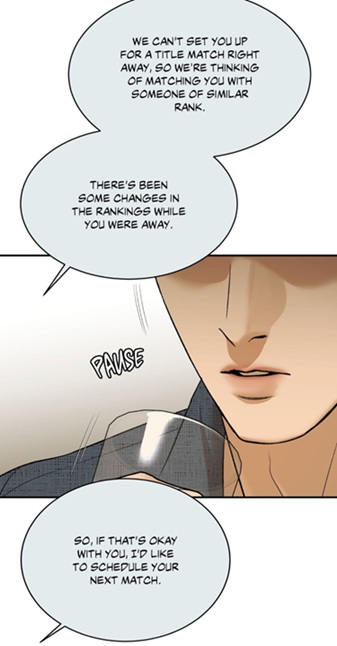 (chapter 69) By erasing these details, the public sees only two players: the Emperor and his anonymous “team.”
 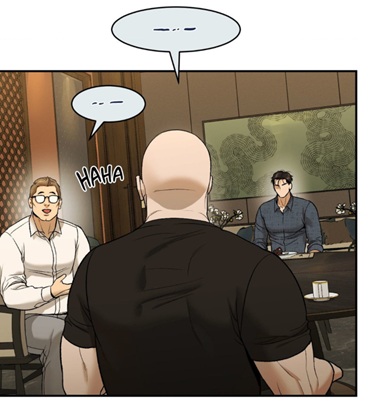 (chapter 69) It was as if the main lead, backed by his team, had personally approached MFC to request the match — an illusion strengthened by the opening line, “MFC’s former champion Joo Jaekyung will be returning to the ring this fall after serving his suspension.” This way, if the decision draws criticism, the CEO can retreat behind the fighter and his team, like they did in the past.
  (Chapter 54) Back then, the champion had not reacted to this comment. Even in the worst case, the CEO can hide behind one of the MFC match managers or doctors.
  (chapter 41) But that excuse would be a fiction: Jaekyung hasn’t even met those doctors or talked to the MFC match manager
  (chapter 05). He has been chasing after his fated partner. Finally, he hasn’t even signed any paper or agreed at the meeting. In fact, he remained silent for the most part of the time and the reason for this urgent meeting was his request for proper investigation concerning the switched spray:
  (chapter 67) That’s the reason why this suggestion from the CEO appeared the very next day.
  (chapter 69)
When the orthopedic surgeon Park Junmin cleared him to remove the cast in chapter 61  (chapter 61), it was paired with a recommendation for rehabilitation — not an immediate return to competition. This was actually a condition for his total recovery. On the other hand, the doctor imagined or suggested that his patient wished to return to the ring so soon. No medical professional ever signed off on an autumn fight. Yet the date is already set, and the headlines frames it as a confident comeback without any medical backup. The Emperor’s name is splashed everywhere, but none of the words belong to him.
And this is not the first time we’ve seen this sleight of hand. Back in chapter 57, a television broadcast featured an “exclusive interview”  (chapter 57) with one of his close associates — a man whose face was hidden, speaking as though he were the athlete’s voice. That interview was accompanied by a familiar victory image
 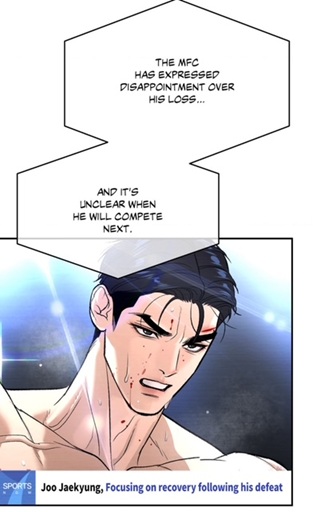 (chapter 57), a stock photo already used in other press pieces. This picture comes from after the fight in the States:
  (chapter 41), while the image released with the fall match announcement was the one from when he first won his champion title. (chapter 70) Since MFC and the journalist are recycling old images, they unwittingly revealed their own deception — dressing up the present in the clothes of the past. LOL!
The message is the same in every case: Jaekyung “speaks,” but only through others. His former stage name mirrored his situation, as he owned the champion belt for quite some time. The title “Emperor” 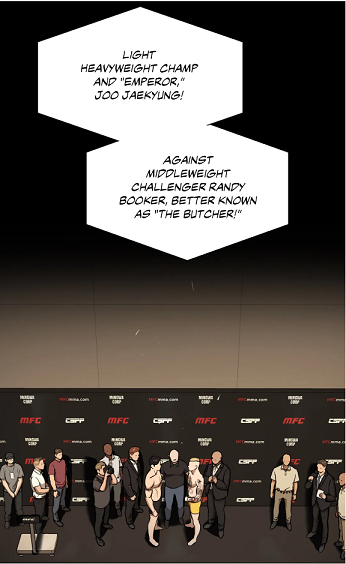 (chapter 14) seems to radiate absolute power — the kind of authority that commands armies, bends laws, and answers to no one. It is meant to ooze charisma and control, a name that suggests the bearer acts on his own will. Yet, in truth, emperors have rarely ruled alone. Behind every throne stand ministers, advisors, generals, and family factions, each shaping decisions from the shadows. An emperor who ignores these forces risks losing his crown.
In Joo Jaekyung’s case, the irony is sharper still. Far from being the all-powerful figure his stage name implies, the “Emperor” is a role built and sustained by others — MFC executives, Park Namwook, the entertainment agency — each serving as both his court and his cage. They decide when he fights, how he is presented, and even the tone of the stories told in his name. Once he tried to complain about his tight schedule, this is what he got to hear:  (chapter 17) He was blamed for his popularity. The man inside the crown does not act or speak freely; his words are filtered, scripted, or replaced entirely.
This makes the title “Emperor” less a badge of sovereignty and more a mask for dependence. Like a ruler hemmed in by court protocol and political intrigue, Jaekyung’s every public move is mediated by the hands of others. The grandeur of the title hides the quiet truth: the Emperor is voiceless, and the crown he wears is one that demands obedience rather than granting freedom. That’s his curse. His identity is filtered, packaged, and sold by those who stand in his shadow – so much so that people send him bottles of alcohol because that’s what one offers a champion, 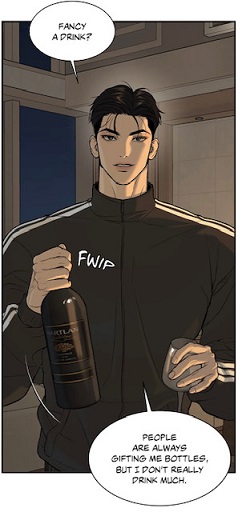 (chapter 12), never mind that he hardly drinks. The gesture fits the fantasy they’ve built around him, not the reality of a man who rejects alcohol due to his addicted father, a reminder that even the tokens of admiration are shaped by the image, not the truth. So who is this so-called close associate or “Joo Jaekyung’s team” exactly that decides for him, speaks for him, and hides behind his title? Besides, why did the journalist change from “one of his close associates” to “Joo Jaekyung’s team”?
The Voice Behind the Crown
In chapter 57, the television broadcast introduced “one of his close associates” — (chapter 57) a figure whose face and name were hidden, speaking on behalf of the Emperor. In the essay Craving Mama’s Shine – part 1 (locked) I had presented different possibilities about the identity of this “close associate”. But with the new announcement, it becomes clear that figure can only be Park Namwook. He is the only one who arranged the meeting between the CEO and Joo Jaekyung. The anonymity was not a courtesy; it was a shield. By keeping his face and identity off the record, he could shape the narrative without owning it, avoiding any direct responsibility for the words attributed to him. Yet the choice of “close associate” was deliberate — it positioned him as the man closest to Jaekyung, someone with privileged access and authority to speak for him. It was a claim of proximity and influence, the sort of title that sells the image of a trusted confidant, even as it erases the fighter’s own voice.
The broadcast itself set the tone even before his segment began. Just prior to the “interview,” the anchor announced:  (chapter 57) The nickname, played for entertainment value, was another way of turning the champion into a caricature — a marketable, amusing persona instead of a man with a past and agency. It is quite telling that Park Namwook’s interview aired immediately after the anchor referred to Jaekyung as “Mama Joo Jaekyung Fighter.” This was not the lofty “Emperor” title repeated in gyms and ring intros — it was more a mocking nickname, a deliberate jab meant to provoke. In that moment, the Emperor was verbally pulled down from his pedestal, yet the images shown alongside the segment told a different story: carefully chosen shots of him as a champion, a visual echo of his marketable persona. The dissonance was striking.
Equally telling is that the “Emperor” title had already vanished from the conversation. Its disappearance suggests that Jaekyung was never the one who chose it — it was a label assigned to him by others, to be used or dropped at their convenience. Park Namwook made no attempt to restore it or defend his fighter’s dignity, like mentioning the drug incident in the States or the spray incident in Seoul. The cause for his “silence” is simple: he doesn’t want to admit his failures and responsibility. He prefers the champion taking the blame. Hence this interview was not brought up by the manager:  . (chapter 54) In my opinion, the man is trying to return to the past, thinking that his “popularity” can come back, not realizing that he is being manipulated himself. On the contrary, he stepped into the role of spokesperson without hesitation, speaking as if he were Jaekyung’s voice while keeping his own face and name hidden. He only speaks, when he feels safe. He can not be responsible for the champion’s recovery. (chapter 57) The message was clear: he had no issue with his fighter being framed this way (“Mama Fighter Joo Jaekyung”), so long as the interview served its purpose. Park Namwook may not be a cynical manipulator, but his silence in the face of mockery speaks volumes. In his mind, any coverage is better than none; to vanish from the public eye is worse than being nicknamed “Mama Fighter.” By stepping into the media slot, he believes he’s keeping Jaekyung alive in the public consciousness. Yet in doing so, he stands shoulder to shoulder with another, unseen voice — the one that coined the nickname in the first place. In both chapter 57 and chapter 70, this pairing repeats itself: Namwook’s loyalty becomes indistinguishable from complicity. Whether he realizes it or not, he’s lending his presence to a narrative that diminishes the man he claims to represent.
By chapter 70, the personal title “close associate” had shifted to the more generic “Joo Jaekyung’s team.” On the surface, the word “team” suggests equity, collaboration, and shared responsibility. But in Park Namwook’s vocabulary, “team” has never meant equality. His idea of a team mirrors the hierarchy he operates in — a boss who directs, and subordinates who follow without question, like we could observe at the hospital.  (Chapter 52) This framing lets him claim the prestige of leadership while leaving himself room to withdraw if things go wrong. Yosep was the one notifying MFC and reporting the incident to the police, Potato explaining his discovery to Joo Jaekyung and blaming the star.
And yet, the choice of this term also reveals a subtle shift. By saying “Joo Jaekyung’s team,” he is placing the athlete’s name in front — not his own, not MFC’s. That way, he believes that he can avoid accountability behind the team. However, he is not grasping that gradually, he is stepping down from his self-proclaimed ownership of the gym. Whether intentionally or not, the manager is acknowledging that the gym’s growing identity will eventually crystallize around the fighter himself. The name “Team Black” hasn’t appeared yet, but its logic is already here: a team that exists for the athlete and with the athlete’s consent, not a faceless collective that speaks over him. When that name finally surfaces, it will function as a boundary—an institutional “enough”—marking the end of treating the man like merchandise.
Here, the article “You Don’t Have to Put Up With Everything” offers a revealing lens. The article warns against confusing empathy with passive tolerance. While it’s important to understand that people may have difficult histories or traumas, compassion should not be used as a justification for allowing someone to mistreat or disrespect you. Understanding someone’s struggles does not mean accepting harmful gestures, words, or behaviors. Setting limits is not selfish or arrogant, but an act of self-respect and emotional protection. Boundaries are not rejection — they are self-care, a way to protect one’s well-being without guilt. This is exactly what the manager expected from Kim Dan. 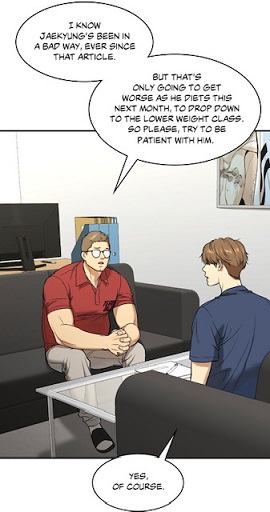 (Chapter 36) He should tolerate the celebrity’s moods and put up with everything. The manager didn’t mind, as long as he didn’t get affected. But what is the consequence of such a passive tolerance? An individual’s self-esteem can slowly erode, leading to a gradual loss of their sense of self. They may stop recognizing their own desires, needs, and rights, often without even realizing this is happening. This is because emotional exhaustion often develops subtly over time, rather than appearing as a sudden, dramatic event.
Thus, what begins with a hurtful remark can end in emotional blackmail. What was once a pointed criticism turns into contempt. And you, who at first knew what you wouldn’t tolerate, end up justifying the unjustifiable, in the name of empathy or the fear of loneliness. The result is a slow erosion of your self-esteem. You gradually disappear, ceasing to recognize your desires, needs, and rights. And the worst part is that you don’t even realize it. Because often, emotional exhaustion doesn’t come as an explosion, but rather as a steady trickle. Quoted from https://psychology-spot.com/you-do-not-have-to-put-up-wiht-everything/
As you can see, it can lead to depression. That has been Jaekyung’s position for years as well— enduring decisions made without his real consent, swallowing public criticism and badmouthing, and staying silent 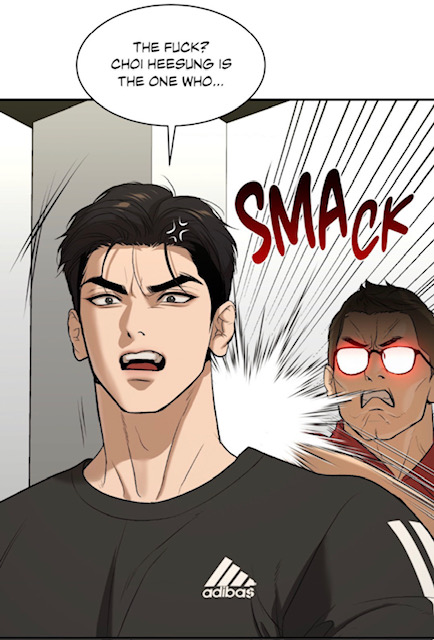 (chapter 31) when punished. In this light, Park Namwook embodies the very dynamic the article warns against: a figure who benefits from another’s compliance, maintaining control not through open dialogue, but through unspoken rules and the threat of exclusion.
The First Curse of the Manufactured Emperor
And now, you may be wondering why I am focusing so much on the absence of voice from Joo Jaekyung — the Emperor and the man. It is because he has been used as a tool, more precisely as an ATM machine for MFC. According to the teacher in Jinx 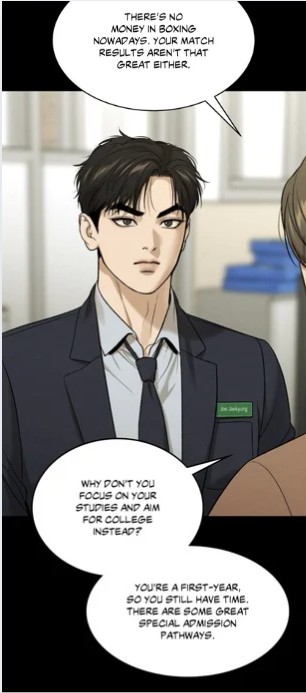 (chapter 73), by becoming a boxer, the champion wouldn’t make a lot of money. With this comment, he implied that boxing in South Korea had been losing popularity 10 years ago. This explicates why gradually, the members from Hwang Byungchul left the studio. And it was likely the same in the illegal fighting circuit.
  (chapter 73) The popularity of MMA in the States gave them the opportunity to revive fighting sports, a figure who could draw crowds and sponsors, making such events fashionable again.
For me, the Emperor was created for that reason. His public image was rewritten — he was called a “genius” 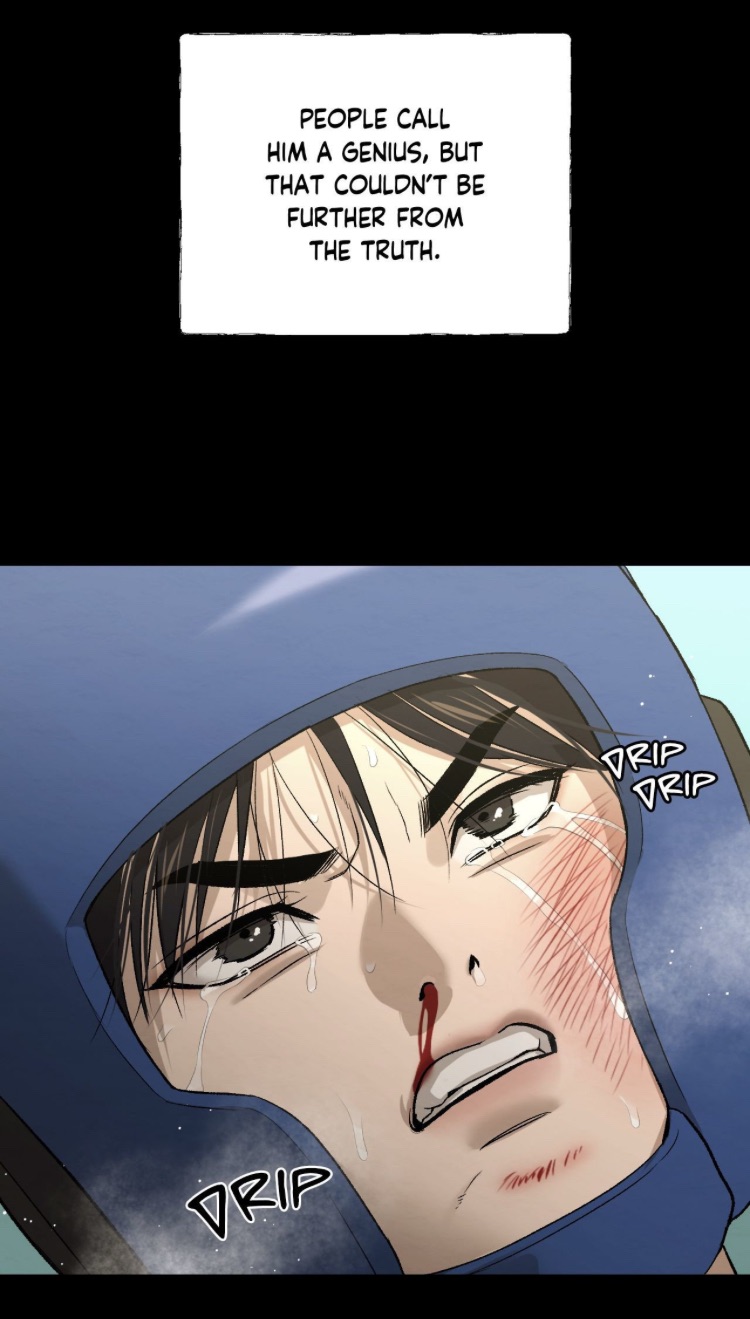 (chapter 72) instead of “hard-working,” a man who “chose sports over a dark path.” Yet if you look closely, this celebrated “ascension”
 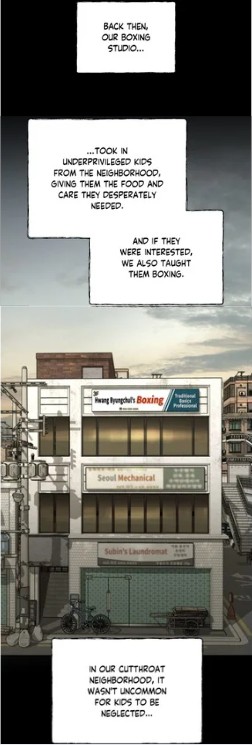 (chapter 72) isn’t tied to the director’s boxing studio at all — it’s linked to the arcade’s punching machine incident. (chapter 26) This moment, trivial in reality, became the origin story of the Emperor, as though the broken machines had revealed a prodigy destined for greatness. That’s the reason the star rejects this intro. In fact, this incident contributed to create the champion as a spoiled brat. In truth, the director had suggested that Jaekyung enter the sport professionally so that he could feed himself, but his reasoning had nothing to do with arcade games or instant legend. That pragmatic nudge was later overwritten with a glamorous tale that erased the long hours in a run-down boxing studio
  (chapter 72), the scars of his family history, and the years of survival before the cage. This is history rewritten, his boxing past and family erased. Why? His origins could expose the ugly verity: the link between criminality and boxing (as such fighting sports). Secondly, because his real story, though moving, lacked the glamorous allure needed to market him. His real story would have revealed that to rise to the top, you need relentless work, not a miraculous moment. That version was never going to sell as well as the “genius” myth.
With his success, his “gym” soon attracted members from different martial arts — judo, jiu-jitsu — all chasing the dream of becoming rich and famous like him. 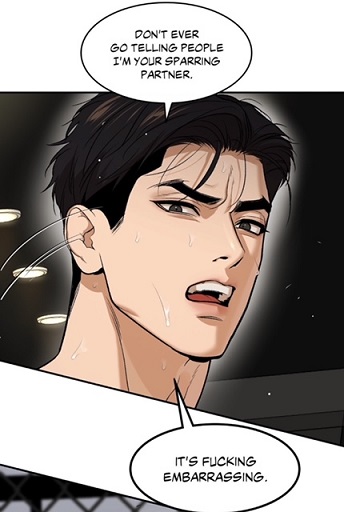 (chapter 46) Most of them thought that by staying close to him, they could benefit from his popularity. To conclude, for many of them proximity to the Emperor wasn’t about learning discipline or technique; it was about absorbing his fame by osmosis. Hence they complained and accepted the gifts and money so easily.
 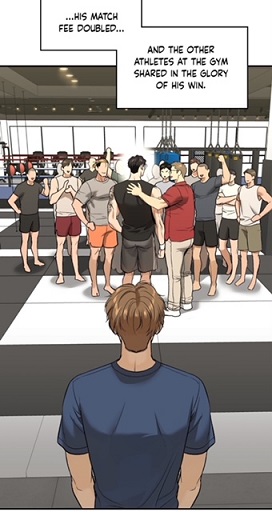 (chapter 41) Observe how the manager is acting here. He is speaking, touching the star like his prize and possession. The Emperor became the merchandise, the illusion, the bait to draw both viewers and fighters. However, being “labeled as genius” can only push desperate fighters to take a short-cut: bribes and drugs. Hence Seonho couldn’t last a whole round.
  (chapter 46) And, like any product, once it was seen as damaged, its value plummeted. The moment he “lost” his title and suffered injury (chapter 52), the dream began to unravel.
  (chapter 52) This panel captures this shift perfectly: two fighters casually dismiss him over dinner. In those words, the Emperor isn’t a mentor, a champion, or even a man — he’s a broken commodity, no longer worth the investment. The same people who once fed off his popularity are the first to abandon him when the promise of easy gain disappears.
This served more than publicity. Through him, they could obscure their crimes and build a parallel market in the underground fighting world. And here, the lesson from “You Don’t Have to Put Up With Everything” becomes vital: understanding Jaekyung’s difficult past or the pressures on the industry should not excuse the way his dignity and history have been trampled. His compassion for the system that raised him has been turned into passive tolerance — exactly the dynamic the article warns against.
And now, you see why I chose to postpone the second part of The Birth of the Shotgun. Without Baek Junmin — his shadow in the ring — Joo Jaekyung would never have been made to shine so brightly. No wonder why he was so jealous. He believed that his victories were rigged too.
Yet the irony is that Park Namwook is no mastermind. As we’ve seen time and again, he follows the lead of others — the CEO, the entertainment agency, perhaps even unseen backers — rather than setting the agenda himself. He is the mouthpiece, not the brain. The “close associate” title flattered him with the appearance of authority; the “team” label protects him when that authority becomes risky. Both are masks, worn depending on the circumstances, to keep himself valuable to the system. On the other hand, he is gradually revealing his real position: he is not the owner of the gym!  (chapter 22) He is even disposable. He is gradually giving more rights to his “boy”, the real director of Team Black. And the moment you perceive the manager as the main lead’s voice, you can grasp the true significance of the slap at the hospital:
 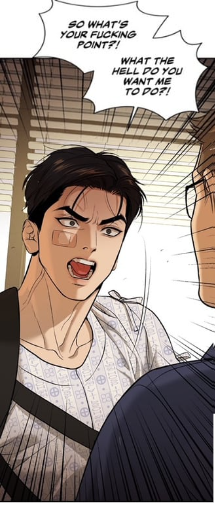 (chapter 52) For the first time, the main lead had voiced his own thoughts and emotions. He had used his real “voice”, revealed his unwell-being:
  (chapter 52) To this outburst, Park Namwook slapped Jaekyung in front of others (chapter 52).
  (chapter 52) That was not the act of a coach correcting an athlete — it was the gesture of an owner disciplining a pet or a possession, a reminder of who controlled the narrative. In that moment, the Emperor did not protest.
 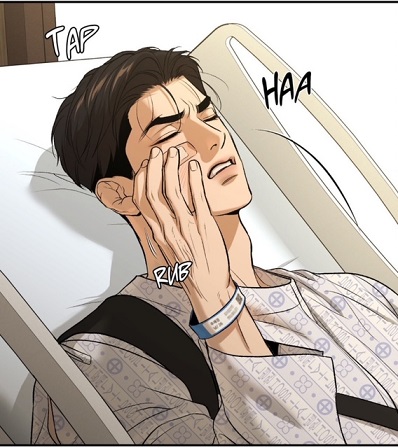 (chapter 52) He chose silence, and later avoidance, staying away from the gym. That silence was not weakness, but choice: he would listen less and less to his hyung.
From then on, the champion’s public image — whether filtered through the “close associate” or the “team” — was not his own. Park Namwook treated him less like an athlete 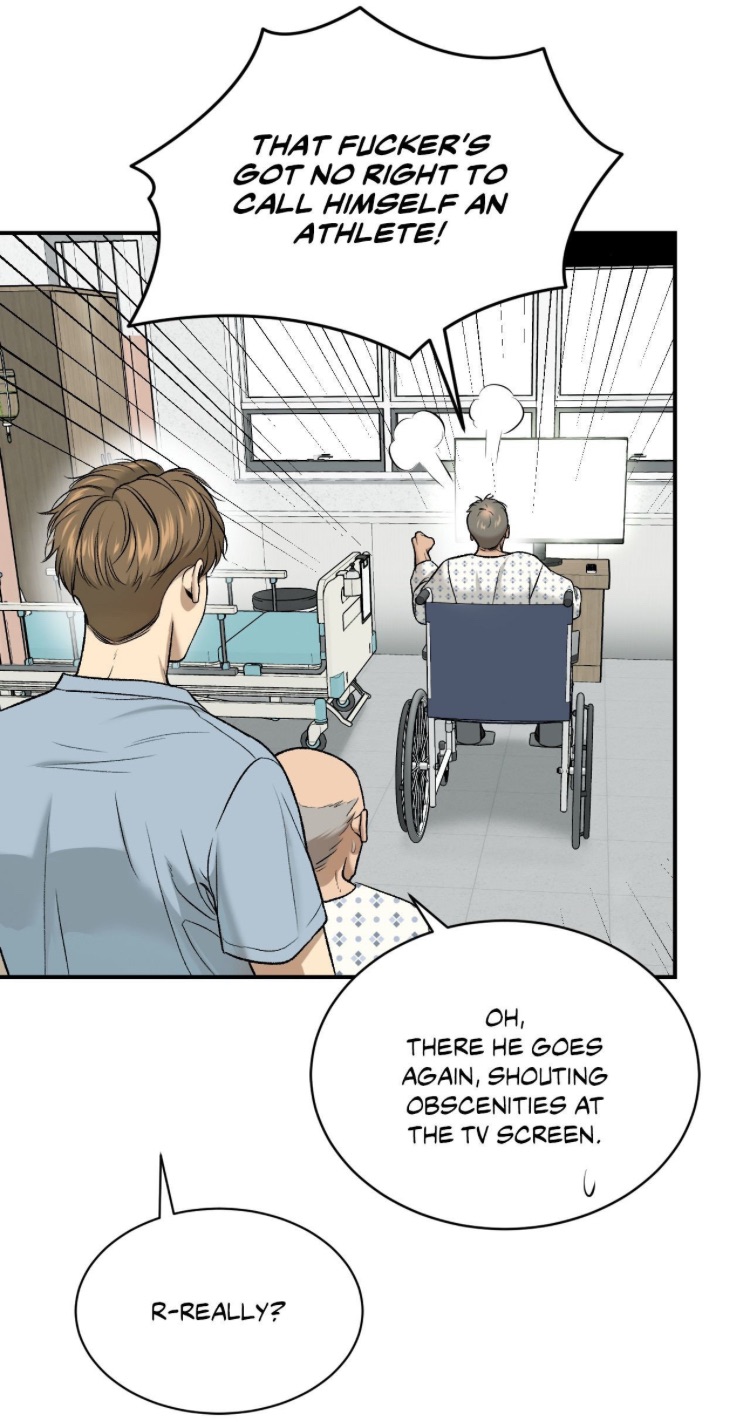 (chapter 70) and more like a product: something to be displayed, sold, and, when necessary, handled roughly to keep in line. The shift in labels is just another layer of that merchandising process — a packaging change to suit the current market, not a recognition of the man inside. To conclude, the champion has always been voiceless all this time, even here:
 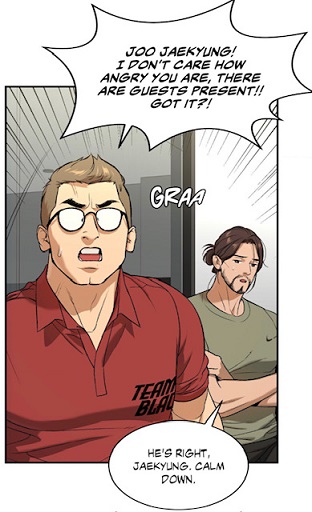 (chapter 36) All he needed to do was to fight:
 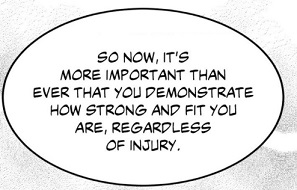 (chapter 36)
And yet, if you compare the Emperor in the present with the teenager in the past, you’ll see a stark reversal. The Joo Jaekyung of today has his voice mediated, silenced, or replaced by others; the boy of yesterday dared to speak for himself. In the confrontation with his father, he voiced his own desires and defiance directly  (chapter 73) — unfiltered, unmarketed, unprotected. It was raw, dangerous honesty, and it came at a cost: the loss of his voice!
The Night That Stole His Voice
If you compare the Emperor to the boy he once was, the contrast is striking. As a teenager confronting his father, Joo Jaekyung still voiced his own desires.  (chapter 73) Six years earlier, however, his voice had already been battered by silence. After his mother’s abandonment at age six, the only connection he retained with her was a phone number —
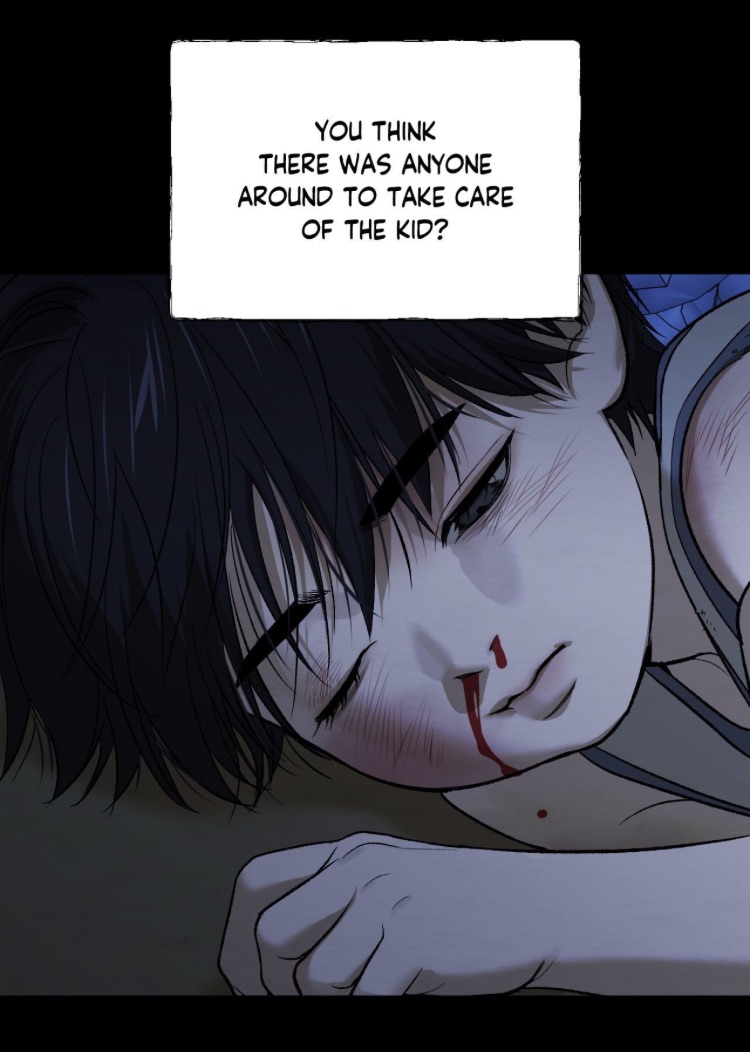
 (chapter 72) We don’t know how many times he called, but each time we see him do it, his face is injured.
  (chapter 72) The phone calls are therefore intertwined with the boxing studio, as though pain itself pushed him toward her. At ten, he picked up the receiver and let it ring only a few times before hanging up. The next time, in the dead of winter, he finally spoke, promising that if she returned, he would protect her from his father and make enough money to keep her safe.
  (chapter 72) Each time what answered him was not her voice, but a machine: “ (chapter 72) His words met a recording, his promise suspended in a vacuum. Whether she listened to his words or not, the outcome was the same — she never came back. No reply, no echo. Her silence told him the truth: his wish would never be heard. From that point on, she vanished not only from his life but from his speech; he no longer mentioned her. That silence became his default — speaking desires aloud was pointless if no one would answer.
By the time of the morning argument with his father at sixteen, we can conclude that the nightly calls had long stopped. The boy had given up on being heard. (chapter 73) Six years later, at sixteen, he finally raised his voice again — this time to his father. He wouldn’t give up on boxing. Unlike the mother, the father answered. But his “reply” came in the form of insults, blows, and a dark prophecy: that Jaekyung would never amount to anything, 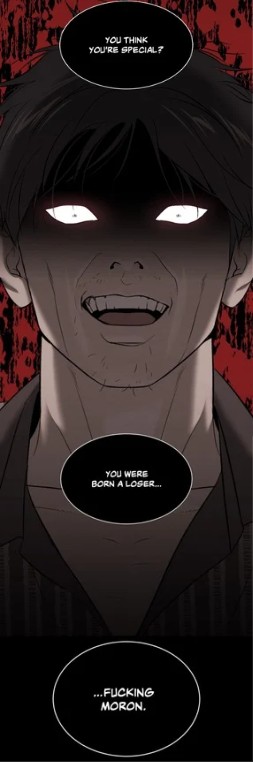 (chapter 73) that he was born a loser, that his dream was a joke. Here, the voice met not silence but resistance, mockery, and humiliation. And unlike with his mother, Jaekyung did not retreat — he cursed back. (chapter 73) He swore he would prove the man wrong, that he would win, and spat the most dangerous line of all: “If I win, you can keel over and die for all I care.” That evening, he saw his father’s corpse —
 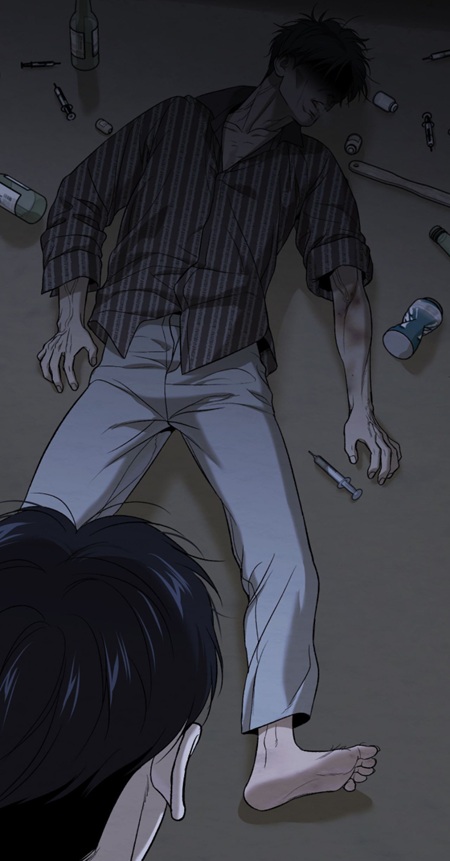 (chapter 73) and with it, another layer of his voice disappeared. He had the impression, he had killed his father. His words had been more dangerous than his punches. Hence he could only come to resent his own voice and words. And now, you comprehend why the Emperor allowed the hyung to become his voice. To conclude, the silence of those nights became the silence of the man. As you can see, the curse did not fall on Joo Jaekyung’s voice in one night — it was built, in stages, over years. But the death of his father linked to the argument represented the final straw that broke the camel’s back.
This is the pivotal difference: with the mother, voicing a wish had no consequence because it dissolved into nothingness. With the father, voicing a wish carried weight — it provoked, it struck back, and, in Jaekyung’s eyes, it cursed. When his father died that same evening, the boy was left to carry the unbearable suspicion that his words had somehow brought it about. That night became the night his voice was poisoned: one parent had taught him that speaking was useless; the other had taught him that speaking could kill. From then on, his voice retreated into the ring, where the only “speaking” he did was with his fists. And now, you comprehend why he is using his sex partners as surrogate fighters, why he treats them as toys.  (chapter 55)
The Birth of the Jinx
The two formative wounds — his mother’s unanswered call and his father’s cursed reply — shaped the way Joo Jaekyung would handle intimacy for years to come. With his mother, speaking led to nothing; his voice dissolved into silence. With his father, speaking led to too much; his words became a curse, followed by guilt and grief. From these experiences, he learned that words in close relationships were unpredictable weapons. They could vanish, leaving him abandoned, or strike deep, leaving him ashamed.
Sex became his remedy to fight against loneliness and his refuge from this danger 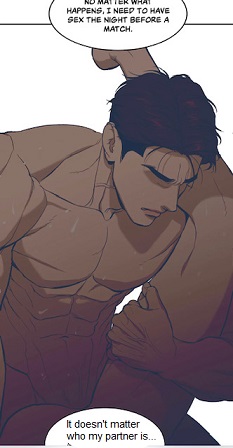 (chapter 2) — a space where he could act without having to speak. In the bedroom, as in the ring, the body could carry the conversation. Here, he could dominate, control, and release tension without the risk of verbal damage. His partners became surrogate opponents: sparring substitutes in a non-lethal match. Treating them as “toys” wasn’t only objectification; it was a form of control that, in his mind, protected both sides. Toys don’t demand answers, don’t talk back, and don’t leave you cursed with regret. They remain safely outside the territory where his voice had once done harm.
But this logic, built to keep others safe from his voice and himself safe from their silence, begins to falter with Kim Dan. The latter embodies not only the mother (abandonment, silence- I believe that he resembles her too) and father (argument, drinking), but also the child. Dan cries, shows his vulnerability and admits his mistakes.  (chapter 1) He embodies innocence and as such lack of experiences. Moreover, he talks, makes suggestions for the champion’s sake
  (chapter 27), spent time with him, asks questions, confronts, and refuses to be reduced to a body in the room. He breaks the rule of silence. With him, Jaekyung can no longer hide behind the physical alone; he is forced to speak, to explain, to voice desires and fears. He pushes Jaekyung to engage in ways he’s spent years avoiding. In this way, Kim Dan becomes the first real threat to the system the champion built after those two curses — and possibly the first person who could prove that words can be safe again. And now, you comprehend why Joo Jaekyung was moved by the birthday card
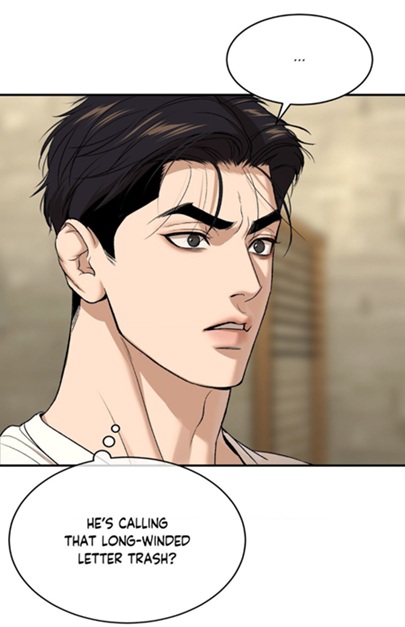 (chapter 62) To most, it might look like a simple gesture, but for him, it was a rare and precious thing — a voice that had taken the time to shape itself into words just for him.
 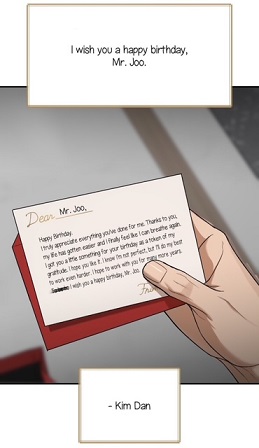 (chapter 55) After years of associating speech with either silence or harm, receiving a long-winded, carefully written message felt almost unreal. He saw the effort behind it, the deliberate choice to put thoughts and emotions into language instead of letting them fade away or turn into weapons. In that card, Kim Dan offered something neither of his parents had managed: a voice that reached him without wounding. No silence, no insult. For the champion, it wasn’t just a card — it was proof that words could be built into a gift, not a curse. The latter expressed his dreams and gratitude. Thus I deduce that the Emperor’s curse will be broken by a spell: words!
 (chapter 55) The “spell” to break it is not some grand external event, but the simple, sustained act of honest communication — something that has been denied to him since childhood.
By linking this to Kim Dan, it becomes obvious that the Emperor’s liberation won’t come from winning another fight or reclaiming a title, but from restoring his own voice in a relationship where speaking is safe, heard, and reciprocated. Boxing was the only language he ever learned from his parents (chapter 72) — a vocabulary of fists, jabs, and physical dominance as a way to earn money and recognition— but with Dan, the champion is slowly acquiring a new language. His hands, once trained only for striking and defending, begin to communicate through gentle gestures: an embrace  (chapter 68), a kiss, a pat, a caress or by simply holding hands
 . In this way, the curse that began when his voice was silenced and his hands were weaponized will only be broken when those same hands learn to speak tenderness. Look how doc Dan reacted to his public embrace:
  (chapter 71) He saw affection in the hug, but he still doubted the champion’s action.
The Prison of the Boy
And now, you are probably wondering why I selected a tree for the background illustration of The Night-Cursed Emperor.  Until now, the design’s images have played a secondary role, yet the answer lies in a single scene from chapter 41.
  (chapter 41) Under the bright sunlight, Kim Dan reached out toward the leaves, his hand open and unguarded, as he silently thought of the man he loved. This gesture, so simple yet so revealing, became the unspoken confession that marked the start of a different kind of freedom—the freedom to feel.
In my earlier analysis Prison of Glass , Key Of Time , I had argued that Joo Jaekyung’s habit of meditating before the expansive glass window in his penthouse was more than a moment of calm — it was a ritual of self-confinement. 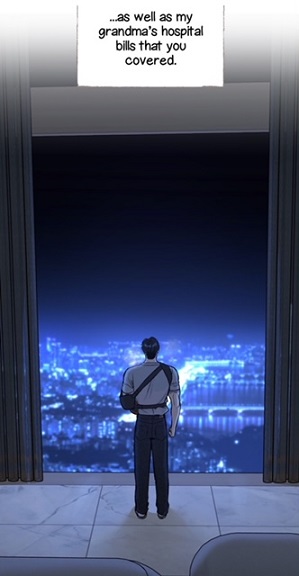 (chapter 53) The glass was an invisible barrier, offering the illusion of freedom while keeping him trapped in the moment of his unresolved trauma. The closer he stood to it, the further he was from true release, his gaze fixed outward to avoid looking inward. That’s why he had no eye in that scene:
  (chapter 55)
This new scene 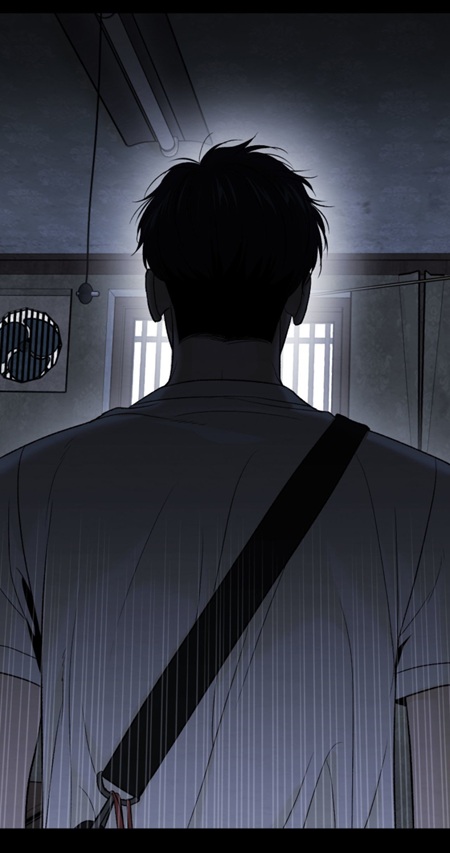 (chapter 73) reveals why that reading was correct: the penthouse window is not just a symbolic device of the present — it is the direct heir of a far older image burned into his memory. Here, as a teenager, he stands before a small barred window in the room where his father’s corpse lies. The resemblance is not visual coincidence but emotional continuity. Both windows let in light without granting escape; both present the outside world as something visible yet forever out of reach.
In this panel, the confinement is literal. The bars fragment the daylight, reducing it to slivers, making the outside world seem even more inaccessible. He is facing the window and he corpse, his eyes fixed on the narrow frame of light, as if distance could make the reality behind him vanish. But the truth is locked in place — the body on the floor, the night’s events, the words exchanged. This is the night that froze him.
From that point on, every window in his life — no matter how large, modern, or luxurious — became a reenactment of that first prison. (chapter 55) The penthouse’s vast glass wall is just a polished version of this barred opening, a reminder that while his circumstances changed, the barrier never truly fell. The trauma stayed intact, shaping the way he saw the world and himself. The boy who stared through those bars never left that room; the man still carries that gaze. But there’s more to it.
Observe how he is standing in front of the window: (chapter 73) he is not only frozen, but also silent! Not only he lost his voice that night, but also he could never talk about it to anyone! He was forced to carry this huge burden alone. Who would feel empathy or attachment to such a man, when he was famous for his bad behavior? But deep down, the boy had come to love his father despite his flaws. This is his deepest secret which is coming to the surface: his love and guilt!
Even the window denies him solace. He could never see the moon behind that small window, just as he failed to notice the snow falling, when he attempted to contact his mother: (chapter 72) Nature was invisible to him; his world was defined by conflict, neglect, and survival, not by moments of beauty. He was never taught to enjoy the present moment.
Chapter 73 signals a shift. Like in chapter 71, where he shields his gaze, his “third eye” — the inner sight that perceives emotional truth — is beginning to open and recall his “sins”. His fever is not just physical; it’s the body’s acknowledgment of pain long repressed. He is starting to allow himself to feel, to admit vulnerability.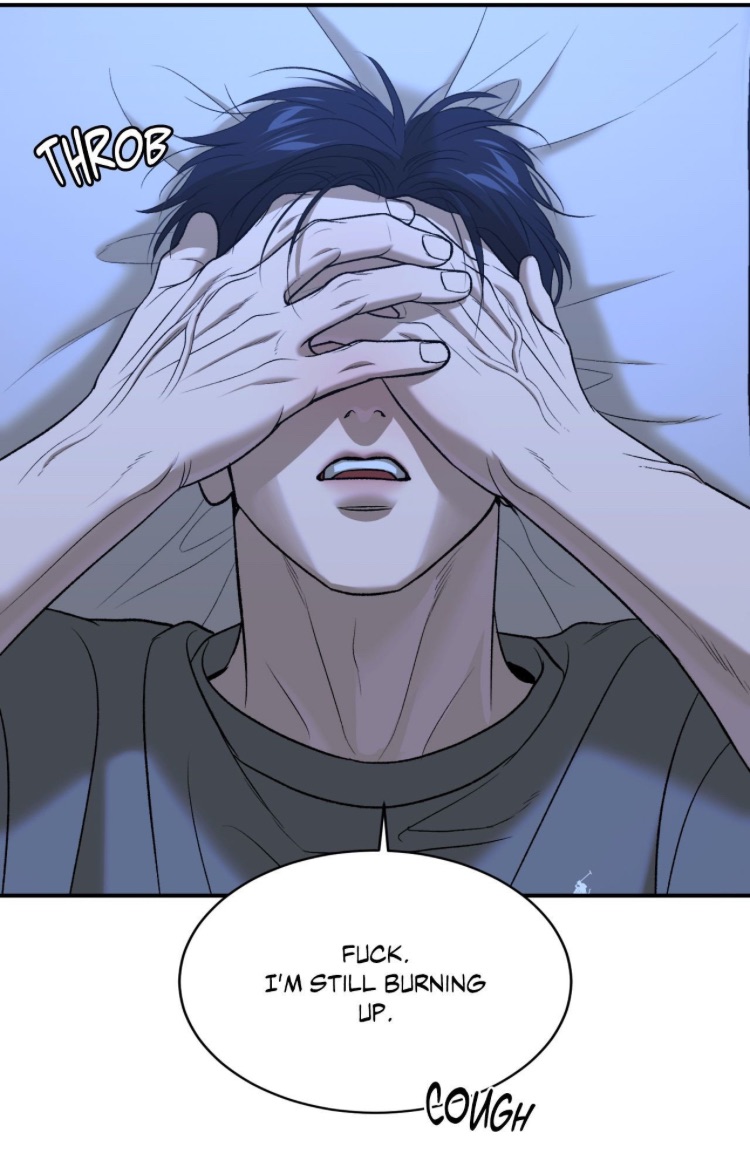 (chapter 71)
And this is where the night changes meaning. Until now, darkness for him was bound to abandonment and death. But in chapter 70, the owl’s call pierces the silence —  (chapter 70) the night can also be alive, communicative, protective. In that moment, the moon becomes more than a distant light in the sky: it is a patient witness, a calm listener in the stillness, reflecting the truth he has yet to voice.
 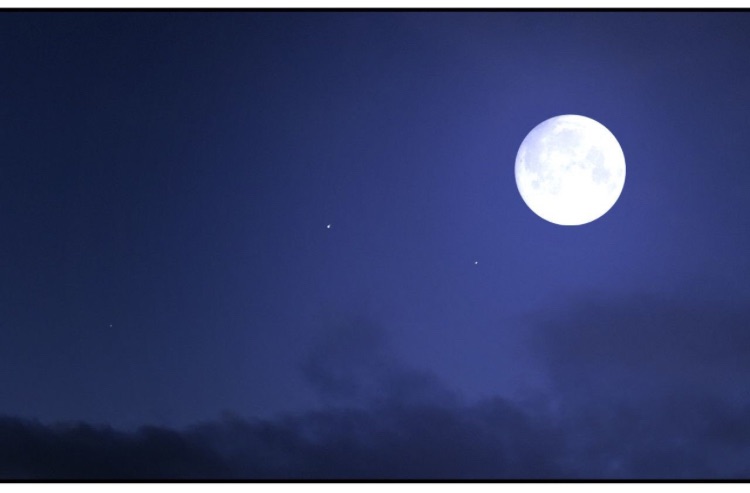 (chapter 70) Its soft glow contrasts with the blinding glare of the cage lights, suggesting that under the moon, there is space for gentleness, for hearing one’s own heartbeat and another’s words. Just as the moon guides travelers through darkness, it can guide him toward a night that does not suffocate him with loss, but offers orientation and connection.
This reframes his past behavior: his repeated night rescues of Kim Dan were not merely impulsive heroics;  (chapter 60) they were his own form of therapy. In saving someone else in the night,
 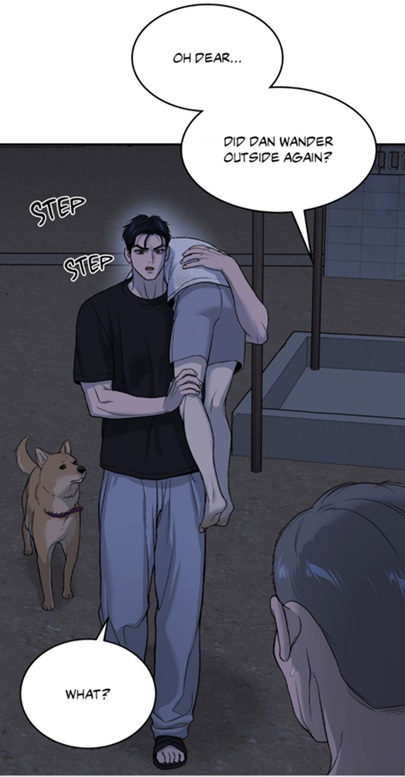 (chapter 65) he could prove to himself he was not powerless, he was valuable, capable of protecting what mattered.
 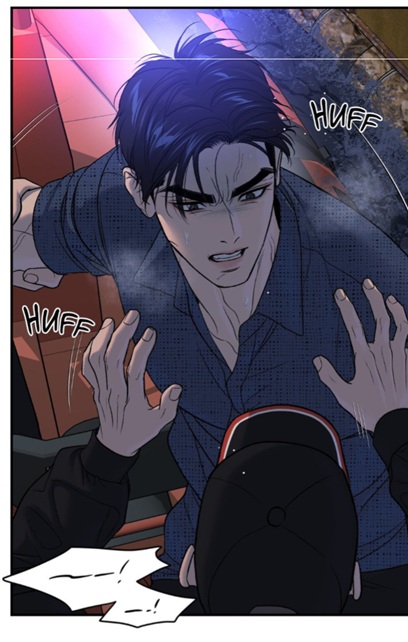 (chapter 69) He was not too late either. And the moment doc Dan discovers what the silent hero has done for him so many times, the former will realize that he has always been special to the Emperor. Moreover, the latter had never abandoned him in the end.
The curse of the Night-Cursed Emperor — the depression, the insomnia, the silence — will only break when he can walk through the night not as a rescuer masking his own wounds, but as a man who voices his emotions to the one person who has truly shared those nights with him. And now, Jinx-philes can grasp my illustration. The moment Joo Jaekyung starts confiding to doc Dan about his inner world, he will not only regain his voice, but also his life! He will be free and no longer the merchandise “Joo Jaekyung the fighter”. He will become a man with a history that is finally his to tell. And if his mother is still alive… she can be criticized for her actions. How so? It is because she was not by his side. She believed the “myth”. She probably imagined that he was “happy”. With his regained voice, the schemers will lose their hold over him; they will no longer be able to manipulate the silence that once kept him bound. Park Namwook has thrived in the shadow of his trauma — reframing the scars of that night as “mania” , (chapter 9) as if the champion’s volatility were a quirk (the actions of a spoiled child) to be managed rather than a wound to be healed. It is because he never talked to the champion or investigated his past. It was only about money and glory. The manufactured image of the erratic, temperamental fighter served Namwook well; it excused rough handling, justified bad press, and kept Joo Jaekyung dependent. Once the Emperor can name the truth of that night, the fiction collapses — and with it, Namwook’s control. He can only be judged as a liar and even a traitor, but we know that Joo Jaekyung has a big heart. He could love his father despite the abuse. Now, the missing link is Cheolmin!
  (chapter 13) Observe that this name is a combination between Hwang Byungchul and Baek Junmin! Under this light, my avid readers can grasp why the athlete kept his existence in the dark for so long! It is because the latter belongs to his past and knows the truth behind the Emperor! He was aware of his suffering. For him, he is not just a fighter, but someone who needed FUN in his life!
Feel free to comment. If you have any suggestion for topics or Manhwa, feel free to ask. If you enjoyed reading it, retweet it or push the button like. My Reddit-Instagram-Twitter-Tumblr account is: @bebebisous33. Thanks for reading and for the support, particularly, I would like to thank all the new followers and people recommending my blog.


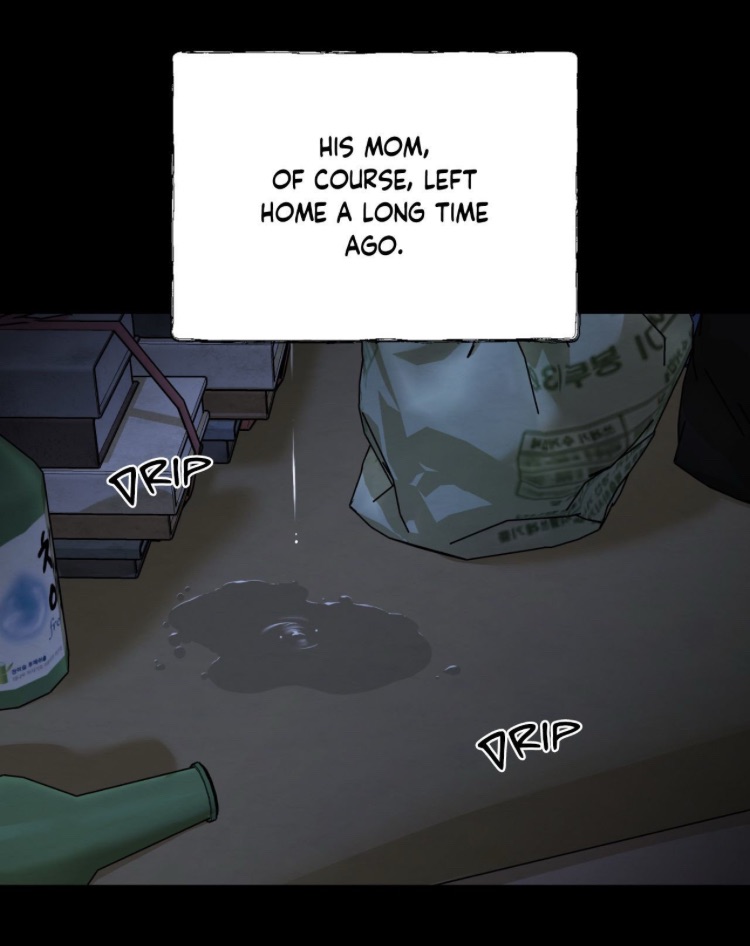 (chapter 72) — subtle symbols of education, possibility, and restraint, hinting at something more structured, perhaps even noble, behind his harsh upbringing.
  (chapter 27) Where and how did he learn swimming? Moreover, observe that he connected it to relaxation and fun. “This feels good”. This contrasts so much to the interaction between Hwang Byungchul and the little boy with the teddy bear.
  (Chapter 72) The man doesn’t know that the athlete can swim, he only knows the boxer, as he was only able to see him on TV.
  (chapter 71) Interesting is that Jinxphiles followed Kim Dan’s school career
 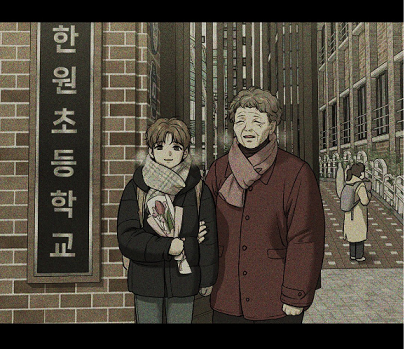 (chapter 47)
  (chapter 47), yet the latter can not swim!
  (Chapter 47)
  (chapter 72), though the year is deliberately blurred. At first glance, it’s a simple timestamp anchoring the timeline of a major fight. It took place one month before his birthday. But May 16th also falls exactly one month after April 16th, the day of the Sewol ferry disaster. This connection may not be overt, but it echoes thematically in the physical therapist’s life: Kim Dan, born too early to benefit from those reforms, never learned how to swim. I will explain more further below.
 (Chapter 72) Nevertheless, with this panel, Mingwa indicates that the protagonist was visiting the Elementary school. The neighborhood he grew up in — as described by Hwang Byungchul — was “cutthroat.”
 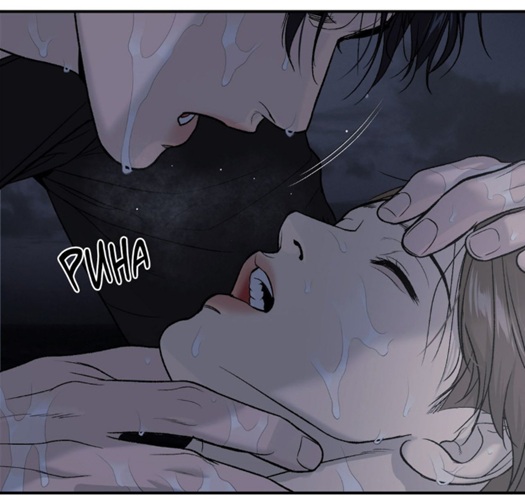 (Chapter 60) These aren’t casual skills. They’re not the product of school curriculum or street wisdom, especially not in a neighborhood described as “cutthroat.” These are taught skills — and not by someone who saw Jaekyung merely as a fighter. Swimming and first aid reflect something else entirely: a commitment to preparedness, not just for survival, but for helping others.
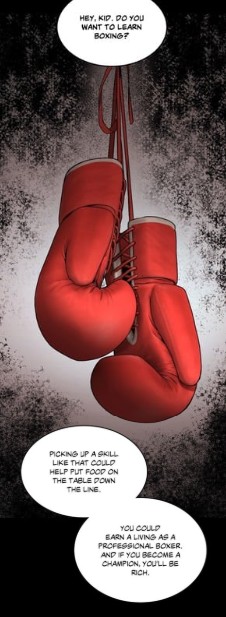 (chapter 72) this unnamed figure offered a radically different message: you have value not just in your fists, but in your capacity to protect life. And contrary to Hwang Byungchul, this person stands for “shadow and humbleness” and not “spotlight or wealth”!
  (Chapter 27) That Jaekyung carries this knowledge — and uses it without hesitation — reveals a deeper emotional structure.
  (Chapter 13) His vocabulary revolves around water: “pond”, “fish”! Besides, I have already connected to him Poseidon, the god of the ocean. Moreover, this man is strongly intertwined with fun, a notion that doesn’t belong in Hwang Byungchul’s world! And now, you understand why this man could touch Joo Jaekyung’s shoulder
  (Chapter 13) He knew about the existence of the Teddy Bear inside the champion. And is it a coincidence that both men have the same name “Chul=Cheol”, though the order diverges: Cheolmin versus Byungchul? And both are connected to the color “green”.
  (chapter 72)
 (chapter 60) There was no witness, no coast guard, no institutional figure involved in his rescue. He was alone, only saved by one person. His generation was expected to take responsibility — to succeed, to repay debts, to endure hardship — but they were given no tools to survive when crisis struck. They were neither protected nor prepared.
 (chapter 65) So teaching him how to swim will help him to reconnect with his true self and to find a meaning to his life.
  (chapter 14) This fight took place in April… the same month than the Sewol ferry tragedy. And the color of the poster is once again green. Is it a coincidence? I have my doubt here. And what did Randy Booker say to his opponent? He called him a baby
 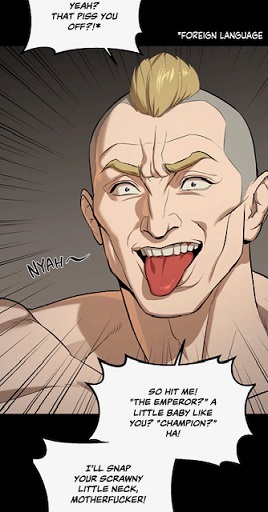 (chapter 14) which led the protagonist to seek refuge in the bathroom, but here he couldn’t relax.
  (chapter 14) That’s how I realized that water is an element linked to childhood and as such motherhood!
  (chapter 72) Hence water was leaking from the ceiling at the boy’s feet: drip, drip… We need to ask ourselves why Joo Jaekyung learned how to swim in the end.
 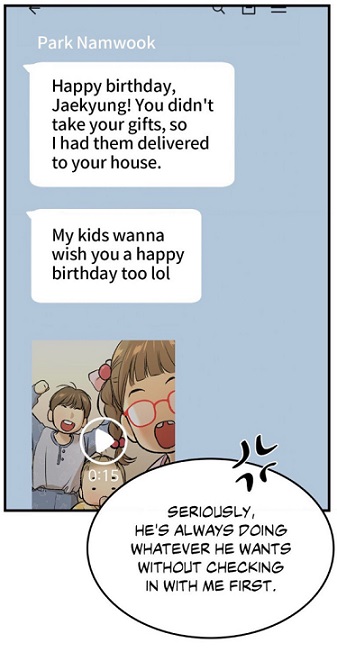 (chapter 45) And this brings me to my final thought: Kim Dan had to meet Hwang Byungchul for an important reason: to learn how to survive on his own, as he is still depressive. He is lectured how to become independent and how to find a real goal in his life. By confessing the terrible youth about the Emperor, the physical therapist gets to hear that he wasn’t the only one abandoned and in pain!!
  (chapter 72)
  (chapter 56) Moreover, he gets the opportunity to understand why “usefulness” became so important in the MMA fighter’s life. Through this confession, the other teddy bear gets to perceive that he has so many things in common with his fated partner. Both experienced abandonment, loss, poverty, bullying and only worked in their life too! They never got the opportunity to enjoy life to the fullest.

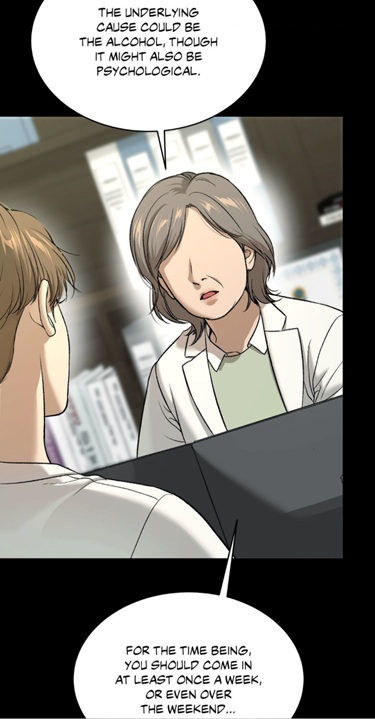 (chapter 67): the brief diagnosis, the recommendation for weekly visits, the specialist’s tentative attribution of Kim Dan’s condition to either alcohol or a possible psychological cause, emphasizing the need for continued observation and weekly visits before offering a definitive diagnosis —all standard responses. For her, this was a doctor following routine procedure without overstepping professional boundaries. However, I perceived her behavior very differently. I saw someone who remained emotionally detached and almost absent, reducing the complexity of Kim Dan’s condition to simplistic surface-level causes without genuine inquiry.
 (chapter 67) Rather than forming an independent assessment, she accepts the narrative of a third party, which introduces bias and limits her understanding. One might argue about that, because she is looking at a paper, probably result of a blood test which seems to corroborate the guardian’s statement. Hence the sleep specialist concludes that Kim Dan is suffering from insomnia, alcohol addiction and sleepwalking. The problem is that his statement is based on external observations (halmoni and the landlord) and their limited knowledge. Moreover, Jinx-philes should keep in mind two important aspects:
  (chapter 61) The champion had been himself suffering from similar symptoms which could be seen as a projection on his loved one. Additionally, based on previous observations, I have interpreted Kim Dan’s nightly walks not merely as sleepwalking, but as dissociative episodes—likely triggered by overwhelming guilt, unresolved trauma, and a chronic sense of disconnection from his body and surroundings. But how could the champion know about this? He’s not a doctor himself. In order to have a more accurate picture of the whole situation, she should have talked to the patient himself. But by relying on papers and the guardian’s testimony, she not only distances herself from the patient physically and emotionally, but also delegates the responsibility of interpretation. She is using the eyes of others.
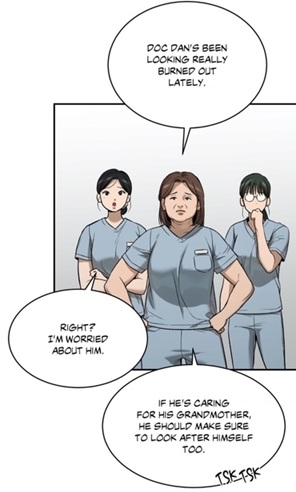 (chapter 57) Perhaps the doctor’s detachment is not indifference, but a survival mechanism in a healthcare system that demands efficiency over intimacy.
 (chapter 67) indicating that his alcohol addiction is not the real reason for his insomnia. Then she fails to examine Kim Dan physically, the desk is between them. Therefore she can not detect his visible malnourishment.
 (chapter 62) Moreover, both the landlord and the grandmother never brought up this aspect, though Shin Okja had observed this terrible transformation:
  (chapter 57)
 (chapter 66) It is because the physical therapist is just a number (2) and as such a file. Therefore the doctor is not seeing the patient as a human. I can not blame the woman either, for she has so many patients to treat during the day. And now look at the building of the hospital:
  (chapter 66). It is huge reminding me of a factory. This “modern hospital” with its sleek architecture, expansive buildings, and impressive specialization exudes a sense of advancement and trustworthiness. Yet beneath this polished surface lies a business-oriented structure, one that prizes efficiency, reputation, and patient turnover over genuine patient connection. This “modern hospital”
 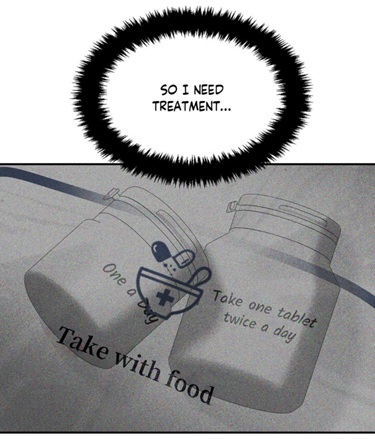 (chapter 67) She is doing exactly what Shin Okja wanted:
 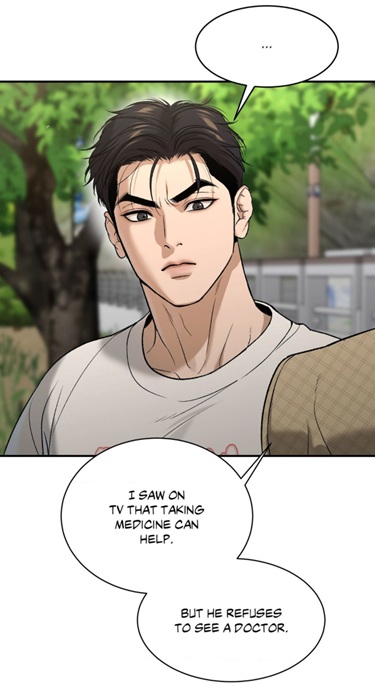 (chapter 65)
 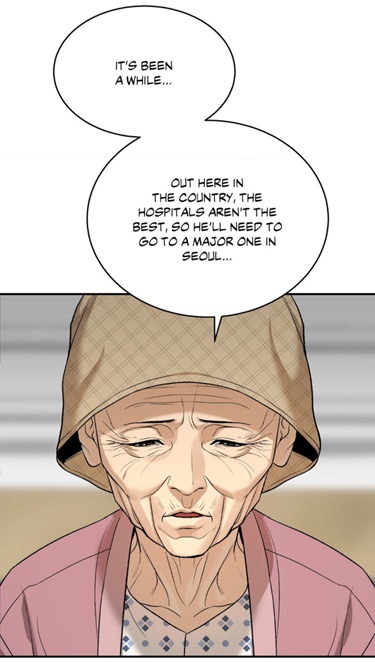 (chapter 65) It is as though thanks to the drug, the odd behavior from Kim Dan would simply vanish.
  (chapter 5) with the new medicine. On the other hand, it implies that the light-brown haired woman is doing her job for her paycheck which reminds me of Cheolmin’s statement:
  (chapter 27)
  (chapter 49) as mere service providers. Whether it was brushing off medical advice with “Don’t push it, I know my body better than anyone else” (chapter 27) or demanding instant pain relief to continue training (chapter 49), the champion positioned himself as the ultimate authority over his own treatment. Since his attitude echoed the confession of my osteopath, it is understandable why my osteopath-orthopedist began to select his patients carefully. This mirrors Kim Dan’s evolution, when the latter chose to reject the champion’s offer. Indirectly, he is “learning” to select his job and not take them by opportunism. He is also learning to select his “patients”. Striking is that Shin Okja has a similar attitude than the athlete.
  (chapter 7) She desired to have a treatment with less side effects and less painful. And the moment she was confronted with reality, this painful new treatment only brought pain and nothing more, she chose to leave this institution and move elsewhere.
 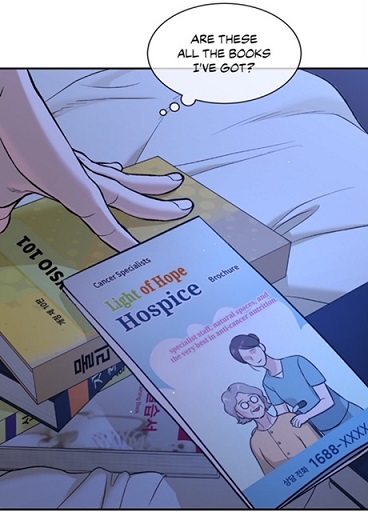 (chapter 53) Therefore it is not surprising that she is treating the protagonist the same way: she knows what is the best for him.
  (chapter 57) She is treating him like a service-provider, she is now rejecting that he has lost his “usefulness”. His pay here is not high, …
  (chapter 67) and not even following her recommendation.
 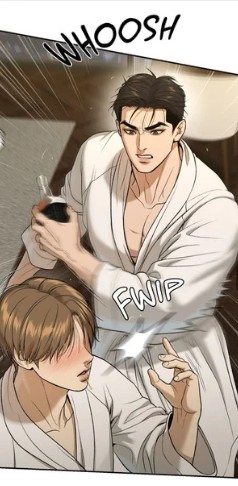 (chapter 67) He felt misjudged and misunderstood; reduced to a file number, not seen as a complex human being.
 (chapter 67) and second, what Kim Dan actually received as treatment:
  (chapter 13), in contrast, enters the story with no white coat at all. He carries only a doctor’s bag, dressed in a green pullover and a beige checkered shirt.
  (chapter 13) Despite this informal attire, he immediately recognizes Kim Dan’s symptoms and engages both the guardian and the patient. He doesn’t need institutional support to assert authority; his presence and diagnostic clarity define him. While his clothes might elsewhere be read as conservative or emotionally restrained, here they highlight that care can come outside rigid systems.
  (chapter 13) It bridges the gap between roles, making the patient feel seen rather than categorized.
 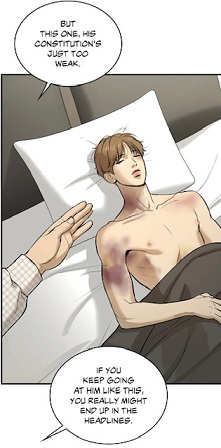 There’s no judgement in their relationship. The eyeless doctor may appear neutral, but in truth, she is hollow. Cheolmin appears reserved, yet his actions speak with empathy. Where she recites guidelines, he initiates dialogue.
  (chapter 13) Where she avoids involvement, he offers engagement.
  (chapter 61)
  (chapter 67), the Light of Hope hospice
  (chapter 61), the sleek University hospital dedicated to research
  (chapter 5), and more intimate yet modern facilities like this one.
 (Chapter 27) Each medical setting not only has its own architecture but also its own moral blueprint. In the essay “
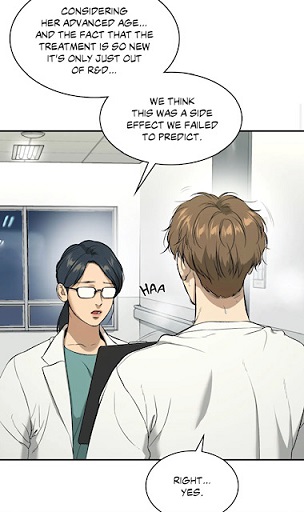 (chapter 21) Then the treatment’s failure is attributed either to the grandmother’s frailty or Kim Dan’s late arrival and absence, subtly shifting blame.
 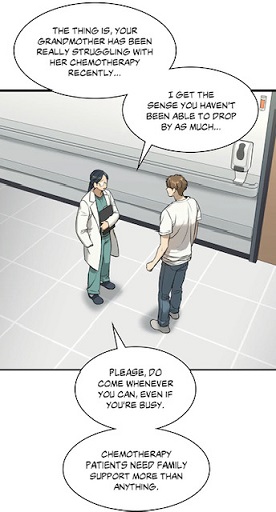 (chapter 21) Like mentioned before, this treatment wasn’t even properly recorded in the patient file raising the suspicion of deliberate concealment.
  (chapter 56) It appears as “pain killers”. Her open white coat
 (chapter 48) got aware of Shin Okja’s conditions, implying that patient confidentiality had been breached.
  (chapter 61) represents the polished face of a business-oriented clinic. While his office projects sleekness and personalized care, his comments betray his priorities. He praises Joo Jaekyung’s fame and urges a return to the ring—not out of medical concern, but because it would guarantee the champion’s return as a paying patient. He wants to retain a high-profile client. His friendliness is strategic.
  (chapter 61), highlighting that the athlete has become aware of what genuine care should look like. When the champion calmly declares, “I’ll be receiving rehabilitation services in another hospital,” Junmin answers with a stunned “Sorry?”. But this is not confusion. It’s a reflexive mask for shock. He did not expect to lose control of the situation. Beneath that one-word response lies disbelief, disappointment, and veiled panic. He’s losing a lucrative patient—and more importantly, a public endorsement. The moment exposes how fragile his authority truly is when faced with a patient asserting autonomy. Let’s not forget that when the champion was facing a mental and emotional breakdown, the latter offered no other support than “rest”. He even avoided his gaze.
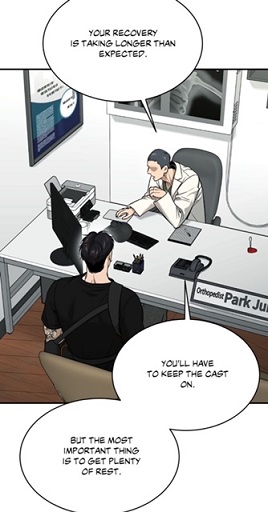 (chapter 54) The athlete was left on his own.
 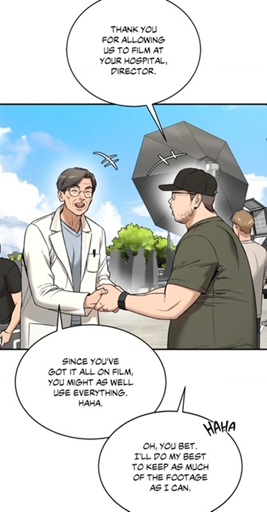 (Chapter 59): At first glance, the hospice appears to be underfunded and outdated.
  (chapter 61) However, its director breaks expectations. Unlike the smooth-talking or indifferent doctors at larger institutions, he is directly involved in patient care.
  (chapter 60), criticizes people for their rude behavior
  (chapter 59) or actively disciplines staff
 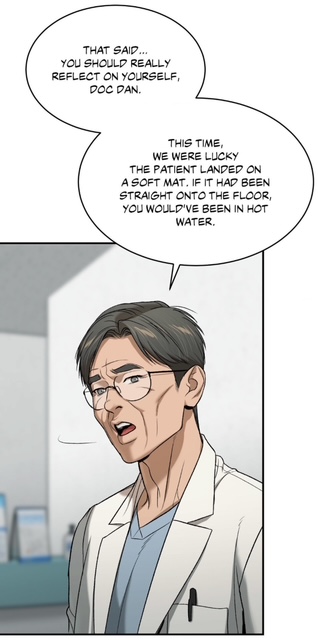 (chapter 59) when mistakes are made. Though he also flatters the champion
  (chapter 61) and sees promotional potential, he never exploits patients.
  (chapter 61) The juxtaposition of humility and responsibility in his demeanor, combined with his stunned reactions to sudden events, suggests an overworked and understaffed environment—but not one without moral grounding. His white coat and blue medical uniform echo the nurses’ attire, subtly promoting a sense of equity among staff. Despite being a director, he doesn’t separate himself from frontline caregivers. His uniform also contrasts with the green worn by Kim Miseon or Park Miseon, suggesting a focus on practical responsibility over prestige. By blending in with the team, he fosters a culture of shared accountability, not rigid hierarchy. Among all institutional figures, he comes closest to balancing authority with integrity.
  (Chapter 6): While this figure appears authoritative
 (chapter 1), the details of his attire tell another story. Wearing a suit beneath his coat implies professionalism, but here it also suggests a business-driven mindset. The coat becomes a sleek outer layer masking deeper intentions. His charming demeanor conceals a more sinister reality—he weaponizes authority for personal gain. His use of professional attire isn’t about respectability but manipulation. Beneath the surface, profit, control, and coercion drive his actions.
  (chapter 1) The white coat, in his case, is not a symbol of healing but a façade for exploitation. drives his authority. The coat becomes a literal cover for abuse—harassment disguised under professionalism. His entire persona is a façade: calculated, charming on the surface, but predatory and morally bankrupt beneath.
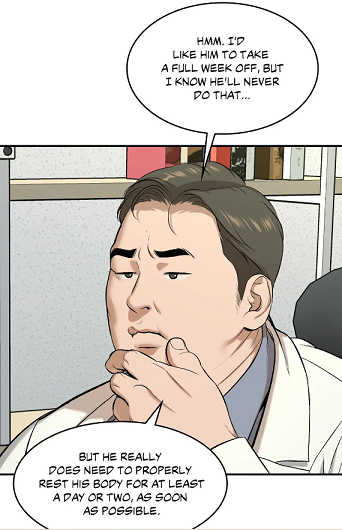 (chapter 27) His gray shirt signals a more relaxed approach,
 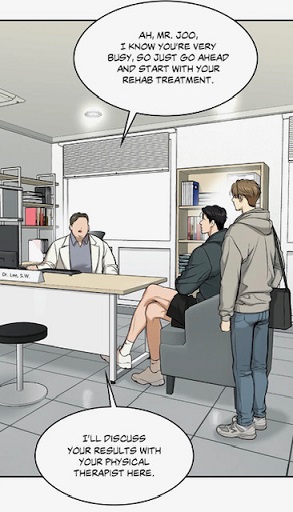 (chapter 27) and his facial expression conveys a certain empathy—though his words also betray resignation. He sits beside the patient, not opposite, visually erasing the typical hierarchical divide between doctor and athlete. His recommendation that Joo Jaekyung rest is gently delivered, but he knows it will likely be ignored. He represents the tension between medical idealism and the pressures of athletic performance. He is trying his best to protect Joo Jaekyung’s career.
  (chapter 27) Notably, he doesn’t chase fame or loyalty—he’s realistic, yet still rooted in care.
 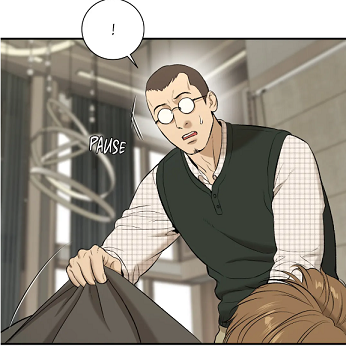 (chapter 13) Finally, Cheolmin exists outside the hospital system. He wears no white coat, but his behavior mirrors a true physician’s. He diagnoses accurately, gives immediate advice, and engages both patient and guardian. His attire—a shirt layered under another—might suggest emotional restraint, but it doesn’t interfere with his actions. He jokes and teases, breaking through tension and inviting trust. He acts not because protocol demands it, but because someone needs help. That’s enough.
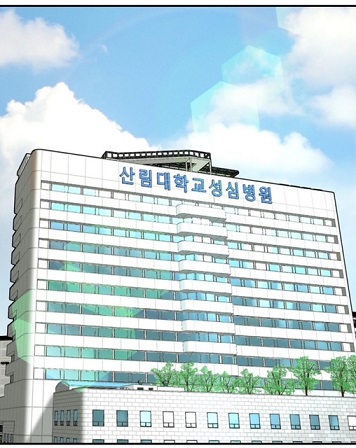 (chapter 41) nature is neatly confined. Rooftop gardens and structured greenery exist, but more as visual accessories than lived environments. The hospital is a towering research center, representing scientific advancement—but also bureaucratic coldness. Here, nature exists to impress, not to comfort. This artificial balance between concrete and green reflects a clinical detachment: nature is curated, not embraced. It aligns perfectly with Kim Miseon’s demeanor—professional, pristine, but ultimately distant and ambition-driven.the environment feels controlled.
 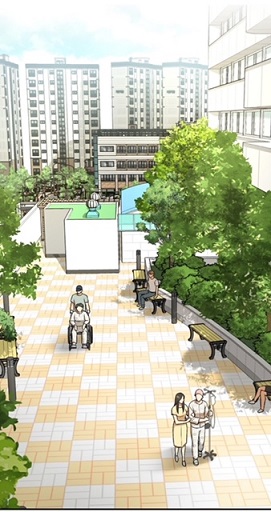 (chapter 41)
  (chapter 54) where Joo Jaekyung receives treatment, the rooftop greenery appears remote and ornamental, disconnected from patient care.
  (chapter 18) modern, and set among scattered trees.
  (chapter 18) Large windows suggest openness and transparency—the very qualities Dr. Lee brings to his interaction. This is a space that, while modest, is genuinely attentive. Here, nature doesn’t impress, it is integrated in the landscape. The park is not surrounded by huge buildings.
 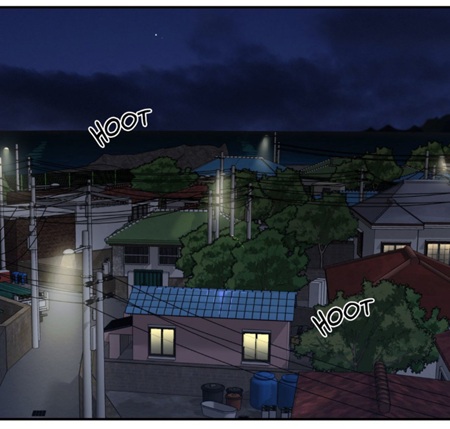 (chapter 65) nestled in the countryside and far from institutional rigidity, emerges as a space of true potential. In returning there, Joo Jaekyung and Kim Dan are not just escaping their past—they are moving toward a form of healing that modern hospitals imitate but rarely achieve. Closer to nature, they are closer to themselves. If hospitals imitate forests, the village becomes the forest. And in that simplicity, Jinx suggests, real happiness might grow.
 (chapter 62) surrounded by greenery, animals, and people who don’t treat him as a product—his health improves. His muscles may still ache, but mentally and emotionally, he is lighter.
  (chapter 57) It lives where no one is watching and no one is billing. In Jinx, the real medicine lies outside the chart—in the dirt on borrowed floral pants, in sweat earned under open skies. Nature becomes the unspoken vow that systems forgot.
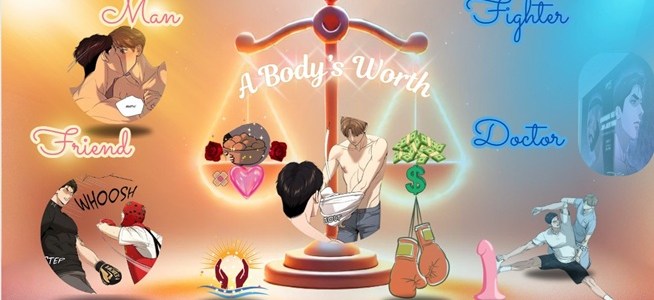
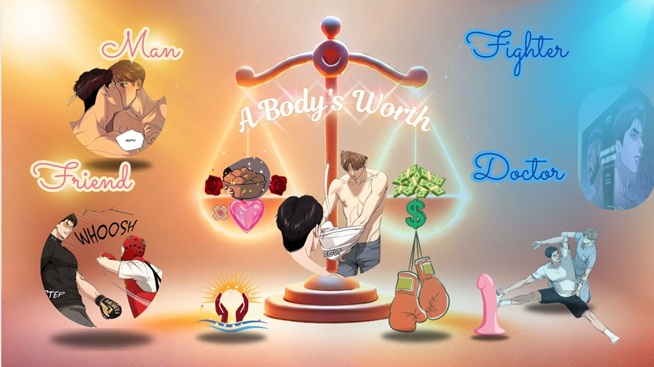
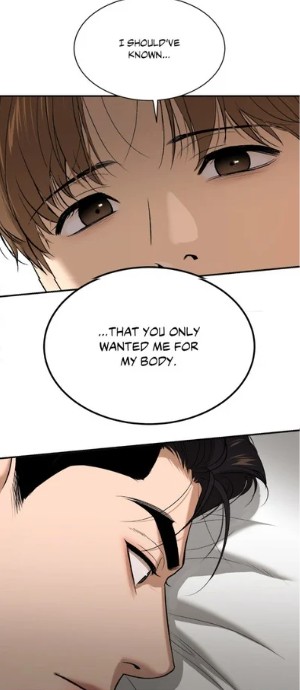 (chapter 62) In episode 62, Kim Dan reproached the champion for only being interested in his body, reflecting his own inability to see his body as something valuable. Hence he never wondered about the true cause for such a huge bruise.
 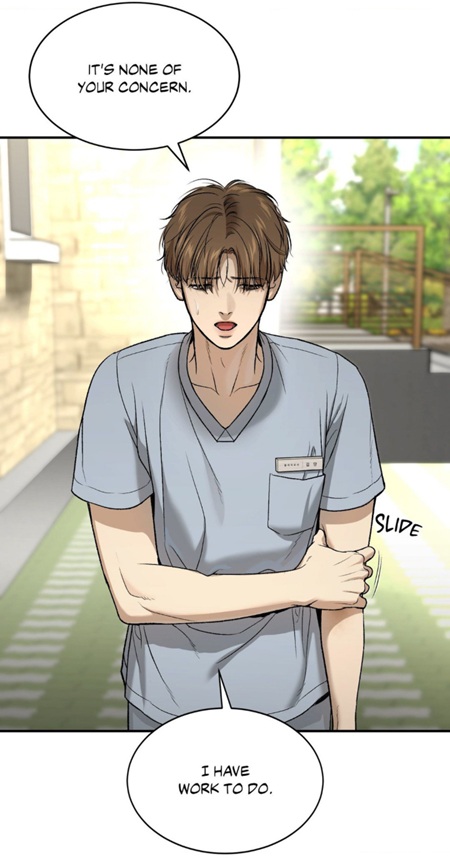 (chapter 61) While with his words, he implied that his fated partner was a man obsessed with sex, his complaint reveals his mindset. First, he is the one longing for human warmth
 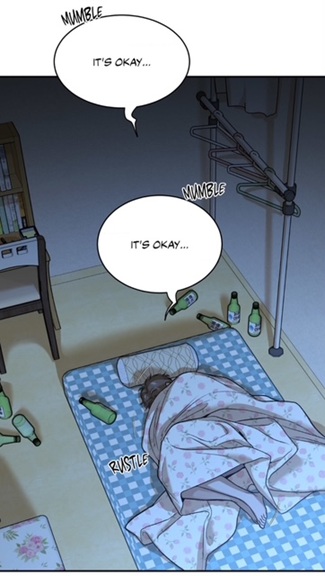 (chapter 59), hence he felt terrible sleeping alone. Secondly, he does not attribute worth to his own physical being beyond its utility for others. This explains why he has consistently neglected himself—avoiding food, disregarding his own injuries, and refusing to seek medical help when necessary.
 (chapter 60) It underscores the reality that without his body, he cannot work. In this way, his physical deterioration forces him to confront an undeniable truth:
  (chapter 59) his body is not just a tool for others, but the very foundation of his survival. I would even so far to say that his sick and stressed body would question his identity as PT and caregiver.
  (chapter 43), they will replace him with a new ‘doll.’ This exploitation shaped his relationship with his own body—one that prioritized its use over its care.
 (chapter 26) and 62
 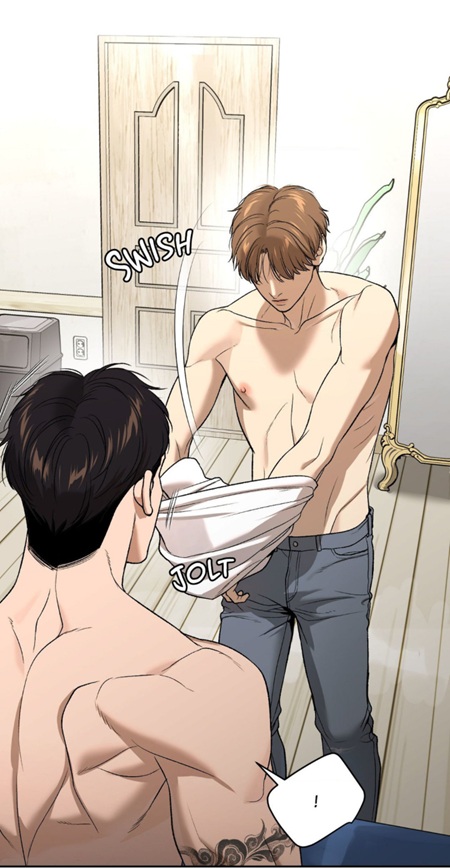 (chapter 62) that highlighted a crucial shift in how each of them perceives their own worth—and, more importantly, each other’s. The mirroring of these two episodes suggests a deliberate narrative structure that showcases their evolving dynamic, with each character taking on a role the other once held. This realization led me to explore how their perspectives on strength, vulnerability, and agency transform over time.
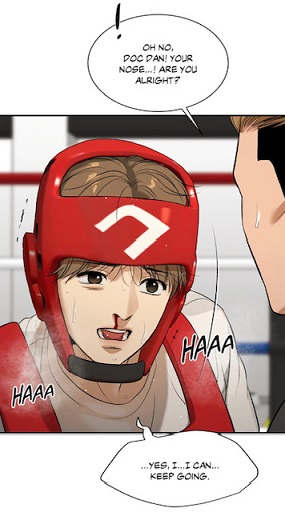 (chapter 26)
  (chapter 26)
  (chapter 26) This small yet significant act reveals that the champion does not see Kim Dan merely as a ‘sex doll’ but as someone worth protecting, even when challenging him. The protective gear is a contrast to Joo Jaekyung’s usual treatment of his one-night stands, reflecting an unconscious distinction between how he views Kim Dan versus his other partners. Finally, this sparring day exposes the doctor’s biased perception about the athlete in episode 62 once again.
  (chapter 62) It was, as if he had no real talent. But let’s return our attention to the safety gears. The latter underline the high sense of responsibility of the champion, which readers could detect in episode 62. With the red accessories, Joo Jaekyung was showing his respect to the doctor as a man. In that scene, Kim Dan could choose his destiny. It is clear that “the hamster” has long forgotten this happy day
  (chapter 26) – he was smiling genuinely here- , and has reduced his time spent with Joo Jaekyung to sex:
  (chapter 26) —a powerful, intimidating man who mirrors the threat of Heo Manwook
  (chapter 16) and his minions. At the beginning of the fight, the doctor was not fighting for himself but for someone else, reinforcing his deep-seated belief that his worth was tied to service and sacrifice. However, during the match of the century, there was a short change. Kim Dan was reminded of his own past and fears. Thus, I deduce that in episode 62, it is Joo Jaekyung who must face his own greatest challenge—not a physical opponent, but the emotional vulnerability that comes with loss and uncertainty. Though he helped others, his generosity remained unnoticed by Kim Dan. Hence the latter was still unwilling to return to Seoul.
 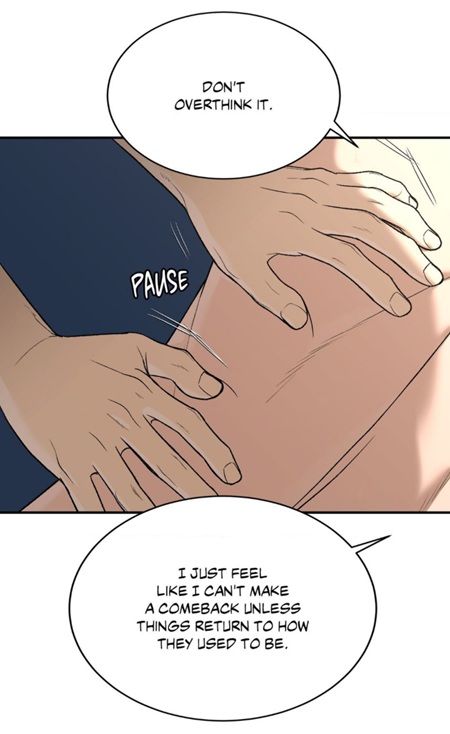 (chapter 62) On the surface, it looks like Joo Jaekyung lost.
 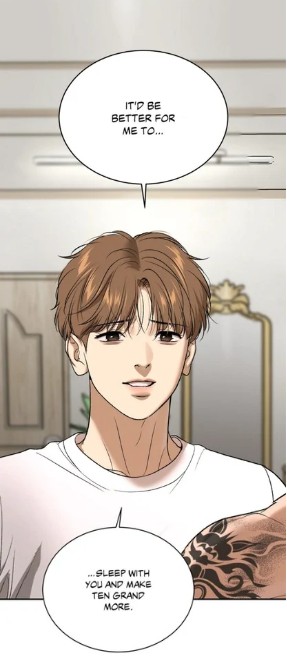 (chapter 62) More importantly, Kim Dan’s words
 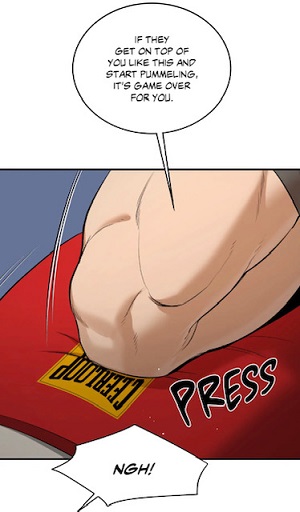 (chapter 26), was happy to demonstrate his talents and kept smiling all the time:
  (chapter 26) For the first time, fighting had become a source of joy for the athlete. He felt not only good, but confident about his skills, as a teacher and fighter. In both instances, this moment serves as a turning point, pushing each character to redefine their role and perception of self.
 (chapter 25) Kim Dan was interested to know more about this sport for the protagonist’s sake, whereas Potato was jealous of Kim Dan’s closeness to the star. How did the celebrity react, when he heard the doctor’s desire to learn fighting moves? He was totally pleased, hence he lowered himself smiling
 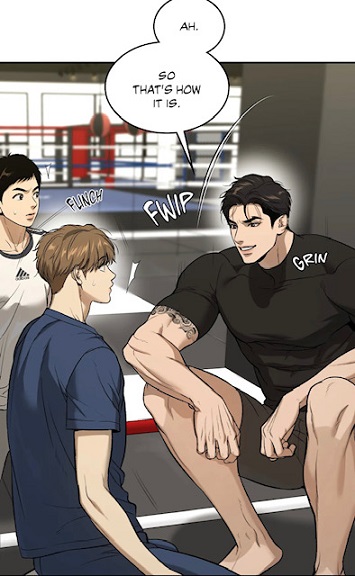 (chapter 25) before returning to the ring:
 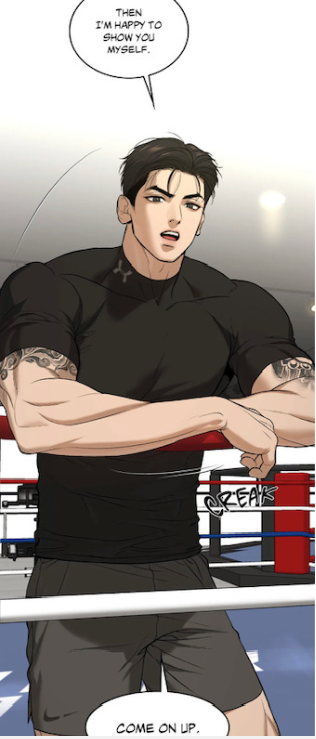 (chapter 25). Notice that he employed the word “happy” here. This shows that the athlete liked to be a teacher and mentor to a novice.
  (chapter 26), reinforcing his belief that his worth lies in service, and he requests an opportunity for someone else. The physical challenge that followed, in which the champion invited him into the ring, was meant to teach Kim Dan to overcome fear, though the original idea was to learn jujitsu moves for the champion’s sake. As you can see, there was a switch in the intentions for the “lesson”. This moment also highlights Joo Jaekyung’s approach to the body—power, physicality, and dominance, which will later be subverted in episode 62 when emotional resilience becomes the true test of strength.
  (chapter 26) Though the doctor was initially immobile and passive, the experience became a significant lesson: fear was something that could be faced and overcome. From that moment on, he became more proactive
 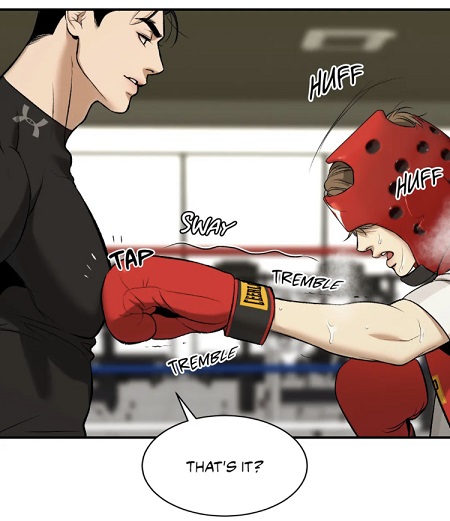 (chapter 26) This is a moment of physical initiation for Kim Dan, teaching him resilience. Nonetheless, he was still fighting for someone else, still locked in his pattern of self-neglect.
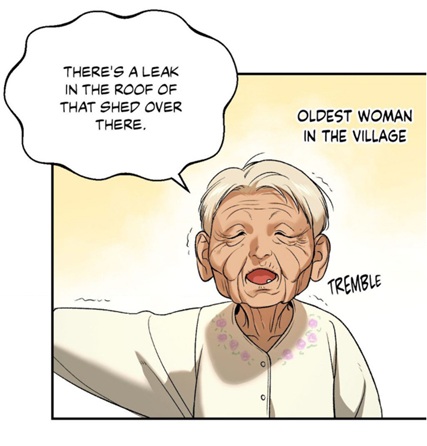 (chapter 62) This shift highlights a deeper irony: while Joo Jaekyung has always prided himself on his physical strength, he is now being tested in a way that cannot be resolved with fists.
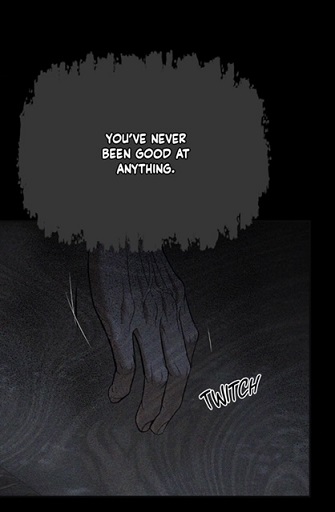 (chapter 54)
 (chapter 34), wealth
  (chapter 42) and title
 (chapter 55), not for its attractiveness or desirability. His reputation in bed has been poor;
 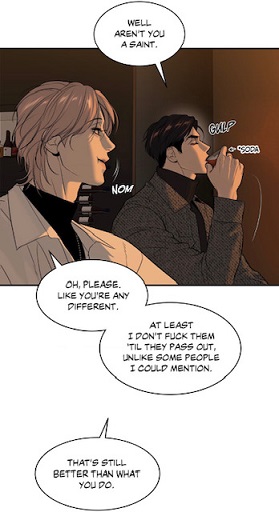 (chapter 33), he was never seen as a man with sex appeal or sensuality, but merely as a fighter who could endure. Sex was another form of exertion, a display of control and dominance rather than a pursuit of pleasure.
  (chapter 27)
  (chapter 29) On the other hand, this suggestion challenges Joo Jaekyung’s previous experiences, forcing him to realize that he has never had to woo or seduce anyone before. This was the only time, where Jinx-philes could see him using his sex-appeal-
  (chapter 34) He got confident, because he had played a trick on his room mate. His physicality has always been his defining trait, but for the first time, he is being confronted with the question: does he have more to offer beyond brute strength and money? If he wants to prove his worth, he must do more than rely on his body—he must reveal his true self.
 (chapter 62) He does not plead; he challenges. This reversal is significant because it places Joo Jaekyung in the uncomfortable position of emotional uncertainty. In episode 26, the champion was confident in his control over the situation. In episode 62, he is on the verge of losing control—not over a fight, but over a person. Hence he can no longer control his erection.
  (chapter 61) Why does he want him to return to Seoul? Is he really looking for a physical therapist or something else? It is clear that he is longing for companionship.
 (chapter 26), which represents the MMA fighter’s world, the wolf is now the one penetrating Kim Dan’s world: the treatment table!
  (chapter 62)
  (chapter 62) The latter was brought to the hostel. I know, here I am more speculating about the next episode. However, keep in mind that the hamster brought up the past to his destined partner.
 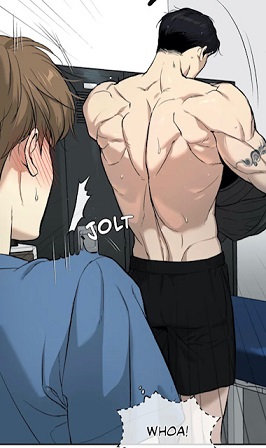 (chapter 1) The blue treatment table is the witness and proof that the champion never saw Kim Dan as a sex doll. So far, they never had sex on it, a sign that he respected not only Kim Dan as PT, but also the profession as such
  (chapter 27) Here, the champion suggested to have sex at home, and not on the table. On the other hand, Jinx-philes will certainly recall this scene where the doctor begged on his knees for money:
 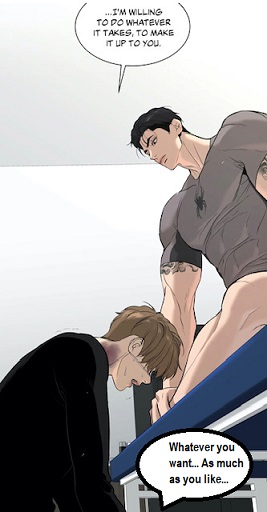 (chapter 11) That’s how I discovered a strong connection between this item and sexuality. First, the one fantasying about the champion’s body on the treatment table had been Kim Dan
  (chapter 1).
  (chapter 1) The massage must have felt like caresses to Joo Jaekyung. So when the main lead made this mistake
 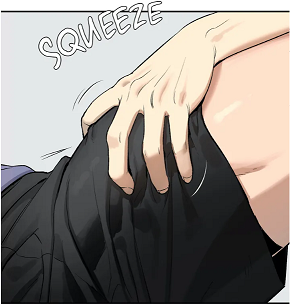 (chapter 1), it is very clear that Joo Jaekyung could have interpreted it as a sign for seduction later. Moreover, don’t forget the mysterious incident concerning the previous physical therapist:
  (chapter 1) It is no coincidence that Park Namwook’s words have a sexual connotation reviving my theory that a doctor might have made sexual advances there. Here, I feel the need to add another observation which came to my mind, the moment I focused on the blue treatment table.
  (chapter 37) In the States, the athlete received his treatment on the floor, a sign of a disrespect for that profession from the manager and even MFC. They somehow knew that the fighter had brought his “sex partner” for his jinx, but they had no idea about his identity. By paying attention to the blue treatment table, I realized that this item stands for power, secret, courage and vulnerability.
 (chapter 62) According to my interpretation, Joo Jaekyung had interpreted the mistake for some advances and keep in mind that the fighter felt also attracted to the physical therapist.
  (chapter 56) In other words, he projected his own desires onto the “hamster”. But since he was still with the green-haired guy, he needed to mask his true intention:
  (chapter 1) -thus he asked for a treatment. He was about to drop the man.
 (chapter 1) However, contrary to their first encounter, the champion would be talking to his neighbor. While the doctor is thinking, he will relive his first night in the penthouse, the other might reproduce his first treatment, though it should be certainly combined with the intercourse on the couch: .
  (chapter 29)
  (chapter 62) But he made such an offer, because he thought, he was respecting the doctor’s wish. This shows that the athlete needs to converse properly with the doctor and not just make assumptions (MO from his manager). Moreover, the star has never expressed his gratitude and admiration towards Kim Dan concerning his talents and efforts openly. The problem is that he can not compliment him yet, because Joo Jaekyung is trying to “forget” the past and as such he is repressing the fight with Baek Junmin. I feel like the champion is on his way to discover the medical world and chapter 62 represents a prelude.
 (chapter 57) He should have sent her to the hospital and ensure that she received treatment. Notably, after the sea incident, Joo Jaekyung took Kim Dan to the hospital, but the latter rejected the champion’s advice and help.
 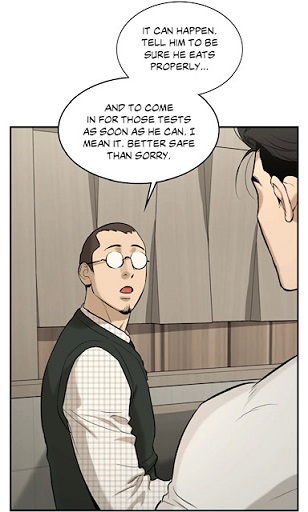 (chapter 13) So it dawned on me that if the doctor gets sick, Joo Jaekyung will be fueled with regrets and guilt, as he didn’t listen to Cheolmin’s advice. So this could lead him to apologize to Kim Dan. On the other hand, his illness could serve as a reminder to the fighter that he needs to treat his physical therapist and friend better. He only sent for the doctor because of “sex”. To conclude, both would be responsible for this terrible situation, a balance of responsibility.
  (chapter 57) is not just a symptom of overwork and lack of sleep—it symbolizes the deep imbalance in his life. His world consists only of work
  (chapter 62), without fun, rest, or emotional fulfillment. He has no hobby, no personal joy, and no real human connections. He is suffering from depression. Interestingly, the sense of balance is directly tied to the ear, which aligns with his emotional “deafness”—his lack of true contact with others.
  (chapter 61) His mind and heart are no longer listening; he is trapped in his own darkness. His dizziness and fainting spells mirror this imbalance, making his physical weakness a reflection of his emotional detachment.
 (chapter 54) and drinking habits.
 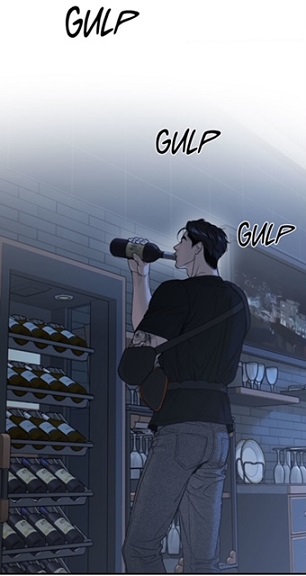 (chapter 54) His entire life has been dedicated to work and physical prowess, leaving no space for genuine happiness or emotional well-being. His drinking is not just an escape—it is a manifestation of his need to silence his thoughts and emotions. In episode 44, when Kim Dan expressed admiration for his body, he patted his head
 (chapter 44), he caressed his cheeks
  (chapter 44) and kissed his ear
  (chapter 44) —a moment that could be seen as an attempt to restore balance, to bring warmth to the parts of Joo Jaekyung that had been ignored emotionally. However, during that night, Joo Jaekyung was drunk, further disconnecting himself from reality.
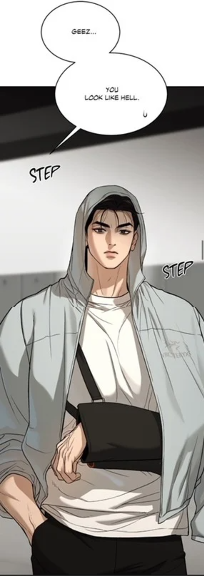 (chapter 54) His headaches intensified, and he isolated himself, mirroring Kim Dan’s earlier state of detachment. His drinking hadn’t just become a habit—it was mourning, a sign of his internal loss. It was, as if deep down he wanted to forget this intoxicating feeling of happiness from that night in the penthouse. The departure of Kim Dan caused both of them to lose their already fragile balance, reinforcing the idea that their dynamic, as unhealthy as it had been, was stabilizing them in ways they never acknowledged.
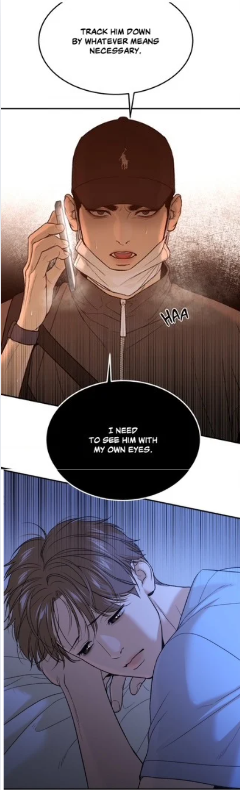 (chapter 56) It was, as if the champion no longer needed to see his former room mate. Note that he even waited for the evening before approaching doc Dan again.
  (chapter 60), he immediately went to the town. This contradiction reveals that mere visual presence was never sufficient—what he truly longed for was something deeper. And as soon as he saw him, he felt much better,
  (chapter 61) hence he could remove his splint. That’s how powerful drug Kim Dan is. 😉
 (chapter 61) While undergoing treatment, he saw Kim Dan every day, yet he remained unsatisfied due to the silent treatment. It was not enough to simply observe him; what Joo Jaekyung truly craved was conversation, interaction, and recognition. This explains his decision to move into the town, settling near Kim Dan as his neighbor.
 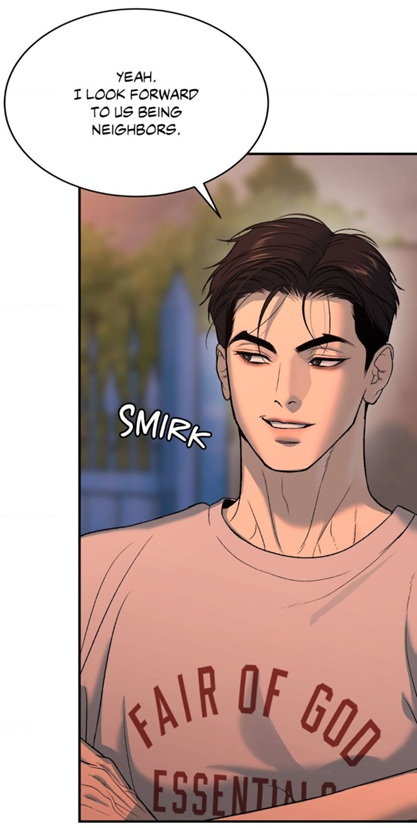 (chapter 61) It also sheds light on why, during their latest encounter, he chose to turn his back on Kim Dan—he no longer needed to ‘see his face,’ he wanted acknowledgment and his return to the penthouse. He has not grasped it yet, but he already views the protagonist as his family and home.
  (chapter 46) He is full of prejudices and not willing to listen to his boss. Therefore Joo Jaekyung doesn’t know that in order to become close, conversations must never be one-sided and have to be free from prejudices and assumptions. Joo Jaekyung needs to listen and show an interest in his partner. And now, observe the communication between the two main leads in the room.
 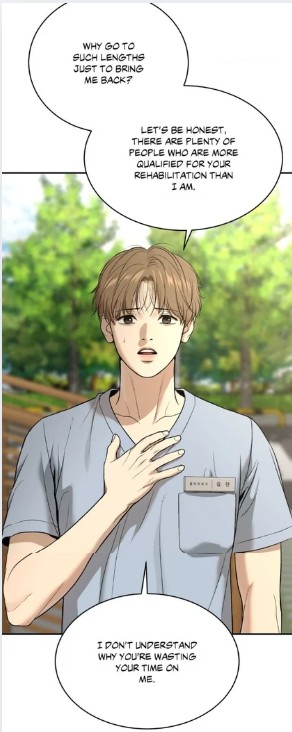 (chapter 62) He asked a question, while the other did not! He just made assumptions from his part, hence he suggested “separate ways”. It was naturally his way of being considerate. That’s why I have the feeling that two words could move Kim Dan’s heart: “HOME” and “HYUNG”. If he calls him that way, the doctor is now recognized as a family member, even as a senior. Hence he needs to be treated with respect.
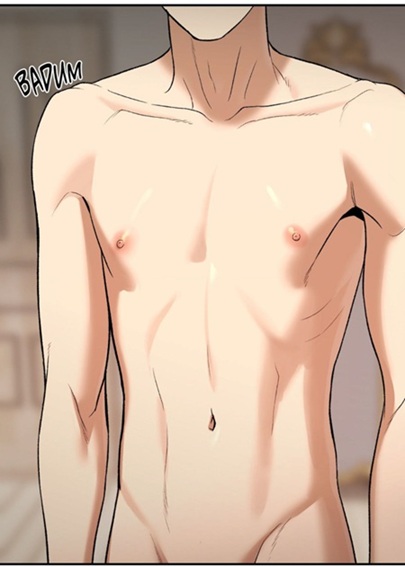 (chapter 62) he had previously ignored—he is undeniably attracted to Kim Dan’s body, particularly his nipples, which have repeatedly
  (chapter 27) triggered strong reactions in him.
  (chapter 29) That’s the moment he expressed his interest in the doctor’s nipples for the first time. This even became a habit:
  (chapter 44). And what did the doctor whisper during that magical night?
  (chapter 44) He wanted him to treasure his body!! In my eyes, Kim Dan’s suggestion in episode 62 is hiding another intention, though it is definitely unconscious:
  (chapter 44) He wants to relive that night
 (chapter 44), though in his mind, he desires to have a bad experience so that he can erase him from his mind. Finally, what do the nipples symbolize? Motherhood and nurturing.
  (chapter 57)
  (chapter 26) Moreover, it was thanks to a trick that Kim Dan won:
 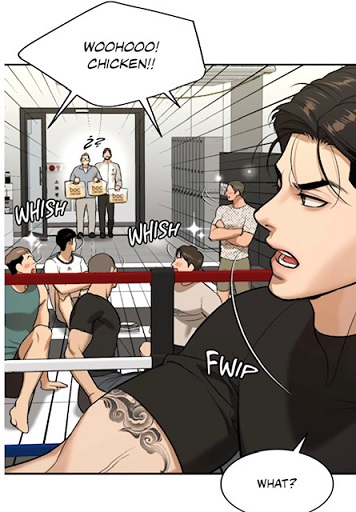 (chapter 26)
  (chapter 26) He felt superior and strong, whereas his rival was weak. Moreover, he imagined that Kim Dan would ask for money for the bet.
  (chapter 26) That’s why I believe that in the next episode, the roles should be switched. Kim Dan always saw himself morally superior and caring to the star, but in truth, his care was rather superficial, for he also showed no interest in the champion’s past and family. Thus I come to the following deduction that episode 62 suggests that arguing is not about losing or winning, but about listening. The champion has unknowingly become a caretaker, not only to the people of the town but, potentially, to Kim Dan himself. The question remains whether he will recognize that Kim Dan’s provocation is not just another fight lost (cutting off ties) —it is a seductive challenge to redefine his understanding of worth and their relationship. What are they to each other? A client and a prostitute? A fighter and a doctor? Or simply two men who are longing for the same: belonging and love. Nevertheless, due to their past, they are unable to detect the true source of their misery: their lack of reflection, own bias and anxieties.
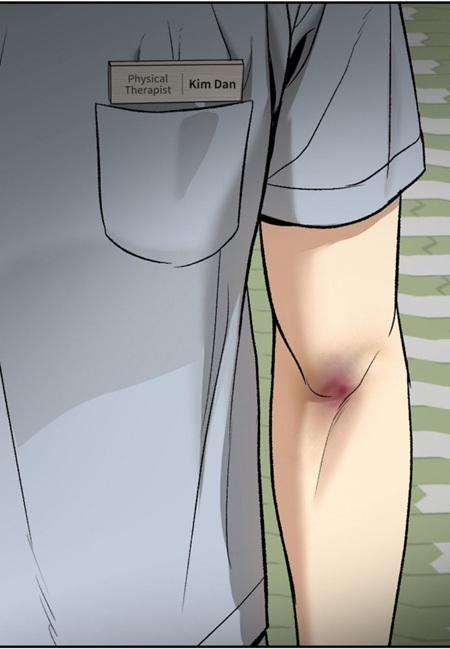 (Chapter 61) However, this moment is not isolated—it reflects patterns in his personality that have appeared throughout the series.
  (Chapter 11)
  (chapter 18) This essay delves into the significance of Kim Dan’s physical and emotional bruises, examining how they symbolize his suffering, internal conflict and transformation. I will examine Kim Dan’s conflicted emotions surrounding gratitude and debt, contrasting his interactions with Joo Jaekyung and his grandmother, Shin Okja. Additionally, I will explore how Kim Dan’s conditioned identity as a caregiver drives his choices, even in his current living situation with the landlord, where he unconsciously replicates past dynamics. Ultimately, I will elaborate how Kim Dan’s newfound awareness could reshape his identity and relationships moving forward.
 (Chapter 61) His unexpected reaction catches Kim Dan off guard, further emphasizing how disconnected the doctor has become from his own well-being. However, contrary to the past
  (chapter 11), Kim Dan is truly responsible for the contusion. He caused the injury by removing the needle from the drip.
  (chapter 60) By taking this action, he absolved Joo Jaekyung of any responsibility for the injury, but this is merely a superficial conclusion.
 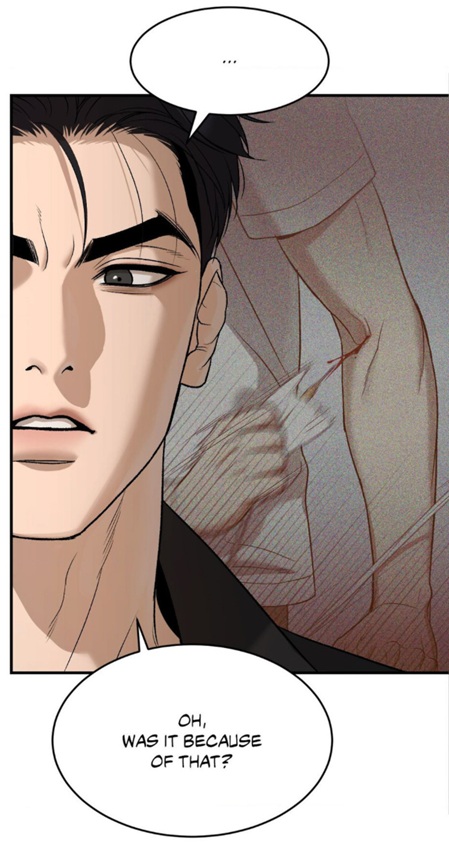 (Chapter 61) On the hand the circumstances surrounding the bruise, where Kim Dan removed the needle on his own, provide insight into his psyche. The deeper cause of the bruise lies in Kim Dan’s declining health, which is intrinsically connected to his malnutrition and the neglect he faces from those around him. It is important to recall that Joo Jaekyung was explicitly informed that Kim Dan needed rest
 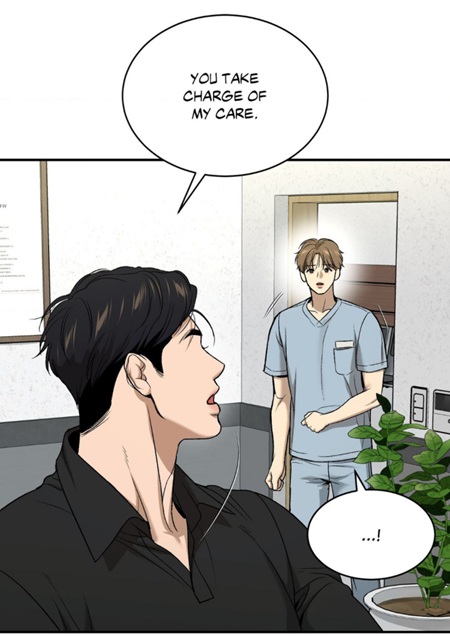 (chapter 61), he forced the physical therapist to keep working, adding even more strain than before. Though the physical therapist attempted to voice his disapproval,
 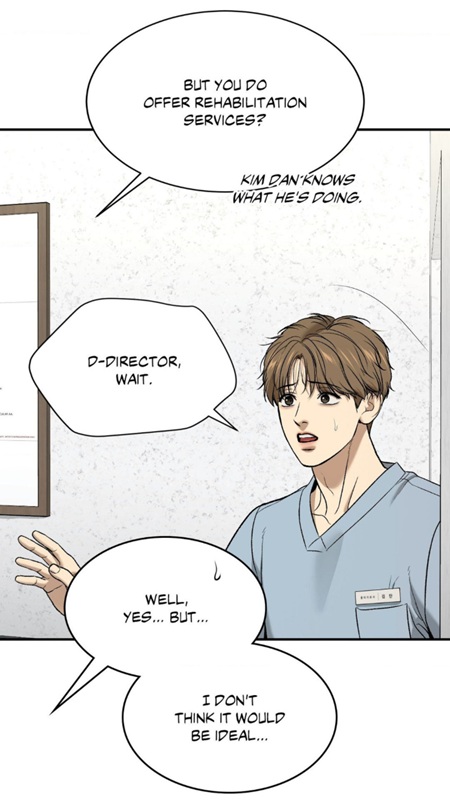 (chapter 61), he ultimately had no choice but to comply, as his order came from the hospice director.
  (Chapter 61) And why did the director override Kim Dan’s need for rest? Money and free PR. Joo Jaekyung’s influence secured the director’s approval, disregarding the doctor’s well-being in favor of business interests. This conversation at the director’s office makes one thing clear: words hold no power against profit. An d that realization led me to another connection—every one of Kim Dan’s bruises is linked to exploitation, whether by authority, obligation, or financial influence.


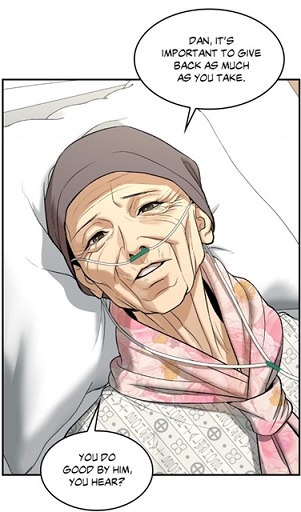 (Chapter 41) It is clear that she was inciting him to work harder than before. This displays that Kim Dan was not allowed to rest. During this encounter, she didn’t ask him about his well-being either. And what is the link between these 3 episodes? The grandmother and her poverty. The latter was responsible for the loan.
  (chapter 18) and took Kim Dan along, ensuring he was seen as an emergency patient. However, this visit was brief and lacked any comprehensive medical examination—no blood samples were taken, and his underlying health concerns remained undiagnosed. This omission further underscores the neglect Kim Dan has suffered, as even in a medical setting, his long-term health issues were overlooked.
 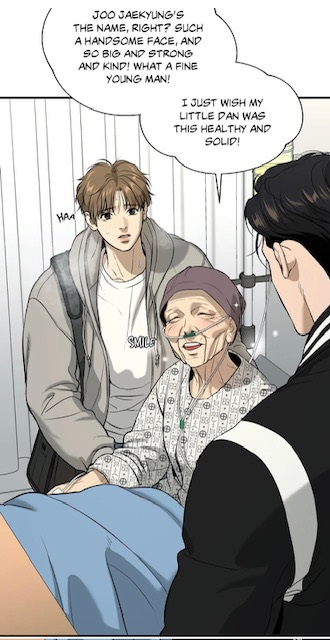 (chapter 21) He had never been healthy and strong. Moreover, when he joined them, at no moment the senior asked if he had gone to the doctor, though he had been sick before.
 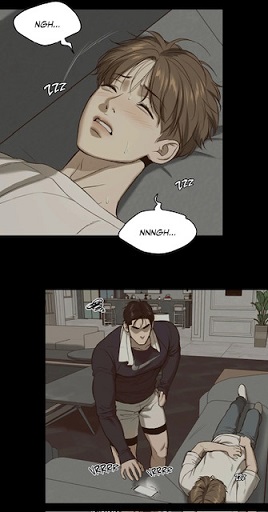 (chapter 21) But back then, the champion didn’t pay too much attention to it. In my opinion, her response will likely reflect her established pattern of emotional detachment and deflection of responsibility. Rather than admitting her lack of concern for his well-being, she may shift blame onto the staff or Kim Dan himself
  (chapter 5), or his general reluctance to ask for help. He rejected the athlete’s help and concern.
  (chapter 61) One might argue that based on this scene, the grandmother didn’t see him with the bruise on his arm.
  (chapter 61) He only remained at the door. However, observe that there was a cut between this image
  (chapter 61) and the conversation between the main couple in front of the hospice.
 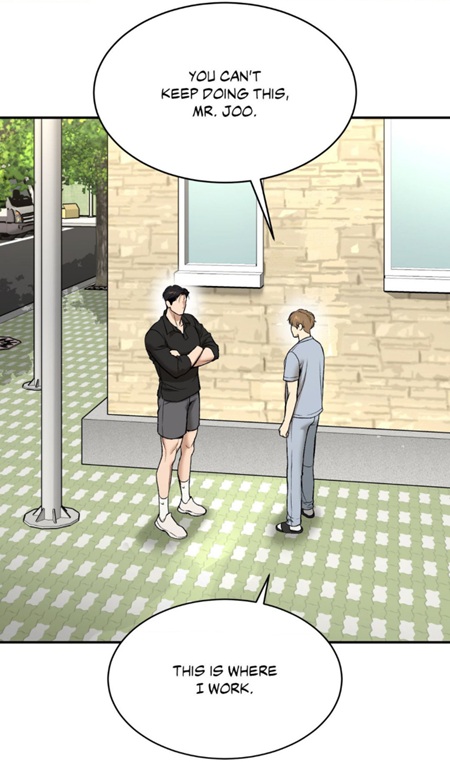 (chapter 61) So he could have made his presence known to his relative before asking Joo Jaekyung to follow him because of his treatment. To conclude, I believe that she had the time and occasion to see her grandchild and his bruise.
 (chapter 13) He is the only doctor who has ever examined the protagonist so closely and even paid attention to his fingernails!
  (chapter 13) At the same time, the chingu from the club was the first one pointing out that his wounds were never treated!! Furthermore, I realized that the doctor’s lies from episode 11
 (chapter 43) He thought, it was related to the massage, yet the reality was that this incident showed that he had coagulation issues. To conclude, all the bruises could have always been noticed by people due to their locations (eyes, hands, arm)!
  (chapter 61) and his relationship with Joo Jaekyung.
  (chapter 61) That’s how I recognized why these women’s warm welcome and curiosity about Kim Dan were rather superficial.
  (chapter 56) His arrival stands for novelty and a breath of fresh air at the institution. However, with this change, the female staff is forgetting their original duty: they need to pay attention to their colleagues. They are behaving like the grandmother
 (chapter 61): fangirling over the handsome guys visiting their little town. That’s why Mingwa drew flowers in the last two images. No wonder why no one around Kim Dan is observing the bruise and his deteriorating condition. Moreover, since the physical therapist has a relative at the hospice, the staff is envisioning that Shin Okja is doing “her work”, she is paying attention to Kim Dan’s mental and physical conditions. On the other hand, there is no doubt that the grandmother has already delegated her own responsibility onto others, Kim Dan and the hospice. It is a medical institution, therefore they should pay attention to his working conditions. In other words, since no one feels responsible for the protagonist’s health, no one is worried about Kim Dan at all. At the end of episode 61, he is even so pale and breathless
  (chapter 61) that I am anticipating a terrible incident leading to a rude awakening for everyone.
 (chapter 47) For Shin Okja, raising him to adulthood marked the completion of her duty, and his current struggles are no longer her concern. This perspective becomes evident in her words from Chapter 57, where she tells him, he can’t stay here forever, and it’s not like he’ll stick around after she dies.
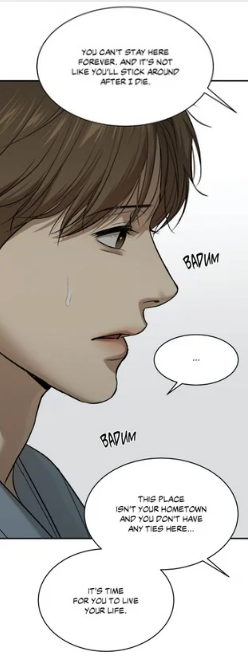 (chapter 57) By declaring that Kim Dan is now responsible for his own life, she emotionally detaches herself, absolving herself of any accountability for his deteriorating condition. However, she is forgetting
  (chapter 56) that she is still relying on him, as he is the one paying her hospice bills. Besides, she still doesn’t know that the loan is no longer existent. It was, as if he had to clean up her mess before her death. At no moment, she asks about the loan or the doctor’s future. She is not thinking about his future at all.
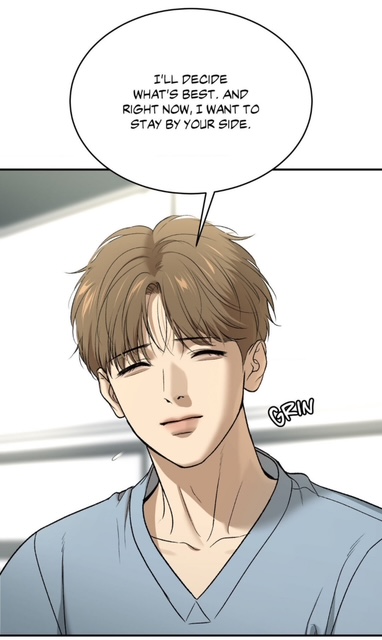 (chapter 57) — reinforces her conviction that she has fulfilled her role. In her mind, his rejection of her advice places the burden of care entirely on him, allowing her to dismiss any further involvement. This emotional withdrawal directly connects to the symbolism of the bruise:
  (chapter 18) In episode 18, when Joo Jaekyung confronts Kim Dan about the loan, the doctor has a bruise on his left eye, symbolizing his entrapment and helplessness. This earlier injury highlights how Kim Dan has been conditioned to view himself as responsible for burdens that are not his own, perpetuating a cycle of sacrifice and self-neglect. And a new bruise appeared just after the athlete reminded the physical therapist of his past promise:
  (chapter 61) His grandmother’s disregard for his well-being amplifies the injustice of this situation; she allowed him to shoulder the debt despite knowing it was never truly his to bear. The bruise becomes a recurring motif, a visual representation of how others have imposed their responsibilities on Kim Dan, leaving him physically and emotionally scarred.
  (chapter 60). The juxtaposition of the vibrant environment with Kim Dan’s deteriorating health underscores the neglect he faces. The hospice is meant to be a sanctuary, yet it becomes a space where Kim Dan is further burdened by the champion and his grandmother’s expectations
 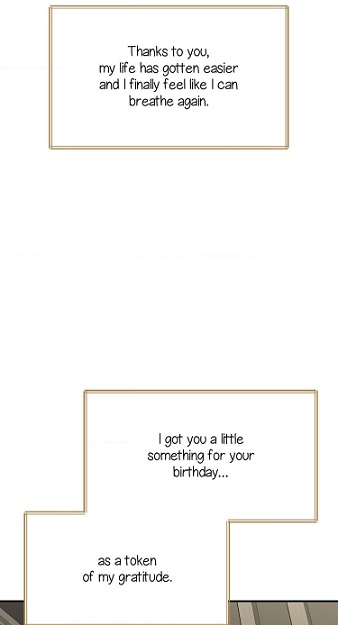 (chapter 55) This line “I finally feel like I can breathe again”, written by Kim Dan, reveals a subconscious acknowledgment that his relationship with the champion represents a breath of fresh air, a chance to escape the suffocating expectations and burdens he has carried for so long. The bruise, a physical manifestation of his struggle, signals the breaking point of his role as a selfless caregiver. It challenges the illusion of invulnerability that Kim Dan has maintained and forces those around him to confront his vulnerability.
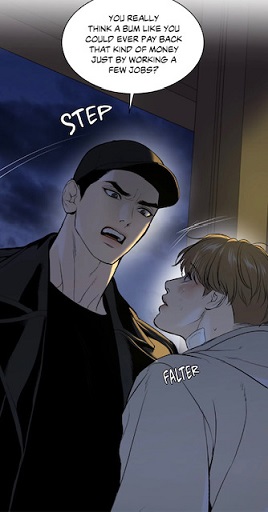 (chapter 18) His grandmother, Shin Okja, played a significant role in this mindset by fostering the illusion that hard work and sacrifice would erase the debts. However, as revealed in episode 18, this was a lie. Shin Okja made the choice to take on the loan and not to seek help
 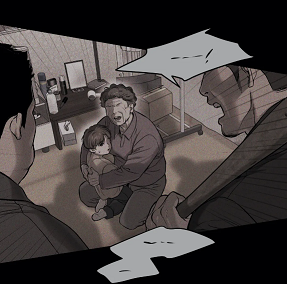 (chapter 5), yet she burdened Kim Dan with it, using his sense of duty and gratitude against him. Her statement in episode 57
  (chapter 18) —or, more accurately, the lack thereof. The champion’s actions were motivated by a desire to help
  (chapter 18), hence the star was waiting for a smile from Kim Dan. Yet the latter perceived it as meddling. His immediate response
  (chapter 53), leaving a note when he moved out that promises to settle the debt. However, by Episode 61, Kim Dan is no longer mentioning the debt, signaling a shift in his priorities and a possible breaking point in his adherence to his grandmother’s expectations.
 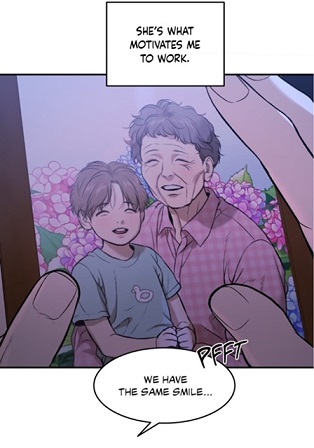 (chapter 47) The physical therapist’s entire existence had revolved around fulfilling her needs, from managing the debt to taking care of her health. With her now approaching death and actively pushing him away, Kim Dan is left grappling with a profound sense of meaninglessness.
  (chapter 60) He had never been given the opportunity to develop dreams or ambitions of his own, as his life was entirely defined by his grandmother’s circumstances. This lack of agency further explains his rejection of Joo Jaekyung’s generosity in Episode 18 and his later promise to reimburse the loan. Clinging to this promise was Kim Dan’s way of creating purpose and meaning in a life that had otherwise been dictated by others. It highlights how deeply entrenched his self-sacrificing tendencies are, as even his attempts to assert independence are rooted in his conditioned need to serve others. That’s why I come to the following prediction. Kim Dan needs to get confronted with illness and death (he could lose his life) so that his will for life comes to the surface. Right now, he imagines that since he is young, he will outlive his relative, but the death of the puppy was a warning to him that youth is no guarantee for a long life.
  (chapter 59) Death can take away anyone and at any moment. In my eyes, if Joo Jaekyung uses his own body to save the doctor again (like for example blood transfusion and CPR), this time Kim Dan would feel truly grateful towards the champion. So far, the doctor has not recognized the star as his savior yet. By removing the needle, he denied the protagonist’s intervention on the beach:
  (chapter 60) Hence his arm got bruised. The contusion was a reminder that something had happened during that night, but Kim Dan chose to ignore the incident. He never questioned why he was on the beach, he acted, as if Joo JAekyung had lied.
  (chapter 60)
 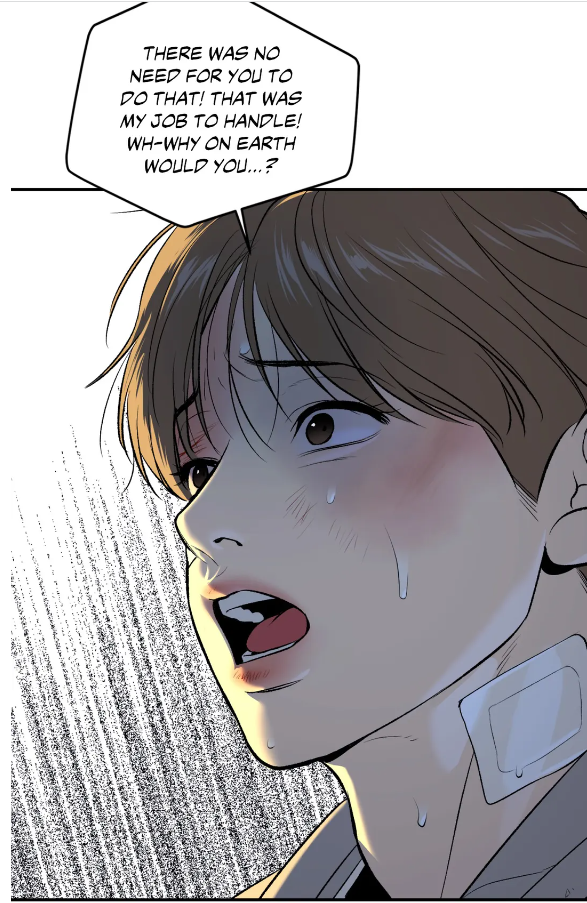 (chapter 18) Deep down, Kim Dan knows that the debt was never truly his responsibility, making it difficult for him to view the champion’s actions as a genuine act of kindness. This inner conflict is compounded by his suicidal disposition, which renders the concept of repaying the debt meaningless.
 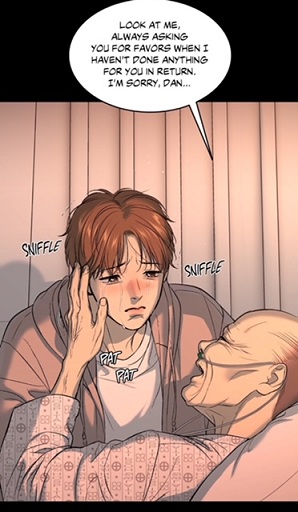 (chapter 53) and guilt to manipulate Kim Dan into fulfilling her wishes, framing his sacrifices as acts of love and duty. Her neglect and disregard for his well-being, even as he deteriorates physically and emotionally, highlight her selfishness. Through his past memories, readers can get a glimpse of his misery.
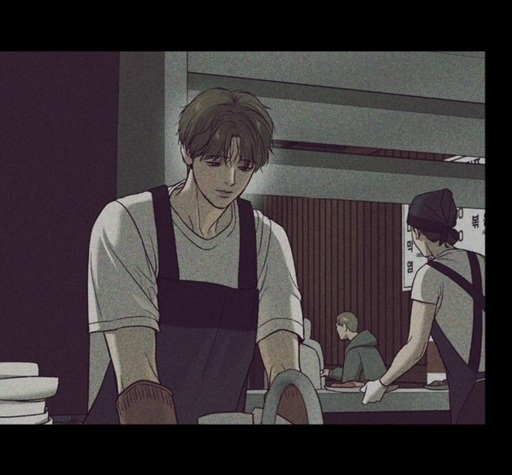 (chapter 59) He worked so hard, was even beaten, but he could never voice his torment.
  (chapter 59) Why? It is because the grandmother was no longer by his side and she never talked to him either. The absence of communication indicates her lack of interest in Kim Dan. And it becomes comprehensible why during that night, he felt the need to go to the ocean and drown himself. It is because he was gradually realizing his loneliness. With his relative’s death, he would only keep living a terrible life determined by work and nothing else.
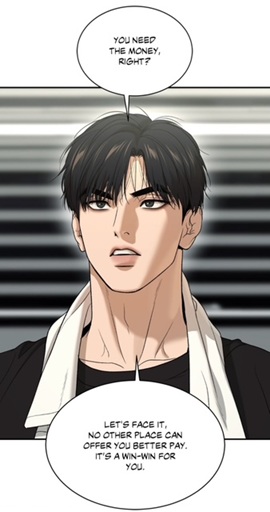 (chapter 60)
  (chapter 11) and even uses his own words against him:
  (chapter 22) The loan was the result of his grandmother’s decision. He never helped him, rather his grandmother.
  (chapter 11) However, he never explained his circumstances to the generous athlete. By keeping him in the dark, he reinforced his negative disposition about the doctor. And chapter 61 exposes this reality. His suffering was the result of his own decision.
 (chapter 61) Do you recognize the room? That was the doctor’s
  (chapter 19)
  (chapter 53) His decision to allow Joo Jaekyung into his bedroom in episode 61 demonstrates that he consented to the relationship, even if begrudgingly.
 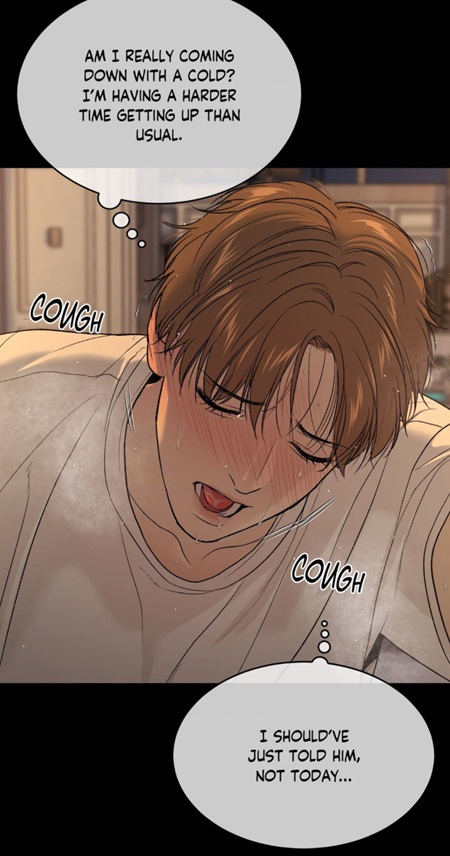 (chapter 61) However, his reaction afterward (regret) suggests that he struggles to take ownership of his choices. The fact that he recalled this sex scene in the restroom divulges a certain resent towards the athlete. The latter abandoned him right after their interaction. Hence I come to the following deduction. In reality, he is projecting his frustrations onto Joo Jaekyung, masking his true feelings about his grandmother, who is the root cause of his conditioned self-sacrifice. And this observation brings to my next remark. People wondered when this intercourse took place. One might think that this took place rather early in the story because of the way Joo Jaekyung acted. He didn’t remove his pants
  (chapter 61) and acted like in episode 6.
  (chapter 6) or 8
  (chapter 8) where he would abandon the protagonist right after the climax and not care about his partner’s conditions and feelings:
  (chapter 61) I might be wrong, but for me, it took place much later in the story, around the time the athlete was about to face Alfredo. Why? First notice that they had sex in the doctor’s bedroom. This means that Kim Dan was already living in the penthouse. The words from the champion implied that he would return to his own bedroom, where the doctor’s thoughts implied that he was standing close to his bed. However, so far, they only had sex in the champion’s bedroom, when it was the evening before the match:
  (chapter 13) Since the doctor mentioned that a match was right around the corner
  (chapter 61) It leaves us four possibilities. Randy Booker, Dominic Hill, Alfredo
  (chapter 47) and Baek Junmin. However, for the intercourse took place in the doctor’s bedroom (he wished to be carried to his own bed)
  (chapter 36), for they had sex every day. However, in episode 53, we discover their night before the match against the Shotgun
 (chapter 53) So this scene can only have taken place in chapter 47, when the match with Angelo got canceled and Kim Dan had been confronted with the terrible news about his terminally ill grandmother.
  (chapter 47) In the previous part of this essay, my avid readers could see the strong parallels between 61 and 47. But there exists another reason why I am inclining to think that the sex scene took place later in the story. It is because during that “magical night” (44), Kim Dan learned the notion of “consent”.
  (chapter 44) During that blue hour, Kim Dan discovered that he could say no! And notice that in his memory, he clearly thought that he could have rejected the athlete’s advances.
  (chapter 46) He should mistrust the members from the gym and keep his distance from people. So during that time, Joo Jaekyung did follow his hyung’s advice
  (chapter 47), yet I can’t imagine that this man could become abstinent like in episode 19. Hence at some point, he must have felt the urge to possess Kim Dan, a mixture of fear and dominance. He imagined that way that he could impose his will onto the doctor and control his “loyalty”. With this submission, he would force the doctor to remain by his side. But naturally, this sex as “power play” could increase the gap between the main leads.
 (chapter 53) doc Dan was copying the champion’s behavior from episode 61. Right after the sex, he would leave the bed and return to his bedroom. How did Joo Jaekyung recall this night?
 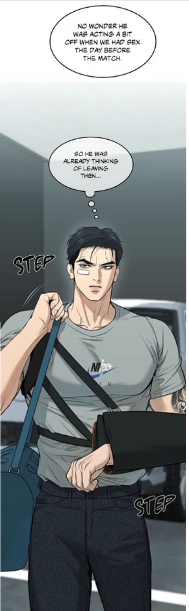 (chapter 53) He saw his attitude as a sign of disloyalty and “abandonment”. And that’s how Kim Dan is feeling in the restroom:
  (chapter 61) The darkness around the eyes is a metaphor for his resent and anger. And the moment you contrast the two memories (53 and 61), you can detect the hypocrisy of the two main leads. They only recall scenes where they were hurt and felt betrayed. However, in reality, they were both victims and perpetrators, because none of them chose to open up and talk to each other. Why? It is because both chose to listen to their “guardian” and their “favor”. Like mentioned before, in a quarrel, no one is right and wrong. The purpose of an argument is to listen to the counterpart and view incidents from their perspective. Finally, the physical therapist’s recollection serves as an important evidence that he had never been powerless and helpless. He could have refused all the time because their deal was never official.He could have used the contract as a shield. But the best evidence of Kim Dan’s power is this rejection:
  (chapter 61) I had already pointed out the increasing resistance and resilience from Kim Dan in episode 60:
 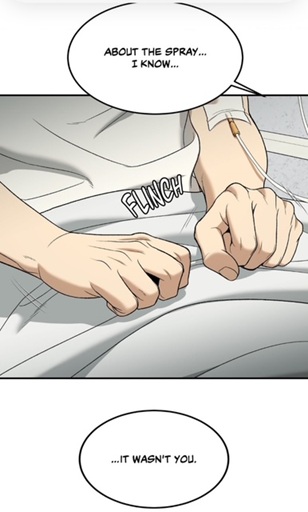 (chapter 61) My prediction came true. In the past, he could have denied the existence of the deal, Joo Jaekyung was free to seek another physical therapist. He never realized that he had some leverage. Yet he still followed the athlete’s requests. He saw himself bound by obligations. However, this was just an illusion. Hence in episode 61, we see him legitimating his consent that there was an imminent fight.
  (chapter 61) He is expected to work despite his declining health, his suffering dismissed by those around him.
  (chapter 40) He is paid to receive bruises, to push his body past its limits
 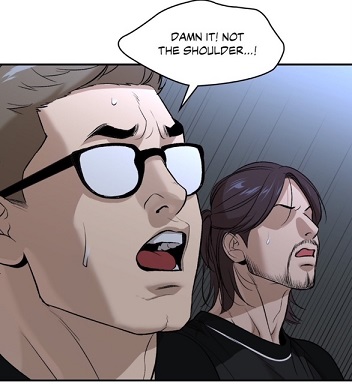 (chapter 50), to endure pain while the public watches and profits are made. His suffering is entertainment, a spectacle that fuels the business of MMA. Though he is a champion, he is still a commodity, expected to perform regardless of his condition.
 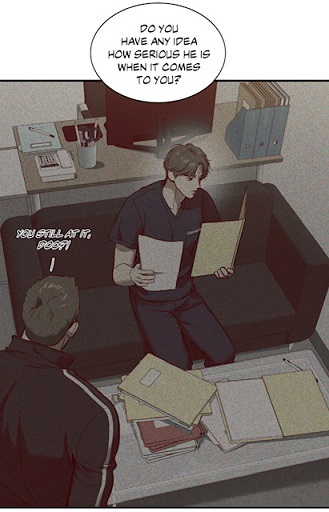 (chapter 17) I doubt that Park Namwook studied them, and notice that the recently hired PT didn’t ask for the champion’s files first:
  (chapter 54) Thus I deduce that the champion’s files are in reality a subterfuge. They give the impression that the doctors and Park Namwook truly care for his well-being, but it is not correct. They are only interested in his body because of wealth and reputation. But let’s return our attention to episode 61 and the champion’s attitude towards Kim Dan.
 (chapter 54) It is clear that the manager wants Joo Jaekyung to return to the ring as soon as possible to erase the last “debacle”. In my opinion, the doctor’s illness could serve Joo Jaekyung as an excuse to delay his return to the ring and even not to accept the next challenge.
  (chapter 57) is another manifestation of his conditioned role as a caregiver. By living with an older man, he creates the illusion of a familial bond, mirroring the dynamic he shared with his grandmother. This decision highlights his struggle to break free from the identity imposed on him—one defined by servitude and selflessness. He assumes that he should take care of the landlord, offering to cook and expressing guilt for not fulfilling this perceived duty. Yet, the landlord subtly challenges this narrative. By inviting Kim Dan to eat breakfast
 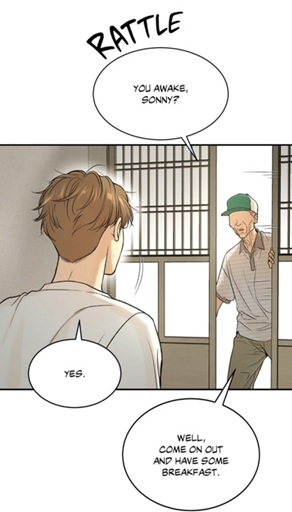 (chapter 57) and dismissing his apologies, the landlord treats him as an equal rather than a caretaker. This dynamic forces Kim Dan to confront his false perception of himself.
 (chapter 57) Despite this, Kim Dan rejects the advice, demonstrating his resistance to being cared for. This moment underscores his internal conflict—he craves independence yet clings to the role of the selfless provider. The landlord’s actions expose the fallacy of Kim Dan’s identity, revealing that his caregiving is not always necessary or effective.
 (chapter 61) is indicating the increasing resent and anger towards the star. Joo Jaekyung is no longer seen as a celebrity and idol, but as a inconsiderate man. This transformation is subtle but meaningful, as it reflects his burgeoning awareness of his own worth and the unjust treatment he has endured. For the first time, Kim Dan acknowledges himself as pitiful
  (chapter 53)
 (Chapter 15) and the life-saving kiss on the beach
  (Episode 60). Both moments carry significant emotional weight but reflect different facets of their dynamic, from selfishness to selflessness, secrecy to openness, and miscommunication to recognition. The setting and circumstances surrounding these kisses not only highlight the characters’ growth but also underscore the unresolved struggles they face.
 (chapter 14), acted particularly rough with Kim Dan
  (chapter 14), only snapping back to reality when he felt Kim Dan’s body trembling.
  (chapter 14) This moment of realization, coupled with the doctor’s tears and plea
  (chapter 14), served as the trigger for Joo Jaekyung to recall Cheolmin’s recommendation
  (chapter 14) of using foreplay and gentler methods, such as a kiss. While the kiss reflected care in the moment
  (chapter 14), selfish motives lingered in the shadows, as Joo Jaekyung sought to prevent causing visible harm that could lead to questions or even a scandal. It was, as if he wanted to silence his partner. Moreover, this decision was influenced by external suggestions, particularly from his friend, and not entirely by his own intentions. It was a calculated action to prevent immediate harm but lacked genuine emotional depth.
 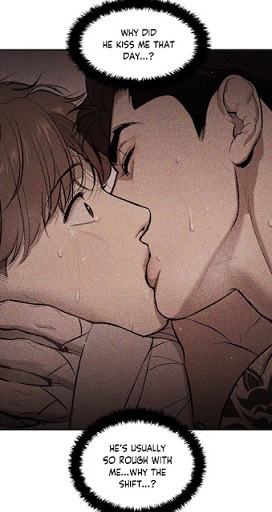 (chapter 16) Moreover, he never wondered why Joo Jaekyung had asked for sex in the locker room, which represented a change in his behavior. If he had done it before, then he would have forced the physical therapist to travel with him to Busan.
  (chapter 13) As you can see, through the comparison with the kiss on the beach, I realized the doctor’s passivity and lack of critical thinking in season 1. He never asked why the athlete was so rough during sex. He took this for a normality. His attitude exposed the doctor’s biased perception of his boss: a spoiled and rough man obsessed with sex. I would even add that the kiss had a positive effect on the protagonist
  (chapter 15), because for the first time, Kim Dan made a request. With his remark, he implied that the kiss was strongly associated with emotions. However, exactly like Joo Jaekyung pointed out
 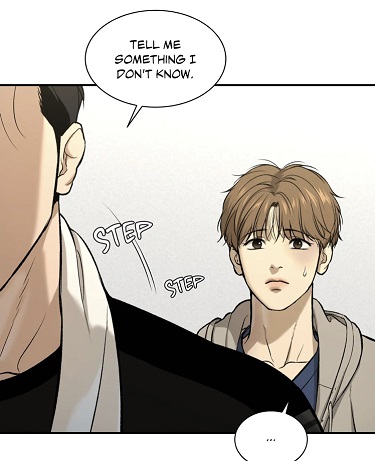 (chapter 15), the physical therapist omitted something important in the locker room. First, he didn’t share all his thoughts about the athlete, in particular his prejudices. Finally, he should have talked about his behavior before the kiss. What was he thinking, when he was having sex with him? In verity, he had been used as a substitute. In other words, the champion’s selfishness was rubbing on the doctor. Both were selfish, both had their heart and mind closed. And this remark brings me to the kiss on the beach.
  (chapter 15), a confined space symbolizing Joo Jaekyung’s need to keep his relationships private. Picking up partners at a VIP club
 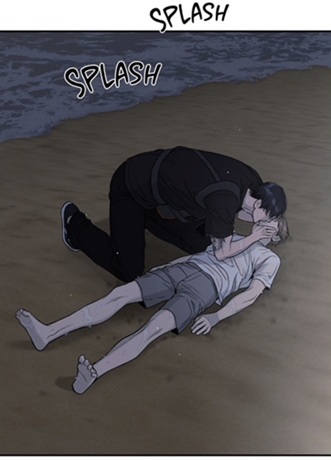 (chapter 60) Moreover, in the past, the locker room
  (chapter 14) was always filled with people surrounding the champion. However, once Kim Dan entered his life, this dynamic began to change. In Episode 14, Joo Jaekyung asked everyone to leave the locker room,
  (chapter 14) even excluding Park Namwook, who was even seen before stationed outside the bathroom door,
 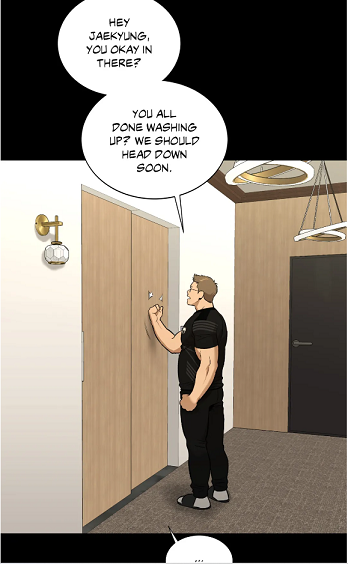 (chapter 14) signaling a gradual exclusion of others from his private life and emotions. By Episode 15, Joo Jaekyung explicitly sent away his manager to have a private conversation with Kim Dan.
 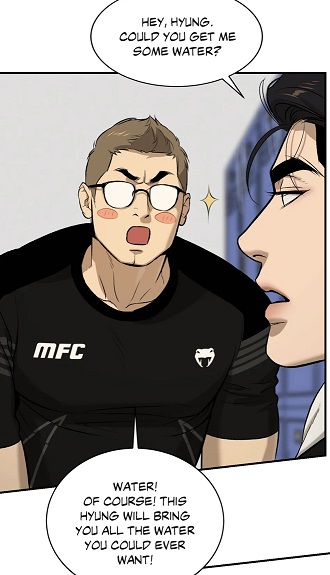 (chapter 14) This shift highlights the increasing importance of Kim Dan in Joo Jaekyung’s personal sphere. Interestingly, this progression is contrasted by Episode 49, where Joo Jaekyung deliberately ensured
  (chapter 49) he was not left alone with Kim Dan. This means that this place was no longer the synonym for privacy and secret. This reflects why director Choi could intrude with his minions. Following the incident with the switched spray, Kim Dan was left behind
  (chapter 50) in the locker room twice
 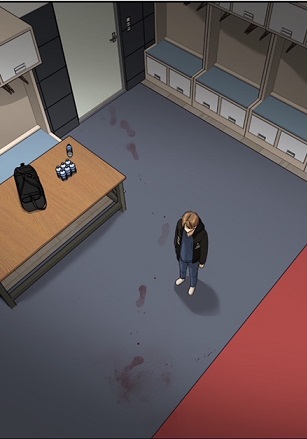 (chapter 51), which could only increase the physical therapist’s feelings that he didn’t belong to Team Black. He was not part of that “family”. And this coincides with the moment where Kim Dan cries for the last time:
  (chapter 51) From that moment on, the main lead won’t show his vulnerability and pain to others. This gesture announces the return of his “blue friend”, the depression.
 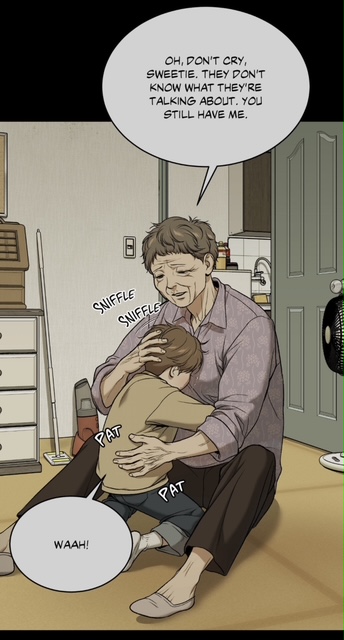 (chapter 57) Shin Okja must have felt uncomfortable with his tears and pain, therefore the doctor internalized not to show his struggling and burdens in front of his grandmother. This explicates why he denied his weeping in front of her first.
  (chapter 47) And now, you are wondering how this is relevant to the scene on the beach. Joo Jaekyung got shocked and scared, but he didn’t cry later and it is the same for Kim Dan. Hence the latter could deny his presence on the beach and even ignore the athlete’s words:
  (chapter 60)
 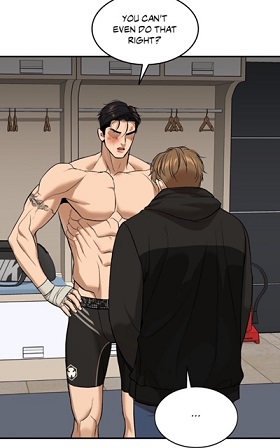 (chapter 51), his lack of loyalty, his greed and obsession for money.
  (chapter 51) Here, they were totally honest to each other:
  (chapter 51) Though the champion was restraining himself, he didn’t realize that his words were like punches to Kim Dan. The latter got to hear what he didn’t know.
  (chapter 51) Despite living together in the penthouse, he didn’t trust his room mate. After divulging his mistrust and anger to the physical therapist in the locker room, the former left Kim Dan behind and went to the health center with his hyungs.
 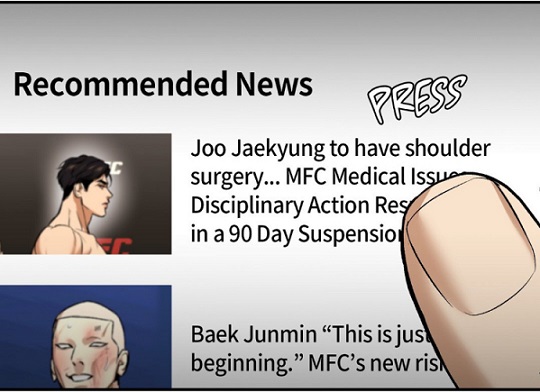 (chapter 52) The conversation in the locker room symbolically announced the champion’s private struggles to the media, as his bad temper was made public shortly after.
  (chapter 15) , representing his need for mental and emotional support, which his team and entourage failed to provide. While the CPR kiss could be dismissed as a rescue, it symbolically represents a step toward Joo Jaekyung revealing his true self. The kiss marks a moment where he unconsciously begins to acknowledge his feelings and his homosexuality, even in a setting where others could witness it.
 (chapter 60) This means that on the beach, Kim Dan could only detect one thing: Joo Jaekyung’s presence. But he didn’t sense his kisses and hear his words. That’s the reason why I come to the conclusion that this scene stands under the sign of “dream and illusion”.
  (chapter 60) Hence he came to reject his “intervention” as a lie and deception. The reality is that Joo Jaekyung does care for him, but he doesn’t know how to show it. He fears attachment. Because of his misjudgement, Kim Dan is not capable to notice the transformation in his former boss.
 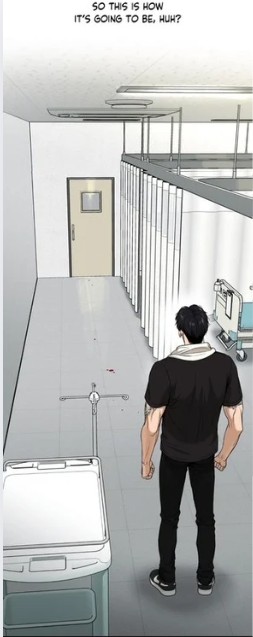 . (chapter 60) The latter has now darker circles, and he lost a lot of weight.
 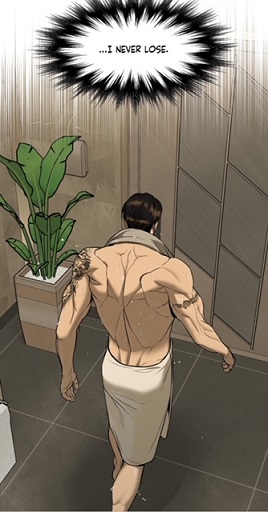 (chapter 49) His muscles are less pronounced. He is also wasting away.
  (chapter 60) reinforce control and suppression. In the locker room, the absence of time and space to relax or meditate highlighted the pressures placed on Joo Jaekyung by his manager and coach
  (chapter 49), who believed that physical strength alone would solve his problems. This environment denied him the mental and emotional support he truly needed.
  (chapter 54) Because Joo Jaekyung saw it in a vision, it becomes clear that the athlete is still in denial about his wrongdoing. Therefore he didn’t apologize for his false accusations and his bad perception of the physical therapist:
  (chapter 60) , though there is no doubt that the doctor is still in love with him. At the hospice, this mistrust resurfaces. The parallel conversations—in the locker room and the emergency room—highlight the ongoing cycle of miscommunication and emotional disconnect. Both characters, in their own way, lie to themselves and each other. Joo Jaekyung sees Kim Dan through the lens of poverty and greed
  (chapter 60, reducing his identity to his need for money, while Kim Dan rejects his offer, his help and conceals his pain. It is not surprising that Kim Dan left the treatment room.
  (chapter 60) The lies and miscommunication fade in the face of the life-and-death situation. However, this recognition is short-lived, as the events at the hospice reveal Joo Jaekyung’s lingering selfishness
  (chapter 27) and mental well-being.
  further highlight his mental fragility. This fragility contrasts sharply with Joo Jaekyung’s reaction during their interaction at the hospice. When the champion angrily asks,
  , his words reveal frustration and a superficial understanding of the situation. Rather than addressing the underlying psychological distress driving Kim Dan’s actions, Joo Jaekyung perceives them as reckless behavior. His focus remains on immediate danger rather than the deeper cause, showcasing his emotional detachment and inability to grasp the full seriousness of Kim Dan’s mental state. This misinterpretation underscores how Joo Jaekyung is still projecting his own coping mechanisms onto Kim Dan, assuming that sheer willpower and physical strength can resolve emotional struggles. This moment serves as a stark reminder of Joo Jaekyung’s ongoing growth and the gaps in his understanding of Kim Dan’s suffering. His denial of having gone to the beach, despite clear evidence, points to the depth of his trauma.
  (chapter 60) at the end of episode 60 as something negative. How so? It is because Kim Dan never said this:
 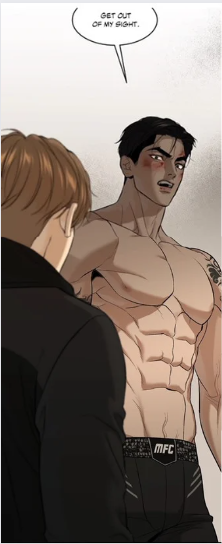 (chapter 51) He never wished to never see Joo Jaekyung again. Moreover, he never regretted their meeting either.
 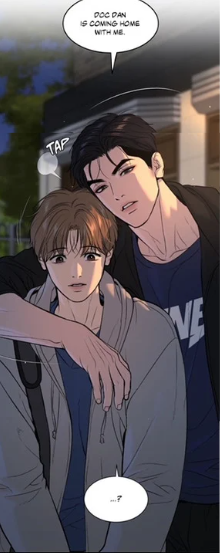 (chapter 43) No wonder why he thought that it was time to get to know the fighter during that night:
  (chapter 44)
 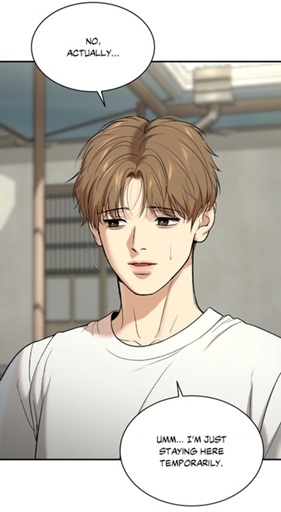 (chapter 58) Where are the parents? Who is the man where he is staying? Where did he plan to go after his stay there? The idiom “temporarily” could be perceived as an evidence that the doctor plans to end his life. According to my interpretation, Heesung believed that the landlord was Kim Dan’s grandfather. He was just denying his origins out of shame.
  (chapter 9) The athlete has now every reason to stay there and that’s how he will discover all the doctor’s secrets and misery.
 (chapter 15) kiss represents selfishness, secrecy, and miscommunication, while the beach kiss


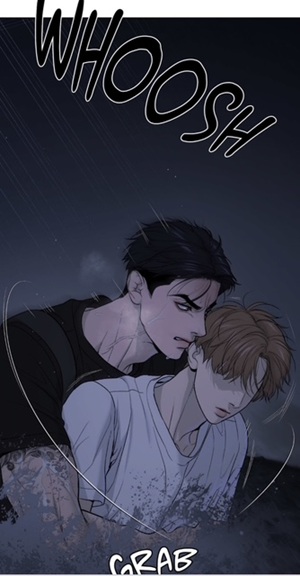 (chapter 59) is a masterful interplay of symbolism, reflection, and narrative breadcrumbs laid out by Mingwa. Central to this exploration is a photograph
  (chapter 59) —an innocent request by the nurses at the hospice
 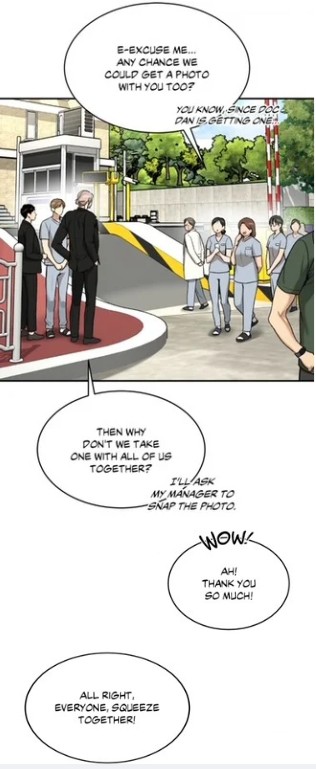 (chapter 59) —which becomes the pivotal clue leading Joo Jaekyung to Kim Dan. Through a careful analysis of the timeline and the use of contrasting events, it becomes clear that Mingwa’s narrative mirrors a kaleidoscope, reflecting positive and negative elements rooted in Taoist principles. While the doctor’s unconscious
 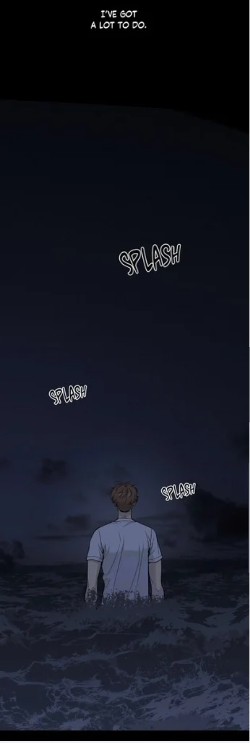 (chapter 59) led him to the shore, driven by despair and suicidal intent, the MMA fighter’s journey stands as its opposite:
 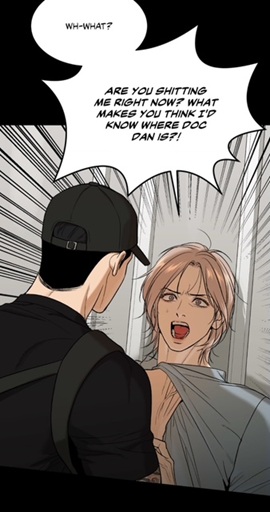 (chapter 59 ) a conscious choice to follow his heart, hence he was full of anger and frustration. Joo Jaekyung was no longer repressing his feelings, even if he had yet to fully recognize his affection.
 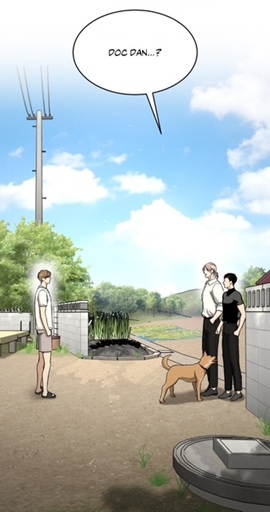 (chapter 59) embodies the negative reflection of Joo Jaekyung’s purposeful arrival. We can detect the divergences: day versus night, work versus break, healthy versus unhealthy etc. Through the juxtaposition of images and situations, Mingwa provides profound insight into the characters’ thoughts, desires, and intentions. The photograph’s role becomes pivotal: while it marks the end of Heesung and Potato’s visit
 (chapter 59), it simultaneously signifies the first crucial clue in Joo Jaekyung’s search. This marked the turning point where his ongoing efforts were given direction, transforming his pursuit into a decisive journey toward discovery.
 (chapter 59) —each of whom had interacted with Kim Dan
  (chapter 57) during his time at Light of Hope. While these individuals appear as potential candidates for revealing Kim Dan’s location, the true helper remains shrouded in mystery. This ambiguity emphasizes the layered narrative of Jinx, where each small action—no matter how mundane—contributes to the larger theme of fate’s intricate web, offering insight into the power of both intentional and unintentional intervention. If Potato had not suggested the picture
  (chapter 58)
  (chapter 58)
  (chapter 58), ignorance and superficiality
  (chapter 58), becomes the shadowed reflection of the proactive search by Joo Jaekyung. This interplay of light and dark is central to unraveling how fate unfolded.
 (chapter 58) and Potato, despite their contrasting motivations
  (chapter 58), came to the same conclusion: they should not reveal Kim Dan’s whereabouts to Joo Jaekyung. Heesung argued that Kim Dan was better off in his secluded life, away from the chaos of Joo Jaekyung. Potato, deeply trusting his lover’s seniority and judgment, chose to follow Heesung’s lead. Their decision reflects not only their loyalty to Kim Dan’s expressed wishes but also their passive adherence to the belief that avoiding intervention was a form of help which reminds us of Potato’s former principle:
  (chapter 35) This shows that despite the last incident, Yoon-Gu didn’t drop this terrible principle. Notice that he is advocating the same philosophy than Shin Okja. Heesung justified his stance by claiming that it was in Kim Dan’s best interests
  (chapter 59) Importantly, Joo Jaekyung did not arrive during this period, further affirming their resolve. The photograph taken just before their departure was the key turning point. However, the timeline—marked by the sunsets
  (chapter 59)
  (chapter 59) —suggests that Joo Jaekyung arrived only two days after Heesung and Potato left. This indicates that neither Potato nor Heesung leaked the information to Joo Jaekyung, as the champion would have sought Kim Dan immediately if informed by them. Instead, this photograph—seemingly public rather than private—became the clue he needed. Moreover, since the two friends knew where Kim Dan lived, I am assuming that he would have gone right to the doctor‘s rented room. But he did not. He went to the beach. Since the nurses didn‘t notice that Kim Dan was a friend of Potato and Heesung and mistook him for a fan, I am assuming that only the two friends know his address.
  (chapter 8)
  (chapter 37) and Kwak Junbeom was a witness of the encounter between Kim Dan and director Choi Gilseok.
  (Chapter 48) Nonetheless, there exist significant points against this theory. Despite their fondness for the actor
  (chapter 30) and their interactions with Heesung and Potato
  (chapter 35), they are unaware of the actor’s relationship with Potato. The author left many clues for this interpretation. They didn’t notice the maknae’s absence at the champion’s birthday
  (chapter 43), but more importantly the presence of Yoon-Gu‘s embarrassment in front of his hyung indicates secrecy. .
  (chapter 58) His “redness” indicates that he doesn’t want to expose his special relationship with Heesung. Therefore I believe that he didn’t mention this trip to other members. Consequently, I doubt that the members were looking for Potato in such a photograph. Furthermore, from my perspective, members of Team Black are still left in the dark about Joo Jaekyung’s struggles. They are unaware of his drinking habits
  (chapter 56), or his emotional state. They think, he has not come to the gym due to his recovery. Furthermore, they don’t use his cellphone number to contact him. The hiring of a new physical therapist and
  (chapter 58), but probably saw this as another “negative reaction” (bad temper) of a spoiled child. This makes it unlikely that members of Team Black could have provided the critical information.
  (chapter 50)
 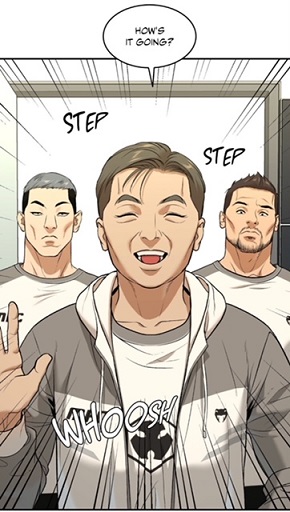 (chapter 49), highlighting the failures of relying solely on fate. The champion’s eventual discovery of Kim Dan underscores the necessity of teamwork and active intervention. Notably, this also reflects the flaws in Team Black, whose inaction and superficiality limited their understanding of both Joo Jaekyung’s struggles and Kim Dan’s situation. While Heesung’s stardom and blog
 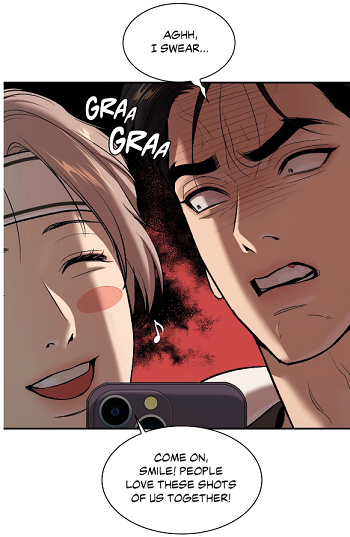 (chapter 30) could have amplified the picture’s reach, it’s unlikely Joo Jaekyung relied on such sources directly. I can not imagine him spying on the actor’s blog. Instead, the role of the helpers — the nurse and her acquaintance— emerge as crucial to piecing together the connection. The inadvertent role of the nurses Mind and Heart, urging Heesung to take the picture, becomes an integral part of the story’s progression.
  (chapter 13) who played pivotal roles in lifting the curse, as Mingwa’s narrative often draws on such reflections. Here, the nurses’ actions, though seemingly minor, echo the same themes of fate and intervention.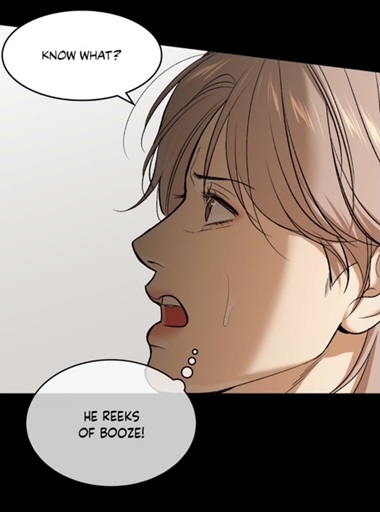
 (chapter 13) but didn’t know his identity. He mistook him for someone who was selling his body for money.
  (chapter 13) In addition, Kim Dan never got to know the intervention of this hyung: he was the invisible helping hand in season 1. And now, if you reread the scene in episode 13, you will notice that this conversation between Joo Jaekyung and his friend contains all the ingredients in episode 59: the use of the phone, fainting, malnutrition, secrecy, neglect, secret suffering, pictures and public knowledge
 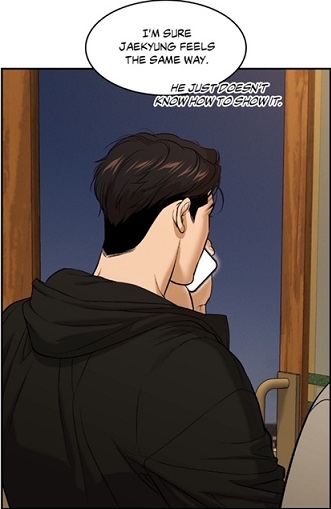 (chapter 43) And during that evening, the champion called his penthouse with the doc “Home” for the first time. Finally, in season 2, Joo Jaekyung started visiting each hospital or Sports Rehabilitation Center in Seoul in order to find Kim Dan.
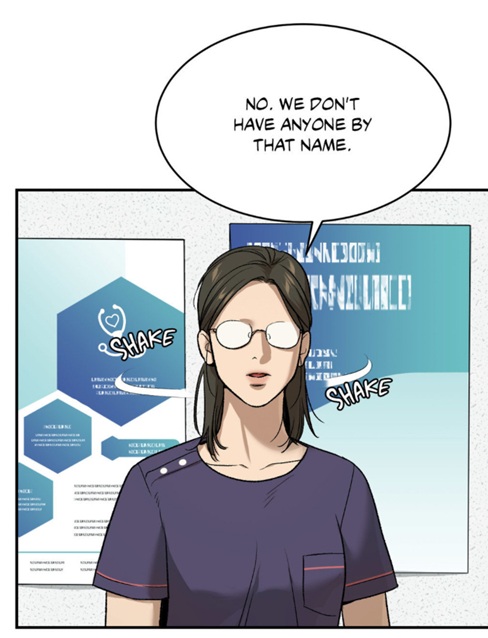 (chapter 56) And there’s no doubt that Joo Jaekyung got recognized by people forcing him to use a mask to hide his identity. So this frenetic search must have reached the mysterious doctor’s ears, but I doubt that he made the connection between the star’s lover and the physical therapist right away. Since he‘s a guest of XY club,
  and to Neptune
  and strangely, the doctor moved to a place next to the coast. So maybe Cheolmin comes from that little town and the green-haired nurse is his relative. I had already outlined their similarities. Finally, look at the numbers, we have 4 in both episodes, 13 and 59 (13: 1+3 = 4 / 59: 5-9= -4) The -4 would coincide with Kim Dan’s vanishing, but also with the intervention of Cheolmin. And if my theory is correct, this means that the champion will come to regret his past decision
 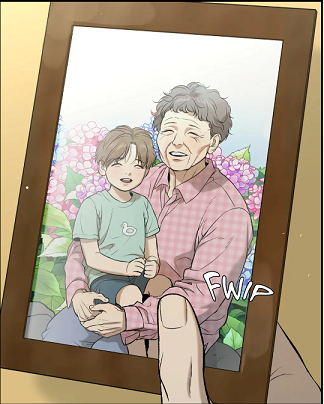 (Chapter 19) and the group photograph at the hospice

 (chapter 54) and penthouse
  (chapter 54) in Seoul—a city symbolizing anonymity, invisibility, and corruption—to the hospice “Light of Hope”
  (chapter 56) in a small town on the West Coast
  (chapter 56), where people know each other. This essay builds upon my previous interpretations of the series, which led me to develop these predictions for the upcoming season. By comparing the visual depictions of the gym and penthouse in Seoul with the hospice and small town on the West Coast, the divergence in weather becomes a powerful symbol of the changes Joo Jaekyung will undergo. The rainy, overcast settings of the gym and penthouse reflect the fighter’s inner turmoil and sadness, highlighting the oppressive atmosphere of a city rife with anonymity and corruption. In contrast, the sunny and open environment of the hospice and town by the ocean represents a space of hope and renewal, where human connections thrive. This comparison underscores the significant role the hospice and small town will play in fostering Joo Jaekyung’s self-discovery and healing. The gym and penthouse in Seoul symbolize anonymity, invisibility, and corruption. This anonymity stems from the city’s indifference to individual suffering, as seen when Kim Dan was dragged
  (chapter 16) through the streets by loan sharks in broad daylight without anyone intervening. Invisibility is further exemplified by the perverted hospital director,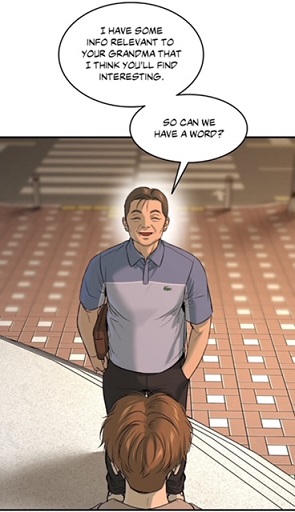
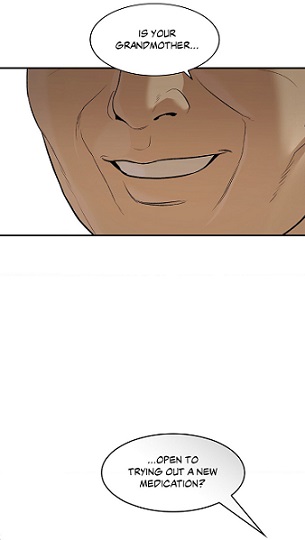 (chapter 48) and using Shin Okja as a guinea pig for trial treatments
 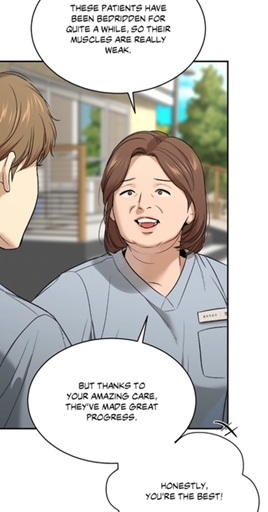 (chapter 56) emphasizing respect and dignity. This stark reality will serve as an eye-opener for Joo Jaekyung, who is burdened by news and media narratives equating
  (chapter 36)
 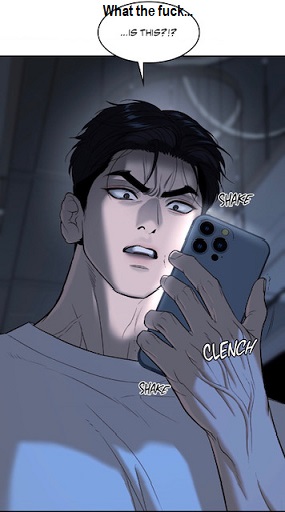 (chapter 35)
  (chapter 36) his shoulder injury or potential career loss with “death.” At the hospice, he will encounter people who are truly facing the end of their lives
  (chapter 57), prompting him to recognize that his so-called career end does not symbolize his real death.
  (chapter 29) This realization will help him distinguish between his life as a fighter and his life as a person, setting the stage for his transformation. It provides a stark contrast to the MFC, which is riddled with manipulation and greed. At the hospice, Joo Jaekyung is likely to encounter individuals whose lives are defined not by competition but by care and connection, like Mingwa implied it with the comment of the nurse:
  (chapter 57). This environment challenges him to confront the indifference of figures like Yosep and Park Namwook, whose neglect, blind trust, passivity, naivety, neglect and selfishness have shaped his struggles. Notice that the nurses are often seen together and exchanging thoughts about doc Dan symbolizing unity and harmony
  (special episode 1) In other words, the presence of Kim Dan’s friends (Joo JAekyung, Potato and Heesung) could make her realize her true nature, which would impact her mental health. She led a life full of missed chances and regrets.
  (chapter 27) In Korean culture, the saying “when the heart isn’t in it” reflects a profound truth: actions devoid of sincerity lack real value. Season 2’s new settings allow the champion to reflect on his mechanical, dispassionate life and begin to act with intention and feeling.
 (chapter 57) and her puppies. Kim Dan is tasked with taking care of the dog and her newborns, and Joo Jaekyung should be asked to do the same. This responsibility not only serves as an allegory for taming the wolf within him but also paves the way for the champion’s deeper connection with Kim Dan. By being close to the ocean
  (chapter 56), a place where Joo Jaekyung finds relaxation through swimming, the setting introduces an opportunity for him to teach Kim Dan how to swim, addressing the latter’s fear of water
  (chapter 54), his connection with Kim Dan is no longer defined by a boss-employee relationship. Their interactions, now free of financial obligations, offer the fighter a clearer view of Kim Dan’s selfless and angelic nature. The physical therapist’s unwavering care, even at the expense of his own well-being, highlights his ungreedy and altruistic character. This realization will deepen Joo Jaekyung’s respect and affection for Kim Dan, further cementing the transformative journey they both embark on.
 (chapter 57) and the yelling patient
 (chapter 49), though their positions are absolutely opposite. The patient’s reaction in Chapter 57 echoes this dynamic, as he accuses Joo Jaekyung of being ill-tempered (this means that he remembers the suspension), a perspective shaped by the media’s manipulations. His criticism reflects the behavior of a sheep, falling prey to misinformation and failing to see the larger truths. On the other hand, it indicates that this man also knows a part of the truth: the suspension which is no longer mentioned, but also escaped Kim Dan’s notice, as he was dealing with his departure. In contrast, Potato’s response in Chapter 49, where he courageously questioned Director Choi despite the latter being an elder, showcases independence and critical thinking. This juxtaposition highlights the patient’s potential to awaken Joo Jaekyung, Kim Dan, and Potato to the damaging impact of media narratives. Over time, the patient himself must confront the wrongfulness and cold-heartedness of his accusations, fostering growth and understanding on all sides. These characters reflect the flaws of Yosep and Namwook, enabling Joo Jaekyung to see the neglect and indifference he has endured and inspiring him to redefine his role in the gym and in Kim Dan’s life.
  The illustration’s inclusion of the hamster—symbolizing Kim Dan’s fun, fragile, and nurturing nature—along with the chow chow and the gumiho, emphasizes the roles of protectors and mediators. The chow chow’s loyalty and the gumiho’s cunning serve as essential forces guarding the hamster and navigating the complexities of this “pure community,” where lies and selfishness can still exist. These characters highlight the intricate dynamics within the hospice, where Joo Jaekyung must balance strength with empathy.


 (chapter 27)
  (chapter 13) This gesture with the hand implied not only that he was just looking forward to meeting him again, but also generosity. And if there was a request from Cheolmin, it was just about an information:
  (chapter 33) According to me, the man was calling his friend Cheolmin, because he truly believed that the actor had been hurt. The fact that he went to the rooftop in order to call the person is indicating that he desires to hide his contact from Park Namwook and Jeong Yosep. In other words, he was seeking secrecy, exactly like the actor. As you can see, the dragon and the gumiho had a similar attitude. They thought that the rooftop was the perfect place to hide a secret. So by calling Cheolmin who is working at a hospital, the MMA fighter was making sure that there would be no scandal. However, when he called him, he discovered the truth. Choi Heesung had faked his injury. Therefore how could he use his connection with Cheolmin, when there was no emergency? In his eyes, he would have abused his busy friend’s generosity. That’s the reason why the star chose not to intervene. If he had revealed the truth and as such accused the actor of deception, he would have no one by his side to prove the truth. It was one man against two. Secondly, by revealing his presence on the rooftop, he would have been forced to mention his close friend: Cheolmin hyung. His connection with the athlete would have raised some question. And because he didn’t utilize the Joker in that situation, he became a victim of a trick. It is important, because the champion’s decision to hide Cheolmin’s existence from Jeong Yosep and Park Namwook is a sign that deep down, he is not trusting his two other hyungs. In my eyes, it is related to his homosexuality. But there could be other reasons as well, for example he met this doctor, before he became a celebrity.
  (chapter 43) They didn’t even bother to wait for him to arrive before drinking and eating, though the man was the birthday child. He was actually the guest of honor.
  (chapter 43) This exposes violation of social norms and even the disrespect towards Joo Jaekyung. He is just seen as a cash cow, hence there was no thank you from them or even a short invitation for him, like Park Namwook and Kim Changmin had done it in episode 9.
  (chapter 9)
  (chapter 9) In fact, Joo Jaekyung was totally neglected at the restaurant, no one even paid attention to his actions. Under this light, I recognized why Mingwa created this incident:
  (chapter 43) It was not just to bring the two main leads closer, but also to expose the wrongdoers. If they had waited for him, the champion wouldn’t have drunk some soju from the glass of water, for Kim Dan couldn’t have used his glass.
 (chapter 43) That’s why the manager got red, a sign of embarrassment. He realized that they should have all waited for the birthday child. Moreover, don’t forget that the star was even paying the bill. And now, you are wondering if I didn’t diverge from my original topic, the Joker and Cheolmin hyung. No, as this new interpretation helped me to understand why Joo Jaekyung talked to his hyung in front of others. He already sensed that no one was observing him or waiting for him.
  (chapter 43) Moreover, it is possible that the mysterious caller desired to congratulate for his birthday or even to thank for his donation. Let’s not forget that just before his real birthday, the celebrity organized a charity event, and it could be related to Cheolmin’s work place.
  (chapter 41) Because I detected ingratitude, selfishness and rudeness from Team Black, I couldn’t help myself thinking that the other person must have behaved differently, which put the young man in a good mood. Therefore he overlooked the incident with the switch of glass:
  (chapter 43) before Park Namwook tried to relativize the incident.
  (chapter 13). Hence I believe that the other reason why our cute PT didn’t meet Cheolmin in season 1 is that he was not ready to interact with him. Kim Dan needed to mature, to free himself from social norms in order to accept such a man as a “role model”. That’s the reason why I am expecting the return from this mysterious doctor in season 2. In my opinion, he will play a central role in dethroning the king Park Namwook at Team Black, but also in helping Kim Dan to obtain justice. Keep in mind that according to me, the protagonist was a victim of many crimes committed by doctors. (The hospital director, Kim Miseon, MFC doctors)
 (chapter 35) He offered his assistance, but at no moment the main lead thought of even asking for his help.
  (chapter 46) If he had voiced his struggle to Heesung, the latter would have understood him and “talked” some sense to the dragon. And it is the same for Potato. In the locker room, when Kim Dan was criticized for his sloppiness,
 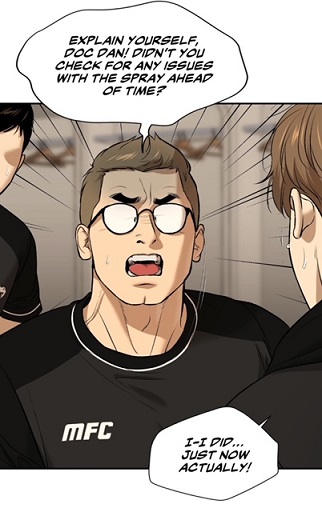 (chapter 50) he didn’t ask from Potato to vouch for him. He could have reached to him, requesting from him to testify in his favor. Yes, I believe that not only the actor and the maknae are to blame for their passivity, the physical therapist is also responsible for his own suffering. He is not seeing that he has already gained two friends. However, he didn’t treat them properly. No wonder why Kim Dan ended up alone at the end of season 1. At no moment, he confided to Potato or other members about his struggles, he kept everything to himself which is similar to his soulmate.
  (chapter 30). Here, I am excluding the scene with his drunkenness. Nevertheless, from his words, Heesung couldn’t detect that he was raised by a single grandmother. He already had a hard time to “accept” the champion’s benevolence
 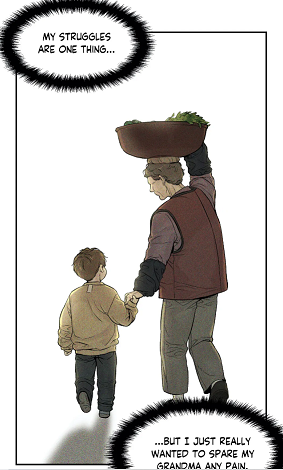 (chapter 5)
 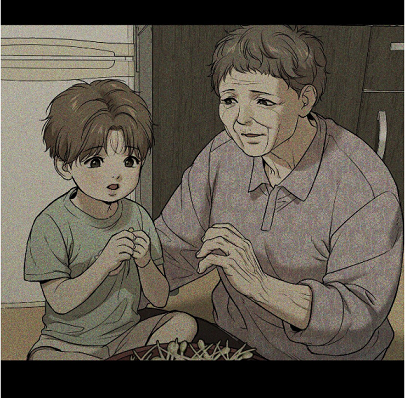 (chapter 47) Hence he was taught cooking. In addition, we can already envision that when he was a high school student, he had to take a part-time job. She definitely minimized his assistance, creating a debt towards her.
 (chapter 7) and
  (chapter 23), he just acted as their “PT” and nothing more. In other words, he acted, as if they only had a professional relationship. This explicates why Kim Dan never talked about himself, in other words he never shared any information with them. However, I doubt that he just considered them as his “patients”. He was happy to give his assistance. For me, the fact that he never lowered his guard is a sign of his low-esteem. So they had a strictly professional relationship, except with Potato.
 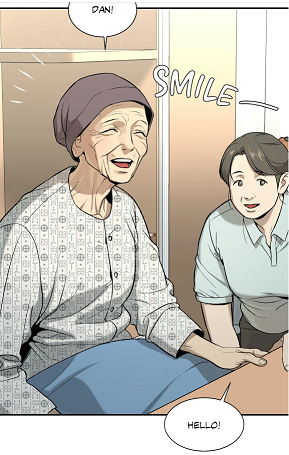 (chapter 7) She needs to pay a nurse to give her some company. Therefore she is forced to rely on her grandson. Then she doesn’t pay any attention to her grandson’s needs and circumstances, for she is only focused on her own suffering and “unhappiness” chasing after an illusion.

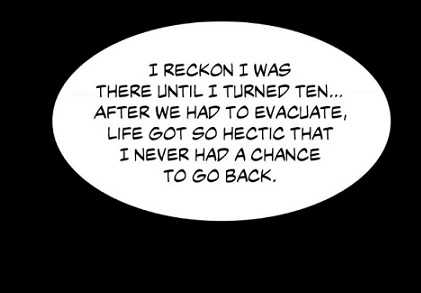 (chapter 53) for not realizing her biggest wish: to return to the West Coast. With her words, she implies that she never had any choice. Hence she is not responsible for her “misery”. However, after reading Erich Fromm’s philosophy, it becomes clear that she must have always followed social norms and listened to authority figures (parents, husband, doctors, …). That’s how she gave up on her own freedom. One might argue that her scoop of maneuver was limited due to her poverty. However, the Mother Of Pearl Wedding Cabinet is definitely expensive and no junk
 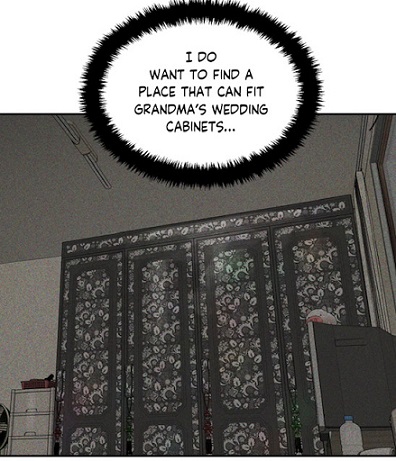 (chapter 16), especially since the latter is rather old. The grandmother could have sold it, but she never did, for the latter has a sentimental value. Consequently, I would say that she had missed her chance, and naturally her misery is the result of her own wrong choices. Under this new light, it becomes comprehensible why the grandmother portrays herself as poor who has nothing to give to her grandchild.
  (chapter 53) (filial duty), a sign that he is not able to break free from social norms. At the same time, it displays that his feelings for Joo Jaekyung are much stronger than the ones for Shin Okja. His short time spent in the penthouse left a deep impression on him.
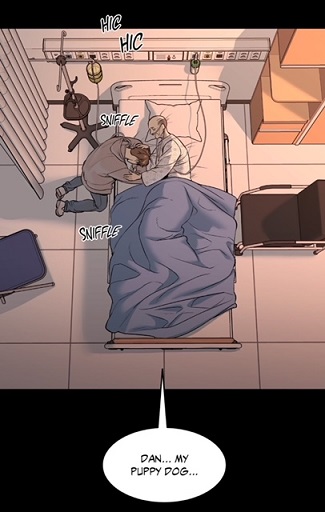 (chapter 53) Her vocabulary exposes that she became a master and in her mind, the puppy dog has to follow her owner. Therefore it is no coincidence that Mingwa created such an image:
  (chapter 53) Deep down, he would like to be recognized as a competent physical therapist. Moreover, my avid readers should recall that the champion had already noticed the change of heart in the doctor before the scheme took place.
 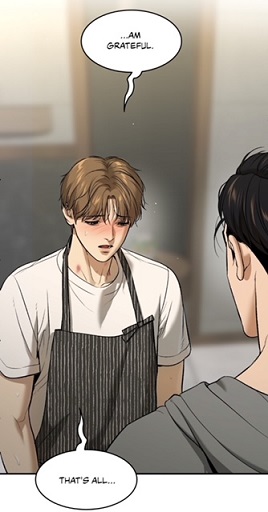 (Chapter 45) But how can he change his condition? I will give the answer below.
 (chapter 40), though the gym belongs to the celebrity. But let’s return our attention to the American-German philosopher. The latter pointed out the importance of self-awareness and the rejection of materialism and social pressures (authority figures, conformity) in order to become truly free.
  (chapter 50) Hence the last match was not cancelled in the last minute. The athlete is not fighting out of fun and passion, but out of obligation and survival. He is trapped in a world where money is everything. Thus he was always pushed to accept any challenger despite his injuries. That’s how I realized why the athlete always suspected Kim Dan of being greedy. It is because he projected his own thoughts onto his partner. However, this negative perception was definitely influenced by his “hyung”, we have the best example in episode 46. Due to Park Namwook, Joo Jaekyung was the one who was constantly thinking and talking about money in front of Kim Dan.
  (chapter 51) He was disarmed by a single question and a shocked and disappointed face:
  (chapter 43), yet he added shortly this comment: :
  (chapter 43) The hypocrite coach utilized the personal pronoun “WE” indicating that he and his peers had played a role in the athlete’s decision. Funny is that though he complained about the schedule, he still accepted the switch of the fighter later. But he could have voiced his fears and objections. Nevertheless, he did nothing. Since I connected the halmeoni to past, I suddenly realized that the “lanista” embodies the opposite notion. He is trapped in the future, thus he is always anxious. Imagine that in that scene, they were celebrating Joo Jaekyung’s birthday, it should have been a good time. Yet, the manager kept talking about work and the future.
 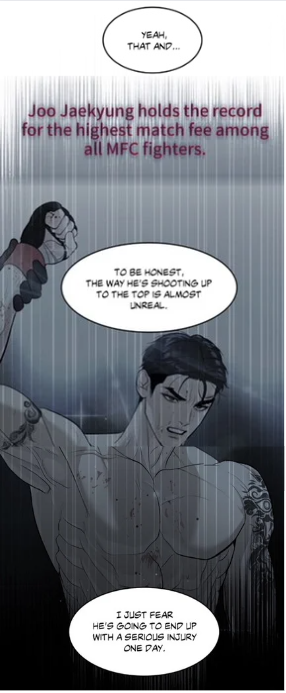 (chapter 43)
  (chapter 49) Notice that he was afraid of an outburst from Joo Jaekyung in the locker room, therefore they were restraining him. This was no real protection. I am suspecting that the manager is trusting MFC and its organization. In addition, his obsession with the future explains why the athlete’s mental health has been neglected by the coach and manager. As a conclusion, Park Namwook is himself trapped in his own world: money, fear of the future and the champion‘s retirement which means the end of his own career as manager and coach. Therefore he is pushing his fighter to race against time. It is only a matter until his boy gets injured!!
 (chapter 53). The latter announces that his “boy” can take a break. What caught my attention is his idiom. The suspension got turned into a break which sounds much more positive. Interesting is that break is not only a synonym for “rest”, but also for “opportunity, chance”. This new discovery reinforces my previous interpretation: the loss of his “title” and his suspension are in verity an escape to freedom. Why? It is because he is no longer exposed to manipulations and external pressure like in episode 36:
  (chapter 36) money, social media, the agency, the lawyer, Park Namwook and Jeong Yosep. For the first time, Joo Jaekyung can think of something else other than work. Nevertheless, the athlete had not realized it yet. Striking is that the longer the fighter thought about the PT’s resignation, the longer he came to object to it.
  (chapter 53) This means that the fighter was acknowledging the “uke” as an important member of Team Black. In addition, he was recognizing Kim Dan’s effort and talent as PT. Moreover, it exposes the absence of change in Joo Jaekyung’s mentality. He was still “thinking” of work and fighting. It displays that the protagonist had not realized the true signification of his suspension yet. Hence the doctor’s departure was necessary. Joo Jaekyung is forced to think about his fated partner, making him forget his work and his career. His “obsession” with Kim Dan will push him to stop being a workaholic. But there is more to it.
 (chapter 21) to this
 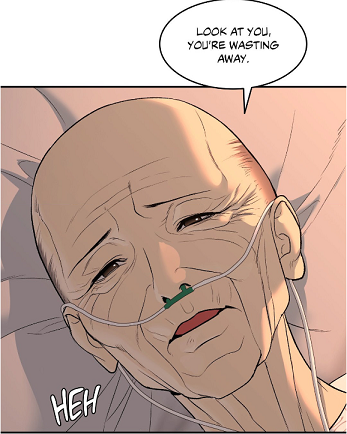 (chapter 47) Money is powerless in front of death and terrible injuries. Therefore he is lucky that his shoulder is not ruined forever. Moreover a trip represents a good metaphor for an escape, a travel is a synonym for freedom and the end of “routine”.
 (chapter 35). However, since he didn’t spend much time in his own home, he never took the time to take care of his soulmate. By leaving the city and Team Black behind, he would become truly alone (as opposition to his trips to Busan, the States) which would give him an opportunity to become more honest to himself and to Kim Dan.
 (chapter 1). Nonetheless, his words sounded more negative due to the usage of negation. Moreover, Kim Dan was too scared to take his words seriously. Consequently, it becomes obvious that Kim Dan needs to hear praises from the athlete himself. It is not just about an apology about his misjudgment, the “hamster” needs to hear from his own patient that he trusts him and his hands. Thus he wants to be needed:
  (chapter 53) This explicates why the young man kept questioning the actor’s intentions behind his gifts. He could see that the man didn’t need him. This thought displays his desire to give a meaning to his own existence as well. If he is needed, he has a reason to exist. This desire of being needed can be expressed by words, but also with the hands:
  or like this:
  (chapter 22)
  (chapter 41) The fact that the athlete organized a charity event for his birthday exposes not only his huge heart, but also that he had long recognized the power of generosity. Under this new light, it becomes comprehensible why the champion was willing to pay off the doctor’s debts.
 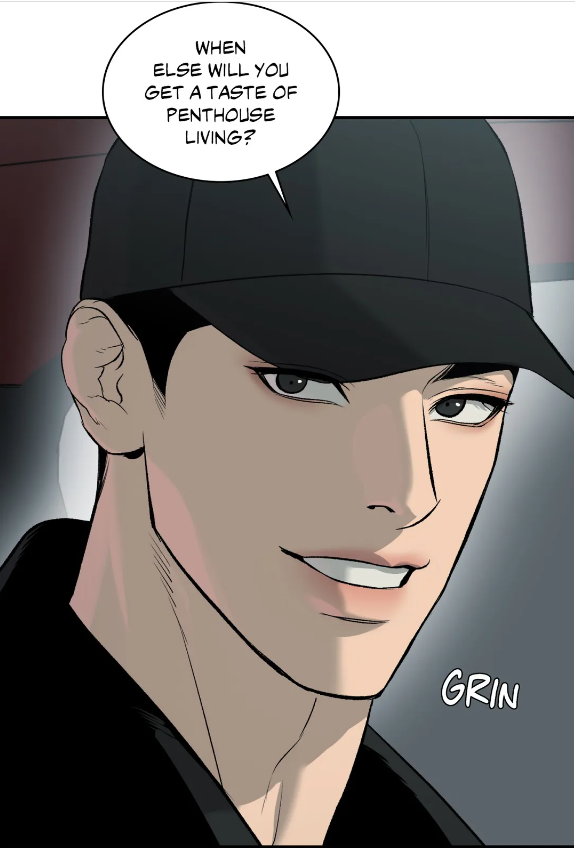 (chapter 18) His facial expression is exposing his true thoughts. He was definitely happy to help the doctor. The reason is simple. He is in control of his heart and life. This shows that deep down, the man has always had a soft heart and could find fulfillment in giving. However, the problem is that the champion had also internalized that there is nothing free in this world. Due to his past experiences, he realized that receivers would exploite his goodness. The green-haired guy was the perfect example.
  (chapter 2) Therefore it is not surprising that he kept denying his kindness to the doctor: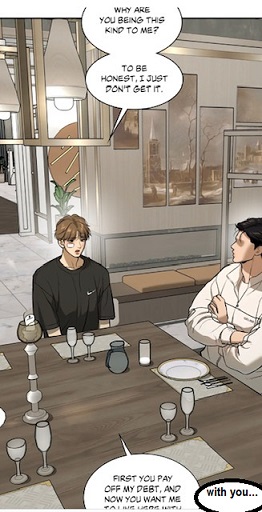
 (chapter 18) He had to, because the man was now living with him. Joo Jaekyung feared that his roommate could come to take advantage of his new position and even consider this place as his own. As you can see, the champion had long discovered the power of giving to others. Yet his problem was that he couldn’t live out this principle: he was either exploited or he has no family or close friend so far.
 (chapter 30) They both desire to be acknowledged and appreciated.
  (chapter 45) With this image, it was, as if Kim Dan wanted to be distinguished from all the stans. Yes, I do think that this has something to do their own negative feelings. However, there is a difference between Choi Heesung and Kim Dan. Note that the gifts are related to his sponsors and the agency. They were related to his work. Moreover, the gumiho rarely gave the meals or the presents personally.
  (chapter 31)
 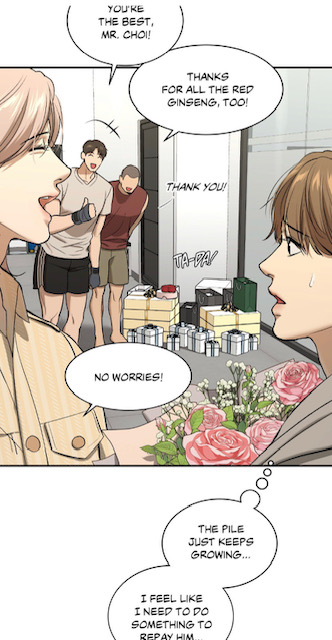 (chapter 31) Furthermore, the actor gave these things for one reason: it was to obtain the doctor’s heart or to maintain his good image as a celebrity. In other words, these gestures were not selfless at all. This explains why the athlete was so weary of such “gifts”: a return of favor or a service. But the comedian is not the only one donating things. Naturally, it is the manager Park Namwook.
  (Chapter 26)
  (chapter 36) However, my avid readers should ponder on the following aspect: how did he buy the jackets and the junk food?
 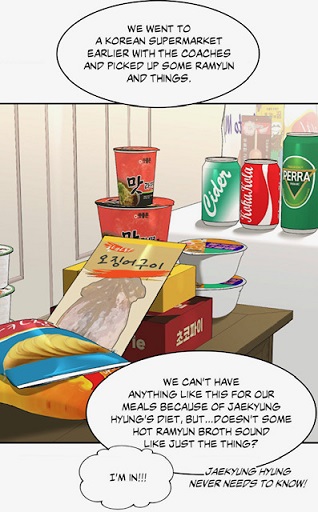 (Chapter 37) This last scene is terrible, for this purchase happened behind the boss’ back. Naturally, everything was bought with the company card!! In other words, Park Namwook’s generosity is fake, for he is not spending his own money. After this new realization, I started wondering if the athlete’s negative attitude towards Kim Dan is not the consequence of Park Namwook’s behavior as well who takes it for granted to spend money on the athlete’s account. Why did the champion anticipate an expectation from Kim Dan, when he received the keychain?
  (Chapter 45) It is because his relationship with his coach has always been based on „conditional love and expectations“. Don’t forget that the coach was particularly nice to the athlete after winning his match in Busan. He was willing to be his „servant“ in that moment. Furthermore, there exists another evidence that in episode 45 the fighter latched out on the doctor because of his unresolved feelings towards his hyung.
  (chapter 41) This frenzy was portrayed as something positive. Jinxworms can observe that the manager is mentioning the existence of „favors“. For me, it is no coincidence that in episode 45, the arrival from presents coming from his hyung coincides with the present with Kim Dan. It shows the underlying conflict between the celebrity and the former wrestler. Nevertheless, the fighter has not grasped it yet. So far, Joo Jaekyung has not tried to defy Park Namwook openly, to claim his place as the true owner of Team Black. We should see his words here as a first attempt to act as the boss
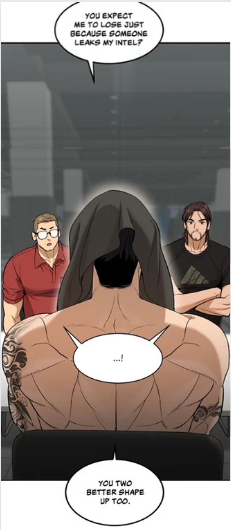 (Chapter 46) The tension reached its peak in that scene:
 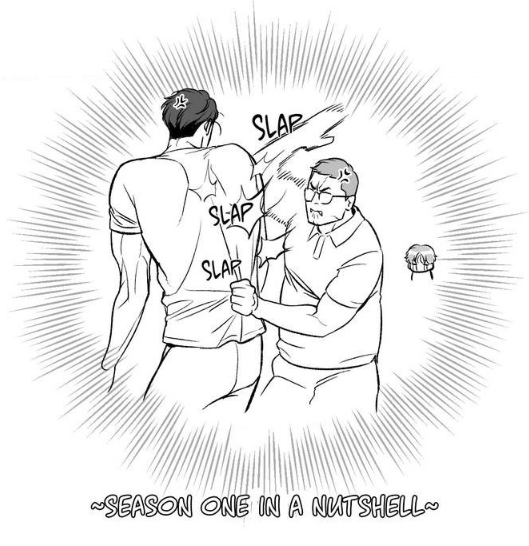 That’s where the generosity from Park Namwook comes from: he gives his punches to Joo Jaekyung and takes Joo Jaekyung‘s company for granted. And now, you comprehend why I selected such a title for this essay.
 (chapter 22) This scene at the hospital displays that the fighter had been mirroring the behavior of his counterpart: Shin Okja is sweet and kind. And who is moody, yelling, brutal ? Park Namwook:
  (chapter 43)
  (chapter 7) Therefore I conclude that this possessiveness and obsession with Kim Dan is the result of the manager’s influence. Park Namwook treated him like a possession. And this brings me to my next part. How to become happy? One might reply: by loving someone. However, how can Joo Jaekyung drop his insecurities and open his heart like that? As you can see, we need another explanation.
 (chapter 43) Where was he, when his star was drunk? It was, as though he had vanished.
  (chapter 43) But the best evidence for this interpretation is this image:
  (chapter 52) The manager is upset, because his boy lost his title and his reputation is ruined. Moreover, many members left the gym which means that the company lost a lot of money.
  (chapter 9) However, he never presented himself as a father or a husband. It was, as if his children or wife were not a source of his happiness. Why? It is because they don’t bring money, but rather cost money. Thanks to Joo Jaekyung’s popularity, the manager could stand in the spotlight
  (chapter 40), yet notice that no fans or fighter know his name as a successful coach or manager. He is not a famous manager in the end. His income depends on the athlete’s career and victories. No wonder why he put so much pressure on his celebrity. Thus I had the following revelation: he was actually exposing his true self in front of the doctor at the restaurant.
  (chapter 40) in the States and even at the gym?
  (Chapter 22) And now, it is important to recall that in the mode of Having, rivalry and competition are predominant. Therefore I deduce that deep down, the coach and manager sensed the physical therapist as a source of threat and rival. Therefore Jinx-philes shouldn’t be surprised that the coach did nothing to keep Kim Dan.
 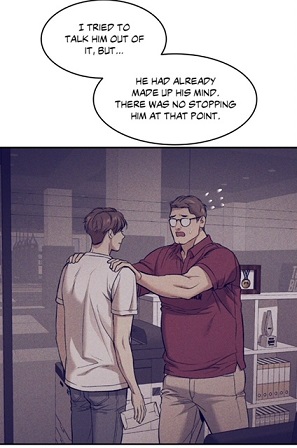 (Chapter 53) Here his gestures and words should be judged as lip-services. He can even rationalize his departure: bad luck, they save a lot of money, for the next PT will have a lower salary. In addition, Kim Dan was treated as the celebrity’s possession, therefore he used him as a tool in order to compensate the actor. The manager is definitely imagining that once the break ends, things will work like before.
  (chapter 41) In his eyes, possessions and money determine someone’s values. Hence he bought an expensive keychain for his fated partner. Furthermore, I have been wondering if this spending is not related to Shin Okja, the latter could have been a spendthrift. In the essay „
 (Chapter 19). Another possibility is that she made sure that her grandchild would spend money on her:
 (chapter 22) after the departure of Joo Jaekyung, but notice how the halmeoni thanked the benefactor:
 (chapter 21) One might argue that the poor woman couldn’t do much to express her gratitude. However, this is just a deception. Shin Okja could have written a letter to express her gratitude to Joo Jaekyung. Why do you think Mingwa created two scenes with a letter or card?
  (chapter 53) The comparison lets transpire the importance of words. The champion might have judged the keychain differently, if he had read the card. But he didn’t. Another parallel between these two scenes is the rejection of a gift! However, in the final episode, Kim Dan voiced genuine gratitude towards his benefactor. The latter had allowed him to work as his PT. With the letter, he could voice his thoughts and emotions much better. And now, you realize that Shin Okja could have acted the same way. This made me realize that deep down, she resents being poor. She likes Dan spending money on her.
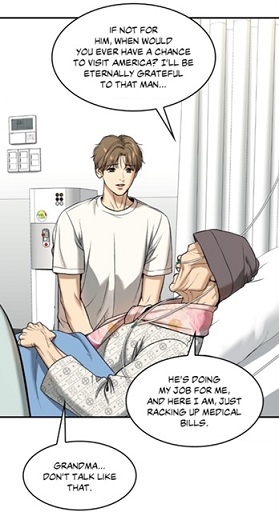 (chapter 41) She should have been the one who expressed her gratitude to Joo Jaekyung, but not Kim Dan for the trip (it was work related anyway). One might argue that the poor woman is trapped in the hospital, she can not do much. But you are wrong. She could have written a letter to her benefactor which means that she would have sacrificed some of her time for the athlete. Imagine that she had sent a message to the athlete, the latter might have decided to pay a visit to her. He is not truly heartless. With this silence, she created the impression that his assistance had changed her situation.
 (chapter 22)
 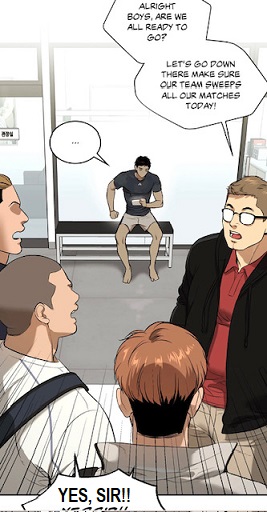 (chapter 23) Then he only focused on the “outcome” and not on the process. Hence he neglected them, delegated his task on the pressured athlete. The latter had to train them:
  (chapter 25) and
 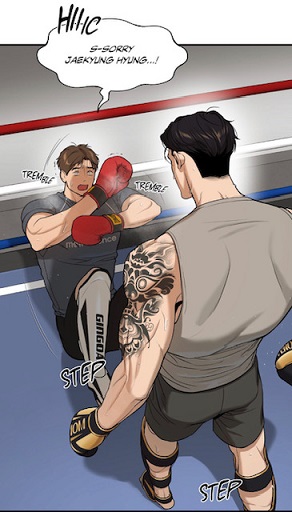 (chapter 36) In my eyes, he didn’t want to play the bad guy. The meeting or his worries were more important
 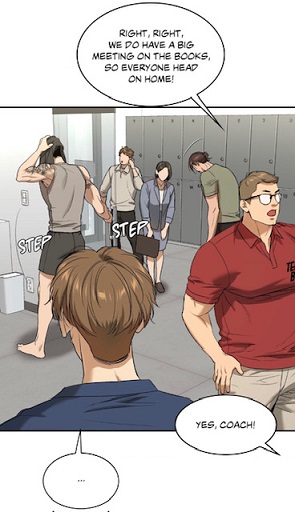 (chapter 36) than their training and career. Moreover, he kept bribing them with junk food
 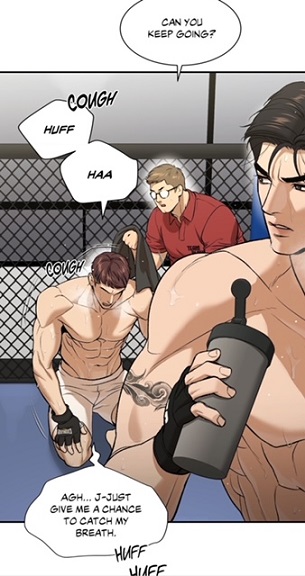 (chapter 46) The latter was a new source of income and fame. Everything was revolving around money. That’s how it dawned on me why the manager got angry for the bet in episode 26:
  (chapter 26) We shouldn’t judge his words as a verity, he was just using the doctor as a false excuse. The reality is that the sparring had brought no money at all! This fight was strongly intertwined with fun. The notion of „entertaining“ stands in opposition to money. Fun means feeling emotions and being to true one’s self. In other words, Kim Dan stands for a different notion of MMA fighting: the sportsmen shouldn’t work for money, but for fun. They are artists too. This signifies that as time passed on, the members of Team Black lost their passion for fighting
 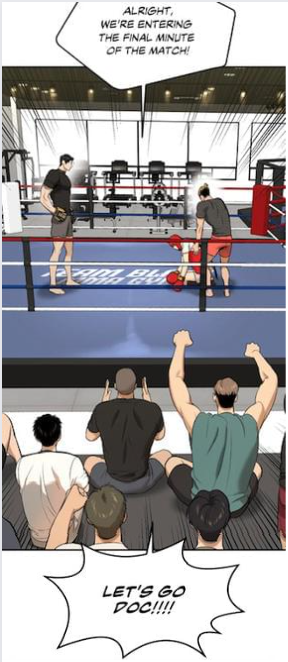 (chapter 26) and became more obsessed with possessions and fame. Potato and the remaining members represent the exceptions. They enjoyed the lessons despite the pain and struggles. The other members became dependent on external tools which led them to lose their integrity. To conclude, the reason for their disloyalty is that at the end, they had long internalized the mode of having and were just interested in getting successful.
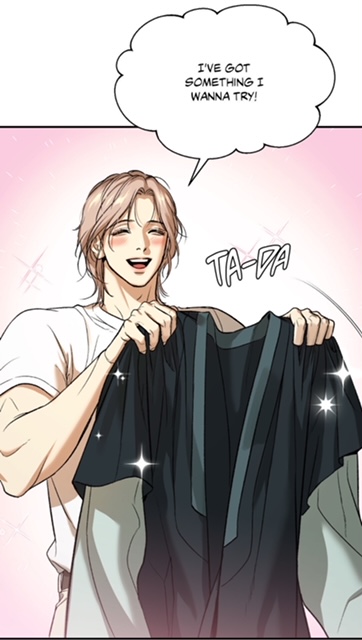 (special episode2 ), but also Cheolmin
  (chapter 48) are full of greedy people who have no problems to commit crimes in order to achieve their goals (more fame, more wealth, revenge, more connections). Baek Junmin became a champion by cheating.
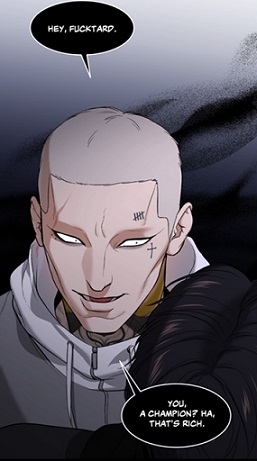 (Chapter 49) Thus he thought, the athlete had earned his title the same way. His fights were rigged, yet the verity is that the idol worked hard to achieve this level. The irony is that The Gunshot experienced much too late that his assumption was wrong.
 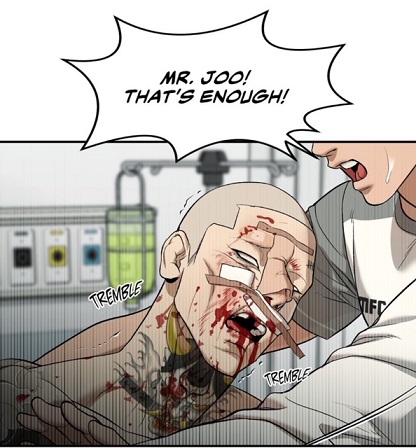 (Chapter 52) His shaking is exposing his fears. Like mentioned in the past, I am anticipating that The Shotgun will avoid a new fight with the celebrity.
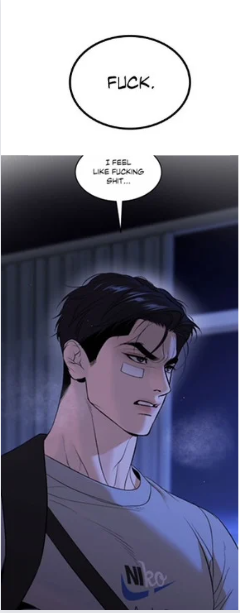 (chapter 53) He is standing at a crossroad. What does he truly want in life? Fame? More money? Or happiness and as such love and fun?

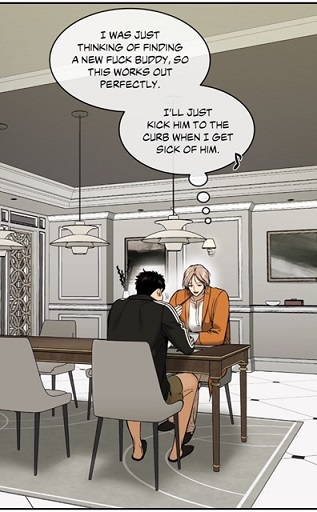 (special episode 1) The actor chose to use the black-haired sportsman as “Friends with Benefits”. But what would be Potato’s benefits then? Support and connections, like we could see it in special episode 2:
  (special episode 2) So when Heesung is already envisaging to get rid of his new lover
  (chapter 35) Because he is famous and wealthy, he is expecting a similar reaction from the chow-chow. At some point, he will appear too clingy, hence he will perceive his relationship as burdensome. This is no longer fun.
 (chapter 33) However, the change of Heesung’s mind-set (Friends with Benefits, no longer the search for a soulmate) is also related to Potato’s reaction after their first night together.
  (special episode 1) With his words, the sportsman implied that he had taken advantage of the actor, while in reality the opposite had happened. Heesung had taken advantage of Potato’s drunkenness
  (special episode 1), ignorance and purity
 (special episode 1).The confession of Yoon-Gu’s wrongdoing could only shock the actor.
  (chapter 35) With his behavior, the fox gave the impression that his affection for Kim Dan was running deep. Under the tent, he was drowning his sorrow with soju. Hence in the maknae’s mind, Heesung was still in love with the physical therapist. Yes, the irony is that the chow-chow was also projecting his own thoughts onto the comedian. Let’s not forget that when the young fighter discovered the true nature of the relationship between the doctor and the emperor, he didn’t give up on his admiration and affection for Joo Jaekyung.
  (chapter 35) My avid readers should keep in their mind that the chow-chow is famous for his strong loyalty. To sum up, Potato imagined that Heesung was still loving Kim Dan, exactly like him with the fighter… he would remain faithful and keep his one-sided love.That’s why I came to the following conclusion: their relationship started on a misunderstanding, which was also reflected in this situation:
  (special episode 1) It was, as if he had disregarded the gumiho’s feelings, he had incited the latter to commit a sin. Heesung had broken his vow of faithfulness 😂. That’s the reason why he mentioned “zero regrets”. It is important, because with such a mind-set and attitude, he is indirectly pushing the gumiho to face the truth: his dishonesty. His affection for Kim Dan was just a crush, a superficial attachment, as he knew nothing about him. In fact, he was just chasing after an illusion. He even admitted it at the restaurant:
  (chapter 35) His description for a partner and as such love doesn’t correspond to the definition of true love: care, respect, knowledge and responsibility (Definition from Erich Fromm, for more read “
 (chapter 32) He didn’t try to protect him from the athlete’s fury. He never clearly stated his true desire, he wished to date the doctor, until he was cornered (threatened).
 (chapter 45). This means when the MMA amateur fighter decided to become responsible and as such to make up for his mistake,
  (special episode 1) and why Potato couldn’t refuse the role-play.
  (special episode 2) However, he is not entirely powerless, like I mentioned in the first part. He is not forced to admit that he had fun after the intercourse.
  (special episode 2) In other words, he is not obliged to say YES either! It is funny because thanks to this examination, I realized that Yes and No have “become” like taboo words. Yoon-Gu is avoiding these idioms by using the expression “I don’t know”. Hence I am suspecting that Heesung will become obsessed with the word “yes”! 😂 Only Heesung can procure him fun and pleasure, and no one else. He is getting disarmed by the sentence “I don’t know”.
 (special episode 2), yet in the past he had a different reaction.
  (chapter 23) The reason is simple. This was not patting, but rubbing. Neither Oh Daehyun nor Kim Changmin did it to express gratitude, rather for selfish reasons. They wanted luck on their side. Potato didn’t feel recognized and accepted, rather used as a tool. Hence he was bothered. Under this new light, it becomes comprehensible how Heesung can win Yoon-Gu’s heart in the long run. It is not because of his sexual performances, but thanks to his selfless gratitude and generosity!! We have the perfect example in these two scenes:
 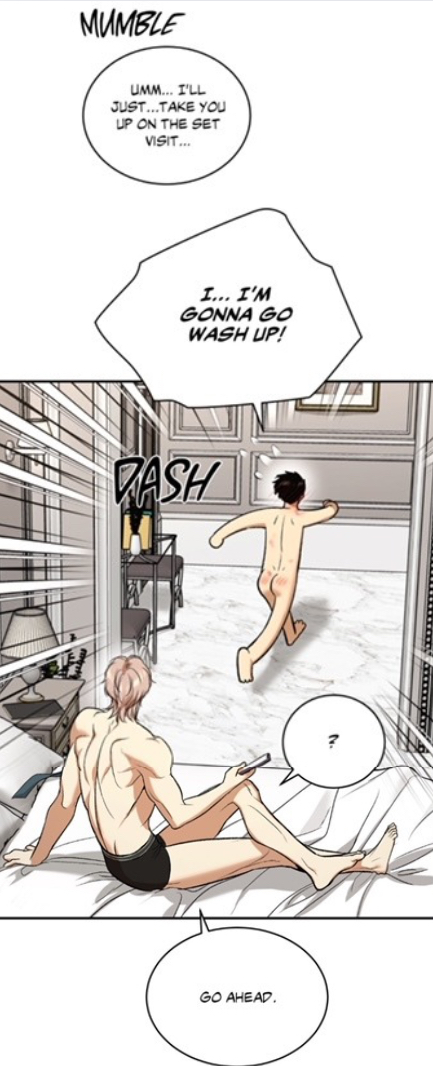 (special episode 2) He was attempting to hide his growing affection for the comedian. He feared that his feelings for him could become a burden for the comedian. In his eyes, Heesung should remain faithful to the physical therapist. He shouldn’t expect any affection from the actor either.
 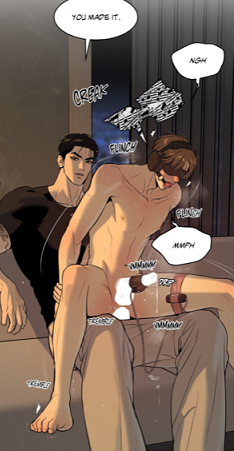 (chapter 34) In this scene, the physical therapist looked like attached to his owner. In the first part of “Passions in Purple: Jealousy and Joy”, I made the following prediction. Heesung would order a sex toy
  (special episode 2) out of annoyance and jealousy
 (special episode 2), for Potato had run away from him. He needs to put him on a leash to feel in control, to obtain his chow chow’s attention. Naturally, there is no guarantee that this prediction is correct. Yet since according to my examination, Potato is thinking that Heesung is in love, it signifies that Heesung is already attached to Kim Dan. Hence he won’t do anything to ruin this attachment… therefore Heesung can only be put in front of a dilemma. How can he make Potato look at him? He could reveal the truth to Yoon-Gu, but by doing so, he would ruin his image as a good and caring guy. Moreover, since he has lived for a long time deceiving himself and others, it is very unlikely that the actor might change his behavior so suddenly. Old habits are hard to die. Therefore for me, honesty won’t be his initial choice, rather acting. He will express his thoughts and emotions behind a new role-play and sex.
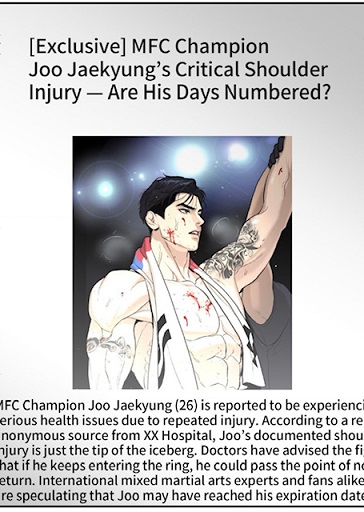 (chapter 35)
 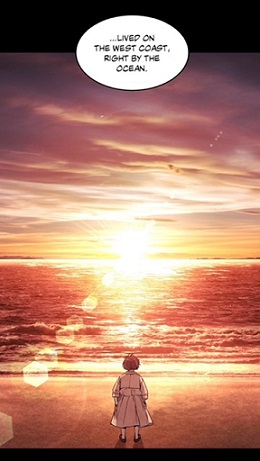 (chapter 53). In this scene, the halmoni was shown as a young child, just before she left this region. Her departure announces the future loss of her innocence. This explicates why she desires to return to her roots. It was, as though she was trying to escape her fate. Moreover, by reconnecting to her childhood, she is actually denying the existence of her grandchild. It was, as if she was trying to erase the time between her departure and return. On the other hand, this scene announces her imminent death as well… it was, as if she wanted to be swallowed by nature (sea, sun). And death is strongly connected to birth. No one can die, if they were not “born” before. Hence I am suspecting that the birth of a new star, the Bantam Fighter Yoon-Gu, is associated with the halmoni’s vanishing. Finally, any reader can notice the two main colors in this image: yellow and red!! And you know that Potato’s colors are yellow and red. From my point of view, Potato is destined to go to the West Coast and naturally Heesung will follow him there. He has to because of the saying “Out Of Sight, Out Of Mind”. Let’s not forget that Heesung treated Kim Dan that way. As soon as he stopped seeing the doctor, he stopped thinking about him. He could fear to lose his soulmate, as the latter forgets him. The gumiho’s fate is to be the “clingy one”.
 There, I included two gemstones, the Bloodstone and the Aquamarine! Choi Heesung, born on 21st March, is represented by these birthstones! In this composition
 (chapter 30) And what was he wearing in the poster? A blue pale suit which is close to Aquamarine and even to light purple ! The color is no coincidence. I have the impression that thanks to the weak woman, Heesung will become a part of the “new family”. If you look at the sunset again, you will detect glimpses of purple in the sky. As for the second image which came to my mind is this: the actor swimming in the ocean. When the bloodstone is put in water, it changes the color of the sun: red for love. Yes, we should expect a new version of this scene:
  (chapter 28) which I had interpreted as a baptism, a purification. If the actor bathes in the Yellow Sea, he will be purified and as such his true self will come to the surface. That’s how he will recognize his love for Potato, but also his friendship for the doctor. So far, the man has no real friend, but he has been longing for one. At the same time, the metaphor (the sun turning red) could be a reference to the interaction between the actor and the emperor, the former helps the latter to recognize his true feelings for the physical therapist. As a conclusion, we should expect to see Heesung under the sunset and next to the ocean or water. There, he should ponder and have a realization.
 (chapter 37) Here each fighter was on his own, they were not really training together. The champion was the leader due to his imminent match, he put the others under pressure, as he was himself stressed. But with his suspension, he is no longer racing against time. In other words, the training routine should be different. They will help each other, encouraging each other to become better. The presence of Heesung should help them to see the training under a different light. But for that, he has to reconnect to his true nature: bloodstone and aquamarine.
 (chapter 37) or the switch of medicine. Unfortunately, the gumiho was not present both times, hence Kim Dan and Joo Jaekyung became the targets of revenge. On the other hand, the author stated that in season 2, the focus would be more on emotions, which means that there shouldn’t be many plot. Nevertheless, my avid readers should keep in mind my previous interpretation about the “beautiful” Kim Miseon
  (chapter 34) Here, he forced the champion to claim the doctor as his possession. However, in season 1, the main lead came to regret his actions (34, 43), for he has never been honest to himself. And now, it is time to focus on the second gemstone.
 (chapter 31) They were green. He is attracted to “green”, his origin self. Nevertheless, in episode 31, this was rather a khaki version due to his corruption. No wonder why he played a trick on the champion. And this observation brings me back to the doctor’s clothes. What was he wearing, when he was young?
  (chapter 35) At the same time, it explains why Heesung changed for the better thanks to the physical therapist. Thus I assume that Heesung is destined to become an aquamarine, bringing all these characters closer to each other: Potato, Cheolmin, Kim Dan, Joo Jaekyung. However, contrary to the past, he won’t use his money to help people to become happier. His smile and happiness should affect the others:
  (chapter 31) However, this should no longer be superficial. The celebrity is associated with flowers, stars, fun and happiness. Because he symbolizes “Spring”, I deduce that his rebirth and as such his Enlightenment are primordial. He is there to assist the others. And the color for understanding, compassion, self-awareness and wisdom is purple:
 (special episode 1) Since the elderly woman confided to Joo Jaekyung, we can assume that she could do the same with the gumiho, as soon as she sees her idol. It is important, because he could grasp the physical therapist’s suffering and low self-esteem.


 (chapter 48), but the actor would be replacing the fake director. We had a sunset here, dark water (the coffee), the symbol for corruption. Then notice that he is wearing a blue t-shirt (but two colors, a symbol of his hypocrisy)!! This reinforces my expectation that we should witness the actor’s awakening, the exact opposite of the other Choi, who chose revenge and manipulations. But there is more to it. Thanks to the comment of @Milliformemes24, I had another revelation. The latter wrote that places of knowledge and self-awareness are related not only to the ocean, but also to the mountains. It is normal, as the hill is closer to the sky and as such closer to the gods. Notice that Heesung’s new home is situated on the top of a hill, surrounded by a forest.
  In other words, Heesung could get enlightened on a mountain too, during a stroll for example. And the moment I read this from my friend, this image came to my mind:
  (chapter 41) That’s the moment when he realized his feelings for the fighter. As you can see, Mingwa used the tree and as such nature as a source to spirituality. And now let me ask you this question. Since the story is written with reflections, the tree should have appeared before and after. Where was it then? First, the first plant to appear was the bouquet. The roses from Heesung
  (chapter 31) could be seen a mirror of the tree. The roses encourage the doctor to ponder and show an interest in his employer.
  (chapter 37) However, the first time, the tree appeared as such was in the States, and this on two occasions:
  (chapter 47) Kim Dan imagined going on a trip with his grandmother, totally delusional, as he was in denial about his grandmother’s deteriorating health conditions. However, the vision shows the desire to become closer to his relative, to become more proactive as well. His words (“She’s been so busy raising me, she’s never had a day’s rest”) imply the presence of reflection. It indicates his gradual transformation and maturity. But this doesn’t end here. The tree was also present in the special episode 2:
  (special episode 2) Yes, the barn!! The tree had been transformed into a home. However, don’t forget that this was just a fantasy from Heesung. However, during this intercourse, he came to expose his jealousy and growing attachment towards his soulmate. Yes, the last two mentioned scenes have two common denominators: a mixture of fantasy and Enlightenment. Nature is strongly intertwined with meditation and communication. To conclude, we should expect the presence of woods and trees in season 2 as well. And this hypothesis got reinforced, when Mingwa released this image on X:
  We have a sunset, a palm tree and purple in the sky… Joo Jaekyung is wearing a similar shirt than Heesung:
 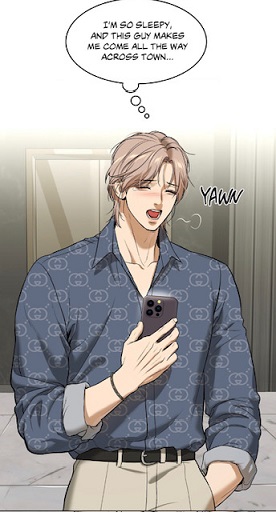 (chapter 34) I consider this as an allusion that the actor will be by the fighter’s side. On the other hand, since the shirt is open, I interpret as the star’s emancipation. The latter has been able to escape from his mental prison and suffering. In his cage, he was racing against time. Now, he is able to relax and enjoy time. At the same time, since the champion in the image from X is seen wearing rings with stones, it somehow confirmed my interpretation about the role of birthstones in Jinx.
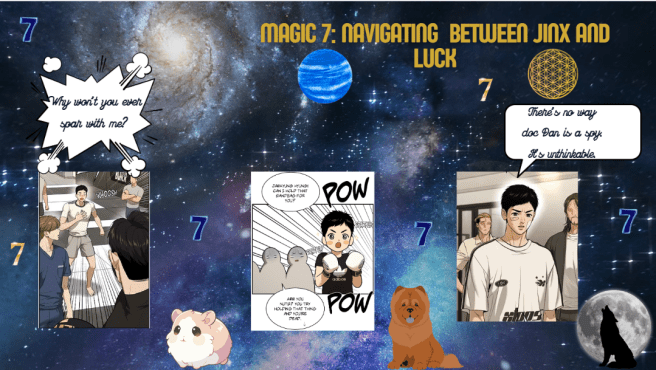
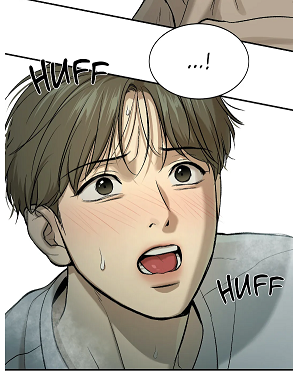 (chapter 7) Kim Dan had just punched his boss. How would he react to this wrongdoing? In fact, I realized that all the episodes with the number 7 are strongly connected to an intrigue and riddle. Why? The answer lies in the number. 😉 So what does 7 symbolize in the end?
 (chapter 18) He believed to see someone selling his body to a loan shark, while in reality the main lead was about to get raped. Hence we have -7! This represents the absence of reflection and even the refusal of meditation.
 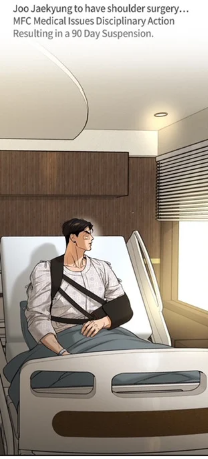 (Chapter 52) He will realize that he needs to select his opponent more properly.
  (chapter 5) He remained passive, because he had already an answer to his silence. He was refusing the job. He implied that his lack of reaction had been caused by the champion’s action. In addition, he reproached his boss that he was getting worked up for nothing. His behavior displays that he saw no value in Kim Dan. Moreover, Mingwa left a clue why the man has always been passive all this time. It is not just a question of fear. The other reason is that he used prejudices and superficial thoughts to explain people’s attitude. Hence he never investigated the matter why the doctor didn’t contact them. His attitude in episode 52 hasn’t changed at all.
 (chapter 52) He reproaches to Joo Jaekyung his heartlessness, though Kim Dan took care of him for months. But he is forgetting that he spent himself time with the hamster too, and he is healthy contrary to the champion. So he could have reached to the doctor. His reproach is just an excuse to mask his passivity, ignorance and even indifference. His rudeness and neglect towards the doctor and athlete becomes more obvious.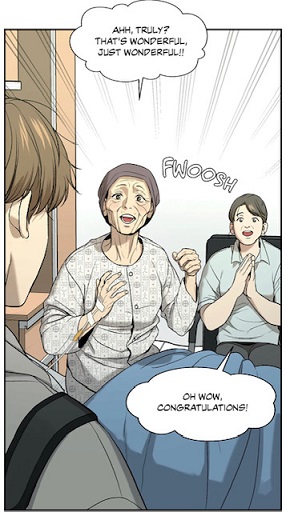


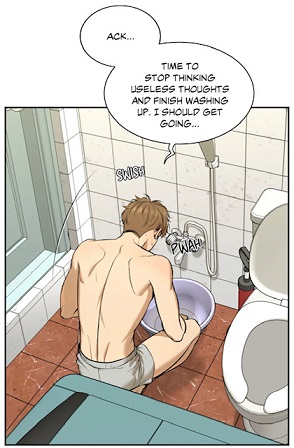

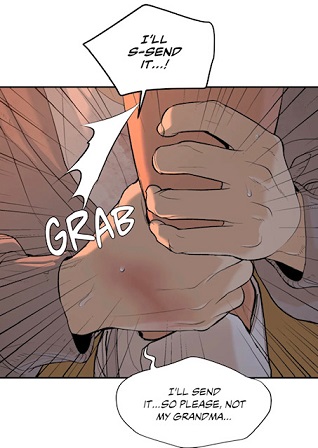


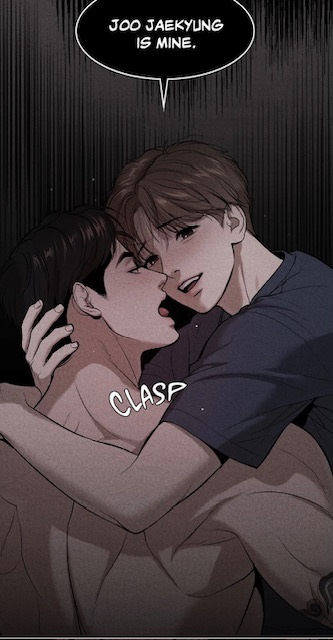


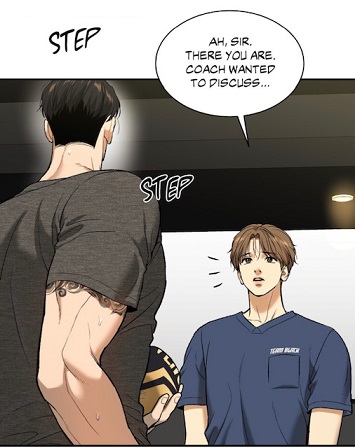
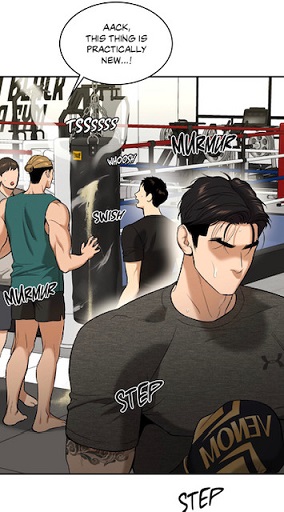


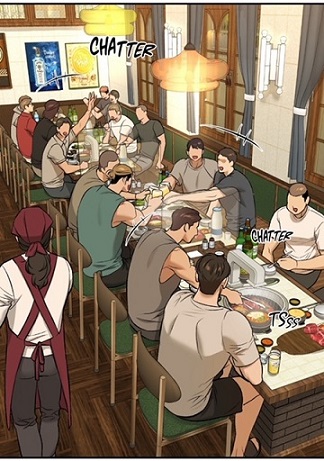
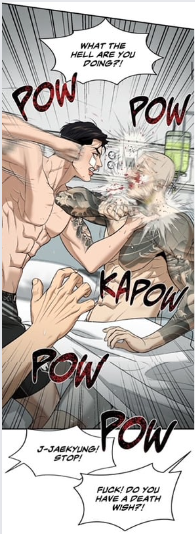


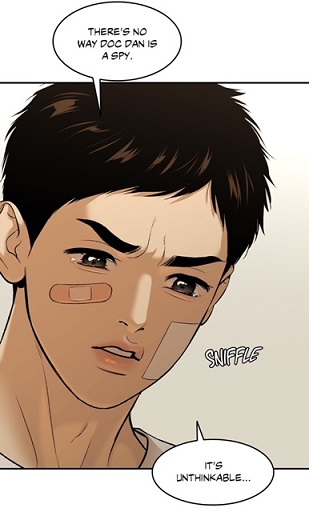
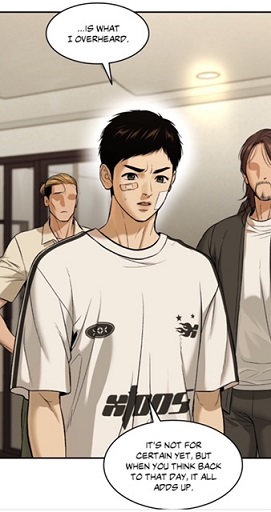
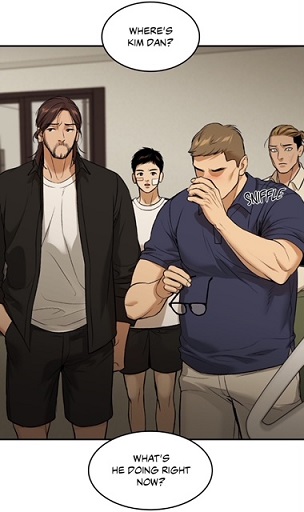
 (chapter 52). By mocking him, he was provoking Joo Jaekyung and he knew it. Yet, he never expected that he would be punched so violently that he would be KO. In episode 7, the champion “invited” the doctor to enter the shower room,
  (chapter 7) reminding us of the kidnapping in episode 16. Here, on the other hand, Heo Manwook must have judged his presence at doc Dan’s house as an “invitation”
 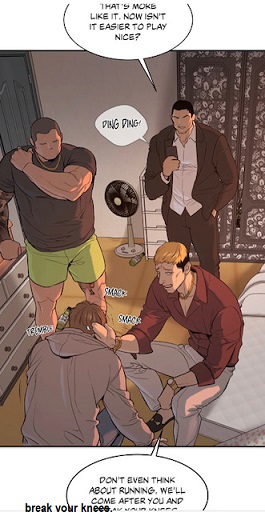 . (Chapter 16) and not trespassing. Each challenge or invitation is strongly connected to moving. Heesung had to drive through town in order to discover the secret between the two protagonists. Moreover, I distinguished another similarity: abduction and sequestration. Kim Dan was forced to stay in the shower room or his home or in the penthouse (34,43). Chapter 25 represents the exception, for it was the only case, where Kim Dan was given a real choice.
  (Chapter 25) He could refuse the sparring. Thus I deduce that in episode 52, the opposite is happening to the doctor. Something happened to him, and he could do nothing. On the other hand, this signifies that at the hospital, the members from Team Black were seeking the consent and support from their boss.
  (chapter 44) Kim Dan agreed to have sex with the fighter, because he wanted to know him better. Thus I deduce that the athlete discovered new aspects about Kim Dan’s life.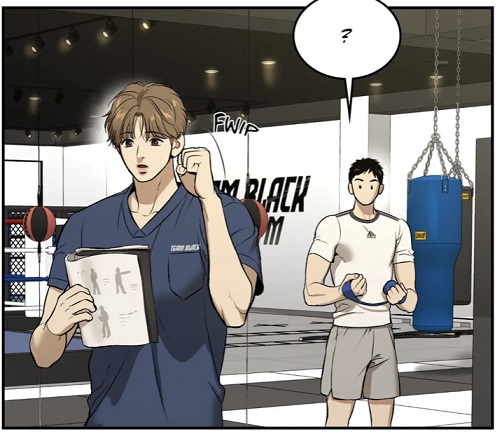
 (chapter 25) He received only attention, when he got strangled due to the maknae’s mistake and notice that the protagonist was too focused on training the others that he neglected his soulmate. Then in episode 34, Kim Dan was supposed to meet Choi Heesung, but he missed the appointment due to the athlete’s trick.
  (chapter 34)
  (chapter 34) Since the latter had not replied, Choi Heesung assumed that Kim Dan was not free. And now, you know why the actor never contacted the angel and asked about his whereabouts. The main lead never replied and confirmed the meeting. Then in episode 43, no one missed Kim Dan at the table, when they ate their dinner.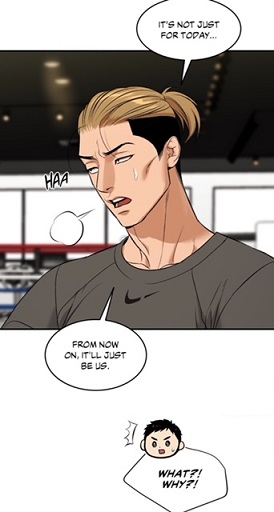
 (chapter 52) He had been too harsh and had not investigated the matter properly. However, his words “getting the facts straight” reminded me of this scene:
  (chapter 49) Remember that he had avoided him on purpose. And episode 49 is related to number 7. Hence we have this contrast:
  (chapter 49) “We believe in you”
  (chapter 30) In this scene, we see that the doctor made a decision on his own, as he knew that he was not needed. Park Namwook should have asked why Kim Dan would join the gym later, if he had not been informed. As you can see, through the comparison, I realized Park Namwook’s huge wrongdoing. He didn’t miss doc Dan during that time, I would even say, he didn’t look for him. But he knows where he lives and he has his cellphone number. Like mentioned in a previous analysis, the vanishing of the coach and manager at the gym was exposing a professional mistake.
  (chapter 52) And funny is that as soon as I contrasted these episodes, I had another revelation. How did Joo Jaekyung know that Kim Dan was supposed to meet the actor?
  (chapter 32) Kim Dan had no saying in it, the justification was that it was for the champion’s sake. Hence my assumption is the comedian must have complained to the manager that Joo Jaekyung had interrupted their time together.
  (chapter 31) That’s the reason why Park Namwook asked the doctor to fetch the celebrity in episode 34.
  (chapter 34) Kim Dan could refuse to go to that meeting. He was not obligated, for there was no contract between the artist and the “hamster”. They had never asked for his consent. Choi Heesung used work to meet the doctor, but the manager had also heard from the actor’s manager about the comedian’s love life
  (chapter 30). So he must have known about the true intentions. The clue for this interpretation is that he had a drop of sweat on his face. To sum up, he feigned ignorance. And you know how I came to this theory? The coach is not visible in 34 and he didn’t assist to the champion’s birthday surprise party:
  (chapter 43) Yet, Park Namwook joined them for the dinner at the restaurant. Only through the comparison, I detected the absence of the manager which I consider as a sign of his neglect. Yosep’s gesture
 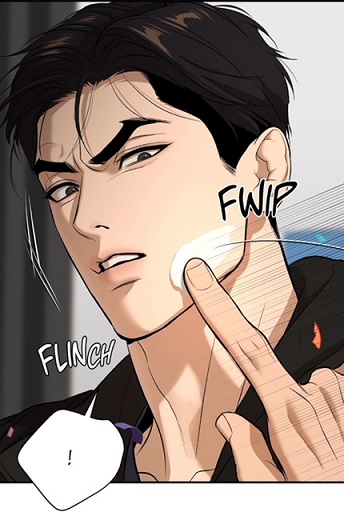 (chapter 43) represents the positive gesture from Namwook’s slap.
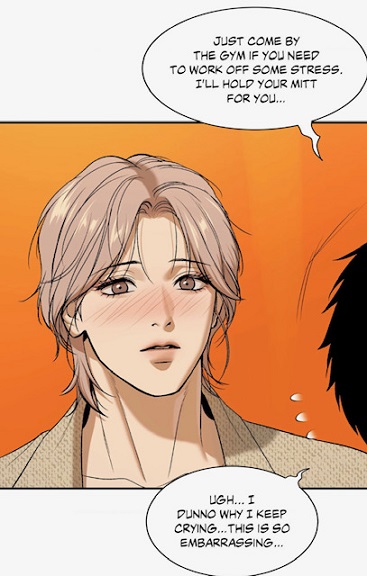 (chapter 35) He needed Potato to work off some stress. That’s why the reason why NO ONE wondered about the young fighter’s absence during the birthday party.
 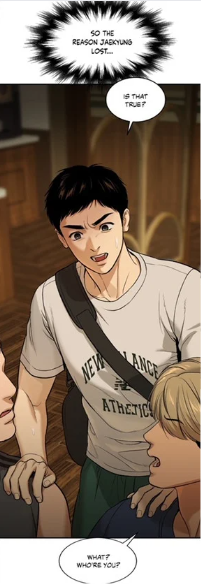 (chapter 52) The result was that his face got bruised.
  (chapter 7), 16
  (chapter 16)
  (chapter 16), 25
 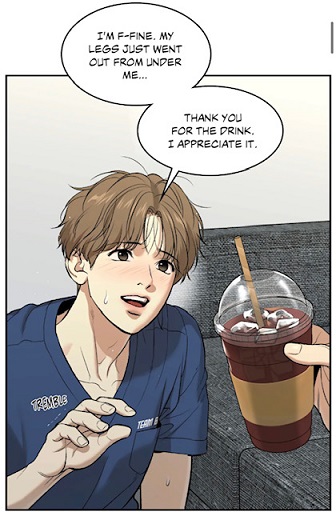 (chapter 25)
  (episode 25) and
 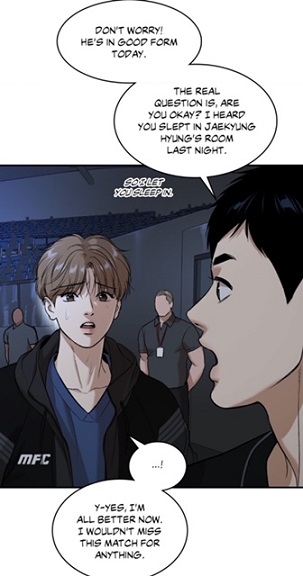 (chapter 40), but also paid attention to his actions and work.
  (chapter 25)
 (chapter 41) However, notice that her desire to watch the match was related to her grandson, the source of her pride and joy. As soon as I made this connection, I had another revelation. Gradually, the chow-chow’s admiration is shifting towards the doctor.
 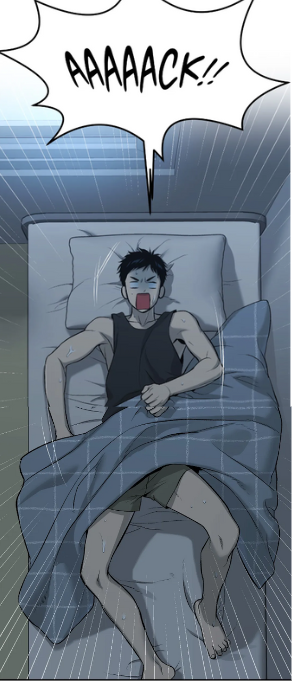 (Chapter 25) and showed no fear to fight with stronger men.
 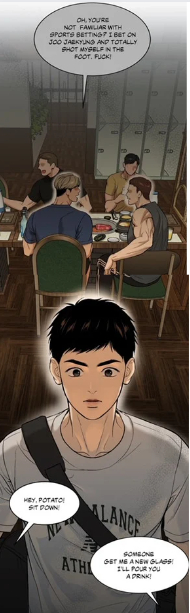 (chapter 52) I sense some future tension between him and coach Park Namwook, for the maknae embodies enlightenment, great intuition and open-mindedness, whereas the other stands for prejudices, ignorance and herd mentality. Naturally, the manager is changing for the better, nonetheless his metamorphosis is progressing much more slowly. Only in episode 52, he questioned why Baek Junmin was placed next to his athlete.
  (Chapter 52) Yet, he didn’t complain to the staff or to director Choi Gilseok. He remained passive contrary to the young member from Team Black. Moreover, because Kim Dan has always felt a certain closeness to Yoon-Gu, I believe that the latter will be the reason why the champion and Kim Dan can rekindle. Thanks to him, he can approach the poor doctor and convince him that Team Black is his home.
  (chapter 29) I doubt that it will be just for the athlete’s sake and recovery, for this would make him a hypocrite. He is truly interested in the doctor’s well-being. Let’s not forget that his worries in episode 43 were genuine. Moreover, since Joo Jaekyung’s name number 3 and Potato 4, we come to 7! They will work together. Joo Jaekyung will share his knowledge how to rule in the ring.
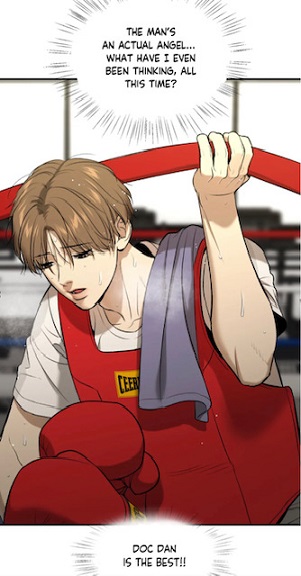 (chapter 26), his tolerance, patience, understanding
  (chapter 37), his humbleness
  (chapter 25), his dedication and meticulousness.
  (chapter 49) Yoon-Gu could only perceive Kim Dan as the symbol of loyalty. Hence I come to the deduction that after meeting doc Dan, he must have realized that only one could change the situation, it was Joo Jaekyung and no one else.
  (chapter 43), but also Park Namwook’s neglect. How so? First, look how Kim Dan came to offer his services to the members from Team Black. Kim Changmin had an old shoulder injury which had been neglected:
  (chapter 7) But the coach should have noticed it and advised him to go to a doctor. He was responsible for them. But no… and we have two other evidences in episode 52. First, the manager didn’t ask about Potato’s injury. Secondly, he slapped a patient, because he felt “provoked” by the outburst from Joo Jaekyung.
  (chapter 52) Why? One might say that he was worried for his star. But for me, the drop of sweat is showing a certain discomfort. How so? A surgery means that the athlete can no longer fight for a while. Without him, the coach is put under pressure, for he needs to ensure that other fighters can enter MFC.
  (chapter 47) Hence I am now wondering if his passivity and silence after the terrible incident were not deliberate. He had ran away from any responsibility out of fear (avoidance). That way, he could put the blame on others: the champion, the fighters, King Of MMA etc. Naturally, the champion is also to blame
  (chapter 41) That’s how it dawned on me that the news about Kim Dan could be referring to his health too. But does it mean that doctor Dan is now ill, especially when you look at Potato’s facial expression here?
 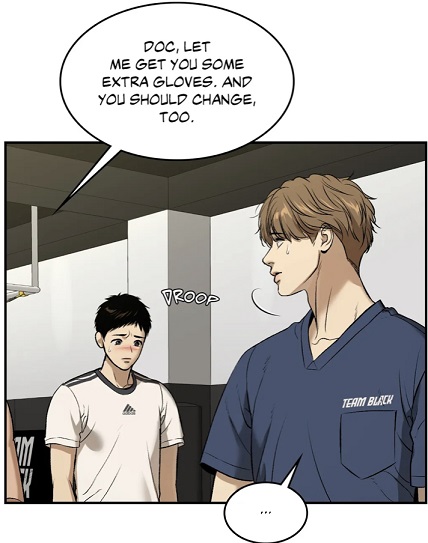 (chapter 25) Back then, his dream was to train and spare with the athlete, thus I deduce that his new dream got “crushed”. But what was his new wish? To work with doc Dan! Thus he assisted him and asked for his opinion. He trusted him blindly. Therefore I have the impression that the physical therapist stopped on his own working for Team Black. However, I don’t think, Kim Dan made this choice himself. The news definitely caught the athlete by surprise.
  (chapter 52) Either he is sick, or it could be a reference to the doctor’s mental health as well. This would mirror the champion’s unwell-being.
  (chapter 10) Let’s not forget that after his first night, the doctor numbed his physical pain with soju, while he was not eating properly.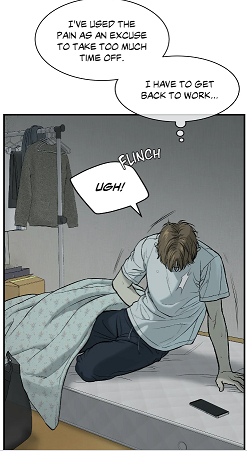
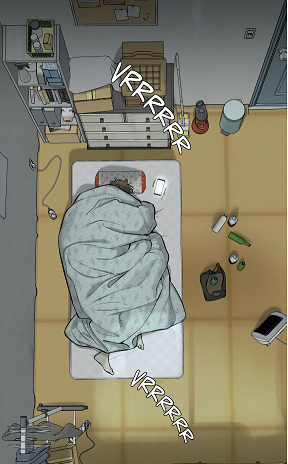 (chapter 5) He would spend money for soju, but not for healthy food. Not even his grandmother was aware of this habit. But by living with the champion, he could no longer live like in the past. He had stopped drinking any alcohol, but notice that it changed after the drug incident. He was encouraged to drink again:
 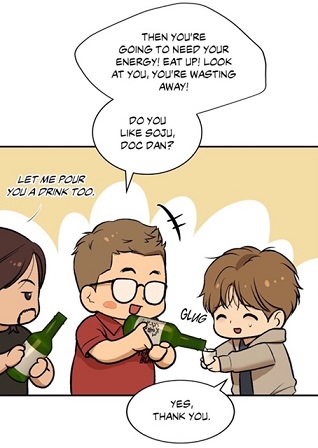 (chapter 43) The champion represented the doctor’s motivation and as such “sweet drug”. That’s the reason why he could always overcome the pain afflicted by his soulmate:
  (chapter 47)
  (chapter 51) And this brings me to my next observation. All the episodes are showing the champion’s weak mental condition which got even worse over time. From this
 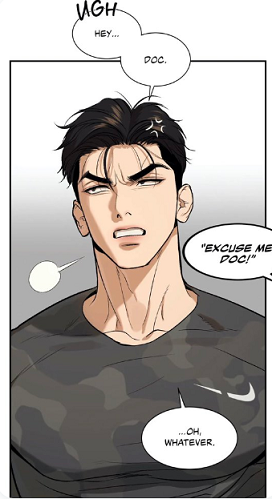 (chapter 7) to this
 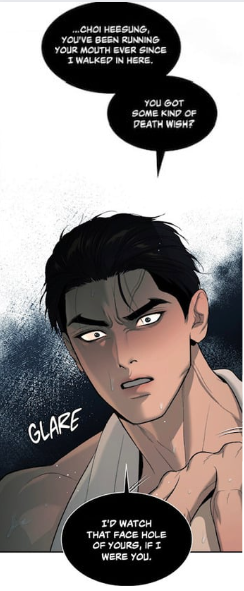 (chapter 34) and to this:
  (chapter 34) Though the celebrity was getting easily irritated, the manager never took the matter seriously. He saw it as the result of bad education, hence he never tried to change it either.
 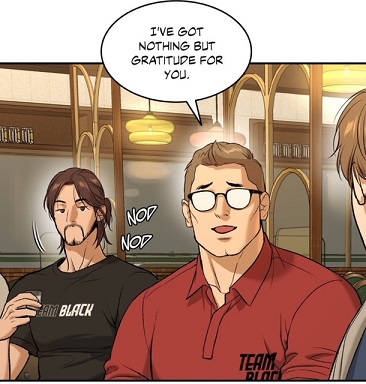 (chapter 43)
 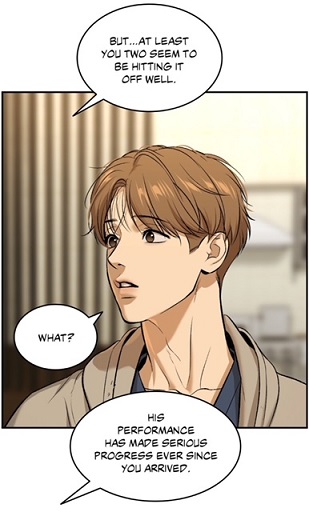 (chapter 43) and care are not selfless, for the PT could improve the celebrity’s performance and even treat his shoulder injury in such a short time. However, what Park Namwook is not realizing is that he is becoming responsible for Kim Dan and his return.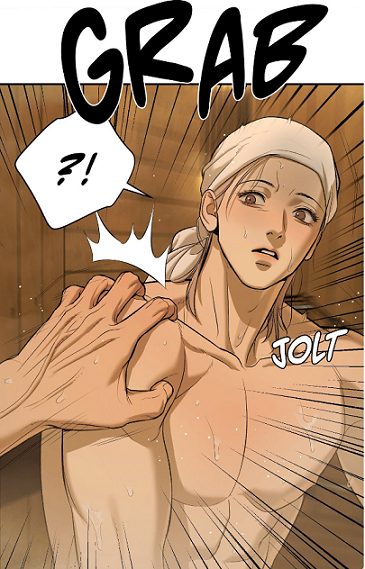
 34 and 52) is not the expression of fun, rather it indicates fear, frustration and anger. In episode 25, the maknae wounded the doctor out of jealousy and frustration unconsciously. He wished to be close to the celebrity. Interesting is that chapter 43 represents the true exception. Here, the readers could discover the champion’s true face: he was behaving like a brute and thug
 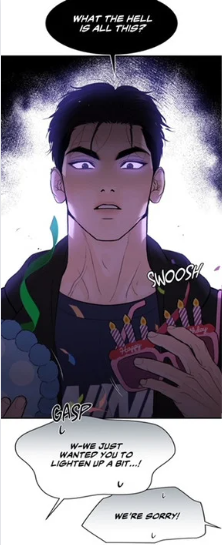 (chapter 43)
 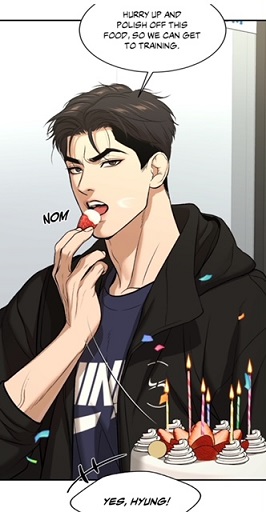 (chapter 43) To say that the athlete always has a bad temper
 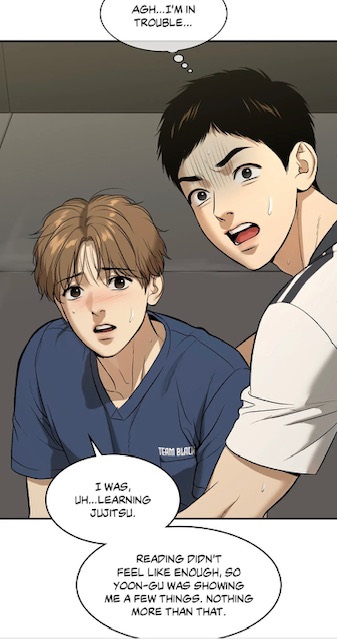 (chapter 25) Why? It is because the doctor protected him by explaining the circumstances: he was learning jujitsu. He diverted the champion’s attention from Yoon-Gu. He had not been “caught”. However, when Kim Dan was offered to become the celebrity’s sparring partner, Potato got angry and voiced his anger and wish:
  (chapter 34) He employed the exact expression than the manager, an indication that the latter had influenced the actor. I consider his thoughts as another evidence for the coach’s intervention. However, he couldn’t report it to Park Namwook, for he had used work as a reason to meet the protagonist. On the other hand, I am quite certain that he divulged the incident to Potato in episode 43, therefore the latter agreed to the statement of the other fighters: he was a thug.
 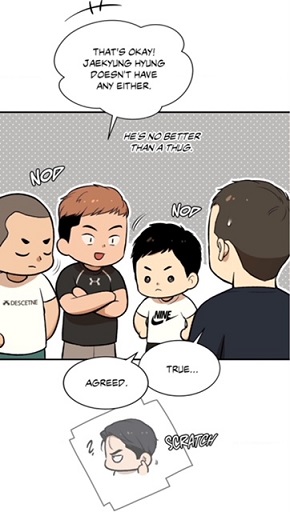 (chapter 47) Chapter 52 contrasts to all the previous scenes, for this time, the champion got caught and sentenced.
 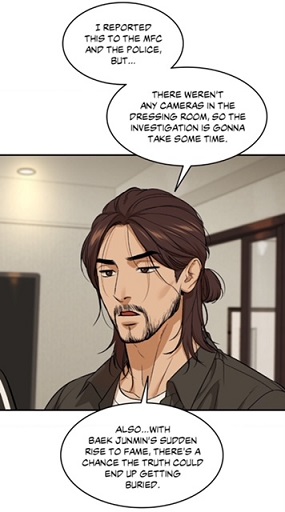 (chapter 52) They got scot-free. While it looks like a blessing, it is not because contrary to the past, police got involved. Coach Jeong Yosep reported the incident to the authorities, so Choi Gilseok and the other could get arrested for money laundering.
  (chapter 1) His bad temper is the reason for that incident. Funny is that by admitting this, he is not realizing his own wrongdoing! He neglected the champion’s mental health and his well-being all this time. He never tried to grasp the origins of his irritability and to improve the situation. So it was only a matter of time, until this would come to the surface! To conclude, though number 7 is strongly connected to suffering, it also stands for education and teaching. Thus as time passes on, the characters are getting enlightened and more complete. Little by little, they are getting closer to the divine: the discovery of hope and as such happiness. For me, the protagonists’ main spiritual growth will take place around the episodes 70-79.

 (chapter 22) Back then, I came to realize that both ukes were associated with the number 2. Shortly after, while making a first portrait of Cheolmin, I noticed that this cute doctor was linked to numbers 1, 3, 4.
  . From that moment on, I came to associate Jinx-characters with gods and as such planets. Hence in the essay

 That’s how I discovered that Kim Dan was associated with the number 8. Thus in the composition
  HEALING! That’s the night Kim Dan got healed.
  (chapter 47) and digest the terrible news.
 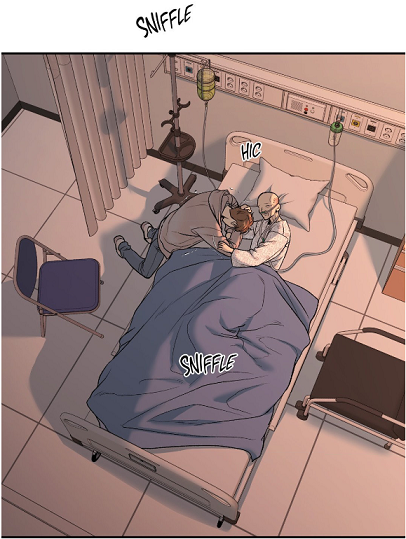 (chapter 47) Thanks to the champion, Kim Dan discovered that he could receive warmth and love from someone else. And now, you can grasp why he was strong enough to give the present to Joo Jaekyung despite his fear, why he could confront his boss in the locker room in episode 51. Thanks to this magical night, he learned that he could stand on his own. He is an adult now. But wait… people might question this interpretation, for there was no teamwork in episode 11.
  (chapter 11) He treated him as an important member of his team, he needed his assistance. Secondly, who helped Kim Dan with his struggles? Joo Jaekyung.
  (chapter 22) It is important, because it indicates that little by little, Joo Jaekyung is taking over the gym. From that chapter on, he was building his world from the ground”.
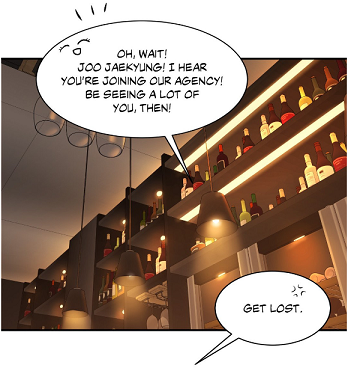 (chapter 33), we could see Joo Jaekyung’s success reached its peak, as he had just signed a contract with the Entertainment agency. “Reaching the pinnacles of success” was also reflected in another situation. The champion was allowed to touch his lover’s phallus
  (chapter 33), something he had been denied before (chapter 24). Moreover, he was able to get a confession from Kim Dan.
 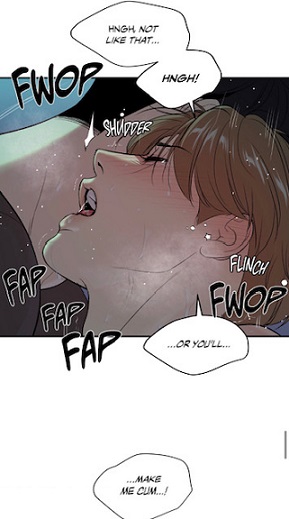 (chapter 33) The latter would react to him, only him could make him cum. Moreover, observe that in the heat of the moment, Kim Dan embraced his lover which surprised both.
  (chapter 33) The cute doctor was unconsciously accepting to be intimate with his boss. Thus he whispered to the sportsman.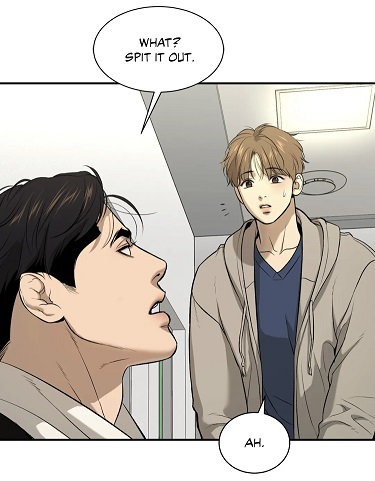


 But even so, he is not able to look at his VIP client. Kim Dan is the one avoiding the athlete.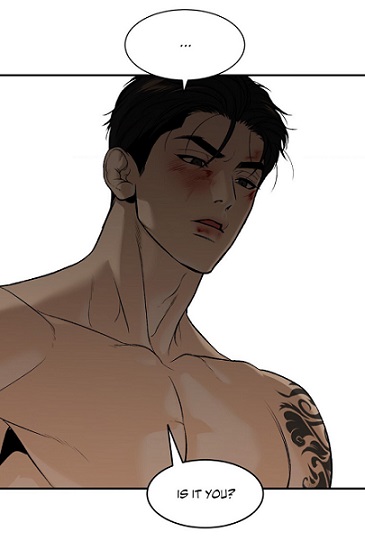
 They are no longer avoiding discomfort, a sign that they are getting closer to each other.
 I selected pictures from episode 6, 33 and 51! They are all connected to the same number. This signifies that we should examine the following chapters 6, 15, 24, 33, 42, and 51 as a continuation or better said as reflections. Hence they stand for love, but don’t forget that Venus also embodies fertility, prosperity and victory. How so? She was the ancestor of the Roman people through her son, Aeneas, who survived the fall of Troy and fled to Italy. That’s why she came to symbolize Rome’s imperial power. Yes, these chapters are mirroring a battle, who has the upper hand in the couple.
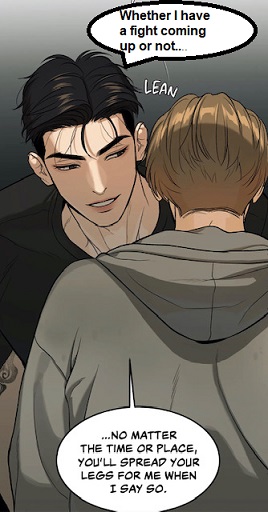

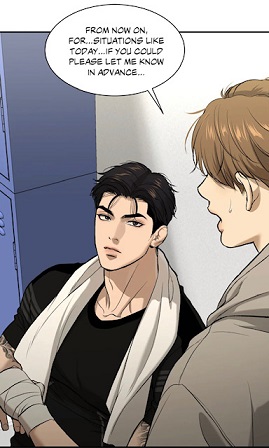


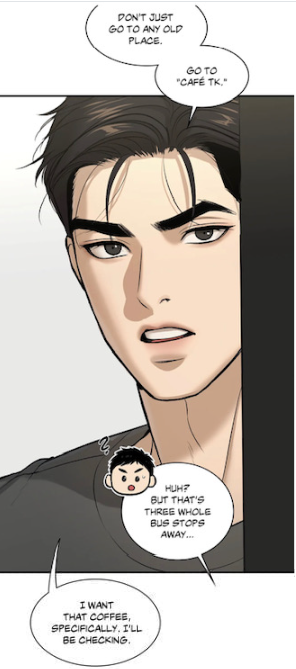


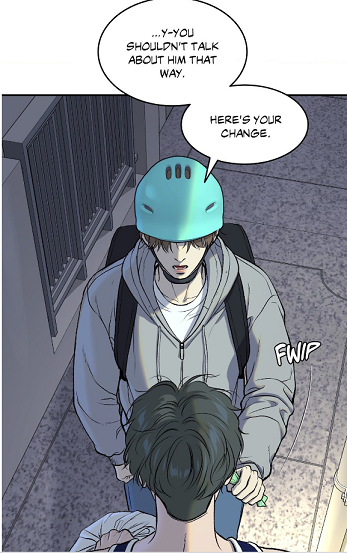

 (chapter 45) By taking a side gig, the main lead pushed the athlete to recognize him as a true physical therapist and not as a whore. This new interpretation reinforces my conviction that the sex before the match with Baek Junmin was different, it had lost its true value and meaning: it was no longer a belief, rather a habit. Kim Dan could even determine the end of the sex session.
  (chapter 15) But there’s more to it. It was also a first for the champion. He invited Kim Dan to watch the show. Imagine that he had never invited any sex partner before. Then in episode 24, he listened to the doctor’s request without any complain. Then in episode 33, for the first time, Joo Jaekyung focused on giving Kim Dan’s anal pleasure. It was, as if the star wanted to trigger desires in Kim Dan. Then in episode 42, Joo Jaekyung witnessed that Kim Dan was doing the breakfasts out of “routine” and not out of pleasure. Thus he always fell asleep. On the other hand, the physical therapist got confronted with a rival for the first time. Finally, in episode 51, Joo Jaekyung is now acknowledging Kim Dan as his final doctor. He is voicing his expectation: meticulousity.
  (chapter 51) By bringing the topic money
  (chapter 6)
  (chapter 46) , he listened to Kim Dan till the end.
  , (chapter 39) In chapter 53, we discover that it was the halmoni’s dream to see the ocean, like we could observe it in his old house.
 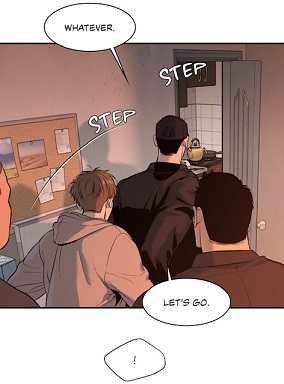 (chapter 17) However, in the last panel, Joo Jaekyung was leading his loved one, symbolizing that he would bring him to different places. Thus the doctor had to follow him to Busan (city next to the sea) and to the USA. At the end of season 1, it becomes clear that the champion will follow the doctor’s footsteps. He will got to the West Coast. Yet, in reality, the fighter is actually following the grandmother’s trail. Moreover, note that the doctor’s dream was to travel too. However, this desire is strongly connected to his relative.
  (chapter 37)
 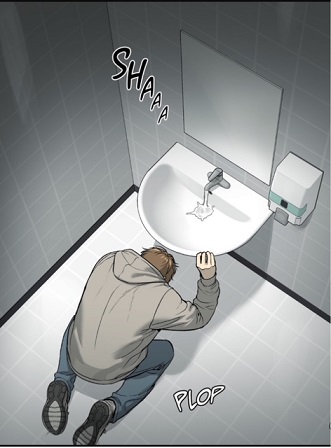 (chapter 47) The bridge from San Francisco is a place where people often commit suicide. My idea is that after they vanished, the halmoni never discussed their death with him. Since the grandmother was harassed by the loan shark, I can only assume that they killed themselves due to the debts, and suicide is a huge taboo in South Korea. Notice that his first trip led him to Busan which is a town next to the sea. However, back then, he had not the time to go to the beach. But when he went to the States, it was far from the coast, as UFC/MFC is located in Las Vegas. Hence he came to enjoy his trip. In fact, it inspired him to travel.
  (chapter 39) Then his favorable days are Thursday, Tuesday and Friday. And if we combine the days from the two protagonists, there is only Wednesday off.
 (chapter 35) We have a 5, but 3+5= 8, the double of 4. Besides, his favorable numbers are 1, 7, 4. Then we would have the explanation why he became more important in episode 22
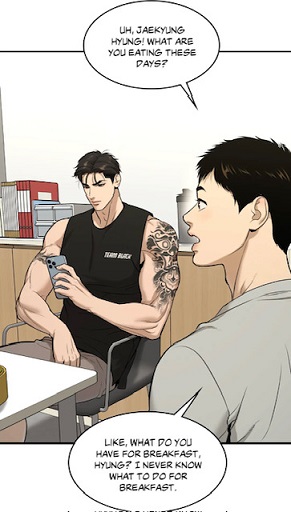 (chapter 22), why he protected the doctor from Heesung in episode 31
 (chapter 31), why he asked for Kim Dan in episode 40
 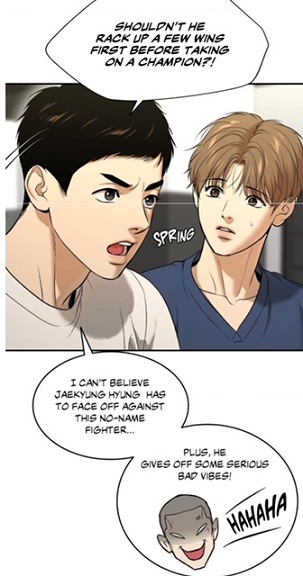 (chapter 47) and helped him in the locker room.
 (chapter 48) Why did the Webtoonist gave us the time, when the next episode starts another day? On the one hand, it exposes that the schemers knew about the champion’s nightly activities. He wouldn’t sleep much and he would keep his cellphone next to him.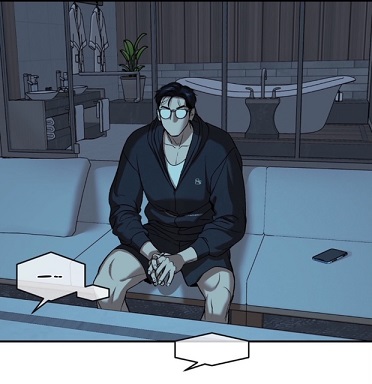
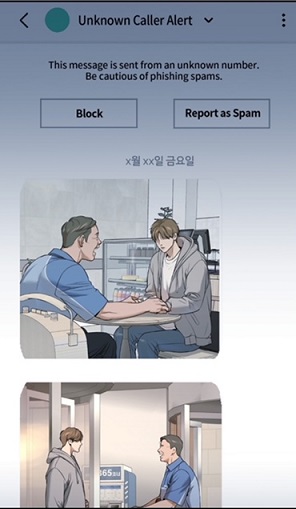 (chapter 48) It shows once again that the traitor is close to the athlete, for he knows about his way of life. Furthermore, the unknown person could text to the champion, hence this means that his cellphone number got leaked by a person close to him. On the other hand, I am quite certain, the Webtoonist desired to fool her readers making them anticipate a confrontation between the two protagonists. However, nothing happened indicating that Joo Jaekyung didn’t react, like the plotters had anticipated it. Thus they had to create a new scheme. First, let’s not forget that they had used a similar method in the past.
  (chapter 76) “A deed once foiled has no chance of success the second time around”.The criminal was referring to learning through experience. After going through such an event once, the athlete is no longer caught by surprise. We could say that he learned not to jump to conclusions and control his emotions. That’s the reason why in episode 48 he remained level-headed. Because the champion didn’t get angry, he could be more attentive.
  (chapter 48) Secondly,
  (Chapter 48) The irony is that the doctor had been able to treat the star’s injury. For me, the Summer Night’s Dream played a huge role, as during that night, Joo Jaekyung felt treasured and loved. Therefore the pictures could only expose the duplicity of the director of King of MMA. Under this new light, it becomes understandable why the celebrity didn’t fall into their trap and why they had to turn doc Dan into a traitor by giving him a weapon without his knowledge. Finally, I believe that Joo Jaekyung had another reason not to confront the physical therapist. How so? It is because he had sent away his soulmate, while the latter had approached him.
  (chapter 48) He had missed the opportunity.
 (chapter 30) Here, he wished to seek the doctor’s closeness. Nonetheless, if he had gone to Kim Dan’s bedroom during that night, he would have achieved the opposite: he would have created distance and caused an argument. The latter could have told him that he was looking out for himself, for Joo Jaekyung had threatened to fire him. Through these observations, it becomes visible why the athlete couldn’t ask Kim Dan at all. Consequently, I come to the conclusion that the clock
  (chapter 45) Then in the bedroom, he had rejected all his requests (massage, conversation). It was, as if he no longer needed him. He was no longer eating his breakfasts too.
  (chapter 47) Under this new light, Manhwa-lovers can comprehend why he looked annoyed in the hallway.
 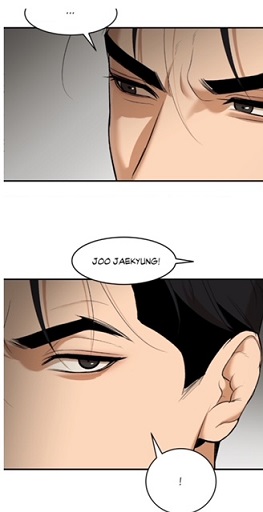 (chapter 49) The gaze displays not only worry and anxiety, but also regret. It was too late to ask the doctor. For me, he chose silence, for he was regretting his reactions in the penthouse. He feared to ask Kim Dan, because if he brought up the meeting with Choi Gilseok, this could push the hamster to quit his job. However, thanks to Kim Dan, the star’s condition improved greatly. That’s how it dawned on me why the champion became a beast and why he is hiding his past:
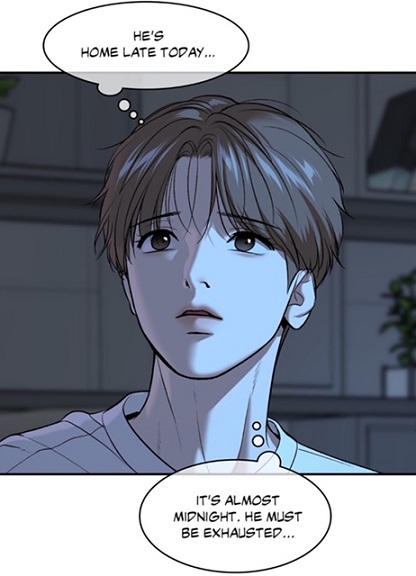 (chapter 48) But why is midnight so important? It is because the number 12 carries religious, mythological and magical symbolism, generally representing perfection, entirety, or cosmic order.
 (chapter 12) the couple was supposed to reach Nirvana, but the athlete failed terribly. Under this new light, it becomes comprehensible why the protagonist chose not to confront Kim Dan in episode 48. It was, as if the champion was closer to the heavens. This represents the champion’s leap of faith. Don’t forget that the star got scared for one moment
 (chapter 48), when he noticed doc Dan’s presence too late. But nothing happened to him, that’s how he got incited to trust Kim Dan. The latter wouldn’t backstab him. Under the blue light, the champion got transformed.
 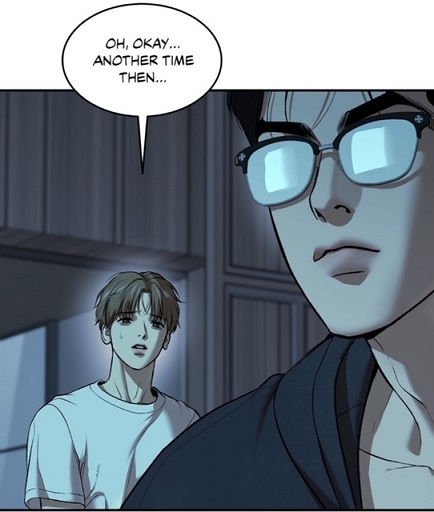 (chapter 48) On the other side, the fact that the champion is always targeted during the night is a sign that the villains desired to approach him, when he was isolated. So they know not only about his insomnia, but also about his solitude. I would even add that the plotters are aware of his association between the night and danger. Remember how he described relaxation: he would give an opportunity to his enemies to attack him




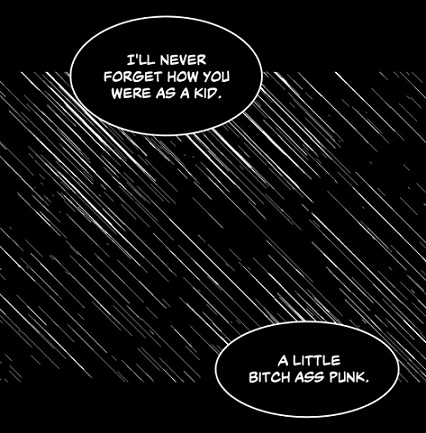 (chapter 49) In the previous essay, I had mentioned the theory that the champion might have been raped and even gangraped which would fit the criteria (sex, danger and urgency). Finally, the recurrence of “delicacy” during the night is an indication that the athlete must have been like Kim Dan in the past! Vulnerable and alone!
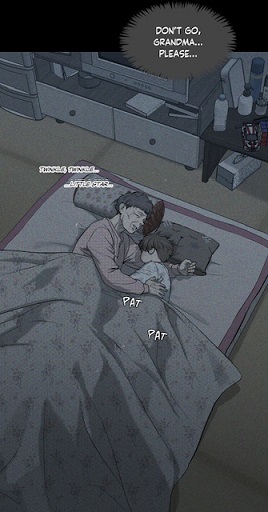 (chapter 21) Furthermore, the champion exposed why he could never relax:
 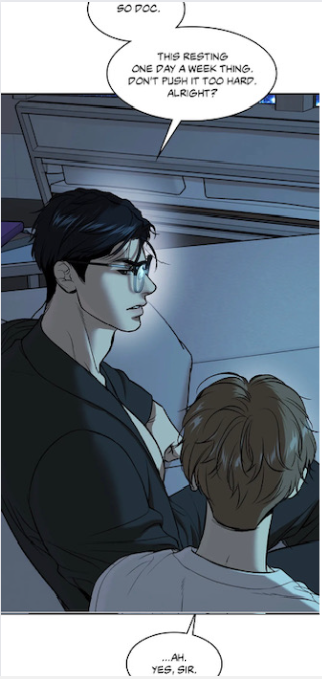 and 48:
  (chapter 47). And what was the main lead feeling after that terrible night? Regret, for he had not been able to notice his relative’s suffering and sacrifice!
 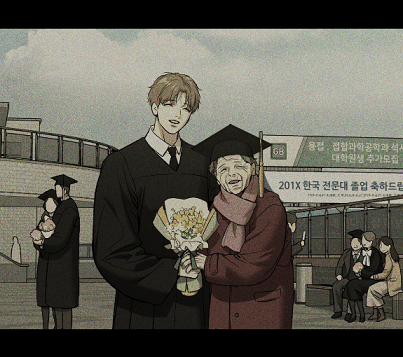 (chapter 47)
 (chapter 19) or a new request like swallowing the sperm
 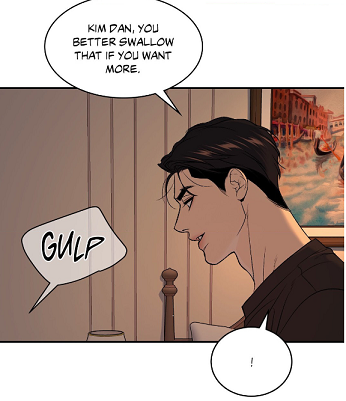 (chapter 39) or kissing the champion’s ruined ears
  (chapter 30) He was rough and used the toothpaste as an excuse.
  (Chapter 29)
 (Chapter 40) That’s the moment he stopped considering the hamster as a prostitute, while from chapter 2 to 18, he viewed Kim Dan as a tool, as a talisman against his jinx. However, I detected a transition after he kissed the physical therapist. From that moment on, the doctor was connected to food and sweetness.
  (Chapter 18) And now, observe that during the night in the bathroom, doc Dan was associated with a baby receiving food:
 (chapter 20) As you can see, here the champion started viewing him as a human being. It exposes that little by little, his perception of the physical therapist improved. So from chapter 30 to 39, Joo Jaekyung was forced to question the nature of his relationship with Kim Dan: a PT or a prostitute or a pet?
  (Chapter 34) Here, he was in denial, he described the main lead as a possession, but he couldn’t fool the actor. Under this new light, it becomes comprehensible why the nights in chapter 19, 29 and 39 were so magical, they announced a transition or better the end of viewing Kim Dan as an object (tool for his jinx) and possession. From 41 to 49, the champion was cornered to recognize Kim Dan as a physical therapist and not just as a member from Team Black. Don’t forget his attitude in the car, when the main lead suggested him not to train.
  (Chapter 42) He rejected his advice, a sign that he was doubting doc Dan’s skills and competences. That’s the reason why I come to the conclusion that with the pictures, the champion was pushed to admit that Kim Dan is his physical therapist
  (Chapter 49)
  (chapter 34) “Don’t get in the way” and “make sure you give her a good polish”.
  (chapter 49) The sportsman is viewed as a hindrance to their dreams, he should clear the way for them. I deduce that in his youth, people must have treated him the same way. He represented an obstacle, therefore these two figures must have challenged him in the past too. Their confidence comes from their past experiences with the athlete. Both must have defeated Joo Jaekyung, but naturally they must have tricked him.
  (chapter 49) Then I noticed another parallel between the two plots: the presence of a scapegoat, and the involvement of a third person. Heesung faked his injury by putting the blame on the athlete, while he asked Kim Dan as compensation. In the second plot, the roles are switched. Kim Dan is now the perpetrator, while the athlete is the victim! Baek Junmin is the beneficiary of this scheme. And what do these plots have in common? Joo Jaekyung is the victim of a trick, though Heesung’s manipulation was rather benign. First, he acted on his own.
  (Chapter 31) Moreover, he utilized the genuine concern and innocence of his surroundings. In other words, he used his image as a good and honest man to his advantage. Thus I come to the conclusion that the artist’s sin in their youth was rather minor, as the artist tends to violate social norms. So though it was no illegal, the actor’s wrongdoing definitely left scars on the protagonist’s heart.
 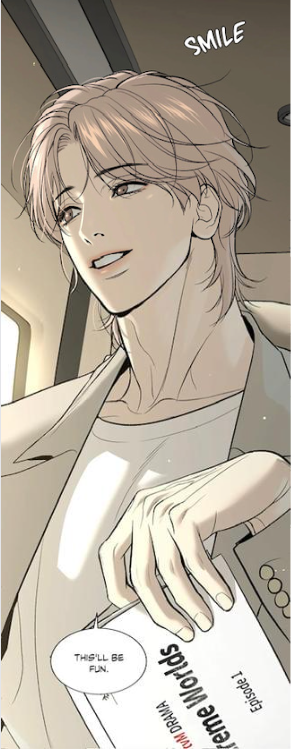 (chapter 29) Probably, Heesung utilized Joo Jaekyung’s innocence to his advantage in order to maintain his good reputation, like for example he was not supposed to be smoking or he took away a friend from him, as the topic of their conversation was about the theft of a person
  (chapter 33)
  (Chapter 30) Another common denominator between The Shotgun and Heesung is their envy and greed.
  (chapter 5) Joo Jaekyung destroyed the sandbag, when he imagined that doc Dan had blocked him! This signifies that the former could no longer contact the shy hamster. Joo Jaekyung saw it as an affront, a challenge!
  (chapter 46) could be seen as a reflection from the arcade and the star’s past. And since Kim Dan wounded Joo Jaekyung in the locker room
  (chapter 49), I deduce that such an action must have happened in the champion’s youth. He got not only hurt by people, but also betrayed by a friend. There exists many reasons for this hypothesis.
 (Chapter 04) and be rude towards others.
 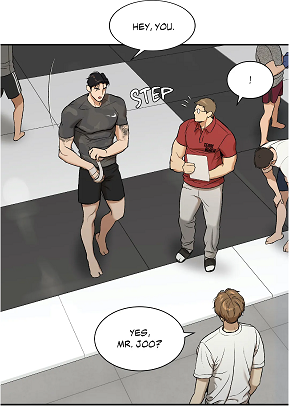 (Chapter 7)
  (chapter 37) But Mingwa left many clues that the celebrity’s personality shouldn’t be judged by impressions. During their first night together, Manhwa-lovers could see books next to the bed.
 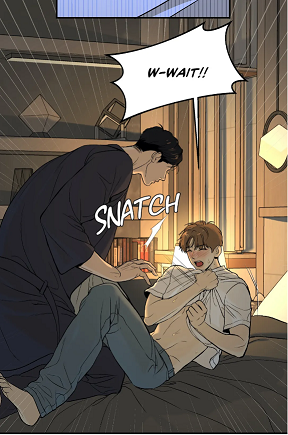 (Chapter 3) Some of them are not written in Korean or English. Moreover, the Webtoonist revealed that one of his hobbies is reading. This explains why he can talk prettily.
 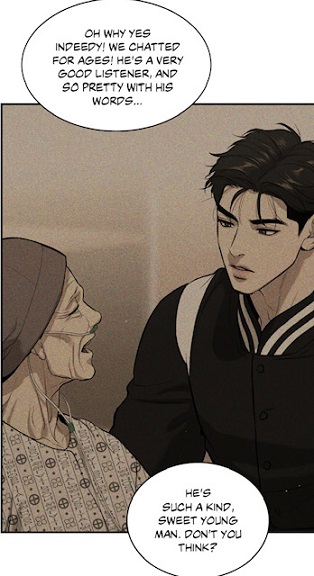 (chapter 22) This shows that his behavior mirrors the counterpart’s. Consequently, it is not surprising that the champion is rough with his own body, as Park Namwook is not treating him like a delicate child.
  (Chapter 37) Even stressed and filled with anger, he could understand and speak fluently in English.
 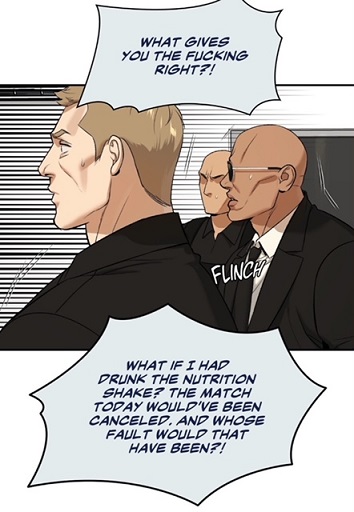 (Chapter 40) Compare Kim Dan’s English skills in the same scene:
  (chapter 40) Besides, Jinx-philes should question why Mingwa is not divulging his scores as a student contrary to Kim Dan or Jinwon from BJ Alex. It is because she wants to create a certain image about the champion: he is a bad boy. In my eyes, she is playing with prejudices about MMA fighters. People often imagine, they lack social manners and education. They chose this path, for they could do nothing else. And this brings me to my next remark. We know that Kim Dan selected PT because of his halmoni.
 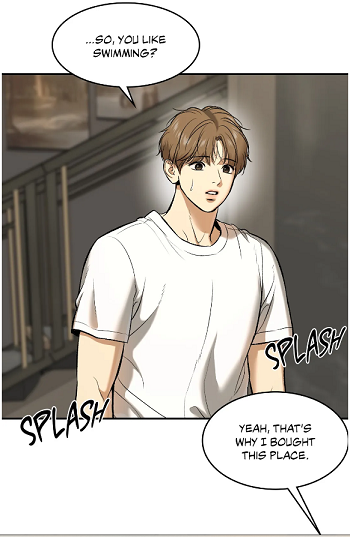 (chapter 27) I see a contrast between these two sports: swimming which is related to relaxation, pleasure and fun and MMA fighting which stands for challenge, pain and seriousness. This contrast is even more present in the following panel:
  (chapter 49) He is a hyena, hence his color is brown.
  (Chapter 48) And The Shotgun has a similar attitude:
  (chapter 49) Interesting is that his description of the challengers fits the situation in the new plot perfectly. The Shotgun imagines that he will fight against a diminished champion. His shoulder is injured and they have planned to add a new injury. The hyena stands for balance and cleansing as their task is to remove the weak ones.
 (chapter 49) As an old man, Choi Heesung is revealing vulnerability and senility. Due to his old age, he could be replaced by another hyena, a younger hyena!
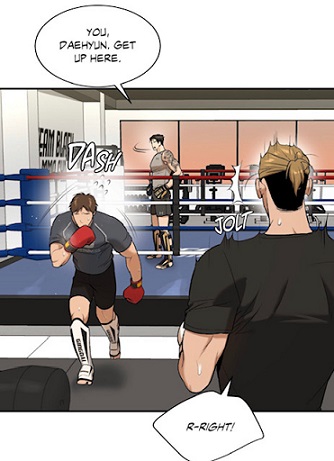 (chapter 36) which could only affect the members from Team Black. Their loyalty could waver. Then he got to hear bad comments from the Internet
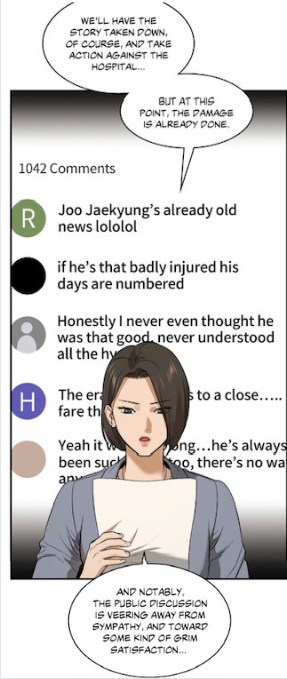 (chapter 36), creating the illusion that he was losing popularity. That’s how the lawyer could convince the champion to accept a new match in such a short-time. Finally he got reprimanded for his outburst.
  (chapter 47) At no moment, the physical therapist brought up his misdeeds and asked for an apology. His silence became the symbol for his tolerance and even forgiveness. In addition, the doctor and his halmoni embody both vulnerability and poor health, which is strangely connected to crime and scandal.
 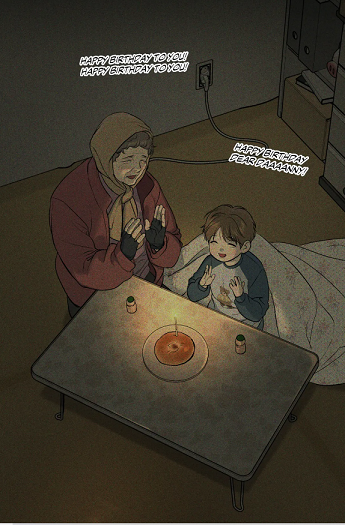 (chapter 11) He wished to receive attention and to have a normal conversation. Consequently, I assume that the champion has been copying his role model. That’s how he was pushed to grow up too quickly. For me, he had no childhood at all, hence when he met Kim Dan, he was encouraged to develop his inner child!
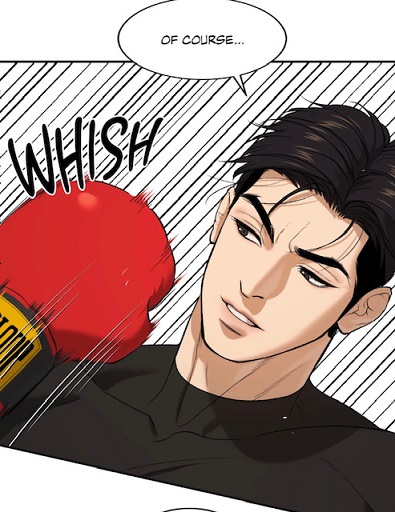 (chapter 26) For the first time, he had fun sparring. Hence he kept smiling. It is no coincidence that soon after he chose to accept to take a day-off, when Kim Dan made the suggestion.
 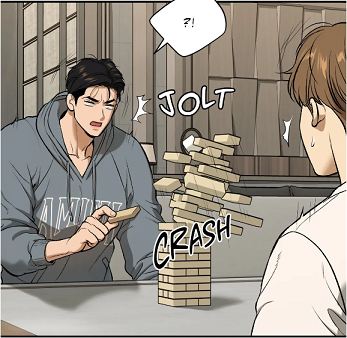 (chapter 27) That’s how he remembered that he liked swimming and he could play a prank on his lover.
  (chapter 35) and not in episode 48. It is because Kim Dan had paid him a visit during that night, a sign that he was thinking of him as his patient and VIP client.
 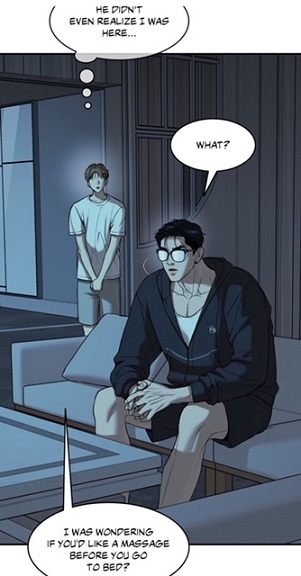 (Chapter 48) On the other hand, I am inclined to think that when a terrible incident in his youth occurred, he couldn’t contact his family or guardian. Hence he keeps his cellphone by his side constantly. Yes, I was thinking of the doctor’s assault in the street and his failed rape:
  (Chapter 16) Heo Namwook’s minions had confiscated his cellphone. Hence it was impossible for him to call for help. And now take a closer look at this scene:
 (chapter 37)
  (chapter 49) And the anonymous person on the other side of the phone was definitely calling in order to be updated about Joo Jaekyung, for his coach asked him about his physical conditions.
 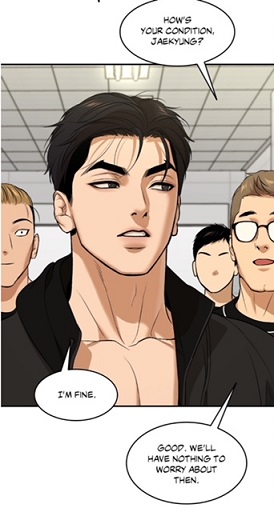 (chapter 49) That could be the hidden guardian who has not showed up yet, I am thinking of Seo Gichan. And now it is time to close this long essay.
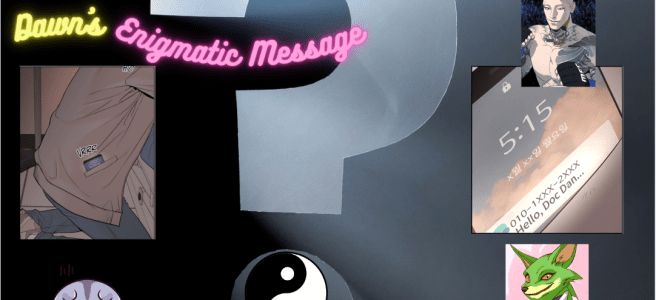

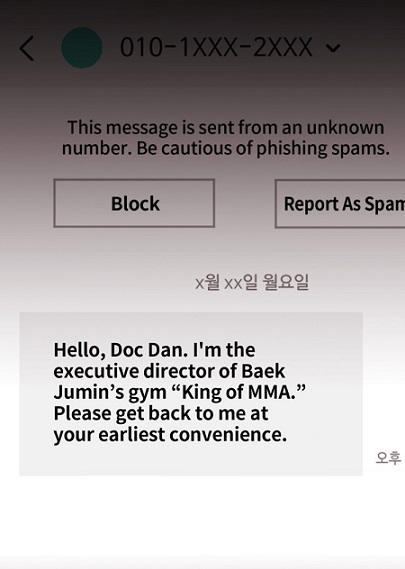 (chapter 47) Now, you are wondering why I decided to dedicate an essay about this scene. It is because the phone call and message raise a lot of questions. Why did the mysterious man call Kim Dan at such an early hour? Notice that it is in the morning, at 5. 15 am.
  (chapter 47)
  (chapter 47) The Spanish translator thought, the person calling Kim Dan was contacting him, after the doctor had met the oncologist. She imagined that not much time had passed. Yet, I believe, it is in the morning. First, it is important to place the day in the year. Since Joo Jaekyung’s birthday is on June 21st, and the next match is shortly after
 (chapter 47), I deduce that we are in July. However, the
 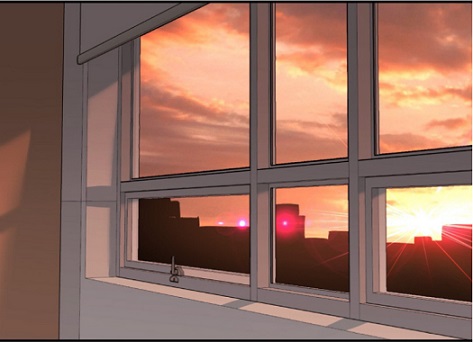 (chapter 47) It is in the morning. Moreover, the Webtoonist tipped off her avid readers with this panel:
  (chapter 47) In Korean, it is written MONDAY!! I had already detected a certain pattern. The protagonist would visit his grandmother on Sundays,
  (chapter 47), it was Saturday evening. Then the next day, he went to the hospital in order to get the results. After hearing the terrible news, he lost track of time. Hence he didn’t look at his cellphone contrary to episode 5.
  (chapter 5) On the other hand, I don’t think, he visited Shin Okja right after meeting Kim Miseon, for his grandma would have known that he had remained by her side the entire night. Nonetheless, her worries were about eating and not about lack of sleep.
  (chapter 47) Thus I come to the conclusion that he spent the whole night at the hospital like in episode 21:
  (chapter 21) This explains why the grandmother was not wearing her headgear. She was sleeping. But back then, Kim Dan returned to the penthouse at dawn.
  (chapter 21) Therefore the grandma didn’t notice that he had stayed by her side for quite some time, for she was asleep. Hence she requested his presence the next morning. Nonetheless, there exists another difference between chapter 47 and 21. In my eyes, Kim Dan entered her room during the night and spent some time in the bathroom.
  (chapter 47) He didn’t approach the bed the same way:
  (chapter 21) However, I doubt that he spent just one hour in the restroom covering his tears by running the tap water.
 (chapter 3) Here, he was also sitting on the floor pondering if he should still accept the deal. And what had happened back then? The protagonist was lost in the moment, he had no notion of time because of his fears and social norms. As a first conclusion, Kim Dan spent a lot of time in the bathroom reliving the moment when he was receiving the bad news. This interpretation displays how much his grandmother’s imminent death devastated him. He had spent the entire night crying:
  (chapter 47) Therefore he had red eyes. Furthermore, the halmoni’s name is Shin Okja, and Shin can signify “morning, dawn and daybreak”. For me, it is no coincidence. First, it was her moment to shine due to her compassion.
  (chapter 47) In my eyes, this scene represents the positive reflection from that nightmare:
 (chapter 21) As a little boy, he had asked his grandmother to never leave his side, unaware that this meant that he should do the same. He should remain by her side too. Yet, he didn’t do it.
  (chapter 47) This observation made me realize another aspect. When he heard the diagnosis from Kim Miseon for the first time, he admitted his powerlessness.
  (chapter 5) In his eyes, he could do nothing for his grandma. But he was wrong, as he could support her by spending time with her. From my point of view, when the halmoni left home for the hospital, deep down, he must have felt abandoned. On the other hand, we shouldn’t forget that he also had other worries and problems to solve: the loan, the hospital bills and finding a job as a PT. Hence I deduce that through his grandmother, he learned the following lesson: he should spend more time with his loved ones, as they can vanish at any moment. He learned how precious time is. This remark made me realize the huge contrast between these two scenes:
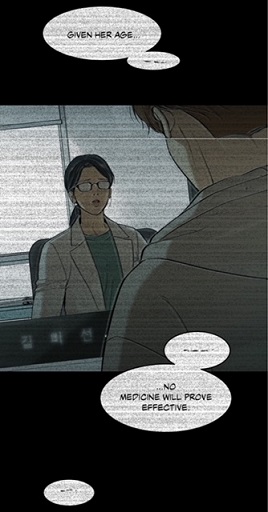 (chapter 47) He was in the bathroom crying and kept recalling the terrible monologue from the oncologist. He felt lost and trapped in the same moment. It felt like an eternity for him. But when he listened to his grandmother, bathed in the sunlight, it triggered his memory about his childhood with her.
  (chapter 47) Shin Okja is no longer a goddess, a star during the night… but a human facing her mortality. Besides, the doctor focused too much on money, not realizing that goods are irrelevant in front of death.
  Yet, I can refute this point. How so? Note that the caller only let the phone ring 3 times:
  (chapter 47) Then he left a message. This stands in opposition to Joo Jaekyung’s action in episode 5:
  (chapter 35) So what does the divergence display? I would say, the lack of seriousness and integrity from the executive director. Shim Yoon-Seok wished to appear as a serious reporter, though he was intruding in the champion’s private life. Don’t forget that the latter messaged Joo Jaekyung during the night, but he didn’t call him:
 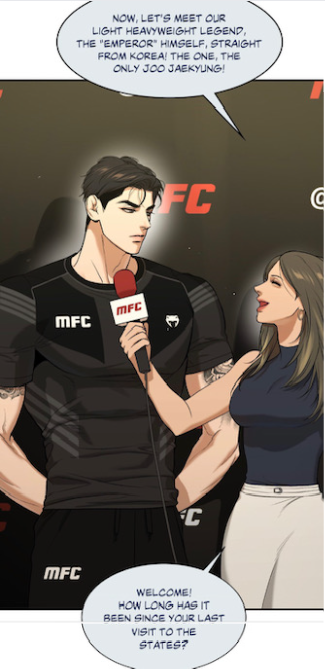 (chapter 36) This divergence reveals that the executive director has a different approach than the reporter. The former seeks to „get close to Kim Dan“, while the journalist desired to avoid the famous fighter’s wrath. Shim Yoon-Seok anticipated his reaction. Therefore I have the feeling that the mysterious man contacted the physical therapist so early to create the illusion that it was urgent. They needed him. Interesting is that when the champion received the message from Shim Yoon-Seok, he never questioned how the reporter got his contact.
 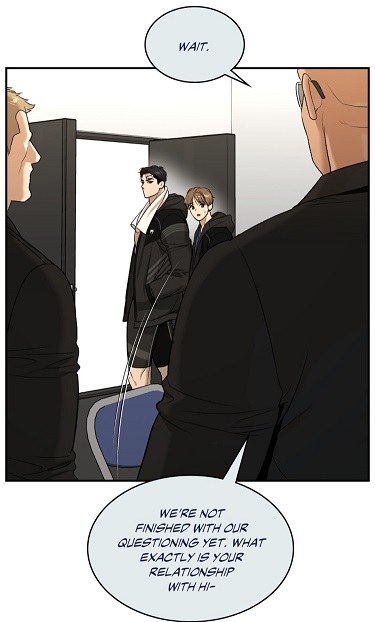 (chapter 40) A fighter, a prostitute, a lover or a physical therapist? Another difference between the two texts (35 and 47) is that
 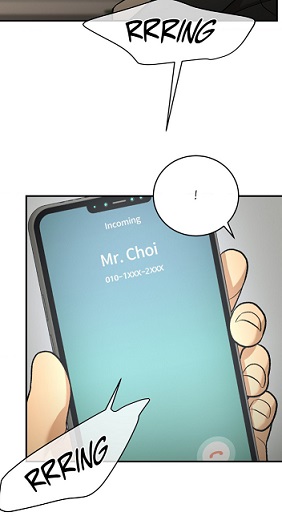 (chapter 46) And now, imagine the consequences, when Kim Dan or Joo Jaekyung reports the text as spam. Not only he doesn’t prevent the scammer from sending more texts to him, but it does let the authorities know as well that there’s a problem. Carriers might block the sender’s messages. Government bureaus might take action to prevent the scammer from messaging other cellphone users.
  (Chapter 46) And remember that Mr. Choi used this cellphone to contact his underling, a sign that their relationship was not official and should remain a secret. Hence if the line got cut, then Heo Manwook and Mr. Choi would be forced to meet. As you can imagine, the moment I discovered the connection between „carrier“ and „spam“, I couldn‘t help myself thinking that Mr. Choi might have received the CV from the courier company!!
 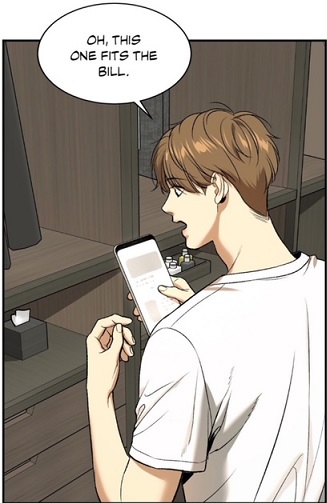 (Chapter 42) Yes, we have here a text on a cellphone too. Therefore I couldn‘t help myself laughing!! Why? It is because I believe that the schemers are thinking that Kim Dan is a member of Team Black, a fighter, and he is Joo Jaekyung‘s protégé. My reasoning is the following: since my hypothesis is that he got the doctor‘s curriculum vitae through the courier enterprise
 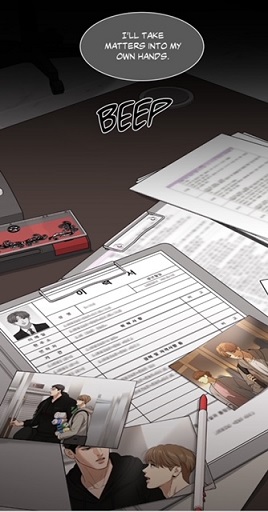 (Chapter 46), I doubt that Kim Dan mentioned that he was working as PT for Joo Jaekyung. This would have raised an eye-brow!! His side gig was supposed to be a secret implying that his official work was to be kept hidden as well. Furthermore, I am assuming that Mr. Choi must have tried to figure out Kim Dan based on his CV. He worked for a short time at the hospital and after he chose to take odd jobs. So he could have had a change of heart, he desired to pursue a different career, like for example becoming a professional MMA fighter. I don‘t think, people would mention such a hobby, as it could give a bad impression. Finally, if my theory is correct, then it signifies that Mr. Choi got tipped off by the hidden person from chapter 42.
  (chapter 42) Remember my previous interpretation: the anonymous person had discovered a secret, but back then it was difficult to determine the secret.
  They are trying to snatch away the favorite athlete from Team Black in order to destabilize Joo Jaekyung mentally
  He is addressed as Kim Dan, and @joojaedan told me that he got addressed the same way than the fighter and Joo Jaekyung would call him. I have to admit that I let the app Deepl translate the Korean version. This is what I got:
 (Chapter 36) Moreover, this signifies that Baek Junmin is presented as the owner of the gym
  (chapter 47), as he is the face of that gym. In reality, he is just the cover, whereas the true owner is the mysterious sender of the text.
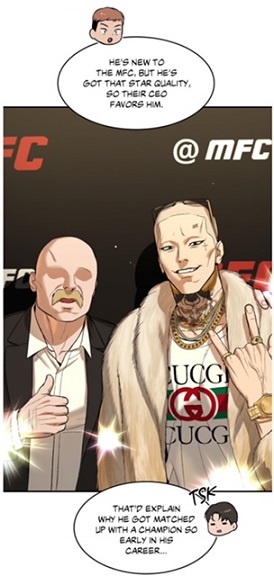 (Chapter 47) This signifies that he is acting like Park Manwook
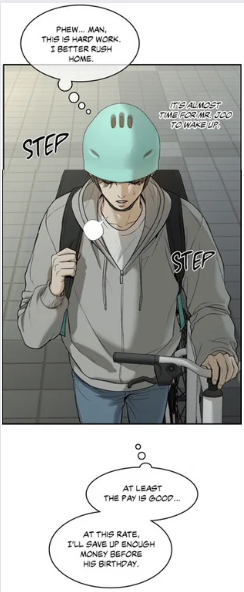 (chapter 42) He let it ring three times before texting him in order to catch the doctor’s attention, to distinguish himself from the previous calls (for his job). If so, then Mr. Choi must believe that Kim Dan is being “exploited” by the athlete. Hence the doctor would look so unhappy, when he is alone. In other words, the pictures taken in secrecy would expose the hypocrisy of the celebrity towards the main lead.
  (chapter 34) It was pure sex, yet the comedian didn‘t get fooled. Joo Jaekyung had feelings for him. Striking is that during that night, the doctor got fooled and this twice!!:
 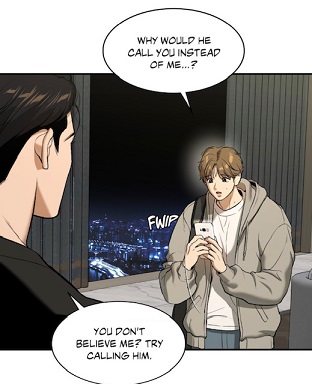 (Chapter 34) He should CALL him… a sign that the champion had not called anyone. Since Mingwa is writing like Byeonduck, I have the feeling that the message from Mr. Choi will be discovered by Joo Jaekyung. Remember how his hyungs had warned him
 (chapter 46), but he had refused to listen to them.

 Kim Dan saw the calls, but he ignored them.
  It was another emergency call, for he needed to leave the place within a week. Interesting is that the person didn’t present himself. No name… As you already know, I am suspecting that the doctor got fooled, for I doubt he ever received any compensation for his move. He should have received money. Emergency, rejection, manipulation, interruption and spying (Heo Manwook interrogated the doctor right after)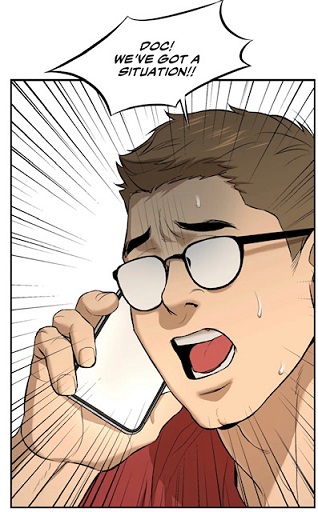

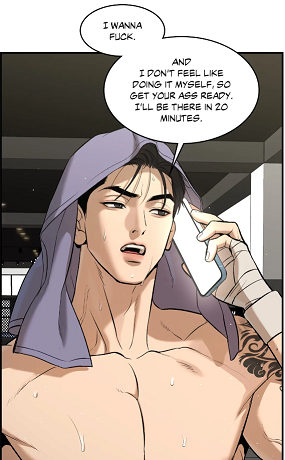
 Sex, interruption, „emergency“, as the champion didn‘t take off his shoes and put down his bag. Then during the intercourse, the doctor was called by the hospital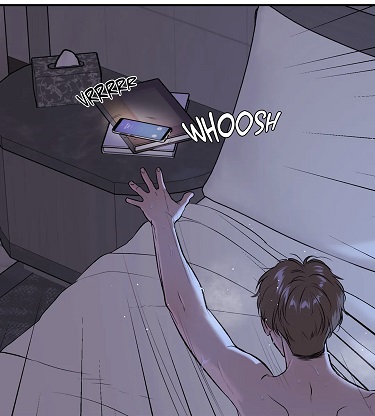
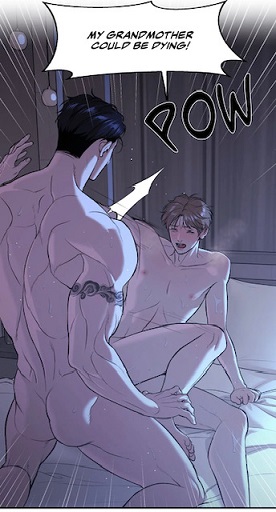
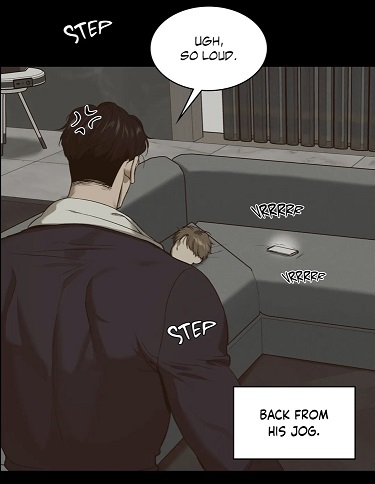
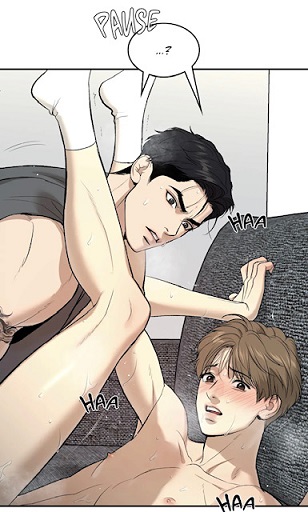 Sex, interruption (food), secrecy, manipulation, ignorance and spying. Potato had tried to listen to their conversation.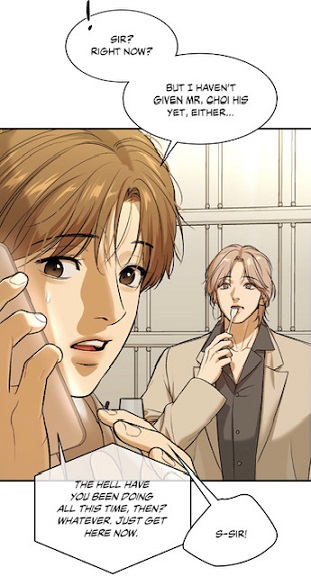
 Interesting is that here, there was no emergency from the champion‘s part. This time, Kim Dan was the one longing for the athlete.
 Sex, emergency, ignorance, manipulation, though here the victims of the trick were the two main leads.
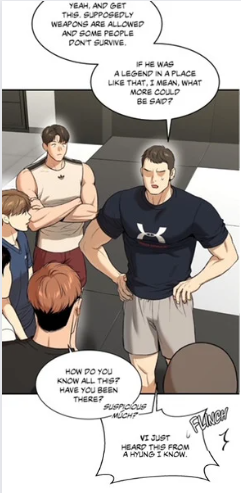 (Chapter 47) And how should he betray the athlete?
  (Chapter 40) He has no idea that Kim Dan became the victim and got framed later.
  (Chapter 46) Furthermore, since Heo Manwook was the one who hired this man
  (Chapter 46) What caught my attention is that this athlete definitely boosted his situation by advertising that he was the champion’s sparring partner. I doubt that the main lead‘s criticism was unfounded.
 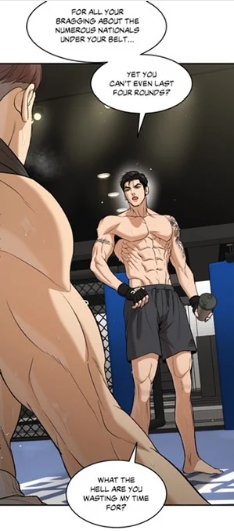 (Chapter 46) By the way, I believe, Seonho was a recent recruit. Therefore he doesn‘t know the champion that well and he is not close to the other fighters. Hence they didn‘t protect him
 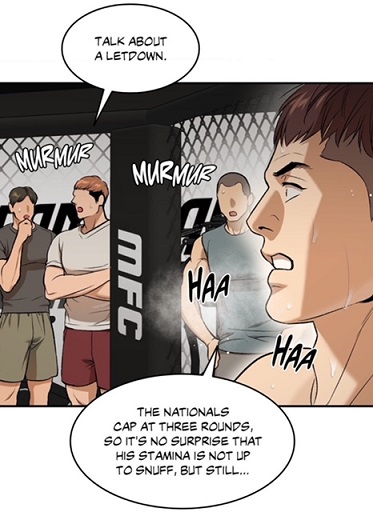 (Chapter 46) like in episode 1
 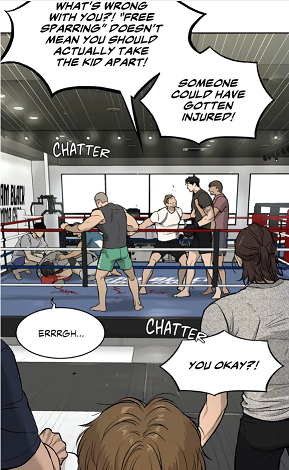 (chapter 1) He had no idea about the roughness during the sparring, though this scene exposes that the champion had toned down the brutality during the sparring.
 (Chapter 46)
  (chapter 42) On the other hand, since I am predicting a failure of their scheme, they could decide to take revenge on Seonho by sending him to an illegal fighting game, where he could get badly injured. Moreover, the moment they discover how weak the red-haired man is, they could jump to the impression that Seonho deceived them!!
  (Chapter 46) But he was sitting with the others later. Consequently, I come to the deduction that he failed to discover any lead, or better said, any connection between the bets and Mr. Choi. Why? It is because he is a former champion, and professionals among MMA world must know that he works for the star.
 (Chapter 47) Joo Jaekyung needs to realize that he can not just rely on his hyungs alone, he needs the assistance from the whole staff: Kim Dan and the other fighters, as they are not known in the MMA world.

 (chapter 46) On the other hand, chapter 47 exposes that the doctor didn’t lose his interest and attention towards his boss.
  (chapter 31) It is because when the psychologist met the patient with her boyfriend for the first time, he paid attention to his micro-expressions, and more particularly to his mouth. He saw his smirk. Here, I feel the need to give an explanation how these micro-expressions were discovered.
 (chapter 30) As my avid readers can detect, the expression from the boyfriend’s mouth displeased the white-haired psychologist. He could recognize his emotion, though such facial expressions are very short-lived
 .(chapter 30) So what was the “jerk” feeling, when he was conversing with Sihyun? Cynicism.
  (chapter 31) And the reason why he stated that as soon as cynicism or scorn was present in a relationship, the couple would end up breaking up is because of John Gottham’s observations and conclusions.
 (chapter 45) We could sense it in different scenes, though I would say that his cynicism was slowly vanishing:
  (chapter 3)
 (chapter 40) This is the so-called toxic negativity. Therefore it was to expect that the champion would reject the doctor’s present. He could only doubt the sincerity behind his gesture. How so? Remember how the team desired to celebrate his birthday: a surprise party. They bought a cake…
  (chapter 8), in the office, in the car, in front of a mirror, in front of Heesung in the living room… Don’t forget that Diogenes would even masturbate in public.
  (chapter 23) The latter had to act like a true disciple and follow the champion’s recommendation.
 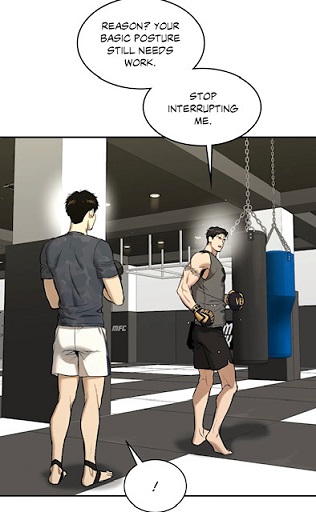 (chapter 23) The gym is like his sacred temple. Yet, the gym is just a simulacre of “nature”, as it is in the middle of Seoul. Therefore I realized why after their argument, Joo Jaekyung avoided the penthouse and Kim Dan in the end.
  (chapter 45) It symbolized everything he hates: a reminder of wealth, superficiality, attachment, secrecy and silence. It also exposed the huge difference in their mind-set. Kim Dan is not his disciple! He imagined that he had found a kindred spirit, especially after that night:
  (chapter 10) He is not resigning on designer clothes.
  (chapter 42) His dress room is the evidence of his hypocrisy. He might have encouraged Kim Dan to have sex in “public places”, yet he is still hiding his sexual orientation. Furthermore, his jinx is the evidence of his dishonesty.
  (chapter 45) He might advocate autonomy and self-sufficiency, the reality is that he likes luxury. Hence he is unable to live in harmony with nature. This shows that the fighter is in denial and is living in an illusion. Thus he can not find true happiness, for his freedom is not real. He is attached to the gym which is also strongly connected to his career as the Emperor.
  (chapter 46) With his brutal attitude, he is doing himself a disservice. Exactly like Kim Dan, he is even ruining his career and own reputation. Not only he lost 4 athletes (I am including Seonho), but also his loyal admirers are calling him a thug now:
  No one can survive on his own. This explicates why Cynics had disciples in the end. And now, you comprehend the role of Kim Dan in Joo Jaekyung’s life. It is to remind him of his true nature. He is a human and not a dog-wolf. Thus the champion recommended his PT to live elsewhere, a sign that he was indeed a human.
  (chapter 10)
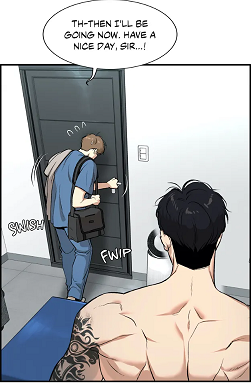 (chapter 1) Then the micro-expressions from Kim Dan exposed his lie
 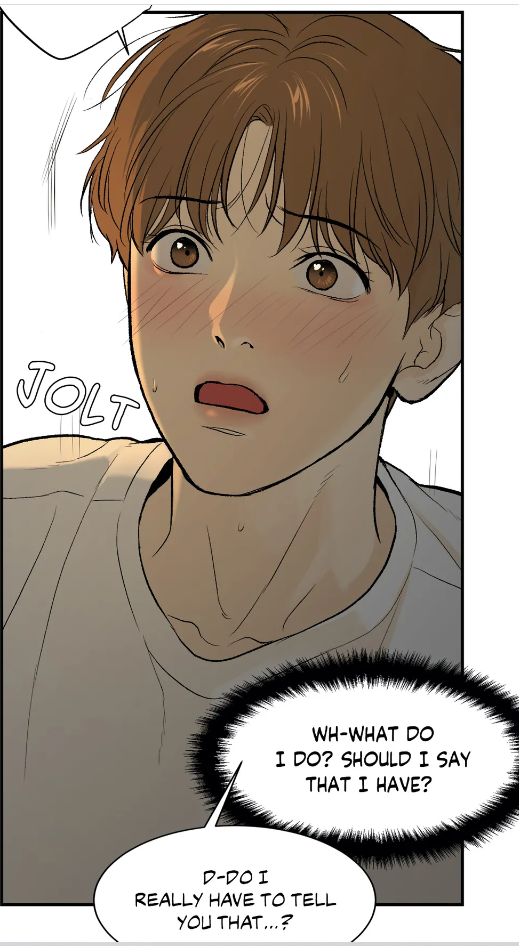 (chapter 3) On the one hand, the champion’s worldview about humans got reinforced, on the other hand the doctor’s deception symbolized his purity. He was a virgin, which was contradicting his “theory” too.
 (chapter 11) He even looked like a ruler abusing his authority.
  (chapter 33) or even the idea of friendship
  (chapter 10): Gamblers, laziness, no sense of hygiene etc. Consequently, he is not capable to understand the worries from Kim Dan
 (chapter 42), Park Namwook
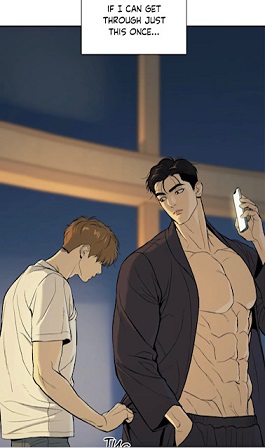 (chapter 2)
 (chapter 45) was showing the doctor’s golden heart. He was just judging his lover based on his past experiences and his negative worldview. And this brings me to list the cause for Cynicism:
 (chapter 2) He learned through Cheolmin that he could kill him. This shows his good nature in verity. Hence he resorted to such gestures, when his cynical depression resurfaced:
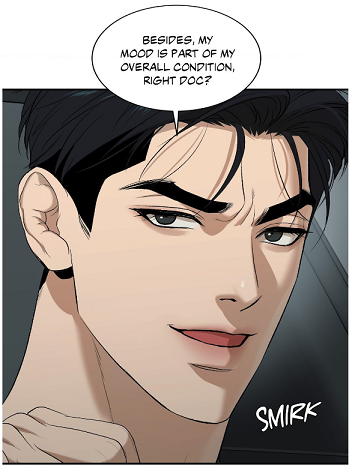 (chapter 32)
 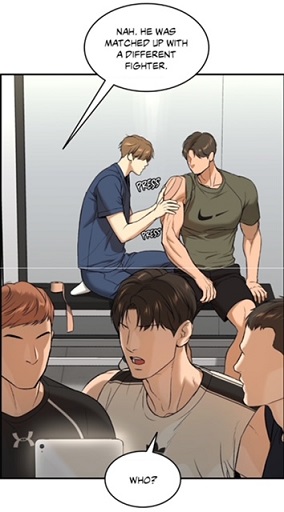 (chapter 47) It shows a certain trust. One might argue about this interpretation. This could be seen as indifference. However, I believe that his altercation with Seonho must have been quite an eye-opening for the champion.
 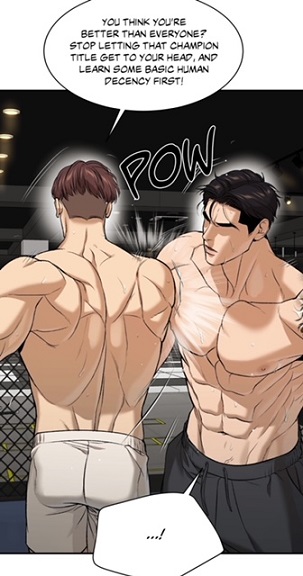 (chapter 46) It is because Kim Dan had not talked back to Joo Jaekyung during their argument. He had accepted his criticism silently contrary to Seonho. Right now, he has the impression that he still has the upper hand, but he couldn’t be more wrong.
 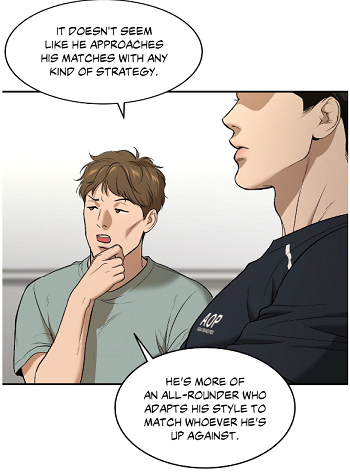 (chapter 47) First, I would like to outline that neither the manager from the Entertainment agency nor his acolyte brought up the underground fighting ring and Baek Junmin’s dubious success.
 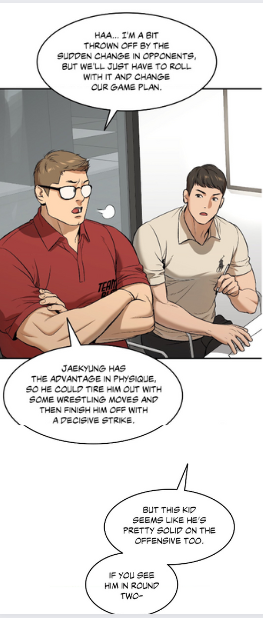 (chapter 47) With their video, they presented him as an average and reliable fighter.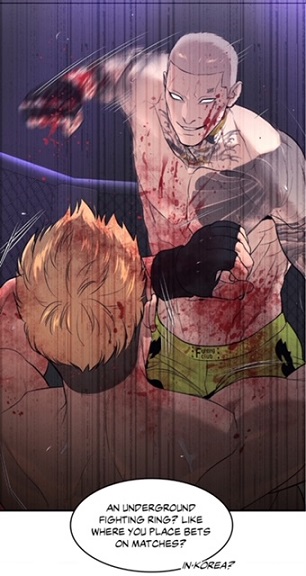
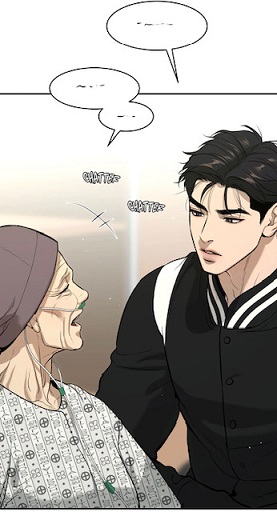 (chapter 21) Moreover, the grandmother’s mortality could serve as a reminder for the champion that he is also a human… just like the others he condemns. Besides, she embodies true selflessness and gratitude. Hence she took the champion’s hand to thank him
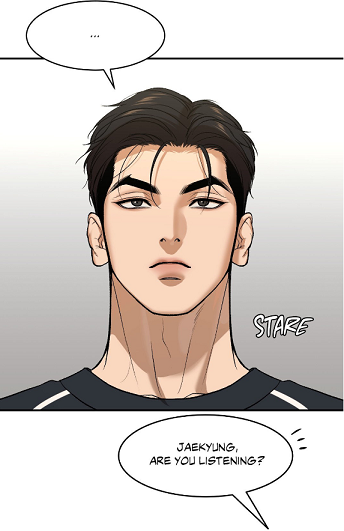 (chapter 47) Should Kim Dan divulge Baek Junmin’s connections to the underground fighting ring or simply show him the message,
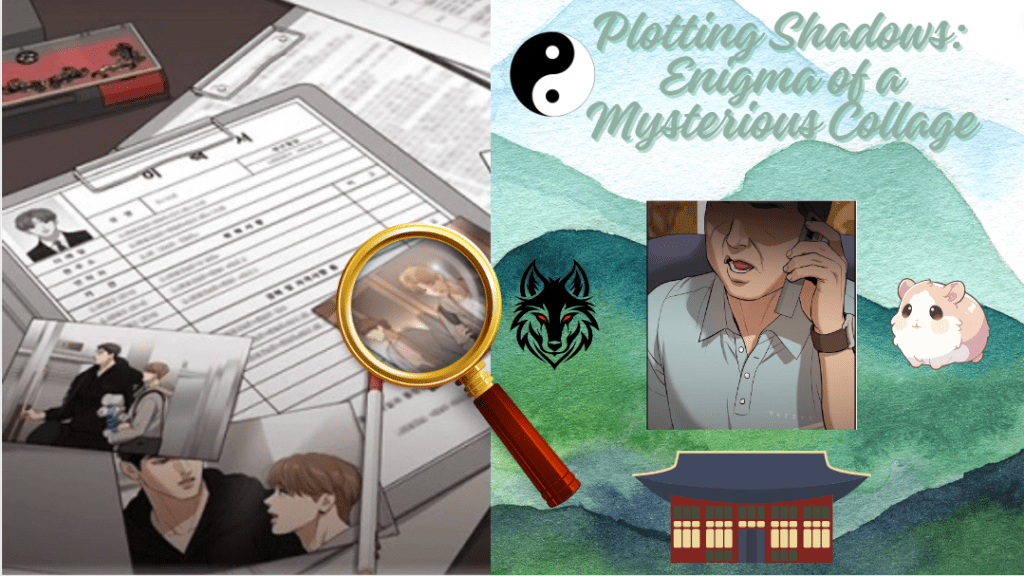
 (chapter 46) I had even truly perceived his motivations:
  (chapter 46) He desired to get revenge on the celebrity. But from my point of view, there exist other reasons for his trick. He was seeking validation for his statement:
 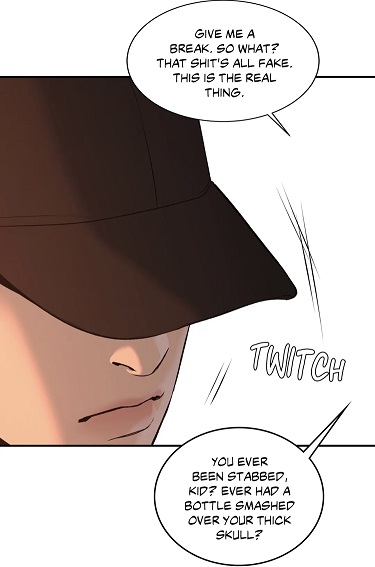 (chapter 17) Such fights are fake. The irony was that his perception got discredited once again. And now, we know why he thought like this. He is involved with the underground sports gamblers.
  (Chapter 46)
 (chapter 16) And this raises the following question again.
  (chapter 17) To which account did the champion send the money? Heo Manwook’s or a different one? If this is the second case, this signifies that Heo Manwook has been embezzling money from Mr. Choi through the poor physical therapist. The latter was sending the money to his personal account.
  (chapter 16) This would explain why Heo Manwook would harass the main lead, though he had paid the interests on time.
  (chapter 1) Under this new light, it dawned on me why the moneylender interrogated Kim Dan later.
  (chapter 11) It is because the doctor had paid a huge amount making it impossible for the loan shark to filch it. And now take a closer look at the infuriated thug: he employed the expression “laundering money”! He was projecting his own fears onto Kim Dan. For me, this scene exposes the true nature between Mr. Choi and Heo Manwook. He is laundering money for Mr. Choi. This explicates why their work relations is not official, as they are engaged in illegal activities. Thus their labor relations can not be known to others. On the other hand, if the champion paid the loan to the same account
  (chapter 46) He had to convince him to bet on Joo Jaekyung’s defeat. The thug could use the interference of the champion on his side business, as this secret “laundering money” could come to the surface. His actions prove us that his “respect” towards his boss is just superficial. He is prioritizing his own interests. Hence he could have definitely taken advantage of his own position to earn more money through side “hustles”.
  (chapter 45) Yes, the negative reflection from the physical therapist’s. So should the broker indeed have embezzled money, that would be the end between him and Mr Choi. He would be abandoned. However, since my assumption is that the moneylender is laundering money for Mr. Choi, it signifies that the latter is dependent on him as well. However, he could choose to replace him. We could detect through the years that the thugs were switched.
  (Chapter 5)
 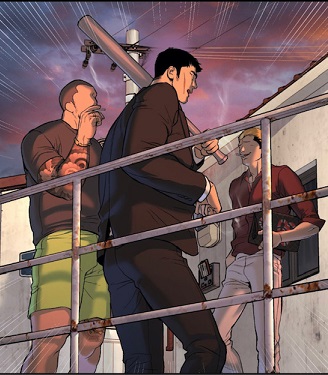 (chapter 1) Thus I come to the following conclusion: We are assisting to the gradual disintegration of their secret relationship. I am already envisaging that Heo Manwook could end up not only losing Mr. Choi’s favor, but also getting switched by this man.
  (Chapter 46) The sum reflects the faith he had in Heo Manwook. Yet, the conversation displays the increasing mistrust between them. Note that the usurer is not taking responsibility for the failure of his scheme: „on their end“.
  (chapter 46). Secondly, since Mr. Choi is now taking the matter into his own hands, this signifies that the criminal won’t be involved in the next scheme, so he won‘t gain anything.
  (chapter 46) That’s the reason why the thug had hired the man himself. This confirms that this man
  (chapter 40). How so? It is because Heo Manwook doesn’t explain how the plot failed!!
  (chapter 23) Back then, he initially denied the existence of intimacy between them, until he was confronted with reality.
  (chapter 25) Thus from my point of view, Mr. Choi must have come to a different perception than the maknae:
  (chapter 40) Therefore you comprehend why the “fake” agents for order tried to determine his identity.
  (chapter 40) He only declared that he was part of his team. They had no idea who the person actually was. However, Joo Jaekyung didn’t realize that through his action, he was bringing attention to the company “TEAM BLACK”. That’s what the criminal saw on the uniform and the jacket! Thus I come to the following deduction: the hired man will report to Heo Manwook the existence of Team Black and its connection with Joo Jaekyung.
  (chapter 16) Thus there’s a high chance that they will try to ruin the champion by tarnishing his company. It is a hidden brothel. Imagine Park Manwook’s reaction, when he gets to hear that his gym is a whorehouse.
  (chapter 31) That’s how the actor’s reputation would get affected. As you can see, the actor and Mr. Choi share the same family name. So are they related or not?
 (chapter 29) Note that the comedian is promoting himself with Heesung and not his surname.
  (chapter 30) It was, as if he didn’t want to be connected to this Mr. Choi. Moreover, contrary to the mysterious director, readers could see his face and identify his “job”: an actor!
  (chapter 29)
  (chapter 31) His words expose the greed and selfishness of the CEO from the agency. They are accountable for Heesung’s actions. In my eyes, this condition was made in order to control Heesung, so that the latter would feel responsible for his manager and other employees. It was to push him to „work“. Under this new approach, it dawned on me why Heesung would sponsor lunches to the members from Team Black,
  (Chapter 31) As you can see, I sense that Heesung had an ambivalent relationship with his „father“. On the one hand, he rejects him due to his cold-heartedness and high expectations, on the other hand, he was still relying on him and his connections through the agency. In my eyes, he will be forced to choose between love or money in the end.
  (chapter 33) My initial theory was that he had been stalked. But he could have left the family house after a huge quarrel. And Mr. Choi is indeed acting like a stalker, though he did not do it himself: the pictures!
  (chapter 33) This was the “stalker” working on Mr. Choi’s account. So it dawned on me that Heesung might have been living with his father in the huge building
 (chapter 32), until he chose to move out and live on his own. And now, we have the perfect explanation why his house is so clean and impersonal:
  (chapter 33) It is because his father probably meddled in his life constantly. I have the impression that he must know about his father’s past and the true origin of their wealth. The fact that he introduces himself as “Heesung” is a sign that he wants to deny his origins, Choi.
 The house stands for power and propriety. But Choi has another signification.
 (Chapter 32) Note that when he was conversing with the celebrity at the bar, he never brought up his jinx.
  (chapter 43) The package arrived right on time.
 (chapter 1) I doubt that the incident with the perverted hospital director was leaked to the outside world, so the main lead must have been badmouthed. So if this rumor about Kim Dan reached Mr- Choi’s ears, then he will definitely see in him the perfect scapegoat for covering up his own involvement. He would even appear as a righteous person. According to me, he is the CEO from the Entertainment agency and the latter had pushed the champion to press charges against the hospital.
  (chapter 42) That way, the agency would divert attention from its own responsibility and even receive support from the clinic. Then we have this rumor circulating that people are sending spies to gyms.
  , (chapter 36), he must have wagered too and lost money. This would explain why he asked the doctor from MFC to give it a go right after. He needed to create a new game in order to cover up the last losses. The problem is that since Mr. Choi wasn’t informed about the incident with the security guys from MFC, I don’t think, he is truly aware of the celebrity’s physical conditions. If he knew about the real diagnosis, he wouldn’t need to investigate Kim Dan. He would rely on time… within such a short time, Joo Jaekyung wouldn’t be able to recover. In fact, he would even bet on the athlete’s defeat once again. Since he saw these pictures, I am quite certain that he is misjudging the relationship between the two protagonists. They are close, hence he needs to sow discord and even plant a seed of doubts on the athlete’s mind.
 Bebebisous33s' analyses in K-Dramaland and Manhwas