

Please support the authors by reading Manhwas on the official websites. This is where you can read the Manhwa: Jinx But be aware that the Manhwa is a mature Yaoi, which means, it is about homosexuality with explicit scenes. Here is the link of the table of contents about Jinx. Here is the link where you can find the table of contents of analyzed Manhwas. Here are the links, if you are interested in the first work from Mingwa, BJ Alex, and the 2 previous essays about Jinx Unseen 👀 Savior🦸🏼♂️ : The Birth Of Jaegeng (locked) and The Sweet 🧁 Curse of the Round Table 🍴
It would be great if you could make some donations/sponsoring: Ko-fi.com/bebebisous33 That way, you can support me with “coffee” so that I have the energy to keep examining Manhwas. Besides, I need to cover up the expenses for this blog.

Introduction
In Chapter 66, Mingwa’s careful use of visual symbolism invites readers to look beyond the surface of a simple scene: two sparrows perched together on a power line  (chapter 66) quietly shapes the emotional core of the episode. At first, this detail may appear insignificant, but its narrative timing and visual prominence suggest a deeper meaning. The sudden flight of the sparrows
  (chapter 66) mirrors the situation of the main characters, as the latter are about to depart for Seoul. Striking is that Mingwa draws our attention away from the champion grabbing doc Dan, but focused on the birds. Why? It is because the author desires her readers to notice the world of subtle symbolism. Far from being a random detail, the presence—and sudden flight—of the sparrows echoes the characters’ inner transitions, raising questions about home, communication, critique, and the complicated process of change. To understand the richness of this scene, it’s crucial to consider not only the sparrow’s traditional meanings but also the narrative choices the Webtoonist makes in what is shown and what is left unseen, especially regarding the role of witnesses and the power of perception. To fully appreciate the layers of meaning in this moment, it is essential to consider not only the universal symbolism of sparrows but also their role in classic fables, Korean culture, and even modern pop culture—where the sparrow’s voice becomes a catalyst for both belonging and change.
The Sparrow: Universal Meanings and Positive Symbolism
Across cultures and literary traditions, the sparrow [sources: Wordbirds / the symbolism of sparrow/ Sparrow Symbolism/ Birdsandwings] is a symbol rich with positive and nuanced connotations:
Home and Family: As birds that build their nests near people, sparrows evoke the warmth, joy, and optimism found in the heart of a happy home. In Chinese culture, they are symbols of marital bliss, prosperity, and the delight of shared domestic life.
Resilience and Adaptability: Small but mighty, sparrows flourish even in challenging environments, representing not only perseverance but also the cheerful optimism that helps individuals bounce back from hardship. Japanese stories often celebrate their cleverness and resourcefulness.
Hope and New Beginnings: Sparrows are often seen as harbingers of change and hope, embodying the bright, uplifting spirit that marks every new chapter and the possibility of positive transformation. . Their presence inspires optimism for what lies ahead.
Love and Devotion: Whether pulling the chariot of Aphrodite or appearing in folktales of loyalty and gratitude, sparrows are messengers of affection, emotional bonds, and the enduring joy of loving relationships.
Protection and Spiritual Guidance: Sparrows remind us that all beings—no matter how small—are worthy of care and protection. Their appearance in legend and religion reflects a gentle optimism in the universe’s watchfulness and kindness.
Community and Togetherness: Living in flocks, sparrows symbolize the happiness and optimism that comes from unity, trust, and shared support, while their lively interactions echo the joys and challenges of communal life.
Simplicity and Humility: With their modest appearance, sparrows invite us to embrace joy in the ordinary and to recognize the beauty that exists in simplicity and humility.
Freedom and Strength: In today’s world, sparrows embody the exuberance of freedom and the uplifting strength it takes to overcome obstacles. Their flight becomes a symbol of living joyfully and fearlessly.
Wisdom and Connection to Nature: Many cultures honor sparrows as wise creatures, deeply connected to the earth. They embody humanity’s bond with nature, encouraging us to live harmoniously with our environment and to find wisdom in the rhythms of the natural world.
These meanings form the foundation for understanding the sparrows’ presence in Chapter 66: their sudden flight is not just a visual echo of the characters’ departure, but also a symbol of the personal and relational changes that come with leaving home in search of healing. (chapter 66) Their appearance draws from universal and modern meanings (chapter 66), while also directly echoing the tradition of older Korean paintings such as Myojakdo,
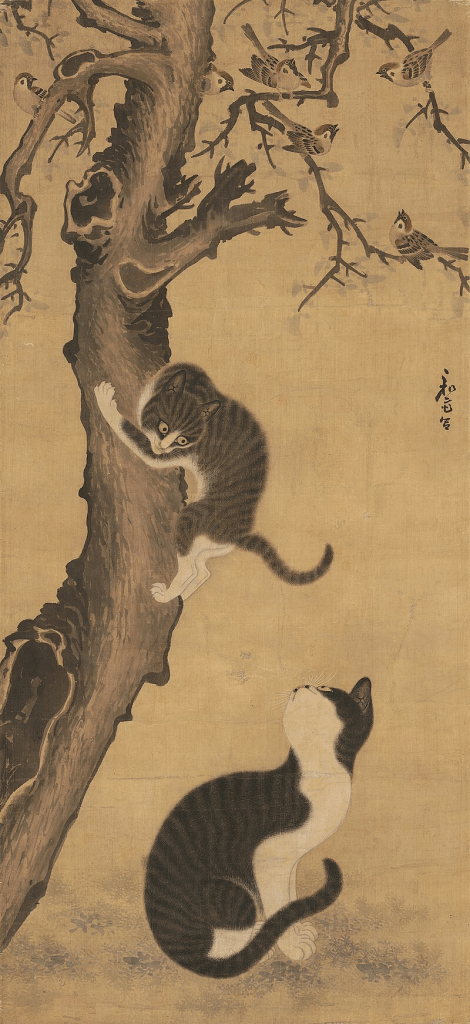
where sparrows are emblems of harmony, lively companionship, and auspicious beginnings—a good omen for any household or relationship. Yet, in this episode, the sparrows are not perched on a tree like in the classic paintings, but on a power line—a subtle but meaningful shift. (chapter 66) The power line, a symbol of modern civilization, stands in sharp contrast to the natural branches of traditional art, highlighting the vanishing of nature and the disconnection between people and nature that characterizes Jinx and contemporary life. Additionally, this visual choice underscores the precariousness of the couple’s brief harmony: while the sparrows momentarily embody hope and unity, their perch on a man-made structure suggests that such peace is fragile and easily disrupted in today’s world. (chapter 66) The humans are here portrayed more as the intruders.
In traditional Myojakdo paintings, sparrows often share the scene with cats, whose presence signals lurking dangers and the constant threat to harmony. Similarly, in this scene, the sparrows’ sudden flight hints at the brevity of peace for the main couple and the inevitability of new struggles ahead. The moment of tranquility is fleeting, easily scattered by disturbance—mirroring how, shortly after this scene, Kim Dan is confronted by his physical limitations and Joo Jaekyung receives later unsettling news about his fighting career. The narrative thus can be seen as a homage to the wisdom of traditional art by reminding us that beauty, connection, and joy are precious precisely because they are impermanent and must continually be reclaimed in the face of life’s ongoing challenges.
In episode 66, the presence of sparrows subtly foreshadows a pivotal turning point in the couple’s relationship—the transition from uncertainty and separation toward unity. By the end of episode 69, this is poignantly sealed with the couple’s embrace  (chapter 69), making the sparrows’ appearance an omen of the official union to come. (chapter 66) Their presence coincides with their gradual acceptance into the life of the little town. By the time their embrace seals their new status as a couple in episode 69, they are no longer completely isolated: the embrace happens with official witnesses present—the coast guards and the hospice nurses
 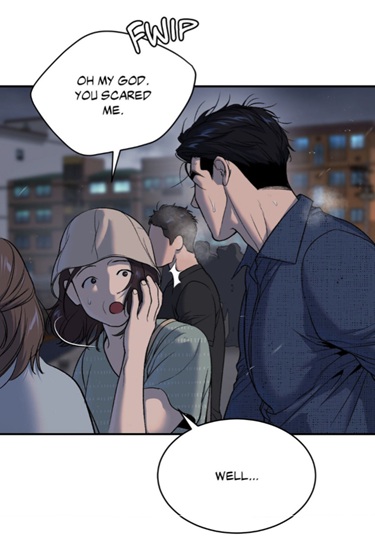 (chapter 69) —who serve as stand-ins for the broader community. In this way, their union is not just a private matter but becomes public and recognized, affirming their bond within the social fabric of the town.
Yet the author adds a layer of narrative irony by highlighting the fragility of such happiness. (chapter 66) The sudden departure of the sparrows, while signaling a threshold of hope, also carries a shadow of foreboding. In both folklore and art, birds in flight can herald the end of good fortune or the approach of new challenges. This duality quickly unfolds in the story: shortly after the sparrows leave, doc Dan is faced with his physical limitations (illness), and the next morning, Joo Jaekyung is pressurized to meet the CEO and  (chapter 69) fight again in the fall which leads him later to admit his own vulnerability
  (chapter 69). The omen of unity is fleeting, replaced by the return of hardship and uncertainty. Through this careful allusion to the visual language of traditional art, Mingwa invites us to savor the beauty and community of these moments (chapter 66) while also acknowledging their impermanence—the cycles of hope and struggle that shape the couple’s journey, echoing the bittersweet truths found in both folklore and real life. At the same time, these hurdles are there to push the main couple to recognize that they need the support from others (in particular from their fated partner) and they are not alone.
Sparrows in Fables: Brief Summaries for Unfamiliar Readers
Sparrows, however, are not only symbols of comfort and togetherness. In Western fables, they are also known for their sharp wit and critical voices, adding a more complex dimension to their meaning. For readers unfamiliar with these tales, a brief summary is helpful:
“The Sparrow and the Hare” (Aesop):
A hare, caught by an eagle, laments its fate. A sparrow mocks the hare for getting caught despite its speed. But as the sparrow gloats, a hawk seizes it—turning its mockery back upon itself. The story’s lesson: those who judge or mock others’ misfortunes may soon suffer the same fate.
“The Nightingale and the Sparrow” (Aesop):
A nightingale listens to a shepherd’s flute to improve its song. The sparrow ridicules the nightingale, claiming such talent shouldn’t require lessons. The nightingale, however, values humility and lifelong learning. Here, the sparrow’s mockery becomes a foil for the nightingale’s wisdom, suggesting that critique and skepticism are ever-present in community life, sometimes fostering growth and sometimes reflecting insecurity.
These fables portray the sparrow as a voice of both challenge and growth—one that can provoke humility, self-reflection, or even much-needed change within a group.
This duality finds a parallel in modern pop culture through characters like Jack Sparrow

from Pirates of the Caribbean. The famous pirate embodies the trickster spirit—irreverent, unpredictable, challenging norms and authority, but also fiercely independent and resourceful. His refusal to conform, his wit, and his outsider status make him both a disruptor and, paradoxically, a source of new possibilities for the community around him.
Thus, the sparrow as a symbol of critique and mockery is not simply destructive. In a healthy community, such voices provoke discussion, expose hypocrisy, and challenge complacency. Sometimes, mockery and criticism push individuals to grow  (chapter 64) or inspire the group to change its direction. In the context of Jinx, the sparrows’ existence (chapter 66) and their abrupt flight can be read as a metaphor for the inner and outer voices—of doubt, of challenge, of the push and pull between conformity and authenticity—that the characters must navigate as they leave their old world for something new.
The Scene in Jinx: Communication, Disturbance, and Visual Language
(chapter 66) When perched on the power line, one bird “sings” to the other—a fleeting but meaningful moment of natural communication and attentive listening. In this way, the sparrows become living examples of true partnership and open dialogue. Unlike the protagonists, who struggle with silence, secrecy, and miscommunication, the birds embody a kind of relational ideal: they respond to each other instinctively, without hesitation or pretense. Through this subtle comparison, the Webtoonist almost seems to highlight the superiority of these animals in their ability to connect honestly, without the barriers of pride, fear, or unresolved trauma that often hold humans back.
Then the startled flight of the sparrows in Chapter 66 serves as an external reflection of the complex, contrasting emotions between Kim Dan and Joo Jaekyung. (chapter 66) As the birds sit peacefully on the power line—one “singing” to the other—they embody a fleeting sense of harmony, communication, and possibility. This calm is abruptly shattered not by nature, but by the commotion below: the sudden, unannounced action of Joo Jaekyung physically pulling Kim Dan, who is caught off guard and frightened which Jinx-philes don’t see.
This disturbance in the birds’ world is a perfect metaphor for the moment’s emotional truth. Kim Dan, in this scene, is the one most visibly startled—his fear and confusion echoing the sparrows’ sudden flight. His response highlights his ongoing struggle with vulnerability, trust, and the aftershocks of instability that have defined his life. We have to envision a new scene of this situation, but not during the sunset (chapter 62). It took place in the morning. The harmony doc Dan hoped to find is momentarily lost, replaced by anxiety and a sense of being unmoored.
For Joo Jaekyung, however, the action is not motivated by aggression or dominance, but by genuine concern. He approached the physical therapist silently  (chapter 62), therefore the young man didn’t pay attention to his arrival contrary to the quoted panel above. Moreover, it is clear that the “hamster” felt safe in the presence of the landlord. Back then, he had only accepted the champion’s request after hearing the landlord’s remark:
  (chapter 62) The champion’s abruptness is the result of Kim Dan’s past rejection and stubbornness, the athlete is expecting resistance. However, he can not ignore doc Dan’s exhaustion and fragility. Besides, he feels motivated and justified, as he is following Shin Okja’s request.
The sparrows’ sudden flight, then, does not simply symbolize the couple’s shared disturbance (chapter 66); it also highlights the difference in their internal experiences. The doctor is frightened and confused, while the celebrity’s actions are rooted in worry and an urgent, if clumsy, need to help. The birds externalize both the jolt of fear and the disruptive, caring impulse behind it.
Yet, this moment is not just about disruption. In the wake of the startled birds, and the startled hearts, comes the possibility for growth and deeper understanding. The disturbance sets the stage for the main couple to reconsider their patterns: Kim Dan is challenged to recognize and eventually trust the care offered to him 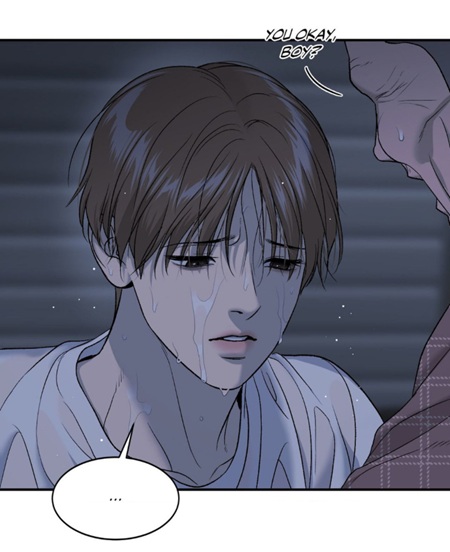 (chapter 69), while Joo Jaekyung must confront the impact of his actions and learn new ways to show support. The challenges that follow—the physical setback for Kim Dan and the champion’s new professional demands—reinforce that their journey is full of hurdles. Still, these hindrances serve a higher purpose: to remind them that they are not alone, that they need each other’s protection and backing, and that the bonds forming in this little town can become sources of true resilience.
In this way, the sparrows are not only omens of harmony or hardship, but living symbols of how sudden change, even when frightening, can lead to a rebalancing—a chance for the couple to move beyond old habits, accept help, and ultimately grow together.
When the startled sparrows flap away, (chapter 66) disturbed by the commotion, their flight becomes a metaphor for the characters’ own inner turbulence. The birds’ reaction externalizes what happens to Kim Dan and Joo Jaekyung emotionally—anxiety, uncertainty, the disruption of safety—and invites the reader to reflect on the cost of misunderstood intentions.
Framing Action: Witnesses, Ambiguity, and the Power of Perception
One might wonder why, at such a charged moment, Mingwa chooses not to depict the champion grabbing doc Dan directly, (chapter 66) instead shifting focus to the two sparrows above. At first glance, the birds seem to be mere bystanders—figures that do not directly advance the story’s plot. So why spotlight them rather than the characters’ physical interaction? The answer lies in the way the Manhwa author handles ambiguity, context, and the subtle power of what is left unseen.
A particularly sophisticated element of Mingwa’s storytelling emerges when considering the role of witnesses and context. In episode 27, 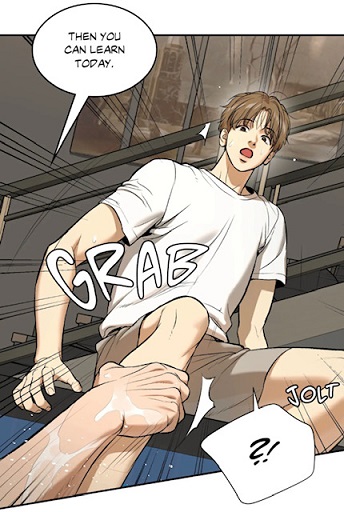 (chapter 27) a playful prank occurs without any third-party observer. The context is unambiguous: both the characters and the reader understand the action as harmless and mutually accepted, so no external framing is required.
However, as the narrative moves into episodes 66 and 69, the emotional stakes and potential for misunderstanding increase. Now, Mingwa introduces the landlord as a visible witness to the action.  (chapter 66) The landlord’s proximity and his bemused, neutral questioning guides the reader’s interpretation, framing the scene as ordinary and non-threatening rather than alarming or inappropriate. He is able to grasp the existence of Joo Jaekyung’s motivations behind his behavior. He doesn’t judge the protagonist as face-value, he desires to know why he is acting this way.
This shift is critical. When intent is clear, no witness is necessary. No one questioned the athlete’s intentions in the pool—both the characters and the audience understood it as a playful, harmless prank, needing no external framing or intervention. But when ambiguity arises, as with the champion grabbing doc Dan (chapter 66), the presence of a grounded observer becomes essential—helping to anchor the narrative and pre-empting misreadings that could arise from the audience’s own biases or prior experiences.
This is made especially clear in chapter 69.  (chapter 69) Here,the Korean Webtoonist directs the focus to the characters themselves, depicting the champion’s rough handling of doc Dan with striking directness: we see the moment Jaekyung grabs Dan by the t-shirt
  (chapter 69) and throws him outside
 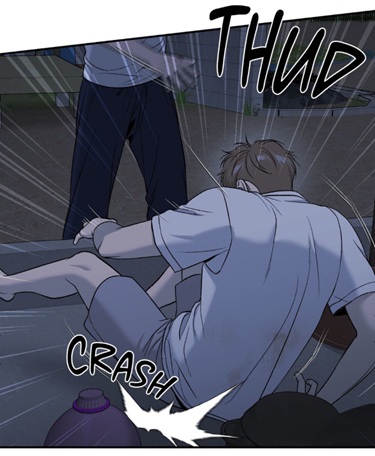 (chapter 69), the action punctuated by dramatic motion lines and the sounds of impact. Yet, despite the force of the act, the landlord—who witnesses the scene in real time—remains silent, choosing not to intervene, criticize, or even question Jaekyung’s motives.
  (chapter 69) His composed presence in the background (chapter 69), his calmness, and the absence of blame send a subtle but powerful message to the reader: sometimes, an apparently harsh action can spring from necessity, urgency, or even care rather than malice.
With his presence and restraint, the landlord functions not just as a passive bystander but as a narrative guide, subtly shaping the reader’s response. By withholding judgment and allowing events to unfold without immediate condemnation, he encourages us to do the same: to pause, look deeper, and consider the emotional context rather than relying on surface appearances or preconceived ideas. In this way, the Webtoonist uses the landlord’s behavior to foster a more nuanced, empathetic reading of the situation—reminding us that true understanding often requires patience, perspective, and an open mind. (chapter 69) The landlord’s role, then, is not only to comment on the scene, but to model a balanced response, encouraging the reader to withhold judgment and remain open to the characters’ perspectives. Furthermore, I would even say that the landlord is on his way to discover Joo Jaekyung’s sleeping problems. 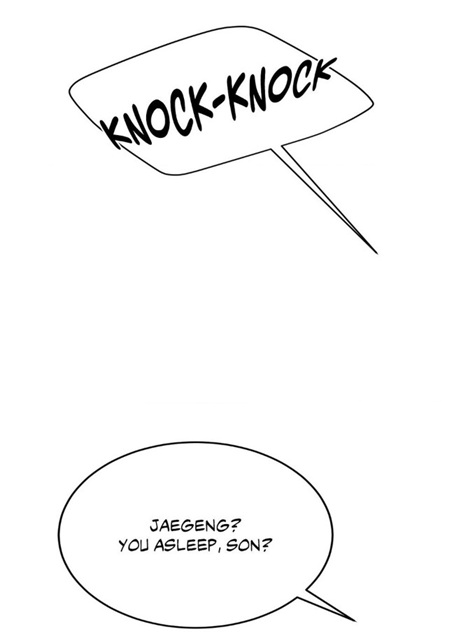 (chapter 69)
  (chapter 69) Moreover, I am sensing that the elderly man might feel terrible, for he asked for the athlete’s assistance in the middle of the night. But let’s not forget that the main lead had driven 4 times within 2 days the distance from the little town to Seoul.
Moreover, Mingwa’s choice to center the panel on the startled sparrows (chapter 66) —rather than the physical interaction—underscores the delicacy of these moments. The birds’ flight externalizes the disturbance without reducing the characters’ actions to something easily condemned or misread. This narrative strategy subtly suggests that human interactions, like those of birds, are shaped by both context and the way they are witnessed—and that sometimes, what is unseen or left to the imagination is as important as what is shown.
Building Belonging: The Sparrow’s Nest and the Champion’s Journey
Alongside its associations with critique and community, the sparrow is also a builder—patiently gathering twigs to create a secure home. This motif is reflected in the champion’s actions:  (chapter 62) he brings his belongings
 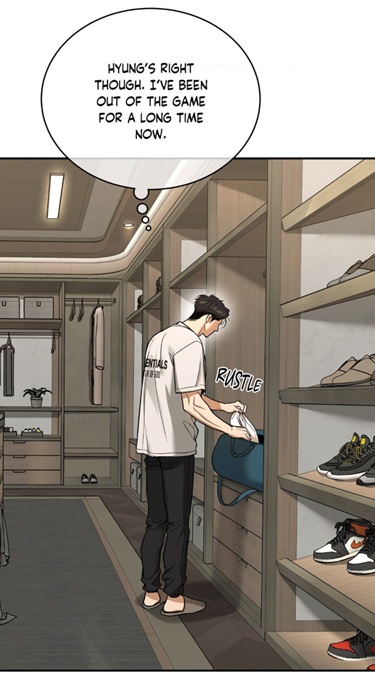 (chapter 66) gradually into his new environment, creating a personal nest.
  (chapter 69) This process is not merely about physical comfort, but about constructing a sense of safety, identity, and belonging. One of these items could be the doctor’s present. Notice that before he left his penthouse with the gray car, he was holding the “golden key chain”,
 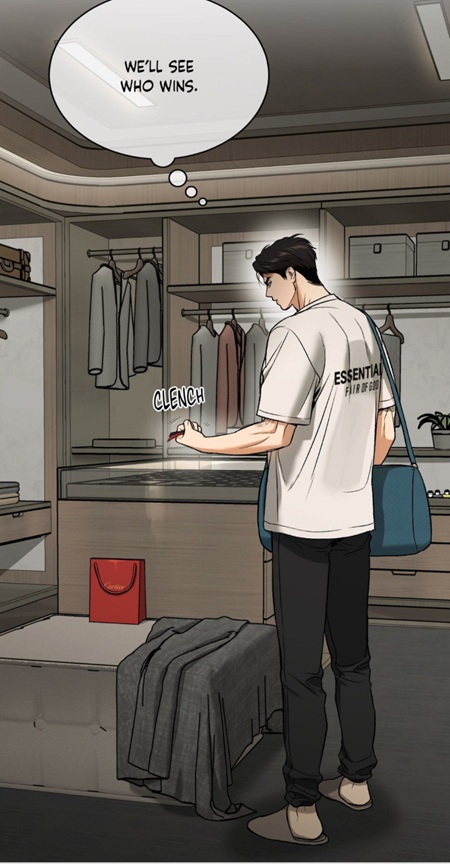 (chapter 66) a sign that this gift has now a sentimental value for the athlete. Just as sparrows persistently build and rebuild, so do the characters in Jinx adapt, settle, and grow—sometimes through trial and error, sometimes in fits and starts, but always moving toward a deeper sense of home. By moving to a smaller house, he is encouraged to select what truly matters to him. This evolution has not reached its end: the champion will keep moving his possessions to the little town. Moreover, I am more than ever convinced that we should expect the arrival of the Wedding Cabinet in that small town.
 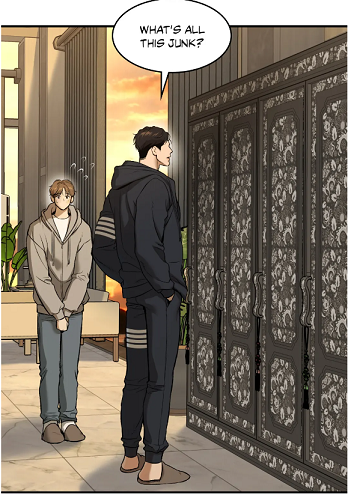 (chapter 19) To conclude, we should see the chapters from 62 to 69 as the creation of the couple’s nest and as such “home”.
Conclusion: Sparrows, Perception, and the Complexity of Change
Mingwa’s use of sparrows (chapter 66) in Chapter 66 of Jinx is much more than atmospheric detail. These birds, with their long history as symbols of home, resilience, community, and critique, become mirrors for the characters’ struggles with communication, belonging, and change. By focusing on the sparrows’ flight (chapter 66)—and carefully orchestrating when witnesses appear or do not—the author invites Jinx-philes to look beyond surface actions, to recognize the importance of context, perception, and the ever-present challenge of understanding one another. In this way, the sparrows ask us not only to witness the characters’ journey, but to reflect on the ways we, too, interpret, judge, and ultimately strive to belong. In addition, the birds’ flight is a call to transformation, an invitation to leave behind complacency, and a challenge to build a more authentic home—both within oneself and alongside others.
Through these small birds, readers are reminded that growth requires not only the support of community, but also the courage to question, to reflect, and sometimes, to fly away and begin again. Joo Jaekyung and doc Dan were on their way to discover real “freedom”. When the birds left the power line, this announces that the two protagonists were about not only to reconnect with their true personality, but also to discover nature and its beauty and power.
Feel free to comment. If you have any suggestion for topics or Manhwas, feel free to ask. If you enjoyed reading it, retweet it or push the button like. My Reddit-Instagram-Twitter-Tumblr account is: @bebebisous33. Thanks for reading and for the support, particularly, I would like to thank all the new followers and people recommending my blog.

 Bebebisous33s' analyses in K-Dramaland and Manhwas