

Please support the authors by reading Manhwas on the official websites. This is where you can read the Manhwa: Jinx But be aware that the Manhwa is a mature Yaoi, which means, it is about homosexuality with explicit scenes. Here is the link of the table of contents about Jinx. Here is the link where you can find the table of contents of analyzed Manhwas. Here are the links, if you are interested in the first work from Mingwa, BJ Alex, and the 2 previous essays about Jinx The Hot Sparks and Feverish Reality part 1 – part 2
It would be great if you could make some donations/sponsoring: Ko-fi.com/bebebisous33 That way, you can support me with “coffee” so that I have the energy to keep examining Manhwas. Besides, I need to cover up the expenses for this blog.

Since a new chapter is released today, this analysis can not be long. I started composing just before the release of episode 86. Yet I was not able to finish it on time, hence I postponed it, as I knew that my avid readers would be more interested in the interactions between doc Dan and Joo Jaekyung in the bedroom.  🌶️😂
🌶️😂
Introduction — Why Floors Matter When Everyone Looks at the Couple
Most readers of Jinx focus on the obvious: the central couple, their attraction, their conflicts, their intimacy (chapter 85). Against this emotional core, elements such as carpets, hallways, floors, and room layouts may seem secondary, even irrelevant.
 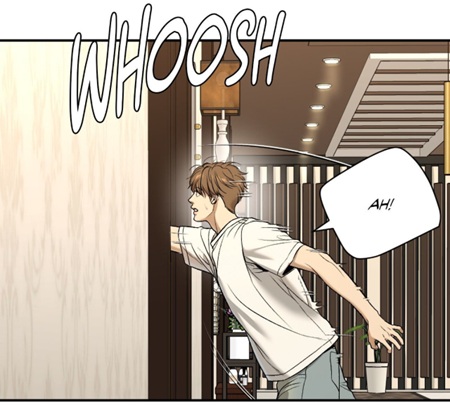 (chapter 85) Why care about the color of a carpet or the direction a door opens
  (chapter 85), when the real story unfolds between Joo Jaekyung and Kim Dan?
Yet it is precisely through these overlooked details that the narrative reveals something essential.  (chapter 82) Floors and patterns are not neutral decoration. They function as a parallel narrative system—one that tracks changes in status
 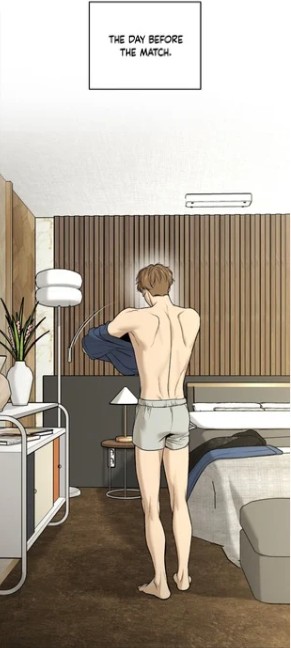 (chapter 85), exposes the actual situations in which the characters are placed
  (chapter 85), and helps us locate spaces and relationships within the hotel architecture itself. In other words, the floors do not merely frame the story; they add a spatial depth that sharpens our understanding of the “characters.”
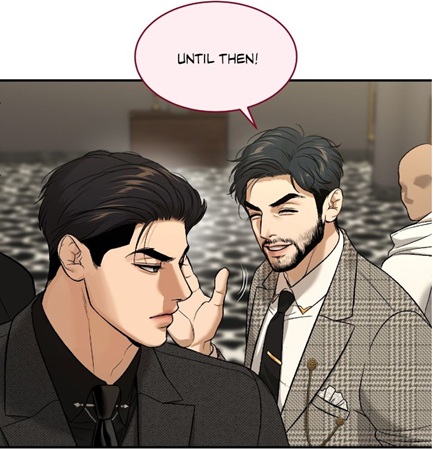 (chapter 82)
My attention was first drawn to this system through a seemingly trivial observation: the carpet in the restaurant where the team dines at the restaurant of the hotel. (chapter 85) Its ornate red-and-gold pattern had already reappeared in the press conference venue, though here, it was covered by a black staircase leading to the stage.  (chapter 82)
  (chapter 82) One might think, the only information we get is that MFC had booked a conference room at the hotel where Team Black is staying. However, in the States, the carpet of the hallway at the hotel had a similar pattern.
 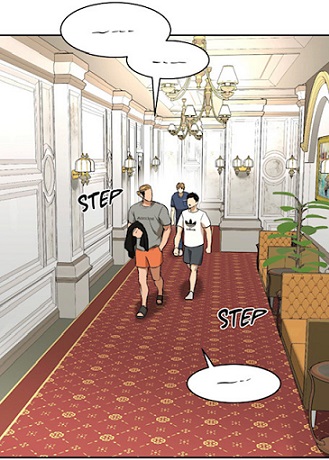 (chapter 37) This similarity and repetition caught my attention. It suggests continuity between public spectacle and private space, between what is shown and what is concealed. Following this thread led to a broader realization: the floors simultaneously signal elevation and confinement. They show who appears powerful—and who is, in fact, enclosed.
From that moment on, it became impossible to ignore what the architecture was doing. The story of Jinx is not only written on bodies and faces, but also under the characters’ feet.  (chapter 37)
The Carpet as a Double Register: Status and Situation
The first function of the recurring floor patterns is to mark status. The restaurant and conference carpets belong to spaces of visibility and performance. They are the domains of reputation, hierarchy, and spectacle. Fighters shine, journalists observe, managers negotiate. The gold tones evoke prestige, success, and imperial grandeur—fitting for a man nicknamed The Emperor. (chapter 82)
But this is only half of the story.
The same patterns also describe the actual situation of the characters. (chapter 85) The intersecting lines resemble a net or wire fence. Because of their golden color, the danger is masked by luxury. What looks like elevation can also be read as enclosure. The higher the status appears, the more invisible the constraints become. And now, you comprehend why at the conference, the red-golden carpet was covered with a black stage. (chapter 82) It was to mask the true fate of fighters in general, they are trapped in a system where they are exploited. They can only exit such a system, where their career reach their end.
This dual function—status marker and situational indicator—becomes clearer, when we compare the French hotel to the American one. In the United States, a similar pattern appears in the hallway near the rooms, but there the lines are not fully closed, are less rigid and oppressive.  (chapter 37) It is in that hallway that Kim Dan collapses after drinking a drugged beverage. He literally falls onto the carpet, on his knees. The trap activates—but not on its intended target.
This detail is crucial. The beverage was delivered by someone connected to Choi Gilseok and Heo Manwook 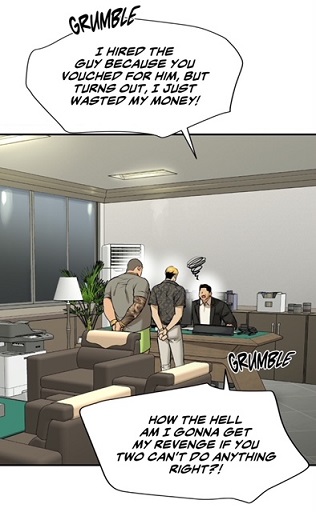 (chapter 46), not by MFC directly. The scheme exists, but it is imperfect. Joo Jaekyung is not truly “caught” in that moment, which explains why the plan ultimately fails.
When the same visual language reappears in France, now under the umbrella of MFC itself, the implication changes. The trap is no longer improvised. It is institutional. (chapter 85) Don’t forget that this match had been presented as an invitation from the CEO. 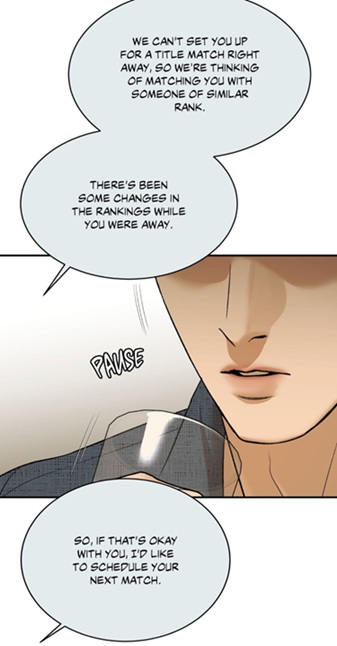 (chapter 69) As you can see, the pattern of the carpet could be seen as an evidence for a trap, and the “Emperor” is their target once again. Their plan is to end his career so that all the incidents and crimes from the past can be buried.
Another detail reinforces how central the floor patterns are to the scene: there are two distinct carpet designs present linked to the conference. Alongside the geometric, fence-like pattern associated with luxury and institutional order, a second pattern appears in the hallway (chapter 82) —one that unmistakably recalls an animal skin, resembling a leopard or panther coat. This is not an abstract association, but a visual continuity within the story itself.
It is precisely on the geometric carpet that Arnaud Gabriel approaches Kim Dan  (chapter 82). The opponent stands on the surface that embodies order, hierarchy, and control, and behaves accordingly. He flirts, comments on the doctor’s eyes, and treats the moment as harmless. Then he turns his back.
  (chapter 82) He never steps onto, nor does he seem to register, the animal-patterned carpet nearby, as doc Dan was standing on a white-off carpet. In other words, Arnaud Gabriel interacts only with the space that reflects the institution’s worldview.
The champion’s reaction exposes what that worldview ignores. Once the official from MFC translates the remark, Joo Jaekyung’s response is immediate, physical and almost uncontrollable. 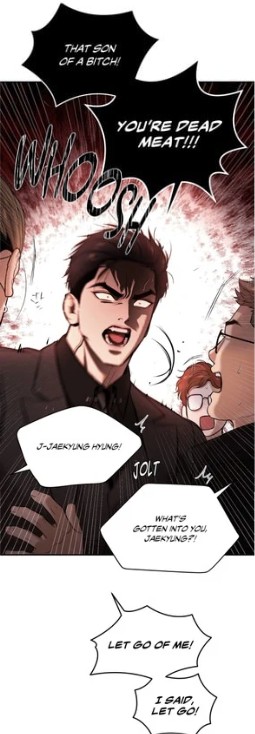 (chapter 82) This is not the response of a neutralized Emperor, but the instinctive surge of a predator whose territory has been violated. The scene echoes an earlier, more intimate image from the bathroom in chapter 30,
 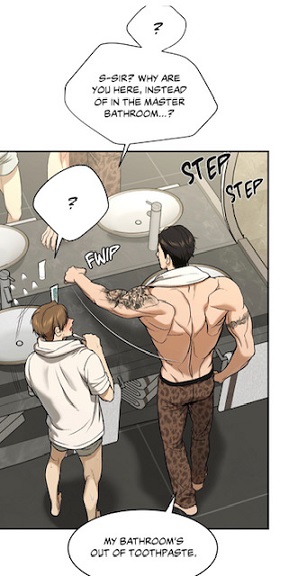 (chapter 30), where Joo Jaekyung appeared wearing leopard-patterned pajamas. The animal imagery was already present then, but dormant. Here, it reawakens.
This is where MFC’s miscalculation becomes visible. They mistake enclosure for domestication, hence we have the golden cage: (chapter 85) They believe that status, luxury, and isolation are enough to tame the Emperor. Yet the leopard has never been erased—only restrained. The golden cage does not eliminate his dangerousness; it merely hides it from those who assume obedience has replaced instinct. By turning his back, the opponent symbolically aligns himself with the institution’s blindness. He believes the champion is contained and probably diminished. He is wrong. (chapter 82)
Thus, the carpet reveals more than a trap. It exposes a false sense of control. While the fence appears tight and escape seems impossible, the presence of Kim Dan at the table changes the equation entirely.  (chapter 85) The champion is not alone inside the cage. He is supported, grounded, and no longer isolated. What MFC fails to see is that this support does not weaken the predator—it stabilizes him. And a stabilized predator is far more dangerous than a cornered one. For years, Joo Jaekyung’s violence was reactive, triggered by threat, humiliation, or loss of control. Such a fighter is powerful, but predictable. He can be provoked, exhausted, and manipulated.
Kim Dan changes this equilibrium. By anchoring the champion emotionally and physically, he removes the constant background noise of fear, resentment, and isolation. Joo Jaekyung no longer needs to fight the environment itself. His aggression is no longer dispersed; it is focused. This is precisely what MFC miscalculates. They believe possession equals control. They assume that calming the fighter makes him easier to manage. In reality, it makes him harder to deceive. Kim Dan’s role is decisive here. He has become the true owner of the “beast”, but MFc has not detected this change. Moreover, his closeness and experience with other fighters allows him to gain knowledge. 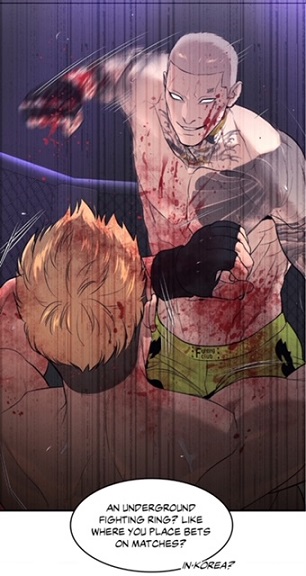 (chapter 47) Through him, Joo Jaekyung gains access to a form of knowledge the institution does not control. The beast is no longer driven blindly forward; it is guided.
In this sense, ownership shifts. Not legally, not contractually, but functionally. MFC may hold the paperwork, but Kim Dan holds the leash — not to restrain the predator, but to direct its attention where it truly matters. That is why this support is threatening. Not because it domesticates Joo Jaekyung, but because it makes him lucid.
This exposes how significant the pattern in Jinx are. While the geometric design signals status, enclosure, and the institutional trap, the animal pattern points to instinct, territoriality, and latent violence. Together, they show the limits of MFC’s control. The champion may be placed inside a golden cage, but his nature has not been erased. It has merely been ignored by those who believe that prestige and containment are enough.
Floors as Spatial Evidence: Mapping the Hotel
The patterns do more than symbolize. They also locate.
By following changes in carpets, tiles (chapter 85), wall colors, corridor width, and interior layout, it becomes possible to reconstruct the hotel’s internal geography with considerable accuracy.  (chapter 84) These visual cues distinguish floors, mark thresholds between zones, and separate different kinds of isolation. The hotel ceases to function as an abstract backdrop and instead reveals itself as a structured environment in which hierarchy is materially inscribed.
This becomes particularly clear when examining Kim Dan’s room. His corridor shares certain elements with Park Namwook’s room, for example, his door is opening outwards  (chapter 85) (chapter 82) and he has no cupboard in the corridor of his room. However, if you look carefully, you will notice that doc Dan’s room has three different types of floor: in the corridor, (chapter 85)
  (chapter 84)
  (chapter 85) The corridor seems to have white linoleum covered a dark brown carpet, similar to the one in his bedroom. However, observe that the manager’s entrance has the same tiles than in the hallway. (chapter 82) Finally, the wooden or gray walls and the rich brown carpet
  (chapter 85) reminds us of the champion’s living room in the hotel.
  (chapter 82) This clearly exposes that doc Dan’s room is not a normal room. It exceeds that basic category. It is larger, brighter, and arranged for comfort. The interior layout is particularly revealing: the bathroom is located close to the bedroom (chapter 85), while the entrance to the room is set at a noticeable distance from both the bed and the couch. (chapter 85) This spatial separation creates a protected inner zone, shielding the sleeping and living areas from the corridor. Combined with the presence of a couch, a large window (chapter 84), and abundant light, the room reads as a space designed for rest and continuity rather than mere overnight use. While it is not a suite, it is unmistakably superior to the manager’s accommodation.
Park Namwook’s room, by contrast, is located at the end of a corridor , a position that at first glance might suggest privilege but here functions very differently. The hallway leading to it is narrower and visually compressed, framed by dark tiles both at the bottom and the top of the walls. The color palette is heavier, and the space feels closed in rather than elevated. The end-of-corridor placement does not open onto a decorated or transitional space; instead, it reinforces isolation and marginality. The fact that he was carrying toilet paper in his hand indicates that his bathroom is right next to the entrance of the room. Everything is pointing out that his room is much smaller and less comfortable, as the floor is the same than in the corridor. This means that he can hear noises coming from the hallway. There is no architectural generosity, no suggestion of comfort or expansion. Even before any narrative confrontation occurs, the architecture signals decline. The manager’s authority is no longer supported by space; it is spatially undermined.
Then there is the champion’s suite. Room 1704 occupies a categorically different position within the building. Situated on the top floor, it combines vertical elevation with spatial separation. Since the door is opening inwards, it indicates that the space in the corridor is larger than the physical therapist and the manager’s. Secondly, observe that the floor in front of his suite is different, a combination of marmor and white tiles. There’s a pattern. (chapter 85) (chapter 85) And now look at the bottom on the right, you can recognize the same floor in the corridor. Joo Jaekyung has a cupboard in his corridor. The corridor leading to it changes again in both flooring and framing, and the area outside the door is treated almost like a private antechamber, as there is an opened area with decorative elements rather than bare walls. (chapter 85) Inside, the suite unfolds across multiple rooms,  (chapter 85) clearly separating living space from bedroom
 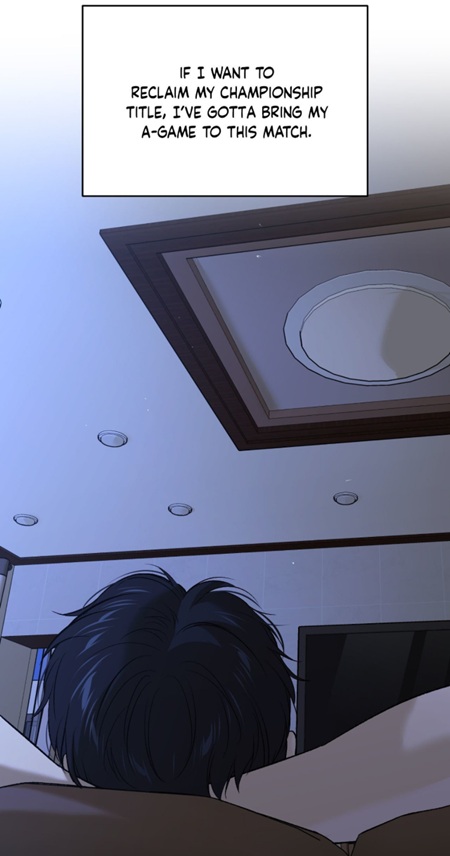 (chapter 82), and extending outward through more than one balcony.
  (chapter 82)
The suite’s scale and elevation construct Joo Jaekyung as both privileged and isolated. He is placed above the rest of the team not only symbolically, but physically. Crucially, the floors and layouts allow us to perceive this isolation long before the characters articulate it themselves. The architecture expresses hierarchy, separation, and solitude in advance of dialogue, making the champion’s position within the system visible before it is ever named.
Through these observations, I could determine the rising of doc Dan and downfall of the manager. Because of doc Dan, Park Namwook has been relegated to the average staff, he is no longer a close advisor of Joo Jaekyung. His room is situated far away from the emperor, which also explains why the former would often ask for the physical therapist’s advice.  (chapter 82) And the moment I had this realization, architecture, once again, speaks first, my attention returned to the hotel in the States.
  (chapter 37)
Two Hotels, One Logic: The Abuse of the Suite
The comparison between the French and American hotels reveals a repeating structural injustice. To understand it, one must first recall where the champion’s room was located in the United States. In chapter 37, Joo Jaekyung is shown sleeping in the same hallway as Kim Dan and the other fighters.  (chapter 37) This detail is crucial. It explains why he can hear their laughter and smell the food they are eating.
 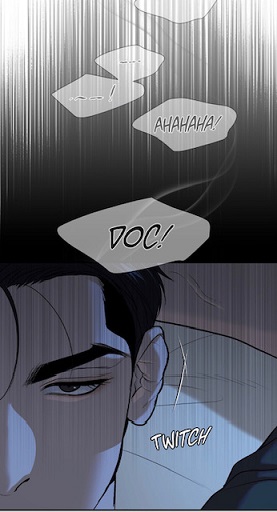 (chapter 37) Architecturally, he was not isolated. Despite his status, he remained embedded within the collective space of the team.
At first glance, one might therefore conclude that no suite had been booked for him. That assumption would be wrong. In the United States, a suite had indeed been reserved for the champion.  (chapter 37) Besides, Episode 40 confirms that Joo Jaekyung did occupy an imperial suite: the interior layout includes a door separating the bedroom from another room
  (chapter 40), a feature characteristic of a suite rather than a standard hotel room. The issue, therefore, is not the absence of a suite, but how that suite was positioned and managed.
In the American hotel, the imperial suite was located on the same floor and corridor as the fighters and staff. This spatial choice stripped the suite of its primary function: protection through distance. Anyone circulating in the hallway could approach the champion’s door without obstruction. Access was not controlled by elevation or separation, but normalized through proximity. This is why the suite’s title proves misleading. It signaled privilege, but did not enforce insulation. I would even say, the name of the room was a subterfuge. In truth, he is not really treated like an Emperor, rather as a special fighter..
This lack of isolation becomes particularly problematic when considering the later incident involving a drugged beverage.  (chapter 37) Because the suite was embedded within a shared corridor, an intruder could approach the champion’s room without attracting attention. (chapter 37) The danger did not require exceptional access. It was enabled by the layout itself.
The situation is further aggravated by what the suite already contained. Alcohol was present in a room officially  (chapter 37) intended for weight-cutting and post–weight-cut recovery. This detail exposes a managerial failure rather than a hotel failure. The environment was not curated around the champion’s physical needs. Discipline was demanded of his body, but not enforced in his space. Meanwhile, fighters and coaches purchased junk food behind the champion’s and Kim Dan’s back, reinforcing the gap between stated goals and actual practice.
When the incident was discovered, responsibility became easy to deflect precisely because the environment had been left porous. Blame could be shifted onto individuals, while the structural decision that enabled access remained unaddressed. (chapter 37) The hotel itself cannot be held fully responsible; the problem lies primarily with MFC’s room allocation and the manager’s acceptance of that configuration. Yet the American hotel reveals an additional layer of vulnerability that complicates the picture.
The rooms in the United States appear to lack basic security features.  (chapter 37) There is no visible keycard system, and no clear indication of an interior lock.
 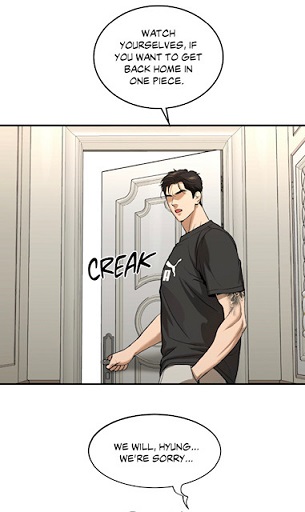 (chapter 37) This absence is striking, especially when contrasted with the Paris hotel
  (chapter 85), where doors are equipped with keycards and locks on both sides (chapter 82). While this could be attributed to an artistic omission, the consistency of the Paris depiction suggests otherwise. The difference feels deliberate.
This lack of security would explain several narrative details. It clarifies how Joo Jaekyung could barge into the room shared by Kim Dan, Potato, and Oh Daehyun without resistance.  (chapter 37) Access was not negotiated; it was simply taken. The architecture allowed it. The space did not protect its occupants.
It also invites a reevaluation of the hotel’s status. Despite hosting a star athlete, the American hotel does not appear to be particularly upscale. Its corridors are shared, its rooms unsecured, and its boundaries easily crossed. This also casts new light on an earlier detail that initially seemed contradictory. Joo Jaekyung is described as occupying an imperial suite (chapter 37), and yet he can hear the fighters laughing, drinking, even smell what they are eating late into the night. 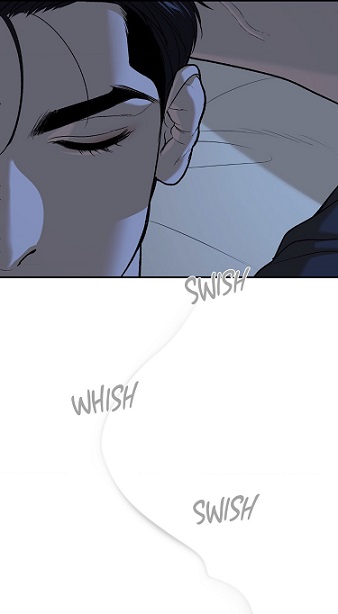 (chapter 37) At first glance, this appears implausible. A suite, by definition, should insulate its occupant from such disturbances. His bedroom is not situated next to the corridor. (chapter 37) But once we recognize that the American hotel is not an upscale establishment, the contradiction dissolves. Thin walls, poorly insulated doors, and shared corridors would allow sound to travel easily. The problem is no longer proximity alone, but material insufficiency. The suite’s title promises prestige, but the building itself cannot sustain it.
This detail matters. The champion is not merely irritated by noise; he is physically prevented from resting, from isolating himself, from preparing properly. His authority is symbolically affirmed, yet materially undermined. He is expected to perform discipline in a space that does not protect him from others’ excess. (chapter 37) This stands in sharp contrast to the Paris hotel, whose layered security and spatial hierarchy signal both wealth and control. (chapter 85) Back then, Kim Dan was treated materially like the fighters, regardless of the manager’s verbal insistence that he was a senior figure.  (chapter 7) Status was asserted rhetorically, but not enforced spatially, exactly with Joo Jaekyung.
Not only does the hotel in the States fail to protect the Emperor’s rest — it fails to support his training. Another telling omission confirms that the American hotel was never designed to host an elite athlete. There is no dedicated training space. No gym. No room adapted to a champion preparing for a return match. This absence explains several scenes that might otherwise appear excessive or out of character.
In the United States, Joo Jaekyung is forced to train outside the hotel  (chapter 37), negotiating access with local coaches and nearly getting into a physical altercation before being allowed to use their facilities
 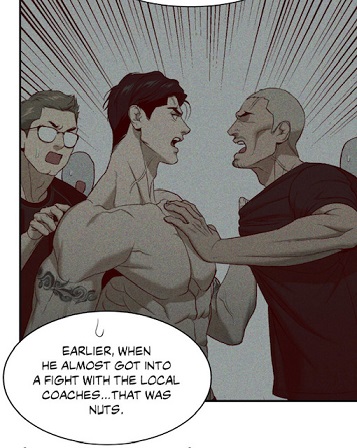 (chapter 37). Only after asserting himself does he gain permission to train. Even then, the gym he ultimately uses is unremarkable — functional, crowded, and indistinguishable from what any average fighter might access. There is nothing exceptional about it.
Paris exposes the contrast. There, Joo Jaekyung can train directly at the hotel.  (chapter 82) The infrastructure finally aligns with the demands placed on his body. This shift is not a luxury; it is a correction. It reveals retroactively how deficient the American setup was — and how little institutional care surrounded the champion at the time.
This context reframes the mockery from Arnaud Gabriel in Paris.  (chapter 82) The remark does not stem from arrogance alone; it is grounded in observation. The training space available to Joo Jaekyung at the hotel is not designed for an elite athlete, even less for MMA fighters.
  (chapter 82) It is a generic fitness room intended for ordinary guests. There are no heavy bags, no proper equipment, no environment suited to the demands of a reigning champion.
  (chapter 37) This is precisely why his training must be adapted, restrained, and partially improvised.
In this sense, Paris does not represent a full correction of the American situation. The champion receives a better room, greater isolation, and visible markers of prestige, but not an infrastructure tailored to his profession. He is accommodated as a celebrity, not prepared as an athlete. The hotel offers comfort, discretion, and image management — not performance support.
This distinction is crucial. In the United States, Joo Jaekyung was treated as neither: neither celebrity nor protected asset, merely another fighter exposed to noise, intrusion, and neglect. In Paris, he is finally elevated — but only halfway. The space now safeguards his image, not his craft. (chapter 82) The mockery from Arnaud Gabriel therefore strikes a nerve, because it exposes the gap between how the champion is presented and how he is actually supported.
What changes, then, is not the logic of neglect, but its form. In America, the failure was crude and structural. In France, it is refined and symbolic. The champion is displayed, isolated, and celebrated — yet still required to adapt himself to spaces that were never designed for someone like him. In other words, he is treated like a celebrity, but not as an athlete!!
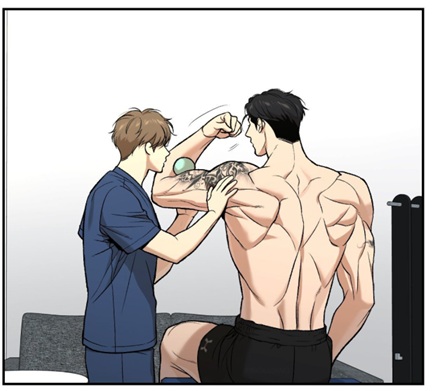
This shift becomes visible in the body itself, through the exercises Joo Jaekyung performs. In the United States, his training relies heavily on brute force (chapter 37): heavy weights, aggressive repetitions, exercises that strain joints and demand endurance through pain. The body is treated as something to be pushed, exhausted, and dominated. In Paris, by contrast, his leg training changes. (chapter 82) The movement is more controlled, more fluid, and visibly gentler on the joints. The goal is no longer to overpower the body, but to preserve it.
This contrast is not incidental. It reflects a deeper transformation in the nature of his fighting practice. Through Joo Jaekyung, MMA itself begins to shift away from its earlier association with brutality and borderline criminality. The introduction of a dedicated physical therapist, the adjustment of training routines, and the emphasis on longevity over raw destruction all point in the same direction. Fighting is no longer framed as survival at any cost, but as a profession that requires care, planning, and restraint.
This also casts doubt on the manager’s claim that Joo Jaekyung had always been supported by the “best” specialists.  (chapter 5) MMA is not baseball or soccer
  (chapter 54); it does not benefit from the same institutional prestige or resources. Earlier in his career, the champion was more likely trained to endure damage than to prevent it. What we see now is not the continuation of an elite system, but its gradual construction — one in which Kim Dan plays a central role.
  (chapter 81)
In this sense, the American hotel exposes a recurring contradiction: authority is proclaimed, but not supported by infrastructure. Protection is expected, but not provided. The environment mirrors the broader logic governing the team at that point—one in which discipline is demanded of individuals, while the system itself remains careless. Hence such an incident could take place. Here, they were not protecting their “Emperor”, 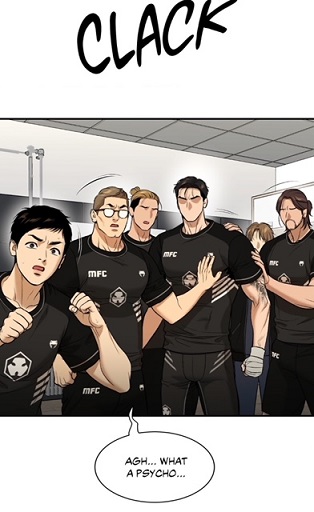 (chapter 49), rather restraining him and as such exposing him to danger.
Seen this way, the incident is not merely the result of personal negligence or malice. It is the product of a space that fails to distinguish between ranks, fails to secure its occupants, and ultimately fails those it claims to serve. I would even add, it exposes the blind trust in MFC.
Paris marks a clear contrast. In France, Joo Jaekyung’s suite is no longer embedded within the team’s circulation space. It is situated at the top of the building, separated from the fighters and coaches, and placed at the end of a corridor. (chapter 85) This time, his room is not described as suite, but the number 1704 (chapter 85) reveals its true position. The hotel has maximum 9 floors, so the number 17 is a reference to a wing. Elevation produces isolation. Distance produces control. He is treated like a star, but not like an athlete.
The logic, however, remains the same. Space is still used as a managerial tool. What changes is the position of the actors within it. Park Namwook is relegated to a lesser floor, visually and architecturally diminished. (chapter 82) Kim Dan, unexpectedly, receives a room that is larger, brighter, and more comfortable than the manager’s. This redistribution of space signals a redistribution of importance within the team. This indicates that his status is not only superior to the fighters, but also to the other hyungs (coach Yosep and the manager Park Namwook).
To conclude, the floors tell the story before the characters do. In the States, the injustice is not shouted. It is built. The suite was intended for a very specific function: the weight-cutting session (chapter 37) and the post–weight-cut recovery. (chapter 37) It was never designed for comfort, while in Paris the suite exists to deceive Joo Jaekyung and his team. It is there to make him think, he is receiving special treatment. That’s why in France, the logic persists, but the positions shift. Joo Jaekyung finally occupies the suite that matches his status. Park Namwook, relegated to a lesser floor, experiences a visual and narrative downfall. Kim Dan, unexpectedly, receives a room that is larger, brighter, and more comfortable than the manager’s. This reversal is not accidental. It marks a redistribution of importance within the team.
Doors, Access, and Delegated Authority
Not everything about access in Paris is restrictive. One detail complicates the picture in a productive way. How could the doctor barge in the athlete’s suite, if there is a lock?  (chapter 82) Kim Dan may indeed possess a keycard to Joo Jaekyung’s suite. If so, this is not a minor convenience. It constitutes a symbolic transfer of access. The physical therapist is granted proximity not merely to the champion’s body, but to his private space. Hence the athlete is not caught by surprise, he doesn’t even mind this intrusion or interruption. (chapter 82)
This possibility helps explain several managerial behaviors. Park Namwook repeatedly seeks Kim Dan’s opinion  (chapter 82) and support (chapter 82), even in situations that should fall under his own responsibility. When he becomes sick, he does not contact Joo Jaekyung directly. (Chapter 82) Instead, he uses Kim Dan as a messenger. This choice is not neutral. It allows the manager to avoid direct criticism from the champion while simultaneously delegating responsibility onto the physical therapist.
If Park Namwook knows that Kim Dan holds access to the suite, this delegation becomes logical. (chapter 85) Kim Dan is positioned as an intermediary — not officially in charge, but functionally indispensable. Should the protagonists fail to appear the next morning, the manager’s first instinct would not be to confront Joo Jaekyung, but to look for Kim Dan. Control is pursued indirectly. At the same time, when the manager announces the schedule for the next day 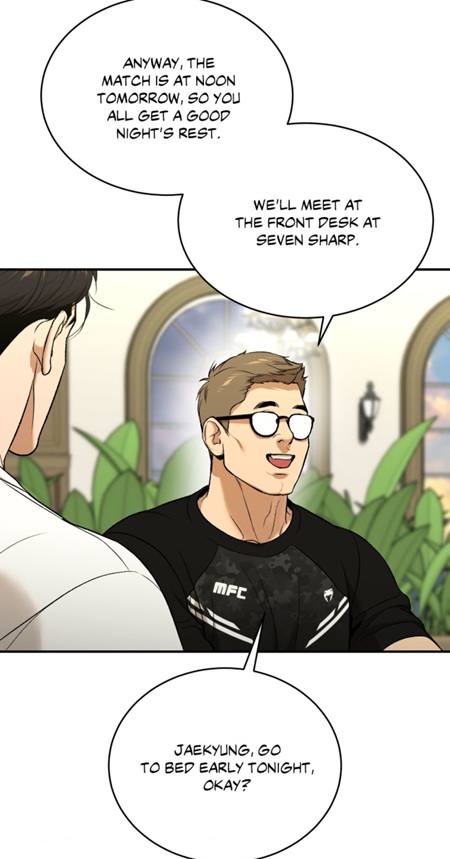 (chapter 85), he expects everyone to wake up on time and appear at seven sharp. He doesn’t see it as his “task” to wake up the champion. Once again, he is delegating responsibility onto others. However, it is clear that he expects Joo Jaekyung to be awake early like he did before. So if the champion doesn’t appear on time, the manager’s decision should be to call doc Dan or visit his room. In his eyes, he is the one responsible for the champion!!
At the same time, access does not equal absence of boundaries. The existence of keycards and interior locks in the Paris hotel makes this clear. (chapter 82) Kim Dan’s ability to enter the suite in episode 82 does not imply unrestricted entry. It is situational. It is tolerated, perhaps even expected, but not automatic. (chapter 82) This is confirmed by contrast: on the night when Joo Jaekyung explicitly asks Kim Dan to come, Kim Dan waits outside. He knocks. He does not let himself in. The boundary holds.
This distinction is crucial. What matters is not who possesses a keycard, but who authorizes its use. In Paris, access is no longer governed by hierarchy or managerial convenience alone. It is regulated by consent. Joo Jaekyung decides when his space opens and when it remains closed.
Yet the system remains vulnerable. If Kim Dan does not answer, and if there is no Do Not Disturb sign, Park Namwook could still invoke institutional authority and ask hotel staff to open the doctor’s door. Let’s not forget that the night before, the doctor is not seen carrying his cellphone to the champion’s bedroom. Secondly, he had claimed to feel sick. (chapter 85) The couple’s absence and silence could generate panic. The potential for intrusion, in particular the doctor’s room, persists. Once again, conflict would not unfold through confrontation, but through space — through who is allowed to cross a threshold, and under what pretext.
The floors make this tension legible in advance. They do not erase boundaries; they reveal how fragile and contested those boundaries remain.
The Golden Cage and the End of the Emperor
Joo Jaekyung’s nickname, The Emperor, only makes sense as long as MFC supports him. An emperor without an empire is not powerful; he is isolated. The golden carpets, the luxury halls, and the elevated suite all contribute to this illusion of sovereignty. But they also define the boundaries of a cage. Hence they have planned his downfall, the hotel and its luxury (chapter 82) are there to deceive the main lead and his team.
The tragedy—and the irony—is that MFC forgets one thing: Joo Jaekyung is no longer alone in that cage.
Kim Dan is inside with him, therefore he is the only one wearing the jacket Joo Jaekyung. (chapter 85) And Kim Dan is the only person in this structure who is not part of the trap,  (chapter 80) for his contract is limited not only to Joo Jaekyung, but also in time. He was never a fighter, hence he is not part of MFC at all contrary to the other hyungs.
The Unnamed Role — When Care Replaces Authority
This brings us to the question that runs quietly through the story: why can Joo Jaekyung not define Kim Dan’s role? 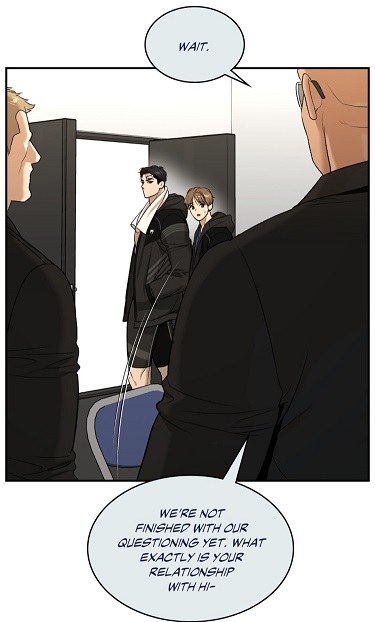 (chapter 40)
It is tempting to answer: because he is a sex partner. But that explanation is insufficient. Kim Dan is also his physical therapist, officially responsible for his body. Over time, he becomes something more: the person who regulates stress, controls access and his food (chapter 82), manages recovery, mediates between the champion and the outside world, and quite literally holds the key. He even controls his image.  (chapter 82) These are managerial functions.
But naming Kim Dan as a manager would expose the failure of Park Namwook and, by extension, MFC itself. It would mean admitting that institutional authority has been replaced by personal care. That is why the role remains unnamed. It exists in practice, but not in language. Thus expect a new version of this scene soon: (chapter 40) And if this comes true, then the athlete’s answer will be totally different:  (chapter 40) Doc Dan is not one among others, but the BEST physical therapist. He is also a champion (chapter 86), for he helped him to recover and maintain his form in such a short time. He is the only one who can assist him to regain his title. The athlete will reveal doc Dan’s gift and special status to others.
The floors reveal this displacement long before the characters can. 😮
Conclusion — What the Floors Foretell
By reading the floors as markers of status, indicators of situation, and tools of spatial orientation, a coherent pattern emerges across both hotels. Elevation coincides with enclosure. Luxury disguises control and manipulation. And institutional power repeatedly misreads its own architecture.
The likely next move is already written into the building. (chapter 85) When the manager goes looking for control, he can look for Kim Dan due to the warning DND. And when he does, he will discover that the structure he relied on no longer answers to him.
The secrets behind the floors are not just secrets. They are warnings.
Feel free to comment. If you have any suggestion for topics or Manhwa, feel free to ask. If you enjoyed reading it, retweet it or push the button like. My Reddit-Instagram-Twitter-Tumblr account is: @bebebisous33. Thanks for reading and for the support, particularly, I would like to thank all the new followers and people recommending my blog.
 Bebebisous33s' analyses in K-Dramaland and Manhwas