

Please support the authors by reading Manhwas on the official websites. This is where you can read the Manhwa: Jinx But be aware that the Manhwa is a mature Yaoi, which means, it is about homosexuality with explicit scenes. Here is the link of the table of contents about Jinx. Here is the link where you can find the table of contents of analyzed Manhwas. Here are the links, if you are interested in the first work from Mingwa, BJ Alex, and the 2 previous essays about Jinx Breathless in the Light – part 2 and Love is in the Air -part 1
It would be great if you could make some donations/sponsoring: Ko-fi.com/bebebisous33 That way, you can support me with “coffee” so that I have the energy to keep examining Manhwas. Besides, I need to cover up the expenses for this blog.
Finally a Love Confession?
Among all the scenes in Jinx, none has ignited more speculation than the moment inside the Ferris wheel cabin—those few seconds when Joo Jaekyung’s lips move 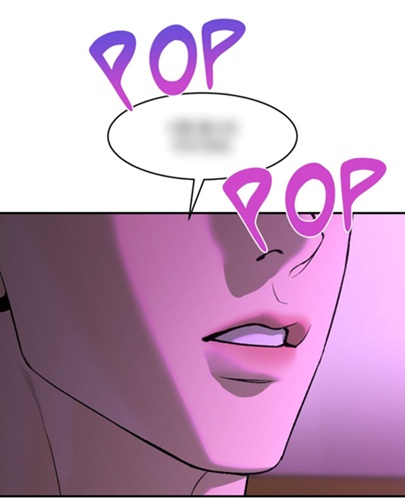 (chapter 84), the fireworks erupt, and Kim Dan turns his head too late.
  (chapter 84) Readers have replayed the blurred panel again and again, straining to decipher the muffled shapes of his mouth. Some are convinced that this is the confession, the moment the wolf finally says aloud what his body has been whispering for months. One Jinx-phile, @4992cb even insisted she had cracked the code: five syllables,
  just enough to match the Korean 좋아해 김단 (jo-a-hae Kim Dan)—“I like you, Kim Dan.”
And truthfully, the scene encourages such a reading. Fireworks often accompany love confessions in East Asian media 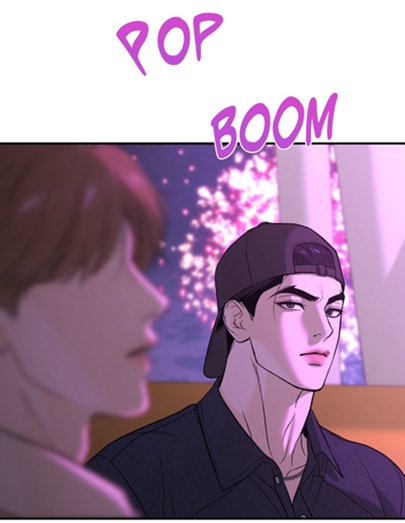 (chapter 84) —especially Japanese summer festivals where boys and girls, dressed in yukata, confess beneath crackling skies. Fireworks symbolize joy, romance, fleeting courage. It is no wonder many readers assumed that Mingwa was drawing on this cultural grammar: purple night sky, glowing lights, two lonely figures suspended above the world. A confession seems almost inevitable. And if it truly was a love declaration, then the champion’s refusal to repeat himself
  (chapter 84) would make perfect narrative sense—confession lost, moment gone, courage spent.
But before we accept the romantic surface, we must pause. Something about the staging feels off—deliberately off. Why would Mingwa construct a confession that the receiver cannot hear? (chapter 84) Why give Kim Dan the long-awaited moment he has yearned for, only to snatch it away with the noise of exploding light? Yes, despite his words, Kim Dan still had the hope to be loved by the athlete. Hence he kept thinking about the athlete’s motivations for his “stay and care at the seaside town”.  (chapter 62)
  (chapter 77) Why does Joo Jaekyung speak exactly when the fireworks begin, as if choosing the one moment when he is guaranteed to be drowned out? (chapter 84) And most importantly: what emotion pushed him to open his mouth in the first place?
 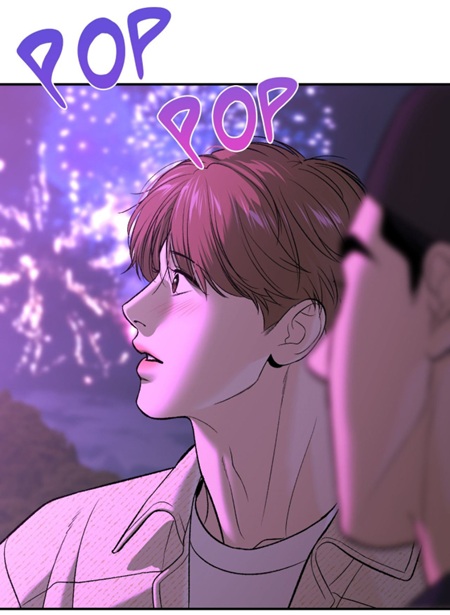 (chapter 84) Was he truly confessing love—or was he trying to verbalize something far more raw, far more primitive, far more difficult?
Before we can decode the stolen syllables, we need to examine the entire machinery around this moment: the champion’s posture, the lighting, the soundscape, the timing, and the emotional triggers accumulated over previous chapters. Only then can we begin to understand what he tried to say, and why the author ensured that Kim Dan—the boy who has always longed to be chosen—could not hear it.
The Mechanics of a Stolen Confession
Everything about the Ferris wheel cabin — the positioning, the posture, the lighting — undermines the idea that Joo Jaekyung was intentionally directing his words toward Kim Dan. The mechanics of his body say more than the bubble ever could. To begin with, Jaekyung is not fully facing Kim Dan when he begins to speak. (chapter 84) How do we know this? His body tells the truth before any words do: his torso is angled half-way toward the window and half-way toward Kim Dan, caught between desire and retreat. His arms remain crossed — a classic defensive posture — as if he is bracing himself against the very feelings he is trying to verbalize. This is not the stance of someone delivering a confident love confession; it is the posture of a man attempting something dangerous, something he is afraid to expose.
Only his head turns slightly toward Kim Dan, a diagonal tilt rather than a direct orientation. (chapter 84) It signals hesitation, testing the water, not a deliberate act of addressing someone face-to-face. And the light confirms this: the violet firework glow still falls on the same side of his face as in the previous panel, proving that he did not rotate his body or head enough to truly face Kim Dan while speaking. (chapter 84) He remains more oriented toward the window, toward the blur of lights outside — toward a safer, less intimate direction.
This halfway posture makes everything clear: Jaekyung is speaking from a place of longing mixed with fear, practicing honesty without yet daring to look directly at the person who provokes it. It is because as soon as his fated partner asks him to repeat, he turns slightly his head away, to the window. (chapter 84) When someone truly wants to be understood, they turn instinctively toward the listener. But when Jaekyung turns away, he is not refusing vulnerability — he is choosing fear. Turning his head toward the window is an instinctive retreat into the only safety he knows: distance.
This is crucial: he begins to speak while refusing to meet the therapist’s gaze. (chapter 84) The words escape sideways — literally.
Then comes the second mechanical detail: timing. He opens his mouth precisely at the moment the fireworks erupt. Deep down, he knows the noise will drown his voice. This is not accidental. It mirrors episodes 76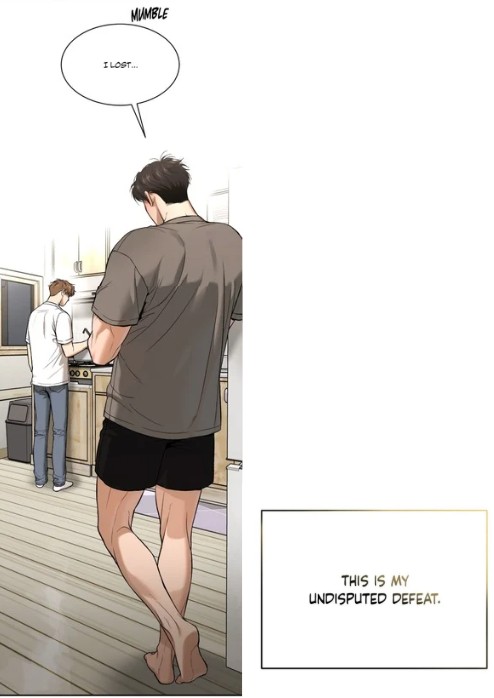 (chapter 76) and 79
  (chapter 79), where he “speaks” only when the other man cannot truly hear him. At the hostel, the mumbling was barely audible: yet according to my observation and deduction, doc Dan seems to have caught something. as later we discover this scene from the champion’s memory:
 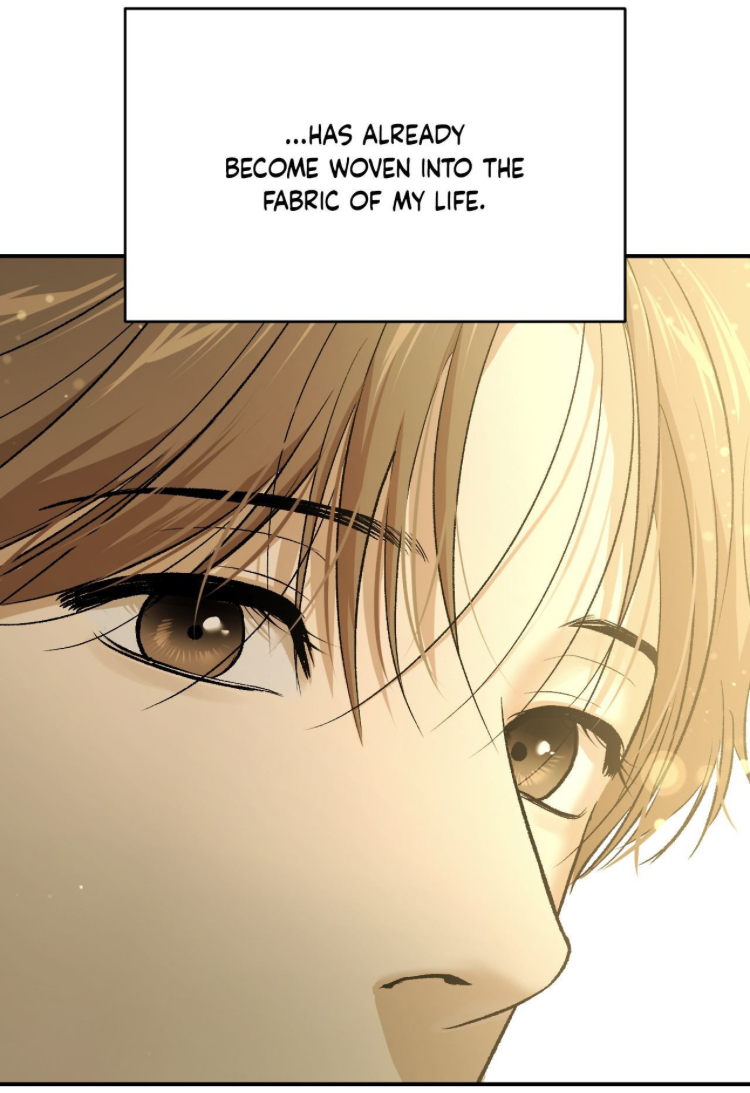 (chapter 77) He already knew that the athlete was standing next to him. However, observe that this vision focused on the doctor’s gaze was accompanied with silence. This means, doc Dan acted, as if he had heard nothing. So if he heard, what did the physical therapist catch exactly in the kitchen? “I lost…”, but it was devoid of any context. Doc Dan had no idea what the director Hwang Byungchul had advised to his former student.
 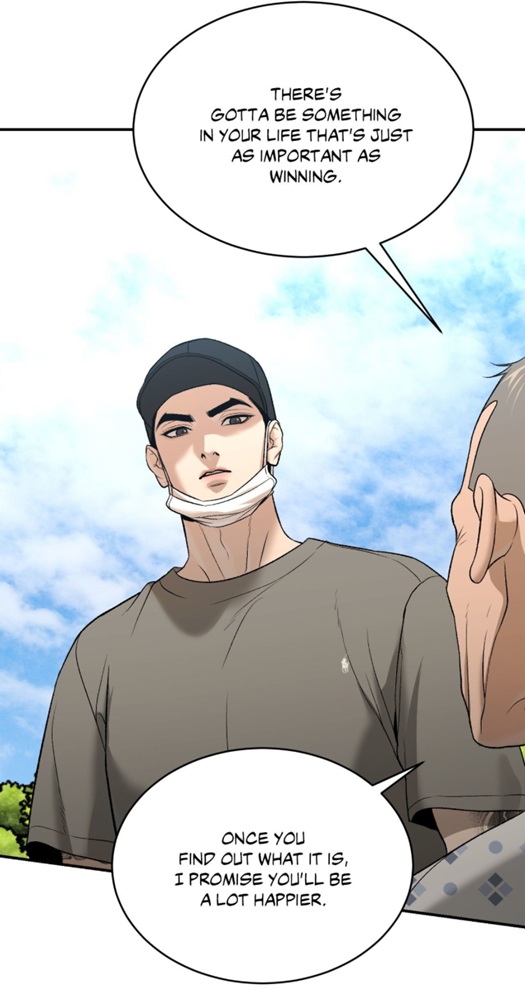 (chapter 75) He could not know that “I lost” referred to something far more intimate: Jaekyung losing control over his own emotional detachment, he was totally vulnerable in front of doc Dan. His heart was stronger than his “mind and fists”. Naturally, if Kim Dan interpreted the phrase at all, he would connect it to the only “loss” he understood: the tie with Baek Junmin. A humiliating defeat. A source of shame. This misinterpretation perfectly explains why in the cabin, the hamster immediately assumes that the champion is once again determined to regain his title:
 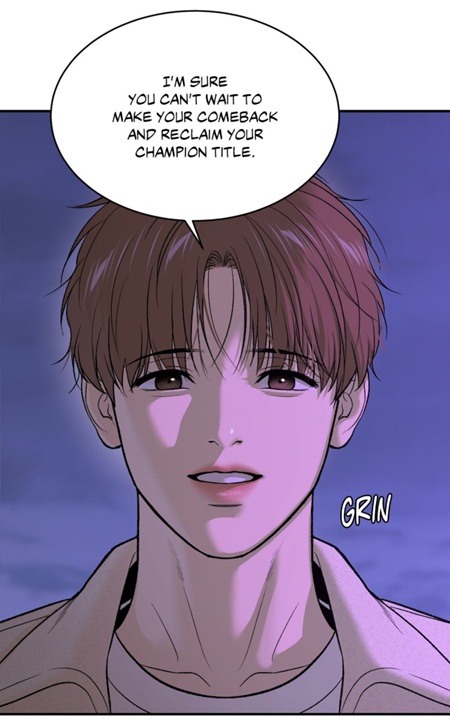 (chapter 84) He is taking the champion’s words at face-value.
  (chapter 77) He trusts the explanation Jaekyung himself gave under the tree. And here lies the deeper revelation: Kim Dan’s misunderstanding exposes the true meaning of the tree confession. Why did Jaekyung suddenly accept the match? Why frame it entirely in terms of “I need you for these two fights”?
Because work was the only safe language he had left for reconnecting with the therapist. He could not say, “Please stay with me.” He could not say, “I don’t want to lose you.” So he said the only thing he believed he was allowed to say:
“I need you for my return match… and my title match.”
It is a substitution — a mask — a plea disguised as practicality.  (chapter 84) A deadline designed to keep Kim Dan close without revealing the depth of the emotional dependency underneath. Finally, before we even analyze posture or timing, we must acknowledge the ghost that is sitting inside the cabin with them — Jaekyung’s own admission of dishonesty. Just minutes earlier, the narrative revealed again a thought he had never dared to voice aloud: (chapter 84) This line is essential, because it exposes the truth behind every failed confession that came before it: Jaekyung did not rekindle with doc Dan with honesty. His first instinct was deception (lie by omission), not vulnerability. Keeping Kim Dan near him mattered more than telling him the truth. So his “love” was still more influenced by possessiveness.
And that is precisely why his apology in the cabin lands with such weight. 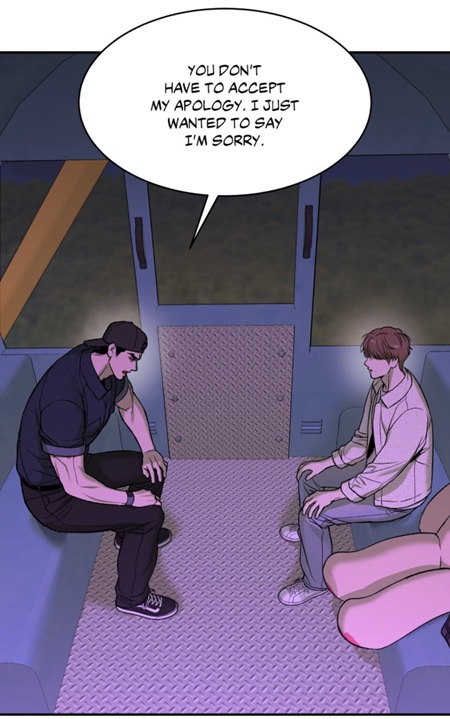 (chapter 84) For the first time, he admits wrongdoing without deflecting, without rage, without pride. This apology is not strategic; it is confessional. A tone we have never heard from him before. It is no coincidence that just before, he employed this expression:
  (chapter 84) This is the language of surrender — not to defeat, but to vulnerability and selflessness. The champion who once insisted on keeping Kim Dan “one way or another” (chapter 84) now articulates the opposite impulse: the willingness to release him, to give him a choice. (chapter 84) Kim Dan can actually never forgive him. He is giving up, on his possessive love — the possessiveness that fueled all his earlier attempts to hold onto Dan through contracts, pressure, intimidation, manipulations or work-related obligations.
Here, his grip loosens. Here, his desire is no longer expressed as ownership, but as remorse. And this shift matters profoundly for the blurred confession. (chapter 84) By apologizing, Jaekyung crosses a threshold he has never crossed before: he speaks without power, without defense, without dominance.
For the first time, he tells Kim Dan something that is not a command, not a justification, not an excuse — but a truth about himself. Yet this emotional shift, as liberating as it is, does not make him ready to say “I love you” or even “I like you” in a clean, intentional, adult way. In fact, the opposite is true. When guilt falls away, he does not step into romantic maturity — he reverts to emotional childhood. This explicates why later he felt so embarrassed on his bed, hiding his face under the pillow. 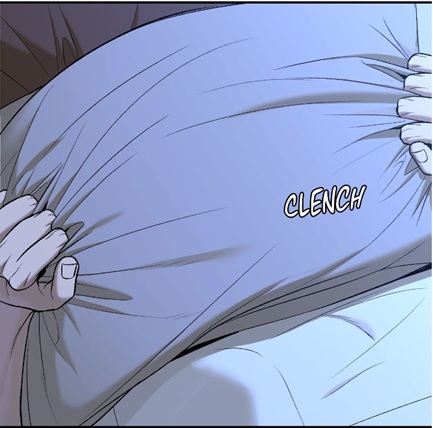 (chapter 84) Thus for me, in the cabin the champion became, for a moment, the boy with no mother’s gaze, no father’s protection, no safe place to rest. He must have said something cheesy, something a young person would say. Purity returns before experience does. Honesty returns before articulation. And in that moment inside the cabin, Mingwa makes a decisive artistic choice: we do not see Jaekyung’s eyes. (chapter 84) The panel hides them completely — not out of convenience, but out of protection. It is as if the author herself shields the wolf’s vulnerability from the reader, granting him a moment of privacy at the precise instant he attempts something emotionally dangerous.
Just as in episodes 76 and 79, his words are not fully directed at Kim Dan. They are spoken near him, not to him.
They slip out sideways — half internal, half external — the verbal equivalent of a heartbeat too quiet to be called speech. In other words, what happens inside the cabin is not the flowering of romantic eloquence. It is the first trembling attempt of someone who has never been loved to express the only version of love he knows: instinctive, needy, unpolished, raw.
This is why he cannot possibly be saying a line as adult and structured as “I love you” or even “I like you.”
Such sentences require three things he does not possess yet:
- A sense that he himself is lovable → he does not. Hence he still views himself as nonredeemable and as a burden.
- A sense that Kim Dan feels the same → he has no proof. Besides, doc Dan keeps avoiding his gaze, feels uncomfortable in front of him. He is not speaking his mind. He keeps reminding him of their limited contract.
- A sense of equality in the relationship → they are not there yet. Joo Jaekyung feels now inferior with all his sins and wrongdoings. Due to his last words, it becomes clear that he is not expecting something in return.
What he can say at this stage — and what fits the emotional mechanics of the scene — is something far younger, far simpler, far more primal, like for example “Stay with me” or “I want to kiss you ” or “I want to hold you”…
These are not love declarations. They are the vocabulary of a neglected child whose first experience of safety has finally returned — and who now fears losing it more than anything else.
And crucially, this would explain everything about the staging:
- why he chooses fireworks (the sound protects him from being truly heard),
- why his body angles away (he speaks sideways, not directly),
- why his voice is blurred (because the reader is not meant to hear it yet),
- why he panics when Kim Dan asks him to repeat,
- why he instantly retracts with “Never mind.”
A man confessing love does not recoil. A child confessing need always does. It is also why the author hides the line. Not because it is a grand romantic confession, but because it is too emotionally naked, too immature, too early, too cheesy. A sentence like “I wish to …”, whispered by a man who has never held anyone without ownership, is more intimate than any polished “I love you.”
And Mingwa knows it. The confession is blurred not because it declares love, but because it reveals Jaekyung’s inexperience with love. He can finally be honest — but he cannot yet be articulate.
He can reach — but he cannot yet claim. He is pure — but not ready. Hence later, he is seen wearing a white t-shirt for the first time. 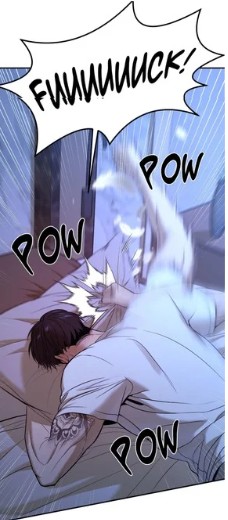 (chapter 84) This pigment stands for innocence, purity, new beginnings and even equity.
Innocence and purity: White is the beginning of everything, before anything is muddied or thinking is ‘colored’.
New beginnings: White represents the clean slate, helping us through times of stress, and allowing us put the past behind us and preparing us to move on.
Equality and unity: White represents the positive as well as the negative aspects of all colors. It contains an equal balance of all the colors of the spectrum. Quoted from https://www.empower-yourself-with-color-psychology.com/color-white.html
That is why the fireworks stole the words. 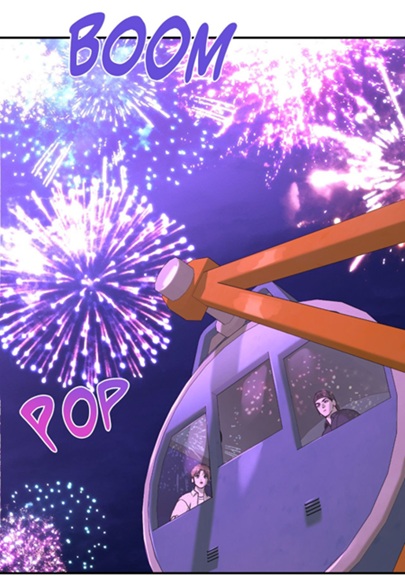 (chapter 84) Because they were not yet meant to be received, only meant to be released. The fireworks allow him to finally attempt a more honest sentence, but in conditions where it cannot reach its target.
Noise replaces courage.
Light replaces eye contact.
Fear replaces clarity.
A man who has only just begun to tell the truth about his wrongdoing cannot yet tell the full truth of his love.
His apology creates the emotional opening — but it also exposes how unprepared he is to verbalize the feelings that have been building silently for 84 chapters. So far, he has never verbalized his desires and emotions, hence he kissed doc Dan right away in the swimming pool.  (chapter 81) Yet this is also the limit of what he can say.
But let’s return our attention to the scene in the penthouse (chapter 79), which is similar to the scene in the kitchen and at the amusement park. Though the star was once again mumbling, this time Doc Dan reacted to his words. However, Jinx-philes can sense a divergence between the other two scenes (chapter 76) (chapter 84). It is because doc Dan was looking at him this time:  (chapter 79) Thus he could see the athlete’s mouth moving and hear sound. Nevertheless, observe that the moment the wolf reached to the doctor’s words, he bowed his head and looked down. From this
 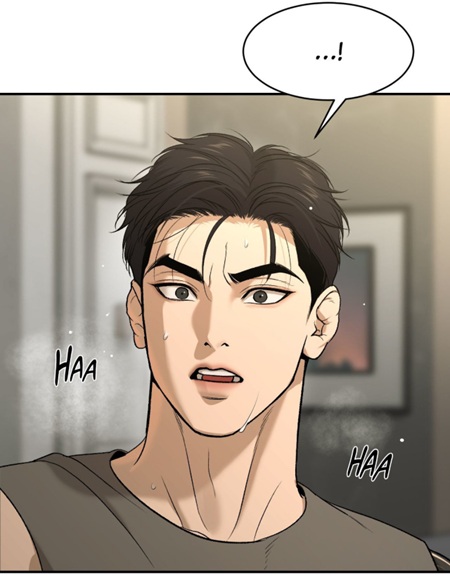 (chapter 79) to this (chapter 79) As you can sense, he fears his lover’s gaze, a new version of this situation:
  (chapter 79) However, he doesn’t fear coldness, but ridicule and mockery, the father’s gaze:
 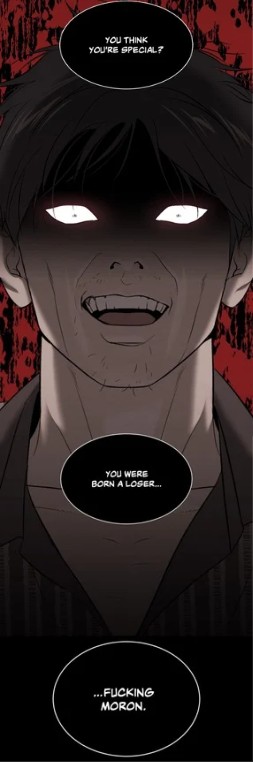 (chapter 73) Under this light, people can grasp why Joo Jaekyung was not facing doc Dan directly in the cabin. To conclude, the mechanism is identical, but amplified. (chapter 84) Instead of mumbling, he lets the fireworks perform the silencing. It is not that the environment interrupts him; it is that he chooses a moment when interruption is guaranteed. However, one detail caught my attention: he’s getting physically closer to Doc Dan!! The distance is getting reduced. It was, as if he was practicing how to confess his affection. And so far, he never used the words « I love you ».
 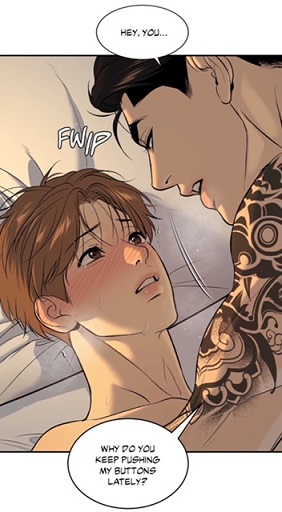 (Chapter 44) (chapter 76) At the same time, Jinx-philes can detect the existence of another common denominator: the physical therapist’s gaze.
The Spark behind the Wolf’s Confession
To understand the blurred sentence — the words the firework stole — we must first shift our attention away from language entirely and back to what truly matters in this scene: vision. What drives Joo Jaekyung to the brink of confession in chapter 84 is not romance, nor timing, nor even the apology he had just managed to deliver. It is Kim Dan’s gaze. (chapter 84) He is moved by such a pure gaze, full of awe.
The panel makes this undeniable. Before speaking, the champion is watching the therapist’s face illuminated by fireworks, softened into wonder. (chapter 84) This is not the gaze of a caretaker, nor a tired worker, nor a subordinate fulfilling a duty. It is the open, trusting gaze of a child witnessing beauty. And for Joo Jaekyung, that gaze is both intoxicating and devastating.
The champion has lived his entire life without soft eyes directed at him. His mother, always drawn from behind, is eyeless — a woman who never truly saw him. 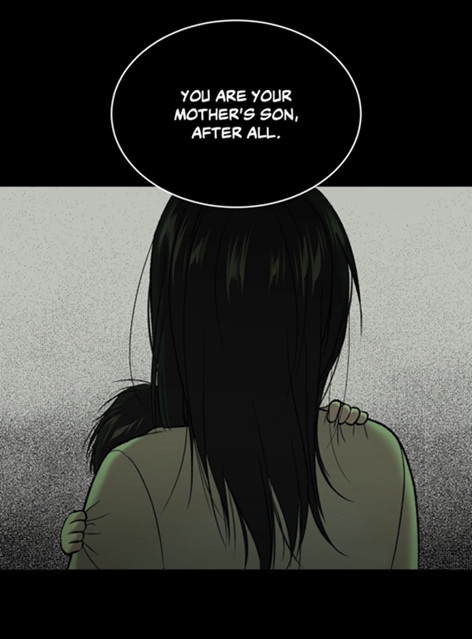 (chapter 73) Besides, the head of her position is indicating that she was not looking at her son, the boy was hiding his face from Joo Jaewoong and his mother. Then his father mocked him, degraded him, and used resemblance as an insult: “ (chapter 73) Moreover, Hwang Byungchul reduced him to a lineage of failure or talent, not a person deserving recognition. He constantly compared him to his father
  (chapter 74) or his mother (a poor but good mother), he was not seen for whom he was: a child, a boy. Jinx consistently links sight with recognition, and recognition with love.
  (chapter 53) Jaekyung has never been granted either.
  (Chapter 45) Thus when he got upset with the present, he indirectly expressed the wish to be « looked at ». Moreover, in his visions or memories, this is what he keeps seeing:
  (chapter 54)
  (chapter 75) Doc Dan’s gaze!
This is what makes the locker-room scene in chapter 51 so crucial. Kim Dan looks at him with shock, vulnerability, and a plea:  (chapter 51) And for the first time, Jaekyung freezes.
 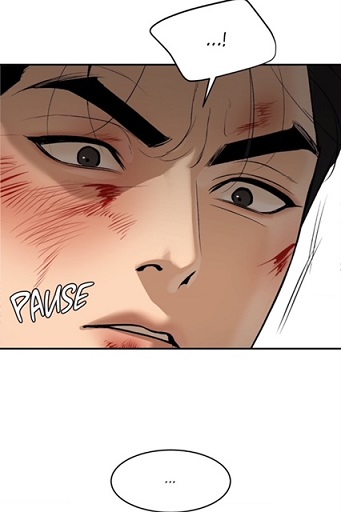 (chapter 51) His breath catches; his eyes widen. It is the moment he realizes his mistake. He never thought that doc Dan had been trusting him. That moment marks the first rupture in his emotional armor, not only because it hurt, but because it revealed. He realizes with terror that he wants to be seen by Kim Dan, but when he faced such a gaze, he could only feel guilty and bad. Thus it is not surprising that later, his nightmare let transpire his guilty conscience. (chapter 54) He is the one who made his fated partner cry. No wonder why he first tried to find a new toy, he felt uncomfortable.
In the Ferris wheel cabin of chapter 84, he encounters his fated partner’s gaze again — (chapter 84) but now it is purified, childlike, unguarded. Kim Dan glows under the fireworks, mesmerized by beauty instead of violence, by wonder instead of fear. And Jaekyung wants — desperately — for that softness to be directed at him. Not at his victories. Not at his muscles. Not at the persona he built to survive. But at the man beneath all of it. A man worthy of admiration, affection, safety. A man who could be held, kept, loved. That’s why I wondered for a while if Joo Jaekyung had not copied Arnaud Gabriel’s flirt  (chapter 82), as the champion has always used his surroundings as a source of inspiration.
 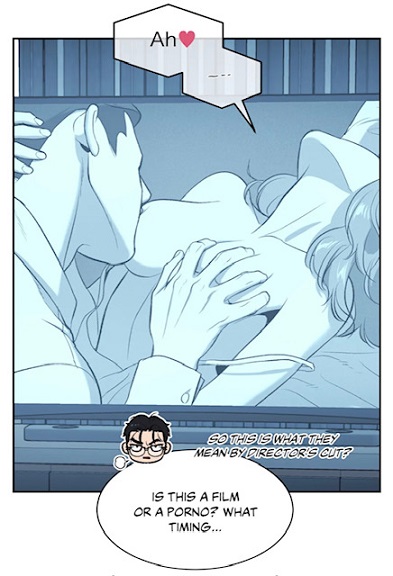 (Chapter 29) It would also fit with 5 syllabes in Korean. And it would be cheesy too. Yet, I have my doubts about this theory which I will explain further below. Nevertheless, one thing is sure. The champion loves the doctor’s eyes and they have the power to move not only his heart but also his mouth. He is encouraged to verbalize his emotions.
This is the true trigger of the confession. Not desire in the adult sense, and certainly not a strategic “I like you” or “I love you,” but a longing to be seen — and therefore, to be wanted. Every wound in Jaekyung’s life is tied to vision: the eyeless mother who vanished, the father who asked whether she would even want to live with him if she saw what he had become, the locker-room moment that shattered his self-perception. All of this returns when he sees Kim Dan’s shining eyes reflecting the fireworks.
He wants those eyes turned toward him with love. Not gratitude. Not dependence. Not fear. Love. What he wants most
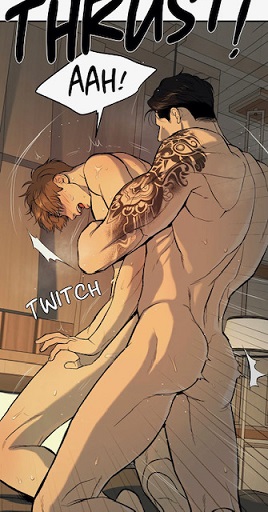
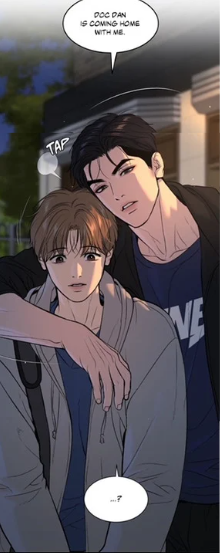
and what he fears most come from the same place: Kim Dan’s gaze.  (chapter 84) The gaze under the fireworks triggers emotions in him. Thus he blurted out something. But for me, he does not know how to say “I love you.” He cannot even say “I like you.” Those sentences belong to someone who has matured emotionally — someone who can identify feelings properly, but so far he keeps saying: “to stay by his side” and his « affection declarations » were all linked to negativity.. Thus my idea was that Joo Jaekyung could have said this: “I want to hold you!” (안고 싶어 너). Let’s not forget that so far, the champion had never expressed such a longing before; a warm embrace. He would always follow his instincts:
  (chapter 4)
  (chapter 43)
 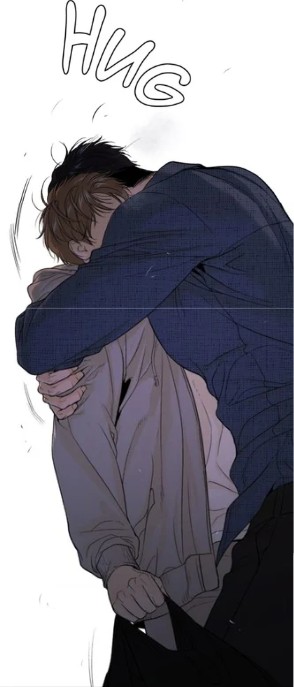 (chapter 69) The hug represents a metaphor for “staying by his side, for home and to be seen”. Moreover, in French embrasser can mean kiss and hug. And strangely, I noticed that the protagonists were never looking at each other during an embrace.
  (chapter 44) And let’s not forget that such a gesture is strongly intertwined with “childhood”.
  (chapter 65) It is for “babies”. No wonder why he retracted immediately.
To conclude, the words that escape him in the dark — too soft to be caught, swallowed by the firework’s explosion — become the linguistic equivalent of reaching toward warmth without daring to touch it. The sentence he forms must fit his emotional stage: childlike, inexperienced, driven by instinct rather than maturity. It must reflect longing, not possession; desire, not declaration. And it must match the blurred outline of five syllables we see in the panel. (chapter 84) 안고 싶어 너: I want to hold/hug you!
The Secret behind the Blurred Words
And now, you are wondering what other secret could be hidden behind these words. It is related to the physical therapist him. Why did Mingwa, the goddess of “narrative fate”, ensure that doc Dan couldn’t hear the athlete’s words? (chapter 84) First, recall that in the previous parallel scenes (76 and 79), doc Dan is portrayed as someone who doesn’t hear Jaekyung’s confessions. But as I argued earlier, we must question whether this is truly the case — especially the one in episode 76. The panel arrangement suggests that something was heard, but not acknowledged. Then during the fireworks, he does not say, “I couldn’t hear what you said.”
He says: “I didn’t catch that.” “Catch” implies arms, grasping, holding — the very things stolen from him as a child.
And then comes the detail that betrays everything: the small drop on his cheek. A sign of discomfort… and something deeper: recognition. The drop on his face was not present before. (chapter 84) For me, everything points to the same conclusion: doc Dan might have heard something — but he cannot yet allow himself to process it.
This denial explains his expression in the shower at the hotel: 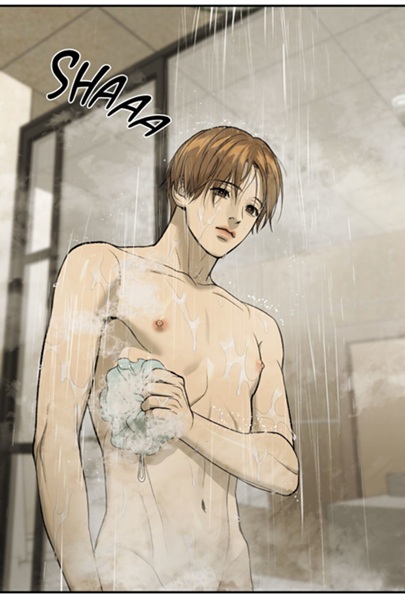
 (chapter 84) Here, the doctor looks sad and wounded. His eyes are unfocused — he is not seeing the present. The water running down his eyelashes gives the impression of tears, even though he is not crying. His gaze is distant, fixed on something internal. His mouth looks tense, almost trembling. The mouth especially is a clue: Kim Dan’s emotions always gather there when something from the past resurfaces.This is the expression of someone thrown into an involuntary flashback. He is inside a memory. This explicates why this scene is similar to the champion’s shower after the latter had met Baek Junmin:
 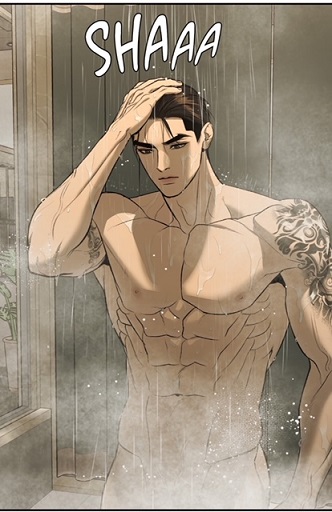 (chapter 49)
  (chapter 49) Both scenes show a man pulled violently into a buried memory. Thus, my assumption is simple: the champion said something that pierced straight into Kim Dan’s oldest wound and brought his trauma to the surface. And this brings me to my next observation. Inside the cabin, there are not two people — there are three: the champion, the therapist, and the Teddy Bear.
 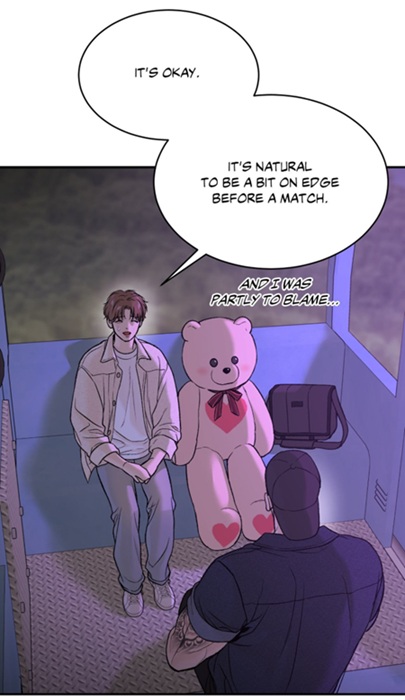 (chapter 84) Furthermore, we have a window. We have a phone (dead, but present). We have a childlike toy — symbol of stolen innocence.
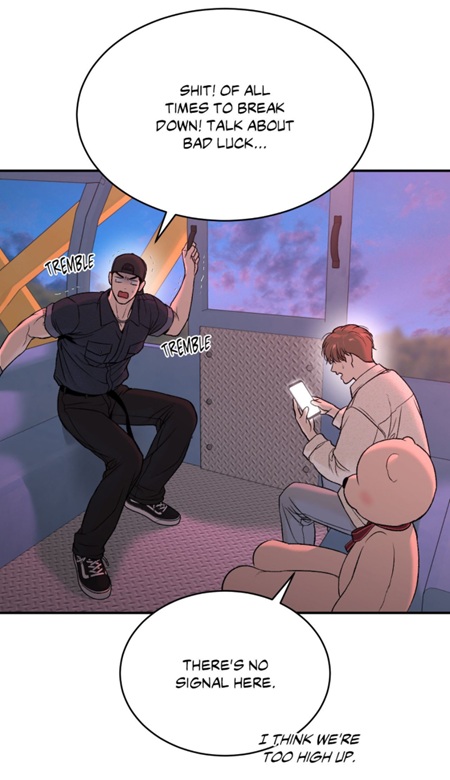 (chapter 84) And now, look again at episode 19:
  (chapter 19) A window with no view. Three figures: halmoni, the boy, and the phone placed between them like a knife. And the sound structure is identical, but reversed:
silence – sound – silence in episode 19
vs
sound – silence – sound in episode 84, as the Teddy Bear is a silent “witness”. In both scenes, something is stolen.
In both scenes, a child loses something he cannot name. Thus, what Jaekyung said must have resembled the emotional tone — if not the wording — of the words spoken over the phone on that catastrophic day.
This explains why Kim Dan ends the scene wearing black instead of white. 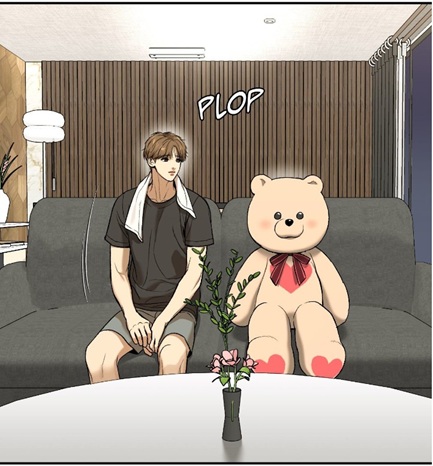 (chapter 84) It is not a fashion choice. It marks the moment when innocence collapses and the past reopens.
And now compare the cabin (chapter 84) with the memory that precedes the parents’ disappearance. You will notice the huge difference: the overwhelming silence inside the house. The halmoni sits beside the phone. She must have heard everything. She must have heard the child as well, if the latter spoke She holds him tightly by the shoulder — as if trying to support him. (Chapter 19) To conclude, she knew something was happening. This recollection represents a repressed memory, and so far doc Dan has always avoided to face his biggest fear: his abandonment issues and the loss of his “parents”.  (chapter 56) In other words, wearing black is more than just a change of personality or mourning. It becomes the color of mystery, the beginning of descent into truth.
  (chapter 84) However, observe that doc Dan is holding, even squeezing the teddy bear’s hand, a sign that he is rekindling with his lost childhood. We are getting closer to the revelation behind the photograph — the day doc Dan has never willingly shown to Joo Jaekyung.
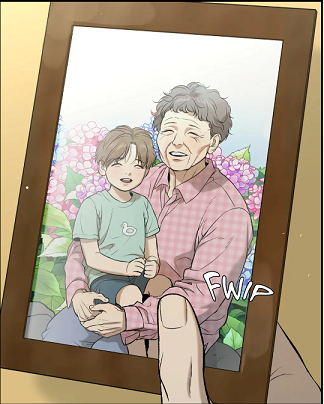 (chapter 19). Observe that in the penthouse, doc Dan has never placed the frame
 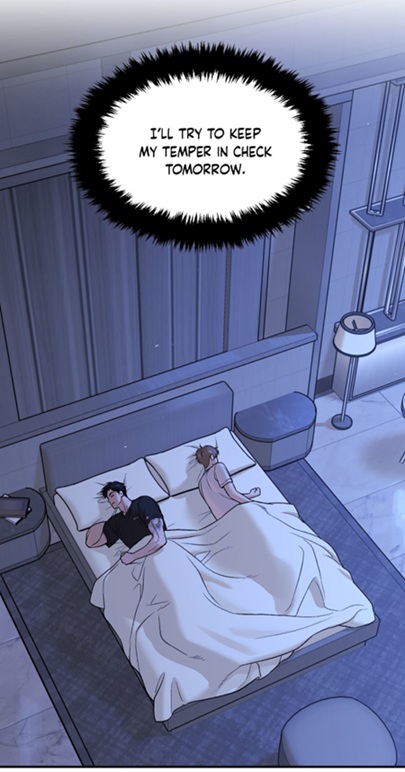 (chapter 79) on the night table.
And what is the other denominator between episode 19 and the amusement park?
Theft.
Stolen childhood.
Stolen confession.
Stolen clarity. (chapter 84)
Exactly like in the cabin, (chapter 19) the words on the phone are inaudible. And now, you comprehend why I came to link the athlete’s blurred words to embrace and longing, as the grandmother’s embrace couldn’t diminish or erase the child’s pain. Finally, Jinx-philes can detect another pattern, the absence of gaze. Not only the boy can not see the person on the phone, but also the characters are turning their back to the readers which reinforces the mystery surrounding the conversation and the reactions of the listeners.
Now, connect it with the lost teddy bear  (chapter 21) and
  (chapter 47). Dan once had toys — proof that once, someone loved him enough to give him gifts which contrasts to the wolf’s childhood.
  (chapter 84) Every time innocence is ripped away, a teddy bear disappears from the story.
So what if Jaekyung’s whispered sentence — a gift of raw affection — triggered the memory of another gift? What if the words under the fireworks echoed the tone of something said just before Dan’s world collapsed?
If this is the case, then doc Dan did not miss the confession entirely. (chapter 84) He remembered something far more painful. It is important, because by remembering his past, he can regain his own identity and get stronger mentally and emotionally. The scene in the cabin represents the positive version of the locker room, which signifies the return of “trust”. That’s why I am more than ever convinced that something at the weight-in 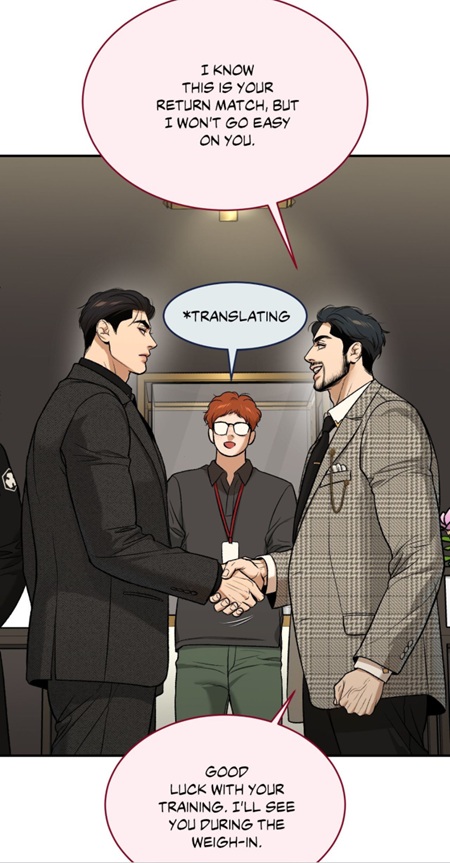 (chapter 82) will happen linked to the protagonists’ past (recent and childhood). Let’s not forget that doc Dan still has no idea what Joo Jaekyung went through after his departure: the slap, the drinking, the headache and the indifference of Team Black, just like the athlete has no idea about the blacklisting and bullying in the physical therapist’s past.
 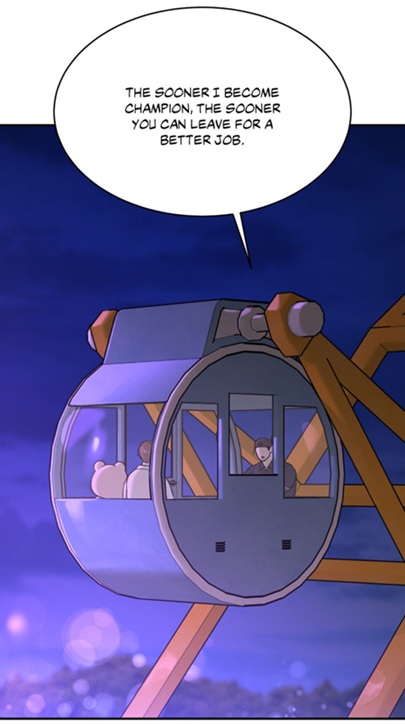 (chapter 84) So by wearing black, doc Dan indicates that he is gradually becoming responsible for Team Blackand Joo Jaekyung the athlete. (chapter 84) They should realize that their life is not so different from each other, in fact they share the same pain and trauma.
Feel free to comment. If you have any suggestion for topics or Manhwa, feel free to ask. If you enjoyed reading it, retweet it or push the button like. My Reddit-Instagram-Twitter-Tumblr account is: @bebebisous33. Thanks for reading and for the support, particularly, I would like to thank all the new followers and people recommending my blog.


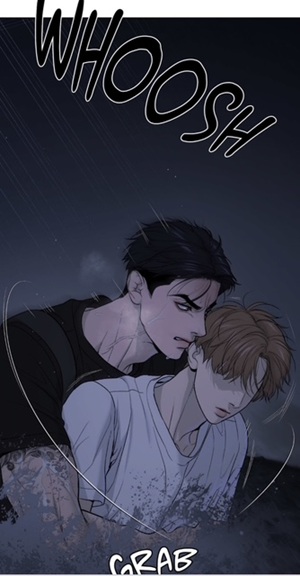 (chapter 59), the scene mirrors the iconic moment in The Little Mermaid where the mermaid saves the prince from drowning. Kim Dan, unconscious and seemingly following the voices of the hospice
 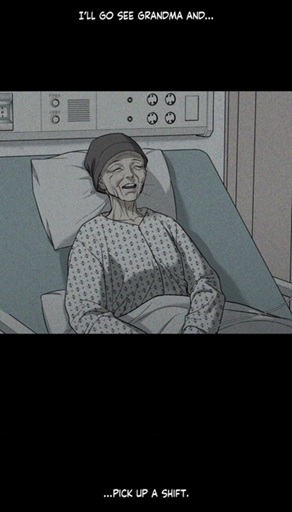 (chapter 59) —a representation of the mermaids’ song—drifts into a state of surrender, much like the prince. This act of salvation becomes a pivotal moment, connecting both characters to the themes of water, transformation, and rediscovery of purpose.
 (chapter 54), performance, and the longing for a deeper connection.
 (chapter 41), and the mermaid, as he grapples with voicelessness and the pressures of his world.
  (chapter 36)
  (chapter 36) Choi Heesung, representing another prince with Potato as his bride, benefits from others’ sacrifices
  (chapter 31)
 (chapter 58) while remaining oblivious to their struggles. These parallels reveal layers of self-discovery, mutual transformation, and the pursuit of meaning. By analyzing these similarities, we uncover deeper layers of self-discovery and transformation within the narrative.
 (chapter 55) and hardship
  (chapter 58), yet it serves as the catalyst for his growth. Just as the little mermaid’s journey leads her to a higher spiritual purpose as a daughter of the air, Kim Dan’s experiences with Joo Jaekyung force him to confront his own worth, identity, and emotional needs. Just before he went to the ocean, he wondered about his own future and desires, a sign that he was standing at a crossroad:
  (chapter 59) However, let’s not forget that Kim Dan’s profession had been determined by Shin Okja, as the latter desired to have her grandchild taken care of her. Therefore his own desires and needs were overlooked. Traditions and social norms were used to decide about the protagonist’s life and future. His journey from voiceless suffering to self-realization echoes the mermaid’s transformation.
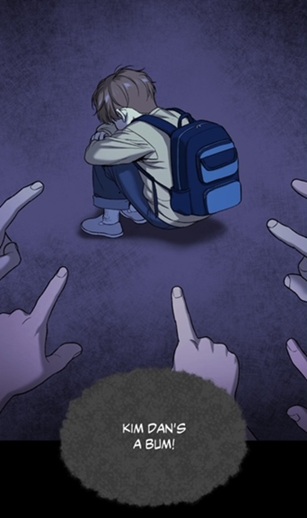 (chapter 57)
  (chapter 59) Like the mermaid, he has always lived disconnected from his own needs, burdened by the expectations of others—his grandmother, Heo Manwook, the doctors
 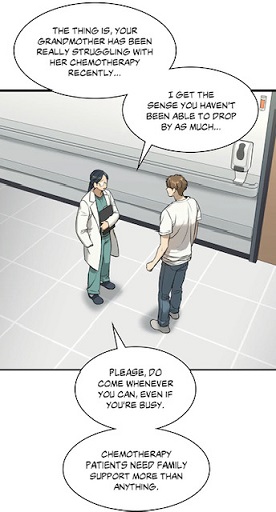 (chapter 21) , and even Joo Jaekyung.
  (chapter 59), he is not capable of crying. It is because he has been living like a ghost for the last two months. Depression, for both the mermaid and Kim Dan, manifests as a silent struggle, making their eventual transformations even more poignant.
 (chapter 1) hiding his true self behind a facade of strength and success. On the other hand, Joo Jaekyung also embodies the mermaid’s longing and sacrifice. Living in the world of MMA, a high-pressure environment where he is constantly pushed to perform, he resembles the mermaid in the underwater kingdom—a place of death and materialism where the mermaids feed on drowned humans. It is no coincidence that the fighters are displayed like mermaids in the water full of blood.
  (chapter 29) This zombie-like existence leaves him voiceless; the entertainment agency and MFC dictate his actions
 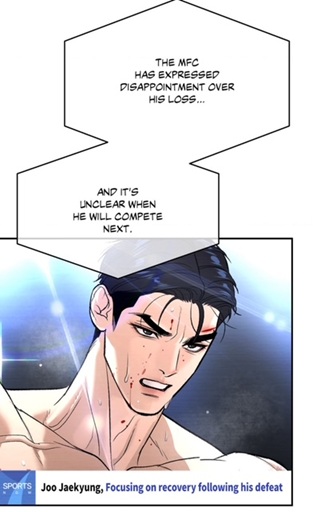 (chapter 57), only allowing him to speak when it benefits them financially.
 (chapter 27) reflects his connection to the mermaid. Water is his natural element, a place where he feels at peace, yet he has been forced to conform to a fiery world of intensity and relentless ambition.
  (chapter 19) Hence he never went to the swimming pool in his own penthouse, until Kim Dan triggered his memory and longing. This interplay of water and fire
  (chapter 52)
  (chapter 41) Joo Jaekyung’s image was exploited to lure these individuals down a darker path, highlighting how his light has been misused by those around him.
 (chapter 19)
 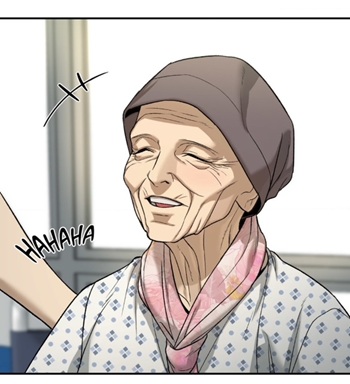 (chapter 56) as long as they were not associated with burden or suffering, while the mermaid’s grandmother celebrates the beauty and decorum of their underwater realm.
 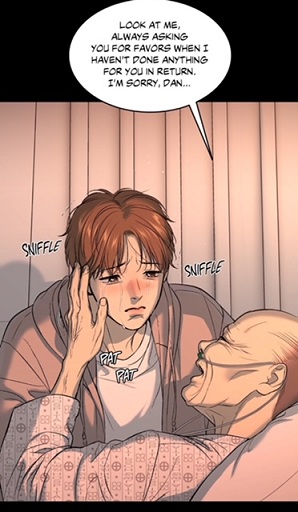 (chapter 53), while the mermaid’s grandmother dresses her granddaughter beautifully for her first visit to the surface, disregarding the physical pain she complains about. In both cases, the protagonist’s suffering is diminished or ignored, highlighting a shared insensitivity to their emotional and physical experiences. Both grandmothers appear as rather distant and cold-hearted.
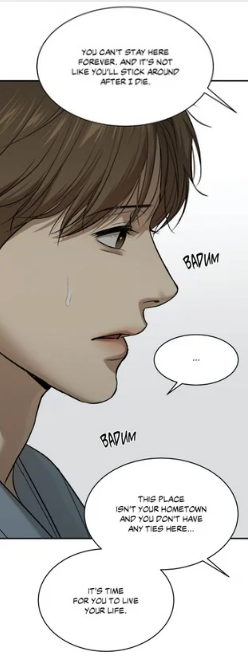 (chapter 57) Shin Okja, noticing Kim Dan’s figurative slow death under the weight of her request, subtly pushes him to seek his own path. However, this act is not entirely selfless. For Shin Okja, it represents an escape from the guilt of causing her grandson’s unhappiness, a way to absolve herself of responsibility.
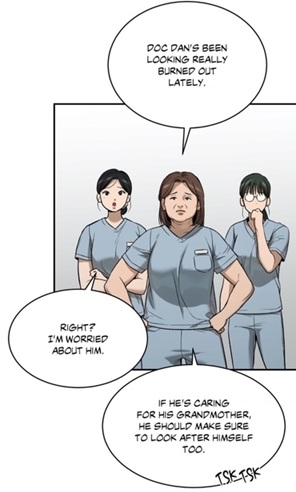 (chapter 57) He even gets blamed for his illness. These elements further emphasize how the suppression of individuality leads to yearning and eventual transformation.
 (chapter 52) This dynamic parallels the members of Team Black in Jinx. Although they are treated like Joo Jaekyung’s co-workers
  (chapter 7), in reality, he is their boss and the foundation of their success. Their indifference mirrors the mermaid sisters’ behavior; they only notice his struggles and absence when his winning streak falters, prompting many to leave the gym for the rival King of MMA. However, if we take Andersen’s fairy tale as a source of inspiration, it signifies that at some point, the remaining members of Team Black might come to “sacrifice” themselves for their “little sister,” symbolically representing Kim Dan and Joo Jaekyung. This potential act of loyalty could mirror the mermaid sisters’ gesture, showing that even belated recognition and care can lead to transformative redemption for those involved.
 (chapter 1), attracting others seeking the same level of fame and fortune.
 (chapter 46) However, the gym’s inability to produce another champion reveals its “fake gardening” nature—focused on maintaining an image rather than fostering true growth.
 (chapter 52) while merely using Joo Jaekyung’s success to boost his own ego. His plans to set up a kids’ program at the gym further underscore this self-serving nature. While presented as an effort to expand the gym’s reach, Park Namwook’s true motivation lies in financial gain, as he tries to persuade Joo Jaekyung by stating, “Kids are where the money is at.” On the one hand, this reflects his obsession with money and contrasts with the deeper, transformative intentions associated with true gardening. On the other hand, since he has himself kids, it is clear that he would like to send his own children to the kids’ program.
  (chapter 22) and a “neglected child”
 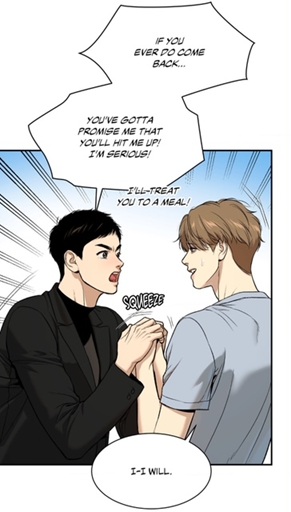 (chapter 59) further emphasizes the immaturity and lack of responsibility prevalent in this environment. In Andersen’s story, the mermaid sisters are given gardens to tend from a young age, instilling responsibility early on. Potato’s journey mirrors the mermaid sisters’ visit to the surface, as his trip to the sea represents a moment of exploration and self-discovery. While working as an actor for the first time, he realizes during his stay with Kim Dan that he has no intention of leaving Team Black.
  (chapter 58) Feeling lost without Kim Dan, he initially requests his return so that they can be together again. This longing for a companion reflects Potato’s deeper need for guidance and connection, much like the mermaid sisters who briefly visit the surface but ultimately return to their underwater world when the novelty fades. Yet, when they reach maturity and are allowed to visit the surface, the novelty of the human world quickly fades, and they return to their underwater realm indifferent to human suffering. However, notice that on his day of the departure, Potato tells Kim Dan that he won’t call him, the mermaid has to initiate the first step.
 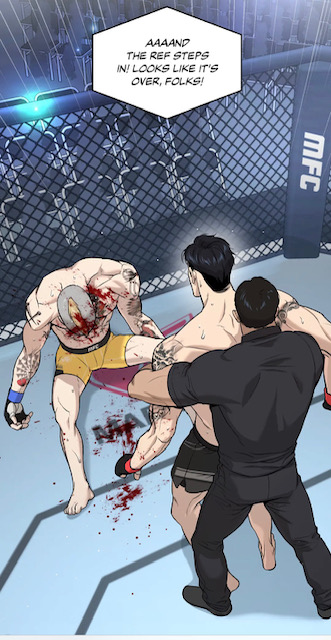 (chapter 15) strongly parallel the detached, high-pressure environment of MMA fighting. Joo Jaekyung, trained relentlessly since youth, embodies this world’s harshness, where vulnerability is a luxury rarely afforded.
 (chapter 59) suggests that Joo Jaekyung might reclaim his authentic self through activities like swimming, reconnecting with nature, and symbolically planting the seeds for a new life. Kim Dan, who cannot swim, learns from Joo Jaekyung, and together, they forge a path toward mutual healing and immortality—not in the literal sense but through finding their “soul” and purpose.
 (chapter 56) The city represents the oppressive expectations and artificial constructs that have shaped Joo Jaekyung and Kim Dan’s lives. By meeting again in the ocean, they reconnect with a more authentic and unburdened version of themselves. This transition echoes the little mermaid’s connection to the natural world as a place of solace and transformation.
 (chapter 59) They imagined that Kim Dan would be better off without Joo Jaekyung
  (chapter 58), but this assumption reveals their failure to truly understand Kim Dan’s plight. Their ignorance ties them to the selfishness and guilt that mark the couple in the fairy tale. Despite their faults, however, their actions indirectly contribute to Kim Dan’s transformation.
 (chapter 15) his kiss with Joo Jaekyung, shared in the locker room, was both an act of protection and a pivotal moment in their dynamic. Like the mermaid’s unforgettable first kiss with the prince (when he was rescued), Joo Jaekyung’s kiss in the locker room was an act of initiation, driven by his “fears” and sense of responsibility, reflecting his growing attachment to Kim Dan. The kiss symbolized his struggle to connect and protect, even as he grappled with his emotional restraint. The locker room, a symbol of physical endurance and vulnerability
 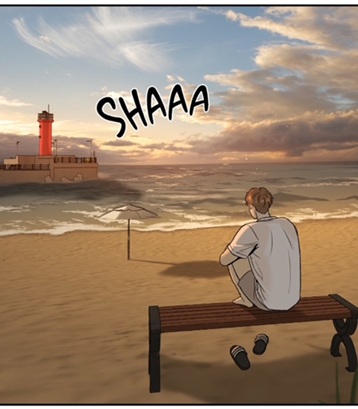 (chapter 59) finding light not in others but within himself. Through his hardships, he gains the strength to pursue his own identity and agency.
 (chapter 49) The maknae’s tears are an indication that he is no mermaid, but a human, I would even say, he still has the soul of an innocent boy.
 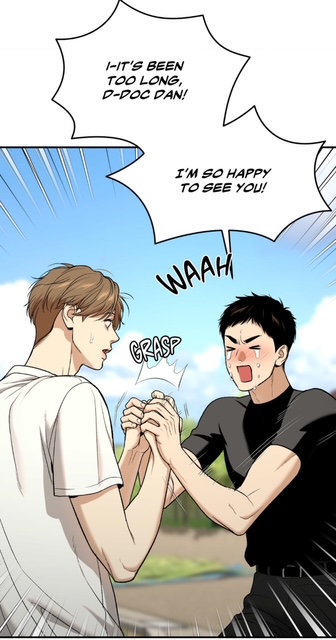 (chapter 58) reminding me of the princess looking for the voiceless mermaid. It is clear that in both stories, the mermaid left traces in the humans’ hearts.
  Bebebisous33s' analyses in K-Dramaland and Manhwas