
Please support the authors by reading Manhwas on the official websites. This is where you can read the Manhwa: Jinx But be aware that the Manhwa is a mature Yaoi, which means, it is about homosexuality with explicit scenes. Here is the link of the table of contents about Jinx. Here is the link where you can find the table of contents of analyzed Manhwas. Here are the links, if you are interested in the first work from Mingwa, BJ Alex, and the 2 previous essays about Jinx The Hot Sparks and Feverish Reality part 1 – part 2 and The Secrets Behind The Floors
It would be great if you could make some donations/sponsoring: Ko-fi.com/bebebisous33 That way, you can support me with “coffee” so that I have the energy to keep examining Manhwas. Besides, I need to cover up the expenses for this blog.

They Held Hands, But…
They held hands.
They held hands.  (chapter 87)
They are so cute. 😍
This refrain summarizes much of the immediate reaction to the chapter. Attention clustered around the opening scene: the quiet morning moment in which the champion squeezes the doctor’s hand after asking for luck.  (chapter 87) The intimacy of the gesture (chapter 87), its tenderness, and its symbolic weight were widely commented on—sometimes to the exclusion of almost everything else.
In the aftermath of the chapter, the author Mingwa herself remarked on this reception. On X, she noted—half amused, half ironic—that although Baek Junmin appeared  (chapter 87) and an entire match took place, readers were largely talking about the introduction alone. 그나저나 이번화 나름 ㅂㅈㅁ도 나오고 경기도 했는데 다들 맨앞 도입부만 얘기하셔서 너무나 커엽군요,, (손잡았어 웅성웅성) Mimicking the collective reaction with a playful “They held hands!”, she described this selective focus as 커엽군요—not reproachful, but gently teasing.
This imbalance is understandable. The preceding chapters centered predominantly on the main leads  (chapter 84) and the progression of their relationship, attuning readers to intimacy
 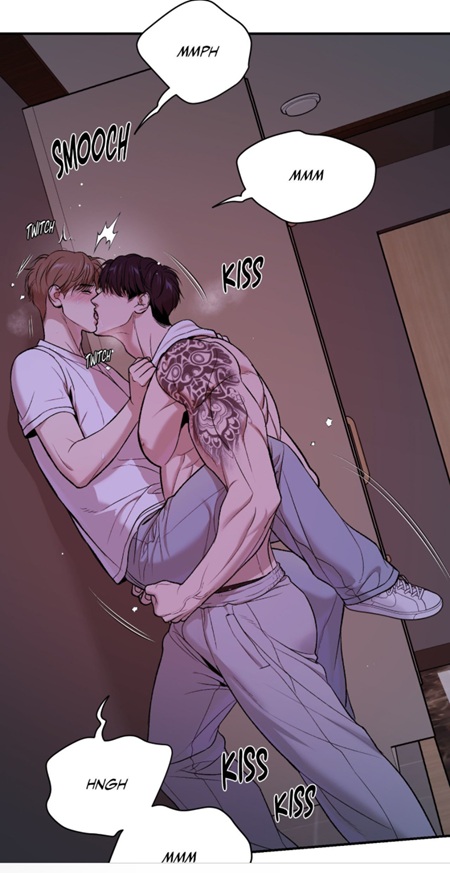 (chapter 85), care, and emotional release. When the chapter opens with a tactile, reassuring gesture, it naturally confirms that reading mode. The squeeze feels like a culmination.
Yet the chapter does not end there. By focusing almost exclusively on that moment, readers risk overlooking the significance of the final scene 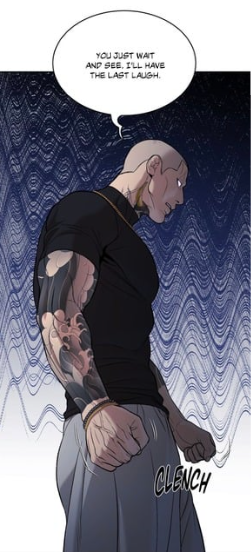 (chapter 87), where a very different gesture unfolds.
 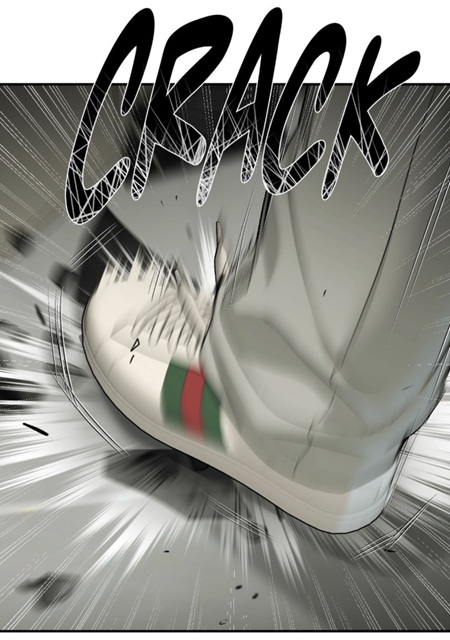 (chapter 87) There, Baek Junmin rejects restraint, pushes away guidance, and verbalizes a resolve shaped not by trust or release, but by anger and revenge. (chapter 87) This closing moment is not incidental; it is placed in deliberate contrast to the opening.
The chapter is structured around these two gestures. One dissolves a belief rooted in ritual and control, the champion’s jinx. The other inaugurates a trajectory driven by wounded pride and escalation. Read together, they form a single movement—one that unfolds between a squeeze (chapter 87) and a crack (chapter 87).
Between a Squeeze and a Crack: Two Gestures, Two Logics
The chapter is structured around two gestures that appear simple, almost inconspicuous, yet articulate two radically different ways of relating to control, desire, and action.
One is a squeeze of the hand. (chapter 87) The other is the crushing of glass underfoot. (chapter 87) Between them unfolds a decisive split. The squeeze is not an act of domination. It is measured, contained, and reciprocal —an act of protection. The champion’s hand does not merely touch the physical therapist’s; it covers it. (chapter 87) The gesture encloses rather than exposes, shielding the other instead of pressing down on him. Force is present, but it is regulated and oriented toward care. The champion does not grasp to hold on longer than necessary; he squeezes, then stops. The gesture culminates in a line that matters far more than it seems at first glance: “That’ll do.”  (chapter 87) This sentence marks a limit. It is not indifference, but acceptance. The champion has just registered the doctor’s surprise
  (chapter 87) — the slight jolt, the hesitation—and he responds by stopping. The restraint is not automatic; it is chosen. He does not ask for more reassurance, more certainty, or more support, even though he clearly desires it. Instead, he recognizes sufficiency.
What unfolds here is a careful negotiation between selfishness and selflessness. (chapter 87) The gesture still serves his need—he seeks strength, grounding, and reassurance—but it refuses to extract more than the other can freely give. (chapter 87) He allows himself to receive without insisting, to take comfort without turning it into a demand. Let’s not forget that after the tap, doc Dan had already started moving his hand away, though his fingers were brushing slightly his.  (chapter 87) So the doctor’s support was indeed limited in time. So the stop of the champion ‘s squeeze (chapter 87) is therefore not a withdrawal, but an ethical adjustment: the moment at which desire acknowledges the other’s boundary and accepts it as final.
In that sense, the squeeze does not prove generosity; it proves restraint. It shows a willingness to carry what remains unmet rather than convert it into pressure. This is why the gesture concludes where it does. Not because the need disappears, but because it is no longer permitted to override respect.
In doing so, he abandons the logic that previously governed him—the belief that repetition, ritual, or escalation could secure an outcome. He would have sex, until his partners passed out. 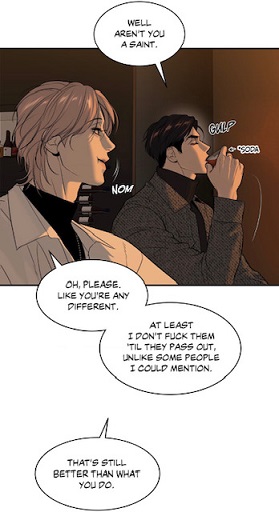 (chapter 33) Humbleness here (chapter 87) is not merely the expression of modesty, but the conscious recognition of limits: the willingness to accept uncertainty without compensating for it through excess, and the refusal to impose oneself on another. The gesture exposes a desire for respect toward Kim Dan; the champion knows his shyness and calibrates his touch accordingly, stopping before closeness turns into coercion. (chapter 87) The hand, as an instrument, reinforces this meaning. It reaches horizontally toward another human being. It creates proximity, connection, and grounding.
 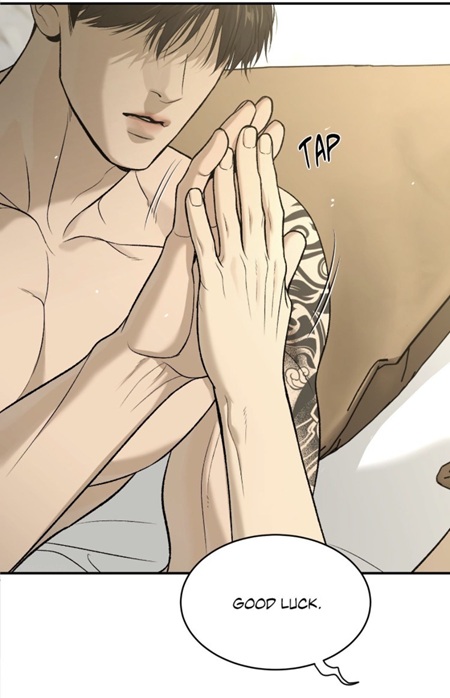 (chapter 87) Nothing mediates the gesture. There is no object, no talisman, no substitute. Meaning is produced entirely through contact.
The final gesture operates according to the opposite logic. (chapter 87) The foot does not protect; it exposes. It descends vertically, asserting weight rather than relation. Where the hand encloses, the foot bares. The glass shatters under pressure, turning reflection into sharpness. What was once a surface becomes a source of wounds. It does not regulate force but releases it. Where the hand stops (chapter 87), the foot escalates. (chapter 87) The glass shatters, not to restore anything, but to discharge tension. This is not violence directed at a person, yet it is unmistakably expressive. It replaces connection with spectacle and containment with excess. Unlike the squeeze, the crack does not conclude itself. It invites continuation. The gesture is driven not by sufficiency, but by the refusal of “enough.” Here, greed is not merely material; it is existential. It manifests as the desire for the last word, total vindication, and unrestrained agency.
The contrast extends beyond movement into atmosphere. 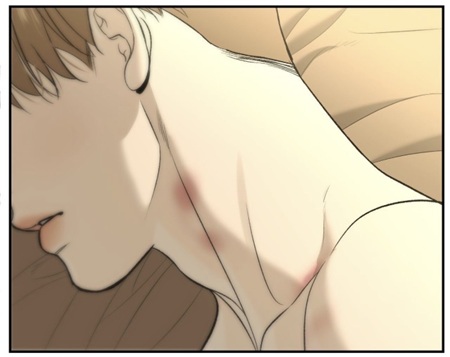 (chapter 87) The opening scene unfolds in a space that feels inhabited and shared, composed in softer shades that emphasize stillness and presence. The final scene is colder, darker, sharper.
 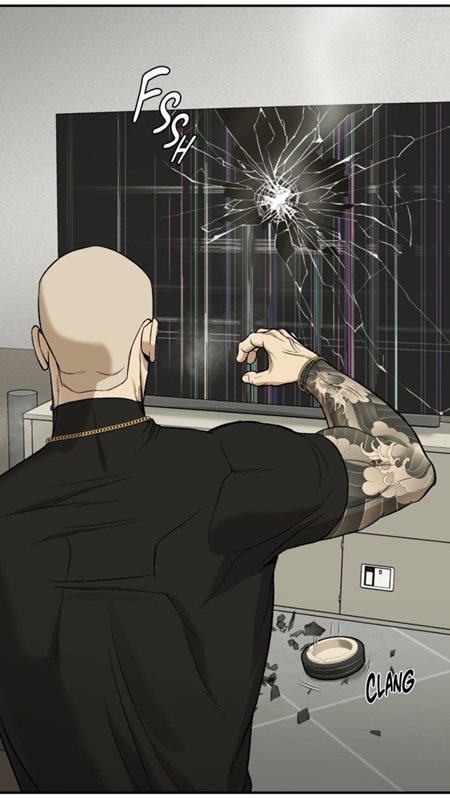 (chapter 87) Motion replaces quiet. An object enters the frame, absorbing force and redirecting it away from human contact. Where the first scene restores continuity—between bodies, between effort and outcome, between present and future
 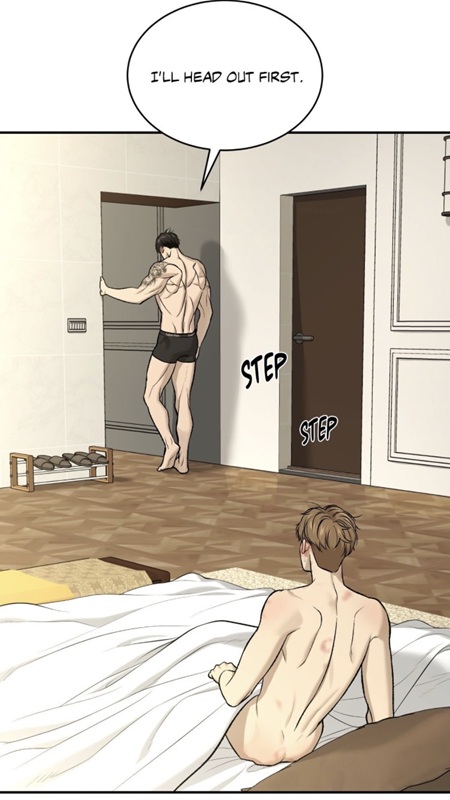 (chapter 87) —the second collapses time inward. Baek Junmin does not act toward what is coming; he reacts toward what has already been. His violence is not exploratory but recursive.
 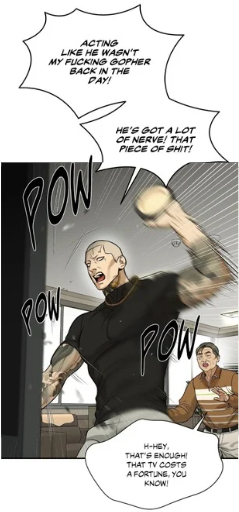 (chapter 87) It invokes the past as a template, attempting to reinstate an earlier hierarchy in which domination was secure and uncontested.
The gesture is therefore not simply destructive, but regressive. By striking, he tries to repeat a former position—acting like he wasn’t my gopher back in the day—as if the present could be coerced into mirroring that memory. This is why moderation is impossible. Repetition does not recognize limits; it demands reenactment. What breaks under this logic cannot be repaired because it was never oriented toward the future in the first place. It leaves only fragments—evidence of an attempt to overwrite change rather than accommodate it.
What ultimately sharpens the contrast between the two gestures is not only the difference between hand (chapter 87) and foot (chapter 87), but the difference between human presence and object substitution. In the opening scene, meaning emerges exclusively between two people. Nothing stands in for the other; nothing absorbs the gesture on their behalf. The squeeze requires mutual presence and ends precisely because it is shared. Its limit is ethical as much as physical. The final gesture unfolds in the absence of such reciprocity. Baek Junmin does not direct his force toward another human being, but toward an object. This displacement is not incidental. The object absorbs what no one else does. It becomes the recipient of rage, humiliation, and wounded pride. In doing so, it exposes a fundamental loneliness. Violence no longer seeks recognition from another person; it settles for impact.
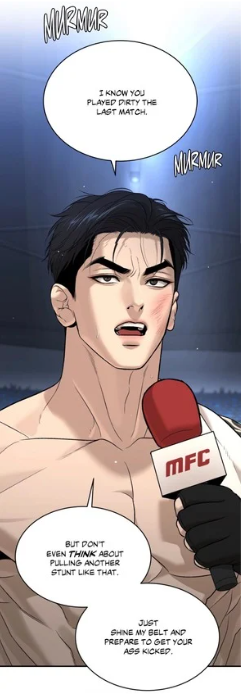
The object in question matters. The Shotgun does not destroy a random item, but a television screen 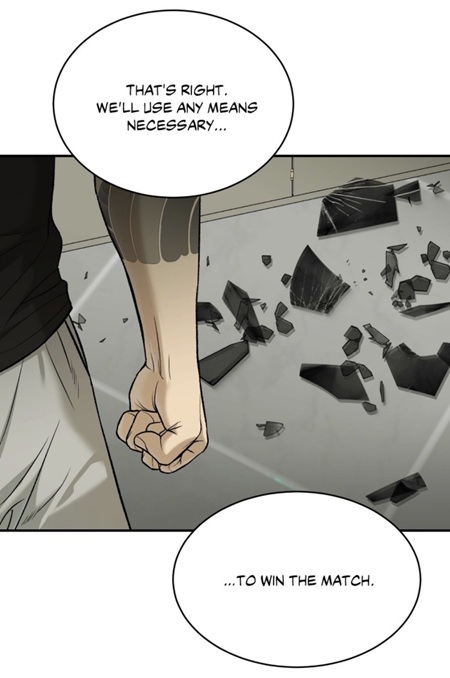 (chapter 87)—the very surface on which images circulate, words are fixed, and visibility is regulated. The screen does not reveal truth; it organizes perception. It is where victories are staged, reputations stabilized
 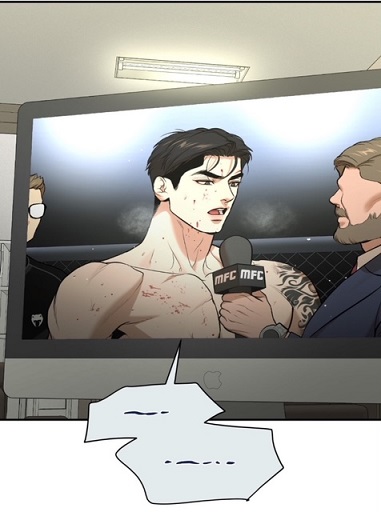 (chapter 46), and statements acquire permanence through broadcast.
  (chapter 87)
By turning on the screen, The Shotgun does not challenge the system itself (chapter 87); he reacts to what it has already done to him. What breaks is not the logic of spectacle, but his ability to endure exposure. The screen cracks, yet remains standing. This first rupture interrupts the image, but not its effect. The words spoken through it persist. They cannot be retracted, reframed, or silenced after the fact.
Thus he strikes again. (chapter 87) Using the ashtray, the “demon” shatters the screen into debris. At this point, the object has already lost its function. The broadcast is long over; the image is long gone. Yet the violence continues. He steps forward and crushes the remaining black shards underfoot (chapter 87), as if determined to annihilate even the remainder. The escalation exceeds necessity. It is no longer about disabling a device, but about confronting something that refuses to disappear.
This escalation becomes even more revealing when read against the opening sequence of the chapter. The three acts of destruction mirror, in distorted form, the three steps through which closeness was established earlier. In the morning scene, proximity unfolds gradually and remains contingent on consent: first the whisper 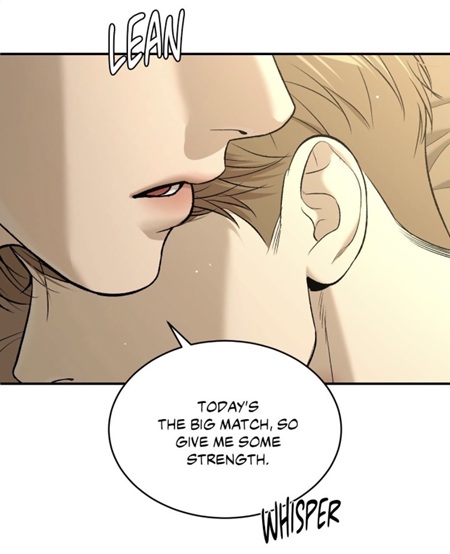 (chapter 87), then the pause; then Kim Dan’s tentative tap (chapter 87); finally the squeeze (chapter 87), held only until it must stop. Each step waits for response. (chapter 87) Each movement depends on acknowledgment. The sequence concludes because it recognizes a limit.
At the office of director Choi Gilseok (chapter 87), the same tripartite structure is emptied of reciprocity. The first strike cracks the surface. The second shatters it into debris. The third crushes what remains. Where the opening scene pauses, this one accelerates. Where the whisper waits, the blow overrides. Where the squeeze ends itself, the violence repeats because it cannot conclude. The symmetry is formal, but the logic is inverted: one sequence builds relation through restraint; the other pursues erasure through excess. (chapter 87) In the latter, escalation is uninterrupted. At no point does Director Choi Gilseok intervene. He does not place a hand on Baek Junmin’s shoulder again, does not issue a command, does not impose a limit. (chapter 87) Whether he has already left the room or chooses deliberate avoidance is ultimately secondary. What matters is the absence itself.
That absence exposes a failure of containment. Authority is present in name, but not in function. Choi Gilseok cannot—or will not—stop his fighter. His invisibility transforms into passivity and complicity, not because he endorses the violence, but because he allows it to proceed unchecked. Power here no longer circulates through guidance or control; it dissolves into abdication. Yet this abdication is not uniform. It is selective.
Earlier in the narrative, Director Choi reacts strongly when his authority is verbally challenged. 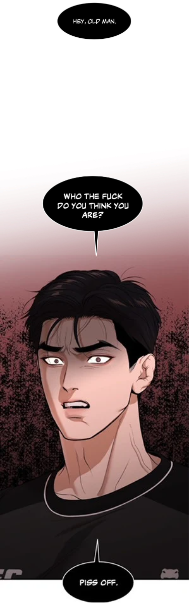 (chapter 49) When Joo Jaekyung addresses him with open disrespect, the breach of seniority provokes immediate outrage.
  (chapter 49) Intervention follows quickly. The insult is not tolerated
 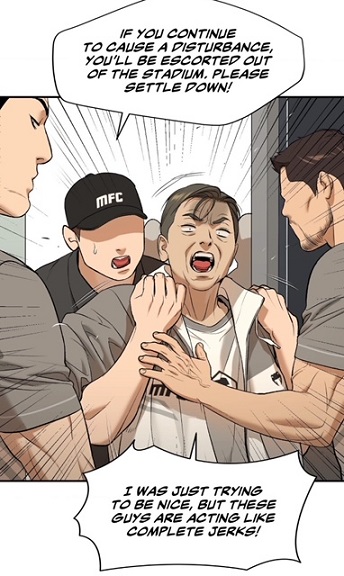 (chapter 49) because it threatens hierarchy itself. Choi’s anger is genuine in that moment and it reveals what he truly guards: status, order, and the visibility of respect.
In contrast, Baek Junmin’s behavior provokes no such response. He brushes past instructions (chapter 87), slaps away physical restraint  (chapter 87), and continues escalating without repercussion (chapter 87). The difference is telling. Where Choi once asserted authority to defend rank, he now withdraws it in the face of volatility. Baek’s aggression does not offend hierarchy in the same way; instead, it destabilizes it. And Choi does not confront destabilization. He avoids it.
A final irony sharpens this configuration of power. Neither Choi Gilseok nor Baek Junmin is aware of the protagonist’s true rank.  (chapter 78) Both continue to perceive Joo Jaekyung as nothing more than a fighter (chapter 87) —talented, profitable, but ultimately subordinate.
  (chapter 87) This assumption governs how they speak to him, how they threaten him (chapter 49), and how they imagine their leverage over him.
Yet this perception is false. Joo Jaekyung is not merely an athlete within the system; he occupies the same structural level as those who presume to manage him. He is the owner of Team Black. His position aligns not with fighters, but with directors. The irony lies in the fact that the system itself enables this misrecognition. Authority is not distributed according to legal ownership, but according to visibility and habit.
This is already visible earlier, when the “hyung” attends directors’ meetings on the champion’s behalf. 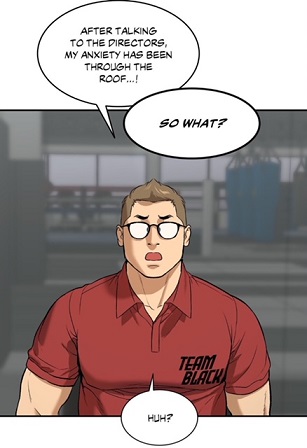 (chapter 46) His presence creates a convenient fiction: those around the table come to believe that he is the owner, or at least the one who truly governs the gym. Joo Jaekyung’s absence is interpreted not as autonomy, but as immaturity or dependence. Authority, once again, attaches itself to performance rather than reality.
The warning issued by the gym’s leadership makes this distortion explicit. 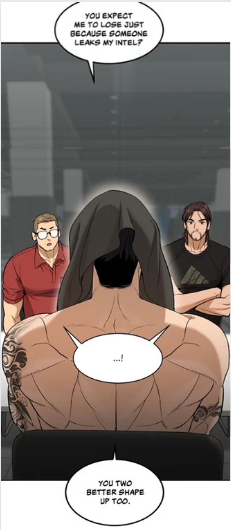 (chapter 46) Even after boundaries are formally stated, Park Namwook continues to rely on seniority to address the champion
  (chapter 46) as if he were a child or an employee—someone to be corrected, instructed, and disciplined. The warning does not alter behavior because it does not challenge the underlying assumption: that Joo Jaekyung’s place is below them.
This misreading has consequences. Because Choi Gilseok and Baek Junmin both believe they are dealing with a fighter who must answer to managers, coaches, and institutions, they overestimate their capacity to contain him. They imagine leverage where there is none. They threaten exposure, punishment, and exclusion—tools that function only if the target depends on the system for legitimacy.
What they fail to see is that Joo Jaekyung no longer does. He doesn’t care about his image after challenging Baek Junmin. 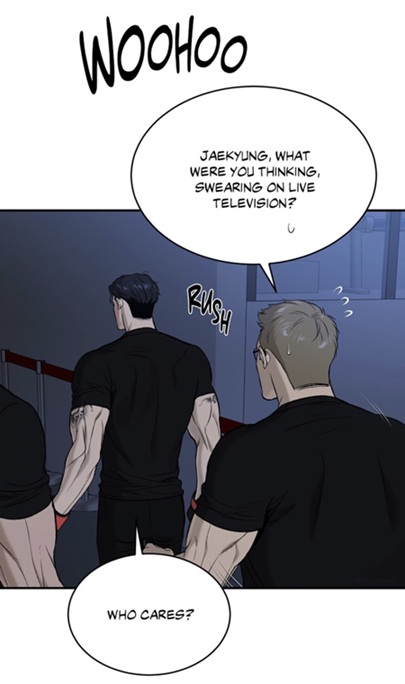 (chapter 87)
But let’s return our attention to the scene at the gym office. (chapter 87) This asymmetry exposes the limits of Choi Gilseok’s power. His authority functions only when obedience is already plausible. It depends on recognition rather than enforcement. When faced with a figure who neither seeks approval nor acknowledges restraint, Choi’s authority collapses into silence. The absence of intervention is not neutrality; it is an admission of impotence.
In that sense, Baek Junmin is not merely uncontrolled — he is uncontrollable within the existing structure. Choi’s refusal or inability to intervene reveals that the hierarchy he enforces is performative, not structural. It governs appearances and etiquette, not escalation or consequence. What remains once those appearances are ignored is not authority, but avoidance.
This is why Choi’s passivity matters narratively. By failing to stop Baek, he becomes an accomplice to excess without ever authorizing it. He does not direct violence, but he creates the conditions under which it can proceed. Power, here, does not flow downward or circulate relationally; it evaporates at the moment it is most needed.
In this sense, Baek Junmin is not merely acting out of rage. (chapter 87) He is acting in a vacuum created by institutional withdrawal. Thus the thug starts talking to himself loudly. This is not a dialogue, but a monologue. It was, as if he was trying to reassure himself about his power and connection. The director’s inability to regulate his “star” mirrors the waves in the last panel. An ocean can not be contained or restrained. In addition, his lack of restrain reflects the broader collapse of moderation within this economy. Where restraint once required oversight, its absence permits excess to define the relationship. What unfolds is not rebellion against authority, but the revelation that authority was already hollow.
This repetition is revealing. Each act answers the same stimulus, yet fails to neutralize it. The destruction does not bring release because the provocation was never material. The television has already fulfilled its role; the words spoken live cannot be undone. 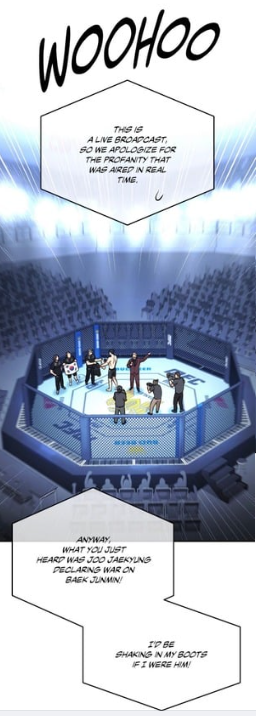 (chapter 87) What Baek attempts to destroy is not the object, but what it represents: the irreversibility of public speech, the collapse of secrecy, the loss of narrative control.
The black glass fragments make this failure visible. (chapter 87) They do not restore darkness; they scatter it across the floor. The act does not erase visibility but multiplies its traces into debris. This is not a cleansing destruction. It is an attempt at erasure that arrives too late, producing residue instead of resolution.
Seen in light of Baek Junmin’s habitual reliance on whispers  (chapter 49), handshakes, and private humiliation
 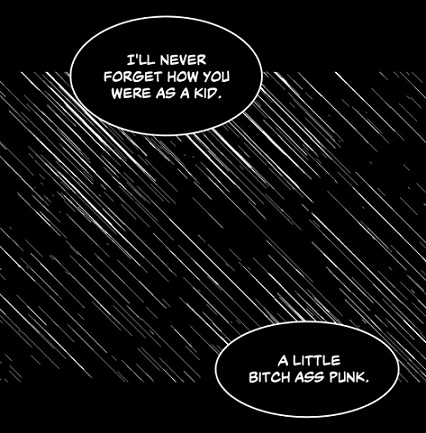 (chapter 49), the gesture becomes clearer still. He is accustomed to violence without witnesses, to domination shielded by proximity and secrecy. He was always the man in the shadow. The live broadcast deprives him of that refuge. (chapter 87) For the first time, he is confronted with words that circulate beyond his control.
Both sequences 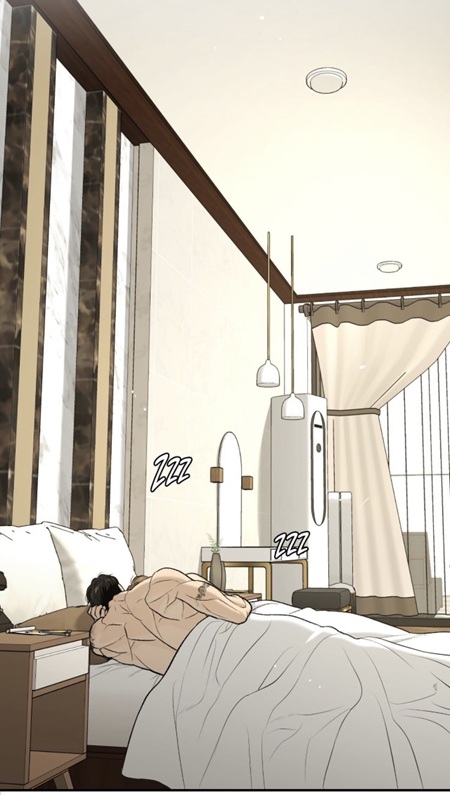 (chapter 87) also unfold under the sign of privacy. (chapter 87) Nothing from either scene is leaked to the audience within the story. No cameras intrude on the morning room; no spectators witness the destruction that follows. In both cases, what happens remains offstage, contained within enclosed spaces.
Yet the function of privacy differs radically. In the opening scene, privacy protects vulnerability. It creates a space in which hesitation, consent, and restraint can exist without performance. The absence of witnesses allows closeness to remain unexploited and unrecorded. Privacy here is not concealment, but care. (chapter 87)
The destruction scene also takes place out of view, but for the opposite reason. Privacy no longer shelters vulnerability; it shields waste. Hence the thug used an ashtray to damage the TV screen. The object exposes the truth about this gym: it is just a cover for thugs. Additionally, the ashtray allows violence to escalate without immediate consequence, to repeat without interruption. What is hidden is not intimacy, but loss of control. The same absence of witnesses that preserves dignity in one scene enables denial in the other. This parallel sharpens the contrast further. Privacy is not neutral. It amplifies what already governs the gesture. Where restraint is present, privacy sustains it. Where limits have collapsed, privacy becomes an accomplice.
What surfaces here (chapter 87) is not pure aggression, but fear. Rage functions as its mask. The insistence, the repetition, the overkill all point to an inability to tolerate being seen, named, and fixed in public space. Crushing the screen is not an assertion of power, but a response to exposure—a desperate attempt to silence what can no longer be taken back.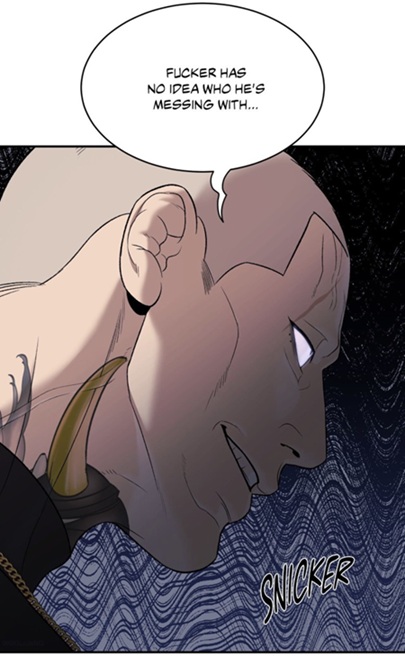 (chapter 87) He is announcing a shift of identity.
Up to this point, Baek Junmin still oscillated between two positions: the shadow fighter 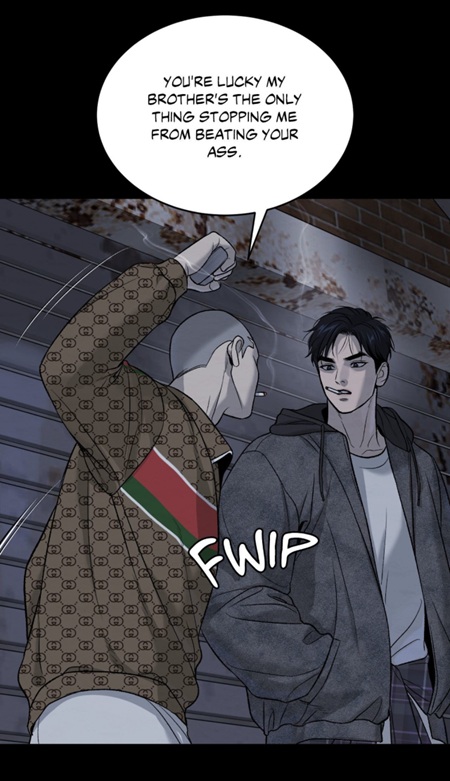 (chapter 74) seeking legitimacy, and the underground enforcer shaped by violence, order and debts
 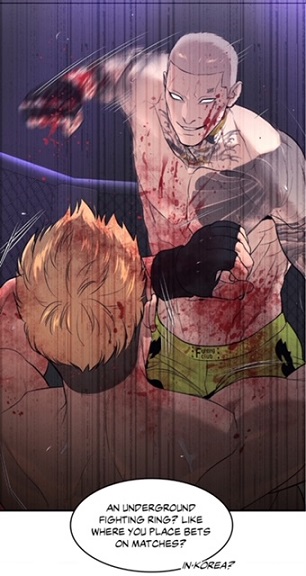 (chapter 47). The broken screen already signaled that he no longer cares about how he is seen. (chapter 87) This line confirms what replaces that concern. He is ready to be seen as he is, without mediation, without justification. Leaving the shadow does not mean entering the light. It means abandoning concealment.
What he exposes are not hidden virtues, but true colors. The phrase is not a threat designed to intimidate an opponent into caution; it is a declaration of readiness to abandon restraint. He no longer intends to pass as a disciplined athlete governed by rules, training, or institutional limits. He is prepared to act as a bully and criminal —someone for whom violence is not a means within a system, but an identity in itself.
This is why the line follows the destruction of the screen so closely. (chapter 87) Once image no longer matters, there is nothing left to protect. Reputation, legitimacy, and future standing cease to function as brakes. What remains is the body and its capacity to harm. The statement therefore does not project confidence about the outcome of a match; it projects indifference toward consequences. In that sense, Baek Junmin is not stepping out of the shadows to claim recognition. He is stepping out to remove the mask. The system demanded that he appear controlled, profitable, and presentable. 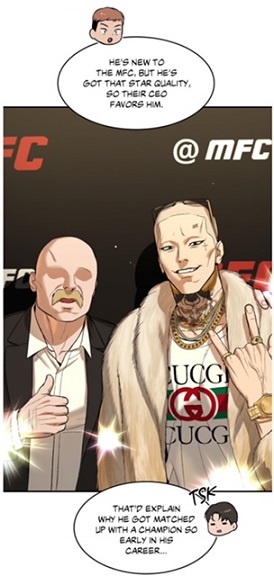 (chapter 47) By rejecting visibility and embracing excess, he also rejects the last requirement that tied him to that system.
What he is ready to expose is not truth, but himself.
Just as importantly, the damaged object does not belong to him. (chapter 87) Baek Junmin does not need to clean the mess, replace the screen, or account for the damage. He can afford indifference because responsibility is externalized. This is where materialism enters the gesture. (chapter 87) In his logic, what is destroyed can be replaced—by money, by compensation, by someone else’s labor. The gesture therefore carries no sense of loss. It is pure discharge. Where the hand-holding scene ends in sufficiency (chapter 87), this act ends in non-attachment. That non-attachment is not freedom; it is dispossession. Because nothing belongs to him, nothing binds him. The violence does not commit him to consequence. He does not have to stay, repair, or answer. (chapter 87) The object takes the blow and disappears from relevance, just as people do in his worldview once they cease to be useful or respectful. This is why the destruction feels so pronounced. It is not driven by concern for outcome. Baek Junmin does not care whether the screen works afterward, just as he does not yet care how events unfold. What matters is the act itself—the assertion that he can still act, still impact, still dominate a space that otherwise refuses him recognition. Under this new light, it becomes palpable that Baek Junmin’s resent and rage represent a liability to Choi Gilseok and his backers, the pharmaceutical company.  (chapter 48) And their collaboration is founded on money laundering!! The shooting star is in reality (chapter 47) a meteor bringing calamity, once it lands on the Earth. Baek Junmin is about to face “reality” very soon.
Placed next to the opening scene, this contrast becomes stark. (chapter 87) There is no money, no power… between them. One gesture creates meaning because it acknowledges another human and accepts limitation. The other destroys an object precisely because no human is there to receive the force. One restores continuity; the other exposes isolation. Between them, the chapter reveals not only two trajectories, but two economies of value: one grounded in presence, the other in replacement.
Two pairs, two economies of power
What ultimately distinguishes the two dynamics is not intimacy versus violence, but how power is situated and what it depends on. In one case, power emerges through limitation; in the other, it is sought through displacement. The difference is not emotional, but structural. In the morning scene, power does not circulate vertically, but it also does not dissolve into symmetry. What changes is not the existence of power, but its source.
When the champion leans in and whispers, (chapter 87), he is not performing vulnerability for reassurance, nor delegating responsibility. He is explicitly naming Kim Dan as his source of energy. This matters. In earlier chapters, strength was something to be extracted through action—through sex, repetition, or coercive certainty 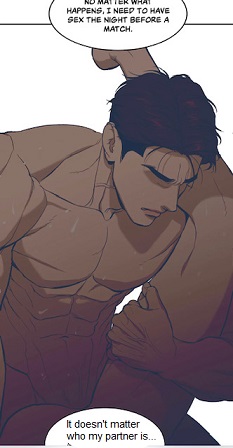 (Chapter 2). Here, strength is no longer something he takes. It is something he receives. (chapter 87)
This is not a weakening admission. It is a reorientation. The champion does not ask Kim Dan to guarantee victory, to protect him from loss, or to secure the outcome. He asks for presence. What sustains him is no longer a ritualized act performed on another body, but the continued existence of a relationship in which he is accepted despite his flaws.  (chapter 87) Kim Dan sleeping openly, showing his face, remaining there without fear—this is read by the champion as tacit trust. That trust becomes energy. In other words, this scene serves as the positive reflection of the argument in the locker room:
  (chapter 51)
The jinx (chapter 87) collapses precisely here. The old belief system operated on compensation: anxiety required action; uncertainty demanded escalation. Sex functioned as a mechanism to overwrite doubt. In this scene, no such mechanism is activated. The chapter makes this shift legible through space. When the champion rises from the bed, his movement is shown in full: he steps away from Kim Dan and crosses the room. (chapter 87) Yet he does not open the brown door. There is no pause at the threshold, no transition panel suggesting entry into another enclosed space. Instead, the next frame places him directly in the living area of the suite. The cut is continuous, not elliptical.
This matters because the brown door cannot be the suite’s entrance. (chapter 87) We have already seen the entrance elsewhere, and its placement does not align with this angle or proximity to the bed. Within the logic of a hotel suite, the remaining option is functional rather than transitional: the bathroom. In earlier chapters, that space was explicitly associated with ritual 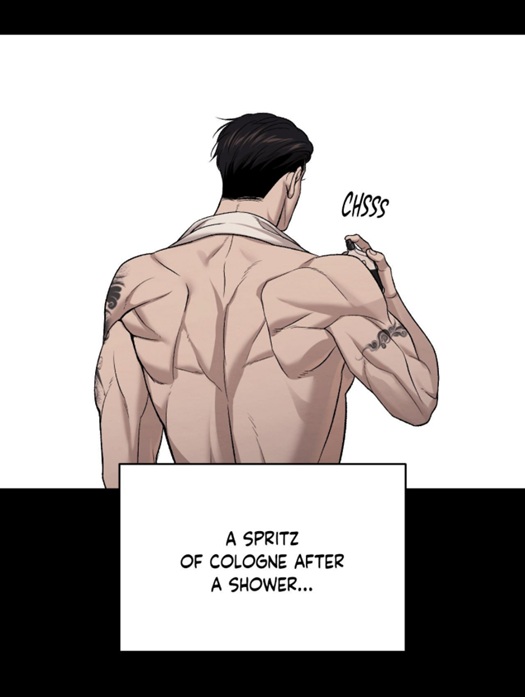 (chapter 75) —showering, cologne, self-regulation before a match. Here, that sequence is conspicuously absent.
The absence is not neutral. Mingwa does not show him choosing another ritual; she shows him skipping one. (chapter 87) No water, no mirror, no scent. The champion moves forward without cleansing, without recalibration, without the preparatory gestures that once framed his readiness. The bathroom—previously a site of purification and self-conditioning—remains closed, unused, and irrelevant.
What replaces it is not another ritual, but continuity. He enters the shared living space already grounded. The confidence he carries does not come from resetting himself, but from what has already occurred. Kim Dan’s presence, his sleep, the unguarded exposure of his face—all of this has already done the work that ritual once performed. There is nothing left to correct, neutralize, or overwrite. To conclude, this omission is not accidental. By abandoning the shower-and-cologne ritual, the champion abandons the idea that he must transform himself to be worthy of victory or public acceptance. He no longer needs to sanitize desire, image, or fear. What sustains him has already been secured before the match begins: recognition without conditions.
Power, then, is not extracted from superstition, domination, or bodily expenditure. It is grounded in continuity. Kim Dan’s presence does not ensure success, but it makes uncertainty bearable. That is the decisive shift. The champion no longer acts to silence fear; he acts while carrying it. And because he no longer believes that ritual determines outcome, he can later speak freely on live television. He is now confident, as he feels supported by doc Dan. 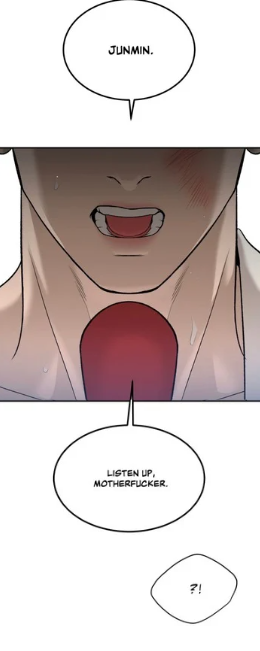 (chapter 87) The profanity is not recklessness—it is evidence that image management has lost its hold. The champion does not stop caring about how he is seen; he narrows the field of recognition. Public perception no longer governs him (chapter 87) because it no longer defines his worth. What matters now is not the crowd, the broadcast, or the institution—but the single person whose presence already secured his sense of legitimacy before the match began. Thus after the match, he asked for the physical therapist’s approval and recognition:
 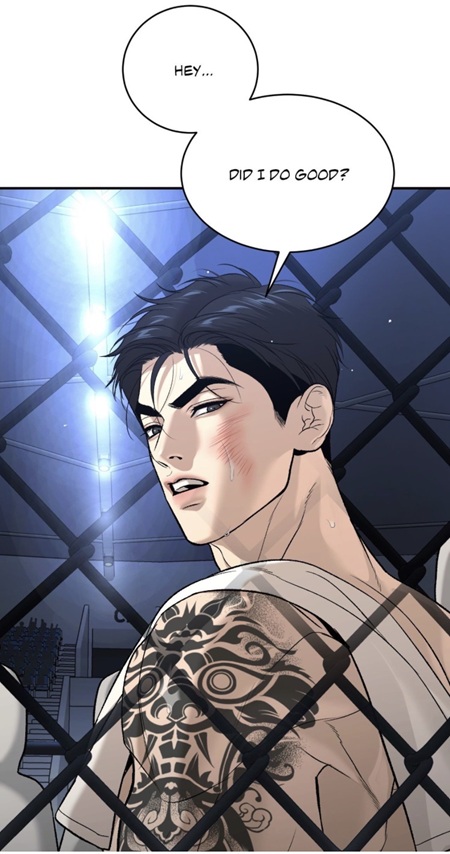 (chapter 87)
In short, the whisper does not mark dependence, but emancipation. (chapter 87) By replacing “I must do something” with “you are here,” the champion exits the economy of compulsion and enters an economy of trust. Victory will still matter—but it no longer needs to be purchased in advance.
The dynamic surrounding Baek Junmin operates differently. His position has always depended on external validation—rankings, victories  (chapter 69), recognition, and above all visibility. Yet this visibility is curiously incomplete. Despite his victory, Baek Junmin is not immediately present as a public figure. He appears as a result
 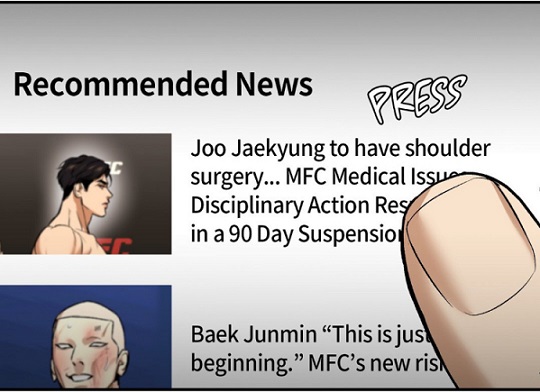 (chapter 52) —his name, his win—but not yet as a narrative subject.
Only later, in episode 77 (chapter 77) does the story formally reveal his identity as champion. Until that moment, he remains strangely undefined, as if held back from full exposure. This delay is not incidental. It reflects a controlled form of recognition: Baek Junmin is allowed to win, but not yet to be seen. It already exposes that his success or victory is not clean.
 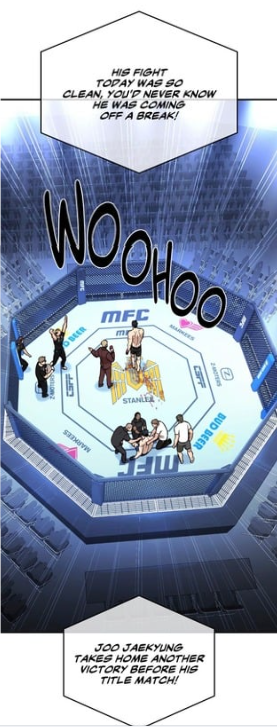 (chapter 87)
In this sense, the former underground fighter has not disappeared, but been contained. His past is not erased; it is suspended. (chapter 47) Visibility is granted selectively, not as self-expression, but as an institutional function. He exists within the system, but not yet fully in the public gaze. Even when violence or illegality intervenes, it does so in service of legitimacy. Until now, Baek Junmin has relied on the legal system 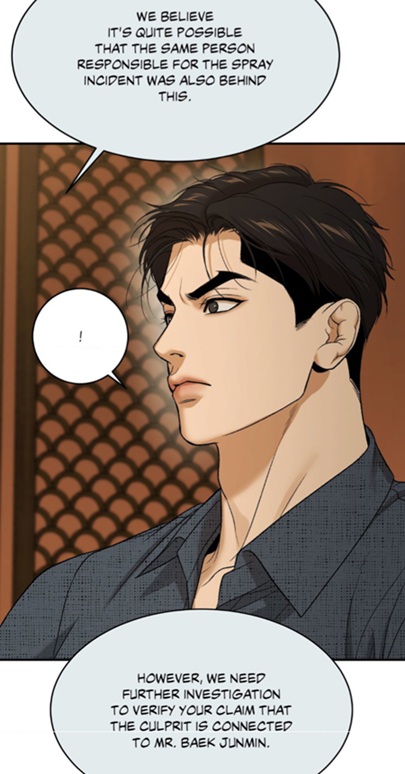 (chapter 69) to carry him forward: sanctioned fights, official narratives, public status. Crimes may occur along the way, but they remain hidden, delegated, or absorbed by others. Power, for him, is something that must appear legitimate, even when it is not.
The destruction of the screen marks the point where this arrangement begins to fracture. (chapter 87) The legal economy no longer guarantees dominance. Public speech escapes control. (chapter 87) Visibility becomes a threat rather than a resource. In response, Baek does not retreat; he escalates. What we witness is not yet a full turn toward the underground, but the precondition for it: the realization that legality no longer secures power. (chapter 87) In this moment, Baek Junmin is no longer speaking as an athlete anticipating a rematch, nor as a rival operating within institutional rules. The phrasing “He has no idea who he’s messing with” does not refer to skill, ranking, or preparation. It signals a different register of power altogether—one that lies outside competition and beyond merit.
The threat is deliberately vague. He does not name a tactic, a plan, or a legitimate advantage. Instead, he invokes reach. The implication is relational rather than athletic: access, leverage, intermediaries. Power here is imagined as something that can be mobilized indirectly, through others, rather than exercised personally. This is where the “angel of death” reading becomes relevant—not as a literal figure, but as a symbolic posture. Baek frames himself as someone whose influence does not require visibility or accountability. Risk is no longer borne by the speaker. It is transferred, outsourced, or enforced through an unnamed elsewhere. Violence becomes atmospheric rather than explicit.
This is where the contrast between the two pairs sharpens. One trajectory exits the economy of compensation—the belief that force, ritual, or excess can neutralize uncertainty. The other moves toward a system where uncertainty is resolved through coercion rather than consent. One abandons the jinx by accepting risk. The other approaches a space where risk is relegated, outsourced, or enforced.
What separates them, then, is not morality, but dependency. The champion no longer depends on systems that promise control. Baek Junmin still does—and when that promise fails, the search for power does not stop. It changes terrain. Up to this point, Baek Junmin’s power has been structurally protected rather than personally secured. His victories, rankings, and public status were carried forward by the legal economy of the sport, even as acts of sabotage or coercion occurred in its margins. Crucially, this system did not require his full awareness to function. Violence was absorbed, displaced, or misattributed by intermediaries, allowing legitimacy to remain intact on the surface. Baek benefited from this arrangement without having to own it. Authority appeared lawful, outcomes appeared earned, and responsibility flowed elsewhere.
That arrangement begins to collapse here. Once public speech escapes control and visibility can no longer be managed retroactively, legality stops functioning as insulation. What follows is not yet a plunge into the underground, but the moment where reliance on institutional protection becomes untenable—and the search for power must change terrain. (chapter 87) Strangely, the director of King of MMA has just assured him his full support (chapter 87), but this was not enough for the “demon”. What the “new champion” failed to realize is that gaining the champion belt didn’t mean the end of his achievement. The reality was and is that he would be challenged constantly. Even when crimes are committed around him 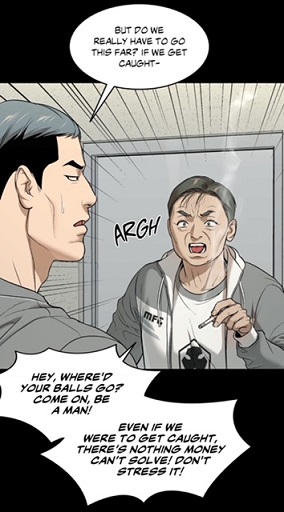 (chapter 50), they remain structurally hidden, absorbed by intermediaries, or misattributed.
  (chapter 69) Violence is laundered through legitimacy. The system continues to present him as a contender, even as it quietly tolerates sabotage and manipulation. Importantly, Baek Junmin does not need to know every detail for this economy to function; it protects him by design.
The scene in chapter 87 marks the moment where this economy begins to fail him. Public speech, live broadcast, and irreversible visibility introduce a variable that cannot be managed retroactively. Unlike clandestine acts or whispered humiliations, what is said on air cannot be displaced, denied, or quietly corrected. The legal system does not offer erasure; it offers record.
This is where the alternative economy becomes legible. Underground fighting (chapter 47), illegal gambling, and criminal enforcement operate on a different logic: outcomes are secured not through recognition, but through coercion and tricks; not through visibility, but through fear and secrecy; not through procedure, but through immediacy. There, a defeat is more like a death sentence. 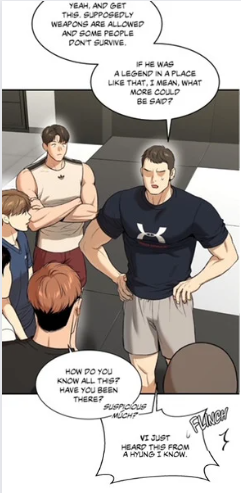 (chapter 47) Where the legal economy requires patience and exposure, the illicit one promises certainty and silence.
By contrast, the champion’s gesture in the opening scene binds him more firmly to the legal economy precisely because it accepts uncertainty. Redistributed power cannot be weaponized quickly. It resists conversion into domination. That resistance is what dissolves the jinx—and what makes the two trajectories incompatible.
This is how mediation works in that relationship. Kim Dan’s presence does not absorb excess; it sets a limit that is respected. Joo Jaekyung does not outsource control. He exercises it on himself.
The dynamic between Choi Gilseok and Baek Junmin operates according to a different economy. Formally, theirs is a boss–employee relationship. 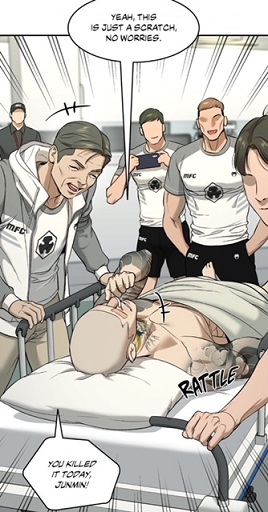 (chapter 52) In practice, hierarchy barely functions. Authority exists without discipline, protection without accountability. Baek Junmin is not positioned among other fighters, nor anchored in a collective. Thus he is not truly celebrated at the restaurant after the tie. Thus the fighters mentioned the director Choi Gilseok’s financial success or the odd behavior of Joo JAekyung.
  (chapter 52) Besides, he watches the match alone (chapter 87), from the director’s office—at the center of power, yet fundamentally isolated. This spatial detail matters. It signals both exclusion and entitlement. He does not belong, but he feels authorized to occupy the space.
When Choi Gilseok touches Baek Junmin’s shoulder, the gesture is corrective. (chapter 87) It is meant to halt escalation, to reassert moderation, to momentarily reintroduce limits. Baek’s response is immediate: he slaps the hand away. (chapter 87) This rejection is not rebellion in the classical sense. He is not trying to overthrow authority; he is refusing mediation. In his mind, limits no longer apply to him. He has been granted license without ownership. It was, as if the championship belt had freed the fighter from social norms and laws. Shortly after, “By all means” (chapter 87) removes the brakes while leaving responsibility elsewhere. It sounds like a free pass for the “criminal” in the end.
The final scene also marks the quiet dissolution of the association between Choi Gilseok and Baek Junmin. Although the director speaks in the plural—“we will use all means necessary”—the scene itself contradicts that claim. Spatially, Choi remains behind Baek, positioned as if backing him, yet excluded from his line of sight. The demon does not turn toward him, does not respond to him, and does not share affect or intent. The “we” exists only rhetorically. In practice, the scene contains only two figures: Baek Junmin and his imagined adversary. The director is already irrelevant.
This staging contrasts sharply with the earlier locker-room confrontation between Joo Jaekyung and Kim Dan,  (chapter 51) where proximity forced acknowledgment and power was renegotiated face-to-face. (chapter 51) In the office, no such negotiation occurs. (chapter 87) Baek Junmin’s refusal is not confrontational; it is dismissive. (chapter 87) He does not reject authority—he bypasses it. The champion belt appears to function, in his mind, as a form of exemption: a signal that dependence, seniority, and mediation no longer apply. Whether this belief is justified remains open. What matters is that Baek Junmin acts as if it were. In doing so, he exits not only a partnership, but the structure that once contained him.
Placed side by side, the two pairs reveal two economies of power. In one, influence circulates through presence, restraint, and mutual risk. In the other, power is maintained through delegation, insulation, and the removal of limits. One dynamic produces responsibility by accepting vulnerability. The other produces entitlement by severing accountability.
This is why the outcomes diverge so sharply. Where one relationship closes a cycle of superstition and control, the other opens a trajectory of escalation and downfall. Not because one side loves and the other hates, but because one accepts limits—and the other has been told there are none.
Feel free to comment. If you have any suggestion for topics or Manhwa, feel free to ask. If you enjoyed reading it, retweet it or push the button like. My Reddit-Instagram-Twitter-Tumblr account is: @bebebisous33. Thanks for reading and for the support, particularly, I would like to thank all the new followers and people recommending my blog.


 (chapter 86), gentle, attentive
 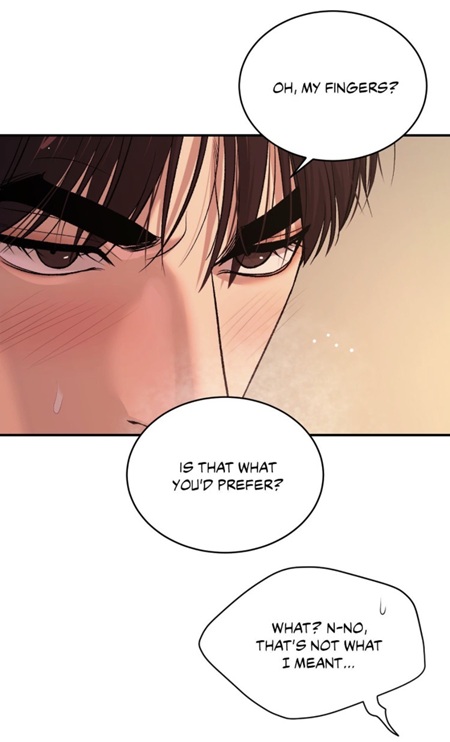 (chapter 86) — asking questions instead of imposing answers
 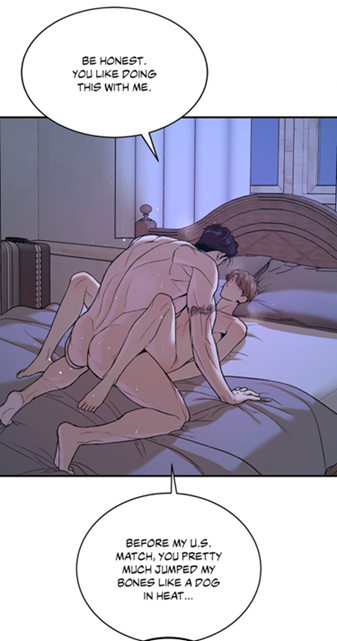 (chapter 64). For Joo Jaekyung’s unconditional stans (and I count myself among them), such an attitude
 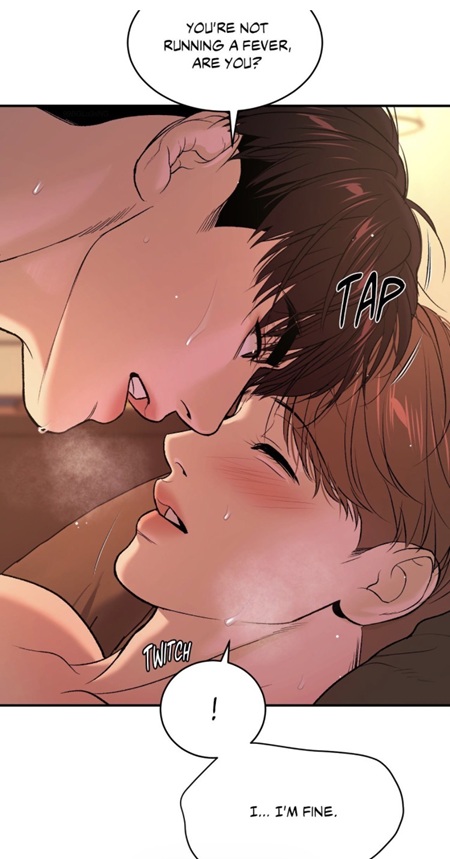 (chapter 86) can easily be read as proof that the protagonist’s good heart has always been existent, but it was barely visible. Compared to earlier chapters, the contrast is now undeniable. And yet, I would like to pause you right there.
 (chapter 61), sometimes awkwardly
 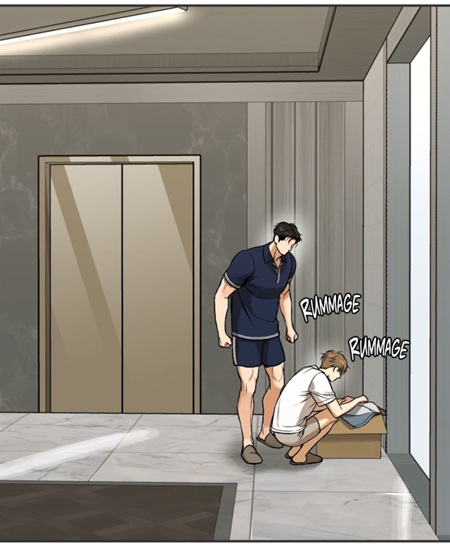 (chapter 80), sometimes inconsistently
  (chapter 79), but unmistakably
 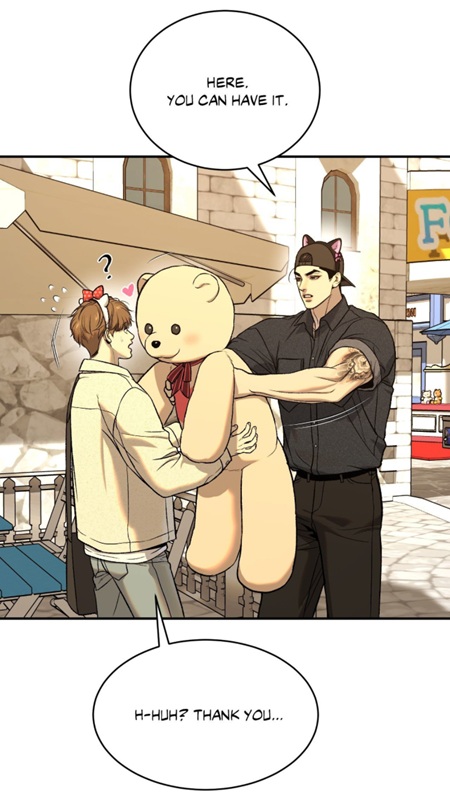 . (chapter 83) Tenderness, concern, even a certain form of devotion had appeared earlier
  (chapter 40), albeit in ways that were often overlooked,
  (chapter 18) misunderstood or poorly timed. This night
 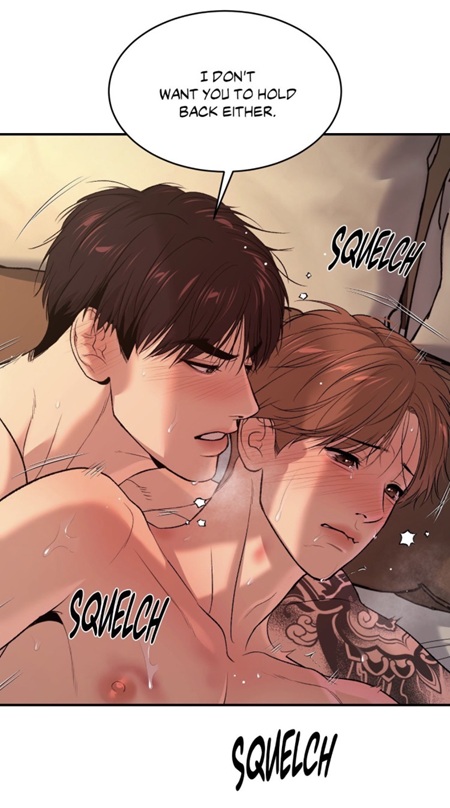 (chapter 86) does not initiate his metamorphosis.
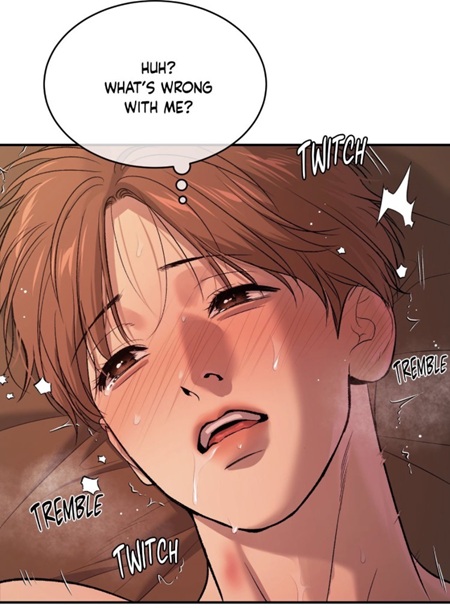 (chapter 86), sparks
 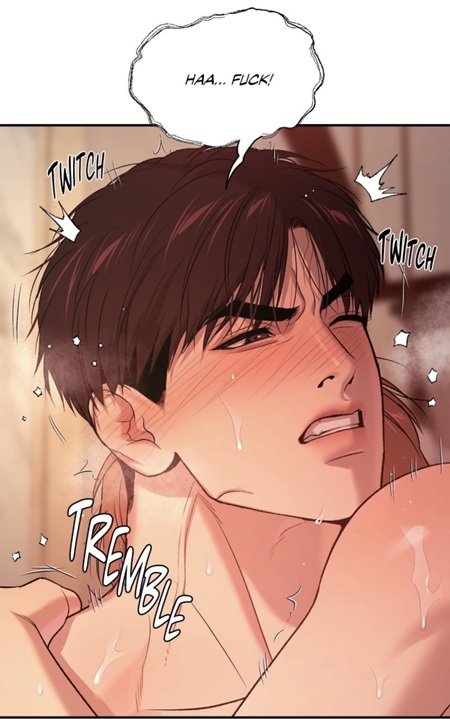 (chapter 86), and softness, many Jinx-philes might instinctively describe it as magical. The imagery invites such a reading. After all, we have seen similar nights before. The night in the States shimmered with illusion
 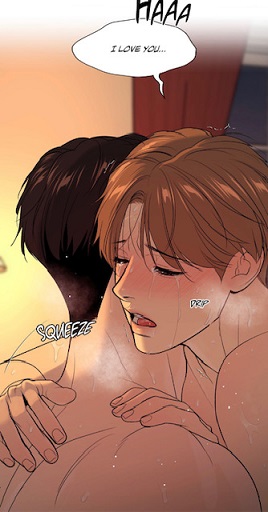 (chapter 39); words were spoken, confessions made — only to dissolve with memory.
  (chapter 41) The penthouse night echoed A Midsummer Night’s Dream
 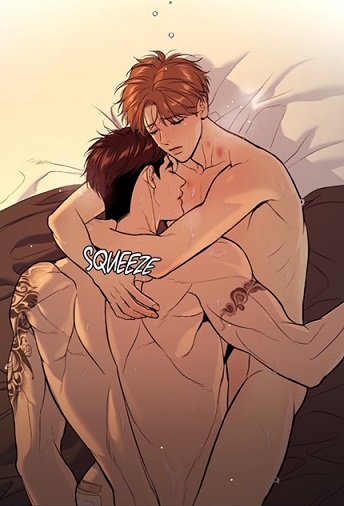 (chapter 44), suspended between intoxication and desire, intense yet fragile. Both nights felt unreal, and both were later reframed as mistakes
 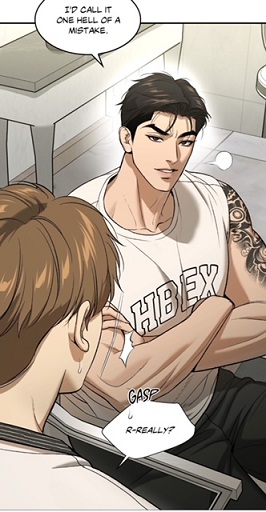 (chapter 41) — moments to be erased rather than carried forward.
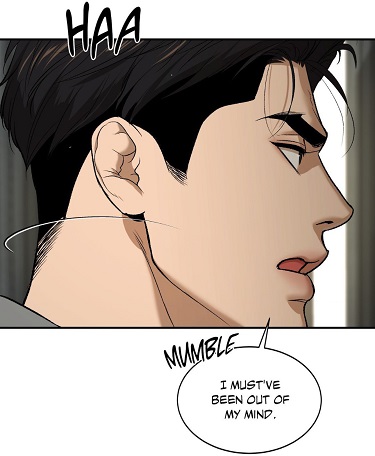 (chapter 45). This raises an essential question. Is episode 86
 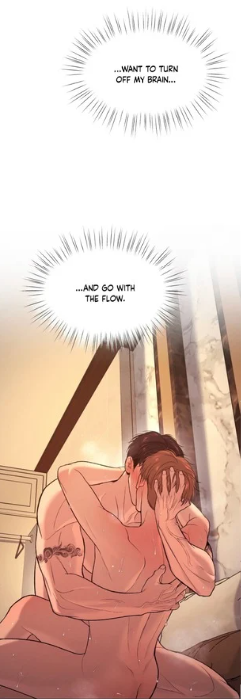 (chapter 86) a renewal of those nights? Another dream layered over the past? A repetition disguised as healing? Or, on the contrary, is this the first night that resists enchantment altogether?
 (chapter 4), in the return of light
  (chapter 66), in what remains once the sparks fade. A dream dissolves with daylight. Reality does not.
 (chapter 86) for final transformation. The real shift occurs elsewhere — more quietly, and perhaps more unsettlingly. To grasp the nature of this night, we must follow more importantly the doctor and his interaction with his fated partner.
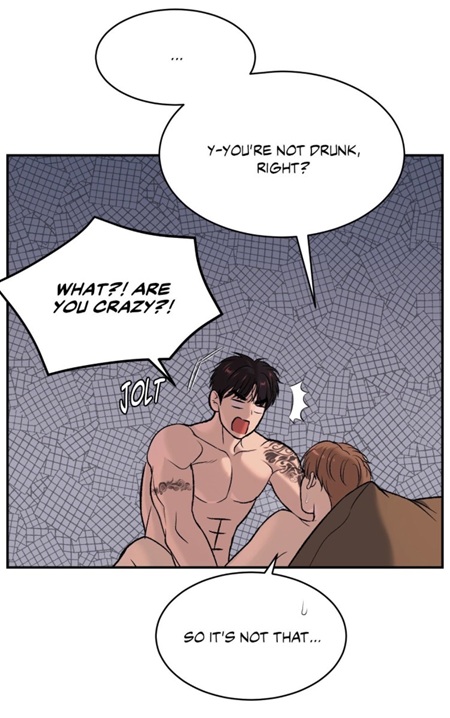 (chapter 86), processes, and responds to it. How he hesitates
 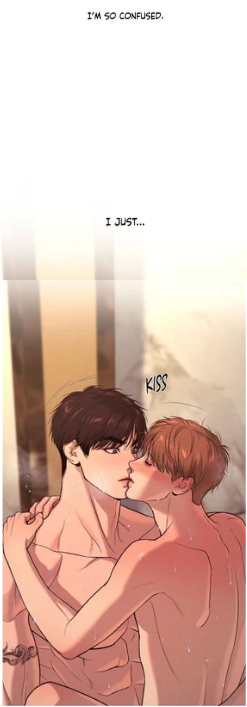 (chapter 86), reflects, and allows himself to reconsider what this moment can mean — and what it can lead to.
  (chapter 86), sparks, that strange shimmer that seems to hang in the air
 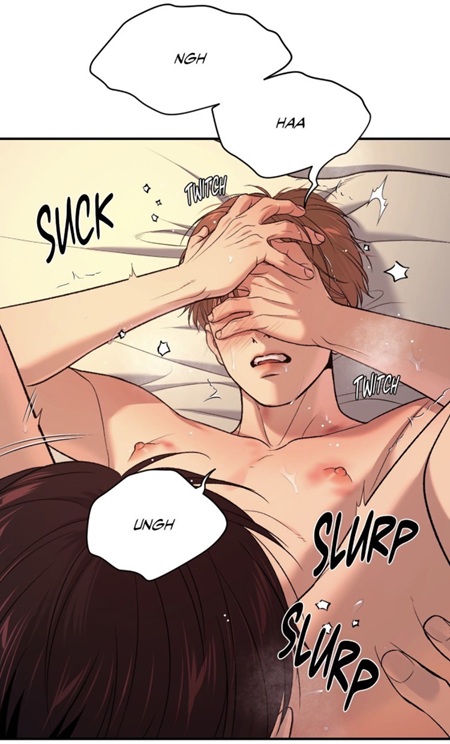 (chapter 86). Why? It was, as if their dream had come true. However, is it correct? Is it not wishful thinking? What if this night is not magical at all? What if its true signature is not enchantment, but electricity—a current that interrupts, tests, and resets? 😮
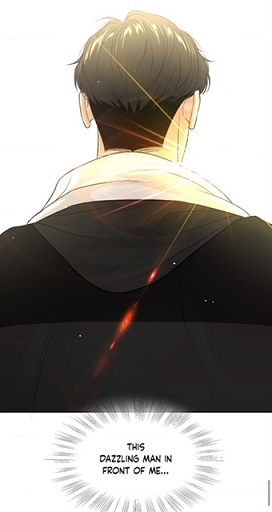 (chapter 40) in Kim Dan’s perception: overwhelming, radiant, dominant, a heat-source that does not negotiate.
 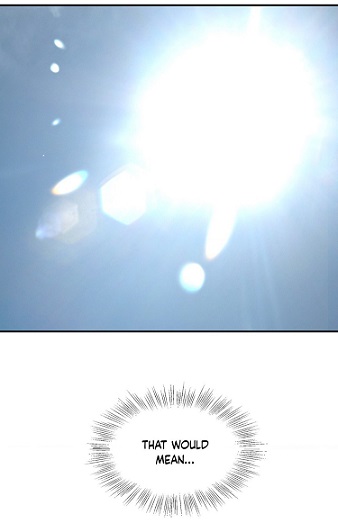 (chapter 41) The sun can be admired, feared, and endured—but it cannot be questioned.
  (chapter 58) It simply shines, and the one who stands in its light adapts. This explicates why the physical therapist would choose silence and submission over communication.
  (chapter 48)
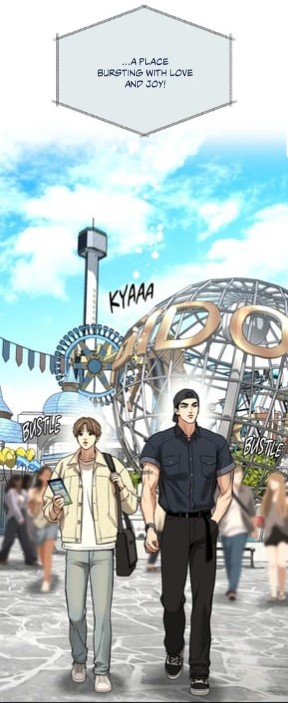 (chapter 83)
 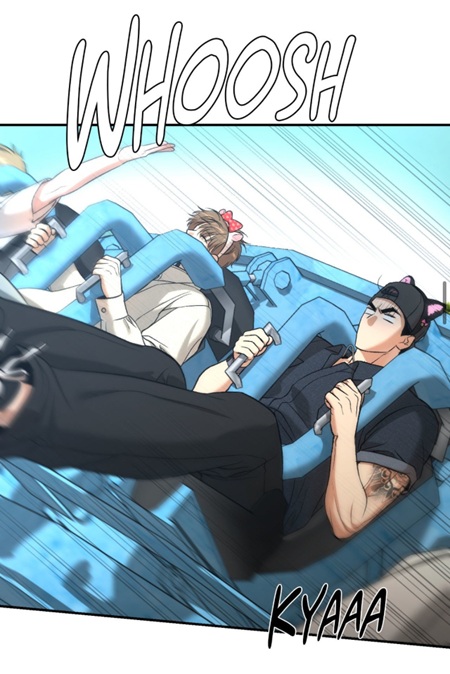 (chapter 83) Every ride, every light, every scream suspended in midair depends on current: motors accelerating and braking, circuits opening and closing, energy stored, released, and cut off.
  (chapter 83) Roller coasters do not move by heat, charisma, or sheer physical force; they move because electricity flows through them. The Viking ship swings
 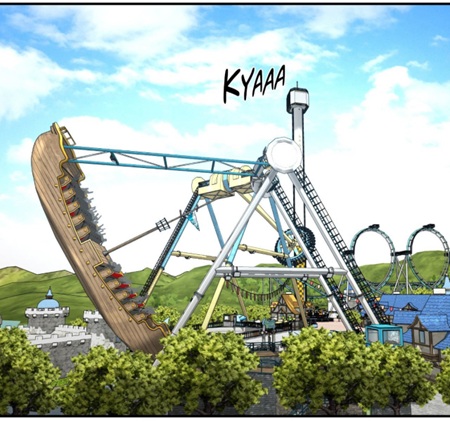 (chapter 83) because current allows it to swing. The Ferris wheel ascends
 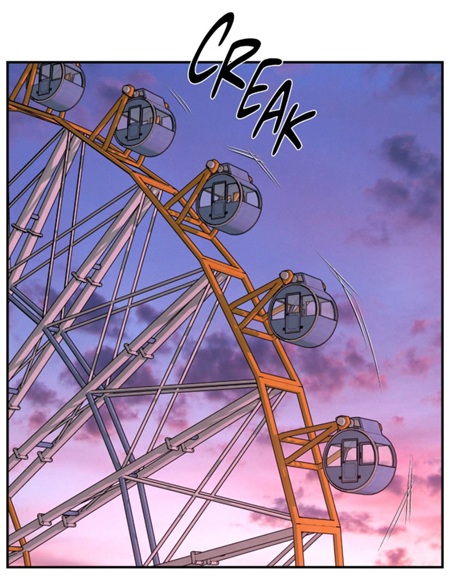 (chapter 83) because circuits hold — and descends because they release.
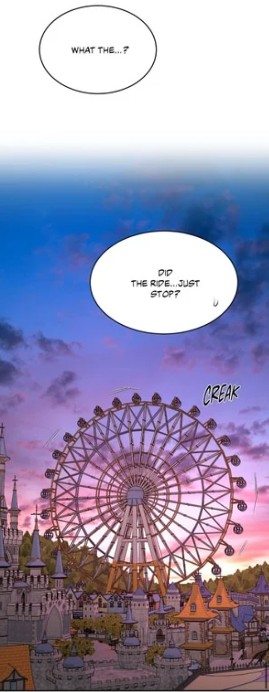 (chapter 84)
 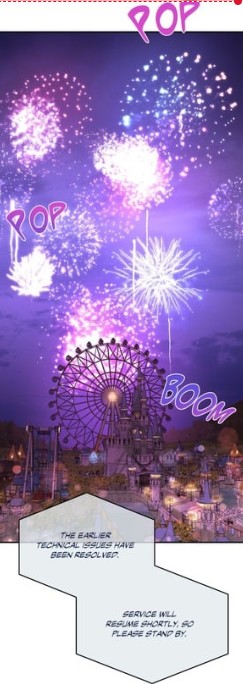 (chapter 84) explicitly names what had previously gone unspoken: the rides function only because current flows. When it disappears, the illusion of effortless motion collapses.
 (chapter 84) The Ferris wheel has stopped. The current is gone. The carefully regulated system that lifted, rotated, and sustained them is no longer in control. Yet movement does not disappear entirely. It mutates. When the champion shifts his weight, grips the structure, reacts instinctively, the cabin begins to shake. Panels emphasize instability: creak, swish, ack. The motion is no longer generated by electricity but by the body itself.
 (chapter 84) Stranded above ground, stripped of the park’s mechanical rhythm, he apologizes.
 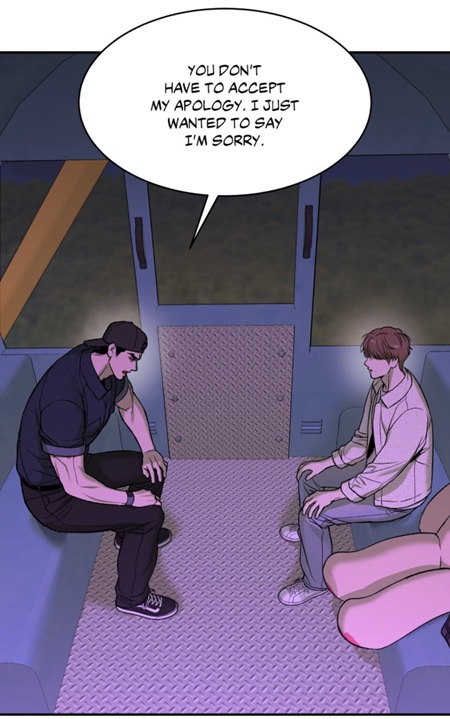 (chapter 84) Not theatrically, not performatively, but awkwardly, haltingly. His body exposes his discomfort
  (chapter 84) and fears. He avoids the doctor’s gaze, crosses his arms
 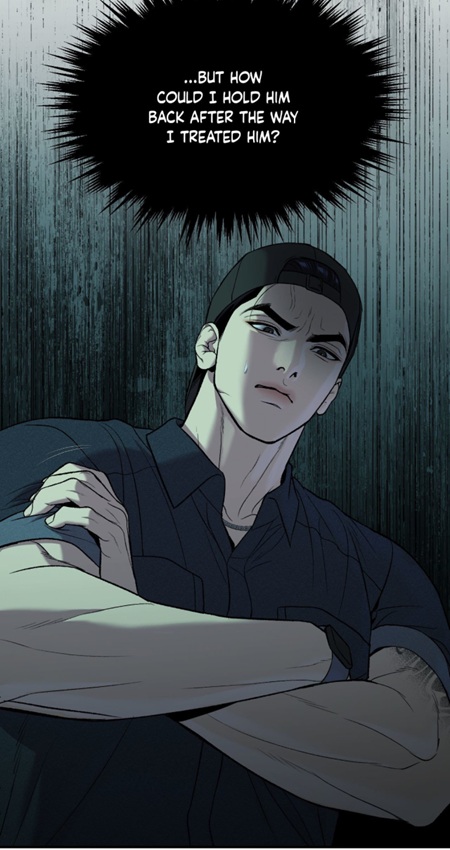 (chapter 84) or squeezes his arm
 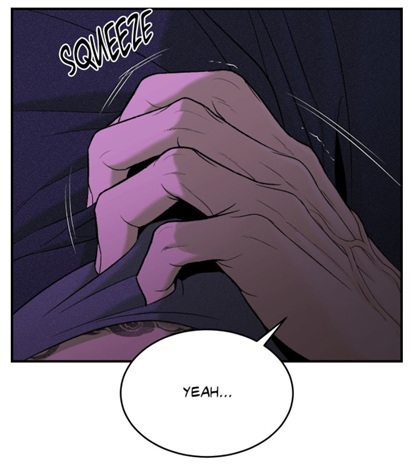 (chapter 84). The cessation of electrical motion coincides with a shift in his own mode of action. Where the park depended on current to keep things moving, he now moves without it. The absence of electricity forces something else to surface: responsibility, attention, presence. Additionally, this sequence anticipates what will later unfold more fully. Proactivity is no longer expressed through force or motion, but through articulation. Words stand for action and have weight. The champion’s future action is announced here, quietly: he will no longer push forward by shaking the structure. He will move by sharing thought, by naming feeling, by allowing himself to be affected.
  (chapter 86),
 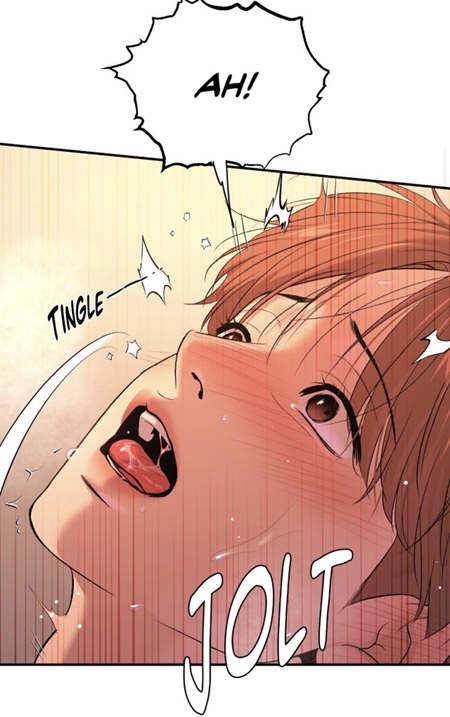 (chapter 86) jolts, sudden contractions of the body
 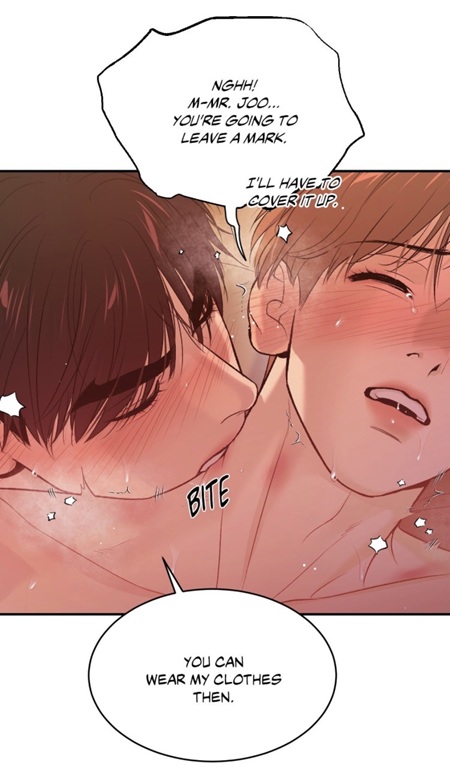 (chapter 86). Kim Dan is repeatedly shown convulsing, gasping, losing linear thought, and it is the same for the MMA fighter. Panels insist on interruption: jolt, tingle, broken breath, aborted sentences. The doctor’s body behaves as if struck, especially in this image.
 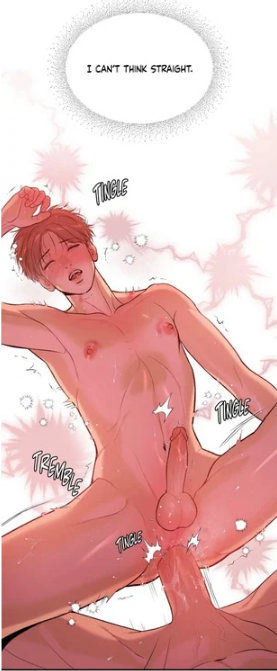 (chapter 86) It is at this point that a phrase surfaced in my mind — instinctively, almost involuntarily. A phrase we use in French when something intangible yet decisive occurs between two people: Le courant passe. Literally, the current passes. Idiomatic meaning: they are on the same wavelength, something connects, communication flows. However, here, the current is not the product of civilization, but of nature. Two people interacting with each other. And it is precisely because of the unusually high frequency of sparks and jolts in the illustrations that a belated realization imposes itself: nature, too, produces electricity — through storms, through thunder.
 (chapter 69) A storm was announced back then. And yet, upon closer inspection, no thunder was ever shown there. There was tension, there was excess, there were dark clouds
  (chapter 69) — but there was no strike, no discharge, no interruption. The imagery remained continuous, fluid, enclosed within the logic of escalation rather than rupture.
 (chapter 83). In Roman terms, Thursday corresponds to dies Iovis — Jupiter’s day — the god of thunder. Both gods are strongly connected to thunder and as such current.
 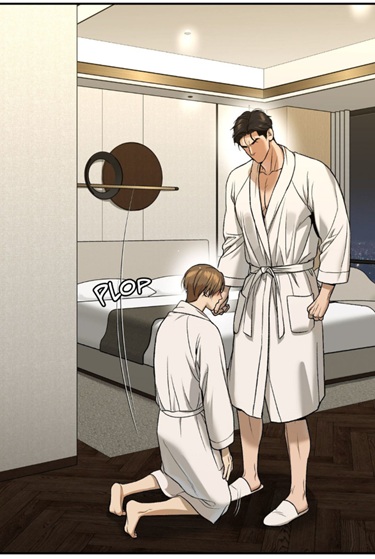 -chapter 67-; for more read my analysis
 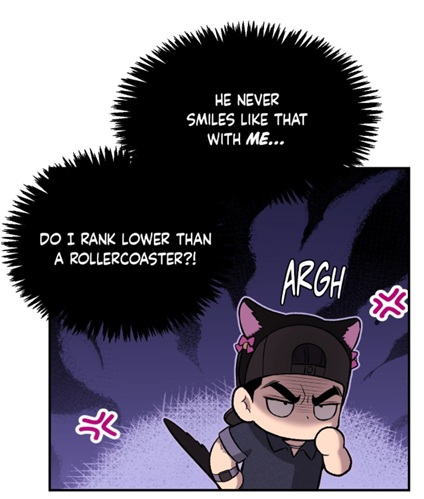 (chapter 83). Before striking anything, he is already unwell: angry overstimulated and complaining, visually reduced to a childlike register. This matters. The hammer does not create excess — it receives it.
  (chapter 34), the hammer gesture is not confrontational, for the machine is immobile. There is no opponent.
 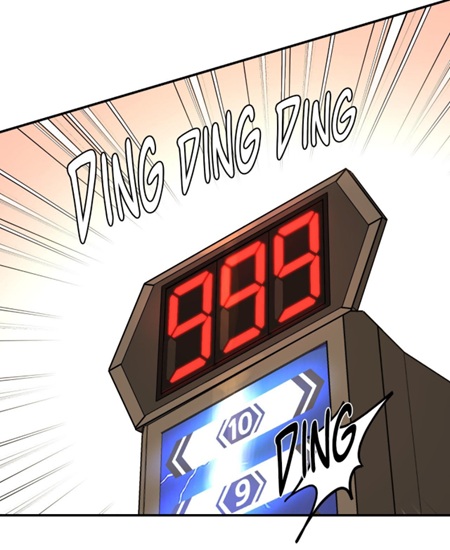 (chapter 83) Too much energy released at once. The system registers it, but cannot contain it. This means, the record won’t be registered and as such “remembered”. In fact what mattered here was the prize, the teddy bear, and restored self-esteem of the athlete. He could offer a present to doc Dan which the latter accepted without any resistance.
  (chapter 86) Therefore it is not surprising that doc Dan starts looking at his fated lover. Imagine what it means for the athlete, when the “hamster” is staring at him, though he is a little embarrassed. Finally, he is truly looking at him. The champion loves his gaze. And now, you comprehend why the “wolf” listened to the “cute hamster” and stopped leaving marks.
 (chapter 85), but this time, its nature has changed. It is no longer jealousy or anger, but love and desire. Hence the current is not colored in red, but white and pink.
  , but a thunder and as such it is still restrained and regulated.
 (chapter 86) or second-hand data. New information must now be gathered. New meanings must be negotiated. Because Joo Jaekyung acts differently (son-father), the doctor is incited to discuss with his fated lover and not to generalize. He is pushed to become curious about the main lead and even adapt himself in the end.
 (chapter 39) and the penthouse night
 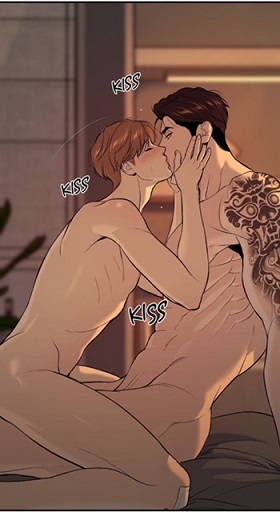 (chapter 44) as emotionally charged, intense, even pivotal. Confessions were made. Bodies responded. Vulnerability appeared to surface. And yet, both nights collapsed almost immediately afterward. What was felt
  (chapter 39), arousal, and emotional exposure under the influence of a drugged beverage. His body reacts strongly, almost violently. His speech loosens. He confesses.
 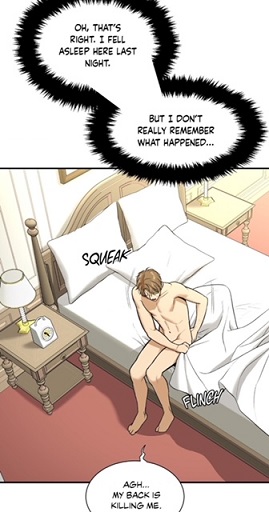 (chapter 40)
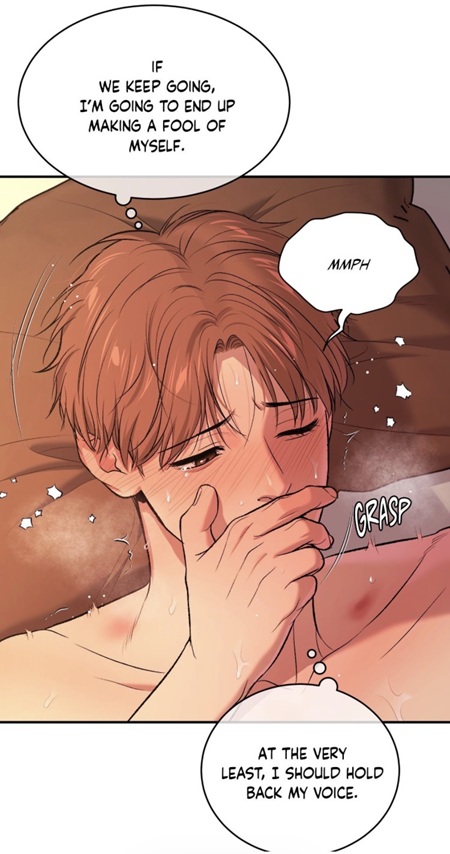 (chapter 86) In this panel, we should glimpse a reference to the night in the States as well, and not just to the night in the penthouse.
  (chapter 44) The setting is elevated, luxurious, almost theatrical. The doctor is brought into a space of power that is not his own.
 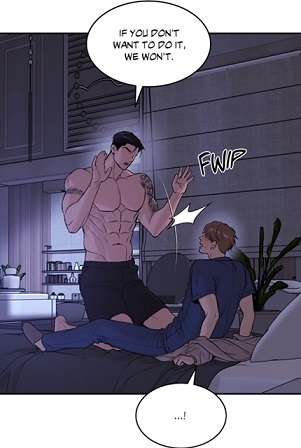 (chapter 44) By acting that way, the athlete created a false impression of himself, as if he was still rational and clear-minded. Again, desire unfolds.
  (chapter 44)
  (chapter 44) Again, closeness occurs. And again, the aftermath reveals the same fracture.
 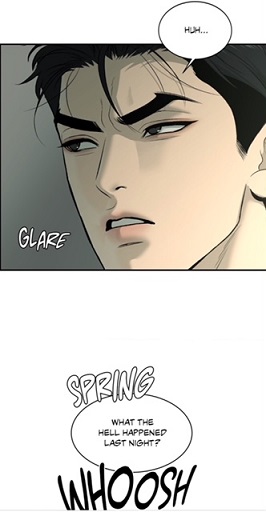 (chapter 45) and later wants to even forget it.
  (chapter 45) and he can not deny his own involvement and actions. Hence the doctor is left alone. Only he can recall this “dream”.
  (chapter 44) But memory alone is not power. Remembering without the other’s participation transforms recollection into isolation. Kim Dan cannot confront, confirm, or renegotiate what happened, exactly like the champion did in the past. Meaning freezes instead of evolving. Striking is that he came to associate feelings with addiction.
  (chapter 46) No wonder why later doc Dan had no problem to reject the athlete. And for him, the next morning became a cruel reality, even a nightmare. It wounded doc Dan’s heart and soul so much that he learned the following lesson: to not get deceived by impressions. Hence in Paris, Doc Dan tries to explain the change of the champion’s attitude with drunkenness.
 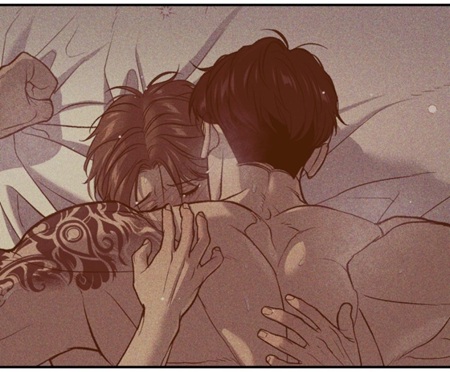 (chapter 44) One participant is altered. The other must carry the weight of meaning alone. The night does not end in shared reflection, but in silence and absence.
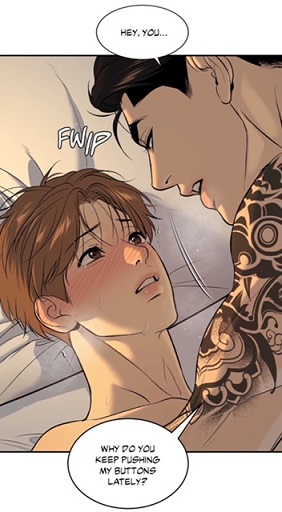 (chapter 44) Words blur, vanish, or are forgotten. Even gestures go unnoticed: a kiss, an embrace or a patting. Memory fractures. The morning after is defined not by continuity but by confusion. The body has moved forward, but the narrative has not.
  (chapter 84)
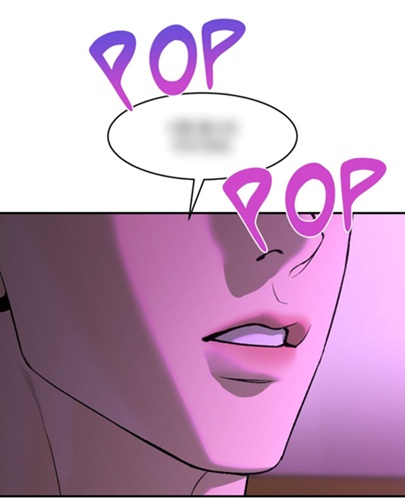 (chapter 84) Speech bubbles lose clarity. Confessions are obscured. The reader is denied access to meaning. Fireworks, like drugs, produce intensity without duration.
 (chapter 39)
  (chapter 44) It was as if these nights could only exist under altered states — as if clarity on either side would have made them impossible.
  (chapter 86)
 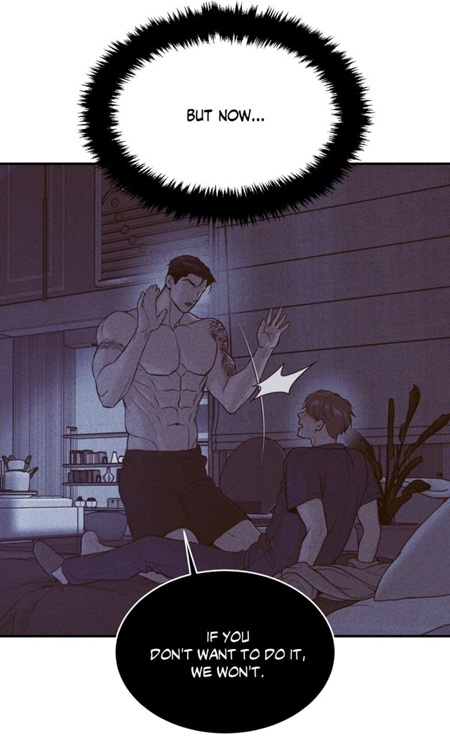 (chapter 86) This is why, when electricity returns in episode 86, it does not revive heat. It interrupts it.
 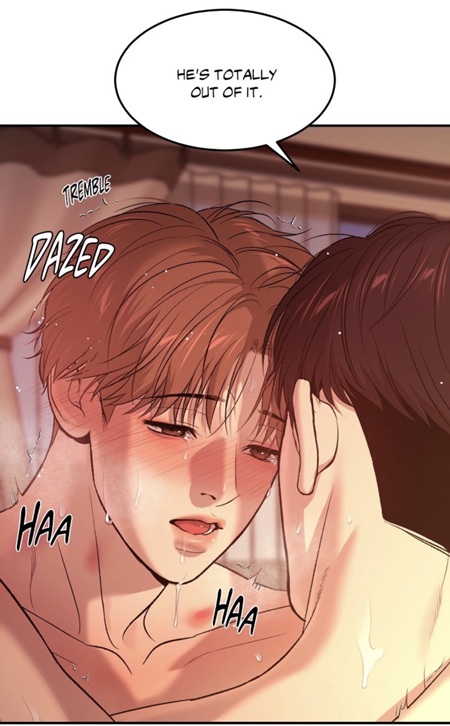 (chapter 86) That’s the reason why the athlete stops for a moment and asks doc Dan, if he needs a break.
  (chapter 86) This question is important because doc Dan admits his confusion and ignorance. He confesses to himself that he “knows nothing” not only about himself, but also about his fated lover.
 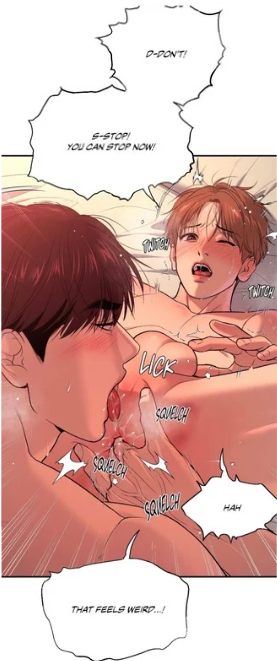 (chapter 86) They function as temporal markers. A spark exists only now. It has no duration. It cannot be stored, recalled, or anticipated. It appears — and vanishes. In this sense, electricity becomes the perfect visual language for the present moment itself.
 (chapter 10), statements blurred by drugs
 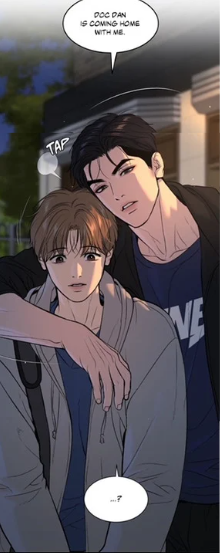 (chapter 43), sentences remembered by only one side.
  (chapter 44) and even laugh…. if only he could remember that night…
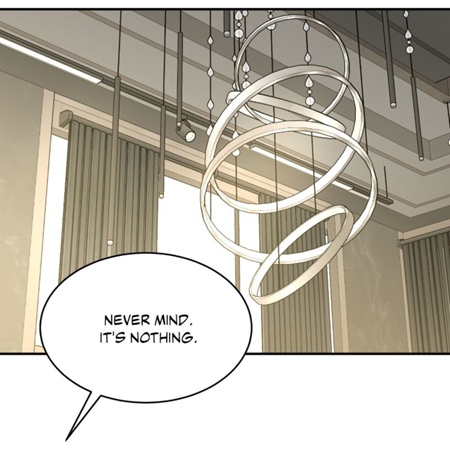 (chapter 79), the “never mind”,
  (chapter 84) or it is a mistake, the easy erasure that once dissolved meaning after the fact. The kiss interrupts that mechanism. It produces a pause that cannot be talked over. It forces reflection.
 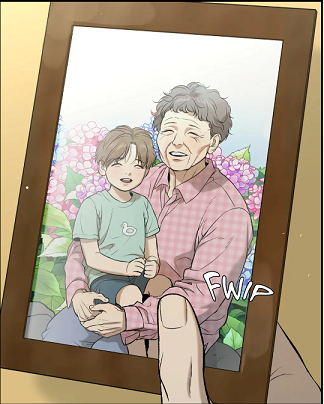 (chapter 19) The grandmother’s lap structured Kim Dan’s understanding of safety, endurance, and knowledge. Sitting there meant being held — but also being taught how to survive through sacrifice, silence, and self-effacement. That worldview sustained him, but it also confined him.
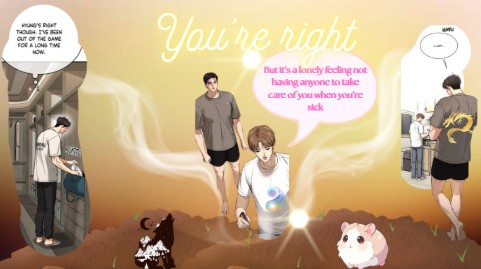
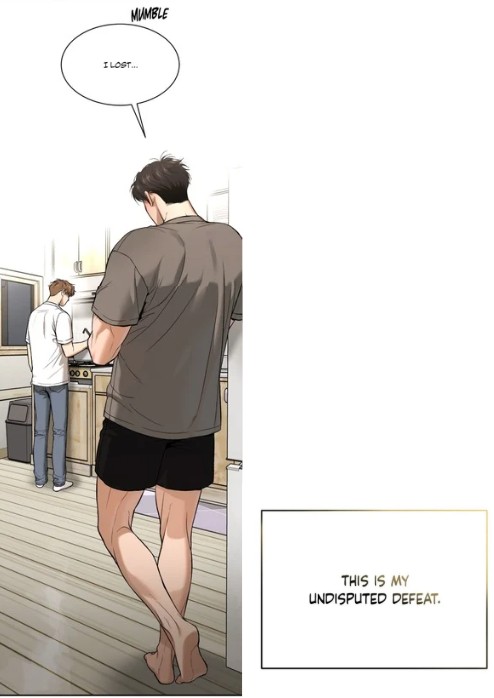 (chapter 76) This admission is no mere reversal of pride. It gestures toward something Jaekyung has never known: an exchange that does not end in domination or silence, but in dialogue. For Kim Dan, too, it marks a turning point.
 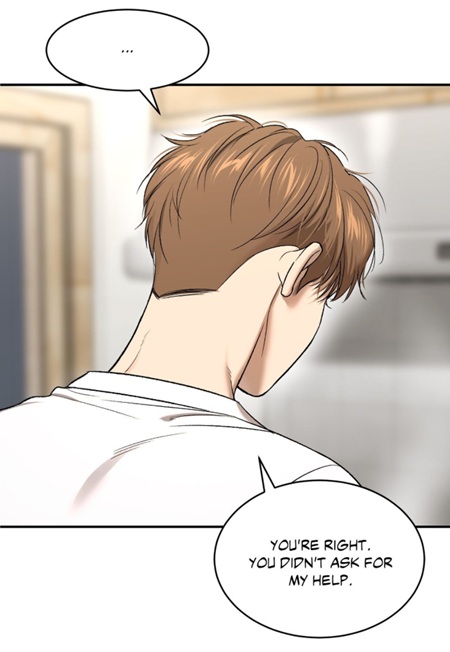 (chapter 76) For the first time, he uses the expression you’re right in front of his fated partner. He seems to concede with this idiom. Yet this apparent submission hides a deeper reversal. By admitting Jaekyung never asked for his help, he redirects the exchange toward his own truth: the loneliness of having no one to care for you.
 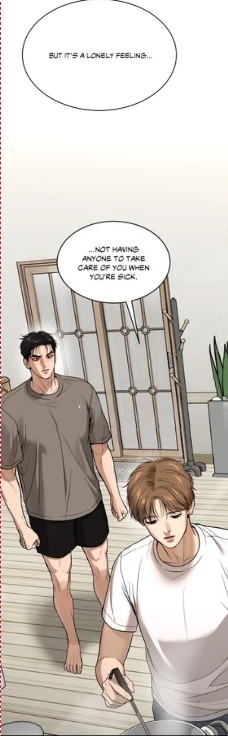 (chapter 76) What unfolds in the kitchen is not a quarrel about porridge but a fragile recognition. Dan’s “You’re right” acknowledges Jaekyung’s perspective without bitterness, while Jaekyung’s “I lost”
  (chapter 9)
 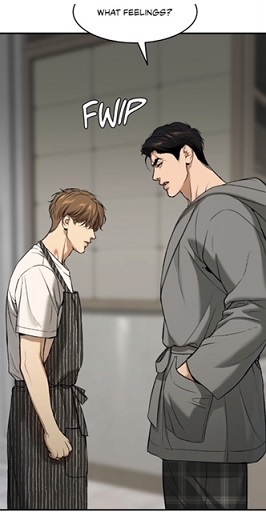 (chapter 45)
  (chapter 76) The kitchen scene closes one cycle and announces another.
  (Chapter 76) In this view, his fixation would be the product of ambition, pride, or ego: the expected cost of survival in a cage where only victory pays.
  (chapter 76), because the adults in his life cut them off before they could exist. Winning became his only mode of survival because every formative argument in his youth ended in defeat, and not the kind decided by a referee. With his father, mother, coach, and manager, words never led to recognition — only to insult, silence, utility, or obedience. He learned early that dialogue could not protect him; only victory could. His victories were not chosen freely, but forced into being by guardians who made him feel like a burden, until relationships themselves became burdens.
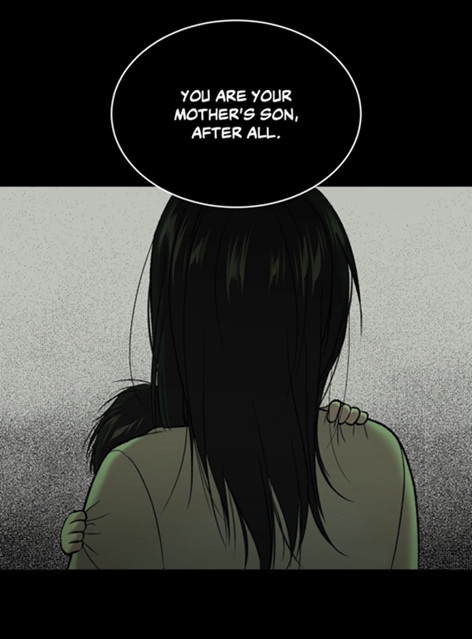 (chapter 73) He was a loser because of his mother. To lose meant humiliation and rejection; to speak at all meant to invite contempt. The only possible rebuttal was victory — to prove through strength that he was not the pathetic, worthless child his father saw in him. Winning became his sole argument against a man who would never listen, the only way to resist being branded a loser.
  “(chapter 73). It was not just defiance; it was a vow that victory would silence abuse once and for all. When he returned with the trophy, he shouted triumphantly,
 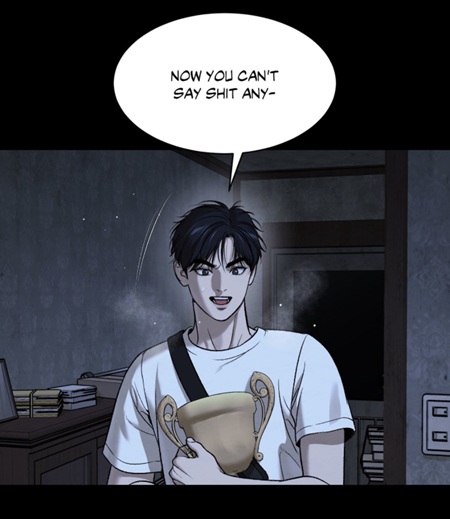 (chapter 73) ready at last to claim, “I was right.” Yet reality betrayed him. His father’s death denied him the only acknowledgment he had sought.
 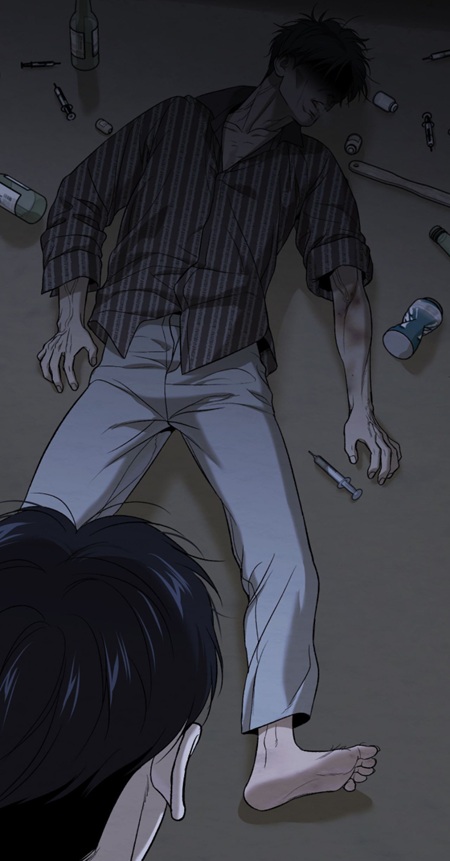 (chapter 73) The words “I was right” died in his throat. He had proved himself, yet there was no one left to recognize it. His own prediction — that his father’s death would mean nothing — proved false. The absence cut deeper than the insults had, leaving Jaekyung not with triumph but with the bitter aftertaste of self-loathing. Victory had silenced his father, but it also silenced the son. He had proved himself, yet there was no one left to hear it.
  (chapter 74) At the funeral he remained dry-eyed, his face locked in shame (ch. 74). No one saw his guilt, but it consumed him: the one man he needed to hear “I was right” from could no longer answer. At the same time, his smile and laugh were also linked to misery. For Jaekyung, laughter was never the sound of joy, but the echo of mockery and rejection due to the father. Just as tears became tied to betrayal and abandonment through his mother, so too did his father twist laughter into a weapon
 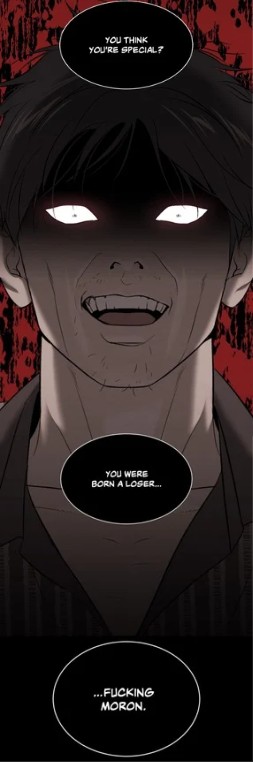 (chapter 73) — every laugh at his expense reinforcing the verdict that he was weak, pathetic, a loser. In Jaekyung’s childhood vocabulary, neither laughter nor tears could carry warmth. Both were stripped of comfort and redefined as signs of humiliation and pain.
 (chapter 72) To the boy, she was not silent at first: she must have definitely told him to become strong, to endure, to wait. She gave him her number, leaving the illusion that her departure was not abandonment but necessity. Victory and wealth became her conditions for love. That is why he swore over the payphone to work hard
 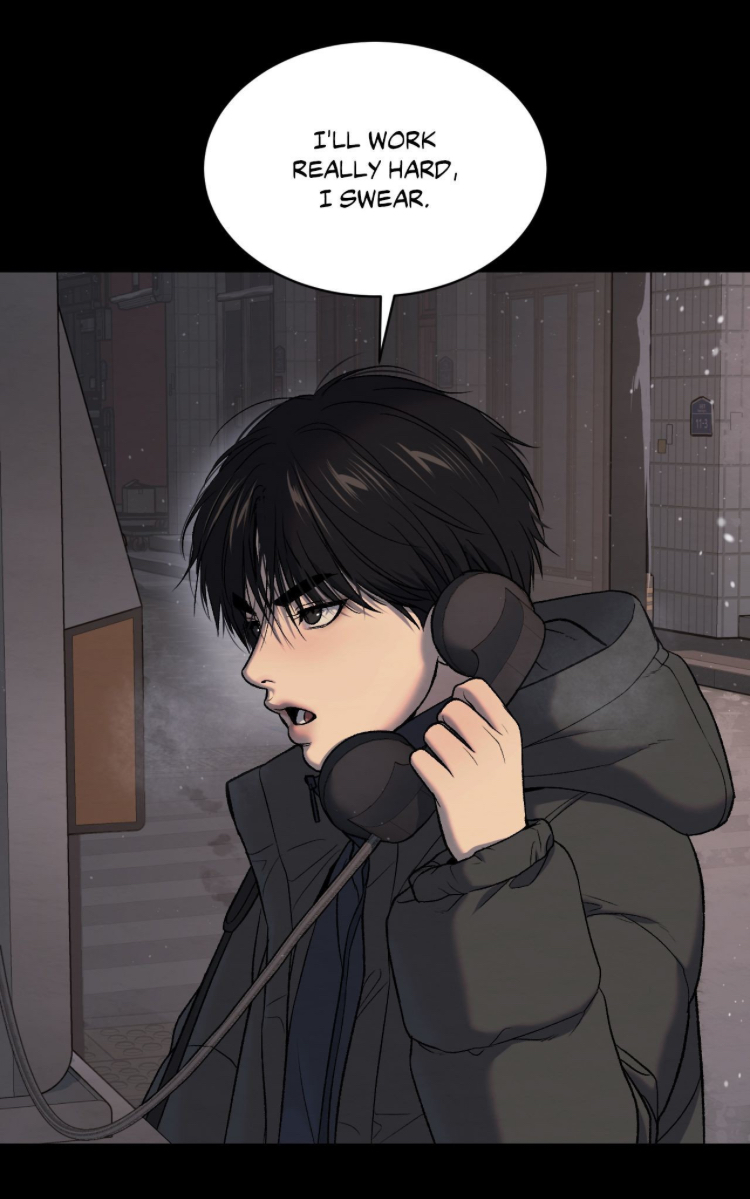 (chapter 72) and “make money” so she could return, and why after his father’s death he still hoped for her homecoming.
  (chapter 74) But when the calls went unanswered, her silence became the sharpest weapon of all. Her eventual reply
 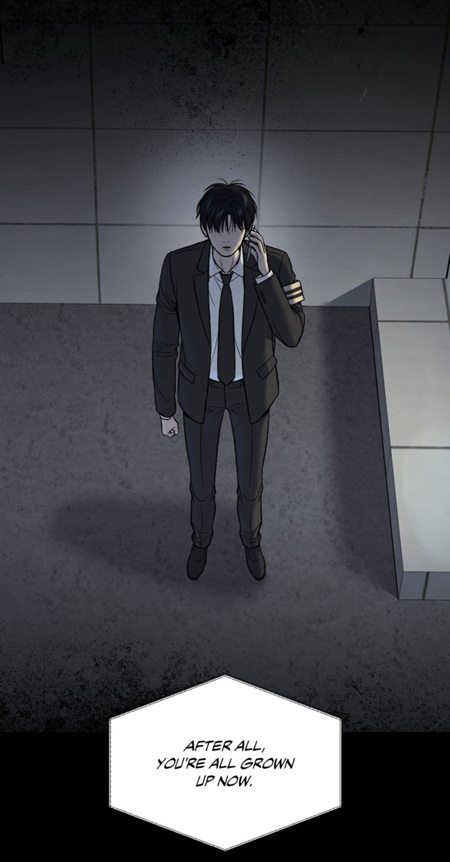 (chapter 74) confirmed that his effort had never mattered. For the first time, he cried
 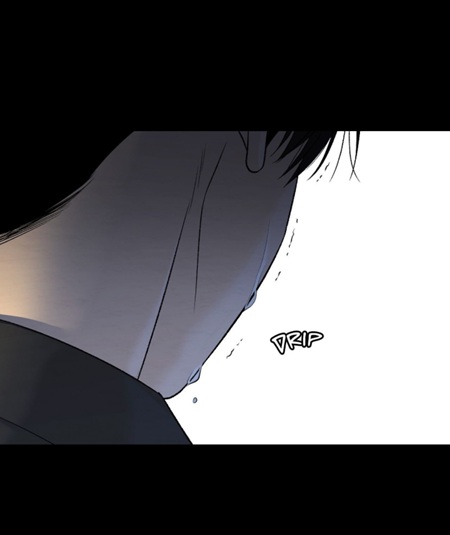 (chapter 74), his tears expressed not just grief but the recognition of betrayal. From then on, tears themselves became equated with loss, weakness, and abandonment. This is why, in the wolf’s nightmare, Dan’s crying form
  (chapter 76) appears: the sight of tears recalls the moment he unconsciously realized that even his mother’s “you’re right” was a lie. At the same time, those tears function as a mirror. The champion projects onto Dan the very weakness he has always forbidden himself to show.
 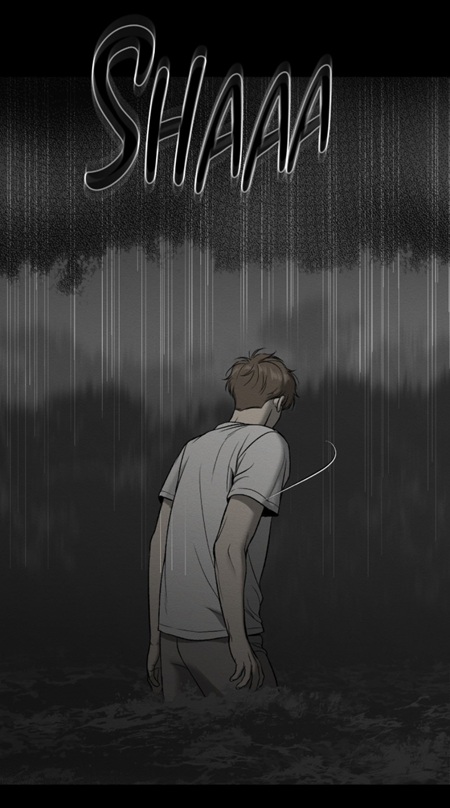 (chapter 76), the boy he once was who longed to weep but had to swallow it down. At the same time, Jaekyung himself occupies the place of the “adult” —
  (chapter 74) Hence the wolf’s tears were quickly replaced by rage and violence.
 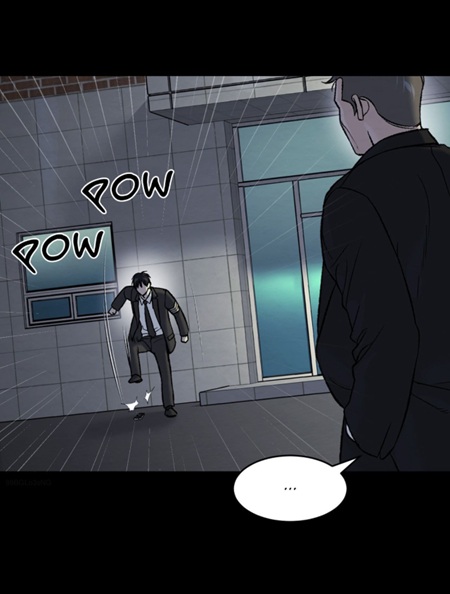 (chapter 74)
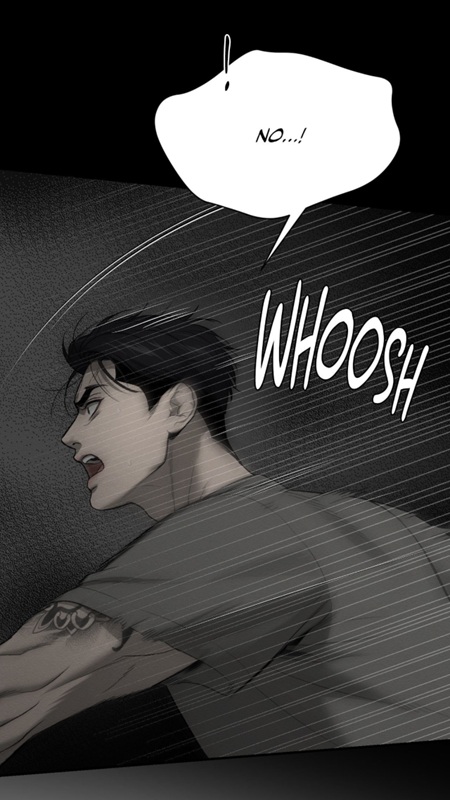 (chapter 76) His trembling hand upon waking
 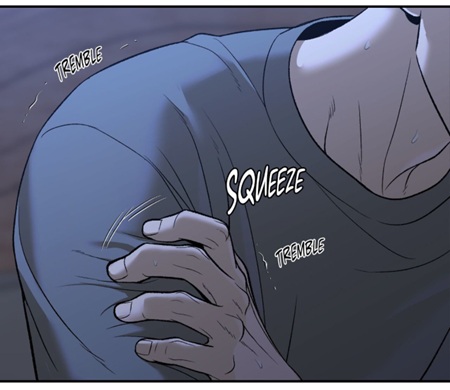 (chapter 76) shows the yearning to be held, comforted, reassured — something he never received from either parent. He is not entirely responsible for the physical therapist’s suffering. And here lies the difference: Dan’s tears are not manipulative or hypocritical , like the ones Jaekyung suspects from his mother, but unfiltered honesty. He expressed his emotions, not just through tears, but also through body language!
  (chapter 1) He was shaking, he was bowing and asking for forgiveness! Dan embodies a form of vulnerability that is real, legible, and forgiving contrary to the mother. When the teenager heard his mother’s voice after such a long time, the latter never brought up her past action. She never asked him for forgiveness.
  (chapter 74), whose quiet devotion and silence kept the gym alive, nor Jaekyung’s, whose absence he accepted without challenge.
 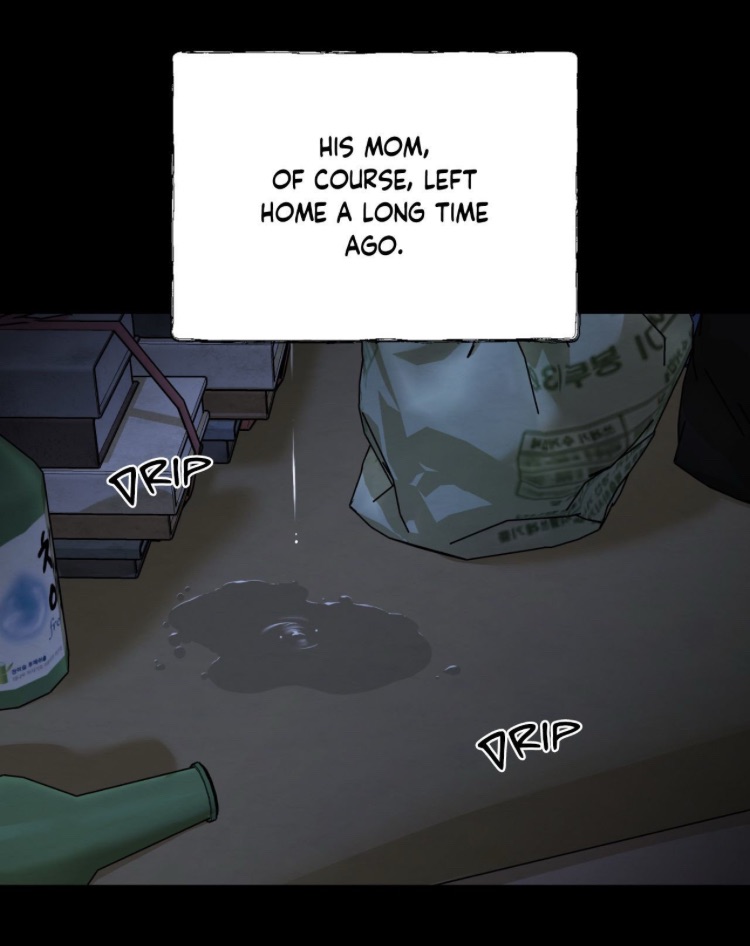 (chapter 72) In fact, his own mother’s submission reinforced this flaw: her blind trust in her son, her refusal to question his choices and the boxing world, taught him that authority need not be examined, only endured or seen as trustworthy. For him, hierarchy was unquestionable, and so he perpetuated it. Thus he stands for lack of critical thinking. This is why, with Hwang, the vocabulary of “right” and “wrong” was never about dialogue but about obedience. No wonder why he became so violent at the police station.
  (chapter 74) Unlike Jaewoon’s domination or the mother’s evasive silence, Hwang cloaked his authority in the language of advice — yet beneath it lay a black-and-white dualism: winners and losers, villains and victims. Thus Joo Jaewoon was blamed for becoming a thug
  (chapter 74), while the wolf’s mother was a victim. He viewed her as a selfless and caring mother:
  (chapter 74)And observe how he provoked the main lead.
  (chapter 74) When Hwang sneers, “What, am I wrong? Come on, answer me!” he is not inviting dialogue — he is staging a trap. The question is rhetorical, a demand for submission. Let’s not forget that he had witnessed the phone call in front of the funeral hall, but back then he had done nothing. And when the boy hesitates
  (chapter 74), unable to answer, Hwang strikes him in the chest.
  (chapter 74)and justifies his action behind social norms.
 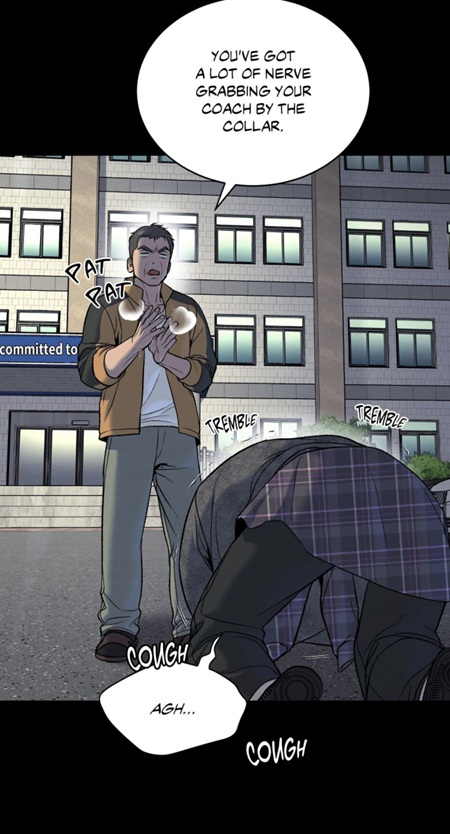 (chapter 74) In that instant, he takes the role of judge, referee, and executioner, collapsing “argument” into violence. The very words “Am I wrong?” contain the irony: the coach is less interested in truth than in reasserting his own authority. Silence is treated as guilt, hesitation as defeat.
 (chapter 74), he effectively admitted “you’re right” to the coach. Yet this wasn’t simply genuine agreement — it was submission, respect mixed with survival. The director misread it as validation of his worldview. This only reinforced his certainty, encouraging him never to reconsider his role.
  (chapter 74) When the protagonist finally left, the director could declare with satisfaction:
  t(chapter 74).
 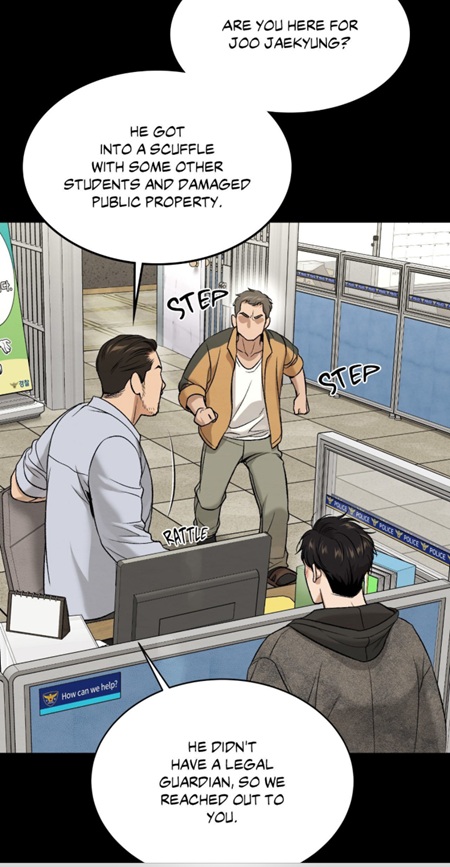 (chapter 74) The reality was that the old man had never truly become the star’s home and family, which explains why he constantly leaned on other adults, the mother or the father, to provide the guidance he himself refused to give. At the same time, I come to the following deduction: he must have lost his boxing studio, and with its vanishing, the elder was forced to face “reality”: loneliness, sickness and absence of happiness in his life!
 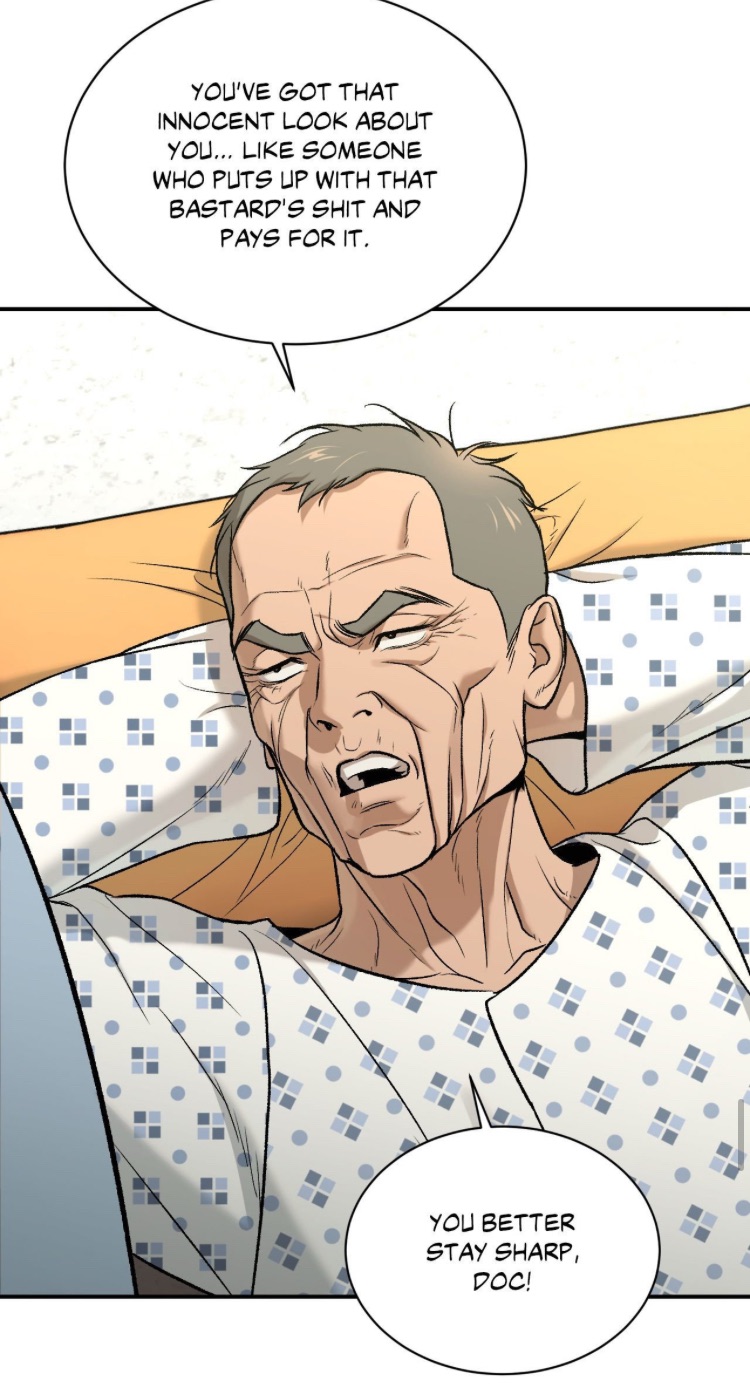 (chapter 70) Once again, Jaekyung is reduced to “that bastard” — a label, not a person — while Dan is framed as the pitiable victim. The old coot remains the righteous observer, untouched by guilt, protected by a rhetoric that always shifts responsibility elsewhere.
 (chapter 75) He was happy again, though he initially tried to hide it. We have to envision that before the wolf’s visit, the elder had to face what his own life outside the gym looked like: sickness, solitude, the collapse of the studio that had sustained him and came to resent the main lead. Yet, Joo Jaekyung’s behavior changed everything:
 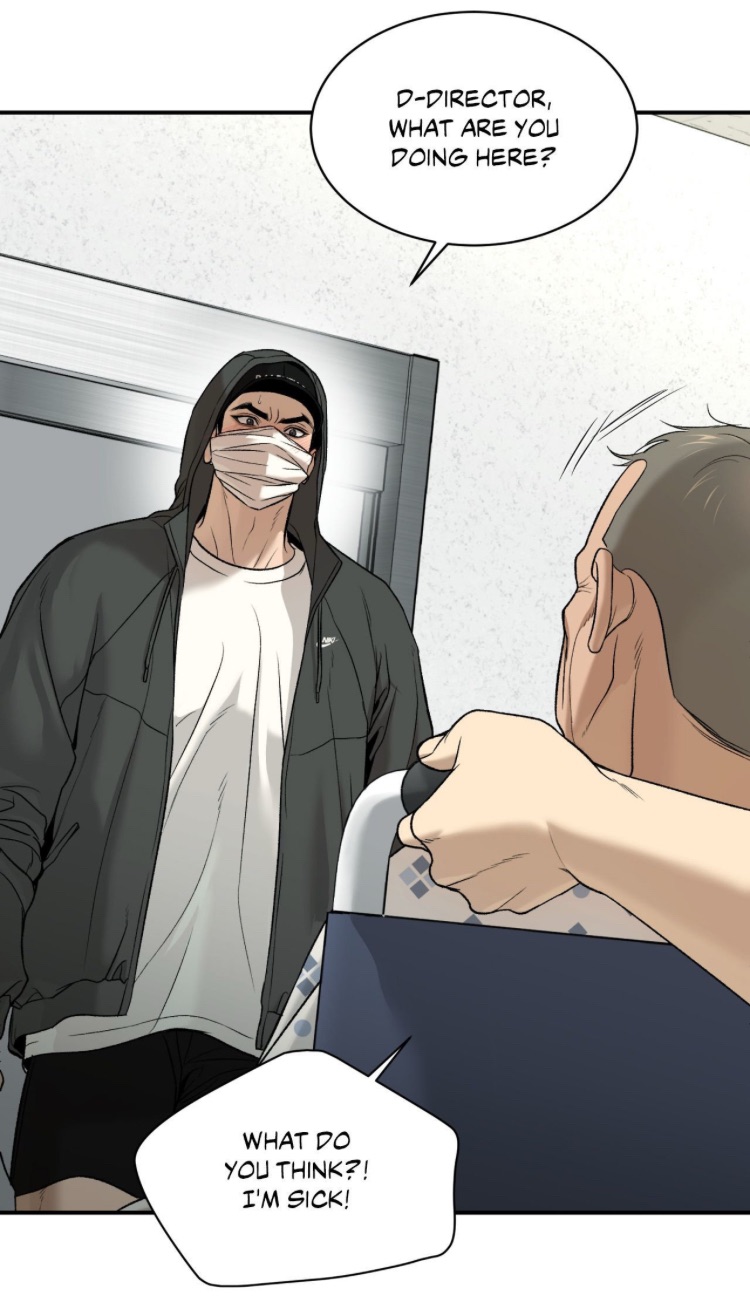 (chapter 71)
 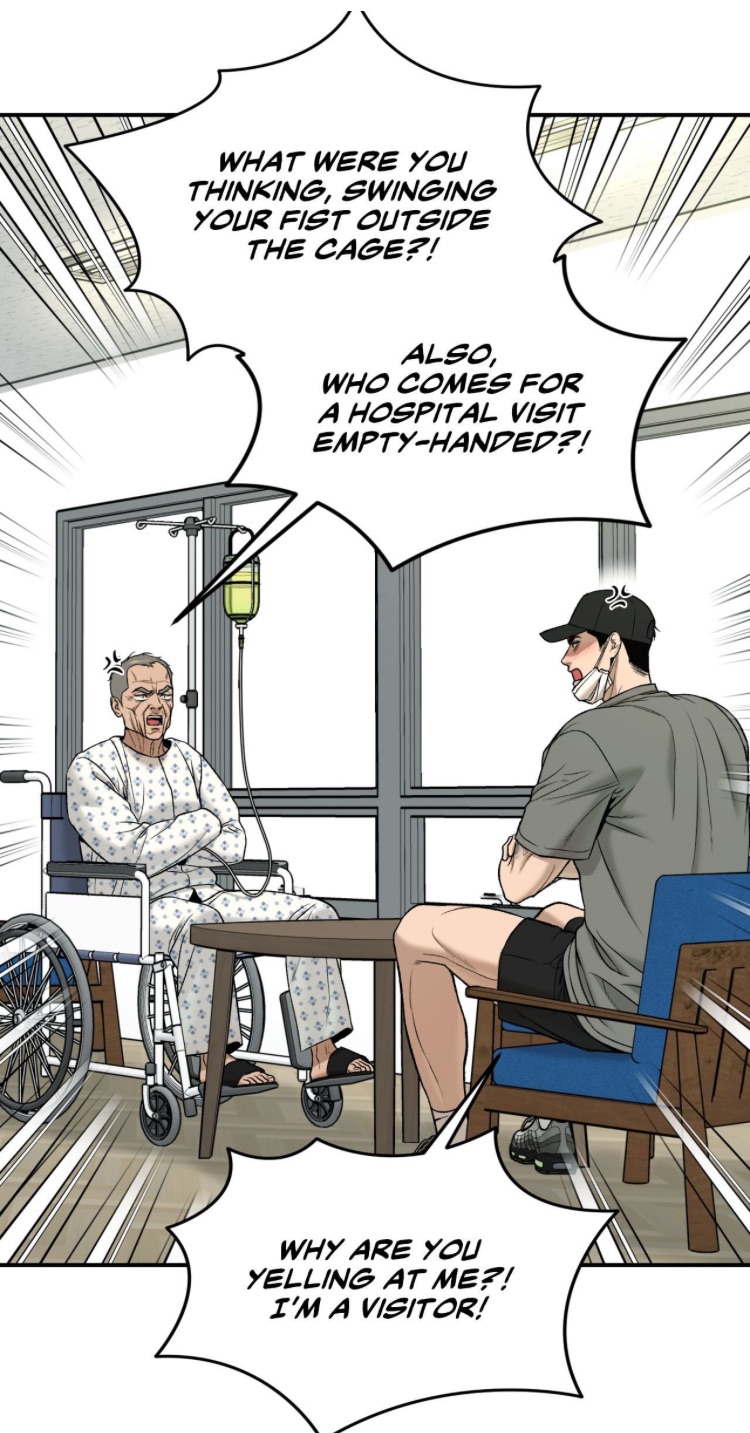 (chapter 71) Only during the champion’s visit, did his words alter.On the rooftop of the hospice, he finally tells Jaekyung:
 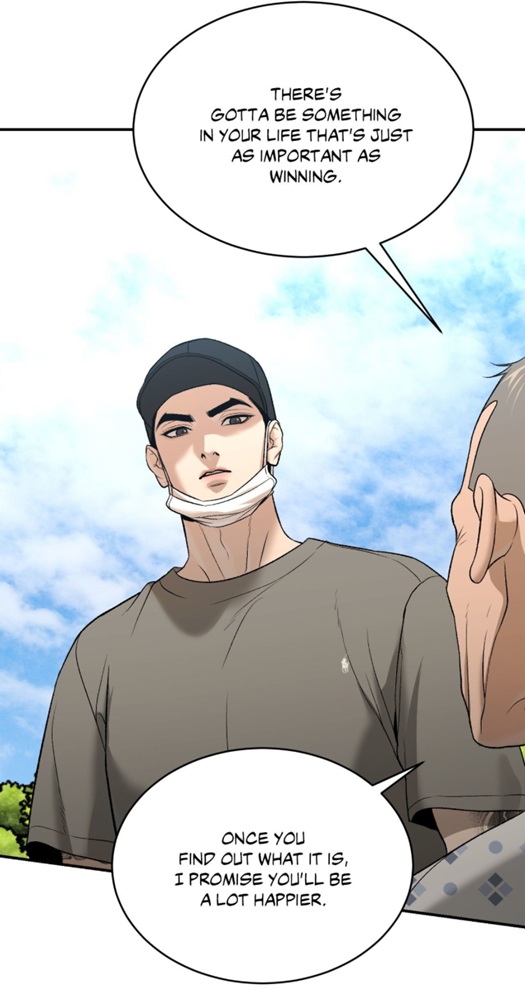 (chapter 75) This shift did not come from wisdom gained in the ring but from loss — the loss of health, the loss of the gym, the loss of illusions — and from Jaekyung’s loyalty, which pierced through his blindness. Interesting is that this time, he doesn’t give the answer to the athlete. He stops thinking “I’m right, you’re wrong”. He treats him as an adult, as a mature and thoughtful person. Through that fidelity, Hwang glimpsed at last what he had denied both himself and Jaekyung for decades: that victory alone cannot sustain a life.
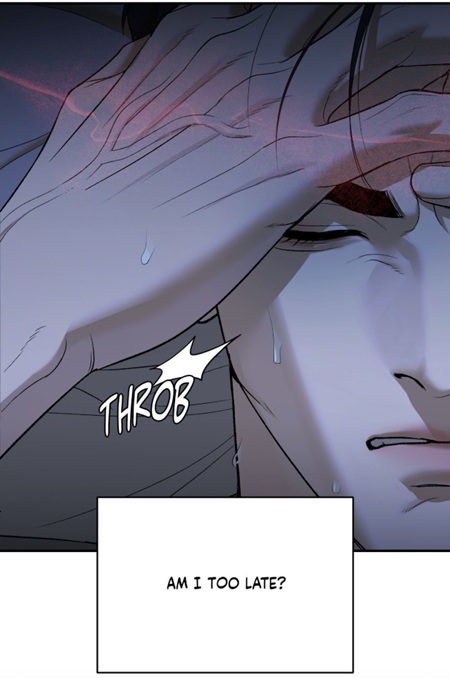 (chapter 76) It is not too late. The question “Am I too late?” is the consequence of Hwang byungchul’s words and it gradually indicates the switch in the champion’s mentality. It is no longer about being right or wrong. However, the nightmare reveals another aspect: the world is not black and white, but grey.
 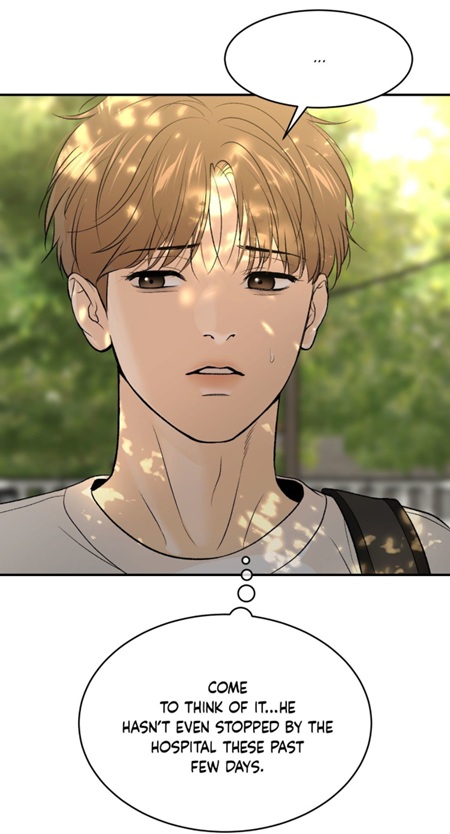 (chapter 76) Hence he remained silent and avoided his gaze. But like the director showed it, it is never too late:
  (chapter 76)
 (chapter 17) at all. The verity is that he refuses to listen to his thoughts and emotions
 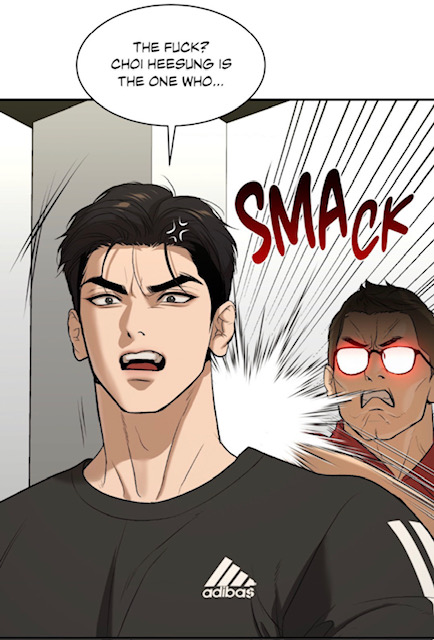 (chapter 31) in good
 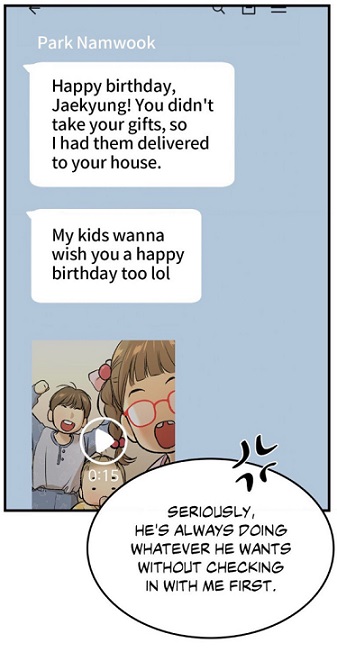 (chapter 45) or in bad times. It goes so far, he does not take his silences seriously, and does not register his pain. This explicates why the manager saw in the champion’s silence at the restaurant as an agreement for a new fight!
  (chapter 69) His role is not to guide or protect, but to extract: money, victories, publicity.
 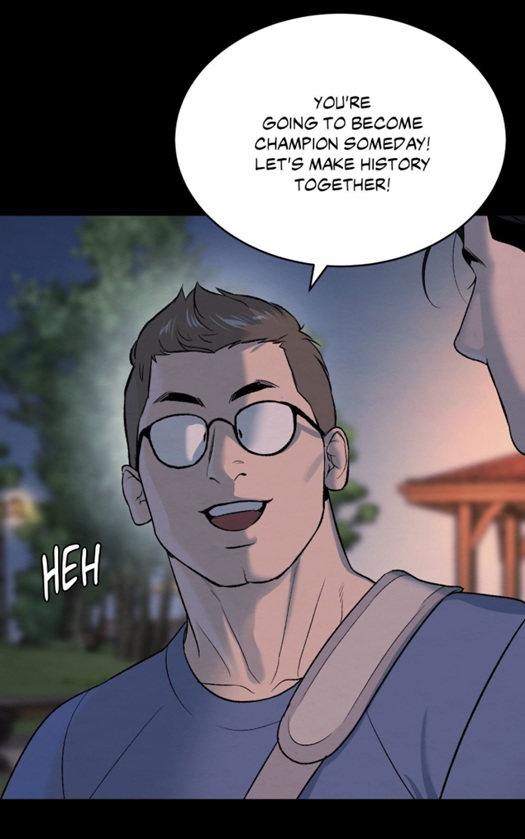 (chapter 75) In my opinion, he is fighting against oblivion through the star. This hidden disability explains why the coach can never truly connect with the champion. He listens instead to other voices – the CEO of MFC
  (chapter 69), the rumors among the directors
  (chapter 46), the media
  (chapter 52), the sponsors
  (chapter 41), the spectators or “authorities”
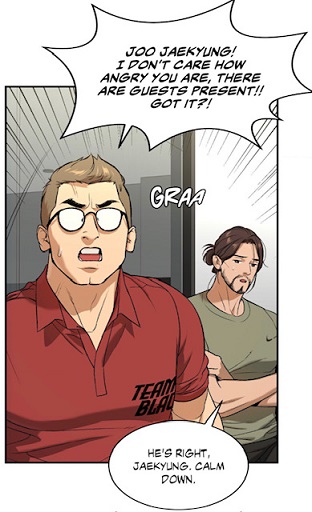 (chapter 36) — and reacts to them, even violently, as in chapter 52, when public criticism painted Jaekyung in a negative light.
  (chapter 52) The slap was less about Jaekyung’s behavior than about Namwook’s own fear of outside judgment. He was not listening to the man in front of him but to the noise around him. He feared losing control in the end, especially after the athlete’s words let transpire his true position at the gym:
 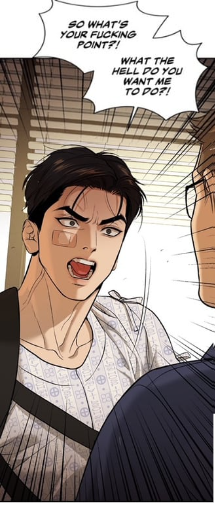 (chapter 52) His question is not mere anger. It is a confession of position — an inadvertent acknowledgment that he knows he is the true backbone of the gym. He is the one responsible, the one carrying the burden that Namwook refuses to admit. These words crack the illusion: the fighter is not subordinate, but owner. The gym lives because of him.
 (chapter 52) He acted as a child, faked “tears” in order to use empathy to his advantage.
 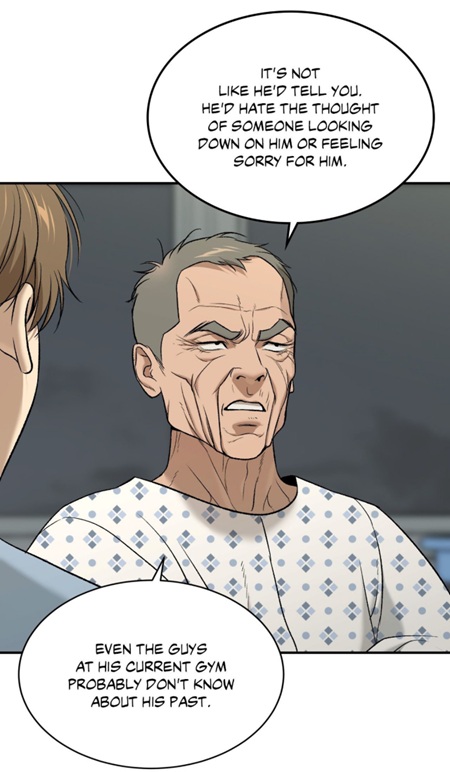 (chapter 71), hence he tried to help in his own way. On the other hand, Park Namwook shows clearly no sign to be interested in the private life of his boss. He is preferring ignorance over “knowledge and connection”.
  (chapter 66) Despite the incident, the manager hasn’t changed yet. He clinched onto the past, thinking that everything will be like before, as soon as the athlete enters the ring. He images a return to normality with the next match.
 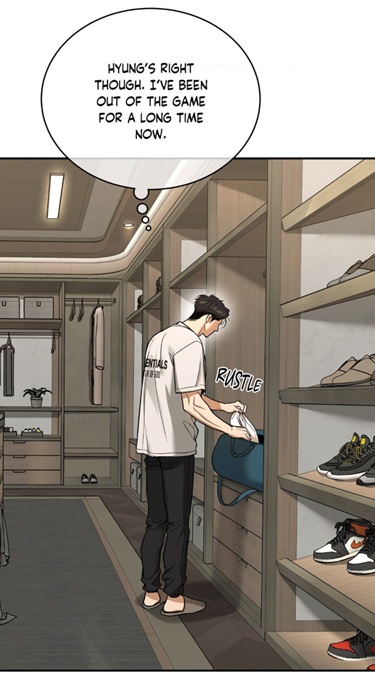 (chapter 66) For years, he had accepted his manager’s judgments out of habit, mistaking silence for consent. But here, for the first time, the repetition feels deliberate — not resignation, but reflection (“though”). The phrase becomes a question more than an agreement: is he truly right? He is admitting this out of habit.
  (chapter 69) His silence has shifted from obedience to suffocation. The weight of Namwook’s deaf authority is no longer bearable. And yet, even here, his confession is muted, confined to the private space of his car. He is not yet ready to speak the words aloud — not until someone appears who will listen.
  (chapter 48) This scene was observed by Kwak Junbeom, so the latter could have reported it to the coach. If it truly happened, this would expose the coach’s deafness and cowardice. He chose passivity instead of confronting the doctor or the champion. That way, he avoided responsibility. And this brings me to my final conclusion concerning the deaf manager. His main way to contact the celebrity is the cellphone:
  (chapter 66) It is both his mask and his crutch — a tool for barking orders, never for dialogue. The moment the line goes dead, his authority collapses, for he has no other means of contact. His power depends on Jaekyung’s reception, not his own strength. In truth, the manager’s disability is exposed here: deaf to Jaekyung’s voice, he has trained himself to hear only the ring of a phone. A fragile authority built on silence, ready to crumble the instant Jaekyung decides to switch it off.
 (chapter 76) must be read not as pride, but as a desperate shield against annihilation. In other words, in episode 76, the athlete is too harsh on himself, though I am not saying that he is innocent either. He only thought of himself because he had taught to behave that way. He was just mirroring the adults surrounding him who hid their weaknesses and wrongdoings behind “lies, social norms and hierarchy”.
 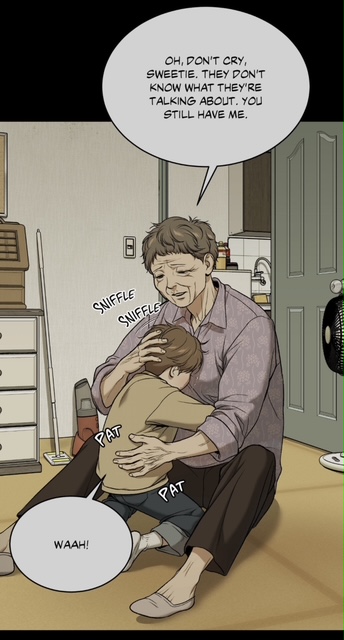 (chapter 57) With his grandmother and with every authority he encountered — doctors, employers, even predators — he believed unquestioningly that others were right and he was wrong. Hence he trusted others blindly. He was trained to accept decisions made for him or against him.
  (chapter 70) Thus he accepts criticism with defending his own interest. He was not taught how to fight back or resist or even argue.
 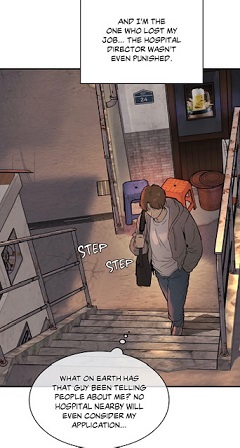 (chapter 1) He never tried to seek justice. His “you’re right” was not recognition but submission, the language of someone who could not afford to resist. In season one, this made their relationship combustible: Jaekyung spoke only in victory and as such submission, while Dan accepted every loss as natural. He also adopted this mind-set. On the other hand, because their initial interaction was based on a contract,
  (chapter 6), both were forced to discuss with each other about the “content of the agreement”. That’s where the champion was trained to communciate with the physical therapist. Thanks to the champion, because of this victory/loss mentality, the doctor learned gradually to argue and “reply” with his “boss. However, due to his childhood, he couldn’t totally drop his old principles like for example “saying no”.
 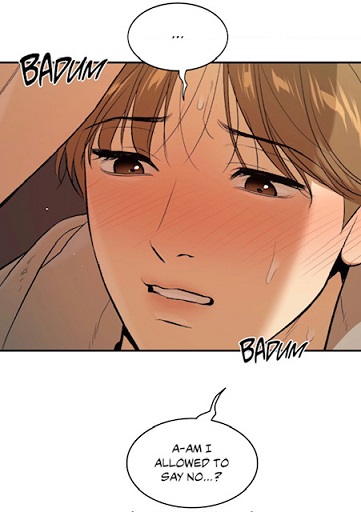 (chapter 34) To conclude, before their fateful meeting, neither man had learned how to argue as equals. But in the kitchen in front of the stove, this changed: both are right and wrong!
 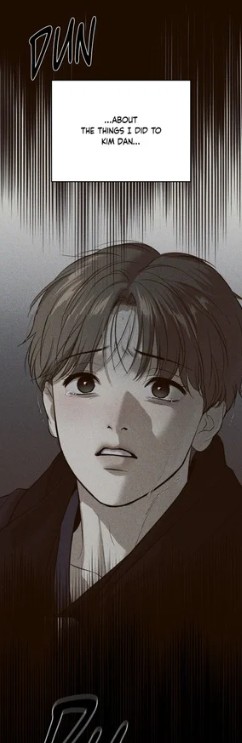 (chapter 76) He speaks like someone expecting rejection. Hence he keeps his distance. Yet the very fact that he says it at all signals change. Where once he would have doubled down — by barking an order, by firing Dan, by retreating into silence — he now admits defeat. The vocabulary of winning and losing, inherited from his father and reinforced by every adult in his life, collapses in the presence of Dan’s quiet honesty.
 (chapter 76) — an acknowledgment that he can no longer keep his walls intact. He is now willing to rely on doc Dan exclusively.
 (chapter 76). His confession reveals not strength but guilt. Kim Dan’s suffering was the price of his victories, and he knows it. “On the other hand, his mea culpa should be relativized, for both were the targets of a plot!
 (chapter 76) These words expose both responsibility and shame: he had prioritized survival over connection, career over compassion. What boils under his skin is not pride but remorse.
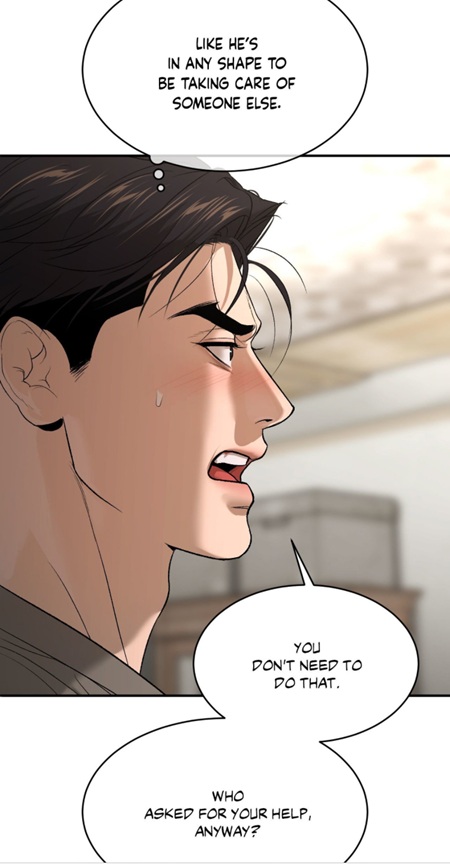 (chapter 76) The star’s thoughts in the kitchen are actually mirroring the ones in the bathroom:
 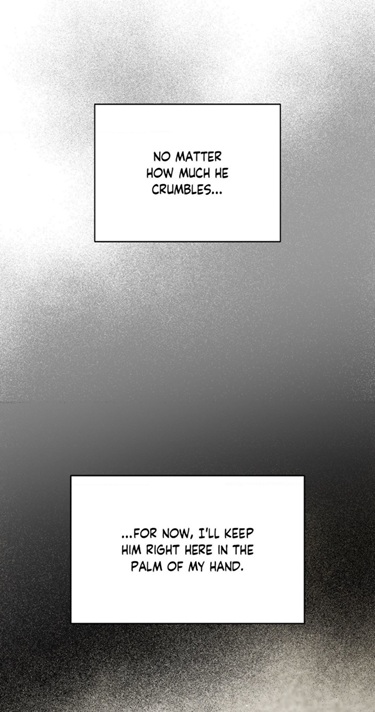 (chapter 68) In the bathtub, he still saw himself as the one in control, with the upper hand… but this is no longer the case in the kitchen. Through the physical therapist, the wolf is learning that even being in a vulnerable state doesn’t mean that this person is powerless. It is just that his “strength” lies elsewhere. In other words, someone struggling can also give comfort to another person in pain.
  (chapter 72) a place of solitary consumption rather than shared meals, the bed was the place where the little boy would drink his milk.
 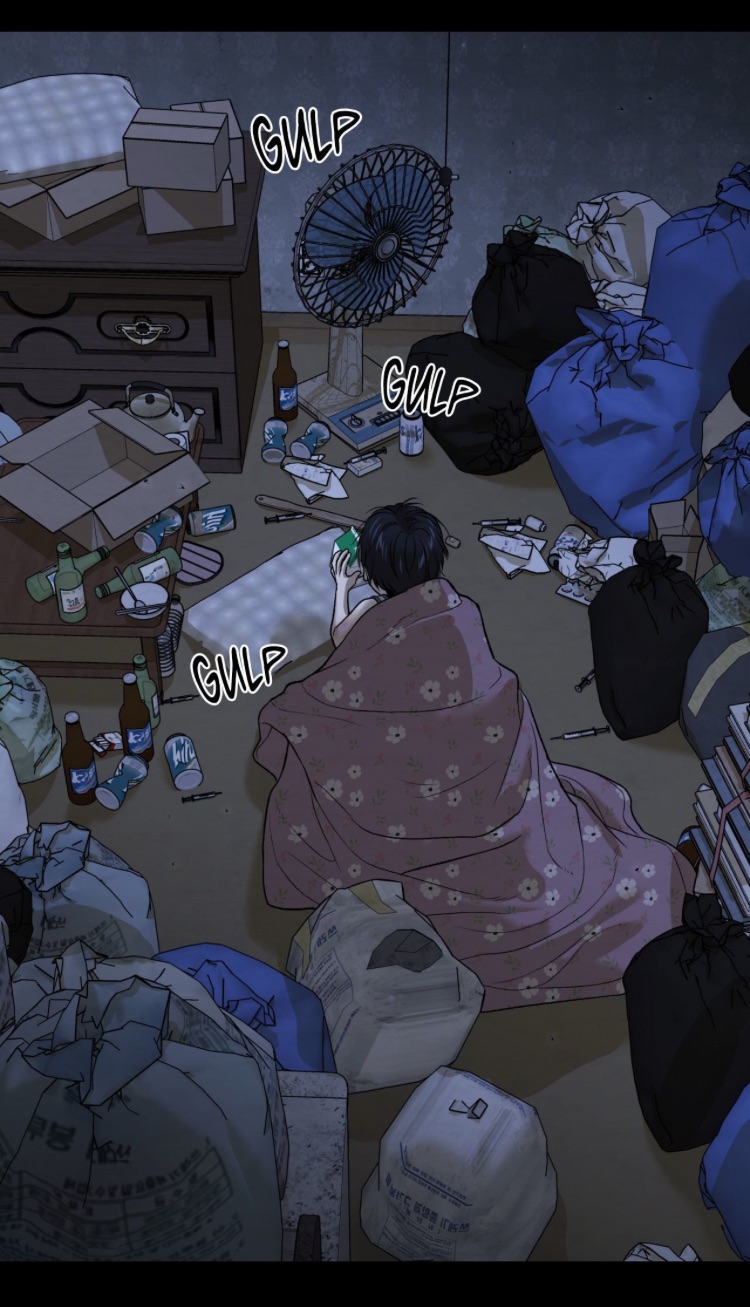 (chapter 72) It is interesting that actually, Doc Dan wanted to bring the porridge to Joo Jaekyung to his bed during that full moon night, thus the latter made the following request:
  (chapter 76) But the wolf didn’t understand the hamster’s intention and followed his “hyung” to the kitchen. That’s how a misunderstanding was born which is also reflected in this interaction:
 (chapter 76) However, doc Dan agreed to this, he remained calm.
  (chapter 41) The latter actually represented a hindrance between them, it marked their relationship: boss and “employee” (servant). Moreover, since the table in the champion’s childhood was linked to one person (the father), it is clear that the champion has never shared a table with someone. And this aspect brings me to my other observation.
  (chapter 22) Whether in meetings, weigh-ins, or dinners with the CEO
  (chapter 46) It was a place where others dictated terms, while Jaekyung’s silence was mistaken for consent. And now, you comprehend why the two main leads could get closer in front of the stove in the kitchen. This place stands for warmth, care and family.
  (chapter 13) a meal after his collapse. He refused to bring a meal to the bed, he asked him to join in the dining room and sit at the table. And what did they do there? The champion talked about his career, his fight etc…
  (chapter 13) the champion has long associated the table to business and not “care”. That’s why it is important for him to remember the significance of the bed in his childhood. It was the place where he could feel comfortable and safe, where he would eat!

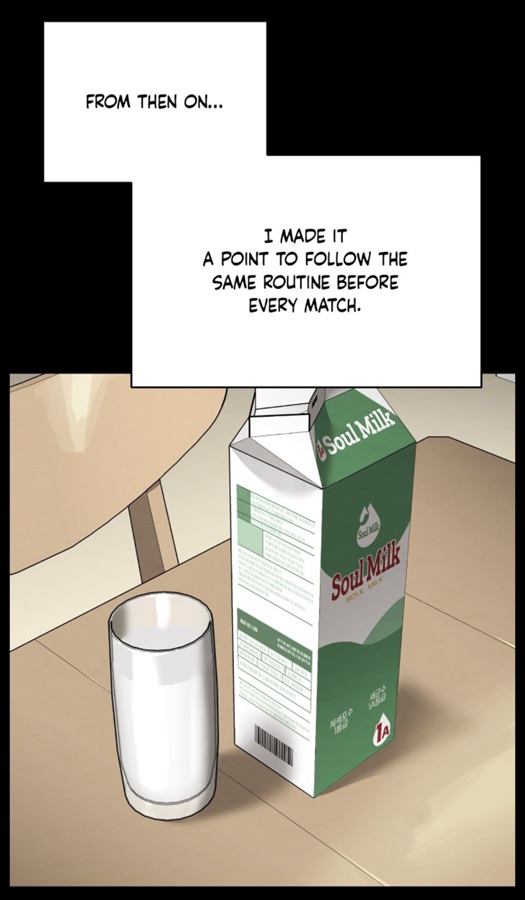 (chapter 75), the perfume
  (chapter 75), the nights of sex before a fight
  (chapter 75). His words seemed like a confession, a key to the riddle of the Night Emperor. But do we truly know him now? Yes and no. Yes, because his testimony reveals patterns we had only noticed before. No, because those patterns are only the ones he decided to share. The tattoos
 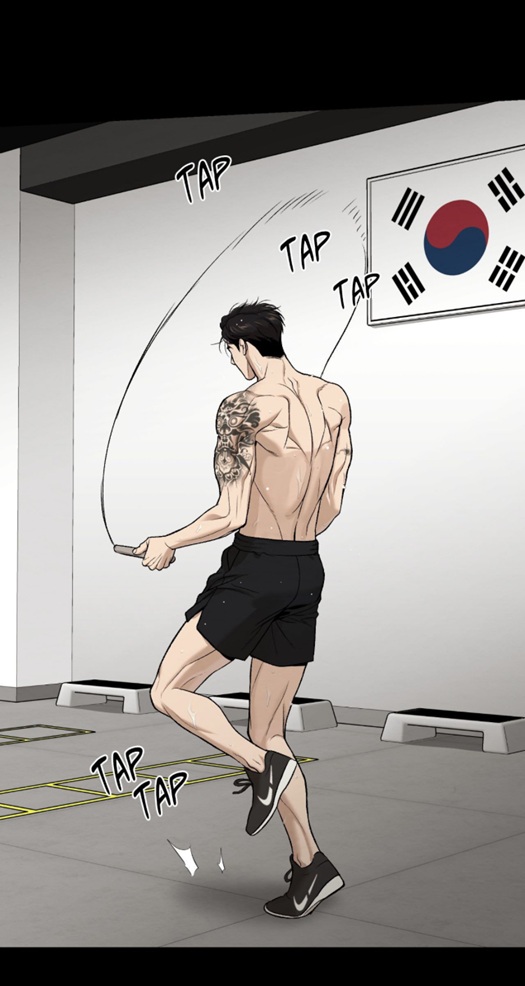 chapter 75) that suddenly appeared on his body
 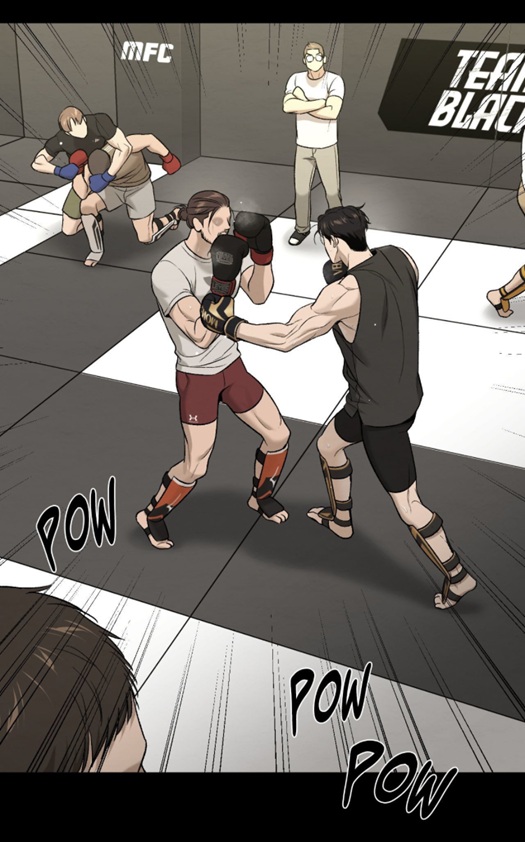 (chapter 75), for example, were left unmentioned — proof that silence still surrounds him.
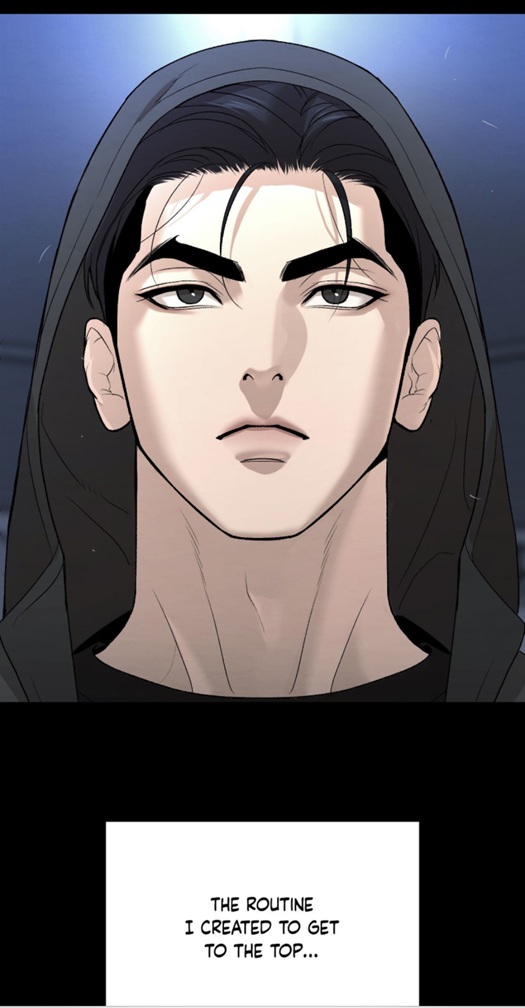 (chapter 75) Why fight as though every match were a matter of life and death? Why keep repeating the same acts, long after survival was secured?
  (chapter 75) What does the jinx truly represent for him — mere superstition, a ritual of control, or something he himself has not yet dared to name? For Jaekyung himself cannot fully explain it. He confesses what he knows — that sex steadies him, that milk soothes him, that perfume sharpens him — but he does not grasp what lies beneath these habits. The origin of the jinx remains hidden, lodged somewhere between memory and trauma, where even he cannot follow. Are these rituals mere superstition, a desperate bid for control? Or are they fragments of something deeper — pieces of a story he has never fully told, even to himself?
 .(chapter 75) They are the product of a long chain of humiliations, betrayals, and systemic exploitation, each layering onto the next until a young man’s raw talent was encased in a carapace of compulsions. To understand the jinx is to understand how the protagonist’s life collapsed around the word loser, and how the fighting industry transformed his private shame into public myth.
 (chapter 72) Even before stepping into a professional cage, his life had been a series of trials to prove he was not worthless.
  (chapter 74) Hunger, poverty, bullying, insults— each branded his body with a language of violence. Among them came his father’s words, spat like a curse: loser.
 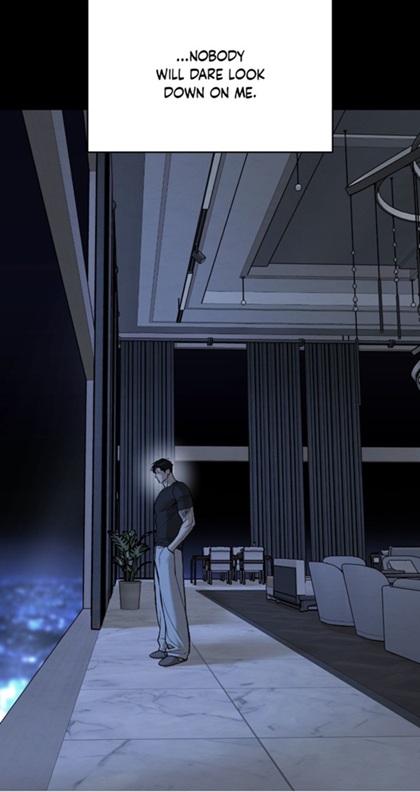 (chapter 75)
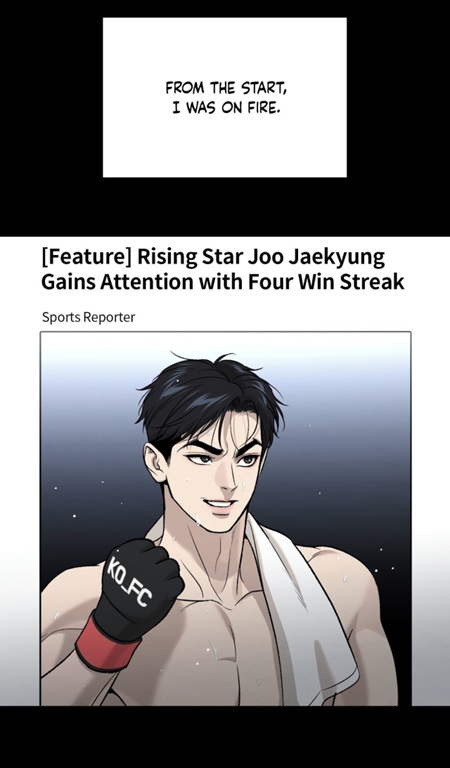 (chapter 75) — a boy who fought with the desperation of someone who had nothing else. Victory after victory gave him the illusion that he had escaped his father’s shadow. As long as he was winning, he could suppress the pain, bury the insult loser, and silence the memory of that cursed night when his father died and his mother abandoned him. Triumph became his shield, proof that he was not what he had said he was.
 (chapter 75)
  (chapter 75) To them, a fighter’s struggles had only one explanation: weakness. Park Namwook and the other coach dismissed his losses as nerves
  (chapter 75), as if the only measure of worth were what happened under the spotlight. They never thought to ask what kind of weight he was carrying, what kind of nights he was surviving before he entered the cage. While the other fighters were well aware of the champion’s insomnia
 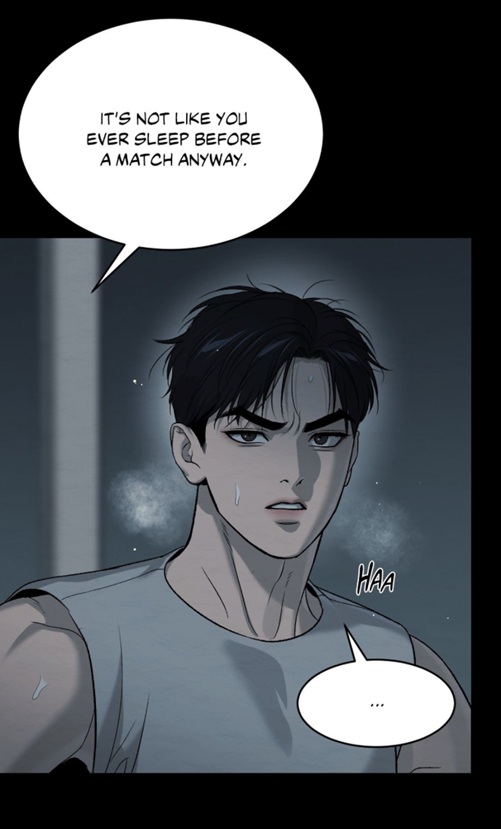 (chapter 75), Park Namwook still has no idea of the champion’s struggles. This shows how disconnected he is from his “boy”.
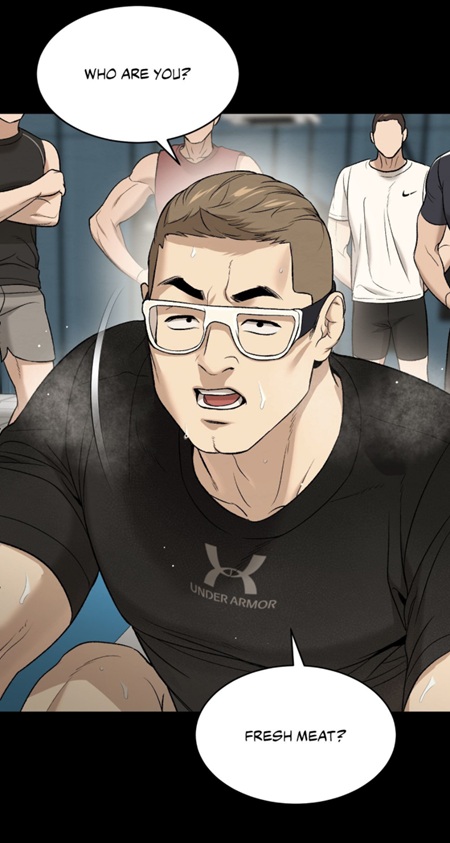 (chapter 74) bodies to be tested, pushed, and discarded if they broke. Where Jaekyung’s defeat cracked open childhood trauma, they saw only performance failure. What he lived as suffocation and despair
 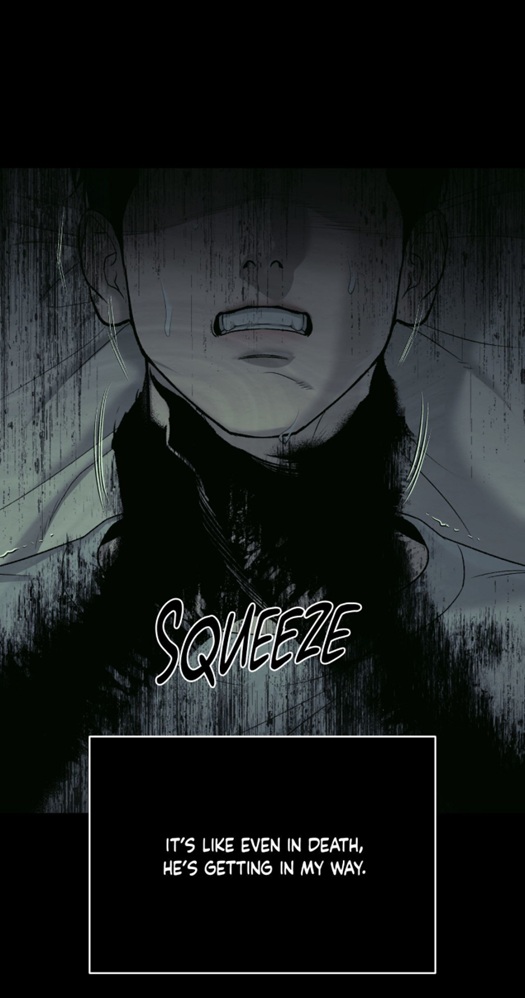 (chapter 75), they reduced to cowardice, bad luck or lack of discipline.
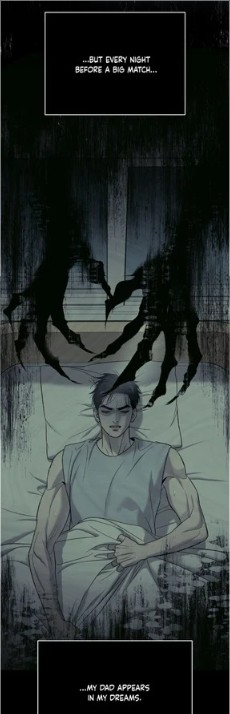 (chapter 75) Shadowed hands stretched over his body, pressing down, suffocating him as he tried to sleep. The man was dead, but still he choked the air from his son. It was, as if the father wanted to bring his son to the afterlife.
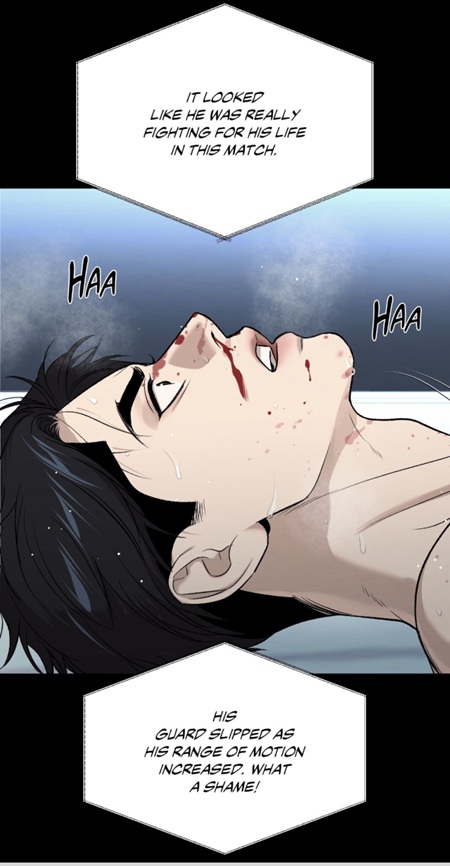 (chapter 75) Even before his first loss, Jaekyung fought like a cornered animal, pouring every ounce of strength into proving he could not be beaten. That’s why he rose so fast. But why? The reason is that all his opponents were reflections of his “father”.
  (chapter 29) Hence all the challengers have empty eyes and a smirk on their face, just like Joo Jaewoong.
  (chapter 75) Consequently, his matches always looked like life-and-death struggles. He wasn’t strategizing against a specific fighter; he was exorcising a ghost. That’s why he never refused a challenge. His opponent never mattered. Besides, as long as he could win, it didn’t matter.
  (chapter 75), the more the cracks showed — and the ghosts of his father and mother made every fight feel like a replay of abandonment and accusation. The five losses
  (chapter 75) were not just setbacks in his career; they were the repeated reopening of a wound that would never heal. Each one confirmed his father’s curse. Each one reinforced the sense that he was marked, that no matter how high he climbed, he would always be dragged down again.
 (chapter 73) To the boy, it was a cry for pain and survival — an instinctive urge to escape despair and criticism. To the father, it was betrayal. Already emasculated by failure and drink, he was reminded of his wife’s discontent, the specter of another abandonment. He lashed out the only way he knew:
 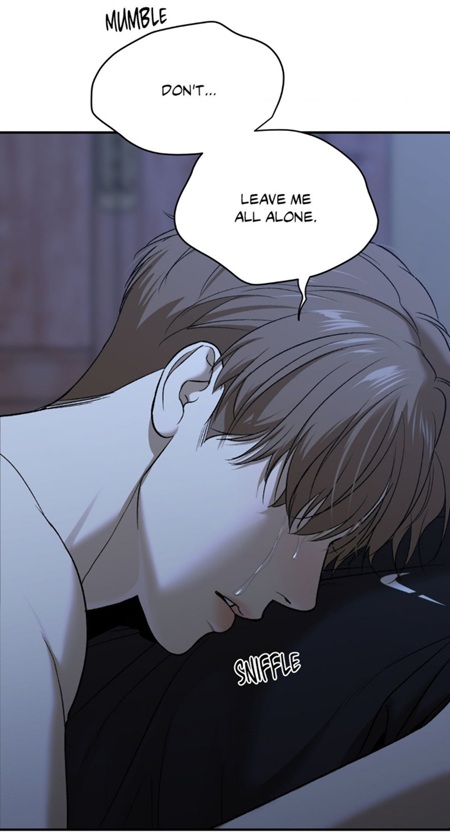 (chapter 66) — speaking not with fists or insults but with tears and an embrace.
  (chapter 66) His sleepwalking reacting to a simple touch
 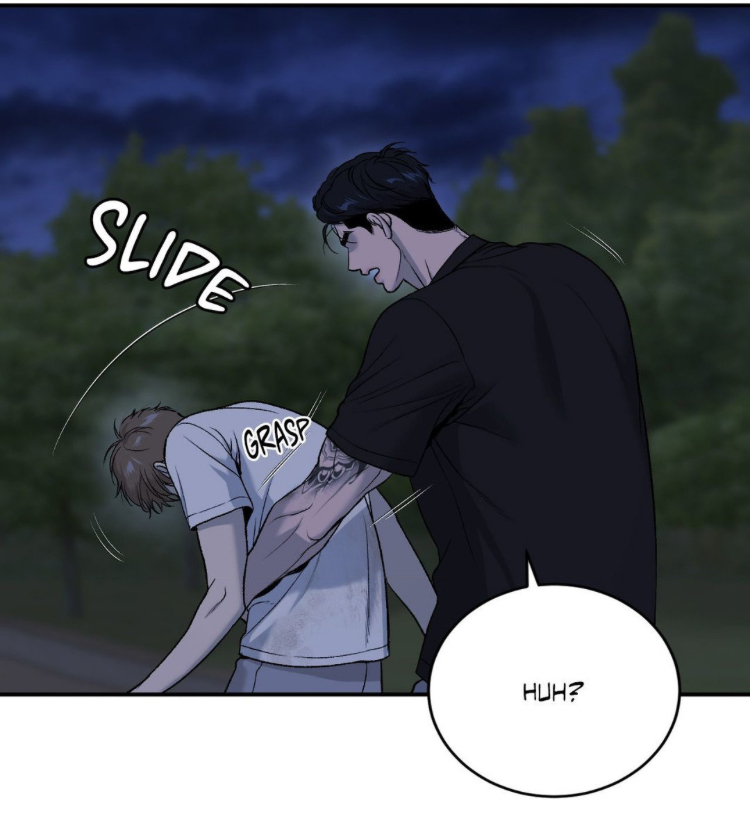 (chapter 65), his dissociative pleas
 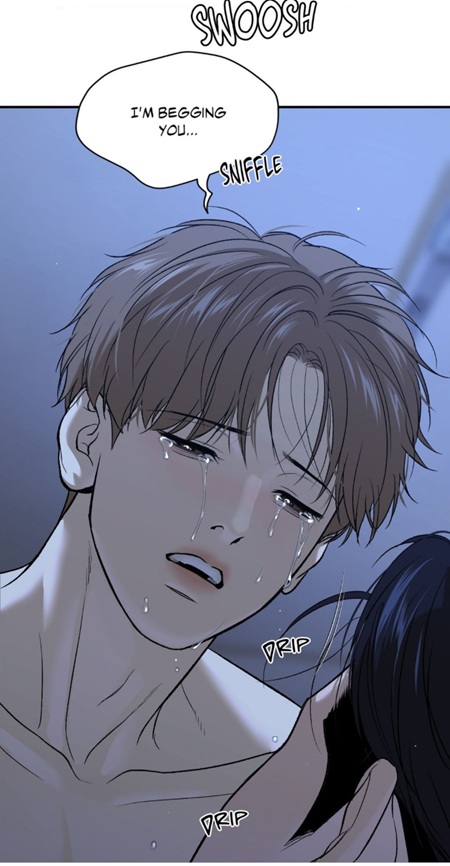 (chapter 66) give Jaekyung the words his father could not say. Where the father’s unconscious leaked out in aggression, Dan’s unconscious offers gentleness and honesty. Both men speak from a place deeper than reason; one chained Jaekyung to guilt, the other opens the possibility of release. In Dan’s trembling body, Jaekyung sees the tender reflection of his father’s hidden plea
  (chapter 73) Why does the champion have no grand-parents?
 (chapter 72) His violence expressed his powerlessness. And when his son shouted his desire to leave the “dump of a house,”
  (chapter 57) Violence and insult became his only idiom. “Loser” was not simply an accusation, but the displaced confession of his own defeat: I was abandoned. I failed. I have nothing.
 (chapter 73) The boy’s boxing talent was a source of pride — proof of strength — but also a threat. Strength meant escape. Escape meant abandonment. The father, who had already lost his wife and his dignity, projected onto his son the terror of losing everything once again. His resentment was not born of disappointment alone but of recognition (unconsciously): you are me, and you will leave me too.
 (chapter 65) The absence is not an oversight but a theme. Jaekyung comes from severed roots: no grandparents, no siblings, no extended family to lean on. Hence he was alone at the funeral.
 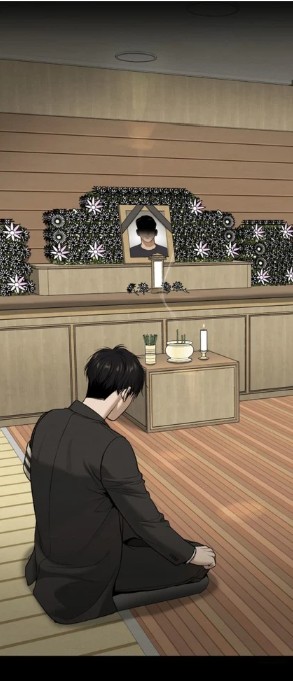 (chapter 74) His father may have been an orphan, just like his mother too. Therefore the latter was emotionally unavailable, and so he inherited not only trauma but also silence. By contrast, Dan has at least one surviving figure — flawed as she is — who keeps the family thread intact. That contrast makes Jaekyung’s bond with Dan all the more significant: it is not just romance, but an attempt to build a family line that never existed before him.
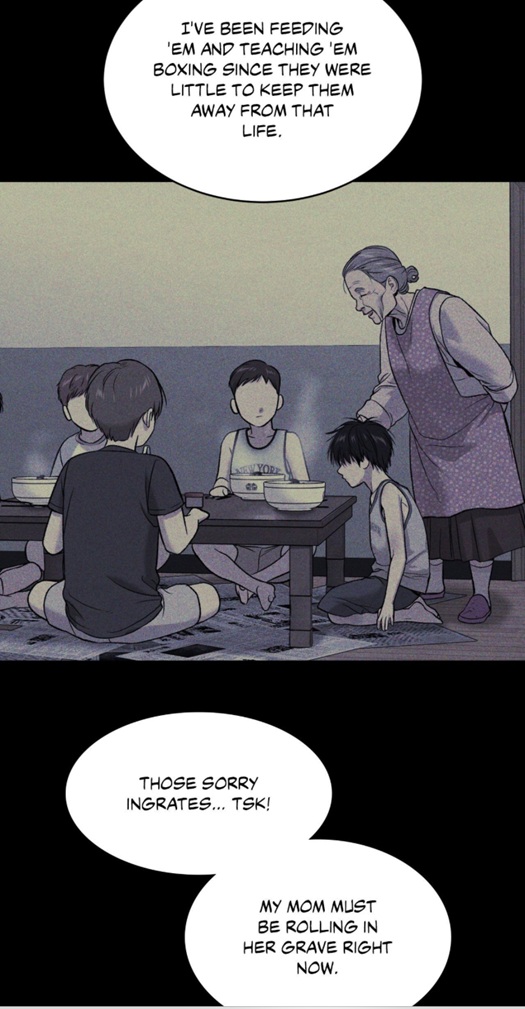 (chapter 73), while keeping Jaewoong’s own origins shrouded. Hwang had someone by his side — gentle, quiet, but present — while Jaewoong had no one, as according to me, the mother was counting on her “husband”‘s success and dream. The director’s stability, however fragile, was rooted in that maternal figure. Jaewoong had no such guide, and without it, he simply made the wrong choice.
 (chapter 73). To win was to prove his father wrong, but to stand alone in victory was to prove his mother right. Success and emptiness became inseparable.
 (chapter 56), seemingly fragile and dependent. But unlike her, he stays. Where the mother left, Dan endures. He only left because of the champion’s final words:
 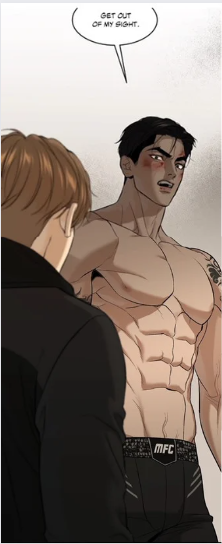 (chapter 51)
  (chapter 73) mirrors what the director later whispers to Jaekyung:
  (chapter 75) This is the wolf’s ritual in front of the tender mirror: the fighter who lived by curses and silence finally meeting their reflection transformed into gentleness and endurance.
 (chapter 75) This man’s jinx was startlingly simple: he read the Bible before every match. One book, one ritual, one anchor. To outsiders, it may have seemed quaint, even laughable, but to Jaekyung it was enviable.
 (chapter 75) When he prayed, it was not only for victory, but for coherence. Win or lose, the ritual bound him to a sense of belonging that Jaekyung had never tasted.
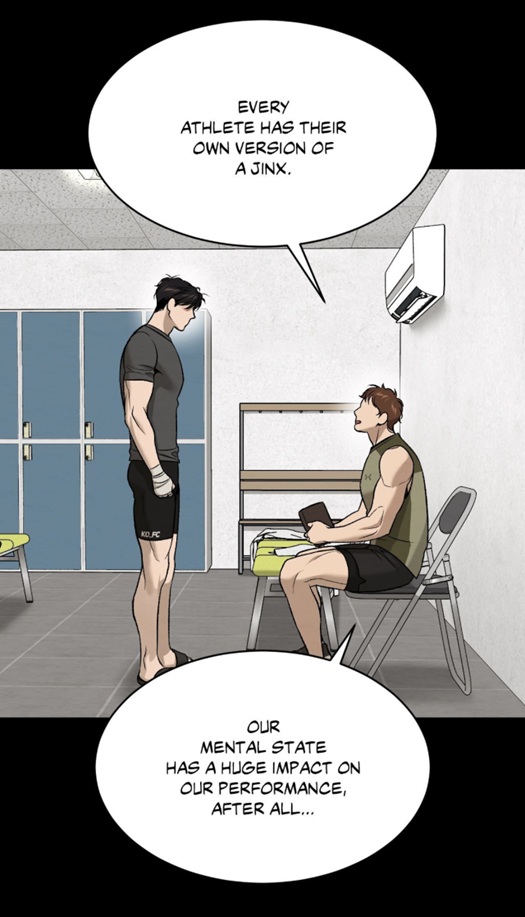 (chapter 75) If ritual could bend fate, he would build his own. But where the Bible fighter had a single, unifying story — scripture, God, fellowship — Jaekyung had nothing to draw on. No faith to lean on, no parental blessing to inherit, no safe home to return to. Instead, he began to stitch together a mosaic of rituals, each one disguising a different childhood wound. To outsiders it looked obsessive, neurotic, almost superstitious. To him, it was survival. Each gesture was both repression and remembrance, a scar disguised as armor. And this is the paradox: the rituals made him strong enough to survive, but too broken to live.
 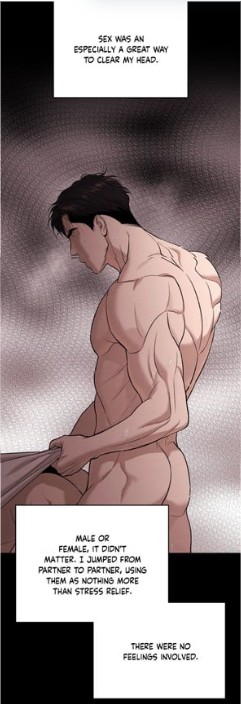 (chapter 75) By using another body, he cleared his head, numbed the loneliness, and convinced himself he was in control. But it was also a grim reenactment of abandonment: he could take without being left, dominate rather than risk being deserted. At the same time, he considered his sex partners as toys in order to avoid guilt. A toy can not die, it can be “thrown away”.
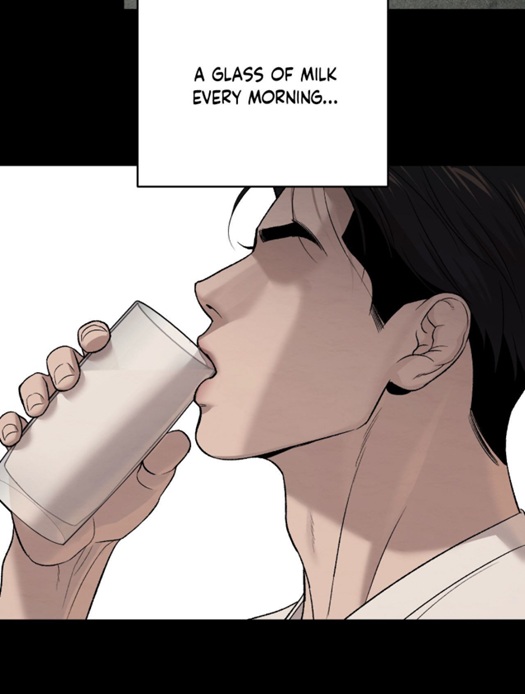 (chapter 75) But in truth it was a disguised memory of hunger
  (chapter 75) To drink milk was to rewrite the past: I will not go hungry again. Yet the act was also a reminder that he once had.
 (chapter 27) , self-punishment, the willingness to suffer endlessly for the cage. He didn’t fear pain. Their sudden appearance
  (chapter 75), a reminder that he had entered a machine in motion, a system that swallowed fighters whole and spat out statistics. From that point, the acceleration was merciless: by April, he was in the 272nd bout against Randy Booker
  (chapter 14); by June, the 293rd against Dominic Hill
  (chapter 40); and by July, the 298th against Baek Junmin.
  (chapter 50)
 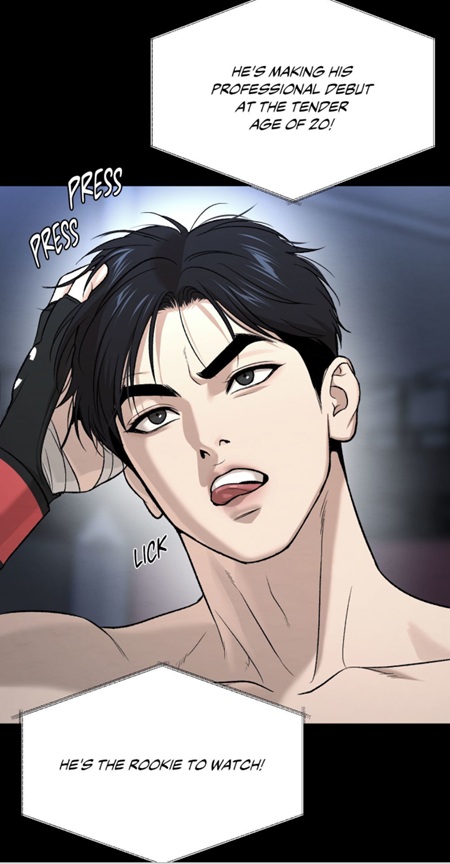 (chapter 75), he had not merely “built” a career, he had been consumed by one. There was no time to recover from injuries, no space to process victory, no room to integrate defeat. No wonder why his shoulders were in bad shape.
  (chapter 75) Every fight blurred into the next, every opponent older, stronger, more experienced. And yet Jaekyung fought them all with the same desperate, survival-driven ferocity.
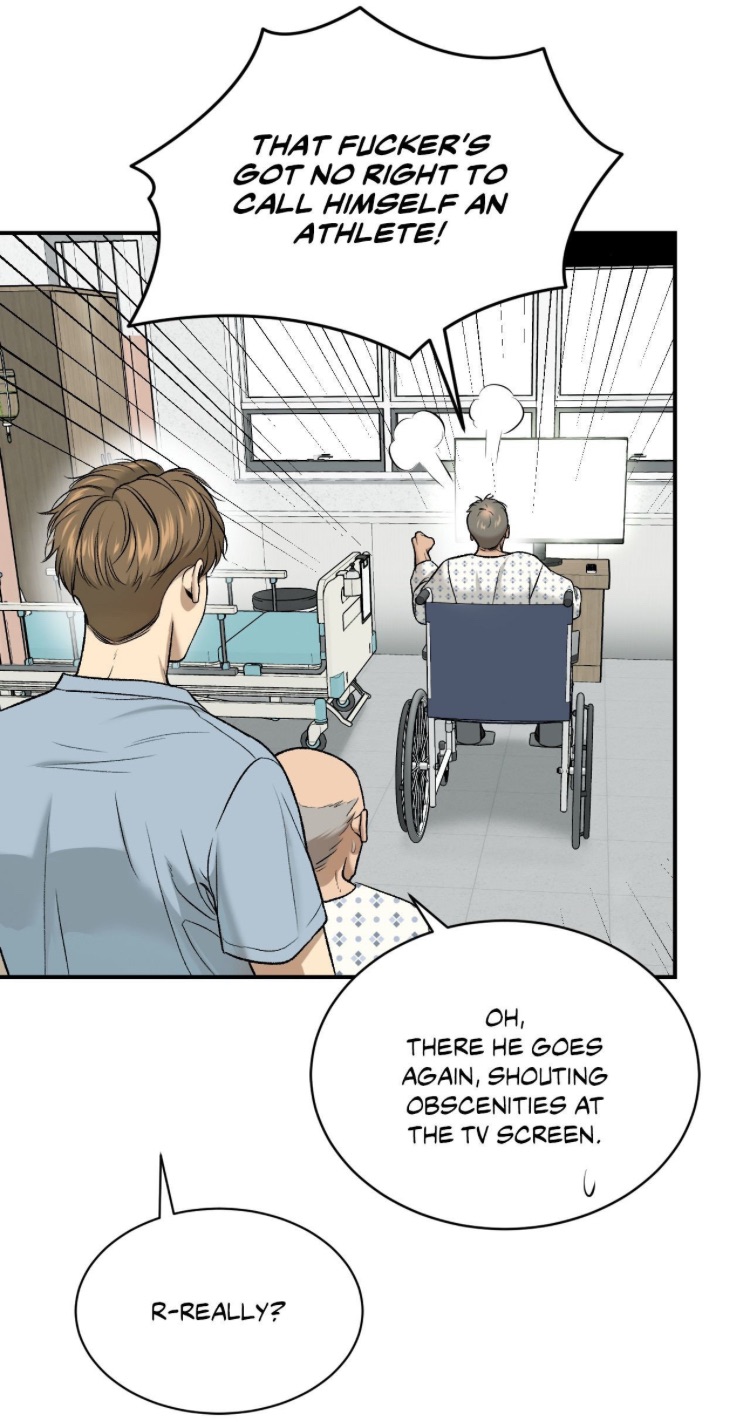 (chapter 71) and Dr. Lee
  (chapter 27) still called him an athlete — someone whose body required balance, protection, recovery. But MFC and KO-FC never did. For them, the main lead or his colleagues were addressed as
  (chapter 14) “The Emperor”, “a crazy bastard”
 (chapter 40), “my boy”,
 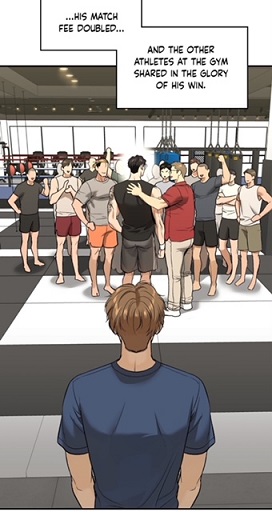 (chapter 41) Only doc Dan at the gym saw the fighters as athletes!
 (chapter 47). Thus only doctors are allowed to do them officially. But Jaekyung’s rise shifted that meaning. As “The Emperor,” he normalized tattoos for the new generation of fighters, transforming what once marked marginality into a badge of visibility. This is why even Oh Daehyun, one of his admirers and members of Team Black, now carries one:
  (chapter 8) The celebrity’s suffering literally redefined the aesthetic of the sport. His body, turned billboard, became part of the league’s branding.
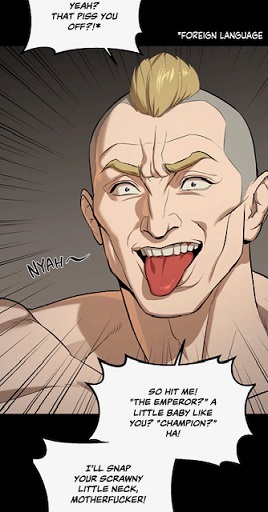 (chapter 14) ripping open the scar of his father’s “loser” and his mother’s absence and silent parentification. Not long after, an article exposed his shoulder injury
 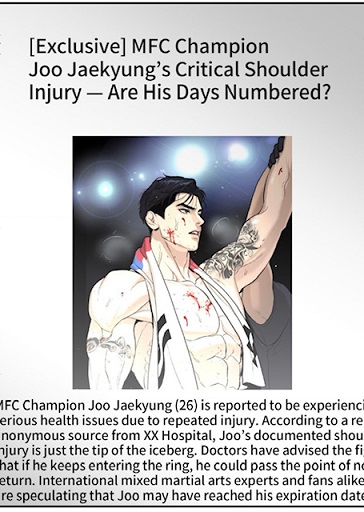 (chapter 35), reducing years of discipline to a liability on the page. Later came the suspension narrative
  (chapter 54), his temper framed not as the product of exploitation and scheme but as proof of unfitness, as if his rage were a crime instead of a symptom.
  (chapter 54) Even the match with Baek Junmin was twisted against him — accepted under pressure, then reframed as recklessness. To the system, his crown had been too secure, his presence too dominant. He had been champion for “too long.”
 (chapter 5) the name Seo Gichan appeared here for the first time… a faceless name!
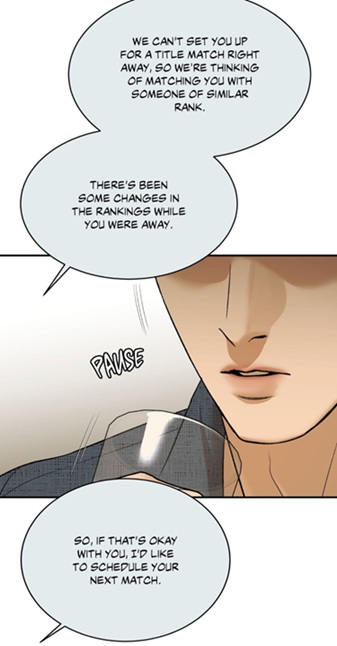 (chapter 69) The danger lay in the very identity of his next challenger. If they pitted him against a newcomer who had rocketed through the ranks as quickly as Baek Junmin once did
 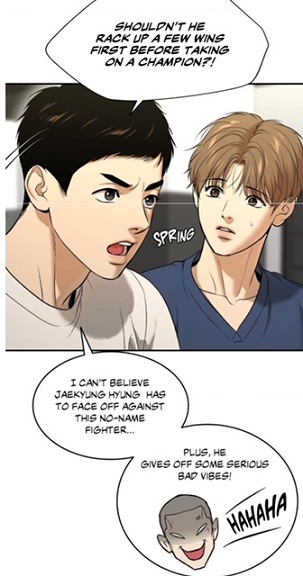 (chapter 47), questioning the selection of Baek Junmin, is so crucial. It shows that the manipulation of opponents was no accident — it was systemic. Matches were not about fair combat but about narrative management: making sure the emperor’s story served the company’s balance sheet.
 (chapter 51) On paper, it was a draw. In practice, it was soon reframed as a loss
 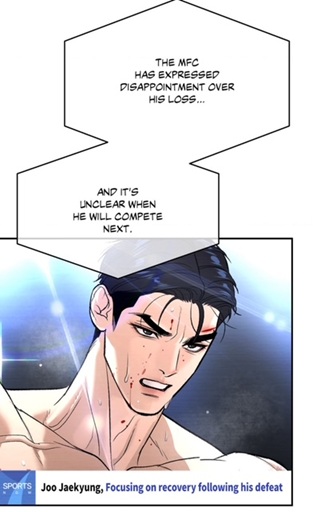 (chapter 57). By late August, Jaekyung had slipped to third place.
  (chapter 75) Here, it looks like a mirror, but naturally it is a fake one. It was not earned with fists alone; it could be stripped, reassigned, reshaped at will. One tie, one whisper, one adjustment in the rankings, and the Night Emperor was dethroned without ceremony.
 (chapter 75), not for intimacy but to clear his head and stave off loneliness, emptiness and his abandonment issues.
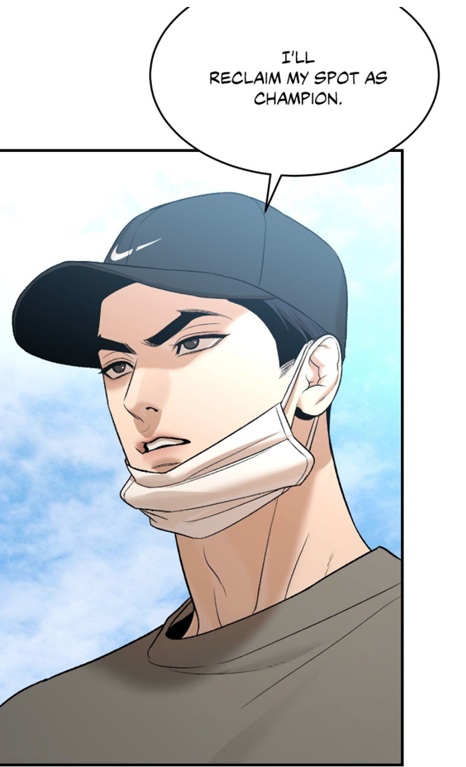 (chapter 75) must be read in this light. It is not a relapse into the system’s treadmill, nor a blind return to the pitfall laid before him. Notice that he does not say he will fight in the fall, nor does he mention the upcoming match that everyone else is waiting for.
  (chapter 71) Instead, he frames his goal with a word that changes everything: reclaim.
 (chapter 73), but he lost his father and his mother abandoned him.
 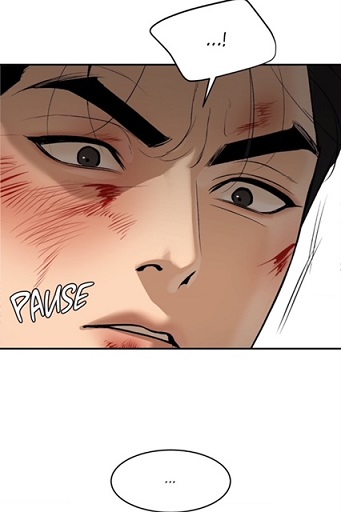 (chapter 51) The mirror is clear: the cycle can be broken, but only if he dares to answer the question that was never asked of him before. Therefore it is not surprising that the physical therapist’s question appeared in the champion’s vision:
  (chapter 54) His unconscious was telling him to have faith in his “doctor”. Thus later, the champion told the director of the hospital this:
 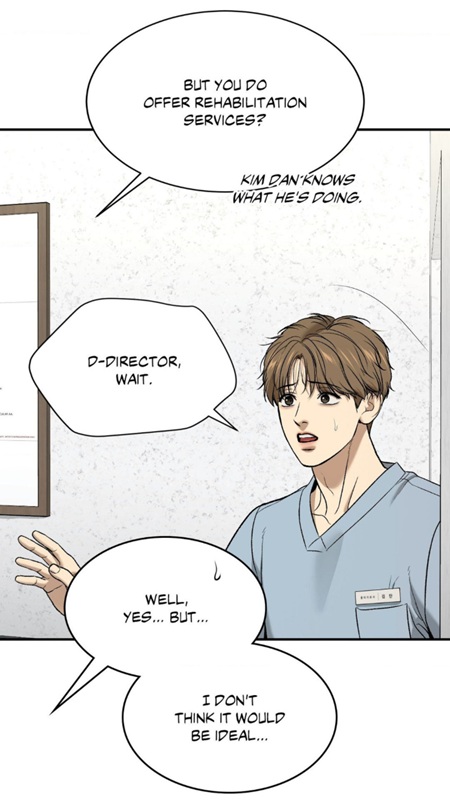 (chapter 61) He was acknowledging the main lead as a real physical therapist.
 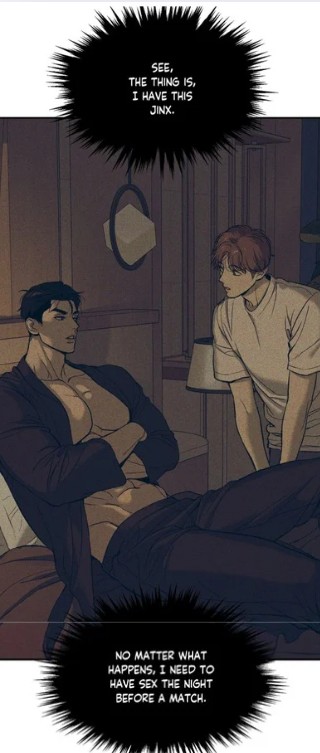 (chapter 62)— and even to those closest to his body — it looks like nothing more than sex. That was all the uke from chapter 2 saw, and it was enough for him to sneer:
 (chapter 2) The insult landed with devastating familiarity, not as a new wound but as an echo of his father’s curse: “loser.” Both words reduced Jaekyung to nothing — not a man, not an athlete, just a fraud kept alive by crutches.
 (chapter 2) In slamming his former partner against the wall, he was not merely silencing a lover’s cruelty. He was fighting the ghost of his father, the voice that had branded him weak, cursed, unworthy. The jinx that kept him alive was being twisted into proof of his failure, and he could not bear it.
  (chapter 2)
 (chapter 62), Dan recoiled.
 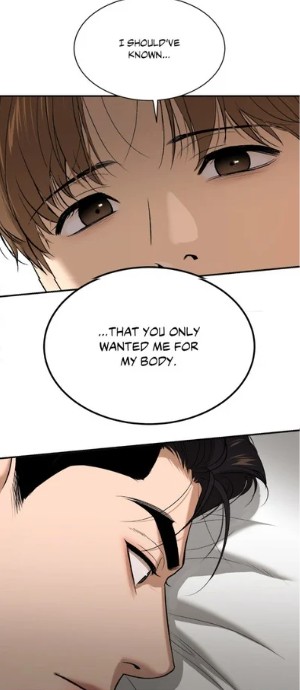 (chapter 62) To him, “jinx” meant objectification, a reduction of their bond to sex.
 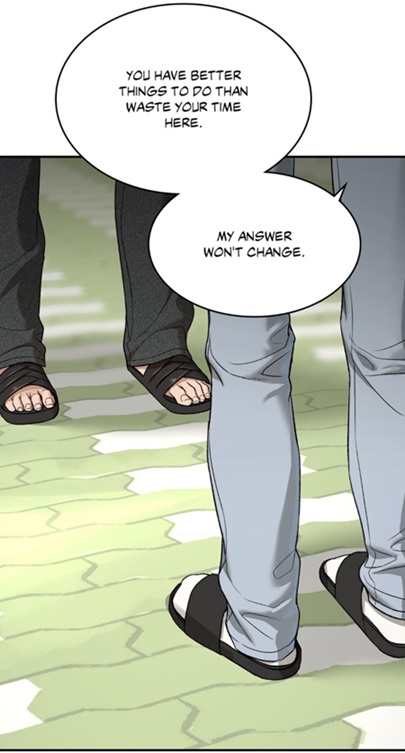 (chapter 62) but as a therapist he trusted. His words about wanting to return to the “usual pre-match routine”
  (chapter 62) were, in his mind, a way of saying: I need you to bring back wholeness, to help me steady myself again. But because Dan only knew fragments of the jinx, the message landed with devastating distortion.
  (chapter 62) For Jaekyung, the plea was about coherence; for Dan, it sounded like reduction.
 (chapter 22) He cooks breakfast for Jaekyung, offering something warm, homemade, human — a substitute for the cold, industrial glass of milk.
  (chapter 22) or cry out of joy.
 (chapter 54) throws the plate away
  (chapter 54), or sits at a vast table in silence.
  (chapter 54) But when Dan cooks, Jaekyung is surprised, even touched. For once, nourishment is not consumption but connection. The milk was always a disguised memory of deprivation; Dan’s meal becomes the antidote — food as presence. So for him, the prematch-routine was also referring to the meals prepared by his fated partner. And I feel the need to bring another aspect. Since there was no “family” in the athlete’s life, he never got the chance to discover the joy of the table.
  (chapter 22) Hence it is not surprising that he looked at his phone, while the others were eating and discussing. He never had a real conversation with a family member around the table.
  (chapter 40) Perfume was one of Jaekyung’s protective rituals — masking shame, creating an armor against the memory of bullying and ridicule. Yet Dan shows that none of this is necessary. The panel where he clings to the bedsheets after their Summer Night’s Dream together
 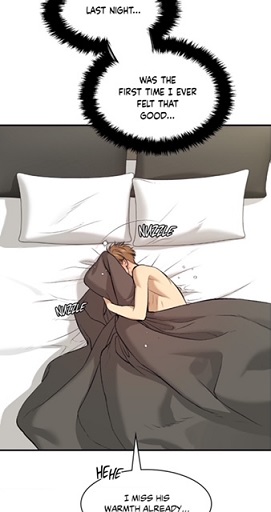 (chapter 45), whispering that he misses Jaekyung’s warmth, reveals that the champion’s natural scent is already enough. He never gets to see this — Jaekyung doesn’t know how deeply Dan treasures his smell.
 (chapter 2), and not the other rituals? Because to admit the rest would be to expose the origin of the jinx: the father’s insult, the mother’s abandonment, the hunger, the bullying. Sex was the only ritual that could be spoken without directly dragging the past into the room. It was the “safe” shorthand — though tragically, it became the most dangerous. Homosexuality is definitely a stigma among boxers and MMA fighters.
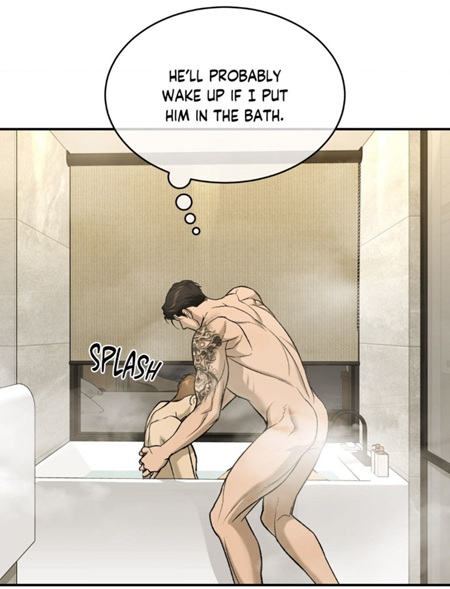 (chapter 68) In his own way, he was showing him that he did care! He was more than just a body… or even a physical therapist!!
 (chapter 35) It is the steady mirror of Kim Dan.
 (chapter 13) — helpless, cornered, often pleading. Thus the champion taught the doctor to overcome his fear and fight back:
  (chapter 26) This imbalance was no accident. It replayed Jaekyung’s own childhood roles: he became what his father had been to him (the better version naturally, for he is the mirror of truth), and forced Dan into the position he had once held himself. Through Dan, Jaekyung unconsciously re-enacted his trauma, reversing their positions as if to master what had once mastered him. That way, he was pushed to mature emotionally! That’s why he could connect with the main lead unconsciously. His trembling words in Chapter 51
  (chapter 71) He believes to know the truth, while he is ignorant. He is insecure, extreme in his behavior (drinking)
 (chapter 71), but also selfish and questioning, still fragile yet capable of protest. He is struggling with his own emotions and thoughts.
 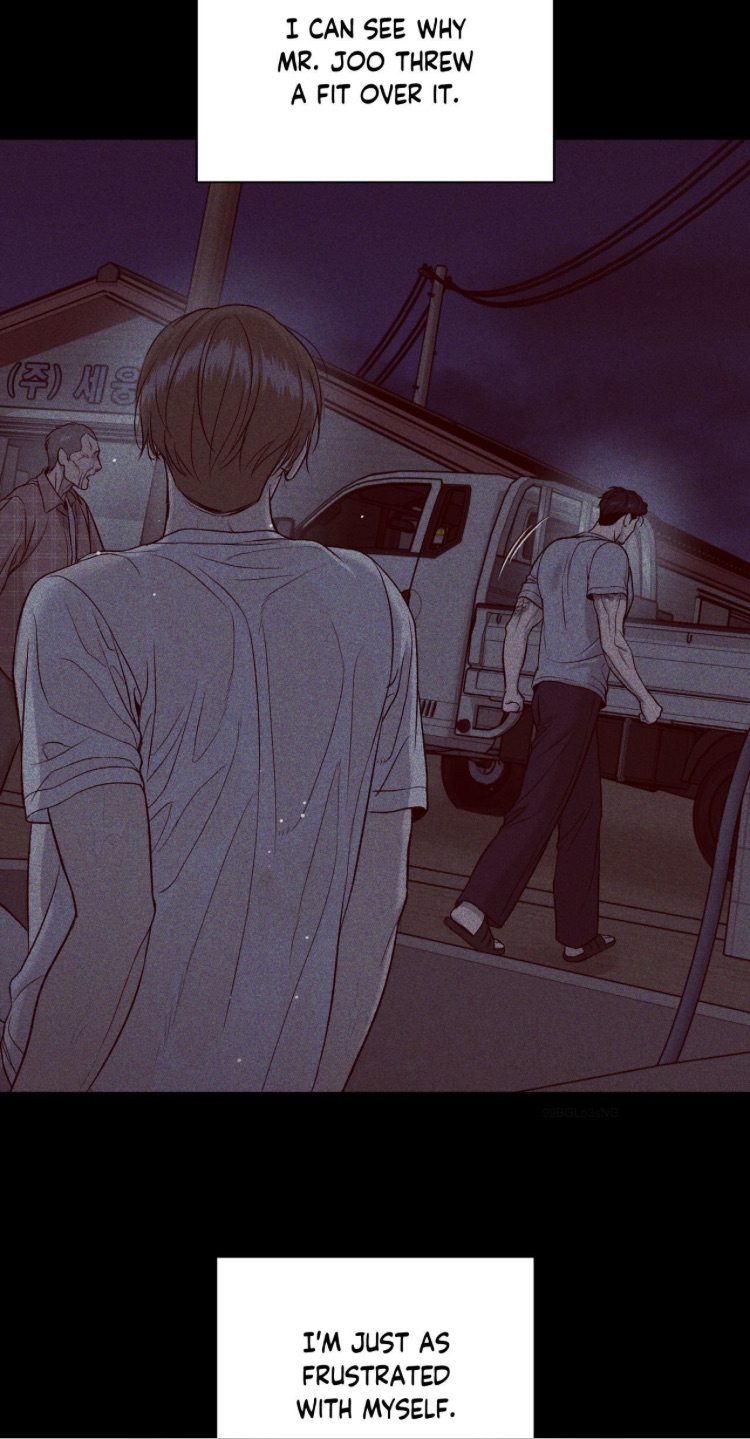 (chapter 71) How can he trust the athlete, when he doubts himself so much? From my point of view, he is on the verge of become “mature mentally” and as such “responsible”. At the same time, Jaekyung is revealed as the adult in crisis. His exhaustion
  (chapter 70)
 (chapter 74) It is because thanks to the director’s confession, the “hamster” is able to see the champion as a “a kindred spirit“, an orphan and as such as the younger “boy”.
 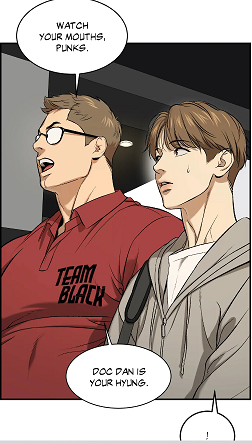 (chapter 7)
  (chapter 26), because it is play, because it is chosen.
 (chapter 69) It is not about treatment or jinx, but about presence. This hug reframes the meaning of strength. True strength is not the ability to fight endlessly, but the ability to hold and be held, to mirror” is like touching oneself! Let’s not forget that the mirror represents the reflection of a person. Respecting the physical therapist signifies respecting oneself!
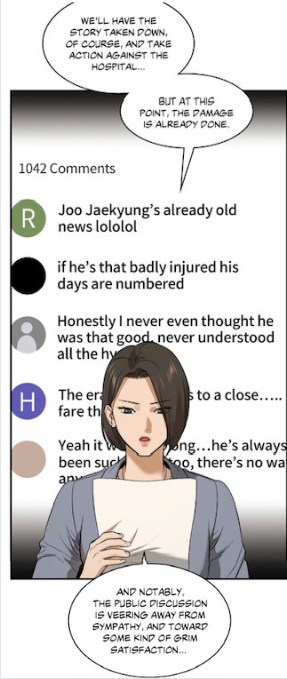 (chapter 36) He can remain indifferent to their “provocations”, as he has long matured emotionally.
 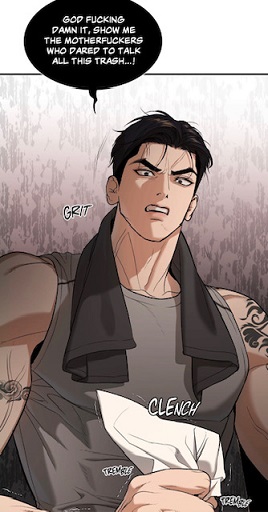 (chapter 36) He can retaliate differently. With his money and power, he can prove to them, he is no loser!

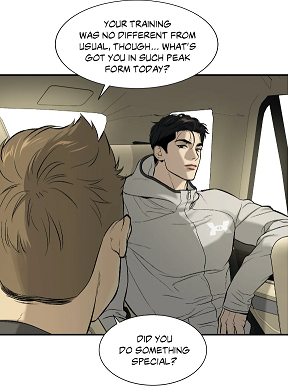 (chapter 5) his reliance on routine. Yet there is another jinx in this story, one far less visible and perhaps even more tragic: Kim Dan’s.
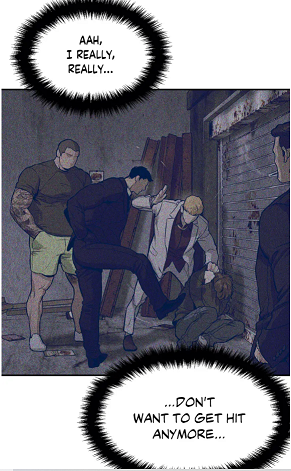 (chapter 1) was seen as the core expression of a man who believed he was doomed.
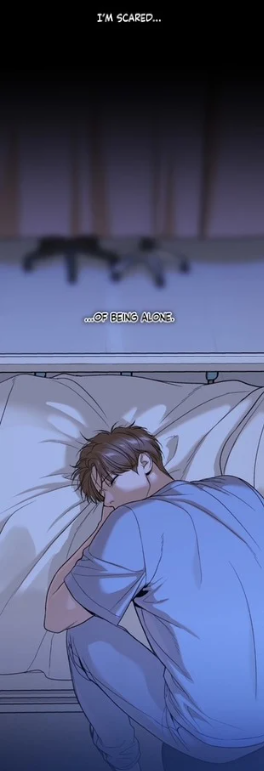 (chapter 56) In Chapter 56, Kim Dan is seen curled up next to a bed, whispering: “I’m scared… of being alone.” What makes this moment especially revealing is that he is not physically alone, for he is resting next to his grandmother. The presence of the very person who raised him should, in theory, offer comfort. And yet, the fear persists.
 (chapter 21) And this issue didn’t begin in adulthood. In Chapter 21, Kim Dan dreams of a night from his childhood: he wakes up alone, glances around the room in quiet confusion, and softly calls out for his grandmother. The room is dim, the bed beside him empty. This image carries more than just childhood anxiety:
 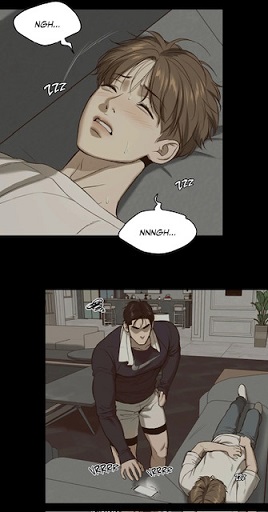 (chapter 21) It weaves together absence, silence, and the specter of loss. What’s striking is that the nightmare surfaces, not when he’s alone in the present, but after he has just returned from watching over his hospitalized grandmother.
 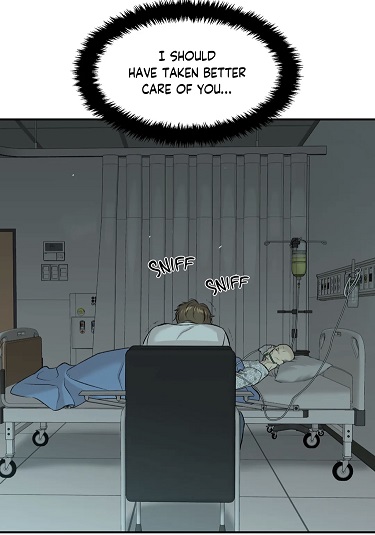 (chapter 21) He lies on the couch and dreams of a night when she vanished from their shared bed.
 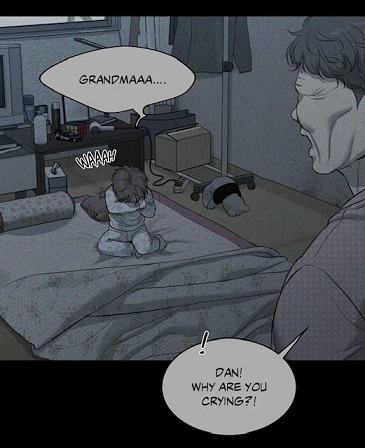 (chapter 21) This reveals how, in Kim Dan’s subconscious, the night and an empty bed have become synonymous with death. The trauma is deeply embedded, where even temporary absence is tied to the irreversibility of loss. For Kim Dan, solitude at night
  (chapter 67) is not mere loneliness—it is abandonment, it is death, it is the erasure of home. It is repressed, hidden beneath his quiet demeanor and years of survival-based behavior. Rather than a rational belief, it is a subconscious wound that only surfaces in moments of extreme vulnerability—especially at night.
  (chapter 57), his pattern of emotional detachment
  (chapter 67), and his obsessive loyalty to his grandmother
 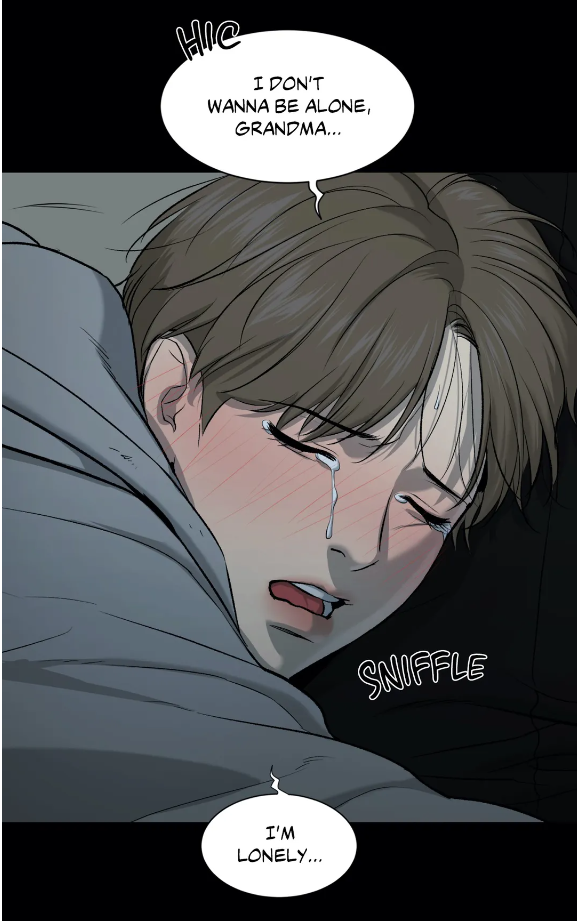 (chapter 10) signal a suppressed conviction: that he is destined to be left behind. What seemed like devotion now appears as coping; what appeared stoic was survival. And with the impending death of his grandmother, the anchor holding this hidden jinx in place is slipping away.
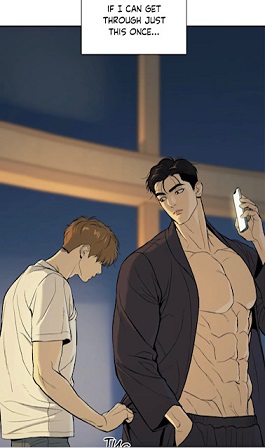 (chapter 2), the trembling kiss
 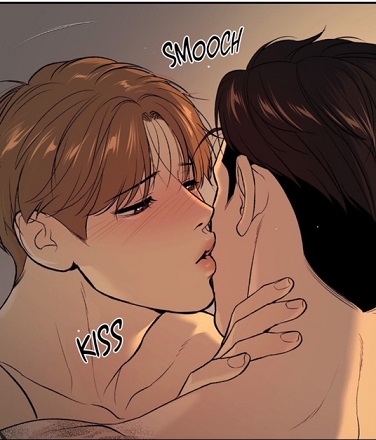 (chapter 44) and touch
  (chapter 44) in Chapter 44, the complete breakdown
  (chapter 57) A puppy needs at least eight weeks with its mother to grow emotionally secure. By drawing this parallel
 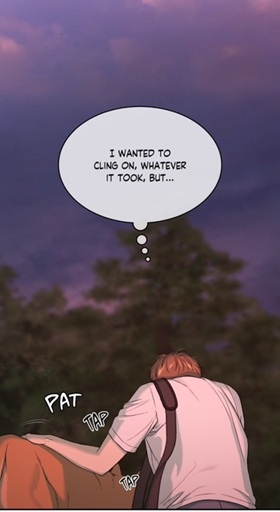 (chapter 59), the story tells us: Kim Dan was separated too soon. He was not ready.
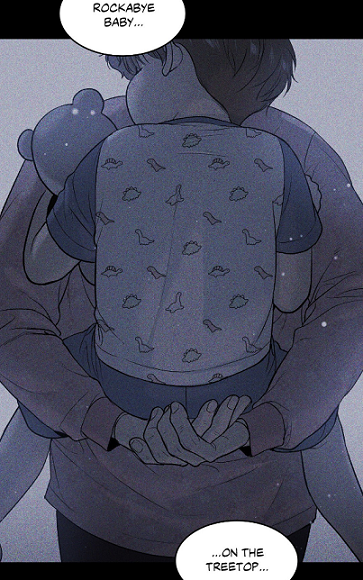 (chapter 47) the one person whose presence could keep the jinx at bay. As long as she was there, he could suppress the trauma, function, survive. She was his talisman. But she was never a healer, for she never spoke about his parents. She never addressed the core of his abandonment, like we could witness in the doctor’s nightmare:
 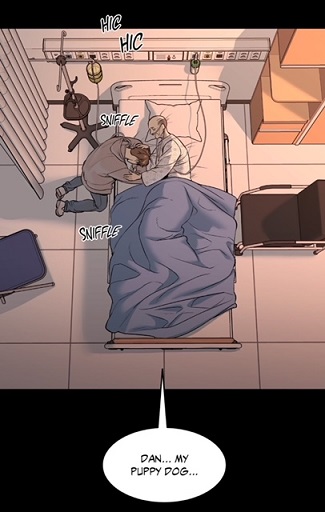 (chapter 53)
 (chapter 65) One might argue about this, for in this scene,
  (Chapter 56) he tucks her in. Their roles are reversed. He behaves like a parent, whereas in truth, he is reverting emotionally to a child terrified of being alone. This reversal highlights the internal dissonance between his outward behavior and emotional reality. Though he was forced to grow up quickly
 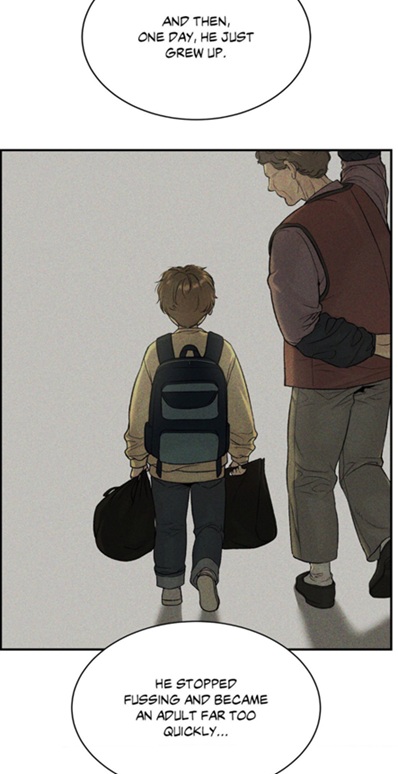 (chapter 65), he still carries the emotional wounds of a child. And from my point of view, the grandmother knows it, therefore she treats him as a child. And this observation led me to the following question: why does she still view him as a “boy”, though he has been working since his youth? It is because he can not sleep alone! What caught my attention is that she never stated, when the doctor started smoking or drinking.
  (chapter 67) This reinforces my hypothesis that his bad drinking habits are related to the absence of a loved one next to him.
  (chapter 56) Imagine what it means for her: her grandson is already 29 years old and he can not sleep alone. Under this perspective, Jinx-philes can grasp the relative’s reasoning. The problem is that her knowledge is actually wrong! How so? It is because the protagonist was able to sleep so well alone in the penthouse, to the point that the athlete was envious of him.
  (chapter 29) That’s how it dawned on me why Shin Okja was so determined to send back her grandson to Seoul.
 (chapter 65) and going back to Seoul under the guise of freedom and career advancement takes on a deeper meaning when viewed through the lens of emotional avoidance. Her words may sound supportive, but they conceal a subtle attempt to sever the emotional tie without taking responsibility for its existence. Now, rather than confronting this vulnerability head-on, she shifts focus to the one thing she believes can replace human closeness: work. A busy man has no time to wallow, no time to drink, no time to remember the empty bed. A man with a career won’t ask for someone to hold his hand at night. In that sense, her vision of “a good life” is one of functionality, not emotional fulfillment. If he works, he won’t be a burden. If he’s successful, she doesn’t have to worry. Yet this approach doesn’t cure the root wound — it just redirects it. This situation mirrors the wolf’s:
  (chapter 19) The latter is obsessed with work, while he is suffering from insomnia.
  (chapter 65) And the best evidence for her selfishness and neglect is her ignorance about her grandson’s plan for his future. She is not discussing with him about what he likes or dislikes. She is directing his life, like she did it in the past in the end. And while she may think she’s doing what’s best, her silence about his fears, her ignorance about his true conditions (no home, blacklisted in Seoul) and her refusal to discuss his emotional future reveal a lingering discomfort with the very idea of dependence — perhaps because it reminds her of her own failures or helplessness as a parent figure.
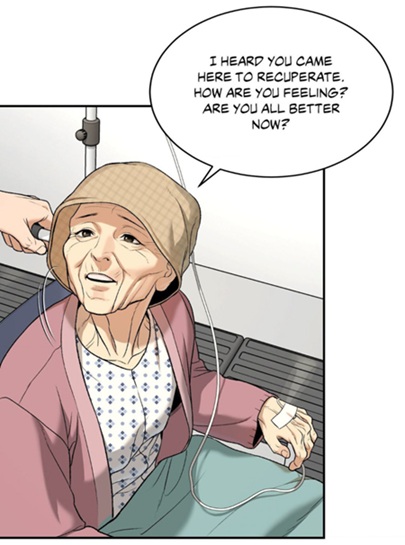 (chapter 65)
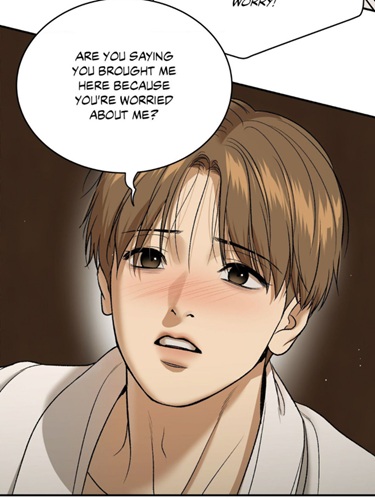 (chapter 67) when Kim Dan, eyes wide and voice trembling, asks Joo Jaekyung: “Are you saying you brought me here because you’re worried about me?” His expression reveals everything — a fragile hope for genuine concern. But the only response he gets is silence.
 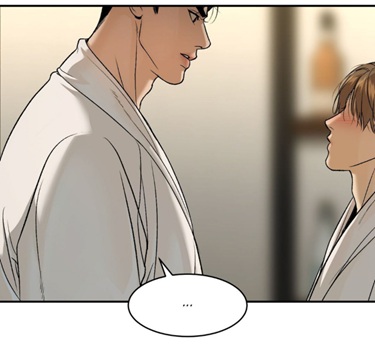 (chapter 67) This unspoken answer reverberates with painful familiarity: from his vanished mother, from his halmoni who rarely expressed love (rather gratitude and pity), and from a world that reduced him to his usefulness. What he really wants to know is: “Do I matter to you as a person?” And just like his grandmother, the champion fails to offer direct emotional reassurance. Yet unlike her, Joo Jaekyung is still learning. His silence isn’t rejection, but emotional illiteracy — a work in progress.
 (chapter 65) And when we remember that Kim Dan tried to call her, she
 (chapter 44) These gestures suggest he had once received such kisses, most likely from his mother. It means he remembers love, even if he doesn’t know how to process its loss.
 He is carrying the sins of “adults”. By likening him to an angel, Mingwa frames his pain not as weakness, but as unjust burden. He embodies purity, sacrifice, and resilience, not because he was allowed to thrive, but because he endured. The angel metaphor becomes even more striking when you think about traditional symbolism: angels don’t belong to Earth, yet they walk among the living, often suffering in silence and helping others. That’s exactly Kim Dan — out of place, bearing the consequences of others’ choices, carrying guilt, debt, and unspoken grief that were never his to begin with.
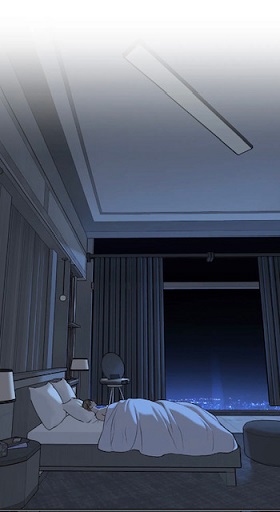 (chapter 29) —not because of physical intimacy with Joo Jaekyung, but because he felt safe. For a time, the place became his illusion of home. But when the champion showed mistrust, the illusion shattered.
  (Chapter 67) Observe how Joo Jaekyung called the penthouse: not home, but his place. Due to the last altercation, the emotional safety collapsed. This experience reactivated his fear of abandonment and solidified the belief that he has no home.
  (chapter 65) Even the family photo (where and by whom it was taken is unclear) emphasizes the fragility and incompleteness of his sense of belonging.
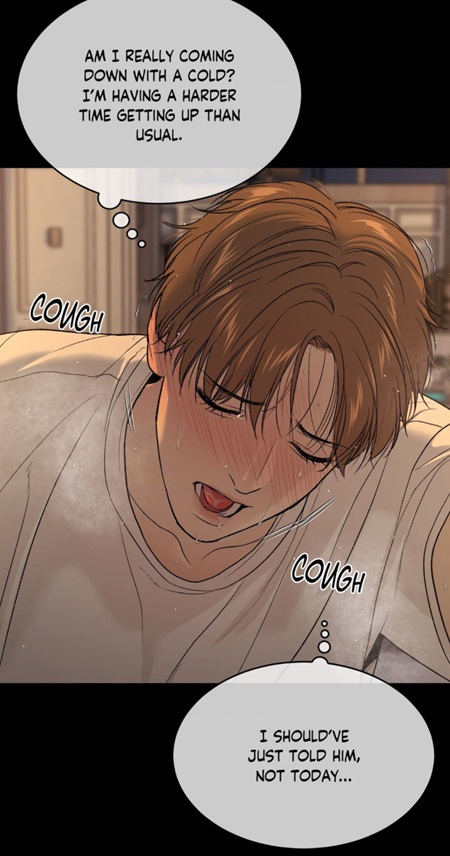 (chapter 61) that he must sacrifice his “needs” and identity to be accepted.
 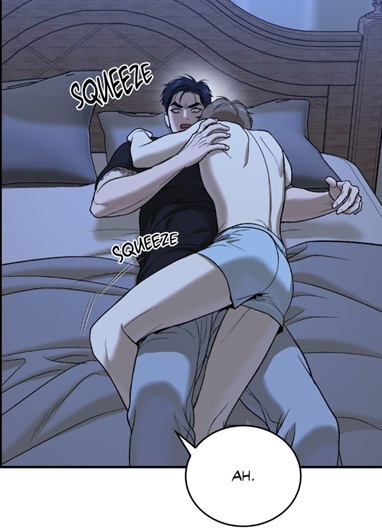 (chapter 66) holds on—“Don’t leave me.”
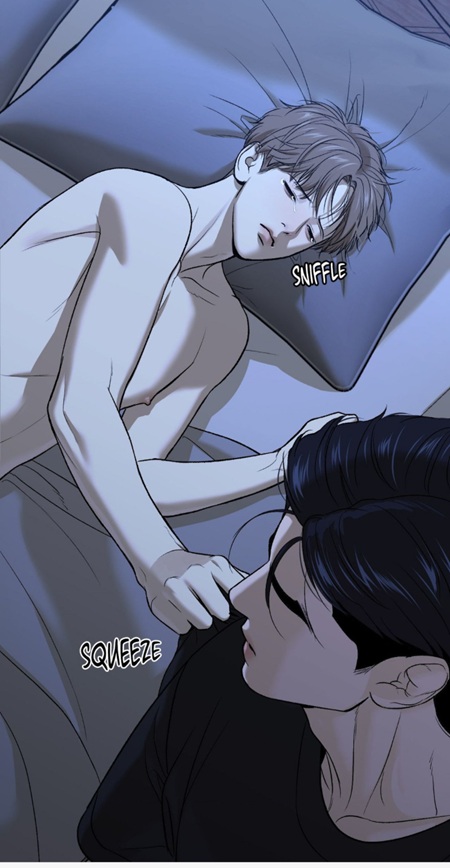 (chapter 66) and desperate pleas are not about romance—they’re about survival, longing and regret. Deep down, he wished, he had hold onto his “mother” in the past, stopped her from leaving him. Is it a coincidence that this gesture from that night mirrors the one during their first night?
 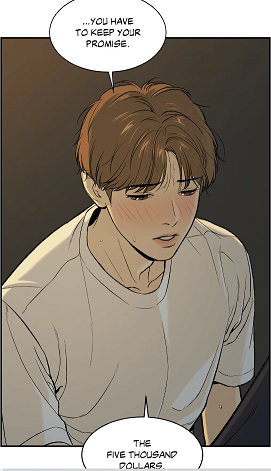 (chapter 2) He wanted the champion to keep his promise. From my point of view, the parent’s vanishing is strongly intertwined with a broken promise… And that’s exactly what the grandmother did to her own grandson: she didn’t keep her words either.
  (chapter 11)
  (chapter 53)
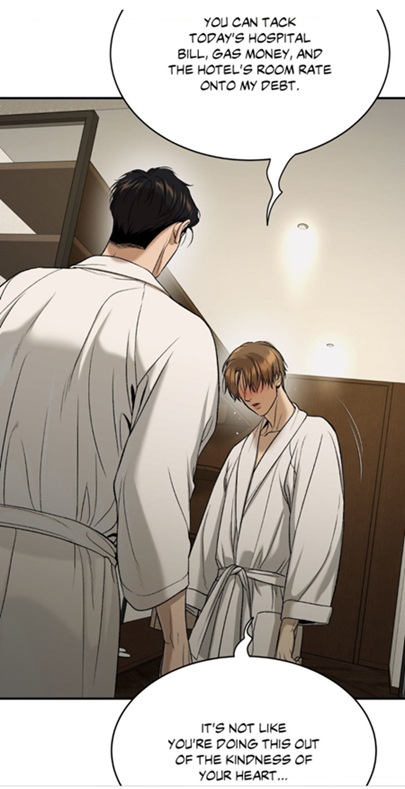 (chapter 67), but this time, with eerie detachment. He kneels before Joo Jaekyung like a servant,
 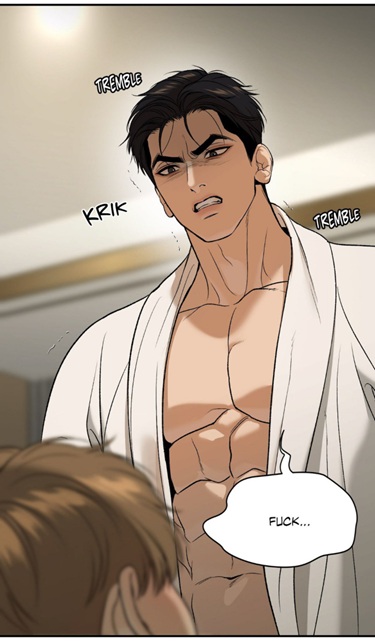 (chapter 67) his arousal betrays a loss of emotional control. Though he is on his knees, it is Joo Jaekyung who is emotionally yielding. His body betrays his composure, responding to Kim Dan’s touch and gaze. Kim Dan, watching the tremble in the fighter’s expression and the rising heat in his body, feels the shift. His soft blush is not simply one of affection or embarrassment—it’s a flicker of recognition.
  (chapter 67) He senses that the one usually in control is now unraveling. Appearances deceive: beneath this scene lies a quiet reversal of power. The blush on his cheeks is a trace of a brief moment of clarity: he sees that the person who once held all the control is now faltering.
 (chapter 66), his body is still a vessel for mourning. Hence there is no kiss during that blue night. Each night carries the residue of that first trauma: the night he was left alone. Whether his mother disappeared or passed away in the night, the result is the same—nighttime became synonymous with loss.
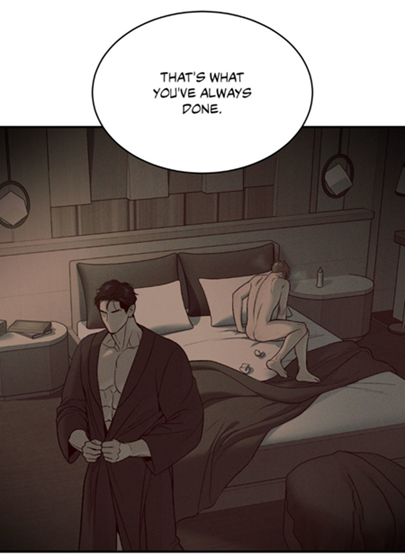 (chapter 63) His so-called jinx is not some irrational superstition. It’s a scar. It’s the quiet belief that the people he loves will vanish the moment he lets his guard down.
 (chapter 67), it’s resignation. Hence he is not expecting to be cured with the pills.
  (chapter 67) he offers sex to “settle up,” citing his own preparations like a transaction.
  (chapter 67) while he drank alcohol with the medicine.
 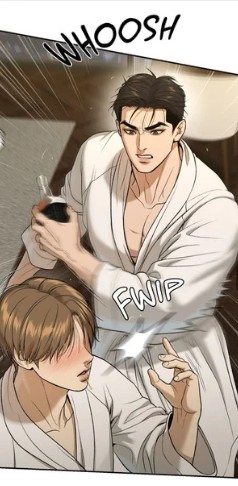 (Chapter 67) Until now, the champion has a blind faith in drugs, just like the grandmother.
 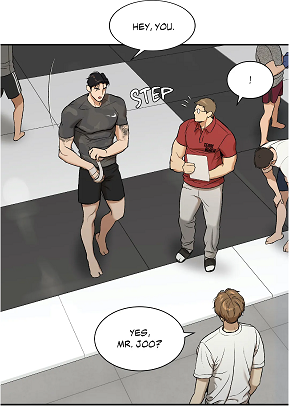 (chapter 7), while Kim Dan becomes a child during the night.
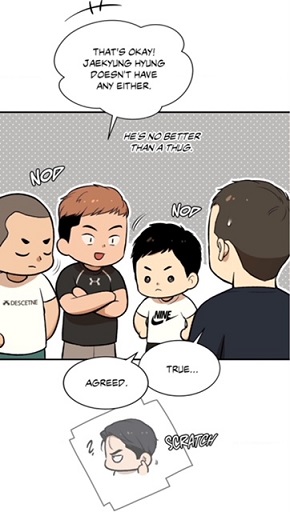 (chapter 47), when the “wolf” was portrayed as a thug, though the latter had assisted him on multiple occasions.

 (chapter 60), deteriorating physical health
  (chapter 60), and the ominous setting of the hospice
  (chapter 60) — challenges this notion. The photographs from episode 60 subtly introduce the fifth puppy’s death as a poignant symbol of Kim Dan’s precarious fate.
  (chapter 60) The puppy’s appearance in only one photo (the second one from left) among many mirrors Kim Dan’s fragile existence,
  (chapter 60) deepening the parallel between them. This connection becomes even more striking when recalling that the grandmother once likened Kim Dan to a puppy
  (chapter 60), he rested him on his healthy shoulder to provide support. This method of carrying, while practical in the moment, placed uneven strain on Jaekyung’s body. The weight resting on one side risked injury to his back and disrupted his balance, subtly reflecting the physical toll of his desperation to save Kim Dan. This small but significant detail underscores the sacrifices Jaekyung was willing to make in his attempt to protect him. However, since Kim Dan was unconscious, he couldn’t see the wolf’s kindness and selflessness.
  (chapter 60) the green cross and the name “Light of Hope” likely caught his attention, inspiring him to believe the hospice could offer immediate assistance. Jaekyung’s desperation was evident in his drenched appearance after rescuing Kim Dan from the ocean
 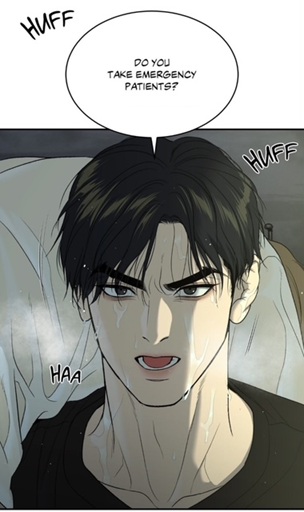 (chapter 60) reflected not only his uncertainty about whether the hospice could offer assistance but also the sheer urgency of his actions. This moment underscores the physical and emotional toll of his determination to save Kim Dan. Jaekyung risked worsening his own physical condition, driven by the hope that help would be available Yet the irony of this moment lies in the true purpose of the hospice: it is not a place for treatment or healing but a program dedicated to end-of-life care.
  (chapter 57)
 (chapter 58), such as two older women
  (chapter 58). Yes, there were two small details, yet full of meaning. Even the landlord
  (chapter 58) nicknamed “old man”
 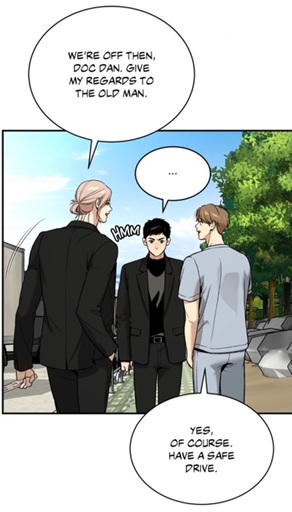 (chapter 59) by Heesung, symbolizes this demographic trend. The hospice’s focus on senior care reflects a broader societal issue in South Korea: a declining birth rate coupled with an increasing elderly population.
 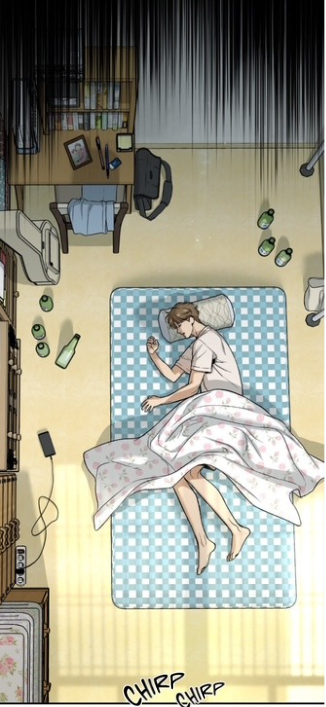 (chapter 57) In addition, the empty bedroom where Kim Dan is staying—with its untouched guitar, furniture, and books—suggests it once belonged to a teenager who left home and never returned. The unchanged state of the room symbolizes the stagnation and loss felt in these regions, further highlighting the broader societal issues at play. This shows that Jinx is not merely a classic love story; it also paints a nuanced portrait of South Korean society and its challenges. By prioritizing elder care without addressing the needs of the youth, the hospice embodies a false promise of hope—one that may ultimately exacerbate the very demographic crisis it seeks to alleviate.
  (chapter 59), indicating their capacity for medical intervention. However, this approach reveals an underlying paradox: while the hospice caters primarily to an aging population, it lacks a sustainable strategy to address the exodus of younger generations, whose departure threatens its long-term viability. This issue is further illustrated by the hospice director’s decision to allow the facility to be used as a location for a movie shoot,
 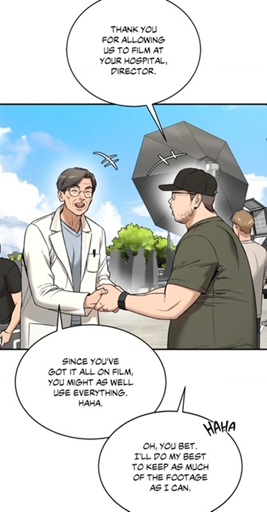 (chapter 59) seemingly as an attempt to garner attention and improve its reputation. However, relying on such strategies means any potential benefits will only materialize months later, when the movie is released. This delay highlights the limitations of the hospice’s current approach to sustaining itself. In this context, Joo Jaekyung’s presence could play a pivotal role. It is possible he may become the driving force in revitalizing not only the hospice but also the town itself, potentially pushing the director to transform the hospice into a full-fledged hospital, addressing both immediate and long-term needs of the community. And this would fit his personality, as I connected him to a dragon. Let’s not forget that in season 1, the MMA fighter was introduced as a benefactor who organized a charity event
  (chapter 41), yet we never got to hear where the money went. This potential transformation underscores the underlying complexities of the hospice’s current operations, as it navigates between providing care for the elderly and responding to broader societal challenges. By situating Jaekyung in this dynamic, the narrative subtly hints at his capacity to influence change, bridging the gap between the hospice’s limitations and the community’s evolving needs.
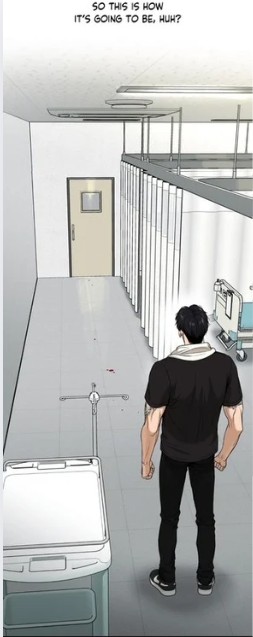 (chapter 60) —a consequence of removing his IV needle—symbolizes his quiet surrender and deteriorating health. When Kim Dan arrived at the hospice, he carried the faint hope of finding solace
 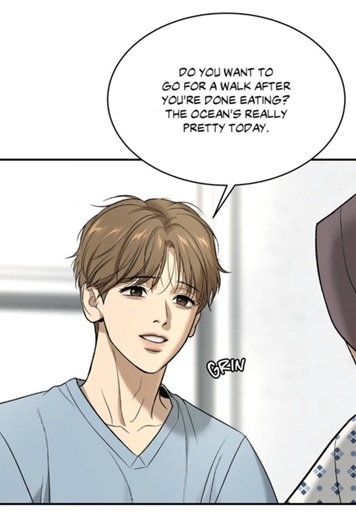 (chapter 57) – which he never expressed -, reflecting the deceptive promise of the hospice itself. Kim Dan’s fate seems to mirror not only the unnoticed death of the fifth puppy
 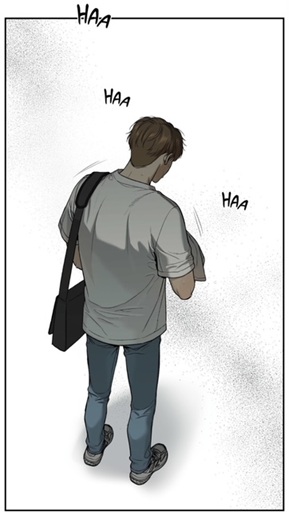 (chapter 59) but also his grandmother’s diminishing expectations of him.
  (chapter 57) However, all this time, she had been his motivation and reason to live. Once likened to a puppy, Kim Dan’s vulnerability and struggle for recognition remain central to his story, highlighting the fragility of his existence. His malnutrition, possibly linked to a deficiency in vitamin K and compounded by his alcohol dependency, exacerbates his fragility, making his situation increasingly perilous. Vitamin K, essential for blood clotting and bone health, is derived primarily from leafy green vegetables and produced by gut bacteria. A deficiency can result in symptoms such as dizziness
  (chapter 57), easy bruising
  (chapter 13), excessive bleeding and slow wound healing—all of which align with Kim Dan’s deteriorating condition and the trail of blood he left after removing his IV needle.
  (Chapter 54) Like mentioned before, this logo could be referring to a pharmaceutical company.
 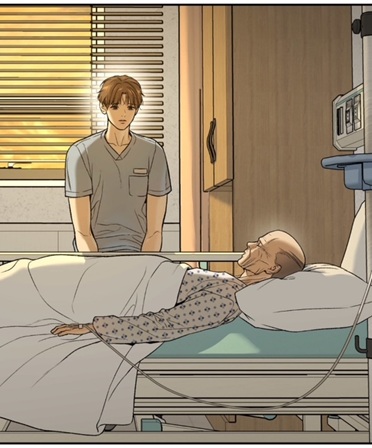 – episode 59), suggesting a temporary space for patients nearing the end of life. Moreover, observe that the colors of the curtains in the patients’ room is orange
 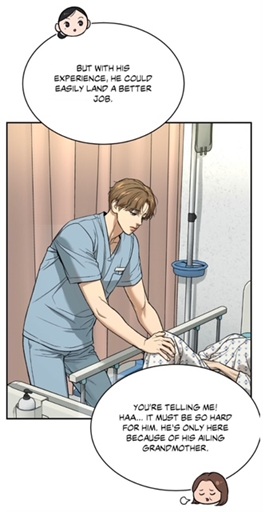 (chapter 56) and not white. This observation aligns with the assumption that this room is reserved for those on the verge of dying, shielding terminally ill patients from witnessing another’s death. 😨
  In the drama, a character searches for his CEO and friend Kang by pulling back closed curtains in an emergency room,
  discovering different patients behind each one until finding the right person.
  This reinforces the notion that closed curtains signify the presence of others, even if their identities remain hidden. In addition, when the doctor treated the patient Park Jinchul, the curtains were closed.
  (chapter 52) to signify absence of confidentiality, contrasting with the closed-off nature of this space. This comparison not only exposes the manipulation of the staff at the health center, but also reinforces my interpretation that the emergency room at the hospice stands for danger and challenge. This detail underscores Joo Jaekyung’s assumption that he and Kim Dan are alone, but it also raises the possibility that their conversation could have been overheard by someone lying behind the curtains, such as the patient from Episode 57.
  (chapter 57) or the mysterious Park Jinchul
  (chapter 56)
 (chapter 56) If others are indeed present, their isolation hints at a bleak reality: death would occur behind closed curtains, without companions or acknowledgment. This setting forces Joo Jaekyung to confront the fragility of life and the limits of money, as even wealth cannot shield anyone from the inevitability of death.
 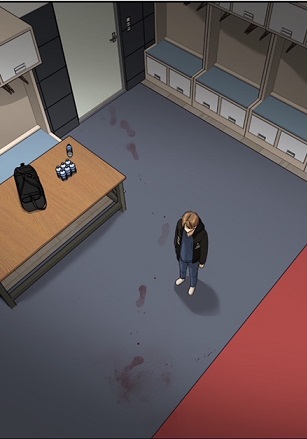 (chapter 51), they should remember that people were listening to their conversation behind the closed door, but they chose not to intervene.
 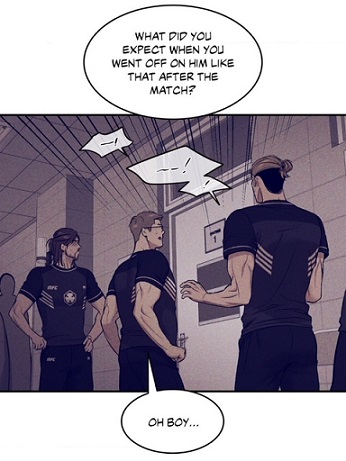 (chapter 53) That’s the reason why I am inclined to think that someone was /is present behind the curtain, but chose to remain silent. However, contrary to Team Black, such a person should intervene, if my theory is correct. And there is another evidence for this hypothesis. Since in episode 60 Joo Jaekyung offers a new contract
 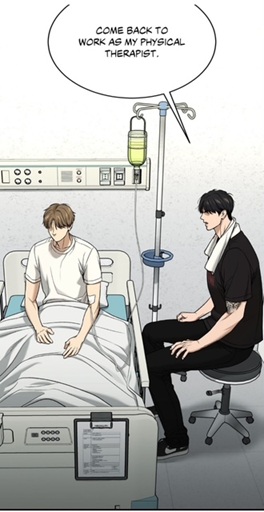 (chapter 60), it signifies that it is a reflection from chapter 6:
 (chapter 53) is indeed an illusion and deception, for the senior on the paper is portrayed as being accompanied by a nurse. The reality is different, for the patients are facing death alone.
  Their conversation begins with Kim Dan’s simple yet loaded question about how Jaekyung discovered his whereabouts. This moment, better captured in the Japanese, and Spanish translations, underscores Kim Dan’s curiosity and underlying desire for clarity. In the Japanese version, Kim Dan asks, “どうしてここがわかったんですか?” (“How did you find out about this place?”), while the Spanish translation reads, “¿Cómo es que usted acabó aquí?” (“How did you end up here?”). Both translations emphasize Kim Dan’s direct inquiry about how Jaekyung discovered his whereabouts, making Jaekyung’s evasive response even more significant. It is clear that he is trying to protect Potato here. However, Jaekyung’s response
  (chapter 60) immediately sets the tone for their interaction. His refusal to answer and his deliberate avoidance of Kim Dan’s gaze reflect a lie by omission. This evasive behavior not only highlights Jaekyung’s reluctance to reveal his vulnerability but also creates a significant divide between them, making it clear that they are not functioning as a unified team.
  (chapter 60) Initially, he avoids Jaekyung’s gaze, signaling his own fear and insecurity. This avoidance reveals his worry about rejection and his deeper emotional vulnerability. On the one hand, he hopes deep down that the athlete would admit that he came looking for him, yet their last two interactions were arguments and rejections which the doctor didn’t forget.
 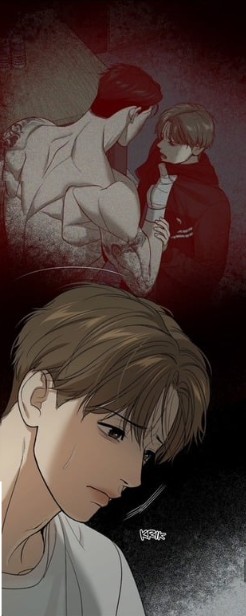 (chapter 60) Moreover, the idiom “by any chance” is exposing his low self-esteem. His words are exposing his internal struggles: between hope and despair. Later, his subtle act of turning his head away—a gesture often linked to dishonesty—indicates an effort to conceal his true feelings.
 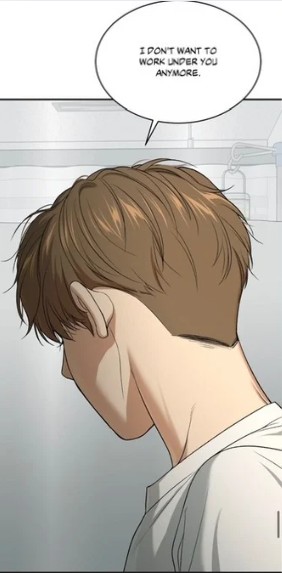 (chapter 60) He is still in love with Joo Jaekyung, but he is no longer hoping for any attachment and feelings from the fighter. On the other hand, his words are reflecting a different opinion: he is no longer trusting the athlete. This means that when the champion admitted his mistake indirectly, it was already too late.
 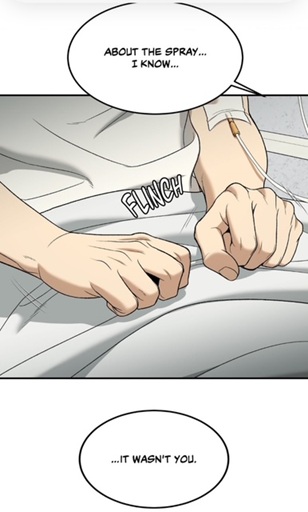 (chapter 60) The damage was done. In addition, he is rejecting the job offer because of the champion’s money.
 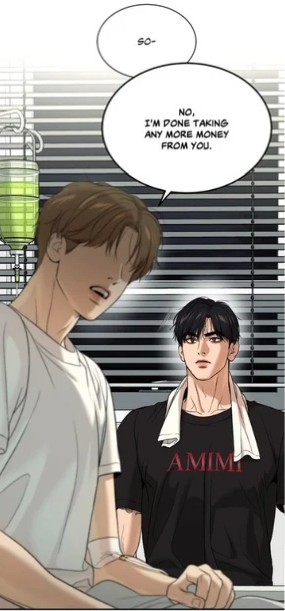 (chapter 60) He doesn’t want this fake generosity, since the athlete is reminding him of his “debts” towards him:
  (chapter 60) How ironic is that with his last remark, he ruined all his chances with Kim Dan. He was still viewing the physical therapist as someone below him. However, keep in mind that such an arrogance and “confidence” are just subterfuges from the MMA fighter. This act of concealment parallels Jaekyung’s guarded demeanor, as both characters are ensnared in a cycle of avoidance and denial.
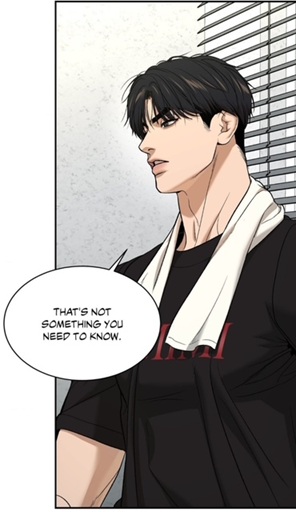 (chapter 60) This evasive remark suggests that Jaekyung believes keeping Kim Dan ignorant of his intentions is for the best. By withholding the truth, he feels he is protecting himself and Kim Dan from unnecessary burdens or complexities, reinforcing his perception that their relationship is better managed with clear boundaries. However, this attempt at concealment only deepens the divide between them, as it denies Kim Dan the clarity and emotional connection he seeks. In fact, he is not realizing that he is even afflicting more pain on his fated partner.
  (chapter 6), with Kim Dan ending up on the floor—a physical manifestation of his subservience. Later, in the locker room, both were shown facing each other
  (chapter 60) Kim Dan in bed and Jaekyung on a chair. Yet, this apparent parity hides a reversal of dependency. While Kim Dan is physically and mentally weaker, neglecting his own health to leave the bed,
  (chapter 42) Despite the appearances, such relationships could only deepen his wounds and reinforce his anxieties. Thirdly, let’s not forget that the athlete read the doctor’s birthday card where the latter expressed the hope to work for him for a long time:
 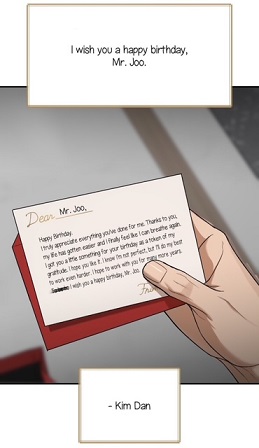 (chapter 55) That’s why he imagined that once he made his offer, the other would agree immediately. However, what he failed to realize is that he read the note too late. Besides, there were these erased words which left the fighter in the ignorance. Finally, he continues to misunderstand Kim Dan’s motivations
 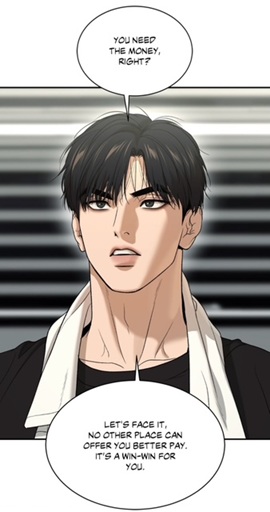 (chapter 60), as he did in episode 6.
  (chapter 6) Back then, Jaekyung assumed money was the sole driving force behind Kim Dan’s actions, and in the current interaction, he still believes this to be true. His internal monologue reveals this misconception:
  (chapter 60) I would even add, he believes to know Kim Dan so well, hence he mentions his grandmother:
 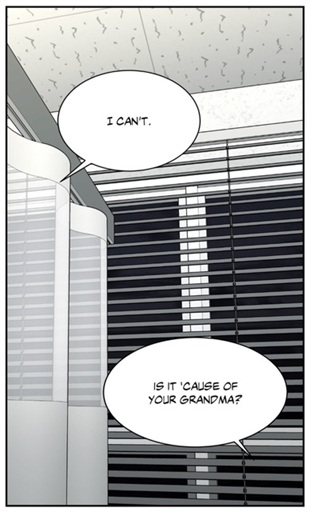 (chapter 60) However, Jaekyung is terribly wrong because he never talked to his lover. His interest and curiosity were quite superficial. Therefore he fails to grasp that Kim Dan’s longing is not for material wealth or familial obligation, but for genuine companionship and a place to call home. Kim Dan’s rejection of a boss-employee dynamic
  (chapter 60). Moreover he got to hear from the doctor that Kim Dan needed rest:
  (chapter 35) for his own “happiness”. Through Potato, the author is criticizing the attitude of fans who are only projecting their own emotions onto their idols. Their wish for happiness is quite rather superficial. This subtle oversight reflects Potato’s growing detachment, as his focus shifted to capturing moments for posterity rather than addressing the realities in front of him. The absence of the fifth puppy becomes a poignant symbol of unnoticed fragility and foreshadows Kim Dan’s own vulnerability. And how did Kim Dan react to the death of the small dog?
 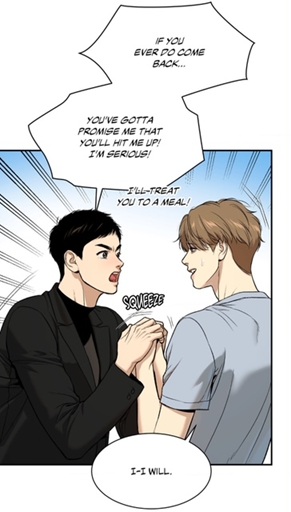 (chapter 59) Deep down, Potato does not expect Kim Dan to come back, reflecting his resignation to their fading relationship. Notably, Potato only asked for a picture of Kim Dan at the very end, never taking photos of him during their time together.
 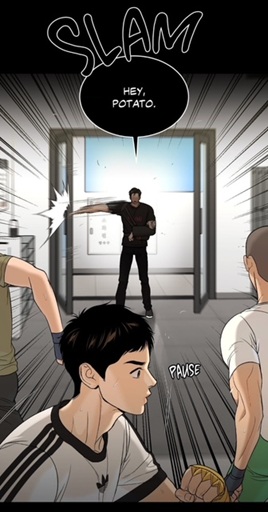 (chapter 60) When he got caught with his silence, Mingwa never showed us Potato’s justification. Yet, it becomes clear that the young fighter decided to give the following explanation: he respected Kim Dan’s wish to remain undiscovered
  (chapter 58) The reason for this interpretation is the champion’s reaction, when he was asked how he knew about his whereabouts
 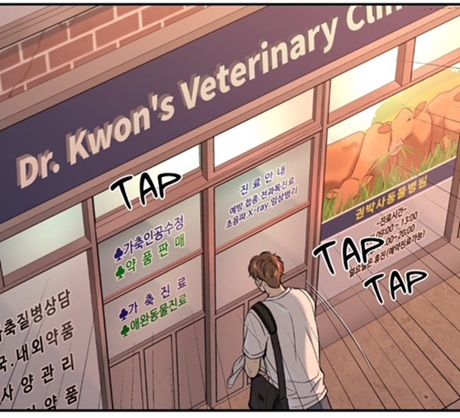 (chapter 59) and Joo Jaekyung’s rescue of Kim Dan.
  (chapter 60) Though he is the one left behind, he is not realizing that by not following him, he is failing to protect Kim Dan.
  (chapter 57) Cheolmin already warned his friend in episode 13:
 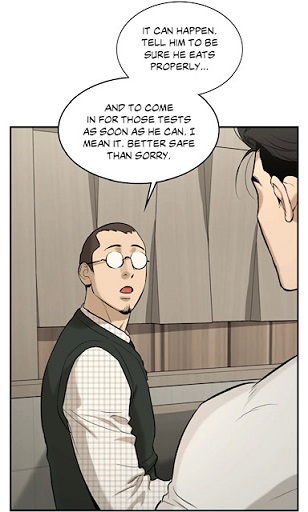 (chapter 13) But the man refused to listen to his advice, and now Kim Dan is leaving a trail of blood on the floor


 (Chapter 1) Imagine that he was in the middle of an intercourse. Yet he felt the need to have someone else by his side. It was, as if the grass on the other side was looking greener. 😉 Yes, in this scene, I detect parallels between Choi Heesung and Joo Jaekyung.
  (Chapter 33) On the one hand, the celebrity felt attracted to Kim Dan, on the other hand he had already sensed that the green-haired uke was greedy and even too passive. He was letting the celebrity fuck him. Yet there was neither real interaction nor sensuality between them. Hence the athlete could call Kim Dan during their sex. Funny is that the other didn’t mind at all, or in the worst case he didn’t even notice it. This shows not only the deafness and blindness of the mint goblin, but also the absence of communication and understanding in their “couple”. It was, as though the green-haired uke had submitted himself of becoming a sex toy. So by recalling the doctor, there is no doubt that the athlete couldn’t have voiced this change verbally. Why was he thinking of someone else during the intercourse? He was just simply not feeling it, the “great fuck”. In other words, Joo Jaekyung was attracted to Kim Dan by lust! In my previous analysis entitled
 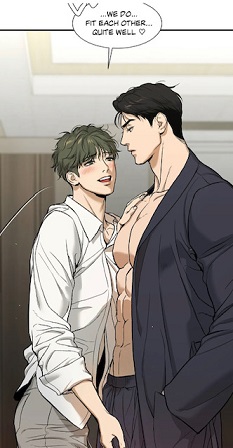 (chapter 2) He had never done it before. As for the champion, Manhwa-lovers can grasp that since their relationship was purely physical (not even accompanied with romanticism due to the athlete’s jinx), the lust from the champion’s side could only weaken overtime. When the athlete met the actor, he had not met the green-haired man before. Hence the sportsman was sitting at the bar looking more or less for a new partner.
  (chapter 33) So the relationship between the “prostitute” and the fighter must have lasted around 3 months, the same amount of time than with the physical therapist. The uke had put no effort, for in verity he was relying on the athlete’s jinx. The latter just needed him, and no one was willing to experience such a rough sex session. The reason why I gave the green-haired uke the nickname “mint goblin” is the following. He brought some fresh breathe in the athlete’s life, for contrary to his past lovers, this one didn’t run away. However, as time passes on, the mint taste couldn’t mask his corrupted mind and heart. He was passive and rotten deep inside. But there’s more to it. Thanks to the mint goblin, the athlete learned an important lesson. It was possible that someone could match his strength in bed. Yes, the latter wasn’t passing out like the others. Deep down, the star could sense that he was no monster, a criticism he had received from the actor.
 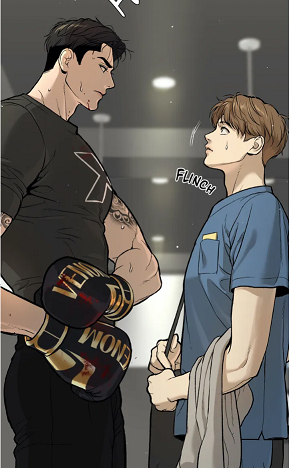 (chapter 1), he got attracted to this pretty and cute new face. However, contrary to the comedian, he didn’t realize this, for the athlete is not someone who thinks deeply. He acts rather on his emotions, exactly like his mentor Park Namwook. Since lust is the first stage of love, the recipient of his “attraction” needed to give him a signal that he was interested in him. I doubt that the celebrity would have made a move on him, if the doctor had not made this mistake
 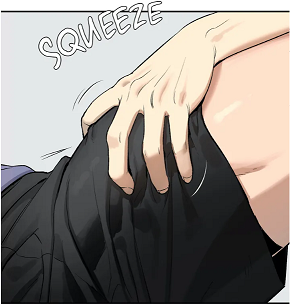 (chapter 1). Naturally, grabbing his phallus was the expression of the doctor’s masked sexual desires. This signifies that when the couple met for the first time, the grass appeared greener on the other side (medical world) for the first time. Since we have the first step of love in their relationship, we could say that the athlete was already in love with Kim Dan. While “lust” only represents the first stage in a love relationship, I decided to examine their relationship on this aspect.
 (chapter 33) We have the novelty aspect (bringing thrill into their relationship) and the champion’s selfishness. The sex toy was utilized as a “punishment”, for the athlete was upset due to his jealousy. However, this perception is still too short-sighted. You will laugh, as soon as you read my new interpretation.
 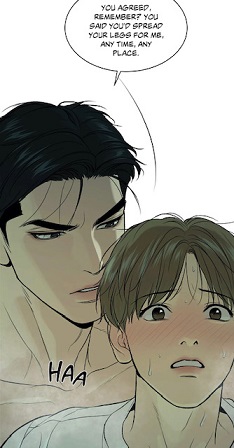 (chapter 8)
  (chapter 27) Consequently, the man had to bring up the deal constantly. Besides, their relationship started because of money. Finally, I would like Jinx-lovers to keep in mind the doctor’s lie: he had previous relationships with men.
  (chapter 3) As you know, I am quite certain that the athlete had sensed his lie (thus he utilized no condoms later). Yet, Kim Dan never came out with the truth either. This is relevant, for there could be lingering doubts from the MMA star’s side. Since the athlete had no idea about the doctor’s taste and physical attraction, Joo Jaekyung worried that his partner would start fantasizing the gumiho. Under this light, my avid readers can grasp why in episode 33, it was important for the champion to use the sex toy first. Initially it was to exhaust the doctor so that the latter would no longer feel attracted to Choi Heesung. Yes, it was to kill in him “lust”. Moreover, the moment the young man asked for his assistance
  (chapter 33), Joo Jaekyung had the impression that he was needed. Finally, don’t forget how this scene ended. Kim Dan was finally admitting that he was really sensitive to him:
 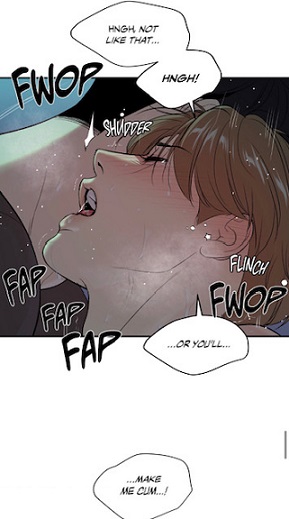 (chapter 33) However, this desire was accompanied with rejection and denial too. This explicates why the champion didn’t know how to interpret Kim Dan’s thoughts and emotions.
 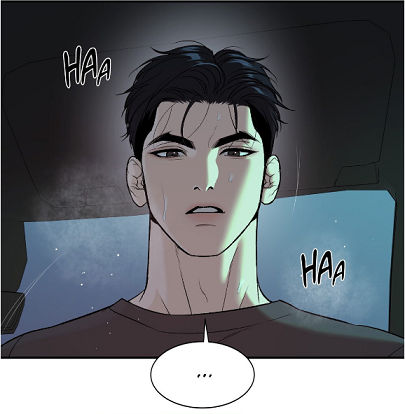 (chapter 33) Was Kim Dan feeling the same way than him or not? Did Kim Dan desire him or not? And this leads me to the next sex session:
  (chapter 34) For the first time, the athlete was divulging his physical attraction and desire towards the doctor. He seduced him with his own body. Yet, in order to keep the upper hand in their relationship, he was the one who was determining how they would have sex:
 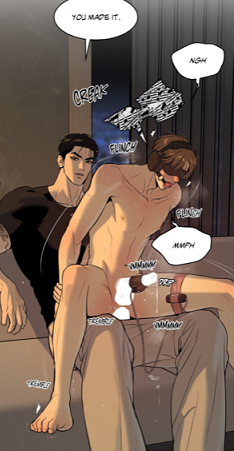 (chapter 34) As you can see, during season 1, it took a long time for the athlete to admit “lust and physical attraction” towards the doctor. One might reply that the celebrity had already admitted this to the physical therapist:
  (chapter 29) However, this confession is connected to the anus, and not to the doctor’s face and as such identity. Thus I don’t consider it as an admission that Kim Dan was his type. One might object too that he had already wooed the doctor before next to the swimming pool.
  (chapter 27) The divergence between these two chapters is that in the first scene, the athlete had not planned this. He was acting on his instincts and emotions, while in the living room, he was seducing the doctor on purpose.
  (chapter 34) I would even add that he gave more freedom to Kim Dan to decide if he would accept his offer or not. As you can see, Joo Jaekyung was learning to internalize the notion “consent and respect”. Here, the doctor could have refused… the evidence is his reaction at the gym, the slap on the athlete’s hand. That’s how I realized the strong connection between the athlete’s ignorance about his soulmate’s taste (partner type) and his consent. Respecting the doctor’s boundary meant to trust that the doctor was attracted to him and accepted him as a partner.
 (chapter 45) What did the athlete imagine here? A fake love confession from Kim Dan, a stan trying to live out a fantasy. He was expecting “dating”, a notion he couldn’t accept, for he was confusing “lust” with “love”. That’s the reason why he couldn’t accept Doc Dan’s present and “gratitude”. They sounded like fake, especially since he was showing respect to the celebrity and not to the man himself! Yes, even in that scene, the PT was still hiding his own true emotions and attraction towards the handsome man. Joo JAekyung has no idea that Kim Dan views him as “perfect”
  (chapter 1) despite his injured shoulder: the muscles, the skin, the handsome face. He has never voiced such thoughts in front of his VIP client.He always kept them to himself.
 (chapter 53) than with this one:
 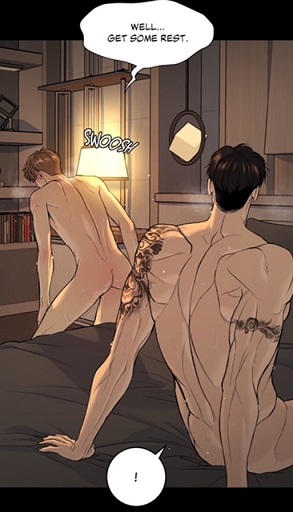 (chapter 53) He let him go, for he anticipated that the latter would remain by his side. In addition, he didn’t feel the need to have sex the whole night, as his affection had already moved to the next stage. There was more than physical attraction and desire.
 Bebebisous33s' analyses in K-Dramaland and Manhwas