
Please support the authors by reading Manhwas on the official websites. This is where you can read the Manhwa: Jinx But be aware that the Manhwa is a mature Yaoi, which means, it is about homosexuality with explicit scenes. Here is the link of the table of contents about Jinx. Here is the link where you can find the table of contents of analyzed Manhwas. Here are the links, if you are interested in the first work from Mingwa, BJ Alex, and the 2 previous essays about Jinx the Birth of A Flower (part 1) and The Beginning of the End
It would be great if you could make some donations/sponsoring: Ko-fi.com/bebebisous33 That way, you can support me with “coffee” so that I have the energy to keep examining Manhwas. Besides, I need to cover up the expenses for this blog.
The Hand That Says Everything and Nothing
There is a gesture in episode 90 that unsettles me more than any act of violence, any argument, any explicit rejection. Joo Jaekyung reaches out 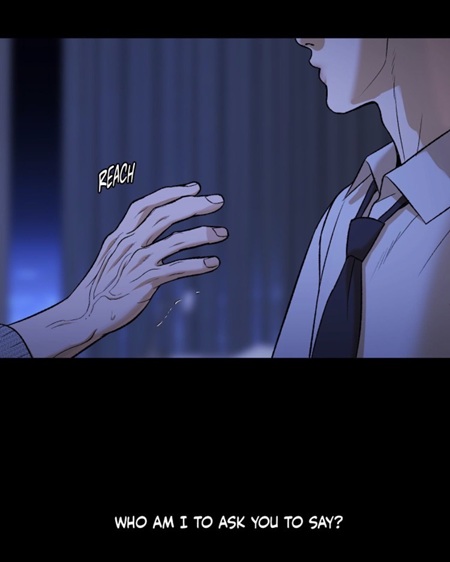 (chapter 90) — and then he pulls his hand back.
 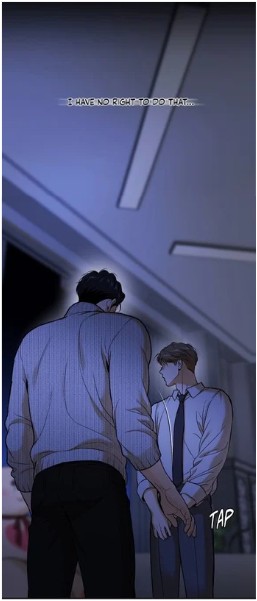 (chapter 90) No words are spoken to stop him. His hand is not even pushed away, like doc Dan did it before.
 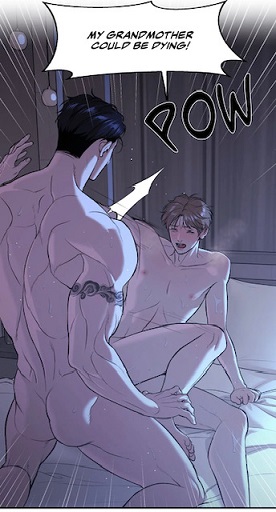 (chapter 21) Everything happens in silence. The interruption comes entirely from within.
As readers, we could be tempted to read this as restraint, perhaps even growth. Yet the text itself resists that interpretation. The thought accompanying the gesture is not “I need you”, but “Who am I to ask you to stay?” The question is not directed at Kim Dan. It is directed at himself.
This hand says everything and nothing at once. It reveals a conviction without explaining it, a decision without justification and dialogue. In this moment, Joo Jaekyung no longer sees himself as a person capable of care, protection, or repair. He sees himself as the origin of harm — not merely someone who committed mistakes, but someone whose presence has become synonymous with violence and sin. It is, as if he has absorbed every accusation, every outcome, every imbalance of power, until he no longer distinguishes between what he did and what was done through him. He does not fear becoming abusive; he believes he already embodies it. To conclude, Joo Jaekyung has reached a point where he positions himself as the origin of Kim Dan’s suffering.  (chapter 90) In his mind, everything that followed the hiring — the money, the contract, the protection, the conflicts — converges back onto him. Faced with this conclusion, he rewrites the past. The good moments lose their weight.
  (chapter 26)
 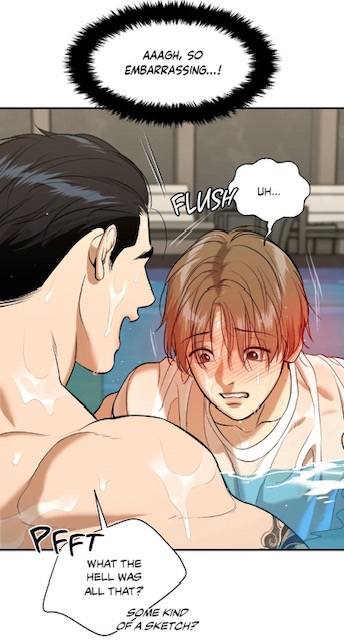 (chapter 27)
 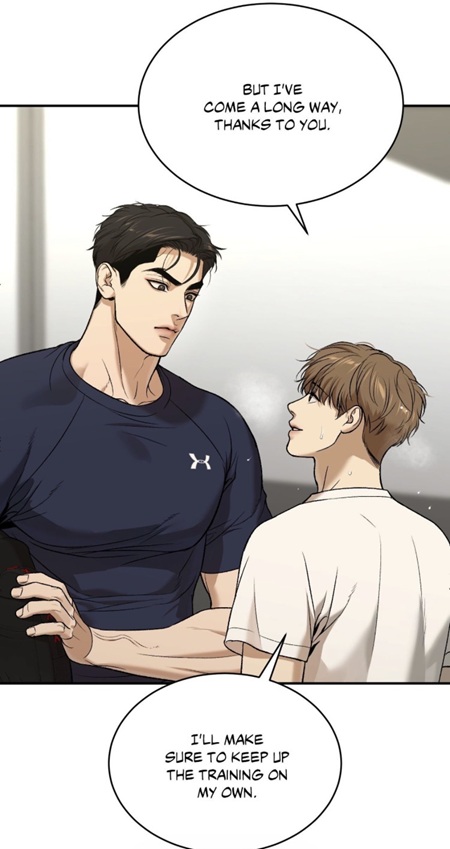 (chapter 88)
 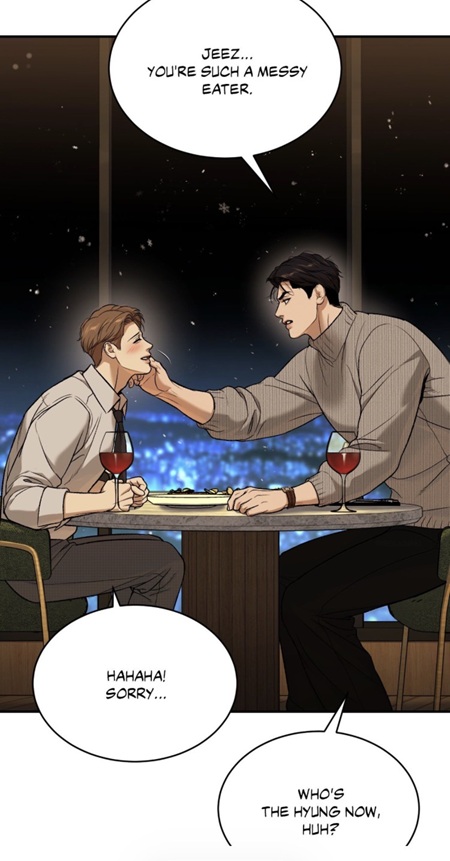 (chapter 89) The help he provided becomes irrelevant. What remains is a single narrative: meeting him caused harm.
To grasp the logic of this withdrawal, it is not enough to examine this scene in isolation. We must also contrast it with earlier scenes, with figures who shaped his thinking, and with patterns of responsibility and shame that predate Kim Dan. Only then does the withdrawn hand reveal its meaning: not respect, not restraint, but the first visible sign of self-erasure and sacrifice — a silence chosen in the belief that presence itself has become a form of wrongdoing.
The Art of Letting Go
What is striking in this scene is not only what Joo Jaekyung does, but what Mingwa deliberately withholds from view. (chapter 90) We never see his face while listening to his thoughts. The panels deny us access to his facial expression (chapter 90), his eyes, any visible articulation of emotion. Instead, we are positioned behind him, aligned with his back and his outstretched hand, while his inner thoughts unfold in silence. Meaning is displaced from facial expression to bodily interruption. Jinx-philes must infer everything from posture, movement, and absence.
The hand he extends is open, hesitant, and trembling. (chapter 90) In Mingwa’s visual language, this matters. An open hand is not an instrument of control but of appeal. It does not seize; it exposes vulnerability. He needs help and support. The tremor is equally significant. This is not the vibration of contained rage or adrenaline before a fight. It is a body that no longer commits itself fully to action. For the first time, Joo Jaekyung’s physical certainty fractures before a gesture is completed.
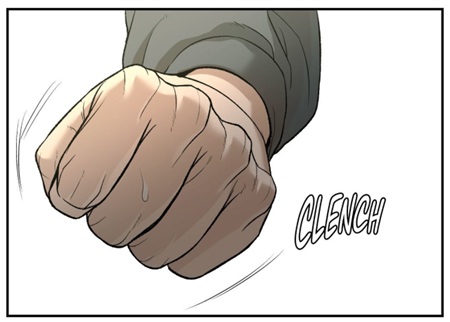
At that moment, what collapses is not his strength, but his fighting spirit. It becomes obvious, when you compare this gesture (chapter 90) to his old habit, 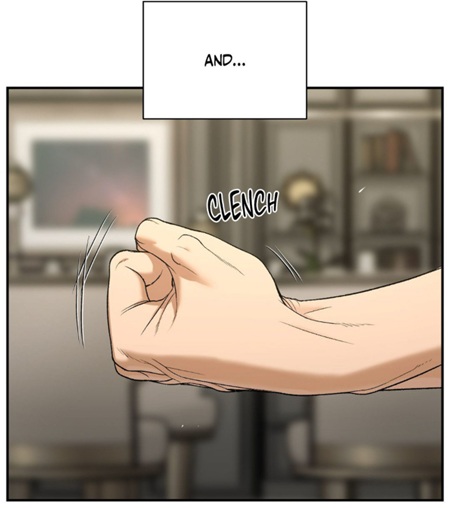 (chapter 61) the clenched fist, when he expressed determination to achieve his goal (bringing back doc Dan or winning a fight).
  (chapter 81)
Until now, Joo Jaekyung has always responded to crisis through resistance. Even when cornered, he pushed forward—by clenching his fists, facing confrontation  (chapter 74), or converting conflict into challenge.
 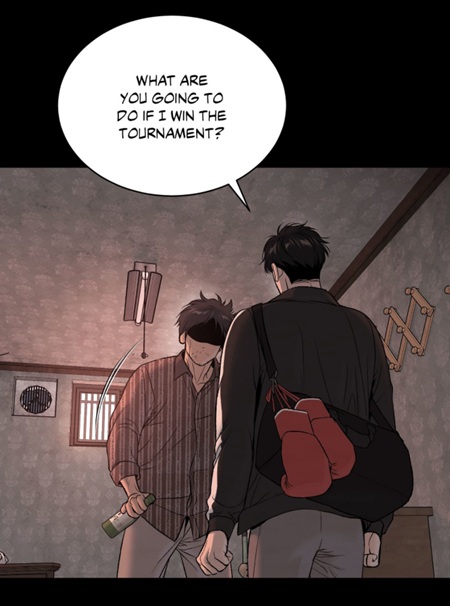 (chapter 73) Fighting was not only his profession; it was his primary mode of being in the world. Here, however, the impulse to fight dissolves. (chapter 90) The hand does not harden into a grip. It falters. The will to confront, insist, or endure gives way to resignation.
It is precisely this loss that recalls another scene—not because the gestures are identical, but because the logic of bodily collapse suddenly aligns. In episode 16, Kim Dan does not begin by pleading in front of Heo Manwook, the loan shark.  (chapter 16) His hand is first crushed. The antagonist targets the very instrument of his livelihood, injuring what allows him to work, to treat, to survive. Only after this act of violence does Kim Dan cling to his aggressor.
 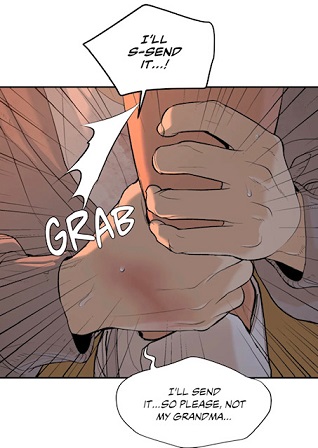 (chapter 16) The grasp that follows is not an invitation, but a reaction to damage already inflicted. Resistance has been broken through the body before appeal becomes possible. It symbolizes submission, exactly like in the penthouse.
Mingwa stages this sequence carefully: injury precedes supplication. Kim Dan’s grip is not a sign of agency, but of desperation. He does not extend his hand freely; he clutches because he has been made vulnerable. Survival no longer depends on strength or refusal, but on mercy extracted after harm.
The echo in episode 90 is therefore not visual symmetry, but structural reversal. Joo Jaekyung’s hand has not been crushed. (chapter 90) No external force has targeted his body, his career, or his means of survival. And yet the gesture falters all the same, as the damage has already occurred.
The violence here is not enacted through force, but through language. Heesung’s words on the rooftop —accusations of brutality 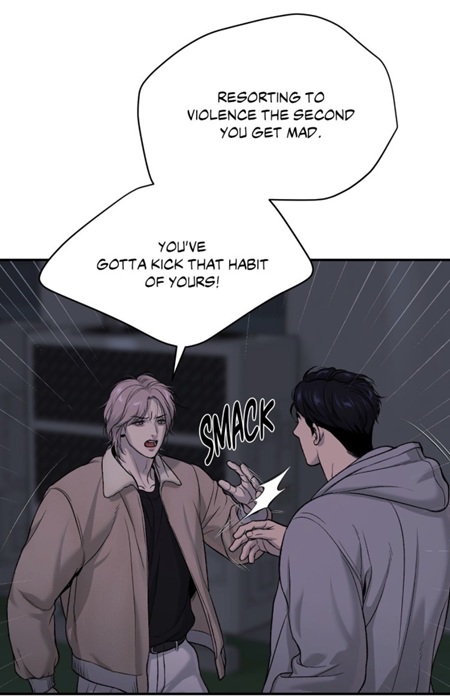 (chapter 89), unlovability, moral contamination
 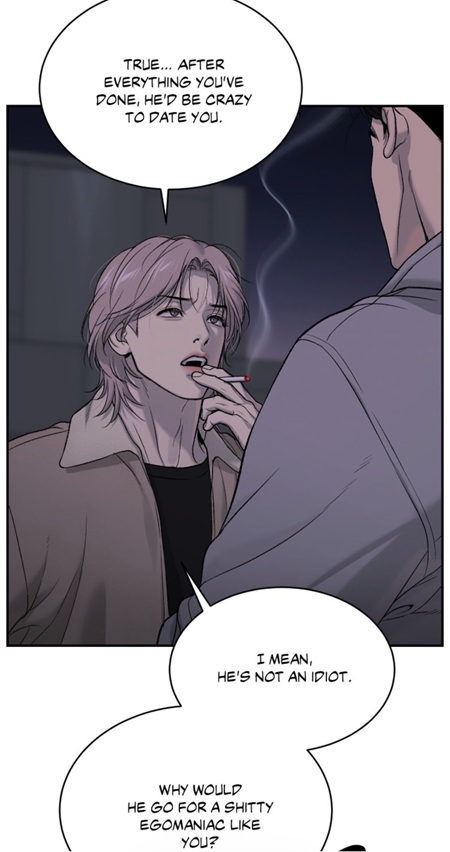 (chapter 89) — do not introduce a foreign judgment. They articulate what Joo Jaekyung already believes about himself.
 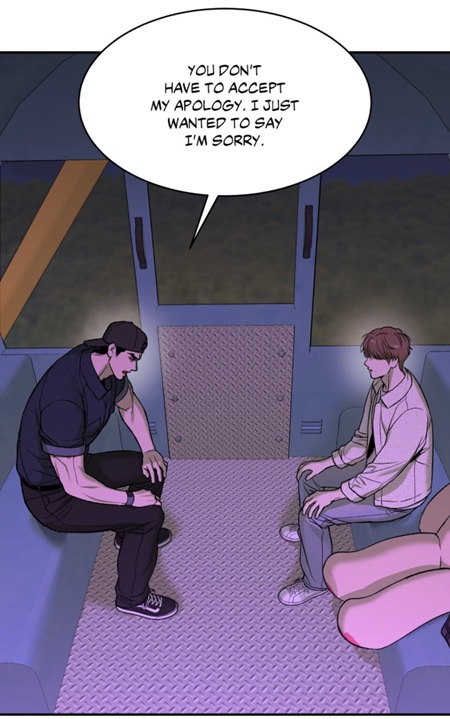 (chapter 84) Deep down, he thinks that he can not be forgiven and even loved. This is precisely why they take hold. Spoken aloud, they acquire the authority of truth. Once internalized, they no longer need to be repeated.
Mingwa makes this internalization visible not through dialogue, but through a remembered image. 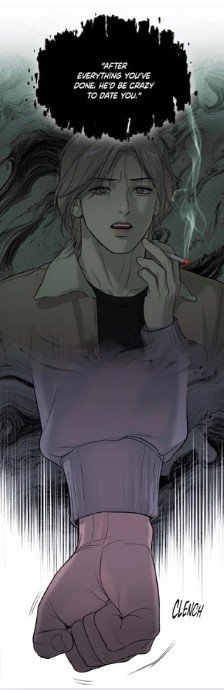 (chapter 89) The panel does not show Heesung speaking again; it shows Joo Jaekyung’s clenched fist, isolated, rigid, suspended in recollection. This is not the fist of imminent action. It does not precede a strike. It does not convert pain into confrontation. Instead, it freezes.
In earlier scenes, the clenched fist functioned as a promise—to endure, to retaliate, to win. Here, it marks the opposite. The body remembers the accusation, but no longer translates it into resistance. The fist no longer gathers force; it contains it, uselessly. What we witness is not suppressed violence, but the final struggle and imminent collapse of the impulse to fight at all.
This is the decisive shift. The accusation has done its work. Joo Jaekyung does not respond by proving Heesung wrong; he responds by accepting the premise. If violence defines him, then restraint is no longer ethical struggle—it becomes erasure. The fighting spirit does not turn inward. It simply disappears.
Unlike Kim Dan, whose resistance is broken by injury, Joo Jaekyung arrives at surrender through “self-recognition”, another false belief. His hand retreats not because it has been harmed, but because he has accepted the premise that his presence itself is harmful. The violence has migrated inward. It no longer needs an aggressor.
In this sense, Joo Jaekyung mirrors Kim Dan not at the moment of physical injury, but at the moment after domination has succeeded—when resistance feels illegitimate, and appeal itself begins to seem like an act of transgression.
The contrast, however, is just as important as the resemblance. Unlike Kim Dan in episode 16, Joo Jaekyung is not on his knees. (chapter 90) He is not physically lowered, cornered, or framed from above. His body remains upright, broad, and imposing. From the outside, he still appears strong, yet deep down, he is falling apart. The withdrawal of the hand is not restraint, but surrender. A strong body remains standing while the will to fight quietly disappears.
What deepens the tragedy of this moment is that Kim Dan does not witness the champion’s action. (chapter 90) His gaze drifts elsewhere, toward the teddy bear. He is oblivious to the trembling, the hesitation, or the aborted appeal. Nor does he meet Joo Jaekyung’s eyes—because the eyes are never shown. The scene is structured around a double absence: a plea that is never fully expressed, and a witness who never sees it. To conclude, the physical therapist has no idea about the inner turmoil of his fated lover.
After revealing his past with the perverted hospital director, Kim Dan had tried to calm Joo Jaekyung by touching his arm 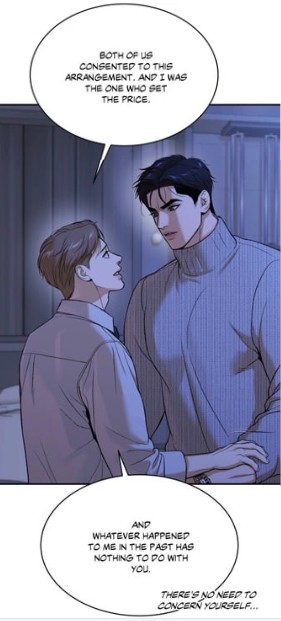 , (chapter 90) offering reassurance. That attempt failed, not because Kim Dan lacked care, but because reassurance can only reach someone who is still willing to fight for their place. Joo Jaekyung is no longer asking how to endure. He is asking whether he should exist in this space at all.
What blocks Kim Dan’s words from reaching him is not their content, but the position from which they are received. Joo Jaekyung hears them through a familiar filter — one that reduces Kim Dan to someone who must be protected from himself. In doing so, he unconsciously aligns himself with the very figures who shaped Kim Dan’s silence: the grandmother who decided for him  (chapter 65), and Heesung who dismissed his agency
 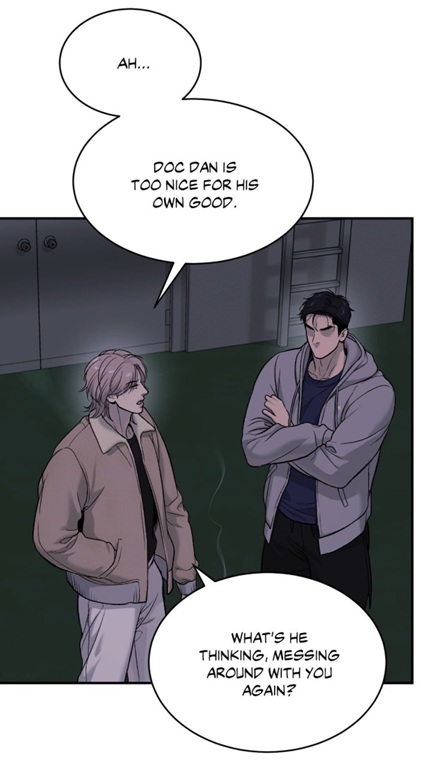 (chapter 89) under the guise of concern.
Yet Kim Dan’s words are neither naïve nor dependent. He states them clearly: the arrangement was consensual; the price was his to set; what followed was his responsibility. He does not ask to be spared, corrected, or guided. He asserts authorship over his own choices. (chapter 90) But this assertion cannot be heard by someone who has already decided that Kim Dan must be shielded — even from himself.
The rooftop scene before that night exposes the same logic from another angle. Heesung, too, frames Kim Dan as “too nice for his own good,” implying that he does not know what is right for him, and that any involvement with Joo Jaekyung must therefore be exploitation. In both cases, concern becomes a form of erasure. Kim Dan’s agency is acknowledged in words  (chapter 65), but denied in structure.
Faced with this, Joo Jaekyung does not challenge Kim Dan’s claim. (chapter 90) He does something more drastic: he removes himself. If Kim Dan cannot be recognized as an equal subject capable of choosing him, then the only ethical position left, in Joo Jaekyung’s mind, is disappearance. By refusing to claim a right, Joo Jaekyung does return choice to Kim Dan. But he does so by removing himself from the field of choice altogether. There is no negotiation. What appears as liberation is inseparable from abandonment, because it is grounded not in trust, but in the belief that his presence is illegitimate.
This is why the scene cannot be read as growth. It marks the moment when the champion loses the impulse that once defined him. The withdrawal of the hand is not restraint, but surrender. A strong body remains standing while the will to fight quietly disappears. At this point, the language of the jinx quietly inverts. Earlier, Joo Jaekyung spoke of it as something he had—a misfortune attached to him 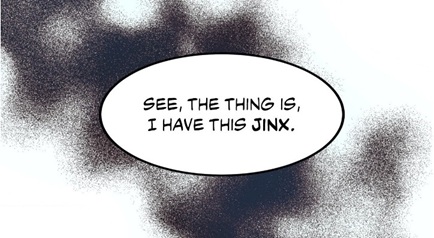 (chapter 2), an external curse that followed his steps. Here, that distinction collapses. He no longer experiences the jinx as an event or condition, but as an identity. He does not fear what might happen because of him; he accepts that he himself is what causes harm. The curse is no longer something he carries. It is something he has become. Once internalized in this way, it no longer requires rituals to contain it.
  (chapter 75) Practices that once functioned as talismans—gestures meant to ward off misfortune or secure victory—lose their meaning.
  (chapter 75) What collapses is not only belief in luck, but belief in the necessity of striving at all.
A Space Marked by Collapse
This collapse does not occur in a neutral space. (chapter 90) The room in which Joo Jaekyung withdraws his hand is not simply Kim Dan’s bedroom, nor a private refuge removed from the world. It is a place already marked by interruption, illness, and loss. Again and again, this room has functioned as a site where bodies fail, where care becomes urgent, and where stability quietly dissolves. Fainting, sleeplessness, sickness, drinking, and disappearance have all passed through it. Long before episode 90, this space had been associated not with recovery, but with moments when endurance gives way and something must be endured instead. What unfolds here does not begin with the withdrawn hand. The room has been preparing it all along.
The pattern begins early. In episode 10  8episode 10), Kim Dan wakes up there after drinking excessively, confused why he is sleeping in the penthouse. He doesn’t know that the night before in his drunkenness, his thoughts were turning toward his grandmother. He was mistaking the athlete for his relative.
  (chapter 10) He feared getting abandoned. When the doctor realized his whereabouts, he imagined that he had sex with the champion. As you can see, the bedroom is strongly intertwined with longing and sin, where consciousness returns only after collapse. This association deepens in episode 20, when sexual intimacy is immediately followed by a phone call announcing his grandmother’s critical condition.
 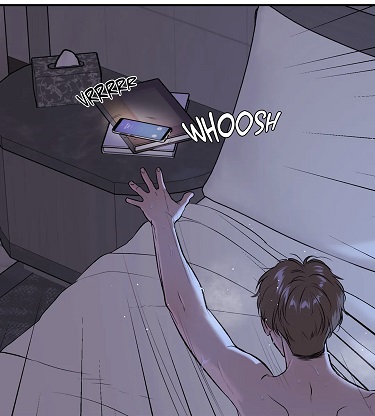 (chapter 20) Pleasure and threat coexist in the same space, binding the room to the anticipation of loss.
Later, in episode 29, Kim Dan wakes up there after fainting 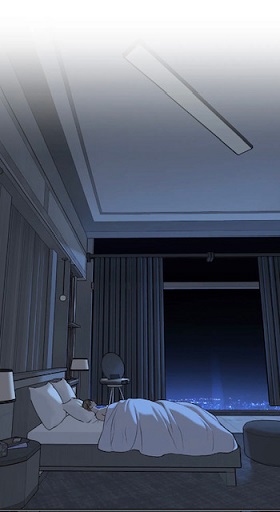 (chapter 29), his body once again giving way under accumulated strain. The room is no longer merely where exhaustion manifests; it is where it becomes undeniable. In episode 61, the association shifts again: Joo Jaekyung comes to the room seeking sex, but Kim Dan is unwell, unable to voice his own thoughts, unable to refuse.
 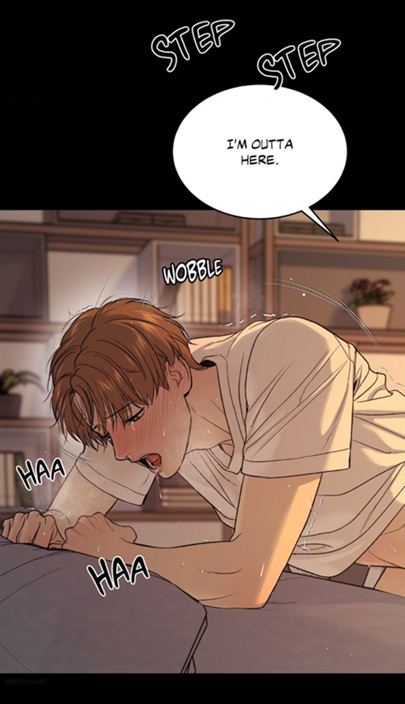 (chapter 61) Illness interrupts desire, and the room marks the moment where agency falters.
The most alarming incident occurs when Kim Dan sleepwalks and nearly falls from the railing  (chapter 79). Once more, it is this room that frames the danger.
  (chapter 79) The body moves without consciousness, hovering at the edge between presence and disappearance. The room becomes a liminal space where life is not actively threatened by violence, but quietly endangered by exhaustion and dissociation (suicidal thoughts).
This accumulation reaches a turning point in episode 53, after Kim Dan leaves. Joo Jaekyung enters the now deserted room and finds the jacket left behind. 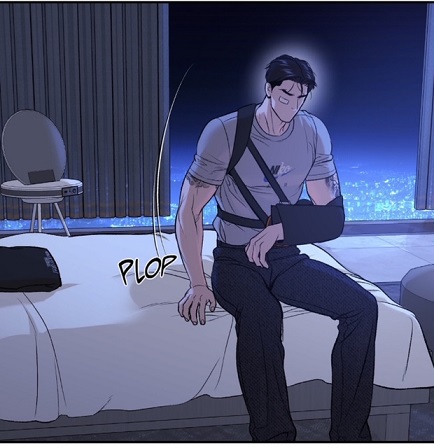 (chapter 53) The object becomes a trace of absence, and the room transforms into a container of loss. Standing by the window, Joo Jaekyung is portrayed without eyes.
  (chapter 53) The visual choice is crucial: it does not indicate blindness in a literal sense, but an inability to see forward, to orient himself. He is present in the room, but detached from direction and purpose. This scene announces the falling apart of the athlete.
What follows does not mean that Joo Jaekyung begins to deteriorate inside this room. On the contrary. After Kim Dan’s departure, he avoids it. 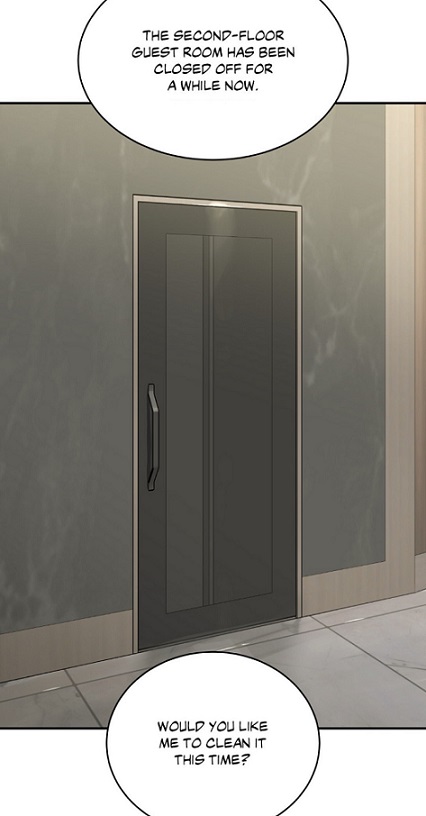 (chapter 55) The space is sealed off, preserved, treated almost as a forbidden zone. The cleaning staff is not allowed to enter. Nothing is moved, corrected, or neutralized. The room becomes a reliquary rather than a dwelling — a place frozen in the moment of loss. Joo Jaekyung does not confront what happened there; he keeps it intact, untouched, and therefore unresolved. At the same time, he imagines that avoiding that place will help him to forget doc Dan’s gaze and face.
Therefore it is logical that his collapse unfolds elsewhere. The displacement is visible. In episode 53, the jacket is thrown in the direction of the couch. 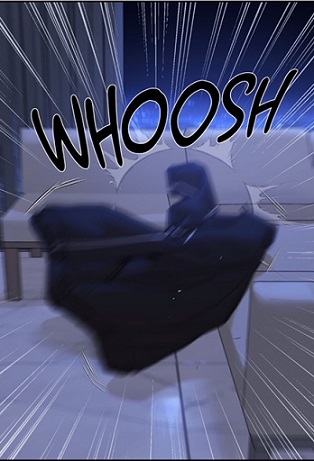 (chapter 53)
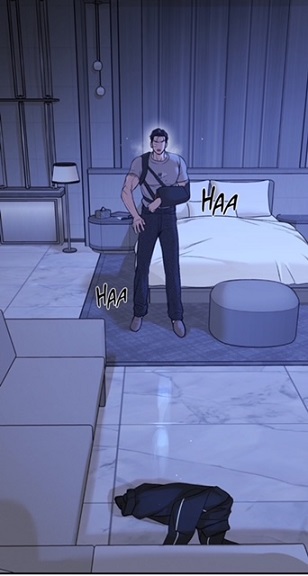 (chapter 53) In episode 54, wine bottles begin to accumulate beside the couch
 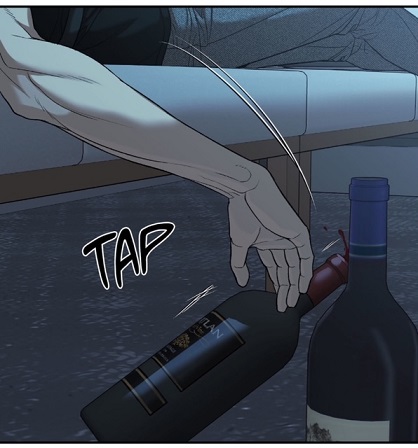 (chapter 54) in his own bedroom leaving a huge red wine stain on the carpet.
 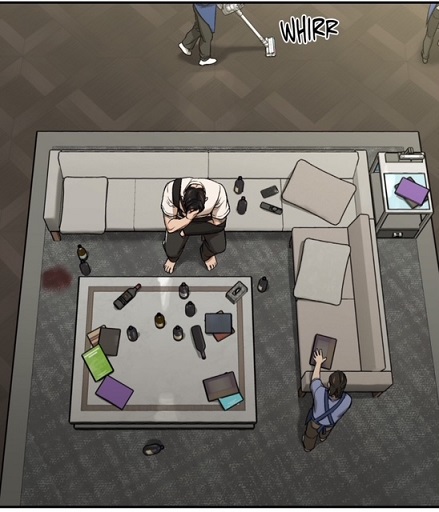 (chapter 55) And in episode 90, the teddy bear now rests on the couch in Kim Dan’s room
 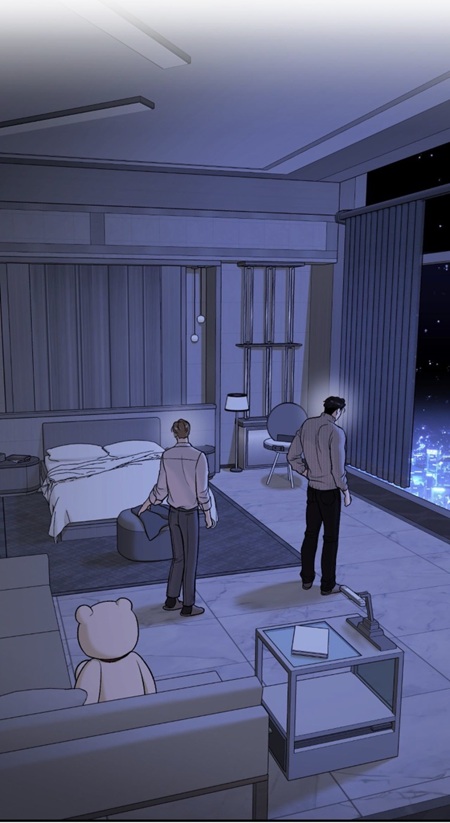 (chapter 90) — occupying the very place toward which the jacket once flew. Across these scenes, the hand and couch emerge as a recurring site of impact, exhaustion, and surrender. It is where bodies fall, where frustration lands, where the weight of what cannot be said is deposited. One detail caught my attention: because they are not sitting on the couch, the main leads are discussing together. They are able to face each other and as such to listen to each other.
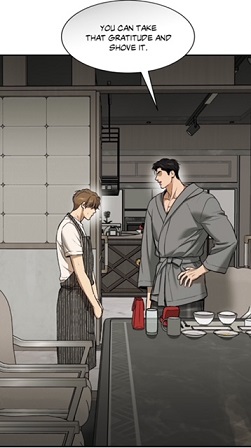
 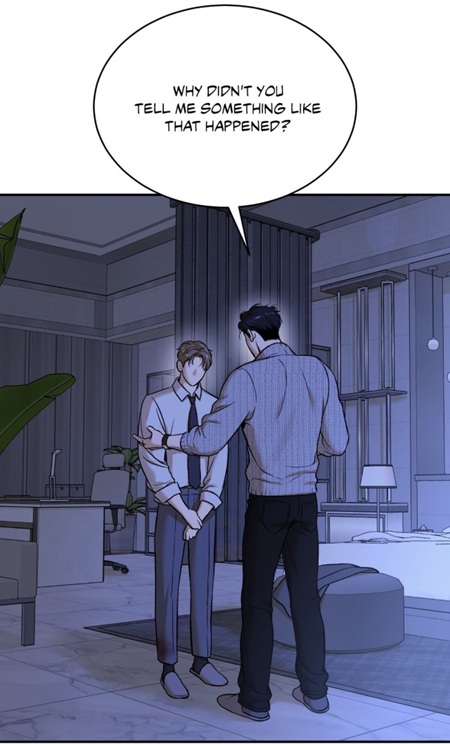 (chapter 90) Their respective position in this room reminded me of their previous arguments.
  (chapter 45)
  (chapter 51)
 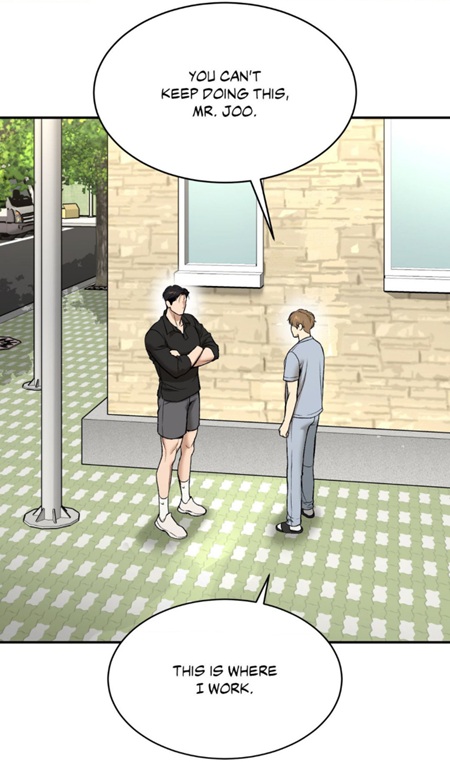 (chapter 61)
 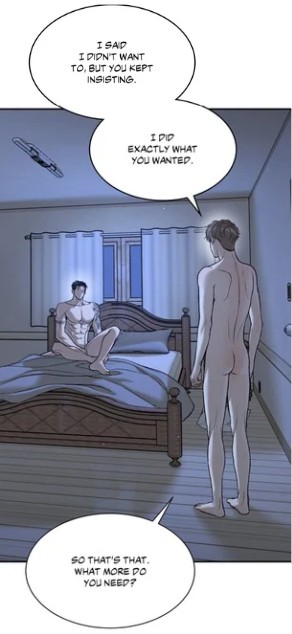 (chapter 64) Only when they would truly face each other, they would be more honest and expose their thoughts and emotions. As soon as there is a table, a bed or a couch, I detected some restrain and silence. In other words, the presence of the teddy bear and the couch in that scene explains why Kim Dan is silent and passive after their conversation. He is definitely remembering the day and conversation at the amusement park. (chapter 90) I am hoping that he finally talks about his past and childhood in the next chapter. But honestly, I am a little skeptical, as doc Dan has no idea how Joo Jaekyung suffered, while he was away (loss of money and contracts, members, reproaches from Potato and Park Namwook, the slap, no one showed a true concern for his well-being). They all expected him to return to his old self and become a champion again. He only learned recently that members had abandoned him.
 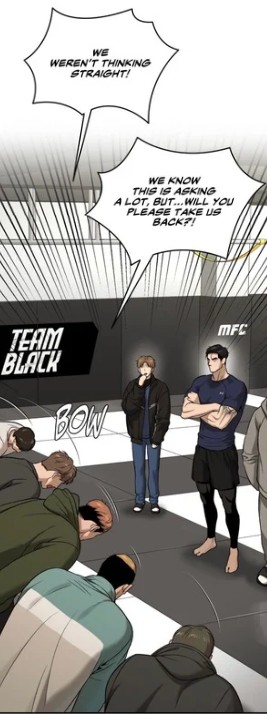 (chapter 88) On the other hand, it is about time that doc Dan becomes proactive so that they finally become a real team.
But let’s return our attention to the room. (chapter 90) The latter itself remains suspended, untrespassed. (chapter 55) But the logic it contains spreads. What cannot be processed there resurfaces around the couch: drinking replaces training; avoidance replaces discipline; headaches replace resolve. Insomnia leads to inertia and passivity. Joo Jaekyung does not resign, and he does not openly collapse. Yet something essential fractures. Here, the fighter remains active in form, but disengaged in spirit. His depression does not announce itself through breakdown, but through relocation — from the preserved space of loss to the furniture that absorbs its aftermath.It is a space where suffering does not explode but accumulates, where the narrative repeatedly returns to show that unwell-being is not an exception, but a condition that has been waiting to be acknowledged.
Within The Silent Friend in the Blue Light, this room becomes one of depression’s many disguises: familiar, enclosed, outwardly calm, yet saturated with vulnerability. It does not announce danger. It hosts it quietly.
The Hidden Mirror of Sacrifice
What emerges after this displacement is not merely grief, but inversion. Without naming it, the narrative stages a quiet exchange of positions. Joo Jaekyung begins to occupy the place Kim Dan once held — not in circumstance, but in moral posture. The champion who once advanced through force, certainty, and entitlement now adopts the logic of self-erasure (chapter 90) that defined the doctor’s earlier life.
For a long time, Kim Dan lived under the conviction that his presence imposed a burden. He apologized  (chapter 79) for everything. He was to blame for everything.
 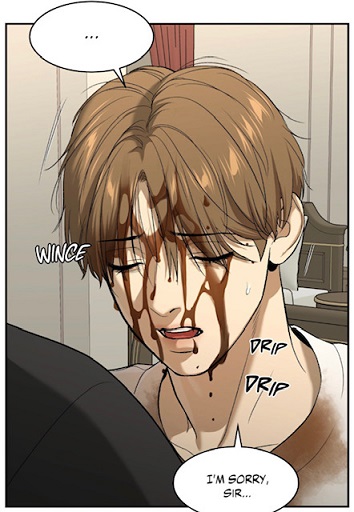 (chapter 37) He endured before being asked. He accepted harm as a condition of acceptance and staying. His silence was not passivity, but a learned ethics: if I ask for less, if I take up less space, if I disappear when necessary, others, in particular his grandmother, might be spared.
 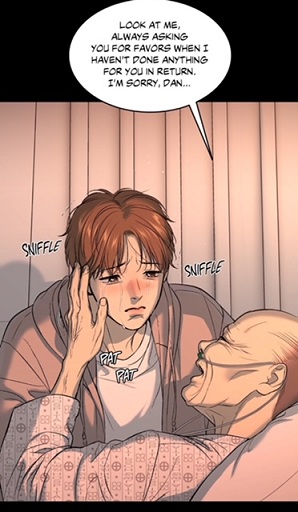 (chapter 53) That posture did not originate with Joo Jaekyung. It preceded him. It was shaped by debt, obligation, omission, and by figures who decided on Kim Dan’s behalf what he could endure and what he deserved.
In episode 90, that posture reappears — but it is no longer Kim Dan’s. Joo Jaekyung does not lash out. 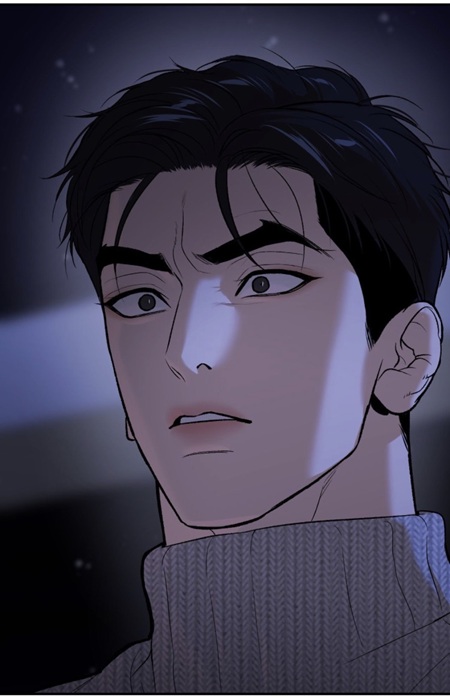 (chapter 90) He does not argue. He does not demand. Instead, he blames himself for everything, thus he withdraws. He refuses to claim a right. He positions himself as the problem that must be removed so that something better might follow.
 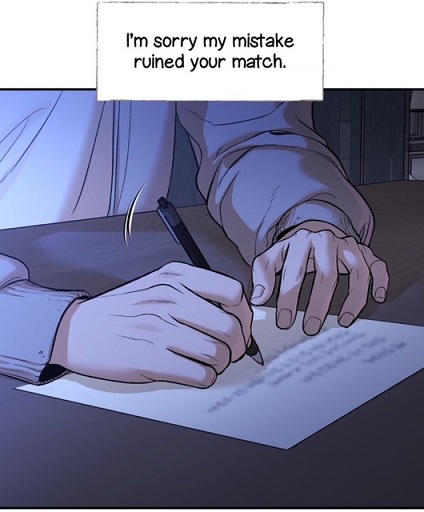 (chapter 53) This is the same moral calculus Kim Dan once applied to himself: the belief that care becomes ethical only when it is accompanied by sacrifice, and that love, if it exists at all, must be proven through disappearance. The only difference is that he can not apologize as his existence has become the synonym of wrongdoing. Thus Kim Dan can not hear the distress from his “loved one”.
The mirroring is not obvious, because the bodies do not look alike. Kim Dan’s earlier suffering was visible: exhaustion, malnourishment, fainting, tears. Joo Jaekyung’s is not. He stopped crying a long time ago.  (chapter 74) He remains upright. His posture holds. Yet, he is now voiceless exactly like the physical therapist in the past. From the outside, he still appears powerful, but the loss of cry or sound indicates loss of agency and choice. But structurally, the positions have reversed. The one who once endured now asserts authorship over his choices. (chapter 90) The one who once claimed authority now doubts his right to remain.
This inversion does not arise in a vacuum. It is prepared by encounters with figures who mistake projection for truth. Both Heesung 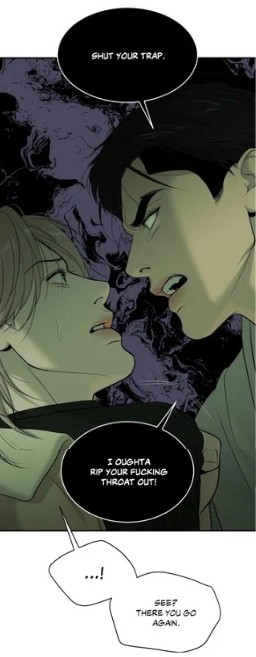 (chapter 89) and the green-haired man
  (chapter 42) operate through the same mechanism: they reduce complexity into a single verdict. Like false mirrors, they collapse months into moments, gestures into essence, and relationships into accusations. They speak as if they own the truth — not because they see clearly, but because jealousy and greed demand certainty. Hence they are connected to the color green. Their words are not reflective (chapter 89); they are consumptive.
As I argued in my earlier essay on deceptive mirrors, the green-haired man is not a mirror at all, but a monster revealed by one. He does not reflect; he distorts. Kim Dan, by contrast, functions as the Ungaikyō — the mirror beyond the clouds — which does not invent monstrosity, but exposes it. In his presence, hidden motives surface: envy, entitlement, moral resentment. This is why certain figures cannot bear his gaze, and why others attempt to shatter the reflection by attacking the one who stands beside him.
This reversal also explains why Kim Dan cannot recognize what is happening. (chapter 90) He continues to address Joo Jaekyung as an athlete, a patient, a man who needs reassurance. He speaks clearly, claims responsibility, and insists on consent. He does everything that would have saved him in the past. But those words reach someone who is no longer negotiating endurance. Joo Jaekyung is not asking how to stay. He has already concluded that by keeping him by his side is wrong.
Here lies the fatal misalignment: because Joo Jaekyung possesses such a damaged self-image, he interprets his ability to expose corruption as proof that he belongs to it. He detects the hospital director’s moral rot instantly 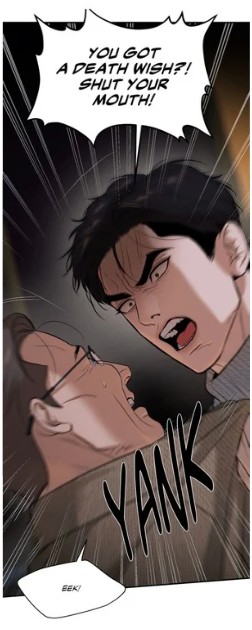 (chapter 90) — not because he shares it, but because the mirror he has become reveals it. Yet instead of recognizing this capacity as ethical clarity, he mistakes it for contamination. He equates himself with the very figures whose cruelty is laid bare in his presence. However, he is making a huge mistake, he is accepting this projection forgetting that he had it all wrong for one reason:
 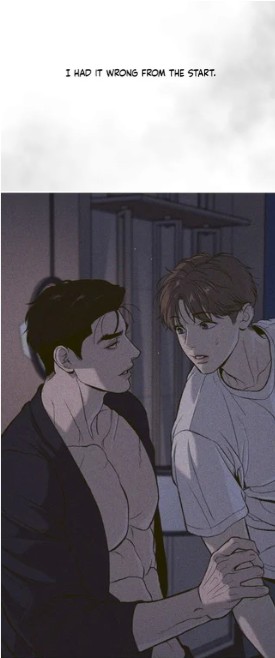 (chapter 90) During their first meeting, the “hamster” had grabbed his “anaconda”.
 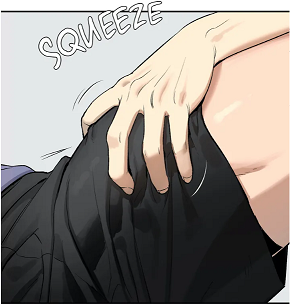 (chapter 1) Such a gesture could be interpreted as a seduction, and don’t forget that the previous physical therapist had rubbed him the wrong way:
  (chapter 1) Finally, observe that after this incident, Joo Jaekyung was looking at the embarrassed doc Dan
 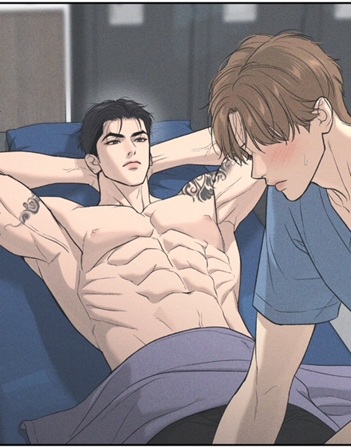 (chapter 56) and thinking that they could have fun together in bed.
  (chapter 56) So doc Dan has his share of responsibility in the champion’s misjudgment.
In this sense, the mirror remains hidden because it reflects an earlier version of Kim Dan that the latter himself has begun to leave behind. That’s why he is looking at the teddy bear. (chapter 90) Earlier, in Paris, Kim Dan took its hand and squeezed it, drawing steadiness from what it represented rather than from struggle.  (chapter 84) This gesture symbolized their reconciliation in the end,
  (chapter 84) the return of trust and faith in the “champion”. What Joo Jaekyung mirrors is not who the doctor is now, but who he once had to be in order to survive. The tragedy lies precisely there: the champion adopts a posture the doctor has already outgrown thanks to him.
And as with all mirrors in this story, the reflection is imperfect. Joo Jaekyung’s withdrawal is framed as ethics, not necessity. He believes he is restoring balance by removing himself. But this belief rests on the same flawed premise that once governed Kim Dan’s silence — that one person can decide alone what harm is, and who must vanish to prevent it. The mirror reveals continuity, not resolution.
What appears as role reversal is therefore also a warning. When responsibility becomes indistinguishable from self-removal, the structure of harm does not disappear; it simply changes hands.
The Inherited Horizon (Living for Others)
Joo Jaekyung’s collapse and resignation in episode 90 are not a new development. (chapter 90) It is the reactivation of an older logic — one learned long before Kim Dan entered his life. What surfaces that night is not a crisis born of romance, but the return of a childhood structure in which existence is justified only through sacrifice, and value is always deferred to someone else’s future.
From the beginning, Joo Jaekyung was never taught how to live for himself. Though he was initially encouraged to fight for himself (earning money) 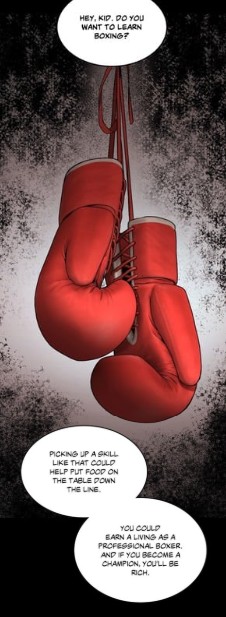 (chapter 72), the reality was that he longed for a home, which he came to associate with his mother. Thus over the phone, he promised to become strong
  (chapter 72) and earn a lot of money so that his mother could return home. As you can see, fighting was strongly intertwined with his mother and his longing for a family.
His entire horizon is shaped by adults who frame life as endurance in service of others. His father beats him and argues with him by asking for respect. (chapter 72), as if the boy’s role was to validate the father’s existence. Joo Jaewoong does not ask his son what he wants
  (chapter 73); he mocks his ambition
  (chapter 73) and reduces his dream to delusion. Yet even in conflict, Joo Jaekyung seeks recognition. (chapter 73) He does not reject his father’s gaze — he argues within it, hoping to prove him wrong through success.
 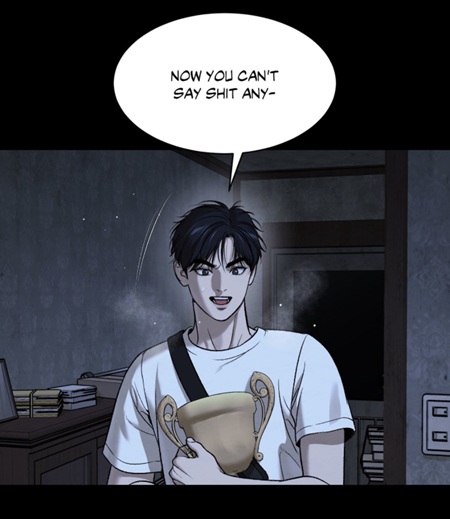 (chapter 73) As you can see, his life is always focused on the future, on one goal and as such one person: the mother, then the father.
Later, Hwang Byungchul reinforces the same structure. He offers MMA fighting not as a way to find joy or self-discovery, but as a means to “honor his mother’s sacrifice”  (chapter 74) He warns against becoming like the father, to change for the sake of his own mother
  (chapter 74), not by encouraging freedom, but by replacing one obligation with another: win, endure, don’t disgrace the dead. Many years later, he encourages him to change his mind-set, because he could end up alone.
 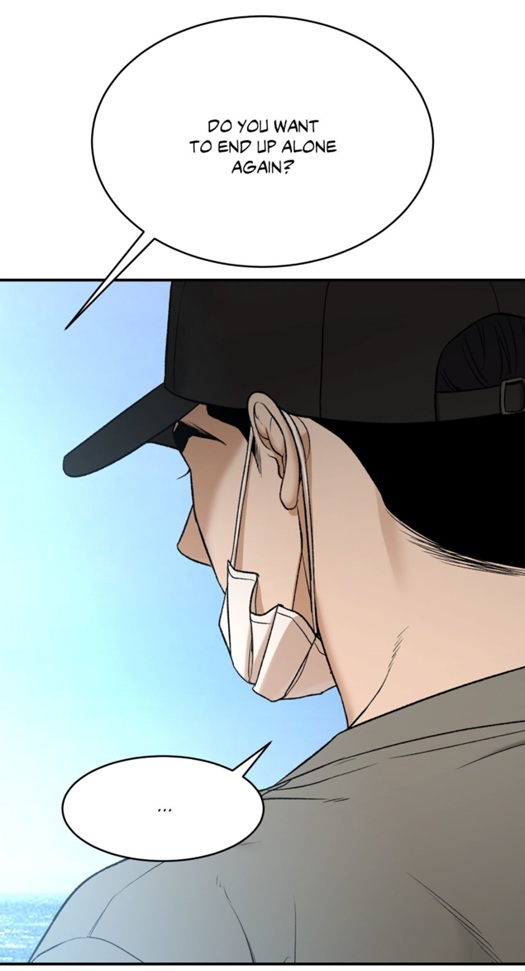 (chapter 75) For the first time, it is no longer about winning or enduring.
 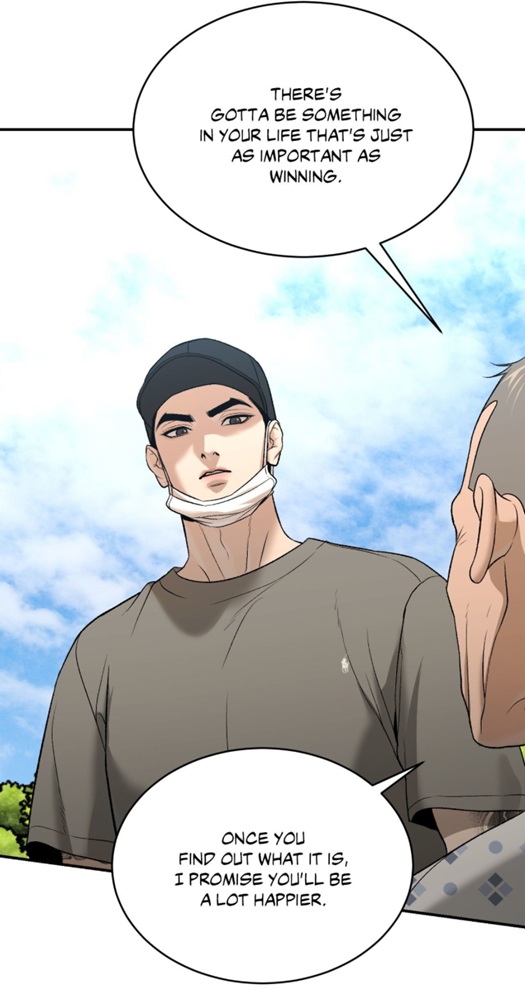 (chapter 75) However, observe how the main lead reacts to this well-meant advice:
  (chapter 75) He starts visualizing Doc Dan as his goal. It is once again focused on one person and future-oriented.
Striking is that the grandmother in Kim Dan’s life articulates the same ethic from another angle. Kim Dan stays for her sake. (chapter 65) He grows up too fast for her sake. 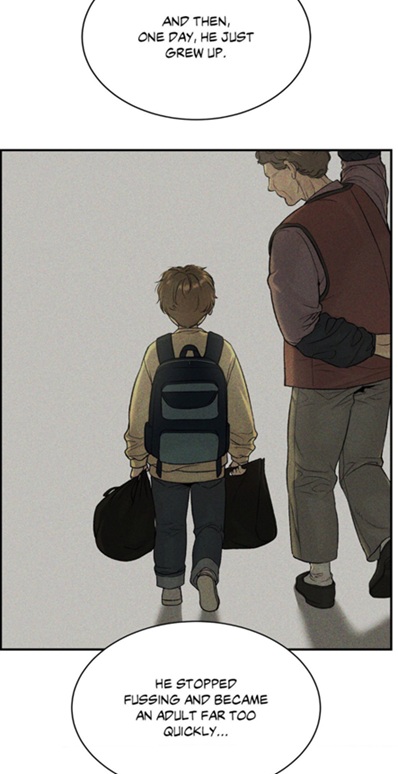 (chapter 65) He suppresses desire, health, and rest for her sake. The moral lesson is identical: if your presence risks harm, reduce yourself; if your absence protects others, endure it.
This is the philosophy Joo Jaekyung inherits — and internalizes. This observation leads me to the following conclusion: the MMA fighters treats doc Dan the same way than doc Dan took care of Shin Okja. They both prioritize the well-being of a loved one over themselves. And could this happen? One might say that it is because of the grandmother’s request  (chapter 65), because she did the same in the past with doc Dan: (chapter 53), but the truth is that this reversal of position started taking place, the moment the athlete paid the loan. It is no coincidence that the new contract is based on the debts.
 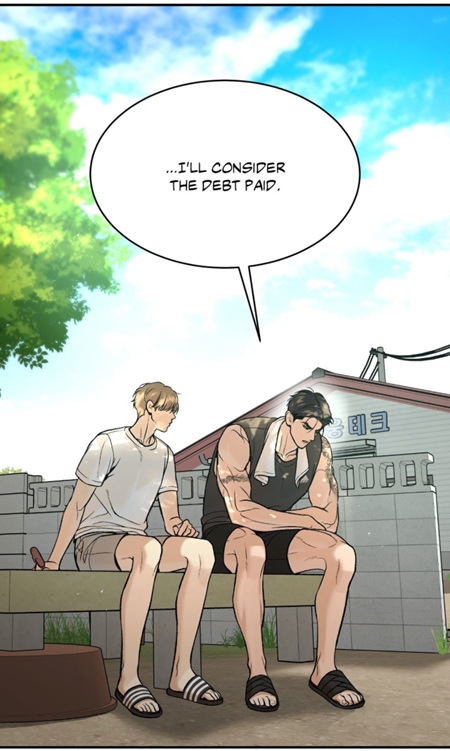 (Chapter 77) This means, the debts bring the terrible mind-set to the surface.
The night of episode 74 crystalizes this structure. Joo Jaekyung wins a title, believing victory might finally justify his sacrifices. Instead, he loses both parents at once: his father through death, his mother through abandonment. 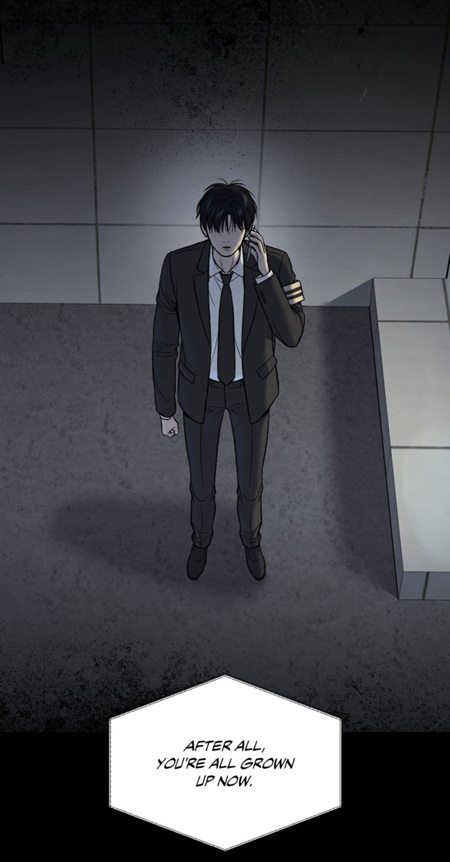 (chapter 74) The latter justifies her betrayal by saying that he is too late, as he is already too old. The promise that sustained him collapses. Winning no longer guarantees return. The future he fought for vanishes. And in the penthouse, we have the same thought again: (chapter 90)
Episode 90 repeats this pattern with devastating precision. Once again, Joo Jaekyung believes that his presence is harmful. Once again, he concludes that removal is ethical. Once again, he lives for someone else’s sake — this time Kim Dan’s. He withdraws not out of desire, but out of obligation. He does not ask what doc Dan wants; he questions himself whether he has the right to keep him by his side. But the gesture represents the answer: He has no right to hope that doc Dan will still live by his side.
Crucially, this is not about winning anymore. The logic of victory has already collapsed. Joo Jaekyung no longer believes that success can restore what was lost. He has internalized the jinx not as misfortune, but as identity. In his mind, Kim Dan has every reason to leave — not because Joo Jaekyung failed, but because he is the failure.
This is why episode 90 does not mirror Kim Dan’s past alone. It repeats Joo Jaekyung’s own childhood logic.
- In episode 73, he claims to fight in order to escape the house.
- In episode 74, he learns that victory costs him everything.
- In episode 90, he stops fighting — because fighting no longer promises return.
The core belief remains unchanged: if you cannot guarantee a good outcome, remove yourself. The hand gesture symbolizes the loss of hope in the end. (chapter 90)
That belief once governed Kim Dan’s life. Now, it governs Joo Jaekyung’s. The tragedy is not that he lets go — but that he does so for the same reason he once fought: not for himself, but to justify his existence through sacrifice. He has never been taught another way to live. Heesung’s words poison him precisely because they echo this logic, arriving at the moment when he had just begun to enjoy life with Kim Dan.
The Silent Friend
At first glance, one might search for the silent friend in the room itself — perhaps in the teddy bear, quietly placed on the sofa where the jacket almost once landed. (chapter 90) The object evokes childhood, comfort, and a softened version of intimacy. It almost invites the idea that this silent presence could be something benign: a substitute for words, a witness that does not judge.
However, with silent friend I am referring to something else. It did not appear in episode 90. It has been there all along. Long before Kim Dan entered his life, Joo Jaekyung was already living with an unnamed mental burden — one he never recognized as such.
It is guilt and self-loathing 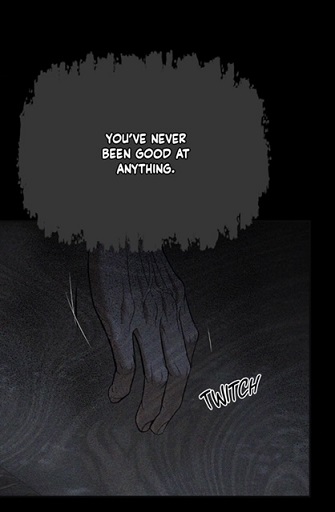 (chapter 54) — longstanding, cumulative, and corrosive.
 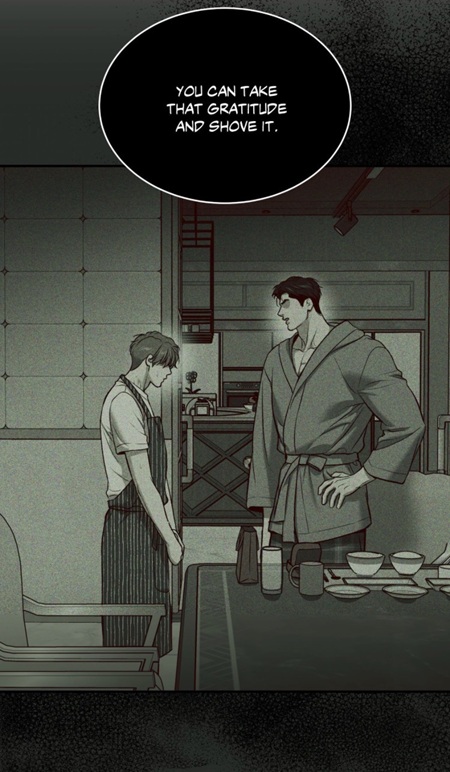 (chapter 90) And these two “friends” return during that night. What inhabits the room in episode 90 is not nostalgia, nor an unprocessed sadness that merely needs to be named. The same shame that has structured his life since childhood resurfaces here, stripped of all justifications. Joo Jaekyung is not suffering because he feels abandoned in the present. He is suffering because he believes himself to be the reason others leave. (chapter 90) This conviction predates Kim Dan. It is rooted in the unresolved grief surrounding his father’s death, the mother’s disappearance, and the belief that he arrived too late — that he failed at the very moment success was supposed to redeem everything. That night taught him a lesson he never unlearned: love is fragile, and your existence may be what destroys it. So the childhood traumas led him to develop depression, the silent friend.
The clearest indication is his own confession in episode 29. 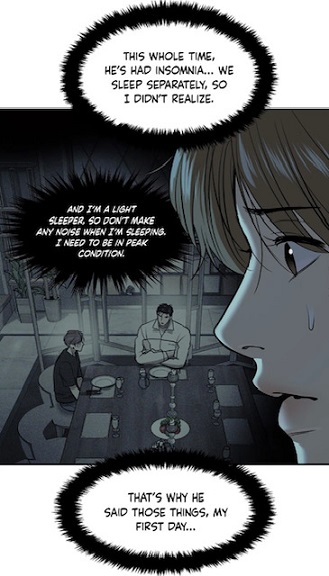 (chapter 29) He cannot sleep. He cannot relax. His body remains permanently alert because, in his words, he could “be killed” at any moment.
  (chapter 29) For him, this is not a symptom. It is simply part of being a fighter. Insomnia is normalized, rationalized, and dismissed as a professional hazard. Yet his listener immediately senses otherwise.
Kim Dan does not react with admiration or resignation. He worries. He asks himself how he could help. 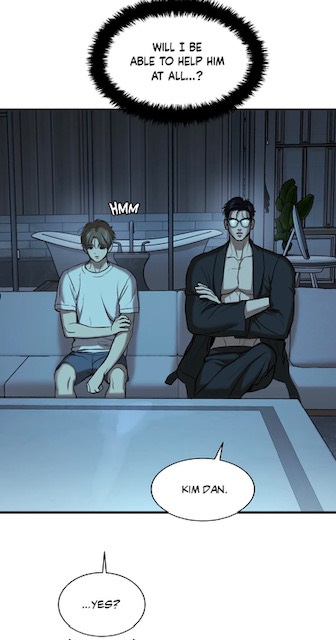 (chapter 29) He understands that this state is unsustainable — that it is only a matter of time before something gives way. What Joo Jaekyung treats as discipline, Kim Dan recognizes as danger.
This asymmetry matters. It reveals something essential: the champion cannot perceive his own depression, while the doctor can perceive it in others. That is precisely why Kim Dan becomes its mirror.
When Kim Dan later decides to leave, the gesture reads as abandonment — even betrayal. But the motivation is the opposite. Blinded by his own low self-esteem, he believes he has failed as a physical therapist. He takes Joo Jaekyung’s harsh words literally and imagines that if he removes himself, the athlete will remain strong. The last memory he carries with him is not intimacy, but rejection.  (chapter 53) In his mind, he is obeying a command.
And yet, Kim Dan never truly leaves. He remains present through memory. The abandoned jacket in episode 53 is not a simple object. It becomes the first catalyst. Joo Jaekyung interprets it as rejection, as loss of status — no longer a fan, no longer part of his team. He throws it away in anger. (chapter 53) Read superficially, this looks like karmic reversal for his cruelty on his birthday. 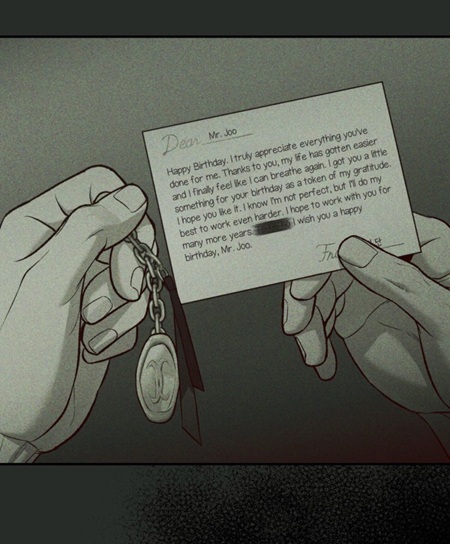 (chapter 90) But that explanation is insufficient. What actually begins after is grief and recognition.
The memories associated with Kim Dan do not punish Joo Jaekyung — they unsettle him. They force him to confront something he has never allowed himself to name: that he is unhappy, unmoored, and profoundly insecure. He has never been at peace with himself. He has never known how to live outside of obligation and performance. This is why he has never truly lived.
This is where my earlier interpretation deepens rather than changes. After season one, the “hamster” functioned as a personification of the champion’s jinx.  (chapter 54) Now the logic sharpens: Kim Dan does not merely embody bad luck. He embodies the champion’s mental state — depression, trauma, and chronic self-devaluation. He becomes the surface onto which Joo Jaekyung’s inner instability is projected.
This insight is inseparable from depressive realism.
What struck me when I first encountered this concept was how closely it resembled the main leads’ thinking. The absence of “pink-tinted glasses,” the accurate — sometimes brutally accurate — assessment of control, responsibility, and limitation. Kim Dan and Joo Jaekyung does not exaggerate hope. He minimizes it. And paradoxically, this allows Joo Jaekyung to justify not changing. His arguments in episode 29 are coherent, logical, and devastatingly persuasive. Kim Dan ends up convinced that the champion should not rest, should not slow down, should not alter course. 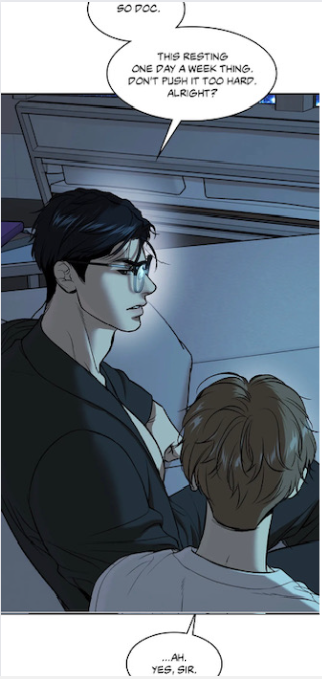 (chapter 29) And now, in episode 90, Jinx-philes can sense that the athlete is wearing the glasses “depressive realism” once again, where everything seems so true. He recalls all his misdeeds and can only perceive himself as the source of unhappiness for doc Dan. And like mentioned above, during that night, he is just only recalling his wrongdoings. He is overlooking that thanks to him, Doc Dan’s mental and physical conditions
 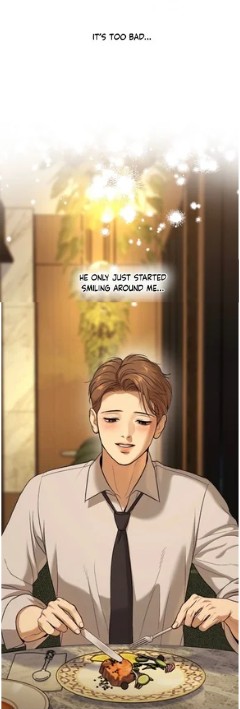 (chapter 89) improved, that he could make doc Dan smile. Meeting the hospital director made him see everything in a bad light. As you can see, he still has a black and white mentality. However, the truth is that right from the start, the champion had not just been a terrible person. He could be generous, help someone in need.
  (chapter 17) He saved doc Dan’s life twice.
 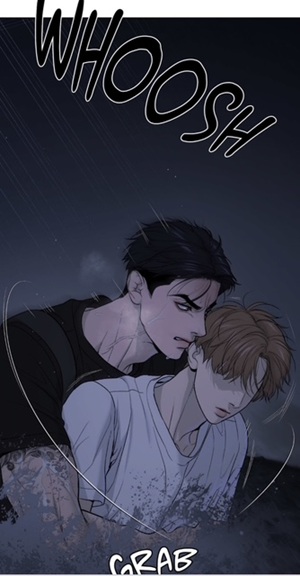 (chapter 59) He is reducing everything to one single moment and emotion: pain. And his reasoning is resembling a lot to the grandmother‘s: (chapter 65) The only difference is that the grandmother doesn’t express guilt or responsibility for doc Dan’s suffering. For her, it is fate, as she is not responsible for the doctor’s childhood.
  (chapter 65)
Depression thus becomes mutually reinforcing — invisible to the one who carries it, hyper-visible to the one who mirrors it.
This is why the chapter numbers ending in 9 matter.
- 19 introduces absence and the first rupture linked to family and death.
 (chapter 19) This image announces the vanishing of the parents.
 - 29 stages bodily collapse and unrecognized danger.
- 59 flirts with disappearance through dissociation. Back then, the puppy died leading doc Dan to walk into the ocean.
- 69
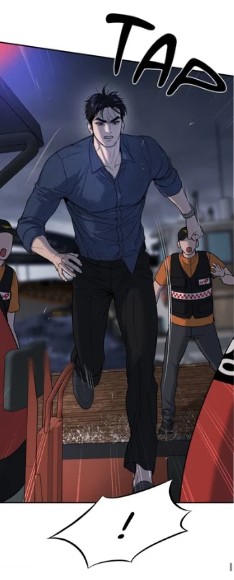 , when Joo Jaekyung imagines that doc Dan has once again fallen into the ocean and fears to lose him.
 - 79 when Joo Jaekyung stops him from falling.
 (chapter 79) gestures toward falling, both physically and psychologically.
None of these chapters announce suicide. But all of them circle it. They trace the gravitational field of depression — the slow erosion of self-preservation, the normalization of exhaustion, the quiet flirtation with vanishing. However, observe that in episode 89, the notion “suicide” is brought up for the first time by Choi Heesung. 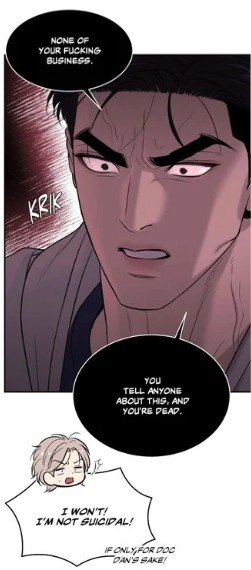 (chapter 89) Secondly, he is the only one referring to mental illness: (chapter 89): crazy, egomaniac. As you can see, the last arc linked to the number 9 seems to be focusing on depression and mental issues. Joo Jaekyung’s mental state as an athlete was never treated so far by doctors. And now, you understand my interpretation. The celebrity is now placed in the same situation than the physical therapist for another reason: it is to confront both men with their self-loathing and childhood traumas.
Episode 54 ( 54 = 5+4= 9) is the pivotal transfer point. It is the moment when Jinx-philes are confronted with reality, his mental issues and their origins. No wonder, why he started drinking. 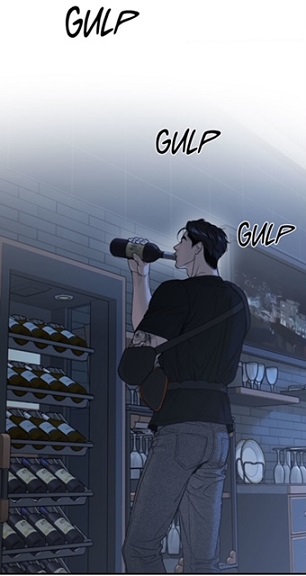 (chapter 54)
The dream seals this logic. Joo Jaekyung does not dream himself crying. He dreams Kim Dan crying. (chapter 54) The image functions as guilt, interrogation, and reflection all at once. It asks: Is he still suffering because of me? But the champion chose back then to read it differently: I am in pain because of you. Thus he tried to find a new “toy” shortly after. But it also reveals something more disturbing: those tears are the champion’s own. He feels them — but cannot express them.
He cannot cry because vulnerability still reads as danger. This is why episode 90 is so alarming.
The silent friend — depression, guilt, self-loathing — no longer needs a proxy. Joo Jaekyung internalizes it fully. He no longer misrecognizes it as insomnia or discipline. He recognizes himself as the problem. The jinx is no longer something that follows him. It is something he has become. But in order to be freed from this immense weight, he needs the support of a friend and a family.
And this is where the unspoken risk emerges. So far, Joo Jaekyung has never spoken about Kim Dan’s suicidal episodes. He has never named them. 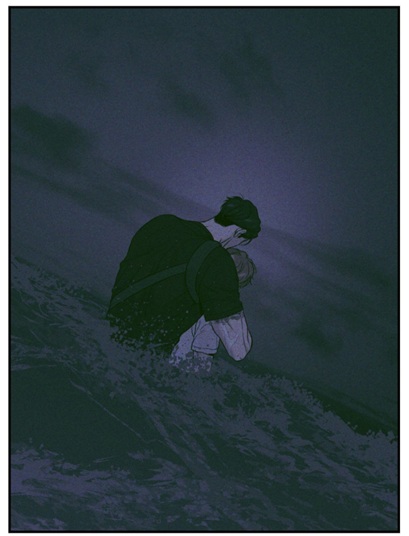 (chapter 78) Now, he is blaming himself for everything — and the narrative quietly aligns him with the same numbers, the same silences, the same logic of disappearance.
This does not mean he is suicidal. But it means the silent friend has returned — no longer mirrored, no longer shared, no longer displaced. And now, look at his eyes once again, (chapter 90) you will notice the redness, a sign that until that night, he is still suffering from insomnia. His insomnia and depression were never treated, and he took care of doc Dan all this time. He never rested properly, especially that there is another match around the corner.
And this belief — more than sadness, more than despair — is what makes episode 90 so dangerous. It marks the point where suffering no longer seeks relief, and responsibility turns inward, demanding disappearance as proof of care. But someone needs to notice how fragile Joo Jaekyung is. But why did the author choose to switch the character’s positions? Doc Dan assumes that during his absence, nothing changed in the athlete’s life. But the reality is that Joo Jaekyung lost contracts  (chapter 54), while he tells the opposite to his partner.
  (chapter 80) Secondly, he doesn’t know how the champion was blamed for everything and was treated by the other members of Team Black:
  (chapter 52) No one listened to his unwell-being, they rather silenced him. They showed no support and didn’t take care of him. Thus later the athlete started drinking. The physical therapist has no idea what Potato heard either:
  (chapter 52) At the same time, I am suspecting that Mingwa is putting doc Dan in a similar situation than in the past, so that repressed memories about the parents will come to the surface. Keep in mind that the athlete is actually mirroring the parents’ behavior (abandonment and sacrifice as a sign of love and respect). Thus the teddy bear is placed on the couch and the physical therapist is looking at it.
  (chapter 21) A teddy bear was present in his childhood, until it vanished. (chapter 19) Let’s not forget that in episode 90, money plays a huge role and so far, the champion still thinks, the debts truly belong to the physical therapist. Finally, I believe that both could connect emotionally, when they talk about their respective past. In my eyes, it is now Doc Dan’s turn to assist Joo Jaekyung… by offering his hand as a friend.
 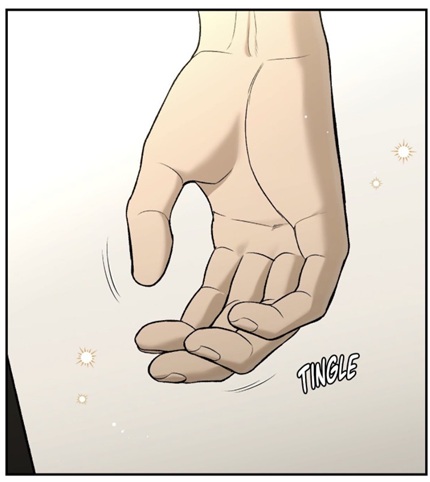 (chapter 87)
Feel free to comment. If you have any suggestion for topics or Manhwa, feel free to ask. If you enjoyed reading it, retweet it or push the button like. My Reddit-Instagram-Twitter-Tumblr account is: @bebebisous33. Thanks for reading and for the support, particularly, I would like to thank all the new followers and people recommending my blog.


 (chapter 81) The plane soars not only above the Alps, but also above a vast river (probably the Rhône)— two landscapes that silently echo the dual composition of breath itself. Breath is made of air and water: oxygen and vapor, wind and moisture.
  (chapter 82) In that sense, the clouds surrounding the aircraft are not mere weather; they are the perfect union of the two elements that sustain life.
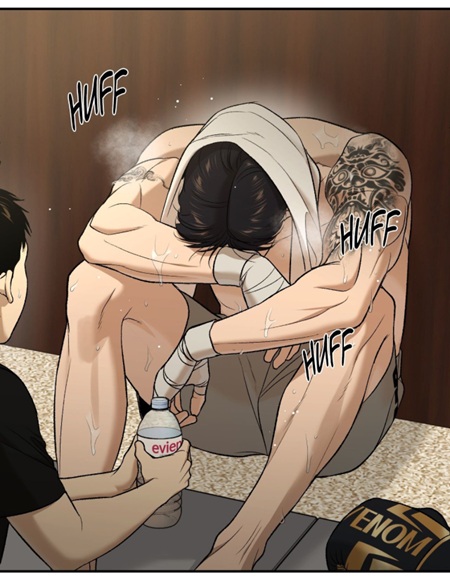 (chapter 82) That’s why, when Potato offers him a bottle of Evian, he doesn’t even look. He doesn’t need the water from the mountain and as such the world; he needs the water of the body — the intimacy, the shared moisture that reconnects him to life itself. What he truly longs for is Kim Dan’s saliva, the living trace of water transformed into affection, into care, into exchange.
 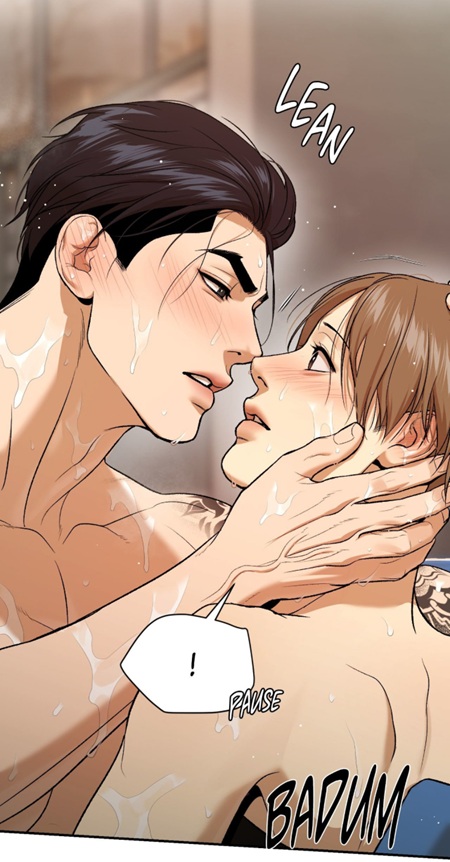 (chapter 81) He is longing for his lips and as such a kiss.
 (chapter 15)
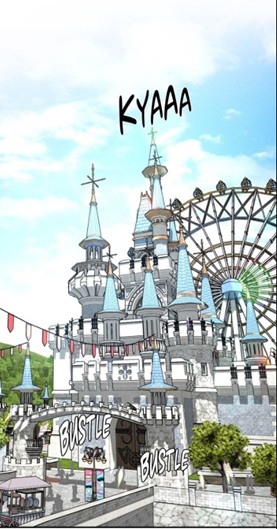 (chapter 82) Many attractions — the Ferris wheel, the fountain rides, the water park zones — combine air and water, height and spray, just like breath itself. And now, you understand why the champion got wounded with the spray
  (chapter 49) It corresponds to the negative version of the “breath”.
 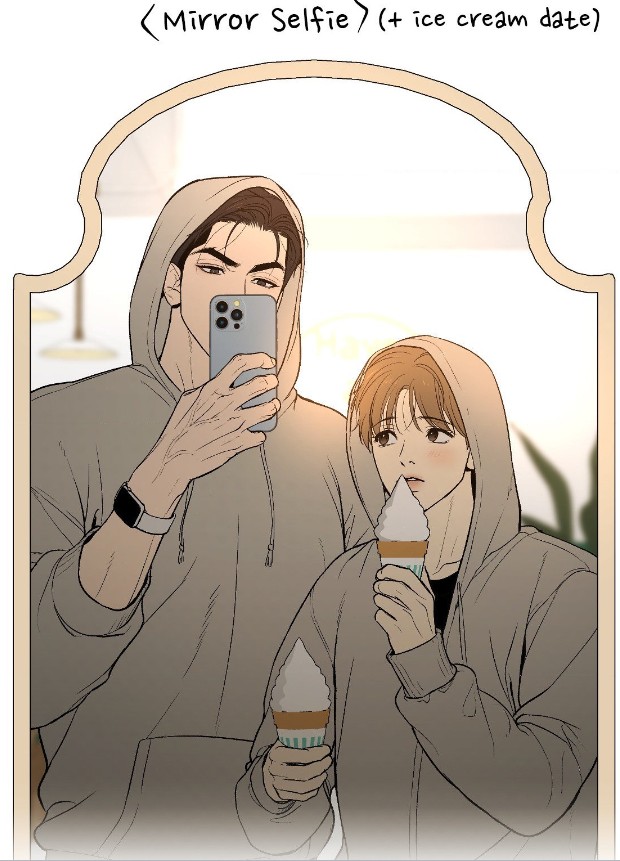 (epilogue), because doc Dan wants to ensure that the drink or the ice cream is okay.
 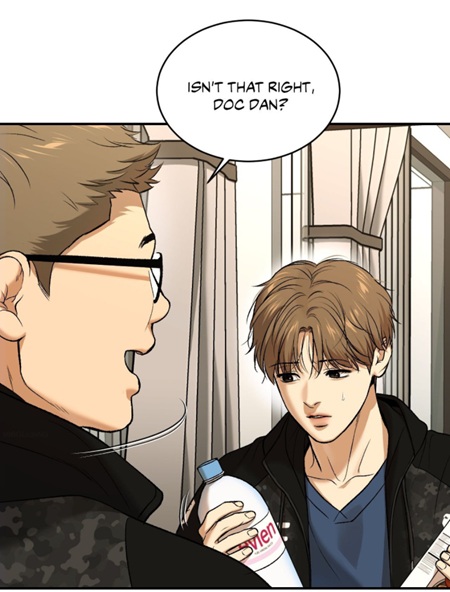 (chapter 82) When Jaekyung and Dan enter the funfair, they’re not simply having fun; they’re reliving the chemistry of respiration and affection — the inhalation of joy, the exhalation of fear, the splash of renewal. The park becomes an externalized lung, a circular world of rides where water and air, play and life, are finally reconciled.
 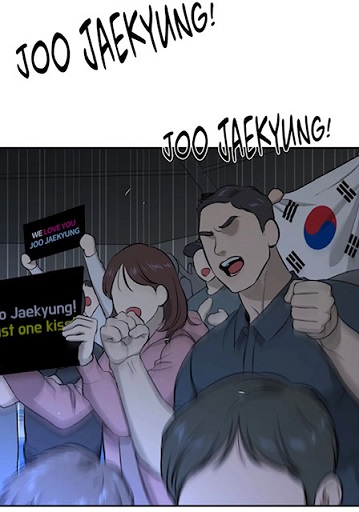 (chapter 15) The arena that once fed on pain, blood, and hierarchy gives way to a landscape of shared laughter, circular motion, and renewal. Here, entertainment is not built upon the exhaustion of bodies but upon their liberation. The crowd no longer watches to see who will fall; they rise and descend together.
 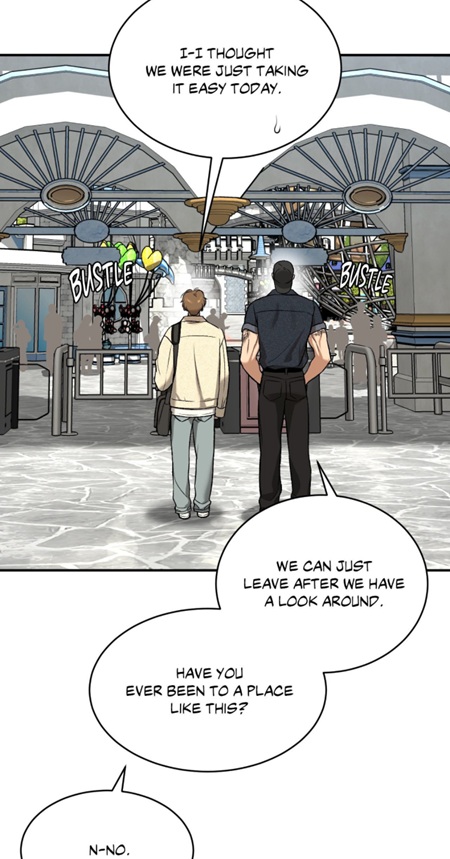 (chapter 82) People are more focused on their own emotions and experiences.
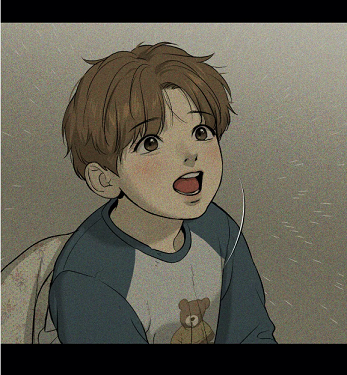
 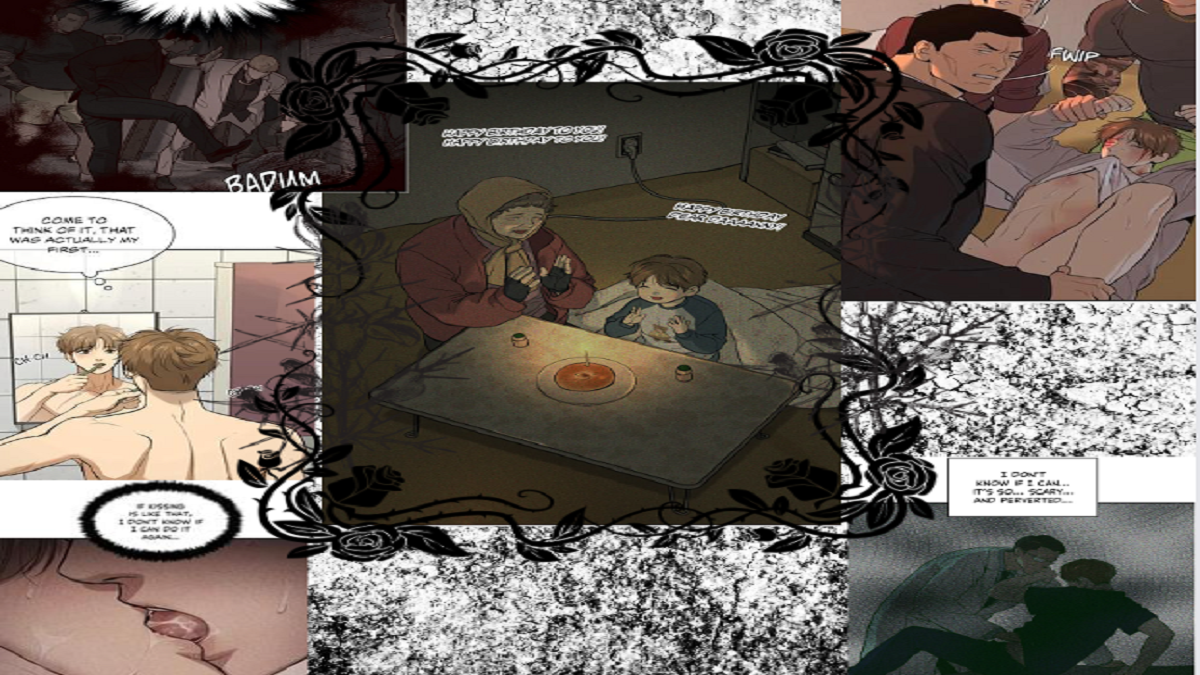 I placed the doctor’s birthday. And that’s how I remembered here the boy’s huge smile and joy.
  (chapter 11) And now, pay attention to the number of the next episode: 83! The two numbers combined together make 11! As you can see, the amusement park is the most natural setting for a smile and kiss. Joo Jaekyung could even speak about his first kiss, an intimate secret that even Kim Dan doesn’t know. Confessing it there would align his personal myth with the fairy-tale architecture around him. This would make doc Dan realize that he is special contrary to the green-haired ex-lover.
  (chapter 81) letting the lips slip past him like water. Yet, in the very same scene, he allows a kiss on the neck, a place where breath, warmth, and pulse converge.
  (chapter 81) He never pushes him back. The doctor resists with the face — with speech, with identity — but not with the body.
 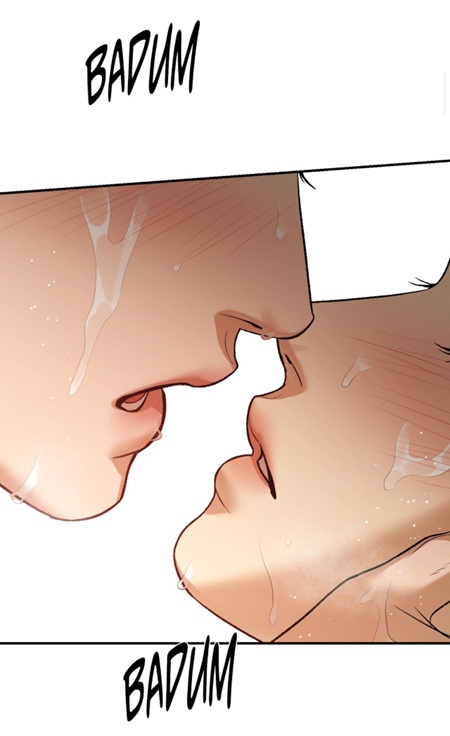 (chapter 81) Why? Because the lips are not mere flesh; for Doc Dan, they are the visible border between desire and love. Jinx-lovers will remember his quiet request in the locker room (chapter 15): he links the lips to the heart — and through it, to the notion of consent.
  (chapter 15) To kiss him there is to ask for entry not into his body, but into his feeling.
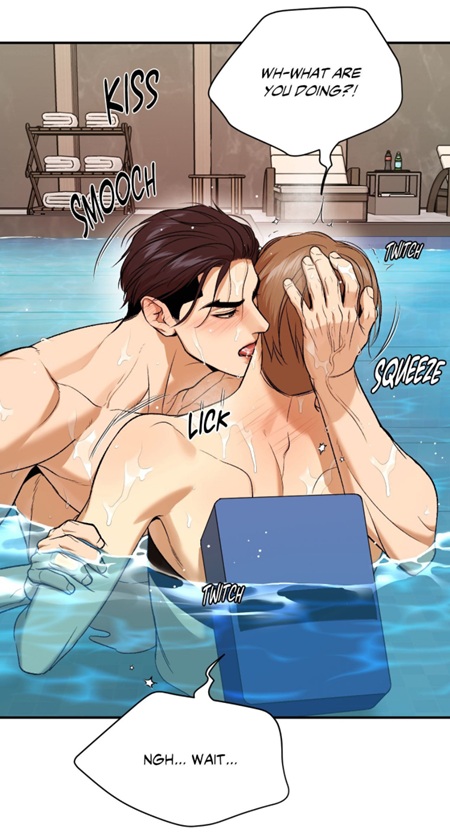 (chapter 81) The water envelops them both — fluid, intimate — yet the final element is still missing: agreement, the meeting of air and will. Until Jaekyung learns to ask, to replace taking with invitation, the kiss will remain suspended, like a breath held underwater, waiting to surface into love. And now, you comprehend why he couldn’t achieve his goal in the swimming pool. It was, as if he was trying to recreate the situation in season 1. In other words, I deduce that there will be a confession before a kiss happens!!
 (chapter 17) and the one in front of the amusement park:
  (chapter 82) The two scenes mirror each other like opposite poles of Joo Jaekyung’s evolution. In both, he is dressed in black — a color that once signified anonymity and danger, but later becomes the mark of calm confidence.
 (chapter 17) When he intervenes to save Kim Dan from the loan sharks, he is first mistaken for one of them — a predator among predators. The irony is sharp: the man who comes to rescue looks indistinguishable from those who harm. The fighters’ world has taught him that power and fame must be hidden; he was encouraged to hide, as if the fans would attack him. He chose anonymity, unaware that this would not only isolate him but also make him appear as a thug. And don’t forget how the manager called him initially:
  (chapter 75) He is a monster. It was, as if the manager wanted to hide the “wolf” from people out of fear that he might attack people randomly. But the problem is that by dressing like that, he was no different from Heo Manwook. Therefore his heroism passes unnoticed, interpreted as violence and intrusion.
  (chapter 18) Like Batman, he moves in secrecy, protecting without ever being thanked. The outfit explains why his good deed leaves no trace of gratitude — the savior looks like the aggressor.
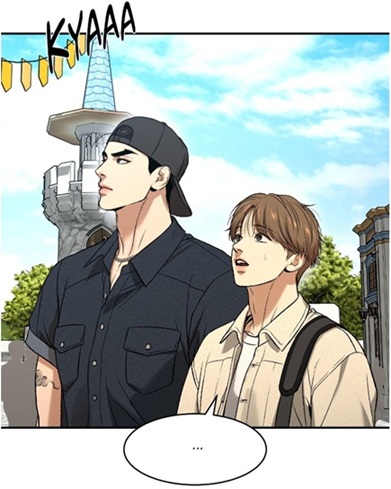 (chapter 82) He still wears black, but the darkness no longer hides him. The cap now sits higher, revealing his eyes and mouth — the organs of emotion and speech. A necklace gleams at his throat, a quiet emblem of openness. He walks beside Kim Dan in daylight, not to fight but to share joy. The man who once lurked in alleys now stands beneath the sky of the amusement park, where black absorbs light rather than extinguishes it.
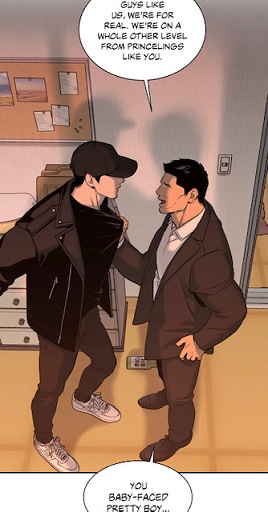 (chapter 17) A princeling! He was mocking him, because he knew that the fights were actually rigged. That’s why he called him fake.
 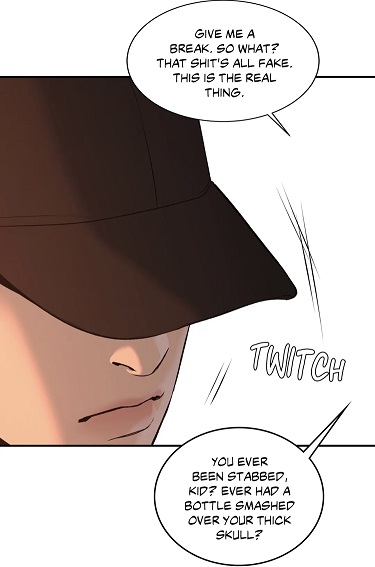 (chapter 17) This new connection reinforces my theory that the schemers are anticipating the Emperor’s demise.
 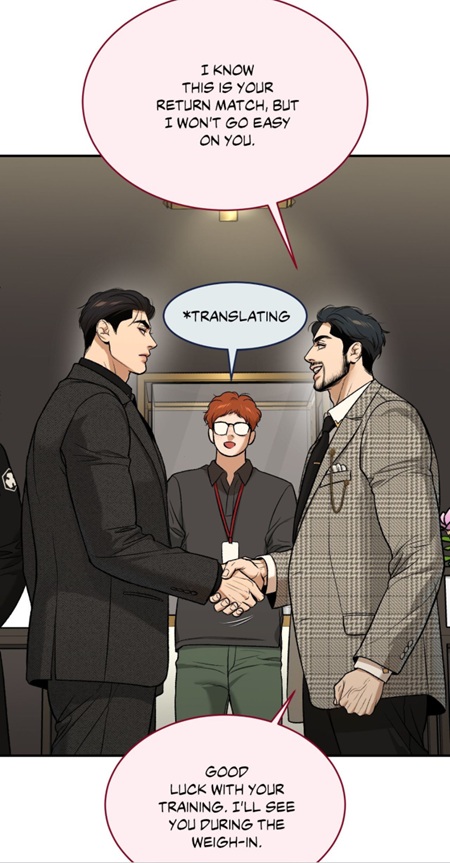 (chapter 82) Thus Arnaud Gabriel’s words are full of irony. There’s no luck in this match. However, the antagonists are not anticipating a metamorphosis. The wolf hides and strikes; the prince reveals and protects. The wolf saves without witnesses; the prince loves in full view. In the ring’s darkness he fought to survive; in the park’s brightness he learns to live and love. And the moment Joo Jaekyung is freed from his curse and can breathe, his next game will be different. Why? It is because the champion has another reason to make doc Dan’s wish to come true: they should work together for a long time! And observe the power of Doc Dan’s angel on the Emperor after spending his first night with his “bride”. He was full of energy!
 (chapter 65) so he is not standing on his own two feet. And remember that according to me, Shin Okja stands for shore. He is smiling as if everything is fine, but the reality is different. When Dan sits on her lap wearing the duck shirt, he seems safe, grounded, “held.” Yet the shore (the halmoni) isn’t truly stable — it’s brittle earth pretending to resist erosion. She gives him the illusion of safety, not the reality of it. The hydrangeas stand for temporality. The body contact replaces emotional transparency. What he learns in that moment is: “If I stay still and quiet, she’ll hold me.” Thus, his first emotional rule becomes immobility and silence. That is how the floating duck is born — not by moving freely in water, but by learning to suppress movement to preserve attachment.
 (chapter 56) He doesn’t yet see the storm and suffering beneath.
 (chapter 82) But in such a place, it is, as if time was stopped. Thanks to the many emotions and sensations, his body and heart will be revived. Through fun, the duck will change. As Kim Dan ascends from floating duck to swimmer and to a flying duck, he moves from hidden suffering to open breath. Thus the Ferris Wheel will have definitely an impact on him. Both arcs revolve around air and water — the two elements that make up breath and emotion. Don’t forget that the doctor embodies the clouds as well, while the athlete stands for steam.


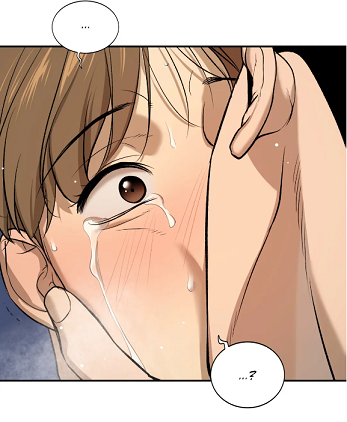 (chapter 14) For the physical therapist, this moment would later be confirmed.
 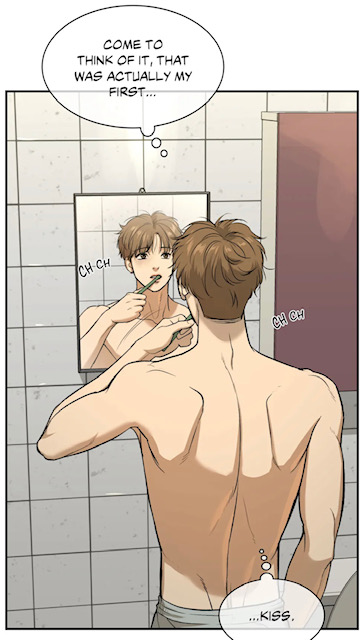 (chapter 16) —haltingly and with a trace of disbelief visible thanks to the points of suspension —as his first kiss ever. His stunned reaction and eventual admission offer a compelling lens through which to explore the symbolism of kissing in Jinx, but also the emotional landscape the two men must navigate.
  (chapter 55) Still, some readers have theorized the existence of a “special lover” in his past
 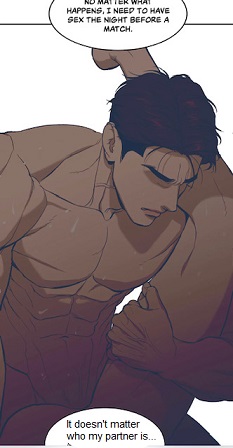 (chapter 2), someone who might have earned a different kind of intimacy. One cause for this hypothesis is that in the champion’s first memory, he was facing his partner, which contrasts so much to the way he had sex with his partners (from behind). This possibility casts the locker room kiss in a new light.
  (chapter 14) If it was his first, the gesture carries a far deeper meaning than either man realizes in the moment. And if it wasn’t, then why does this kiss—with Kim Dan—resonate so differently?
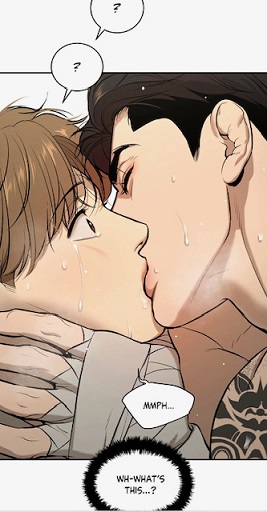 (chapter 15) she showed more than the physical therapist’s confusion with the interrogation marks, she added his inner thoughts. This question (“What’s this?”) already hinted that he had never experienced a kiss before. The ambiguity of his reaction suggested that the moment was unfamiliar, and not immediately recognizable as a kiss at all.
  (chapter 30) Recognizing his face, Dan mentions that his grandmother used to watch the drama A Fine Line, and that he had seen it with her.
 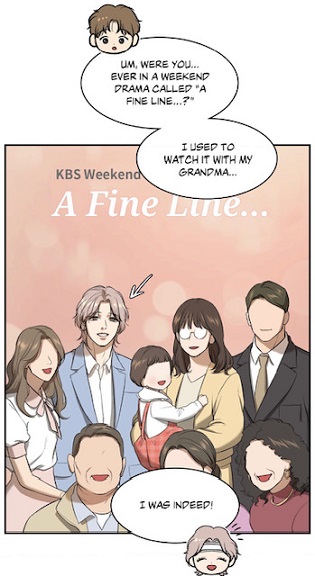 (chapter 30) The author even includes a framed shot from the fictional show, depicting Heesung as the smiling son-in-law in a multigenerational family. This visual insert is subtle, but telling: it wasn’t the story that stayed with Dan, but the faces—the aesthetics of family structure and polite emotional decorum.
 (chapter 16) it frightened him. The kiss broke an invisible boundary—one his upbringing had silently enforced. That’s the reason why he wasn’t sure if he could do it again.
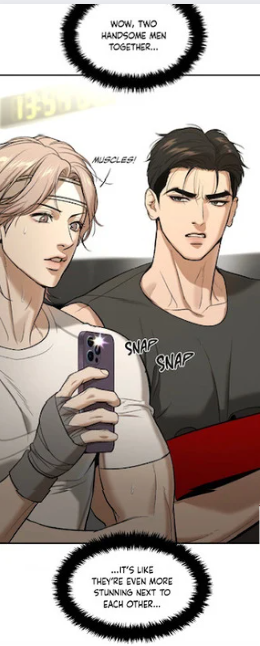 (chapter 30) He blushes and wonders why.
  (chapter 30) It’s a telling moment: Dan isn’t used to feeling attraction and desire, let alone recognizing it. He never bought posters of celebrities, never fantasized. That world—the glamorous world of affection, attention, and beauty—was never his.
 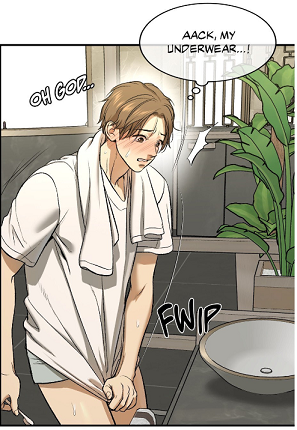 (chapter 30) —despite already having been seen naked by Jaekyung
  (chapter 30) —suggests something deeper than modesty. When he rushes to hide his underwear and blushes merely at brushing his teeth next to someone
 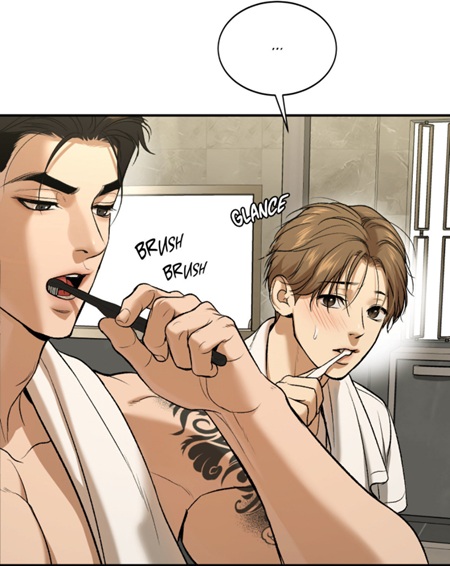 (chapter 30), it becomes evident: Dan is not accustomed to physical closeness or shared domestic spaces. These are not reactions of a man with just sexual trauma—they point to someone raised without the warmth of daily intimacy.
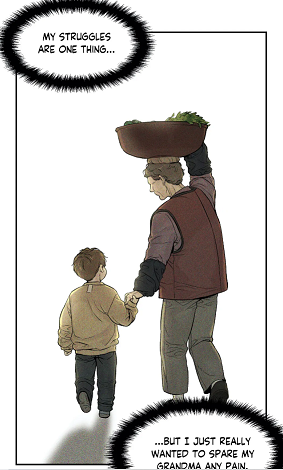 (chapter 5) He had to take care of himself, dressed on his own. He had to act like an adult, as his role was to assist his grandmother:
  (chapter 44) and ear
  (chapter 44) For me, without realizing it, Dan reproduced those gestures. These actions can not come from Shin Okja, as we only see her caressing or patting her grandson. The progression is striking. It moves away from eroticism (kiss from the lips)
  (chapter 44) and toward something far more intimate and protective. These are not the kisses of seduction, but of affection—almost maternal in their tone. Hence the MMA fighter got patted later:
  (chapter 44) They suggest care, comfort, and emotional presence. This is crucial, because it reveals that for Dan, a kiss is not about arousal or conquest. It is a language of love. They carry the flavor of instinct. These are the kinds of kisses a child might have once received, or given, in moments of safety and connection.
 (chapter 44) is a behavior shared by felines and wolves alike: a subtle act of comfort, trust, and bonding. Wolves nuzzle to soothe and reassure. Leopards nudge to display affection without threatening dominance. Dan’s pecks
  (chapter 57) (chapter 57)—licking them not out of instinct alone, but to reassure and bond.
 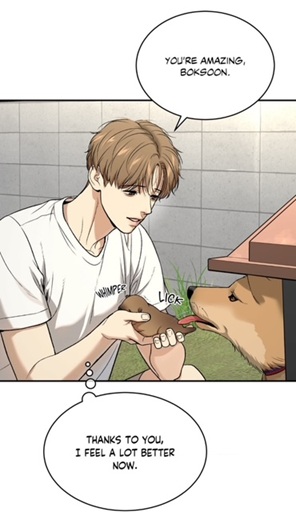 (chapter 57) During that summer night’s dream, Dan’s body mirrored this wordless care. That’s why he could laugh so genuinely like a child after witnessing his “pet’s reaction”.
  (chapter 44)
  (chapter 14) Therefore the physical therapist astonishment, “What’s this?” was not naïve; it was disoriented. Somewhere deep within, Dan had internalized a different model of kissing: one that reflected comfort, not conquest; affection, not arousal. The kiss he received was too strange, too fierce—it violated a definition he didn’t even know he had. His body knew how to kiss, but it remembered a different type of kiss altogether. The latter stands for love and as such emotions. Under this new light, my avid readers can comprehend why the physical therapist made the following request from his fated partner:
 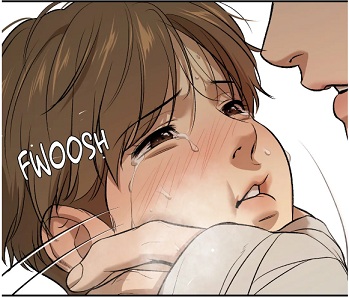 (chapter 14) Jaekyung repeated such a gesture, as seen in chapters 24
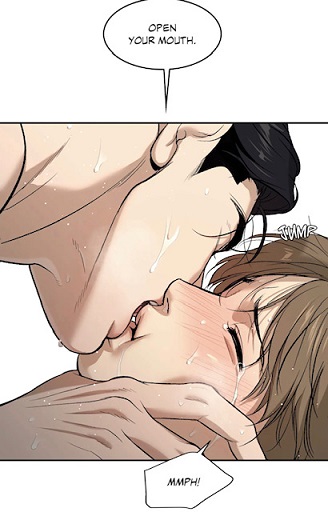 (chapter 24), and again in 64
  (chapter 64). These gestures were not expressions of tenderness, but acts of dominance, mirroring how the celebrity was taught to treat intimacy: not as an exchange, but as an imposition. His behavior echoes Cheolmin’s earlier suggestion
  (chapter 13) where a little touch was functional. On the other hand, the suggestion framed “affection” as a form of fun and entertainment, meant to soften the experience and shift the focus toward the partner. While Cheolmin’s comment was not malicious—in fact, it encouraged Jaekyung to become gentler and more attentive—it still fell short of true emotional connection. Why? It was a medical suggestion, meant to protect Dan’s fragile state. The kisses in episodes 14 were to protect the physical therapist. They were initially functional, a mean to achieve a goal before becoming a habit.
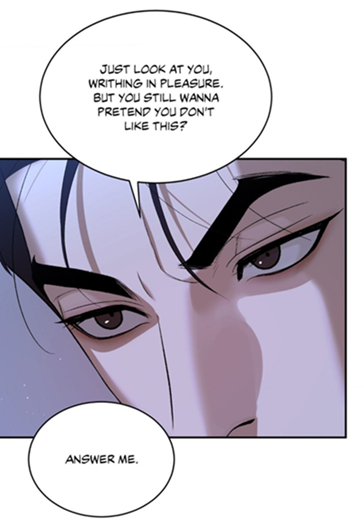 (chapter 63) Fun is not the same as love, and this distinction matters deeply for someone like Kim Dan, who associates kissing with emotional safety and love, not performance or play. This explicates why he refused to be kissed in episode 63:
 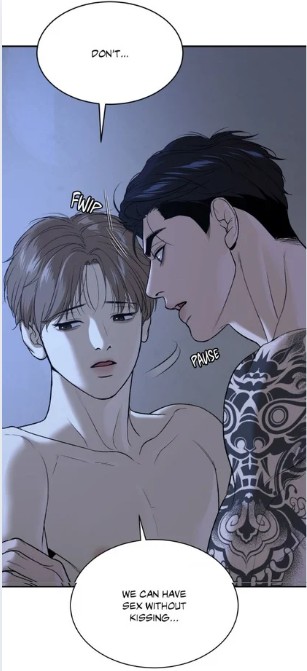 (chapter 63)
 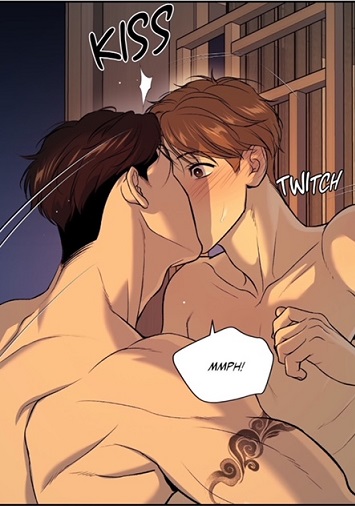 (chapter 44), Dan’s were soft, exploratory, almost reverent. His lips touched not just his lover’s mouth, but his cheek and ear—tender sites that bypass eroticism in favor of emotional intimacy. These weren’t prolonged, devouring kisses. They were pecks, small and deliberate. They mirrored affection, not possession.
 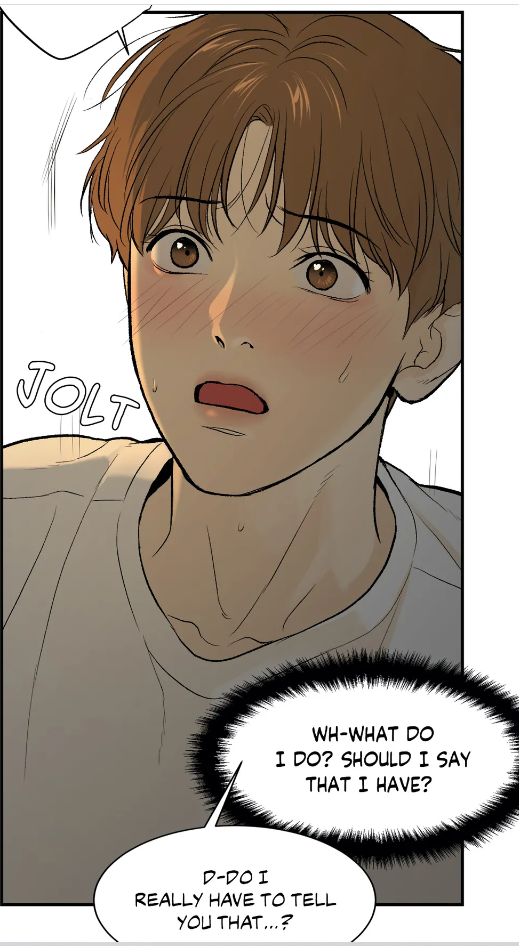 (chapter 3) —it forces the wolf to ponder on the meaning of a kiss and his relationship with the physical therapist.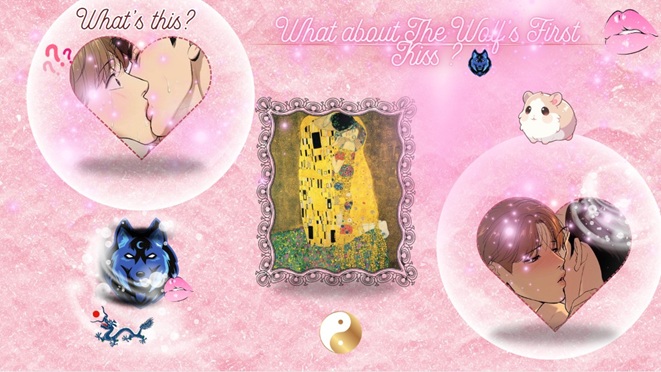
 In that iconic artwork, the man does not kiss the woman on the mouth, the traditional locus of erotic desire. Instead, his lips are placed upon her cheek—a gesture that suggests reverence, not possession; vulnerability, not domination.
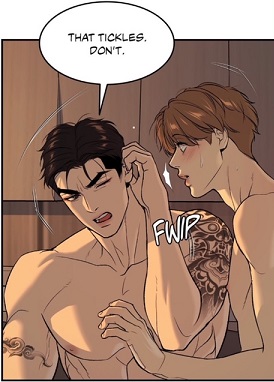 (chapter 44)
  (chapter 45)
 (chapter 54) When he was young, he had to face an abuser. Notice that the man’s face was very close to the champion’s
  (chapter 54). Thus I interpret that for the champion, the face represents not only his vulnerability, but also a source of danger. That’s the reason why he couldn’t hide his displeasure and frustration, when he faced this “lover”.
  (chapter 44) He couldn’t hide his joy by the champion’s funny reaction and laughed. And how did the protagonist react to this? Not only his face expressed his dissatisfaction, but also he silenced his partner with a kiss right away:
  (chapter 44) Joo Jaekyung is leading the kiss, he is regaining control over their relationship. It reinforces the idea that the wolf’s kiss was not merely about passion, but about reclaiming dominance and halting a shift in power. Just moments earlier, Kim Dan’s laughter had opened a space of emotional intimacy and lightness, which the champion was not prepared to face. The kiss, now prolonged and intensified, becomes the sportsman’s way of reasserting control over a situation that was slipping into unfamiliar emotional territory.
 (chapter 45) The marks on the doctor’s body were evidence that he was no longer in control. They weren’t just signs of a physical encounter—they were witnesses to something far more threatening: vulnerability, softness, and reciprocity. In the night, swept up by instinct and unspoken longing, the wolf had allowed himself to be touched—not just physically, but emotionally. But by morning, the spell was broken. His gaze didn’t linger on Kim Dan with affection—it darted instead to the bruises and scratches as though they were accusations.
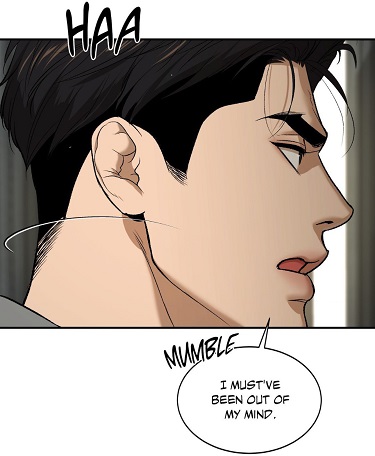 (chapter 45) wasn’t just the pain he might have inflicted—it was the realization that the balance of power had subtly shifted. The man who had always dictated the terms of their relationship had surrendered to something unfamiliar: tenderness, emotional closeness, and shared desire. The fact that Kim Dan initiated affection, even kissed him voluntarily, shattered Jaekyung’s script. For someone who conflated feelings with threat, and dominance with safety, this reversal was unbearable.
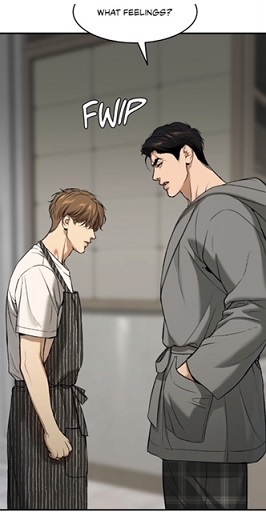 (chapter 45) —and that he, in turn, had wanted Dan back. This terrified him more than any bruise ever could.
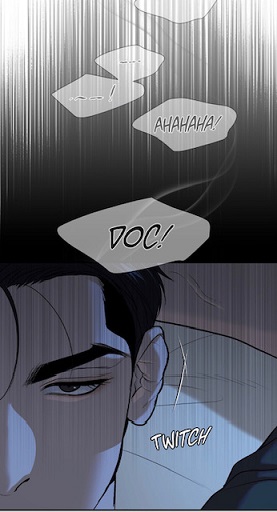 (chapter 37), and kissing becomes his emotional brake pedal. It’s not simply an act of love, but a means to regulate, or even drown out, what he cannot yet name or accept: that he is being loved. It is not random that I included the scene from episode 37: he heard laughs from the other room. For him, such a noise must have sounded like a disrespect and mockery, triggering his past trauma. And he was not entirely wrong in the sense that they were eating behind his back
  (chapter 37) It was, as if they were mocking him because of his forced “diet”. No wonder why the champion is barely seen laughing and prefers seriousness. At the same time, I can grasp why the athlete feels close to Park Namwook, as the latter stands for these exact notions: work, money and seriousness. Fun is not part of his world and vocabulary, therefore he punished Joo Jaekyung for sparring with doc Dan.
 (chapter 2) Though his face was close to the star’s, he didn’t attempt to kiss him. In fact, he proposed him a fellatio, a sign that the champion had never allowed anyone to get close to his “face”. Finally, observe how he reacted, when the uke in episode 55 attempted to kiss him:
 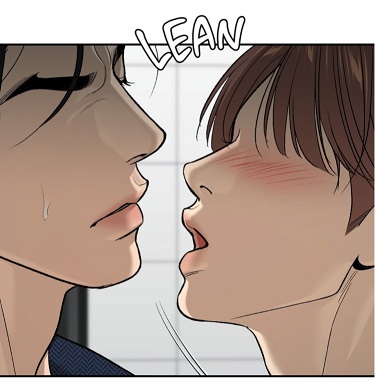 (chapter 55) Not only he rejected him, but also he pushed him violently so that the latter was on the floor.
 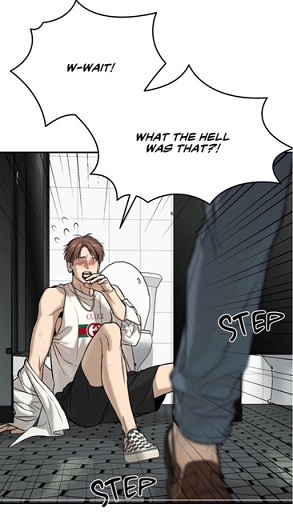 (chapter 55) The celebrity even ran away: a sign that the allowing someone approaching his face is perceived as something uncomfortable and threatening. At the same time, that moment exposes the kiss as something sacred—one that cannot be duplicated without emotional violation. This shows that for the champion, the meaning of a smooch has evolved. It is no longer perceived as a source of fun and a mean to gain something.
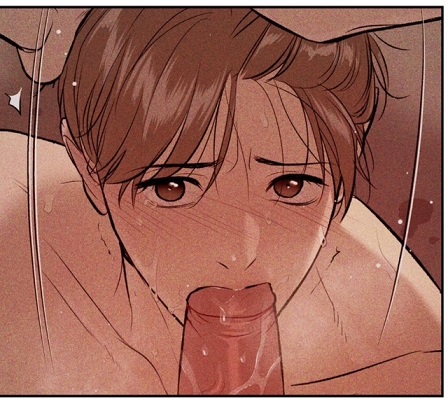 (chapter 55) He couldn’t forget doc Dan’s face, the latter excited him, a sign that for the champion, the face in general has been a source of pain, yet thanks to doc Dan, the latter has become a source of “comfort and joy”.
 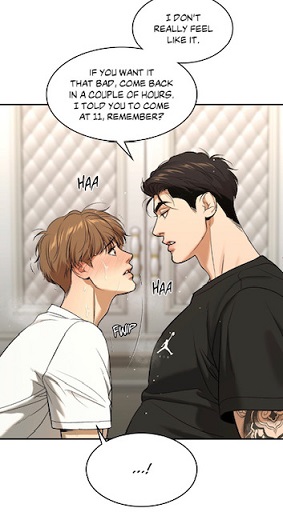 (chapter 39) before requesting a fellatio:
  (chapter 39) The main lead’s head was very close to the champion’s face, thus he must have felt uncomfortable. Secondly by acting this way, the doctor was gradually gaining power over their relationship. For the wolf, dominance is everything, an indication that in his past he felt defenseless and weak. His “opponent”, the mysterious ghost, had the upper hand. Moreover, the fellatio created a distance between them, where the fighter could expose his superiority. And note how doc Dan behaved under the influence of the drug:
  (chapter 39) He caught his fated partner by surprise, when he suddenly kissed him, mirroring the champion’s past behavior. This panel corroborates that for the doctor, a kiss is the symbol of love. The champion was not happy with this kiss too, for the latter meant that he was no longer controlling their relationship. Yet, after hearing the doctor’s confession during that night, the athlete no longer resisted his partner’s kisses.
  (chapter 39) For the first time, he accepted Dan’s initiative—both physically and emotionally. Compare it to his attitude before:
 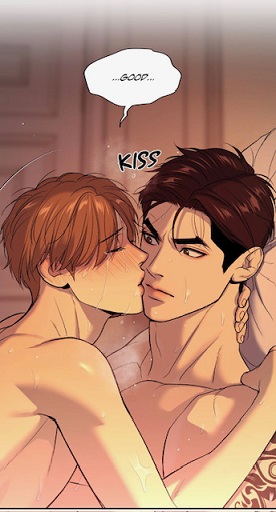 (chapter 39) here, he still has his eyes wide open, a sign of vigilance. These kisses from doc Dan
  (chapter 39) mark a turning point in Jaekyung’s arc: he begins to lower his defenses, allowing Dan not only into his personal space but also into a position of gentle agency within their relationship. The kiss no longer represents a threat; it becomes an opening and a sign of trust.
 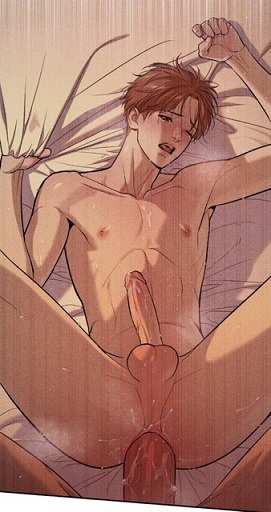 (chapter 55) These memories represent the moment where the athlete felt strong and had the upper hand in their relationship. These images reveal that Joo Jaekyung hasn’t realized the signification of the kiss yet. For him, they don’t seem important. This exposes that the athlete has not associated kiss with love and affection yet. At the same time, we have to envision that a smooch is strongly intertwined with equity and trust.
  (chapter 28) And in episode 14, it was clear that the star still felt superior to his companion, therefore the kiss had no special meaning. As you can see, everything is pointing out that Joo Jaekyung had never been kissed before. And what does a kiss symbolize? Not only attachment, but also purity and innocence.
  (chapter 15)
 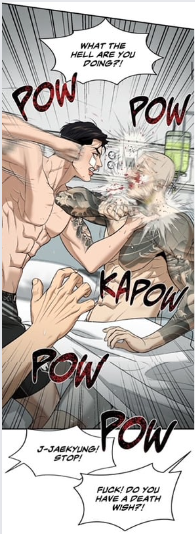 (chapter 52) In that context, a kiss could never be affection, but vulnerability. A risk.
 (chapter 3), based on Dan’s vague claim of prior partners. Yet Dan has never kissed anyone before. The kiss becomes his true moment of loss, a quiet confession through action. Conversely, Jaekyung’s own discomfort shows that he, too, is untouched in this particular way. When Dan tries to kiss Jaekyung again, and he instinctively rejects it, it reveals just how unprepared he is for affection. They are both unaware that the other is emotionally “pure” in this regard, and that makes the kiss a shared revelation.
 (chapter 67), Jaekyung must reinvent his approach. He cannot rely on dominance, strength, or sexual performance to win Dan’s heart. If he wants true connection, he must learn a new language—one built on gestures of affection, softness, and presence. This process also involves separating his public persona from his private longing. Joo Jaekyung, the champion, cannot seduce with spectacle. But Jaegeng, the man, might learn to express love through a simple touch, or a well-timed kiss. The redefinition of seduction is not just about Dan’s healing; it is about the wolf’s reclaiming his own right to feel and give love. And in my opinion, that process has already started:
  (chapter 69) That moment was devoid of lust, stripped of performance, and free from power dynamics. Jaekyung didn’t lean in for a kiss; he didn’t touch Dan’s lips or body with any sexual intent. Instead, he wrapped his arms around the physical therapist in silent reassurance, tucking his face against Dan’s shoulder as though hiding from the world. This was not a champion claiming a prize—it was a man expressing affection. The embrace exposes that doc Dan belongs to his “world” and he trusts him. In this light, the embrace becomes a prelude to a kiss—not a literal one, but an emotional kiss: a meeting place of vulnerability and longing.
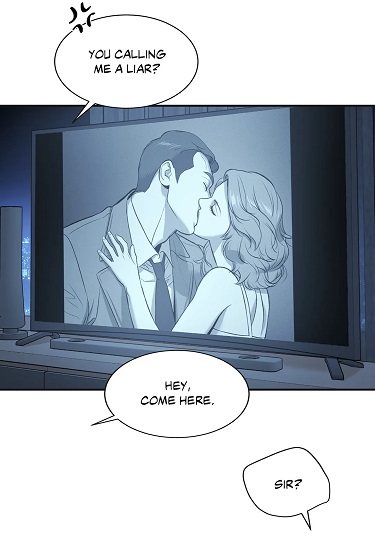 (chapter 29: note that he did not select this scene to rekindle with the doctor, but the other scene) He will learn it from life, from watching how the innocent express care without shame or purpose.
 (chapter 62) If someone had laughed in front of him and made fun of him, this would have reopened his old wounds.
 (chapter 27) This aspect becomes particularly evident in Kim Dan’s perception of himself and his interactions with Joo Jaekyung.
 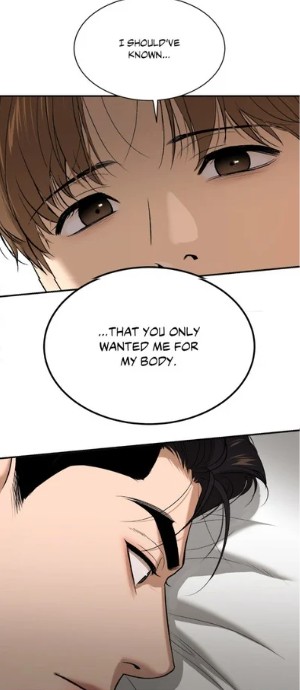 (chapter 62) In episode 62, Kim Dan reproached the champion for only being interested in his body, reflecting his own inability to see his body as something valuable. Hence he never wondered about the true cause for such a huge bruise.
 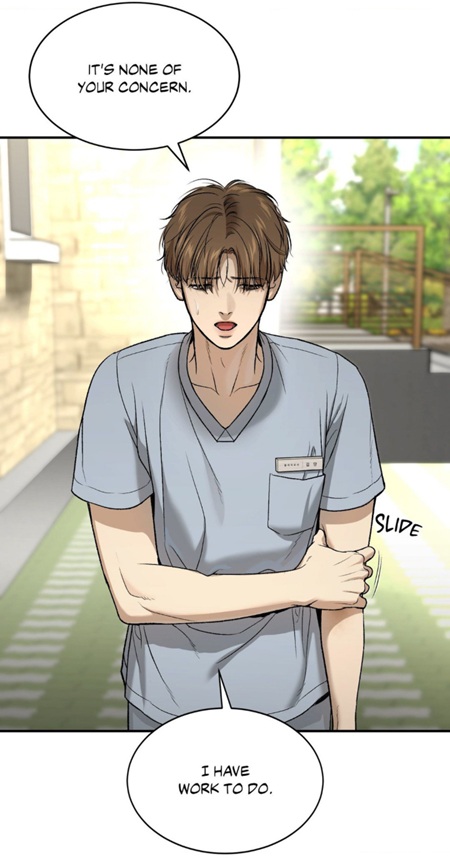 (chapter 61) While with his words, he implied that his fated partner was a man obsessed with sex, his complaint reveals his mindset. First, he is the one longing for human warmth
 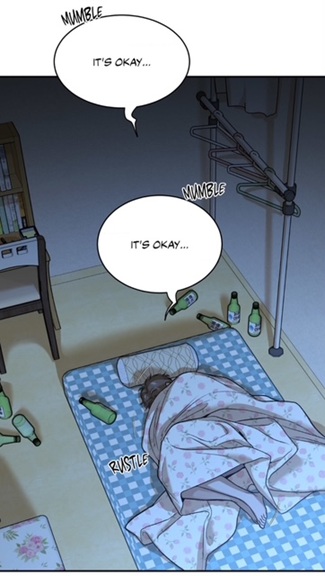 (chapter 59), hence he felt terrible sleeping alone. Secondly, he does not attribute worth to his own physical being beyond its utility for others. This explains why he has consistently neglected himself—avoiding food, disregarding his own injuries, and refusing to seek medical help when necessary.
 (chapter 60) It underscores the reality that without his body, he cannot work. In this way, his physical deterioration forces him to confront an undeniable truth:
  (chapter 59) his body is not just a tool for others, but the very foundation of his survival. I would even so far to say that his sick and stressed body would question his identity as PT and caregiver.
  (chapter 43), they will replace him with a new ‘doll.’ This exploitation shaped his relationship with his own body—one that prioritized its use over its care.
 (chapter 26) and 62
 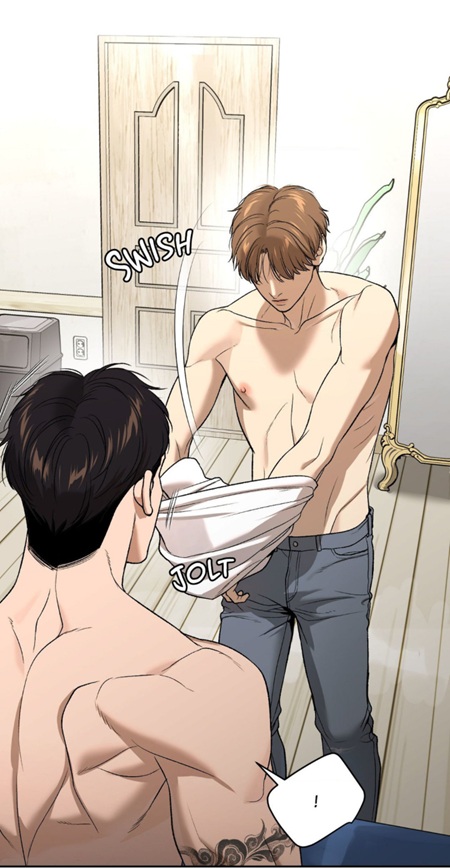 (chapter 62) that highlighted a crucial shift in how each of them perceives their own worth—and, more importantly, each other’s. The mirroring of these two episodes suggests a deliberate narrative structure that showcases their evolving dynamic, with each character taking on a role the other once held. This realization led me to explore how their perspectives on strength, vulnerability, and agency transform over time.
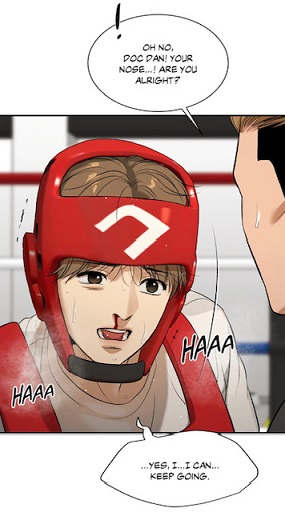 (chapter 26)
  (chapter 62), Kim Dan’s smile (genuine versus fake) and the characters’ shifting roles in confrontation and protection. The numerical structure of this episode—where Joo Jaekyung (2) represents dominance
  (chapter 26)
  (chapter 26) This small yet significant act reveals that the champion does not see Kim Dan merely as a ‘sex doll’ but as someone worth protecting, even when challenging him. The protective gear is a contrast to Joo Jaekyung’s usual treatment of his one-night stands, reflecting an unconscious distinction between how he views Kim Dan versus his other partners. Finally, this sparring day exposes the doctor’s biased perception about the athlete in episode 62 once again.
  (chapter 62) It was, as if he had no real talent. But let’s return our attention to the safety gears. The latter underline the high sense of responsibility of the champion, which readers could detect in episode 62. With the red accessories, Joo Jaekyung was showing his respect to the doctor as a man. In that scene, Kim Dan could choose his destiny. It is clear that “the hamster” has long forgotten this happy day
  (chapter 26) – he was smiling genuinely here- , and has reduced his time spent with Joo Jaekyung to sex:
  (chapter 26) —a powerful, intimidating man who mirrors the threat of Heo Manwook
  (chapter 16) and his minions. At the beginning of the fight, the doctor was not fighting for himself but for someone else, reinforcing his deep-seated belief that his worth was tied to service and sacrifice. However, during the match of the century, there was a short change. Kim Dan was reminded of his own past and fears. Thus, I deduce that in episode 62, it is Joo Jaekyung who must face his own greatest challenge—not a physical opponent, but the emotional vulnerability that comes with loss and uncertainty. Though he helped others, his generosity remained unnoticed by Kim Dan. Hence the latter was still unwilling to return to Seoul.
 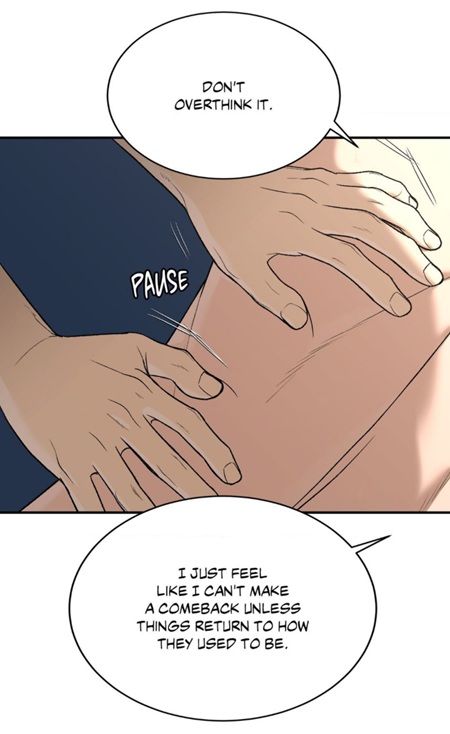 (chapter 62) On the surface, it looks like Joo Jaekyung lost.
 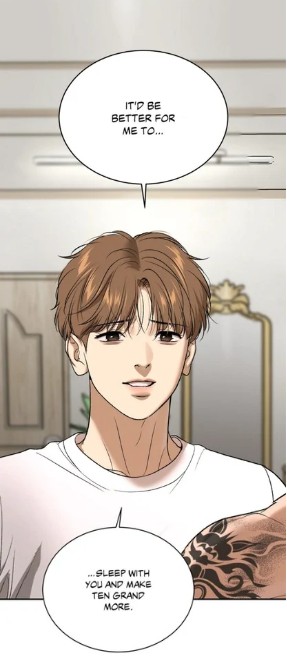 (chapter 62) More importantly, Kim Dan’s words
 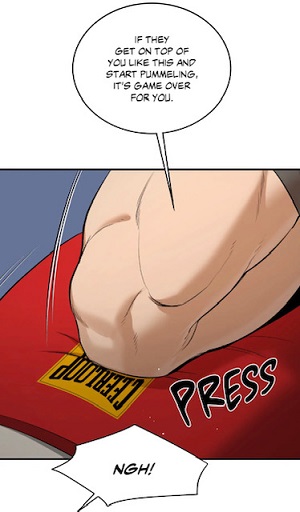 (chapter 26), was happy to demonstrate his talents and kept smiling all the time:
  (chapter 25) Kim Dan was interested to know more about this sport for the protagonist’s sake, whereas Potato was jealous of Kim Dan’s closeness to the star. How did the celebrity react, when he heard the doctor’s desire to learn fighting moves? He was totally pleased, hence he lowered himself smiling
 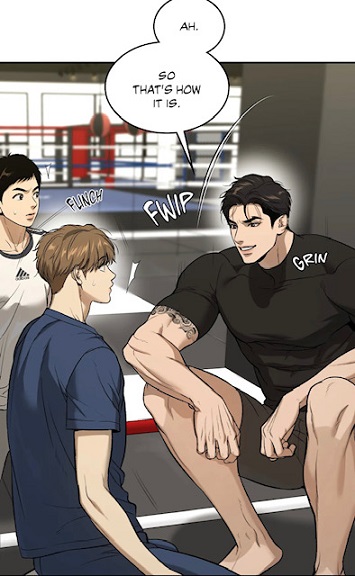 (chapter 25) before returning to the ring:
 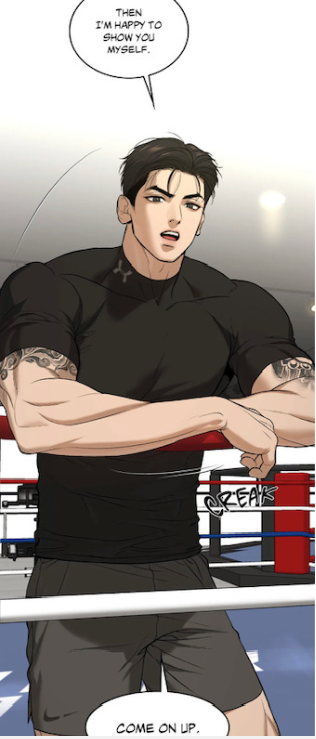 (chapter 25). Notice that he employed the word “happy” here. This shows that the athlete liked to be a teacher and mentor to a novice.
  (chapter 26), reinforcing his belief that his worth lies in service, and he requests an opportunity for someone else. The physical challenge that followed, in which the champion invited him into the ring, was meant to teach Kim Dan to overcome fear, though the original idea was to learn jujitsu moves for the champion’s sake. As you can see, there was a switch in the intentions for the “lesson”. This moment also highlights Joo Jaekyung’s approach to the body—power, physicality, and dominance, which will later be subverted in episode 62 when emotional resilience becomes the true test of strength.
  (chapter 26) Though the doctor was initially immobile and passive, the experience became a significant lesson: fear was something that could be faced and overcome. From that moment on, he became more proactive
 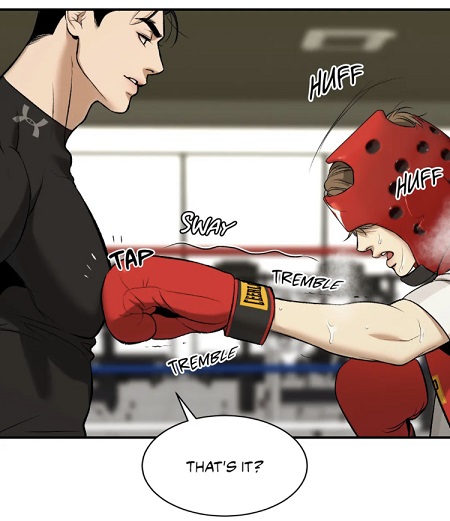 (chapter 26) This is a moment of physical initiation for Kim Dan, teaching him resilience. Nonetheless, he was still fighting for someone else, still locked in his pattern of self-neglect.
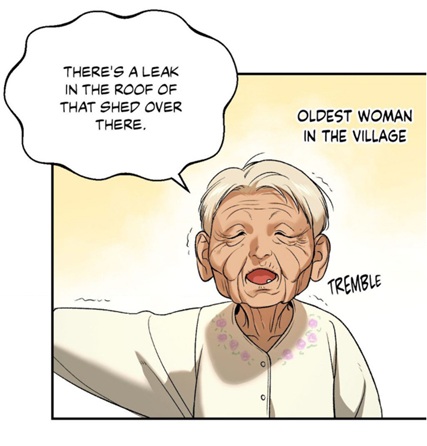 (chapter 62) This shift highlights a deeper irony: while Joo Jaekyung has always prided himself on his physical strength, he is now being tested in a way that cannot be resolved with fists.
 (chapter 34), wealth
  (chapter 42) and title
 (chapter 55), not for its attractiveness or desirability. His reputation in bed has been poor;
  (chapter 33), he was never seen as a man with sex appeal or sensuality, but merely as a fighter who could endure. Sex was another form of exertion, a display of control and dominance rather than a pursuit of pleasure.
  (chapter 27)
  (chapter 29) On the other hand, this suggestion challenges Joo Jaekyung’s previous experiences, forcing him to realize that he has never had to woo or seduce anyone before. This was the only time, where Jinx-philes could see him using his sex-appeal-
  (chapter 34) He got confident, because he had played a trick on his room mate. His physicality has always been his defining trait, but for the first time, he is being confronted with the question: does he have more to offer beyond brute strength and money? If he wants to prove his worth, he must do more than rely on his body—he must reveal his true self.
 (chapter 62) He does not plead; he challenges. This reversal is significant because it places Joo Jaekyung in the uncomfortable position of emotional uncertainty. In episode 26, the champion was confident in his control over the situation. In episode 62, he is on the verge of losing control—not over a fight, but over a person. Hence he can no longer control his erection.
  (chapter 62)
  (chapter 61) Why does he want him to return to Seoul? Is he really looking for a physical therapist or something else? It is clear that he is longing for companionship.
 (chapter 26), which represents the MMA fighter’s world, the wolf is now the one penetrating Kim Dan’s world: the treatment table!
  (chapter 62)
  (chapter 62) The latter was brought to the hostel. I know, here I am more speculating about the next episode. However, keep in mind that the hamster brought up the past to his destined partner.
 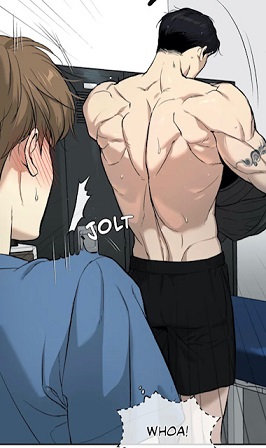 (chapter 1) The blue treatment table is the witness and proof that the champion never saw Kim Dan as a sex doll. So far, they never had sex on it, a sign that he respected not only Kim Dan as PT, but also the profession as such
  (chapter 27) Here, the champion suggested to have sex at home, and not on the table. On the other hand, Jinx-philes will certainly recall this scene where the doctor begged on his knees for money:
 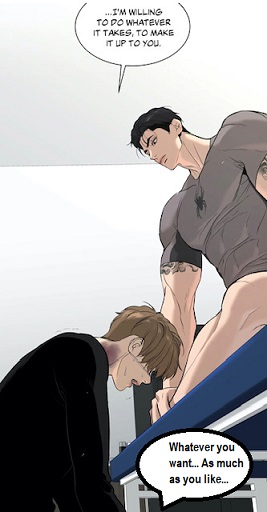 (chapter 11) That’s how I discovered a strong connection between this item and sexuality. First, the one fantasying about the champion’s body on the treatment table had been Kim Dan
  (chapter 1).
  (chapter 1) The massage must have felt like caresses to Joo Jaekyung. So when the main lead made this mistake
  (chapter 37) In the States, the athlete received his treatment on the floor, a sign of a disrespect for that profession from the manager and even MFC. They somehow knew that the fighter had brought his “sex partner” for his jinx, but they had no idea about his identity. By paying attention to the blue treatment table, I realized that this item stands for power, secret, courage and vulnerability.
 (chapter 62) According to my interpretation, Joo Jaekyung had interpreted the mistake for some advances and keep in mind that the fighter felt also attracted to the physical therapist.
  (chapter 1) -thus he asked for a treatment. He was about to drop the man.
 (chapter 1) However, contrary to their first encounter, the champion would be talking to his neighbor. While the doctor is thinking, he will relive his first night in the penthouse, the other might reproduce his first treatment, though it should be certainly combined with the intercourse on the couch: .
  (chapter 29)
  (chapter 62) But he made such an offer, because he thought, he was respecting the doctor’s wish. This shows that the athlete needs to converse properly with the doctor and not just make assumptions (MO from his manager). Moreover, the star has never expressed his gratitude and admiration towards Kim Dan concerning his talents and efforts openly. The problem is that he can not compliment him yet, because Joo Jaekyung is trying to “forget” the past and as such he is repressing the fight with Baek Junmin. I feel like the champion is on his way to discover the medical world and chapter 62 represents a prelude.
 (chapter 57) He should have sent her to the hospital and ensure that she received treatment. Notably, after the sea incident, Joo Jaekyung took Kim Dan to the hospital, but the latter rejected the champion’s advice and help.
 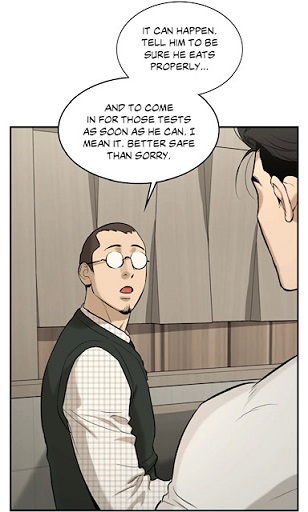 (chapter 13) So it dawned on me that if the doctor gets sick, Joo Jaekyung will be fueled with regrets and guilt, as he didn’t listen to Cheolmin’s advice. So this could lead him to apologize to Kim Dan. On the other hand, his illness could serve as a reminder to the fighter that he needs to treat his physical therapist and friend better. He only sent for the doctor because of “sex”. To conclude, both would be responsible for this terrible situation, a balance of responsibility.
  (chapter 57) is not just a symptom of overwork and lack of sleep—it symbolizes the deep imbalance in his life. His world consists only of work
  (chapter 62), without fun, rest, or emotional fulfillment. He has no hobby, no personal joy, and no real human connections. He is suffering from depression. Interestingly, the sense of balance is directly tied to the ear, which aligns with his emotional “deafness”—his lack of true contact with others.
  (chapter 61) His mind and heart are no longer listening; he is trapped in his own darkness. His dizziness and fainting spells mirror this imbalance, making his physical weakness a reflection of his emotional detachment.
 (chapter 54) and drinking habits.
 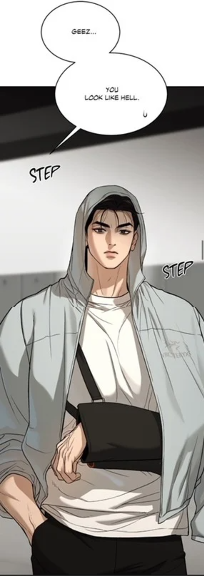 (chapter 54) His headaches intensified, and he isolated himself, mirroring Kim Dan’s earlier state of detachment. His drinking hadn’t just become a habit—it was mourning, a sign of his internal loss. It was, as if deep down he wanted to forget this intoxicating feeling of happiness from that night in the penthouse. The departure of Kim Dan caused both of them to lose their already fragile balance, reinforcing the idea that their dynamic, as unhealthy as it had been, was stabilizing them in ways they never acknowledged.
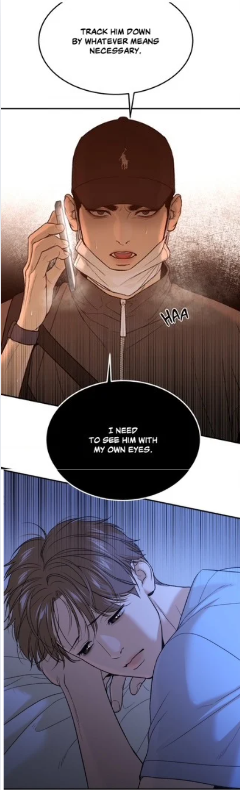 (chapter 56) It was, as if the champion no longer needed to see his former room mate. Note that he even waited for the evening before approaching doc Dan again.
  (chapter 60), he immediately went to the town. This contradiction reveals that mere visual presence was never sufficient—what he truly longed for was something deeper. And as soon as he saw him, he felt much better,
  (chapter 61) hence he could remove his splint. That’s how powerful drug Kim Dan is. 😉
 (chapter 61) While undergoing treatment, he saw Kim Dan every day, yet he remained unsatisfied due to the silent treatment. It was not enough to simply observe him; what Joo Jaekyung truly craved was conversation, interaction, and recognition. This explains his decision to move into the town, settling near Kim Dan as his neighbor.
 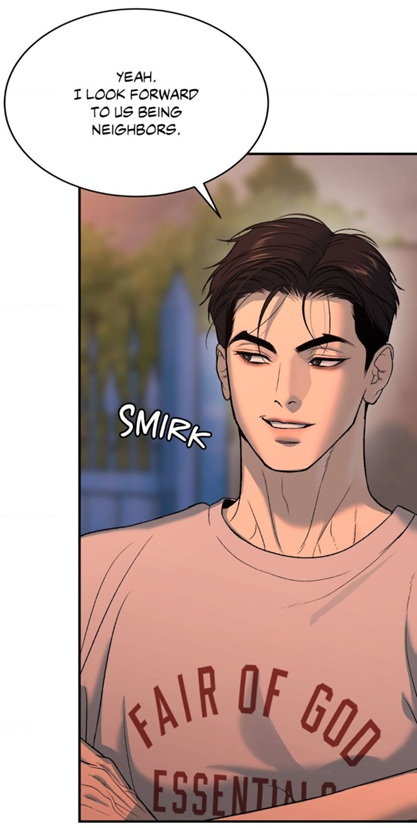 (chapter 61) It also sheds light on why, during their latest encounter, he chose to turn his back on Kim Dan—he no longer needed to ‘see his face,’ he wanted acknowledgment and his return to the penthouse. He has not grasped it yet, but he already views the protagonist as his family and home.
  (chapter 46) He is full of prejudices and not willing to listen to his boss. Therefore Joo Jaekyung doesn’t know that in order to become close, conversations must never be one-sided and have to be free from prejudices and assumptions. Joo Jaekyung needs to listen and show an interest in his partner. And now, observe the communication between the two main leads in the room.
 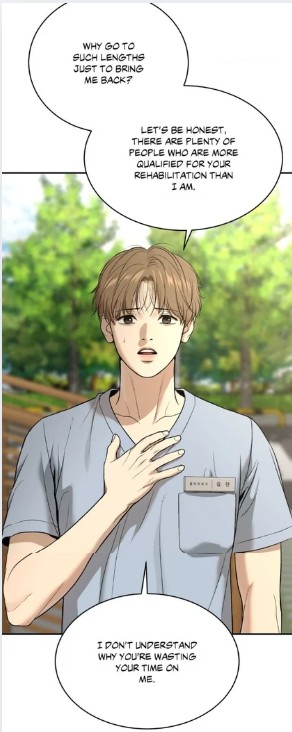 (chapter 62) He asked a question, while the other did not! He just made assumptions from his part, hence he suggested “separate ways”. It was naturally his way of being considerate. That’s why I have the feeling that two words could move Kim Dan’s heart: “HOME” and “HYUNG”. If he calls him that way, the doctor is now recognized as a family member, even as a senior. Hence he needs to be treated with respect.
 (chapter 62) he had previously ignored—he is undeniably attracted to Kim Dan’s body, particularly his nipples, which have repeatedly
  (chapter 27) triggered strong reactions in him.
  (chapter 29) That’s the moment he expressed his interest in the doctor’s nipples for the first time. This even became a habit:
  (chapter 44). And what did the doctor whisper during that magical night?
  (chapter 44) He wanted him to treasure his body!! In my eyes, Kim Dan’s suggestion in episode 62 is hiding another intention, though it is definitely unconscious:
  (chapter 44) He wants to relive that night
 (chapter 44), though in his mind, he desires to have a bad experience so that he can erase him from his mind. Finally, what do the nipples symbolize? Motherhood and nurturing.
  (chapter 57)
  (chapter 26) Moreover, it was thanks to a trick that Kim Dan won:
 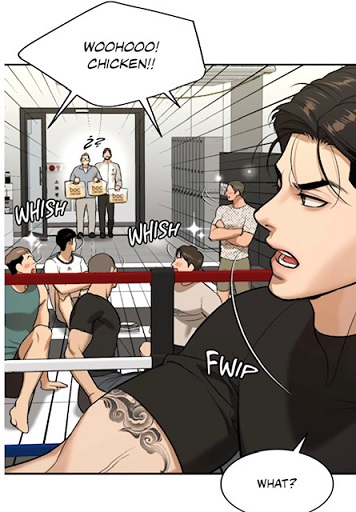 (chapter 26)
  (chapter 26) He felt superior and strong, whereas his rival was weak. Moreover, he imagined that Kim Dan would ask for money for the bet.
  (chapter 26) That’s why I believe that in the next episode, the roles should be switched. Kim Dan always saw himself morally superior and caring to the star, but in truth, his care was rather superficial, for he also showed no interest in the champion’s past and family. Thus I come to the following deduction that episode 62 suggests that arguing is not about losing or winning, but about listening. The champion has unknowingly become a caretaker, not only to the people of the town but, potentially, to Kim Dan himself. The question remains whether he will recognize that Kim Dan’s provocation is not just another fight lost (cutting off ties) —it is a seductive challenge to redefine his understanding of worth and their relationship. What are they to each other? A client and a prostitute? A fighter and a doctor? Or simply two men who are longing for the same: belonging and love. Nevertheless, due to their past, they are unable to detect the true source of their misery: their lack of reflection, own bias and anxieties.

 (chapter 60), deteriorating physical health
  (chapter 60) — challenges this notion. The photographs from episode 60 subtly introduce the fifth puppy’s death as a poignant symbol of Kim Dan’s precarious fate.
  (chapter 60) The puppy’s appearance in only one photo (the second one from left) among many mirrors Kim Dan’s fragile existence,
  (chapter 60) deepening the parallel between them. This connection becomes even more striking when recalling that the grandmother once likened Kim Dan to a puppy
 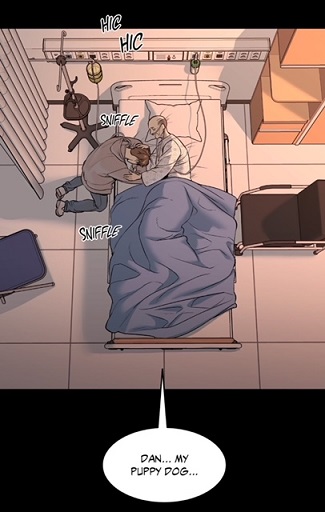 (chapter 53), emphasizing his vulnerability and dependence on others.
 (chapter 60), he rested him on his healthy shoulder to provide support. This method of carrying, while practical in the moment, placed uneven strain on Jaekyung’s body. The weight resting on one side risked injury to his back and disrupted his balance, subtly reflecting the physical toll of his desperation to save Kim Dan. This small but significant detail underscores the sacrifices Jaekyung was willing to make in his attempt to protect him. However, since Kim Dan was unconscious, he couldn’t see the wolf’s kindness and selflessness.
  (chapter 60) the green cross and the name “Light of Hope” likely caught his attention, inspiring him to believe the hospice could offer immediate assistance. Jaekyung’s desperation was evident in his drenched appearance after rescuing Kim Dan from the ocean
 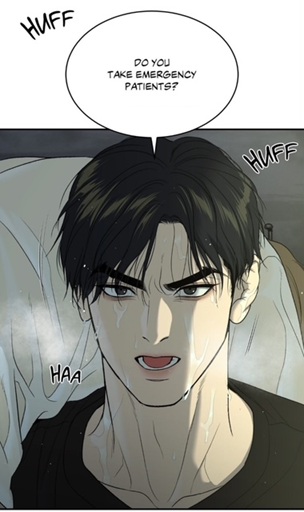 (chapter 60) reflected not only his uncertainty about whether the hospice could offer assistance but also the sheer urgency of his actions. This moment underscores the physical and emotional toll of his determination to save Kim Dan. Jaekyung risked worsening his own physical condition, driven by the hope that help would be available Yet the irony of this moment lies in the true purpose of the hospice: it is not a place for treatment or healing but a program dedicated to end-of-life care.
  (chapter 57)
 (chapter 58), such as two older women
  (chapter 58). Yes, there were two small details, yet full of meaning. Even the landlord
  (chapter 58) nicknamed “old man”
 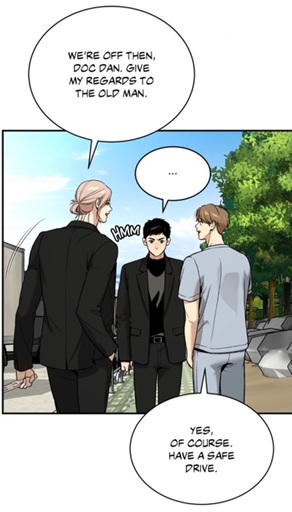 (chapter 59) by Heesung, symbolizes this demographic trend. The hospice’s focus on senior care reflects a broader societal issue in South Korea: a declining birth rate coupled with an increasing elderly population.
 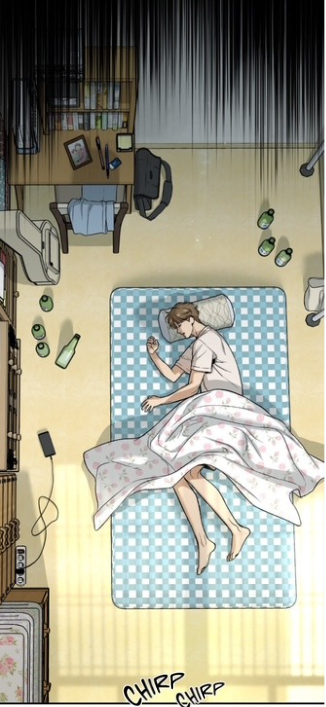 (chapter 57) In addition, the empty bedroom where Kim Dan is staying—with its untouched guitar, furniture, and books—suggests it once belonged to a teenager who left home and never returned. The unchanged state of the room symbolizes the stagnation and loss felt in these regions, further highlighting the broader societal issues at play. This shows that Jinx is not merely a classic love story; it also paints a nuanced portrait of South Korean society and its challenges. By prioritizing elder care without addressing the needs of the youth, the hospice embodies a false promise of hope—one that may ultimately exacerbate the very demographic crisis it seeks to alleviate.
  (chapter 59), indicating their capacity for medical intervention. However, this approach reveals an underlying paradox: while the hospice caters primarily to an aging population, it lacks a sustainable strategy to address the exodus of younger generations, whose departure threatens its long-term viability. This issue is further illustrated by the hospice director’s decision to allow the facility to be used as a location for a movie shoot,
  (chapter 59) seemingly as an attempt to garner attention and improve its reputation. However, relying on such strategies means any potential benefits will only materialize months later, when the movie is released. This delay highlights the limitations of the hospice’s current approach to sustaining itself. In this context, Joo Jaekyung’s presence could play a pivotal role. It is possible he may become the driving force in revitalizing not only the hospice but also the town itself, potentially pushing the director to transform the hospice into a full-fledged hospital, addressing both immediate and long-term needs of the community. And this would fit his personality, as I connected him to a dragon. Let’s not forget that in season 1, the MMA fighter was introduced as a benefactor who organized a charity event
  (chapter 41), yet we never got to hear where the money went. This potential transformation underscores the underlying complexities of the hospice’s current operations, as it navigates between providing care for the elderly and responding to broader societal challenges. By situating Jaekyung in this dynamic, the narrative subtly hints at his capacity to influence change, bridging the gap between the hospice’s limitations and the community’s evolving needs.
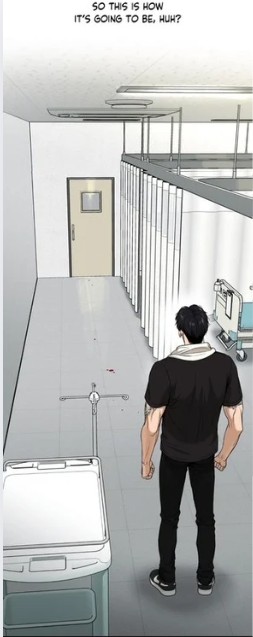 (chapter 60) —a consequence of removing his IV needle—symbolizes his quiet surrender and deteriorating health. When Kim Dan arrived at the hospice, he carried the faint hope of finding solace
 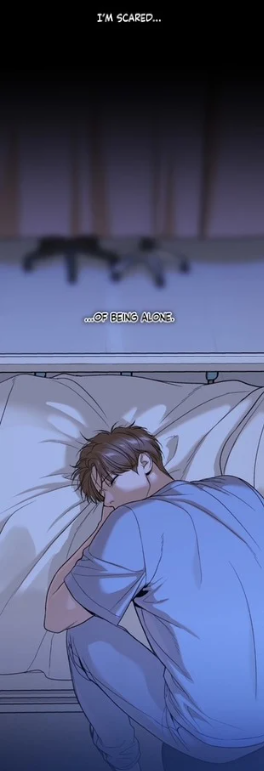 (chapter 56), particularly from his grandmother, who had promised to go to the beach with him.
  (chapter 53) However, this hope was met with disappointment
  (chapter 57) – which he never expressed -, reflecting the deceptive promise of the hospice itself. Kim Dan’s fate seems to mirror not only the unnoticed death of the fifth puppy
 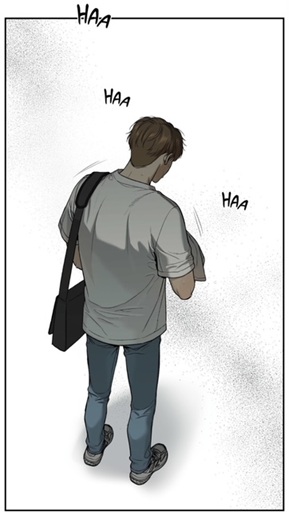 (chapter 59) but also his grandmother’s diminishing expectations of him.
  (chapter 56) She expressed twice that she no longer needed him.
  (chapter 57) However, all this time, she had been his motivation and reason to live. Once likened to a puppy, Kim Dan’s vulnerability and struggle for recognition remain central to his story, highlighting the fragility of his existence. His malnutrition, possibly linked to a deficiency in vitamin K and compounded by his alcohol dependency, exacerbates his fragility, making his situation increasingly perilous. Vitamin K, essential for blood clotting and bone health, is derived primarily from leafy green vegetables and produced by gut bacteria. A deficiency can result in symptoms such as dizziness
  (chapter 13), excessive bleeding and slow wound healing—all of which align with Kim Dan’s deteriorating condition and the trail of blood he left after removing his IV needle.
  (Chapter 54) Like mentioned before, this logo could be referring to a pharmaceutical company.
 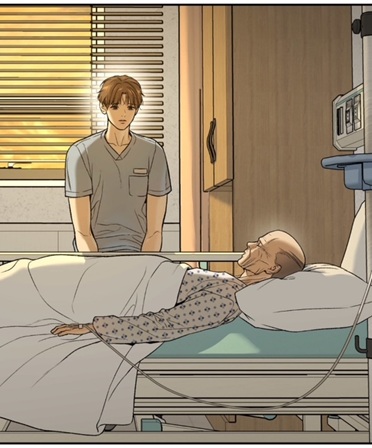 – episode 59), suggesting a temporary space for patients nearing the end of life. Moreover, observe that the colors of the curtains in the patients’ room is orange
  (chapter 56)
 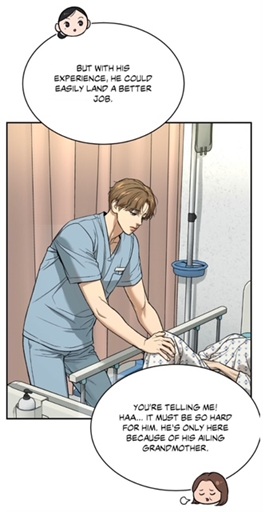 (chapter 56) and not white. This observation aligns with the assumption that this room is reserved for those on the verge of dying, shielding terminally ill patients from witnessing another’s death. 😨
  In the drama, a character searches for his CEO and friend Kang by pulling back closed curtains in an emergency room,
  discovering different patients behind each one until finding the right person.
  This reinforces the notion that closed curtains signify the presence of others, even if their identities remain hidden. In addition, when the doctor treated the patient Park Jinchul, the curtains were closed.
  (chapter 52) to signify absence of confidentiality, contrasting with the closed-off nature of this space. This comparison not only exposes the manipulation of the staff at the health center, but also reinforces my interpretation that the emergency room at the hospice stands for danger and challenge. This detail underscores Joo Jaekyung’s assumption that he and Kim Dan are alone, but it also raises the possibility that their conversation could have been overheard by someone lying behind the curtains, such as the patient from Episode 57.
  (chapter 57) or the mysterious Park Jinchul
  (chapter 56)
 (chapter 56) If others are indeed present, their isolation hints at a bleak reality: death would occur behind closed curtains, without companions or acknowledgment. This setting forces Joo Jaekyung to confront the fragility of life and the limits of money, as even wealth cannot shield anyone from the inevitability of death.
 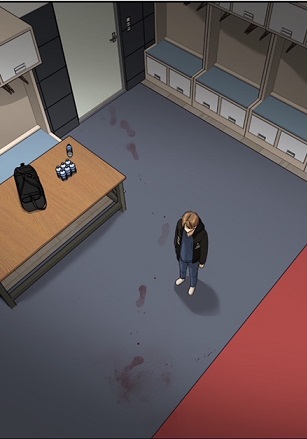 (chapter 51), they should remember that people were listening to their conversation behind the closed door, but they chose not to intervene.
  (chapter 53) That’s the reason why I am inclined to think that someone was /is present behind the curtain, but chose to remain silent. However, contrary to Team Black, such a person should intervene, if my theory is correct. And there is another evidence for this hypothesis. Since in episode 60 Joo Jaekyung offers a new contract
 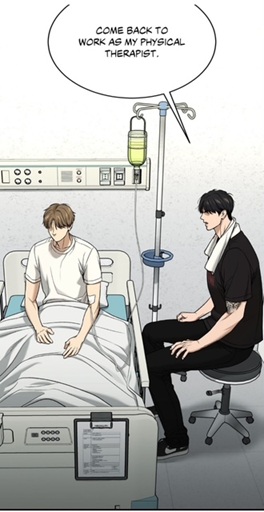 (chapter 60), it signifies that it is a reflection from chapter 6:
 (chapter 6) Nevertheless, back then, the deal was made without any witness. That’s the reason why I come to the conclusion that someone else was present in that room, yet contrary to the past, this person will intervene which stands in opposition to the symbolism of the room: death, secrecy and abandonment. And that can only be a patient who experienced the talent and care from Kim Dan. Joo JAekyung has never met any previous patient from Kim Dan before, but this is what readers got to hear from the nurse:
 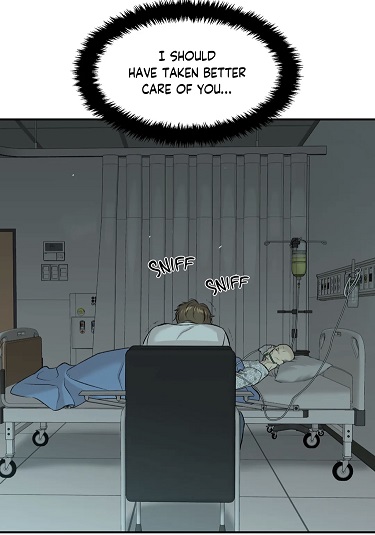 (chapter 21) which would push him to have a change of heart and show his vulnerability. What can he fear from a dying or terminally ill person? Nothing… hence he can only listen to the confidence and advice from such a patient.
 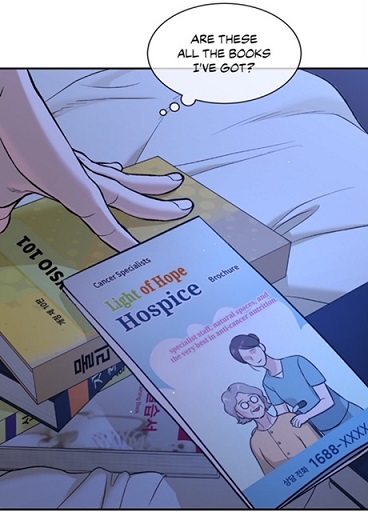 (chapter 53) is indeed an illusion and deception, for the senior on the paper is portrayed as being accompanied by a nurse. The reality is different, for the patients are facing death alone.
 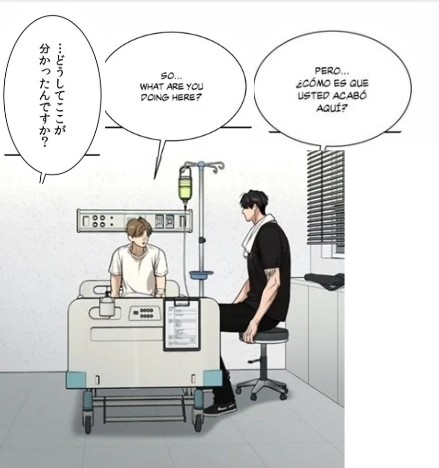 Their conversation begins with Kim Dan’s simple yet loaded question about how Jaekyung discovered his whereabouts. This moment, better captured in the Japanese, and Spanish translations, underscores Kim Dan’s curiosity and underlying desire for clarity. In the Japanese version, Kim Dan asks, “どうしてここがわかったんですか?” (“How did you find out about this place?”), while the Spanish translation reads, “¿Cómo es que usted acabó aquí?” (“How did you end up here?”). Both translations emphasize Kim Dan’s direct inquiry about how Jaekyung discovered his whereabouts, making Jaekyung’s evasive response even more significant. It is clear that he is trying to protect Potato here. However, Jaekyung’s response
  (chapter 60) immediately sets the tone for their interaction. His refusal to answer and his deliberate avoidance of Kim Dan’s gaze reflect a lie by omission. This evasive behavior not only highlights Jaekyung’s reluctance to reveal his vulnerability but also creates a significant divide between them, making it clear that they are not functioning as a unified team.
 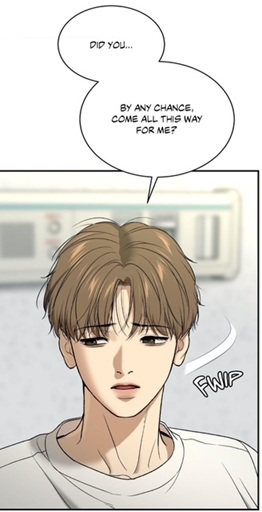 (chapter 60) Initially, he avoids Jaekyung’s gaze, signaling his own fear and insecurity. This avoidance reveals his worry about rejection and his deeper emotional vulnerability. On the one hand, he hopes deep down that the athlete would admit that he came looking for him, yet their last two interactions were arguments and rejections which the doctor didn’t forget.
 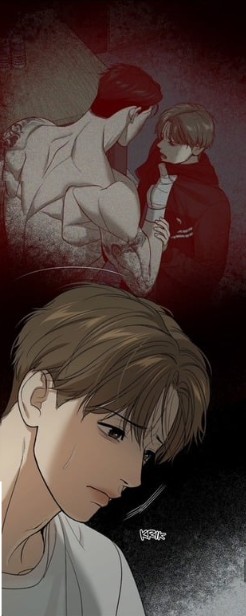 (chapter 60) Moreover, the idiom “by any chance” is exposing his low self-esteem. His words are exposing his internal struggles: between hope and despair. Later, his subtle act of turning his head away—a gesture often linked to dishonesty—indicates an effort to conceal his true feelings.
 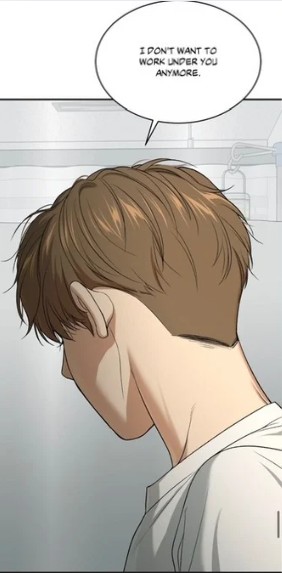 (chapter 60) He is still in love with Joo Jaekyung, but he is no longer hoping for any attachment and feelings from the fighter. On the other hand, his words are reflecting a different opinion: he is no longer trusting the athlete. This means that when the champion admitted his mistake indirectly, it was already too late.
 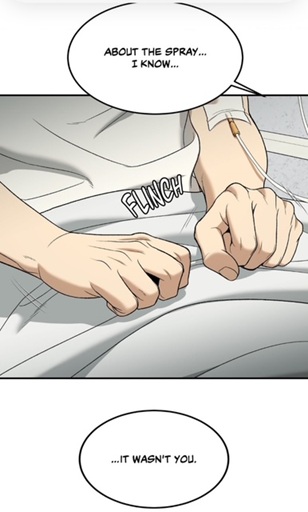 (chapter 60) The damage was done. In addition, he is rejecting the job offer because of the champion’s money.
 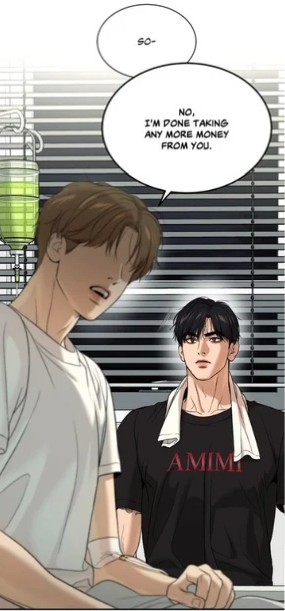 (chapter 60) He doesn’t want this fake generosity, since the athlete is reminding him of his “debts” towards him:
  (chapter 60) How ironic is that with his last remark, he ruined all his chances with Kim Dan. He was still viewing the physical therapist as someone below him. However, keep in mind that such an arrogance and “confidence” are just subterfuges from the MMA fighter. This act of concealment parallels Jaekyung’s guarded demeanor, as both characters are ensnared in a cycle of avoidance and denial.
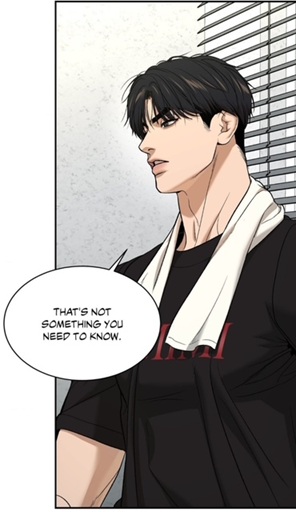 (chapter 60) This evasive remark suggests that Jaekyung believes keeping Kim Dan ignorant of his intentions is for the best. By withholding the truth, he feels he is protecting himself and Kim Dan from unnecessary burdens or complexities, reinforcing his perception that their relationship is better managed with clear boundaries. However, this attempt at concealment only deepens the divide between them, as it denies Kim Dan the clarity and emotional connection he seeks. In fact, he is not realizing that he is even afflicting more pain on his fated partner.
  (chapter 6), with Kim Dan ending up on the floor—a physical manifestation of his subservience. Later, in the locker room, both were shown facing each other
  (chapter 60) Kim Dan in bed and Jaekyung on a chair. Yet, this apparent parity hides a reversal of dependency. While Kim Dan is physically and mentally weaker, neglecting his own health to leave the bed,
 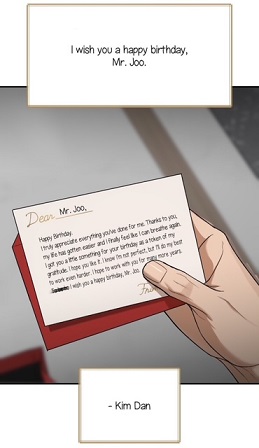 (chapter 55) That’s why he imagined that once he made his offer, the other would agree immediately. However, what he failed to realize is that he read the note too late. Besides, there were these erased words which left the fighter in the ignorance. Finally, he continues to misunderstand Kim Dan’s motivations
 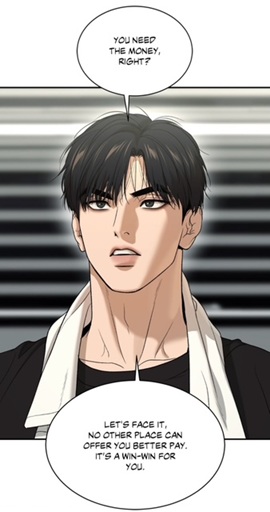 (chapter 60), as he did in episode 6.
 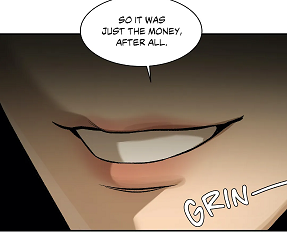 (chapter 6) Back then, Jaekyung assumed money was the sole driving force behind Kim Dan’s actions, and in the current interaction, he still believes this to be true. His internal monologue reveals this misconception:
  (chapter 60) I would even add, he believes to know Kim Dan so well, hence he mentions his grandmother:
 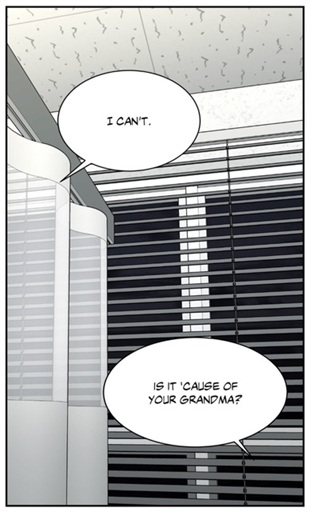 (chapter 60) However, Jaekyung is terribly wrong because he never talked to his lover. His interest and curiosity were quite superficial. Therefore he fails to grasp that Kim Dan’s longing is not for material wealth or familial obligation, but for genuine companionship and a place to call home. Kim Dan’s rejection of a boss-employee dynamic
  (chapter 60). Moreover he got to hear from the doctor that Kim Dan needed rest:
  (chapter 35) for his own “happiness”. Through Potato, the author is criticizing the attitude of fans who are only projecting their own emotions onto their idols. Their wish for happiness is quite rather superficial. This subtle oversight reflects Potato’s growing detachment, as his focus shifted to capturing moments for posterity rather than addressing the realities in front of him. The absence of the fifth puppy becomes a poignant symbol of unnoticed fragility and foreshadows Kim Dan’s own vulnerability. And how did Kim Dan react to the death of the small dog?
 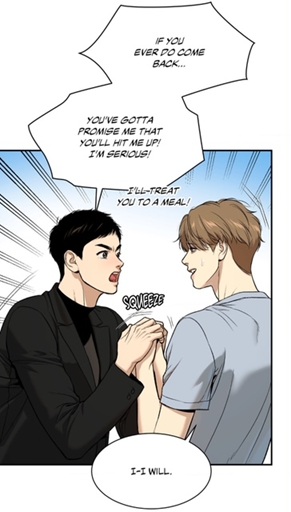 (chapter 59) Deep down, Potato does not expect Kim Dan to come back, reflecting his resignation to their fading relationship. Notably, Potato only asked for a picture of Kim Dan at the very end, never taking photos of him during their time together.
 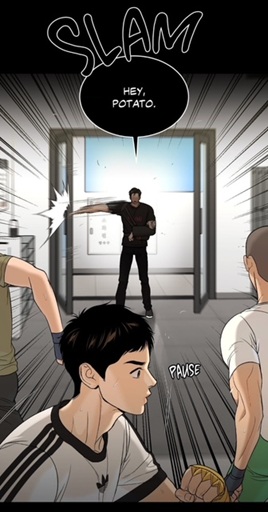 (chapter 60) When he got caught with his silence, Mingwa never showed us Potato’s justification. Yet, it becomes clear that the young fighter decided to give the following explanation: he respected Kim Dan’s wish to remain undiscovered
  (chapter 58) The reason for this interpretation is the champion’s reaction, when he was asked how he knew about his whereabouts
  (chapter 59) and Joo Jaekyung’s rescue of Kim Dan.
  (chapter 60) Though he is the one left behind, he is not realizing that by not following him, he is failing to protect Kim Dan.
  (chapter 57) Cheolmin already warned his friend in episode 13:

 (chapter 55) One might think that the causes for his throbbing head are his depression and insomnia. On the other hand, I am quite certain that many readers had a different explanation for his migraine. He is missing his lover, Kim Dan, as the color red symbolizes the headache and the physical therapist’s name is strongly intertwined with this pigment which was once again confirmed in episoe 56.

 Thus I consider this image, where the champion is seen
 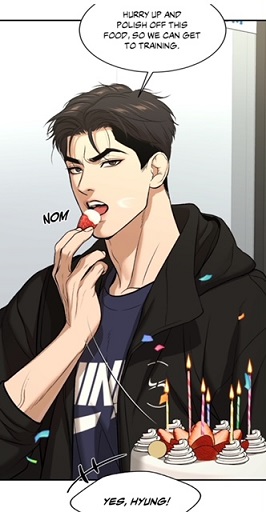 (chapter 43) eating a strawberry with cream as the announcement of the magical night between Kim Dan and his fated partner. The fruit with the cream represented a violation to his strict diet.
  (chapter 55) or the medicine against migraine.
  (chapter 54) However, in episode 55, we can observe a huge change in the champion.
  (chapter 55) The latter is finally admitting the inefficiency of the medicine. In other words, in this scene, he was giving up on them. This represents an important step on his way to enlightenment. For me, it signifies that he is stopping relying on pharmaceutical products. Let’s not forget that in the past, he rejected the PT and even neglected them. Why? It is because he trusted more sprays and other medicines than people.
  (chapter 49) Therefore the switch of the spray had to occur. He needed to question his prejudices and attitude. But let’s return our attention to the champion and his throbbing head. One detail in this panel caught my notice.
  (chapter 55). This means that she had not seen the mess in the master room before:
  (chapter 55) And now, pay attention to the number of the bottles in his room:
  (chapter 56), for the day Kim Dan wired his money to his “loved one” took place after 10th of the month: XX = two digits.
  (chapter 55)
 (chapter 55) Consequently, I judge the cleaning lady as the positive version of Park Namwook. Though she uses social norms, she doesn’t use them against her employee. She didn’t condemn him, it is a mixture of teasing and reminder. At the same time, her intervention implies that she must have noticed changes in her boss after the arrival of Kim Dan in the flat and his departure. That’s the reason why I have the impression that this image is announcing another turning point in the champion’s life either:
  (chapter 55) He won’t drink like before. However, I don’t think that he will behave like in the past: reject any alcohol entirely.
 (chapter 55), his migraine vanished. Though he is holding his head the next morning and hiding his gaze
  (chapter 55), the Webtoonist didn’t add any red or “throb” as an indication for a migraine. As you can see, his headache is strongly intertwined with repressing the physical therapist and as such locking away memories. However, there exists another cause. What had the doctor done in the past?
  (chapter 23) That’s how little kids are admired and loved. This stands in opposition to the abuser’s behavior:
  (chapter special 2) The same way than Kim Dan with the patting! In other words, the champion is deep down longing for such a gesture, but he has not realized it yet. Nevertheless, I believe that he just needs a trigger.
 (chapter 55) With his left opened eye!! The exact opposite from this picture:
 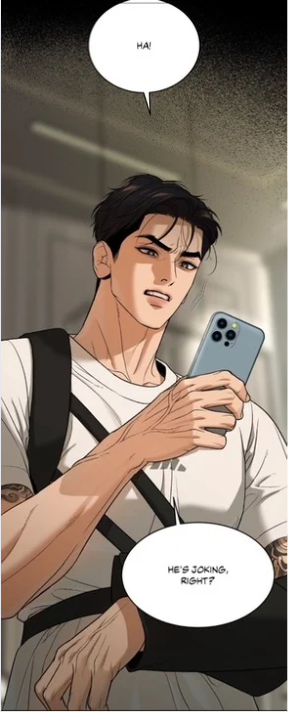 (chapter 55) This observation got confirmed in episode 56, though I couldn’t expose it before the release of the new chapter.
  (chapter 56) As long as the fighter thinks of his fated partner, he is not plagued with a throbbing head. This shows that it has something to do with repressing memories. However, his physical condition is still not improving:
  (chapter 56) Because I discovered the connection between memories and the physical therapist, it is important to examine the interaction between the main lead and the new uke.
 (chapter 2) However, back then, he had just stated it in order to get rid of the mint-goblin. He needed a justification for switching his partner. In other words, this was reflecting more the protagonist’s corrupted mind and heart. Therefore he is designed eyeless, the symbol for ignorance, lies and blindness.
 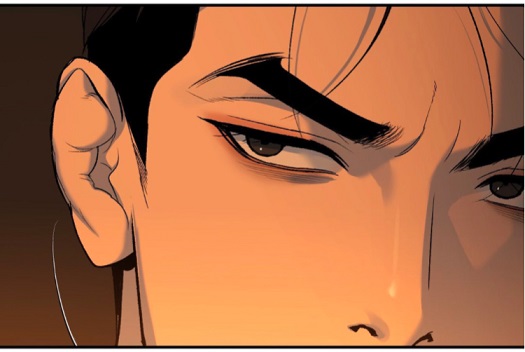 (chapter 55) And where did he have his migraine exactly?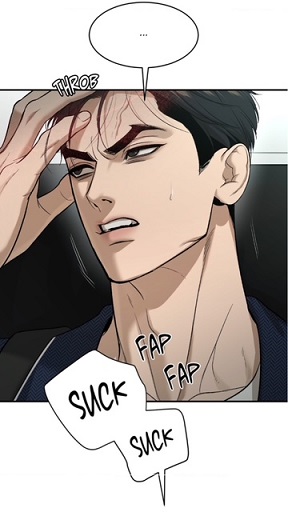
 (chapter 55) It was on the right side and eye! It truly exposes that Joo Jaekyung was getting punished for his attitude. He is not allowed to bury and forget Kim Dan. The star’s open eyes in this episode symbolize denial, lack of self-awareness and as such the absence of insight. He is also punished for his lies in episode 2. His words might have reflected the truth, but his words didn’t expose a change of heart. He was taking advantage of this situation as well. So when the pain intensified pushing him to close his right eye, we should consider this image as a short moment of reflection and realization. In the restroom, he was forced to admit that only Kim Dan could kiss him. Is it a coincidence that just before Mingwa presented this image
  (chapter 55) He was just standing there and avoiding his gaze.
 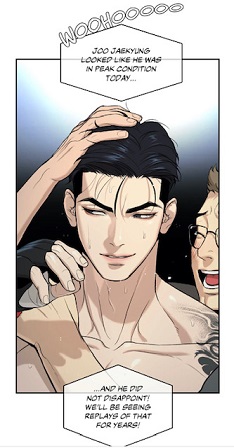 (chapter 5) Therefore he was in a happy mood after that match. A simple gesture with a lot of power! He has been missing this hand or better said this gesture. This action was the main lead’s true motivation.
  (chapter 54) Don’t forget that Dominic Hill had expressed his admiration in a similar way, patting on the back:
  (chapter 40) No wonder why he felt so lost and empty after the last fight.
 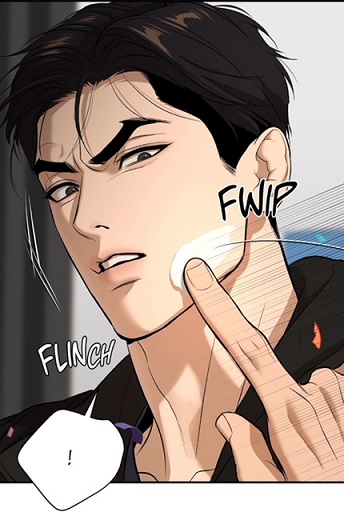 (chapter 43) this was the coach’s hand. In other words, the athlete felt more close to the coach than to the manager. This would explain why he would listen to the coach and even entrust him with huge tasks like the charity event. Strangely, in season 1, we can observe how more or more he is distancing himself from the fighter. Probably related to his secret relationship with Kim Dan. According to my theory, the coach is aware of their relationship. They are more than just boss and employee. As you can see, I don’t think that the champion is right now just missing the doctor’s sweet lips. Deep down, he would like to be patted by his loved one, exactly like Potato.
 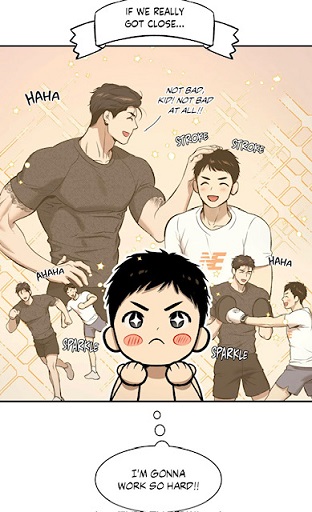 (chapter 23)
 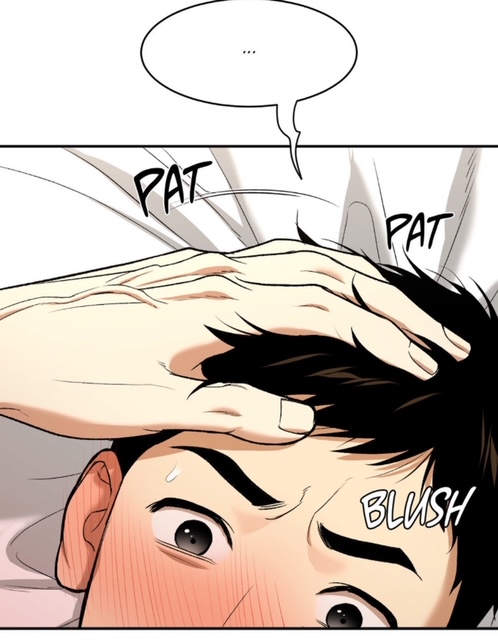 (special episode 2) But this is what he received after the last match:
  (chapter 2) The champion’s reaction is quite telling. He is not easily swayed. But we have another bigger evidence that his intercourses were replacement for “fights”. In The States, the fighter asked Kim Dan to join him at 11:00.
  (chapter 38) He needed to prepare himself mentally, to visualize how he would screw his opponent Dominic Hill. He was just taking the expression “fuck/screw” too literally. The latter idiom has the following synonyms: to cheat, oppress, bleed, coerce, wrest and to tighten. Just before the doctor came to his door, what was the athlete doing? He was watching a video from his challenger:
  (chapter 38) Therefore it is not surprising that he rejected Kim Dan’s request first.
 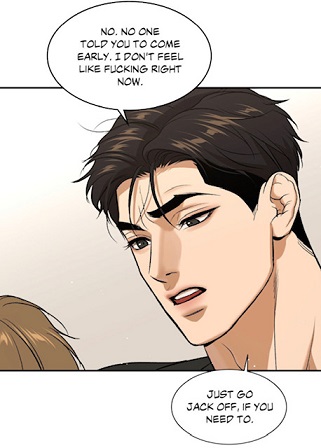 (chapter 39) He didn’t feel like it, because he was not aroused at all. Imagine that he needed two hours for that erection, a sign that during that night, Kim Dan was in reality a replacement for the American fighter.
  (chapter 38) In fact, he needed a fellatio to get an erection, and he only started getting excited, when he saw the doctor’s gaze. That’s the reason why he remembered this image under the shower:
  (chapter 6), Sex was no longer linked to matches, but to his own desires. To conclude, for the first time, the fighter connected sex to pleasure and desires and not “work and fighting”. Because of the deal and Joo Jaekyung’s strange behavior (sex shower scene, …) the PT had the impression that his boss was a man obsessed with sex.
 (chapter 53) The latter didn’t feel the need to have more sex with Kim Dan, he let his partner leave the place. Why? This contrasts so much to their First Wedding Night:
  (chapter 4)
  (chapter 53) Pay attention to the behavior from the fighter during their last night together. He is looking away, he is not paying attention to his fated companion. His mind was elsewhere, focused on Baek Junmin! In my opinion, during that night, the champion had been able to differentiate between the physical therapist and his opponent. Fighting was more important than sex and as such his sex partner. To conclude, the physical therapist had been able to win Joo Jaekyung’s belief and heart. He was no longer a replacement at all. He had become a person close the fighter.
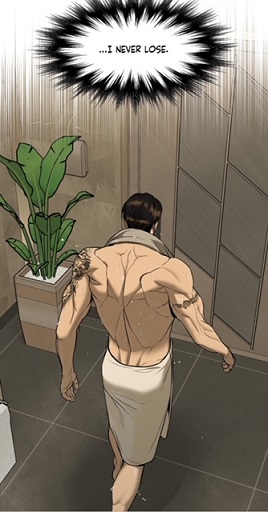 (chapter 49) he wanted to screw Baek Junmin for real. In this image, the athlete oozes confidence and strength. This means that he was no longer dependent on the good fuck before the match.
  (chapter 53) However, the main lead never realized this huge change, he kept his old belief as a tradition out of habit. This explicates why the fighter tried to replace with a new uke
 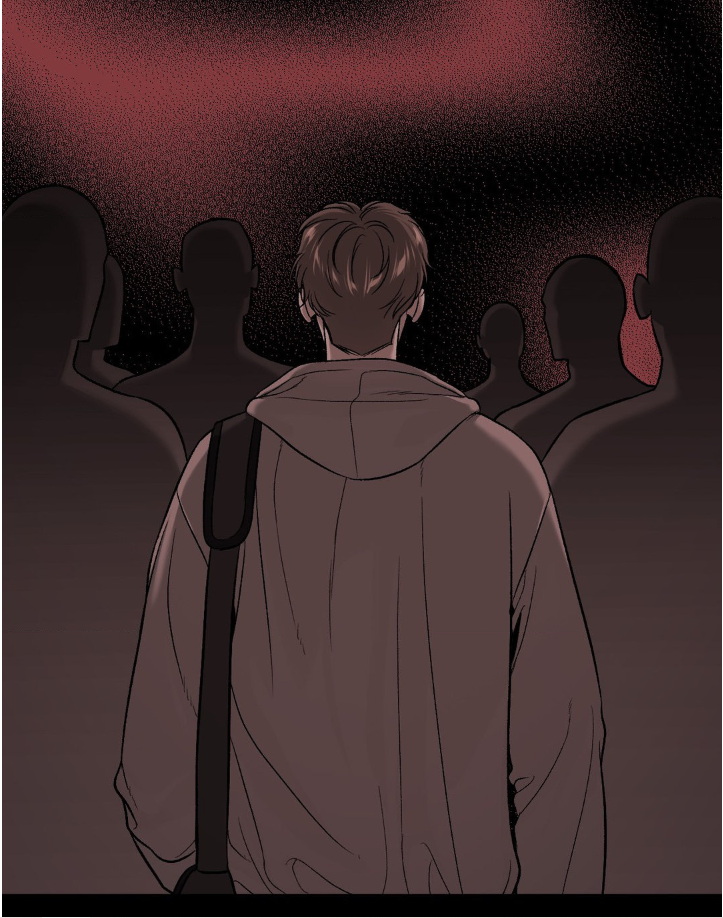 (chapter 55), but here the sex was longer connected to a match, rather to fun. Finally, observe how the champion is now blaming his PT for his ruined match:
  (chapter 56). I don’t think, he was referring to the spray incident, rather to their night before the match. The doctor had not behaved like a real opponent, he had admitted his “defeat” quite easily. He had left the ring before procuring him a good fuck. He was blaming his partner for violating his rule:
  (chapter 44) Sex is a synonym for love and as such it is about giving pleasure and affection to his partner. It is a two-way street. And this is something that the champion has to admit and accept. Thus I deduce that the fighter still has a long way to go before dropping all his fake principles. Like mentioned before, he needs to ponder on the following question: what matters to him the most? His championship or his happiness? Or what is sex to him? Why does he think that he is jinxed? He needs to face his own painful past and remember the face of his tormentor.
 (chapter 49) Baek Junmin and the abusive parent.
 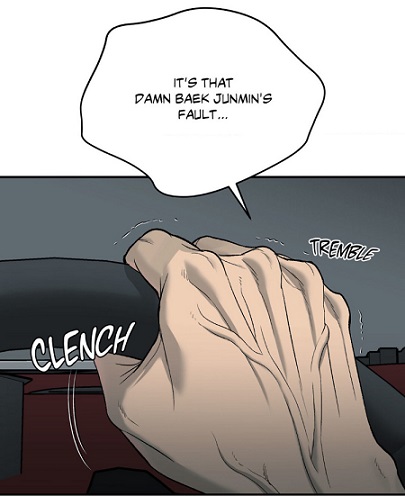 (chapter 54) However, this gesture had the opposite signification: rage, resent… but also sweet revenge! He must have recalled the Shotgun’s face.
 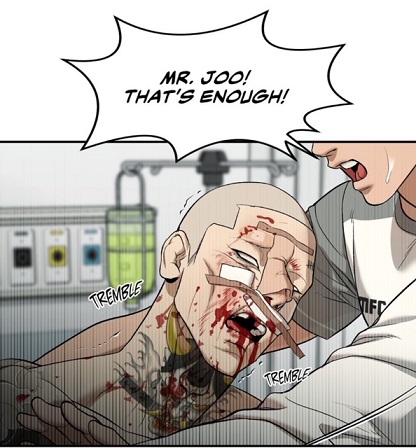 (chapter 52) There’s no doubt that thanks to the doctor, the champion will learn that he can get “justice” and satisfaction through other means. He can defeat the ghosts from the past, not just thanks to his fists and hard work, but also thanks to his surroundings and knowledge. Lawsuit and media!
 (chapter 1) The physical therapist is not only his reward and price, but also his “second shoulder” and as such his pillar. The new PT won’t be able to replace him. Joo Jaekyung is not just a champion, but also a team: Kim Dan as his PT and his lover. As for Kim Dan, the celebrity is his “energy drink”, his source of comfort and joy. He is also his home, for he is the first one who invited him to stay with him! Yes, the grandmother didn’t invite her grandson to live with her, he was just dumped at her place. And because the celebrity is like a home and family, it explicates why the doctor is once again “living like a ghost”.


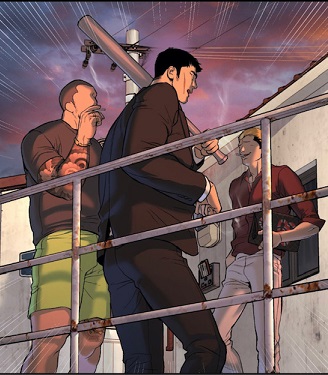

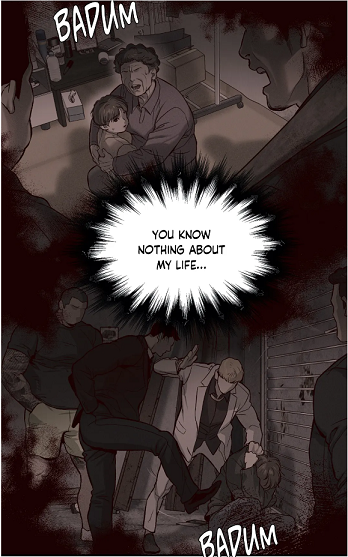


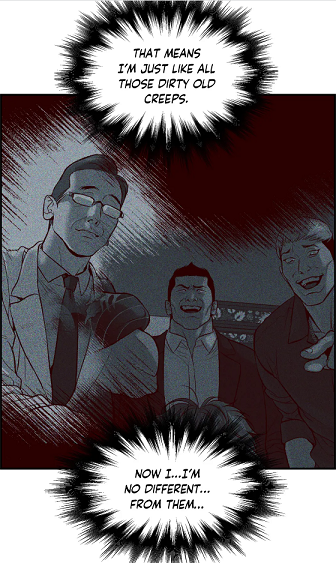



 (chapter 49) These 3 men and The Shotgun have to be seen as a team. Moreover, 4 is a synonym for death. Then, observe that the image from episode 20 contains two villains, the loan shark and the perverted hospital director. 1 +1 = 2. So when we see the number 10, 11, 16, 17 and 18, we could perceive it as an allusion to Heo Namwook, the villain.
 (chapter 11) and indirectly the persons involved in the redevelopment. However, I have to admit that I have a different explanation.
  (chapter 1) The main lead appears as a beast, triggering the doctor’s fears. He seems to be like an antagonist. However, I believe that it is just a deception. First, Mingwa has clearly stated that the champion is the protagonist of Jinx. As such, he can be neither a villain nor an antagonist. Secondly, though he seems to serve as a barrier, the reality is that Kim Dan is incited to mature and overcome his own fears. In fact, the celebrity represents the opposite notions of “conformity” and “immobility”. He embodies verity, maturity, transformation and progression. The evidence of this perception is the gradual transformation of Kim Dan as an inexperienced PT to a very professional and performant physical therapist. According to my interpretation, the Emperor works as the mirror of truth. He confronts the delusional physical therapist with his mental and emotional issues, like here:
  (chapter 45) as a good trigger for the 29 years old man to turn into a good PT. From that moment on, he only focused on the sportsman, and stopped asking the help from colleagues or listening to them.
  (chapter 42) He only relied on his hands. He was forced to become a serious and confident PT!!
 (chapter 1) The star was just waiting, and not threatening the doctor. As you can see, Joo Jaekyung doesn’t appear like a threat or a monster. But this doesn’t end here. One detail caught my interest. The champion is associated with blue. It is his true color, whereas Kim Dan is “red”, like a sweet strawberry. So why does this young man ooze a red aura, when his true shade is blue like water
  (chapter 27) or the ocean. It is because he was under the influence of his hyung Park Namwook which explains why Mingwa introduced him like this:
  (chapter 11) The coach is yelling for Joo Jaekyung’s comment, yet the reality is that the manager didn’t treat Kim Dan at all. In fact, he feigned ignorance. Moreover, look at the champion’s t-shirt:
  (chapter 26) In this composition, I compared the MMA star with a leopard and Park Namwook to a spider:
  (chapter 17) or in episode 46
  (chapter 11)
 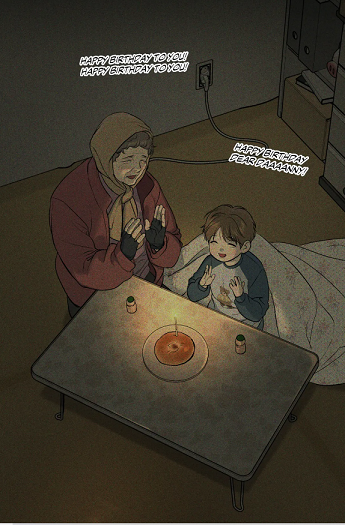 (chapter 11) And I can prove my statement by showing the episode where she appears:
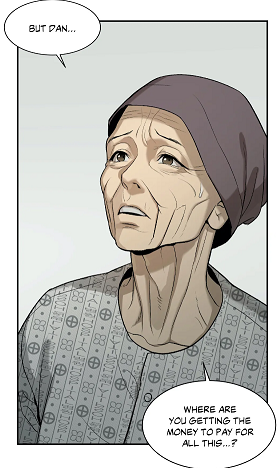
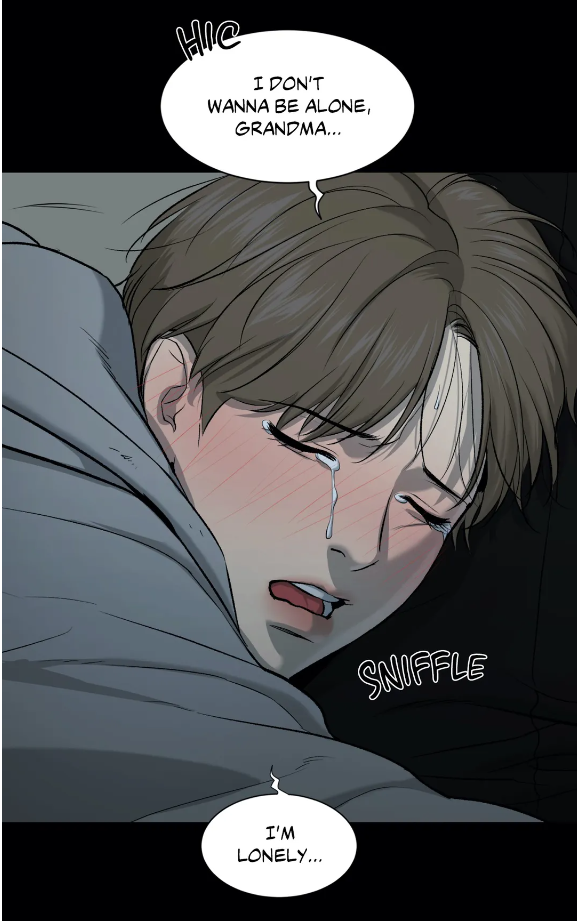

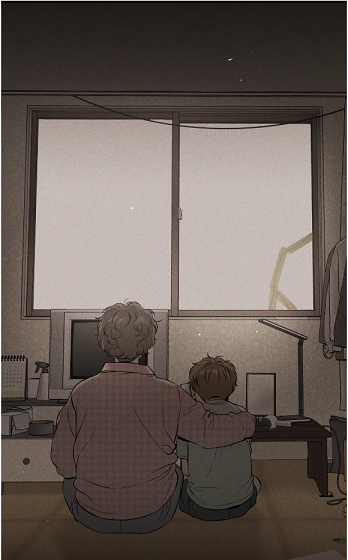


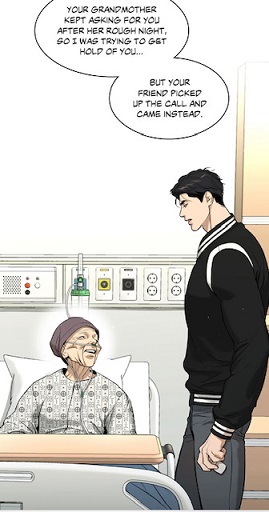

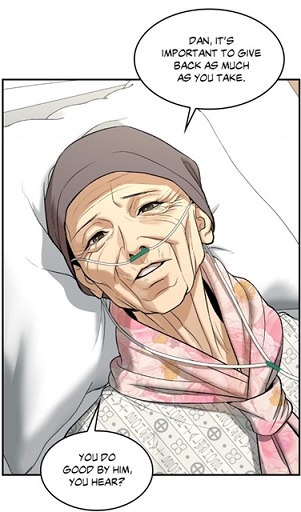
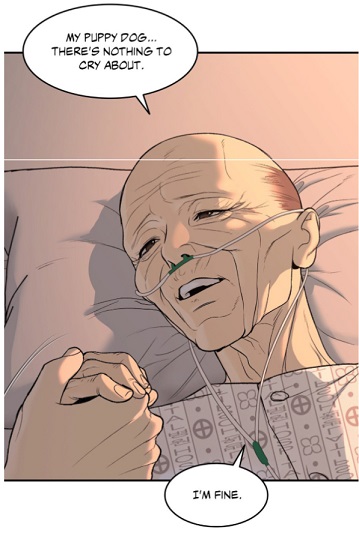
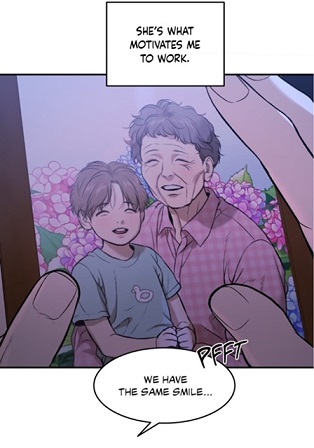


 (chapter 9) or other events like this one:
  (chapter 37) Buying in secret junk food.
 (chapter 1)
 (chapter 1) But it is the same for the champion who got his “gym” stolen from his hyung:
  (chapter 22) He is acting here like a tyrant.
  I came to this revelation thanks to this article:
 . (chapter 46) This would explain the champion’s emptiness and darkness:
  (chapter 21) and Kim Miseon’s reproach to Kim Dan could be seen as an indirect allusion. And if my interpretation about her number is correct, then we would have a good explanation why Kim Dan was unable to perceive her true nature, but also why she is so selfish.
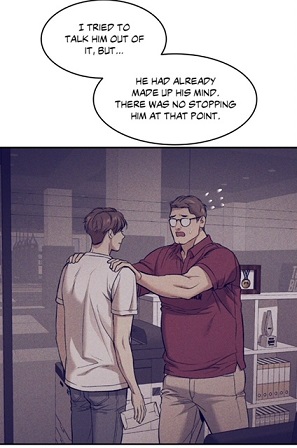 (chapter 53) Only the logo is red.
 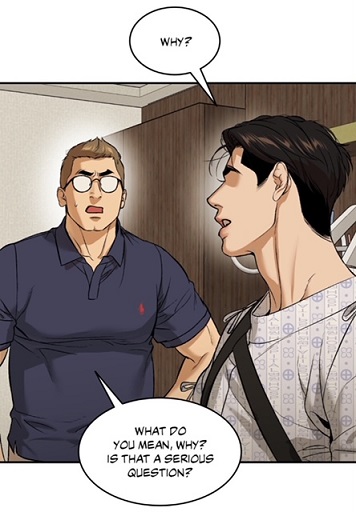 (chapter 53) It is important, because it announces the manager’s resignation. He doesn’t want to become responsible for the mess. Unconsciously, he is no longer claiming to be the owner of the gym. Furthermore, notice that the grandmother desires to return to the West Coast in order to see an ocean of “fire”.
 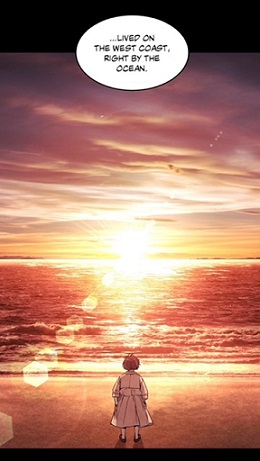 (chapter 53) This shows that she is longing for warmth and red colors. Yet, the color of the sea is rather green or blue. As you can see, everything is pointing out that the couple had to overcome the antagonists from season 1, the emotional vampires, who were so close to them than none of them realized that they were the origins of their suffering. And now, if you look at my table again:
 (chapter 35) In episode 16 and 17, the presence of the sun is a reference to the MMA fighter, it is announcing his arrival. This corresponds to the color I had detected with the first scheme:
 MFC with the blue “ring” embodies this pigment, just like the ocean. In other words, blue should be the dominant color in season 2, and in Taoism blue stands for YIN! On the other hand, Kim Dan also represents red with his name. Moreover, if you look at the numbers of the quoted episodes again, you will realize that the villains are strongly connected to the number 10 and as such one and zero. Thus Director Choi Gilseokf’s phone number is 010-1….
  (chapter 46)
  (chapter 37) He never complimented him for his hard work at all.
  (chapter 46) With these words, the manager creates a negative atmosphere, therefore there is no longer any trust and loyalty among the members.
 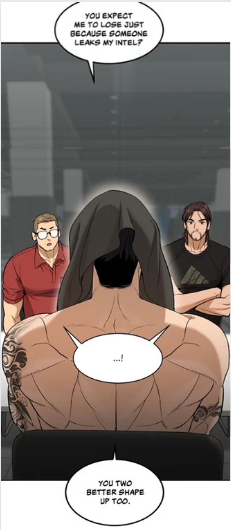 (chapter 46), however Park Namwook refused to accept such a behavior from his boss. Therefore he put his pupil under pressure.
 (chapter 46) He avoided a confrontation. This number symbolizes how the lead feels burdened by obligations imposed by his oppressor, who positions himself as provider of “stability” while actually fostering dependence and draining his victim. And naturally, in the same chapter, we have a similar interaction between Heo Manwook, the minion and his hyung, the real boss:
 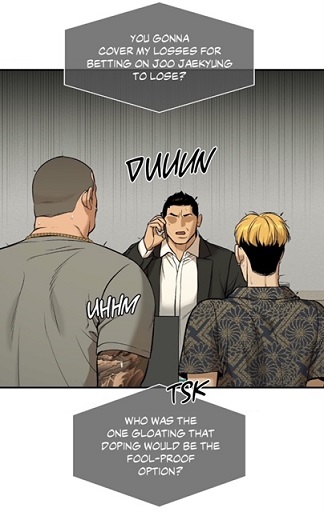 (chapter 46) Here, the director was reminding him of his mistakes and obligations. However, this time the boss chose to become proactive and responsible.
  (chapter 1)
 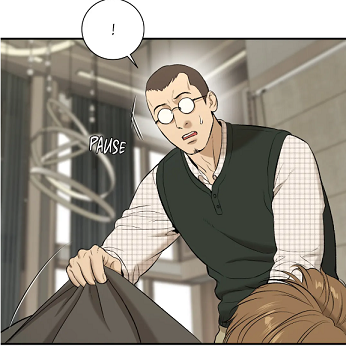 (chapter 13) They are strongly intertwined with the color green and as such blue. In literature, art, and psychology, the color blue often represents calmness, loyalty, and introspection.This fits to the description made by the author concerning season 2. The latter would focus more on emotions and thoughts than on the plot. And now, it is time to reveal why in the illustration I added the number 9.
 (chapter 9) The leopard agreed and that’s how they came to argue about his home the next morning:
  (chapter 10)- So from 9 to 18, the story is focusing on the doctor’s home. In episode 18, Joo Jaekyung invites the poor physical therapist to his home.
 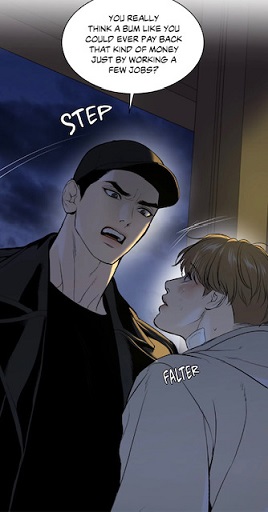 (chapter 18) In this episode, both main leads refuse the assistance from the other. Kim Dan is bothered that Joo Jaekyung paid off the debts, while the other dismissed the worries from the PT:
  (chapter 18) Then in episode 19, Joo JAekyung is not asking for his “help”, until he calls him. But even here, he is refusing to prepare his partner:
  (chapter 19) As for Kim Dan, the latter doesn’t feel truly needed as PT, hence he is already thinking about taking another job:
 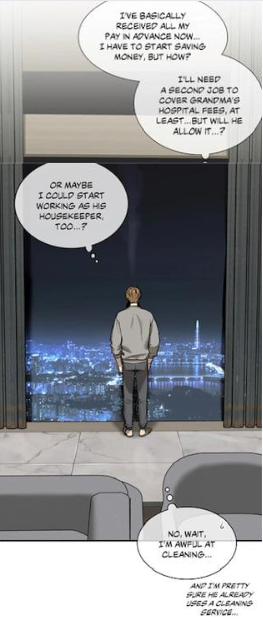 (chapter 19) Then in episode 27, Kim Dan offers his assistance.
  (chapter 27) He encourages his VIP client to take a break by remaining by his side. However, this attempt fails, as in episode 29
  (chapter 36) it shows his passivity and neglect. He doesn’t feel responsible for the champion’s career or safety. His concerns earlier were rather superficial. This explicates why he is also treated like a doll. Then in episode 39, for the first time, the doctor is requesting his help and assistance.
  (chapter 39) The problem is that it is related to a drug and sex. This has nothing to do with his job or career. Interesting is that in episode 45, for the first time, Joo Jaekyung voiced his needs to have him as a PT:
  (chapter 49) This means that in that scene, Joo Jaekyung refused to let Kim Dan treat him out of doubts and mistrust which were triggered by the manager’s words and the pictures. As you can see, the number 9 is strongly intertwined with help, but also with a change. The beginning of a new circle. Thus I am expecting in the new season, chapter 54, that for the first time, Joo Jaekyung will ask for help and support. But he can not ask Park Namwook or others from Team Black… he has only one true friend and that would be Cheolmin, unless he finds the protagonist immediately. At the same time, I would like to point out another observation. What is the opposite of 9? Naturally 6, which represents the end of a circle. And now, look at this:
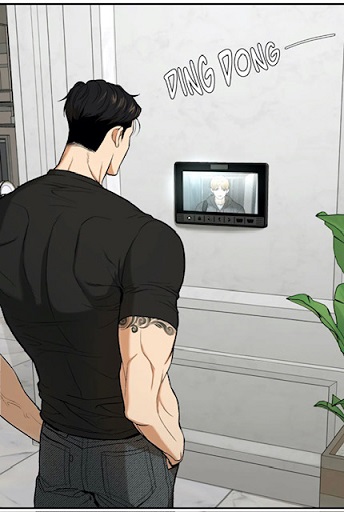 The end of Joo Jaekyung’s torment. He doesn’t need to chase after him.




 (Chapter 1) Imagine that he was in the middle of an intercourse. Yet he felt the need to have someone else by his side. It was, as if the grass on the other side was looking greener. 😉 Yes, in this scene, I detect parallels between Choi Heesung and Joo Jaekyung.
  (Chapter 33) On the one hand, the celebrity felt attracted to Kim Dan, on the other hand he had already sensed that the green-haired uke was greedy and even too passive. He was letting the celebrity fuck him. Yet there was neither real interaction nor sensuality between them. Hence the athlete could call Kim Dan during their sex. Funny is that the other didn’t mind at all, or in the worst case he didn’t even notice it. This shows not only the deafness and blindness of the mint goblin, but also the absence of communication and understanding in their “couple”. It was, as though the green-haired uke had submitted himself of becoming a sex toy. So by recalling the doctor, there is no doubt that the athlete couldn’t have voiced this change verbally. Why was he thinking of someone else during the intercourse? He was just simply not feeling it, the “great fuck”. In other words, Joo Jaekyung was attracted to Kim Dan by lust! In my previous analysis entitled
  (chapter 2) He had never done it before. As for the champion, Manhwa-lovers can grasp that since their relationship was purely physical (not even accompanied with romanticism due to the athlete’s jinx), the lust from the champion’s side could only weaken overtime. When the athlete met the actor, he had not met the green-haired man before. Hence the sportsman was sitting at the bar looking more or less for a new partner.
  (chapter 33) So the relationship between the “prostitute” and the fighter must have lasted around 3 months, the same amount of time than with the physical therapist. The uke had put no effort, for in verity he was relying on the athlete’s jinx. The latter just needed him, and no one was willing to experience such a rough sex session. The reason why I gave the green-haired uke the nickname “mint goblin” is the following. He brought some fresh breathe in the athlete’s life, for contrary to his past lovers, this one didn’t run away. However, as time passes on, the mint taste couldn’t mask his corrupted mind and heart. He was passive and rotten deep inside. But there’s more to it. Thanks to the mint goblin, the athlete learned an important lesson. It was possible that someone could match his strength in bed. Yes, the latter wasn’t passing out like the others. Deep down, the star could sense that he was no monster, a criticism he had received from the actor.
 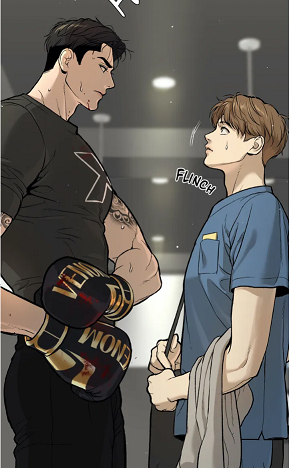 (chapter 1), he got attracted to this pretty and cute new face. However, contrary to the comedian, he didn’t realize this, for the athlete is not someone who thinks deeply. He acts rather on his emotions, exactly like his mentor Park Namwook. Since lust is the first stage of love, the recipient of his “attraction” needed to give him a signal that he was interested in him. I doubt that the celebrity would have made a move on him, if the doctor had not made this mistake
  (chapter 33) We have the novelty aspect (bringing thrill into their relationship) and the champion’s selfishness. The sex toy was utilized as a “punishment”, for the athlete was upset due to his jealousy. However, this perception is still too short-sighted. You will laugh, as soon as you read my new interpretation.
  (chapter 8)
  (chapter 33), Joo Jaekyung had the impression that he was needed. Finally, don’t forget how this scene ended. Kim Dan was finally admitting that he was really sensitive to him:
  (chapter 33) However, this desire was accompanied with rejection and denial too. This explicates why the champion didn’t know how to interpret Kim Dan’s thoughts and emotions.
  (chapter 33) Was Kim Dan feeling the same way than him or not? Did Kim Dan desire him or not? And this leads me to the next sex session:
  (chapter 34) For the first time, the athlete was divulging his physical attraction and desire towards the doctor. He seduced him with his own body. Yet, in order to keep the upper hand in their relationship, he was the one who was determining how they would have sex:
  (chapter 34) As you can see, during season 1, it took a long time for the athlete to admit “lust and physical attraction” towards the doctor. One might reply that the celebrity had already admitted this to the physical therapist:
  (chapter 29) However, this confession is connected to the anus, and not to the doctor’s face and as such identity. Thus I don’t consider it as an admission that Kim Dan was his type. One might object too that he had already wooed the doctor before next to the swimming pool.
 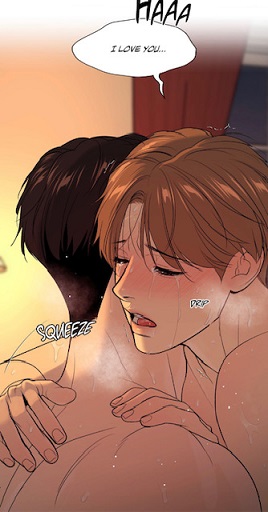 (chapter 39), this could only make the athlete happy first. He had the impression that he had finally discovered his soulmate’s taste and secret: he was also feeling the same… LUST. Yes, I am not writing love, but lust on purpose. Why? The irony is that the athlete was not recognizing that he was feeling more than lust for Kim Dan. He was already in love. 😉 However, so far he had only been busy focusing on Kim Dan’s type. Was the man also lusting after him or not? Under this new perspective, Manhwa-lovers can grasp why Joo Jaekyung asked this to Kim Dan in the dining room:
  (chapter 41) He didn’t expect a love confession He wanted to know if Kim Dan was finally accepting him as his partner, if he desired him too. Yes, gradually the possibility of dating was slowly emerging. Like mentioned in the introduction, lust is just the beginning of love. So should Kim Dan have remembered this night in the hotel room, he would have come not only to deny his feelings for the athlete, but also he would have reduced this “I love you” to lust, just a physical reaction due to the drug. A new version of the blue night, the only difference is that that night he kept his thoughts to himself.
  (chapter 45) What did the athlete imagine here? A fake love confession from Kim Dan, a stan trying to live out a fantasy. He was expecting “dating”, a notion he couldn’t accept, for he was confusing “lust” with “love”. That’s the reason why he couldn’t accept Doc Dan’s present and “gratitude”. They sounded like fake, especially since he was showing respect to the celebrity and not to the man himself! Yes, even in that scene, the PT was still hiding his own true emotions and attraction towards the handsome man. Joo JAekyung has no idea that Kim Dan views him as “perfect”
  (chapter 1) despite his injured shoulder: the muscles, the skin, the handsome face. He has never voiced such thoughts in front of his VIP client.He always kept them to himself.
 (chapter 53) than with this one:



 (chapter 22) Back then, I came to realize that both ukes were associated with the number 2. Shortly after, while making a first portrait of Cheolmin, I noticed that this cute doctor was linked to numbers 1, 3, 4.
  At the same time, I connected him to the sky, an angel. As you can observe it, my observations led me little by little to planets and numerology. But the major turning point was, when I perceived Kim Dan as a representative of Saturn
  . From that moment on, I came to associate Jinx-characters with gods and as such planets. Hence in the essay
  , I made the following connections. Potato was Venus, and his soulmate Choi Heesung is Mercury. Then Joo Jaekyung is Jupiter and the Sun, whereas Kim Dan was Saturn and the Moon.

 That’s how I discovered that Kim Dan was associated with the number 8. Thus in the composition
  HEALING! That’s the night Kim Dan got healed.
  (chapter 47) and digest the terrible news.
 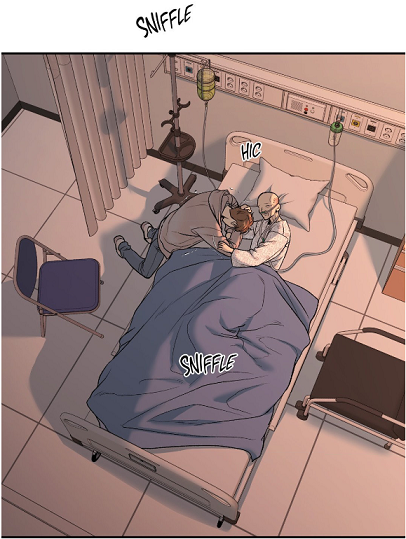 (chapter 47) Thanks to the champion, Kim Dan discovered that he could receive warmth and love from someone else. And now, you can grasp why he was strong enough to give the present to Joo Jaekyung despite his fear, why he could confront his boss in the locker room in episode 51. Thanks to this magical night, he learned that he could stand on his own. He is an adult now. But wait… people might question this interpretation, for there was no teamwork in episode 11.
  (chapter 11) When Park Namwook and Kwak Junbeom saw that he was wounded, the manager could detect the doctor’s lie. But what did they do? Nothing, they acted, as if they had not detected his lie. However, don’t forget the champion’s reaction.
  (chapter 11) He treated him as an important member of his team, he needed his assistance. Secondly, who helped Kim Dan with his struggles? Joo Jaekyung.
  (chapter 11) He might have taken advantage of the situation, yet contrary to the others, he did something despite his ignorance.
 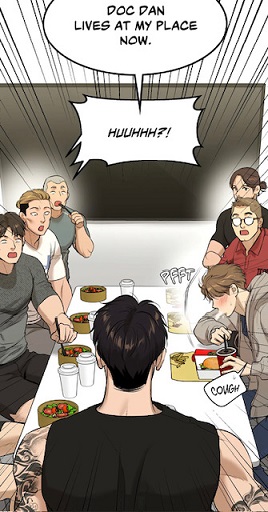 (chapter 22) Secondly, notice that he showed his true power in the break room. He is the true owner of the gym
  (chapter 22) It is important, because it indicates that little by little, Joo Jaekyung is taking over the gym. From that chapter on, he was building his world from the ground”.
 (chapter 33), we could see Joo Jaekyung’s success reached its peak, as he had just signed a contract with the Entertainment agency. “Reaching the pinnacles of success” was also reflected in another situation. The champion was allowed to touch his lover’s phallus
  (chapter 33), something he had been denied before (chapter 24). Moreover, he was able to get a confession from Kim Dan.
  (chapter 33) The cute doctor was unconsciously accepting to be intimate with his boss. Thus he whispered to the sportsman.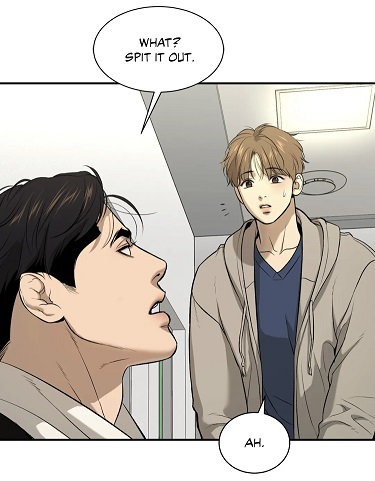


 But even so, he is not able to look at his VIP client. Kim Dan is the one avoiding the athlete.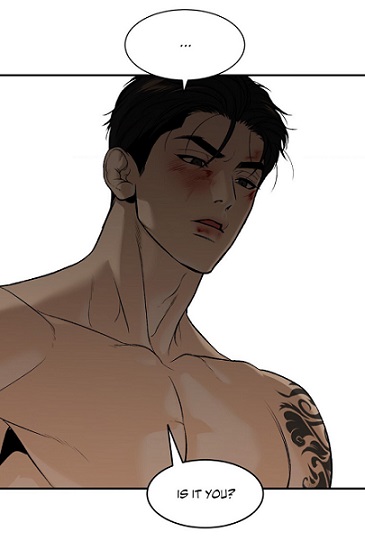
 They are no longer avoiding discomfort, a sign that they are getting closer to each other.
 Here Manhwa-lovers can detect Joo Jaekyung’s arrogance and detachment. Both were not true to themselves. They were both beating around the bush. No one voiced exactly what they truly desire from each other, for they were not listening to their own heart.
 However, their discussion ended with a question pushing both characters to meditate.
  I selected pictures from episode 6, 33 and 51! They are all connected to the same number. This signifies that we should examine the following chapters 6, 15, 24, 33, 42, and 51 as a continuation or better said as reflections. Hence they stand for love, but don’t forget that Venus also embodies fertility, prosperity and victory. How so? She was the ancestor of the Roman people through her son, Aeneas, who survived the fall of Troy and fled to Italy. That’s why she came to symbolize Rome’s imperial power. Yes, these chapters are mirroring a battle, who has the upper hand in the couple.




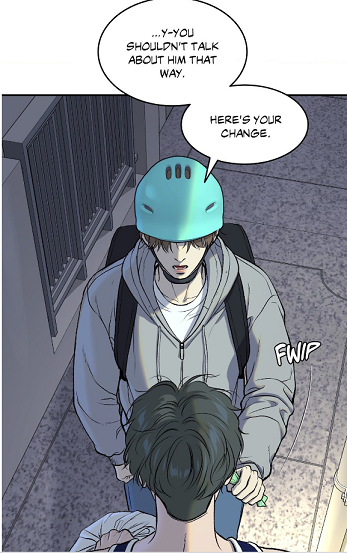
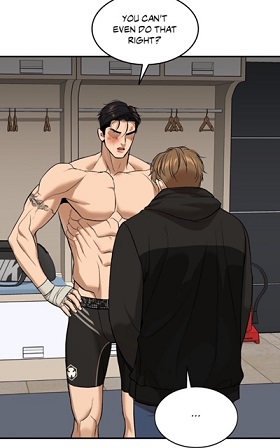
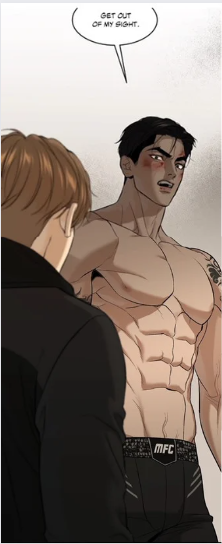
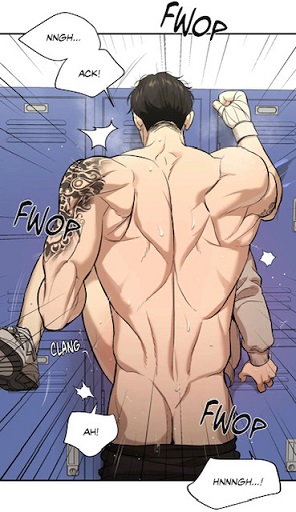 (chapter 15) But there’s more to it. It was also a first for the champion. He invited Kim Dan to watch the show. Imagine that he had never invited any sex partner before. Then in episode 24, he listened to the doctor’s request without any complain. Then in episode 33, for the first time, Joo Jaekyung focused on giving Kim Dan’s anal pleasure. It was, as if the star wanted to trigger desires in Kim Dan. Then in episode 42, Joo Jaekyung witnessed that Kim Dan was doing the breakfasts out of “routine” and not out of pleasure. Thus he always fell asleep. On the other hand, the physical therapist got confronted with a rival for the first time. Finally, in episode 51, Joo Jaekyung is now acknowledging Kim Dan as his final doctor. He is voicing his expectation: meticulousity.
  (chapter 51) By bringing the topic money
  (chapter 51), the champion could finally voice his biggest fear. Deep down, he knew that their relationship was based on money. But with one sentence, the doctor could remove his doubts and insecurities.
 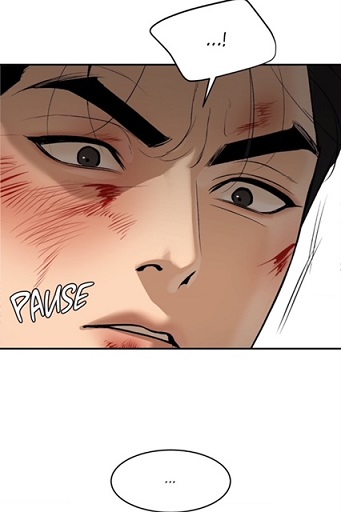 (chapter 51) He was more than caught by surprise, in my opinion, it must have dawned on him that he might have been wrong about the doctor. Hence he got upset. Seeing the physical therapist’s face was like a reminder that he had made a mistake, he had not trusted Kim Dan, while the latter had not.
  (chapter 13) and Alfredo
  (chapter 47). Remember that for me, Cheolmin is connected to Neptune, hence we have the number 1, 3 and 4. Thus it would validate my hypothesis that at the restaurant, Joo Jaekyung was talking to the cute doctor.
 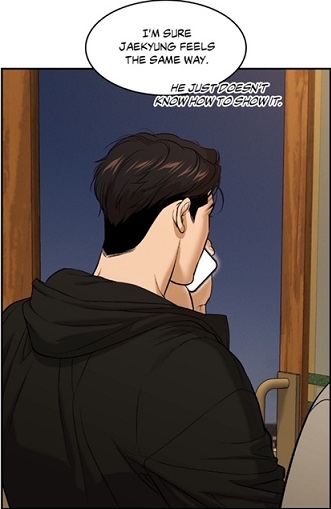 (chapter 43) On the other hand, you are probably wondering how I came to this new theory. It’s simple. It’s because of his name. Alfredo is connected to the number 7. In addition, his name signifies wise counselor.
 , (chapter 39) In chapter 53, we discover that it was the halmoni’s dream to see the ocean, like we could observe it in his old house.
 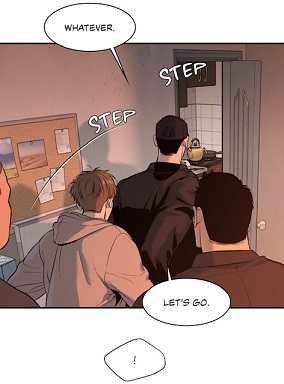 (chapter 17) However, in the last panel, Joo Jaekyung was leading his loved one, symbolizing that he would bring him to different places. Thus the doctor had to follow him to Busan (city next to the sea) and to the USA. At the end of season 1, it becomes clear that the champion will follow the doctor’s footsteps. He will got to the West Coast. Yet, in reality, the fighter is actually following the grandmother’s trail. Moreover, note that the doctor’s dream was to travel too. However, this desire is strongly connected to his relative.
 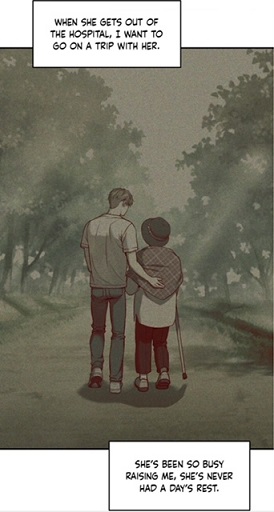 (chapter 47) As you can see, we have dream and ocean combined together. But if the ocean is connected to dream, how did I come to associate Alfredo with the dark elf? My theory is that the sea also represents the source of his suffering and as such his nightmare. I believe that his parents died drowning which would explain this reaction in the swimming pool.
  (chapter 27) Yet according to my previous interpretation, the PT’s totem is the duck:
 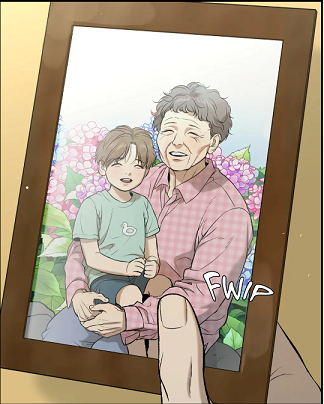 (chapter 19) A bird that is associated with water. And what is the common denominator between these last three panels?
  (chapter 7)
  (chapter 37)
 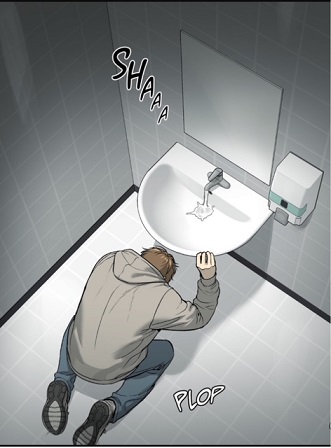 (chapter 47) The bridge from San Francisco is a place where people often commit suicide. My idea is that after they vanished, the halmoni never discussed their death with him. Since the grandmother was harassed by the loan shark, I can only assume that they killed themselves due to the debts, and suicide is a huge taboo in South Korea. Notice that his first trip led him to Busan which is a town next to the sea. However, back then, he had not the time to go to the beach. But when he went to the States, it was far from the coast, as UFC/MFC is located in Las Vegas. Hence he came to enjoy his trip. In fact, it inspired him to travel.
  (chapter 35) We have a 5, but 3+5= 8, the double of 4. Besides, his favorable numbers are 1, 7, 4. Then we would have the explanation why he became more important in episode 22
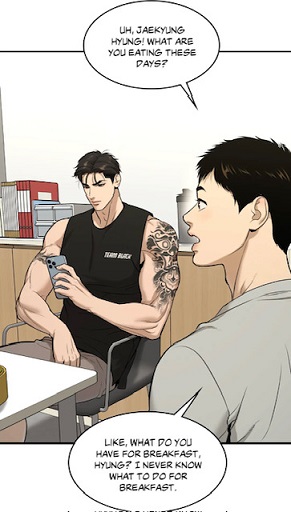 (chapter 22), why he protected the doctor from Heesung in episode 31
 (chapter 31), why he asked for Kim Dan in episode 40
 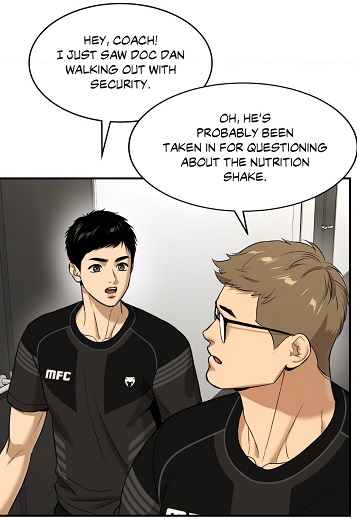 and why he reappeared in episode 47.
  (chapter 47) and helped him in the locker room.


 (chapter 140)
  (chapter 149) Both were suffering from survivor guilt. To conclude, Joo Jaekyung and Kim Dan represent the bitter medicine for their scars. I mentioned “bitter”, because through their loved one, they are forced to face painful moments. That’s how they can overcome their past and discover happiness. However, while looking for a new title, I rediscovered the first illustration
  , and it suddenly made click in my head. To conclude, I had another revelation concerning episode 50.
 . (chapter 50) At first glance, the champion is blaming Kim Dan for the wound. He betrayed him. However, his words could have a different signification. Don’t forget that a message always has 4 sides according to Schulz von Thun.
  Consequently, while many saw this question as a “factual information” and as such as an accusation, the reality is that it gave us an insight about the sender too. The sportsman was not using the personal pronoun “I” or “me” in his inquiry. As you can see, the absence of the personal pronoun is indicating that Joo Jaekyung was in reality not referring to him and his wounds. He is not prioritizing himself, rather the doctor and his action. So this question could be prompted by curiosity or a desire to understand the person’s recent activities. Thus I deduce that the champion was asking his lover to tell him the truth. He should come clean. He desired a honest explanation. His attitude reminded me of an adult confronting his child.
 (Chapter 50) It becomes comprehensible why the Emperor refused the offer. The rejection was the symbol of his “trust” in Kim Dan unconsciously. Astonishing, right, though people and Kim Dan had the opposite impression. Yet, because of the “tie”, Kim Dan felt responsible for the incident, therefore he apologized.
  (chapter 51) This means, the main lead recognized his responsibility. He should have checked the spray more carefully. The champion could perceive this excuse as a confession of his complicity. Hence he asked his lover if he was the spy.
  (chapter 50) This is the face of a scarred man. Yet, contrary to the past, he is not expressing his fear through rage. That’s the reason why his emotions were controlled. Under this new light, Manhwaworms grasp why the athlete asked such a question from his soulmate:
  (chapter 51) Interesting is that he was more pained by the idea of a betrayal from Kim Dan than the tie, if you compare these two panels:
 (chapter 51) As my avid readers can see, my perception about chapter 50 was confirmed with episode 51. The arguments in the locker room were reflecting the quarrel in the penthouse with Choi Heesung. What is the common denominator between these two scenes? The lack of trust from Joo Jaekyung, but his private PT failed to realize it in the penthouse. Why? It’s because he chose to trust his destined partner.
 I believe you = I trust you


 (chapter 35) He was still clueless about the trigger for his behavior. With this inquiry “You don’t trust me”, the hamster pushed his destined partner to face his biggest fear: trust someone and in particular him. This conversation can only incite him to meditate about their relationship. So while in episode 15, he behaved like a pouting child
  (chapter 15), in the latest episode, Jinx-philes can perceive his growth and maturity.
  (chapter 34) These questions were all rhetorical:
  (chapter 34) This signifies that in the sauna, truth was not standing in opposition to daring. The sauna reminded me of the cavern where an imugi hides, until the latter leaves its hidden place and find his star, his yeouiju. Only then, he can turn into a dragon. To conclude, because of Heesung’s pressure, the imugi had to select between daring or lie. In other words, telling the truth became the challenge itself. Heesung knew that Joo Jaekyung would never confess.
  (Chapter 34) What Heesung wanted was actually a lie by omission or commission which would have been presented as the truth. Through this game, the actor thought that he could impose his will onto the celebrity. He anticipated the athlete’s silence. This signifies that he knew about the star’s denial and turned it against him. Besides, that way Heesung could maintain his good image: he had not stolen his partner and as such there was no cheating. No one was betraying him.
 (chapter 34), but also his hand.
 (chapter 34) He caught the actor by surprise, the latter never thought that the celebrity would become violent. The redness on his face was displaying that he was barely controlling his annoyance and impatience.
  (chapter 34) However, they were in a public place, the hotel’s sauna, and the actor is a celebrity. Hence he is protected by his fame and social status. That’s the reason why the champion didn’t hit his frenemy, he had learned his lesson at the gym.
  (chapter 34) Despite his words, the gumiho still got scared. The racing of his heart is an indication of his fright. Therefore he ran away more or less after ordering his trainer not to meddle in his love life.
  (chapter 34) Note that when he did this, he avoided his counterpart’s gaze. Deep down, he knew that he shouldn’t provoke his frenemy too much. Only when he was at the door, he turned around and LIED!
  (chapter 34) Yes, after that incident, he chose to give him a fake excuse for his departure. As you can see, this conversation was strongly intertwined with the notion “truth or dare”, but both ended up lying. Whereas the champion didn’t admit any feelings, the other acted, as if there was nothing wrong and he was not scared. The gumiho thought that if he were to remove the champion from the doctor’s side, the latter would be able to open up to the actor.
  (chapter 34) What does it reveal? The actor had been projecting his own thoughts onto the future dragon too. He was the one who didn’t dare to become more honest with the physical therapist. He used work to spend time with Kim Dan. One might say that Heesung failed terribly. Yet, this is just an illusion, because his “failure” pushed him to become more honest with Kim Dan. Thereby he asked to meet the doctor again.
  (chapter 34) Yet, the message is exposing that Heesung was still lying, as he kept using work as an excuse. Hence Joo Jaekyung had to intervene again:
  (chapter 34) The champion dared to challenge his rival.
  (chapter 35) Yes, by challenging the athlete because of Kim Dan, the comedian ended up telling the truth.
  (chapter 34), but his anxiety reached a new peak, the fear that he might be abandoned. Hence he used the sandbag to vent his temper. And what did the cute puppy do during that incident? He dared to offer his help to his idol:
  (chapter 34) He was not telling the truth, when he stated that Kim Dan was his “possession”. This explicates why he couldn’t stay by the doctor’s side
  (chapter 34) in the end. He manipulated the main lead by letting him think that he had no other choice. Yet the last panel displays his trick. It was up to the doctor to decide how he should spend his free time. Nevertheless, while people were mad at the champion for his deception, many failed to realize that the champion was actually deceiving himself. So all the tricks (episode 33 and 34) were manifestations of avoidance, the fear to face the truth: his affection for Kim Dan and this due to a past betrayal. Hence these chapters stand under the sign of silence hidden by “pranks”.
  (chapter 35) On the other hand, the artist could only tell one part of the truth: the presence of feelings. However, the deceptions in the penthouse exposed something else:
  (chapter 45) or left the doctor in the locker room in episode 51.
  (chapter 50) First, the schemers’ MO corresponds to the game Truth or Dare. Choi Gilseok asked his minion to cross the line. This explicates why they are trying to use tricks and manipulations. Daring means no truth, thus someone will be framed: Kim Dan. Yet, the plotters are not aware that thanks to the cute hamster, the alpha is turned into a mirror of truth. Hence he couldn’t get deceived by the MFC security guys:
  (chapter 40)
  (chapter 36) And exactly like at the sauna, daring became a synonym for verity. No wonder why the fighter is never rejecting the challenge. It corresponds to his past attitude: he has been burying the truth and as such the past. But let’s return our attention to the plotters.
 (chapter 29), the journalist without a face
  (chapter 47), then he recognized the director without naming him,
 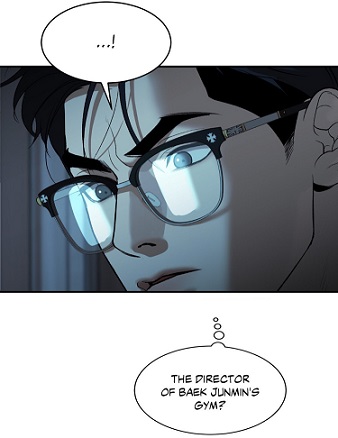 (chapter 48) and finally the ghost from the past
  (chapter 50) This scene exposed that the champion repressed a certain incident which is rather common among victims of a trauma, especially people suffering from PTSD. This shows that some traumatic event took place for quite some time, but the champion acted, as if nothing had happened.
  (Doctor Frost, chapter 140 ) That’s how the champion became a zombie, he couldn’t live properly due to his untreated scars.
 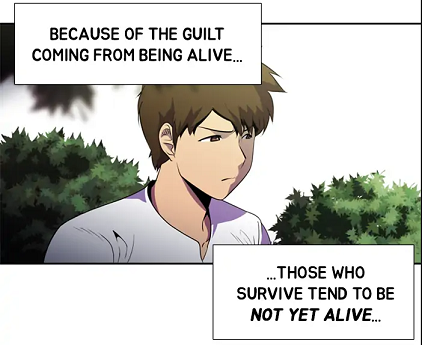 (doctor Frost, chapter 139) But thanks to his fated partner, the traumatic past is slowly coming to the surface.
 (chapter 48) The director created a stage for the betrayal. That should represent the truth, while in reality it was a lie! Nevertheless, Joo Jaekyung could perceive the truth: Kim Dan had met the director from the rival gym.
  (chapter 48) Yes, he didn’t dare to tell him what had happened. No truth… no daring which reflects the games in the sauna and the living room of the penthouse. Kim Dan could have come clean the next morning, but no. This panel explains his silence. He also mistrusted his VIP patient. He had a negative perception of his lover’s mental state. On the other hand, the champion’s attitude reminded me of a parent who has not the time to listen to his child’s problem due to work.
 (chapter 48) Should the athlete remember this night, he will realize that he was the one dismissing his physical therapist, although the doctor could have come clean later. At the same time, Joo Jaekyung’s attitude could be mirroring the parent or guardian’s in the past. They didn’t have the time or the inclination to listen to their son, hence the traumatic incident got buried.
 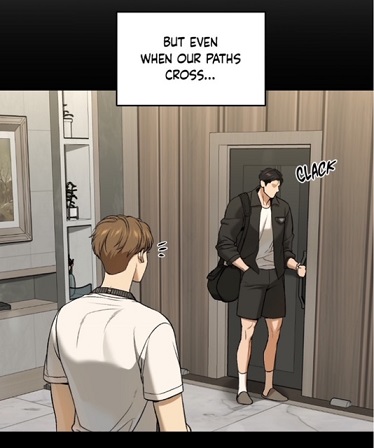 (chapter 47) and voice his true thoughts and emotions:
 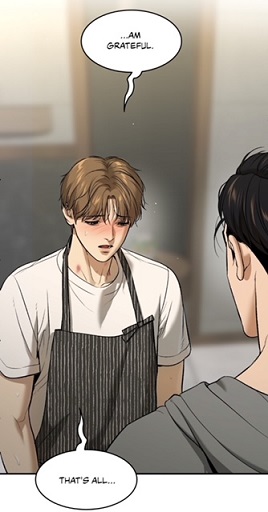 (chapter 45) He lied, when he portrayed himself as grateful. He was avoiding his gaze either. No wonder why the fighter got even more mad and threatened to fire him. Such an attitude could only increase the celebrity’s mistrust, as the latter could discern a certain dishonesty.
  (chapter 49) The latter didn’t even greet the director or acted, as if they didn’t know each other. He exposed the existence of a secret, an uncomfortable secret. Consequently, I believe that the champion could only jump to the conclusion that Kim Dan had been indeed acting behind his back, even coerced to do something.
  (chapter 51) Note that the star never came clean with the truth either.
 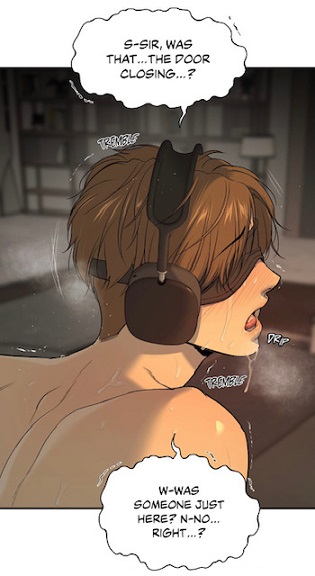 (Chapter 35) Through the doctor, the champion is encouraged to become honest to himself.
 (chapter 33) Simultaneously, it exposes that the champion has a secret, which is strongly intertwined with betrayal, love, money and deceptions. I couldn’t help myself thinking of “blackmail”. Kim Dan had been coerced to do something, as the director was holding something against him. Hence we have the question: “what have you done?”. Remember how the actor chose to approach the angel.
 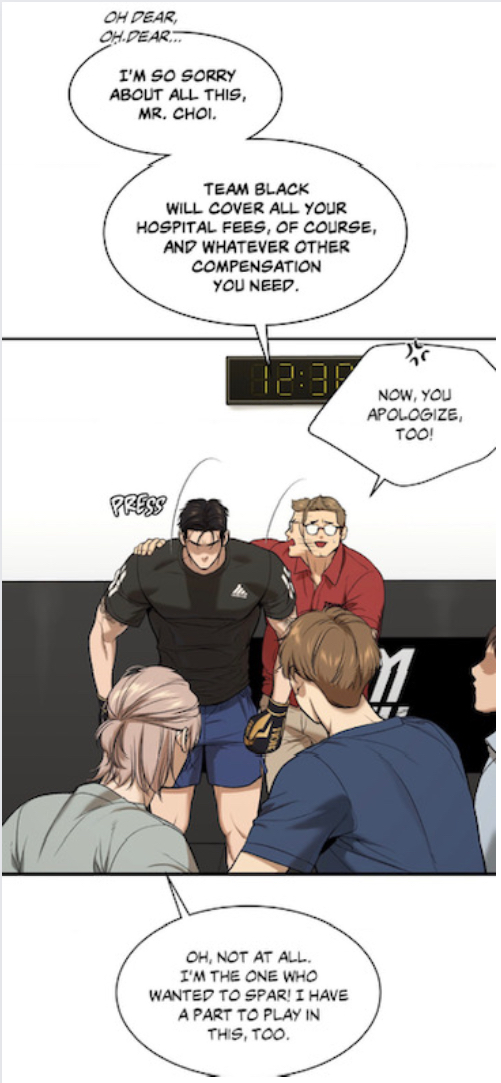 (chapter 31) He tricked his boss by faking an injury. He put the gym under pressure, as this incident could be leaked to the outside. The whole situation reminded me of blackmail. If he did not follow his request, there could be a scandal. That’s the reason why I believe that the champion’s past is linked to blackmail as well. How is it possible? It is because of the game “truth or dare”! The latter is strongly intertwined with divulging information and crossing the line!! To sum up, this game embodies trauma, secret, leaking information, trust and overstepping a boundary or rule. This observation brings me to my next point.
 (chapter 9) And what did happen after they left the restaurant? The champion discovered the truth:
  (chapter 10)
 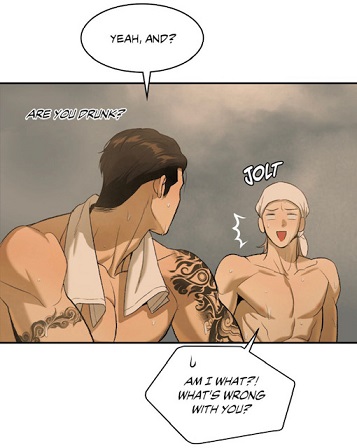 (chapter 34) “Are you drunk?” With this question, the protagonist revealed something about himself. He associates dating and love confession with drunkenness. He implies the existence of a lie. But a confession is strongly associated with verity and sincerity. On the other hand, for the sportsman, no one in his right mind would admit to be in love and in our case to love another man. For me, one part of the problem is that the champion is afraid of admitting his homosexuality. The latter is still a stigma in South Korean society. But there’s more to the game Truth or Dare. If you paid attention to the origin of the last quote, you will realize that this fun is linked to bullying and even hazing.
 (chapter 49) Furthermore, bullying is never done alone, but in groups.
  (chapter 57) There is one leader and the others are following the flow, the latter even become more proactive by making new bets and suggestions in order to ensure their own safety. As long as no one divulges the truth, the bullies are safe. But there’s more to it. Striking is that the way they coerced the champion to fight resembles to bullying too. He was manipulated with the articles, then with the advises from the lawyer and manager. Once in the States, they tried to drug him, which corresponds to a physical assault.
  (chapter 37) Finally, note that the schemers are working in teams exactly like the bullying students. Therefore I judge Park Namwook’s attitude as the teacher’s who is closing the eye to the truth. He is rather passive and puts the whole responsibility on his “boy”.
  (chapter 41) It is the champion’s choice to refuse or not the matches. The moment I associated the game with parties, peer groups and bullying, I had many revelations.
 (chapter 47), Manhwalovers can see that Kim Dan was a loner. Therefore I doubt that he had friends during his college years. The only person he knew from his school was his mentor:
  (chapter 1) It is important, because it implies that Kim Dan avoided to socialize and participate in gatherings. Interesting is that in season 2, Jinx-philes discover that Kim Dan had been bullied in the past.



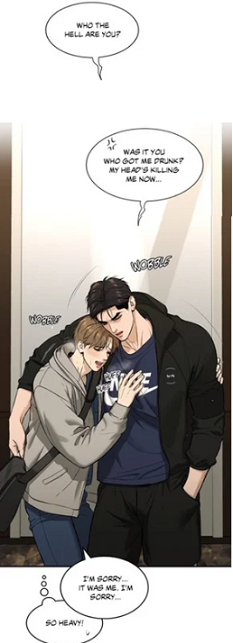
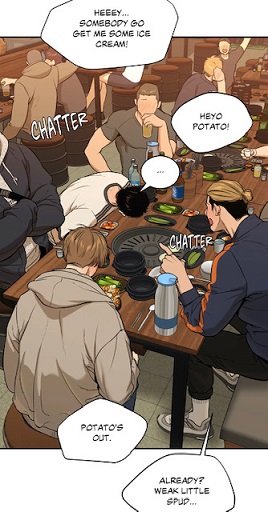 (chapter 9), yet Park Namwook made sure that the physical therapist wouldn’t be abandoned drunk. Thus he tasked his boss to bring him home. And as for Potato, it is clear that Oh Daehyun would take care of him, as he was sleeping in the dormitory next to him. In other words, no one was left behind drunk. But this scene contrasts so much to episode 43. First, no one was missing Potato. No one asked about his absence. Secondly, pay attention that the fighters invited Kim Dan to join them for another round, while they were neglecting their boss, though it was his birthday party.
 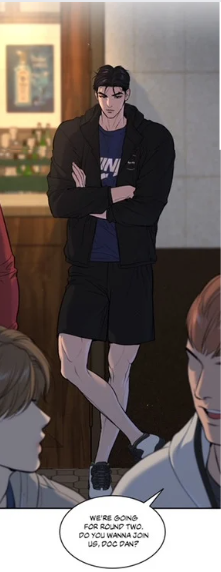 (chapter 43) Moreover, they never wondered about his physical condition. Was he drunk or not? Funny is that the intoxicated character was the one who forced Kim Dan to go home.
 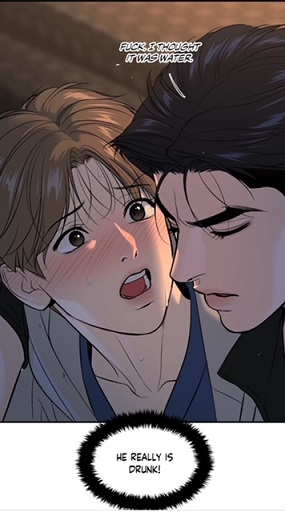 (chapter 43) That’s what a friend is supposed to do.
 (chapter 35) So the auntie could keep an eye on the judo fighter, and it was only a matter of time, until his friend would return. Nevertheless, this scene is implying a certain problem: a drunken person shouldn’t be left unguarded. Thus imagine that during a party, an unconscious person is brought to a room and left there unguarded, as the friend desires to keep partying, similar to this scene:
  (chapter 37) The person could get sexually assaulted, and no one would notice it. Secondly, I would like to outline that the hazing party from the article reminded me a lot to bullying. These freshmen were humiliated, and the perpetrator excused her behavior behind traditions and social norms. So the champion could have been betrayed by a friend, as the latter would have justified his action similarly. So instead of admitting his mistake, he could have justified the incident like this: the victim was responsible for his misery, because he was at the wrong place at the wrong time. It was just his misfortune or better said his jinx. Yes, for me, the jinx is indicating that people responsible for the champion’s traumas were denying their wrongdoings.
 (chapter 8) From my point of view, this place is not just symbolizing purification and reflection, but also indicating the presence of a wound. As soon as I connected the bathroom and as such water to pain, all the champion’s past behavior appeared in a different light. In episode 3, when he went there, he was wearing his pajamas.
  (chapter 3) Neither Kim Dan nor the protagonist were seen both naked in the shower room.
  (chapter 8)
  (chapter 20)
  (chapter 34) He feels uncomfortable naked around people… As soon as you connect this place to a wound, my avid readers can finally better interpret the champion’s irritation in episode 36:
  (chapter 36) Kim Dan’s entrance could be perceived as a violation, for the champion was naked. This intrusion caught him off-guard. But since his gaze was covered, his anxiety masked behind his anger was diminished. On the other hand, this led him to leave the bathtub undressed and have sex in the kitchen.
  (chapter 36) For me, everything is pointing out that one of the champion’s fears is intimacy with water. He has long internalized this association. Don’t forget that the sexual encounter in the swimming pool started with clothes, before they got completely removed.
 (chapter 27) Under this new perspective, I don’t think that it is a coincidence that the champion felt the need to take a shower after meeting Baek Junmin and recalling the past.
  (chapter 49) This helped him to overcome his trauma and past wound.
  (chapter 8) they dared to have sex next to Oh Daehyun and the other fighter. However, note that in all these scenes, neither the doctor nor the champion were honest. They were both lying… not only to their counter-part, but also to themselves.
  (chapter 19) That’s the reason why the argument in the locker room
  (chapter 70) His sexual orientation was exposed in high school, his friends were behind the rumor
  (chapter 70), although we have to envision that his crush played a huge part in it. Why? It is because he didn’t want to be associated with homosexuality.
  (chapter 70) Not only he cut off ties with him, but also he made sure to isolate the main lead from other students. The worst is that this person acted, as if this ostracizing had never occurred.
  (chapter 69), as if he had done nothing wrong. For me, it shows that the traitor never grasped the significance of his actions. Hence Park Sung-Woong could forget Dong-Gyun, while the latter could never forget him at all. The result from this huge betrayal was that the cute uke decided to keep his distance from people.
  (chapter 70) He could no longer trust people, he avoided meetings. In order to outline how severe betrayal trauma can be, the Webtoonist showed us the immediate effects of betrayal trauma: physical and emotional reactions
  (chapter 70)
  (chapter 70) and the long term effects:
  (chapter 69) he is trembling so much, he can not look at his former friend. Readers shouldn’t underestimate the issue. Betrayal trauma is so severe that it is comparable to being hit by a white truck. The pain is so great that it affects the brain functioning and as such personality.
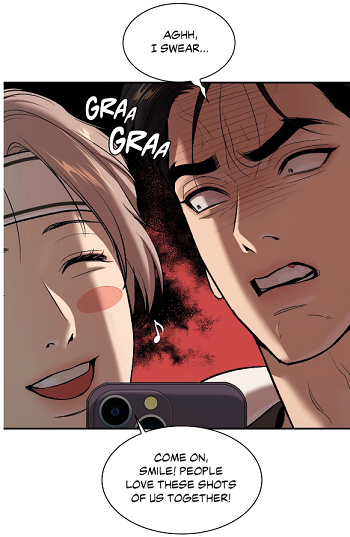 (chapter 30), negative intrusive thoughts
 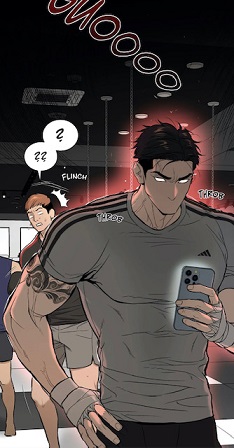 (chapter 05) Then when he stayed at home,
 (chapter 32), it was clear that the doctor’s actions were constantly on his mind. He was so bothered that he had to bring him to Heesung. He made sure that Kim Dan would forget Choi Heesung in the car.
 (chapter 49), the latter was not loved, as he didn’t reach the first place like his older brother. Then we have Interpersonal with Nam Dong-Gyun and his high school friend. However, since the rumor circulated at school, and no adults intervened, we could see it as a reference to Institutional betrayal. Finally, Mingwa presented the last type (partner) with Hweemin.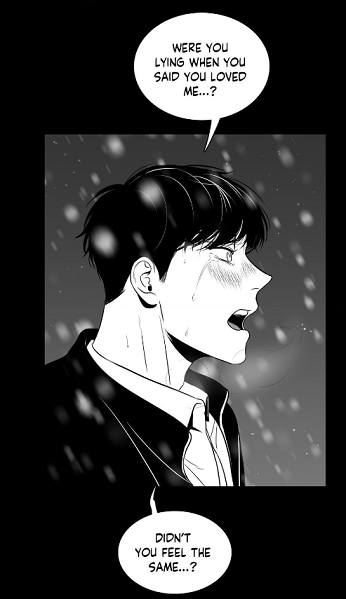
 (chapter 51) But why is betrayal trauma so severe? It is because everything appears as a lie, as an illusion. All the memories become tainted. The victim can only question his own senses and judgment. How could he not detect the lies? Since PTSD and betrayal trauma share some common points, it is not surprising that such persons come to blame themselves and develop huge self-loathing.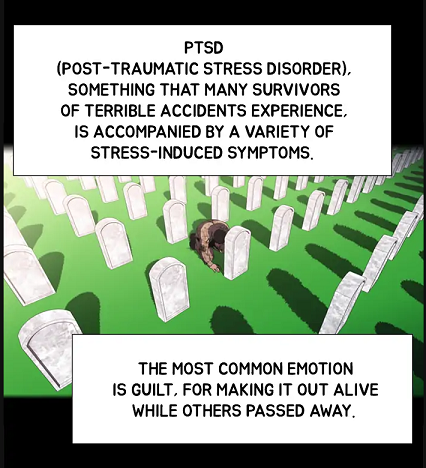
 (doctor Frost, chapter 139). And now, it is time to expose my latest observation:
 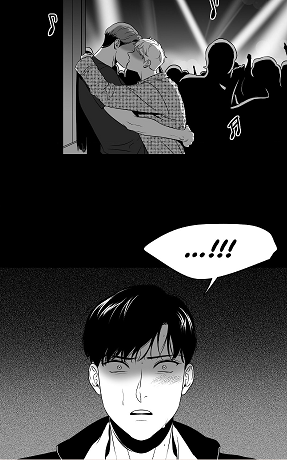 (BJ Alex, chapter 51) Ahn Jiwon caught his first lover cheating on him at a club. Interesting is that the new lover resembles a lot to Joo Jaekyung! Mingwa said that characters from BJ Alex will only appear, but Jinx is not connected to her previous work. Note that they were kissing in a public place. Moreover, the club is a location where students not only meet, but also drink alcohol together. However, once Jiwon saw Hweemin, he dragged him outside so that they could talk. In other words, the “new lover” was left behind. Thus I come to the following conclusion. Joo Jaekyung has been suffering from betrayal trauma exactly like Ahn Jiwon. He was betrayed by his guardian
 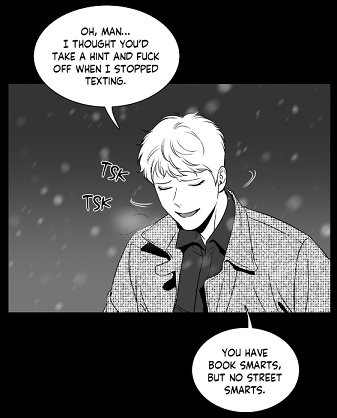 (BJ Alex, chapter 51). If this theory is true, then Mingwa would finally outline the devastating effects of Betrayal trauma on people, something she barely touched in her previous work.
 (chapter 51)
 (chapter 50) and Kim Dan. While the former was tormented by his challenger directly
  (chapter 50) and indirectly, the other had to witness how the members from Team Black turned their back on him in the locker room.
  (chapter 50) Interesting is that on X, hamster Dan received more affection and attention than the champion. Though I have always pointed out the doctor’s flaws, in episode 50, I couldn’t help myself being upset and heartbroken for Doc Dan too, until I had a revelation. Many readers were disappointed or mad, when they saw him in this panel.
  (chapter 50) They could put themselves in his shoes: he was left behind. On the other hand, the reaction from Joo Jaekyung was totally understandable.
  (chapter 50) And everyone knows this saying: Time is money. Yes, the hyungs didn’t decide to postpone the fight, because they would have to pay huge fees, and this could have affected the Emperor’s reputation. It exposes that the fight as such the show was more important than the well-being of their star. As a conclusion, money played a huge role in their decision. On the other side, the annulation would have brought more trouble to Kim Dan, as it would have caught the attention from journalists and fans, though it can still happen later. Under this new perspective, it becomes comprehensible why they left the locker room and didn’t argue with Kim Dan. They were under pressure. Nevertheless, the readers had a different reaction, for they knew the truth: Doc Dan was the victim of a new scheme. Therefore they judged the whole situation as unfair. Some were mad at the manager for yelling at the physical therapist.
  (chapter 50) Yet, we shouldn’t allow our emotions cloud our judgement, for this image displays the doctor’s metamorphosis. Notice that he talked back. Though his sentence is still not complete, the thickness of the writing and the point of exclamation are indicating that he was not whispering. He was speaking loudly and clearly. He was talking back firmly. Moreover, he was not avoiding his counterpart’s gaze contrary to the argument in the penthouse.
  (chapter 27) But only Dr. Lee and Kim Dan got to see the results
 (chapter 27), not Park Namwook. He just overviewed the medical file quickly. But for that, the manager needs to be capable of understanding medical terms. Thus I doubt, he could visualize the seriousness of the situation.
  (chapter 27) Then, after the match in the States, the manager asked his “boy” how his shoulder was.
  (chapter 40) Here, he chose to rely on the celebrity’s words,
  (chapter 40) while the manager had witnessed how Dominic Hill had targeted his shoulder. He should have realized that his star’s shoulder had been damaged. Nevertheless, we shouldn’t overlook that the athlete’s statement was corroborated by the medical checkup from MFC. That’s how he got fooled. Hence there was no treatment. However, doc Dan could detect the champion’s lie not only through observations
 (chapter 41) but also through touching.
 (chapter 41) As you can see, the wound was slowly coming to the surface. Thus I consider the incident in episode 43 as a metaphor for the shoulder injury.
  (chapter 43) It was exposing the damage in his body. Consequently, when the champion’s foot got wounded by the pepper spray,
  (chapter 49), I realized what was happening. Mingwa is forcing the Emperor to admit his suffering. Hence his wounds are becoming more and more visible.

 (chapter 5) for he was simply relying on the prostitutes due to his jinx. Thus I consider this argument in the penthouse as a huge step for the athlete:
 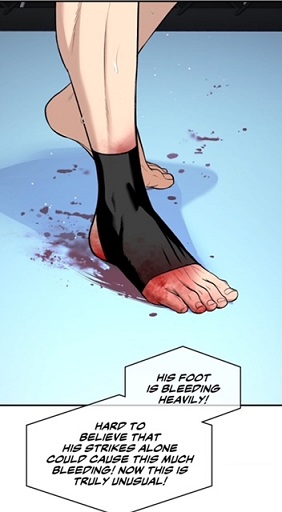 (chapter 50) So far, he just had a cut above his eye, nothing serious.
  (Chapter 40) However, the wound on the foot is different, for his skin is damaged. The recovery will take longer. It is relevant, because Park Namwook can no longer feign ignorance about his star’s wounds. He is less susceptible to manipulations.
  (chapter 50) That’s the reason why he turned into a dragon at the end of the chapter. [For more read the essay “
 (chapter 5) This shows that his belief in his jinx had been reinforced after his first night with Kim Dan.
 (chapter 50) From my perspective, this is the result of the overexerting.
  (chapter 42) In addition, he would return home late, a sign that he would train even more than before.
 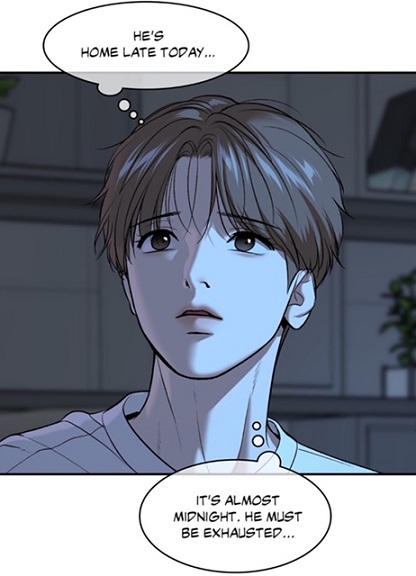 (chapter 48) Finally, we shouldn’t overlook the fact that after his match in the States, he never visited the hospital due to the law suit.
 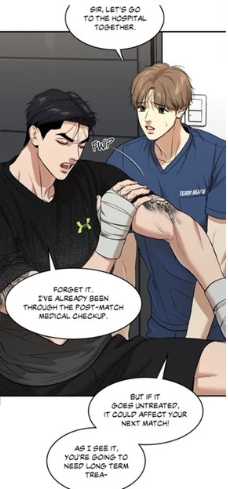 (chapter 41) According to me, the MFC medical checkup was not reflecting the verity. Hence he never got a real check-up and MFC could definitely say that the athlete was definitely fine.
  (chapter 41) This shows that the more the champion refuses to his PT’s advice, the more injuries he will substain. That’s how it dawned on me why Joo Jaekyung is now getting more and more wounded during the fights. It forces him to take a rest! However, in the past, he had a reason not to listen: he got barely injured. He needed to treat his body roughly in order to prove his effort and strength. This observation reinforces my conviction that there is a second group manipulating the champion’s matches: MFC itself. For me, Heo Manwook and Choi Gilseok are rather puppets. How so? It is because someone knew about the champion’s sexual habits, hence he was supposed to take an aphrodisiac in the States. But neither the loan shark nor the director from King Of MMA are aware of this. To conclude, the champion’s anguish is necessary to expose the deceptions and the schemers as well.
 (chapter 27) refused to force the champion to take a day-off by saying that the protagonist would never listen anyway. With such a statement, he pushed Kim Dan to make the decision and announce it to his VIP client. Moreover, the manager didn’t stop his “boy” from exposing his injured shoulder to the public.
 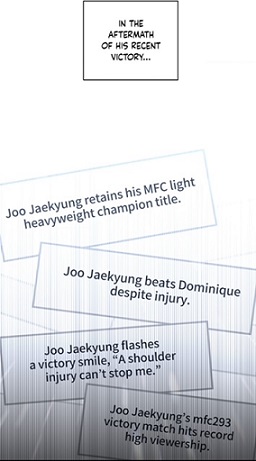 (chapter 41) However, by doing so, he was exposing his vulnerability to his opponents, though I am still suspecting that MFC leaked information too. So far, the headlines are not indicating which shoulder is wounded. Yet, the moderator knew which one:
 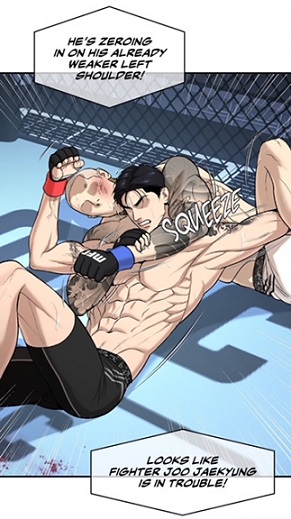 (chapter 50) So why was the manager so shocked with such an attack?
 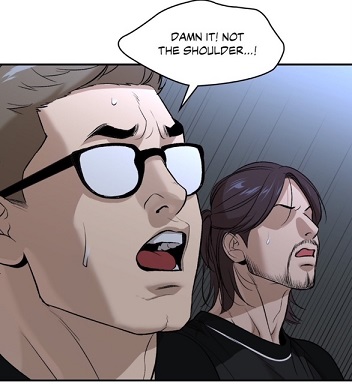 (chapter 50) It was clear that during such a match, the challenger would use the opponent’s weakness. What did he expect in the end? The panel exposes his stupidity and his immaturity. He should have anticipated such a move. These observations lead me to the following conclusion: the champion needs to realize that his hyung will never recognize his suffering, as long as Joo Jaekyung is in denial. Until now, he hasn’t been protecting Joo Jaekyung’s interests, rather his own comfort. His MO was to put the whole responsibility on the athlete. But it was his duty as his manager not to accept the new challenge.
 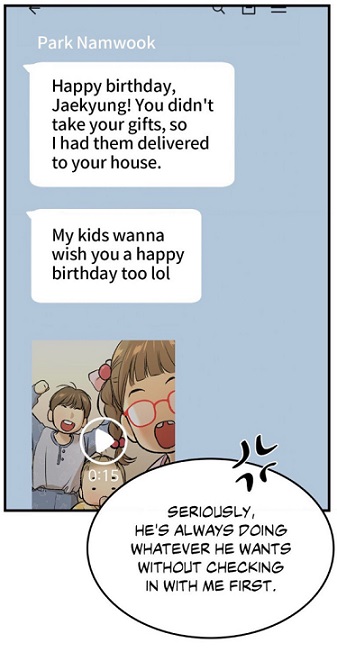 (Chapter 45) In other words, his loyalty towards the star is improving.
 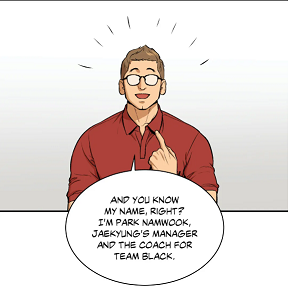 (Chapter 9) and coach for Team Black, but he acts like the director of Team Black.
 (Chapter 49) This explains why he claimed that Team Black was his gym,
  (chapter 41) to the golden keychain.
  (Chapter 45) As you can see, the famous writer is connected to Positive Psychology, for he was also promoting meditation and experiences. This fits our story, as both main characters are on their way to give a meaning to their life and as such to find happiness. But let’s return our attention to the manager Park Namwook as a representative of “ignorance”.
  (chapter 11), but also he never tried to correct the star’s false conclusion.
  (chapter 43) Through the two examples, Manhwaphiles can sense that his “ignorance” is a mixture of willingness to close an eye and real naivety. Under this new approach, it dawned on me why the manager used to beat his star so brutally.
  (Chapter 7)
  (Chapter 31) It is his way how to deal with uncomfortable situations. He stands for social norms and conformity. It is not surprising that the manager proposed to use Kim Dan as compensation for Heesung’s fake injury.
  (chapter 32) Furthermore, he forced Joo Jaekyung to take the blame without investigating the matter.
 (chapter 43) The latter triggers his anxiety and nervousness. Thus when there is a problem, his MO is either to threaten,
  (chapter 36) or to let others make decisions. I would even add, he often delegates things to others: the manager from the Entertainment company
 (chapter 46), Kim Dan [f. ex. He should accept the bad mood from his VIP client]
  (chapter 36) However, he is not trying to solve the problem himself. Yet, he can not keep such an attitude in the long run, for his passivity and blindness are the reasons why the main couple can be targeted so easily. Park Namwook is failing to protect his champion and his team. However, I detected a positive change despite the heartache in episode 50. He stopped using violence after episode 31. He learned that he needed to treat the champion’s body more kindly, hence we have this confession:
  (chapter 43) Furthermore, compare his behavior towards the celebrity and the doctor:
 (chapter 41) Therefore I believe that in the locker room, Kim Dan must have recalled her words. She became his source of strength once again. That’s why we have parallels between these three scenes:
  (chapter 21: he was criticized by Kim Miseon, he feared to lose his halmoni)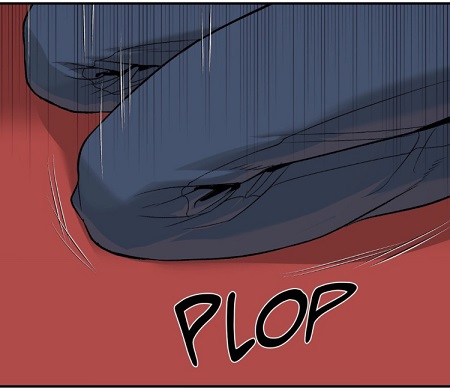
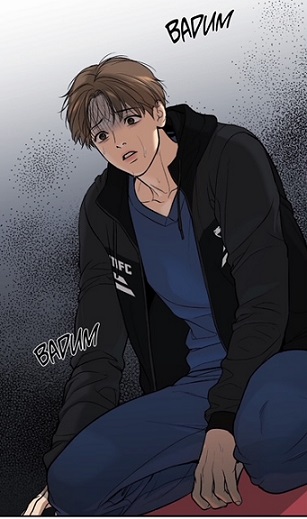 (chapter 50) That’s the reason why Kim Dan could become a star. Contrary to Joo Jaekyung, we didn’t assist to the birth of the yeouiju. It is no coincidence that birth is connected to pain and happiness. Mothers forget the suffering of the delivery, as their child can procure them a lot of joy and happiness.
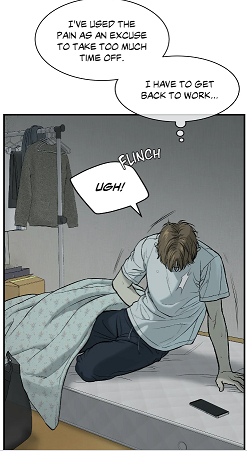 (chapter 5) or Heesung drank alcohol
 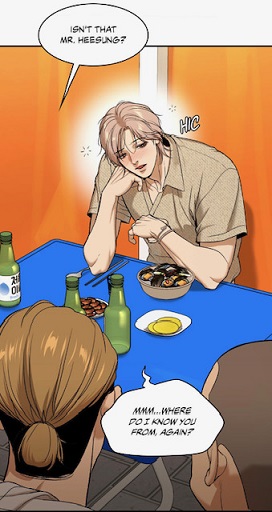 (chapter 35). Both were trying to numb their pain, though they shouldn’t have according to the German philosopher. The soju stopped them from becoming the better version of themselves. I am suspecting that doc Dan copied this poor habit from his grandmother, who drank in secret. Don’t forget that in all the memories, the halmoni is smiling
  (chapter 16) or as a tool for the jinx, therefore he mopped the floor
 (chapter 31)
  (chapter 31). Furthermore, he took a side gig in order to buy the champion’s present and finally, he rejected Choi Gilseok’s praise and offer.
  (chapter 48) He was always diminishing himself as a doctor. Therefore in the locker room, he was confronted with his biggest fear: is he really a physical therapist?
  (chapter 50) He injured his patient. The spray is there to let him see that he has power in his hands. He should trust himself and his magical hands. Don’t forget that this request was made by Joo Jaekyung.
  (chapter 50) And from my point of view, the locker room became the doctor’s new temple. There, he must have recalled his grandmother’s wishes. She would like to see him on TV. For me, the light over his head symbolizes Enlightenment. He has become the champion’s yeouiju. Thus I deduce that Kim Dan is on the verge of proving his worth to Team Black. I am anticipating, he will approach the ring, and even treat him during a break, something he denied to his halmoni.
  (chapter 50) It is relevant, because through such an intervention, hamster Dan would teach the champion an important lesson. He is not alone in the ring, the doctor is watching his physical condition and helping him.
  For me, chapter 50 announces a new start! Interesting is that the number 50 is associated with the planet Mercury which stands for poison but also medicine! And now, you comprehend why I consider the painful chapter as treatment sessions. The two protagonists are forced to redefine themselves. Joo Jaekyung might be injured, but he no longer sees himself jinxed!
  (chapter 48) So the moment you perceive this moment
  (chapter 19), this signifies that Potato was acting like a true friend in the locker room.
  (chapter 37)
  (chapter 40)
  And this brings me to my next observation. The doctor’s pain is exposing his recovery! Weird, right?
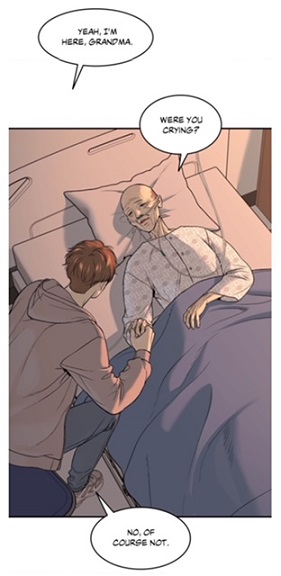 (chapter 47) and his agony. He was no longer under the influence of toxic positivity. While he cried, he admitted his flaws making him realize that he had never been abandoned by his grandmother.
  (chapter 47) That’s how he overcame his abandonment issues.
 (chapter 37) He wanted the party to continue. It shows that he was having a good time with Oh Daehyun and Potato. He has no problem to stop kissing his soulmate, when the latter shows his discomfort.
  . (chapter 36)
  (chapter 45) And now, you comprehend why I stated earlier that he acted rather instinctively. For me, he still trusts the physical therapist.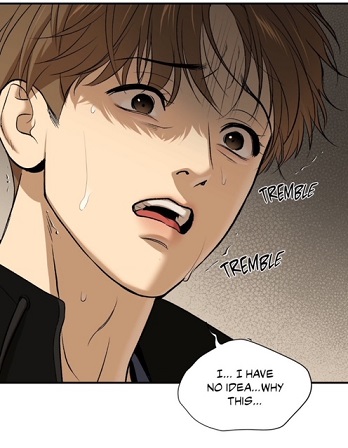
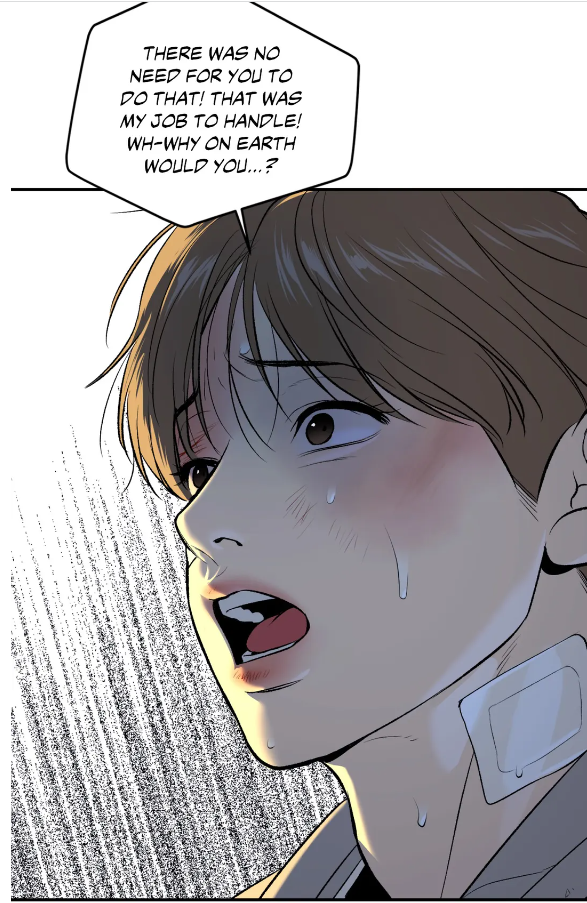 (chapter 18) When the champion paid off his debts, he saw it as meddling. Interesting is that he came to accept the champion’s support, but he never asked for Joo Jaekyung’s help directly. In addition, Jinx-philes should notice that in the interrogation room, he thought just about the champion and not himself.
  (chapter 40) It never came to his mind that he should ask for assistance. Finally, observe that after he got drugged in the States, he let the champion deal with the problem.
  (chapter 41) He accepted the statement from his boss. Nevertheless, doc Dan was the real victim. He should have become more involved in the matter. Besides, he was a witness. And this brings me to my next thought: if Kim Dan gets into trouble, he should remember Heesung’s words: he should give him a call!
  (chapter 35) For me, the incident is there to teach Kim Dan that he can ask for help! This would show him that he is no longer alone. He wouldn’t appear weak at all. That’s how he would end up to gain his first friends. Let’s not forget that Heesung’s relationship with the doctor is no longer tainted by money or by lust or greed. In fact, thanks to him, he found his soulmate. What unites Kim Dan and Heesung is the heart and the desire to help. Heesung stands for brotherhood, so he could be the one outlining the problems to Team Black. Finally since Potato likes Doc Dan very much, there is no doubt that Heesung and Potato will work together to assist the main lead. This image
 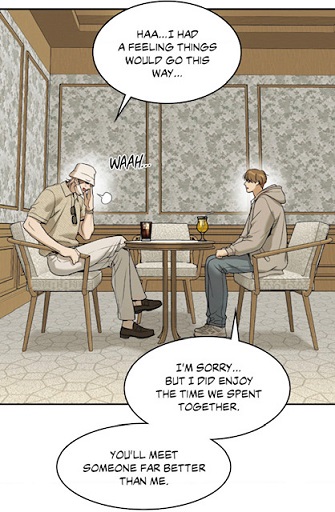 (Chapter 35) Interesting is that after his confession, he still chose to come clean with the doctor. He revealed the truth to Kim Dan, though he could have lost the protagonist’s respect. He admitted his lie and manipulation,
  (Chapter 35), but Kim Dan’s reaction was not to scold his future friend. In fact, he appreciated his honesty. In front of Kim Dan, he could show his true self. He was not entirely a good guy, but he didn’t get rejected. But so far, the actor is not present in the arena. Therefore Potato could be the first person Kim Dan asks for help. He shares some similarities with his soulmate. He doesn’t fear people’s gaze, hence he raised his voice under the tent.
 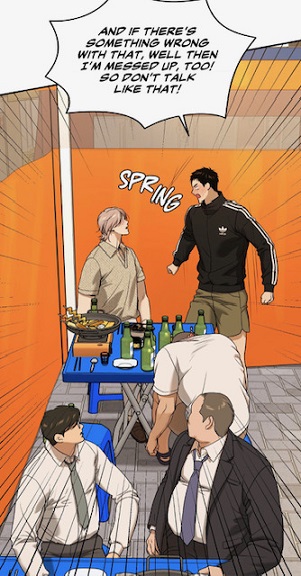 (chapter 35) he doesn’t represent the herd mentality, for he never thinks and acts like others.
  (chapter 31) While the fighters all liked the actor, he judged him in a different light. Then he was not present during the champion’s birthday. Therefore he possesses all the qualities to become a hero. He could cause a scandal,
  (chapter 49) similarly to his idol and hero in the States. He noticed the issue right away: the security didn’t do his job properly. To sum up, Potato would follow his foot steps and that’s how he would get noticed by MFC!
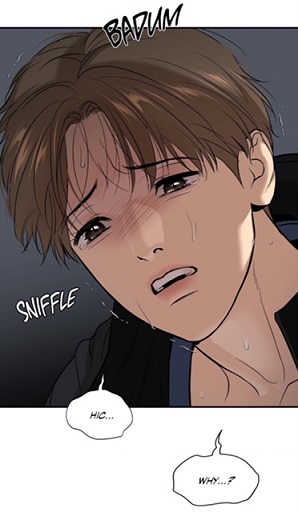 (chapter 50) The word is displaying that the doctor is not accepting the incident simply like that. It is showing that the doctor is slowly losing his naivety. Before the incident with the spray took place, he still trusted the words from people.
 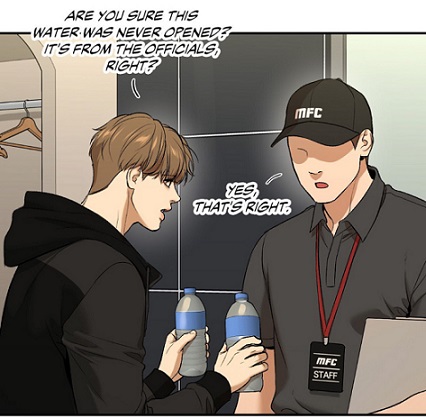 (chapter 49) Naturally, he can not get rid of his naivety totally, for keeping a certain purity is necessary in life too. On the other hand, it becomes clear that his naivety is the result from his education. The halmoni is herself quite too trusting. Hence she ended up being harassed by loan sharks. On the other hand, the incident was like an eye-opener for the physical therapist. He should stop judging people based on their words
 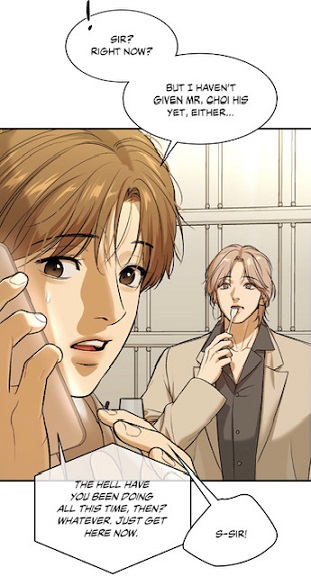 (Chapter 32)
 (chapter 1) by bosses, it becomes comprehensible why he didn’t fall into the trap a third time.
 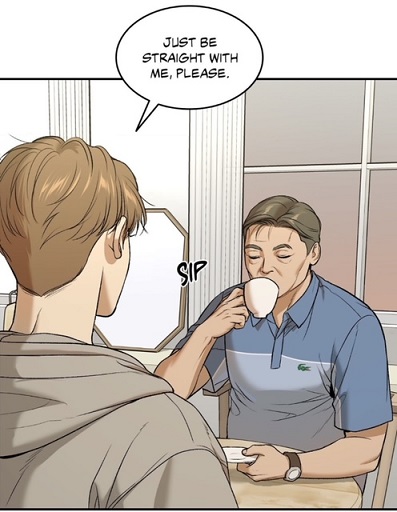 (Chapter 48) He is pushed to question impressions and people’s motivations. As a conclusion, anguish is a tool to push people to become wiser and happier. And this leads me to my final part.
 (chapter 14) But back then, Kim Dan didn’t mind staying in Seoul.
 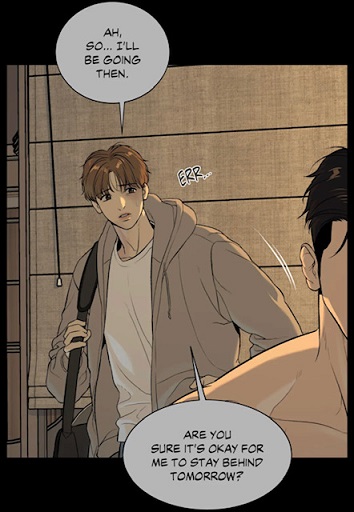 (chapter 13) Furthermore, after having sex in the locker room, Kim Dan was left behind.
  (chapter 15) And notice that this pattern was the same in the States. For the second match, Team Black left without him, hence Kim Dan arrived late.
 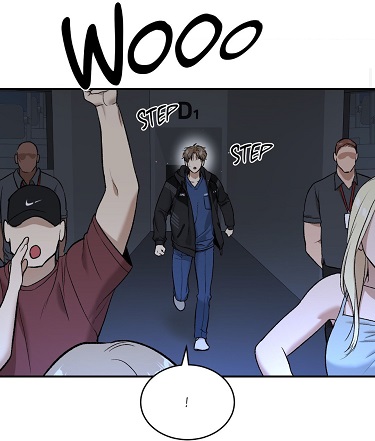 (chapter 40) Therefore he was running once again. However, back then, no readers felt angry at the team, though it could also be perceived as a betrayal and abandonment! Kim Dan was not perceived as necessary, neither for Joo Jaekyung nor for Park Namwook. Hence the bedroom could be judged as the place of the betrayal: “
 (chapter 40) That’s how I realized why the Webtoonist never showed the athlete’s caring gesture. He moved him in the middle of the bed! It is because the celebrity was still not treating his soulmate as a physical therapist. The second reason for the absence of anger is that Kim Dan had been drugged and as such was not fit. In addition, he needed to rest after having sex for the whole night. And now, you comprehend why the doctor could get dragged away by the MFC security guards, and no one from Team Black intervened.
  (chapter 40) It was to outline their previous disregard and betrayal! Thanks to Potato, Joo Jaekyung got informed, hence he could rescue the physical therapist.
 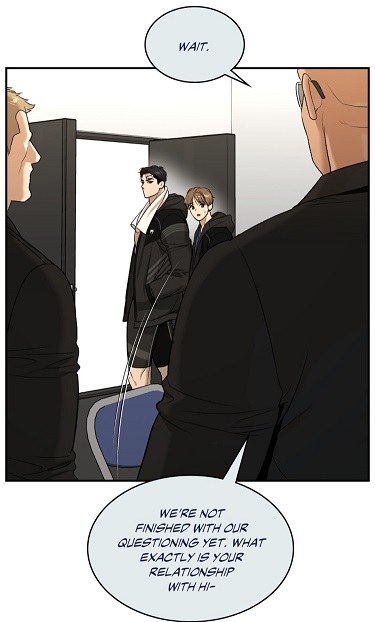 (chapter 40) But he never revealed the hamster’s role in the team! This explains why Kim Dan was used by Choi Gilseok. He needs to expose his role in Team Black to the world. He is the champion’s private PT!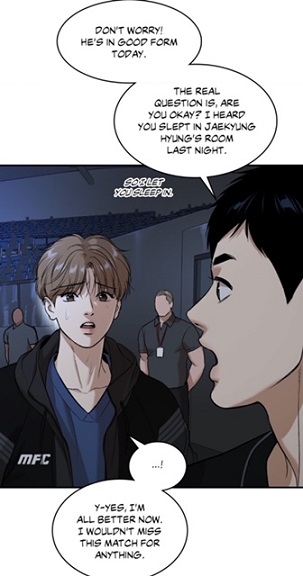
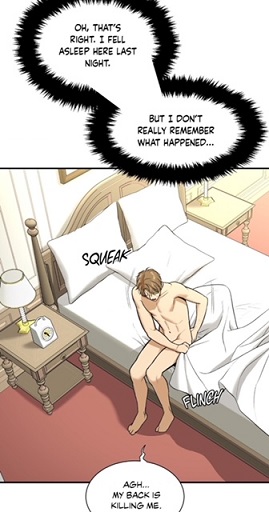
 He has just his blue uniform.


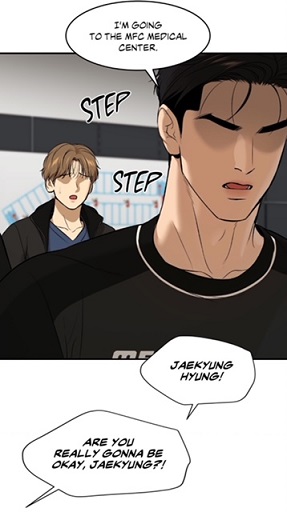 Hence he could get into trouble! The MFC could report the incident to the authorities!
  (chapter 49) in both cases! He was present, when Kim Dan drank the drugged beverage.
  (chapter 38) To conclude, it was not in Kim Dan’s interest to run away or hide! This would have been judged as a sign of his culpability and complicity. He needs to face the problems so that he can shape his destiny with his own hands and not remain the playball of dark forces! Yes, this chapter announces a huge change at Team Black, the start of a real friendship between two puppies. 😉
 (chapter 48) Why did the Webtoonist gave us the time, when the next episode starts another day? On the one hand, it exposes that the schemers knew about the champion’s nightly activities. He wouldn’t sleep much and he would keep his cellphone next to him.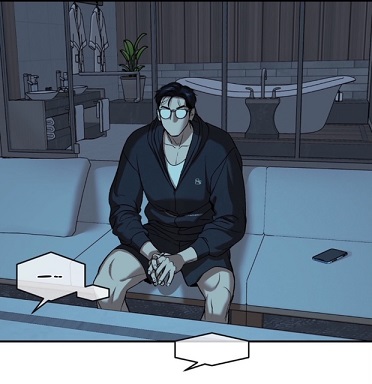
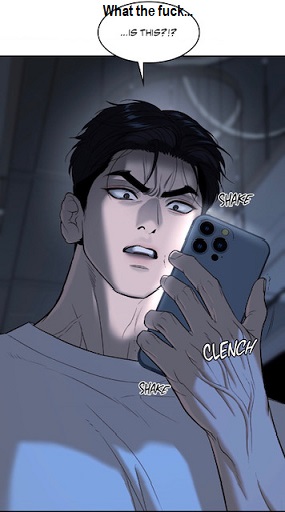 (chapter 35) This made me think of Painter of The Night and No-Name’s advice:
  (chapter 76) “A deed once foiled has no chance of success the second time around”.The criminal was referring to learning through experience. After going through such an event once, the athlete is no longer caught by surprise. We could say that he learned not to jump to conclusions and control his emotions. That’s the reason why in episode 48 he remained level-headed. Because the champion didn’t get angry, he could be more attentive.
  (Chapter 48) The irony is that the doctor had been able to treat the star’s injury. For me, the Summer Night’s Dream played a huge role, as during that night, Joo Jaekyung felt treasured and loved. Therefore the pictures could only expose the duplicity of the director of King of MMA. Under this new light, it becomes understandable why the celebrity didn’t fall into their trap and why they had to turn doc Dan into a traitor by giving him a weapon without his knowledge. Finally, I believe that Joo Jaekyung had another reason not to confront the physical therapist. How so? It is because he had sent away his soulmate, while the latter had approached him.
  (chapter 30) Here, he wished to seek the doctor’s closeness. Nonetheless, if he had gone to Kim Dan’s bedroom during that night, he would have achieved the opposite: he would have created distance and caused an argument. The latter could have told him that he was looking out for himself, for Joo Jaekyung had threatened to fire him. Through these observations, it becomes visible why the athlete couldn’t ask Kim Dan at all. Consequently, I come to the conclusion that the clock
  (chapter 49) The gaze displays not only worry and anxiety, but also regret. It was too late to ask the doctor. For me, he chose silence, for he was regretting his reactions in the penthouse. He feared to ask Kim Dan, because if he brought up the meeting with Choi Gilseok, this could push the hamster to quit his job. However, thanks to Kim Dan, the star’s condition improved greatly. That’s how it dawned on me why the champion became a beast and why he is hiding his past:
 (chapter 26) It is because the man is full of regrets and resent. But by creating new regrets, the champion is incited to focus more on the present so that he stops missing the timing. Because of his immense regrets and frustration, he was still trapped in the past. So he was unable to move on. To conclude, Kim Dan and Baek Junmin pushed him to face his youth and the source of his own unhappiness. His biggest suffering is a secret, because he would appear as weak and pitiful which would ruin his image as the strongest man in the world.
 (chapter 12) the couple was supposed to reach Nirvana, but the athlete failed terribly. Under this new light, it becomes comprehensible why the protagonist chose not to confront Kim Dan in episode 48. It was, as if the champion was closer to the heavens. This represents the champion’s leap of faith. Don’t forget that the star got scared for one moment
 (chapter 48), when he noticed doc Dan’s presence too late. But nothing happened to him, that’s how he got incited to trust Kim Dan. The latter wouldn’t backstab him. Under the blue light, the champion got transformed.
  (chapter 48) On the other side, the fact that the champion is always targeted during the night is a sign that the villains desired to approach him, when he was isolated. So they know not only about his insomnia, but also about his solitude. I would even add that the plotters are aware of his association between the night and danger. Remember how he described relaxation: he would give an opportunity to his enemies to attack him
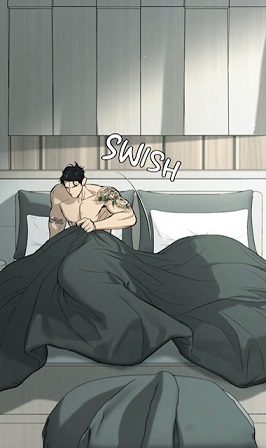


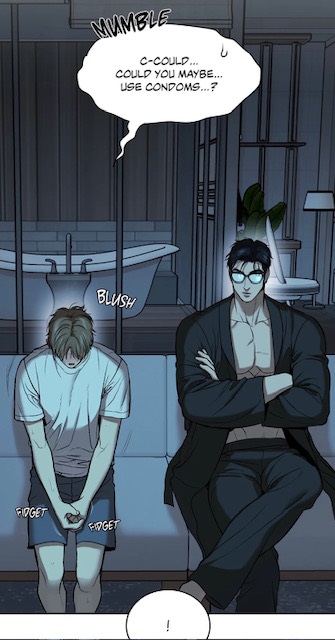


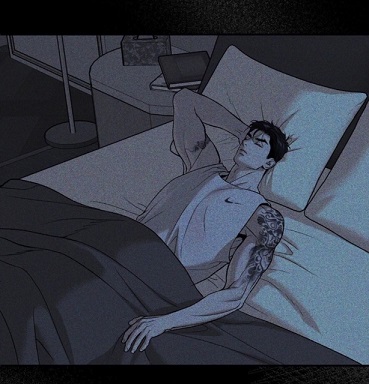
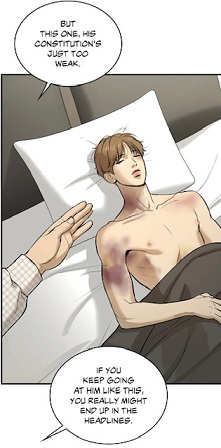 (chapter 13) It is important, because through this terrible experience, Joo Jaekyung came to internalize the connection between sex and danger. This would explain why he has been so rough in bed before. He came to see it as a normality, a sign that his perception of sex had been negatively influenced. And this can only come from bad experiences. It had nothing to do with “enjoying the moment”, until the protagonist met the shy hamster. We can see his gradual transformation. In episode 12, he definitely saw the night as “carpe diem”
 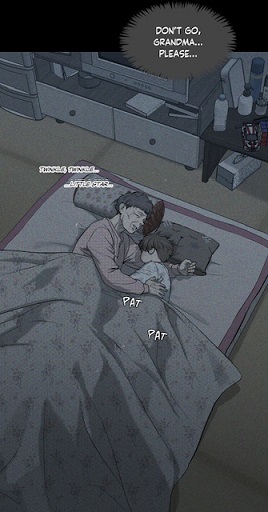 (chapter 21) Furthermore, the champion exposed why he could never relax:
  (chapter 19) or a new request like swallowing the sperm
  (chapter 39) or kissing the champion’s ruined ears
 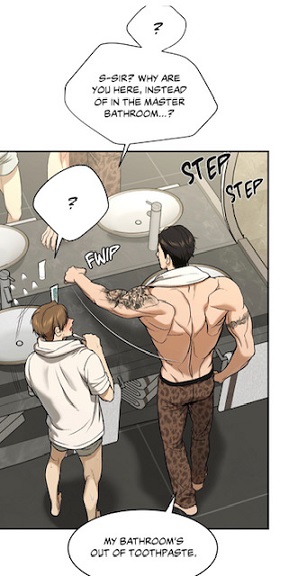 (chapter 30) He was rough and used the toothpaste as an excuse.
  (Chapter 29)
 (Chapter 40) That’s the moment he stopped considering the hamster as a prostitute, while from chapter 2 to 18, he viewed Kim Dan as a tool, as a talisman against his jinx. However, I detected a transition after he kissed the physical therapist. From that moment on, the doctor was connected to food and sweetness.
  (Chapter 18) And now, observe that during the night in the bathroom, doc Dan was associated with a baby receiving food:
 (chapter 20) As you can see, here the champion started viewing him as a human being. It exposes that little by little, his perception of the physical therapist improved. So from chapter 30 to 39, Joo Jaekyung was forced to question the nature of his relationship with Kim Dan: a PT or a prostitute or a pet?
 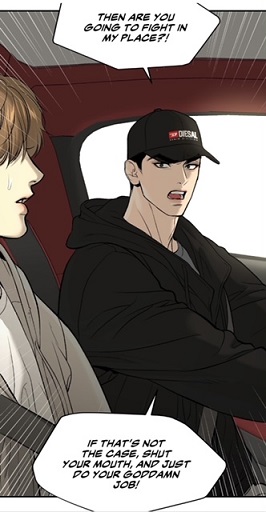 (Chapter 42) He rejected his advice, a sign that he was doubting doc Dan’s skills and competences. That’s the reason why I come to the conclusion that with the pictures, the champion was pushed to admit that Kim Dan is his physical therapist
 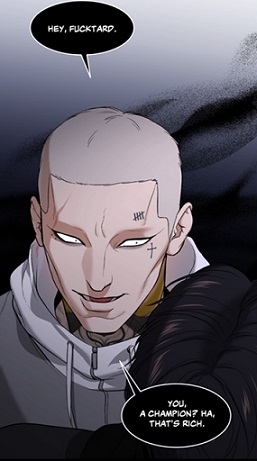 (chapter 49). These meetings are not random at all, a sign that someone knows about the athlete’s hidden suffering very well. Observe that both characters challenged the celebrity by giving him an order:
  (chapter 33)
  (chapter 49) Then I noticed another parallel between the two plots: the presence of a scapegoat, and the involvement of a third person. Heesung faked his injury by putting the blame on the athlete, while he asked Kim Dan as compensation. In the second plot, the roles are switched. Kim Dan is now the perpetrator, while the athlete is the victim! Baek Junmin is the beneficiary of this scheme. And what do these plots have in common? Joo Jaekyung is the victim of a trick, though Heesung’s manipulation was rather benign. First, he acted on his own.
  (Chapter 31) Moreover, he utilized the genuine concern and innocence of his surroundings. In other words, he used his image as a good and honest man to his advantage. Thus I come to the conclusion that the artist’s sin in their youth was rather minor, as the artist tends to violate social norms. So though it was no illegal, the actor’s wrongdoing definitely left scars on the protagonist’s heart.
  (Chapter 30) Another common denominator between The Shotgun and Heesung is their envy and greed.
  (chapter 46) could be seen as a reflection from the arcade and the star’s past. And since Kim Dan wounded Joo Jaekyung in the locker room
  (chapter 49), I deduce that such an action must have happened in the champion’s youth. He got not only hurt by people, but also betrayed by a friend. There exists many reasons for this hypothesis.
 (Chapter 04) and be rude towards others.
 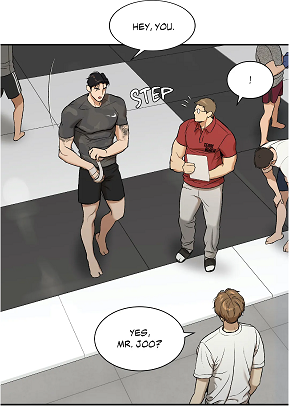 (Chapter 7)
 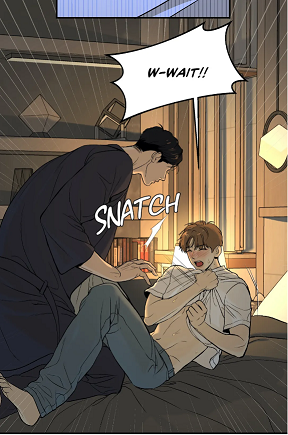 (Chapter 3) Some of them are not written in Korean or English. Moreover, the Webtoonist revealed that one of his hobbies is reading. This explains why he can talk prettily.
  (chapter 22) This shows that his behavior mirrors the counterpart’s. Consequently, it is not surprising that the champion is rough with his own body, as Park Namwook is not treating him like a delicate child.
  (Chapter 40) Compare Kim Dan’s English skills in the same scene:
  (chapter 40) Besides, Jinx-philes should question why Mingwa is not divulging his scores as a student contrary to Kim Dan or Jinwon from BJ Alex. It is because she wants to create a certain image about the champion: he is a bad boy. In my eyes, she is playing with prejudices about MMA fighters. People often imagine, they lack social manners and education. They chose this path, for they could do nothing else. And this brings me to my next remark. We know that Kim Dan selected PT because of his halmoni.
  (chapter 27) I see a contrast between these two sports: swimming which is related to relaxation, pleasure and fun and MMA fighting which stands for challenge, pain and seriousness. This contrast is even more present in the following panel:
  (chapter 49) He is a hyena, hence his color is brown.
  (Chapter 48) And The Shotgun has a similar attitude:
  (chapter 49) Interesting is that his description of the challengers fits the situation in the new plot perfectly. The Shotgun imagines that he will fight against a diminished champion. His shoulder is injured and they have planned to add a new injury. The hyena stands for balance and cleansing as their task is to remove the weak ones.
 (chapter 49) As an old man, Choi Heesung is revealing vulnerability and senility. Due to his old age, he could be replaced by another hyena, a younger hyena!
 (chapter 5), as he is the only person who has not appeared yet, though the champion has his cellphone number. And this remark brings me back to the present and the night messages and the hyenas.
 (chapter 36) which could only affect the members from Team Black. Their loyalty could waver. Then he got to hear bad comments from the Internet
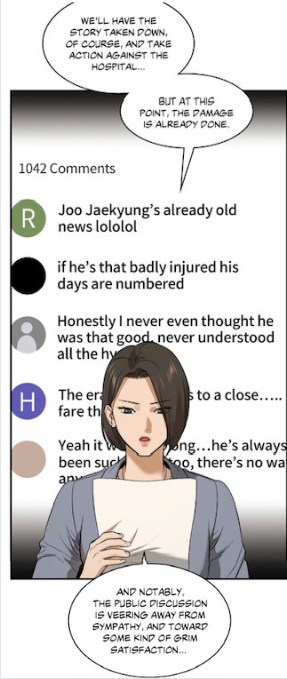 (chapter 36), creating the illusion that he was losing popularity. That’s how the lawyer could convince the champion to accept a new match in such a short-time. Finally he got reprimanded for his outburst.
 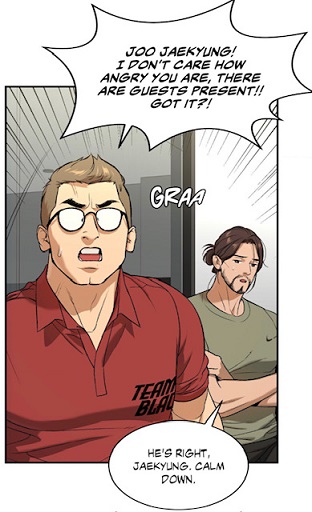 (chapter 36) Under this new perception, Manhwaphiles can grasp why the MFC manager offered him a new defy right away. They needed to exploit his injury!
  (chapter 13) This could have ended badly. Another wrongdoing could be the rejection of his birthday present and his harsh reaction.
  (chapter 48) Through them, the champion is learning that hunting weak and pitiful creatures is not only a sin, but also a crime! In the first case, he could be accused of hurting an innocent.
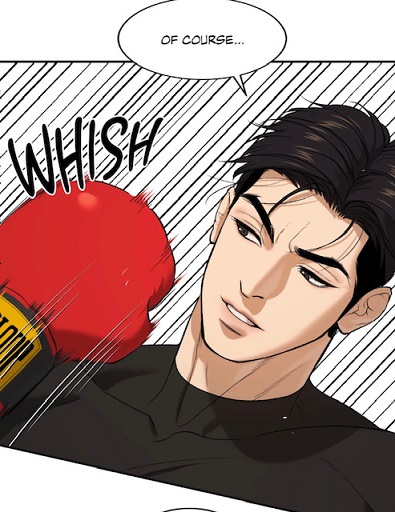 (chapter 26) For the first time, he had fun sparring. Hence he kept smiling. It is no coincidence that soon after he chose to accept to take a day-off, when Kim Dan made the suggestion.
 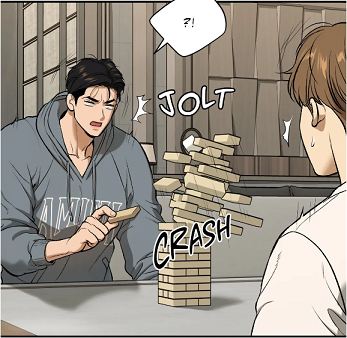 (chapter 27) That’s how he remembered that he liked swimming and he could play a prank on his lover.
  (chapter 35) and not in episode 48. It is because Kim Dan had paid him a visit during that night, a sign that he was thinking of him as his patient and VIP client.
 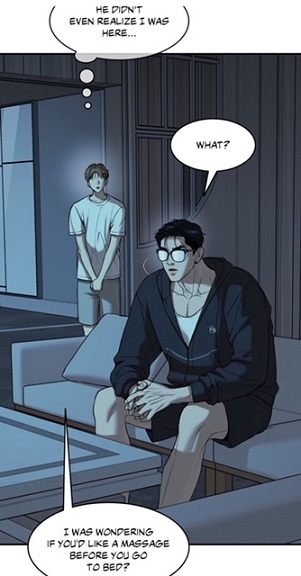 (Chapter 48) On the other hand, I am inclined to think that when a terrible incident in his youth occurred, he couldn’t contact his family or guardian. Hence he keeps his cellphone by his side constantly. Yes, I was thinking of the doctor’s assault in the street and his failed rape:
  (Chapter 16) Heo Namwook’s minions had confiscated his cellphone. Hence it was impossible for him to call for help. And now take a closer look at this scene:
 (chapter 37)
  (chapter 49) And the anonymous person on the other side of the phone was definitely calling in order to be updated about Joo Jaekyung, for his coach asked him about his physical conditions.
 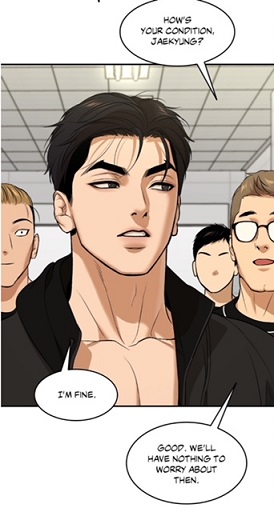 (chapter 49) That could be the hidden guardian who has not showed up yet, I am thinking of Seo Gichan. And now it is time to close this long essay.


 (chapter 46) On the other hand, chapter 47 exposes that the doctor didn’t lose his interest and attention towards his boss.
  (chapter 47) This exposes that Kim Dan didn’t choose resent or indifference towards Joo Jaekyung despite the inflicted pain. On the other hand, why did I write that the celebrity is Kim Dan’s reflection? Why is the athlete the doctor’s mirror of truth? It is because Joo Jaekyung embodies his negative reflection: independency and toxic negativity. But what is the latter exactly?
 (chapter 31) It is because when the psychologist met the patient with her boyfriend for the first time, he paid attention to his micro-expressions, and more particularly to his mouth. He saw his smirk. Here, I feel the need to give an explanation how these micro-expressions were discovered.
 (chapter 30) As my avid readers can detect, the expression from the boyfriend’s mouth displeased the white-haired psychologist. He could recognize his emotion, though such facial expressions are very short-lived
 .(chapter 30) So what was the “jerk” feeling, when he was conversing with Sihyun? Cynicism.
  (chapter 31) And the reason why he stated that as soon as cynicism or scorn was present in a relationship, the couple would end up breaking up is because of John Gottham’s observations and conclusions.
 (chapter 45) We could sense it in different scenes, though I would say that his cynicism was slowly vanishing:
  (chapter 3)
 (chapter 40) This is the so-called toxic negativity. Therefore it was to expect that the champion would reject the doctor’s present. He could only doubt the sincerity behind his gesture. How so? Remember how the team desired to celebrate his birthday: a surprise party. They bought a cake…
  (chapter 43) but what happened afterwards? Yosep spoke in the name of the gym’s owner: the latter would pay for the dinner (beef restaurant)
  (chapter 43) So technically, they offered a cheap cake and got in exchange a super expensive dinner. One might say that this was just a joke. But cynical people are taking things very seriously. This is what the champion learned from this experience, the cake in exchange for a super expensive meal … and now imagine that the next morning, he received an „expensive“ present from Kim Dan which was similar to the gifts from fans (exchange of favors). It is normal that he doubted the genuineness from his doctor, not only because of his past experiences, but also because of the parties before. But there exists another reason why he had to refuse the gift: Cynicism… the end of relationship. Thus dating for the athlete was impossible.
  (chapter 8), in the office, in the car, in front of a mirror, in front of Heesung in the living room… Don’t forget that Diogenes would even masturbate in public.
  (chapter 46)
  (chapter 46) Consequently, he never tried to get close to his members either. In fact, he is expecting from the staff to follow his lead. Potato could only get rejected with such a request.
  (chapter 23) The latter had to act like a true disciple and follow the champion’s recommendation.
  (chapter 23) The gym is like his sacred temple. Yet, the gym is just a simulacre of “nature”, as it is in the middle of Seoul. Therefore I realized why after their argument, Joo Jaekyung avoided the penthouse and Kim Dan in the end.
  (chapter 10) He is not resigning on designer clothes.
  (chapter 42) His dress room is the evidence of his hypocrisy. He might have encouraged Kim Dan to have sex in “public places”, yet he is still hiding his sexual orientation. Furthermore, his jinx is the evidence of his dishonesty.
  (chapter 45) He might advocate autonomy and self-sufficiency, the reality is that he likes luxury. Hence he is unable to live in harmony with nature. This shows that the fighter is in denial and is living in an illusion. Thus he can not find true happiness, for his freedom is not real. He is attached to the gym which is also strongly connected to his career as the Emperor.
  (chapter 46) With his brutal attitude, he is doing himself a disservice. Exactly like Kim Dan, he is even ruining his career and own reputation. Not only he lost 4 athletes (I am including Seonho), but also his loyal admirers are calling him a thug now:
  (chapter 47) Even Potato announcing the gradual Coming-Of-Age from his admirer. However, like Dr. Frost mentioned it, humans are social beings.
  No one can survive on his own. This explicates why Cynics had disciples in the end. And now, you comprehend the role of Kim Dan in Joo Jaekyung’s life. It is to remind him of his true nature. He is a human and not a dog-wolf. Thus the champion recommended his PT to live elsewhere, a sign that he was indeed a human.
  (chapter 10)
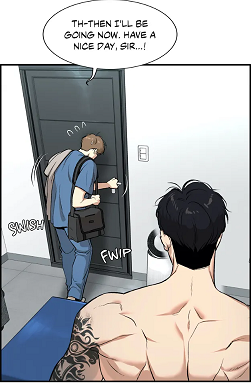 (chapter 1) Then the micro-expressions from Kim Dan exposed his lie
  (chapter 11) He even looked like a ruler abusing his authority.
  (chapter 11) Here, the champion thought that Kim Dan had been gambling. An emperor or ruler, especially one characterized by a lack of idealism, may embody the cynical belief that individuals are primarily driven by self-interest and that altruistic motives are rare. Therefore the celebrity rejects the notion of soulmate
  (chapter 33) or even the idea of friendship
  (chapter 10): Gamblers, laziness, no sense of hygiene etc. Consequently, he is not capable to understand the worries from Kim Dan
 (chapter 36)
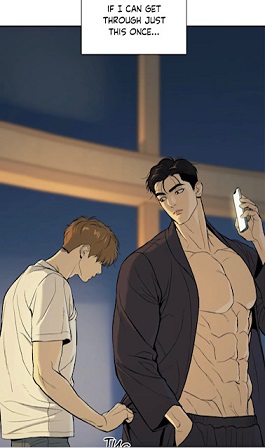 (chapter 2)
 (chapter 45) was showing the doctor’s golden heart. He was just judging his lover based on his past experiences and his negative worldview. And this brings me to list the cause for Cynicism:
 (chapter 2) He learned through Cheolmin that he could kill him. This shows his good nature in verity. Hence he resorted to such gestures, when his cynical depression resurfaced:
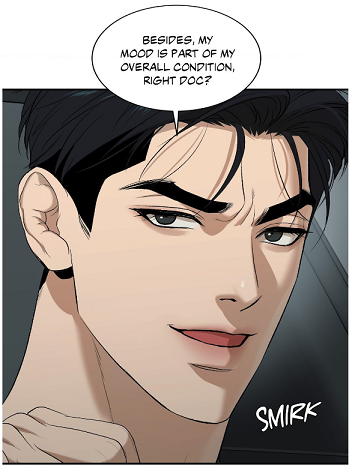 (chapter 32)
 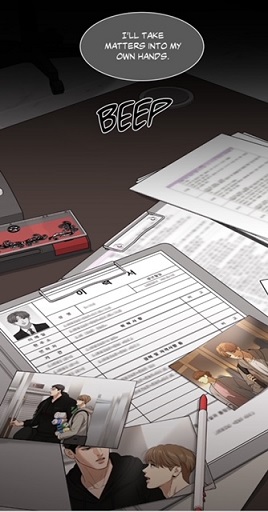 (chapter 46) The irony is that Joo Jaekyung is not recognizing his own transformation. The most obvious evidence for his metamorphosis is the absence of his jealousy towards the doctor.
 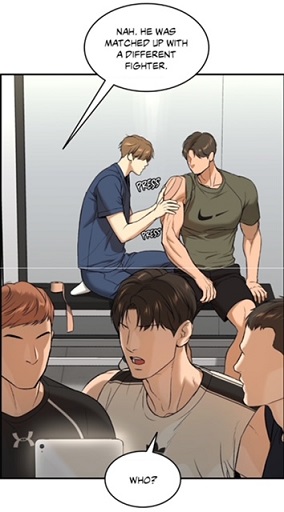 (chapter 47) It shows a certain trust. One might argue about this interpretation. This could be seen as indifference. However, I believe that his altercation with Seonho must have been quite an eye-opening for the champion.
 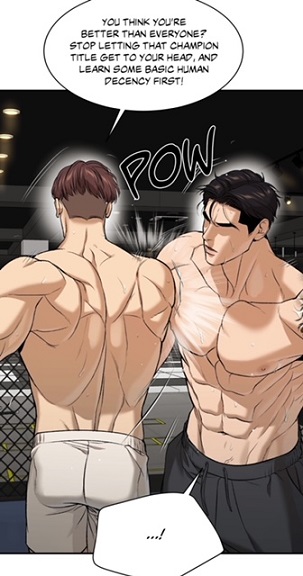 (chapter 46) It is because Kim Dan had not talked back to Joo Jaekyung during their argument. He had accepted his criticism silently contrary to Seonho. Right now, he has the impression that he still has the upper hand, but he couldn’t be more wrong.
  (chapter 47) First, I would like to outline that neither the manager from the Entertainment agency nor his acolyte brought up the underground fighting ring and Baek Junmin’s dubious success.
  (chapter 47) With their video, they presented him as an average and reliable fighter.
  (chapter 47) Observe the divergence between the advisors’ words and the members’ from Team Black.
  (chapter 47) The latter portrayed Baek Junmin as dangerous, for he would use any mean to win the fight. He doesn’t stand for fairness and responsibility. The champion didn’t get to hear anything about these rumors.
 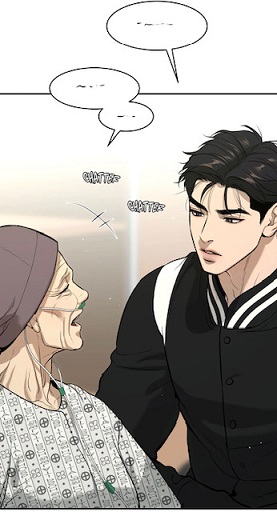 (chapter 21) Moreover, the grandmother’s mortality could serve as a reminder for the champion that he is also a human… just like the others he condemns. Besides, she embodies true selflessness and gratitude. Hence she took the champion’s hand to thank him
 (chapter 22) This is what psychologists recommend to overcome Cynicism:
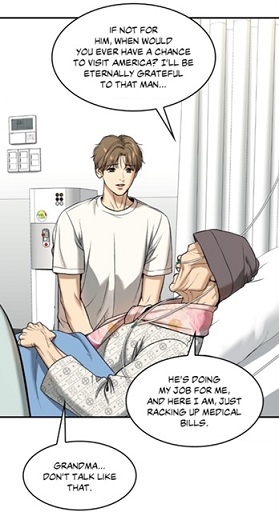 (chapter 41) He never heard her recognition. In addition, until now, Kim Dan spoke in the name of others or didn’t defend his own point. Team Black’s loyalty would be the evidence that it is dangerous to judge people based on prejudices and past experiences. He needs to reflect on his own actions as well. If the Emperor heard “his members”, he would realize that MFC as an organization is corrupted and is even involved with criminality. He is already sensing something, but he can not identify the problem.
 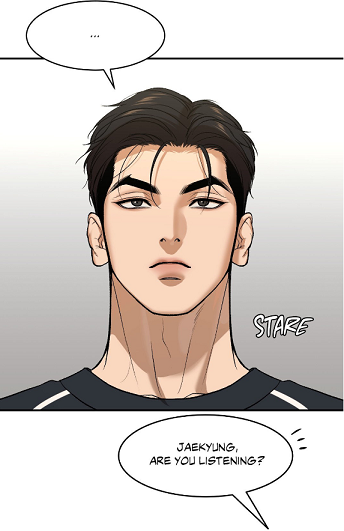 (chapter 47) Should Kim Dan divulge Baek Junmin’s connections to the underground fighting ring or simply show him the message,
 (chapter 47), he would prove his faithfulness and sincerity to the fighter. And the vicious circle would be broken. Though he is broke, he would give up on an opportunity to earn some money easily. To conclude, as long as the champion is still a cynical character, he can not enter a relationship with Kim Dan. For that, he needs to open up his heart and third eye so that he can recognize his partner’s selflessness and honesty. Finally, he will realize that he needs the assistance of others in order to be able to keep his reputation intact (witnesses, supporters). There is no doubt that the Emperor will be badmouthed again.
 Bebebisous33s' analyses in K-Dramaland and Manhwas