
Please support the authors by reading Manhwas on the official websites. This is where you can read the Manhwa: Jinx But be aware that the Manhwa is a mature Yaoi, which means, it is about homosexuality with explicit scenes. Here is the link of the table of contents about Jinx. Here is the link where you can find the table of contents of analyzed Manhwas. Here are the links, if you are interested in the first work from Mingwa, BJ Alex, and the 2 previous essays about Jinx The Painful Mermaid’s Aspiration and The Mermaid’s Illusion of Love
It would be great if you could make some donations/sponsoring: Ko-fi.com/bebebisous33 That way, you can support me with “coffee” so that I have the energy to keep examining Manhwas. Besides, I need to cover up the expenses for this blog.

In Jinx, the evolution of Joo Jaekyung and Kim Dan’s relationship can be traced through the symbolic use of kisses [for more listen to Kiss Me], specifically the one in the locker room  (Chapter 15) and the life-saving kiss on the beach
 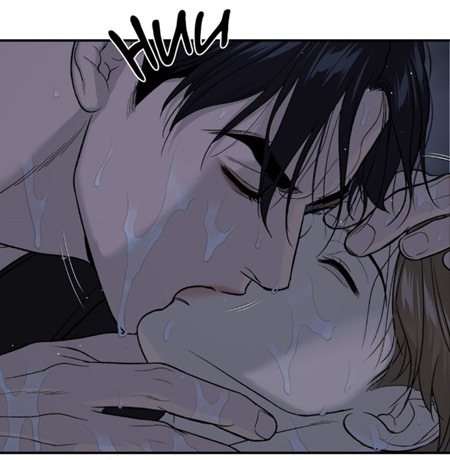 (Episode 60). Both moments carry significant emotional weight but reflect different facets of their dynamic, from selfishness to selflessness, secrecy to openness, and miscommunication to recognition. The setting and circumstances surrounding these kisses not only highlight the characters’ growth but also underscore the unresolved struggles they face.
Selfishness vs. Selflessness
The kiss in Chapter 14 and 15 was performed under the pretense of care but was marked by a sense of urgency and concern. Joo Jaekyung, lost in his thoughts and experiencing a form of derealization  (chapter 14), acted particularly rough with Kim Dan
 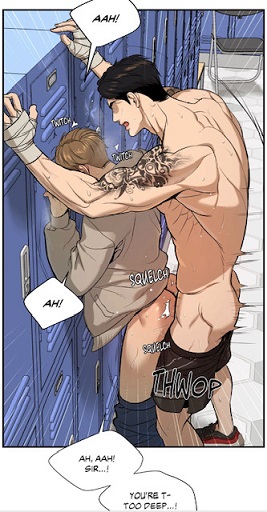 (chapter 14), only snapping back to reality when he felt Kim Dan’s body trembling.
 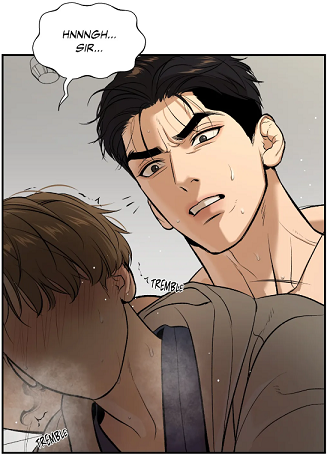 (chapter 14) This moment of realization, coupled with the doctor’s tears and plea
  (chapter 14), served as the trigger for Joo Jaekyung to recall Cheolmin’s recommendation
 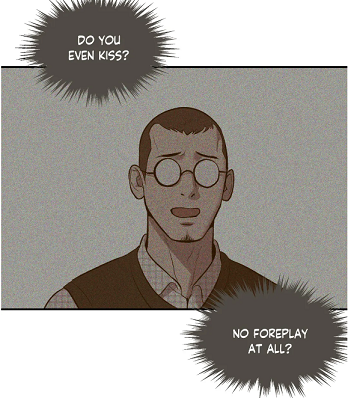 (chapter 14) of using foreplay and gentler methods, such as a kiss. While the kiss reflected care in the moment
 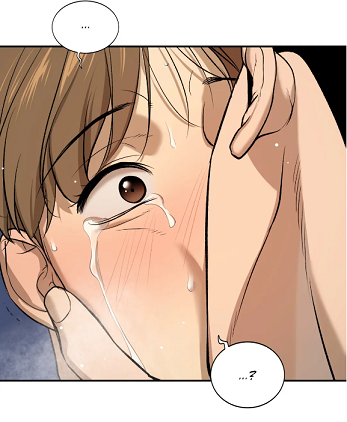 (chapter 14), selfish motives lingered in the shadows, as Joo Jaekyung sought to prevent causing visible harm that could lead to questions or even a scandal. It was, as if he wanted to silence his partner. Moreover, this decision was influenced by external suggestions, particularly from his friend, and not entirely by his own intentions. It was a calculated action to prevent immediate harm but lacked genuine emotional depth.
Interesting is that Kim Dan never dared to question Joo Jaekyung for this sudden kiss. 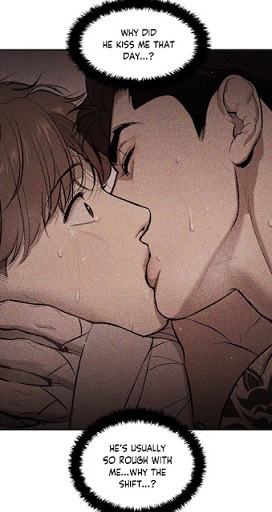 (chapter 16) Moreover, he never wondered why Joo Jaekyung had asked for sex in the locker room, which represented a change in his behavior. If he had done it before, then he would have forced the physical therapist to travel with him to Busan.
  (chapter 13) As you can see, through the comparison with the kiss on the beach, I realized the doctor’s passivity and lack of critical thinking in season 1. He never asked why the athlete was so rough during sex. He took this for a normality. His attitude exposed the doctor’s biased perception of his boss: a spoiled and rough man obsessed with sex. I would even add that the kiss had a positive effect on the protagonist
  (chapter 15), because for the first time, Kim Dan made a request. With his remark, he implied that the kiss was strongly associated with emotions. However, exactly like Joo Jaekyung pointed out
 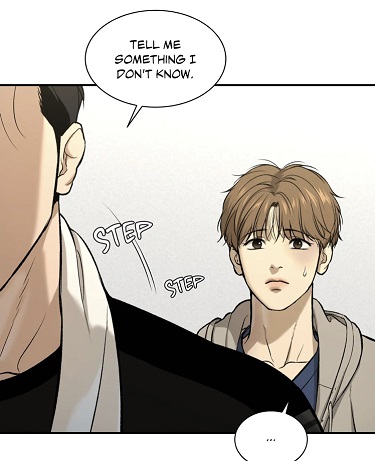 (chapter 15), the physical therapist omitted something important in the locker room. First, he didn’t share all his thoughts about the athlete, in particular his prejudices. Finally, he should have talked about his behavior before the kiss. What was he thinking, when he was having sex with him? In verity, he had been used as a substitute. In other words, the champion’s selfishness was rubbing on the doctor. Both were selfish, both had their heart and mind closed. And this remark brings me to the kiss on the beach.
In contrast, the kiss in Episode 60 (chapter 60) was executed purely for Kim Dan’s sake. It was a spontaneous, instinctive act of CPR to save his life, demonstrating selflessness and true concern. Unlike the locker room kiss, which carried both urgency and selfish motives, the beach kiss was entirely devoid of emotional connection, functioning solely as a technical gesture. Kim Dan was unconscious and unaware of the act, which stripped it of any emotional reciprocity. Here, Joo Jaekyung saw Kim Dan as a human being—detached from his social background and circumstances. This shift in perception is reflected in the location: the openness and natural beauty of the beach stand in stark contrast to the confined, artificial environment of the locker room. Joo Jaekyung’s willingness to perform this act in the open signifies a progression in his character—a gradual dismantling of his secrecy about his sexuality and his connection to Kim Dan. This shift from selfishness to selflessness illustrates not only Joo Jaekyung’s emotional growth but also the deepening of his bond with Kim Dan.
Secrecy vs. Openness
The locker room serves as a metaphorical closet  (chapter 15), a confined space symbolizing Joo Jaekyung’s need to keep his relationships private. Picking up partners at a VIP club
 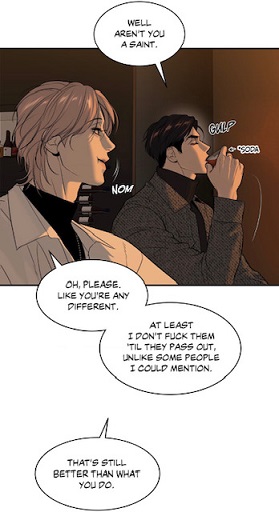 (chapter 33) was another extension of his desire to maintain secrecy. By contrast, the beach in Episode 60 is a public, open space, reflecting a significant shift.
 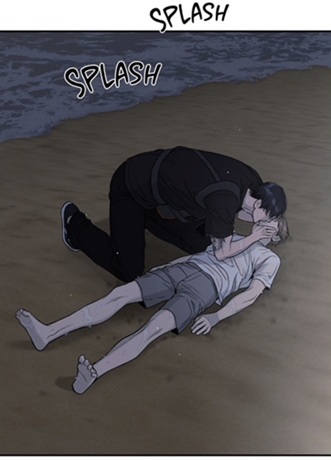 (chapter 60) Moreover, in the past, the locker room
  (chapter 14) was always filled with people surrounding the champion. However, once Kim Dan entered his life, this dynamic began to change. In Episode 14, Joo Jaekyung asked everyone to leave the locker room,
  (chapter 14) even excluding Park Namwook, who was even seen before stationed outside the bathroom door,
 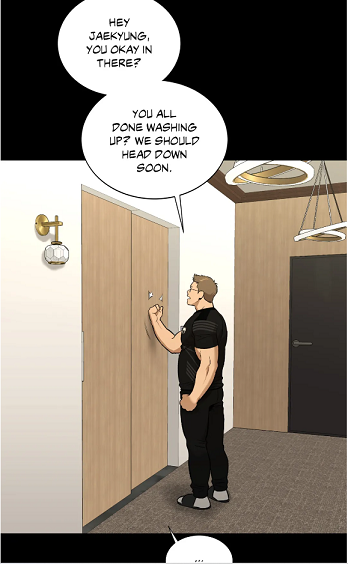 (chapter 14) signaling a gradual exclusion of others from his private life and emotions. By Episode 15, Joo Jaekyung explicitly sent away his manager to have a private conversation with Kim Dan.
 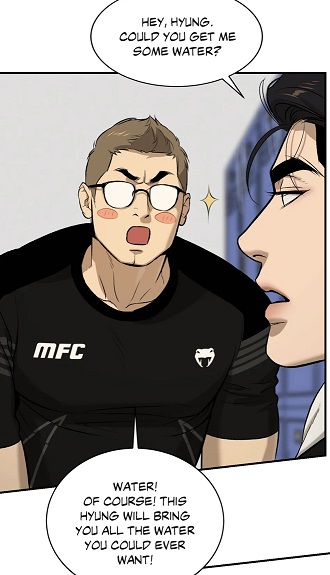 (chapter 14) This shift highlights the increasing importance of Kim Dan in Joo Jaekyung’s personal sphere. Interestingly, this progression is contrasted by Episode 49, where Joo Jaekyung deliberately ensured
  (chapter 49) he was not left alone with Kim Dan. This means that this place was no longer the synonym for privacy and secret. This reflects why director Choi could intrude with his minions. Following the incident with the switched spray, Kim Dan was left behind
  (chapter 50) in the locker room twice
 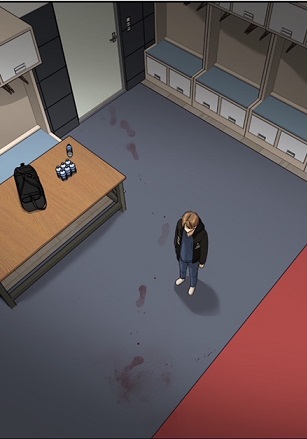 (chapter 51), which could only increase the physical therapist’s feelings that he didn’t belong to Team Black. He was not part of that “family”. And this coincides with the moment where Kim Dan cries for the last time:
 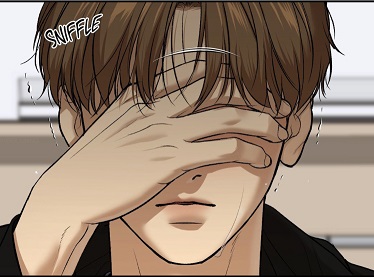 (chapter 51) From that moment on, the main lead won’t show his vulnerability and pain to others. This gesture announces the return of his “blue friend”, the depression.
Moreover, keep in mind what the grandmother used to say constantly to her grandson: “Don’t cry” 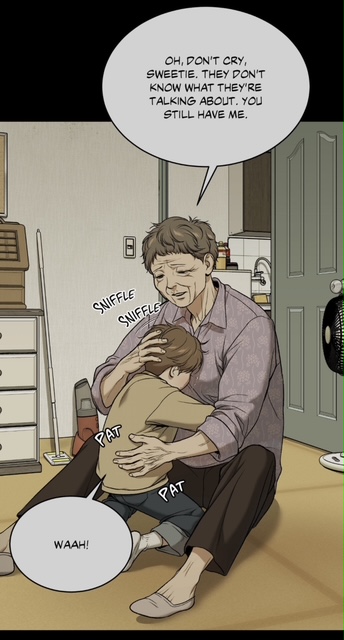 (chapter 57) Shin Okja must have felt uncomfortable with his tears and pain, therefore the doctor internalized not to show his struggling and burdens in front of his grandmother. This explicates why he denied his weeping in front of her first.
  (chapter 47) And now, you are wondering how this is relevant to the scene on the beach. Joo Jaekyung got shocked and scared, but he didn’t cry later and it is the same for Kim Dan. Hence the latter could deny his presence on the beach and even ignore the athlete’s words:
  (chapter 60) The absence of tears or a trembling body from the main leads indicate that both are hiding their emotions from each other.
  (chapter 60)
And because Kim Dan came to symbolize the fighter’s intimacy and privacy, it is no coincidence that their relationship ended in the locker room. There, the champion exposed his true thoughts about the doctor: his lack of professionalism, 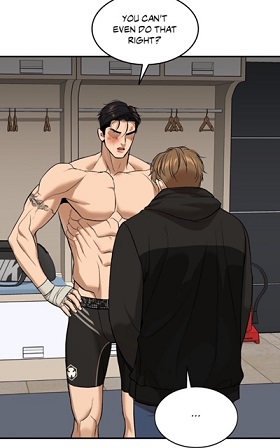 (chapter 51), his lack of loyalty, his greed and obsession for money.
  (chapter 51) Here, they were totally honest to each other:
  (chapter 51) Though the champion was restraining himself, he didn’t realize that his words were like punches to Kim Dan. The latter got to hear what he didn’t know.
  (chapter 51) Despite living together in the penthouse, he didn’t trust his room mate. After divulging his mistrust and anger to the physical therapist in the locker room, the former left Kim Dan behind and went to the health center with his hyungs. (chapter 51) What he didn’t realize is that the doctor stood for secrecy and closeness, so by leaving his side, he was destined to be exposed.
 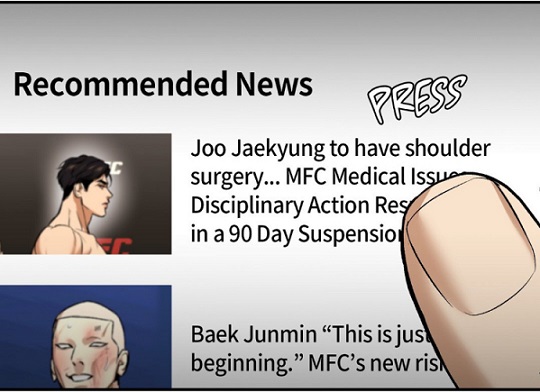 (chapter 52) The conversation in the locker room symbolically announced the champion’s private struggles to the media, as his bad temper was made public shortly after.
Through these events, the kiss in the locker room becomes full of symbolism. It not only marked a moment of urgency but also served as an emotional awakening for Joo Jaekyung  (chapter 15) , representing his need for mental and emotional support, which his team and entourage failed to provide. While the CPR kiss could be dismissed as a rescue, it symbolically represents a step toward Joo Jaekyung revealing his true self. The kiss marks a moment where he unconsciously begins to acknowledge his feelings and his homosexuality, even in a setting where others could witness it.
By contrast, the couple on the beach in episode 60  (chapter 60) was surrounded by nature. Hence they could show their true self: their exhaustion, desire and emotions. While the doctor was suicidal due to his depression and fatigue, the champion’s worries were genuine. Yet Kim Dan was not able to hear them.
  (chapter 60) This means that on the beach, Kim Dan could only detect one thing: Joo Jaekyung’s presence. But he didn’t sense his kisses and hear his words. That’s the reason why I come to the conclusion that this scene stands under the sign of “dream and illusion”.
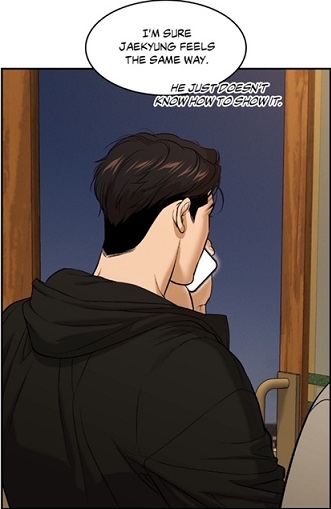
  (chapter 60) Hence he came to reject his “intervention” as a lie and deception. The reality is that Joo Jaekyung does care for him, but he doesn’t know how to show it. He fears attachment. Because of his misjudgement, Kim Dan is not capable to notice the transformation in his former boss.
 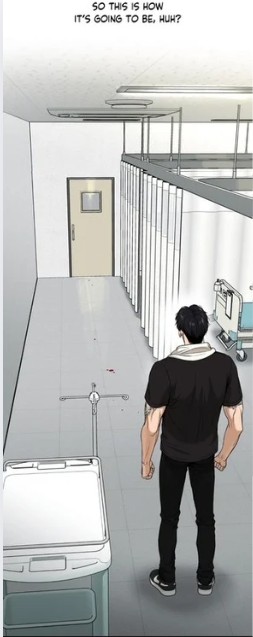 . (chapter 60) The latter has now darker circles, and he lost a lot of weight.
 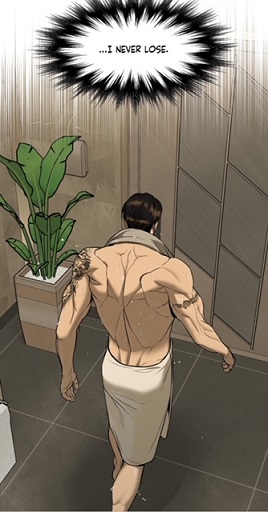 (chapter 49) His muscles are less pronounced. He is also wasting away.
This progression also ties to the concept of nature vs. artifice. The natural setting of the beach—the waves, the open sky—contrasts sharply with the sterile, artificial environment of the locker room. Nature brings out authenticity and raw emotion, whereas the locker room and the emergency room 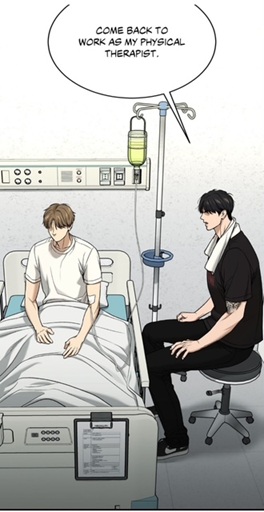 (chapter 60) reinforce control and suppression. In the locker room, the absence of time and space to relax or meditate highlighted the pressures placed on Joo Jaekyung by his manager and coach (chapter 14)
 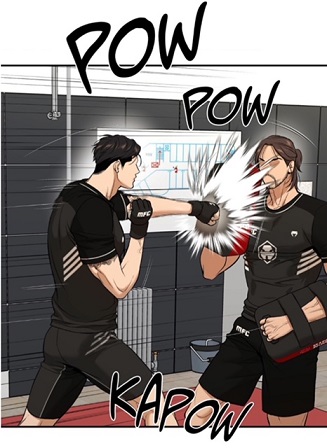 (chapter 49), who believed that physical strength alone would solve his problems. This environment denied him the mental and emotional support he truly needed. (chapter 15) The kiss in Chapter 15 became a moment where Joo Jaekyung discovered not only physical pleasure but also positive emotions, which acted like a sweet candy, a reward for his hard work. (chapter 15) It gave him emotional support. It symbolized a rare moment of relief and connection amidst the overwhelming demands of his environment. Joo Jaekyung’s actions in these settings highlight his gradual move from a place of concealment to one of openness and authenticity. While the CPR kiss could be dismissed as a rescue, it symbolically represents a step toward Joo Jaekyung revealing his true self. (chapter 60) The kiss marks a moment where he unconsciously begins to acknowledge his feelings and his homosexuality, even in a setting where others could witness it.
Lies and Miscommunication
Another layer of complexity is revealed when examining the two kisses. From that wonderful night  (chapter 44) on, Kim Dan never got kissed again. The absence of a kiss in the locker room was revealing Joo Jaekyung’s lack of faith in Kim Dan. His mistrust left such an emotional wound, which is only visible to the third eye.
  (chapter 54) Because Joo Jaekyung saw it in a vision, it becomes clear that the athlete is still in denial about his wrongdoing. Therefore he didn’t apologize for his false accusations and his bad perception of the physical therapist:
 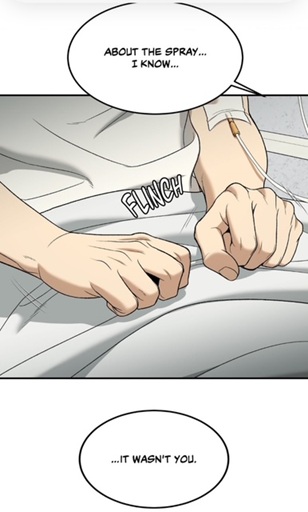 (chapter 60) By admitting that he knows about his innocence, he imagines that he can get scott-free. But he is wrong. His skepticism and dismissiveness wounded Kim Dan’s heart and mind, leaving scars that reverberate through their future interactions. Kim Dan can no longer trust him now
 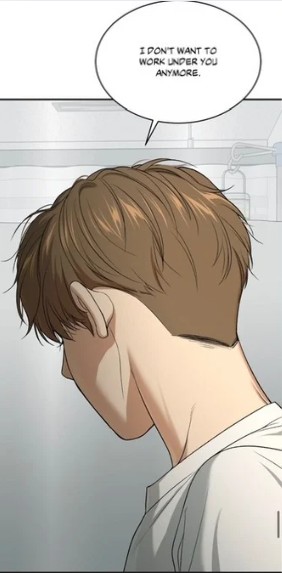 (chapter 60) , though there is no doubt that the doctor is still in love with him. At the hospice, this mistrust resurfaces. The parallel conversations—in the locker room and the emergency room—highlight the ongoing cycle of miscommunication and emotional disconnect. Both characters, in their own way, lie to themselves and each other. Joo Jaekyung sees Kim Dan through the lens of poverty and greed
  (chapter 60, reducing his identity to his need for money, while Kim Dan rejects his offer, his help and conceals his pain. It is not surprising that Kim Dan left the treatment room.
  (chapter 60) By doing so, he is denying his rescue and assistance. It was, as if this night and as such the kiss had never happened.
The beach, however, offers a stark contrast. There, in the midst of the emergency, Joo Jaekyung’s perception of Kim Dan shifts. For the first time, he sees him as a human being—vulnerable and in need of genuine care.  (chapter 60) The lies and miscommunication fade in the face of the life-and-death situation. However, this recognition is short-lived, as the events at the hospice reveal Joo Jaekyung’s lingering selfishness (chapter 60) and inability to fully comprehend the seriousness of Kim Dan’s mental and physical state.
Kim Dan as Joo Jaekyung’s Reflection
Episode 60 also underscores the parallels between Kim Dan and Joo Jaekyung. Both characters are struggling and mistreating their bodies, albeit in different ways. Kim Dan’s rejection of help and his deteriorating condition mirror Joo Jaekyung’s past behavior of ignoring medical advice and pushing himself to extremes. This dynamic serves as a reflection, forcing the champion to confront his own flaws. Kim Dan’s condition becomes a metaphorical mirror, showing Joo Jaekyung the consequences of neglecting physical  (chapter 27) and mental well-being.
  (chapter 27) When Kim Dan removed the needle carelessly (chapter 60), he was actually copying his lover’s behavior.
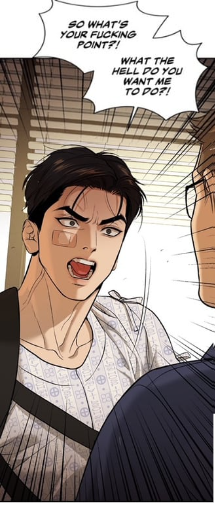
The dissociation and derealization evident in Kim Dan’s behavior 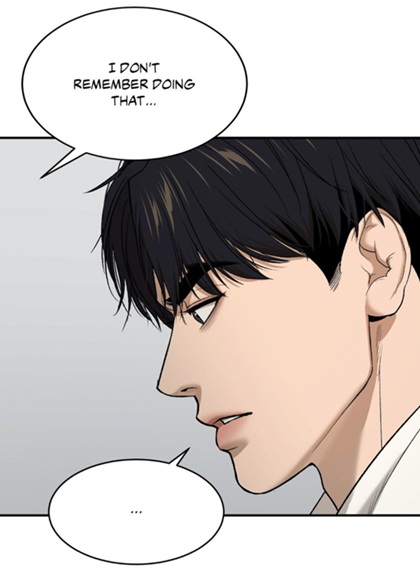 further highlight his mental fragility. This fragility contrasts sharply with Joo Jaekyung’s reaction during their interaction at the hospice. When the champion angrily asks,
  , his words reveal frustration and a superficial understanding of the situation. Rather than addressing the underlying psychological distress driving Kim Dan’s actions, Joo Jaekyung perceives them as reckless behavior. His focus remains on immediate danger rather than the deeper cause, showcasing his emotional detachment and inability to grasp the full seriousness of Kim Dan’s mental state. This misinterpretation underscores how Joo Jaekyung is still projecting his own coping mechanisms onto Kim Dan, assuming that sheer willpower and physical strength can resolve emotional struggles. This moment serves as a stark reminder of Joo Jaekyung’s ongoing growth and the gaps in his understanding of Kim Dan’s suffering. His denial of having gone to the beach, despite clear evidence, points to the depth of his trauma. (chapter 60) That’s why I can’t shake the feeling that the physical therapist is still in danger. The trail of blood on the floor could be interpreted as a bad omen. (chapter 60) Many Jinx-philes saw parallels between the champion’s departure from the locker room with the final image from chapter 60, (chapter 51) However, in the last image, the athlete had left the room to go to the health center, while Kim Dan is now leaving the treatment room, a sign that he is not just rejecting the champion’s help, but also the hospice’s intervention.
  (chapter 60) So he could get into trouble in his profession.
This moment becomes a turning point for Joo Jaekyung, as he is about to grasp the gravity of Kim Dan’s mental illness. However, his focus on money and material solutions 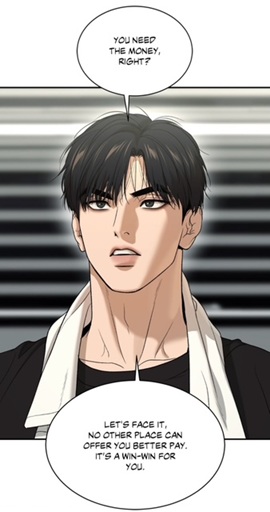 (chapter 60) at the hospice contrasts sharply with the purity of his actions on the beach, underscoring his ongoing struggle with selfishness and superficiality.
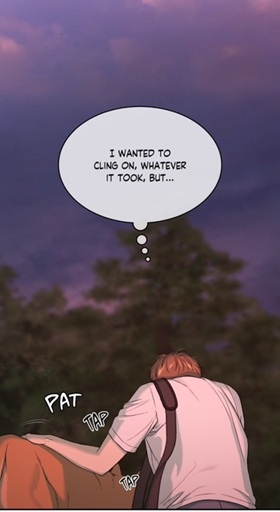
As long as Joo Jaekyung hides his vulnerability and hides his true self to achieve his goal, Kim Dan will mirror his actions. He will deceive him too. However, we shouldn’t see their separation  (chapter 60) at the end of episode 60 as something negative. How so? It is because Kim Dan never said this:
 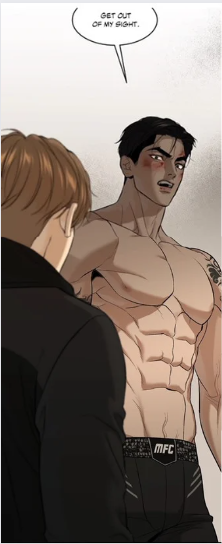 (chapter 51) He never wished to never see Joo Jaekyung again. Moreover, he never regretted their meeting either. (chapter 60) And now, pay attention to his hand, he is slightly clenching his fist, a sign that he is pained while saying this: “Have a safe trip home!” The word “home” and his gesture display that deep down, he was happy to see him. He is longing for home, but he can not express his true desire. Thus I deduce that Joo JAekyung’s words in front of the restaurant must have moved his heart:
 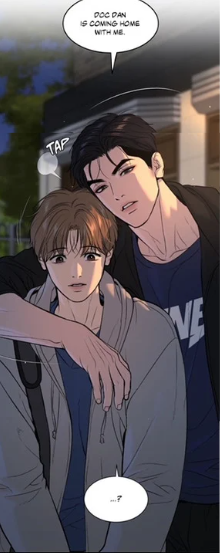 (chapter 43) No wonder why he thought that it was time to get to know the fighter during that night:
  (chapter 44)
On the other hand, by utilizing the word “home”, he is implying that the fighter doesn’t belong here. The doctor is actually mimicking his own grandmother.  (chapter 57)
 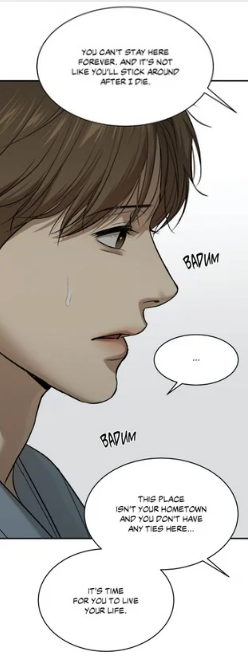 (chapter 57) However, Jinx-philes should detect the divergence: she is not using the word “home”, but Seoul. That’s the reason why in the end, Shin Okja’s confession to her grandchild will come back to bite her, as she described her own grandson as a stranger in this little town. It was, as if he had been an orphan all his life. He had no home all along.
And because of the doctor’s words, it is clear that Joo Jaekyung won’t return to Seoul. He just needs to stay by his side in order to gain his trust. The longer the fighter stays in that place, the longer he will be able to detect the deceptions surrounding the doctor: 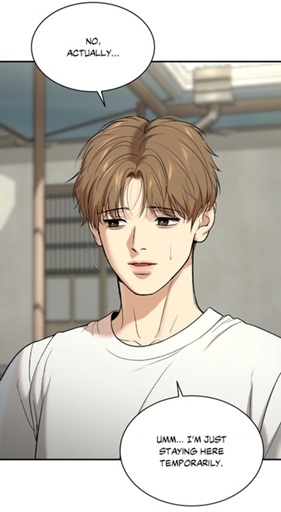 (chapter 58) Where are the parents? Who is the man where he is staying? Where did he plan to go after his stay there? The idiom “temporarily” could be perceived as an evidence that the doctor plans to end his life. According to my interpretation, Heesung believed that the landlord was Kim Dan’s grandfather. He was just denying his origins out of shame.
One thing is sure. Because of the doctor, Joo Jaekyung will be forced to admit that home is where the physical therapist is. With his goodbye, Kim Dan was challenging his former boss , (chapter 60) a new version of this scene.  (chapter 9) The athlete has now every reason to stay there and that’s how he will discover all the doctor’s secrets and misery.
Conclusion
The kisses in Jinx are more than just physical acts; they are symbolic markers of Joo Jaekyung’s emotional journey and his evolving relationship with Kim Dan. The locker room  (chapter 15) kiss represents selfishness, secrecy, and miscommunication, while the beach kiss (chapter 60) signifies selflessness, openness, and recognition. However, both kisses, initiated by Joo Jaekyung, were not truly expressions of deep love or genuine emotional pleasure. As technical gestures borne out of urgency and care, they left no lasting emotional trace in their relationship.
This lack of emotional permanence highlights the characters’ ongoing struggles. While Joo Jaekyung shows signs of growth, he has yet to fully understand or confront the complexities of Kim Dan’s mental and emotional state. Similarly, Kim Dan’s passivity and silence in earlier moments underline the barriers that remain between them. Trapped in his own misery, he fails to see the physical deterioration from his former idol. The juxtaposition of these kisses serves to illustrate the fragility of their bond and the slow, uneven process of their personal and relational evolution. Through these moments, the author masterfully portrays the intersection of urgency, care, and miscommunication, ultimately crafting a nuanced exploration of healing and connection amidst shadows. Once again, it exposes the importance of honesty and clear communication in a couple.
Feel free to comment. If you have any suggestion for topics or manhwas, feel free to ask. If you enjoyed reading it, retweet it or push the button like. My Reddit-Instagram-Tumblr-Twitter account is: @bebebisous33. Thanks for reading and for the support, particularly, I would like to thank all the new followers and people recommending my blog.


 (chapter 23) Potato initially admires the champion, aspiring to be like him
 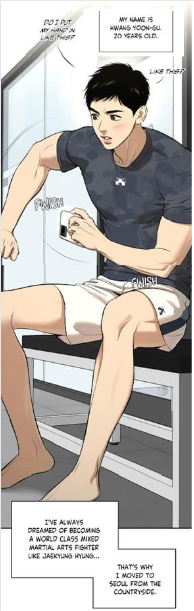 (chapter 23) and dreaming of recognition as his sparring partner.
 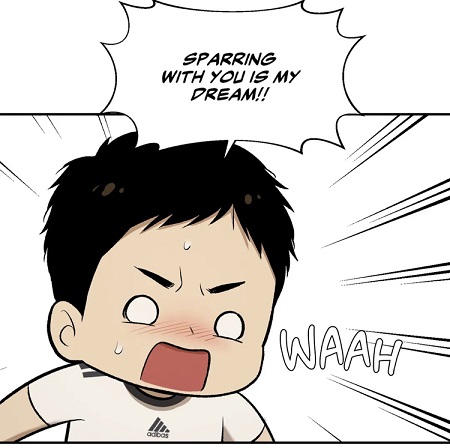 (chapter 23) Joo Jaekyung, much like the prince in Andersen’s story, projects an image that masks the reality of his life. His success, while celebrated, represents years of hard work and immense personal sacrifices. At the gym, Park Namwook undermines these efforts by slapping the athlete
  (chapter 7) and calling him “my boy,”
 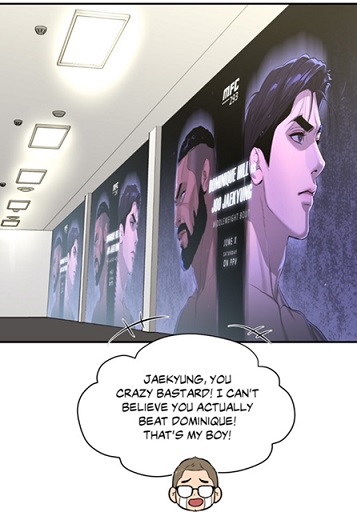 (chapter 40) effectively denying Joo Jaekyung the acknowledgment he deserves for his achievements. Potato is misled by this fabricated image
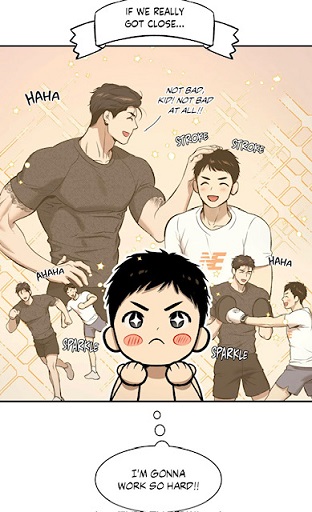 (chapter 23) without understanding the profound struggles beneath his image, failing to perceive Joo Jaekyung’s unhappiness, struggles, and loneliness. Like the image is exposing it, Potato views the athlete as a companion as well whose efforts should serve to keep him company. This dynamic mirrors the little mermaid’s conditional love for the prince, as Potato’s idealization is rooted in his own aspirations rather than genuine understanding. Just as the prince remains oblivious to the mermaid’s sacrifices, Potato overlooks the reality of Joo Jaekyung’s burdens, emphasizing a dependency that hinders true recognition and connection. Once his reputation as a champion is tarnished
 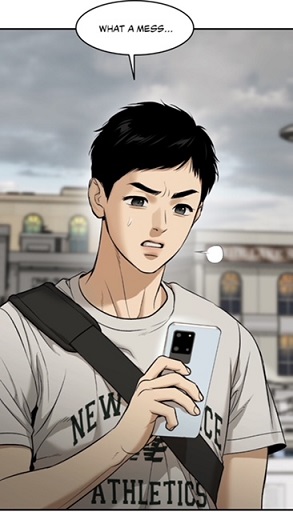 (chapter 52), the amateur starts distancing himself from his former idol. This exposes the fragility of Potato’s dream. Therefore it is not surprising that he starts taking a different path: acting, though I still think, it is temporary. However, behind the glamorous facade of the show business, there exists a dark side as well.
  (chapter 59) Heesung’s fate is similar to the champion’s. Despite his popularity, the actor is deeply unhappy. He feels lonely, for people only know the actor and not the man behind the mask. That’s the reason why he is looking for his soulmate.
  (chapter 33) That’s how I realized why Potato and Heesung are destined to be together. They are both self-centered, dishonest and blind, but more importantly they are chasing after an illusion which is strongly intertwined with immortality. In addition, my avid readers should keep in mind what Potato truly expressed, when Mingwa introduced this “chow chow”.
  (chapter 23). In reality, he wanted to use the athlete as his servant. The closeness
  (chapter 23) he was seeking was self-serving. While the amateur and the actor are searching for the “perfect companion”, the other couple has no expectation from others. They both have no longer any dream or hope. That’s the reason why Kim Dan was putting this vision of Joo Jaekyung behind a veil:
  (chapter 58) He was giving up on his dream expressed in the birthday card,
 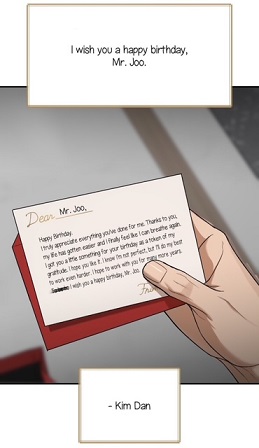 (chapter 55) though I believed that he had another bigger wish, but due to his low self-esteem, he didn’t dare to express it:
 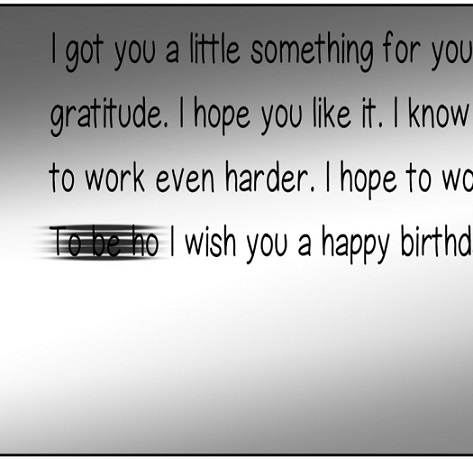 (chapter 55) My newest theory is that he wanted Joo Jaekyung to teach him fighting, but not for himself, but in order to help the fighters and in particular to protect the champion’s body:
 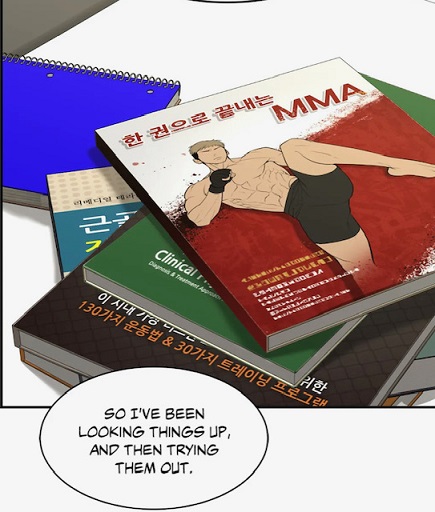 (chapter 25)
 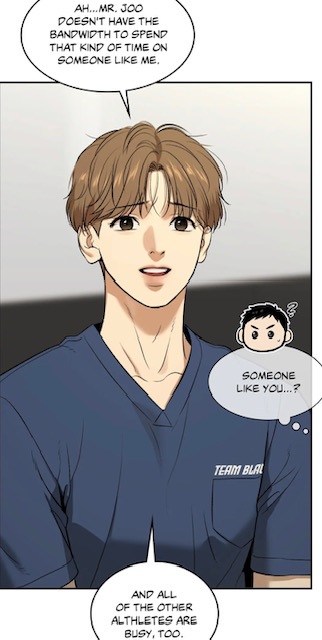 (chapter 25) To develop a training where injuries are minimized. In season 2, it is clear that Joo Jaekyung and Kim Dan have reached the bottom. Both feel empty and exhausted. They were crushed by harsh reality, and they had no one by their side to listen to their pain. Therefore it is not astonishing why the doctor could not confide to the actor and the amateur fighter. They arrived too late.
 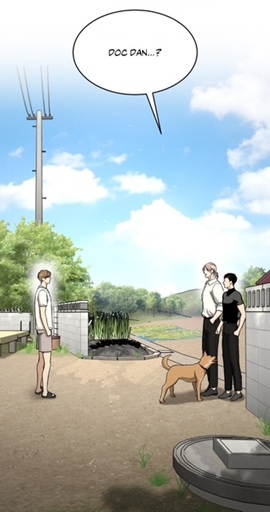 (chapter 58) Their presence definitely diverted the doctor’s attention, lessening his pain.
  (chapter 25) he learns the true nature of the relationship between Kim Dan and Joo Jaekyung. This revelation forces him to confront his own repressed feelings, as he unconsciously realizes his attraction to the fighter.
  (Chapter 25) Heesung’s involvement further complicates matters, as Potato confesses his love for Joo Jaekyung
  (chapter 35) while simultaneously vowing to sacrifice his feelings for the sake of the couple’s happiness. This act demonstrates Potato’s pure and selfless definition of love,
  (chapter 35) contrasting with the conditional love depicted in Andersen’s tale.
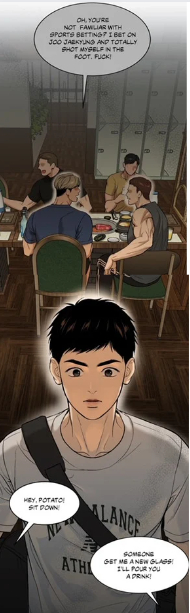 (chapter 52) and the switched spray the
 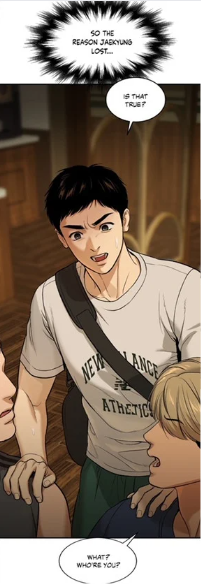 (chapter 52) which is strongly intertwined with the departure of disloyal members from Team Black marks another step in his journey toward disillusionment. While Potato initially views this as an isolated incident, it exposes the broader corruption within the MMA world, including the betrayal, greed, and lack of loyalty that undermine its integrity. While he views himself as loyal to doc Dan and Team Black, for he remained at the gym, his heart was not. He is becoming like his hyungs, Park Namwook and Heesung. In Andersen’s tale, the mermaid’s journey to the sea witch represents a pivotal moment of transformation. By sacrificing her voice and enduring physical pain, she gains entry into the human world, but at the cost of her identity. Similarly, Potato’s journey is marked by painful discoveries that force him to confront uncomfortable truths. Through Kim Dan, he will begin to see his own flaws before he is able to recognize them in those he once trusted.
  (chapter 23)
  (chapter 25)
 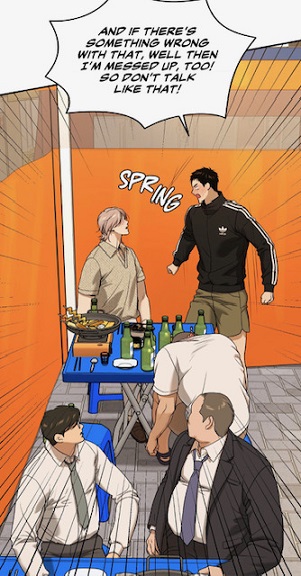 (chapter 35) The latter doesn’t mind breaking social norms by yelling or causing a fight at a restaurant. But let’s return to the actor’s confession at a bar. It’s not surprising that Heesung appears indifferent to the affection of those who cared for him. The last partner was described as too clingy. This means that Heesung places himself as the judge. In addition, it was, as if he was a god destined to live forever. He is forgetting his human condition, just like his partner’s. And that’s exactly how the prince in The Little Mermaid views life.
 (special episode 1) With this request, he implies that he will never become responsible for the amateur fighter. Therefore he can hide his homosexuality behind the young fighter. He used Potato’s mistake to his advantage.
  (special episode 1) By asking Potato to take care of all his needs and desires, Heesung placed himself in a position where he had power and could control Potato. That’s how the young fighter made a dangerous deal with the gumiho. No wonder why his sex role play was a prince interacting with a guard.
 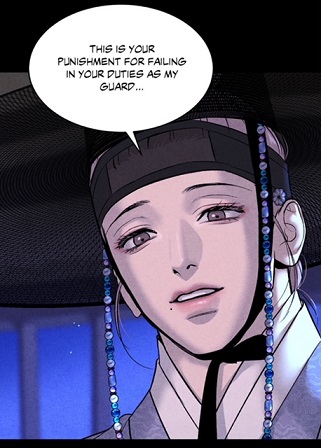 (special episode 2) Hwang Yoon-Gu didn’t realize that by taking responsibility for the actor, he lost his freedom and as such his voice. Is it a coincidence that Mingwa portrayed the young maknae as someone who would raise his voice due to his emotions in the past?
 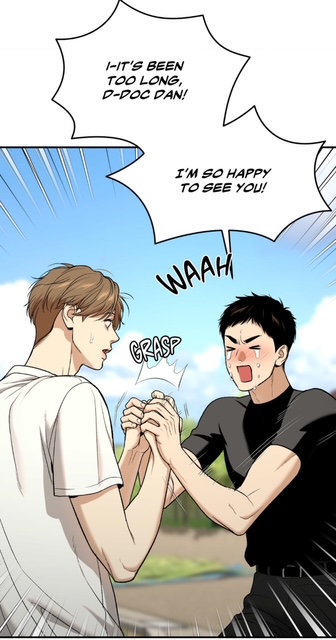 (chapter 58) his behavior is totally different than with the actor:
  (chapter 58) Tears, touch, raising his voice with Kim Dan, but not with the comedian. With the actor, he looks more calm, distant and mature. Heesung’s selfishness is evident in his treatment of Potato, whom he manipulates into becoming an extension of his own image. Hence he is no longer wearing shorts and tee-shirts.
  (chapter 59) One might say that he is gradually elevating Potato’s status through his suggestions.
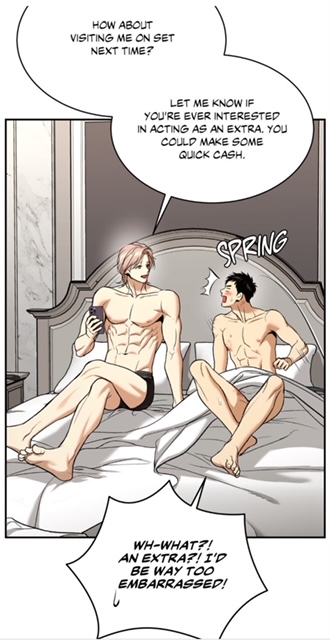 (special episode 2) By encouraging Potato to work as an actor and shaping him into a version of himself, Heesung prioritizes his own desires over Potato’s individuality. He is not asking what Potato’s true dream is. But this was his dream originally:
  (chapter 23) Why? It was due to his low self-esteem.
  (chapter 23) He was not confident enough, for he was the only one with such a weight-category.
 (special episode 2) played a huge influence in Potato’s decision to take the offer as an extra. It was, as if one of his dreams had come true. But is this what he truly wanted?
  (chapter 58) underscores his indifference, symbolizing the unbalanced dynamic in their relationship. Like the prince, Heesung offers no genuine commitment, leaving Potato to grapple with the consequences of his dependency. Thus I perceive Potato’s tears
  (chapter 59) as a signal that he is not truly happy.
  (chapter 58) However, this is about to change. Heesung who likes novelty and change is not realizing that his wish is becoming true. The picture with his last work announces the end of his “friendship” with Potato. How so?
 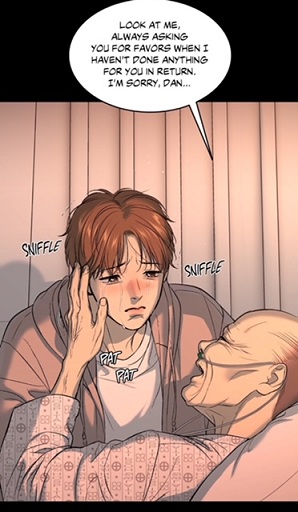 (chapter 53) Kim Dan learned to prioritize the needs of others over his own. His grandmother’s reliance on him mirrored the traditions and expectations imposed on the mermaid by her underwater world. Just as the little mermaid longed for the human world’s light and freedom, Kim Dan yearned for an escape from his oppressive circumstances.
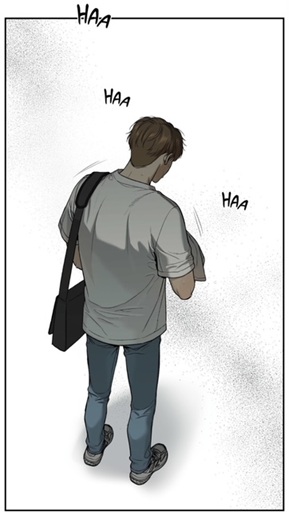 (chapter 59) Kim Dan once referred to Potato as a puppy
  (chapter 29), drawing a connection between the character’s innocence and loyalty.
 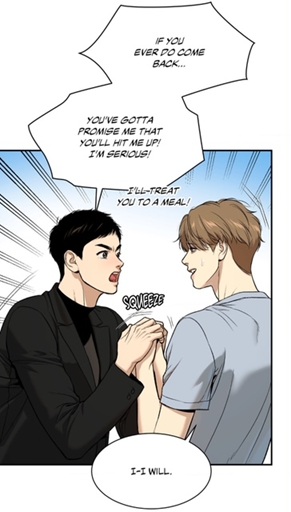 (chapter 59) However, Potato’s departure reveals an underlying superficiality and disloyalty—he merely asks Kim Dan to call him when he visits Seoul, failing to acknowledge the depth of their bond. This reminded me of the prince’s fake promise:
 (chapter 35) This shows that Heesung has long internalized this pattern: assistance will be only given, if he is called. That’s why he has no true friend in the end. He shows no interest in others. But by doing so, he is putting the whole responsibility on his counterpart. Through the actor and the manager’s behavior, the former errand boy has long adopted this pattern. Hence he didn’t call Kim Dan in the end. He waited for a signal from his part. This behavior mirrors the little mermaid’s sisters, who only realize her absence when it is almost too late to act. Similarly, Potato’s casual farewell highlights a betrayal of Kim Dan’s friendship, further emphasizing Potato’s struggle with emotional awareness. That’s why I mentioned above that Potato is about to discover his true nature: he is also a sinner. This growth parallels the biblical narrative of Adam and Eve, where the acquisition of knowledge leads to the loss of innocence. Heesung, like Eve, introduces Potato to a new world of experiences, including his sexual orientation. However, this newfound knowledge comes with its own burdens, as Potato must reconcile his identity with the harsh realities of the world around him.
 (chapter 5) Heesung could no longer express his needs and desires.
 (chapter 58) Just because one is happy, this doesn’t mean that the other is. For that to happen, communication and honesty are necessary.
 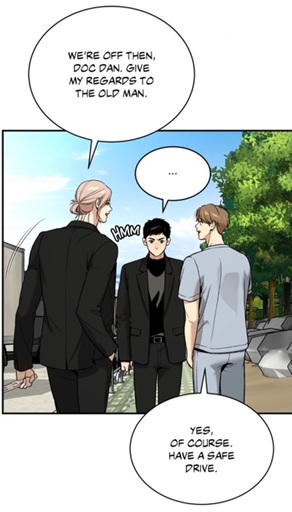 (chapter 59) This event underscores the contrasting paths of Joo Jaekyung and Potato. While Joo Jaekyung is forced to give up his principle of “self-reliance,”
 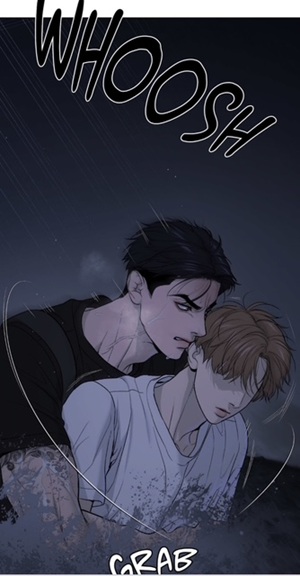 (chapter 59) Potato’s journey is to discover and embrace the principle of “self-reliance” and autonomy. Only when Potato becomes independent in his thoughts and decisions, can he truly help the main couple.
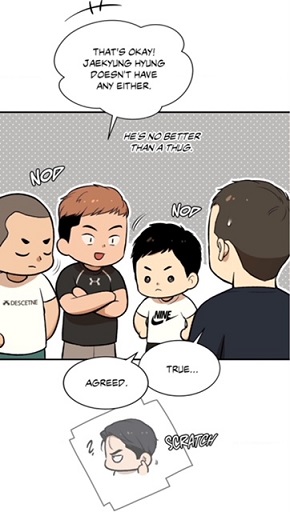 (chapter 47) and 52. Initially, he believed in his hyungs’ description of Joo Jaekyung as a thug, but later he criticized the same fighters for abandoning the athlete
 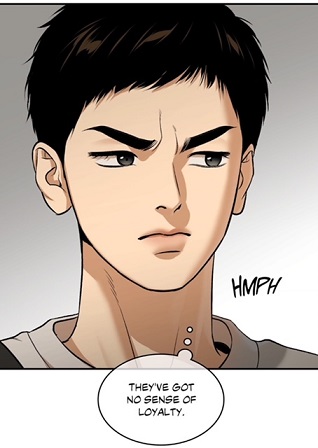 (chapter 52), accusing them of lacking loyalty and dismissing their claim that they had nothing to learn from him. Yet, in episode 52, Potato does not reproach Park Namwook or Yosep for their passivity and naivety,
 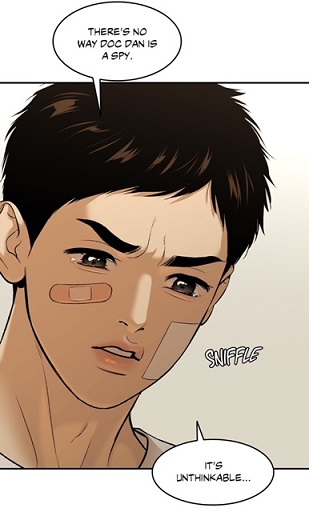 (chapter 52) instead solely blaming Joo Jaekyung for not trusting Kim Dan and causing his departure. This selective criticism reveals that Potato still views the older men as inherently good and fails to recognize his own shortcomings. In this way, he mirrors Park Namwook’s superficial loyalty, further emphasizing his dependence on external validation.
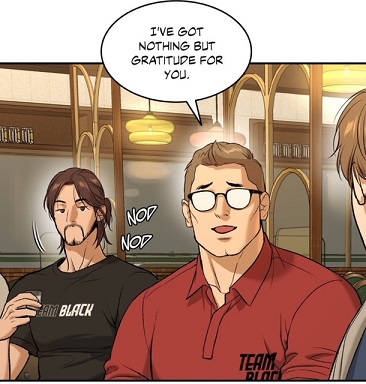 (chapter 43) This absence highlights how Potato has missed key moments of reflection and acknowledgment, which are essential for his growth. It suggests that Potato is destined to detect the flaws in his hyungs—Park Namwook, Yosep and Heesung’s superficiality, passivity, hypocrisy and selfishness—before he can achieve true independence and contribute meaningfully to the lives of Joo Jaekyung and Kim Dan.
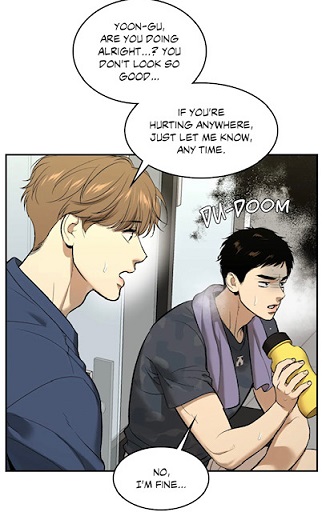 (chapter 23) —taking over his tasks and noticing his unhappiness
 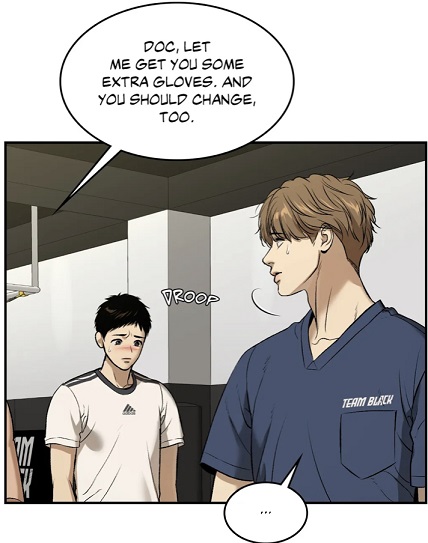 (chapter 25) —demonstrates his capacity for genuine care. This contrasts sharply with Heesung’s selfishness and serves as a reminder of the value of mutual support in relationships. Potato’s potential return to the place where he met Kim Dan could symbolize a rediscovery of authentic connections, marking the beginning of his path toward independence and self-realization.
  (chapter 58) And like mentioned above, this could become a serious problem for Yoon-Gu. He could be perceived as someone selling himself for a gig. And Heesung is not even realizing the consequences of his intervention and meddling. That’s why it is important for Yoon-Gu to become independent. This lesson resonates with Potato’s journey in Jinx. By recognizing Heesung’s selfishness and breaking free from his influence, Potato has the potential to rediscover his own dreams and individuality. Like Erich Fromm mentioned it, true love is respect, care, knowledge and responsibility. However, Heesung has no idea about the importance of these notions, as everything is evolving around his own needs and dreams.
  (chapter 58) That’s how it dawned on me that little by little Yoon-Gu had been losing his senses:
  (chapter 31), his smell, then his ears
  (chapter 52) and finally his eyes:
 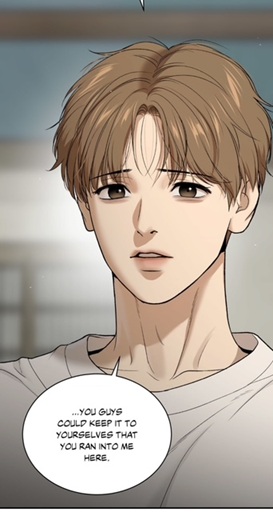 (chapter 58) He forgot the danger coming from Heesung’s words, he could not hear the suffering from the champion due to his bias, and finally he couldn’t see Kim Dan’s distress due to his own feelings and prejudices. We could say that because of the influence from others, he was no longer able to see reality. However, like mentioned before, I sense the return of Potato’s senses in the following panel:
  (chapter 59), coinciding with Potato’s departure, underscores this theme of overlooked emotions and unreciprocated care. As Joo Jaekyung reflects on Kim Dan’s comparison of Potato to a puppy, it may catalyze a pivotal shift, prompting him

 (chapter 59) —an innocent request by the nurses at the hospice
 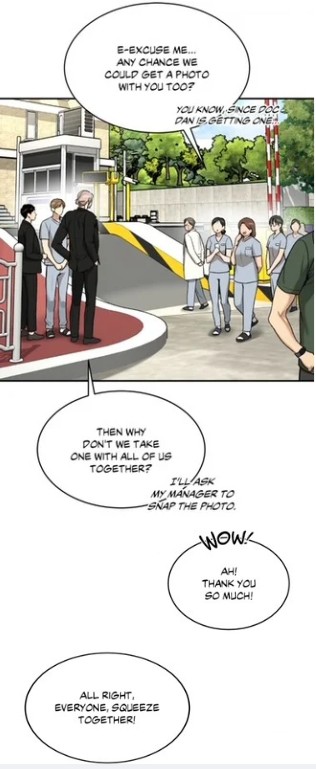 (chapter 59) —which becomes the pivotal clue leading Joo Jaekyung to Kim Dan. Through a careful analysis of the timeline and the use of contrasting events, it becomes clear that Mingwa’s narrative mirrors a kaleidoscope, reflecting positive and negative elements rooted in Taoist principles. While the doctor’s unconscious
 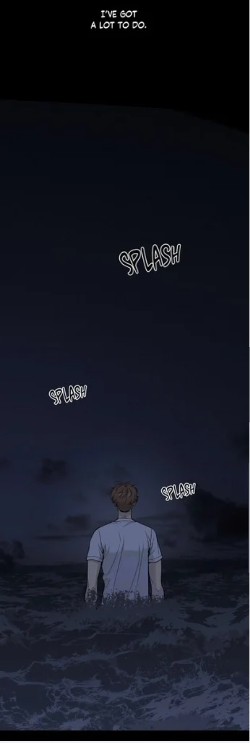 (chapter 59) led him to the shore, driven by despair and suicidal intent, the MMA fighter’s journey stands as its opposite:
 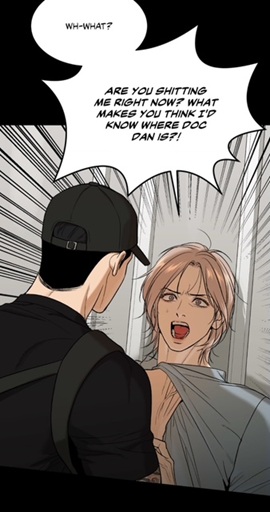 (chapter 59 ) a conscious choice to follow his heart, hence he was full of anger and frustration. Joo Jaekyung was no longer repressing his feelings, even if he had yet to fully recognize his affection.
 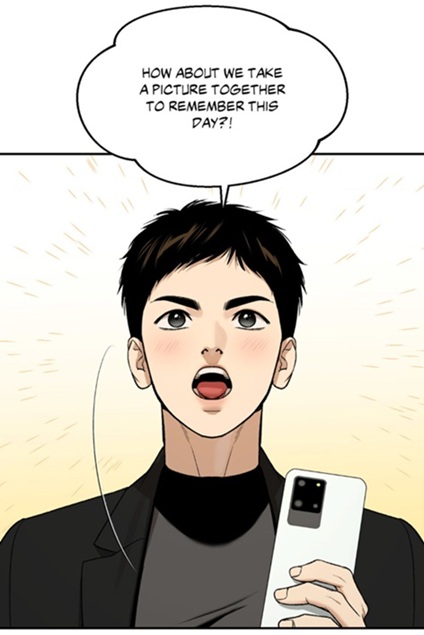 (chapter 59), it simultaneously signifies the first crucial clue in Joo Jaekyung’s search. This marked the turning point where his ongoing efforts were given direction, transforming his pursuit into a decisive journey toward discovery.
 (chapter 59) —each of whom had interacted with Kim Dan
  (chapter 57) during his time at Light of Hope. While these individuals appear as potential candidates for revealing Kim Dan’s location, the true helper remains shrouded in mystery. This ambiguity emphasizes the layered narrative of Jinx, where each small action—no matter how mundane—contributes to the larger theme of fate’s intricate web, offering insight into the power of both intentional and unintentional intervention. If Potato had not suggested the picture
 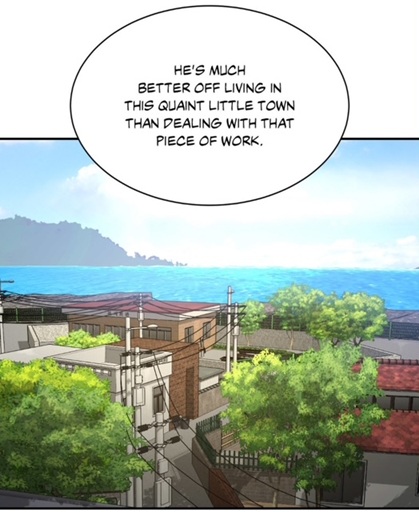 (chapter 58)
 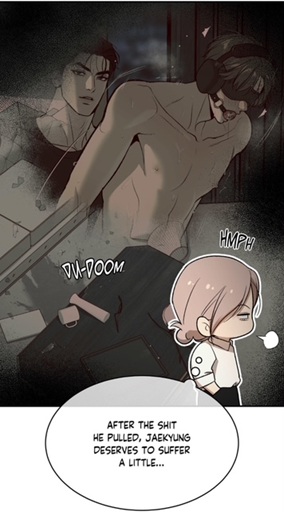 (chapter 58)
 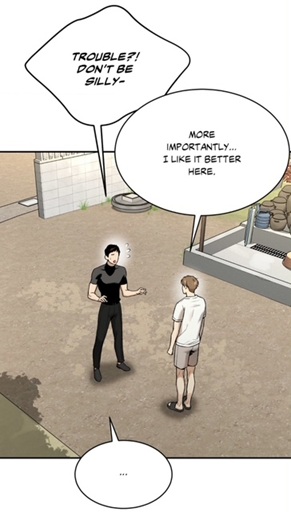 (chapter 58), ignorance and superficiality
  (chapter 58), becomes the shadowed reflection of the proactive search by Joo Jaekyung. This interplay of light and dark is central to unraveling how fate unfolded.
 (chapter 58), came to the same conclusion: they should not reveal Kim Dan’s whereabouts to Joo Jaekyung. Heesung argued that Kim Dan was better off in his secluded life, away from the chaos of Joo Jaekyung. Potato, deeply trusting his lover’s seniority and judgment, chose to follow Heesung’s lead. Their decision reflects not only their loyalty to Kim Dan’s expressed wishes but also their passive adherence to the belief that avoiding intervention was a form of help which reminds us of Potato’s former principle:
 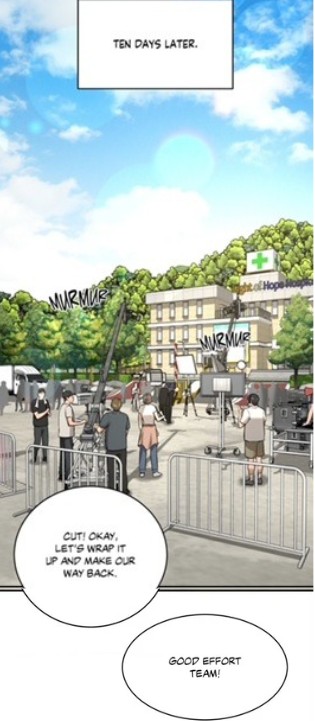 (chapter 59) Importantly, Joo Jaekyung did not arrive during this period, further affirming their resolve. The photograph taken just before their departure was the key turning point. However, the timeline—marked by the sunsets
  (chapter 59)
  (chapter 59) —suggests that Joo Jaekyung arrived only two days after Heesung and Potato left. This indicates that neither Potato nor Heesung leaked the information to Joo Jaekyung, as the champion would have sought Kim Dan immediately if informed by them. Instead, this photograph—seemingly public rather than private—became the clue he needed. Moreover, since the two friends knew where Kim Dan lived, I am assuming that he would have gone right to the doctor‘s rented room. But he did not. He went to the beach. Since the nurses didn‘t notice that Kim Dan was a friend of Potato and Heesung and mistook him for a fan, I am assuming that only the two friends know his address.
 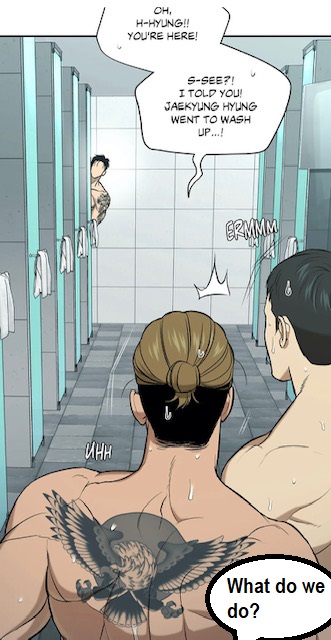 (chapter 8)
 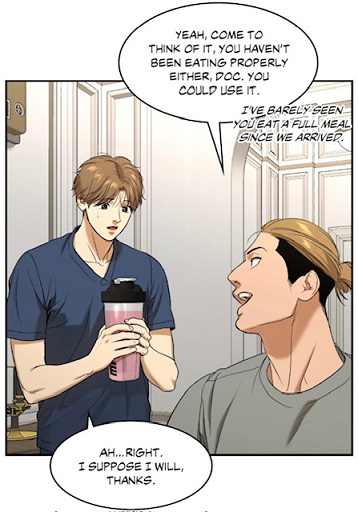 (chapter 37) and Kwak Junbeom was a witness of the encounter between Kim Dan and director Choi Gilseok.
  (Chapter 48) Nonetheless, there exist significant points against this theory. Despite their fondness for the actor
  (chapter 30) and their interactions with Heesung and Potato
  (chapter 35), they are unaware of the actor’s relationship with Potato. The author left many clues for this interpretation. They didn’t notice the maknae’s absence at the champion’s birthday
 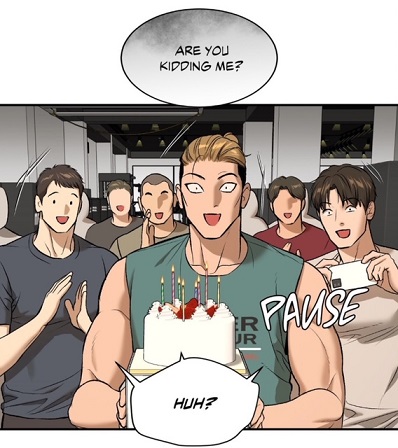 (chapter 43), but more importantly the presence of Yoon-Gu‘s embarrassment in front of his hyung indicates secrecy. .
  (chapter 56), or his emotional state. They think, he has not come to the gym due to his recovery. Furthermore, they don’t use his cellphone number to contact him. The hiring of a new physical therapist and
  (chapter 57) the interview suggested that Joo Jaekyung was taking a break to recover from his injury, leaving no indication of his active search for Kim Dan. However, Yoon-Gu got informed through Heesung that Joo Jaekyung was desperately looking for him:
  (chapter 58), but probably saw this as another “negative reaction” (bad temper) of a spoiled child. This makes it unlikely that members of Team Black could have provided the critical information.
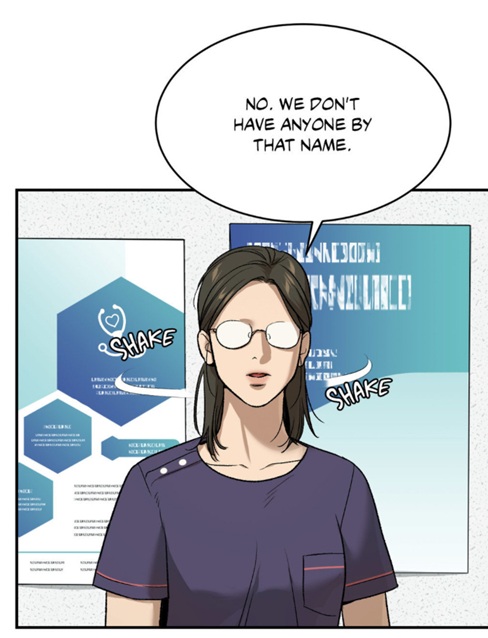
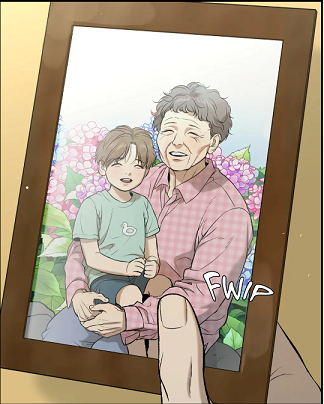
 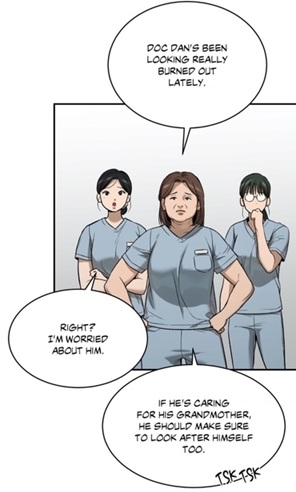 (chapter 57), her positioning reflects Mingwa’s deliberate storytelling, emphasizing her subtle yet crucial role in connecting the threads of fate. She is also unlikely to have directly contacted Joo Jaekyung. As an average nurse living far from Seoul, she would not have access to the champion’s contact information or knowledge of his search for Kim Dan. However, this does not exclude her influence entirely. My idea is that she shared the photograph with someone close to her—a family member or friend—turning what was initially a public image into a private clue. Through this intermediary, the picture may have reached someone who recognized Kim Dan and understood his connection to the MMA fighter. This chain of events underscores the role of chance and intervention in the narrative and suggests that another, yet unknown, individual helped guide Joo Jaekyung to his destination.
 (chapter 50)
 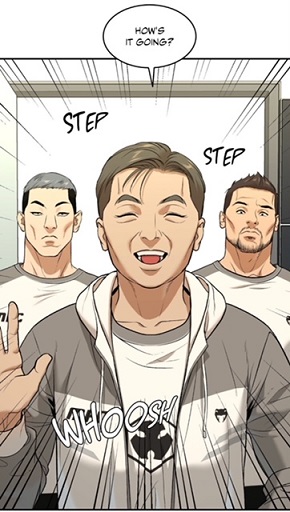 (chapter 49), highlighting the failures of relying solely on fate. The champion’s eventual discovery of Kim Dan underscores the necessity of teamwork and active intervention. Notably, this also reflects the flaws in Team Black, whose inaction and superficiality limited their understanding of both Joo Jaekyung’s struggles and Kim Dan’s situation. While Heesung’s stardom and blog
 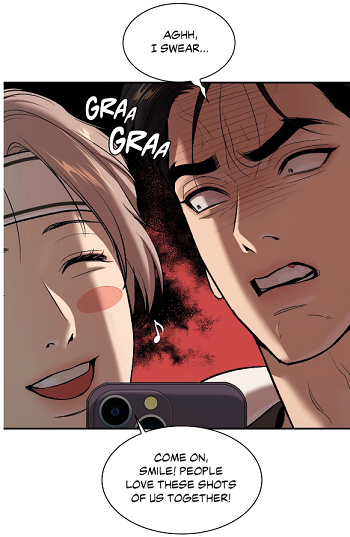 (chapter 30) could have amplified the picture’s reach, it’s unlikely Joo Jaekyung relied on such sources directly. I can not imagine him spying on the actor’s blog. Instead, the role of the helpers — the nurse and her acquaintance— emerge as crucial to piecing together the connection. The inadvertent role of the nurses Mind and Heart, urging Heesung to take the picture, becomes an integral part of the story’s progression.
  (chapter 13) who played pivotal roles in lifting the curse, as Mingwa’s narrative often draws on such reflections. Here, the nurses’ actions, though seemingly minor, echo the same themes of fate and intervention.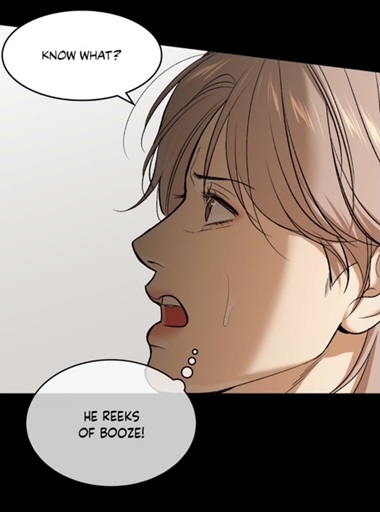
 (chapter 13) The latter knew the PT’s face,
  (chapter 13) but didn’t know his identity. He mistook him for someone who was selling his body for money.
  (chapter 13) In addition, Kim Dan never got to know the intervention of this hyung: he was the invisible helping hand in season 1. And now, if you reread the scene in episode 13, you will notice that this conversation between Joo Jaekyung and his friend contains all the ingredients in episode 59: the use of the phone, fainting, malnutrition, secrecy, neglect, secret suffering, pictures and public knowledge
  (chapter 13), the death of a man and finally urgency. Moreover, remember what his friend told him before: the importance of rest and
 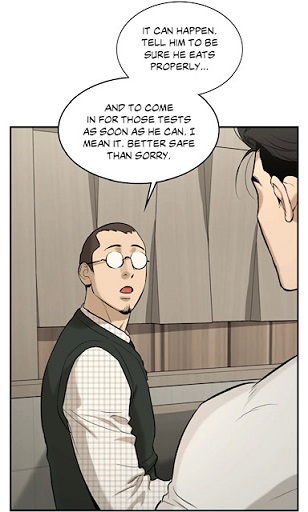 (chapter 13) He should send him to the hospital for tests, but the fighter refused. Why? It is because the latter feared his “chingu”. The doctor seemed rather interested in Kim Dan, therefore he feared that the PT might dump him for a “colleague”. That’s why Heesung was sent later to his gym. Karma was punishing him for not listening to his friend’s advice. Finally, it is important to recall his advice:
  (chapter 43) And during that evening, the champion called his penthouse with the doc “Home” for the first time. Finally, in season 2, Joo Jaekyung started visiting each hospital or Sports Rehabilitation Center in Seoul in order to find Kim Dan.
 (chapter 56) And there’s no doubt that Joo Jaekyung got recognized by people forcing him to use a mask to hide his identity. So this frenetic search must have reached the mysterious doctor’s ears, but I doubt that he made the connection between the star’s lover and the physical therapist right away. Since he‘s a guest of XY club,
  (Chapter 13), it is also possible that he could have heard about the last incident in the restroom with doc Dan’s replacement. Since Cheolmin found Dan cute, it is very likely that he was also drawn to the surrogate „Dan“. But I don‘t think, this was enough to intervene, as Joo Jaekyung didn‘t ask for his help.
 and to Neptune
  and strangely, the doctor moved to a place next to the coast. So maybe Cheolmin comes from that little town and the green-haired nurse is his relative. I had already outlined their similarities. Finally, look at the numbers, we have 4 in both episodes, 13 and 59 (13: 1+3 = 4 / 59: 5-9= -4) The -4 would coincide with Kim Dan’s vanishing, but also with the intervention of Cheolmin. And if my theory is correct, this means that the champion will come to regret his past decision
  (Chapter 19) and the group photograph at the hospice


 (chapter 54) and penthouse
 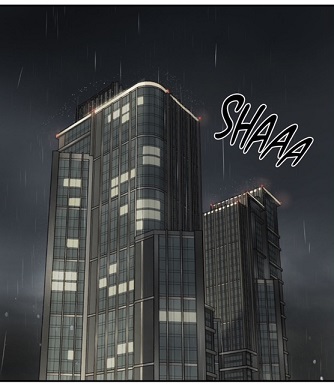 (chapter 54) in Seoul—a city symbolizing anonymity, invisibility, and corruption—to the hospice “Light of Hope”
  (chapter 56) in a small town on the West Coast
  (chapter 56), where people know each other. This essay builds upon my previous interpretations of the series, which led me to develop these predictions for the upcoming season. By comparing the visual depictions of the gym and penthouse in Seoul with the hospice and small town on the West Coast, the divergence in weather becomes a powerful symbol of the changes Joo Jaekyung will undergo. The rainy, overcast settings of the gym and penthouse reflect the fighter’s inner turmoil and sadness, highlighting the oppressive atmosphere of a city rife with anonymity and corruption. In contrast, the sunny and open environment of the hospice and town by the ocean represents a space of hope and renewal, where human connections thrive. This comparison underscores the significant role the hospice and small town will play in fostering Joo Jaekyung’s self-discovery and healing. The gym and penthouse in Seoul symbolize anonymity, invisibility, and corruption. This anonymity stems from the city’s indifference to individual suffering, as seen when Kim Dan was dragged
  (chapter 16)
  (chapter 16) through the streets by loan sharks in broad daylight without anyone intervening. Invisibility is further exemplified by the perverted hospital director,
  (chapter 1) who harassed Kim Dan without facing any consequences, though he was caught, and by Kim Miseon’s unethical actions, such as leaking patient information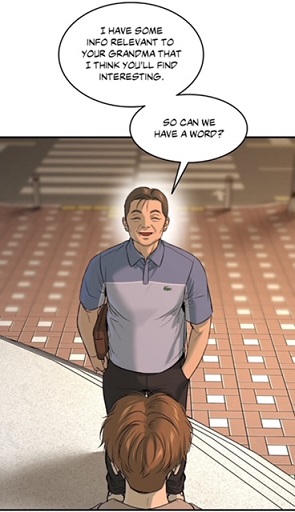
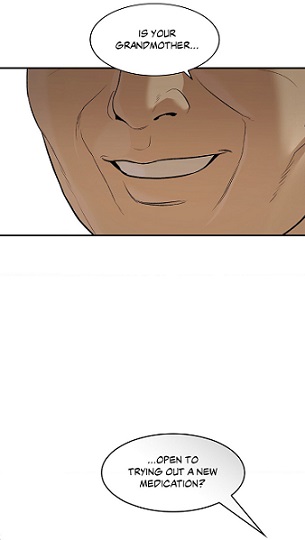 (chapter 48) and using Shin Okja as a guinea pig for trial treatments
 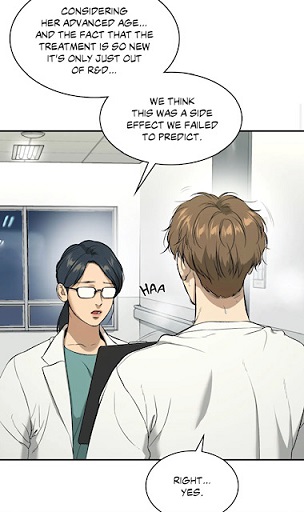 (chapter 21) —none of which led to accountability. In contrast, the hospice represents a counterpoint:
  (chapter 56) a space where respect and dignity take precedence over ambition, fostering genuine human connection and care. This contrast between the city and the hospice highlights the champion’s need to redefine his understanding of life, identity, and success. The contrast between the hospice and MFC becomes pivotal, as these environments symbolize opposing values: while the hospice fosters compassion
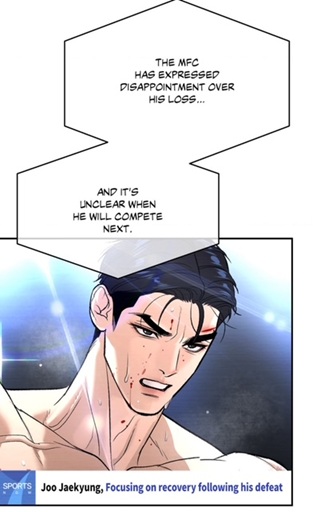 (chapter 57) who no longer appears in the news.
 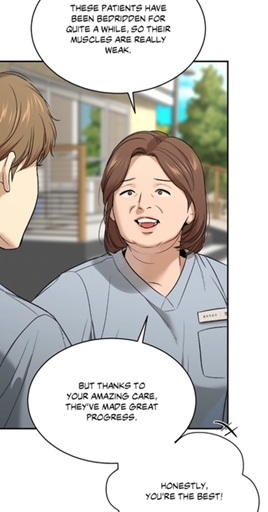 (chapter 56) emphasizing respect and dignity. This stark reality will serve as an eye-opener for Joo Jaekyung, who is burdened by news and media narratives equating
  (chapter 36)
 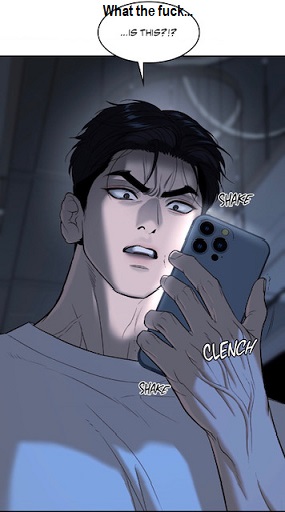 (chapter 35)
 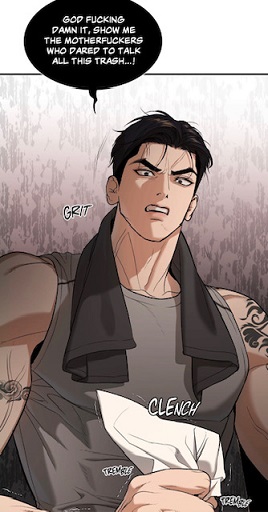 (chapter 36) his shoulder injury or potential career loss with “death.” At the hospice, he will encounter people who are truly facing the end of their lives
  (chapter 57), prompting him to recognize that his so-called career end does not symbolize his real death.
  (chapter 29) This realization will help him distinguish between his life as a fighter and his life as a person, setting the stage for his transformation. It provides a stark contrast to the MFC, which is riddled with manipulation and greed. At the hospice, Joo Jaekyung is likely to encounter individuals whose lives are defined not by competition but by care and connection, like Mingwa implied it with the comment of the nurse:
  (chapter 57). This environment challenges him to confront the indifference of figures like Yosep and Park Namwook, whose neglect, blind trust, passivity, naivety, neglect and selfishness have shaped his struggles. Notice that the nurses are often seen together and exchanging thoughts about doc Dan symbolizing unity and harmony
  (special episode 1) In other words, the presence of Kim Dan’s friends (Joo JAekyung, Potato and Heesung) could make her realize her true nature, which would impact her mental health. She led a life full of missed chances and regrets.
  (chapter 26)
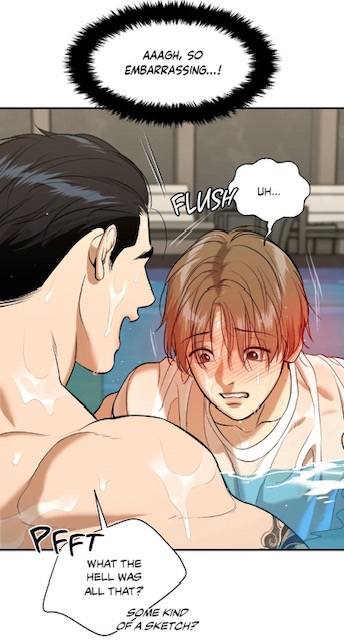 (chapter 27) In Korean culture, the saying “when the heart isn’t in it” reflects a profound truth: actions devoid of sincerity lack real value. Season 2’s new settings allow the champion to reflect on his mechanical, dispassionate life and begin to act with intention and feeling.
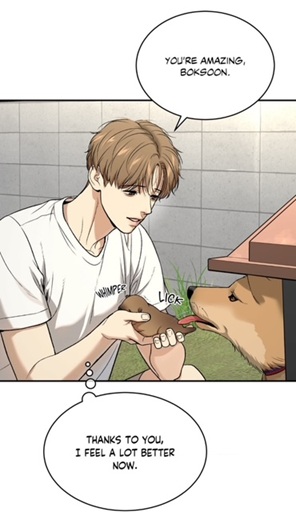 (chapter 57) and her puppies. Kim Dan is tasked with taking care of the dog and her newborns, and Joo Jaekyung should be asked to do the same. This responsibility not only serves as an allegory for taming the wolf within him but also paves the way for the champion’s deeper connection with Kim Dan. By being close to the ocean
  (chapter 56), a place where Joo Jaekyung finds relaxation through swimming, the setting introduces an opportunity for him to teach Kim Dan how to swim, addressing the latter’s fear of water
  (chapter 27). Swimming could become a shared activity that rebuilds their relationship on a foundation of trust, mutual learning, and growth. Engaging in this physical activity would not only strengthen their bond but also boost Kim Dan’s confidence and help him rediscover his own resilience.
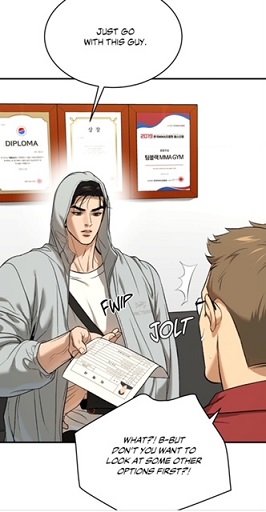 (chapter 54), his connection with Kim Dan is no longer defined by a boss-employee relationship. Their interactions, now free of financial obligations, offer the fighter a clearer view of Kim Dan’s selfless and angelic nature. The physical therapist’s unwavering care, even at the expense of his own well-being, highlights his ungreedy and altruistic character. This realization will deepen Joo Jaekyung’s respect and affection for Kim Dan, further cementing the transformative journey they both embark on.
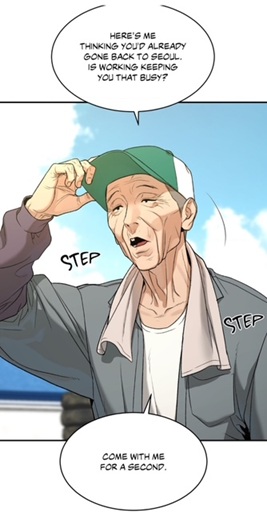 (chapter 57) and the yelling patient
 (chapter 56) “Nurse Mind” and “Nurse Heart,” provide another layer of mentorship. They could act as the champion’s eyes and ears, teaching him to observe and understand Kim Dan’s mental state. Though the nurse 1 started reproaching Kim Dan to neglect himself
 (chapter 13) She already noticed his unusual fatigue, so in my opinion, this third woman could be the one detecting that the main lead is not eating properly. If this assumption is correct, then she stands for food and body, like in the Korean saying: “If your heart is not in it, you can’t see if you look. You can’t even hear if you listen, and you can’t taste even if you eat.” Their guidance should help Joo Jaekyung cultivate a nurturing side, showing him that strength is not solely physical but also emotional and relational. In this way, the nurses become pivotal in his journey from a lone wolf to a leader who values and protects his pack.
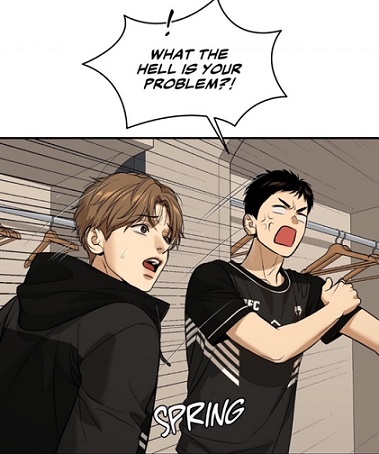 (chapter 49), though their positions are absolutely opposite. The patient’s reaction in Chapter 57 echoes this dynamic, as he accuses Joo Jaekyung of being ill-tempered (this means that he remembers the suspension), a perspective shaped by the media’s manipulations. His criticism reflects the behavior of a sheep, falling prey to misinformation and failing to see the larger truths. On the other hand, it indicates that this man also knows a part of the truth: the suspension which is no longer mentioned, but also escaped Kim Dan’s notice, as he was dealing with his departure. In contrast, Potato’s response in Chapter 49, where he courageously questioned Director Choi despite the latter being an elder, showcases independence and critical thinking. This juxtaposition highlights the patient’s potential to awaken Joo Jaekyung, Kim Dan, and Potato to the damaging impact of media narratives. Over time, the patient himself must confront the wrongfulness and cold-heartedness of his accusations, fostering growth and understanding on all sides. These characters reflect the flaws of Yosep and Namwook, enabling Joo Jaekyung to see the neglect and indifference he has endured and inspiring him to redefine his role in the gym and in Kim Dan’s life.
  The illustration’s inclusion of the hamster—symbolizing Kim Dan’s fun, fragile, and nurturing nature—along with the chow chow and the gumiho, emphasizes the roles of protectors and mediators. The chow chow’s loyalty and the gumiho’s cunning serve as essential forces guarding the hamster and navigating the complexities of this “pure community,” where lies and selfishness can still exist. These characters highlight the intricate dynamics within the hospice, where Joo Jaekyung must balance strength with empathy.


 (chapter 57) She wondered if this nickname “MAMA” was not a spelling mistake, and that the translator might have meant “MMA fighter Joo Jaekyung.” Intrigued by this possibility, I sought clarification, and indeed, in the Japanese version
 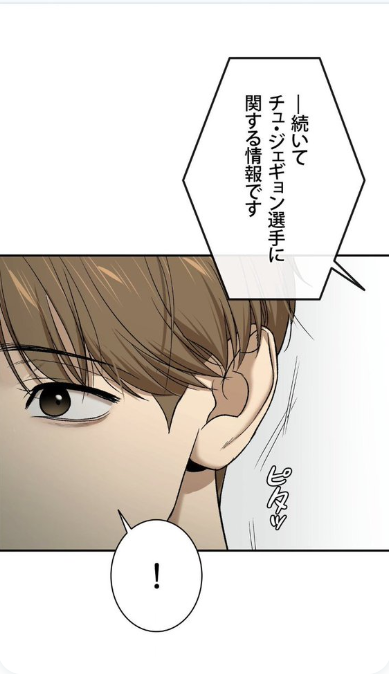 (episode 57) the reporter introduces the main lead differently: “Next, we have news regarding Joo Jaekyung.” This subtle difference is significant for three reasons.
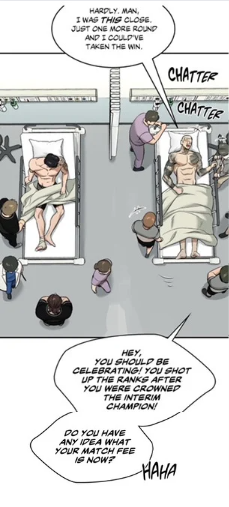 (chapter 52) and the suspension from their narrative highlights a calculated effort to erase inconvenient truths that could tarnish not only MFC’s reputation but also that of the medical professionals complicit in their schemes. Let’s not forget
  (chapter 41) the complicity of the doctors who cleared Joo Jaekyung to fight despite his evident injuries as another example of the corruption within this world. Moreover, by avoiding any mention of the suspension
 (chapter 52)
  (chapter 52), is not only a protective measure for MFC but also shields the medical professionals who facilitated the situation. Doctors at the health center failed to report the ankle injury caused by the sabotage
 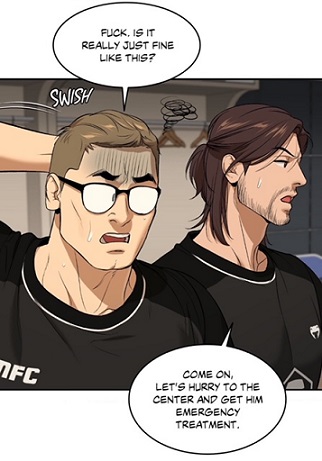 (chapter 50), further implicating them in a network of complicity and greed. Their decision to place the two fighters next to each other without proper privacy measures, such as curtains, reveals a disregard for professional ethics in favor of spectacle and profit. I would even add, the decisions from the health center’s medical staff, played a significant role in escalating the situation. By placing Joo Jaekyung and Baek Junmin next to each other post-fight, without appropriate measures like curtains to ensure separation, the health center created an environment ripe for conflict.
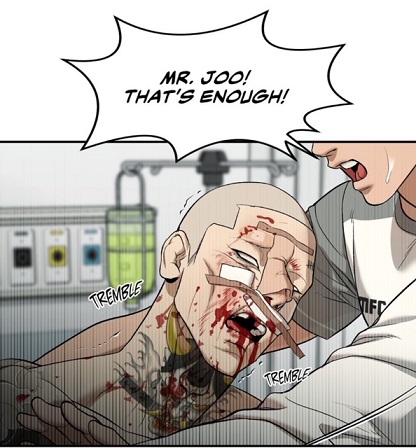 , (chapter 52) as the provoked champion lashed out in an unregulated setting. The decision to ignore these systemic failures and instead to suspend Joo Jaekyung suggests a deeper layer of complicity from the medical world, where doctors and nurses prioritized organizational demands and reputational interests over ethical responsibilities. Their failure to report the provocation and the ankle injury caused by the switched spray further highlights their alignment with MFC’s corrupt practices.
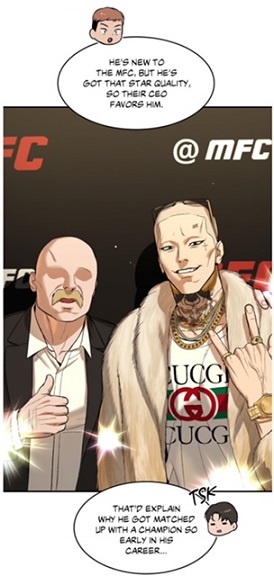 (chapter 47) and favored by MFC’s CEO, Baek Junmin has now been discarded, his relevance extinguished the moment he ceased to serve the organization’s agenda.
 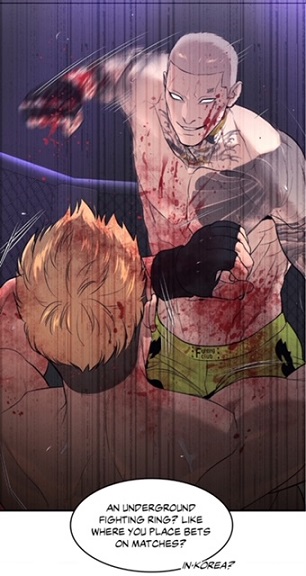 (chapter 47) His background, combined with his visible association with MFC’s CEO, positions him as a key figure who could potentially expose the organization’s darker practices.
 (chapter 49), his ultimate fate now reflects the broader cruelty and exploitation perpetuated by those in power. That’s how I realized the other signification of the cross below his left eye. The latter symbolizes his blindness in the end. The cross signifies his inability to see beyond the role he played within the system—a symbol of his naivety and misplaced confidence. Baek Junmin believed he understood the brutal reality of the fighting world, given his background in underground rings and illegal gambling. He thought his experience and cunning gave him an edge, making him untouchable or indispensable. However, his taunts to Joo Jaekyung
 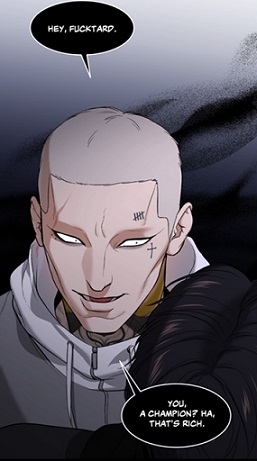 (chapter 49) reveal a man who overestimated his position within the organization.
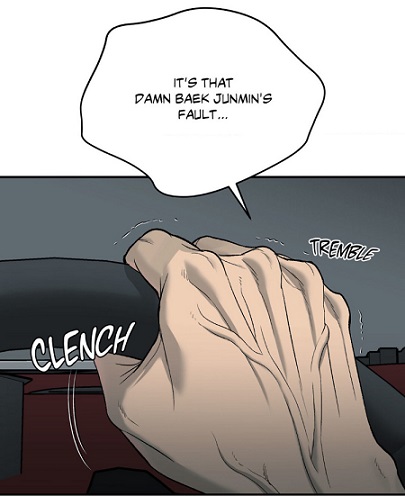 (chapter 54), it shows the athlete’s lack of reflection and insight. He hasn’t been able to discern the truth, the corruption of his “world”. This means that he needs to travel and experience a whole new world. The contrast would serve as an eye-opener for the athlete.
 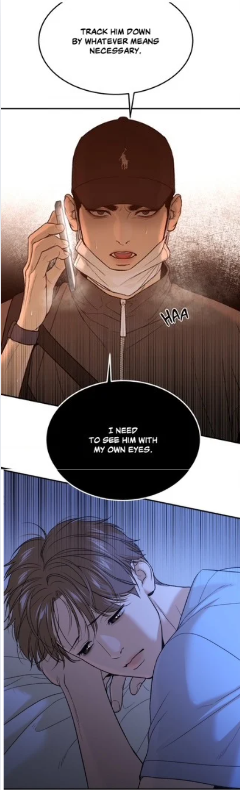 (chapter 56) released shortly after the champion’s urgent request to locate him. This timing is no coincidence. Instead, it reflects a calculated effort to manipulate both the public narrative and Kim Dan’s own perception of his role and value. By introducing the anonymous person as “one of his close associates”, it implies that the champion has already moved on from the protagonist. He is not missing him at all. At the same time, it implies that within a short time, the person was able to get the athlete’s trust which stands in opposition to this scene:
  (chapter 57): his regret was not merely about using the spray but about his failure to assert himself professionally.
  (chapter 49) By complying unquestioningly with the champion’s requests, he had diminished his role, acting more like a servant than a competent physical therapist. The interview, though painful,
  (chapter 57) serves as a harsh wake-up call, forcing him to confront his own shortcomings and reevaluate his behavior.
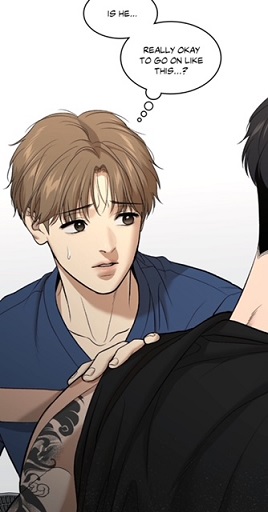 (chapter 41), drawn boundaries, and made his expertise known. I would even add that he never felt responsible for the champion’s reputation in the media
  (chapter 41) In addition, while many Jinx-Philes are blaming the champion for his outburst,
  (chapter 50) rejection and
 (chapter 50) accusations,
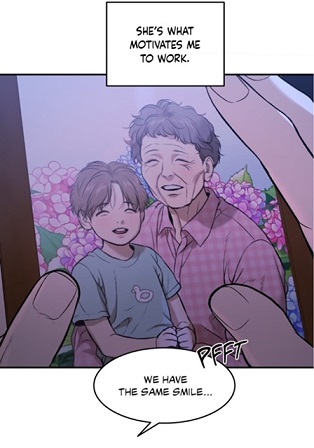 (chapter 47) his indifference and lack of professionalism. In the end, the grandmother is the reason for his lack of professionalism and neglect.
  (chapter 54) Unlike the newly hired PT, who likely has the backing of a hospital or organization, Kim Dan operates independently. This independence, while offering a degree of freedom, also makes him vulnerable. He lacks the institutional support that could shield him from the manipulative tactics of MFC. Moreover, his independence places him in direct contrast to the systemic corruption that permeates MFC and its associated entities. As someone who has already been victimized by two major deceptions—the drugged nutrition shake
  (chapter 37) and the switched spray
 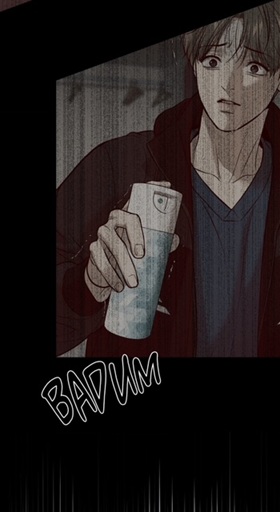 (chapter 57) —Kim Dan stands as a figure who threatens to expose the cracks in MFC’s carefully constructed facade. Let’s not forget that the incident with the poisoned beverage was swept under the rug by framing haters.



 (chapter 35), where people’s actions and words can go unnoticed, the hospice fosters an environment of close-knit relationships and mutual observation.
 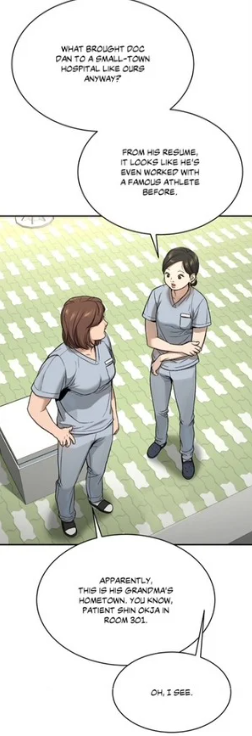 (chapter 56) In this communal setting, actions carry weight, and behaviors are scrutinized. Thus the door to the meeting room is made of translucent glass.
  (chapter 56) While in the previous essay, I pointed out that this door reflected Kim Dan’s emotional entanglement—he is physically present but emotionally excluded from his grandmother’s world, highlighting the imbalance in their relationship -, in verity this transparent door offers an opportunity for the main lead. How so? The glass door stands not only for transparency, but also for “emotional distance”. The glass allows visibility but creates a barrier, symbolizing a balance between openness and detachment. This is essential in a hospice environment, where the focus is on providing care and support without becoming overly attached to the inevitable outcome: death. For the staff, maintaining a degree of detachment is necessary for their well-being, as becoming too attached could make the emotional toll of their work unbearable. Therefore I am suspecting that the two nurses
 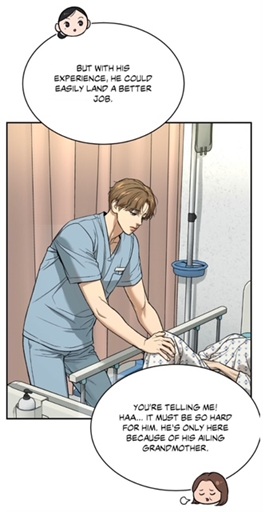 (chapter 56) She is projecting herself in his shoes. Why? IT is because she got influenced by the comment from her colleague. That’s how I realized that together, they represent the balance of heart and mind, their unity and understanding forming a cohesive whole. That’s how both are able not to become indifferent or too much attached. This coincides to the dualism of their profession: care but also detachment. Under this new perspective, it becomes comprehensible why the second nurse is not referring to facts, but to impressions and imagination. Her words are strongly intertwined with rumors: “with his experience”. So far, the main lead had barely experience in his field, as his first big gig ended up in a fiasco. He didn’t stay that long at the hospital and it is the same for the champion. He only worked at the gym for three months. The dark haired woman might have seen Kim Dan’s resume and the last employer, but she didn’t notice his name (Joo Jaekyung). This is her MO for „detachment“, she doesn’t pay attention to names. Moreover, she didn’t detect that he had barely worked as a PT before indicating that she has no notion of „time“. The discrepancy between her thoughts and reality can be easily explained. She also recognized the transformation in the patients, and could link it to the doctor’s skills. The reference to “famous athlete” and the doctor’s skills created a false perception, and this had an influence on her colleague: “You’re telling me!”.
 (chapter 56) Her hypocrisy, particularly in her treatment of Kim Dan, remains hidden behind the guise of socially acceptable behavior. Within the hospice, residents maintain a positive opinion of her, which enables her to mask her neglect and selfishness effectively. But since the two nurses are sharing their thoughts and working as a team, it signifies that Shin Okja’s wrongdoings could be detected this time. Or better said, they will realize the true suffering from the protagonist. Nurse Heart and nurse Mind will do their best to protect their new mascot and give him what he truly needs:
  (chapter 26) The reality is that he still has no idea why the champion was acting that way. He tried to explain his odd behavior by jumping to conclusions (prejudices: a spoiled child) and by listening to others. He never used his heart and mind, rather his ears and eyes. And this brings me to my next part.
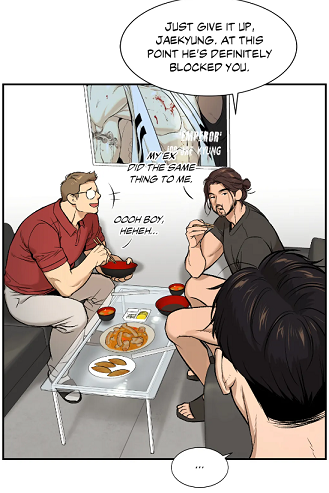 (chapter 5) And the other laughed. Then the coach seems to have no cellphone. Maybe he believes to have no need for it, for he goes to the gym every day. This signifies that he expects to be informed by his hyung Namwook. However, like mentioned in the previous essay, I believe that the manager has been sweeping under the rug the terrible condition of his “boy” from the coach and the team members. To sum up, Team Black embodies the opposite of the hospice’s values. There is no transparency, because the conversation took place not outside, but behind closed door. The door might be translucent, the reality is that they sent away all the members.
  (chapter 36) The gym, while ostensibly a team environment, is ruled by indifference, anonymity, and a lack of genuine camaraderie. The heart and the mind are not working together. Why? It is because the coach is trusting the manager, as he views him as the heart of the gym. What he fails to see, is that Park Namwook is neither the heart nor the mind, for he is more reflecting his surroundings: money. Secondly, the manager is easily influenced and is using conformity and social norms to avoid responsibility. He fears making decisions and lets others become proactive. Joo Jaekyung, the leader, relies exclusively on Park Namwook, the manager, who undermines team spirit by fostering distrust and misinformation.
 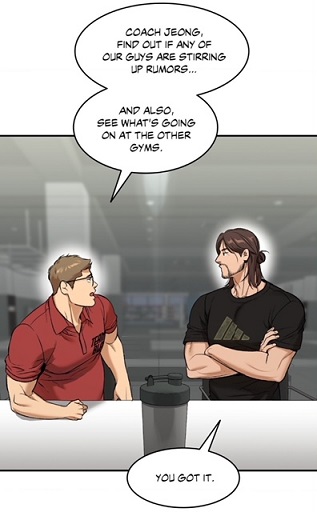 (chapter 46) The member’s loyalty got questioned, but the irony is that they had the real insight.
 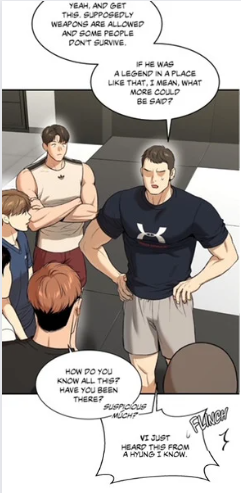 (chapter 47) Thus rumors about Baek Junmin being an illegal fighter never reached Jaekyung’s ears. That’s why the author made fun of the main lead here:
  (chapter 52) He was not willing to listen to the fighter’s suffering, because he didn’t want to be burdened. In fact, the opposite happened.
  (chapter 52) The man acted, as if he had been the biggest victim. Moreover, Namwook’s actions often reflect a lack of genuine loyalty, as seen in
  (chapter 22) episode 22, when he falsely claims ownership of the gym and again in episode 56 when he reminds the champion of his absence from the gym, behaving as though he were the boss.
  (chapter 56) Since she approached the physical therapist to get closer to him and used work to create a connection, people can see the similarities between her and the manager. While she represents honesty, curiosity, care but also “ignorance”,, it means that Park Namwook embodies the opposite values: indifference and a certain dishonesty.
 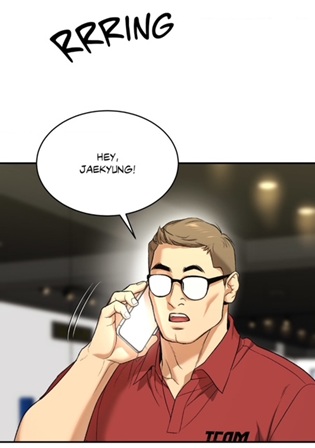 (chapter 56) Hence he is seen talking over the phone and not face to face, unlike the nurse. He knows that his boy is struggling, but he acts, as if he didn’t know. This contrast validates my previous interpretation of the manager. His question “Is everything okay with you?” exposes his lack of genuine concern. He uses work not to praise his “boy”, but to blame him for his “negligence”. He downplays the champion’s struggles while still recovering from surgery. This lack of care creates an atmosphere of apathy, anonymity, and selfish expectation, sharply contrasting with the hospice’s values of dignity and communal care. But how do we explain this huge divergence? First, the main principles of the hospice are dignity and care, and not primarily money. Therefore the institution offers free health check once a month:
 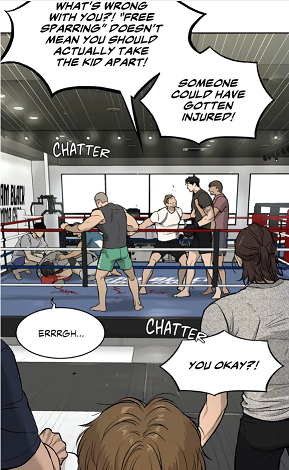 (chapter 1) The fighter with the head injury received treatment from the members (self-medication) and Kim Changming had a shoulder injury which got neglected.
  (chapter 7) These incidents reflect the gym’s underlying indifference and mismanagement. This disparity explains why Jaekyung’s mental health suffered under Namwook’s leadership, as the gym lacked the supportive and transparent environment required to nurture emotional resilience. Jaekyung’s stay at the hospice is likely to open his eyes to this overlooked aspect, prompting him to reconsider his leadership style and the values governing Team Black. But it is the same for Kim Dan, especially if he sees how weak and neglected the fighter looks:
  (chapter 56) Her actions, such as allowing Kim Dan to stay by her side and covering him, contrast sharply with her earlier attempts to push him away. In this scene, a caretaker might pass through the rooms to ensure everything is in order, noticing the doctor present. To an outsider, the visible outcome suggests that she accepts her grandchild’s relentless care without protest. It was, as if she had said nothing at all. Yet, this perceived acceptance masks her internal struggle and the discomfort of being dependent on Kim Dan, reflecting her conflicted emotions. These moments of vulnerability and acceptance highlight the gradual erosion of her denial under the hospice’s symbolic light.
 (chapter 19) However, for Kim Dan, this object represented a burden rather than a gift. He had troubles to find a new place to stay because of her „treasure“:
 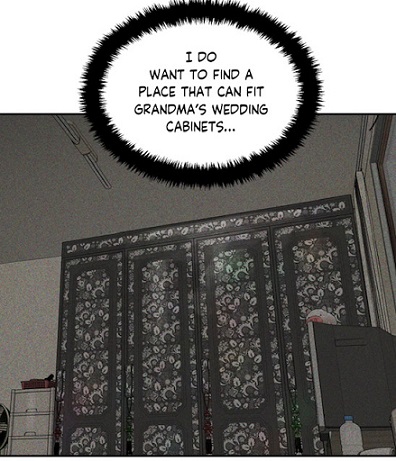 (chapter 16) Despite its substantial value, the grandmother never sold the cabinet to pay off the debts, prioritizing its preservation over the survival of her home and family. On the one hand, this reveals her immaturity and selfishness, as she put up with her grandson’s suffering. On the other hand, her decision created the impression to Kim Dan that this belonging had just a sentimental value and nothing more. So when the champion saw that huge Wedding cabinet, he judged it as „junk“ and that’s how the doctor got this perception validated.
 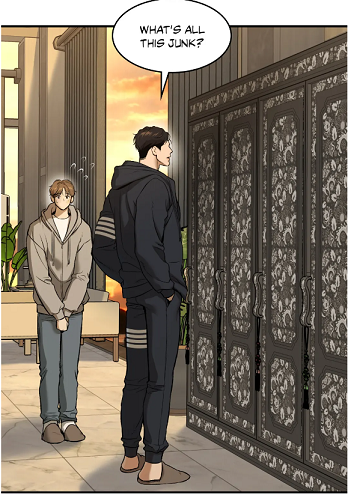 (Chapter 19) Hence it is not surprising that at the end, he chose to abandon this huge cupboard.
  (Chapter 53) Finally during her move to the Light Of Hope, she did not ask about the whereabouts of her belonging which could only reinforce the impression that this item had no real value. It had even lost its sentimental value, as she was no longer thinking of her former home. Her ignorance and forgetfulness are once again outlining her superficiality, self-centeredness and lack of empathy. The sentimental value of her Wedding Cabinet was rather shallow. But the tragedy is that when the furniture was moved the penthouse, the champion noticed this item for the first time and came to associate this cupboard with the doctor.
  (chapter 42) This explicates why the athlete didn’t pay attention to his soulmate’s clothes. And now, observe that the doctor is only wearing his PT uniform.
  (chapter 56) Thus I am predicting a huge awakening for the champion. Without the cupboard, the champion can see that the physical therapist almost has no cloth. Thus he can only admit his humbleness and benevolence. However, the moment he hears that this furniture belonged to the grandmother, the champion can only perceive the relative in a different light. Yes, the gift should expose her true personality. At the same time, Shin Okja never gave her Wedding Cabinet to Kim Dan, so should she discover that she lost her gift or the latter ended up in the athlete’s hands, she could protest and reclaim it. My point is that this legacy serves as a tool to expose the grandmother’s childish and shallow nature.
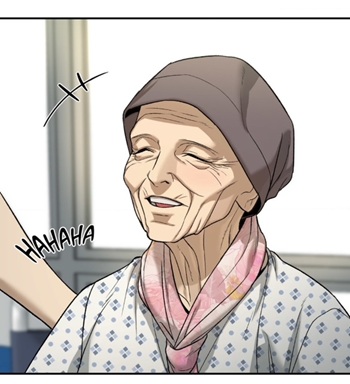 (chapter 56) She is wearing it daily and is proud of it. Deep down, she knows the true value of the scarf: it was expensive
  (Chapter 41) as she employs the expression „spoil to death“. By wearing the scarf with flowers, she appears wealthy, but also vain! Since I detected that Kim Dan likes pink flowers, my interpretation is that this gift mirrors the doctor’s taste indicating that he was slowly regaining his identity and confidence..
  (chapter 31) And notice that the bouquet of pink roses pushed Kim Dan to talk to Joo Jaekyung about his taste. That’s how I detected a strong connection between presents and communication. Notice that on the champion’s birthday, the manager sent a message while the presents were delivered.
 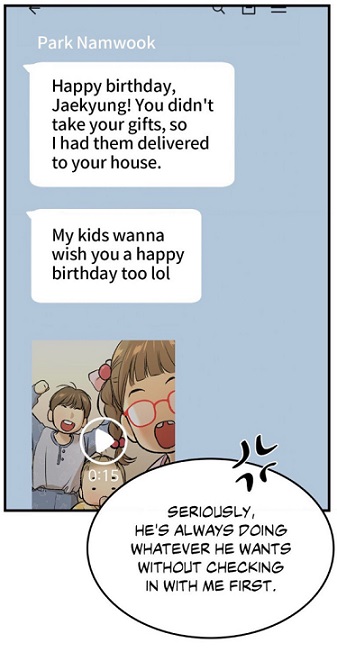 (chapter 45) This aspect gets even validated with the doctor’s keychain. The latter not only caused an argument between the two room mates
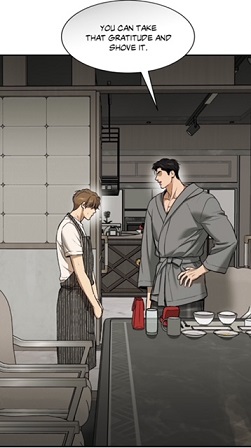 (chapter 45), but also encouraged the doctor to convey his thoughts and expectations in the card. On the other hand, he didn’t expose the whole truth
  (chapter 55) Another interesting aspect lies in the doctor’s shaking hands which the champion noticed, when he offered the present:
  (chapter 55) This scene reminded me of their first encounter:
 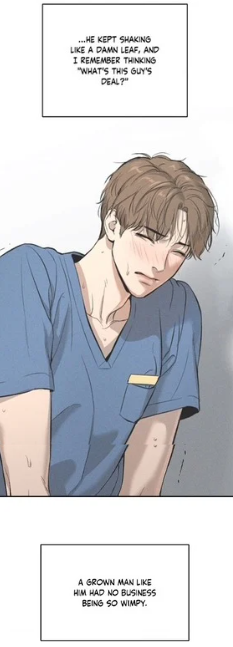 (Chapter 56) So the man must have recognized the doctor‘s fear, which explains why the champion could voice his anger later. But back then, he never wondered why the doctor‘s hands were shaking like leaves. It is because the doctor feared rejection. The present had the following meaning for the physical therapist: recognition and acceptance. The gift was the symbol for „conditional affection“ which he had long internalized due to his grandmother. But this doesn‘t end here. The shaking hands appeared in a different scene:
  (chapter 49) The common denominator between these three scenes is the mistake. Kim Dan feared to have made a mistake with the present, because he was afraid of the champion‘s reaction: will he accept him or not? But let‘s return our attention to the gifts from the doctor.
 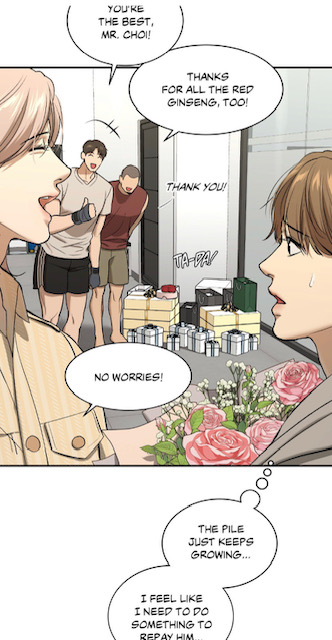 (chapter 31)
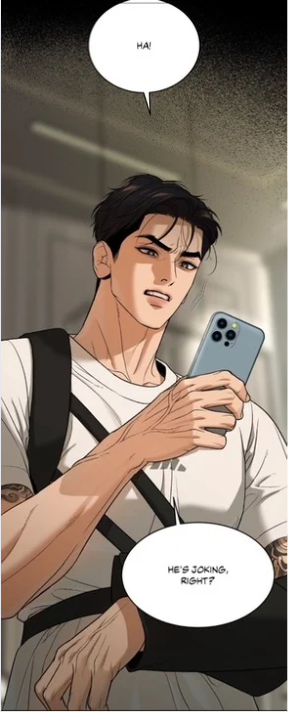 (chapter 55) implies that as soon as the main couple meet each other, they will have to discuss this matter. To sum up, a gift encourages the couple to communicate, yet contrary to season 1, both should be more honest to each other at the Light Of Hope. Every word and action will appear in a different light. Another aspect is that none of them takes things for granted, which stands in opposition to hyung Namwook and the grandmother. This explicates why the latter have no problem to spend money.


 (chapter 56) This dichotomy in season 1 is vividly illustrated in a scene where Kim Dan, under the dappled light of a tree
 (chapter 41), experiences a profound moment of awakening. As his hand seems to reach towards the leaves
 (chapter 41), his senses come alive—he sees the light filtering through, feels the breeze, and hears the faint rustling sound. It is, as if in that moment, he reconnects to his true nature. Like a tree, Kim Dan is deeply rooted, yet capable of growth and resilience.
  (chapter 41) Nature awakens something within him— his heart and as such his third eye —allowing him to realize his affection for Joo Jaekyung. This quiet yet powerful moment emphasizes how nature offers clarity and purity, serving as a contrast to the suffocating, impersonal urban world where Kim Dan often found himself lost. Striking is when Joo Jaekyung met Kim Dan for the first time, he compared him to a “leaf,” shaking and fragile—an unconscious recognition of his true nature.
  (chapter 55) However, note that the main lead isn’t stretching his hand to the sky and sun. He is almost immobile. Just before, he was holding the cellphone in his hand:
 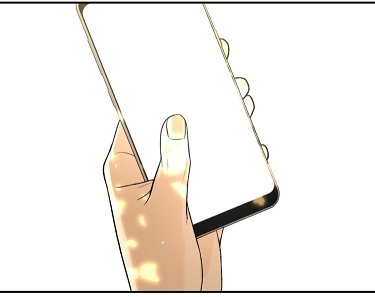 (chapter 55) Another divergence to the scene in episode 41 is that Jinx-philes couldn’t see his face. It indicates that the doctor reverted to his old self, and as such he is not true to himself. Therefore I come to the following conclusion. Mingwa uses nature as a mirror to Kim Dan’s emotional and spiritual state. While moments of connection with nature reflect clarity and self-realization, the juxtaposition in this scene underscores the opposite. Here, Kim Dan sits surrounded by trees and bathed in sunlight, yet his attention is consumed by his cellphone—symbolizing his entanglement with money, duty, and his ongoing struggles. Just moments prior, he wired money to the champion, a decision rooted in his past traumas and present desperation. The irony of the setting cannot be overlooked: though nature surrounds him, its purity and tranquility remain unnoticed, emphasizing how Kim Dan is still trapped in patterns of survival, burdened by his circumstances. He has become a ghost once again. This disconnect reveals how the weight of his past prevents him from embracing the present moment and reconnecting with his true nature, contrasting starkly with earlier scenes where his senses came alive under the trees.
  (chapter 56) The empty beach scene, with its sunlight and tranquil beauty, reflects peace, but also unfulfilled connections. Kim Dan’s absence from this moment underscores his failure to keep a heartfelt promise to his grandmother:
  (chapter 53) to watch the sunset together. This failure stems not only from Joo Jaekyung
  (chapter 53) —now associated with the sunlight, symbolizing life and vitality—but also from Kim Dan’s fixation on his own suffering.
  (chapter 56) Abandoned once again, Kim Dan is consumed by the weight of his trauma, isolating himself emotionally and excluding himself from others.
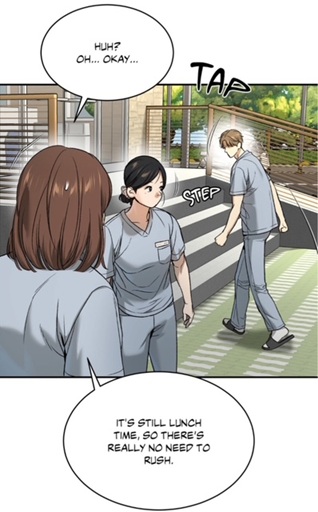 (chapter 56) When approached and complimented, such as when the nurse praises him and encourages him to take a break for lunch, Kim Dan pointedly ignores the praise and instead chooses to return to work. His inability to engage with others reflects the same disconnection that prevents him from connecting to nature. Mingwa subtly reveals a painful truth: Kim Dan’s fixation on his suffering not only blinds him to the solace and clarity offered by nature, but also hinders his ability to nurture relationships.
 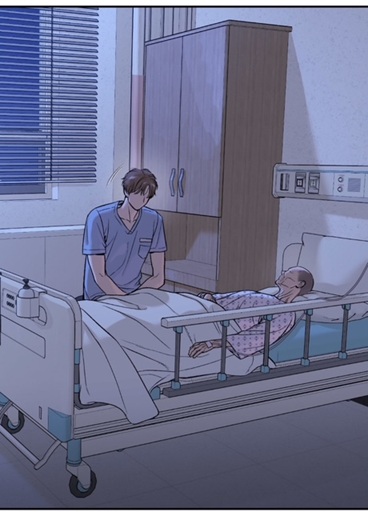 (chapter 56) and, symbolically, to the moon, Kim Dan remains oblivious to what has always been there for him: the enduring forces of love, stability, and healing.
 (chapter 26) Yes, the day where they sparred out of fun. For the first time, Kim Dan chose to accept a challenge for himself and for Potato. He felt a connection with Yoon-Gu, because he saw in him a puppy:
 (chapter 37) The puppy symbolizes not only nature, but also innocence. Let’s not forget that he was moved by the actor’s flowers in the past:
 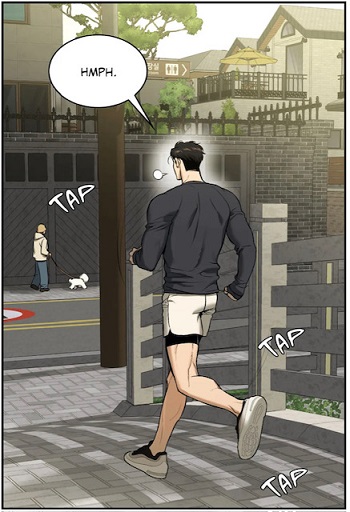 (chapter 21) Yes, by offering him a puppy! Is it a coincidence that the author made the champion jog next to a dog owner? I don’t think so. Until now, nothing could move Kim Dan’s heart:
  (chapter 44) In other words, Kim Dan feels a strong connection to animals, but he could never have one due to his poverty and his grandmother. By taking care of a dog, he would be forced to pay attention to nature and in particular to trees. Naturally, I believe that Potato will play a similar role in the future, for Mingwa associated him with a dog.
  (chapter 47), the nursing attendant
  (chapter 21) or the reporters:
 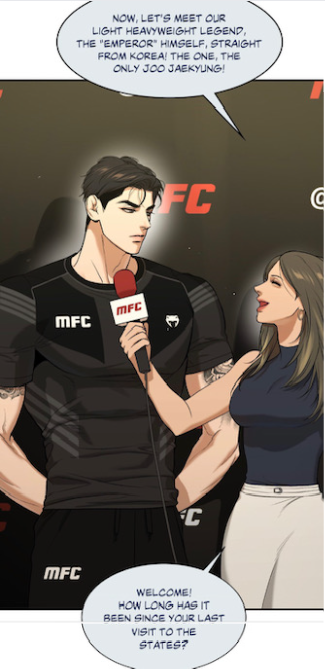 (chapter 37)
 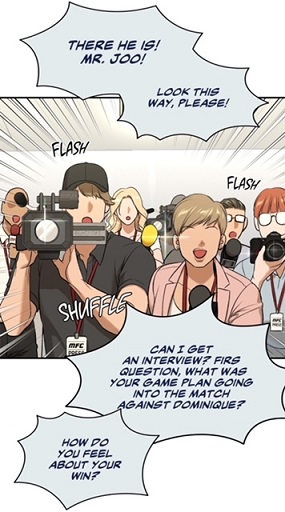 (chapter 40) However, Manhwa-worms will notice a significant distinction: in Season 1, these women were all tied to the world of work. Even Kim Dan’s grandmother, though she represents a familial figure, falls into this category.
 (chapter 56) Moreover, the grandmother’s choice of words, “Why don’t you turn in?”, implies that she sees Kim Dan’s presence as a form of “work” or duty. This phrasing is often associated with someone finishing a day’s tasks or obligations before going to bed, which fits into the broader dynamic between Kim Dan and his responsibilities. In my eyes, it shows that she is seeing her grandson more as a caretaker than as a family member. We shouldn’t forget that she was the reason why the main lead became a PT. It was, as if her dream had come true. Nevertheless, the verity is that his grandmother is receiving treatment from his colleagues.
  (chapter 56) It looks like she’s pushing him away. On the one hand, her request sounds right, for she is treated quite well and the suggestion was made out of concern. She sees her grandchild struggling, and probably imagines that this move must weight down on Kim Dan. On the other hand, I can’t help myself thinking that this woman also has other reasons to send him back to Seoul. The nurse was already pitying the physical therapist:
  (chapter 7) before she got reassured. Then she made this request
 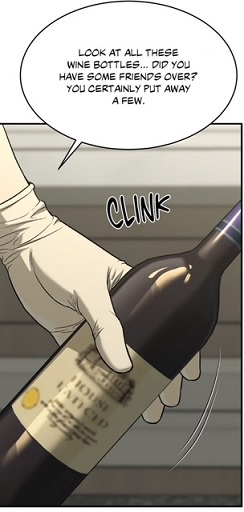 (chapter 55) and later brought the doctor’s present:
 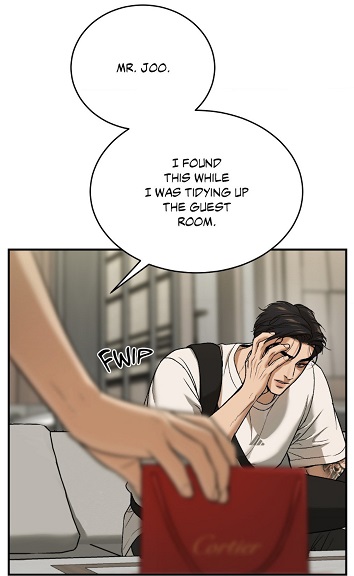 (chapter 55) And what is the common denominator with these two images? The woman’s hand. In the previous essay, I explained that her intervention signalized that the champion would stop drinking and was starting acknowledging Kim Dan. The zoom on the cleaning lady’s hand is a powerful visual cue that encapsulates many of the symbolic meanings associated with a woman’s hand, reinforcing the themes of care, healing, humility, and transformation.
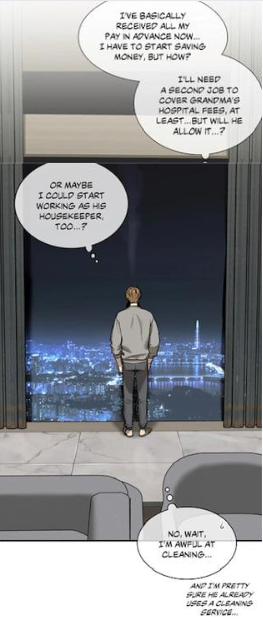 (chapter 19) He is not capable to take care of himself well.
  (chapter 55) Observe how she smiled to him by saying goodbye. This is a sign that her respect and care are genuine. One might think that this nameless cleaning lady was unfortunately portrayed as eyeless:
 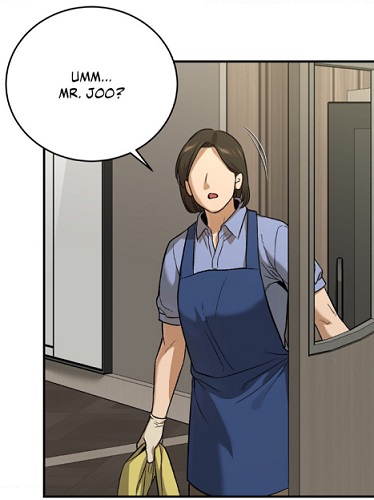 (chapter 56) I don’t think, we should see it in a pejorative light, like for an example of blindness or manipulation. In my eyes, the absence of her eyes are mirroring the nature of their relationship between the champion and the cleaning service. So far, he never met these people, as he was always away. In other words, the absence of the eyes is showing that the sportsman doesn’t know her that well. But it could change and this because of Kim Dan.
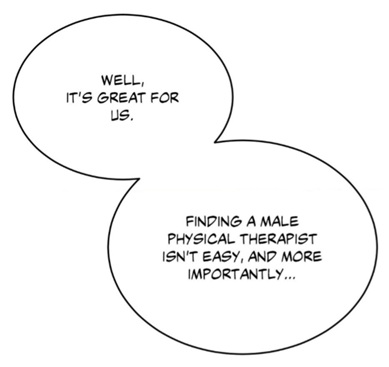 (chapter 56) Male physical therapists like this one
  (chapter 54) prefer specializing in treating athletes because it brings more money and fame, whereas female PT ends up at hospices due to their nature (nurturing, family). This means that by going to the hospice, the athlete will enter a whole new world. The appearance of the woman with glasses was indicating that the athlete was slowly broadening his horizon. As you can see, little by little, the fighter is opening his mind to new things. So how will he react, when he sees that his beloved “hamster” is withering again? This time, he can not blame the doctor. Since I detected similarities between Kim Dan’s current attitude and the champion’s past behavior, I have the feeling that the fighter will recognize himself in his loved one or someone will give him some advice. He will have the answer to this:
 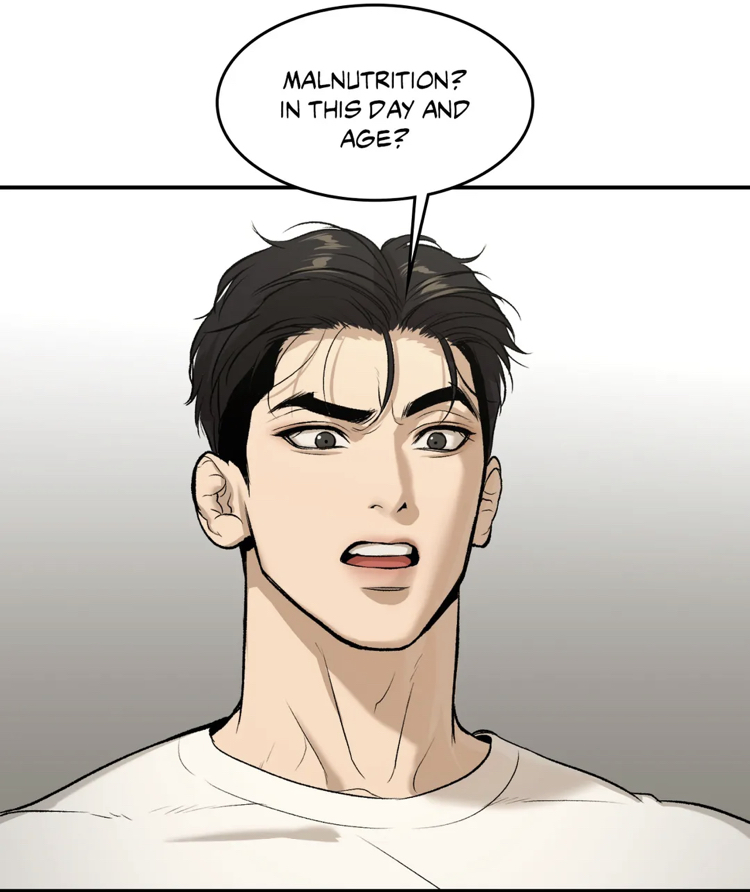 (chapter 13) He is neglecting himself to the point of exhaustion, because he is living as a PT non-stop. While the champion was fighting with his bad shoulder, the other is using his hands for treatment, hence he is not eating.

 (chapter 56) and
 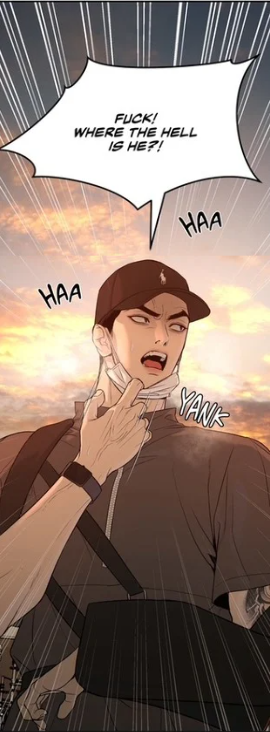 (chapter 56) While in the first picture, Joo Jaekyung is calm, concentrated and silent, in the second one, the fighter is agitated, lost, breathless and yelling. These two mental dispositions are reflected in the location. In the first image, the MMA celebrity appears behind the steering wheel, which is a symbol for power, determination and control, whereas in the second panel the champion is wandering alone in the street. This running is no longer part of his training and routine, but it exposes his powerlessness, loneliness and despair. He has no idea where to go contrary to the first picture. This means that the latter embodies goal and destination, whereas the second image represents the opposite values: beginning, start, ground zero and source. In other words, the end of episode announces the athlete’s rebirth or better said, the start of a new life. I will elaborate further below. But let’s return our attention to the symbolism of the auto.
  (chapter 56)
  (chapter 56) Even if the main lead is moving among other cars, people can recognize that the owner of such a car is rich and probably famous due to the brand and design. On the other hand, by roaming in the street, the champion blends into the background and as such to the mass.
 (chapter 35), Joo Jaekyung succeeded. He is just a passerby. In other words, the avenue indicates not only his failure to find Kim Dan, but also his loss of power and status. He has just become a nobody. Thus we should consider this as the athlete’s karma for thinking that Kim Dan could be replaced, because he was just a nobody:
 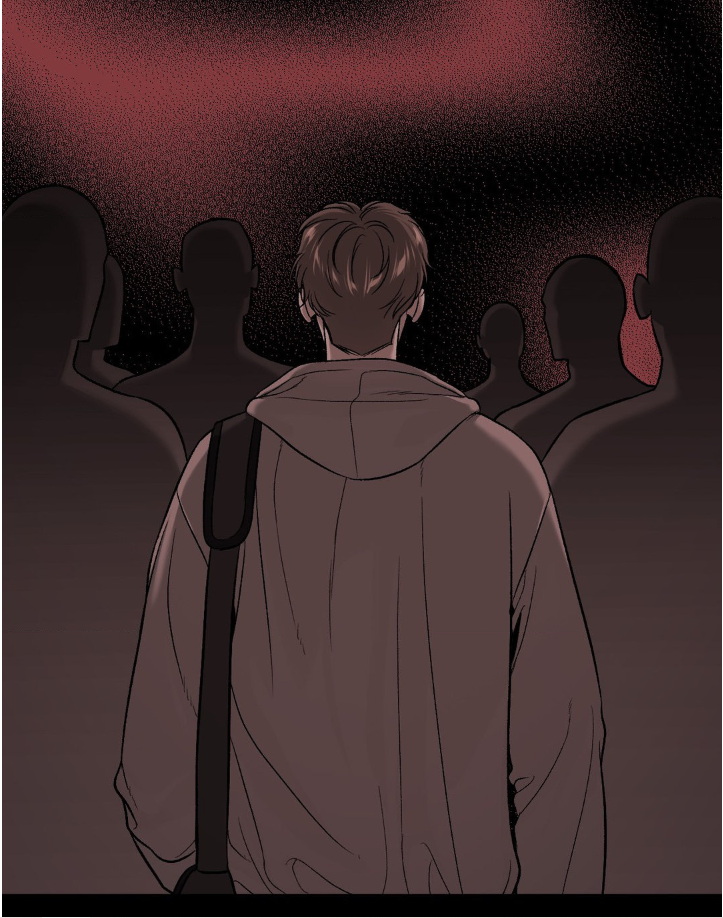 (chapter 55) It is no coincidence as well that the author showed us the star’s back, when the latter called his hyung Park Namwook.
  These two chapters are similar, for they convey the same emotions: anger, anxiety, frustration and despair of the fighter. In the car, the champion attempted to control the doctor’s libido.
  (chapter 33) On the one hand, he appeared calm and concentrated like in 56, yet deep inside, he was burning up. The pink dildo was used as a tool to voice his negative emotions (abandonment issues, insecurities and jealousy). With the release of episode 56, another reason came to my mind why the athlete proposed to drive the physical therapist to Choi Heesung.
 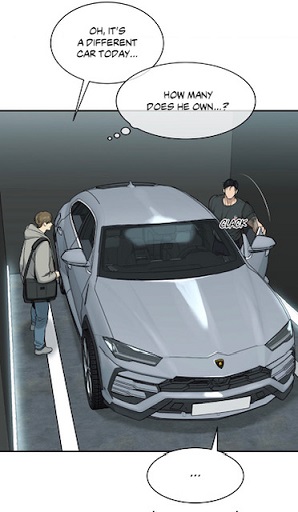 (chapter 32) First, he switched the car in order to demonstrate his wealth and status. It was, as if he wanted to show off to his fated companion, which reminded me of the actor. The latter would bomb doc Dan with “presents”, an indirect demonstration of his fortune. In addition, Jinxphiles will certainly recall that during the same day, the comedian came to fetch the physical therapist with his white Porsche.
  (chapter 32) Consequently, I came to the following deduction. The man selected the gray car in order to distinguish himself from his rival, to impress his companion.
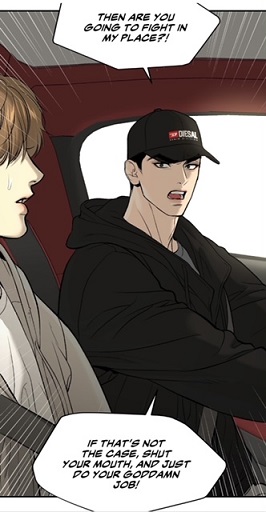 (chapter 42) And what was his attitude there? He would not listen to his passenger. Moreover, he would separate his job from his roommate’s. It looked like they were living in two different worlds, though they were sharing the car. This scene exposes miscommunication, lack of faith, stubbornness and prejudices. The fighter was not willing to accept the physical therapist’s doubts and chose to go through with the training and match.
  (chapter 2)
  (chapter 37) with arrogance and weakness, but this is not true. [For more read this
 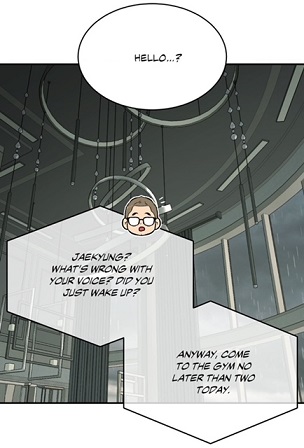 (chapter 54)
  (chapter 5) He allows the coach to drive the car and the manager to sit in the front. Thus they represent the higher authorities. However, so far, the doctor had only been his passenger. Thus a new idea popped up: what if the athlete let the physical therapist drive his car? Let’s not forget that the loner wolf shouldn’t be driving on his own, for his shoulder has not healed properly yet. I already pointed out the wrongdoings from the two hyungs.
 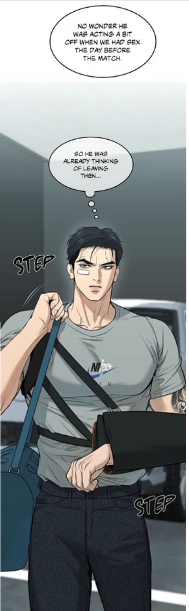 (chapter 53) They should have brought him home. They stand for neglect and indifference due to their passivity and routine. In my eyes, they are happy at the gym, the latter represents their second family. So they imagine that it is the same for their boss. In other words, they projected their own thoughts and feelings onto the celebrity. They embody silence and lack of communication and this is actually palpable in the car. In episode 5, the manager and the MMA fighters lied to each other:
  (chapter 5) Then in episode 49, the champion kept The Shotgun’s words as a secret, while his coach confessed his trust in his “boy”
 (chapter 49). Yet, he revealed his true thoughts at the hospital:
 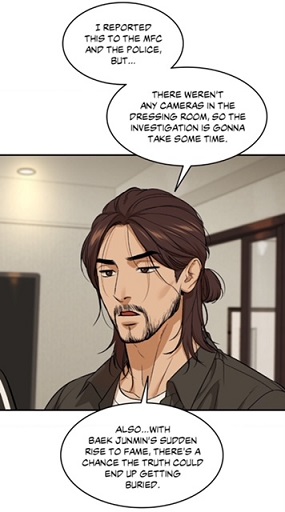 (chapter 52) Imagine that he only reported his investigation and actions afterwards. Then on the athlete’s birthday, he didn’t send any private message as well.
 (chapter 37) He was using the landline telephone. This observation is relevant, because it exposes the coach’s dependency on Park Namwook. The latter’s task is to keep in touch with his boss and champion, for he has his cellphone number. Nevertheless, how do we explain the absence of the coach’s cellphone? I have the feeling that this could be related to his divorce.
  (chapter 19) Thus this observation made me think that the coach could have something in common with Kim Dan. And that’s how the champion will demonstrate his strength to his hyung. Contrary to him, he didn’t accept the divorce so “easily”. In fact, he is fighting for the doctor in his own way. The problem is that he is his own worst enemy.
 (chapter 49), Jinxphiles could never view the driver.
  (chapter 13) His question “Is everything okay with you?” is purely mechanical and as such meaningless, for he doesn’t inquire, when he hears a silence from the other side of the line. I would even say that he doesn’t really wait for his boy’s answer as well.
 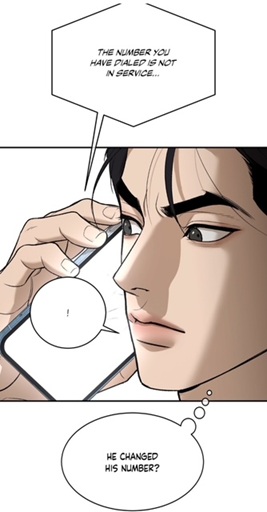 (chapter 56), he could end up in the same situation than the protagonist. And keep in mind that the coach Yosep is actually relying on the manager. Thus I reckon that the champion’s other source of power is actually his cellphone! Without him, he has no connection
  (chapter 5), no money
 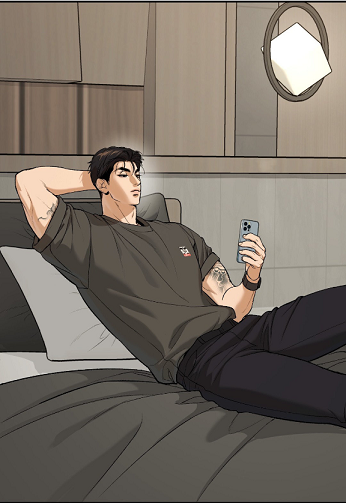 (chapter 32) and no power. His call to the manager during that evening represents his last resort. Thus he is calling the manager “Namwook hyung” contrary to episode 5.
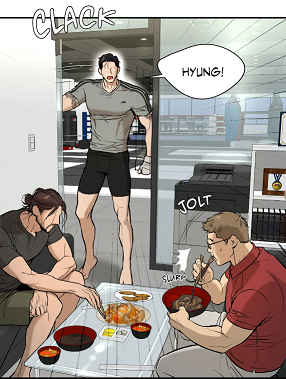 (chapter 5) This title is indicating that the champion is opening up, and willing to show his vulnerability and despair. On the other hand, this change also implies “expectations” from the fighter,
 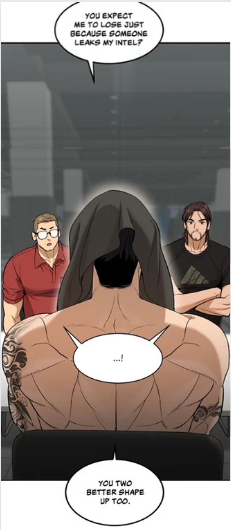 (chapter 46) Keep in mind that at the gym, the athlete denied the relevance of information. Though both hyungs were warned, the reality was that they got off scot-free. They never received any blame for failing to protect him and this twice. And now, he is looking for intel about the doctor. Indirectly, fate is teaching him to recognize his error. In fact, information can procure a good insight about people’s behavior and as such fears. Let me give you an example: if Joo Jaekyung were to hear about Kim Dan’s first employment as PT, he should understand why the PT made mistakes, why he took odd jobs and why he “left” Seoul. If he wanted to work as PT, he needed to go elsewhere.
 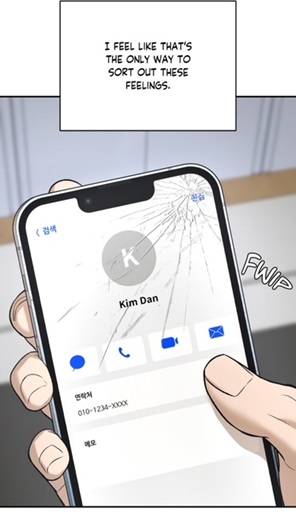 (chapter 56) He somehow expected doc Dan to listen to his words and accept them. That was it. Then at the end, it is just about seeing doc Dan and nothing more. At no moment, he voiced the desire to get to know his partner or to listen to his side of the story. Why? It is because he had strongly internalized that the man was a liar. He never questioned his perception and detected his own prejudices. It is important to recollect how Jinx-philes could sense a positive change in the physical therapist:
 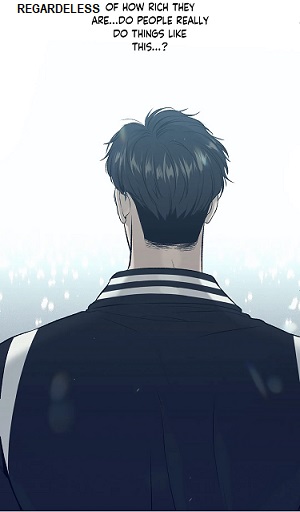 (chapter 22) Yes, it is the view with the star’s back. The author selected such a position on purpose. The face represents the character’s identity and as such his personality. By showing the back, Mingwa is implying that the beholder is full of prejudices and doesn’t know his partner that well. That’s why I judge this image
  (chapter 7)
 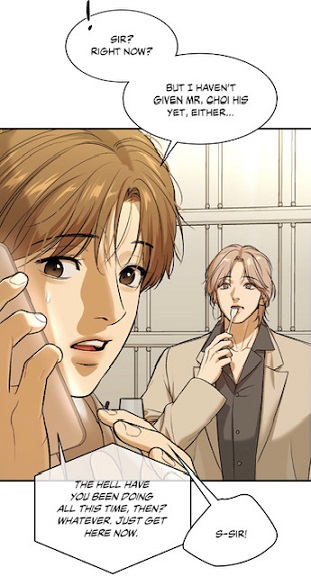 (chapter 32)
 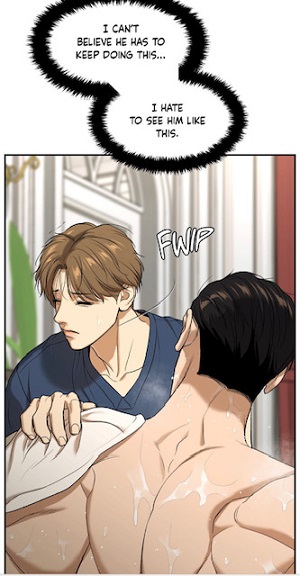 (chapter 37)
  (chapter 40)
 (chapter 43)
  (chapter 45)
 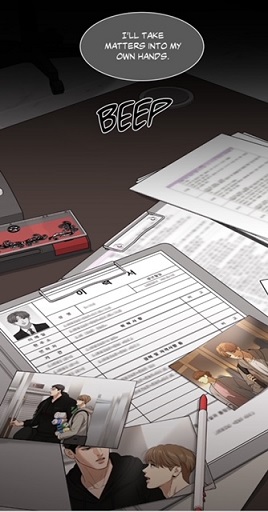 (chapter 46)
 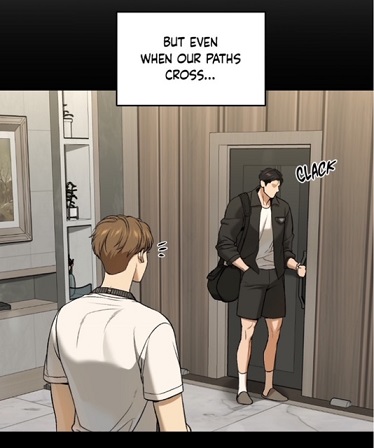 (chapter 47) Looking at his face had become his new secret ritual and as such his source of joy. Naturally, his heart and unconscious were the causes for this new habit. This explicates why he hated hearing the doctor leaving the penthouse during the night: he feared that he would no longer be able to see his cute face. That’s also the reason why Joo Jaekyung got angry/upset, when he saw the doctor turning his head away
  (chapter 21) and almost got shocked
  (chapter 56), when he imagined that she had died. In reality, he helped financially more the grandmother than Kim Dan himself. Kim Dan is the one he should really empathize with. He has always been a victim of circumstances.
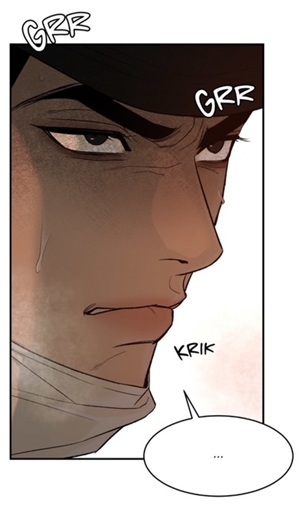 (chapter 56) Desperation can strip away the higher faculties that make us human—reason, empathy, and self-control—exposing something primal.
  (chapter 17) and
  (chapter 11). In season 1, the athlete stands for golden hour, whereas Heo Namwook embodies blue hour. “Entre chien et loup” is the time of day when the light is such that is becomes difficult to distinguish between a dog and a wolf, between friend and foe, between known and unknown. Hence I am thinking that if the next episode represents a continuation of that nightfall, it signifies that the champion is on his way to meet someone from the past. Moreover, I detected that the pavement is the same than in front of the gym: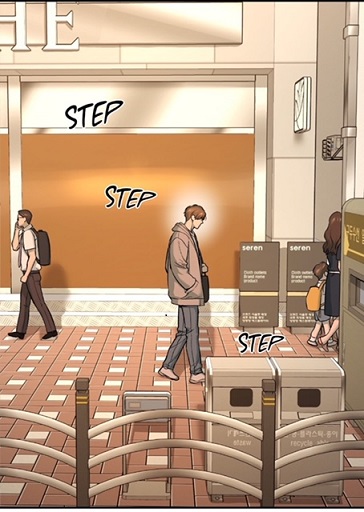
 (chapter 52) It is because this exposes the champion’s bad coping mechanism. The champion always uses his fists, therefore he doesn’t reflect and as such analyze his emotions.
 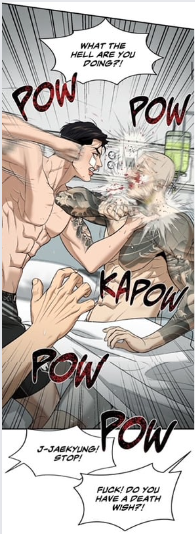 (chapter 52) That’s how he felt right into the trap of the schemers. So by having his splint, Joo Jaekyung is indirectly coerced to meditate on his feelings., as he can no longer use his shoulder and as such his fist. His physical injury represents in reality his “lucky charm”, for it helps him to transform, to overcome his trauma and face the shadows from his traumatic past. Notice that for the first time, the athlete came to accept the existence of feelings for Kim Dan.
 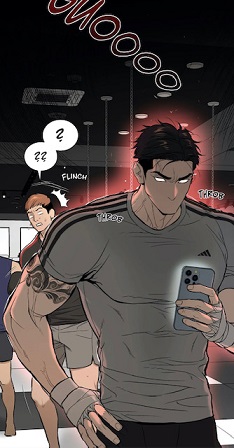 (chapter 5) He is much calmer. He is not oozing red and remaining silent. He is not burning up inside, in fact he is expressing his thoughts and emotions:
  (chapter 5) In both cases, the athlete asked for his manager’s help. However, as Jinx-philes can sense, there exist two huge differences between the past and present. Back then, Park Namwook didn’t care for Kim Dan. He was just a PT like any other doctor. He didn’t even care that Joo Jaekyung would lose his temper and ruin the sandbag.
  (chapter 5) It was not worrisome in his eyes, because his day would consist of training and punching the sandbag. The problem is that the fighter is no longer coming to the gym and he is not even calling him:
  (chapter 56) This shows that the athlete is using more and more his intelligence, he is forced to interact with people. He is gradually developing his social skills which stand for COMMUNICATION. And how did he get deceive in the past?
 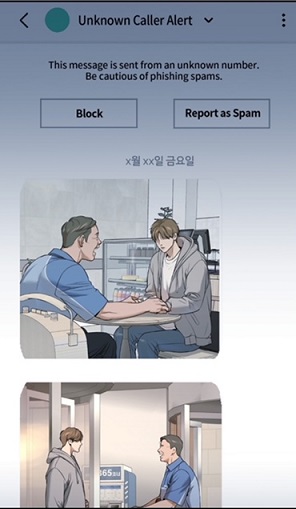 (chapter 48) He got manipulated by his eyes! They used a trick to deceive the athlete: delivering the truth in delay. Joo Jaekyung didn’t confront Kim Dan, because he saw the pictures as proofs! He never tried to hear his side from the story. And now, you comprehend why I am expecting that the champion will suffer another “blow” in the next episode. In my opinion, he will hear an important information. The fire in the illustration is there to indicate “Tabula Rasa”, a clean state. Joo Jaekyung has to lose all his principles and his bias about doc Dan. But for that he needs to face his own past and mistakes. Only through this effective anguish, he can become a better man, a new man.

 (chapter 55) One might think that the causes for his throbbing head are his depression and insomnia. On the other hand, I am quite certain that many readers had a different explanation for his migraine. He is missing his lover, Kim Dan, as the color red symbolizes the headache and the physical therapist’s name is strongly intertwined with this pigment which was once again confirmed in episoe 56.
  (chapter 56) So it is true that his migraine are caused by the doctor’s absence. It was, as if the main lead was suffering from withdrawal symptoms. The fighter has a love addiction, but he is not aware of the existence of this “sweet poison”. But there’s more to it.

 Thus I consider this image, where the champion is seen
 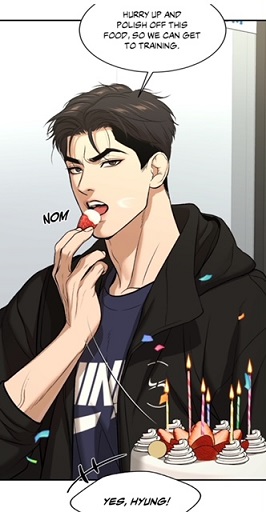 (chapter 43) eating a strawberry with cream as the announcement of the magical night between Kim Dan and his fated partner. The fruit with the cream represented a violation to his strict diet.
  (chapter 55) or the medicine against migraine.
 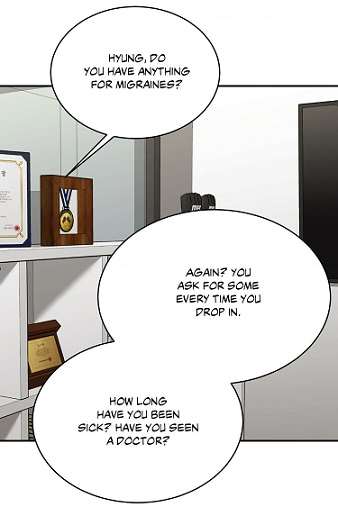 (chapter 54) However, in episode 55, we can observe a huge change in the champion.
  (chapter 55) The latter is finally admitting the inefficiency of the medicine. In other words, in this scene, he was giving up on them. This represents an important step on his way to enlightenment. For me, it signifies that he is stopping relying on pharmaceutical products. Let’s not forget that in the past, he rejected the PT and even neglected them. Why? It is because he trusted more sprays and other medicines than people.
  (chapter 49) Therefore the switch of the spray had to occur. He needed to question his prejudices and attitude. But let’s return our attention to the champion and his throbbing head. One detail in this panel caught my notice.
  (chapter 55) And now, pay attention to the number of the bottles in his room:
 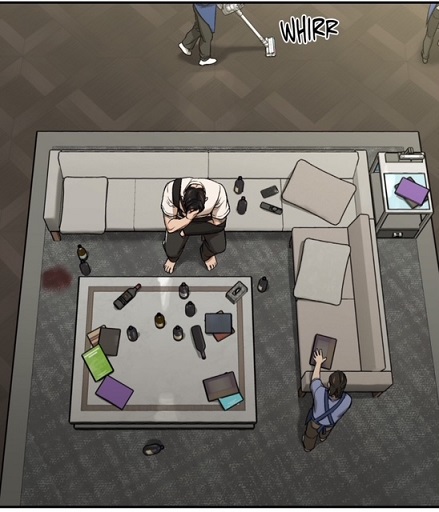 (chapter 55) I count 12 bottles of wine exactly like in the last image from chapter 54. Thus I came to the following deductions:
 (chapter 54) and the appearance of the staff in chapter 55. It indicates that Jinx-philes can witness time deceleration in season 2. From one month in one chapter, then a week in the next episode, finally we have a reference to a day: Monday. Thus I deduce that in episode 56, only 2 or 3 days elapsed. I have already announced that the couple should meet each other around 25th:
  (chapter 55)
 (chapter 55) Consequently, I judge the cleaning lady as the positive version of Park Namwook. Though she uses social norms, she doesn’t use them against her employee. She didn’t condemn him, it is a mixture of teasing and reminder. At the same time, her intervention implies that she must have noticed changes in her boss after the arrival of Kim Dan in the flat and his departure. That’s the reason why I have the impression that this image is announcing another turning point in the champion’s life either:
  (chapter 55) He won’t drink like before. However, I don’t think that he will behave like in the past: reject any alcohol entirely.
 (chapter 55), his migraine vanished. Though he is holding his head the next morning and hiding his gaze
  (chapter 55), the Webtoonist didn’t add any red or “throb” as an indication for a migraine. As you can see, his headache is strongly intertwined with repressing the physical therapist and as such locking away memories. However, there exists another cause. What had the doctor done in the past?
  (chapter 44) Yes, the main lead had patted his lover’s head, while the champion had his eyes close. In my opinion, his unconscious had registered this gesture and loved it. However, the champion had not seen it himself. He was drunk and had his eyes closed. This stroke on the head symbolizes appreciation, affection and recognition.
  (chapter 23) That’s how little kids are admired and loved. This stands in opposition to the abuser’s behavior:
  (chapter 54) parental criticism and absence of contact. And how did Choi Heesung express his “love” to Yoon Gu?
  (chapter special 2) The same way than Kim Dan with the patting! In other words, the champion is deep down longing for such a gesture, but he has not realized it yet. Nevertheless, I believe that he just needs a trigger.
 (chapter 55) With his left opened eye!! The exact opposite from this picture:
  (chapter 56) As long as the fighter thinks of his fated partner, he is not plagued with a throbbing head. This shows that it has something to do with repressing memories. However, his physical condition is still not improving:
  (chapter 55) This signifies that in reality, the uke is the one benefiting more from this relationship, while the “Gucgi guy” is a placebo for Joo Jaekyung. He can not replace the true medicine: Dan’s love. But Joo Jaekyung chose to close an eye to the truth forgetting his “insight” from chapter 2:
  (chapter 2) However, back then, he had just stated it in order to get rid of the mint-goblin. He needed a justification for switching his partner. In other words, this was reflecting more the protagonist’s corrupted mind and heart. Therefore he is designed eyeless, the symbol for ignorance, lies and blindness.
  (chapter 55) And where did he have his migraine exactly?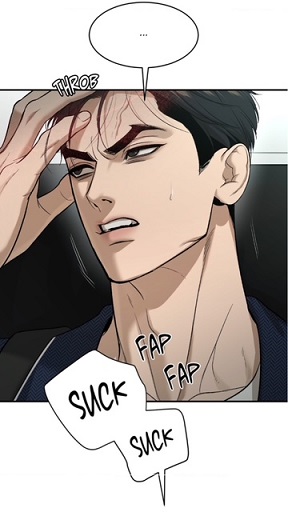
 (chapter 55) It was on the right side and eye! It truly exposes that Joo Jaekyung was getting punished for his attitude. He is not allowed to bury and forget Kim Dan. The star’s open eyes in this episode symbolize denial, lack of self-awareness and as such the absence of insight. He is also punished for his lies in episode 2. His words might have reflected the truth, but his words didn’t expose a change of heart. He was taking advantage of this situation as well. So when the pain intensified pushing him to close his right eye, we should consider this image as a short moment of reflection and realization. In the restroom, he was forced to admit that only Kim Dan could kiss him. Is it a coincidence that just before Mingwa presented this image
 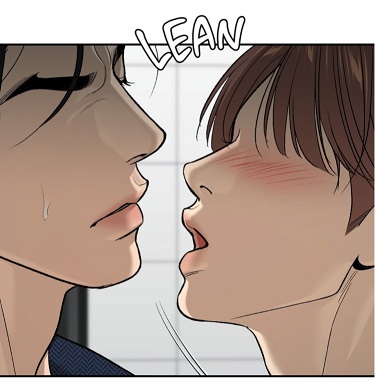 (chapter 55) Naturally no, she was mirroring the attitude of both figures: both were in denial!! Notice that though the star had no reaction in front of the “replacement”, the latter chose not to give up at all. This man was not expecting a rejection, in fact he was in total denial as well. He didn’t notice the star’s passivity and silence.
 (chapter 55) He was just standing there and avoiding his gaze.
 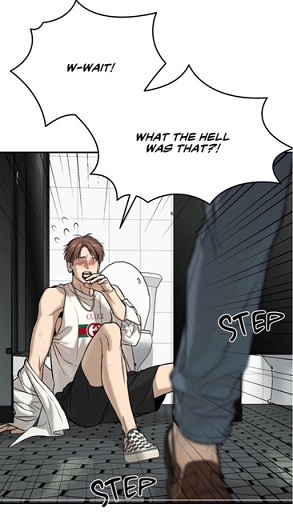 (chapter 55) How can the MMA fighter reject him? This displays his huge confidence or arrogance. There’s no doubt that he will put the blame on Joo Jaekyung. At the same time, I believe that his blindness was also caused by his greed.
 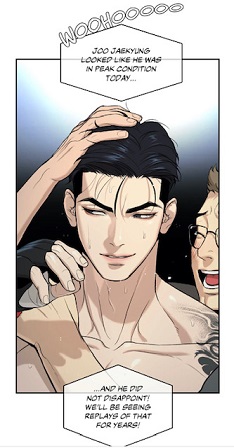 (chapter 5) Therefore he was in a happy mood after that match. A simple gesture with a lot of power! He has been missing this hand or better said this gesture. This action was the main lead’s true motivation.
  (chapter 54) Don’t forget that Dominic Hill had expressed his admiration in a similar way, patting on the back:
  (chapter 40) No wonder why he felt so lost and empty after the last fight.
 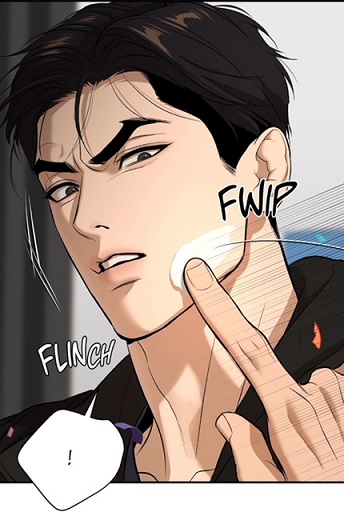 (chapter 43) this was the coach’s hand. In other words, the athlete felt more close to the coach than to the manager. This would explain why he would listen to the coach and even entrust him with huge tasks like the charity event. Strangely, in season 1, we can observe how more or more he is distancing himself from the fighter. Probably related to his secret relationship with Kim Dan. According to my theory, the coach is aware of their relationship. They are more than just boss and employee. As you can see, I don’t think that the champion is right now just missing the doctor’s sweet lips. Deep down, he would like to be patted by his loved one, exactly like Potato.
  (chapter 2) The champion’s reaction is quite telling. He is not easily swayed. But we have another bigger evidence that his intercourses were replacement for “fights”. In The States, the fighter asked Kim Dan to join him at 11:00.
  (chapter 38) He needed to prepare himself mentally, to visualize how he would screw his opponent Dominic Hill. He was just taking the expression “fuck/screw” too literally. The latter idiom has the following synonyms: to cheat, oppress, bleed, coerce, wrest and to tighten. Just before the doctor came to his door, what was the athlete doing? He was watching a video from his challenger:
  (chapter 38) Therefore it is not surprising that he rejected Kim Dan’s request first.
 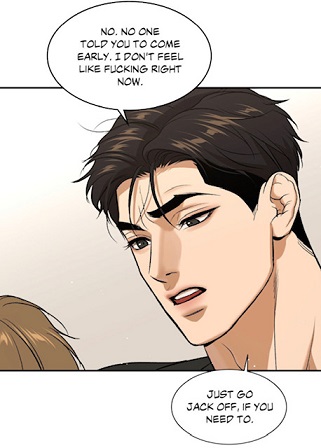 (chapter 39) He didn’t feel like it, because he was not aroused at all. Imagine that he needed two hours for that erection, a sign that during that night, Kim Dan was in reality a replacement for the American fighter.
 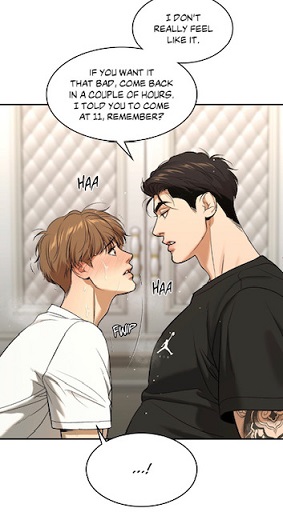 (chapter 39) Even when the doctor rubbed his hand against his sex, he had no reaction.
 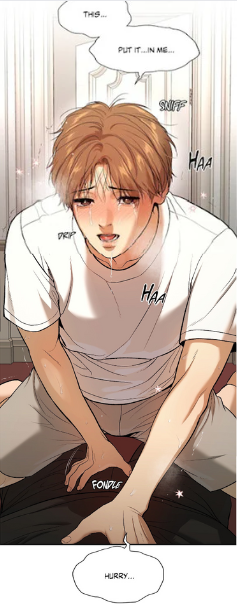 (chapter 38) In fact, he needed a fellatio to get an erection, and he only started getting excited, when he saw the doctor’s gaze. That’s the reason why he remembered this image under the shower:
  (chapter 55) However, the more time the champion spent time with his physical therapist, the more he came to violate his own rules and principles: It started with their first meeting, when he crossed the line by mixing private and professional life together:
  (chapter 6), Sex was no longer linked to matches, but to his own desires. To conclude, for the first time, the fighter connected sex to pleasure and desires and not “work and fighting”. Because of the deal and Joo Jaekyung’s strange behavior (sex shower scene, …) the PT had the impression that his boss was a man obsessed with sex.
 (chapter 53) The latter didn’t feel the need to have more sex with Kim Dan, he let his partner leave the place. Why? This contrasts so much to their First Wedding Night:
  (chapter 4)
  (chapter 53) Pay attention to the behavior from the fighter during their last night together. He is looking away, he is not paying attention to his fated companion. His mind was elsewhere, focused on Baek Junmin! In my opinion, during that night, the champion had been able to differentiate between the physical therapist and his opponent. Fighting was more important than sex and as such his sex partner. To conclude, the physical therapist had been able to win Joo Jaekyung’s belief and heart. He was no longer a replacement at all. He had become a person close the fighter.
 (chapter 53) However, the main lead never realized this huge change, he kept his old belief as a tradition out of habit. This explicates why the fighter tried to replace with a new uke
  (chapter 56). I don’t think, he was referring to the spray incident, rather to their night before the match. The doctor had not behaved like a real opponent, he had admitted his “defeat” quite easily. He had left the ring before procuring him a good fuck. He was blaming his partner for violating his rule:
 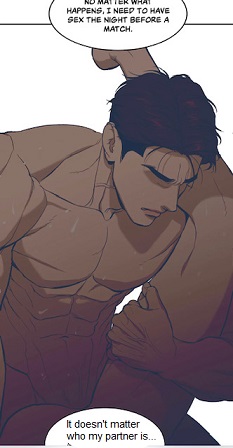 (chapter 2) But here is the thing. Kim Dan had just accepted the deal because of his grandmother. Secondly, he learned an important lesson during that magical night: consent!
  (chapter 44) Sex is a synonym for love and as such it is about giving pleasure and affection to his partner. It is a two-way street. And this is something that the champion has to admit and accept. Thus I deduce that the fighter still has a long way to go before dropping all his fake principles. Like mentioned before, he needs to ponder on the following question: what matters to him the most? His championship or his happiness? Or what is sex to him? Why does he think that he is jinxed? He needs to face his own painful past and remember the face of his tormentor.
 (chapter 1) The physical therapist is not only his reward and price, but also his “second shoulder” and as such his pillar. The new PT won’t be able to replace him. Joo Jaekyung is not just a champion, but also a team: Kim Dan as his PT and his lover. As for Kim Dan, the celebrity is his “energy drink”, his source of comfort and joy. He is also his home, for he is the first one who invited him to stay with him! Yes, the grandmother didn’t invite her grandson to live with her, he was just dumped at her place. And because the celebrity is like a home and family, it explicates why the doctor is once again “living like a ghost”.
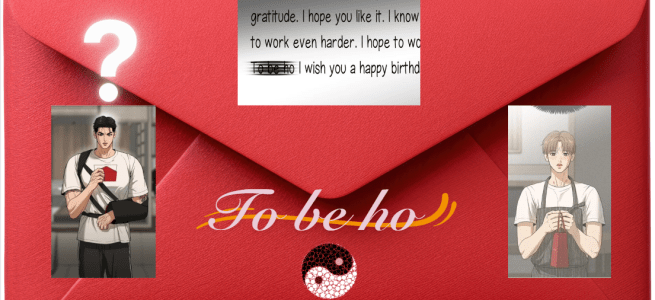



 Bebebisous33s' analyses in K-Dramaland and Manhwas