
Please support the authors by reading the manhwas on the official websites. This is where you can read the manhwa: Jinx. But be aware that the Manhwa is a mature Yaoi, which means, it is about homosexuality with explicit scenes. Here is the link of the table of contents about Jinx. Here is the link where you can find the table of contents of analyzed manhwas. Here are the links, if you are interested in the first work from Mingwa, BJ Alex, and the previous essay about Jinx “Facing The Shotgun: Embracing Change“
It would be great if you could make some donations/sponsoring: Ko-fi.com/bebebisous33 That way, you can support me with “coffee” so that I have the energy to keep examining manhwas. Besides, I need to cover up the expenses for this blog.
1. Clock and past
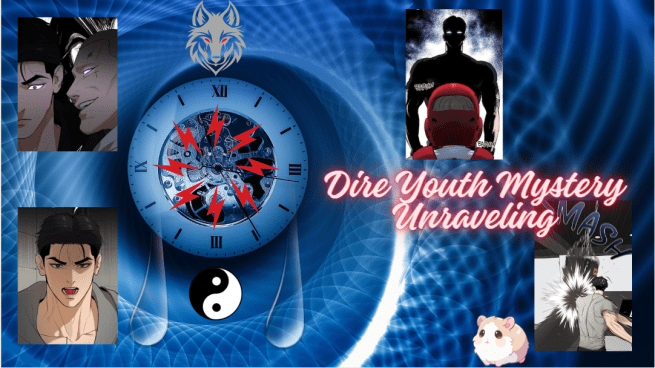
One might wonder why I selected such a picture for the background. While looking for a symbol for past, I discovered on Canva the clock as symbol for “past”. Why? It is because the clock represents time which includes past. As you can imagine, in the illustration, the clock is representing not only the past, but also Joo Jaekyung and his youth. But before presenting my new observations about the champion’s mysterious youth, I would like to focus on the clock.
There was another reason why I chose this image. I couldn’t help myself thinking of this panel:  (chapter 48) Why did the Webtoonist gave us the time, when the next episode starts another day? On the one hand, it exposes that the schemers knew about the champion’s nightly activities. He wouldn’t sleep much and he would keep his cellphone next to him.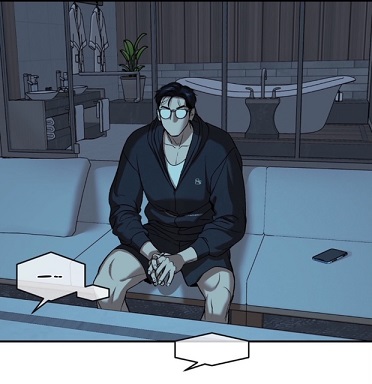
 (chapter 48) It shows once again that the traitor is close to the athlete, for he knows about his way of life. Furthermore, the unknown person could text to the champion, hence this means that his cellphone number got leaked by a person close to him. On the other hand, I am quite certain, the Webtoonist desired to fool her readers making them anticipate a confrontation between the two protagonists. However, nothing happened indicating that Joo Jaekyung didn’t react, like the plotters had anticipated it. Thus they had to create a new scheme. First, let’s not forget that they had used a similar method in the past.
 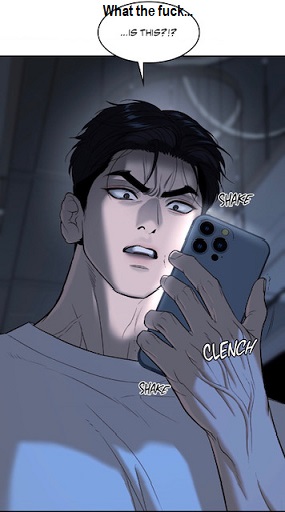 (chapter 35) This made me think of Painter of The Night and No-Name’s advice:
  (chapter 76) “A deed once foiled has no chance of success the second time around”.The criminal was referring to learning through experience. After going through such an event once, the athlete is no longer caught by surprise. We could say that he learned not to jump to conclusions and control his emotions. That’s the reason why in episode 48 he remained level-headed. Because the champion didn’t get angry, he could be more attentive.
  (chapter 48) Secondly, (chapter 48) contrary to the journalist, the sender of the pictures remained anonymous. He was exposing his personality: a traitor and a coward. So what did the anonymous sender want to divulge with these images? In my opinion, they wanted to create the illusion that Kim Dan was leaking information about the champion’s physical condition. That’s the reason why Choi Gilseok was seen smiling and taking the doctor’s hands. It looked like he was thanking him.
  (Chapter 48) The irony is that the doctor had been able to treat the star’s injury. For me, the Summer Night’s Dream played a huge role, as during that night, Joo Jaekyung felt treasured and loved. Therefore the pictures could only expose the duplicity of the director of King of MMA. Under this new light, it becomes understandable why the celebrity didn’t fall into their trap and why they had to turn doc Dan into a traitor by giving him a weapon without his knowledge. Finally, I believe that Joo Jaekyung had another reason not to confront the physical therapist. How so? It is because he had sent away his soulmate, while the latter had approached him.
  (chapter 48) He had missed the opportunity.
“The past is already gone, the future is not yet here. There’s only one moment for you to live, and that is the present moment” Buddha Quoted from https://www.goodreads.com/quotes/80868-the-past-is-already-gone-the-future-is-not-yet
Too obsessed with his upcoming match and as such the future, he had neglected the present. But imagine this. If he had gone to doc Dan’s bedroom and questioned him, once he had received the message, the latter would have appeared not only as selfish, rude, but also as indecisive, mistrusting and easily manipulated. However, the athlete’s biggest desire is to look confident, reliable and strong. Because he had missed the timing, he was encouraged to analyze the images and ponder on them. Furthermore, I couldn’t help myself connecting this scene to the one in the bathroom:  (chapter 30) Here, he wished to seek the doctor’s closeness. Nonetheless, if he had gone to Kim Dan’s bedroom during that night, he would have achieved the opposite: he would have created distance and caused an argument. The latter could have told him that he was looking out for himself, for Joo Jaekyung had threatened to fire him. Through these observations, it becomes visible why the athlete couldn’t ask Kim Dan at all. Consequently, I come to the conclusion that the clock (chapter 48) was announcing missed opportunity. It is important, because it displays the falsehood of the champion’s belief.
  (chapter 2) He is not jinxed, but his failures are the result of his bad choices, like for example trusting the wrong people or not listening to the trustworthy ones or keeping secrets. Or we could say that he is just the product of his education and childhood. He is cursed, for he was not properly raised. He refused to listen to his PT, when the latter wished to tell him something. (chapter 48) He had ignored him by not even looking at him. And this brings me to my next observation: REGRET. I am quite sure that after receiving the message, Joo Jaekyung must have felt regret. First, he had yelled at Kim Dan and menaced him to terminate his contract.
  (chapter 45) Then in the bedroom, he had rejected all his requests (massage, conversation). It was, as if he no longer needed him. He was no longer eating his breakfasts too.
 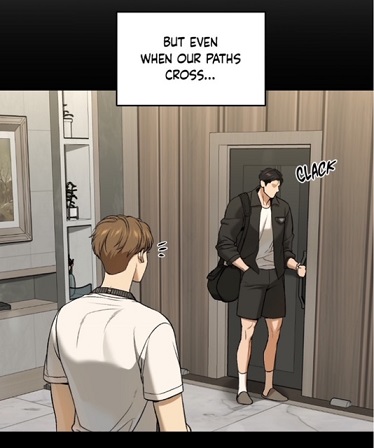 (chapter 47) Under this new light, Manhwa-lovers can comprehend why he looked annoyed in the hallway.
 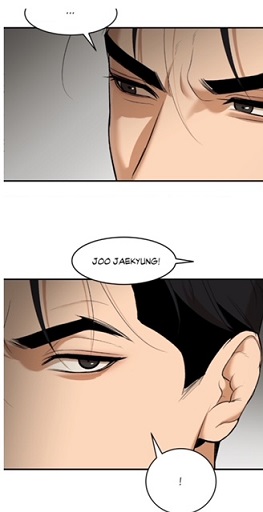 (chapter 49) The gaze displays not only worry and anxiety, but also regret. It was too late to ask the doctor. For me, he chose silence, for he was regretting his reactions in the penthouse. He feared to ask Kim Dan, because if he brought up the meeting with Choi Gilseok, this could push the hamster to quit his job. However, thanks to Kim Dan, the star’s condition improved greatly. That’s how it dawned on me why the champion became a beast and why he is hiding his past:
 (chapter 26) It is because the man is full of regrets and resent. But by creating new regrets, the champion is incited to focus more on the present so that he stops missing the timing. Because of his immense regrets and frustration, he was still trapped in the past. So he was unable to move on. To conclude, Kim Dan and Baek Junmin pushed him to face his youth and the source of his own unhappiness. His biggest suffering is a secret, because he would appear as weak and pitiful which would ruin his image as the strongest man in the world.
2. Midnight: the magic hour
Nevertheless, I believe that the author had another reason to create such an image. (chapter 48) It is related to the time. It’s 12: 13 and 47 seconds. I have to admit my hesitation about the minutes: 13 or 14 minutes? But I opted for the first choice, for there are only 13 seconds left, until it is 14 minutes. So the minutes hand had to move closer to 14. Because it is midnight, I couldn’t restrain myself thinking of Cinderella and her transformation, especially when Kim Dan noticed that the athlete returned home just before midnight! 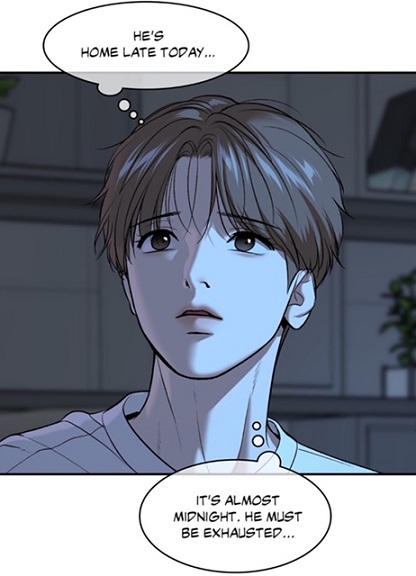 (chapter 48) But why is midnight so important? It is because the number 12 carries religious, mythological and magical symbolism, generally representing perfection, entirety, or cosmic order.
The number 12 is strongly associated with the heavens—the 12 months, the 12 signs of the zodiac, and the 12 stations of the Moon and of the Sun. The ancients recognized 12 main northern stars and 12 main southern stars. Quoted from https://www.britannica.com/science/the-number-twelve
This explicates why in the fairy tale Sleeping Beauty from Grimms 12 fairies who are called as “wise women” in the story.
He did not just invite his relations, friends and acquaintances but also the Wise Women so that they would favor the child and help her. There were thirteen in the kingdom. But because he only had twelve golden plates, one of them had to stay at home. Quoted from https://www.ellajsmyth.com/fairy-tales/sleeping-beauty-brothers-grimm/
In episode 12,  (chapter 12) the couple was supposed to reach Nirvana, but the athlete failed terribly. Under this new light, it becomes comprehensible why the protagonist chose not to confront Kim Dan in episode 48. It was, as if the champion was closer to the heavens. This represents the champion’s leap of faith. Don’t forget that the star got scared for one moment
 (chapter 48), when he noticed doc Dan’s presence too late. But nothing happened to him, that’s how he got incited to trust Kim Dan. The latter wouldn’t backstab him. Under the blue light, the champion got transformed. (chapter 48) Observe that Jinx-philes can see the champion’s gaze again, an indication that his “blindness” vanished which contrasts to this image:
 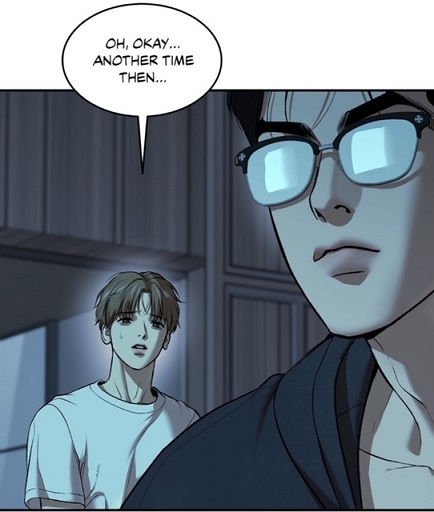 (chapter 48) On the other side, the fact that the champion is always targeted during the night is a sign that the villains desired to approach him, when he was isolated. So they know not only about his insomnia, but also about his solitude. I would even add that the plotters are aware of his association between the night and danger. Remember how he described relaxation: he would give an opportunity to his enemies to attack him
  (chapter 29) This new observation reinforces my past theory: he would be suffering from Somniphobia due to traumas. [For more read Twinkle, twinkle … little star] That’s how I realized the role and significance of the nights Joo Jaekyung spent with Kim Dan. One purpose of these nights was to change Joo Jaekyung’s perception of the night. That’s how the Beast could be tamed and even transform into a lovely and cute cat. In other words, he should make different experiences during his nightly activities. But there’s more to it. Thus I listed all the nights where the couple was together.
| Chapter 4 | Chapter 9/10 | Chapter 12 | Chapter 13 | Chapter 19/20 | Chapter 29 |
|---|---|---|---|---|---|
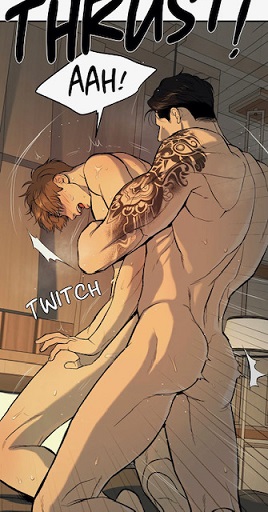 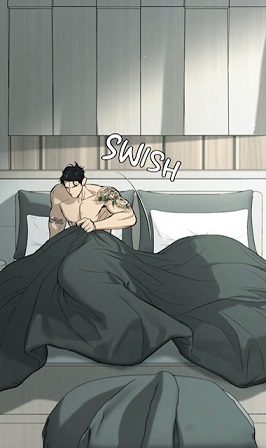 |   | |  |  | 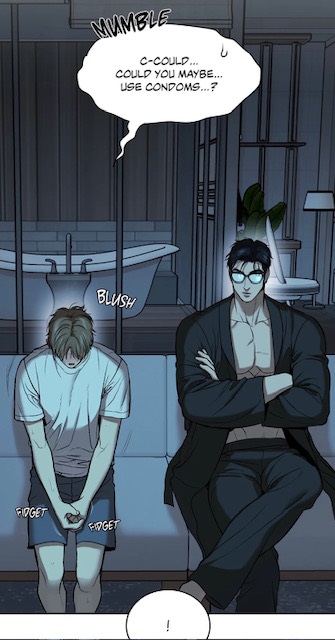  |
| The champion called the doctor, because it was urgent. The reality is that he wanted to have good sex due to his jinx. Yet he enjoyed the night so much that he allowed Kim Dan to sleep in his bed. | Kim Dan voiced his loneliness and his longing for warmth. He wished that his grandmother wouldn’t leave him behind. For me, that’s the moment Joo Jaekyung took over Shin Okja’s role. | The sex was initiated due to Kim Dan’s request. He needed money: dire situation. Interesting is that he called this night a lucky day! | Here, he had restrained himself out of fear that he might endanger Kim Dan’s life. No emergency, but a secret, as he was turning his back to Kim Dan. | “I want to fuck”: urgent, hence the doctor had to prepare himself. The champion witnessed for the first time Kim Dan’s ejaculation. He could procure pleasure to his partner. He compared the doctor’s anus to a baby’s mouth. | The champion confessed a lot to Kim Dan, before they ended up having sex. Joo Jaekyung brought up the notion “pregnancy”, when Kim Dan expressed the wish that the athlete would use protections. No urgency, but he divulges his secrets: fears and insomnia. |
| Chapter 33 | Chapter 34 | Chapter 39 | Chapter 44 | Chapter 45 | Chapter 48 |
|---|---|---|---|---|---|
 | 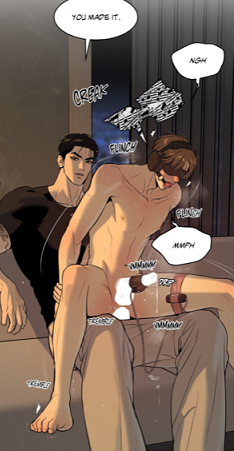 |  |  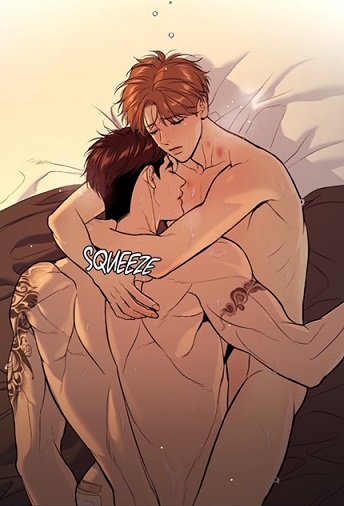 |  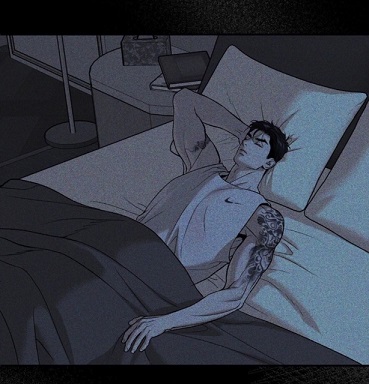 | |
| The sex here was an emergency, for Joo Jaekyung feared that he might end up losing Kim Dan. The doctor didn’t know the cause for such a behavior (secret). | Contrary to the previous sex session, the champion directed his fears and anger at Choi Heesung. Another emergency! The actor’s visit was kept a secret. | This wonderful night was an illusion, for the doctor was acting under the influence of the drug. Emergency! The doctor had to join his boss during the night: secret meeting. | Here, the roles were switched, as now it was the champion’s turn to act under the influence of the soju. The doctor chose to have sex, as he didn’t want to miss an opportunity. But the hickeys threatened to expose the nature of their relationship: secret. | The protagonists kept secrets from each other. The champion noticed the departure of his soulmate which could only make him anxious. | Like mentioned above, the champion refused to listen to Kim Dan. Since the latter entered silently, he caught his room mate by surprise: secret visit which stands in opposition to episode 29. |
By creating this table, I noticed the following parallels: emergency, delicacy and secrecy. What I mean with delicacy is the allusion to babyhood, vulnerability and inexperience (chapter 9, 10, 12, 13, 19, 29, 44). After the “lucky day”, the champion had to hear that he was risking his partner’s life with such a rough behavior. 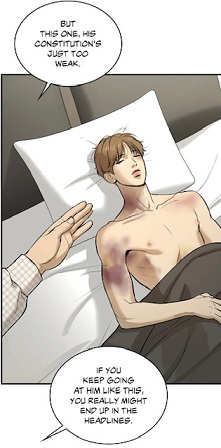 (chapter 13) It is important, because through this terrible experience, Joo Jaekyung came to internalize the connection between sex and danger. This would explain why he has been so rough in bed before. He came to see it as a normality, a sign that his perception of sex had been negatively influenced. And this can only come from bad experiences. It had nothing to do with “enjoying the moment”, until the protagonist met the shy hamster. We can see his gradual transformation. In episode 12, he definitely saw the night as “carpe diem” (chapter 12), until he was confronted with the consequences of his lack of empathy and interest. Due to his selfishness and prejudices, he didn’t notice the bad shape of his partner. Secondly, the fact that sex is strongly connected to urgency made me think that in the past, Joo Jaekyung must have been himself in a dire situation too. And it must have happened during a night, because all his memories with Baek Junmin are connected to darkness.
 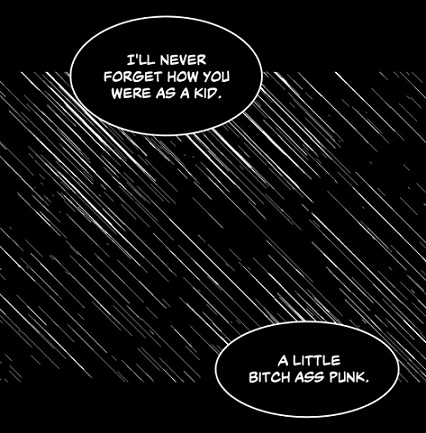 (chapter 49) In the previous essay, I had mentioned the theory that the champion might have been raped and even gangraped which would fit the criteria (sex, danger and urgency). Finally, the recurrence of “delicacy” during the night is an indication that the athlete must have been like Kim Dan in the past! Vulnerable and alone!
And the moment I recognized the role of the nights in Jinx, it is to push the protagonists to open up their mind and heart, I started pondering on the symbolism of the night. The latter can signify:
Fears and dangers: The darkness and shadows of night can evoke feelings of apprehension and vulnerability, as visibility decreases and the unknown becomes more prominent. Therefore the halmoni sang the lullaby “Twinkle, twinkle little star”. 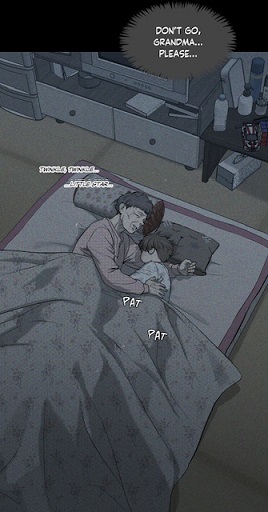 (chapter 21) Furthermore, the champion exposed why he could never relax: (chapter 29) He could get assaulted the moment he rests or sleeps.
Reflection and introspection: The quietude of the night often invites contemplation and self-reflection, providing an opportunity for individuals to delve into their thoughts and emotions. This would correspond to the night in episode 29 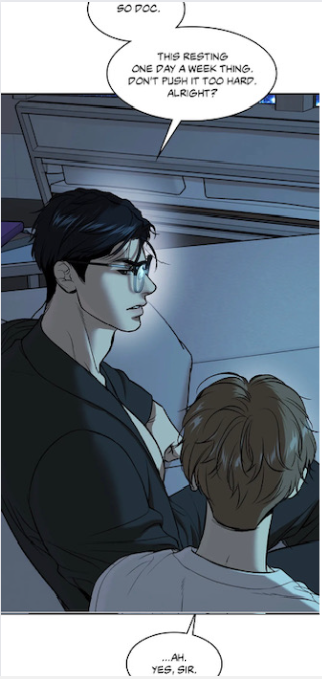 and 48:
Transformation and rebirth: The transition from day to night can represent a period of transformation or renewal, as darkness gives way to the promise of a new day. Remember how I compared Jinx to the fairy tale Beauty and the Beast [for more read Belle 👸 and the Bear🧸 in the penthouse – part 1] and Summer Night’s Dream. [For more read 🌹A Summer Night’s Dream 🧚♂️]
During their evening conversations, away from the hustle and bustle of daily life, Beauty and the Beast have the opportunity to truly get to know each other beyond their initial impressions. These moments of quiet reflection and intimacy allow them to share their thoughts, feelings, and experiences, fostering a sense of understanding and empathy between them. For example, in the evening scenes, Beauty and the Beast engage in heartfelt discussions about their pasts, their hopes for the future, and the true nature of love and compassion. These conversations reveal layers of complexity in their characters and deepen their bond as they learn to see beyond outward appearances and appreciate each other for who they truly are. The evening setting adds a sense of intimacy and vulnerability to their interactions, creating a space where they can open up to each other and build trust and affection over time. As they share these moments together, the evening becomes a symbol of the transformative power of connection and empathy, marking the beginning of a profound journey of growth and love for both Beauty and the Beast.
As for “Summer Night’s Dream” by William Shakespeare, the night serves as a pivotal time for the characters, marking the beginning of transformative experiences and the resolution of conflicts. One example of this is the final scene which brings resolution to the romantic entanglements and conflicts among the characters. As dawn breaks, we witness the reunion of Hermia and Lysander, who had been separated by the interference of magic and the meddling of others. Similarly, Helena and Demetrius find themselves united in love, overcoming the misunderstandings and obstacles that once stood between them. Moreover, the fairy king and queen, Oberon and Titania, reconcile their differences, restoring balance to the natural world and the fairy realm. Their reconciliation symbolizes the restoration of order and harmony after a night of magical mischief and confusion. As the sun rises on a new day, the characters emerge from the enchanted forest transformed by their nighttime experiences. The transition from night to day signifies not only the resolution of conflicts but also the beginning of a new chapter in their lives, marked by love, reconciliation, and the promise of a brighter future.
Spiritual connection: Many cultures view the night as a time for spiritual connection or communion, whether through prayer, meditation, or rituals performed under the cover of darkness. So we could see the doctor’s kneeling in the bathroom as a spiritual connection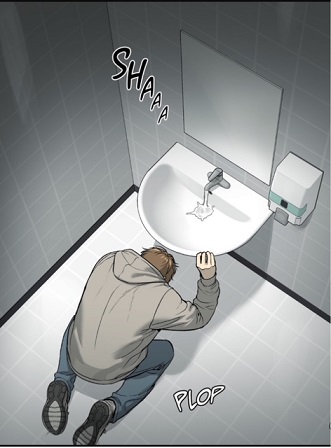 , for he had been recollecting the diagnosis from Kim Miseon and kept thinking of his grandmother. After this painful meditation, he came to recognize his selfishness and his relative’s love and generosity
 (chapter 47). And what was the main lead feeling after that terrible night? Regret, for he had not been able to notice his relative’s suffering and sacrifice!
 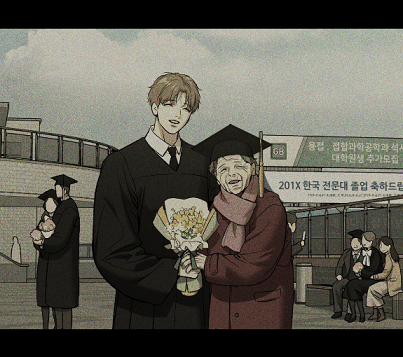 (chapter 47)
Creativity and inspiration: For some, the night sparks creativity and inspiration which could be observed during the sex sessions: we have sex in front of a mirror  (chapter 19) or a new request like swallowing the sperm
 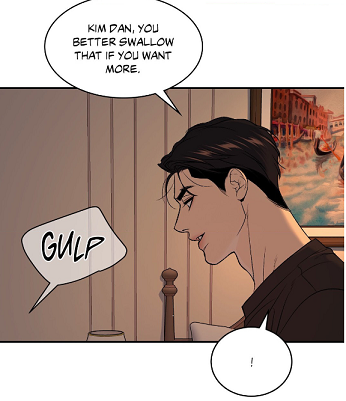 (chapter 39) or kissing the champion’s ruined ears
  (chapter 44)
Surrender and release: As the day comes to a close, the night can symbolize a time to let go of worries or burdens, embracing a sense of surrender and acceptance. After his conversation on the couch, the star attempted to seek closeness and intimacy with his fated companion. But he failed unfortunately, as he was not truly honest: 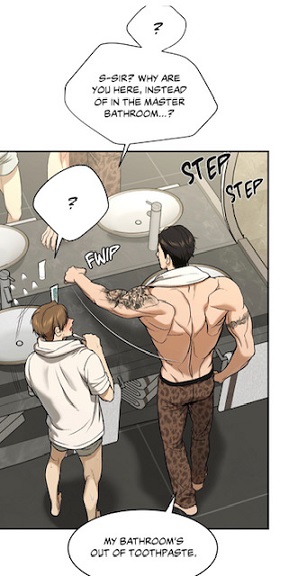 (chapter 30) He was rough and used the toothpaste as an excuse.
Temptation and allure: The darkness of night can also evoke feelings of temptation or allure, drawing individuals into the unknown or enticing them with forbidden desires. 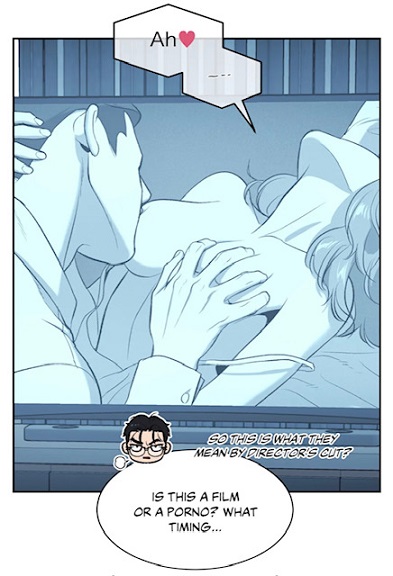 (Chapter 29)
Endings and beginnings: In literature and mythology, the night often marks the end of one chapter and the beginning of another, symbolizing transitions and turning points in characters’ lives. The Beast turned into a prince during the night, when Belle’s tears fell onto her husband. And now, if you look at all the nights mentioned above, you can see how they marked a change in the relationship between the two protagonists. I would say that between 30 and 39, the star was forced to question the place Kim Dan had in his heart. In chapter 40, he came to admit that the PT was part of his team.  (Chapter 40) That’s the moment he stopped considering the hamster as a prostitute, while from chapter 2 to 18, he viewed Kim Dan as a tool, as a talisman against his jinx. However, I detected a transition after he kissed the physical therapist. From that moment on, the doctor was connected to food and sweetness.
  (Chapter 18) And now, observe that during the night in the bathroom, doc Dan was associated with a baby receiving food:
 (chapter 20) As you can see, here the champion started viewing him as a human being. It exposes that little by little, his perception of the physical therapist improved. So from chapter 30 to 39, Joo Jaekyung was forced to question the nature of his relationship with Kim Dan: a PT or a prostitute or a pet?
  (Chapter 34) Here, he was in denial, he described the main lead as a possession, but he couldn’t fool the actor. Under this new light, it becomes comprehensible why the nights in chapter 19, 29 and 39 were so magical, they announced a transition or better the end of viewing Kim Dan as an object (tool for his jinx) and possession. From 41 to 49, the champion was cornered to recognize Kim Dan as a physical therapist and not just as a member from Team Black. Don’t forget his attitude in the car, when the main lead suggested him not to train.
 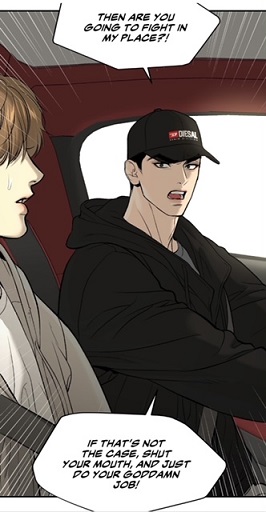 (Chapter 42) He rejected his advice, a sign that he was doubting doc Dan’s skills and competences. That’s the reason why I come to the conclusion that with the pictures, the champion was pushed to admit that Kim Dan is his physical therapist (chapter 48) and he can not fire him like that. Thus I come to the conclusion that in the locker room, there should be an open conversation between all the members of Team Black.
  (Chapter 49)
3. Clues about the champion’s youth
But wait… if Joo Jaekyung has been trapped in the past, this signifies that in the present timeline, he has to be confronted with his past. That way, he can overcome his traumas and become happy. And now, you comprehend why his path led him to meet the star Choi Heesung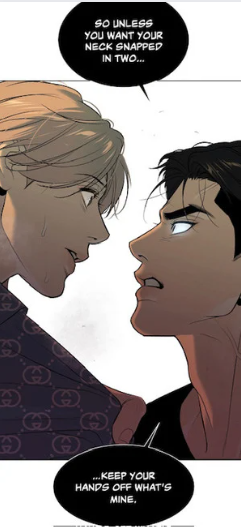 (chapter 34), then the fake star Baek Junmin
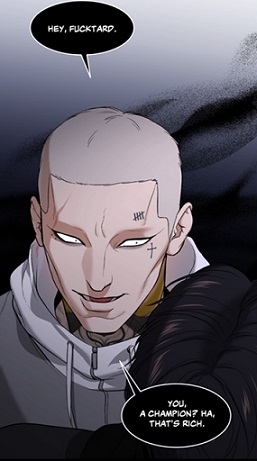 (chapter 49). These meetings are not random at all, a sign that someone knows about the athlete’s hidden suffering very well. Observe that both characters challenged the celebrity by giving him an order:
 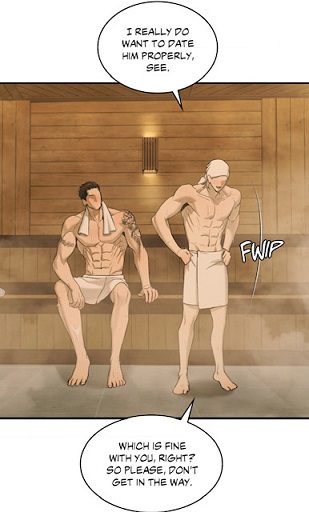 (chapter 34) “Don’t get in the way” and “make sure you give her a good polish”.
  (chapter 49) The sportsman is viewed as a hindrance to their dreams, he should clear the way for them. I deduce that in his youth, people must have treated him the same way. He represented an obstacle, therefore these two figures must have challenged him in the past too. Their confidence comes from their past experiences with the athlete. Both must have defeated Joo Jaekyung, but naturally they must have tricked him.
  (chapter 33)
  (chapter 49) Then I noticed another parallel between the two plots: the presence of a scapegoat, and the involvement of a third person. Heesung faked his injury by putting the blame on the athlete, while he asked Kim Dan as compensation. In the second plot, the roles are switched. Kim Dan is now the perpetrator, while the athlete is the victim! Baek Junmin is the beneficiary of this scheme. And what do these plots have in common? Joo Jaekyung is the victim of a trick, though Heesung’s manipulation was rather benign. First, he acted on his own.
  (Chapter 31) Moreover, he utilized the genuine concern and innocence of his surroundings. In other words, he used his image as a good and honest man to his advantage. Thus I come to the conclusion that the artist’s sin in their youth was rather minor, as the artist tends to violate social norms. So though it was no illegal, the actor’s wrongdoing definitely left scars on the protagonist’s heart.
 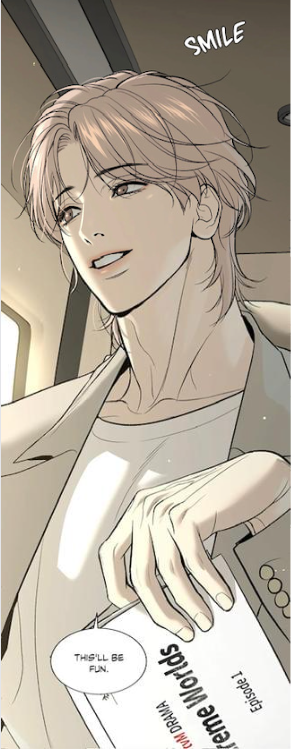 (chapter 29) Probably, Heesung utilized Joo Jaekyung’s innocence to his advantage in order to maintain his good reputation, like for example he was not supposed to be smoking or he took away a friend from him, as the topic of their conversation was about the theft of a person
  (chapter 33) (chapter 34)!! That’s why Choi Heesung had a smile on his face, when he thought of the champion’s future reactions: sour mood. He likes provoking the celebrity
 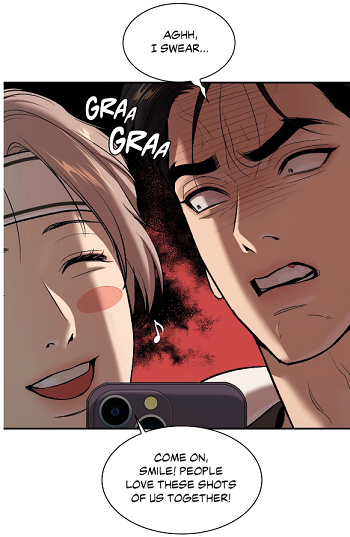 (chapter 30), because it always makes him appear as a well-mannered and honest man. He gets fun at his frenemy’s expense. In addition, he could play tricks without getting caught… and the other would appear as the bad guy and take the blame, like we could observe at the gym with the manager’s judgement.
  (Chapter 30) Another common denominator between The Shotgun and Heesung is their envy and greed. (chapter 49) The actor tried to get the doctor as his lover. The expression “That’s rich” is not random, it indicates that The Shotgun is jealous of his social status.
Furthermore, I am assuming that his scheme is related to gambling and the arcade. (chapter 26) Why would the athlete go there and utilize the punching machine so many times? The arcade is a place for young people, especially for high school students seeking entertainment. So I assume that Joo Jaekyung went there, because he was trying to find someone, and at the same time he wanted to prove something: he was not weak at all. My avid readers will certainly recall this scene:  (chapter 5) Joo Jaekyung destroyed the sandbag, when he imagined that doc Dan had blocked him! This signifies that the former could no longer contact the shy hamster. Joo Jaekyung saw it as an affront, a challenge! (Chapter 26) Thus I view this past incident as a challenge which led him to face terrible consequences. He got blacklisted. It made him look like a black sheep. As you can see, I believe that there exists a connection between Baek Junmin and the arcade. This panel
  (chapter 46) could be seen as a reflection from the arcade and the star’s past. And since Kim Dan wounded Joo Jaekyung in the locker room
  (chapter 49), I deduce that such an action must have happened in the champion’s youth. He got not only hurt by people, but also betrayed by a friend. There exists many reasons for this hypothesis.
Many Jinx-philes initially thought that Joo Jaekyung was an uneducated brute due to his lack of manners and poor vocabulary. He would constantly swear  (Chapter 04) and be rude towards others.
 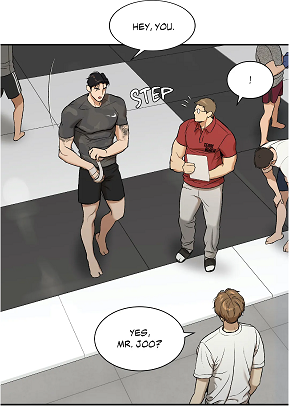 (Chapter 7)
  (chapter 37) But Mingwa left many clues that the celebrity’s personality shouldn’t be judged by impressions. During their first night together, Manhwa-lovers could see books next to the bed.
 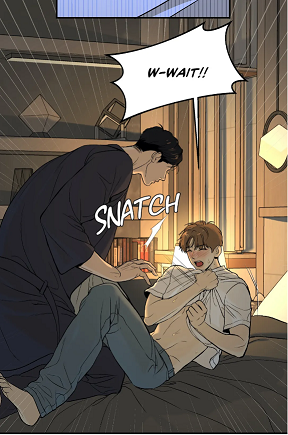 (Chapter 3) Some of them are not written in Korean or English. Moreover, the Webtoonist revealed that one of his hobbies is reading. This explains why he can talk prettily.
 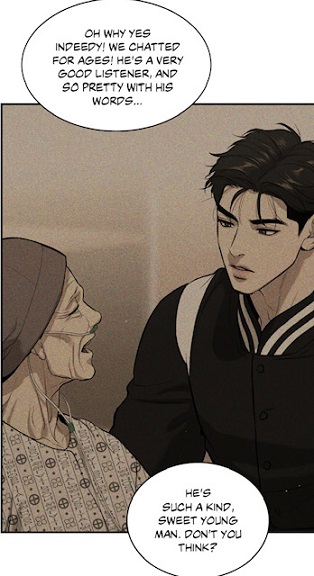 (chapter 22) This shows that his behavior mirrors the counterpart’s. Consequently, it is not surprising that the champion is rough with his own body, as Park Namwook is not treating him like a delicate child.
 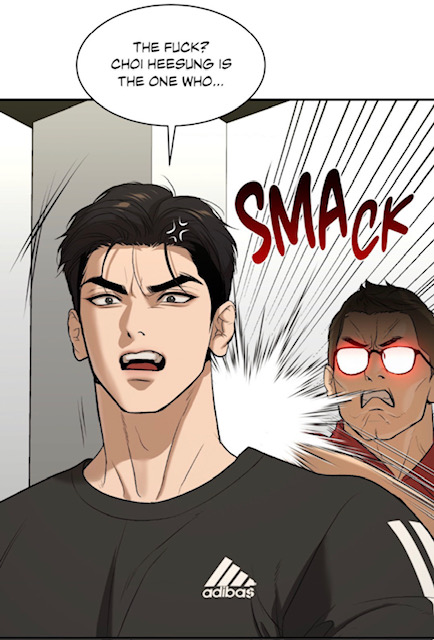 (chapter 31) But there exists another proof for his intelligence. The celebrity is capable to lead an interview in English on his own.
  (Chapter 37) Even stressed and filled with anger, he could understand and speak fluently in English.
 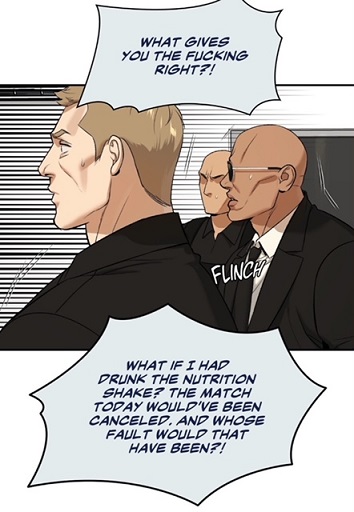 (Chapter 40) Compare Kim Dan’s English skills in the same scene:
  (chapter 40) Besides, Jinx-philes should question why Mingwa is not divulging his scores as a student contrary to Kim Dan or Jinwon from BJ Alex. It is because she wants to create a certain image about the champion: he is a bad boy. In my eyes, she is playing with prejudices about MMA fighters. People often imagine, they lack social manners and education. They chose this path, for they could do nothing else. And this brings me to my next remark. We know that Kim Dan selected PT because of his halmoni.
 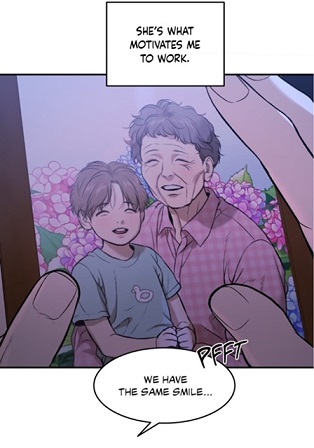 (chapter 47) So what was the protagonist’s motivation to become a MMA fighter? In my eyes, this question represents the core of the mystery. My idea is that the suffering in his youth led him to become a boxer. It is definitely related to his experienced powerlessness and loneliness. So when he suggested the sparring to Kim Dan, we should see it as a reflection from the past:
  (chapter 26) Joo Jaekyung was also an amateur in the past, but his motivations were his rage and resent. On the other hand, contrary to his soulmate, the athlete likes sports as well. His other hobbies are jogging and swimming. Thus I am suspecting that Joo Jaekyung might have been part of a swimming club in the past. Striking is that he forgot his passion due to his career as a MMA champion.
 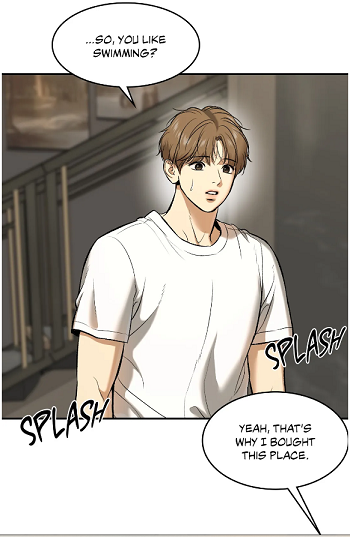 (chapter 27) I see a contrast between these two sports: swimming which is related to relaxation, pleasure and fun and MMA fighting which stands for challenge, pain and seriousness. This contrast is even more present in the following panel: (chapter 29) The position of the zombies made me think of waves of challengers. I feel like the protagonist’s future was changed and even manipulated. Similar to the way Kim Dan ended up as the champion’s PT. First, he was treated like a prostitute, until the athlete came to value him as a real physical therapist.
Another thought came to my mind when I examine the last image closely. The champion views life as a constant battle, where he is always challenged. It was, as if his masculinity and strength were constantly questioned. If he doesn’t accept these defies, then he will submerged and end up drowning. However, thanks to Kim Dan, the champion was able to touch the ground. He is a champion, hence he never loses. 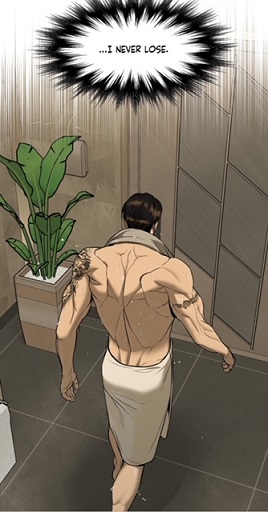 (chapter 49) Is it a coincidence that this Enlightenment took place under the shower? For me, no! I see a strong link between water, swimming and the champion’s job. It looked like swimming represents a source of danger for the athlete’s job, as it is an entertainment! Hence I can’t shake the feeling that in the past, Joo Jaekyung might have shown aptitude for becoming a natation athlete! Let’s not forget that for the calendar 2024, the champion was seen carrying swimming googles and not “MMA gloves”. This detail caught my attention and made me wonder why Mingwa selected these items.
But one detail from this image (chapter 29) caught my attention. He described himself as a prey chased by a pack of hyenas. The expression “nipping at my heels” implies that the athlete is trying to flee, but he is followed by dangerous and voracious animals. Consequently, I consider this confession as a reflection from the past. Note that he doesn’t say “fighters”, but “challengers”. For me, we should include the actor under this idiom. Don’t forget that he challenged him at least twice. And what is the symbolism of “hyenas”?
In African literature and folklore, hyenas are commonly associated with cunning, trickery, and deceit. They are often depicted as opportunistic scavengers, lurking in the shadows and preying on the weaknesses of others. In many African myths and stories, hyenas are portrayed as cunning and sly creatures who use their intelligence to outsmart their prey and rivals. They are sometimes seen as symbols of chaos and disorder, disrupting the natural order of the animal kingdom.
In some African cultures, hyenas are also associated with witchcraft and dark magic. They are believed to possess supernatural powers and are often feared and revered as powerful spiritual beings. In this context, hyenas may symbolize the unknown and the mysterious forces of the spirit world.
The Mbugwe believe that witches use their hyenas to perform various malicious acts, such as causing sickness and death in people and animals. When one of these night cattle is seen prowling around a village at night, it is assumed that a witch is present, and the villagers will take steps to protect themselves from any potential harm. As with many superstitions, the Mbugwe believe that certain methods can be used to ward off the power of a witch’s hyena. […] African mythology and folklore have long seen the hyena as a symbol of cunning, trickery, and conflict. In East African legend, hyenas symbolize chaos and discord, while in West African lore, they represent the trickster figure. In some communities, hyenas are associated with evil and witchcraft. Quoted from https://centerspirited.com/animal-symbolism/hyena/
In Asian literature and folklore, hyenas are less commonly depicted but still hold symbolic significance. In some cultures, they are associated with similar traits of cunning and deception as in African folklore. However, their symbolism may vary depending on the cultural context and beliefs of the region.
One notable modern depiction of hyenas in literature and popular culture is in Disney’s “The Lion King.” In the film, the hyenas are portrayed as villainous characters who serve as the henchmen of the main antagonist, Scar. They are depicted as greedy and power-hungry creatures who will do anything to serve their own interests, even if it means betraying their fellow animals and causing chaos in the Pride Lands. And how do we recognize hyenas? Through their laugh and as such smirk!
Communication is among the Hyena’s attributes because its warning calls, just with a change of inflection, have many purposes. Hyena’s mindful chortle shows its age, social rank among other Hyenas, and even acts as a letter of introduction. They use their voice to organize strategic food-gathering groups, gather allies in the face of a formidable predator, and establish dominance. A Hyenas have complex relationships based on, in part, their verbalization and a rich repertoire of visual cues. Quoted from https://whatismyspiritanimal.com/spirit-totem-power-animal-meanings/mammals/hyena-symbolism-meaning/
This explains why this animal represents communication. The latter is needed to create a plot. Is it a coincidence that Choi Gilseok has connections and is constantly talking and smirking?  (chapter 49) He is a hyena, hence his color is brown.
  (Chapter 48) And The Shotgun has a similar attitude:
  (chapter 49) Interesting is that his description of the challengers fits the situation in the new plot perfectly. The Shotgun imagines that he will fight against a diminished champion. His shoulder is injured and they have planned to add a new injury. The hyena stands for balance and cleansing as their task is to remove the weak ones.
Throughout history, the Hyena has gotten bad reviews, perhaps this is because of their scavenging behavior. Yet, scavengers are the world’s cleaning crew. Hyenas are an essential part of the African ecosystem. It is the most abundant carnivore playing a pivotal role in the food chain. They waste nothing and teach humankind the value of things that they often overlook or think unimportant. As a Spirit Animal Guide, Hyena has ties to resourcefulness, balance, and gratitude. Quoted from https://whatismyspiritanimal.com/spirit-totem-power-animal-meanings/mammals/hyena-symbolism-meaning/#African-Asia-Hyena
And the moment I read gratitude, I was reminded of the fake star’s fake gratitude: (chapter 49) He was thanking the star, as the latter would be delivering the medal on the silver plate. And the moment I made the connection between King of MMA and hyenas, I started laughing because of the athlete’s criticism to the director:  (chapter 49) As an old man, Choi Heesung is revealing vulnerability and senility. Due to his old age, he could be replaced by another hyena, a younger hyena!
And this observation brings me back to the champion’s youth. The latter became the target of schemers due to his vulnerability, isolation and probably due to his wealth. For me, the star comes from a chaebol family. The hyenas took advantage of his “innocence, ignorance and solitude” to gain something in exchange. However, there is no ambiguity that karma retaliated. Baek Junmin’s scheme led him to become a criminal, while Choi Heesung’s popularity never reached the same peak than Joo Jaekyung. And because of my association with the hyenas, I come to the following conclusion that the main character was bullied and even physically assaulted. But no one took his side, until he caught the attention from someone: (chapter 26) That’s how he ended up entering MMA. This person knew about his struggles and fears from the past and took advantage from this. Hence I am suspecting Seo Gichan (chapter 5), as he is the only person who has not appeared yet, though the champion has his cellphone number. And this remark brings me back to the present and the night messages and the hyenas.
The latter are working as a team in order to corner the target. In other words, their task is to ensure the prey’s isolation. But what is the point of such a MO? It is to exhaust the prey. The latter is forced to run constantly, until he is too weak to keep fleeing. That’s why the champion described it as an endless running. (chapter 29) And that’s how they are operating with the messages: isolation. We could see it through the article and its impact. The protagonist was in a sour mood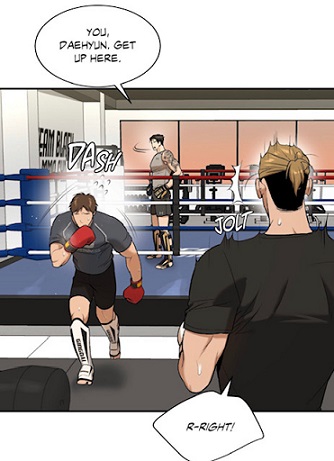 (chapter 36) which could only affect the members from Team Black. Their loyalty could waver. Then he got to hear bad comments from the Internet
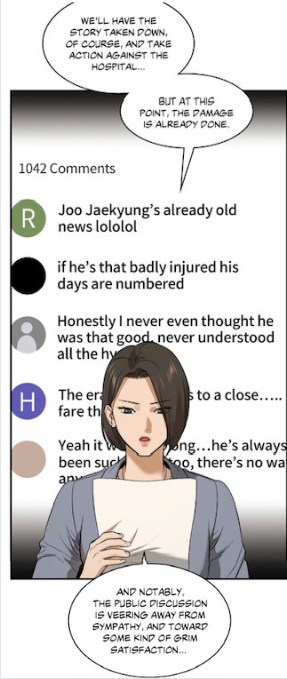 (chapter 36), creating the illusion that he was losing popularity. That’s how the lawyer could convince the champion to accept a new match in such a short-time. Finally he got reprimanded for his outburst.
 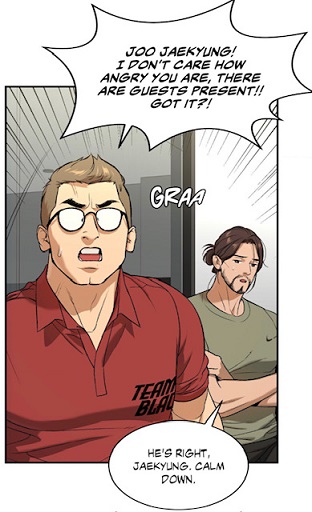 (chapter 36) Under this new perception, Manhwaphiles can grasp why the MFC manager offered him a new defy right away. They needed to exploit his injury!
  (chapter 41) With the pictures (chapter 48) and the switched spray, they are now attempting to portray the doctor as a member of the pack. He is a hyena himself, a backstabber. Joo Jaekyung shouldn’t trust his soulmate, he is a hypocrite. But what these villains don’t know is that the champion committed wrongdoings against Kim Dan in the past, like for example the sex session with the dildo.
  (chapter 13) This could have ended badly. Another wrongdoing could be the rejection of his birthday present and his harsh reaction.
  (chapter 47) At no moment, the physical therapist brought up his misdeeds and asked for an apology. His silence became the symbol for his tolerance and even forgiveness. In addition, the doctor and his halmoni embody both vulnerability and poor health, which is strangely connected to crime and scandal. (chapter 13)
 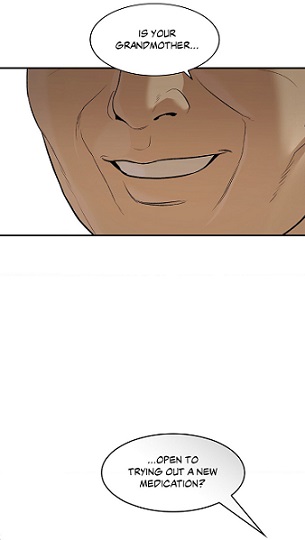 (chapter 48) Through them, the champion is learning that hunting weak and pitiful creatures is not only a sin, but also a crime! In the first case, he could be accused of hurting an innocent.
Since the beginning of this Manhwa, I have been presenting theories about the champion’s youth, like for example he could have suffered from Traumatic Brain Injury (for more read the essay Joo Jaekyung, the strongest man in the world) which would explain why he has problems with memories. Then in Shocking discoveries!!” I had pointed out Somatosensory affectionate deprivation, SAD as an explanation for the champion’s attitude. He was deprived of motherly affection. This made me think that he had no female role model in his youth. Then I had described him as a silenced and invisible child due to neglect. This interpretation got validated in chapter 45. How so? It is because he only received the presents from the fans and a text from Park Nawmook accompanied with a short video! 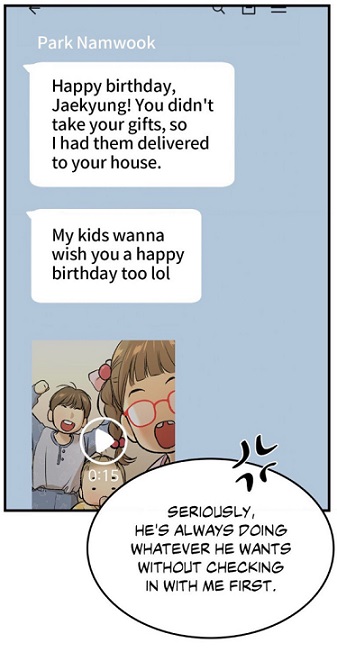 (chapter 45) At no moment, the author let us see the celebrity receiving a gift or a message from a family member! It was, as if he was an orphan and had no family. Their absence and silence are the evidences of neglect. But one might argue that his parents could be dead, something I had already envisaged in the past. However, if so, as a teenager and young man, he needed to have a guardian by his side, exactly like the doctor with his halmoni. And Park Namwook is not acting as his guardian, for he doesn’t visit him in the penthouse or calls him there. So where was the guardian in episode 45? Invisible, silent and passive! Like mentioned above, I am suspecting the mysterious Seo Gichan. Thus I consider the champion’s criticism as the expression of deep scars which came to the surface:
  (chapter 45) He wanted Kim Dan to look at him and take care of him. In other words, he wished to be seen and not neglected! He has not realized it yet, but he is longing for a companion, a playmate. He desires to have someone by his side who would talk to him and listen to him. From my point of view, the champion must have received on his birthdays many presents, but he was all alone. He had no one by his side. The gifts couldn’t replace the warmth from a loving parent. The moment I made this connection, it dawned on me what the nightly desertions could have meant for the star. (chapter 45) He could have been reminded of the behavior from his family (father, mother or guardian) who would abandon him during the night for work or would return home very late due to work. In other words, the doctor’s departure triggered his abandonment issues too. Under this new light, it becomes comprehensible why Joo Jaekyung rejected the golden medal and why he became workaholic. There was no family celebration like here:
 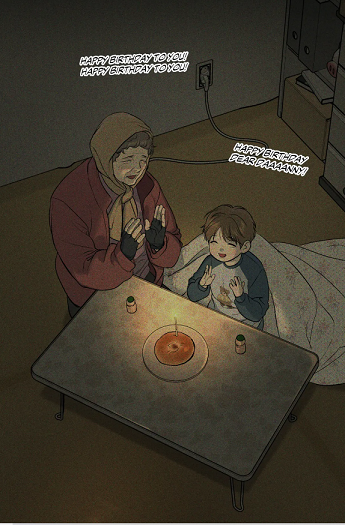 (chapter 11) He wished to receive attention and to have a normal conversation. Consequently, I assume that the champion has been copying his role model. That’s how he was pushed to grow up too quickly. For me, he had no childhood at all, hence when he met Kim Dan, he was encouraged to develop his inner child!
The inner child is a young part of our psyche that influences how we think and react as adults. Often used in psychotherapy and spiritual settings, the inner child can symbolize hardship, trauma, and even triumph we experienced during our youth.1 Yet, when we ignore our inner child and subsequently ignore how our past is painting our present, we do ourselves a major disservice. We can end up overlooking important formative experiences that may be critical in healing some of our maladaptive coping mechanisms. […] When you lose conscious awareness of your inner child, you lose conscious awareness of a part of yourself. In turn, you may experience difficulty regulating your emotions and act from a regressed state when upset. Quoted from https://www.verywellmind.com/inner-child-work-how-your-past-shapes-your-present-7152929
We could observe the awakening of the champion’s inner child, when he suggested a sparring to Kim Dan. 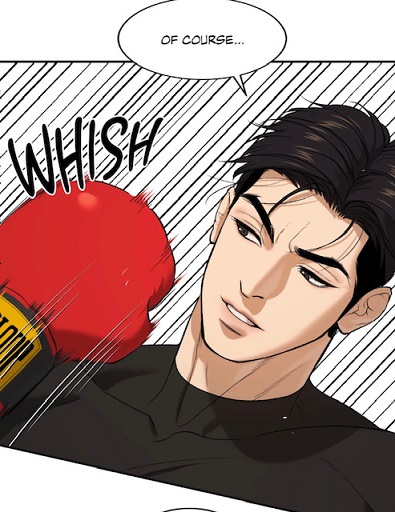 (chapter 26) For the first time, he had fun sparring. Hence he kept smiling. It is no coincidence that soon after he chose to accept to take a day-off, when Kim Dan made the suggestion.
 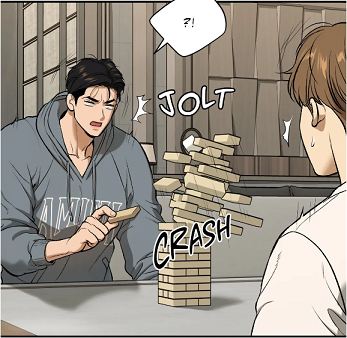 (chapter 27) That’s how he remembered that he liked swimming and he could play a prank on his lover.
  (chapter 27) Here, he could smile, because it was fun and there was no real expectation. It was not truly connected to money.
There are many reasons to why our inner child gets wounded. Most of us have experienced various forms of trauma. However, trauma does not necessarily have to be as extreme as growing up in a war or being physically and mentally abused. There are many forms of trauma:
Having unavailable parents who withheld their affection from you and didn’t emotionally encourage or support you.
Being the recipient of inappropriate sexual behaviour, including getting subjected to pornography.
Growing up in a home where your parents kept fighting, arguing and eventually ended up divorcing.
Being given inappropriate or burdensome responsibilities such as looking after the family and doing most of the chores.
Being abandoned by one or both parents.
Being rejected by your peers.
Not having a safe home to sleep in, or a clean hygienic environment.
Growing up with parents who would abuse various substances, such as drugs or alcohol, to numb their emotions.
Parents or family members who were overprotective and interfered with everything you wanted to do, which denied you of your confidence.
Judgement of your personality, interests, passions or sexual orientation.
Parents or family members who were excessively demanding and had high expectations or who projected their feelings in unhealthy ways (i.e. anger, verbal attacks and emotional blackmail).
Parents or family members who humiliated you, or did not address any issues you experienced at school (such as bullying).
Growing up with a parent who had low self-esteem and body image issues.
Emotionally unavailable parent/parents who did not know how to hold space for your feelings. Quoted from https://mentalawakening.com.au/the-inner-child-and-its-connection-to-tms/
As you can see, this long list contains a lot of elements which I observed with Joo Jaekyung. Everything is pointing out that the young man suffered in his youth, and feared rejection and condemnation for showing vulnerability and tears. And if his family or guardian was too busy, there is no ambiguity that when the athlete faced a huge problem (bullying, rape etc.), he wouldn’t have confided to his relatives.
Moreover, I had already underlined the great importance of the cellphone in the champion’s life, the fake illustration for “sharing is caring”. Maybe it is because his family or guardian were too busy to take care of him, that they used the cellphone to keep in touch with him. That’s how he internalized this terrible habit: connect with people through the cellphone. I noted that when the doctor was next to him during the night, the champion would never bring his cellphone! This exposes that the item is embodying a “person”. And now, you comprehend why the champion fell for this trick here  (chapter 35) and not in episode 48. It is because Kim Dan had paid him a visit during that night, a sign that he was thinking of him as his patient and VIP client.
 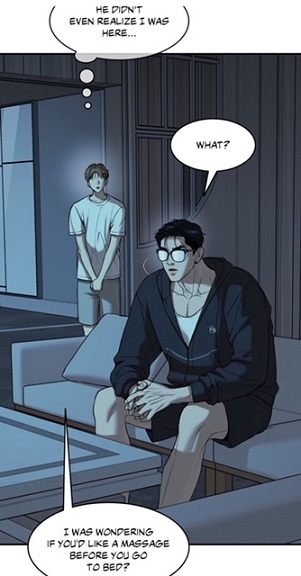 (Chapter 48) On the other hand, I am inclined to think that when a terrible incident in his youth occurred, he couldn’t contact his family or guardian. Hence he keeps his cellphone by his side constantly. Yes, I was thinking of the doctor’s assault in the street and his failed rape:
  (Chapter 16) Heo Namwook’s minions had confiscated his cellphone. Hence it was impossible for him to call for help. And now take a closer look at this scene:
 (Chapter 16) Though he had been on the phone and it was daylight, no one stopped the thugs from kidnapping the main lead or reported the incident to the police. Hence I am also suspecting that Joo Jaekyung must have faced a similar situation: he was surrounded by malicious people and no one had assisted him. So he could have been targeting at school due to his grads or his social status. And his isolation at home could push to seek company outside, to look for friends at school.
What caught my attention is that before each scheme, his hyungs were both seen talking over the phone.  (chapter 37)
  (chapter 49) And the anonymous person on the other side of the phone was definitely calling in order to be updated about Joo Jaekyung, for his coach asked him about his physical conditions.
 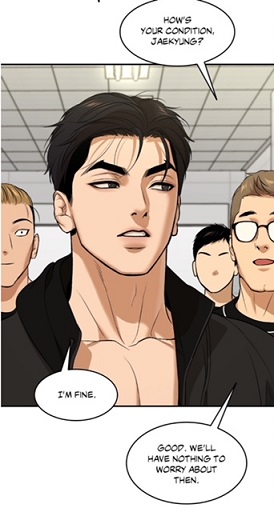 (chapter 49) That could be the hidden guardian who has not showed up yet, I am thinking of Seo Gichan. And now it is time to close this long essay.
Since the champion, as a new version of Simba, was chased away by hyenas, I am inclined to think that his bad luck is not the result of a curse, rather the cause of a bad surrounding. He was not raised properly, for the adults failed to protect him correctly. Despite his super living conditions, he was confronted to the cruel brutality of the civilization where he was exposed to violence, schemes, gambling, drugs, prostitution and abuse. He discovered the existence of hyenas among Korean society behind their fake smiles and “gentle gestures”. The problem is that no one has ever detected their presence. That’s how he lost faith in humanity and developed Philophobia. (For more read (Un)Wanted love) But thanks to his soulmate, he is learning to see the positive aspects of life. What appeared as a weakness can become a source of strength. Compassion and love can put an end to the loneliness and misery. And in order to be happy: 
Feel free to comment. If you have any suggestion for topics or manhwas, feel free to ask. If you enjoyed reading it, retweet it or push the button like. My Reddit-Instagram-Twitter-Tumblr account is: @bebebisous33. Thanks for reading and for the support, particularly, I would like to thank all the new followers and people recommending my blog.


 (chapter 1) He was even called a psychopath, for he resorted to kidnapping
 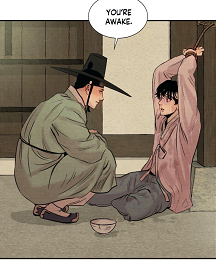 (chapter 1) sequestration, threats
 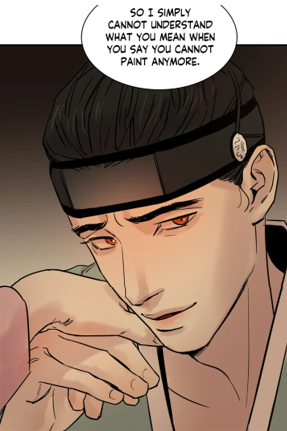 (chapter 2) and blackmail and he initially showed no remorse.
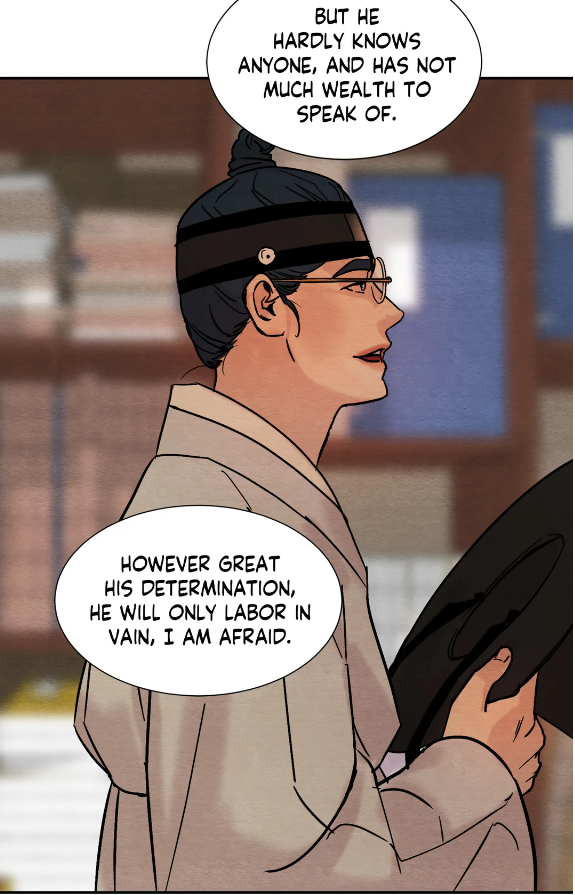 (chapter 7). On the other hand, he never got into trouble for his wrongdoings. Why? It is because he wasn’t violating social norms.
  (chapter 10) It was his right to punish servants, for they are not considered as humans but as propriety. As a lord, he could treat commoners, like it pleased him. Though murder is prohibited, even against a lowborn,
 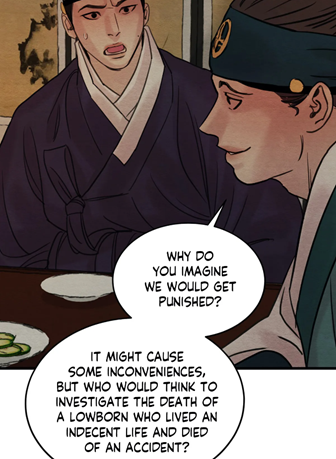 (chapter 43), the reality is that nobles would never get into trouble!! As you can see, there exists a discrepancy between laws on the paper and the reality which was exposed by the rumors in episode 106.
 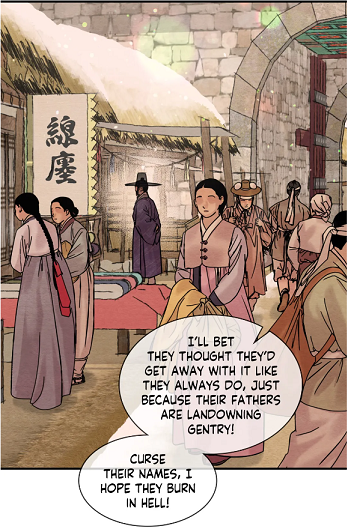 (chapter 107) The fathers would use their position and influence in order to cover up their children’s wrongdoings. And we have the perfect illustration, when the elder master bribes the governor.
  (chapter 127) That’s the reason why the younger generation could do everything! Though the lord appeared as a monster first, he became a “normality”, the more we got to read this story. Under this explication, it becomes comprehensible why lord Min was so sure not to get bothered by the authorities.
 (Chapter 101) He had bought the officers (“the guards”). This explains why Black Heart could threaten No-Name.
 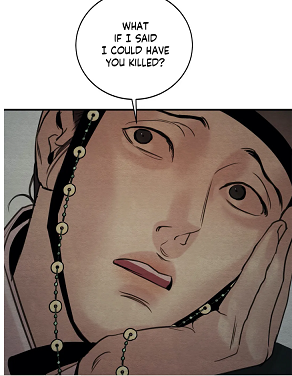 (chapter 76) He didn’t need to dirty his own hands, he could simply frame him. Consequently, I deduce that he had learned this misconduct through the elders’ behavior.
  (chapter 116) This shows that neither Black Heart’s father nor Yoon Chang-Hyeon truly love their children, as according to Erich Fromm, love is knowledge, respect, care and responsibility. However, the elder master Yoon is totally ignorant about his son’s talents and good nature. Thereby, I see lord Seungho from season 1 as the perfect illustration of the corrupted world of the nobility. The monster “Yoon Seungho” was just a reflection from this ruthless and immoral society. Since he committed wrongdoings, his karma was to pay for his sins. It starts with a murder, and the main lead ended up killing people. He might have not broken “traditions” like the disregard of the yangbans against lowborns, but it is considered immoral. He had sinned and now, he is paying for his sins. Therefore his words in the prison resonate differently.
 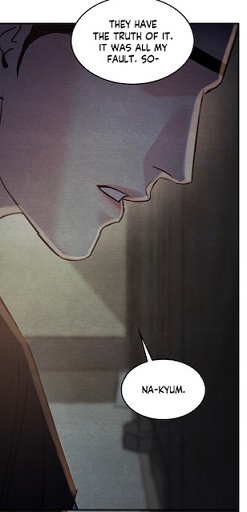 (chapter 126) He expresses regret. He confesses his crimes, he killed people! This means that he is now siding with the lowborns. Their life is as precious as the ones from the nobility. Yet, note that in this image, the author didn’t drew his eyes. Why? It is because in the moment he executed people,
 (chapter 102) he was either not himself or he did it out of reflex to protect himself. He was influenced by his past experiences and as such traumas. In the shrine, it becomes more obvious, for he has a lost gaze. He is not even looking at his target. Finally, when he met lord Song, he did it to “protect” himself.
 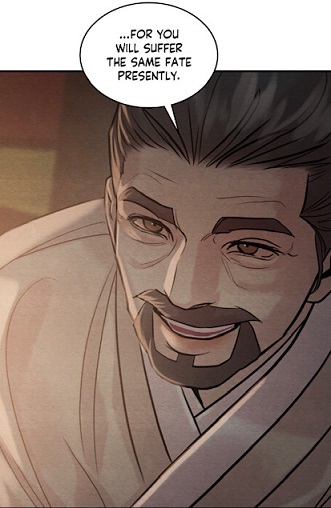 (chapter 123) For me, in episode 1, the execution was triggered by his desire to protect himself and his traumas. And what is the common denominator between these three scenes? The father Yoon Chang-Hyeon! Don’t forget that the petition was the reason for their meeting. And now look at the actions from the patriarch.
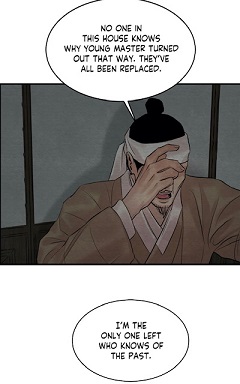
 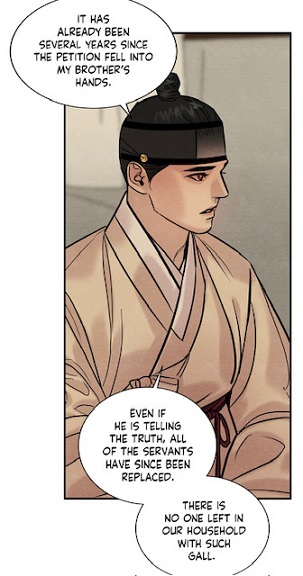 (chapter 116) He had given the order to eliminate all the servants, for they could represent a threat to his “treason”. This explains why the butler describes himself as the only survivor and witness.
  (chapter 86) And we see him giving the order to kill the surviving guard
 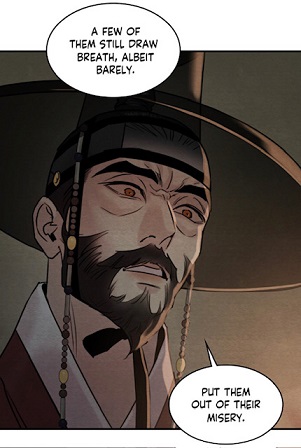 (chapter 125) Besides, he had no problem to order the assassination of his own son which was stopped by the intervention of a helping hand. The father had never asked to spare the main lead’s life.
  (chapter 124). He was his bad role model. But he is not the only one. There is another one…
  (chapter 51) Once a criminal, always a criminal… therefore it is not surprising that the joker chose assassination as second work. By working for the nobles, he would be able to escape punishment, because if he got arrested, he could denunciate them. To conclude, justice is inexistent in Joseon. Yes, we are witnessing the downfall of Joseon, or precisely the king’s bad ruling. The latter is not capable of providing justice to anyone. And this coincides with the purge!
  (chapter 37) What is a purge?
  (chapter 107) “Stepping down” was actually an euphemism for removal. The officials were chased out,
 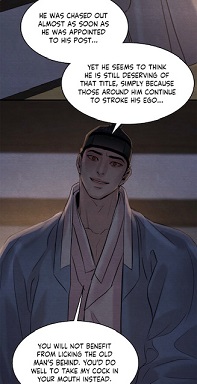 (chapter 80) but their evictions were turned into stepping down.
 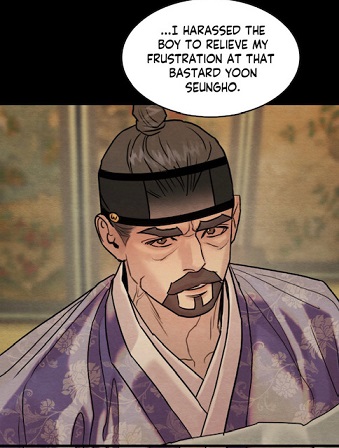 (chapter 122) No wonder why lord Song came to resent the protagonist. Under this new light, it becomes comprehensible why the purge was not noticed by commoners. There was no fire and the staff was sparred.
  (chapter 103) The boots were the indication that this person was working for the government. And it was an elder, for he was wearing this particular headgear.
 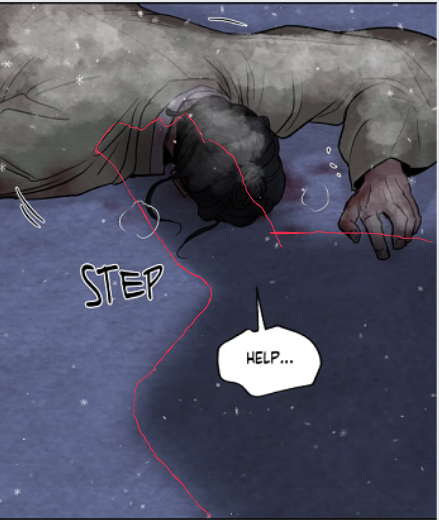 (chapter 103)
  (chapter 67) The murder of lord Shin is the evidence of the anarchy in Joseon. But actually, the monsters are actually everywhere, and not just among the nobility. The Chungin with the scholar and the physicians who have no problem to lie, participate in a kidnapping and drugging people… the kisaengs, the maids, the servants. They are all accomplices, for they feigned ignorance or chose to remain passive, for they preferred avoiding trouble. What people failed to realize is that no one is safe from this tyranny. Hence people could get killed and thrown into a well so easily
 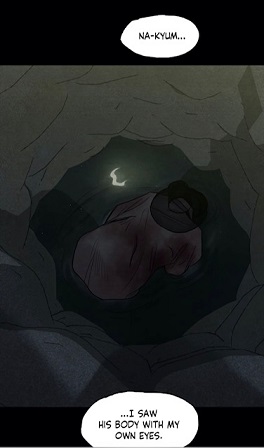 (chapter 97)
 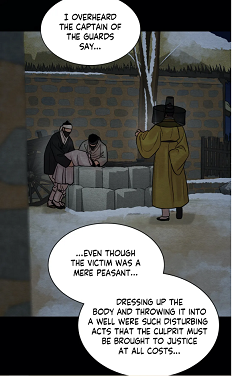 (chapter 101) and their perpetrators got scot-free. Why? It is because the mastermind and the helping hands are protecting each other, like we could see in the Joker’s case. However, the latter in season 3 had no idea that they would face divine retribution and pay with their life.
  (chapter 102) In front of gods, humans are all equal. There is no distinction between gentry, Chungin and commoners. That’s the reason why I come to the conclusion that Yoon Seungho is the divine hand of justice, he is bringing the “divine retribution”. This explicates this vision:
  (chapter 83) Under this new approach, it becomes comprehensible why he is called “the bird of misfortune”. People around him got to suffer, for they received their karma. Funny is that lord Song mocked him by calling him a grim reaper.
 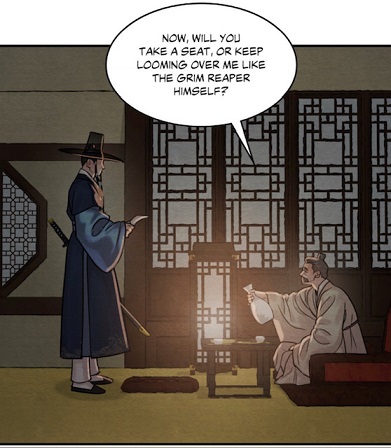 (chapter 123) He underestimated his opponent, not imagining that the latter would use his sword against him. So he became a grim reaper. Lord Song Haseon must have thought that his minions, just like his age and status, would protect him. But no, someone had planned his death and counted on the main lead’s decision.
 (chapter 99) Thus Min’s karma was to die in the total indifference of others. No one is missing him, for he was turned into a brigand himself.
  (chapter 113) But wait… Why did Black Heart get killed in the end? One might say that it was his karma, for he had planned the murder of Baek Na-Kyum in the past. In my opinion, the uke serves as a representative of the divine retribution. The artist is the “judge” and his lover is executing the sentence: death. And we can detect this gods’ intervention through the learned sir’s case as well. Jung In-Hun had looked down on the artist for his origins and education. When the generous main lead chose to accept his apology (attempted rape),
 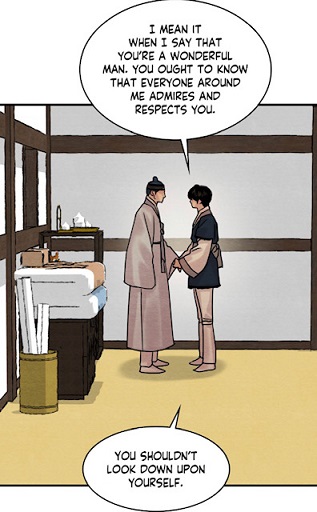 (chapter 120), the latter reminded him that contrary to Yoon Seungho, he was admired. He had such a good notoriety! Since he betrayed the artist and had almost him killed, the scholar ended up losing everything.
 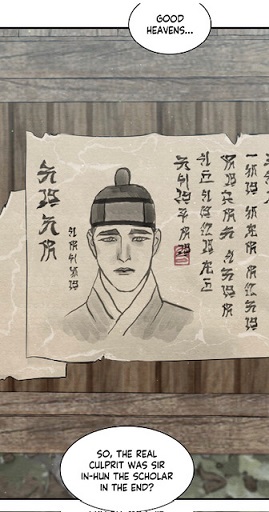 (chapter 127) He became the scapegoat for this incident, for he played a huge role in the painter’s suffering (kidnapping, assault, murder and brainwashing). His success at the civil service examination was erased within a few weeks and now he is viewed as a brigand. How could such a person get selected as an official? His fate gives a bad impression of the civil service examination. And what is the common denominator between these two villains? They both belong to different social classes. Their cases is exposing the king’s negligence and arbitrariness. The latter is the perfect personification of this corruption. Not even Confucianism is respected, for fathers are abusing their own children or even killing them. Season 4 is exposing the chaos in Joseon. Therefore it is not surprising that the sacred tree and the shrine got burned.
  (chapter 106) The gods were using the humans to voice their anger. At the same time, when the woman made this comment, the Manhwa lovers can detect the huge gate in the background, the symbol for royalty. And now, you comprehend why Yoon Seungho was pushed to go to Hanyang. It is his fate to face the king! His task is to clean the palace of these old bearded men.
  (chapter 44) I had already portrayed him as a black shaman in the essay “
 (chapter 65) Don’t forget that the monarch is the only one who stands above the laws, though he is controlled by social norms and his officials. In my opinion, this can only take place, when a new scheme takes place. How so? Note that in the scholar’s case, Jung In-Hun received his karma, but not real human justice. For me, he is not dead. Besides, don’t forget that someone took the petition from lord Song, before Yoon Chang-Hyeon came to the bloody place. There is no ambiguity that the accomplices and schemers didn’t get happy with the last outcome. The couple might be separated physically, but they are attached to each other by their strong love. And since the main lead kept wearing hanboks with the phoenix
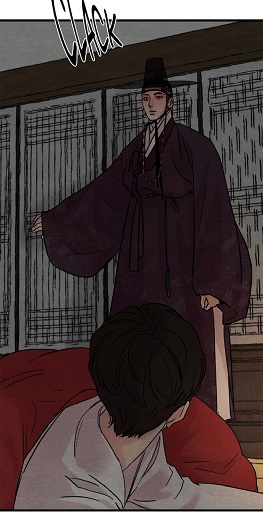 (chapter 34)
  (chapter 45), it indicates that someone saw him as his bird of fortune. And this can not be Yoon Seungho, for the latter was full of self-hatred. Finally, his own father, Kim and Heena called him as a bird of misfortune. As you can see, the king could no longer see the main lead due to the artist’s presence. He is his bird of fortune, for he could live out all his dreams thanks to him, and at no moment he got into trouble. No one is suspecting his intervention.
 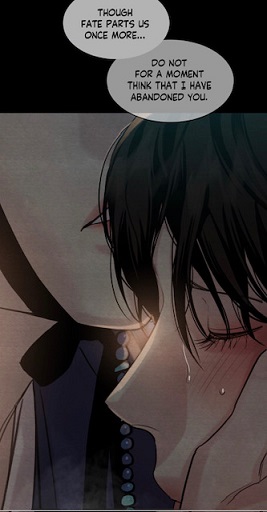 (chapter 127) I recognized why the painter and Yoon Seungho had to go separated ways. It is because the schemers wanted him to return to Hanyang. Remember the learned sir’s suggestion before his departure.
  (chapter 44) Why? It is because now the main lead is an adult. Since my theory is that the pedophile is the ruler, he can no longer approach the protagonist like that. The latter is no longer visiting the gibang. He wants their path to cross again so that they can rekindle. Hence he had to create an opportunity proving that their meeting is not a coincidence. Under this new approach, it becomes comprehensible why Yoon Seungwon encouraged his brother to reconcile with their father.
 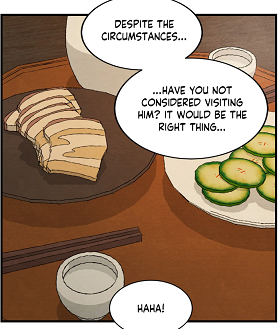 (chapter 37) That way, he would be “following” the tradition and become an official. But since Yoon Seungho developed a fear of “old bearded men”, he had no reason to go there.
 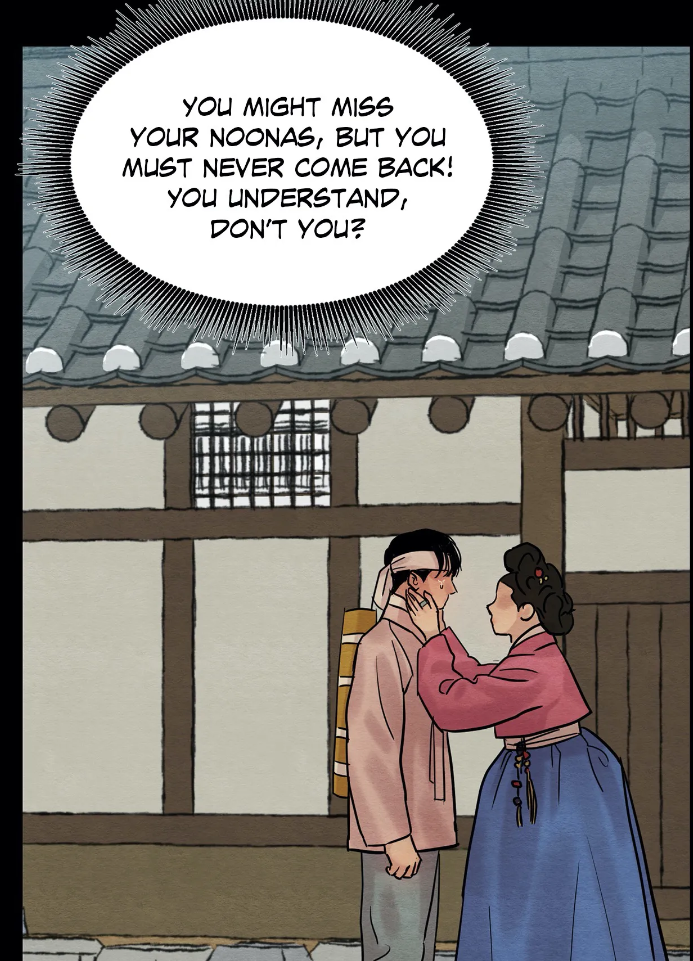 (chapter 46)
 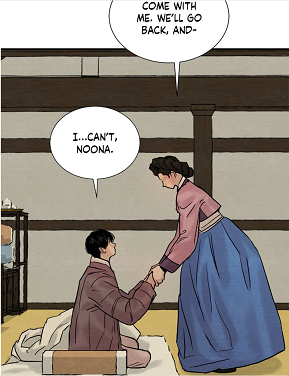 (chapter 68)
  (chapter 97)
 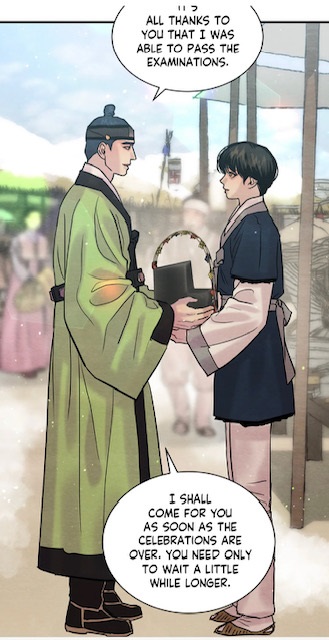 (chapter 111)
  (chapter 120)
 (chapter 127) As you can see, the painter was feverish. Why? From my perspective, he was drugged. He was not allowed to see his loved one, because they don’t want him to remember their departure. The schemers desire him to feel abandoned like in the gibang (chapter 105). The reason why I am suspecting a drug is that this panel
  (chapter 127) is similar to the first Wedding Night:
  (chapter 21) At the same time, this scene is also a reflection from the night after the massacre in the shrine.
  (chapter 103) Back then, he was also under the influence of an aphrodisiac. They don’t want him to remember his last words. And since he didn’t take care of him during that night, though he was unwell, they hope to create the illusion that Yoon Seungho neglected him. He broke his promise. But their trick can no longer work because of the lord’s visitation in the prison and his words.
  (chapter 126)
  (chapter 127) The separation arc is there to prove these plotters wrong. Their affection is not trivial and momentary. He is not a plaything, but his “partner”. In fact, they have absolute trust in each other, and their source of strength will be their short happy moments together. Besides, I am quite certain that the artist will remember the lord’s whisper from that night, since he had problems to recall the First wedding Night and the incident in the shrine. Both are related to his bad conscience. Besides, I have another reason for that, the power of the unconscious knowledge.
 (Chapter 108) Though both were close physically, they still allowed others to manipulate them, for their trust was not complete. In other words, the schemers are thinking that time is working for them!! On the other hand, since Kim is by his side, the painter can only consider his presence as the evidence of the lord’s care.
  (Chapter 127) This coincides with the beginning of the Manhwa, when the lord was seen without his butler.
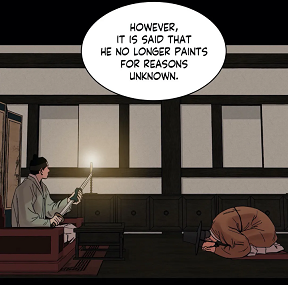 (Chapter 1) The latter only appeared in episode 7, and back then Yoon Seungho had to dress himself.
  (Chapter 7) Finally, I am expecting schemes again.
 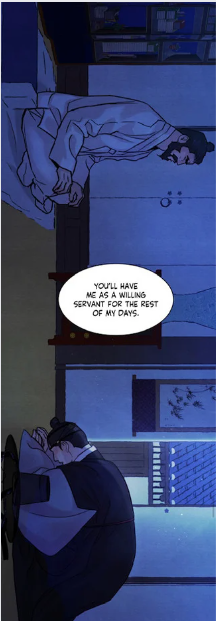 (chapter 127) This means that he is giving up on his status and freedom for Baek Na-Kyum’s sake.
 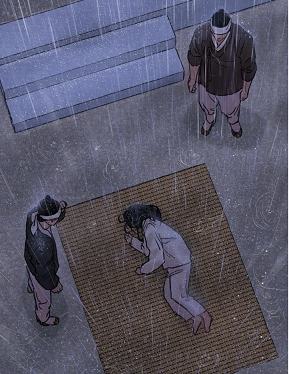 (chapter 127) Here Yoon Seungho had been treated like a servant, because he had been submitted to the straw mat beating. Exactly like in the past, there was a promise. Notice how similar the words are: “No matter”.
 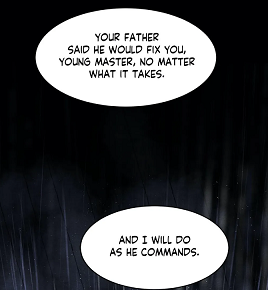 (chapter 77) However, there exists a huge difference. Back then, the vow was made between the butler Kim and Yoon Chang-Hyeon. As you can see, Yoon Seungho is now copying his surrogate father’s behavior.
  (chapter 127) This shows that the young master is following Kim’s path. On the other hand, the domestic employed the future tense in his pledge (“I will do as he commands”), whereas the “spiritual son” is using the present (“I swear to live as you command”). Moreover, the main lead is talking about his way of life and not “order”. And what does the father desire?
  (Chapter 86) Making connections so that the Yoons can become influential again!! But how can he do that? By showing his talent? I have my doubts about it. Why? It is because in season 1, the lord was having sex with his peers, and back then they were like battles… for an exchange of favors. I hope, I might be wrong, but I fear that he is about to become a male kisaeng again. Or if not, then this is what the king is expecting from him. And we have the best example in this scene:
  (chapter 118) Why does he need the protagonist? It is because he needs “connections”. And how can he get these connections? Through his brother. But with the last incident, it looks like Yoon Seungwon jeopardized the remains of his influence, for the noble ignored him.
 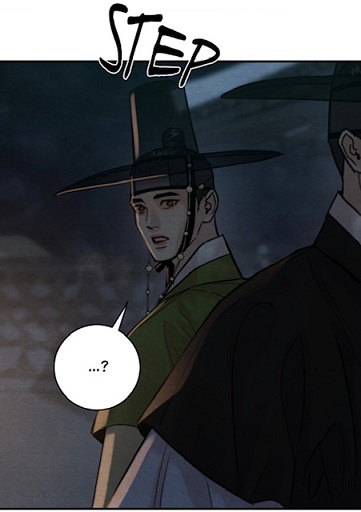 (chapter 127)
 (Chapter 56) Yet, the domestic is only bowing with his head and not his body. The protagonist is dressed exactly like his father. This comparison exposes that my past interpretation was correct: the butler had awakened his master during the night by lighting the candles. And after receiving this letter, Yoon Seungho dressed himself in order to meet his childhood friend, which reinforces my theory that the valet won’t follow the protagonist.
 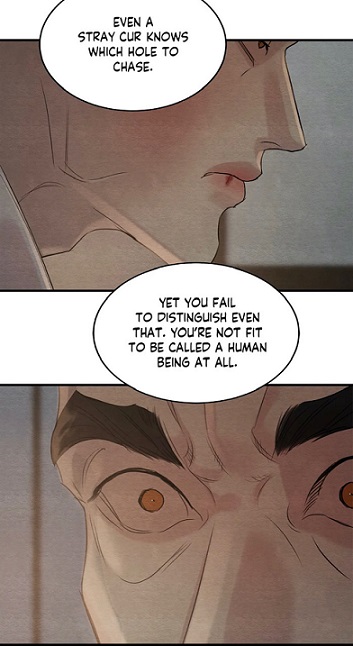 (chapter 86) However, back then, he was considered as the eldest son. One of his duties was to continue the lineage
 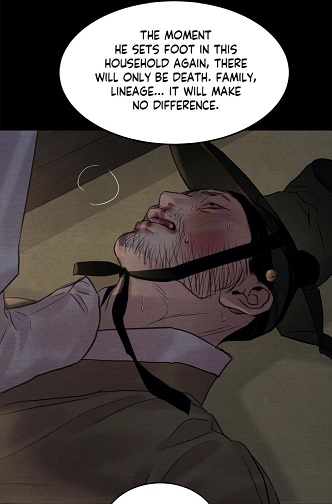 (chapter 82) and because of the stolen kiss, the patriarch became obsessed with sexuality. Observe how lord Song Haseon described the father’s attitude. He knew about the atrocities that the young master was exposed to
 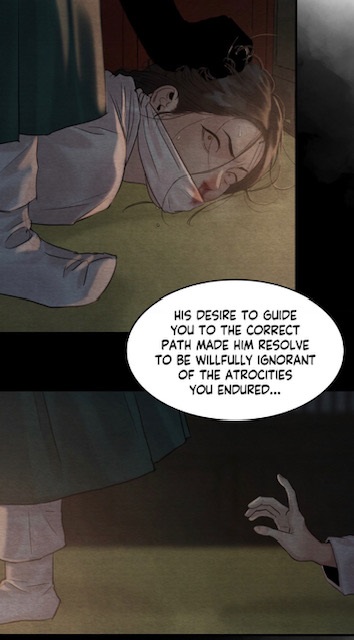 (chapter 123), but he chose to turn a blind eye, for he believed that the end justifies the means. This explicates why he left the room so quickly and abandoned his son. Yoon Chang-Hyeon’s resent for the eldest son came from his high expectations. This can only reinforce my past interpretation that Yoon Seungho is a new version of Prince Sado. Thus the elder master Yoon’s personality is based on king Yeongjo. Moreover, lord Song alluded to the execution of a prince ordered by the monarch.
  (chapter 107)
  (chapter 55) But what did he see in his father’s gaze? Anger and disappointment, for he was never able to satisfy Yoon Chang-Hyeon’s expectations.
  (chapter 55) With the release of episode 127, I had this sudden revelation concerning this memory. In the past, I used to think that he had been submitted to the straw mat beating. But now, I think that in this scene, Yoon Seungho was forced to bow to his father by the servants or guards!! Yes, the former version of this scene.
  (chapter 126) This idea came to my mind, the moment Yoon Seungho emphasized his bowing!
 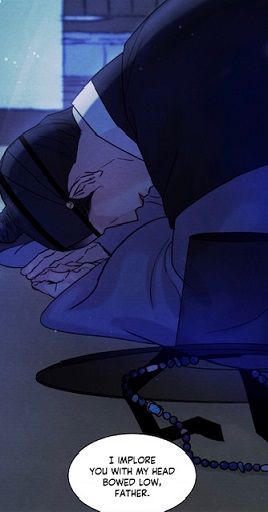 (chapter 127) The protagonist’s words imply that he had never done it before!! And now, you know why Yoon Chang-Hyeon agreed to make a deal with his eldest son.
 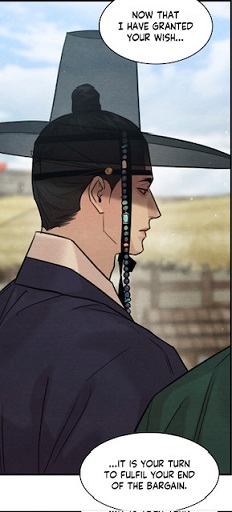 (chapter 127) Yoon Seungho’s bow and oath stand for blind obedience and loyalty. This explicates why the author drew him without eyes.
  (chapter 87) That way, he can act, as if the purge and the humiliation had never happened. So by submitting himself to his father’s will, it looks like Yoon Seungho is put in the same position than in the past. He is “exposed” to the harsh judgement from the patriarch. However, it is just an illusion. How so? First, what caught my attention is the absence of the protagonist’s eye.
 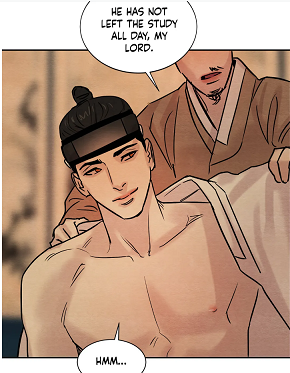 (chapter 11)
  (chapter 35) Does it signify that the protagonist has the intention of betraying his own father? I don’t think so, but the manhwaphiles shouldn’t forget the lord’s wish in the kitchen: “I shall remember this moment for as long as I live”.
  (chapter 118) This shows that when the lord bowed to his father, he was thinking of Baek Na-Kyum in the kitchen. His body might be by his father, but his mind and heart were elsewhere. Thus I couldn’t help myself thinking that Yoon Chang-Hyeon will get betrayed and abandoned by his own son. During the same night, he made 2 vows. It was, as though he had two “lords”! His goal is to meet his loved one again.
  (Chapter 127) Finally, don’t forget that the main lead is following Kim’s path. He will have to choose between his father and the painter. Yoon Seungho is actually applying the father’s principle: the end justifies the means. So if necessary, he can break his vow to his father.
 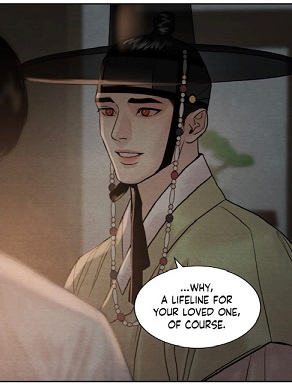 (chapter 116) I still believe that the painter has the original petition. And who is by Baek Na-Kyum’s side? Kim!!
  (Chapter 108) By living by his side, he can lead a quiet life far away from Hanyang. However, this signifies that the artist has become a “prisoner”. As long as he lives in Yoon Chang-Hyeon’s claws, his loved one can not return to his side. Interesting is that a carriage was used to carry away the protagonist.
  (Chapter 78) But where is the painter going? To the mansion? Or to another secluded place? In my eyes, the location is important. His existence is still a source of problems for the schemers. I see a future conflict in the lord’s life, for one oath stands in opposition to the other. Moreover, should the patriarch lose Baek Na-Kyum, he can no longer control his son. He can not suddenly blame the painter for the death of lord Song, for Jung In-Hun has been now convicted for the crime.
  (Chapter 7) Now, the positions are switched. He is the one getting coerced! And this brings me to the following observation. Why did the elder master agree to this deal in the end? First, he refused to assist his son.
 (chapter 127) He believes that he has the petition, therefore he can no longer be blackmailed by his eldest son. The latter has no longer any leverage over him! However, he changed his mind.
 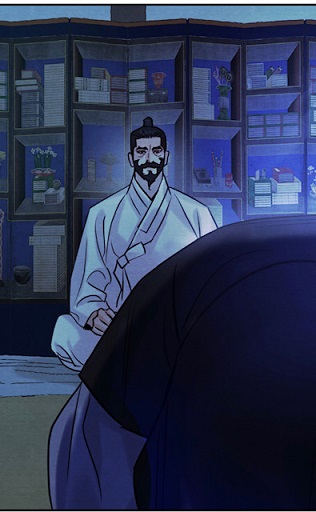 (chapter 127) For me, it is related to the bow. I noticed that the patriarch pays a lot of attention to “manners” and etiquette. Therefore the guards apologized on different occasions, yet the elder master always accepted their excuses
  (chapter 125)
  (chapter 126) Yet, in reality they were fake excuses. I have already pointed out that the servants would act on their own. But more importantly, their fake apology hid their failure as guards. How could they let the young master barge into the lord’s bedchamber? With a simple apology, this wrongdoing was overlooked. And now, observe what happened during the same night:
 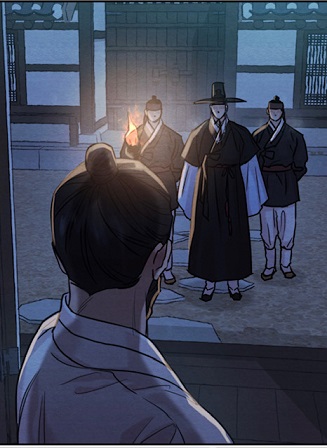 (chapter 127) Yoon Seungho was followed by the guards! It looked like they were serving him. This scene reminded me of the officers’ appearance in front of the mansion.
  (chapter 94) This can only reinforce my theory that the main lead will turn against his father in the end. Keep in mind that there is a deal, so should the situation change (the painter’s desertion or the discovery of the second petition for example), the lord is no longer forced to keep his vow towards his father. Moreover, since Baek Na-Kyum got lied, “brainwashed”
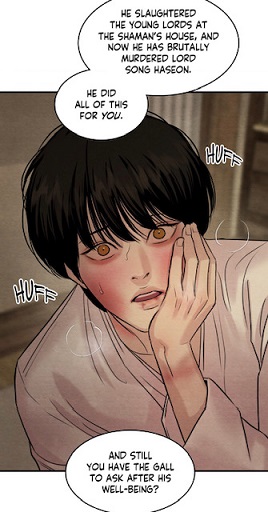 (chapter 125), “drugged” and slapped by Yoon Chang-Hyeon, he is destined to receive his karma through his son. And what was his dream?
  (chapter 125) and paid the governor
 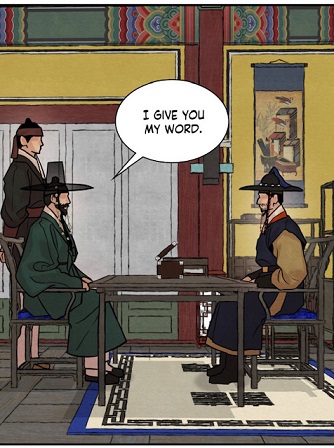 (chapter 127), he could get into trouble for it was, as if he was admitting his responsibility.
 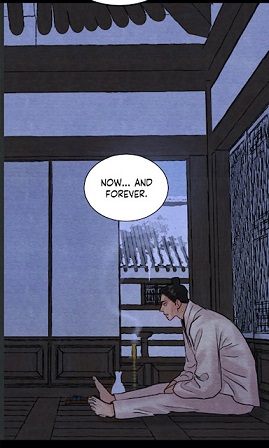 (chapter 87), whereas Yoon Seungho stands for change and hope.
 (chapter 127) Where was Heena noona, when her brother was in prison? This rumor can only create the illusion that the painter is still devoted to the learned sir. Yet, after the last incident, the painter came to regret to have trust the learned sir. Both characters are now healed from their traumas (abandonment issues) and they are in full possession of their mind. This makes them less weak to manipulations.
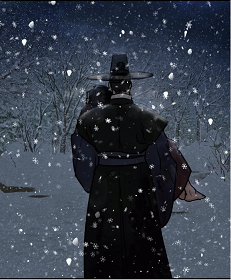
 (Chapter 119) He is now truly alive. This explicates either why he smiled and laughed at the end. But why was he so happy? It is because Baek Na-Kyum had just confessed that he loved him not for his wealth or power, but for himself.
  (Chapter 119) He even described him as a treasure. Yoon Seungho had finally achieved his goal: to win the painter’s heart. His presence and love bring happiness to Baek Na-Kyum which stands in opposition to his reputation as bird of misfortune. Moreover, this description contrasts so much to Jung In-Hun
  (Chapter 119) and Yoon Seungwon’s.
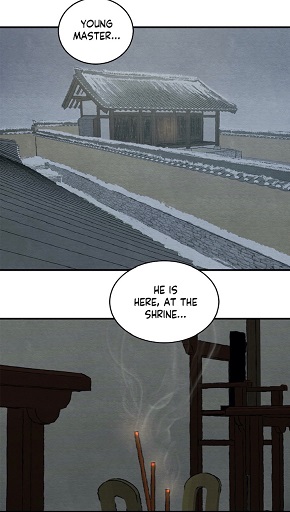
  (chapter 102) In episode 102, he was renouncing on everything (life, mansion, wealth and connection), because he imagined that the artist had died. Consequently, I deduce that in episode 119, the painter’s life is attached to the lord’s for good. If the artist got into trouble, Yoon Seungho would side with him and the reverse. Thereby, I come to the conclusion that this moment in the kitchen represents their union, as they are no longer tied to the mansion. They are now a family no matter where they are. Let’s not forget that the painter expressed his wish to run away with his lover.
  (Chapter 119) It is important, because such a departure symbolizes that the bird “Yoon Seungho” is leaving the nest. He is now starting a family on his own.
 (chapter 85) and put a glass and that was it. This exposes the father’s hypocrisy, ignorance and greed. By acting on his own, he was exposing his true mindset. He views himself as the family. The sons are just the extension of himself, for they are his reflections.
  (Chapter 45) On the other hand, Yoon Seungwon is his golden child, for he represents his positive reflection.
 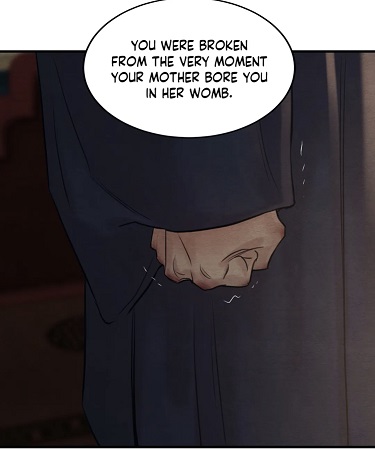 (chapter 86), whereas he put the other on a pedestal
 Under this new light, it becomes comprehensible why the father could only reject the offer from lord Song in the gibang. Doubting Yoon Seungwon’s sexuality meant to question about the father’s sexual orientation. At the same time, it is not surprising why the elder master would blame Yoon Seungho for everything, for he couldn’t admit his responsibility for the purge. Consequently, the Manhwaphiles can grasp why Yoon Chang-Hyeon came alone to the shrine. If he had brought Yoon Seungwon, the father would have been reminded of the elder son, as both can not be separated. This explicates why the younger master asked his elder brother to submit to his father.
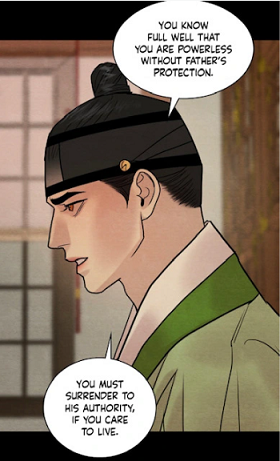 (Chapter 119) I couldn’t help myself smirking when the brother attempted to make him believe that.
 (Chapter 119) the protagonist could ever gain the father’s favor. Yoon Seungwon was definitely playing with his brother’s feelings, as if he could hope that their father would change.
  (Chapter 118) It is because as a golden child, he is also suffering, but it is naturally nothing compared to Yoon Seungho’s position who could have died.
  (Chapter 119) First, by returning the petition to the father, Yoon Seungho would become the culprit. He was not only a traitor, but also a blackmailer of the Yoons and lord Song.
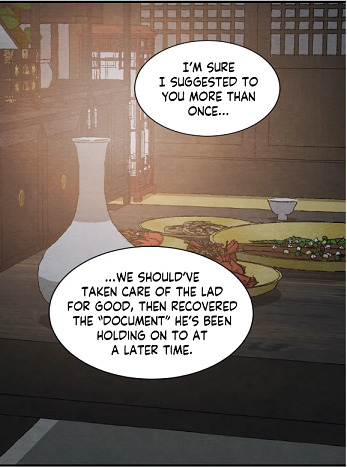 (Chapter 107), for he had stolen the petition. Yoon Seungwon would hide his wrongdoing, he betrayed their father.
 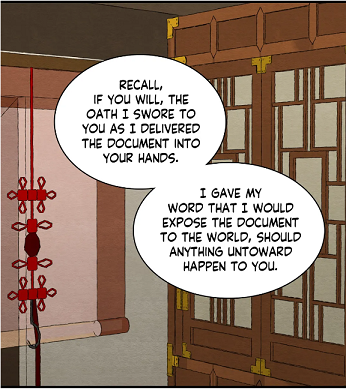 (Chapter 118) There is no doubt that Kim played a role in this as well. In other words, the brother and the valet would bury the truth by diverting the attention of the patriarch towards the main lead, if Yoon Seungho followed this suggestion.
  (Chapter 116) The elder master would no longer seek the truth, similar to the kidnapping in season 2 which was turned into a desertion and later Lee Jihwa’s abduction occulting the instigator and the helping hands. Simultaneously, Yoon Seungwon needs his brother as scapegoat, because the pressure coming from the patriarch and lord Song must have definitely increased.
 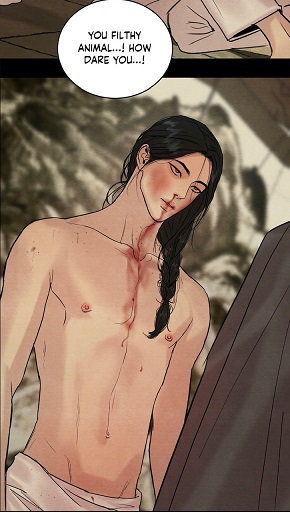 (Chapter 83) This shows that the young master wants to sacrifice his brother once again. Out of selfishness and cowardice, he is trying to convince Yoon Seungho that this is the right thing to do!
 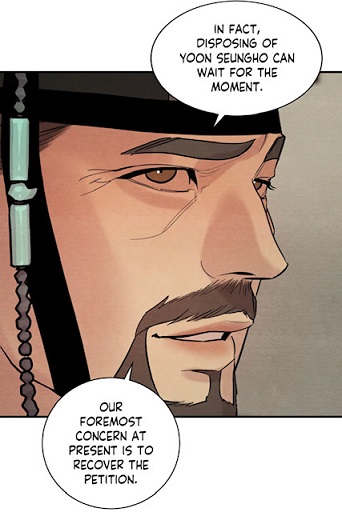 (Chapter 116) Thus I come to the conclusion that the meeting between the brothers in the gibang represents an offering. For the Yoons’ sake, Yoon Seungho should admit his wrongdoings
  (Chapter 119) But everything changed, when the painter met the lord. So who is worse here? Jung In-Hun who tried to rape the painter or Yoon Seungwon who is sentencing his elder brother to death? Let’s say that the valet convinced the younger master to suggest this solution, this doesn’t diminish Seungwon’s responsibility at all. He knows that his father abused his elder brother. In my opinion, he is copying his father, like the former tried to diminish the responsibility of the patriarch.
 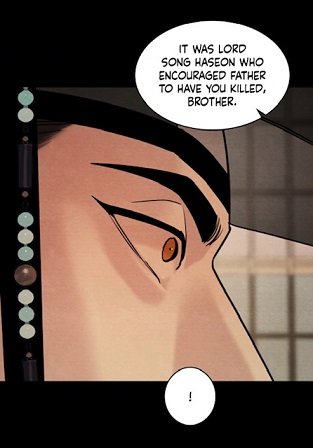 (Chapter 119) Yoon Seungho got hurt because of lord Song and not because of Yoon Chang-Hyeon. This means that the younger master was denying the existence of the patriarch’s choice and the helping hands. And if the brother listened to his advise and the father hurt or killed the main lead afterwards, the younger master could put the blame on the elder master, for the decision and responsibility belonged to the patriarch. Moreover, he heard from lord Song that killing Yoon Seungho was just a matter of time.
  (Chapter 119) So technically, this situation could have triggered the protagonist’s insecurities like in season 1
  (chapter 28), 2
 (chapter 60) and 3
 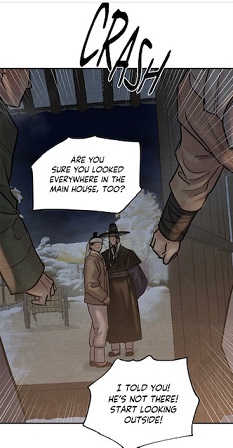 (chapter 98). However, through these constant exposures, Yoon Seungho came to learn not to jump to conclusions and to have faith in Baek Na-Kyum. He knew that he would return to the mansion. Hence he ran to the bedchamber first.
 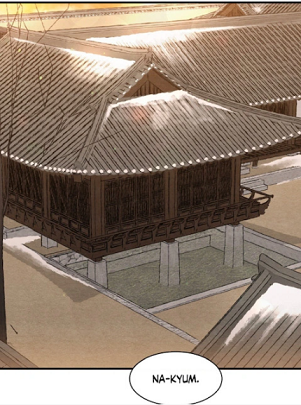 (Chapter 119) Another important detail is that we don’t see any staff in the courtyard or in the kitchen. It was, as if the propriety had been deserted.
 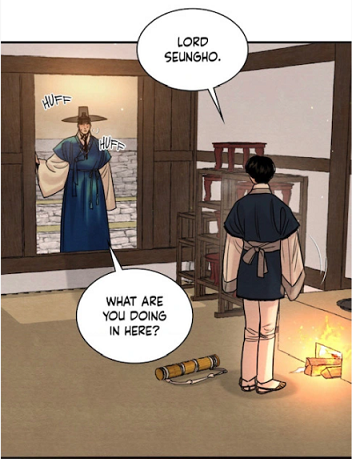 (Chapter 119) This implies that at no moment, he relied on the domestics’ testimonies which contrasts to the following scenes:
 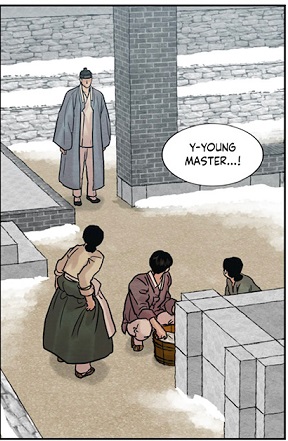 (chapter 104)
 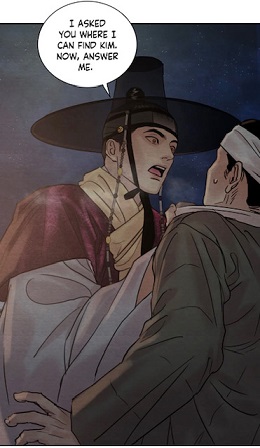 (chapter 107) and
 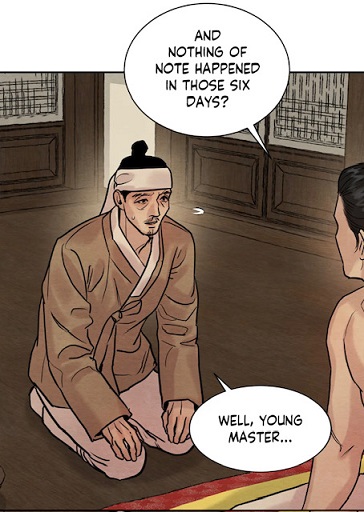 (chapter 116) However, observe that in episode 116, Yoon Seungho had witnessed how his lover had taken care of him, while he was unconscious. Furthermore, the petition had been handed over to the painter and not Kim, a sign that the artist had become the protagonist‘s confident. As you can see, as time passed on, the main protagonist learned the following lessons: he should stop relying on servants, he should only trust his partner. I would even add that he was taught the following principle: “If you want something done right, you have to do it yourself”. In my eyes,
 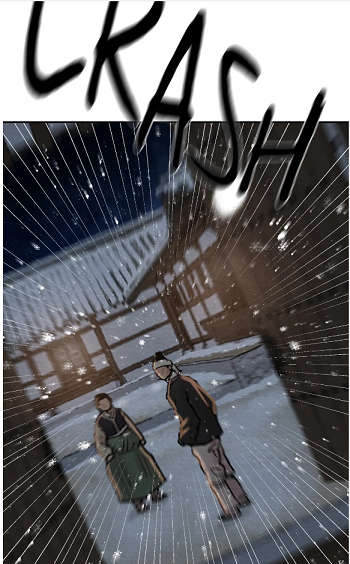 (Chapter 103) Here, they never expected the return of Yoon Seungho and the painter. The staff ‘s absence in episode 119 is the evidence of their desertion! Moreover, I consider Yoon Seungho’s search for his lover as a new version from episode 28/29/30:
 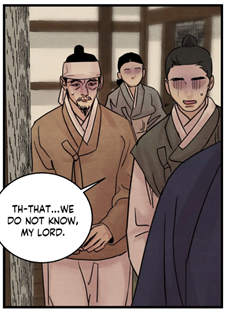 (chapter 28) Back then, they feigned ignorance, but they never anticipated a punishment from Yoon Seungho.
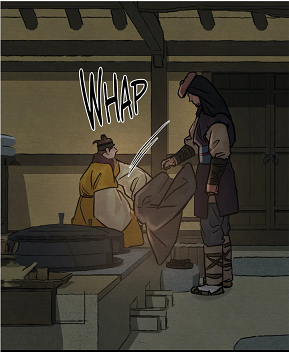
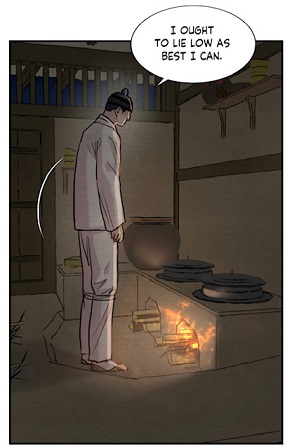 (chapter 115) And now you are wondering how the painter’s gesture can be considered as an offering. It is because the kitchen hearth is considered as sacred due to the fire. First, in shamanism, there exists the god of fire named Jowangshin.
  (Chapter 115)
 (Chapter 59)
 (Chapter 98)
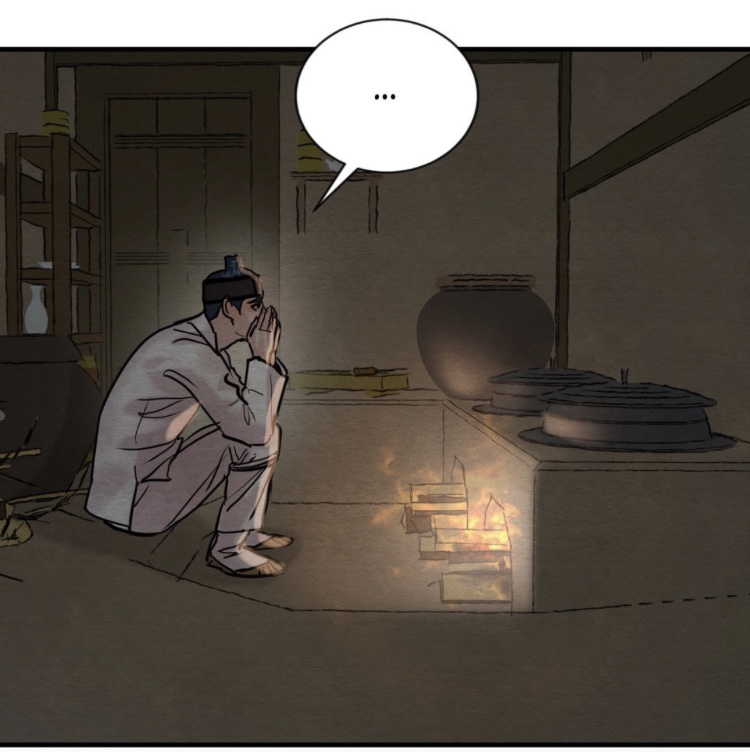 (Chapter 115)
 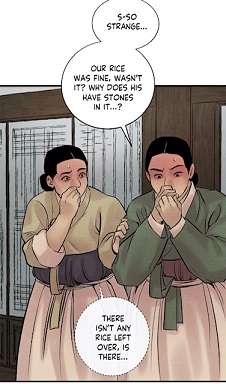 (Chapter 47)
 (chapter 102) who was a traitor, for he had tattled on Black Heart and his friends to Yoon Seungho. And now, you comprehend why I connected the shrine to the kitchen hearth. Both places are considered as sacred, for they are connected to gods and spirits.
  (Chapter 85) The absence of his sons and of food as offerings reveals that he was not showing true respect to his ancestors. He used religion and social norms to hide his true intentions. He wanted to take over the mansion. Hence the black guards were standing at the entrance of the sacred house. Their presence symbolizes violence. Therefore it is not surprising that the gods chose to punish the elder master through Yoon Seungho. The former was not received properly
 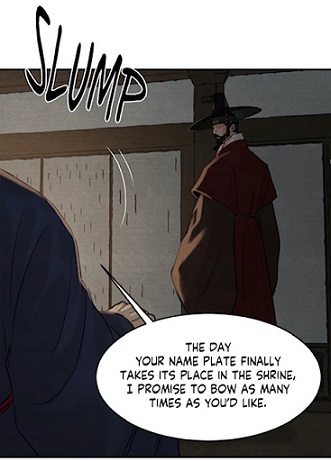 (chapter 86): no bow, no food and no seat.
 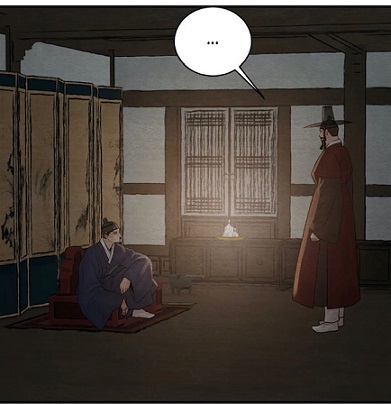 (Chapter 86) Let’s not forget that the elder master had entered the lord’s chambers without the permission of his owner. No wonder why he was left speechless. And now, you are wondering if I am not drifting away from the topic, as these chapters from season 3 don’t seem to be connected to episode 119. However, it is important to realize that these chapters have many common denominators
 Here, we could detect the suicidal tendencies of the protagonist. He wouldn’t fight back.
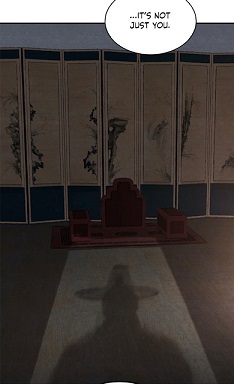 The seat looks like a throne.
 The courtyard is empty! No one is defending their master.
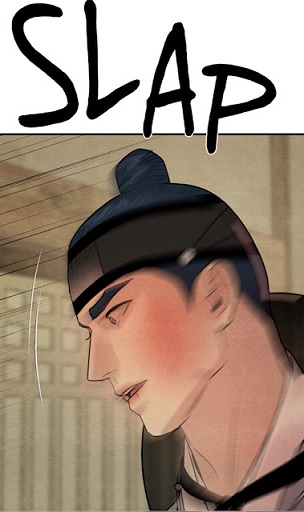
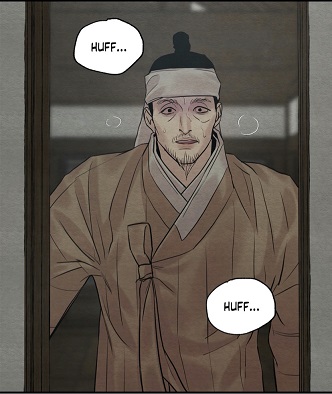

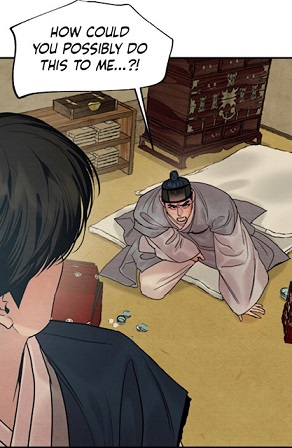

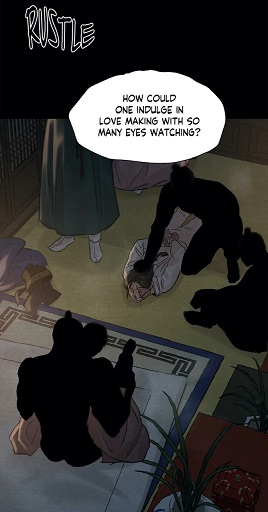


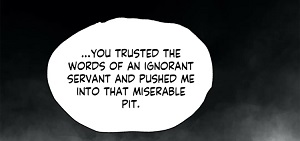
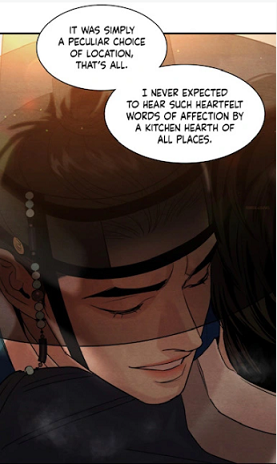
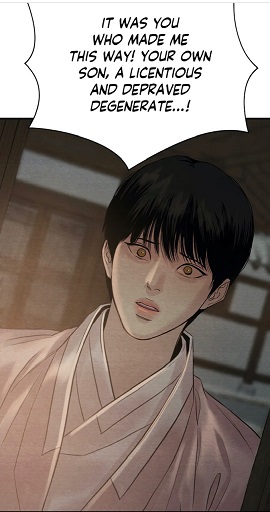


 Baek Na-Kyum freed himself.
  (Chapter 85) The study is even close to the gate.
 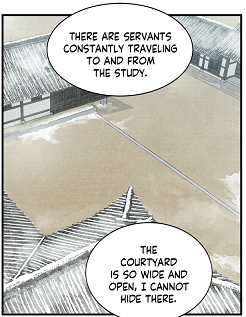 (Chapter 51) He could have reached the study before the father entered the shrine. Finally, observe that the patriarch even arrived to the bedchamber before Yoon Seungho,
 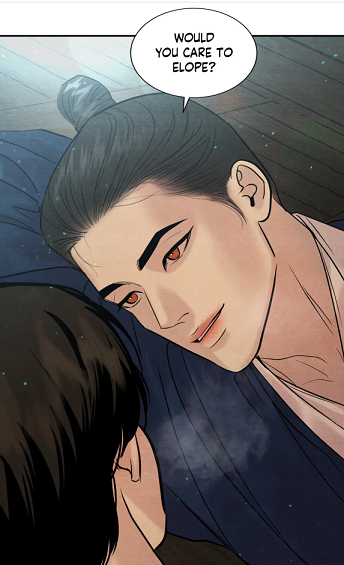 (Chapter 117) The painter wants to leave everything behind too.
  (Chapter 119) Thus I am deducing that the authorities will be involved very soon.
  (chapter 119) They are not expecting the lord‘s resistance, for he remained passive all this time (season 2 and 3). The scholar has now the means to do so, and the necessary motivation. Imagine that he got wounded and humiliated by the couple! Besides, we have this broken promise due to Yoon Seungwon
  (Chapter 115) exposing the younger master’s lies and Yoon Chang-Hyeon’s delusions. Without the protagonist’s help, the younger brother would not be „successful“. Furthermore, the absence of food and fire in episode 86 indicates that this house was neglected and even not protected.
  (Chapter 94) The gibang is connected to money, power, pleasure, artificiality, sensuality and lack of privacy.
 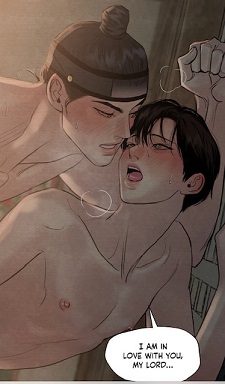 (Chapter 96) I am sure that you can detect all the contrasts (night, door close, spies, confession outside and inside, no fire, only light). Thus I am deducing that the painter’s words in the kitchen were not heard by others. As you can see, this scene in the kitchen is full of symbolism. In my previous essay “The true face of family”, I had already pointed out that sharing meals represented a criteria to define a real family. Therefore I had demonstrated that Yoon Seungho and Baek Na-Kyum were excluded from the mansion, for they wouldn’t eat their meals in the kitchen like the staff.
  (Chapter 17) Moreover, the hearth doesn’t just provide warmth, but also light! The latter embodies knowledge and as such Enlightenment.
  (Chapter 119) Hence they were clueless about the wrongdoings from the staff. Only in the kitchen, the lord could finally grasp the depth of Baek Na-Kyum’s love for him. It is an unconditional love contrary to Yoon Seungwon’s. The latter would only recognize him, if he listened to him. And he only seeks his assistance, when he needs him. It shows that Yoon Seungho is only approached, when he has power.
  (Chapter 118)
 (Chapter 119) I would like to outline that during their conversation, Yoon Seungwon remained calm and indifferent, when he talked about the assassination attempt from Yoon Chang-Hyeon.
 (Chapter 116) But the biggest difference is the absence of fire in the kisaeng house.
  (chapter 78) Furthermore, he tried to leave before
 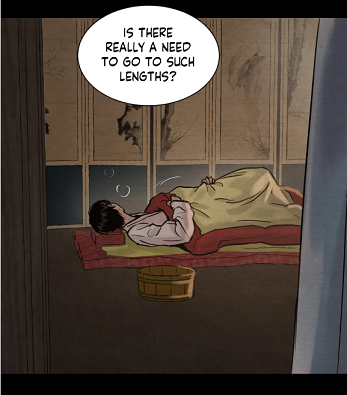 (Chapter 104)
  (chapter 105) Finally, we saw him in the courtyard standing next to a horse and a servant indicating that he had given him a task, and the latter needed to leave.
  (Chapter 108) Hence you comprehend why I am full of optimism in the end. Yoon Seungho has already made some preparations in my opinion. On the other hand, I am quite certain that their love will be tested. Can they face together trouble? Yes, because through their pain, they learned their lessons and changed.
  (Chapter 119) It is because in the past, he was never allowed to join the kitchen hearth. This place was either beneath him or he was not worthy of entering the place. Thus he employed the expression scullery boy to Yoon Seungho.
 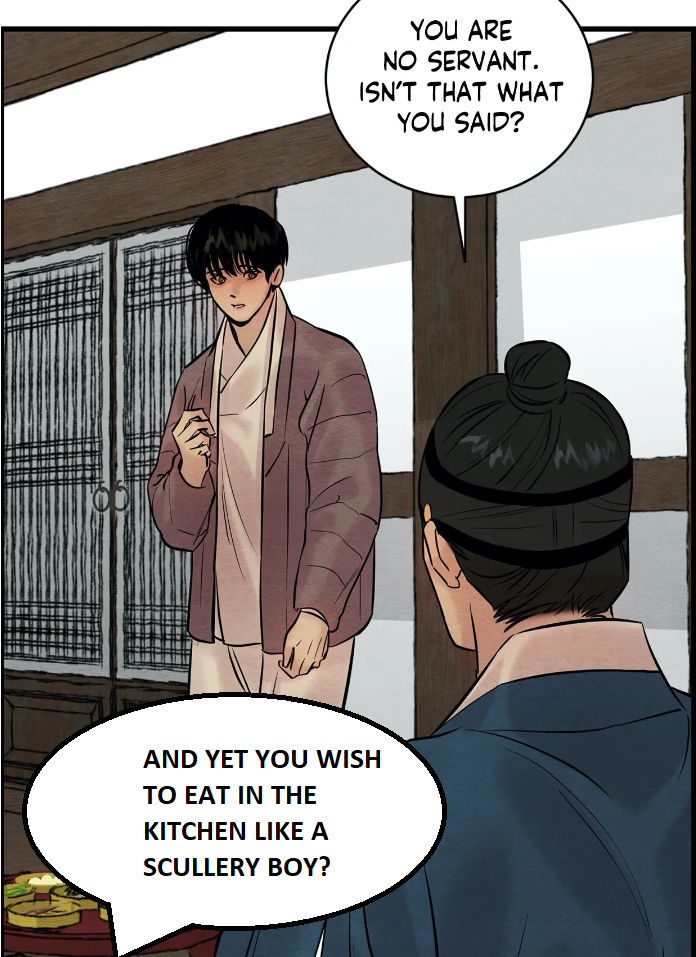 (Chapter 47) Here, I would like to outline that when the protagonist was held in the shed, someone brought him food .
  (Chapter 83) That‘s how I realized that the shed is connected to the kitchen!
 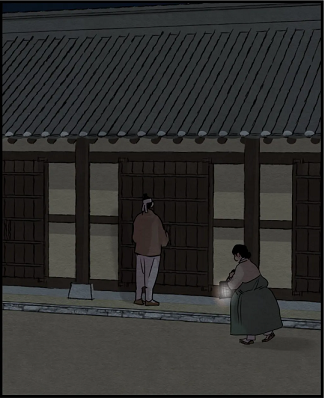 The maid had just brought water to the couple.
 During that night, Baek Na-Kyum had been held captive in a shed.

 (chapter 38) Yoon Seungho remained outside on the door step. Consequently, I started comparing scenes where the kitchen hearth appeared and that’s how I discovered a pattern:
 (Chapter 46)
  (chapter 47)
  (Chapter 110)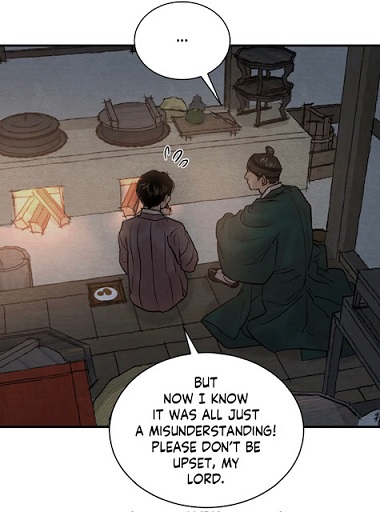
 (Chapter 77)
 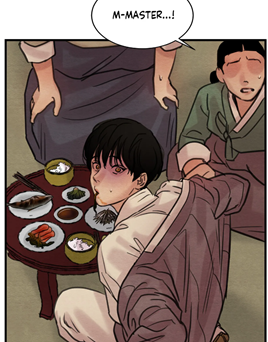 (chapter 38)
 (chapter 59)
  (chapter 119)
 (chapter 38)
  (chapter 47)
 (chapter 77)
 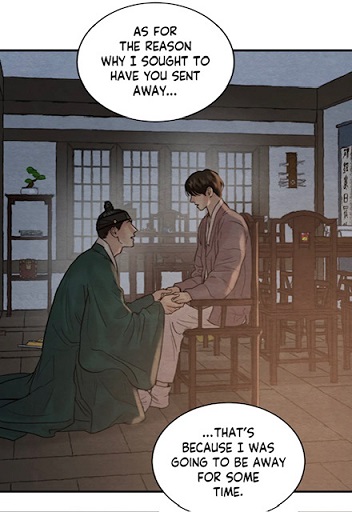 ( Chapter 110)
  (chapter 119)
  (chapter 47)
  (Chapter 77) For me, Kim must have looked down on the other domestics. I consider this scene as the best example what Kim should have done in the past.
  (Chapter 119)
  (Chapter 98) One door leads to the backyard and the other to the smaller courtyard. And this scene confirms my previous assumption
 (Chapter 87) Baek Na-Kyum is there to prove him wrong. He had other opportunities, like giving him a good meal.
  (Chapter 63) He should have sided with his master and even remained by his side. This signifies that this scene
  (chapter 7) the artist is not only cleansing the kitchen, but also cutting off ties with the scholar. The latter is no longer protected. The spirits will intervene through chance. As a conclusion, the hearth has a spiritual and healing power, for it is connected to „Heaven“. Yoon Seungho‘s paradise is to have a family.

 (chapter 115)
  (chapter 103) This had been truly a manhunt! Because both people are wearing items belonging to the upper class, I come to the deduction that the perpetrators were elders, both officials.
 (chapter 82) and Father Lee wearing one. But I am excluding the patriarch Yoon, as the testimony from the masked guard represents the elder’s innocence.
  (chapter 107) Besides, he doesn’t have any high position and the form of his hat is a little different (3 peaks on the side)
  (chapter 88) Remember what I had written in the essay “The shadow behind the shrine”. This picture exposes betrayal, something lord Shin was not expecting at all. And what is the worst betrayal? The son backstabbed by his own father! And we would have two elders involved! Naturally, this signifies that they were working together during that night.
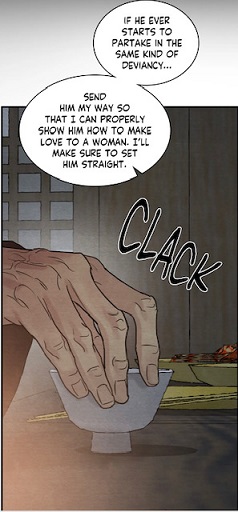 (chapter 107) He was initially trying to repeat the same action from the past, but he failed. Therefore he targeted Yoon Seungho, and this time, the elder master gave in:
  (chapter 107) However, the cause for this assassination was blackmail.
 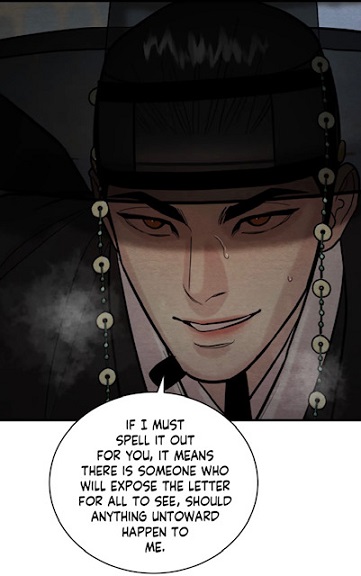 (chapter 116) In other words, both brothers were protecting each other in a certain sense. But by entrusting the petition to Baek Na-Kyum, Yoon Seungwon turned the painter into a target!
  (chapter 88) In the bedchamber next to Baek Na-Kyum, Yoon Seungho was recalling a memory, but he couldn’t just identify the face, for his memory had been long repressed. The latter had refused to listen to him exactly like with lord Shin in the woods:
 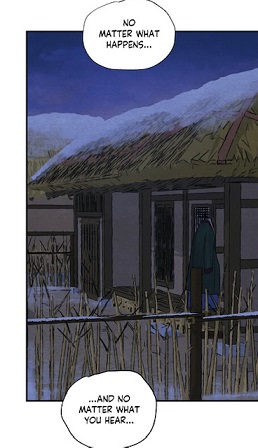 (chapter 88), I come to the conclusion that this shadow was Kim’s.
  (chapter 107) Why? There exist 2 possibilities. Either he lived in exile or he was living in Hanyang and working as an official. I am more tending more towards the second possibility. Why? It is because he spent a lot of money for that night in episode 107:
 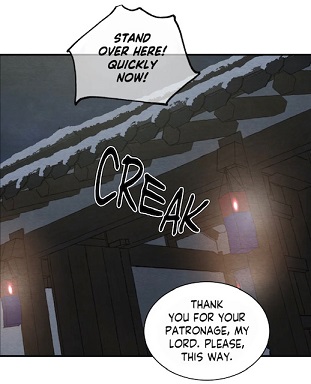 (chapter 107) Hence the kisaengs were asked to welcome the important guest at the gate. He was definitely a rich influential nobleman.
  (chapter 102) Why was he so sure? It is because his father had a high position. He was definitely relying on his father’s influence! And now, observe the evolution of the story. Black Heart is now framed for everything, he has become the scapegoat!
 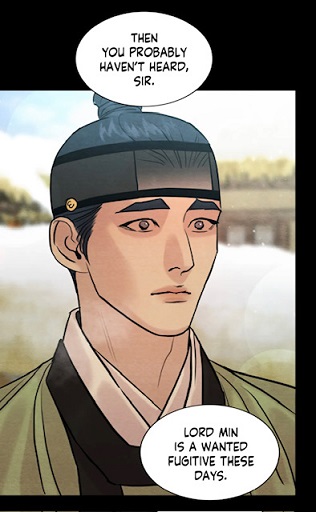 (chapter 113) This explicates why Min was accused of lord Shin’s murder.
  (Chapter 107) The purpose was to hide the intervention of a third party! Note that Yoon Seungho suspected his father immediately after visiting the burned shrine. He is not envisioning the involvement of other elders. Anyway, the blame on Black Heart signifies that the reputation of Min’s family has been tarnished, unless this gossip was created for the learned sir’s ears. If this gossip is circulating around, not only Min’s father lost his heir, but also he failed in his duty to keep the lineage
 (chapter 83), for the latter had been seen wearing a purple hanbok with a design. However, the hair color, the shape of the beard and the design of the hanbok indicate that we are dealing with different people.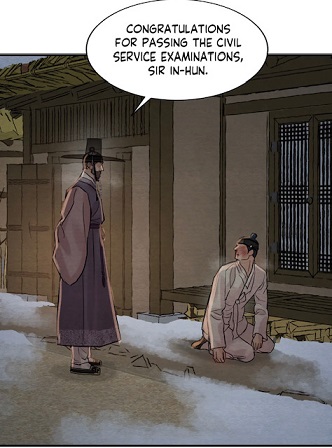
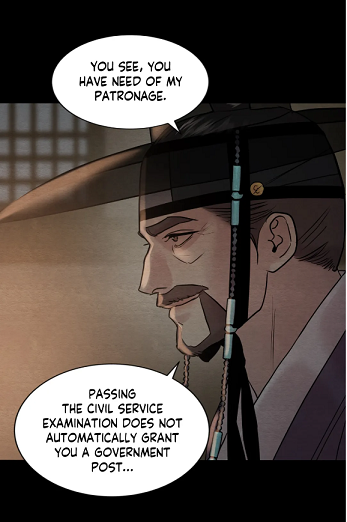
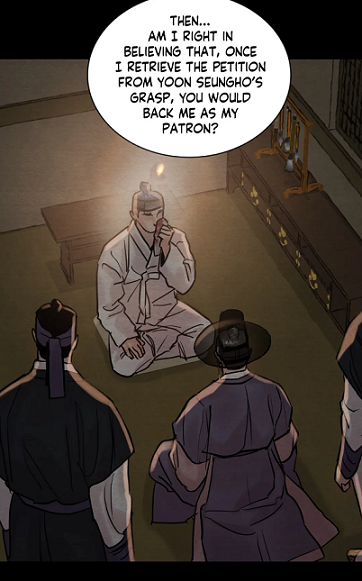
 (chapter 118) They needed him to betray Yoon Seungho.
  (chapter 83) How did Lee Jihwa know his name?
 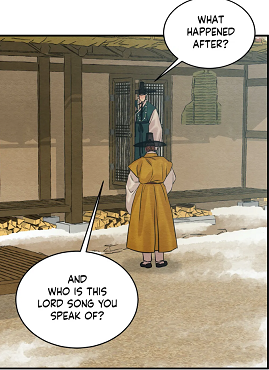 (chapter 83) And observe what the learned sir said after burning the letter:
  (chapter 115) Min has also been investigating Yoon Seungho’s past in order to find his weaknesses. However, he couldn’t find the person lord Song! As you can see, this name oozes mystery and danger. And this reinforces my theory that people have been impersonating “lord Song” and the latter’s name has become a taboo! And that would fit to No-Name’s situation.
  (chapter 76) He doesn’t possess a name, and as such he has no identity. Moreover, he is wearing a mask indicating that he is playing different roles. Moreover, he often vanishes. He is like a ghost! Exactly like lord Song… Yoon Seungho only knows his name, but he has not been able to identify his face!
 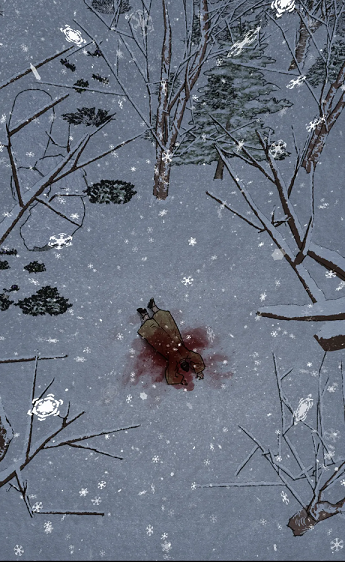 (chapter 103) Another important detail was the absence of footprints in the snow. The imprint would have revealed the identity of the perpetrators: the boots, the evidence of the involvement of officials. To conclude, the elders are responsible for the young lords’ death: Min, lord Jang, lord Park and lord Shin! By tricking Yoon Seungho and Min, the result was that they were forced to dirty their own hands.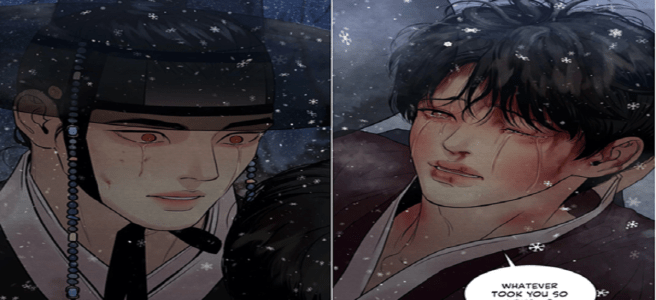
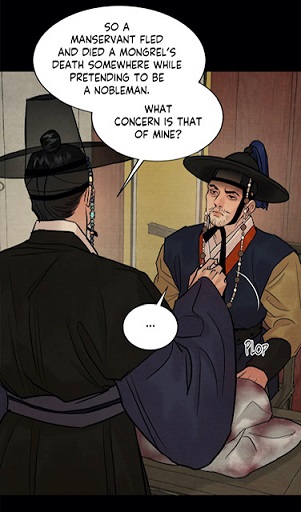 (chapter 98), although he was wearing clothes similar to the learned sir’s. What caught my attention is the expression Yoon Seungho employed: “pretending”. With such an idiom, he was implying that the servant had not only violated social norms, but also he had been acting. As you can sense, these two situations have one common denominator: playing a role and the clothes served as a disguise. It was, as if both victims of a murder had been playing in a theater play. This explicates why in the fanart, the author is portraying Baek Na-Kyum and Yoon Seungho as actors who are working in a sageuk.
  And this made me think of the famous poem from Shakespeare who describes life as a stage, where a person plays different roles all along his life: an infant, a school boy, a lover, a soldier, etc., until he dies, which is symbolized by an eternal sleep.
  (chapter 98) Why? From my point of view, they were trying to scare the main lead, to remind him that he could never replace Jung In-Hun in the painter’s heart, to shake his belief. But the problem is that the schemers had missed the right timing, for the artist had already confessed his love for Yoon Seungho and this twice. Therefore the latter couldn’t doubt his lover’s words, and mistake it for an illusion. As a conclusion, the clothes were used tools to trick the couple, they had become costumes!! However, because the author is using karma as poetic justice, this signifies that the hanboks and shirts can serve as a clue to perceive the truth too. The ones who tried to deceive the protagonists with clothes and words, should be fooled by their own manipulations.
  were different from the head-maid and her colleague?
  (chapter 94) Their clothes were almost identical, yet their body shapes and the cut of the shirts diverged. That’s the reason why I deduced that in episode 98, the author had the intention to manipulate the manhwaphiles. But in order to escape the trap, the readers needed to look carefully at the characters’ clothes. This was the clue that Byeonduck had left for the readers to discern the truth. And now, look at this:
 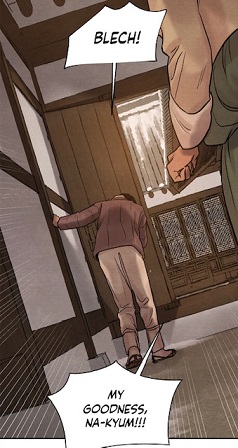 (chapter 98) What was the painter wearing on his way to the bedchamber? White pants with his Mountbatten pink jacket. But how did he show up at the learned sir’s home?
  (chapter 98) He was dressed differently. 😮 He had changed his pants, put on his scarf and hat. But when he went to the lord’s study, he was not carrying them!! How do we explain the difference? The answer is quite simple. He had returned to his room in order to fetch his clothes. And since Baek Na-Kyum took the lord’s clothes, this signifies that he had the intention to return to the domain. The readers will certainly recall the artist’s behavior, when he had threatened the main lead to leave Yoon Seungho. He had switched his clothes, and put on his old clothes.
  (chapter 98) Thus if the lord had gone to the study, he would had realized that the painter had not deserted the propriety, for he had not taken his belongings with him. The hat and scarf were signalizing that Baek Na-Kyum considered himself as a member of the Yoons‘ household.
 (rule 3) If only Yoon Seungho had left a word… The servants served as his messenger. Hence I am convinced that Baek Na-Kyum must have talked to the maids and told them where he was going!! He copied his lover, yet contrary to him, he must have given a precise information. (Rule 5) This means that he had informed the staff about his departure!! Moreover, in chapter 98, the maids acted, as if they had not detected the painter’s presence while badmouthing Yoon Seungho.
 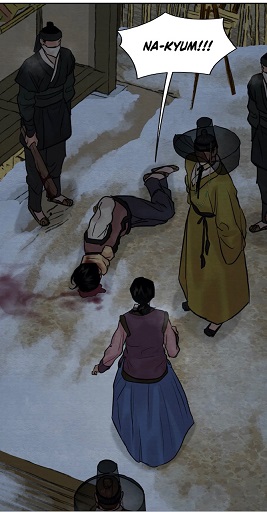 (chapter 99) Then the scarf was no longer present, when the painter woke up. Then the nobles removed his shirt, socks and pants in the shrine.
  (chapter 100) And now observe that after Lee Jihwa’s departure, the artist’s clothes except the white shirt vanished too.
  (chapter 102) Where did they go? The readers saw Black Heart leaving the building, but we should question this: WHY? He never went there to fetch lord Shin, since he abandoned him outside. We all imagined that he left the room empty-handed. But it is true? Now, I don‘t think so. He had to get rid of the clothes in order to mislead the main lead!! A new version of chapter 61
  and
and (chapter 101) Because the readers could detect the presence of a shadow in episode 102
  , I am now envisioning that Min was not alone outside during that night. In fact, someone had misled Black Heart telling him that lord Jihwa had ran away. However, the unconscious lord Shin should have made him think that Lee Jihwa had fought back… Hence he had not fled, rather betrayed them. Moreover, he was not looking at the direction of the entrance and gate. In fact, he was turning his gaze in the direction to the shrine.
  (chapter 98) They were waiting for his return to fake their anger and search. And now, you comprehend why the servants mentioned the kisaeng in front of Yoon Seungho. It was to stop him from going to the study… to divert his attention. Under this new approach, the artist’s last words get a new meaning.
  (chapter 102) Since he had informed Yoon Seungho through the maids about his whereabouts, Baek Na-Kyum was expecting that he would come to his side. I would like the manhwalovers to keep in their mind that the artist was not conscious, when he moved to the shaman’s house. So in his mind, he was not far away from the learned sir’s house. Finally, since he had informed the maids, he could anticipate that the lord wouldn’t get mad at him, and wouldn‘t imagine that he had abandoned him
  (chapter 101) He trusted his lover’s heart in the end. That’s the reason why Black Heart’s superficial promise had no effect on Baek Na-Kyum. The latter truly believed that Yoon Seungho had been informed. But how could they play such a trick on the couple?
 This is an indication of their involvement, though we need to discern the head-maid from the women in chapter 98. That’s the reason why the moment the maid appears, observe her clothes and try to discern her identity. Is this the head-maid or one maid from season 3? The preview displayed the arrival of the doctor.
 (chapter 103)
  The form of the beard is also similar. But now, I have another evidence that this doctor from season 4 is not the physician from season 2!!!
  (chapter 63) The shoes are also different! That’s the reason why in the trailer, the beholders are seeing the physician’s shoes!!
  He doesn’t possess mituri like the other. Moreover, he is wearing a hanbok under his apron
  , while the other is dressed more like a commoner, a shirt with pants. And note that in chapter 33, we had the following combination: Min’s party, the visit of the doctor, Baek Na-Kyum’s illness, the maids and Yoon Seungho who “ran away” after his mistake. (rule 1 and 4)
 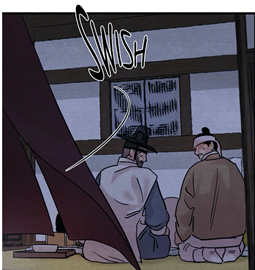 (chapter 33) And what had Kim done during his examination? He had not only threatened the physician
 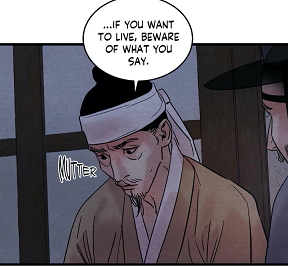 (chapter 33), afterwards he had even badmouthed him, for he had not given the correct diagnosis.
  (chapter 33) However, here the butler had simply lied to hide his own wrongdoings: his passivity and silence. And note the doctor’s words addressed to the “beholder”:
 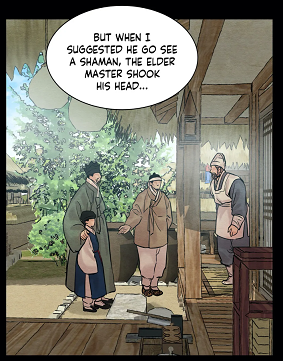 (chapter 57) The latter was introduced to Yoon Chang-Hyeon through the butler. The protagonist must have had a doctor in the past. Can you imagine a life without a doctor for 13 years? And this assumption was proven correct after the release. But let’s return our attention to the physician from season 4.
 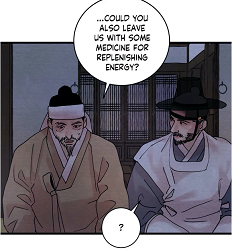 (chapter 33) (rule 1-2-3) But why would he do such a thing? Simply, because he had been helping Min. He needed the protection of a powerful lord, since Kim had abused his position by threatening him. After seeing the new pictures from chapter 103, I had this sudden revelation. What did Min do after getting beaten by Yoon Seungho?
  (chapter 54) He certainly didn’t let his wounds untreated. Thus the next morning his face
  (chapter 56) looked much better. He had no swelling and the redness was already vanishing. From my point of view, he asked for the doctor’s assistance and that’s how the both came to an understanding. But since Min is now dead, the physician could get into trouble, for he helped the lord and now he is dead. But why am I so sure that the physician is about to run away? Look at all these images:
  (chapter 44)
  (chapter 44)
  (chapter 45)
  (chapter 100)
  They are all carrying the white bag on their back… and they are about to depart! Kim wished to leave the propriety with his master under the pretense that he was bringing misfortune to the painter. All this proves that the doctor is far from being innocent. Hence he wishes to run away. However, if he does this, this means that he exits the “play”. So he could die. Moreover, how did he know that the lord would return to the mansion with the wounded painter? I can not answer to this question with certainty. However, I would like to point out that since Min talked to someone in the shadow, it is very likely that this person had long planned Black Heart and his friend’s demise. Nonetheless, the schemers had not foreseen two three elements:
  (chapter 61) [For more read the essay “No matter what… Baek Na-Kyum must vanish”]
 (chapter 59) Lord Jang had disguised himself as Black Heart’s friend, the hanboks looked very similar.
  (chapter 99)
  (chapter 59) The schemers mistook him for the noble with the mole.
 (chapter 61), for the colors grey-white off are only seen at the Lee’s.
  (chapter 9)
  (chapter 18, Lee Jihwa’s spy)
  (chapter 41)
  (chapter 50)
  (chapter 100) And now compare these servants to the staff from chapter 97:
  Their colors are all different reflecting that Yoon Seungho has no control over his staff. But what did the staff do in episode 61, when they manipulated the lord by saying that the painter had run away? One of the domestics offered the scarf and headgear to the lord:
  (chapter 33) Yet, the painter survived, hence the doctor has every reason to run away. His complicity could come to light… on the other hand, the moment he leaves Yoon Seungho’s side, he is no longer protected. The reason is simple. He owns a part of the truth, and what the schemers are attempting to do is the exact opposite: burying the truth so that their act is not discovered. And now who participated in this huge “drama”? The list of the suspects is quite long… Father Lee
  (chapter 82), lord Yoon Chang-Hyeon
 (chapter 86), the other physician
  (chapter 74), “lord Song”
  (chapter 37) There is no doubt that a tailor was involved, for he had to create similar clothes, the costumes …
 (chapter 64) All have one common denominator: the BEARD. They are OLD BEARDED MEN!
 He is on the ground, his face bruised and bloody, while he is asking an anonymous man for help. He is mentioning the shrine. As he is wearing the same hanbok, we can definitely assume that this scene takes place during the same night. The irony is that each time Byeonduck offers a new piece of a puzzle, she also creates a new riddle or mystery. How did the young master get wounded in the first place? And who is the person facing lord Shin?
  (Chapter 59)
 (chapter 66) The size and length of the protections and the cords around the pants were different. Besides, the masks were also different due to the form of the mouth..
  (Chapter 61)
  (chapter 61) Finally, I had also detected his presence next to the barn because of a time jump. First, the manhwaphiles saw Lee Jihwa sitting on the floor,
  (Chapter 60), then shortly after he was standing at the entrance of the storage room holding a fireplace poker!
  (chapter 60) His position indicated that the young master had shortly left the building. However, the readers had not witnessed his move, for the author had diverted their attention by exposing the character‘s inner thoughts. He was recollecting the past, while talking to himself.
 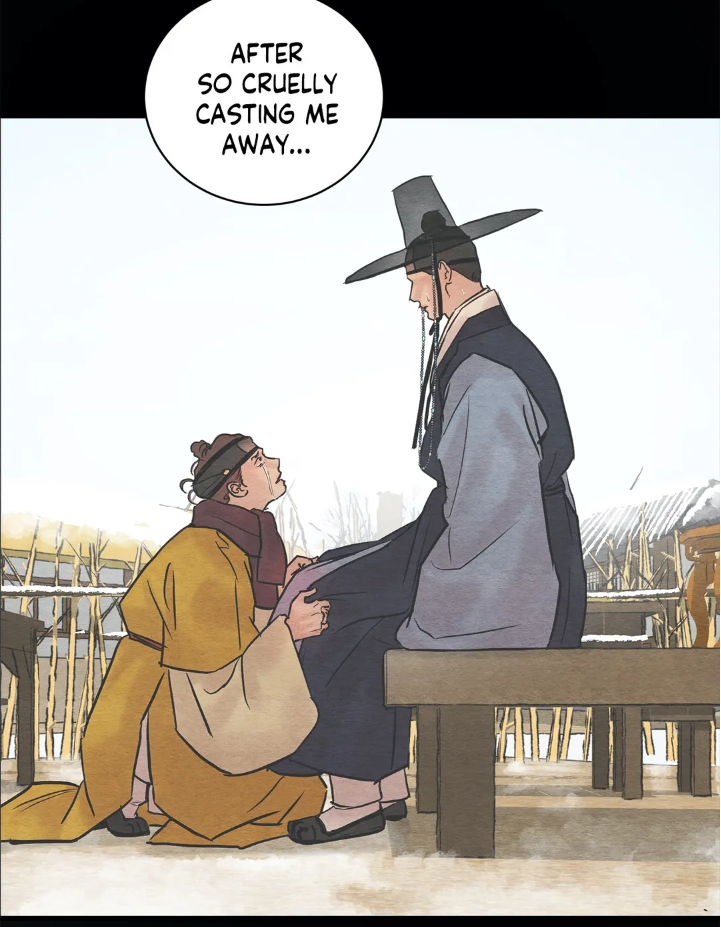 (chapter 60) However, how did the fire poker end up in his own hand? The last time this tool was seen, it was in the kitchen.
  (chapter 60) As you can see, each image has its importance! However, I doubt that the upset aristocrat had this sudden idea and returned to the kitchen and take the fire iron. His mind and heart were definitely elsewhere, while such an action exposes the intention of hurting someone. Jihwa was acting, as if he was in trance, the moment he saw the hickey and heard the painter’s scream. His long lasting stupor was visible in this image.
  (chapter 60) That’s the reason why I had developed the theory that someone was hiding in the shadow, next to the barn and observing the evolution of the event. [For more read the essay “
 (chapter 57) It is because they serve as a clue for unveiling the truth.
  (chapter 62) It is the same furnace! 😨We all assume that the lord prepared the fireplace, because he put his clothes on his lover. But is it true? We were all jumping to this conclusion, but actually we never saw it. Our brain was led to fill the blanks.
  (chapter 61) Finally, the readers were all assuming that the butler had never entered the storage room due to this image and his action before.
 (chapter 61) But is it true? He could have opened the door before, and go to the lord in order to explain his intervention. Faking his concerns for the painter. Why would he place the fireplace there? He wished that the warmth from the fire would wake up the painter. Hence he remained close to the gate of the storage room. That way, he had a reason to visit his master. Moreover, the author exposed that the valet had been keeping an eye on his master for a while too.
  (chapter 62) Because the valet went to his master, we got the impression that the valet had followed his master’s instructions.
  (chapter 61) In fact, this request could be perceived differently. The lord had seen the butler’s intervention, hence he expressed this wish. From my point of view, the butler must have brought the fireplace to the barn, and he left the poker there on purpose. I am quite certain that some people will think that I am again exaggerating. But why did the butler put a fireplace with a fire iron in the lord’s room, when the coal was not properly lit?
 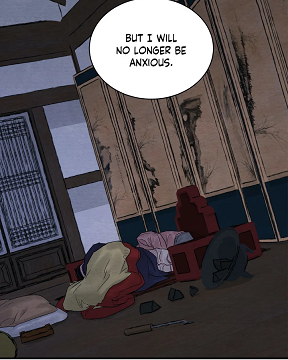 (chapter 88) Consequently, I am suspecting that Kim had expected an outburst from Yoon Seungho. The latter could hurt his father with the fire iron. But none of this happened, for the lord preferred playing a comedy.
 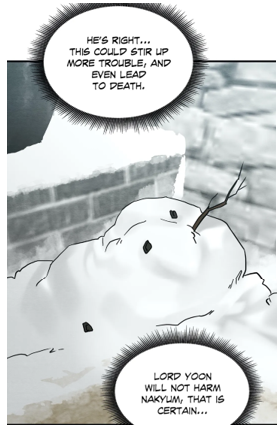 (chapter 65) He had expected that the lord would hurt the main lead. But how was he supposed to harm Baek Na-Kyum in the end? With the fire iron… This signifies that he had been present in the barn during the abduction, and even knew the place of the sequestration. Thus he took the furnace and the fire iron to the shed.
  Compare his face to the painter’s who got wounded by wooden sticks.
  (chapter 99) Besides, this theory also explains why the shrine is set on fire.
  (chapter 103) The fire iron is connected to a stove. Finally, I would like to outline the absence of the furnace in the shrine, though it was very cold outside.
 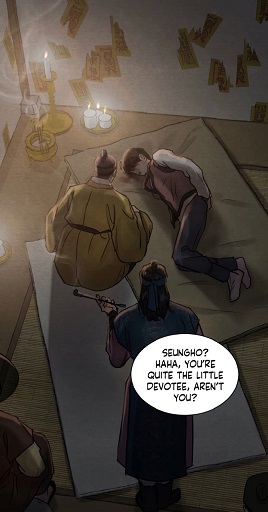 (chapter 99) So when the lord said this to his lover
 (chapter 60)
  (chapter 60) At no moment, he was told that his childhood friend had been brought to the physician’s. He just heard him leaving. Moreover, the joker never mentioned the place where the couple was fooling around.
  (chapter 60) He didn’t even admit that he had seen them himself. These were memories from someone else! One might assume that these could represent the criminal’s recollection, but I don’t think so. He arrived much later to the physician’s house. If he had been present right from the start, he could have kidnapped Baek Na-Kyum on his way to the restroom.
  (chapter 59) To conclude, the person with such memories
 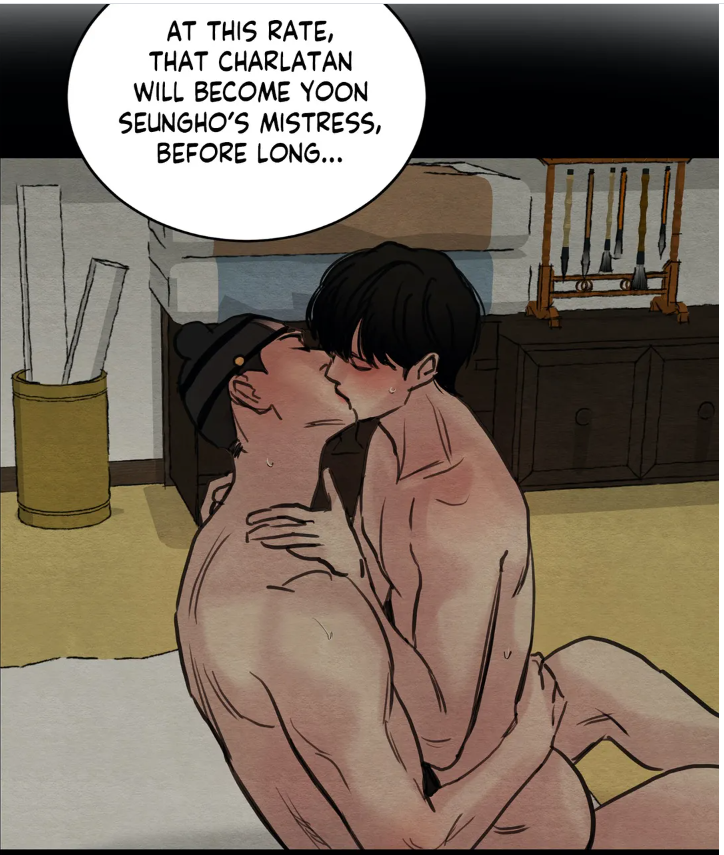 (chapter 43) Here, he had visited the place, hence he could imagine what had happened, though he never saw their encounter according to me. [For more read the essay “
 (chapter 58) He had left the bucket of water in the patio! But note that when the painter left the room, the item had simply vanished.
  (chapter 59) The painter was not supposed to detect his presence.
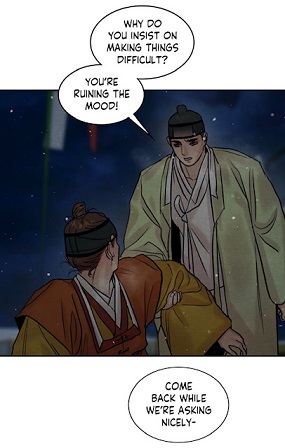 (chapter 100) The manhwaworms can grasp the similarities. Back then, the lord had refused to help Baek Na-Kyum, thus he was even encouraging Lee Jihwa to return to the shrine. Hence he had acted as a willing accomplice and perpetrator. Thus his karma is to be denied any assistance, he is punished the same way than his friends, Min and the other nobles. Finally, observe that the red-haired master
  (chapter 66)
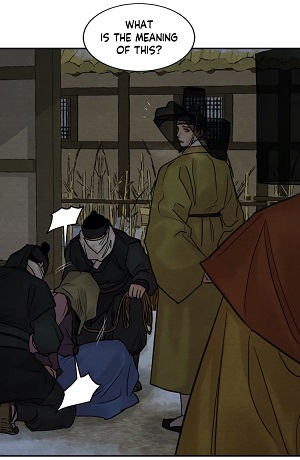 (chapter 99)
  (chapter 88) Abandonment and rejection versus embrace and acceptance. And what had Yoon Seungho said during that fateful night?
 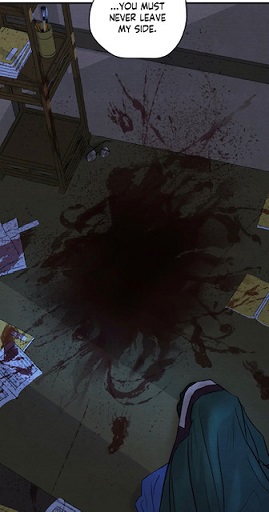 (chapter 88) But while the painter was exposed to sexual abuse, lord Shin had indeed left his friend’s side. In my eyes, lord Shin embodies treason. As you can see, I conclude that lord Shin is about to get assassinated and from the person he expected the least. Why? It is because no one has to realize that lord Shin ran away from the shaman’s shrine.
  (chapter 7),
  (chapter 65) or boots
  (chapter 13)
  (chapter 83) As you can detect, I see a strong connection between the new panel and the hunt from chapter 83. And here we have 3 people again.
 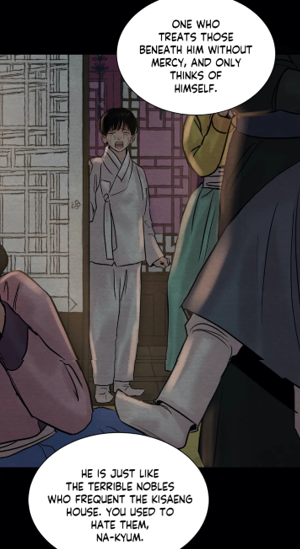 (chapter 68) She was again a witness, when her brother was tied up in the bedchamber.
  (chapter 66) Finally, when her brother was on the verge of getting abducted, she saw him lying unconscious with a bloody face. However, she never considered it as an abduction, for his hands and feet were not tied up.
  (chapter 99) That’s the reason why she blamed him with her questions. She implied that he shouldn’t have fought back. As you can see, I detect a common thread between Heena and her presence in different scenes: sequestration and a bloody face. But this doesn’t end here. When the young painter got beaten in the gibang, there was a furnace on the left side.
 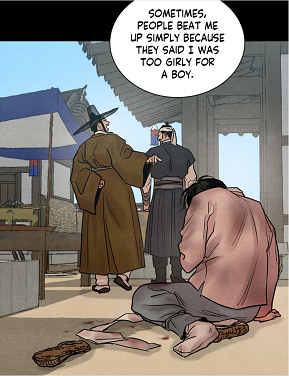 (chapter 94) For me, this incident was to push the painter to leave the gibang and as such to listen to Heena’s suggestion. Furthermore, the man on the left side was wearing a white headband, though he was dressed like a noble in a hunting outfit! The hair dress and his moustache [for more read the analysis “Painful departures”] led me to the following assumption: He was just a commoner in the end, impersonating a noble.
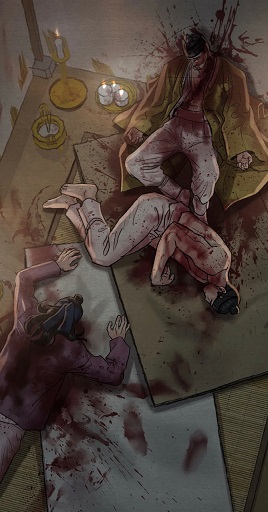 (chapter 102) This is the evidence that someone had manipulated the crime scene. The clothes from the painter could serve as evidence of her brother’s curtains. Heena could come to the conclusion that Min had gone back on his words, and her fake death, which had definitely shocked
  (chapter 99) and bothered her, could only be perceived as real at the end. But this means that while Yoon Seungho had murdered the nobles, there was someone hiding in the shadow
 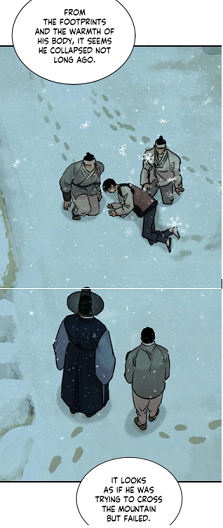 (chapter 61) And according to me
 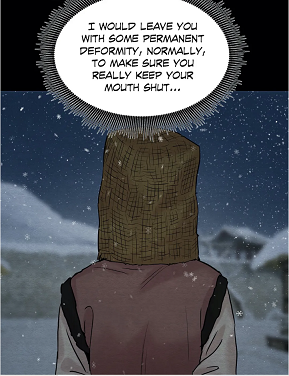 (chapter 66) However, his new attempt to have the painter vanished failed again.
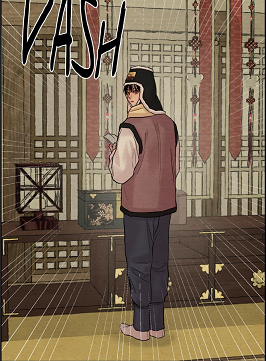 (chapter 97) It could be the same, though I have my doubts. Secondly, I suddenly got aware that the painter had 3 different grey pants at least.
  (chapter 4) This one had a cut just below the knees, though the color is much brighter.
  (chapter 84) This is the third one I detected, as the shape of the pants diverge once again. This explicates why Baek Na-Kyum chose to change his clothes before leaving the mansion.
  (chapter 97)
 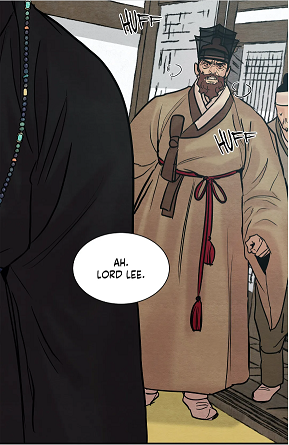 (chapter 67)
  (chapter 67) Their pants have either a different pigment (white, black, khaki, or light grey) or the shape is different. That’s the reason why I am assuming that the person was wearing these trousers on purpose. A new version of this scene:
  (chapter 91) And note during that day, Baek Na-Kyum was called sir due to his hat and clothes.
  (chapter 91) However, if the woman had paid attention to his shoes (mituri), she would have realized that our beloved painter is just a low-born. One might think that I view Kim as the one facing lord Shin.
  (chapter 54) But the readers should question themselves this: why did Kim dress like this in the first place? From my point of view, the schemers have already planned to frame Baek Na-Kyum for the murder of the nobles and even of Jung In-Hun. Kim is trying to separate the couple so that the artist can be arrested easily and sentenced immediately. By burning the place, the evidence that Baek Na-Kyum was a victim vanished. That’s how they can manage to turn a victim into a perpetrator. They wanted to erase every trace of the crimes, but then the return of the painter will force them to change their plan. The fire can help them to turn Baek Na-Kyum into a scapegoat. That’s the reason why the anonymous shadow is wearing clothes similar to the painter’s. No one should recognize him. Later, Baek Na-Kyum can be “identified” as the culprit. And any blood trace on his clothes could serve to incriminate the painter. They could use the resemblance of the clothes as a proof for his crime. That’s the reason why lord Shin had to die in the end. And if lord Shin never doubted this person, I am suspecting that the latter is working with the authorities. Kim is not the only suspect, for according to me, there always exist a conspiracy of 3 and even 5 people. This observation leads me to create a list of suspects. First of all, Yoon Seungho’s confession to the learned sir should help us to determine the schemers and culprits.
 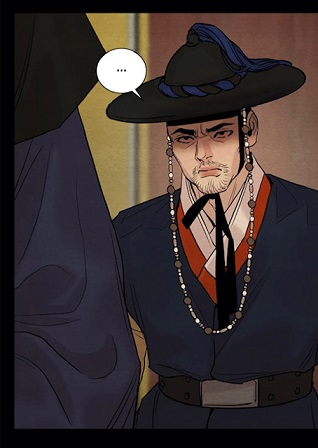 from the bureau investigation is definitely involved. Thus he misled Yoon Seungho. Besides, observe that the officers are connected to fire!
  (chapter 94) Secondly, his explanation implied the involvement of a physician.
  (chapter 57) Finally, the painter met the Joker again on the same day he visited the physician.
 (chapter 75) Finally, why was the doctor never brought to the mansion again after his last visit in chapter 57? And it looks like he was not there to treat Baek Na-Kyum.
  The latter is suffering from PTSD. Thus the painter had a nightmare. Hence I have the impression that the butler’s intervention and suggestion to Yoon Seungho will fail. The lord won’t be able to leave his side. Moreover, I would like the readers to recall that when Baek Na-Kyum got sick, a different physician was fetched.
  (chapter 33) Different clothes displays a different identity. From my point of view, the doctor doesn‘t want to be connected to Yoon Seungho. Finally, don‘t you find it weird that he was not by his side in chapter 57? He literally abandoned the young master in the room with the painter
 (chapter 57), though the latter was a patient too. He had a wounded wrist. The physician should have controlled Yoon Seungho’s fever, brought him water and even an infusion. His absence and passivity caught my attention. So what was he doing in the kitchen? Finally, the doctor is also connected to the shaman. Not only he mentioned him, but also there is the symbol of shamanism in his kitchen. Why did the gods want our couple to have their first “true” love session at the physician’s office? Somehow, it was to confront him with the truth. Finally, don’t you find it weird how Kim reacted
 (chapter 82), when the new version of Deok-Jae made the following suggestion to Kim:
  (chapter 82) Hence the doctor is not off the hook, quite the opposite.
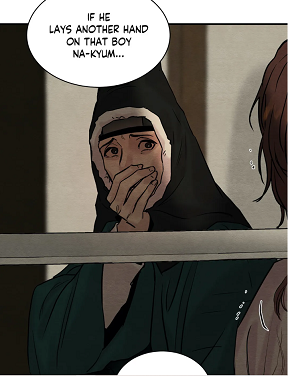 (chapter 67), and discovered Lee Jihwa’s sodomy which was supposed to be a secret. The father is well aware that the main lead’s suffering is linked to the young master’s sexual orientation, which the father had always denied. His involvement could be detected, when he allowed one of his servants to be dragged to the gibang.
 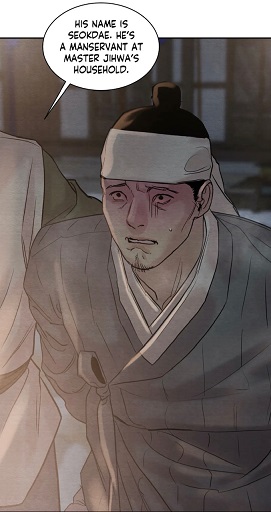 (chapter 99) Finally, The Joker also heard father Lee’s humiliation and powerlessness.
 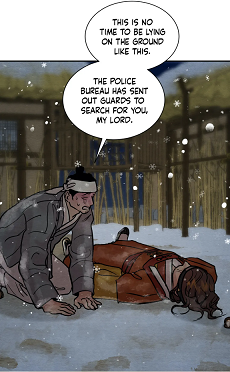 (chapter 101) Thus the fire could be seen as a desperate measure to cover the Lees’ culpability.
 of season 4 for this essay, though my focus is the past, and more precisely Yoon Seungho’s suffering. It is because the darkness surrounding the protagonist not only refers to his tragic youth, but also it reflects the situation of the manhwalovers. The latter are still in the dark concerning his torment. His terrible secrets have not been totally unveiled. So far, the author allowed the readers to see glimpses of his past, like f. ex. the gangrape or the suicide of his mother. But these were just small pieces of the puzzle, thus it is still impossible to have a complete picture of his martyrdom. There are many reasons for this. The main victim never testified about his suffering, he refused to open up to Baek Na-Kyum.
 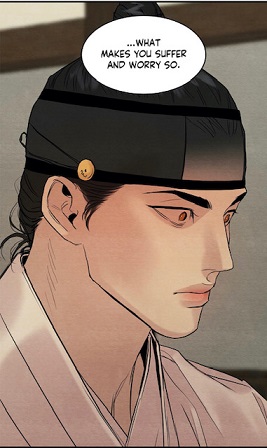 (chapter 84) Then many witnesses vanished
 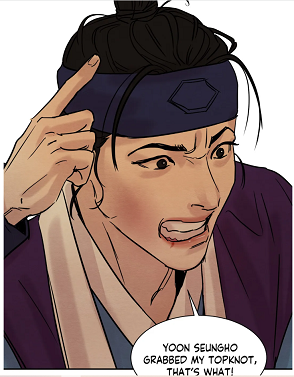 (chapter 9), so that the latter visited Lee Jihwa to arouse his jealousy. It was to push him to commit a crime so that Baek Na-Kyum would be removed from the main lead’s side. As you can see, there were 3 people involved, though the readers only saw the result.
  (chapter 12) They had the impression that the red-haired master had acted on his own. However, he had been manipulated, incited to commit a crime. But my point is not to diminish his wrongdoing, rather to expose the involvement of the schemers. Hence at the end of season 1, the author unveiled their true role and as such their identities.
  (chapter 43) However, observe that when Lee Jihwa went to the pavilion, the noble with the mole had other guests. 2 nobles left the place, as they refused to participate in a murder.
 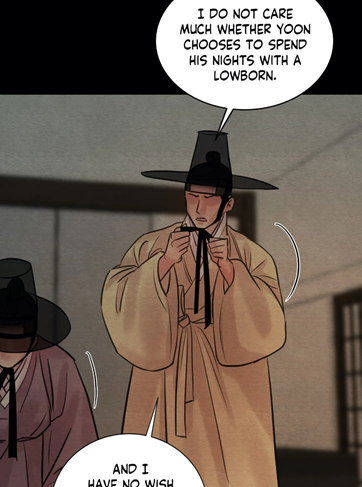 (chapter 43) Funny is that they are now witnesses of Min’s crime. This can have repercussions in season 4. Black Heart had been the one who had suggested the assassination to Lee Jihwa. And the aristocrats were still there, when he had made this proposition.
 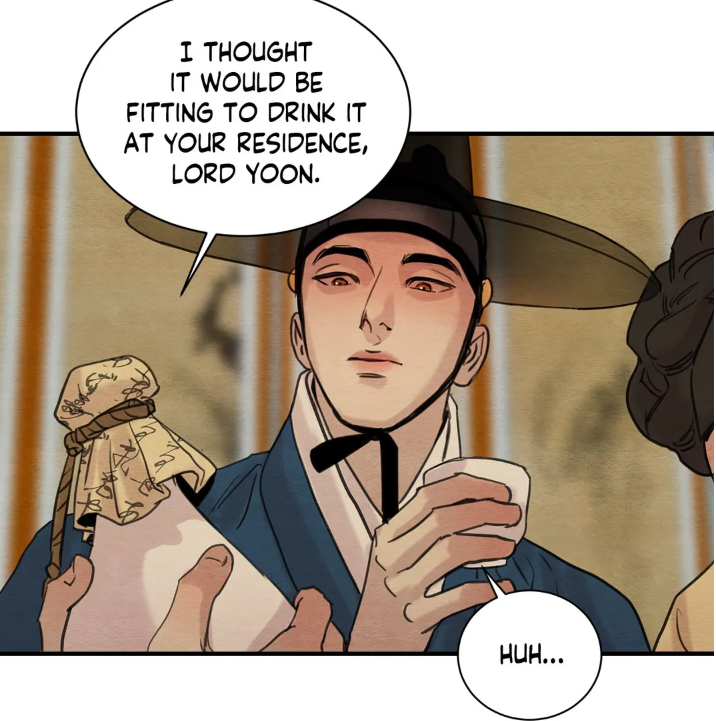 (chapter 19) And this is related to Kim and the gibang. Yet, the butler ruined Black Heart’s plan. To conclude, we have two main plotters in season 1, but the butler’s bad intentions were not detected, for Yoon Seungho’s bad actions were more eye-catching. People had the impression that the valet was defending the artist’s best interest. From my point of view, the number of persons involved in the plot kept increasing, as they needed more and more accomplices. The reason is that their plans didn’t work out like expected. At the end of season 3, Min involved the kisaengs in the gibang, while Kim asked the assistance of the staff, the maids
 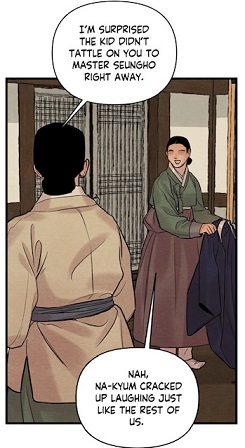 (chapter 91) and the servants
 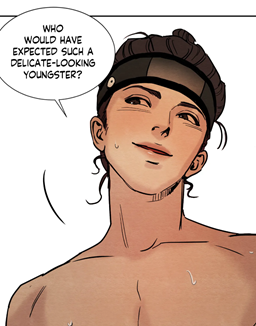 (chapter 8) Thus in season 2, he came to this resolution:
 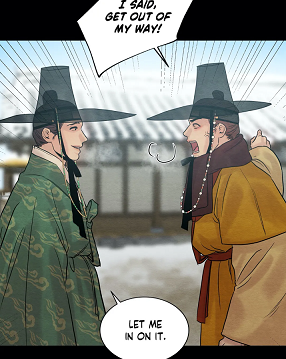 (chapter 56) He had planned to rape him before having him eliminated. This shows his inner conflict. From my point of view, the painter’s death is connected to the incident in the gibang.
  (chapter 1) Baek Na-Kyum was a witness of Min’s wrongdoing, just like the painter was a witness and victim of his crimes in the shrine. (chapter 99) One thing is sure: Min was full of greed and jealousy. He was determined to harm and ruin Yoon Seungho. Hence I come to the deduction that the real target of the conspiracy in the past was Yoon Chang-Hyeon. And his son was used against him.
  (chapter 16) This doesn’t look like a crime. However, it is one! It was done on purpose, to separate the couple. Someone had intervened in order to interrupt this session, and as such someone had been spying on them. Deok-Jae only revealed his spying activity from chapter 16 in season 2:
  (chapter 53) Yet, the one opening the door had been Kim. This gesture can be considered as trespassing and invasion of privacy, the new version of this scene.
  (chapter 16) But instead of revealing the truth, the butler sided with Lee Jihwa, and allowed him to trespass the propriety again. In my eyes, the butler thought
  (chapter 17) that Yoon Seungho would come to perceive the painter as a man consumed by lust. He imagined that he would caught them fooling around. As you can see, this ruckus was also a plot, though it doesn’t look like one. Why would the maids gossip in the courtyard?
  (chapter 18) From my point of view, the valet expected that the lord would fear people’s gaze and a scandal. Thus he would send away the painter to protect his “reputation”, but the opposite happened. Under this perspective, the manhwalovers can grasp why it is difficult to calculate accurately the number of plots and accomplices. Besides, some were naïve pawns, others not. And since I examined the first season more closely, it is necessary to analyze the vanishing of Jung In-Hun. His disappearance is strongly intertwined with Yoon Seungho’s secret. How so? The learned sir was determined to find the lord’s vulnerability and as such secret.
 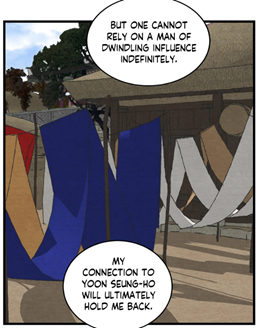 (chapter 29) Thus many concluded that he had participated in the prank, faking his death. On the other hand, the manhwalovers believed to have seen Heena’s death!
  (chapter 37) Since Baek Na-Kyum was wearing a hanbok, Yoon Seung-Won thought that the person hidden under the hanbok was no commoner! Thus he called him a fellow. However, this motive is quite thin! Yet, two new details caught my attention. His visit to the “fake shaman” and his request. Notice what he told the man:
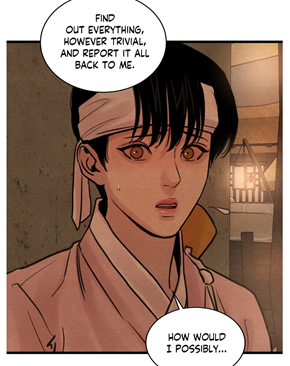 (chapter 24), not realizing that he could be spied himself! He didn’t grasp that he exposed his weakness to the commoner: the civil service examination. Thus the man had constantly drops of sweat
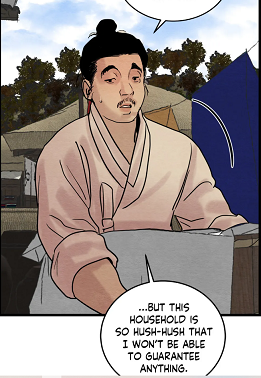 on his face and interrogated Jung In-Hun.
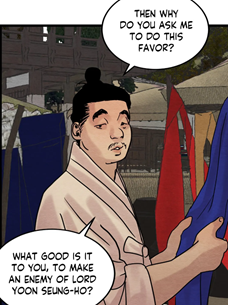 (chapter 29) The girl was there to create a certain closeness. He was acting like Kim, asking why! But the stupid and arrogant learned sir thought that because the man was a commoner, he was ignorant and could be manipulated like the painter!
 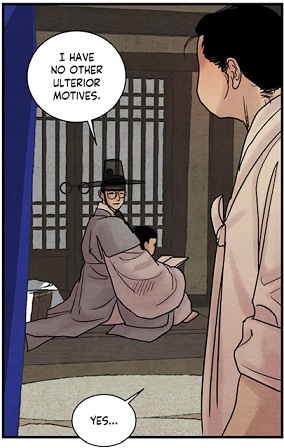 (chapter 29) He thought that the low-born would buy his lie here… but in my eyes, it was the opposite. He had already perceived the learned sir’s true nature. But he acted, as if he was agreeing. In other words, the scholar fell into his own trap. He envisioned that the man was “powerless”, but he overlooked his connections. The manhwalovers can see the contradiction, for he had approached the man due to his connections! .As you can see, I am more than ever convinced that the scholar has long been murdered. He was betrayed, exactly like he had planned to abandon Yoon Seungho! The pedophile must have heard from the servant about Jung’s plan, as he had confided it to the worker!!
  (chapter 37) But this doesn’t end here.
  (chapter 37) Yoon Chang-Hyeon was portrayed as a traitor! The “fake servant” implied with his statement that there was a conspiracy, and the patriarch was involved. But in exchange to save his own skin, he had tattled on the others! He was trying to insinuate that if Jung In-Hun interacted more with the Yoons, his reputation could get tainted. He could get suspected of “treason” too, or he could get betrayed too. While the man met the learned sir during the day, the brother went to the villa in a hurry during the night.
  (chapter 36) Hence he chose a different approach: filial duty. And the brother’s observation could only corroborate the pedophile’s perception. The scholar was Yoon Seungho’s lover, but he was also a backstabber. But let’s return our attention to the “mysterious lord Song”‘s statement: Yoon Chang-Hyeon is a denunciator, not a man of honor.
  (Chapter 67) Lee Jihwa had not only been denunciated, but he had been confronted by his friend! And the traitor was right by his side. As you can see, chapter 67 was a reflection from episode 37!! These two episodes have another common denominator: the betrayer had made the following suggestion.
  (chapter 67) In exchange for his “survival”, he should help Black Heart and allow him to act on his behalf. This was the new plan. That’s how he started impersonating Lee Jihwa. That’s the reason why I come to the conclusion that in the past, the impersonation must have happened, but it took place in the beginning. Secondly, I am assuming that a traitor must have suggested to Yoon Chang-Hyeon to leave the mansion and abandon his son behind!
 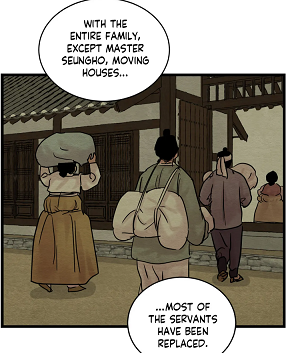 (chapter 27) And who is it? For me, it is Kim acting on the pedophile’s behalf. Striking is that in episode 27, the learned sir escaped death thanks to the intervention of the old bearded domestic and Baek Na-Kyum. Thus it came to my mind that the pedophile could even claim that he had eliminated the learned sir, because Yoon Seungho had attempted himself to kill him in the past. He had acted on his behalf. And what do have all these chapters have in common? SPYING and tattling! In episode 27, the servant unveiled a part of the past,
 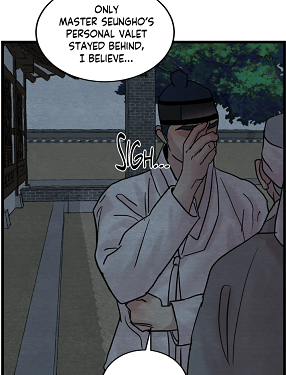 (chapter 27) Someone had tattled on the Yoons in the past, but the patriarch was turned into the traitor himself which the young main lead came to believe. Thus Yoon Seungho could say this to his father:
 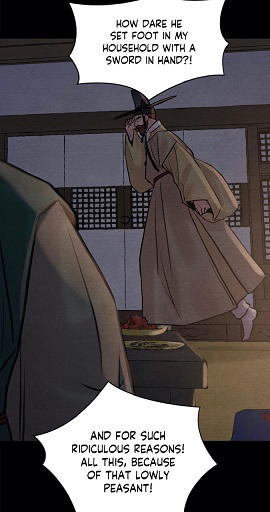 (chapter 82) If the lord Seungho had truly committed a crime, he should have reported it to the authorities. The stupid Yoon Chang-Hyeon never wondered why the elder Lee visited him during the night and asked for his assistance. Furthermore, the elder Lee had been allowed to enter the bedchamber and see the huge drawing which could have been perceived as a sign of treason. He was eyeing at the throne.
  (chapter 82) Note that the aristocrat mentioned “punishment” in this context. So maybe, he denunciated the patriarch so that the whole family would get punished. Father Lee was definitely played in this scene, hence I believe that someone had already anticipated his reactions. He would seek revenge. But this doesn’t end here. I had connected “rash departure” to “treason and spying”. And now, observe what Yoon Seungho said to his butler
  (chapter 50) He had sent Jung In-Hun away in order to get rid of him! However, because of the expression “I thought”, I am quite certain that this idea had been suggested to him by the valet! I would like to underline that in this episode, the valet was acting as a tattler!
  (chapter 50) But in order to hide his own crime, he portrayed it as a rumor (It may not be accurate”). This truly underlines the butler’s MO. He used information and turned it as gossips to hide his spying activities. The shadow… Simultaneously, he turned gossips into a verity!! This is no coincidence that in season 3, the same method was employed. Yoon Seungho was supposed to have murdered the scholar and Deok-Jae! My avid readers can sense the leitmotiv in all these episodes. RUMORS are turned into a reality, and as such a CRIME! Even here…
  (chapter 37)
 (chapter 87) The white bearded man’s words became a reality. However, since the fake servant, the mysterious lord Song, judges the elder master Yoon as a troublemaker and hypocrite, there is no ambiguity that the elder master Yoon will get into trouble. Since he did it in the past, he can only get suspected in the present.
  For me, the younger brother’s biggest wrongdoings are spying, tattling and badmouthing. And the best evidence for this interpretation is this situation:
  (chapter 44) He had given the ruined painting to his father, putting the blame on his brother, well aware that the latter would get angry. He was observing his father’s reaction.
  (chapter 44) Yet, there is a difference to the past. Here, he had been fooled! He truly believed that this was his brother’s doing, whereas in truth the butler had been the one who had fooled him.
  (chapter 38) And this is important, because when the letter was given to the brother, Jung In-Hun witnessed the wrongdoing from the butler!!
  (chapter 38) And now, you know why the learned sir had to die!! He had caught the valet in the act. He had betrayed Yoon Seungho, though he didn’t realize it. The learned sir tried to discover the content of the letter, and as such was prying on his sponsor’s weakness.
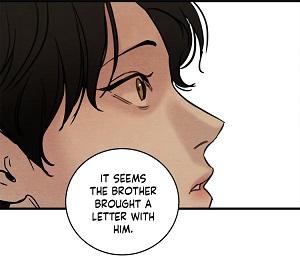 (chapter 38) Hence I come to the conclusion that KIM played a huge role in the learned sir’s death as well. I would even say that he was the one who pushed the others to have the scholar and the painter killed. Both knew about the butler’s tricks without realizing his significance.
  (chapter 37) Hence I deduce that as the story progressed, the role of the butler started changing. Now, I see him as a the main plotter, while all the others are now his pawns. We could say that the valet has gradually followed the pedophile’s path. However, there is no ambiguity that it was not the same in the past!
  (chapter 37) An idiom that Yoon Seungho constantly utilized: chapter 16, chapter 21
 , chapter 50, chapter 71
  (chapter 71). This means that he couldn’t understand, for he has a different way of thinking. This outlines his narrow-mindedness and his tendency to plan everything. He doesn’t like surprises.
  (chapter 69) Hence I started wondering if the mysterious man with the beard was not impersonating someone, for example “lord Song” and in reality he was just a merchant. Why merchant? It is related to the shungas and the hanboks. The king can not be involved in trading directly. However, this is what Yoon Seungho told to the learned sir:
  (chapter 22) Nevertheless, the main lead could have never been involved in commerce, for he lived as a prisoner for many years. And this is what was said about the ruler:
  (chapter 76) He is not so wealthy. How come? Yoon Seungho’s fortune must have a different origin.
  (chapter 102) Min had never predicted that the young master would run to his friend and denunciate him to Yoon Seungho. However, since Black Heart had employed the assistance of servants
 (chapter 95)
  (chapter 96), the officer
 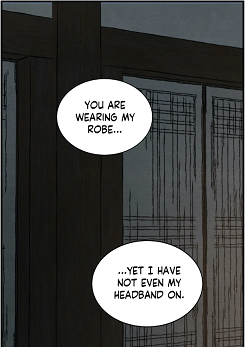 (chapter 71)
  chapter 87) and
  episode 92. The schemers in the past had definitely played with illusions and tricks. Thus I am expecting that it is now the pedophile’s turn to get fooled.
 (chapter 82)
 (chapter 36) Here, the painter was forced to take an aphrodisiac under the pretense of his health. This action was repeated in season 2
 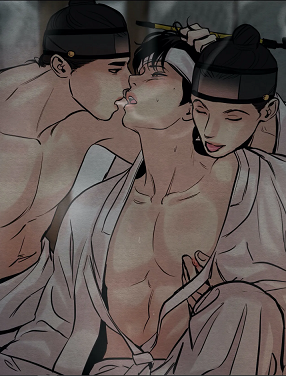 (chapter 54) and 3.
  (chapter 100) The nobles made him smoke opium or drink the aphrodisiac. The purpose of such drugs is to obtain the painter’s submission and control his mind and reactions. Striking is that each time, the perpetrators were “punished”. Kim was insulted and his plan didn’t work out.
  (chapter 37) As for the young lords, they were evicted like commoners and later the others were even killed. As you can see, each time the poison was employed, there was a retaliation.
  (chapter 47)
 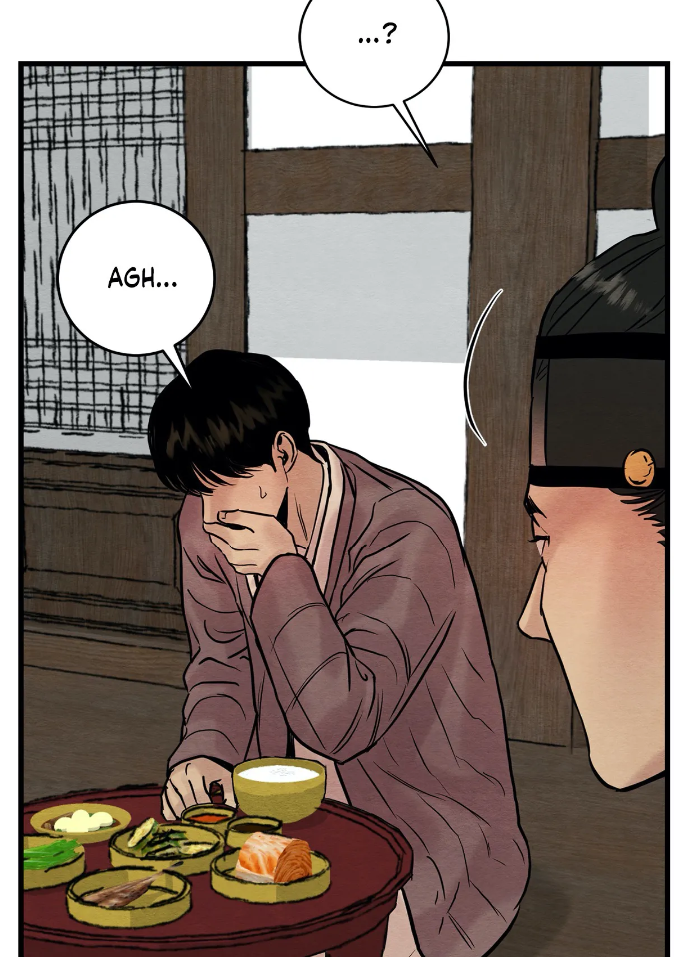 (chapter 47) If the painter had not eaten with the lord, the latter would have never noticed the incident. However, he believed the maids’ words.
  (chapter 47) Hence he never investigated the matter. But this prank represented a serious issue. This could have been judged as an attempt against the owner of the mansion.
  (chapter 83) Yoon Seungho had refused to take the drug! The bowl reminded me of the one from chapter 47! Finally, the butler had tried to give his master the drug in season 3
  (chapter 77), but the latter had again rejected it and this twice.
 (chapter 77) Kim calls the drug “medicinal tea”, truly an euphemism. It is also possible that the real target of the poisoning was Yoon Seungho, but since he was protected by the gods, someone ended up taking the “drug”. Because he was wearing a purple hanbok, the investigator mistook his identity, a royal member. Hence the Yoons were suspected of treason. Don’t forget that during this party, there was a kisaeng by their side.
  (chapter 56), he came to adopt this title in order to hide his identity and actions. Byeonduck explained in her notes that Baek Na-Kyum had no idea about Min’s name. And this is the same for Yoon Seungho. The pedophile could continue hiding behind “lord Song”, as the latter was blamed for everything. The pedophile could divert attention from his own tricks. That’s the reason why he would never write any letter to Yoon Seungho under this name. This means that at the end, the main culprit, the king, will be perceived as the main responsible for Yoon Seungho’s torment, similar to Min’s situation, just before got killed. Though many other people were involved, Yoon Seungho was able to judge the joker’s actions correctly, he was the main mastermind behind the plots. This explicates why the gods made Yoon Seungho forget the old bearded men’s face.
  The manhwalovers could barely see Yoon Seungho’s face, for he was surrounded by darkness. When I saw it, my first thought was to associate the protagonist to “Sleeping beauty”. He had the same expression than in the bedchamber, when he was sleeping totally relaxed.
 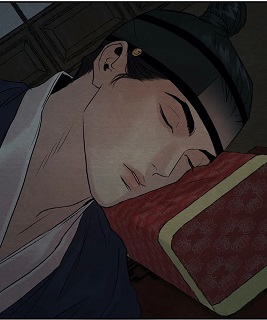 (chapter 87) He was not tormented by a nightmare, like the painter discovered it in chapter 38:
  And the darkness reminded me of the forest of thorns and as such of the curse put on the princess. The darkness, the metaphor for the forest of thorns, is the reason why the lord felt trapped and suffocating in his torment.
  (chapter 63), love and happiness in his nightmare. In his darkest moment, he voiced a wish, which exposed the return of hope. This corresponds to the spark of faith, the gradual return of trust in his life. On the other side, Baek Na-Kyum came to view his lover as the moon giving him light and hope during the night again.
  (chapter 94) I would like to point out that the artist has always associated this satellite to a source of joy and love, like we can detect it here.
  (chapter 94) Finally, Talia could get liberated from her curse thanks to her children. The splinter of flax got removed from her finger, the moment the babies were sucking on them. This signifies that she got revived thanks to love and life. Moreover, she woke up, the moment the source of her pain was removed. This observation leads me to the following conclusion: the noble can only be completely freed from this darkness, the moment his suffering is removed and as such revealed!! This means that Yoon Seungho will be able to voice his misery and denunciate the crimes he was exposed to. He will be able to identify the persons responsible for his suffering. He might know a name, lord Song, but he has no idea about his true identity. That’s how his burden will be erased. Like mentioned above, the noble’s physical and sexual assault will be brought up to light. That’s the reason why the new image announcing season 4 is so dark. They represent a reflection from Yoon Seungho’s past and torment.
  (chapter 38) I thought that the couple would share the bed, thus the lord could relax. He felt protected by his lover. In other words, I was already envisioning that this scene is a reflection from chapter 97/98, for the couple had not been able to sleep together.
 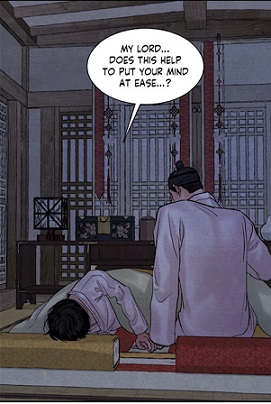 (chapter 97) However, the moment Lezhin published the second panel
 (chapter 83) In Painter Of The Night, the hunts were always used to provoke a quarrel and as such a separation, but it never worked. This is important, because this shows that the couple from the Italian story had to separate. It is now time to reveal the whole quote from Milner:
  (chapter 97) Back then, the lord was scared, for he still doubted the artist’s love confession. It was too beautiful to be true! However, back then, the artist never doubted his own resolution, thus he gave comfort to his lover by giving him his hand.
  (chapter 97)
  (chapter 97) In other words, he desired that the painter would follow his requests and as such he should vow him loyalty and trust one more time. The irony is that the lord was actually the one breaking his vow, for he left his lover without saying goodbye. Thus I conclude that in this scene,
  (chapter 78) This means that the lord is smelling his partner’s hair helping him to remain strong and calm. He is now trying to memorize his lover’s odor so that he can forget this stench, a remain from the past:
 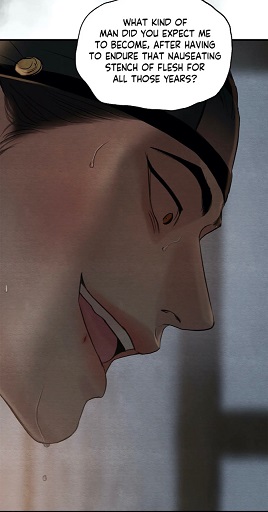 (chapter 86) This can only help him to defeat his “opponents”. Finally, in different analyses, I had already interpreted that Baek Na-Kyum was embodying memory, whereas the lord stands for truth. The image is actually a reference to recollection and as such honesty. There is no ambiguity that both men are trusting each other, but the painter is crying, for he fears for his lover’s life either. Yoon Seungho is leaving him in order to protect him in my eyes. And this leads me to the following deduction. When the lord is about to leave, Baek Na-Kyum is not left in the dark contrary to episode 97. He knows the whole truth, for the lord must have confessed to him. We could say that he is not leaving without a word
  (chapter 23)
 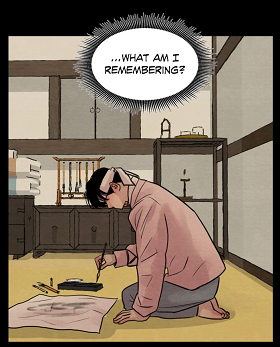 (chapter 24) In other words, this announces the return of Yoon Seungho’s passion for painting! And it is the same for the painter. The erotic picture should reflect their love for each other, created based on memories. At the same time, this can only push the noble to demonstrate his talents to others refuting all the negative rumors about him: he is intelligent and possessing his whole mind. Furthermore, this can help him to reminisce his tragic past, what led him to his downfall and suffering. This signifies that he will be able to confront his past and his memories. He will be able to identify the rape, and Kim already exposed the truth to Yoon Seungho, when the former suggested him to ensure the painter’s consent. This shows that Kim was well aware of the sexual abuse, but he chose to never divulge the verity. On the other hand, the pedophile thought in the past that the young master would never forget him due to his position, thus he had no problem to leave Yoon Seungho behind and make no real promise. Departure was never painful for him… hence this quote (“Promise me you’ll never forget me because if I thought you would, I’d never leave.”) will become a reality for the mysterious lord Song, but it is already too late. In fact, the gods punished him by making Yoon Seungho suffering from amnesia. He is not attached by loyalty to the pervert.
  (chapter 57) That’s the reason why I believe that when an incident occurred during that night
 (chapter 11) However, there is no ambiguity that the painter can only fear for his lover’s life. The closed eye contradicts the haunted gaze in the shaman’s house.
  (chapter 21) This gesture symbolizes the epitome of the noble’s affection and the desire to give “happiness”. Then in the bedchamber, he did it in order to console his partner.
  (chapter 82) With his kiss, he was asking for his forgiveness. This means that the kiss on the eye serves as reassurance and comfort either. Thus we had this scene in the study:
  (chapter 84) The lord had kissed his lover there, because he was voicing his attachment and desire to redeem himself and to comfort the artist. As you can see, it was a combination of all the previous significations. Yet, the lord had not grasped the “gravity” of his “wrongdoing”. Thus the kiss was associated a certain playfulness in the study. As a conclusion, this image
 (chapter 94)
 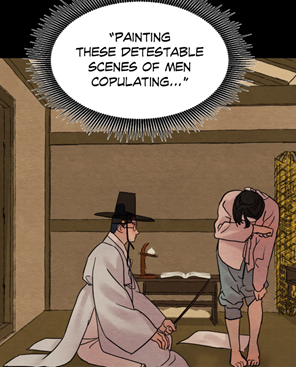 (chapter 34)
 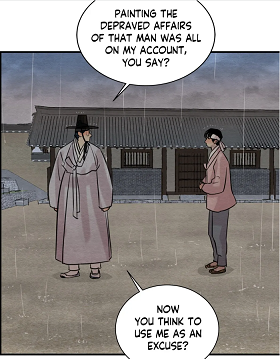 (chapter 19) He came to feel more safe during the night, until he met Yoon Seungho in season 1. From that moment on, his night life got slowly affected. That’s how he discovered that night could be associated to pain and agony too. Yet, deep down, he still felt safe by the noble’s side. As you can see, the new illustration
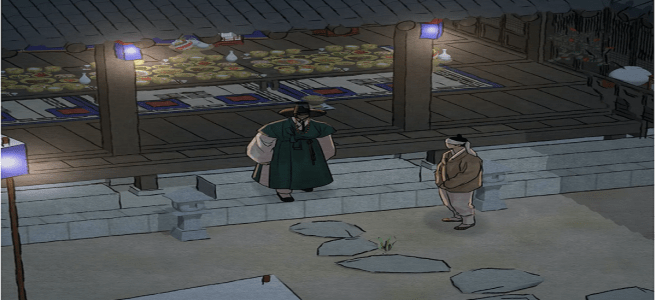




 (Chapter 73)
  (chapter 73) This is important, because the manhwalovers can sense a connection between sex and hunt. This means that the love session in the bedchamber from season 2 should be perceived as a new version of a hunt. And this link between sex and hunting was also present, when Yoon Seungho and Min were in the woods in chapter 41:
  (chapter 41) In this scene, it looked like Black Heart was trying to make a move on Yoon Seungho, while in truth Min was more obsessed with the painter.
  (Chapter 41) The expression „spot“ belongs also to the semantic field of chase.
 (Chapter 11) A murder disguised as an accident, the scholar would have been eaten by a tiger. What caught my attention is that No-Name requested from Deok-Jae that he should make the painter leave the mansion.
  o (chapter 51) It was, as if the rabbit had been chased away from its burrow or the deer had been forced to leave the woods. That way, he would become an easy target for the hunter and butcher Mumyeong. To conclude, we had two hunts in season 2 as well.
  (Chapter 99) First, he was rushing, but the moment he received the crucial tip from his childhood friend, he approached the den silently, just like a tiger. That‘s the reason why neither Black Heart nor lord Jang nor lord Park detected his presence.
  (Chapter 101)
  (chapter 99) and Lee Jihwa
 (chapter 100), hence he had not the time to question the veracity of their claims or sense their manipulations. On the other hand, he could detect the difference between the blood in front of the scholar’s house and inside the building.
 (Chapter 100). He was following his instincts. Tigers cautiously stalk their target from the rear in attempt to get as close as possible to their unsuspecting prey.
  (chapter 102)
 (chapter 48) or the chin
  (chapter 83)
  (chapter 102) Even in this panel, the sword resembles a lot to the tiger‘s fang:
  (chapter 102) Another important element is that this predator usually targets large-bodied preys like boar, deer, humans and not rabbit or pheasant. Under this new light, it becomes comprehensible why the main lead went after a boar or the aristocrats in season 3.
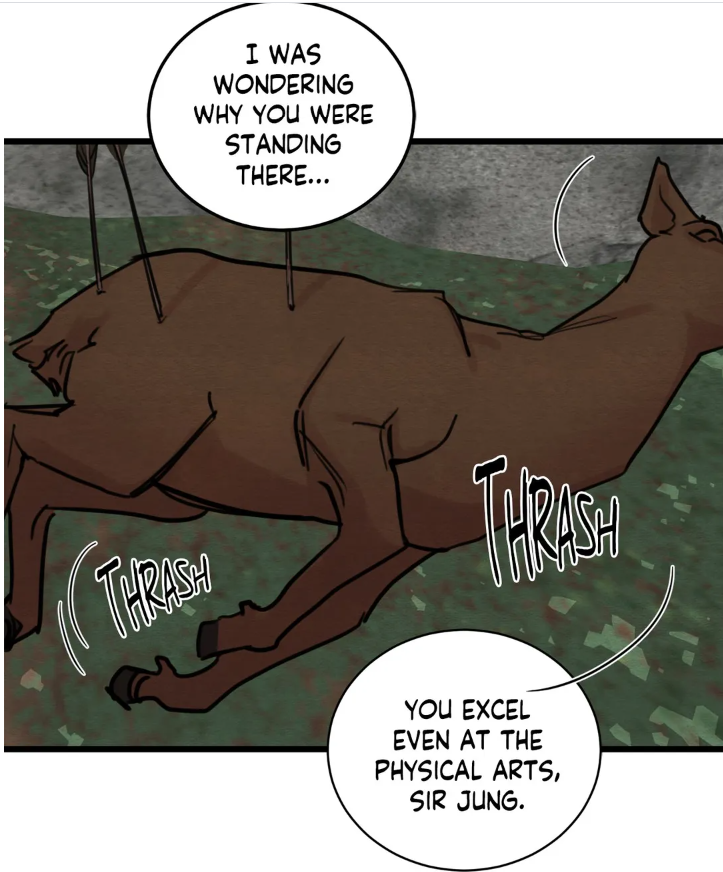 (chapter 22)
  (Chapter 22). And when Black Heart suggested the artist’s assassination, he always kept laughing, making it sound like a game without any terrible consequence.
 (chapter 43) Only Nameless painted it in all its cruelty and brutality. Not only the person would lose his life, but he would lose his identity.
  (Chapter 60) By removing his eyes and tongue, the victim’s face would change making him impossible to be recognized. And note that his scarf and headgear had been removed as well. It was not a game, but a deadly matter. Why would he do such a thing? The reason is simple. If no one could identify the victim, there would be no investigation. Astonishing is that hunt is a synonym for investigation and prosecution. Hence I am deducing that in season 4, the investigation should be perceived a new version of the hunt, a new version of this scene.
  (chapter 83) Thus I am deducing that this chase had been suggested to the main lead in order to release his tension and as such in order to divert his attention from the painter. Naturally, Kim was behind this idea faking his concern for his master. The hunt was supposed to procure pleasure to Yoon Seungho, but it couldn’t, because he was afraid of losing the painter. This explains why he selected the boar as his prey. He was fearless in front of that dangerous animal, for it meant nothing to him. He didn’t mind losing his life… revealing his suicidal disposition which resurfaced later, when the father mentioned the authorities.
  (Chapter 83) He couldn’t forget that he had scared and wounded the painter in his dissociative state. This shows that the chase had not served its true purpose: entertainment. In reality, the domestics had been the ones suffering the most, for them it was definitely more work
  (Chapter 84) compared to the past.
  (chapter 23)
 (chapter 41) First, I had feared that he might lose his life, then later I had realized that this death was purely symbolic. He would lose his title and family, therefore he would become a commoner. But I had also expressed my doubts that this scene could be a reference to Black Heart, as from chapter 52 on, I had sensed that he would die. Moreover, observe that during that hunt, Min had wounded the animal himself. This mirrors his own death. He became a victim of his own trick. But if the pheasant is representing two characters, The Joker and Lee Jihwa, then this means that the deer in chapter 22
  (chapter 22) embodies not only the painter, but also someone else. While in the past, I used to believe that it was Kim, now I come to the deduction that it was Jung In-Hun. Note that in this scene, the main lead left the prey and the scholar behind. Both got defeated. This means that by targeting Yoon Seungho, the scholar is not realizing that he is actually endangering his own life. Besides, by hunting the deer, the learned sir offered this prey to the tiger Yoon Seungho, and this was the painter’s case. Furthermore, the deer was carried back home on a horse
 (chapter 24) reflecting the painter’s fate.
  (chapter 25) Who brought the horse to the pavilion? Kim and Deok-Jae! And when the learned sir departed from the mansion, he was followed by the vicious servant and the horse.
  (Chapter 111) Thanks to episode 111, I detected another progression. First, Jung In-Hun was walking behind the horse
  (chapter 24) Thus he could take the artist away unnoticed. Then in episode 44, the learned sir is shown standing in front of the horse. Finally, the manhwaphiles can see the man riding. This reflects his social ascension.
  (chapter 106)
 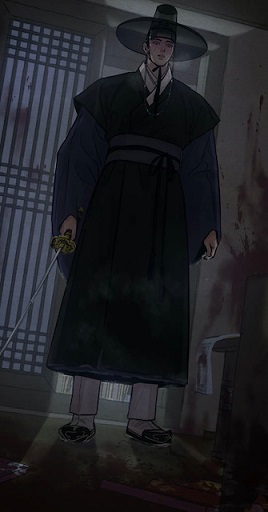 (chapter 100), the place could be interpreted differently. The inhabitant had been attacked by a tiger during the night.
  (chapter 45) the cobweb behind Deok-Jae. Imagine that this scene took place in the middle of winter, thus the spider’s web got covered by frost. However, this indicates that this room had been abandoned for quite some time. But it is close to the gate. So it should have been the place where the doorkeeper is living. Secondly, I had demonstrated that the shrine had been neglected, for the altar had been removed.
  (chapter 18) Because of the presence of the cobweb, I started wondering why the author drew it behind Deok-Jae. In my eyes, it is because he was part of the spider’s web.
  (chapter 18) That’s the reason why Yoon Seungho was not dressed properly.
 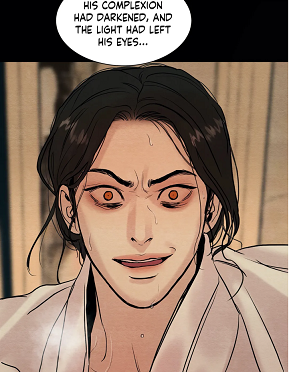 (chapter 57) Naturally, the purge played a huge role in the lord’s suffering reinforcing the huge rift between the pedophile and Yoon Seungho.
 (chapter 57)
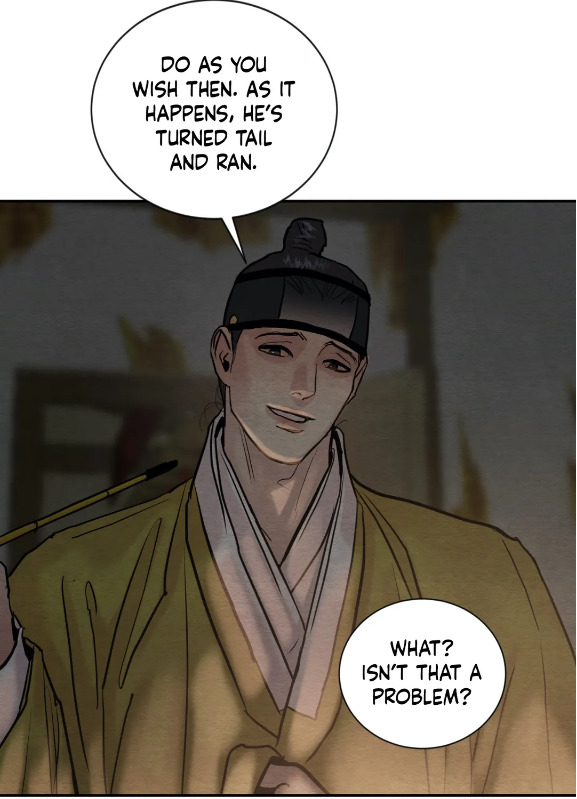 (chapter 101). It was not Min’s task to carry a friend… he was just a fellow puppet brought to the shaman’s house in order to entertain Black Heart. This truly exposes that Black Heart never saw in the aristocrats humans. As the red-haired master, he had been considered as the hunting dog, he had fulfilled his function. That’s why he was abandoned. He had helped Min to corner the painter and brought the kisaeng to the scholar’s home. Moreover, a hunting dog disobeying his master will be killed. Hence it is not surprising that the wild dogs ended up all dead. They were totally defenseless in front of a huge tiger. This feline is difficult to tame.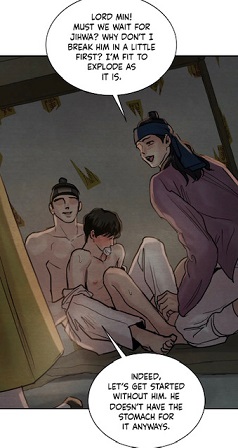
 (chapter 101) They saw in the sexual violence a new form of hunting. I would even go so far to say that they desired to turn the artist into their pet fulfilling all their desires:
  (chapter 101) Thus it is not surprising that Yoon Seungho was compared to an animal by his own father in the past.
  (chapter 101) As a punishment, he was given to lord Jang and his friend. Since Min had captured the artist, he viewed himself as his owner who would give order to his pet. Yet, a deer is a shy, but wild animal, difficult to control making it difficult to be tamed.
 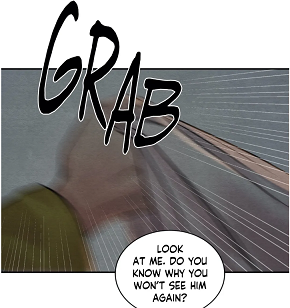 (chapter 99) But this was impossible, for Black Heart never treated Baek Na-Kyum as a man. Hence I come to the conclusion that by meeting the painter, Yoon Seungho rediscovered his true nature: he was a free spirit, a tiger! And guess what… In Joseon, the tiger was perceived as a good talisman to chase away the evil spirit!!
 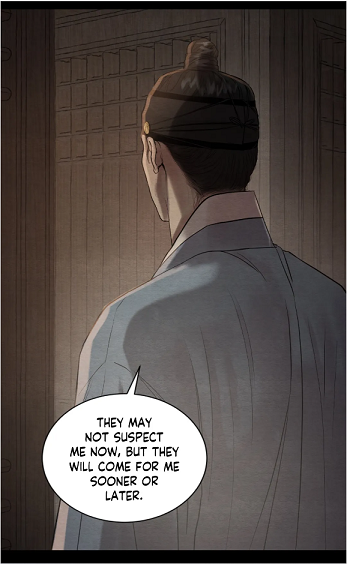 Yoon Seungho has the impression that he could get hunted down, for he killed the nobles. The tiger is now the target of “humans”, and Jung In-Hun will play a crucial role in his prosecution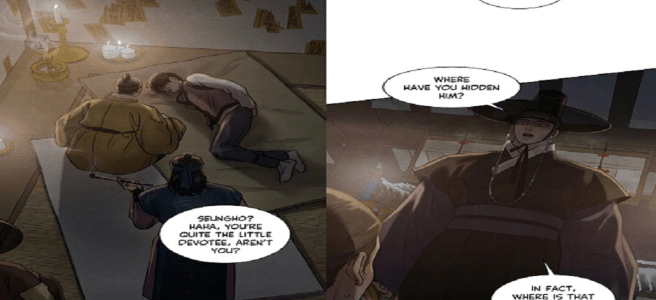
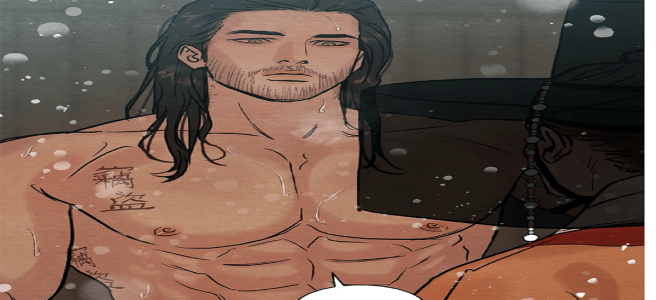


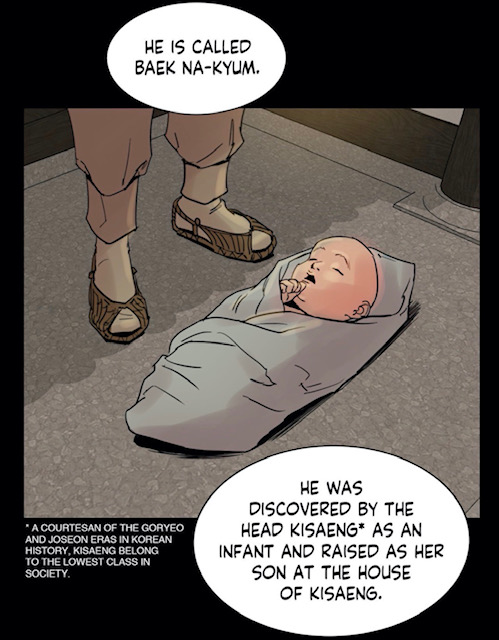 (chapter 01) But after studying the manhwa so closely, I discovered the existence of rules in the manhwa which helped me to dig up new information. I am listing the laws of Painter Of The Night again in order to avoid repeating myself. I will refer to them later in my argumentation (rule 1, 2, eg.). That way the readers can better grasp how I came to new revelations and theories.
 (chapter 57) He was admired which created a source of jealousy. While the painter discovered sexuality and his homosexuality very early on, Yoon Seungho was pure, but through incidents he was forced to become a sodomite. While Heena and the scholar tried to repress Baek Na-Kyum’s sexuality, the father pushed his son to have sex out of fear and high expectation.
  (chapter 101) And now, compare it to chapter 1:
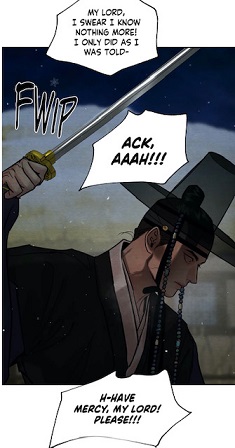 (Chapter 100) He denied his responsibility by putting the blame on someone else („I was told“), yet once facing the young master Jihwa, his declaration exposed his lie.
  (chapter 1) One might have the impression that I am digressing from the main topic. Yet the manhwalovers should keep in their mind that the servant from episode 1 served one purpose: to show us the memories of an important witness, someone who watched Baek Na-Kyum growing up. Thus we have three different pictures. First, he is a baby, then a young infant
  (chapter 1) and later almost a grown-up
  . (chapter 1) This signifies that the witness was close to Baek Na-Kyum which explains why the domestic trusted the source of his information. However, contrary to episode 101, she never divulged the identity of the witness. It is because the person wished to hide in the shadow.
 (chapter 1) It ends with the domestic’s death, while the incident with the topknot is mentioned in the middle. At the end, the painter is dragged to the mansion. As you can see, both chapters reflect each other. That’s how I had this revelation
  (chapter 99) The soil and the position of the pillars of the main gate are different. I can now announce the precise location, and this with certainty. Yes, I discovered the place thanks to rule 4!!
  (chapter 4) Here, the shadow was bigger indicating that it was early in the morning. The painter had just woken up. Consequently, I deduce that the baby was brought to the mansion during the day. This signifies that Baek Na-Kyum was never abandoned! He was entrusted to the owner of that mansion!
  (chapter 1) You can recognize the gate in the background. This is the domain, which you see when the lord is arguing with the painter in the courtyard.
  (chapter 4) Pay attention to the background in this picture. And now, you are probably thinking that the owners of that mansion are the Yoons, as we observed the main lead living there. Nevertheless, I had already pointed out that this was not Yoon Seungho’s mansion. This is the Yoons’ domain:
 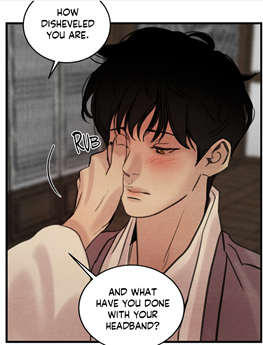 (chapter 38). Besides, father Lee views him as a peasant and not a servant. This observation gets reinforced, when you look at the memories from the painter. In his childhood, he was never wearing a white head-band.
 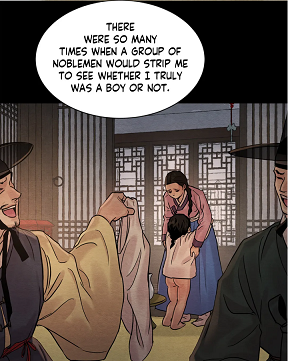 (Chapter 94)
 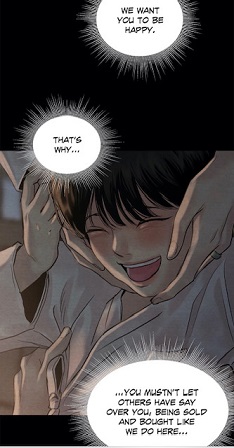 (chapter 87)
  (chapter 70) This means that this panel
  (chapter 101) Look where the red-haired master and the servant are! It is in front of the teacher’s home! In Painter Of The Night, there is never a coincidence. This is a sign that Jung In-Hun is related to Baek Na-Kyum’s past and knows his true origins. However, by treating him like a low-born, he came to view him as one. But this doesn’t end it. Remember the rule 2: the reflection within the same chapter. The painter remembered the words from the gibang:
  (chapter 1) Jung In-Hun would employ such expressions like fiend and sodomy
  (chapter 18), he was repeating his admired sir’s idioms. Besides, “hell-raiser” is also an indication that the learned sir was a Christian who converted Heena. Thus I deduce that when father Lee received Baek Na-Kyum as a baby, he entrusted him to the learned sir Jung In-Hun who had no connection and no wealth so far. So when the lord described him as such in episode 7, it was not entirely correct. The reality was that the man had been working for the Lees, but he had been “abandoned” at some point. The scholar was his helping hand explaining why he would appear in this scene.
  (chapter 59) Without a topknot, the red-haired master no longer looked like a real noble. He had lost his position. Hence I believe that the painter was forced to wear the headband. As you can detect, there was a chain reaction linked to the social status: lord or not, low-born or not.
  (chapter 87) He was definitely living in comfort. But what was the purpose to let him wear the white tissue? Dressed as a slave, no one would have wondered if he had been killed. Remember the scholar‘s words: a servant is viewed as an object and possession.
 (chapter 6) The painter was never destined to become a farmer. The neglect was done intentionally. And when you recall his words in the library, you can only view his words as pure lies again:
  (chapter 40) He was never born to be a prostitute, but he was sent there on purpose. Under this new perspective, it becomes more comprehensible why Heena sent Baek Na-Kyum to the learned sir. He was the one who had brought the artist to the gibang, and now he was getting older. One might refute this point, for she declared this:
  (chapter 68) Nonetheless, the beholder can detect the presence of a drop of sweat on Heena’s cheek. So she was deceiving the artist here. Why? Yes, in her mind, the painter was Jung In-Hun’s son and as such the learned sir should become responsible for the painter, for he was his father. But she had to lie in order to persuade him to leave the mansion. There’s no ambiguity that the head-kisaeng had no idea about the deal between the Lees and Jung In-Hun in the past, I believe that she must have discovered the truth at some point..
 (chapter 4) This was inspired by the poetry from Wang Bang-Yeon!
  (chapter 4) In this poem, the famous author was referring to the death of the young king Danjong who had been killed by his uncle Sejo. Danjong was just a teenager, when he died! As you can see, the text is actually an allusion to royalty and exile. Under this new light, it dawned on me that the scholar Lee had been entrusted to take care of Baek Na-Kyum, but the latter chose to delegate this to the learned sir. There was a reason behind this. For me, he was eyeing at the mansion himself! One might refute this point, for the elder Lee said this:
 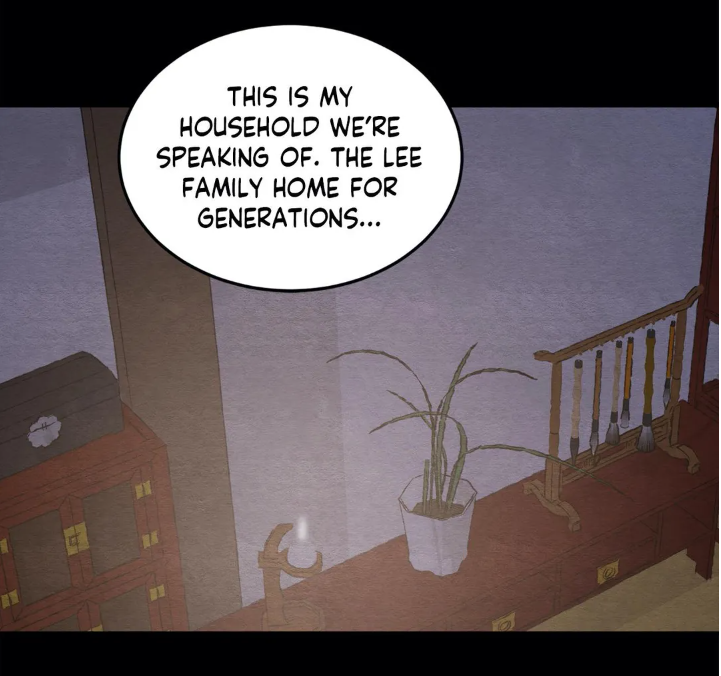 (chapter 82) But note that the man never said that this was his house, just the household of the Lee. Since the artist is related to the king, this signifies that he is related to the elder Lee too, as the family ruling over Joseon belongs to the Lee clan. Hence I am suspecting that Baek Na-Kyum could be the true owner of this mansion.
 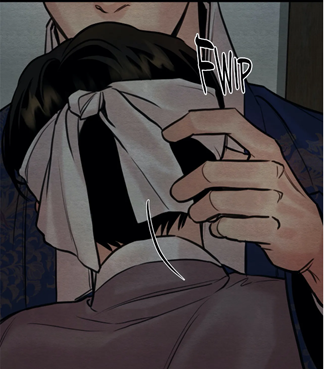 (chapter 53) How does he know it? In my opinion, it is because Baek Na-Kyum resembles to the king. The only difference is that he has no beard. This would explain why Yoon Seungho said this:
 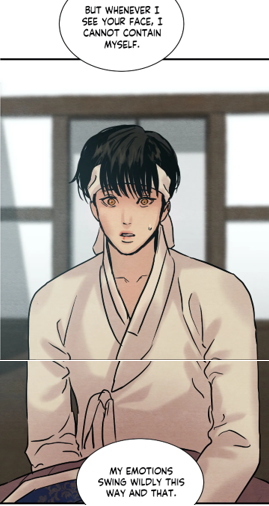 (chapter 55) Why would he get upset? Why would the painter’s face evoke such emotions? He is reminded of his abuser. This is no coincidence that the main lead had such a flashbulb right after, where you could see Lee Jihwa and his father, as they looked like Yoon Seungwon and his father.
  (chapter 102) The colors are already insinuating that the artist belongs to the royalty.
 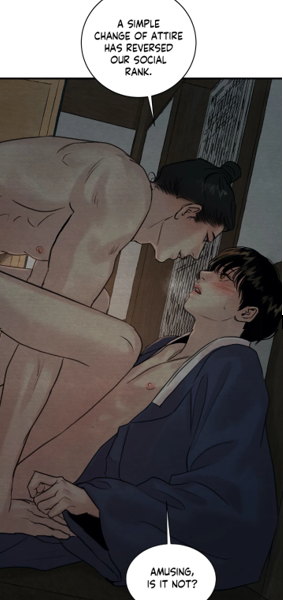 (chapter 71) If the pedophile came to the gibang and crossed the main lead’s path, he couldn’t recognize his relative (son or nephew) due to the hair and the clothes. Besides, I am certain that my avid readers can recall my other theory: the painter was stolen as a child. This new interpretation would corroborate this theory. The painter has been robbed of his true identity, he had been kidnapped, when he was brought to the kisaeng house!! Besides, if he is the true owner of the mansion, then this signifies that Father Lee succeeded in his coup d’Etat (rule 1, rule 3). In season 3, we have an attempted “coup d’Etat” with Yoon Chang-Hyeon eyeing at the seat.
  (chapter 83) imagining that Yoon Seungho through his “marriage” would become the crown prince. Since the author mentioned “torture”, I have the impression that the main lead was brought to the bureau of investigation and got tormented there. He was naturally framed, he had been acting as a spy. He was hoping to become the king’s successor as his “bride”. So once the artist had been executed, the scholar Jung could have claimed that he had been raising the painter the whole time and receive a huge compensation for his benevolence! And the Yoons were the culprits.
 (chapter 17)
  (chapter 7) Their meeting here is an indication that their past must have crossed before because of rule 1!! Since the painter was so devoted to the learned sir, the valet could only jump to the conclusion that the man had truly taken care of Baek Na-Kyum properly.
  (chapter 04) The protagonists’ fate got switched the moment they passed a door. Thus the painter didn’t suffer here contrary to the young master
  (chapter 4) He recognized that the artist was not a servant or slave, but a free man. His words became a reality. He is not embracing a peasant, but a noble, even a member from the royal family. He was speaking the truth, while all the readers were thinking that Yoon Seungho was a hypocrite. We could say that the main lead was under the influence of the spirits/unconscious, thus he caught the artist right on time. At the same time, “peasant” is again a reference to father Lee which reinforces my theory that the scholar Lee is deeply involved in the couple’s suffering.
 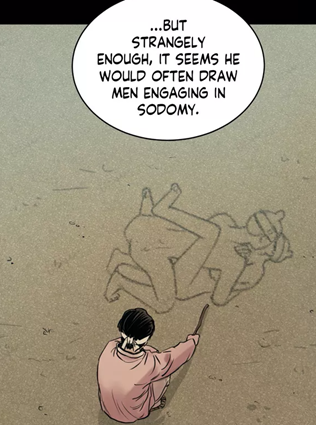 (chapter 1) He had actually painted animals and nature in his childhood, thus the noonas kept his drawings.
 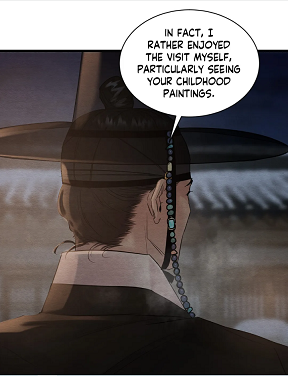 (chapter 94) The man had trusted the learned sir’s testimony without verifying the facts. He had not detected the presence of a blackmail!
  (chapter 1) This truly shows that ignorance is indeed no blessing, and people shouldn’t trust others according to their appearances or social status. At the same time, the servant had forgotten that Yoon Seungho was a noble, though he was dressed like a peasant in the bedchamber.
 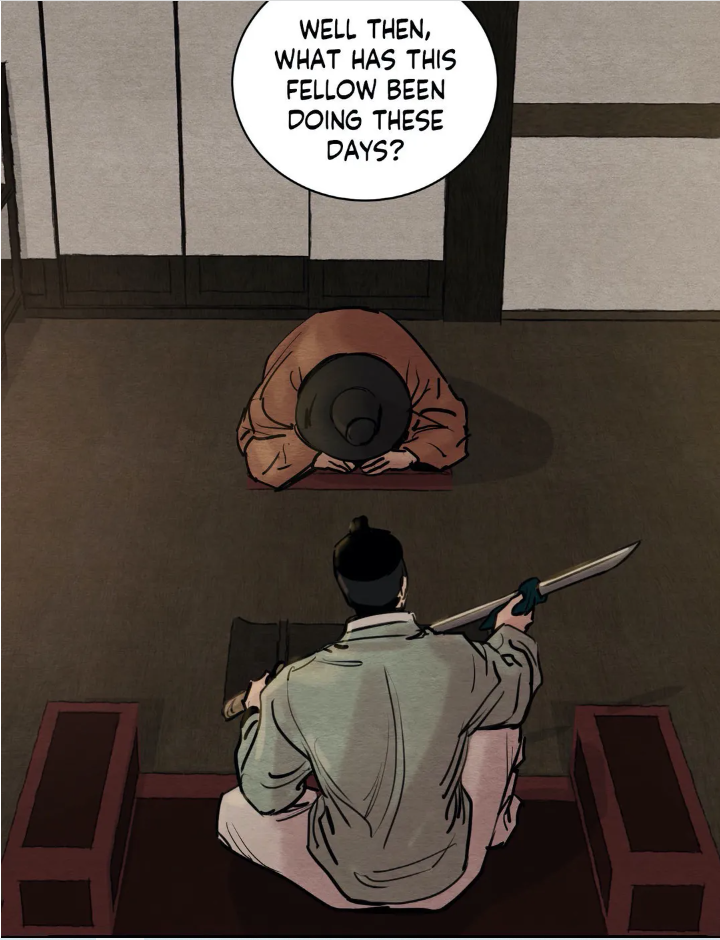 (chapter 1) He was not even wearing a hanbok here, and his head-band was different too. As you can see, both protagonists shared the same experience. They were not treated according to their social status. To sum up, my theory is that the valet Kim brought Baek Na-Kyum to the Lees, who decided to get rid of the painter by entrusting him to the scholar Jung. And Heena became his accomplice, the moment she became his surrogate mother. Let’s not forget that in season 1 and 2, the learned sir was the only one seen with children: girls.
  (chapter 6)
 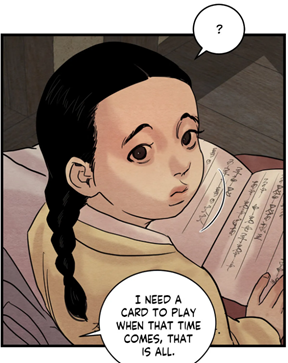 (chapter 29) and Baek Na-Kyum
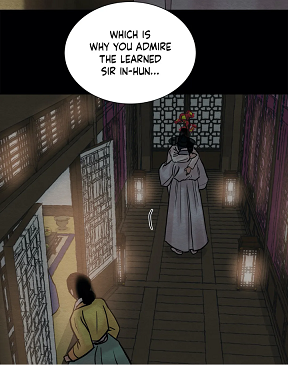 (chapter 68) This shows that the painter embodies the link between the head-kisaeng and the learned sir. Jung In-Hun had entrusted her the baby.
 Bebebisous33s' analyses in K-Dramaland and Manhwas