

This is where you can read these manhwas. Payback: https://www.lezhinus.com/en/comic/payback_en But be aware that this manhwas is a mature Yaoi, which means, it is about homosexuality with explicit scenes. If you want to read more analyses about Payback or other manhwas, here is the link to the table of contents: https://bebebisous33analyses.com/2021/06/06/table-of-contents-of-analyzed-mentioned-manhwas/ I am also using doctor Frost as reference again. https://www.webtoons.com/en/mystery/dr-frost/list?title_no=371
Feel free to make some donations/sponsoring: Ko-fi.com/bebebisous33 That way, you can support me with “coffee” so that I have the energy to keep examining manhwas. It would also cover my expenses for the blog.
Reminder: This analysis is based only on the manhwa.
Anyone reading Payback is aware that „wacko“ is the nickname given to Yoon Jay by Lee Yoohan. The latter started calling him that way, when he met him on the rooftop of the building owned by Dream Ent “for the first time”.  (chapter 4) As you can imagine, in this essay, my main focus will be on executive director Yoon Jae, because he is surrounded by mystery and secrets. However, this perception is not entirely correct, because they exist other wackos in this story which I will present at the end. 😲
1. Introduction of Yoon Jae
What caught my attention is the way the protagonist was introduced in the prologue. The manhwalovers could never see his face and as such his gaze. 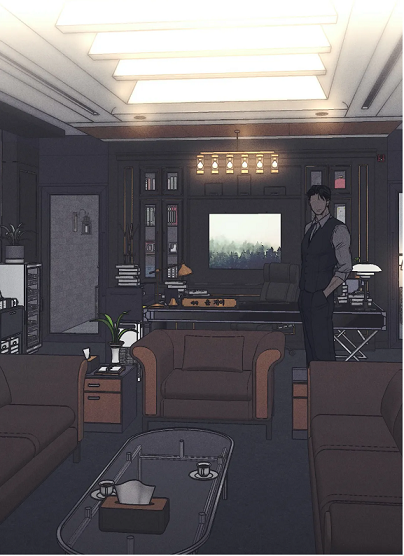 .
.  This means that Fujoking and Samk were hiding his real character on purpose, though the readers already knew his job and name: executive director Yoon. As you can see, the mystery concerning Yoon Jay is not about his name, but about his personality. He is indeed very difficult to understand contrary to Lee Yoohan who can be read like an open book.
But why? First, it is because we don’t have much information about him and his past.  (chapter 1) He lived for a long time in the US, and he hasn’t been working at Dream Ent for a long time. He is portrayed as a ruthless man, for he doesn’t mind firing people. However, I believe that his bad notoriety is linked to his smile as well. How so? It is because when he rejects or fires people, he has a huge smile on his face. It was, as if he was feeling Schadenfreude. We have the perfect example, when he rejects Song Myungshin’s advances.
  (chapter 9) Though the image seems to ooze warmth due to the flowers and bright colors, we should perceive it as the opposite due to the huge contrast between the background and the immense NO. He is here acting, mirroring the actor’s hypocrisy. Besides, note that the main lead has closed eyes, an indication that he is hiding his true thoughts and emotions to the antagonist. Because the main lead combines a smirk with cold words, he appears heartless… almost like a psychopath! Hence he is also called psychopath.
  (chapter 35) That’s the reason why Yoon Jae is not surprised or upset hearing it from his protégé. His negative reputation incites fear and intimidation, like the spy admits it. Even the manager Choi gets frightened, when he hears his name.
  (chapter 6) However, the readers should question if Yoon Jae’s dangerousness is not exaggerated. Why? First of all, despite his claims, the worker was actually revealing secrets about the executive director to the actor Song Myungshin. If he truly feared him, then he shouldn’t have exposed the director’s research for the rabbit.
 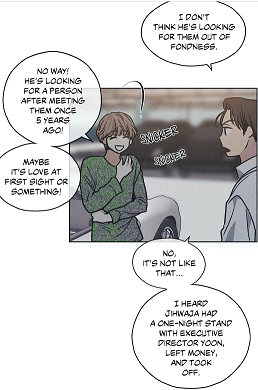 (chapter 1) This was absolutely private. But who is Yoon Jae in reality?
2. The prologue: first clues about the “wacko”
Yes, even in the prologue, the authors let us see a glimpse of Yoon Jae’s personality. If you read other analyses from me, you are well aware that the decoration of a room mirrors the mental and emotional disposition of people. 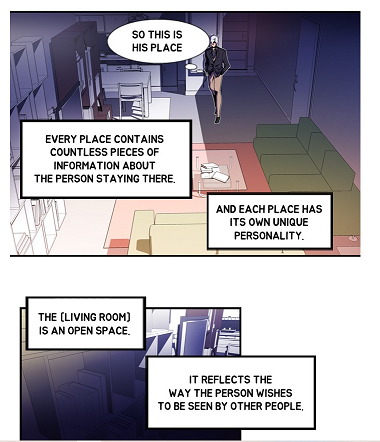 (Doctor Frost, chapter 8) Striking is the preference for dark colors, essentially brown and black.
“In color psychology, black means power and control, hanging on to information and things rather than giving out to others. Black is intimidating, unfriendly and unapproachable because of the power it exudes. […] Negative keywords include aloof, depressing and pessimistic, secretive and withholding, conservative and serious, power & control, sadness and negativity.” Quoted from https://www.empower-yourself-with-color-psychology.com/color-black.html
As you can see, the color reflects his mind-set. He is quite a controlling person, thus he made sure to be updated on Lee Yoohan’s moves. 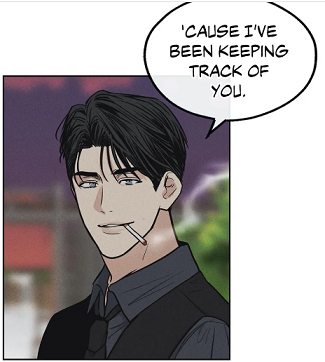 (chapter 9) He investigated about his past immediately. And what is the signification of brown then?
“Brown suppresses the emotions, creating a safe haven from the stresses of the outside world within which problems can be contemplated and solved. Brown is a color of structure, although by no means does it encourage perfectionism – rather it encourages orderliness and organization. Brown is solid with strength and maturity. It prefers to function in its own safe little world – it is not carefree and spontaneous and doesn’t like surprises. It can be considered dull, boring and unexciting by many.” Quoted from https://www.empower-yourself-with-color-psychology.com/color-brown.html
This exposes that Yoon Jae is not an emotional person, quite the opposite. He is very serious, rational and even calculative, as he has to anticipate people’s actions (combined with black). (prologue) Furthermore, since the brown shade is associated to structure and organization, this shows that his whole life is revolving around work. Besides, the manhwaworms can perceive his workaholism thanks to the scripts placed on his desk and cupboards. He is so dedicated to his job that he even brings work home. 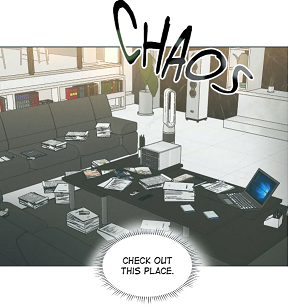 (chapter 35). One might object to this interpretation, for contrary to the office in Dream’s building and Alice’s labyrinth
 (chapter 13), the floor and walls of his home are white. Why is there this difference? The color exposes the emptiness and loneliness of his life. This explains why the main lead barely goes home. I am even assuming that he is avoiding the place. He prefers sleeping on the bank
  (chapter 34) from the rooftop of the building than going home. And now, you comprehend why the director’s relative and friend sent Lee Yoohan there. He desired to ensure that his acquaintance would get enough sleep. Yoon Jae realized that if he desired to keep the main lead by his side, he needed to go back home so that they could share a bed together.
  (chapter 35) As you can see, I was able to create connections between the main lead’s office and other scenes indicating the importance of the design of a room.
(Prologue) His office seems to have no window, though I have my doubts about it. From my point of view, the windows are covered, or since this office has two rooms, it is possible that the windows are in the other study. Let’s not forget that when Lee Yoohan delivered the letter to his assistant Park Sung-Ki, it was still daylight. Anyway, since there’s no sunlight, the director has to turn on the light. This indicates that he doesn’t pay attention to time at all. I would even say that he has somehow lost the notion of „time“. Thus I conclude that he has no regular life. This is not surprising when Yoon Jae explains to Lee Yoohan later that he worked for three days without sleeping. 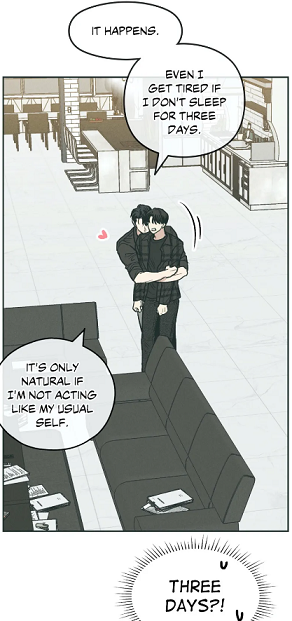 (chapter 35) Since he switched from the office in the Dream’s building to the one at Alice labyrinth’s, he can barely notice sun light. And now, you have the explanation why the main lead is so feared by the workers from Dream Ent. He forces them to work non-stop, even to sacrifice their night (see chapter 38)! That’s the reason why he is called a psychopath. He doesn’t know the true meaning of life. For him, there only exists work, work, work. Under this new light, the readers can perceive the similarities between the two protagonists. Both were leading a similar way of life, but definitely for different reasons.
(Prologue) Finally, behind his desk there is this huge picture of a conifers’ forest covered with clouds and fog.  (chapter 10) The topic exposes the main lead’s loneliness and dull life. There is no real fresh air in his office, as it is just a picture. This room feels suffocating. It was, as if Yoon Jae was buried under work. Finally, the manhwaphiles can notice the absence of family pictures. And this is the same in the second office at Alice labyrinth’s and his real home. He is truly alone. The darkness of the room and the absence of a family display that Yoon Jae is not truly living. He is just working. There’s no joy or happiness in his life. That’s the reason why he appears so ruthless to others, because he doesn’t take into consideration his workers’ love life and family. This is the second common denominator with Lee Yoohan. And now, it is time to focus why the main lead called Yoon Jae a wacko.
3. Their first meeting on the rooftop
When Lee Yoohan asked him for a cigarette,  (chapter 3), Yoon Jae showed his hostility immediately. First, he remained silent, then he insulted him by throwing the butt to his feet.
 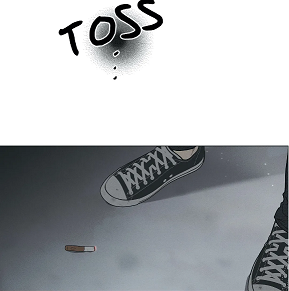 (chapter 3) Such a reaction could only shock Lee Yoohan, as the latter had showed no sign of aggressiveness before. But why did the mysterious man react so negatively then? It is because for Yoon Jae, the rooftop had become his true home, the place where he could breathe. That’s the reason why he didn’t want anyone there, until he met the other main lead! And it is the same at Alice‘s labyrinth either. The rooftop is the main lead’s refuge where he can connect to “nature”. He can watch the city, but also the stars in the night sky or find some sleep.
In his eyes, Lee Yoohan was just an intruder who was trying to approach him in order to obtain some benefit. This shows that kindness and generosity were unknown in his world. It is only about value, give and take. Striking is that during this scene, the authors let the readers see the devil’s smile which was actually a sign of his coldness. 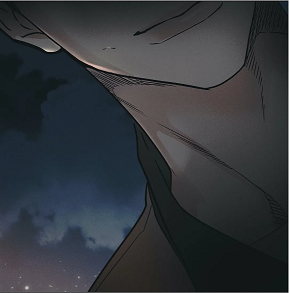 (chapter 3) This perception got even reinforced, when Fujoking chose black to show Yoon Jae’s words.
  (chapter 3) Unlike with Song Myungshin, the main lead decided to expose his true thoughts and emotions, therefore Lee Yoohan could see his gaze. In other words, the scene 9 stands in opposition to chapter 3 and 4. This is important, because this explains why Yoon Jae came to “show an interest in Lee Yoohan” righ away. While in chapter 9, the executive director sent away the evil and fake actor
 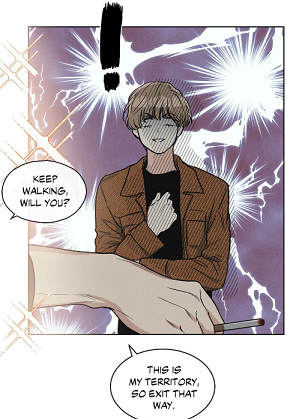 (chapter 9), he proposed a deal to “Lee Baekwon”.
  (chapter 4) The reason for this change of attitude is that Lee Yoohan showed no fear in front of him. He didn’t feel humiliated to take the butt and he even retaliated.
  (chapter 3) This means that he had no problem to defy Yoon Jae, while the latter knows about his terrible reputation. The protagonist would even glare at him after the punch.
  (chapter 4)
The other reason why the executive director got intrigued is the young man’s innocence and honesty. He had not only no idea about his true identity  (chapter 4), but also he rejected his assistance.
  (chapter 5) This shows that Lee Yoohan was no real leech. In other words, the young man was acting the opposite to the people Yoon Jae had ever met so far: hypocrites and greedy leech. That’s the reason why Yoon Jae found him so intriguing.
What caught my attention is the vocabulary he was employing in connection with the young actor: joke 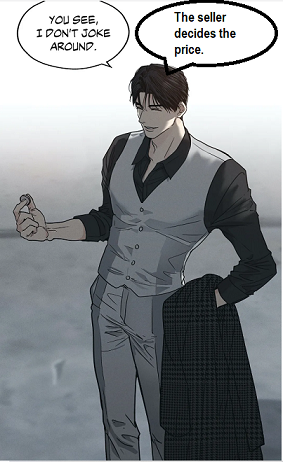 (chapter 4), amusing
 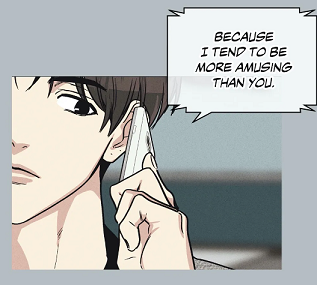 (chapter 11), impressive
 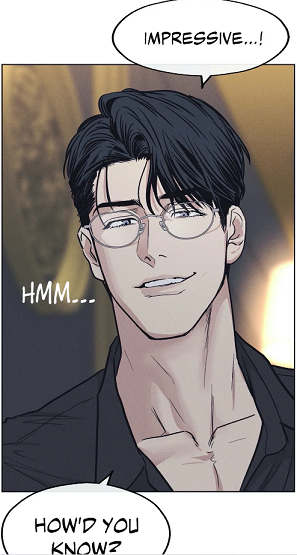 (chapter 13), boring
 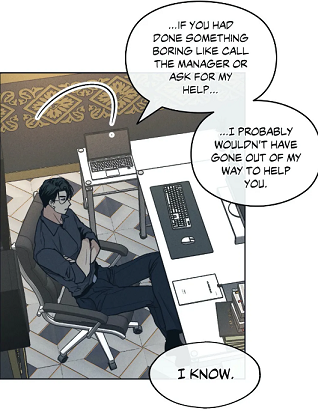 (chapter 23) and “amused”
  . (chapter 23) These idioms belong to the semantic field “entertainment”, which stands in opposition to work! To conclude, Lee Yoohan brought joy and light into his dull life, this is not surprising that at the end of season 1, Yoon Jae is now investing in an independent movie.
Due to his unusual reactions, the main lead felt more and more attracted to the young man. Thanks to him, he felt his heart racing for the second time!  (chapter 35) But why did he react to “revenge” then? He had never done something like that before, for he had always been on his own. He had always been indifferent towards people. But the more he saw the young actor, the more he got aroused sexually, the consequence of his racing heart.
 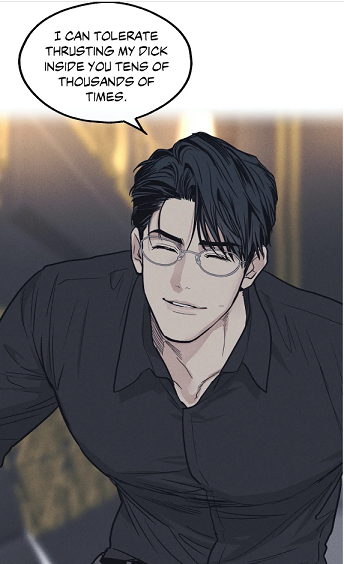 (chapter 13) This indicates that he was slowly brought back to life.
4. The origins of Yoon Jae’s weirdness
What he only knew so far was to make deals (value, give and take), because that’s the way he had been raised:  t (chapter 30) He was not allowed to voice his emotions and thoughts to his “mother”. That’s the reason why Fujoking portrayed him as emotionless.
 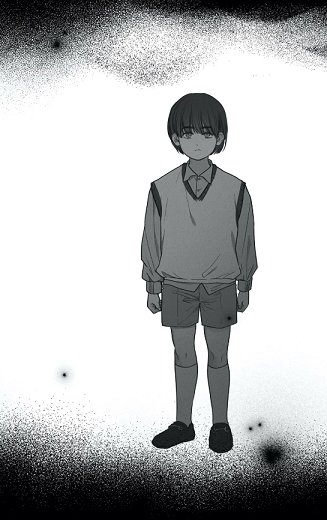 (chapter 30) He had no smile on his face as a child, because he had been forced to lose it. There is no ambiguity that he was not allowed to cry either. The reason seems to be related to the mother’s high expectations for her son.
 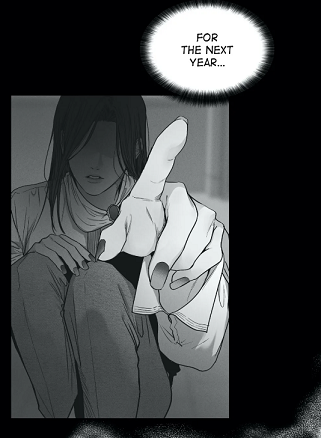 (chapter 30). She made plans that Yoon Jae had to make come true. That’s how he internalized that life consists of only work and expectations. Everything else is pointless. It doesn’t matter, if this woman is his biological mother or his “adoptive mother”. Let’s not forget that the executive director has two names, Han and Yoon. Yoon comes from his mother. He is using “Yoon”, which could be seen as a sign of pride, while he resents “Han”.
This woman raised him with the following principles: deals and plans. There was no hug and warmth between them, hence there is this huge distance between them. (chapter 30) And she only touched him with her finger on his forehead.  (chapter 30) He only had to use his intelligence and deny the existence of his heart. That’s the reason why he became a lonely and detached person. The lack of intimacy explains why Yoon Jae discovered sexuality very late. He only had sex with Lee Yoohan so far.
  (chapter 30) He had not the time and the opportunity to question his sexual orientation. His whole life revolved around work since his childhood.
Striking is that on the day, he met the protagonist for the first time, he looked quite suicidal and depressed. He was definitely provoking the men, thus he reproached the main lead his intervention.  (chapter 14) He had a wounded arm, he was hiding his gaze behind his hair… a sign that he was having a hard time. He could only voice his emotions through aggression in the end. Striking is that in this situation, he utilized the idiom “play” contrasting to his philosophy of life: work:
  (chapter 14) In his mind, play was a synonym for fighting, but Lee Yoohan changed the meaning: sex. Thus when he had sex with the young man, he made two discoveries: tears which could only move his heart
 (chapter 14), for they represented what Yoon Jae had always been repressing so far, his broken heart and sadness.
 (chapter 35) This means that the young actor serves as a role model for the executive director. At the same time, he felt sexual pleasure for the first time
 (chapter 14), and he could give warmth to someone.
 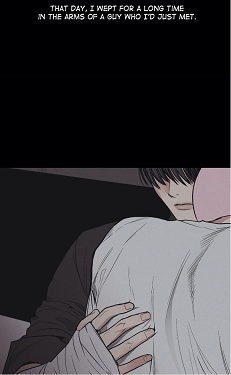 (chapter 15) He was no longer evaluated based on his work performance, but on his kindness. I am quite certain that during this encounter Yoon Jae must have felt time differently too.
Therefore it is no coincidence that after this love session, the executive director wished to keep in touch with the mysterious rabbit. He was willing to open up his heart for him. 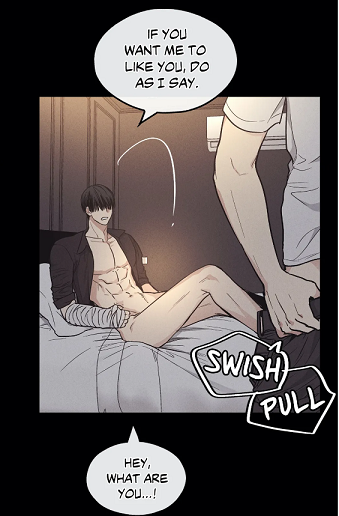 (chapter 15) I would even add that he was totally sincere, when he gave him the following advice:
  (chapter 15) But what the executive director had in mind back then was totally different from Lee Yoohan. Thanks the pink rabbit, he had discovered that he was not truly alone, there existed warmth and emotions besides work. This meeting had definitely affected the main lead’s perception, hence he added this:
  (chapter 15) He was smiling again, because he felt that a new chapter in his life was about to begin. However, the problem is that his words resonated for the former thug differently. He had deserved to lose his mother and his brother, as he had neglected them before. He was responsible for their death. He reinforced the main lead’s guilt and shame. Thus the latter got angry and punched Yoon Jae’s wounded arm before giving him money.
  (chapter 15) He was not allowed to receive affection, though his future lover meant the exact opposite. From my point of view, this was the moment Yoon Jae learned the following lesson: smile is associated to rejection and coldness. This explicates why his facial expression in the motel room (chapter 15) resembles to the one on the rooftop. (chapter 9) Thus the manhwalovers can comprehend why the stockholder Jae was angry at the Jihwaja rabbit
 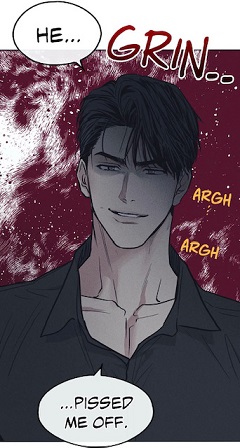 (chapter 17), but still was longing for him and his embrace.
  (chapter 37) One thing is sure. Because of this incident, the executive director learned not to show his affection immediately. So when Lee Yoohan got into trouble at Alice Labyrinth’s, the executive director denied that he had sent the waiter in order to assist him. (chapter 23) However, the readers can grasp that this is not true, for he got annoyed that Lee Yoohan said that he was not expecting any help from him.
5. The true nature of Yoon Jae’s relationship with Yoohan
Because for the executive director, work means everything, he can only reject sponsoring! Why? It is because the latter uses connections and pleasure as basis. This has nothing to do with talent or hard work. The “protégé” just needs to assist his “sponsor” elsewhere. Sponsoring contradicts the values the protagonist is advocating: honest hard work, no reliance on others. And now, if you observe the evolution of the couple, you will realize that the executive director never gave his support for free. There was always a deal between them. Even when he offered the interview, it contained a trap: 
 (chapter 7) Lee Taemin was here cornered. If he had mentioned the incident on the rooftop, the protagonist would have lost his interest in him. However, this pushed the main lead to become proactive and even creative. Then later, it was the same. His help was never for free.
 (chapter 10) The irony is that here, the debutant didn’t grasp the ambiguity of his words. He could mean that he was selling his body, while in reality he had in his mind to work for the mysterious “helper”. The executive director had already perceived his innocence, hence he indeed offered him a job.
  (chapter 13) Secondly, Lee Tamin never truly employed his assistance directly. When he made the first phone call to wacko, he asked him to have his manager punished. Why? That way, Song Myungshin’s intervention would be mentioned. This means that Lee Yoohan used more or less the normal way to achieve his goal. That’s the reason why no one has ever made a connection between the executive director and Lee Taemin. The latter always tried to resolve the problems on his own. This could only impress the executive director. He could see that the young man was hard working. Striking is that Jay revealed his attachment and admiration towards Lee Yoohan very early on, because he introduced himself as Jay!
  (chapter 13) This is quite unusual for Koreans. Moreover, observe that he allowed him to enter his office at Alice Labyrinth’s. This is definitely his hiding place, hence I doubt that he allows strangers to visit him there. Slowly, the executive director Jay allowed Lee Yoohan to visit his private places: first the roof, then his office at Alice’s Labyrinth, the rooftop there too and finally his home.
But why didn’t Lee Yoohan notice his affection for him in the end? First, their mind-sets were different. Lee Yoohan grew up in a family, so he still cared for his mother and brother. He definitely had a big heart, but the problem was his mother was overwhelmed by her situation, raising two children as a single mother. He has always helped others, the perfect example is his relationship with the actor Song Myungshin. He consoled him and helped him to read his lines, he would share his flat with him. As you can see, Lee Yoohan might have been a thug, but he was still a generous man. Therefore it is no wonder that he felt terribly guilty after the loss of his family. And observe how Lee Yoohan reacted, when the director asked him to sleep with him. He let his future lover embrace him while asleep. (chapter 35)
Yoon Jae has never learned to share, as it was about a deal. So far, he never had to take care of a partner. This explicates why his friend gave a suit to the protagonist.  (chapter 29) He knew that he had to play cupide.
Another reason for being called a wacko is that Lee Yoohan always had a regular life despite his terrible situation. He didn’t rest much, but his whole week was carefully planned. The time he didn’t spend at work was left to sleep. As you can see, he never neglected his body, thus he has a real home contrary to the main lead. Observe that the main lead noticed the chaos Yoon Jae’s office and home, yet this is not how the actor lives. This means that thanks to the main lead, the weirdo will learn to distance himself from work, and enjoy life. To conclude, though the main leads shared some similarities, they still came from two different worlds: education, life style and family situation. This is no coincidence that “Lee Baekwon” is connected to the pink rabbit. The latter symbolizes innocence, but also love and sexuality. He brought exactly what Yoon Jae had been missing in his childhood. Therefore, the main lead finds life more funny and interesting now.
Another reason is that Lee Yoohan has been betrayed by his ex-lover. So from my point of view, he became disillusioned about love. In the past, he had been fooled by Song Myungshin’s fake tears and affection. Hence I am suspecting that he chose sex with Yoon Jay for that reason. He had realized that sex could be quite superficial. This explicates why he didn’t mind switching position. However, since the stockholder had never fallen in love with someone before, he made the exact opposite experience. He came to see the connection between sex and love. Hence he has this romantic perception of love,. 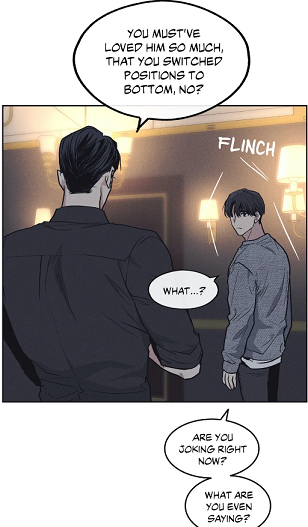 . (chapter 15) This shows that Yoon Jae associates love to faithfulness and strong emotions, but the innocent rookie has long disconnected sex with affection. That’s the reason why he couldn’t see his jealousy
  (chapter 16) and as such his growing affection towards him.
Striking is that the moment he realizes Lee Taemin’s true identity, he is so happy that he not only smiles, but also blushes.  (chapter 37) This picture announces the final transformation of the “wacko”. He is so overjoyed, that he wished to give his lover everything.
 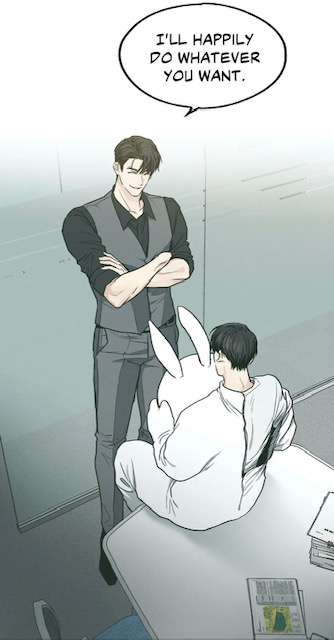 , (chapter 38): fame, revenge… but also his heart! Thus he added this
 (chapter 38) He will give him affection and warmth so that he can overcome his loss.
6. The other weirdos
Like mentioned above, the executive director dislikes sponsoring very much, as he is a purist. He only judges people based on their performance and value. He treasures integrity and honesty. This explains why he cleaned the company by firing so many people in the end. 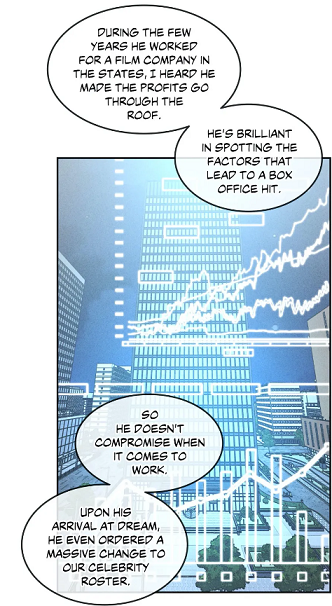 (chapter 07) Thus he embodies the opposite values of chairman Kim, who doesn’t care about great movies and realism. Thus he changes scripts or actors.
  (chapter 23) For him, only his pleasures matter. He uses his money and connections to obtain his goal. He is actually the real monster who will abuse and rape men.
  (chapter 40) And the actor Song Myungshin is his helping hand who selects the man’s future preys
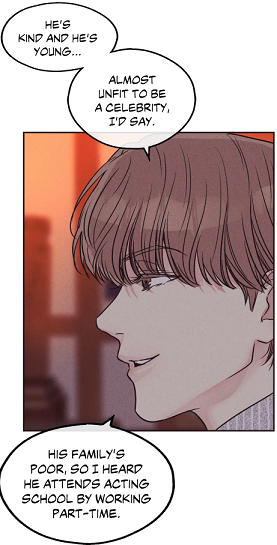 (chapter 40) with fake promises, while he benefits the most by receiving money and support for his career. The manager Choi described them as parasites who take pleasure at the suffering of others:
 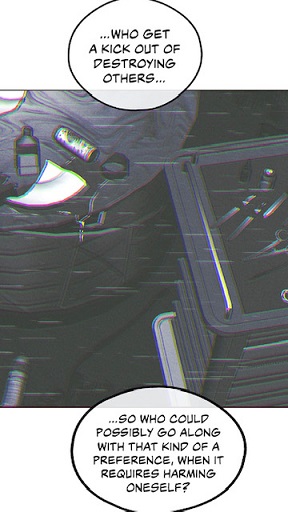 (chapter 40) The actor is not different from chairman Kim, because as long as the others are sacrificed and as such suffering, he will never envy them. Song Myungshin is full of jealousy, and can not bear that someone else can be successful, thus he is determined to ruin the life of others: manager Choi, the talented Lee Hansoo and the rookie Lee Taemin. He perceives everyone as a source of threat due to his insecurities and greed. Since Chairman Kim and Song Myungshin embody rape and prostitution, it is normal that Yoon Jae never forced Lee Yoohan to have sex with him. He is the romantic one through and through, thus he is waiting for a real sign from his lover. Therefore it is no coincidence that he said this to the main lead:
  (chapter 28) He was signalizing that he wished to have sex with him, he had trouble to wait.
 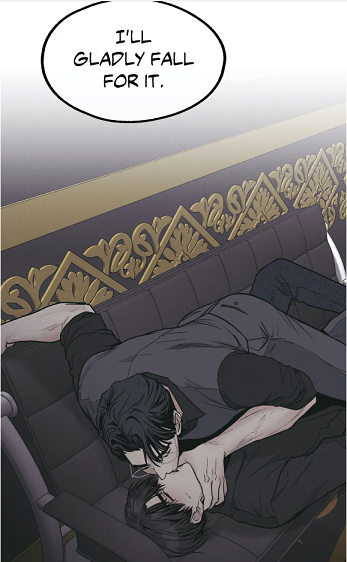 (chapter 28) These words expose that for Yoon Jae sex and love were the same thing for him. He couldn’t differentiate them. Hence he can only appear as a wacko to the fake actor and chairman Kim. Therefore Song Myungshin is doomed to failure, he will never be able to seduce the powerful and attractive executive director Yoon Jae.
Feel free to comment. If you have any suggestion for topics or manhwas, feel free to ask. If you enjoyed reading it, retweet it or push the button like. My reddit-Instagram-tumblr-twitter account is: @bebebisous33. Thanks for reading and for the support, particularly, I would like to thank all the new followers and people recommending my blog.
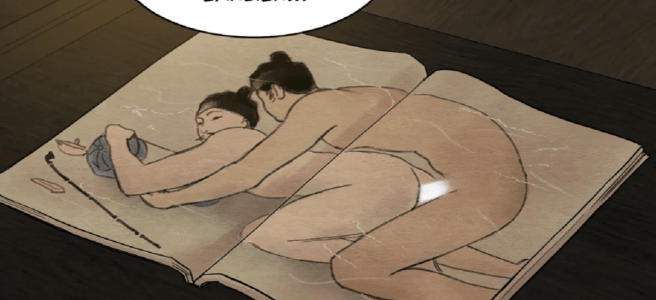
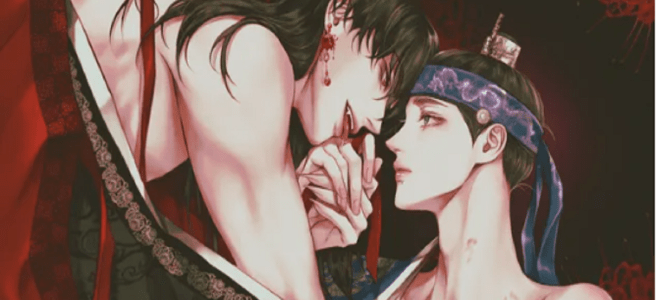
 (chapter 2) Queen Yoon vanished, because she was condemned as a witch. Naturally, her disgrace is linked to Lee Nok’s special situation. His yin energy is so strong that he attracts ghosts which his mother noticed. If the king knew about this, he would definitely see it as a curse. Thus Queen Yoon tried to protect her son with talismans which led to her demise. Because of this incident, the king turned concubine Han into his new Queen. The latter gave birth to a son who definitely represents a threat to Lee Nok.
  (chapter 8) This explicates why the boy is turning his back to Lee Nok. Their position in this picture already displays the existing rivalry between them which Queen Han is trying to diminish by faking concern and pity for the Crown prince. She seems to take the Crown Prince’s side, for she has to mask her involvement and true intentions: ambition. She is eyeing at the throne. If the main lead was involved in a scandal, the king could decide to nominate his second son as the future Crown prince. As you can see, Lee Nok’s situation is quite fragile and as such precarious. There is no ambiguity that the loss of his mother wounded the Crown prince deeply. We could detect it thanks to Jae Shin. The main lead chose to adopt the cute puppy, as the latter was motherless.
 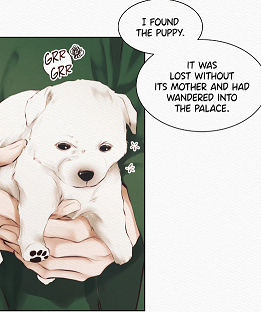 (Chapter 7) As you can see, the main lead was projecting his own emotions and thoughts onto the small dog. He feels also abandoned in the palace, as he has no one to rely on. He can not even trust his close aid, the eunuch Ahn, and his love interest, Choi Kyung Joon, as his secrets (sodomy and the ghosts lusting after him) would shock them (disbelief and rejection).
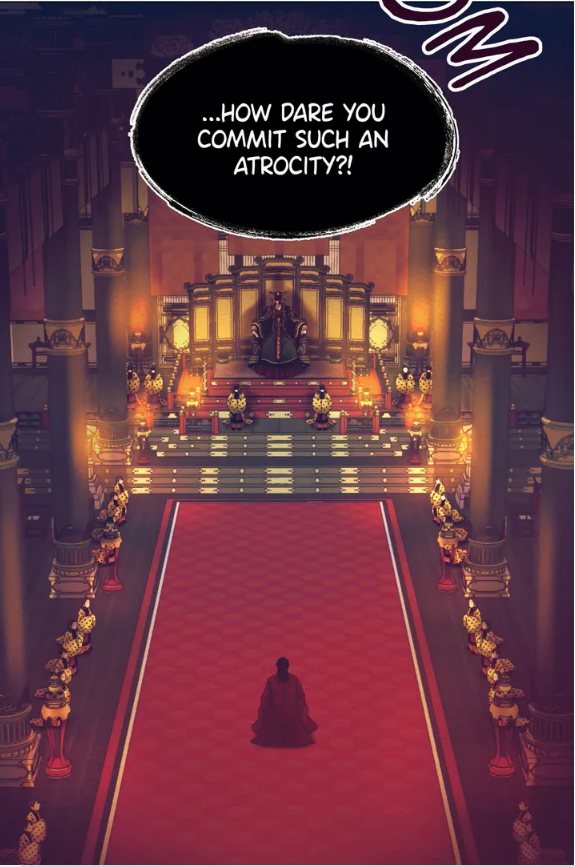 (chapter 1)
  (chapter 2). Though the verdict looks similar, I come to a different interpretation. How so?
  (chapter 1), the other is badmouthed to be involved with dark arts through posters.
  (chapter 2) Yet there is no evidence. I would even add that contrary to Yeomra, the king never gave Lee Nok a choice to defend himself and to determine his fate. How so? As soon as the father read the poster, he accused his son: “What have you been doing that things have come to this?” This means that he believes that there exists a kernel of truth in this rumor. The cause for his mistrust is Lee Nok’s birth mother, the former Queen Yoon. Because his mother was already involved in such a ruckus, the king can only blame the Crown prince, all the more when the latter defends his mother’s honor.
  (chapter 2) These words could only reinforce the father’s prejudices. He was already guilty by association.
  (chapter 2) No one is able to see his face. His only support and connection to aristocrats is his friend Choi Kyung-Joon, the son of a minister. That’s how powerless the Crown prince is in the palace. He is even surrounded by maids spying for Queen Han. Consequently, I come to the conclusion that Lee Nok’s father represents the negative reflection of Yeomra. He doesn’t send away his son in order to protect him, rather to hide him out of shame and resent. In other words, the king doesn’t love his son contrary to Yeomra. Interesting is that the latter let his son make the choice about his own destiny. Why? He wished to give him the liberty to determine his fate in order to prove him what DESTINY is.
  (chapter 3). Let’s not forget that the son’s crime had been to change a person’s fate. Striking is that both monarchs believes in fate, but the mortal ruler has a different notion. Since Queen Yoon is viewed as a witch, the son seems to be “tainted”. Moreover, while Yeomra trusts his son, the mortal king behaves differently. In reality, he relies on his wife, Queen Han. Thus he recommended her to Lee Nok
 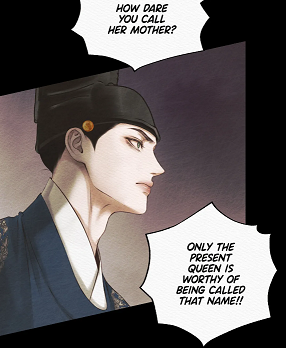 (chapter 2), and later he listened to her fake concerns. This shows how easily the king can be manipulated, he is not even realizing that his royal secretary
 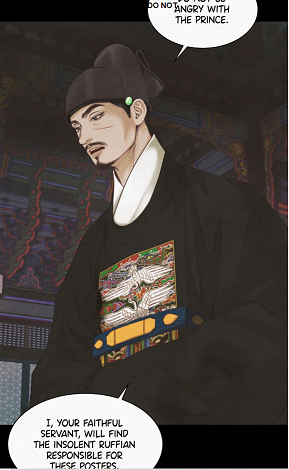 (chapter 2) is working against Lee Nok, while claiming that he will look for the author of these posters. I couldn’t help myself connecting Lee Nok’s seclusion in his quarters to the death of the shaman Yeom: both are “buried alive”.
 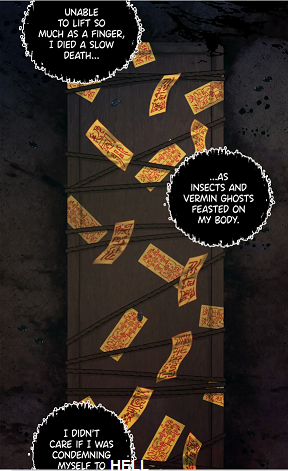 (chapter 13) Hence she can “understand” him. Another proof for this interpretation is the spirit’s following statement: they share the same fate.
  (chapter 8) The only difference is that the Crown prince is still living. However, for the Queen, it is just a matter of time, until people forget Lee Nok completely so that her son can replace him. At the same time, his isolation can only increase suspicions. And the more he is badmouthed (dark arts or sodomy), the more the king will turn away from his own son. While the king of the hell of tongue ripping wished Jae Shin to recognize his mother, the king of Joseon desired the exact opposite: he should deny his relationship to his birth mother, Queen Yoon.
  (Chapter 2) Moreover, the god never imposed his will onto Jae Shin. The latter has to discover this himself, whereas the king made the opposite choice.
 (chapter 1). This shows that the ghost has a deep respect for his father in the end. This explains why after his sentence he thought about his father
  (chapter 1) His words don’t ooze resent, he is more pleading his cause, begging his father to recognize that humans don’t deserve such mercy and care. He trusted his father and his fairness, hence he spoke the truth. He never hid anything from him. As for Lee Nok, despite the father’s verdict, he still follows social norms. He accepts his father’s order. Then despite the rejection, he tried to see his father, and he even went to the Queen’s palace to greet her. He acts like an obedient and dutiful son. Finally, he tried to defend his mother’s honor, as he knew that she had sacrificed herself for him. I am convinced that he must feel guilty for her disgrace.
 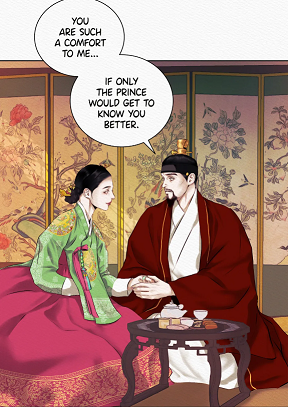 (Chapter 8) This truly displays that he had no faith in his son, for in the king’s eyes, the prince is ignorant about Queen Han’s good nature. To sum up, Lee Nok is rejected by his own father, he has no one to rely on. He might have loyal servants like inspector So-Rib
  (chapter 2) or Eunuch Ahn, but the latter have no real power in the palace. Furthermore, he can not confide to them everything. He is not loved which stands in opposition to Jae Shin who grew up as a spoiled prince.
 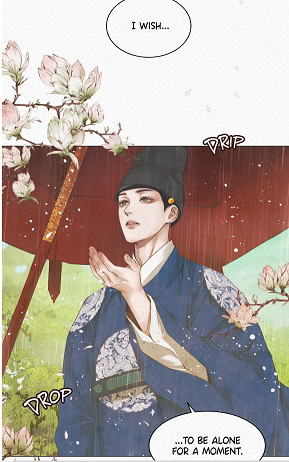 (Chapter 2) That’s the moment he can finally breathe. This corresponds to the situation of being buried alive which I mentioned above. Since he is surrounded by maids, he has no privacy. But contrary to the Queen and the king, he has no real control over his staff. Due to his innocence and purity, he is not aware that one of his maids is reporting to Queen Han. He is definitely cautious, but he is not cunning enough to anticipate the Queen’s moves. As the manhwaphiles could sense, Lee Nok is indeed a fragile and lonely prince.
 (Chapter 1) Imagine that he can control someone from the afterlife. But the problem is that he is not aware of his power, as he has no idea about Jae Shin’s curse. Yeomra’s son can not return to his father’s side, as long as he had not won Lee Nok’s heart. On the other hand, the immortal prince has no intention to reveal his secret to Lee Nok, because if so, he would become his puppet. This explicates why in chapter 18, Jae Shin treats the Crown prince like an object.
  (chapter 18) He is masking his own vulnerability, at the same time he gives the impression that Lee Nok has no other choice than to depend on him. He is trying to turn the tables in the end.
  (Chapter 4) Besides, according to me, Yeomra fell in love with a human, this means that his action affected the mortal world, so he has to restore the harmony in the mortal realm. But the problem is that Lee Nok is already in love with his childhood friend Choi Kyung-Joon. So the main lead might have become the Crown prince’s sex partner, but he has not conquered his heart yet. Nevertheless, it is just a matter of time. The irony is that humans are mortals, hence their time is limited. This shows that Jae Shin is actually working against time. He could end up living as a puppy forever. So he is also weak, totally depending on Lee Nok’s heart and good will.
  (Chapter 16) The latter might have not died, but he lost his yin energy. Thus he lost his strength. Only the Crown prince could heal him.
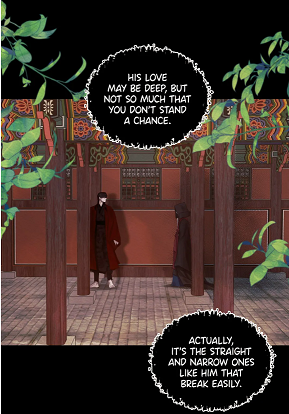 (Chapter 13) Why would she say that? First, Lee Nok is aware that his friend hates sodomy.
  (Chapter 3) Hence he is forced to hide his affection from him. This means that he can never be honest to Choi Kyung-Joon, yet like already pointed out above, the Crown prince embodies innocence and as such honesty. This means that his lack of honesty towards his loved one can only wound his heart. So far, the Crown prince could never outlive his sexual orientation, for he had no partner at all. Thus he could still maintain his image in front of his loved one. This hopeless love gave him a certain strength.
  (Chapter 9) This outlines the mortal’s power.
  (chapter 13) The friends can not become lovers, as this would represent a threat to them. However, there is no ambiguity that Choi Kyung-Joon is aware of the Crown prince’s affection and he is taking advantage of it. By using social norms, rejection of sodomy, he can keep his distance from Lee Nok, but still maintain his relationship with him. How did I come up with this interpretation?
 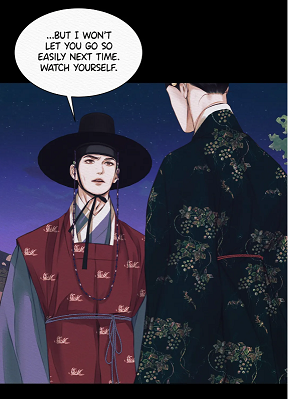 (Chapter 3) Note that he is using the personal pronoun “I”, while in reality he is just usurping the Crown Prince’s authority.
  (Chapter 3) He was definitely arrogant, selfish and intolerant in that scene. He didn’t pay attention that his friend was not feeling well the whole time. Secondly, with such an attitude, he could create a ruckus for the Crown prince and damage his reputation.
  (Chapter 3) They were in a gibang, and note that the poster was released shortly after this visitation. Finally, Jae Shin was already hinting about Lee Nok’s love to Choi Kyung-Joon
 (chapter 3) It was clear that he was designating his companion, as their path crossed there for the first time. But since the ghost was just insinuating, the other could still feign ignorance. However, despite this warning, the minister’s son didn’t change his attitude. In fact, he became even more caring and gentle than before. Moreover, observe that when the main lead was summoned to his father, Choi Kyung-Joon never asked for an audience and speak up for his friend.
  (chapter 10) Thanks to Painter Of The Night, we all know that this exam has more rounds. Why did he not pass the second round? In my opinion, it is because he is relying on Lee Nok’s support. This shows that he is not determined to become a high official on his own merit. That’s the reason why he is close to the Crown prince in the end. His well-being is his ticket to get power.
  (Chapter 9) But since Queen Han sent someone to tail the childhood friend, it is only a matter of time, until jinsa Choi realizes that he can obtain more, if he supports Queen Han. Besides, if he detects that Lee Nok is hiding things from him, he can utilize this as a sign that he is losing favors. And the moment he switches sides, Lee Nok won’t be able to forgive him. But there exists another possibility how their friendship can get ruined, Choi Kyung-Joon’s attitude represents a problem itself, which I had already outlined above. He almost caused a ruckus in the gibang, then he didn’t try to defend his friend in front of the father, and finally, he made another huge mistake. He let Lee Nok sleep outside.
  (chapter 10) Though his advices sound selfless and great, they are actually terrible. How could he leave the room, after the prince had fallen asleep? He should have left before. Then he makes sure that no one sees him. This can create a misunderstanding. Why did they do there together? So the moment there is a rumor that Lee Nok is a sodomite, the minister’s son could get suspected. So in order to save his skin, he could betray his friend and testify against him. He saw the hickeys.
  (Chapter 13) This is important, because Jae Shin is powerful contrary to the childhood friend. He can use his connection from the afterlife: his brothers, Yeom and the ghosts. And contrary to the minister’s son, his movements can not be detected first. As an investigator, he can unveil how Queen Han used ghosts to ruin Lee Nok by altering the book of names. The ghosts remained in the mortal world,
  (chapter 15) because they were not fetched by the warden and messenger to the deceased.
  (chapter 15) The reason is simple. They were not supposed to die.
  (Chapter 13) Remember that he questioned Yeom’s choice, as she had not accepted the tragic death of her loved ones which was in his eyes predestinated.
  (chapter 13) Like his father, he believes in fate, not realizing that his sin is the evidence that destiny can be changed. From my perspective, this change of heart and conviction can only happen, when he discovers that someone else committed the same crime affecting him directly. Interesting is that Yeom serves as a mother figure to Jae Shin. Despite his rejection, he still followed her advice. He trusted her words, when she said this:
  (chapter 13) He recognized the truth in her words. This shows that through Jae Shin, Lee Nok can gain powers. Indirectly, the latter is also receiving the help of the mother figure, Yeom. The punished prince can give orders to ghosts, he can chase away evil spirits and as such put an end of Queen Han’s influence. Moreover, thanks to his loving brothers, Jae Shin can get an access to the book of names and know about people’s fate.
 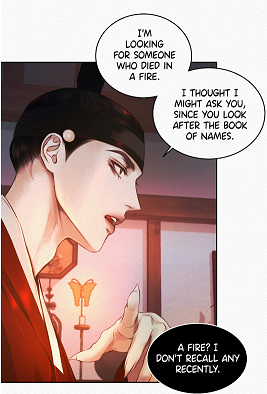 (Chapter 15) He doesn’t necessarily needs to interfere directly, his knowledge can help Lee Nok (for example the king’s passing). Remember the saying: knowledge is power. As a puppy, Jae Shin can tail Choi Kyung-Joon too, and he won’t be suspected, as a white puppy is supposed to chase away evil spirits. In fact, the friend knows how Lee Nok cherishes the dog, so he has no interests to mistreat or suspect him. This shows that the Crown prince has powers in the afterlife,
 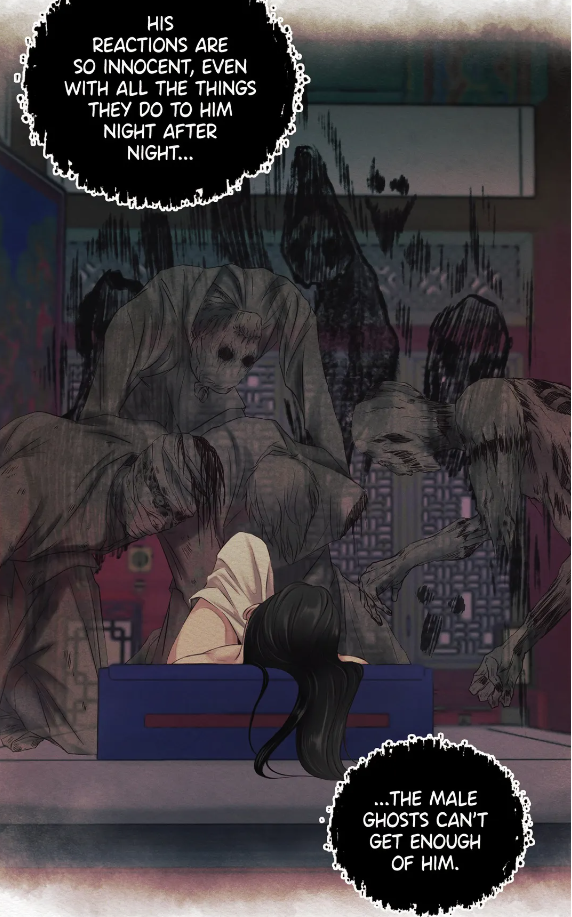 and his purity is his strength.
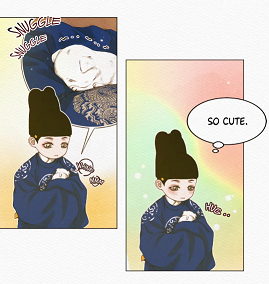 (chapter 2) and chose to protect him. Despite his status, he showed humbleness. But this doesn’t end here. He shared not only his bed and his food with him, but also his secrets. .
  (Chapter 2) Jae Shin had already become his confident. And this leads me to my final conclusion: Lee Nok is strong because of his huge heart too. He is neither arrogant nor selfish, and he has not such a negative view about humans and life in general, more about ghosts, the cause for his suffering. For me, he has never lost hope. He contrasts so much to his lover, thus he can teach him these values and change him. On the other hand, Jae Shin can give the Crown prince what he has been missing the most: a true home thanks to his affection and support.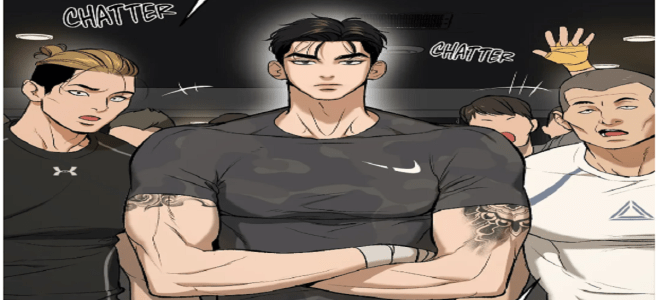
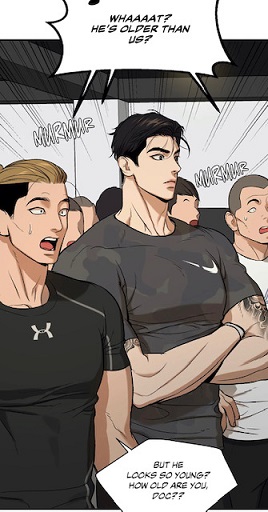 (chapter 7) For them, Kim Dan became a hot topic among the staff (def. 4).
  (chapter 7) Then they recognized his skills immediately (“He’s a totally different weight class. Definitely won’t be easy”). He not only looked young, but also was skillful (def. 5) Hence one member made the following request that the doctor should treat them too. This is important, because thanks to the manager and coach, the gentle Kim Dan was welcome properly. He was accepted as a member of their team, though he didn’t have his uniform yet. Consequently, it is not surprising that the moment the protagonist offered his help to an injured fighter, the other boxers came to his side, and wished to be examined too.
  (chapter 7) They never looked down on him which stands in opposition to the protagonist Joo Jaekyung. For the “hot boys”, Kim Dan was their “hyung” and secondly he was a doctor. Hence I deduce that Black Team will play an important role in the therapist’s life, for he will get friends there. That’s how I realized why the author chose to contrast the pervert director to Joo Jaekyung in the end.
  (chapter 1) The latter used his position to isolate the main lead and put the blame on him. As you can imagine, I am expecting the opposite in Black Team. If something happens, they will side with Kim Dan, because the latter treated them well contrary to the champion.
 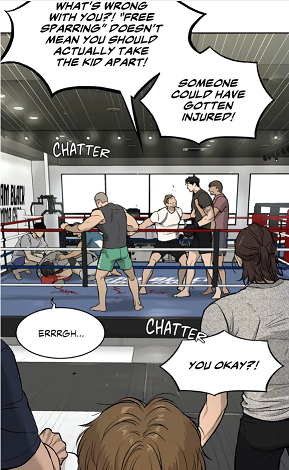 (chapter 1) Though his contract is stipulating that he just needs to treat the champion
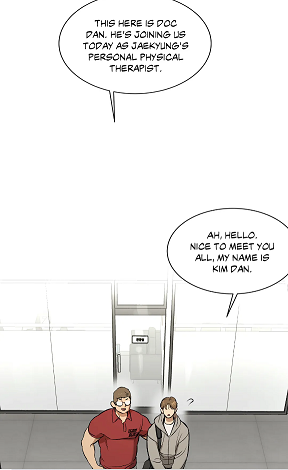 (chapter 7), he acted differently, as he treated the other boxers. He was selfless, and the other hot boys could witness it. In their eyes, Kim Dan is definitely a hot boy (def. 4.-5-9)!
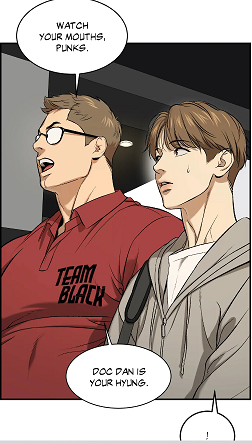 (chapter 7), exactly like his fighter Joo Jaekyung (chapter 1). However, I believe that there exists a difference. The champion came to take this expression literally, hence he shows a certain arrogance which is not the case for the coach. Nevertheless, the athlete respects the coach. The former never retaliated, when the hyung scolded him after smacking his back.
  (chapter 7) This displays that the coach can control the famous sportsman. However, the latter refused to callhis therapist hyung. But why? It is because from now on, Joo Jaehyung is no longer the senior/sunbae among the fighters in the club! He lost his privileged position as “hyung” to Kim Dan. Pay attention to the way his colleague called him: “hyung”
 (chapter 7) This means that he has to call Kim Dan hyung like the other fighters now. And now, you comprehend his reluctance to address Kim Dan properly.
 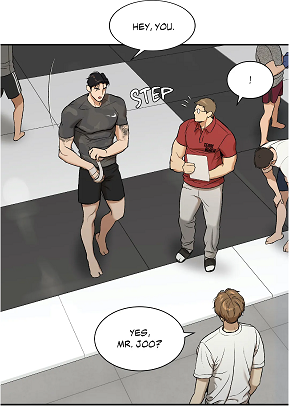 (chapter 7) It was, as if he didn’t want to lose his title “hyung” to the physical therapist. And this leads me to the following observation: Kim Dan became the hot topic between the protagonist and the coach (def. 3). And it is only a question of time, until hyung discovers the existence of the deal between the two protagonists. In this scene, he is hot on his athlete’s trail for his arrogance and disrespect towards people. (def. 11)
 (chapter 1) and in this society, the alphas are at the top of the hierarchy, while the omegas are at the bottom. This explicates why alphas are either CEO or school principals or professors due to their intelligence, while the omegas are “housewives”
 (chapter 1), for they have problems to find a job due to their heat cycles. The male omegas have the possibility to give birth to children, and their mates are alphas like mentioned in the illustration above. The attraction between omegas and alphas is mutual, especially when the omegas are in heat. They can not control their reactions, hence they need to take medicine called suppressants or inhibitors. It was, as if they were behaving like animals. The moment an alpha get bonded to an omega by biting his neck, they can never be separated. In certain stories, it goes so far that distance or separation can become deadly. As for the alphas, they also have a cycle called rut, and exactly like their counterpart, they can not control their libido. Another characteristic of the alphas and omegas is their phemorones, exposing their heat cycle or their emotions and desires. In this scene,
  (chapter 12) the terrible Seo Heetae, an alpha, is spreading his phemorones on the protagonist Kim Juhyeok out of anger and jealousy. This signifies that betas distinguish themselves from alphas and omegas, for they don’t possess such abilities. They are not so strong or „intelligent“ compared to the alphas, and they can not detect phemorones. On the other hand, they are not vulnerable contrary to the omegas who actually need the protection of an alpha. To sum up, betas are simply average. However, they make up a large part of society. This means our main lead, Kim Juhyeok, is a beta. And here is the next question. How does the protagonist view himself compared to alphas and omegas?
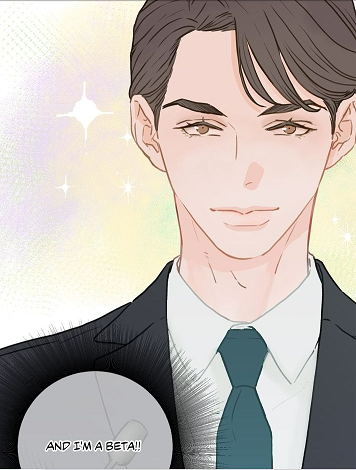 (chapter 1) The man oozes pride and confidence, as he is seen smiling with stars and bright colors in the background. This means that he doesn’t consider himself inferior to the others. Why? First, due to his hard working attitude, he became the representative of the new employees.
  (chapter 1) This shows that he could distinguish himself from all the other betas. Striking is that this cute man is full of ambition. His goal is to surpass alphas and omegas.
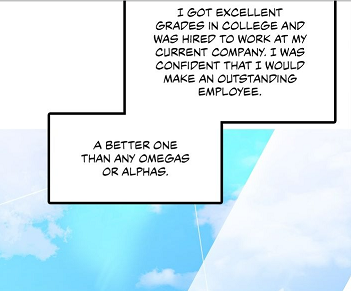 (chapter 1) It was, as if he wanted to make his name known. Let’s not forget that betas are considered as the normality, as the crowd. As you can sense, Kim Juhyeok has a competitive attitude which reminds us of the alphas. Hence it is not surprising that when he got on stage as the representative, he caught the attention of the alpha, Lee Sihyeon, the second main lead. To conclude, Kim Juhyeok is different from all the other betas, as he is trying to compete with alphas and omegas.
  In this illustration, Kim Juhyeok is pushing the alpha Lee Sihyeon away by putting his hands on his mouth. This shows that he is determined not to date anyone. And this observation leads to me to the next inquiry: Why is the young man desiring to remain single, for he could date a beta?
 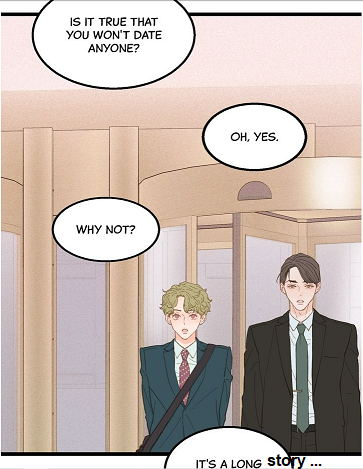 (chapter 14) His reply is that it is a long story. As you can see, he has many reasons for putting a wall between himself and the others.
 (chapter 1) And it looks like it was not different, when he went to college.
  (chapter 1) However, this is actually a deception. Kim Juhyeok was friend with an alpha, the actual actor Seol Gido!! This truly shows that he already came in contact with omegas and alphas at the university, yet he didn’t pay too much attention to them. He only started showing an interest in them, when he began working at the company.
  (chapter 1) The readers can grasp that he only got informed about alphas and omegas through books… it went so far that he watched k-dramas and porn movies which can’t be considered as a serious source of information. 😂As you can sense, Kim Juhyeok developed prejudices about the alphas and omegas to the point that he claims that the world is only revolving around alphas and omegas. In other words, he feels suffocated and threatened by them. Therefore his dream is to leave the country and go to Hawaii,
  (chapter 1) where he can live in seclusion. Hence he is seen alone here.
 (chapter 4) Since the beta can not detect the presence of phemorones, he never realized the truth behind his friend’s trick to chase his potential rivals:
  (chapter 4) He was always informed afterwards. Seol Gido just needed to fake the excuse to be drunk to release his pheromones to claim Kim Juhyeok as his own. One might argue with this interpretation, because Seol Gido has a girlfriend.
 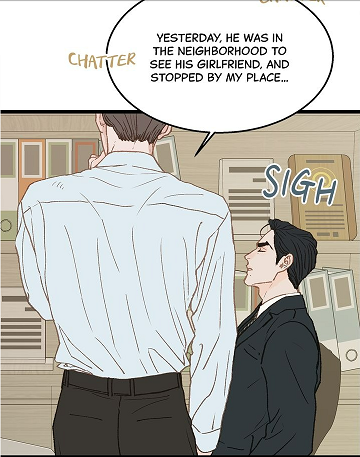 (chapter 7) But if this was true, why did he spend the night at his friend’s place and not at his partner’s? Besides, if so, he should have first gone to his friend, then later to his girlfriend. The order exposes the importance of Juhyeok in Seol Gido’s life. And this observation leads me to the following deduction: Kim Juhyeok is just a pure and innocent man who had never the opportunity to date anyone. He is literally clueless, hence he relies on his acquaintance’s advices.
 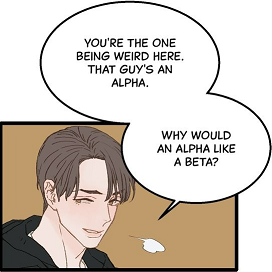 (chapter 4) However, the latter is definitely deceiving him. I would even add that he convinced the main figure that alphas would only date omegas. This panel exposes the misinformation. He can not imagine that a relationship between beta and omega or alpha with a beta is possible. We can see the actor’s influence in this scene.
  (chapter 4) The young man is not realizing that his neighbor, an alpha, is flirting with him. Observe how the actor reacted. He bumped into the guy on purpose
  (chapter 4), and though he heard the neighbor’s despair, he never revealed the truth to his friend. This shows that Kim Juhyeok has no idea about seduction and flirting, because Seol Gido messed up his perception, which he called “delusion”.
  (chapter 4) That way, the latter has the impression that he is possessing him. I am even suspecting that he could have played a role in this decision, as this question is requesting for an affirmation.
 (chapter 1) Yes, they are a couple!! So when the main lead saw this, his first reaction was to call the police:
 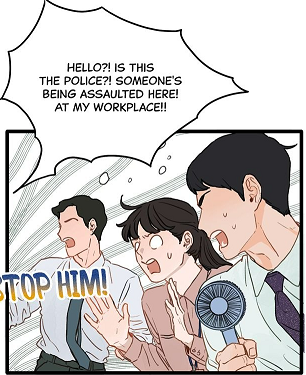 (chapter 1) 😂 Because of this couple, work gets affected, therefore the diligent representative can only be annoyed. This represents a threat to his own dream, surpass alphas and omegas. This is palpable in this quote:
 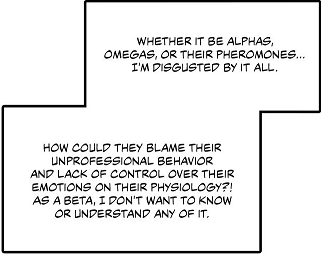 (chapter 1) For Kim Juhyeok, alphas and omegas behave like animals, for their behavior has such a negative influence on the company.
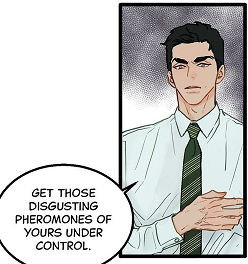 (chapter 1) This is what he said to his “wife” Lee Hyeonjae after slapping him. Besides, the heat cycle of omegas represents a huge hindrance.
  (chapter 2) Because of this incident, the betas, including Kim Juhyeok, are forced to work overtime!! I also believe this incident pushed Juhyeok to buy an inhibitor for omegas. that way, he would prevent a huge uproar in the company. Hence when he met Lee Sihyeon’s cousin, the omega Ha Weonyi for the first time, he offered him the suppressant. That’s how the cute omega fell in love with him!
 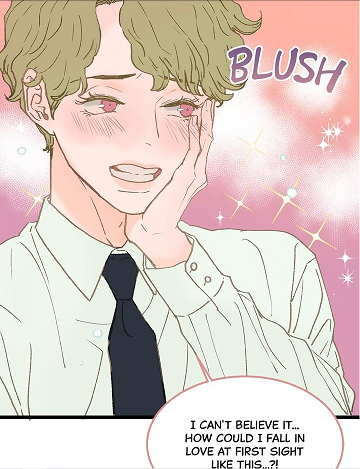 (chapter 2) The main lead seems so gentle and selfless, while in reality it was for his own peace of mind. As you can detect, their behavior stands in opposition to the protagonist’s philosophy and work ethics. The latter values work very much, as that way he can distinguish himself from others.
 (chapter 1) The hand on his shoulder was a sign of seduction and affection, even his offer, but the young beta never perceived it that way. He was simply annoyed. All the department was aware of director Lee’s feelings for Juhyeok except the concerned. He only discovered the truth, because his colleague Mister Kang voiced it:
 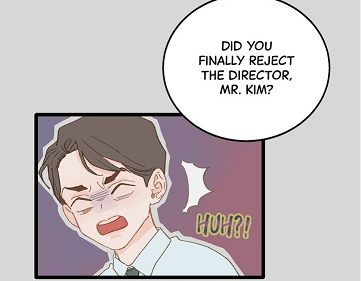 (chapter 4) However, here the protagonist had not rejected his superior, the latter was upset, because he had detected phemorones from Seol Gido on him. Hence Lee Sihyeon had spread his own heat phemorones on Juhyeok. And that’s how he got mistaken for an alpha by Ha Weonyi!
  (chapter 6) The irony is that when he had helped him with the suppressants, his cousin saw Juhyeok with them, and got his hopes up that Juhyeok could be indeed an omega.
 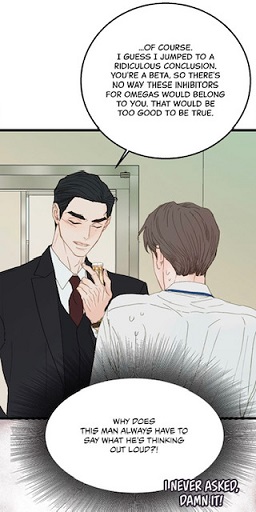 (chapter 2) In other words, due to his interaction with Lee Sihyeon and Ha Weonyi, Kim Juhyeok’s identity got questioned: was he an alpha or an omega? At the same time, he was encouraged to interact more and more with Lee Sihyeon and Ha Weonyi. This is important, because that way, he can finally drop his prejudices about alphas and omegas.
 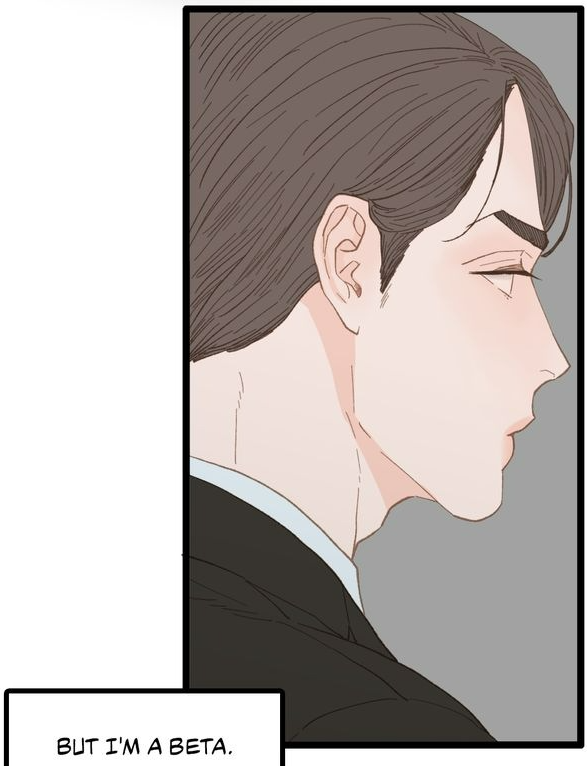 (chapter 14) As the manhwaphiles can detect, this image stands in opposition to the first panel: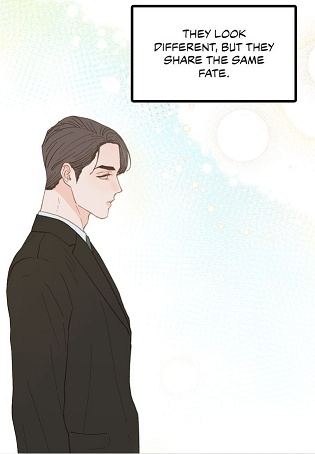
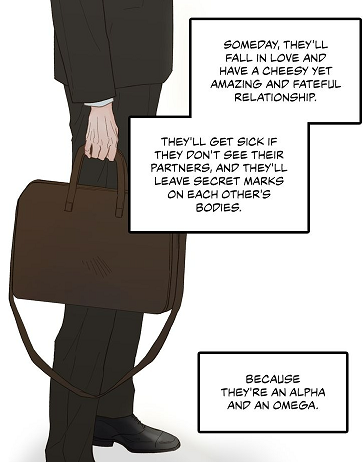 (chapter 14) This means that Juhyeok is longing for a cheesy and amazing relationship, but he has the impression that this can never happen to him!! It is only reserved for alphas and omegas… and now, you comprehend why he doesn’t desire to date anyone. In his eyes, this will never be a fated love! This means that he wished to have secret marks on his body, but he will never admit it so openly. Hence this scene in chapter 1
 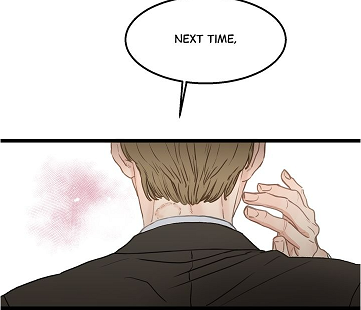 should be perceived differently. When he saw the bite marks on the omega manager Lee, he expressed his displeasure internally
  (chapter 1), yet deep down he felt jealous. This explicates why after this discovery, he wished more than ever to leave the company.
 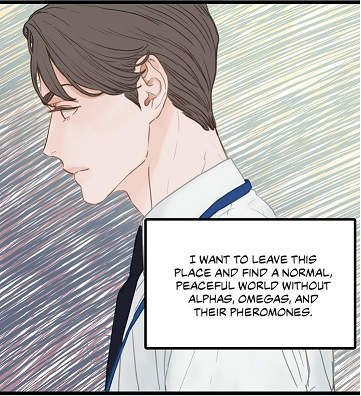 (chapter 1) Far away from anyone, he won’t be confronted with envy and regret!! In other words, he doesn’t wish to have an ordinary love life which is perceptible in the following words:
 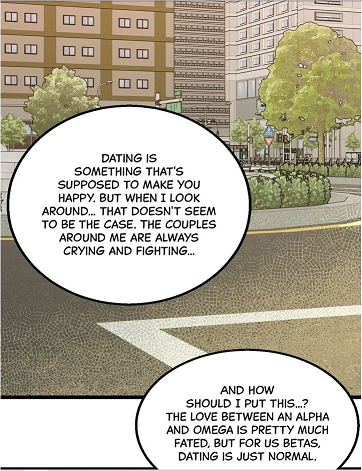 (chapter 14) Here, he implied that dating with a beta wouldn’t trigger deep emotions, as it is not “fated”. I detected a contradiction too. The only couples he mentioned so far were alphas-omegas. So far, he reproaches the couple to yell and weep constantly, yet he says that their relationship is fated. As you can see, in truth he envies them. And this shows that deep down, the main lead is suffering from inferiority complex which was already palpable with his desire to surpass alphas and omegas. Deep down, he did feel inferior to them. Under this new light, he becomes comprehensible why he feels the need to run away from alphas and omegas.
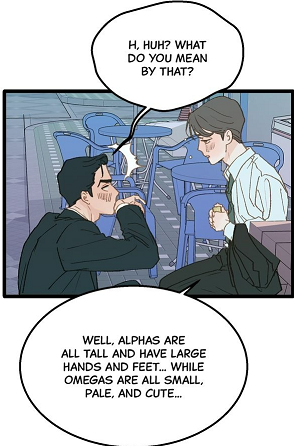 (chapter 10) The irony is that in the last scene, Sihyeon only paid more attention to the end of the sentence than the beginning: the omegas were all small, pale and cute! Consequently, he got jealous after hearing his love interest’s words! Yet, Juhyeok was actually praising him.
 (chapter 10) He grabbed his hand and led him, which is not something an omega would do. Yet, Juhyeok’s words oozed innocence! And since his dream is to be loved, and even to have a fated love, it is not surprising that he is already falling for Lee Sihyeon. He was the first one who confessed to him so plainly!! He was disappointed, when he thought that the director was not keeping his words.
 (chapter 14).The director Lee Sihyeon will do anything to woo his “prey”, the beta Kim Juhyeok. Exactly like Seol Gido, he chose a different approach: they are now friends! That way, he hopes that the young beta will put down his guard.
  (chapter 14) And observe that Sihyeon’s speech was similar to Seol Gido!! He also asked for a confirmation from the protagonist, that’s how both alphas are “influencing” the beta! However, contrary to the actor, Lee Sihyeon is more honest. He warned the beta not to trust the alphas, including himself. Another difference is that he is more straightforward than the actor. He definitely uses physical contact to break “the ice”.
  (chapter 13)
 (chapter 14) Ha Weonyi prefers betas over alphas, as the latter seem to be rude, arrogant and self-centered. His cousin even added that he would attract “weird alphas”. From my point of view, this will take place, because thanks to his interaction with the two cousins, Sihyeon and Weonyi, Kim Juhyeok will judge them as humans and no longer as alphas or omegas!! Yes, the major flaw of the protagonist is to lump alphas and omegas together. He needs to stop viewing people as a crowd, and starts perceiving them as individuals. Finally, since director Lee is the main lead’s superior, he can contribute that their “affection” doesn’t affect Juhyeok’s work and his philosophy. In fact, he can help him to achieve his goal, to become a role model for alphas and omegas!
 (chapter 6), while he had called him before a wimp. (Chapter 1) It looked like the champion was looking down on the main lead. With such an insult, the sportsman was implying that the physical therapist was no real man. As you can see, the famous athlete was contradicting himself. Why would he choose a “wimp” as an ideal “lover”? One might say that it is related to his lack of resistance. As a wimp, Kim Dan would never dare to refuse or reject him. It would be easy to control him as well. Nevertheless, what caught my attention is the expression from Joo Jaekyung: “in many ways”. This idiom alludes that the “hero” had many reasons to choose Kim Dan as his new partner. But what are they exactly? In this essay, I will attempt to answer this question. Nevertheless, we shouldn’t overlook that there exist other causes for his selection which Joo Jaekyung is not aware of.
  (chapter 5) This explains why he didn’t reject the main lead as his doctor right away contrary to the past.
  (chapter 5) Hence we could say that he was already under Kim Dan’s spell at the gym. (chapter 1) Hence he looked at him intensely first.
 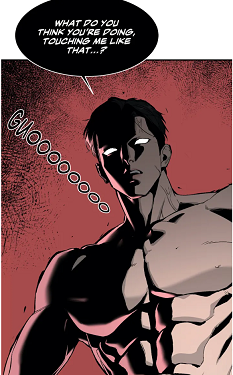 (chapter 1), he feared to have triggered the boxer’s fury. Yet, the man was actually pretty calm.
  (chapter 1) He was rather surprised by his reaction. Notice how relaxed his body is, as he is using his arms to sit up. Striking is that after hearing the main lead’s question, Kim Dan blushed out of embarrassment.
  (chapter 1) Not only he had made a stupid mistake, but he had also overreacted. He had been on the verge of crying, for he feared the fighter’s rage and brutality. Nevertheless, he never paid attention to his client’s behavior. The latter was observing him, for he had detected his tears right away. Then this was his reaction, when he witnessed the doctor’s reddening:
  (chapter 1) He was left speechless again!! The three points of suspension exposes not only his surprise, but also his curiosity. His attitude displays that he has never met such a behavior before. He would almost cry and even blush… And the author left an evidence for this interpretation. I would like the manhwalovers to take a closer look at the previous sex partners:
 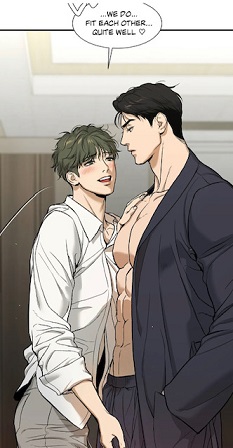 (chapter 2)
 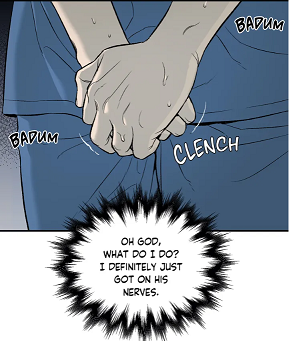 (chapter 1), he would tremble in front of him and at the end he would run away
 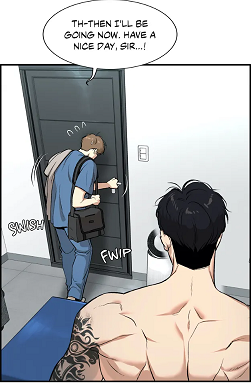 (chapter 1)!! Imagine that just before departing, he turned his back on the athlete while wishing him a good day. That’s not the way you are supposed to bid goodbye. 😂 He was running away. That’s the reason why Joo Jaekyung called him a wimp!! As the readers can detect, he was behaving the opposite to the previous lovers, while he would look similar to them. On the other hand, I would like the readers to analyze the boxer’s reaction, when he witnessed this scene.
 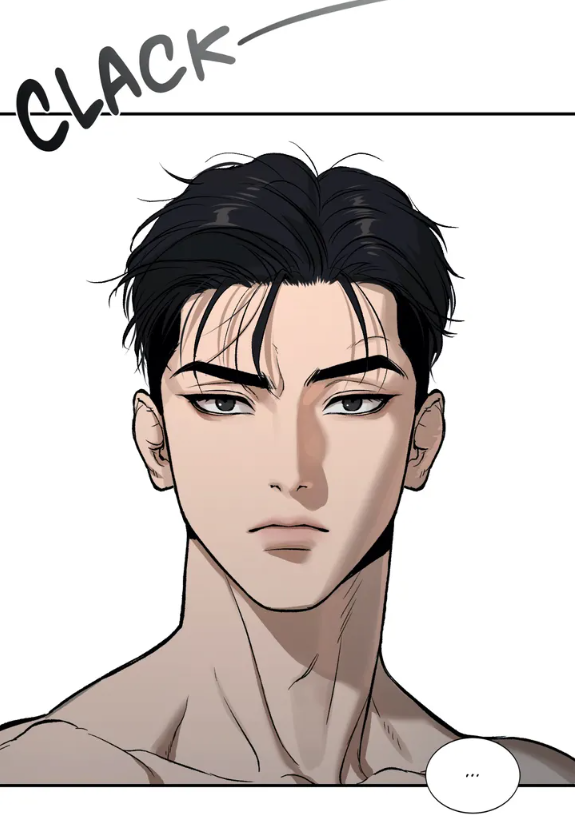 (chapter 1) Once again, we have the points of suspension. This indicates that the uke’s behavior made him pensive again. He got his attention. But there is more to it. One of his eye-brows is slightly raised, leaving a mark on the forehead. This gesture is relevant, as psychologists discovered that raising only one eye-brow is a sign of dominance. This exposes the fighter’s personality. Yet, I believed that this gesture also divulged his interest in Kim Dan. He was intrigued by such an attitude, this is something he had never experienced before too. So far, people would express their admiration, they would never turn their back on him, like we could witness in the flat with the lover. To conclude, the saying “opposite attracts” is present in their relationship which reminds me of Taoism. Yin and yang complete each other. Moreover, I would like that the celebrity didn’t just call Kim Dan a wimp, this is exactly what he said: “What a little wimp.” The adjective “little” softens the negative description. Besides, the author never revealed the fighter’s facial expression. Why? It is because the readers would have detected his interest in Kim Dan right away.
  Joo Jaekyung is trapping the uke in his arms, a sign for his possessiveness. To conclude, I am expecting that the doctor’s puzzling behavior will bring Joo Jaekyung’s insecurities to light, to incite him to question his beliefs and even his “jinx”. The more time they will spend together, the more Joo Jaekyung will become addicted to his “drug”, the sweet and gentle Kim Dan, forcing him to change his habits. The job offer to Kim Dan and later their deal already announced the transformation of the athlete. Little by little, the champion’s worldview will transform, discover the sweetness of life. 🍭
 (chapter 8).
  (Chapter 1). He appears as more brutal and partial, for his kingdom is called the hell of tongue ripping. It was, as if he was not allowing protest or disobedience, and there would only exist one sentence: tongue ripping. Secondly, he banished his own son to the mortal world, because the protagonist had played a trick on the book of names.
 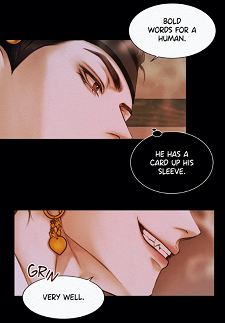 (chapter 1), had been asking this favor from him while tricking him. However, Yeomra wouldn’t listen to his defense so that at the end, Jae Shin was turned into a puppy.
 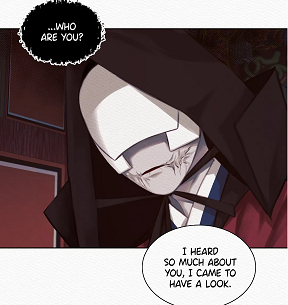 (chapter 8) or
  (chapter 14) what is he? A dream, a ghost, a human? And this leads me to the following observation: Jae Shin might be Yeomra’s son, but he has three appearances: the puppy, the nobleman and the ghost. This divulges that he has more than just one identity. In this picture, the author outlined the two sides from the main lead.
 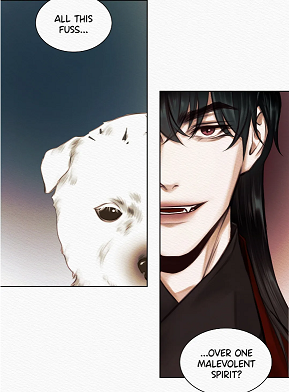 (chapter 7) This is no coincidence. If you pay attention how the main figure was called by Yeom, HALF-BREED
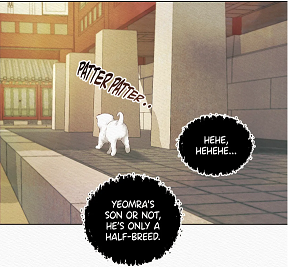 (chapter 7)
 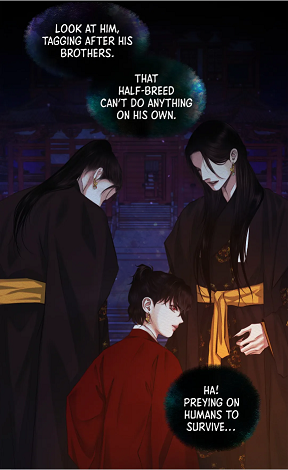 (chapter 15) Even Yeom who didn’t recognize him immediately, as she had never met him before,
  (chapter 8) still knew about his rumor. This indicates that Jae-Shin is different. One might say that it is related to his dependence on yin energy (“preying on humans to survive”). Hence he portrayed himself as defective.
  (chapter 15) This shows that he wished to be different, to resemble his hyungs and other “ghosts”. However, in my eyes, this is not the true origin for his reputation as half-breed. If the beholders look carefully at this image
 (chapter 1)
  (chapter 1) The color is exposing his special status. Secondly, in this image, we could see the young version of Jae-Shin
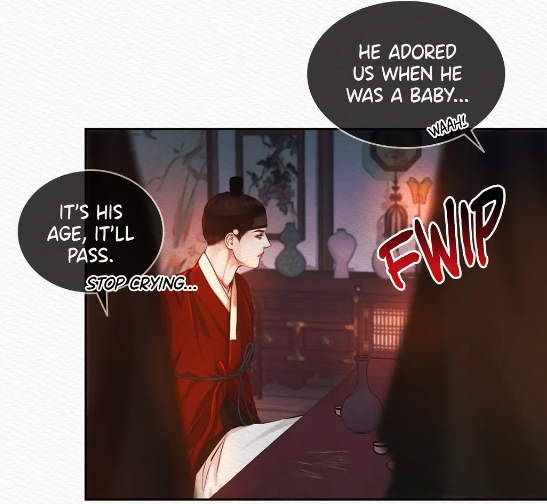 (chapter 15) In other words, he had the same evolution than a human! The only difference is that he doesn’t age and die like humans. He is already a few centuries old.
  (chapter 3) Thus I came to the conclusion that Jae Shin is actually the result of an union between Yeomra and a human. Hence he resembles a lot to a vampire with his teeth and long nails, as the vampire is considered as a living corpse. Moreover, the Korean version of a vampire, the gangsi is supposed to absorb Qi, life force. Nevertheless, Jae Shin is not a gangsi, for he can move freely and his body contains blood. My point is that Jae Shin became immortal thanks to his father, but since he was born from a human, he was first a baby before becoming an adult. This explains why Jae Shin’s main color is red, the symbol for life, combined with black, a reference to his father, as this color symbolizes the underworld! Under this new approach, it becomes comprehensible why Jae Shin is forced to go to the mortal world to replenish in yin energy, which is not a necessity for his hyungs. The older brothers don’t often visit the mortal world.
  (chapter 15) As you can sense, for me chapter 15 was very eye-opening! And once you accept this theory, you can comprehend why the father turned him into a puppy.
 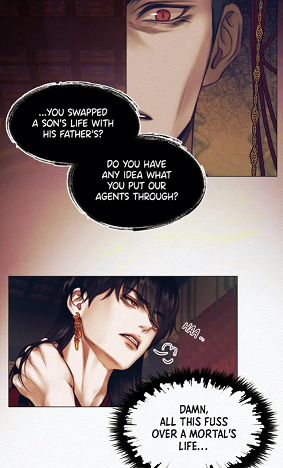 (chapter 1) In his eyes, they have no real value. Moreover, he resents them for their hypocrisy
  (chapter 3) He prefers the afterlife world to the mortal one. And because he was different from the others, he got spoiled by his father, brothers and other gods.
  (chapter 3) Since he is the result of an union between a god and a human, he needs human energy (yin). Therefore he bleeds like a human
 (chapter 15), when he gets stabbed, but because he is an immortal, he can heal.
  (chapter 16) Striking is that he called himself a ghost, but Lee Nok didn’t accept this, for he is visible to humans.
 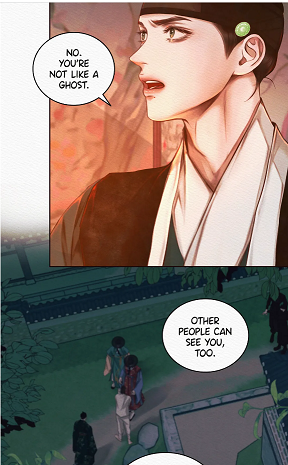 (chapter 16) This is important, because by identifying himself as a ghost, he is actually denying his “human nature”. However, he is not realizing that “ghosts” were all once humans which is not the case to Yeomra, Jin-Gwang, Cho-Gang and probably to his brothers. They are “gods”. In other words, the moment he calls himself a ghost, he indirectly admits his “human origins”.
 The association is already presented in the title, as it is part of the “ghost”.
  Besides, the manhwalovers can detect its presence in three occasions.
  Jae Shin is wearing an earring in the form of the lycoris. Then the red spider lily
  (chapter 9), was present, when he changed his appearance and dressed as a noble.
  (chapter 9) But what is the meaning of this flower then?
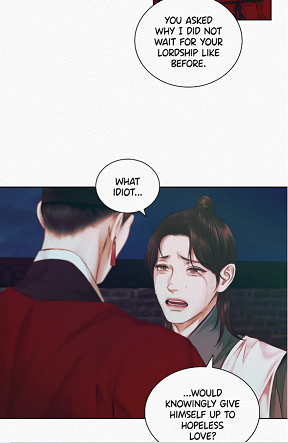 (chapter 9) This was their final goodbye. It takes courage to love someone so different, to love an immortal. That’s the reason why the father sentenced his son to win a human’s heart. He was teaching him a lesson, he should learn how his father fell in love with a human.
 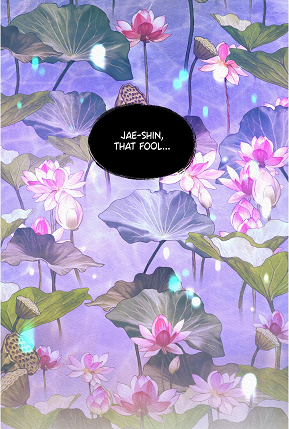 The purple lotus flower symbolizes spiritual enlightenment as well as faithfulness and innocence. The purple flower indicates harmony and balance between different parts of ourselves. [For more read the essay: The lotus and the snake] But since the pavilion and pond were facing the palace where Jae Shin was staying, the presence of the lotus is announcing the future purification of that place full of evil spirits and ghosts.
 (chapter 14) This shows that his body’s energy works like a huge talisman. But in order to become effective, he needs human energy. Hence I couldn’t help myself making the following connection, when I read Yeom’s comment about Queen Han:
  (chapter 13) She attributed the queen’s protection to a strong amulet, as she believed that the woman was a human. However, the moment you admit that Jae Shin is the fruit of a love between the god of the underworld and a human, you can imagine that Queen Han could have the same nature. Her aura could be so strong that she can push away powerful ghosts like Yeom. Yeom thought that the young girl was attracting ghosts like Lee Nok
  (chapter 8), thus the shaman advised to the father:
  (chapter 8) She encouraged him to have his daughter accumulated good karma. She was indirectly trying to change the girl’s personality and as such destiny.
  (chapter 8) From my point of view, the young girl was discovering her second nature, she could see and talk to ghosts. Thus she smiled. As you can see, I came to develop the following idea: Queen Han is a half-breed like Jae Shin, but contrary to him, she prefers the human world. Why? Because of her powers, she can control people and gain power. This explicates why she chose to get rid of the shaman whom she viewed as a threat. At the same time, thanks to the intervention of the “spirits”, she discovered how powerful she was. Thus she smiled…
 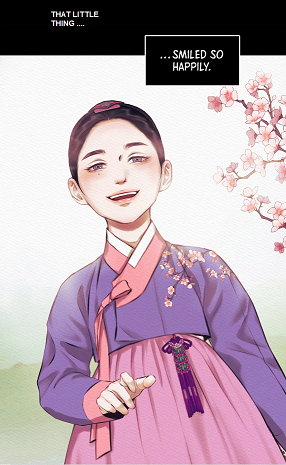 (chapter 8) like a flower
 (chapter 8) These words reminded me of the lycoris, the flower of death and funeral. We have many possibilities for her lineage. Either she is a new version of Gongju Bari, or she could be the product of another god, like for example this one: Seokga.
 (chapter 13), yet the brother had not heard about such a death.
 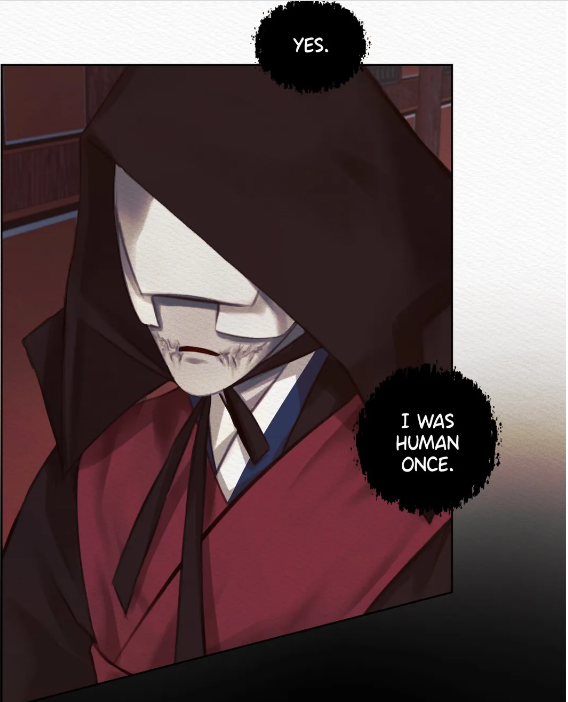 (chapter 8) Exactly Jae Shin, she is living between two worlds, her body might have died, but she is by clear conscious.
  (chapter 9)
  (Chapter 5) It took him a whole week to recover from this encounter. (Chapter 5) He was physically and mentally wounded. His behavior fits all the criteria in chapter 6. He is totally selfless and is risking his life emotionally, physically and mentally. He definitely sees the champion as a „criminal“, since he keeps comparing him to the director from the hospital. (chapter 6) He has indeed become a true hero, hence he received the admiration and love from all the readers.
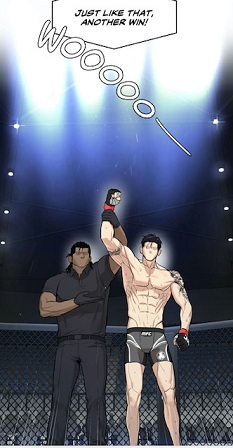 (Chapter 5) At no moment, in the ring, he risked his life, for this fight is controlled by a ref and both boxers are required to follow certain rules. But the seme has not realized this yet. Like I had pointed out before, he takes everything too seriously. He views his games as a matter of life or death. One might think that he has never had a strong opponent so far, but we have two indications that his career wasn’t always smooth.
  . (chapter 1) The legend is implying that this was not like that in the past (“the streak continues”). Secondly, he has cauliflower ears
 (chapter 1), a typical consequence for fighting. [Here I would like to thank @delune_art for her observation]
 (chapter 2) In other words, Joo Jaekyung favors a certain type, but he is not aware of it. Hence he claims that all his sex partners were different. And now, you have the explanation why he views people he has sex with as tools and even whores. He used money as a protection, a wall to keep his distance from people. This is not surprising why he was happy, when Kim Dan asked for financial support. That way, there was no string attached.: “So it was just the money, after all”. (chapter 6) But naturally, he is deluding himself, because observe that he is now changing his sexual habits!
 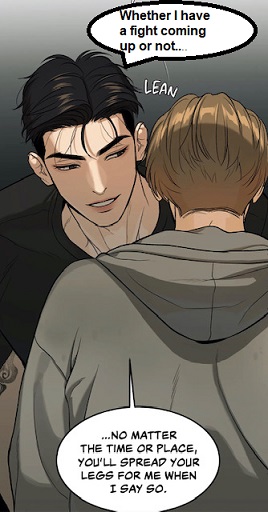 (chapter 6) It is no longer linked to his jinx, because he is asking Kim Dan to have sex no matter the time or place. This little detail makes a huge difference, the start of his new obsession.
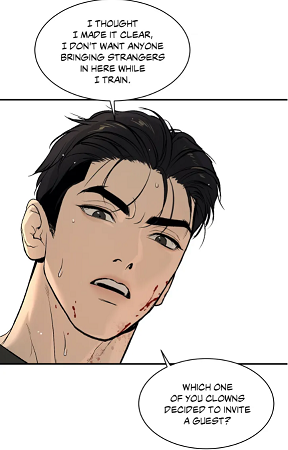 (chapter 1) before and after the arrival of the manager. The tone changed immediately.
 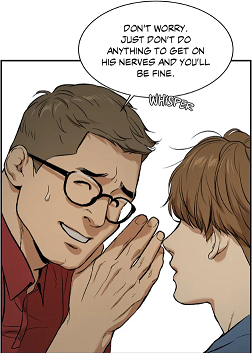 (chapter 1) Then when his athlete wondered why he had not heard from Kim Dan, the manager not only took Kim Dan’s side, but also criticized his athlete. First, when he said that the main lead had asked him like a million times, (chapter 5), he was implying that he had bothered him a lot. Then
  (chapter 5) the idiom “something” is a reference to the sportsman’s behavior. He reproached him in a calm manner that he would nag constantly. Yet, at no moment, the boxer felt insulted. That’s why I couldn’t help myself judging him as a “hero”. He could tame his sportsman and turn him into an obedient “puppy”. The latter is always well-mannered in front of him and never showing his frustration.
 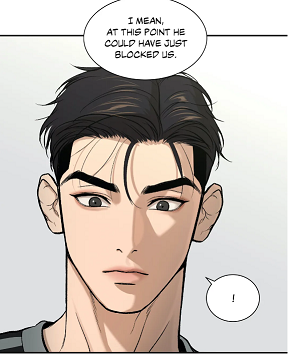 (Chapter 5) He got caught by surprise by this point. He never imagined that Kim Dan would reject or even block him, as he is considered as a “champion”, a hero!! But the moment he turned his back from the manager, he couldn’t control his frustration and anger. Thus he smashed the punching bag with such a force. (chapter 5) On the other hand, he couldn’t control his gaze, when he heard that he could get blocked. (chapter 5) This whole scene displayed the respect Joo Jaekyung had for the manager and his friend. At the door, he never exploded. But why is it so? Like mentioned above, he views the man as his family. And we have another proof for this: “block us” was turned into “block me”. As you can see, the personal pronoun “us” indicates that Joo Jaekyung considers the man with the red shirt as an unit, a home.
 (chapter 1), yet he used an ambiguous expression. For the manager, it sounded like the champion had beaten him, while the sexual insinuation was present. His choice of expressions indicates that he desired to stay as close as possible to the truth. This shows that the main lead has no real intention to manipulate his “hyung”. He is not doing it out of malevolence, rather out of fear in my eyes. This is also perceptible in this scene.
 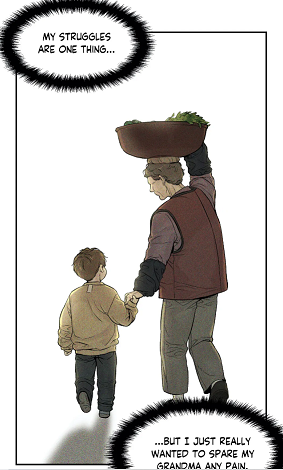 (chapter 5) This is perceptible due to her clothes and her basket. She was more or less a “peasant”, living in the countryside. And the young child could sense her struggle. She dedicated her life to raise Kim Dan properly so that he could get an education. She was so selfless and caring that she protected her grandchild from the loan sharks’ brutality.
 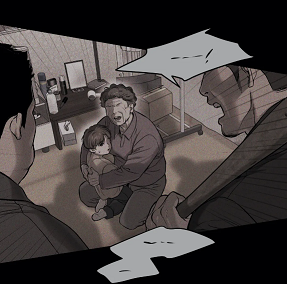 (chapter 5) With this scene, the manhwalovers could discover that Kim Dan’s debts existed, even before he became an adult. This means that this was the heritage from his parents. Hence I am suspecting that one of a parent deserted the family in order to escape from the loan sharks and left the debts to the halmoni and Kim Dan. And if you recall the criteria for heroism, you will recognize the halmoni is a true heroine. Hence you comprehend why the young protagonist is willing to do anything for his grandma. He is trying to repay his “debts”, since she had to suffer so much in the past. There is no ambiguity that the young man feels responsible for her. And if you observe the chapters I quoted the most so far, this was episode 5 where the manager and the halmoni were introduced properly for the first time!!
  In order to fully grasp the boxer’s mentality, it is relevant to know the true signification of this word:
  If he can not defeat his opponent, he “will die”. This is no coincidence that his color is black
 , a pigment that symbolizes nowadays death. Being too serious has huge negative consequences. Such a person can never be happy. The reason is simple. He is focusing too much on career and work that he is overlooking to enjoy the moment. The person is not able to play and to take time to laugh along the way. In the end, he doesn’t know what truly matters in life.
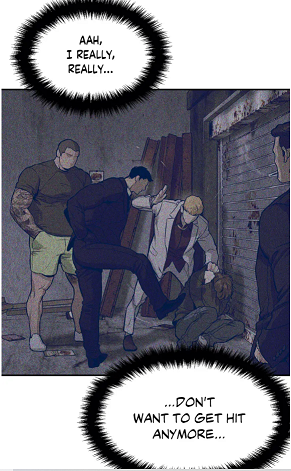 At the same time, imagine what a defeat could signify for the champion. He would judge himself as worthless, as in his eyes, only strength is important. To conclude, I think that this violence from the athlete is much more complex, just like its origins.
  Nevertheless, the fighter is totally wrong in that aspect. It takes a lot of courage to admit a mistake and to ask for forgiveness
 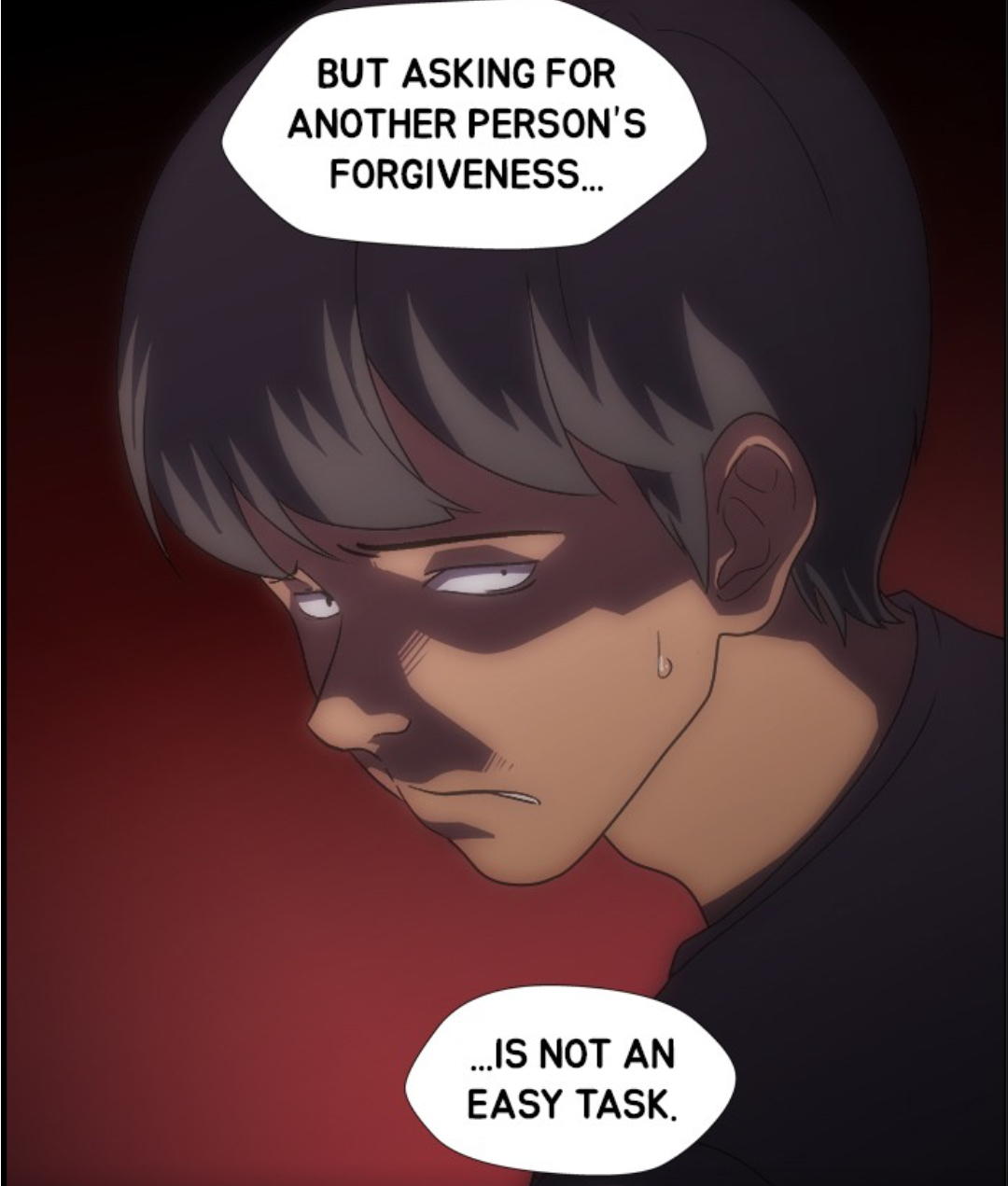 (doctor Frost, chapter 211), because we don’t know if the offended person will accept the excuse.
  And this is exactly what happened with Kim Dan. He apologized, yet he still feared that he would be hit.
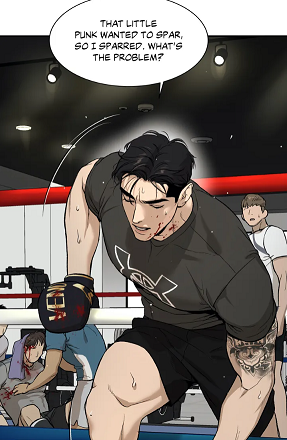
  and apologized before before becoming silent and inactive. Hence I believe that this is what the uke will teach the strongest man in the world. He needs to learn to admit his mistakes. And this is no coincidence that in the ring, the brutal man never voiced regret towards the “green” man. With his expression “punk”, he had the perfect excuse to avoid the apology. That’s why he didn’t reply to the trainer immediately and in front of him
  (chapter 1) It is because they had all heard about the boxer’s violent behavior and his stubbornness:
 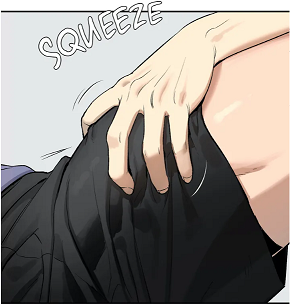 The anaconda 😂 Yes, the length and and size of his phallus! While Kim Dan was massaging him, the man was relaxed, hence this signifies that it had not reached its maximum size!! And now, imagine what happened to the last doctor… The latter could have made an intentional move, but the champion has always separated his career from his private life. No one at the gym knew about the champion’s homosexuality. Since for the boxer, everything is a matter of life and death, he definitely views sex as a fight too. It is about his own climax, and not about feeling good or giving pleasure to his partner, even less about love! Therefore it is not surprising that the man is having sex in this position.
  (chapter 1) He doesn’t feel the need to see his partner’s face or to talk to him. And if you read my analyses about Painter Of The Night, you are all aware of the signification of such a position. It is about power struggle and victory. This observation leads me to the following conclusion: Joo Jaekyung’s rough sex is just the consequence of his “mentality”. In truth, he is masking his own anxieties, his manhood. This is just a speculation on my part, but I have the impression that his overactive superego is his way to deal his own sexual orientation. Homosexuality is often perceived as a lack of masculinity and strength, and note that so far, the boxer has been following social norms quite strictly. He embodies the prototype of the successful and wealthy boxer. We definitely need more information about his past, his family and surroundings. Another possibility is that the athlete is bothered by his huge phallus, which he could view as “jinx”…. For him, it is the reason why his former sex partners keep running away. The author will give us more elements in the future episodes.
 and contrary to the others, he will keep having sex with the protagonist. 😂 Under this aspect, the readers can grasp why the anonymous sex partner said nothing, when Joo Jaekyung called the main lead.
  I am suspecting that the man didn’t find this sex session very pleasant, as he was clinching onto the sheets. Besides, why would he call him in the middle of the encounter? And he could see Kim Dan as his savior… it was his luck that Joo Jaekyung had a new physical therapist.
  Even the author Black Apricot from Legs That Won’t Walk couldn’t help herself to praise the main lead for his handsomeness on Twitter. Striking is that this picture represents the perspective from Kim Dan, the other protagonist. In other words, not only the readers were enchanted, but also Kim Dan. He couldn’t restrain himself from voicing his fascination by whispering “WOW”. The gentle and pure man was voicing what the readers felt. While massaging him, he kept starring at him, complimenting for his skin, his muscles and even his visage. He had the impression that he was really lucky, for he never had such a client before.
 It was, as if he was claiming the main lead. He was his reward and trophy. And now, pay attention to the clothes the bottom was wearing, when he met his client.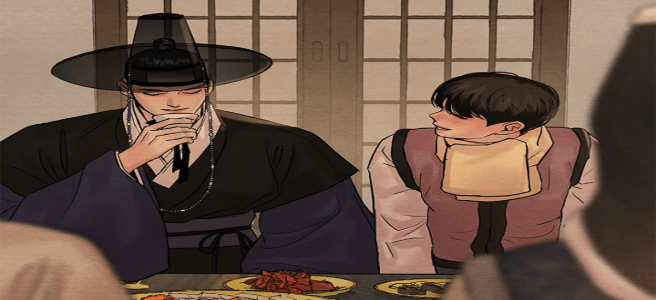
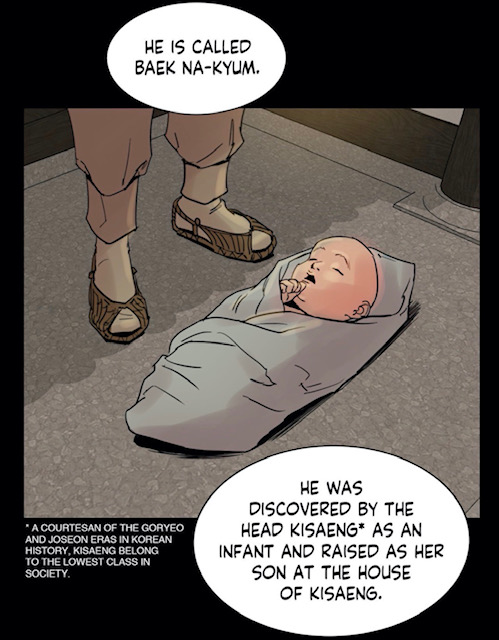 (chapter1) Or was she simply the noona?
 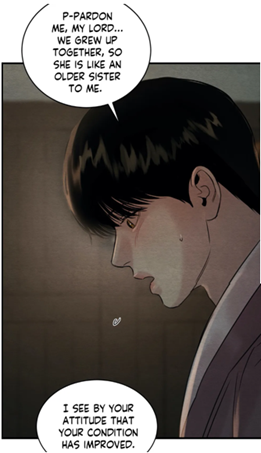 (chapter 70) At some point, I came to realize that Heena had acted as the surrogate mother, but she had never clearly stated that she was the painter’s mother. In other words, his adoption was never official, which explicates why the main lead only considered her as his older sister. This is important, because her ambiguous status can not only generate problems, but also expose her betrayal towards Baek Na-Kyum. Note that in chapter 97, the noona treated Baek Na-Kyum as her “child” who wouldn’t listen to her
  (Chapter 97), while later she implied that they were both equal, for she employed the personal pronoun “us”.
  (chapter 97) On the other hand, she used her seniority as status, when she called him a fool
  (Chapter 97). He lacked experiences, hence he was too naïve, and as such he would trust the protagonist too easily. As you can see, Heena herself had an ambiguous relationship with her brother. Nonetheless, thanks to chapter 93, I got finally a definitive answer about Heena’s true identity. She is indeed the head-kisaeng in the gibang. I realized that the protagonists were invited to stay in Heena’s personal room.
  (Chapter 93) That’s the reason why the seat of the host was empty and why Yoon Seungho didn’t go there. He would have violated social norms, if he had taken her seat.. Moreover, by doing so, he would have revealed that he knew where the woman was. This could have raised questions.
 (Chapter 93) This means that the figures were not sitting in the room shown in the last panel. On the other hand, their voices in the hallway exposed their location. The noonas and Heena were not far away from that door hidden by the veil. That’s how I got aware where Heena’s room was situated. In the last picture, the readers are turning their back from Heena’s study, which is right after the corner. Thus I could recognize the design of the building: ][ In the center, there is this huge hallway with the purple veils, but at its end, on each both sides, there exists a corridor perpendicular to the one with the purple curtains. What the beholder imagined as a door at the end of the hallway,
 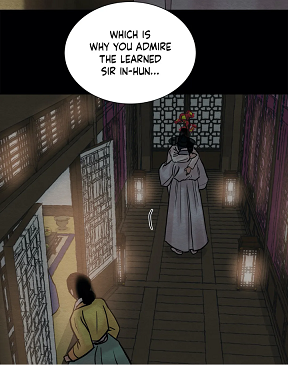 (Chapter 68) was in truth a huge window. How do I know this? First, in this scene, the scholar was hiding a huge white vase with red flowers. Hence I deduced that Jung In-Hun couldn’t have walked through that “gate”, it was just a window. Therefore I assumed that he had to walk past the flowers, either turn to the right or the left. Secondly, observe that next to the lantern on the left, there is a small white panel. This means that the view from chapter 93 was more or less taken from the right corner. Moreover, in the next chapter, Heena is not facing this “window”, when she is in the same building.
 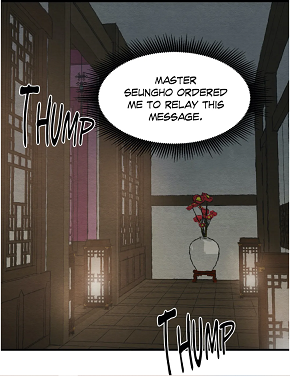 (Chapter 69) This time, the white vase with the flowers is standing in front of a wall. That’s how I deduced that Heena had to turn to the left in order to go to the hallway.
 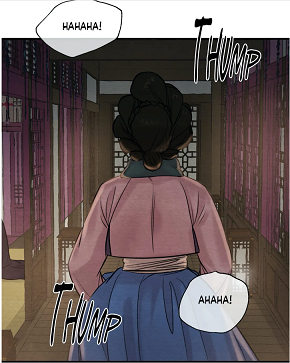 (chapter 69) On the other hand, another element caught my notice. In this picture,
  (chapter 93) which is not present in episode 69.
  (chapter 93) Since I came to the conclusion that Heena’s private room was on the right side after the corner, I deduce that the kisaeng was not on her way to her room. Moreover, since the kisaeng was walking in the same direction than the scholar, I can only conclude that Heena was actually approaching the entrance of the building. I believe that she had turned around, but the author didn’t reveal this. One might argue that it is possible that in chapter 68, the learned sir could have gone with the painter to Heena’s bedroom. However, back then the latter was not the head-kisaeng. We know this due to the presence of a kisaeng standing right behind Yoon Chang-Hyeon during the sexual lesson.
 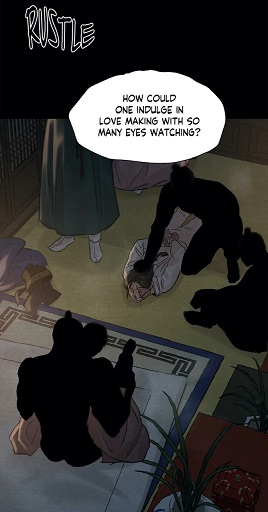 (chapter 86) She was the superior. Moreover, we saw the teacher walking through the countryside during the night.
  (chapter 70) That’s how I realized that Byeonduck had deceived the readers once again. She was playing with reflections. That’s the reason why I deduced that Heena was not talking loudly by accident in front of Black Heart.
 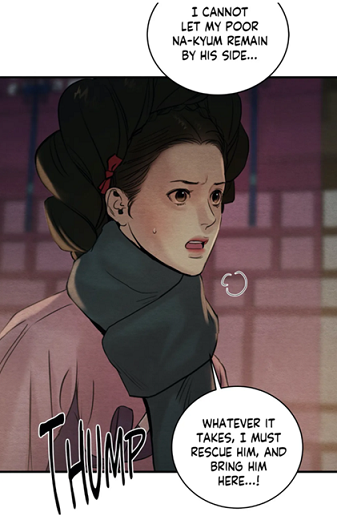 (chapter 69) It was done on purpose!! She wished that Min would take care of her brother. Under this new light, it becomes comprehensible why the noona has a drop of sweat on her cheek. She is faking ignorance, she is acting, as if she was very protective of her brother. She uses illusion to manipulate people. In reality, she was acting here. One might argue that I am overthinking again. This is not possible, for Heena didn’t know Min at all. Hence she couldn’t manipulate him. The latter had heard of her for the first time in Yoon Seungho’s mansion.
 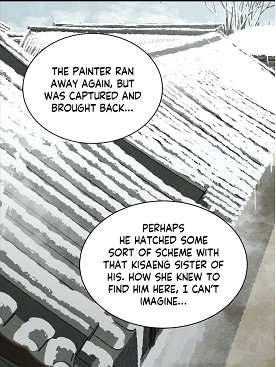 (chapter 66) But let me ask you this. How could Heena have never met Min, when she was the head-kisaeng? Secondly, just because the servant had never heard of the noona, this doesn’t mean that it was the case for Black Heart. The domestic assumed Black Heart’s ignorance, just like the readers. Moreover, recently I had detected that Heena had been standing in front of a mansion belonging to a noble.
 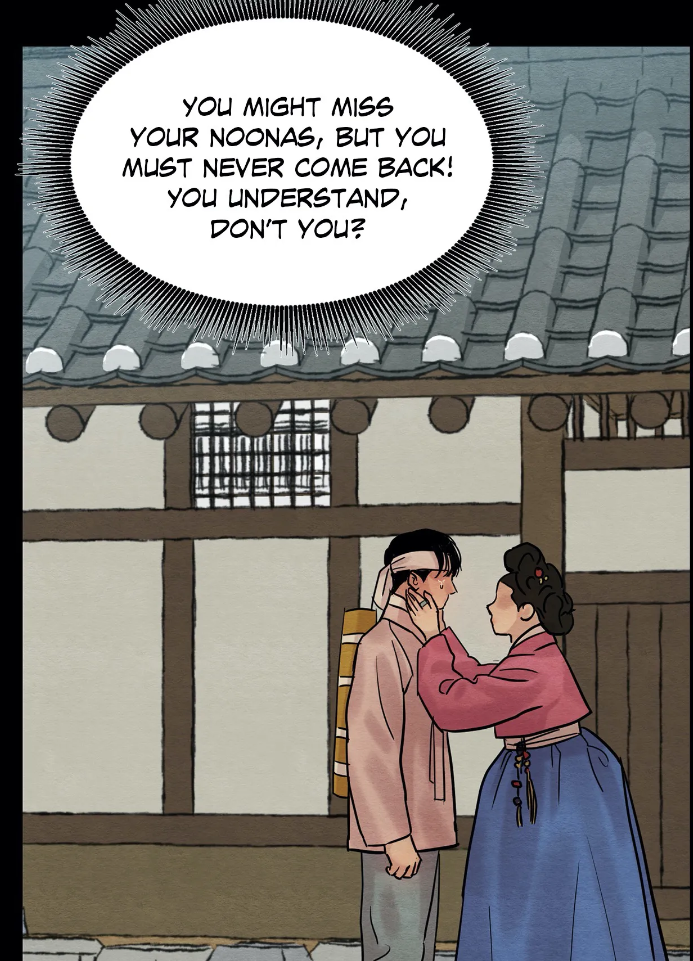 (chapter 46) This was not Yoon Seungho and Lee Jihwa’s mansion, for the gate and walls
 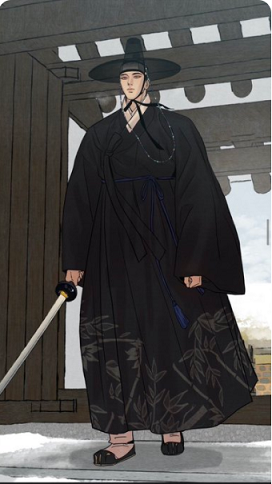 (chapter 67) diverge. Moreover, Min has been seen in the kisaeng house in so many chapters
  , (chapter 19)
  (chapter 59). Here, I would like to point out that in episode 59, Lee Jihwa had visited the kisaeng house on different occasions, for his hair was slowly growing.
 (chapter 59) Moreover, note that his visits took place during the day and not during the night. Why? It was for privacy and so far, during the day, the manhwaphiles never saw any kisaeng in the gibang.
 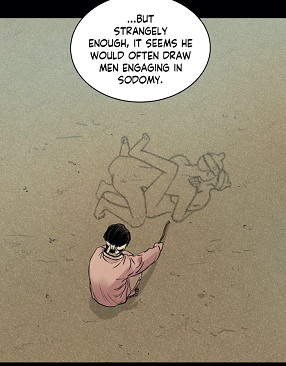 (chapter 1)
 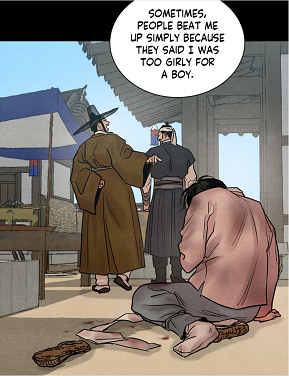 (chapter 94) Lee Jihwa was not supposed to meet kisaengs. As you can see, Min had strong connections with the gibang, just like Lee Jihwa. Hence Black Heart should have known Heena, for she was the head-kisaeng. But I would like to bring up a more conclusive proof for this interpretation.
  (chapter 19) This image was showing us that Yoon Seungho was visiting the gibang. However, pay attention to the pattern of the doors in the last picture and the next:
  (chapter 19) The motive diverges, it looks like the one from the hallway with the purple veils. This means that the party was not taking place in the room shown in the former picture. What caught my notice is the presence of the white vase with the red flowers in front of the building. It was present in each scene taking place in the gibang.
  (chapter 93) For me, the red flowers symbolize Heena noona. This explicates why during the painter’s dream, the flowers were not present.
  (chapter 87), as Heena was not included in his vision. And this image
  (chapter 44) Due to the similarities, I believe that in chapter 19, Byeonduck was actually exposing the ghost head-kisaeng. Exactly like the father, she was hiding. Why? It is because she is involved in Yoon Seungho’s suffering. And now, imagine her reaction, when she hears that Black Heart has organized a feast for the main lead’s honor. The woman could only avoid the main character. And now, you have the explication why Heena as the head-kisaeng was not present during that festivity. It was deliberate.
  (chapter 19) Striking is that the kisaeng had a similar hair dress than Heena, This is no coincidence. She was acting as the head-kisaeng. The manhwalovers will certainly remember that only two kisaengs had no braided bun or braids: this one
 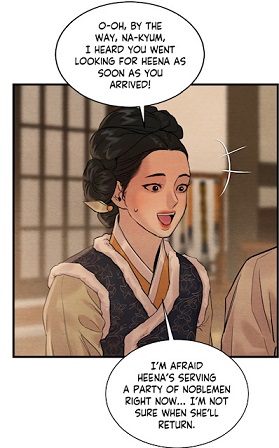 and Heena. Look at all the others:
  (chapter 51)
  (chapter 93)
 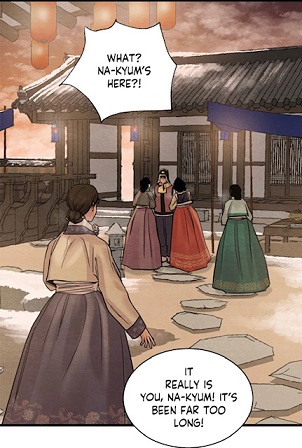 (chapter 93)
  (chapter 95) The extravagant hair dress was exposing the kisaeng’s status. And now, you comprehend why the other noona explained the disappearance of Heena during that night.
  (chapter 19) But how could she sense that the noble was in a good mood? The latter was silent and not even smiling.
 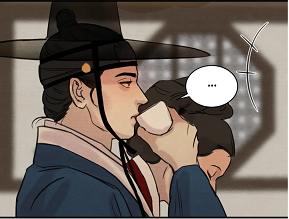 (chapter 19) How could she claim this? In reality she was actually spying on him. Heena had no idea why the lord would come to the gibang, especially after suffering there so much. The kisaeng’s task was to dig up information. This visitation must have bothered the head-kisaeng.
  (chapter 69) She was even turning her back to him. But actually, she could have detected his presence, exactly like I had recognized him: through his laugh!!
  (chapter 99) He was wearing a veiled hat, yet in chapter 69, this was not the case.
 (chapter 88)
  (chapter 99) Under this new light, Min’s words get a new signification:
  (chapter 99) He was implying that they knew each other for a long time! The irony is that the manhwaphiles had the impression that their relationship was recent, and his cynical tone contributed to it. Secondly, he called her Heena, a sign that they were close to each other. Note that Lee Jihwa never mentioned her name.
  (chapter 99) His words even insinuate that Black Heart had just given the following order. The red-haired master should just fetch a kisaeng and in my opinion, Heena was waiting for Lee Jihwa’s arrival to leave the gibang. According to his words, he had no idea about the kisaeng’s identity. But is it true? I have my doubts now, and this for two reasons. Why would he ask about her identity, when he already knows that she is a kisaeng? The drop of sweat on his face is an indication that he is lying. But the problem is to determine if the deception is only referring to “I heard not a word” and to all the questions. Let’s not forget that he knew about Min’s initial intention. The moment Lee Jihwa arrived in the gibang, she just followed him. That way, they would avoid to attract attention, and with her new hair dress
  (chapter 93), the gibang had lost its “leader”. This explains why this noona as her right-hand had to explain the absence of the owner.
 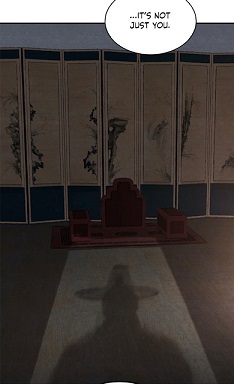 (chapter 86) The latter had been eyeing the throne in the family mansion, but he failed to take over the mansion. This was the negative reflection of Heena. Whereas the kisaeng had a powerful position in the gibang, it was the opposite for the patriarch. He was no longer recognized as the head of the Yoons. Yet, both have something in common. Both lost their position for good, for Heena and Yoon Chang-Hyeon couldn’t take or keep the seat. We could say that both got defeated by Yoon Seungho. In chapter 93, the main lead acted as a respectful and calm master, whereas in the bedchamber he showed no respect to his own father. He talked back and even made fun of him.
  (chapter 87) This picture stands in opposition to this one:
  (chapter 93) To conclude, the surrogate mother and the patriarch made a similar experience in season 3. Both got deceived by manipulations and in both cases, letters played a huge role.
  (chapter 94), definitely thinking that he was doing the right thing. He thought that he could never get into trouble. But this is just a deception in my opinion. As for the former head-kisaeng, she has to run away, for she did something wrong! In the past and in the present! She definitely plotted, and she is aware that her actions will have terrible repercussions.
 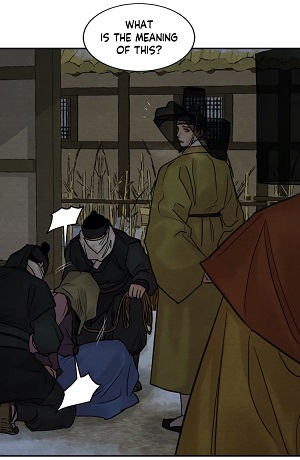 (chapter 99) No one would be looking for her. The problem is that the witnesses of her curtains all vanished. Lee Jihwa ran away, Black Heart got killed with his friends, and the only survivor, lord Jang, was confronted with real corpses in the shaman’s house.
  (chapter 102) That’s why I come to the deduction that her murder will be questioned. Why? There is no blood contrary to the bloodbath in the shaman’s house and there is no corpse!! Since Black Heart used different corpses in order to deceive Heena and the couple, there is no ambiguity that the head-kisaeng’s curtains will be doubted. Striking is that Heena staged her death out of cowardice and selfishness, while Yoon Seungho made the opposite decision. He was resolute to commit suicide in order to follow his lover in his death. During that night, Heena and Yoon Seungho lost their “home”, but at the end, he found his true home: the painters embrace.
  (chapter 102) He gave up on everything (fortune, house and life), hence he will be rewarded for all his sacrifices. Under this new light, I am more than ever convinced that Heena has not reached the bottom. Her karma is to be punished for her deceptions and acting!
  (chapter 96)
  (chapter 96), though he is a noble. Besides, I am suspecting her of suffering from genophobia (fear of sex and intimacy) Their behavior exposes closeness and a certain trust. But how is this possible? It is because she knows that Min is a sodomite, and he is not looking for sexual favors. That’s the reason why she trusted Black Heart in my opinion. Moreover, he is smiling like Jung In-Hun. Therefore it is not surprising that she was speaking like the Joker in chapter 97. Here, the man had actually projected his own thoughts onto Yoon Seungho, and due to her own belief, Heena was more than willing to believe Black Heart.
 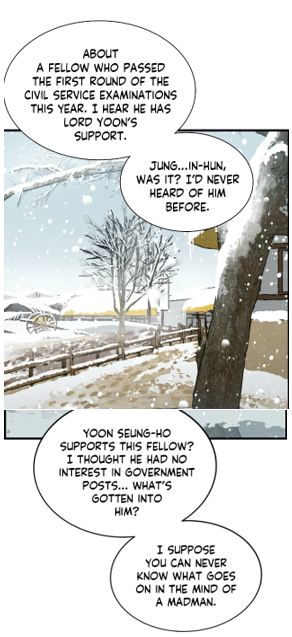 (chapter 52) It is because Black Heart knew Heena! I even believe that he had already met the scholar. Note that the man with the black hanbok was repeating the rumors about the learned sir. And the other questioned the main lead’s action exposing that he had never heard about this grapevine before. Hence I am deducing that the one spreading this rumor could only be MIN!! That’s the reason why he just said this
 (chapter 52) That means that the noble knew the teacher in the end. Therefore it is no coincidence that Min was aware where the learned sir lived!!
 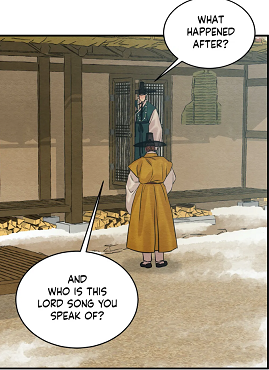 (chapter 83) And now, if you connect the two scenes
 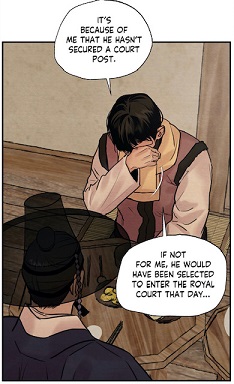 (chapter 52). Why? It is because there was an incident in the gibang!!
  (chapter 01) And who had covered up the incident? Heena, for she was the head-kisaeng! She had lied to her brother by blaming the biggest victim, Yoon Seungho, who was the man with the braid! This image is a real memory of Baek Na-Kyum from that night, yet from far away, the painter couldn’t see the face of the sodomite! This is another secret Heena has been hiding from her brother!
  (chapter 94)
  (chapter 97)
  (chapter 97)
  (chapter 101), and even Kim hid his face under a hanbok.
  (chapter 92) That’s the reason why I believe that in season 4, the visage will play a major role! The couple will recognize people due to the face!! In my eyes, the former head-kisaeng knows the identities of all the persons involved in Yoon Seungho’s suffering.
  (chapter 97) her brother is detecting her deception.


 The painter’s mouth is wide open. This implies that the painter is laughing! In other words, these pictures are showing a happy Baek Na-Kyum. The laughter is not just a symbol for joy, but also an indicator for social bonding, cooperation and as such social acceptance. Note that in all these scenes, the painter is not laughing alone. He is either facing his lover and the “witnesses” of his marriage.
 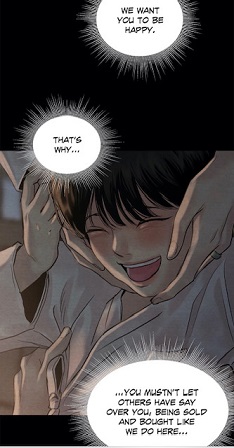 (chapter 87) Naturally, this vision reflected the past due to the presence of the noonas. But if you read my previous analysis, you are aware that the painter’s nocturne visions are always composed of three elements: memory, nightmare and desires which will come true at some point. The readers will certainly recall the painter’s wish in the bedchamber:
  (chapter 81) However, here again, this was not real, for he was imagining it. He had restrained himself, for he felt that his actual life was like an illusion. It was too good to be true. Thus I conclude that in both visions, the painter wished to laugh and as such to be happy. And this observation led me to the following deduction. In season 4, the manhwalovers will witness Baek Na-Kyum’s laughter. But this doesn’t end here. All the quoted pictures share another similarity which is the absence of the sound!! There is no HA, HA, HA…. Thus I deduce that in season 4, the readers will even hear Baek Na-Kyum’s laugh!! 🤣
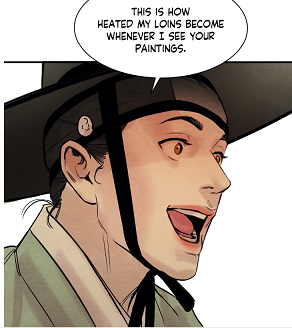 (chapter 1). His mouth was exposing his emotions: happiness. It was, as if he was laughing internally out of joy. Then in the pavilion, the author let us hear Yoon Seungho’s laugh, while we couldn’t see his face.
  (chapter 25) As you can see, Yoon Seungho was not truly seen “laughing”. This is what we saw right after:
  (chapter 25) Either the sound was missing, or the readers couldn’t see his open mouth. Then in chapter 51, Byeonduck created an ambiguous situation.
 (chapter 51) Who was laughing here? The main lead or Min recognizable with his green hanbok? This confusion was deliberate. It was to give the impression that the lord had moved on, he was not missing his partner. This image served to divulge the reality: this happiness was fake. Another interesting aspect is that we couldn’t see the lord’s mouth, for it was too far away. It was more or less drawn from the painter’s perspective who was walking in the courtyard.
  (chapter 51) The purpose of this trick was to deceive the painter, Yoon Seungho would no longer care for him. However, this trick didn’t work out like imagined due to the maid’s words. She wished that he would remain in the mansion. But let’s return our attention to the laugher in this panel. I would even add that there was no real social bounding, for Black Heart was enjoying about Yoon Seungho’s misery and loss. He believed that the painter had died. And if it was Yoon Seungho who laughed, then this was to mask his pain. Then in chapter 70, he was caught laughing. And observe that the author separated the sound from the face:
  (chapter 70) Yoon Seungho would even hide his face from the painter, as he was looking down. His laugh was barely perceptible, and when the author revealed his face, Yoon Seungho used his hand to mask his smile.
  (chapter 70) It was, as if Yoon Seungho was not allowed to smile or to laugh at all. I would even go so far to say that laughers were actually forbidden in the mansion. Striking is that in season 3, for the first time, we could see and hear the lord’s laughter contrary to season 1 and 2..
  (chapter 78) This illustrates the progression of the lord’s healing. He was getting happier, and he would interact more and more with people. Yet, in this scene, the lord’s laughter was not loud contrary to the one in the pavilion. Then in the gibang, his laugh was also fake, for he was masking his pain.
 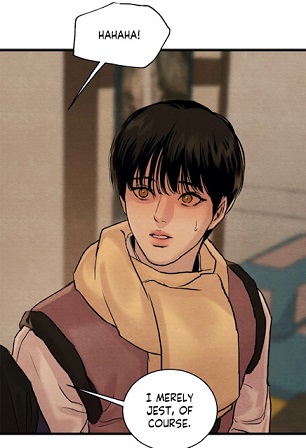 (chapter 93) Thus the author didn’t let us see his mouth once again. But the painter could see the difference between a sincere laughter and a fake one, as he had already heard and see the lord’s true laugher! Because the lord laughed in all 3 seasons, I could only assume the painter’s laughing in season 4. But I have another proof for this prediction. In season 3, the painter’s laughter was shown in visions (chapter 81, 87) or through the testimony of the maid.
 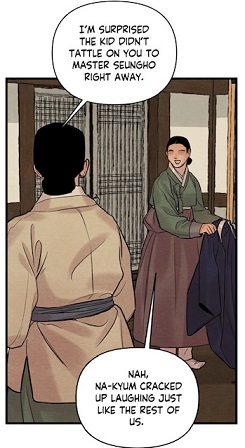 (chapter 91) However, the manhwalovers have to envision that, when he caught the pervert with the maid together, he was totally embarrassed. Hence his laugh was fake! In other words, I am doubting that he truly laughed. That’s the reason why Baek Na-Kyum denied to find the situation funny.
 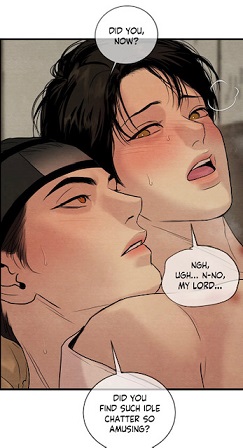 (chapter 91) As a conclusion, expect a picture with Baek Na-Kyum ‘s laughter reflecting his happiness and sincerity. And this is definitely related to his marriage:
 (chapter 102) There is no HAHA, this shows that this situation is not funny. Yet, Black Heart is still smiling, he is even explaining that they were just playing. However, this smile is totally fake, for he is already scared. Hence he is stuttering. Moreover, he is trying to downplay the whole situation, as he describes it as a game. But the closer Yoon Seungho got to him, the more the villain got scared.
 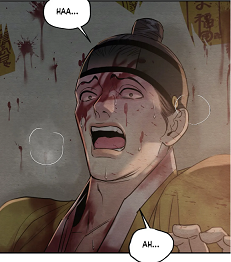 (chapter 102) On the other hand, Black Heart’s mouth remained wide open, but it slowly exposed his true emotions. As the manhwalovers can detect, the sound “Haa,” is not expressing joy or happiness, but huge anxieties. Thus I couldn’t help myself thinking that in season 4, the painter’s laughter will be reflected with the heavy breathing from fear and pain. Someone will have a mouth wide open out of fear!! And this connection was already present in chapter 1:
  (chapter 1) Baek Na-Kyum and Yoon Seungho had both flashbacks
  (chapter 66), while Min was smiling. He was internally laughing, for it found it entertaining. [For more read the essay HAHA Flashbacks”] And this fear was exposed by the sound: HAA
  (chapter 99) But this doesn’t end here.
  (chapter 84), but in the gibang, he dropped this habit for good:
 (chapter 96) This connection between pain, pleasure and laughter appeared in chapter 91, as the story is based on the following rule: there is always a reflection within the same episode. I would like the manhwaphiles to observe this image:
  (chapter 91) Here, the lord had changed position provoking pleasure to the artist. Before, the maid had laughed so loudly in order to get the painter’s attention.
 (chapter 91) According to my interpretation, she hoped that Baek Na-Kyum would discover the existence of the kisaeng’s letters so that the painter would feel betrayed by Yoon Seungho. He had ordered to hide the correspondence. But for that, she needed to explain the reason for her loud laughter. Hence she revealed the incident with the pervert. The irony is that due to his pleasure and embarrassment, Baek Na-Kyum didn’t pay attention to her words. He already felt ashamed, after the servant had exposed the situation in the bathroom.
  (chapter 91) Thus he avoided his lover’s gaze. And note that in chapter 25, the lord laughed, before he raped the painter.
  (chapter 25) This episode exposes the connection between laugh and pain. Here, you can see that the painter is also screaming out of pain, the negative reflection of Yoon Seungho’s laugh. Baek Na-Kyum’s mouth was wide open. When people are tortured, they will usually scream their pain and fear.
 (chapter 37) and the one from Dong-Yi. The absence of the sound. Moreover, the manhwalovers can not see the mouths from the victims either. The torture was already finished, for they had removed the tools and the „suspects“ were covered with blood. And this leads me to the following observation. The author selected a perspective from far away, and didn’t add the sound on purpose. This shows that the pedophile was not present, when the torture took place. He only arrived afterwards. This exposes his cowardice. Secondly, since I had outlined that the author had separated the sound (HA HA) from the lord’s mouth concerning the laughter, I am quite certain that she will use a similar processes for the torture. Naturally, I am also assuming that torture from the past could be slowly revealed. Consequently, my prediction is that the negative reflection of the painter’s laughter will be the yelling combined with fear and pain. This signifies that people will suffer in season 4 and probably die. Another evidence for this prediction is that the author often focused on the characters’ mouth. And this is what we have:
  (chapter 77)
 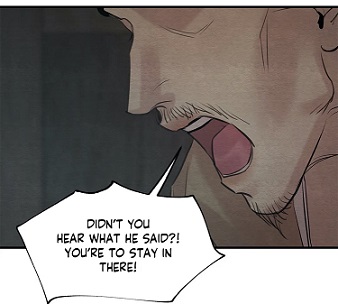 (chapter 86)
  (chapter 98) In the last scene, Heena was sort of “punished”, when she confessed to the main lead. That’s the reason why I believe that in season 4, we will see people screaming out of pain and fear. It can be in the present or in the past. The interrogation and torture should be exposed in my eyes contrary to chapter 37.
 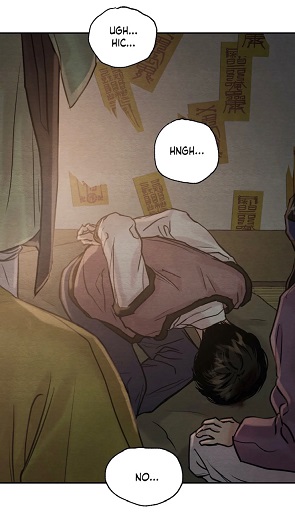 (chapter 99) Despite the “torture”, he still claimed that Yoon Seungho was no murderer. Thus I conclude that in the next season, it should be the reverse. Yoon Seungho has to make a new leap of faith believing in the painter’s innocence and purity. Hence I am expecting an arrest in season 4. Finally, we shouldn’t overlook that each word Yoon Seungho said became the truth, so when he stated this
  (chapter 65), he was already warning the sister. She could face human justice. However, this idiom suddenly caught my attention: “the wrath of humans”. It can be a reference to the authorities, but also to the inhabitants. The latter could get infuriated by the police work and put the officers under pressure or in the worst case, the inhabitants could decide to do their own justice: lynch mob. According to me, many commoners died in season 3. Hence this could upset the town folks who would ask for real justice. And if Yoon Seungho’s fiancée is acknowledged by them, then it will be impossible for the pedophile to use the authorities to achieve his goal, separate the couple and hide his own crimes. Thus his last puppets will have to take the fall. Another important aspect is that when Yoon Seungho warned the kisaeng, Kim was also present, though he still remained in the background.
  (chapter 65) As you can imagine, I am already sensing a bad ending for Heena and Kim. Striking is that in this scene, while the noona was seen constantly with her mouth wide open, yelling at the host and calling for her brother, the latter was having a flashback. This is no coincidence, especially if you recall that Heena was connected to Baek Na-Kyum’s tears:
  (chapter 68)
 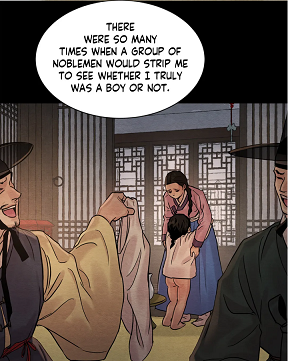 (chapter 94) In fact, this reinforces my conviction that the painter’s laughter will be contrasted with people’s moaning and yells out of agony. At the same time, I think that Heena is connected to scandal, but in season 2 and 3, she failed to create a ruckus. Why? It is because in the past, she had helped to cover up the crimes committed in the kisaeng house.
 On the other hand, when these persons got tortured, they closed their eyes out of agony,
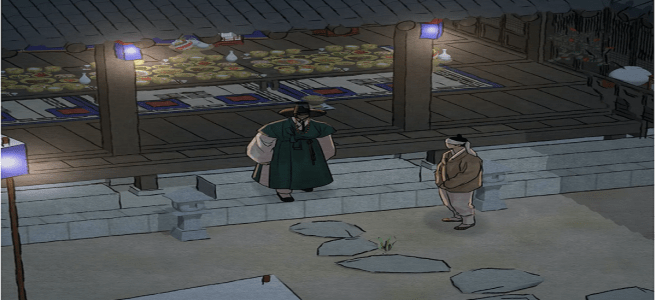

 (chapter 36) Hence you comprehend why my new title is once again referring to faith and sin. On the other hand, the readers could be surprised by the choice of my new title. How is it possible that a sinner can be pure? This represents a contradiction. I chose this oxymoron for two reasons. Junah ended season 2 with the same contrast:
 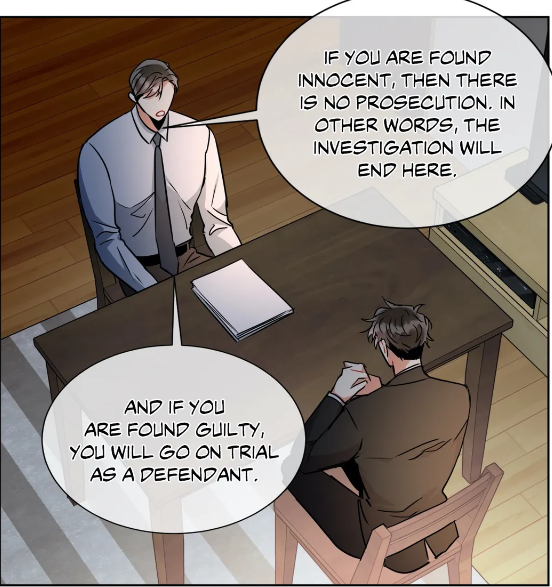 (chapter 44) In this scene, the prosecutor is pronouncing Ha Ideun for “guilty” for murdering Kim Jintaek.
  (chapter 44) However, in that moment the author chose to show the hand of Ha Sungmin, who is about to remove the mask of Ha Sungyeob. This means that the so-called brother is about to commit a murder on the former CEO, his official father. Thus I am deducing that despite the verdict of the prosecutor, Ha Ideun is actually innocent. The “real guilty” versus the “fake one”.
 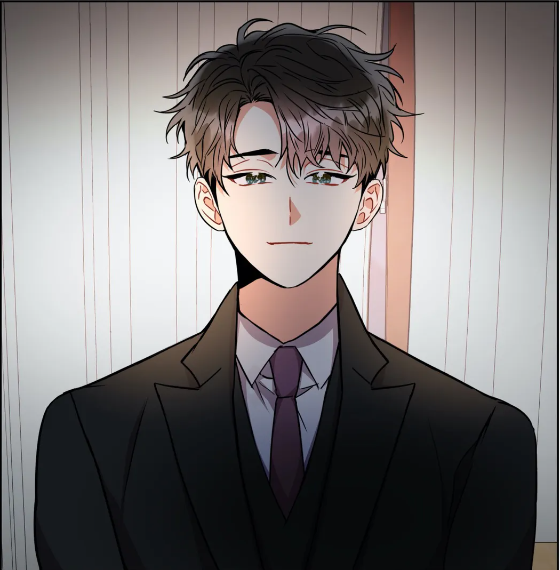 (chapter 44) It was, as if a burden had been removed from his shoulder and heart. Furthermore, in special episode 2, the protagonist’s innocence became even more obvious.
 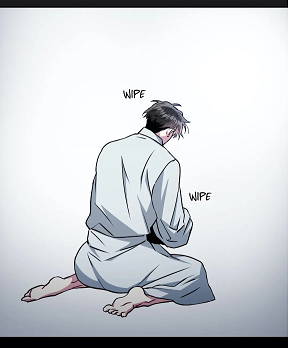 In his nightmare, Ha Ideun is imagining himself wearing a white bathrobe in a white room. Moreover, he looks busy cleaning himself. If you read my essays about Painter Of The Night, you are probably aware of the signification of white and “cleaning”. It is an allusion to purity and purification. Finally, Ha Ideun said that he would never lie by commision.
 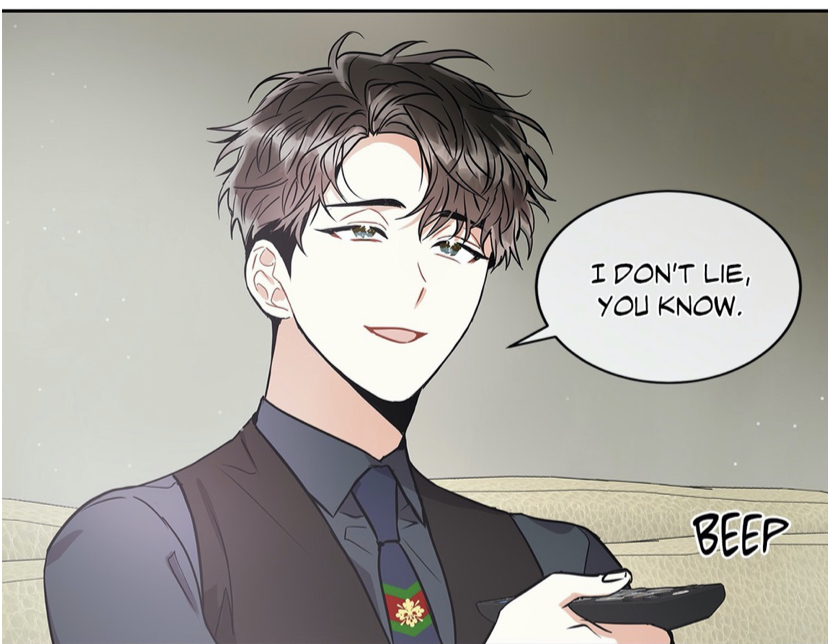 (chapter 11) Everything is pointing out about Ha Ideun’s innocence.
  (chapter 39) Hence the reporter Yoo Tae describes him as a bastard, and the official mother Choi Seolhwa doesn’t recognize the protagonist as her son. She doesn’t even call him by his name, but by the expression “the boy”.
  (chapter 41) He is not part of the family. On the other hand, Ha Sungmin and Ha Sungjoon views Ha Ideun as a relative.
  (chapter 37) We could even say that Ha Sungmin views himself as his owner, even as a surrogate father, for he was the one who raised the main lead.
  (chapter 37)
  (special episode 2) He feels responsible not only for the death of Gu Sihwan but also for the death of Kim Jintaek. This explicates why in his nightmares, the suspect had the impression that he had stabbed himself the victims.
 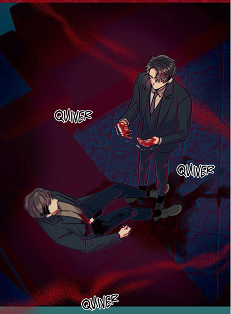 (chapter 21)
 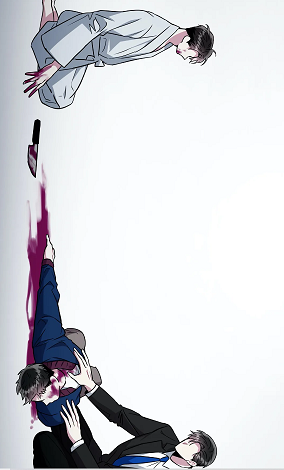 (special episode 2) The hands covered with blood were the symbol of his guilt. The manhwalovers can comprehend why Ideun felt terrible towards the prosecutor. Thus he constantly apologized to the prosecutor by kissing Gu Sehuyk’s wounds
  (chapter 13)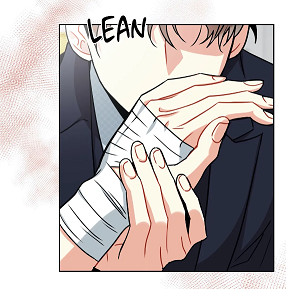
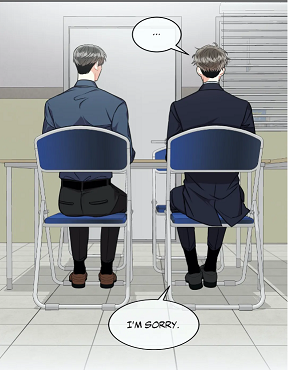 (chapter 23) or by voicing his apology directly.
 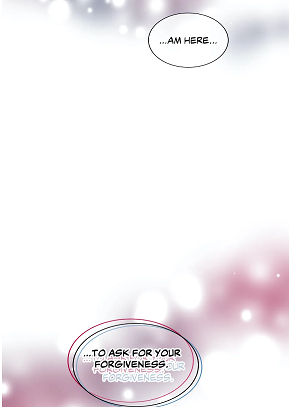 (chapter 44) However, as you can imagine, the chaebol never killed the brother or the criminal. I have no doubt about it. He shouldn’t blame himself for their death. On the other hand, Ha Ideun is definitely involved in their vanishing. Thus Ha Sungmin blames him for everything. Ha Ideun is perceived as a sinner. And that’s how he judges himself too, therefore he dreams of being sent to hell. So when the prosecutor declares Ha Ideun
 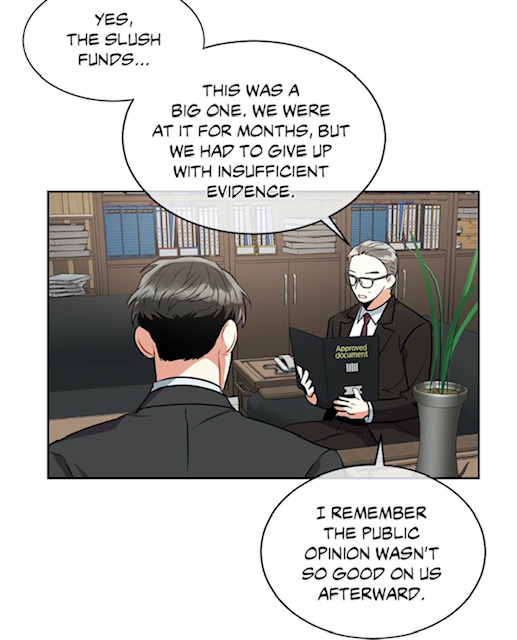 (chapter 8) which is linked to corruption and the project Heaventown. With the slush fund, Ha Sungmin could buy politicians and officials in order to buy the golden land in Gwanghae.
 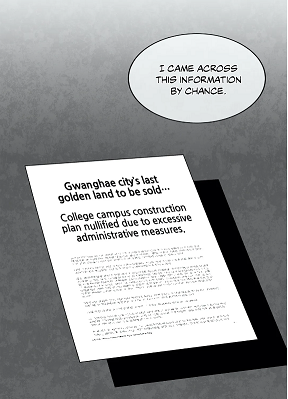 (chapter 39) Note that in the beginning, Gu Sehuyk was supposed to investigate the slush fund. Yet due to his brother’s death, he was removed from the case, for he was left traumatized. His colleague Na Joohwan took over the case and look how it ended:
 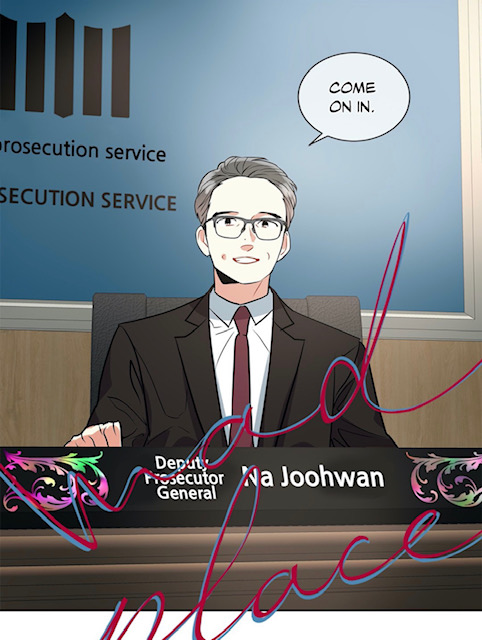 (chapter 8) I have two clues for this theory: he got promoted within a short time, he became deputy prosecutor general, and he is wearing glasses. After reading so many manhwas, I made the following discovery: characters with glasses are hypocrites and even backstabbers. 🧐 [For more read the essay “The significance of masks in manhwas”] Then the reporter Yoo Tae was supported by Ha Ideun to investigate the matter, because he wanted to maintain the good reputation of Hasung Hotel:
  (chapter 39) Moreover, I would like to point out that 2 years later, Ha Ideun was also monitoring Kim Jintaek, this means that he was again investigating about a case, where the Hasung group was involved. This truly exposes the main lead’s righteousness and purity. He chose to do the right thing, yet each time he failed, for he was powerless. People had to die. Therefore the brother said this to Ha Ideun in his dream.
  (special episode 2) Both brothers are goal-oriented, yet they both stand on different sides of the law. Ha Ideun stands for law and righteousness, while the other has no conscious. The goal justifies the means. This explains why Ha Ideun would ask Gu Sehuyk as the prosecutor for this case. The latter is famous for his uprightness and pure nature. Only through him, the truth can come to light. Consequently, I am suspecting that the trial concerning the murder of Kim Jintaek will serve as a mean to unveil all the dirty deeds committed by the Ha family. On the other hand, Ha Ideun wished that his family wouldn’t get into trouble:
  (chapter 40) Why did he make such a request? We have many possibilities. It could be related to Ha Ideun’s goodhearted nature and pride or his fear that Gu Sehuyk could get hurt. So far, people representing a threat to the brother got eliminated. This shows that the main lead was still under the influence of the terrible huyng here.
 (chapter 26) his ambition and greed. He would like to dominate the town and even the economy. His mentality is strongly influenced by his mother who appears as ruthless and selfish too.
  (chapter 41) She is already waiting for her husband’s death. Striking is that at no moment, the villain feels remorse. Why? It is because he has been gaslighting his brother. The brainwashing is detectable in this statement.
 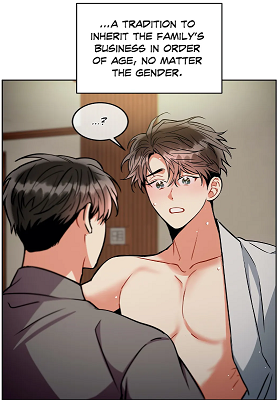 (chapter 39) I am definitely suspecting that there was a battle among the family, and Ha Sungyeob definitely used illegal means to achieve his goal. The oldest sister died in a car accident, and the second brother was judged unqualified. So we could say that Ha Sungmin is actually imitating his “father’s” past behavior, though they are not biologically related. Interesting is that
  (chapter 25) in this scene, Kim Jintaek revealed that he had been in contact with Sungyeob. He showed no real respect to the elder by calling him “crook”, though I have to admit that I am suspecting that Ha Ideun is not Sungyeob’s son. This truly shows that the family Ha is no ordinary family.
  (chapter 37) Junah added the red traces in this panel for that reason. Moreover, Ha Ideun showed signs of PTSD in season 2. On different occasions, he was seen trembling
 (chapter 34), sweating, had difficulties to breathe
 (chapter 34), he had a lost and terrified gaze
  (chapter 33), and he is still suffering from insomnia. He can only sleep after having sex.
 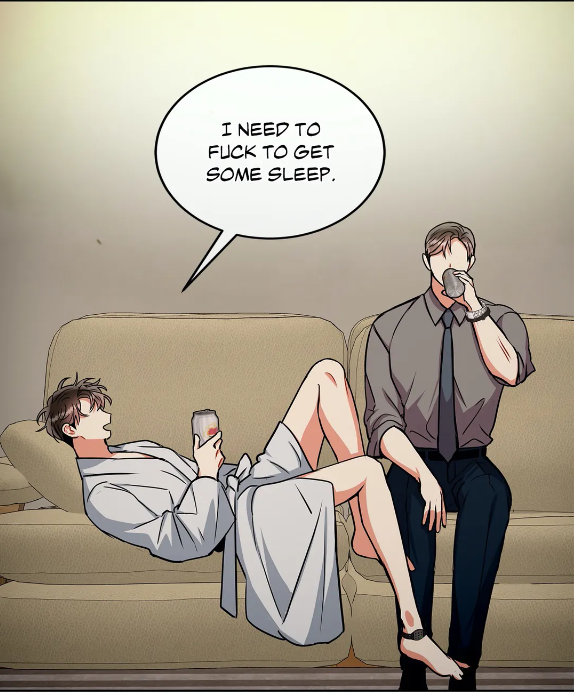 (Chapter 36) This is an indication that the sexual abuse took place during the night. His panic attacks could get triggered by different elements: a certain position or a specific location. He is also suicidal, displaying his self-loathing.
 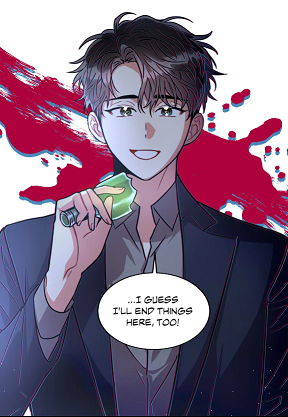 (chapter 21) From my point of view, Ha Ideun had tried to rebell and leave his brother’s side
  (chapter 35), but he had failed. The stabbing is the proof of his resistance.
  (chapter 35) Simultaneously, he was forced to remain by his side, for he had wounded his brother. The blood on the stomach was to make the main lead feel guilty. That way, he would remain silent and passive.
  (chapter 26) They could never show their true self. In my eyes, Ha Ideun stabbed his brother during the sexual abuse
  (chapter 33), as he tried to protect himself, thus the brother has a huge scar on his stomach.
  (chapter 43) This explicates why Ha Sungmin tied his hands with the belt in the hotel. He made sure that the “brother” would never reject him. It was to control him. The hyung had learned his lesson. Moreover, it was his way to “convince” him to return home. In addition, Ha Ideun was definitely confined, for the nightmare revealed that Ha Ideun was trapped. The most terrible thing is that the huyng made sure to gaslight Ha Ideun. He shouldn’t have stabbed him, he had committed a huge sin against him. That’s the reason why Ha Ideun sees his hands covered with blood in his nightmares. He views himself as a sinner. The dirty hand symbolized his guilt.
 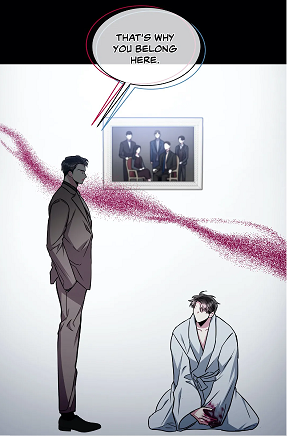 (special episode 2) Thus the main lead came to internalize that sex between “siblings” is normality. Don’t forget that Sungjoon never intervened. He became an silent accomplice. On the other hand, in his subconscious Ha Ideun is well aware that this is not right. This explicates why he felt safer to have sex with strangers than living with his brother. And now you comprehend why I wrote before that the main lead’s wish
 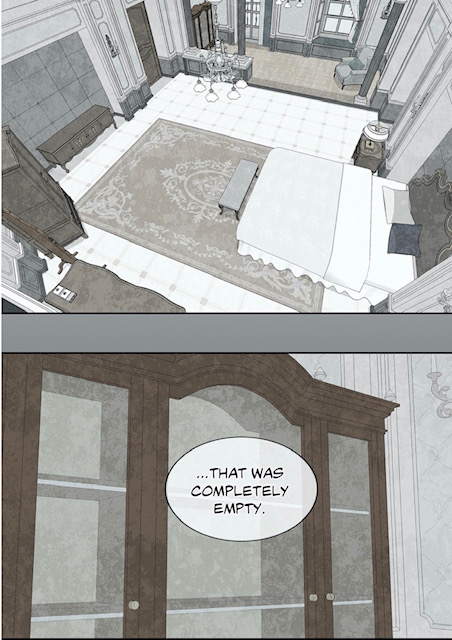 (chapter 08) All traces of violence had to be removed and cleaned.
  (chapter 23) This is no coincidence that Ha Ideun asked how his sexual partner felt about their sexual encounters. It was important that Gu Sehuyk would like it.
  (chapter 22) That way, the main lead had the impression that he was indeed capable to replace the brother’s loss. However, like pointed out above, Ha Ideun needed the protagonist on his side too, for he wished to unveil the truth about Heaventower and the father’s illness which is connected to the drug. This is no coincidence that sex with Gu Sehyuk was connected to a confession. The sinner was seeking relief from the “priest”, at the same time he was trying to redeem himself by give warmth to the wounded prosecutor. Simultaneously, he was hoping to obtain his forgiveness. This is important, because by interacting with the prosecutor, he came to discover a new form of family. This is not surprising that at some point, Ha Ideun came to question the nature of the relationship between siblings.
  (chapter 25) Hence I come to the conclusion that by interacting with Gu Sehuyk, the victim adopted slowly a new religion of HOME! Don’t forget that home has different significations: a household, a mansion and a clan. What caught my attention is that Ha Ideun started calling the prosecutor’s house HOME!
 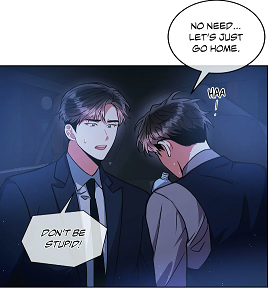 (chapter 26) This truly exposes that he had moved from Sungmin’s fake religion of home and family.
 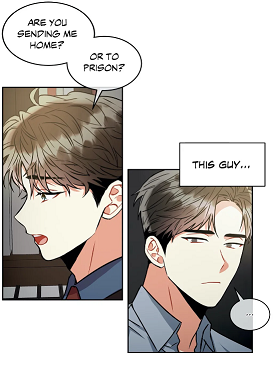 (chapter 29) and at the end of season 2, he chose to reveal his secret to Gu Sehuyk: the sexual and physical abuse. Therefore it is not surprising that at the end, Gu Sehuyk said this to Ha Ideun.
  (chapter 44) He was now considering the “suspect” as his “family”. That’s the reason why I believe that this “sentence guilty” at the end of season 2 is just a subterfuge. This can only serve as an excuse to keep him by his side. At the same time, the prosecutor Gu Sehuyk can not be suspected of favoritism, for he is suspecting a chaebol to have committed a crime. The media already reported the case to the public. Under this new perspective, I came to understand why Ha Ideun never tried to defend himself right from the start. He needed to remain a suspect, so that he could influence the prosecutor in his investigations. That way, he could discover that his brother’s case had not been truly solved…. At the same time, Ha Ideun could be considered as a sinner, for he “seduced” the priest Gu Sehuyk to have sex. So far, the man was dedicated to his work, and as such had no sex life.
 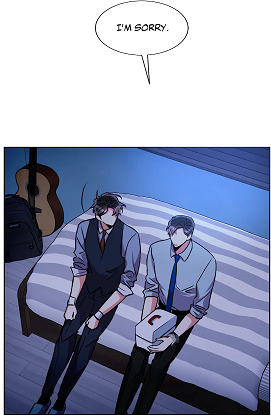 where equity, love and warmth were oozing which stands in opposition to the cold and aseptic “temple” of the Ha.
 Bebebisous33s' analyses in K-Dramaland and Manhwas