Protected: Painter Of The Night: Chapter 69 ☯️♋ revisited

Bebebisous33s' analyses in K-Dramaland and Manhwas
Analyses of K-dramas and Manhwas (for the most part Yaoi)

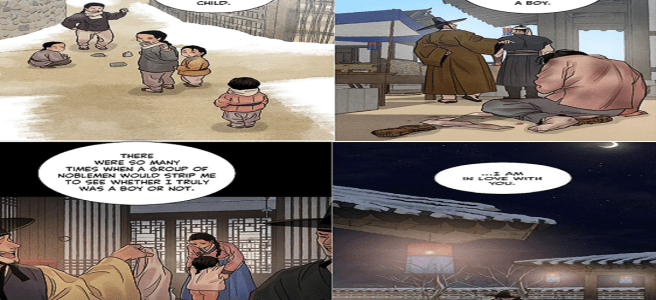
This is where you can read the manhwa. https://www.lezhinus.com/en/comic/steel_silk But be aware that this manhwa is a mature Yaoi, which means, it is about homosexuality with explicit scenes. If you want to read more essays about other manhwas, here is the link to the table of contents: https://bebebisous33analyses.com/2021/06/06/table-of-contents-of-analyzed-mentioned-manhwas/ Here you can read the last analysis about Steel Under Silk: https://bebebisous33analyses.com/2022/06/04/steel-under-silk-the-power-of-the-dog-%f0%9f%97%a1/
It would be great if you could make some donations/sponsoring: Ko-fi.com/bebebisous33 That way, you can support me with “coffee” so that I have the energy to keep examining manhwas. Besides, I need to cover up the expenses for this blog.
Anyone reading this manhwa will recognize immediately that the title of this essay is the same than the one selected by the author Snob for season 1. But why did she choose such a title in the end?
One might say that the answer is quite simple. If you read the synopsis, this is what you find:
“Hiding a blade behind his beautiful smile, like silk hiding steel, Yeonjo waits for his moment to strike.”
It looks like the dagger is referring to Lee Yeonjo and his desire to get revenge. The smile is an indication that he is hiding his true intentions. In other words, the title is displaying that the person is a skilled but dangerous actor. The smile is diverting the counterpart’s attention faking emotions. However, I would like to point out that the young protagonist is never seen smiling. He is either angry (chapter 5), stoic
  (chapter 20), pitiful
 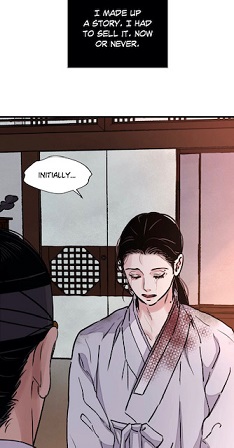 (chapter 20) or enraged and afraid
  (chapter 9). The only times we saw him smiling in the present occurred in front of lord Chang and each time, he was making fun of his sponsor:
 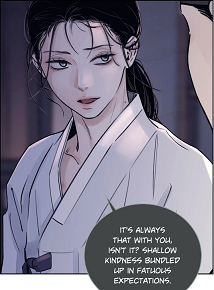 (chapter 5)
  (chapter 16) In both occasions, he was smirking, criticizing lord Chang for his behavior. He wouldn’t mince his words at all. Here, he was brutally honest. This contradicts the previous statement,
“Hiding a blade behind his beautiful smile, like silk hiding steel, Yeonjo waits for his moment to strike.”
, as the smile serves as a way to hide the future assault. In this story, the smile serves as a mask. It should hide the true thoughts from the character, it is a dishonest facial expression. Yet, with the administrator, he was totally honest, when he smirked. On the other hand, we could say that Yeonjo’s words worked like a dagger, when he made fun of Chang Moonwon. However, the synopsis is actually referring to Kwong Hee-Ryang as the target and not to the administrator of work.
Moreover, when Lee Yeonjo rejected the protagonist for the first time (chapter 9), he let him perceive his true emotions and thoughts. That’s the reason why the noble compared him to a wild kitten showing his claws. 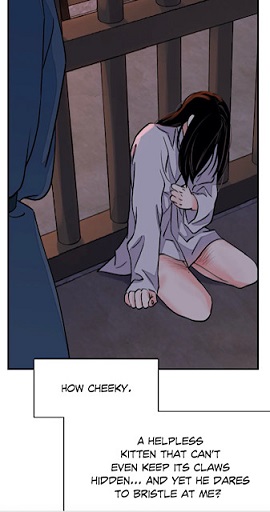 (chapter 13) This means that Kwon Hee-Ryang was well aware of Lee Yeonjo’s true intentions. The young slave was trying to seek revenge. But the governor didn’t mind it at all, because in his eyes, the thin and small domestic doesn’t represent a true danger to him. In the worst case, he can get a new scar and that’s it.
  (chapter 18) On the other hand, Lee Yeonjo would lose his life. To conclude, the dagger hidden behind the smile is not truly referring to the uke in my eyes. We know his intentions and his past. Moreover, he is a poor actor in front of Kwon Hee-Ryang. He is incapable to control his facial expressions,which explains why the official can read him like an open book:
  (chapter 23) He tells him lies, but the governor doesn’t fall for it at all.
 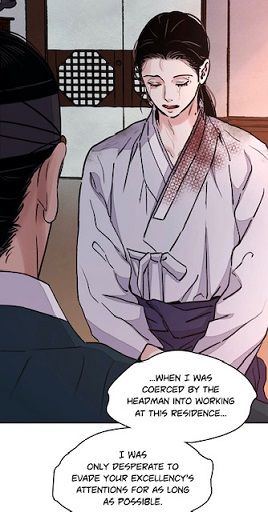 (chapter 22) In verity, the main lead uses the statements from the innocent slave to his own advantage. If he was coerced and raped by Chang Moowon, then Kwon Hee-Ryang will treat him differently. The governor takes each confession from Lee Yeonjo at his words. The result is that the young slave is put in a position where he can choose. He has to prove the veracity of his words and as such his willingness that he selected the main lead in order to improve his living conditions. He has no other choice than to act on his own free will. Thus Kwon Hee-Ryang said this:
  (chapter 20) Yeonjo is forced to turn his lies into a verity. This explicates why the servant admits that he needs to be such a great actor that he has to believe in his own lie.
  (chapter 20) Note that in this image, the young protagonist is not even smiling, he is acting pitiful hoping to get the lord’s sympathy. However, during the intercourse, he is unable to control his true emotions. On the one hand, he is taking pleasure in this, on the other hand, he rejects sodomy due to social norms.
  (chapter 23) Yet, his mouth is betraying him once again.
 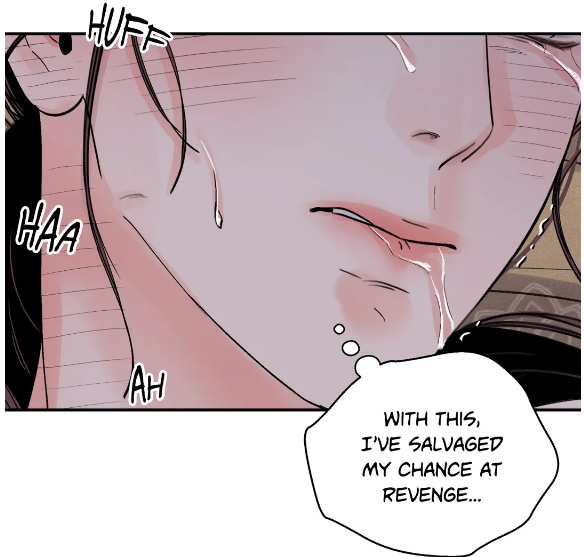 (chapter 23) That’s the reason why Kwong Hee-Ryang interrogated Yeonjo, for he had noticed his dissatisfaction.
  (chapter 23) As a conclusion, so far Lee Yeonjo can not be perceived as the dagger hidden behind a smile! From my perspective, this title is actually hinting to Kwon Hee-Ryang.
First of all, the official is constantly smiling, especially when he is meeting his enemies. 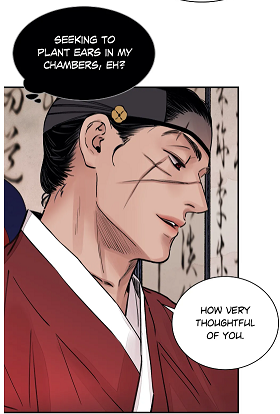 (chapter 3) Here, he was complimenting the headman Choi, though he had already perceived his wrongdoings and motivations. Yet, he was still giving the impression that he was in a good mood. Then
  (chapter 3) when he had organized a huge feast for his new appointment in order to deceive the nobles from the hojok, he continued smiling, though he had been insulted as a host.
 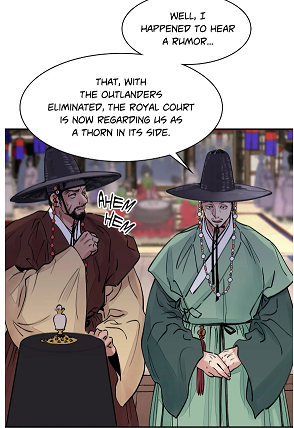 (chapter 3) And note how he replied to the attack to Kwak Gilsoo. He overlooked the insult and reproach, and showed generosity and leniency.
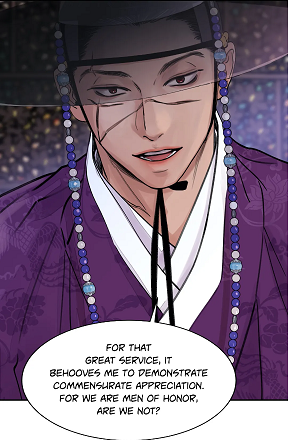 (chapter 3) He acted, as if he only had pure intentions and he was a man of honor. The irony is that he had long selected his target:
 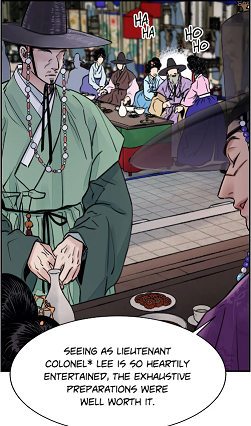 (chapter 3) The lieutenant colonel Lee. This is no coincidence that he was smiling, when he explained to his assistant his next move
  (chapter 6) There was a light smile on his lips, when he offered the poisoned wine to his prey.
  (chapter 6) No one suspected that he would poison the lieutenant colonel Lee, for he had shown no sign of hostility and arrogance in front of the local lords. He had never displayed any mood swings either. In fact, he had acted like a submissive, calm and innocent governor. Once Kwak Gilsoo accused him of murdering the chief of the hojok, Kwon Hee-Ryang returned the situation to his advantage with a smirk on his face.
  (chapter 15) He had been insulted on many occasions, though he had treated the hojok very respectfully.
  (chapter 15) He portrayed himself as a benevolent governor seeking support from the hojok, yet they had somehow rejected his good will. This means that he was turning himself into a victim. He even went so far by asking the crowd if they were declaring war against him and as such the king, leaving the nobles speechless. They got defeated, for if they contradicted his words, they could only be perceived as traitors, for the appearances were against them. The man had organized a huge ceremony for them, had even treated the lieutenant colonel Lee with such a great care. Moreover, he had attended to his funeral. He had always been gentle and smiling, thus he had reasons to get upset. Suddenly the governor’s tone changed which caught the aristocrats by surprise! Hwan Hoon described the main lead like this:
 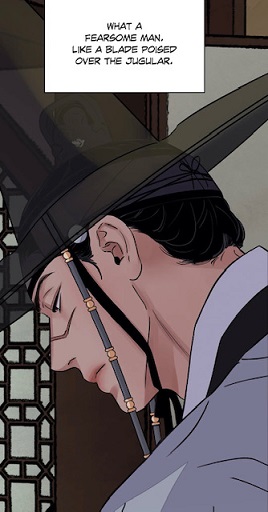 (chapter 15) As you can detect, we have here a reference to the dagger. To conclude, during the funeral, we have this combination between the smile and the dagger.
  (chapter 15) No one, not even Kwak Gilsoo, had even anticipated such an attack. But there exist two other reasons why I think that the dagger hidden behind the smile is hinting on the official, especially after associating him to the blade. On the other hand, I am expecting that Kwang Hee-Ryang’s personality will rub off on Yeonjo. The latter will become a better actor. But let’s return our attention to the governor.
I have other reasons to think like this. First, it is related to his past. We don’t know much about him. So far, I could determine that due to his lowly origins he must have fought hard to become very close to the king. However, in chapter 19, the author implied that there was some bad blood between Kwon Hee-Ryang and Lee Yeonjo’s father.  (chapter 19) The official had connections to the Lees before the downfall of right-state councilor, yet the nature of their relationship is not quite clear: Ex-what? Ex-benefactor, ex-lover or ex-enemy? And according to the assistant, Yeonjo’s father must have wronged the protagonist. In my eyes, the smile from the official should be interpreted under the different light. It is hiding the scars left by the attacks from the past. That’s the reason why he is now holding a dagger in a figurative way. He was not just stabbed by a blade, he was also wounded by words, for he is just the son of a concubine. Thus he learned to use his tongue as a dagger, which we could witness during the funeral.
Secondly, during their last encounter, Kwon Hee-Ryang kept smiling while listening to the naïve slave. 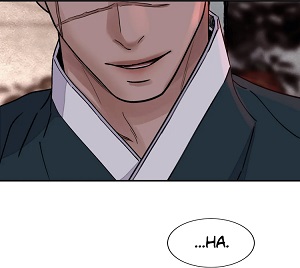 (chapter 20) He could see right through Yeonjo. The readers could sense that he was making fun of him.
 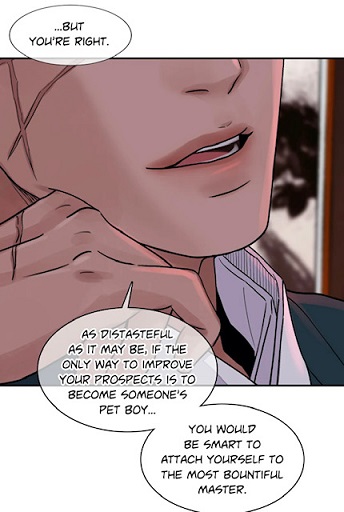 (chapter 20) There is no ambiguity that the governor was here acting, though I perceive his smile as not entirely fake.
  (chapter 20) He was definitely happy that the young man would seek him, as he had already voiced regret before. Nonetheless, the manhwaphiles could sense the official’s manipulations. The kiss on the scar is the best evidence.
 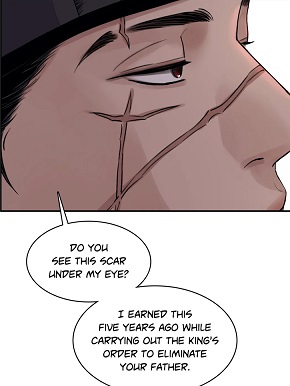 (chapter 20) Here, he was challenging Yeonjo. He should prove his honesty. Like I mentioned above, he was taking the young slave at his words.
 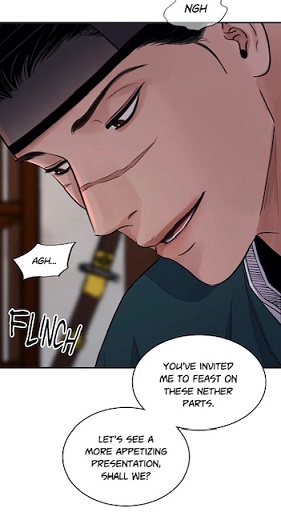 (chapter 21) That way, the young domestic could never make such reproach about him: he had raped him or coerced him. However, this signifies that the main lead is also obliged to keep his words. He has to ensure Lee Yeonjo’s comfort and safety. So while Lee Yeonjo had the impression that he could deceive his counterpart, he never realized that he had been fooled. And to his surprise, Yeonjo discovered his enemy’s true personality: he was a beast! I am quite certain that my avid readers are already aware of the symbolism of blade: the phallus! Lee Yeonjo never expected his “husband” to have such an appetite.
  (chapter 23) He was a monster, a beast! He thought that it would end very soon. However, Kwon Hee-Ryang was far from being satisfied. He wished more.
 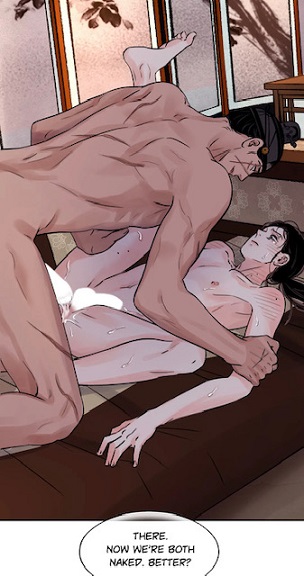 (chapter 23) Striking is that in the last panel, the governor is smiling while holding his “dagger” which caught Yeonjo by surprise. To conclude, the dagger is not just a reference to the weapon or words, but also to sex.😉
And this leads me to the following observation: the former aristocrat is very pure, because he lacks experience. Until his downfall, he had lived in a bubble, far away from politics and schemes. Then as a slave, he never discovered how treacherous the world of officials was. He only encountered sexuality through prostitution. This explicates why he loathes sodomy and gets upset that his own body is betraying him. He definitely feels pleasure. It was never his true choice in the beginning, which stands in opposition to his conversation with the official. And slowly, Lee Yeonjo is forced to reveal his orgasms and sensuality. Why? It is because he has to deceive the governor. (chapter 20) At some point, the deception will become a reality.
In addition, his purity and innocence are perceptible the way he is seeking his revenge. When he dreams of killing his nemesis, he always envisions himself stabbing him. If he truly wanted to hurt Kwon Hee-Ryang, he could have participated in a plot or even poison the governor… but no, his true goal is to wound the official with his own hands. I would like the manhwaworms to keep in their mind that he rejected the offer from headman Choi. He didn’t desire to become a spy. He didn’t consider it as a way to eliminate his nemesis. In my eyes, it is related to that fateful night. Kwon Hee-Ryang defeated Yeonjo’s father personally (chapter 1), he even got a scar. In other words, he was willing to risk his life. Thus I deduce that Yeonjo is copying him. He is facing his enemy directly, similar to a man of honor. In chapter 24, he has even a nightmare because of the stabbing, an indication that he rejects the idea of killing the man in his sleep. Besides, the governor in his own vision is exposing to him how pointless such a plan is. Kwon Hee-Ryang is not an easy target. He is very smart and observant. This can only reinforce my interpretation that Lee Yeonjo is not the dagger hidden behind the smile. However, I am expecting a transformation from Lee Yeonjo influenced by his tutor Kwon Hee-Ryang and his future experiences. Don’t forget that by becoming his lover, the slave can become the target of the hojok. Kwak Gilsoo is well aware of the governor’s sexual preferences
  (chapter 4) and once he hears how headman Choi got evicted from the court because of Yeonjo, the aristocrat will definitely blame the domestic for his “misery”. The aristocrat with the green hanbok envisioned that he had discovered the governor’s secret and as such vulnerability. But the official has never hidden his sexual orientation. One might accuse the governor of treason, because he has a relationship with the son of a traitor, yet this relationship could be judged differently. Lee Yeonjo could be judged as ruthless and immoral, he is sleeping with the murderer of his own family. Besides, this could be seen as a humiliation… the son has to serve the governor as his night servant. That’s the reason why Kwon Hee-Ryang said this to his assistant. It was not kindly… but indignant.
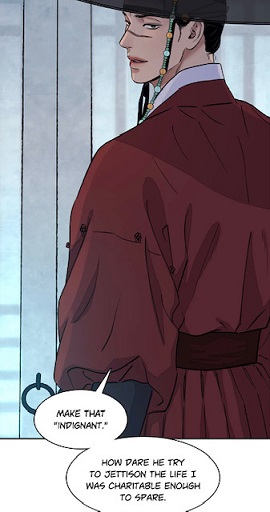 (chapter 19)
What caught my attention is that Kwon Hee-Ryang is paying a lot of attention to Yeonjo’s facial expressions. The manhwalovers could sense the governor’s obsession, when the latter imagined Yeonjo having a climax.  (chapter 4) Then he tried to discern the uke’s feelings in this situation and explain his reaction. (chapter 09). Finally, during their last intimacy, he kept looking at him while kissing
 (chapter 23) or reacted, when he saw Yeonjo’s distance.
 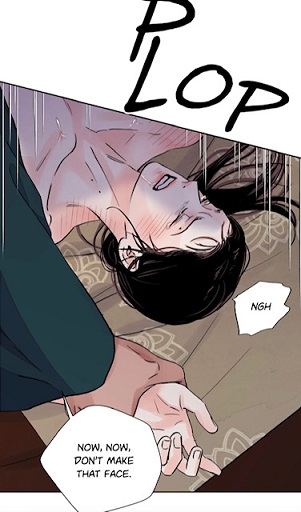 (chapter 23) Why is he so fascinated by his face? It is because it stands in opposition to his own! Note that the lord enjoys the uke’s tears. Secondly, the servant’s facial expressions are oozing genuineness. The protagonist can not control his emotions and thoughts, while Kwon Hee-Ryang is behaving the opposite. He aims to remain calm the whole time. Thus he often smiles. It is his mask. The latter is always hiding his true thoughts and emotions, while he continues smiling. This means that he can never show his pleasure or his pain to others, for they would reveal his weaknesses. Imagine that though he had been wounded that night, he acted, as if nothing had happened.
 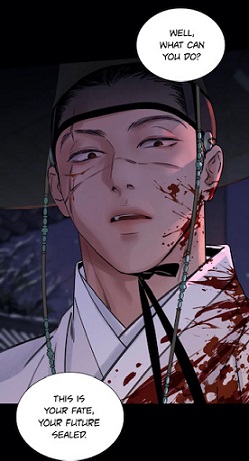 (chapter 1) Yet, in reality he didn’t have the heart to erase the whole household of the Lees.
 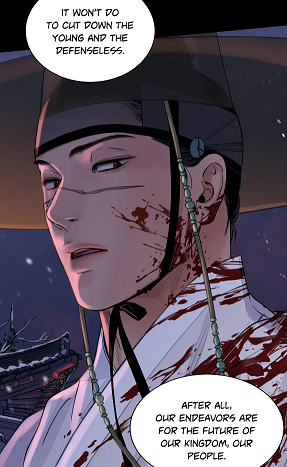 (chapter 9) To sum up, Lee Yeonjo can expression emotions that the official has long repressed. Even his orgasms are restrained
 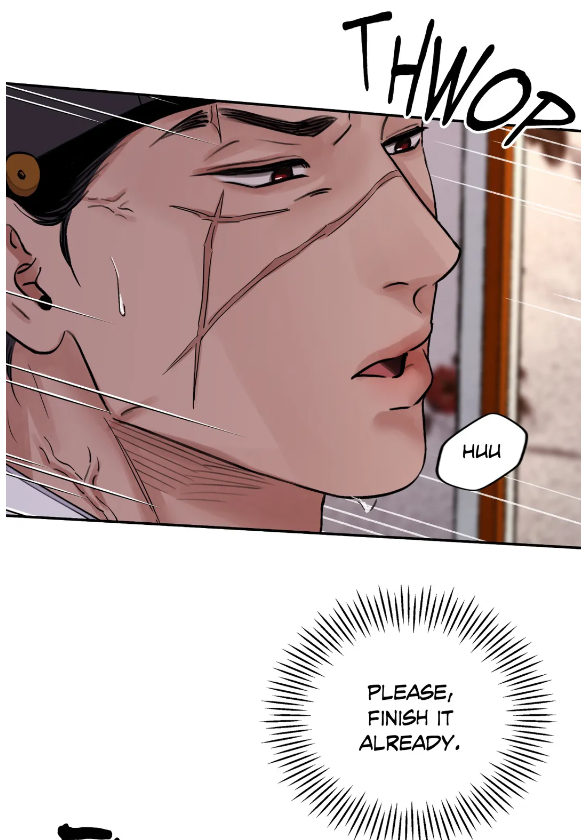 (chapter 23), his mouth is barely letting escape a sound
 (chapter 4) If I had to associate the official to two notions, I would say, he symbolizes work and control! And the smile contradicts Lee Yeonjo’s tears and moaning. This is no coincidence that he asked his lover to be called “my lord”
 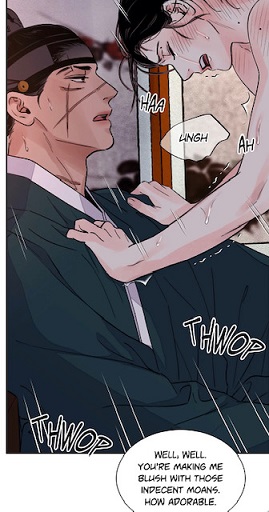 (chapter 23) In this picture, the aristocrat mentions his blushing, but if the readers look at his facial expression, they are not able to detect his reddening. How do we explain this? It is because the lord had long internalized to control his facial expressions. However deep down, his heart was moved by the uke’s whispers. Many readers could sense his growing attachment to Lee Yeonjo. First, he stated that the protagonist would become his plaything, yet in chapter 22, he called himself the main character’s husband.
 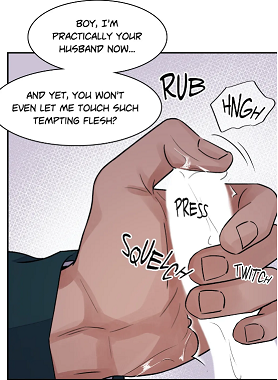 (chapter 22) Then in chapter 24, Kwon Hee-Ryang was even willing to share his bed with Lee Yeonjo. This reflects the lord’s biggest desire. He wishes to keep the young man by his side. Because the slave is showing facial expressions that Kwon Hee-Ryang can not do, it is not astonishing why the governor is under Lee Yeonjo’s spell. Under this new approach, the manhwaworms can grasp why I perceive the governor as the dagger hidden behind the smile. He is a dangerous but mysterious man, and the author is slowly revealing his thoughts and also his past.
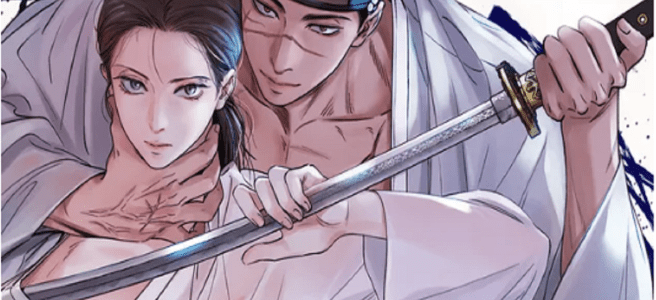
Before closing this essay, I would like the readers to take a closer look at this image: 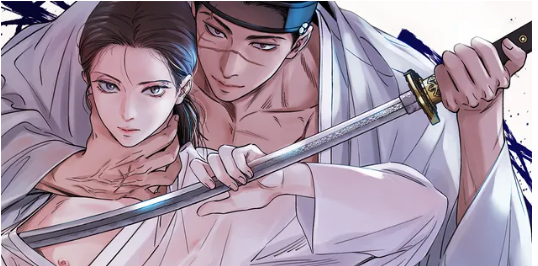 The lord is smiling while holding the sword in front of Lee Yeonjo indicating that the main lead will do anything to keep the uke by his side. Once again, we have the combination of the smile and the blade. Yet, this time, it is not hidden. Why? It is because their relationship is not a secret. This is the topic in the court.
Simultaneously, the domestic is taking the blade with his own hand which means that he will get hurt, an indication that the main lead will definitely get wounded in this story. This coincides with the result of retaliation. “Before you embark on a journey of revenge, dig two graves.” Confucius (504 BC) However, I don’t think that this is truly going to happen, for the simple reason that Lee Yeonjo is not ruthless like Kwon Hee-Ryang.
On the other hand, the couple is not facing each other, a sign that their union will bring them closer due to their enemies. While seeking his revenge, Lee Yeonjo will get involved in politics, and as such he will be forced to face reality. It is about abuse of the hojok exploiting the local population. Finally, in this scene the protagonists are acting. Why? It is because they are facing adversities. On the other hand, Kwon Hee-Ryang’s hand is grabbing the slave by his throat reflecting his obsession and determination to keep the uke by his side. Once trapped behind the blade, Yeonjo won’t be able to leave. By siding with the governor, the young man never anticipated that he could get wounded because of Kwon Hee-Ryang, like this scene exposes it. 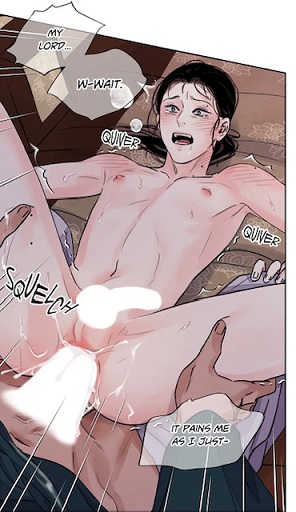 (chapter 23)
Due to his pain and suffering, he didn’t pay attention to his surroundings. He has no idea about the tension between the nobles of the hojok, and how the lords are abusing their position in detriment of commoners. Finally, my avid readers can certainly recall that Lee Yeonjo is embodied by the magical purple lotus flower, implying that he is contributing to the purification of the region. It already started with the removal of the headman Choi. 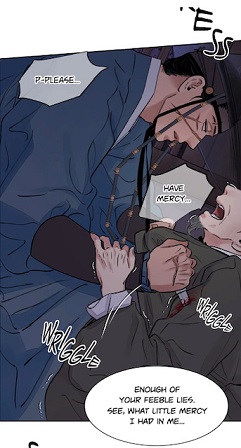 (chapter 11) So who is the next? However, we shouldn’t forget the administrator lord Chang who felt that he had been deceived by the governor.
  (chapter 17) Thus I come to the conclusion that Kwon Hee-Ryang’s plan won’t work so smoothly because of lord Chang’s intervention.
Feel free to comment. If you have any suggestion for topics or manhwas, feel free to ask. If you enjoyed reading it, retweet it or push the button like. My Reddit-Instagram-Tumblr-Twitter account is: @bebebisous33. Thanks for reading and for the support, particularly, I would like to thank all the new followers and people recommending my blog.


Please support the authors by reading the manhwas on the official websites. This is where you can read the manhwa. https://tapas.io/series/under-the-green-light But be aware that this manhwa is a mature Yaoi, which means, it is about homosexuality with explicit scenes. Here is the link, if you are interested in more analyses about this manhwa and others: https://bebebisous33analyses.com/2021/06/06/table-of-contents-of-analyzed-mentioned-manhwas/ I am also using Doctor Frost as reference again. https://www.webtoons.com/en/mystery/dr-frost/list?title_no=371
It would be great if you could make some donations/sponsoring: Ko-fi.com/bebebisous33 That way, you can support me with “coffee” so that I have the energy to keep examining manhwas. Besides, I need to cover up the expenses for this blog.
Anyone reading Under The Green Light is aware that „Potato“ is Matthew‘s nickname created by Jin, when both lived in the orphanage. 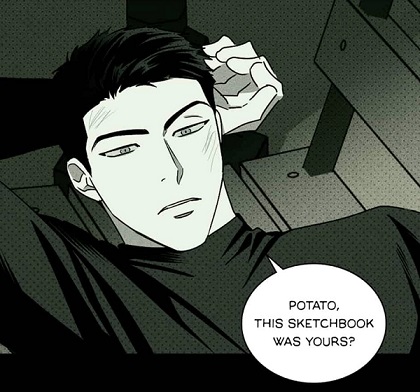 (chapter 39) But why did he give him such a nickname? It is related to the moment he saw clay in the child‘s hand.
 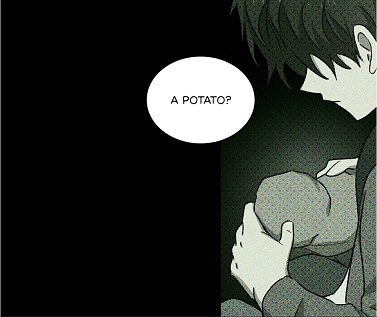 (chapter 29) He couldn‘t recognize what it should represent. At that time, Matthew was attempting to create a sculpture, a rabbit, as the main lead felt attracted to the rabbit that was living at the orphanage. However, the fact that Jin associated this form of clay to a potato reveals much more about Jin‘s personality than the main character realized. How so?
Because the sculpture was not finished, the protagonist had to interpret the form. Since I wished my avid readers to comprehend where this thought came from, I have to refer doctor Frost once again.  (doctor Frost, chapter 2)
  (Doctor Frost, chapter 2)
  (Doctor Frost, chapter 2). Thus I deduce that the potato exposed Jin’s subconscious.
What does a potato symbolize? First, it can symbolize love and warmth, hence there exists this custom to send a potato to a loved one. By doing so, they desired to express their care and concern for the acquaintance. They are nurturing their loved one in a figurative way. And look how he behaved with the young orphan. He would pet his head with his big hand or he would smile to Matthew. 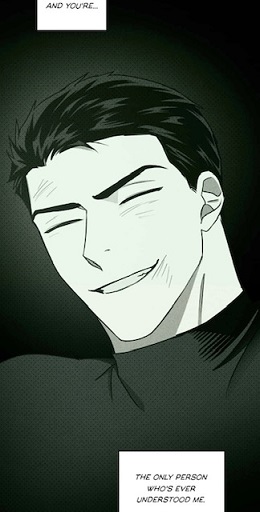 (chapter 29)
Moreover, I associate potato to humbleness and simplicity, for it is connected to agriculture and peasant hood. Naturally, “potato” can signify “stupidity or naivety”, consequently people utilize “potato-head” as an insult. This coincides with the young man’s warning: 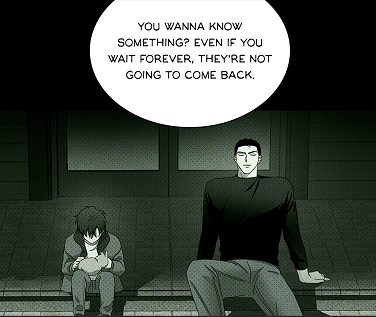 (chapter 29) He desired Matthew not to have any false hope and illusion. He should lose his naivety. Yet, the main character had no idea that the boy had already gone through a terrible experience. The suicide of his parents and the greed expressed from “adoptive parents” had opened his eyes. The adults were superficial, selfish and avid. They all had expectations from him.
  (chapter 29) This explicates why Matthew chose to push people away and remained silent. He just wished to be left alone. To conclude, Matthew was far from being innocent, but his meeting with Jin changed his life. Through him, he discovered that all people weren’t like that. There was hope, which is represented by GREEN,
In addition, potato can also be linked to weakness, for the vegetable is dependent on different elements like warmth through the sunlight, water and the hand of a farmer. Without them, it can not grow properly. That’s how Jin Cheungwoo judged the child.  (chapter 39) He needed to be protected from the abusive priest. Besides, he became angry, for due to the adults’ intervention (they had killed the rabbit), Matthew had stopped drawing. It was, as if they had ruined his talent.
  (chapter 39) Jin saw Matthew as a talented, lovable but weak child who needed advices and protection.
  (chapter 29). He had detected his exclusion, unaware that this was actually his own choice. What caught my attention is that the future director of Shinhae acted like a surrogate parent to Matthew. He stopped the bullying and advised him to change his attitude:
 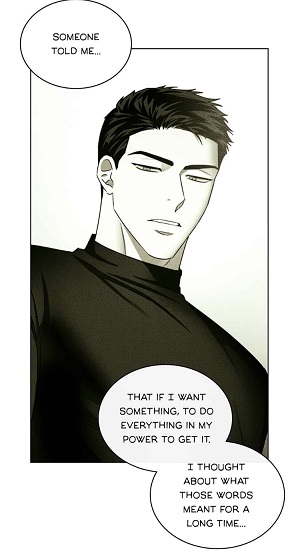 (chapter 31) He should become proactive. He should have desires and try to achieve them. The irony is that the young boy misinterpreted Jin’s recommendation: he should stop to rely on others, and as such to reject the money from his inheritance. He should do things on his own! He pushed him to become a sculptor. On the other hand, this association “potato” exposed Jin’s true desire: he was hungry for warmth and sweetness in his life.
 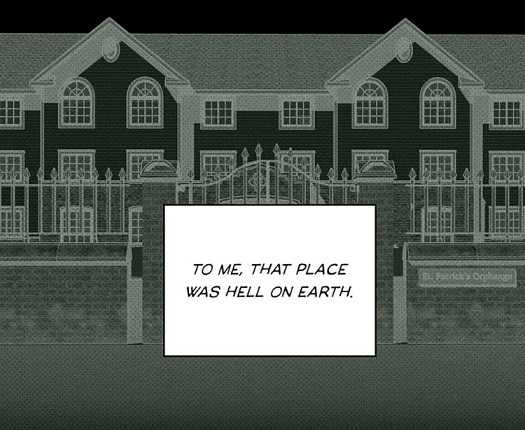 (chapter 39) And this is exactly what Matthew could give him through his drawings. The young man could forget his disenchantment and his suffering thanks to his art.
 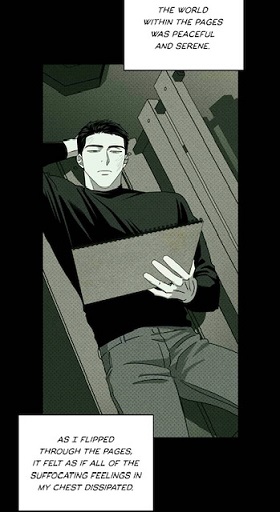 (chapter 39) They represented an escape from his terrible life, it was, as if an breath of fresh air had entered the orphanage. Therefore it is not surprising that the main lead became very protective of the child. Both needed each other.
So when Jin gave him a nickname, Matthew could only feel that he was special to Jin. That’s the reason why the artist was hoping to be called Potato again. And his dream came true, yet the unconscious sculptor couldn’t witness it:  (chapter 39). Consequently, I come to the conclusion that the nickname “Potato” actually reflects Jin’s true personality as well. Thereby he could sleep peacefully in the studio under the green light. Don’t forget that a potato grows in the dark soil. In the beginning, the director is a humble, loyal and warm man who longed to have a family and as such a home!
His hope to have a home was displayed, when he looked at the building. He dreamed to live in a skyscraper 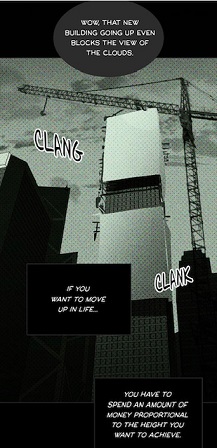 (chapter 5) He imagined that he could only obtain it, if he became wealthy and powerful. This is no coincidence that Brandon Lee gave him as a reward the building. And now, you comprehend why Jin Cheungwoo refused to follow his former boss. He had sold his soul to achieve his dream: a home, and it was for nothing! Why? Once he had the property, Brandon Lee asked him to switch side and follow him to the new company he had founded. However, by acting so, Jin realized the falsehood of his dream. If the home is empty, then it is meaningless. This explicates why Jin said that the scar on his back has no meaning now. And even Brandon had a similar perception:
  (chapter 32) This is no coincidence that we have a reference to food here. Jin has always been longing for a potato, but not for a cup of tea. Simplicity versus sophistication. It also explains why the betrayer bought a cheap wine in order to rekindle with his former “dog”.
The manhwaphile can detect the purity in Jin, because he suffered by dirtying his hands. 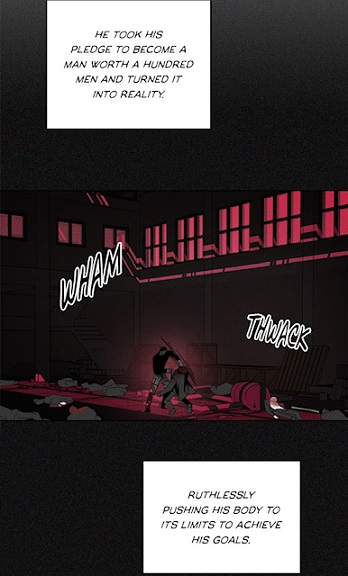 (chapter 32) He needed drugs to forget his sins.
 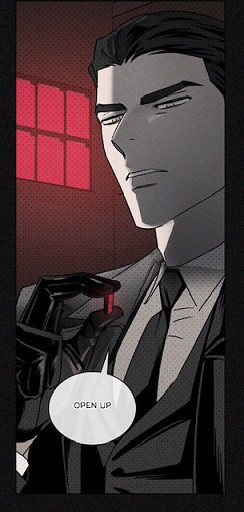 (chapter 32) And that’s how he lost his true self, and became a cynical and cold-hearted man. Yet, he could never mask his true identity. He still values loyalty. The tragedy is that the real sinner was Brandon Lee who would give his orders without dirtying his own hands. Observe that he is always wearing gloves. Now, Jin is full of remorse, hence he has sleeping problems. Therefore, the readers should judge Jin’s following statement as a lie:
 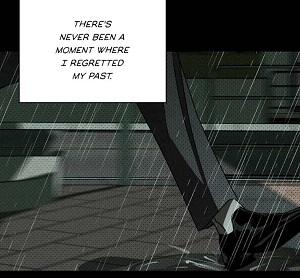 (chapter 39) He has such a negative perception of himself that he describes himself as rotten to the core.
 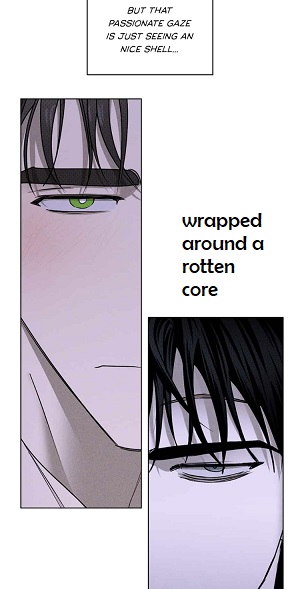 (chapter 35) These words mirror his self-loathing. Therefore I believe that when he called Matthew a psychopath, he was actually projecting his own thoughts onto the artist. He perceives himself a “psychopath”, for he killed so many people. He is so tormented by his sins
 (chapter 4) that he needed sex combined with drugs to distract his mind. However, thanks to Matthew, Jin could slowly keep his distance from drugs. Matthew is nurturing him, he is his sweet potato, his cure to recover his memories and rediscover his true self. That’s the reason why he was willing to sacrifice himself for the artist’s sake.
 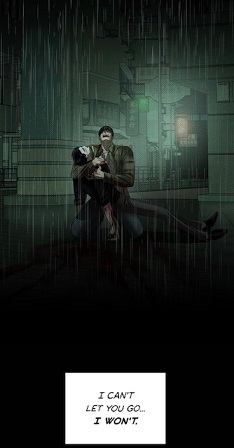 (chapter 39)
We could say that Matthew replaced the drug. Jin could enjoy sex with Matthew and forgetting everything, hence the colors during their last love session was blue and purple. However, when Matthew started confessing to him, Jin felt the need to reject his affection, for he viewed himself as not worthy. Once again, Jin thought that the student was just a “potato-head”, he was too naïve. He had no idea about Jin’s true personality: the latter was a monster who lives in a dangerous and cruel world.
The irony is that Jin was wrong. Matthew is the one who knows Jin the best. He met the main lead before he got corrupted by Brandon. That’s how I realized the function of “Potato”. Matthew would bring Jin back to nature, so that he could rediscover his true self. Yes, the manhwaphiles shouldn’t forget that the potato is connected to nature. Hence I am connecting Brandon to civilization and corruption (money) (chapter 11), while Matthew is symbolized by nature. This is no coincidence that both are green.
It was, as if Matthew was encouraging the director to view life differently. This explains why Jin saw flowers, when he admired the artist’s handsomeness.  (chapter 31) I had already explained in the previous analysis that Matthew would bring colors into Jin’s life. But now, I would like to be more precise. How did Jin discover serenity and peace of the mind? Through Matthew’s drawings. They were all showing nature.
 (chapter 39) One might argue that in these images, the beholder can detect the presence of civilization: the basket hoop, the swings and the bank. However, you will recognize that the tree is in the foreground, the ants and the sunset were the main topics. Matthew had actually focused on these elements, when he had selected the places. Besides, the swing, the bank and the basket hoop have a common denominator: leisure. But this doesn’t end here. In no picture, you can find people. These drawings reflected Matthew’s desire for solitude. This represents his rejection of “civilization”. In fact, he selected places which he associated to the director of Shinhae.
  (chapter 29)
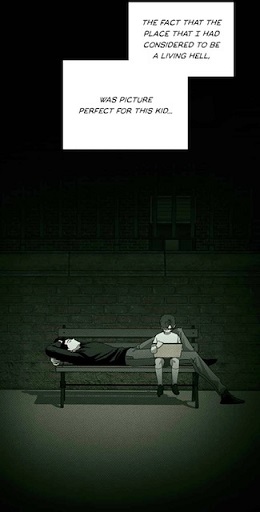 (chapter 39) In other words, since his youth, Jin has always been the protagonist’s muse. Thus Matthew said this concerning the main character: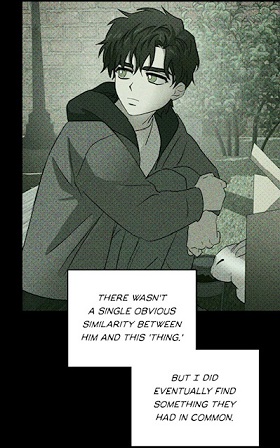
 (chapter 29) And now, you comprehend why Matthew had asked Jin to be his model.
But why could Jin grasp the young boy? It is because the former was exactly like the sculptor. Jin was also a lonely soul, though he was surrounded by people.  (chapter 29) This means that here, the young man was faking a smile. And note how he recalled the orphanage: he connects it to the building and not to people. (chapter 39) This exposes that Jin was never close to anyone except Matthew. The director of Shinhae had a similar dream: keeping distance from people. He wanted to live high up in the sky, far away from people. (chapter 5) The role of Potato is to push Jin to cut ties with the mafia, to be far away from people and corruption. But how can he do that? Through his money, love and art. Yes, his money…
 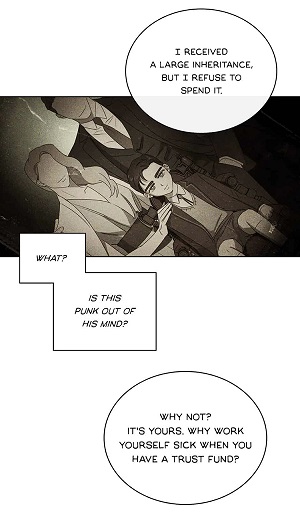 (chapter 31) So far, he saw no need to use it. But if it means that with his money, he can have Jin, then he will spend it. Don’t forget that for Jin, without money, you are powerless. Moreover, in their last love session, Matthew was already forcing the main lead to choose him and to focus on only him.
  (chapter 34) But Jin rejected him by letting him see his “true face”: he would take drugs and he was a murderer, for he would use a knife. In my eyes, this was the main lead’s attempt to resist temptation. He feared to become attached to Matthew, as he had already experienced disappointment and betrayal due to Brandon. Nonetheless, the mafia boss had long forgotten that Matthew knew this side from him. He had witnessed the character’s brutality. Nevertheless, for the sculptor, this was justified, as he was trying to protect him.
  (chapter 39) Matthew was also aware that the priest was abusing Jin too. The latter had explained that he was sacrificing himself for the sake of the other children. That’s the reason why the boy with the green eyes never condemned the protagonist as a sinner. This positive perception was particularly perceptible in this scene. After beating the priest, Matthew feared more Jin’s departure than his violence.
  (chapter 39)
Therefore I see the discovery of the drug in the soil as a metaphor for a turning point in Jin’s life, the drug will be removed and replaced by a museum. And don’t forget that the potato grows under the soil! It was, a field had prepared for potatoes in a symbolic way. But the problem is now that Jin is badly hurt. This is important, for the artist could lose his muse for a second time. (chapter 39) Besides, he hasn’t finished his sculpture yet.  (chapter 27) This would be a huge catastrophe for the artist, he would be more devastated than with the rabbit’s death. (chapter 39) This would literally kill the young man. He wouldn’t be able to create.
But since Jin could finally remember Matthew, he has no longer any reason to push away Matthew. The author wrote in the note that the second season will be less dark. And after reading my interpretation, you can grasp how. We observe the return of nature through art. First, Jin is forced to visit a museum  (chapter 1), then to look at the main lead’s sketches. (chapter 27) The man stands in the center, and not money. This announces the return of Jin’s humanity. That’s the reason why I think that Matthew’s sculpture of Jin could help the protagonist to see himself in a different light. Moreover, since the latter liked the prodigy’s drawings so much, he can only encourage his lover to keep creating and draw landscapes like in the past.
This means that Matthew Raynor will have to fight Brandon Lee, as the latter is the one responsible for Jin’s addiction and misery. This scene (chapter 32) stands in opposition to this one: (chapter 39) First, it is important to outline the similarities. Both are taking place during the night. Then we have two people: while one is waiting (Jin/Brandon), the other is “working” (Matthew/Jin). However, in the first scene, Brandon only arrived after the massacre and gave his “dog” his reward, the drug and the property, whereas the young man on the bank was keeping company to the artist. He could relax waiting for a new drawing from Matthew. With his behavior, he was showing unconditional support to the creator. Brandon criticized his dog, saying that he had never asked him to kill them. But is it true? He could have just given an ambiguous order. But by doing so, he was remaining clean, it was not his responsibility. Moreover, the silence had a different signification: death versus peace. That’s why I am expecting a showdown between the former lover and the young student. Matthew has no problem to dirty his hand contrary to Brandon Lee, who always uses assistants and gloves. Brandon Lee said that since Jin never killed him, then for him, it meant that they would rekindle at some point. Matthew will definitely resent Brandon for changing his muse. He had already experienced the negative impact of wealth: superficiality and hypocrisy which led his parents to commit suicide. But how can Potato represent a danger to Brandon Lee?
People tend to forget that the potato plant is poisonous. Potato plant poisoning occurs when someone eats the green tubers or new sprouts of the potato plant. Hence the boss of Bumyung construction corporation shouldn’t underestimate Matthew Raynor, whom he will definitely consider as a green man. But since his youth, he was the witness of death: his parents, the rabbit, the priest… Potato showed his resistance, when he fought back the assassin sent to remove him. And after witnessing Matthew’s despair at the end of season 1 (chapter 39), there’s no doubt that he will resent the person behind Jin’s injury. During his childhood, he couldn’t protect Jin, but now, he is no longer a child. He is strong and big.
As a conclusion, Matthew and Jin are fated to each other, for they both are represented by the potato. Moreover, they have the similar inclinations: their desire for peace, solitude, sincerity and for warmth. Both enjoy nature, tranquility and peace by keeping their distance from people. But by meeting Jin again, Matthew discovered a side of Jin: sexuality. And that’s how they will be able to create their haven of peace. Yet, before this can even happen, Brandon has to be removed, as he stands in the way.  (chapter 30) The latter wants to return to the past, but not the same one than Matthew’s.
Feel free to comment. If you have any suggestion for topics or manhwas, feel free to ask. If you enjoyed reading it, retweet it or push the button like. My Reddit-Instagram-Tumblr-Twitter account is: @bebebisous33. Thanks for reading and for the support, particularly, I would like to thank all the new followers and people recommending my blog.
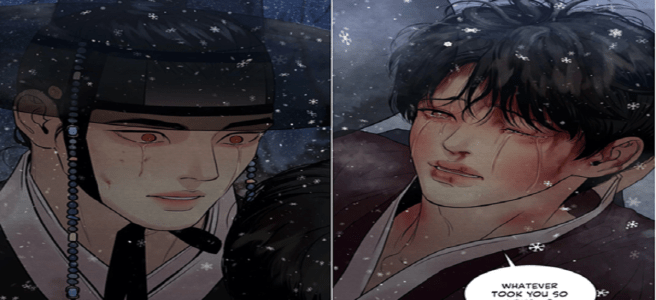



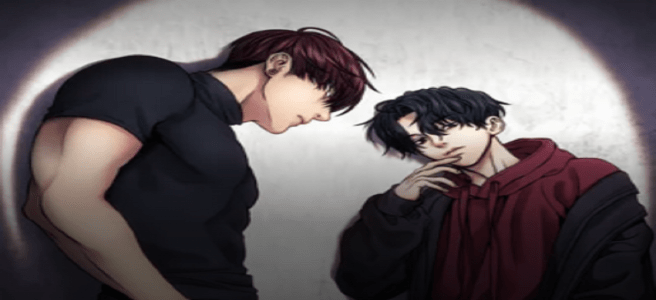
This is where you can read the manhwa. https://www.lezhinus.com/en/comic/pawn But be aware that this manhwa is a mature Yaoi, which means, it is about homosexuality with explicit scenes. Besides, this manhwa is categorized as HARDCORE. Here is the link, if you are interested in more analyses about this manhwa and others https://bebebisous33analyses.com/2021/06/06/table-of-contents-of-analyzed-mentioned-manhwas/
Feel free to make some donations/sponsoring: Ko-fi.com/bebebisous33 That way, you can support me with “coffee” so that I have the energy to keep examining manhwas. It would also cover my expenses for the blog.
 (chapter 34) In episode 34, the criminal Do Seong-Rok announced to his partner Lee Je-Oh that he was releasing him. He was free to go, he could return to his true home. But why did the red-haired man push away his lover? Anyone reading the manhwa will certainly reply that he did it to protect the prostitute. He had just received a message from Jeon Hee-Seong telling him that the police would arrest him soon
  (chapter 33). This explanation is naturally correct, but as you can imagine, the main lead‘s choice is far more complex. I would say that he was not truly aware of the motivations behind his behavior. This will be in the center of this analysis. But for that, I need to elaborate the reasons how Do Seong-Rok came to trust Jeon Hee-Seong in the first place. In the essay “The goldfish and the lamb – part 2“ I had portrayed Do Seong-Rok as naïve, but now I can explicate more precisely why the main lead came to trust the witch first. The author Evy gave us more insight at the end of season 1 and in season 2. As the title lets it transpire, promise stands in the center of this essay.
What caught my attention is that the red-haired man had been abandoned in an orphanage with the following message:  (chapter 12) The father employed the idiom “promise“ which is a synonym for hope. By leaving such a note behind, not only he gave hope to his son, he would come back to fetch him, but also he gave the impression that he was very serious about his intention. Why? It is because the message was written. It was, as if he had written a contract, where he committed to keep his promise. The note became the symbol for hope and commitment. At the same time, this signified that the note would contradict the expression “empty words“. Therefore it is not surprising that Seong-Rok kept thinking about his biological family, and had many questions.
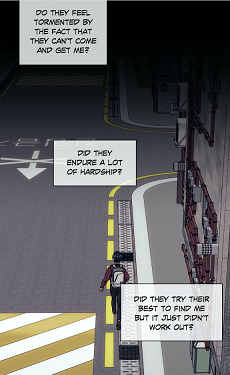 (chapter 38) He was clinching onto this promise. He was not an orphan, he had just been entrusted to the orphanage for the time being. Thus he waited. The problem is that this “contract“ had no name, hence it was void. The main lead never realized it. But as time passed on, the pressure on him kept increasing, as his family had not appeared yet. Slowly, he was cornered. If he had spent more than 12 years without his family, then he was truly an orphan. That’s the reason why he pressured the director of the orphanage and discovered the identity of his father. The latter had definitely sponsored the orphanage in order to lessen his guilt. That’s the reason why the woman knew about the identity of the relative. So when he saw where his father was living, he recognized the falsehood of the note, but he was in denial, till he saw his father. The latter saw his son as a threat, thus he showed his displeasure.
 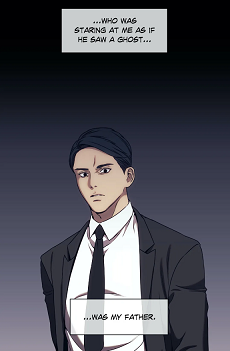 (chapter 38) But to silence him, the relative approached him and begged him to keep his distance from him and his family, for he could hurt innocent people (his wife and his younger son). The father’s behavior exposed to Do Seong-Rok that he had been truly abandoned, and this right from the start, as he was an illegitimate son. His father had married into a wealthy family. His merely existence embodied shame and guilt.
  (Chapter 38) This is important, for it destroyed the main lead’s self-esteem in a certain way. He didn’t feel needed at all. It was, as if his existence had no meaning. This impression got reinforced, when the father gave him money to send him away.
  (Chapter 27) He had only got to his side to push him away. When the father returned to his family, the young boy could sense that he had no one by his side. Not even the orphanage, which had covered up for the father’s cowardice.
From that moment on, he had no goal in his life. 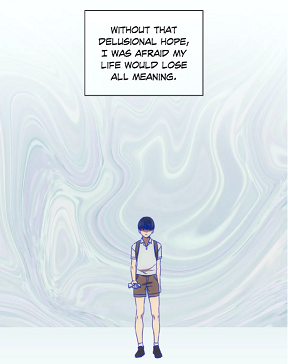 (chapter 27) The hope had kept him alive, but now without any hope, what could he expect from life? Nothing… he was not wanted or needed.
And now, the manhwaphiles are probably wondering why the father left such a note in the first place. Why did he give hope to his son, when he never had the intention to return? In my eyes, the father did it to lessen his remorse. That way, he would create a fake image about himself. He was not a bad person, he had never meant to hurt or abandon his son. Consequently, he had made sure that his son would live in comfort. However, the result was that the man ruined Do Seong-Rok’s life, for the message created the illusion that he had indeed a family waiting for him. This explicates why the protagonist said this:  (chapter 27) He was still hoping, but his despair was always present. Since water is a synonym for life, this means that as an orphan he could live in comfort (exoneration), but he was still missing warmth and affection. There’s no ambiguity that he must have kept thinking about them the whole time. Therefore it is not surprising that for his birthday, he wished a family
  (chapter 27) and not a console or video game. Furthermore, for the son, it meant that he would never be adopted! How could Do Seong-Rok get adopted, if he had been left with such a note? To conclude, the promise in the note was in reality fake. It stood for empty words. Simultaneously, it ruined the main lead’s life, for it pushed him to question his own existence. Why was he born in the first place, if he was not loved or needed? The son got traumatized, when his relative turned his back on him after begging him to vanish from his life. It was, as if he had been abandoned a second time. Do Seong-Rok felt lost, his existence had no meaning at all. Hence it is not surprising that he chose to destroy the letter.
 (chapter 27) It was, as if he was cutting ties with his biological father. In addition, since Do Seong-Rok associated the paper to a promise, this means that he came to the idea that a promise should be expressed in words and not written. At the same time, he learned a terrible lesson:
  (chapter 38) He would never make an empty promise. If he can’t keep a promise, then it was better to never promise, for it would create an illusion and disappoint the person who was clinching onto the promise.
What caught my attention is that as a soldier, he got abandoned by his comrades too.  (Chapter 16) He was also left behind, and contrary to the past, this time he was saved by Jeon Hee-Seong.
  (Chapter 16) She protected him from committing a wrongdoing. She talked to him, and showed an interest in him.
  (Chapter 16) She even gave him her address to contact her after he had left the army.
 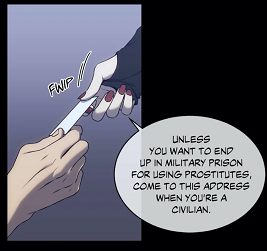 (Chapter 16) This panel even stands in opposition to this one: (chapter 27) As the manhwalovers can sense, the femme fatale behaved the exact opposite of the father. She didn‘t push the main lead away at all. She even recognized him after the separation, so he had left an impression on her. Thus we could say that she gave a meaning to the protagonist‘s life. She even paid an expensive hotel for their encounter. He felt recognized first, then appreciated before feeling needed. Therefore it is not surprising that Do Seong-Rok desired to protect her,
  (chapter 16) and was even willing to risk his life for her.
  (Chapter 16) He was by her side in the street, and he didn’t mind being seen with her. She only pushed him away, when she was cornered implying that she had no other choice. She had to marry Choi Yeong-Gil if she wanted to escape prostitution. In other words, we could say that she never rejected the main lead. She insinuated that he was her source of joy in her life.
 (chapter 16) So technically, she announced that she was leaving him officially, but not emotionally. That way she pushed the main lead to remain by her side, while giving the impression that she was leaving him behind against her own will. She had no other choice. Striking is that in that scene, the prostitute spoke the truth, when she portrayed herself as ruthless. Her justification was that she was a poor victim.
  (Chapter 16) She would do anything to save herself, even use him for her own benefits. The latter didn’t mind, for in his eyes, he was helping himself. (chapter 16) She was still giving a meaning to his life. He would act like a knight in shining armor who needed to defeat his enemies.
  (chapter 16) However, when she suggested the murder, the main lead put a condition on his assistance.
  (Chapter 06) But striking is when the main lead asked her this, he never requested from her that she signed a paper or a contract. This promise was just oral. This was related to his trauma: the left note with the fake promise.
On the other hand, similar to his father, Jeon Hee-Seong left a short message. 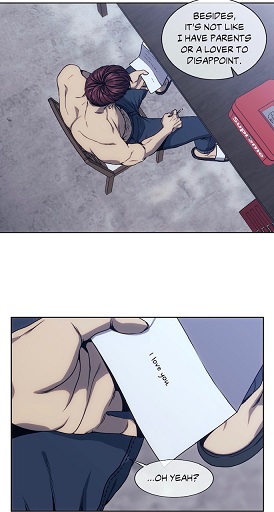 (Chapter 9) Contrary to the father, she confessed her love to him. That way, she created the illusion that her love was sincere. As you can sense it, the fake love confession had the same function than the father‘s message. It gave hope to the main lead. This is no coincidence that the protagonist was acting, as if he was waiting for the return of his lover.
  (Chapter 9) But exactly like in the other message, the love confession contained no name at all. It was totally anonymous, therefore the love confession was fake too. In my eyes, Do Seong-Rok learned the following lesson: a love confession should never be written too. That’s the reason why he cried after he realized that she was already betraying him.
 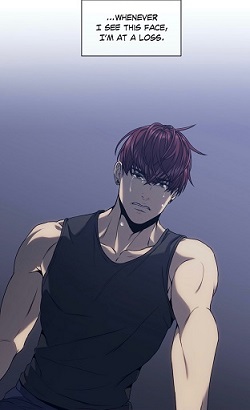 (chapter 16)
In other words, Do Seong-Rok was put in the same situation 10 years later. The only difference is that this time, the love confession was the motivation for the main lead, while the promise of rescue had been just exchanged orally in the bar. He naturally believed that her affection was genuine, this was the implied condition for his help. The main lead never requested a contract for the promise due to his traumatic past. He had already made the experience that such a promise could be like empty words. But naturally, the protagonist was not entirely stupid. He had strongly internalized that a person can only make a promise, if the latter can keep it! Hence Jeon Hee-Seong was forced to give him an insurance. This was the recorded phone call from Seo Sang-Joon proving that he had been responsible for Lee Soon-Cheol’s death. 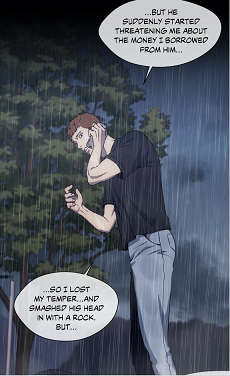 (chapter 40) However what the criminal didn’t know is that he had been played by the femme fatale and her lover. That’s the reason why the protagonist was by her side, when she received Sang-Joon’s call.
 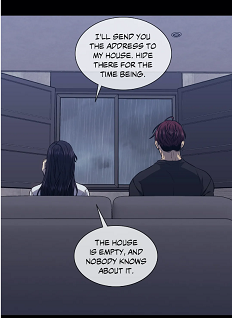 (chapter 40) Another evidence for this theory is that the man with a short temper had the car which actually belonged to Do Seong-Rok. The woman knew about the convict’s bad temper and anticipated his reaction. He was supposed to wound or kill Lee Soon-Cheol, then Do Seong-Rok’s task was to eliminate the others before putting the whole blame on the convict. That’s the reason why the murderer used a stone to assassinate the witch’s husband. Their plan was to frame Seo Sang-Joon, well aware that the red-haired man would become a murder suspect in order to redirect the investigation from her. Both were aware that she would get suspected first, for she had a strong motive.
What caught my attention is that the woman is often seen by the main lead’s side.  (chapter 16)
 (chapter 24) (chapter 40) This is important, for it corresponds to the main lead’s biggest wish.
 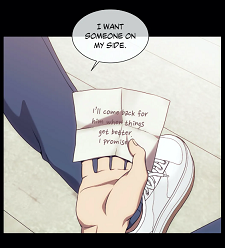 (chapter 27) If she was by his side, she would never turn her back on him. But thanks to Lee Je-Oh, he discovered that her presence by his side was just an illusion, for she was rarely by his side. He had warned him before.
  (chapter 9) He kept reminding him that the woman was not reliable or even trustworthy.
 (chapter 28)
Striking is that after having sex with him, she never faced the young man. She turned her back on him, a sign that she was not honest at all. Her facial expressions would have betrayed her, while her words would reflect her true thoughts. (Chapter 16) Her words in the bed were actually ambiguous: a reproach or a compliment? That‘s the reason why the protagonist couldn‘t detect her deceptive nature. She was speaking the truth the entire time. And after meeting Lee Je-Oh, the red-haired man was forced to face reality. Hence his past with the woman came to haunt him. Gradually, his unconscious forced him to see the reality of his choices and actions. He had been manipulated and become a killer. In his first nightmare, the woman was portrayed without eyes  (chapter 6) while revealing her intentions.
  (Chapter 6) Then when Sang-Joon called the femme fatale, she might have been sitting next to him (chapter 40), but observe the gap between them. She was still not facing him. Besides, I would like the readers to pay attention to the window in the background. The frame symbolized their separation. They were not really together, as there existed a thin wall between them. Moreover, the prostitute was even talking to the convict, so in reality she was not focusing on Do Seong-Rok. Therefore, it is not surprising that Do Seong-Rok saw the truth on the sofa, while he was facing her.
 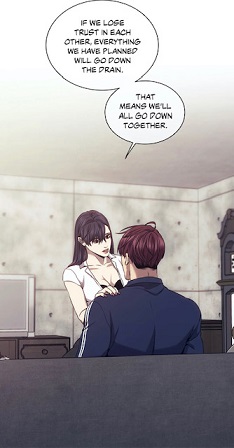 (chapter 27) He was forced to face reality, she was only feeling compassion for him. When she visited him in the mansion, he looked at her properly for the first time:
  (chapter 27) She had the same facial expressions than his father. She was abandoning him. This is no coincidence that right after he questioned her about the depth of her affection.
 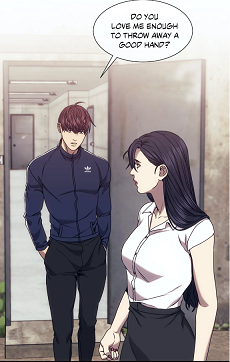 (chapter 27) He was testing her. He could detect her deception, for she never replied to his interrogation.
  (chapter 27) She attempted to divert his attention by criticizing him, something which sounded so natural. And her departure
  (chapter 27) reminded him of his own father’s desertion. As a conclusion, after rescuing Lee Je-Oh, the main lead discovered his lover‘s true personality. She wouldn‘t keep her promise, for she had never loved him. He realized that her promises were always fake, just like her insurance. The former prostitute had never committed herself to him, she had never been by his side, while he had helped her this entire time.
On the other hand, Jeon Hee-Seong was well aware that Do Seong-Rok was very sensitive to lies, thus she never used lies by commission. That’s the reason why she never replied to his question about her affection for him. Her manipulations were different. Either she lied by omission or she used paltering, revealing the truth in delay or she mixed a truth with a lie (chapter 27). As a reminder, commissioner Ahn is not the leader of the enemy, he has already abandoned the group leaded by Koo. The witch is hiding the fact that she is representing the third party. But let’s return to our main point, the instruments of Jeon Hee-Seong’s manipulations.
I also think that the messages from the cellphone played a huge role in the deceptions as well. Do Seong-Rok had the impression that he was still close to her, as he was still in contact with her.  (chapter 11) Therefore Lee Je-Oh stopped his lover to respond to her phone calls. He was well aware of the signification of the phone calls. Note that after the kidnapping of Lee Je-Oh, he tried to text her. This is important for two reasons: the texts could hide the true emotions and thoughts of the characters. If Do Seong-Rok had called her during that night, his voice would have revealed his emotions and hesitation, the phone call would have betrayed him. The femme fatale had adopted such an attitude a long time ago. She preferred texting him so that her manipulations wouldn‘t be detected. She wouldn’t be forced to act, her strength was to remain as natural and genuine as possible in front of the red-haired man. Hence her words were often connected to criticisms. (chapter 27) But because of Lee Je-Oh‘s presence, the red-haired man was put in a situation where he had to deceive Jeon Hee-Seong, and that‘s how he discovered the truth little by little. She was throwing him away, for Ahn Jae-Oh could offer her wealth and power, while he had nothing to propose to her:
 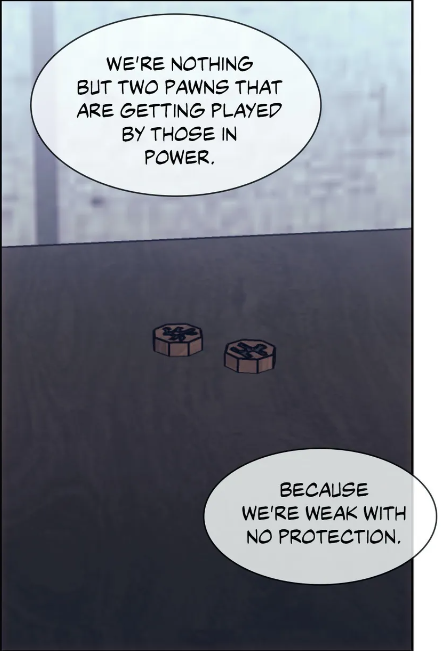 (chapter 38) This scene is important, for it indicates that the killer has adopted Jeon Hee-Seong’s mind-set! Life is like Janggi, and he is just a pawn in the big game.
The irony is that the prostitute had a totally different childhood. He had been neglected and pushed away by his father constantly!  (chapter 9) He had strongly internalized the slap on the hand as a sign of rejection. Therefore it is not surprising that Do Seong-Rok’s words in episode 9 brought him back to his childhood reliving a certain trauma. Moreover, because the father was neglecting him, the young boy was left to his own devices. Thus he stole the knight in the shop. He learned through his father, that he needed to become proactive, and not wait for someone’s help. If he desired to have his wish fulfilled, he needed to act on his decisions. Furthermore, if he had accepted his father’s reproaches, then he would have become suicidal. Who can bear hearing constantly that you are a “shithead”, a “bastard”? No one… the insults from the father encouraged Lee Je-Oh to reject such insults and to retaliate in the end. He never accepted his living conditions.
  (chapter 26) This explicates why Lee Je-Oh fought against Ma Jong-Seok either. He might have been aware that the pimp had developed an affection for him, but he could clearly see his dishonesty and hypocrisy, for he was not helping him at all. The latter took advantage of the situation. Thus he could detect the falsehood of Jong-Seok’s promise right away in the prison.
  (chapter 10) Consequently, I come to the deduction that Lee Je-Oh was raised to make up his mind. He learned through his bad experiences that life was cruel, and he should never expect anything from anyone. On the other hand, in order to live properly, he needed to have goals in a short-term, and once he made his choice, he would stick to it. Yes, he stands for real promises, but not for illusion or dreams. His words are never empty and never written. He embodies reality. Under this new light, the manhwaphiles can grasp why Lee Je-Oh perceived the murderer as a god.
  (chapter 4) Only a god could show pity and assistance towards a prostitute, not humans.
But let’s return our focus on the prostitute’s promises. You see Lee Je-Oh making deals all the time. He is always serious. It started with this:  (chapter 6) He would be his ally.
 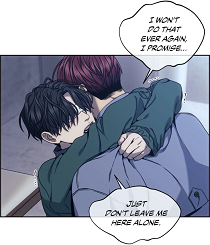 (chapter 12) He promised that he would never betray him again. Then later, he declared himself that he was Do Seong-Rok’s business partner.
  (chapter 28) Then he put conditions to this deal:
 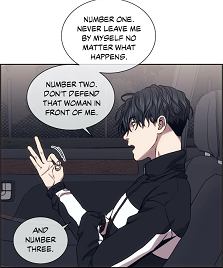 (chapter 28) And once he met the convict Sang-Joon, he introduced himself as his boyfriend.
  (chapter 29)
But why would he clinch onto the killer like that? The latter had indeed saved him, freed him from his condition as a prostitute. He had viewed him as a human before anything. He had not forgotten the man’s words in front of the pimp: 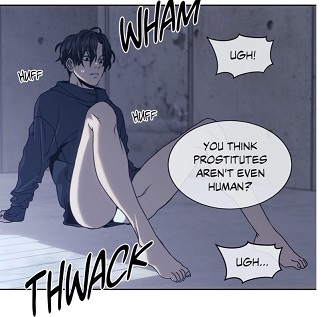 (chapter 3) He had been the first person who had helped him. He would even feed him and take care of him. He would cook for him, dry his hair or give him a bed. For the first time in his life, he felt appreciated and treasured. He discovered gentleness, concern and warmth. Not even Ma Jong-Seok would treat him like that.
 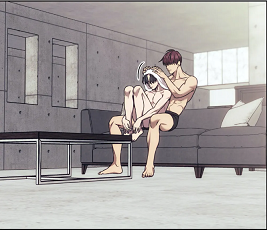 (chapter 21) He could sense that Do Seong-Rok was on his side, though the latter still had a girlfriend. That’s the reason why Lee Je-Oh refused the rejection from Do Seong-Rok in front of the mansion. He knew deep down that the man had a reason to act this way. Even when he had treated him roughly in the car, he was well aware that the man was not entirely himself. Therefore it is not surprising that Lee Je-Oh announced his determination to snatch the killer from Ms. Jeon away, for the red-haired man had not respected their deal, their promise.
  (chapter 34) He had broken his promise, hence Lee Je-Oh would turn his words into a reality.
One might wonder why Do Seong-Rok didn’t explicate his situation before, why he didn’t ask the main lead for help. He had two reasons for this:  (chapter 33) In his eyes, the protagonist wouldn’t be able to keep his promises. All these words were empty. How could he take Lee Je-Oh seriously, when the young man had been living in a cage for so long? He had no idea that Jeon Hee-Seong had played a huge role in the man’s misery.
  (chapter 26) Through this wrong choice, Lee Je-Oh discovered the treacherous side of this woman. Because of her, he suffered a lot. He was trapped in hell for 3 years.
  (chapter 26) She had deceived him with a fake dream, as if he could liberate himself by stabbing the pimp. So since the prostitute was strongly connected to Ma Jong-Seok, Do Seong-Rok could witness how miserable Lee Je-Oh’s life was.
 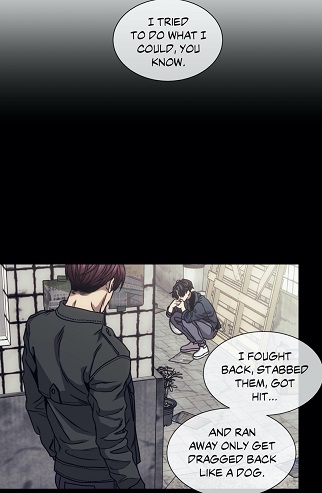 (chapter 7) Though the character claimed to have fought back, he never viewed it. Thus in his mind, the prostitute was powerless. That’s the reason why he didn’t trust the man’s statement:
  (chapter 32)
Besides, Do Seong-Rok couldn’t protect his lover, thus how could he keep Lee Je-Oh by his side? He would put him in danger, thereby he couldn’t make any promise at all.  (chapter 32) He didn’t desire to generate hope. And now, you comprehend why Lee Je-Oh chose to accept the break-up after hearing his lover’s explanation. (chapter 34) He knew that Do Seong-Rok was thinking of Lee Je-Oh’s best interest.
 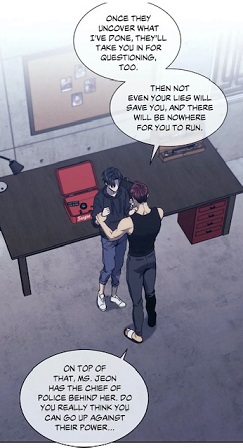 (chapter 34) The protagonist needed to show Do Seong-Rok that every words he had said to him were true and genuine. He was a man of his word, he would assist him. He would keep his promises. Though he left his side physically, he was still thinking about him. And it was the same for the suspected murderer. This break was necessary for Do Seong-Rok to perceive the main lead’s strength and power. He was intelligent and even cunning enough. He was forced to face the reality of his situation. Jeon Hee-Seong would never visit him in jail, for this would be seen as a sign for her involvement.
Through his past experience with Jeon Hee-Seong, the black-haired man knew that the woman was a scammer. He proved his oppa that he would protect him no matter what.  (chapter 39) And he finally did it. He is now Do Seong-Rok’s boyfriend, and the latter is now called “oppa” in front of others. Though they are now separated by the window, they are in verity standing on the same side.
  (chapter 39) They are taking care of each other. He brought him new clothes, while the other offers to pay the fine. Their attachment reached its peak, when the main lead stroke his lover’s hair.
  (chapter 39) He could feel the warmth and affection despite the presence of the glass. He might have debts and no connection, yet with his cunningness, he was still able to ruin Jeon Hee-Seong’s plan. So a pawn still has a value. Each piece in Janggi is indeed important. And now, you are probably wondering how Lee Je-Oh ruined her “perfect crime”?
In my opinion, her intention was to let Seo Sang-Joon and Do Seong-Rok to take the fall. That way, she would be left out of the equation. The two men had worked together. That’s the reason why she asked her future husband Ahn to manipulate the file.  (chapter 36) What she doesn’t know is that a promise was the cause for the destruction of her plan. How so?
 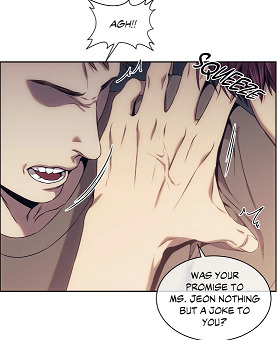 (chapter 31) If Seo Sang-Joon had not made a move on Lee Je-Oh and caused trouble, the prostitute would have never seen this scene:
  (chapter 31) The convict was scared of jail! He was really distressed in front of Lee Je-Oh.
  (chapter 31) The prostitute is well aware that this man just needed to get scared and cornered, then he will commit suicide. As you can see, the femme fatale’s promises are all linked to illusion and downfall, while the dark-haired man embodies reality and real promises.
Thus I couldn’t help myself smirking, when I read Lee Je-Oh’s following promise:  (chapter 16) 😉I believe that he is wrong. His reaction was natural. He had never seen a man crying before. He only had met dishonest, angry and violent men. Note that Lee Je-Oh never said what he had on his mind. He kept his thoughts to himself, hence his words never became a reality. He still embraced the man. This means that he will fall for this kind of moronic love!! 😎 He was already getting more and more jealous towards Jeon Hee-Seong. Though the young man keeps describing Do Seong-Rok as his weapon
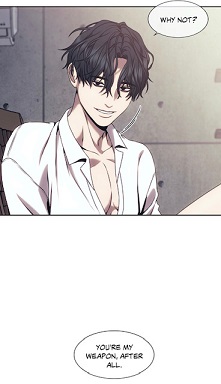 (chapter 21), he still values him as a human. Without him, he has no protection. He is the new knife the femme fatale chose to dump, the new version of this scene
 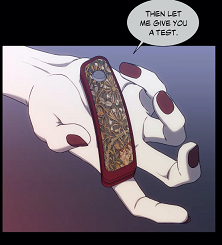 (chapter 26). The only difference is that back then, she won, while now it is the opposite. To sum up, Lee Je-Oh embodies actions, promises and reality, whereas Jeong Hee-Seong stands for the opposite values. She will never get involved herself directly.
Before closing this essay, I would like to reveal a thought I had concerning the evolution of this story: Do Seong-Rok has a wealthy father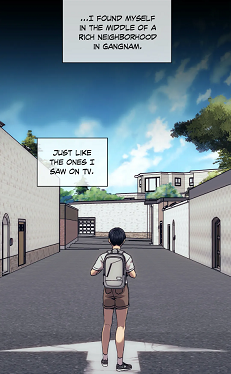 (chapter 38) but neither Lee Je-Oh nor Jeon Hee-Song are aware of this. Back then, the father tried to buy his son’s silence with a few bucks … but technically, he could blackmail his father to get some money in order to pay his lover’s huge debts!! By doing so, he would be able to help his lover to escape from Koo’s claws. On the other hand, I believe that Do Seong-Rok and Lee Je-Oh are fighting the injustice and prostitution in this city, as they are now on the verge of becoming the femme fatale’s enemies.
Feel free to comment. If you have any suggestion for topics or manhwas, feel free to ask. If you enjoyed reading it, retweet it or push the button like. My Reddit-Instagram-Tumblr-Twitter account is: @bebebisous33. Thanks for reading and for the support, particularly, I would like to thank all the new followers and people recommending my blog.

This is where you can read these manhwas. Payback: https://www.lezhinus.com/en/comic/payback_en Painter Of The Night: https://www.lezhinus.com/en/comic/painter But be aware that these manhwas are mature Yaoi, which means, it is about homosexuality with explicit scenes. If you want to read more essays, here is the link to the table of contents concerning Painter Of The Night: https://bebebisous33analyses.wordpress.com/2020/07/04/table-of-contents-painter-of-the-night/ Here, you can find more analyses about other manhwas: https://bebebisous33analyses.com/2021/06/06/table-of-contents-of-analyzed-mentioned-manhwas/
Feel free to make some donations/sponsoring: Ko-fi.com/bebebisous33 That way, you can support me with “coffee” so that I have the energy to keep examining manhwas. It would also cover my expenses for the blog.
In daily life, people view the idioms “innocent” and “not guilty” as synonyms. However, from a legal standpoint, there exists a difference. Innocent signifies that a person did not commit the crime, whereas not guilty means that the prosecution could not prove “beyond a reasonable doubt” that a person committed the crime. Therefore, the court does not pronounce a defendant as “innocent” but rather “not guilty”. Thus the prosecution’s task is to bring up as many evidences as possible to prove the guilt of the accused. At the same time, I would like the manhwalovers to keep in their mind that that innocence stands in opposition to sin and not just to crime! So technically, someone might have not committed a wrongdoing, but he can have acted reprehensively. This signifies that we are dealing here with moral and social norms. Thus a sin is not judged by the court, but by gods and people. This explicates why the legal system never says “innocent”, but “not guilty”. This nuance could be perceived in two different manhwas, Payback and Painter Of The Night. Some readers might question the purpose for such a study. In my eyes, it helps us to perceive the characters under a different light.
In the story Payback, the main lead Lee Yoohan had a dark past. He had dropped out of school (chapter 1), and he was no longer living with his single mother and brother Lee Hansoo. He described himself as a small but confident delinquent, as he used to work for a loan shark in order to earn money very easily.
  (chapter 1) And one day, his brother Lee Hansoo met him in order to ask him for money. Their mother was sick and they needed to pay the hospital bills. Lee Yohan agreed to help, thus under pressure, he chose to threaten a debtor’s son. Observe that the main lead chose to use a knife and take the child as hostage. He was walking on a thin line between legality and crime. As you can see, Lee Yohan was no saint. But it didn’t matter to him so far, for he had no faith at all. He refused to believe in karma.
 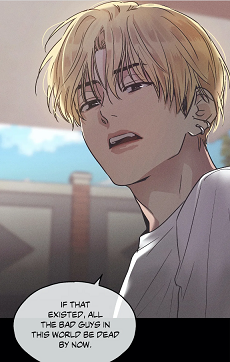 (chapter 1) He was definitely a disillusioned teenager, therefore he was not thinking about the future. However, the fact that he became totally reckless during that day indicates that he still valued his family. He might not have been close to them, but he still cared for them. That’s the reason why he agreed to accept the brother’s request. We can sense his worry here. (chapter 1) When the borrower was confronted with such a ruthless behavior, he warned the main lead:
  (chapter 1) However, since he had given up on his dreams and had no hope, Yohan didn’t take the threat seriously, until he was confronted with reality.
 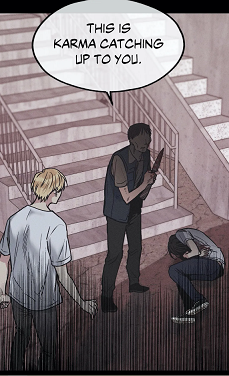 (chapter 1) The same man killed his brother Lee Hansoo in front of the main character. The man had acted like that, for he had lost everything: his home and as such his family. I would add that he had failed to protect his son. Out of despair and anger, he decided to retaliate, to make the young man suffer, like he had been hurt before. An eye for an eye, a tooth for a tooth. The assassination was like a wake-up call for Lee Yohan. From that moment on, he turned a new leaf.
  (chapter 1)Why? He considered himself as the murderer of his own brother.
  (chapter 2) In his eyes, it was, as if he had killed himself the brother and his own mother!
  (chapter 27) He recognized that his actions had been the trigger for the debtor’s crime! At no moment in the manhwa, the main lead blamed the real culprit, not even his own mother who had given up on him. He admitted that in the end, it had always been his own choice to live like a thug! Striking is that he considers himself as responsible for his mother’s death, as because of his terrible way of life, he had caused her worries. As you can see, Lee Yoohan could not be considered as guilty for his relatives’ death, but he had definitely his share of responsibility in his family’s suffering.
Striking is that the young man paid off all his debts, as he saw them as his way to atone for his sins. Thus he never allowed himself to rest. How could he enjoy life, when he was a sinner? In his mind, he needed to suffer, but at the same time, he could never grief for the loss of his mother and brother. He had not the time for that. That’ the reason why Yoon Jae’s best friend asked him this:  (chapter 27) No, he didn’t cry, hence the owner of the club wept for him.
 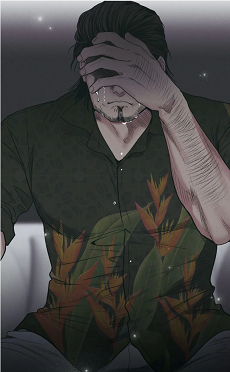 (chapter 27) He could sense Lee Yohan’s agony. He had lost his family at such a young age, he might have been a sinner, but anyone could sense his affection and conscience! He might have lived like a thug, but he was not a bad person per se. It is just that he had made wrong choices, just like the man who had stabbed his brother. In the main lead’s eyes, it was not karma, like the culprit said: (chapter 1) This means that Lee Yohan still refused to believe in divine punishment. Therefore it is not surprising that the protagonist punished himself so hard, and accepted his suffering without objection. He was not allowed to feel warmth and affection.
 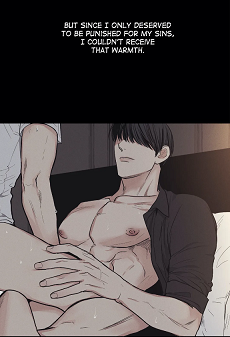 (chapter 15) Thus he rejected the advances from Yoon Jae. In chapter 15, we could sense that the main character was preoccupied about the existence of god. Was there a divine punishment or not?
 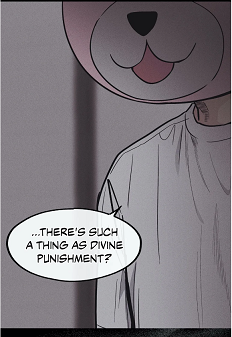 (chapter 15) And Yoon Jae denied such a thing, but added then:
  (chapter 15) But is it not the same? Yes and no… For Yoon Jay, if someone acts badly towards another person, the former will be treated the same way. On the other hand, each kindness will be returned. But one might argue that the gods can interact through humans and use them as pawns to give people their karma. And this is what we are discovering in Payback. Lee Yohan helped Yoon Jae and even showed him a crying man. The famous director Yoon got moved by the main lead’s tears
 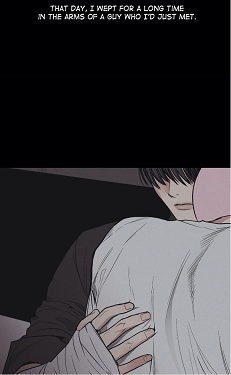 (chapter 15) proving that not all humans were cold and distant. They could express regret and admit their mistake. For the first time, Yoon Jae discovered warmth and sensitivity.
Lee Yohan would have kept punishing himself and putting a distance between himself and others, if his path had not crossed the famous actor Song Myungshin again! One day, he overheard a conversation between the artist Song Myungshin and his manager, and discovered the truth about the whole incident. The actor had been himself threatened by the debtor, so in order to save his own skin, he designated the younger brother to the future murderer.  (chapter 1) The most terrible thing is that the actor had been helped constantly by the protagonist. Since the former had a dream of becoming an actor, the “thug” was generous to help him financially and emotionally. The assassination worked for Song Myungshin, for he had planned to steal the money from Lee Yohan.
  (chapter 1) That’s the reason why he didn’t even call the police. The murder would divert the main lead’s attention from the theft. When Lee Yohan heard this confession, he got upset for two reasons. Song Myungshin showed no remorse and a total indifference towards Lee Hansoo and the main lead.
 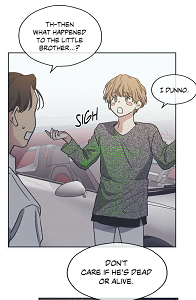 (chapter 1) But most importantly, he never suffered any karma. In fact, he could benefit from his sins and crimes. This could only reinforce his impression that there was no god out there giving punishment to the sinners. The actor took pride of his bad action, as he decided to take Song Yohan as his stage name! Yohan was a reminder that thanks to him, he could enter the entertainment scene. As a conclusion, karma hasn’t punished the actor Song Myungshin yet. Therefore Lee Yohan was determined to take his revenge. What he didn’t realize is that his first encounter with the other main lead would help him to achieve his goal: to give “punishment” to Song Myunshin. So he didn’t know yet that the gods were aware of this injustice, thus they let him meet the famous director Yoon Jay.
  (chapter 15) On the other hand, the existence of Lee Yohan gave the director hope, he could smile again and as such find happiness. The rabbit announced the return of innocence in Yoon Jae’s life. In other words, the two main leads were quite similar in their disposition: both had been wounded by their past, and had no hope. And thanks to the famous and powerful director Yoon Jay, the main lead is slowly starting living again. Little by little, he is interacting with people again, helping others, though he never does it openly. The best example is the actor Lee Hansoo who has the same name than his own brother.
  (chapter 6) In this scene, he refused to be addressed as hyung, as in his eyes, he didn’t deserve such a title. He had not acted like a hyung to his true little brother.
To sum up, Lee Yohan is a sinner, and he is not denying his responsibility for the loss of his family. For me, he punished himself too harshly. He never believed in karma, he saw that everything was related to his own choices. He had trusted the wrong persons in the end. And now, the gods are rewarding Lee Yohan’ for his remorse and new leaf. What made me smile while reading this manhwa is that when the former thug met Yoon Jay, he was wearing a rabbit costume with Jihwaha! 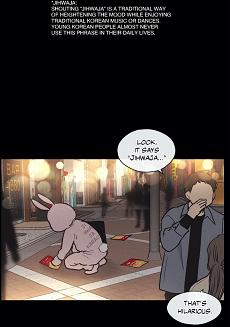 (chapter 14) I couldn’t myself thinking of the antagonist Lee Jihwa, for he was put in a similar situation.
When in chapter 101 Lee Jihwa heard the report from Seokdae, he said that he had done nothing wrong, as he had never committed such crimes:  (chapter 101) Indirectly, he was claiming his innocence. Thus the servant suggested to the young master to go to the police bureau in order to clear his name, but the young master refused to do so. Why? The problem is that Lee Jihwa couldn’t prove his innocence. And deep down, the childhood friend knew this. How could he prove that he was not involved in the scheme, when Min visited him
  (chapter 100) on different occasions, and both went to the scholar’s home together? Yes, this time Min’s threat had become a reality.
 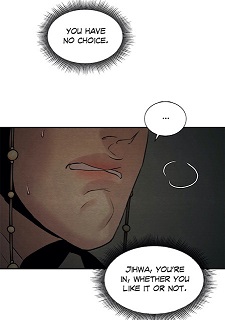 (chapter 76) He could no longer back out. He couldn’t put the whole blame on the Joker, because this means that he would have to admit his own complicity. Yes, Lee Jihwa was trapped. He could sense that he had been framed by Black Heart, but the former couldn’t claim his innocence because of his knowledge! That’s how I realize why the young man was punished this way. Remember how he had blamed his childhood friend for his misery, and had used his knowledge as a proof for his reproach!
 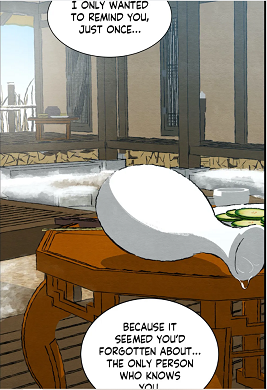 (chapter 57)
 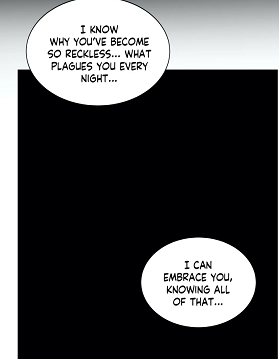 (chapter 57) Thanks to his knowledge, he was above any reproach, while it was not the same for Yoon Seungho. The latter was indeed ignorant, for he had forgotten many things. Consequently, the gods chose to punish Lee Jihwa for his arrogance and passivity. Now, he knows, but this doesn’t help him at all. Hence he decided to forget! This means that he behaved like Yoon Seungho, who repressed everything. The only difference is that contrary to the childhood friend, the main lead had been a real victim the entire time. Thus the second lead imagines that once he forgets and runs away, he will be able to escape punishment. However, he is wrong, for by choosing oblivion and desertion, he has to give up on his name Lee and identity. He can still be addressed as Jihwa, like you could see above. Yet, we have to question this. Is Lee Jihwa truly innocent like he claims it?
According to our modern legal system, he would be accused of complicity and of non-assistance to a person in danger, and this in four cases! First, when he arrived in front of Jung In-Hun’s house, he saw the painter wounded. 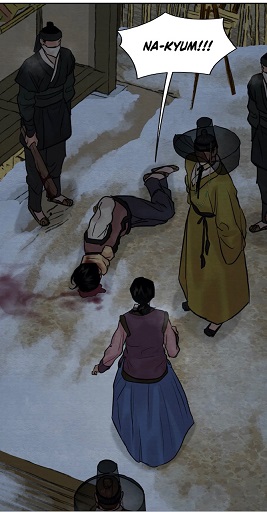
 (chapter 99) But what did he do? Nothing. Secondly, he witnessed how the kisaeng was dragged away to get killed, though it was staged. Here again, he did nothing.
  (chapter 99) I would even say that he even faked ignorance, because he was lying. The drop of sweat is the clue for this interpretation, besides Min contradicted his testimony in the shaman’s house later. (chapter 100) He had contacted the antagonist on many occasions, so he had heard from Black Heart before. It was never out of the blue. He knew about the existence of the plot and its goal: Taste the painter and kill him. He had been informed a long time ago. Then in the shaman’s house, he saw the painter dead in his vision, hence he pushed The Joker away and fled.
 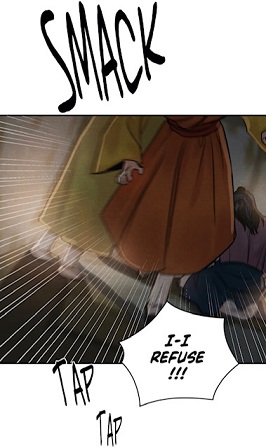 (chapter 100) He turned his back on Baek Na-Kyum. But that means that he abandoned the artist once more time. In three occasions, he was well aware what was happening and he could have intervened. Yet, he let it happen. Besides, he handed over the drugs and dildo to Min. As you can see, he was never an innocent person, but not just a sinner. He was an accomplice. And he knew this, thus he couldn’t go to the bureau of investigation. Min was well aware of this.
  (chapter 101) Naturally, his crime was nothing compared to Min’s.
On the other hand, since he didn’t participate actively in the plot, he never hurt the painter or Heena himself, Lee Jihwa views himself as innocent. But inaction is still action. Thus I still don’t think that the antagonist recognized his own sins. Why? It’s because he called himself a victim later.  (chapter 101) He didn’t see why he should die, when in his eyes, he had done nothing! And the antagonist’s prophecy became a reality.
  (chapter 50) By fleeing, he didn’t stop his friend from committing a murder. Thus he is responsible for their deaths. And he knew that Min and the other nobles would die.
 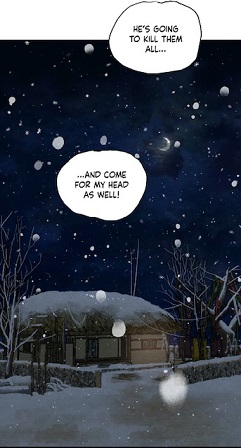 (chapter 101) He chose to save his own skin instead of saving their life, though here he was more fearing the king‘s reaction. During the same night, Lee Jihwa got tested 4 times, and each time, he refused to help. That’s the reason why the gods chose to punish him by making lose his title and name. He will become the culprit of a mass murder, he killed Black Heart and the other two nobles. And this would reflect the truth, for the red-haired master didn’t intervene. He could have acted like Baek Na-Kyum
 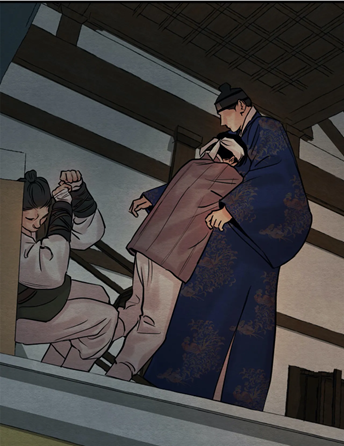 (chapter 53) and even follow his friend. And this distinguishes him from Lee Yohan so much. The latter recognized that each decision he made had consequences. And note that the idiom “choice” was connected to silence and assistance. (chapter 76)
As you already know, for me, Lee Jihwa had already imagined that the artist was dead. Because Yoon Seungho trusted the childhood friend, he came to believe the same. The gods were showing the red-haired master the future: he would become a huge sinner, he would have blood on his own hands, though he never did the deed himself.  (chapter 50) It was, as if he had murdered the nobles himself. The gods were teaching him a lesson: Knowledge and passivity are crimes. In other words, Lee Jihwa became a sinner and a criminal because of this night. And this because he refused to face reality.
One might refute this perception, for the young master had been left in the dark concerning Min’s plan. 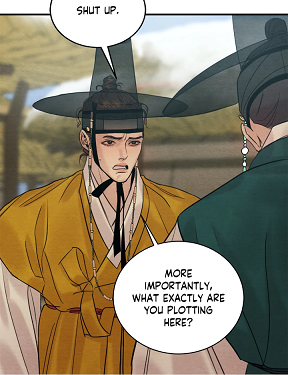 (chapter 83) But was he really ignorant here? I came to a different interpretation recently. How? First, why does the second lead have a drop of sweat in the last picture? This is an indication for a lie. But there exist stronger proofs. Don’t forget the following rules: there’s always a reflection within the same chapter, and each chapter is reflected in the next. In the antagonist’s memory, Lee Jihwa was portrayed as someone who would disobey his father!
  (chapter 83) He would trespass the house of the Yoons and enter the shed, even the lord’s bedchamber!
  (chapter 83) As you can see, Lee Jihwa was acting as a rebellious son in the past. He was not respecting social norms and the elders. This signifies that we have the exact opposite in the present. Observe the seasons: summer versus winter. Thus I come to the following deduction. He is following the order from his father, he is not dragged
 (chapter 83), but he brought Min there. Why would Min say this?
  (chapter 83) Why would he come to see the mess? His words are indicating that someone must have told him about the scholar’s death. Since we saw this,
  (chapter 83) we thought that when the plotters came, Min was leading the way. But if we take into consideration chapter 76, we realize that back then the childhood friend brought Min to Nameless’ barn.
  (chapter 76) Thus it could have been the same! Lee Jihwa had brought Min to the scholar’s house, then Min was the one giving the signal to leave the humble dwell, just like in chapter 76. The red-haired master let Min meet The Joker, before Min was the one asking Lee Jihwa to follow him, when he realized that Nameless refused to help him.
  (chapter 76) So when we view this, (chapter 83), we should envision that the roles were switched, when they went to Jung In-Hun’s house. Besides, keep in mind that in season 1, Black Heart had been the one giving the information to Lee Jihwa.
  (chapter 43), so from my point of view, we could have a similar situation, someone had asked him to bring lord Min to that mansion! It can not be Min… From my point of view, Lee Jihwa was acting on his father’s orders. That’s the reason why Lee Jihwa never entered the mansion, and he told Min the story about the incident in the bedchamber. Father Lee had been the one who brought it up first.
  (chapter 82) Why would Lee Jihwa suddenly mention this story to Black Heart, when he had remained silent the entire time? Even Min wondered about this!
  (chapter 83) Another clue for this signification is the vocabulary of Black Heart. The latter is speaking like father Lee: lunacy
  (chapter 82) (chapter 83), Baek Na-Kyum is called as a peasant
  (chapter 82)
  (chapter 92). Finally, don’t forget what Min said about Yoon Seungho.
  (chapter 83) This shows that Black Heart stands for social norms: respecting the elders. But he never realized that in verity he was getting fooled by the Lees. We saw where the main lead was living in the shed, but did Lee Jihwa say this to Min? No, I don’t think, he mentioned it… he was left in the dark about this, just like the readers were not informed, when lord Song was mentioned by Lee Jihwa.
  (chapter 83) But Min was not naive like Jihwa, he knew that once involved, someone had to pay for the subterfuge and crime.
As you can see, Lee Jihwa was repeating his wrongdoings from the past, he was betraying not only his childhood friend, but also Min and as such lord Song, for he revealed his identity. The only difference is that Min had indeed manipulated and betrayed first. But this doesn’t change the fact that Lee Jihwa stands fake loyalty. It is just the result of his education. He was influenced to follow his father’s instruction. Yes, the story is repeating itself, and father Lee was trying to use someone in order to cover up his son’s crime. One thing is sure: Min was well aware that Jung In-Hun had been killed, but he was informed that the crime scene in the scholar’s room had been staged. In my eyes, Black Heart never realized that he had become the pawn of Kim and the Lees. Father Lee’s goal was to turn Yoon Seungho into a murderer, but he had no idea that Kim had himself planned to have Lee Jihwa killed. Father Lee thought that he could recreate the situation from the past, when the Yoons were framed of treason. Back then, the main lead got blamed, but now everything is different. How so? The noble didn’t act like planned. He never used violence against the kisaengs (chapter 93)
  (chapter 99), the servant Seokdae or even his son Lee Jihwa. The loss of hair was the proof of his leniency.
  (chapter 101) Each time he spared them. How can father Lee claim that the main lead is behind the murder in the shaman’s house? Secondly, his own son vanished which will be considered as a sign of culpability. Finally, lord Shin is a survivor and his last image is that he got unconscious, when he spoke to Lee Jihwa. This means, Lee Jihwa will become a criminal! Because of this situation, I am hoping that the red-haired master will reflect on his own actions and decisions. He followed the elders’ advice blindly and paid a huge price for this. He would never get loved by the main lead. He came to lose everything: his home, family and title. He is now a commoner. From my point of view, father Lee will be forced to cut ties with his son in order to save his own skin, but it is also possible that he even loses the mansion.
  (chapter 82)
To conclude, Lee Yohan and Lee Jihwa are both sinners, yet the red-haired master is an accomplice of a murder, for he never intervened himself. While the thug still has a “clean record”, it is not the same for the second lead. Moreover, the main lead from Payback has a better understanding of sin and crime, but this is also normal, for he is growing up in a different environment. In Joseon, the sons had definitely less choices. Due to the big influence of Taoism and Confucianism, the juniors were asked to follow the orders from the elders blindly. Black Heart thought that he was really smart and cunning, while he was not. In truth, he was the perfect reflection of Joseon nobility and society: following social norms blindly and never questioning the elders. Thus he copied their behavior. He obviously listened too much to Kim and other adults, therefore it is not surprising that at the end, he paid for his wrongdoings with his life. All the schemers in this party were too arrogant and miscalculated.
As you can imagine, I prefer Lee Yohan known under the name of Lee Baekwon, for he never denied his responsibility.  (chapter 27) On the other hand, contrary to Lee Jihwa, he grew up in a poor environment, thus he had to work in order to live. He could never live carefree like the spoiled only son of the Lees. Finally, I would like my readers to question themselves this: Will Lee Jihwa come to admit his responsibility in the death of the nobles and in Yoon Seungho’s suffering? I have to admit that I am hoping for his return, for the two friends need to have a proper talk, and according to me, Lee Jihwa apologized or at least expressed regret in front of his friend, thus he got spared. Yet, I would like very much to see such an apology to the main lead. But before his departure, he still viewed himself as a poor victim who had been wrongly framed exposing that he had not grasped the true nature of his wrongdoings. (chapter 101) So working for a living will teach him how to become responsible and strong!
Feel free to comment. If you have any suggestion for topics or manhwas, feel free to ask. If you enjoyed reading it, retweet it or push the button like. My reddit-Instagram-tumblr-twitter account is: @bebebisous33. Thanks for reading and for the support, particularly, I would like to thank all the new followers and people recommending my blog.
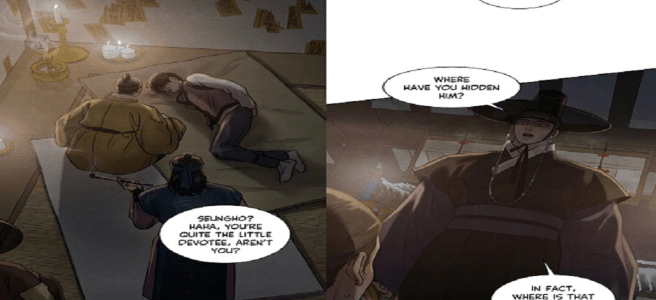


 Bebebisous33s' analyses in K-Dramaland and Manhwas