

Please support the authors by reading Manhwas on the official websites. This is where you can read the Manhwa: Jinx But be aware that the Manhwa is a mature Yaoi, which means, it is about homosexuality with explicit scenes. Here is the link of the table of contents about Jinx. Here is the link where you can find the table of contents of analyzed Manhwas. Here are the links, if you are interested in the first work from Mingwa, BJ Alex, and the 2 previous essays about Jinx The Director and Me (part 1)(locked) and The Director and Me (Part 2)
It would be great if you could make some donations/sponsoring: Ko-fi.com/bebebisous33 That way, you can support me with “coffee” so that I have the energy to keep examining Manhwas. Besides, I need to cover up the expenses for this blog.

The Shirt with the Bear—A Child Marked for Longing
In Jinx, the story of two men begins not in the ring, but in childhood  (chapter 72) —and not with fists, but with fabric.
 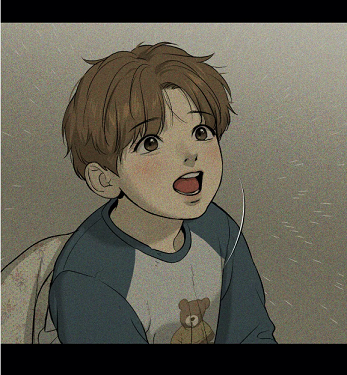 (chapter 11) Each boy is introduced wearing a shirt adorned with a teddy bear, a symbol that quietly carries the emotional weight of the entire narrative.
 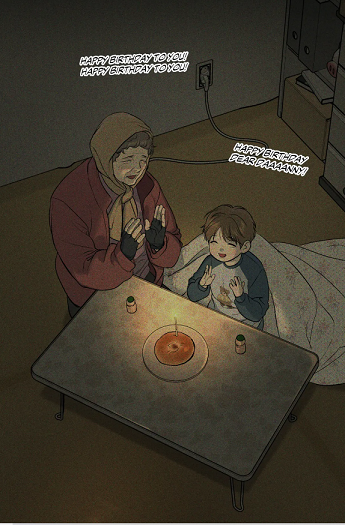 (chapter 11) [For more read The Missing Teddy Bear] These bears do not speak, but they tell us everything: about love received and love lost, about betrayal and comfort twisted into burden, and about two boys growing up in the absence of safe arms.
  (chapter 72)
The first bear appears on Joo Jaekyung’s summer tank top, worn by a small child peeking out from behind a wall. It’s a soft image against a harsh backdrop. (chapter 72) But look closely: the teddy bear wears a blue beanie, a casual hat suited for the outside world—not rest, but readiness. It also has a pair of glasses, a symbol of alertness, self-control, and forced maturity. Most strikingly, its right arm is wrapped in a white bandage. [I can’t recognize the writing below] This is no untouched toy. The bear, like the boy, is already injured. Even comfort is expected to survive harm. To wear such a design is to walk into the world marked not only by childhood, but by pain, exposure, and abandonment.
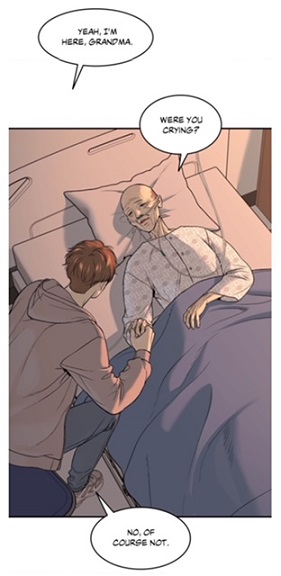
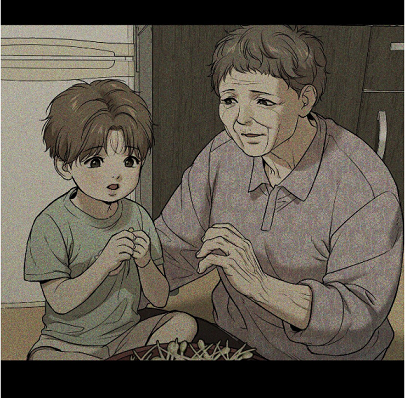
The second bear belongs to Kim Dan, who wears it not on a summer shirt but on winter pajamas, as he sings joyfully with his grandmother on his birthday. His teddy bear is unadorned, uninjured, and suited for rest. The night setting, the blanket, and the candlelight create a small cocoon of warmth. Yet this moment, too, is fleeting. The very love that nurtures him will later trap him—hoarded, isolated, and turned into duty.
What connects these two images is more than coincidence. Both boys wear gray and blue. While the first color indicates the loss of innocence and depression, the other stands for trust, responsibility, care and tenderness. One is dressed by a mother who vanished too soon. The other is dressed by a grandmother who seems so gentle and caring. Yet, the reality is that doc Dan has also been abandoned. One bear is already broken, the other seems to be still whole. One is worn in daylight, the other in the dark. But both children are being slowly stripped of the right to be protected. Their teddy bears will vanish—replaced by fear, control, and survival.
And yet, this is not just a story of loss. It is also a story of return. By meeting each other, Jaekyung and Dan begin to recover what was buried or better said repressed. The teddy bear reappears—not on fabric, but in gestures of touch, presence, and care.  (chapter 68) In time, each man will become the other’s bear
  (chapter 66): a source of comfort, loyalty, and belonging. To follow the teddy bear is to trace this emotional path—from abandonment to connection, from injury to intimacy, from being held once to being held again.
(chapter 11) [For more read The Missing Teddy Bear] He too was once held 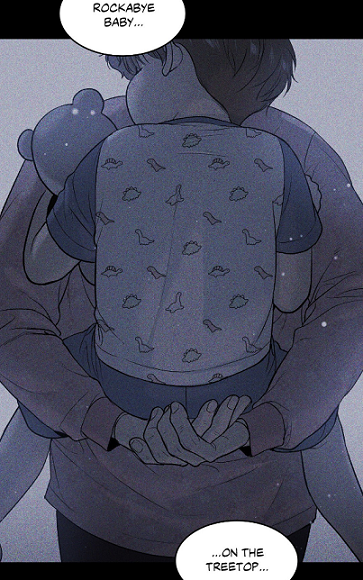 (chapter 47), and then claimed, just like his teddy bear. The fate of doc Dan’s toy bear reflects the boy’s. The former was pushed outside the embrace and bed before disappearing.
  (chapter 21) That’s how the toy bear vanished from the little boy’s life. Thus I deduce that the teddy bear on the pajamas was the last traces of his “childhood”.
Across seasons and silences, both boys are linked by this shared emblem of care—care that was once given, then distorted, lost and finally rediscovered. They are united by the same experience and pain: a phone call linked to a missing mother.  To follow the teddy bear is to trace this journey back to tenderness: the long path from abandonment to being held again.
But the presence of the teddy bear, even in symbolic form, does not last. 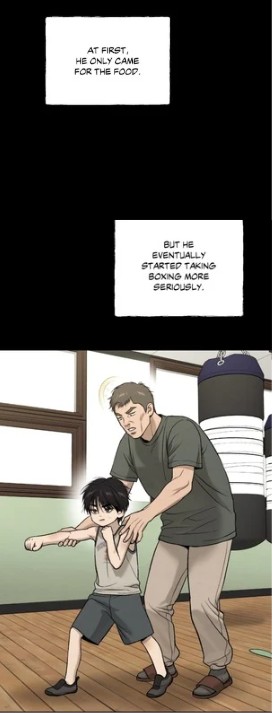 (chapter 72) The shirts are not only outgrown
  (chapter 72) but also replaced with t-shirts without any design alluding to the vanishing of their identity and forced maturity.
 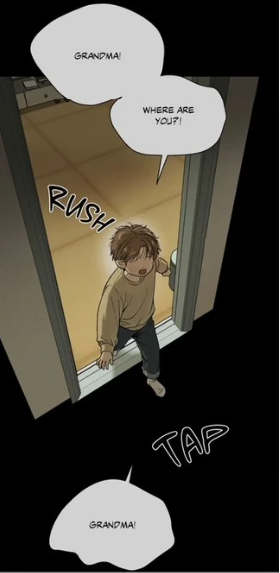 (chapter 57) For Jaekyung, the beanie-wearing bear with its wounded arm and wise glasses is the last trace of comfort before reality hardens. What remains is not the child, but the instinct to survive. From the moment the bear vanishes, a new figure begins to emerge—not one held, but one who fights. The boy with the teddy bear becomes the man who can’t rest, who equates existence with usefulness, and usefulness with victory.
The Vanishing of the Teddy Bear: The Birth of a Self-Made Man
In episode 72, readers are finally granted a glimpse into the long-obscured past of the champion. Some of my earlier hypotheses are confirmed—most notably, that Jaekyung’s father was an abusive alcoholic. Others, like the assumption that Joo Jaekyung belonged to a wealthy chaebol family or that the director’s name was Park Jinchul, are clearly disproven. (Though I’m not entirely ready to give up on the rich family theory just yet.) Interestingly, the name of the former coach appears indirectly, displayed on a sign outside the boxing studio: Hwang Byungchul. 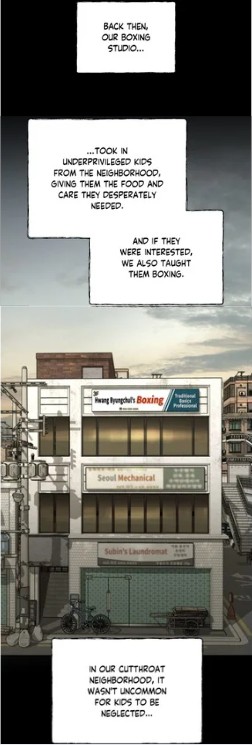 (Chapter 72) This subtle insertion suggests that the gym wasn’t just his workplace—it was his whole life, his identity, and even his home. Therefore it is not surprising that his name was not mentioned by doc Dan or the other patients. His stay at the Light of Hope implies the loss of his “home”, the gym and as such his identity. At the same time, this image reveals that Jinx-philes should examine each panel very closely, that there’s more than meets the eye.
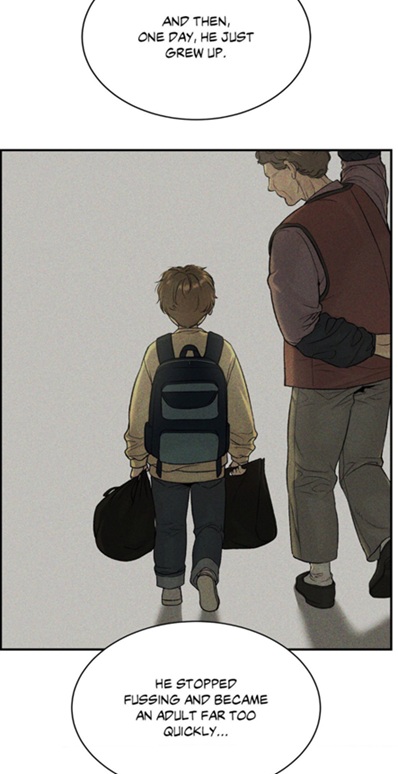
What the chapter made unmistakably clear is that Jaekyung grew up in poverty and was abandoned at a very young age. His early life was marked not by privilege or education, but by neglect, hunger, and silence. 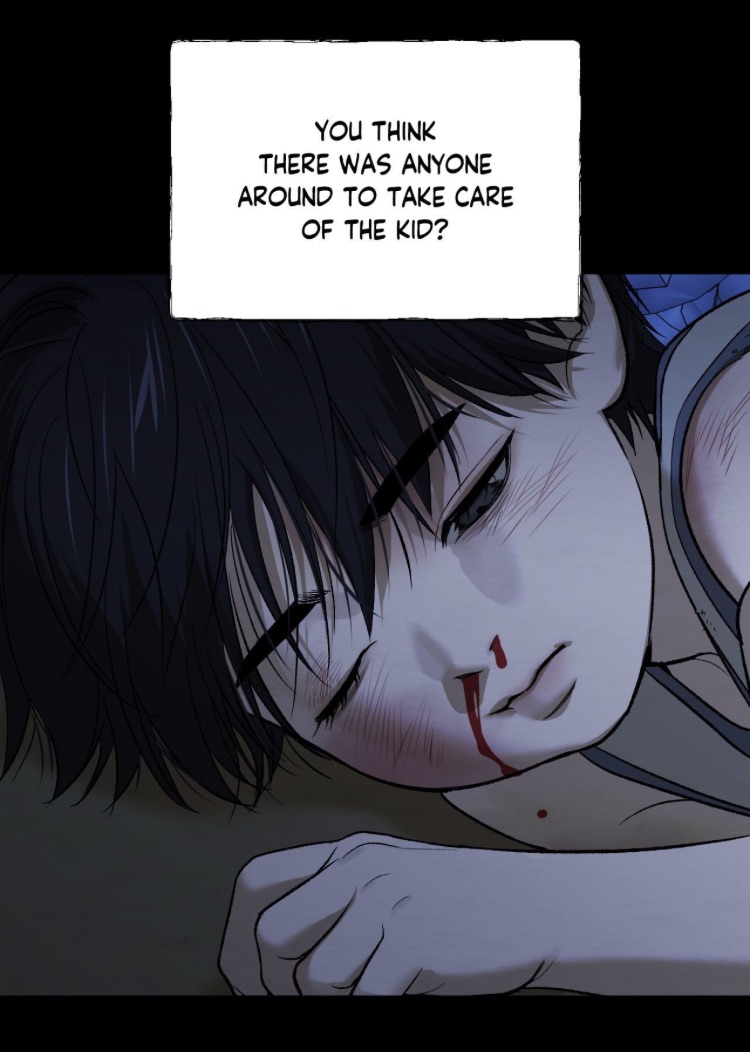 (Chapter 72) This episode doesn’t just show how Jaekyung became a self-made man
  (chapter 72)
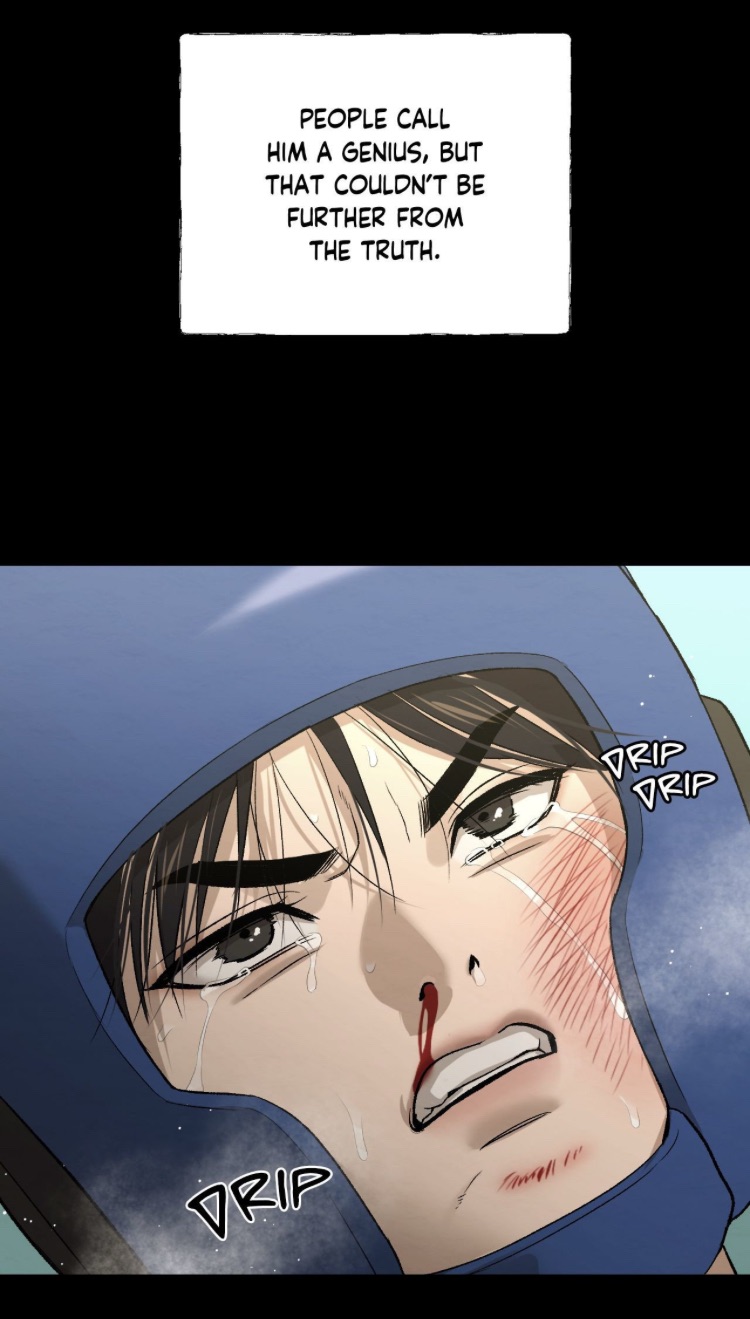
  (chapter 72) —it makes one thing heartbreakingly clear: he wasn’t raised by a pack of wolves; he raised himself.
  (chapter 7) The cliché used by Park Namwook in chapter 7 is revealed to be not only ignorant, but cruel. Jaekyung had no home, no real guardian, no one to defend or guide him. He didn’t grow up in the wild—he grew up alone, navigating between violence (abuse and bullying), hunger, and neglect without true protection. This reframes the champion’s identity: not as someone untamable, but as someone who was never tamed because no one cared enough to try. What we witness is not savagery, but simple survival. Thus he had no friend.
That’s how I realized that in such a barren emotional landscape, the “Teddy Bear” learned by mimicking others. With no safe adult figure to model affection or emotional intelligence, he absorbed what was available: the yelling or silent toughness of Hwang Byungchul  (chapter 71), performative masculinity and high expectations of Park Namwook, and the explosive violence of his father.
  (chapter 72)
  (chapter 5) His behaviors—his hot temper, cold demeanor, blunt speech, and instrumental approach to others—were not innate traits. They were learned strategies, adapted from men who had likewise buried their vulnerability beneath strength or stoicism or brutality. Hence he brought no present to the patient at the hospice.
 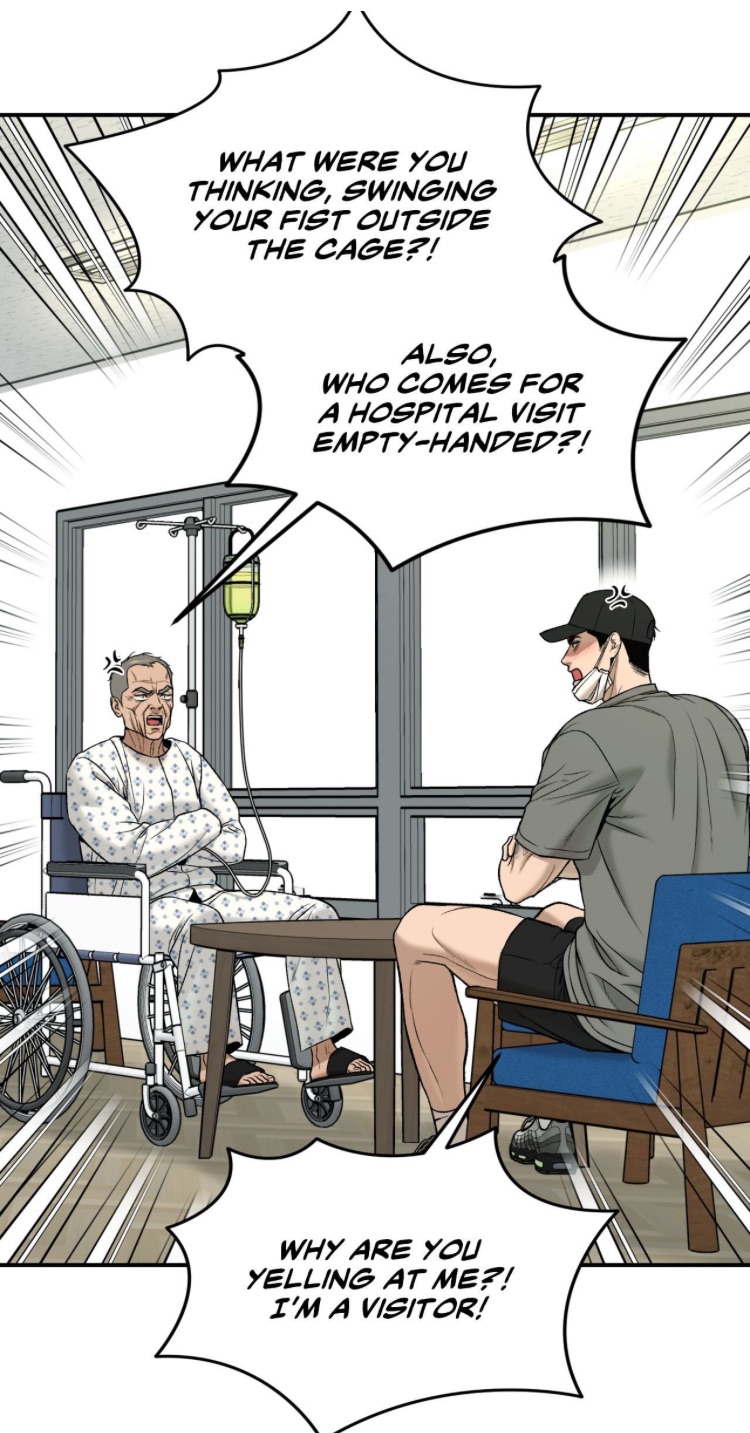 (chapter 71) He became a wolf because he was surrounded by wolves—but deep down, his true nature is closer to a cat’s. This contrast becomes visible in Chapter 72, where his external persona appears as a shy, quiet, more sensitive self.
  (Chapter 72) Much earlier, in the summer night’s dream (Chapter 44), Kim Dan sensed that hidden nature: not the predator, but the man longing to be held.
 (Chapter 44) Doc Dan had sensed the real person behind the legend.
But this pattern began to change the moment Kim Dan entered his life.
Unlike the men of his past, Kim Dan shows his emotions  (chapter 1), as he treats them as valid, not shameful. He cries, trembles, runs away, he apologizes… He asks questions rather than issuing orders. He names feelings
 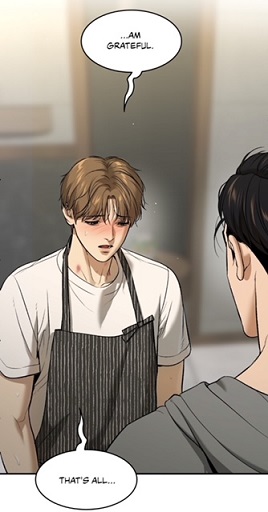 (chapter 45) and respects boundaries. He listens.
  (chapter 29) And so, like a child learning a new language, Jaekyung begins to mimic him too.
 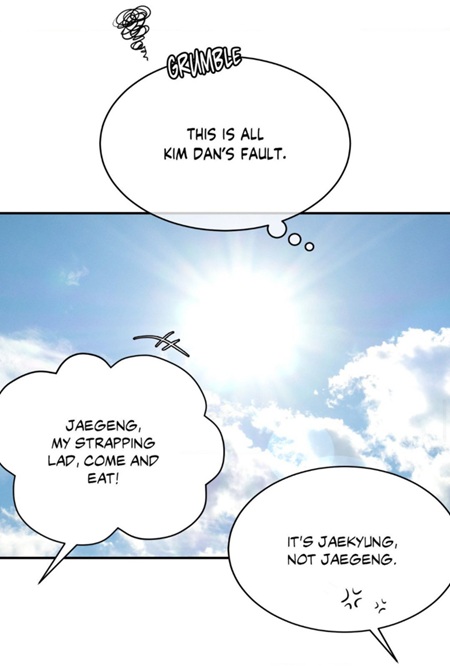 (chapter 62) The change is gradual but visible: helping the townspeople, accepting rest, asking to stay close, even touching and speaking more gently.
  (chapter 71) With Kim Dan, the fighter who once only mirrored power begins to echo tenderness.
The transformation is not only behavioral—it is linguistic. His vocabulary evolves. Once dominated by words like “fight,” “win,” “useful,” and “fuck,” his speech begins to include softer terms: 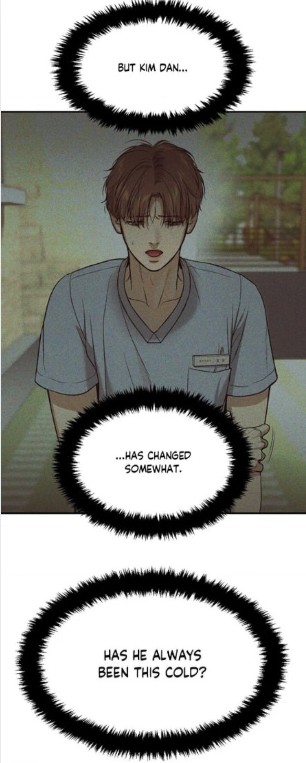 (chapter 62)
  (chapter 68). These are not just words—they’re the building blocks of intimacy, borrowed from the only person who ever saw through his armor. From mimicking strength, Jaekyung has begun to mimic care. (chapter 71) Jaekyung is not just echoing concern—he is taking gradually responsibility for someone fragile, someone he once overlooked: the “hamster.”
And this is why Chapter 72 strikes with such force. It takes us back—not to his ambition, but to his origin, where the myth of the self-made man begins. We see now that his athletic mindset was not forged in aspiration but in desperation. His worldview was shaped not by hunger for greatness, but by starvation in all its forms.
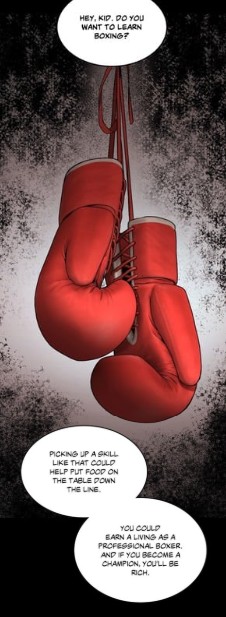 (Chapter 72) The tragedy is that Hwang Byungchul misread that hunger. When he first met the boy, he saw dirty feet, an empty stomach—literal poverty.
 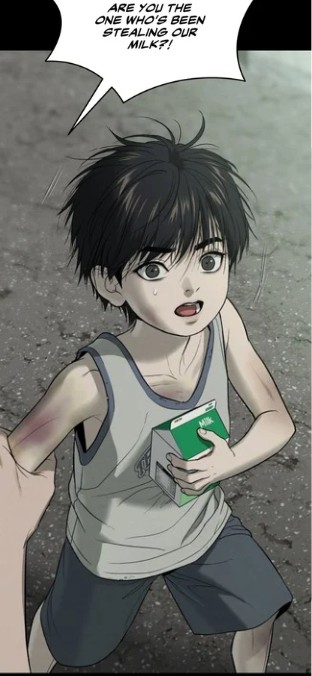 (chapter 72) So he fed him. But he never saw the deeper hunger: the absence of love, of being wanted. The coach assumed the problem was solved with food—because he had never gone without care.
  (chapter 72) He lived with his mother. He was never truly alone. And so he projected stability onto the boy’s silence.
What he thought was grit was grief. What looked like strength was only ever survival. We finally understand why he treats his own body with such brutality,  (Chapter 27) because the body, from the very start, was only a tool for survival.
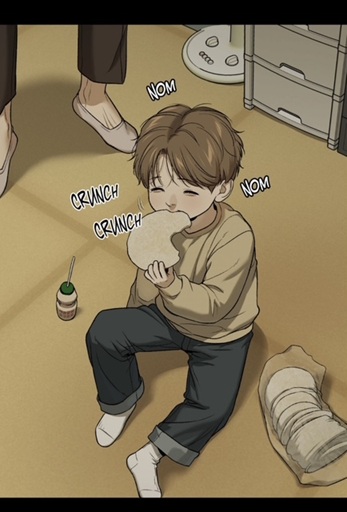
In chapter 72, the young Jaekyung is offered boxing not as sport, but as salvation. The former coach doesn’t comfort the bruised boy or confront the abusive father. 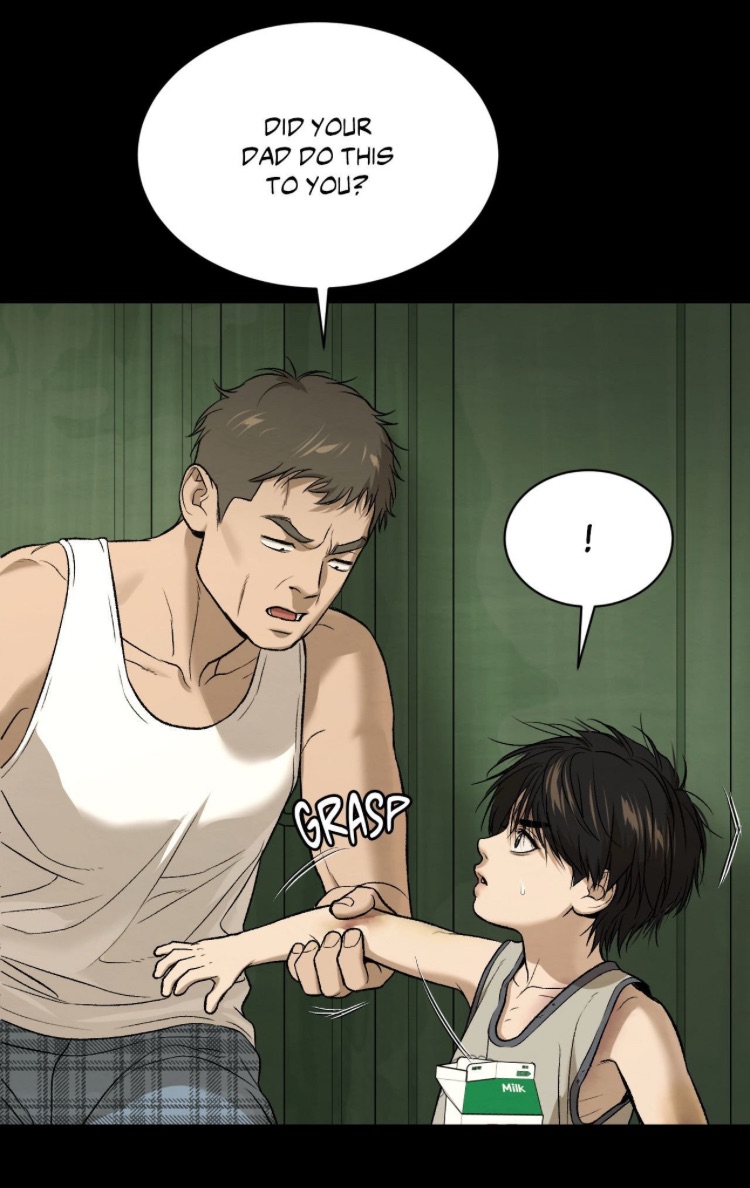 (Chapter 72) Instead, he redirects the situation: (Chapter 72) Fighting, from the very beginning, is not about glory—it is about survival. What replaced the teddy bear was not another form of care—it was a system. Cold, brutal, and inescapable. In Jaekyung’s world, money means food, and food means strength. Fighting becomes synonymous with feeding himself. But this isn’t nourishment—it’s maintenance. Thus a nutritionist was hired later.
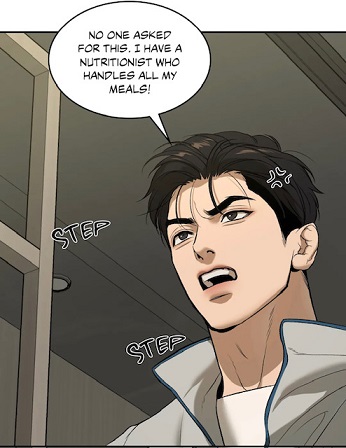 (chapter 22) There is no joy in eating, no comfort at the table. His body becomes a tool, and pain becomes the currency he pays to keep it running.
It’s a vicious circle: he fights to eat, and he eats to fight. Every gesture is bent toward usefulness. His wounds are not treated for healing, but for returning to combat. That’s how he lived all this time. His body is not loved, only weaponized. Even food—the most basic form of comfort—is absorbed into the logic of performance. The equation is cruel but clear: to be seen, you must be useful. And to be useful, you must win. This means that the director’s suggestion and principle was pushed to the extreme. That’s the reason why I come to the following conclusion: there’s someone else involved in the birth of Joo Jaekyung, the Emperor. The evidence for this hypothesis is the champion’s belief: his jinx which is strongly intertwined with sex. Back then, the little boy was too young for sex.
This is the emotional core of the episode: Jaekyung internalizes the idea that his worth is conditional. He is not loved simply because he exists—he is noticed because he punches.  (Chapter 26) This is how he enters adulthood, though he was still a child: not through love, but through function. The moment he steps into the ring, he’s no longer a child. He becomes, in the eyes of the adults around him, a product.
 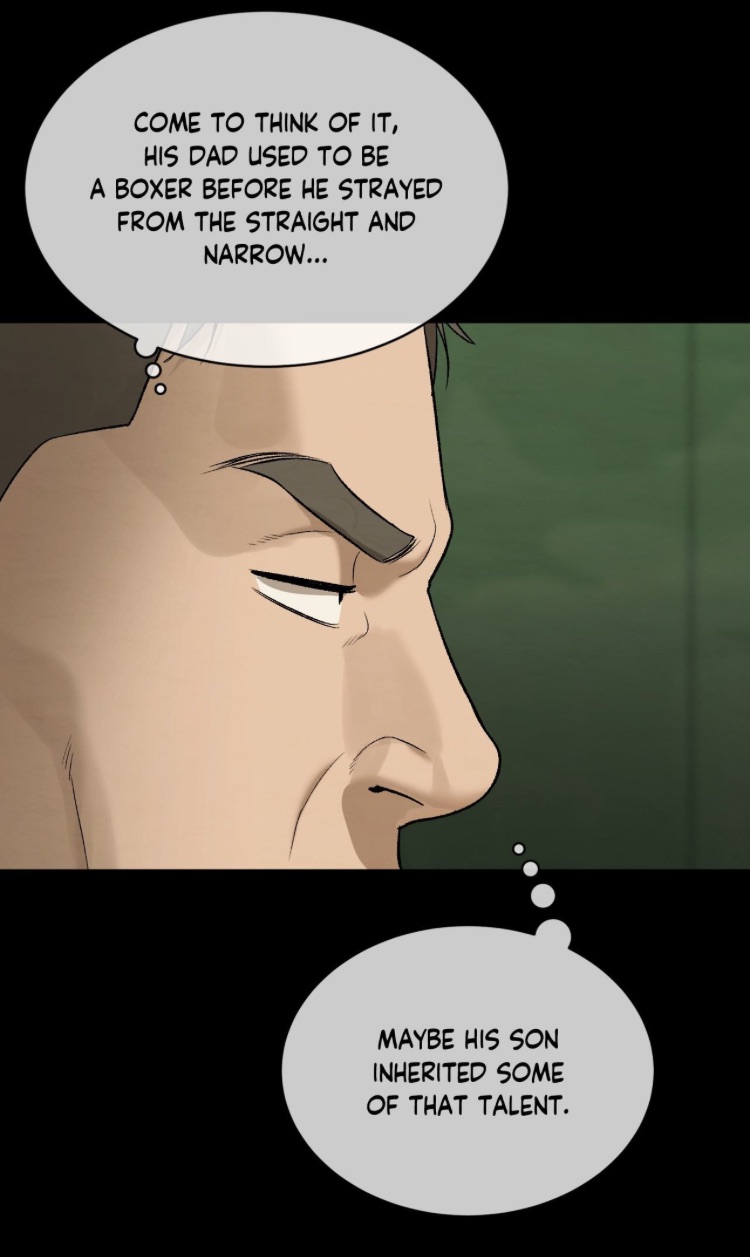 (Chapter 72) This explicates why Hwang Byungchul never confronted the father or called the cops or the social services. The fact that he asked the little boy (chapter 72) indicates that he was not scared and was envisaging to intervene, until he changed his mind. He hoped to have found a “gem”, a future star. (Chapter 72) This interpretation gets reinforced in the following panel:
  (chapter 72) The expression (“But reality was like a punch to the gut”) suggests that even the coach himself was struck by how wrong or harsh the outcome turned out to be, but that realization came too late. Yet he blamed the young boy instead of convincing the young boy to postpone the fight. This scene shows that the man’s form of “help” was not rooted in empathy or protection—it was rooted in opportunity and perhaps even short-sighted hope for glory through the boy’s talent. He turned pain into performance.
But there’s a deeper, more insidious lesson embedded in this worldview—one the coach failed to recognize. (Chapter 72) By instilling in the young athlete the belief that survival depends solely on usefulness and performance, he unwittingly fostered a radical sense of self-reliance. The champion learned not only to fight, but to survive alone. If he became rich or succeeded, it wasn’t because of guidance or teamwork, but because of his own strength, talent, and determination. Thus he only employs the personal pronoun “you” and not “we”. In this cold logic, there is no room for mutual dependency, emotional support, or even loyalty. The coach, unconsciously, excluded himself from the athlete’s inner world. He trained a boxer, not a partner. And in doing so, he guaranteed his own eventual irrelevance.
Therefore it is not surprising that he was not contacted after the protagonist moved to Seoul,  (chapter 71) why Joo Jaekyung never visited him or expressed his gratitude towards the boxing coach more openly.
 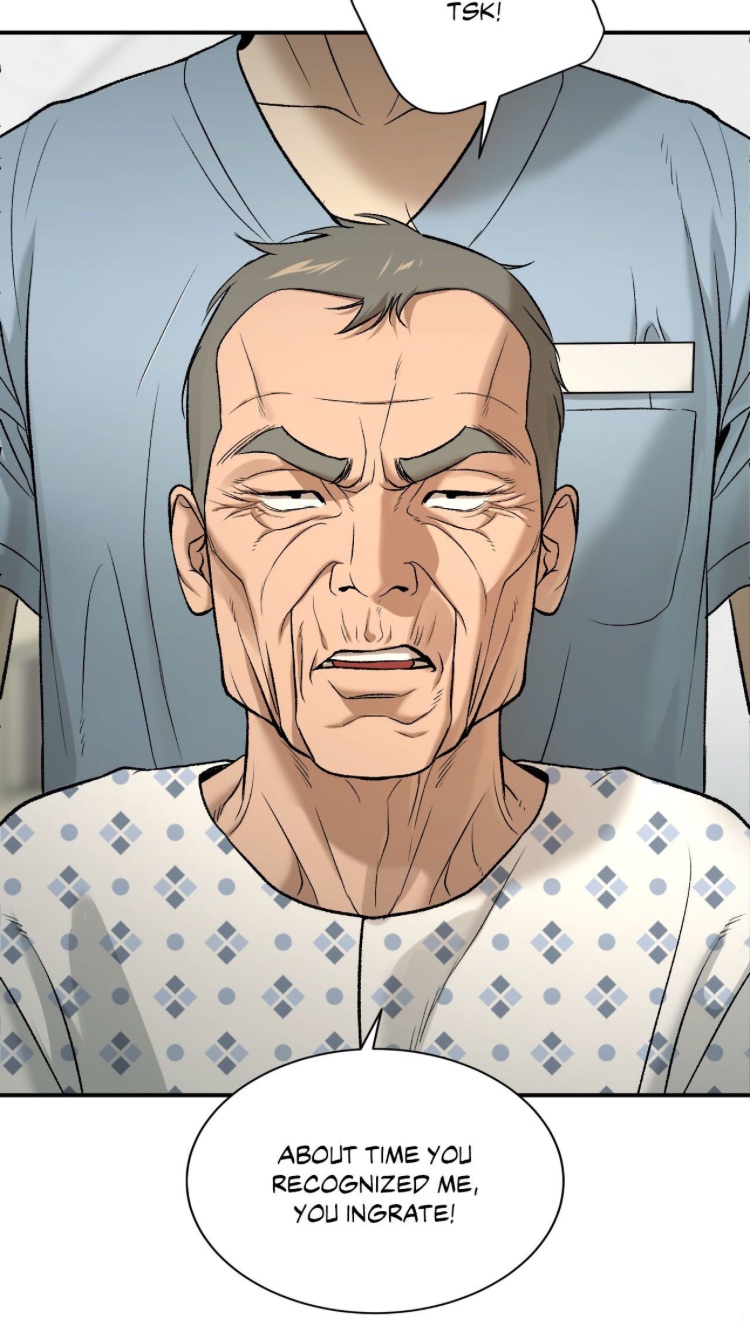 (Chapter 71) He became successful thanks to his own hard work. It was, as if he had followed the advice to the letter—make it on your own. I am suspecting that the charity event is linked to poor neighborhoods and children, so he didn’t totally erase the man from his memory, he just repressed him. However, it is not astonishing why the director is resentful and even bitter towards Joo Jaekyung. It was, as if he had never helped him. While he blames the man, the coach never recognized his own shortcomings. He didn’t see that his assistance was actually conditional. (Chapter 72) His goal was to create boxers and promote his gym. (Chapter 72) This explicates the absence of real support among the little kids in the end.
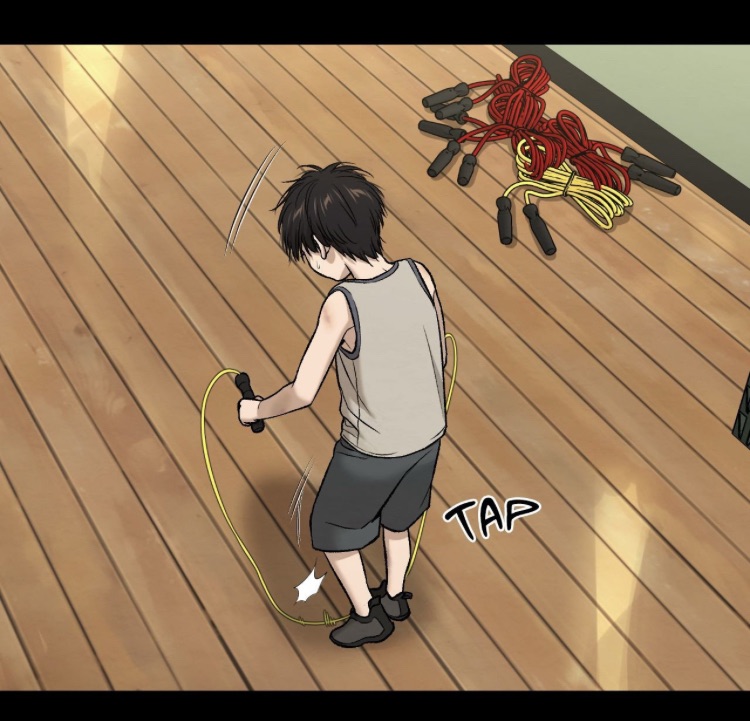 (chapter 72) They are all rivals. But from my perspective, there exists another reason why the main lead didn’t keep in touch with Hwang Byungchul exposing the director’s blindness. The adult Joo Jaekyung admits that seeing the director’s face brings back “old memories”—not of comfort, but of trauma.
  (Chapter 71) The implication is unmistakable: Hwang Byungchul reminds him of his father and the abuse. And the latter is strongly intertwined with the mother’s abandonment.
That’s why I believe that going to Seoul wasn’t just about chasing success and looking for the mother—it was an act of escape, a way to break free from the past and its shadows. Joo Jaekyung needed distance not only from his hometown but from everything linked to his father, including boxing. The coach, in offering boxing as salvation, unknowingly tethered the boy to his abuser. (Chapter 72) The coach believed he was giving him a lifeline—but what he gave was a continuation, not a release. This could only increase Joo Jaewoong’s resent and jealousy towards his own son, if the latter became more successful.
Under this new light, we would have an explanation why Jaekyung ultimately chose MMA over boxing. MMA became his attempt to reclaim his body and forge a path not dictated by paternal legacy or the coach’s limitations. It was a way to fight, yes—but differently. On his own terms. This is the bitter irony: Hwang Byungchul believed he had rescued the child, when in reality, he kept him imprisoned in the very logic of pain and survival that was nearly destroying him. He didn’t free him—he simply refined the chains. On the one hand, the father got constantly reminded of his own failure, which could only poison the relationship between father and son, it created a common denominator between them.
This leads to a structural insight: episode 72 actually features two parallel narrators. One is Hwang Byungchul, whose commentary frames most of the memory sequence. 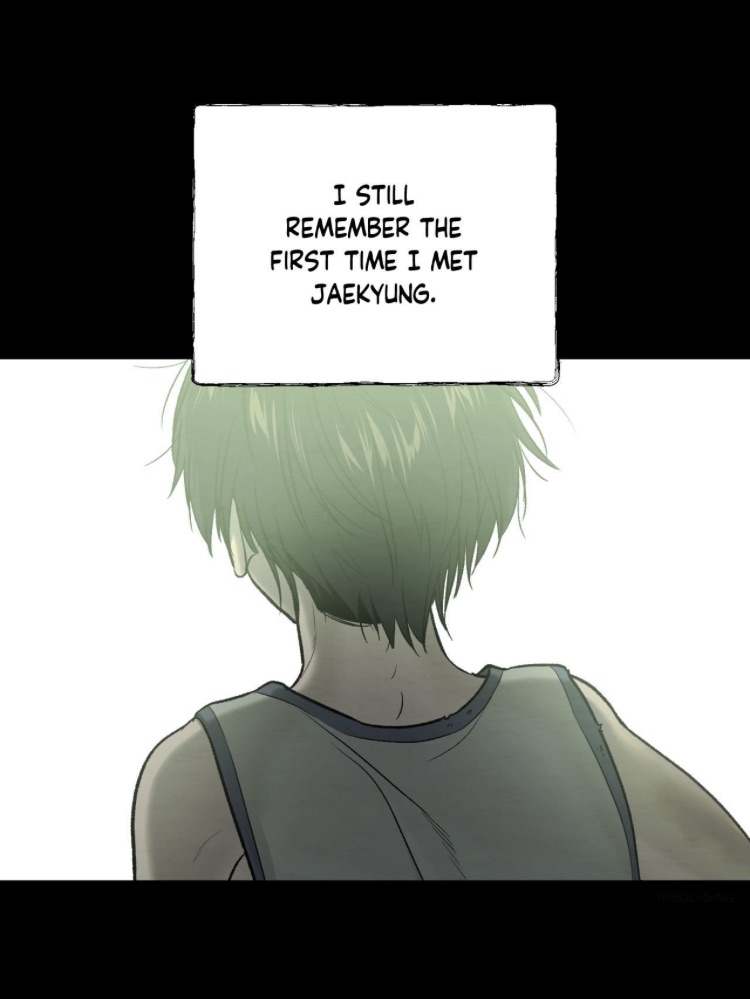 (chapter 72) The other is Jaekyung himself. How can we tell? Because the scene of the phone call contains no narration, no framing voice.
  (Chapter 72) It’s a raw memory—silent and personal—untouched by the coach’s perspective. .
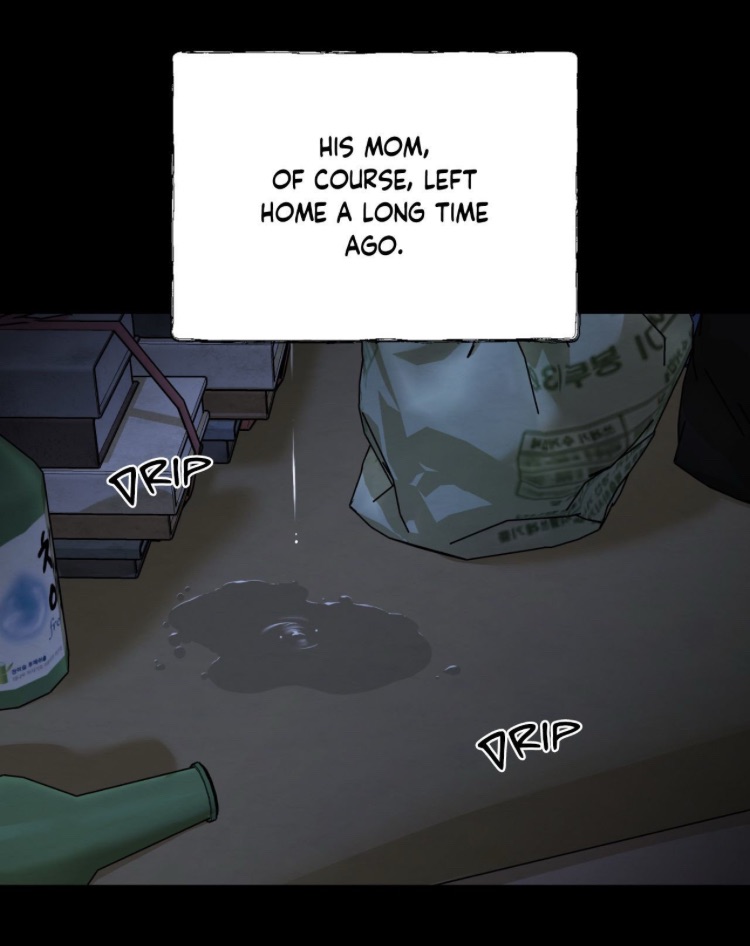 (chapter 72) Thus I deduce that the other scenes are a combination of the champion and director’s memories. This would explain such scenes, where Hwang Bung-Chul is not present.
 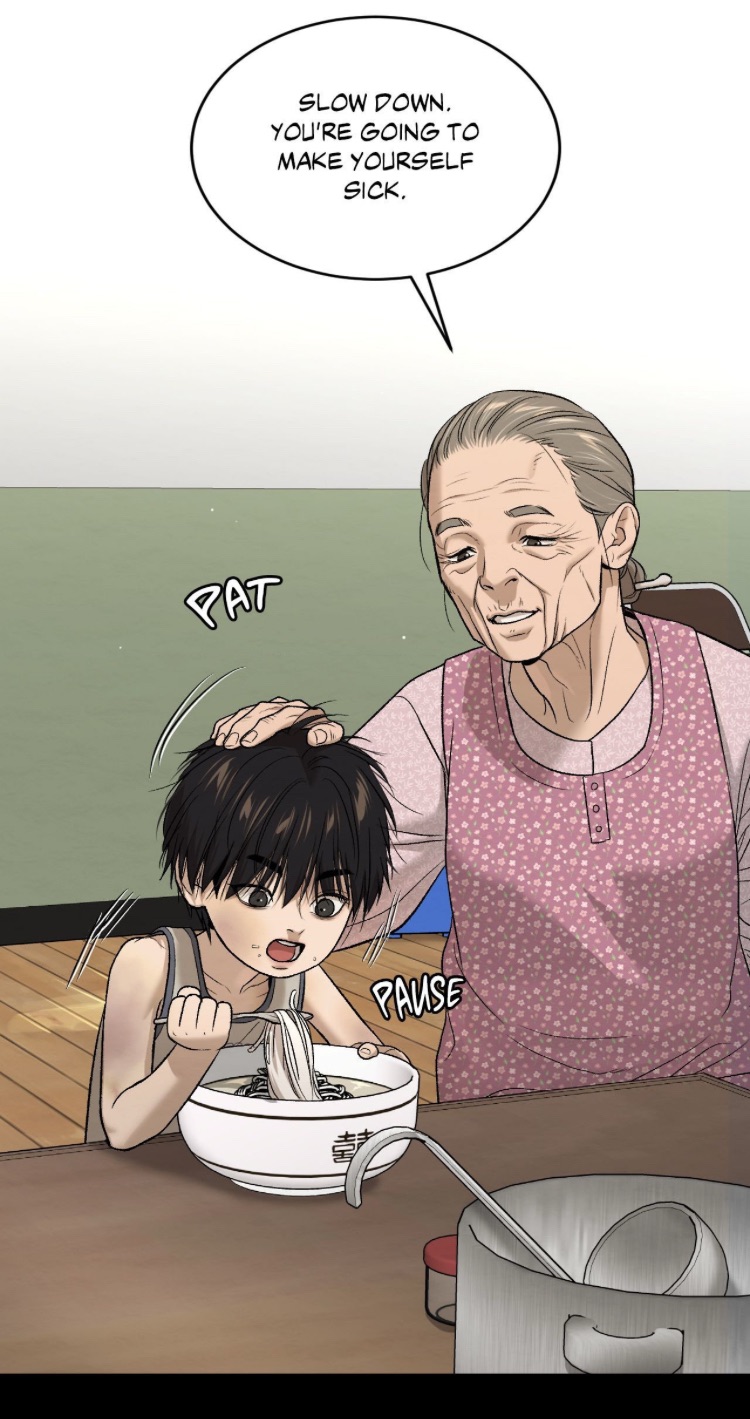 (chapter 72)
Besides, Hwang Byungchul believed food and discipline were enough. He never noticed the emotional void beneath Jaekyung’s fighting spirit. What he interpreted as drive (ruthlessness/hunger) was, in truth, longing. He was hoping to have a true home again, to live with his mother. (chapter 72) The contrast between these two memories outlines how the coach misunderstood the athlete. Interesting is that doc Dan assumed that Joo Jaekyung had cut off ties with the former coach due to a quarrel. 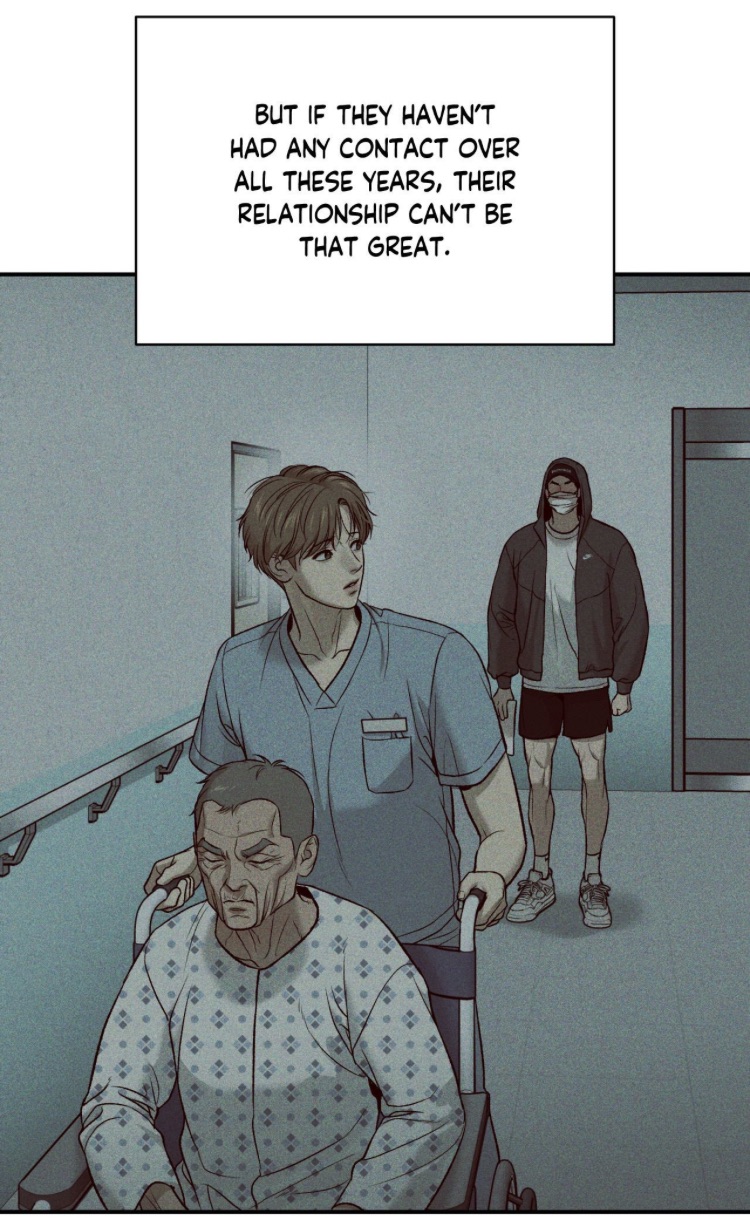 (Chapter 71) But here, doc Dan was making a huge mistake: he was just projecting his own feelings and relationship with him onto theirs. But he was behaving exactly like the former director: simplification.
Simplification as the Real Barrier to Care
Once again an article from Jennifer Delgado caught my attention: You don’t need to simplify your life: you need to eliminate the useless – and it’s not the same. The article warns us about the danger of simplification. In a turbulent world, we long for a sense of order. To achieve this, we construct simple narratives that comfort our self-image, ease our emotional stress, and help us sidestep ambiguity. However, this approach has a downside. By oversimplifying, we sidestep genuine engagement with complex issues. We overlook inconsistencies, reduce individuals to stereotypes, and avoid the demanding work of truly understanding others.
We want everything to flow. Relationships to flourish effortlessly, work to bear fruit without breaking a sweat, projects to materialize quickly, and difficult emotions to go away with a five-minute meditation session.
“Keep it simple ” seems to be the leitmotif.
However, sometimes life has other plans. Full of surprises, setbacks, emotions, and conflicts, reality is complex simply because everything is interconnected and constantly changing. And that means that if we try to oversimplify it, we’ll likely lose its richness along the way. Quoted from https://psychology-spot.com/simplify-your-life-eliminate-the-useless/
Instead of asking why, we label.  (chapter 9) Instead of listening, we assume. We choose clear lines—strong or weak, good or bad, useful or useless—over the tangled, uncomfortable truth that everyone is both hurting and trying. This refusal to reflect doesn’t just distort reality—it perpetuates it. When we simplify, we don’t heal; we reenact.
In Jinx, all the major characters fall into the trap described in the article on simplification. But here, we’ll focus on four: Park Namwook, Hwang Byungchul, Shin Okja, and Kim Dan. Each, in their own way, simplifies Joo Jaekyung. They misread his strength as certainty, his body as armor, his silence as consent, and his volatility as mere rudeness. They reduce complexity into caricature—and in doing so, they fail to see the man behind the myth.
The manager and the brain scanner
Let’s begin with the manager, Park Namwook. In Chapter 52,  (chapter 52),
he blamed Jaekyung for the entire “fiasco” with the post-fight scandal—even though he knew full well that the spray had been tampered with and that a conspiracy was in play. Why blame the victim? Because that’s what simplification offers: a way to avoid moral discomfort and responsibility. Namwook projects his own spoiled, self-centered logic onto Jaekyung, interpreting his athlete’s breakdown as immature drama, rather than what it actually was: the collapse of someone who had been manipulated and betrayed.
This moment reflects exactly what the article warns about: in the face of complexity, people seek easy answers. Instead of facing the multicausal reality—schemes, mistakes, exploitation, emotional exhaustion—Namwook reduces the problem to one person, one reaction, one scapegoat. That’s why the scene from Chapter 61 is so revealing. 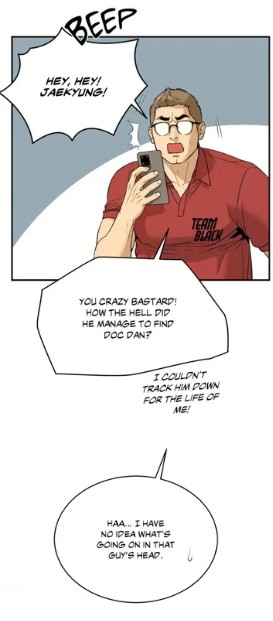 (chapter 61) In the panel where he sighs, “Haa… I have no idea what’s going on in that guy’s head,” he unintentionally exposes the shallowness of his approach. He imagines that by looking at Jaekyung’s brain—by cracking his psychology—he’ll “understand” him. That way, he can regain control. But this isn’t curiosity. It’s a veiled form of control-seeking. Namwook doesn’t want to know Jaekyung as a person—he wants him to be predictable, manageable, marketable. That line doesn’t reflect concern. It reflects frustration that the human being in front of him refuses to fit the role he’s been assigned. Hence it is logical that his solution to force Joo Jaekyung to return to the gym is to accept a new match.
  (chapter 69) Namwook’s failure is a professional one, but it’s also deeply emotional: he simplified Jaekyung into a product or spoiled child. And when the product malfunctioned—when pain erupted from silence—he didn’t ask why, he suggested how to make it stop. This is simplification in its most insidious form: not out of malice, but out of discomfort with emotional reality.
Shin Okja: One Problem, One Person, One Solution
If Park Namwook reduces Joo Jaekyung to a tool of success, Shin Okja turns him into a quick fix.  (chapter 65) Her mindset follows a consistent logic: one problem, one person, one solution. Kim Dan is overworked and sick?
 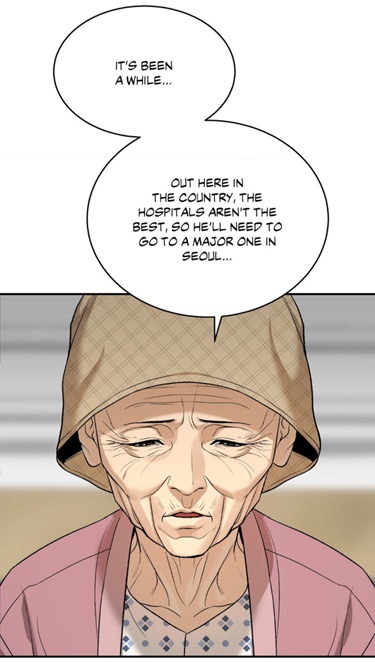 (chapter 65) Then someone stronger should carry him. That “someone” becomes Jaekyung. The doctor should take pills and that’s it.
In Chapter 65, she urges the champion to take Dan back to Seoul. 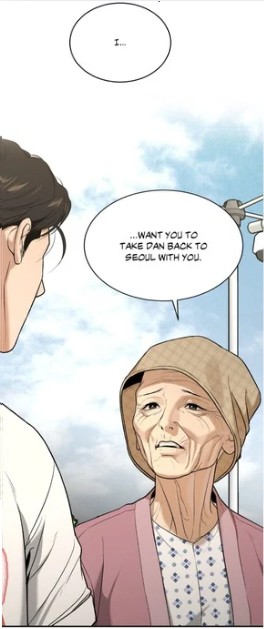 (chapter 65) Her logic is deeply utilitarian—Jaekyung is rich, strong, and dependable. Therefore, he must be fine. She does not consider whether he is emotionally stable, available, or even willing to carry such a weight. The haunted look in his eyes that Hwang Byungchul noticed in Chapter 72
 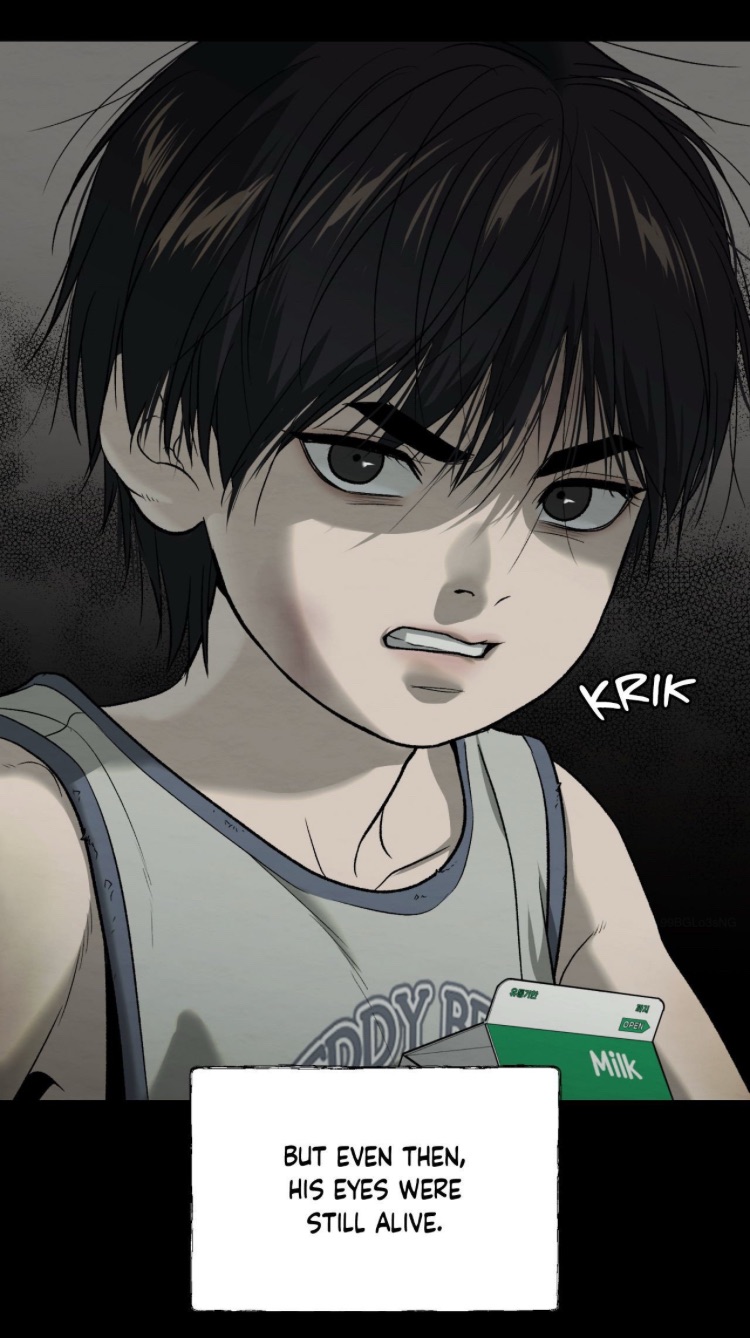 (chapter 72) is invisible to her. She sees a man who has succeeded—and assumes that means he is thriving.
But her pattern is older. If doc Dan had parents, he wouldn’t be suffering so much. Her presence could never replace the parents.  (chapter 65) This is totally naive, because certain parents like Joo Jaewoong are not capable of offering love and support. In Chapter 57, when Kim Dan was a child, bullied and humiliated, she told him: “They don’t know what they’re talking about. You still have me.”
 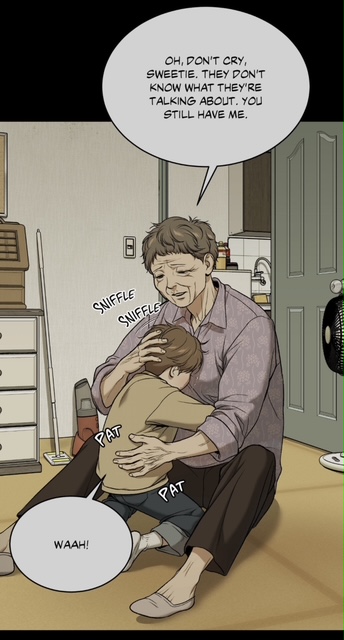 (chapter 57) This line, though comforting on the surface, is an act of simplification. She makes herself the sole solution to Dan’s complex emotional wounds. Her message: You don’t need justice, friends, or understanding. You need me. That’s how doc Dan was taught not to argue and not to fight back. He just needed to accept the situation.
In doing so, she creates a binary world: safe vs unsafe, solution vs threat. There is no room for nuance, community, or uncertainty. And this has long-lasting consequences. Dan grows up believing that support must come from one person, that relationships must be compensatory and binary. When the grandmother sends him away again—this time to Jaekyung—it mirrors the same pattern. “You need help? You’re sad? Then go with him.” That’s the reason why she is treating him as a “child”.
Like the article on simplification warns, such narratives are comforting but misleading. They prevent people from seeing the full scope of reality. Shin Okja never asks Dan about his friendships, his boundaries, his career goals. As she admitted herself in Chapter 65,  (chapter 65) she doesn’t know anything about his life. That’s the price of simplification: you get a clean answer, but not the truth.
Gloves Instead of Grace: Hwang Byungchul’s Simplified Salvation
The “old coot”, too, clings to the myth of the invincible fighter—hungry, gritty, unstoppable. He fondly remembers the wounds, the sweat (chapter 72), the hunger, as if these alone forged greatness. But he fails to see how the very system he created helped drain the boy of more than just his tears—it emptied him of safety, of rest, of care. He only addressed the visible wounds and stomach pangs. (chapter 72) The gym’s director gave food and gloves, but not love. This was relegated to his “mother”. (chapter 72) He never addressed emotional starvation because he never recognized it; he himself was never truly alone—he always had his mother. And his misjudgment started from the very first encounter: seeing Jaekyung as a fierce cub (chapter 72) or as Joo Jaewoong’s heir rather than a hurt child.
Even in the present, the former director continues this pattern of simplification. He blames the champion for returning to the ring 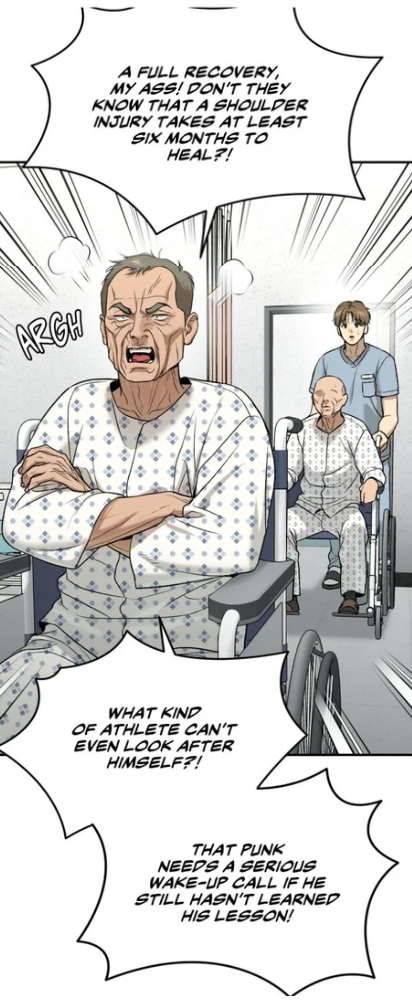 (chapter 70), as though he chose freely, overlooking how coercion and image control operate in their world. He accuses him of ruining his career with the suspension, even though it was orchestrated by others.
  (chapter 70) He judges him without knowing the circumstances. This projection is not new. In the past, he blamed the father, (chapter 72) Joo Jaewoong, for becoming a thug—but when another former wrestler also ends up as a loan shark’s lackey
 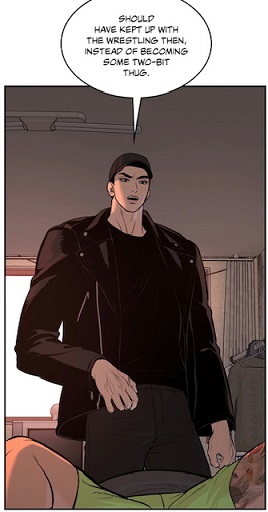 (chapter 17), it becomes clear that there exists a recurring link between athletic decline and criminal paths. The man fails to notice this connection. He sees these outcomes as individual moral failings, not systemic failures.
That’s why he never judged the mother for abandoning her child. (chapter 72) In his eyes, her departure was understandable (“of course”), even rational—because the father was “rotten.” But by justifying her decision, he erases the damage it caused: a bleeding, unconscious boy left to fend for himself. (chapter 72) In his worldview, offering a meal and a pair of boxing gloves should suffice to compensate for parental abandonment and violence. As if a jab and a protein shake could replace a mother’s embrace. This reveals the core of his failure: he confused intervention with salvation, and survival with healing.
So in the end, Hwang Byungchul didn’t just witness the system—he upheld it. (chapter 72) He became its idealistic defender, blind to its contradictions. He believed the gym could cure what society broke, but all he taught was how to endure, not how to recover. I would even add that when the boxers didn’t succeed in their career, they could end up using their skills for the mafia. This worldview is a product of his own simplification, his refusal to examine the deeper rot within the system he served. He didn’t suggest school and titles in order to escape poverty. And this is why he never truly saw the boy disappear. He missed the moment the light faded from Joo Jaekyung’s eyes, because he was never watching for it. In chasing strength, he forgot to safeguard the soul.
The tragedy is this: while he wanted to save the child (chapter 72), he trained the champion instead. That’s why the previous panel resembles a lot to this one. 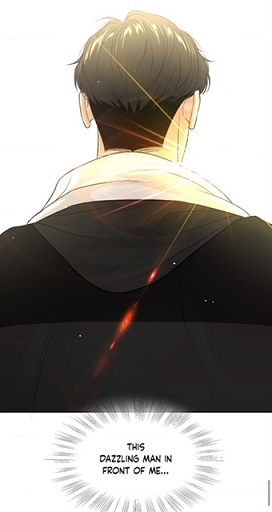 (chapter 40) Kim Dan saw the result and got fascinated. And what we’re left with now is a man whose pain and exhaustion are almost unseen (chapter 72) —until Hwang Byungchul notices the change and confided it to doc Dan. Someone should start listening to the silence after the spotlight vanishes.
This is where simplification becomes most tragic—not only because it hides pain, but because it reinforces it. It keeps people locked in roles, acting out silent scripts they never chose. To truly follow the teddy bear—to return to care, to softness, to a place where people are held and not used—each character must confront the simplifications they relied on. They must admit what they refused to see.
Kim Dan: The simple complexity
And then there is Kim Dan, who utters the most painful truth. In a moment of illness and exhaustion, he says, “ (chapter 64) He reproached him about being used and abandoned. But he was forgetting his own actions. He had also used the athlete, he had also left the bed in a hurry the next morning. Yes, he, too, simplified Jaekyung. That night, he said nothing. And in doing so, he confirmed the belief Jaekyung had internalized: I’m not someone who gets cared for. I’m someone who is tolerated, used, replaced. Like mentioned above, his mind-set was strongly influenced by Shin Okja. On the other hand, I noticed that the protagonist embodies complexity. How so? On the surface, he appears simple: obedient, quiet, weak, submissive, passive.
  (chapter 70) But beneath that surface lies a dense emotional world— love, grief, guilt, exhaustion, intelligence, empathy and moral clarity — that few characters in Jinx truly perceive. He stands for the heart! And everyone knows that “the heart has its reasons, of which reason knows nothing.” (Blaise Pascal) Because he acts from a place that defies the cold logic of power, hierarchy, and survival, he operates on emotional intelligence
 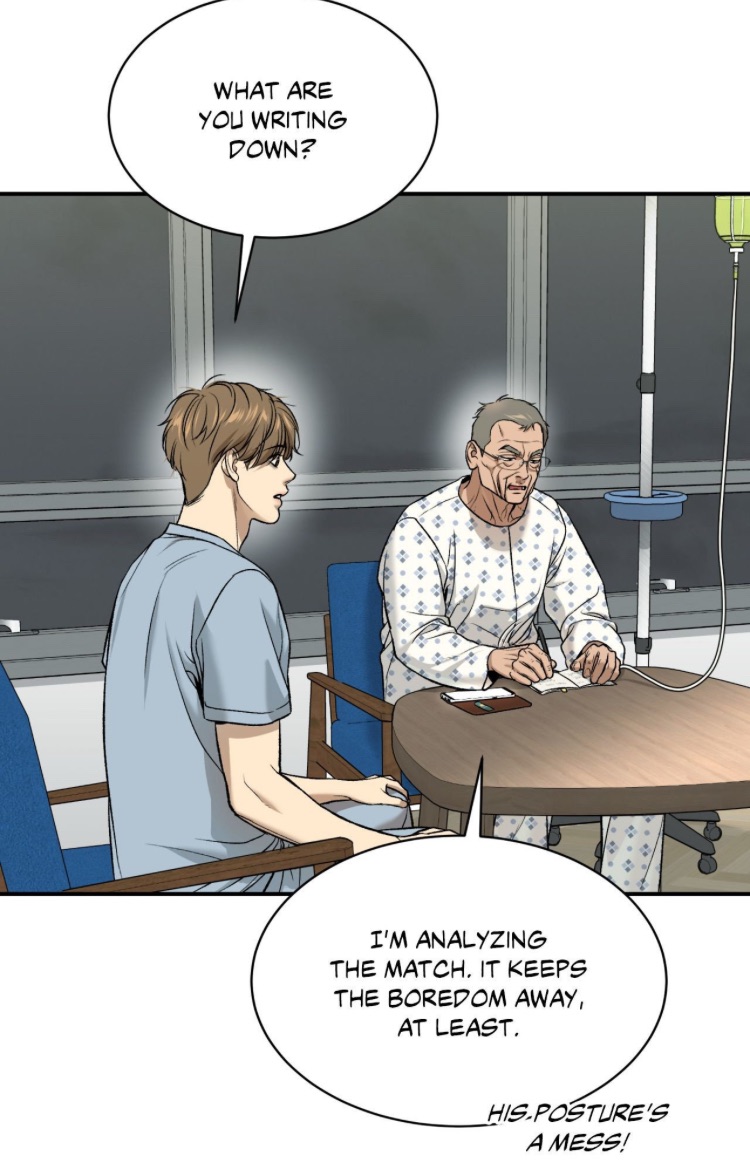 (chapter 71) —unspoken understanding, silent resistance, instinctive empathy. It’s no coincidence that his presence disrupts every system he enters: the gym, the hospital, the champion’s life.
By following his heart (even when that heart is heavy, broken, or exhausted), he becomes the very element that exposes the inadequacy of every simplified explanation—whether it’s Park Namwook’s control, Shin Okja’s projection, or even Jaekyung’s own self-image.
In short: Kim Dan is the counter-force to simplification because he lives in the in-between—where care and contradiction, pain and tenderness, duty and desire coexist. And now, you comprehend why Joo Jaekyung needs to realize the existence of his heart and as such his love for doc Dan. Only then, both will be able to understand each other’s pain and heart.
Healing can only begin, when Jaekyung stops being a performance 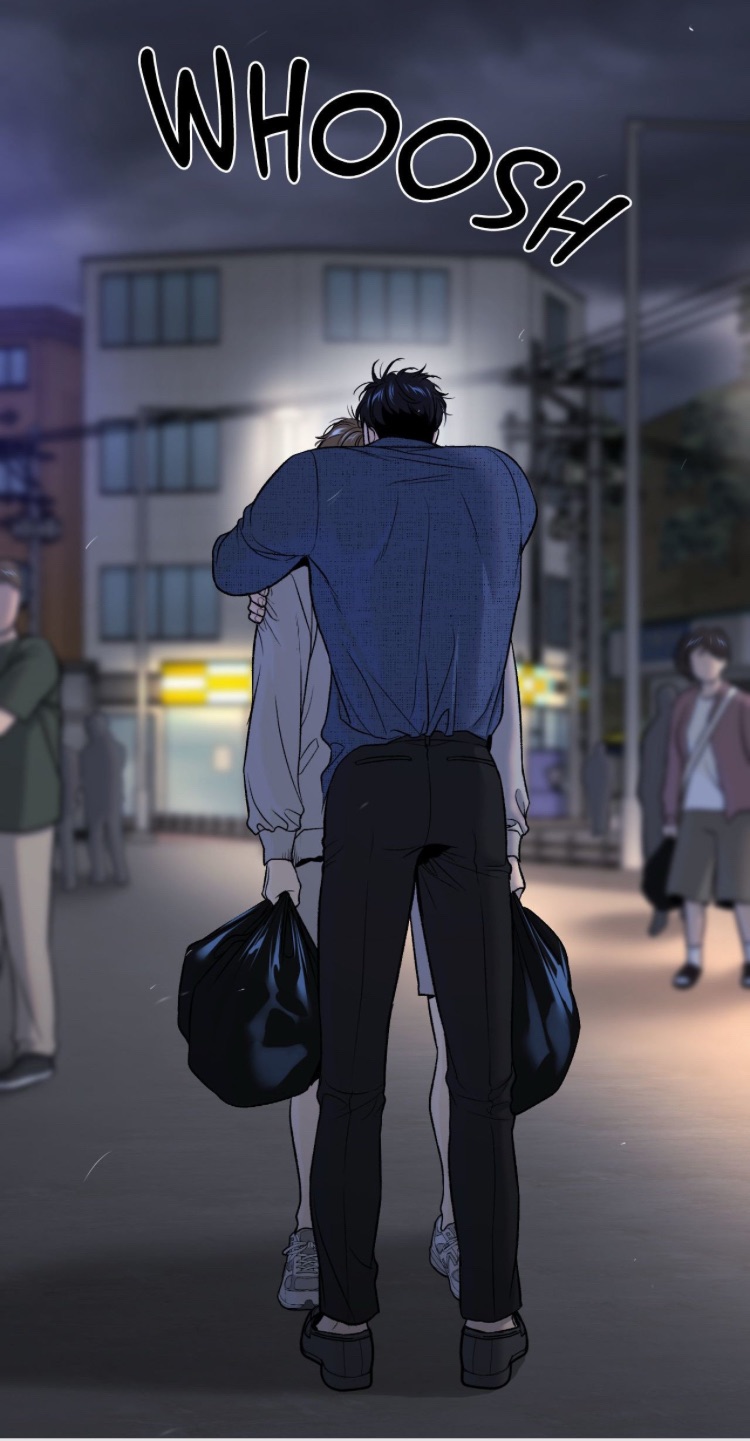 (chapter 70), and starts being a person. The racing heart… which has already happened. And this observation leads me to this scene:
 (chapter 58) Kim Dan was erasing this memory, he wanted to forget the star The Emperor. This act of forgetting wasn’t an escape from pain; it’s an active rejection of a myth that was keeping him emotionally paralyzed. As long as Jaekyung remained “The Emperor,” he could not be touched, questioned, or truly known. By forcing himself to forget that image, Kim Dan was making space for something more vulnerable and human to emerge. To conclude, thanks to this painful decision, he was able to perceive Joo Jaekyung the man. That’s why he acted so fiercely in front of him later. So by meeting the director, doc Dan is now able to see the child or the “cat” in his fated partner. That’s how it dawned on me why Mingwa let doc Dan suffer from addiction, depression and insomnia. Because these afflictions defy simplification. They resist instant solutions (pills). They demand patience, presence, and a refusal to look away.
Kim Dan, in a sense, becomes the embodiment of complexity. While others in Jaekyung’s life simplified him—manager, coach, fans—Kim Dan’s own struggle becomes the key to unlocking the champion’s inner contradictions. He doesn’t just offer pills; he becomes someone who stays through the night. That’s the true antidote to trauma: not fixes, but presence. But he is sick now too. (chapter 71)
Hwang Byungchul and the spotlight
Since the start of Jinx, I have been examining names, as the author made it clear that they carry symbolic weight and the former coach’s full name—Hwang Byungchul (황병철) is no exception. He encapsulates both his past role and his evolving narrative function.
Hwang (황) means yellow, a color tied to imperial symbolism but also to artificial light, visibility, and performance which is reflected in his offer: (chapter 72) Fittingly, Hwang Byungchul believed that survival came through being useful and seen. His guiding principle was clear: become a champion to put food on the table. Fighting was a mean to escape poverty, and success was measured by status, not inner healing.
But the given name Byungchul (병철) reveals even more.
- Byung (병) includes the meanings:
- Soldier → He encouraged Jaekyung to train with military-style rigidity, enforcing a code of strength over vulnerability.
- Jar/container → He emotionally bottled things up, never showing weakness or affection.
- Disease → A symbol of his terminal condition, but also the philosophical “illness” he passed on—survival at the cost of love and life. Joo Jaekyung was never taught how to enjoy life.
- long, hunger → Perhaps the most revealing meaning. He is a man of long hunger—not necessarily for food, which he did provide to the children in the neighborhood, but for recognition, belonging, and emotional acknowledgment. He hoped to create a talent. He stood in the background, feeding mouths but staying unnamed, invisible. This hunger lives on in his relationship with Joo Jaekyung. He could never claim the boy as “his” athlete—not publicly, not even privately. Hence the picture remained in his notebook hidden. Because Jaekyung never spoke of his past, never acknowledged the gym, never looked back. It looked like the boy who was fed did not remember the man who fed him. The silence wasn’t just about pride—it was about pain. In a way, both of them were waiting for the other to speak first. Thus, Hwang Byungchul’s name becomes a silent confession: he symbolizes the emotional and symbolic hunger that surrounded Jaekyung’s early life—one that was addressed physically but never emotionally. The coach’s spotlight was always directed outward, toward performance, visibility, survival—but what he longed for most was to be seen by the one he helped raise.
- To scold or punish → A reflection of the discipline and shame-based teaching he used.
- To end or exterminate → This meaning could refer to his imminent passing, but it could allude to something else. Once a guardian of the system, he may unwittingly become its undoer. While he never openly questioned the structures of boxing or the MFC, he long dismissed corruption as the fighters’ personal failing—not a systemic flaw. He maintained a clear-cut divide between the “glamorous” fighting world and the criminal underworld, but reality has proven more entangled. In his final days, by being confronted with the truth and with Kim Dan’s care, he might symbolically put an end to the illusion that sustained his lifelong simplifications.
- 철 (Chul / Cheol) was already examined before (see Park Jinchul)
- Iron → Symbol of cold strength, discipline and inflexibility.
- Philosophy → He lived by a code, but one that lacked space for human frailty.
- To pierce → He trained the champion to break through his limits, but also inflicted wounds he never tended to.
- Season/time → A fading era. His presence now marks the end of one ideological “season” and the start of something else—perhaps more human.
Together, Hwang Byungchul stands for a legacy of rigid survivalism under the spotlight, but also for the potential to expose its limits. His name doesn’t just mirror what he was—it foreshadows what he might help undo. His final lesson may be the most important: that the system he clung to was always built on a false binary. Striking is that when the director interacted with the main lead in the beginning, he didn’t pay attention to the boy’s clothes and as such to the teddy bear. He only looked at the boy’s body (the gaze (chapter 72), the size 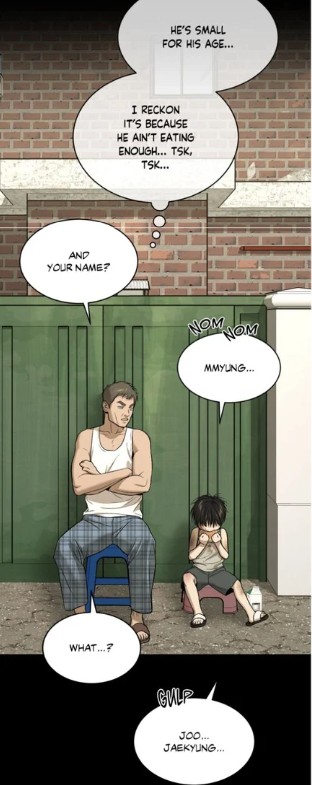 (chapter 72), his bruises
 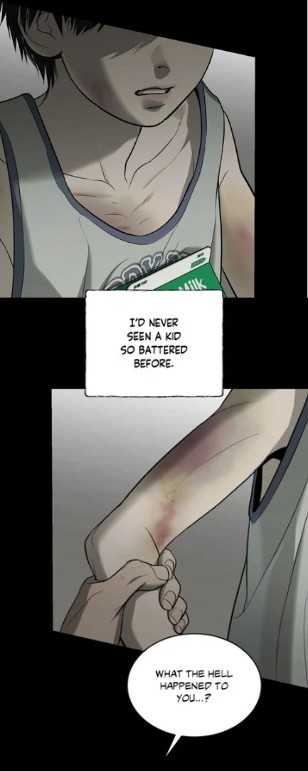 (chapter 72) and asked for his name. This exposes his priorities and his blindness. He didn’t truly perceive the child in him, he was seeing him through the lenses of a boxer and director. Hence he underestimated the absence and abandonment of the mother.
The Absent Embrace: Of Bears, Mothers, and Fathers
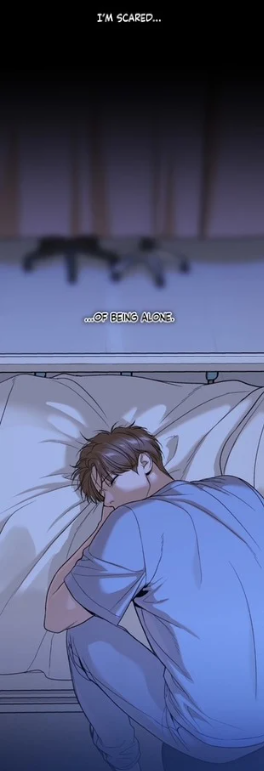
If the teddy bear symbolizes maternal protection and warmth, then its absence in Joo Jaekyung’s childhood flat speaks volumes.  (chapter 72) The boy didn’t have a blanket. He slept beside garbage. His father lay drunk and sprawled out, blind to his child’s needs. There was no teddy bear, no shared bed, no real cover.
 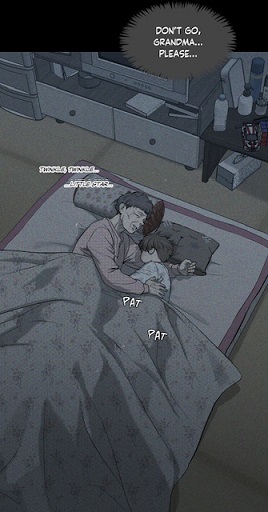 (chapter 21) Unlike Kim Dan, who grew up falling asleep next to his grandmother, accustomed to someone sharing his blanket, Jaekyung was emotionally and physically on his own from the start. Moreover, observe that the little boy had toys (chapter 21) contrary to Joo Jaekyung.
And yet, there was that one telling detail: the young Jaekyung once wore a shirt with a bandaged teddy bear on it. (chapter 72) Far from offering comfort, it mirrored his own battered condition. The implication? Someone saw—and chose not to act. That shirt represents the mother’s only trace. She was likely the one who picked out his clothes; an abusive man like Joo Jaewoong wouldn’t bother with childish designs. Which means the mother did witness his suffering or anticipated his fate, but chose to simply walk away without leaving a letter. IMO she didn’t leave an explication for her departure, hence the little boy came to imagine that she had left because of his addicted and violent father. (chapter 72) However, it is clear that here the protagonist was simplifying his mother’s decision, just like Hwang Byungchul. If she had truly cared for him, she would have taken him, but she did not.
She didn’t take her books either. (chapter 72) We see them wrapped up, left behind in the trash-littered apartment. This suggests she had been educated, possibly a nurse or a doctor. How did I come to this hypothesis? It is because this image reminded me of doc Dan’s departure from the penthouse.  (chapter 53) He is a physical therapist. He had also arranged his books together:
 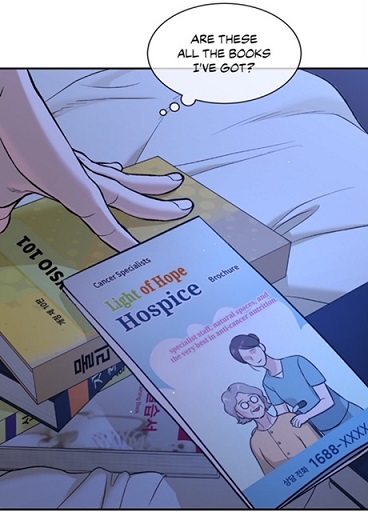 (chapter 53) And what did the hamster think while gathering his belongings?
 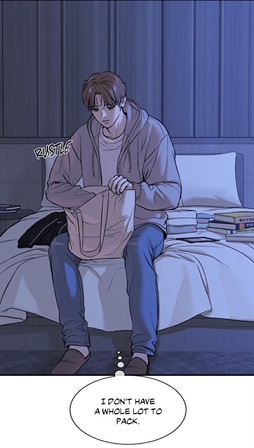 (chapter 53) So I deduce that the woman left them behind because she didn’t need them, she had enough or she no longer cared. But there is more to it!
Among the garbage 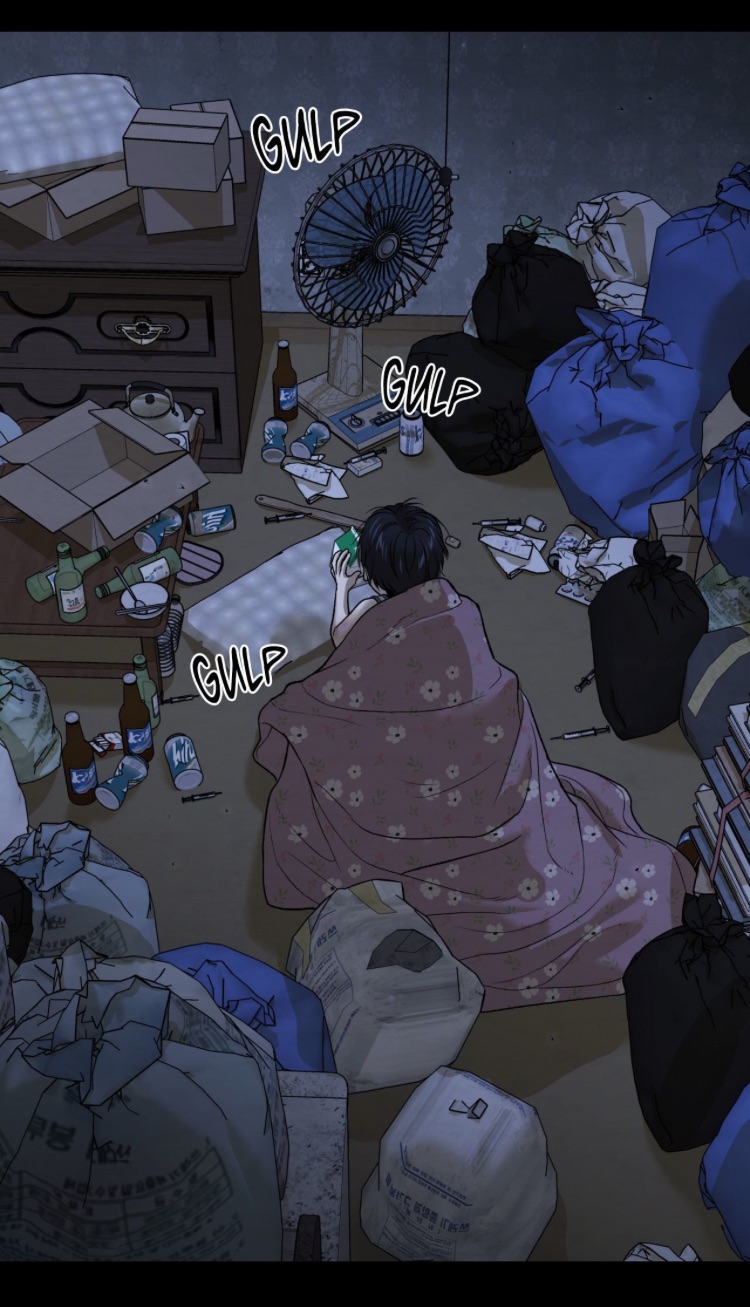 (chapter 72), there are parcels stacked on the commode and table—some of them are wrapped and seemingly untouched. Their presence is striking. Unlike the strewn bottles and plastic bags, these boxes don’t speak of decay, but of intention. They hint at a moment when someone had plans—however fleeting. And yet, their sealed state raises unsettling questions: Who were these parcels for? And why were they never opened?
Two possibilities emerge.
First, the parcels might have belonged to Jaekyung’s mother. She came into that apartment with books and packages, suggesting she was educated and had once imagined a different life. But she never unpacked. The fact that the books remained sealed indicates she was already preparing to leave or they had moved recently. These were not signs of building a home, but of biding time. If she made purchases, they were not for her son.  (chapter 27) There are no toys, no supplies for a child—just quiet evidence of a woman focused on herself, her escape perhaps already underway.
The second possibility is darker still: that even while living there, she bought things—but not for Jaekyung. She may have tried to create comfort for herself, or imagined she could still pursue personal goals, all while ignoring the battered child in the room. This would explain the absence of affection and the lack of a maternal trace. The teddy bear on his shirt, with its bandage, might have been an unconscious projection of his condition—but it was never followed by comfort or care. In contrast, when Kim Dan orders board games for the adult champion in episode 27, it is the first time we see a parcel meant for joy, connection, and healing. What the mother withheld, the doctor finally provides.
Remember how I connected the two teddy bears together! (chapter 72) (chapter 11) Is it a coincidence that we have age and a birthday together? And what had doc Dan left in that house?  (chapter 53) The jacket… Because of these parallels, I come to develop the following theory. Joo Jaekyung knew his age, because he had just celebrated his birthday. This scene definitely took place in the summer. (chapter 72) And in my opinion, she must have offered him this t-shirt before her betrayal and abandonment. And she had definitely planned it. That’s why I believe that doc Dan’s departure
  (chapter 53) must have triggered the champion’s abandonment issues. He had the impression to relive the past. The mother had left him behind in the dark unexpectedly.
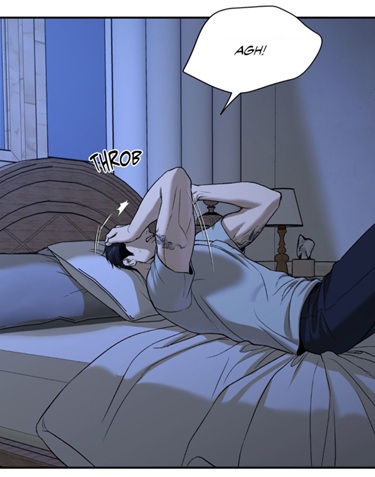
 (chapter 53) Thus Joo Jaekyung started drinking and recalling his repressed traumas. This explains why he didn’t look for doc Dan at first and why he hates his birthday and presents.
  (chapter 45) And now, you comprehend why I wrote above that I was not giving up on the idea that the champion could belong to a different world too. She was not accustomed to take care of a household. She wasn’t used to cook either. She would order food, hence we have the empty bowls.
  (chapter 72) Remember how the champion reacted, when he tasted his cooking for the first time?
  (chapter 22) He feared deception here, a sign that he must have experienced such a lie before. For me, everything is pointing out that this woman was incapable of becoming responsible for her own child. She left quietly and early enough that even Hwang Byungchul, who knew of her departure, didn’t recognize the boy
  (chapter 72). In other words, the mother was already emotionally absent long before she physically vanished. The bandaged bear thus becomes a silent accusation: you saw, and you left. Therefore it is not astonishing that Joo Jaekyung made such a mistake:
 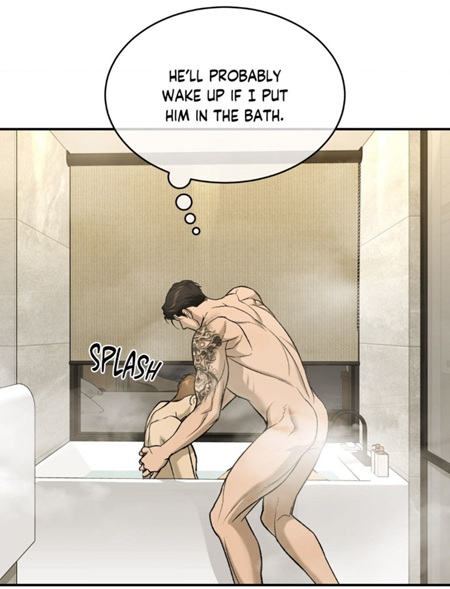 (chapter 68) His mistakes concerning doc Dan are the evidences that he was not taught how to take care of someone. His errors indicates his innocence and purity.
This motherlessness is the defining wound of Jaekyung’s early life. No pictures, no memories, no bedtime rituals. In contrast, Kim Dan’s early childhood, while also marked by loss, retained traces of maternal love. His duck-print shirt, the framed photo with his grandmother, and the teddy bear he once held—all speak of touch, affection, and care. Dan was kissed  (chapter 44) before he was abandoned. Jaekyung was never treated properly before. He was not claimed at all. It is important because the champion mentioned the word “home”
 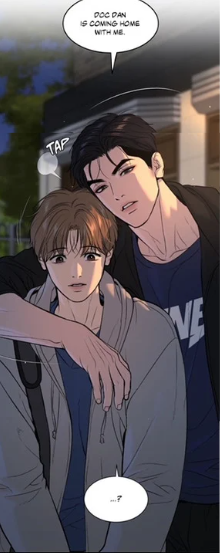 (chapter 43) for the first time shortly after receiving a mysterious phone call.
 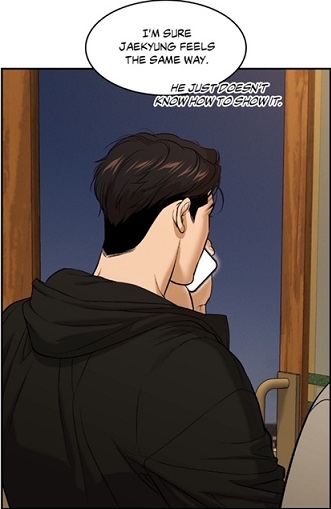 (chapter 43) And it is linked to his birthday. This resembles a lot to this scene: (chapter 72) That’s the reason why I am coming to the following hypothesis. The mysterious caller must be related to the “sulky cat” or “wolf”.
 (chapter 37)
  (chapter 49) Is it the mother or someone acting as an invisible guardian who knows the champion’s past? What do you think?
Now let’s turn our attention to the father.  (chapter 72) Joo Jaewoong—whose name literally evokes the bear (웅, 雄 or 熊)—was not a gentle protector, but a violent alcoholic and drug addicted, a man who “strayed from the straight and narrow” (chapter 72). (chapter 72) A fallen boxer whose strength devolved into brutality. He started working for the mafia, but became entangled in their web.
 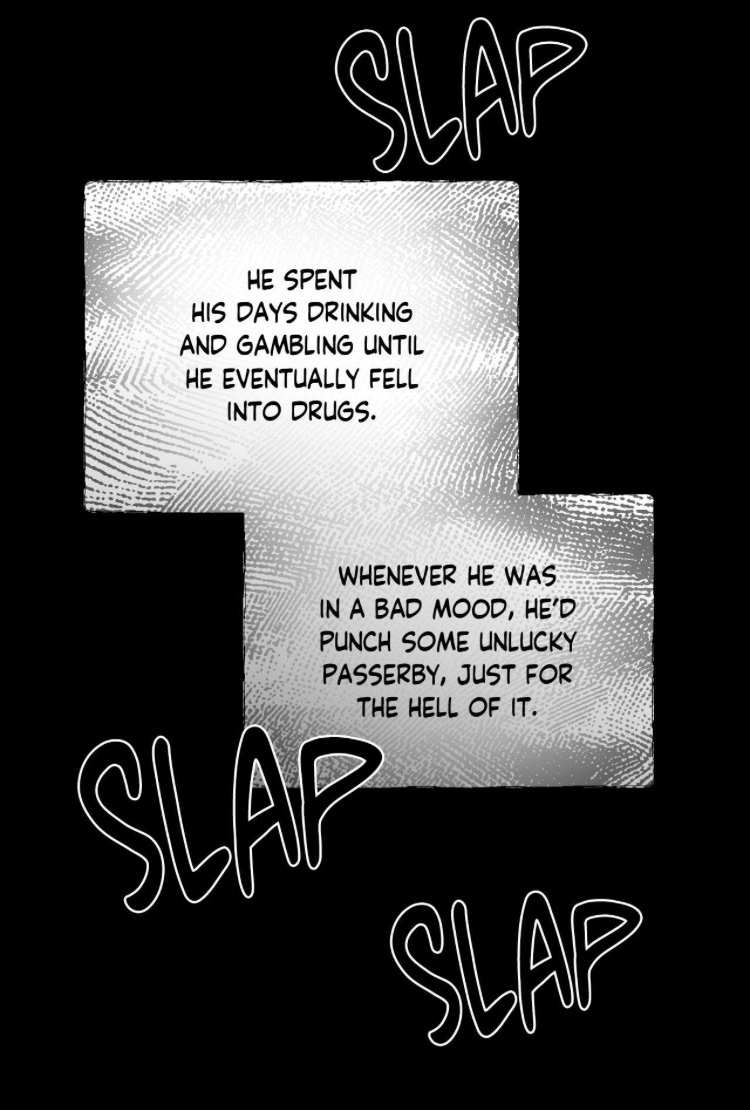 (chapter 72) The bear here is not a comforting toy but a dangerous beast. He loomed large over the child’s life not as a shield, but as a shadow. It is important because doc Dan is hearing for the second time that fighting has connections to the underworld.
 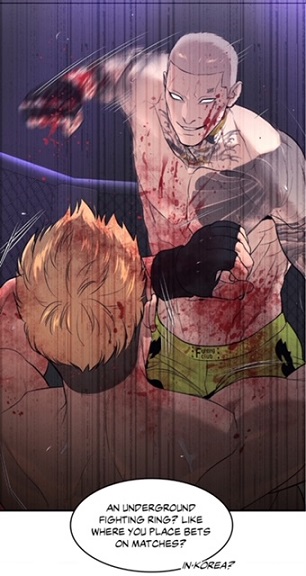 (chapter 47)
Even the name of the gym 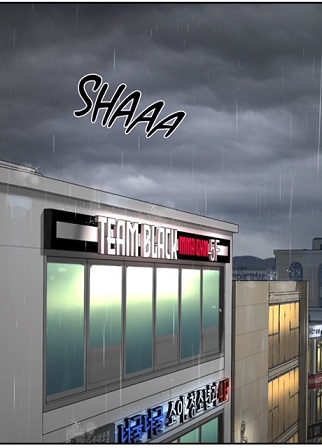 (chapter 54) —Team Black—bears symbolic weight. Unlike other athletes who proudly attach their names to their legacy, Joo Jaekyung avoids personal branding. He doesn’t call it “Jaekyung’s Gym” or “Joo Athletics.” Instead, he opts for anonymity, for darkness. It’s as if he’s building a fortress rather than a legacy, a space that offers power and protection, but no trace of where he came from.
This choice could reflect a deep desire to erase or hide his family history, especially from his father. The name “Joo Jaewoong” still echoes in the neighborhood (chapter 72), tied to shame, alcoholism, and downfall. Naming the gym after himself might invite that past back into the spotlight. Worse—it might give his father, or others like him, an opening to claim a share in his success.
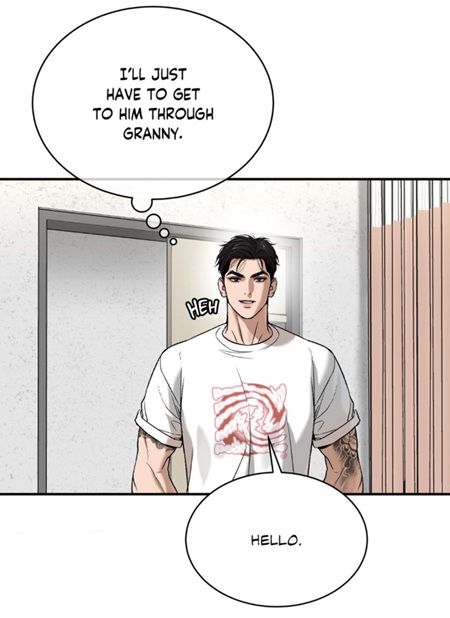
Moreover, we should not overlook the emotional contradiction: Jaekyung’s former coach and his coach’s mother once formed a kind of surrogate household. They cooked for the boys, gave them structure, and in doing so gave Jaekyung a place to belong. But that environment was also where the champion was “trained,” not truly raised. The tenderness was limited to the mother, who is now dead and Joo Jaekyung knows it. Hence he didn’t ask about her. 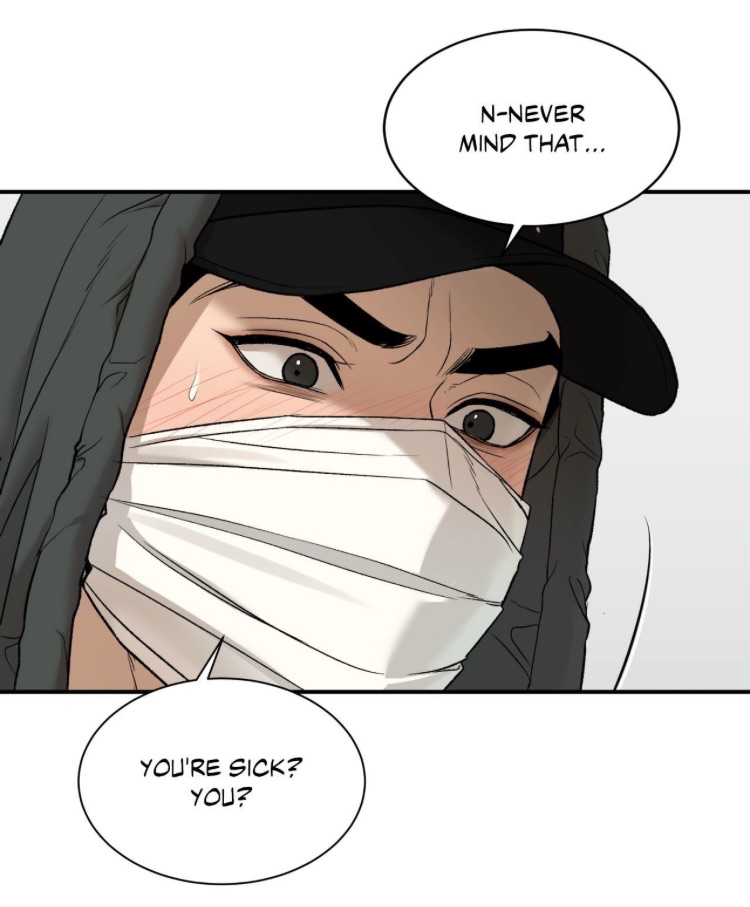 (chapter 71) I am quite certain that her vanishing must have pained him. She embodies the only good motherly role model in his life which explains why Joo JAekyung has a soft heart for Shin Okja. He knew to speak prettily and gently because of her. It is clear that the director influenced his dream, creating a gym where his mother would be part of it. (chapter 72) By not naming the gym after his mentor, Jaekyung draws a clear line: this is mine, but not a home—not for children, not for mothers, and not for fathers. Thus I came to deduce that Joo Jaekyung must have experienced something related to his mother, which Baek Junmin must know. But after the release of chapter 73, it becomes evident that their short but painful encounter took place shortly after the father’s death.
In this light, Team Black isn’t just a gym. It’s a sealed space—unbranded, unsentimental, and deliberately impersonal. A hidden monument to the self-made man who refuses to be claimed. The irony is that this name helped Park Namwook to claim the gym as his own.  (chapter 22)
Thus, Joo Jaekyung’s story becomes one of inverted symbols. Where a bear should offer comfort, it signals danger and suffering. Where a shirt should offer warmth, it marks injury. Where a home should provide shelter, it holds darkness, silence and hunger. No wonder why the man fears the night! And this is why the champion had to become a bear himself—not the soft kind, but the feared kind. His “taming” by Kim Dan is not just romantic; it’s reparative. The man who never had a teddy bear may yet become one. I would even say, he is on the verge of becoming a mother bear defending her “curb”.
Feel free to comment. If you have any suggestion for topics or Manhwa, feel free to ask. If you enjoyed reading it, retweet it or push the button like. My Reddit-Instagram-Twitter-Tumblr account is: @bebebisous33. Thanks for reading and for the support, particularly, I would like to thank all the new followers and people recommending my blog.
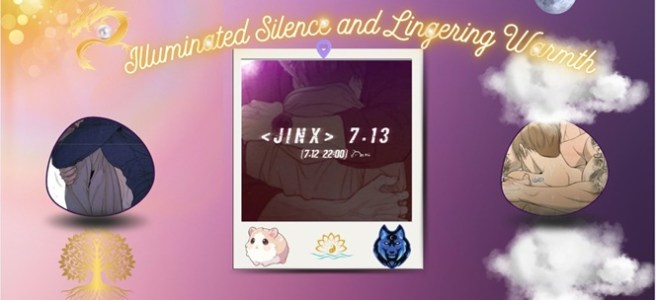
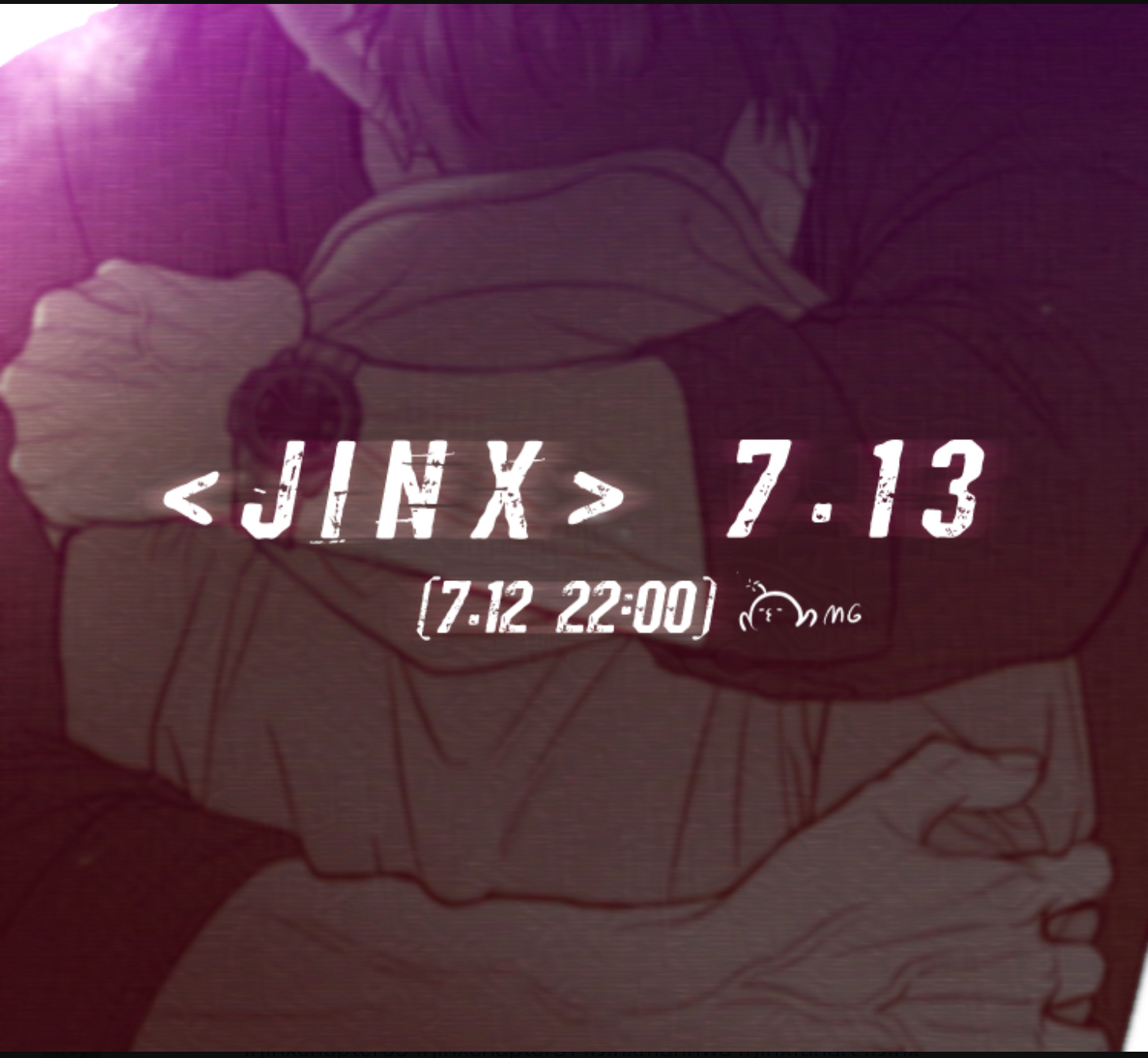 , released in anticipation of Chapter 70, is more than a promotional teaser. It is a moment frozen in time, yet brimming with motion—emotional, symbolic, and narrative. We see Joo Jaekyung embracing Kim Dan with both arms, pressing him tightly against his chest. There is no resistance, no distance, no tension in the frame. The palette moves from gray and brown fading into violet and pink, blooming into soft light. There is vapor, there is breath, an allusion to life. And most strikingly, there is stillness.
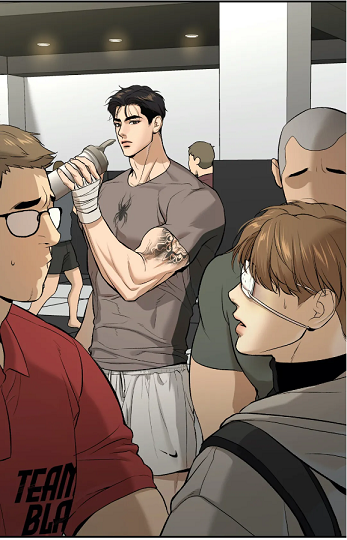 (chapter 11), every glare, and every awkward silence
 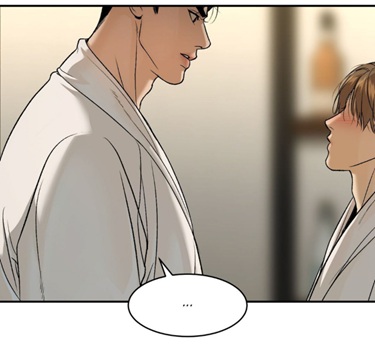 (chapter 67) between these two, this hug feels monumental.
  (chapter 58)
  (chapter 29) —the constant possibility of being challenged, of losing ground, of falling from his throne. Time meant pressure. It meant movement. But now, in this image,
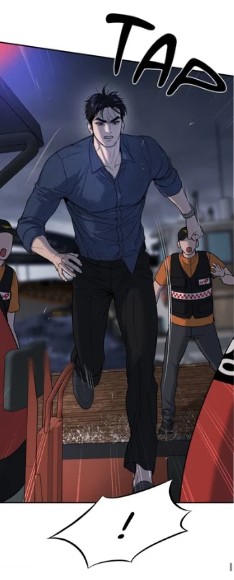
  (chapter 68) and the public hug on the dock in Chapter 69.
  (chapter 69)
  (chapter 68) He rests his chin not on Dan, but on his own hand, his arm propped on the edge of the bathtub. This detail is telling: even in a moment of supposed closeness, Jaekyung relies on himself for support, not on Dan. He is physically near but emotionally braced—still holding himself apart. His thoughts are private, tender, and possessive. In a rare moment of introspection, he confesses that
 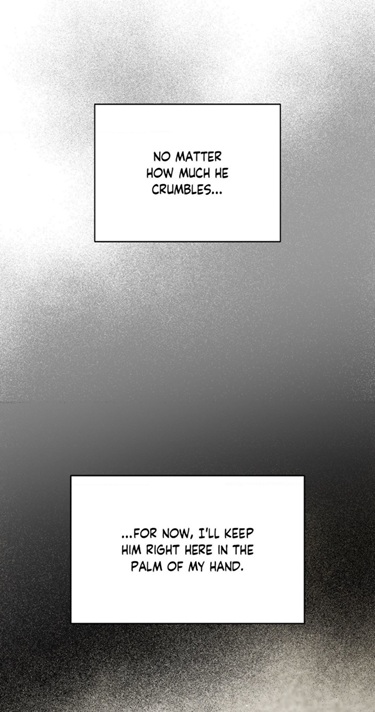 (chapter 68) This line (“I’ll keep him right here in the palm of my hand”) is deeply revealing. The champion frames care through the language of possession. The palm is open but hierarchical; it suggests that Dan is small, fragile, and dependent on Jaekyung’s will to hold or release. He does not yet see Dan as an equal. Even as he softens, his emotional vocabulary is shaped by superiority and containment. The hug is real, the sentiment sincere, but the dynamics remain unbalanced. And since Dan is asleep—unable to reciprocate, respond, or challenge—the embrace becomes more about the wolf’s soothing himself than forming a mutual bond. Furthermore, Dan is not even facing Jaekyung.
  (chapter 69) Yet, when faced with renewed pressure and stress, he falters—leaving Dan behind.
  (chapter 69) The illusion of control dissipates, revealing that his earlier vow, however heartfelt, was not yet unshakable.
 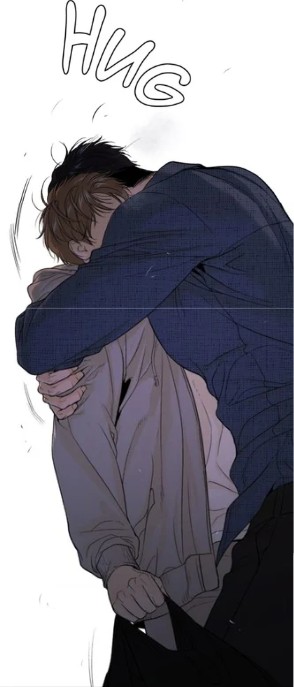 (chapter 69) rather than a moment of mutual resolution. Jaekyung offers no words, yet a silent gesture of care and vulnerability.
 (chapter 69) that Jaekyung is wearing it, the change in angle—viewing the hug from behind—deliberately conceals it.
 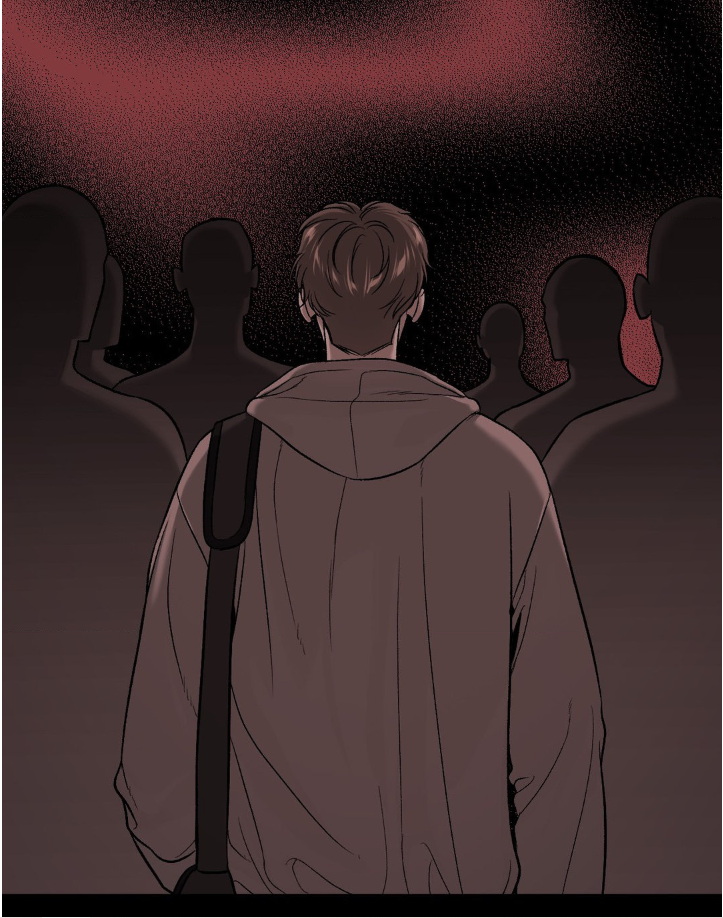 (chapter 55) In the new illustration, the hamster’s back is no longer representing anonymity and indifference, but visibility and care, for the champion is now facing his fated partner. In other words, doc Dan’s back in the teaser stands for uniqueness and high value. He can not be replaced. Moreover, doc Dan is not walking away, nor is he asleep.
  (chapter 45) Back then, the champion refused the expensive key chain, symbolizing a missed opportunity for emotional connection. Both men yearned for attention and affection, but failed to express it. Here, in contrast, the champion offers something far more meaningful than a 14,000₩ and free lodging —his unguarded embrace. And Dan, by remaining still, appreciates the moment.
  (chapter 21) Dan became fluent in a silent, physical language of care. She often asked him not to cry
  (chapter 47) and composed embraces—gestures repeated with calm precision. These touches were predictable, rhythmic, and soothing, but they also suppressed genuine emotional exchange, the symbol of toxic positivity.
 (chapter 57) the momentary pause of a hand
 (chapter 5) never still—giving the impression of involvement, of care in action. But this motion avoided vulnerability and responsibility in reality. She never clung, never trembled. Her gestures conveyed comfort but not surrender, presence but not change, and not support either. They were not truly emotionally together.
  (chapter 47) to hold her hand, to initiate closeness
  (chapter 47)
  (chapter 56). This reversal of roles placed the burden of emotional stability on his young shoulders.
 (chapter 57); I’ll come back home, once I am all better”
 (chapter 11) —promises that sounded protective but masked emotional denial. Her words were spoken to soothe, not to reassure with truth. These assurances were emotional illusions—comforting on the surface, but hollow in substance. They created the illusion that she was always strong, ever-present, even immortal—an anchor that would never be lost. Over time, this illusion cemented itself in Dan’s mind. She became a fixed point of emotional gravity,
  (chapter 65) a mythic figure whose emotional distance he interpreted as noble sacrifice. Her constant reassurances and carefully controlled gestures fed into this perception, convincing Dan that love meant loyalty, restraint, and silent endurance.
  (chapter 35) Instead of recoiling in fear or admiring his strength, Dan quietly states, “I think I really need to focus on Mr. Joo right now.” He does not focus on the strength or aggression, but on the pain beneath it. The burst sandbag, for him, is not a threat—it is a symbol of Jaekyung’s emotional unraveling. This silent recognition mirrors Dan’s interpretive skills developed in childhood. Just as he once learned to read a shift in his grandmother’s hand or the silence after a broken promise, he now interprets the damage to the sandbag as an unspoken plea for help. This sensitivity continues to define his bond with Jaekyung.
 (chapter 47), to stabilize the person meant to support him. Now, he is receiving without shame or hesitation. The Emperor’s silent desperation, his refusal to hide behind ritual or false strength, creates the space for Dan to feel treasured—not pitied, but wanted.
 (chapter 65) or stand-ins
 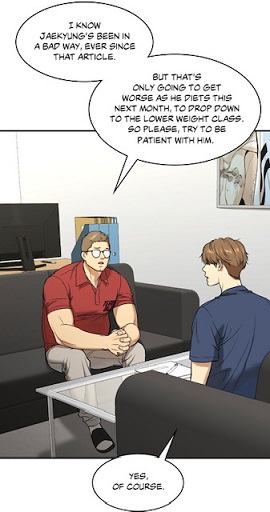 (chapter 36) for affection has ended. The spotlight now belongs solely to Jaekyung and Dan, who no longer require mediation to reach one another. This shift becomes particularly evident when contrasting the teaser with earlier moments of evasion, silence, and misplaced dominance—especially through the lens of Park Namwook’s slap and Jaekyung’s own past deflections.
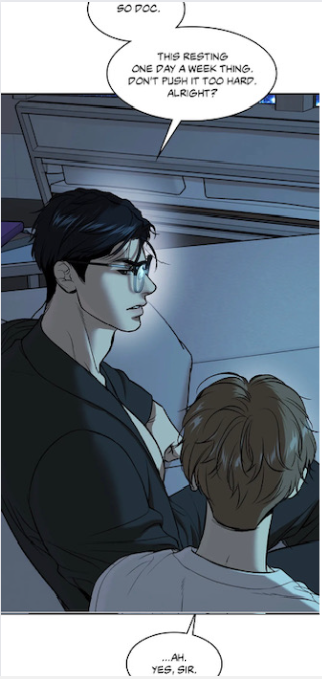 (chapter 29), ignoring Dan’s presence and concern. His rejection of the doctor’s offer of comfort or companionship underscores not only his emotional detachment but also the absence of true support from his supposed team. The manager, Park Namwook, is nowhere to be seen,
 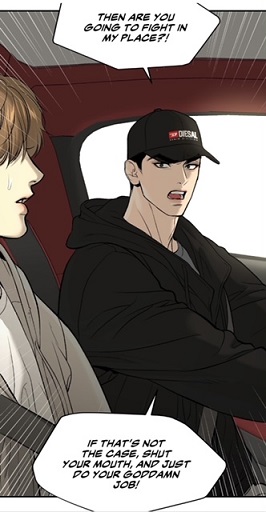 (chapter 42) or offered silence in return. He had no teamwork ability in the end contrary to the hamster who “assisted” his grandmother. But it is not surprising, since Park Namwook has always relied on his boy.
 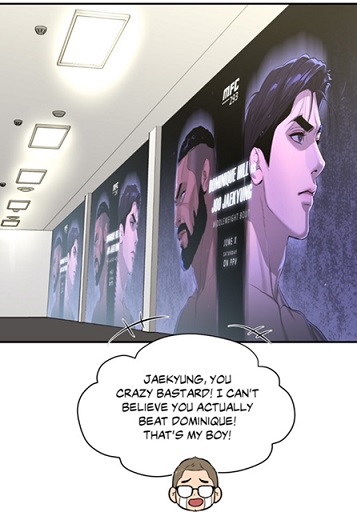 (chapter 40) Each time, they faced a problem, the athlete had to resolve it. He was the problem and the solution for everything.
  (chapter 17)
  (chapter 52) The reason is that he couldn’t face the terrible outcome and his own responsibility. He needed a scapegoat. Thus he blamed the champion for everything. But by doing so, he refused to share the burden and the athlete’s unwell-being. Striking is that this slap served as a wake-up for the athlete. From that moment on, he stopped relying entirely on his “hyung”. He was pushed to make decisions on his own. This harsh gesture mirrors Shin Okja’s attitude toward Kim Dan,
 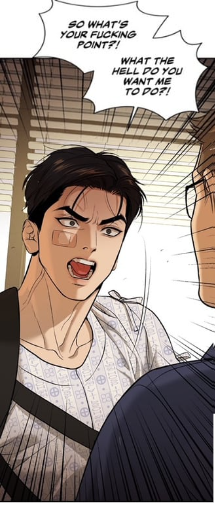 (chapter 52), seeing it as disruptive or shameful. Their guidance demanded emotional control, not emotional honesty.
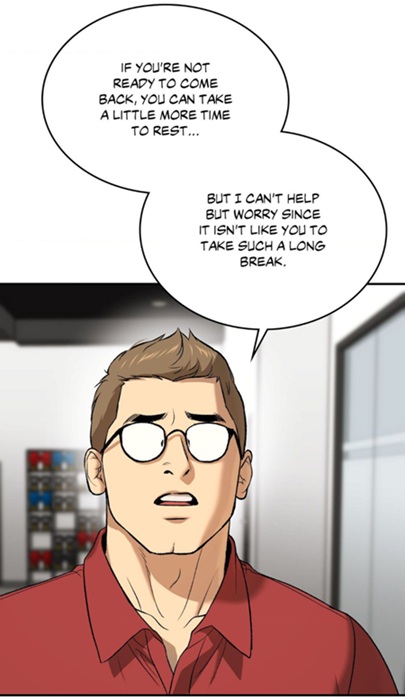 (chapter 66) or use violence to “tame the wolf”. That’s the reason why he is accepting the offer from the CEO of MFC. He is pushing the Emperor to return to the ring, but the problem is now that doc Dan was officially recognized as a member from Black Team.
 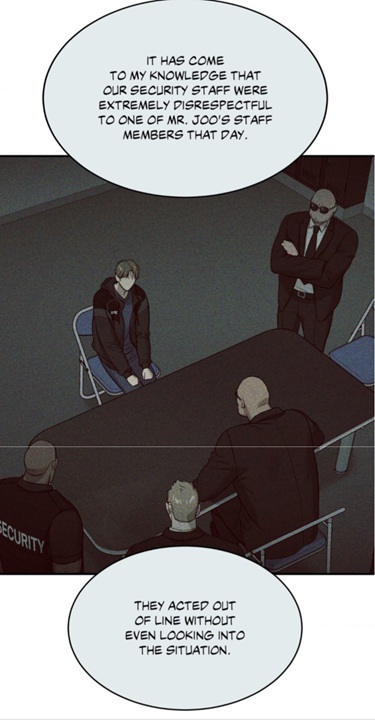 (chapter 69)
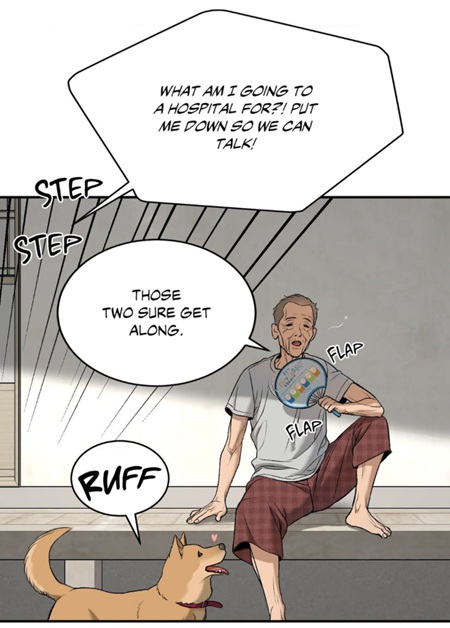 (chapter 66) the moment the Emperor carried away doc Dan. This looks like an “embrace”.
  (chapter 66)

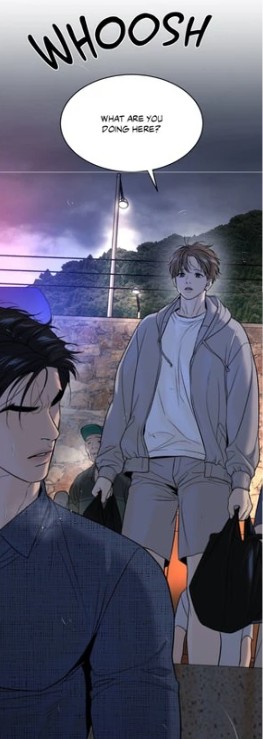 (chapter 69) and the latter stands stunned in the late-summer breeze, the moment seems suspended in light and silence. The doctor’s words are accompanied by a subtle music: the wind. It whispers through the panel with an audible “WHOOSH,” not covering doc Dan’s voice but giving it resonance. The wind, like words, travels through the air and reaches the celebrity’s ear. It connects characters across distance, marking the invisible line of perception, reaction, and awakening. But behind this charged reunion lies a quiet figure—barely visible, yet unmistakably present: the landlord. In this image, the old man appears only for a second, dressed in a jacket and green cap, almost blending into the night. He does not speak. He does not move. And yet, everything in that scene bears his mark.
 (chapter 69)
 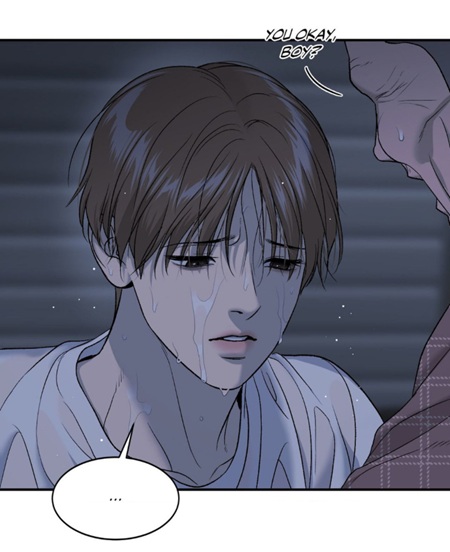 (chapter 69) These silent, parallel compositions reveal the landlord’s symbolic position as an enduring guardian: not static, but responsive. Therefore his position shifts constantly, either
  (chapter 65) in front of the couple, or behind Kim Dan in one scene, behind the champion in another.
 (chapter 57) He is not fixed in place like house, wall or obstacle. This explicates why he is almost seen outdoors, even her. Opening the door means allowing the fresh air to enter the room.
 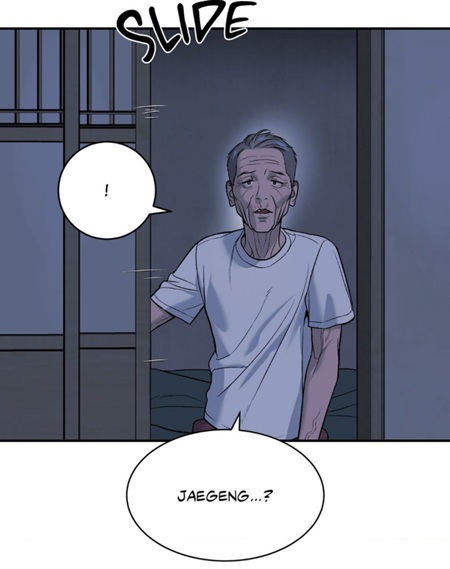 (chapter 65) He is like the wind, fluid and unobtrusive, adapting to the needs of the moment. His position is never rigid, therefore in the final panel he seems to have vanished.
  (chapter 46) or authority
  (chapter 65), the landlord responds to what is needed, not what is expected. His flexibility does not stem from indecision—it is born from humility and care. Another aspect contributing to this perception is his ignorance. However, the latter should not be viewed negatively. Since he doesn’t know the champion’s profession or the doctor’s familial and financial situation, he is not projecting expectations or judgments onto them. Rather than acting out of assumption, he simply observes. This is precisely why he doesn’t come across as arrogant. His lack of knowledge becomes a quiet strength—it allows him to respond with presence, not prejudice. Just as the wind moves through open spaces without imposing form or judgment, his unknowing presence allows room for others to breathe and unfold, free from predefined roles or assumptions.
 (chapter 65) He does not try to define the protagonists by their past or their titles. He lets them define themselves. While he tried to encourage doc Dan to drink and work less, as time passed on, he came to notice his suffering and accept him with his illness.
  (chapter 69), it is plausible that the landlord is calmly scanning the horizon, sensing the approach of the tempest. After all, he is a farmer
  (chapter 62) —his livelihood depends on observing the skies.
  (chapter 69) They are murmuring, yes, but their attention is absorbed by the incident at the shore. This led me to reconsider: perhaps the purchase was not consciously connected to the weather after all. And yet, one man quietly stood apart from the crowd—the landlord, his silence and gaze directed not toward the commotion, but toward the open horizon.
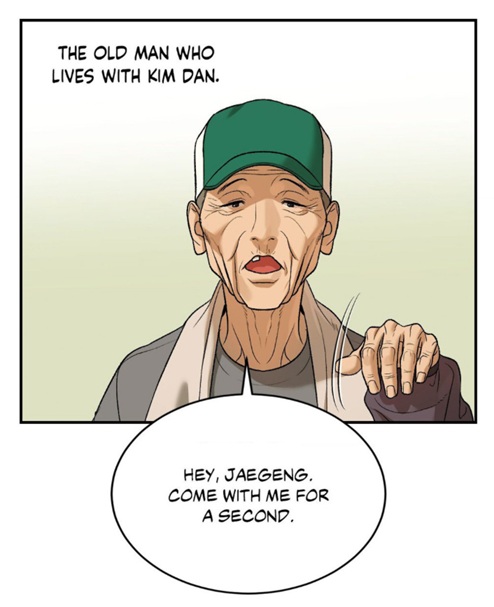 (chapter 62) He is a farmer—a man who reads the sky, the wind, and the rhythm of the land. Hence I am inclined to think that his awareness of the approaching storm stems not from a broadcast but from instinct. The wind carries signs, and he is attuned to them. It is even possible that while talking with the coast guards, he learned more about the forecast—not through digital alerts, but through human connection.
 (chapter 69) had already been shown earlier together in the crowd, I suspect that one of them might informed Kim Dan about the incident and the champion’s presence. This would align with the narrative’s kaleidoscopic structure, where certain scenes are reflected in different timelines.
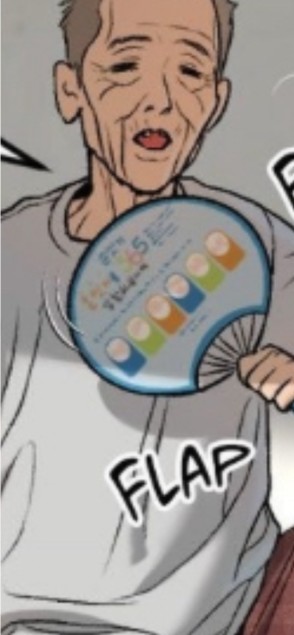 (chapter 66) Under this new light, it dawned on me that the fan was most likely handed out by a local institution—perhaps even the hospice Light of Hope, during a public health campaign or examination event. This means that he is taking good care of himself. One might argue with this interpretation, yet there exists another evidence for this perception.
  (Chapter 62) He is constantly wearing the green cap, a sign that he knows about the danger of the sun. This stands in opposition to the grandmother who would sell her vegetables without any hat.
  (chapter 57) These types of fans are typically distributed by hospitals or clinics: practical items with subtle promotional intent. But once in the landlord’s hands, it takes on symbolic weight. The number “365” does not simply represent a calendar year; it represents consistency, time, and the daily rhythm of care.
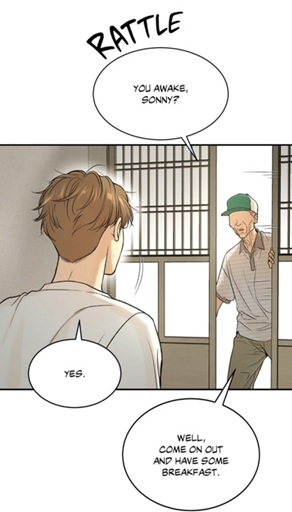 (chapter 57), white,
  (chapter 61) and brown. Yet, his clothes tend to lean toward brown hues, evoking earth and soil—symbols of rootedness and stability.
 (chapter 62)
  (chapter 65) words and wind share the same pathway—the ear. We do not see them; we hear or feel them. Just like the wind, the landlord’s influence often goes unnoticed unless we attune ourselves. Interestingly, in the English version of Jinx, he refers to Joo Jaekyung as “son”
 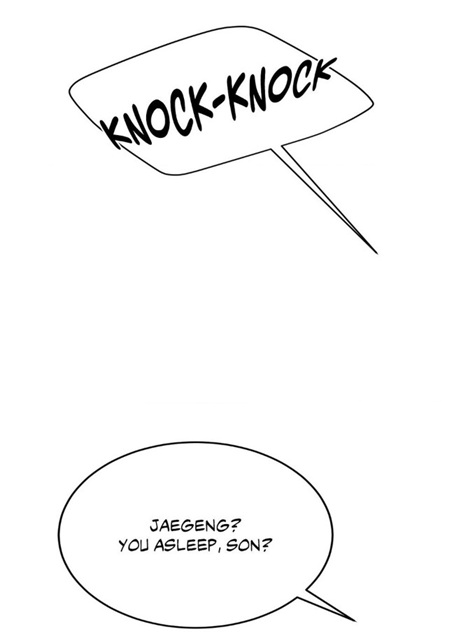 (chapter 69) and Kim Dan as “sonny”
 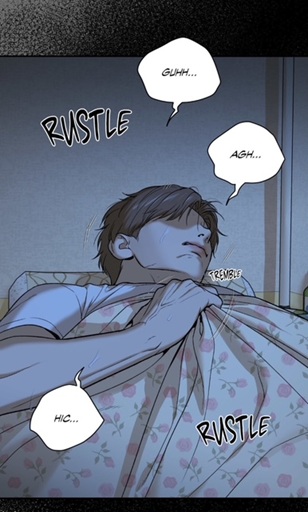 (chapter 59) Whether it’s due to panic, malnutrition, exhaustion, or psychological collapse, suffocation is one of the defining sensations of Kim Dan’s arc. In this context, the landlord, with his unassuming fan and grounded demeanor, emerges as a breath of fresh air—the very opposite of the heiße Luft, or “hot air,” surrounding the champion’s fabricated scandals and media distortions.
  (chapter 52)
  (chapter 69) the atmosphere grows heavier—not from external scandal, but from inner turmoil. Then Kim Dan’s puzzled reaction,
  (chapter 69) The scene becomes emotionally charged, echoing classic storm symbolism: emotional intensity, uncertainty, and the prospect of sudden change.
 (chapter 69) —his face filled with shock and disbelief—the Webtoonist added the sound effect “WHOOSH.” Under this new light, I interpreted this as more than background ambiance. It marks a pivotal turning point, as if the wind itself had cut through the fog in Joo Jaekyung’s mind, sweeping away his spiraling fear and clearing space for truth. This sudden shift in emotional atmosphere visually alters him too. Hence it is not surprising that he looks visibly younger. Not broken, but stripped of his burdens. As if the wind blew away the years of pressure, fears and rage.
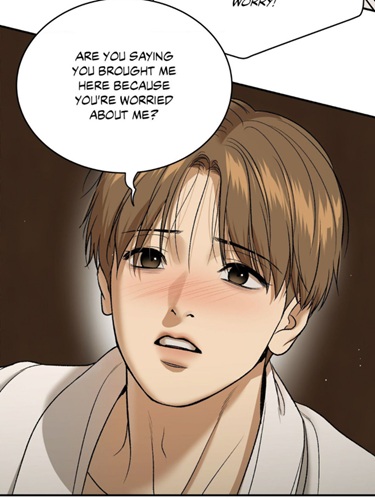 (chapter 67) Doc Dan got finally his answer to this question. Joo JAekyung is more a man of action than of pretty words. So awakening and flourishing are not something that occurs behind glass or sealed doors. It is born in the open, amidst uncertainty and confrontation. And under this new light, I reached a final insight: growth in Jinx does not happen behind closed doors or sealed windows. It happens in the open, where storms rage and air can finally circulate.
  (chapter 59) The landlord doesn’t shelter people from pain or storms. He makes sure they’re equipped to face them. And once they do, the wind is no longer a threat, but a form of grace. And now, you comprehend why the death of the puppy has not been discovered by the athlete yet. For the landlord, death is something natural and inevitable, and since doc Dan has been working at the hospice, I am quite certain that the old man imagined that doc Dan was well-equipped to deal with this situation. He must have been envisaging that Doc Dan was accustomed to it. The problem is that he doesn’t know the protagonist’s past and family.
  (chapter 58), who plays the victim while hiding his own culpability, the landlord does not engage in gossip or vilification. His silence isn’t ignorance—it is grace.
  (chapter 58) and from media
 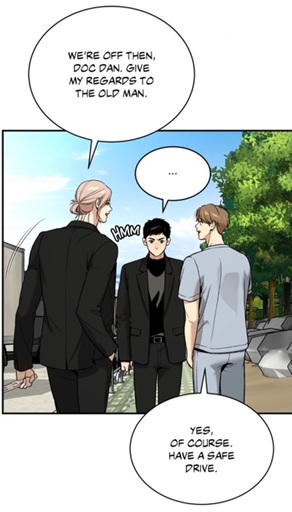 (chapter 59) He felt so comfortable around him.
 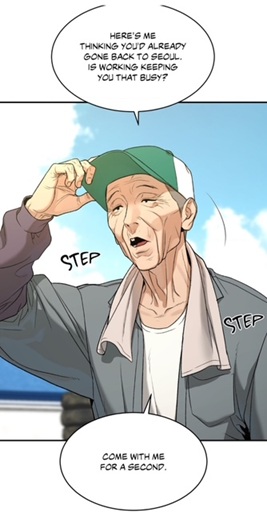 (chapter 57), but someone who understands the balance between labor and rest. He may not have a name, but he has a function. And sometimes, in storytelling, function is identity enough.
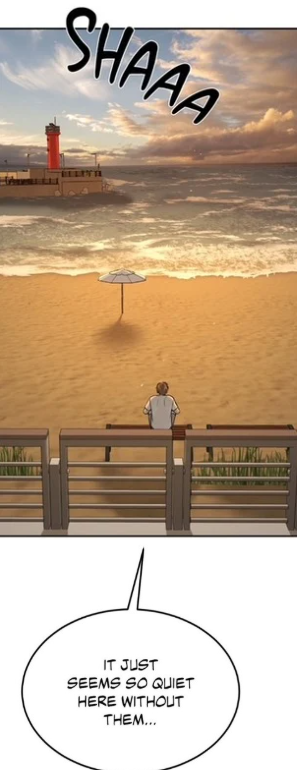 (chapter 59) there’s only one poor sun umbrella in front of him and a wall far behind him. His back is turned to the world, wrapped in solitude and silence. That’s how I was reminded of his childhood. There, the grandmother often stood beside him
  (chapter 47)
  (chapter 47)
  (chapter 65) but not behind. Thus the landlord’s placement
  (chapter 49) explains why he got abandoned in the locker room. It gains even more poignancy when viewed against his past. In Episode 47, while the grandmother was carrying him on her back, Kim Dan’s back is left unprotected.
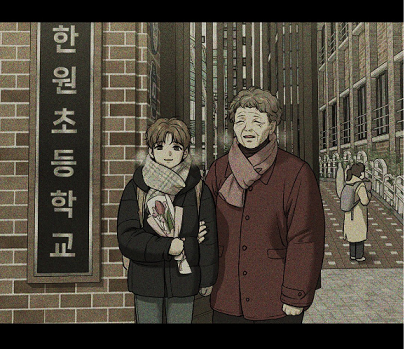
  (chapter 57) The moment she offered him a snack, she distanced herself from him. Now, she is standing by his side.
  (chapter 65) It becomes the exception—the rare moment where she appears to have his back. But photographs can be deceptive. They capture posed perfection, not lived reality. And as we trace Kim Dan’s emotional journey, we begin to understand that this illusion of maternal protection was not enough to sustain him.
 (chapter 61) —they give him the air, time, and space to grow.
  (chapter 62) Their presence—especially the landlord’s—is the embodiment of silent guardianship.
  (chapter 69) His consistent yet unobtrusive presence stands in opposition to the grandmother’s inconsistent gestures. One acted out care; the other lives it.
 (chapter 47)
 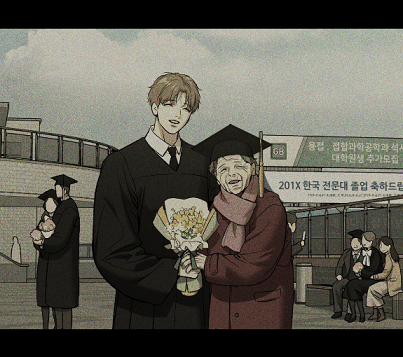 (chapter 47) Despite the rare instance of closeness captured in a photo, most scenes depict Kim Dan standing next to his grandmother, and he is the one supporting her.
 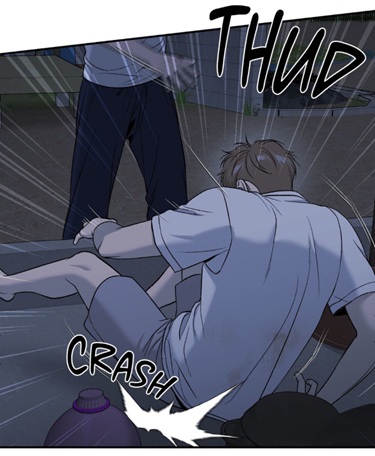 (chapter 69) This gesture, though seemingly violent, reveals something deeper—it forced Kim Dan to feel what he had been missing all along: there were people around him, he was not alone. I would even add, someone was finally standing behind him.
 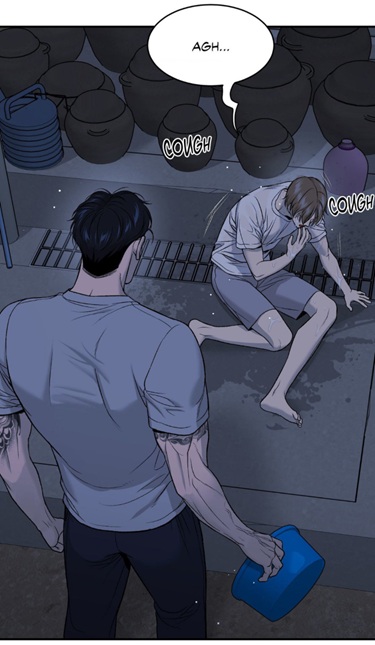 (chapter 69) In that brief moment, Kim Dan is no longer alone. The landlord, as a silent guardian, and Joo Jaekyung, as a fierce protector, are both behind him—symbolically and literally.
  (chapter 56)
  (chapter 65) while seated in a wheelchair or lying in a hospital bed—entirely dependent on others to move her. Her self-image as a strong and autonomous elder clashes sharply with her visible reliance on those around her.
 (chapter 65), reliant on beds, wheels, and nurses to navigate the world. Under this new perspective, the wheelchair and the truck are no longer just modes of transportation—they are emblems of character. One rolls forward by another’s push, the other steers by its own will.
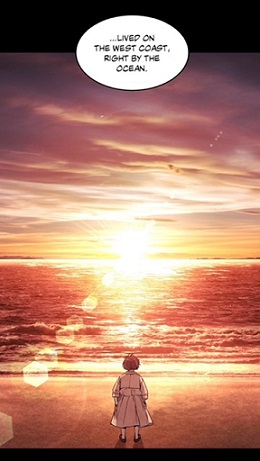 (chapter 53), I doubt that she anticipated the existence of dangers by living on the coast: storms and typhoons. So her beautiful town could get devastated,
  (chapter 69), while the star becomes the son. This trio, for now, are merely neighbors. But with the storm approaching, I am expecting that their separation may dissolve, drawing them into shared space and daily life.
 (chapter 46) Coach Yosep, Joo Jaekyung, and Park Namwook—a trio marked by authority without dialogue, control without care. In that group, the manager sowed distrust while avoiding accountability.
  (chapter 46) In the new trio, no one holds dominion over the other. There are no contracts, no strings. The landlord has no financial stake in the fighter’s success.
 (chapter 66)

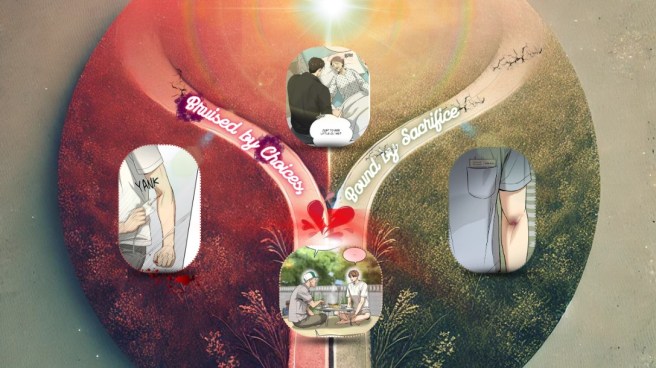
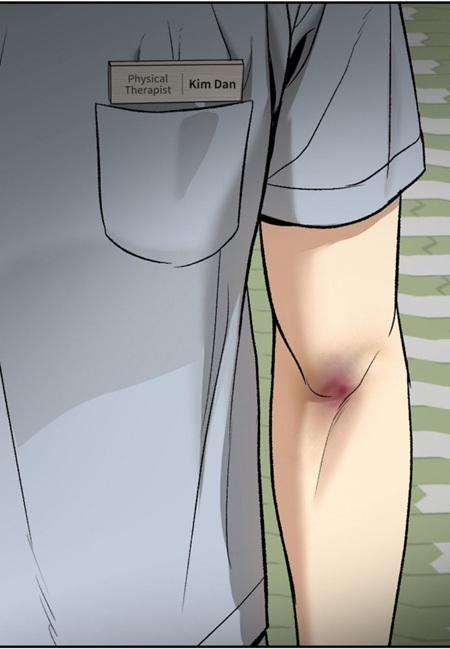 (Chapter 61) However, this moment is not isolated—it reflects patterns in his personality that have appeared throughout the series.
  (Chapter 11)
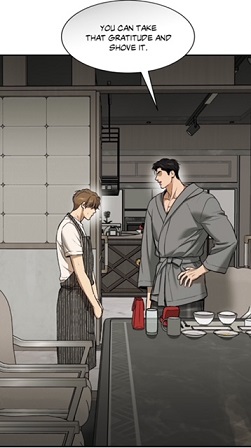
  (chapter 18) This essay delves into the significance of Kim Dan’s physical and emotional bruises, examining how they symbolize his suffering, internal conflict and transformation. I will examine Kim Dan’s conflicted emotions surrounding gratitude and debt, contrasting his interactions with Joo Jaekyung and his grandmother, Shin Okja. Additionally, I will explore how Kim Dan’s conditioned identity as a caregiver drives his choices, even in his current living situation with the landlord, where he unconsciously replicates past dynamics. Ultimately, I will elaborate how Kim Dan’s newfound awareness could reshape his identity and relationships moving forward.
 (Chapter 61) His unexpected reaction catches Kim Dan off guard, further emphasizing how disconnected the doctor has become from his own well-being. However, contrary to the past
  (chapter 11), Kim Dan is truly responsible for the contusion. He caused the injury by removing the needle from the drip.
  (chapter 60) By taking this action, he absolved Joo Jaekyung of any responsibility for the injury, but this is merely a superficial conclusion.
 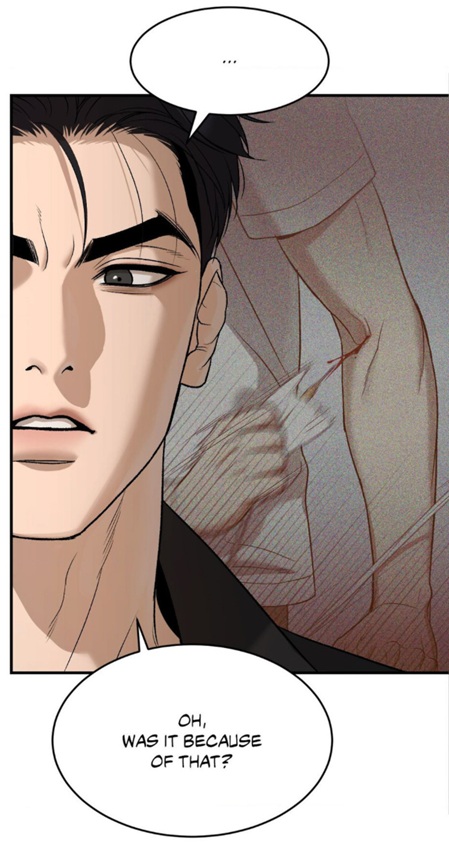 (Chapter 61) On the hand the circumstances surrounding the bruise, where Kim Dan removed the needle on his own, provide insight into his psyche. The deeper cause of the bruise lies in Kim Dan’s declining health, which is intrinsically connected to his malnutrition and the neglect he faces from those around him. It is important to recall that Joo Jaekyung was explicitly informed that Kim Dan needed rest
  (chapter 60). Yet, with his insistence,
 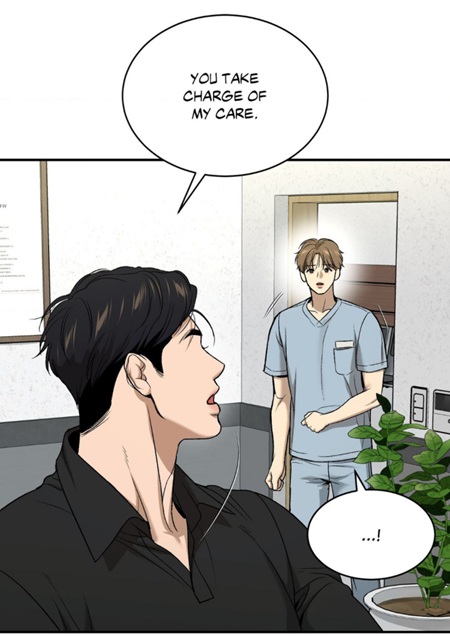 (chapter 61), he forced the physical therapist to keep working, adding even more strain than before. Though the physical therapist attempted to voice his disapproval,
 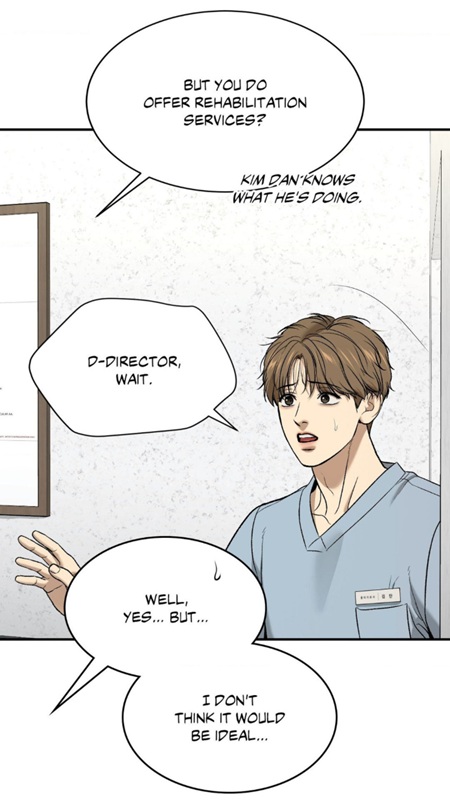 (chapter 61), he ultimately had no choice but to comply, as his order came from the hospice director.
  (Chapter 61) And why did the director override Kim Dan’s need for rest? Money and free PR. Joo Jaekyung’s influence secured the director’s approval, disregarding the doctor’s well-being in favor of business interests. This conversation at the director’s office makes one thing clear: words hold no power against profit. An d that realization led me to another connection—every one of Kim Dan’s bruises is linked to exploitation, whether by authority, obligation, or financial influence.


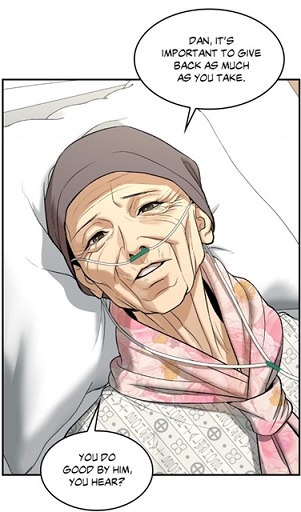 (Chapter 41) It is clear that she was inciting him to work harder than before. This displays that Kim Dan was not allowed to rest. During this encounter, she didn’t ask him about his well-being either. And what is the link between these 3 episodes? The grandmother and her poverty. The latter was responsible for the loan.
  (chapter 56) Kim Dan has only visited the hospital once, and this was solely due to Joo Jaekyung’s intervention. The latter needed medical attention himself
  (chapter 18) and took Kim Dan along, ensuring he was seen as an emergency patient. However, this visit was brief and lacked any comprehensive medical examination—no blood samples were taken, and his underlying health concerns remained undiagnosed. This omission further underscores the neglect Kim Dan has suffered, as even in a medical setting, his long-term health issues were overlooked.
 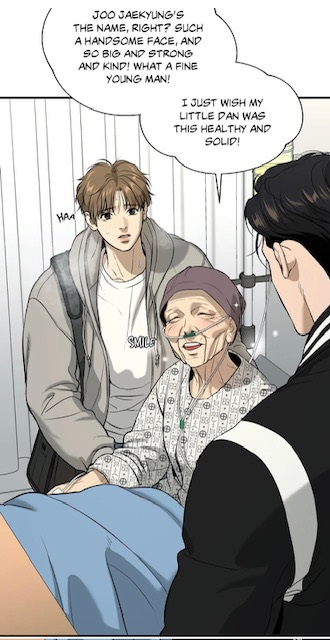 (chapter 21) He had never been healthy and strong. Moreover, when he joined them, at no moment the senior asked if he had gone to the doctor, though he had been sick before.
 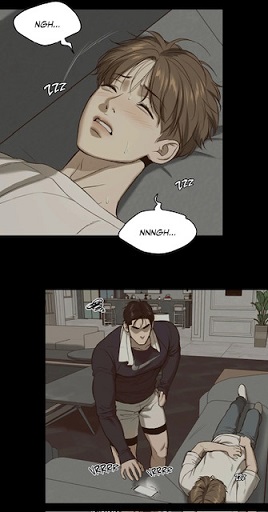 (chapter 21) But back then, the champion didn’t pay too much attention to it. In my opinion, her response will likely reflect her established pattern of emotional detachment and deflection of responsibility. Rather than admitting her lack of concern for his well-being, she may shift blame onto the staff or Kim Dan himself
  (chapter 57). In the last case, she will downplay the severity of his condition, insisting that he has always been stubborn and independent. She could even mention her conversation, when she tried to convince Kim Dan to return to Seoul, but the latter refused to listen to her.
 (chapter 5), or his general reluctance to ask for help. He rejected the athlete’s help and concern.
 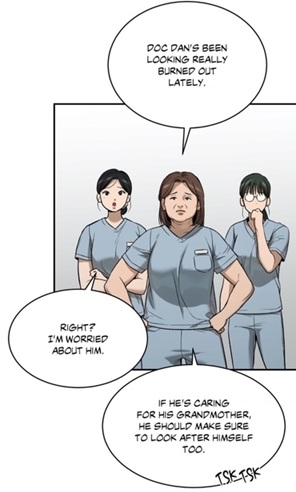 (chapter 57). She blamed the main lead, because she imagined that Shin Okja would worry about him. However, it becomes clear that the halmoni is not worried about her grandson at all. She is acting like a fan in front of the athlete.
  (chapter 61) One might argue that based on this scene, the grandmother didn’t see him with the bruise on his arm.
  (chapter 61) He only remained at the door. However, observe that there was a cut between this image
 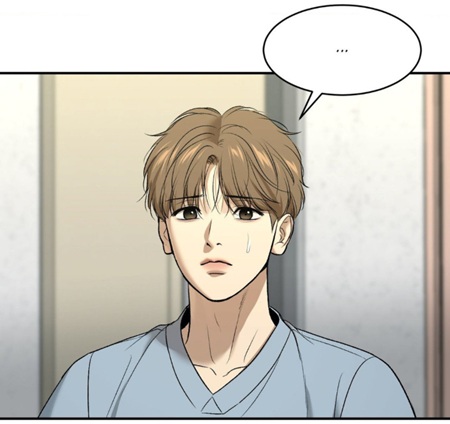 (chapter 61) and the conversation between the main couple in front of the hospice.
 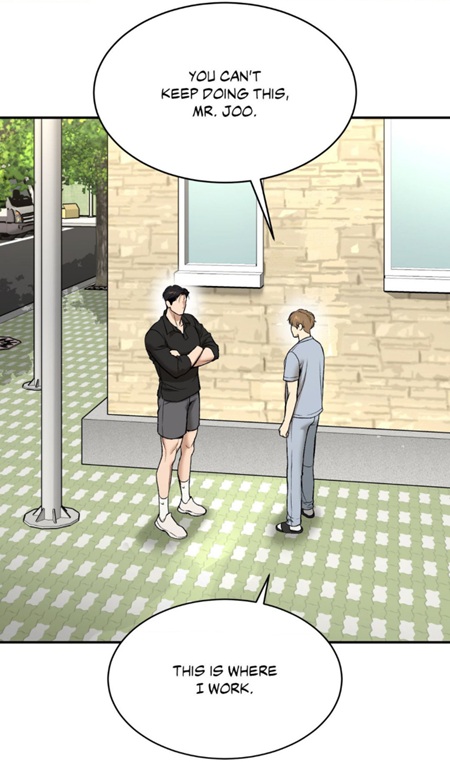 (chapter 61) So he could have made his presence known to his relative before asking Joo Jaekyung to follow him because of his treatment. To conclude, I believe that she had the time and occasion to see her grandchild and his bruise.
 (chapter 13) He is the only doctor who has ever examined the protagonist so closely and even paid attention to his fingernails!
  (chapter 13) At the same time, the chingu from the club was the first one pointing out that his wounds were never treated!! Furthermore, I realized that the doctor’s lies from episode 11
 (chapter 59) He would space out and even fall asleep at any moment.
 (chapter 13) The latter was the cause for the severe exhaustion. However, like mentioned above, the doctor is not blameless either, because he never questioned why his wounds on the hand were bleeding again.
  (chapter 43) He thought, it was related to the massage, yet the reality was that this incident showed that he had coagulation issues. To conclude, all the bruises could have always been noticed by people due to their locations (eyes, hands, arm)!
  (chapter 61) and his relationship with Joo Jaekyung.
  (chapter 61) That’s how I recognized why these women’s warm welcome and curiosity about Kim Dan were rather superficial.
  (chapter 56) His arrival stands for novelty and a breath of fresh air at the institution. However, with this change, the female staff is forgetting their original duty: they need to pay attention to their colleagues. They are behaving like the grandmother
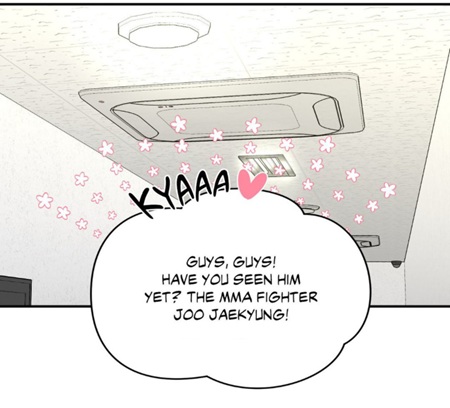 (chapter 61): fangirling over the handsome guys visiting their little town. That’s why Mingwa drew flowers in the last two images. No wonder why no one around Kim Dan is observing the bruise and his deteriorating condition. Moreover, since the physical therapist has a relative at the hospice, the staff is envisioning that Shin Okja is doing “her work”, she is paying attention to Kim Dan’s mental and physical conditions. On the other hand, there is no doubt that the grandmother has already delegated her own responsibility onto others, Kim Dan and the hospice. It is a medical institution, therefore they should pay attention to his working conditions. In other words, since no one feels responsible for the protagonist’s health, no one is worried about Kim Dan at all. At the end of episode 61, he is even so pale and breathless
 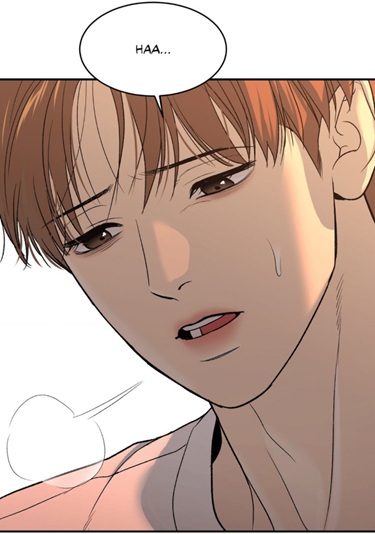 (chapter 61) that I am anticipating a terrible incident leading to a rude awakening for everyone.
 (chapter 47) For Shin Okja, raising him to adulthood marked the completion of her duty, and his current struggles are no longer her concern. This perspective becomes evident in her words from Chapter 57, where she tells him, he can’t stay here forever, and it’s not like he’ll stick around after she dies.
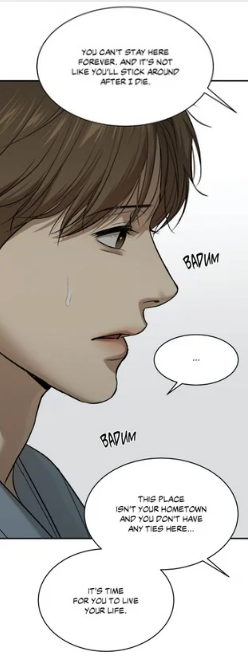 (chapter 57) By declaring that Kim Dan is now responsible for his own life, she emotionally detaches herself, absolving herself of any accountability for his deteriorating condition. However, she is forgetting
 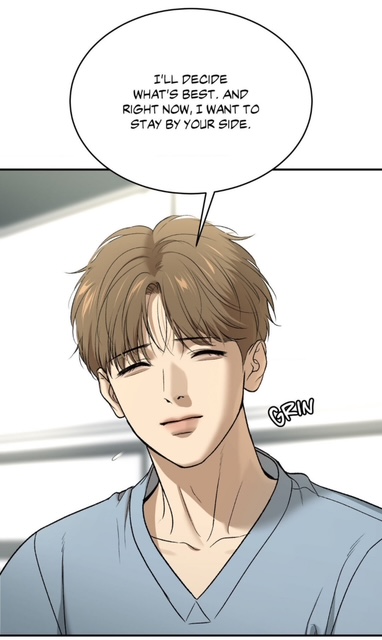 (chapter 57) — reinforces her conviction that she has fulfilled her role. In her mind, his rejection of her advice places the burden of care entirely on him, allowing her to dismiss any further involvement. This emotional withdrawal directly connects to the symbolism of the bruise:
  (chapter 18) In episode 18, when Joo Jaekyung confronts Kim Dan about the loan, the doctor has a bruise on his left eye, symbolizing his entrapment and helplessness. This earlier injury highlights how Kim Dan has been conditioned to view himself as responsible for burdens that are not his own, perpetuating a cycle of sacrifice and self-neglect. And a new bruise appeared just after the athlete reminded the physical therapist of his past promise:
  (chapter 61) His grandmother’s disregard for his well-being amplifies the injustice of this situation; she allowed him to shoulder the debt despite knowing it was never truly his to bear. The bruise becomes a recurring motif, a visual representation of how others have imposed their responsibilities on Kim Dan, leaving him physically and emotionally scarred.
  (chapter 60). The juxtaposition of the vibrant environment with Kim Dan’s deteriorating health underscores the neglect he faces. The hospice is meant to be a sanctuary, yet it becomes a space where Kim Dan is further burdened by the champion and his grandmother’s expectations
 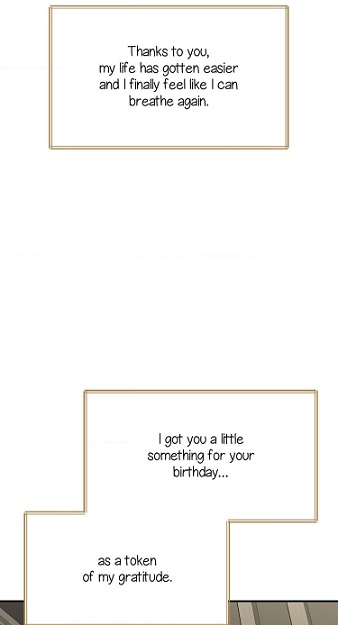 (chapter 55) This line “I finally feel like I can breathe again”, written by Kim Dan, reveals a subconscious acknowledgment that his relationship with the champion represents a breath of fresh air, a chance to escape the suffocating expectations and burdens he has carried for so long. The bruise, a physical manifestation of his struggle, signals the breaking point of his role as a selfless caregiver. It challenges the illusion of invulnerability that Kim Dan has maintained and forces those around him to confront his vulnerability.
 (chapter 60) The beach, with its open and untamed expanse, symbolizes freedom and a return to the self. It foreshadows that Kim Dan’s true journey toward healing will require him to step outside the roles and confines imposed upon him, finding solace not in what is expected but in what feels authentic and liberating.
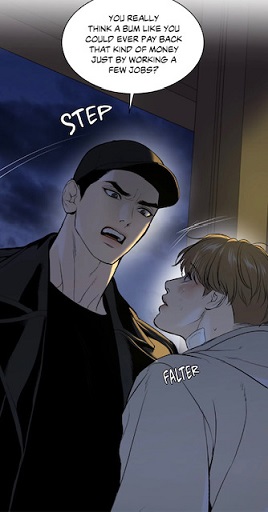 (chapter 18) His grandmother, Shin Okja, played a significant role in this mindset by fostering the illusion that hard work and sacrifice would erase the debts. However, as revealed in episode 18, this was a lie. Shin Okja made the choice to take on the loan and not to seek help
 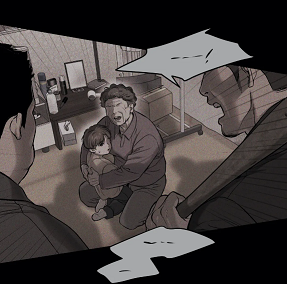 (chapter 5), yet she burdened Kim Dan with it, using his sense of duty and gratitude against him. Her statement in episode 57
  (chapter 18) —or, more accurately, the lack thereof. The champion’s actions were motivated by a desire to help
  (chapter 18), hence the star was waiting for a smile from Kim Dan. Yet the latter perceived it as meddling. His immediate response
  (chapter 53), leaving a note when he moved out that promises to settle the debt. However, by Episode 61, Kim Dan is no longer mentioning the debt, signaling a shift in his priorities and a possible breaking point in his adherence to his grandmother’s expectations.
 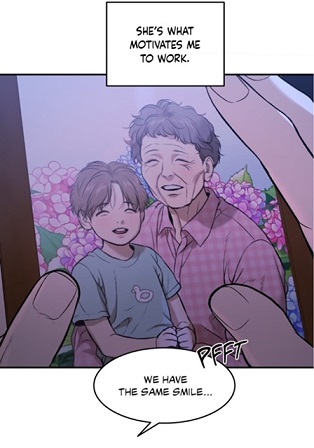 (chapter 47) The physical therapist’s entire existence had revolved around fulfilling her needs, from managing the debt to taking care of her health. With her now approaching death and actively pushing him away, Kim Dan is left grappling with a profound sense of meaninglessness.
  (chapter 60) He had never been given the opportunity to develop dreams or ambitions of his own, as his life was entirely defined by his grandmother’s circumstances. This lack of agency further explains his rejection of Joo Jaekyung’s generosity in Episode 18 and his later promise to reimburse the loan. Clinging to this promise was Kim Dan’s way of creating purpose and meaning in a life that had otherwise been dictated by others. It highlights how deeply entrenched his self-sacrificing tendencies are, as even his attempts to assert independence are rooted in his conditioned need to serve others. That’s why I come to the following prediction. Kim Dan needs to get confronted with illness and death (he could lose his life) so that his will for life comes to the surface. Right now, he imagines that since he is young, he will outlive his relative, but the death of the puppy was a warning to him that youth is no guarantee for a long life.
  (chapter 59) Death can take away anyone and at any moment. In my eyes, if Joo Jaekyung uses his own body to save the doctor again (like for example blood transfusion and CPR), this time Kim Dan would feel truly grateful towards the champion. So far, the doctor has not recognized the star as his savior yet. By removing the needle, he denied the protagonist’s intervention on the beach:
  (chapter 60) Hence his arm got bruised. The contusion was a reminder that something had happened during that night, but Kim Dan chose to ignore the incident. He never questioned why he was on the beach, he acted, as if Joo JAekyung had lied.
  (chapter 60)
 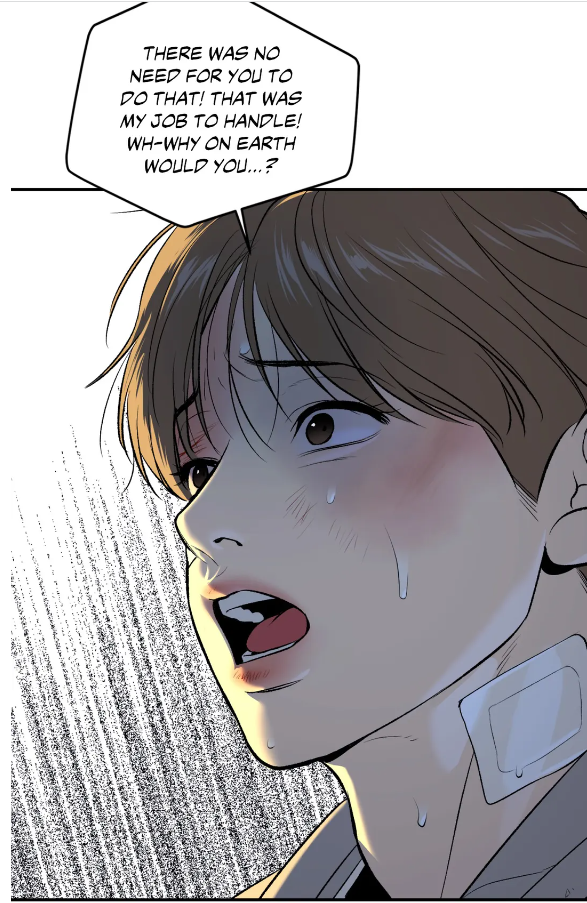 (chapter 18) Deep down, Kim Dan knows that the debt was never truly his responsibility, making it difficult for him to view the champion’s actions as a genuine act of kindness. This inner conflict is compounded by his suicidal disposition, which renders the concept of repaying the debt meaningless.
 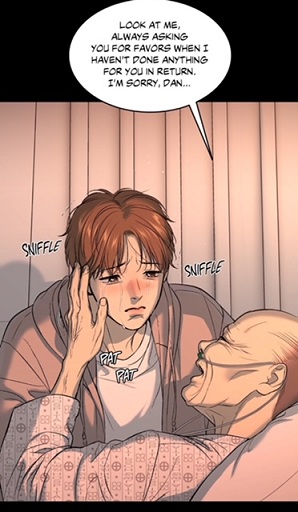 (chapter 53) and guilt to manipulate Kim Dan into fulfilling her wishes, framing his sacrifices as acts of love and duty. Her neglect and disregard for his well-being, even as he deteriorates physically and emotionally, highlight her selfishness. Through his past memories, readers can get a glimpse of his misery.
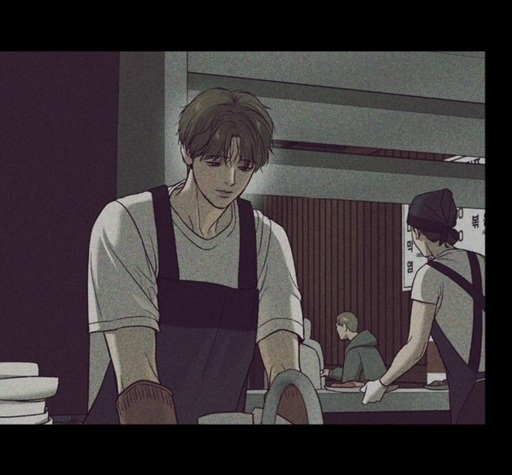 (chapter 59) He worked so hard, was even beaten, but he could never voice his torment.
  (chapter 59) Why? It is because the grandmother was no longer by his side and she never talked to him either. The absence of communication indicates her lack of interest in Kim Dan. And it becomes comprehensible why during that night, he felt the need to go to the ocean and drown himself. It is because he was gradually realizing his loneliness. With his relative’s death, he would only keep living a terrible life determined by work and nothing else.
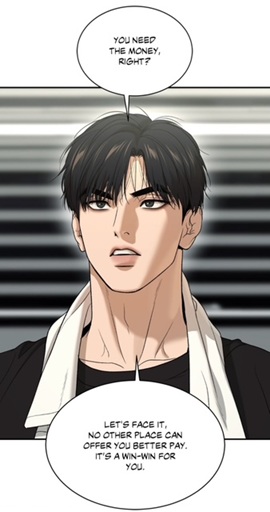 (chapter 60)
  (chapter 11) and even uses his own words against him:
  (chapter 22) The loan was the result of his grandmother’s decision. He never helped him, rather his grandmother.
  (chapter 11) However, he never explained his circumstances to the generous athlete. By keeping him in the dark, he reinforced his negative disposition about the doctor. And chapter 61 exposes this reality. His suffering was the result of his own decision.
 (chapter 61) Do you recognize the room? That was the doctor’s
  (chapter 19)
  (chapter 53) His decision to allow Joo Jaekyung into his bedroom in episode 61 demonstrates that he consented to the relationship, even if begrudgingly.
 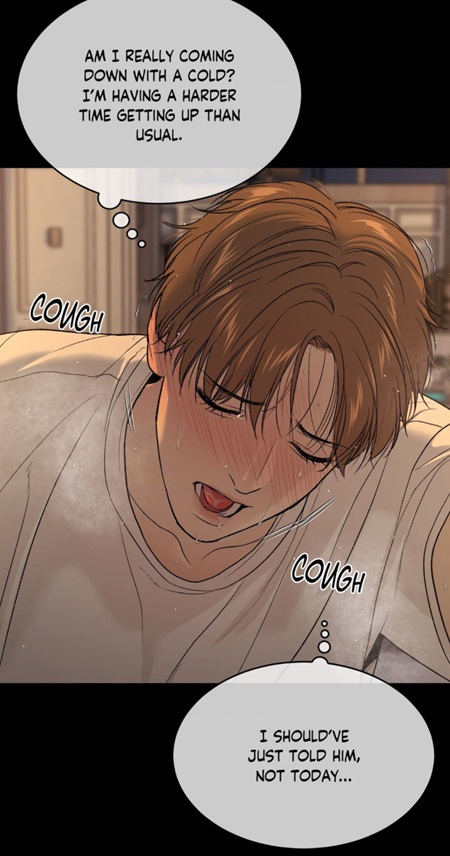 (chapter 61) However, his reaction afterward (regret) suggests that he struggles to take ownership of his choices. The fact that he recalled this sex scene in the restroom divulges a certain resent towards the athlete. The latter abandoned him right after their interaction. Hence I come to the following deduction. In reality, he is projecting his frustrations onto Joo Jaekyung, masking his true feelings about his grandmother, who is the root cause of his conditioned self-sacrifice. And this observation brings to my next remark. People wondered when this intercourse took place. One might think that this took place rather early in the story because of the way Joo Jaekyung acted. He didn’t remove his pants
  (chapter 61) and acted like in episode 6.
  (chapter 6) or 8
  (chapter 8) where he would abandon the protagonist right after the climax and not care about his partner’s conditions and feelings:
 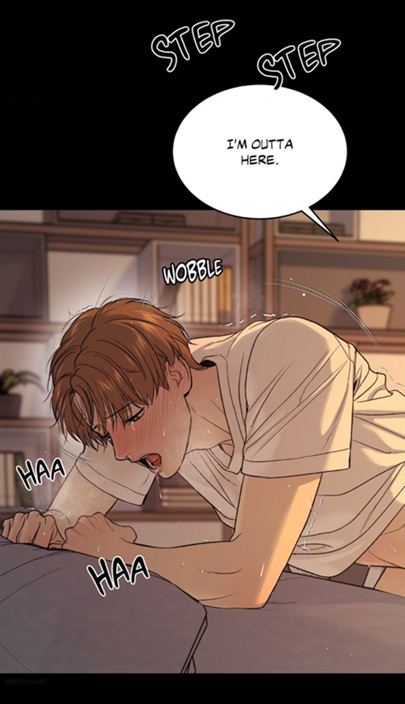 (chapter 61) I might be wrong, but for me, it took place much later in the story, around the time the athlete was about to face Alfredo. Why? First notice that they had sex in the doctor’s bedroom. This means that Kim Dan was already living in the penthouse. The words from the champion implied that he would return to his own bedroom, where the doctor’s thoughts implied that he was standing close to his bed. However, so far, they only had sex in the champion’s bedroom, when it was the evening before the match:
 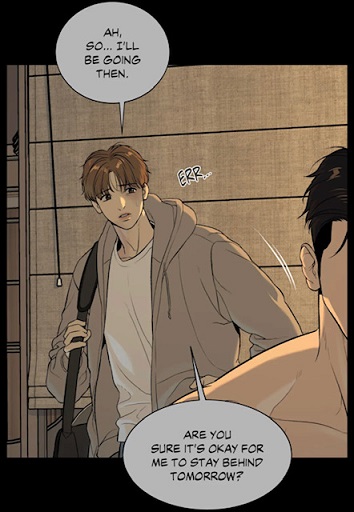 (chapter 13) Since the doctor mentioned that a match was right around the corner
  (chapter 61) It leaves us four possibilities. Randy Booker, Dominic Hill, Alfredo
  (chapter 47) and Baek Junmin. However, for the intercourse took place in the doctor’s bedroom (he wished to be carried to his own bed)
  (chapter 36), for they had sex every day. However, in episode 53, we discover their night before the match against the Shotgun
 (chapter 53) So this scene can only have taken place in chapter 47, when the match with Angelo got canceled and Kim Dan had been confronted with the terrible news about his terminally ill grandmother.
  (chapter 47) In the previous part of this essay, my avid readers could see the strong parallels between 61 and 47. But there exists another reason why I am inclining to think that the sex scene took place later in the story. It is because during that “magical night” (44), Kim Dan learned the notion of “consent”.
 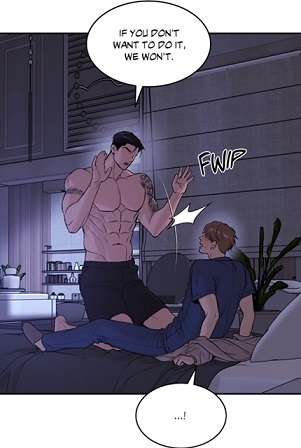 (chapter 44) During that blue hour, Kim Dan discovered that he could say no! And notice that in his memory, he clearly thought that he could have rejected the athlete’s advances.
  (chapter 46) He should mistrust the members from the gym and keep his distance from people. So during that time, Joo Jaekyung did follow his hyung’s advice
  (chapter 47), yet I can’t imagine that this man could become abstinent like in episode 19. Hence at some point, he must have felt the urge to possess Kim Dan, a mixture of fear and dominance. He imagined that way that he could impose his will onto the doctor and control his “loyalty”. With this submission, he would force the doctor to remain by his side. But naturally, this sex as “power play” could increase the gap between the main leads.
 (chapter 53) doc Dan was copying the champion’s behavior from episode 61. Right after the sex, he would leave the bed and return to his bedroom. How did Joo Jaekyung recall this night?
 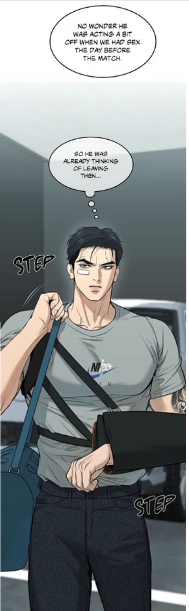 (chapter 53) He saw his attitude as a sign of disloyalty and “abandonment”. And that’s how Kim Dan is feeling in the restroom:
  (chapter 61) The darkness around the eyes is a metaphor for his resent and anger. And the moment you contrast the two memories (53 and 61), you can detect the hypocrisy of the two main leads. They only recall scenes where they were hurt and felt betrayed. However, in reality, they were both victims and perpetrators, because none of them chose to open up and talk to each other. Why? It is because both chose to listen to their “guardian” and their “favor”. Like mentioned before, in a quarrel, no one is right and wrong. The purpose of an argument is to listen to the counterpart and view incidents from their perspective. Finally, the physical therapist’s recollection serves as an important evidence that he had never been powerless and helpless. He could have refused all the time because their deal was never official.He could have used the contract as a shield. But the best evidence of Kim Dan’s power is this rejection:
  (chapter 61) I had already pointed out the increasing resistance and resilience from Kim Dan in episode 60:
 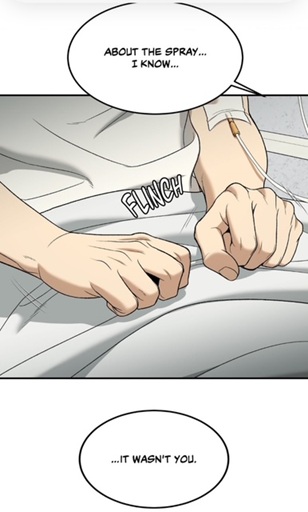 (chapter 61) My prediction came true. In the past, he could have denied the existence of the deal, Joo Jaekyung was free to seek another physical therapist. He never realized that he had some leverage. Yet he still followed the athlete’s requests. He saw himself bound by obligations. However, this was just an illusion. Hence in episode 61, we see him legitimating his consent that there was an imminent fight.
  (chapter 61) He is expected to work despite his declining health, his suffering dismissed by those around him.
  (chapter 40) He is paid to receive bruises, to push his body past its limits
 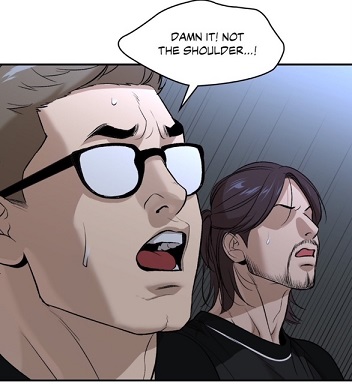 (chapter 50), to endure pain while the public watches and profits are made. His suffering is entertainment, a spectacle that fuels the business of MMA. Though he is a champion, he is still a commodity, expected to perform regardless of his condition.
  (chapter 61) He understands, better than anyone, what it means to be physically used for the sake of others, yet he remains blind to the fact that he has placed Kim Dan in the same position. While one has no file about his health condition, the other has many files, but they are not studied, because this would push the manager to question his decision and even ruin the business:
 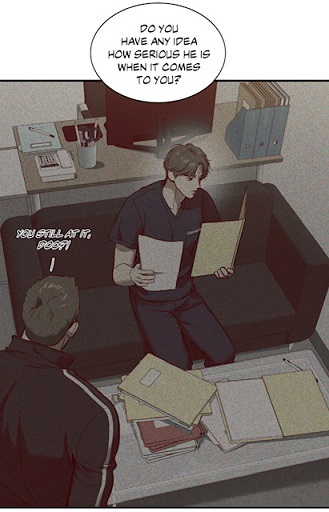 (chapter 17) I doubt that Park Namwook studied them, and notice that the recently hired PT didn’t ask for the champion’s files first:
  (chapter 54) Thus I deduce that the champion’s files are in reality a subterfuge. They give the impression that the doctors and Park Namwook truly care for his well-being, but it is not correct. They are only interested in his body because of wealth and reputation. But let’s return our attention to episode 61 and the champion’s attitude towards Kim Dan.
 (chapter 54) It is clear that the manager wants Joo Jaekyung to return to the ring as soon as possible to erase the last “debacle”. In my opinion, the doctor’s illness could serve Joo Jaekyung as an excuse to delay his return to the ring and even not to accept the next challenge.
  (chapter 57) is another manifestation of his conditioned role as a caregiver. By living with an older man, he creates the illusion of a familial bond, mirroring the dynamic he shared with his grandmother. This decision highlights his struggle to break free from the identity imposed on him—one defined by servitude and selflessness. He assumes that he should take care of the landlord, offering to cook and expressing guilt for not fulfilling this perceived duty. Yet, the landlord subtly challenges this narrative. By inviting Kim Dan to eat breakfast
  (chapter 57) Despite this, Kim Dan rejects the advice, demonstrating his resistance to being cared for. This moment underscores his internal conflict—he craves independence yet clings to the role of the selfless provider. The landlord’s actions expose the fallacy of Kim Dan’s identity, revealing that his caregiving is not always necessary or effective.
 (chapter 61) is indicating the increasing resent and anger towards the star. Joo Jaekyung is no longer seen as a celebrity and idol, but as a inconsiderate man. This transformation is subtle but meaningful, as it reflects his burgeoning awareness of his own worth and the unjust treatment he has endured. For the first time, Kim Dan acknowledges himself as pitiful
 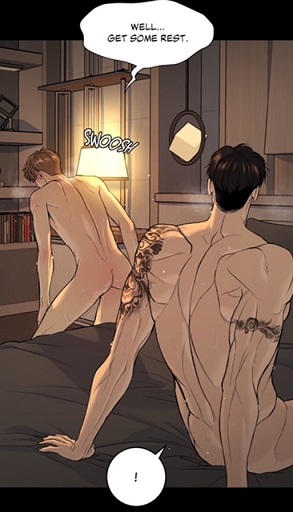 (chapter 53)
  (chapter 61), no longer bound by the roles others have imposed on him but shaped by his own choices and growing self-respect.
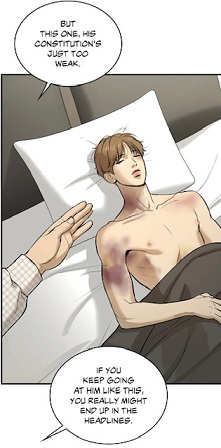 (chapter 13) and the fragility of Kim Dan’s existence. For Kim Dan, it challenges his self-perception as an indestructible caregiver. This realization could lead him to an inevitable conclusion: his own needs and well-being are just as important as those of others.
 Bebebisous33s' analyses in K-Dramaland and Manhwas