

Please support the authors by reading Manhwas on the official websites. This is where you can read the Manhwa: Jinx But be aware that the Manhwa is a mature Yaoi, which means, it is about homosexuality with explicit scenes. Here is the link of the table of contents about Jinx. Here is the link where you can find the table of contents of analyzed Manhwas. Here are the links, if you are interested in the first work from Mingwa, BJ Alex, and the 2 previous essays about Jinx 𓇢𓆸 Prove Me Wrong Again 💢😂 and Perfect👼🏼 Defect
It would be great if you could make some donations/sponsoring: Ko-fi.com/bebebisous33 That way, you can support me with “coffee” so that I have the energy to keep examining Manhwas. Besides, I need to cover up the expenses for this blog.

In the world of Jinx, superstition often masks deep psychological wounds. Readers are well aware of Joo Jaekyung’s belief in a hex: 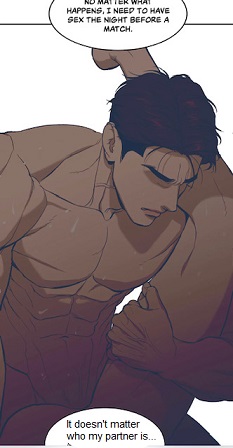 (chapter 2) his ritualistic sex before fights, his fear of losing control,
 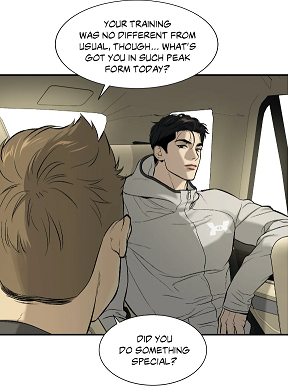 (chapter 5) his reliance on routine. Yet there is another jinx in this story, one far less visible and perhaps even more tragic: Kim Dan’s.
In earlier analyses—particularly in the essay “Jinxed: Behind The Scenes 🎬” I stated that Kim Dan, like Joo Jaekyung, might have perceived his life as cursed. This conclusion emerged from his grim familial and financial circumstances: his overwork, exploitation by the loan shark, and his identity eroded by relentless sacrifice. At that time, the interpretation leaned heavily on visible hardships and his devotion to his grandmother. His silent plea 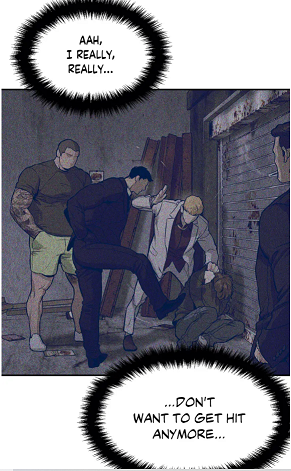 (chapter 1) was seen as the core expression of a man who believed he was doomed.
However, Season 2 invites a more nuanced reading. I came to realize that Kim Dan never consciously viewed himself as jinxed. 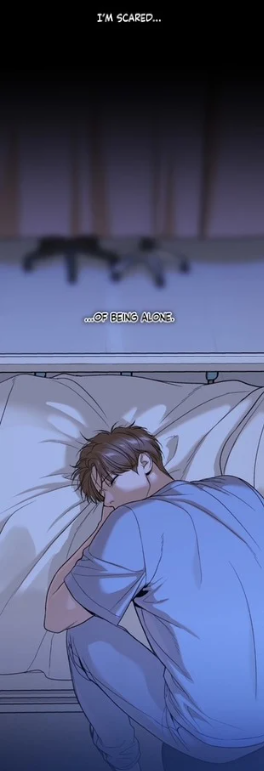 (chapter 56) In Chapter 56, Kim Dan is seen curled up next to a bed, whispering: “I’m scared… of being alone.” What makes this moment especially revealing is that he is not physically alone, for he is resting next to his grandmother. The presence of the very person who raised him should, in theory, offer comfort. And yet, the fear persists.
This contrast underscores the depth of Kim Dan’s emotional wound. His fear isn’t simply about being left in the future — it’s the echo of a past abandonment so profound that even proximity can’t soothe it. His grandmother is alive, mere steps away, yet his body curls into itself, instinctively shielding against an absence that has already been internalized.
That he doesn’t say “I’m scared of being abandoned” or “of being jinxed” shows that this fear hasn’t been processed into words or reason. It’s not part of his conscious self-concept. Unlike the celebrity, who ritualizes his fear as a “jinx” and tries to control it through actions, Kim Dan’s trauma remains trapped in silence. He doesn’t believe he is cursed — not on the surface. But emotionally, he lives as if he were. The hex exists, not in his language, but in his body.
His whispered fear in the dark — “I’m scared… of being alone” — is the clearest window into his hidden jinx. And perhaps the most heartbreaking part is this: he voices it not, when he is abandoned, but when someone is still there. That’s how deep the fear runs.  (chapter 21) And this issue didn’t begin in adulthood. In Chapter 21, Kim Dan dreams of a night from his childhood: he wakes up alone, glances around the room in quiet confusion, and softly calls out for his grandmother. The room is dim, the bed beside him empty. This image carries more than just childhood anxiety:
 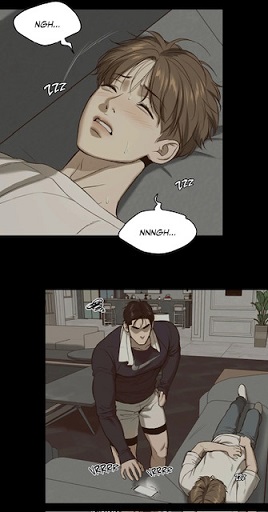 (chapter 21) It weaves together absence, silence, and the specter of loss. What’s striking is that the nightmare surfaces, not when he’s alone in the present, but after he has just returned from watching over his hospitalized grandmother.
 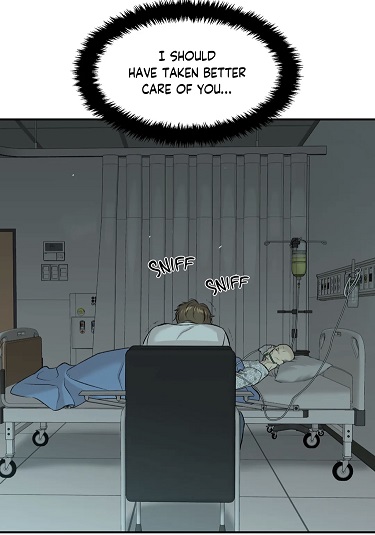 (chapter 21) He lies on the couch and dreams of a night when she vanished from their shared bed.
 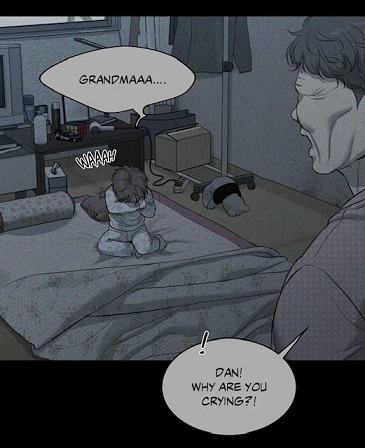 (chapter 21) This reveals how, in Kim Dan’s subconscious, the night and an empty bed have become synonymous with death. The trauma is deeply embedded, where even temporary absence is tied to the irreversibility of loss. For Kim Dan, solitude at night
  (chapter 67) is not mere loneliness—it is abandonment, it is death, it is the erasure of home. It is repressed, hidden beneath his quiet demeanor and years of survival-based behavior. Rather than a rational belief, it is a subconscious wound that only surfaces in moments of extreme vulnerability—especially at night.
So while Joo Jaekyung’s curse is shouted and choreographed  (chapter 2), the doctor’s is secret and involuntary. His actions—his fearful expressions
  (chapter 57), his pattern of emotional detachment
  (chapter 67), and his obsessive loyalty to his grandmother
 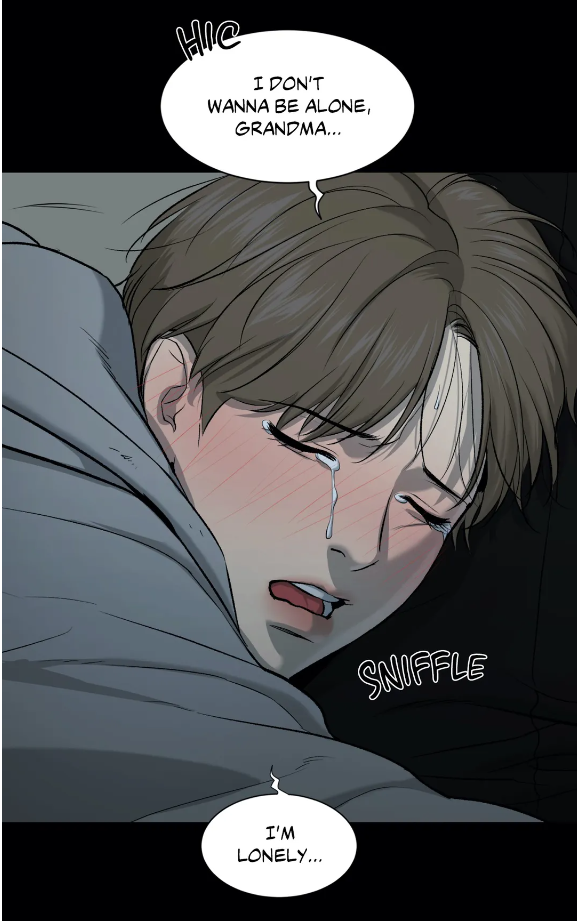 (chapter 10) signal a suppressed conviction: that he is destined to be left behind. What seemed like devotion now appears as coping; what appeared stoic was survival. And with the impending death of his grandmother, the anchor holding this hidden jinx in place is slipping away.
A Jinx Rooted in the Night
The key lies in the night. The most pivotal emotional regressions in Kim Dan’s life happen after dark. Whether it is the first night with Joo Jaekyung in Chapter 2 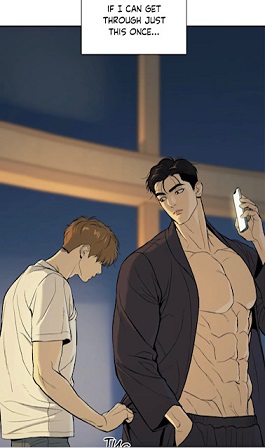 (chapter 2), the trembling kiss
  (chapter 44) and touch
  (chapter 44) in Chapter 44, the complete breakdown
 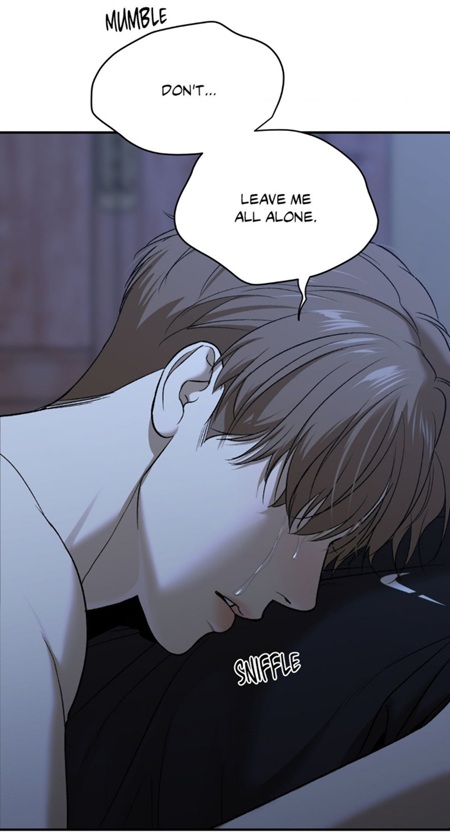 (chapter 66) in Chapter 66, or the transactional submission
 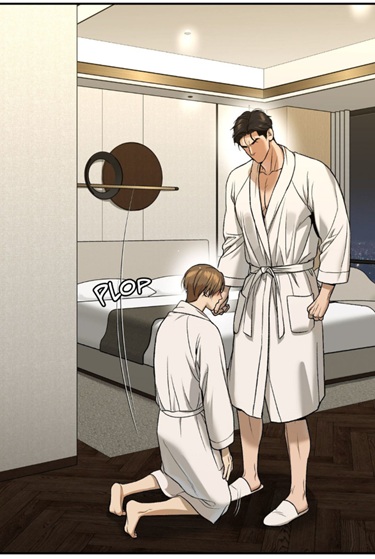 (chapter 67) in Chapter 67, nighttime becomes the stage for his unresolved trauma. These nights mirror one another and suggest an origin story that predates them all: a night when Kim Dan was abandoned by his mother.
This theory is supported by visual cues and character behavior. In Chapter 56, Kim Dan curls into himself in bed, unable to sleep. He admits silently, “I’m scared… of being alone.” That fear is not adult anxiety—it’s childhood terror. (chapter 56) The body language, the shadows, the loneliness—they evoke the image of a small child who once cried through the night, waiting for someone who never returned.
Kim Dan’s actions echo those of someone who was left too early—possibly around the age of six. Psychologists describe this stage as a turning point in emotional development. If a caregiver vanishes at that time, the child internalizes the absence as a personal fault. He grows up believing that love is conditional, that if he’s quiet, obedient, invisible—maybe no one else will leave.
Mingwa subtly ties this back to animal behavior through the inclusion of puppies. 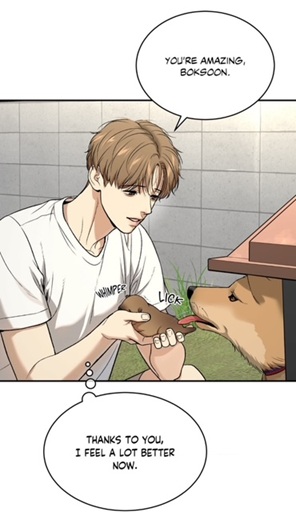 (chapter 57) A puppy needs at least eight weeks with its mother to grow emotionally secure. By drawing this parallel
 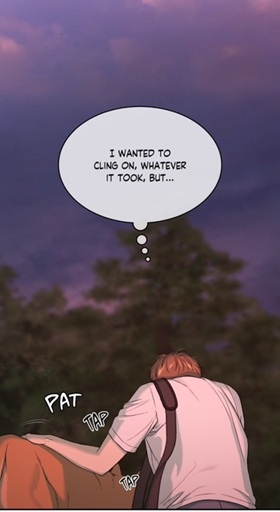 (chapter 59), the story tells us: Kim Dan was separated too soon. He was not ready.
The Role of the Grandmother: A Talisman, Not a Cure
Kim Dan’s grandmother became his emotional anchor: 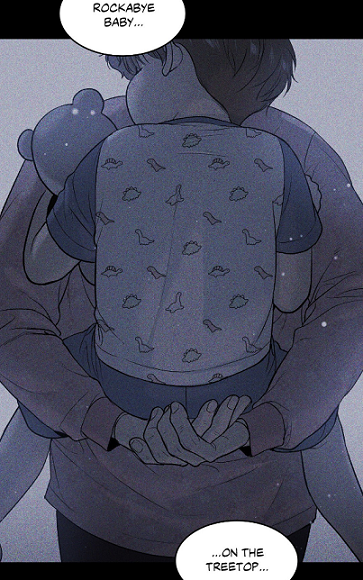 (chapter 47) the one person whose presence could keep the jinx at bay. As long as she was there, he could suppress the trauma, function, survive. She was his talisman. But she was never a healer, for she never spoke about his parents. She never addressed the core of his abandonment, like we could witness in the doctor’s nightmare:
 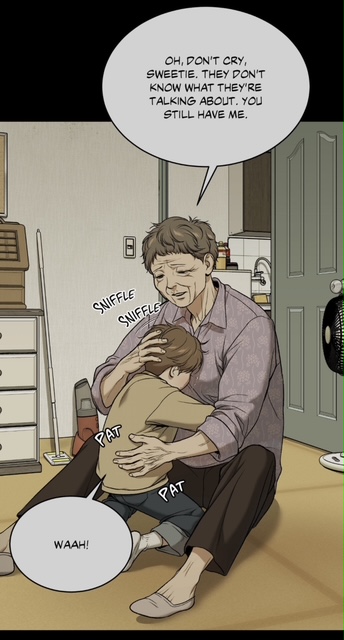 (chapter 57) And silence, when it comes to trauma, does not protect—it festers.
Her infantilization of him is also telling. 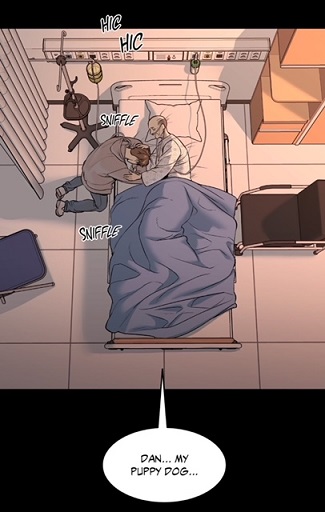 (chapter 53)
 (chapter 65) One might argue about this, for in this scene,
  (Chapter 56) he tucks her in. Their roles are reversed. He behaves like a parent, whereas in truth, he is reverting emotionally to a child terrified of being alone. This reversal highlights the internal dissonance between his outward behavior and emotional reality. Though he was forced to grow up quickly
 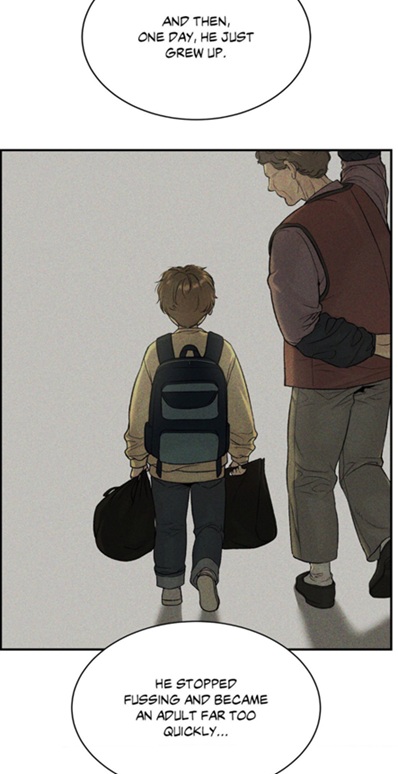 (chapter 65), he still carries the emotional wounds of a child. And from my point of view, the grandmother knows it, therefore she treats him as a child. And this observation led me to the following question: why does she still view him as a “boy”, though he has been working since his youth? It is because he can not sleep alone! What caught my attention is that she never stated, when the doctor started smoking or drinking. (chapter 65) Was it the moment, when she went to the hospital? The timing is crucial, as it can give clues about the main lead’s sleeping trouble. In episode 67, the protagonist finally exposed his cause:
  (chapter 67) This reinforces my hypothesis that his bad drinking habits are related to the absence of a loved one next to him.
In other words, he can not sleep alone and from my perspective, Shin Okja knows it, but is refusing to become responsible for this situation. (chapter 47) She witnessed this since he was a child, which explains why she never truly addressed his fear of being left behind. This would explain why the halmoni tried to send him away from the hospice in episode 56:  (chapter 56) Imagine what it means for her: her grandson is already 29 years old and he can not sleep alone. Under this perspective, Jinx-philes can grasp the relative’s reasoning. The problem is that her knowledge is actually wrong! How so? It is because the protagonist was able to sleep so well alone in the penthouse, to the point that the athlete was envious of him.
  (chapter 29) That’s how it dawned on me why Shin Okja was so determined to send back her grandson to Seoul.
The grandmother’s insistence on Kim Dan “living his life”  (chapter 65) and going back to Seoul under the guise of freedom and career advancement takes on a deeper meaning when viewed through the lens of emotional avoidance. Her words may sound supportive, but they conceal a subtle attempt to sever the emotional tie without taking responsibility for its existence. Now, rather than confronting this vulnerability head-on, she shifts focus to the one thing she believes can replace human closeness: work. A busy man has no time to wallow, no time to drink, no time to remember the empty bed. A man with a career won’t ask for someone to hold his hand at night. In that sense, her vision of “a good life” is one of functionality, not emotional fulfillment. If he works, he won’t be a burden. If he’s successful, she doesn’t have to worry. Yet this approach doesn’t cure the root wound — it just redirects it. This situation mirrors the wolf’s:
  (chapter 19) The latter is obsessed with work, while he is suffering from insomnia.
The tragedy here is that in encouraging him to grow up through labor, she’s also denying him the right to be a child — something he never got to be in the first place. Her version of love is sacrifice and survival.  (chapter 65) And the best evidence for her selfishness and neglect is her ignorance about her grandson’s plan for his future. She is not discussing with him about what he likes or dislikes. She is directing his life, like she did it in the past in the end. And while she may think she’s doing what’s best, her silence about his fears, her ignorance about his true conditions (no home, blacklisted in Seoul) and her refusal to discuss his emotional future reveal a lingering discomfort with the very idea of dependence — perhaps because it reminds her of her own failures or helplessness as a parent figure.
In the end, her encouragement to “live his life” isn’t truly about Kim Dan finding happiness or chasing dreams. It’s about the grandmother relinquishing responsibility — an emotional handoff wrapped in the language of care. (chapter 65) By urging him to return to Seoul and focus on work, she’s hoping that if he stays busy enough, he won’t have time to feel the crushing loneliness that has always shadowed him. She wants him to mature overnight, not because she believes he’s ready, but because she can no longer carry the weight of his dependency. One might say, he is already 29 years old, so she is right. In truth, this isn’t guidance — it’s guilt management. Notice that she is entrusting the main lead to the champion which is not pushing Kim Dan to become „independent“. Her attitude, summed up by the phrase “out of sight, out of mind,” unintentionally mirrors the same abandonment he experienced in the past. She is refusing to worry about him, her peace of mind matters more than his well-being and the champion’s. 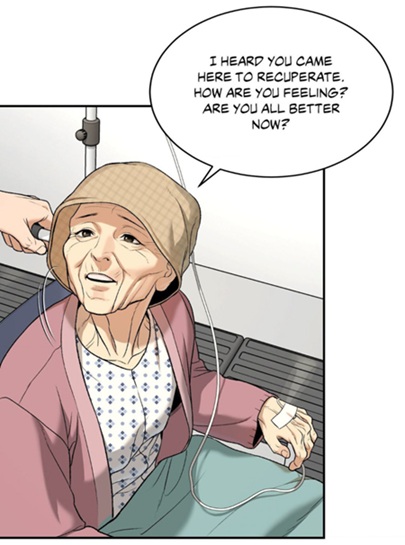 (chapter 65)
This connects directly to one of the most telling moments in Chapter 67, 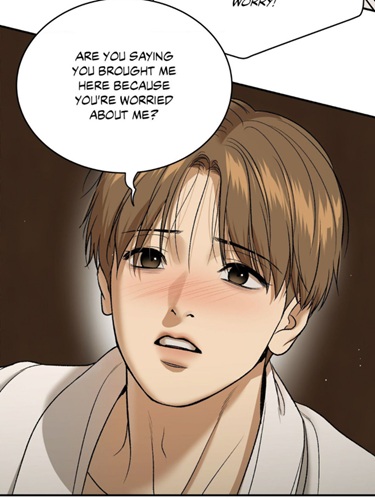 (chapter 67) when Kim Dan, eyes wide and voice trembling, asks Joo Jaekyung: “Are you saying you brought me here because you’re worried about me?” His expression reveals everything — a fragile hope for genuine concern. But the only response he gets is silence.
 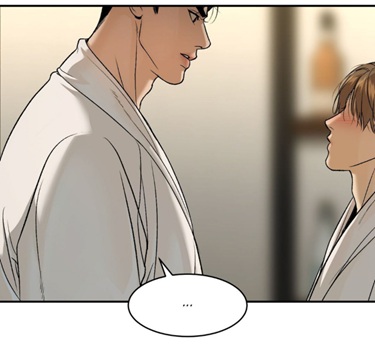 (chapter 67) This unspoken answer reverberates with painful familiarity: from his vanished mother, from his halmoni who rarely expressed love (rather gratitude and pity), and from a world that reduced him to his usefulness. What he really wants to know is: “Do I matter to you as a person?” And just like his grandmother, the champion fails to offer direct emotional reassurance. Yet unlike her, Joo Jaekyung is still learning. His silence isn’t rejection, but emotional illiteracy — a work in progress.
The irony is that while Park Namwook represents over-control disguised as concern, Shin Okja represents detachment masked as selflessness. She doesn’t want to worry anymore, so she chooses to send Kim Dan away — to someone she thinks should take over. Nonetheless, in my eyes, this isn’t responsibility; it’s avoidance. And for someone like Kim Dan, who already associates nighttime with abandonment, silence with rejection, and empty beds with death, being handed off again only reinforces his unconscious belief: I’m jinxed to be left behind.
The grandmother may never have raised a hand against him, but her silence, her emotional evasiveness, and her idealized image of herself as a “sacrificing protector” created a one-sided bond rooted more in guilt than in love. Her presence was constant, but the emotional quality of her care — the nurturing, the honest affection — was lacking. Hence she still doesn’t know that Kim Dan has no home in Seoul.  (chapter 65) And when we remember that Kim Dan tried to call her, she
 (chapter 65) replied with a silence. Here, she claims that he addressed her as “mom”, but it is possible that she was just projecting her own fears onto her grandson. Since she was by his side all the time, she feared to be seen as his mother. Like mentioned above, the mother might have been busy due to work (or sick) and asked her relative to take care of her grandchild.
Ultimately, what he longs for is simple: to be seen, talked, loved, and to be chosen — without conditions. But those around him have always expected him to be strong, quiet, grateful. So he became all of those things… at the cost of his own soul.
Shin Okja never kissed him like a mother. (chapter 57) Yet in Chapter 44, Kim Dan kisses Joo Jaekyung with soft, maternal gestures—on the cheek, on the ear.  (chapter 44) These gestures suggest he had once received such kisses, most likely from his mother. It means he remembers love, even if he doesn’t know how to process its loss.
Her insinuation that Kim Dan owes her everything created a myth of self-sacrifice—one that replaced genuine emotional closeness. She demanded gratitude, not emotional connection. She lived in the mindset of having, not being. As a result, Kim Dan grew up confusing love with obligation, gratitude, and performance. His difficulty in expressing love isn’t due to coldness or immaturity—it’s the byproduct of a dysfunctional emotional education.
This is why, even though he once confessed “I love you” to Joo Jaekyung in the States 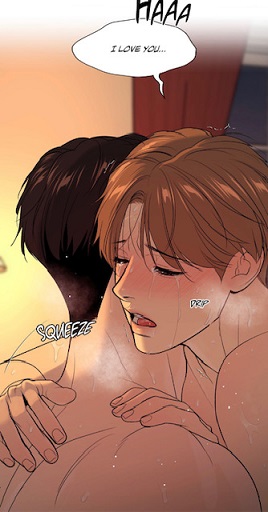 (Chapter 39), the moment is tainted. It occurred under the influence of an aphrodisiac, intertwining love with sex. Furthermore, he has never voiced this sentiment to his grandmother—perhaps because she never said it to him. It was never modeled. While others might judge Kim Dan’s emotional restraint, I desire to stay neutral. He is not an emotionally stunted adult by choice—he is a product of emotional neglect. That’s the reason why Mingwa has associated him with an angel.
 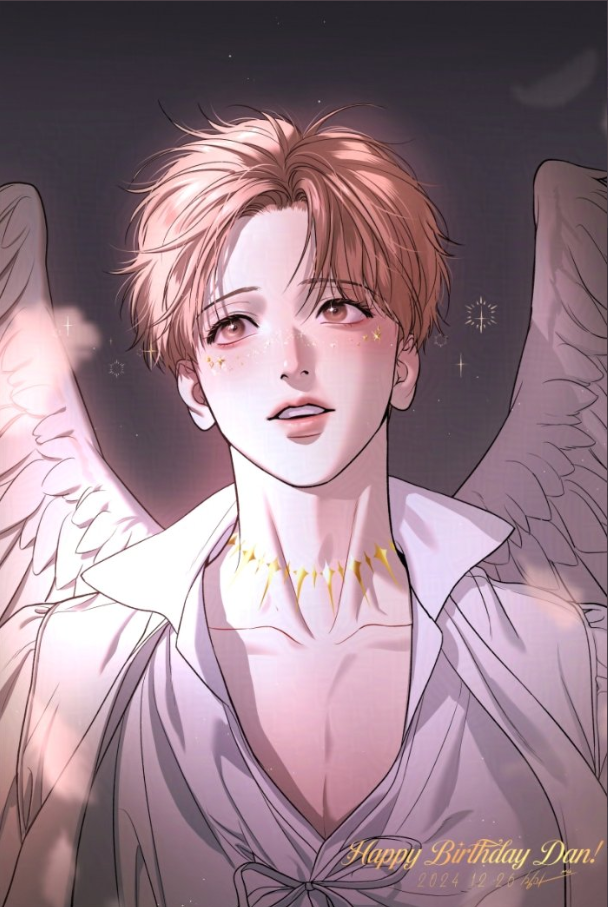 He is carrying the sins of “adults”. By likening him to an angel, Mingwa frames his pain not as weakness, but as unjust burden. He embodies purity, sacrifice, and resilience, not because he was allowed to thrive, but because he endured. The angel metaphor becomes even more striking when you think about traditional symbolism: angels don’t belong to Earth, yet they walk among the living, often suffering in silence and helping others. That’s exactly Kim Dan — out of place, bearing the consequences of others’ choices, carrying guilt, debt, and unspoken grief that were never his to begin with.
He’s carrying the sins of adults: – A school which allowed bullying
– A grandmother who turned emotional dependence into silent expectation.
– A mother who vanished, whether through death or abandonment.
– A society that reduced him to labor, debt, and obedience.
– And even a partner, at first, who used his body without recognizing his soul.
Interestingly, his emotional jinx is also spatial. When living in the penthouse, Kim Dan began to sleep peacefully 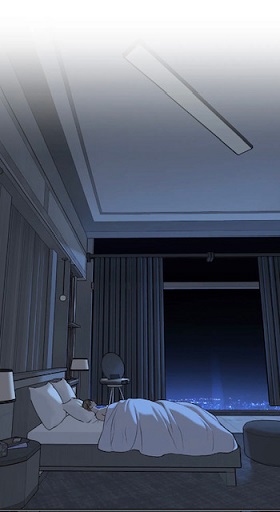 (chapter 29) —not because of physical intimacy with Joo Jaekyung, but because he felt safe. For a time, the place became his illusion of home. But when the champion showed mistrust, the illusion shattered.
  (chapter 51) The penthouse was never truly his. It was borrowed space. This explicates his refusal to spend the night there.
  (Chapter 67) Observe how Joo Jaekyung called the penthouse: not home, but his place. Due to the last altercation, the emotional safety collapsed. This experience reactivated his fear of abandonment and solidified the belief that he has no home.
  (chapter 65) Even the family photo (where and by whom it was taken is unclear) emphasizes the fragility and incompleteness of his sense of belonging.
The Secret Jinx That Must Break First
Each major night scene—Chapters 2, 44, 66, and 67—reveals another layer of the doctor’s jinx. Chapter 2 introduces the concept of the jinx explicitly: Joo Jaekyung believes he must have sex before each match, regardless of partner. This idea of impersonal routine and bodily sacrifice mirrors Kim Dan’s own subconscious belief: 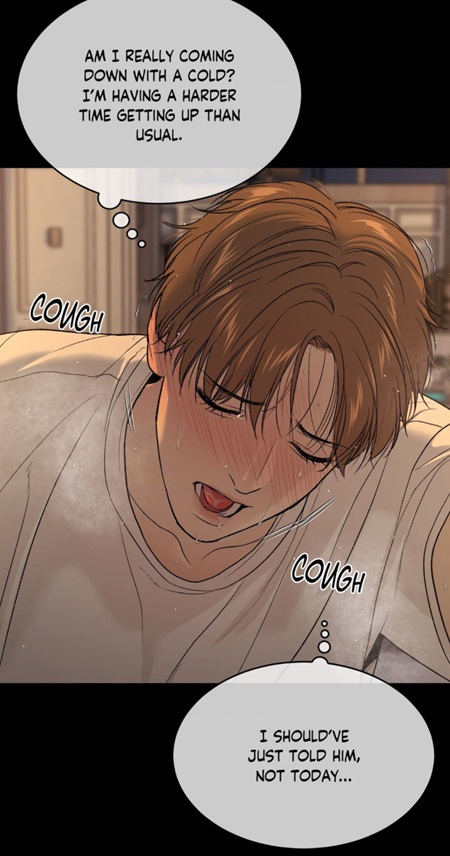 (chapter 61) that he must sacrifice his “needs” and identity to be accepted.
Yet in order to truly break Joo Jaekyung’s so-called “jinx”—which, as theorized, may stem from rigged matches and trauma masked by routine—the doctor’s hidden curse must be broken first. As long as Kim Dan sees himself as inherently unworthy and destined for abandonment, he will unconsciously reinforce a dynamic where emotional distance feels safe and predictable.
Chapter 44 shows the beginnings of intimacy (chapter 44), yet even then, it is expressed through regression. Kim Dan’s kisses are gentle, reminiscent of a child seeking comfort, not a lover expressing desire.  (chapter 66) Therefore it is not surprising that he laughes like a little child during that night.
  (Chapter 44) Chapter 66 represents its negative reflection, the emotional climax of this regression:
 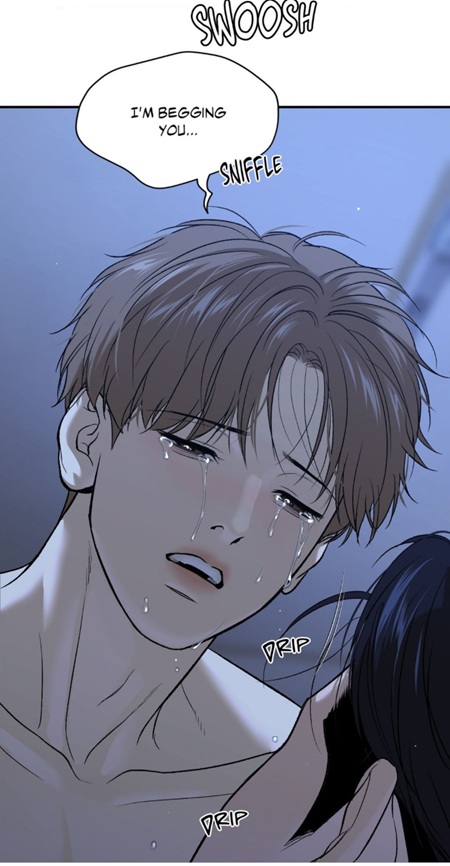 (chapter 66) he cries, begs,
 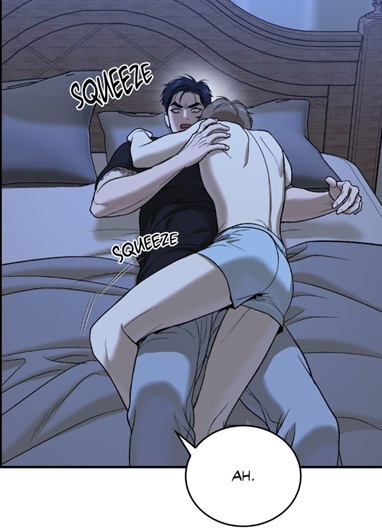 (chapter 66) holds on—“Don’t leave me.” (chapter 66) His squeezing fingers holding onto the athlete’s shirt
 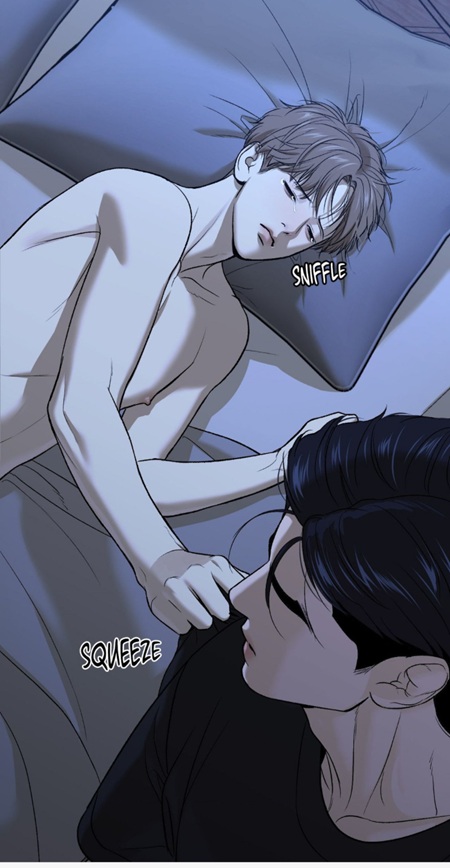 (chapter 66) and desperate pleas are not about romance—they’re about survival, longing and regret. Deep down, he wished, he had hold onto his “mother” in the past, stopped her from leaving him. Is it a coincidence that this gesture from that night mirrors the one during their first night? (chapter 2) And what had the protagonist said right after this gesture?
 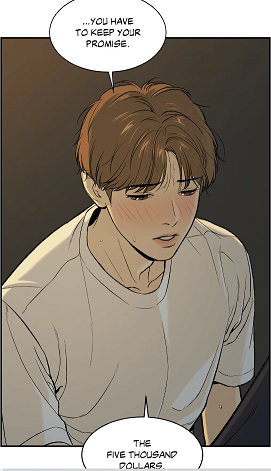 (chapter 2) He wanted the champion to keep his promise. From my point of view, the parent’s vanishing is strongly intertwined with a broken promise… And that’s exactly what the grandmother did to her own grandson: she didn’t keep her words either.
  (chapter 11)
  (chapter 53)
Then comes Chapter 67. Though no longer crying, he submits once more 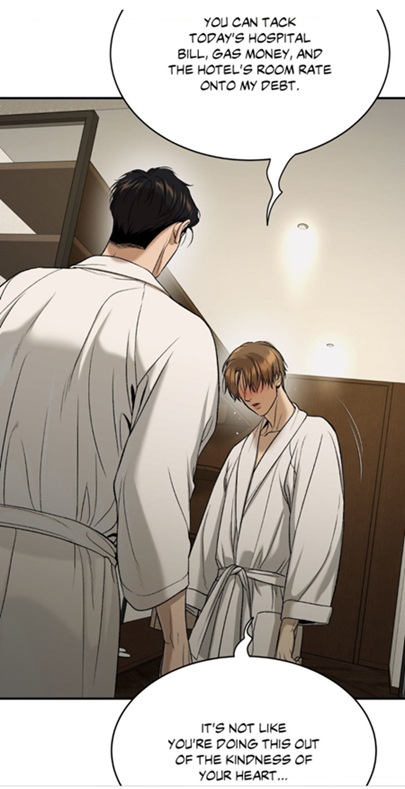 (chapter 67), but this time, with eerie detachment. He kneels before Joo Jaekyung like a servant, (chapter 67) asking for sex again. Yet the power dynamic is not as it seems. Though Kim Dan is physically lower, it is Joo Jaekyung who ultimately submits:
 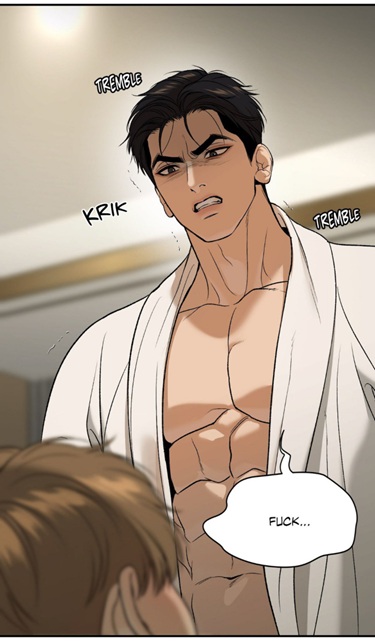 (chapter 67) his arousal betrays a loss of emotional control. Though he is on his knees, it is Joo Jaekyung who is emotionally yielding. His body betrays his composure, responding to Kim Dan’s touch and gaze. Kim Dan, watching the tremble in the fighter’s expression and the rising heat in his body, feels the shift. His soft blush is not simply one of affection or embarrassment—it’s a flicker of recognition.
 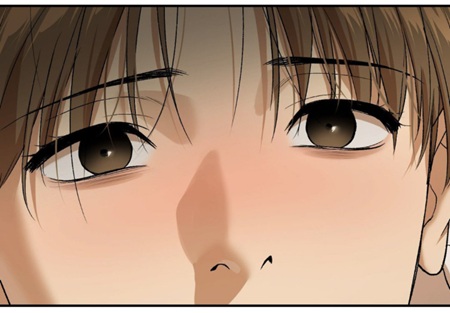 (chapter 67) He senses that the one usually in control is now unraveling. Appearances deceive: beneath this scene lies a quiet reversal of power. The blush on his cheeks is a trace of a brief moment of clarity: he sees that the person who once held all the control is now faltering.
Ultimately, this mirrors Chapter 2 once more. Back then, Kim Dan surrendered his body, believing it was his only tool for survival. But Chapter 66 reveals that even in moments of closeness 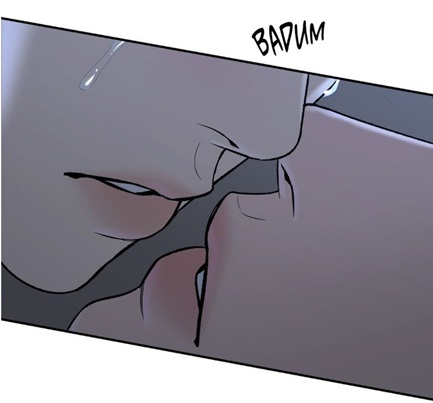 (chapter 66), his body is still a vessel for mourning. Hence there is no kiss during that blue night. Each night carries the residue of that first trauma: the night he was left alone. Whether his mother disappeared or passed away in the night, the result is the same—nighttime became synonymous with loss.
This is why he fears being alone after dark. This is why he clings to those who stay past midnight. And when Joo Jaekyung, the one person who broke that pattern, walked away, even briefly, it fractured him. 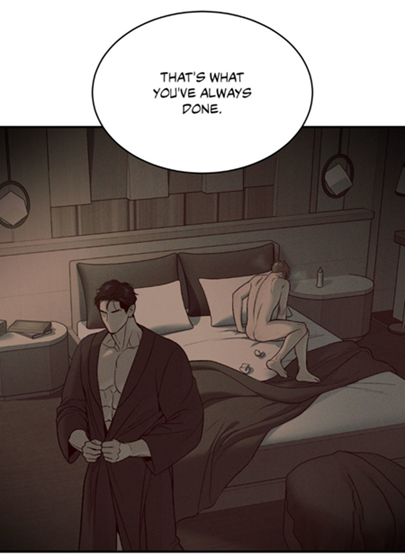 (chapter 63) His so-called jinx is not some irrational superstition. It’s a scar. It’s the quiet belief that the people he loves will vanish the moment he lets his guard down.
So while the champion’s jinx revolves around physical ritual and control, Kim Dan’s is rooted in emotional suppression and dread. Both stem from the same core wound: fear of abandonment.
But Chapter 67 deepens the tragedy: this time, he doesn’t just mourn: he gives in. The act is no longer about clinging to someone or begging them to stay. Instead, it is performed with emotional detachment, a mechanical reenactment of what once held meaning. His internal monologue (chapter 67) makes it clear: he isn’t trying to survive, he’s quietly unraveling. His decision to mix alcohol with medication is not rebellion  (chapter 67), it’s resignation. Hence he is not expecting to be cured with the pills. (chapter 67) Thus, chapter 67 reveals the darkest layer of his jinx: not fear of abandonment, but the numb certainty that love, safety, and home are illusions that always vanish with the night.
Observe the decoration on the wall: (chapter 67) It looks like the moon and Saturn are meeting each other. For me, the moon imagery in Chapter 67 is not accidental. Saturn, the planet of hardship and emotional lessons, casts its shadow over this night, mirroring the heavy atmosphere between them. When Kim Dan asks Joo Jaekyung if he brought him here out of concern, the champion remains silent—a silence louder than words. That silence is devastating. In that moment, Kim Dan’s deepest fear is realized: he is not loved, merely tolerated. And so, in an act of resignation rather than seduction,  (chapter 67) he offers sex to “settle up,” citing his own preparations like a transaction. (chapter 67) The room’s muted lighting and circular wall decor even evoke the image of an eclipse—as if the moon (emotion) is being overshadowed by Saturn (cold logic and debt). This alignment encapsulates the heart of the scene: vulnerability eclipsed by duty, affection swallowed by silence. That’s the reason why I can’t help myself thinking that Kim Dan might end up in the emergency room later. Besides, we never saw him eating before taking his pills:
 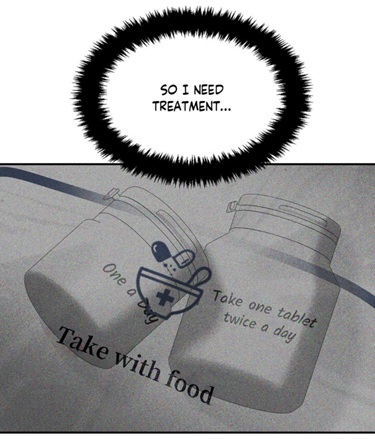 (chapter 67) while he drank alcohol with the medicine.
 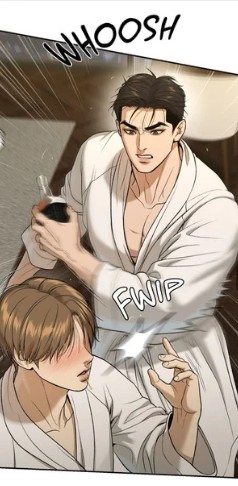 (Chapter 67) Until now, the champion has a blind faith in drugs, just like the grandmother.
A Split Between Night and Day
One of the most striking revelations is the emotional split between the protagonists. Joo Jaekyung acts like a child during the day 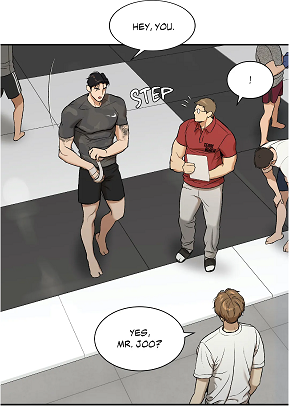 (chapter 7), while Kim Dan becomes a child during the night.
By day, Jaekyung seeks routine, praise, validation, and control. His outbursts, tantrums, and need for order mirror the emotional needs of a child. He’s the performer, the strongman, but behind that exterior lies someone seeking parental structure.
At night, Kim Dan’s walls crumble. His trauma surfaces. He cries, begs, trembles—not for pleasure, but out of fear. These breakdowns are not romantic; they’re regressive. And until these wounds are addressed, he can’t become the nurturing figure Jaekyung truly needs. This explicates why during the day, Kim Dan tries to act like an adult and rejected the champion‘s help.  (Chapter 66)
For their relationship to heal, Kim Dan’s nightmares must be addressed. Only then can he grow into the “motherly” role he’s beginning to fill during the day—someone who can offer stability, not just silent service. Until the end of season 1, his care was more rooted in duty, than real love and genuine concerns. He didn’t argue with the fighters 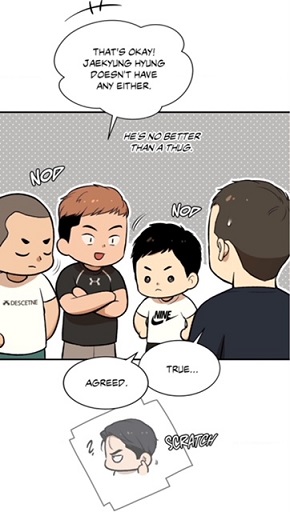 (chapter 47), when the “wolf” was portrayed as a thug, though the latter had assisted him on multiple occasions.
Conclusion: It’s Happening Again
Now, the imminent death of the grandmother and the puppy bring everything back. Kim Dan isn’t just afraid of the future—he’s haunted by the past. Their death isn’t merely a loss—it’s a reawakening of everything he suppressed. The loneliness, the silence, the night—“It’s happening again.”
But this time, he’s not numb. He’s unraveling. His subconscious belief—the doctor’s secret jinx—is finally being revealed. He is destined to be abandoned… unless something breaks the cycle. It is clear that Joo Jaekyung will be that person, but this change is definitely linked to pain. In chapter 66, for the first time, the doctor’s jinx had a voice. And it sounds a lot like: “Please… don’t leave me.” The problem is that Joo Jaekyung chose to listen to Shin Okja, rather than talk to Kim Dan.
Feel free to comment. If you have any suggestion for topics or manhwas, feel free to ask. If you enjoyed reading it, retweet it or push the button like. My Reddit-Instagram-Twitter-Tumblr account is: @bebebisous33. Thanks for reading and for the support, particularly, I would like to thank all the new followers and people recommending my blog.


 (chapter 62) He now includes his entire routine with Kim Dan—not just sex, but also his physical therapy and treatment—as part of this so-called jinx. This shift is crucial because it implies an unconscious recognition of Kim Dan’s significance in his life. What once was purely about his career and success has now expanded to include a specific person and their role in his well-being.
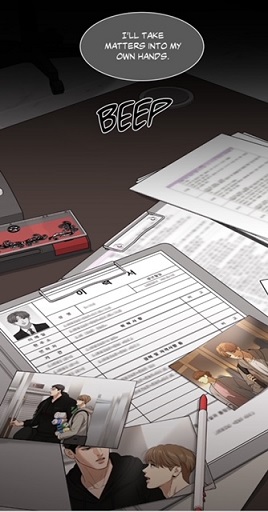 (chapter 46), the stretching and massage at the gym? The problem is that the champion never complimented the “hamster” for his good work directly. So it was, as if his dedication was nonexistent. Without the champion’s genuine gratitude and appreciation expressed so openly, the physical therapist couldn’t perceive the true message behind the champion’s. Joo Jaekyung’s statement was actually an acknowledgment—a sign that the fighter values their routine, not just for performance but as an integral part of his life. So when the star mentioned his jinx
  (chapter 62), the doctor’s memory got triggered. Because of his past experiences, he has long associated the jinx exclusively with sex. This contrast in understanding highlights both Jaekyung’s lack of self-awareness and Kim Dan’s tendency to filter reality through his own expectations and trauma. However, the deeper significance lies in Jaekyung’s evolving perception of dependency. His jinx is no longer just a superstition tied to his performance in bed. It now subtly acknowledges that his success has been intertwined with Kim Dan’s intervention.
 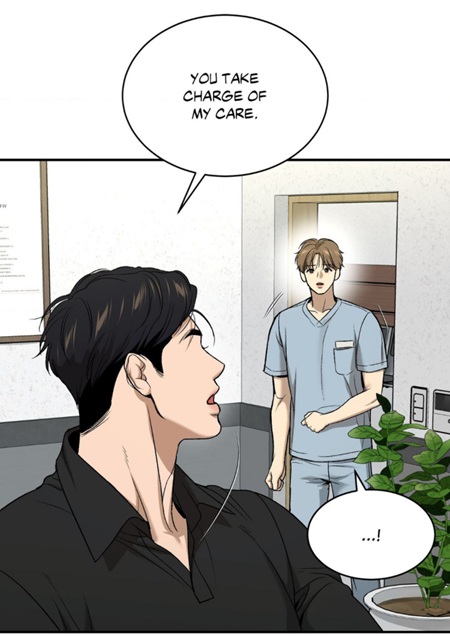 (chapter 61) By entrusting his care to Kim Dan, he was insinuating that the main lead was trustworthy and competent, yet his inability to verbally express appreciation keeps the doctor unaware of his true feelings. This struggle resurfaced in front of the hospice, where Jaekyung could only bring himself to admit that Kim Dan was not responsible for the incident with the switched spray.
 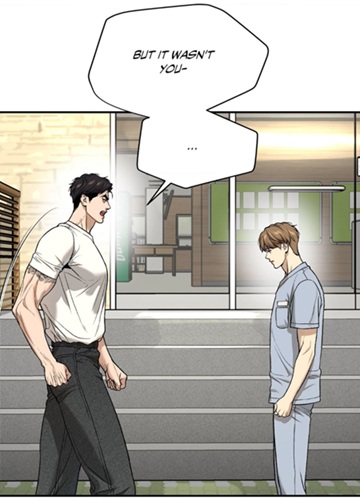 (chapter 62) His reluctance to openly acknowledge his gratitude suggests a deeper internal conflict—one that hints at a growing but unspoken emotional reliance on Kim Dan.
  (chapter 62) It was, as if he was warding off bad luck by repeating the last match. For him, past choices are justified by their results—he has built a successful career through sheer discipline and sees no reason to question his trajectory. His mentality reflects the belief that one’s past is a stable structure upon which the present and future rest. This perception explains his resistance to self-reflection and emotional vulnerability; admitting a mistake would mean disrupting the stability he relies upon.
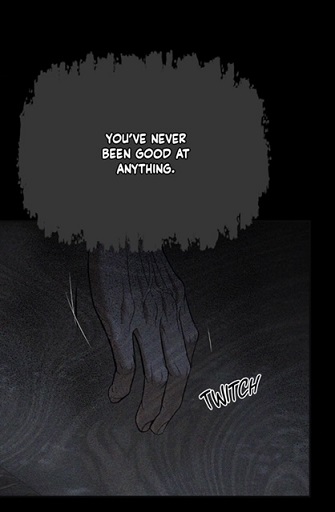 (chapter 54), where emotions were likely dismissed as obstacles. Instead, he follows only what aligns with his success: the advice of figures like Park Namwook and Yosep, who reinforce his pre-existing beliefs about strength, control, and endurance. Hence he was pushed to fight despite his ankle injury.
 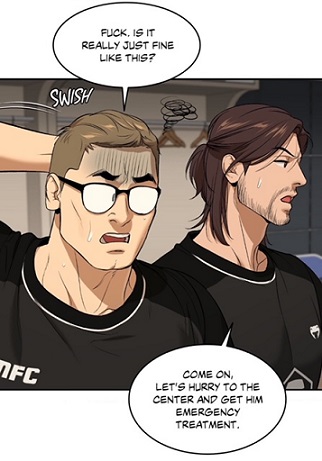 (chapter 50)
 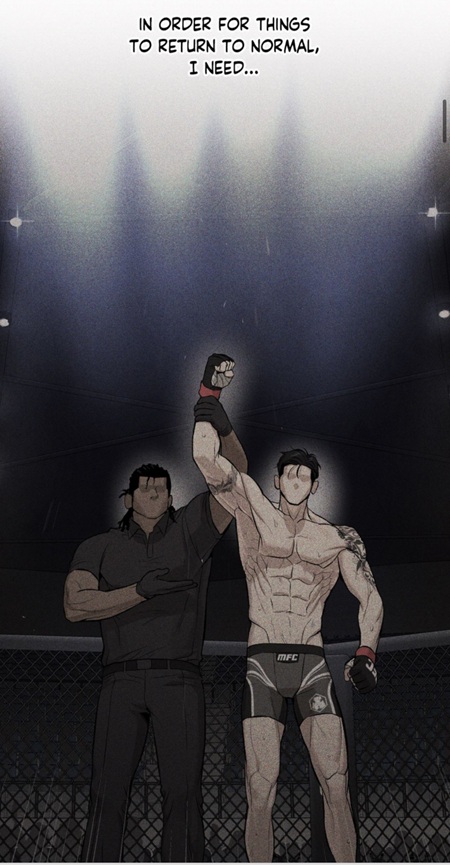 (chapter 61) This rigid perception prevents him from questioning his past choices or embracing change, reinforcing the illusion that repeating past patterns will restore stability. However, as his reliance on Kim Dan grows, the boundaries between his personal and professional life blur, challenging his belief that he can control his future by clinging to his past.
 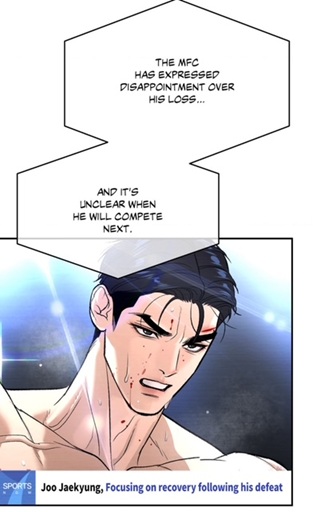 (chapter 57) and Park Namwook
  (chapter 54), who claim that Jaekyung ‘lost’ the fight, when in reality, it was a tie. The very way people around him are framing the event warps his perception, creating a false narrative where his struggles seem to stem solely from this supposed ‘loss.’ His belief in a stable past provides him with a sense of security, but that illusion is fragile. In addition, if his struggles predated his championship loss
  (chapter 29), then reclaiming his title cannot be the solution he believes it to be. Finally, what happens when he is forced to confront the reality that some of his past choices were mistakes – ones that he can no longer attribute to the jinx or external circumstances,
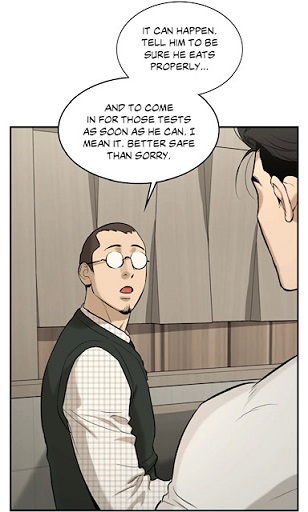 (chapter 13) because they affected the doctor’s life?
  (chapter 41) In one case, he refused to listen to his friend’s advice, whereas he trusted the words from MFC, MFC doctors and his hyung. When the foundation he has relied upon begins to crack, Jaekyung’s entire mindset is shaken, forcing him to question whether his past truly holds the answers he seeks. We could say, the athlete needs to be betrayed by his own past in order to throw his old belief. The latter is strongly intertwined with the organization MFC and authorities in general. Questioning his past equals challenging the company MFC and his past “guardians”: the terrifying ghost and even his two hyungs.
  (chapter 61), he expresses the belief that reclaiming his championship title will rid him of his headaches, nightmares, and sleepless nights. However, the reality is different—he was already suffering from insomnia long before he lost his title.
 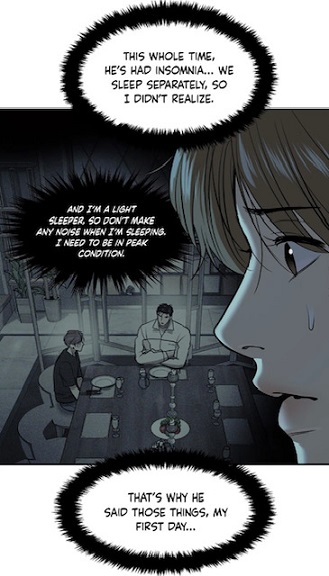 (chapter 29) The origins of his struggles existed before his recent failures, suggesting that his belief in a simple solution—reclaiming his title—is an illusion. This disconnect reveals how deeply his professional and personal life are entangled; his need for control in the ring has masked his deeper emotional vulnerabilities. He isn’t merely striving for victory—he is chasing the illusion of stability, believing that his success is the sole factor that determines his well-being.
  (chapter 54) But as his nightmares and frustration intensified, it becomes clear that his problem is not the loss of his title, but the erosion of the identity he has built upon it. This means that the longer he stays away from the gym, the more the fighter is learning about himself. He is more than just a MMA champion. To conclude, he is on his way to redefine himself, to discover his humanity.
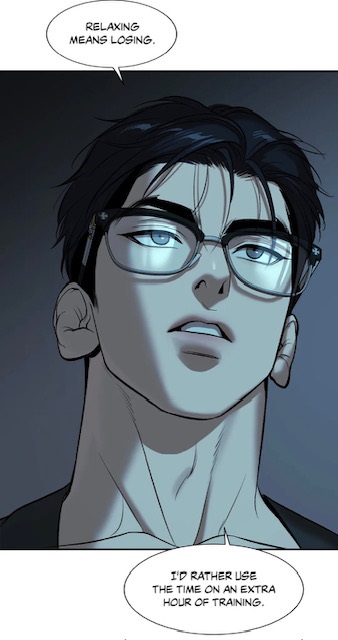 (chapter 29), you will realize that alone in his penthouse, Joo Jaekyung was actually admitting the importance of sleep and rest. His earlier belief in relentless training as the key to success now clashes with his realization that exhaustion is affecting him. This shift signifies an unconscious admission that his well-being is not just tied to physical endurance but also to recovery and relaxation—something he previously dismissed. This realization subtly parallels his growing dependence on Kim Dan, reinforcing the theme of blurring lines between his professional and personal life. And what had occurred after this magical blue night in the penthouse?
  (chapter 30) The athlete woke up later than usual. In fact, he was rather late, for he was still wearing his pajamas, while the doctor had already taken his shower. But back then, observe how he opened the door! Like a clumsy beast, grump leopard! Why? In the past, I explained that he was seeking the champion’s closeness, but didn’t know how to approach his partner. I am now adding another aspect. He was actually annoyed, because he had not been following his daily routine!! Under this new light, it becomes comprehensible why the champion had such a “angry” facial expression, while deep down he was happy. The older version of this scene:
 (chapter 44) However, this means that in episode 30, he never acknowledged his dependency on the physical therapist for his rest loudly. On the other hand, it explains why the champion felt threatened, when the actor approached his “lavender-tinted pillow” or “sleeping pill”.
  (chapter 31) In fact, he used guilt to create a link between him and his roommate. That’s the reason why I am more than ever convinced that the champion will sleep better after this lavender-tinted night.
  (chapter 63) But contrary to the past, the athlete should come to recognize his lover’s great sleeping power officially. This made me laugh, imagining Kim Dan’s reaction, when the latter sees that his wish
  (chapter 62) won’t come true at all. 😉 He will stay longer and ask for Kim Dan’s presence during the night.
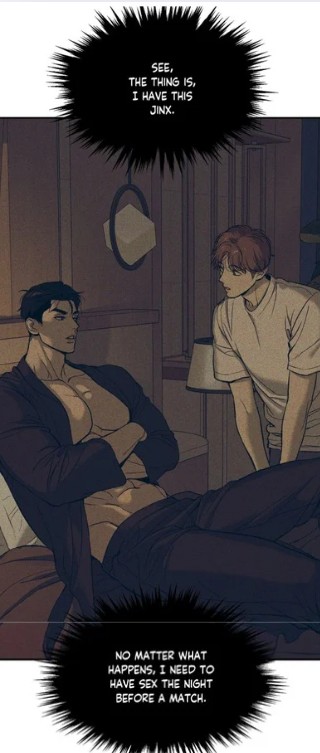 (chapter 62)
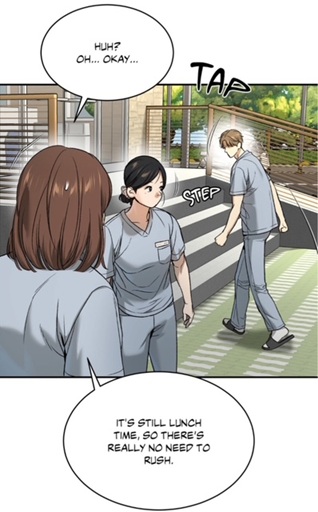 (chapter 56) and opportunities that could offer him security, convincing himself that he is protecting his independence when, in truth, he is reacting to past trauma rather than making an intentional choice.
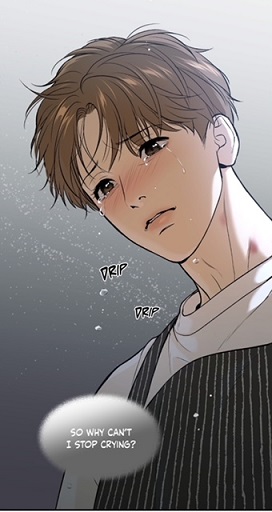 (chapter 46)
 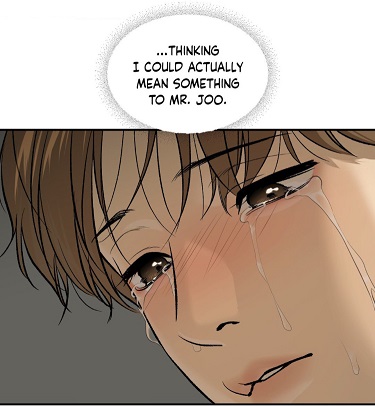 (chapter 46)
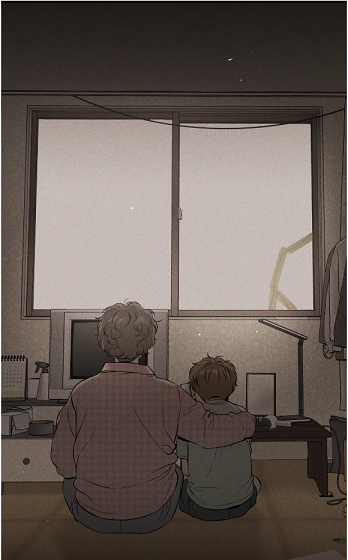 (chapter 19) She became terribly sick, while the other had to get surged and risked his career. There is no doubt that the halmoni is hiding her pain as well. Kim Dan’s declining physical and emotional state further reflects the consequences of living in avoidance.
 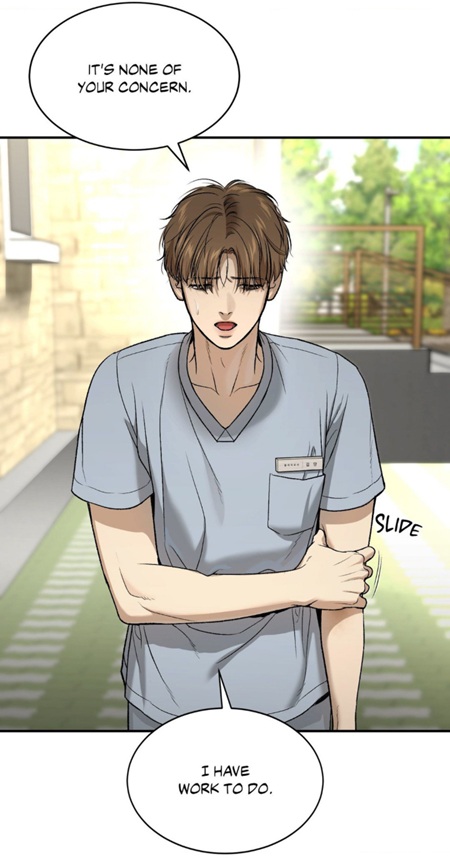 (chapter 61) He is endangering his life. Instead of taking action to improve his well-being, he isolates himself, refusing help even when it is necessary. His reluctance to accept care—be it medical, emotional, or relational—mirrors the very trap Delgado describes: mistaking survival for true agency.
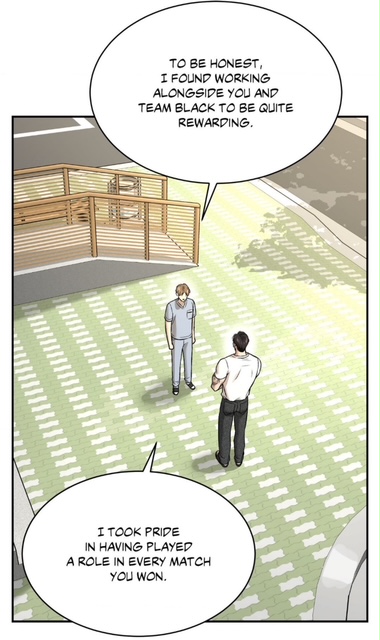 (chapter 62) If he continues making decisions based on past fears, he will remain trapped in the same cycle, unable to experience true growth or emotional fulfillment.
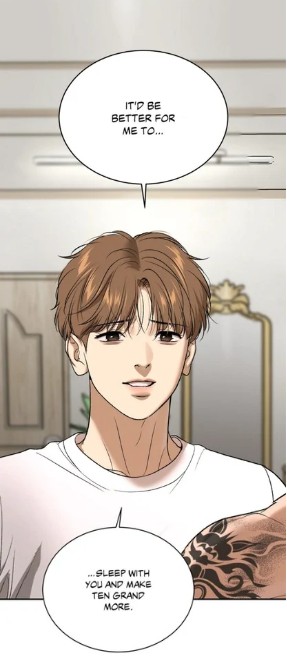 (chapter 62) Here, he is actually facing his past which he has strongly connected to regret and remorse. Don’t forget that after this night, he is expecting Joo Jaekyung’s departure.
 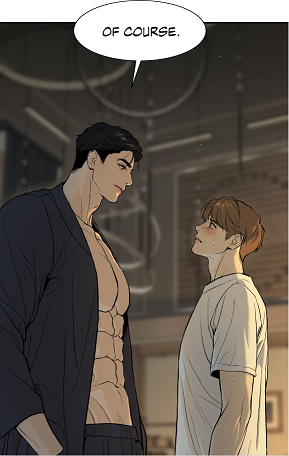 (chapter 3), which has been the setting of power imbalances, physical dominance, and silence, the living room represents a shared space—a place where dialogue and openness can exist. But why is the bedroom linked to silence? It is because of the TV, the third invisible companion!
  (chapter 48) Hence during that night, none of the protagonists talked sincerely to each other. And now pay attention to the living room at the hostel:
  (chapter 54) He needed to get rid of this poor habit: watching TV or cellphone. He had to realize that the TV or cellphones were never real companions and never brought him peace of mind! This was the invisible “love” triangle. Back then, the athlete deceived himself by thinking that he was truly self-reliant, while in verity he was dependent on his cellphone and the TV.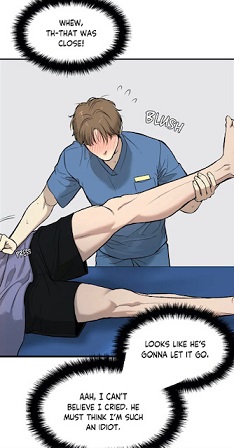


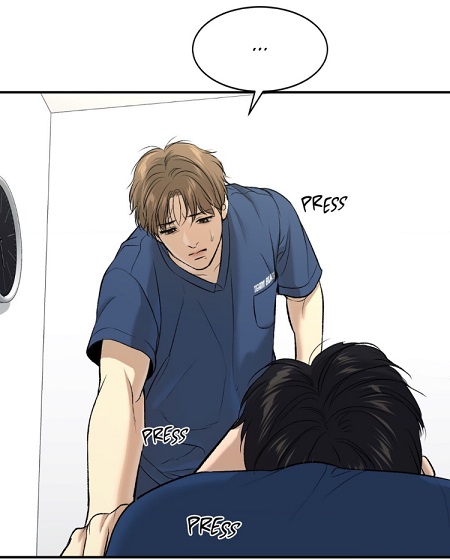

 (chapter 37) And all this started because Kim Dan had taken the initiative.
  (chapter 7) But now, it is no longer fulfilling for him, because his relationship with them didn’t go beyond their work.
  (chapter 59) Striking is that here the doctor didn’t apologize to the elderly man, but only to the family.
  (chapter 59)
 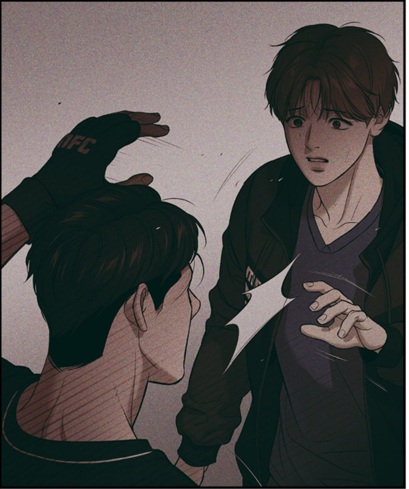 (chapter 62) – which is quite understandable in my eyes. The ones who failed the couple were the two other hyungs from my perspective. The past affected the doctor so much that he views himself and his feelings as “trash” now, yet it is clear that neither Park Namwook nor the coach are suffering from guilt or remorse. The star’s follow-up statement,
 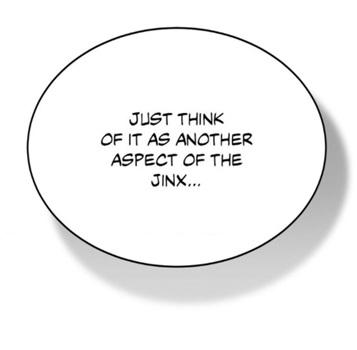 (chapter 62) further reinforces that Kim Dan has become an integral part of his preparation. Although Jaekyung does not yet frame this as emotional reliance, his words betray an unconscious attachment—one that Kim Dan himself does not recognize. Moreover, by including him in his jinx, the champion is only one step closer to include him in his “success”. Should the doctor be the target of malicious comments, the star will consider it as a personal assault or as his responsibility.
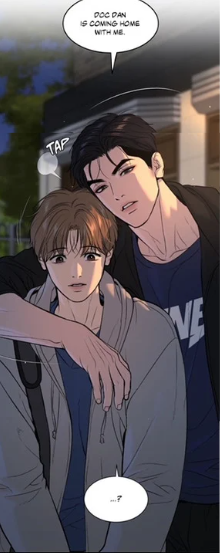 (chapter 43) Someone needs to remind the athlete of his own “statement”. Simultaneously, since the doctor never got curious about the fighter’s past and family, his presence could only be seen as a bandage covering a rotten body. In order to heal completely, he needs to expose his traumatic past and vulnerabilities.
 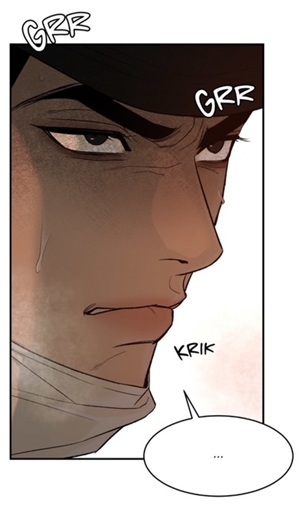 (chapter 56), but about something deeper. Here he felt the need to see his beloved “companion” again.
  (chapter 27) At the same time, this confession displays that his past was far from being perfect, the evidence of a distorted memory. After working so hard for the community, he came to receive a treatment from Kim Dan:
  (chapter 62) This means that he is now treasuring his own body. No wonder why he smiled.
 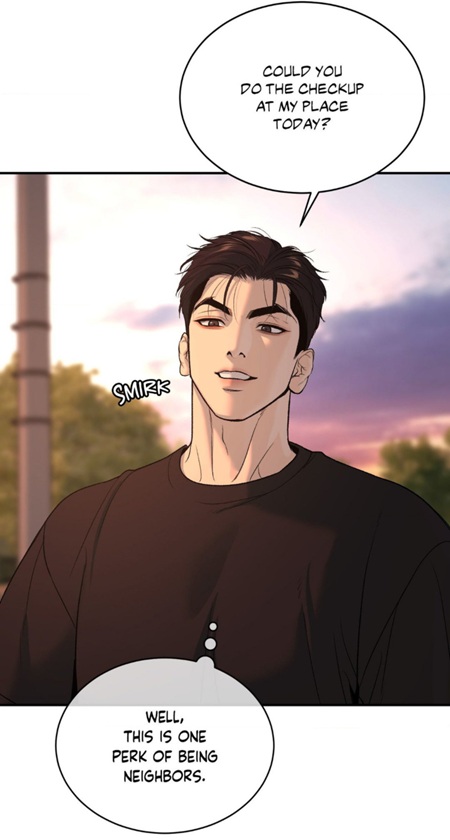 (chapter 62) That’s why I come to the following conclusion: The athlete must have felt happy in the living room, for he felt comfortable and safe.
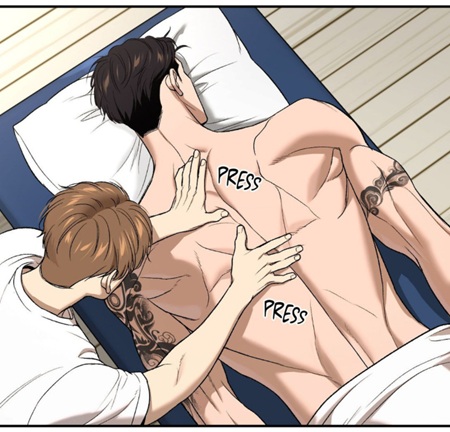 (chapter 62) But why did he show his back? One might say that he desired to hide his “satisfaction” and his “reliance” on his fated partner. Or he didn’t feel the need to watch the doctor’s facial reaction, when he would confide his new intentions and the transformation of his jinx. He didn’t expect the physical therapist to mock him for his absurd belief contrary to episode 2:
  The doctor is treating the star
  (chapter 22) when he is not, using his seniority and past influence to assert dominance. His attitude is related to his past decision: from his perspective, he saved the athlete from turning into a criminal.
  (chapter 26) His dependence on Jaekyung’s achievements makes him resistant to any shift in the fighter’s trajectory
 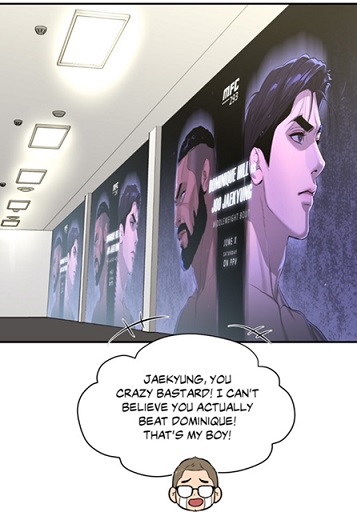 (chapter 40), as it threatens his own stability. Rather than acknowledging change, he reacts negatively to it and shifts blame onto Jaekyung, avoiding responsibility for his own shortcomings.
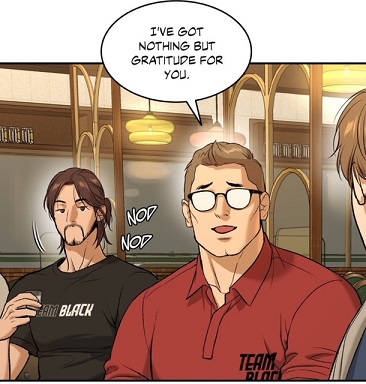 (chapter 43), but when confronted with a serious incident, he failed to take responsibility or make a decisive choice
 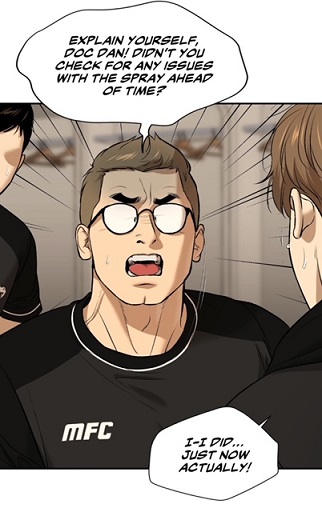 (chapter 50), allowing others to step in instead. Later, rather than addressing his inaction,
  (chapter 52) he deflected blame onto Jaekyung, holding him accountable for his own passivity and incompetence. Instead of facing the consequences of past mistakes, the coach and manager prefers to erase them entirely, bringing in a new physical therapist
 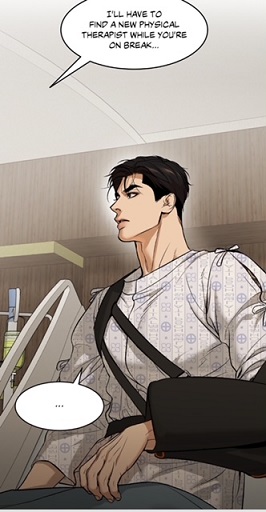 (chapter 53), as if the past never happened. By doing so, he reinforces Jaekyung’s belief in his so-called ‘jinx,’ manipulating the fighter’s perception of events and contributing to a distorted memory of reality. Meanwhile, the manager must face the reality that change is inevitable and that Jaekyung’s evolution does not mean his own irrelevance. However, his position must change.
 (chapter 59)
 (chapter 5) He felt so empowered that he won very quickly.
 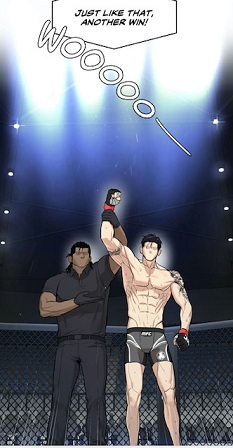 (chapter 5) But this good vibe was attributed to the sex with Kim Dan and unfortunately linked to his match. The reality was that he had slept better and longer. So by recreating the past, Kim Dan places the athlete in front of a choice. What matters in his life? His title or his peace of mind? He is correcting the champion’s distorted memory. Kim Dan is the reason why he can rest properly and not the title. Don’t forget that he was suggesting to go separate ways during the massage. But if he sleeps better before gaining his title, he won’t feel the urge to return quickly to the ring. In the living room, he was still acting as the celebrity, but in the bed chamber he is now gradually pushed to leave his title out of the bedroom. Now, in the bedroom he becomes a man and can almost make a mistake as a lover.
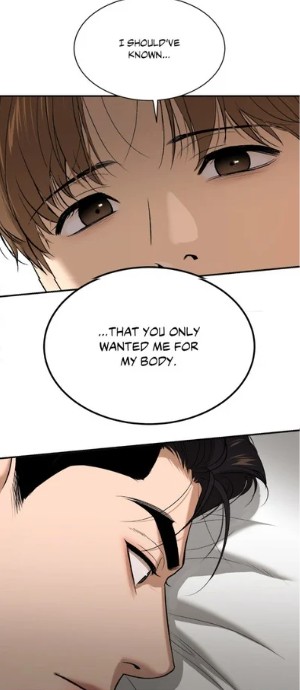 (chapter 62) In episode 62, Kim Dan reproached the champion for only being interested in his body, reflecting his own inability to see his body as something valuable. Hence he never wondered about the true cause for such a huge bruise.
 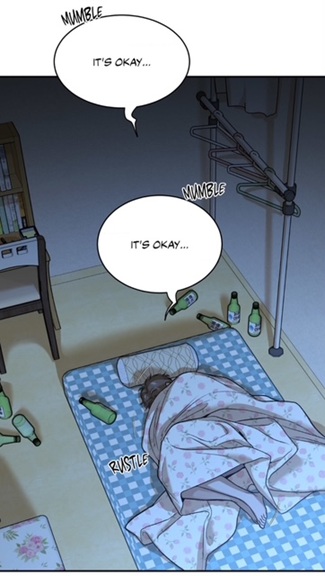 (chapter 59), hence he felt terrible sleeping alone. Secondly, he does not attribute worth to his own physical being beyond its utility for others. This explains why he has consistently neglected himself—avoiding food, disregarding his own injuries, and refusing to seek medical help when necessary.
 (chapter 60) It underscores the reality that without his body, he cannot work. In this way, his physical deterioration forces him to confront an undeniable truth:
  (chapter 43), they will replace him with a new ‘doll.’ This exploitation shaped his relationship with his own body—one that prioritized its use over its care.
 (chapter 26) and 62
 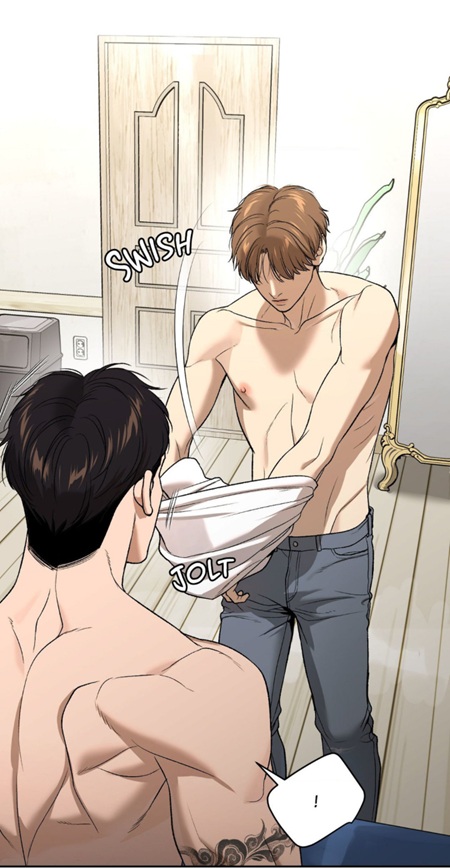 (chapter 62) that highlighted a crucial shift in how each of them perceives their own worth—and, more importantly, each other’s. The mirroring of these two episodes suggests a deliberate narrative structure that showcases their evolving dynamic, with each character taking on a role the other once held. This realization led me to explore how their perspectives on strength, vulnerability, and agency transform over time.
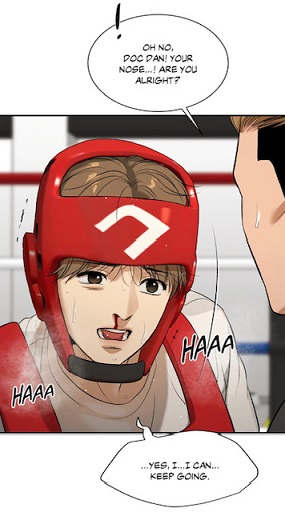 (chapter 26)
  (chapter 62), Kim Dan’s smile (genuine versus fake) and the characters’ shifting roles in confrontation and protection. The numerical structure of this episode—where Joo Jaekyung (2) represents dominance
  (chapter 26)
  (chapter 26) This small yet significant act reveals that the champion does not see Kim Dan merely as a ‘sex doll’ but as someone worth protecting, even when challenging him. The protective gear is a contrast to Joo Jaekyung’s usual treatment of his one-night stands, reflecting an unconscious distinction between how he views Kim Dan versus his other partners. Finally, this sparring day exposes the doctor’s biased perception about the athlete in episode 62 once again.
  (chapter 62) It was, as if he had no real talent. But let’s return our attention to the safety gears. The latter underline the high sense of responsibility of the champion, which readers could detect in episode 62. With the red accessories, Joo Jaekyung was showing his respect to the doctor as a man. In that scene, Kim Dan could choose his destiny. It is clear that “the hamster” has long forgotten this happy day
  (chapter 26) – he was smiling genuinely here- , and has reduced his time spent with Joo Jaekyung to sex:
  (chapter 26) —a powerful, intimidating man who mirrors the threat of Heo Manwook
  (chapter 16) and his minions. At the beginning of the fight, the doctor was not fighting for himself but for someone else, reinforcing his deep-seated belief that his worth was tied to service and sacrifice. However, during the match of the century, there was a short change. Kim Dan was reminded of his own past and fears. Thus, I deduce that in episode 62, it is Joo Jaekyung who must face his own greatest challenge—not a physical opponent, but the emotional vulnerability that comes with loss and uncertainty. Though he helped others, his generosity remained unnoticed by Kim Dan. Hence the latter was still unwilling to return to Seoul.
 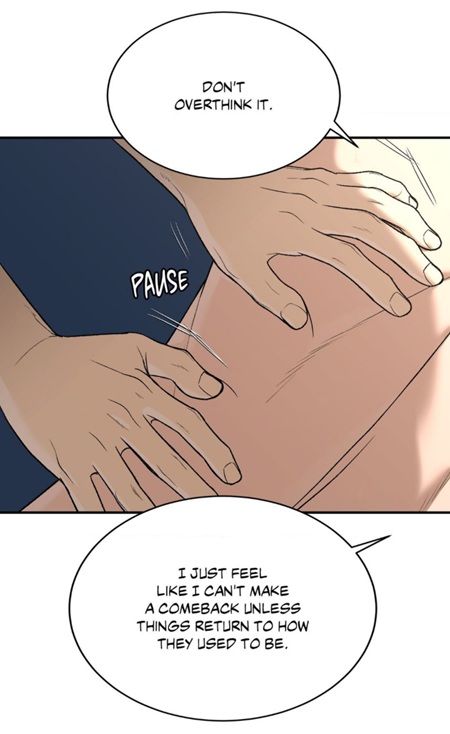 (chapter 62) On the surface, it looks like Joo Jaekyung lost.
 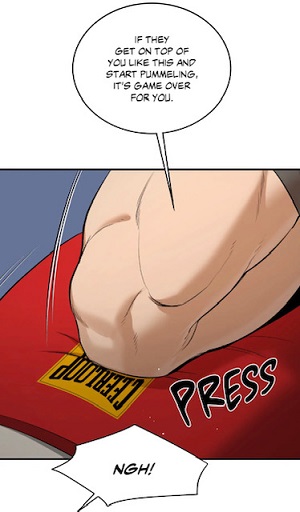 (chapter 26), was happy to demonstrate his talents and kept smiling all the time:
  (chapter 26) For the first time, fighting had become a source of joy for the athlete. He felt not only good, but confident about his skills, as a teacher and fighter. In both instances, this moment serves as a turning point, pushing each character to redefine their role and perception of self.
 (chapter 25) Kim Dan was interested to know more about this sport for the protagonist’s sake, whereas Potato was jealous of Kim Dan’s closeness to the star. How did the celebrity react, when he heard the doctor’s desire to learn fighting moves? He was totally pleased, hence he lowered himself smiling
 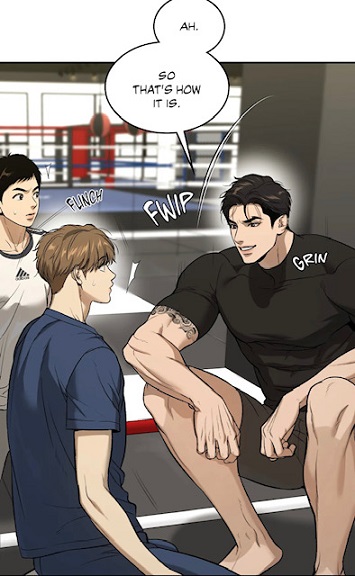 (chapter 25) before returning to the ring:
 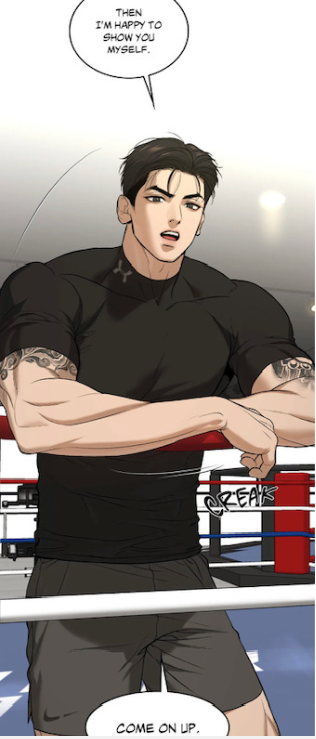 (chapter 25). Notice that he employed the word “happy” here. This shows that the athlete liked to be a teacher and mentor to a novice.
  (chapter 26), reinforcing his belief that his worth lies in service, and he requests an opportunity for someone else. The physical challenge that followed, in which the champion invited him into the ring, was meant to teach Kim Dan to overcome fear, though the original idea was to learn jujitsu moves for the champion’s sake. As you can see, there was a switch in the intentions for the “lesson”. This moment also highlights Joo Jaekyung’s approach to the body—power, physicality, and dominance, which will later be subverted in episode 62 when emotional resilience becomes the true test of strength.
  (chapter 26) Though the doctor was initially immobile and passive, the experience became a significant lesson: fear was something that could be faced and overcome. From that moment on, he became more proactive
 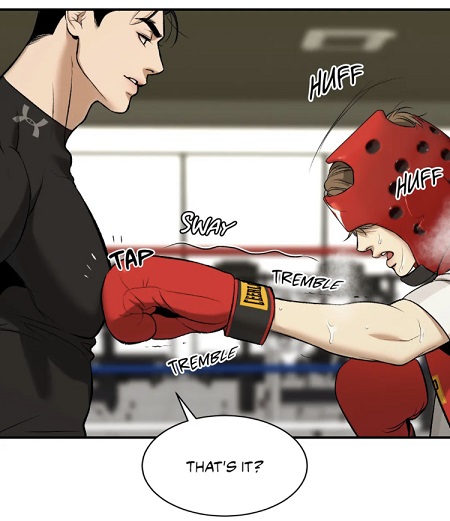 (chapter 26) This is a moment of physical initiation for Kim Dan, teaching him resilience. Nonetheless, he was still fighting for someone else, still locked in his pattern of self-neglect.
 (chapter 62), although he has yet to fully recognize the reason behind his behavior. He is now imitating the doctor, as if his body is there to provide assistance and care for others. The people of the small town rely on Joo Jaekyung, placing him in an unfamiliar caretaker position.
 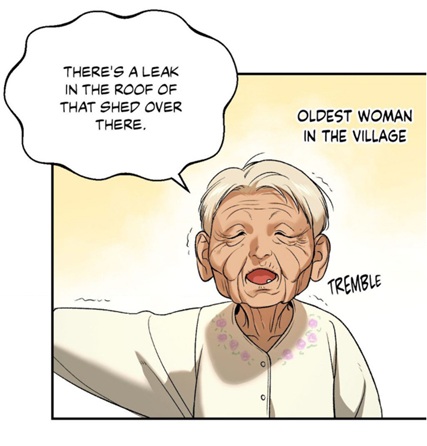 (chapter 62) This shift highlights a deeper irony: while Joo Jaekyung has always prided himself on his physical strength, he is now being tested in a way that cannot be resolved with fists.
 (chapter 34), wealth
  (chapter 42) and title
 (chapter 55), not for its attractiveness or desirability. His reputation in bed has been poor;
 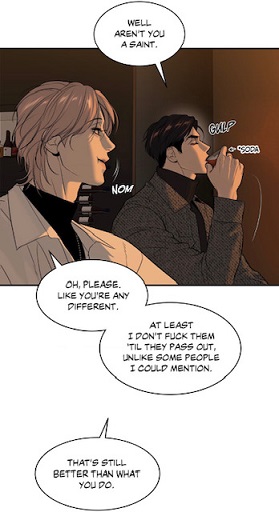 (chapter 33), he was never seen as a man with sex appeal or sensuality, but merely as a fighter who could endure. Sex was another form of exertion, a display of control and dominance rather than a pursuit of pleasure.
  (chapter 13), but for his own pleasure. The defy incites the fighter to make a conscious choice contrary to the day, when both main leads took the day off:
  (chapter 27)
  (chapter 34) He got confident, because he had played a trick on his room mate. His physicality has always been his defining trait, but for the first time, he is being confronted with the question: does he have more to offer beyond brute strength and money? If he wants to prove his worth, he must do more than rely on his body—he must reveal his true self.
 (chapter 62)
 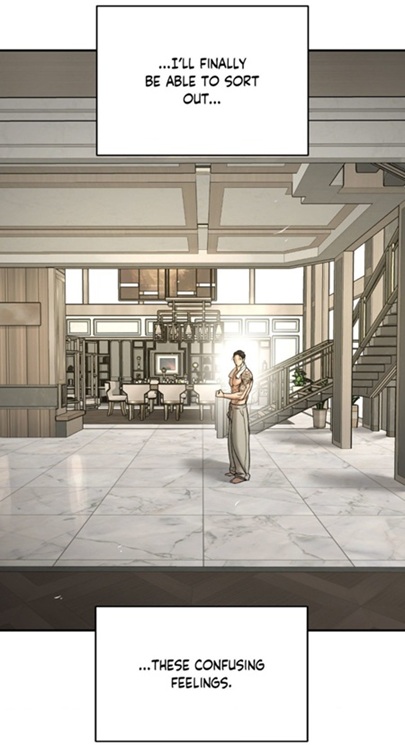 (chapter 61) Why does he want him to return to Seoul? Is he really looking for a physical therapist or something else? It is clear that he is longing for companionship.
 (chapter 26), which represents the MMA fighter’s world, the wolf is now the one penetrating Kim Dan’s world: the treatment table!
  (chapter 62)
  (chapter 62) The latter was brought to the hostel. I know, here I am more speculating about the next episode. However, keep in mind that the hamster brought up the past to his destined partner.
 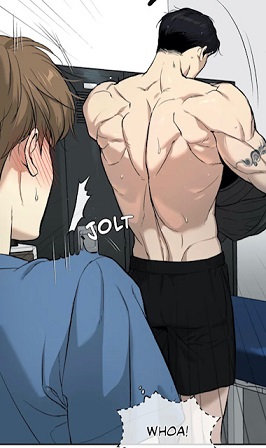 (chapter 1) The blue treatment table is the witness and proof that the champion never saw Kim Dan as a sex doll. So far, they never had sex on it, a sign that he respected not only Kim Dan as PT, but also the profession as such
  (chapter 27) Here, the champion suggested to have sex at home, and not on the table. On the other hand, Jinx-philes will certainly recall this scene where the doctor begged on his knees for money:
 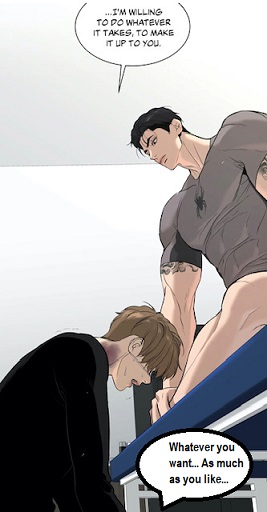 (chapter 11) That’s how I discovered a strong connection between this item and sexuality. First, the one fantasying about the champion’s body on the treatment table had been Kim Dan
  (chapter 1).
  (chapter 1) The massage must have felt like caresses to Joo Jaekyung. So when the main lead made this mistake
 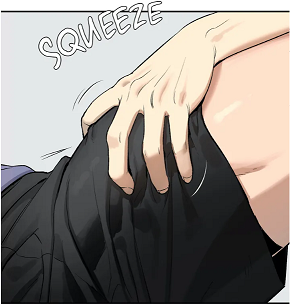 (chapter 1), it is very clear that Joo Jaekyung could have interpreted it as a sign for seduction later. Moreover, don’t forget the mysterious incident concerning the previous physical therapist:
  (chapter 1) It is no coincidence that Park Namwook’s words have a sexual connotation reviving my theory that a doctor might have made sexual advances there. Here, I feel the need to add another observation which came to my mind, the moment I focused on the blue treatment table.
  (chapter 62) According to my interpretation, Joo Jaekyung had interpreted the mistake for some advances and keep in mind that the fighter felt also attracted to the physical therapist.
  (chapter 56) In other words, he projected his own desires onto the “hamster”. But since he was still with the green-haired guy, he needed to mask his true intention:
  (chapter 1) -thus he asked for a treatment. He was about to drop the man.
 (chapter 1) However, contrary to their first encounter, the champion would be talking to his neighbor. While the doctor is thinking, he will relive his first night in the penthouse, the other might reproduce his first treatment, though it should be certainly combined with the intercourse on the couch: .
  (chapter 29)
  (chapter 57) He should have sent her to the hospital and ensure that she received treatment. Notably, after the sea incident, Joo Jaekyung took Kim Dan to the hospital, but the latter rejected the champion’s advice and help.
  (chapter 57) is not just a symptom of overwork and lack of sleep—it symbolizes the deep imbalance in his life. His world consists only of work
  (chapter 62), without fun, rest, or emotional fulfillment. He has no hobby, no personal joy, and no real human connections. He is suffering from depression. Interestingly, the sense of balance is directly tied to the ear, which aligns with his emotional “deafness”—his lack of true contact with others.
  (chapter 61) His mind and heart are no longer listening; he is trapped in his own darkness. His dizziness and fainting spells mirror this imbalance, making his physical weakness a reflection of his emotional detachment.
 (chapter 54) and drinking habits.
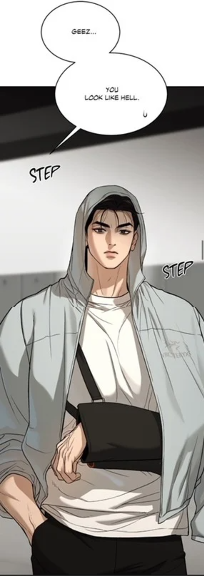
 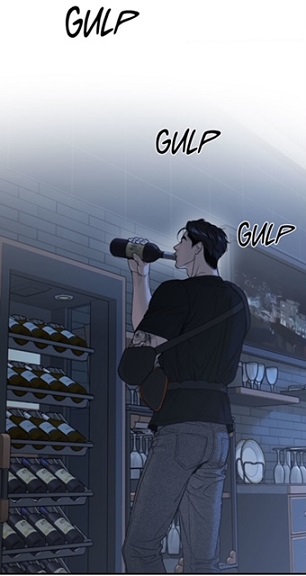 (chapter 54) His entire life has been dedicated to work and physical prowess, leaving no space for genuine happiness or emotional well-being. His drinking is not just an escape—it is a manifestation of his need to silence his thoughts and emotions. In episode 44, when Kim Dan expressed admiration for his body, he patted his head
 (chapter 54) His headaches intensified, and he isolated himself, mirroring Kim Dan’s earlier state of detachment. His drinking hadn’t just become a habit—it was mourning, a sign of his internal loss. It was, as if deep down he wanted to forget this intoxicating feeling of happiness from that night in the penthouse. The departure of Kim Dan caused both of them to lose their already fragile balance, reinforcing the idea that their dynamic, as unhealthy as it had been, was stabilizing them in ways they never acknowledged.
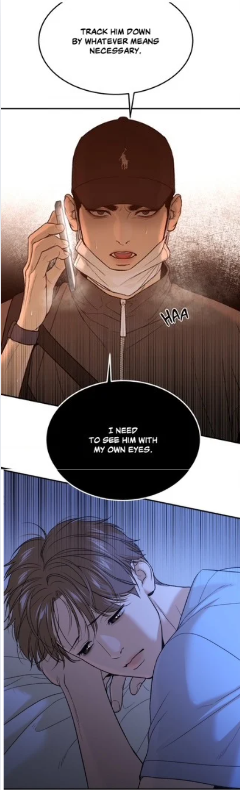 (chapter 56) It was, as if the champion no longer needed to see his former room mate. Note that he even waited for the evening before approaching doc Dan again.
  (chapter 60), he immediately went to the town. This contradiction reveals that mere visual presence was never sufficient—what he truly longed for was something deeper. And as soon as he saw him, he felt much better,
  (chapter 61) hence he could remove his splint. That’s how powerful drug Kim Dan is. 😉
 (chapter 61) While undergoing treatment, he saw Kim Dan every day, yet he remained unsatisfied due to the silent treatment. It was not enough to simply observe him; what Joo Jaekyung truly craved was conversation, interaction, and recognition. This explains his decision to move into the town, settling near Kim Dan as his neighbor.
 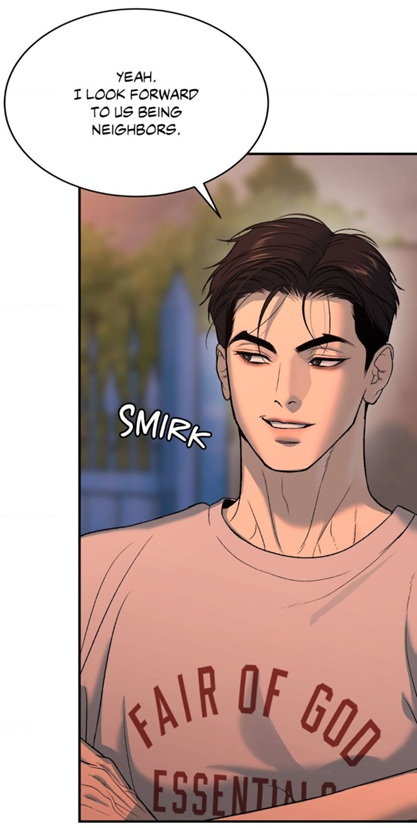 (chapter 61) It also sheds light on why, during their latest encounter, he chose to turn his back on Kim Dan—he no longer needed to ‘see his face,’ he wanted acknowledgment and his return to the penthouse. He has not grasped it yet, but he already views the protagonist as his family and home.
  (chapter 46) He is full of prejudices and not willing to listen to his boss. Therefore Joo Jaekyung doesn’t know that in order to become close, conversations must never be one-sided and have to be free from prejudices and assumptions. Joo Jaekyung needs to listen and show an interest in his partner. And now, observe the communication between the two main leads in the room.
 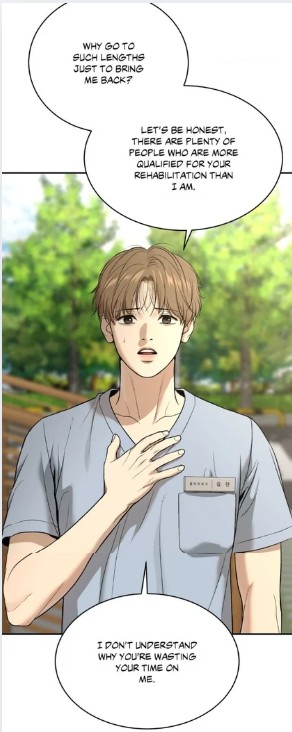 (chapter 62) He asked a question, while the other did not! He just made assumptions from his part, hence he suggested “separate ways”. It was naturally his way of being considerate. That’s why I have the feeling that two words could move Kim Dan’s heart: “HOME” and “HYUNG”. If he calls him that way, the doctor is now recognized as a family member, even as a senior. Hence he needs to be treated with respect.
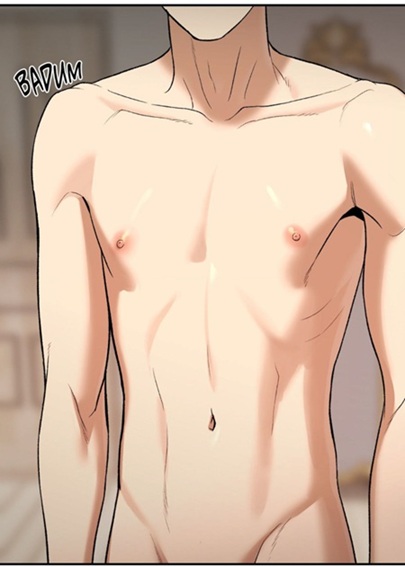 (chapter 62) he had previously ignored—he is undeniably attracted to Kim Dan’s body, particularly his nipples, which have repeatedly
  (chapter 27) triggered strong reactions in him.
  (chapter 29) That’s the moment he expressed his interest in the doctor’s nipples for the first time. This even became a habit:
  (chapter 44). And what did the doctor whisper during that magical night?
  (chapter 44) He wanted him to treasure his body!! In my eyes, Kim Dan’s suggestion in episode 62 is hiding another intention, though it is definitely unconscious:
  (chapter 44) He wants to relive that night
 (chapter 44), though in his mind, he desires to have a bad experience so that he can erase him from his mind. Finally, what do the nipples symbolize? Motherhood and nurturing.
  (chapter 57)
  (chapter 26) Moreover, it was thanks to a trick that Kim Dan won:
 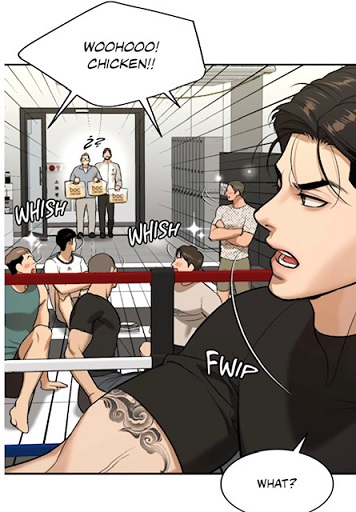 (chapter 26)
  (chapter 26) He felt superior and strong, whereas his rival was weak. Moreover, he imagined that Kim Dan would ask for money for the bet.
  (chapter 26) That’s why I believe that in the next episode, the roles should be switched. Kim Dan always saw himself morally superior and caring to the star, but in truth, his care was rather superficial, for he also showed no interest in the champion’s past and family. Thus I come to the following deduction that episode 62 suggests that arguing is not about losing or winning, but about listening. The champion has unknowingly become a caretaker, not only to the people of the town but, potentially, to Kim Dan himself. The question remains whether he will recognize that Kim Dan’s provocation is not just another fight lost (cutting off ties) —it is a seductive challenge to redefine his understanding of worth and their relationship. What are they to each other? A client and a prostitute? A fighter and a doctor? Or simply two men who are longing for the same: belonging and love. Nevertheless, due to their past, they are unable to detect the true source of their misery: their lack of reflection, own bias and anxieties.

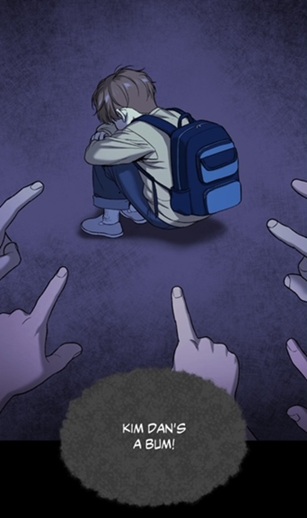 (chapter 57). Similarly, when Joo Jaekyung faced his opponent Randy Booker, he was also verbally harassed
 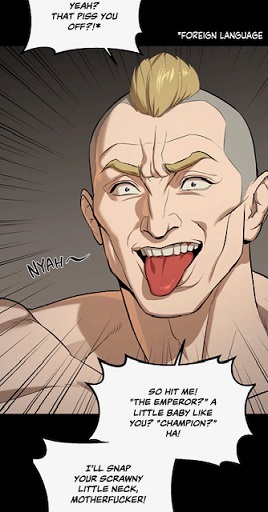 (chapter 14) which visibly destabilized the champion. Then in chapter 49, Team Black failed to perceive the duality of appearances and reality:
  (chapter 49) the surface shows two athletes seemingly engaged in a normal, even friendly interaction – they are shaking hands -, while the panels reveal a darker undercurrent of verbal harassment and manipulation.
  (Chapter 49)
  (chapter 61), while Joo Jaekyung represses his emotions and thoughts through “physical activities”.
 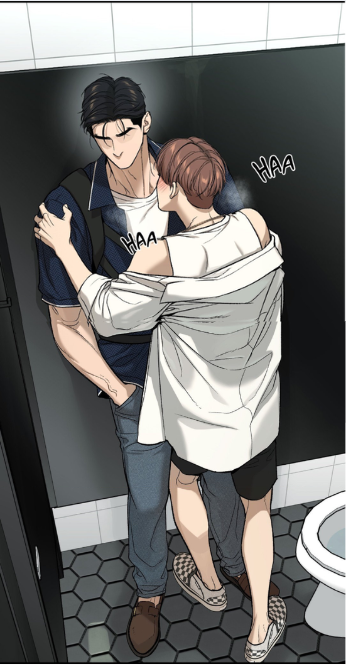 (chapter 55) This essay will explore how their experiences in the restroom space serve as a mirror to their past and reveal the psychological scars that shape their behaviors.
 (chapter 14)
  (chapter 38)
 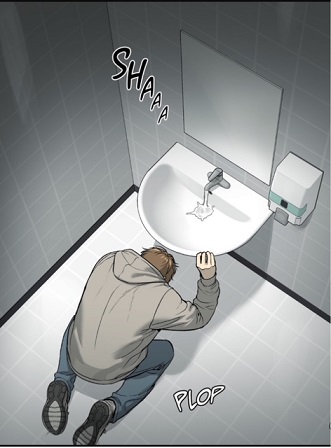 (chapter 47) However, in Season 2, the lavatory appears isolated for the first time, reinforcing a shift in symbolic meaning. This distinction helps to explain why restrooms (toilets/water closets) hold different meanings for the two protagonists. [for more read
  (chapter 19) —a space where one is free to confront their inner selves without external pressures. In Jinx, the use of the restroom emphasizes the external pressures and the characters’ reactions to their environments, reinforcing their struggles with exposure and control. But how did I come to this realization?
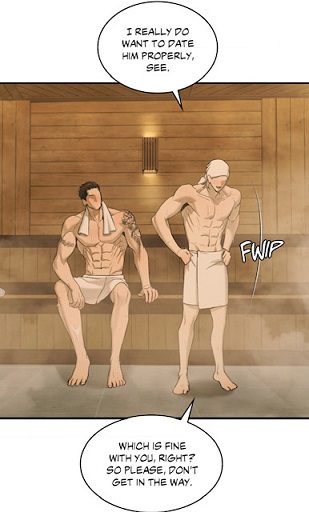 (chapter 34), vulnerabilities are exposed, and participants are pushed to their limits. In the essay
  (chapter 33) This would explain why Heesung was determined to hide the physical therapist’s whereabouts.
 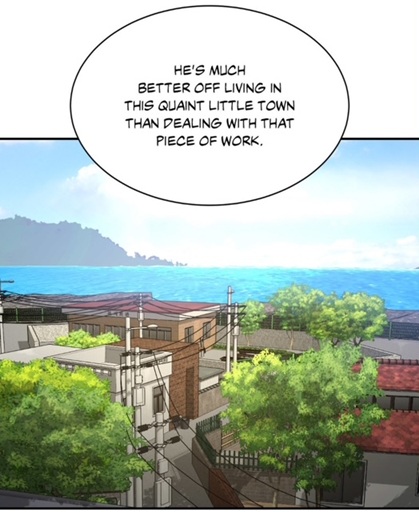 (chapter 58) He saw in him a bully and even a stalker. His judgment was based on these two incidents:
 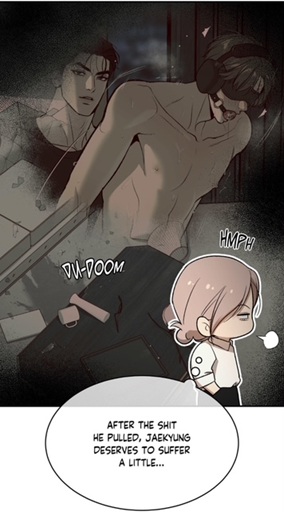 (chapter 58) He imagined that Kim Dan had been coerced to it, while the physical therapist always had the choice to refuse. Joo Jaekyung would never hurt the doctor.
 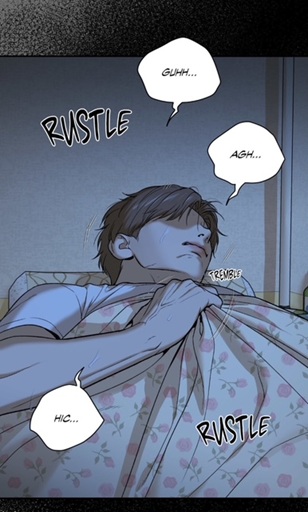 (chapter 59) The imminent death of his grandmother triggered his repressed fears.
 (chapter 61), reacts with pursuit. His behavior mirrors the tendencies of a stalker—not out of malice, but because his entire life was shaped by the belief that to be ignored is to be erased and forgotten.
 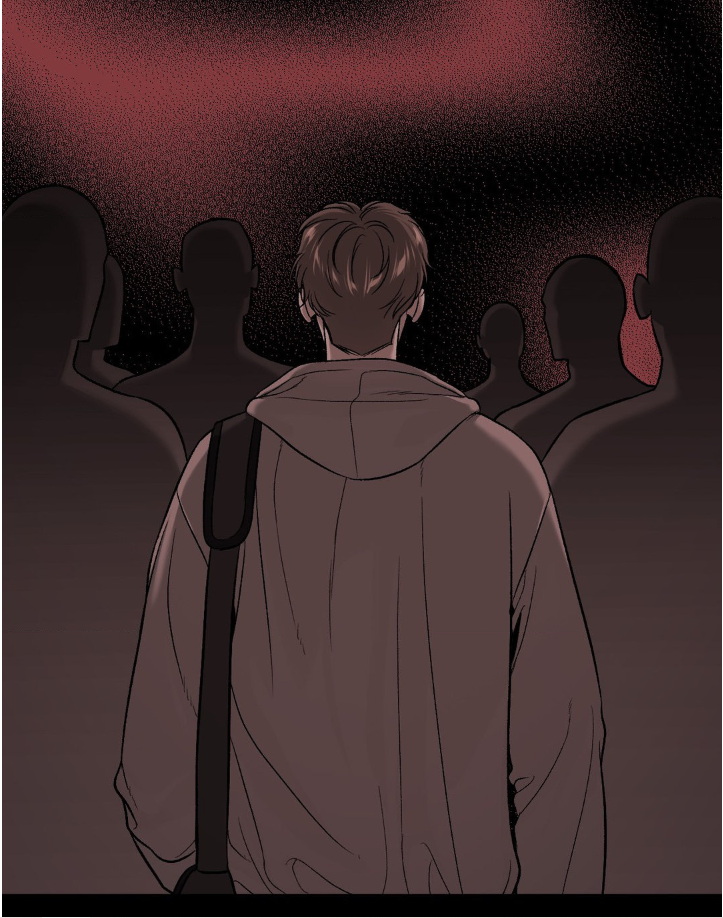 (chapter 55) In childhood, he learned that only strength could secure attention
  (chapter 26)
 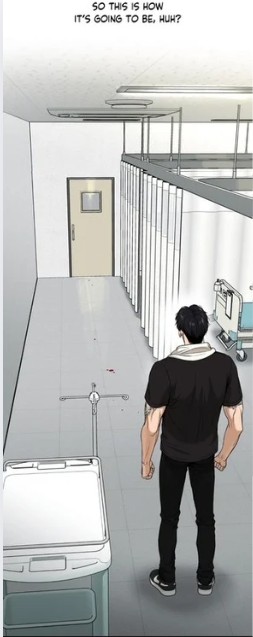 (chapter 60) He tracks him down, calls him repeatedly
  (chapter 57) and cornered, leading him to associate confined spaces with protection. The restroom was his only escape from ridicule, his sanctuary where he could momentarily regain control. This explains why he went crying there, when he heard the terrible news about his grandmother.
  (chapter 61) Since he can not escape the champion, he decides to ignore him.
  (chapter 55) – the mirror is very low -, Kim Dan retreats into memories to rationalize his pain. Instead of processing his suffering, he shifts blame to Jaekyung, using the restroom space to wall himself off emotionally. The restroom in Jinx thus acts as a metaphor for entrapment—whether through self-isolation or forced exposure, neither character is truly free from their past.
  (chapter 38) So he could faint there or hurt himself and he would have no one by his side. Don’t forget that this place stands for seclusion and privacy.
  (chapter 57), it is clear that the kids were not thinking of sex or using the restroom to assault the little boy. However, we should question ourselves how this rumor about Kim Dan being an orphan started.
  (chapter 54) bears a striking resemblance to this boy, leading to the possibility that this new character could be Kim Dan’s childhood bully. Given Jinx’s themes of positive psychology and confronting past demons, it is plausible that Kim Dan will encounter this schoolmate again. Such an interaction could force Kim Dan to address his unresolved trauma and reexamine his perceptions of strength and vulnerability. Moreover, don’t forget that the doctor in green saw the champion in a terrible shape who had admitted that he had drunk the night before.
  (chapter 54) And in episode 61, the main lead announced to Park Namwook that he had to fire the physical therapist.
  (chapter 61) I sense some retaliation here.
  (chapter 08) It is because in his mind, this place is associated with toilets in general. That’s how it dawned on me that the athlete could have been harassed at school, but contrary to the physical therapist, it took place later. The leader was Baek Junmin who hid behind the “mob”.
 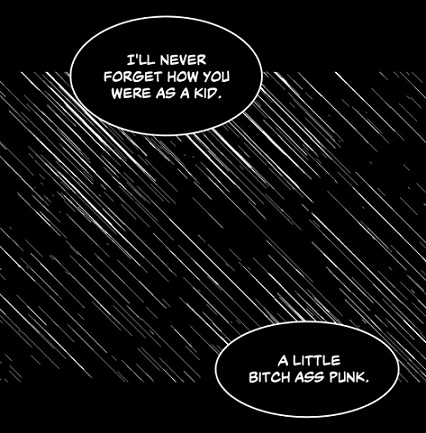 (chapter 49) Because he utilized the expression “how you were as a kid”, it signifies that the MMA fighter was not only older, but also an adult, whereas the champion must have been a teenager. And now, you comprehend why Baek Junmin acted like a friendly athlete in front of the public:
 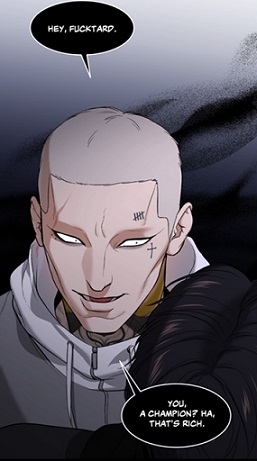 (chapter 49) People could discern his true personality: he was nothing more than a thug. Moreover, he would be perceived as a cheater, because he used others and his seniority to torment a child or teenager. At the same time, since Joo Jaekyung became a victim of bully later, the content about the mobbing should have been different. I am suspecting that he could have been targeted because of his homosexuality.
 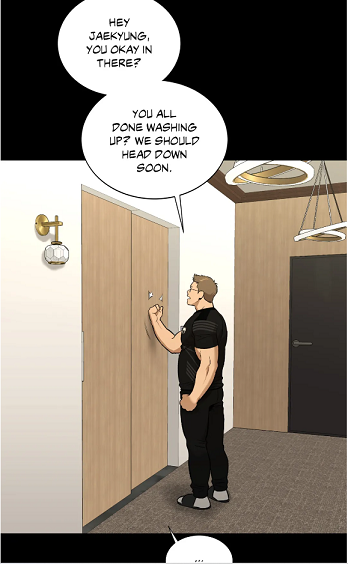 (Chapter 14)
  (chapter 55), he showed no reaction. In fact, his headache got even worse than before.
 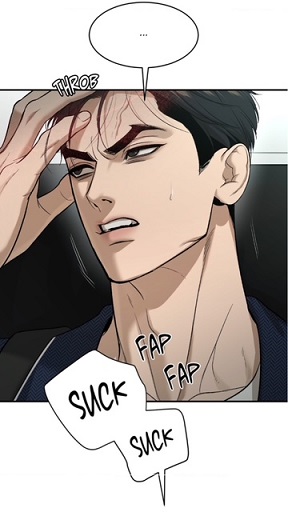 (chapter 55) The champion’s passivity and migraine could be the symptoms of the athlete’s past suffering. His pain worsened in that place because of the past, but he didn’t realize it, for he was so focused on his soulmate. Secondly, the moment he was about to get kissed
 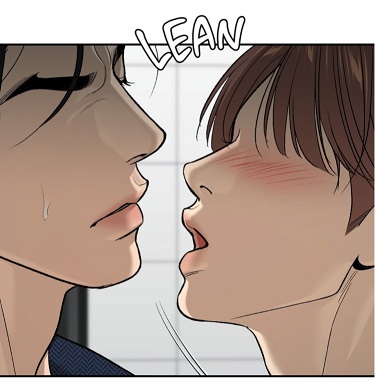 (chapter 55), he pushed the uke away and left the place
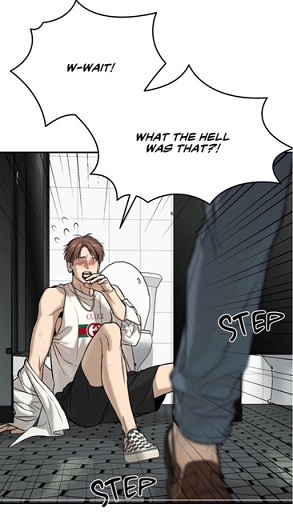 (chapter 55).In this place, he could show vulnerability, yet he experienced that nothing bad happened to him. This explicates why after this experience is willing to remember and even reconnect with the doctor.
 (chapter 54) While he calls his former rival and tormentor’s name and recollects his beating, he is not plagued with a migraine. This means that the real cause for Joo Jaekyung’s suffering (his headache linked to his repressed memories) is triggered by the attitude of his guardian. That’s the reason why he had a nightmare with the ghost of the past.
  (Chapter 54) There is no ambiguity that Randy Booker‘s insults had triggered the athlete‘s repressed memories and fears. Joo Jaekyung’s avoidance of mirrors suggests a fear of self-recognition—an unwillingness to face the vulnerability he tries so hard to suppress. His reaction mirrors the response of someone who has internalized a rigid sense of masculinity, where showing emotion is equated with weakness. The restroom, then, becomes a battleground where he unconsciously fights his past conditioning, yet he is unable to overcome it.
  (chapter 7) At the same time, it shows that by asking to defend himself, he pushed the athlete to become a “fighter”. He needed to demonstrate his strength and worth constantly. Choosing truth would have required him to admit that his emotional detachment stemmed from his own fears of vulnerability and inadequacy. Instead, he projected these insecurities onto his son, perpetuating a cycle of emotional isolation and avoidance.
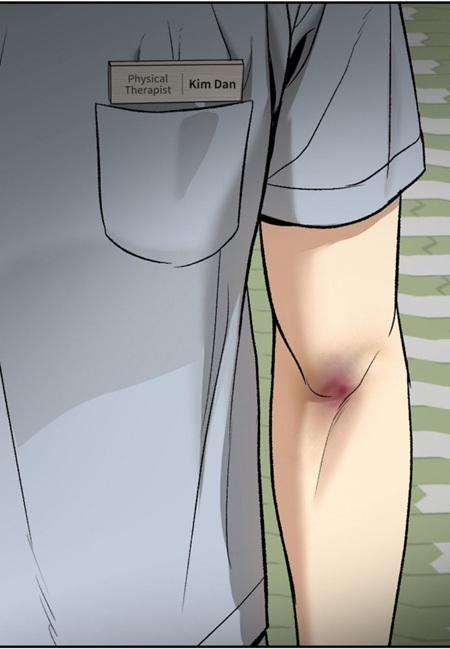 (Chapter 61) However, this moment is not isolated—it reflects patterns in his personality that have appeared throughout the series.
  (Chapter 11)
  (chapter 18) This essay delves into the significance of Kim Dan’s physical and emotional bruises, examining how they symbolize his suffering, internal conflict and transformation. I will examine Kim Dan’s conflicted emotions surrounding gratitude and debt, contrasting his interactions with Joo Jaekyung and his grandmother, Shin Okja. Additionally, I will explore how Kim Dan’s conditioned identity as a caregiver drives his choices, even in his current living situation with the landlord, where he unconsciously replicates past dynamics. Ultimately, I will elaborate how Kim Dan’s newfound awareness could reshape his identity and relationships moving forward.
 (Chapter 61) His unexpected reaction catches Kim Dan off guard, further emphasizing how disconnected the doctor has become from his own well-being. However, contrary to the past
  (chapter 11), Kim Dan is truly responsible for the contusion. He caused the injury by removing the needle from the drip.
  (chapter 60) By taking this action, he absolved Joo Jaekyung of any responsibility for the injury, but this is merely a superficial conclusion.
 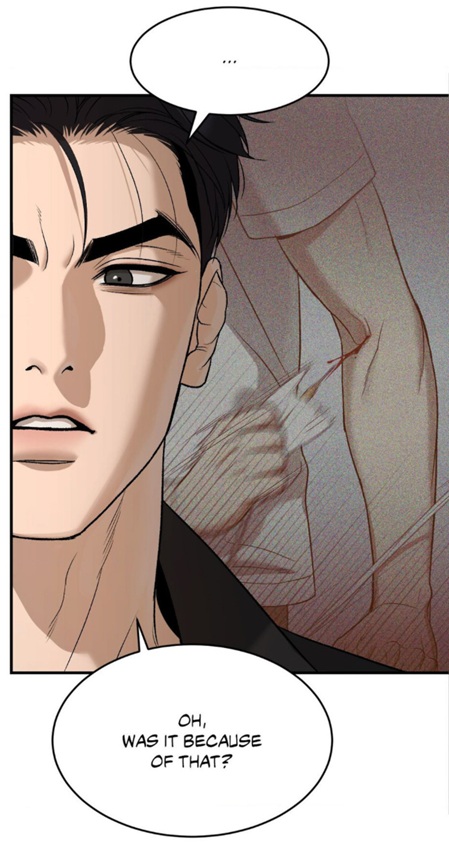 (Chapter 61) On the hand the circumstances surrounding the bruise, where Kim Dan removed the needle on his own, provide insight into his psyche. The deeper cause of the bruise lies in Kim Dan’s declining health, which is intrinsically connected to his malnutrition and the neglect he faces from those around him. It is important to recall that Joo Jaekyung was explicitly informed that Kim Dan needed rest
 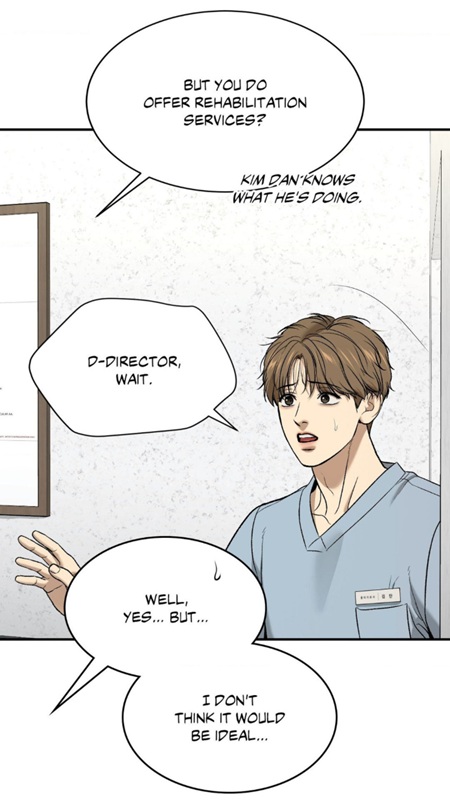 (chapter 61), he ultimately had no choice but to comply, as his order came from the hospice director.
  (Chapter 61) And why did the director override Kim Dan’s need for rest? Money and free PR. Joo Jaekyung’s influence secured the director’s approval, disregarding the doctor’s well-being in favor of business interests. This conversation at the director’s office makes one thing clear: words hold no power against profit. An d that realization led me to another connection—every one of Kim Dan’s bruises is linked to exploitation, whether by authority, obligation, or financial influence.


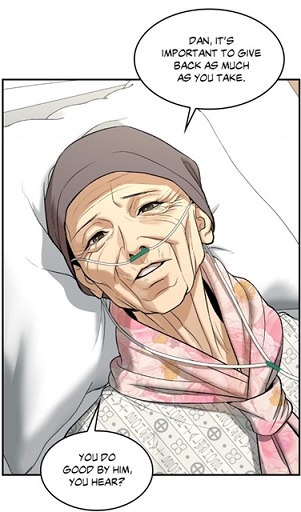 (Chapter 41) It is clear that she was inciting him to work harder than before. This displays that Kim Dan was not allowed to rest. During this encounter, she didn’t ask him about his well-being either. And what is the link between these 3 episodes? The grandmother and her poverty. The latter was responsible for the loan.
  (chapter 56) Kim Dan has only visited the hospital once, and this was solely due to Joo Jaekyung’s intervention. The latter needed medical attention himself
  (chapter 18) and took Kim Dan along, ensuring he was seen as an emergency patient. However, this visit was brief and lacked any comprehensive medical examination—no blood samples were taken, and his underlying health concerns remained undiagnosed. This omission further underscores the neglect Kim Dan has suffered, as even in a medical setting, his long-term health issues were overlooked.
 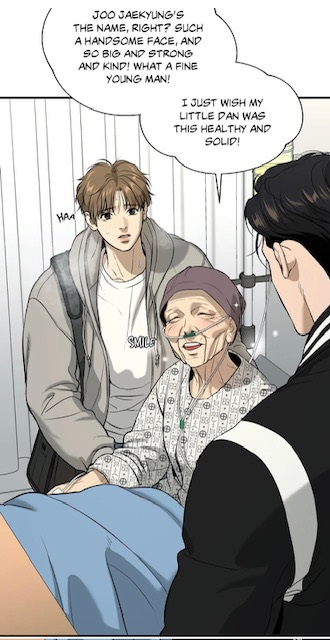 (chapter 21) He had never been healthy and strong. Moreover, when he joined them, at no moment the senior asked if he had gone to the doctor, though he had been sick before.
  (chapter 57). In the last case, she will downplay the severity of his condition, insisting that he has always been stubborn and independent. She could even mention her conversation, when she tried to convince Kim Dan to return to Seoul, but the latter refused to listen to her.
 (chapter 5), or his general reluctance to ask for help. He rejected the athlete’s help and concern.
 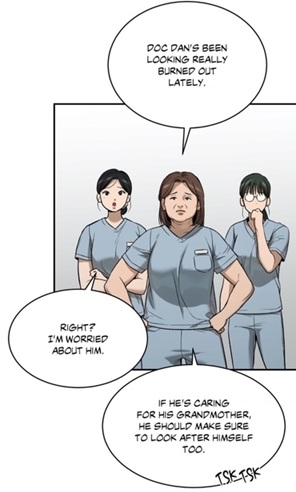 (chapter 57). She blamed the main lead, because she imagined that Shin Okja would worry about him. However, it becomes clear that the halmoni is not worried about her grandson at all. She is acting like a fan in front of the athlete.
  (chapter 61) One might argue that based on this scene, the grandmother didn’t see him with the bruise on his arm.
  (chapter 61) He only remained at the door. However, observe that there was a cut between this image
 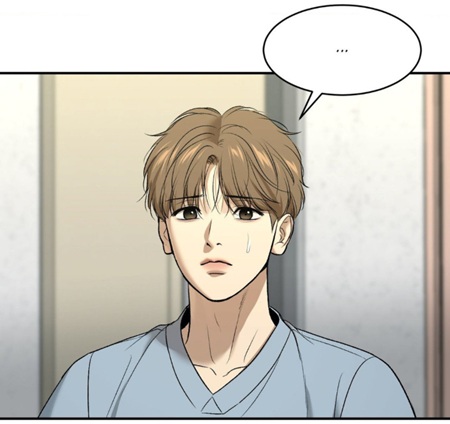 (chapter 61) and the conversation between the main couple in front of the hospice.
 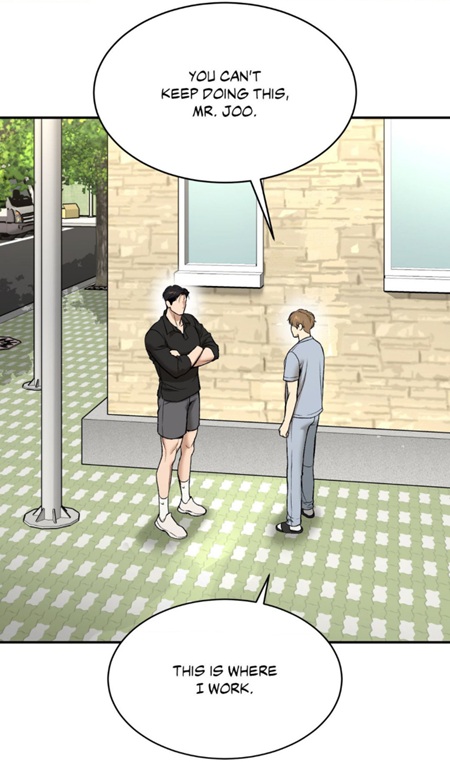 (chapter 61) So he could have made his presence known to his relative before asking Joo Jaekyung to follow him because of his treatment. To conclude, I believe that she had the time and occasion to see her grandchild and his bruise.
 (chapter 13) He is the only doctor who has ever examined the protagonist so closely and even paid attention to his fingernails!
  (chapter 13) At the same time, the chingu from the club was the first one pointing out that his wounds were never treated!! Furthermore, I realized that the doctor’s lies from episode 11
 (chapter 13) The latter was the cause for the severe exhaustion. However, like mentioned above, the doctor is not blameless either, because he never questioned why his wounds on the hand were bleeding again.
  (chapter 43) He thought, it was related to the massage, yet the reality was that this incident showed that he had coagulation issues. To conclude, all the bruises could have always been noticed by people due to their locations (eyes, hands, arm)!
  (chapter 61) and his relationship with Joo Jaekyung.
  (chapter 61) That’s how I recognized why these women’s warm welcome and curiosity about Kim Dan were rather superficial.
  (chapter 56) His arrival stands for novelty and a breath of fresh air at the institution. However, with this change, the female staff is forgetting their original duty: they need to pay attention to their colleagues. They are behaving like the grandmother
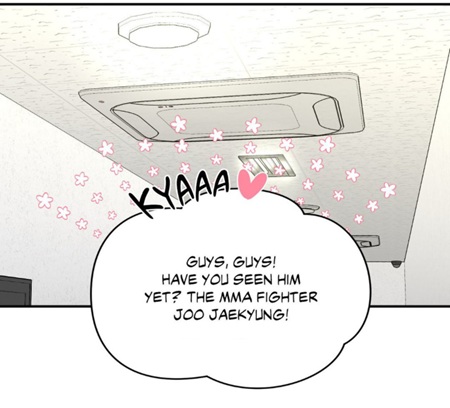 (chapter 61): fangirling over the handsome guys visiting their little town. That’s why Mingwa drew flowers in the last two images. No wonder why no one around Kim Dan is observing the bruise and his deteriorating condition. Moreover, since the physical therapist has a relative at the hospice, the staff is envisioning that Shin Okja is doing “her work”, she is paying attention to Kim Dan’s mental and physical conditions. On the other hand, there is no doubt that the grandmother has already delegated her own responsibility onto others, Kim Dan and the hospice. It is a medical institution, therefore they should pay attention to his working conditions. In other words, since no one feels responsible for the protagonist’s health, no one is worried about Kim Dan at all. At the end of episode 61, he is even so pale and breathless
 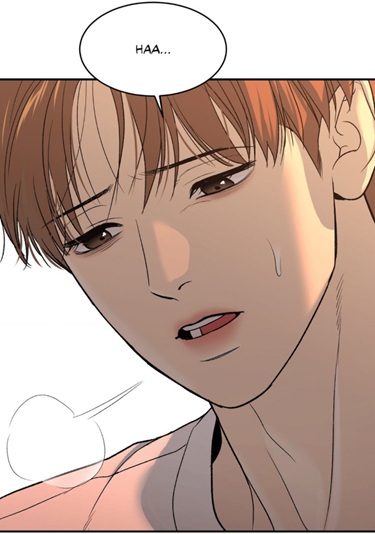 (chapter 61) that I am anticipating a terrible incident leading to a rude awakening for everyone.
 (chapter 47) For Shin Okja, raising him to adulthood marked the completion of her duty, and his current struggles are no longer her concern. This perspective becomes evident in her words from Chapter 57, where she tells him, he can’t stay here forever, and it’s not like he’ll stick around after she dies.
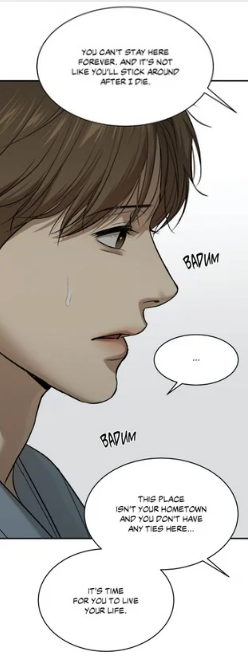 (chapter 57) By declaring that Kim Dan is now responsible for his own life, she emotionally detaches herself, absolving herself of any accountability for his deteriorating condition. However, she is forgetting
 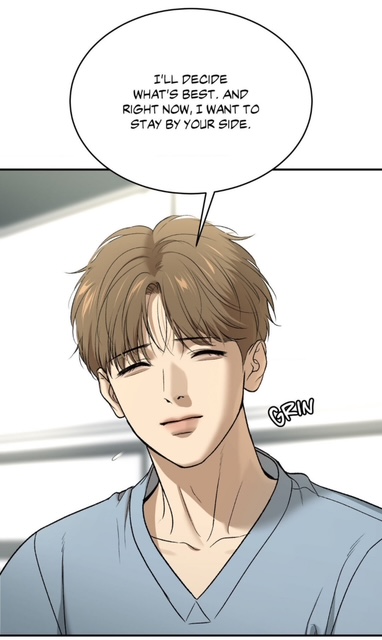 (chapter 57) — reinforces her conviction that she has fulfilled her role. In her mind, his rejection of her advice places the burden of care entirely on him, allowing her to dismiss any further involvement. This emotional withdrawal directly connects to the symbolism of the bruise:
  (chapter 18) In episode 18, when Joo Jaekyung confronts Kim Dan about the loan, the doctor has a bruise on his left eye, symbolizing his entrapment and helplessness. This earlier injury highlights how Kim Dan has been conditioned to view himself as responsible for burdens that are not his own, perpetuating a cycle of sacrifice and self-neglect. And a new bruise appeared just after the athlete reminded the physical therapist of his past promise:
  (chapter 61) His grandmother’s disregard for his well-being amplifies the injustice of this situation; she allowed him to shoulder the debt despite knowing it was never truly his to bear. The bruise becomes a recurring motif, a visual representation of how others have imposed their responsibilities on Kim Dan, leaving him physically and emotionally scarred.
  (chapter 60). The juxtaposition of the vibrant environment with Kim Dan’s deteriorating health underscores the neglect he faces. The hospice is meant to be a sanctuary, yet it becomes a space where Kim Dan is further burdened by the champion and his grandmother’s expectations
 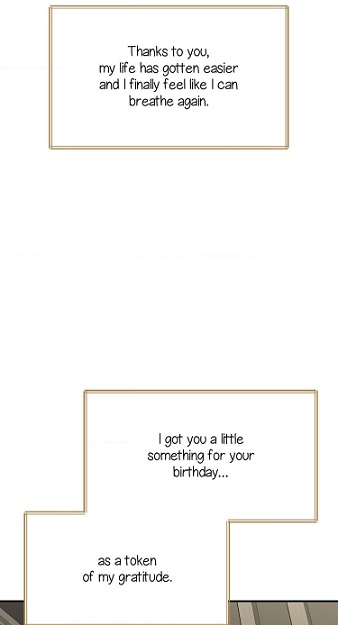 (chapter 55) This line “I finally feel like I can breathe again”, written by Kim Dan, reveals a subconscious acknowledgment that his relationship with the champion represents a breath of fresh air, a chance to escape the suffocating expectations and burdens he has carried for so long. The bruise, a physical manifestation of his struggle, signals the breaking point of his role as a selfless caregiver. It challenges the illusion of invulnerability that Kim Dan has maintained and forces those around him to confront his vulnerability.
 (chapter 60) The beach, with its open and untamed expanse, symbolizes freedom and a return to the self. It foreshadows that Kim Dan’s true journey toward healing will require him to step outside the roles and confines imposed upon him, finding solace not in what is expected but in what feels authentic and liberating.
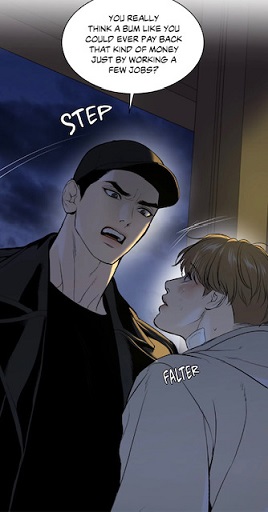 (chapter 18) His grandmother, Shin Okja, played a significant role in this mindset by fostering the illusion that hard work and sacrifice would erase the debts. However, as revealed in episode 18, this was a lie. Shin Okja made the choice to take on the loan and not to seek help
 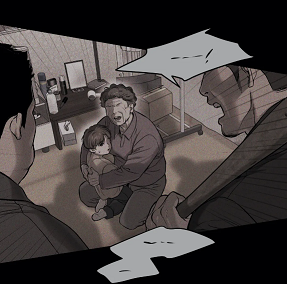 (chapter 5), yet she burdened Kim Dan with it, using his sense of duty and gratitude against him. Her statement in episode 57
  (chapter 18) —or, more accurately, the lack thereof. The champion’s actions were motivated by a desire to help
  (chapter 18), hence the star was waiting for a smile from Kim Dan. Yet the latter perceived it as meddling. His immediate response
  (chapter 53), leaving a note when he moved out that promises to settle the debt. However, by Episode 61, Kim Dan is no longer mentioning the debt, signaling a shift in his priorities and a possible breaking point in his adherence to his grandmother’s expectations.
 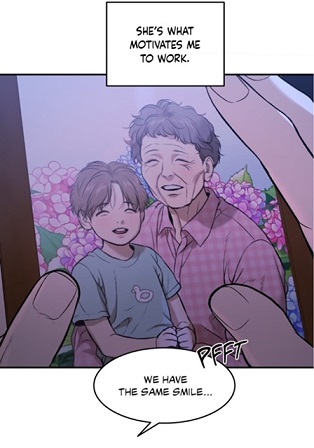 (chapter 47) The physical therapist’s entire existence had revolved around fulfilling her needs, from managing the debt to taking care of her health. With her now approaching death and actively pushing him away, Kim Dan is left grappling with a profound sense of meaninglessness.
  (chapter 60) He had never been given the opportunity to develop dreams or ambitions of his own, as his life was entirely defined by his grandmother’s circumstances. This lack of agency further explains his rejection of Joo Jaekyung’s generosity in Episode 18 and his later promise to reimburse the loan. Clinging to this promise was Kim Dan’s way of creating purpose and meaning in a life that had otherwise been dictated by others. It highlights how deeply entrenched his self-sacrificing tendencies are, as even his attempts to assert independence are rooted in his conditioned need to serve others. That’s why I come to the following prediction. Kim Dan needs to get confronted with illness and death (he could lose his life) so that his will for life comes to the surface. Right now, he imagines that since he is young, he will outlive his relative, but the death of the puppy was a warning to him that youth is no guarantee for a long life.
  (chapter 59) Death can take away anyone and at any moment. In my eyes, if Joo Jaekyung uses his own body to save the doctor again (like for example blood transfusion and CPR), this time Kim Dan would feel truly grateful towards the champion. So far, the doctor has not recognized the star as his savior yet. By removing the needle, he denied the protagonist’s intervention on the beach:
  (chapter 60) Hence his arm got bruised. The contusion was a reminder that something had happened during that night, but Kim Dan chose to ignore the incident. He never questioned why he was on the beach, he acted, as if Joo JAekyung had lied.
  (chapter 60)
 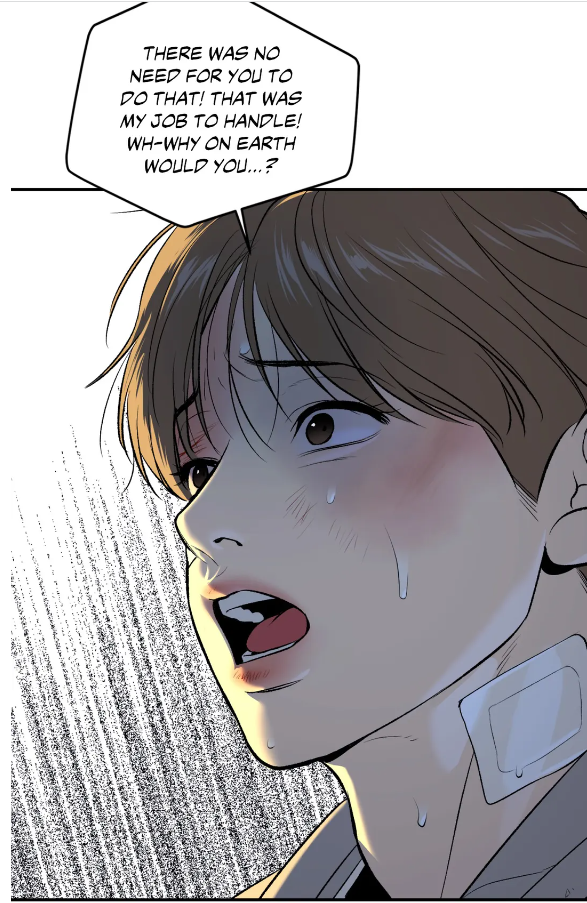 (chapter 18) Deep down, Kim Dan knows that the debt was never truly his responsibility, making it difficult for him to view the champion’s actions as a genuine act of kindness. This inner conflict is compounded by his suicidal disposition, which renders the concept of repaying the debt meaningless.
 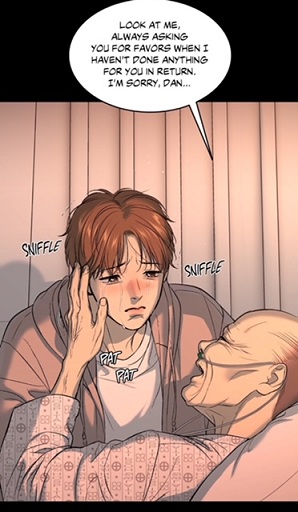 (chapter 53) and guilt to manipulate Kim Dan into fulfilling her wishes, framing his sacrifices as acts of love and duty. Her neglect and disregard for his well-being, even as he deteriorates physically and emotionally, highlight her selfishness. Through his past memories, readers can get a glimpse of his misery.
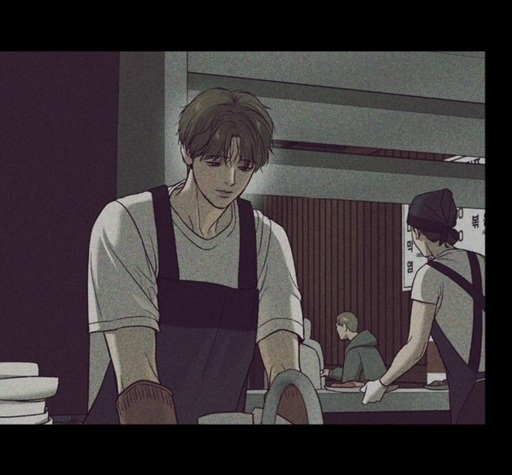 (chapter 59) He worked so hard, was even beaten, but he could never voice his torment.
 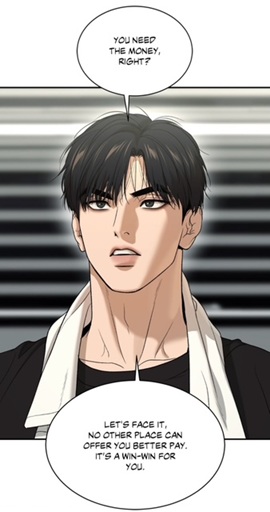 (chapter 60)
  (chapter 11) and even uses his own words against him:
  (chapter 22) The loan was the result of his grandmother’s decision. He never helped him, rather his grandmother.
  (chapter 11) However, he never explained his circumstances to the generous athlete. By keeping him in the dark, he reinforced his negative disposition about the doctor. And chapter 61 exposes this reality. His suffering was the result of his own decision.
 (chapter 61) Do you recognize the room? That was the doctor’s
  (chapter 19)
  (chapter 53) His decision to allow Joo Jaekyung into his bedroom in episode 61 demonstrates that he consented to the relationship, even if begrudgingly.
 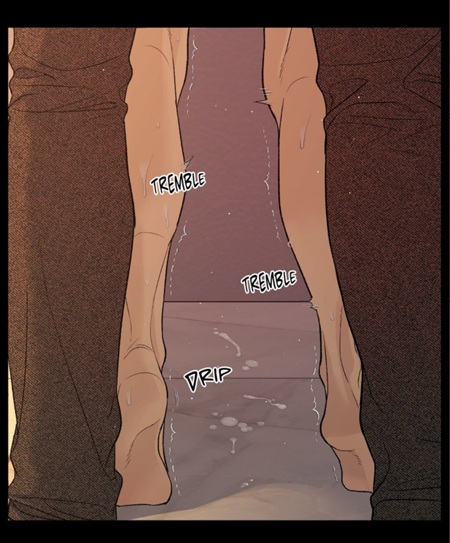 (chapter 61) and acted like in episode 6.
  (chapter 6) or 8
  (chapter 8) where he would abandon the protagonist right after the climax and not care about his partner’s conditions and feelings:
 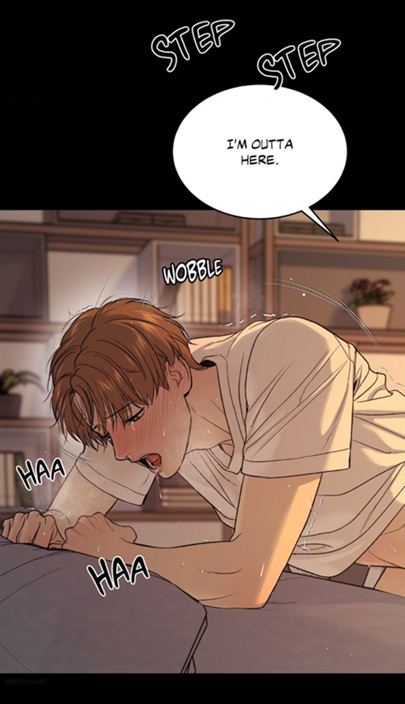 (chapter 61) I might be wrong, but for me, it took place much later in the story, around the time the athlete was about to face Alfredo. Why? First notice that they had sex in the doctor’s bedroom. This means that Kim Dan was already living in the penthouse. The words from the champion implied that he would return to his own bedroom, where the doctor’s thoughts implied that he was standing close to his bed. However, so far, they only had sex in the champion’s bedroom, when it was the evening before the match:
 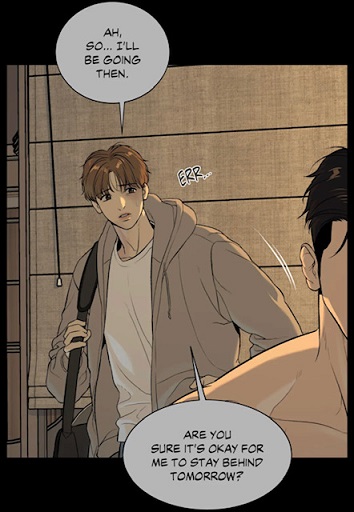 (chapter 13) Since the doctor mentioned that a match was right around the corner
  (chapter 61) It leaves us four possibilities. Randy Booker, Dominic Hill, Alfredo
  (chapter 47) and Baek Junmin. However, for the intercourse took place in the doctor’s bedroom (he wished to be carried to his own bed)
  (chapter 36), for they had sex every day. However, in episode 53, we discover their night before the match against the Shotgun
 (chapter 53) So this scene can only have taken place in chapter 47, when the match with Angelo got canceled and Kim Dan had been confronted with the terrible news about his terminally ill grandmother.
  (chapter 47) In the previous part of this essay, my avid readers could see the strong parallels between 61 and 47. But there exists another reason why I am inclining to think that the sex scene took place later in the story. It is because during that “magical night” (44), Kim Dan learned the notion of “consent”.
 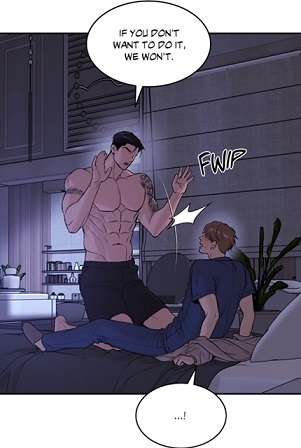 (chapter 44) During that blue hour, Kim Dan discovered that he could say no! And notice that in his memory, he clearly thought that he could have rejected the athlete’s advances.
  (chapter 46) He should mistrust the members from the gym and keep his distance from people. So during that time, Joo Jaekyung did follow his hyung’s advice
  (chapter 47), yet I can’t imagine that this man could become abstinent like in episode 19. Hence at some point, he must have felt the urge to possess Kim Dan, a mixture of fear and dominance. He imagined that way that he could impose his will onto the doctor and control his “loyalty”. With this submission, he would force the doctor to remain by his side. But naturally, this sex as “power play” could increase the gap between the main leads.
 (chapter 53) doc Dan was copying the champion’s behavior from episode 61. Right after the sex, he would leave the bed and return to his bedroom. How did Joo Jaekyung recall this night?
 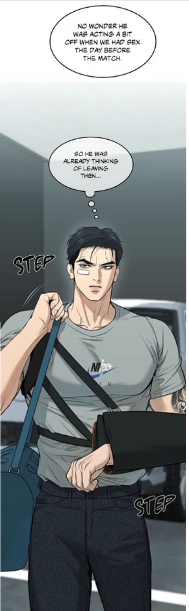 (chapter 53) He saw his attitude as a sign of disloyalty and “abandonment”. And that’s how Kim Dan is feeling in the restroom:
  (chapter 61) I had already pointed out the increasing resistance and resilience from Kim Dan in episode 60:
 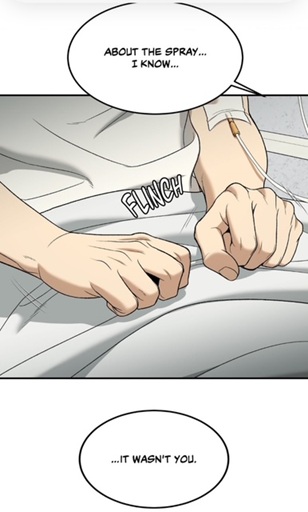 (chapter 61) My prediction came true. In the past, he could have denied the existence of the deal, Joo Jaekyung was free to seek another physical therapist. He never realized that he had some leverage. Yet he still followed the athlete’s requests. He saw himself bound by obligations. However, this was just an illusion. Hence in episode 61, we see him legitimating his consent that there was an imminent fight.
  (chapter 40) He is paid to receive bruises, to push his body past its limits
  (chapter 50), to endure pain while the public watches and profits are made. His suffering is entertainment, a spectacle that fuels the business of MMA. Though he is a champion, he is still a commodity, expected to perform regardless of his condition.
  (chapter 61) He understands, better than anyone, what it means to be physically used for the sake of others, yet he remains blind to the fact that he has placed Kim Dan in the same position. While one has no file about his health condition, the other has many files, but they are not studied, because this would push the manager to question his decision and even ruin the business:
  (chapter 17) I doubt that Park Namwook studied them, and notice that the recently hired PT didn’t ask for the champion’s files first:
  (chapter 54) Thus I deduce that the champion’s files are in reality a subterfuge. They give the impression that the doctors and Park Namwook truly care for his well-being, but it is not correct. They are only interested in his body because of wealth and reputation. But let’s return our attention to episode 61 and the champion’s attitude towards Kim Dan.
 (chapter 57) is another manifestation of his conditioned role as a caregiver. By living with an older man, he creates the illusion of a familial bond, mirroring the dynamic he shared with his grandmother. This decision highlights his struggle to break free from the identity imposed on him—one defined by servitude and selflessness. He assumes that he should take care of the landlord, offering to cook and expressing guilt for not fulfilling this perceived duty. Yet, the landlord subtly challenges this narrative. By inviting Kim Dan to eat breakfast
  (chapter 57) and dismissing his apologies, the landlord treats him as an equal rather than a caretaker. This dynamic forces Kim Dan to confront his false perception of himself.
 (chapter 57) Despite this, Kim Dan rejects the advice, demonstrating his resistance to being cared for. This moment underscores his internal conflict—he craves independence yet clings to the role of the selfless provider. The landlord’s actions expose the fallacy of Kim Dan’s identity, revealing that his caregiving is not always necessary or effective.
 (chapter 61) is indicating the increasing resent and anger towards the star. Joo Jaekyung is no longer seen as a celebrity and idol, but as a inconsiderate man. This transformation is subtle but meaningful, as it reflects his burgeoning awareness of his own worth and the unjust treatment he has endured. For the first time, Kim Dan acknowledges himself as pitiful
  (chapter 53)
 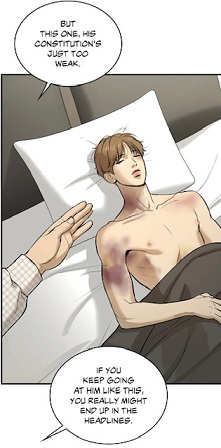 (chapter 13) and the fragility of Kim Dan’s existence. For Kim Dan, it challenges his self-perception as an indestructible caregiver. This realization could lead him to an inevitable conclusion: his own needs and well-being are just as important as those of others.


 Bebebisous33s' analyses in K-Dramaland and Manhwas