

Please support the authors by reading Manhwas on the official websites. This is where you can read the Manhwa: Jinx But be aware that the Manhwa is a mature Yaoi, which means, it is about homosexuality with explicit scenes. Here is the link of the table of contents about Jinx. Here is the link where you can find the table of contents of analyzed Manhwas. Here are the links, if you are interested in the first work from Mingwa, BJ Alex, and the 2 previous essays about Jinx The Piercing Amber Shore and The Unseen Game of Life
It would be great if you could make some donations/sponsoring: Ko-fi.com/bebebisous33 That way, you can support me with “coffee” so that I have the energy to keep examining Manhwas. Besides, I need to cover up the expenses for this blog.

SMACK
It begins with a gesture that is refused. 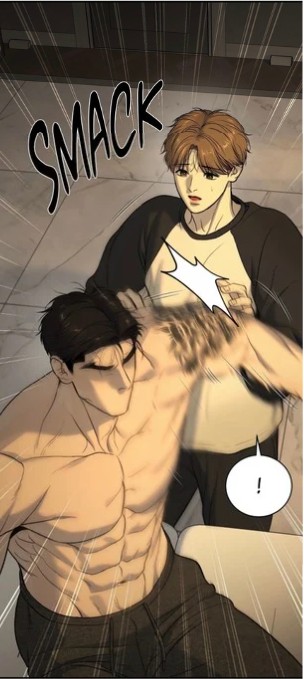 (chapter 96) A hand reaches out to continue what is not yet finished. Kim Dan tries to stop the champion, to maintain the contact, to complete the treatment.
 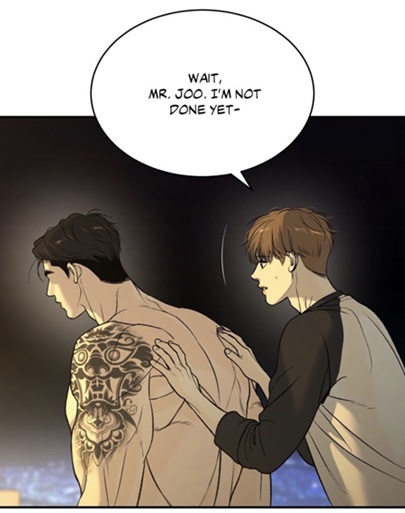 (chapter 96) The response is immediate: Joo Jaekyung pushes the hand away.
This gesture is brief, but not accidental. What is interrupted here is not simply a movement, but a relation. A touch meant to relieve tension does not create connection. It remains limited to the body, without opening any space in which the burden itself might be shared. Between intention and response, between movement and meaning, something falls out of sync. But let me ask you this. When does such a misalignment begin? Is it in the gesture itself, or long before it?
When I first composed the illustration Tactile Dissonance , episode 96 had not yet been released. That’s why the gesture in the picture is not included. Yet I had already sensed the coming rupture. I was not working from an abstract impression alone. Two specific scenes were already guiding my thinking: the one on the beach, where Kim Dan and Joo Jaekyung share a quieter, more immediate form of proximity 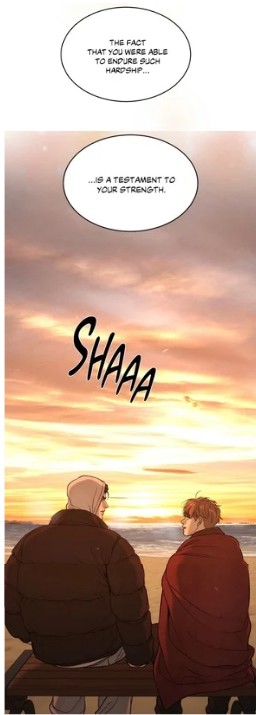 (chapter 95), and the one in the office, where Park Namwook places his hand on the champion’s shoulder and directs him once more toward performance.
 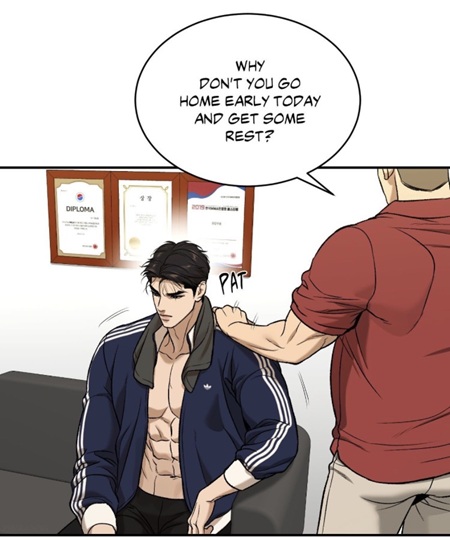 (chapter 95) Both scenes belonged to episode 95, and together they already announced a growing dissonance.
Two spaces seemed to coexist without fully meeting. One was structured, directive, and oriented toward control and performance. 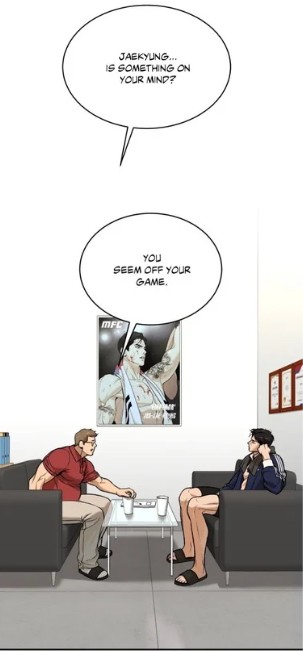 (chapter 95) The other was quieter, grounded in proximity, shared time, and a more fragile sense of presence.
 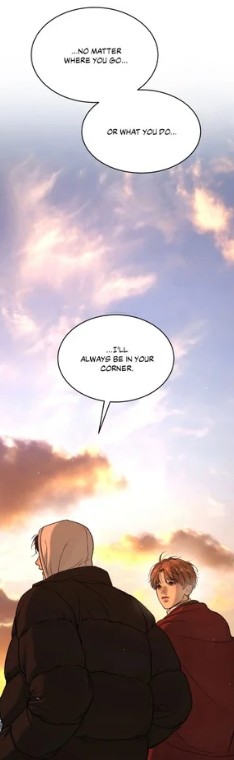 (chapter 95) They did not openly clash, but they did not align either.
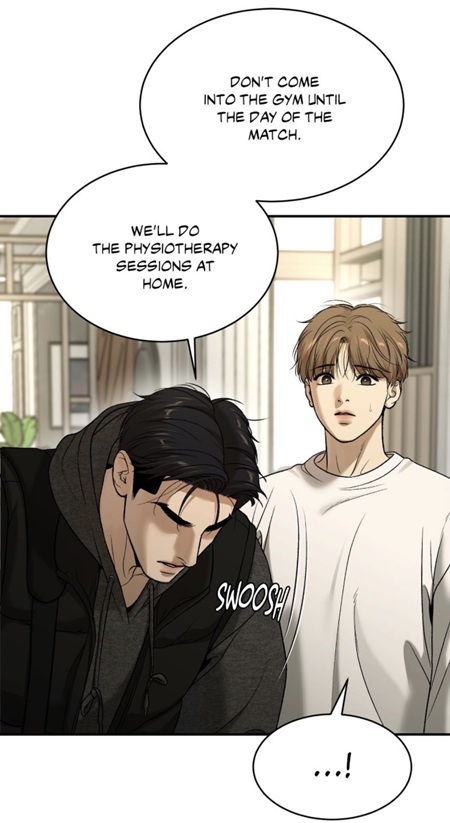
Seen in this light, chapter 96 does not introduce the disturbance. It makes visible what episode 95 had already begun to prepare. Now that episode 96 has been released, many readers perceive something familiar. They speak of a return, of repetition, of the “old” Joo Jaekyung resurfacing. Why? Because they adopt Kim Dan’s perspective. 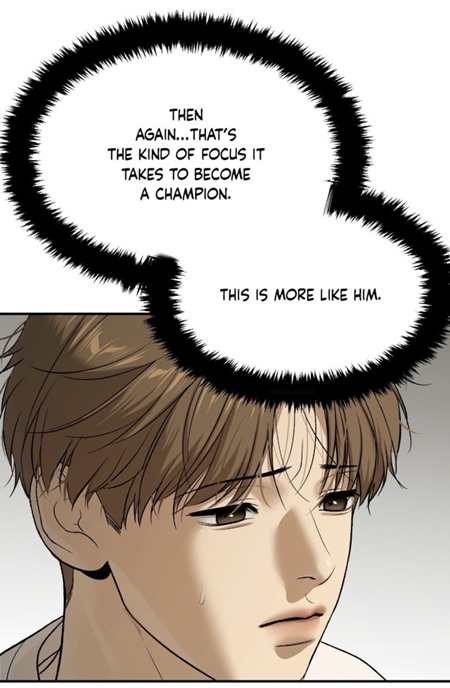 (chapter 96) From where he stands, the words and gesture appear as rejection, and the scene seems to confirm an old pattern.
 (chapter 96)
But is it really a return? What appears to be continuity may in fact be something else coming into view. Not a simple regression, but the surfacing of a misalignment that had already begun to emerge between those two earlier scenes. What chapter 96 reveals is not merely anger, but a growing lack of synchrony between different meanings of touch.
This disturbance does not remain confined to a single gesture. Once perceived, it begins to reappear elsewhere 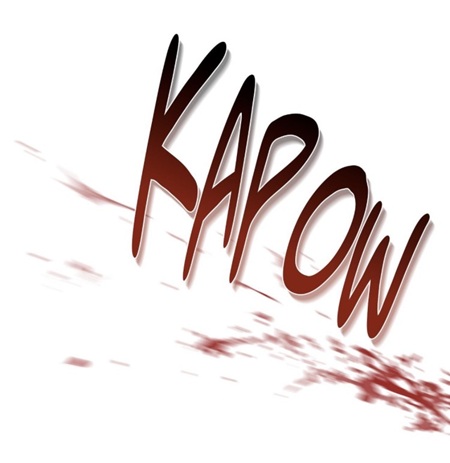 (chapter 95): in what is missing, in what is delayed, in what no longer coincides. A presence that is no longer acknowledged.
 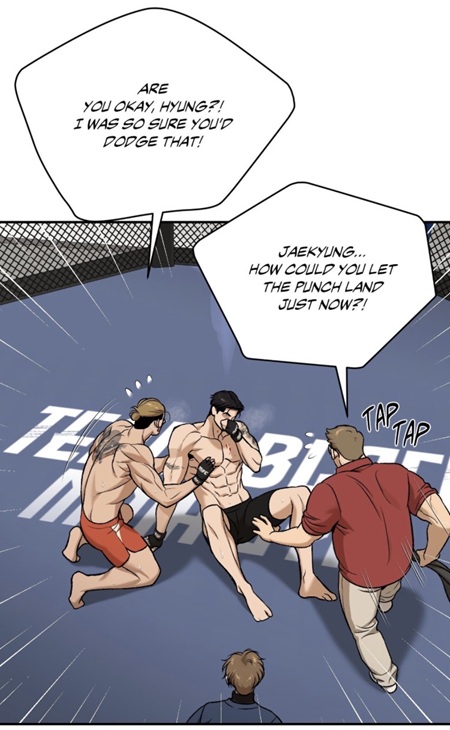 (chapter 95) A response that arrives too late.
 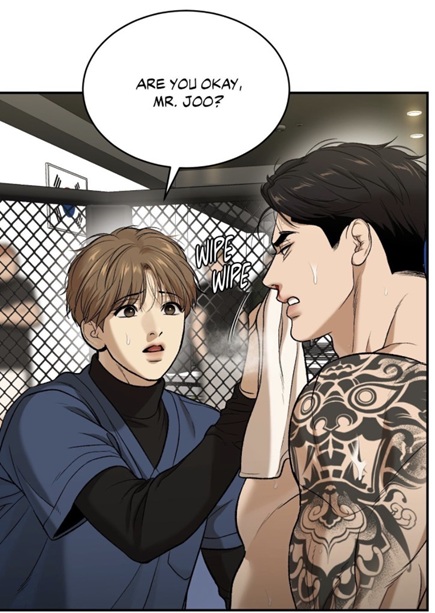 (chapter 95) A touch that relieves tension, but does not invite the burden to be shared.
 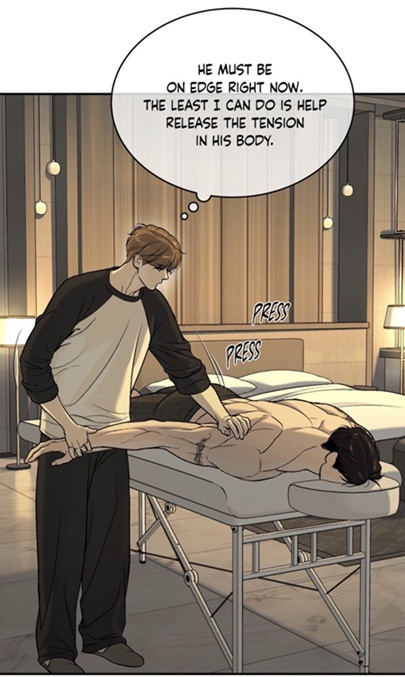 (chapter 96) A hand placed on a shoulder as if the body itself could once again be used to solve what language, trust, or recognition have failed to address. (chapter 95) Nothing overtly breaks, and yet continuity begins to loosen.
Where, then, does this disturbance become perceptible? In absence? In timing? In the way bodies approach (chapter 95) — or fail to?
To follow this movement, we need to look more closely at what does not immediately impose itself: the gaps between exchanges, the intervals between actions, the subtle shifts that gradually alter how each scene holds together.
Absence Before Intrusion
The disturbance does not begin with noise. It begins with something much more unsettling: silence and absence.
When we examine the first scene in the office from episode 95, Joo Jaekyung is not surrounded. 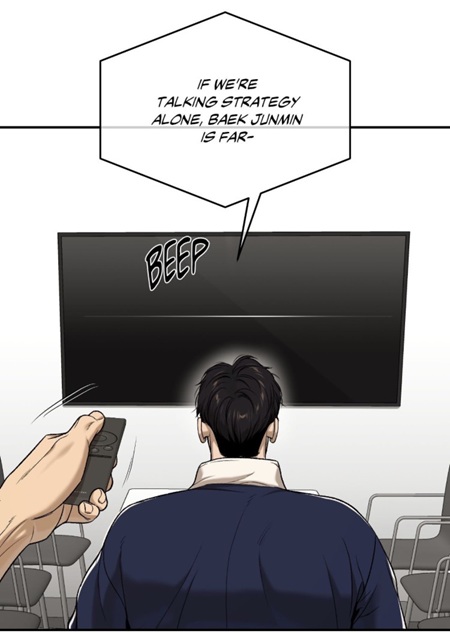 (chapter 95) There is no entourage
  (chapter 36), no managers, no advisors
  (chapter 47), no representatives from the entertainment agency
 (chapter 81). And yet, we know this moment matters: the match is approaching, the stakes are high, the narrative around him is already circulating. He only has 10 days left.
So we have to pause. Where is everyone? (chapter 95) In earlier moments, this kind of preparation was never solitary. There were always voices, intermediaries, people whose role was precisely to frame, manage, and anticipate what was coming. But here, none of them are present. Not even Yosep. And the latter was already absent in the meeting before the match in Paris.
At the gym, he is nowhere to be seen that day. 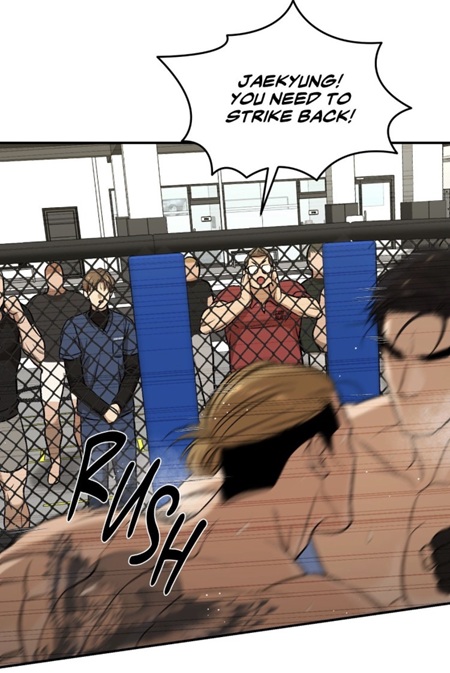 (chapter 95) It becomes even more obvious, if you compare the sparring between the champion and Oh Daehyun
 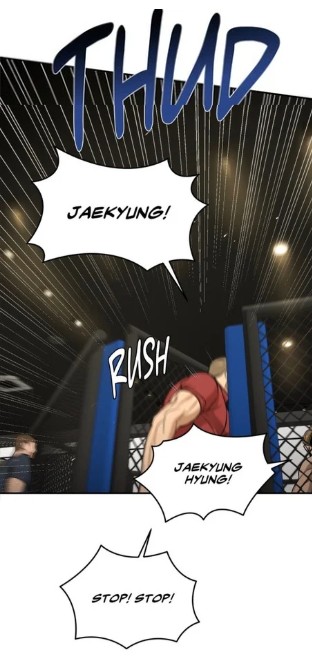 (chapter 95) and the one in episode 1, where the other partner got injured.
 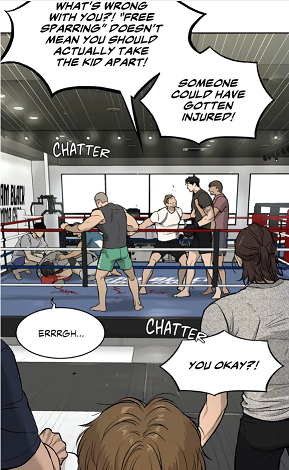 (chapter 1) He rushed to the injured fighter. But in episode 95, he is invisible. No explanation, no transition. His absence is not emphasized—and yet, it echoes. Especially if we recall episode 46, where he was on the verge of being sent out
 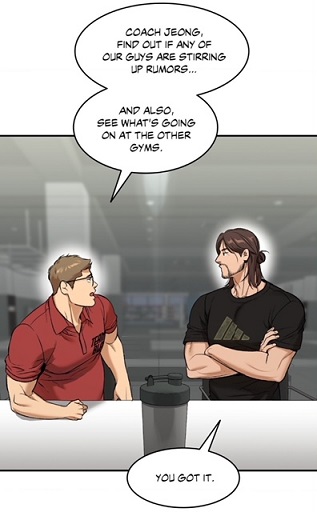 (chapter 46), tasked with gathering information, while Park Namwook positioned himself as the director of Team Black:
 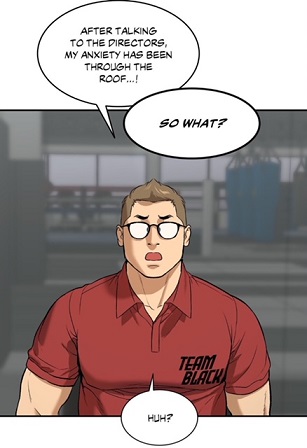 (chapter 46) This detail is not incidental. It establishes a division of roles that is directly connected to a larger structure: the network linking gyms and the MFC. This network is not hypothetical; it is explicitly confirmed in episode 49
 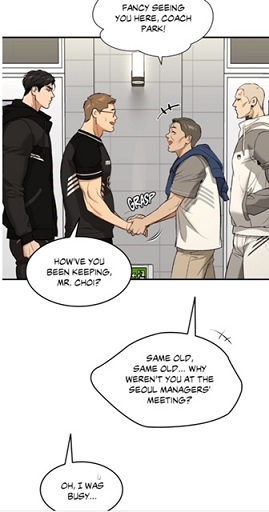 (chapter 49), when Choi Gilseok asks Park Namwook why he was absent from the Seoul managers’ meeting. In other words, coordination between gyms and directors is not occasional—it is organized, expected, and institutionalized.
If we return to episode 95 with this in mind, Yosep’s absence can no longer be read as a simple gap in the scene. It acquires a precise function. If Park Namwook is physically present at the gym 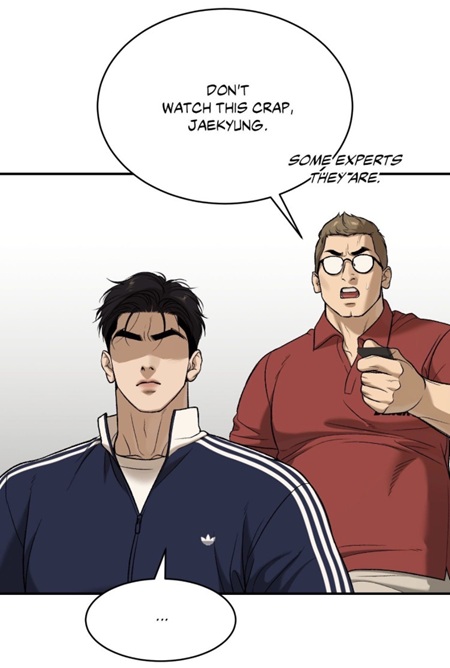 (chapter 95), yet we know that meetings and exchanges between directors must still be taking place, then the question becomes unavoidable: who represents Team Black within that network at that moment?
The most coherent answer is that Yosep has now been tasked with that role. Let’s not forget that he is the one who reported the incident with the switched spray to MFC and the police. 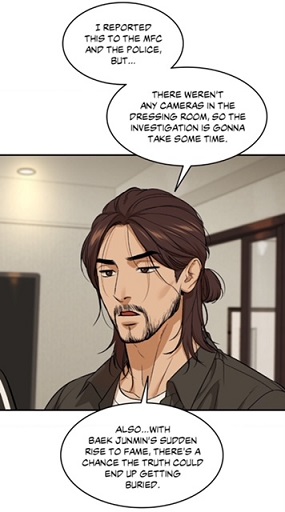 (chapter 52) His absence in episode 95 is therefore not passive. It indicates that he is operating elsewhere, in contact with the MFC and other gyms, possibly relaying information or participating in discussions that remain off-screen.
And if that is the case, then another implication follows. Yosep’s path cannot remain confined to Team Black. It necessarily extends into the same network of directors introduced in episode 49. Once this structure is established, his absence in episode 95 no longer appears accidental, but functional. He is positioned within a space where exchanges between gyms take place, where information circulates, and where decisions are coordinated beyond the immediate scene.
This has a direct consequence. (chapter 95) If Yosep is operating within that network, then his trajectory is no longer limited to internal interactions. It must, at some point, intersect with other directors—among them Choi Gilseok, whose role as the head of King of MMA places him at the center of that inter-gym structure.
And this is where episode 96 introduces a revealing shift. 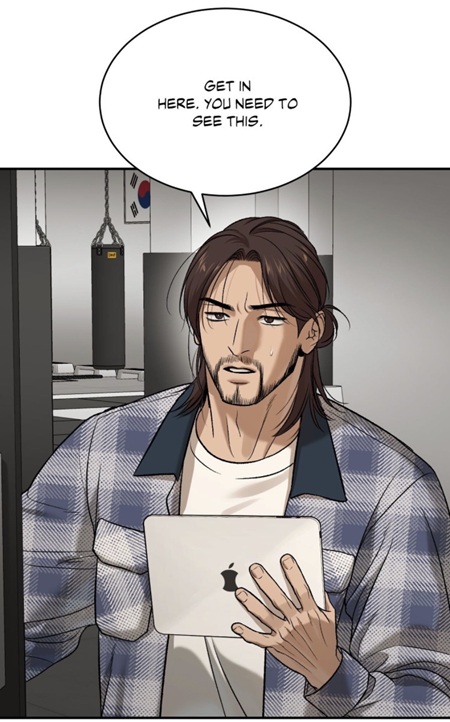 (chapter 96) Yosep is the one who calls Joo Jaekyung. He is already informed. More importantly, he is the one who presents the video—the interview in which Baek Junmin openly frames the confrontation.
This is not entirely new. Yosep had already acted as an intermediary in episode 52, when he reported the switched spray incident to the MFC and the police. (chapter 52) At that moment, his role was to transmit information upward within the system, in an attempt to clarify the situation and prevent it from being buried.
But in episode 96, this function takes a different form. Yosep no longer operates within a controlled, institutional framework. 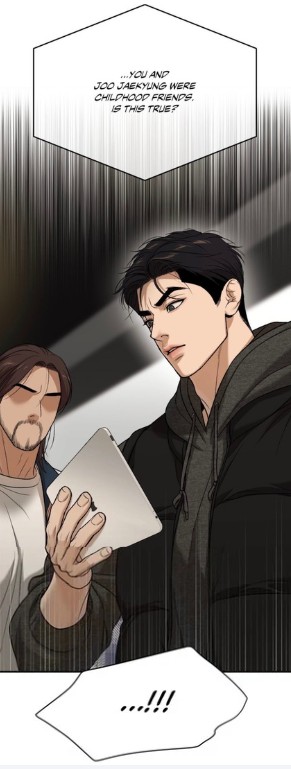 (chapter 96) Instead, he becomes the relay of a narrative that is already circulating publicly. What he transmits is no longer a report meant to establish truth, but a mediated version of events—one that exposes Joo Jaekyung to an external gaze shaped by others.
 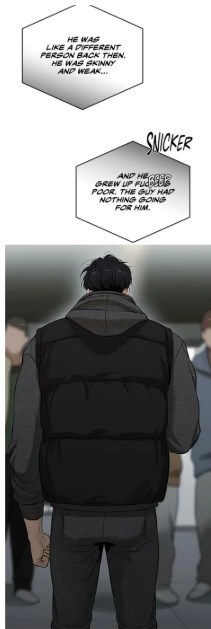 (chapter 96) And this is precisely why the final panel echoes the earlier scene in the office. (chapter 95) In both cases, Joo Jaekyung is positioned in front of a surface that reflects him—not literally, but symbolically. In episode 95, the television interrupts the voice of strategy and replaces it with an image that speaks without dialogue. In episode 96, that image is no longer neutral. It carries a judgment, a narrative imposed from the outside.
The athlete is no longer simply receiving information. He is being confronted with a version of himself constructed by others. What appears on the screen, and what circulates among the surrounding voices, functions as a distorted reflection—one that does not emerge from within, but is imposed upon him.
This is where the shift becomes perceptible. 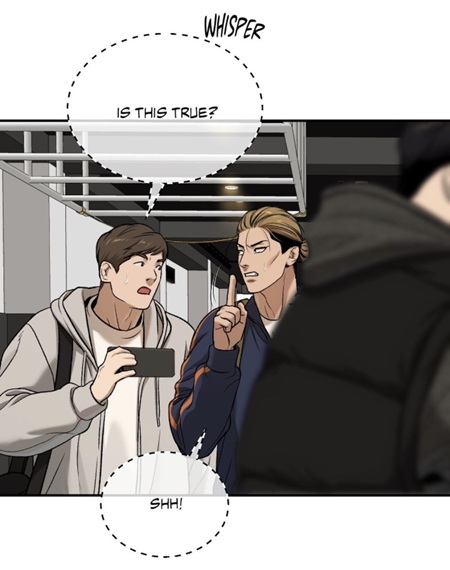 (chapter 96) The space remains silent in structure (chapter 96), but the silence is now filled with a gaze. Not an exchange, not a dialogue, but an exposure. The crowd does not speak to him; it looks at him. What changes at this point is not only how he is seen, but how this gaze begins to affect him. The image imposed from the outside does not remain external. He is forced to just consume the image. It begins to function as a reflection—one that reduces him to weakness, to a past version of himself framed as inadequate.
This is where the psychological dimension emerges. The discomfort is no longer limited to exposure. It becomes internal. What he faces is not only the judgment of others, but the possibility that this image might coincide with something he already struggles to reject.
The fear, then, is not simply being seen. It is recognizing himself in what is being shown. What appears on the screen does not just distort him—it confronts him with a version of himself he cannot fully distance himself from. It is the moment when the external and internal critic shake hands.
Presence As A Barrier
The absence identified in episode 95 does not result in an empty space. (chapter 95) On the contrary, it reveals a configuration in which presence itself becomes insufficient—and, at times, obstructive.
Yosep’s displacement into the network has already altered the structure of mediation. His absence from the room signals that the circulation of information now takes place elsewhere, beyond the immediate scene. What remains, however, is not a neutral void. Park Namwook is present. (chapter 95) From his position, one might assume that he is watching Joo Jaekyung’s back—that his presence compensates for the absence of others.
But this interpretation depends on taking the scene at face value. And this is precisely where caution is required.
Because the sequence encourages a specific reading: we see the athlete hearing the comment from the moderator 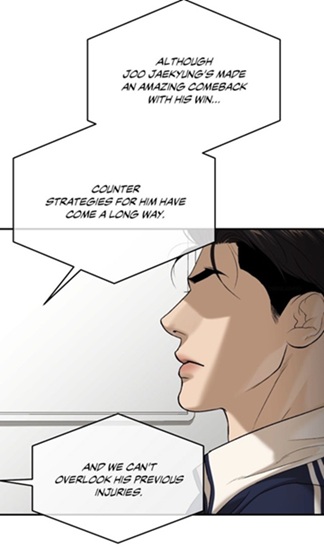 (chapter 95) while seated in front of the television (chapter 95), and only afterwards do we hear the manager’s voice (chapter 95) The arrangement leads us to infer that Joo Jaekyung must have switched on the TV himself in order to watch the program.
But is that what the scene actually shows?
A closer reading—one that does not rely on appearance alone—reveals a different configuration. The television is already on before any identifiable action is clearly attributed to him.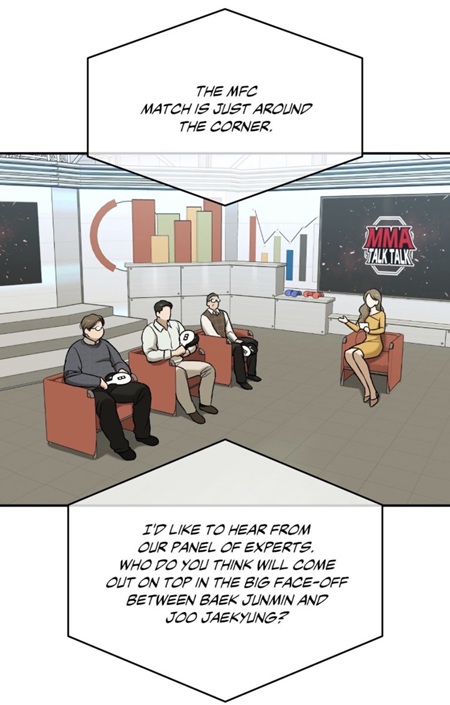 (chapter 95) Then at the end of the scene,
 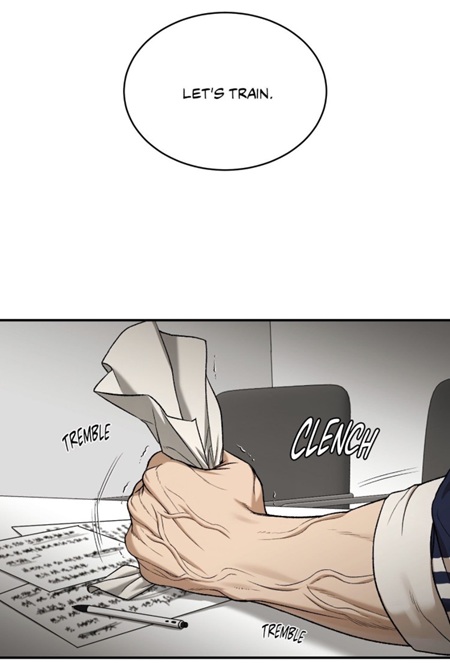 (chapter 95) the author reveals a table full of notes and a pen next to his left hand, while the champion is holding a sheet of paper. This image exposes that Joo Jaekyung was actually engaged in another activity: he was writing notes for his next fight. This implies that he was not oriented toward the act of watching, but toward a process of concentration. So why would he watch a show, when he is developing his game?
This is where Park Namwook’s position becomes crucial. (chapter 95) He is not seated beside the athlete. He does not share the table. He does not enter the space where the notes were being written and where strategy is being worked out. Instead, he stands behind him, physically present yet spatially removed from the process unfolding at the table. The distance matters. If he were truly participating in preparation, he would be positioned next to him, not outside that shared space.
The remote control matters just as much. (chapter 95) The hand with the remote control appears before the manager himself, a sign that the item was not placed on the table. It is in Park Namwook’s hand, not on the table, not by Joo Jaekyung’s notes, and not within the athlete’s immediate workspace. This detail does not prove with certainty that the manager switched the television on. But it does establish something important: control over the device is associated with him, not with the athlete seated at the table.
And there is another clue. In the key panels, Joo Jaekyung is depicted without visible eyes.. (chapter 95) In both panels, his eyes are obscured. (chapter 95) This is not a minor stylistic choice. In other moments 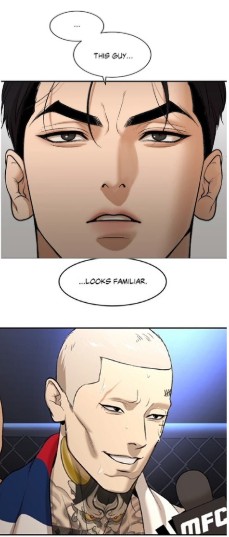 (chapter 47), his gaze is sharply defined and functions as a marker of attention
 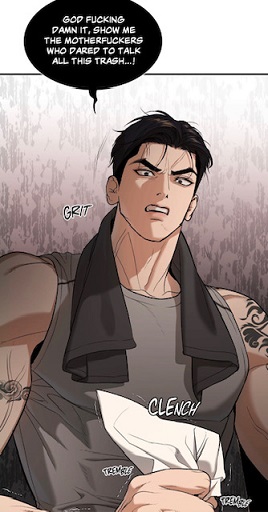 (chapter 36), recognition, or confrontation. Here, that anchor disappears. The subject is present, but not visually positioned as the origin of perception.
This is where the distinction between appearance and construction becomes decisive. From the perspective of appearance, he is watching. From the perspective of construction, he is being placed in front of an image, while the scene quietly encourages the audience to attribute that choice to him. (chapter 95)
Park Namwook’s words (chapter 95) sound protective, but they also reinforce the misleading impression that the athlete had chosen to watch in the first place. The instruction redirects attention toward Joo Jaekyung’s reaction and away from the more troubling question: who switched the television on?
That question cannot be dismissed, because the staging keeps it alive. The athlete was actually writing, before the manager arrived. The latter stands apart. The remote is in the manager’s hand. The broadcast is already running. Taken together, these details do not support a simple reading of self-exposure. They point instead toward a scene in which responsibility is subtly displaced.
In that sense, Park Namwook’s presence does not function as genuine protection. It becomes a barrier. He is close enough to shape the environment, yet too far from the table to participate in strategy. He intervenes, but only after the intrusion has already begun. And by framing the moment as if Joo Jaekyung were the one who chose to watch, he helps conceal the very conditions that made the exposure possible.
What appears, then, is not a straightforward scene of concern, but a more troubling configuration: a manager who is present, who holds the means of control, who stands behind the athlete rather than beside him, and whose intervention arrives too late while subtly shifting the burden of agency onto the one already exposed. In other words, it is not protection, but misdirection.
If the intrusion does not originate from Joo Jaekyung, then the question inevitably shifts: who benefits from this configuration—and why does it occur at this moment?
The answer may lie in a gradual shift that has already been unfolding in the background. 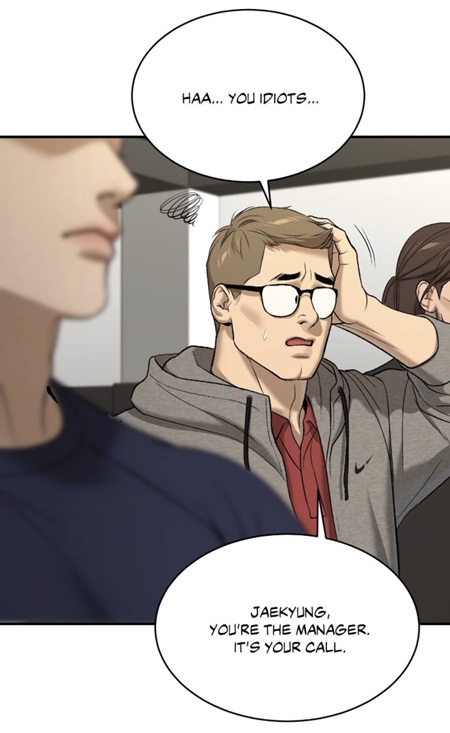 (chapter 87)
 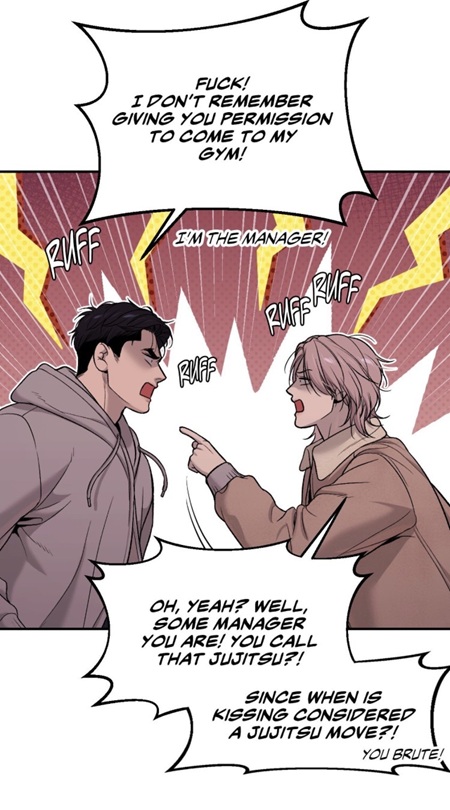 (chapter 89)
Park Namwook’s position is no longer what it once was.
Earlier, he functioned as a central figure of coordination—someone who structured preparation, mediated between systems, and directed the athlete’s trajectory within the network. But in episode 95, that role appears altered. He is present, yet no longer seated at the table where strategy is being constructed. The notes belong to Joo Jaekyung alone. The space of planning has become solitary.
This is not a minor detail. It signals a displacement. The manager is no longer actively shaping the game plan. He is no longer the one organizing knowledge, anticipating the opponent, or guiding the process. Instead, he stands aside—close, but not integrated.
Within this context, his interventions take on a different meaning.
His suggestion (chapter 95) appears, at first, as a return to fundamentals—a call to discipline, to physical preparation. But the scene contradicts this interpretation. (chapter 95) He is not training with the champion. He just stands by the side and yells some advice. The statement functions less as an instruction than as a repositioning.
A way to reassert relevance. (chapter 95) When Namwook can no longer contribute to the strategy (the mind), he retreats to the only place he has power: the body. He wants Jaekyung to be a machine again because you can “manage” a machine or tame a “beast”, but you have to “respect” a strategist. The same applies to the television sequence. If control over the device is indeed in his hands, then the intrusion is not random. It becomes part of a configuration in which he remains the one who can still act—even if he no longer defines the strategy itself.
This does not necessarily imply deliberate malice. But it does suggest a form of compensation. As his role within the system weakens, his mode of intervention shifts. He no longer leads the process 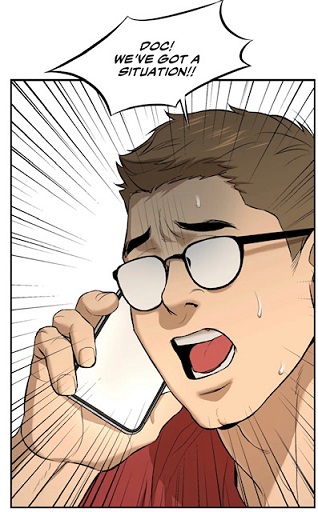 (chapter 13); he intervenes at its margins. He does not construct the framework; he reacts within it. And in doing so, he creates situations in which his presence becomes necessary again —whether by interrupting, redirecting, or framing what is happening.
Within this context, even the exposure to the broadcast can be read differently. It may function as a trigger, 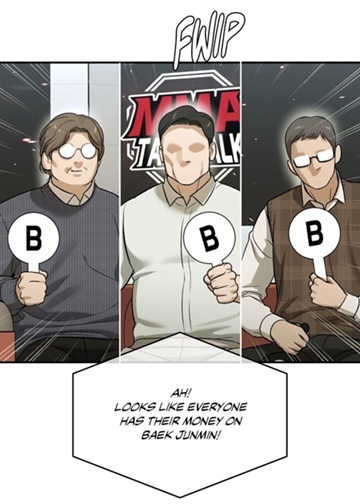 (chapter 95) an attempt to provoke a reaction, to reignite aggression, to restore a version of Joo Jaekyung defined by instinct rather than reflection. This interpretation gains weight when we consider the recent disruption of routine. Because of Kim Dan
 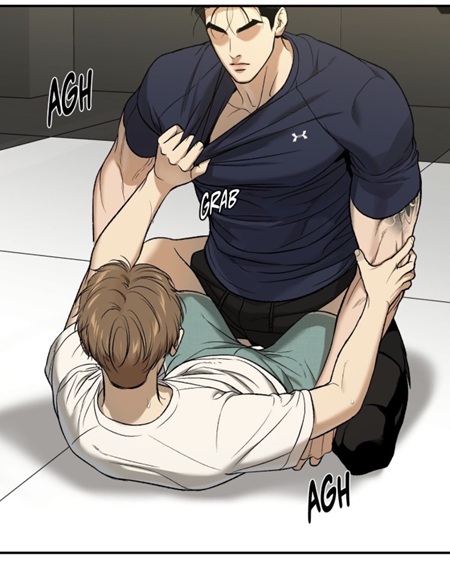 (chapter 88) and Shin Okja
 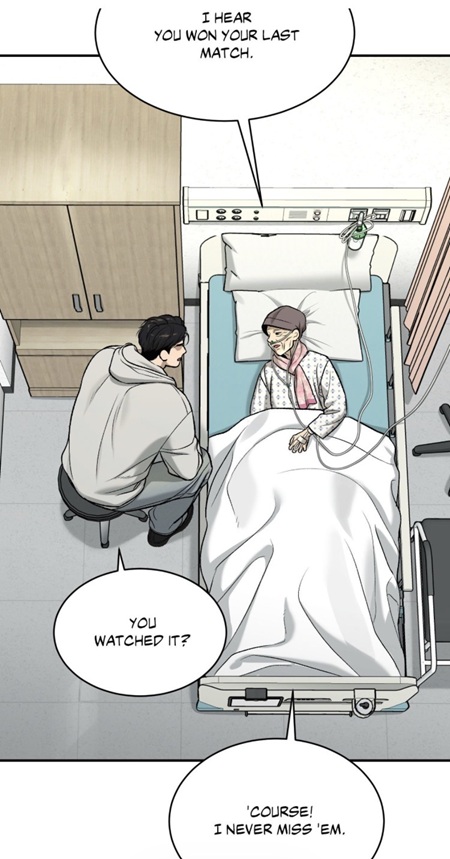 (chapter 94), the champion’s schedule has already shifted: training has been interrupted, attention divided, priorities altered.
From this perspective, the intrusion is not only a breach—it is also an attempt to recalibrate. This is why the contradiction persists. He appears protective, yet the conditions of exposure remain unresolved.
He speaks of training, yet does not occupy the space where training is structured. What emerges is not a stable role, but a transitional one—marked by loss of authority and attempts to compensate for it. And this becomes even more obvious during the conversation in the office.
The Conductors of Dissonance
What emerges across episodes 95 and 96 is not a series of isolated misjudgments, but a structural shift in how mediation operates around the athlete. Both Yosep and Park Namwook remain present as intermediaries, yet their function has fundamentally altered: they no longer regulate the flow of external information  (chapter 37) —they allow it to pass through unchecked. (chapter 96)
In high-level competition, this flow is never left unmanaged. Athletes are typically shielded from media exposure in the critical period before a match to prevent distraction conflict. As noted in contemporary sports psychology, unmediated scrutiny triggers cognitive overload and shifts an athlete’s identity from performer to victim. (for more read https://www.drpaulmccarthy.com/post/how-to-master-mental-preparation-in-sport-a-pro-athlete-s-secret-guide) This “blackout” is a fundamental principle of performance; external narratives impose an image from the outside, forcing the athlete to divide attention between performance and representation.
In Joo Jaekyung’s environment, the opposite occurs. 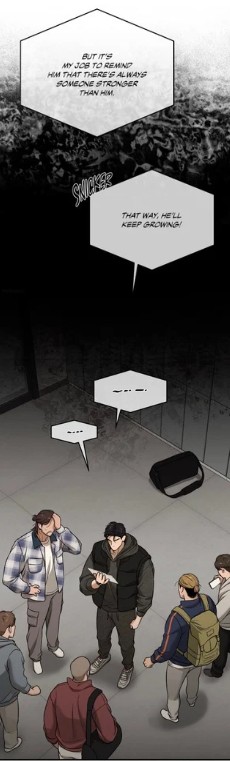 (chapter 96) The boundary between preparation and exposure collapses as the interview is introduced directly into his workspace. (chapter 96) The consequences are immediate. Instead of focusing on process —evident in the strategic notes he is writing (chapter 95) —he is drawn into what cannot be controlled: public judgment and the reconstruction of his past as weakness.
This exposure disrupts the vital transition from “life” to “sport,” from the social self to the performing body. He is not allowed to “park” the external world; he is tethered to it. The image on the screen follows him into the space where focus should be consolidated.
From Buffers to Conduits
Management is not only about training the body; it is about structuring the conditions under which performance becomes possible—controlling timing and ensuring that what reaches the athlete can be processed without destabilization. Here, the figures who should operate as buffers instead act as conduits. They do not absorb pressure; they transmit it. This shift becomes even more visible in the episode of the destroyed poster. 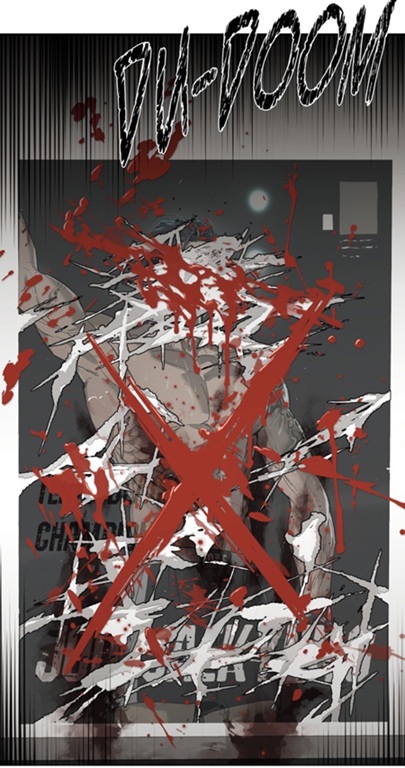 (chapter 96)
At first glance, the sequence appears straightforward: Park Namwook reacts with surprise 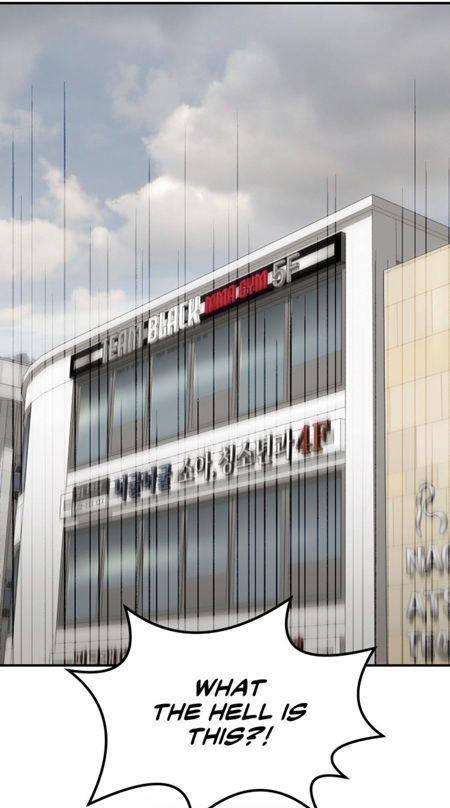 (chapter 96), but he can clear grasp the situation: an act of vandalism. Then he questions the identity of the perpetrator
 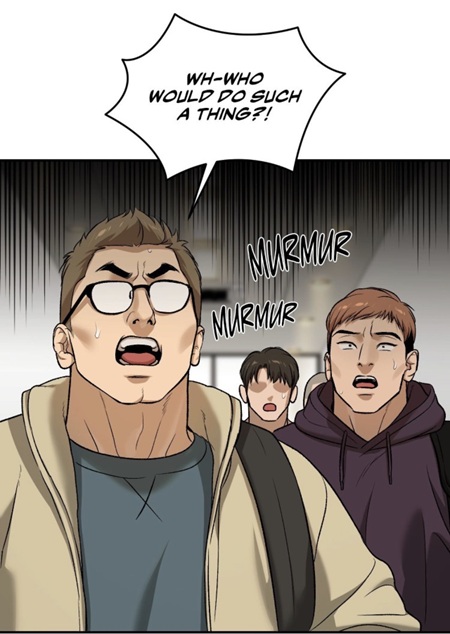 (chapter 96), and turns suspicion toward the fighters present.
 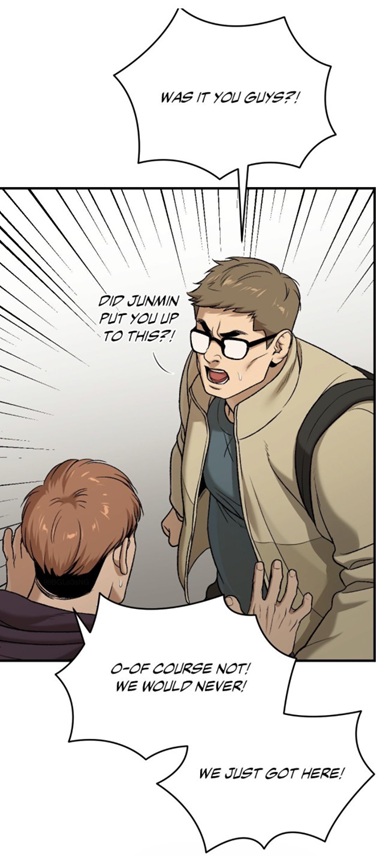 (chapter 96) The scene frames him as someone discovering the vandalism alongside the others.
But the sequence does not hold under closer examination. 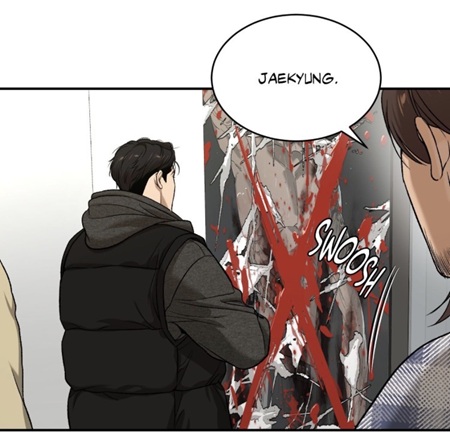 (chapter 96) Yosep is already inside the gym before the others arrive. He opens the door from the inside. This detail matters. (chapter 96) It establishes that information about the incident could have circulated before Park Namwook’s visible reaction. The coach could have called the owner of Team Black. And yet, no such prior knowledge is acknowledged. Because of the interview, no one questions his previous behavior and whereabouts.
At the same time, the manager’s response contains a contradiction. (chapter 96) He expresses confusion, asks who could have done this—yet moments later, he states that the surveillance system had “chosen now of all times to break down.” This is not a neutral remark. It implies prior awareness of the system’s failure—knowledge that precedes the supposed moment of discovery.
The scene, therefore, operates on two levels.
On the surface, it presents ignorance. Structurally, it suggests awareness. So is it a coincidence that he has a drop of sweat on his face 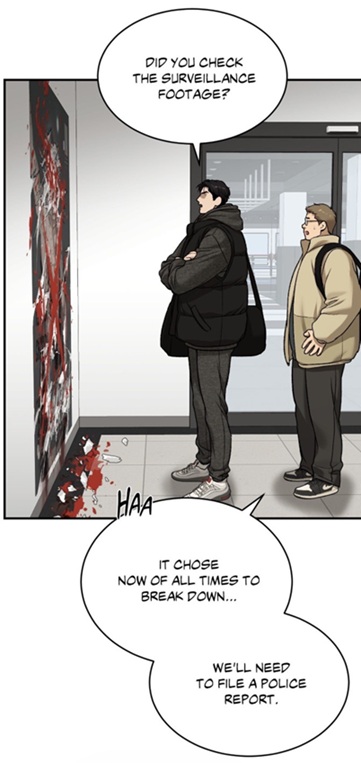 (chapter 96), when he reveals that the CCTV was not working?
This gap mirrors the earlier television sequence. In both cases, the framing directs attention toward immediate reaction—surprise, concern, intervention—while obscuring the conditions that made the situation possible. The question is not only what is seen, but what is withheld. Besides, observe that the fighter’s reply “We just got there” (chapter 96) seems to imply that it was not the case for the manager, which would explain why he knew about the broken CCTV.
Resistance and Distortion
This failure can be understood more precisely if we consider mediation as a system of circulation. Information, pressure, and expectation move continuously through the athlete’s environment. Management functions as a regulator of this flow—maintaining balance and preventing overload.
What we observe instead is the introduction of resistance. Resistance does not stop the flow; it transforms it. The information still reaches Joo Jaekyung—but no longer in a form that can be integrated. It arrives as pressure, as judgment, as an external gaze that destabilizes rather than supports.
Yosep relays the interview. Park Namwook allows—or in the best case fails to prevent—the broadcast. Both don’t report the intrusion of external events into the training space on time. In all these cases, they do not absorb or transform pressure before it reaches the athlete. They transmit it in a form that intensifies its impact. Their interactions stand in opposition to his relationship with Kim Dan which brought sparks in his life.
Energy is not removed from the system—it is converted to heat. 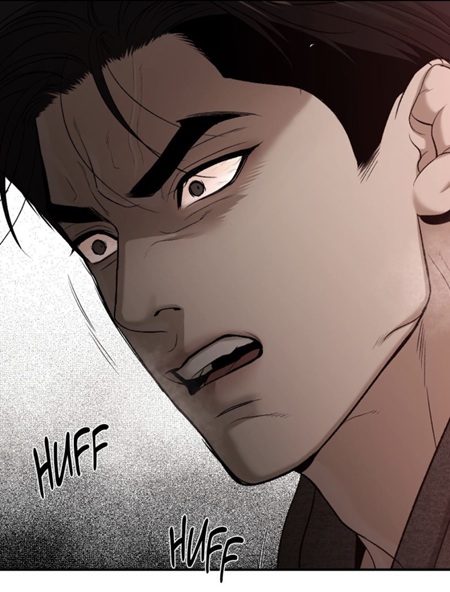 (chapter 96) This transformation is not abstract. It is rendered directly in the body of the athlete. His breathing becomes labored, his skin flushed, his eyes reddened—as if the system itself were overheating. The excess cannot circulate; it accumulates.
What could have been directed toward performance becomes agitation. In this sense, the athlete is no longer simply exposed to pressure—he becomes its site of conversion. The system does not regulate energy; it displaces it, forcing the body to absorb what should have been filtered. Their role as managers does not disappear—it degrades. They continue to mediate, but only as points of resistance within the circuit, distorting the very flow they are meant to regulate.
And once this distortion is introduced, its effects are immediate: The athlete is not simply informed—he is destabilized. Even after his outburst at the gym, Joo Jaekyung does not collapse into uncontrolled reaction. When confronted with Kim Dan’s words and actions 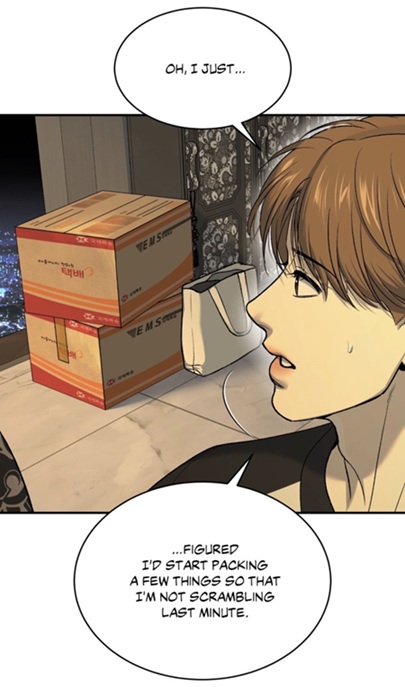 (chapter 96), he does not raise his voice.
 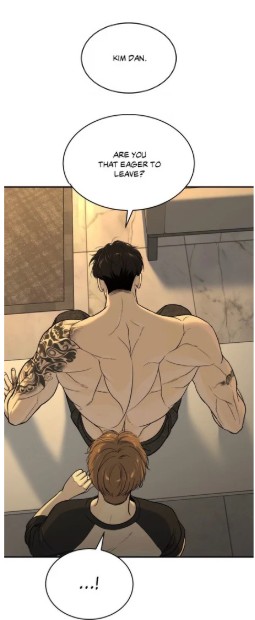 (chapter 96) He articulates his thoughts
 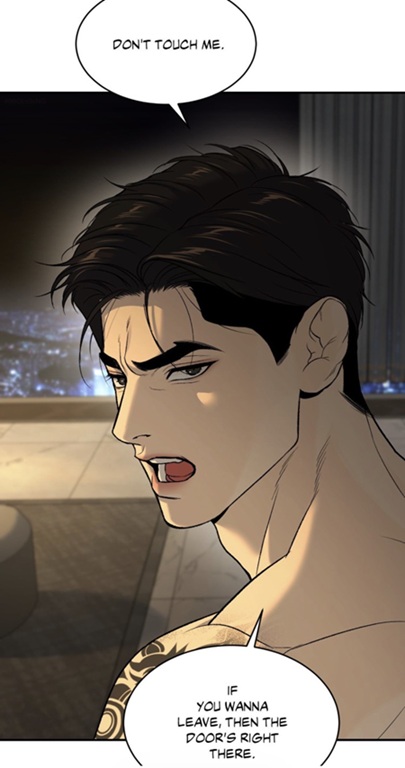 (chapter 96), maintains composure, and—most importantly—
 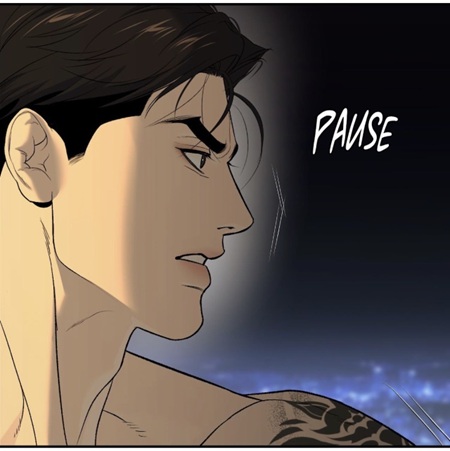 (chapter 96) attends to the other’s response before leaving.
 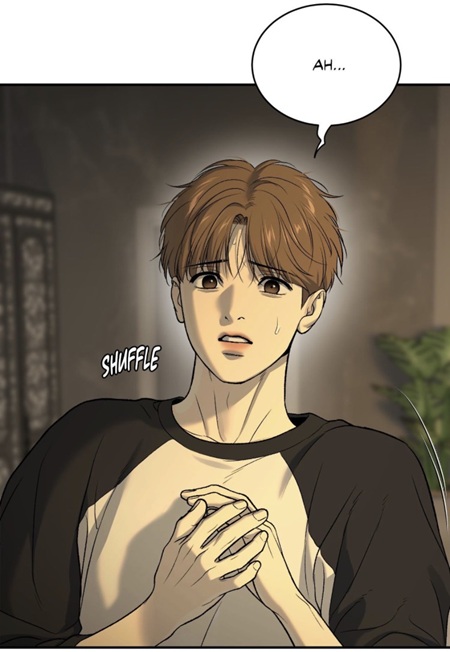 (chapter 96) This detail matters.
It reveals that the disturbance does not entirely override his capacity for regulation. The system overheats, but he does not fully give in to that state. Instead, he attempts to contain it. That’s why we can not say that the champion is like before. He has changed a lot, even much more than the physical therapist.
The imbalance, therefore, becomes more apparent. The failure does not lie in an absence of control within the athlete, but in the conditions imposed upon him. What should have been regulated externally is forced inward. He is left to process, absorb, and manage pressures that were never filtered.
In this sense, his composure is not evidence of stability—it is evidence of compensation.
The Architecture of Friction
If the first scene in episode 95 is structured by absence and intrusion, the second office scene introduces a different configuration: enclosure.
The glass door is closed. 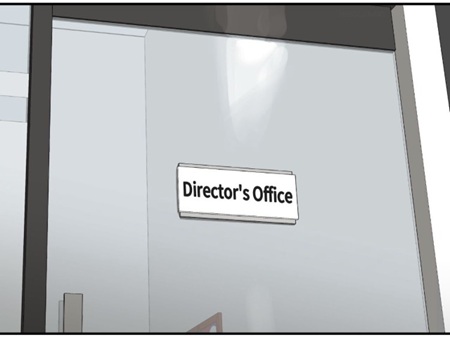 (chapter 95) At first glance, its transparency suggests continuity—the inside and the outside remain visually connected. And yet, the author frames the door in a way that emphasizes secrecy, separation rather than openness. The image functions less as a window than as a boundary.
This becomes clearer when we contrast two perspectives. 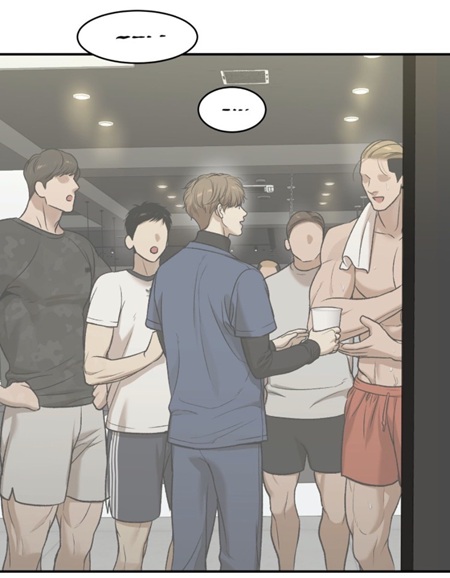 (chapter 95) From within the office, the gym is reduced to indistinct chatter. Voices are present, but blurred, stripped of clarity and meaning. What was previously intrusive—the gazes, the noise, the surrounding activity—is now filtered, contained, pushed into the background.
But from the outside, the configuration appears entirely different. Through the glass, Joo Jaekyung should be visible. The space is not fully sealed; it remains exposed to observation. The boundary does not operate symmetrically. This asymmetry is crucial.
The office isolates him from participation, but not from visibility. He is removed from interaction, yet remains within sight. The result is not protection, but a controlled form of exposure—one in which the outside is muted for him, while he himself remains visible to the outside, but not accessible. (chapter 95) In this sense, the door does not simply separate two spaces. It reorganizes their relationship.
What disappears is not the presence of others, but the possibility of exchange. And yet, the office introduces a second layer of distortion—one that concerns not only interaction, but the staging of authority. (chapter 95) We are not allowed to see inside the office through the glass door. (chapter 95) The frame isolates the sign: Director’s Office. Function is foregrounded, identity withheld. The question of who truly occupies that role remains suspended.
Inside, the spatial arrangement resolves this ambiguity—without fully clarifying it. 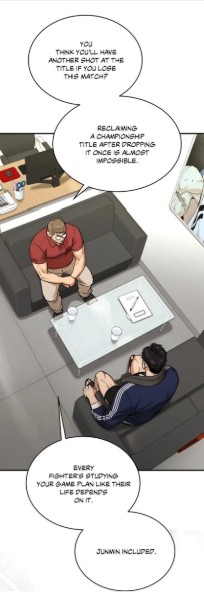 (chapter 95) The couch is positioned in front of the desk, not behind it. Park Namwook sits on that couch, facing Joo Jaekyung. He does not occupy the desk itself—the formal seat of authority remains physically unclaimed. And yet, the alignment of the space creates a different effect.
Because the couch is not neutral. It is placed directly within the axis of the desk. Sitting there, Park Namwook is not behind authority, but projected through it. The desk stands behind him like a backdrop, a silent structure that frames his position and lends it weight. This configuration produces a subtle inversion.
He does not sit at the desk— but the desk sits behind him. And that is enough to transform perception. From this position, he speaks as if the authority associated with the desk extended forward into the space he occupies. His words (chapter 95) —evaluations, warnings, directives—are no longer those of a participant within a shared process. (chapter 95) They take on the tone of someone who assesses from above, even though his position does not formally grant him that role.
At the same time, the visual field reinforces this ambiguity. (chapter 95) The diplomas and titles—belonging to the gym, to Team Black, to the fighter’s achievements—are aligned within the same spatial frame. They are not his, and yet they appear within his field of authority.
The result is not explicit appropriation, but positional absorption. He does not claim ownership. He occupies the frame in which ownership is displayed. This is what destabilizes the interaction. Because Joo Jaekyung, seated opposite him, is no longer addressed as a collaborator within preparation. He is positioned as the one being evaluated—measured against standards that are invoked from a place that is only partially legitimate.
Authority, here, does not reside in the desk itself. It emerges from the alignment between space, position, and speech. Under this new light, it becomes comprehensible why Park Namwook was surprised, when the sportsman selected the new physical therapist himself. 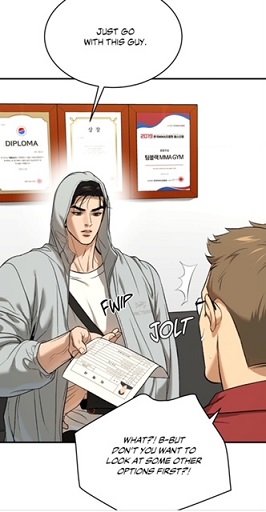 (chapter 54) He imagined that the celebrity would entrust him the selection. To conclude, Park Namwook’s seat is not random. He represents a hindrance to the fighter’s emancipation, becoming the director of a gym.
Speech, Gaze, and the Burden Shift
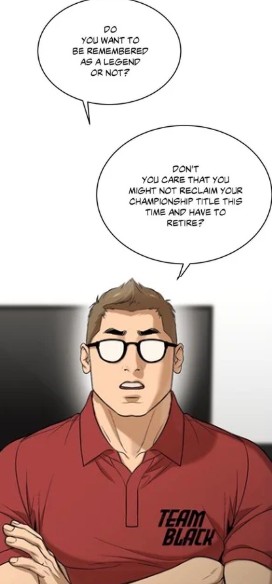
Within this enclosed space, the manager’s discourse does not merely fill the silence—it structures it. His speech follows a consistent pattern (chapter 95), one that does not distinguish between statements and questions in the way one might expect. At first glance, he appears to ask. 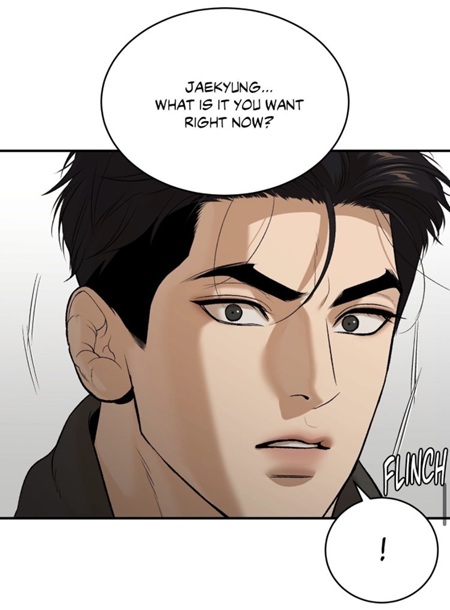 (chapter 95)
  (chapter 95)
But these questions do not function as openings. They do not create space for an answer, nor do they suspend judgment. On the contrary, they are immediately followed—sometimes within the same sequence—by conclusions that override any possible response:
Besides, when he observes 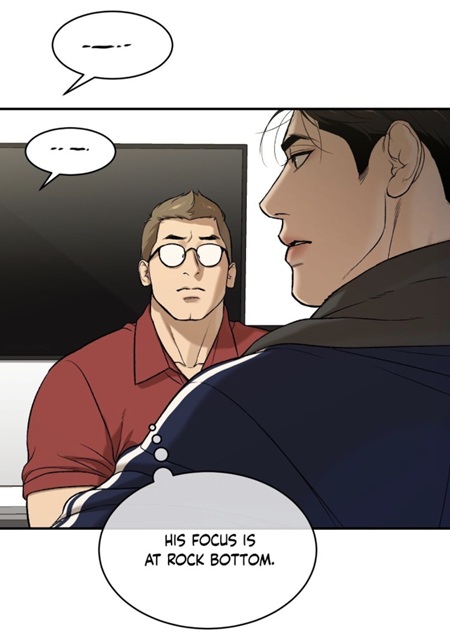 (chapter 95), readers can detect a pattern emerging.
Each question anticipates its own answer. Each one narrows the field of meaning before the athlete can speak. There is no pause, no waiting, no negotiation. The form of dialogue is present, but its function is absent. Hence it turns more into a monologue, where the manager actually reveals his own desires and dreams. He wants to be remembered as the one behind the star’s success.
The sequence is revealing. The question does not lead to understanding; it leads directly to judgment. It serves as a transition, not toward exchange, but toward interpretation. What could have remained open is immediately closed. In this sense, the distinction between question and statement collapses. Both operate within the same structure: they define rather than explore, they impose rather than receive.
The misperception becomes even more striking when we consider the direction of Joo Jaekyung’s gaze. (chapter 95) It is not directed downward, as the phrase “rock bottom” would suggest. It shifts sideways, through the glass door, toward the outside. His attention is not absent, but displaced. He is focused elsewhere: he is observing Kim Dan interacting with the other members. Contrary to the past, he is no longer reacting violently. The jealousy has vanished from his gaze. Park Namwook misrecognizes this movement. He translates lateral orientation into vertical collapse, converting a gaze toward the outside into evidence of inner deficiency. What exceeds his framework is not explored; it is redefined.
This misrecognition is not incidental. It reveals the limits of the system through which he perceives the athlete. The gaze toward the outside signals precisely what had already been established: the disruption of the transition between life and sport. The external world has not been left behind. It persists, intrudes, and continues to shape the athlete’s state. He is not allowed to become a human it; he has to remain in the sport world.
But within Park Namwook’s framework, such a condition cannot be acknowledged. For him, there is no meaningful space outside performance. 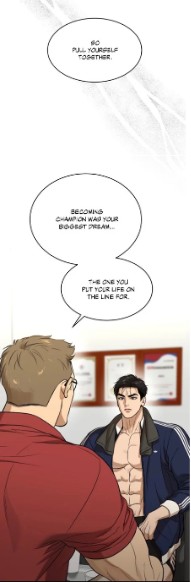 (chapter 95) There is no transition to negotiate, no boundary to maintain. There is only the fight. What appears, from this perspective, as distraction is therefore reinterpreted as failure. What is, in fact, a tension between two spheres is reduced to a flaw within one.
This reduction structures everything that follows. (chapter 95) If he loses the title, he will be reduced to nothing. What is striking is not only what is said, but what is systematically excluded. The recent intrusion—the broadcast, the circulating narratives, the external gaze—is never acknowledged as a possible cause. Its impact on the athlete’s mental state is not considered. Instead, the problem is located entirely within Joo Jaekyung himself. The disturbance originates outside, yet the responsibility is reassigned inside.
By framing the issue as a matter of “focus” or “headspace,” Park Namwook transforms a complex configuration into an individual deficit. The athlete is no longer someone reacting to pressure; he becomes someone failing to meet a standard.
This logic extends into action. When Joo Jaekyung is struck during training (chapter 95), the same structure reappears. There is no attempt to understand why the mistake occurred, no effort to connect it to distraction, fatigue, or accumulated pressure. Instead, the moment is isolated: “How could you let that punch land?” The error is treated as self-contained, detached from the conditions that might explain it. He shows no sign of empathy in the end.
Speech, here, does not investigate. It attributes. And it is at this point that speech, gaze, and gesture converge.
When Park Namwook places his hand on Joo Jaekyung’s shoulder (chapter 95), the contact appears supportive. It suggests reassurance, proximity, perhaps even solidarity. Yet within this configuration, the gesture performs a different function. It does not distribute the burden; it fixes it. The shoulder—site of weight and endurance—becomes the point at which responsibility is anchored. What has already been established through language is now reinforced through touch: everything depends on the athlete. At the same time, this gesture negates the existence of the shoulder injury and surgery.
The rhetoric intensifies this compression. The match is framed in absolute terms, almost as a matter of life and death. Alternatives disappear. Nuance disappears. What remains is a binary: perform or fail. (chapter 95) Within such a framework, there is no space left for external influence, emotional disturbance, or personal life. These dimensions are not contested; they are excluded in advance.
This narrowing of perception is also visible in the gaze. In one panel, Park Namwook’s eyes are fully rendered—sharp, focused, unequivocal. 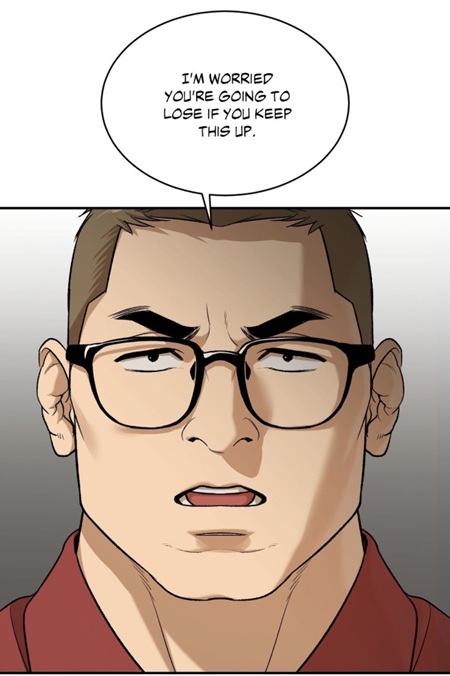 (chapter 95) This clarity signals a mode of perception that has already appeared elsewhere. When he looks at the main lead and calls him “fresh meat”
 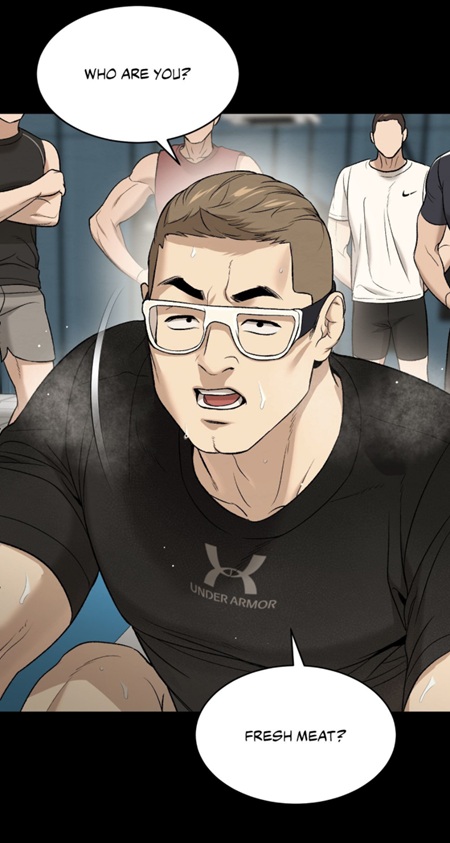 (chapter 74), the same logic is at work. The individual is not encountered as a subject, but classified as a function, reduced to a body that can be evaluated and positioned.
The same reduction governs his reaction to the vandalized poster 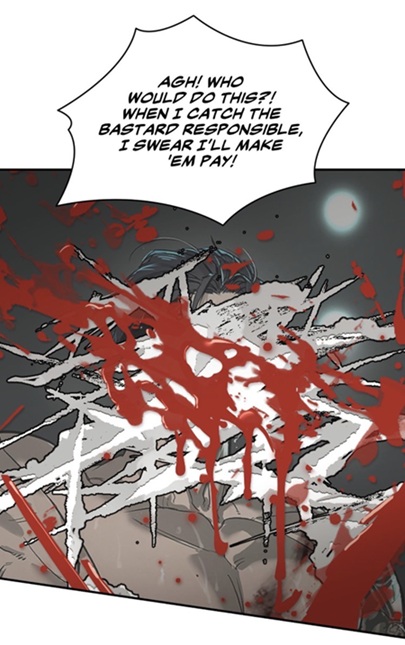 (chapter 96). His anger is immediate, but its object is telling. He does not interpret the act as hostility or as a symbolic attack directed at Joo Jaekyung. Instead, he speaks of damage, of responsibility, of compensation. The act is translated into material loss. What matters is not what it signifies, but what it costs. At the same time, he imagines that this is the work of a single person! But the broken CCTV (chapter 96) implies that different people were working together.
Meaning disappears. Across these moments, a coherent framework emerges. The fighter is treated as a body, the title as an objective, the image as an asset. Everything is brought back to function and value. Within such a system, there is no place for what cannot be measured or controlled. This is why no question can remain open, why no answer can be explored. To do so would require acknowledging that something lies beyond performance—that the athlete’s state might be shaped by forces that cannot be immediately quantified.
Speech and gaze align. They produce the same effect: a world in which only performance is visible, and everything that exceeds it is excluded. The consequence is a complete displacement of responsibility. What originates from the outside—the pressure, the exposure, the intrusion—is redefined as coming from within. The athlete becomes both the site and the cause of the problem.
And this has a direct impact on his relationships. If everything is reduced to performance, then anything that does not serve that function becomes secondary, if not obstructive. There is no conceptual space for Kim Dan within this framework. (chapter 95) Between the fighter and the title, no third position can be sustained. The growing distance between them is not arbitrary; it is structured. As the burden becomes internalized, it can no longer be shared. And now, you comprehend why later in front of the huge window, Joo Jaekyung chose to listen to his “hyung”. 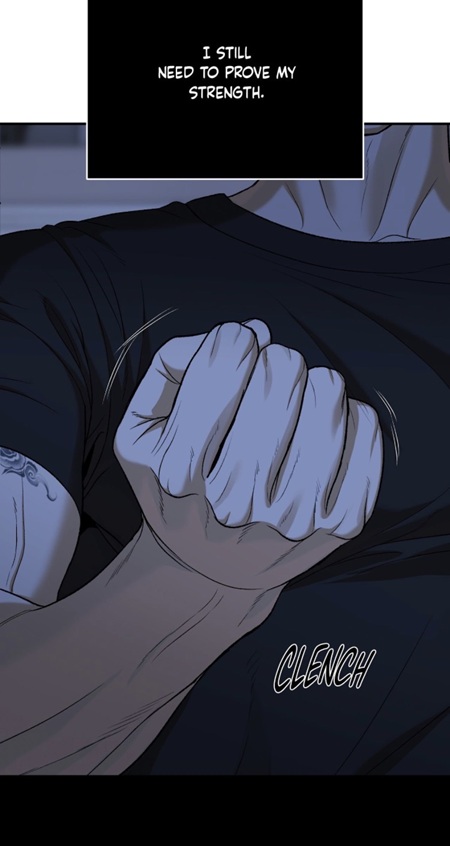 (chapter 95)
What appears as rejection is, in fact, the effect of a system in which there is no room for anything that cannot be reduced to function. The disturbance becomes perceptible not only in absence or timing, but in the way bodies are no longer allowed to coexist within the same space. That’s why the physical therapist was separated from his mate by the glass door.
And this is why the rupture (chapter 96) that follows does not emerge suddenly. It is already inscribed within this configuration—within a logic that isolates, reduces, and ultimately separates.
Static Presence
If the office reveals a system in which speech imposes and reduces, the scene on the beach appears, at first glance, to offer its opposite. (chapter 95) The spatial configuration changes immediately. There is no barrier, no desk, no imposed hierarchy. 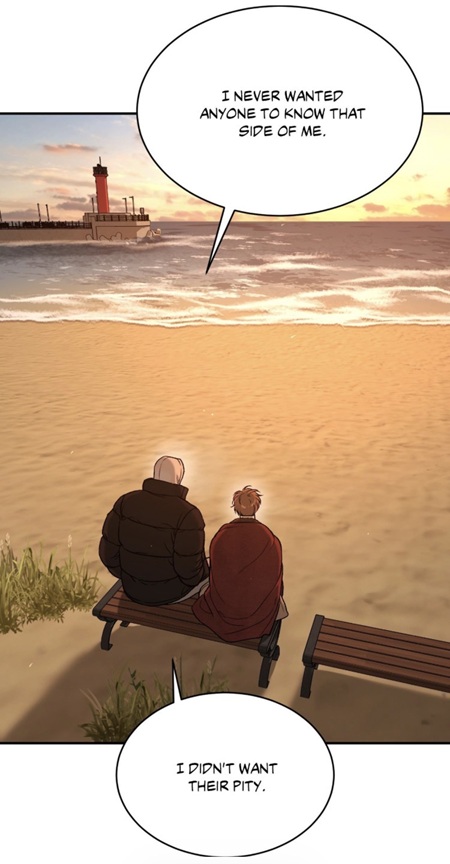 (chapter 95) Joo Jaekyung and Kim Dan sit side by side, aligned within the same horizontal plane. The asymmetry that structured the office—front versus opposite, speaker versus evaluated—seems to dissolve. The scene suggests proximity, even equality.
And yet, this alignment remains incomplete. Joo Jaekyung makes a promise first. His words introduce a form of commitment that exceeds the logic of performance: (chapter 95) The statement appears unconditional. It gestures toward continuity beyond the fight, beyond the system that had previously defined him. It is not framed as strategy, nor as obligation, but as presence.
But this movement does not return to him. 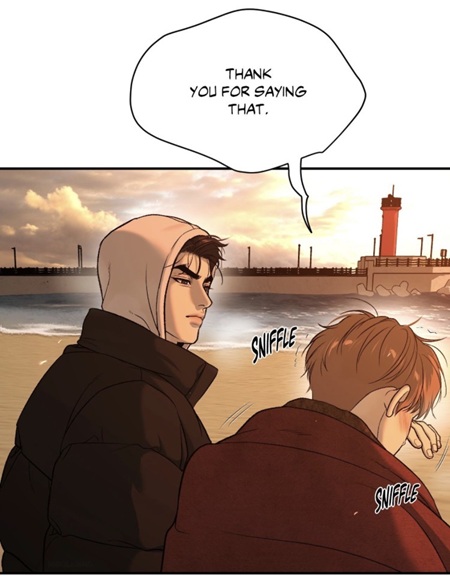 (chapter 95) The promise is unilateral. There is no reciprocal formulation, no mirrored commitment, no re-articulation of the bond from the other side. What is offered outward is not taken up and extended; it remains suspended.
The image makes this asymmetry visible. 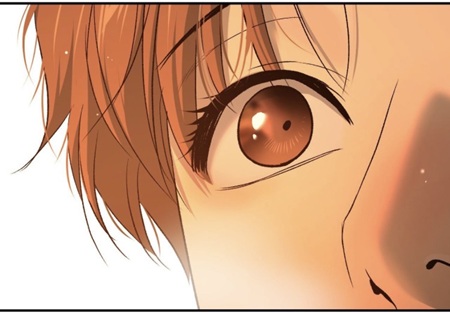 (chapter 95) In Kim Dan’s gaze, Joo Jaekyung is not reflected. What appears instead is the lighthouse in the distance. At first glance, this suggests a displacement: the athlete’s presence does not fully register within his field of vision.
But this detail carries a second implication, if you compare it to the athlete’s night, where he felt relieved that Kim Dan was alive:  (chapter 69) This panel implied that Kim Dan had become his whole world. The comparison exposes that the athlete is still not in the center of his life yet. The lighthouse is not only an external point of orientation. (chapter 95) It also reflects a position that Kim Dan begins to assume. Stable, distant, constant—it does not move toward the other; it remains where it is, offering direction without entering the movement itself.
In this sense, the gaze does not simply turn away from Joo Jaekyung. It aligns with a role. Kim Dan does not step into the relational space opened by the promise. He situates himself beside it, as a fixed point rather than as a participant. What Joo Jaekyung offers is presence—“I’ll always be in your corner.” What Kim Dan adopts is function: to remain steady, to support, to endure.
This is why the promise remains unilateral. It is not rejected. It is not contradicted. But it is not mirrored either. It is received from a distance, translated into a different register. The response (chapter 95) acknowledges the gesture without entering into it. The exchange closes without becoming mutual.
What emerges here is not rejection, but non-reciprocity. And yet, this position is not without expectation. To become a lighthouse is also to be looked at.
Even if he does not fully engage with the promise, Kim Dan places himself in a position of orientation—someone who remains, who supports, who is “there.” This stability carries an implicit hope: that the other will return to it, will recognize it, will rely on it. This position also sheds light on another element that remains present, yet unaddressed: Joo Jaekyung’s insomnia. 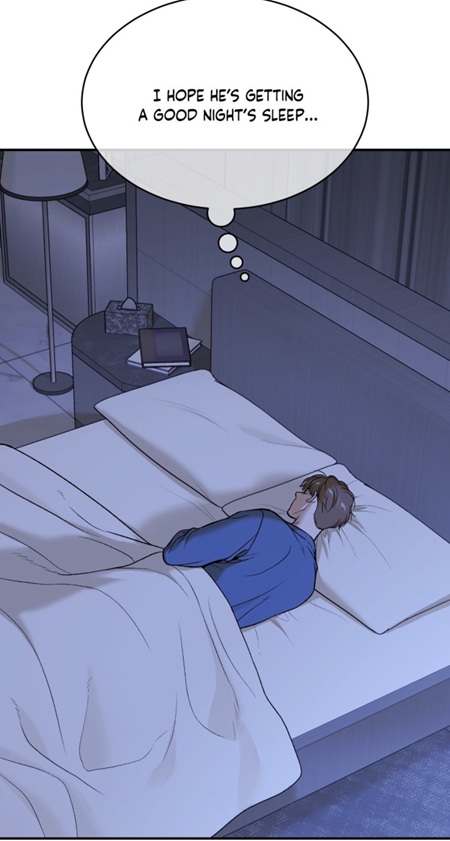 (chapter 91) It lingers in the background, acknowledged but never truly treated. And yet, it is not incidental. Insomnia signals the inability to withdraw, to interrupt exposure, to let the body enter a different rhythm. In this sense, it mirrors the function of the lighthouse. A lighthouse remains on—it stabilizes, but it does not allow rest. Kim Dan’s care operates in a similar way: constant, attentive, but not rhythmic. It keeps the athlete oriented, but does not create the conditions for him to “switch off.” What appears as support therefore also sustains the very state it fails to resolve.
This metaphor is what makes the following moment so revealing. When Joo Jaekyung leaves the next morning without turning back and replying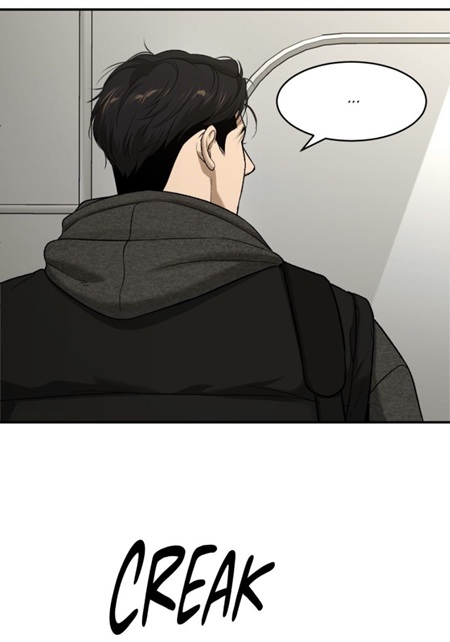 (chapter 96), without reestablishing that line of orientation, the structure collapses. What had been silently assumed—being seen, being turned toward—is no longer confirmed.
The wound does not emerge from contradiction. It emerges from absence. Kim Dan is not rejected in words. He is not dismissed explicitly. 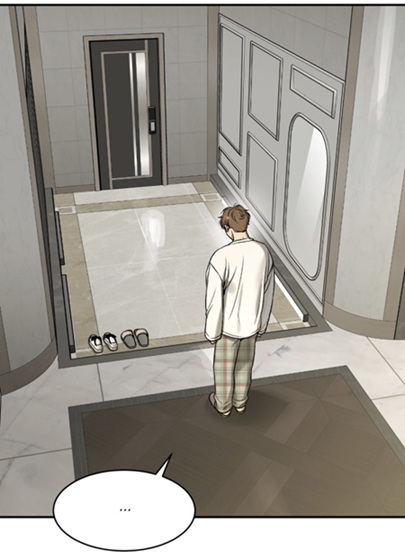 (chapter 96) But the position he has taken—the one of quiet constancy, of supportive presence—is not acknowledged. The lighthouse remains, but no one looks at it. Striking is that before the champion left, the doctor tried to reconnect with him by wishing him good luck.He is modest and hesitant.
 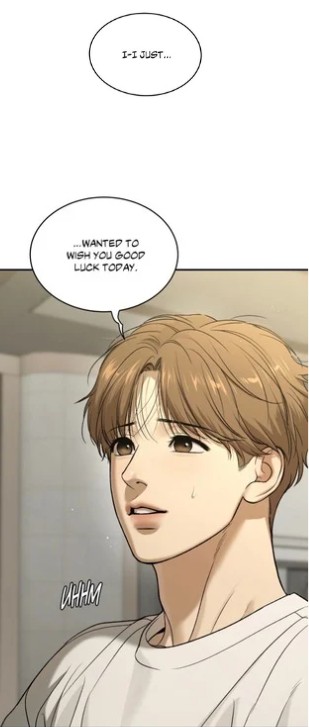 (chapter 96) At first glance, this appears simple. But it is not neutral. It is a repetition. Kim Dan tries to reactivate a shared ritual—the one established after the night in Paris.
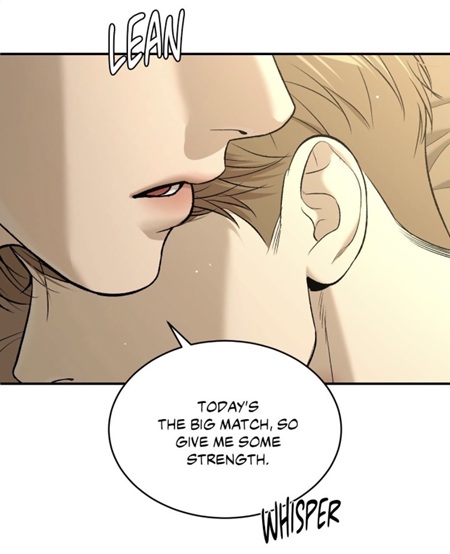 (chapter 87) A moment where touch, words, and intention aligned.
 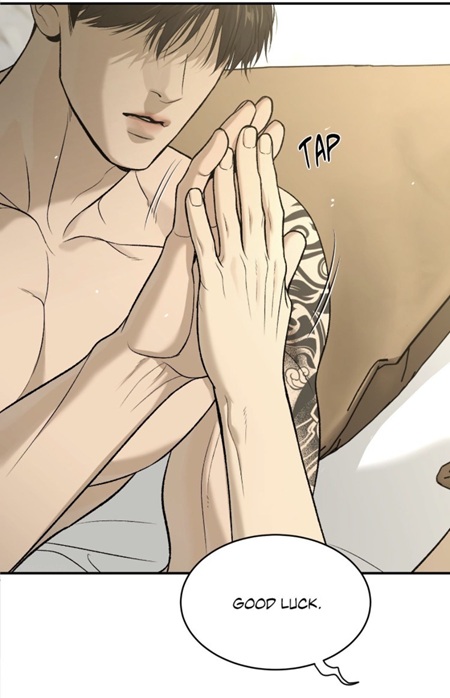 (chapter 87) A moment where connection was not abstract, but embodied.
 (chapter 87) But in front of the entrance, something is missing. (chapter 96) The hands do not meet. Under this new light, it becomes comprehensible why the star did not reply to the physical therapist’s words. (chapter 96) He feared to waver. He is now treating the physical therapist as a distraction and a weakness.
The structure of the gesture is reproduced (chapter 96) —the wish, the proximity, the intention—but its core element is absent. There is no joining of hands, no shared contact that would anchor the exchange in the body. The movement remains incomplete. And it was the same on the beach.
There is no joining of hands, no shared contact that would anchor the exchange in the body. The movement remains incomplete.
And this absence is decisive. Because in the earlier scene, the hand was not just a gesture—it was the point of synchronization. It created a circuit: touch, recognition, response. The body confirmed what the words suggested. Here, that circuit does not close. Joo Jaekyung responds—he takes the hand, he squeezes it, he even leans closer, whispering: (chapter 87) But what he asks for reveals the shift. (chapter 87) He does not reciprocate the wish. He redirects it. The gesture is no longer shared—it is instrumentalized. The touch does not establish equality; it becomes a means. What is requested is not mutual presence, but support directed toward a single objective: the fight. (chapter 87) And yet, beneath this request, something else becomes visible. What he asks for is not only strength. It is connection. The whisper, the closeness, the physical proximity—all point toward a need that exceeds performance. But this need is not articulated as such. It remains displaced, translated into the language of the match. “Give me strength” replaces “stay with me.”
This is why the moment remains unresolved. Because what Joo Jaekyung seeks is not what Kim Dan offers—and what Kim Dan attempts to offer is not what Joo Jaekyung is able to receive. The misalignment persists, but it shifts its form. Kim Dan reaches through repetition (chapter 96) —through ritual, through care, through a reconstruction of what once connected them.
Joo Jaekyung reaches through intensity—through touch, through urgency, through a need that he cannot fully name.
But the two movements do not coincide. And this is where the earlier observation becomes fully visible. Kim Dan is not rejected in words. He is not dismissed explicitly. But the position he has taken—the one of quiet constancy, of supportive presence—is no longer acknowledged. This means, that the lighthouse is no longer working.
And yet, this is precisely where the scene opens toward a future resolution. Because the image of joined hands  — earlier echoed outside the narrative—suggests a moment that has not yet been reached. A point where gesture, intention, and response will finally align.
Where support is no longer unilateral. Where presence is no longer translated into function. Where touch is no longer redirected, but shared. In other words: a moment where they become a team.
This introduces a different form of misalignment than the one observed in the office.
There, the problem lay in imposed meaning—in a discourse that defined the athlete from the outside. Here, the misalignment takes the form of incomplete presence. The relation is not constrained by speech, but it is not fully inhabited either.
This becomes more visible when we follow Kim Dan’s position across subsequent scenes.
At the gym, he asks, “Are you okay, Mr Joo?” (chapter 95), but the question remains confined to the immediate, physical state. When the athlete is injured, he treats the symptom. He wipes the blood, observes the body, intervenes where necessary. But he does not investigate the cause. The question of why the injury occurred—what led to the lapse—is never pursued.
This orientation continues in the penthouse. (chapter 96) Care is translated into technique. Emotional tension is approached through physical intervention. The body becomes the site where the problem is managed, even when its origin lies elsewhere.
Even when he recognizes the external pressure 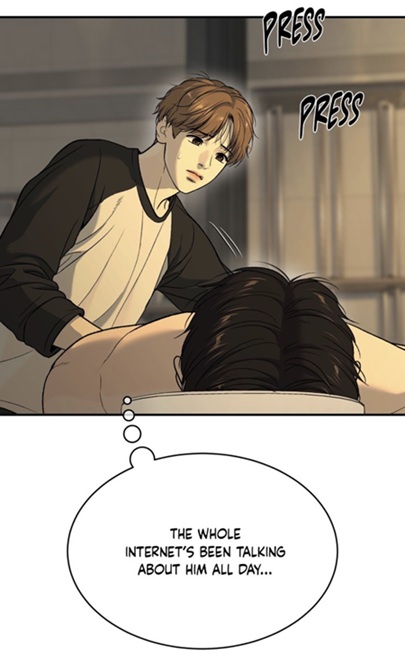 (chapter 96); this recognition does not lead to inquiry. It remains observational, not relational. He does not question the narrative, nor its effects. He adapts to it. I doubt that he even watched the interview, as the former coach and director Hwang Byungchul got insulted and diminished.
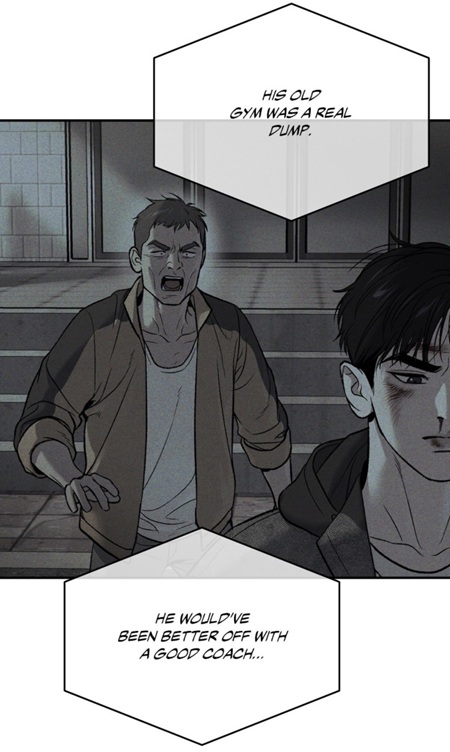 (chapter 96)
This is not indifference. It is a limitation. Kim Dan does care. But his care operates within defined boundaries. He approaches Joo Jaekyung as a patient, not as a subject whose experience must be understood in its entirety. He does not impose a framework, as Park Namwook does—but neither does he challenge one.
And this has consequences. If everything is reduced to performance, as in the manager’s framework, there is no space for relationship. But if care remains confined to function, there is no space for shared experience either.
Between the fighter and the title, Park Namwook leaves no room. Between the patient and the body, Kim Dan does not fully enter. In both cases, something remains unaddressed.Joo Jaekyung is neither fully defined nor fully understood. He is managed, he is treated, he is supported—but not met in the space where his experience actually unfolds.
And this is why the misalignment persists. Not because there is no care, but because care itself remains incomplete.
Functional Distance
The misalignment on the beach—where Kim Dan assumes the role of a lighthouse (chapter 95) —finds its physical conclusion in the refused gesture of Chapter 96. When Joo Jaekyung pushes the hand away (chapter 96), he is not merely rejecting a movement; he is rejecting the limitations of the role Kim Dan has chosen to inhabit.
In this moment, the “Lighthouse” stance becomes a psychological shield. For Dan, retreating into his role as a physiotherapist provides a sense of safety and professional boundaries. Hence he watches his loved one from afar the entire time. (chapter 95) But for Jaekyung, this boundary is experienced as abandonment. By attempting to “complete the treatment,” Dan tries to force the interaction back into a patient-doctor dynamic at a moment of profound emotional crisis. (chapter 96) He feels like he is not even recognized as a friend. (chapter 96)
This is the core of the dissonance: Dan offers a functional touch where Jaekyung requires a relational one. By focusing on the muscles, Dan treats the body as a “thing” to be fixed—an object of study rather than a subject of experience. He fixes the symptom (the tension) while avoiding the cause (the humiliation). The “Smack” of the rejection is the realization that as long as Dan is “treating” him, he doesn’t have to “know” him.
Jaekyung does not reject the therapy; he rejects the distance that the therapy maintains. He pushes the hand away because he recognizes that a lighthouse, while constant, is fundamentally inanimate. It can guide him through the storm, but it will never enter the water to help him swim.
The Walk As Deferred Synchrony
If the rest of Joo Jaekyung’s world is structured by management, performance, and functional roles, the hospital room in episode 94 introduces a radically different configuration. 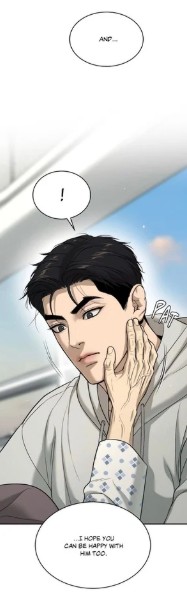 (chapter 94) The space is quiet, contained, almost suspended—and within it, a gesture occurs that does not follow the logic established elsewhere.
When Kim Dan’s grandmother reaches out to pat his cheek, the touch does not regulate, correct, or demand.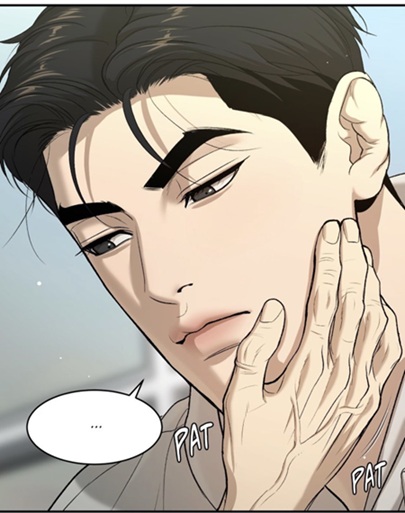 (chapter 94) It is not a gesture of control, nor of care defined by function. It is, instead, a gesture of recognition and affection.
This distinction is decisive. Because when she says, (chapter 94) she does more than offer a blessing. She disrupts the entire structure through which Joo Jaekyung has been perceived. Until this moment, he exists within systems that reduce him: to a body that performs, to a fighter who must win, to a patient who must be stabilized. His value is always defined externally—by outcome, by function, by necessity.
Here, for the first time, he is addressed as a subject and even as a “child”. Not as someone who must achieve, but as someone who can be happy. And more importantly, that happiness is not imagined in isolation. It is articulated as relational, inseparable from Kim Dan’s own. The statement does not position him outside the bond, but within it. It creates a shared horizon—one that neither the manager’s discourse nor the medical framework had allowed to exist.
This moment does not yet produce synchrony. It creates the conditions for it. The grandmother’s touch does not establish a reciprocal exchange, but it opens a space in which such an exchange becomes thinkable. It introduces a possibility that exceeds both control and care: the possibility of being seen without being reduced. And this recognition carries weight.
Because it introduces a new form of burden—not the burden of the title, not the pressure to perform, but the burden of being acknowledged as someone whose life can be shared with another. From this point onward, Joo Jaekyung is no longer only confronted with expectations. He is confronted with a possibility he does not yet know how to inhabit.
What follows immediately after makes this even more explicit. 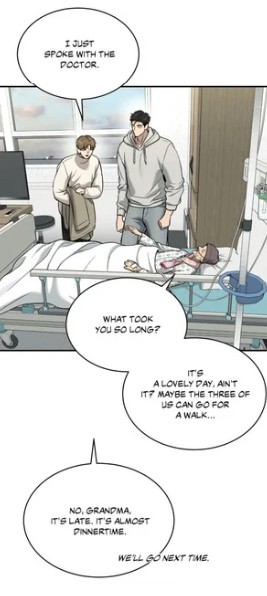 (chapter 94) When the grandmother suggests that “the three of us can go for a walk,” the gesture shifts from recognition to movement. The proposal is not incidental. It translates what has just been opened into a concrete form.
Walking implies more than proximity. 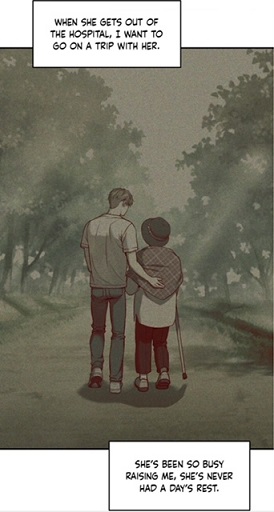 (chapter 47) It requires alignment—of direction, of rhythm, of time. It transforms a moment into a duration, a shared presence into a shared trajectory. It is, in its simplest form, the embodiment of synchrony. This observation outlines the contrast to the champion’s promise on the beach. (chapter 95) They did not walk together, they remained seated. That’s why their lack of alignement was not truly perceptible.
And the stroll introduces something new: a structure of togetherness. Not a dyad, but a triad—the three of us. A temporary, fragile configuration that resembles a family. Not defined by roles, but by movement. Not by function, but by coexistence.
But this movement does not occur. Kim Dan refuses—gently, almost imperceptibly. “It’s late… we’ll go next time.” The refusal is not confrontational. It does not reject the connection. But it postpones it. And this postponement is decisive.
Because the synchrony that had just become possible is deferred. The transition from recognition to shared experience is interrupted. The moment remains suspended, unfulfilled. This hesitation reveals something fundamental about Kim Dan’s position.
He receives the grandmother’s words, but does not fully step into what they imply. (chapter 96) He remains within the logic that has defined him: that of care, of responsibility, of quiet support. Like the lighthouse that appears in his gaze, he positions himself as a fixed point—present, reliable, but distant. He does not move. He doesn’t follow his heart. And yet, to walk would require precisely that: to leave that position, to enter into a shared rhythm, to participate rather than to stabilize. Kim Dan cares, but he cares as a fixed point. He watches the ship struggle against the narrative, but he stays on the shore. The grandmother offers a rhythm. Kim Dan offers a delay. And in that gap, the walk remains a ghost, and the touch remains a dissonance.
This is where the misalignment begins to take shape. Because while the grandmother opens a space of relation, neither of them fully occupies it. Joo Jaekyung is confronted with a possibility he cannot yet sustain. Kim Dan is offered a movement he does not yet recognize. The result is not failure, but deferral. And this deferral reverberates through what follows.
But this is precisely where another form of presence emerges—one that operates through absence. During the night in the penthouse, Joo Jaekyung does not think of the grandmother. 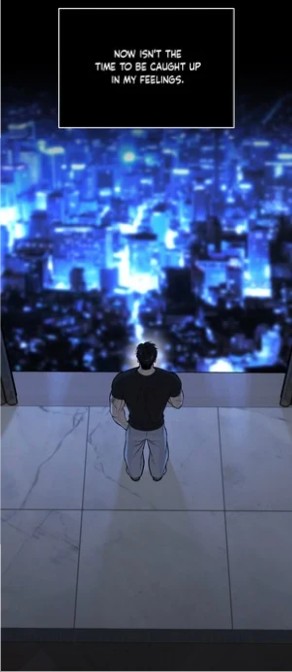 (chapter 95) Her words are not recalled, her figure is not evoked, her request is not consciously revisited. On the surface, she is absent. And yet, this absence is deceptive.
Because what structures his reflection in that moment is not the memory of her voice, but the transformation it has already produced. The opposition that surfaces—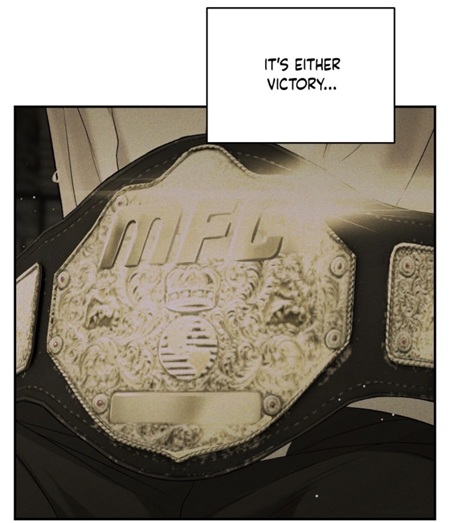 (chapter 95) —is no longer stable. It is immediately unsettled by another voice, another possibility:
 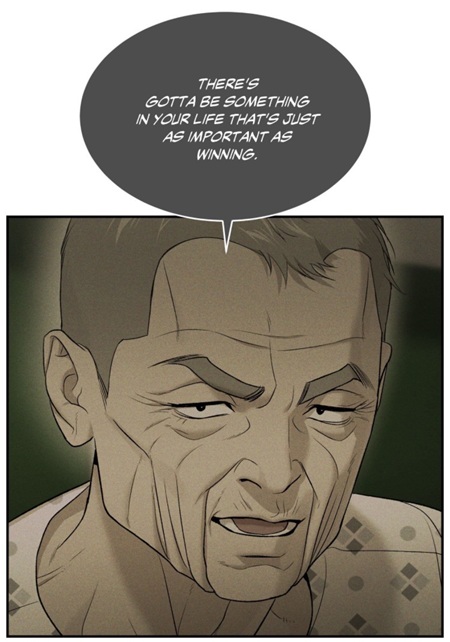 (chapter 95) And what follows is not an abstract idea. It is an image. Kim Dan appears.
 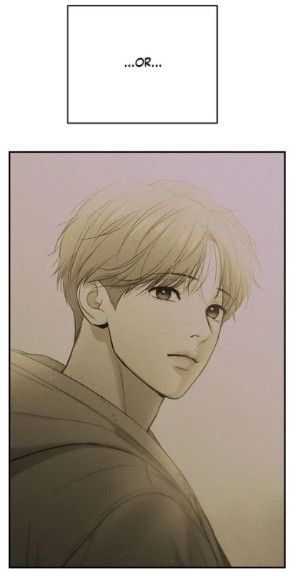 (chapter 95) This shift is decisive. The grandmother is not present as a figure, but as a function. She has already altered the internal configuration through which Joo Jaekyung perceives himself. Her gesture has been absorbed, displaced, and translated into a new form of questioning.
In this sense, she is no longer external to him. She has entered his inner world. Not as a memory—but as a structure. (chapter 95) This is why her absence matters. Because it reveals that the disturbance does not require constant visibility to persist. It has already taken root. The question she introduced—of a life beyond performance, of a relation beyond function—continues to operate, even when she is no longer present.
And it operates through Kim Dan. That’s the reason why the champion pushes away the physical therapist. The image that interrupts the logic of victory is not the grandmother—it is him. This substitution is not accidental. It shows that the possibility she opened is now anchored in their relationship.
But this anchoring remains unstable. Because while Kim Dan appears within that internal space, the relation itself has not yet reached synchrony. The image is present, but the connection is not yet fully realized.
This is what intensifies the tension.
The grandmother’s intervention has already reshaped the internal landscape. 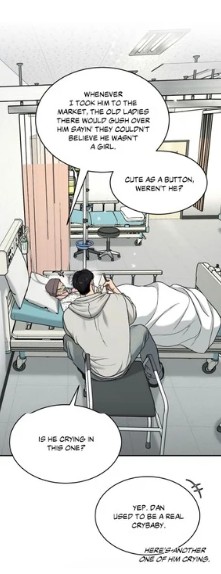 (chapter 94) It has introduced a new axis—one that opposes performance to relation, victory to something else that remains undefined, but essential. But this axis is not yet resolved. It exists as a fracture. And from this point onward, absence no longer signifies emptiness. It signifies transformation. What is no longer visible has already begun to act.
The recognition cannot be undone—but it cannot yet be realized either. It lingers, as a possibility that remains out of reach. It transforms the meaning of subsequent gestures, without stabilizing them.
What emerges from this configuration is no longer only an internal fracture within Joo Jaekyung, but the outline of an external conflict that has yet to fully surface. Because the three logics that now surround him cannot coexist indefinitely. On one side, Park Namwook—and beyond him, the structure of the MFC—continues to operate within a closed system of performance. Within this framework, there is no space for anything that does not directly serve the fight. 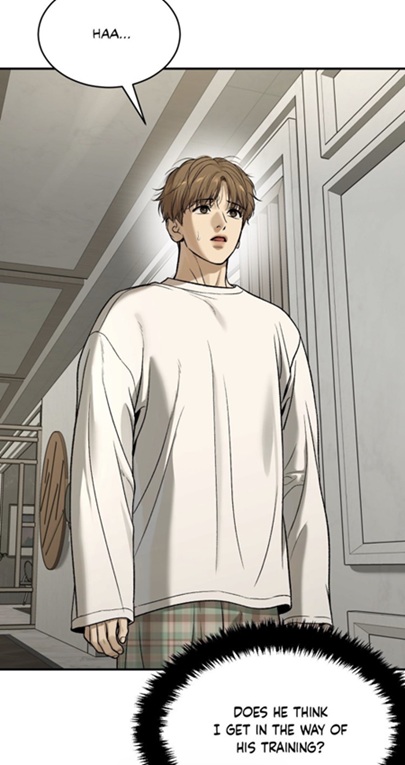 (chapter 96) Thus the physical therapist is not included in the meeting. Distraction must be eliminated, influence must be controlled, and relationships are tolerated only insofar as they remain functional. The body must remain available, and the mind aligned.
On the other side, Kim Dan represents something that this system cannot fully integrate. Not because he opposes it openly, but because his presence introduces a different logic—one that is not reducible to performance. (chapter 95) Even in its incomplete form, his care interrupts the continuity of the system. It creates pauses, displacements, moments where the athlete is no longer entirely absorbed into the role assigned to him.
Up to this point, this tension has remained diffuse. It has manifested as misalignment, as silence, as failed gestures. But the conditions are now in place for it to become explicit. Because what the system requires—and what Kim Dan begins to represent—are no longer compatible. For Park Namwook, there can be nothing between the fighter and the title. For Kim Dan, there is something else—though he has not yet fully claimed it. This is why the dissonance intensifies around touch, around presence, around time. These are precisely the points at which the two logics intersect.
And this is where the conflict will inevitably emerge. Not as a simple opposition between individuals, but as a confrontation between two ways of relating to Joo Jaekyung: one that reduces him to a function, and one that—however imperfectly—begins to recognize him as a subject. What has so far remained unspoken is therefore not absent. It is gathering.
Feel free to comment. If you have any suggestion for topics or Manhwa, feel free to ask. If you enjoyed reading it, retweet it or push the button like. My Reddit-Instagram-Twitter-Tumblr account is: @bebebisous33. Thanks for reading and for the support, particularly, I would like to thank all the new followers and people recommending my blog.
 Bebebisous33s' analyses in K-Dramaland and Manhwas