The influence of Greek and Roman mythology and literature in Love in Sadness

In this drama, the writer used two legends from the Greek mythology: the death of Hyacinth and Adonis which led both to the birth of flowers: the hyacinth and the anemone. Hyacinth, as a Spartan prince and mortal was Apollo’s lover despite their different nature (human vs. god). Yet Zephyrus, the god of wind, got jealous and killed him with his disc.
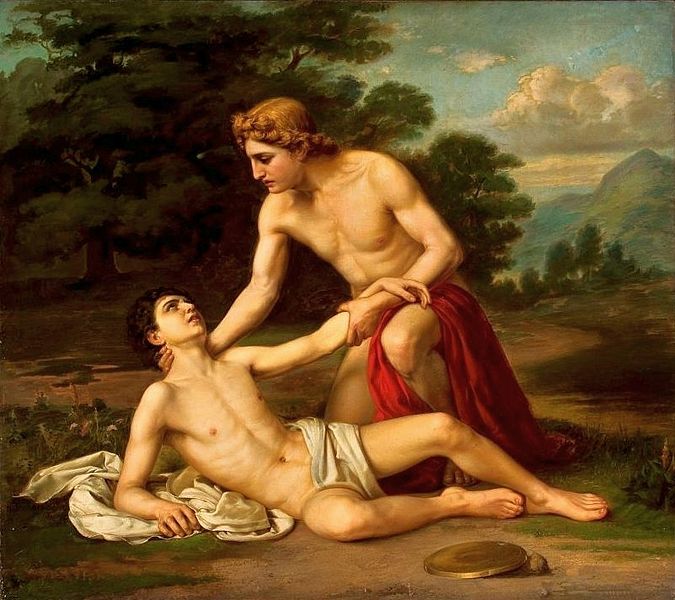
File:Kiselev Death of Hyacinth.jpg
the death of Hyacinth; painting from Alexandre Kisseliov (19th Century) Here you can see the disc thrown by Zephyrus

The god of the sun tried to heal his lover and it was in vain. In order to always remember his lover Hyacinth, Apollo created a new flower with Hyacinth’s blood: the Hyacinth.

the hyacinth

Then in the episodes from this week, we were told about the legend of Adonis and the anemone. SJW explained that Venus fell in love with Adonis due to Cupid and Ares got jealous and killed Adonis with a boar.
However, the writer made a huge mistake because he mixed Greek names with Roman names. Romans used to call Venus, the goddess of love, beauty, sex and fertility but Ares is the Greek name of the god of war. Why do the Roman and Greek have the same mythology but different names? After the conquest of Greek cities in ancient times (Antiquity) by the Roman Empire, the Romans adopted the Greek religion, however they changed their names: Aphrodite became Venus, Ares became Mars, Zeus Jupiter aso. Our plastic surgeon was actually referring to the work of a Roman author, Ovid. However, in Ovid’s work Venus fell in love with Adonis by accident due to Cupid. The latter was playing with his arrows, when one of his arrows was punctured in her chest. Her wound was so deep that she fell in love with Adonis, when he appeared.


Venus, Adonis and Cupid painted by Annibale Carracci in 1595 

However, the story of Adonis in Ovid doesn’t mention any jealousy as the reason for his death. It is just said that Adonis loved hunting and one day, he got killed by a boar while hunting alone. On the other hand, the the existence of Adonis in the Greek mythology is explained differently. https://www.greekmyths-greekmythology.com/myth-aphrodite-adonis/ First, Aphrodite fell in love with the handsome man due to her own trick. Then either Artemis wanted revenge or Ares got jealous of Adonis because he was Aphrodite’s lover too. Anyway, in Greek and Roman mythology, the goddess of love used Adonis’s blood in order to create the flower anemone, a memorial of their love.

Image result for Anémone
Anemones

As you can see, the writer from Love in Sadness mixed Roman and Greek mythology together. Nevertheless both stories have so many similarities. First both stories deal with the loss of a loved one, with a tragic death where the surviving person has trouble to accept the death of their lover. Furthermore, the gods create a flower (Hyacinth and Anemone) in order to remember their loved one. Finally, the writer used the aspect of jealousy in both stories which explains why he made a mistake with the name because he mixed Roman tradition with Greek mythology. And now, if we take a close look, we will notice that our main characters (KIW, YMR, WHK and SJW) share the same experience. YMR fakes her death in order to escape from her abusive husband, WHK got involved in an accident and got killed which affected her husband SJW a lot. SJW gave YMR his wife’s face which could be compared to the gesture of the god: SJW created a flower, just like Aphrodite and Apollo did. On the other hand, KIW has not created anything yet, he is still living in his memories: he has distorted version of his marriage with YMR. Maybe, the beholder should perceive KIW as the jealous person and not the lover, if we had to compare him to characters from the legends as he is really jealous. YMR loved painting more than anything and he knew that, hence he allowed her to paint but only at her studio and she was not allowed to show any creation to others. Concerning WHK, SJW and doctor Ha, the latter embodies definitely the jealous one who destroyed WHK in the end due to his jealousy and negligence. As conclusion, we understand better why this drama was called love in sadness because all these legends and our drama deal with tragic love, death, pain and sadness.

However, this is not the only reference to Greek literature and mythology. In the episodes from this week, we could finally perceive the true personality of doctor Ha Sung Ho. Remember that in my former analysis, I had compared Joo Hae Ra to a praying mantis, SJW to a butterfly and flower and KIW to a cobra.
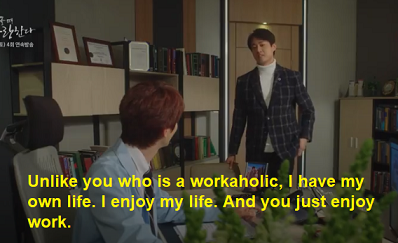
episode 12

While watching this scene, the doctor’s words made me think of the famous fable “La cigale et la fourmi” (The cicada and ant) from Jean de la Fontaine. The latter is a French fabulist from the 17th Century who wrote many fables. He used as source of inspiration, the Greek author, Aesop (an author from ancient times, Antiquity).

Here is the fable written by Jean de La fontaine

La Cigale, ayant chanté
Tout l’Été,
Se trouva for dépourvue
Quand la bise fut venue.
Pas un seul petit morceau
De mouche ou de vermisseau.
Elle alla crier famine
Chez la Fourmi sa voisine,
La priant de lui prêter
Quelque grain pour subsister
Jusqu’à la saison nouvelle.
Je vous paierai, lui dit-elle,
Avant l’Oût, foi d’animal,
Intérêt et principal
La Fourmi n’est pas prêteuse ;
C’est là son moindre défaut.
« Que faisiez-vous au temps chaud ?
Dit-elle à cette emprunteuse.
— Nuit et jour à tout venant
Je chantais, ne vous déplaise.
— Vous chantiez ? j’en suis fort aise.
Eh bien ! dansez maintenant. »

The gay cicada, full of song
All the sunny season long,
Was unprovided and brought low,
When the north wind began to blow ; 
Had not a scrap of worm or fly,
Hunger and want began to cry ; 
Never was creature more perplexed.
She called upon her neighbour ant,
And humbly prayed her just to grant 
Some grain till August next ;
“I’ll pay, ” she said, “what ye invest, 
Both principal and interest,
Honour of insects –and that’s tender. ”
The ant, however, is no lender ;
That is her least defective side ;
“But, hark ye, pray, Miss Borrower, ” she cried, 
“What were ye doing in fine weather ? ” 
“ Singing . . .  nay,! look not thus askance,
To every comer day and night together. ”
“ Singing ! I’m glad of that ; why now then dance. ” (translation from http://www.la-fontaine-ch-thierry.net/onegramu.htm

Notice that the cicada doesn’t like working, she is busy enjoying life and in time of need, the cicada visits the ant for help. The behavior of the doctor Ha Sung Ho reminds us a lot of the cicada as both share the same philosophy.
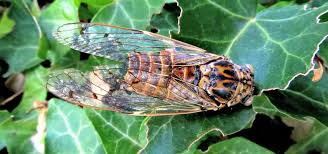
a cicada

They are carefree and even selfish as they let people work for them believing that generosity is a given. In Ha’s eyes, SJW is like an ant forgetting that SJW is working in order to support him and his wife as well. Only after WHK’s car accident, HSH started working like crazy accepting all different kind of patients, even risking the patients’ life. HSH even believes that their office is working so well because he made so many surgeries, but in my opinion, HSH is overestimating himself as he is overlooking SJW’s reputation. SJW was invited to a radio program, he even wrote a book… people from far away are coming to his office. Yet, HSH has never really considered SJW’s work as worthy to be mentioned because he has a different approach: SJW is working for his patients so that the latter can start enjoying their life, while HSH only worked out of guilt and pride. He never cares for his patients in reality. His words can be compared to the singing of the cicada: HSH always tries to praise himself in front of SJW. He is really jealous of SJW and not just because the latter married WHK. HSH could study because of SJW and his family, SJW was definitely the better student. Even after the big revelation, HSH shows his true face: he doesn’t feel sorry that he had an affair with WHK, he just reveals his jealousy and “hatred” for SJW. It will be interesting to see how HSH lives after leaving SJW’s office.

As conclusion, our characters from the drama Love in Sadness are all embodied by animals, except YMR: HSH the cicada, SJW the butterfly, KIW the cobra and JHR the praying mantis. But more importantly, it is clear that the writer was inspired by authors from the antiquity: Greek and Roman writers (Aesop, Ovid, aso).

The meaning of the moon in Encounter

From the start, the writer and drawer make sure that viewers can associate our heroine CSH to the moon. First, let us focus on the first drawing. Here, the princess appears in a dark and gloomy environment. It is not just night, the moon doesn’t seem to shine like it should.

Encounter drawing episode 1 introduction.png
Encounter drawing episode 1

Notice that it is not even full moon and the moon crescent is even hidden by the huge castle. All these points (moon crescent, hidden by the castle and lack of brilliance) underlines that CSH is not herself in the end. Since the castle embodies Y. Group and the pavilion Donghwa Hotel, we can better understand why CSH is still perceived as the ex-daughter in law of the chairman Kim. Now you might wonder why CSH is connected to the moon? First, it is quite simple. In the poetry, woman is often associated with the moon. This is no coincidence because the menstrual cycle lasts around 28 days which corresponds to the lunar cycle: 28 days. Another point is that in Europe, in many languages the moon is a feminine noun: la lune (French), la luna (Spanish, Italian) aso because they all have the same origin: luna from latin which was also a feminine noun because in the Roman mythology, Luna was a goddess. But now let us go back to our heroine. In the first episode, we witness her awakening which happens with the sunset. It was as if the sun would kiss the sea (another element embodying CSH) which would awaken our heroine. However, the beholder shouldn’t forget that the sunset announces the rise of the moon. And now you understand better why CSH acts so differently in Cuba. During this night, the moon shines just like CSH. During this fateful night, CSH reveals herself in front of KJH. She is far away from the castle and the gloomy environment. Striking is that many important events also happen during the night:

  • CSH visits KJH’s playground after work. Here she shows more her true personality as she is curious about this place.
Encounter episode 2 JH CSH playground.png
episode 2
  • In the episode 3, she plays happily, she can forget her worries and everything else. 
Encounter episode 3 JH and CSH the beach.png
  • The scene where KJH is drunk
  • in the episode 5, she cries after leaving KJH because she thinks, she has to cut ties with him. She can not bear the thought therefore she visits the place where there is this huge painting that she likes
Encounter episode 5 painting Whanki.png
episode 5/6
  • What caught my attention is this taking. This is shown, just before KJH meets her in front of the painting. KJH feels happy first, until he looks at these pictures. Look at the photo on the left. The moon is about to be hidden, the moon crescent is barely visible. As you can observe, this picture kind of sends a warning: CSH is about to hide herself again. 
Encounter JH photos moon and hands.png
episode 5
  • In the episode 11: she sits on the swing underlining that she is accepting KJH’s world. She feels comfortable. She is not hiding as she is also wearing a red coat. 
Encounter episode 11 JH and CSH playground.png
episode 11
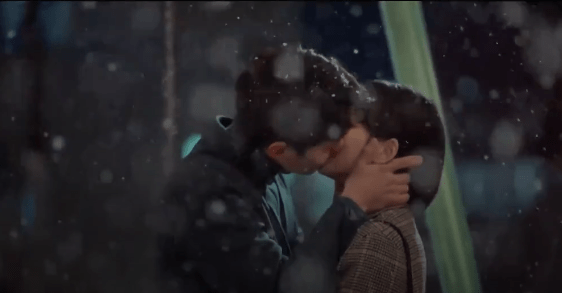
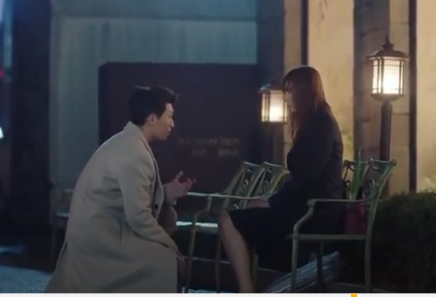
  • And in the last episode, she meets KJH at his playground again. This scene mirrors the scene from the episode 2, however the role are here reversed. While KJH was the one who caught there, CSH is the one who surprises her loved one. And during this night, it not only snowed but also they kissed in that playground. It was as if the kiss sealed their relationship. The beholder can notice that as time passed on, KJH and CSH got closer each time, when they were at the playground. In the former picture, KJH was not equal to CSH. He is on his knees and barely touches her knee. Now, both are standing but KJH embraces without restraint. 
episode 16

All these mentioned scenes had something in common: CSH was herself, she never contained her true feelings. She couldn’t even hide her thoughts and even her happiness. That’s why CSH is like Cinderella. Cinderella is forced to only appear during the night due to the balls. Here, Cinderella shines. Yet, the writer changed one thing. In Cinderella, the protagonist hides her true identity behind her beautiful gown therefore no one can recognize her. In Encounter, it is different. CSH does the opposite: she reveals her true personality. Actually, the situation is reversed. She is not a princess, but a single woman longing for love and warmth. She becomes a normal woman, she drops her princess status. By associating CSH to the moon, we understand better why CSH was suffering from insomnia. The moon is only visible during the night… so CSH could only “live” during the night, as she was living like a corpse during the day. But even during the night, her actions were limited as she was monitored by the media and her ex-mother in law. Her insomnia was a symptom that CSH couldn’t live freely.

But the moon can not live without the sun as the moon revolves around the sun. In another analysis I had pointed out that the sun symbolizes KJH. Without the sun, the moon can not shine at all and this applies to our heroine. That’s why at the end of this drama, the drawing put these two together. KJH as the sun helps CSH to shine, as she can smile and be happy. 

Encounter episode 16 drawing ending 1.png
drawing from the episode 16

Love in Sadness: the evolution of Yoon Ma Ri’s state of mind

image-5.png?w=660

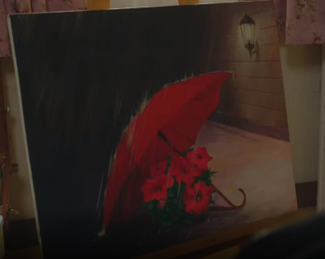
In my former post, I had analyzed this painting. We could see a change in YMR’s state of mind compared to the painting with the cistus called a Self-portrait. First, there is light signifying that there is hope. Secondly, the bouquet is protected from the rain by a red umbrella. The umbrella is a metaphor for SJW, he is her protector. However, since the surrounding is quite dark (it is night) and it is raining, we can see that YMR is still under the influence of the fear. She seems to be still disoriented. I mean her trauma is huge as she has been living in hell for 5 years. It takes time, until YMR can get rid of PDST.  She has not found her own strength yet, as the flowers are relying on the umbrella. The petunias are also hiding under the umbrella which reflects YMR’s actual situation. She is hiding behind SJW and WHK’s face. Besides, the night and rain are linked to the fateful time, when YMR’s path crossed SJW’s. And this is no coincidence. As conclusion, this painting could be perceived as a metaphor for her fateful meeting with SJW that night. He gave her hope, protected her by taking her with his car and told her that he would do the surgery.  

Yet as time passes on, we see other pictures from our painter. These are the paintings SJW discovers, when he visits YMR’s place for the first time. 

image.png
image.png

Here we witness another evolution in YMR’s state of mind. What caught my attention is the contrast between these pictures and the painting with the umbrella. Little by little, nature is coming back to life. Notice that here the flowers are in the center of the pictures. The traces of darkness have disappeared. The flowers don’t need protection at all. They are not hiding behind an umbrella. No, the flowers show themselves as they are. Yet this observation must be put in perspective which I will explain further below.  

Striking is that we see the number of flowers increasing: we have two lilies, then three plumerias, 4 red flowers etc. Moreover the presence of a civilization is disappearing. Only the one third picture shows a table made of wood with a white cup of tea. The orange, blue and yellow paintings have all something in common: the background looks more artificial. So 4 pictures out of 5 don’t show nature as such. There are all still lives. The only elements associated to nature are the different flowers and that’s it. The green painting with the plumerias contrasts to the others because here we can observe a change in the background: YMR used a prairie of grass, more exactly of clovers as background. Clover is associated to luck which illustrates that YMR feels more positive. That’s why I said that nature is coming back to life. She thinks, she might be able to move on with her life. Yet there is no sky in it. The sky often symbolizes freedom. Here the plumerias are living among clovers… it was as if they were living freely, yet  also hiding among clovers so that people might not see them. So here again, YMR’s picture mirrors her own situation: she is living anonymously, among people so that KIW won’t be able to find her. Concerning the other paintings (artificial background or the table), we could say that the flowers hid themselves from the world as they were not put outdoors.

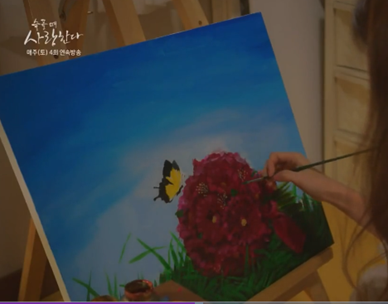
And here is her latest creation which reveals how much YMR has changed.

image.png

This time, the sky occupies a big part of the picture indicating that YMR feels more free. The flowers are also put in a meadow but here they can not hide behind the grass as the red bouquet is higher than the grass. Interesting is that this time, there is a butterfly. Actually, a butterfly needs flowers to live thanks to the pollen. Butterflies are fragile and yet beautiful. I would associate them with kindness, gentleness and usefulness. Don’t forget the expression “the butterfly effect” outlining the butterfly can have a huge impact on the environment and people. Thanks to butterflies (and bees), we can harvest fruits. Without these little insects, we wouldn’t be able to live in a healthy environment. To conclude, the butterfly is here not to protect the flowers, it is quite the opposite. The butterfly is actually relying on the flowers. And this painting is actually made just before YMR decides to help HR by acting as WHK. Therefore I come to the interpretation that this butterfly embodies SJW. And it does fit his personality: his love for flowers, his gentleness, his kindness… he doesn’t show any strength, yet thanks to him, people are coming back to life (YMR and his other patients). In my opinion, this painting mirrors the actual situation: YMR wants to help SJW in reality as she feels gratitude. She knows deep down that he needs her, even if he won’t say it. So here in YMR’s mind, the relationship between SJW and YMR has changed: in her eyes, SJW needs her as he is facing some financial problems. She becomes his support, while SJW is trying to keep acting as her umbrella.

This explains why YMR is attracted to SJW in the end and she is even falling for him. Flowers and the butterfly have a deep connection which the cobra has not.

Love in Sadness: flowers and animals

For me, SJW is not obsessed with his wife because he is not confusing YMR with WHK. Like I had mentioned it before, SJW actually fell for YMR, when he met her for the first time. Back then, he already wanted to help her. The fact that YMR has the same face than SJW’s wife should be seen as a mirror to KIW’s relationship with YMR. The contrast is so telling.

  1. KIW was attracted by YMR because she resembled his mother, while it was not the same between YMR and SJW. He tried to protect her even before the surgery.
  2. Striking is that YMR was the one who asked him to give her the face of someone SJW liked which he did. So far, YMR is not bothered by this idea at all. Actually, she views it as a gift, while she saw her own face as a curse. The words contrast so much: KIW = curse /SJW: a gift. 
  3. The third difference is that YMR only discovered much later that she had his mother’s face, while YMR discovered quite quickly that she had now WHK’s face.
  4. Another distinction is how SJW and KIW acts because of the resemblance. SJW wants YMR to find her freedom and peace so that she can blossom, whereas the violent husband wants her to put her in a cage.

To me, the real obsessed one with WHK is actually YHR. During her confrontation with her “friend”, she showed her true colors. She showed no empathy for her supposed “best friend” WHK… she wished that SJW would have abandoned his wife. Secondly, she despises love “that darn love!”. She knew all along about the affair but she decided to remain silence as she thought that SJW would be hurt. She got enraged, when she saw with her own eyes that SJW knew all along and yet he had been taking care of WHK as a devoted husband. This made HR realize that she had no real chance with SJW. Now, she believes that SJW is falling for YMR because of her face and this is where she is definitely wrong. First, SJW uses YMR to feel better… he felt guilty towards his wife because if he had stopped her back then, she wouldn’t have been involved in that accident. By giving all the support YMR needs he has the impression that he is redeeming himself. I am sure, he blames himself for the affair, rather than blaming WHK. She ran away because he was somehow lacking in his mind. However, I doubt that he knows about the identity of the lover. It is definitely his best friend… because once he knows the whole truth, he will stop blaming himself.

Another interesting metaphor in this drama is the cobra.

WIK as cobra

The cobra embodies WIK perfectly as this underlines his dangerousness. He is deadly. Moreover, this explains why WIK said last week that he preferred moving targets. On the other we have our doctor and YMR symbolized by flowers. And what is YHR’s symbol? First, I had the spider in my mind but I changed my mind. YHR reminds me of a praying/preying mantis. A mantis is an animal which remains immobile for a while until the insect is sure to catch a prey. Usually, a praying mantis uses a flower or plant as concealment.

a praying mantis hidden in a flower

It looks a lot like the plant or flower itself (the color). And now you understand why YHR reminds me of that insect. SJW is associated to flowers in general. Secondly the close cohabitation between the plant and the insect mirrors SJW’s relationship with YHR. However, YHR is not a nice person… she has no problem to throw people under the bus which she revealed in her argument with SJW. Her lack of compassion and her selfishness were visible in that scene. Moreover the insect itself “Praying mantis” (in French “mante religieuse”/ in German “Gottesanbeterin”) is linked to religion, as in many different languages the name of the insect contains an element about God or religion. Therefore I came to the conclusion that for HR, SJW is her religion, her obsession. She worships SJW, she has no problem to stay by his side without becoming his girlfriend or wife but she won’t tolerate anyone else by his side. She is the only one who can be close to SJW that’s why she dislikes this closeness between YMR and SJW. That’s why YHR got scared of WIK. A praying mantis is weak compared to a cobra, the former is even used as food for the cobra. However, YHR as a mantis has an advantage: a preying mantis is patient and can remain immobile for a long time. So in my opinion, YHR will use YMR/WHK as a diversion thinking that WIK will realize YMR’s true identity. She will use YMR as the moving target which will attract the cobra’s attention. She wants to put YMR on the silver plate… but she will fail. First, WIK is definitely obsessed with YMR’s face which represents a huge hurdle. YHR has no idea of the resemblance with WIK’s mother. The other reason why I connect YHR to a praying mantis is that the female insect kills her male companion once the mating is done. YHR is dangerous to SJW and so far, since she has lived for so long by SJW’s side, the latter hasn’t become aware of her true personality. I also believe that she played a part by creating a riff between the real WHK and SJW which the latter has not realized yet too.

But now let’s take a closer look to the flowers which are used in each episode:

episode 1: the cistus “I will die tomorrow”

episode 2: the daisy “You are my hope”

episode 3: Rosemary “You bring me back to life”

episode 4: Lavender “Tell me”

episode 5: Purple Lilac “Fear comes for me”

episode 6: Petunia “If you stay by my side”

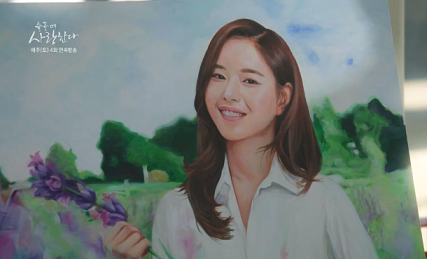
Striking is that YMR is associated to different flowers. First she appeared in her painting

YMR holding a purple gladiolus/ sword lily

First, this is the only painting where YMR drew a person. Notice the contrast to her painting called A self-portray

Episode 2: the painting here is called A self-portray. The represented flower is a cistus

Secondly, the colors are bright and she is surrounded by a beautiful countryside. The green is associated to life, whereas the gloomy and dark colors in the second painting illustrates the dying nature. The cistus is living next to a dead wood which can only bring death to the flower. Moreover, the flower is burning indicating that its death is imminent. The two portraits represent YMR and the comparison outlines how YMR has not only lost her face but also her personality and identity. YMR is no longer a sword lily but she has become a cistus. A sword lily is linked to

  • Strength of character
  • Faithfulness, sincerity and integrity
  • Infatuation
  • Never giving up
  • Just like the name says it, the gladiolus shows a certain fighting spirit. This strength disappeared due to the constant abuse.

Then in the episode from this week, our heroine paints a red petunia.

Red petunias under an umbrella

This painting indicates the change in YMR’s mentality. The light outlines that she has hope now. The umbrella is protecting the flower from the rain. In this painting, the umbrella embodies SJW, while the red petunia is our female protagonist. YMR is very well aware that SJW has been protecting her. She is starting gathering some courage and strength. The choice of the color, red, seems to point out the return of life and passion. She paints with more enthusiasm than before.

But YMR is not only associated to flowers due the paintings, her name reminds SJW of Rosemary. Actually, WHK was associated to this plant. She liked the scent of Rosemary and the color (purple) and this explains why WHK and YMR’s fate are intertwined. Their path crossed 5 years ago… WHK made the decision to go to her lover, while YMR gave in and accepted WIK’s proposal. When both made that decision, they didn’t know that they would lose their life and identity. Finally, WIK associates YMR to the purple lilac, when he visits YHR at the gallery.

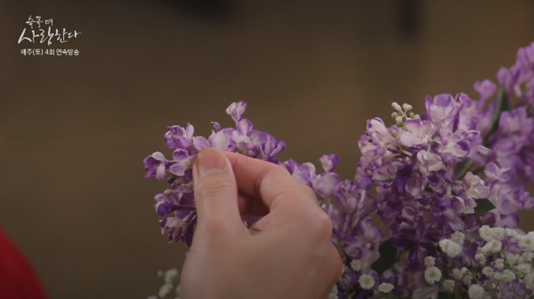
WIK’s hand at the end of the episode 5: purple lilac

With his bare hands, he takes a petal from the purple lilac and even crushes it, while saying that he will find her. So this scene is meaningful as it shows his determination to find her. Then even if she has changed, he will recognize her. YMR was never linked to the purple lilac before. Finally, this scene reveals what will happen, once he catches YMR. She will get beaten up. To conclude, the plastic surgery will only delay his discovery, he is already able to see YMR in a different form and shape.

To conclude, all the flowers (purple lilac, petunia, sword lily, cistus, daisy, lavender and Rosemary) were embodying our heroine which indicates that YMR is always changing. She could be perceived as nature itself. It was as if she was the queen of all the flowers which explains why SJW is fascinated by her. SJW loves flowers above anything hence he has a small garden in his house.   

Love in sadness: an introduction

episode one: Yoon Ma Ri

This k-drama which started airing on February 23rd is actually a remake of a Japanese drama

  • Title (romaji): Utsukushii Hito
  • Also known as: Le Bel Homme / Beauty

which I haven’t watched. Besides, this drama is also very similar to the American movie Sleeping with the enemy due to the main topic: domestic violence and how the wife tries to escape from the claws of her husband by changing her identity/faking her death. It seems that domestic violence is no longer a tabboo and has become a “trend” in South Korea as many k-dramas are using this topic to criticize the current situation. We have to imagine that 10 years ago, the actress Choi Jin-Sil committed suicide due to the scandal when she had reported that she was a victim of domestic violence. Back then, it was a taboo and her revelation caused her to lose everything. The reason I am writing about is that despite being a remake and the resemblances to the American movie, the writer and the director have been able to make this drama very intriguing and captivating.

First, the main protagonist is a painter hence her paintings add more depth to the story. Secondly, there are references to literature and classical music giving more chances to analyze this drama. In other words, the viewers have to pay attention to details so that they can better understand the characters and their issues.

In the beginning, we are shown this painting

episode 1

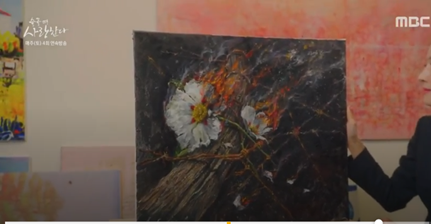
YMR is actually working on it, when her husband Kang In Wook enters her painting studio. He remarks that this painting and this flower resembles her a lot, hence she decides to title this picture “a self-portray”. Looking at the painting itself, the beholder observes two things:

  • the darkness of the picture: we see a dead wood, she even used a lot of black and brown
  • First, we have two flowers. Furthermore their white color contrast so much to the surrounding. Since the flowers are blossomed, they indicate that their withering is about to happen, especially due to the environment.

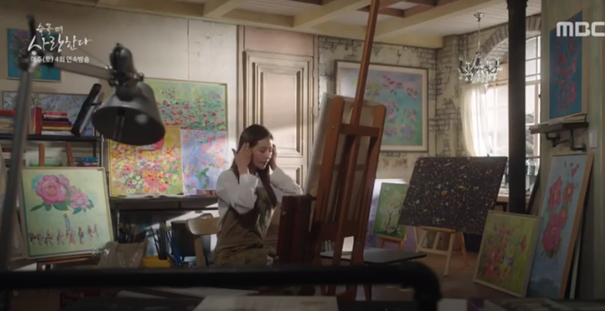
So since it is a self-portray, it actually symbolizes her actual situation: she is in a terrible situation. Her husband is embodied by the dead wood, he can not bring her happiness and life, actually he is the reason why she is perishing. Her world is cold and she feels lonely. There is no light, so there is no hope. If you look now at her painting studio, you’ll notice the disparity between this painting and the others hanging on the walls. All of them represent flowers but the choice of the color is totally different: a lot of green, red…. to conclude, she used bright colors in the past. So after being married for 5 years, this painting reveals her own mental state: she is depressed and desperate. But here is the question: why are there two flowers, if it is a self-portray?

Then in the same episode, shortly after, the director uses these takings

Yoon Ma Ri looking out the window

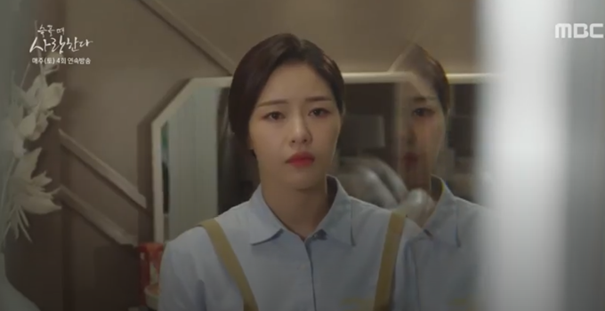
As you can notice, there are two Yoon Ma Ri, yet it looks like the second version is fading away, she is disappearing. And this is no coincidence. YMR is about to lose herself, her soul by remaining by her husband. She is not even allowed to choose her own clothes. She lives trapped in a cage hence the window with the bare reflects her actual position: she is a prisoner. She is not even allowed to paint outdoors which explains why her latest painting looks so gloomy and depressing. She can no longer paint as she has run out of energy and inspiration. So this explains why the second YMR is disappearing and why there are two flowers. The bigger one represents her own body, she is about to become a living corpse.

Striking is the finale version of her painting “a self-portray” is different.

In this scene, we learn that the meaning of the flower is “I will die tomorrow”.

So the first version wasn’t just depressing because of the dark colors and the environment. Even the choice of the flower was pessimistic. However, in the finale version, the beholder observes a huge difference: the flowers are burning. This indicates that not only her situation has even worsened but also her despair has increased. The moment she called it a self-portray, YMR revealed that she was actually waiting for her own death. In the finale version, the beholder is actually witnessing her death. Sure, she is announcing her death but it also shows that she even prefers burning than living in the dark for too long. This indicates that she is even willing to risk her life in order to escape from this misery. She will do anything, even if this means her death: the fire creates some light, it can even be seen by someone. So she is not giving up.      

As you can see, Love is Sadness is not different from Encounter as it uses a painting to give a message, illustrate a situation and the state of mind of a character.

Then in the same episode, we see the male protagonist, the plastic surgeon Seo Jung Woo, reading a page to his wife YH who is in a coma. The chosen book is Wuthering Height written by Emily Bronte in the 19th century, a tragic and painful love story. The protagonist Heathcliff loved Catherine, but the latter chose to marry someone else, Edgar Linton, as he came from a higher social status. Heathcliff had been raised in Catherine’s family. Due to her rejection, Heathcliff decided to get revenge on her and Edgar Linton. Interesting is that SJW chose to read the extract where Heathcliff is talking about the betrayal and the heartbreak. Catherine ripped off his heart and her own heart… So here again, this reveals that SJW is well aware that his comatose wife hurt him in the past by her betrayal. Later, we discover that she had an affair and lied to him. Due to this novel, we can already imagine what will happen to her: she will die, just like Catherine died before Heathcliff. The latter did torment her for marrying Edgar Linton but here, SJW married her hence he had no reason to torment her and she had no reason to betray him.

The significance of hands and feet in Encounter (part 2)

This analysis is composed of two parts: I will focus first on the hands and later on scenes where the feet are shown.

While the hands and feet played a huge importance in the relationship between our protagonists CSH and KJH, a good observant might realize that the hand had an important part in the relationship between KJH and her friend HI. Until the episode 5, we see that JH and HI are close but not so close friends as JH doesn’t confide to her at all. She has no idea what happened in Cuba. Only when HI recognized him in the scandal, he had to explain himself.

Striking is that JH feels comfortable around HI, he teases her, runs after her after joking but he doesn’t really touch her physically. However, after revealing his identity in the hall, HI goes to a cafe and remembers the past. Interesting is that JH approaches HI in order to congratulate her. He knew that she would be alone hence he came. She is thankful but he just answers:

Encounter episode 5 JH HI school.png
episode 5

What HI hasn’t realized yet is what is about to happen. JH wants to take a picture and hugs her with one arm. What caught my attention in this scene was the hand. 

Encounter episode 5 HI JH hand.png
episode 5

While JH is focusing on the camera, she looks at his hand that touches her shoulder. He has just declared that she was a good friend and here with this touch, HI perceives JH for the first time in a different light. His hand on her shoulder changes everything. From now on, she views him as a man. JH is unaware that his gesture is quite “intimate” as he keeps looking at the camera. 

Encounter episode 5 HI looking at JH.png

He doesn’t see how she looks at his face. She views him as a handsome man… JH’s other hand is in the foreground, blurred which serves as contrast. JH is paying attention to the camera, not to the girl that stands so close to him and his face. For HI, the camera in front of her is not important… JH is more important to her hence the second hand of JH is blurred. With this taking, the viewer can see both perspectives: JH is unaware that his casual gesture has triggered something in HI, for him taking a good picture is more relevant.

Encounter episode 5 HI picture.png
episode 5: she keeps this picture with her all the time. The moment she perceived KJH as man and his hand made her heart flutter.

JH gave her the picture later and for HI, this picture symbolizes the moment she fell in love with JH, the moment she realized that JH was a man after all. She clings to that memory hoping to find strength that’s why her hand is shown. For her, this picture is a treasure, the brief moment where she was so close to him: a happy memory which is linked to pain as well. Now, we all understand why HI was never able to confess to JH. Since he had declared before, they were friends… this picture marks for him the beginning of their real friendship (no more childhood friends), whereas for her it means the opposite: the moment she fell in love with him.

Since JH had touched her so casually once, I sense that HI might have thought, JH would come to touch her again like in this scene and would experience the same. She hoped that staying close to him, a casual touch might happen which would trigger feelings in him. What HI didn’t realize is that this memory has a different significance for JH: from that moment, he would always see her as a friend. That’s why he keeps saying to her that she is a friend.

However, I believe that his words must hurt her a lot because she is constantly reminded that in that moment she fell in love with him. Sure, HI had other reasons to believe that JH might come to love her… they belong to the same social class, she knows him well, she knows his family well too. On the surface, there was no reason for her to woo JH as he didn’t seem to be the type to be interested in woman.  But the other reason why HI got never close to KJH is that we never see her foot get closer to KJH. She only had a connection with KJH’s hand: the red diary book or the scene with the picture (see above). HI was never able to get closer to him… that’s why we see this game: HI is chasing after KJH but she is unable to win as her feet never get closer to his.

Encounter episode 2 HI JH playground chasing.png
episode 2 HI is trying to catch KJH

But we were shown in many other occasions takings of hands. So the director didn’t just focus on hands between CSH and KJH or HI and KJH, he paid attention to hands generally as he had another purpose in his mind. After JH entered CSH’s world (episode 4), he came in contact with director Choi and Chairman Kim. He had to hear terrible things. These painful experiences were shown in the episode 7 in flashbacks. 

Encounter Episode 7 JH flashback 1.png
Encounter episode 7: Director Choi with our hero KJH
Encounter Episode 7 JH flashback 2.png
Episode 7: Chairman Kim facing KJH
Encounter Episode 7 JH flashback 3.png

Striking is that they are all in black and white, just like CSH’s memories from the episode 1,

Encounter episode 1 Morro Cabana 3.png
Episode 1: Cha So Hyun with her father CJH and mother. CJH has become the mayor of Seoul.
Encounter episode 1 Morro Cabana 4.png
episode 1: her marriage with JWS

where she remembered her sad, painful and lifeless life. As you can see, JH went through the same things than CSH. People telling him how to behave and what to say, giving harsh comments. By using the same mean of filming, the director underlined the similarity between our main leads. Moreover, these black and white scenes symbolize CSH’s world, the kingdom Taegyeong Group, the world JH had decided to enter in order to become a meaningful person to CSH. Now, he knows in what kind of world she has been living. This kingdom is huge and scary. 

But in this black and white world, how can the subjects survive, as there is no sunlight and no warmth at all? Well, I had already pointed out that CSH had found ways to keep her mind sane and to express herself: the paintings and the hands. But actually, she is not the only one who uses the hand as a way to express feelings and indirectly thoughts.

In order to endure everything, to bear the humiliation and the harsh treatment, all of them, even director Choi who is just a pawn, react the same way. They hide their true feelings by hiding behind a smile or an expressionless face and use their hands in order to release their anger

Encounter episode 4 JH hand anger.png
episode 4: KJH’s hand just before he intervenes and decides to enter her world

(JH, episode 4… he hears director Choi insulting CSH) , anxiety, fear
(episode 3, CSH’s hand sitting in front of Chairman Kim),

Encounter episode 3 CSH hand fear.png

helplessness

Encounter episode 7 JH hand.png

(JH, episode 7 after hearing about his transfer) or their hurt. That way, queen Kim and the other royals think that they are all obedient puppets. However, this is just a subterfuge. None of them stop thinking or feeling. They remain humans.

Encounter episode 7 Choi hands.png
episode 7: director Choi is meeting CEO Kim.

With this taking, the hands of director Choi reveal two aspects: he is hiding one hand with the other. Actually, he is scared because Chairman Kim tells him that she discovered his disobedience and she saw his gesture as backstabbing (episode 7). With his two hands, director Choi is able to deceive Kim as his gesture underlines his obedience. However, we could interpret this gesture as a way to hide his fear… while the one hand is shaking, the other is able to hide and control the shaking.  

Now, you understand the “obsession” of this director with the hands. The hand is used in this cold world as a way to endure everything but at the same time to remain human. They are able to stay calm and overcome the terrible situation. Striking is that the director even decided to show the hands of minor characters like director Choi reinforcing the idea that in this chaebol world no one is actually really speechless. They might not speak in front of chairman Kim but they are still able to think on their own and feel.

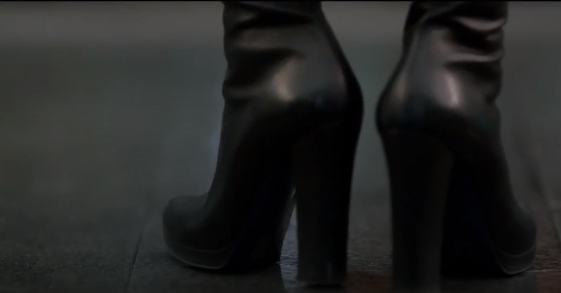
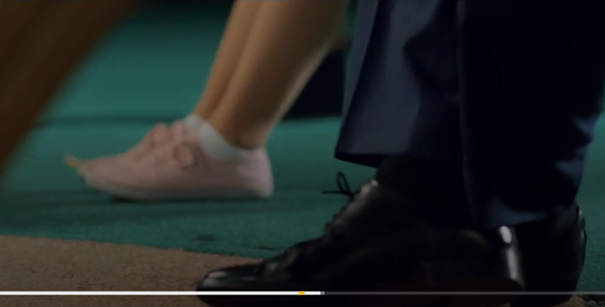
But now let us focus on the takings of feet. Sure, the director often zoomed on KJH or CSH’s shoes. Nevertheless the way the taking was made has its significance. When KJH decided to enter CSH’s world, we see the following zooms:

episode 4

As you can see, when we see KJH’s feet, his legs are visible, whereas it is not the case for CSH. Her shoes are partially visible or we only can observe her feet with ankles. To me, this reflects their freedom. CSH is not able to move freely like KJH. The closer the zoom, the less mobile and free the person is. Sure, this could be a coincidence. However, it was continually used this way. Let me give you another example. In the episode 7, KJH is told that he will be sent to Sokcho. Frustrated, he goes jogging. Then suddenly, we see this:

episode 7

To me, this taking reflect the pressure and his actual position: he is still free to tell CSH about the demotion, whereas in reality he has not many options. He can not tell CSH the truth as he fears that she might get hurt again. Moreover, she might do something that could tarnish her reputation.

episode 7

This explains why later the viewer can observe this: CSH is returning to her office after hearing the news about KJH’s demotion. Notice that this time, we see more than her feet. She has definitely more freedom than before… I see another confirmation with this scene from the episode 11:

Here, you could object that we don’t see the legs, yet their legs are visible through the shadows. So now we see that their feet are next to each other. Not only their closeness is reflected with this taking, but also their freedom . CSH chose to be with KJH and she made her decision willingly. Yet, notice that KJH’s shadow is bigger than CSH’s indicating that CSH’s situation is still different from KJH. She still has some issues: her own fears and insecurities.
In the camera zoom from the episode 7, we see her walking which contrasts to the former takings from the episode 3

Encounter episode 3 KJH's foot under the table 1.png
episode 3: KJH wants to get closer to CSH, hence he moves his foot just a little, which CSH will reject. She moves her foot away… just a little.

or 4 (see pictures above). She is no longer immobile. The zoom (Picture from the episode 7, see above) reflects her change of mind. She is active. This justifies why CSH’s feet are moving more slowly than KJH’s (episode 9).

Encounter episode 9 CSH feet end.png
episode 9: CSH is returning to KJH’s side.

She was trapped before, unable to move… had no freedom, now she is free but due to her long immobility, she can not run like KJH.

Encounter episode 9 KJH feet.png
episode 9

Striking is that just like with the hands, the director used zooms on feet of other characters.

episode 7: driver Nam with Min Jun, KSJ’s daughter

This taking underlines two aspects: the closeness of these two persons, yet the problem that MJ is facing: the divorce of her mother. Driver Nam can only remain by her side and help her to overcome this. He can not do what he would like.

To conclude, the takings of hands and feet revealed a lot about the characters’ situation and their emotions. The director used a very unconventional way to symbolize the actual situation, the feelings of the characters.

The image of marriage in K-dramas

Nowadays the focus of modern k-dramas has changed as more and more we see female characters (leads or second characters) in their thirties or forties. This actually shows that the writers are using the dramas in order to point out the difficult situation modern Korean women are facing: the struggles in the marriage, divorce, raising a child, work… By doing so, the dramas are trying to change the perception of women and their status.

Striking is that in Encounter and Romance is a Bonus Book, we see divorced women indicating that divorce has become a normality. Not just both female leads are divorced but also the PR manager Kim Sun Joo (Encounter) and Seo Young Ah (Romance is a Bonus Book). While infidelity was the reason for the three divorces, in SYA’s case it is different. The latter felt neglected and not protected by her husband. The latter not only preferred avoiding trouble, he also didn’t pay attention to her at all, since he was reading, while she was looking at the shoes.

Now if we focus on our two female leads, we will notice a huge difference. Unlike CSH, Kang Dan Yi’s life worsened due to the divorce. While CSH felt free for the first time and she managed to get a job (CEO of Donghwa Hotel) as her alimony, KDY, who had given up her career for her husband and family, was left with nothing. Her husband claimed that he was broke hence he never gave her any alimony. KDY was not just abandoned, she
was struggling financially too, since she couldn’t find a job. In the end, she became homeless. Marriage had a huge impact on her life: she chose to give up on her career and to focus on her family. After her divorce, she tried to find a job like she used to have. However she was not successful, since she had to fight against younger graduated women. Her status as housewife represents a huge hindrance in her come back. People see this as if she had done nothing important, as if she had been lazy all the time. KDY worked hard as a housewife but her work is not recognized by society. I could mention another k-drama “Terius behind me”, whose female main lead Go Ae Rin was in a similar situation. She had to raise two kids while trying to find a job after her husband’s sudden death. Go Ae Rin as a housewife didn’t feel acknowledged by her husband hence their marriage was facing a crisis.

Terius behind me: episode 1 Go Ae Rin with her husband

GAR was hurt and struggling as well. With these three examples, we can clearly see that the women’s situation hasn’t changed a lot: being a housewife is not rewarding, becoming dependent of a husband isn’t good either. Just like KDY, GAR tried to find a job but her status as housewife and mother became a hindrance. Yet, besides there is a new type of married woman: Kim Sun Joo

Encounter episode 6: Kim Sun Joo announcing her divorce to her friend Nam.
Romance is a Bonus Book: Seo Young Ah as the marketing manager is helping Kang Dan Yi

and Seo Young Ah are the perfect example. Both women have a family, yet they kept working… they never wanted to give up on their career. However both end up divorced for different reasons. Nevertheless unlike KDY and GAR, both women are not struggling financially and have not really lost their confidence. The divorce has affected them but they are still able to live normally and have no real identity crisis. For KDY, GAR and CSH, this is different. The three female leads have all something in common: loss of identity.

Encounter episode 7
Romance is a Bonus Book: episode 3

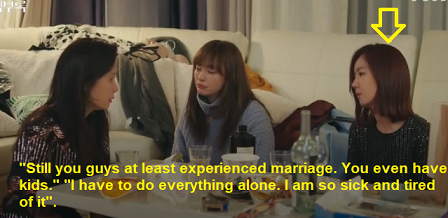
As you can read, both women lost their name therefore they lost their identity. In KDY’s case, we hear how she was called all these years (“Honey, Mummy, Madame”), while Cha Soo Hyun was always presented as the daughter or the ex-daughter-in-law. Striking is that the moment Cha Soo Hyun decided to do what she wants in her life, she started using her name again. Today is the first day, when she uses herself her own name. For KDY, it is similar. She also felt good being called by her name. Both women lost their identity and name as they were perceived for their function, usefulness. KDY was the one who helped her husband and daughter, CSH was useful for her father, mother and Taegyeong Group. It seems that the status as housewife and married woman is no longer a dream and reference. The reality is that housewives are isolated. In “Terius behind me”, GAR had friends but they were all housewives. KDY had only Cha Eun Ho as friend. CSH had no friend too.

Yet, in Romance is a Bonus Book we also see the other side of the coin: remaining single is not good either. Ko Yoo Sun ran away just before getting married as she was afraid of losing her job, her career and even her identity. However, now she regrets it as she is alone.

Romance is a Bonus Book: episode 8. Koo Yoo sun reveals her secret and past.

To conclude, in the actual k-dramas we see that a marriage can lead to misery and that being a housewife is linked to struggle, loss of identity and can lead to tragedy. The fairy tale with the marriage as happy ending is proven wrong. Reality is that housewives are too dependent on their husband’s income and their own worth is not acknowledged by society and even by the husband. In “Terius behind me”, her husband asked her to find a part-time job so that she would lose her weight and earn some money. As you can see, even her husband felt their situation burdensome… he was put so much under pressure as his whole family was relying on his income. On the other hand, remaining single is not a solution either as the result is loneliness. That’s why the traditional perception of marriage has changed. Being married and having a child doesn’t mean that a woman has to give up her job and career. Then Seo Young Ah’s husband made a mistake: he took his wife for granted. He thought, their love for each other would be enough and he was wrong. Love and respect are essential which is revealed in the three k-dramas I used as example. Moreover, we also see more and more that the image of men has changed either: the man should help his wife at home and raise the children as well. “Terius behind me” was the perfect example: Terius became really close to the twins and did a good job as taking care of the children. This is no longer the job of the wife. Nowadays men are expected to do house chores and raise the children. Cha Eun Ho and Terius correspond to this new image of men.

The place of books in K-dramas: Encounter and Romance is a Bonus Book

In the k-drama Encounter, the writer used poems, books and stories for many purposes:

  • Give more depth to the main characters
  • Use the main message from classical books like The Little Prince (“enjoy your life with simple things, take care of your inner child”) and Alice in Wonderland or poem (Rainer Maria Rilke f. ex.)
  • Discover the beautiful side of poetry, make a connection between poetry and daily life.
  • A demystification of fairy tales: a prince charming is just a façade
  • To promote new books, encourage people to read

Interesting is that now there is another k-drama called “Romance is a supplement” or “Romance is a Bonus Book”, whose story looks quite similar on the surface. Here we have again a noona romance, where the main character is a divorced woman Kang Dan Yi. She has a very special relationship with a younger man Cha Eun Ho.

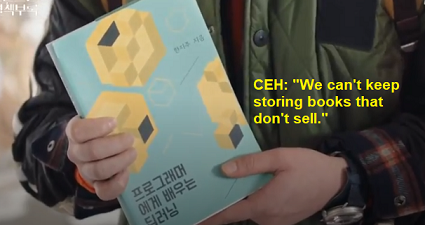
Striking is that the story of this k-drama evolves around books as well, as CEH and KDY are both working at a publishing company. As you can see, books have a special place again. However, the use of books is a little different, since the company Gyeoroo Publishing is a fictional company. So the books they publish and are about to publish can’t be real. Besides, our protagonist Cha Eun Ho is himself a professor of literature at Hanguk University, writer and Chief Editor at this publishing company. His works are fictional as well. Then the other difference is that the writer has a different purpose, it shows how a book is born. A book is not just the result of the author, the publishing company had a lot of people working on it: the editing team, the marketing team, the designer etc. KDY even compared a book to the birth of a baby… It takes a long time before the book in his finale form is created. CEH hopes that even with “one book may change someone’s life” (episode 4). Another distinction is the way people treats books nowadays as if it was nothing special. The clients in the bookstores damage the book without even paying for it, a clear sign of disrespect. Then the viewers are confronted with different scenes where readers damage the books. This is one of the gestures:

episode 4: with her cellphone, she is damaging the book. Another gesture is: some coffee stain on the book pages.

Furthermore a lot of published books end up shredded for many reasons. The publishing company can’t donate these books, the best option is to destroy them as they can still get some money from the shredding. With these two examples, we have clearly a critic about consumer society. Moreover, it shows that many books are still published despite the area of Internet and blog.

Imagine the waste of paper and the amount of cut trees
All the pictures are from the episode 4, market economy and profit are now the rules for publishing companies in order to survive.

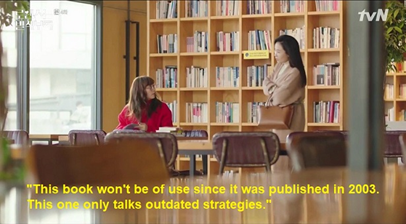
Yet the survival and the long existence of a book is determined by his success. The pressure is definitely bigger compared to the 20th and 19th century, since more and more books are published which was visible in the scene at the print shop. They have to compete with foreign books as well. Furthermore many books become outdated and useless…

In this scene, the character Yeong-Ah sees our heroine DY searching for books about marketing. The recommendation given by YA reveal the short life of certain books. It looks like it is very difficult to create a classical book, a timeless work.  

epsiode 1: Ji Seo Joon and Kang Dan Yi

Nonetheless, both k-dramas used the fairy tale Cinderella, however with a different approach. Our heroine in Romance is a Bonus Book is disillusioned. She doesn’t believe in fairy tales any longer due to her divorce and situation in the episode 1. She rejects the shoes an unknown young man Ji Seo Joon offers her. The writer used certain elements from Cinderella: unknown identity, loss of shoes, night, a beautiful gown (in the shop window).  The shoes belonged to her in the first place but due to an incident, she had lost one and decided to throw the other away which were picked up by JSJ, a book cover designer. DY tells him that she no longer believes in fairy tales and knight in shining armors as she is too old for that.

Finally, the scriptwriter of Romance is a Bonus Book reminds us that diaries are actually books, so many people are already writers. At the end of each episode, we see written thoughts from our main characters. These could be seen as selected notes from the diary CEH and KDY are writing. They both reveal a lot about their affection for each other. Moreover, this was implied when KDY rejected the shoes from JSJ. She said, she would rather write her own story.

As conclusion, although both k-dramas have a different approach to books, they have one common denominator: they are encouraging people to read. Both writers treasure books in the end. Romance is a Bonus Book reveals that it has become really difficult to turn a book into a classical book nowadays like f. ex. The Little Prince or Alice in Wonderland.     

The traces of Alice in Wonderland in Encounter

episode 14

In this scene, our main characters are reading the favorite book from the other. While CSH has The Little Prince in her hands, KJH is holding Alice in Wonderland. One is a philosophical tale, while the other is more or less a fairy tale. What does it say about Cha Soo Hyun? Unlike The Little Prince that was indirectly mentioned in the earlier episodes (through the painting and his first love confession), so far, the work of Lewis Carroll was never implied before. Yet both works have many things in common. Besides both deal about childhood and they look like children books on the surface, nonetheless there is a deep message behind these stories. A deeper analysis reveals that Alice in Wonderland is about becoming an adult and Alice’s journey in that strange land correspond to her growth from a child into adulthood through adolescence. As you can see, childhood has a huge place in these two stories, nevertheless their perspective about childhood and memories contrasts, moreover their approach is different. While in The Little Prince the author wants adults to remember their inner child in order to live differently and enjoy life to the fullest, Lewis Carroll wrote in the preface this following verses:

Alice! A childish story take,
And with a gentle hand,
Lay it where Childhood’s dreams are twined
In Memory’s mystic band,
Like pilgrim’s withered wreath of flowers
Plucked in far-off land.

Striking is that the fairy tale and childhood dreams are compared to withered wreath of flowers. Sure, they represent memories too, yet these suffer from time as they are described as “withered”. So the author is referring to the fact as older the person becomes, the more childhood memories seem to disintegrate… they lose their intensity. Time has an impact on them. Sure, people tend to held onto these memories hence they are compared to “pilgrims” but time has an impact on these childhood dreams. Furthermore, at the end of the story, Alice’s sister tries to remember Alice’s “journey” and “dream”. She is well aware that this was just a dream. Her eyes are closed and she attempts to imagine this Wonderland. Yet, she can not live the same experience as she is not asleep. While “dreaming”, she is still awake and her mind recognizes each image and sound from Alice’s story to the image and sound of the real world. The older sister starts imagining Alice as an adult who will keep the simple and loving heart of her childhood. She will tell this story to her own children and  remember this story and her childhood as something good. As you can see, childhood is linked in both works to purity and innocence and one author think that the person from the childhood won’t change that much (Alice’s image doesn’t change much in the future in the sister’s eyes), whereas Antoine de Saint-Exupéry thinks that otherwise. Adults change so much that they forget that they were once children. Time is quite important in Alice in Wonderland it is very often mentioned or implied (White Rabbit with the clock, her fall seems to be endless and during the fall, she can take things from the walls etc). Besides, Alice is even wondering if she should grow old or remain young. She decides, it is better to grow up as she doesn’t want to get lessons all her life. On the other hand, in The Little Prince, there was no time indication, the only thing related to time was the “death” of The Little Prince.  

But let us take a closer look at Alice in Wonderland. Since CSH chose this book, this implies that she feels some connection with the main character. What have Alice, the main character, and Cha Soo Hyun in common? First, both are female characters, while The Little Prince was a boy… the same gender than KJH. Secondly, the story begins with a dream. Alice is sitting next to her sister, while the latter is reading a book. Alice feels bored and fell asleep. Striking is that transition between dream and reality is not visible. And this is interesting because the more we read, the more confused it becomes. The distinction between dream and reality is not clear at all, especially when it is written: (First chapter) “the sleep began to win Alice”, she is even described in her dream as “half-asleep” giving the impression that she was awake before. Yet, this is not possible as she had already made different strange experiences: meeting the White Rabbit with his clock, the endless fall where time seems to have changed. So she was already dreaming, however it looks like there is a “second sleep” indicating that she is falling deeper and deeper asleep. So the borders between reality and dream are not clear at all. Strangely is that Cha Soo Hyun is in a similar situation in the beginning. She has been in a coma for so long so that she has some problems to discern what is reality from dream. In the episode 11, while she is drunk, she confides to KJH her biggest fear. She is so happy to have him by her side that she is worried.

episode 11

These words underline her confusion. For her, it is too good to be true. This must be a dream because reality is so different. Her vegetable state has affected her. She can no longer distinguish what is dream and reality. Well, in “Alice in Wonderland”, there were still allusions to the real world: her cat Dinah, her friends Ada and Mabel, her lessons etc.” so that this story is a mixture of dream and reality. A certain confusion exists in the story too. Yet, the way Alice wakes up at the end marks a turning point. She rejects “Wonderland” claiming that they are just a deck of cards. She refuses to acknowledge The Queen of Heart and her minions, she regains consciousness and can discern their true nature. At the end, there is no more confusion. CSH has a similar experience at the end. She is able to discern that this “dream” is not too good to be true… the photos of her happiness are the proof. This is reality and not a dream. So their journey are quite similar. At the end, both can distinguish dream from reality.

Another parallel between the drama and this tale is that Alice’s personality resembles Cha Soo Hyun’s character a lot. Both are curious, eager to help and both make mistakes. CSH’s curiosity is visible as she keeps trying new things with KJH (eating ramyeon at a stop area, chicken gizzards aso). Moreover, her new experiences are often linked food… just like Alice who keeps trying drinks, cookies and mushrooms in order to know what the effects will be. Another aspect is their loneliness. Alice is either talking to herself or talking about her cat Dinah which she seems to be missing a lot or she can’t stop talking to others (the duchess, aso). She feels lonely in this world. But the main common denominator is the loss of identity and their quest to discover who they really are. CSH’s loss of identity is palpable in the episode 7. She mentions

episode 7

So it means for the first time, she is living as Cha Soo Hyun. Notice in her next words, she uses her own name, like f. ex. “I’m no longer the Cha Soo Hyun who is crazy about the hotel”. She has already found a part of herself the moment she uses her own name. Alice is put in a similar situation. In the chapter II, she wonders about her own identity. Then she remembers her friend Ada and Mabel and realizes that she can not be Ada and Mabel. Later, the White Rabbit calls her Marianne, the pigeon confuses her to a snake. The Cater pillar is the one who asks Alice: WHO ARE YOU? Alice had already questioned her own identity before, yet the caterpillar is the one who confronts her with that question openly. As you can see, Alice and CSH use both names in order to find their own identity. However, there is a huge difference between these two characters. While in the tale Alice in Wonderland, the focus is on growth and becoming an adult, CSH has a different journey. For her, it is to discover her own inner child. The more episodes aired, the more CSH became cheerful, even her secretary JMJ pointed out that CSH was behaving like in the past. So their journey is quite the opposite. CSH has lived for a long time as an adult and could never enjoy being an adolescent and child. Alice goes through the adolescence in the book, just like our heroine. CSH takes her distance from her mother and at the end, she is able to reconcile with her as she has found her own identity and her own life. Sure, when she talked to her mother, she hadn’t gone back to her KJH’s side, yet CSH had changed.

Finally, the Queen of heart and the King remind us a lot of Chairman Kim and her son JWS. The latter acts behind his mother’s back, just like in Alice. The Chairman Kim owns a chessboard which is quite similar to the deck of cards. Both queens are threatening a lot and even trying to give death sentences. Their world is quite violent and brutal so that both Alice and CSH are rejecting it at the end.

To sum up, the drama Encounter and Alice in Wonderland have a lot of points in common:

  • The journey of a heroine
  • The importance of time and childhood
  • Loss of identity and search for identity
  • The visible growth of the main character 
  • Confusion between dream and reality
  • Some characters are quite similar

At the end of her journey, CSH found her true identity and personality. She has found her inner child, although she is still an adult. That’s why we see this painting at the end of Encounter.

episode 16

Since KJH has always been the more mature one (f. ex. enduring hard times with good memories, his letter at the end, his bet in the episode 16), the man embodies KJH’s personality: full of wisdom and knowledge and the little girl resembles CSH because of her childish side… she likes teasing KJH. 

Water: Cha Soo Hyun’s true nature

Nature plays a huge part in this drama. JH is actually a representative of nature, either in the form of the wind, the sun or the tree. To be more precise, KJH is often associated to the air (wind, butterfly), while our heroine is revealed to be linked to water due to the presence of the sea. First, the drawings underlines this aspect. Striking is that the sea is represented in the two following pictures:

episode 1
Encounter episode 6 drawing 2.png
episode 6

One might say that the sea is illustrated here because in these two episodes, JH and CSH were close to the sea: Cuba and Sokcho. Yet, this doesn’t explain everything because in the third episode, the sea is often seen as they are in Sokcho, however the drawing represented our heroine trapped by a fence and window. She was forced to stay immobile. Furthermore in the episode 10, JH and CSH were in Cuba, yet the garden of Grandfather Samuel was the main topic of the drawing. As you can observe, the location as such doesn’t explain the presence of the sea in the drawings. Moreover, in the second drawing the sea is here dangerous due to the waves, the latter are referring to the people trying to stop them from getting close to each other. 

Therefore we need to examine when the sea is shown in this drama. The first episode starts with CSH standing in front of a window looking at the sea. 

Encounter episode 1 CSH and the sea.png
episode 1

She is in Sokcho and the manager is briefing her about the reservations and the future opening. Interesting is although CSH’s face is expressionless, the viewer can sense that for her, looking at the sea is relaxing. In the episode 6, she explains why this hotel was so built (view to the sea and the mountain in order to relax and get closer to nature). It becomes clear that she has been missing nature and especially the sea. Yet, in this scene the sea looks so far away and the window serves as a shield. It was as if CSH was forced to admire nature, here the ocean, from far away, behind the window. She looks like trapped in that hotel which reminds us of  a prison, so in order to feel better, the big view gives her the impression that she is not dead. However, if you take a closer look at the window, you’ll see the bars… so the form of the window reinforces the idea of a prison but in a bigger dimension. The sea appears again, when JH is listening to music and relaxing.

Encounter episode 1 JH port sea.png
episode 1

The ocean has the same effect on him, nonetheless he is above the sea and doesn’t touch it at all. He is not really looking at it, he is rather dreaming. Both are in a similar position in reality,  yet CSH is further away from the sea than JH and CSH seems to be more longing. For our main progatonist, it is a matter of his own choice, he is not that interested. We saw him taking more pictures of the city and people than the sea at such. Arrived in Cuba, CSH seizes the opportunity to see the sunset at Malecon beach, however the manager recommends her to go to Morro Cabana because the view is more spectacular. So her decision shows that she is attracted to the sea and nature as such. Nonetheless, she has to climb that mountain in order to enjoy the spectacle.

Encounter episode 1 Morro Cabana sea sunset.png
episode 1

If we compare her position to the first scene, then we notice that she is still far away from the ocean. However, she has been able to escape from her prison. For the first time, she feels free. But her freedom is just temporal. I had described before that the view of the sunset at Malecon beach had a magical moment: this marks CSH’s awakening.

Encounter episode 1 Morro Cabana 8.png
episode 1

I couldn’t help myself, while watching this scene, thinking about two stories. The first is the legend of Aphrodite’s birth and the second is the sleeping beauty. The legend of Aphrodite says that blood coming from the sky (Uranus genitalia) fell into the sea, creating white foam… and the goddess of love and sex was born. The sleeping beauty is awakened by the prince’s kiss. In both stories, we have something in common: birth and awakening which are quite similar. Since the sun often embodies JH, the sunset in the ocean can be seen as JH kissing CSH and bringing her back to life. The person is like reborn, she symbolizes love for JH who for the first time is attracted by a woman. I mean, she caught his attention earlier but her reaction at the sunset had a huge effect on him. Nevertheless, CSH is still far away from the ocean. For me, the sea embodies CSH’s true personality so that we come to the conclusion that water is her true element.

As the story progresses, we can observe how CSH and JH gets closer to each other and the sea is also getting closer to CSH as well. In the episode 3, we have three scenes where the ocean is in the background.

Encounter episode 3 CSH and JH meeting close to the sea.png
episode 3: They meet again in Sokcho
Encounter episode 3 JH and CSH talking to each other.png
Encounter episode 3 JH and CSH the beach.png

First, due to the painting affair, CSH has to travel to Sokcho and for the first time, we see her wandering around the hotel, walking on docks looking at the sea. Striking is in the first picture, JH is taking pictures of the sea and CSH is walking downstairs. She is still above the sea. So JH’s attitude towards the sea seems to have changed and their encounter has an effect on CSH. She didn’t expect him there. What caught my attention is the closer they are to the water, the happier and the more relieved CSH feels. In the evening, she can even smile and play happily without any worries and shackles. Another observation is the effect of the sea on both of them: in the second picture above, JH confides to her and she listens. In the episode 4, CSH is confiding to him, while she thinks, he is sleeping.

encounter episode 3 sea side.png
The closer she is to the sea, the more she reveals about herself.

The sea plays a huge role, as it reveals her true personality (her own thoughts, her own feelings). This explains the need of CSH to look at the sea in the episode 1 and 6 from the window. She needs the sea in order to feel better. She shows more and more her true feelings and personality. She is revealing herself little by little. It looks like the sea helps them to open up. 

Encounter episode 9 scene at the lighthouse 1.png
episode 9

In this scene, JH was reading a book and this sentence about the sea attracted his attention: “If the sea’s job is to make waves, mine is to think of you”. When JH was living in Sokcho, separated from CSH, he visited the places they had been in order to seek comfort. He had the impression that CSH was close to him. Due to all these events, he had already linked the sea to CSH. Moreover, when CSH appears in this scene, JH is again reading and not looking at the ocean. I sense that it must be somehow painful for him to look at the sea after their last phone call (“no news, good news”). In this picture, we see the wind moving the book pages, however we see the waves in the background moved by the wind. We could interpret, JH as wind brings in CSH’s heart emotions to life. He makes waves, something that CSH has no control over. This explains why in the first picture above, we see the sea and the waves… CSH as sea and JH as wind are visible there. However, the difference between the waves is huge… CSH is in the first picture of my post really back to life, while in the episode 9, she has finally admitted that she couldn’t live without him. She is finally able to confess how much she missed him and how much he means to her, yet she doesn’t confess his love for him. While he runs towards her, she just walks slowly. To conclude, she is not entirely true to herself, she is definitely restraining herself. Notice that she is not touching the sea. She is just very close to water, that’s how the restraint is visible.

Striking is that in the episode 10, the viewer see how KJH walks to the same spot he was seen in the episode 1 and rests there after meeting Grandfather Samuel. This underlines that KJH feels the need to be close to the sea. He went directly there unlike in the first episode. Moreover, he is not listening to music. His attitude is really different. To me, it outlines that our hero is missing CSH a lot. While in the garden, the stars in the sky made him think of her, here the sea makes him think of his girlfriend.
The climax is shown in the episode 11:

Encounter episode 11 JH CSH beach 1.png
episode 11
Encounter episode 11 JH CSH beach 2.png

CSH and JH have their feet in the ocean, they are enjoying the beach and the waves. There is no distance between CSH and the sea any longer, which means CSH has found back her real personality and she is enjoying her new found freedom. She is outside, running freely and there is no window or dock separating her from the sea.    

And if we look back at the drawing from the episode 6, the waves are here the enemies because JH has forced them to react. The presence of JH as wind created waves, since the wind is the cause of waves. He brings enemies in CSH’s world, the sea. They are forced to reveal themselves.

However, the last drawing showing the presence of water is in the episode 13.  

Encounter episode 13 drawing beginning.png
episode 13

This time, the sea or a a lake seems to be frozen. This drawing represents CSH’s inner world, her last wall… which KJH is unaware of its existence as he is walking on the same side. Since he is by her side, he believes that he has achieved his goal (being as close as possible to her), yet he is wrong. This picture reveals the invisible barrier. Notice, we have here a mirror as the lake reflects their bodies which will mislead KJH. He won’t notice how he is pushed away, after his girlfriend meets his mother. The meeting is shown in the form of the white butterly leaving CSH’s body. This is the real blow which makes CSH change her mind. The frozen lake represents the last wall CSH had build around her. She is still somehow trapped and not entirely free.  

credit to @utkim (forum soompi)  

EmDxX6.gif

This gif illustrates perfectly my interpretation about nature and walk. CSH is in the dark, as if it was the night, since we can see two stars. Yet there is no moon. KJH is the only one living as he is walking. KJH is the wind and CSH is the sea. Notice that there is no wave before, the sea is calm. While approaching her, KJH creates a huge wave so that there is a lot of foam, bulbs of air.The wind brings movement and life to the sea. Their reunion creates something magical and huge. The big wave outlines the positive effect of KJH in CSH’s life: full of movement, excitement and joy.

The importance of nature in Encounter

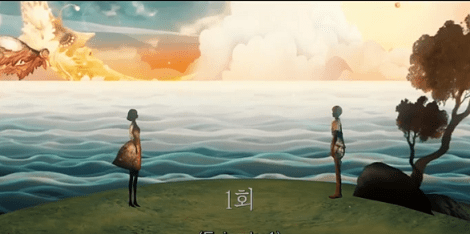
This drama is really interesting because each episode starts and ends with a drawing. Each pictured scene doesn’t just serve as an introduction to the main topic of the episode, but also helps to understand the characters and their situation. However, if the drawings are all put together, you will notice a common denominator, the presence of nature. And each time, its presence is increasing. But now let us go back to the first episode and the introduced drawings. 

episode 1
episode 1

So far, two worlds are introduced: the castle, where the princess is living and the green land where our main character is reading a book. The atmosphere of the first image is gloomy and rather suffocating. It is night, yet the moon is not shining at all. The moon is even hidden by the palace. Under the yellow arrow, you observe the princess leaving the castle on her own, going through the forest full of thorns,

Encounter 1 sleeping beauty.png
episode 1

until she arrives in a new world, where the moon and sun are shining at the same time. There, a man is reading a book, until he notices her and stands up. Both are facing each other. Here, the first drawing represents Cha Soo Hyun’s world, the modern civilization, whereas the second drawing embodies Cuba, where KJH will meet her. So the castle could be seen as a representation of Donghwa Hotel and Taegyeong Group.
CSH is the CEO of Donghwa Hotel and she has just opened a new resort close to the sea. When the viewer sees her for the first time, she is already looking at the sea. She appears emotionless, yet we can see that the sea has some positive effects on her. She is calm.

episode 1

Later, she explains how she developed the hotel. She wanted her future clients to rest by having a view of the sea or of the mountain. As you can see, she perceives nature as something positive, which can help someone to relax. Now, if we connect this to her trip on Cuba (her desire to watch the sunset at a certain beach), the viewer realize what nature means a lot to CSH. For her, nature is beautiful, can help people to relax and enjoy their time. However, the picture above shows that she can not get close to nature, as the window is separating her from the sea. The window could be perceived as a prison window due to the iron bars. This underlines first that CSH is living in a different world, far away from nature, and that she can not live like she would like. The other drawings show her living in a castle or pavilion, surrounded by people or by a fence, or trapped by a window

Encounter.png
episode 3

or even attached to a building.

tumblr_pj0b9uWnGz1xtrqw8o2_540.gif
episode 2 (credit to @Jemrie, forum soompi)

To conclude, she is not just immobile, as she can not move, she lives in an urban world that is suffocating her and she can usually only escape from it through her paintings. The paintings function as a window to a different world, where her fantasy and her feelings are not contrived,

Emcoumter episode 5 drawing.png
episode 5

however it is not enough, since her biggest desire is to be close to nature as she likes observing nature (sunset). That’s why she was so determined to reach the beach in order to watch the sunrise, no matter what (broken taxi, no money, no phone). We shouldn’t forget that CSH is determined to renovate the hotel in Cuba without changing the garden, even refusing to put a swimming pool. She even outlined that the strength of this property was the garden. As you can see, she values the hotels based on natural elements:  garden, sea, mountain. She wants people to feel close to nature through her hotels. Notice that after watching the scene where JH was looked down by her ex-mother-in-law (episode 6), she was standing in front of a huge window looking at the sea. At some point, you could sense that looking at the sea had this calming effect on her. For her, nature is a source of strength. Sure, she is a princess in the eyes of many, yet there is one person who perceives her differently. This is not a coincidence that in the episode 5,  driver Nam compared our protagonist to a flower. He explained to CSH that no one can stop a flower from blossoming. As you can see, CSH is like a beautiful flower that has been “put behind a glass” by her mother and ex-family. A flower needs fresh air and water in order to live and that’s what JWS is not able to understand. He realized that in their marriage she was suffocating, hence he released her. In reality, he just created a bigger cage for CSH: Donghwa hotel. 

However, our heroine is not just associated to a flower. She is often linked to birds. 

Encounter episode 7 drawing ending.png
episode 9

First, look at the bird sitting on her lap in the gif above (episode 2). Then don’t forget the white howl she offered to JH (episode 2). But most importantly, just before the accident happened in Cuba, a bird appeared on KJH’s table at the cafe. The bird was announcing their fateful encounter.

Encounter episode 1 bird.png
episode 1

In the episode, we see this taking. She looks like a flying bird.

Encounter episode 10 CSH directors meeting.png
episode 10

Don’t forget that JWS is always filmed indoors, in suffocating rooms with no windows so that you have the impression, he is living in a prison, even worse, in a buried coffin due to his preference of rectangles and brown/black as colors. However, in his mind, this beautiful flower needed a protector that’s why he is helping her behind her back. She is like a flower with JWS as a gardener who ensures that she doesn’t get hurt. Donghwa hotel can be perceived as a greenhouse, where everyone can look at CSH and even gossip about her. He is just the gardener protecting her. By doing so, he feels that the flower sooner or later will realize what he has done to her so that she will smile beautifully to him like a flower and she will come back to his side. However, the difference between JWS and Nam is that the latter only compared her to one flower, while the other associated her to many flowers (episode 10). For Nam, she was fragile and unique, for our second lead, a lot of flowers looked like her, unaware that his words meant that she was nothing special.

But let’s go back to the drawings… they have all something in common: nature is always present, in the beginning (episode 1, 3, 4) less, but the more episodes were aired, the more nature prevails, whereas the modern civilization disappears little by little therefore there is no castle at the end… just time or moon or sun or stars (drawing from the episode 13, 14, 15 and 16), since Donghwa and Taegyeong Group represent no thread any longer. Nature has won over modern civilization. The reason is simple. First, nature plays a huge part in CSH’s life. Only when she is surrounded by nature (like drawing 1), she can feel free. Cuba is such a place. It has also become a meaningful place for her because she could do anything she wanted without being in the center of the attention. If we look at the first picture above, you can see that the trees are black and without leaves indicating that this is winter and nature is sleeping. We can interpret this scene as if her passionate nature was sleeping, oppressed. In her dark world, where she is so small and powerless, she is also like a flower that is sleeping or has not bloomed yet.

episode 11

In my opinion, JWS and his mother represent the opposite world. Wealth and their social status are associated to civilization and modern world which are symbolized in the drawings 1, 3, 4, 5 and 11 (castle, pavilion, street lamps, road, windows, fence, wheels aso). That’s why CSH can never be happy with them. This is not random that JWS is always concerned about his image and appearance (he went to the shop because he wanted to impress a picky woman, his ex-wife), as he believes this matters in order to seduce someone. He even bought an expensive dress for CSH. Appearance is linked to artificiality, the opposite of simplicity and naturalness. As you can see, image means a lot to JWS, but it is different for CSH. KJH could move her heart because he wanted her to feel comfortable: the shoes, the jackets, the scarf. He always tries to give her his clothes. He always worries that she might get cold or hurt. A person obsessed with appearance would never accept such gestures because it wouldn’t look good but CSH is not thinking like that.

On the other hand, our hero JH is linked to nature in the different drawings. In the first drawing, he is living in a world so different from CSH: sunlight, green and tree. He is often standing next to the sun. If he is not represented, he is symbolized by the red butterfly (episode 4). The red butterfly has an important signification: it is an omen announcing huge changes in someone’s life. From my point of view, when the red butterfly touches CSH’s head, it was as if it brought back life and feelings to our protagonist. But don’t forget that in the story itself, JH introduced himself to CSH as fruit seller. In the same episode (1), CSH compares him herself to a fruit saying that he was like a white grape. Then in the following drawing,

episode 12

the beholder discovers that KJH’s home is a tree, whereas her ex-husband’s home reminds us of a coffin. In another episode, JWS uses the metaphor of the wind, when he warns CSH that she might get swayed away.

Encounter episode 8 JWS and CSH meeting.png
episode 8

Here the wind is actually a metaphor for JH. The wind knows no boundary, no limit as it is connected to the sky that’s why the wind should be perceived as the epitome of freedom. Moreover, by asking her not to let herself blow away, JWS actually wants her to remain in his world (“rectangle/frame”) because if she allows this, she will leave his world and won’t be able to come back. Furthermore, by associating JH to the wind, he is implying that her relationship with JH is doomed as the wind is something untouchable. You can not remain by the side of the wind, you can feel it but that’s it. To conclude, our hero is often associated with products coming from the nature: tree, butterfly, wind, grape, sun and fruit. The tree offers protection and rest for birds.

And this is another evidence that JH and CSH are meant for each other. A bird can only feel free and comfortable in the air… with the wind. On the other hand, JWS just compares her to flowers. JWS sent many flowers and even wrote that these resembled her. So the note and the number of flowers give the impression that CSH is not unique and special. This contrasts so much with JH’s mind: “among a multitude of stars, one star stares at me.” So for him, CSH is an unique star that he can distinguish from others… for JWS, it is different. In the end, his gesture shows that CSH is not really meaningful but he doesn’t realize that. Funny is that he thinks a little note, he can woo her so easily… JWS is far from being well educated: his expression skills and knowledge about book, arts and poetry are rather low and poor.

Encounter episode 8 drawing beginning.png
episode 8

Since Cha Soo Hyun is represented by the moon and the bird, KJH by the sun, the air and the wind, this explains why the beholder often witnesses our protagonists flying a lot in the drawings (episode 6, 8, 9, 12, 14, 16). The sky is their natural environment, hence our couple is often walking and even climbing a tower.

Encounter episode 8 the tower.png
episode 8

Don’t forget that our couple is represented by the moon, the sun and the star. As conclusion, the sky, even the space are their real element.

Encounter 7 drawing tear star.png
episode 7

Sure, the drawings also reflect the evolution of CSH’s situation and her relationship with JH. At some point, she has freed herself, she is no longer captive like in the drawing from the episode 3 and 4. She is also not surrounded by enemies, like the snakes in the episode 4.

Encounter drawing episode 4 fighting the snakes.png
episode 4
episode 15

Her emotions have changed as well. She is no longer cold, no sleeping flower. She is warming up, her emotions are starting showing up. As conclusion, nature symbolizes here liberty, but more precisely, the sky and space are the real symbols for freedom. Only at the end, she will be entirely free (no more guilt or insecurities). She is no longer bound by the earth or time, she has become a real moon. She is shining as the sun is shining next to her. As conclusion, the higher our protagonists are/ fly, the freer they are.

episode 16: the climax of their love and freedom
Encounter episode 6 drawing 2.png
episode 6

We shouldn’t forget that nature can also be dangerous. Notice that once CSH has escaped from her cage, she always has to face enemies and adversities. And in nature, her enemies are represented by the snakes, waves and the wolf. As you can see, nature is also connected to negative aspects. Nonetheless, this underlines that the problems and enemies CSH and JH have to face are natural phenomenons. This is nothing special but on their journey (drawing from the episode 5 and 6), they need to be together and work together. At the end, the sun has never shone so brightly. The MIL, the director Choi, her ex-husband are symbolized by the waves, the snakes and the wolf but since CSH and KJH never gave up and remained firm, the waves, the wolf and the snakes disappeared. In the drawing of the episode 6, KJH always serves her as a guide, he is her strength because he is the sun that warms her so that the flower can blossom beautifully.  As for the wolf, the viewer shouldn’t forget that wolfs were used to be associated to death and danger in the past (see for example the fairy tale Little Red Riding Hood), while the image of the wolf in modern stories has nowadays changed, since they are in danger. To conclude, the danger coming from nature are linked to the earth (the forest of thorns serving as border and fence, sea, snakes, time, wolf) contrasting to the space and sky, the epitome of freedom. In the universe, there is no limit of time and space.

Encounter drawing episode 6.png
episode 6

Time: an analysis of the episode 15 in Encounter

When we look at the drawing of the episode 15, we see a huge hourglass standing between our protagonists CSH and KJH. Both are looking at the sandglass and seem to feel so little and powerless, especially because they are both much smaller compared to the hourglass. Moreover CSH and KJH are quite passive, they just stand and do nothing else than looking at the sandglass. Since the latter symbolizes the time, the viewer might wonder why the director chose this drawing. In this episode, CSH will break up with her boyfriend. So why does time seem to be the main topic of this episode based on this drawing and not the break up as such?

The answer is quite simple. The writer and the director used different means in order to show the importance of time.

First, if you pay attention to the dialogues, you will notice that time is so often mentioned. KJH’s mother says

  • “Once time passes, it will all quiet down.”
  • “He will forget about everything with time

Then teacher Lee advises to KJH: “Let’s just wait a while longer”. She explains that CSH just needs time, just like KJH declares the same to CSH hoping that she would reconsider the break up: his mother just needs time. Furthermore while father Kim criticizes his wife, he tells her that their son withstood hard times for them therefore they need to support him as well. CSH hopes while walking on the bridge that in time he will be able to understand her. Then driver Nam advises CSH to reconsider it as well with the point: “It’s no time to think about it”. At the end, when KJH is about to give up, he confesses to Mrs Lee that it is time for him to let her go as well. As you can see, the break up is associated to time.

Moreover, time is also shown with the staging. We have CSH who wanted to break up at the end of their wonderful date but she couldn’t because KJH offered her the camera case. CSH realized that she needed to wait for the right time. She got aware that timing was as important as the way to break up. Besides, we have KJH who missed his bus at the end of the episode 15 which lets driver Nam see how KJH is affected by the break up. Then time was the reason why KJH got hurt. He caught his parents arguing and discovered that his own mother had betrayed him and asked his girlfriend to break up with him. Once he heard this, he went straight to her office. But she had already removed her couple ring, he was too late with his discovery as she had already made up her mind.

Then memories are so often mentioned as well and memories are connected to time as well. Memories represent events or moments in the past. For KJH’s mother, the break up will become a memory and at some point, it won’t affect her son any longer. He will be able to marry and have children. Then we have this taking.

episode 15

This zoom represents Cha Soo Hyun’s gaze, looking at the Havana clock in her office. This indicates that she is remembering her wonderful time spent with KJH. She has already connected this clock to her time with her ex-boyfriend. And later the good memories of their relationship are the reason why KJH changes his mind in the last minute. The time spent with her is so precious to him and now we can link this to The Little Prince: “It’s the time you spent on your rose that makes your rose so important.” Thanks to these good memories he is able to remember his promise: to endure pain and overcome the hurdle due to the good memories. That’s why he changes his mind in the last moment and decides to visit CSH’s office. So while time was the main cause for the break up (CSH, KJH’s mother), time is the reason why KJH decides not to let her go and why he is as determined as before to remain by her side.

Encounter episode 15 drawing ending.png
the drawing at the end

This explains why at the end the hourglass disappears, time is no longer what separates them because KJH is determined to make her change her mind. He will no longer remain inactive and passive like in the beginning. He will wait for her and waiting is linked to time. The break up was symbolized in the drawing by the separation due to the hourglass. Our protagonists were not next to each other, they were separated by the sandglass. Time seems to be against them. Yet, as time had passed on, the hourglass suddenly disappeared because it was the right time for KJH to show his strength and his determination.   

Encounter: a photo album

I had analyzed the different meanings of “Encounter” and pointed out that “encounters” was exactly what defined JH-CSH’s relationship which explain why despite the gaps in their social status, their age and environment they could meet and understand each other. Due to many encounters, their relationship got deeper. Then in the episode 5, the turning point of their relationship is marked, when they stand in front of this painting.

Encounter episode 5 painting Whanki.png

They are looking at each other and JH is even touching CSH’s arm. She doesn’t push him away. Striking is that this painting from Kim Whanki is also referring to “encounter”, since his title is “Where, in What Form Shall We Meet Again”. What also caught my attention are the colors and the structure of this painting. Since we know that Cha Soo Hyun’s element is water as our heroine is often connected to the sea, we could interpret this painting as an image of the sea with a lot of foam, bulbs of air. So this painting embodies perfectly CSH and KJH’s relationship: the meeting of water and air. Yet we could interpret this painting in a different way. As you can see, 

Image result for Korean painter where in what way we will meet again
Kim Whanki, Where, in What Form Shall We Meet Again

the painter Whanki Kim drew a lot of squares with different sizes and colors. The squares could be seen as picture frames. And now we can understand why the episode started with this drawing. 

Emcoumter episode 5 drawing.png

Our protagonists are walking side by side and there are a lot of picture frames. All of them look empty. But in reality, there are not. It is just that our OTP is not aware that their relationship has been marked with different pictures. They didn’t take any picture but the director and the viewers are the spectators of their pictures. I sense that from the start, the director and writers were planning to use this drawing and painting. Let me give you examples from previous episodes:

In the first episodes, we see these following takings:

Encounter 1 JH CSH.png
Encounter 1 time pictures.png

Due to the black frames, they definitely look like photos. Then in the second episode, wheen JH and CSH were eating ramyeon, the scene was so shot that you have the impression, it is a picture (metal bars remind of a frame again) 

Encounter episode 2 ramen eating.png

and it became a photo for real.

Encounter episode 2 pictures scandal ramen.png

Then in the third episode, this scene on the beach

encounter episode 3 sea side.png

which is breathtaking reminds us of a painting due to the window frame of wood which can be perceived as picture frame. In the episode 5, the director shot a scene in a similar manner: 

Encounter 5 picture JH CSH.png

To me, the painting from Whanki should be seen as a photo album that contains all the moments of our OTP and that’s why at the end of the episode, we see the painting used to show different moments of JH and CSH’s life.

Encounter 5 painting Whanki with photos.png

JH and CSH are not entirely aware of their serendipity because at the end, we see how their paths crossed each other without noticing each other. By doing so, the director and writer are underlining that they were fated to meet. As conclusion, the viewers are actually watching a photo album of our OTP therefore the writer keep shooting scenes as photos. Moreover, the picture frames in the drawing look a lot like stars illustrating first the natural of their meetings and second the impact of their encounters… in this darkness, they felt happy and are kept as good memories. And their final photo is this

episode 16

All along the viewers keep seeing such pictures, while our protagonists have no idea of their existence. These are invisible photos. But who is the photographer? Sure, in reality the director chose to create such takings but in the story itself, I would say, nature and time are the ones behind these pictures as nature and time are the natural forces that bring KJH and CSH together.

Evening: a perfect illustration of a poem in a scene (Encounter)

Evening

Among a multitude of stars,

One stares down at me,

Among a multitude of people,

I stare up at that one star,

Where , when and as what will the two of us,

You, one so warm, and me, one so tender, meet again? (Translation from VIU)

This poem has been used twice in this drama, once in the episode 5 and the other at the episode 10. Striking is that the drawing in each episode was referring to that poem. In the episode 5, we had the impression that the frames were like stars shining in this darkness.

Emcoumter episode 5 drawing.png
episode 5

The frames were representing the memories of our OTP’s different encounters so that the idea of “when will we meet again” is visible in this drawing.  

But now, let us take a closer look to the drawing of the episode 10. 

Encounter episode 10 drawing 1.png
episode 10

Behind an hedge, a man seems to float in the air in a garden. The hedge serves as wall and keeps intruders away. The man is looking at the sky. The garden and the sky are colored in dark and gloomy colors. I had mentioned in my previous post that the dark colors are an indication that the main characters will face huge problems. In the episode 10, the major issue is the possible loss of the hotel with the garden in Cuba. What caught my attention is that unlike the previous drawing, JH is not drawn in black but in white. Why the change? Sure, one reason could have been to create a contrast because JH would have been barely visible in such a gloomy scenery. However, the creator could have used yellow or gold, since JH is often connected to the sun or star. Yet, white symbolizes purity and innocence which fits JH’s personality. Moreover, his trip to Cuba is indeed so selfless and pure because he just wants to help his girlfriend.

As you can guess, the drawing illustrates a scene in the episode, when he is waiting for grandfather Samuel in the garden. But why did the illustrator make JH float in the air? Let us not forget that JH has been compared to the wind (the scene with JWS in the episode 9) and in another drawing a red butterfly embodied him. Both have something in common: the element air. As conclusion, JH floating in the air is another indication that JH belongs to the element air. We all know that he is close to nature.

However, the darkness seems to disappear a little as later, there is a golden frame surrounding JH and the garden, as if he was protected.

Encounter episode 10 drawing 2.png

This corresponds to the roof of the porch.

Encounter episode 10 veranda 1.png

The way the director shot that scene was really amazing as he was actually following the poem. First, we see JH looking at the star (“Among a multitude of stars”). Then the camera follows JH’s gaze and shows us the sky full of stars…

Encounter episode 10 veranda 2.png

Then we have to imagine that the camera position changes and from the sky, we are brought back to JH. But it gets a little closer to him.

Encounter episode 10 veranda 3.png

This camera move refers to “one (star) stare down at me”. As you can see, the camera position is changed: it is up

Encounter episode 10 veranda 4.png

then down,

Encounter episode 10 veranda 5.png
here it is a translation from Viki

Striking is that as the camera position changes each time, the closer it gets to JH and to the sky indicating that they are getting closer to each other, it even becomes personal. It was as if there was an exchange between JH and the stars, and especially an exchange with one star, the one representing his beloved one, CSH (“Among a multitude of people, I stare up at that one star”). They look as if they were communicating to each other through the distance. The star reminds him of CSH and that’s why when he recites this verse, he starts thinking about her. In the last mentioned verse, the star is a metaphor for a loved one because before people were mentioned. This personification explains why JH starts thinking of CSH and their different encounters: “Where, when and as what will the two of us, You, one so warm, and me, one so tender, meet again?”.

While looking at the stars and starry night and reciting that poem, we have the impression that JH is wishing to see CSH very soon. This is not a coincidence because don’t forget the expression “when you wish upon a star”. Stars are linked to inspiration, dreams, aspiration, guidance, pursuits and magic. Indeed, CSH serves JH as an aspiration, she is his guide… Later, CSH remarks that this feels magical… and it was as if his wish had been granted, when he met the next day.

This justifies why the drawing from the ending looks like this:

Encounter episode 10 ending.png
They are blessed by the sky as they are surrounded by shooting stars

CSH as star comes down to him… she is followed by shooting stars. And we all know that a shooting star is associated to wish as well. The issue with the hotel has not only disappeared, but also his girlfriend has come to him and his biggest wish has come true: “as what will the two of us… meet again?” She is now his lover. So this scene illustrates that he finds strength and comfort in the starry night. CSH inspires him to do extraordinary things (the masquerade ball, the super service, aso). His dream is to be with her no matter what. And the next day he could meet like he had wished. Nature in the form of stars is on his side.

The meaning of walk in K-dramas

This time, I will explain the significance of walk in different k-dramas (Encounter and The Lonely Shining Goblin) in order to demonstrate how detail-oriented some scriptwriters are and how literature has influenced the authors. Sure, not every walk in a k-drama has such a deep meaning, yet it is important not to believe that TV-series only serve to entertain and we should just watch without thinking.

In order to understand better the symbolism of walk, I would like to introduce to you a poem named “sensation” written by the French poet Arthur Rimbaud (1854-1891) in 1870.
Here, you can listen to the original version, a French singer composed a melody for this poem. https://www.youtube.com/watch?v=0eEQpJ_oTyg 

Sensation

In the blue summer evenings, I will go along the paths, 
And walk over the short grass, as I am pricked by the wheat: 
Daydreaming I will feel the coolness on my feet.
I will let the wind bathe my bare head.
I will not speak, I will have no thoughts: 
But infinite love will mount in my soul; 
And I will go far, far off, like a gypsy, 
Through the country side-joyous as if I were with a woman. 

As you can see, in this poem, the narrator is enjoying his walk. All his senses are fully awakened (sight, touch, smell, hearing). Moreover, he feels the nature through his entire body as different parts are mentioned (head, feet) or implied (“blue for eyes, “pricked” for nose, “love/soul” for heart, “gypsy” for ear). All this indicates that he feels alive, he enjoys this moment to the fullest. As you can see, the walk is a metaphor for life that’s why we often read the following expression: their paths have already crossed. In this image, the path symbolizes a person’s life and walking means that this person lives. Striking is that in this poem nature (“wind”, “grass, “wheat”, “paths”) is compared to a woman. Nature can give joy and warmth. It is a source of inspiration too. Yet, the poem also implies that one could walk with someone else but since he is alone, then by paying attention to her/his surrounding so that this person won’t feel lonely. Nature can replace the company of a woman. But it is not necessary to walk alone. Striking is that the walk is also associated to love. To conclude, walking in love is the best which means life without love is no real life.
Now, if we look at the k-drama The Lonely Shining Goblin that aired in 2016-2017, we will notice the similarity between the poem of Rimbaud and the main protagonists. The main character, Kim Shin, has lived for 900 years as goblin. His immortality was a reward and a gift from God. Our hero resented God, his king and himself for his unfair death. He had dedicated his life for his king and country and at the end, he died as a traitor. Due to his past, he never really lived. Even after becoming a goblin, the viewer can sense that he is still not living. He is just enduring the time but not spending his time to do things he likes. He witnesses how his servants, all humans, are passing away and each time, he is hurt. He feels lonely. He doesn’t live to the fullest, not because he is afraid of death or god… it is just that he doesn’t know how to live. He is just waiting for his bride. Hence he has never loved anyone. His future wife is supposed to remove the sword and ends his immortality. So love and death are connected. Striking is that at the beginning, we don’t see Kim Shin walking at all. He can teleport by using doors or he just stands there. When he meets the heroine for the first time, he is standing in the street. Sure after meeting her, he starts changing but he is still very passive. He only walks, when he needs to save her from the thugs. In the picture below, he is already waiting for her. He still doesn’t walk, he just waits for her. However, the closer he gets to his bride, Eun Tak, the more he starts becoming active and walk.

episode 6

One episode later, the beholder witnesses how his position has really changed. Now he is leading her, holding her hand and we can see a smile on his face. As you can see, the change occurs because he starts loving Eun Tak. He is now living literally. So the walk reinforces this metaphor: Kim Shin lives his life, enjoys it to the fullest and is active. His love for Eun Tak has changed him.

episode 7

Now, let us analyze the walks in Encounter. First, our heroine Cha Soo Hyun is seen walking for the first time, when she is determined to watch the sunset in Morro Cabana. But since she is under the influence of sleeping pills, we could say that she is like a sleepwalker. She is not even really living, she doesn’t even feel that her shoes are uncomfortable, until she feels some pain in her foot. However, she doesn’t stop, she keeps walking to the top of the hill. After her awakening, she starts changing. She walks more freely with KJH during their first evening together. Later, she is shown walking but she is so slow. Notice that KJH arrived later than her, yet he was outside taking pictures before she joined him. In Sokcho, we barely see her taking a long walk. First, they sit on the bench, then they use the car and later, they just play on the beach. Yet, under the influence of KJH, CSH is forced to walk, see the episode 5, where he is supposed her paintings in his district. The real first walk happens in the episode 6. And this time, CSH is taking the initiative as she is the one who proposes to go for a walk. Her desire to walk corresponds to her desire to live and enjoy life.

episode 6

Her “love” for KJH was the trigger for her to change her life in South Korea. Sure, the sunset had changed her mind, yet once she experienced a setback (the ramyeon scandal), she thought that she should cut ties with KJH. the latter never gave up on her and he succeeded. As you can see, both characters, Cha Soo Hyun and Kim Shin, have something in common. The moment they meet their loved ones and decide to open their heart, they start living and walking. Walk, love and life are so intertwined together. This explains why the couples walk more and more as time passes on.

episode 7

Later after the break up between Cha Soo Hyun and her boyfriend in the episode 15, we see the following scenes. We see how KJH is wandering in the streets and Cha Soo Hyun is standing on a bridge.

This scene is really painful and emotional.

Actually, in this scene, this is not a stroll at all. First, she used her car indicating a regression. Secondly, she is just standing, as if she was frozen. Besides, when I used the word “walk”, I had “stroll” in my mind. Kim Jin Huyk is moving in an aimless way, he looks so lost. He doesn’t really pay attention to his surrounding. So their “walk” reflect the way they are feeling and living: he feels lost and lifeless and she is like petrified, she can’t move due to the coldness of the night and the bridge. The bridge is full of metal creating a sensation of coldness. She is no longer a Sleeping beauty but a statue made of ice. Besides, this impression is reinforced as there is no plant, no people on that bridge, only cars passing by. Notice that the moon is not shown at all, although it is night. CSH, as the moon, can not shine as she is without her sun.  

As for the bridge, it symbolizes that CSH is about to leave KJH’s life and world. However, we never see her crossing the bridge entirely. Since a bridge connects two sides together, it embodies the link between two worlds. In the goblin, it connected humans and god, life and death, past and present. Don’t forget that on that bridge, our reaper met his past love and Eun Tak’s mother met the goddess. Here, CSH just puts some distance between herself and KJH. She can not bear to watch KJH in pain. The bridge is an illustration for distance and leaving KJH’s side/world but like I mentioned it before, we don’t see her reaching the other side as she stops and looks at the lights and buildings lost in her thoughts, too hurt by the pain.

Now, if we compare the two couples, then we will notice that the way they walk together reflects their position in the relationship. Since CSH and KJH are walking side by side, they are equal. In the Goblin, since he is much older than Eun Tak (she is just 19 years old), he is the one leading. He has indeed the upper hand in the relationship as he is still hiding things from Eun Tak, the real meaning of his bride: ending his immortality.

That’s why in the future by watching a k-drama, pay attention to the walk if one of the main characters is described as passive and quite restraining himself/herself. The walk could be a clue for a possible change, especially if it happens with the person he or she loves.

Encounter: the symbol of Cha Soo Hyun’s love

After reading the definition of “encounter”, 

adj.

  1. unexpectedly be faced with or experience (something hostile or difficult).”we have encountered one small problem” 
  2. meet (someone) unexpectedly.”what do we know about the people we encounter in our daily lives?”synonymes : meet by chance, run into etc
  3. nounan unexpected or casual meeting with someone or something.”she felt totally unnerved by the encounter”

you come to realize the ambiguity of the title “Encounter”. Moreover, it also reveals why JWS can never become a part of CSH’s life.

If we take the first definition (facing some difficulty and hostility), it is referring to the adversities that CSH and JH have already faced and will face together. So far, CSH had to deal with a few bad experiences:

  • the article and picture about a possible romance which forced to hear bad comments from her ex-mother-in-law and mother
  • the anonymous message on the bulletin board;
  • the gossiping
  • the terrible question from the reporter
  • the terrible comments from her own mother
  • the incident with the contract (Hotel in Cuba)
  • the arrival of Jung Woo Suk as second CEO (episode 12)
  • her meeting with KJH’s mother (episode 13-14)

The same happened to JH:

  • the gossiping and the weird gazes from his co-workers (episode 5, 9)
  • the harsh words from chairman Kim (episode 6)
  • the harsh words from secretary Jang (episode 6)
  • his meeting with director Choi (episode 7)
  • his demotion to Sokcho
  • his meeting with JWS (episode 11-12) which made our hero feel insecure

But now let us focus on the second meaning of encounter. It implies an unexpected meeting and if we look back at the different events between CSH and JH, we will notice that they had a lot of unexpected meetings:

– Cuba :

  1.  The accident with the taxi. If JH hadn’t been asked to change the seat, CSH would have never noticed him.
  2. The taxi was supposed to bring her to that place in order to watch the sunset but it broke down. She had to take the ferry… by walking on the street, she caught JH’s attention which led him to follow her.
  3. She almost fell from the wall therefore JH had to intervene. I doubt that he would have approached her without her mistake.
  4. At the airport.

Striking is that they missed each other at the café the next morning. And this was not an encounter but a planned meeting (rendez-vous).
– South Korea:

  1. He becomes her employee.
  2. After reading his letter, she wants to visit the playground he had mentioned to her before. But she is caught there red-handed which triggers JH to invite her to look at the pictures from Cuba.
  3. JH is drunk and CSH sees him standing all sleeping. She decides to bring him home.
  4. When he followed Jang to Seokcho, this meeting was not planned by JH nor CSH. Our heroine was surprised to find him there. But even if we consider it as a planned meeting, there was a casual meeting in all this, especially if we compare it with JWS.  CSH was not at the hotel, when JWS and JH arrived at the hotel. JWS kept waiting and missed her. The opposite happened with JH. CSH  was walking around, until she saw him. They could have missed each other like JWS but it didn’t happen.
  5. After arriving home, JH listened to radio and the message of a listener which made him realize that the listener was CSH. They met “through the radio”.
  6. Then we have got the car accident. If she hadn’t been involved in that accident, she wouldn’t have received her birthday gift from JH and even become closer to him.
  7. CSH saw JH a little depressed at the café as she was on her way to a meeting. She changed her plan in order to cheer him up.
  8. Then at the end of the episode 5, they meet in front of that painting. JH wasn’t expecting to see her there too.
  9. In the episode 6, she goes to teacher Lee’s place, although she is not even sure that KJH will be there as she had told him that she wouldn’t come.
  10. He runs to her house as he is depressed. He needs to be close to her house in order to overcome the future separation. She catches him there.
  11. In the episode 8, Driver Nam picks him up so that he can be at the ball.
  12. Episode 9: She is able to meet him near the lighthouse, she could have missed him.
  13. Episode 10: KJH meets her at the café where he was supposed to meet her in the first episode. She finally reads his note and discovers the question he wanted to ask
  14. Episode 16: she is able to find him at the playground.

I could have mentioned more encounters between our protagonists. Nonetheless all these encounters had a huge impact on CSH and JH and their relationship. Because it was always unexpected, CSH couldn’t be like an ice princess. Her guard was down, besides she got sometimes caught red-handed, where she was unable to behave like a CEO. Furthermore, through these casual meetings, JH was able to see CSH in a different light. Only through encounters, KJH could break down her walls and her resistance. Then she was forced to do new things with him. It was refreshing for her and she could see how natural and simple their meetings were. The encounters in the later episode have a different function: she lets KJH enter her heart and mind completely.

However, in the beginning of my post, I wrote that the title gives us an explanation, why JWS can never be a part of CSH’s life. If you look back at all their meetings, JWS always tries to meet her. He needs to get an appointment. But if an encounter occurs, then either the one leads to create a misunderstanding and put JWS in a bad light or he is destined to witness how Kim Jin Hyuk gets closer to Cha Soo Hyun. The first case was, when he enters the shop in order to retrieve the ordered suit. He wants to impress a picky lady. Unfortunately, his ex-wife hears his words and thinks, he has another woman in his heart and mind. As for the second case, the fateful encounters are the following:

  • episode 4: He witnesses KJH bringing CSH with the old truck. He witnesses how KJH’s present is accepted. On the hand, his gift (the expensive dress) is later rejected.
  • episode 6: He sees, how CSH puts the bought necktie to KJH
  • episode 9: the kiss at the ball
episode 6: this is what JWS sees
This is his reaction, when he sees them kissing

CSH has never had any encounter with JWS:

  1. The meeting at the restaurant before they got married.
  2. In the first episode, JWS meets her at his mother’s birthday. JWS knew that CSH had to appear there.
  3. In the episode 3, she wants to meet JWS in order to protect JH. JWS is waiting for CSH at the bar.
  4. He drove to Seokcho in order to meet her but he missed her and when he had an encounter with her, she was with JH coming back from the beach.
  5. He meets her again at a restaurant in order to resolve the problem. 
  6. The press conference (episode 6): he received an invitation.
  7. He couldn’t find her at the ball despite knowing how she was dressed. (episode 8)
  8. Then in the next episode, he asks her to go a restaurant where he proposes to her again.
  9. In the episode 10, he wants to meet her at the sky lounge but she refuses for the first time to follow his request.

JWS represents the exact opposite of “encounter”/JH. Every meeting he has is organized, even with JH. Let just take the episode 6. He wanted to help CSH but also see if JH was the one who received the necktie. That’s the exact reason why CSH can not fall in love with him. JH is natural and simple, whereas JWS is sophisticated and artificial. We shouldn’t forget that CSH doesn’t come from the same world than JWS. She only entered it, when she was young… like her friend and secretary said, she used to be different in the past: more natural and carefree. Through the different encounters, the viewers realize that human beings are powerless since time and nature are the real forces. Cha Soo Hyun was destined to meet Kim Jin Huyk and Jung Woo Suk couldn’t stop it as money means nothing to time and nature. He could never win over them. When the time was right, her path crossed his and this time, she could notice him, unlike in the past.

The episode 5 shows that they missed each other in the past. They were not ready.

The perfect date as a farewell

Cha Soo Hyun has already decided to break up with KJH, nevertheless the latter is unaware of her decision. Since she knows that a bad break up can be really painful due to her husband’s fake affair, she decided to leave a good memory behind believing that this would lessen the pain. And we all know that no matter how you break up, the pain will never be lessened.
She thinks that she should break up, just like her ex-husband did, for the same exact reason: protection. She wants to protect KJH and his family.  

Since KJH had proposed as a date to visit a book store together where they could read books together and exchange their favorite book, CSH thought, she needed to grant his wish. She knew that this would be his favorite date, the perfect date. Our heroine chose as book Alice in Wonderland and KJH The little Prince. Yet, the perfect date ended here.

Encounter episode 14 ending scene book store.png
episode 14

I chose this taking because it perfectly fits the situation. Their future separation is illustrated in this scene. The counter serves as border, just like the decoration with the books on the ceiling. Moreover, CSH is standing far away from KJH reinforcing this impression that CSH has returned to her own world. The distance between them in this taking illustrates the inner distance CSH created. Then you can distinguish an invisible frame in this picture, it really looks like there is a glass or a window between them. And this invisible frame corresponds to the invisible change in CSH. CSH has not just started to put a boundary between herself and KJH but also put a gap between them and KJH is unaware of it. She doesn’t share her thoughts and feelings any longer. She is actually hiding behind her smile that’s why KJH is so happy. He said once that seeing her smile would make his day. So he thinks, CSH is happy. Striking is that CSH has adopted KJH’s mannerism. The latter did the same in the past. He never wanted people around him to worry and burden them hence he smiled a lot. The illusion is perfect: she smiles, they spent a good time together so for him, everything is perfect. Yet, she is about to hurt him terribly because he is not expecting it.

Strangely, while KJH is waiting at the counter, he waves to her. 

Encounter episode 14 KJH perfect date waving goodbye.png

His gesture means for him (Here I am, look at me!), however for CSH it means the opposite: waving goodbye.  Remember that she wanted to break up at the end of this perfect date but she couldn’t as KJH offered her a gift: the camera case with her name on it. That’s why she had to postpone it and find the right time. She came to the conclusion that the timing is as important as the way of parting. yet, she is making a huge mistake because no matter how and when, breaking up is really painful. 

Yet, there is one thing that caught my attention: she is wearing a red coat. First red is her favorite color (see the dress in Cuba) but she is showing her love for KJH by wearing such a color. She is even catching people’s attention with her coat. She wants the attention from the media on her so that she can quietly break up with KJH without causing any wave. So loving KJH has definitely changed her. She might put an invisible distance and boundary between herself and her boyfriend, yet she is not giving up on her love. She has decided to love KJH but from a distance… so her love will remain despite the break up. As you can see, KJH’s words and behavior have influenced her greatly, she is a changed woman, although there is still something that KJH couldn’t change: her insecurities and fears, the last wall he couldn’t tear apart. She still views herself as cursed, her relationship with KJH was just a dream because it was too wonderful to be true.  

Love via cellphone

While I was watching this drama for my analysis about feet and hands, I came to realize that the hands are often shown with the cellphone. This connection between hands and cellphone starts with this significant scene:

image.png

JH takes a picture of his hand where he has just written his cellphone number. Striking is until that moment, we had no taking about cellphones. Why? First, when CSH meets JH for the first time, she has just lost her cellphone. JH didn’t use it at all, he had his camera with him. However, when they are about to part from each other, CSH keeps asking about his phone number but JH refuses as he doesn’t want to be misunderstood… he would rather like to meet her in person again hence he proposes to meet at the cafe for breakfast at 9.00 am. Since CSH doesn’t show up, he leaves a note where he asks her what he always wanted to know: does she have a boyfriend? As you can see, JH doesn’t seem to be the type who uses a lot his cellphone, he is rather a direct person.

Encounter episode 3 JH and CSH the beach.png
episode 3

In the picture above, the connection between hands and cellphone is even reinforced because we have CSH’s hands holding the phone and we have JH’s hands represented in the picture. So indirectly, their hands touch each other through the cellphone. And this is really important because I had already analysed before that JH will use his hands to get closer to CSH and bring down her walls she had created around her. Remember this scene (episode 3), where they play at the beach:  He describes himself as the biggest excavator in his neighborhood. With his hands, he puts away the sand and he wins each time. Therefore we could interpret this game as a metaphor for the future events. With his hands, he will little by little come closer to CSH’s heart. With his hands, he will be able to destroy her thick walls and make her surrender.

But since they had returned to the reality after leaving Cuba, JH was well aware that he had to start from the scratch. Here, CSH was not a destitute woman but a CEO. So there is this huge gap and if he wants to get closer to her, this time he needs to give her his cellphone number. He can not approach her directly, unlike in the past. Interesting is that director gives us another taking.

Encounter episode 2 JH hand number.png

Here JH is happily looking at his hand because he has not just made a move, he has also succeeded with his attempt to get closer to her. CSH didn’t reject his offer. Striking is that after giving his cellphone number, JH receives no phone call and no text. He knows that she needs to make the first move as she has the upper hand. She is after all his boss and if he tries to ask her for her cellphone number, this might not be well perceived. JH is very well aware of the image he wants to give to her. So nothing happens… however, we see JH now using his cellphone more often. He checks on her via his cellphone.

Encounter episode 4 JH cellphone.png

That’s his only way to know what is happening to her. However, parallel to this, he keeps to be in touch with her with his hands. Since he can not see her directly, he counts the floors in order to know where her office is.

Encounter episode 3 JH hand floor.png
Encounter episode 3 counting the floor.png

Notice that the director uses two takings for this scene underlining his need for physical touch and closeness. As soon as he meets her, JH starts to use his hands for real to get closer to her, like here for example 

We shouldn’t forget that he did the same gesture in Cuba and offering his arm marked the start of the first move to get closer to her hand. So he is using the same method again.

But now, let us go back to our main focus, which is the use of the cellphone. Only in the episode 5, CSH contacts JH with her cellphone.

Encounter episode 5 JH Cellphone.png
episode 5
Encounter episode 5 CSH cellphone.png

But she doesn’t call him. She texts him after seeing being depressed. So they don’t talk to each other but exchange their thoughts via cellphone. Here, the cellphone helps them to create a private sphere where they can be genuine and even intimate. No one can hear them or even see them talking to each other. They can escape from the attention of the media and the journalists. This justifies why for a while, JH and CSH text each other a lot for a while. The fear to be seen together is still there, on the other hand, CSH starts getting more and more comfortable with JH so that in the episode 6, she is not scared to be seen with JH, when she puts his necktie. 

Some viewers were complaining that CSH seemed to be rather passive in her relationship with JH. However, the cellphone proves the opposite. She is the one who decides to text JH, when she notices his sadness. She wants to help him. She is also the one who called JH first with her cellphone (episode 7)

Encounter episode 7 CSH first call.png

In the same episode, JH uses his cellphone in order to know how far CSH’s place is from the Han river.

Encounter episode 7 JH cellphone 1.png

Initially, he is struggling because of his immanent transfer but his wandering thoughts make him realize that he misses her. He wants to be closer to her hence he makes a research. As you can observe the cellphone is here used again as a way to get closer to her. Moreover, he also realizes that he has no picture of her in his cellphone. Actually, he has already one picture of her, but only in his camera. Therefore we can conclude that the cellphone has become more important in JH’s life. The closer he gets to her, the more he uses it which is understandable because he used the cellphone as a way to get closer to her first. This was his first approach. 

Encounter episode 7 JH picture cellphone.png

That way, he will be able to see her any time. The mobile usage illustrates the evolution of their relationship and their love. Then in the episode 10, JH is the first one who initiates the first video phone call. CSH feels uncomfortable while JH acts as the expert. However, I doubt that he has ever done a video phone call before. JH likes to make himself appear as competent, confident, strong and manly. Don’t forget that he is the best excavator from his neighborhood, the expert with the game machine (where he failed), the docent in his neighborhood. As their relationship progressed, you can sense that JH feels more and more comfortable with his cellphone. He has changed a lot. I have the impression that he used to be a little old-fashioned when it comes to the cellphone. However, in the episode 11, hJH calls her in order to have an office romance in a hidden room and he uses it in order to sing to CSH.

Encounter episode 11 JH singing.png

He has become more and more confident and so obvious that he is not able to hide his huge love for her. They are caught by the cleaning lady (“these are the good times”) and his brother hears him singing. JH is more and more taking risks to be caught. What caught my attention in this scene above is his need to touch physically CSH while singing to her. So he goes to the white howl embodying our heroine and touch the plush toy. Our main character is indeed a greedy person, as he can not get enough of CSH. 

And let take us a closer look at JWS. In the beginning, we never see him calling CSH. They just meet and we have to assume that she called him (episode 3) or he called her. First, in the episode 10, we witness a scene where JWS calls CSH but the latter rejects the offer to meet him at the Sky lounge. This scene is quite important because it reveals that JWS has always had her cellphone number and he could contact her anytime. Yet, JWS has only one picture of CSH in his cellphone… the one he had before he met her. This proves that he never used the cellphone to get closer to her. Moreover, we never see him texting her. Only in the episode 11, he sends a text which CSH doesn’t see as she is dating JH. But his text is rather common… while CSH and JH put a lot of thoughts in their texts. We see them texting one thing, then erasing the text and tip another text. In the pictures above with the texts, the viewer see the final message, the one JH and CSH read. To summarize, JWS’s failure is visible with the mobile usage. He only sees it as a way to meet CSH. Our main leads utilize the mobile in order to cheer up their partner, to share their thoughts, to convey their love, to take pictures, to sing, to locate the person aso. JWS is a pragmatical person who is not romantic at all. Furthermore this also underlines JWS’s lack of expression skills. He doesn’t use the cellphone that much because he barely talks.  

Finally,  the cellphone plays an important in the second couple: Lee Dae Chan and Jang Mi Jin. Although both have a false impression of each other, they are able to connect through the cellphone. JM played a part in it as he downloaded the dating application. What caught my attention is that DC and JMJ post the same picture. They hide half of their face in the picture. The face, half covered, symbolizes that they are revealing just a part of their identity. They are not entirely revealing who they are. However, their relationship progresses much quicker than JH and CSH’s as they have less hurdles. JMJ and LDC only needed to get rid of their prejudice and first impression. The app revealed that they had some affinities, yet JMJ had more expectations about her future boyfriend. The closer she gets to DC, the more she changes her criteria about a boyfriend. In the last episode, she made a move in that direction: she visited DC’s restaurant as she wanted to see him… yet, she was a little embarrassed. Nevertheless, DC is a step ahead of her in my opinion. He openly admits that he likes her and he even mentioned marriage in front of his friends. 

To conclude, the use of cellphone in this drama reflects the evolution of our modern society. However, there is this common critic that cellphone and Internet contribute to the isolation of people and lack of interaction and communication among people. Strangely, the drama showed the positive side of the cellphone.

The symbolism of citrus fruit in Encounter

Encounter episode 13 tangerine syrup JH's mother.png

What caught my attention in the episode 13 is this Now, you are wondering why. JH’s mother is using the tangerine syrup in order to lure CSH. And this contrasts to teacher Lee’s gesture in the episode 6:

Encounter episode 6 JH and Lee mandarine.png

Both pictures have something in common, the citrus fruit. Before analyzing the first scene mentioned above, we have to pay attention to teacher Lee’s gesture. Lee gave the mandarine to show JH her support and comfort. Her gesture was very warm, even motherly because she had peeled the mandarin for him before. In that scene, we could see that Mrs. Lee was worried, yet she never said anything about it. She offered the fruit which made JH happy. Moreover, it seems to me that offering an orange can signify wishing him good luck because tangerine and chance have the same sound in Chinese. Lee’s gesture indicated that she would support him no matter what.  

Now, observe the contrast with the tangerine syrup. First, the mother didn’t offer this tangerine syrup directly, she had to use LDC and JMJ in order to reach CSH. Then she is not offering a tangerine as such, but a syrup. We all know that syrup is made of sugar and too much sugar can become poisonous. I connect the syrup to the love of JH’s mother. The love of JH’s mother for her son and her family is actually too much. This explains why she points out that she wants her family to be as they have been. She is refusing any change, especially when it comes to JH. The latter has always loved her so much… remember the smile he had, when he was talking to his mother over the phone and got caught by CSH. The latter thought, he was talking to his girlfriend. So for the mother, it has nothing to do with CSH as such. She uses her special status as an excuse. She acts like a jealous woman. So offering the tangerine syrup was a poison, CSH thought, she had been accepted. Imagine the pain, when she realized that it was the opposite. JH’s mother heard her son saying to his father that he couldn’t live without CSH but notice, she avoided to hear it from her son herself. By not hearing it herself, she can act behind his back excusing herself that she had no idea. Moreover, she can dismiss it, saying that JH will overcome it. To conclude, JH’s mother loves JH too much, just like the syrup is symbolizing it. (love = sweet) That’s why we offer chocolates to our loved ones (=sweets). She is actually trying to kill the love between JH and CSH with the tangerine syrup. The syrup fits the mother’s personality: the sweetness of her manners and voice can not make us overlook that she is trying to destroy that wonderful love. Besides, the mother’s request is too unrealistic: her family not to change is impossible… her sons will leave her at some point and start their own family.  

JH’s mother uses her “weak constitution” and “gentle, sweet manners” in order to have her family focused on her. That way she is able to get her ways. Her words towards CSH were actually rude in my opinion:

– First, she expected CSH to be upset. She never mentioned the word “pain, suffer” or something similar. She implied that CSH’s pride had been hurt or CSH considered herself as superior. 

– Secondly,  she made an allusion that CSH had never intended to marry JH. “Dating doesn’t lead to marriage”.

– Thirdly, she claimed that CSH and JH belonged to two different worlds. This showed that she had no idea about CSH and had huge prejudice about her. Moreover, she used this as an excuse that they couldn’t be together.

To conclude, the mother is as selfish as the other mothers in this drama. Her own fear and her desire to keep her son by her side were the reasons for the rejection. The syrup of tangerines was a gift as a departure, a reminder that our heroine should do what the mother asked her. She perverted the gesture, the wish of good luck was turned into the opposite.  

The playground: a sacred place

This place is introduced in the second episode, where JH goes after spending the evening with his friends DC and HI. However, he is not alone. HI followed him there.

Encounter episode 2 HI and JH playground.png

JH teased HI so that the latter ran after him. This place is also mentioned in JH’s application letter which makes CSH curious, therefore she goes there on her own.

Encounter episode 2 JH CSH playground.png

However, she is caught by JH who is so happy because this gives him the opportunity to approach her. In his letter, JH described this place as his place of retreat, even CSH could feel that he treasured it very much therefore she wanted to see it with her own eyes. Curiosity and her experience with JH in Cuba were the reasons why she went there. After the scandal is revealed, HI and JH are seen again at the playground.

Encounter episode 3 HI playground.png
look at her face: she is clearly unhappy

She asks him about the photo. As we can see, HI also knows the importance of this place. She knew what JH would do after seeing his picture in the internet. After revealing his identity due to the anonymous post, JH goes to the playground in order to think and gather some strength. He is not sure if he could convince CSH to get closer to each other. Striking is that HI is not with him. The moment he revealed his face to his coworkers, HI is never shown in the playground again. We can conclude that HI has already given up on JH, although she has not really admitted it. After the episode 4, HI only talks to JH at their office or at DC’s place. On the other hand, little by little CSH takes over. In the episode 9, she even goes there without him. In the episode 10, CSH even discovers that this playground is about to disappear. In the episode 11, we have this wonderful scene which represents the climax of their relationship.

Encounter episode 11 JH and CSH playground.png
episode 11

As conclusion, the playground represents what grandfather Samuel told JH: 

Encounter Episode 1 Samuel garden 2.png
episode 1

The playground is the place where CSH and JH’s love could start…  If she hadn’t appeared there in the episode 2, I doubt that JH would have pursed her. That’s why we see the playground, when the preview for the next episode is shown.

Encounter preview playground.png

Notice that there is no one… So CSH and JH might not be there any longer but when we see this place, we remember these scenes of JH and CSH there, especially the scene from the episode 16 which seals their love. The playground might disappear or change, yet their love will still exist.

Now, let us focus on the different meanings of the playground. A playground is a place where children go to play in order to have fun. And this is no coincidence that JH cherishes this place. This is linked to JH’s personality. JH’s favorite word is “fun”, he was always portrayed as a cheerful young man. Secondly, JH used the playground in order to spend time alone too. So this playground represents his secret place, where he can hide from others. Strangely, a playground is usually full with people therefore it is not really possible to hide. Yet, he goes there during the evening/night or if it is during the day, there is no one else there. Even if there was someone, I am sure, he had a book with him so that no one would approach him. Now, we can better understand why JH is using his smiles as a mask, he acts the same with the playground. This is his habit: hiding something in front of everyone. He doesn’t seclude himself where no one can see him. It is in the open air, he has an opposite behavior compared to JWS who goes to his room. Behind doors, our second lead can dwell on his feelings and thoughts.

Then if we pay attention to HI and JH’s interactions in the playground, we can see why from the second episode on, her one-sided love was doomed. In this scene, HI is chasing after JH who teased her just before calling her ugly. 

Encounter episode 2 HI JH playground chasing.png
episode 2

Here, you can see on the one hand the playful nature of JH, on the other hand HI’s real position: HI has been waiting and chasing after JH but she was not able to catch his heart. So this scene symbolized their real position: HI will never be able to touch him and his heart. JH is not even aware of her feelings. He only has fun on his mind. Then later in the episode 3, both characters are sitting on the swing next to each other. 

Encounter episode 3 HI playground.png
Notice that HI sits on the right swing, whereas KJH’s swing with CSH will be the right swing which underlines that HI can never be KJH’s partner as they share the same swing. They can not swing together literally.

Neither JH goes to HI’s side, nor the latter approaches her friend. Both remain at the same distance which underlines once more that their relationship will never change. HI will never get closer to JH, but she will remain by his side. This is important because this illustrates that HI will never betray him.

Then if we take a look again at the scene where JH sees his boss for the first time at his playground, the viewer sees how CSH jumps off the swing as soon as JH calls her. Striking is that CSH chose to sit there before JH’s appearance. This outshines CSH’s sleeping playfulness. This is not visible yet. Then both remain standing close to the swings. Their position and their gesture reveal the gab between them. However, we can see the contrast to the scene in the episode 11:

Encounter episode 11 JH and CSH playground.png

Here, JH is kneeling in front of CSH. He left the swing and went to her side, touching her knee. This scene illustrates everything: CSH has accepted the playground as her treasure, she has already left the chaebol world. This metaphor comes true at the end of the episode 12. But JH’s kneeling in front of CSH embodies their respective status in the couple: for him, CSH is his princess. He is kneeling like the boy (credit to @Jemrie (forum soompi))

tumblr_pj0b9uWnGz1xtrqw8o2_540.gif
who is offering the shoe.

They have here the same position. Striking is that although CSH was considered as a princess due to her marriage with JWS, she was never treated as such in that terrible family. Neither JWS nor his mother treated her like a princess: she was either a maid or a doll. That’s why JWS bought her so many expensive gifts. He wanted to dress her up but the doll was always put in a certain place where people could admire her. Yet, it bothered him because the doll never reacted to his gifts. With JH, CSH’s cheerfulness has resurfaced, she likes being at the playground, she likes it, when JH pushes her gently… he brings movement and joy into her life. Then now, you must wonder why I came to think about JWS, while analyzing the playground. In my opinion, only when JWS sees JH and CSH interacting at the playground, he will realize that he has never treated CSH like a princess, that he has never known the real CSH. He never knew that she had a cheerful side, she could make jokes and tease her friends.

Remember that JWS only saw JH bringing CSH home with her car or he saw her at the hotel (episode 3) with JH, our second lead never witnessed how CSH would be in a different surrounding. CSH was always seen in his world with JH but never in JH’s surroudings.