

I have already written an essay called Time, however the mentioned analysis was focused on the episode 14, where time was the main topic of the episode which was illustrated in the drawing in the form of the huge hourglass. Nonetheless, this occurred to me that time plays a huge part in Encounter and is not limited to one episode. We could even say that time is what helps KJH and CSH to get together, although in the episode 14 we have the opposite impression. Time appears as the main hindrance. However, this is just a temporary state. The whole drama outlines the power of time.
First, the title is linked to time. Encounter means a casual meeting, hence timing is important. In order to meet each other, the paths of our main leads had to cross. Without the right timing, they would have missed each other and never met.
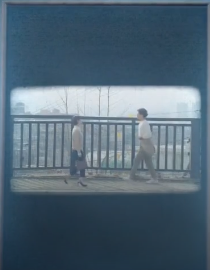
Notice that at the end of the episode 5, it is clearly shown that their paths crossed, yet they didn’t notice each other. This was not the right time. Strangely is that CSH complained to JMJ in her car (episode 5) that the timing wasn’t right therefore she couldn’t be with KJH. She was divorced, had a difficult and complicated relationship with her ex-mother-in-law and was the CEO of Donghwa Hotel. She wished, she had met him before. Yet only the viewers know that in reality she met him before but neither he nor she caught the attention of the other. I guess, CSH’s sad but beautiful face was the reason why she caught his attention in Cuba. This can not be just the red dress. Even later when he looks at her picture, the photo is in black and white and he is so fascinated by her. CSH became a “vegetable” due to her life with JWS’s family and only through this experience, she became like that. Since KJH is a very happy and humble person, her sadness contrasts so much to his own life. Yet, after spending some time with her, he discovered a cute woman who could smile, laugh and even joke. He realized that with him, she was like transformed.
However, the way CSH saw KJH for the first time looked like an unfortunate event: they met due to a car accident. So on the surface, it really seemed like a bad time because KJH’s camera was damaged. Yet his reaction was the reason why Cha Soo Hyun noticed him first. Later she caught him dancing and she realized the reason why he kept refusing the money, but accepted reluctantly the card of the secretary. Later, our hero saved her life because she could have fallen down from the wall and died in Morro Cabana. So time was on our hero’s side from the first episode on. However, CSH thought the opposite, especially if you consider the “unfortunate” car accident.
As you can see, CSH was wrong with her statement that this was a bad timing. In fact, it was the opposite. Without her past, nothing like that would have ever happened. Fact is that CSH needed KJH which the latter realized. He made her smile and was happy with it. On the other hand, we have an encounter contrasting so much with the different encounters CSH and KJH had together. In the episode 6, JWS arrives at the store for a new suit as he wants to impress a picky lady, unaware that CSH is already there. She gets the impression that he is still womanizing. This is a bad encounter for JWS underlining how time and nature were working together against JWS. The latter was never meant to be her first and only love. He was just the first husband. But even the other title “Boyfriend” could be perceived as something linked to time as well because a boyfriend is not a permanent state. Either there is a break up or it ends with a marriage. That’s why the viewers can not see their wedding in the end as the focus was on Boyfriend.
Then appointments, although totally different from encounters, are also linked to time. Striking is that although CSH and KJH had planned to meet the next day, they missed each other. This is interesting because it underlines that time can not be controlled by human beings. Nature and time worked against KJH and CSH first, but they helped them later. On the other hand, JWS has to call in order to meet CSH (episode 3, episode 9, episode 11). And CSH is always bothered by these appointments. This outlines that no matter what CSH could never feel comfortable around JWS and could never fall in love with him.
Then the presence of time is often used with visual tricks through watches,


cellphones, calendar
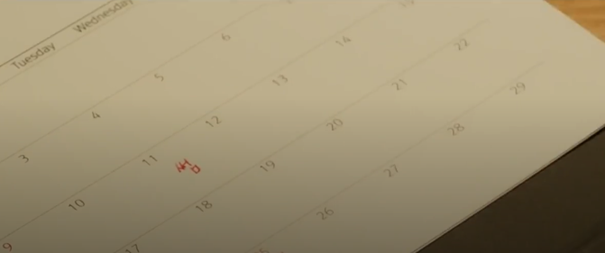
and clocks.

The last picture comes from the episode 14, Cha Soo Hyun is looking at the time of Havanna remembering good memories, she is doing the same when she is caressing her watch so delicately. These visuals have two purposes: on the other hand, we see how time has passed on and we see a scene from the past (like the first photo with the watch) or we can see the person remembering good memories from the past without using any flashback. Yet, we have two time jumps in this story. Here is just one example. Concerning the calendar that Kim Jin Hyuk uses (here episode 5), it gives to time another dimension: the length is much longer. First it is not limited to the day (24 hours like the watch and clock), the year marks the beginning and the end of the time hence it already implies that our hero wants to remain by Cha Soo Hyun for a long time. However, he has not declared it yet. It happens much later.
Then in the dialogues, time is often mentioned. For example, KJH keeps saying that he will stay by CSH’s side for a very long time or CSH and KJH’s mother need time. With the break up, KJH will have a hard time. You observe that people describe time. Since KJH speaks about death in the episode 11, the beholders are reminded that CSH and KJH’s time together is limited. Death will separate them. However, the drawings and the use of fairy tales and of The Little Prince underline the aspect of timelessness. The stars, the moon, the sun in the drawings, just like the trees alley in the episode 11 and the garden where the love began and was completed indicate that although their time together is limited, their love is not. Their love will survive time hence at the end, we see the birth of a star: the symbol of their eternal love. Time becomes here an eternity.


The bouquet with the note shown at the end of the episode 16 is another allusion for time as well.
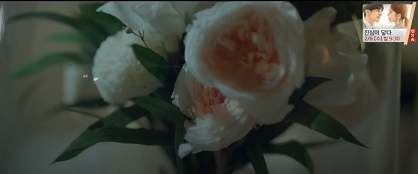

This taking is important as both objects mark the beginning and the ending of their love story. Besides, they represent good memories. Since they are protected by a glass, it illustrates that CSH wants to keep them for a long time. They should be preserved and even survive time. Like KJH said, love is ageless as death can not kill a love.
If we pay attention to the time of narration, it doesn’t correspond to our own time. First, it starts with the past (scenes of CSH in black and white), then the story begins around September/October, while the first episode was aired in November. Then we have one time jump (episode 2). So when CSH and KJH meet at the hotel (episode 2), where CSH is greeting the new employees, the time is now the same as the time the viewers were watching (November). The time is sometimes slower and sometimes quicker than our real time outlining that this is a story. In fact, we have two time jumps, yet no one complained about the time jumps. CSH and KJH’s mother needed time to get used to each other. KJH made a mistake in my opinion, when he proposed to her for the first time with the flower. Imagine, it was around February and they had started dating in December!! Within two months, he proposed which is quite rushed, especially for a woman who has been through a divorce and had a difficult relationship with her mother-in-law. The story ends in 2020, ahead of our own timeline. We see here the future… As you can see, the story had elements from the past, from the present and from the future. So time was represented in his whole entity. And in my opinion, this is another reason why this story is indeed intemporel. Except the use of cellphones which definitely marks our modern society, everything seems not to be bound to age and time limit. Actually, I doubt that cellphones and Internet will disappear from our life. The cellphone might change its form but not its function and purpose, just like the Internet. Notice that our OTP walked in the nature (on the streets, in a field, in a beautiful alley) and never visited any amusement park.
To conclude, time played a vital role in the love of CSH and KJH. CSH never realized that she had got it all wrong: wrong timing aso… in the end, it was the perfect time for her to change her life as she was about to meet KJH while watching the beautiful sunset in Cuba.



 Bebebisous33s' analyses in K-Dramaland and Manhwas