

Please support the authors by reading Manhwas on the official websites. This is where you can read the Manhwa: Jinx But be aware that the Manhwa is a mature Yaoi, which means, it is about homosexuality with explicit scenes. Here is the link of the table of contents about Jinx. Here is the link where you can find the table of contents of analyzed Manhwas. Here are the links, if you are interested in the first work from Mingwa, BJ Alex, and the 2 previous essays about Jinx Wheels 🛞 and Waves 🌊〰 -part 1 and Wheels 🛞 and Waves 〰🌳 – p️art 2 (locked)
It would be great if you could make some donations/sponsoring: Ko-fi.com/bebebisous33 That way, you can support me with “coffee” so that I have the energy to keep examining Manhwas. Besides, I need to cover up the expenses for this blog.

When you look at the illustration, your eyes are immediately drawn to the broken mirror at its center. As you can imagine, the cracked reflection, fragmented and distorted, is essentially referring to our protagonist Kim Dan. The broken mirror echoes Kim Dan’s shattered self-esteem. It is a visual representation of his inner dialogue: the doubts, fears, and insecurities that have long dictated his life. His reluctance to assert himself  (chapter 36), his tendency to retreat rather than challenge his own doubts
 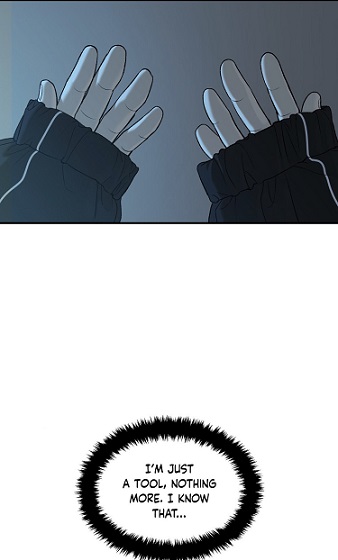 (chapter 36), and his overwhelming fear of disappointing others
  (chapter 51) are all reflections of these internalized obstacles. Recognizing them as external impositions rather than intrinsic truths is the first step to breaking free. That’s the reason why in the reflection of the broken mirror, you can detect an open window in the background. By focusing too much on his reflection, the physical therapist is trapped in his own negative world. One could perceive it as the opposite version of Narcissus. Yet rather than falling in love with his image, he sees only his flaws, reinforcing his belief that he is unworthy. The open window suggests an escape, a possibility for change, but the problem is that the main lead is too fixated on his shattered self-perception to pay attention to his surroundings. Hence he comes to neglect his own body and people next to him.
The Weight of Unseen Chains: Mental Barriers
The mental obstacles we impose upon ourselves can be some of the most difficult to overcome. In the article “The mental obstacles you put on yourself to stop moving forward” Jennifer Delgado explains that these barriers often originate from the voices of significant figures in our past. They can be parents, teachers, or even childhood bullies who shaped how we see ourselves.
‘If you pay attention to some of the phrases you say to yourself when this inner dialogue is triggered, you will realize that these phrases do not belong to you and, if you look into your past, you will find their true owner. Quoted from The mental obstacles you put on yourself to stop moving forward”
Kim Dan’s struggles reflect this reality, just as Joo Jaekyung’s nightmare  (chapter 54) suggests he too is haunted by such internalized voices. Under this new light, you comprehend why I wrote in the introduction that the broken mirror was mostly alluding to the doctor. Both protagonists are suffering from mental hurdles, trapped in a psychological prison. The significant difference is that while Kim Dan is consciously recognizing his self-doubt
  (chapter 62), Joo Jaekyung does not. The evidence for this interpretation is the champion’s nightmare: (chapter 54) Instead of realizing the words stem from an external source, an abuser from his past, he sees them as a reflection of his own fears and inadequacies. This explicates why he chose to drink. This terrible vision illustrates how internalized criticism functions: it feels personal, nonetheless its origins lie in past experiences. Both Kim Dan and Joo Jaekyung are trapped in cycles of learned helplessness, shaped by voices that do not truly belong to them. Their self-doubt was not inherent; it was shaped by the expectations and criticisms of those around them. Striking is that Mingwa let us see how these mental obstacles are born. Observe that
  (chapter 18) the doctor (chapter 36) repeated the exact same words than his boss. This means that , the doctor internalized these limiting beliefs, thinking that he was not in a position to speak up or assert himself. This explicates why he had to convince himself that he was just a tool to the athlete. This explicates why at the end, he returned the champion’s jacket. The athlete never recognized him as a stan either. Simultaneously, the athlete was also the physical therapist’s emancipator, because he encouraged him to improve his skills and knowledge
 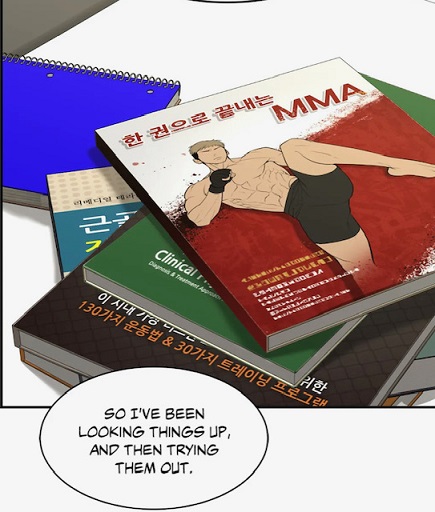 (chapter 25) Therefore the physical therapist bought books. Moreover, we should consider this argument
  (chapter 45) as a revocation of the star’s statement in episode 18. Kim Dan was no longer perceived as a tool, but as a real physical therapist. On the one hand, this request boosted the “angel’s ego”, on the other hand, he was put under immense pressure, for he was compared to his colleagues.
 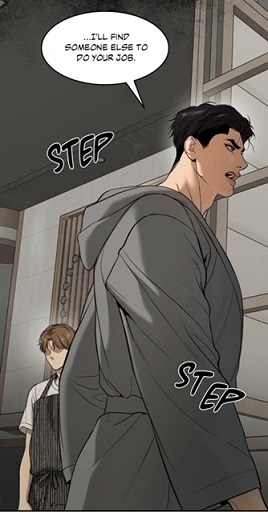 (chapter 45) Since in Seoul, Kim Dan has only been hired because of sex (Joo Jaekyung, the perverted hospital director)
 (chapter 6), he came to accept that he was not truly talented. The champion had no trust in him and later, the word jinx triggered a repressed bad memory.
  (chapter 62) Due to his bad past experiences, he concluded deep down that his CV was not reflecting the truth.
 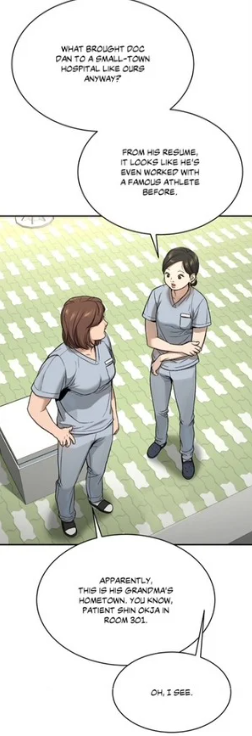 (chapter 56) That’s the reason why he was devaluing himself and as such not looking for a high position.
In her article, the psychologist outlines three primary mental barriers that keep individuals from moving forward:
- It’s not the right time – The belief that circumstances must be perfect before taking action, leading to perpetual hesitation.
- I’m not an expert – A sense of inadequacy that prevents people from trying, despite having the capability to learn and grow.
- I will surely fail – A deeply ingrained fear of failure that discourages risk-taking and reinforces insecurities,
Striking is that in season 1, we could detect these three mental obstacles in the physical therapist’s life.
His unwillingness to defy Joo Jaekyung’s dismissal in episode 48  (chapter 48) exemplifies this pattern:
  (chapter 48) It was not the right time. He assumed his voice held no weight, reflecting years of learned helplessness. It shows how Kim Dan internalizes responsibility for things beyond his control. He thinks that withholding information is an act of protection rather than avoidance. Yet in doing so, he denies himself agency in his own life.
This aligns with Delgado’s argument—these limiting beliefs were not inherent truths but external influences that he internalized, preventing him from asserting himself. Thus I deduce that Kim Dan has unknowingly adopted his grandmother’s behavior—withholding information under the justification of “protecting” others. Therefore it is not astonishing that her grandson treated her the same way. He already concealed many things from her in order to protect her, and she was his only role model. Just as she concealed things from him (like her true feelings, the absence of the parents or even the way she spoke about him behind his back), Kim Dan did the same to Joo Jaekyung in episode 48. His rationale in this scene mirrors her method of control through omission.
Season two of Jinx only intensifies these self-imposed constraints. I noticed that the switched spray incident 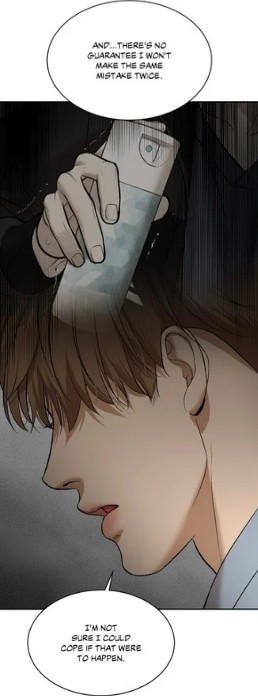 (chapter 62) completely devastated Kim Dan’s already fragile self-esteem.
 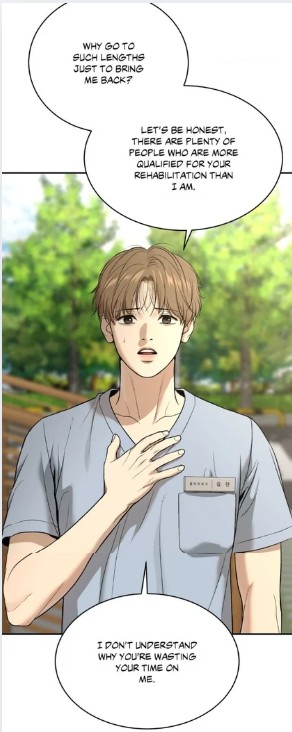 (chapter 62) First, he considers himself as waste. While in the past, he was at least a tool, he is now garbage. Hence his feelings are “trash”.
  (chapter 62) This means that in episode 62, he felt worse than in episode 18! The idioms “trash” and “waste” revealed the doctor’s own self-perception in episode 62: he saw himself as totally useless. He belonged to the “wastebasket”, just like the golden key chain.
  (chapter 46) Thus I deduce that the fate of this item echoes the doctor’s.
But let’s return our attention to his transformation in season 1. He was making progress thanks to Joo Jaekyung’s trust, but that one moment undid everything. (chapter 51) When he realized that the champion didn’t put his faith in him, he lost his motivation. This observation reminded me of the main lead’s previous statement. 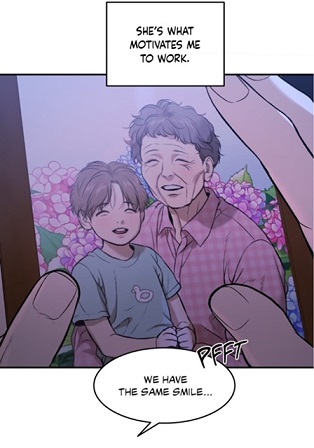 (chapter 47) He had selected this profession because of her. This shows that until now, he has never developed any ambition on his own. The loss of faith from someone he relied on for motivation made him feel completely worthless. This reinforces that his confidence and sense of direction were never self-sustained: they depended on others’ recognition. This pattern suggests that Kim Dan has never truly asked himself what he wants. His entire existence has revolved around meeting expectations, whether from his grandmother, Joo Jaekyung, or even his profession. His current crisis—feeling like waste—stems from the realization that without someone to validate his worth, he sees himself as nothing.
One might question this statement because of this scene: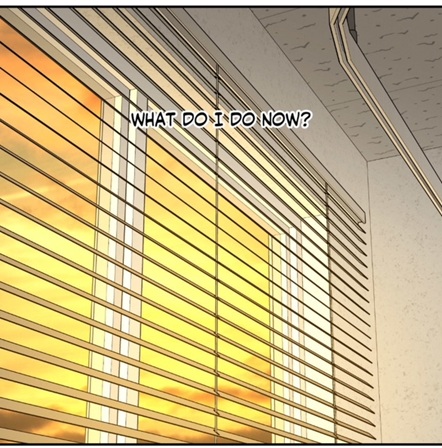 (chapter 59) However, observe that he is using the expressions “do” and “now”. This has nothing to do with the future and dreams. It is not a reflection on his own desires but rather an immediate reaction to his circumstances. His mindset is still trapped in survival mode, seeking a course of action rather than contemplating what he truly wants. His words reflect an urgency to act rather than an opportunity to dream. This highlights that he has spent his entire life making decisions based on necessity rather than personal fulfillment. Even when faced with uncertainty, he does not ask himself what he wants—only what he must do next. His transformation will only be complete when he begins to question not just how to survive, but how to live on his own terms. That’s how I realized why Mingwa put this question in front of the window covered with Venetian blinds [which made me think of this scene
  (chapter 39 – Venice, a travel to Italy]. The window with the Venetian blinds represents a metaphor for the doctor’s trapped dreams. This interpretation made me recognize another aspect. Kim Dan is pushed to meditate, when he is front of a window or better said close to the sky! Hence the hamster started thinking about his own future in the penthouse
 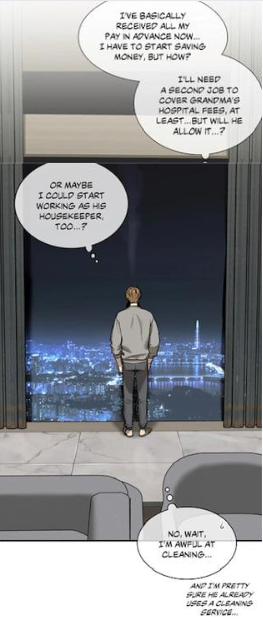 (chapter 19) or when he looked at the sun and sky:
  (chapter 41)
 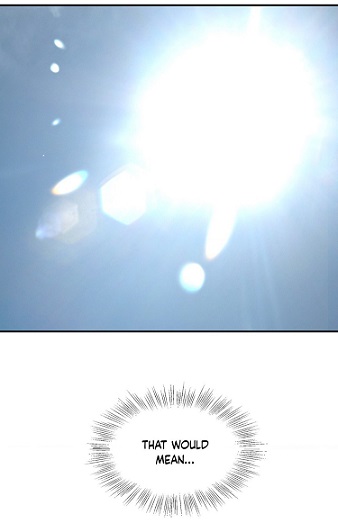 (chapter 41) And the best evidence for this interpretation and expectation is doc Dan’s cellphone screen display.
  (chapter 38) My avid readers will certainly recall that clouds embody dreams! Why? It is because in verity, doc Dan is a dreamer, an ambitious man. What caught my attention is that his contact Joo Jaekyung was not saved with a picture!! And what had motivated Kim Dan in the past?
 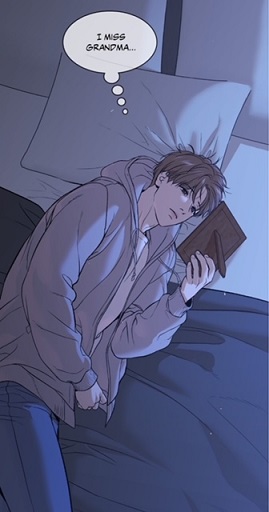 (chapter 47) The picture from his childhood: himself with his grandmother.
  (chapter 66) But the latter was not related to work, but to fun and nature. Striking is that Joo Jaekyung has an empty phone screen display indicating that he has no real dream on his own either:
 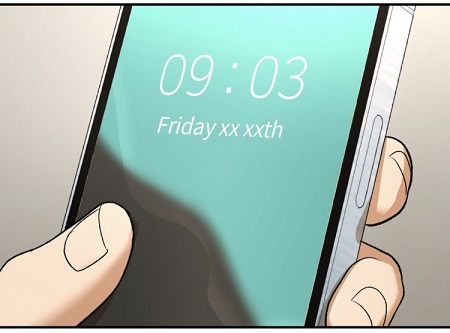 (chapter 38) No wonder why he questioned the meaning of his champion title:
  (chapter 54). He saw the belt as something rather “meaningless”.
To conclude, for the couple to break free from their terrible mindset, they need to find purpose within themselves rather than constantly seeking external validation. But let’s focus more on doc Dan again. This also ties into the broader theme of meaningful praise—instead of being recognized for what he does, he needs to be valued for who he is. How can this take place? By taking a picture together!  (chapter 43) This would boost the doctor’s self-esteem. He is not trash, but an acknowledged fan and friend. The picture would encourage the physical therapist to develop his own ambitions. As soon as I made this discovery, another detail caught my notice:
  (chapter 66) The celebrity has no picture of Park Namwook in his contacts divulging the superficiality of their relationship.
Then in her article, the psychologist mentioned two other mental barriers. “I’m not an expert”. That’s the reason why in episode 42, doc Dan used his colleague to voice his own thoughts.  (chapter 42) The problem is that the athlete took this recommendation personally. He felt as if his job as fighter was questioned.
 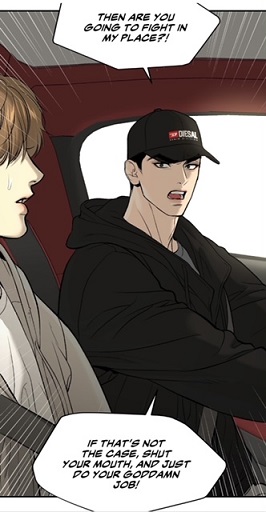 (chapter 42) As you can see, the doctor’s hesitations were exposing his mental obstacles, which was reflected in the champion’s attitude. No wonder why doc Dan chose to become a courier as a second job instead of finding a new VIP client. While the interaction between the athlete and Kim Dan in front of the hospice display the return of doc Dan’s past mental hurdles:
- I’m not an expert (chapter 62)
- It’s not the right time:
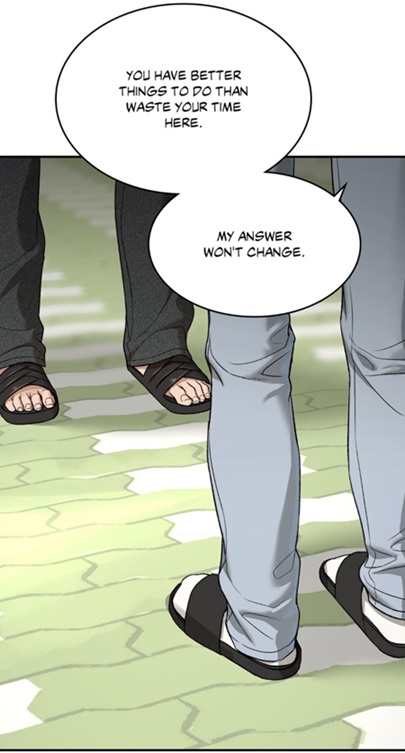 (chapter 62) According to the main lead, the champion is “wasting his time here”.
 - I will surely fail: (chapter 62)
The only difference to the past is that now the athlete could detect the presence of his partner’s negative thoughts. Nevertheless, by examining closely the statements from the main lead, I noticed other mental barriers that people place on themselves, which Delgado did not mention but are still strongly related to the other three:
- Overthinking – Kim Dan fixates on past mistakes, questioning every action and thought. (chapter 62) Therefore the athlete tried to persuade his fated partner to accept his offer by saying this: “Don’t overthink”
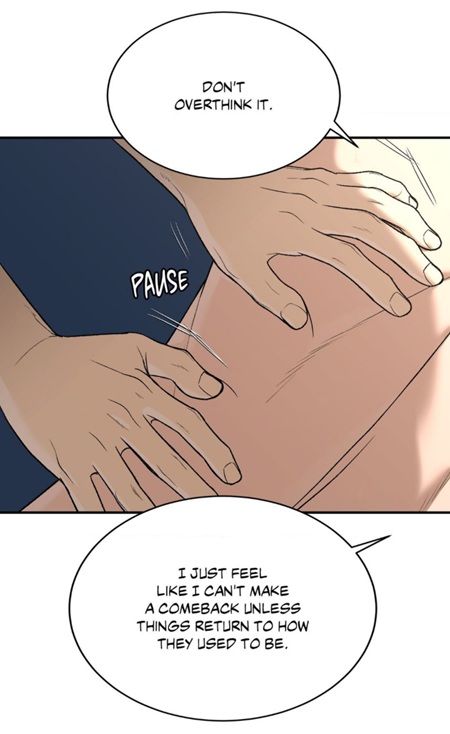 (chapter 62)
 - Catastrophizing – He assumes the worst possible outcome, believing another mistake could destroy his credibility entirely. The reality is that he expressed his regret of having used the spray:
 (chapter 57) Hence it is clear that in the future, the physical therapist would refuse to use any kind of spray. On the other hand, it is important to recall that back then, Joo Jaekyung had made the request himself:
  (chapter 49) So in the doctor’s mind, if he agreed to the champion’s request, he would be treated like in the past. He would have to simply to follow the athlete’s lead. That’s why he is imagining that he might be put in a similar situation than in the past. But there exists another reason why he refused the champion’s offer right from the start. It is because he has always perceived himself as “hands” which stand for selflessness and generosity. The latter defined doc Dan. Hence he looked at them, when he declared himself as a tool: (chapter 36) Under this new light, it occurred to me why the hamster had to reject the star’s offer right from the start. It is because he came to identify himself as the “spray”. Hence Mingwa created such panels, where Kim Dan’s terrible memories
 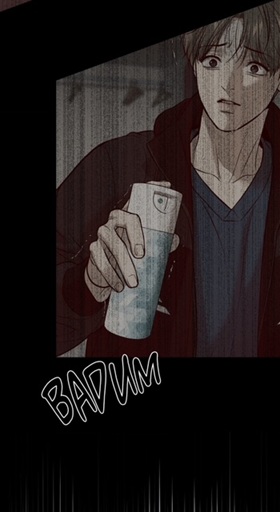 (chapter 57) (chapter 62) are combining the doctor’s hands with the spray. Then a spray is an item destined to be discarded. Is it a coincidence that Kim Dan “switched” places
  (chapter 1) with a previous PT like the spray? No wonder why he called himself “trash” in the end.
 - Preferring the comfort zone – To avoid failure, he tells himself he should step back (chapter 62) and let others handle things, rather than risk making another mistake. His patients at the hospice are all terminally ill, therefore they don’t have high expectations from him.
His belief that others are ‘wasting their time’ on him echoes a deeper conviction—that he himself is waste. By equating attention and care with wasted effort, he subconsciously devalues his own existence, reducing himself to something disposable, like the “poisoned spray”. This mindset aligns with the toxic inner dialogue shaped by years of neglect and emotional suppression. It was the one thing helping him grow, yet now, he questions whether he deserves it at all.
The Dandelion and Praise: A Fragile Symbol
Returning to the illustration  , people might wonder why I selected dandelions as a frame for the selected.. It’s clear that the dandelions aren’t just there for aesthetic balance. Their symbolism is profound. Dandelions are often associated with childhood innocence, wishes, and fleeting moments of beauty, yet they also wither quickly, easily scattered by the wind. In the context of Jinx, they represent a transitory force—something that struggles to take root, much like the intangible and fleeting elements in Kim Dan’s life. But there’s more to it. Before delving into deeper analysis, consider this: what is the common denominator in all these scenes?
| Chapter 1 | Chapter 15 | Chapter 30 | Chapter 31 |
|---|---|---|---|
  |   |  |  |
| Chapter 40 | Chapter 43 | Chapter 56 | Chapter 62 | Chapter 66 |
|---|---|---|---|---|
 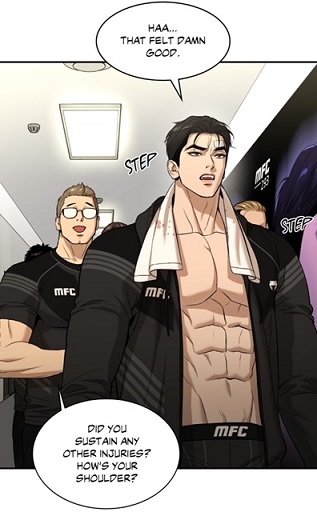 | 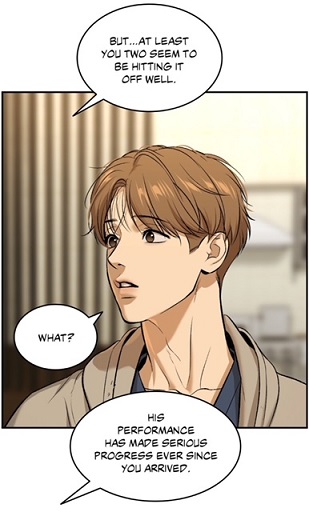 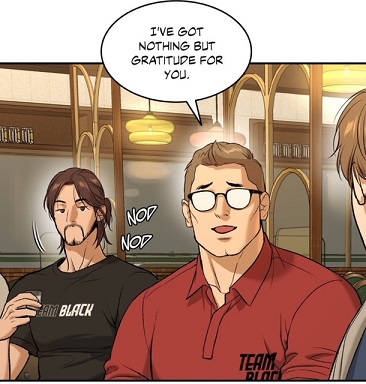 | 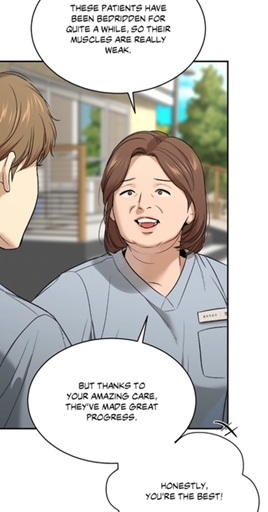 |  |  |
The answer is compliments. However, here it is important to make a distinction. In most of the selected scenes, the physical therapist is the one getting praised. In the actor’s eyes, he is not only an angel, but also the best. But why did he say that? One might say that Kim Dan offered his services for free. LOL! (chapter 31: I will explain this further below) Besides, the manager is saying that the champion’s performance has improved thanks to his presence. Halmoni is describing her grandson as a diligent and hard-working physical therapist. The nurse expressed a similar praise than the comedian. He is the best! All the support he received was linked to his job as physical therapist.  (chapter 37) Therefore it is not surprising that the main lead couldn’t view the members as friends in the end.
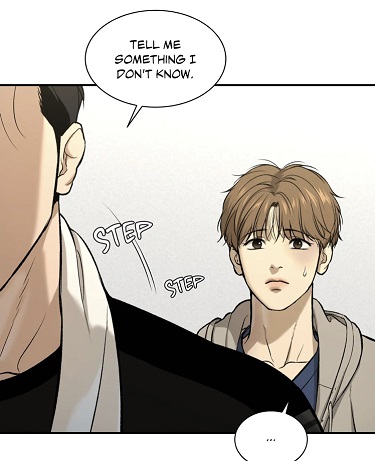
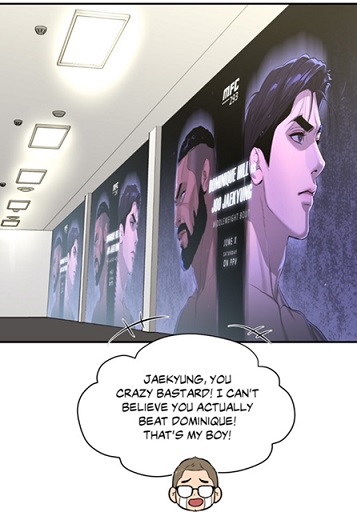
Striking is that I picked up three scenes where the “wolf” came to be praised. In chapter 15, for the first time, the doctor voiced his admiration to the athlete: “You were amazing!” to which the champion responded: “Tell me something I don’t know!” But why did he say this? It is because his manager always complimented him for his performance in the ring: (chapter 40) And now, my avid readers can sense a parallel between Joo Jaekyung’s reply and the title of this essay: “Prove me wrong again!”
Hollow Words: The Illusion of Praise
If we examine the praises Kim Dan receives throughout the series, we could see that these nice words never reached Kim Dan’s soul and heart. But why didn’t they help him to boost his ego? Delgado’s second article, Praise That Completely Destroys Children’s Self-Esteem, offers valuable insight into why:
- Focus on Ability, Not Effort – Compliments like “You’re the best” or “You have amazing care” (chapter 56) emphasize innate talent rather than the effort he puts in. This means that when he fails, he interprets it as proof that he was never truly capable to begin with.
- Exaggeration – The over-the-top gestures, like the coffee truck, feel inflated and insincere. This makes it harder for Kim Dan to genuinely believe in the praise he receives. Besides, there’s no picture of him there.
- Pressure, Not Motivation – Instead of building him up , these compliments raise expectations to an unattainable level, reinforcing his belief that he’s a fraud who will inevitably disappoint.
And now, you comprehend how I came to associate dandelion seeds to empty flatteries. The connection between dandelion seeds and hollow praise lies in their fleeting, weightless nature. Just as dandelion seeds are easily carried away by the wind, hollow compliments—those that are vague, exaggerated, or disconnected from genuine effort—disperse without truly taking root in the person they are meant to uplift. They may seem pleasant in the moment, but they fail to provide real nourishment or stability for self-esteem. Hence Potato’s admiration couldn’t move the athlete’s heart and mind:  (chapter 41) And now, you comprehend why Joo Jaekyung has always disliked his birthday and the “congratulations” from people in general. The gifts and words were like poisoned praises to his soul. They were pushing him to live like a “god”.
Dandelions are often associated with impermanence, a plant that thrives briefly before its seeds scatter, lost to the wind. Similarly, the praise Kim Dan receives—“You’re the best,” “You’re amazing,”—floats around him but never lands deep enough to strengthen his self-worth. It is momentary validation, gone as quickly as it appears, leaving him feeling just as uncertain and fragile as before.
This is why the illustration places hollow praise within the dandelion blooms—it highlights the transient, superficial nature of these compliments. Instead of fostering deep confidence, they merely swirl around him, reinforcing his feeling of disconnect between others’ perception of him and his own self-image.
That’s how I came to the first following conclusion. Dandelions and photographs serve as opposing symbols in Jinx. The dandelion seeds represent fleeting, empty compliments—words that drift away with the wind, never taking root. Conversely, photographs preserve meaningful moments (chapter 66), cementing their value over time. Unlike dandelion seeds, which scatter meaninglessly, photographs stand for memory, permanence, and proof of (genuine) human connection. 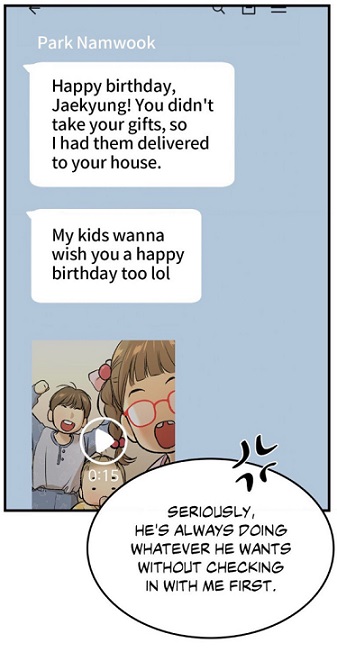 (chapter 45) Kim Dan’s only adult photograph, taken with Choi Heesung and Potato, ties into his professional world, reinforcing how his identity has always been defined by what he does rather than who he is.
  (chapter 59) While this photography was not a personal and intimate picture, it also symbolizes his first root in the little community: Light of Hope Hospice. He is part of the staff and as such of the little town. On the other side, we could say, he is gradually entering the scene as a PT. Note the contrast to the food truck: (chapter 31) There was no picture of “Angel Dan”!! It was, as if the comedian was using doc Dan’s image to promote himself 😮, similar to this scene:
 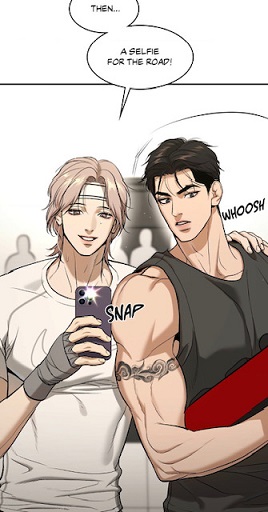 (chapter 30) In other words, it exposes the actor’s hypocrisy and wrongdoings. And now, you understand why I wrote genuine in parentheses above [proof of (genuine) human connection]. Photography in Jinx also represents the evidence of wrongdoing
 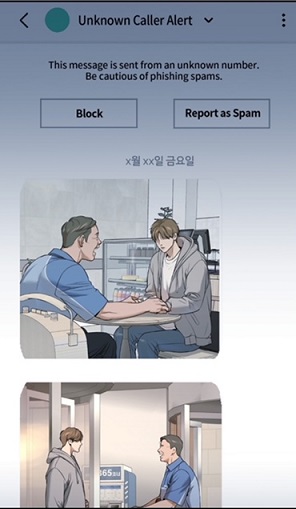 (chapter 48) and deception: (chapter 66) This picture is not just the symbol of innocence and joy, it is strongly intertwined with the vanishing of the parents. There is a secret behind this picture. Yet, for Joo Jaekyung’s, it looks like Halmoni was enough for Kim Dan, as she could make him smile once. The photography, the emblem of civilization, can be traced back, and as such exposes the identity of the perpetrators and accomplices:
 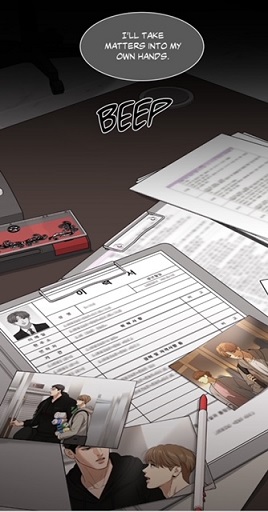 (chapter 46) The exact opposite of the dandelions.
Joo Jaekyung’s act of bringing Kim Dan to the sleep specialist is the embodiment of actions over words. 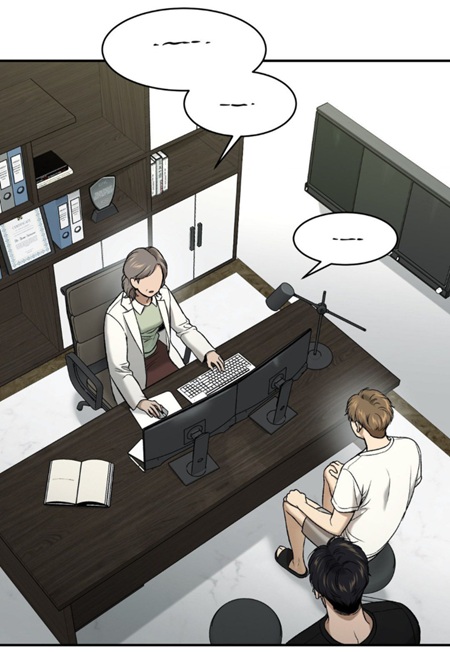 (chapter 66) It is a direct contradiction to the hollow praise doc Dan has received all his life.
 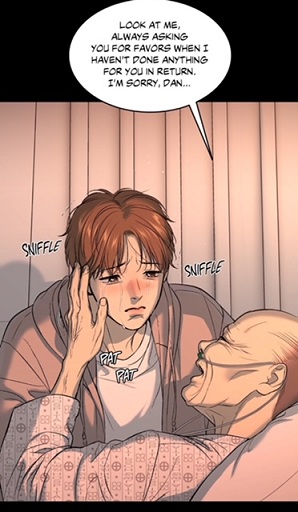 (chapter 53) He was treasurable, for he did favors to his grandmother all the time. Instead of simply saying that Kim Dan matters, the champion proves it. He challenges the physical therapist’s own perception of himself, demonstrating that he is not just useful—he is precious. Secondly by justifying his action for the doctor’s sake,
 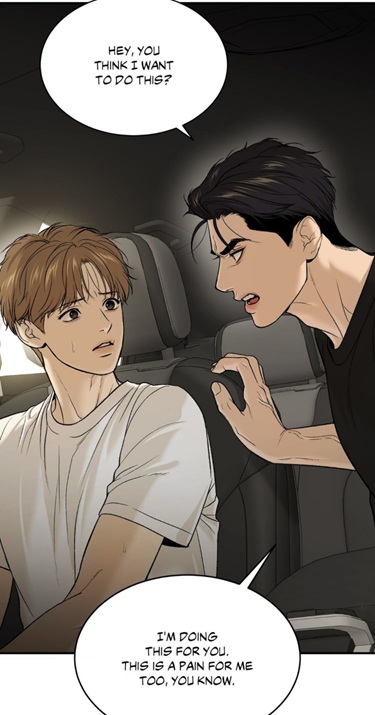 (chapter 66) he contradicts not only Kim Dan’s self-perception, but also his past accusations:
  (chapter 66) that he was merely a tool for Joo Jaekyung’s success. By taking him to the sleep specialist, the champion proves something that Kim Dan had refused to see: he matters beyond his utility. This moment mirrors Joo Jaekyung’s past words— (chapter 15) into an action that Kim Dan never expected, an undeniable truth he can no longer ignore. And keep in mind that this reply was linked to doc Dan’s praise concerning his recent fight: (chapter 15) What Joo Jaekyung wants to hear from doc Dan is that he is a good person outside the ring, he wants to be praised for his good actions too.
  (chapter 62) This shows that deep down, he desires to obtain doc Dan’s gratitude. No wonder why he got so upset after hearing the displeased comment from Kim Dan.
 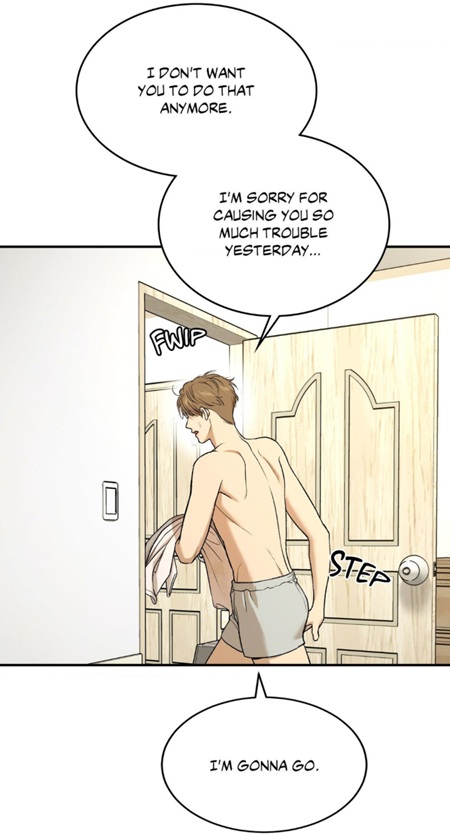 (chapter 66)
Moreover, the key chain’s presence in the dressing room  (chapter 66) reveals Kim Dan’s elevation in the champion’s life. The dressing room symbolizes privacy and closeness. No longer seen as a mere tool, Kim Dan has become an integral part of Joo Jaekyung’s world, not because of what he can do but because of who he is.
 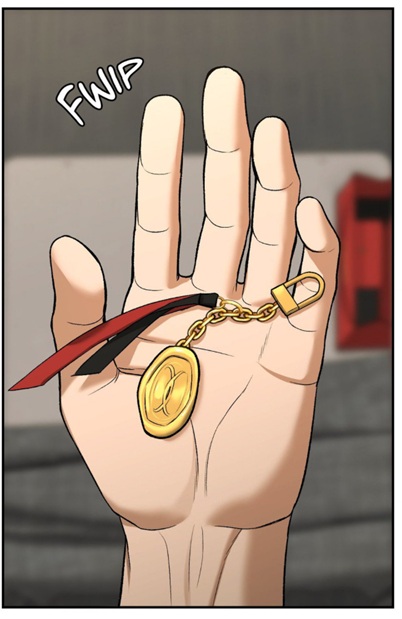 (chapter 66) Therefore the champion is holding the expensive gift with his whole hand contrary to the past:
  (chapter 55) As a conclusion, by bringing him to the sleep specialist, the star proved doc Dan’s words wrong! He told him something that doc Dan didn’t know: he is precious. He needs to pay attention to his health and body.
On the other hand, actions are not enough, in particular for both protagonists. The past words have to be erased, and this can only become effective with encouragement and good compliment. So how should compliments be in order to help the children? For praise to be meaningful, it must be like a deeply rooted plant, not a dandelion seed—grounded in reality, tied to effort rather than ability, and capable of fostering real growth. Moreover, the words have to be specific. Third, the person has to avoid exaggeration and give some motivation, like for example the picture!
The power of words
Mingwa gave us an illustration for a good appreciation: (chapter 66) The champion was praised for doing paperwork. “Good work” was specific, simple and related to an effort. Joo Jaekyung has been patient, diligent and docile in the office. For once, Joo Jaekyung was validated for something outside the ring 😉—something that had nothing to do with his physical strength or his ability to fight. That compliment planted a seed of recognition: his value is not solely tied to his role as a champion. This scene made me laugh because by giving such a flattery, the coach was not realizing that he was pushing his “boy” to take care of administrative tasks. This means that the main lead is destined to become a “white-collar”, a manager!! Kim Dan’s vision should become a reality.  (chapter 32) And now, you comprehend why the athlete didn’t fall for Park Namwook’s manipulations afterwards.
When Park Namwook tells Joo Jaekyung,  (chapter 66) “I don’t know what you’ve been up to lately…”, it carries an accusatory undertone, subtly suggesting that the champion has been avoiding him. By framing it this way, Park Namwook is not just asking about Joo Jaekyung’s well-being—he is asserting his discontent over losing control. His follow-up suggestion, “Instead of being alone all the time, why not come to the gym?”, reinforces the idea that he sees the gym as a tether, a way to keep Joo Jaekyung within his domain of influence. In addition, he is suggesting that the athlete has been using his injury as an excuse to avoid training. There’s an undertone of doubt and accusation, as if he does not fully believe the champion’s recovery process is valid or necessary. Instead of expressing genuine concern, Park Namwook is subtly framing Joo Jaekyung’s absence as a sign of laziness or avoidance. The small compliment from the manager (“good work”) represents a turning point in the athlete’s life. Park Namwook can no longer treat the athlete like in the past.
But there’s more to it. What caught my attention is that days before, Kim Dan had expressed a huge reproach to the athlete: (chapter 66) This criticism represents the negative version of the manager’s flattery. However, Kim Dan’s words left a huge impact in the champion’s mind and heart for one reason. Through his reproach, he reminded the star that he had a life outside the spotlight and ring. One might say that he was blamed for his bad behavior. Nonetheless his words implied that he viewed the celebrity as an adult, accountable for his actions! Jinx-philes will certainly recall that Park Namwook chastised the celebrity as a spoiled child  (chapter 7)
  (chapter 52) Joo Jaekyung was portrayed as someone with a bad temper and personality. The manager was focusing on the ability, was exaggerating and put pressure on him by using his hand! That’s how it dawned on me why Joo Jaekyung could become resistant to Park Namwook’s short and superficial appreciation. Doc Dan’s harsh words served as an antidote to the manager’s tactics. How so? First, Doc Dan brought up the existence of feelings which Joo Jaekyung has been denying all this time. Then he blamed the champion for his actions and not for his character contrary to the manager!! Therefore he left room for Joo Jaekyung to improve himself. The idiom “always” served as a motivation for the athlete. Here, he could change. That’s why Joo Jaekyung, though hurt and angry, didn’t leave doc Dan’s side.
 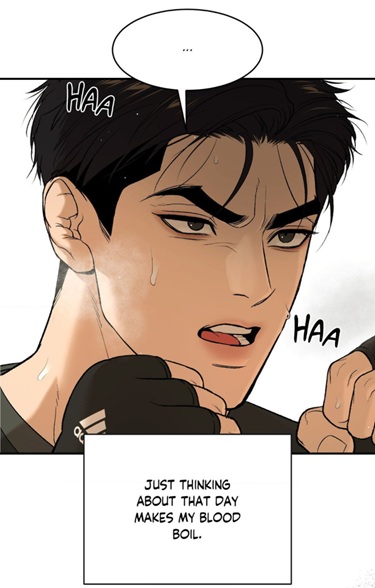 (chapter 65) At the same time, such a disapproval (chapter 64) implies the existence of past hope and expectations. This means that the star has the possibility to revive these buried expectations and hopes by acting differently. By portraying the main lead as a maniac or bad-tempered person, Joo Jaekyung had the impression that he could never change Park Namwook’s perception no matter what he did! The only way to please him was to be in the ring. This was an “immutable truth” which stands in opposition to doc Dan’s criticism (“change”, private life). As you can see, a person can change for the better not because of compliments, but also because of criticisms, a new version of this scene: (chapter 45)
The Impact: A Growing Divide
Striking is that Kim Dan was praised by the protagonist after their first meeting. The champion’s appreciation followed the principles outlined by Delgado: it was specific, effort-based, and motivating. (chapter 1) However, this recognition went completely unnoticed by Kim Dan for three key reasons. First, he was not directly mentioned in the praise, making it difficult for him to associate it with himself. Secondly, Joo Jaekyung didn’t look at him either. Then the star’s phrasing included two negative notions (“not” and “bad”) which subtly diluted the apparent respect behind his words. Rather than perceiving it as validation, Kim Dan likely dismissed it as neutral or indifferent. Finally, it is also important that doc Dan had just made a mistake before 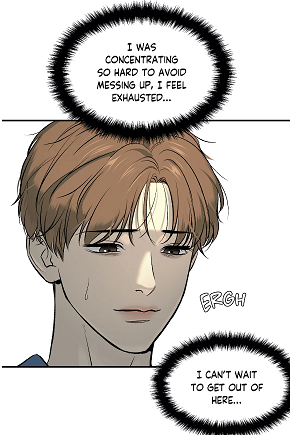 (chapter 1), hence his true desire was to run away from that place. For praise to be effective, the recipient must be open to receiving it, either by looking forward to feedback or having expectations of validation. Since Kim Dan was in a state of distress, he was unable to internalize the champion’s words, reinforcing his long-standing belief that he was invisible or unworthy of acknowledgment. That’s how the champion’s praise became a dandelion seed in the end.
Another important detail caught my attention are the grandmother’s praises. (chapter 53) (chapter 61) They are rather inconsistent and conditional. In front of Joo Jaekyung, she commends Kim Dan for his diligence and productivity, emphasizing his value based on his ability to work and fulfill responsibilities. However, when speaking about him in private or when displeased, she reduces him to his supposed vices—calling him a drinker  (chapter 65) or a smoker, hiding his sacrifices and the true causes for his struggles. Her words reinforce the idea that Kim Dan is only as good as his usefulness, that love and recognition are earned through labor, not freely given.
With such a mindset imposed on him from childhood, it becomes evident why Kim Dan does not allow himself to take breaks or seek joy for himself. Rest is seen as unearned indulgence rather than a necessity, and self-care is overshadowed by the guilt of not doing enough. His grandmother’s approval was never unconditional; it fluctuated based on how well he served her expectations. This pattern of conditional compliment shaped his self-worth, making him feel unworthy of being cared for unless he was constantly proving himself through actions. What makes this even more striking is that the praise Kim Dan receives from others follows the same pattern as his grandmother’s. Whether it’s his colleagues, the actor, the nurses, or even Park Namwook, their compliments are always tied to his work and productivity—his ability to heal, to endure 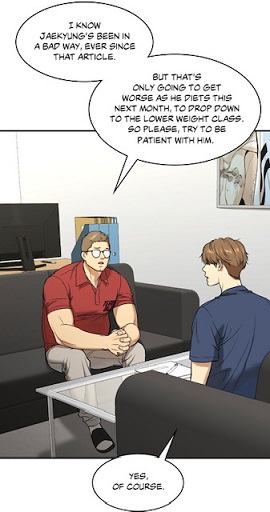 (chapter 36), or to meet expectations. None of these affirmations recognize him as a person, only as a professional fulfilling a role.
Rather than boosting Kim Dan’s self-esteem, these empty praises widen the gap between how others perceive him and how he sees himself. His inner voice, shaped by years of self-doubt, tells him that he is undeserving of these accolades. Without specific, effort-based recognition, he is unable to recognize his own progress, leaving him trapped in an endless cycle of self-doubt.
A Different Kind of Praise
This is why, as I reflected on these observations, I realized that Joo Jaekyung’s praise must be different. It shouldn’t be about Kim Dan’s work at all. It shouldn’t be another generic statement about how great he is at his job. Instead, it should focus on:
- Personal Qualities – His resilience, kindness, or courage, rather than his medical skills.
- Emotional Impact – Expressing how Kim Dan’s presence affects Joo Jaekyung on a deeper level.
- Small Acts – Noticing the little things Kim Dan does—how he cares, how he listens, how he perseveres.
Joo Jaekyung saying something as simple as “I missed your presence in the penthouse” would mean more than a thousand empty compliments. It would tell Kim Dan that he is wanted as a person, not just needed. That he matters beyond his function as a doctor. This is the type of praise that could truly help Kim Dan break free from his cycle of self-doubt.
And what is the favorite expression which comes to the champion’s mind, when he observes doc Dan’s behavior?  (chapter 18)
  (chapter 45)
 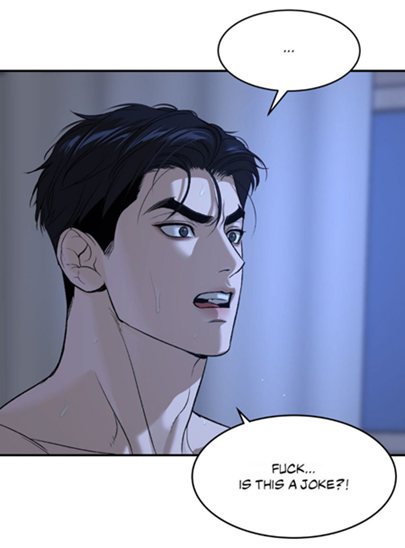 (chapter 64)
 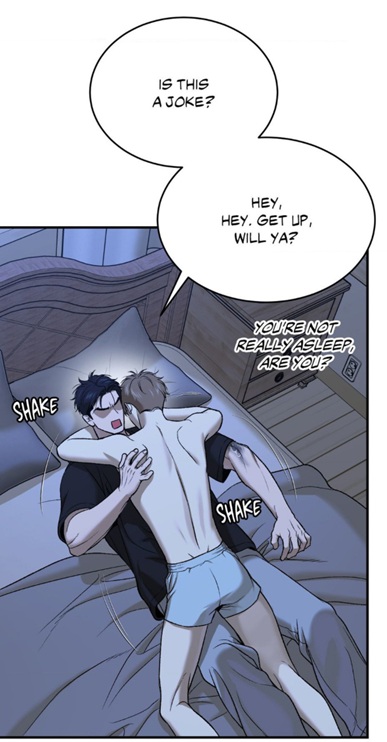 (chapter 66) Is this a joke?
Jinx-philes can notice that the champion is associating doc Dan to a JOKE! The problem is that so far the athlete used this idiom in a rather negative context. Kim Dan made the champion smile and laugh!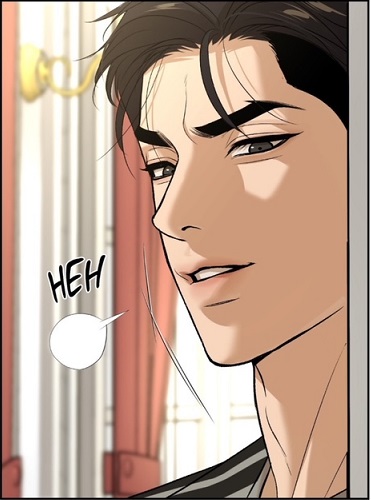 (chapter 40) However, Kim Dan has never realized it. Either he was sleeping or totally out of it (fear of sex)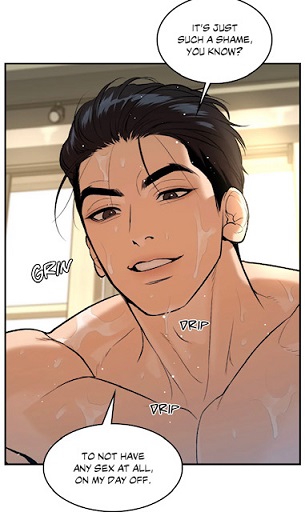
 (chapter 27) It is important to recall the importance of the receiver’s mind-set. The latter has to perceive the sincerity from the speaker. Hence I come to the following deduction: The moment Kim Dan notices Joo Jaekyung’s smile and laugh, then he should come to the conclusion that he matters to the protagonist. I would even say, the two protagonists are destined to make each other laugh and smile:
  (chapter 44) This would be the best “compliment” for both of them. With Kim Dan by his side, Joo Jaekyung desires to make “jokes”. (chapter 61) No wonder why Shin Okja preferred the champion’s company to her own grandson’s. The latter would ooze such negativity and suffering that his presence reinforced her guilty conscience. His grandmother’s mood got spoiled. On the other hand, Mingwa exposed the existence of fake happiness and fun like in this scene:
  (chapter 58) The friends ignored the main lead’s emotions and struggles. In order to be able to have fun, both main leads must be freed from their past and low self-esteem.
Conclusion: Breaking the Cycle
The title “Prove Me Wrong Again” takes on multiple meanings. On one level, it reflects how Kim Dan’s struggles with self-worth repeatedly override any praise he receives. No matter how much others try to uplift him, his mind tells him otherwise. But on another level, it is a challenge—an opportunity for someone, particularly Joo Jaekyung, to show him that true validation comes from being seen, not just being useful.
Kim Dan does not need grand gestures or overblown words. He needs consistency, sincerity, and reminders that his worth extends beyond his profession. The broken mirror in the illustration reflects the damage done to his self-esteem, but the dandelions? Perhaps they represent the possibility of change—of words that, rather than fading, finally take root. Because the doctor is suffering from depression right now, it is now Joo Jaekyung’s turn to make doc Dan happy, to make him smile and laugh.
Feel free to comment. If you have any suggestion for topics or manhwas, feel free to ask. If you enjoyed reading it, retweet it or push the button like. My Reddit-Instagram-Twitter-Tumblr account is: @bebebisous33. Thanks for reading and for the support, particularly, I would like to thank all the new followers and people recommending my blog.


 (chapter 65) At first glance, the grandmother’s wheelchair and the ocean seem to represent opposing forces, yet they also reveal a complex relationship between power and vulnerability. Thus in this analysis, I will explore how these elements, rather than simply contradicting each other, might actually reflect a struggle to find balance between dependency and independence.
 (chapter 65), yet her portrayal of him seems unexpectedly harsh—emphasizing his flaws (smoking, drinking).
  (chapter 65) This description stands in opposition to the gumiho’s statement: he was an angel.
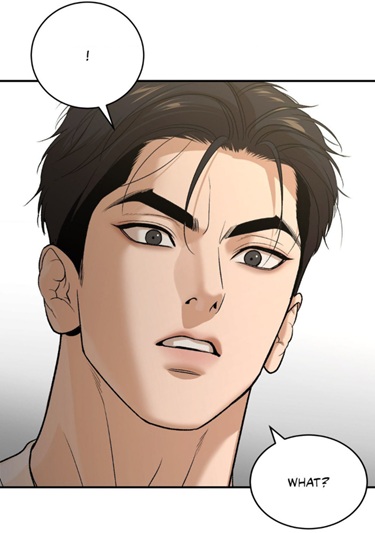
 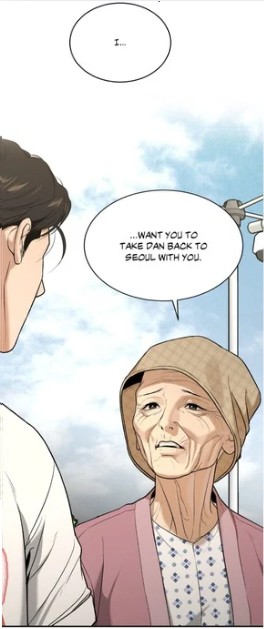 (chapter 65) Is she genuinely worried for him, or is there a hidden motive behind her request to send him back to Seoul? And why does Joo Jaekyung, usually so straightforward, respond with silence and hesitation
 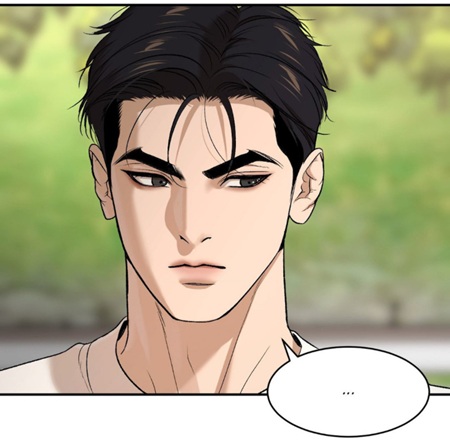 (chapter 65) or with shock?
  (chapter 65)
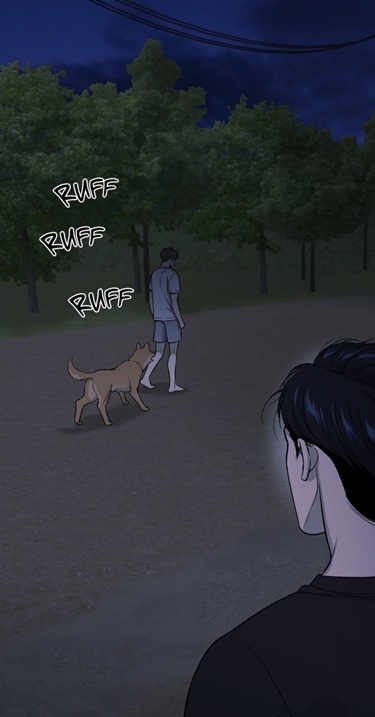 (chapter 65) His bare feet on the cold ground
  (chapter 65) suggest a longing for freedom, yet the direction of his steps remains uncertain. Whereas these walks reveal about his inner struggle, they don’t reveal the destination of his nightly strolls. Where was he going during that night? Was he going to the ocean—vast and untamed— like in episode 59,
 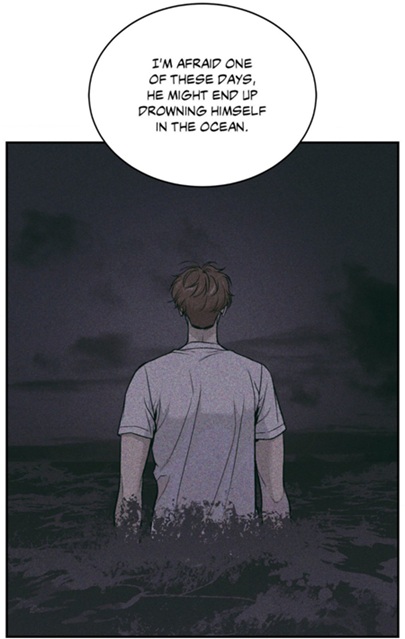 (chapter 65) or had his destination changed? These questions will be answered in the second part.
 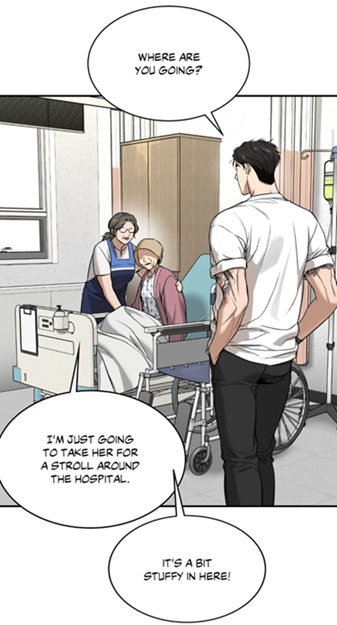 (chapter 65) This destination reflects the athlete’s desire and mind-set. He likes this place because it is quiet.
 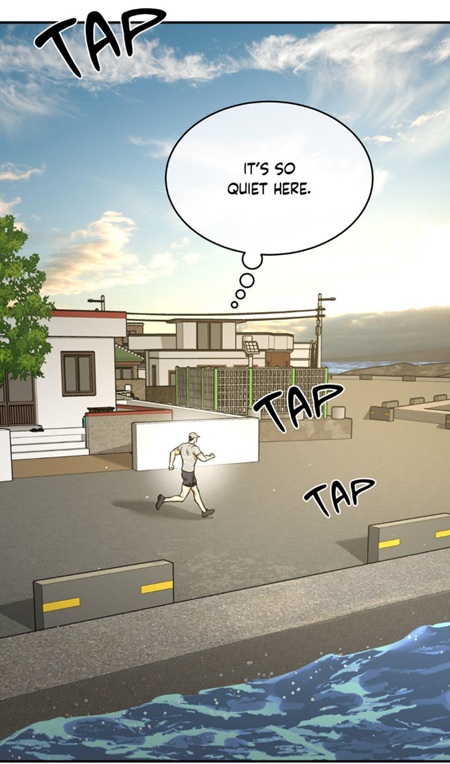 (chapter 62) From my perspective, the man has now internalized the beach to nature and privacy. Striking is the way Mingwa introduced the scenery. First, she focused on the wheel and Joo Jaekyung’s feet.
  (chapter 65) The contrast between the creaking wheels of the grandmother’s wheelchair and the steady steps of the champion immediately establishes the theme of control versus freedom. The wheelchair’s wheels represent civilization, immobility, passivity, and the grandmother’s obsession with control—over her own fate
  (chapter 65) In fact, she is just looking ahead of her. The “nice little town” is reduced to the pathway next to the beach. This observation exposes her narrow-mindedness. Because she is not truly admiring the place, I feel like she is praising the town more based on her childhood memories. This explains why she mentions her youth afterwards. Moreover, the fact that she employed the expression “isn’t it” with her description, reveals her tendency to lead the conversation. It was, as if she pushed the young man to agree to her claim. The irony is that she didn’t even wait for his reply. She explained why she was so fond of the place: her childhood memories. In her eyes, because her companion didn‘t spend his youth here, he can not connect to this town, overlooking that people can create new memories anywhere. Moreover, they are not obliged to live in the same town their whole life or to live where they spent their childhood. In other words, this frail lady has no real notion of time as such. I would even say, her gaze is not truly directed in the present or the future, she is rather obsessed with the past.
 (chapter 59) The contrast between these two images—one of the halmoni accompanied by Joo Jaekyung and the other of Kim Dan sitting alone by the ocean—exposes the stark difference in their emotional worlds and the dynamics of control and isolation that define their lives.
 (chapter 65) The sunlight high in the sky bathes the scene in brightness, suggesting a façade of warmth and clarity. This lighting aligns with the halmoni’s belief that she can influence Kim Dan through the champion, using Joo Jaekyung as an intermediary to extend her authority. The fact that she is in a wheelchair, however, subtly contradicts this impression of power, revealing her true state of passivity and reliance on others to act on her behalf. The ocean, tamed by the pathway, symbolizes her attempt to domesticate nature—
 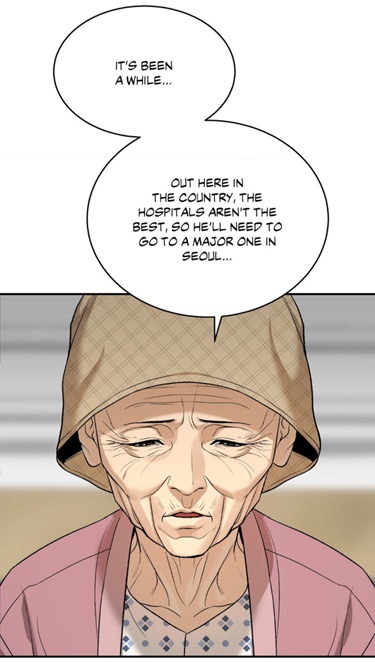 (chapter 65) just as she tries to domesticate Kim Dan’s emotions and decisions. At the same time, it exposes that the champion is still far away from his true self, but he is getting closer to become “reborn”.
 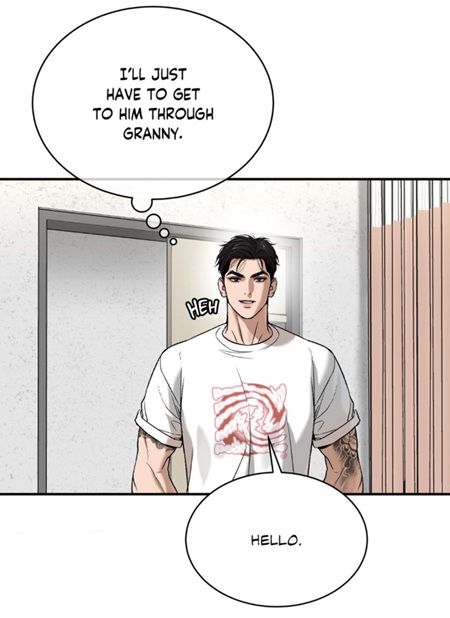 (chapter 65) the same illusion that the high sun implies. The latter can not shine if there are clouds.
 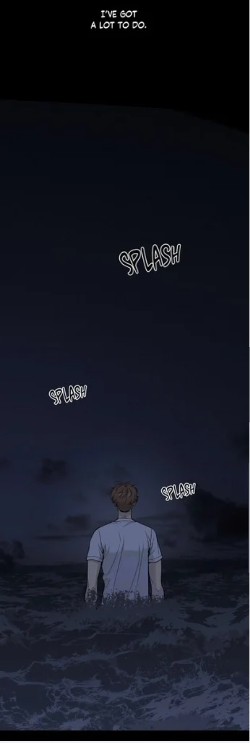 (chapter 59)
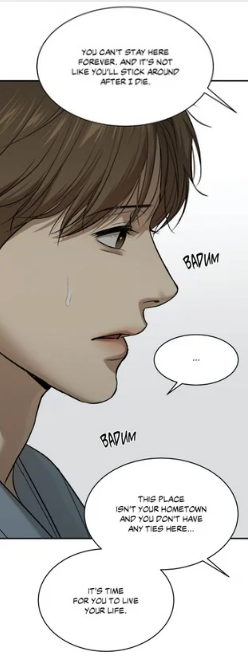 (chapter 57) By telling him that he had no ties here, she effectively erased their shared past and portraying him as a stranger in the very place she calls home. Thus I deduce that she is aware that she is racing against time. The longer the athlete stays in that place, the lower are the chances that her grandson will leave this town. She has to ensure that Joo Jaekyung doesn’t feel like settling here. I don’t think, she heard about the athlete’s involvement in the little town, for her only source of information comes from the staff
 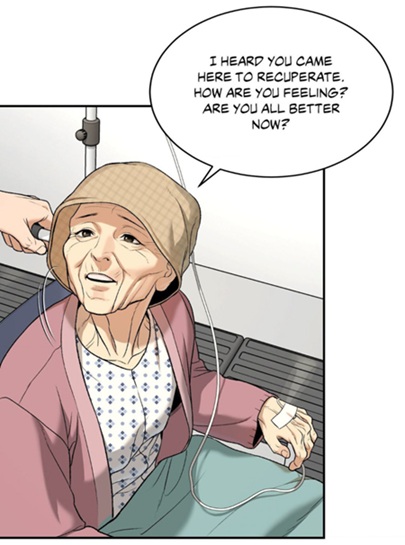 (chapter 65) and the residents from the hospice. She has no connection to the town chief and other inhabitants. This exposes how small her world is and little her knowledge is. However, her ignorance doesn’t make her an innocent “lady”, quite the opposite. – Don’t get me wrong, I don’t see her as a malicious person, just as a selfish person suffering from Peter Pan Syndrome.
  (chapter 65) Here, she claims that she only knows about the sportsman’s job thanks to the patient next door. However, she is lying, because she watched his match in the States.
  (chapter 41) The irony is that she is not realizing that she is showing her true colors.
  (chapter 21) In episode 21, the halmoni’s description of the champion as a “good friend” was, in hindsight, a superficial and self-serving characterization. At that time, she likely saw Joo Jaekyung as someone who could be beneficial for Kim Dan’s financial situation without truly caring about who he was as a person. Her interest in him was more about what he represented—a source of money and stability—rather than any genuine appreciation of his character or the impact of his presence in Kim Dan’s life. Thus she said this in front of the ocean:
  (chapter 65) If he was a good friend, then why didn’t she show more interest in him before? It is because she needs him now. Yes, this woman is a good-weather friend in the end. The term “good-weather friend” refers to someone who shows interest, support, or kindness only when it is convenient for them or when they stand to gain something. Hence she goes outside, when the sun shines. This perfectly encapsulates the grandmother’s attitude towards Joo Jaekyung. But it is the same with the champion. He only visited her,
  (chapter 61) Yes, the conversation at the beach played an important role, for Shin Okja’s behavior serves as a distorted mirror to Joo Jaekyung’s actions and mindset, exposing the flaws and contradictions in both. When she voiced this wish
  (chapter 22) he acted out of a simplistic view of good deeds—believing that financial support alone could resolve problems and fulfill his moral obligations. His subsequent failure to visit her again reflects his tendency to distance himself emotionally once he has performed what he sees as his duty. This is reminiscent of his behavior towards Kim Dan: helping him materially but avoiding deeper emotional involvement or responsibility.
 (chapter 65), much like how Joo Jaekyung likely saw himself when paying her bills—believing that fulfilling a material need is equivalent to showing genuine concern. Park Namwook is a representative of this mind-set too.
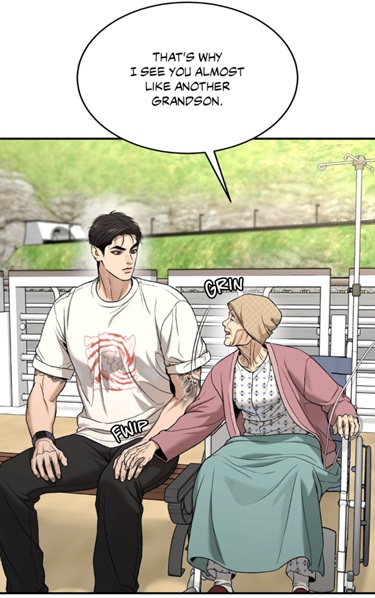 (chapter 65) is a way to offload responsibility for doc Dan while maintaining an image of concern. Both display a form of care that lacks true depth.
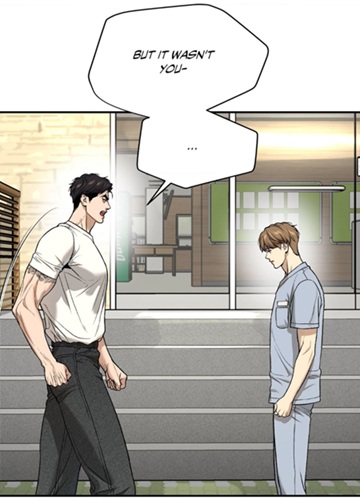 (chapter 62) Both avoid the emotional accountability that comes with their actions, preferring to distance themselves once a material obligation (debts)
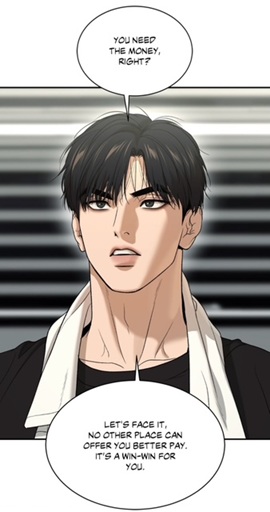 (chapter 60) is fulfilled.
 (chapter 22)
 (chapter 57) This displays that she is not entirely honest. She is not reaching out to Kim Dan in the end. Her excuse is that he refused to see a doctor
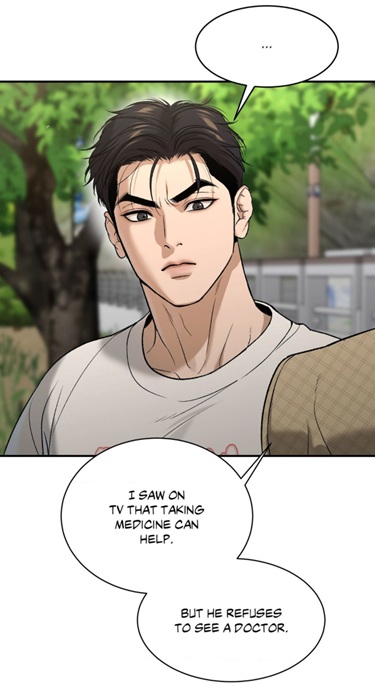 (chapter 65), but so far we never saw her making such a suggestion. It is possible that she jumped to this conclusion because she heard about this incident:
  (chapter 60) If my assumption is correct, the woman didn’t realize that this rejection was linked to Joo Jaekyung’s intervention. So if she had talked to her grandchild himself, she could have had an impact… But they are actually avoiding each other. One thing is sure: the absence of communication and avoidance between these two family members reinforced the doctor’s suffering. Imagine the consequences of her request: she is preferring locking him up in a hospital receiving drugs than giving what doc Dan has been longing: warmth, love and a home.
  (chapter 65) where both were happily smiling. The picture is the evidence that she could make Kim Dan smile despite their poverty. Moreover, it is important to recall that she introduced Kim Dan as an orphan from birth:
  (chapter 65) According to my hypothesis, this image
  (chapter 19) is linked to the doctor’s abandonment and betrayal. I have to admit that her attitude and words reminded me a lot of the director Choi Gilseok’s offer.
 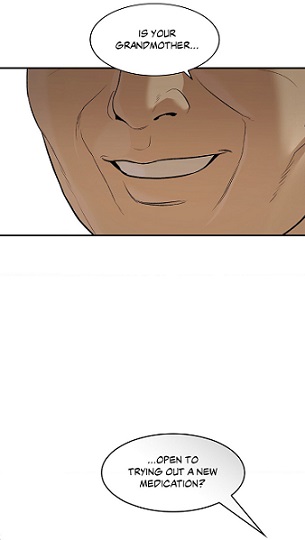 (chapter 48). Both the halmoni and Choi Gilseok embody betrayal and the theme of acting behind the back
 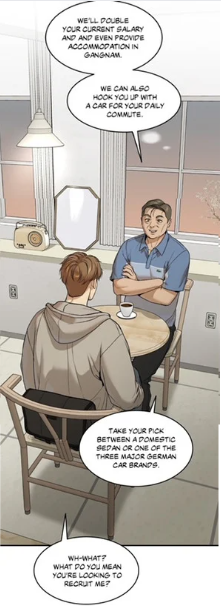 (chapter 48) and superior medical care
  (chapter 48) mask a deeper betrayal. His real aim was never to assist but to control, using offers of support as bait to tie Kim Dan into a powerless position. The parallel between his proposition to Kim Dan—promising a better life in exchange for leaking information and compliance—and the halmoni’s push for Seoul’s hospitals underlines their shared strategy: make the target believe they have a choice, while the outcome is already decided. The fact that Heo Manwook, who collects Kim Dan’s debts, called Choi Gilseok “hyung” further hints at a deeper conspiracy, suggesting that the offer might have been a tool to ensnare Kim Dan from the start. He would have committed a crime (illegal drugs).
 (chapter 62) That’s the reason why he was seeking the grandmother’s support. He was hoping that she could influence him. But what he hears, shocks him:
 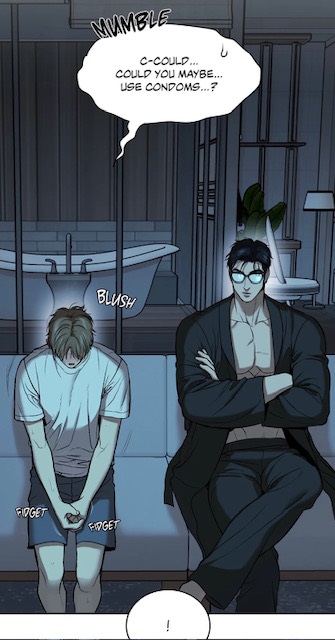 (chapter 29) He had even advised to think of himself first. As you can see, the fact that the two characters were just sitting next to each other reinforces my previous interpretation about the conversation. The grandmother was the one who had been leading the conversation, there is no real exchange of thoughts. In episode 29, the champion refused to accept the doctor’s help and suggestion. That’s the reason why I am more than ever convinced that the star won’t listen to the grandmother.
 (chapter 53) and watch the ocean with her grandson
  (chapter 53), but they never did it. Why? One might respond that she refused to do it.
 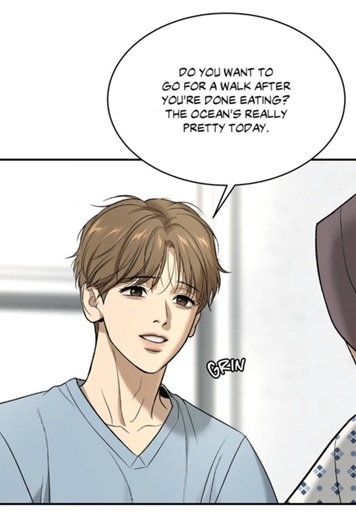 (chapter 57) But it is only partially correct. The doctor only suggested this walk to the ocean much later, when he was already suffering emotionally. This means that the grandmother would have not been able to enjoy this walk. Yes, the timing played a huge role. In fact, she confessed her crime to the star:
  (chapter 53) She never had any intention to spend some time with him. Notice the personal pronoun “we” vanished. It is only about her request: “I wanted to see the ocean”. This means that at the hospital, she never had any intention to keep Kim Dan by her side. She employed the “with you, we” in order to achieve her goal. She acted, as if they were a family. She used her illness for her own advantage. In my opinion, her request was an excuse to avoid to return to the old broken home. For her, home is a place and not a person. Therefore she couldn’t love Kim Dan properly. Her “I’m so sorry” was actually fake. She had only thought of herself… She never thought of her grandson’s future at all. This observation corroborates my previous statement: she is unable to plan for the future. What only matters to her is the past or the present. Why? It is because she doesn’t want to be plagued by remorse or regrets. And now, she is doing it again with the champion. Using emotions and fragility for her own benefits. The paradox is that this is something Joo Jaekyung has always feared his whole life. Nonetheless, he doesn’t react so violently like in the past: rejection or outburst. One might say the reason is that she is weak and terminally ill.
 (chapter 65) However, I believe that her words reached the champion’s third eye. The latter was not focusing on the grandmother, but on his fated companion. He was trying to understand why he had changed. This question was already on his mind before:
 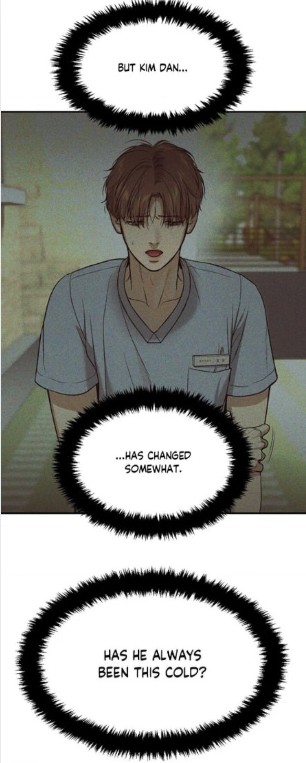 (chapter 62) And notice that the words from the grandmother
  (chapter 62) Once he has achieved his goal (reclaim his champion title), they will depart from each other. He would treat the doctor the same way than the grandmother! No wonder why doc Dan is getting angry and rejecting the offers from his destined partner. IT is only about his own selfish desires and not about doc Dan’s future and desires. Both have a similar mind-set: they don’t know what doc Dan plans to do with his life and the future…. And it shows that Joo Jaekyung was imitating the grandmother, though this suggestion was born from the following thought. Since Doc Dan was no reluctant to work for him, he imagined that maybe he would still accept to work for him for a limited time. But that’s not what Kim Dan is looking. He is longing for a home and at the same time for freedom.
 (chapter 65) The points of suspension are indicating that he is meditating on her words and suggestions. This stands in opposition to his past behavior where he got manipulated so easily.
 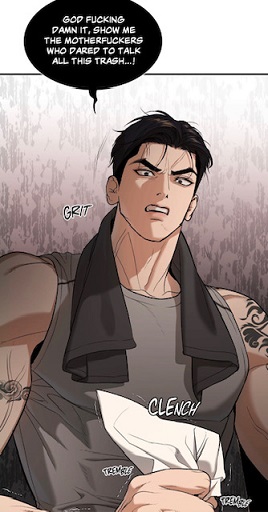 (chapter 36) The reason for this huge metamorphosis is that because of the lavender-tinted night, he learned to control his emotions.
 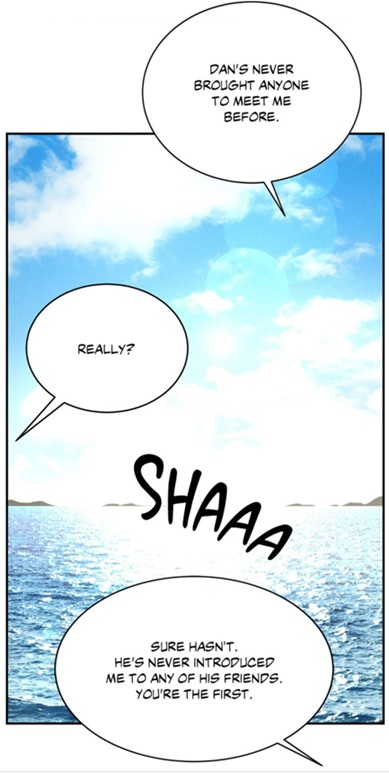 (chapter 65) According to her, Kim Dan has never introduced her to any of his friends. The celebrity would be the exception! But she is lying here. How so? Joo Jaekyung introduced himself to her on his own. It is because he answered a call from the nurse.
 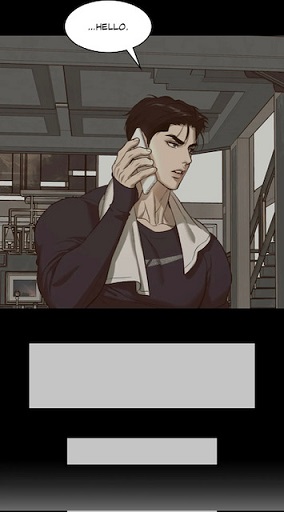 (chapter 21) It happened behind doc Dan’s back in the end. The latter was sick, but the old lady didn’t seem concerned. The second lie is this statement which is exposed with the memory:
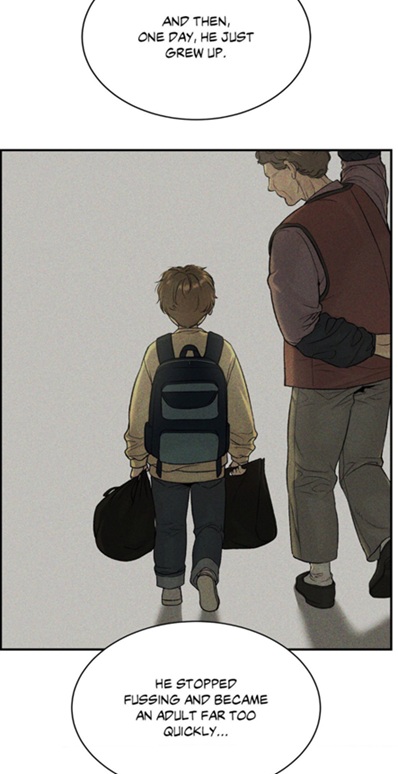 (chapter 65) Here, note that the little boy is wearing the same clothes than in the doctor’s nightmare.
 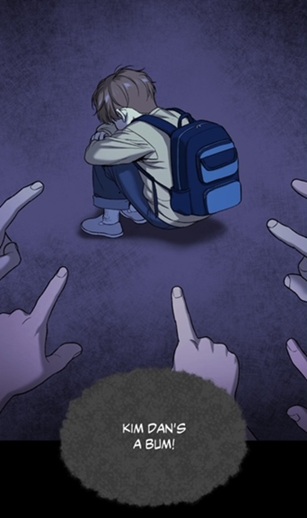 (chapter 57) She claims her ignorance why the little boy acted like an adult at such a young age. The reality is that she hasn’t forgotten the incident at all. This explicates why she confessed this to the “wolf”:
  (chapter 30) a sign that she was never a source of embarrassment for him.
  (chapter 47) Her refusal to address these deeper issues reveals that her sacrifices were less about genuine care and more about maintaining her self-image as a righteous guardian.
 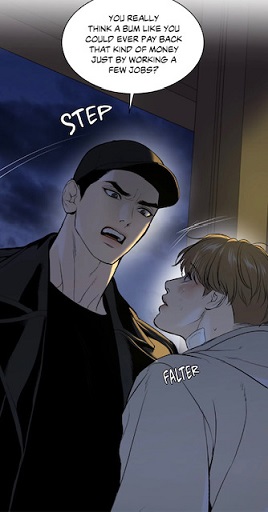 (chapter 18) What caught my attention in her revelation is her lack of enthusiasm for her own grandson.
  (chapter 65) “Is he that good?” exposes a lack of faith in her grandchild, a remark which caught the athlete by surprise. For me, he unconsciously sensed this negative aspect.
  (chapter 65) While this image is actually humorous, the grandmother’s words don’t match her body language. She is not showing any joy or smile. Therefore I comprehend why Kim Dan was so hurt by the champion’s behavior:
  (chapter 65) I am suspecting that deep down, she wants him to shine for her own peace of mind.
  (chapter 61) Finally, it is important that the athlete never agreed to her “demand” or suggestion.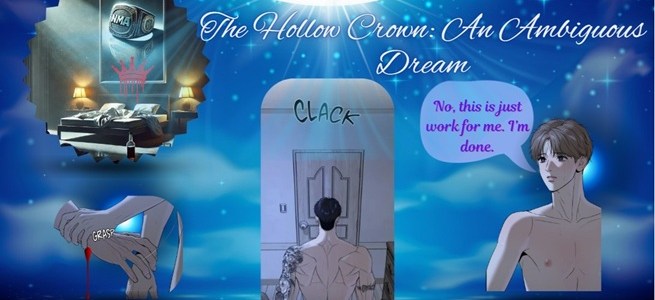

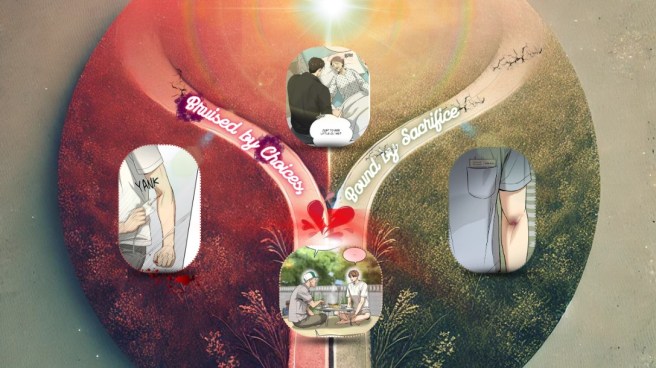
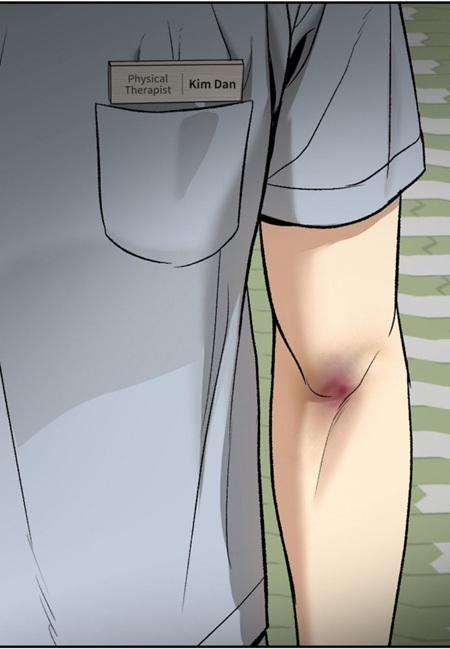 (Chapter 61) However, this moment is not isolated—it reflects patterns in his personality that have appeared throughout the series.
  (Chapter 11)
  (chapter 18) This essay delves into the significance of Kim Dan’s physical and emotional bruises, examining how they symbolize his suffering, internal conflict and transformation. I will examine Kim Dan’s conflicted emotions surrounding gratitude and debt, contrasting his interactions with Joo Jaekyung and his grandmother, Shin Okja. Additionally, I will explore how Kim Dan’s conditioned identity as a caregiver drives his choices, even in his current living situation with the landlord, where he unconsciously replicates past dynamics. Ultimately, I will elaborate how Kim Dan’s newfound awareness could reshape his identity and relationships moving forward.
 (Chapter 61) His unexpected reaction catches Kim Dan off guard, further emphasizing how disconnected the doctor has become from his own well-being. However, contrary to the past
  (chapter 11), Kim Dan is truly responsible for the contusion. He caused the injury by removing the needle from the drip.
 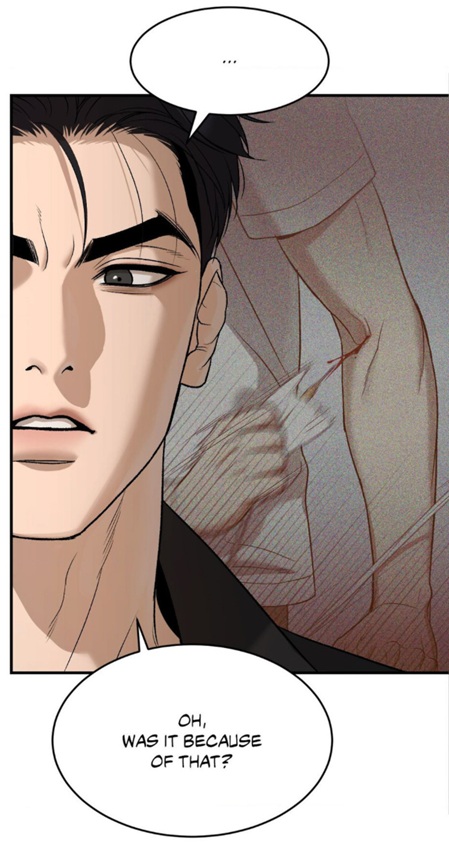 (Chapter 61) On the hand the circumstances surrounding the bruise, where Kim Dan removed the needle on his own, provide insight into his psyche. The deeper cause of the bruise lies in Kim Dan’s declining health, which is intrinsically connected to his malnutrition and the neglect he faces from those around him. It is important to recall that Joo Jaekyung was explicitly informed that Kim Dan needed rest
  (chapter 60). Yet, with his insistence,
 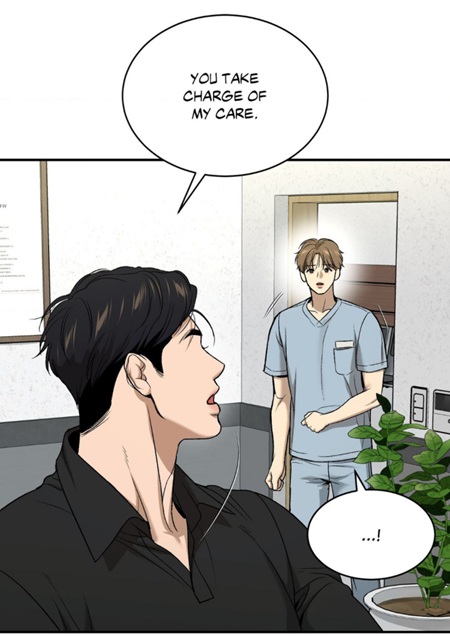 (chapter 61), he forced the physical therapist to keep working, adding even more strain than before. Though the physical therapist attempted to voice his disapproval,
 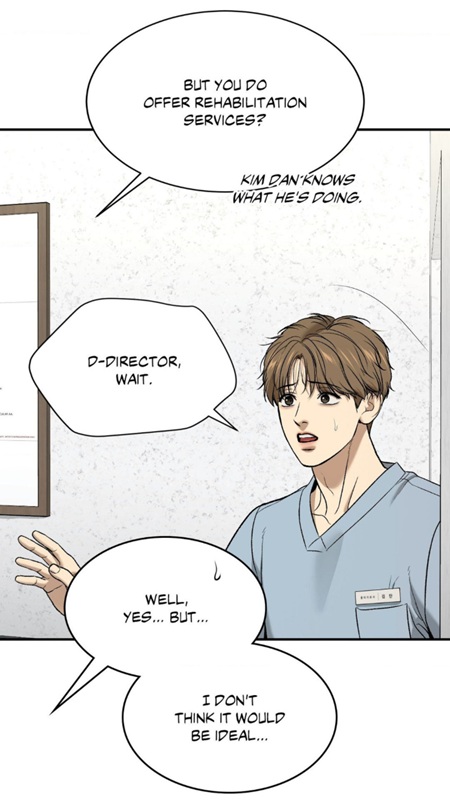 (chapter 61), he ultimately had no choice but to comply, as his order came from the hospice director.
  (Chapter 61) And why did the director override Kim Dan’s need for rest? Money and free PR. Joo Jaekyung’s influence secured the director’s approval, disregarding the doctor’s well-being in favor of business interests. This conversation at the director’s office makes one thing clear: words hold no power against profit. An d that realization led me to another connection—every one of Kim Dan’s bruises is linked to exploitation, whether by authority, obligation, or financial influence.


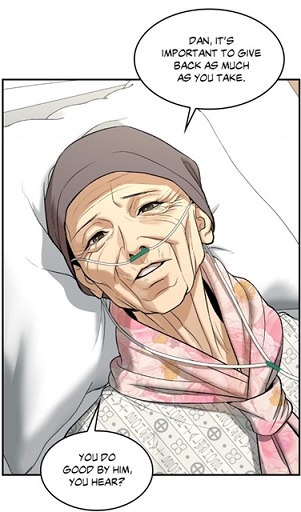 (Chapter 41) It is clear that she was inciting him to work harder than before. This displays that Kim Dan was not allowed to rest. During this encounter, she didn’t ask him about his well-being either. And what is the link between these 3 episodes? The grandmother and her poverty. The latter was responsible for the loan.
  (chapter 56) Kim Dan has only visited the hospital once, and this was solely due to Joo Jaekyung’s intervention. The latter needed medical attention himself
  (chapter 18) and took Kim Dan along, ensuring he was seen as an emergency patient. However, this visit was brief and lacked any comprehensive medical examination—no blood samples were taken, and his underlying health concerns remained undiagnosed. This omission further underscores the neglect Kim Dan has suffered, as even in a medical setting, his long-term health issues were overlooked.
 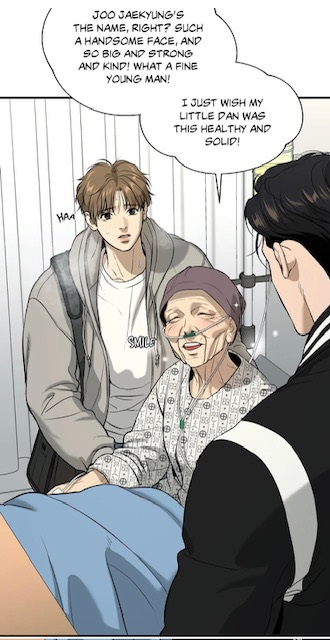 (chapter 21) He had never been healthy and strong. Moreover, when he joined them, at no moment the senior asked if he had gone to the doctor, though he had been sick before.
 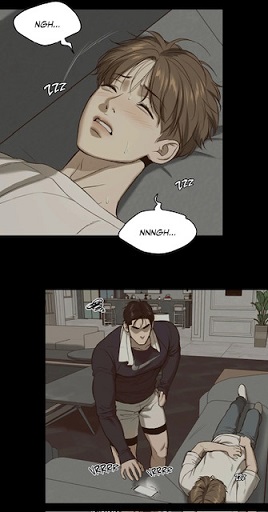 (chapter 21) But back then, the champion didn’t pay too much attention to it. In my opinion, her response will likely reflect her established pattern of emotional detachment and deflection of responsibility. Rather than admitting her lack of concern for his well-being, she may shift blame onto the staff or Kim Dan himself
  (chapter 5), or his general reluctance to ask for help. He rejected the athlete’s help and concern.
 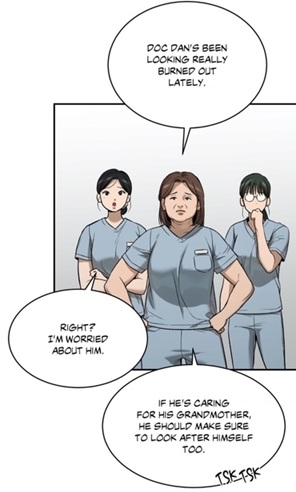 (chapter 57). She blamed the main lead, because she imagined that Shin Okja would worry about him. However, it becomes clear that the halmoni is not worried about her grandson at all. She is acting like a fan in front of the athlete.
  (chapter 61) He only remained at the door. However, observe that there was a cut between this image
 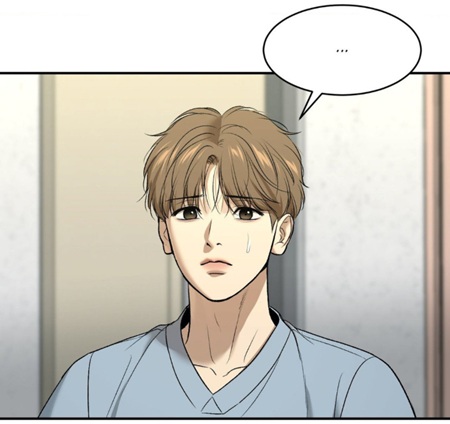 (chapter 61) and the conversation between the main couple in front of the hospice.
 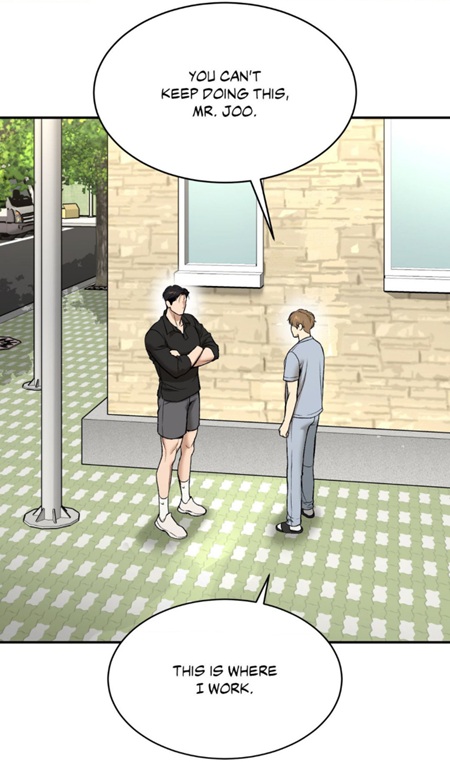 (chapter 61) So he could have made his presence known to his relative before asking Joo Jaekyung to follow him because of his treatment. To conclude, I believe that she had the time and occasion to see her grandchild and his bruise.
 (chapter 13) He is the only doctor who has ever examined the protagonist so closely and even paid attention to his fingernails!
  (chapter 13) At the same time, the chingu from the club was the first one pointing out that his wounds were never treated!! Furthermore, I realized that the doctor’s lies from episode 11
 (chapter 59) He would space out and even fall asleep at any moment.
 (chapter 13) The latter was the cause for the severe exhaustion. However, like mentioned above, the doctor is not blameless either, because he never questioned why his wounds on the hand were bleeding again.
  (chapter 43) He thought, it was related to the massage, yet the reality was that this incident showed that he had coagulation issues. To conclude, all the bruises could have always been noticed by people due to their locations (eyes, hands, arm)!
  (chapter 61) and his relationship with Joo Jaekyung.
  (chapter 61) That’s how I recognized why these women’s warm welcome and curiosity about Kim Dan were rather superficial.
  (chapter 56) His arrival stands for novelty and a breath of fresh air at the institution. However, with this change, the female staff is forgetting their original duty: they need to pay attention to their colleagues. They are behaving like the grandmother
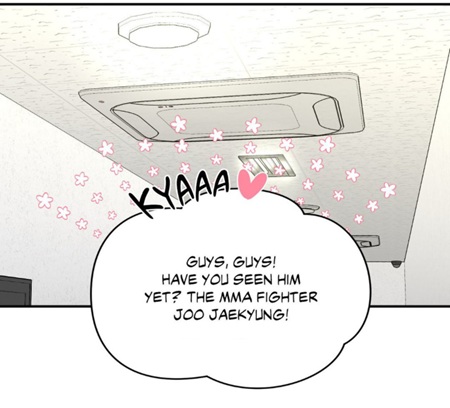 (chapter 61): fangirling over the handsome guys visiting their little town. That’s why Mingwa drew flowers in the last two images. No wonder why no one around Kim Dan is observing the bruise and his deteriorating condition. Moreover, since the physical therapist has a relative at the hospice, the staff is envisioning that Shin Okja is doing “her work”, she is paying attention to Kim Dan’s mental and physical conditions. On the other hand, there is no doubt that the grandmother has already delegated her own responsibility onto others, Kim Dan and the hospice. It is a medical institution, therefore they should pay attention to his working conditions. In other words, since no one feels responsible for the protagonist’s health, no one is worried about Kim Dan at all. At the end of episode 61, he is even so pale and breathless
 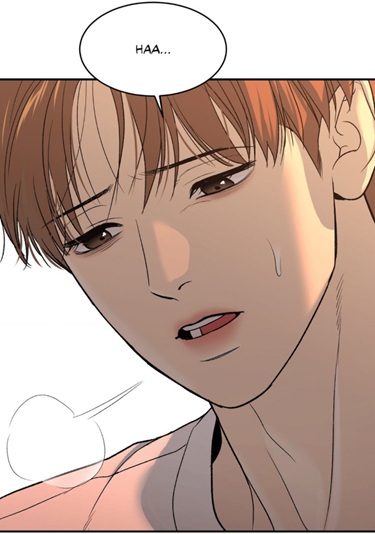 (chapter 61) that I am anticipating a terrible incident leading to a rude awakening for everyone.
 (chapter 56) that she is still relying on him, as he is the one paying her hospice bills. Besides, she still doesn’t know that the loan is no longer existent. It was, as if he had to clean up her mess before her death. At no moment, she asks about the loan or the doctor’s future. She is not thinking about his future at all.
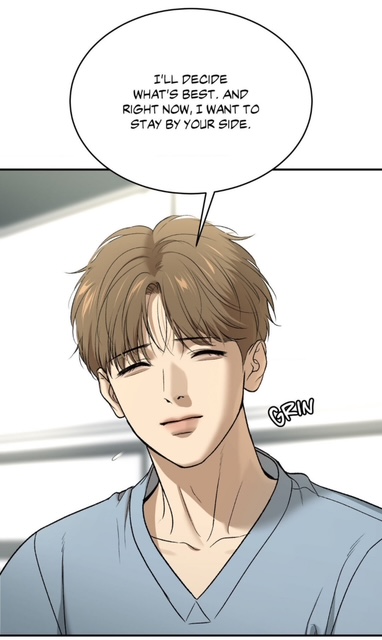 (chapter 57) — reinforces her conviction that she has fulfilled her role. In her mind, his rejection of her advice places the burden of care entirely on him, allowing her to dismiss any further involvement. This emotional withdrawal directly connects to the symbolism of the bruise:
  (chapter 18) In episode 18, when Joo Jaekyung confronts Kim Dan about the loan, the doctor has a bruise on his left eye, symbolizing his entrapment and helplessness. This earlier injury highlights how Kim Dan has been conditioned to view himself as responsible for burdens that are not his own, perpetuating a cycle of sacrifice and self-neglect. And a new bruise appeared just after the athlete reminded the physical therapist of his past promise:
  (chapter 61) His grandmother’s disregard for his well-being amplifies the injustice of this situation; she allowed him to shoulder the debt despite knowing it was never truly his to bear. The bruise becomes a recurring motif, a visual representation of how others have imposed their responsibilities on Kim Dan, leaving him physically and emotionally scarred.
  (chapter 60). The juxtaposition of the vibrant environment with Kim Dan’s deteriorating health underscores the neglect he faces. The hospice is meant to be a sanctuary, yet it becomes a space where Kim Dan is further burdened by the champion and his grandmother’s expectations
 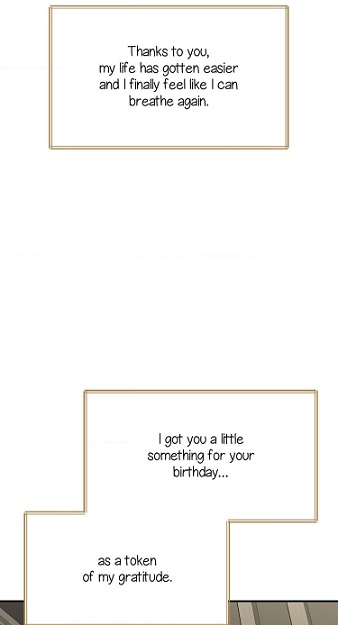 (chapter 55) This line “I finally feel like I can breathe again”, written by Kim Dan, reveals a subconscious acknowledgment that his relationship with the champion represents a breath of fresh air, a chance to escape the suffocating expectations and burdens he has carried for so long. The bruise, a physical manifestation of his struggle, signals the breaking point of his role as a selfless caregiver. It challenges the illusion of invulnerability that Kim Dan has maintained and forces those around him to confront his vulnerability.
 (chapter 60) The beach, with its open and untamed expanse, symbolizes freedom and a return to the self. It foreshadows that Kim Dan’s true journey toward healing will require him to step outside the roles and confines imposed upon him, finding solace not in what is expected but in what feels authentic and liberating.
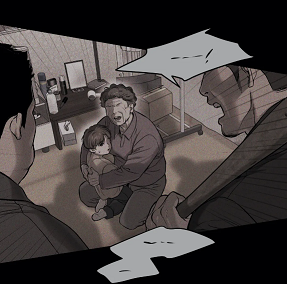 (chapter 5), yet she burdened Kim Dan with it, using his sense of duty and gratitude against him. Her statement in episode 57
  (chapter 18) —or, more accurately, the lack thereof. The champion’s actions were motivated by a desire to help
  (chapter 18), hence the star was waiting for a smile from Kim Dan. Yet the latter perceived it as meddling. His immediate response
  (chapter 59) Death can take away anyone and at any moment. In my eyes, if Joo Jaekyung uses his own body to save the doctor again (like for example blood transfusion and CPR), this time Kim Dan would feel truly grateful towards the champion. So far, the doctor has not recognized the star as his savior yet. By removing the needle, he denied the protagonist’s intervention on the beach:
  (chapter 60) Hence his arm got bruised. The contusion was a reminder that something had happened during that night, but Kim Dan chose to ignore the incident. He never questioned why he was on the beach, he acted, as if Joo JAekyung had lied.
  (chapter 60)
 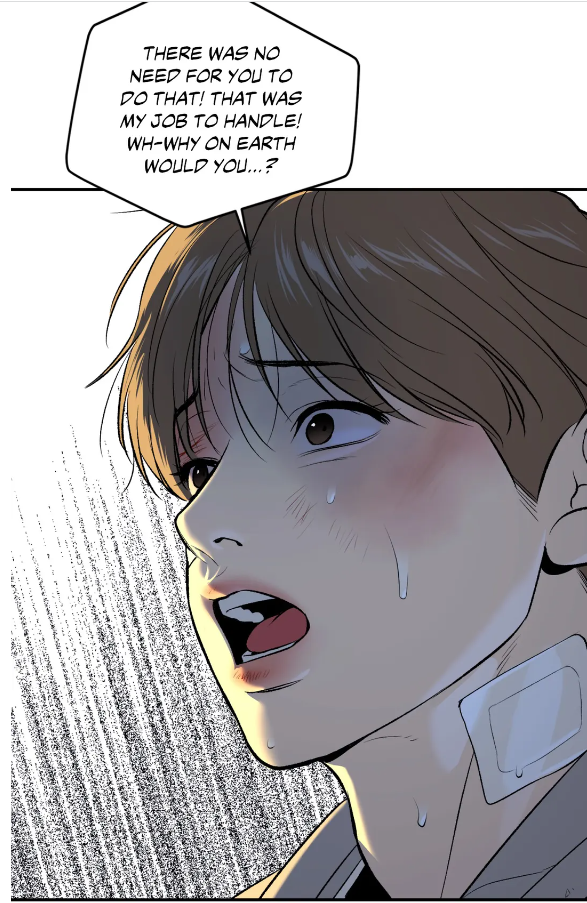 (chapter 18) Deep down, Kim Dan knows that the debt was never truly his responsibility, making it difficult for him to view the champion’s actions as a genuine act of kindness. This inner conflict is compounded by his suicidal disposition, which renders the concept of repaying the debt meaningless.
 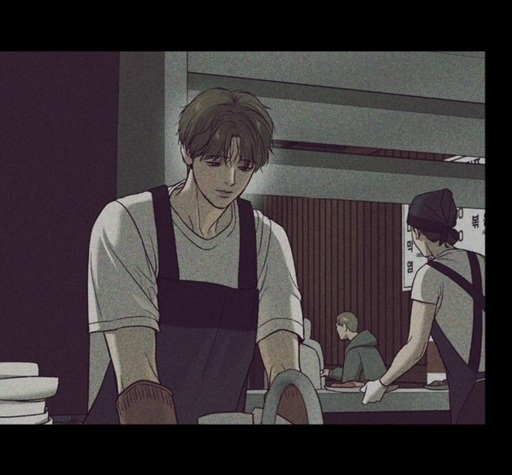 (chapter 59) He worked so hard, was even beaten, but he could never voice his torment.
  (chapter 59) Why? It is because the grandmother was no longer by his side and she never talked to him either. The absence of communication indicates her lack of interest in Kim Dan. And it becomes comprehensible why during that night, he felt the need to go to the ocean and drown himself. It is because he was gradually realizing his loneliness. With his relative’s death, he would only keep living a terrible life determined by work and nothing else.
 (chapter 11) and even uses his own words against him:
  (chapter 11) However, he never explained his circumstances to the generous athlete. By keeping him in the dark, he reinforced his negative disposition about the doctor. And chapter 61 exposes this reality. His suffering was the result of his own decision.
 (chapter 61) Do you recognize the room? That was the doctor’s
  (chapter 19)
  (chapter 53) His decision to allow Joo Jaekyung into his bedroom in episode 61 demonstrates that he consented to the relationship, even if begrudgingly.
 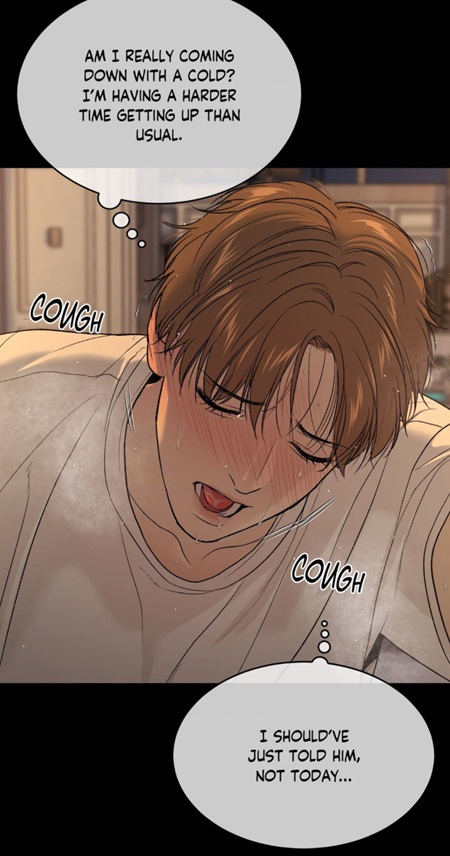 (chapter 61) However, his reaction afterward (regret) suggests that he struggles to take ownership of his choices. The fact that he recalled this sex scene in the restroom divulges a certain resent towards the athlete. The latter abandoned him right after their interaction. Hence I come to the following deduction. In reality, he is projecting his frustrations onto Joo Jaekyung, masking his true feelings about his grandmother, who is the root cause of his conditioned self-sacrifice. And this observation brings to my next remark. People wondered when this intercourse took place. One might think that this took place rather early in the story because of the way Joo Jaekyung acted. He didn’t remove his pants
 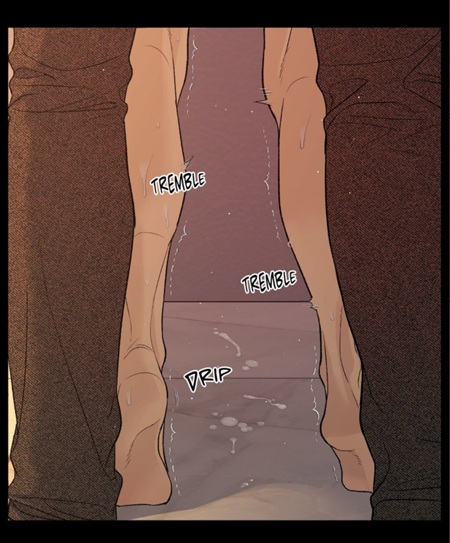 (chapter 61) and acted like in episode 6.
  (chapter 6) or 8
  (chapter 8) where he would abandon the protagonist right after the climax and not care about his partner’s conditions and feelings:
 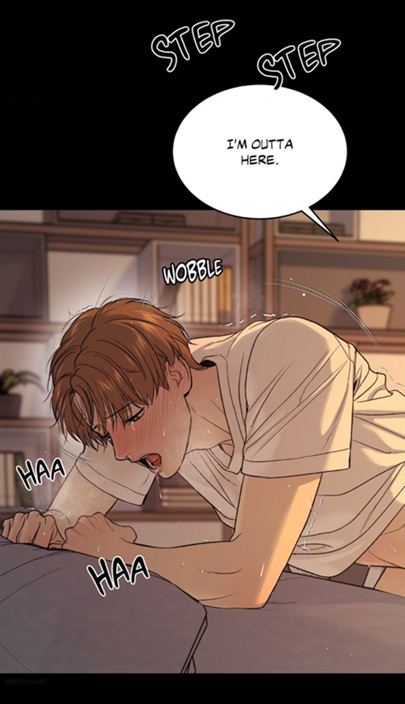 (chapter 61) I might be wrong, but for me, it took place much later in the story, around the time the athlete was about to face Alfredo. Why? First notice that they had sex in the doctor’s bedroom. This means that Kim Dan was already living in the penthouse. The words from the champion implied that he would return to his own bedroom, where the doctor’s thoughts implied that he was standing close to his bed. However, so far, they only had sex in the champion’s bedroom, when it was the evening before the match:
 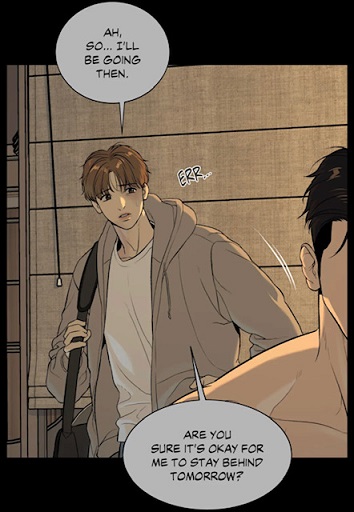 (chapter 13) Since the doctor mentioned that a match was right around the corner
  (chapter 61) It leaves us four possibilities. Randy Booker, Dominic Hill, Alfredo
  (chapter 47) and Baek Junmin. However, for the intercourse took place in the doctor’s bedroom (he wished to be carried to his own bed)
  (chapter 36), for they had sex every day. However, in episode 53, we discover their night before the match against the Shotgun
 (chapter 53) So this scene can only have taken place in chapter 47, when the match with Angelo got canceled and Kim Dan had been confronted with the terrible news about his terminally ill grandmother.
  (chapter 47) In the previous part of this essay, my avid readers could see the strong parallels between 61 and 47. But there exists another reason why I am inclining to think that the sex scene took place later in the story. It is because during that “magical night” (44), Kim Dan learned the notion of “consent”.
 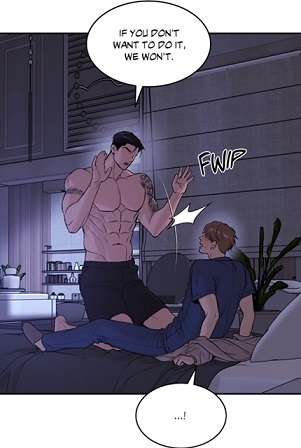 (chapter 44) During that blue hour, Kim Dan discovered that he could say no! And notice that in his memory, he clearly thought that he could have rejected the athlete’s advances.
  (chapter 46) He should mistrust the members from the gym and keep his distance from people. So during that time, Joo Jaekyung did follow his hyung’s advice
  (chapter 47), yet I can’t imagine that this man could become abstinent like in episode 19. Hence at some point, he must have felt the urge to possess Kim Dan, a mixture of fear and dominance. He imagined that way that he could impose his will onto the doctor and control his “loyalty”. With this submission, he would force the doctor to remain by his side. But naturally, this sex as “power play” could increase the gap between the main leads.
 (chapter 53) doc Dan was copying the champion’s behavior from episode 61. Right after the sex, he would leave the bed and return to his bedroom. How did Joo Jaekyung recall this night?
 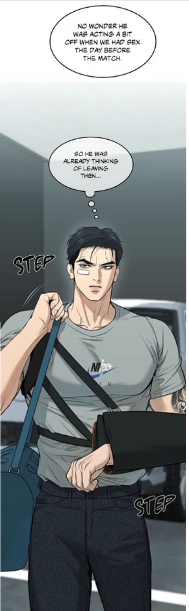 (chapter 53) He saw his attitude as a sign of disloyalty and “abandonment”. And that’s how Kim Dan is feeling in the restroom:
  (chapter 61) The darkness around the eyes is a metaphor for his resent and anger. And the moment you contrast the two memories (53 and 61), you can detect the hypocrisy of the two main leads. They only recall scenes where they were hurt and felt betrayed. However, in reality, they were both victims and perpetrators, because none of them chose to open up and talk to each other. Why? It is because both chose to listen to their “guardian” and their “favor”. Like mentioned before, in a quarrel, no one is right and wrong. The purpose of an argument is to listen to the counterpart and view incidents from their perspective. Finally, the physical therapist’s recollection serves as an important evidence that he had never been powerless and helpless. He could have refused all the time because their deal was never official.He could have used the contract as a shield. But the best evidence of Kim Dan’s power is this rejection:
  (chapter 61) I had already pointed out the increasing resistance and resilience from Kim Dan in episode 60:
 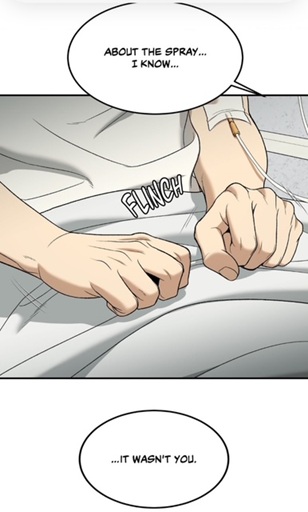 (chapter 61) My prediction came true. In the past, he could have denied the existence of the deal, Joo Jaekyung was free to seek another physical therapist. He never realized that he had some leverage. Yet he still followed the athlete’s requests. He saw himself bound by obligations. However, this was just an illusion. Hence in episode 61, we see him legitimating his consent that there was an imminent fight.
  (chapter 61) He is expected to work despite his declining health, his suffering dismissed by those around him.
  (chapter 40) He is paid to receive bruises, to push his body past its limits
 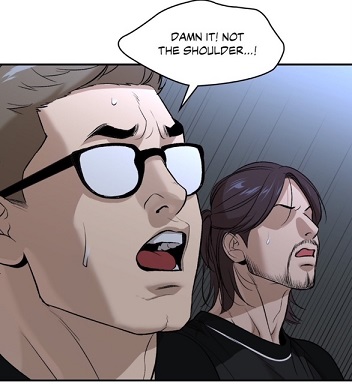 (chapter 50), to endure pain while the public watches and profits are made. His suffering is entertainment, a spectacle that fuels the business of MMA. Though he is a champion, he is still a commodity, expected to perform regardless of his condition.
  (chapter 61) He understands, better than anyone, what it means to be physically used for the sake of others, yet he remains blind to the fact that he has placed Kim Dan in the same position. While one has no file about his health condition, the other has many files, but they are not studied, because this would push the manager to question his decision and even ruin the business:
 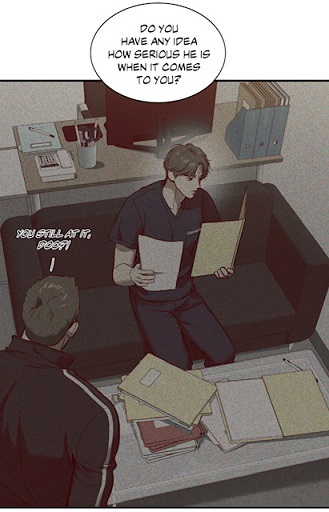 (chapter 17) I doubt that Park Namwook studied them, and notice that the recently hired PT didn’t ask for the champion’s files first:
  (chapter 54) Thus I deduce that the champion’s files are in reality a subterfuge. They give the impression that the doctors and Park Namwook truly care for his well-being, but it is not correct. They are only interested in his body because of wealth and reputation. But let’s return our attention to episode 61 and the champion’s attitude towards Kim Dan.
 (chapter 54) It is clear that the manager wants Joo Jaekyung to return to the ring as soon as possible to erase the last “debacle”. In my opinion, the doctor’s illness could serve Joo Jaekyung as an excuse to delay his return to the ring and even not to accept the next challenge.
  (chapter 57) is another manifestation of his conditioned role as a caregiver. By living with an older man, he creates the illusion of a familial bond, mirroring the dynamic he shared with his grandmother. This decision highlights his struggle to break free from the identity imposed on him—one defined by servitude and selflessness. He assumes that he should take care of the landlord, offering to cook and expressing guilt for not fulfilling this perceived duty. Yet, the landlord subtly challenges this narrative. By inviting Kim Dan to eat breakfast
 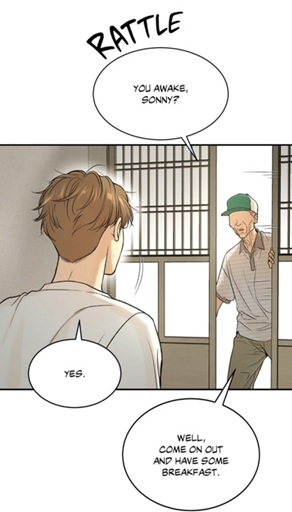 (chapter 57) and dismissing his apologies, the landlord treats him as an equal rather than a caretaker. This dynamic forces Kim Dan to confront his false perception of himself.
 (chapter 57) Despite this, Kim Dan rejects the advice, demonstrating his resistance to being cared for. This moment underscores his internal conflict—he craves independence yet clings to the role of the selfless provider. The landlord’s actions expose the fallacy of Kim Dan’s identity, revealing that his caregiving is not always necessary or effective.
 (chapter 61) is indicating the increasing resent and anger towards the star. Joo Jaekyung is no longer seen as a celebrity and idol, but as a inconsiderate man. This transformation is subtle but meaningful, as it reflects his burgeoning awareness of his own worth and the unjust treatment he has endured. For the first time, Kim Dan acknowledges himself as pitiful
 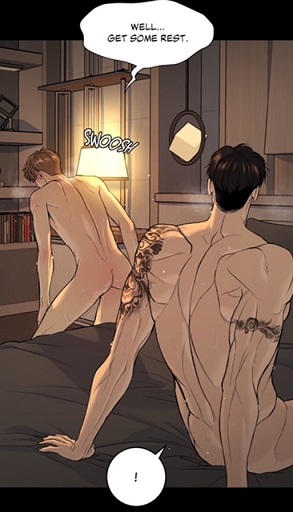 (chapter 53)
 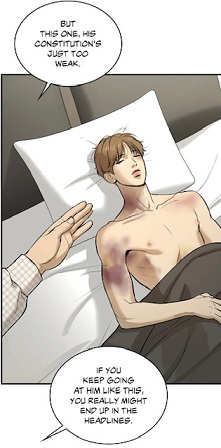 (chapter 13) and the fragility of Kim Dan’s existence. For Kim Dan, it challenges his self-perception as an indestructible caregiver. This realization could lead him to an inevitable conclusion: his own needs and well-being are just as important as those of others.


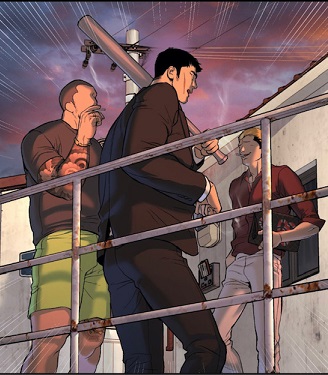

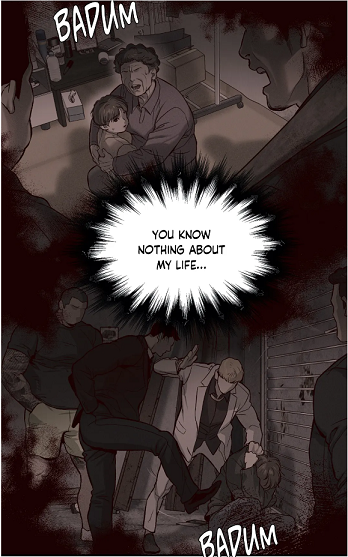


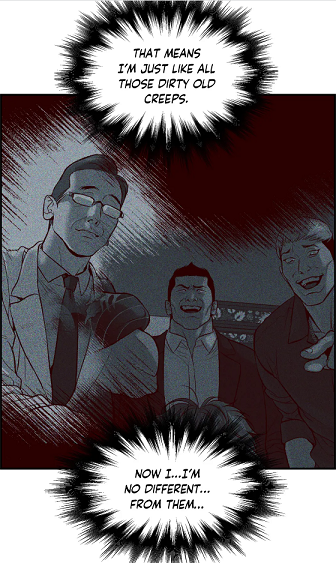

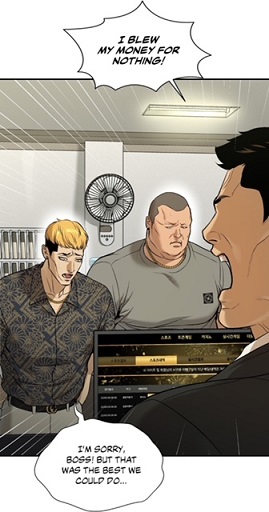

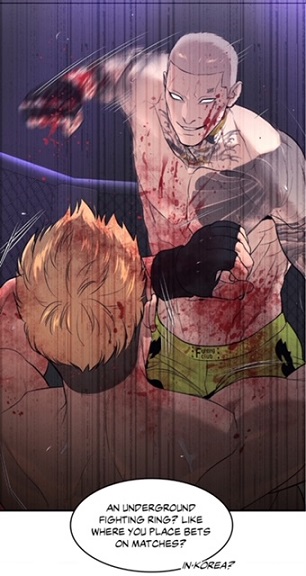


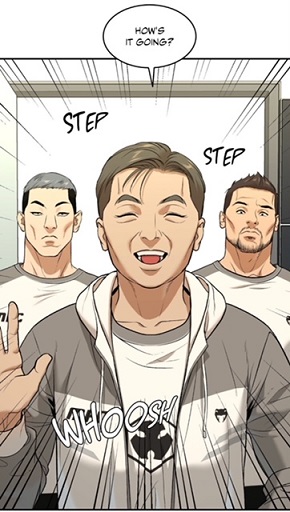 (chapter 49) These 3 men and The Shotgun have to be seen as a team. Moreover, 4 is a synonym for death. Then, observe that the image from episode 20 contains two villains, the loan shark and the perverted hospital director. 1 +1 = 2. So when we see the number 10, 11, 16, 17 and 18, we could perceive it as an allusion to Heo Namwook, the villain.
 (chapter 11) and indirectly the persons involved in the redevelopment. However, I have to admit that I have a different explanation.
 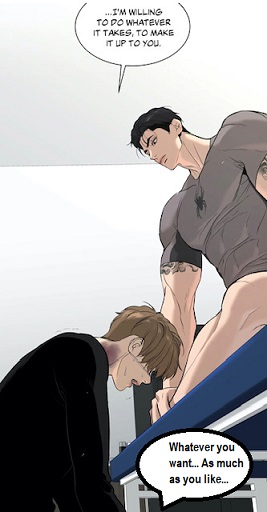 (chapter 11) Let’s not forget that in Jinx-Fandom, many Jinx-addicts calls him a “red flag”. Here, he was abusing his position. Furthermore, this theory could be seen as validated with the first episode with this image:
 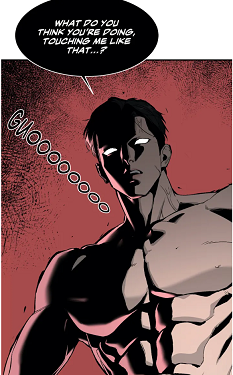 (chapter 1) The main lead appears as a beast, triggering the doctor’s fears. He seems to be like an antagonist. However, I believe that it is just a deception. First, Mingwa has clearly stated that the champion is the protagonist of Jinx. As such, he can be neither a villain nor an antagonist. Secondly, though he seems to serve as a barrier, the reality is that Kim Dan is incited to mature and overcome his own fears. In fact, the celebrity represents the opposite notions of “conformity” and “immobility”. He embodies verity, maturity, transformation and progression. The evidence of this perception is the gradual transformation of Kim Dan as an inexperienced PT to a very professional and performant physical therapist. According to my interpretation, the Emperor works as the mirror of truth. He confronts the delusional physical therapist with his mental and emotional issues, like here:
 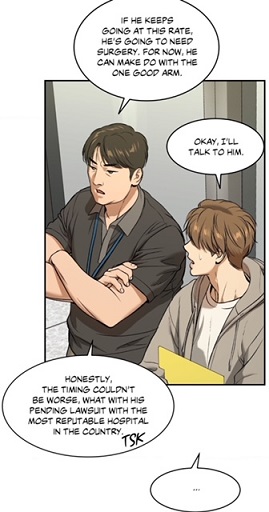 (chapter 42) He only relied on his hands. He was forced to become a serious and confident PT!!
 (chapter 1) The star was just waiting, and not threatening the doctor. As you can see, Joo Jaekyung doesn’t appear like a threat or a monster. But this doesn’t end here. One detail caught my interest. The champion is associated with blue. It is his true color, whereas Kim Dan is “red”, like a sweet strawberry. So why does this young man ooze a red aura, when his true shade is blue like water
  (chapter 27) or the ocean. It is because he was under the influence of his hyung Park Namwook which explains why Mingwa introduced him like this:
  (chapter 1) Note the contrast to his “boy”. The red is not coming from Joo Jaekyung’s body
 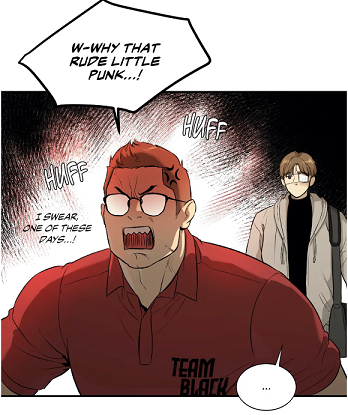 (chapter 11) The coach is yelling for Joo Jaekyung’s comment, yet the reality is that the manager didn’t treat Kim Dan at all. In fact, he feigned ignorance. Moreover, look at the champion’s t-shirt:
  (chapter 26) In this composition, I compared the MMA star with a leopard and Park Namwook to a spider:
  (chapter 17) or in episode 46
  (chapter 46) He represents regression or the hurdle to overcome.
  (chapter 11)
 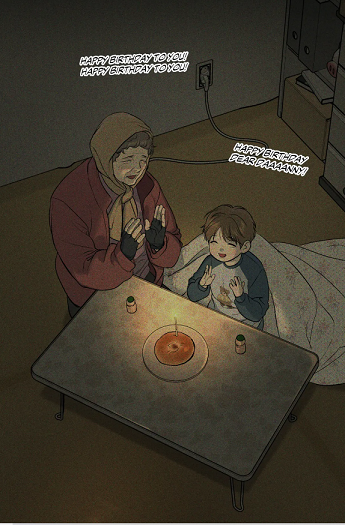 (chapter 11) And I can prove my statement by showing the episode where she appears:
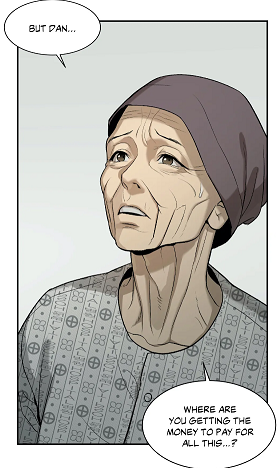


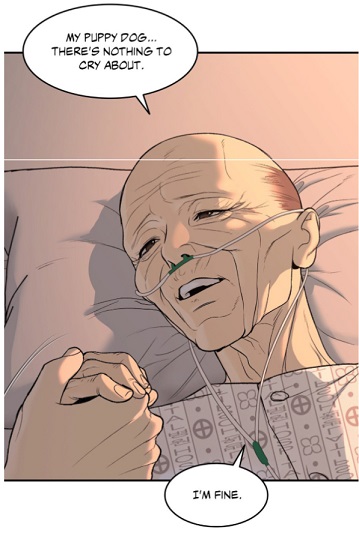


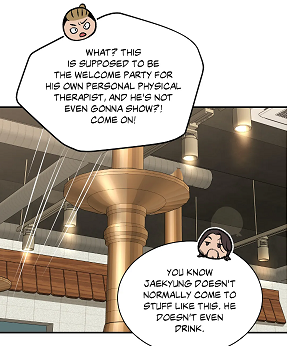 (chapter 9) or other events like this one:
 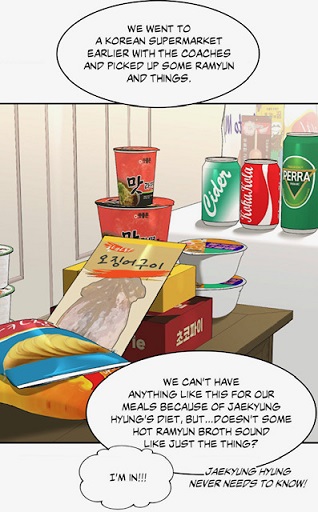 (chapter 37) Buying in secret junk food.
 (chapter 1)
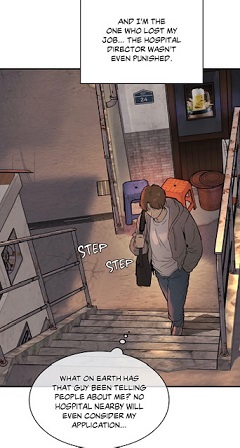 (chapter 1) But it is the same for the champion who got his “gym” stolen from his hyung:
  (chapter 22) He is acting here like a tyrant.
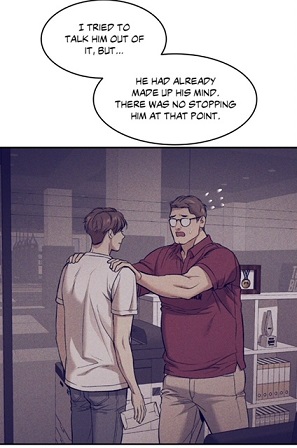
  I came to this revelation thanks to this article:
 (chapter 29) As for the halmoni, she embodies the last type of emotional vampire:
 (chapter 21) and Kim Miseon’s reproach to Kim Dan could be seen as an indirect allusion. And if my interpretation about her number is correct, then we would have a good explanation why Kim Dan was unable to perceive her true nature, but also why she is so selfish.
 (chapter 53) Only the logo is red.
 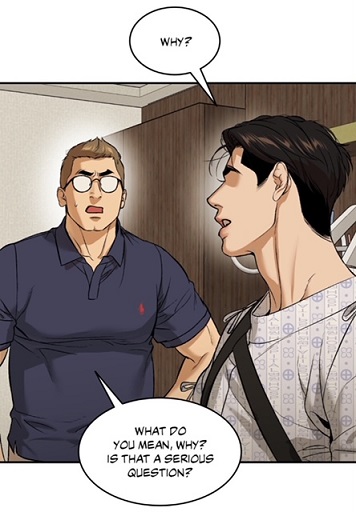 (chapter 53) It is important, because it announces the manager’s resignation. He doesn’t want to become responsible for the mess. Unconsciously, he is no longer claiming to be the owner of the gym. Furthermore, notice that the grandmother desires to return to the West Coast in order to see an ocean of “fire”.
 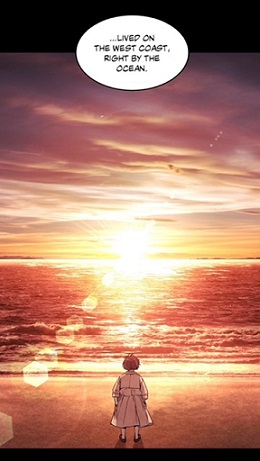 (chapter 53) This shows that she is longing for warmth and red colors. Yet, the color of the sea is rather green or blue. As you can see, everything is pointing out that the couple had to overcome the antagonists from season 1, the emotional vampires, who were so close to them than none of them realized that they were the origins of their suffering. And now, if you look at my table again:
 (chapter 35) In episode 16 and 17, the presence of the sun is a reference to the MMA fighter, it is announcing his arrival. This corresponds to the color I had detected with the first scheme: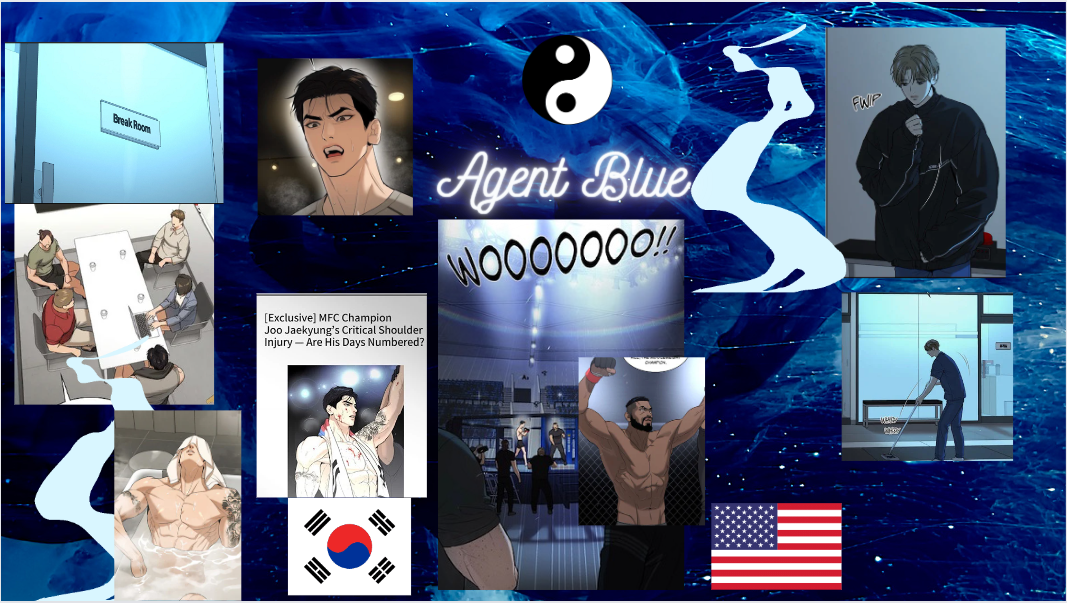
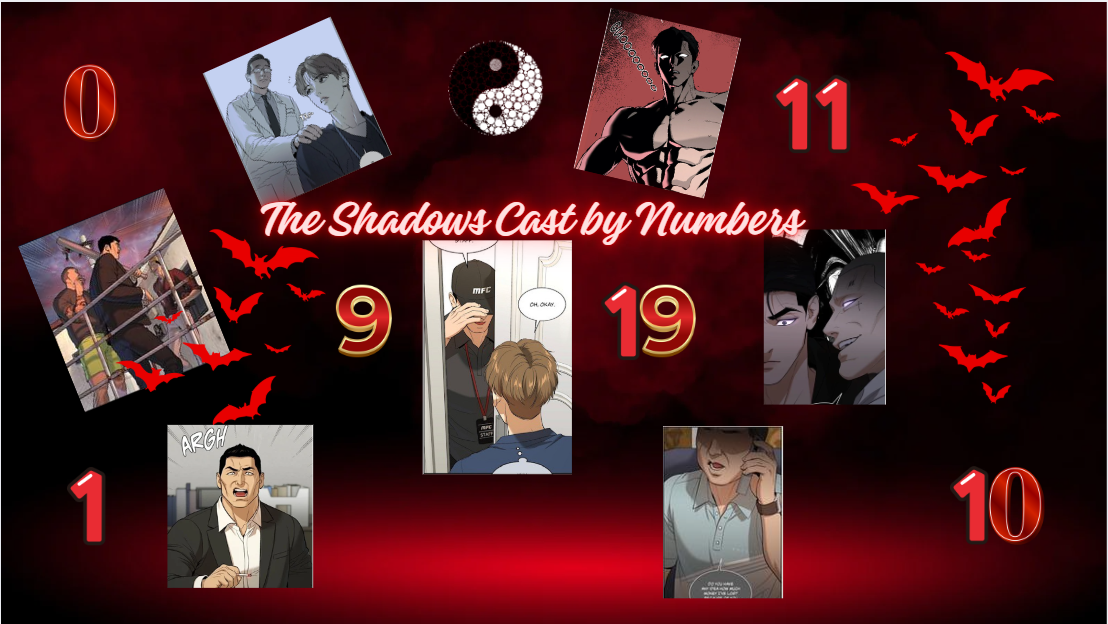
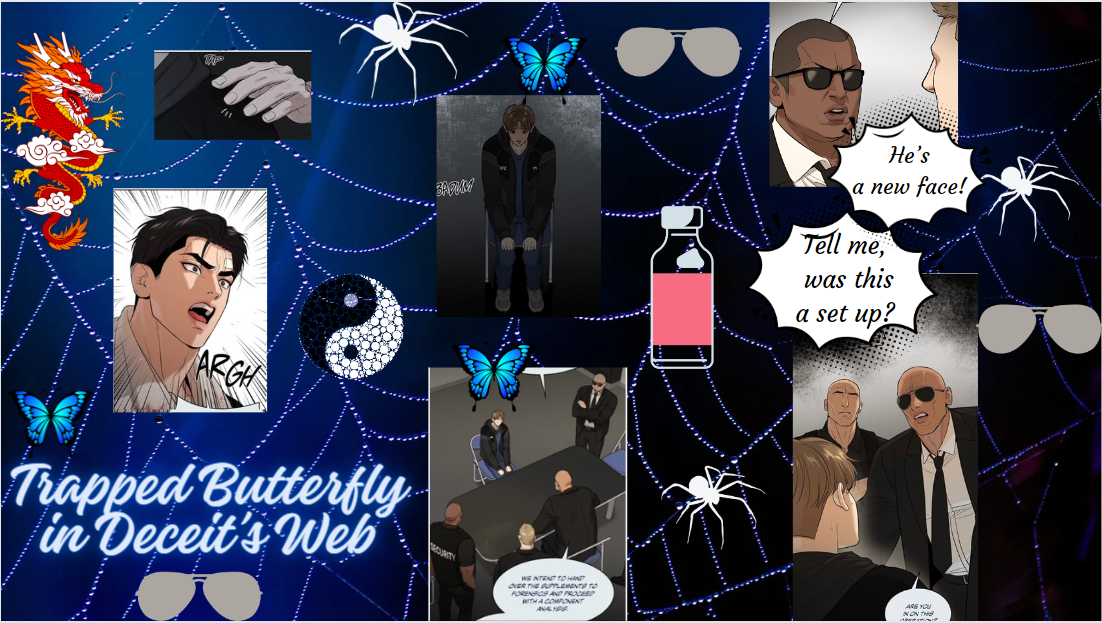 MFC with the blue “ring” embodies this pigment, just like the ocean. In other words, blue should be the dominant color in season 2, and in Taoism blue stands for YIN! On the other hand, Kim Dan also represents red with his name. Moreover, if you look at the numbers of the quoted episodes again, you will realize that the villains are strongly connected to the number 10 and as such one and zero. Thus Director Choi Gilseokf’s phone number is 010-1….
 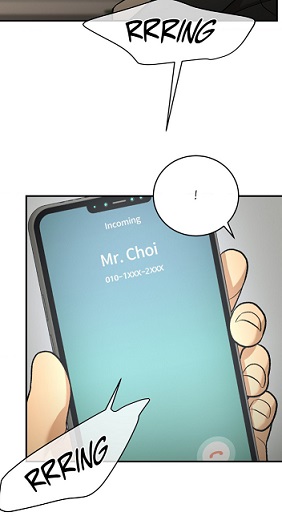 (chapter 46)
  (chapter 37) He never complimented him for his hard work at all.
  (chapter 46) With these words, the manager creates a negative atmosphere, therefore there is no longer any trust and loyalty among the members.
 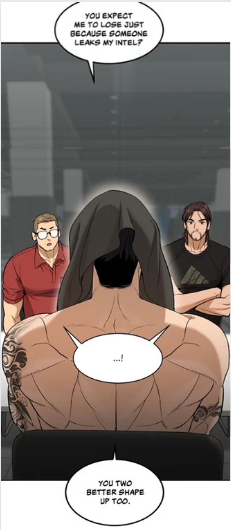 (chapter 46), however Park Namwook refused to accept such a behavior from his boss. Therefore he put his pupil under pressure.
 (chapter 46) He avoided a confrontation. This number symbolizes how the lead feels burdened by obligations imposed by his oppressor, who positions himself as provider of “stability” while actually fostering dependence and draining his victim. And naturally, in the same chapter, we have a similar interaction between Heo Manwook, the minion and his hyung, the real boss:
 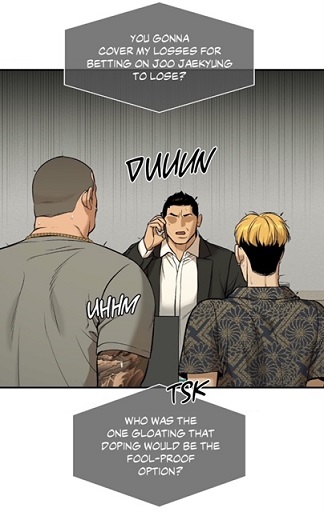 (chapter 46) Here, the director was reminding him of his mistakes and obligations. However, this time the boss chose to become proactive and responsible.
  (chapter 1)
 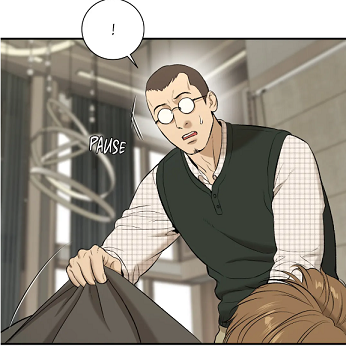 (chapter 13) They are strongly intertwined with the color green and as such blue. In literature, art, and psychology, the color blue often represents calmness, loyalty, and introspection.This fits to the description made by the author concerning season 2. The latter would focus more on emotions and thoughts than on the plot. And now, it is time to reveal why in the illustration I added the number 9.
 (chapter 9) The leopard agreed and that’s how they came to argue about his home the next morning:
  (chapter 10)- So from 9 to 18, the story is focusing on the doctor’s home. In episode 18, Joo Jaekyung invites the poor physical therapist to his home.
  (chapter 18) Then in episode 19, Joo JAekyung is not asking for his “help”, until he calls him. But even here, he is refusing to prepare his partner:
 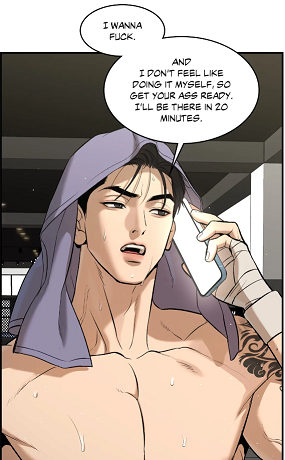 (chapter 19) As for Kim Dan, the latter doesn’t feel truly needed as PT, hence he is already thinking about taking another job:
 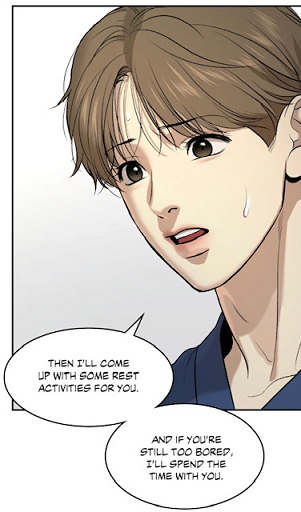 (chapter 27) He encourages his VIP client to take a break by remaining by his side. However, this attempt fails, as in episode 29
 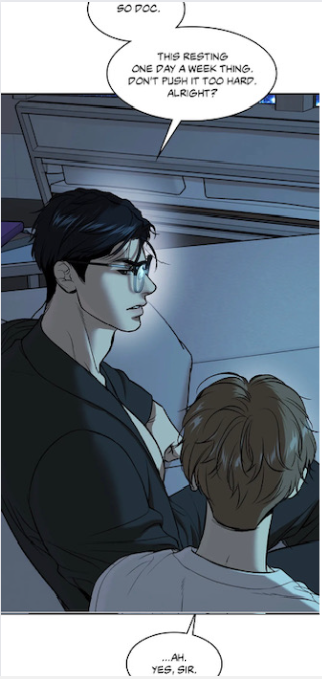 , (chapter 29) the champion rejects the idea of resting for a day. Then after the incident with the article, at no moment Kim Dan offers his assistance to help the champion. He remains totally passive,
 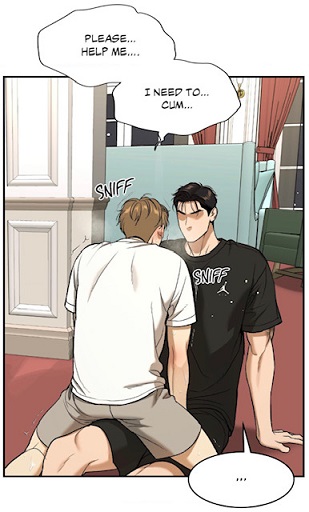 (chapter 39) The problem is that it is related to a drug and sex. This has nothing to do with his job or career. Interesting is that in episode 45, for the first time, Joo Jaekyung voiced his needs to have him as a PT:
 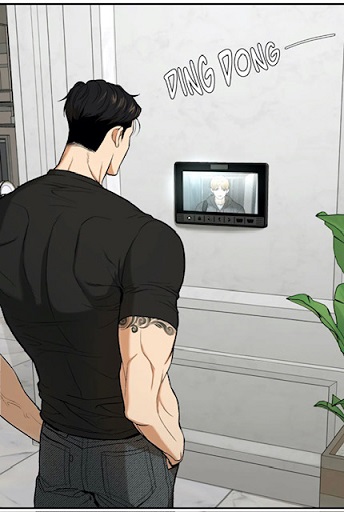 The end of Joo Jaekyung’s torment. He doesn’t need to chase after him.





 (chapter 27)
  (chapter 13) He is definitely sure that this man won’t betray him. He is not judging him for his job or “sexual preferences”. He embodies fairness, tolerance and impartiality. And since in his cellphone, Doctor Cheolmin is registered under the name Cheolmin hyung, it exposes his closeness with this cute doctor. He is like a “brother”.
  (chapter 13) The conversation between these two characters in episode 13 shows that Cheolmin is not only a reliable person, but also a good friend. He assisted the star in a time of needs without expecting anything in return. There was no exchange of favors, hence Mingwa showed us his hand, when he said his goodbye.
  (chapter 13) This gesture with the hand implied not only that he was just looking forward to meeting him again, but also generosity. And if there was a request from Cheolmin, it was just about an information:
  (chapter 13) It had nothing to do with money and promoting his hospital.
 (chapter 33) According to me, the man was calling his friend Cheolmin, because he truly believed that the actor had been hurt. The fact that he went to the rooftop in order to call the person is indicating that he desires to hide his contact from Park Namwook and Jeong Yosep. In other words, he was seeking secrecy, exactly like the actor. As you can see, the dragon and the gumiho had a similar attitude. They thought that the rooftop was the perfect place to hide a secret. So by calling Cheolmin who is working at a hospital, the MMA fighter was making sure that there would be no scandal. However, when he called him, he discovered the truth. Choi Heesung had faked his injury. Therefore how could he use his connection with Cheolmin, when there was no emergency? In his eyes, he would have abused his busy friend’s generosity. That’s the reason why the star chose not to intervene. If he had revealed the truth and as such accused the actor of deception, he would have no one by his side to prove the truth. It was one man against two. Secondly, by revealing his presence on the rooftop, he would have been forced to mention his close friend: Cheolmin hyung. His connection with the athlete would have raised some question. And because he didn’t utilize the Joker in that situation, he became a victim of a trick. It is important, because the champion’s decision to hide Cheolmin’s existence from Jeong Yosep and Park Namwook is a sign that deep down, he is not trusting his two other hyungs. In my eyes, it is related to his homosexuality. But there could be other reasons as well, for example he met this doctor, before he became a celebrity.
  (chapter 33) For me, the doctor was the person Joo Jaekyung was talking to. Interesting is that contrary to episode 33, he didn’t leave the inn in order to talk to his acquaintance. In fact, he did it in front of the door. By acting that way, he didn’t attract the attention from the members. No one questioned the celebrity why he was talking on the phone for quite some time. They just imagined that it was work-related due to the selfie with a stan.
  (chapter 43) This exposes violation of social norms and even the disrespect towards Joo Jaekyung. He is just seen as a cash cow, hence there was no thank you from them or even a short invitation for him, like Park Namwook and Kim Changmin had done it in episode 9.
  (chapter 9)
  (chapter 9) In fact, Joo Jaekyung was totally neglected at the restaurant, no one even paid attention to his actions. Under this light, I recognized why Mingwa created this incident:
  (chapter 43) It was not just to bring the two main leads closer, but also to expose the wrongdoers. If they had waited for him, the champion wouldn’t have drunk some soju from the glass of water, for Kim Dan couldn’t have used his glass.
 (chapter 43) That’s why the manager got red, a sign of embarrassment. He realized that they should have all waited for the birthday child. Moreover, don’t forget that the star was even paying the bill. And now, you are wondering if I didn’t diverge from my original topic, the Joker and Cheolmin hyung. No, as this new interpretation helped me to understand why Joo Jaekyung talked to his hyung in front of others. He already sensed that no one was observing him or waiting for him.
  (chapter 43) Moreover, it is possible that the mysterious caller desired to congratulate for his birthday or even to thank for his donation. Let’s not forget that just before his real birthday, the celebrity organized a charity event, and it could be related to Cheolmin’s work place.
  (chapter 13) Here we have a threat from the champion to which Cheolmin replied with a joke. Here, we have the same situation: a threat, but people got scared
  (chapter 43) before Park Namwook tried to relativize the incident.
  (chapter 13). Hence I believe that the other reason why our cute PT didn’t meet Cheolmin in season 1 is that he was not ready to interact with him. Kim Dan needed to mature, to free himself from social norms in order to accept such a man as a “role model”. That’s the reason why I am expecting the return from this mysterious doctor in season 2. In my opinion, he will play a central role in dethroning the king Park Namwook at Team Black, but also in helping Kim Dan to obtain justice. Keep in mind that according to me, the protagonist was a victim of many crimes committed by doctors. (The hospital director, Kim Miseon, MFC doctors)
 (chapter 35) He offered his assistance, but at no moment the main lead thought of even asking for his help.
 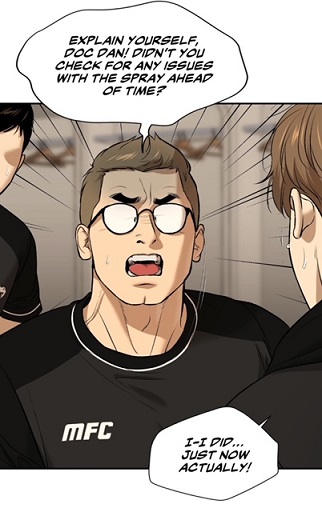 (chapter 50) he didn’t ask from Potato to vouch for him. He could have reached to him, requesting from him to testify in his favor. Yes, I believe that not only the actor and the maknae are to blame for their passivity, the physical therapist is also responsible for his own suffering. He is not seeing that he has already gained two friends. However, he didn’t treat them properly. No wonder why Kim Dan ended up alone at the end of season 1. At no moment, he confided to Potato or other members about his struggles, he kept everything to himself which is similar to his soulmate.
 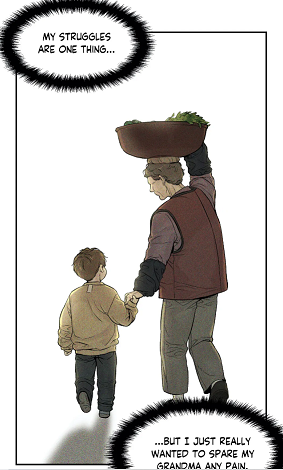 (chapter 5)
 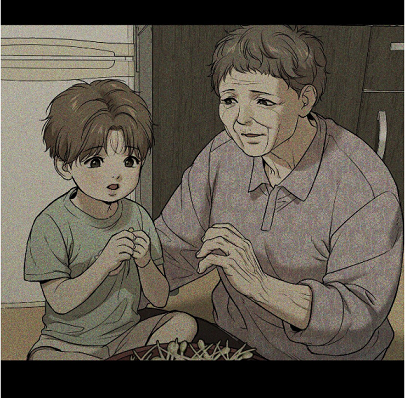 (chapter 47) Hence he was taught cooking. In addition, we can already envision that when he was a high school student, he had to take a part-time job. She definitely minimized his assistance, creating a debt towards her.
 (chapter 7) and
  (chapter 23), he just acted as their “PT” and nothing more. In other words, he acted, as if they only had a professional relationship. This explicates why Kim Dan never talked about himself, in other words he never shared any information with them. However, I doubt that he just considered them as his “patients”. He was happy to give his assistance. For me, the fact that he never lowered his guard is a sign of his low-esteem. So they had a strictly professional relationship, except with Potato.
  (chapter 26) However, even here, Kim Dan never shared his cellphone number with the maknae. If Potato had it, he would have tried to contact him immediately. To conclude, though I criticized Yoon-Gu and Heesung for their indifference and neglect, I feel that Kim Dan is partially responsible for this too. He didn’t take the first step to improve their relationship. Friendship is a two-way Street!
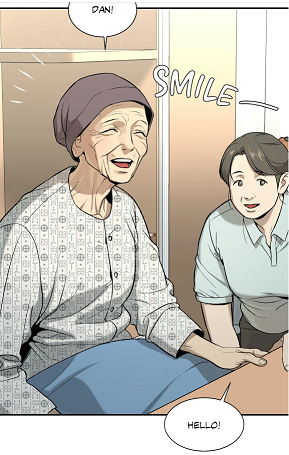 (chapter 7) She needs to pay a nurse to give her some company. Therefore she is forced to rely on her grandson. Then she doesn’t pay any attention to her grandson’s needs and circumstances, for she is only focused on her own suffering and “unhappiness” chasing after an illusion.
  (chapter 52) The remaining members from Team Black were paying a visit to the recently surged athlete. One detail caught my attention.
  (chapter 5)
  (chapter 7) Nevertheless, the young man was struggling financially back then, he could barely buy himself some food. Nonetheless, he still took his time to visit her before going to his new work place. And this brings me back to the image from episode 22:
  (chapter 52) But there is more to it.
 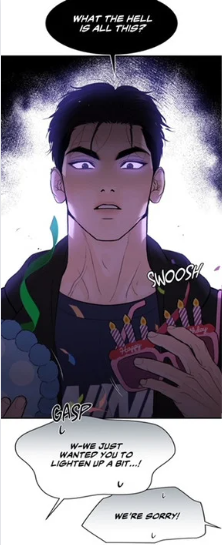 (chapter 43) He wouldn’t have liked it. He dislikes presents anyway. However, his reaction at the surprised birthday party can not be utilized as an excuse. Why? I have two reasons for this objection. First, he saw the birthday party as a disturbance to his routine (training)! That’s why he said this to the fighters:
 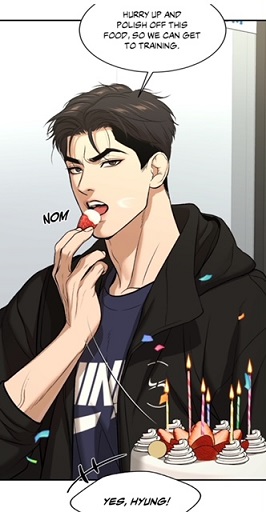 (chapter 43) They should eat the cake quickly so that the training could start. But at the hospital, he has all the time in the world. He can not train due to his injured shoulder. Hence the gift doesn’t represent a transgression at all. As for the second reason, note that the athlete ate the strawberry with the cream, with this gesture, he was sending the signal that he was accepting their present, though he didn’t eat much. Finally, by eating the strawberry, he displays his like for fruits!!
 (chapter 52) Yes, everything is revolving around money for Park Namwook. This observation leads to the following remark. The manager offered nothing to Joo Jaekyung, because he is rich. He has everything he needs. That’s how it dawned on me that so far, the coach has never offered anything to the star himself at all, not even after his victories. Just a stroke on the shoulder
 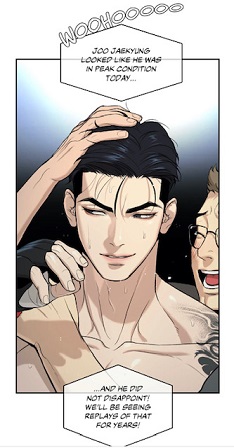 (chapter 5) and a compliment in the hallway
 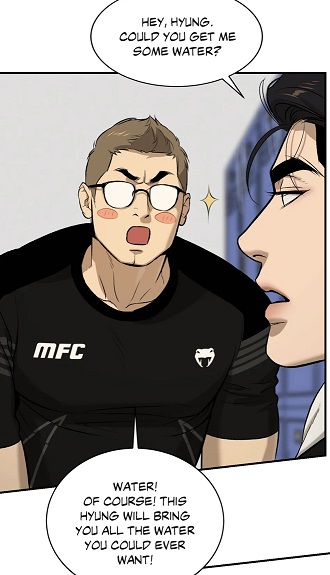 (chapter 15) Here, the manager was willing to bring him “all the water the star could ever want”. And guess what? Water is supposed to be free! Naturally, he was replying to the champion’s request. However, I don’t think this remark is anodyne. In fact, “all the water you could ever want” is an indication that the champion is not allowed to be too greedy and Park Namwook is only willing to offer water and nothing else. It exposes Park Namwook‘s greed.
 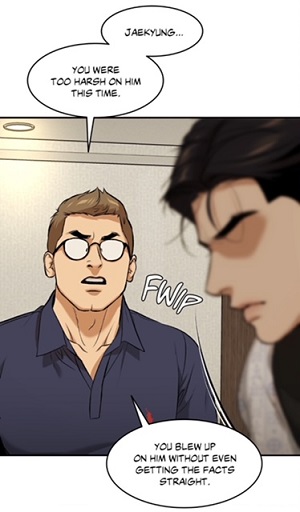 (chapter 52) Did Park Namwook ask the athlete if he wanted to have some water? Did he offer to help him to change the position of his bed? Did he assist him to sit correctly, like the champion did with the grandmother?
  (chapter 21) Did he spend his time with him in order to give him some comfort? The answer is always NO. Yes, Joo Jaekyung appears as a knight in shining armor compared to Park Namwook.
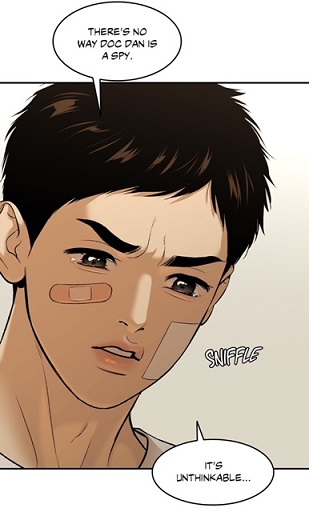 (chapter 52) Here, I am giving you a comparison with Kim Dan:
 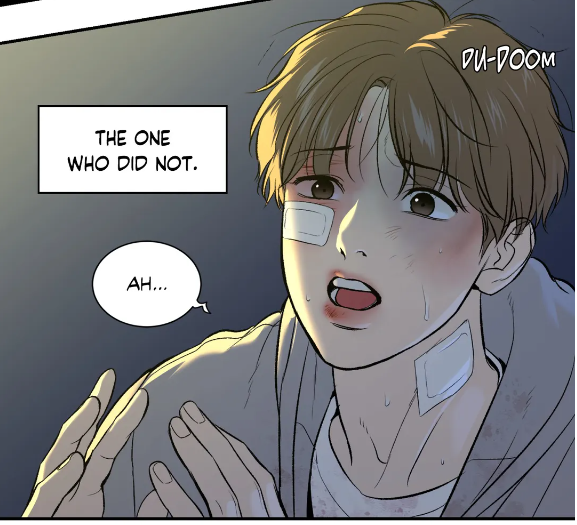 (chapter 18) The latter had just received his treatment at the hospital. The maknae and the others had not appeared, because they had gone to the hospital in order to treat the chowchow’s wounds. This shows that some time had passed, until they chose to visit the wounded and lonely star. Besides, Jeong Yosep had contacted in the main time the authorities (police, MFC)
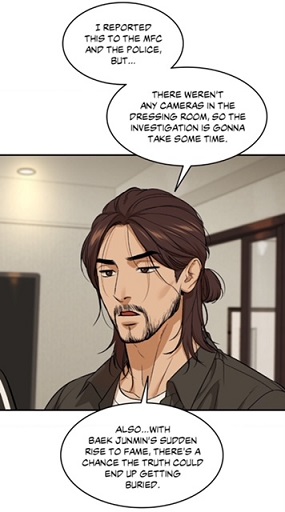 (chapter 52) As you can see, the timing is indicating that the athlete was manipulated, for they revealed the truth to Joo Jaekyung in delay. It is called “paltering”. This new discovery reinforces my first examination. They were all selfish and cold-hearted, for they had the time to buy a present, when they went to the VIP room. Simultaneously, it corroborates my impression that Park Namwook was not truly unhappy about Kim Dan’s departure. His passivity, silence and the delayed announcement of his resignation are all revealing that Park Namwook was not truly concerned about the PT. But the best evidence is his behavior towards his own “boy”. He spent so many years by his side
  (chapter 15), but he didn’t offer him anything at the hospital: no book, no ginseng, no fruit…. In verity, he was the one who desired to get comfort and validation.
  (chapter 52) It was, as if the world had turned upside down.

 (chapter 53) for not realizing her biggest wish: to return to the West Coast. With her words, she implies that she never had any choice. Hence she is not responsible for her “misery”. However, after reading Erich Fromm’s philosophy, it becomes clear that she must have always followed social norms and listened to authority figures (parents, husband, doctors, …). That’s how she gave up on her own freedom. One might argue that her scoop of maneuver was limited due to her poverty. However, the Mother Of Pearl Wedding Cabinet is definitely expensive and no junk
  (chapter 16), especially since the latter is rather old. The grandmother could have sold it, but she never did, for the latter has a sentimental value. Consequently, I would say that she had missed her chance, and naturally her misery is the result of her own wrong choices. Under this new light, it becomes comprehensible why the grandmother portrays herself as poor who has nothing to give to her grandchild.
  (chapter 53) (filial duty), a sign that he is not able to break free from social norms. At the same time, it displays that his feelings for Joo Jaekyung are much stronger than the ones for Shin Okja. His short time spent in the penthouse left a deep impression on him.
 (chapter 53) Her vocabulary exposes that she became a master and in her mind, the puppy dog has to follow her owner. Therefore it is no coincidence that Mingwa created such an image:
  (chapter 53) Deep down, he would like to be recognized as a competent physical therapist. Moreover, my avid readers should recall that the champion had already noticed the change of heart in the doctor before the scheme took place.
  (Chapter 45) But how can he change his condition? I will give the answer below.
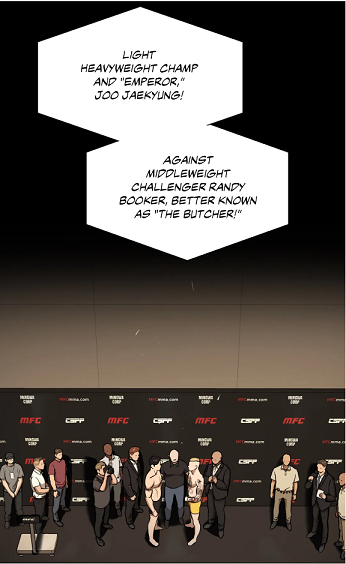 (chapter 14) Yet, the reality is that despite his wealth, he is not free at all. Actually, he reminded me of a Roman gladiator. Gladiators in ancient Rome lived under challenging and contradictory conditions. Although they were often slaves or prisoners of war, some achieved fame, wealth, and admiration comparable to modern-day sports stars. Successful gladiators could earn prizes, attract fan followings, and even enjoy certain luxuries within their restrictive lives. However, they remained under the control of their lanista (manager) or the state, with little freedom to make personal choices. They could not select their opponents or refuse combat, and each fight carried the risk of injury or death, underscoring their vulnerability and lack of autonomy despite their celebrated status.
 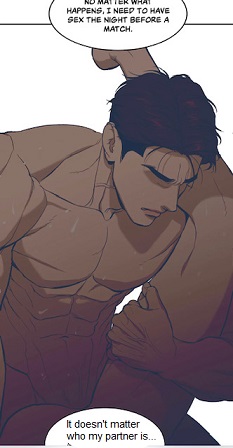 (chapter 2) Therefore sex is linked to prostitution and work. Back then, this had nothing to do with pleasure, sensuality and entertaining. It was revolving around power and domination. That way, he wouldn’t appear as weak, he is not controlled by his sexual desires and emotions. That’s how it dawned on me why the champion has been denying the existence of feelings in his past relationships. Naturally, it is possible that he got his heart broken before, but it is also possible that he could never live out his own true homosexuality. Note that his father figure, Park Namwook, has no idea about his sexual life. The athlete could fear to disappoint him. This raises the question how the manager will react, when the athlete’s secret is exposed. Should he request from his boy to organize a conference and deny the allegation there, he would divulge not only his lack of loyalty, but also his hypocrisy. Why? It is because this is something he should have organized after the last match. A conference to expose the existence of schemes. But everything got swayed under the rug. On the other hand, I deduce that if the topic of sodomy is brought up in season 2, there is no ambiguity that both main leads won’t give in to conformity and external pressure (even in the form of threats). Why? It is because during season 2, both characters will come to be true to themselves. That‘s how they can become master of their own life.
 (chapter 41), from his manager’s influence (father figure) and even from the MFC world (authorities) !! What is the common denominator between these three persons? MONEY!
  (chapter 50) Hence the last match was not cancelled in the last minute. The athlete is not fighting out of fun and passion, but out of obligation and survival. He is trapped in a world where money is everything. Thus he was always pushed to accept any challenger despite his injuries. That’s how I realized why the athlete always suspected Kim Dan of being greedy. It is because he projected his own thoughts onto his partner. However, this negative perception was definitely influenced by his “hyung”, we have the best example in episode 46. Due to Park Namwook, Joo Jaekyung was the one who was constantly thinking and talking about money in front of Kim Dan.
  (chapter 26) No wonder why he got so surprised by Kim Dan’s reaction in the locker room:
 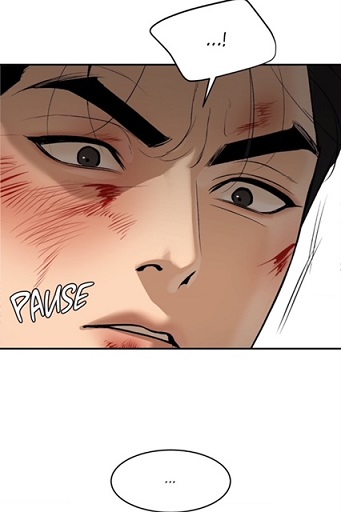 (chapter 51) He was disarmed by a single question and a shocked and disappointed face:
  (chapter 43), yet he added shortly this comment: :
 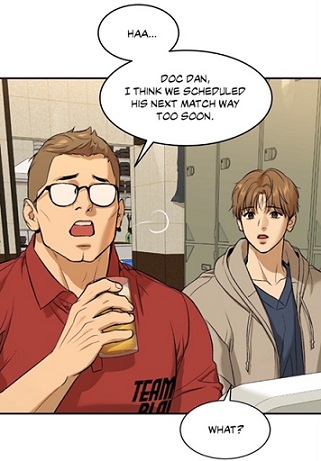 (chapter 43) The hypocrite coach utilized the personal pronoun “WE” indicating that he and his peers had played a role in the athlete’s decision. Funny is that though he complained about the schedule, he still accepted the switch of the fighter later. But he could have voiced his fears and objections. Nevertheless, he did nothing. Since I connected the halmeoni to past, I suddenly realized that the “lanista” embodies the opposite notion. He is trapped in the future, thus he is always anxious. Imagine that in that scene, they were celebrating Joo Jaekyung’s birthday, it should have been a good time. Yet, the manager kept talking about work and the future.
 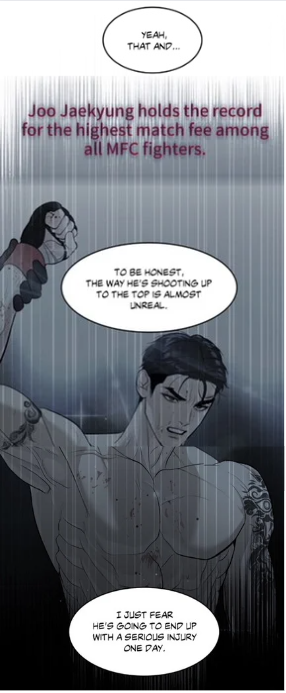 (chapter 43)
 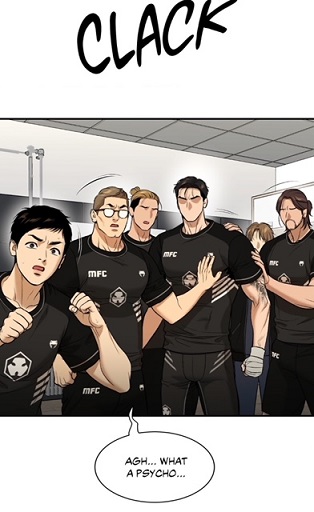 (chapter 49) Notice that he was afraid of an outburst from Joo Jaekyung in the locker room, therefore they were restraining him. This was no real protection. I am suspecting that the manager is trusting MFC and its organization. In addition, his obsession with the future explains why the athlete’s mental health has been neglected by the coach and manager. As a conclusion, Park Namwook is himself trapped in his own world: money, fear of the future and the champion‘s retirement which means the end of his own career as manager and coach. Therefore he is pushing his fighter to race against time. It is only a matter until his boy gets injured!!
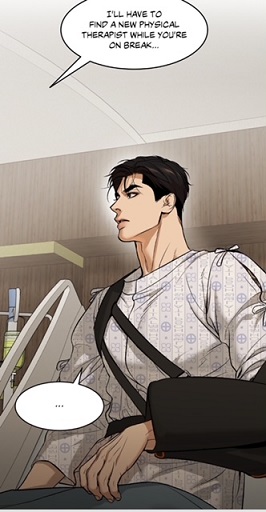 (chapter 53). The latter announces that his “boy” can take a break. What caught my attention is his idiom. The suspension got turned into a break which sounds much more positive. Interesting is that break is not only a synonym for “rest”, but also for “opportunity, chance”. This new discovery reinforces my previous interpretation: the loss of his “title” and his suspension are in verity an escape to freedom. Why? It is because he is no longer exposed to manipulations and external pressure like in episode 36:
  (chapter 36) money, social media, the agency, the lawyer, Park Namwook and Jeong Yosep. For the first time, Joo Jaekyung can think of something else other than work. Nevertheless, the athlete had not realized it yet. Striking is that the longer the fighter thought about the PT’s resignation, the longer he came to object to it.
 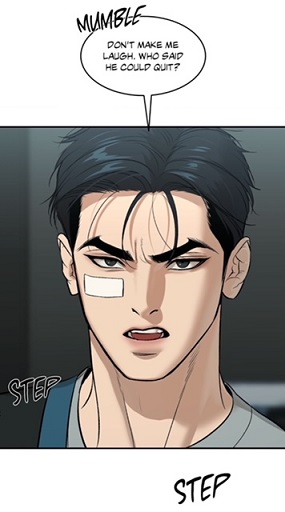 (chapter 53) This means that the fighter was acknowledging the “uke” as an important member of Team Black. In addition, he was recognizing Kim Dan’s effort and talent as PT. Moreover, it exposes the absence of change in Joo Jaekyung’s mentality. He was still “thinking” of work and fighting. It displays that the protagonist had not realized the true signification of his suspension yet. Hence the doctor’s departure was necessary. Joo Jaekyung is forced to think about his fated partner, making him forget his work and his career. His “obsession” with Kim Dan will push him to stop being a workaholic. But there is more to it.
 (chapter 21) to this
 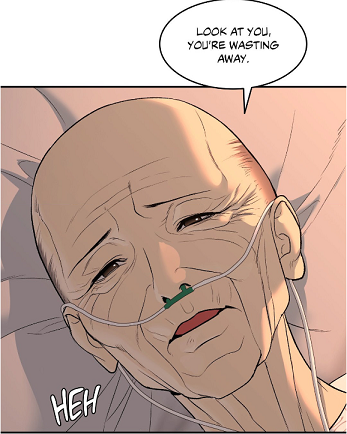 (chapter 47) Money is powerless in front of death and terrible injuries. Therefore he is lucky that his shoulder is not ruined forever. Moreover a trip represents a good metaphor for an escape, a travel is a synonym for freedom and the end of “routine”.
 (chapter 35). However, since he didn’t spend much time in his own home, he never took the time to take care of his soulmate. By leaving the city and Team Black behind, he would become truly alone (as opposition to his trips to Busan, the States) which would give him an opportunity to become more honest to himself and to Kim Dan.
 (chapter 53) This explicates why the young man kept questioning the actor’s intentions behind his gifts. He could see that the man didn’t need him. This thought displays his desire to give a meaning to his own existence as well. If he is needed, he has a reason to exist. This desire of being needed can be expressed by words, but also with the hands:
  or like this:
  And what does the hand symbolize? The latter symbolizes gratitude and love! Hence the grandmother took the MMA fighter’s hand in order to thank him.
  (chapter 22)
 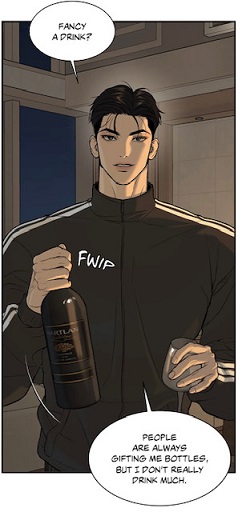 (chapter 12), though he is no drinker or he doesn’t eat cakes.
  (chapter 41) The fact that the athlete organized a charity event for his birthday exposes not only his huge heart, but also that he had long recognized the power of generosity. Under this new light, it becomes comprehensible why the champion was willing to pay off the doctor’s debts.
 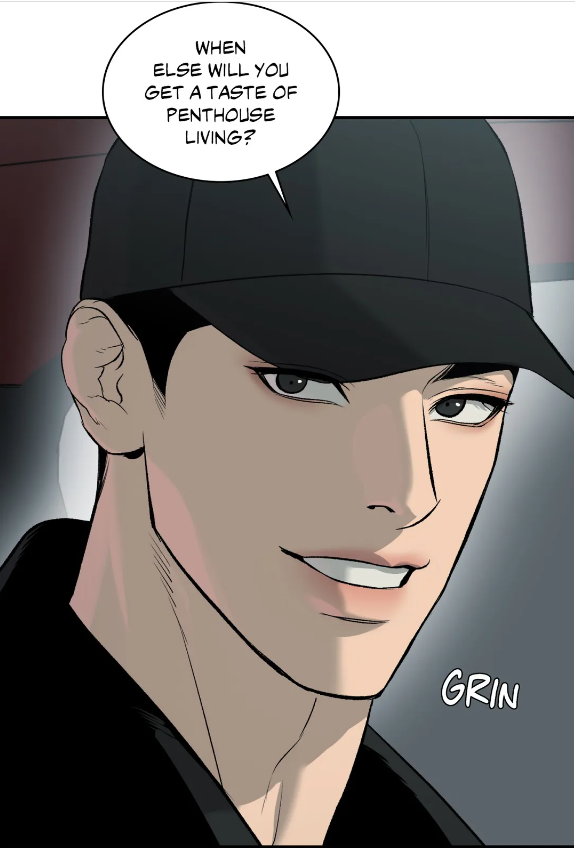 (chapter 18) His facial expression is exposing his true thoughts. He was definitely happy to help the doctor. The reason is simple. He is in control of his heart and life. This shows that deep down, the man has always had a soft heart and could find fulfillment in giving. However, the problem is that the champion had also internalized that there is nothing free in this world. Due to his past experiences, he realized that receivers would exploite his goodness. The green-haired guy was the perfect example.
  (chapter 2) Therefore it is not surprising that he kept denying his kindness to the doctor: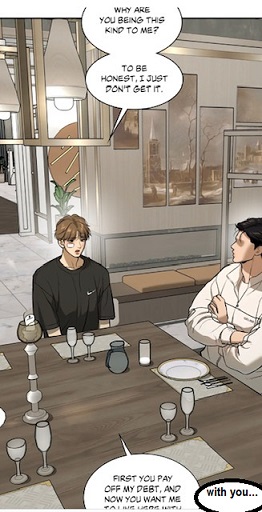
 (chapter 30) They both desire to be acknowledged and appreciated.
  (chapter 45) With this image, it was, as if Kim Dan wanted to be distinguished from all the stans. Yes, I do think that this has something to do their own negative feelings. However, there is a difference between Choi Heesung and Kim Dan. Note that the gifts are related to his sponsors and the agency. They were related to his work. Moreover, the gumiho rarely gave the meals or the presents personally.
  (chapter 31)
 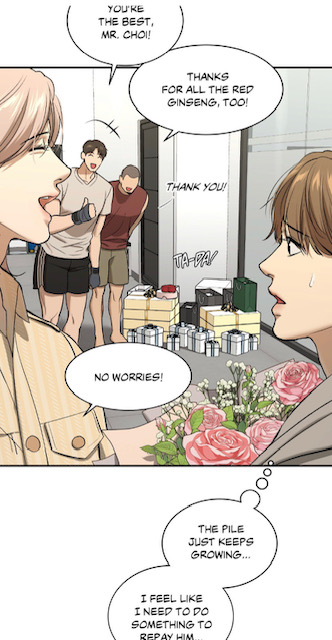 (chapter 31) Furthermore, the actor gave these things for one reason: it was to obtain the doctor’s heart or to maintain his good image as a celebrity. In other words, these gestures were not selfless at all. This explains why the athlete was so weary of such “gifts”: a return of favor or a service. But the comedian is not the only one donating things. Naturally, it is the manager Park Namwook.
  (chapter 36) However, my avid readers should ponder on the following aspect: how did he buy the jackets and the junk food?
  (chapter 41) This frenzy was portrayed as something positive. Jinxworms can observe that the manager is mentioning the existence of „favors“. For me, it is no coincidence that in episode 45, the arrival from presents coming from his hyung coincides with the present with Kim Dan. It shows the underlying conflict between the celebrity and the former wrestler. Nevertheless, the fighter has not grasped it yet. So far, Joo Jaekyung has not tried to defy Park Namwook openly, to claim his place as the true owner of Team Black. We should see his words here as a first attempt to act as the boss
 That’s where the generosity from Park Namwook comes from: he gives his punches to Joo Jaekyung and takes Joo Jaekyung‘s company for granted. And now, you comprehend why I selected such a title for this essay.
 (Chapter 26) The sparring in episode 26 represents the positive version of giving a punch and taking it. The fighter was not upset about his defeat, moreover he was acting like a real teacher asking the physical therapist to overcome his own fears. On the hand, the slap at the hospital embodies the opposite notions: resent, no real teaching, no reflection, no listening, the one slapping is not overcoming his own fears and vents his anger. The give and take in episode 26 was happiness, true generosity, self-awareness, while this slap displays misery, anger, ignorance:
 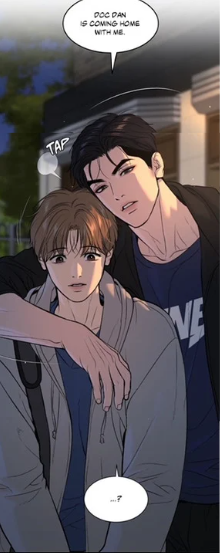 (chapter 43) He needed to seclude him from the others. But where does this possessiveness come from? In my opinion, it is not just the result of his own insecurities, but also the influence of the bad role model he had: Park Namwook. First, only in chapter 45, the manager sent congratulations from his family:
  (chapter 9), the manager kept creating a bad image of the athlete: brutal, moody, maniac… but the reality is that the man is actually generous and caring, like mentioned above and the coach knew this. Hence he could lie without any remorse: he is a savior and the gym owner. Moreover, the athlete can speak well and be polite.
  (chapter 22) This scene at the hospital displays that the fighter had been mirroring the behavior of his counterpart: Shin Okja is sweet and kind. And who is moody, yelling, brutal ? Park Namwook:
  (chapter 43)
 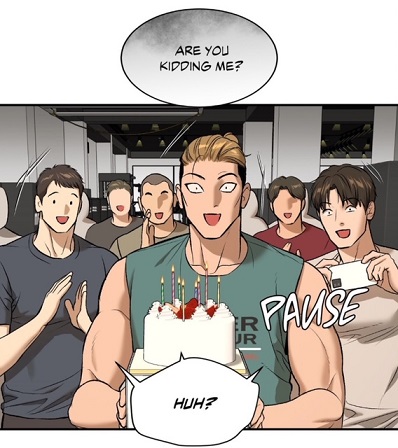 (chapter 43) This exposes his lack of engagement and indifference in the end, but this becomes even more obvious during the night:
  (chapter 43) Where was he, when his star was drunk? It was, as though he had vanished.
 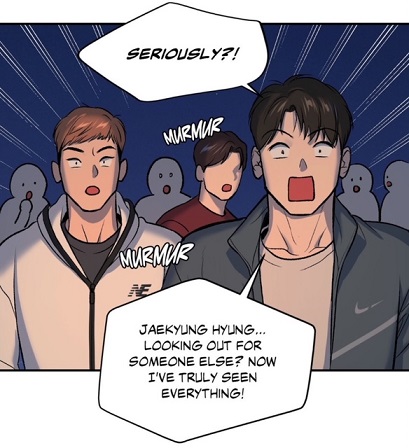 (chapter 43) But the best evidence for this interpretation is this image:
 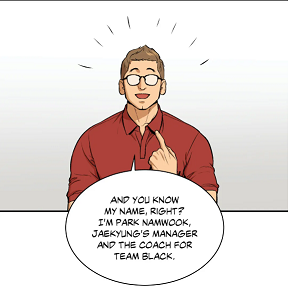 (chapter 9) However, he never presented himself as a father or a husband. It was, as if his children or wife were not a source of his happiness. Why? It is because they don’t bring money, but rather cost money. Thanks to Joo Jaekyung’s popularity, the manager could stand in the spotlight
  (chapter 40), yet notice that no fans or fighter know his name as a successful coach or manager. He is not a famous manager in the end. His income depends on the athlete’s career and victories. No wonder why he put so much pressure on his celebrity. Thus I had the following revelation: he was actually exposing his true self in front of the doctor at the restaurant.
 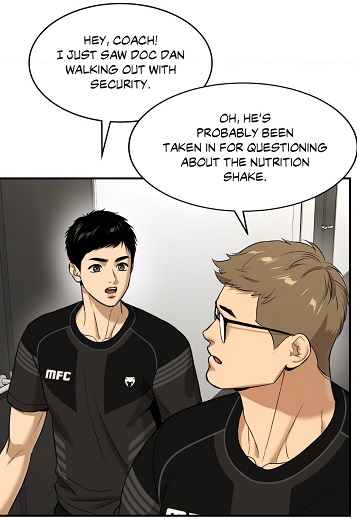 (chapter 40) in the States and even at the gym?
 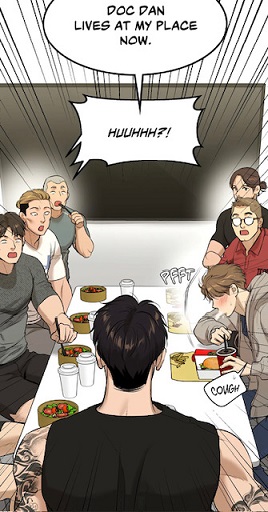 (Chapter 22) And now, it is important to recall that in the mode of Having, rivalry and competition are predominant. Therefore I deduce that deep down, the coach and manager sensed the physical therapist as a source of threat and rival. Therefore Jinx-philes shouldn’t be surprised that the coach did nothing to keep Kim Dan.
  (chapter 41) In his eyes, possessions and money determine someone’s values. Hence he bought an expensive keychain for his fated partner. Furthermore, I have been wondering if this spending is not related to Shin Okja, the latter could have been a spendthrift. In the essay „
 (Chapter 19). Another possibility is that she made sure that her grandchild would spend money on her:
 (chapter 22) after the departure of Joo Jaekyung, but notice how the halmeoni thanked the benefactor:
 (chapter 21) One might argue that the poor woman couldn’t do much to express her gratitude. However, this is just a deception. Shin Okja could have written a letter to express her gratitude to Joo Jaekyung. Why do you think Mingwa created two scenes with a letter or card?
  (chapter 53) The comparison lets transpire the importance of words. The champion might have judged the keychain differently, if he had read the card. But he didn’t. Another parallel between these two scenes is the rejection of a gift! However, in the final episode, Kim Dan voiced genuine gratitude towards his benefactor. The latter had allowed him to work as his PT. With the letter, he could voice his thoughts and emotions much better. And now, you realize that Shin Okja could have acted the same way. This made me realize that deep down, she resents being poor. She likes Dan spending money on her.
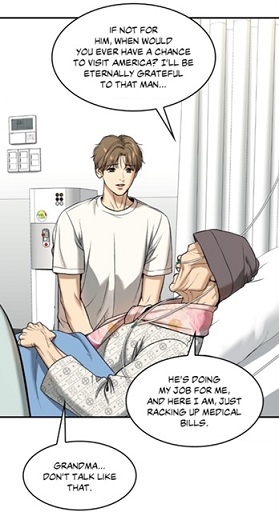 (chapter 41) She should have been the one who expressed her gratitude to Joo Jaekyung, but not Kim Dan for the trip (it was work related anyway). One might argue that the poor woman is trapped in the hospital, she can not do much. But you are wrong. She could have written a letter to her benefactor which means that she would have sacrificed some of her time for the athlete. Imagine that she had sent a message to the athlete, the latter might have decided to pay a visit to her. He is not truly heartless. With this silence, she created the impression that his assistance had changed her situation.
 (chapter 22)
 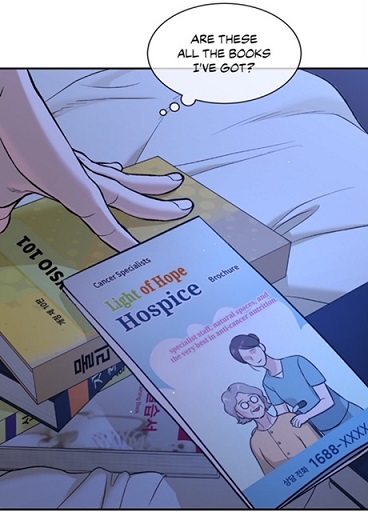 (chapter 53) He likes not only his job now, but also learning as such. This is no coincidence that education in the mode of “being” means that the focus is on learning and developing skills. Hence I still see a change in the hamster at the end of season 1:
  (chapter 52) In this panel, the author let us see glimpses of their motivation and thoughts. For them, the champion has nothing to teach them, since he lost his title and is injured. This shows that they are only interested in the outcome, success and as such fame, but not in the process, how to become skilled! In other words, they see “success” as a possession. He has no title, then he has nothing to offer. They are all living in the mode of having, which can only lead to misery and even self-destruction. No wonder why they were not too upset or shocked, when they heard that the game had been rigged. But what led them to make such a decision?
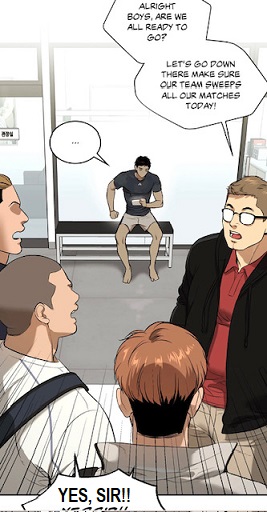 (chapter 23) Then he only focused on the “outcome” and not on the process. Hence he neglected them, delegated his task on the pressured athlete. The latter had to train them:
  (chapter 25) and
 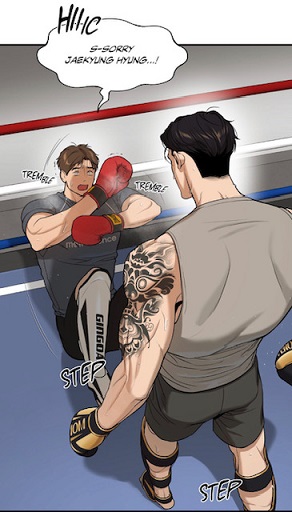 (chapter 36) In my eyes, he didn’t want to play the bad guy. The meeting or his worries were more important
 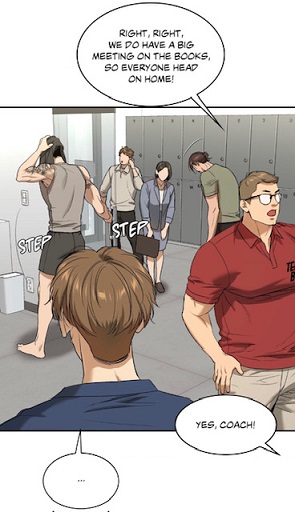 (chapter 36) than their training and career. Moreover, he kept bribing them with junk food
 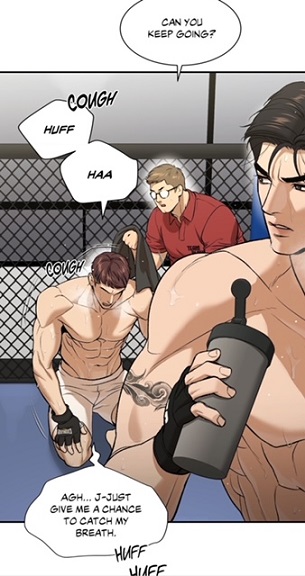 (chapter 46) The latter was a new source of income and fame. Everything was revolving around money. That’s how it dawned on me why the manager got angry for the bet in episode 26:
 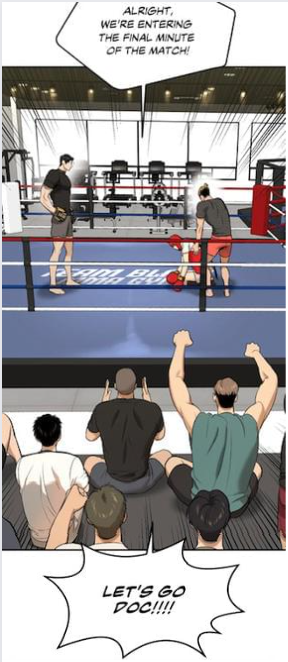 (chapter 26) and became more obsessed with possessions and fame. Potato and the remaining members represent the exceptions. They enjoyed the lessons despite the pain and struggles. The other members became dependent on external tools which led them to lose their integrity. To conclude, the reason for their disloyalty is that at the end, they had long internalized the mode of having and were just interested in getting successful.
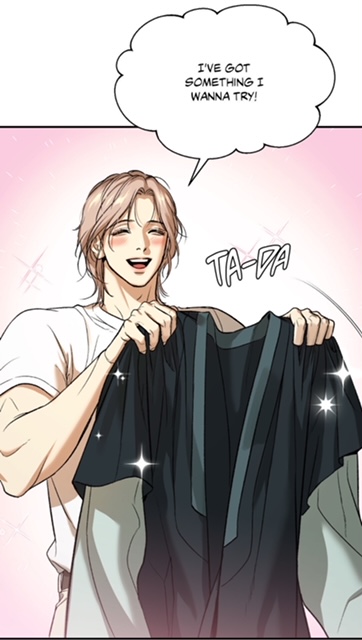 (special episode2 ), but also Cheolmin
  (chapter 13) who likes making jokes. That‘s how I came to understand why Cheolmin appeared only one time in season 1. He will come to replace the manager:
  (chapter 48) are full of greedy people who have no problems to commit crimes in order to achieve their goals (more fame, more wealth, revenge, more connections). Baek Junmin became a champion by cheating.
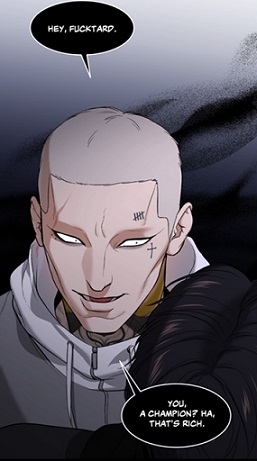 (Chapter 49) Thus he thought, the athlete had earned his title the same way. His fights were rigged, yet the verity is that the idol worked hard to achieve this level. The irony is that The Gunshot experienced much too late that his assumption was wrong.
 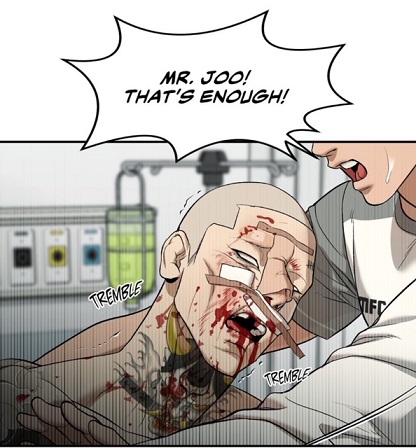 (Chapter 52) His shaking is exposing his fears. Like mentioned in the past, I am anticipating that The Shotgun will avoid a new fight with the celebrity.
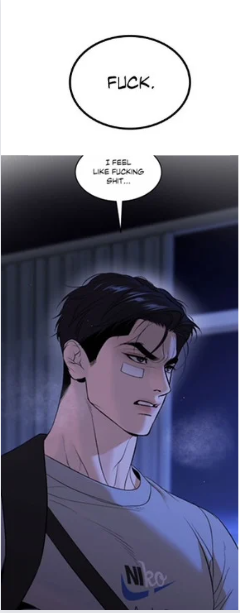 (chapter 53) He is standing at a crossroad. What does he truly want in life? Fame? More money? Or happiness and as such love and fun?

 And now, you know the origin for this essay. As you can see, the collection of Haikus is focusing on the topic “Water”. Since I only possess the French version of Haikus, I could only give you my own English translation. Fortunately, my friend @Rin_de_eegana was able to find the original version, Japanese. Therefore in the second version, I am giving a second English translation whích gave me new insight once again. Anyway, the thing is that as soon as I read certain poems, it made me think of Jinx and the characters. This shows my obsession for this terrific Manhwa.
 (chapter 14) Yet, the main lead never got the chance to see it. Then the ocean is only mentioned directly at the end of the first season. The halmeoni was expressing her wish to return to the West Coast
  (chapter 53) When she was 10 years old, she was moved by how the ocean changed colors with the beautiful sunset. It was no longer blue or grey, but yellow, red, pink, orange and purple. This wonderful but brief moment left such a deep impression on her that she could never forget it.
  (chapter 53) She never came to regret her walk to the beach, because this souvenir also became her source of strength. This memory created in her the desire to see it again, thus she kept postcards with views of the ocean.
 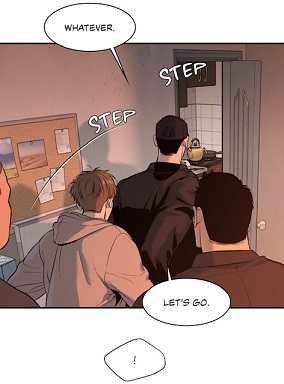 (chapter 17)
 (chapter 53) is glowing blue? I don’t think so. Let’s not forget that blue symbolizes wood for Koreans. The sea (water) and a tree
 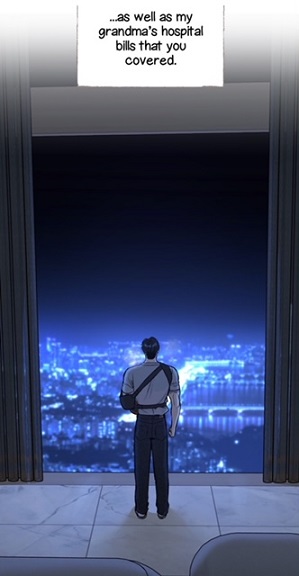 (chapter 53) He is standing in front of the blue city. But he doesn’t feel free and powerful. Why? There is a window in front of him. The window is showing him his own boundaries. His penthouse is like a cage, and he is not truly dominating the city. In reality, he is isolated. To conclude, the panel stands in opposition to the Japanese poem and the grandmother’s vision: alienation, regret and powerlessness. So we should write the haiku like this, from the champion’s perspective:
 (chapter 27) Like mentioned above, the beholder in front of the ocean can have a different experience than the young girl.
  (Chapter 7) And we could see that Joo Jaekyung had a similar attitude in season 1, he would listen to his hyungs and the people working for MFC. Consequently, I come to the following deduction: this time, the fighter will make the decision on his own. He won’t follow Park Namwook’s advice:
 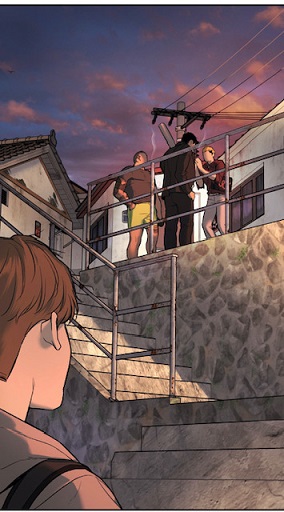 (chapter 1)
  (chapter 47)
 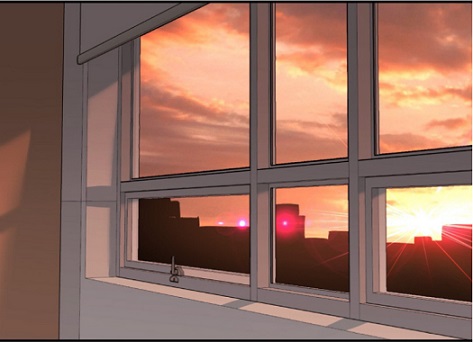 (chapter 47) even when the doctor was confronted with the truth about his terminally ill grandmother. The sun was always shining brightly. Since in the haiku from Ryokan Taigu, the rain is associated with old-age and fall (misty), it dawned on me that the rain should be associated with the grandmother’s death. If this comes true, it was, as though the sky and gods were weeping for her vanishing. Additionally, the first season took place in Spring and Summer, thus I deduce that season 2 will take place around late summer, fall and winter. This means that the weather should change. And this remark led to my second revelation. I started looking for South Korea’s climates, particularly I was curious about the climate on the West Coast.
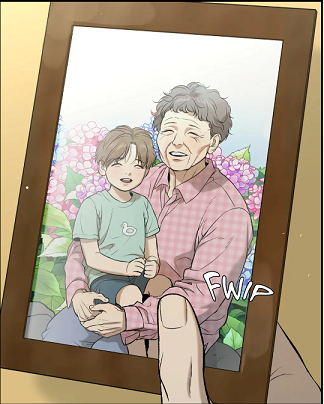 (chapter 19) the presence of pink and purple hydrangeas indicates that it was taken in Summer. This new approach reinforces my perception that the grandmother is about to get confronted with harsh reality despite her attempts to escape from it. Her wish can not be fulfilled so easily, like she is imagining it. In addition, Manhwa-philes should keep in their mind that weather has a great influence on elderly people’s health.
 We have an elderly man walking through the rain in front of the blue sea. The latter is accompanied with a Waka-poem from Yoshihiro (which was not translated). According to my Japanese friend @Rin_de_eegana (飯乞ふと 里にも出でず この頃は 時雨の雨の 間なくし降れば), this phrase describes a situation where one cannot even go out to the village to beg for alms due to the long rain. Here, we have the topic of poverty linked to old-age and rain. Yes, the pages of this book reminded me of Shin Okja, a poor elderly woman who is so sick. And like mentioned above, the rain could be the reason why the woman doesn’t go to the beach. The two poems are underlining one important aspect: the powerlessness of humans in front of nature. No one can stop aging, just like no one can control the weather. At the same time, it outlines the importance for a senior to be surrounded by people, so that they don’t end up dying from dehydration, from a cold or hypothermia.
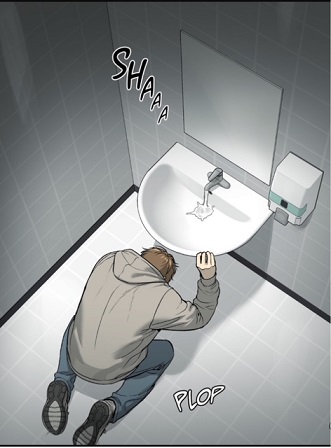 (chapter 47)
  (chapter 49) Both main leads went to the restroom in order to hide their emotional turmoil and suffering. They used flowing water (in Joo Jaekyung’s case the shower) in order to cover the sound of their weeping: SHAAA. Yes, the tears are making sound… so the rain should make sound as well. And this brings me to my next remark.
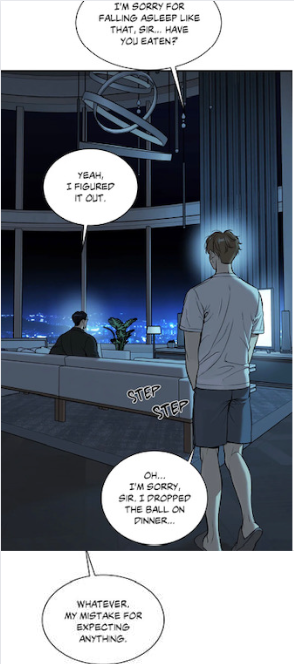 (chapter 29)
  . (chapter 30) In episode 35, the night stands for ignorance and self-deception, for the doctor was not present. Joo Jaekyung reverted to his old self. However, don’t forget that the haiku was not just about the moon light, but also about the sound of the waves. All the senses are awakened which represents a better experience than the grandmother’s. Moreover, since I am anticipating the presence of Kim Dan, this means that Kim Dan embodies not only the light in the dark, but also sound of water. This interpretation brings me to the following remark. In season 1, the athlete had already associated his fated partner to “sound”, though in the beginning he viewed it as noise
  (chapter 18) and as a source of stress and worries.
  (chapter 45) This means that the night view of the ocean should make him discover the beauty of the sound of water. He will come to associate the sound of the sea waves with Kim Dan. That’s how he will be able to fall asleep. In other words, I am expecting a new version of this scene:
 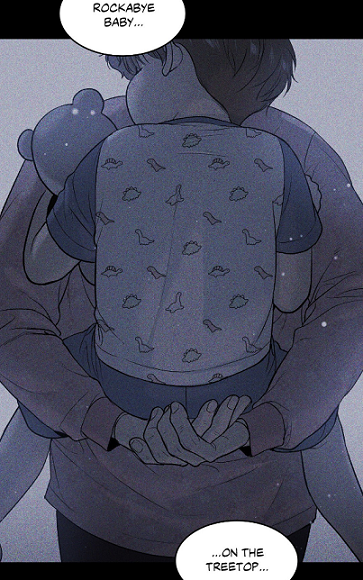 (chapter 47) To conclude, Joo Jaekyung will also have an Enlightenment in front of the ocean, but contrary to the grandmother, this experience will be associated with the night, the sound and a person: his soulmate Kim Dan.

 (chapter 52) because she desired to push the readers to anticipate the champion’s future actions. What will he do? Striking is that she sowed a similar enigma in episode 7. The latter ended with this image:
 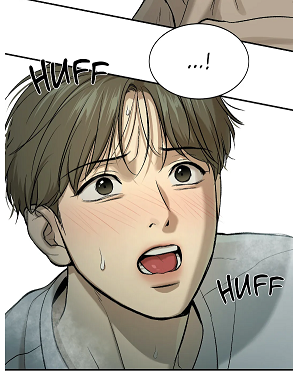 (chapter 7) Kim Dan had just punched his boss. How would he react to this wrongdoing? In fact, I realized that all the episodes with the number 7 are strongly connected to an intrigue and riddle. Why? The answer lies in the number. 😉 So what does 7 symbolize in the end?
 (chapter 18) He believed to see someone selling his body to a loan shark, while in reality the main lead was about to get raped. Hence we have -7! This represents the absence of reflection and even the refusal of meditation.
  (chapter 48) The connection between 7 and anguish in Jinx seems to contradict the notion of “lucky 7”. Yet we shouldn’t forget that through pain, the characters are incited to learn life lessons and become wiser. Torment led them to face their fears and reflect. Consequently, what appears as a jinx will turn into luck and blessing in reality. Like mentioned in the previous analysis, the 90 day suspension represents a liberation for the athlete, for he is no longer under pressure to fight constantly. He is pushed to meditate and view life differently, thus he is looking out of the window.
 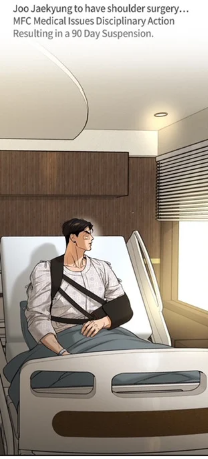 (Chapter 52) He will realize that he needs to select his opponent more properly.
  (chapter 5) He remained passive, because he had already an answer to his silence. He was refusing the job. He implied that his lack of reaction had been caused by the champion’s action. In addition, he reproached his boss that he was getting worked up for nothing. His behavior displays that he saw no value in Kim Dan. Moreover, Mingwa left a clue why the man has always been passive all this time. It is not just a question of fear. The other reason is that he used prejudices and superficial thoughts to explain people’s attitude. Hence he never investigated the matter why the doctor didn’t contact them. His attitude in episode 52 hasn’t changed at all.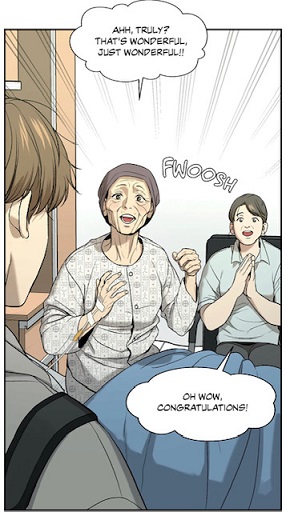


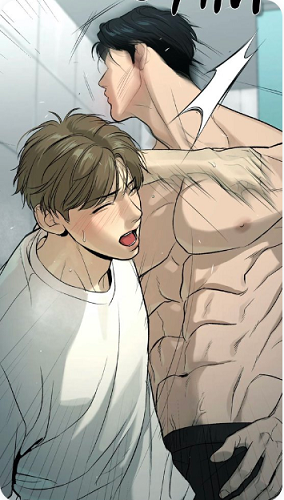
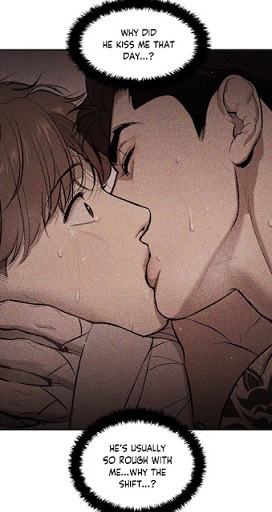
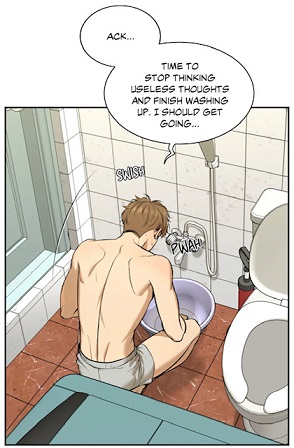


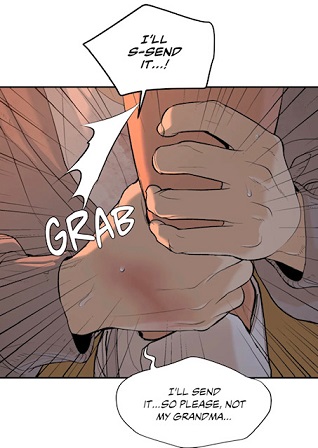









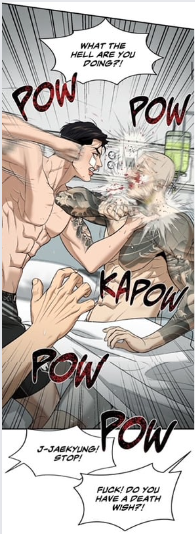


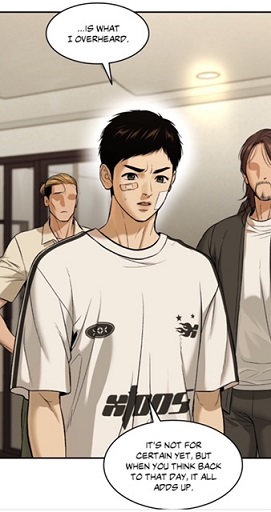

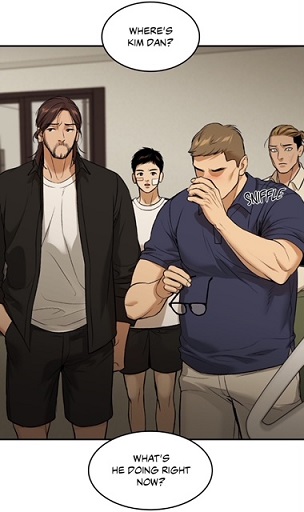
 (chapter 52). By mocking him, he was provoking Joo Jaekyung and he knew it. Yet, he never expected that he would be punched so violently that he would be KO. In episode 7, the champion “invited” the doctor to enter the shower room,
  (chapter 7) reminding us of the kidnapping in episode 16. Here, on the other hand, Heo Manwook must have judged his presence at doc Dan’s house as an “invitation”
 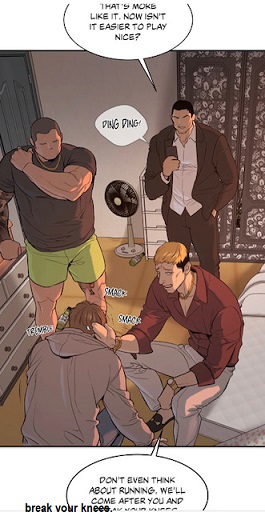 . (Chapter 16) and not trespassing. Each challenge or invitation is strongly connected to moving. Heesung had to drive through town in order to discover the secret between the two protagonists. Moreover, I distinguished another similarity: abduction and sequestration. Kim Dan was forced to stay in the shower room or his home or in the penthouse (34,43). Chapter 25 represents the exception, for it was the only case, where Kim Dan was given a real choice.
  (Chapter 25) He could refuse the sparring. Thus I deduce that in episode 52, the opposite is happening to the doctor. Something happened to him, and he could do nothing. On the other hand, this signifies that at the hospital, the members from Team Black were seeking the consent and support from their boss.
  (chapter 44) Kim Dan agreed to have sex with the fighter, because he wanted to know him better. Thus I deduce that the athlete discovered new aspects about Kim Dan’s life.
  (chapter 8) In 25 and 34, we never saw Park Namwook. He was either outside the gym or in his office. Then in episode 43, Potato was missing, but no one mentioned his absence. But I would even go further, all these chapters are strongly linked to the doctor’s vanishing. Notice that in episode 7, he got dragged to the shower room, but no one caught his disappearance, not even Park Namwook.
 (chapter 25) He received only attention, when he got strangled due to the maknae’s mistake and notice that the protagonist was too focused on training the others that he neglected his soulmate. Then in episode 34, Kim Dan was supposed to meet Choi Heesung, but he missed the appointment due to the athlete’s trick.
  (chapter 34)
  (chapter 34) Since the latter had not replied, Choi Heesung assumed that Kim Dan was not free. And now, you know why the actor never contacted the angel and asked about his whereabouts. The main lead never replied and confirmed the meeting. Then in episode 43, no one missed Kim Dan at the table, when they ate their dinner.
 (chapter 48) This should have caught the coach’s attention. In addition, it dawned on me that the fighter could have reported this meeting to the coach, saying that he would come late due to the other director, a new version of this scene:
 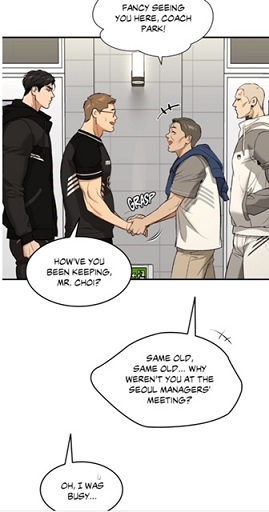 (chapter 49) Remember that he had avoided him on purpose. And episode 49 is related to number 7. Hence we have this contrast:
  (chapter 49) “We believe in you”
  (chapter 32) Kim Dan had no saying in it, the justification was that it was for the champion’s sake. Hence my assumption is the comedian must have complained to the manager that Joo Jaekyung had interrupted their time together.
  (chapter 32) The sly fox was aware that the celebrity would never dare to contradict his hyung.
 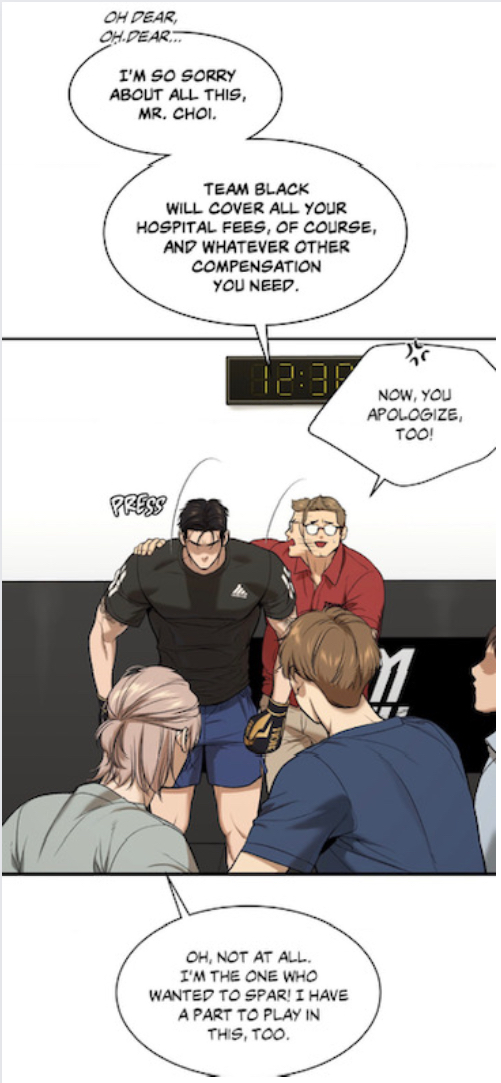 (chapter 31) That’s the reason why Park Namwook asked the doctor to fetch the celebrity in episode 34.
  (chapter 34) Kim Dan could refuse to go to that meeting. He was not obligated, for there was no contract between the artist and the “hamster”. They had never asked for his consent. Choi Heesung used work to meet the doctor, but the manager had also heard from the actor’s manager about the comedian’s love life
  (chapter 30). So he must have known about the true intentions. The clue for this interpretation is that he had a drop of sweat on his face. To sum up, he feigned ignorance. And you know how I came to this theory? The coach is not visible in 34 and he didn’t assist to the champion’s birthday surprise party:
  (chapter 43) Yet, Park Namwook joined them for the dinner at the restaurant. Only through the comparison, I detected the absence of the manager which I consider as a sign of his neglect. Yosep’s gesture
 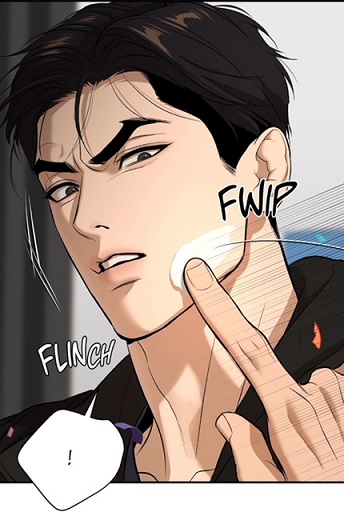 (chapter 43) represents the positive gesture from Namwook’s slap.
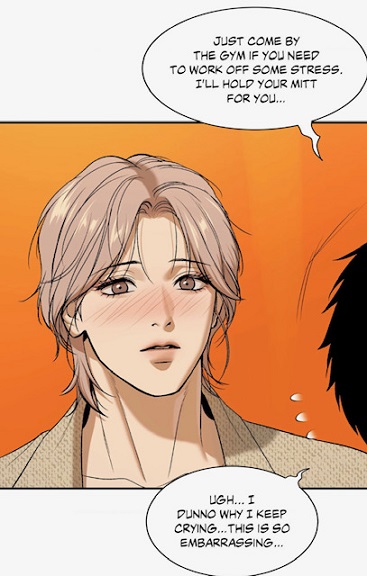 (chapter 35) He needed Potato to work off some stress. That’s why the reason why NO ONE wondered about the young fighter’s absence during the birthday party.
  (chapter 52) The result was that his face got bruised.
  (chapter 7), 16
  (chapter 16)
  (chapter 16), 25
  (chapter 25)
  (episode 25) and
  (chapter 40), but also paid attention to his actions and work.
  (chapter 25)
 (Chapter 25) and showed no fear to fight with stronger men.
 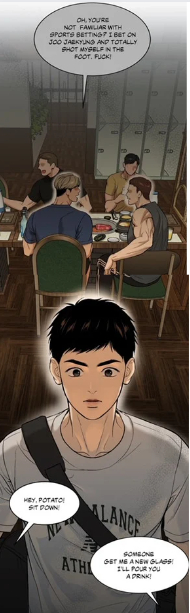 (chapter 52) I sense some future tension between him and coach Park Namwook, for the maknae embodies enlightenment, great intuition and open-mindedness, whereas the other stands for prejudices, ignorance and herd mentality. Naturally, the manager is changing for the better, nonetheless his metamorphosis is progressing much more slowly. Only in episode 52, he questioned why Baek Junmin was placed next to his athlete.
  (Chapter 52) Yet, he didn’t complain to the staff or to director Choi Gilseok. He remained passive contrary to the young member from Team Black. Moreover, because Kim Dan has always felt a certain closeness to Yoon-Gu, I believe that the latter will be the reason why the champion and Kim Dan can rekindle. Thanks to him, he can approach the poor doctor and convince him that Team Black is his home.
  (chapter 29) I doubt that it will be just for the athlete’s sake and recovery, for this would make him a hypocrite. He is truly interested in the doctor’s well-being. Let’s not forget that his worries in episode 43 were genuine. Moreover, since Joo Jaekyung’s name number 3 and Potato 4, we come to 7! They will work together. Joo Jaekyung will share his knowledge how to rule in the ring.
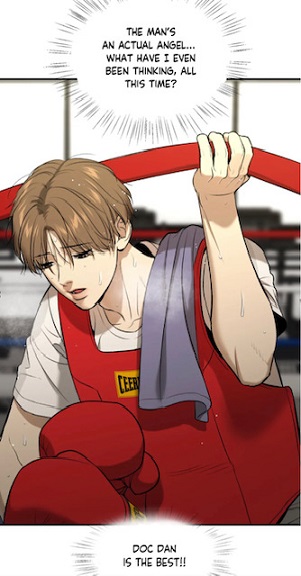 (chapter 26), his tolerance, patience, understanding
  (chapter 37), his humbleness
 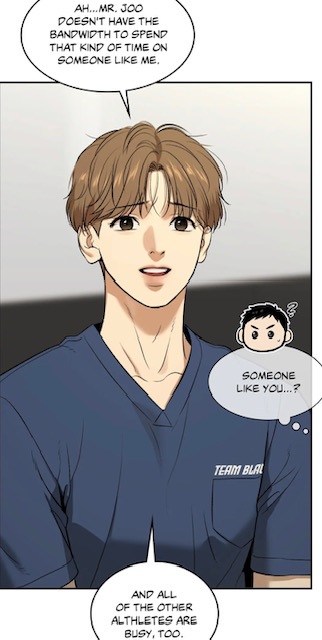 (chapter 25), his dedication and meticulousness.
  (chapter 49) Yoon-Gu could only perceive Kim Dan as the symbol of loyalty. Hence I come to the deduction that after meeting doc Dan, he must have realized that only one could change the situation, it was Joo Jaekyung and no one else.
 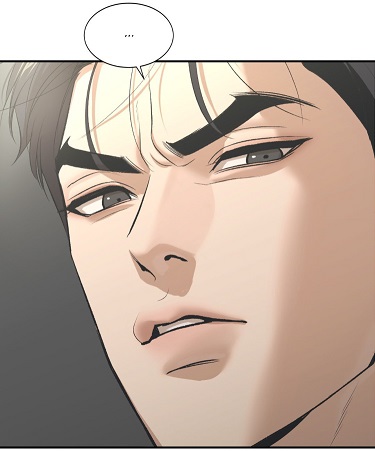 (chapter 43), but also Park Namwook’s neglect. How so? First, look how Kim Dan came to offer his services to the members from Team Black. Kim Changmin had an old shoulder injury which had been neglected:
  (chapter 7) But the coach should have noticed it and advised him to go to a doctor. He was responsible for them. But no… and we have two other evidences in episode 52. First, the manager didn’t ask about Potato’s injury. Secondly, he slapped a patient, because he felt “provoked” by the outburst from Joo Jaekyung.
  (chapter 52) Why? One might say that he was worried for his star. But for me, the drop of sweat is showing a certain discomfort. How so? A surgery means that the athlete can no longer fight for a while. Without him, the coach is put under pressure, for he needs to ensure that other fighters can enter MFC.
  (chapter 47) Hence I am now wondering if his passivity and silence after the terrible incident were not deliberate. He had ran away from any responsibility out of fear (avoidance). That way, he could put the blame on others: the champion, the fighters, King Of MMA etc. Naturally, the champion is also to blame
  (chapter 13) Furthermore, he heard from the grandmother that he had a weak constitution.
  (chapter 41) That’s how it dawned on me that the news about Kim Dan could be referring to his health too. But does it mean that doctor Dan is now ill, especially when you look at Potato’s facial expression here?
  (chapter 25) Back then, his dream was to train and spare with the athlete, thus I deduce that his new dream got “crushed”. But what was his new wish? To work with doc Dan! Thus he assisted him and asked for his opinion. He trusted him blindly. Therefore I have the impression that the physical therapist stopped on his own working for Team Black. However, I don’t think, Kim Dan made this choice himself. The news definitely caught the athlete by surprise.
  (chapter 52) Either he is sick, or it could be a reference to the doctor’s mental health as well. This would mirror the champion’s unwell-being.
  (chapter 10) Let’s not forget that after his first night, the doctor numbed his physical pain with soju, while he was not eating properly.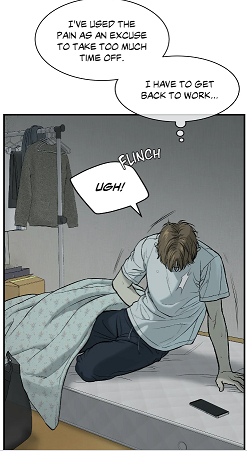
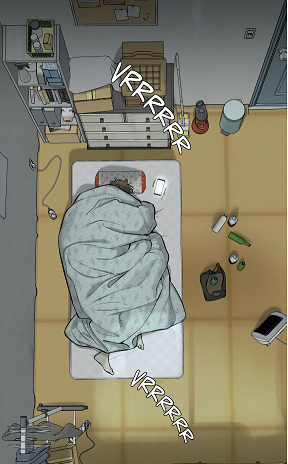 (chapter 5) He would spend money for soju, but not for healthy food. Not even his grandmother was aware of this habit. But by living with the champion, he could no longer live like in the past. He had stopped drinking any alcohol, but notice that it changed after the drug incident. He was encouraged to drink again:
 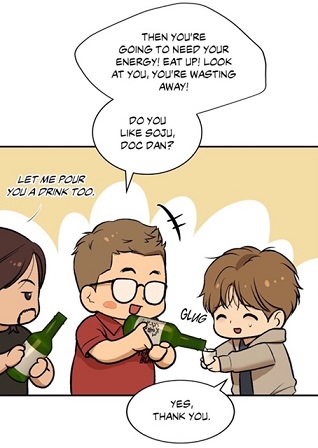 (chapter 43) The champion represented the doctor’s motivation and as such “sweet drug”. That’s the reason why he could always overcome the pain afflicted by his soulmate:
  (chapter 47)
  (chapter 51) And this brings me to my next observation. All the episodes are showing the champion’s weak mental condition which got even worse over time. From this
 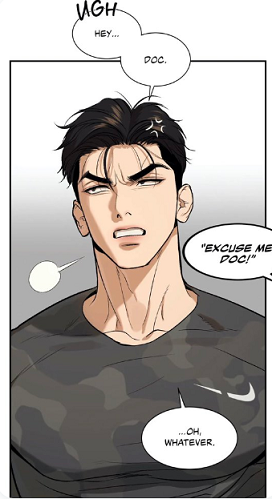 (chapter 7) to this
 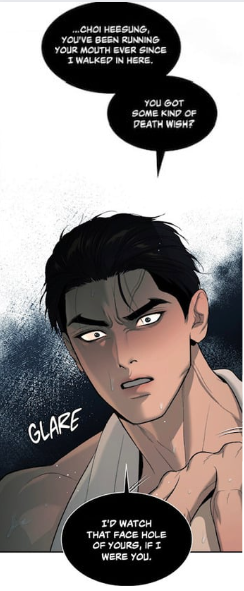 (chapter 34) and to this:
  (chapter 34) Though the celebrity was getting easily irritated, the manager never took the matter seriously. He saw it as the result of bad education, hence he never tried to change it either.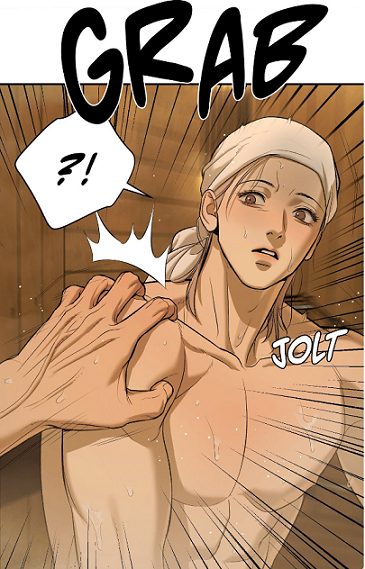
 34 and 52) is not the expression of fun, rather it indicates fear, frustration and anger. In episode 25, the maknae wounded the doctor out of jealousy and frustration unconsciously. He wished to be close to the celebrity. Interesting is that chapter 43 represents the true exception. Here, the readers could discover the champion’s true face: he was behaving like a brute and thug
 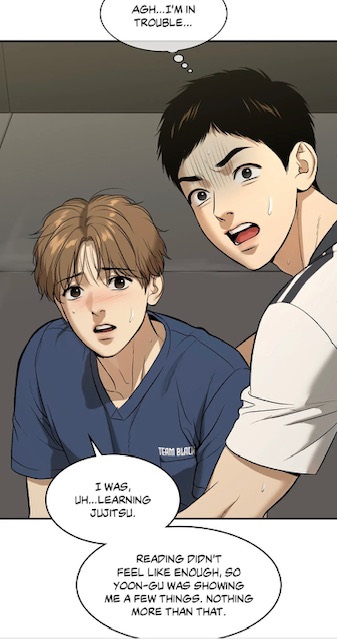 (chapter 25) Why? It is because the doctor protected him by explaining the circumstances: he was learning jujitsu. He diverted the champion’s attention from Yoon-Gu. He had not been “caught”. However, when Kim Dan was offered to become the celebrity’s sparring partner, Potato got angry and voiced his anger and wish:
 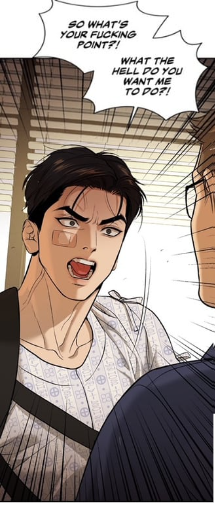 (chapter 52) And what had happened to Potato, when he yelled at Joo Jaekyung? Nothing… the champion only paid attention to his soulmate, while Kim Dan saw his disappointment which pushed him to accept the challenge.
  (chapter 34) He employed the exact expression than the manager, an indication that the latter had influenced the actor. I consider his thoughts as another evidence for the coach’s intervention. However, he couldn’t report it to Park Namwook, for he had used work as a reason to meet the protagonist. On the other hand, I am quite certain that he divulged the incident to Potato in episode 43, therefore the latter agreed to the statement of the other fighters: he was a thug.
  (chapter 47) Chapter 52 contrasts to all the previous scenes, for this time, the champion got caught and sentenced.
  (chapter 52) His suspension is the result of his misbehavior, he used violence and as such he broke MFC rules. It was not related to his sexual behavior (contrary to episode 7, 16, 25, 34 and 43), hence I am assuming that this topic will become a hot topic in season 2. When will he be caught in a compromising situation with Kim Dan? Moreover, his sentence is only valid in MFC world, hence his reputation is not truly ruined. While the main lead got caught and punished, the opposite happened to the villains:
  (chapter 1) His bad temper is the reason for that incident. Funny is that by admitting this, he is not realizing his own wrongdoing! He neglected the champion’s mental health and his well-being all this time. He never tried to grasp the origins of his irritability and to improve the situation. So it was only a matter of time, until this would come to the surface! To conclude, though number 7 is strongly connected to suffering, it also stands for education and teaching. Thus as time passes on, the characters are getting enlightened and more complete. Little by little, they are getting closer to the divine: the discovery of hope and as such happiness. For me, the protagonists’ main spiritual growth will take place around the episodes 70-79.
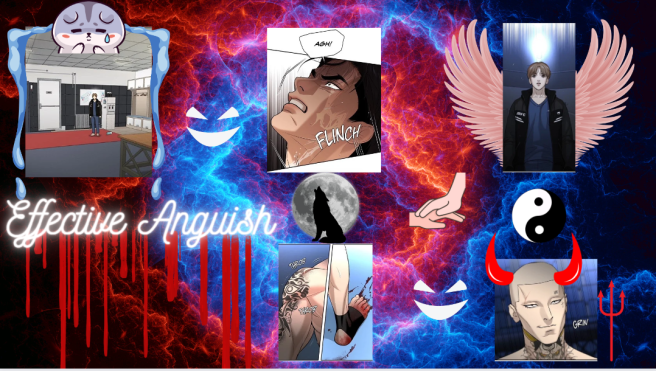
 (chapter 50) and Kim Dan. While the former was tormented by his challenger directly
  (chapter 50) and indirectly, the other had to witness how the members from Team Black turned their back on him in the locker room.
  (chapter 50) Interesting is that on X, hamster Dan received more affection and attention than the champion. Though I have always pointed out the doctor’s flaws, in episode 50, I couldn’t help myself being upset and heartbroken for Doc Dan too, until I had a revelation. Many readers were disappointed or mad, when they saw him in this panel.
  (chapter 50) They could put themselves in his shoes: he was left behind. On the other hand, the reaction from Joo Jaekyung was totally understandable.
  (chapter 50) He acted on instinct. Moreover, he had a match, therefore they had no time to discuss or investigate the matter.
  (chapter 45) In other words, the scene in chapter 50 exposes the doctor’s growing strength and resilience. That’s the second reason why anguish is necessary in Jinx. Through their suffering, the characters can change, and Jinx-philes have the opportunity to witness their growing maturity. At the same time, the author is able to underline the other figures’ flaws thanks to torment. Between the essay
  (chapter 44) Now, the doctor is no longer associating sex with prostitution and corruption, but with love.
 (chapter 27) But only Dr. Lee and Kim Dan got to see the results
 (chapter 27), not Park Namwook. He just overviewed the medical file quickly. But for that, the manager needs to be capable of understanding medical terms. Thus I doubt, he could visualize the seriousness of the situation.
  (chapter 27) Then, after the match in the States, the manager asked his “boy” how his shoulder was.
  (chapter 40) while the manager had witnessed how Dominic Hill had targeted his shoulder. He should have realized that his star’s shoulder had been damaged. Nevertheless, we shouldn’t overlook that the athlete’s statement was corroborated by the medical checkup from MFC. That’s how he got fooled. Hence there was no treatment. However, doc Dan could detect the champion’s lie not only through observations
 (chapter 41) but also through touching.
 (chapter 41) As you can see, the wound was slowly coming to the surface. Thus I consider the incident in episode 43 as a metaphor for the shoulder injury.
 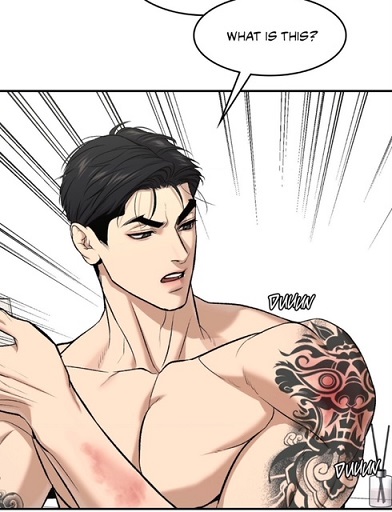 (chapter 43) It was exposing the damage in his body. Consequently, when the champion’s foot got wounded by the pepper spray,
  (chapter 49), I realized what was happening. Mingwa is forcing the Emperor to admit his suffering. Hence his wounds are becoming more and more visible.

 (chapter 5) for he was simply relying on the prostitutes due to his jinx. Thus I consider this argument in the penthouse as a huge step for the athlete:
  (chapter 50) So far, he just had a cut above his eye, nothing serious.
  (chapter 50) That’s the reason why he turned into a dragon at the end of the chapter. [For more read the essay “
 (chapter 5) And now, you comprehend why he got so nervous and angry, when he imagined that Kim Dan had blocked him.
 (chapter 5) This shows that his belief in his jinx had been reinforced after his first night with Kim Dan.
 (chapter 50) From my perspective, this is the result of the overexerting.
  (chapter 48) Finally, we shouldn’t overlook the fact that after his match in the States, he never visited the hospital due to the law suit.
  (chapter 41) According to me, the MFC medical checkup was not reflecting the verity. Hence he never got a real check-up and MFC could definitely say that the athlete was definitely fine.
  (chapter 27) refused to force the champion to take a day-off by saying that the protagonist would never listen anyway. With such a statement, he pushed Kim Dan to make the decision and announce it to his VIP client. Moreover, the manager didn’t stop his “boy” from exposing his injured shoulder to the public.
  (chapter 41) However, by doing so, he was exposing his vulnerability to his opponents, though I am still suspecting that MFC leaked information too. So far, the headlines are not indicating which shoulder is wounded. Yet, the moderator knew which one:
  (chapter 50) So why was the manager so shocked with such an attack?
  (chapter 41) Observe that he is just asking questions once again, when he voices his doubts. He is not making a statement. However, the manager is changing. While in the past, the manager was not treating the celebrity like real family, though he was called hyung, I detected a switch, when Park Namwook sent messages from his family for his birthday.
 (chapter 41) to the golden keychain.
  (Chapter 45) As you can see, the famous writer is connected to Positive Psychology, for he was also promoting meditation and experiences. This fits our story, as both main characters are on their way to give a meaning to their life and as such to find happiness. But let’s return our attention to the manager Park Namwook as a representative of “ignorance”.
  (chapter 11), but also he never tried to correct the star’s false conclusion.
  (Chapter 31) It is his way how to deal with uncomfortable situations. He stands for social norms and conformity. It is not surprising that the manager proposed to use Kim Dan as compensation for Heesung’s fake injury.
  (chapter 36) or to let others make decisions. I would even add, he often delegates things to others: the manager from the Entertainment company
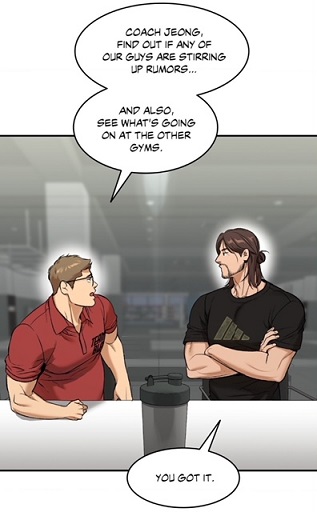 (chapter 46), Kim Dan [f. ex. He should accept the bad mood from his VIP client]
 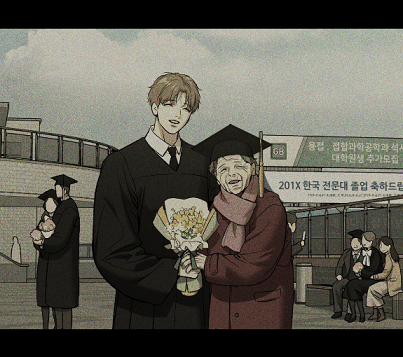 (chapter 47) And what was the halmoni’s wish? He should give his all to Joo Jaekyung,
 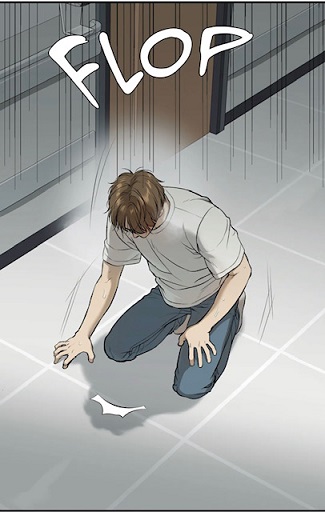 (chapter 21: he was criticized by Kim Miseon, he feared to lose his halmoni)
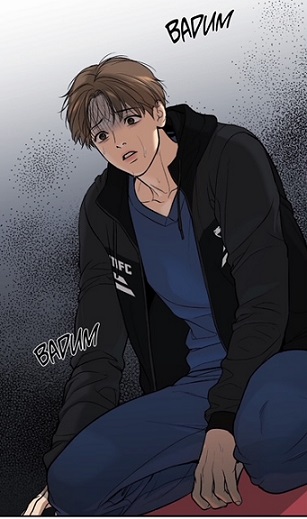 (chapter 50) That’s the reason why Kim Dan could become a star. Contrary to Joo Jaekyung, we didn’t assist to the birth of the yeouiju. It is no coincidence that birth is connected to pain and happiness. Mothers forget the suffering of the delivery, as their child can procure them a lot of joy and happiness.
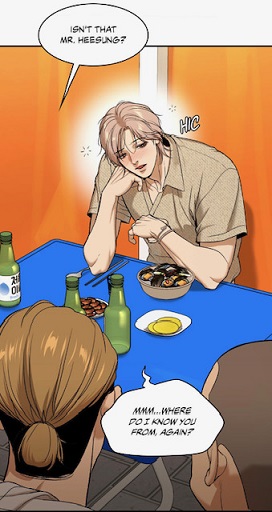 (chapter 35). Both were trying to numb their pain, though they shouldn’t have according to the German philosopher. The soju stopped them from becoming the better version of themselves. I am suspecting that doc Dan copied this poor habit from his grandmother, who drank in secret. Don’t forget that in all the memories, the halmoni is smiling
  (chapter 16) or as a tool for the jinx, therefore he mopped the floor
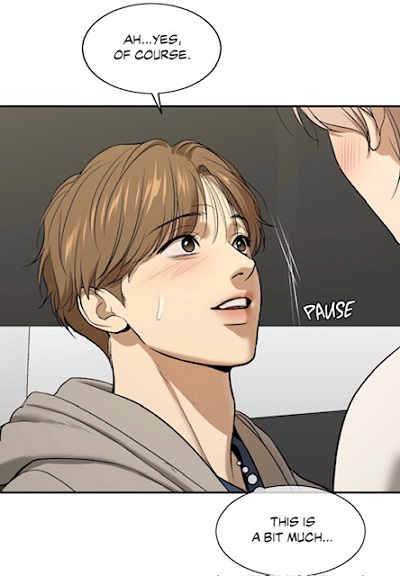 (chapter 31)
  (chapter 31). Furthermore, he took a side gig in order to buy the champion’s present and finally, he rejected Choi Gilseok’s praise and offer.
 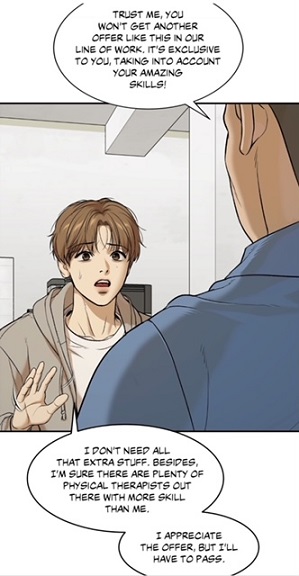 (chapter 48) He was always diminishing himself as a doctor. Therefore in the locker room, he was confronted with his biggest fear: is he really a physical therapist?
  (chapter 50) He injured his patient. The spray is there to let him see that he has power in his hands. He should trust himself and his magical hands. Don’t forget that this request was made by Joo Jaekyung.
 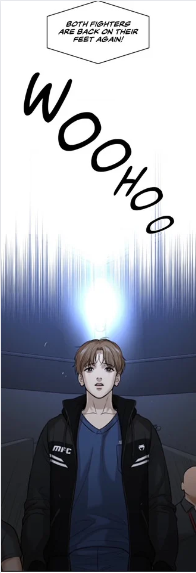 (chapter 50) And from my point of view, the locker room became the doctor’s new temple. There, he must have recalled his grandmother’s wishes. She would like to see him on TV. For me, the light over his head symbolizes Enlightenment. He has become the champion’s yeouiju. Thus I deduce that Kim Dan is on the verge of proving his worth to Team Black. I am anticipating, he will approach the ring, and even treat him during a break, something he denied to his halmoni.
 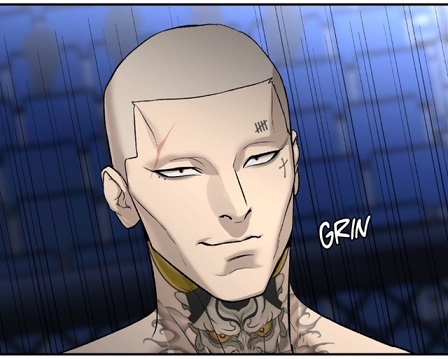 (chapter 50) It is relevant, because through such an intervention, hamster Dan would teach the champion an important lesson. He is not alone in the ring, the doctor is watching his physical condition and helping him.
  (chapter 48) So the moment you perceive this moment
  (chapter 37)
  (chapter 40)
  (chapter 42) In the first part of Jinx, the doctor was the star’s companion of the night, but since the incident with the birthday present, he stopped being the night partner. Now, he is about to become the famous private physical therapist acknowledged by the public and media. In other words, his destiny contrasts to Baek Junmin’s, a shooting star, it will last longer. Why? It is because the main lead is Saturn! He brings fortune and karma to the evildoers. This interpretation corresponds to Übermensch from Nietzsche, which is sometimes translated as “Superman”. Under this new light, you comprehend why I added the protagonist’s pink angel wings. It was an allusion to his transformation, he is destined to become an “Overman” or Superman.
 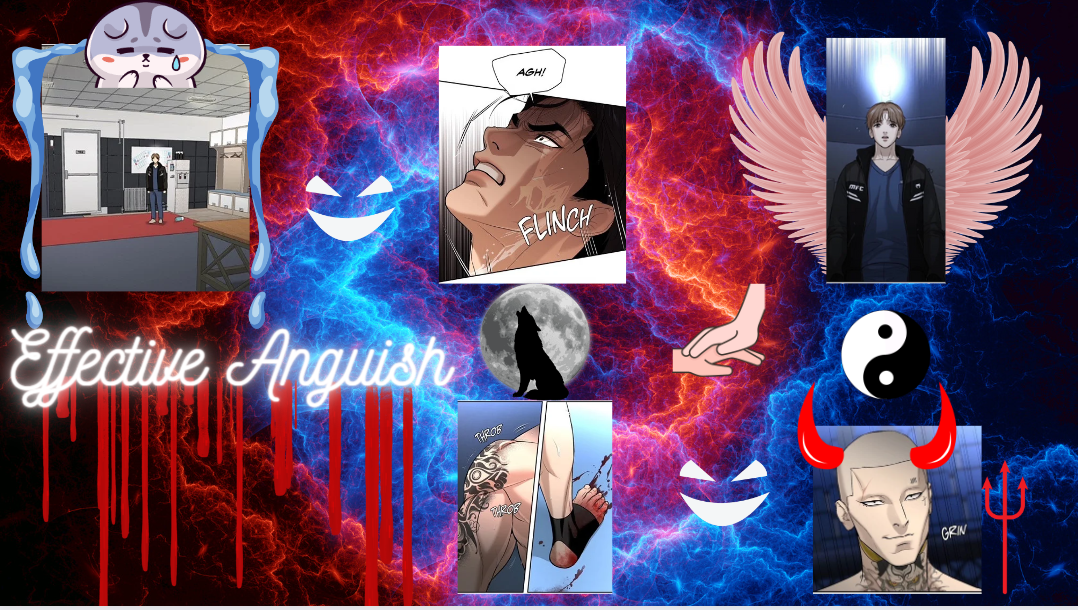 And this brings me to my next observation. The doctor’s pain is exposing his recovery! Weird, right?
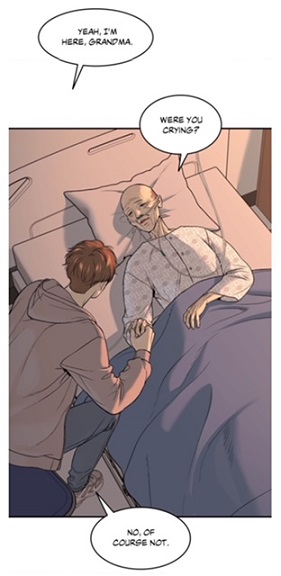 (chapter 47) and his agony. He was no longer under the influence of toxic positivity. While he cried, he admitted his flaws making him realize that he had never been abandoned by his grandmother.
  (chapter 47) That’s how he overcame his abandonment issues.
 (chapter 27) For the first time, he rejected a suggestion from his lover and even slapped his hand.
  (chapter 37) He wanted the party to continue. It shows that he was having a good time with Oh Daehyun and Potato. He has no problem to stop kissing his soulmate, when the latter shows his discomfort.
  (chapter 44)
 . (chapter 36)
 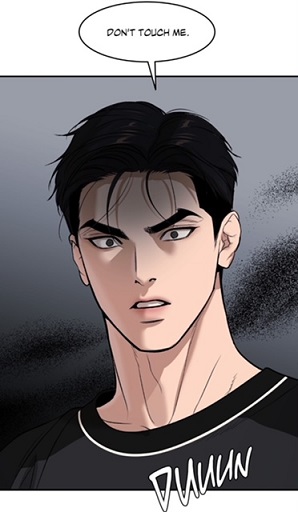 (chapter 50) They are trying to find themselves, therefore they must constantly adapt to each other. While the image gives the impression that the trust between them is vanishing, it is in reality an illusion. People should pay attention to the color of the speech bubble. It is white, there is no point of explanation. It reveals that the champion is not raising his voice. He is rather calm. In reality, the champion was not truly mad at Kim Dan. He was restraining himself. Jinx-philes should compare this image to the following two panels:
  (chapter 45) And now, you comprehend why I stated earlier that he acted rather instinctively. For me, he still trusts the physical therapist.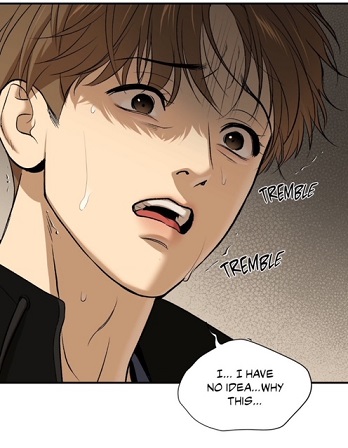
 (chapter 40) It never came to his mind that he should ask for assistance. Finally, observe that after he got drugged in the States, he let the champion deal with the problem.
  (chapter 33). He is not hiding his sexual orientation, he is greedy, but in a good way. Hence he tried to win the doctor’s heart. He never gave up, till he was properly rejected by the doctor.
 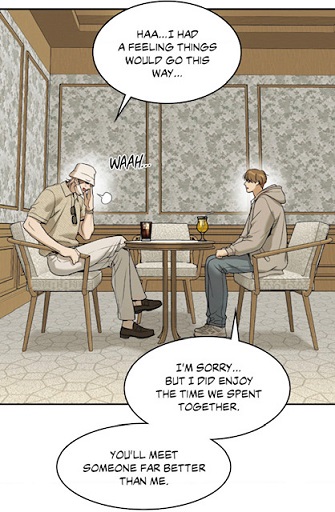 (Chapter 35) Interesting is that after his confession, he still chose to come clean with the doctor. He revealed the truth to Kim Dan, though he could have lost the protagonist’s respect. He admitted his lie and manipulation,
  (Chapter 35), but Kim Dan’s reaction was not to scold his future friend. In fact, he appreciated his honesty. In front of Kim Dan, he could show his true self. He was not entirely a good guy, but he didn’t get rejected. But so far, the actor is not present in the arena. Therefore Potato could be the first person Kim Dan asks for help. He shares some similarities with his soulmate. He doesn’t fear people’s gaze, hence he raised his voice under the tent.
 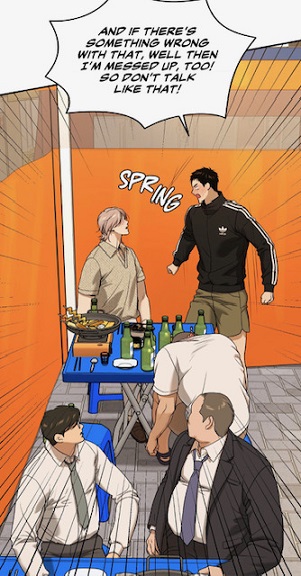 (chapter 35) he doesn’t represent the herd mentality, for he never thinks and acts like others.
  (chapter 31) While the fighters all liked the actor, he judged him in a different light. Then he was not present during the champion’s birthday. Therefore he possesses all the qualities to become a hero. He could cause a scandal,
  (chapter 49) similarly to his idol and hero in the States. He noticed the issue right away: the security didn’t do his job properly. To sum up, Potato would follow his foot steps and that’s how he would get noticed by MFC!
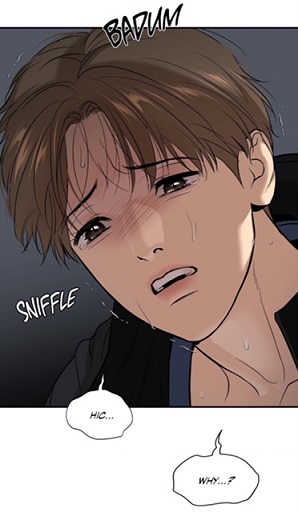 (chapter 50) The word is displaying that the doctor is not accepting the incident simply like that. It is showing that the doctor is slowly losing his naivety. Before the incident with the spray took place, he still trusted the words from people.
 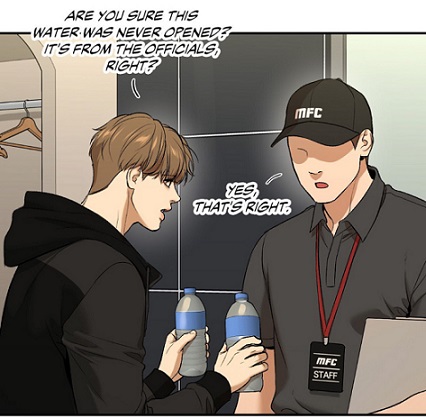 (chapter 49) Naturally, he can not get rid of his naivety totally, for keeping a certain purity is necessary in life too. On the other hand, it becomes clear that his naivety is the result from his education. The halmoni is herself quite too trusting. Hence she ended up being harassed by loan sharks. On the other hand, the incident was like an eye-opener for the physical therapist. He should stop judging people based on their words
 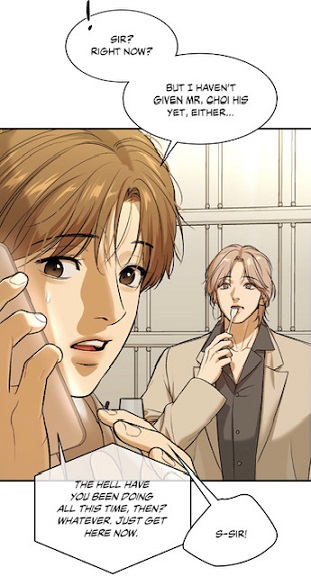 (Chapter 32)
 (chapter 1) by bosses, it becomes comprehensible why he didn’t fall into the trap a third time.
 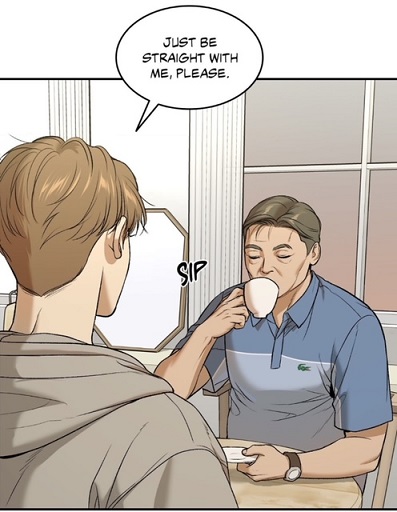 (Chapter 48) He is pushed to question impressions and people’s motivations. As a conclusion, anguish is a tool to push people to become wiser and happier. And this leads me to my final part.
 (chapter 15) And notice that this pattern was the same in the States. For the second match, Team Black left without him, hence Kim Dan arrived late.
  (chapter 40) Therefore he was running once again. However, back then, no readers felt angry at the team, though it could also be perceived as a betrayal and abandonment! Kim Dan was not perceived as necessary, neither for Joo Jaekyung nor for Park Namwook. Hence the bedroom could be judged as the place of the betrayal: “
 (chapter 40) That’s how I realized why the Webtoonist never showed the athlete’s caring gesture. He moved him in the middle of the bed! It is because the celebrity was still not treating his soulmate as a physical therapist. The second reason for the absence of anger is that Kim Dan had been drugged and as such was not fit. In addition, he needed to rest after having sex for the whole night. And now, you comprehend why the doctor could get dragged away by the MFC security guards, and no one from Team Black intervened.
  (chapter 40) It was to outline their previous disregard and betrayal! Thanks to Potato, Joo Jaekyung got informed, hence he could rescue the physical therapist.
  (chapter 40) But he never revealed the hamster’s role in the team! This explains why Kim Dan was used by Choi Gilseok. He needs to expose his role in Team Black to the world. He is the champion’s private PT!
 He has just his blue uniform.


 Hence he could get into trouble! The MFC could report the incident to the authorities!
  (chapter 49) in both cases! He was present, when Kim Dan drank the drugged beverage.
  (chapter 38) To conclude, it was not in Kim Dan’s interest to run away or hide! This would have been judged as a sign of his culpability and complicity. He needs to face the problems so that he can shape his destiny with his own hands and not remain the playball of dark forces! Yes, this chapter announces a huge change at Team Black, the start of a real friendship between two puppies. 😉
 (chapter 49) Under this new light, my inquisitive readers can understand the title of this composition. My focus will be the infamous sportsman and his interactions with the main lead, in the past and present. Consequently, the composition will contain theories about the champion’s past. Nevertheless, since I am examining the present, it signifies that I will explain Baek Junmin’s role in the new scheme too. So who is Baek Junmin in the end? In the essay “
 (chapter 49) It exposes his duplicity. Because of his sobriquet and his color, I assume that the schemers consider the boxer as a weapon. His role is to kill the Emperor, and probably in one blow. He is the executioner of the invincible legend. It should be a quick, merciless “death”. From that fight, Baek Junmin has to ensure that Joo Jaekyung can never come back to the ring. How is it possible?
  (chapter 49) It is because they know about his injured shoulder. That’s the reason why Baek Junmin is patting him on his left shoulder. Remember what the sports doctor told to the physical therapist:
  (chapter 47) He should make the fight last in order to tire his opponent out. So the plotters thought that during the fight, Joo Jaekyung would ask for a relief spray on his injured shoulder. That would be the end for him. Kim Dan would even deliver him the victory on a silver plate. He would be framed as an anti-fan. The irony is that Kim Dan could heal his VIP client within a short time. Here, the champion looks relaxed and not concerned with his shoulder.
 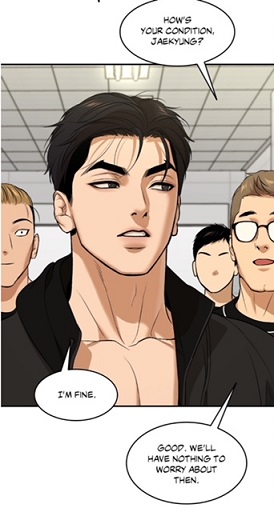 (chapter 49) Here, he is almost smiling. He was telling the truth, when he said that he was fine contrary to the States.
  (chapter 49) He has now taken over the manager’s place. This reflects the doctor’s rising within Team Black. At the same time, this expression lets us perceive the role of Baek Junmin at King Of MMA gym. He is the protector of Choi Gilseok, the “old man”. On the other hand, his position also insinuates his passivity, as he is not the driver, like here.
 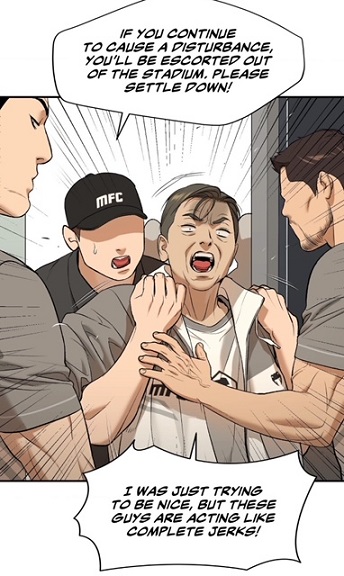 (chapter 49) The director had to suffer a great humiliation for this trick, while a helping hand had to switch the spray. For me, the expression “The Shotgun” displays the inaction from Baek Junmin. He was catapulted to the top thanks to the assistance of others: Mr Choi thanks to his money and connections with the media and with the CEO of MFC. Then the members from his gym had to gathered intel about his opponents. This was truly palpable in the description from the moderator.
 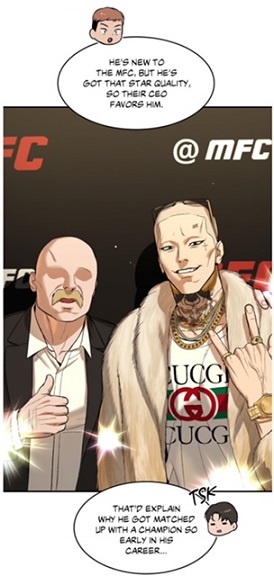 (chapter 47) Where did I find the evidence for this? It is because Seok (from Gilseok) can signify “brass”! As you can see, thanks to two different notions “shotgun”, I could give a better portrait of the fake star. But this is far from being finished. Funny is that “Shotgun ” can also refer to a position in American football.
 (chapter 49) And what is the common denominator between the meaning “firearm” and “American football position”? Attack! But there’s more to it. As adjective, “shotgun” is indicating coercion and duress. And this corresponds to Choi Gilseok and Baek Junmin’s tactics. The director tried to put the physical therapist under pressure, when he met him in the café:
  (chapter 49) By meeting Kim Dan there,
  (chapter 49) he tried to sow seeds of doubt and even discord between the couple. It was to give the impression, they were working together. But the champion didn’t fall for it. The reason is that his fated partner was able to heal his injured shoulder. As a hypocrite and arrogant fighter, he utilized his small talk to threaten Joo Jaekyung.
  (chapter 10)
 (chapter 10) And what was the couple’s reaction during that night? While Kim Dan wept, as he was longing for his grandma
  (chapter 10) before he had a change of heart. Kim Dan’s plea had moved his heart.
  (chapter 10) The problem is that the doctor couldn’t remember this scene due to his drunkenness. This scene leads us to another meaning of Shotgun.
 (chapter 48) And both are working together. My hypothesis is that Baek Junmin was involved in drugging the athlete. The sportsman admitted that The Shotgun had schemed against him.
  (chapter 49) This would explain why Joo Jaekyung would never join the team’s dinner and why he reacted that way, when he drank a glass of soju:
  (chapter 6), when Kim Dan had accepted the deal from the main lead. The erected phallus looks like a weapon and Kim Dan also made the connection, when he saw his huge anaconda with the sex toy:
  (Chapter 12) The idiom “shotgun sex” suggests a situation where sexual intercourse occurs hastily and impulsively. It has nothing to do with love and warmth. It is something done quickly or without much forethought, which corresponds to the scene in chapter 6.
  (chapter 6) And what do we see here? Submission!
 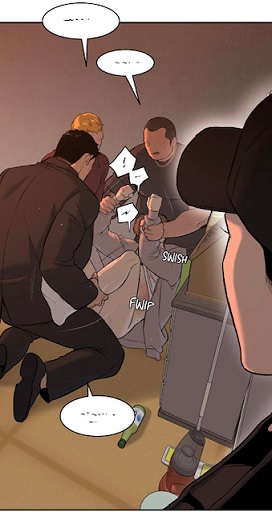 (chapter 17) Don’t forget that during that night, the soju was present as well.
 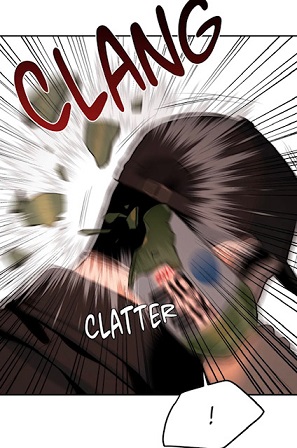 (chapter 17) Because of his nickname and the reflections from episode 10 and 17, I deduce that Baek Junmin was present, but he didn’t help the athlete. He turned a blind eye to the situation.
  (chapter 49) In other words, he didn’t behave like a hero contrary to Joo Jaekyung. I can’t help myself thinking of this scene:
 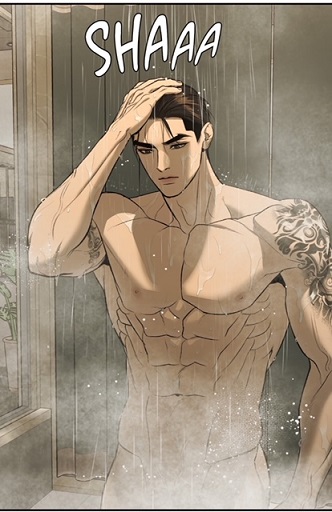 (chapter 49) He usually takes a shower in the morning, however this scene took place in the evening. Under this new light, it becomes comprehensible as well why Joo Jaekyung couldn’t remember the criminal
 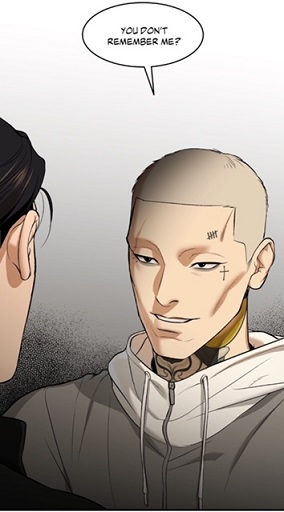 (chapter 49). It is related to a painful but short experience which scarred the athlete’s heart and soul.
 (chapter 49) It is because the latter had repressed his traumatic past. The other reason he didn’t remember him is that the latter had betrayed him. He was not worthy of being remembered and being noticed. Would you remember a poser and coward? No, not really. In my opinion, Baek Junmin stands for immaturity, betrayal, irresponsibility and false manhood.
 (chapter 6) He brought him upon himself. He shouldn’t have drunk or taken drugs, he shouldn’t have been weak, he shouldn’t have been there that night… I see his statement there as an evidence for manipulations
 (chapter 18) If they are criminals, then the authorities should be informed, because the latter need to stop them, to make things worse for them. It was, as if he was advocating loansharking, though it is illegal. One might argue about this theory, for I deduced it simply from the name The Shotgun and its different reflections. However, Mingwa left us two other clues for this hypothesis.
 (chapter 49) He never loses! He sounded so confident and sure. His words contrast to his confession in his bedroom:
  (chapter 20) But contrary to the physical therapist, the champion had never denied the existence of his body. He didn’t need to look at his reflection to see any change. The pondering was triggered by The Shotgun’s words. Baek Junmin saw the protagonist in a different light: weak and pitiful.
  (chapter 49) and not looking at his own reflection. Here we were witnessing the birth of the champion’s third eye. In addition, this scene corresponds to the one in episode 3:
  (chapter 3) As you can see, the moment you connect these two scenes, it becomes clear that there was no sex. In episode 3, the doctor was fetched and had to have sex, while in episode 49, the PT waited for a signal from his boss, but it never came. Furthermore, the bathroom is the only place where the athlete doesn’t bring his cellphone! And the latter represents a huge hindrance to his meditation, like Jin-philes could observe it in chapter 35:
  (chapter 35) But there is more to it. The departure from the restroom corresponds to the doctor’s realization at the hospital.
 Gradually, Kim Dan came to accept the truth: his grandmother couldn’t keep her promise, as she would never recover from her illness. He went on his knees, too devastated by the terrible news. However, he didn’t question the doctor’s action and behavior. Nonetheless, he was able to move on. He was forced to mature and become more independent.
  (chapter 28) Because of this special day and night, Kim Dan came to accept sex and sensuality in his life.
  (chapter 29)
  (chapter 36) As you can see, all the scenes reflecting the bathroom scene in episode 49 contain SEX. Hence I see it as another evidence that the sex during that night had a different meaning: it was more a habit than a real need. And don’t forget that in the States, he had already complained about the timing.
  (chapter 39) He didn’t feel like “fucking” and it must have been the same during that night before the match. And if he had been sexually assaulted, anyone would comprehend why he didn’t feel any desire. Under this new light, Manhwaworms can understand why the title is “Embracing change”.
  The star is gradually dropping his old belief. He is one step closer to realize that he is not jinxed, he is strong enough to win the next fight. My avid readers should keep in their mind that when the couple argued on his birthday
 (chapter 49) which was used for the sex session at the gym.
  (chapter 24) Moreover, he even took an ointment in case his anus would tear, for they didn’t have sex for a long time.
  (chapter 49) But Baek Junmin was not alone in this. Due to his traumatic past, Joo Jaekyung came to resent and mistrust humans, for he never got the chance to get justice from his tormentors. That’s the reason why he rejected social norms. As time passed on, he repressed the incident and buried the identity of the persons responsible for his wounds, whereas his pain couldn’t vanish. Hence he was still boiling inside and his anger was directed at anyone. It would come to the surface at the slightest provocation or rejection. That’s why he was still trapped in the past. He had the impression, he could get assaulted at any time. Therefore he needed to prove his strength. And this brings me back to the whispered confession:
  (chapter 37) When the athlete saw the doctor’s reaction, the latter was looking away,
 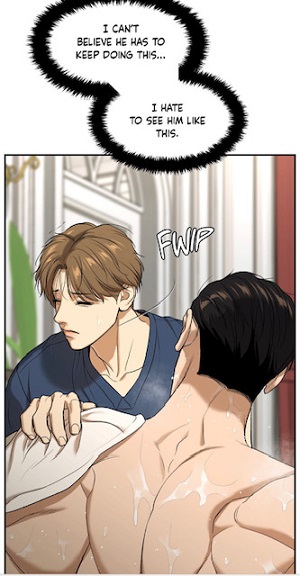 (chapter 37) the VIP client got so angry that he sent Kim Dan away. And now, take a closer look to this image.
  (chapter 49) The characters are placed in the same position. The comparison between these two scenes reinforces my hypothesis that Baek Junmin mocked Joo Jaekyung, resented him and refused to help the younger fighter back then, as Kim Dan was looking away. On the other hand, by using the expression “baby” in English, Jinx-philes could sense parallels with the fight with Randy Booker.
  (chapter 14) Interesting is that this image represented a distorted memory from the main lead, and it happened again after meeting his old “acquaintance”.
  (chapter 49) On the other side, this match has another signification for The Shotgun. How so? It is because he needs to win. He claimed that he would take away his belt. He believes that since Choi Gilseok paid a lot of money, he bet on his victory. Besides, the director of the gym even got humiliated himself. However, he is deluding himself, for he was just a tool to ruin the Emperor. A shotgun is an firearm and as such it is dispensable. Furthermore, this panel displays Junmin’s jealousy towards the celebrity.
  (chapter 49), whereas The Shotgun was relegated to fight in the shadow! He was fighting in the underground fighting ring, but since it was illegal, he couldn’t become famous and rich. He couldn’t be exposed to the spotlight. This shows that deep down, Baek Junmin was also trapped in the past. He came to resent the protagonist, for the latter had been able to rise the ranks. That’s why he couldn’t forget him contrary to the celebrity. The latter was not only successful professionally, but also admired as a hero. It looked like he had been able to move on from the past, whereas for The Shotgun, it was the exact opposite. He became more and more involved in crimes. Don’t forget that he is helping the director from the King of MMA gym to launder money. Thus I deduce that Baek Junmin is underestimating his opponent.
  (chapter 51) they had never planned to turn the new comer into a champion, people would have questioned the outcome. The real intention was to tarnish the champion’s reputation, to isolate him, to make him lose his stans. And they almost achieved it. Baek Junmin never realized his true position. He was just a middle-man, a hit-man that they would discard right after his “victory”. Hence he is no longer in the media, because his name is now linked with the incident with the switched spray.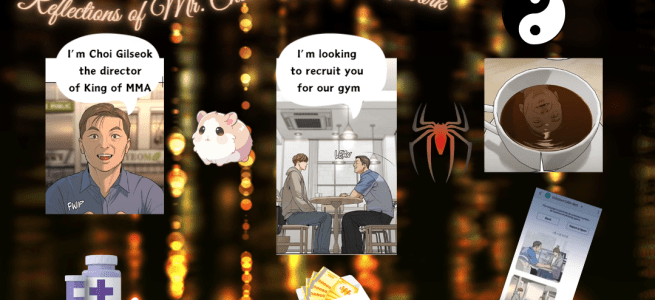

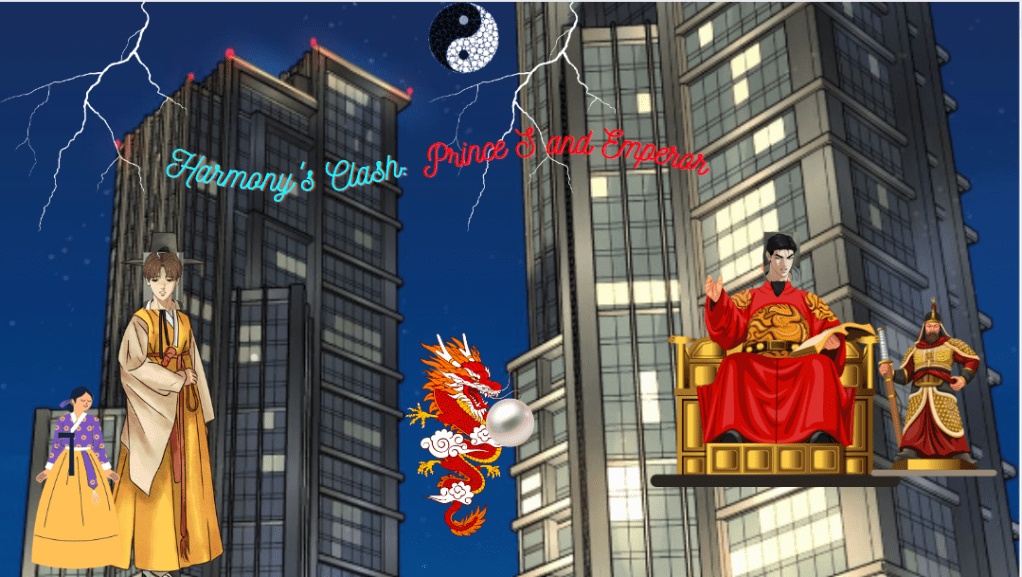
 (chapter 30) This woman, named Sihyun, is suffering from Dependent Personality Disorder. And the author of the Webtoon Doctor Frost called her story: “The tears of Princess Pyeonggang”. Due to her personality, she was linked to the famous “princess”. She would do everything for her companions, yet she kept getting dumped. What caught my attention is that both women defined themselves through their partner. Their ultimate goal in life is to assist them, to make the other happy or recognized. But how is it a problem?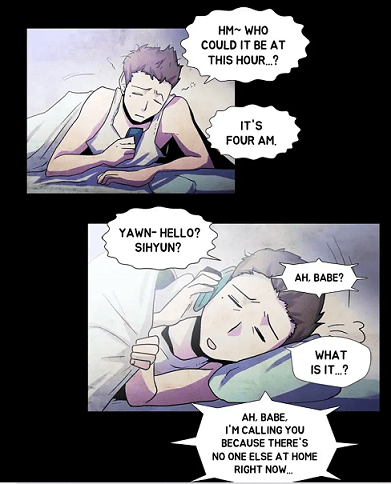
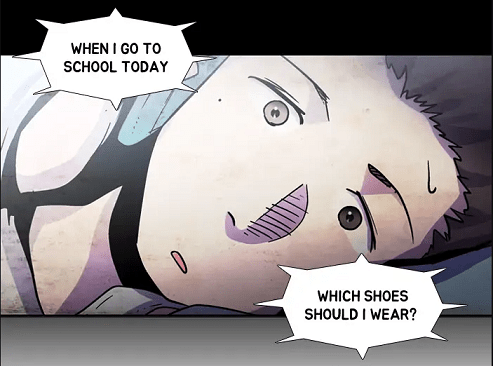
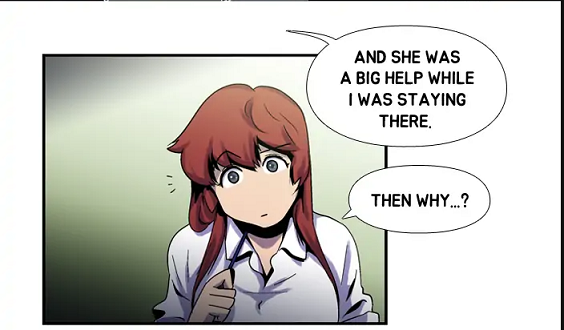
 (chapter 33) What appeared as caring turned out to be a load, for the partners were all forced to be responsible for her and in every aspect of her life. They definitely felt asphyxiated, hence they could only get sick of her. Interesting is that this person would find shortly after the separation a new boyfriend, a sign that she could not live on her own.
 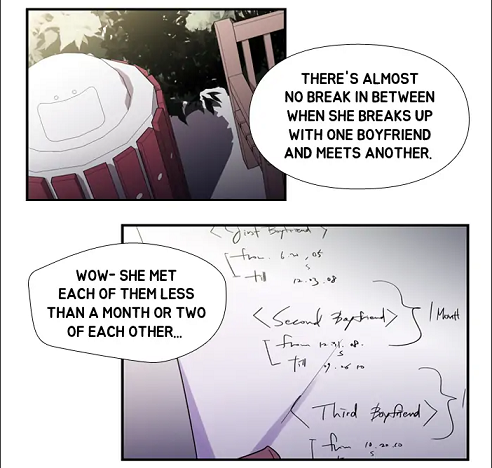 (chapter 33) And now, you are wondering how Sihyun is similar to Kim Dan, who only had one person in his life before he met the champion. It is related to traumas in their childhood.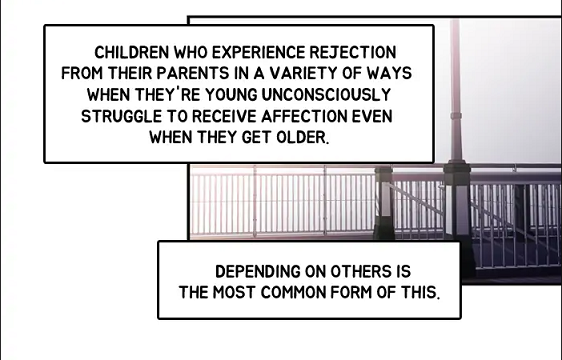

 (Doctor Frost, chapter 39) After reading this, Jinx-philes can realize that Kim Dan is also suffering from Dependent Personality Disorder, though it is less obvious. He got abandoned by his parents making him feel insecure.
 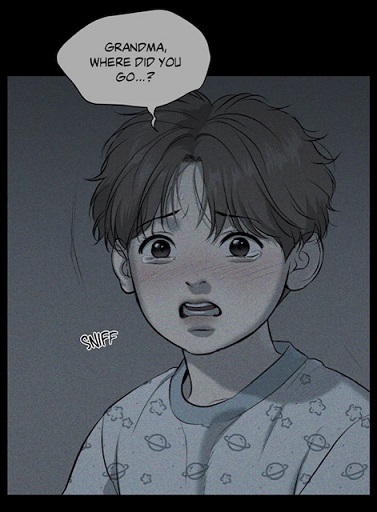 (chapter 21) We could detect his low self-esteem
  (chapter 46) and his overprotectiveness
  (chapter 26)
  (chapter 42) and before it was by his halmoni’s fate.
 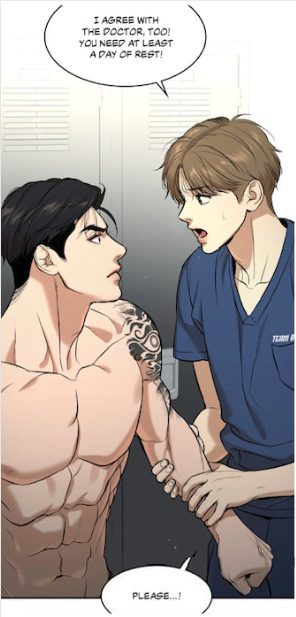 (chapter 27)
  (chapter 31) Here, we get an explanation why he couldn’t detect the trick from Choi Heesung. He feared to make a diagnosis on his own, as he didn’t desire to question the words from the comedian. The hospital seems to be the sacred place in the doctor’s eyes.
  (chapter 42) Consequently, it is not surprising why the champion complained about the doctor’s negligence. The latter was avoiding any responsibility in the end. On the other hand, the report is the symbol of his hard work, but also of his knowledge. That’s the reason why I am still considering the dispute in chapter 45 as a good omen for the physical therapist. He needs to develop his own identity. They are two different people. He needs to live for himself, to give a meaning to his life and not:
  (chapter 27) That’s how it dawned on me why the doctor reverted to his old habits (not participating to the meeting, taking odd jobs, not voicing his own judgment, relying on others) after the night, when he was treated as sex toy. However, in my eyes, the trigger for this switch was the release of the tabloid article.
 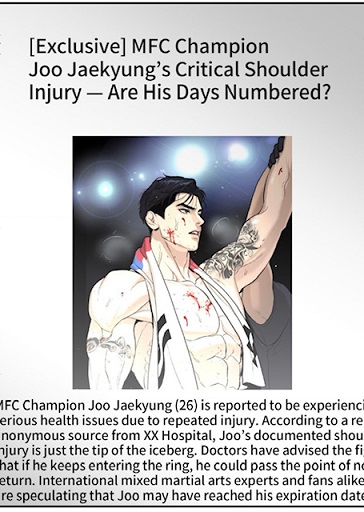 (chapter 35) Imagine what it meant for Kim Dan. He could only remain passive, as he is called “doctor”. He views himself as a member from the medical field. Furthermore, observe what the sports therapist told him during the treatment session:
  (chapter 46) It is full of symbolism. For the first time, he is standing on his own feet. His walk in direction to the trash bin illustrates his choice.
  (chapter 46) Besides, he is using the personal pronoun “I”.
  (chapter 46) He was just a physical therapist and nothing more. This shows his lack of criticism. He is still not mentally strong enough to question the champion’s words and argue back. In the past, he could do it, for he was identifying himself with his grandmother and her values.
  (chapter 42) The latter was also dependent on the champion, but his “addiction” was money and not love or recognition. Therefore he picked up the money before leaving the flat
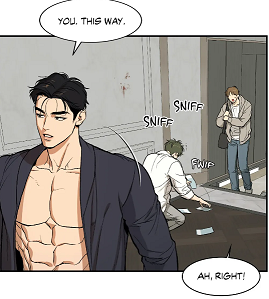 (chapter 2), while the other threw away the expensive keychain
  (chapter 46). This scene exposes the return of Kim Dan’s dignity. This comparison reinforces my interpretation that the champion misjudged the doctor’s present and actions. He imagined that Kim Dan had been acting like his “previous sex-partners” or stans. They would offer him some gifts in exchange of favors. Another contrast with the goblin is the absence of a fight and discussion.
 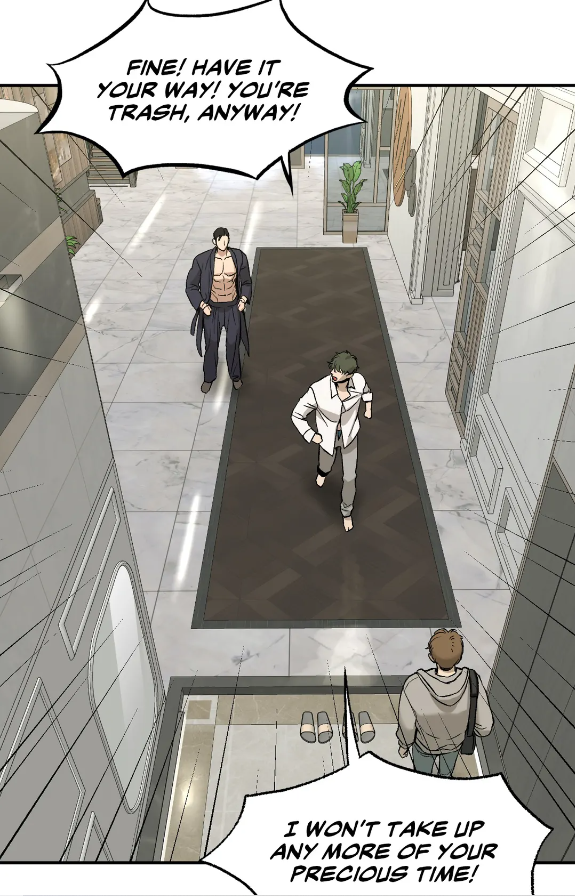 (chapter 2) I would even add that contrary to the green-haired guy, the doctor is not judging his patient’s personality, he is blaming himself.
  (Doctor Frost, chapter 32) Interesting is that doctor Frost revealed to her later that her condition made her an easy target, as she kept relying on others.
  (Doctor Frost, chapter 39) And this observation brings me to my next conclusion: he will be approached by really bad guys, the mysterious Mr. Choi!
  (chapter 1) He even needs to learn the difference between good guy and nice guy, but this remark applies to the grandmother.
  (chapter 45) is random, for it stands for “attachment”.
 (chapter 44) He found fulfilment in sex, which stands in opposition to the recommendation of zackbeach. Moreover, I would like to underline that the doctor reduced knowledge to sex:
  (chapter 44) How could he get to know the champion better, when the latter was supposed to be drunk and they would have sex? Getting closer to someone means communication and not really sensuality. Hence his happiness could only be short-lived and illusory. He didn’t take the reality into consideration. Thus I see the physical therapist’s tears as a therapy session:
 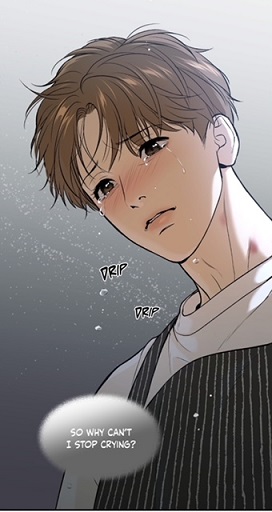 (chapter 46) He allows himself to cry, to grieve and to admit his pain and loneliness.
 (chapter 46) It helps him to face reality. He is on his own, he needs to stop relying on others. I would even say, he is encouraged to make decisions and as such to become responsible for his own life. It is important, because this means that he will have to fight back, if he wants to survive. He can not make any desperate and hasty decisions, like this one:
  (chapter 1) However, since he listened to the champion’s reproach and became submissive again, their relationship seems to have returned to normality. They even appear as close.
  (chapter 41) reminded me of the ending of a fairy tale: they lived happily ever after. But the doctor was forgetting that life doesn’t end after the match in the States. Life ends with death. In verity, the champion is destined to be challenged, until he retires. What the doctor saw was not the end. This exposes his naivety. How could he have such a view? It is influenced by his grandmother.
  (chapter 10) At no moment he pondered about himself. Happiness was never his goal, exactly like in fairy tales. Sleeping Beauty is rather passive. She sleeps, until the prince charming appears and kisses her. After that, they have kids. Interesting is that they don’t get married right away, so that the princess initially has the status of a mistress or concubine. Once the prince can secure his position, he marries her. Then the moment her husband leaves her side for war, she is tormented by her mother-in-law, the ogress. She can only escape death thanks to the intervention of her husband. We could say that happiness fell on her lap. Sleeping Beauty stands for passivity, dependence on her parents and husband and lack of critical thinking. Why? It is because the princess in fairy tales, in particular Sleeping Beauty, embodies toxic positivity.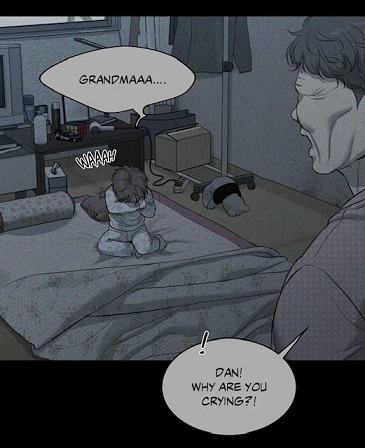
 (chapter 21) She rejected her grandson’s fear and tears. She didn’t allow him to express his abandonment issues. She diminished his anxiety by questioning his behavior: “It’s okay, grandma was just in the kitchen getting a glass of water.” Then in the present, we could use his visit at the hospital:
 (chapter 45) With this contrast, the fear from the champion becomes more palpable. Joo Jaekyung got angry, for he had been put in the same situation. But the latter was never influenced by Toxic Positivity. Besides, he was fighting against his own inner demons. Nevertheless, this new interpretation of the birthday made me recognize why the author chose this chronology concerning Kim Dan’s past:

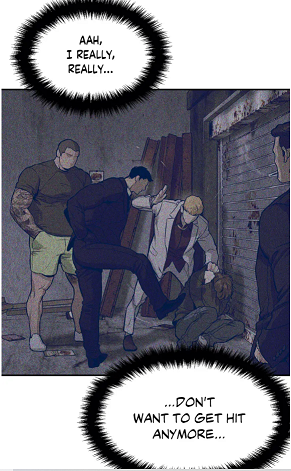 (chapter 1) However, he could never confide to his grandmother about the physical abuse from the loan shark. However, the moment his hope got up
  (chapter 11), as he imagined that he could pay off the debts, he recalled his birthday. He had a nice “souvenir”… convincing himself that everything was fine. He would be able to do it, like his grandmother had told him.
 (chapter 12) Therefore I understand why the doctor didn’t fight back against Heo Manwook and his minions.
  (chapter 1)
  (chapter 11) But the moneylender and his minions are no honest bankers, but criminals. They enjoy using their strength, that makes them feel powerful. It boosts their ego.


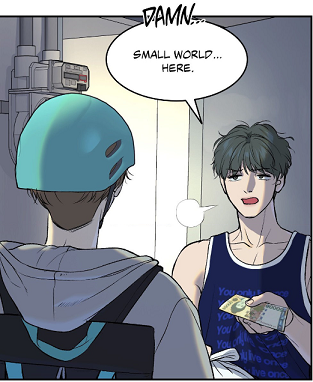 (chapter 42) The roommate acted, as if he was a ghost, as if he had vanished into thin air. He kept a low profile and never asked the green-haired to stop arguing or insulting the young doctor. As for the other, he manipulated Kim Dan to scare him off. That’s the reason why I am more than ever convinced that the next plot is on its way.
  (Chapter 33), you will realize that they belong to the higher middle-class. On the other hand, Cheolmin pointed out that only desperate people would accept to be his sex partner
  (chapter 13). Thus I come to the conclusion that the athlete was pushed to hire prostitutes in the end, for the other VIP members would refuse such a rough sexual behavior. That’s why I have always been suspecting that this club has been dealing with whoredom behind the facade. The silent barman could be the link. Yet, notice that Heesung has a different approach at the club.
 (Chapter 33) He’s looking for his soulmate. This explicates why he could approach these new members so easily. Interesting is that Choi Heesung knows about his jinx and criticized him for his roughness
 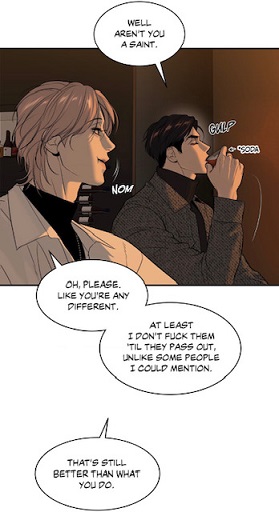 (chapter 33), but he never reproached him to hire escort boys. Our cursed Romeo is not linked to prostitution, hence when he saw Kim Dan during that night, he didn’t see whoredom, but roughness.
  (Chapter 35) So imagine his reaction, when he hears that Joo Jaekyung has been treating his angel as a male prostitute. He will get upset, for Joo Jaekyung is looking down on the protagonist‘s job and his magical hands. But let‘s return our attention to episode 42.
  (Chapter 42) Moreover, the third man knows how to contact the physical therapist, through the restaurant. This means, he can sell the information to someone who is looking for fresh blood.
  (Chapter 16) But Joo Jaekyung didn‘t realize the true crime due to his biased perspective which I had elaborated in the first part.
  (Chapter 40) „One of his own“ would get a different meaning. And if this prediction comes true, Potato’s action could generate a buzz, he would get noticed by public opinion and they could ask for a fight. In other words, through Kim Dan’s actions, Potato’s dream would come true: being recognized as a professional MMA fighter. The bond between Yoon-Gu and Kim Dan would deepen, while the maknae would be disappointed in the champion. He is so rich, but he pushes Kim Dan to take odd jobs. He is not even allowing him to take other patients, while he is not listening to his physical therapist. He made a huge mistake, hence he would become a human in his eyes. He is truly treating the main lead like a prostitute, ruling over his life. Don’t forget that he saw how the champion poured the coke on the doctor’s head.
  (chapter 37) He had crossed the line, but this was unfortunately quickly forgotten. And the charity event would appear as a huge hypocrisy, for he is not helping his roommate.
  (Chapter 6) Yes, the two protagonists have to discuss openly about prostitution. Because he didn’t listen to his doctor, he reduced him into a bump. He is just a tool for his jinx. He was showing no respect to his partner.
  (Chapter 2)



 (chapter 18) Then in episode 22 and 41, the physical therapist stood by the side acting like a cook.
  (chapter 22) Consequently, the physical therapist has been working as the champion’s nutritionist. We could say that in episode 42, it is the same, as he is once again wearing the apron.
  (chapter 41) And the champion came to enjoy this little moment during his long day. They became a part of his routine. This signifies that the association between breakfast and work was slowly vanishing. It was gradually turning into a moment of intimacy.
  (chapter 42) Thus he couldn’t talk to Kim Dan. On the other hand, the cook had done his job, for the dishes were cooked perfectly
  (chapter 42) Hence Joo Jaekyung couldn’t complain to the physical therapist.
 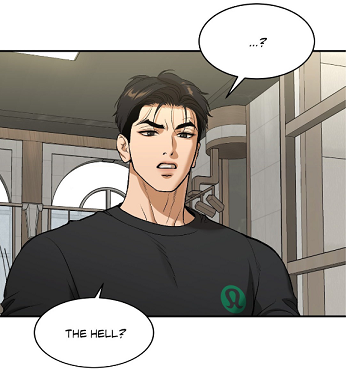 (chapter 42) This means, the “intimacy” vanished, while the notion of work got reinforced. Consequently, I deduce that this little change, a tired doctor, unable to converse with him, will definitely affect the fighter in the long run. The latter will be forced to meditate about the cause for his exhaustion, but more importantly about his emotions and his real expectations from Kim Dan. Why was he annoyed, though the breakfast was made? Does he view him as a employee or a friend? This is what he stated in episode 18:
 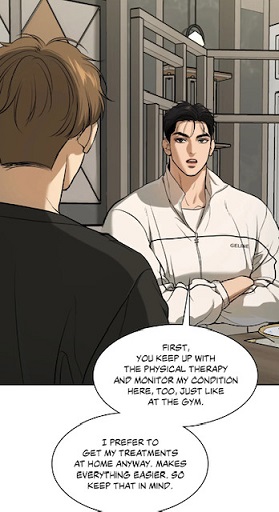 (chapter 18) His stay was justified with work. Kim Dan had a similar reaction. He considered the breakfast as a part of his “work”.
  (chapter 22). In his eyes, it was related to his profession. However, the moment Oh Daehyun and Kwak Junbeom expressed their surprise
 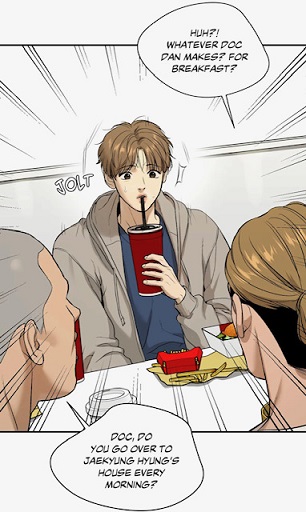 (chapter 22) and their desires
 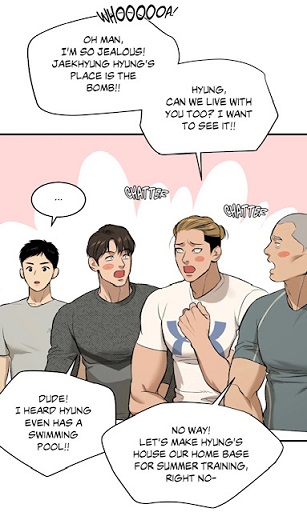 (chapter 22), Joo Jaekyung set a limit very quickly.
  (chapter 22) Why? Was it because he didn’t want to share his penthouse to members from Team Black? For me, his main reason was Kim Dan! If they had come to his place, they could get close to the physical therapist. It would be more difficult for him to “control” doc Dan. He could even experience a similar situation than in episode 7, where he was totally left out.
  (chapter 18) Intimacy without real warmth.
 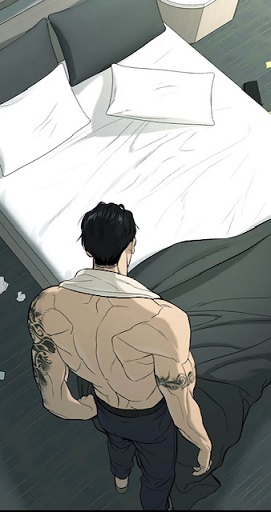 (chapter 4) His silent departure made the celebrity smile.
  (chapter 4) However, in his mind, Kim Dan had not run away, for he had spent the night in his bed.
  (chapter 4) The smile became the symbol of his miscalculation. He imagined that he was still in control of the situation.
  (chapter 4) He had misinterpreted doc Dan’s action. So we could say, this was his biggest mistake. After their separation, he could no longer get in touch with the physical therapist triggering his biggest fears. No wonder why he got so mad.
 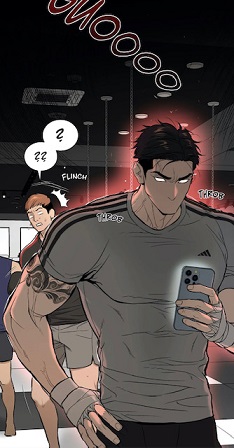 (Chapter 5)
  (chapter 18) , when he changed his mind and asked for sex as “breakfast”.
 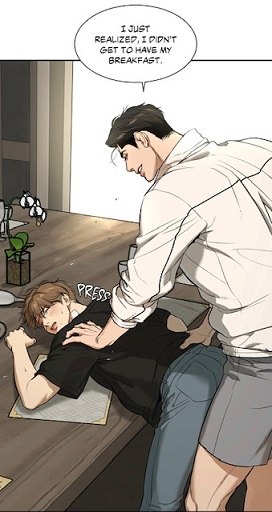 (chapter 18) The trigger for his change of attitude was the following announcement from Kim Dan.
  (chapter 18) The physical therapist expressed his wish to leave the penthouse as soon as possible. Why? It is because Joo Jaekyung had drawn a line which the physical therapist shouldn’t cross.
  (chapter 18) I would even add, he hates pity… exactly like Kim Dan.
  (chapter 19) He would do it at any moment and at any place. Yet, we know for sure that the champion’s libido was different in the past. It was strongly intertwined with his matches. He considers sex as hard work and as such bothersome.
  (chapter 29) So we could say that by requesting sex as breakfast, he deceived his partner. He might be smiling and happy
  (chapter 18), but deep down, he was masking his abandonment and trust issues. For me, both characters made huge mistakes, for they were not honest to each other. Back then, Kim Dan was still rejecting sex, and as such denying the existence of his own pleasure. They could only misunderstand each other, because both were in denial about their own emotional and mental state. Hence they could only commit wrongdoings.
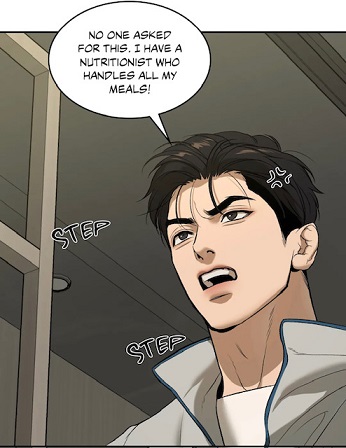 (chapter 22) For Joo Jaekyung, it was a mistake. Kim Dan had crossed the line. But the moment he tasted the food, he liked it so much
  (chapter 22) that it put him in a good mood. Thus he smiled.
  (chapter 22) However, observe that the champion tried to “deceive” his partner after tasting the food.
  (chapter 22) First, he hid his happiness by looking so deadly serious. He was restraining himself to expose his true emotions. Secondly, in that same picture, he is voicing his doubts. He feared that the doctor tricked him in order to impress him. He couldn’t believe that he was such a cook. As you can see, the athlete considered the first breakfast from Kim Dan as a trick and wrongdoing, before he changed his mind. Here, I would like to point out that at no moment the athlete praised Kim Dan properly.
  (chapter 22) It was reduced to a basic skills so that for him, the breakfast is still viewed as a part of his work. However, by watching the athlete enjoying his dishes each morning, Kim Dan got accustomed to observe a content man. It is quite clear that the champion is enjoying his dishes so much.
  (chapter 41) His chewing is betraying his happiness. Through his happy chewing, the doctor started perceiving the athlete differently. He was acting more like a happy child.
  (chapter 41) His expression made Joo Jaekyung smile.
 (chapter 41) However, his words were quite ambiguous. What was he referring to? Many people thought, it was related to the doctor’s love confession, as Joo JAekyung wanted to know if he remembered anything.
  (chapter 41) For me, it is clear that Joo JAekyung had loved this night so much that he hoped that Kim Dan would also have a good memory from it. Remember how happy he was after taking his shower. He was in such a good mood that he had placed the doctor in the middle of his bed.
  (chapter 39). At no moment, he had rejected him. Moreover, he had voiced his pleasure
  (chapter 39) something that Joo JAekyung had been longing to hear from him.
  (chapter 12) He had liked the love confession from Kim Dan, as he had replied to it with a kiss.
  (Chapter 39) Finally, they had many rounds during that night. We could say, he had become the perfect lover during that night. However, the word “mistake” from Kim Dan triggered the champion’s memory.
  (chapter 39) He had thrown all his rules over board.
 (chapter 39) Imagine the doctor’s embarrassment, if he got to hear that he had peed twice while having sex.
  (chapter 39) Moreover, he had challenged his sex partner by peeing on his face.
 (chapter 41), it signifies that for him, it was a funny memory. I am more opting for the last option, for he was smiling like in the moment he discovered his partner’s secret talent.
  (chapter 41) Joo Jaekyung has no problem to expose his rough side to the physical therapist. Interesting is that he doesn’t get scolded by the doctor, though the latter is bothered by his reaction.
  (chapter 41) That’s how I realized how the champion would affect the physical therapist forever. Through him, he will come to accept the usage of the fists. He will stop accepting the emotional, mental and physical abuse from others.
  (chapter 26) Additionally, his growing resilience and fighting spirit became more obvious with his fist. He began clenching his fist,
 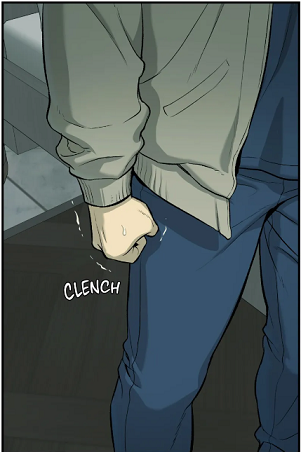 (chapter 10)
  (chapter 42) after getting insulted by the ex-sex partner.
  (chapter 42) Yes, his hand gesture reminded me a lot of the fighter’s:
  (chapter 37) As you can see, the protagonists are influencing each other through their conversations and interactions. And this brings me now to the final breakfast scene, chapter 42.
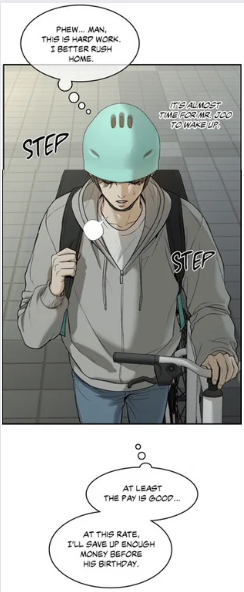 (chapter 42) I would even add that he is no longer following the athlete’s rule.
  (chapter 18) There is no ambiguity that the champion noticed the doctor’s dark circles.
  (chapter 21) However, since the physical therapist has been working each night behind the champion’s back, I assume that such a scene
  (chapter 1) The latter had also vanished suddenly!! According to Park Namwook, the champion had beaten him.
  (chapter 42), I have the feeling that his partner is about to go through the same experience. With his disappearance, Joo Jaekyung would not only lose his delicious dishes, but also his only companion who was able to make him smile and laugh.
  (chapter 42) In the car, he yelled at doc Dan. He advised him not to cross the line. He was no fighter. He should stick to his job, overlooking that Kim Dan was acting as a good physical therapist. He was right to ask the celebrity to stop his training.
  (chapter 41) However, there exists one difference to the first breakfast the physical therapist put on the table.
  (chapter 22) The soup looks a lot like a seaweed soup, a typical dish offered in South Korea for a birthday. And now, you comprehend why in the illustration
 , the first breakfast is facing the birthday cake
 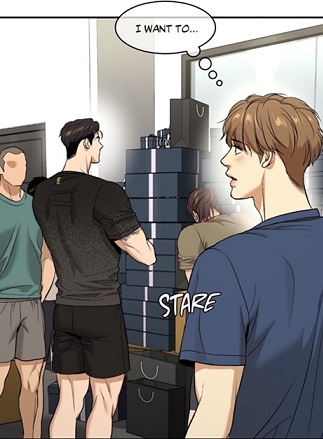 (chapter 41) In fact, he is crossing his arms, as if he was putting a distance between himself and the gifts. In other words, his birthday is connected to business and artificiality which contrasts to the doctor‘s past birthday:
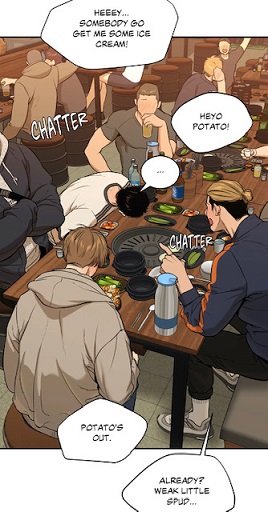

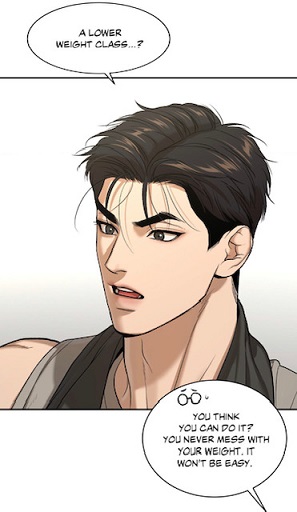 (Chapter 36) Yes, he is not allowing himself to eat „unhealthy“ food or to enjoy a „drink“. Under this new approach, it becomes understandable why the athlete got so furios, when he caught the trio having a party. First, he got upset, because he got excluded. He got jealous, because Kim Dan was laughing with the others.
  (chapter 37) But more importantly, he cannot eat like the others,
  (Chapter 22) And this is something the champion has been missing. When he paid off his debts, he wanted to make the doctor happy, hence he was looking at his facial expressions.
 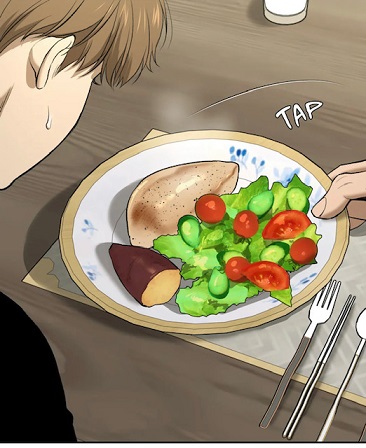 (chapter 13) But for that, the champion has to change his way of life… give up little by little all his past habits (waking up, showering, jogging, then breakfast, training till late in the evening). Everything was revolving around his own life and profession. However, by allowing Kim Dan to live with him, he is forced to find new habits: cooking for each other, jogging together, sleeping together… taking care of each other. This can only happen through arguments. I would even add, it is only possible, when both are honest to each other. Right now, Joo Jaekyung only knows how to share intimacy sexually with the protagonist. He needs to learn to listen to Kim Dan and trust him.
