
This is where you can read the manhwa. https://www.lezhinus.com/en/comic/painter But be aware that this manhwa is a mature Yaoi, which means, it is about homosexuality with explicit scenes. If you want to read more essays, here is the link to the table of contents: https://bebebisous33analyses.wordpress.com/2020/07/04/table-of-contents-painter-of-the-night/
It would be great if you could make some donations/sponsoring: Ko-fi.com/bebebisous33 That way, you can support me with “coffee” so that I have the energy to keep examining manhwas. Besides, I need to cover up the expenses for this blog.
Announcement: The essays “Sex and passion” and “The puzzle with the paper” have been updated.
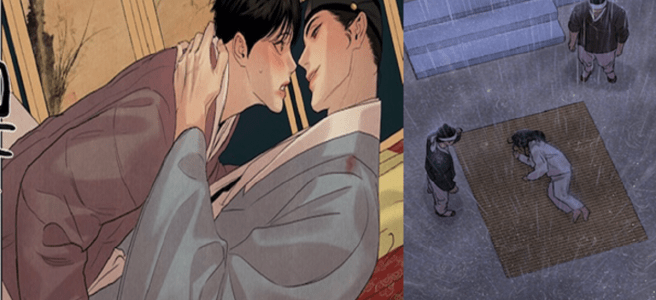
I selected these pictures as illustration for this essay for two reasons. On the one hand, the couple was still in denial about their true desires. Both wished to be embraced and loved by the other, yet in this panel they still feared to voice their own wishes. Why? It is because they dreaded disappointment and betrayal due to their painful past experiences. In other words, they were lying to themselves. Therefore it is no coincidence that at the end of season 3, the two protagonists were confronted with separation and real lies! They had waited for a sign from their partner, hence their karma was to wait and lose the right time. 
 (chapter 102) The painter had confessed too late, for the schemers were already pulling the strings in the shadow. To conclude, the main leads’ self-deceptions were connected to love and time. The importance of self-manipulation leads me to the next observation. All the antagonists and villains were liars, because they were also deceiving themselves. They refused to admit their own fears and flaws, therefore they chose to commit a wrongdoing and manipulate others in order to hide their true thoughts. This means that not only the crime was covered up with a deception, but also the manipulation was hidden by another lie. This means that the list of their sins increased. Therefore it is not surprising that the gods chose to confront the liars with the verity, as they kept refusing to admit their sins. Now, it is time to focus on the antagonists and villains’ manipulations and the scenes where they were facing the mirror of truth. However, the readers are probably wondering where the mirror of truth is. The answer is simple. The mirrors of truth are not only the two main figures, but also Kim and Min, though they are their negative reflections. Remember that in Snow White, the item led the evil Queen to her doom, for the latter refused to accept reality. At the same time, the mirror of truth was not entirely honest either, for it never explained the definition of “Beauty”. In other words, it lied by “omission”. I realized that I can not examine all the antagonists and villains in one text, as I am so detail-oriented. Consequently, I selected Lee Jihwa and Yoon Chang-Hyeon first, for both characters’ lies are strongly intertwined.
1. The red-haired master’s sins
The manhwaphiles could witness his first wrongdoing in the study. He had kissed Yoon Seungho without his consent.  (chapter 77) The problem is that he had been caught by the butler. Thus the door was open. The door is full of symbolism. It can represent opportunity, but also imprisonment. Simultaneously, the door embodies the passage from one world to another in religion and literature. In the analysis “The window, the door, the air and their signification”, I had explained that in Painter Of The Night, the door embodies the passage between the conscious and the unconscious. This means that when all the villains are confronted with the mirror of truth, they are standing on the doorstep. That’s why the reflection is linked to the open door. The characters are forced to face their own repressed desires and anxieties. Hence I deduce that the room symbolizes memories too, which means that we are dealing with repressed memories. In our first case, since Lee Jihwa was seen in the study, this means that when he got caught, he tried to deny his responsibility in the seduction. That’s how he started being in denial of his wrongdoing. Thus out of fear, he left his friend behind and as such he buried the incident in his unconscious. He tried to forget it. He convinced himself that he had seen the friend’s smile. This was the evidence of his “statement”, yet this was just an illusion. However, before he ran away, he lied to the butler too. He told him that the one who had kissed him had been the main lead. So not only he lied to the valet, but also to himself. That way, he was avoiding to feel guilty. There were two lies, and both were used to covered up his own wrongdoing. But the one who had been smiling, was in reality Lee Jihwa, as he had the impression that his dream had been fulfilled. Thus the author revealed the young master’s blushing, the expression of happiness.
  (chapter 77) However, since he had been caught by the valet, he was facing the butler’s visage. And what did he see in his facial expressions? Shock and horror!! That’s how Lee Jihwa realized the gravity of his sin and chose to blame his friend. Thus I imagine that he must have blushed again and this time out of shame and embarrassment. It is very possible that in that moment, he must have copied the valet’s facial expressions before leaving Yoon Seungho behind and lying to the butler. Why do I think so? It is because the butler had made such an expression in front of the barn, when he had been caught.
 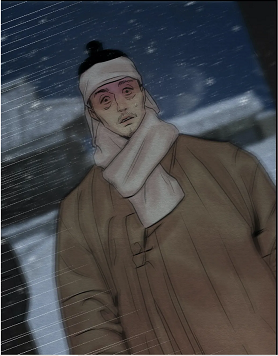 (chapter 64) And what did the main lead say?
 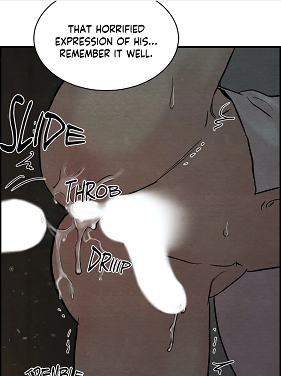 (chapter 64) Since the painter seems to have forgotten it, I deduce that it was the reverse for Lee Jihwa which explains why he felt so guilty in the end. As for the butler, when he had barged in the study, he had committed a wrongdoing himself. He should have asked for the main lead’s permission, but he did not. Consequently, he decided to believe in Lee Jihwa’s deception. One hand washes the other. He was covering up the guest’s sin, while the latter was doing the same thing for the domestic, though I doubt that Lee Jihwa truly realized it. Simultaneously, Kim had the perfect justification to hide the violation of social norms. He had caught the main lead red-handed, hence no one would question his own action. As you already know, I associate the butler to Pilatus, therefore he is connected to the bucket.
And since the childhood friend had been able to avoid punishment by lying and putting the whole blame on his friend, he learned that he could get away by deceiving others and by putting the whole blame on his friend. I would even add that with this incident, he was taught another lesson: Silence and burying the truth. Note that he never came clean, he never exposed the truth to his friend or to the elders. That’s the reason why from that moment on, Lee Jihwa became a hypocrite, but deep down, he felt guilty and ashamed, for he couldn’t outlive his sexual orientation due to the horrified expression. He had to hide his homosexuality in front of others, hence later he had sex in the barn with Yoon Seungho. This explains why the spirits chose to confront Lee Jihwa with the truth on different occasions in season 1.
I could mention the argument between the main lead and the red-haired master. 
 (chapter 13) However, in my eyes, this doesn’t represent the biggest confrontation with the mirror of truth. For me, it is the altercation in episode 17, for it took place in the same place than the aristocrat’s crime. When the red-haired master looked at the picture, he was suspecting that the painter had seduced his friend due to the insinuations by the staff. And his fear reached the peak, when he saw the painter’s reaction:
 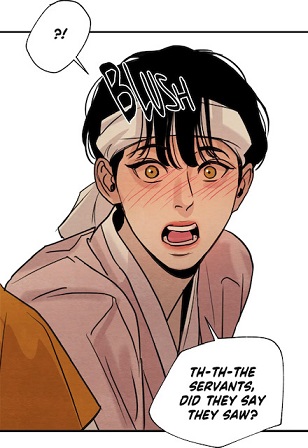 (chapter 17) As you can see, in this episode, the gods were recreating the same situation: a servant had witnessed how the two men “were fooling around”
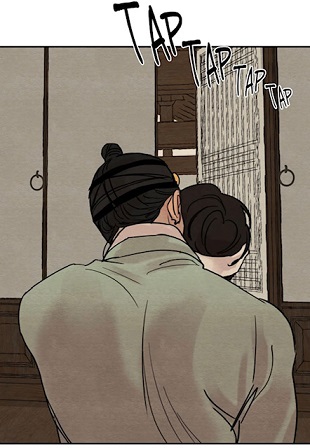 (chapter 16), though this was definitely not the case!! And this is exactly like in the past, Yoon Seungho was totally pure and innocent. And what was Lee Jihwa’s reaction? A slap!
 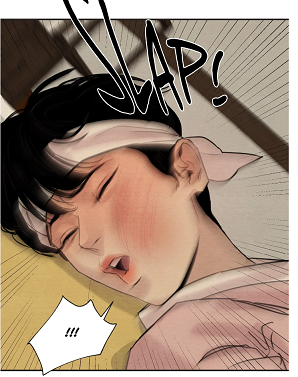 (chapter 17) This is what Yoon Seungho had experienced in the past. Yoon Chang-Hyeon had definitely abused him.
  (chapter 57) Thus the main lead’s cheek was bruised. Then exactly like in the past, Lee Jihwa accused someone else of committing a crime. In the past, it was his friend, in the present it was Baek Na-Kyum. Both were portrayed as immoral seducers.
 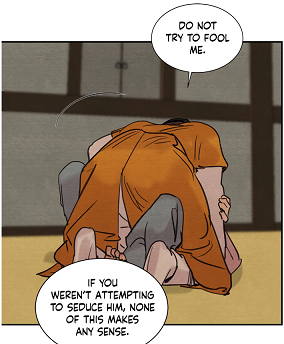 (chapter 17) These words were exposing the verity about the past. Lee Jihwa was admitting in front of the painter that his friend would never act like that, and as such he had not attempted to woo him in the past. Striking is that in front of the painter, the red-haired master was misinterpreting the incident. Why? It is because he was influenced by his past experiences. Since he had lied twice, he jumped to the wrong conclusion that it was the same in the present. And back then, he had even achieved to fool Kim. Therefore he couldn’t allow himself to be fooled like the butler. That’s the reason why he couldn’t imagine that someone was innocent.
  (chapter 17) He was a liar in the past, so it must be the same for the painter. Yet, this was the negative reflection from the past. Thus his karma was to get caught by his childhood friend. Striking is that this time, he was put in his friend’s place. He was turning his back to the door. Moreover, due to his anger, he didn’t hear Yoon Seungho’s steps and the opening of the door!
 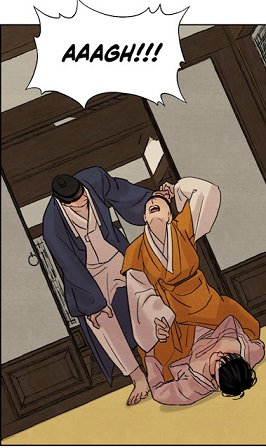 (chapter 17) But the childhood friend refused to face reality in that moment, and as such to admit his guilt and responsibility. Why? It is because he had committed another crime in the past. This is related to the bedchamber incident.
  (chapter 83) However, here he had been caught by his father, hence I believe that this confrontation represents mainly the elders’ punishment. As for Lee Jihwa, despite the humiliation and abandonment in chapter 18, he refused to give up on his friend.
  (chapter 18) One might say that he was motivated by love, yet I think that it is related to his denial about his sexual orientation. And this coincides with his lack of honesty. He had not confessed his own sins and lies yet. Therefore
  (chapter 36) he presented himself as a pitiful creature, as he was sharing the protagonist’s suffering due to his knowledge. However, this was not empathy, just sympathy. The person only feeling sympathy will always put a distance between himself and the counterpart. There‘s a “I“ and “you“, but no „we“. The person might come to pity the other, yet he won‘t intervene and help. He will just understand and that‘s it.
 (chapter 36) This panel is the evidence for this interpretation. Lee Jihwa never used the personal pronoun “we”, even during the abduction.
 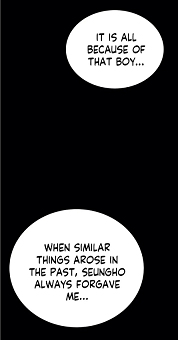 (chapter 59) [For more information about sympathy read the essay “Sympathy for the devil”] Hence the gods let him meet the mirror of truth a second time:
 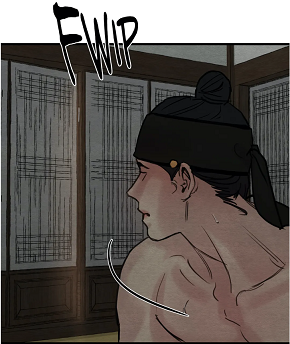 (chapter 43) Based on this panel, Lee Jihwa had more or less barged in the study, but his presence was detected too late! One detail caught my attention in this picture, the presence of the light reflected on the door. Hence I assume that the main lead detected the presence of a witness because of the light!!
  (chapter 43) Let’s not forget that the room was dark, when they were having sex.
 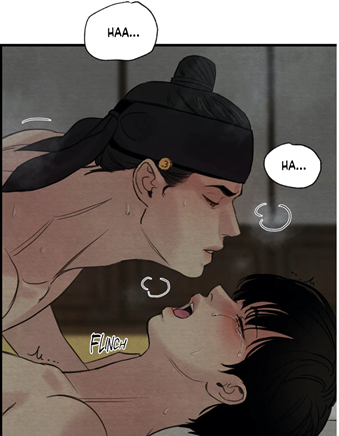 (chapter 42) He was still looking at his lover’s face, when he perceived the change of the light. Hence he turned his head in direction of the light reflected on the door. My friend Luzaly brought my attention to this detail. The couple was turning their back to the door before.
  (chapter 42) The form of the light reflected on the door doesn’t come from behind the gate (chapter 43), for this is what we would see:
 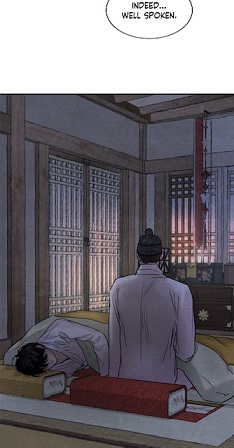 (chapter 97) And now, you comprehend why I came to the deduction that Lee Jihwa had witnessed the love session not from this door, (chapter 43) from a different point. This explicates why once again, the lord couldn’t see the identity of the so-called “peeper”. Besides, don’t forget that the author is working with reflections, as such this means that the second lead must have been placed differently. But this doesn’t end here. I would like to point out that during that evening, the main lead had left the door wide open, when he confronted the artist.
  (chapter 41) However, in the next episode, Byeonduck showed us a slight change.
 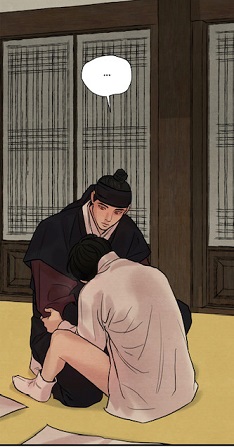 (chapter 42) The door was now close. This means that the butler had intervened at some point. This was the negative reflection from episode 20.
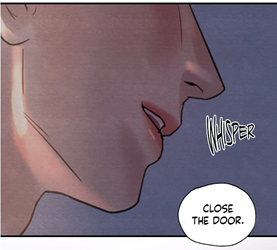 (chapter 20) This time, the main lead had not requested for more privacy, for he had not detected the presence of his right-hand. And this leads me to the following conclusion. Since this is not the door (chapter 43) which had been opened by Lee Jihwa, it is impossible for the second main lead to have witnessed this embrace from this perspective.
 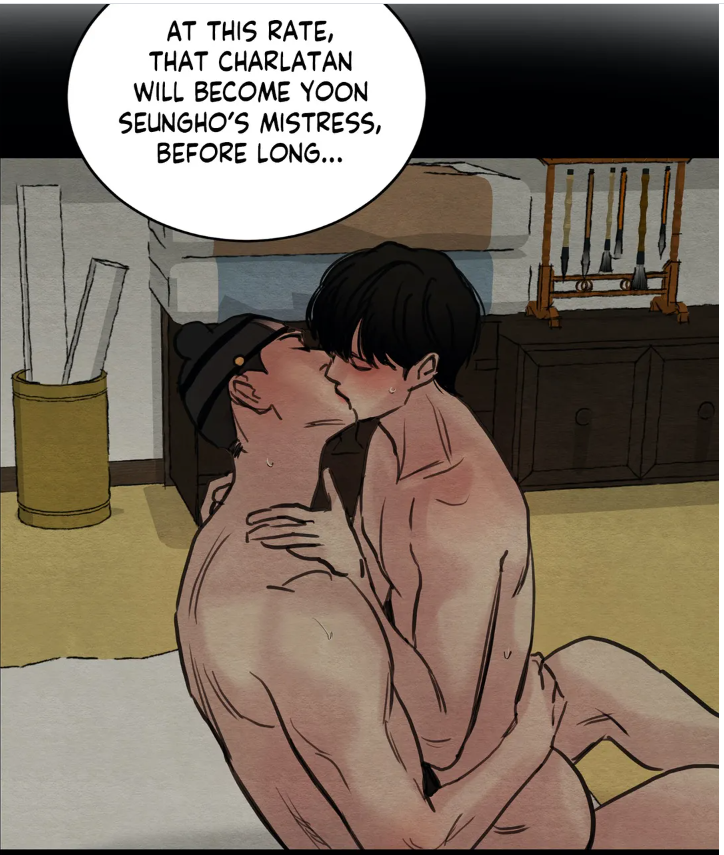 (chapter 43) I am even suspecting that he didn’t view this scene at all, because logically, the light should be coming from the other side!! But on the other side, there is no door!!
  (chapter 49) But there is the window…. And now, you comprehend why Yoon Seungho never investigated the matter with the “door”. It had never been opened in the first place. But how could Lee Jihwa imagine such a scene? (chapter 43) It is impossible, for he confessed later that he knew about the friend’s longing for an embrace!
 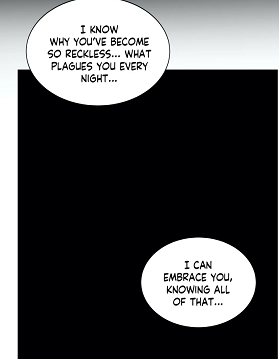 (chapter 57) However, here it is necessary to remind the readers of my previous character’s examination. I had described Lee Jihwa as trapped in a dark room, because he had lost his auditory and visual sense due to his guilt!! This was the price to pay for his sins. He had imagined to see the friend’s smile and he had lied to the butler. And since in episode 17, his visual senses were triggered (the painting, the painter’s facial expressions), I deduce that in chapter 42/43, this time Lee Jihwa was confronted with the mirror of truth through words. Through the window, he could hear the moaning of the couple, hence he couldn’t see the painter’s sadness. Moreover, this is what the painter said:
 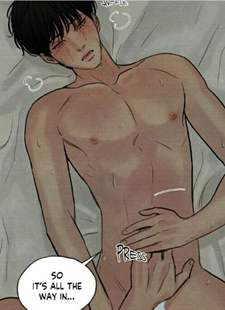 (chapter 42). It sounded like he was indeed seducing the main lead. As for the embrace, he couldn’t hear it, but someone had heard the longing from the painter. (chapter 41) In other words, the butler had helped Lee Jihwa to spy on the couple and had even divulged what he had heard from before. Naturally, he had deceived the red-haired master by omission. He never mentioned the existence of the scholar and the painter’s broken heart!! One might argue that this is not possible. I am again overthinking. But I would like to outline the existence of the following rule on which the story was created: the reflection within the same episode. How did Black Heart manipulate the red-haired master in the pavilion? Through words and that’s how the childhood friend came to envision this scene:
  (chapter 43) The gods were punishing Lee Jihwa for his lie: his friend’s smile!! But I have more evidences for this theory. First, it is important to pay attention to Min’s words, when he manipulated Lee Jihwa. First, he portrayed the painter in a pejorative light with the idiom “indecent life”.
 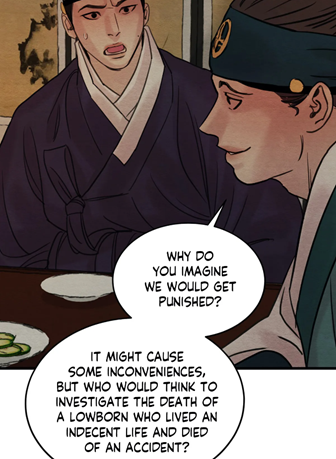 (chapter 43) Moreover, the noble employed the personal pronoun “we”, which is not typical for the selfish and hypocrite villain. This means that he was repeating Kim’s words. Then he added how the couple would have sex in the barn
  (chapter 43) (“vulgar roll in the hay”), but this was not true. However, this is what had happened in the past with Lee Jihwa. The latter would have sex with his childhood friend in the storage room. This explicates why Lee Jihwa came to believe in Black Heart’s words and manipulations. With such a description, he was reminded of his own past!! Therefore it is not surprising that Lee Jihwa had such a vision. (chapter 43) This is what he had wished in the past, and what he had done too: he had seduced his friend and smiled… and he had been caught! In other words, Kim was actually viewing the red-haired master as an immoral witch:
  (chapter 43) Moreover, since this night was a reflection of the first Wedding night, this means that the author left a clue there. And now, look at this…
 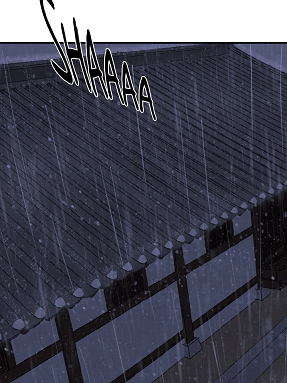 (chapter 21) The windows!! As you can see, the door is not the only place to spy or interrupt intimacy. Secondly, we should have reflections of the spying through the window in season 2.
 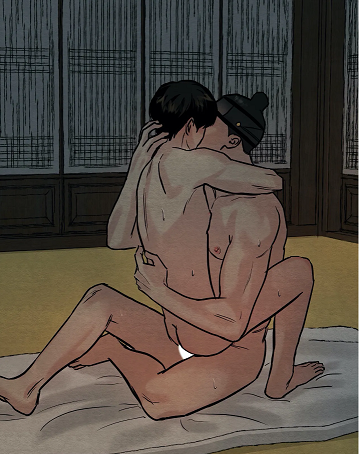 (
( Chapter 49) In this episode, the light in the study had suddenly vanished, and this is what we had before: (Chapter 49) This darkness exposed the presence of someone outside. Then in episode 70, the author drew a panel focusing on the window and the bougies.
 (Chapter 70) I had already suspected back then, that someone was listening to their conversation, and with this new discovery, Lee Jihwa hearing the love session from the window, this interpretation gets reinforced. Furthermore, in chapter 96, the main lead had explained the opening of the door with this:
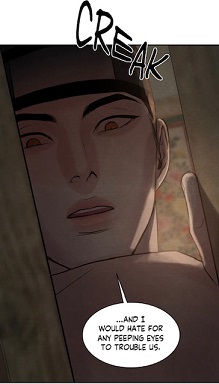 (chapter 96). This signifies that in the past, the lord had explained the sudden opening of a window and the vanishing of the candle light with the wind during the night of chapter 49.
But why was Lee Jihwa confronted with the mirror of truth? It is because he was still dishonest. He kept deceiving himself and refusing to admit his wrongdoings. In the inn, this is what he had said in front of the nobles:  (chapter 36) The reality is that he couldn’t cut ties with his friend. He had lied in the past, therefore he got manipulated in the present. And since he was confronted with his auditory and visual senses in season 1, he was put in a similar situation in season 2. However, there was a slight change, now the red-haired master was confronted with a real crime: murder!!
  The darkness of the room and the silence from Yoon Seungho and the painter were referring to the master’s loss of senses and his guilt. Deep down, the young master knew that the assassination was not right. And note that the aristocrat had this nightmare in his own bedroom confirming that the room is the symbol for the subconscious. Finally, in season 3, Lee Jihwa got confronted with another uncomfortable truth: his friend’s sexual abuse. Lee Jihwa had acted, as if this stolen kiss was nothing. However, due to his silence, he let his friend get raped. And he knew about this, but he chose to close an eye to this. First, Lee Jihwa refused to share his friend with the painter (chapter 18) implying that in the past, he had to share Yoon Seungho with other men. But since he had declared that the main lead had never taken an initiative, this signifies that the protagonist had no choice in the selection of his partners. He had not the right to refuse anyone, not even the red-haired master. Hence the latter got furious and angry, when he was rejected for the first time.
 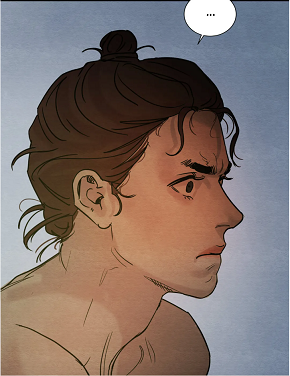 (chapter 5) Therefore it is no coincidence that in the shaman’s house, he was put in the same position than Yoon Seungho. He couldn’t select his partner
 (chapter 100), he had to rape Baek Na-Kyum. This is no coincidence that the Joker was standing in front of the door. He was pushing the young man to face his repressed memories and lies. That’s the reason why exactly like in the pavilion (chapter 43), Black Heart coerced the antagonist. He used words to manipulate the second lead, but there is a huge difference. The shaman’s house was representing the young noble’s unconscious and as such his true personality, while it was not the case in the pavilion. The room in chapter 43 was more embodying the Joker’s unconscious. Why? It is because Lee Jihwa was speaking the truth in that scene.
 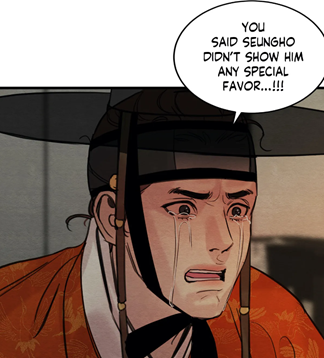 (chapter 43) He reproached Black Heart to have deceived him. On the other hand, the scene in the shaman’s house corroborates my interpretation that Lee Jihwa had not seen the embrace from chapter 42, for Black Heart was voicing the butler’s thoughts and emotions.
  (chapter 100) This shows that during the night of chapter 42/43, the valet had intervened. Thus Min was acting, as if he was a victim in the recent past. He had been deceived by Lee Jihwa’s lies by omission or commission. This is what had happened in the past. Besides, I realized that when the man confessed the incident in the bedchamber
 (chapter 83), Min couldn’t see the whole story. He had to rely on the second lead’s words. Just because we could observe the whole scene, this doesn’t mean that this was the case for the character. It is very likely that Lee Jihwa left details out, especially as he portrayed himself as a victim. Due to the narration, Min could have been misled. He could have envisioned that the childhood friend was living in the study and had dragged his friend to the bedchamber. Hence you comprehend why I consider it as another evidence that Lee Jihwa didn’t view the love session in the study from chapter 42 with his own eyes. He had to rely on his ears and naturally Kim played a role before Black Heart’s intervention. The servant hoped that Lee Jihwa would decide to do something…. in other words, he had been gradually manipulated by Kim and Min to hire an assassin. That way, he could be blamed for the murder of the scholar. He would become guilty by association. And the one pulling the strings behind the scene can only be the mysterious lord Song, for he can no longer interfere directly, though I am certain that he was not aware of the butler’s own meddling. Why? It is because in the past, Kim had never become proactive like that. Moreover, I think that even in the past, the man was not omniscient and omnipotent either. He over-estimated his own abilities, and didn’t recognize that he had been fooled himself either.
But let’s return to the scheme in the shaman’s house. The young master Lee was now cornered, for he had kept denying his own wrongdoings: the sexual assault with the stolen kiss and the lies by omission and by commission! What caught my attention is that the antagonist associated the sexual abuse with murder!  (chapter 100) This is no coincidence, for the sexual abuse is the reason why Yoon Seungho’s heart and soul got destroyed. This had the same effect than killing someone, especially if the person is so innocent and pure. Because he recognized the truth, he had the courage to abandon and betray Black Heart. That’s how he could redeem himself in the end.
  (chapter 100) At the same time, this is not surprising that Lee Jihwa met his friend and admitted his wrongdoing. For the first time, he didn’t remain silent and chose to intervene!! I also believe that during that night, he apologized to the protagonist before vanishing. In other words, Lee Jihwa had to face 4 different mirrors of truth, until he was able to admit the verity. He was responsible for Yoon Seungho’s suffering. He had lied, therefore he got deceived, until he had no other choice to confess his guilt and sins.
2. Yoon Chang-Hyeon’s lies
In episode 77, we discover from the butler the patriarch’s following promise to Kim: 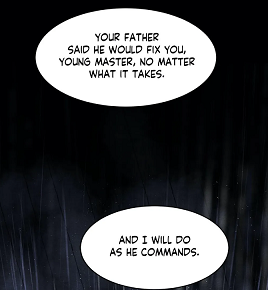 (chapter 77) He would do anything to cure Yoon Seungho implying that he wouldn’t mind spending money for the main lead’s treatment. However, the truth was that he refused to send for the physician, when the young boy was sick after the straw mat beating.
  (chapter 77) This means that he broke his promise. Striking is that the vow to the butler was introduced in connection to the patio!! When the readers hear this promise, this is what we see shortly after.
 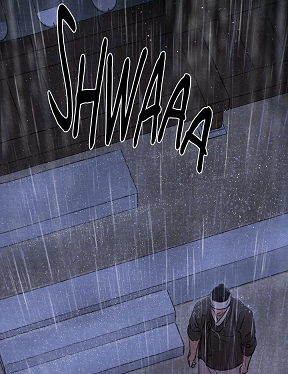 (chapter 77) Secondly, the elder master Yoon was seen shortly after there.
 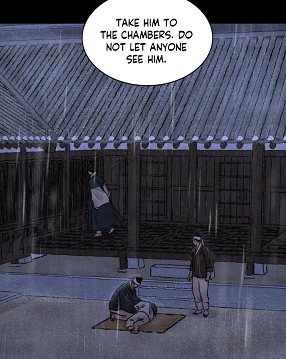 (chapter 77) That’s how I realized that the elder master was connected to this patio in front of the building. Thus Byeonduck showed us him in this place in the gibang
  (chapter 87) Finally, there exists the flashbulb from Yoon Seungho’s memory:
  (chapter 55) My avid readers will certainly recall how I had claimed that this scene was representing Lee Jihwa and father Lee. I am not changing my mind, but I would like to point out that this story is built like a kaleidoscope and as such, each image is actually a reflection. Thereby I come to the conclusion that in this panel, the young boy and the elder are in verity embodying 4 people: the boy is Lee Jihwa and Yoon Seung-Won, as for the elder, it is father Lee and the elder Yoon. Why? It is because the punishments were related to the Lees’ behavior and words. There is no ambiguity that elder Lee intervened to protect his son’s reputation. In other words, father Yoon was seen in the patio in chapter 55. Then when he visited the physician, he remained outside too contrary to the main leads.
 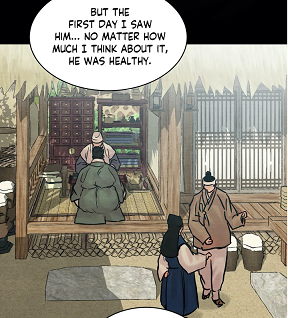 (chapter 57) It was, as if the elder master had nothing to hide, for the domestic and the butler could hear him. However, the latter got deceived. There is no ambiguity that the valet and the young master trusted him. On the other hand, the valet was the one who introduced him to the physician, like we could see here.
 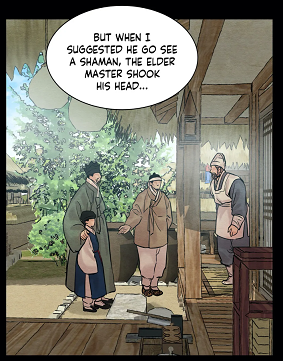 (chapter 57) But what does it mean? First, it shows that Yoon Chang-Hyeon was never seen in the bedchamber!! In other words, his power was fake. This interpretation gets validated, when I use the confrontation between Heena and Yoon Seungho.
  (chapter 65) In that very same place, the protagonist had been insulted and could do nothing, for neither Kim nor his staff intervened. And this perception reinforces my perception that the patriarch has always been delusional and arrogant, over-estimating his own power. Moreover, the lord was not honest either.
  (chapter 65) This shows that the patio is connected to violence, hypocrisy, deceptions and offenses.
Moreover, the patio in front of the bedchamber where anyone can see and hear the elder Yoon reminded me of the learned sir who selected the pavilion to incite the painter to disobey his host and sponsor. That’s why I started suspecting Yoon Chang-Hyeon again, if he had not manipulated the butler in the past and this on purpose. Moreover, since in Painter Of The Night, the room embodies memories and the unconscious, I deduce that the patio is exposing Yoon Chang-Hyeon’s true personality. He lacks not only integrity, but also knowledge. Let’s not forget that knowledge is acquired through reading and experiences. But in the patio, there is no book… and the person can only witness what is happening in the courtyard. This means that the view is limited and the person is not interacting with people. This explains why the man is stupid and superficial. Because of this new discovery, I had another revelation!!
According to the main lead, only his grand-father had a government post. 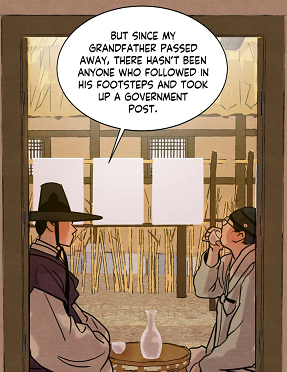 (chapter 7) Then in the study, Yoon Seungho confessed that his father had been dismissed from his post which contradicts the previous statement.
 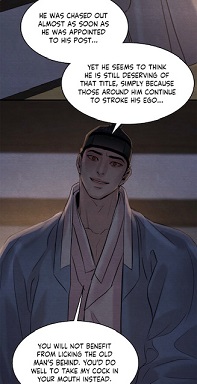 (chapter 80) But how did Yoon Chang-Hyeon obtain his office then? Then the expression “follow in his footsteps” caught my attention. That’s how I realized that the elder master never passed the civil service examination!! In truth, he failed terribly. How can I be so sure about this? First, the civil service examination consists of different tests. Secondly the idiom from Yoon Seungho indicates an gradual rise in the grandfather’s career which is not reflected in the lord’s confession to the messenger. Finally, in front of the mirror of truth, the father voiced the following wish:
  (chapter 86) This expectation exposes that this had not happened in the past. But why didn’t he expect this from Yoon Seungho earlier, though the latter had such a good notoriety? It is because he desired to be admired himself. He viewed himself as the Yoons. Thus he said this to his son:
  (chapter 86) This means that he was using his own sons for his own career, though he claims that he is doing for the Yoons’ notoriety. In other words, the patriarch’s position was obtained through sexual favors. But since the king was the sponsor, there is no ambiguity that at some point, the elder master must have started dreaming even bigger, similar to the scholar:
 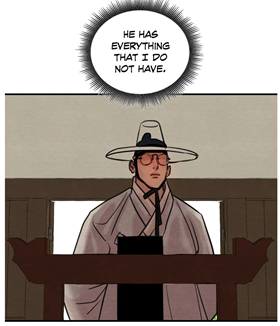 (chapter 18) Hence I have the impression that he must have acted, as if he was the king’s relative. Hence he asked to be called by a certain title. This could only infuriate the mysterious lord Song, for the latter was hiding his sodomy and debauchery behind closed doors. No one was supposed to make a connection between him and the Yoons. However, I don’t think that the elder master Yoon had planned everything from the start. He had definitely been misguided, for in season 1 and 3, we could see that he was believing blindly what people would say to him. He never doubted his son’s words, when the latter said that Yoon Seungho had given him such a paper.
  (chapter 44) And it is the same with father Lee. That’s the reason why I still think that he had been manipulated. He was pushed to sell his own son, thinking that the Yoons would benefit from it. However, this was just a delusion, as he was dependent on the monarch’s benevolence.
Therefore I came to realize that the confrontation in the bedchamber in chapter 83 was actually organized to mock the elder master, but not only by Kim. (chapter 83) Here, he was confronted with reality. His power came from prostitution and nothing more! From my point of view, this scene was a reflection of the night in the study with Min: 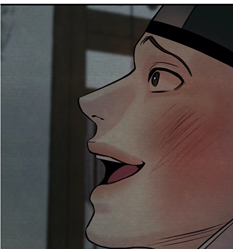
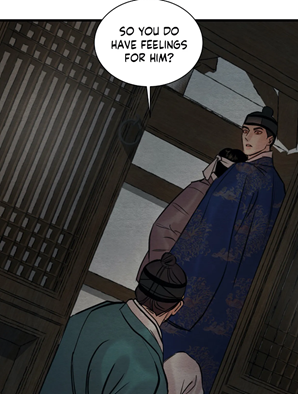 (chapter 53) But Yoon Chang-Hyeon refused to admit it, it went so far that he was denying his relationship with Yoon Seungho. He was just an animal.
 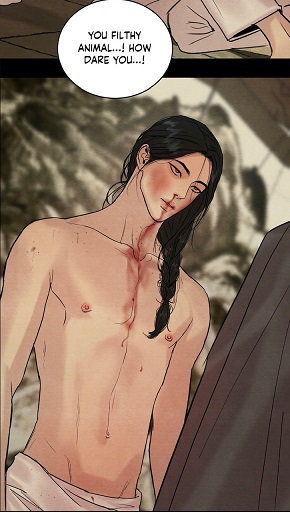 (chapter 83) The reason why I am connecting it to episode 53 is because of The Joker’s smile which reminded me of lord Song’s evil smirk.
  The man had a view to the patio, hence he could see who could enter the bedchamber or not. And observe that when the brutal father was in the bedchamber, the main lead never replied to him. This could only reinforce the man’s delusion and greed. That’s the reason why Yoon Seungho had to live in the barn and was not dressed properly. The elder master Yoon was avoiding his son for this reason. He was closing an eye to the truth. And that’s how he could convince himself that Yoon Seungho was just a sodomite. In other words, he came to believe his own lies, while in the beginning, he had definitely been deceived himself. To sum up, his evolution stands in opposition to Lee Jihwa. Instead of suffering from guilt and shame, he came to adopt this philosophy, Yoon Seungho is responsible for everything. His hatred towards the protagonist could only increase. But reality caught up with him during the same night! He ended losing his power, as all the noble families supporting him vanished. He had promised to cure his son, he ended up as a wreck. His health deteriorated, hence he is much thinner now.
  (chapter 87) He was paying the price for his lies about the cure. Furthermore, the manhwaphiles will realize that he is no longer seen in the patio.
  (chapter 44) This explicates why he refused to bid farewell to Yoon Seung-Won from the patio. This means that he chose to live in the bedroom, totally cut off from the world. And this leads me to the following observation. Once he met his son after such a long time, he refused to accept the verity. He was responsible for the situation and for Yoon Seungho’s suffering. This shows that his self-manipulations can no longer be removed. He remained once again totally delusional, thinking that the treason was just a subterfuge!
  (chapter 86) Why? It is because the young lord was supported by the “king”. But since he had cut ties with the main lead in the past, treating him like a servant, there is no doubt that the pedophile doesn’t view Yoon Chang-Hyeon in a good light. Hence the son became the true owner of the mansion. In the bedchamber, the father was confronted with the consequences of his decisions and lies. He had lost everything: his position as the head of the family, the propriety, the wealth and the connections. Thus he was left speechless.
 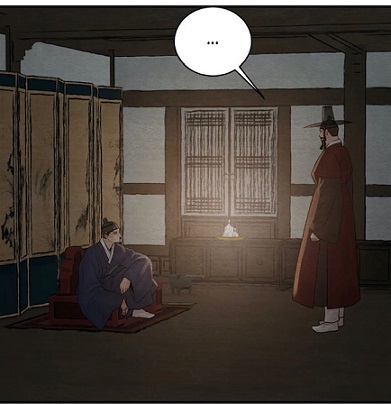 (chapter 86) But when he arrived in the study, this is what he saw. This picture revealed his greed and ambition
 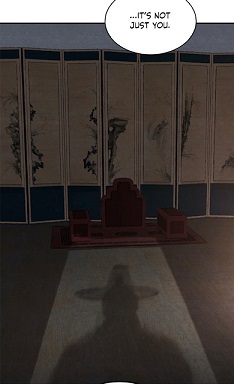 (chapter 86), but he would never admit it. This is no coincidence that the open door is reflected with the shadow. He claimed to contribute to the lineage of the Yoons, but like mentioned above, he was only thinking about himself. This scene shows that he was eyeing for the throne, and this must have happened in the past too. That’s the reason why I believe that he did sell his son to a pedophile for his own greed and ambition, but he never admitted it. He used the family and traditions to hide his ruthlessness and selfishness. When the father was on the verge of leaving the study, he expressed his regret that he shouldn’t have saved his son.
  (chapter 87) This was another self-deception. Without the main lead, the latter would have lost everything. Note that he is living comfortably in the house in Hanyang. So if the young master were to disappear, I doubt that the mysterious lord Song will allow the father to take over the mansion. His regret implied that he shouldn’t have sent for a doctor. This is important, because this signifies that he will be punished the same way, it will be even worse. No one will be by his side to protect him and to save him… no one will request for the physician’s assistance. Similar to the broken promise in the patio:
 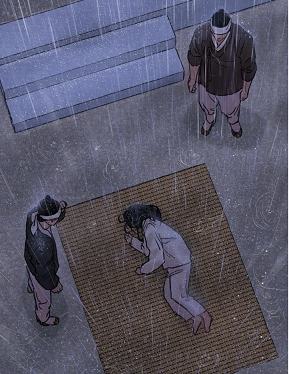 (chapter 77) Moreover, the father acted, as if he was decent and righteous
  (chapter 87), while Yoon Seungho was compared to a monster!
 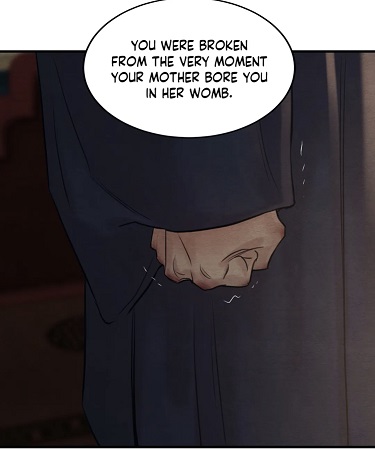 (chapter 86) The outcome of his lie can only be that he will be perceived by people as a monster, as an immoral father who had no conscience at all. How do I come to this conclusion? First, the painter could see right through the father’s gaze.
  (chapter 87) He was a cruel and resentful father. Moreover, the lord’s words always become a reality. Hence the father can only be condemned as the licentious and depraved degenerate.
 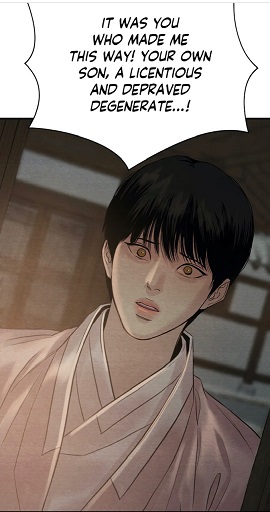 (chapter 86), the black sheep! Furthermore the moment Yoon Chang-Hyeon loses the house in Hanyang, he has no place where he can hide himself from public gaze. He can only ended up as a powerless outcast. I am suspecting that since he longed to be admired and fawned, he could end up committing suicide, for he is unable to tolerate people’s rejection and insults. To conclude, the father refused to admit his guilt and wrongdoings till the end. Even cornered, he chose to avoid reality, preferring to trust father Lee and the butler’s lies. Why? It is because he envisioned that by removing the main lead, he could take over the mansion, and act, as if nothing had happened, as if Yoon Seungho had never existed. The gods will fulfil his wish so that he can be confronted with reality. Besides, note that the patriarch never stopped his son from kissing the painter, he even followed him to the seat.
  (chapter 87) This shows that deep down, the man was not truly against sodomy and prostitution. The father resented the son, for he could only achieve “glory” through debauchery and sodomy. I believe that the elder master Yoon was thinking like this: “no matter what” the Yoons’ power and notoriety must increase. In the bedchamber, the man exposed his true personality, while in the patio he was just the fake image of a powerful, decent and righteous man. This explicates why it took the teenager so long to realize the father’s betrayal. (chapter 55) In the patio, the son still trusted the patriarch. In reality, Yoon Chang-Hyeon needed admiration in order to feel alive. In other words, his credulity, arrogance, superficiality and narrow-mindedness were the causes for the downfall of the Yoons and the main lead’s suffering. We could say that the folding shield in his bedchamber truly reflected his personality.
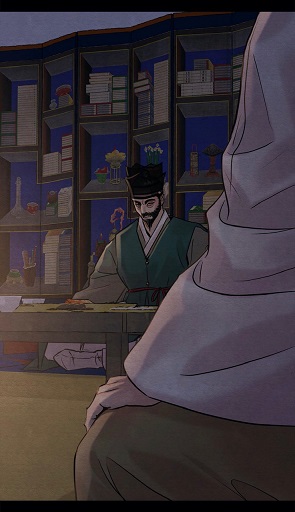 (chapter 82) He was just an empty shell, his knowledge, experiences and possessions were just an illusion.
Feel free to comment. If you have any suggestion for topics or manhwas, feel free to ask. If you enjoyed reading it, retweet it or push the button like. My Reddit-Instagram-Tumblr-Twitter account is: @bebebisous33. Thanks for reading and for the support, particularly, I would like to thank all the new followers and people recommending my blog.

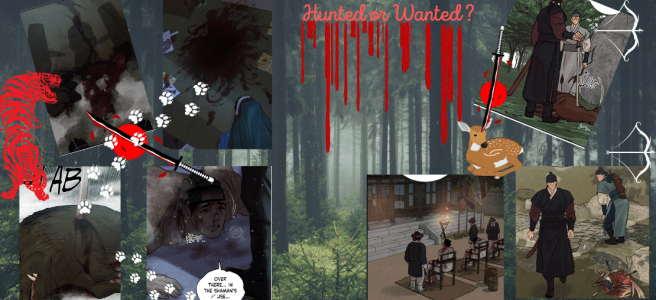


 (Chapter 73)
  (chapter 73) This is important, because the manhwalovers can sense a connection between sex and hunt. This means that the love session in the bedchamber from season 2 should be perceived as a new version of a hunt. And this link between sex and hunting was also present, when Yoon Seungho and Min were in the woods in chapter 41:
  (chapter 41) In this scene, it looked like Black Heart was trying to make a move on Yoon Seungho, while in truth Min was more obsessed with the painter.
  (Chapter 41) The expression „spot“ belongs also to the semantic field of chase.
 (Chapter 11) A murder disguised as an accident, the scholar would have been eaten by a tiger. What caught my attention is that No-Name requested from Deok-Jae that he should make the painter leave the mansion.
  o (chapter 51) It was, as if the rabbit had been chased away from its burrow or the deer had been forced to leave the woods. That way, he would become an easy target for the hunter and butcher Mumyeong. To conclude, we had two hunts in season 2 as well.
  (Chapter 99) First, he was rushing, but the moment he received the crucial tip from his childhood friend, he approached the den silently, just like a tiger. That‘s the reason why neither Black Heart nor lord Jang nor lord Park detected his presence.
  (Chapter 101)
 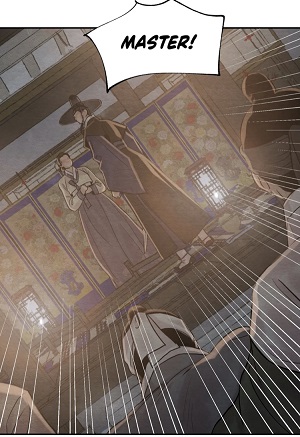 (chapter 99) and Lee Jihwa
 (Chapter 100). He was following his instincts. Tigers cautiously stalk their target from the rear in attempt to get as close as possible to their unsuspecting prey.
  (chapter 102)
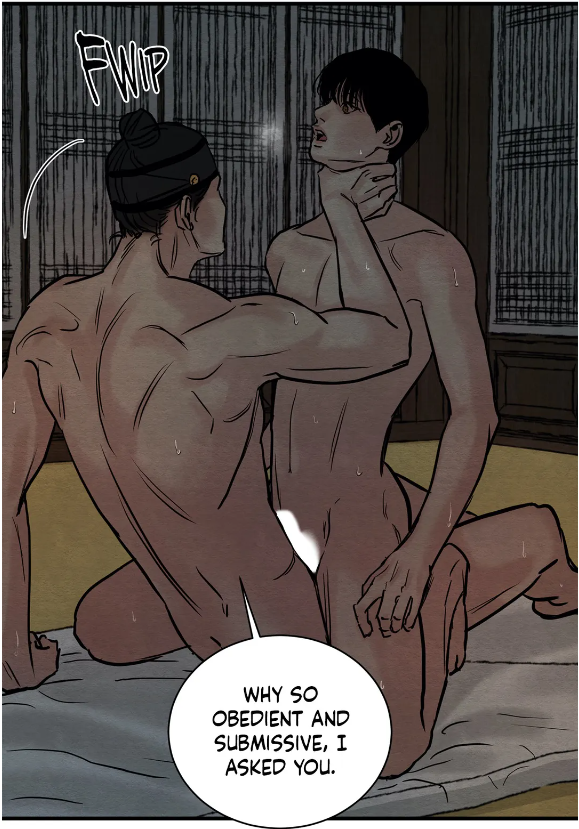 (chapter 48) or the chin
  (chapter 83)
 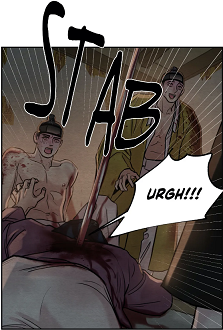 (chapter 102) Even in this panel, the sword resembles a lot to the tiger‘s fang:
 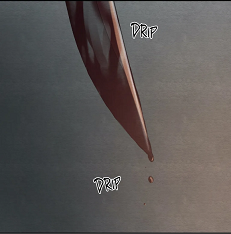 (chapter 102) Another important element is that this predator usually targets large-bodied preys like boar, deer, humans and not rabbit or pheasant. Under this new light, it becomes comprehensible why the main lead went after a boar or the aristocrats in season 3.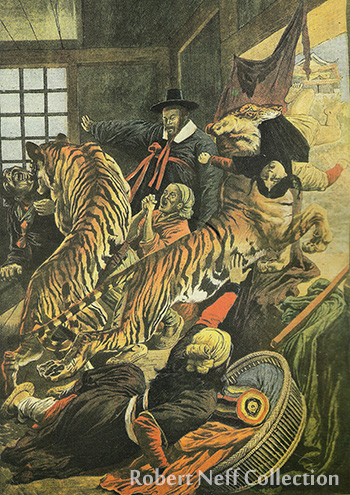
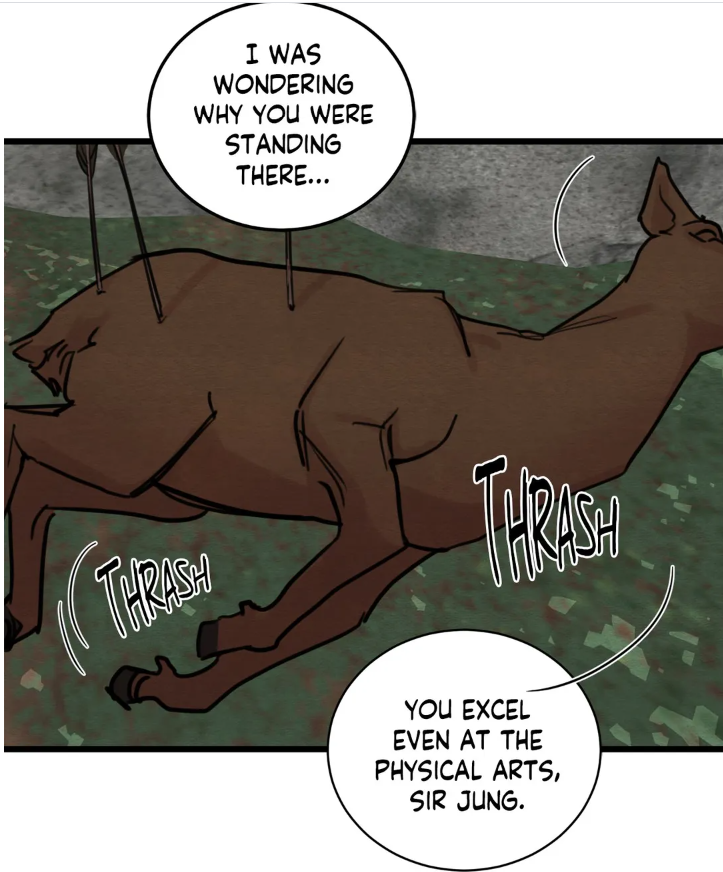 (chapter 22)
 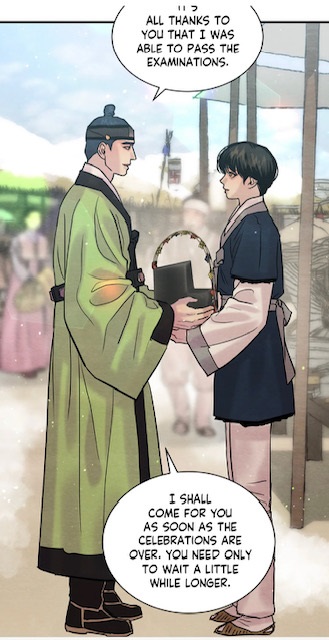 (chapter 111) than the killer in the woods
  (chapter 103), it looks like the learned sir chose to drop his own principle. And if this theory is true, then I come to the conclusion that the learned sir chose to copy the protagonist thinking that he could get away with it.
 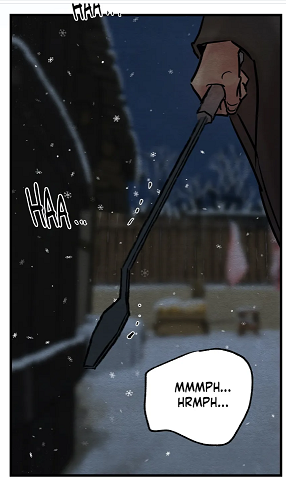 (chapter 60) The latter belonged to the lowest ranks of Joseon’s society, because killing an animal was a disgraceful job. On the other hand, the butcher No-Name and the tiger Yoon Seungho have something in common: killing is viewed as a necessity. It is either to survive or to end the animal’s suffering or to punish the criminals.
 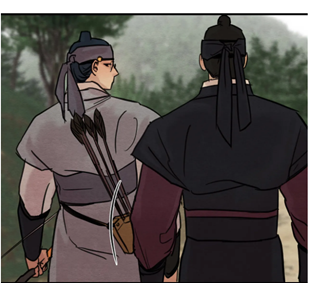 (Chapter 22). And when Black Heart suggested the artist’s assassination, he always kept laughing, making it sound like a game without any terrible consequence.
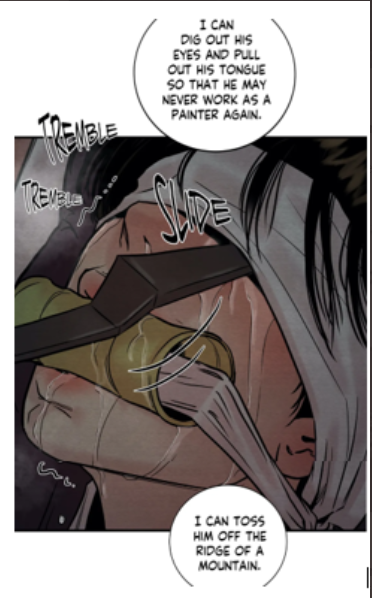 (Chapter 60) By removing his eyes and tongue, the victim’s face would change making him impossible to be recognized. And note that his scarf and headgear had been removed as well. It was not a game, but a deadly matter. Why would he do such a thing? The reason is simple. If no one could identify the victim, there would be no investigation. Astonishing is that hunt is a synonym for investigation and prosecution. Hence I am deducing that in season 4, the investigation should be perceived a new version of the hunt, a new version of this scene.
  (chapter 37) Because of Jung In-Hun and Min, someone will be put on the wanted list. On the other side, Mumyeong’s other job is to entertain people. To conclude, there is a strong connection between killing and entertaining which the main lead destroyed during that night. He reminded the nobles that hunting means taking away a life.
  (chapter 83) Thus I am deducing that this chase had been suggested to the main lead in order to release his tension and as such in order to divert his attention from the painter. Naturally, Kim was behind this idea faking his concern for his master. The hunt was supposed to procure pleasure to Yoon Seungho, but it couldn’t, because he was afraid of losing the painter. This explains why he selected the boar as his prey. He was fearless in front of that dangerous animal, for it meant nothing to him. He didn’t mind losing his life… revealing his suicidal disposition which resurfaced later, when the father mentioned the authorities.
  (chapter 86)
  (chapter 86) But the moment the servant reminded him to pay more attention to himself
 (chapter 83), he abandoned the boar immediately. This shows that all this time, Baek Na-Kyum had been on his mind. Therefore it is no coincidence that he rushed home on his horse and looked for Baek Na-Kyum.
 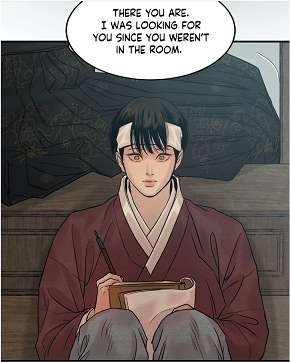 (Chapter 83) He couldn’t forget that he had scared and wounded the painter in his dissociative state. This shows that the chase had not served its true purpose: entertainment. In reality, the domestics had been the ones suffering the most, for them it was definitely more work
 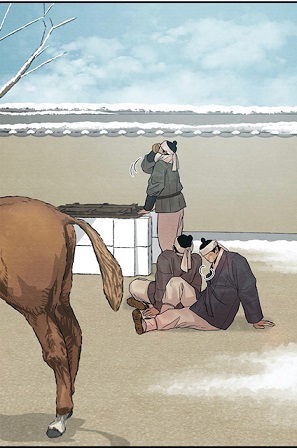 (Chapter 84) compared to the past.
 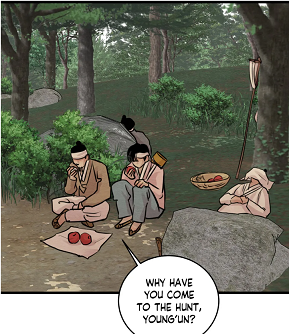 (chapter 23)
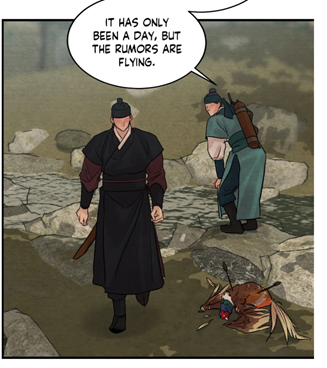 (chapter 41) First, I had feared that he might lose his life, then later I had realized that this death was purely symbolic. He would lose his title and family, therefore he would become a commoner. But I had also expressed my doubts that this scene could be a reference to Black Heart, as from chapter 52 on, I had sensed that he would die. Moreover, observe that during that hunt, Min had wounded the animal himself. This mirrors his own death. He became a victim of his own trick. But if the pheasant is representing two characters, The Joker and Lee Jihwa, then this means that the deer in chapter 22
  (chapter 22) embodies not only the painter, but also someone else. While in the past, I used to believe that it was Kim, now I come to the deduction that it was Jung In-Hun. Note that in this scene, the main lead left the prey and the scholar behind. Both got defeated. This means that by targeting Yoon Seungho, the scholar is not realizing that he is actually endangering his own life. Besides, by hunting the deer, the learned sir offered this prey to the tiger Yoon Seungho, and this was the painter’s case. Furthermore, the deer was carried back home on a horse
 (chapter 24) reflecting the painter’s fate.
 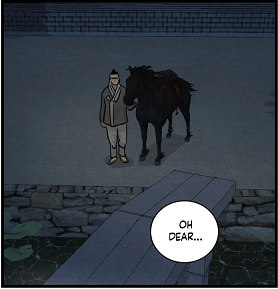 (chapter 25) Who brought the horse to the pavilion? Kim and Deok-Jae! And when the learned sir departed from the mansion, he was followed by the vicious servant and the horse.
 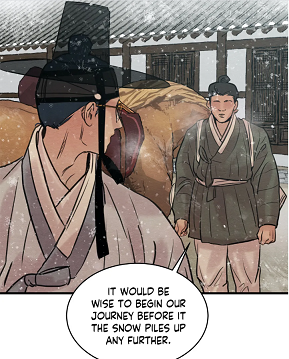 (chapter 44) As you can see, Jung In-Hun is connected to the horse. This observation was even confirmed in season 4.
  (Chapter 111) Thanks to episode 111, I detected another progression. First, Jung In-Hun was walking behind the horse
 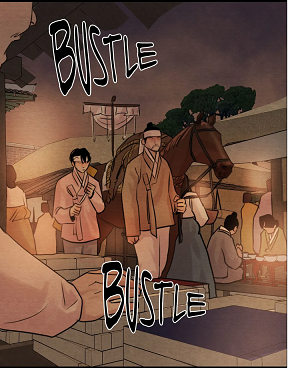 (chapter 24) Thus he could take the artist away unnoticed. Then in episode 44, the learned sir is shown standing in front of the horse. Finally, the manhwaphiles can see the man riding. This reflects his social ascension.
 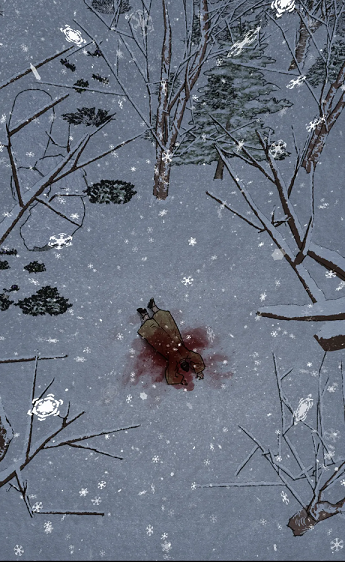 (Chapter 111) Like mentioned above, the shoes could be perceived as the evidence for Jung In-Hun’s crime.
  (chapter 83) The boar symbolizes not only the nobles like Jihwa, Min, Jang or Park, but also the elders Kim, Lee, Yoon Chang-Hyeon, and as such the king. And if you consider the boar as the personification of the pedophile, the ruler, this means that the moment Yoon Seungho hunted down the nobles, he defeated the ruler in a figurative way. I would even say that the nobles like Min or lord Haseon are pushing the main lead to “hunt” the monarch, for the shadows are standing behind the main lead. Due to their tricks, the “schemers” are realizing that they are contributing to give justice to the protagonists. Thus I was wondering if in the end, the main lead would hunt down a human in season 4, Kim or the king. Don’t forget the main lead’s words to the painter:
  (Chapter 103) However, since the manhunt appeared in the first episode from season 4, I deduce that we will have many manhunts in the final season, like here
 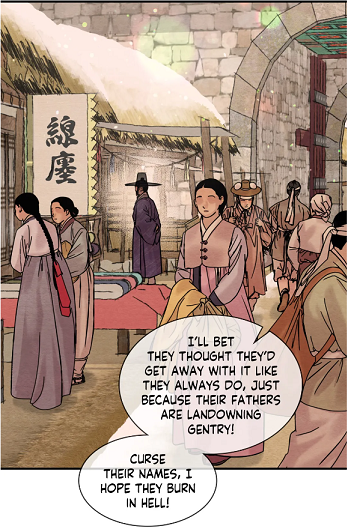 (Chapter 106)
  (chapter 106)
 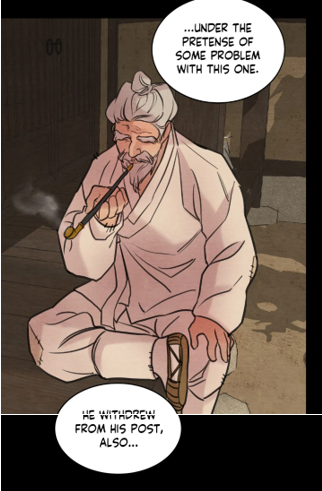 (chapter 37)
 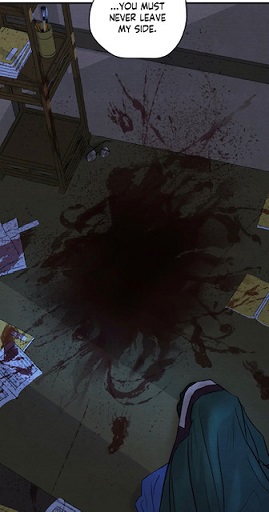 (Chapter 88) On the other hand, the foot print and the glasses were added to give the impression that the learned sir had been murdered. However, after adding blood in the fake crime scene and removing the learned sir’s possessions,
 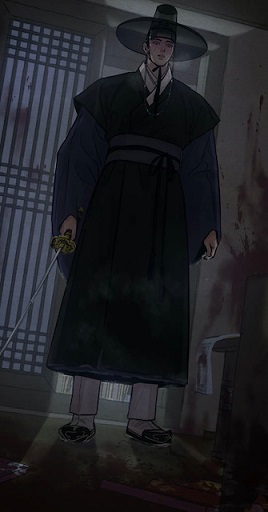 (chapter 100), the place could be interpreted differently. The inhabitant had been attacked by a tiger during the night.
  (chapter 45) the cobweb behind Deok-Jae. Imagine that this scene took place in the middle of winter, thus the spider’s web got covered by frost. However, this indicates that this room had been abandoned for quite some time. But it is close to the gate. So it should have been the place where the doorkeeper is living. Secondly, I had demonstrated that the shrine had been neglected, for the altar had been removed.
  (chapter 18) Because of the presence of the cobweb, I started wondering why the author drew it behind Deok-Jae. In my eyes, it is because he was part of the spider’s web.
  (chapter 18) That’s the reason why Yoon Seungho was not dressed properly.
  (chapter 83) If he lived in a shed and had such a simple attire, no one would ever think that he was a noble in the first place. I believe that neither the patriarch nor the ruler had an interest to reveal his true identity. However, the protagonist had to be monitored, for he could try to escape at any moment. That’s the reason why the butler was still tasked to “take care of him”. But by becoming a male night servant for the king, this meant that the other nobles could claim him as well. He had no right. However, since the main lead was a butterfly, he couldn’t get tamed. Hence violence, manipulations and drugs were used to tame the young master. And remember how the spider kills its target: he empties it of its blood. In other word, he sucks all his energy. Therefore it is not surprising that at the end the main lead had become a wreck, and had no light in his eyes.
  (chapter 57) Naturally, the purge played a huge role in the lord’s suffering reinforcing the huge rift between the pedophile and Yoon Seungho.
 (chapter 57)
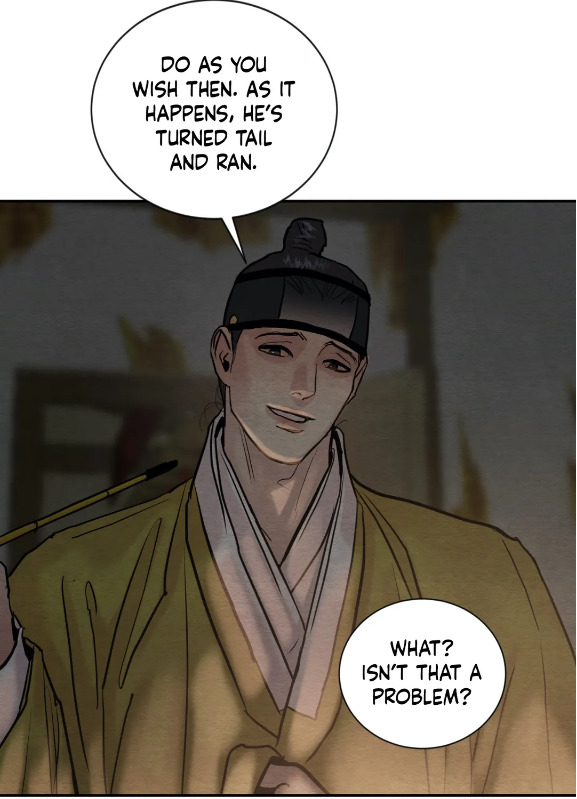 (chapter 101). It was not Min’s task to carry a friend… he was just a fellow puppet brought to the shaman’s house in order to entertain Black Heart. This truly exposes that Black Heart never saw in the aristocrats humans. As the red-haired master, he had been considered as the hunting dog, he had fulfilled his function. That’s why he was abandoned. He had helped Min to corner the painter and brought the kisaeng to the scholar’s home. Moreover, a hunting dog disobeying his master will be killed. Hence it is not surprising that the wild dogs ended up all dead. They were totally defenseless in front of a huge tiger. This feline is difficult to tame.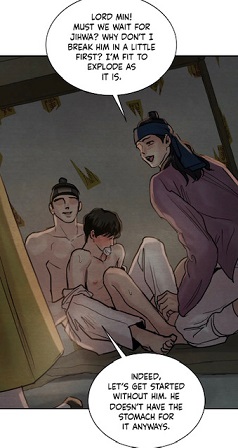
 (chapter 101) They saw in the sexual violence a new form of hunting. I would even go so far to say that they desired to turn the artist into their pet fulfilling all their desires:
  (chapter 101) Thus it is not surprising that Yoon Seungho was compared to an animal by his own father in the past.
  (chapter 101) As a punishment, he was given to lord Jang and his friend. Since Min had captured the artist, he viewed himself as his owner who would give order to his pet. Yet, a deer is a shy, but wild animal, difficult to control making it difficult to be tamed.
 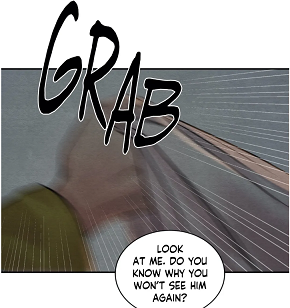 (chapter 99) But this was impossible, for Black Heart never treated Baek Na-Kyum as a man. Hence I come to the conclusion that by meeting the painter, Yoon Seungho rediscovered his true nature: he was a free spirit, a tiger! And guess what… In Joseon, the tiger was perceived as a good talisman to chase away the evil spirit!!
  (chapter 102) Hence the dogs became the preys of the huge tiger. On the other hand, I am wondering if in the next season, the painter will paint a tiger and show it to his lover. So far, we couldn’t see the pictures from his childhood.
 Yoon Seungho has the impression that he could get hunted down, for he killed the nobles. The tiger is now the target of “humans”, and Jung In-Hun will play a crucial role in his prosecution
 (Chapter 10)

 (chapter 01) But after studying the manhwa so closely, I discovered the existence of rules in the manhwa which helped me to dig up new information. I am listing the laws of Painter Of The Night again in order to avoid repeating myself. I will refer to them later in my argumentation (rule 1, 2, eg.). That way the readers can better grasp how I came to new revelations and theories.
 (chapter 94), Yoon Seungho experienced the opposite.
  (chapter 57) He was admired which created a source of jealousy. While the painter discovered sexuality and his homosexuality very early on, Yoon Seungho was pure, but through incidents he was forced to become a sodomite. While Heena and the scholar tried to repress Baek Na-Kyum’s sexuality, the father pushed his son to have sex out of fear and high expectation.
 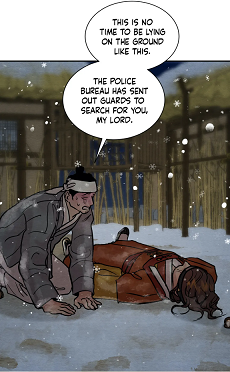 (chapter 101) Striking is that the author used the same method to introduce the memories. First, we see the servant talking before viewing the memories.
  (chapter 101) And now, compare it to chapter 1:
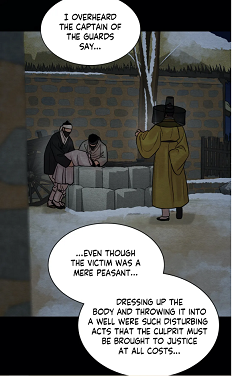 (chapter 101). She was implying that this panel symbolized the vision from the witness, the tailor. This explicates why you see the wall on the left side. The tailor was observing Min in the shadow. This is important, for these images are reflecting the truth, revealing that the servant from episode 101 was actually lying. Thus I deduce that the domestic from chapter 1 was also lying, but contrary to the episode 101, he thought, he was telling the truth. We could say that he was acting as the fake “mirror of truth“. How do I come to this deduction? Simply because the servant in chapter 101 was actually deceiving Lee Jihwa and Yoon Seungho. Note that in the beginning of episode 101, Seokdae tried to defend himself by feigning ignorance.
 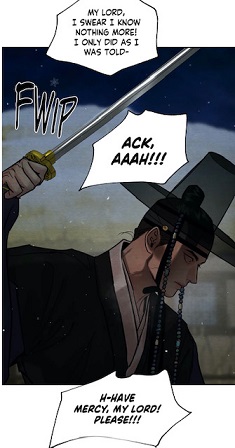 (Chapter 100) He denied his responsibility by putting the blame on someone else („I was told“), yet once facing the young master Jihwa, his declaration exposed his lie.
 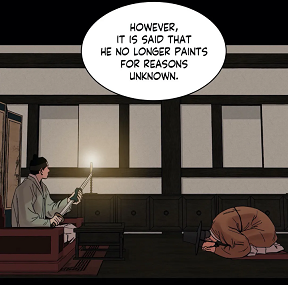 (chapter 1) So in episode 1, the servant was not aware that he was lying to the protagonist, when it comes to the painter’s past. However, the domestic with the brown hanbok lied in one aspect, the publication of the book.
 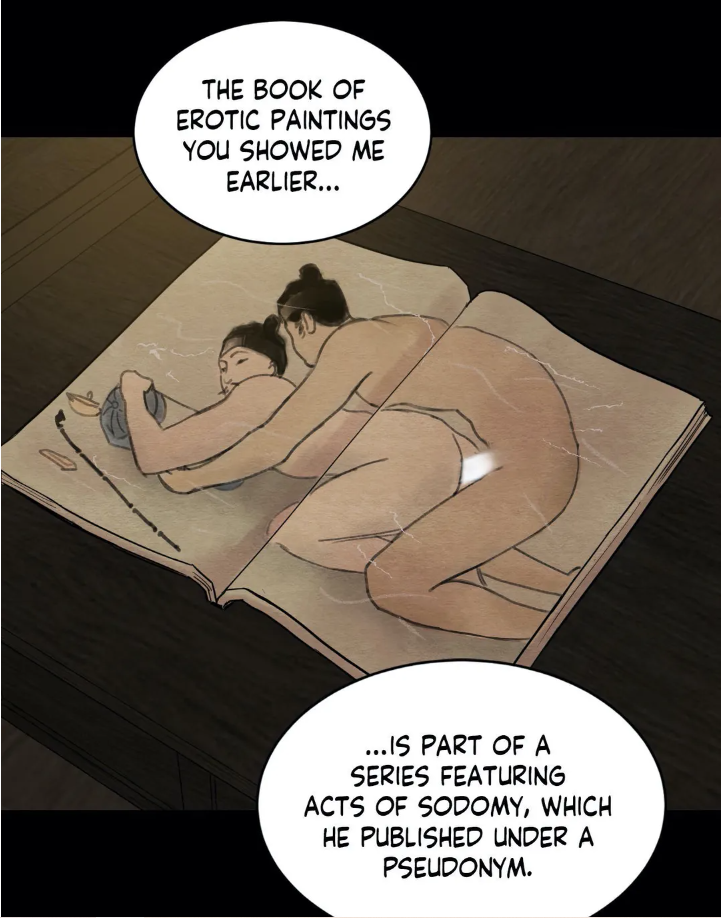 (chapter 1) One might have the impression that I am digressing from the main topic. Yet the manhwalovers should keep in their mind that the servant from episode 1 served one purpose: to show us the memories of an important witness, someone who watched Baek Na-Kyum growing up. Thus we have three different pictures. First, he is a baby, then a young infant
 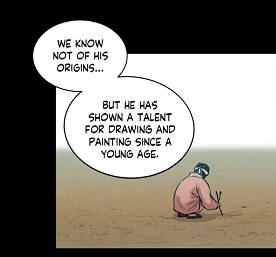 (chapter 1) and later almost a grown-up
 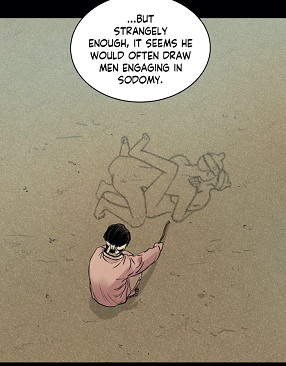 . (chapter 1) This signifies that the witness was close to Baek Na-Kyum which explains why the domestic trusted the source of his information. However, contrary to episode 101, she never divulged the identity of the witness. It is because the person wished to hide in the shadow.
 (chapter 1) It ends with the domestic’s death, while the incident with the topknot is mentioned in the middle. At the end, the painter is dragged to the mansion. As you can see, both chapters reflect each other. That’s how I had this revelation
  (chapter 99) The soil and the position of the pillars of the main gate are different. I can now announce the precise location, and this with certainty. Yes, I discovered the place thanks to rule 4!!
  (chapter 4) This is the door! You can recognize it thanks to the pillar on the side.
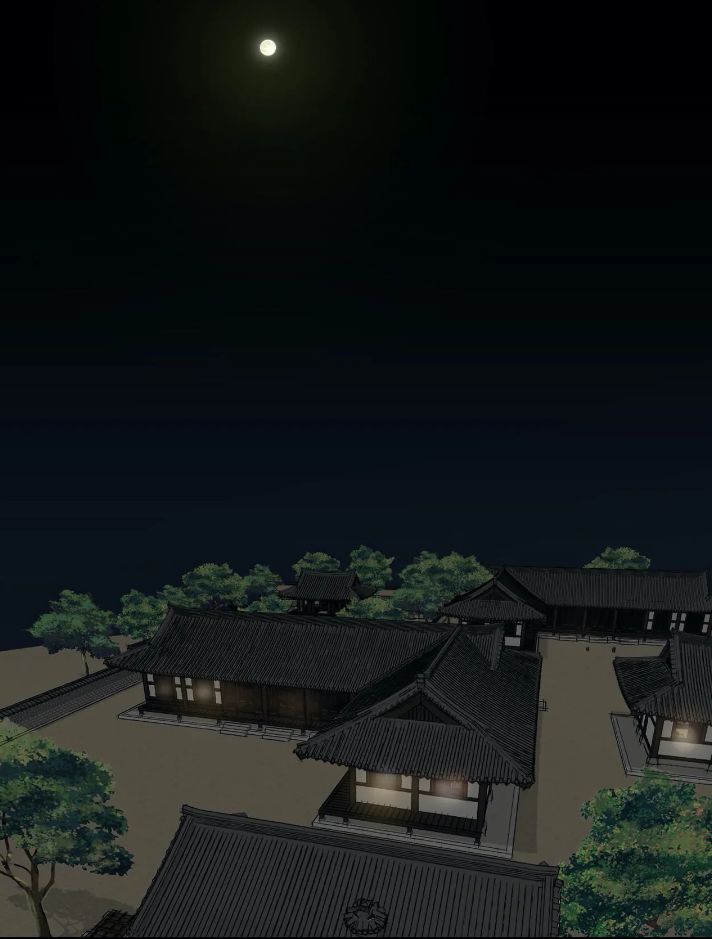
  (chapter 4) Here, the shadow was bigger indicating that it was early in the morning. The painter had just woken up. Consequently, I deduce that the baby was brought to the mansion during the day. This signifies that Baek Na-Kyum was never abandoned! He was entrusted to the owner of that mansion!
  (chapter 1) You can recognize the gate in the background. This is the domain, which you see when the lord is arguing with the painter in the courtyard.
  (chapter 4) Pay attention to the background in this picture. And now, you are probably thinking that the owners of that mansion are the Yoons, as we observed the main lead living there. Nevertheless, I had already pointed out that this was not Yoon Seungho’s mansion. This is the Yoons’ domain:
 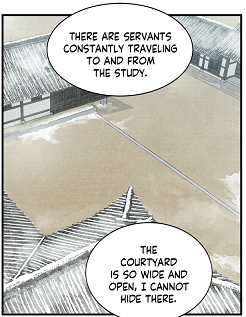 (chapter 51) The courtyard is different. According to me, this is the mansion of the Lees. [For more read the essay 360: Lee Jihwa’s special relationship with Yoon Seungho] And since episode 1 and 101 reflect each other, this can only reinforce my interpretation that the Lees are involved in Baek Na-Kyum’s past, for we have Lee Jihwa present in chapter 101. Baek Na-Kyum was brought to the Lees, thus the scholar Lee keeps calling Baek Na-Kyum a peasant! He knows about his true origins. I had always said that the man was revealing his knowledge with his insult. But does it mean that this was the vision from Lee Jihwa’s father?
 (chapter 38). Besides, father Lee views him as a peasant and not a servant. This observation gets reinforced, when you look at the memories from the painter. In his childhood, he was never wearing a white head-band.
 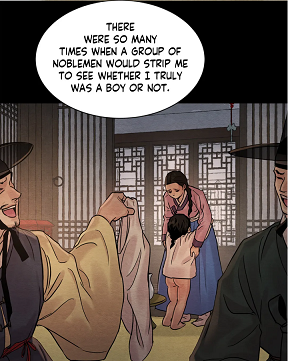 (Chapter 94)
 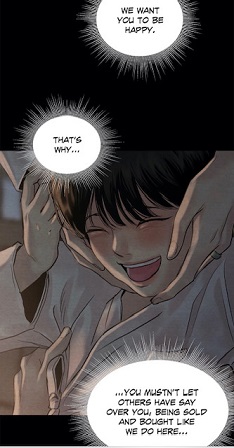 (chapter 87)
 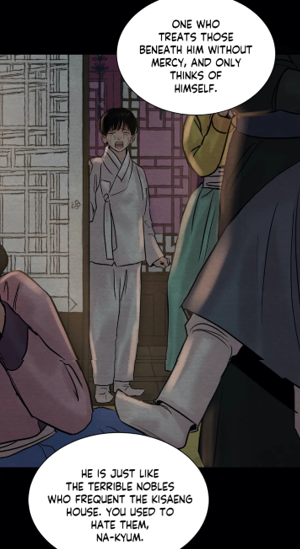 (chapter 68)
  (chapter 70) This means that this panel
 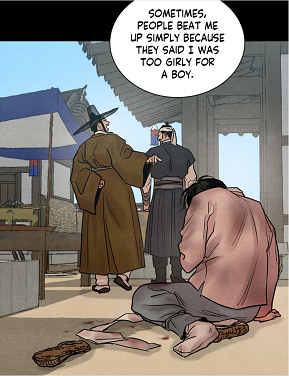 (chapter 94) Thus I assume that it was done on purpose. They used “his girly features“ as a fake excuse to beat him, but the intention behind this violence was to force him to wear the white head-band! As you can see, everything is pointing out that the learned sir and father Lee were somehow involved in this. But I have three more conclusive evidences for this theory. First, it is related to the reflection in chapter 101.
  (chapter 101) Look where the red-haired master and the servant are! It is in front of the teacher’s home! In Painter Of The Night, there is never a coincidence. This is a sign that Jung In-Hun is related to Baek Na-Kyum’s past and knows his true origins. However, by treating him like a low-born, he came to view him as one. But this doesn’t end it. Remember the rule 2: the reflection within the same chapter. The painter remembered the words from the gibang:
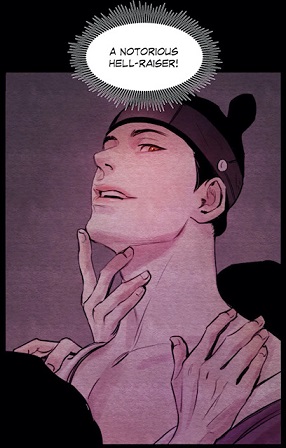 (chapter 1) Jung In-Hun would employ such expressions like fiend and sodomy
  (chapter 18), he was repeating his admired sir’s idioms. Besides, “hell-raiser” is also an indication that the learned sir was a Christian who converted Heena. Thus I deduce that when father Lee received Baek Na-Kyum as a baby, he entrusted him to the learned sir Jung In-Hun who had no connection and no wealth so far. So when the lord described him as such in episode 7, it was not entirely correct. The reality was that the man had been working for the Lees, but he had been “abandoned” at some point. The scholar was his helping hand explaining why he would appear in this scene.
  (chapter 59) Without a topknot, the red-haired master no longer looked like a real noble. He had lost his position. Hence I believe that the painter was forced to wear the headband. As you can detect, there was a chain reaction linked to the social status: lord or not, low-born or not.
  (chapter 87) He was definitely living in comfort. But what was the purpose to let him wear the white tissue? Dressed as a slave, no one would have wondered if he had been killed. Remember the scholar‘s words: a servant is viewed as an object and possession.
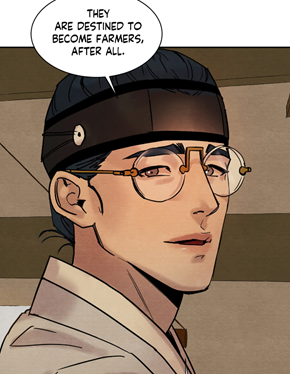 (chapter 6) The painter was never destined to become a farmer. The neglect was done intentionally. And when you recall his words in the library, you can only view his words as pure lies again:
  (chapter 40) He was never born to be a prostitute, but he was sent there on purpose. Under this new perspective, it becomes more comprehensible why Heena sent Baek Na-Kyum to the learned sir. He was the one who had brought the artist to the gibang, and now he was getting older. One might refute this point, for she declared this:
 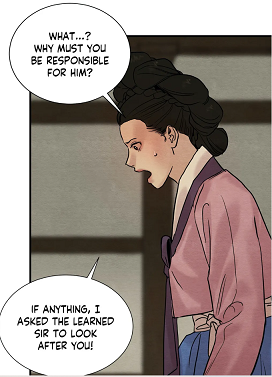 (chapter 68) Nonetheless, the beholder can detect the presence of a drop of sweat on Heena’s cheek. So she was deceiving the artist here. Why? Yes, in her mind, the painter was Jung In-Hun’s son and as such the learned sir should become responsible for the painter, for he was his father. But she had to lie in order to persuade him to leave the mansion. There’s no ambiguity that the head-kisaeng had no idea about the deal between the Lees and Jung In-Hun in the past, I believe that she must have discovered the truth at some point..
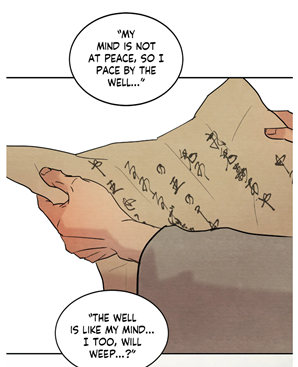 (chapter 4) This was inspired by the poetry from Wang Bang-Yeon!
  (chapter 4) In this poem, the famous author was referring to the death of the young king Danjong who had been killed by his uncle Sejo. Danjong was just a teenager, when he died! As you can see, the text is actually an allusion to royalty and exile. Under this new light, it dawned on me that the scholar Lee had been entrusted to take care of Baek Na-Kyum, but the latter chose to delegate this to the learned sir. There was a reason behind this. For me, he was eyeing at the mansion himself! One might refute this point, for the elder Lee said this:
 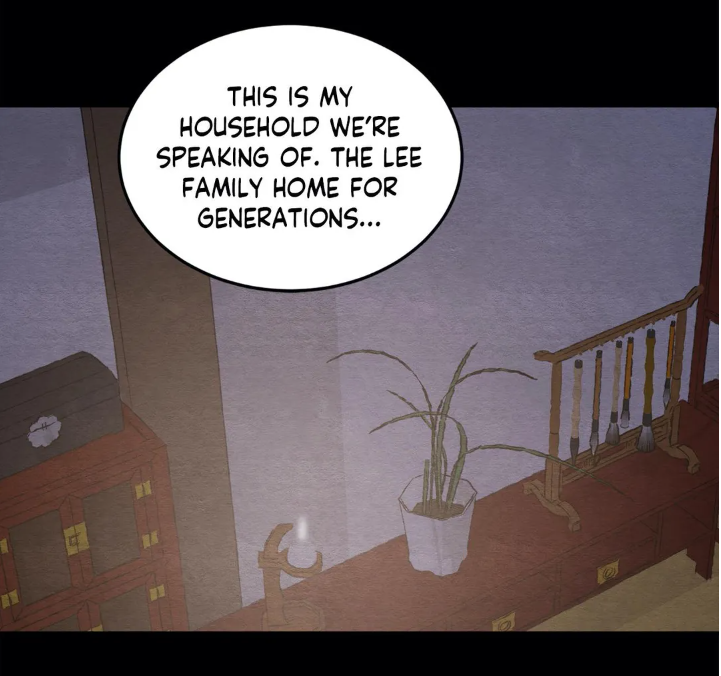 (chapter 82) But note that the man never said that this was his house, just the household of the Lee. Since the artist is related to the king, this signifies that he is related to the elder Lee too, as the family ruling over Joseon belongs to the Lee clan. Hence I am suspecting that Baek Na-Kyum could be the true owner of this mansion.
 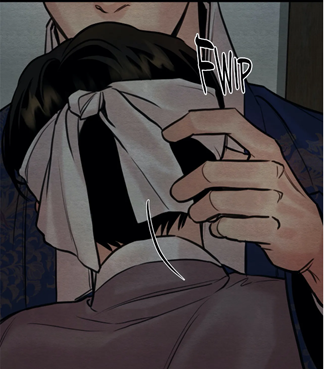 (chapter 53) How does he know it? In my opinion, it is because Baek Na-Kyum resembles to the king. The only difference is that he has no beard. This would explain why Yoon Seungho said this:
 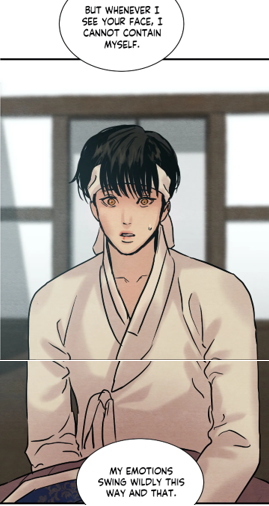 (chapter 55) Why would he get upset? Why would the painter’s face evoke such emotions? He is reminded of his abuser. This is no coincidence that the main lead had such a flashbulb right after, where you could see Lee Jihwa and his father, as they looked like Yoon Seungwon and his father.
 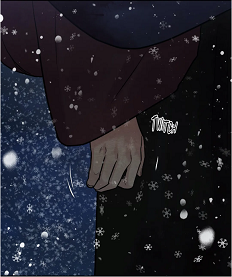 (chapter 102) The colors are already insinuating that the artist belongs to the royalty.
  (chapter 71) If the pedophile came to the gibang and crossed the main lead’s path, he couldn’t recognize his relative (son or nephew) due to the hair and the clothes. Besides, I am certain that my avid readers can recall my other theory: the painter was stolen as a child. This new interpretation would corroborate this theory. The painter has been robbed of his true identity, he had been kidnapped, when he was brought to the kisaeng house!! Besides, if he is the true owner of the mansion, then this signifies that Father Lee succeeded in his coup d’Etat (rule 1, rule 3). In season 3, we have an attempted “coup d’Etat” with Yoon Chang-Hyeon eyeing at the seat.
  (chapter 82) All his past crimes could come to the surface! He had not taken care of the painter, and he had been neglected on purpose. He had committed a crime (disobedience to the king), thus he was a traitor. On the other hand, they could use the last publication as a justification for his death! He had threatened the ruler, he was blackmailing him with his secret. There’s no ambiguity that lord Song had no idea about the true identity of the artist.
  (Chapter 37) They had lost their heir. So far, we still have no idea about the cause for the treason: Coup d’Etat or attempt of assassination on the king or spying or murder of a royal member (here Baek Na-Kyum)? But this purge is associated to inheritance and the loss of a heir. There’s no ambiguity that the painting in Yoon Chang-Hyeon’s bedchamber was used as an evidence that the elder master Yoon was eyeing at the throne
  (chapter 83) imagining that Yoon Seungho through his “marriage” would become the crown prince. Since the author mentioned “torture”, I have the impression that the main lead was brought to the bureau of investigation and got tormented there. He was naturally framed, he had been acting as a spy. He was hoping to become the king’s successor as his “bride”. So once the artist had been executed, the scholar Jung could have claimed that he had been raising the painter the whole time and receive a huge compensation for his benevolence! And the Yoons were the culprits.
 (chapter 66: According to me, this is Kim and not No-Name)
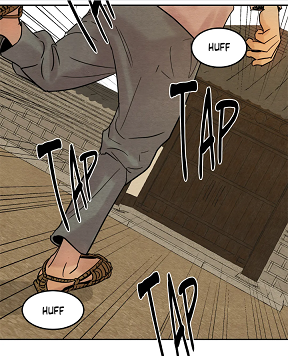
 (chapter 77) Don’t forget rule 1 and 3. Nevertheless, the main point for this interpretation is the way the painter ran:
  (chapter 17)
 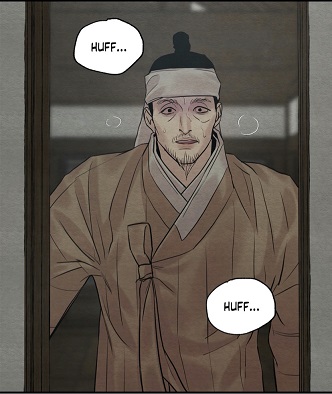 (chapter 85) Here he had faked running. Since he had been introduced with his feet in chapter 1, she needed to create reflections later. Finally, I would like to point out this:
 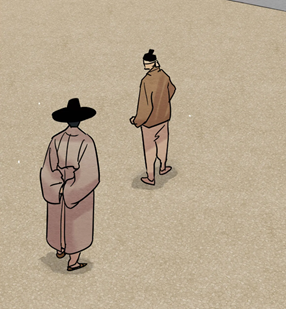 (chapter 7) Their meeting here is an indication that their past must have crossed before because of rule 1!! Since the painter was so devoted to the learned sir, the valet could only jump to the conclusion that the man had truly taken care of Baek Na-Kyum properly.
  (chapter 04) The protagonists’ fate got switched the moment they passed a door. Thus the painter didn’t suffer here contrary to the young master
  (chapter 4) He recognized that the artist was not a servant or slave, but a free man. His words became a reality. He is not embracing a peasant, but a noble, even a member from the royal family. He was speaking the truth, while all the readers were thinking that Yoon Seungho was a hypocrite. We could say that the main lead was under the influence of the spirits/unconscious, thus he caught the artist right on time. At the same time, “peasant” is again a reference to father Lee which reinforces my theory that the scholar Lee is deeply involved in the couple’s suffering.
 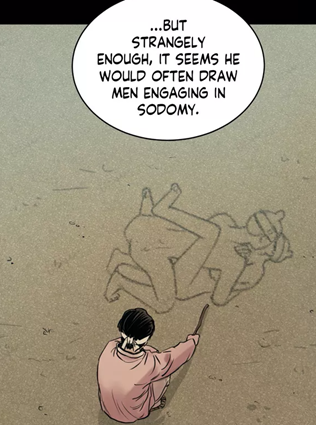 (chapter 1) He had actually painted animals and nature in his childhood, thus the noonas kept his drawings.
 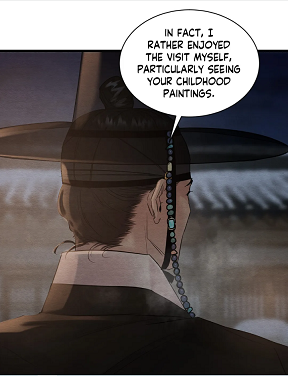 (chapter 94) The man had trusted the learned sir’s testimony without verifying the facts. He had not detected the presence of a blackmail!
  (chapter 1) This truly shows that ignorance is indeed no blessing, and people shouldn’t trust others according to their appearances or social status. At the same time, the servant had forgotten that Yoon Seungho was a noble, though he was dressed like a peasant in the bedchamber.
 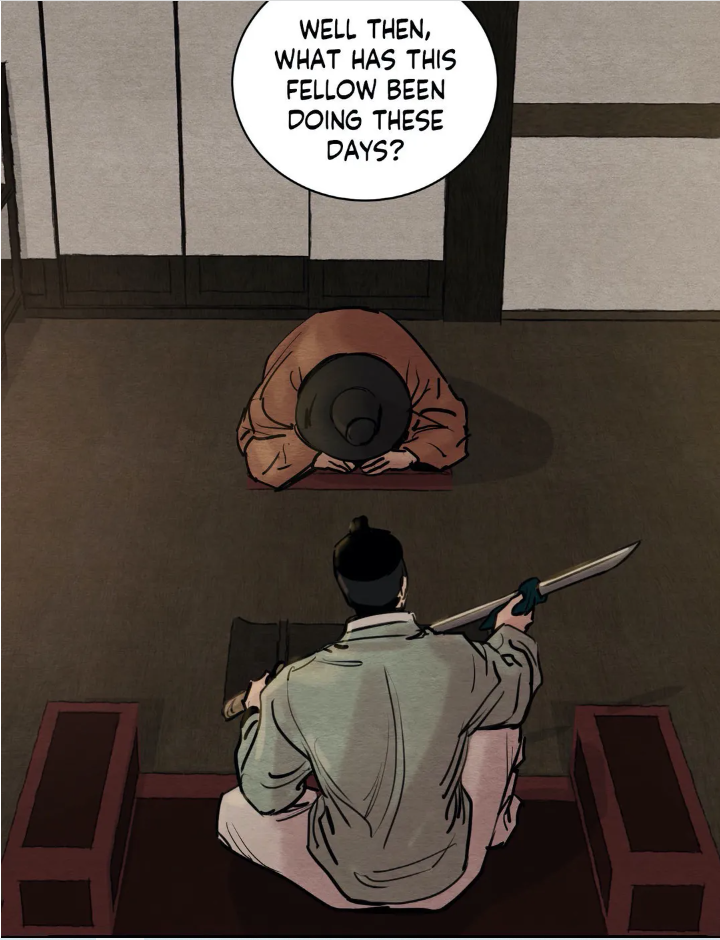 (chapter 1) He was not even wearing a hanbok here, and his head-band was different too. As you can see, both protagonists shared the same experience. They were not treated according to their social status. To sum up, my theory is that the valet Kim brought Baek Na-Kyum to the Lees, who decided to get rid of the painter by entrusting him to the scholar Jung. And Heena became his accomplice, the moment she became his surrogate mother. Let’s not forget that in season 1 and 2, the learned sir was the only one seen with children: girls.
  (chapter 6)
 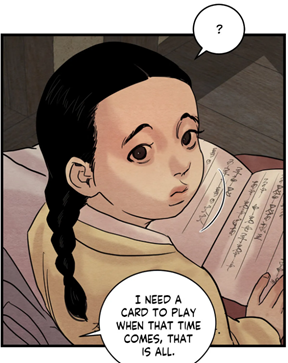 (chapter 29) and Baek Na-Kyum
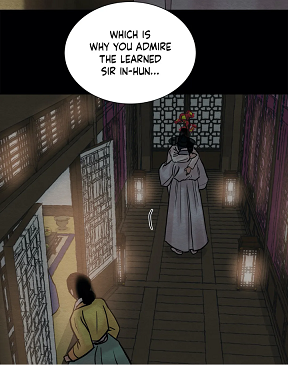 (chapter 68) This shows that the painter embodies the link between the head-kisaeng and the learned sir. Jung In-Hun had entrusted her the baby.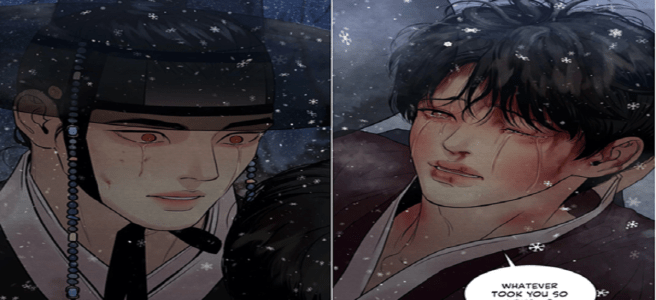

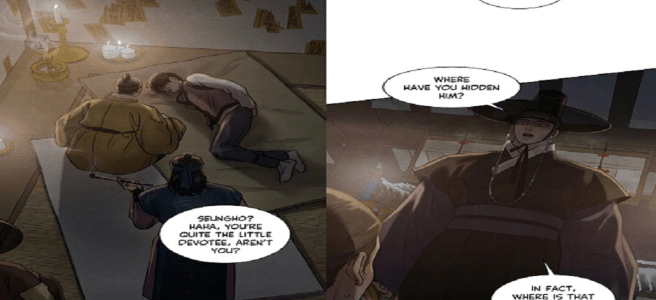
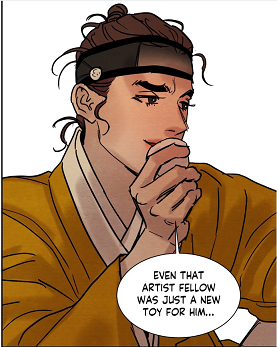 (chapter 12) The mention of a new toy implied the existence of an old plaything. But we know for sure that Yoon Seungho has never possessed anything. He was treated like a male kisaeng himself, for he was not allowed to refuse advances from anyone.
 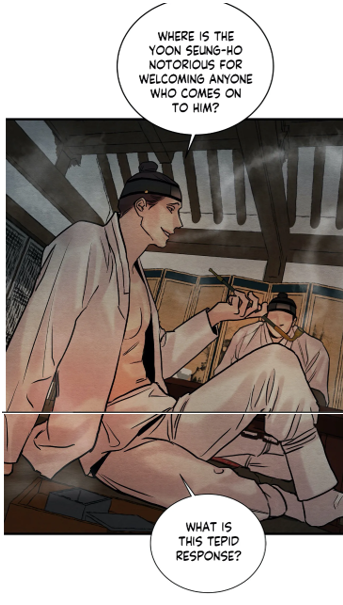 (chapter 52) Finally, he was forced to share anything he owned to others.
 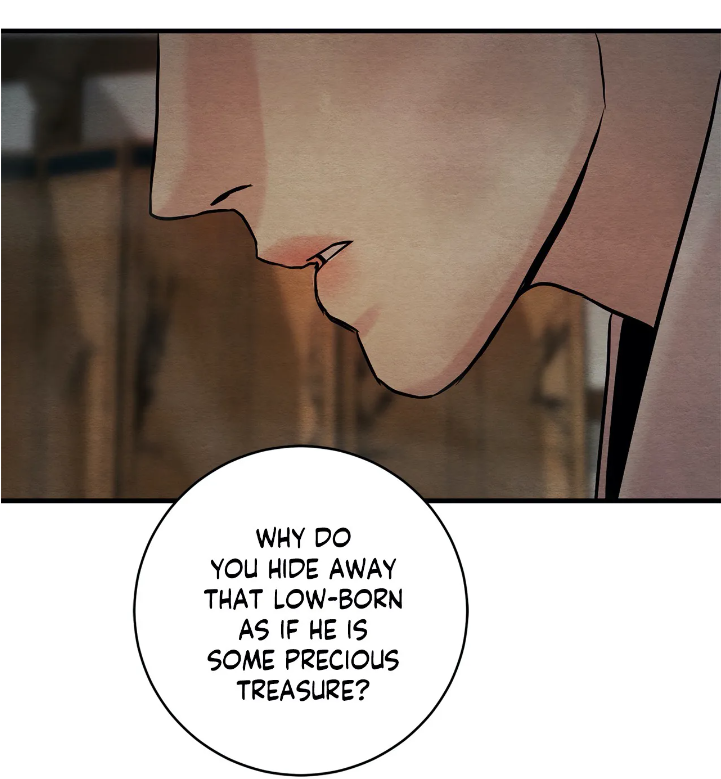 (chapter 52) That’s how I realized that the inner thought from Lee Jihwa was exposing his knowledge. The latter knew about Yoon Seungho’s true conditions. The latter had been treated like a plaything by the pedophile. As the red-haired noble had been raised as an filial son respecting elders, Lee Jihwa saw no reason to change the way Yoon Seungho was “trained”.
  (chapter 57) Besides, he could only benefit from it. Now, he could have sex to his heart content. He only started playing tricks, the moment he felt that his childhood friend was escaping from his claws.
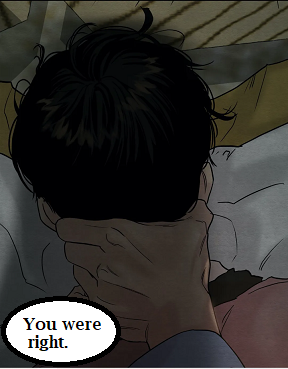 (chapter 62) This explicates why after reading episode 62 for the first time, I had suspected the father to have raped his own son. Yet this thought was dropped shortly after. Then when episode 77 was released, I realized that in the shed the lord was also reminded of Kim’s betrayal, for the latter would always drag him to the shed. Observe the way he was “carried away“. It was like an “embrace“.
 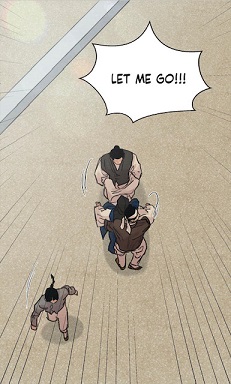 (Chapter 77) In episode 77, the readers can witness 2 incidents how the lord was brought to the storage house.
 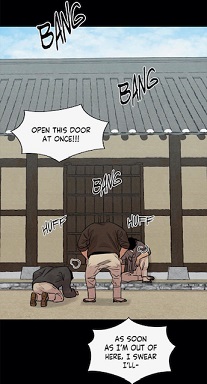 (Chapter 77, this is a different situation, for we have different servants except Kim) Therefore in the barn, Yoon Seungho behaved like his surrogate father Kim as well. This explicates why we have the fake embrace and the insincere apology.
 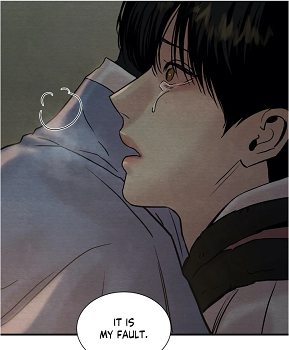 (chapter 62)
  (chapter 62) As you can see, the hug from the past was the symbol of violence and hypocrisy. It served to drag the lord to the storage room. And this new observation led me to the following conclusion: Yoon Seungho was copying the behavior from all his abusers from the past: his brutal father, the hypocrite butler and naturally the pedophile.
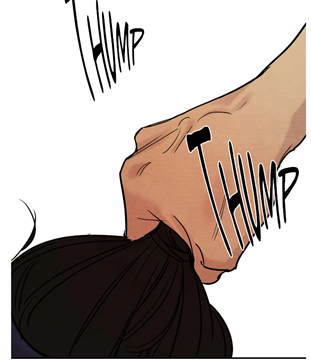
  (chapter 62) Hence the protagonist grabbed the painter by the hair. For me, the “mysterious lord Song“ used to hurt the main lead by the hair, when he got angry. How did I come to this interpretation? Note that at no moment we never saw Yoon Chang-Hyeon taking his son’s hair. First, the lord’s head was covered with a hat.
  (Chapter 83)
  (chapter 83) As for Kim, the latter would always restrain the main lead by the shoulders, the fake embrace.
  (chapter 8) For a long time, I have demonstrated that this gesture represented one of Yoon Seungho’s biggest traumas. But why would the pedophile do that? One might say that it is because of Yoon Seungho’s resistance and struggling. He needed to punish him for his disobedience. Note that the noble with the mole and Lee Jihwa got humiliated as sanctions.
 (Chapter 18) However, in my eyes there exists another explanation which I will elaborate in this analysis either. From my point of view, the shed and the humiliation are strongly intertwined. This was particularly visible, when the lord forced Baek Na-Kyum to have sex in the courtyard.
  (Chapter 64) But why would he do that in the end? It was to train him, to make him obedient.
  (Chapter 64) Remember how he had declared that the painter was now his sex toy. He should listen to his master or owner. That’s how I came to this deduction. The infamous lord Song is a sadomasochist. In the worse case, he is simply a pure sadist. I am inclined to believe more in the first view. With this, we would have the link between sex and torment. And the picture from the erotic book where you see the bearded man having a braided man on his lap outside indicates that Yoon Seungho was here getting punished. The pedophile loved seeing Yoon Seungho humiliated and in tears.
 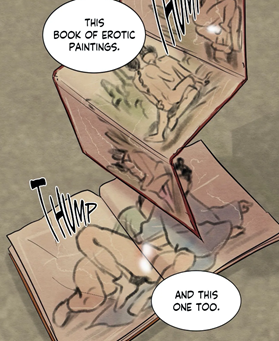 (chapter 01) And now, we have the explanation why the lord could no longer cry and how he came to hate “fake apology”. This was the result of the exposure to the sexual assaults under the form of BDSM.
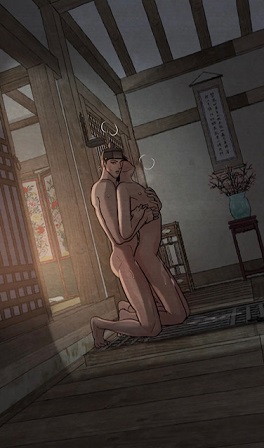 (chapter 96) They ended up in the hallway, anyone could see them. Then in another website, I found the following principles:
  (chapter 25) He even brought the hanbok himself.
  (chapter 26) The lord went so far to take his bath with his lover to clean him.
  (chapter 59) He made sure that his partner wouldn’t suffer.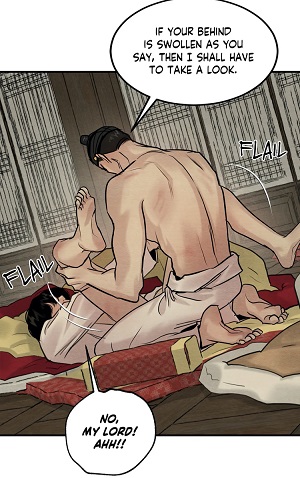
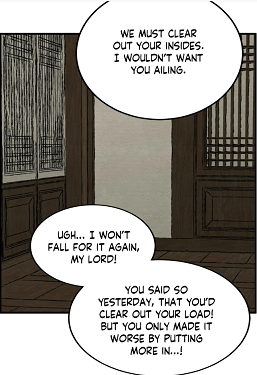 (chapter 89) Yoon Seungho knew by experience that the rest of semen in the stomach would cause him ailing.
  (Chapter 101) He blushed, though he could see that Baek Na-Kyum was in pain, the face covered with blood. Remember what the painter did in the pavilion to the main lead: he scratched his face.
 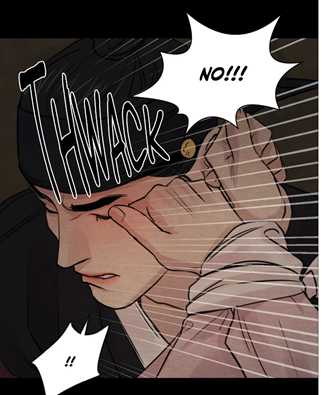 (Chapter 25) Thus we have to envision that the lord must have reacted the same way and wounded his abuser. And imagine the consequence if he had wounded the king on the face. This could be seen as a reason for a punishment.
  (chapter 102)
 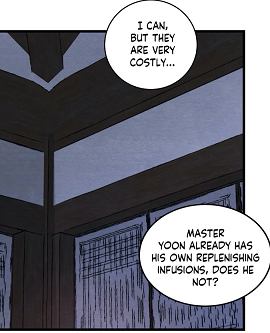 (chapter 33) This is an euphemism for aphrodisiac. Thus we had this confession from the physician.
  (chapter 57) Why did the butler visit the doctor without Yoon Chang-Hyeon? It is because he had been ordered to fetch the aphrodisiac. By feeding him with the drug, they wanted to force Yoon Seungho to accept the advances from the king, and as such to admit his sexual orientation. He was a sodomite.
 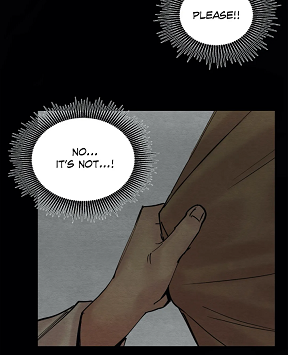 (chapter 65) They faked his “pleasure“ making him feel guity and dirty. That’s how he got tricked. This explicates why the main lead still has no idea of the use of the aphrodisiac.
 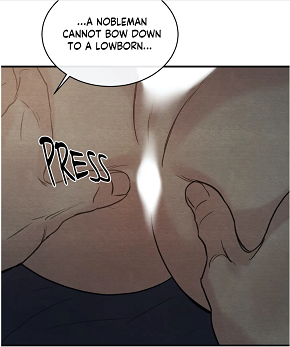 (chapter 71) As a king, he couldn’t bow down to a noble. Observe that the roles of “dominant” and “submissive” are not clearly defined between Yoon Seungho and Baek Na-Kyum. The lord is the dominant sexually speaking, but note the vocabulary:
 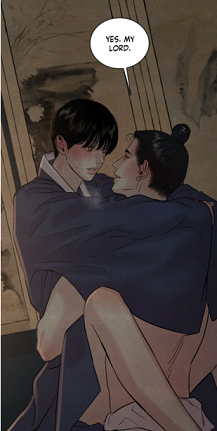 (chapter 72)
  (chapter 89) If you pay attention to their interaction, the lord acts like the servant. The reason is simple. If you take into consideration the second list of recommendations, you will recognize that the roles are switched. Outside a sex session, the submissive becomes the “king“, and the dominant has to act like his servant. That way, a certain balance is created. But this was never the case between the pedophile and the teenager. The latter was always reduced to a plaything and at the end to an animal. The pedophile never called the protagonist by his name.
 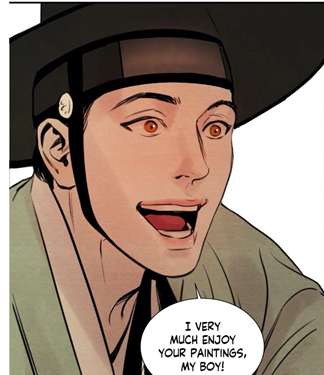 (Chapter 1) He was just called “my boy“. And that was it. He never created a real bound with the main lead. Therefore trust was totally inexistent. And because the young noble could only fear the man, he came to hate him to the point he could die. The latter made promises which he never kept!!
  (Chapter 101) How could he vow to “protect or help“ Yoon Seungho, when the latter was tormented constantly and exposed to violence against his will? And this could only escalate to Yoon Seungho‘s attempt to commit suicide.
  (Chapter 55) I had this idea, for the story is going in circle, meaning that the lord must have done it before, just like he did in season 3. The possible death from the main lead and probably his own pain must have brought the mysterious lord Song back to reality. That‘s the reason why he sent for the physician‘s assistance. He was encouraged to keep his distance from the young man, just like the latter was incited to stay away from the painter in season 1 (sickness, Min), in season 2 (the scholar‘s insult) and in season 3 (the rough sex session in chapter 81-82). Thus I deduce that the pedophile has always kept an eye on Yoon Seungho and his recovery. In my opinion, the man has not forgotten the main lead at all. Why do I think so? It is because he kept the painting…
 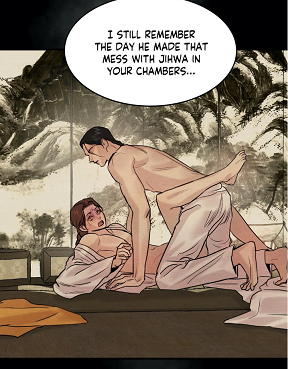 (chapter 82) a souvenir from their time together, just like Min who stole the painting in the study.
  (chapter 74) Thus I am deducing that Seungho-Ya will become the safe word between the two protagonists.
  (Chapter 72)
  The noble with the mole is trapped in a shed, and the color purple, a symbol for royalty, is dominant. From my point of view, the author revealed everything in this tweet. On the other hand, I would like to point out that here the man doesn’t look scared or rejecting the use of the bondage or the dildo.
 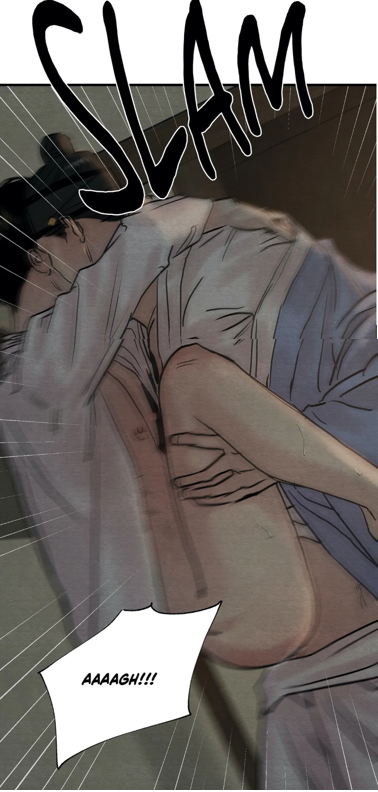 (Chapter 63) He was reliving his biggest trauma. Yet, he never went overboard in the shed. Note that the moment the painter called his lover “lord Seungho”, there was a switch.
  (chapter 63) That’s the reason why the lord changed the painter’s position and faced him.
 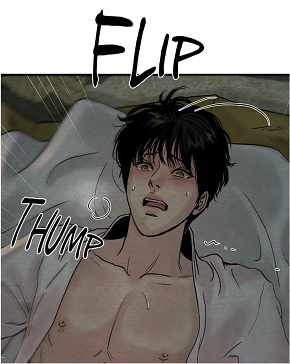 (chapter 63) The lord communicated his feelings and thoughts, and he even made a promise.
 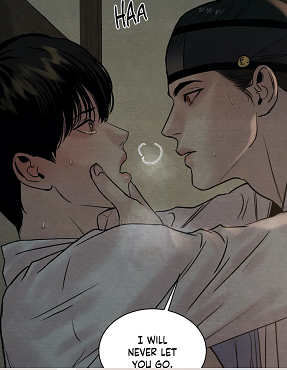 (Chapter 63) This new perception reinforces my impression that there was no rape in the storage room. The painter kept saying “no“, because he was actually scared about his own reactions. Strangely he felt pleasure, thus he kept having climaxes. He was simply in denial. The irony is that the noble attempted himself to be cruel during the night of the revelation (episode 62, 63, 64), but he failed, because the night at the doctor’s house was still fresh in his memory. He couldn‘t forget the tender embrace from the painter.
 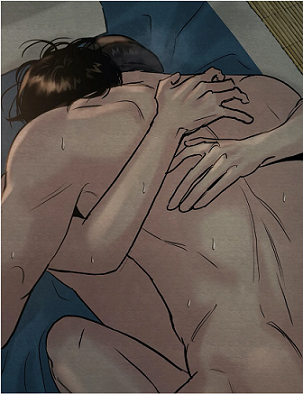 (Chapter 62) This explicates why he stood up during the penetration, he was forcing the artist to hug him, to clinch onto him. He wanted to relive it again.
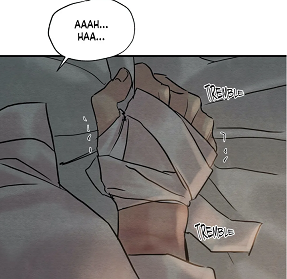 (Chapter 63) He had internalized the marks left by the bondage. This is no coincidence that the artist‘s wrist was covered by the bandage, the reflection from the torment in his youth. Under this new aspect, the presence of the bed in the shed was like a magical tool, which helped the lord to not turn into his tormentor. He was just a ghost from the past, and the word “lord Seungho“ worked like a magic spell, which stopped Yoon Seungho from becoming as vicious and cruel as lord Song. Moreover Lord Song sounds very similar to lord Seungho. And this new discovery confirms my interpretation that Kim was the helping hand of the king. He had to provide him with the white bands for the bondage, just like he had helped for the young master’s kidnapping in the gibang.
 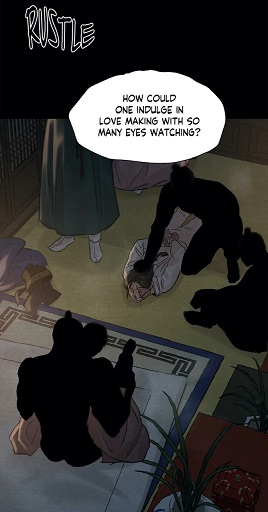 (chapter 86) But don‘t get me wrong. The king sent the main lead to the shed, when he wished to punish him. Yes, he repeated the same actions than Yoon Chang-Hyeon. And what is the common denominator between these two circles? The valet…
 Under this new light, I see it as another evidence that the infamous lord Song could only be the king! He is the only person who has absolute power in Joseon, and as such knows no “real boundaries“. Furthermore, as the ruler, he is expecting no rejection from his subjects. Anyone watching sageuks (historical Korean dramas), is aware that the Joseon king was never an absolute monarch, for he was always controlled by the officials, ministers, the Queen dowager and the Queen. There were also protocols which he was forced to follow. And we have an indication about the king‘s lack of power and wealth.
 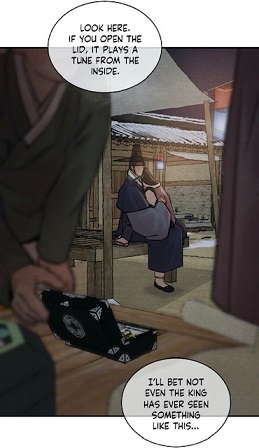 (Chapter 76) Thus I am assuming that the lord Song must have been frustrated about this contradiction. On the one hand, he was supposed to be the most powerful man in Joseon, on the other hand, he had to rely on the aristocracy. Hence I have the impression that the ruler vented his anger and frustration on Yoon Seungho unconsciously. That way, he could outlive his sexual fantasies, where he was powerful. But because of these terrible sexual habits, the young master could never get treated by a physician. Anyone would have recognized the sign of abuse.
  (chapter 92)
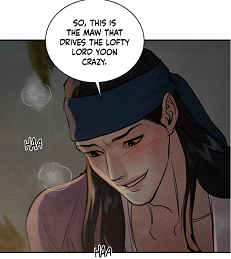 (Chapter 101) are a proof that they never discovered the importance of kisses, embraces, caresses and words during sex. They never recognized that they were denying the existence of love, too obsessed with their heritage and their reputation. The manhwalovers will remember my previous observation. The pedophile had never kissed the main lead. The king like all the nobles had disconnected sex from love. Why? It is because sex was a duty… to continue the lineage. And now, you have the explanation why the pedophile and all the others reduced sex to penetration.
  (Chapter 96) When she heard the noise (PLOP), she was brought back to the past, when she had witnessed a scene of BDSM, though the violence was real. A similar situation to this scene:
 (chapter 73) The pictures from the erotic publication are the evidence for this theory. After hearing the description from the butler about the events in the shed, the noona Heena believed to know what had happened in the shed.
 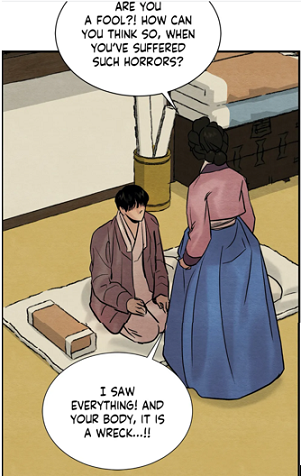 (Chapter 68) She could see the traces on the painter’s body, and conclude that the valet was telling the truth. However, the butler had been misled himself, for his perception was biased by his past experience.
 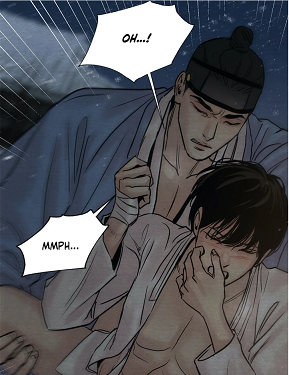 (Chapter 64) This was not like in the past, when the brutality was real. And now, you comprehend why Heena‘s resent towards her brother became more visible after witnessing the love session between the noble and Baek Na-Kyum.
 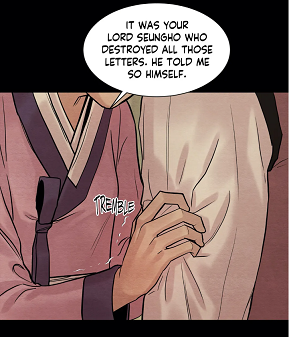 (Chapter 97) From my point of view, she had already internalized that the painter would never change, he was already too “damaged“ to change. However, since he was close to Yoon Seungho, he could become in danger, for she knew the connection between the ruler and the main lead.
  (Chapter 72) He was copying the habit from the pedophile in my eyes. The latter would never remove all his clothes on his own. As the king, he was used to get undressed by his own staff. Only the teenager as the uke was undressed, unless the lord was accompanied by the other nobles, like in this scene.
 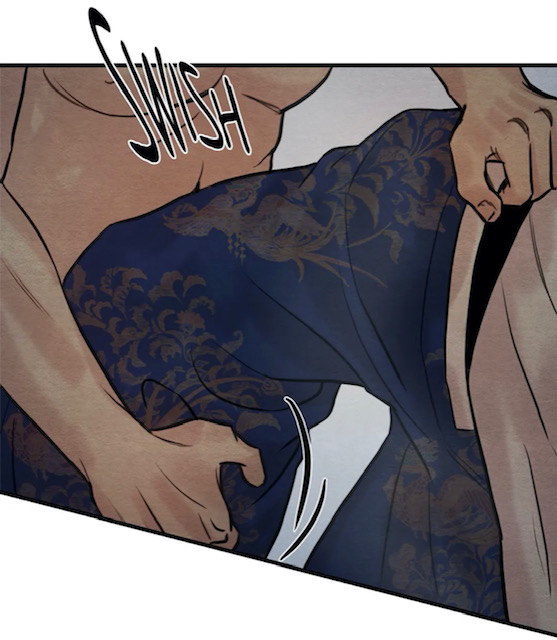 (Chapter 54) And because the ruler was too focused on his own pleasure, he never got to know the young noble. He only realized too late that he had made huge mistakes.
  (Chapter 72) Yoon Seungho was his prey.
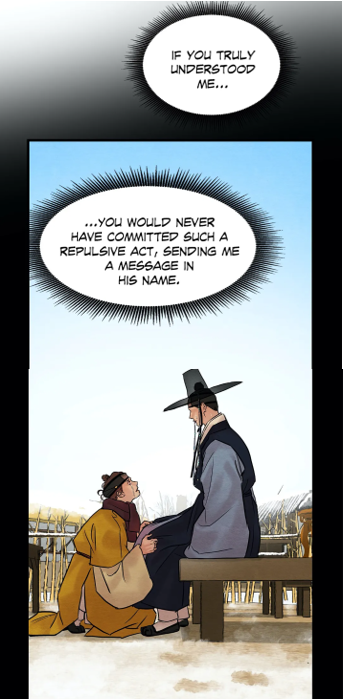 (Chapter 59) The main lead was supposed to meet his tormentor in a public place. Yet their relationship was based on “humiliation“! The “king“ loved to punish Yoon Seungho through humiliation and violence. This explicates why Yoon Seungho reacted that way.
  (Chapter 56)
  (chapter 57) This is what he experienced himself in the past. And observe that the childhood friend’s biggest punishment was actually his public humiliation, when he confessed and got rejected.
  (Chapter 59) In my eyes, the king sought to obtain Yoon Seungho’s affection, but he never realized this. He definitely confused it with submission. He definitely imagined that once the teenager would become submissive, he would have achieved his goal. But he was doomed to fail. In his mind, as the ruler no one could ever reject him. Besides, as the ruler, he was allowed to use his power and as such his strength to obtain what he desires. Don’t forget that in Joseon, people viewed all the monarchs als representatives of the gods. The latter would support them. However, since his youth Yoon Seungho had a strong opinion and mind. Therefore he had caused trouble to his father, as the latter viewed his critical thinking as a synonym for a lack of respect for traditions and the elders, the so-called illness from his childhood. Besides, I am suspecting that the lord must have had visions as well, which would contradict the father‘s dreams and expectations.
 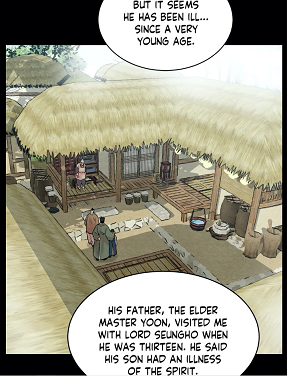 (Chapter 57) Yoon Chang-Hyeon looked down on his son’s critical thinking and came to doubt his words. The author left many clues for this interpretation:
  (Chapter 101) The item was huge, therefore it could only injure the artist’s anus.
 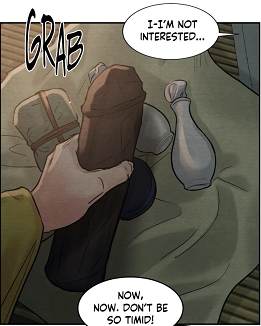 (Chapter 100)
 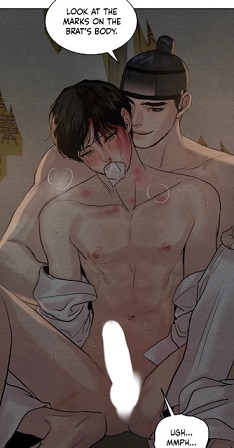 (chapter 101) Even the noble said that this must have hurt. The painter disliked being bitten in the neck.
  (Chapter 88) Furthermore, the lord said this to the painter in the study:
  (chapter 85) These were the words from the pedophile. He was repeating his sexual abuser‘s words. And this proves to me again that the lord was abused in the study, but if he rejected the man, he would be sent to the shed where he would receive his punishment. In other words, Yoon Seungho was punished with sex and violence. And now, you have the explanation why he got gangraped in the end. But the readers should keep in their mind that this was no real BDSM, for the brutality was real. The king couldn’t distinguish between reality and illusion. And this coincides with all my previous interpretations.
 (Chapter 65) Kim had brought him to the barn, because Yoon Seungho was punished there. This could only be suggested by the butler, as I don’t think that the king would ask for the owner of the mansion for permission. This room was definitely taboo, no one was allowed to approach the study or the shed. Yoon Seungho was exposed to rough sex, and Kim knew this, like mentioned above. But he never witnessed it himself, he only discovered the aftermath. From my point of view, this scene occurred after the lord’s loss of virginity.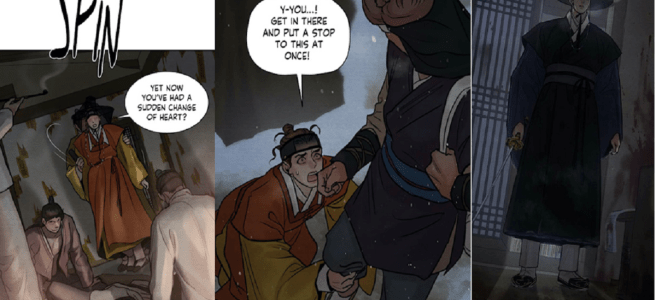

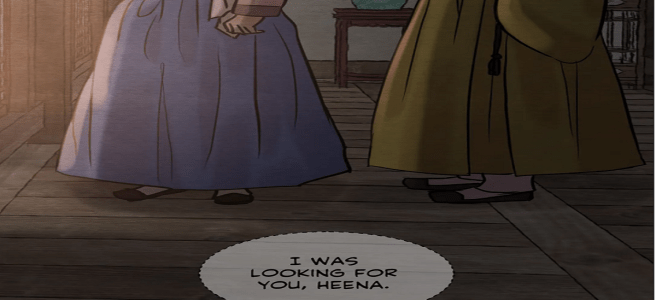
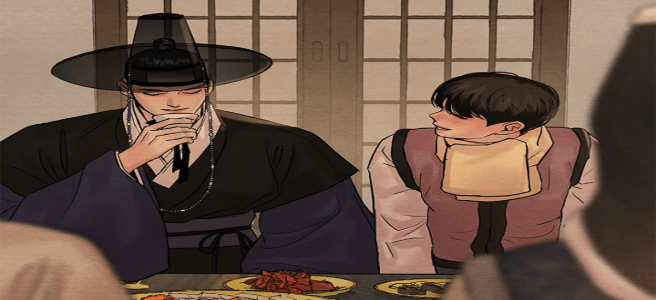

 (Doctor Frost, chapter 180) As you can observe, fear and hatred are the main components for unleashing agitation and violence. But this can only work if the medias are amplifying these emotions. Yes, I am talking again about propaganda. And today in the newest episode, the commissar used the fire as a metaphor to describe the evolution of terror.
  (Doctor Frost, episode 183) This means that you can stop the fire from spreading, if you observe the fire path. In other words, if you pay attention to the evolution of the hate crimes, you can slowly put an end to the climate of terror. Important is to find its origin. Then she added this. The fire becomes the most effective in the winter forest.
  (Doctor Frost, chapter 183) Here the manhwaphiles should see the forest as a symbol for society and humans.
  (Doctor Frost, chapter 183) This signifies that the people will get easily influenced by their fear and rage, if there exists a cold climate. A society without compassion and affection. And with only one spark, the forest can get destroyed. This signifies, the absence of love and understanding play a huge role in creating an environment full of hatred and violence. This is not surprising that because of the Coronavirus, intolerance and violence are on the rising, since people are getting more and more isolated and scared. And now, here is the next question: What symbolizes the winter forest in Painter Of The Night and more precisely in episode 93?
  (chapter 93) On the other hand, many readers were greatly disappointed by Yoon Seungho’s behavior. He had prevented Heena from meeting her brother, and the painter was left in the dark. But the lord had also sentenced her to seclusion.
  (chapter 93) In their eyes, he was indeed a hoodlum or a bastard. According to the blogger
  (chapter 93) Yes, he had done it again… he hadn’t trusted Baek Na-Kyum and had become violent or ruthless again. But after reading my introduction, you can already anticipate what I am about to say. The winter forest was in fact Baek Na-Kyum’s family. The noonas and the painter had been missing each other so much, but because of Heena’s belief and intervention, she had destroyed this family. Yes, I see her as a religious fanatic who unfortunately got brainwashed by Jung In-Hun and now by Kim. This is no coincidence why Heena is sent to a cold and dark room
 (chapter 93), while the noonas and the artist are sitting in a comfortable room. Hatred versus love… even the colors in the picture reflect the true emotions of the characters. Now, it is time to elaborate my interpretation.
  (chapter 93) So where was the lord? I will give you the answer below. Striking is that during the whole time, the artist didn’t notice his absence, until his lovely sister asked him about his whereabouts:
  (chapter 93) Her question reminded him of Yoon Seungho, therefore the artist looked for him, and got surprised, because he didn’t see his husband by his side.
  (chapter 93) This scene is important for two reasons. First, the behavior of the kisaeng clearly showed that she had been left in the dark as well. She was not lying, as there was no drop of sweat on her face. While she had no idea where her brother had been this entire time, Heena knew this the entire time!! 😬 But she kept silent and as such, she hindered her sisters to meet the painter as well. But this doesn’t end here.
  (chapter 93) The kisaeng had not only been left in the dark, but she had also been lied. How did I come to this interpretation? The caring noona employed the expression “you’ve flown the nest already”. With this idiom, she implied that Baek Na-Kyum had willingly left the kisaeng house. He had made this decision on his own, for he felt the need to leave the gibang, whereas the readers already know that this was the opposite. He had been forced to leave by Heena.
  (chapter 46) Like I had already pointed out, the kisaeng had made sure that Baek Na-Kyum didn’t bid goodbye to his noonas. Heena had lied to them saying that this was the boy’s desire and he was now old enough to leave the mansion. This explains why the nice noona employed the idiom “I know”. This is a signal that she had been told by her sister!! But the most infuriating is that Heena left her colleagues in the ignorance for 18 months. None of them knew where the painter was exactly. In the beginning, they had actually no idea that he first lived with the scholar. Besides, notice that the kisaeng complained to the artist. Why didn’t he visit them once in a while? The older sister had given him an order not to!! The most astonishing is that the gentle noona showed great understanding. She accepted the painter’s white lie.
  (chapter 68) Heena put the whole blame on the painter, though the latter had been following her orders. She showed no understanding contrary to her sister. Besides, since she knew where he was, why didn’t she contact him in the end?
 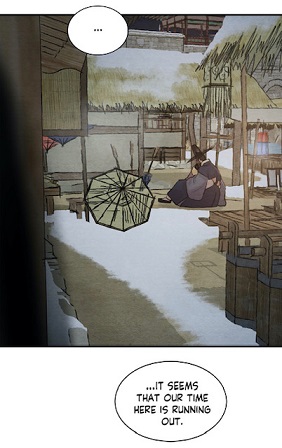 (chapter 76) Back then, Nameless had been confronted with reality: the protagonists were just two men in love and their affection was deep and genuine. So imagine what it meant for the lord, when he saw this scene in the shadow:
 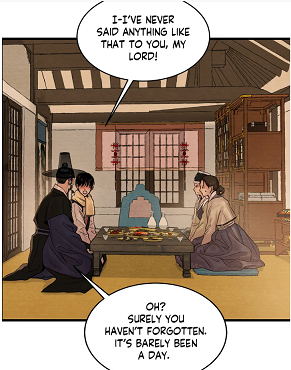 (chapter 93) There’s no doubt that he was seeking for their approval. To conclude, he remained in the background in order to judge the kisaengs correctly. Would they behave like Heena or not? In fact, Yoon Seungho had made a jump of faith. He had trusted the painter’s heart. However, he couldn’t let Heena ruin this happy reunion. Therefore she got excluded. She could have made a ruckus.
  (chapter 93) In her eyes, he was a handsome man. Another fell under his spell as well:
  (chapter 93) This is important, because this shows that the kisaengs are not thinking like Heena at all. They don’t resent him, because he is a noble.
 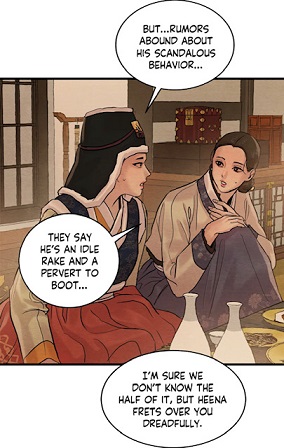 (chapter 93) In the first version, I had blamed Heena, yet I have to admit that I made a mistake, because I had paid too much attention to this image.
 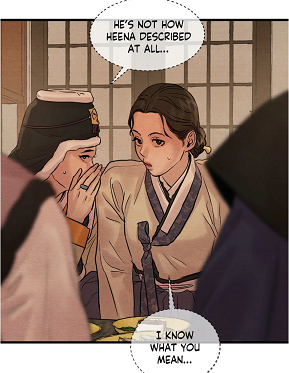 (Chapter 93) Here, they whispered quite loudly and actually blamed the noona for her negative description. But this declaration contradicts the previous one.
 (Doctor Frost, chapter 175) It created the illusion that Heena had been badmouthing Yoon Seungho and desired to obtain the support from her eonnies. But who had called him a rake and a pervert? The noona herself!
  (Chapter 93) However, they were just repeating what they had been told. Hence it didn’t work. Why? First, it is, because the painter appeared alone. They could see with their own eyes how well he was doing.
  (Chapter 93) Naturally Min!! How do I come to this conclusion? Simply by recollecting his words in the tavern:
  (Chapter 93) He made no fuss and accepted their apology. The most striking is that he ended up apologizing to the noonas.
  (Chapter 93)
 (Chapter 95) The manhwaphiles should recall the following rule: a scene will be reflected in the next episode. There is no doubt that the valet was the one who ruined the Yoons in the end by causing mistrust and jealousy. He destroyed the family. Therefore Kim sent the ruined painting to the father, and even refused to give the letters from the brother. He made sure to create misunderstandings, silence and tensions between the Yoons, portraying each of them like a monster or a selfish and common brute. This is not surprising that for the father, the son is a monster:
  (chapter 92) The lord saw that the painter was looking elsewhere and his gaze was full of longing. Secondly, he had promised his lover to fulfil all his wishes.
  (Chapter 91) He didn’t want to break his promise. I am wondering if this idea was not suggested by the butler, because the meeting in the inn was no coincidence. The noble Min made sure to trigger the painter’s memory with the presence of the kisaeng and the blue-lavender hanbok. As you can see, Yoon Seungho didn’t have much choice in the end,
  (chapter 93) First, I thought that the man with the green hanbok was Black Heart, since the kisaeng facing the man in green resembles to one who followed him to the tavern, the one under the purple jacket. The color of the skirt is the same.
  (chapter 92) However, at some point I began doubting this, for for the green shade is a little different. Moreover, I was reminded of this panel:
  (chapter 87) Yes, the same colors, the green hanbok and the kisaeng’s clothes are the same. On the other hand, since Min had wet clothes, it is also possible that once in the gibang, Min received a new hanbok from the host, similar to the scene in chapter 59, when Lee Jihwa was asked if he had played in the snow.
 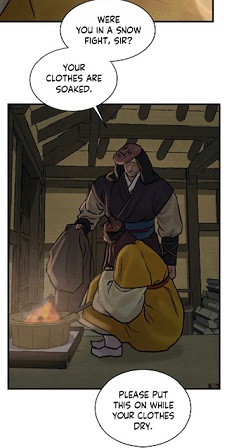 (Chapter 59) On the other hand, Min appeared later as the doppelgaenger of Lee Jihwa.
  (Chapter 96) So we have to wonder if Min switched clothes three times during the same evening. But it is definitely possible, for each episode is reflected in the next.
 (Chapter 66) The Joker could serve as a witness, and Black Heart couldn‘t lie at all, as he needed to keep his trust. Besides, it is possible that he must have noticed the disappearance of the Spring poem. Don’t forget that it had vanished in the inn, and Min was the last one seen with it.
 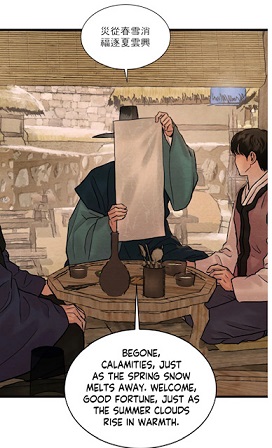 (Chapter 92). Their sudden meeting could be the reason why he disappeared.
  (chapter 93) Now, they know that the young painter lived with the scholar. How come? Baek Na-Kyum didn’t tell them, because the noona asked him this question. This means that she wanted a confirmation. And now, we have to question ourselves this: who told them about the painter’s past? One possibility is that it was Yoon Seungho, but I doubt it, for the noona didn’t recognize him outside. From my point of view, the noona had left her brother’s side. There was a time jump, because the kisaeng was now wearing a different skirt, khaki!! This means that now, she was acting on the order of someone. Like mentioned above, it could be Min via the other kisaeng. But there exists another eventuality: the Yoons! Don’t forget that khaki is the color of Yoon Chang-Hyeon.
 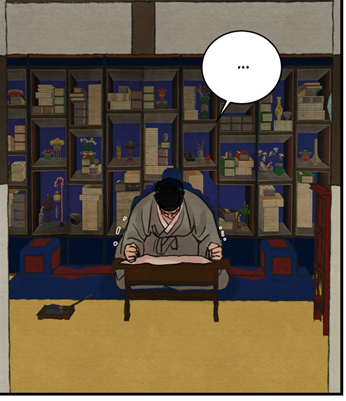 (Chapter 44)
 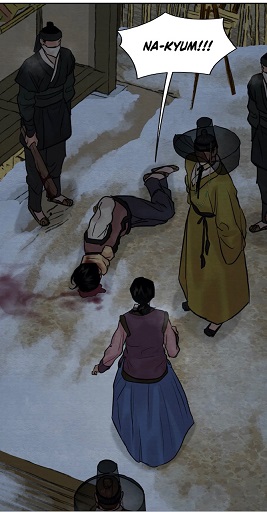 (Chapter 99) This scene outlined that Black Heart and Yoon Chang Hyeon were working together, and they had planned to blame the Lees. But the irony is that the father was doomed to fail, because he was using the noonas‘ goodness and innocence. So the scholar was mentioned for one reason. The kisaeng desired to push Baek Na-Kyum to question his sponsor about the learned sir‘s well-being and whereabouts. The purpose was to generate a quarrel. Note that the other helped her colleague. As you can see, the hat and the change of the color of the noona’s skirt was an indication that there was a time jump. Thus I am deducing that the kisaeng was not present the entire time. Remember that the magician Byeonduck is always creating a fake continuity.
  (chapter 93) When she mentioned the learned sir, Yoon Seungho entered the room.
  (chapter 93) What could the noonas say to this answer? They couldn‘t call the main lead a liar! And note how he introduced himself:
  (chapter 94) That‘s the reason why Yoon Seungho went to the well later. My explanation is that he had been suggested to go there by the noonas, while the latter had proposed a different idea to their brother: the walk to the pond. But why? In reality, the schemers envisioned that Yoon Seungho would behave like a hoodlum, he would kill the kisaeng Heena. Remember the threat expressed to the noona:
 (Chapter 69) But like I had explained, this menace was voiced by Kim, which was only validated by Yoon Seungho afterwards. And naturally, this threat had been revealed to the schemers: Min and the patriarch. They all imagined that the main lead would punish Heena for her accusations. Kim had experienced this scene in the courtyard
  (chapter 68) He had taken these words as face-value. But he never recognized that the main lead would never use violence against Baek Na-Kyum‘s family, and this was already perceptible in chapter 68. He never barged in the study, when the noona called him a bird of misfortune.
  (Chapter 68) He respected their privacy, the opposite of the butler.
  (Chapter 85) This explicates why the kisaengs blamed Heena for the rumors.
  (Chapter 93) This gesture (blowing the candle) outlines that he was indeed trying to stop the fire, a symbol for hatred and fear, from spreading.
  (Chapter 93) This time, the noona had no longer the hat, but she was wearing the orange skirt again. The only explanation is that she had left the room. Since the kisaengs had no drop of sweat on their face, their admiration and surprise were genuine. But now take a look at this
  (chapter 93) We have the return of the hat! Moreover, another detail caught my attention: the paper is blank! Where are the calligraphes? One might argue that it was too difficult for the author to draw them, but I can only refute this point by using this scene.
  (Chapter 36) Here, the handwriting was even smaller compare to this calligraphy:
  (chapter 92) From my point of view, the Spring poem got switched and was returned to the schemers. Another evidence for this theory is the length of the piece of paper.
  (chapter 65) First, the noona couldn‘t see her brother‘s painting, until Kim showed her the picture with Jung In-Hun which he had kept!
  (Chapter 65) Kim was embarrassed in that scene, like the drop of sweat indicates it.This was the negative version of chapter 93. Don’t forget that Heena had been manipulated by Kim, when she visited the lord’s mansion. The latter had shown her the painting from the painter and then he must have told about the flashback in the bedchamber and the second marathon session in the shed.
  (chapter 4) and he had never returned it. He had replaced it with another sijo, according to me with the original sijo.
  (Chapter 7) It doesn‘t matter, if the scholar had deceived the painter. The latter viewed the paper as a treasure, a memory from his learned sir.
 (Chapter 93) The father was mocked for his dream!! He was portraying the elder master as a poor and weak noble! He was even compared to the learned sir. We have two proofs for this signification:
  (chapter 86) This was the father‘s karma. He had insulted his own son, made him feel little and even jealous
  (Chapter 93) This symbolizes that she was not acting here. The drop of sweat on their face showed their embarrassment. They could not deny his statement, for the learned sir was indeed poor and with no connection. They anticipated that the lord would boost about his talent, but no he was showing humbleness. On the other hand, he outlined his wealth and power, which the noonas couldn’t contradict. His words were indeed reflecting a certain reality. Another important detail is their reply to the lord‘s statement: the points of suspension which I connect to the butler. Since chapter 77, the latter had switched loyalty and was now serving the elder master Yoon.
 (chapter 93) “I heard” indicates that she wasn’t the entire time with Baek Na-Kyum. This proves my previous statement that the woman must have left the room leaving her siblings inside at some point. Secondly, the drop of sweat on the cheek is a signal for a lie. This means that the kisaeng was well aware of Heena’s arrest. She was actually covering up. It was, as if she was working for Yoon Seungho, while in reality she was acting on someone else’s behalf.
  (chapter 69), and back then the lord had showed leniency. However, Heena didn’t want to acknowledge his benevolence. Thus she sent letters to her brother, in which she called Yoon Seungho many names: a rake, a hoodlum, a bastard and finally a murderer…
  (chapter 93) One might bring up the freedom of speech, but there’s a reason why in Germany total freedom of expression is not allowed. During the Republic of Weimar, parties were authorized to announce their hatred for democracy and republic. The result was that right-extremist parties as such the NSDAP led by Hitler became more and more powerful. This is no coincidence that this republic vanished. The NSDAP could spread fear and hate against democrats, Jews and other minorities. Hate speech encourages hate crimes. Yes, this is the consequence of the butler’s philosophy: “don’t take it to heart”. This saying symbolizes indifference and as such passivity and silence which contributes to create the perfect climate for hatred and fear.
  (chapter 91) They didn‘t go to the calligrapher right away. One week had passed, since the elder master Yoon had visited the mansion. This signifies that Heena is forced to face the consequences of her past actions.
  (episode 9) The real culprit had sent him letters each day for years… The content of the correspondence was always the same:
  (episode 9) That’s how he got brainwashed and convinced that he had indeed committed a crime. In jail, he was isolated and due to the suffered injustice, the prisoner definitely suffered from an emotional and mental breakdown, explaining why he was receptive to manipulations. That’s why you see the mouth and the letter together. So imagine that Baek Na-Kyum had read all the letters and all of them were saying the same thing over and over again. Since the painter is someone with a low self-esteem, he would have started doubting his own judgement. This is gaslighting. Naturally, Kim never intended him to read them. The whole purpose was to create a quarrel in the couple. I am quite certain that Heena never asked about her brother’s well-being. She was already convinced that the lord was a rake and a bastard. Her letters were full of contempt and hatred, something Yoon Seungho could sense in the correspondence.
  The reflection of this scene.
  (Chapter 69) And who was there during that night? Black Heart. This is important, because in the first episode, the noona had badmouthed the main lead, but she was well aware of the truth.
 (chapter 87), since the rumors of his union in town were already spreading. The purpose of this smear campaign was to portray the lord as someone who was not interested in monogamy and fidelity. And who had an interest to oppose this union? The father!! As you could detect, through these comparisons I could connect Yoon Chang-Hyeon, Kim, Heena and Black Heart together. In the end, this badmouthing couldn’t succeed, for her eonnies were different. They were more innocent and less selfish, they had been left in the dark concerning the lord’s past. They never admired the learned sir in detriment of Baek Na-Kyum. They certainly don’t reject sexuality and they have less prejudices. As you can see, I detected a war of rumors, reminding me of the war of the waves during World War II.

 (chapter 175) Because of this comparison, I couldn’t help myself thinking of the water vapor as the grapevines in Painter Of The Night. They’re everywhere and no one can stop them. And now, you comprehend how the noble’s reputation got ruined.
  (chapter 175) That’s how hatred and contempt were spread. And Lee Jihwa listened to them, this is no coincidence why his mind and heart got poisoned. As long as he remained by Kim and Min’s side, his heart and mind would always be clouded. This means that Yoon Seungho was able to stop a fire, before it ruined the winter forest. People were upset, for he had such a cold gaze, when he remembered his interaction with Heena.
 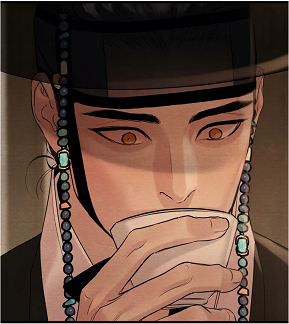 (chapter 93) But he was just mirroring the schemers‘ thoughts and gaze. He had to remain cold. So what does Heena’s isolation mean? Yoon Seungho has no idea, but he is clearing her mind from the brainwashing.
  (Doctor Frost, chapter 183) There exists two methods. First,
  (Doctor Frost, chapter 183) And we could clearly detect this in the confrontation between Heena and Yoon Seungho:
  (chapter 93: In the Korean version: Your little brother will be with me now) For Heena, the painter should live with the scholar. This was her faith:
  (chapter 46), though I am quite sure that it was in truth her biggest wish. She was in love with the learned sir herself. By looking him in the eyes, she could detect the lord’s determination and frankness. This was his choice. The problem is with deprogramming is
  (Doctor Frost, chapter 183) That’s the reason why nowadays, psychologists prefer the other method
  (Doctor Frost, chapter 183) And now, you comprehend what happened. The deprogramming didn‘t work out, for Heena was approached by the schemers again. They used another noona to deceive the sibling, for they could no longer use the women close to Baek Na-Kyum. Thus Heena was still under the influence of the haters.
  (Chapter 98) Since she resents nobles, I deduce that the so-called witness was a commoner. In my eyes, it can only be Kim who justified his silence by saying that he could do nothing. He was the only one who knew, because the other had been already killed.
  (chapter 93). Hence their punishment for their deceptions couldn‘t be so harsh.
  (Chapter 99) The symbol of their dinner and reunion was pushed away. In my eyes, this ruckus put them in a bad light. However, I believe that these deceptions were necessary, for the bond between Heena and the other noonas
 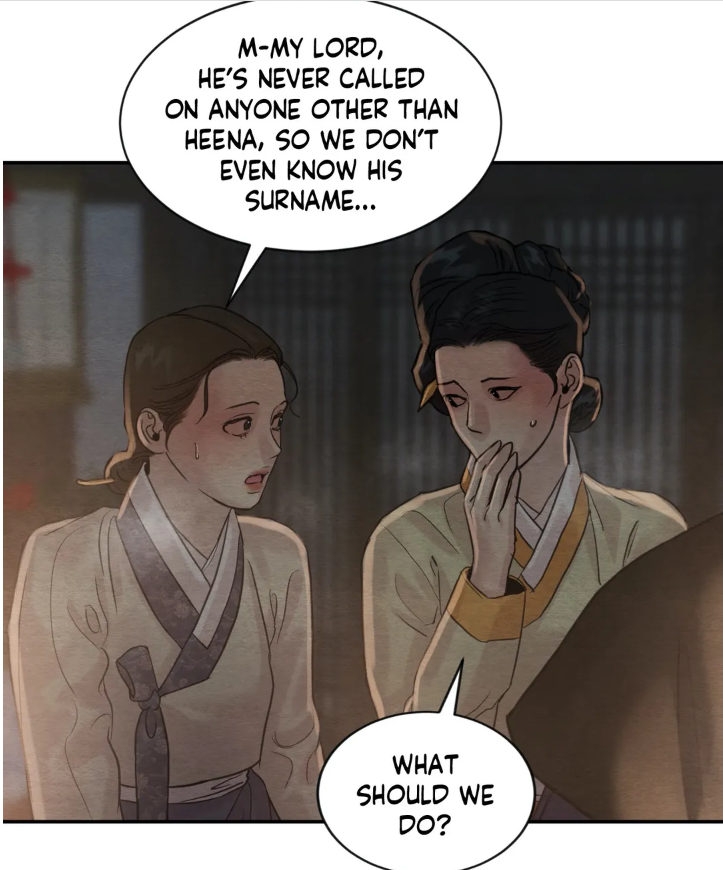 (Chapter 99) was quite strong. In this scene, they had sided with the kisaeng again, hiding the fact that they had seen leaving Heena with Lee Jihwa. They knew that the kisaeng was running away from the gibang, for she was not dressed up.
  (Chapter 99) Hence the moment the kisaengs see how the brother was hurt by Min, they will realize the deception from Heena who abused their affection and loyalty. They will definitely blame themselves for their lies, and since I discovered connections between Yoon Chang-Hyeon and the noonas, I have the impression that Yoon Seungho will discover the backstabbing coming from his own father. According to me, the schemers had planned to frame the main lead for Heena‘s death (well), but the puppet masters‘ karma is to receive the sentence that they had planned for the main lead: accusation of violence and murder. The more I am analysing, the more I am sensing that Yoon Chang-Hyeon will be judged as an accomplice of Lee Jihwa’s crime in the nobles‘ bloodbath. He had helped Lee Jihwa and deceived Black Heart. And if the kisaeng is alive, the survivor will recognize the deception from the guards.
  (chapter 80) Heena could have pushed away his hand, her movements were not restrained
  (chapter 93) Secondly, he introduced his partner to his family properly.
 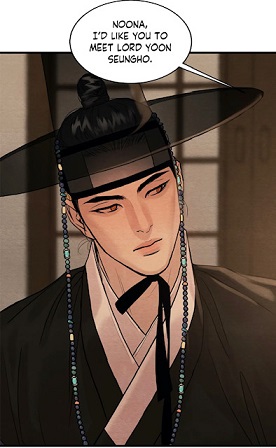 (chapter 93) It is here necessary to contrast this introduction with this one:
  (chapter 01) In the beginning of the story, the protagonist was not presented as a lord, but as a master!! This means, he belonged to the Yoons. However, Baek Na-Kyum is now viewing the protagonist as the real lord of the mansion. He is independent, which means that the artist is not truly acknowledging Yoon Chang-Hyeon and Yoon Seung-Won as his family. And if you compare the first episode with chapter 93, you’ll realize the similarities. Back then, Heena had mentioned the main lead in order to scare the painter, she had used rumors…
  (chapter 64) But she started worrying for her brother, when she realized that he wasn’t living according to her belief: abstinence. And now, we have to question ourselves this: why did Yoon Seungho encourage his bride to sleep in the kisaeng house?
 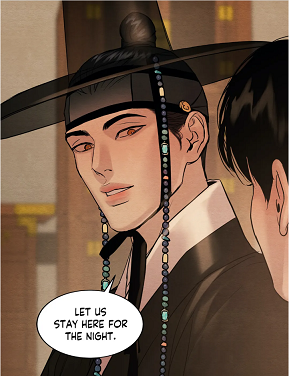 (chapter 93) Naturally, he had many reasons to do so. First, he wished to keep his promise. Secondly, he had sensed the painter’s sadness.
  (Chapter 93) But Yoon Seungho never imagined that he was himself the cause for this heartache. The painter could detect the lord’s agony and low self-esteem. He knew how hurtful it is to be called names like rake or bastard or hoodlum. And the lord’s selflessness got rewarded: his biggest wish came true during that night. There was someone who loved him despite his flaws and wrongdoings. We could say that their stay was to confirm his marriage with the painter to the noonas. At the same time, season 3 exposed the slow transformation of Yoon Seungho. Little by little, he was showing an interest to his own past and no longer accepting the justification that he was just a bird of misfortune. Don’t forget the master’s previous statement:
  (chapter 86) He was already pondering on the question why the family name was sullied. This shows that Yoon Seungho is slowly uncovering the truth, and he is now using Kim’s MO: deliver the information in delay, feign ignorance and act, listening to conversations behind the doors. This is no coincidence that he is recovering his memories as well. This is important, because he is less manipulable and as such no longer weak to brainwashing.
  (chapter 88) When the lord got embraced, the painter whispered this to his ear:
 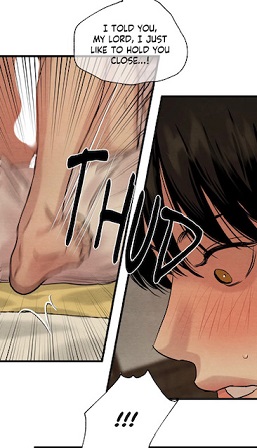 (chapter 91) This represented Baek Na-Kyum’s first mini-love confession. His action was supported by his words. Therefore the lord could realize the honesty and genuineness of the painter. He could be embraced and as such accepted, he was no monster. Yes, it was the opposite of the love session in the physician’s office. Back then, the painter had remained silent.
  (chapter 62) And this made me realize the signification of whispers in the manhwa. They stand in opposition to the hate speech and brainwashing!! This is no coincidence that the noonas whispered, when they noticed that Yoon Seungho was totally different from the description which Heena was supposed to have spread.
 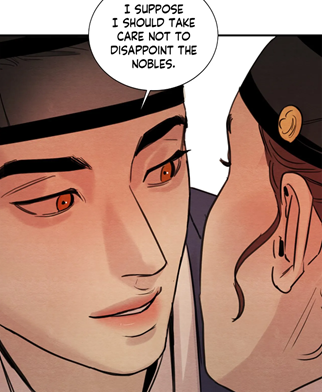 (chapter 18) or Yoon Seungho saying this to Heena:
  (chapter 92) reflects the nature of their relationship: Love and closeness. Even outside and in front of the calligrapher, the lord felt the need to know his lover’s thoughts, the positive version of this rumor:
  (doctor Frost, chapter 83), you should just replace the name Juhwan Park by Heena. She was just manipulated by the butler and Min’s trick. They used her strong belief and prejudices. However, I had the feeling that Heena could come to her senses, because she remained silent and her gaze was different.
  (chapter 83) Besides, what caught my attention is that she never replied to Yoon Seungho. She never fought back like in episode 65:
 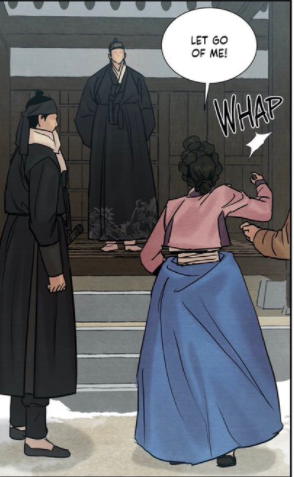 Why was she so passive? It is because the exclusion from the reunion represented the biggest punishment for Heena. She has always seen herself as a knight in shining armor. Imagine all the noonas could see the little brother and enjoy his company, while she couldn’t. I was hoping that she would start regretting her actions. As you can see, I really viewed Heena more as a victim, blinded by her faith and her own suffering than as a big perpetrator. There’s no doubt that she rejects sex because of a traumatic experience. Yet, due to her blindness and selfishness, she was an accomplice to her brother‘s suffering in the past, and unfortunately, she made the same decision.
  (Chapter 97) Seeing the corpse in the well was the trigger for her to believe everything she saw and heard without questioning the coincidences and appearances. She didn‘t doubt the testimony of the so-called witness.
 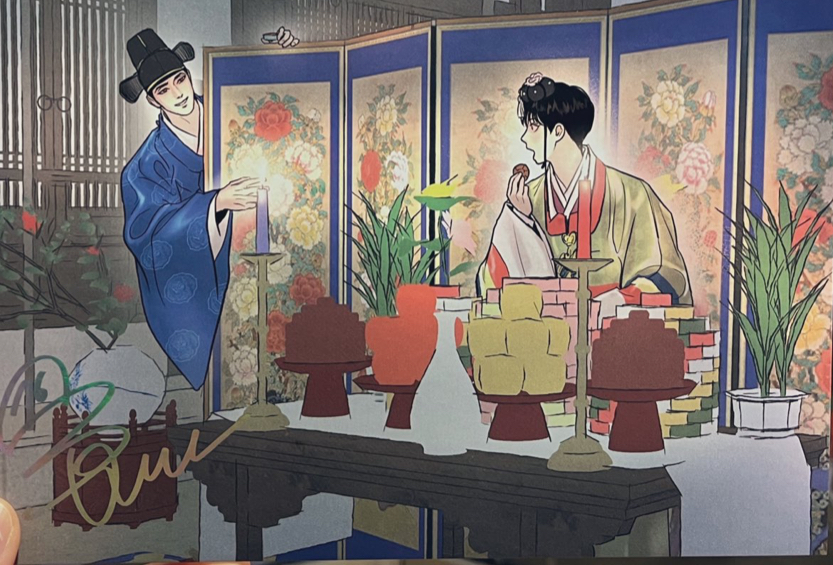 replacing these three fake feasts:
 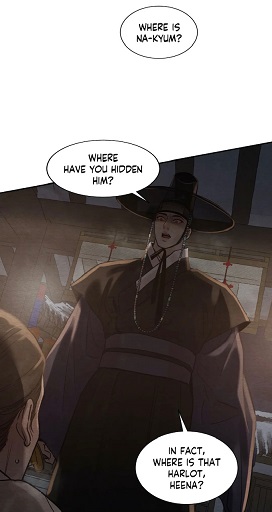 (Chapter 99) On the other hand, the resent for Heena didn‘t turn Yoon Seungho into a fool or a person full of prejudices! He still trusted the noonas, as he believed in his lover‘s heart and his genuine confession! The fire couldn‘t spread in the gibang! The lord showed mercy towards the kisaengs and the domestic Seok-Dae! Hence no one will ever come to believe that Yoon Seungho is a murderer. In their eyes, he makes nothing but hot air!! 😉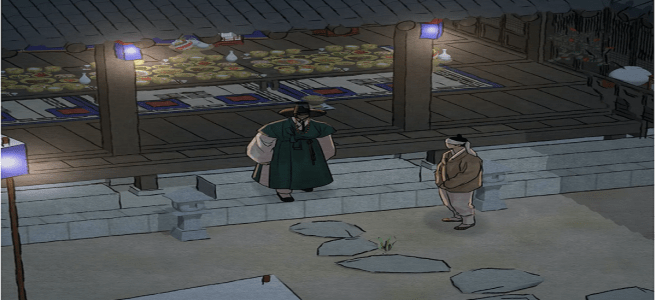

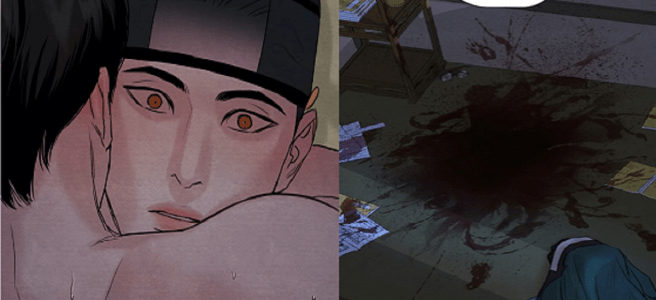

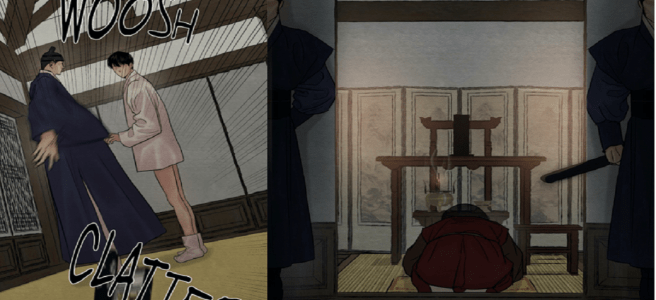
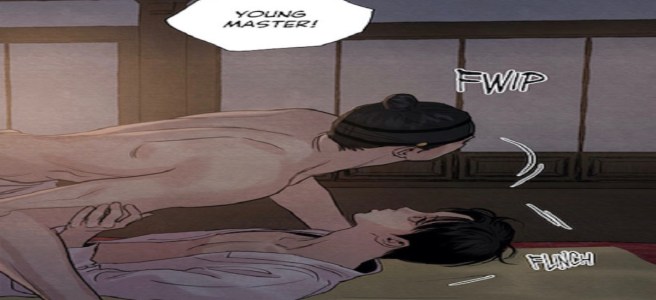
 Bebebisous33s' analyses in K-Dramaland and Manhwas