

This is where you can read the manhwa. https://www.lezhinus.com/en/comic/painter But be aware that this manhwa is a mature Yaoi, which means, it is about homosexuality with explicit scenes. If you want to read more essays, here is the link to the table of contents: https://bebebisous33analyses.wordpress.com/2020/07/04/table-of-contents-painter-of-the-night
It would be great if you could make some donations/sponsoring: Ko-fi.com/bebebisous33 That way, you can support me with “coffee” so that I have the energy to keep examining manhwas. Besides, I need to cover up the expenses for this blog.
Notice: Each new follower or new subscriber with an email address is contacted by me so that they can get the password.
As the readers can see, the title consists of an unfinished sentence. I did it on purpose for two reasons. First, it would have been too long. Secondly, it would have revealed the central topic of this essay. The name of this composition is in truth a quote from A. A. Milne. The manhwaphiles can see that I would like to analyze the new pictures released from Lezhin inciting me to present new interpretations, theories and predictions.
1. Yoon Seungho and Sleeping beauty
Interesting is that on February 1st the Korean company tweeted this image.  The manhwalovers could barely see Yoon Seungho’s face, for he was surrounded by darkness. When I saw it, my first thought was to associate the protagonist to “Sleeping beauty”. He had the same expression than in the bedchamber, when he was sleeping totally relaxed.
 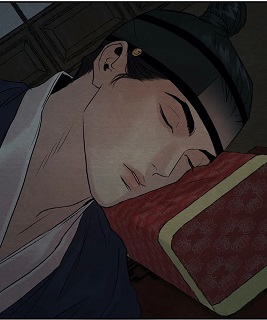 (chapter 87) He was not tormented by a nightmare, like the painter discovered it in chapter 38:
  And the darkness reminded me of the forest of thorns and as such of the curse put on the princess. The darkness, the metaphor for the forest of thorns, is the reason why the lord felt trapped and suffocating in his torment.
  (chapter 86) This contrasts to the princess’ situation, for the latter had no idea about the existence of the prison. It only appeared, when she fell asleep. Moreover, in this picture the obscurity is slowly disappearing announcing that the main lead is about to wake up, he is on the verge of being released from his curse. This signifies that the protagonist is slowly returning to life, allowing him to be able to fight back, the moment he is confronted with reality. He will be able to voice his thoughts and emotions contrary to his past lethargy.
In the fairy tale from Charles Perrault and the brothers Grimm, the princess was put to sleep for 100 years in order to avoid the terrible curse that the wicked witch had placed on her. Originally, she should have died, but thanks to the intervention of one fairy, the curse could be modified and attenuated. Instead of death, it was just “sleep”. My avid readers can already detect the similarities, as the young master’s martyrdom lasted 10 years. Not only the numbers are similar, but the idiom the lord employs to describe his past life is related to sleep: “nightmare”. (chapter 86) This shows that he had problems to distinguish illusion from reality. Why? He had long internalized that nightmare is real world. Hence any pleasant event could only be judged as dream and illusion. This explicates why the lord still feared that the painter’s love confession was a chimera. Besides, I had already pointed out that till the lord’s final suicidal attempt linked to the painter’s love and death, the lord was not truly living. I had compared him either to a dormant volcano or to a zombie. It is relevant, because thanks to the artist, the noble is learning that realism is not just made of betrayal, agony and torment. Happiness can still exist in real world, but in order to achieve happiness, the person has to work! That’s the reason why the American dream combines happiness with zeal and commitment. Therefore the main lead could only end up suffering, for he remained passive till the end of season 3. Therefore, till the end of season 3, he was not able to detect his true enemies and anticipate their moves.
Consequently, both characters, the lord and Sleeping beauty, have another common denominator. They couldn’t determine their own fate due to the intervention of others: the fathers, the “fairies”, the prince/king and the fortunetellers. Yes, sleeping beauty is connected to horoscopists. Actually, the fairy tale “Sleeping beauty” has its origins in the story “Sun, Moon, and Talia” from the Italian author Giambattista Basile. In this narration from the 17th Century, the so-called talented astrologers, tasked by Talia’s father, had predicted her future.
“at length they came to the conclusion that she would incur great danger from a splinter of flax. Her father therefore forbade that any flax, hemp, or any other material of that sort be brought into his house, so that she should escape the predestined danger.” Quoted from https://sites.pitt.edu/~dash/type0410.html
However, the lord’s attempts were a failure. The young woman couldn’t escape her terrible destiny, for she was left in the dark. Moreover, Talia was raped 😨 during her sleep by a king who was already married. Due to this encounter, the cursed protagonist got pregnant, and gave birth to twins, Sun and Moon. Under this new perspective, the readers realize that this panel is actually announcing the content of season 4. The lord’s rape will come to the surface! Furthermore, my avid readers can notice another parallel with the manhwa. I had already compared the main characters from Painter Of The Night to the moon and the sun. For Yoon Seungho, the painter symbolizes the sun and as such life, for he was slowly bringing him light, warmth (chapter 63), love and happiness in his nightmare. In his darkest moment, he voiced a wish, which exposed the return of hope. This corresponds to the spark of faith, the gradual return of trust in his life. On the other side, Baek Na-Kyum came to view his lover as the moon giving him light and hope during the night again.
  (chapter 94) I would like to point out that the artist has always associated this satellite to a source of joy and love, like we can detect it here.
  (chapter 94) Finally, Talia could get liberated from her curse thanks to her children. The splinter of flax got removed from her finger, the moment the babies were sucking on them. This signifies that she got revived thanks to love and life. Moreover, she woke up, the moment the source of her pain was removed. This observation leads me to the following conclusion: the noble can only be completely freed from this darkness, the moment his suffering is removed and as such revealed!! This means that Yoon Seungho will be able to voice his misery and denunciate the crimes he was exposed to. He will be able to identify the persons responsible for his suffering. He might know a name, lord Song, but he has no idea about his true identity. That’s how his burden will be erased. Like mentioned above, the noble’s physical and sexual assault will be brought up to light. That’s the reason why the new image announcing season 4 is so dark. They represent a reflection from Yoon Seungho’s past and torment.
Nonetheless, we should focus on the positive aspects, the gradual vanishing of the blackness. Hence I see this dark picture in a good light. It actually symbolizes peace, hope and faith. This explicates why once I detected the painter’s hair in this image, I imagined that the lord was sleeping with Baek Na-Kyum while holding him in his arms. At the same time, he was smelling his hair, a new version of this scene:  (chapter 38) I thought that the couple would share the bed, thus the lord could relax. He felt protected by his lover. In other words, I was already envisioning that this scene is a reflection from chapter 97/98, for the couple had not been able to sleep together.
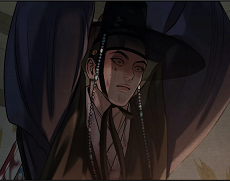
 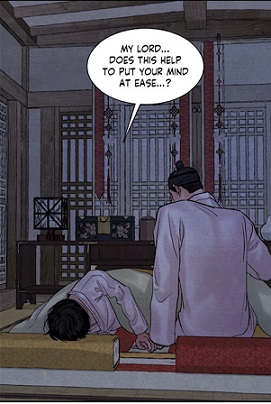 (chapter 97) However, the moment Lezhin published the second panel
 , I realized that this illustration was referring to a different element in the same scene: separation. Thus I deduce that the embrace during the sleep must have happened before, for the noble’s eye has no dark circle. He looks rested and relaxed.
But let’s return our attention to the comparison between sleeping beauty and our beloved seme. The king was actually cheating on his wife, hence he only stayed in Talia’s home for a certain time. He not only hid the truth from her, but also made an empty promise, he would bring her back to his kingdom!
“In the meanwhile the king remembered Talia, and saying that he wanted to go hunting, he returned to the palace, and found her awake, and with two cupids of beauty. He was overjoyed, and he told Talia who he was, and how he had seen her, and what had taken place. When she heard this, their friendship was knitted with tighter bonds, and he remained with her for a few days. After that time he bade her farewell, and promised to return soon, and take her with him to his kingdom. And he went to his realm, but he could not find any rest, and at all hours he had in his mouth the names of Talia, and of Sun and Moon (those were the two children’s names), and when he took his rest, he called either one or other of them.” Quoted from https://sites.pitt.edu/~dash/type0410.html
And that’s how she became the victim of another plot, the queen got jealous and chose to get rid of Sun and Moon before targeting Talia herself. And this shows that deceptions and conspiracies stand in the center of this fairy tale! At no moment, the main lead heard the truth from her father or her future husband. Thus she couldn’t protect herself correctly, just like she could never anticipate her enemy’s moves. And that’s exactly what happened to Yoon Seungho. He was left in the dark the whole time, while people made empty promises to him. When Kim revealed Yoon Chang-Hyeon’s promise, the butler was implying 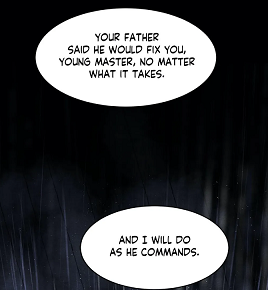 (chapter 77) that he was doing it for the noble’s best interest. He insinuated that he was protecting him and he should trust him and his father. But this was not true, for he had not revealed the truth to Yoon Seungho, the stolen kiss.
  (chapter 88) This image was mirroring the past, someone had made the promise to the young master that he would “stay by his side”, implying that he would protect him, but he had failed to keep his words, for he had trusted more in others’ comments.
 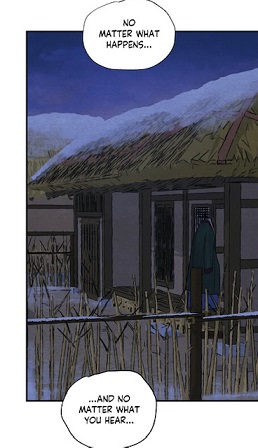 (chapter 88) Because of the tragedies, the main figure got blamed, and as such he got cursed. He was a bird of misfortune, while in reality he was the main victim. In “Sun, Moon and Talia”, the perpetrator and the accomplices, the king and the astrologers, they all got scot-free. I am certain that it was the same in Yoon Seungho’s past. And because there are astrologers in this fairy tale, I am more than ever convinced that a shaman played a huge role in the young master’s downfall.
Yet there exists a huge difference between Painter Of The Night and the Italian story. Contrary to Yoon Seungho, Talia was not conscious, when she got sexually assaulted. She was left in the dark about the true origins of her motherhood. That’s the reason why she didn’t suffer from PTSD or better said from nightmares while asleep. She could never make the connection between the rape and the birth of Sun and Moon. She just saw them, and fell in love with them, as they marked the end of her solitude. The king never described the intimacy as a crime, it was portrayed as a normality. Thus her sleep is not connected to pain and nightmare, rather to a blessing and peace.
2. Memories and farewells
What caught my attention is that the king from “Sun, Moon and Talia” never saw the sex as a crime. Why? From my point of view, it is related to his position. As the ruler, he can do whatever he wants. Yet, the reality is that he is bound by traditions and religion. Yet, he chose to disregard them. Moreover, the most surprising is that he actually forgot his encounter with Talia for a while.
In the meanwhile the king remembered Talia, and saying that he wanted to go hunting, he returned to the palace, and found her awake, and with two cupids of beauty. Quoted from https://sites.pitt.edu/~dash/type0410.html
It exposes his selfishness and superficiality in the end. He was not truly motivated by love, rather by lust. It took him more than a year before returning to her side. And that’s how he discovered that he had now heirs! This explicates why he made such a promise to the young mother (bringing her to his realm with her kids), though he still remained passive afterwards. He had been able to continue his lineage, thus everything was fine. The fairy tale is actually exposing the king’s flaws and sins. In my eyes, his behavior is reflecting the pedophile’s from Painter Of The Night. Moreover, the ruler vowed faithfulness to Talia, when he announced that he would bring back her and their children to his realm. But he knew that it was not possible, for he still had a wife. This means that the king couldn’t live with Talia together. His time with her was limited, hence he justified his vanishing with “hunting”. Yes… another parallel with the lord’s attitude.  (chapter 83) In Painter Of The Night, the hunts were always used to provoke a quarrel and as such a separation, but it never worked. This is important, because this shows that the couple from the Italian story had to separate. It is now time to reveal the whole quote from Milner:
“Promise me you’ll never forget me because if I thought you would, I’d never leave.”
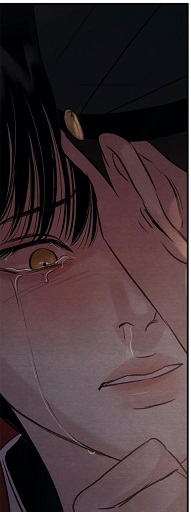
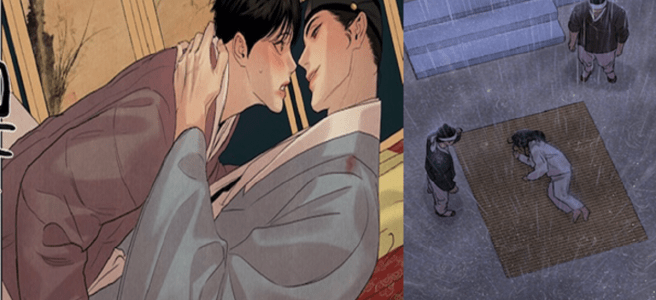
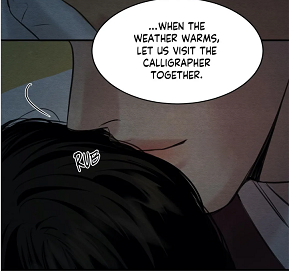
His words indicate the difficulty of departure. In order to overcome the distance, one needs absolute trust in the partner’s love and loyalty. And this situation is actually reflected in the second picture released from Lezhin. Byeonduck is now announcing the separation arc. Since Yoon Seungho is closing his eyes while kissing Baek Na-Kyum’s eye, I come to the interpretation that the lord is trusting blindly his lover. He is not doubting the artist’s affection. There is no ambiguity that he is also embracing his lover. He is actually making here a promise to the painter. This is what Lezhin wrote on Twitter:
시샘달 하루부터 닷새까지. 매일 정오 찾아 오겠노라, 약조하마. From the first day to fifth day, I’ll come to you every day at noon, in the morning (translated by papago).
He will not only return to him, but also he is telling the time of his return!! This means that the lord has now regained the notion of time! Kim, whom I consider as a new version of Chronos, is no longer controlling the main lead, because he is no longer owner of his time. The panel with the text is already displaying the butler’s loss of power. To conclude, this panel represents the positive reflection from this scene: 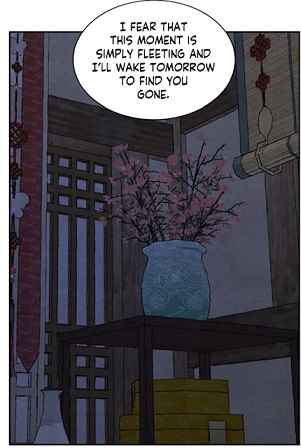 (chapter 97) Back then, the lord was scared, for he still doubted the artist’s love confession. It was too beautiful to be true! However, back then, the artist never doubted his own resolution, thus he gave comfort to his lover by giving him his hand.
  (chapter 97) (chapter 97) At the end, the lord expressed the following wishes:
  (chapter 97) In other words, he desired that the painter would follow his requests and as such he should vow him loyalty and trust one more time. The irony is that the lord was actually the one breaking his vow, for he left his lover without saying goodbye. Thus I conclude that in this scene, the characters have switched their position: Yoon Seungho is no longer doubting the artist’s sincerity and loyalty, for he could witness with his own eyes the abduction and the sexual assault. Yet, the painter is in tears, because he is already missing his lover. The tears doesn’t just represent agony, but also longing. What caught my attention is that the drawing is very similar to this image:
  (chapter 78) This means that the lord is smelling his partner’s hair helping him to remain strong and calm. He is now trying to memorize his lover’s odor so that he can forget this stench, a remain from the past:
 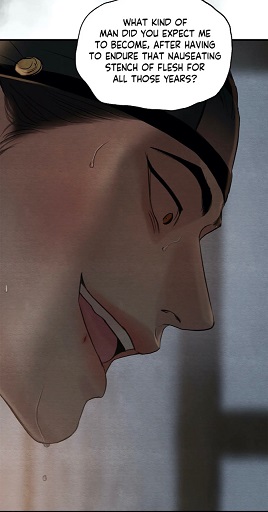 (chapter 86) This can only help him to defeat his “opponents”. Finally, in different analyses, I had already interpreted that Baek Na-Kyum was embodying memory, whereas the lord stands for truth. The image is actually a reference to recollection and as such honesty. There is no ambiguity that both men are trusting each other, but the painter is crying, for he fears for his lover’s life either. Yoon Seungho is leaving him in order to protect him in my eyes. And this leads me to the following deduction. When the lord is about to leave, Baek Na-Kyum is not left in the dark contrary to episode 97. He knows the whole truth, for the lord must have confessed to him. We could say that he is not leaving without a word
  (chapter 97). Furthermore, this signifies that the artist doesn’t need any longer to rely on the explanations from others. Thus the artist will keep his promise (chapter 88), though he won’t be by his side physically! They are no longer relying on the butler and his “information”. The trick played at the end of season 3 won’t work on Baek Na-Kyum any longer. He will no longer be swayed. And the promise made by the lord is the reason why the painter will remain loyal. He will stay at the place he is living and wait for his lover’s return. He has no question either.
Many manhwalovers might be unhappy about this evolution, for they love watching the couple living together. But keep in mind that this is totally necessary, because this will push Baek Na-Kyum and Yoon Seungho to create paintings and even poems. This can only incite them to recall their past moments together. A new version of this scene:  (chapter 23)
 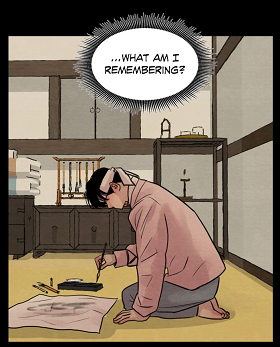 (chapter 24) In other words, this announces the return of Yoon Seungho’s passion for painting! And it is the same for the painter. The erotic picture should reflect their love for each other, created based on memories. At the same time, this can only push the noble to demonstrate his talents to others refuting all the negative rumors about him: he is intelligent and possessing his whole mind. Furthermore, this can help him to reminisce his tragic past, what led him to his downfall and suffering. This signifies that he will be able to confront his past and his memories. He will be able to identify the rape, and Kim already exposed the truth to Yoon Seungho, when the former suggested him to ensure the painter’s consent. This shows that Kim was well aware of the sexual abuse, but he chose to never divulge the verity. On the other hand, the pedophile thought in the past that the young master would never forget him due to his position, thus he had no problem to leave Yoon Seungho behind and make no real promise. Departure was never painful for him… hence this quote (“Promise me you’ll never forget me because if I thought you would, I’d never leave.”) will become a reality for the mysterious lord Song, but it is already too late. In fact, the gods punished him by making Yoon Seungho suffering from amnesia. He is not attached by loyalty to the pervert.
Yoon Seungho’s vow with Baek Na-Kyum diverges so much to the monarch’s behavior from “Sun, Moon and Talia”. The latter broke his promise on so many levels. First, he hid the queen’s existence to the protagonist. But this doesn’t end here. He left her behind without making sure that her family was protected. He thought that this secret would guarantee her safety. However, in the story, the king couldn’t help himself revealing the secret and that’s how the queen discovered his betrayal and infidelity. I would like the readers to keep in mind that back then, polygamy was considered as a huge sin in Europe. Note that at the end, the legal wife was the one who brought the “princess” to the kingdom and this for a trial. So where was the king? He was often busy eating! We could say that he didn’t keep his promise out of laziness and even naivety. He allowed that Talia was accused of infidelity and witchcraft, for she had seduced him. He only appeared at the end of the fairy tale. He only voiced regret and put the blame on the queen, while in reality he was the main culprit for this situation.
“The king suddenly appeared, and finding this spectacle, demanded to know what was happening. He asked for his children, and his wife — reproaching him for his treachery — told him that she had had them slaughtered and served to him as meat. When the wretched king heard this, he gave himself up to despair, saying, “Alas! Then I, myself, am the wolf of my own sweet lambs. Alas! And why did these my veins know not the fountains of their own blood? You renegade bitch, what evil deed is this which you have done? Quoted from https://sites.pitt.edu/~dash/type0410.html
The manhwalovers can detect many similarities with Painter Of The Night. The ruler will never recognize his crimes and even wrong decisions. He neglected Yoon Seungho, but chose to put the blame on others. First, the young master, then the patriarch Yoon Chang-HYeon, the kisaeng, “No-Name” and finally Lee Jihwa. At some point, it will be the butler’s turn. On the other hand, since no one of them was willing to recognize their own fault and involvement, they preferred blaming the victim, for the latter was the only one without a voice. Thus Yoon Seungho is accused of being consumed by lust, he was neither faithful, while in truth, he had no saying from the start.  (chapter 57) That’s the reason why I believe that when an incident occurred during that night
 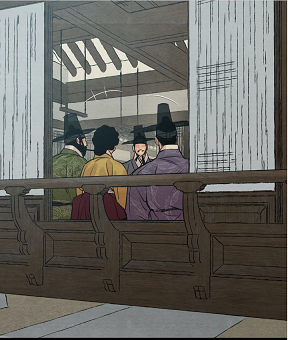 (chapter 83), the main lead was framed. He got accused of a crime, whereas he had been the true target in reality. There is no ambiguity that the abusers doubted the protagonist’s loyalty and integrity, for they were themselves untrustworthy. They all knew that they had lied and deceived the young master at some point.
And this leads me to the following conclusion. The separation is necessary, since the story is going in circle. Back then, the “pedophile” couldn’t stay by the young master’s side due to his duties. Thus he could only appear, when he was “hunting”. This means, the painter is put in the same situation than his lover in the past. However, the huge difference is that Yoon Seungho came to hate the mysterious lord Song! He never wished his return… However, since he had lost the notion of time, he could only live in fear. That’s how he came to develop insomnia. This explicates why the man trained the protagonist to have a sex marathon, for his time in Jemulpo was limited. Thus I deduce that the pedophile never bid farewell to Yoon Seungho and barely talked to him as well, unless he gave orders. In my eyes, he relied on others: Yoon Chang-Hyeon the kisaeng, Yoon Seungwon and Kim. Yet, deep down, the perpetrator was well aware that he was abusing the young master. But he chose to close an eye, until an incident occurred. That’s the reason why he could never trust the male kisaeng in the end. As a conclusion, season 4 symbolizes the opposite to the past: acceptance, love, faith, closeness, verity and transparence despite the return of darkness. This explicates why the illustration is quite “easy” to interpret despite the blackness.
3. Interpretation of the second panel
It is possible, if you compare the image to others. This picture contrasts so much to this one: 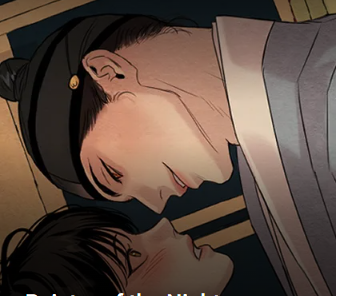
- prank – seriousness
- light – dark
- smile – tears
- Yoon Seungho made sure that the painter stayed by his side, he even stopped him to retrieve the music box, while now the lord has the opposite intention. He is now the one leaving the painter.
- The small gap between the main leads indicating that despite their closeness, there still existed a wall between them. This displays that in the new illustration, the distance is no longer existing. Both are fully trusting each other. The lord must have confessed what happened to the painter at the end of season 3, and the painter must have also explained how he came to leave the mansion. In other words, both revealed many secrets concerning the last incident,
That’s the reason why I come to the following deductions. They are biding farewell outside. The painter followed him to the door. However, here the lord is not suicidal at all. In fact, the promise represents the source of strength for Yoon Seungho. The latter has to remain alive in order to protect Baek Na-Kyum, definitely a new version of this scene:  (chapter 11) However, there is no ambiguity that the painter can only fear for his lover’s life. The closed eye contradicts the haunted gaze in the shaman’s house.
  (chapter 102) Despite his closed eyes, he is now able to discern the truth, and it is the same for the painter. Their Third eye is now fully awakened.
But the most important detail is the lord’s kiss on the artist’s eye. The lord had already done it in the past. When he kissed the artist there for the first time, the latter was unconscious.  (chapter 21) This gesture symbolizes the epitome of the noble’s affection and the desire to give “happiness”. Then in the bedchamber, he did it in order to console his partner.
  (chapter 82) With his kiss, he was asking for his forgiveness. This means that the kiss on the eye serves as reassurance and comfort either. Thus we had this scene in the study:
 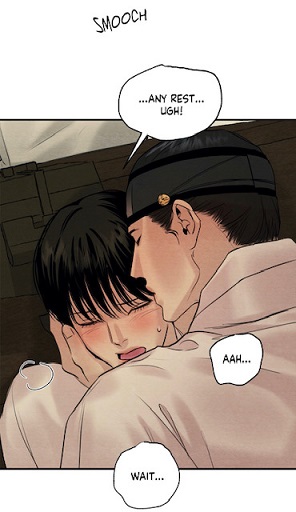 (chapter 84) The lord had kissed his lover there, because he was voicing his attachment and desire to redeem himself and to comfort the artist. As you can see, it was a combination of all the previous significations. Yet, the lord had not grasped the “gravity” of his “wrongdoing”. Thus the kiss was associated a certain playfulness in the study. As a conclusion, this image symbolizes the reality. Both are aware of the truth, willing to face it together. The lord is attempting to console his lover, to reassure him that everything will be alright. He is sorry, for he is making him cry again, but this separation is necessary. It was, as if he was seeking Baek Na-Kyum’s forgiveness. He is honest and serious. He is now capable to face reality. But there is more to it. The new image contrasts to this one too:
- light -dark
- happiness – sadness
- sun – moon
- the hand with a foot – the couple’s faces
This contrast confirms my previous signification: this happy moment in the painter’s childhood had been short-lived, because he had been left in the dark. While he was with the scholar and was happy, something terrible must have happened to someone close to the painter. It reinforced his guilt and abandonment issues. Besides, I had already outlined that this scene must be connected to a departure, a “farewell”. [For more read the essay “Baek Na-Kyum’s foot“] In the past, I had assumed that it was related to Heena, but it could be linked to the gibang in general. Another kisaeng could have vanished suddenly. That’s how I realized why the painter came to love the moon and night! I recognized that many wounds in the painter’s life had occurred during the day:  (chapter 94)
  (chapter 94)
  (chapter 34)
  (chapter 11)
 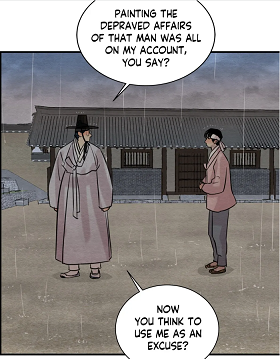 (chapter 19) He came to feel more safe during the night, until he met Yoon Seungho in season 1. From that moment on, his night life got slowly affected. That’s how he discovered that night could be associated to pain and agony too. Yet, deep down, he still felt safe by the noble’s side. As you can see, the new illustration is reinforcing my theory that this image is not just mirroring a happy moment in the painter’s youth. The latter actually symbolizes illusion and deception, whereas the dark panel oozes reality and honesty.
And all this leads to the final conclusion: the last common denominators between Sleeping beauty and Yoon Seungho are vengeance, greed and jealousy. That’s the reason why Talia came to be arrested and falsely accused. Nonetheless, none of the characters realized this. The cursed princess in the Perrault’s or the Grimms’ version had no idea about the intervention of the witch/fairy who had felt insulted either. This is the reason why the Yoons’ reputation got ruined. The couple can only discover these elements, when someone witnesses such a scene and reports it to the “schemers”, and as such to the “mysterious lord”. The latter can only be upset, for the young man has never acted this way with him.
“Promise me you’ll never forget me because if I thought you would, I’d never leave.”
Yoon Seungho can leave his lover’s side without fearing his sudden vanishing. He is exactly thinking like Milner. However, these words stand in opposition to the butler’s philosophy:  (chapter 51). Hence the butler could perceive this promise as a betrayal from Yoon Seungho. The latter is slowly forgetting the valet, he is no longer seeking his assistance and his side.
Feel free to comment. If you have any suggestion for topics or manhwas, feel free to ask. If you enjoyed reading it, retweet it or push the button like. My Reddit-Instagram-Tumblr-Twitter account is: @bebebisous33. Thanks for reading and for the support, particularly, I would like to thank all the new followers and people recommending my blog.
 (chapter 102) The painter had confessed too late, for the schemers were already pulling the strings in the shadow. To conclude, the main leads’ self-deceptions were connected to love and time. The importance of self-manipulation leads me to the next observation. All the antagonists and villains were liars, because they were also deceiving themselves. They refused to admit their own fears and flaws, therefore they chose to commit a wrongdoing and manipulate others in order to hide their true thoughts. This means that not only the crime was covered up with a deception, but also the manipulation was hidden by another lie. This means that the list of their sins increased. Therefore it is not surprising that the gods chose to confront the liars with the verity, as they kept refusing to admit their sins. Now, it is time to focus on the antagonists and villains’ manipulations and the scenes where they were facing the mirror of truth. However, the readers are probably wondering where the mirror of truth is. The answer is simple. The mirrors of truth are not only the two main figures, but also Kim and Min, though they are their negative reflections. Remember that in Snow White, the item led the evil Queen to her doom, for the latter refused to accept reality. At the same time, the mirror of truth was not entirely honest either, for it never explained the definition of “Beauty”. In other words, it lied by “omission”. I realized that I can not examine all the antagonists and villains in one text, as I am so detail-oriented. Consequently, I selected Lee Jihwa and Yoon Chang-Hyeon first, for both characters’ lies are strongly intertwined.
  (chapter 77) The problem is that he had been caught by the butler. Thus the door was open. The door is full of symbolism. It can represent opportunity, but also imprisonment. Simultaneously, the door embodies the passage from one world to another in religion and literature. In the analysis “The window, the door, the air and their signification”, I had explained that in Painter Of The Night, the door embodies the passage between the conscious and the unconscious. This means that when all the villains are confronted with the mirror of truth, they are standing on the doorstep. That’s why the reflection is linked to the open door. The characters are forced to face their own repressed desires and anxieties. Hence I deduce that the room symbolizes memories too, which means that we are dealing with repressed memories. In our first case, since Lee Jihwa was seen in the study, this means that when he got caught, he tried to deny his responsibility in the seduction. That’s how he started being in denial of his wrongdoing. Thus out of fear, he left his friend behind and as such he buried the incident in his unconscious. He tried to forget it. He convinced himself that he had seen the friend’s smile. This was the evidence of his “statement”, yet this was just an illusion. However, before he ran away, he lied to the butler too. He told him that the one who had kissed him had been the main lead. So not only he lied to the valet, but also to himself. That way, he was avoiding to feel guilty. There were two lies, and both were used to covered up his own wrongdoing. But the one who had been smiling, was in reality Lee Jihwa, as he had the impression that his dream had been fulfilled. Thus the author revealed the young master’s blushing, the expression of happiness.
  (chapter 77) However, since he had been caught by the valet, he was facing the butler’s visage. And what did he see in his facial expressions? Shock and horror!! That’s how Lee Jihwa realized the gravity of his sin and chose to blame his friend. Thus I imagine that he must have blushed again and this time out of shame and embarrassment. It is very possible that in that moment, he must have copied the valet’s facial expressions before leaving Yoon Seungho behind and lying to the butler. Why do I think so? It is because the butler had made such an expression in front of the barn, when he had been caught.
 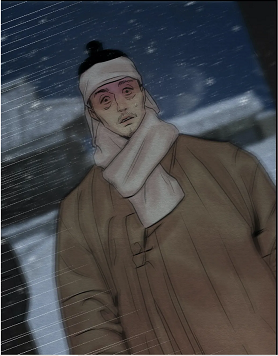 (chapter 64) And what did the main lead say?
 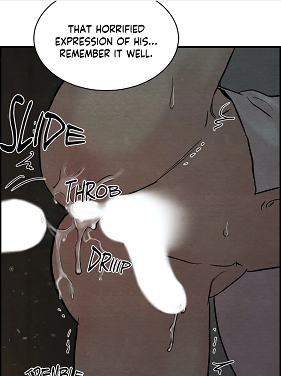 (chapter 64) Since the painter seems to have forgotten it, I deduce that it was the reverse for Lee Jihwa which explains why he felt so guilty in the end. As for the butler, when he had barged in the study, he had committed a wrongdoing himself. He should have asked for the main lead’s permission, but he did not. Consequently, he decided to believe in Lee Jihwa’s deception. One hand washes the other. He was covering up the guest’s sin, while the latter was doing the same thing for the domestic, though I doubt that Lee Jihwa truly realized it. Simultaneously, Kim had the perfect justification to hide the violation of social norms. He had caught the main lead red-handed, hence no one would question his own action. As you already know, I associate the butler to Pilatus, therefore he is connected to the bucket.
 (chapter 13) However, in my eyes, this doesn’t represent the biggest confrontation with the mirror of truth. For me, it is the altercation in episode 17, for it took place in the same place than the aristocrat’s crime. When the red-haired master looked at the picture, he was suspecting that the painter had seduced his friend due to the insinuations by the staff. And his fear reached the peak, when he saw the painter’s reaction:
 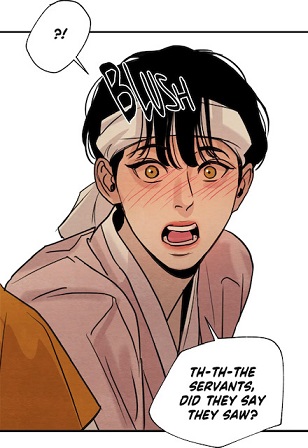 (chapter 17) As you can see, in this episode, the gods were recreating the same situation: a servant had witnessed how the two men “were fooling around”
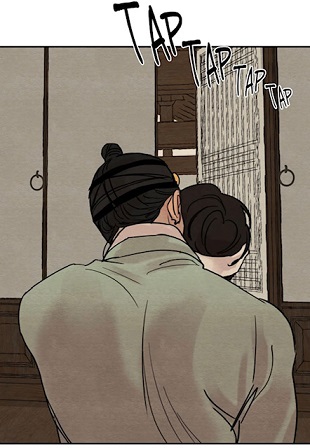 (chapter 16), though this was definitely not the case!! And this is exactly like in the past, Yoon Seungho was totally pure and innocent. And what was Lee Jihwa’s reaction? A slap!
 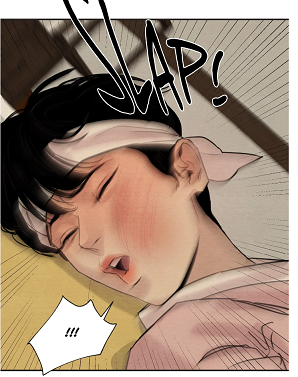 (chapter 17) This is what Yoon Seungho had experienced in the past. Yoon Chang-Hyeon had definitely abused him.
  (chapter 57) Thus the main lead’s cheek was bruised. Then exactly like in the past, Lee Jihwa accused someone else of committing a crime. In the past, it was his friend, in the present it was Baek Na-Kyum. Both were portrayed as immoral seducers.
 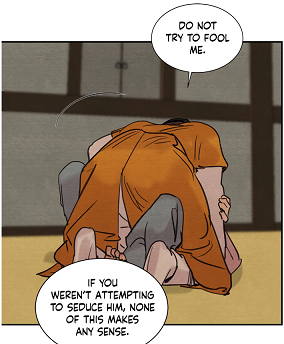 (chapter 17) These words were exposing the verity about the past. Lee Jihwa was admitting in front of the painter that his friend would never act like that, and as such he had not attempted to woo him in the past. Striking is that in front of the painter, the red-haired master was misinterpreting the incident. Why? It is because he was influenced by his past experiences. Since he had lied twice, he jumped to the wrong conclusion that it was the same in the present. And back then, he had even achieved to fool Kim. Therefore he couldn’t allow himself to be fooled like the butler. That’s the reason why he couldn’t imagine that someone was innocent.
  (chapter 17) He was a liar in the past, so it must be the same for the painter. Yet, this was the negative reflection from the past. Thus his karma was to get caught by his childhood friend. Striking is that this time, he was put in his friend’s place. He was turning his back to the door. Moreover, due to his anger, he didn’t hear Yoon Seungho’s steps and the opening of the door!
 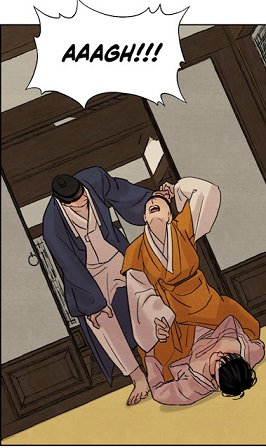 (chapter 17) But the childhood friend refused to face reality in that moment, and as such to admit his guilt and responsibility. Why? It is because he had committed another crime in the past. This is related to the bedchamber incident.
  (chapter 83) However, here he had been caught by his father, hence I believe that this confrontation represents mainly the elders’ punishment. As for Lee Jihwa, despite the humiliation and abandonment in chapter 18, he refused to give up on his friend.
  (chapter 18) One might say that he was motivated by love, yet I think that it is related to his denial about his sexual orientation. And this coincides with his lack of honesty. He had not confessed his own sins and lies yet. Therefore
  (chapter 36) he presented himself as a pitiful creature, as he was sharing the protagonist’s suffering due to his knowledge. However, this was not empathy, just sympathy. The person only feeling sympathy will always put a distance between himself and the counterpart. There‘s a “I“ and “you“, but no „we“. The person might come to pity the other, yet he won‘t intervene and help. He will just understand and that‘s it.
 (chapter 36) This panel is the evidence for this interpretation. Lee Jihwa never used the personal pronoun “we”, even during the abduction.
  (chapter 59) [For more information about sympathy read the essay “Sympathy for the devil”] Hence the gods let him meet the mirror of truth a second time:
 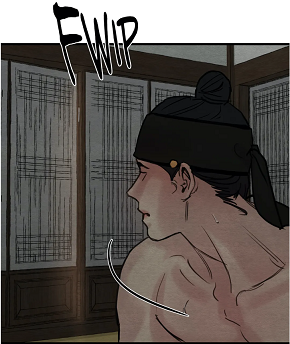 (chapter 43) Based on this panel, Lee Jihwa had more or less barged in the study, but his presence was detected too late! One detail caught my attention in this picture, the presence of the light reflected on the door. Hence I assume that the main lead detected the presence of a witness because of the light!!
  (chapter 43) Let’s not forget that the room was dark, when they were having sex.
 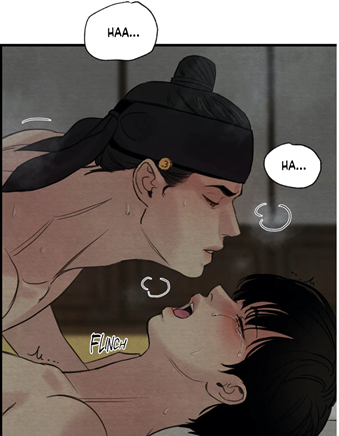 (chapter 42) He was still looking at his lover’s face, when he perceived the change of the light. Hence he turned his head in direction of the light reflected on the door. My friend Luzaly brought my attention to this detail. The couple was turning their back to the door before.
  (chapter 42) The form of the light reflected on the door doesn’t come from behind the gate
 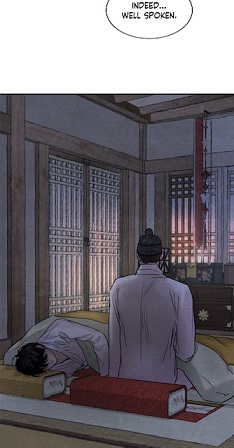 (chapter 97) And now, you comprehend why I came to the deduction that Lee Jihwa had witnessed the love session not from this door,
  (chapter 41) However, in the next episode, Byeonduck showed us a slight change.
 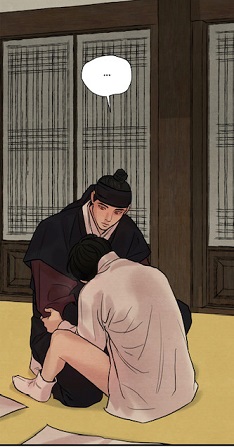 (chapter 42) The door was now close. This means that the butler had intervened at some point. This was the negative reflection from episode 20.
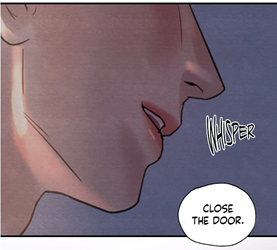 (chapter 20) This time, the main lead had not requested for more privacy, for he had not detected the presence of his right-hand. And this leads me to the following conclusion. Since this is not the door
  (chapter 43) I am even suspecting that he didn’t view this scene at all, because logically, the light should be coming from the other side!! But on the other side, there is no door!!
  (chapter 49) But there is the window…. And now, you comprehend why Yoon Seungho never investigated the matter with the “door”. It had never been opened in the first place. But how could Lee Jihwa imagine such a scene?
  (chapter 57) However, here it is necessary to remind the readers of my previous character’s examination. I had described Lee Jihwa as trapped in a dark room, because he had lost his auditory and visual sense due to his guilt!! This was the price to pay for his sins. He had imagined to see the friend’s smile and he had lied to the butler. And since in episode 17, his visual senses were triggered (the painting, the painter’s facial expressions), I deduce that in chapter 42/43, this time Lee Jihwa was confronted with the mirror of truth through words. Through the window, he could hear the moaning of the couple, hence he couldn’t see the painter’s sadness. Moreover, this is what the painter said:
  (chapter 42). It sounded like he was indeed seducing the main lead. As for the embrace, he couldn’t hear it, but someone had heard the longing from the painter.
  (chapter 43) The gods were punishing Lee Jihwa for his lie: his friend’s smile!! But I have more evidences for this theory. First, it is important to pay attention to Min’s words, when he manipulated Lee Jihwa. First, he portrayed the painter in a pejorative light with the idiom “indecent life”.
 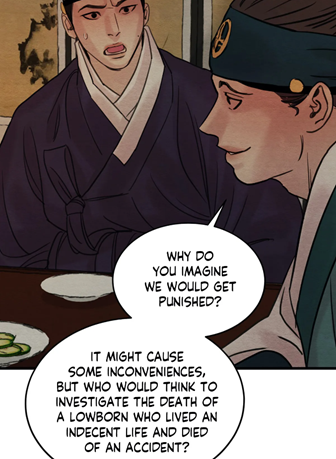 (chapter 43) Moreover, the noble employed the personal pronoun “we”, which is not typical for the selfish and hypocrite villain. This means that he was repeating Kim’s words. Then he added how the couple would have sex in the barn
  (chapter 43) (“vulgar roll in the hay”), but this was not true. However, this is what had happened in the past with Lee Jihwa. The latter would have sex with his childhood friend in the storage room. This explicates why Lee Jihwa came to believe in Black Heart’s words and manipulations. With such a description, he was reminded of his own past!! Therefore it is not surprising that Lee Jihwa had such a vision.
  (chapter 43) Moreover, since this night was a reflection of the first Wedding night, this means that the author left a clue there. And now, look at this…
  (chapter 21) The windows!! As you can see, the door is not the only place to spy or interrupt intimacy. Secondly, we should have reflections of the spying through the window in season 2.
  (
( Chapter 49) In this episode, the light in the study had suddenly vanished, and this is what we had before:
  (Chapter 70) I had already suspected back then, that someone was listening to their conversation, and with this new discovery, Lee Jihwa hearing the love session from the window, this interpretation gets reinforced. Furthermore, in chapter 96, the main lead had explained the opening of the door with this:
 (chapter 96). This signifies that in the past, the lord had explained the sudden opening of a window and the vanishing of the candle light with the wind during the night of chapter 49.
 (chapter 36) The reality is that he couldn’t cut ties with his friend. He had lied in the past, therefore he got manipulated in the present. And since he was confronted with his auditory and visual senses in season 1, he was put in a similar situation in season 2. However, there was a slight change, now the red-haired master was confronted with a real crime: murder!!
  The darkness of the room and the silence from Yoon Seungho and the painter were referring to the master’s loss of senses and his guilt. Deep down, the young master knew that the assassination was not right. And note that the aristocrat had this nightmare in his own bedroom confirming that the room is the symbol for the subconscious. Finally, in season 3, Lee Jihwa got confronted with another uncomfortable truth: his friend’s sexual abuse. Lee Jihwa had acted, as if this stolen kiss was nothing. However, due to his silence, he let his friend get raped. And he knew about this, but he chose to close an eye to this. First, Lee Jihwa refused to share his friend with the painter
  (chapter 5) Therefore it is no coincidence that in the shaman’s house, he was put in the same position than Yoon Seungho. He couldn’t select his partner
 (chapter 100), he had to rape Baek Na-Kyum. This is no coincidence that the Joker was standing in front of the door. He was pushing the young man to face his repressed memories and lies. That’s the reason why exactly like in the pavilion (chapter 43), Black Heart coerced the antagonist. He used words to manipulate the second lead, but there is a huge difference. The shaman’s house was representing the young noble’s unconscious and as such his true personality, while it was not the case in the pavilion. The room in chapter 43 was more embodying the Joker’s unconscious. Why? It is because Lee Jihwa was speaking the truth in that scene.
 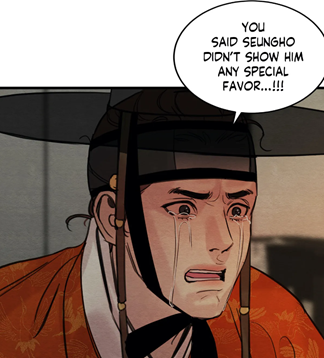 (chapter 43) He reproached Black Heart to have deceived him. On the other hand, the scene in the shaman’s house corroborates my interpretation that Lee Jihwa had not seen the embrace from chapter 42, for Black Heart was voicing the butler’s thoughts and emotions.
  (chapter 100) This shows that during the night of chapter 42/43, the valet had intervened. Thus Min was acting, as if he was a victim in the recent past. He had been deceived by Lee Jihwa’s lies by omission or commission. This is what had happened in the past. Besides, I realized that when the man confessed the incident in the bedchamber
 (chapter 83), Min couldn’t see the whole story. He had to rely on the second lead’s words. Just because we could observe the whole scene, this doesn’t mean that this was the case for the character. It is very likely that Lee Jihwa left details out, especially as he portrayed himself as a victim. Due to the narration, Min could have been misled. He could have envisioned that the childhood friend was living in the study and had dragged his friend to the bedchamber. Hence you comprehend why I consider it as another evidence that Lee Jihwa didn’t view the love session in the study from chapter 42 with his own eyes. He had to rely on his ears and naturally Kim played a role before Black Heart’s intervention. The servant hoped that Lee Jihwa would decide to do something…. in other words, he had been gradually manipulated by Kim and Min to hire an assassin. That way, he could be blamed for the murder of the scholar. He would become guilty by association. And the one pulling the strings behind the scene can only be the mysterious lord Song, for he can no longer interfere directly, though I am certain that he was not aware of the butler’s own meddling. Why? It is because in the past, Kim had never become proactive like that. Moreover, I think that even in the past, the man was not omniscient and omnipotent either. He over-estimated his own abilities, and didn’t recognize that he had been fooled himself either.
  (chapter 100) This is no coincidence, for the sexual abuse is the reason why Yoon Seungho’s heart and soul got destroyed. This had the same effect than killing someone, especially if the person is so innocent and pure. Because he recognized the truth, he had the courage to abandon and betray Black Heart. That’s how he could redeem himself in the end.
  (chapter 100) At the same time, this is not surprising that Lee Jihwa met his friend and admitted his wrongdoing. For the first time, he didn’t remain silent and chose to intervene!! I also believe that during that night, he apologized to the protagonist before vanishing. In other words, Lee Jihwa had to face 4 different mirrors of truth, until he was able to admit the verity. He was responsible for Yoon Seungho’s suffering. He had lied, therefore he got deceived, until he had no other choice to confess his guilt and sins.
  (chapter 77) This means that he broke his promise. Striking is that the vow to the butler was introduced in connection to the patio!! When the readers hear this promise, this is what we see shortly after.
 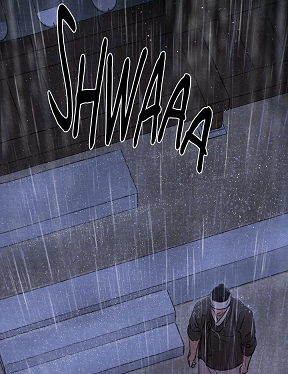 (chapter 77) Secondly, the elder master Yoon was seen shortly after there.
 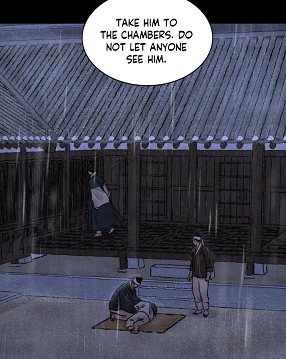 (chapter 77) That’s how I realized that the elder master was connected to this patio in front of the building. Thus Byeonduck showed us him in this place in the gibang
  (chapter 87) Finally, there exists the flashbulb from Yoon Seungho’s memory:
  (chapter 55) My avid readers will certainly recall how I had claimed that this scene was representing Lee Jihwa and father Lee. I am not changing my mind, but I would like to point out that this story is built like a kaleidoscope and as such, each image is actually a reflection. Thereby I come to the conclusion that in this panel, the young boy and the elder are in verity embodying 4 people: the boy is Lee Jihwa and Yoon Seung-Won, as for the elder, it is father Lee and the elder Yoon. Why? It is because the punishments were related to the Lees’ behavior and words. There is no ambiguity that elder Lee intervened to protect his son’s reputation. In other words, father Yoon was seen in the patio in chapter 55. Then when he visited the physician, he remained outside too contrary to the main leads.
 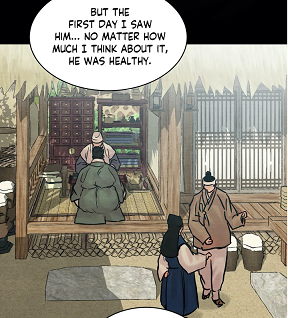 (chapter 57) It was, as if the elder master had nothing to hide, for the domestic and the butler could hear him. However, the latter got deceived. There is no ambiguity that the valet and the young master trusted him. On the other hand, the valet was the one who introduced him to the physician, like we could see here.
 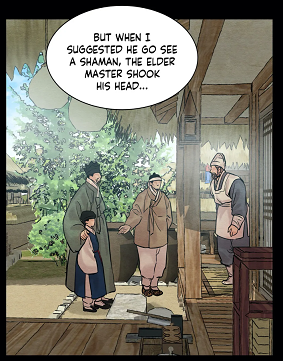 (chapter 57) But what does it mean? First, it shows that Yoon Chang-Hyeon was never seen in the bedchamber!! In other words, his power was fake. This interpretation gets validated, when I use the confrontation between Heena and Yoon Seungho.
  (chapter 65) In that very same place, the protagonist had been insulted and could do nothing, for neither Kim nor his staff intervened. And this perception reinforces my perception that the patriarch has always been delusional and arrogant, over-estimating his own power. Moreover, the lord was not honest either.
  (chapter 65) This shows that the patio is connected to violence, hypocrisy, deceptions and offenses.
 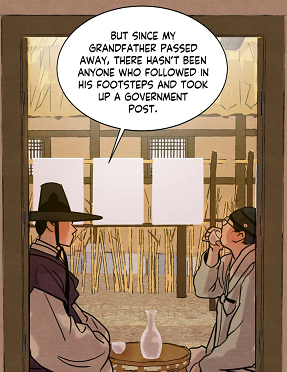 (chapter 7) Then in the study, Yoon Seungho confessed that his father had been dismissed from his post which contradicts the previous statement.
 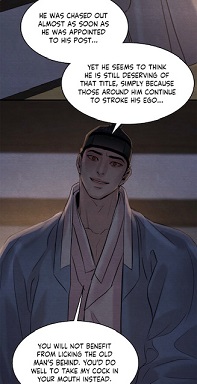 (chapter 80) But how did Yoon Chang-Hyeon obtain his office then? Then the expression “follow in his footsteps” caught my attention. That’s how I realized that the elder master never passed the civil service examination!! In truth, he failed terribly. How can I be so sure about this? First, the civil service examination consists of different tests. Secondly the idiom from Yoon Seungho indicates an gradual rise in the grandfather’s career which is not reflected in the lord’s confession to the messenger. Finally, in front of the mirror of truth, the father voiced the following wish:
  (chapter 86) This expectation exposes that this had not happened in the past. But why didn’t he expect this from Yoon Seungho earlier, though the latter had such a good notoriety? It is because he desired to be admired himself. He viewed himself as the Yoons. Thus he said this to his son:
  (chapter 86) This means that he was using his own sons for his own career, though he claims that he is doing for the Yoons’ notoriety. In other words, the patriarch’s position was obtained through sexual favors. But since the king was the sponsor, there is no ambiguity that at some point, the elder master must have started dreaming even bigger, similar to the scholar:
 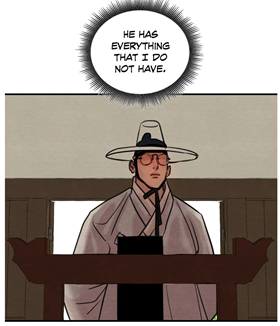 (chapter 18) Hence I have the impression that he must have acted, as if he was the king’s relative. Hence he asked to be called by a certain title. This could only infuriate the mysterious lord Song, for the latter was hiding his sodomy and debauchery behind closed doors. No one was supposed to make a connection between him and the Yoons. However, I don’t think that the elder master Yoon had planned everything from the start. He had definitely been misguided, for in season 1 and 3, we could see that he was believing blindly what people would say to him. He never doubted his son’s words, when the latter said that Yoon Seungho had given him such a paper.
  (chapter 44) And it is the same with father Lee. That’s the reason why I still think that he had been manipulated. He was pushed to sell his own son, thinking that the Yoons would benefit from it. However, this was just a delusion, as he was dependent on the monarch’s benevolence.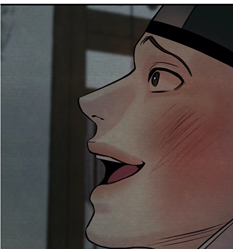
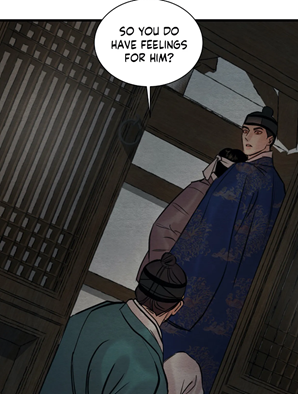 (chapter 53) But Yoon Chang-Hyeon refused to admit it, it went so far that he was denying his relationship with Yoon Seungho. He was just an animal.
 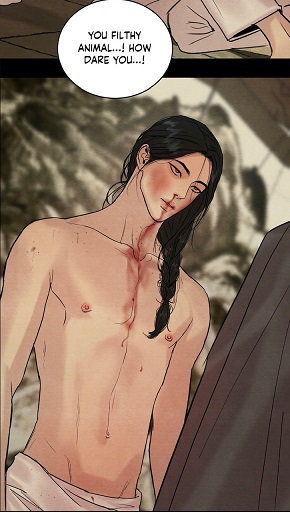 (chapter 83) The reason why I am connecting it to episode 53 is because of The Joker’s smile which reminded me of lord Song’s evil smirk.
  The man had a view to the patio, hence he could see who could enter the bedchamber or not. And observe that when the brutal father was in the bedchamber, the main lead never replied to him. This could only reinforce the man’s delusion and greed. That’s the reason why Yoon Seungho had to live in the barn and was not dressed properly. The elder master Yoon was avoiding his son for this reason. He was closing an eye to the truth. And that’s how he could convince himself that Yoon Seungho was just a sodomite. In other words, he came to believe his own lies, while in the beginning, he had definitely been deceived himself. To sum up, his evolution stands in opposition to Lee Jihwa. Instead of suffering from guilt and shame, he came to adopt this philosophy, Yoon Seungho is responsible for everything. His hatred towards the protagonist could only increase. But reality caught up with him during the same night! He ended losing his power, as all the noble families supporting him vanished. He had promised to cure his son, he ended up as a wreck. His health deteriorated, hence he is much thinner now.
  (chapter 87) He was paying the price for his lies about the cure. Furthermore, the manhwaphiles will realize that he is no longer seen in the patio.
  (chapter 44) This explicates why he refused to bid farewell to Yoon Seung-Won from the patio. This means that he chose to live in the bedroom, totally cut off from the world. And this leads me to the following observation. Once he met his son after such a long time, he refused to accept the verity. He was responsible for the situation and for Yoon Seungho’s suffering. This shows that his self-manipulations can no longer be removed. He remained once again totally delusional, thinking that the treason was just a subterfuge!
  (chapter 86) Why? It is because the young lord was supported by the “king”. But since he had cut ties with the main lead in the past, treating him like a servant, there is no doubt that the pedophile doesn’t view Yoon Chang-Hyeon in a good light. Hence the son became the true owner of the mansion. In the bedchamber, the father was confronted with the consequences of his decisions and lies. He had lost everything: his position as the head of the family, the propriety, the wealth and the connections. Thus he was left speechless.
 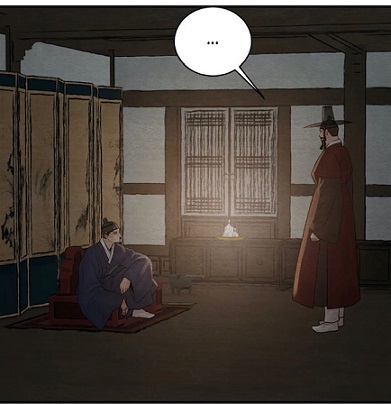 (chapter 86) But when he arrived in the study, this is what he saw. This picture revealed his greed and ambition
 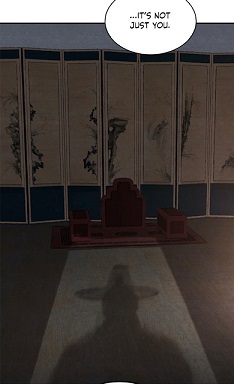 (chapter 86), but he would never admit it. This is no coincidence that the open door is reflected with the shadow. He claimed to contribute to the lineage of the Yoons, but like mentioned above, he was only thinking about himself. This scene shows that he was eyeing for the throne, and this must have happened in the past too. That’s the reason why I believe that he did sell his son to a pedophile for his own greed and ambition, but he never admitted it. He used the family and traditions to hide his ruthlessness and selfishness. When the father was on the verge of leaving the study, he expressed his regret that he shouldn’t have saved his son.
  (chapter 87) This was another self-deception. Without the main lead, the latter would have lost everything. Note that he is living comfortably in the house in Hanyang. So if the young master were to disappear, I doubt that the mysterious lord Song will allow the father to take over the mansion. His regret implied that he shouldn’t have sent for a doctor. This is important, because this signifies that he will be punished the same way, it will be even worse. No one will be by his side to protect him and to save him… no one will request for the physician’s assistance. Similar to the broken promise in the patio:
 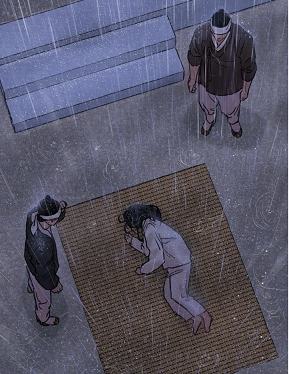 (chapter 77) Moreover, the father acted, as if he was decent and righteous
  (chapter 87), while Yoon Seungho was compared to a monster!
 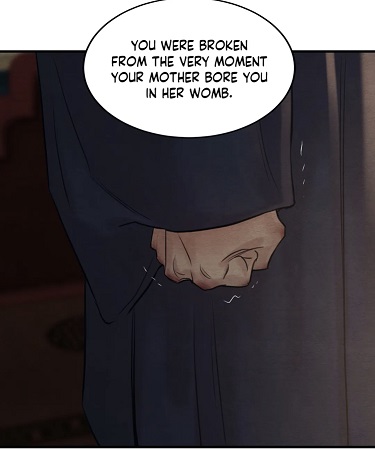 (chapter 86) The outcome of his lie can only be that he will be perceived by people as a monster, as an immoral father who had no conscience at all. How do I come to this conclusion? First, the painter could see right through the father’s gaze.
  (chapter 87) He was a cruel and resentful father. Moreover, the lord’s words always become a reality. Hence the father can only be condemned as the licentious and depraved degenerate.
 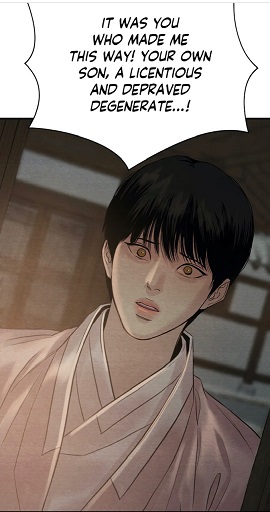 (chapter 86), the black sheep! Furthermore the moment Yoon Chang-Hyeon loses the house in Hanyang, he has no place where he can hide himself from public gaze. He can only ended up as a powerless outcast. I am suspecting that since he longed to be admired and fawned, he could end up committing suicide, for he is unable to tolerate people’s rejection and insults. To conclude, the father refused to admit his guilt and wrongdoings till the end. Even cornered, he chose to avoid reality, preferring to trust father Lee and the butler’s lies. Why? It is because he envisioned that by removing the main lead, he could take over the mansion, and act, as if nothing had happened, as if Yoon Seungho had never existed. The gods will fulfil his wish so that he can be confronted with reality. Besides, note that the patriarch never stopped his son from kissing the painter, he even followed him to the seat.
  (chapter 87) This shows that deep down, the man was not truly against sodomy and prostitution. The father resented the son, for he could only achieve “glory” through debauchery and sodomy. I believe that the elder master Yoon was thinking like this: “no matter what” the Yoons’ power and notoriety must increase. In the bedchamber, the man exposed his true personality, while in the patio he was just the fake image of a powerful, decent and righteous man. This explicates why it took the teenager so long to realize the father’s betrayal.
 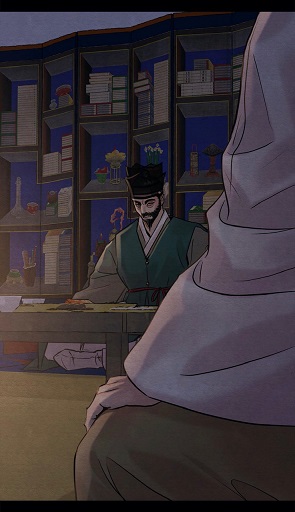 (chapter 82) He was just an empty shell, his knowledge, experiences and possessions were just an illusion.
 (Chapter 5) Baek Na-Kyum was apologizing for his past behavior. He had insulted the main lead because of the poem. And his words sounded really similar to the butler’s in the library, for they both employed the same expressions: “That day” and “I spoke out of”.
  (Chapter 77) Striking is that the painter employed the expression “hand”, while the valet talked about “turn”. Why did they do that? It is because when Kim was caught committing a crime, he turned his head!
 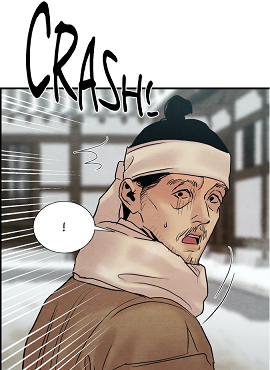 (chapter 68) Thus in the library, the butler excused himself in front of the lord by using the following expression: “spoke out of turn”!! On the other hand, the painter had used his hand,
 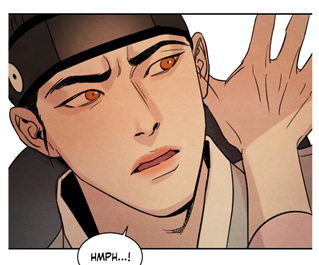 (chapter 4), therefore he described his wrongdoing with the following expression “out of hand”. In my eyes, his words indicate the interference of the butler. Furthermore, the two men had a drop of sweat, a sign that they were not truly honest.
  (chapter 77) Both were apologizing, as they had wronged the noble. As you can imagine, the similarity in the excuse is no coincidence. The proof that both incidents are reflections is that they have another point in common. The wrongdoings of the low-borns had taken place in front of a gate. The butler had disobeyed his master
  (chapter 68), and the painter had assaulted the lord by trying to retrieve the poetry.
 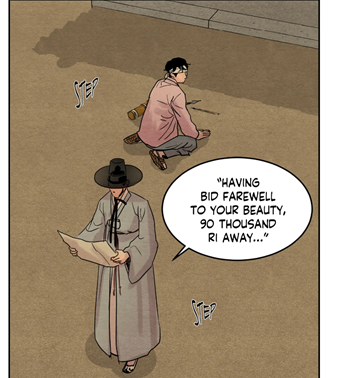 (Chapter 4) Because both characters had violated social norms, showing disrespect towards a noble,
 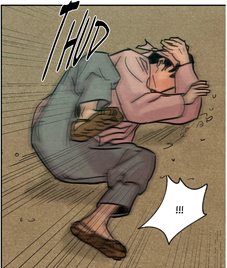 (Chapter 4) In other words, since Yoon Seungho had punished the butler due to the incidents in episode 67/68, I deduce that episodes 67/68 were reflections of episode 4/5 as well!! This corresponds to the rule 2 and 3.
  (chapter 4) Let’s not forget that just before the great entrance of Black Heart and the protagonist in chapter 67, this was what the author showed us:
 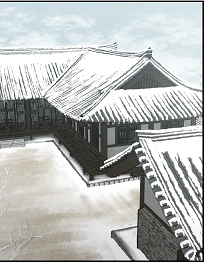 (chapter 67) And now compare the building to this one from chapter 1:
 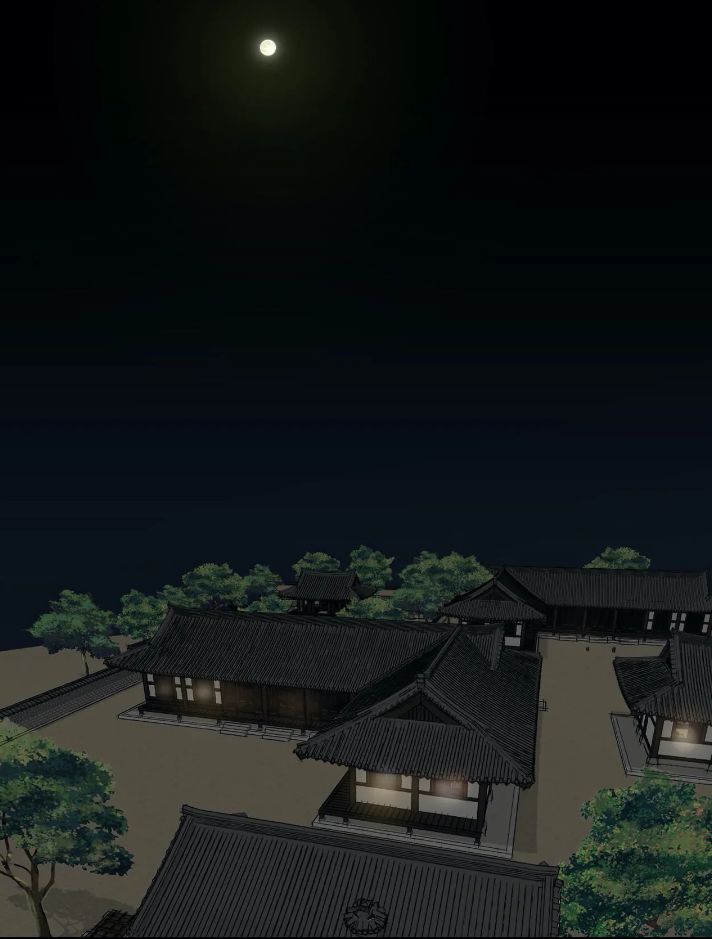 (chapter 1) Under this light, my theory that Yoon Seungho was living with the Lees in the beginning of the story gets reinforced and even validated. In season 1, Yoon Seungho had sex with his friend in the pavilion so that the father and the staff could see the truth: the young master Jihwa was a sodomite. But since we saw Yoon Seungho in that building in episode 1, we jumped to the wrong conclusion that this was his house. But actually, from chapter 12 on, the author was showing us that we had been deceived. This was the lord’s house, and note that there is no building in the big courtyard contrary to the domain from chapter 67 and 1.
 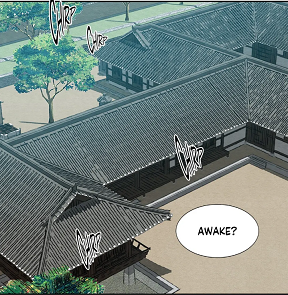 (Chapter 12) (For more read the essay “Lee Jihwa’s special relationship with Yoon Seungho”) Then in season 2, the main lead forced the elder Lee to hear what he had been denying all this time
 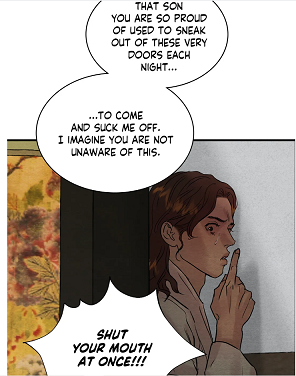 (Chapter 67), while in chapter 3, he could only witness it from the patio. On the other hand, Yoon Seungho had been proactive during their sexual encounter, hence the father could only blame the main lead for his son’s debauchery. The intimacy in the pavilion was in verity hiding Yoon Seungho’s huge traumas. But due to Lee Jihwa’s confession in the inn, the red-haired master’s reputation got ruined in town and this must have definitely reached the father’s ears. Striking is that when Yoon Seungho confronted Lee Jihwa with his crime (abduction of a person from his household), the red-haired master ran away and hid behind the folding shield. Thus he never apologized to his friend. And it was the same with the elder Lee. The latter knew about his son’s wrongdoing, for he accused the intruder immediately.
  (Chapter 67) As you can see, the absence of the excuse from the uke and his father outlines that chapter 67 is a reflection of episode 5 and 77. I detect a pattern, chapter 5 contains a superficial apology, chapter 67 no apology and chapter 77 a fake excuse again. Furthermore the manhwalovers can recognize that in the same episode (episode 5), the antagonist Jihwa had indeed wounded the painter with his insult too, a reflection of episode 4.
 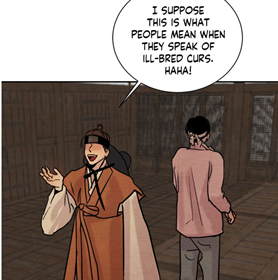 (Chapter 5) This confirms that chapter 5 is connected not only to episode 77, but also to chapter 67/68. We have the same elements: an incident linked to a door
 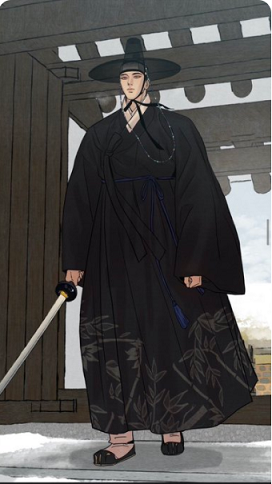 (chapter 67), insults towards the main leads, a wrongdoing, the allusion to love
  (chapter 67), a punishment, but also the absence or presence of an apology. But all of these episodes have other similarities: hypocrisy and arrogance. The Lees were looking down on Baek Na-Kyum and Yoon Seungho (chapter 5-67), while in episode 77, it was the butler who yelled and criticized the noble.
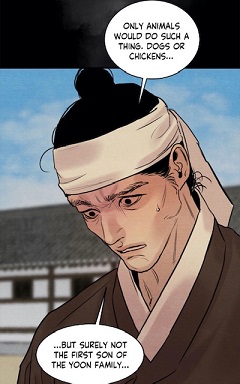 (chapter 77) By detecting a reflection between these chapters, I had a new revelation.
  (chapter 5), while it was not the case. As you can see, anyone seeing the black guard leaving the owner’s study could have had the impression that the lord had written a letter. This means that this mistake must have taken place later again due to the rule 2! The manhwalovers could discover the deception in chapter 37/38!!
  (chapter 38) That’s how Jung In-Hun got misled.
 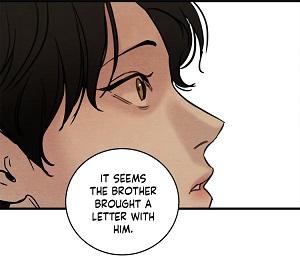 (chapter 38) Yoon Seung-Won had never received a letter, but the ruined painting. The readers only discovered the trick in the final episode, when the father was looking at the picture. And this connection between a letter and a painting was reflected in season 2. While Min stole the painter’s last creation
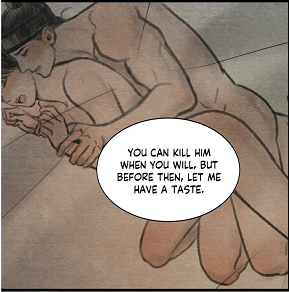 (chapter 56), Jihwa sent a forged letter
  (chapter 56). Striking is that the butler was the one who received the paper before delivering it to his sick master. These two scenes (38-56) indicate that the valet is related to the correspondence. Moreover, he was seen delivering the message to Yoon Seungho in the courtyard.
  (chapter 35)
 (chapter 5) It was, as if he was not allowed to write any letter. So where did the table go? To the study!! What caught my attention is that after the first painting
 (chapter 2), the table had been removed from the study, just like the papers.
 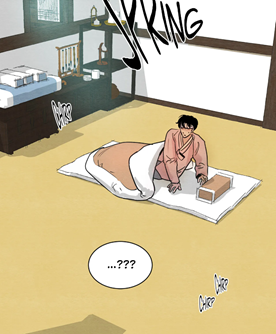 (chapter 4) This was no coincidence. It had been sent to the lord’s bedroom, but after the lord had tasked the black guard, it was no longer there. This is the indication that someone was interfering with Yoon Seungho’s habit to take a brush. And this can only be Kim. As you can see, the appearance and the vanishing of the small table is the element which was reflected in chapter 1, 2,
  3, 4 and 5. And now, look at the scene where Lee Jihwa met Min.
 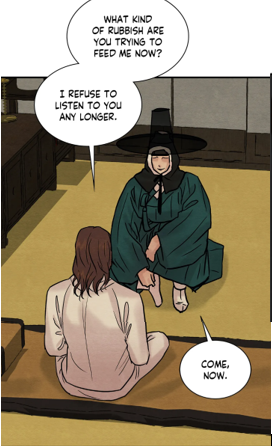 (chapter 67) The table had also disappeared. And when did it happen?
 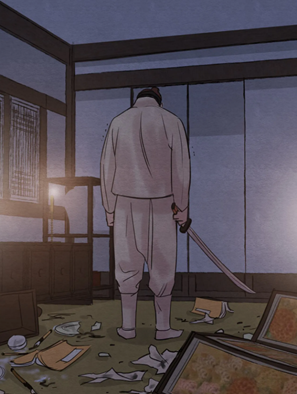 (chapter 21) The noble had ransacked his own room with his sword. And what did we see in that episode? A paper folded in a book.
  (chapter 21) In other words, the First Wedding night is also a reflection from these chapters (4/5, 67/68, 77), for it contains the same elements:
 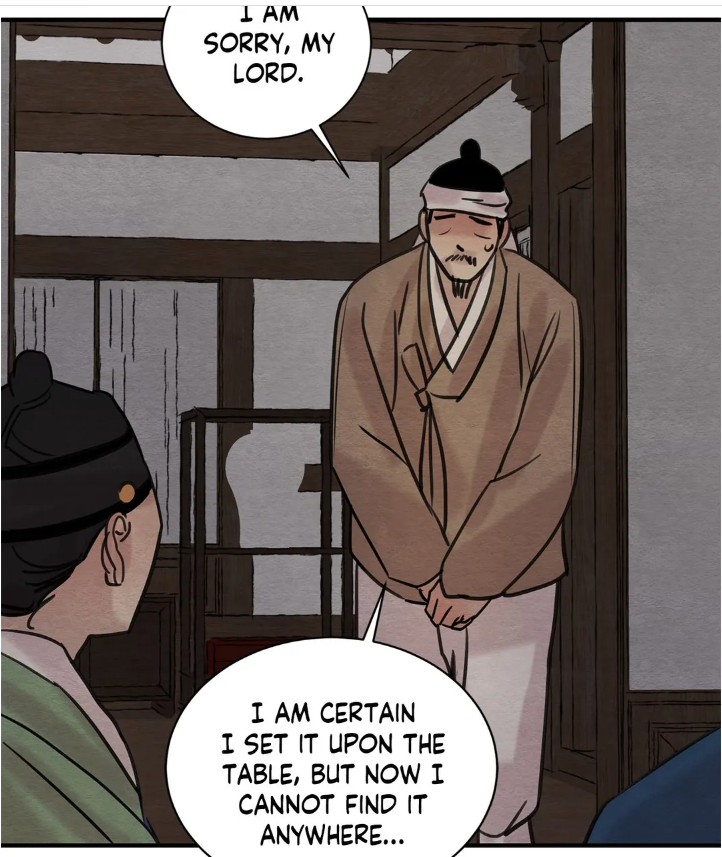 (episode 19) and the importance of the table. According to me, the valet had put the expensive wine on the painter’s table on purpose. To conclude, I see a connection between episode 4/5, 19/20/21, 67/68 and 77.
 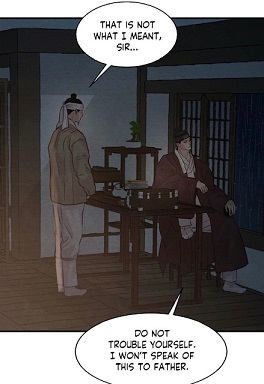 (chapter 77) He can not trust his words, especially since he views the nobles as violent liars. Why? It is because there was this huge table. This is no coincidence that right after the valet betrayed the main lead and wrote a message to the patriarch. That’s how I had another revelation. The butler is symbolized by the table! Thus he was often seen with this small table
  (chapter 11)
  (chapter 17) To conclude, when the butler saw the black guard leaving the mansion, he believed that his master had sent words to someone! That’s the reason why he removed the table and returned it to the painter’s study.
 (chapter 97) written by Yoon Seungho, but he envisioned that this was the Spring poem!
 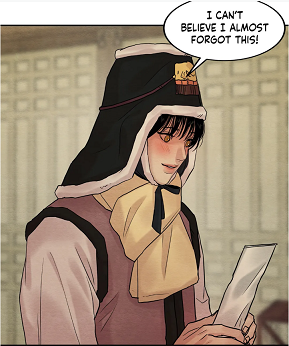 (chapter 97) We had the same situation. Black Heart had stolen the Spring poem, and the noonas had deceived the protagonists by faking admiration in front of an empty paper.
  (chapter 93) Since the paper in episode 93 was empty, I could only come to the deduction that this paper contained words!!
  (chapter 92) The latter’s work was a copy of Yoon Seungho’s poetry, the repetition from chapter 4. Hence you comprehend why I deduce that the paper in the annex was different from the Spring poem. So during that night, Yoon Seungho left a note to his lover, and that’s how the butler discovered that the artist could not read Chinese, for he saw his master writing in hangeul. But there exists another evidence for this interpretation. Baek Na-Kyum had wished this:
  (chapter 97) If the lord had mentioned in the letter that they had found the corpse of Deok-Jae, the painter would have believed him. However, as you can envision it, the butler and Min were determined to generate a misunderstanding, to create the illusion that the scholar had died. Consequently, the servants deceived the main lead by omitting the existence of the paper. They had not delivered the message properly.
  (chapter 4) His own poetry got stolen. But let’s return our attention to episode 5. Since the lord had given the poem to the black guard, this signifies that the lord no longer had the sijo. Therefore he had to write the poem again in order to mask the disappearance. In my opinion, he must have copied the original poetry for the artist in order to prove that he had not been lying. Hence the paper looked different. And this brings me back to the painter’s apology in the patio.
  (chapter 04) That’s the reason why he had taken it in the first place.
 (chapter 7) But where is the sijo now?
  (chapter 65) Moreover, I believe that in chapter 65, he had collaborated with the noona. He had shown her the painting of Baek Na-Kyum, while in the study there was a blank paper. As you can see, in season 2, we had again this connection between a painting and blank paper. But let’s return our attention to chapter 5. The black guard was acting on the order of someone else, Yoon Seungho was not the one hiring him. The butler hates ruckus, his MO is to lie low and act in the shadow. If he had retrieved the paper, the man could report it to the master of the black guard. On the other hand, he could have asked the warden about his master’s request. He just needed to say that he desired to assist him, similar to this situation.
 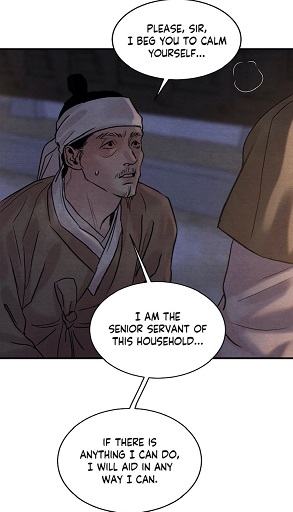 (chapter 82) Thus I conclude that when the lord returned the paper to Baek Na-Kyum
  (chapter 7), Kim must have realized his error. He had mistaken the poem for a letter!! This explains why he repeated the trick with the younger master Seung-Won. But unfortunately for him, he was caught by the teacher who asked the painter about the letter the next morning.
  (chapter 38) Baek Na-Kyum could have realized that the butler had acted behind his master’s back. The problem is that during that evening, the lord had indeed written a letter to his brother
 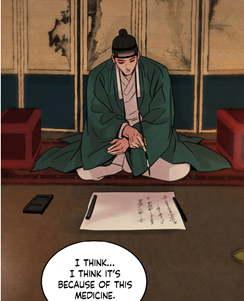 (chapter 36), but the moment the latter interrupted the couple
 (chapter 37), Yoon Seungho chose to hide it. But why is it important? It is because if the painter had mentioned the paper given to the younger master to Yoon Seungho, the latter could have noticed the valet’s meddling and wrongdoing. On the surface, it looked like Kim had written himself a letter to the younger master. In other words, in episode 37/38, the butler gave the impression that he was a spy, for he was acting without his master’s permission. He had even left the propriety, as he was standing outside in front of the gate. Don’t forget that during the meeting, the brother had mentioned that he had sent him many letters
 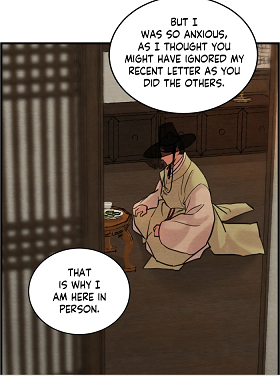 (chapter 37), and there is no ambiguity that Kim had intervened. Here, the lord had said nothing, for he imagined that Kim had done it to protect him from his family.
 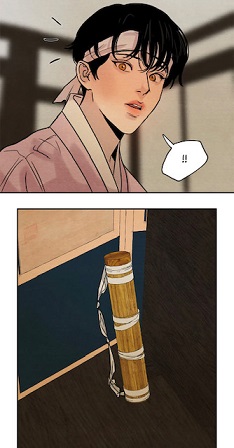 (Chapter 4) But on his way out, he met Yoon Seungho who had just missed the painter’s departure. But there, he discovered that the main lead had stolen his poetry.
  (chapter 5) He was looking at the gate and as such making sure that the artist’s departure would be noticed. By sending the low-born to the Lees’ mansion, Kim was encouraging the painter to commit a crime: trespassing! But the artist was fortunate, for he was not caught by the lord of the mansion, who preferred hiding due to the ruckus caused by his own son. 😉 As for Yoon Seungho, he came back to the mansion and saw the empty study. Kim just needed to say that the low-born had left to the Lees’ mansion. This is important, because this indicates that in chapter 4, the couple missed each other first! And this situation was repeated in season 3, precisely in chapter 98, when the lord returned from the bureau of investigation
 (chapter 98)! The lord arrived just after the painter’s departure. And who was with the main lead? Kim. As you can see, the lord’s luck seems not to be on his side, for Baek Na-Kyum had just left the propriety. Once again… the lord was standing in front of the gate!! As for season 2, this time, it was Kim’s fate to miss his master.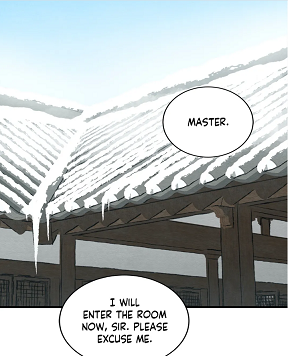
 (chapter 56) The reason for this punishment is simple. He had sent away the artist to the study just before Yoon Seungho regained consciousness. The latter didn’t see that the artist had taken care of him during that night. Thus the butler’s karma was not to notice his master’s departure which stands in opposition to chapter 4 and 98. And note that all these chapters have the paper as common denominator. So imagine the butler’s surprise in episode 4, when he witnessed the artist’s return to the mansion followed by his master. He had sent away Baek Na-Kyum with the hope that the artist would desert the town for good, but no…
 (chapter 23) The first similarity is the allusion to his bag. The butler was actually thinking that during the hunt, the painter would decide to run away. That’s the reason why he asked about his belonging, for in the past, he only wished to vanish after retrieving his tools. Naturally, the artist saw no harm in the butler’s question and answered truthfully. He must have narrated the argument in the courtyard about the poem. Yoon Seungho had kept the sijo, consequently the painter had used his hand to take it back and had by mistake removed the lord’s hat. Thus Kim must have told him that he just needed to apologize. But one might say that this is just a story imagined by me. The manhwaphiles never saw such a scene. But don’t forget the existence of the reflections. I have definitely an evidence for this theory. Since the butler had manipulated the painter in chapter 4 in order to get rid of this uninvited guest, his karma was to receive a new guest!!
  (chapter 7) This is not what the valet truly desired at all. He wanted to live in peace. But now, he had three new people he had to serve: Jung In-Hun, the painter and his own master Yoon Seungho who had lived for quite some time in the Lees’ mansion. He had to work!! And note that in this episode 7, we have the following elements:
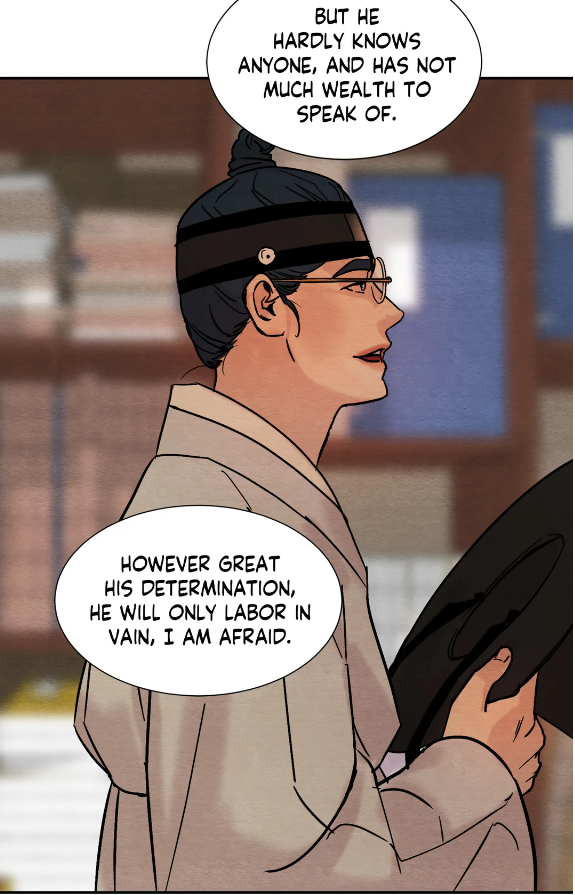
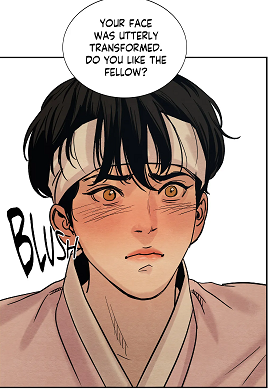
 (chapter 93) It was a futile dream. When I had analyzed episode 93, I had explained that the speech from the main lead was influenced by the butler. As you can see, the lord’s narration
 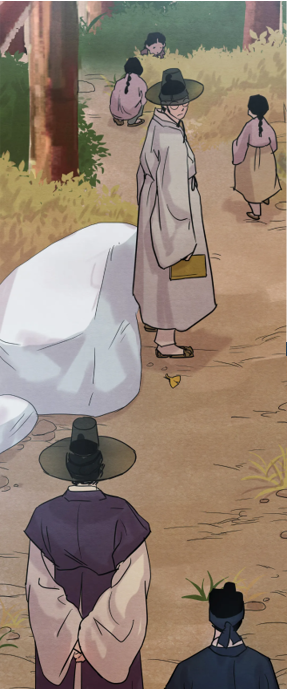 (chapter 6) There was a switch. That’s how I had this revelation. Heena is the missing link between the learned sir and the protagonist. And observe that in episode 93, we have the same elements again:
 (chapter 93) This time, Heena is the one standing behind closed doors, while it was Yoon Seungho in chapter 77
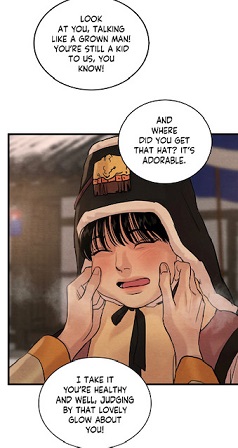

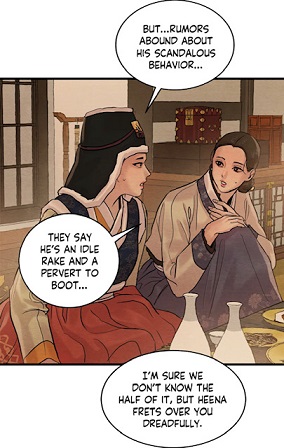
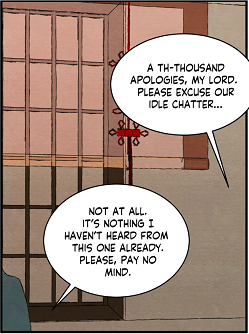 (chapter 93) In chapter 99, the noonas still lied to him.
 (chapter 93), which was also present in chapter 4/5, 7 and 67
 /68 and finally 77
 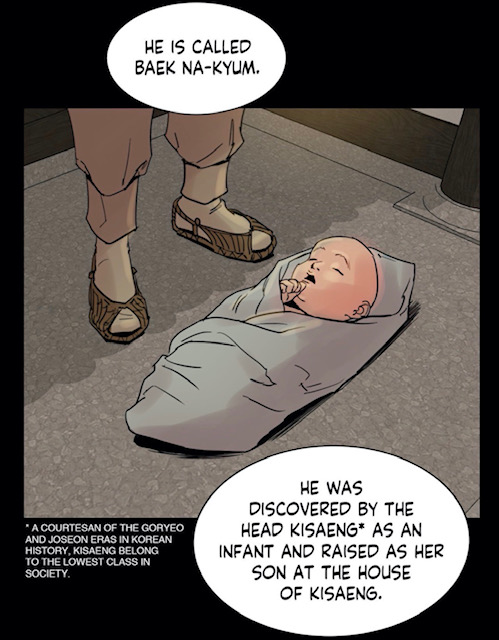 (chapter 1) [For more read the essay “Baek Na-Kyum’s origins”] There is no ambiguity that these words
  (chapter 55) Who was lord Song’s contact person then? In the past, I used to think that he was the one receiving the letters. But now, I have a different opinion. I believe, it is Heena! Why? It is because Kim couldn’t identify lord Song’s writing. According to me, Yoon Seungho was sent to the gibang in order to entertain the mysterious “lord Song”. Thereby I am assuming that the kisaeng would receive a word from lord Song and have the main lead fetched from the mansion by the black guards. Heena and Yoon Chang-Hyeon are the only ones seen with black guards, I am excluding the main lead, as he was always more or less their prisoner. As you can see, there is a connection between the noona and the Yoons.
 (chapter 68)
 (chapter 69) and in season 3, the noona sent messages to her brother herself. In two different chapters
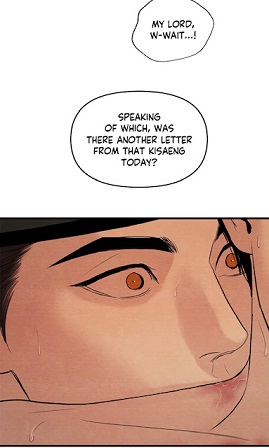 (chapter 91), she is related to papers.
  (chapter 97) Logically, the noona in connection with the letter should be present in season 1. Secondly, when the woman appeared for the first time
  (chapter 64), she was accompanied with 2 guards, which is quite similar to the lord’s situation in chapter 1. That’s the reason why I believe that she didn’t keep the learned sir’s poem. Her betrayal could have been noticed and this was the first time that Yoon Seungho was making such a request.
 (chapter 56) This would follow rule 3. Then according to rule 2 of the kaleidoscope, elements from one episode will be constantly mirrored in the next chapters. And what did we have in episode 19? A larceny… the bottle of wine vanished. Then in episode 20, the lord stole the scholar’s identity, while he stole the painter’s virginity. Hence the lord apologized to the painter for his wrongdoings.
 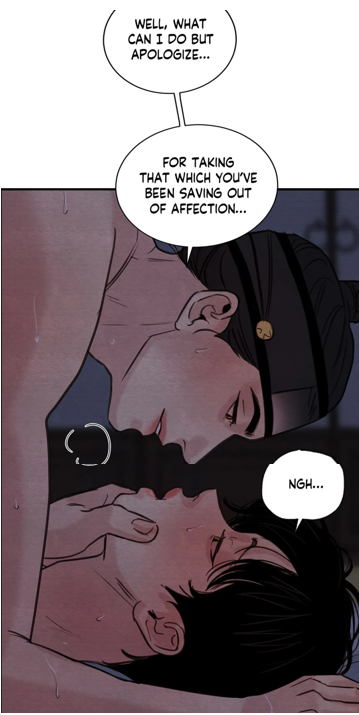 (chapter 21) And above I had already demonstrated the connection between the First Wedding Night and chapter 5 and 77! Here the lord was imitating the pedophile’s behavior, hence you comprehend why I think that lord Song was the recipient of the poem. I would like my readers to keep in their mind that the learned sir’s sijo was referring to a painful departure, the loss of a loved one and despair! The beholder could have the impression that the author was suicidal due to the mention of the well and the torment of the mind. Thus I am now assuming that the “mysterious lord Song” will consider the sijo as a farewell, the lord chose to commit suicide and his death was related to Jung In-Hun’s curtains. Why? It is because Heena wrote letters to her brother where she accused the main lead of killing the learned sir. Moreover, Yoon Seung-Won had definitely mistaken the painter for the learned sir.
  (chapter 37) His position revealed that the main lead trusted the artist. It was, as if he was treating him like his wife.
 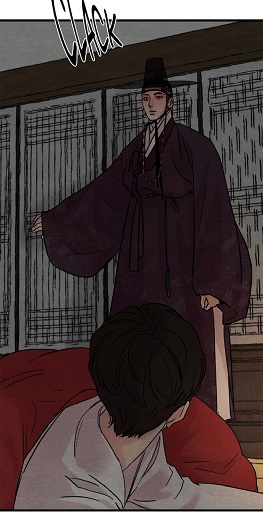 (chapter 34), and shortly after the painter was sent to the tailor. But during that night, the pedophile and Yoon Seungho had missed each other due to Baek Na-Kyum. He was not dead. So when the painter received new clothes, it was the same for Yoon Seungho. Yet, the pedophile was gravely mistaken. Why? The sijo had been stolen, and as such it was never addressed to the pedophile. Furthermore, it is because the lord was suffering from memory loss. Moreover, I believe that the main lead is not aware of the true identity of his sexual abuser. In his mind, it is just lord Song. But this doesn’t end here.
  (chapter 57) And who was behind this? Black Heart’s friend. But then it came to my mind that Black Heart had stolen the Spring poem… so he could have sent the paper to lord Song and the latter would have mistaken it as a letter from Yoon Seungho, the latter was reaching out to him. He was wishing him luck!! So imagine that when the man arrives in Jemulpo, he imagines that the main lead is waiting for him only to discover that Yoon Seungho vanished. He wished to die because of the loss of a loved one. And that’s how he will recall the poetry of the learned sir… the reflection of this night!!
  (chapter 94) In episode 4, the lord had laughed about the sijo, but it was no longer the case in the kisaeng house. In my eyes, the pedophile will go through the same experience. Yes, the effect of the kaleidoscope. He will perceive the learned sir’s poetry under a different perspective. Only in that moment, he will realize the suicidal tone in the sijo. He will question how Yoon Seungho could become so desperate and suicidal so suddenly. And now, you comprehend why Heena was trembling in front of her brother
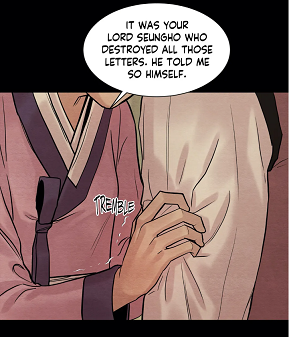 , and why she had planned to leave the gibang that night!! She was aware of the arrival of “lord Song”. She knows how cruel and ruthless he can be.
  (chapter 101) Blood will flow… The proof for this expectation is that chapter 67, 77, 82 and 93 are all referring to punishment. Kim had been beaten in episode 77, while the kisaeng was imprisoned in the storage room. Moreover, we have the use of the sword in episode 21 and 67… and during these nights, the protagonists had made love to each other.
 (chapter 82)
 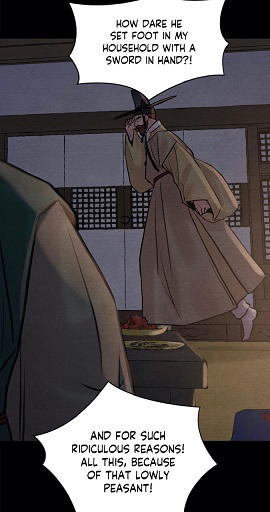 (chapter 82) It is because he didn’t want to leave any evidence of his intervention. No one should notice that he had paid a visit to the patriarch either. His visit should remain a secret. He was actually afraid of getting detected. The reason is simple. He was fearing the person standing behind Yoon Seungho, lord Song. He had two reasons for this. First, he could see that Yoon Seungho was no longer treated like an animal or male kisaeng.
  (chapter 67) Here, the lord had just insinuated that if something like that happened again, he would go to the authorities. However, since this threat was rather ambiguous, the patriarch Lee could only interpret it that way. The main lead would report the incident to the “mysterious lord Song”, alias the king. And father Lee knew that he could get into trouble. Furthermore, since these elders are all hypocrites and liars, there is no doubt that father Lee feared that the protagonist wouldn’t keep his words. That’s the reason why he approached the father. He hoped that Yoon Chang-Hyeon would intervene and impose his will onto his son. He would tame the main character. In other words, episode 82 is a reflection of chapter 4/5, 19/20/21, 67/68 and 77. The first common denominator is the allusion to letters. The messenger’s words revealed that Kim had contacted the elder Yoon, for he already knew his name, though the latter had never met the domestic. Secondly, the “letters” were delivered orally:
  (chapter 82), and even in person: Father Lee and the emissary. Third, the elder Lee badmouthed Yoon Seungho by mentioning the incident from chapter 67, and refused the invitation of his host
 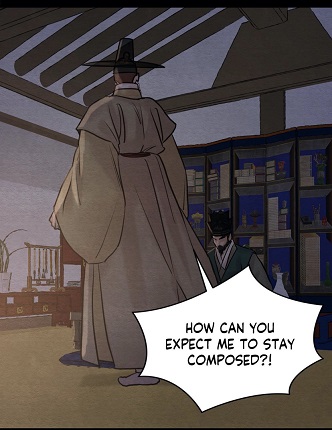 (chapter 82). Finally, he called Baek Na-Kyum a peasant exactly like the main lead in front of the gate:
  (chapter 82). But more important, the old bearded man expressed this fear: the loss of his family home!
 (chapter 82) And remember that I had detected the presence of the Lees’ mansion in episode 4 and it was also present in chapter 21 and 67! And what had the butler done during these chapters? He had tried to chase away the painter and as such Yoon Seungho. The latter was not supposed to live in the Yoons’ domain. And this will be the Lees’ karma to be driven out of their own house!
  (chapter 83) It vanished, and as such it was stolen. Did the mysterious lord Song take it away in order to force Yoon Seungho to paint? The older version of this scene:
  (chapter 1) The paintings were illustrating that the pedophile was having sex with a minor.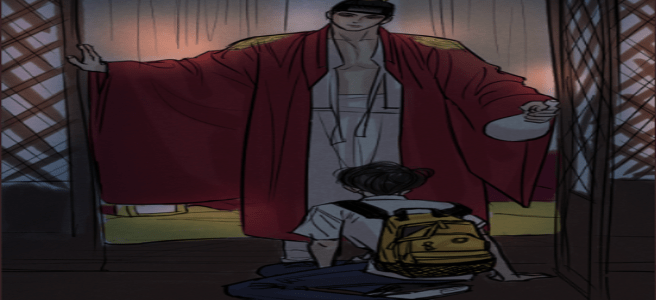
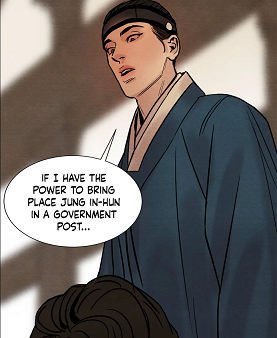 (chapter 11) Secondly, I had associated the main lead to the eagle which is the symbol for the kings and emperors in Europe. He was seen here flying
  (chapter 30), and his fingers reminded me of the eagle’s claws.
 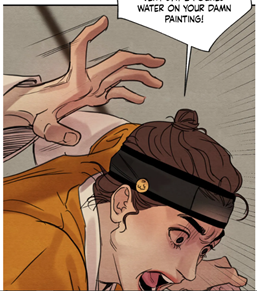 (chapter 18) And this perception got even reinforced, when I saw this panel:
  (chapter 52) In this scene, he was sitting like a king surrounded by his “court”. The hanbok had such a design that I couldn’t help myself associating it to Joseon’s monarchy.
  , I had another revelation. On the one hand, it actually confirmed that Yoon Seungho was somehow destined to become a king, yet he is not represented by the eagle or the phoenix, but by the dragon. Hence the moment I saw this image, one idiom came to my mind: Dragon king!
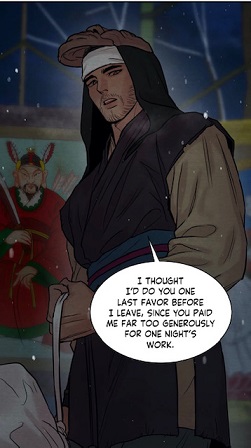 (chapter 100), though this deity is always accompanied with a dragon and in this picture, the readers couldn’t see one. However, it is possible that the author didn’t desire to reveal too much.
 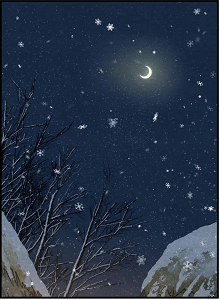 (chapter 58) And we had the same weather, when Yoon Seungho saved his lover.
 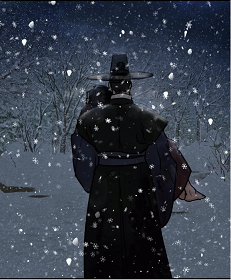 (chapter 102) The weather was expressing the main lead’s emotions: tears of happiness or sadness. We could say that the lord has the “power” to move the sky.
 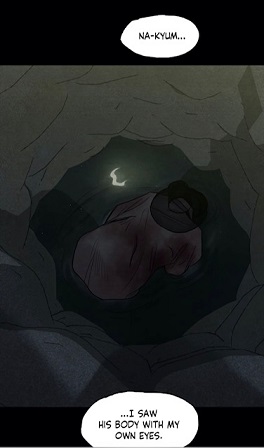 (chapter 97), and according to me, the messenger was drown there.
 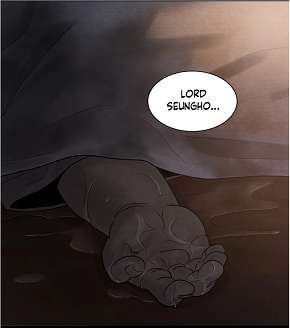 (chapter 94) In addition, my theory is that Deok-Jae and/or Jung In-Hun’s body were placed in a jar in order to hide the murders. For me, the jar plays a huge role in Painter Of The Night… thus Byeonduck created such a scene in season 2
  (chapter 46) and we have so many jars next to the pond:
 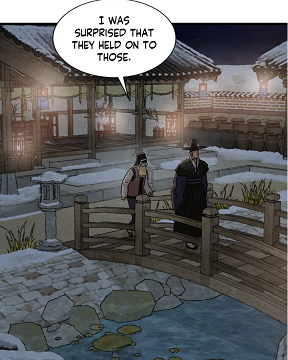 (chapter 94) [For more read the essay “The secret behind the library”]
 (chapter 91) This is no coincidence. To conclude, all these elements (rain, jar, well, soul of a deceased), connected to the dragon king, are present in Painter Of The Night. Thus I came to the conclusion that Yoon Seungho is like Dragon king. This reinforces my conviction that the main lead is not only connected to shamanism, but also embodies royalty. So he might not be the king of Joseon, but he is powerful in his own way, though he is not aware of this. And note that the moment he wished to commit suicide by drowning in the pond, he was brought back to life.
  (chapter 102) Water is his true element.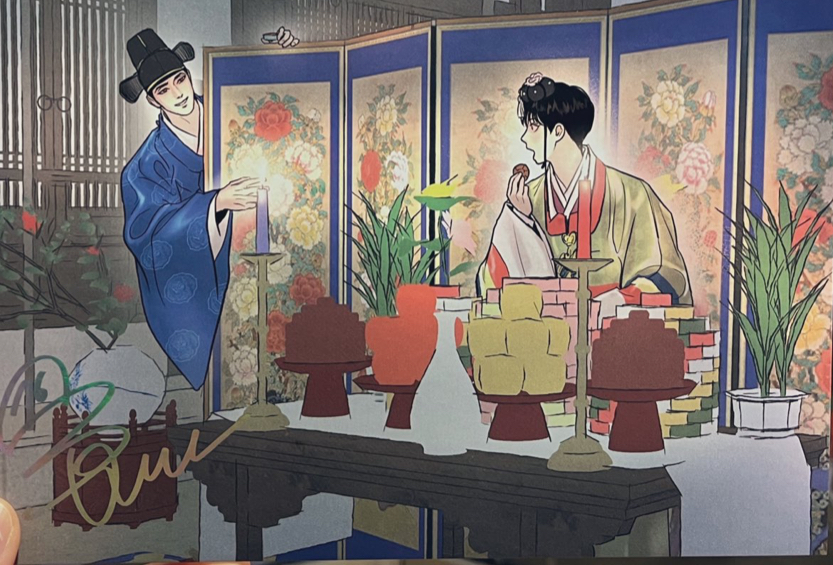
 (chapter 85) This means that in the Yoons’ mansion, people didn’t venerate this god. And since the aristocrat made such a statement to the elder Yoon Chang-Hyeon,
 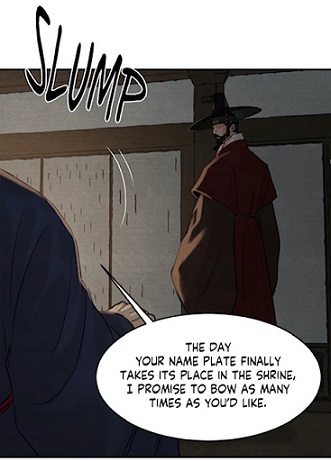 (chapter 86), I have the impression that in season 4, we will assist to a real ritual to ward off evil and back luck, leading the tormenting souls to the afterlife peacefully.
  (chapter 100) and this altar
 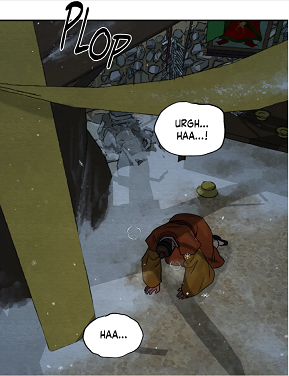 (chapter 100) were exposing the presence of a ritual. However, my problem was that I couldn’t determine exactly the nature of the ritual. But by making the connection between the dragon and good fortune, I had now more clues. I have to admit that I can not be 100% sure for this, but this is what I found: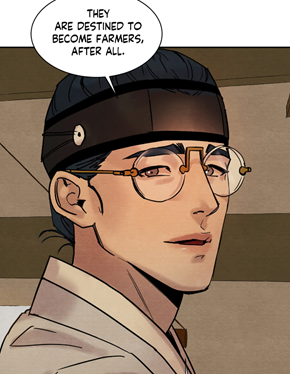
 (chapter 6)
  (chapter 83) and the deer
  (chapter 22). Then the lord compared Baek Na-Kyum’s eyes to a rabbit.
  (chapter 78) Since both resemble each other, I deduce that the main lead has the same eyes, the rabbit’s. Like mentioned above, he utilized his fingers similar to claws:
  (chapter 54) One might argue that this signification is totally impossible, for the lord doesn’t have the body of a snake. This point can be refuted very easily. What is the major characteristic of a snake is molting. A regularly recurrent event during the activity period of all snakes is the shedding of the skin. This coincides with the lord’s change of clothes. The latter reflected his downfall and rising. Furthermore, this animal is linked to death and rebirth. My avid readers are already aware that I had detected different scenes, where we could witness the lord’s spiritual death and rebirth, like for example in the shed:
  (chapter 62) When he discovered his misjudgment the next morning, he felt like dead. He no longer saw himself as a lord, but came to view the painter as his new lord :
 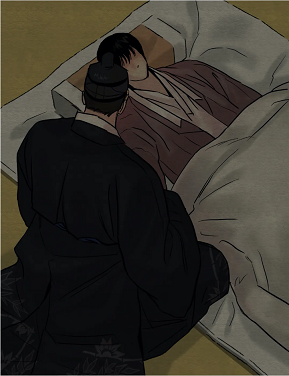 (chapter 66) As a conclusion, Yoon Seungho shares so many similarities with the dragon that I came to view him as one. This explicates why even after getting married, he will never wear a beard!
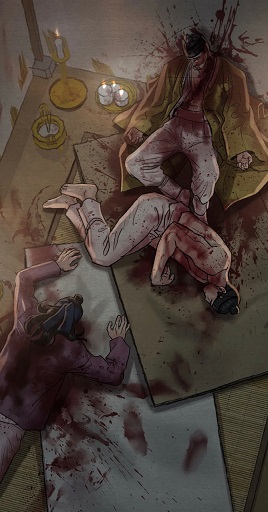 (chapter 102), and thanks to the painter, Yoon Seungho’s soul was able to escape this “mental prison”.
  (chapter 45)
 (chapter 55) and as such his heart and mind.
 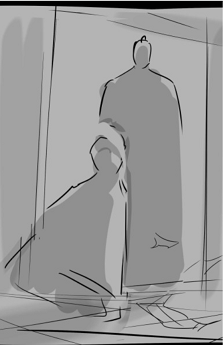 The painter is sitting inside a room, while Jung In-Hun is standing outside. Nonetheless, the position of the characters are very similar. This indicates that the author’s new alternative story is actually inspired by the main story!! This can only reinforce my perception that Yoon Seungho in the main story is associated to royalty. However, since it is a reflection, I deduce that this image
 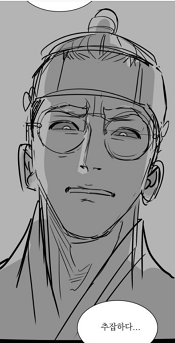 He criticized the painter by stating that this was “filthy”.
  In this scene, the characters are caught by surprise, but it becomes obvious that there is no disgust or expulsion. In fact, the fall of man took place before, for Baek Na-Kyum was sent to Joseon. In this encounter, I detect attraction and curiosity. Hence I come to the conclusion that in the original story, when this scene took place,
  (chapter 52) This means that the mysterious lord Song was actually claiming the main lead as his wife in the last scene. Min and his friends were sent there in order to entertain the protagonist, but they failed. This explicates why the next day, Black Heart was seen with a hanbok of lower quality.
  (chapter 56) It was, as if Min had been compensated for his bruised face by the mysterious lord Song. However, for the pedophile, Black Heart was just a concubine, and not his main wife! Hence the hanbok had not such a detailed and expensive design. This would explain the villain’s jealousy. And now, if you look back at the hanboks from the main lead, you will recognize his ascent. First, he is wearing green, which is similar to Yoon Chang-Hyeon’s color. At the same time, his hat resembled a lot to Kim’s.
  (chapter 1) Then later, he is mostly wearing blue which is actually the color of the Crown prince.
  (chapter 11) Yet, his robes initially have no design. Slowly, the lord is wearing colors and designs that are actually reserved for a king: blue, red, black and purple. This constant change of hanboks symbolizes the “snake molting” and as such his transformation and rising. This is not astonishing that on the night of the bloodbath, he had such a hanbok:
  (chapter 102) Here, he was no longer acting like a noble, but as a ruler. Don’t forget that according to me, the mysterious lord Song had proclaimed the main lead as his unofficial Queen by giving him hanboks with phoenixes. However, naturally, this was never mentioned to Yoon Seungho directly. Why? It is because Kim usually selects his clothes. However, this rise was not natural, as the lord had no real saying in this matter. The real metamorphosis took place in the shaman’s house, when the lord was sent back to the past and as such the darkness.
  (chapter 44) It is because the main lead was thinking that the painter would actually run away. Thus the door was left opened, and he was wearing warm clothes. Yoon Seungho never imagined that Baek Na-Kyum would remain by his side. Yet, during the previous night, the lord had consoled his lover by embracing him.
  (chapter 71) But this can be refuted easily. First, don’t forget that during this love session, the lord was acting like a servant pleasing his new lord. So this had nothing to do with Yoon Seungho’s feelings like sadness or happiness. He was determined to keep the painter by his side, and ignoring his own feelings. He never expected the artist to reciprocate his feelings. Secondly, Yoon Seungho’s nocturne vision is not just a nightmare, but also a DREAM! Yes, you are reading this correctly. Only recently, I discovered that all the artist’s visions are a combination of 3 elements: memory, nightmare and dream! I will give you three examples as illustration, for I am slowly running out of time.
  This vision is a combination of these three elements: memory, nightmare and dream. This had happened during the First Wedding Night (memory)
 (chapter 21), then we have a similar situation in chapter 49: ,
  the lord becomes a ghost and confronts the painter with his biggest fears (admitting his attraction, passion for erotic paintings and homosexuality) and dream
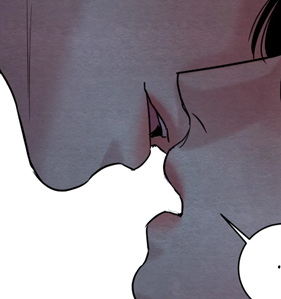 (The painter’s true desire was that the lord would kiss him, he was deeply longing for his lips, yet he was still in denial in this vision.
 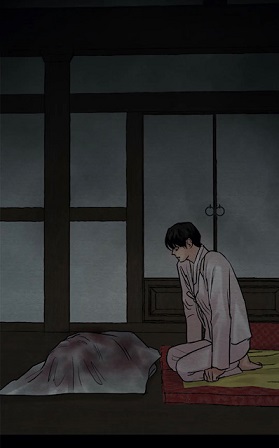 , for the painter was remembering the corpse in the courtyard, a dream, as he wished the return of his loved one
 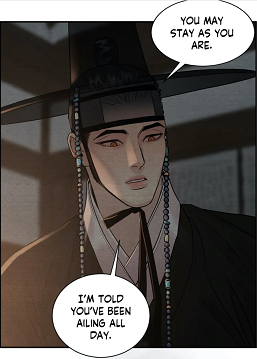 . He hoped that the lord would take care of him personally. Naturally, the “spirit” is the nightmare
  .
. 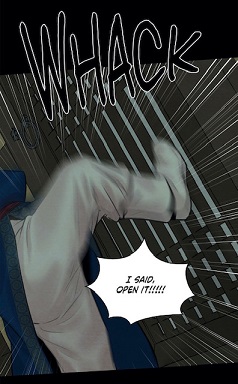 (chapter 74) This had already happened, but the lord had not grasped the significance.
 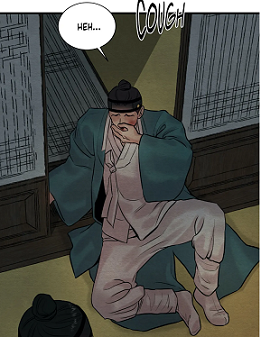 (chapter 53) Besides, he had not opened the door himself. Even when he went to the scholar Lee and opened the door with the his foot, the lord still felt trapped.
 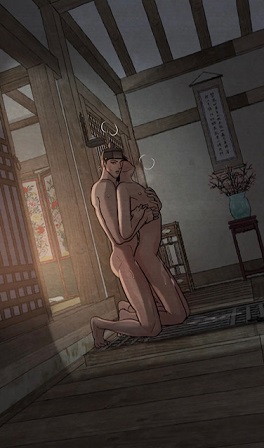 (chapter 96) This shows that the lord’s wish to get released had not been fulfilled so far. In my eyes, it is connected to the torture Yoon Seungho suffered and as such to the purge organized by the authorities. That’s the reason why I deduce that the lord will break a door in season 4, and this won’t be by accident and it will be witnessed by many people contrary to chapter 53, 67 and 96! The broken door will reflect the lord’s rise and power, and no one will be able to stop this. In my eyes, this wish is connected to the door in the servants’ quarter. That’s how his imprisonment started.
 (chapter 74) The “dragon” wished to see Kim and his father, and confront them! And this did take place in season 3. Yoon Seungho confronted the butler with his attitude and betrayal
 (chapter 77), but this argument was just short-lived. He still viewed the valet as a hard-working and trustworthy person. He had just made bad decisions. Then in the bedchamber, the lord could blame the father for his suffering:
  (chapter 74) In this image, he is floating in the air… a sign that his status is changing. At the same time, this shows that he is escaping from the hands. They are trying to drag the main lead down. Thus I come to the conclusion that the vision was announcing the lord’s transformation (into a dragon) and as such his “rise”. Note that in this image, he is still a teenager, but in the following panel the protagonist has already become an adult.
  (chapter 74) Simultaneously, the vision also displays the lord’s expulsion from “hell”, the sex orgies
 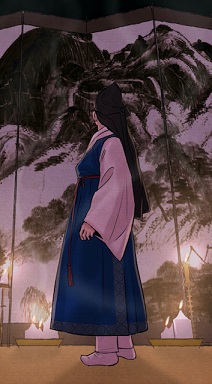 (chapter 74) Simultaneously, the dream showed that the lord wished to see this painting again, though deep down, he blames this image for his suffering. As you can see, the vision was revealing the tormented disposition of the lord. He was switching from nightmare to dream and the reverse… a mixture of anxieties and desires.
  (chapter 74) This signifies that he was approached by someone from behind, he had not noticed that the “door” had been opened. Thus he never expected his apparition. For me, this perception demonstrates that the painting is not the real cause for Yoon Seungho’s suffering. Since he had turned around, I came to recognize that this scene stands in opposition to the situation in the painter’s nightmare:
 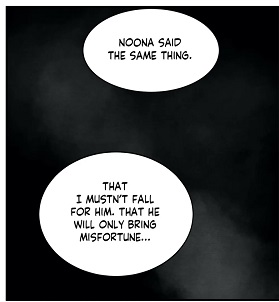 (chapter 86) In reality, he was a dragon, who could bring luck and fortune to the person who would cherish him. This is no coincidence that the pedophile sent hanboks with the crane
 (chapter 30), but much more brutal and violent!
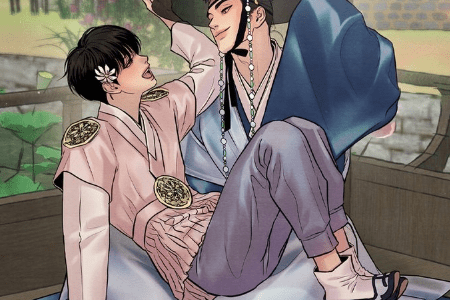

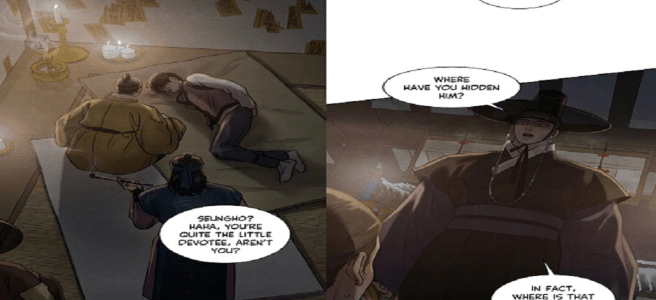
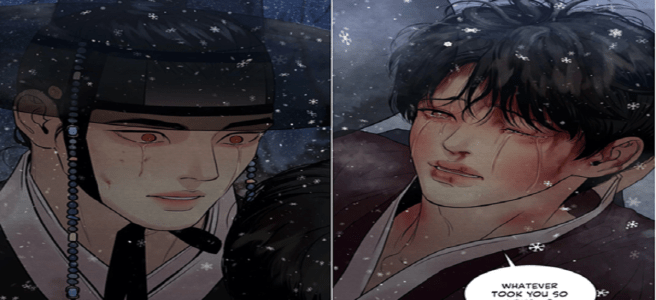

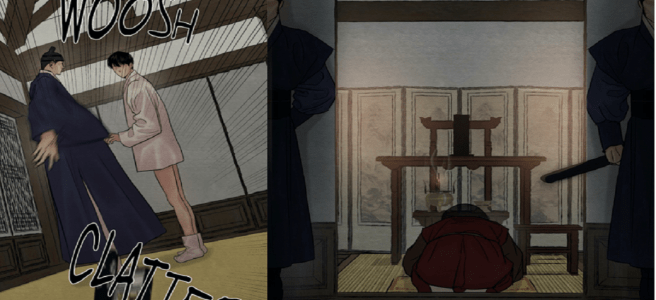
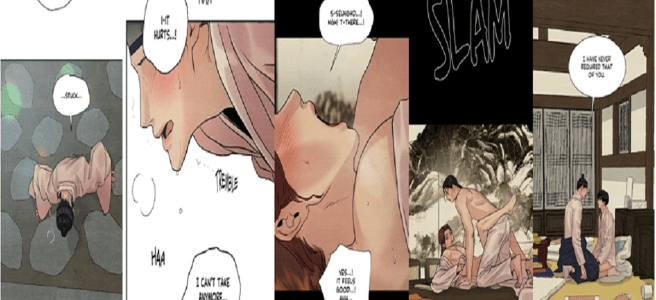
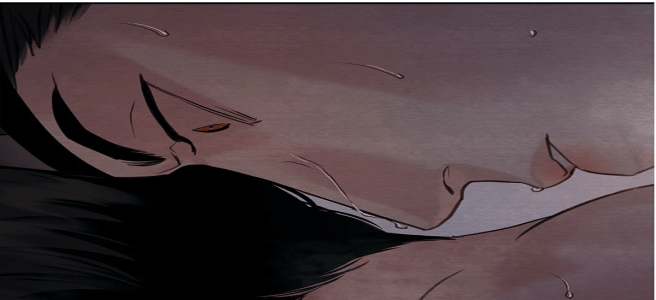


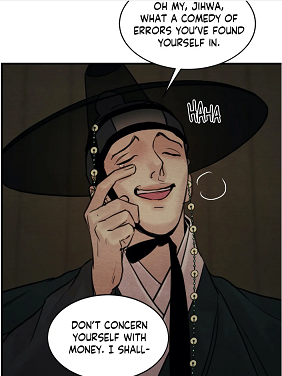 (chapter 76) which was totally new in the manhwa. We never saw such a combination: a single tear with a laugh. Moreover, for the first time, The Joker had shed a tear. The manhwalovers will certainly recall that so far, we had tears of happiness (chapter 21) and sadness
  , (chapter 59) but never tears out of laughing.😂🤣 Therefore I came to recognize the significance of this scene. First, it divulged a lot about Black Heart’s personality, and announced a turning point in his life. At the same time, this observation gave me a new idea, which I will elaborate in the second part. Striking is that until now, I had examined the painter and Jihwa’s tears, yet I had never focused on this topic itself. Hence in this analysis, I would like to study not only the weeping of the characters, but also the absence of their tears.
 (chapter 22). The rock is a metaphor of his heart: he will remain cold-hearted. Striking is that even after the humiliation during the hunt, he never shed a tear. He was only frustrated and angry at his opponent and sponsor. His huge ego had been hurt by the main lead’s mockery, but despite his wound, he chose to look up to the sky, apparently waiting that fate/karma would punish the wealthy noble for his wrongdoing. This outlines that the learned sir still believed in his superiority. In other words, Yoon Seungho had not reduced the scholar to tears with his words, which stands in opposition to the second lead’s reactions.
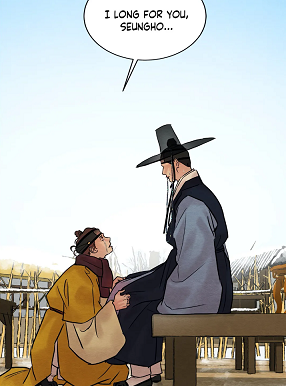 (chapter 57)
 (chapter 56). This signifies that his tears are not related to pride, but to his traumas. The lord can no longer weep due to the constant exposure to physical, mental and emotional pain. However, since he has been taught not cry in the presence of the butler, in chapter 56 it was, as if he was blinking back tears.
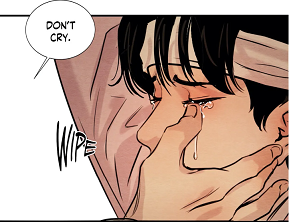 (chapter 2) And now, you can imagine which idiom I am about to bring up:
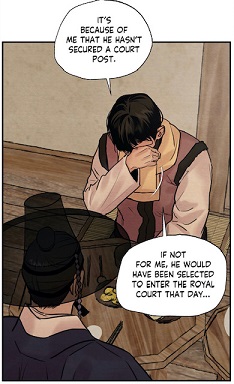 (chapter 75) This truly exposes the teacher’s cruelty and ruthlessness. We could say that the painter reinforced his admired sir’s cold-heartedness. Therefore I come to the following conclusion: Jung In-Hun will never feel remorse or empathy. He is destined to become a monster, as his wounded pride will just arouse brutality, resent and thirst for revenge.
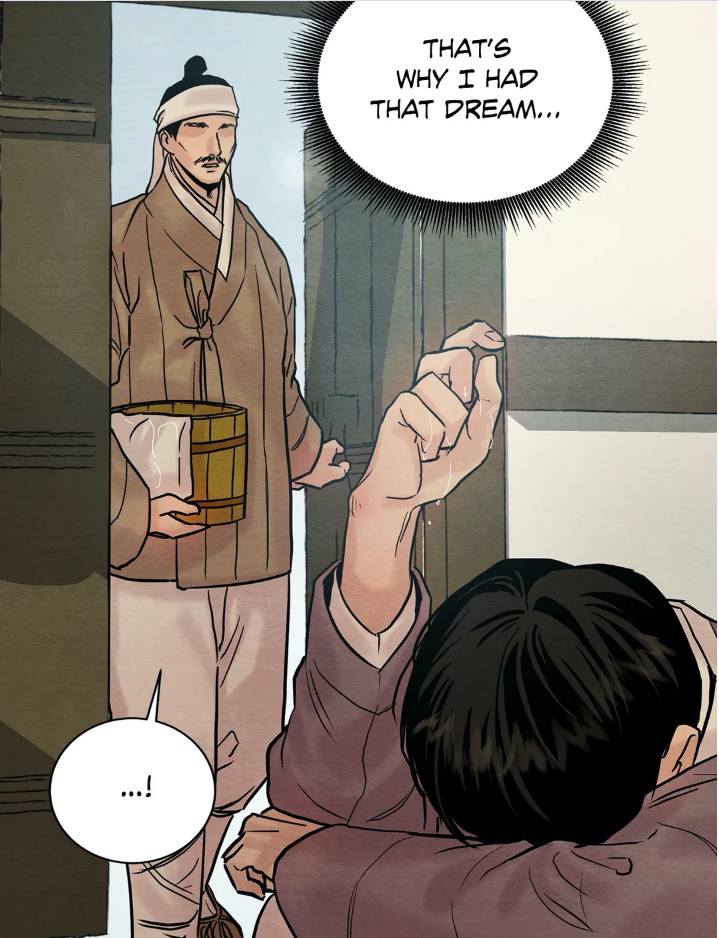 (chapter 56) I couldn’t help myself laughing, when I discovered it. I have no idea, if there’s such an expression in Korean. This slang expression comes from “to cry buckets”, which signifies that the person is like a cry baby. This new discovery made me realize that Yoon Seungho played a similar role to his admired valet than Baek Na-Kyum to his learned sir. Since the main lead was constantly facing terrible experiences, due to his cowardice and powerlessness the domestic chose not to take to heart. The more he witnessed, the more unconcerned he became. Therefore I deduce that Kim will never change his mind-set. He will prefer detachment, cowardice and blindness, because that way he is not suffering: neither regret nor heartache.
 (chapter 65), bringing lunches or announcing the arrival of a guest. And this observation made me realize that the lord started working hard, the moment he desired to woo Baek Na-Kyum. He dressed up, ordered some medicine for excessive drinking, organized two hunts, started strolling through downtown. Yet, this is no real work. And note that Jihwa behaved in a similar way, when he sensed danger from the painter. He also dressed up, had to plant a spy and trespass the mansion on different occasions. From my perspective, Yoon Seungho will start working the moment he behaves like a master. He needs more than just give orders to his staff. He has to control them and pay attention to finances. From my point of view, it is also his duty to take care of them as well, as the head of the mansion. To sum up, he has to learn how to manage the mansion. That’s why I believe that the lord’s tears will only return, the moment all the conditions are met:
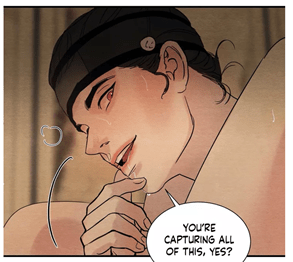
 (chapter 3) stimulus, his phallus was still erected after Jihwa’s first climax. It looks like Seungho was attracted by Jihwa… so much that his appetite couldn’t be satiated. This gave Jihwa the impression that something had been triggered in Seungho. He was finally appealed to him, this gave him the illusion that his dream had come true. He mistook the excitement as a sign of “love” making him believe that he had now more privileges than the other sex partners. In his mind, the sex at the pavilion was love and even love for him, while in reality for Seungho it was just the discovery of real pleasure in sex. He had finally come to love sex with men. Since he kept seeing the painting in his mind, it was as if he was making love to himself. Hence I interpret that for the powerful noble the sex at the pavilion is a mixture of sex and love. He finally comes to love sex with men and to love himself as a seme. He feels his own attraction.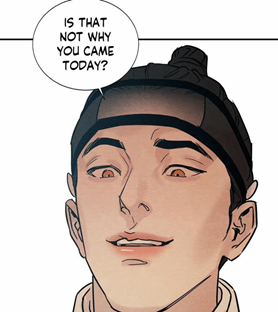
 (chapter 20)
 (chapter 25
 (Chapter 32) He has realized that his behavior has not been normal. He is confused hence he doesn’t get angry, when he is criticized by the doctor later. He knows that his emotions made him blind so that he somehow endangered the painter’s life. He must definitely feel guilty but he sees it as his duty to make sure that Baek Na-Kyum can recover.
 Here, it is quite clear what the protagonist’s real intention was. He was looking for sex in order to understand what led him to act like a crazy person in the presence of the painter. What was he looking for? During the separation, he makes a huge discovery: sex is not his true motivation, he gets aware that he has been longing for the painter’s attention and affection.
  Besides, due to Min’s words, he gets aware that he wants Baek Na-Kyum for himself. He is “his”. He knows that now but he has no idea how the artist will react after his recovery. He could definitely blame him for his illness and the sex marathon. Little by little, the main lead is learning to differentiate sex and love. What I mean is that he has learnt that sex is a way to express love, making the partner feel sexual enjoyment and pleasure is making love. It is about to give and not just to take. That’s why from that moment, the seme is focusing on pleasuring the artist. He feels that he needs to wait so that Baek Na-Kyum will come to fall in love with him and will express the need to have sex with him. So he is definitely waiting for Baek Na-Kyum’s move.
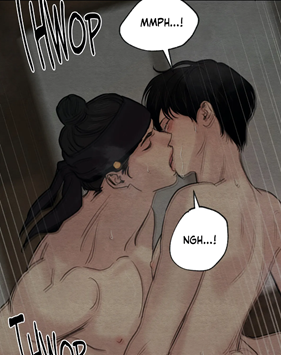 (Chapter 42) Here, there is a mixture of tenderness and passion. He is attempting to evoke other feelings in the uke. He actually shows his love for the commoner. While during their first night, the artist cried out of happiness, here the tears are expressing immense sadness and pain. This is the reality: he had never been truly accepted by the low noble. He always saw his social background, a low-born raised at the brothel. He is admitting his sexual orientation which he is now connecting to prostitution. The painter doesn’t see the love in Seungho’s gestures, too immersed in his own suffering. In other words, the lord wanted love here but only got the opportunity to have sex, while deep down Baek Na-Kyum was longing for love but just asked for sex. However, Seungho attempted to shower him with love at the end but the painter didn’t see it, just like during their first night.

