
Please support the authors by reading the manhwas on the official websites. This is where you can read the manhwa. https://www.lezhinus.com/en/comic/painter But be aware that this manhwa is a mature Yaoi, which means, it is about homosexuality with explicit scenes. If you want to read more essays, here is the link to the table of contents: https://bebebisous33analyses.wordpress.com/2020/07/04/table-of-contents-painter-of-the-night I am also using doctor Frost as reference again. https://www.webtoons.com/en/mystery/dr-frost/list?title_no=371
It would be great if you could make some donations/sponsoring: Ko-fi.com/bebebisous33 That way, you can support me with “coffee” so that I have the energy to keep examining manhwas. Besides, I need to cover up the expenses for this blog.
1. The imaginary sick person
I have to admit that I was initially disappointed by Yoon Seungho’s behavior in episode 108. One of the reasons is that he didn’t trust his lover, though he didn’t buy the doctor’s statement right away too. That’s the reason why he went to the maids and asked for their observations and opinion. 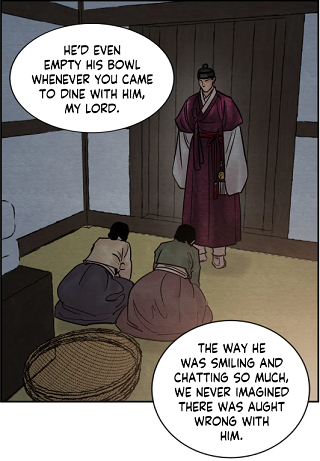 (chapter 108) But then I changed my mind about the lord, for Yoon Seungho didn’t rely on just one testimony contrary to his father:
 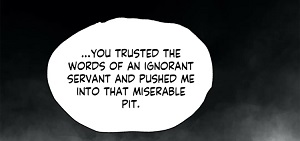 (chapter 86) Finally, thanks to the argument in the shed, I had another revelation which I will explain more details below.
However, the protagonist’s huge mistake is that he trusted the maids’ words too. While one might judge the apology from the main lead as a sign of humbleness, I view it in a different light: it exposes his low self-esteem. 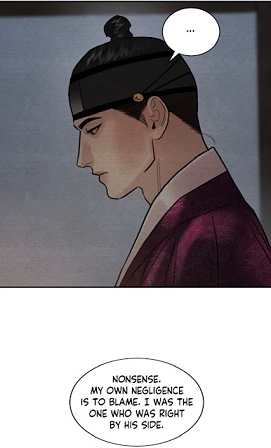 (chapter 108) He blames himself for everything. For me, these women were lying to their master. Why do I think so? The first proof is that the painter’s fate is to go through the same experiences than his lover. And what did the valet admit in the shed?
 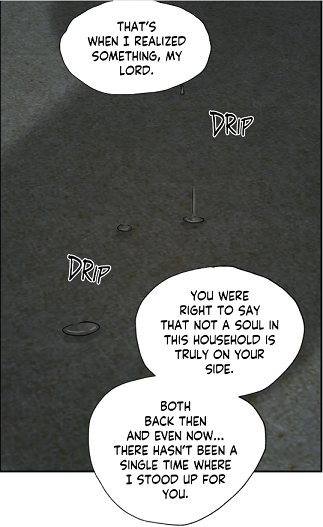 (chapter 108) There was not a soul in this household who was standing by his side back then and now! This signifies that there is not a soul in the mansion truly standing on the painter’s side as well!! Back then (before the massacre) and even now… Moreover, while these maids’ attachment was sincere
  (chapter 51)
 (chapter 63), this doesn’t signify that it is the same for all the female servants. This would be just another prejudice.
  (chapter 108) Yes, this woman is not the same than the one from chapter 51, for her clothes diverge despite the same pigments. She is wearing a white ribbon around her waist.
  (chapter 108), whereas the other wears the belt more around the hips, hence her skirt has a bump on her butt. (chapter 108) Finally, pay attention to the form of her mouth. It doesn’t ooze warmth or joy, quite displeasure and mistrust. But let’s return to my initial statement, the staff was actually deceiving their own lord.
  (chapter 108) First, when the manhwalovers saw him in the kitchen, he was eating to his heart content and enjoying his breakfast.
 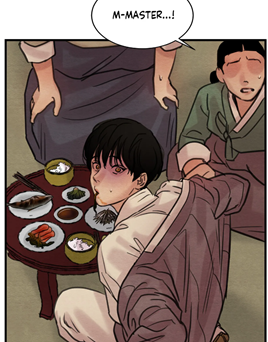 (chapter 38) Moreover, the painter had long stopped eating with the maids, he would share his meals with the main lead.
 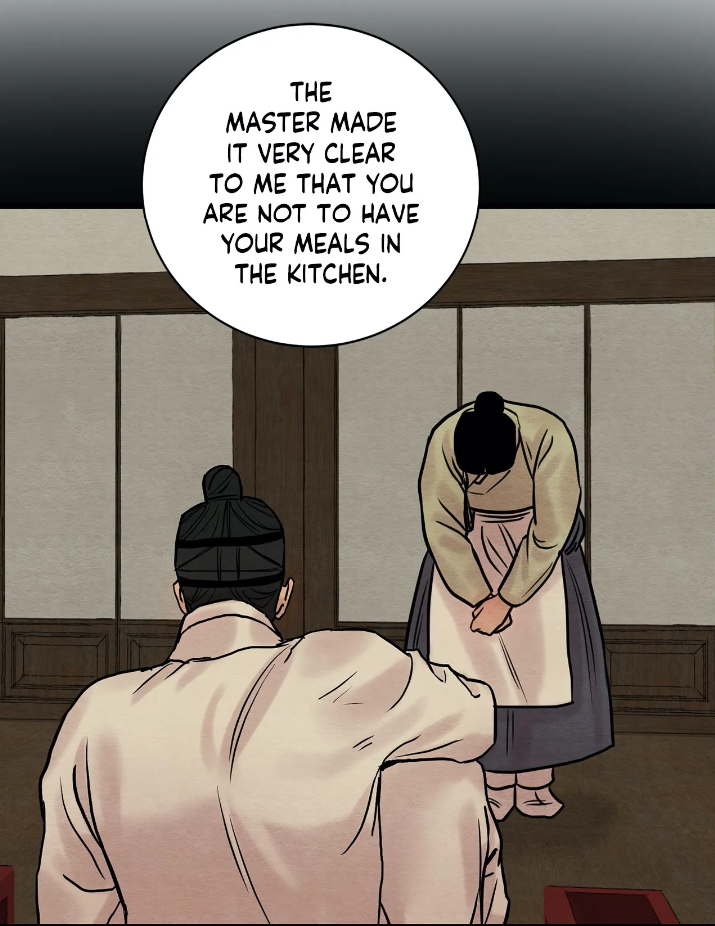 (chapter 46)
 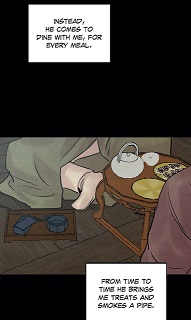 (chapter 74) This explicates why the artist returned the table with the porridge to the kitchen himself.
  (chapter 98) This means that they couldn’t witness how the artist would eat. To conclude, the statement from the staff was once again a mixture of truth and lies, for they were combining different situations together. Hence their apology was not genuine despite their gesture.
With their words (chapter 108), they admitted that they had been fooled themselves. At the same time, they implied that the painter has been hiding his discomfort all along, as he was only eating properly in front of his lover. Moreover, they insinuated that the painter’s laugh and smiles weren’t sincere at all. In other words, the lord’s eyes had been “deceived”, as the painter had been acting. This explicates why he took the blame and apologized to the staff. (chapter 108) He had not perceived the artist’s discomfort. Indirectly, they were putting the blame on the lord and Baek Na-Kyum. Nevertheless, they never stated that they had seen the painter vomiting. And now, observe that someone else had said the same thing about the artist in the past:  (chapter 62) The painter had been faking his “submission”, hence the “valet” got fooled. He had trusted the artist blindly. Thus the lord got angry, and resented the butler, for he wished the opposite. He didn’t want to admit that the artist had been acting. Yet, the seed of doubt was implanted in his mind. Consequently, in episode 108, we have the exact same situation, yet contrary to the past, the lord didn’t get angry at his lover. He never condemned the painter for his dishonesty, though he was not truly lying either. To conclude, chapter 108 is a reflection from episode 62. Thus it dawned on me that the valet could have attempted to fool his master once again. The artist was a hypocrite, for he was acting in front of the lord hoping that he wouldn‘t cut ties with him. It was for his best interests to send back to the kisaeng house. Yet, nothing like that happened.
Yet, in reality, the artist had been eating properly, as we could see him glowing in this image,  (chapter 104), a sign that he was recovering. But due to the two incidents during that day, Baek Na-Kyum had been feeling unwell and was hiding his discomfort out of fear of getting abandoned. This means that the deceivers were trying to portray the painter’s actual disposition as something unchanging. Since the painter had trouble with eating now, his eating disorder existed in the past. And this perception got reinforced, for the lord could notice afterwards that the maids’ statement had become a reality. What they had described, truly happened afterwards. Due to worries and anxieties, the artist lost his appetite. He would fake his “happiness”. The manhwalovers could witness how the painter had slimmed down
 (chapter 108), just like his “husband”
 . (chapter 108), a new version of episode 51. This time, the roles had been switched, the painter was sitting in the patio. To sum up, the schemers and the accomplices were creating a prejudice, a so-called universal truth. This is the negative reflection of season 1, where the gossips about Yoon Seungho were turned into a reality. In many of my previous analyses, I had outlined that these rumors about the protagonist had been false.
  (chapter 1) He couldn’t have a proper erection, and it was never his choice to have sex at any time and any place, because he was treated as a male kisaeng. And now, it is the painter’s turn. Gossips about him would become a verity. Yet the other difference to season 1 is that in season 4 the artist is exposed to the same “prejudices” than Yoon Seungho in the past: He is ill!! He needs to be treated and the “gibang” is the right place for that🤮. He would be with his noonas, a new version of the lord’s past. And now, you comprehend why father Yoon said this to the physician in chapter 57:
 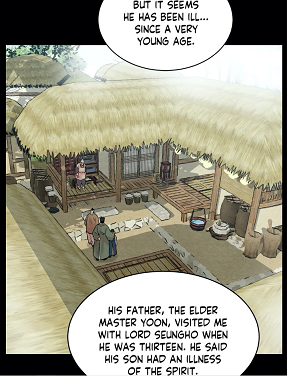 (chapter 57) A single incident was turned into a generality, implying that it was the same in the past!! To conclude, the noble is put into the same situation than his own father, the only divergence is that Yoon Seungho has indeed the painter’s best interests in his heart. He is determined to provide him with the best!! Thus he blames himself contrary to the elder master Yoon.
2. Yoon Seungho’s believes
But why did Yoon Seungho choose to trust others instead of his loved one? In my eyes, there exist two reasons. First, let’s not forget that the lord has been hiding the truth from his partner, his action in the shaman’s house. He is worried, but he doesn’t desire to burden his loved one, hence he chose silence and secrecy. 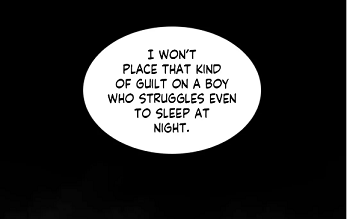 (chapter 104) This statement implies that the painter is responsible for the bloodbath, for he left the propriety. Yet, instead of confronting the painter, he was encouraged not to talk about the past. He was suggested that way, he would protect the artist’s mind and heart. Besides, his choice was influenced by his own anxieties. The lord fears argument, because the last time they had quarreled, the artist had threatened his lover to leave the place.
 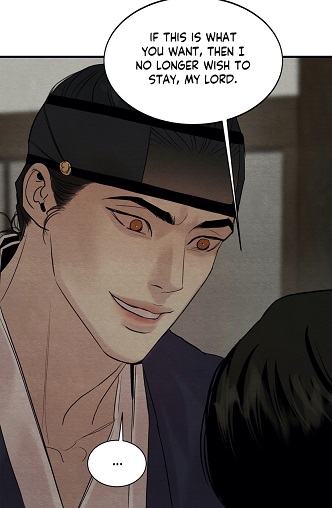 (chapter 85) I would like my avid readers to keep in mind that the lord wished to keep the artist by his side, sending the artist back to the kisaeng house was just a temporary measure.
  (chapter 105), yet the painter had heard something different from his noona.
  (chapter 105) That’s how a misunderstanding was created, provoking the painter’s abandonment issues to resurface. The lord had selected secrecy and silence out of love for the artist. Therefore when the lord sensed Baek Na-Kyum’s agony, he could only jump to the conclusion that the painter was acting the same way than him. He was also hiding something from Yoon Seungho. That’s the reason why the lord didn’t argue with Baek Na-Kyum.
 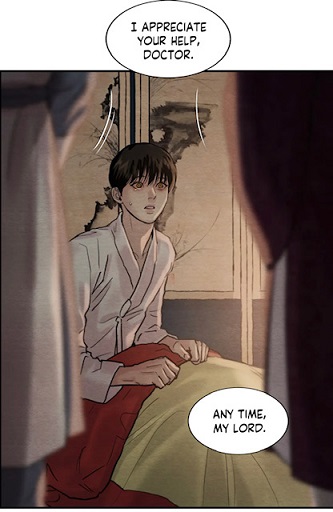 (chapter 107) He imagined that the artist was doing it out of concern for the noble. He was projecting his own thoughts onto the artist.
Nonetheless, for me, the biggest cause for his mistake are his own believes, and more precisely the “rules” he was indoctrinated with. He might have dropped his suicidal disposition, yet his self-hatred was not solved entirely. Its source is based on the following principle: “bird of misfortune”. 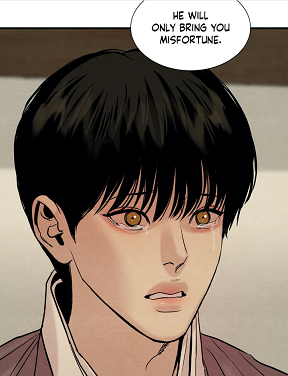 (chapter 68) According to this belief, the lord brings bad luck to others. This rule can only incite the main lead to doubt himself, to judge himself in a negative light, to doubt his own judgement. Moreover, the perfidy is that this principle pushes the protagonist to deny the existence of his own misery. It was, as though the lord had never suffered, only the others. This “faith” represents the biggest lie and hypocrisy. However, the main lead questioned this rule in front of Yoon Chang-Hyeon, (chapter 86), as he started putting the whole responsibility on the elder master and the ignorant servant. But due to the last massacre in the shaman’s house, Kim could use the painter’s suffering as the evidence of this “irrefutable truth”. Yoon Seungho brought misery to the painter. That’s the reason why Kim “suggested” his master to send Baek Na-Kyum away by proposing the opposite. Simultaneously, we have the explanation why the painter has abandonment issues again. Since their magical night in the gibang, Yoon Seungho and his lover are no longer sharing the same bed.
 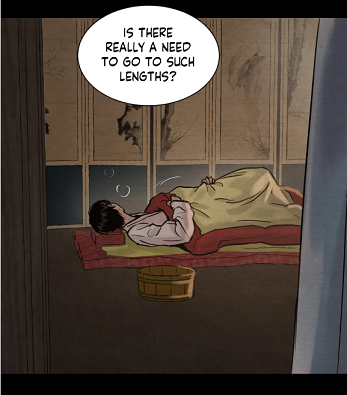 (chapter 108) He remains seated by his side, because he is projecting his own reaction onto his loved one. Remember how Yoon Seungho reacted in the past with Lee Jihwa: he pushed his childhood friend away.
  (chapter 59) It was, as if Yoon Seungho feared to taint the painter by sleeping next to him. However, the artist’s biggest wish is to share the same bed than his lover.
  (chapter 97) To conclude, Yoon Seungho’s life is still influenced by a false cult, by propagandism. This faith is is based on Rene Girard’s theories about mimetic desire and scapegoat mechanism.
“Girard’s fundamental concept is ‘mimetic desire’. Ever since Plato, students of human nature have highlighted the great mimetic capacity of human beings; that is, we are the species most apt at imitation. However, according to Girard, most thinking devoted to imitation pays little attention to the fact that we also imitate other people’s desires, and depending on how this happens, it may lead to conflicts and rivalries. If people imitate each other’s desires, they may wind up desiring the very same things; and if they desire the same things, they may easily become rivals, as they reach for the same objects.” Quoted from https://iep.utm.edu/girard/#H3
According to the psychologist and anthropologist, rather than bringing people together, convergence gives rise to hostility. Humans aren’t violent by nature. Our nature is social. The tragedy is that, even without deliberate evil on anyone’s part, our social nature constantly pits us against each other. Thus the French philosopher developed the following revolutionary hypothesis: human culture began with religion, and religion arose from our species’ need to master its own violence. 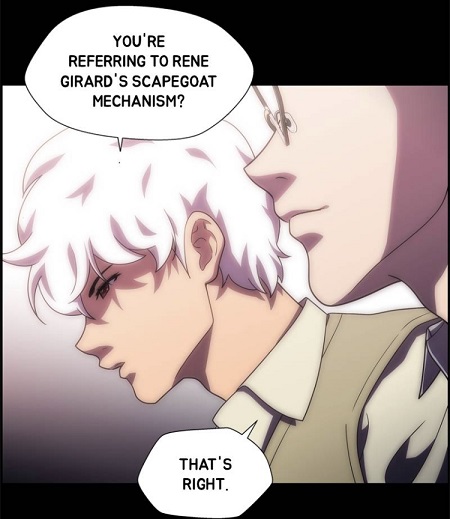 (chapter 250) Hence the man created the following theory which is inspired by religion.
“Girard calls this process ‘scapegoating’, an allusion to the ancient religious ritual where communal sins were metaphorically imposed upon a he-goat, and this beast was eventually abandoned in the desert, or sacrificed to the gods (in the Hebrew Bible, this is especially prescribed in Leviticus 16).The person that receives the communal violence is a ‘scapegoat’ in this sense: her death or expulsion is useful as a regeneration of communal peace and restoration of relationships.” Quoted from https://iep.utm.edu/girard/#SH3b
This means that the community deceives itself into believing that the victim is the culprit of the communal crisis, and that the elimination of the victim will eventually restore peace.  (Doctor Frost, chapter 250). Under this new light, it becomes comprehensible why the author from Doctor Frost utilized the image of a black sheep as the future scapegoat. IT was selected, because it stood out. And you comprehend why Yoon Seungho became the target in the end. His good reputation attracted envy and jealousy.
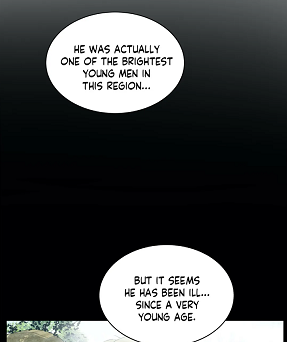 (chapter 57) Why? It is because each noble family aspires to the same: power and wealth!
  (chapter 86) I had already detected father Lee’s jealousy and greed, just like Kim, Yoon Chang-Hyeon and Yoon Seungwon. The butler and the father might have desired the same (recognition and fame), but this could only end up in resulting in rivalry and jealousy.
“Scapegoating can happen to protect the image of the family or people who are favored in the family, not just the self. It is common for one person to be scapegoated, but it can happen with more than one person. Commonplace in families with unhealthy dynamics, scapegoating tends to start in childhood when children are blamed for all of the problems in dysfunctional households. The term “scapegoat” originates from the Bible. […] In addition, it results in an upbringing in which the scapegoated child’s inherent worth, goodness, and lovableness are ignored. Instead, insults, bullying, neglect, and abuse are deemed appropriate for the child forced into this position. […] Why a parent decides to scapegoat a child tends not to make any sense because this behavior is rooted in dysfunction. For example, a child who is sensitive, inquisitive, attractive, and smart might be perceived as a threat and scapegoated by a parent who lacks these qualities.” Quoted from https://www.verywellmind.com/what-does-it-mean-to-be-the-family-scapegoat-5187038
As you can see, this article corroborates my perception of the elder master Yoon. Because the Yoons were a dysfunctional family, where the main lead was neglected by the mother, and the parents were alienated, Yoon Seungho was isolated, making him vulnerable. There is no doubt that the father just viewed his son as a tool for his own glory, it becomes understandable why the main lead lost very quickly his special status, when an incident occurred. The latter was definitely turned into an immutable truth, and Yoon Seungho had no one by his side to refute the deception. The lord’s good reputation could only be perceived as a threat by others. There is no doubt that it was the same for lord Haseon.  (chapter 107) This explicates why Yoon Seungwon was mentioned by the man with the purple hanbok. He implied that the son might have been well educated, yet he must be lacking elsewhere: his sexual education…. as his other task is to have a heir. This means that by standing out, Yoon Seungwon caught the jealousy and envy from other yangbans, though I have my doubts if he truly passed the civil service exam first. In other words, it is better not to stand out.
But let’s return our attention to Yoon Seungho who became the scapegoat. Nonetheless, he didn’t die, because his mother had sacrificed herself for her son’s sake. To conclude, since the mother killed herself and her son survived, the main lead got blamed for everything. Consequently, I deduce that the same occurred to No-Name who is “lord Song” according to me. With each sacrifice or punishment, peace was restored, however this was just an illusion, for the lord got still abused and the “real lord Song” came to lose everything. Hence there is still resent, jealousy and desire for revenge, because no real justice was delivered. With Rene Girard’s theory “scapegoat mechanism”, we have the perfect explanation why Min would lust after the painter. It is because everyone was looking at the artist either out of jealousy or greed. Finally, this connection confirms my interpretation: religion plays a central role in this story. And the main lead is not questioning this psychological phenomenon. Why? I had already pointed out that Yoon Seungho had been exposed to brainwashing and was suffering from Stockholm Syndrome. But how is it possible?
3. The birth of “brainwashing”
In order to answer that question, I will use Doctor Frost as a reference again.  (Doctor Frost, chapter 183) Since deprogramming is like brainwashing, it signifies that for the brainwashing, the victim needs to be isolated and even imprisoned too. And in order to be effective, the target of the brainwashing has to be exposed to stress and lack of sleep.
 (chapter 187) Fatigue and exhaustion are necessary in order to lower the target’s defense mechanisms. This explicates why it has to take place during the night, for the night is the time for humans to rest. Therefore the place of brainwashing is called “the fox’s hole” in Doctor Frost.
However, there is more to it. 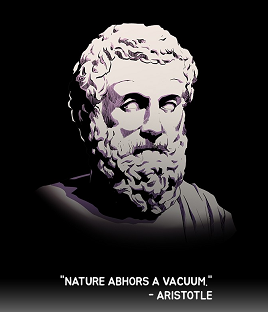 (Doctor Frost, chapter 187).
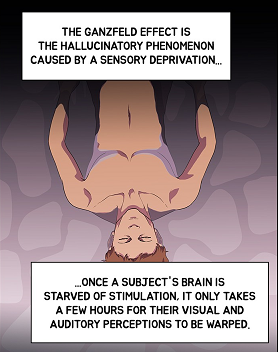 (chapter 187) The Ganzfeld effect happens when you undergo sensory deprivation for some time, and your brain tries to make sense of what is happening. Just 15 minutes of sensory deprivation can induce vivid hallucinations, according to researchers. This process involves muffling the ears and blindfolding, so people are unable to see or hear. And note what had happened to Baek Na-Kyum during the abduction. His head had been covered
  (chapter 66), and according to me, while his head was covered, he got strangled. Hence he had this nightmare.
  (chapter 61) But he lost notion of time and chronology, hence his nightmare is not coherent. One feature of altered states of consciousness during Ganzfeld exposure is an altered sense of time. In general, regardless of the induction method, altered states of consciousness can be characterized by changes in the sense of self and time. But this can only happen, when the brain is deprived of stimulations.
  (chapter 187) I had already outlined that Yoon Seungho had lost not only the notion of time, but also all his senses. And the nightmare is displaying the evidence of the Ganzfeld exposure. Hence the young master viewed himself flying
  (chapter 74), and at the end his eyes and ears got covered by hands and blood.
  (chapter 74) Besides, he was trapped in the dark room which looked like the servants’ quarters. Only thanks to the painter, the lord could recover his own senses, slowly he became the owner of his own body again. In addition, remember what he said to his own father:
  (chapter 86) The darkness he was referring to is the indication of “Ganzfeld effect”. Because he was trapped in this nightmare, he lost the sense of reality. He had to rely on someone else’s senses and words. That’s how his memories got repressed and even distorted. Consequently, a new past could get recreated. That’s the reason why the lord had no memories for a long time. The valet was the “owner of the truth and as such of the time”. We could say that till the meeting with the painter, he possessed the lord’s memories. Besides, one of the side effects of scapegoating is becoming vulnerable to gaslighting.
“
- Trauma: Being deprived of a family’s love, singled out as the “bad one” in the household, and having one’s positive attributes overlooked can set up a child for a lifetime of emotional and psychological distress, where they struggle believing they are good, worthy, competent, or likable.
- Toxic relationships and environments: It can also result in these individuals entering friendships, romantic relationships, and working environments that are abusive and harmful.
- Normalizing dysfunctional behavior: Dysfunction and abuse often feel “normal” for family scapegoats, making it difficult for them to spot dangerous people and places before harm is done.
- Difficulties with boundaries: The fact that gaslighting is common in dysfunctional families makes it challenging for abused individuals to set boundaries and recognize when other people’s behavior crosses the line. They are more likely to believe that they are exaggerating, are being too sensitive, or can’t trust their judgement.
- Self-sabotage or self-harm: Scapegoats tend to internalize the harmful messages they’ve received about themselves from birth or early childhood onward. This could result in the child engaging in self-sabotage or self-harm, such as doing poorly in school, neglecting self-care, engaging in risky activities or behaviors, and acting out in ways that indicate they deserve the title of the scapegoat (even though no child does).Quoted from https://www.verywellmind.com/what-does-it-mean-to-be-the-family-scapegoat-5187038
The information from Doctor Frost made me realize that the shed is the place where the main lead got brainwashed. This explicates why the main lead put a fire in the storage room, when the artist was brought there after the “fake abduction”. 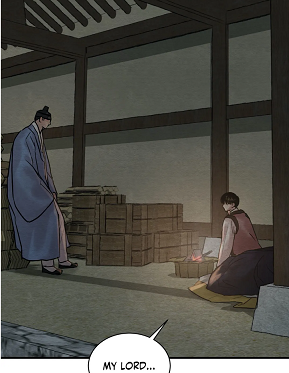 (chapter 62) Under this new light, it becomes comprehensible why the lord didn’t lose his whole sanity and as such didn’t fall completely into despair. The warmth and light served him as a guidance. Consequently, I deduce that in his childhood, he was trapped there in the dark for hours!! Because he was jailed in that room, he was exposed to the Ganzfeld effect. Therefore he relied on the valet’s words.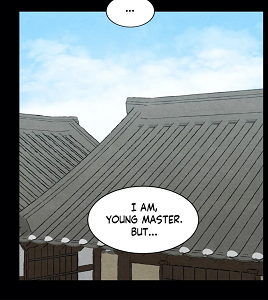
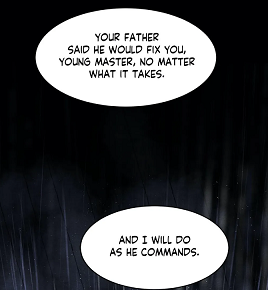 (chapter 77) He trusted the butler, even after getting betrayed and abandoned each time. He developed blind faith in the butler. Why? It is because he was the only one “talking to him”. Though he wounded him so many times, he still remained by the lord’s side. That’s the reason why I come to the conclusion that the shed is not just a room for punishment, but also for “faith”, the place where the scapegoat was placed: “
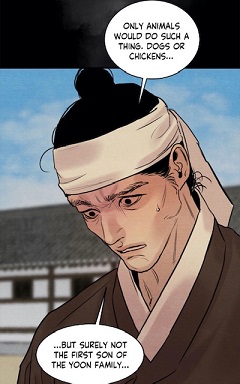 (chapter 77) That’s the reason why he got treated like an animal. This is no coincidence that in the storage room, the butler utilized such a religious vocabulary: “I do not believe”
 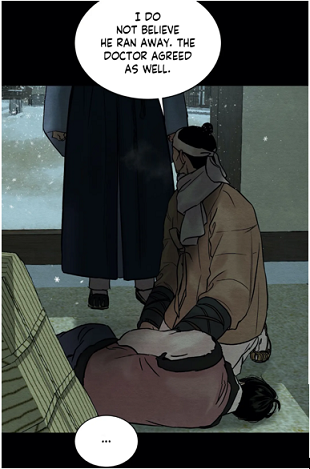 (chapter 62); “beg”, “trust” a synonym for faith,
 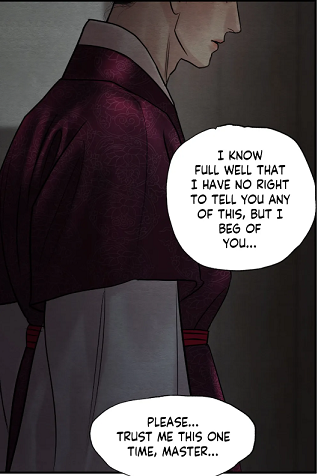 “soul”, ” (chapter 108) “Save”
  (chapter 108) Moreover, I would like to outline that the main lead was seen sitting while looking up
  (chapter 83) It looks like Yoon Seungho was praying, when Lee Jihwa opened the door. This means that Yoon Seungho has been treating Kim as his idol, his highest priest. Besides, doctor Frost explained why people become victims of brainwashing.
  (doctor Frost, chapter 191). This description fits to the shed, the lord was not only cornered mentally, but also physically.
But since the shed plays such an important role in the story, I wondered why the storage room from the mansion was not shown in season 1 [As a reminder, for me, in chapter 1, the painter was brought to father Lee’s propriety] That’s how I recalled this scene, the butler standing in front of the gate of the barn. 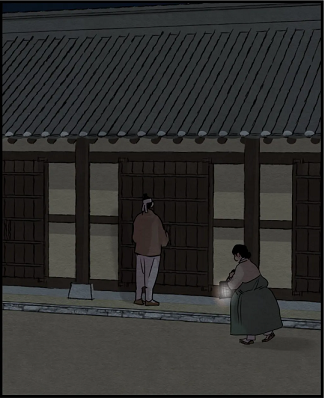 (chapter 32) What was he doing there, and why was he looking at the bedchamber? It is because he imagined that after the sex session, Yoon Seungho would send the painter to the shed as a punishment for his desertion. Let’s not forget that during the day, the whole staff had been beaten by their master. Besides, I would like to point out that the staff in season 3 viewed the painter as a spoiled brat, for he was receiving the lord’s favors.
  (chapter 98) Consequently, I deduce that when the valet got punished in season 3, he portrayed the painter as a tattler for that reason. He didn’t want to become the scapegoat in the end.
 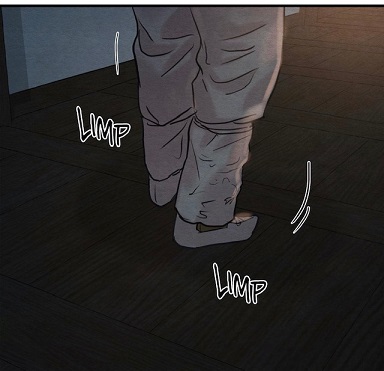 (Chapter 77) At the same time, receiving treatment from the physician, Kim could say that the lord regretted his decision. These new discoveries reinforce my prediction that the painter is doomed to become the next scapegoat!! Yet, chance is on the couple’s side. On the other hand, this signifies that someone will have to become sacrificed!
4. The priest and his disciple’s discussion
Now it is time to focus on the argument between the butler and the surrogate son. While many viewed this discussion as something positive, for the butler cried (chapter 108) and apologized to the noble 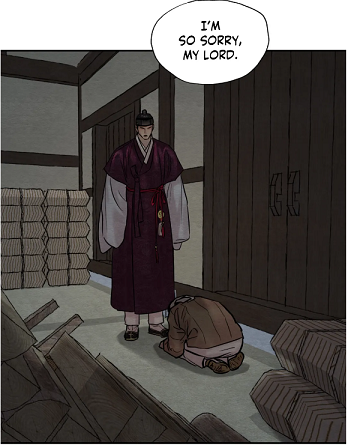 (chapter 108) for his wrong choices, I come to the opposite interpretation. Naturally, if the manhwalovers compare the butler’s apology in the shed to the one in the library,
  (chapter 77) it really looks like Kim is sincere. He is no longer standing, he is now weeping. Finally, he is not blaming someone else (the kisaeng), but himself.
  (chapter 108) Nevertheless, for me, everything is an illusion, and you can only detect the manipulations, the moment you examine closely Kim’s words.
First, it starts with the butler’s statement.  (chapter 108) Kim feigned ignorance, and the lord confronted him with his lie, he admits that in reality he knew something.
 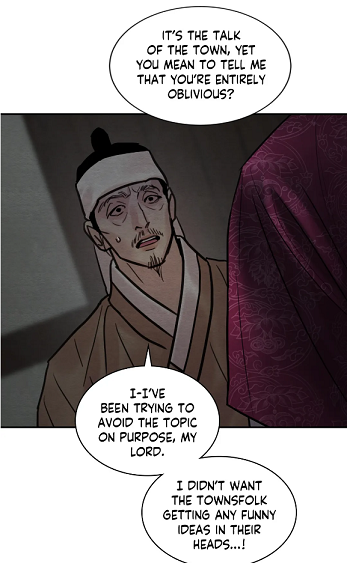 (chapter 108) He had not told him about the shaman’s house on purpose. He had hidden the truth by omission. He justified his decision by using the “townsfolk” and their liking of creating gossips. However his real task was to protect his lord’s interest and inform him about everything. He made a decision without his lord’s permission, and as such he usurped his authority. He acted, as if he knew what was the best for Yoon Seungho. But this doesn’t end. What infuriated me the most are these two declarations:
- : While many judged the confession from Kim about his constant betrayal and abandonment as something positive, I paid more attention to the second sentence: “I’ll regret”. He is employing the future and not the present tense. This stands in opposition to Lee Jihwa’s regret:
 (chapter 61) The red-haired master utilized the present perfect tense, which is a combination of the past and present!! This time reveals that the young man was about to move on. On the other hand, the butler is either referring to the past and to the future, but not to the now! This means, he has no regret right now. He is projecting himself in the future. He implies “regret”, but he is not truly admitting it. Finally, when the childhood friend came to regret his choice, he voiced it outside the barn!!
  (chapter 61) This contrast outlines that the storage room is the place of illusion or false faith.
  (chapter 108): Here, my blood was literally boiling, when I read his second “confession”, because here he was now omitting Yoon Seungho. It was, as if the protagonist was not existing. His words were actually reflecting a new betrayal towards the main lead. Here, he was vowing loyalty to Baek Na-Kyum and not to Yoon Seungho!! He insinuated that if he was taking care of the painter, he was protecting Yoon Seungho’s interests. However, the artist and the noble are two different persons. Imagine the following situation: The main lead gets arrested for “murder”, the butler could justify his vanishing, passivity and silence by saying that he needs to take away the painter from the mansion so that the latter avoids getting into trouble as well. As you can see, he would keep his promise, but he would sacrifice Yoon Seungho. With his words, he was insinuating that he only had two choices: the elder master Yoon or the painter. Besides, once the lord were to be removed, Kim could put the whole blame on the painter afterwards. If he had not left the house… That’s the reason why I viewed the last statement as the biggest treason. In reality, he was not vowing loyalty to the main lead. This scene was a reflection from episode 30, where the artist had pledged loyalty to the main lead
  (chapter 30) and this in front of people. This explicates why the butler got grabbed in the storage room
  (chapter 108) like the painter in the courtyard.
 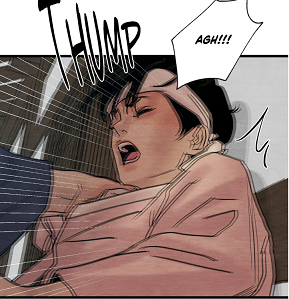 (chapter 30) We could say that it was the butler’s karma for his past manipulation. He had been the one who had encouraged the painter to flee the mansion (chapter 29/30). But this doesn’t end here. When the artist vowed his loyalty to the protagonist in the courtyard, the latter was present, which is not the case here. The artist is left in the dark. (chapter 108) He has no idea about the valet’s oath. Therefore we should consider it as inexistent. This means, if the painter got arrested, the valet could put the blame on the artist and say that he is trying to protect the lord’s interests, to save his skin. That’s the reason why I consider this confession from the butler as a huge sign of his culpability and dishonesty. Moreover, he is not feeling any remorse.
Besides, note that he never admitted that he truly cared for Baek Na-Kyum, he simply suggests it. 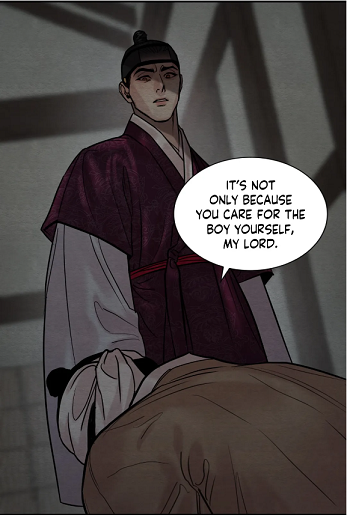 (chapter 108) Where is the personal pronoun “I” here? Nowhere. Only the lord cares for the painter, this was the butler’s declaration in the end. But what about the tears? How could he fake the crying?
First, the author never let us see the valet’s eyes and not even his mouth. The tears were implied with the sound “hic” and the drops of water falling onto the ground: (chapter 108) My avid readers will certainly recall the following rule which the story is based on. Each scene will be reflected in a previous season. 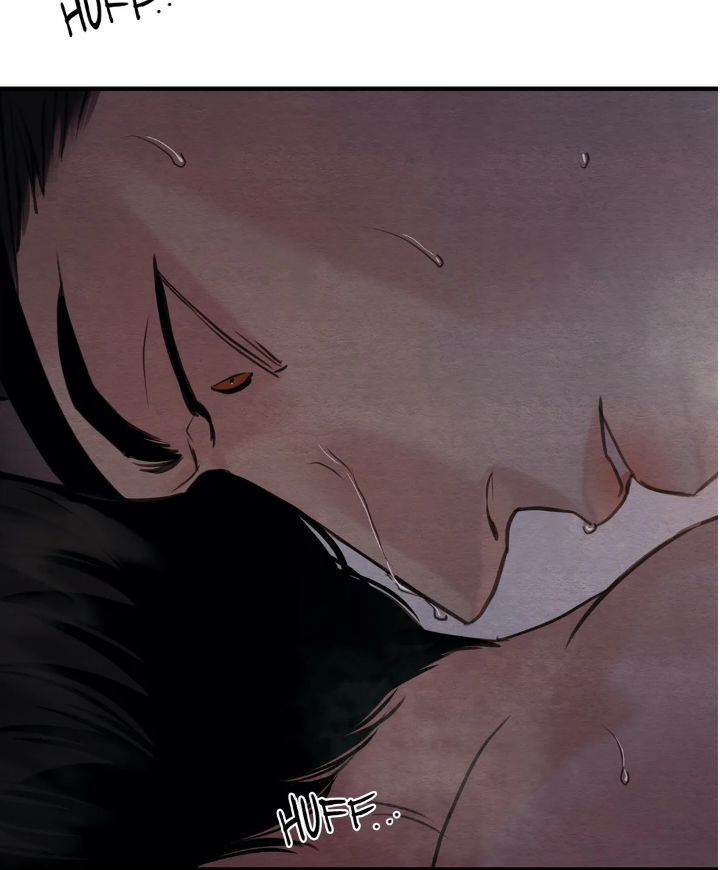 (chapter 81) When the lord had wounded his lover, when he was in a dissociative state, he had perspired so much that his sweat was falling like tears!! As you can see, fear could be the reason why drops of water were falling. Let’s not forget that the main lead had treated Kim very harshly and even threatened to have him killed, something he had never done before.
  (chapter 108) Kim had reasons to get scared and to sweat.
Besides, note how the valet keeps switching Yoon Seungho’s title (either young master  , chapter 108, or my lord ), a sign that he is not truly recognizing him as his real lord. One might refute my interpretation, because Kim voiced regrets in this scene.
 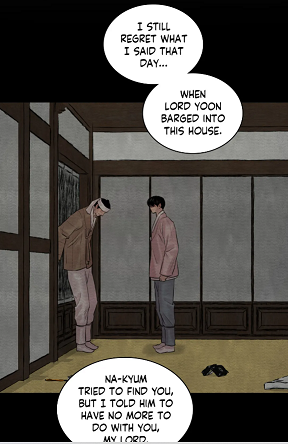 (chapter 108) However, the manhwalover should question this. Why did he regret that day? It is because he had revealed his true thoughts about Yoon Seungho to the painter, and he got reprimanded from the artist. Besides, according to me, he had hoped that the artist would leave the mansion due to the altercation. In addition, when he mentioned this scene, he wanted to appear as honest, because he had no idea if the artist had leaked this conversation to Yoon Seungho. Finally, just because he told the truth here, we shouldn’t judge the butler’s confession as verity. To conclude, for me, the valet was not really remorseful, he was more acting.
One might argue that my interpretation about Yoon Seungho was wrong. It was his choice to live in debauchery, as it admitted it in the shed.  (chapter 108) However, this is another illusion which can be easily refuted.
  (chapter 108) This memory is the same than the painter’s (chapter 1). However, this is not possible, for the painter had never gone to the main lead’s mansion before. He had this memory, when he met him at the inn for the first time. This vision was a reference to the gibang. But note that in the lord’s statement, he never mentioned the kisaeng house. He only invited the nobles to his “bedchamber”. The words don’t match the picture. This admission was actually exposing the manipulation, a fake memory… the “traces of brainwashing”. Besides, the manipulator had employed the same MO like mentioned above. Since it happened once (chapter 8), then it was the same in the past. Because we saw guests in the lord’s mansion, we could be tempted to assume that this represents Yoon Seungho’s true past. Concerning the painting, Kim just needed to explain why lord Yoon had barged in his mansion. He had sent the painting to his father to provoke him.
  (chapter 108) In other words, the butler had acted on his own, and informed his master afterwards, when this information was necessary in order to protect himself. As you already know, for me, the butler had definitely acted on his own. But why does Kim need to deform reality so much? It is because he was present, when the young boy was abused sexually and he did nothing. He needs to erase the “traces” of the rape so that his culpability will not come to the surface. Just like the painter, Yoon Seungho has totally forgotten the sexual abuse. Besides, he never mentioned the incidents about the shed to the painter, only the bedchamber.
  (Chapter 87) Here, he was already hiding his guilt by turning Yoon Chang-HYeon into the main culprit. He is responsible for the lord’s suffering.
But the problem is that Yoon Seungho is escaping more and more from his claws, and his manipulations are now turned more and more against him!! The reason why I was first disappointed is that the young master was not able to detect the contradiction. He had accepted the butler’s version as a truth from his past (chapter 68), but he had heard a different story from the painter.
  (chapter 93) However, now I understand why Yoon Seungho was not able to discern the hypocrisy from the assistant.
 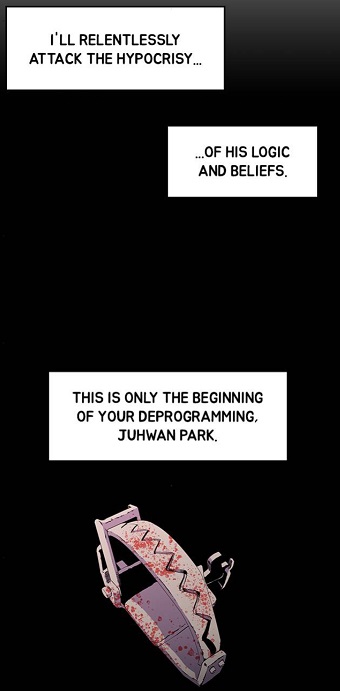 (chapter 188) It is related to the long brainwashing he was exposed for so many years and the lord’s low self-esteem. Thus I perceive this argument in the storage room as a new version of episode 40, a confrontation between the painter and the scholar. But who had been defeated in the shed? Yoon Seungho was still the loser, for he kept his distance from his lover afterwards.
  (chapter 108) He was making sure that no one would know that the painter was his weakness.
 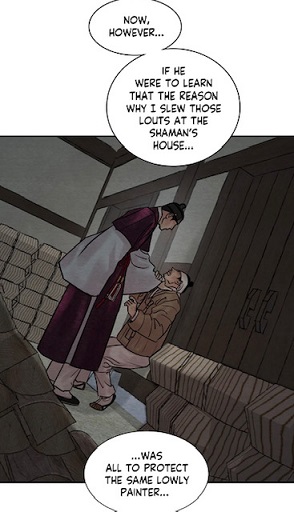 (chapter 108) The new version of episode 50-51!! However, this was totally pointless, for the painter was living his bedchamber. His position was the proof that the painter was still favored, though the artist feared to be abandoned by the painter.
I am now full of optimism. Why? It is because Yoon Seungho’s role is to remove all the painter’s wounds from his heart and mind! Don’t forget that in season 1, the main lead was the painter’s emancipator. And as a reward for his good deed, the lord’s last rule will be removed. How can this happen`?
 (doctor Frost, chapter 187) This means that the couple has to communicate and the painter will interrogate his lover.
 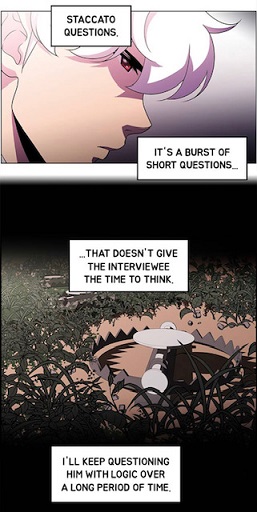 (chapter 187) But this deprogramming is not pleasant, for the destruction of believes leads the victim to question everything afterwards. What caught my attention is that the painter went to the library, the symbol for “knowledge and education” which stands in opposition to the shed. This is no coincidence. Brainwashing is the antonym for insight.
  (chapter 108) In addition, the lord was dressed like in episode 36, he had the green hanbok.
 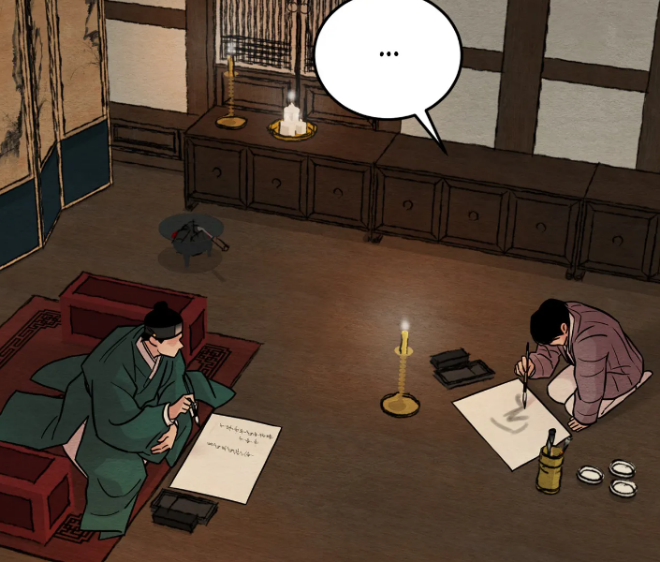 (chapter 36) Back then, the painter didn’t talk to the owner of the mansion. Finally, this episode is connected to the lord’s memories:
 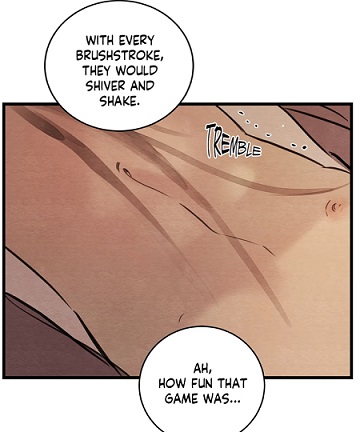 (chapter 36) That’s how I had this revelation. The lord’s suffering is also linked to the library. From my perspective, the young master was dragged from the library to the shed at some point.
 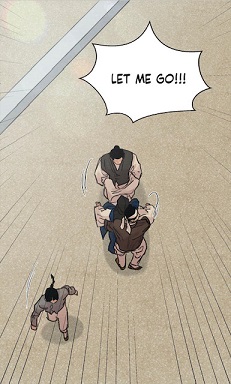 (chapter 77) I had already pointed out that in episode 77, the main lead had been dragged on multiple occasions, for he was dressed differently, and the servants would be different. Because I had described that the lord’s mind had been manipulated by indoctrination and the butler had confessed, I deduce that the next episode will contain elements from episode 48/49.
  (chapter 49) That’s the moment the painter dropped the last principle from the scholar and kisaeng. For me, something similar will take place, but such a deprogramming is painful. From my point of view, Jung In-Hun will be mentioned, as in the same place, the scholar had mentioned the painter’s past and future.
 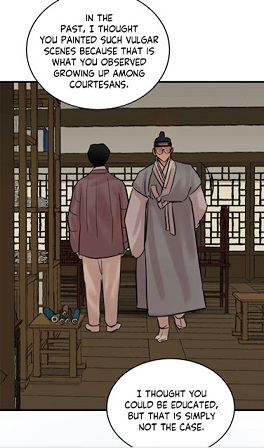 (chapter 40)
  (chapter 40) Since the shed embodies the valet’s betrayal, the lord voiced his abandonment issues there. On the other hand, the library symbolizes the teacher’s abandonment. This is not random. Baek Na-Kyum can not read, the symbol of the learned sir’s negligence. Hence I am expecting a new confession from the artist, like this scene:
 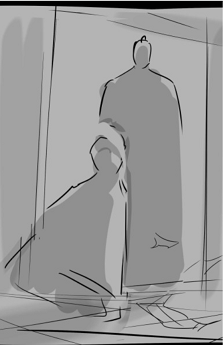 (Tweet) So far, the artist has never spoken ill of the teacher. To conclude, the library is the place where both protagonists will experience a new liberation! For me, episode 108 and 109 are focused on education, responsibility, memories and truth. That’s the reason why I am suspecting that the painter’s words will trigger the lord’s memories so that the verity about his own past will come to the surface.
Before closing this essay, I would like to point out two other thoughts. The storage room has another symbolism. It is connected to wealth and gathering. This would explain why Kim likes the storage room, indicating his materialistic side, and Yoon Seungho was his bird of fortune, for the former came to enjoy a good life. As you already know, he became the true owner of the mansion, the “ghost lord”. Finally, I would like to outline a detail which caught my attention: the jar in the shed with a new lit. (chapter 108) What is this jar doing there? It was not present, when the painter was kept captive there.  (chapter 62) My avid readers will certainly recall my theory that a corpse was hidden in jar!! In other words, I am more than ever convinced that there’s still a corpse hidden in the mansion. This is important, because this represents the condition for the appearance of the scapegoat mechanism. Someone has to take the fall for the schemers and accomplices.
Feel free to comment. If you have any suggestion for topics or manhwas, feel free to ask. If you enjoyed reading it, retweet it or push the button like. My Reddit-Instagram-Tumblr-Twitter account is: @bebebisous33. Thanks for reading and for the support, particularly, I would like to thank all the new followers and people recommending my blog.
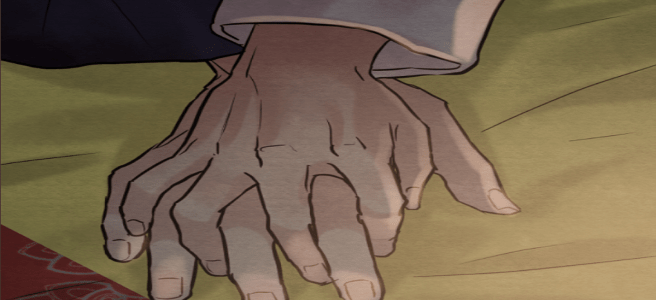
 Yes, when people read juicy deeds, they were already imagining that I would describe a love session like this one
  (chapter 96), because of the expression „to do the deed“:
  (chapter 87) However, the deed is not just related to intercourse, like the manhwaphiles could discover it in chapter 51.
  With „deed“, Deok-Jae was referring to murder and assassination. As you can see, deed has other meanings than sex. Thus it has for synonyms action, accomplishment and reality!! So when I selected this name for the essay, I was thinking of the relationship between action and word. And this connection came to my mind, when Byeonduck released the last picture, because the painter’s action symbolizes a conversation and as such words.
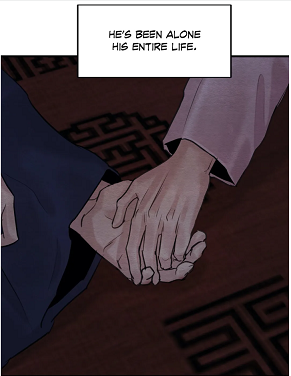 (Chapter 88) By reaching his hand, the painter was letting him know that he was no longer alone in this world. He was not only joining his side, but he was willing to try to understand the main lead.
 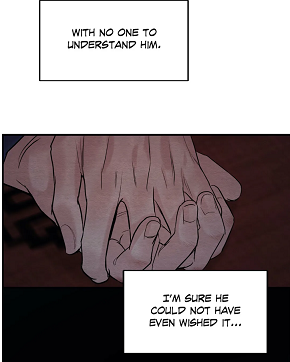 (Chapter 88) This gesture stands in opposition to the situation with Yoon Chang-Hyeon.
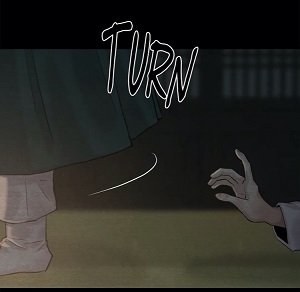 (Chapter 86) During that fateful night, the father neither talked to his son nor looked at him. He even turned his back to him, when the young master attempted to grab his father‘s hanbok. Both scenes from chapter 88 and 86 have two common denominators: an action accompanied with silence!! Yet, what distinguishes them from each other is the nature of the deed, the action. Alliance and empathy versus abandonment and estrangement! This is no coincidence that after reaching his hand, Baek Na-Kyum started confessing his thoughts and emotions to his lover:
 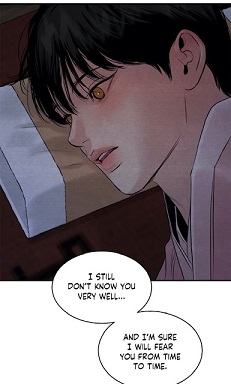 (Chapter 88) As you can sense, the hand gesture delivered a message, but the painter still felt the need to clarify the meaning of his hand. He was willing to remain by his side, but he was still afraid of him. He didn’t want to create a misunderstanding, like for example that he wouldn’t argue with him or that his loyalty was now unconditional or total. That way, Yoon Seungho wouldn’t come to view him as a hypocrite or as dishonest, if an argument would appear. Thus he needed words to explain his position. He would remain by his side and attempt to sympathize with him, but he still felt insecure and had doubts. In other words, his action (his hand gesture) was not truly reflecting his mind and heart.
  (Chapter 88) Later he even asked his lover not to leave his side no matter what.
  (Chapter 88) To conclude, the hand gesture in episode 88 was connected to insecurities and as such fear, yet the painter had shown no hesitation to take his hand. The anxiety was not visible.
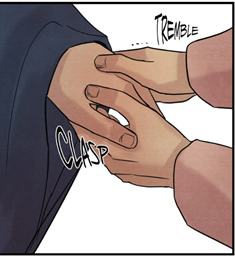 (Chapter 30) His fingers barely grabbed his hand, so when he made the following vow, he was not entirely sincere or better said, truly determined to keep his promise.
 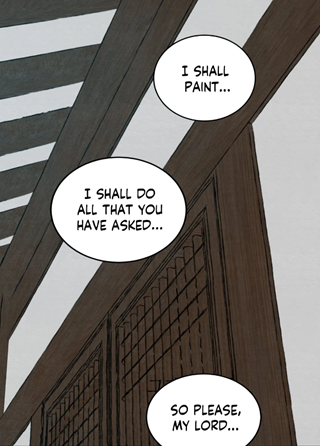 (Chapter 30) The words were not truly in unison with the gesture either. Therefore he once tried to leave the mansion in season 2. When he pledged loyalty, his intention was to protect his teacher. To conclude, fear has always been present, when the painter took Yoon Seungho’s hand. Even in chapter 88, but contrary to the scene in the courtyard, his hand was not shaking.
  (Chapter 82) This explicates why the artist chose to remain by his side, though the lord had broken his promise.
 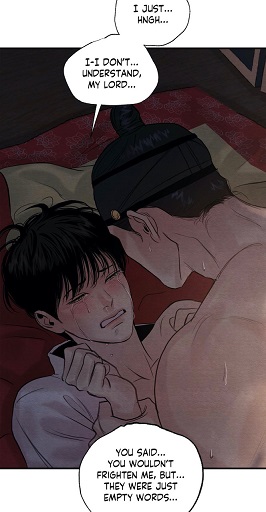 (Chapter 82) On the other hand, in this scene
  (chapter 82), the lord was grabbing his lover’s hand out of fear. He was recognizing his mistake and was trying to beg for his forgiveness, though he couldn’t express it directly. Striking is that during the lord’s flashback, his hand was trembling as well, grabbing onto his partner’s body.
 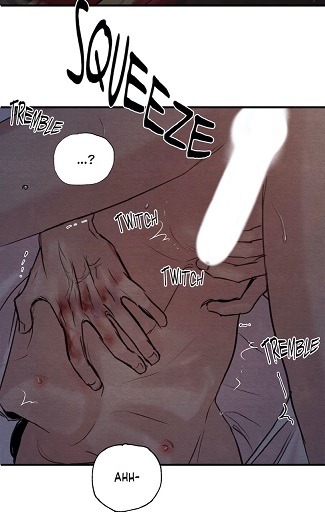 (Chapter 81) It was, as if Baek Na-Kyum was his rescue buoy, helping him not to be swallowed by the darkness. Thus I came to the conclusion that the protagonists’ hand gestures are all connected to anxiety and pain. 😲 Hence I am deducing that in this scene, Baek Na-Kyum is holding his lover’s hand,
 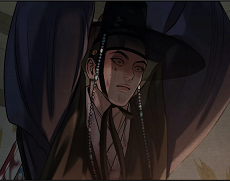 (Chapter 102). This would have definitely scared Baek Na-Kyum, especially Yoon Seungho’s haunted gaze. On the other hand, since the painter had been himself the victim of physical and sexual abuse, the artist can only grasp why the noble reacted that way: fear, anger, despair and heartache. The artist had also been desperate, in pain and scared in the shrine, though this time, he had not screamed for his help. Since the lord had not returned to the mansion, how could he expect him to come to his rescue?
 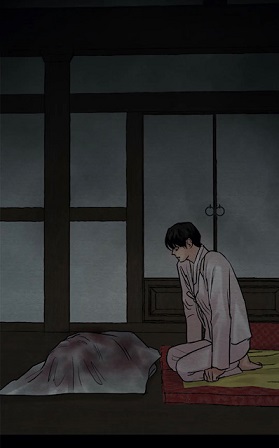 (Chapter 98) Back then, he had been waiting for his lover‘s return and explanations. He wanted to hear him and get his reassurance and comfort. .
 (Chapter 98) The latter couldn’t reassure the painter with his hand contrary to the previous night.
  (chapter 97) Exactly like mentioned above, the painter’s hand gesture is connected to fear and conversation.
 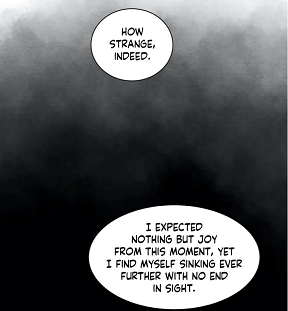 (chapter 97) Striking is that in the gibang, the lord confessed his biggest fear to his future “spouse”. He feared to lose him, though one of his biggest desires had been finally fulfilled. This means that Yoon Seungho felt even more insecure and frightened than before after receiving the artist’s love confession. That’s the reason why I believe that the new picture is standing in opposition to the scene in the gibang. The lord will feel relief after his admission. As a conclusion, the image is announcing
  (Chapter 89) While the painter was sitting on his partner’s lap
 (chapter 89), he was massaging the wounded fingers. It was, as if he was treating his companion’s wound. Note that after his terrible flashback, the painter had avoided to grab his hand out of fear that he might hurt Yoon Seungho even more.
  (Chapter 84) Therefore I conclude that the new panel is an allusion to treatment. While in episode 89, the painter was acting as a doctor, in the new image, the young man is working more like a counselor or psychologist. The aristocrat’s hand might not be wounded in that scene, but this is not the case for his heart and mind. So for me, this scene is connected to mental treatment.
 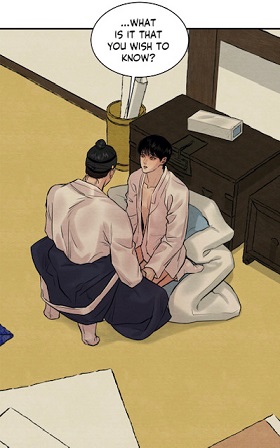 (Chapter 84) However, the lord had refused to open up. This is no coincidence that the author had not created such a picture during that chapter. As the manhwalovers can detect, I believe that in that scene,
 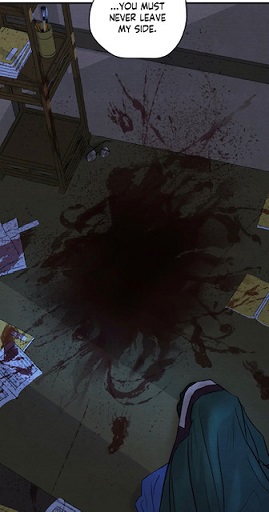 (chapter 88), and this, although the lord is indeed a murderer. For Baek Na-Kyum, his gesture will have a different meaning: he saved his life and freed him from his torment. Secondly, if the lord reveals the circumstances of his mother’s death, the artist will definitely deny his responsibility in her death, a new version of this scene.
 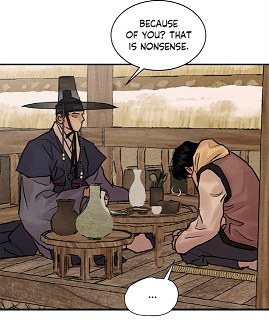 (chapter 75) And because I detected a discrepancy between words and gestures, I recognized the presence of another trick from Byeonduck.✨
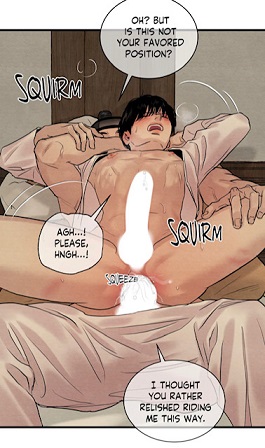 (chapter 91), the latter denied this with the following statement.
 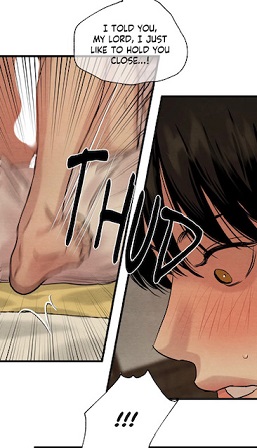 (chapter 91) But when did the painter admit that he liked embracing him? In this panel!
  (chapter 88) That’s the reason why the lord got surprised and moved. As you can see, the author never revealed this whispering to the manhwalovers! The latter had the impression that the lord’s reaction was related to the loving embrace, but it was only partially correct.
  (chapter 62), when the lord had confessed to adore him.
 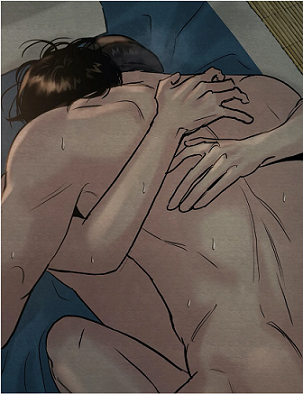 (chapter 62) This explicates why Yoon Seungho was so pained in season 2. He got embraced, but there were no words. Consequently, when the painter vanished during that night, the lord could only perceive the embrace as hypocrisy and fakeness. That’s how I realized that the story is developed on the contradiction between words and actions. But not only that, there exists a strong link between silence and passivity. Thus after the abduction in season 2, Baek Na-Kyum remained more or less silent
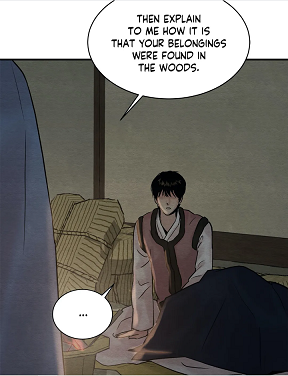 (chapter 62), and as such he was totally passive. He never stood up and begged the lord for his leniency. He stayed there on the bed giving the impression that he was indifferent. That’s the reason why Yoon Seungho got more enraged, for he felt fooled. This means that the absence of words represent inaction… This explains why Yoon Seungho had to corner the main lead in chapter 48
  (chapter 48) to say something, as he had sensed his passivity behind his „submissive attitude“. This is no coincidence that during this night, the painter felt extreme pleasure to the point that he peed. Therefore he could voice his wish to Yoon Seungho during the love session from season 2.
 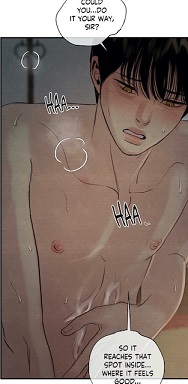 (chapter 73) That’s how the lord concluded that the painter liked riding him, while in reality such a climax had appeared for the first time, when both were facing each other!
  (chapter 49)
 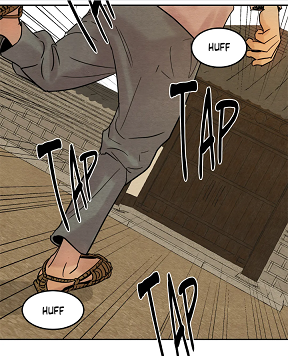 (chapter 4) than season 2. He was encouraged by his future partner to speak up, yet the moment he got heartbroken, he was left speechless. And note that when the lord played his prank in the bedchamber, he never said anything to his father.
 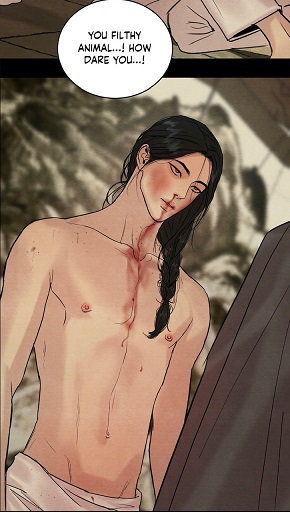 (chapter 83) He didn’t move as well. Why? It is because he knew that talking to his father was pointless. However, Yoon Seungho had hoped that with his prank his father would finally see the truth. He had been fooled by Lee Jihwa and father Lee!! But the stupid father never realized it. As you can see, the lord had in that scene long given up to use words, he hoped that his father would see the truth with the prank. Don’t forget that deed stands for truth and reality. He thought that “actions would speak louder than words”, but he was proven wrong. This signifies that in this scene,
 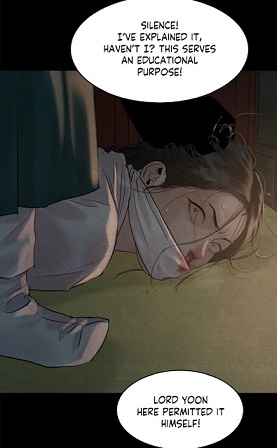 (chapter 86) Yoon Seungho had acted the opposite, he had tried to speak up, but he had been muted. I am also thinking that the young master must have attempted to converse to his father
 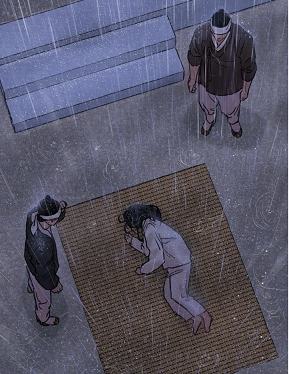 (chapter 77) here as well, but the lord had not listened to him. Why? It is because Kim had said nothing!!
 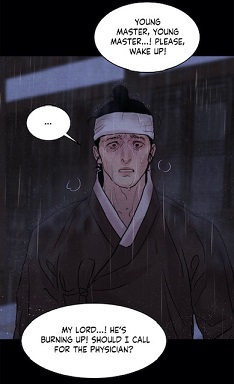 (chapter 77) Silence was considered as an admission. This is no hazard that the butler didn’t take care of his young master. This scene symbolizes the quote “Actions speak louder than words”
  (chapter 77) The butler had betrayed the young master’s trust, for he had not intervened. He should have defended Yoon Seungho, but no in fact he had sided with the elder master Yoon once again. Not only he had not reminded Yoon Chang-Hyeon of his promise, but also he had assisted the ruthless father by giving himself the straw mat beating!
 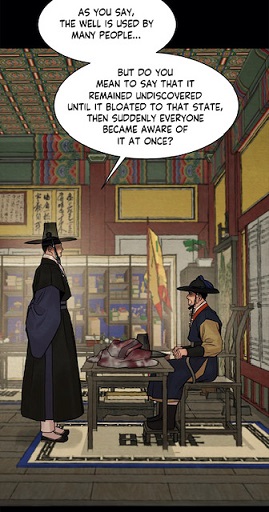 (chapter 98) Here, he examined the robe and questioned the officer. The problem is that he was still relying on his staff and as such Kim. Therefore it is not surprising that he could still be manipulated by the schemers. Hence I am anticipating a total change in season 4. By conversing with the painter, the lord can only become more proactive to the point that he will be able to ruin the next schemes. I am even expecting a prank from the protagonists in season 4!! But this doesn’t end here. I am deducing that in the past, Yoon Seungho suffered because one tormentor would do things and say nothing, while the other would talk a lot, but act the opposite!! For me, these descriptions fit to Kim and the pedophile. I have the impression as well, that both characters came to switch their behavior. In one circle, Kim did many things, but remained mute, but later he did the exact opposite. I would like to point out that in season 3, he acted this way. He would promise loyalty to the lord,
  (chapter 77), but backstabbed him in the shadow. Besides, we shouldn’t forget that a narcissist’s words don’t match their action, because they are pathological liars. And so far, I had portrayed father Yoon (overt), Kim (covert) and even Jung In-Hun (overt) as people suffering from NPD. And I am assuming that the mysterious lord Song is not different from them, though I am suspecting that he must be a covert type.
 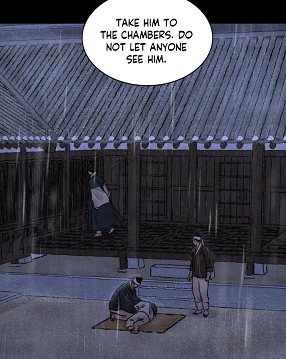 (chapter 77) Besides, it also snowed, when the painter got abducted twice, a sign that actually a promise had been broken.
  (chapter 102) He is no longer following social norms. This could only happen, because the lord had just committed a huge crime. What is the point to respect laws and tradition, when he became a murderer? Any other transgression can only appear as harmless. That’s the reason why I am expecting that Yoon Seungho decides to disregard social norms from that moment on and play a prank on the “villains” of this story.
  (chapter 76)
  (chapter 53)
  (chapter 87), while the same extremity symbolizes the opposite with the villains and antagonists: violence, silence, submission
 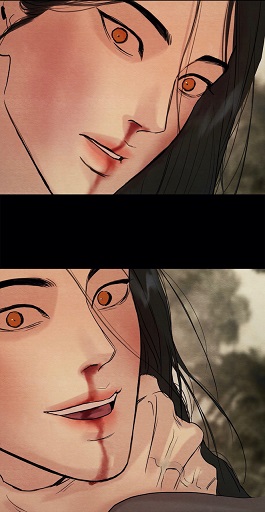 (chapter 83), hatred and resent
  (chapter 97) Here, Heena was hurting her brother, because she wanted him to face “reality”. What caught my attention is that we never saw the father’s hand in chapter 86!
  (chapter 86) Why? It is because it reveals his powerlessness. And this leads me to the following conclusion: the deed stands for reality and honesty, while the words symbolize emptiness, illusion and deception. And now, you comprehend why this work is composed by the dichotomies: dream, words and mouth versus reality., action and the hand. This means that in season 4, the manhwaphiles should try to analyze the thoughts and emotions of the characters behind the hand gestures. At the same time, they can also verify if my interpretation is correct. Is the zoom of the protagonists’ hand connected to fear, confession, empathy and assistance?
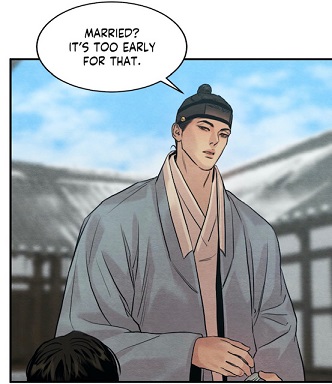 , as Baek Na-Kyum was still viewed as a boy. Moreover, according to social norms, it was impossible, for his lover is a man. Then in front of Yoon Chang-Hyeon, he made fun of his father.
  (chapter 87) That’s the reason why I consider the love session in chapter 88 more like a relationship between a sponsor and an artist.
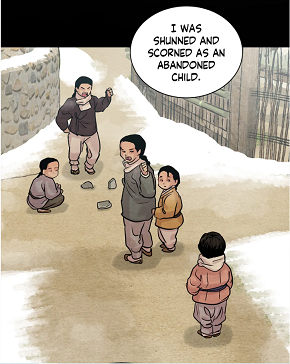 (Chapter 94) In this scene, the painter was rejected by the children, for he had no braid. Due to his hair dress, he was recognized as orphan immediately. The justification was that that way, the artist would appear more boyish. But by mentioning the loss of Yoon Seungho’s topknot, Heena was actually revealing that she knew the true signification of the haircut: abandonment and intolerance. Her words to her brother exposed her hypocrisy, though she attempted to portray the elder master as respectable. One might argue that when Na-Kyum was just a child, she had suggested the short hair, for she had good intentions. But after this experience with the children, the noona should have grasped the wrongness of her decision. She should have admitted her bad decision and stopped the painter from cutting his hair. Moreover, don’t forget that Na-Kyum was just a young boy, so the haircut must have been done by Heena herself. This shows that her gesture actually divulged her future behavior: she would betray and abandon the painter constantly (season 1, 2 and 3). At the same time, since the painter was seen with short hair in chapter 68
  , this indicates that Heena kept cutting Baek Na-Kyum’s hair. So even in the past, she was betraying her brother, though the latter never realized it. The loss of hair could never be viewed as a sign of love or empathy, for it contributed to the painter’s abandonment issues and his self-loathing. He was suffering as an outcast and due to his girly features. The men in the gibang could mistreat him, for he had no long hair or topknot. Why?
 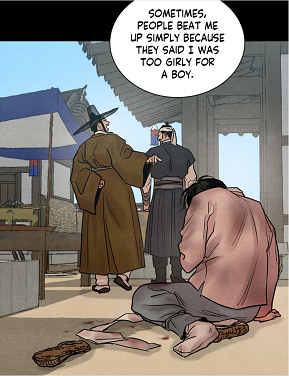 (Chapter 94) He had no parents or guardians protecting him which is true, for here he was exposed to violence. Heena, as the head-kisaeng, had not protected him at all, she must definitely have portrayed herself as powerless. Yet as a slave of the state, she was belonging to the king. So she had connections to officers and the court. In my eyes, the head-kisaeng made sure that the artist could never get a topknot, and as such he would never be able to become a “noble” or even a man. Hence Baek Na-Kyum was constantly called boy
  (Chapter 56)
 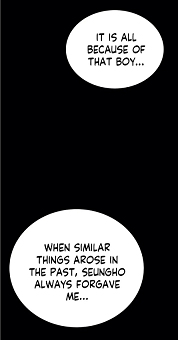 (Chapter 59)
  (chapter 66) and treated as one too. This observation made me realize that Heena’s belief could be used as an explanation for her action (cutting off his hair): she hates nobles so much that she didn’t allow her brother to have a topknot. But why would she do that? My idea is that deep down, she resented him, for he was a free man, while she was a slave. It went so far that he was encouraged to wear a white headband, the symbol for servitude, though he is no slave! To conclude, the loss of hair in Joseon should be perceived as a brutal and harsh punishment. Without a topknot, one is left unprotected, is not viewed as an adult. But this stands in opposition to Yoon Seungho’s action in front of Jung In-Hun’s home.
  (Chapter 101) Here, the lord had spared his friend’s life.
 (Chapter 23) cuts off the hair of the general Woo Jong Han, because he had committed crimes. First, he hid the fact that his sister had had a child before getting married to the emperor, which was actually a huge sin. The future Empress should have been a virgin. To sum up, he had committed treason, for he had allowed his sister to become Empress unrightfully. Then the field marshal had treated his niece as a slave violating social norms.
 (chapter 34) That way, he assisted his sister to become powerful by covering up for her crimes (silence and passivity). She had killed many people to hide her previous relationship and to increase her power. Striking is that the prince still spared Baek-Ha’s uncle, and this for many reasons. First, the latter had not only saved both protagonists, the empress’ illegitimate daughter Baek-Ha and the prince Nan-Woo, but also had admitted his sins. Secondly, he was thinking of his wife Baek-Ha who is kind-hearted. He knew that his death could upset his bride.
  (chapter 26) But there is more to it. Nan-Woo didn’t spare the man out of benevolence.
  (chapter 26) He had a role to play. By cutting off his topknot, the general lost his “power”, he became the prince’s pawn! Nan-Woo wished to use the uncle in order to get rid of the Empress.
  (chapter 23) That way, the protagonist wouldn’t even have to dirty his own hands. On the other hand, we could also say that Nan-Woo was forcing the Empress’ brother to undo his bad decision.
  (chapter 23) Since he had protected his sister Seo-Ha out of affection, it was normal that now he had to show no mercy towards her. By presenting Baek -Ha to Nan-Woo, the general was well aware that the future ruler would recognize the female lead’s origins due to her resemblance to her mother. Therefore, we could interpret that Nan-Woo had spared the general, for the latter had switched sides and expressed the wish to undo his wrongdoings.
 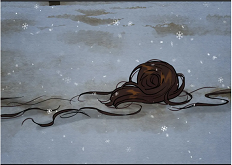 (Chapter 101) It is because he must have witnessed it himself in the past. I have already pointed out that Yoon Seungho would imitate people, especially his tormentors. So where did he learn from? I believe, Yoon Seungho copied it from someone… and this can only be “lord Song”. And now, the first loss of Lee Jihwa’s topknot can be perceived in a different perspective. The red-haired master was well aware that he had been spared, when he had lost his hair for the first time.
 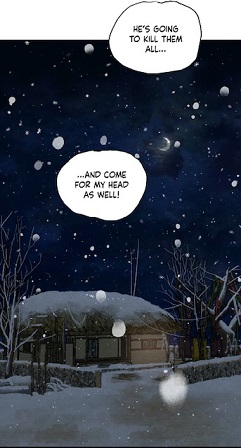 (Chapter 101) He knew deep down that thanks to his friend, he had been able to escape the worst. Since he had been spared once, he was well aware that this time, the ruler would show no leniency and would ask for his head, as the main lead was no longer protecting him. Remember what the lord had whispered to Baek Na-Kyum:
  (Chapter 83) This time, he had not his father by his side either. The latter could not protect him too. I had already voiced this theory before, as it would explain why Lee Jihwa is masking the man’s face. And note that Nan-Woo from A Sip Of Poison cut off the topknot, as he is already acting as the future ruler. Another important detail caught my attention. Just before receiving his sentence, Woo Jong-Han made an oath,
  (chapter 23), he swore loyalty to the future emperor. This signifies that the topknot also symbolizes faithfulness, especially because it is connected to marriage. Thus I deduce that when Lee Jihwa lost his topknot for the first time, he was already judged as disloyal. Hence it is no coincidence when the antagonist screams that he would become the target of lord Song’s fury.
 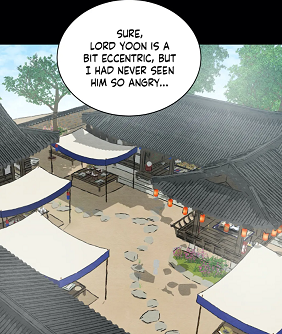 (Chapter 59) First, lord Yoon could be a reference to the father and not only the son. Secondly, he implied that he had witnessed the scene, yet in reality he could have been referring to the outcome: the friend’s hair cut, just like the noona had only seen the hickeys on her brother’s neck. She had never witnessed the sex session. The noble with the mole assumed the perpetrator’s behavior, rage, based on the hair loss. Moreover, he could have been telling the truth: he had never seen Yoon Seungho so angry before, as the latter used to be weak in the past due to his social status: he was a male kisaeng due to his braid. This explicates why the noble with the purple robe would give an order to the host
 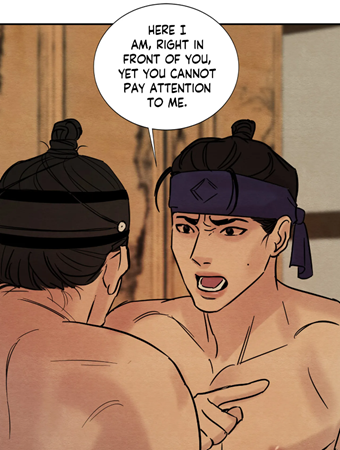 (chapter 8) He felt himself superior to Yoon Seungho, and never expected “disobedience” or “rage” from the protagonist. Striking is that the lord didn’t vent his anger onto him, he first smiled before grabbing him by the topknot.
 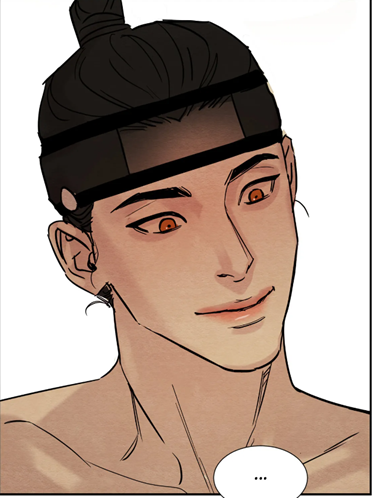 (Chapter 8) A simple change of hair dress had transformed the main lead. This exposes the gods’ intervention in this story. They let the man with the mole see the wrongness of his manipulations. Since he had stated that he had never seen the man so angry, his words became a reality in 3 occasions: chapter 8 like mentioned above, chapter 53
 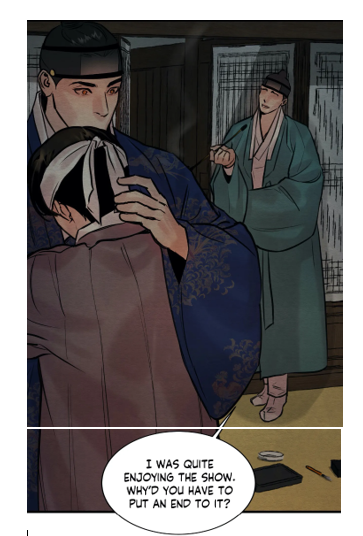 , for he was not present, chapter 57
  in the inn. Here, he chose to run away, yet despite everything he still helped his friend Black Heart, for he was present in the gibang.
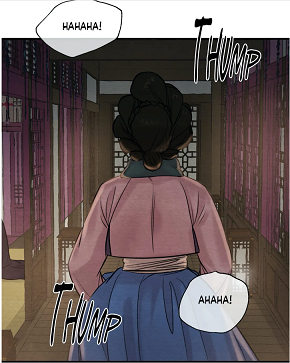 (Chapter 69) Under this new light, this panel from Twitter get a total new meaning:
  The aristocrat knew about the true identity of “lord Song”, and he had indeed never seen the man so angry that he would cut off the topknot of a noble!! This means that the fate of the noble with the mole should be to end up as the lord’s new plaything. In other words, he takes over the main lead’s previous status. He becomes the male kisaeng and ends up living in the shed like the protagonist in the past where the pedophile vents his rage and resent him for his tricks. But we will see.
 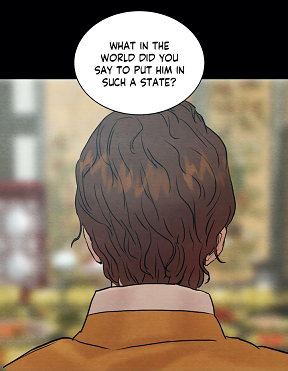 (chapter 59) Furthermore, he associated it to abandonment too.
 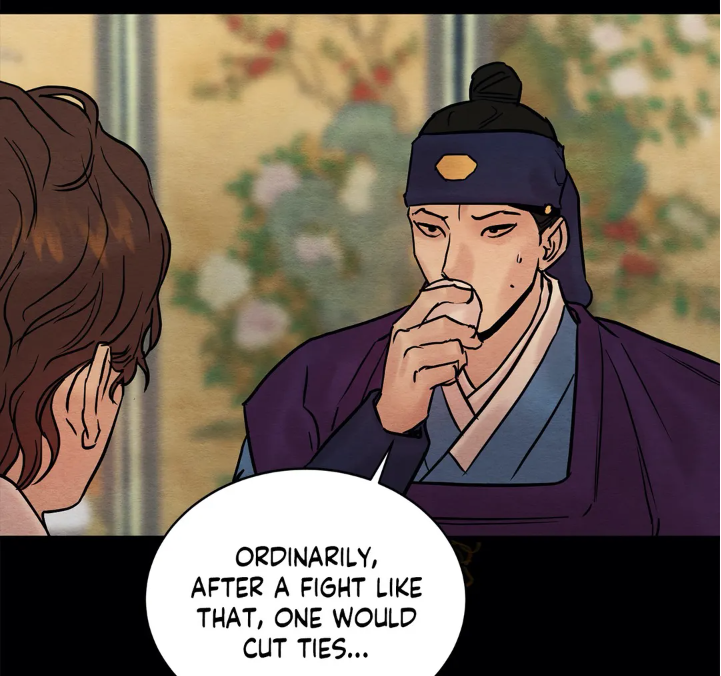 (Chapter 59) Yet, observe the drop of sweat. This exposes that neither Min nor the noble with the mole were expecting that Lee Jihwa would be spared!! They acted, as if the loss of the topknot couldn’t be a sign of mercy. But observe what Lee Jihwa was recalling, when the “friend” was talking about abandonment.
 (Chapter 101) He knew that the ruler would show no leniency or understanding. Thus the noble with the mole’s karma should be to keep his topknot.
  (chapter 27) The painter had saved his teacher’s life, and later the lord had restrained himself from hurting the scholar in the courtyard despite Jung In-Hun’s lies and lack of respect (he had touched the man’s shoulder).
  (Chapter 30) Here again, the scholar had been spared. Then in episode 53, the painter had embraced the lord to stop him from killing Deok-Jae. This means that Yoon Seungho must have also saved people in the past by using his body, and this twice, for I had detected the presence of two circles: Yoon Chang-Hyeon and Lee Jihwa. That’s the reason why the father could survive the purge, and why Lee Jihwa only lost his topknot. And the heroine from A Sip Of Poison can serve as an example.
  (Chapter 1) As long as the latter was living there, the Lees had nothing to worry. The main lead was protecting them from the king. However, the manhwalovers should keep in their mind that Nan-Woo had showed mercy to the general for his own interests. He should become his helping hand in order to obtain the throne. Hence I come to the following deduction: neither Nan-Woo nor the “perpetrator” had cut off the topknot out of real leniency. This shows that for these characters, the loss of the topknot is not the symbol for forgiveness which is not true for the last incident with Lee Jihwa.
 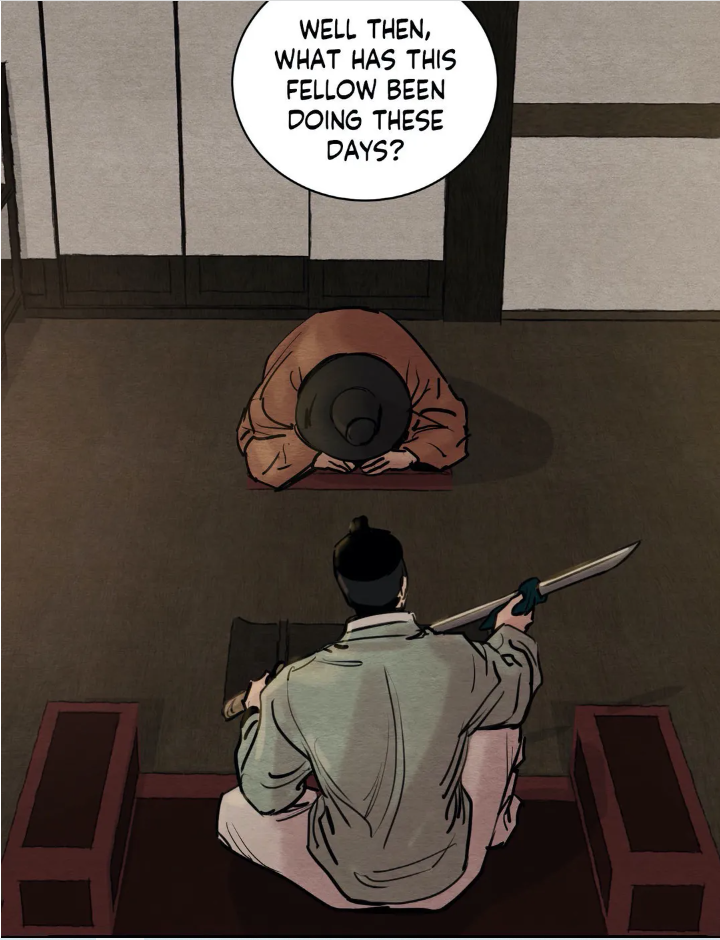 (chapter 1) Even the headband was different. This was no coincidence. He should never develop confidence and act as a lord. That’s how I recognized the following pattern. In front of the painter who looked like a minor, the main lead was forced to act like an adult. Thanks to the painter, he was encouraged to mature. Simultaneously this meant that at some point, while living with the Lees, the elder master Lee had to be confronted with the truth: his son’s sodomy.
 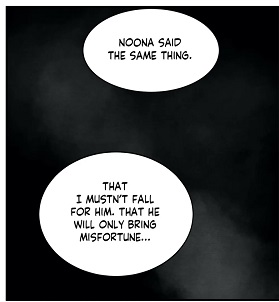 (Chapter 86) The reality was that the pedophile was the bad omen, but they couldn’t insult the king. Hence the young main lead became the scapegoat, people couldn’t separate the pedophile from Yoon Seungho. The “mysterious lord Song” would never give up on the protagonist. No matter what he would keep him by his side.
 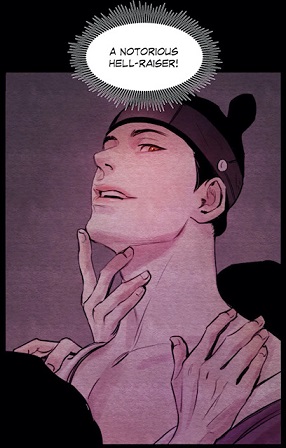 (chapter 1) Moreover, we shouldn’t overlook the publications with the braided man:
  (Chapter 1) Baek Na-Kyum was not supposed to recognize the identity of the man having sex with the bearded man. From my point of view, Heena made sure to confuse her brother. Lee Jihwa’s humiliation became Yoon Seungho’s stigma. He became the culprit. Since in the past, the main lead had been blamed for everything, the perpetrators and accomplices chose to follow this “tradition”, because so far, they had been able to cover up their crimes. But thanks to the painter, it is no longer possible. Why? It is because the painter’s hair dress will serve as a mirror of truth: the absence of a topknot due to the braid and the hair cut will be perceived as an evidence for abandonment, cruelty and huge wrongdoing. This won’t be seen as a gesture of mercy or leniency by the two protagonists, for they suffered because of it!! That’s the reason why I am thinking that the pedophile’s karma should be the loss of the topknot which he viewed as a gesture of mercy and tolerance. But without the topknot, he is actually “castrated”, and as such humiliated for he can not wear his golden sangtu.
  Yet, contrary to Lee Jihwa’s haircut, the loss of the topknot should not be judged as the symbol of mercy and forgiveness, in fact, the lord would officially cut ties with him. That’s how the mysterious Lord Song would be taught an important lesson: he was a huge hypocrite and a violent and ruthless pervert.
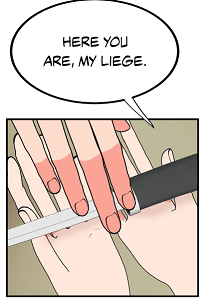
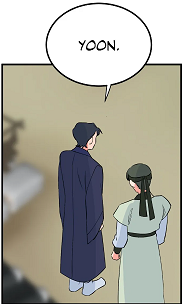 (chapter 23) to give him a knife:
  (chapter 23) before grabbing Woo Jang-Hon by his topknot
 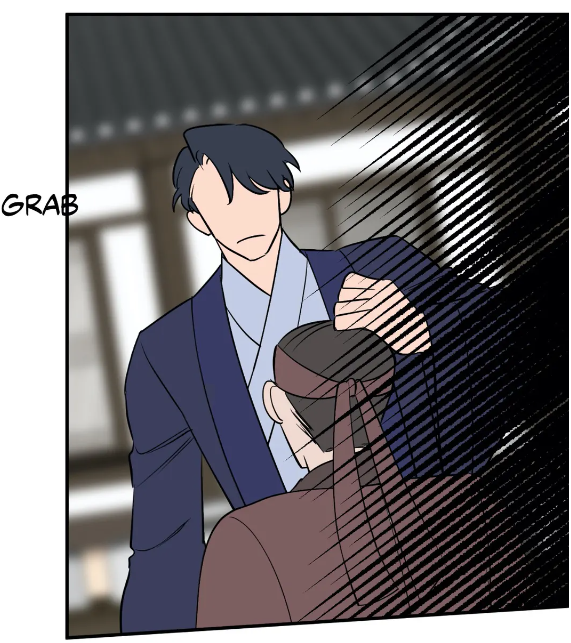 (chapter 23). Hence the hair fell between the men.
  (chapter 23) And now, let’s return our attention to Painter Of The Night. Compare the position of the aristocrat’s topknot after Yoon Seungho had punished his friend.
  (chapter 101) It was behind him!! Thus I deduce that he had used the sword, when Lee Jihwa had approached his friend. But wait… in season 1 and 2, Byeonduck drew scenes with a knife: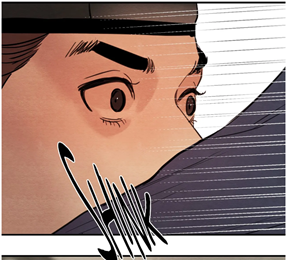
 And what had happened before? Yoon Seungho had dragged his friend by the topknot before stabbing the amateur spy. This is no coincidence.
 When this chapter had been released, I had assumed that this must have happened, when Yoon Seungho had lost his topknot! As you can see, I had already connected the knife to the loss of the topknot incident.
 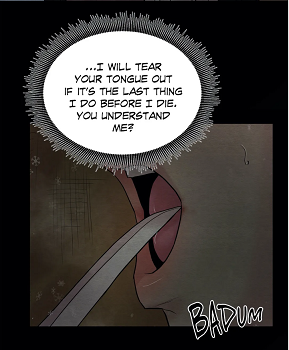 (chapter 66)
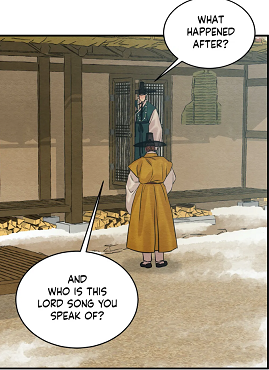 (chapter 83)
 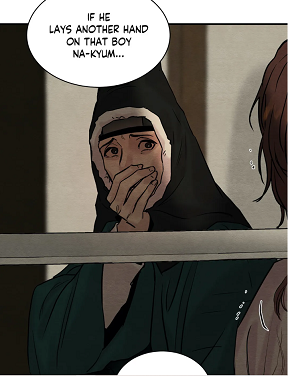 (chapter 67) This shows that till season 3, Lee Jihwa had never been exposed to real justice. There was always someone ready to intervene for him. And now, you comprehend why the red-haired master felt no remorse to blame his friend for his humiliation in the past. He must have thought that if he had not been in his bedchamber during that night
  (chapter 83) This explicates why Lee Jihwa said this to Black Heart and his friend:
  (chapter 59) The antagonist had witnessed his friend’s humiliation and suffering in the past, just like Yoon Seungho had been present, when the first topknot incident occurred. From my point of view, the lord must have even protected Lee Jihwa. But the problem is that Lee Jihwa was just receiving his punishment in delay for the stolen kiss and his lies
  (chapter 77) He had kissed him without his consent, thus he got “castrated”. Let’s not forget that the main lead was forced to become a male prostitute, an uke, for he had not been able to perform, to have an erected phallus. On the other hand, Lee Jihwa had done nothing wrong in the bedchamber
 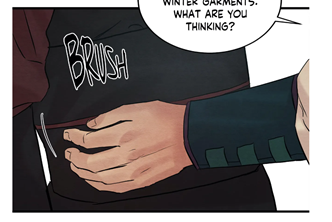 (Chapter 41) Due to the incident in the kisaeng house, Min had lost his privileged position with the king. Hence he got jealous. He could no longer screw” the protagonist, while he had to watch the lord’s slow ascension. To sum up, the loss of Jihwa’s topknot led to the “symbolic castration” of the infamous couple: Min and the noble with the mole.
 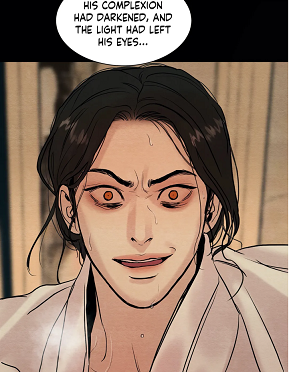 (chapter 57) The hair was short or not? Now, I don’t think so. The mystery of Yoon Seungho’s suffering is linked to the hair dress, yet the readers shouldn’t realize it too quickly. According to me, he still had the braid, until the doctor questioned why Yoon Seungho still had no topknot.
  (chapter 33)
 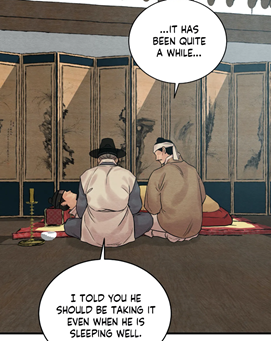 (chapter 55) And who had given him the topknot? Naturally… Kim! Because he didn’t want to be perceived as someone who was violating social norms. However, there is no ambiguity that he hid his responsibility. That’s how Lee Jihwa and his “servant” got framed. They were responsible for giving the main lead the new hair dress. On the other side, I still believe that Yoon Seungho must have lost his hair too, but only once to the difference of Baek Na-Kyum! My reason is simple. Since the painter and Lee Jihwa lost their hair, and Yoon Seungho’s destiny is mirroring his lover’s, it signifies that the lord’s hair must have been cut too. But who did it? Let’s not forget that when Yoon Seungho punished his friend in front of the scholar’s home,
  (chapter 77) in that scene. For the butler, this gaze could be judged as betrayal and abandonment. Under this new perspective, it becomes comprehensible why the main lead was encouraged to blame and resent his father. If this theory is true, Kim pushed the main lead to cut off his braid, he did it out hatred and anger towards the Yoons. This would mask his own manipulation and culpability too. At the same time, the pedophile could benefit from it. The main lead was now an orphan, thus the bearded man could use him like he wished. I have an evidence for this interpretation. This is what Baek Ha said to her husband:
  (chapter 23) Being slave meant being orphan. The pedophile could feign ignorance about the main lead’s true origins. If he truly cared for him, he just needed to ask this: papers!
 (chapter 24) This shows that in Painter Of The Night, all the elders were depraved and violent hypocrites. Like mentioned above, the pedophile had a huge interest to keep the main lead as his slave, thus he was turned into an orphan and asked to keep a braid. And Yoon Seungho’s mother could do nothing, for the son had cut off his own hair, a huge symbolic act. He was no longer considering her his mother. But because of his status as slave, the pedophile could never trust the main lead. Then the suicide from the mother put an end to this farce. Hence lord Song could tell his sex partner that he had become the head of the Yoons and let him “have” the properties, while it was never his intention to let him become responsible. If he had become a lord, he could escape from his claws. He needed him to remain in an infantile and dependable state.
  (chapter 94) By framing the elder master Yoon, Kim can deny any responsibility in the loss of hair of Yoon Seungho and in the messenger’s death. It was the father’s doing. The nobles like the Lees and Yoon Chang-Hyeon are now accountable for the corpses. In the gibang, Yoon Seungho never killed anyone and he even spared his friend, though the latter had kidnapped Baek Na-Kyum. Finally, the town folks are now aware of Lee Jihwa’s homosexuality and his relationship with the protagonist. So I believe that people will jump to the conclusion that father Yoon had turned his elder son into a sodomite and sold him him to the Lees which is not false too. The king has a reputation to maintain and he needs scapegoats in order to hide his involvement and his crimes from the past.
 (chapter 33)
  (chapter 33) She not only treated his wounds, but also helped him to overcome on his guilt. He felt responsible for his brother’s death, for Nan-Woo had attempted once to commit suicide on the battlefield, and his brother had sacrificed himself to protect him. He was definitely plagued with remorse, self-loathing and shame. And that’s exactly what Baek Na-Kyum has been doing too: by simply loving him so selflessly and purely. Finally, Baek-Ha’s fate made him realize the Empress’ immense culpability. She was so greedy and selfish that
 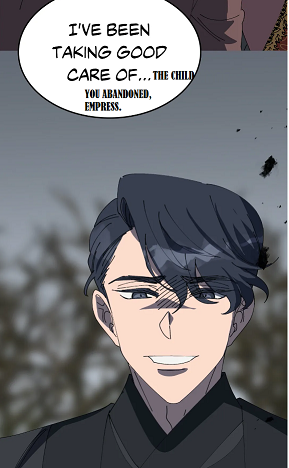 (chapter 34) she had abandoned her own child! Thus he was freed from his hatred and guilt. Nan-Woo was able to perceive the wrongness of this social norm which was common in Joseon: the child is responsible for the parents’ sins!
  (chapter 33) Being an orphan outlined her innocence. And since I have already connected Baek Na-Kyum to the mysterious lord Song, I am quite sure that the painter will have a similar attitude than Baek Ha:
  (chapter 33) He will feel responsible for Yoon Seungho’s martyrdom. And if he is truly his son, his abandonment can serve an evidence of his innocence. On the other hand, the readers shouldn’t forget that his surrogate parents, Jung In-Hun and Heena, played a role in lord Yoon’s torment as well. Thus he can only indebted towards his husband.
  (Doctor Frost, chapter 225) With this picture, the manhwaphiles can detect the presence of the endless vicious circle, the ouroboros, which I had described as a kaleidoscope. The absence of empathy in both stories was the reason why no one stopped the main perpetrators. Woo Jang-Hon felt guilty, for he had raised his younger sister who had become a monster. Kim felt deep down guilty, but chose to reject his responsibility by putting the blame on others. Out of fear, he preferred hiding his wrong decisions and later wrongdoings. And now it has become his MO. This distinguishes him from the general who chose to put an end to his guilty conscience and paid for his crimes..
 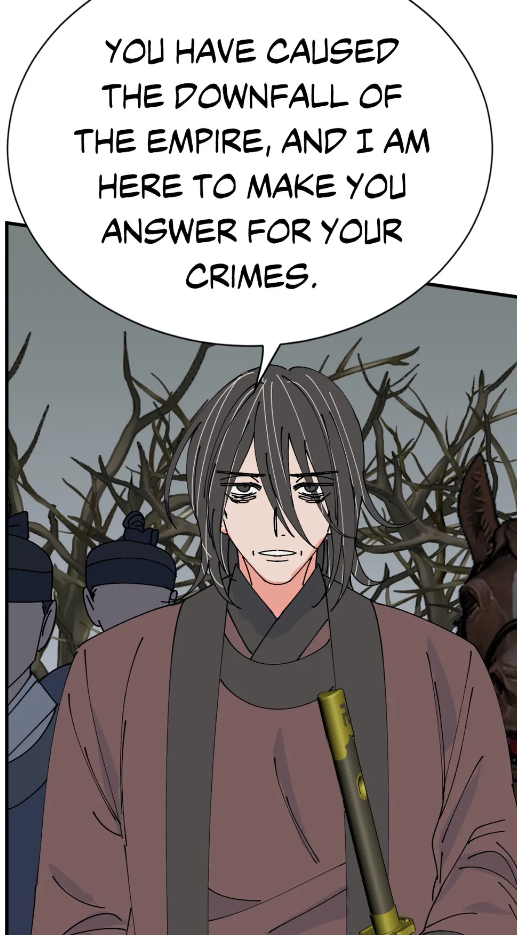 (chapter 34)


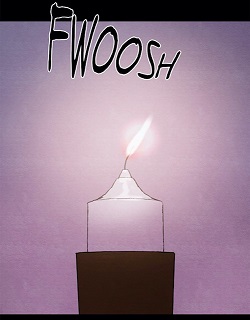 (chapter 74), it is the opposite with the painter.
 (chapter 55) The chapter begins in medias res
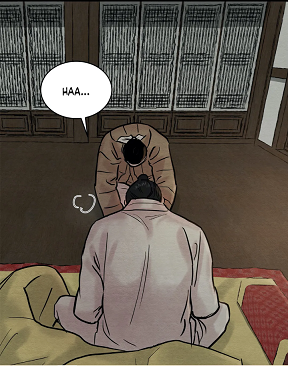 (chapter 56), which means that there’s no introduction, the story starts in the middle of the action. And now, it is important to question ourselves about the intention of the author. Why did she change her MO? I found the answer the instant I realized the importance of the two following aspects. The light… and the sound, in this case: HAA…
  (chapter 56) In the past I used to think that this scene had occurred early in the morning. But now, I am thinking otherwise. In truth, right after receiving the letter, the butler went to the bedchamber directly and woke up his master!! This signifies that this scene took place during the night. But how did he do it? He just needed to remove the light from the bed and lit other candles. That’s the reason why the candles are positioned like during the night of the brother’s visit.
  (chapter 56) Besides, the manhwaphiles should remember the way the room was enlightened, when Baek Na-Kyum was keeping company to his lover.
  (chapter 55) It was quite dark.
 (chapter 55) And strangely, the main lead could sleep comfortably. He was not plagued by a nightmare.
  (chapter 55) He could even sense the artist’s presence unconsciously, therefore he confirmed his affection for the painter. And now, you can imagine what happened. Once the valet received the letter, he went to the bedchamber directly and sent Baek Na-Kyum back to his bedroom under the pretense that he would take care of his master himself. However, the moment Baek Na-Kyum had left his side, the valet lit more candles
  (chapter special episode 3) Note that there’s no candle placed next to the entrance of the lord’s bedchamber for that reason. The noble only feels comfortable, if the light is situated close to his face, because that way he won’t see any shadow. Thus we have such a scene in the first season.
  (chapter 35) The candles are always placed next to his bed. And now you comprehend why the lord moved to the patio during their first night together.
 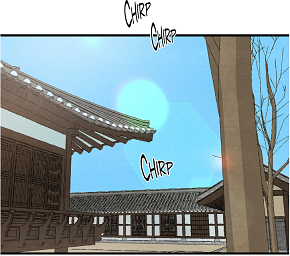 (chapter 38) He didn’t want to disturb the painter in his sleep, for he needs light during the night, but only next to him. This explicates why Yoon Seungho woke up from his nightmare right away, when the bougie had been blown out.
 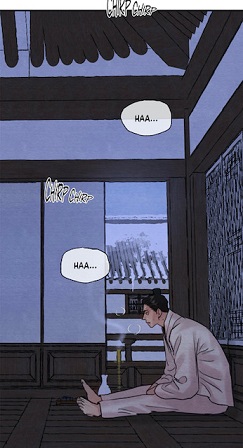 (chapter 74) But how did it happen? Was it the work from the wind or the candle was extinguished by the protagonist’s heavy breath or was Kim behind this? Because I had no answer before, I had not mentioned this observation. Fortunately, my friend Luzyla came to my rescue and gave me the answer which I totally support. Kim must have intervened during that night, because for the first time, the nightmare was becoming more precise. But how did she confirm my suspicion? It is because the butler had this image, when he tried to convince the painter that nothing would change. This panel
 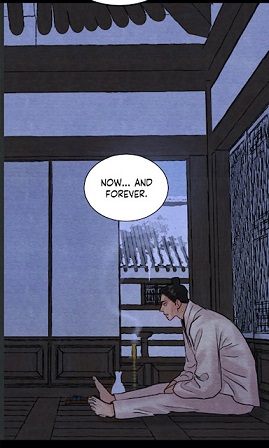 (chapter 87) represented the butler’s memory. This means that the butler must have seen him from the outside. He didn’t want the painter to discover the lord’s suffering. And it worked, for the lord never let this transpire to the painter after that night. And now, you comprehend why the butler had to make sure that the couple would no longer sleep together at the end of the second season. But let’s return our attention to episode 56.
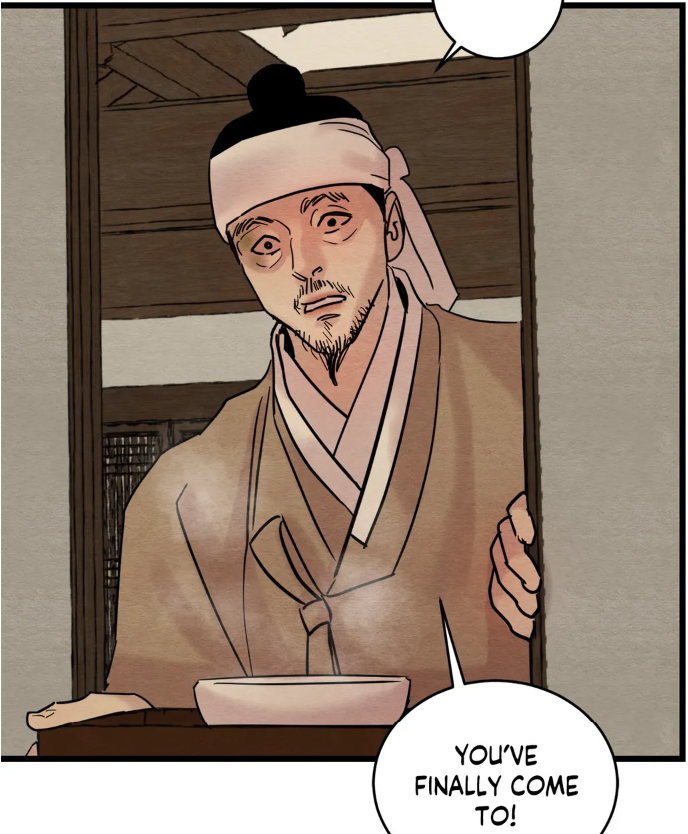 (chapter 34) The entire time he acted, as if Yoon Seungho was fine, for he was conscious. Then he gave the letter to his master and knelt far away from him while looking down.
  (chapter 86) The former has long internalized that he is scary and dirty. Yet the truth is that the butler’s gaze reflects his hatred, for he considers him as responsible for his own misery. Don’t forget that he is tormented in the presence of Yoon Seungho. The latter is a reminder of his own sins. To sum up, for Kim, the reason for his distance and avoidance is simple. He doesn’t want to be confronted with Yoon Seungho’s suffering, for he is refusing to admit his own guilt. The protagonist already knows about this unconsciously. Thus he hid his gaze the entire time.
  (chapter 56) The first “HAA”
  weren’t laughs, but the sign of a panic attack. Yes, for the first time the manhwaphiles discovered the lord’s health issue (flashback), but no one truly grasped, not even me. I had imagined that his heavy breathing was related more to pain and his illness. I only recognized the existence of the panic disorder in episode 66, though I was already aware of his PTSD.
 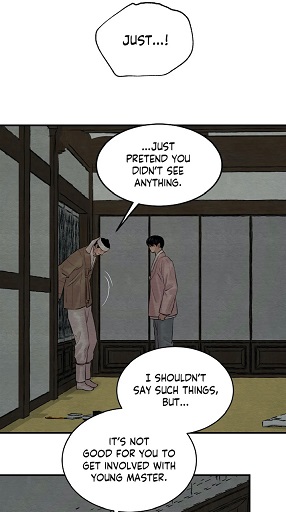 (chapter 86) He pretended he saw and heard nothing. But how can I be so sure that it was the night? Simply because all the windows were all closed. Thus Byeonduck drew such an image:
 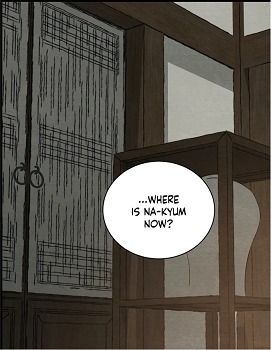 (chapter 56) Besides, observe that there is more light in the bedchamber, when the butler entered the room later:
  (chapter 56)
 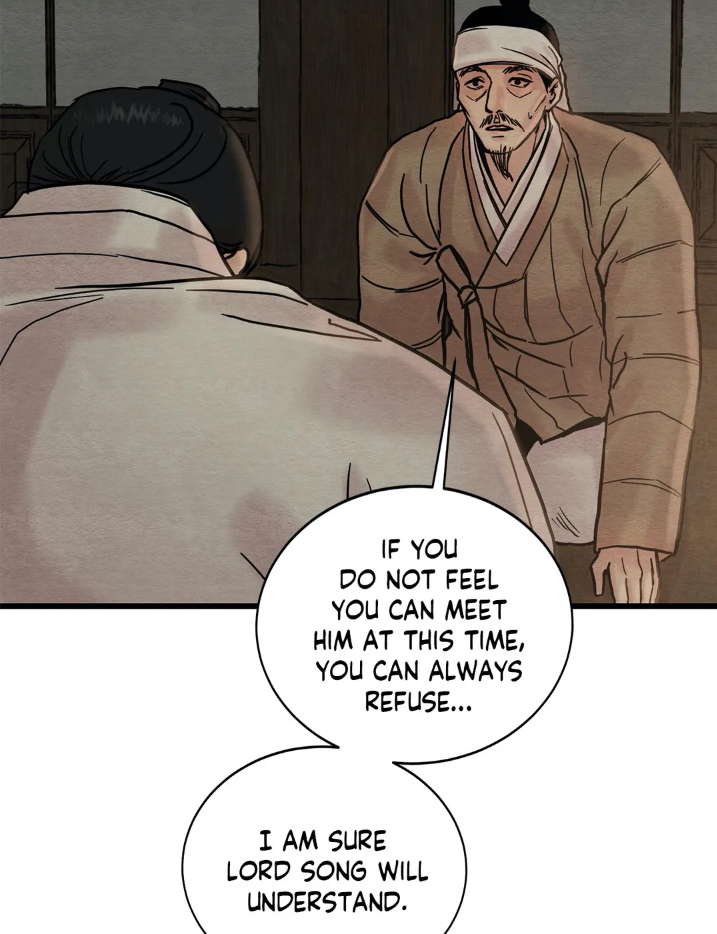 (chapter 56) He wanted to wash off his hands on this. The moment he conveyed the message to the master, it was no longer his responsibility. If lord Song had truly sent the missive, then Kim could say that this had been his master’s decision to refuse to follow the request, if they were confronted for their disobedience. This means that Kim was lying, when he said, “I am sure lord Song will understand”. He was just expressing an expectation, but there was no guarantee that the mysterious man would be very understanding. In addition, one idiom caught my attention: “If” This was a condition and not a real statement. Kim never said that since Yoon Seungho was ill, he could refuse the invitation. This signifies that the valet refused to confirm the noble’s illness. It was Yoon Seungho’s choice to say if he was feeling ill or not. To conclude, he refused to assume any responsibility. And now, you comprehend why Byeonduck added a drop of sweat on the butler’s face. This was showing his discomfort and deceptions. The man didn’t want to be associated to the noble and become responsible for him.
  (chapter 56)
  (chapter 56) 🙄 Under this new light, I couldn’t help myself shaking my head, when I read this from the butler.
 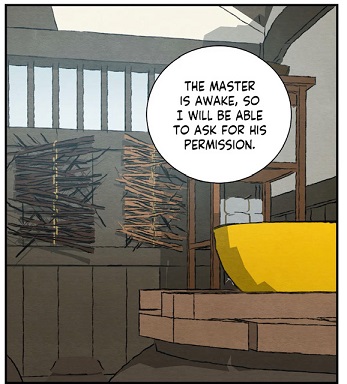 (chapter 56) His words implied that the lord had woken up on his own, whereas in reality the butler was the cause for this. Kim knew that his master would never go back to sleep after their conversation. This explicates why the candlestick was placed again at the head of the bed.
  (chapter 68), his fate was strongly intertwined with the artist’s. But it changed, when the lord heard that Baek Na-Kyum was blamed for his insomnia and he hadn’t been able to meet the artist during broad light
 (chapter 79), he punished Kim. It was, as if the butler had failed to protect the artist. And because the painter‘s visit to his bedchamber had taken place during the day, it revealed his loneliness. That‘s the reason why I believe that this conversation pushed the lord to give the maids to the artist. They should become his ladies-in-waiting so that he had someone he could talk to. However, Yoon Seungho never let the butler know about the true reason for his punishment. He used the father as subterfuge. Finally, we shouldn’t overlook the valet’s pledge: he swore that he would serve the lord.
 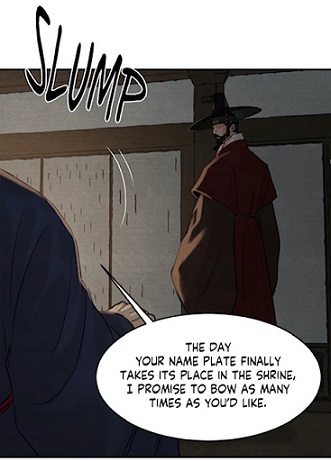 (Chapter 86) He refused to acknowledge him as the owner of the mansion. He took the seat in front of his father. He was now acting as the lord Yoon.
  (chapter 85) Strangely is that in that scene, we never heard any STEP, STEP, STEP like here:
  (chapter 97) There was no sound, therefore I deduced that Kim didn’t run to the study. However, observe that the butler is breathing heavily. It was, as if he was out of breath: HUFF HUFF.
 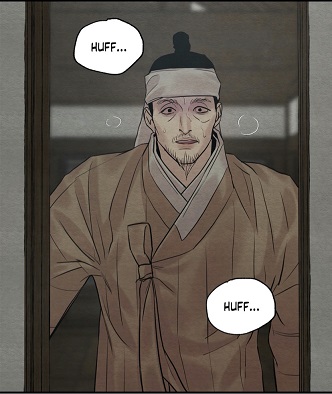 (chapter 85) So why would he fake his breathlessness? I am quite certain that you already have the answer. He was hiding the fact that he had been spying on their conversation, which I had mentioned in one of my previous analyses. However, there’s more to it. The other and major intention is to give the impression that he did everything he could for his master. In other words, he is creating the illusion that he could do nothing against the father!!
  (chapter 87) Yes, that’s his other principle to justify his cowardice, his fear of responsibility. He implied that he had rushed to his master’s side right away to alert him. If asked, he could legitimate his passivity by saying that the father had barged accompanied with 2 guards. But why didn’t he get caught by the protagonists? Simply because he is no longer caring a light contrary to the first season.
  (chapter 20)
  (chapter 25)
  (chapter 36) The night had already fallen, when Yoon Chang Hyeon was present in the mansion. If the butler had carried a chandelier, the painter or the noble would have sensed his presence. Thus I deduce that the butler’s function in the protagonist’s suffering was to lit the room, the moment the pedophile and other sexual abusers approached his prey. That’s the reason why his nightmares are triggered by the sound of a lit bougie and the light accompanied with shadows.
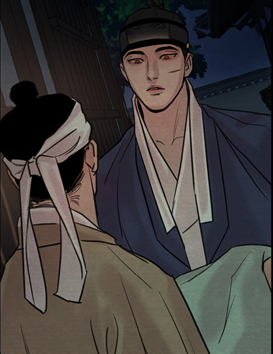 (chapter 26) This scene took place in the courtyard. This is the bathroom for the staff which you can see in the background
  (chapter 30), the grey building with grey bricks. And it happened again in episode 32
 , in episode 55
  And now look what we have in the third season:
  (chapter 77)
  (chapter 82),
  (chapter 98) He is no longer carrying any light, not even for his master. Why? It is because he can spy without being detected. Thus he approached the messenger only after the main lead had left the study. Don’t you find it weird that he acts as if he knew nothing
 (chapter 82), while he presents himself as the senior domestic in the mansion?
  (chapter 82) This represents a contradiction. If so, he should have been informed immediately. Thus I come to the conclusion that this scene reveals his incompetence and betrayal. Did he aid the messenger, when the latter got beaten? No, he only made his appearance, after the incident had occurred. And this is not surprising that the other domestic looked down on the butler.
  (chapter 82) He already knew that he had betrayed his own master through the letters. So I doubt that he viewed Kim as trustworthy. Another important element is that when the butler is seen in connection with the light, he speaks much more, while in the darkness, he remains silent. This is naturally connected to his spying activities. Simultaneously, the words coming from the butler often appear as empty. They remain quite superficial, for the butler is always putting conditions. “If there is anything I can do…”. That’s the reason why the butler doesn’t feel any real concern for the main leads in the end. This is not his business. And now, you are probably wondering why I used “quarrel” in the heading. It is because in episode 85, the butler had heard the argument between the couple. This is relevant, because the butler chose to recreate the same situation in episode 98!! 😲
 (chapter 98) In this image, Byeonduck portrayed the servants arguing. They are stressed and screaming at each other: “I told you”. They give the impression that they are trying to do anything for their master. Nevertheless pay attention to the previous image:
  (chapter 98) The light is coming from the butler’s back. How is it possible, since there is no torch next to the gate?
 (chapter 98) The women knew that the artist wasn’t feeling well. But they never sent for the doctor and gave him any true comfort. They kept criticizing him. Yes, all the servants bullied the artist. The butler never realized that through his badmouthing, the staff would imitate him. They would chatter idly and fake concern, yet Kim is actually silent in front of his master. He just says the minimum, for the most part, he has to feign ignorance. He acts, as if he was blind and deaf, but in front of the staff he behaves the exact opposite. And this huge gap makes it possible to perceive his conniving personality. However, the main lead didn’t pay attention to the insult („damn brat“), as they had faked their concern. The lord had the impression that they had indeed done their best, hence the main lead felt the need that he had to do the research on his own.
  (Chapter 99) He believed them.
 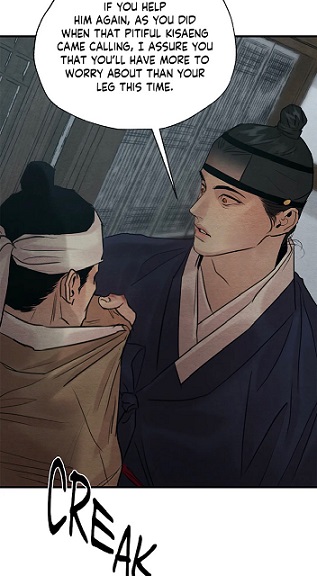 (chapter 86) So the valet had the feeling that nothing had changed. However, like I mentioned it above, he never realized that his fate was now linked to the painter’s and as such he was responsible for his well-being. Thus he got surprised with this new kind of order. For the first time, the valet was tasked to investigate outside the propriety.
  (chapter 98) Many readers, including myself, were quite confused first. However, note that there’s light coming from the building. From my point of view, this is the gate. However, this scene took place before the arrival to the mansion. I believe that this scene represents the moment, when the lord left the office of the investigator. But I can not be 100% sure. However, one thing is sure. Byeonduck wanted us to notice the importance of the light and the silence. The lord was pondering deeply, thus he didn’t pay attention to Kim. But now, the noisy domestics brought the main lead back to reality.
  (chapter 97) The painter didn’t run away immediately. He remained quite some time in the domain, therefore after the last tragedy, the lord will have the time to ponder about the painter’s question.
  (Chapter 102) Yoon Seungho was separated from his lover for so long, because he had been deceived. It is only a matter of time, until he realizes that he had been deceived by his own staff. At some point, he will view the staff accountable for their misdeeds.
  (chapter 38) and he woke up in the middle of the night.
 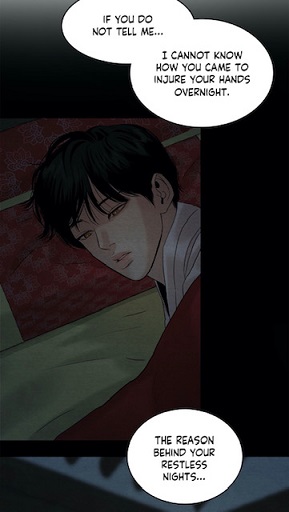 (chapter 84) However, the lord got the opposite impression, for when he entered the study, the painter was sleeping on the floor in the dark.
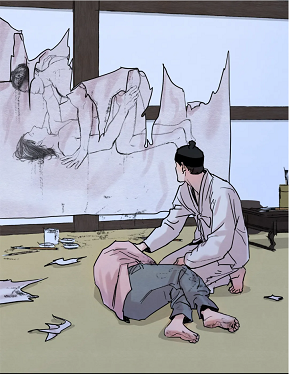 (chapter 02) This explicates why he would always extinguish the candles.
 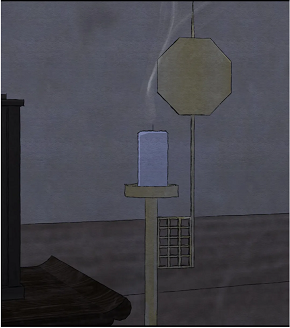 (chapter 97) However, he never realized that the painter could only fall asleep in the dark, because he always sensed his lover’s presence. This means that when he reached the aristocrat’s hand, it also gave him some comfort.
 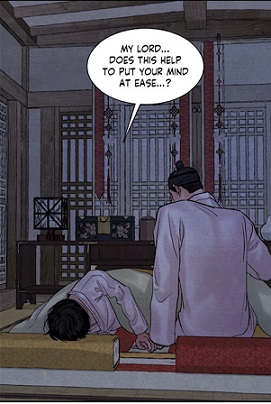 (chapter 97) Because the artist’s fate is similar to the noble’s, I deduced that this fear is connected to the artist’s past. Why does he fear darkness? It is linked to the vanishing of the candle light!
 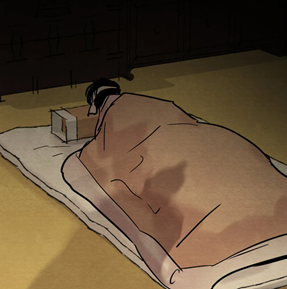 (chapter 6)
 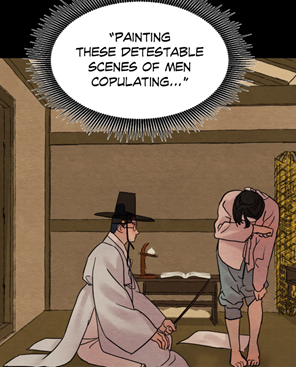 (chapter 34)
  (chapter 87) Thus in episode 56, Baek Na-Kyum had this vision too.
  (chapter 56) In the past, the painter used to sleep with the candle night on. For him, the light gave a sense of safety. There’s no ambiguity that he wouldn’t sleep alone, though we have to imagine that the noonas would leave him behind at some point, if they had to work. Thus I came to the deduction that the candlelight was to create the illusion that he was not alone.
  (chapter 34) Finally, since the butler is a reflection from the learned sir, this signifies that he is also connected to light.
 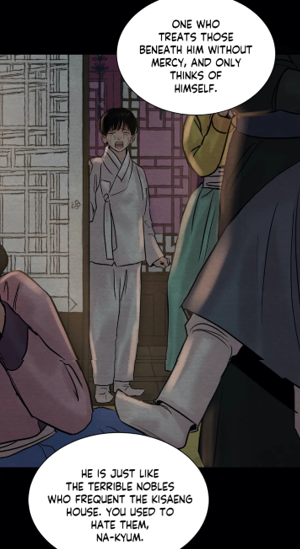 (chapter 68) What made him looking for his noona? What if the bougie was blown out during his sleep and Jung In-Hun was behind this? Byeonduck said that the scholar’s attachment to the boy was genuine, nevertheless there is no doubt that the learned sir was a greedy person. Maybe he woke up, because he detected the absence of warmth, as the noonas had left his side. Hence the painter sensed the abandonment in his sleep, which made him wake up. Consequently, he started searching for his noonas and he opened the door. No one would suspect a young child opening the doors in the kisaeng house. But by opening the door, the artist caused a ruckus, people could hear a protesting child in a room. And during that scene, the artist met Yoon Seungho who was captured by the guard!! This memory represents the night of the sexual lesson. Observe that the color of the hanbok corresponds to the one lying on the floor.
 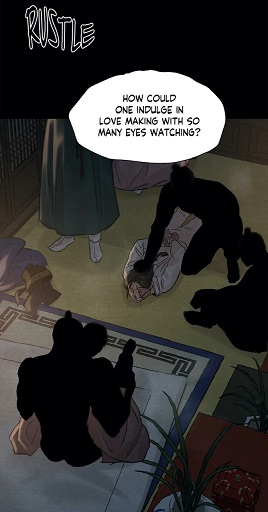 (chapter 86) This means that the one trapping Yoon Seungho was not Yoon Chang-Hyeon, for the latter had a green hanbok. Besides, I started wondering why Jung In-Hun carried away Baek Na-Kyum and left the gibang with him.
  (Chapter 70) Why would he do that? He could have bring him back to his chamber!! Why walk through the countryside and for a long time? It is because he was not allowed to be in the gibang. Remember that he used to sleep in the annex.
  (chapter 29) People believed that he had already passed the exam, while it was not the case. Then I started wondering this. Why does the painter associate the learned sir to the moon? It is because the learned sir would visit him during the night.
  (chapter 94) The light from the moon comforted the artist, it became his companion, for the artist still feared the darkness. However, since the painter described that he would always cry because of his noonas, I am sensing that the scholar must have dragged the artist quite often outside the gibang. And this could coincide to the sexual abuse Yoon Seungho was exposed to. Kim said that the sexual abuse took place in the bedchamber.
 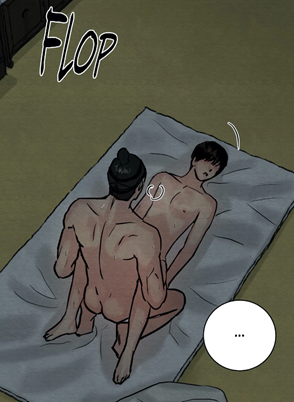 (chapter 50) Both give each other comfort and warmth so that they feel safe. Maybe the FWOP; FWOP sounded like a lullaby to the artist’s ears.
  (chapter 49) 😂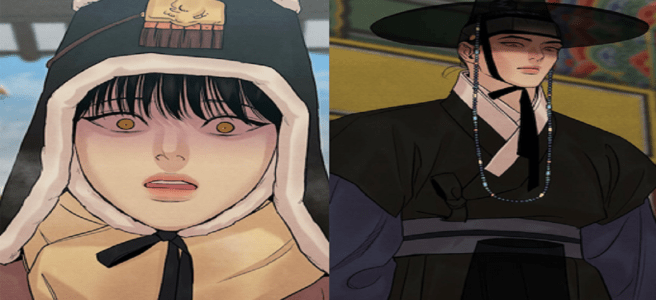



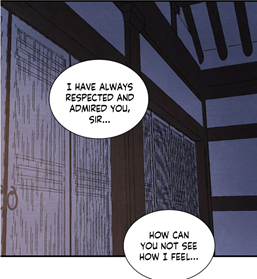 (chapter 19)
 (chapter 68). This signified that in his education, not only sex was prohibited, but also sexual desires were denied. Although love was expressed through hugs
 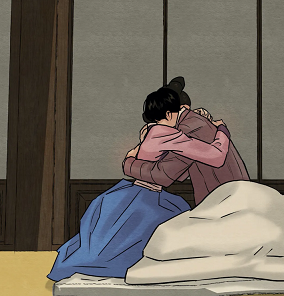 (chapter 66)
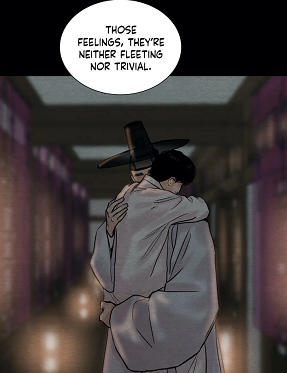 (chapter 68) and caresses
  (chapter 10)
  (chapter 68), they were devoid of sexuality. The painter experienced love, but was not allowed to experience sexuality. He was only authorized to paint it for the scholar’s sake. On the other side, Yoon Seungho was raised the opposite: love was not allowed, as it was a sign of submission and weakness. Sex was permitted, because it was considered as a fight in order to defeat his opponent. These were the butler’s doctrines. That way, he could still have a connection to the main lead. If he came to love someone (the pedophile), the lord could definitely abandon the valet and reveal his betrayals. In other words, he used pity as a way to tame the lord. At the same time, sex also served to gain some benefit, as it was an exchange of favors (giving versus receiving),
  (Chapter 71). I connect this philosophy to the king and indirectly to the butler. With sex, the nobles could exchange some favors. These huge divergences in the mindset explicate why there were so many misunderstandings between Yoon Seungho and Baek Na-Kyum, as their education diverged so much.
  (chapt45), as the painter had accepted him as his sexual partner, he had to realize slowly that he was wrong. He imagined that since the artist had remained by his side and was accepting to have sex with him, he had achieved what he wanted: in his unconscious it was to be loved. Yet, it was just an illusion. The painter saw himself as a whore and the master as a man consumed by lust. As you can see, the noble was forced to judge the nature of the sexual encounters differently. He had associated sex to love due to their Wedding night, therefore he imagined that the moment the painter was accepting him, the problem was solved. He would be able to relive this wonderful moment, but however nothing like that happened. He felt never satisfied, as there were no feelings at all. Hence he even had sex during the day
 , believing that the artist’s lack of experience was the problem.
  (Chapter 45) While the lord became Baek Na-Kyum’s sexual emancipator, the painter became the lord’s teacher for love. This explicates why the low-born forced the lord to question his own identity and feelings.
  than a master- servant relationship, because the commoner was never treated like a domestic. He only had sex with the lord and had some privileges.
  (chapter 46) He was never asked to do other work, although the artist tried to change his situation. Since he was behaving like a whore, he felt that he had no right to express any thought and emotion. He couldn’t show any pleasure. That’s why there were no feelings in their sex encounters, and the lord could sense the difference. Consequently, when the lord realized that he was still perceived as a man consumed by sex
 (chapter 48), he changed his behavior. He acted like a real client at the brothel
 (chapter 48), but at the same time he cornered the painter to have multiple climaxes in order to let him experience that he liked having sex with him.
 (Chapter 49), his prostitute, for he was the one procuring pleasure to Yoon Seungho. As you can see, the roles had been switched. This means that now the painter had the upper-hand in their relationship. We could even say that the noble was willing to accept his fate.
  (chapter 50). Through this revelation, the lord was indirectly confronted by his own reflection: he was indeed asking from Baek Na-Kyum sexual favors in exchange for his stay at the mansion. That’s the reason why the lord had a “relapse“ and kept his distance from the painter.
  (chapter 52). This was important, because for the noble, it meant that he could no longer have sex with other partners. Without sex, the lord was forced to question himself and ponder on the true nature of his relationship with Baek Na-Kyum. He felt jealousy during that night, he was very protective as well.
  (Chapter 52) His sexuality had already become an expression of his love, although the main lead was still unaware of his own feelings. That’s why I come to the conclusion, chapter 52 was actually revealing Yoon Seungho’s monogamy, although it looked the opposite. And this becomes truly visible, when the gangrape was about to occur. He felt no urge, when he was with the guests, yet the moment he brought the artist to the bedchamber, he couldn’t stop himself from kissing his loved one.
  (chapter 54) He was definitely longing for his warmth. This explicates why the noble got so infuriated, when he was confronted with the consequence of his bad decision:
  (chapter 54) the artist was on the verge to be no longer monogamous, as he would be tasted by other aristocrats. In this scene, the lord would have indeed become a client and pimp, if he hadn’t chased away his guests. Although the painter was indeed upset afterwards about this incident
 (chapter 55), deep down he sensed that his master had protected him. This night was important for the main lead: he was forced to admit his own feelings for the painter. Therefore, we could say that the issue with the prostitution was solved after chapter 54. Yoon Seungho thought that the moment he confessed, the painter would get scared and run away, but it didn’t happen. Why? Love among men and especially between a brutal noble and a commoner, was a taboo, like Min had underlined. Secondly, if the lord had indeed feelings for him, he had behaved like a beast during that night. He had mistreated Baek Na-Kyum. In his mind, the artist would never accept him.Besides, the painter had clearly denied the affection from the main lead. In his eyes, the painter’s words were indicating a rejection.
 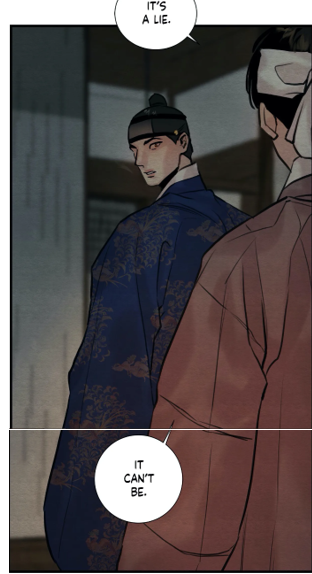 (chapter 54) Thus I conclude that Yoon Seungho and Baek Na-Kyum had come to an implicit agreement: they had a master-servant relationship
 (chapter 51) in order to help them. Therefore the readers could witness the return of the white headband in chapter 52: his task was to paint for his master.
 (Chapter 52)
  (chapter 63), exactly like he had wished in chapter 49. The only difference is that this time, the painter was here for the lord’s pleasure. The roles had been switched again. As the manhwaphiles can perceive, the noble and painter had a similar reaction: they both tried to deny the existence of love in their relationship. That’s the reason why the noble stopped the artist from confessing:
 (chapter 63) They just had a sexual relationship which could provoke pleasure, but that was it. But in order to ensure that the artist wouldn’t run away again, he used sex to “tame“ Baek Na-Kyum. If the main lead could procure multiple climaxes to the artist, then the latter was forced to admit that only Yoon Seungho could be his “partner“. This explicates why the noble kept pointing out how the artist would react to his lover’s body.
  (Chapter 63)
  (chapter 64) He was moaning and would ejaculate constantly thanks to the main lead. Yet, during this second marathon, the noble was actually deceiving himself.
  (Chapter 62)
 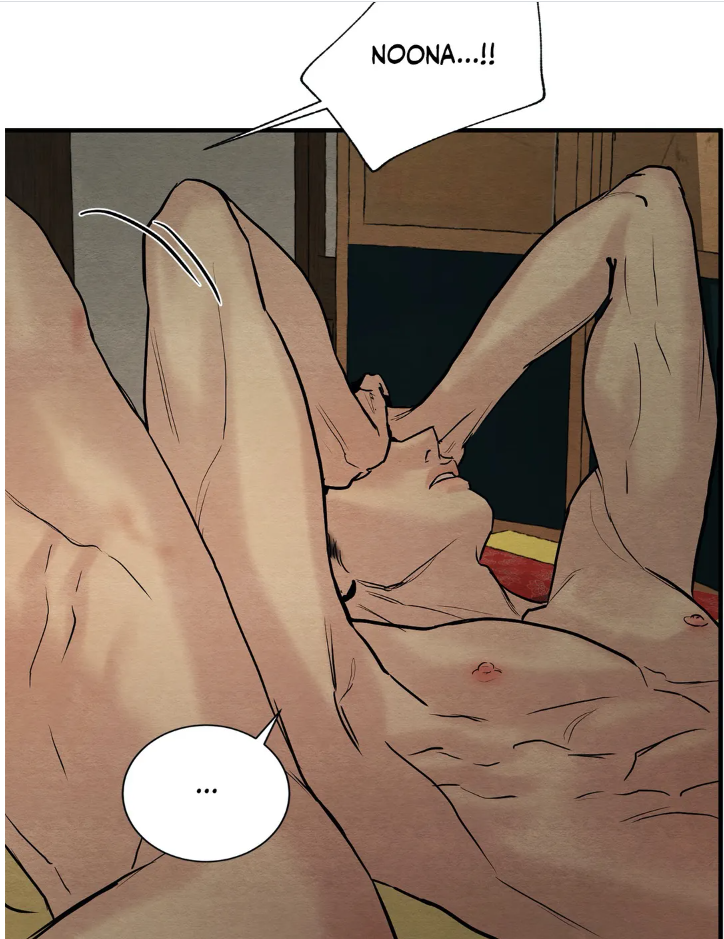 (Chapter 65) This shows that the painter had gained a new position: he was indeed a favored servant. He was allowed to spend the night in his lover’s bed and he could see the lord getting dressed.
  (Chapter 65) The slight change was that now the main lead was aware of this. This truly exposes the lord’s affection for the artist. He might have treated him like a plaything in the shed, in reality he had attempted to show “his skills“ as a lover. He had licked him, bit him and the painter had felt pleasure, though he kept saying no! This is not surprising that Yoon Seungho had denied the kiss in the study.
  (Chapter 64) Because that’s how he had been deceived that night in the study.
 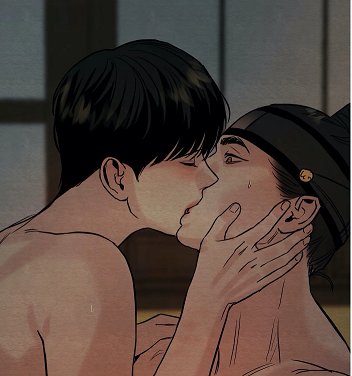 (Chapter 49) Baek Na-Kyum had silenced him with the kiss, as the main lead was about to protest.
  (chapter 65) What caught my attention is that the painter’s disappearance mirrored the lord’s wrongdoing. Lee Jihwa and the main lead had both kidnapped the artist. That’s why I believe that when he heard Heena’s words in the study
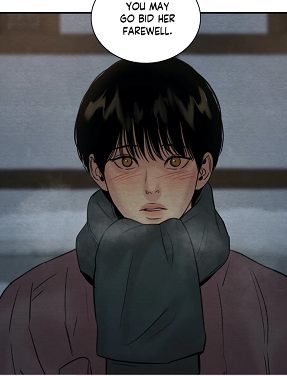 (chapter 69) Consequently, we could say that the painter had a similar status than Jung In-Hun. Yet, there was a huge difference: the owner of the mansion was now acting like the painter’s servant. Hence Deok-Jae’s words came true:
 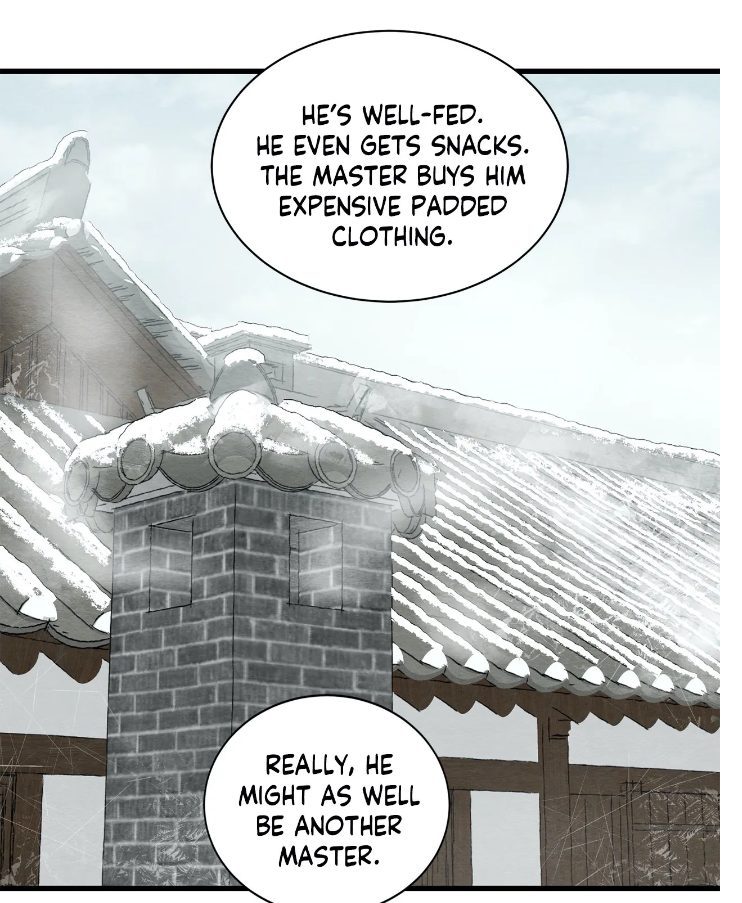 (chapter 46).
  (chapter 71). Why? It is because the lord made the decision that the painter chose him, then this means that he became his wife, though at the end of season 2, he was not thinking about marriage yet. He was not aware of this perception. By becoming his official partner, the spouse obtains the status of his husband: nobility. This explicates why the lord ate with his lover
  (Chapter 78) He even gave him the music box, which was mistaken as a dowry. However, the problem is that the painter was still fighting his own feelings for the protagonist due to Heena noona’s words and past experience with the scholar. He feared that this new situation was too beautiful to be true, hence he thought that the lord’s feelings would fade away. But there was another reason for doubting the lord’s affection: there was no sex.
  (chapter 74) The painter had come to associate sex with love too. Yet, the moment he relived his trauma, he only found comfort and safety in the lord’s embrace.
 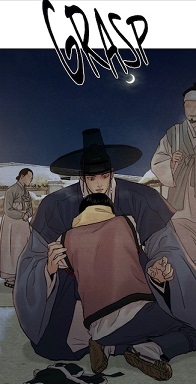 (Chapter 76) The main lead didn’t reject the painter’s urge for a hug in front of commoners. At no moment, Yoon Seungho felt embarrassment. He treated him like a special treasure. That’s how the painter came to realize that Yoon Seungho‘s love for him was true and genuine. Consequently, he decided to rely on him and to trust him. That’s why in this panel, the painter closed his eyes:
  (chapter 76) We could say that he was reminded of his own past. When he was a child, he sensed love through hugs and caresses. Since the painter could feel the lord’s genuine affection and warmth, he recognized that even when there was no sex, love was present. All his senses made him perceive the lord’s love:
 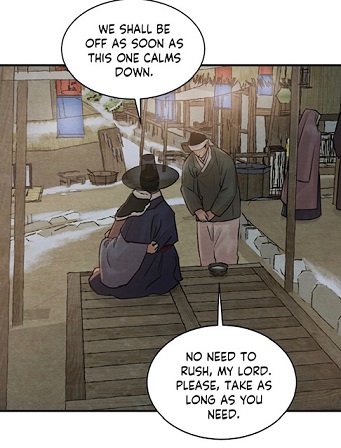 (chapter 76) His words showed his care and concern, then he bought him an expensive music box.
  (Chapter 76)
  (Chapter 80) And now, you comprehend why the painter didn‘t confess during that night. He got interrupted. The kiss was the symbol for their love. Thus it is no coincidence that just after his confession,.
  (Chapter 94) the painter initiated a long and sensual kiss with his “husband“.
  (Chapter 95) Since the painter had received caresses and embraces in his childhood, he came to view the kiss as the symbol for true love. And note that the kisses exchanged in the gibang were full of passion and love. This was the perfect combination of love and sex.
  (Chapter 95)

 (Chapter 96) This shows that Yoon Seungho has always longed for a pure and spiritual love in the first place. His sexual preferences were already palpable in the last love session (season 2):
  (chapter 72) We could say that he discovered all his sexual preferences thanks to the painter.
  (Chapter 80) But he failed due to the intervention of the butler and other schemers. Besides, the whispering of „Kyumah“ could only make his heart race. Let’s not forget that his painting in the sand
  (chapter 1) externalized his own philosophy: love and sex can’t be separated. Note that the couple is is hugging and kissing at the same time! 😍 This picture will represent the peak of their love! Striking is that when the couple confirmed their mutual affection, they did in the kisaeng house, the symbol for prostitution. This truly exposed that Yoon Seungho had been treated like a male night servant in the past. .
 (chapter 72) in the next season, for the painter is still calling his lover “lord Seungho“
  (chapter 99)
  (chapter 102) This means that he is still viewing himself as a low-born. But note that contrary to the past, Baek Na-Kum is now wearing a hanbok and he has no other clothes. Thus I am deducing that the painter’s next lesson is to drop his notion that he is a commoner. He will be taught to view himself as an equal to Yoon Seungho. Only when he has internalized that there is no gap between him and his lover, then he will be able to address him as “Seungho-YA!“ At the same time, both protagonists will come to realize that they can express their love differently. Poetry, painting and more importantly through their desire to protect their loved one. The lord will start protecting Baek Na-Kyum more actively, just like the painter will decide to show more interests in his lover’s skills and past life. Baek Na-Kyum will feel responsible for the bloodshed in the shaman’s house. In my opinion, the lord will confide to him what happened to Min and the other nobles. I am assuming this, for the lord remained silent, when the messenger of his father came to the mansion. He didn’t want to scare his lover because of his brutal outburst.
  (chapter 84)
 The trigger for the change is the noble’s words. The latter keeps talking to the painter asking for an reply. Hence in my eyes, there are glimpses of love the moment Baek Na-Kyum said this:
  It sounded like a confession, hence the seme became more passionate:
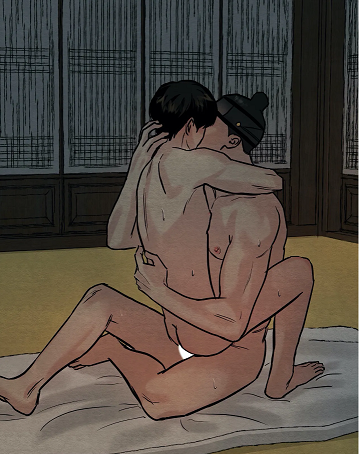 (chapter 49), which made the lord believe that he could only get embraced by the painter, if they had sex.
  . Although the second sex marathon starts like a pure sex session, the moment the painter calls Yoon Seungho differently
 , the lord’s attitude changes. The painter is turned around and faces his lover
 , a sign that they are getting closer. Striking is that again through their conversation, the painter is pressured to think about his own emotions.
  However, due to his own insecurities and fear, the noble still can’t trust the artist’s words, therefore there’s no confession.
  , it is just that both main leads were in denial.
  (Chapter 58) Thus he should become responsible for him. Yoon Seungho was unconsciously trying to push the painter to reciprocate his feelings, an imitation of Lee Jihwa‘s confession. Nevertheless, the painter remained silent, therefore it meant that his love was still denied. That’s why it stands more under the sign of dream and illusion. Consequently, the night in chapter 70, 71, 72 and 73 contrasts so much to the one from chapter 58. This time, it symbolizes the lord’s pure love. As such, the sex is already a real expression of love. That’s why the lord asked to be called intimately: Seungho-Ya
  (chapter 72) On the other hand, this love session was strongly intertwined with the notion of forgiveness and punishment as well. This is important, it reveals that Yoon Seungho had internalized that sex was the expression to redeem himself. He had been tasked in the past that if he desired to obtain “forgiveness“, then he should have sex. And by comparing all these sexual encounters, I came to the following conclusion: the lord’s words definitely contributed to change the nature of the sex session, just like the hug.
  In chapter 66, he had a flashback, hence he couldn’t witness his lord’s attention and care.
 But the lord discovered this kind of embrace, when he helped the painter in chapter 53:
  (Chapter 57) However, this shows that Yoon Seungho is a quick learner, because he knew what to do, when the painter was in pain and destress. At the same time, it explains why he could fake the embrace in chapter 62:
  This hug stands in opposition to the one at the end of season 3:
  (chapter 102) The artist was forgiving his lover! Love represents selflessness, tolerance, forgiveness, warmth, affection and assistance which is transmitted by the embrace. Now, you understand why Yoon Seungho was still not satisfied after the sex session in the study, he was longing for the hug.
  (Chapter 84) In his unconscious, he knew that if the artist hugged him, he would have forgiven him. But he had no idea about it, thus he couldn’t suggest this. So far, he had experienced the embrace from the artist while having sex. Deep down, he had already internalized the embrace to forgiveness. So we could say that the absence of the embrace in this scene was the lord‘s punishment for the fake hug in the shed. And the painter let him discover the true nature of a warm embrace:
  (chapter 91)
 and his request for help are strong indications that Baek Na-Kyum was now accepting his affection. He was now trusting the noble, hence he revealed an important clue about the abduction.
  (chapter 41) Under this perspective, it becomes understandable why the couple neglected these pictures. They were all devoid of affection, it was more about prostitution and battle! And here is now the question? Where are these drawings?
