

Please support the authors by reading Manhwas on the official websites. This is where you can read the Manhwa: Jinx But be aware that the Manhwa is a mature Yaoi, which means, it is about homosexuality with explicit scenes. Here is the link of the table of contents about Jinx. Here is the link where you can find the table of contents of analyzed Manhwas. Here are the links, if you are interested in the first work from Mingwa, BJ Alex, and the 2 previous essays about Jinx What about The Wolf’s 🐺First Kiss? 💋 and Illuminated 🌥️🌤️Silence and Lingering 🫶 Warmth 🔥
It would be great if you could make some donations/sponsoring: Ko-fi.com/bebebisous33 That way, you can support me with “coffee” so that I have the energy to keep examining Manhwas. Besides, I need to cover up the expenses for this blog.

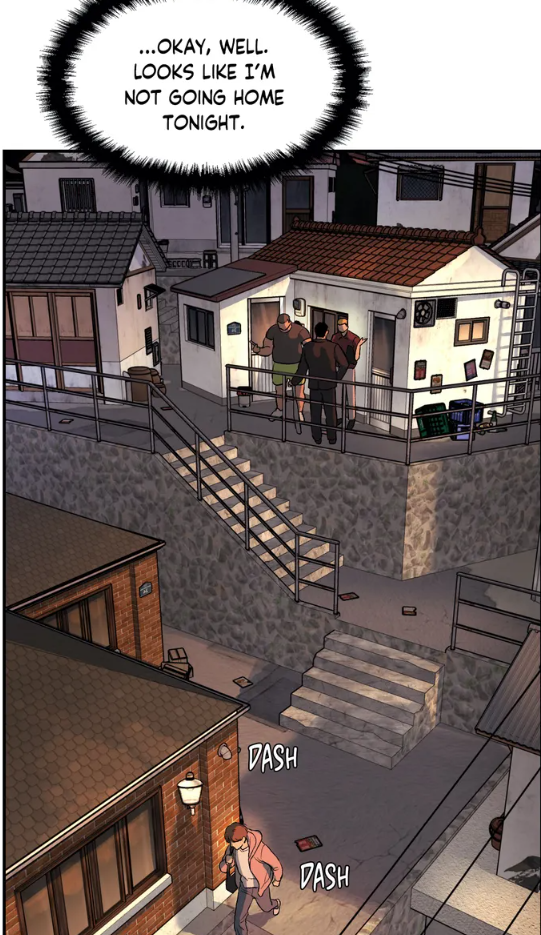
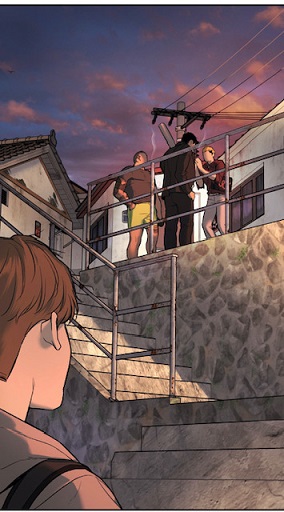
The composition opens with a visual puzzle: a collage of doors, house numbers, and figures caught mid-motion. At first glance, the images appear disconnected, yet the arrangement and title invite my avid readers to look again. What connects the blue gate in the seaside town, a young man hesitating before a door, and two house number plaques: 7-12 and 33-3? One Jinx-phile on X, @Jaedan4ever, insightfully noted that “7-12”  (chapter 65) corresponds to the release of Jinx Chapter 70, which marked the series’ return after a three-month hiatus. This observation is more than clever numerology—it mirrors the manhwa’s deeper message: the past always haunts the present, and at times, it even foreshadows the future. And that’s exactly what I will do in this essay. I propose that the key to understanding the protagonists and characters’ evolving identities lies in the overlooked architectural and administrative details—especially the house numbers, door placements, and legal ownership of space. These seemingly minor visual cues are in fact loaded with meaning, offering insight into how home, memory, and identity are fragmented and reassigned across time and place.
A Mysterious Numbering System: 7-12 vs. 33-3
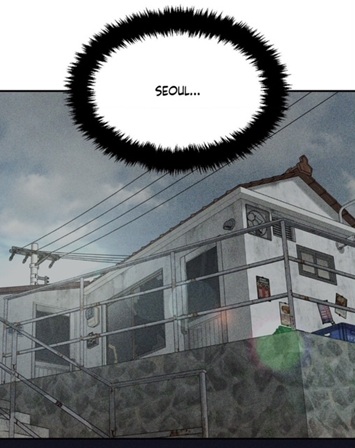
While the reader focused on 7-12 and the publication of episode 70, something else caught my attention.  (chapter 57) The landlord’s house has the number 33-3. Why do two neighboring houses bear such disconnected numbers: 7-12 and 33-3?
  (chapter 61) For readers unfamiliar with Korea, this looks quite bizarre. In most European and American countries, street addresses follow a linear order; house number 12 would typically be located between 10 and 14. But in Korea, especially in rural areas, many towns use the older jibeon (지번) land-lot numbering system. Here, numbers are based not on street sequence but on the chronological order of land registration and subsequent subdivisions.
The older system, sometimes translated as the land-lot number address (지번 주소, 地番 住所, jibeon juso) resembles that used in North Korea and Japan. It is ordered from largest to smallest units and based on dividing by city (시, 市, si), then district (구, 區, gu), and neighborhood (동, 洞, dong). (To read more about district zoning and a detailed differentiation between dong, gu, si and others, click here.) Next the city block (번지, 番地, beonji) which could be several dozen to several thousand per neighborhood, then the building number is given (호, 戶, ho ). Often the markers 번지 and 호 were skipped and their numbers were separated by a hyphen. The floor (층, 層, cheung) and apartment or suite number (호, 號, ho) and receptient’s name were written last. It is worth noting that this address and a street address are not the same thing as no street name is mentioned. The old system was officially decommissioned on December 31, 2013 but is still widely used. Quoted from https://centers.ibs.re.kr/html/living_en/housing/addy.html
At first glance, parcel 7 appears to be registered earlier than parcel 33. Yet there is a twist: the subdivision number attached to 7—namely 12—implies that this plot has been split far more frequently than 33, which is only on its third subdivision. In rural Korea, early subdivisions often indicate inherited land, long-term residency, or family continuity. Later, higher subdivisions tend to signal commercial fragmentation, detachment from familial lineage, and transient habitation—often reflecting rental properties  (chapter 62), newer developments, or administrative restructuring rather than deep-rooted inheritance. In this context, a higher subdivision number implies not only later division, but also the erosion of legacy and the weakening of kinship-based territorial claims—an erosion especially poignant in the context of Confucian traditions that once emphasized multi-generational cohabitation and patrilineal inheritance. In classical Korean society, a home was not merely a shelter but a physical emblem of familial continuity, with ancestral rites often performed within the same household across generations. As addresses fragment and land parcels divide, so too does the symbolic structure of the family unit. The once-cohesive ideal of the extended household dissolves into isolated, rented spaces, reflecting not only economic realities but also the fraying of intergenerational bonds and filial authority.
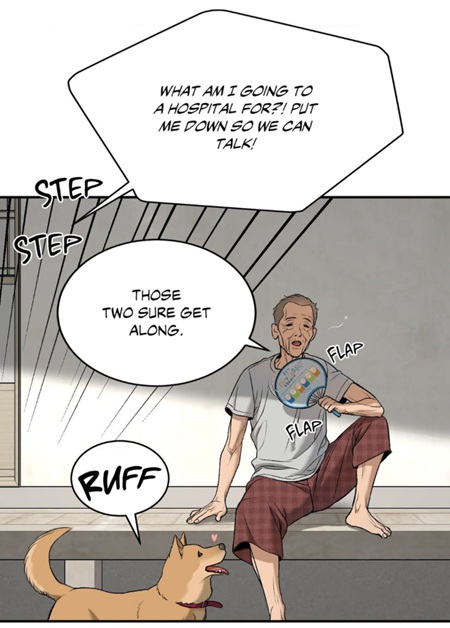
This contrast is reflected in both setting and narrative. Kim Dan lives in house 33-3 with the elderly landlord—a man who is not just a neighbor but likely an old local landholder. (chapter 57) In contrast, the house numbered 7-12, which Jaekyung rents, (chapter 61) has been transformed into a tourist hostel.  (chapter 61) Though Jaekyung is a wealthy celebrity, he inhabits a parcel of land that speaks to impermanence and anonymity. Meanwhile, Dan shares space with someone who quietly represents legacy and transparency.
The Blue Gate 7-12
The spatial layout reinforces this: the landlord’s house opens directly onto the street—there is no gate. (chapter 57) This openness reflects a traditional mindset rooted in hospitality and community. By contrast, 7-12 is sealed by a blue metal gate, a clear symbol of privacy, control, and urban values. (chapter 65) But here’s the irony: the gate does not protect the landlord’s legacy from encroachment—it shields the outsider from the town. The presence of the blue gate enclosing 7-12 speaks volumes. In contrast to the landlord’s open home, this barrier reflects the mindset of its builder—the town chief (chapter 62) —who likely anticipated that visitors from the city would prefer privacy. But in attempting to accommodate their expectations, he inadvertently created a symbolic divide. The gate does not just offer seclusion; it enforces a boundary between the guests and the local community. This spatial arrangement, then, subtly underscored the champion’s outsider status. Despite his wealth and fame, he remained separated—literally and figuratively—from the rootedness and communal life that defines the town. This explicates why his direct neighbor didn’t reach out to him right away. He was the last to ask for a favor. 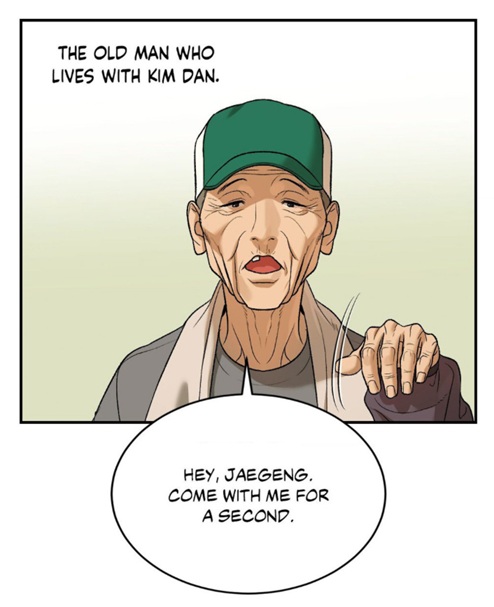 (chapter 62) However, this “dynamic” (distinction) began to shift the moment Jaekyung started working for the local residents.
  (chapter 62) No longer just a “guest” or a “tourist,” he earned their recognition and acceptance through acts of service and humility.
 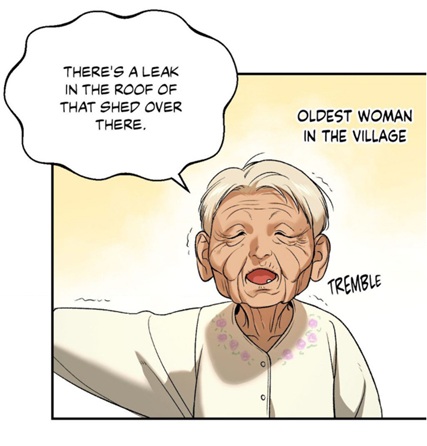 (chapter 62) As he helped them with manual tasks—such as lifting goods or assisting the elderly—they started seeing him not as an outsider, but as one of their own. However, it is important to note that these gestures of inclusion occurred while Jaekyung was outside the blue gate
  (chapter 62) —beyond the formal boundary of the rental property.
 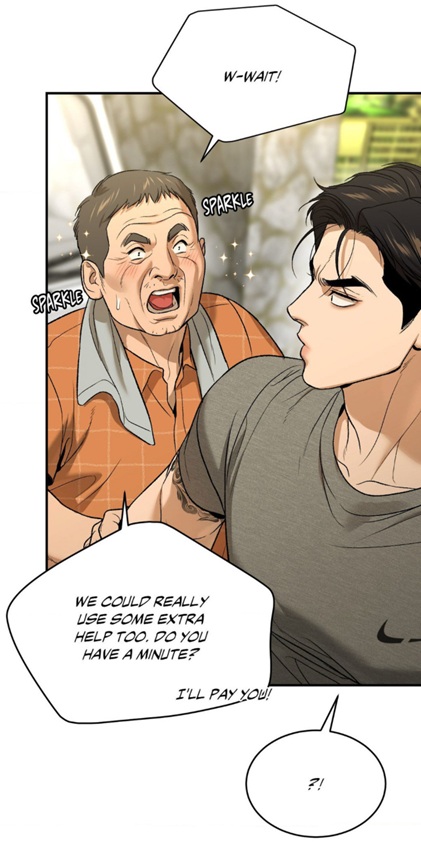 (chapter 62) In this way, the gate truly functioned as a symbolic threshold: only once he crossed it through action and humility, the community began to approach him. This change in perception was symbolized, when he received vegetables from the townspeople, a traditional gesture of inclusion and local acknowledgment.
  (chapter 62) Nevertheless, the best sign that he has been accepted by the community is when he received traditional welcome gifts: the toilet paper and detergent.
  (chapter 69) [For more read Unseen 👀 Savior🦸🏼♂️ : The Birth Of Jaegeng (locked)] His physical strength, once used for spectacle and entertainment, now becomes a bridge into the fabric of rural life, exposing his true personality: he is generous and modest. The closed blue gate of the hostel might have marked him as a city dweller at first, (chapter 65) but his actions gradually dissolved that boundary. Therefore it is no coincidence that after the wolf took care of doc Dan during that night
 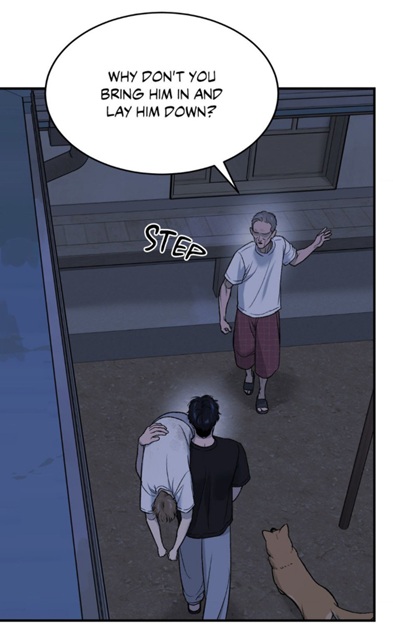 (chapter 65), the elderly neighbor chose to open the blue gate shortly after:
  (chapter 69) Thus I deduce that the blue gate lost its purpose. The champion definitely saw the advantages of the absence of a gate by his neighbor. He could arrive there at any moment
  (chapter 62) and the landlord never rejected him. In fact, he was always welcome.
  (chapter 66)
But let’s return to the house numbers and its signification. In this way, 33-3 stands at the crossroads of tradition and change: it is old, but not untouched by rupture. It represents a home that has endured change while maintaining its emotional and social value. This makes it an apt setting for the star and the physical therapist, two individuals who themselves come from fractured emotional lineages—both wounded by broken familial bonds, yet gradually learning to rebuild a form of kinship. That number becomes a silent metaphor for their coexistence: the wolf and the hamster, sharing not blood but space, trust, and now roots.
Father, Son and Ancestor: 33-3
Numerologically, “33” itself can evoke multiple layers of meaning. In some interpretations, 33 is a master number, associated with healing, altruism, and emotional growth. It is also a number of spiritual maturity—hinting at a kind of “final trial” before enlightenment. That fits the evolution of both characters. And the number 3, repeated, might subtly allude to the Christianism (Father, Son and Holy Spirit) or Confucian triad—father, son, and ancestor—or more abstractly, to harmony among heaven, earth, and humanity. With Jaekyung and Dan forming a new domestic unit under the benevolent yet quiet watch of the elderly landlord, we can almost see 33-3 as a broken but reassembled version of the traditional multigenerational household—one not bound by blood, but by mutual recognition and earned care.
Thus, 33-3 becomes more than an address. It’s a compact expression of the characters’ trajectory: from scattered and rootless to housed and healing—not in a perfect family, but in a fragile, evolving one. The wolf’s integration is not based on lineage or history, but on community and contribution.
Another layer to the contrast is the identity of the landlord. While the owner of 7-12 is the town chief—someone with institutional power—he is not necessarily the town’s patriarch. His propriety, 7-12, suggests his roots are more administrative than ancestral. He is in charge, but he does not represent continuity. On the other hand, the landlord of 33-3 is mistaken by Choi Heesung for Dan’s grandfather 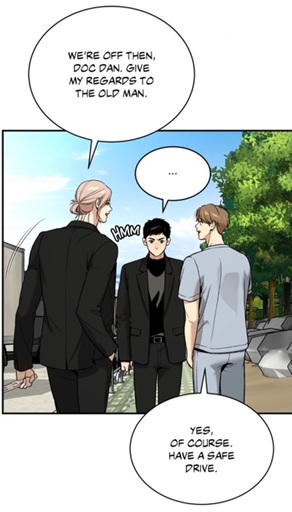 (chapter 59), and townspeople instinctively report Dan’s behavior to him.
  (chapter 69) I would like to point out that the kind man said “villagers” and not “villager”, a sign that he was contacted by many people. Such recognition is reserved for those woven into the community’s long memory.
This dynamic becomes even more intriguing when we consider how the wolf might have ended up in house 7-12 in the first place. 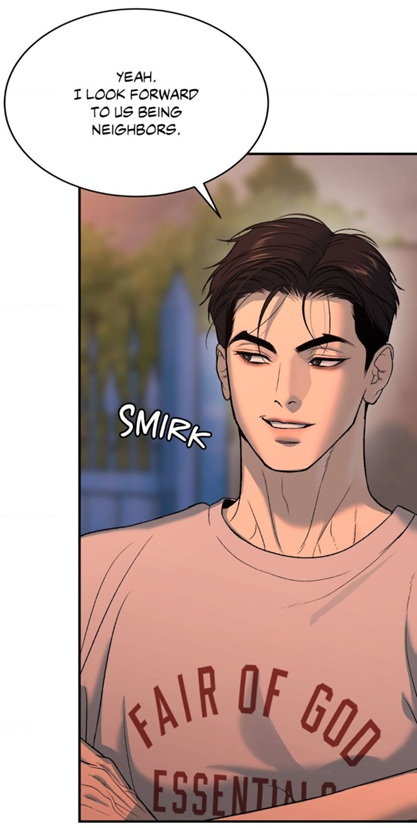 (chapter 61) Given that the rural address system is based on the older jibeon model—and most GPS systems now rely on the newer road-based address format— it is unlikely that Jaekyung could have located Dan’s home through navigation alone.
 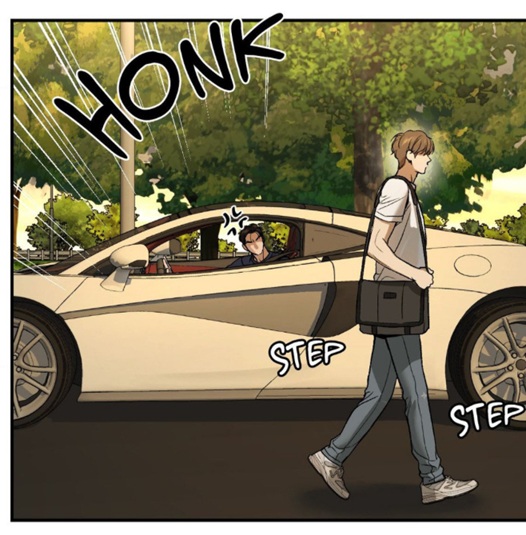 (chapter 61) That’s the reason why the author included this scene. Even if someone had disclosed Dan’s address, the GPS in Jaekyung’s luxury car would not have been able to guide him there. Like mentioned above, the streets have no names, and the numbering lacks logical sequence. Thus, we have to envision how the Emperor followed Dan on foot, observing where he went. In doing so, he not only located the general vicinity. Afterwards, he must have contacted a local and requested for a vacant house close to 33-3. That’s how he found the “hostel” right next door. (chapter 62) No wonder why the athlete stopped his training for his benefactor, the town chief. His act of renting that space was not just about proximity—it was a quiet, determined form of emotional pursuit, bypassing digital maps in favor of personal presence. Once again, this mirrors the emotional structure of the story: Jaekyung could only find the hamster by leaving behind his car (the older version of episode 69
  – chapter 69) and walking through the confusion himself.
Finally, this rural numbering system is placed in relief by an urban counterpart. In episode 1, 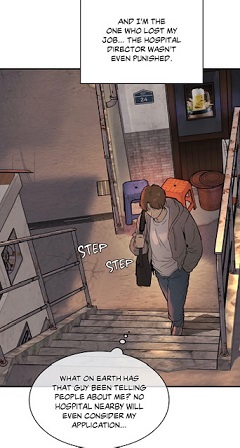 (chapter 1) we see Dan walking under a blue plaque labeled “24”—the newer, street-based system introduced after 2013. This number, part of Seoul’s revised address format, contrasts sharply with the rural jibeon model. Where 7-12 and 33-3 reflect layered histories and family division, “24” is precise, administrative, and arguably impersonal. The place is no longer connected to family and traditions, rather to migration and anonymity. The juxtaposition between systems emphasizes not only physical distance but emotional dislocation.
Shin Okja’s Childhood Town and Numbers
Yet among all these numbered spaces, one person remains strangely untethered: Shin Okja.  (chapter 65) Though she insists this seaside town is where she “grew up,” she never identifies a lot number, street, or ancestral parcel. In a rural system where numbers are more than logistical—they are signs of rootedness and intergenerational presence—her vagueness stands out. Everyone else is connected to a numbered gate, a registry, or a mailbox. She alone floats in narrative space, clinging to emotional claims without material proof: no concrete location is brought up.
 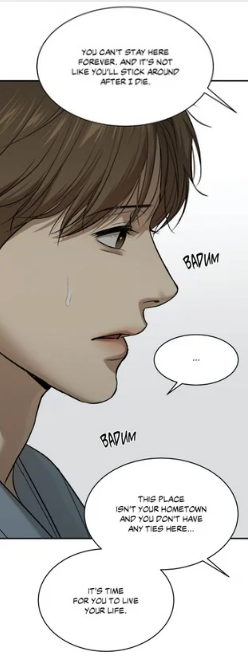 (chapter 57) The contrast becomes sharper when she refers to Seoul only in generic terms. She never mentions a district, (chapter 65), a person
  (chapter 56), a neighborhood, or specific location. This lack of detail, especially when juxtaposed with the specificity of the rural jibeon system (where even a subdivision number implies lineage and ownership), exposes her rootlessness. It reinforces the idea that her ties to place are performative rather than grounded. Even her nostalgia for Seoul is flattened
 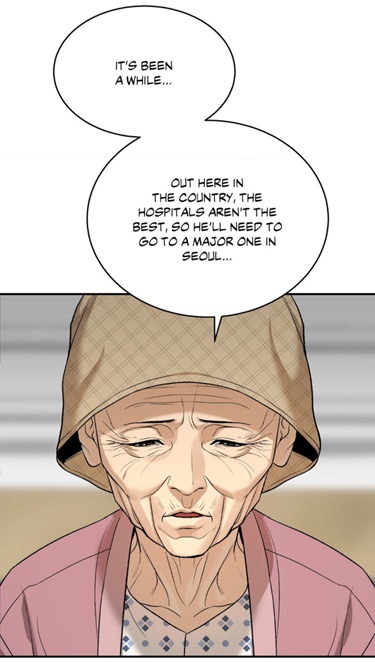 (chapter 65) into a symbol of urban superiority—money, prestige, modernity—without anchoring it to a real “home.” In short, she idealizes Seoul the way she romanticizes the countryside—selectively, superficially. At the same time, she is giving the impression that she is erasing her stay in Seoul, as if her past there, too, is unmoored. Because of this observation, I realized why the nurse never questioned the senior’s statement.
 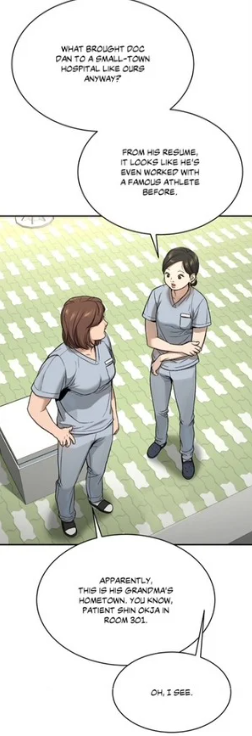 (chapter 56), though she expressed some doubt. By asking for more details, she imagined that she could touch a sensitive topic, like for example loss of her home etc. Shin Okja‘s inability—or refusal—to locate herself within a concrete building and specific numbered system of belonging hints at a deeper truth: Shin Okja may perform the role of native and guardian (chapter 57), but the land does not affirm her story. In Jinx, numbers are roots, and she is rootless. The more she talks about places, the less we see of her in them. She becomes a woman suspended between two worlds, belonging to neither.
Finally, the narrative suggests with the Emperor’s example, rootedness is not determined by a map or a deed, but by how much responsibility and memory one carries. And so far, the halmoni is not contributing much to the little town. She remains in the confines of the hospice. Hence no one among the inhabitants noticed her so-called return to her hometown.
A Numbered Home in Seoul: Whose Name, Whose Burden?
But since the new system is used in Seoul, I wondered about her address and house number. So what was the house number of Shin Okja`s home in the capital?  (chapter 17) As Jinx-lovers can detect, next to the entrance of her apartment, there is no blue house number plate or street name. How is that possible in a metropolis where every residence should be digitally registered? And now, pay attention to the house where the “goddess” and her “puppy” lived.
  (chapter 1) The building had not only two doors, but also the plaque is placed next to the other door. It is also partially visible in this image:
  (chapter 1)
This raises a series of subtle but important questions. When we see Kim Dan standing in front of the darker, metal-framed door in episode 11  (chapter 11), we naturally assume he is returning home—entering the same shared space he and his grandmother inhabit. But is that actually the case? A closer look reveals he is using the other entrance. On his right side, we see the electricity meter, the mailbox, and the window—the signs of an inhabited and administratively recognized unit. This suggests that Kim Dan’s official residence is behind this second door. Once again, I am showing the view of the same building from a different perspective,
  (chapter 57) where the mail box and the electricity meter are. But I have another evidence for this observation. During that night, the hamster got assaulted by Heo Manwook and his minions.
  (chapter 11) And keep in mind that after getting beaten by the Emperor, anyone could recognize the grandmother’s place from outside due to the broken window.
  (chapter 19) The moment I made this discovery, I couldn’t help myself wondering why doc Dan would go to the other door and not to the halmoni’s room.
And this thought led me to the following deduction. He had been triggered to go to that place because of the phone call from the redevelopment association.  (chapter 11) The voice on the phone reveals something legally crucial
 (chapter 11): Kim Dan is the last remaining resident in that building. That one line reframes everything. This suggests that Kim Dan’s official residence is behind this second door. 😮 In fact, the building features (chapter 57) only one house number plaque, one mailbox, and one electricity meter. These markers aren’t decorative—they are infrastructural indicators tied to administrative systems. In a city like Seoul, this configuration implies a single legally registered unit. So despite there being two entrances, only one household is formally recognized by the system. And since the resident registration system restricts each individual to a single verifiable address, this means only Kim Dan is recorded as the building’s legitimate occupant. The other door—the one associated with Shin Okja—exists outside the scope of legal recognition. She may live there physically (her belongings are still there), but bureaucratically, she doesn’t exist in that space.
Under the Korean Resident Registration System, every citizen must register their place of residence with the local government. Since 1994, this data has been digitized, allowing all state institutions to access and verify a person’s registered address electronically. This information is not symbolic—it is legally binding. Your registered address determines where you pay taxes, vote, access services, and claim benefits. Moreover, because so many government processes now rely on digital access to this central database, only one person can be officially tied to any residential unit at a time. Crucially, it is also a prerequisite for accessing financial credit. One cannot take out a bank loan or act as a legal guardian without a valid, registered place of residence.
This means that in the past, Shin Okja must have been officially registered at the address. 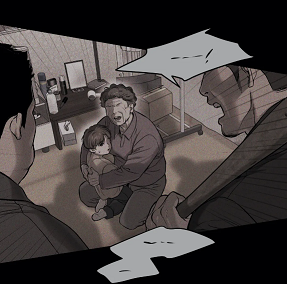 (chapter 5) When the loan shark came to collect the interest of the debts during Kim Dan’s childhood, he went straight to her door
  (chapter 5) —the door that, at the time, likely bore the blue house number plaque.
However, attentive readers will notice a striking detail: the door seen during this childhood memory opens outward toward the viewer and is positioned closed to the left corner,  (chapter 5) the door associated with Kim Dan in later episodes—particularly the one through which the champion entered during the confrontation with the thugs —opens inward and is placed in the corner of the right wall. The interior layouts and door directions don’t match, though the furniture is similar. This strongly suggests that these are two different units within the same building, exactly like I had observed before. The “goddess” and the hamster’s house had two doors and as such two units. (chapter 1)
These architectural clues support a subtle but significant shift: Shin Okja once resided in the main unit, the one connected to the official registration and legal address, in other words her initial flat was there. (chapter 11) At that time, Kim Dan, as a child, must have lived in the other unit, the one without number. She was probably taking care of him. However, at some point, she must have switched the place and moved to the other unit. This would explain why doc Dan  (chapter 19) had a recollection of this moment, when he was about to leave this humble dwelling.
  (chapter 19) His move to the penthouse triggered another “move” from the past. Consequently, I am deducing that this souvenir represents the moment of the grandmother’s arrival and the departure of the hamster’s parent(s) from the other unit. But there’s more to it.
Since people are obliged to get a residency number with 17, I am assuming that the halmoni ceded legal registration to him, once he reached his 17th year. Kim Dan took over the smaller, neighboring room officially, and with it, the burden of formal residency. When she relinquished her official role, the system would have required a transfer of household headship and residency—most likely to Kim Dan. In my opinion, she became listed as household members (세대원, saedaewon). They are fully registered, just not as the head. It is important, because in front of the champion, she acts, as if she is still the head of the household  (chapter 65) and Kim Dan the immature child, whereas according to my observations, she is legally dependent on the “hamster”. She is just a household member. As you can see, I detected a contradiction between her words and “hidden actions”, all this triggered because of the closed door. By transferring the address and registration to the physical therapist, she made it possible for him to inherit not just the space, but also the liability. That’s why he’s now the only registered person.
Thus, by the time we see Kim Dan revisiting the building (chapter 11), the name tied to the legal system, to the loan, and to the state’s digital records, is his—not hers. This administrative shift allowed Shin Okja to become legally invisible while Dan remained trapped in a place that was once hers, yet bore no official acknowledgment of her presence.
In short, the building’s physical structure masks a deeper displacement. (chapter 1) What appears to be a modest shared home conceals a painful history of passed-down burdens and reallocated responsibilities. The grandmother’s true door is off to the side, connected physically but separated in symbolic meaning. It has no number, no mailbox, no markers of legal presence. This hidden door is a perfect trompe-l’oeil: it masquerades as the heart of the home, but it’s actually a legally invisible annex. The framing invites the viewer to overlook it, just as the narrative invites us to overlook the grandmother’s evasions. And ironically, the one who stayed—the “last resident”—is also the one who was slowly pushed into the background, into the unnumbered space, into silence. And now, you comprehend why the grandmother asked from him this:  (chapter 11) When he says “home,” he is referring not just to a physical place, but also to a legal and emotional placeholder—a registration number that ties him to bureaucratic existence, familial duty, and emotional manipulation. With her promise to return in that home, Shin Okja is essentially demanding he remains the legal anchor—the one who stays behind, the one who remains registered, the one who continues to carry the official burdens, even as she herself fades into invisibility. That’s how she became a “carefree” ghost in the end. It wasn’t just a promise of care, but a submission to being tethered—not to belonging, but to obligation masked as love. The irony is that by remaining legally “present,” Dan was emotionally erased.
To conclude, Kim Dan was not just the last physical inhabitant—he is the last legal one. His mailbox, his electricity meter, his official records—all point to the metal-framed door. (chapter 11) That’s where his address was, until he moved to the penthouse. But that’s where the loan is linked. That’s where the city saw him. And because the resident registration is necessary for work and taxes, Kim Dan had to change his resident number, when he moved to the penthouse or to the seaside town. That’s how I came to the following conclusion: Shin Okja must have known about his stay with the champion in the end.The Korean Resident Registration System is the evidence. This shows how important this scene was in season 1. (chapter 11)  (chapter 65) In this panel, her words in English were ambiguous, while in the Korean version, the grandmother exposes that she was well aware that her grandson and the emperor would live together.
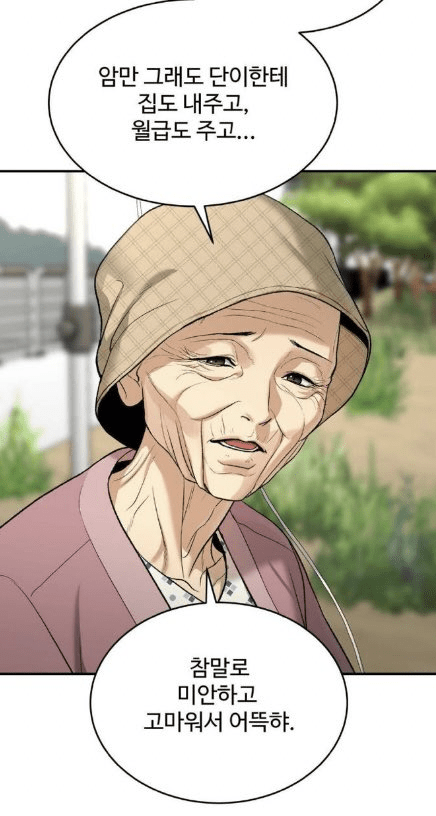
“I’m truly sorry and thankful—what can I say.”
This means that the halmoni must be well aware where her grandson is staying in her “hometown” in the end!!
Don’t forget that in South Korea, when a person enters a hospice or hospital, they must provide a valid registered address for several reasons: Health insurance eligibility (National Health Insurance Service); Billing purposes; Coordination of long-term care or welfare benefits; Resident registration confirmation (especially in hospice care, where end-of-life planning intersects with legal identity). She is legally totally dependent on him, and not just financially. So when she suggests to doc Dan to return to Seoul, she is actually denying the existence of a relationship between the physical therapist (chapter 57) and the landlord from 33-3. In fact, she was indirectly expressing a lack of gratitude toward the elderly man.
This realization, the existence of two units within the same building, subtly destabilizes the commonly accepted idea that Shin Okja is his grandmother. I have to admit that while reading episode 57, doubts (chapter 57) about their parentage came to my mind, especially when she claimed that doc Dan had different roots as hers. However, so far, I could never find an evidence for such a theory and imagined that my mind was simply too creative. Yet, with this new insight her role begins to look less like that of a familial guardian, and more like that of a caretaker, a nanny, or even an intruder—someone who moved in but was never truly rooted in Dan’s legal or emotional household. This theory would explain why the grandmother is not talking about doc Dan’s parents, why she remained passive, when he got stigmatized as orphan. She had every reason to suggest that she was enough for him, he just needed her. 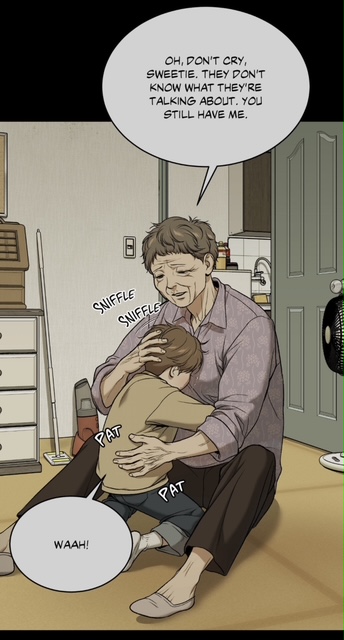 (chapter 57) That way, he became attached to her. It’s a startling reversal: the woman who claims maternal authority is
  (chapter 65), in the eyes of the system, merely lodging in his shadow. She is indeed a ghost.
 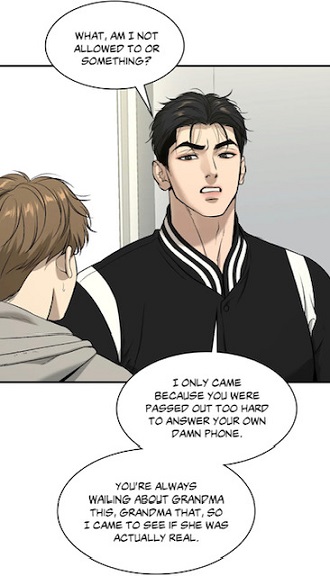 (chapter 22) This architectural division is deeply symbolic. Despite being the dependent, Dan is the one bearing responsibility—both financially and administratively. Shin Okja, on the other hand, manages to live without accountability.
And perhaps it’s no coincidence that the Seoul house (chapter 1) resembles the configuration in the small town. (chapter 57) In both cases, the boy lives next to someone who is older, legally distinct, and spatially close yet administratively separate. However, in the capital, the room with the second door is much smaller, as if doc Dan was the “servant”, though he was the main resident and the household head. In the countryside, this creates a healing bond with a benevolent elder. In the city, it sharpens a sense of entrapment. The echo between the two homes becomes a subtle commentary on the difference between chosen family and imposed family, between true guardianship and the performance of care.
And what did Shin Okja say to the Emperor? 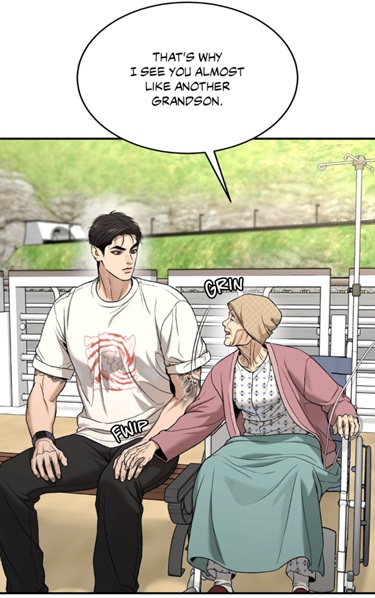 (chapter 65) Joo Jaekyung is almost her grandson!! It was, as if she was about to adopt him. Let’s not forget that he embodies all her ideals and dreams: strong, healthy, rich, famous, generous, polite and gentle! And according to my observations, she knows that the athlete owns a flat in Seoul, big enough to take a room mate.
The invisible chain between the door and the sharks
The silent yet stark detail about the two units (chapter 1) also reshapes our perception of Shin Okja. This singular registration setup does more than highlight Dan’s bureaucratic burden—it reframes the nature of the doctor’s relationship with Shin Okja. (chapter 11) But why did she ask him to become the household of this unit in the past? For me, the answer is quite simple. She had already planned that the young boy would take over her debts. One might argue that the debts might have been related to the hamster’s family. Yet I can refute this point. How so?
First, according to my previous observation, Shin Okja was living in the other unit, and the thugs went straight to her flat, the one with the sign on the wall. (chapter 5) They were looking for her and not “doc Dan” or his family. Unfortunately, the little boy was present. Because they were seen together, people assumed that they were together, a family. But like mentioned before, there was a move within the same building. Moreover, as a child, Dan was exposed to violence from the loan sharks. He couldn’t have signed any documents at the time, for a resident registration number is required and the other place is not registered; the grandmother was the official borrower. But later, Heo Manwook declared that Kim Dan is the named debtor. 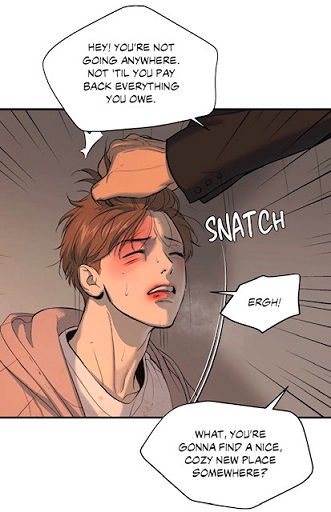 (chapter 16) He even showed the amount Kim Dan owned with his cellphone to the Emperor
 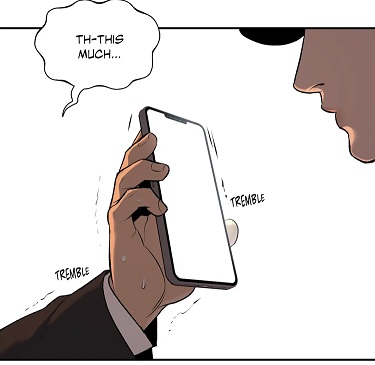 (chapter 17) That’s how the champion internalized that the hamster was the one with debts. This theory explicates why doc Dan is not blaming his grandmother for the debts in the end, as he signed himself loans. And now, you can imagine what happened in the past. Once he became 17 years old, she asked him to get a resident registration number. With this, he could apply for a loan in order to reimburse the grandmother’s debts. This must be one of her favors from the past:
 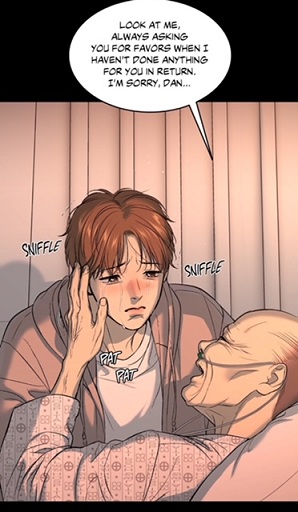 (chapter 53) So far, in season 1, she had made only one (chapter 41) before her request to visit the West Coast. The most plausible explanation is that Shin Okja persuaded him to take over the loan. She likely presented it as a necessary sacrifice, something he could manage given his income as a physical therapist. This explains why the elderly woman is no longer asking about the debts or loan. It is no longer her main concern, she is not the household head either. And don’t forget what the physical therapist thought, when he heard from Kim Miseon the bad prognostic about his grandma.
 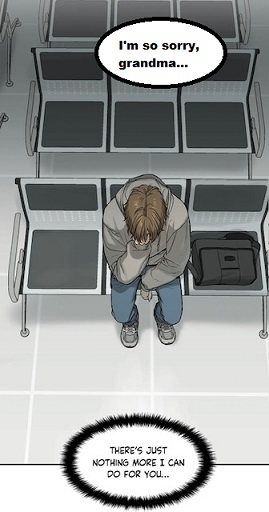 (chapter 5) His words imply that he had done something in the past for her. And that would be to become her guardian and take her debts. This hypothesis explicates why only in episode 11, Doc Dan was comparing the progression of the interests with a snowball system, something unstoppable.
  (chapter 11) His thoughts reflect a rather late realization that he is trapped in a system and he can not get out of it. In other words, this image oozes a certain innocence. This also explained why Joo Jaekyung had to confront him with reality in front of the hospital.
 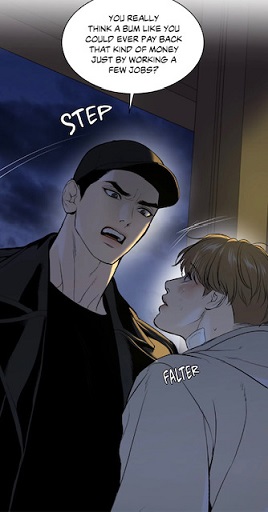 (chapter 18) The location is not random: for the halmoni, such a work place symbolizes respectability, power and money. The problem is that in the hospice, Doc Dan is not well-paid.
 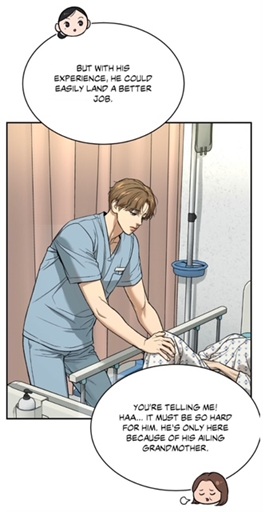 (chapter 56)
And so, when he returns to that door after the triggering phone call (chapter 11), it isn’t just a physical movement—it’s a re-entry into responsibility and also past. The metal door doesn’t lead into a shared home, but into a legal burden. It is the entrance not to comfort or care, but to debt, disrepair, and abandonment. No wonder why during that night, the hamster had to face Heo Manwook and his minions.  (chapter 11) And now, it is time to return our attention to my illustration for the essay:
  As my avid readers can observe, the panel with the champion facing the blue door comes from episode 69, while the one with doc Dan comes from chapter 11. These scenes are mirroring each other. It is about concern and danger! While in episode 69, the athlete got worried, as he imagined that doc Dan’s life was in danger, in episode 11, the hamster was about to face an old threat: Heo Manwook and his minions!
  (chapter 11) But back then, he was on his own and no one paid attention to his health. Not even Shin Okja… He was truly abandoned, while the episode 69 exposes the opposite. Society in this little town takes care of people in general.
Striking is that Heo Manwook does not even know about Dan’s profession. When he sees the influx of money 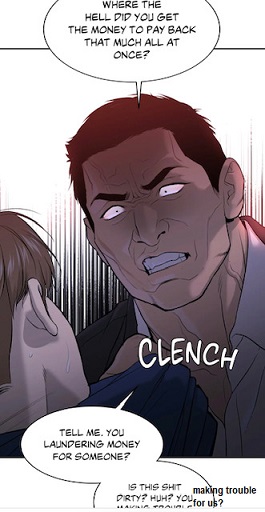 (chapter 11), he jumped to the conclusion that Dan was either prostituting himself or laundering funds. Why? It is because he had taken odd jobs, until he got hired by the dragon, Joo Jaekyung, and had such a huge income. Under this new light, it becomes comprehensible why Heo Manwook knew how to use the old lady in order to threaten doc Dan.
  (chapter 16) Like I wrote in a different analysis, I doubt that the grandma would have signed a loan by Heo Manwook. This reveals how Dan entered the contract in obscurity, without recognition or protection. He did it for Shin Okja’s sake to repay her for her support and “love”.
  (chapter 65) No wonder why Shin Okja never mentions the loans when speaking to Joo Jaekyung, thus erasing her responsibility. And imagine this: Doc Dan is now living with an elderly man who is a farmer. She might suspect that the senior is trying to take advantage from her “grandsons”. If this is true, then she would just be projecting her own thoughts and fears onto the landlord. Since she connects the city to success and money, I am quite certain that she doesn’t judge farmers in a positive light. For her, doctors or celebrities are much more recommendable persons.
In the following article, the paper’s data underline a social reality: farming in Korea is struggling, and its practitioners—despite their essential role—are economically marginalized. In 2022, average agricultural income per household dropped to just KRW 9.49 million (~US $7,300)—under the 10-million-won mark for the first time in 30 years. Farming households earn only about 20–27% of what they once made, a steep decline from over 50% in the 1990s. Structural issues—aging farmers, small-scale plots, high material costs, and price volatility—have trapped many in long-term economic strain. Far from being a supplement, farming is often no longer a primary income source, pushing many rural households into poverty, with younger generations fleeing to cities. This evolution is reflected in the Korean manhwa. The room of Doc Dan contains traces of a teenager who left the house. 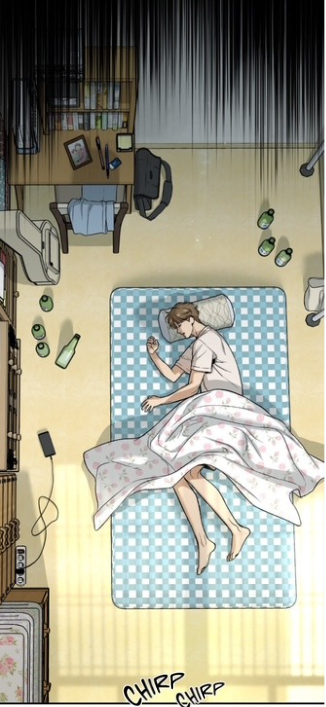 (chapter 57) Therefore I am expecting an argument between the halmoni and the inhabitants of 33-3. The landlord embodies the opposite values of Shin Okja.
The Cabinet’s Silence: Misattributed Memory
This layered confusion about the flats extends to the objects within the home, especially the massive mother-of-pearl bridal wardrobe. 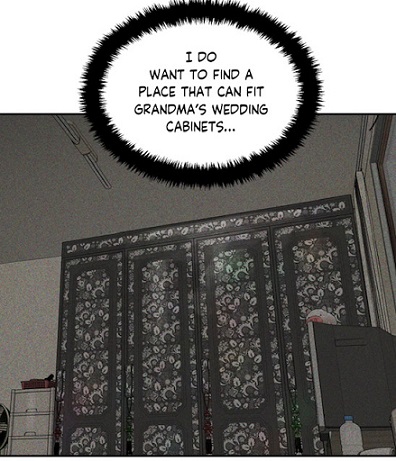 (chapter 16) Dan repeatedly calls it his grandmother’s and even dreamed of finding a new place that could house it—a gesture that underscores how much he believed she treasured the object, even though she herself never mentions it. But she never once references it, not even when returning from the hospital. The absence of interest is striking. What if the cabinet didn’t belong to her at all? Its size suggests that it predates the division of the house. Besides, according to my observation, she used to live in the other unit and I can not imagine, the halmeoni moving this furniture from one unit to the other. Perhaps it once belonged to Dan’s mother—a remnant of the original household, now misattributed to the woman who unofficially took over.
Dan’s reverence for the cabinet mirrors his longing for stable familial identity. He projects value  (chapter 19) onto the object just as he projects loyalty and gratitude onto his guardian. But the silence around the cabinet speaks volumes: it is not treasured by Shin Okja, only by Dan. Much like his name on the loan, or the house number on the door, it could be a misplaced inheritance. At the same time, such an item could serve to identify doc Dan’s true origins, if the Wedding Cabinet belonged to his true family.
The Wolf’s residence: 7-12
In contrast, Jaekyung’s initial intention was to stay in the seaside town only temporarily. (chapter 61) He claimed the move was for recovery and recuperation—a short break from his life in Seoul. Yet Korean law requires anyone staying in a location longer than a month to officially change their resident registration. If he were to do so, this would not just signal a change of address but a severing of administrative ties with Seoul—and by extension, Park Namwook and MFC.  (chapter 66) Changing his registration would mean stepping outside of the institution’s control and surveillance.
However, I doubt that the star has ever officially registered his stay. Like Kim Dan before him, he exists in a limited legal space—present but not formally tied. This ambiguity mirrors his emotional state. His real return to Seoul was always conditional—it depended on Dan’s willingness to follow him. 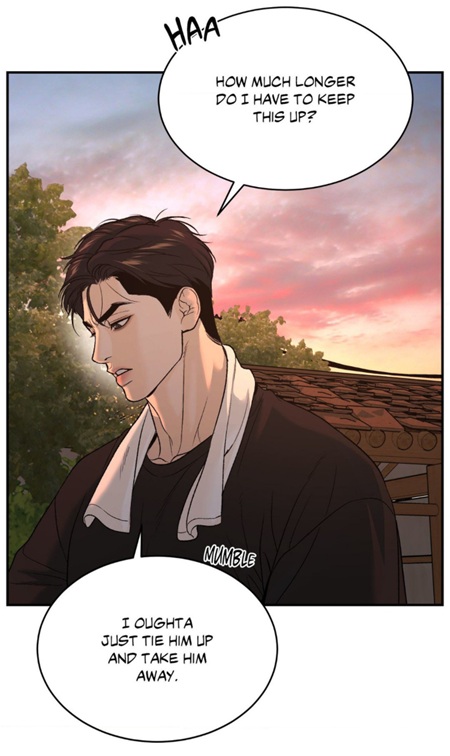 (chapter 62) Without Dan, Seoul held no meaning. But if he remains in the town past the statutory threshold, it would imply that he is ready to leave behind the world of contracts and competitions. It would mean he is now rooted—not by career, but by choice. Not by obligation, but by emotional truth.
In this way, the law becomes a mirror: resident registration, typically viewed as bureaucratic red tape, becomes a metaphor for chosen identity. The champion’s choice to return straight to the seaside town displays his psychological transition. He is no longer the man who moved through cities on training schedules. He is beginning to act like someone who stays—and stays for someone. And that someone is Kim Dan.
Conclusion: Opening the Right Door
The titular “hidden door to the past” is not just a visual motif—it is the emotional architecture of Jinx. By attending to overlooked details—address numbers, cabinet placement, financial responsibility, and architectural sleight-of-hand—we can trace the emotional fault lines that run beneath Dan’s quiet suffering and the champion’s slow awakening. The question is no longer just where they live, but who gets to call it home. The essay began with an image collage, but what it truly offers is a blueprint: not of real estate, but of memory, grief, and quiet resilience.
Feel free to comment. If you have any suggestion for topics or Manhwa, feel free to ask. If you enjoyed reading it, retweet it or push the button like. My Reddit-Instagram-Twitter-Tumblr account is: @bebebisous33. Thanks for reading and for the support, particularly, I would like to thank all the new followers and people recommending my blog.


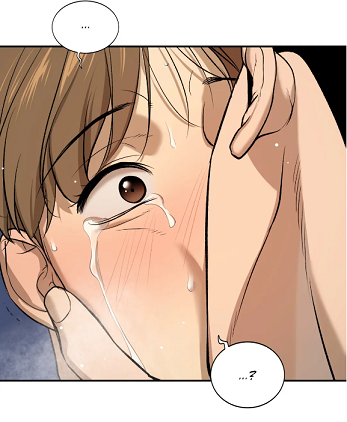 (chapter 14) For the physical therapist, this moment would later be confirmed.
 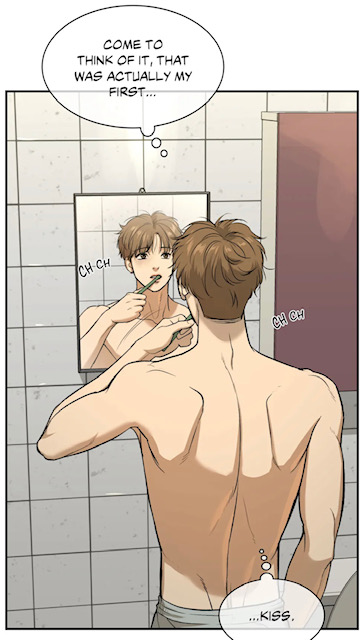 (chapter 16) —haltingly and with a trace of disbelief visible thanks to the points of suspension —as his first kiss ever. His stunned reaction and eventual admission offer a compelling lens through which to explore the symbolism of kissing in Jinx, but also the emotional landscape the two men must navigate.
  (chapter 55) Still, some readers have theorized the existence of a “special lover” in his past
 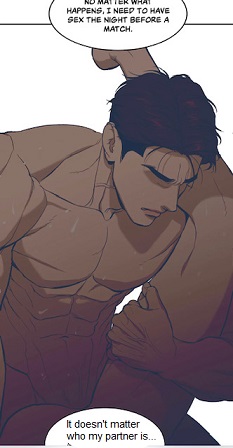 (chapter 2), someone who might have earned a different kind of intimacy. One cause for this hypothesis is that in the champion’s first memory, he was facing his partner, which contrasts so much to the way he had sex with his partners (from behind). This possibility casts the locker room kiss in a new light.
  (chapter 14) If it was his first, the gesture carries a far deeper meaning than either man realizes in the moment. And if it wasn’t, then why does this kiss—with Kim Dan—resonate so differently?
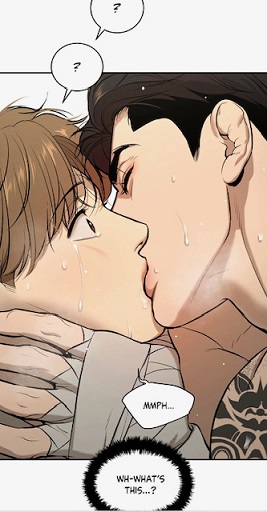 (chapter 15) she showed more than the physical therapist’s confusion with the interrogation marks, she added his inner thoughts. This question (“What’s this?”) already hinted that he had never experienced a kiss before. The ambiguity of his reaction suggested that the moment was unfamiliar, and not immediately recognizable as a kiss at all.
  (chapter 30) Recognizing his face, Dan mentions that his grandmother used to watch the drama A Fine Line, and that he had seen it with her.
 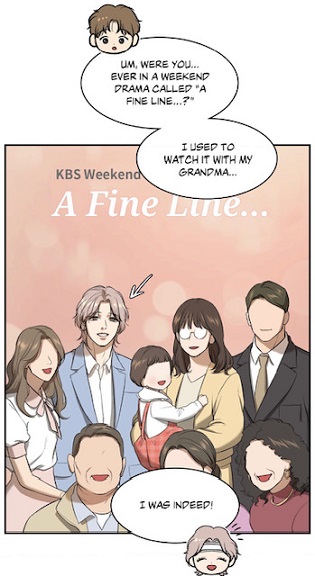 (chapter 30) The author even includes a framed shot from the fictional show, depicting Heesung as the smiling son-in-law in a multigenerational family. This visual insert is subtle, but telling: it wasn’t the story that stayed with Dan, but the faces—the aesthetics of family structure and polite emotional decorum.
 (chapter 16) it frightened him. The kiss broke an invisible boundary—one his upbringing had silently enforced. That’s the reason why he wasn’t sure if he could do it again.
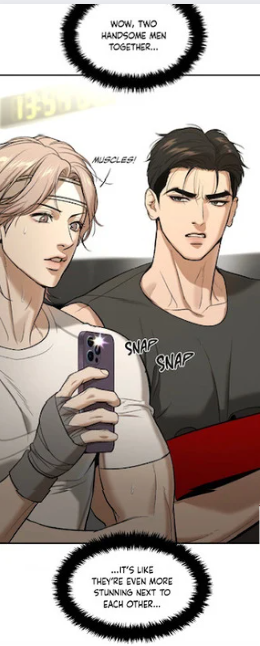 (chapter 30) He blushes and wonders why.
  (chapter 30) It’s a telling moment: Dan isn’t used to feeling attraction and desire, let alone recognizing it. He never bought posters of celebrities, never fantasized. That world—the glamorous world of affection, attention, and beauty—was never his.
 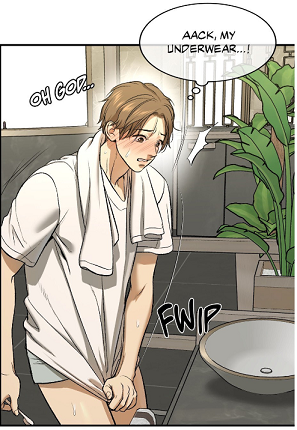 (chapter 30) —despite already having been seen naked by Jaekyung
  (chapter 30) —suggests something deeper than modesty. When he rushes to hide his underwear and blushes merely at brushing his teeth next to someone
 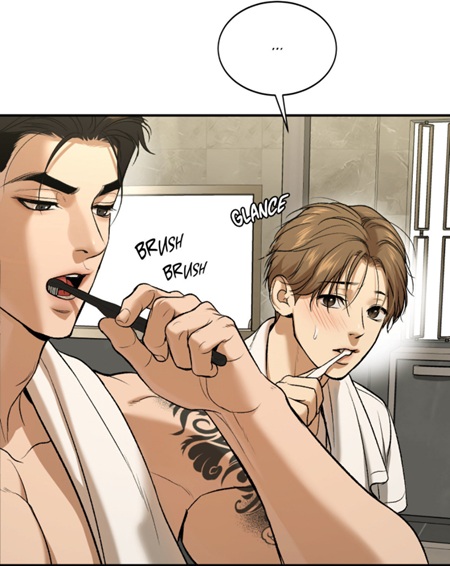 (chapter 30), it becomes evident: Dan is not accustomed to physical closeness or shared domestic spaces. These are not reactions of a man with just sexual trauma—they point to someone raised without the warmth of daily intimacy.
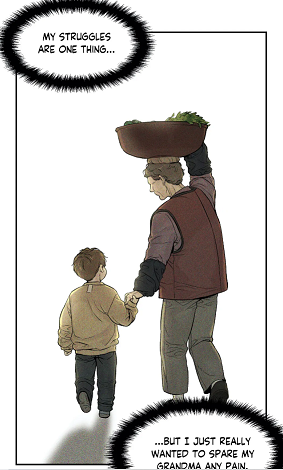 (chapter 5) He had to take care of himself, dressed on his own. He had to act like an adult, as his role was to assist his grandmother:
 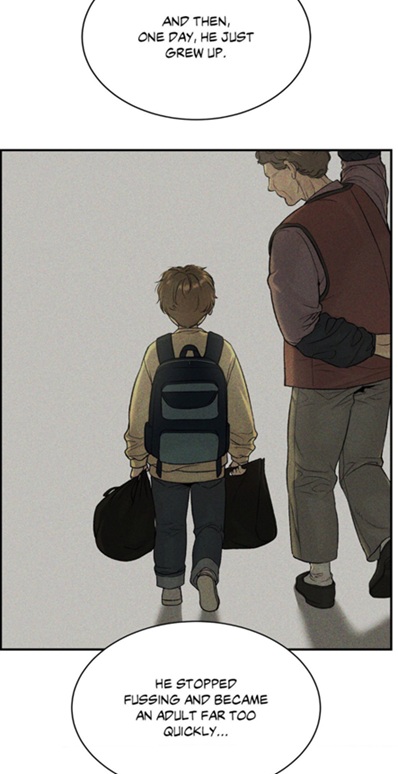 (chapter 65) This raises the possibility that someone else—most likely his mother—was his primary caregiver in early childhood. She would have changed his diapers, held him close, and kissed him gently.
  (chapter 65) This hypothesis and interpretation gets reinforced with the champion’s first kiss on his cheek
  (chapter 44) and ear
  (chapter 44) For me, without realizing it, Dan reproduced those gestures. These actions can not come from Shin Okja, as we only see her caressing or patting her grandson. The progression is striking. It moves away from eroticism (kiss from the lips)
  (chapter 44) and toward something far more intimate and protective. These are not the kisses of seduction, but of affection—almost maternal in their tone. Hence the MMA fighter got patted later:
  (chapter 44) They suggest care, comfort, and emotional presence. This is crucial, because it reveals that for Dan, a kiss is not about arousal or conquest. It is a language of love. They carry the flavor of instinct. These are the kinds of kisses a child might have once received, or given, in moments of safety and connection.
 (chapter 44) is a behavior shared by felines and wolves alike: a subtle act of comfort, trust, and bonding. Wolves nuzzle to soothe and reassure. Leopards nudge to display affection without threatening dominance. Dan’s pecks
  (chapter 57) (chapter 57)—licking them not out of instinct alone, but to reassure and bond.
 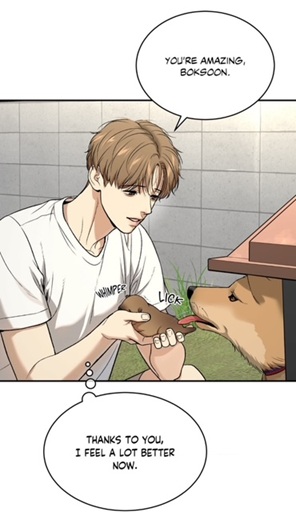 (chapter 57) During that summer night’s dream, Dan’s body mirrored this wordless care. That’s why he could laugh so genuinely like a child after witnessing his “pet’s reaction”.
  (chapter 44)
  (chapter 14) Therefore the physical therapist astonishment, “What’s this?” was not naïve; it was disoriented. Somewhere deep within, Dan had internalized a different model of kissing: one that reflected comfort, not conquest; affection, not arousal. The kiss he received was too strange, too fierce—it violated a definition he didn’t even know he had. His body knew how to kiss, but it remembered a different type of kiss altogether. The latter stands for love and as such emotions. Under this new light, my avid readers can comprehend why the physical therapist made the following request from his fated partner:
  (chapter 15) He needed to be “warned” in order to control his “heart”. As you can see, doc Dan had an innocent definition of the kiss. Therefore it is not astonishing that the wolf’s first kiss confused him so deeply: it shattered the only blueprint he had for intimacy.
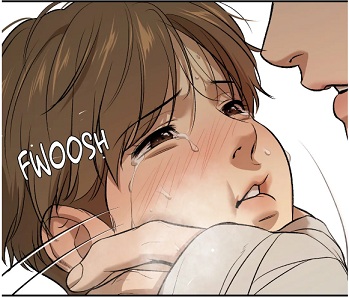 (chapter 14) Jaekyung repeated such a gesture, as seen in chapters 24
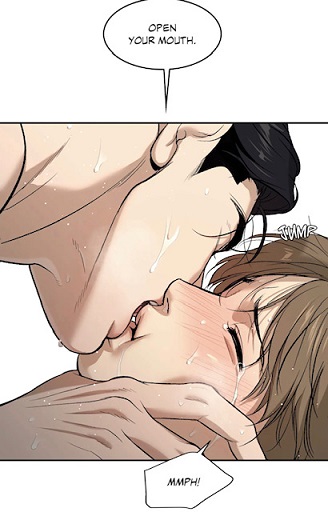 (chapter 24), and again in 64
  (chapter 64). These gestures were not expressions of tenderness, but acts of dominance, mirroring how the celebrity was taught to treat intimacy: not as an exchange, but as an imposition. His behavior echoes Cheolmin’s earlier suggestion
  (chapter 13) where a little touch was functional. On the other hand, the suggestion framed “affection” as a form of fun and entertainment, meant to soften the experience and shift the focus toward the partner. While Cheolmin’s comment was not malicious—in fact, it encouraged Jaekyung to become gentler and more attentive—it still fell short of true emotional connection. Why? It was a medical suggestion, meant to protect Dan’s fragile state. The kisses in episodes 14 were to protect the physical therapist. They were initially functional, a mean to achieve a goal before becoming a habit.
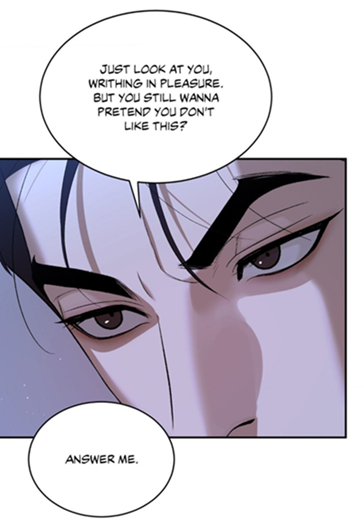 (chapter 63) Fun is not the same as love, and this distinction matters deeply for someone like Kim Dan, who associates kissing with emotional safety and love, not performance or play. This explicates why he refused to be kissed in episode 63:
 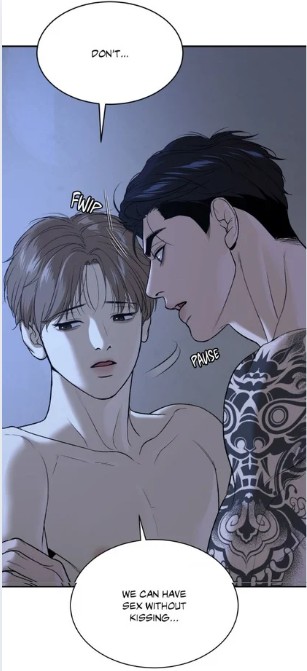 (chapter 63)
 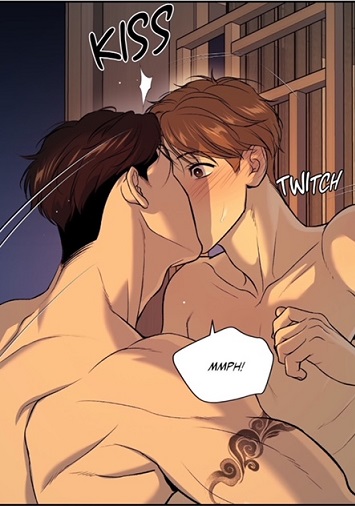 (chapter 44), Dan’s were soft, exploratory, almost reverent. His lips touched not just his lover’s mouth, but his cheek and ear—tender sites that bypass eroticism in favor of emotional intimacy. These weren’t prolonged, devouring kisses. They were pecks, small and deliberate. They mirrored affection, not possession.
 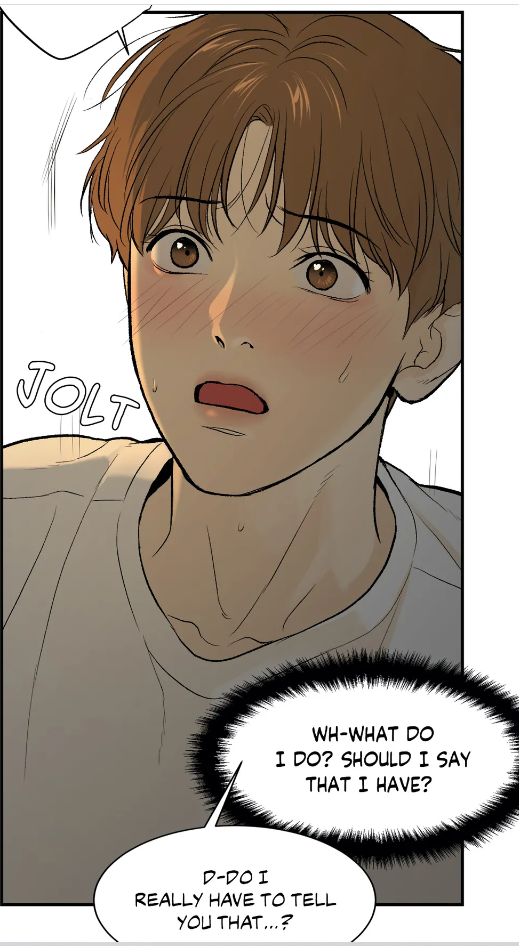 (chapter 3) —it forces the wolf to ponder on the meaning of a kiss and his relationship with the physical therapist.
 In that iconic artwork, the man does not kiss the woman on the mouth, the traditional locus of erotic desire. Instead, his lips are placed upon her cheek—a gesture that suggests reverence, not possession; vulnerability, not domination.
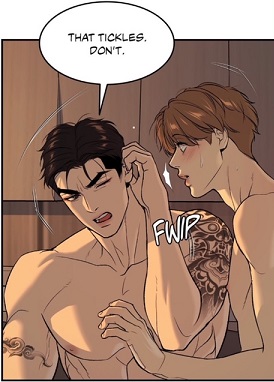 (chapter 44)
  (chapter 45)
 (chapter 54) When he was young, he had to face an abuser. Notice that the man’s face was very close to the champion’s
  (chapter 54). Thus I interpret that for the champion, the face represents not only his vulnerability, but also a source of danger. That’s the reason why he couldn’t hide his displeasure and frustration, when he faced this “lover”.
  (chapter 44) He couldn’t hide his joy by the champion’s funny reaction and laughed. And how did the protagonist react to this? Not only his face expressed his dissatisfaction, but also he silenced his partner with a kiss right away:
  (chapter 44) Joo Jaekyung is leading the kiss, he is regaining control over their relationship. It reinforces the idea that the wolf’s kiss was not merely about passion, but about reclaiming dominance and halting a shift in power. Just moments earlier, Kim Dan’s laughter had opened a space of emotional intimacy and lightness, which the champion was not prepared to face. The kiss, now prolonged and intensified, becomes the sportsman’s way of reasserting control over a situation that was slipping into unfamiliar emotional territory.
 (chapter 45) The marks on the doctor’s body were evidence that he was no longer in control. They weren’t just signs of a physical encounter—they were witnesses to something far more threatening: vulnerability, softness, and reciprocity. In the night, swept up by instinct and unspoken longing, the wolf had allowed himself to be touched—not just physically, but emotionally. But by morning, the spell was broken. His gaze didn’t linger on Kim Dan with affection—it darted instead to the bruises and scratches as though they were accusations.
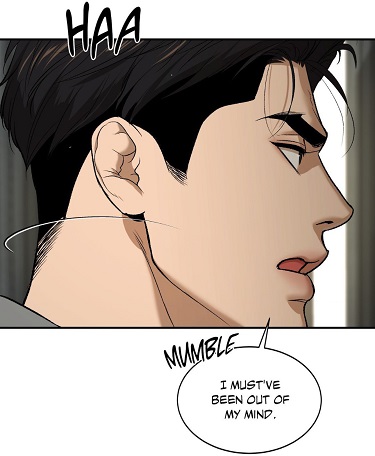 (chapter 45) wasn’t just the pain he might have inflicted—it was the realization that the balance of power had subtly shifted. The man who had always dictated the terms of their relationship had surrendered to something unfamiliar: tenderness, emotional closeness, and shared desire. The fact that Kim Dan initiated affection, even kissed him voluntarily, shattered Jaekyung’s script. For someone who conflated feelings with threat, and dominance with safety, this reversal was unbearable.
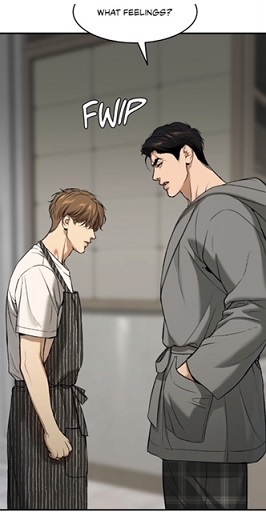 (chapter 45) —and that he, in turn, had wanted Dan back. This terrified him more than any bruise ever could.
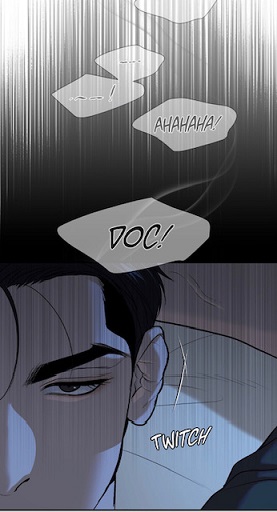 (chapter 37), and kissing becomes his emotional brake pedal. It’s not simply an act of love, but a means to regulate, or even drown out, what he cannot yet name or accept: that he is being loved. It is not random that I included the scene from episode 37: he heard laughs from the other room. For him, such a noise must have sounded like a disrespect and mockery, triggering his past trauma. And he was not entirely wrong in the sense that they were eating behind his back
  (chapter 37) It was, as if they were mocking him because of his forced “diet”. No wonder why the champion is barely seen laughing and prefers seriousness. At the same time, I can grasp why the athlete feels close to Park Namwook, as the latter stands for these exact notions: work, money and seriousness. Fun is not part of his world and vocabulary, therefore he punished Joo Jaekyung for sparring with doc Dan.
 (chapter 2) Though his face was close to the star’s, he didn’t attempt to kiss him. In fact, he proposed him a fellatio, a sign that the champion had never allowed anyone to get close to his “face”. Finally, observe how he reacted, when the uke in episode 55 attempted to kiss him:
 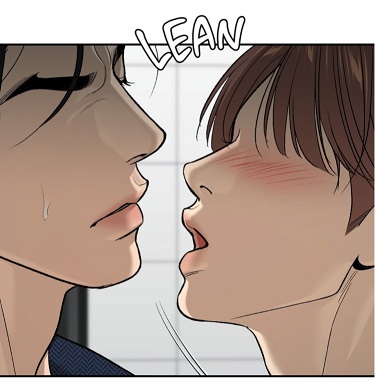 (chapter 55) Not only he rejected him, but also he pushed him violently so that the latter was on the floor.
 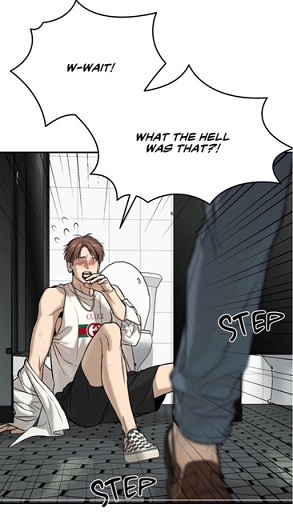 (chapter 55) The celebrity even ran away: a sign that the allowing someone approaching his face is perceived as something uncomfortable and threatening. At the same time, that moment exposes the kiss as something sacred—one that cannot be duplicated without emotional violation. This shows that for the champion, the meaning of a smooch has evolved. It is no longer perceived as a source of fun and a mean to gain something.
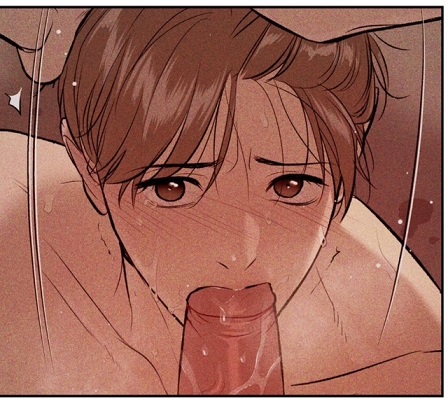 (chapter 55) He couldn’t forget doc Dan’s face, the latter excited him, a sign that for the champion, the face in general has been a source of pain, yet thanks to doc Dan, the latter has become a source of “comfort and joy”.
  (chapter 66) When he saw his face for the first time, he didn’t realize that he was already under the hamster’s spell. Striking is that he even focused on his chin and lips, a sign that he desired to kiss them. One thing is sure. The champion treasured the doctor’s face. After their separation, it is not surprising that the wolf felt the need to see his face.
 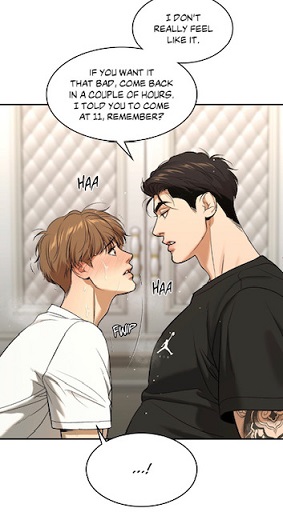 (chapter 39) before requesting a fellatio:
  (chapter 39) The main lead’s head was very close to the champion’s face, thus he must have felt uncomfortable. Secondly by acting this way, the doctor was gradually gaining power over their relationship. For the wolf, dominance is everything, an indication that in his past he felt defenseless and weak. His “opponent”, the mysterious ghost, had the upper hand. Moreover, the fellatio created a distance between them, where the fighter could expose his superiority. And note how doc Dan behaved under the influence of the drug:
  (chapter 39) He caught his fated partner by surprise, when he suddenly kissed him, mirroring the champion’s past behavior. This panel corroborates that for the doctor, a kiss is the symbol of love. The champion was not happy with this kiss too, for the latter meant that he was no longer controlling their relationship. Yet, after hearing the doctor’s confession during that night, the athlete no longer resisted his partner’s kisses.
  (chapter 39) For the first time, he accepted Dan’s initiative—both physically and emotionally. Compare it to his attitude before:
  (chapter 39) here, he still has his eyes wide open, a sign of vigilance. These kisses from doc Dan
  (chapter 39) mark a turning point in Jaekyung’s arc: he begins to lower his defenses, allowing Dan not only into his personal space but also into a position of gentle agency within their relationship. The kiss no longer represents a threat; it becomes an opening and a sign of trust.
 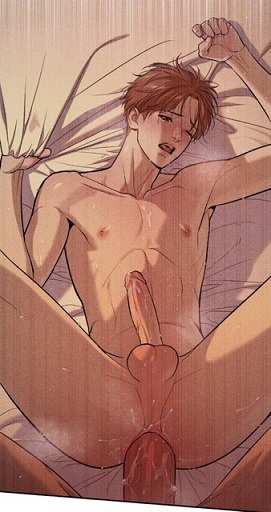 (chapter 55) These memories represent the moment where the athlete felt strong and had the upper hand in their relationship. These images reveal that Joo Jaekyung hasn’t realized the signification of the kiss yet. For him, they don’t seem important. This exposes that the athlete has not associated kiss with love and affection yet. At the same time, we have to envision that a smooch is strongly intertwined with equity and trust.
  (chapter 28) And in episode 14, it was clear that the star still felt superior to his companion, therefore the kiss had no special meaning. As you can see, everything is pointing out that Joo Jaekyung had never been kissed before. And what does a kiss symbolize? Not only attachment, but also purity and innocence.
  (chapter 42) According to him, doc Dan was not different from him. However, he was wrong. It is because the champion had kissed him!! Moreover, the celebrity had allowed doc Dan to kiss him as well. Besides, how did the champion name his past lovers? They were toys… normally people don’t kiss playthings. And now, imagine that doc Dan were to discover that Joo Jaekyung had his first kiss with him. This revelation would not only make him realize that Joo Jaekyung loves him, but also he could be wondering why the athlete had never done such a thing before, though he had past lovers. YES, the “first kiss” could be the trigger for both characters to question their respective past and perceive their fated partner correctly.
  (chapter 15)
 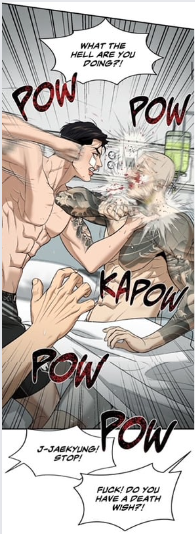 (chapter 52) In that context, a kiss could never be affection, but vulnerability. A risk.
 (chapter 3), based on Dan’s vague claim of prior partners. Yet Dan has never kissed anyone before. The kiss becomes his true moment of loss, a quiet confession through action. Conversely, Jaekyung’s own discomfort shows that he, too, is untouched in this particular way. When Dan tries to kiss Jaekyung again, and he instinctively rejects it, it reveals just how unprepared he is for affection. They are both unaware that the other is emotionally “pure” in this regard, and that makes the kiss a shared revelation.
 (chapter 67), Jaekyung must reinvent his approach. He cannot rely on dominance, strength, or sexual performance to win Dan’s heart. If he wants true connection, he must learn a new language—one built on gestures of affection, softness, and presence. This process also involves separating his public persona from his private longing. Joo Jaekyung, the champion, cannot seduce with spectacle. But Jaegeng, the man, might learn to express love through a simple touch, or a well-timed kiss. The redefinition of seduction is not just about Dan’s healing; it is about the wolf’s reclaiming his own right to feel and give love. And in my opinion, that process has already started:
  (chapter 69) That moment was devoid of lust, stripped of performance, and free from power dynamics. Jaekyung didn’t lean in for a kiss; he didn’t touch Dan’s lips or body with any sexual intent. Instead, he wrapped his arms around the physical therapist in silent reassurance, tucking his face against Dan’s shoulder as though hiding from the world. This was not a champion claiming a prize—it was a man expressing affection. The embrace exposes that doc Dan belongs to his “world” and he trusts him. In this light, the embrace becomes a prelude to a kiss—not a literal one, but an emotional kiss: a meeting place of vulnerability and longing.
 (chapter 65) nor his past partners provided him with genuine and affectionate touch, Jaekyung must look elsewhere.
 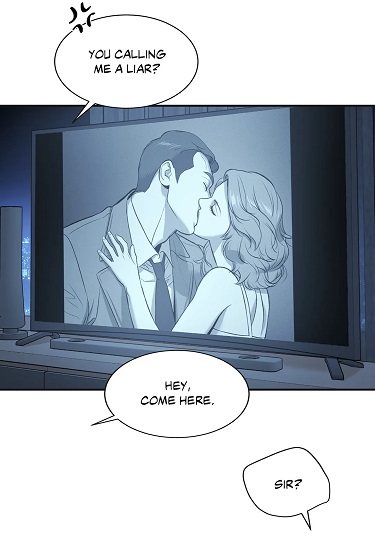 (chapter 29: note that he did not select this scene to rekindle with the doctor, but the other scene) He will learn it from life, from watching how the innocent express care without shame or purpose.
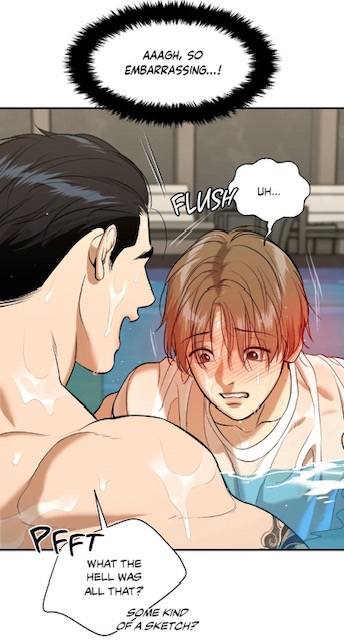 (chapter 27) In Jaekyung’s past, laughter had been a weapon—an expression of ridicule and cruelty from an abuser.
  (chapter 62) If someone had laughed in front of him and made fun of him, this would have reopened his old wounds.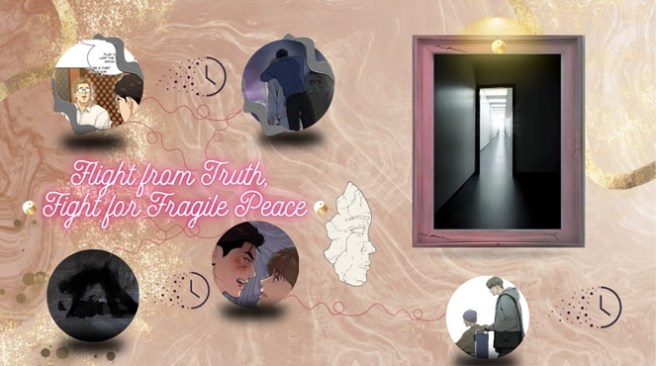
 (chapter 47) and denial for strength
  (chapter 61), Park Namwook
  (chapter 69), and Shin Okja
  (chapter 53) all operate within survival mechanisms shaped by trauma, guilt, and fear. They choose the illusion of control or calm over genuine healing. But as the story unfolds, these strategies begin to unravel. Each character must confront the truth behind their emotional habits, learning that happiness isn’t the absence of pain—it’s the result of confronting it with clarity and purpose.
 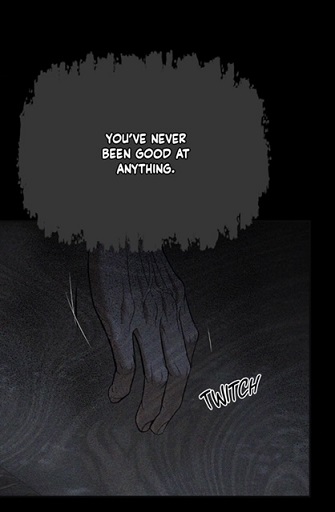 (chapter 54) He could only express his pain and resent through the hand. This moment encapsulates the core of his trauma: as a child, he learned to survive through silence and compliance, not resistance. Yet deep down, the resentment festered—toward himself, and toward the abuser. That psychological pain was redirected into becoming a fighter, as if to prove the abuser wrong.
  (chapter 26)
 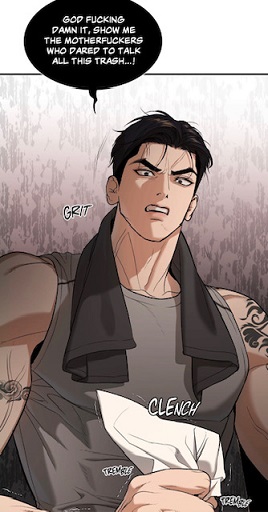 (chapter 36) His language was dominance, not dialogue. He didn’t process his emotions through words—he suppressed them, until they erupted in violence or withdrawal.
  (chapter 34)
  (chapter 1) And crucially, he didn’t leave right away either despite his embarrassment and fears.
 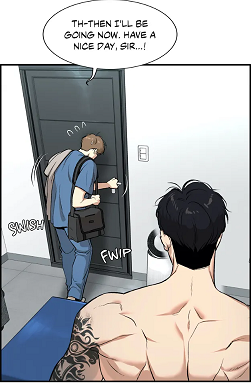 (chapter 1) Thus for the first time, Jaekyung had to develop a new strategy in order to meet him again: one that doesn’t rely on intimidation, but on communication. The problem is that since he saw the physical therapist running away after their first session
  (chapter 1), he knew that he needed to lure him with something: money
  (chapter 1). Under this new light, my avid readers can grasp why the athlete played a trick on the phone, though we have to envision that here the celebrity’s thoughts were strongly influenced by his bias and prejudices. He imagined that Doc Dan had made a move on him.
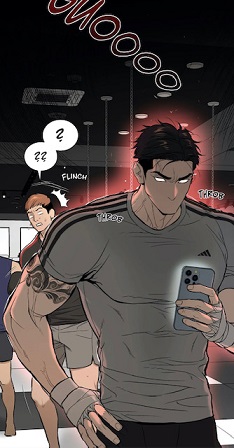 (chapter 5) That retreat doesn’t mean failure—it can be an act of self-preservation. However, the champion experienced that he needed to speak with doc Dan in order to keep him by his side. This lesson became a turning point. Jaekyung started to speak more.
  (chapter 18) Therefore it is no coincidence that in episode 18, right after the celebrity spoke, Kim Dan’s reply was strongly intertwined with flight:
  (chapter 18) The denial of kindness from the champion made the doctor uncomfortable, the latter felt the need to leave the penthouse as soon as possible. The lesson for the star was to realize that words are powerful and can affect people. But Joo Jaekyung didn’t grasp it, as he chose to use sex to „submit“ his fated partner.
 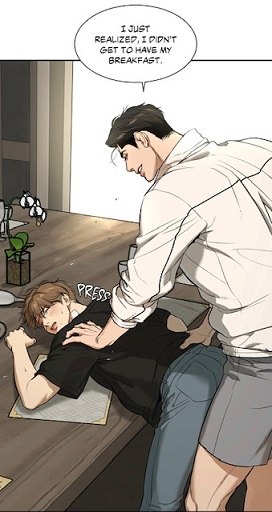 (Chapter 18) Nevertheless, as time passes on, the wolf asks more and more questions. He reacts to emotional discomfort not only with physicality but with hesitation, introspection. He is no longer reacting as the ghost once taught him; he is arguing and as such adapting, growing. Thus we could say, he is less passive.
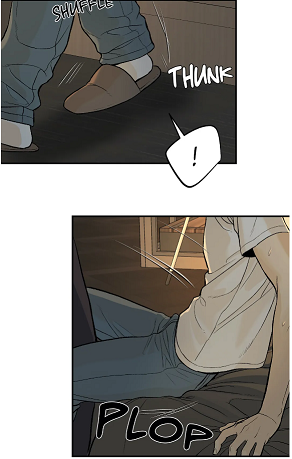 (chapter 3) or table, in showers
 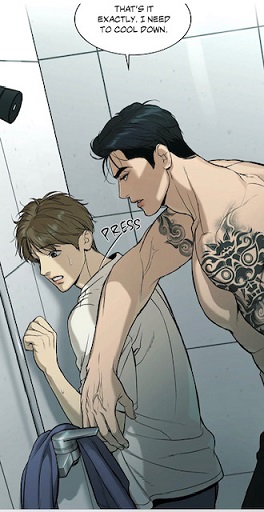 (chapter 7), against doors, or walls
  (chapter 34). On the surface, it may seem like a gesture of dominance or desire, but symbolically, it reflects silencing.
 (chapter 51) They stand in the middle of the room—an open space—symbolizing emotional emancipation. When Dan questions the celebrity
  (chapter 51), the words from doc Dan pierce the champion’s emotional defenses. Thus Joo Jaekyung is destabilized.
 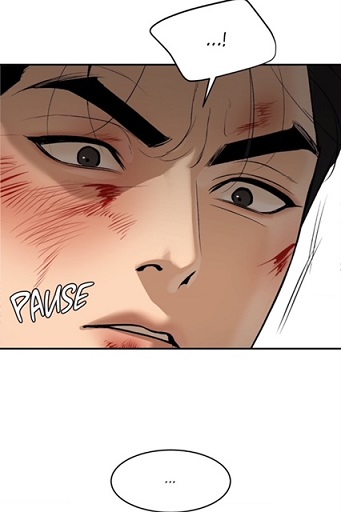 (chapter 51). The latter tries to reassert control
 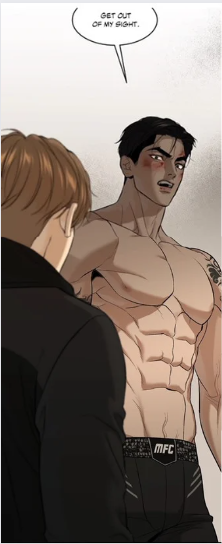 (chapter 51), but this time, when he lashes out, he is the one who leaves. This is cognitive dissonance at work: the fighter cannot reconcile his fear of vulnerability with his emerging need for connection and his perfectionism. So he defaults to a performance of control, even as he runs from it. And while one might mistake this for weakness or regression, it actually displays a progression. First, Jaekyung had finally revealed his thoughts and fears to Dan.
  (chapter 51) Secondly, he left the place which was a new MO for the fighter. His act of fleeing is no longer an escape from confrontation —it follows a moment of emotional vulnerability. It shows that he had finally dared to speak, even if he wasn’t yet ready to stay and endure the emotional aftermath.
 (chapter 69) That silence could easily be mistaken for submission, for the same old performance of the compliant athlete.
  (chapter 69) But that would be a misreading. His silence is no longer a symptom of fear or control. It is a deliberate withholding—a sign that he no longer plays by their emotional rules. He is starting distancing himself from MFC, Park Namwook and the fight-centered identity they crafted for him.
 (chapter 69) After all, to those still invested in dominance hierarchies, leaving the capital after a public defeat seems like the behavior of someone who’s been defeated mentally as well. But the truth is the opposite. This “retreat” is actually an act of autonomy. For the first time, Jaekyung is giving himself space—not to run, but to reflect.
 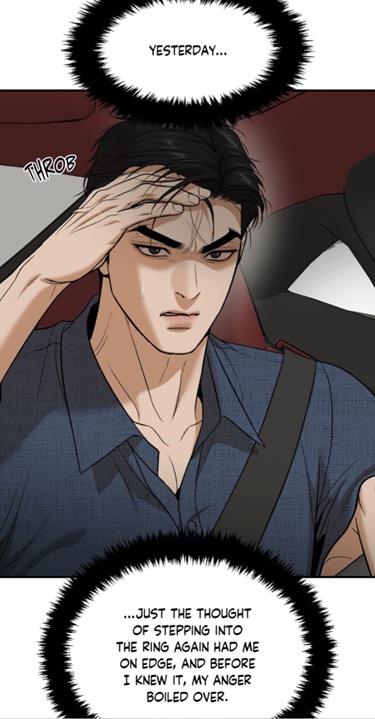 (chapter 69) He is no longer blindly performing the role of the fighter, nor desperately trying to maintain control over the narrative.
  (chapter 69) He is beginning to think critically about his past behavior, his future, and the systems that have defined his identity and life.
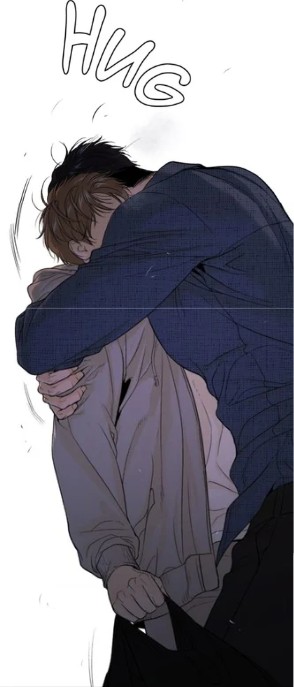 (chapter 69) with “no audience” (he ignores people), no pressure, no script. And in that openness, he lets go—not just physically, but psychologically.
  (chapter 7) and flight
  (chapter 52), often using blame as a shield. When crisis strikes, he blames the champion’s temper, relies on Doc Dan
  (chapter 36), or MFC’s decisions.
  (chapter 69) He surrounds himself with “assistants” like coach Yosep, Kim Dan or Joo Jaekyung
  (chapter 25: here the protagonist was replacing Yosep and Park Namwook), hires professionals to manage damage
  (chapter 47), and hides behind administrative actions.
 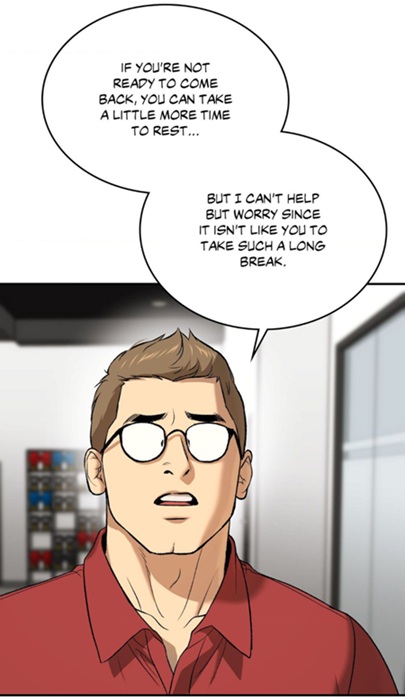 (chapter 66) that cornered the manager.
  (chapter 66) As long as the champion was nearby, Park Namwook could project blame onto him, framing him as unstable, disobedient, or temperamental. But once „his boy“ vanished from Seoul, the hyung was left exposed. Striking is that he is not seen watching over the training of the remaining members.
  (chapter 60)
 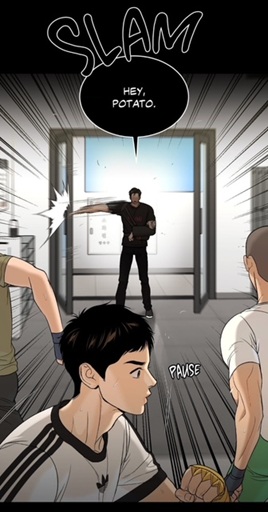 (chapter 60), a sign that he is neglecting the other members. The absence of his star fighter removed his most convenient scapegoat, forcing him to face the consequences of his own mismanagement—though he is not yet ready to truly question it and change his mindset, denial, and dependency. This was not just a geographical disappearance—it was a strategic psychological rupture, meant to destabilize Park’s illusion of authority.
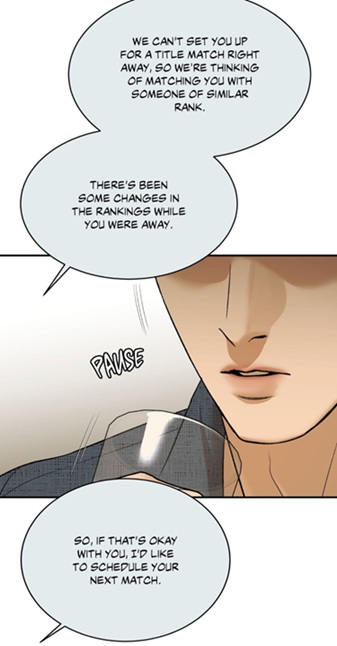 (chapter 69) He continues to speak as though the champion’s future is intact, as if the title is still within reach. But the organization’s actions speak louder: Jaekyung is no longer a contender — he is being gradually abandoned, not promoted. Secondly, Park Namwook assumes that Jaekyung will win the next fight, as if victory is still within his grasp. But this trust is misplaced — not only because the fighter is recovering from surgery, but because the schemers may have already designed this match as a final blow. Another fight right after a surgery, a staged defeat, or a quiet elimination would neatly push Jaekyung out without public controversy. By assigning him a marginal, delayed match, they are not offering redemption — they are orchestrating his exit.
 (chapter 17) They don’t see him as someone with legal or institutional power. But that’s their fatal blind spot. Since Jaekyung co-owns or outright owns Team Black, this makes him: A partner (or even rival) in MFC’s talent pipeline; an employer and a stakeholder in fighter safety. He has the same position than Choi Gilseok. Therefore as the owner of Team Black, he can sue the gym King of MMA and Choi Gilseok. He can take action against the CEO for negligence, corruption or abuse of authority.
 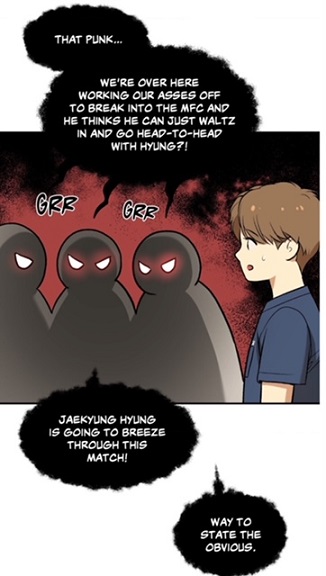 (chapter 47) Finally, he can testify not only as a fighter, but as a representative of the institution they tried to exploit. That elevates his voice: from a disposable athlete to a legal opponent with organizational standing.
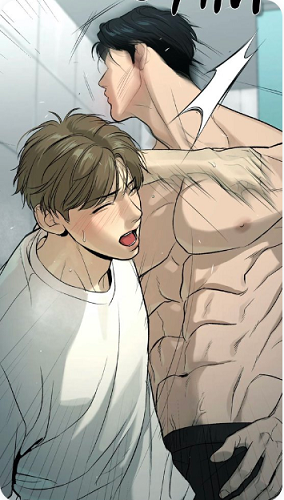 (chapter 7) For a moment, he was fighting.
 (chapter 67) Moreover, in contrast to Season 1, Kim Dan is no longer the invisible caregiver or obedient grandson. Thanks to Joo Jaekyung’s presence—disruptive and painful as it was—he began to form an independent identity
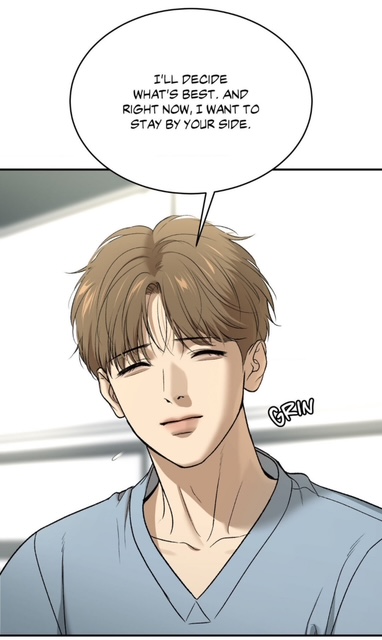 (chapter 57), one no longer shaped entirely by duty or guilt. The grandmother, however, is blind to this change. She continues to speak to him as if he’s the same self-sacrificing boy
  (chapter 57) —it is a rejection of the belief that he exists only to serve. In Season 2, Dan says “no” repeatedly:
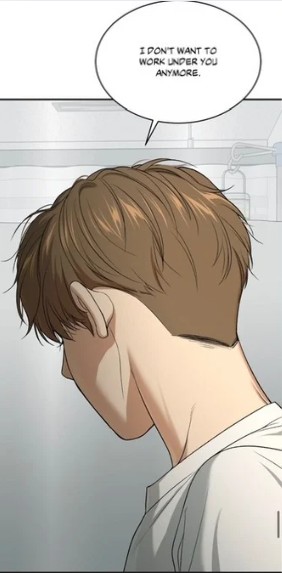 (chapter 60)
  (chapter 67)
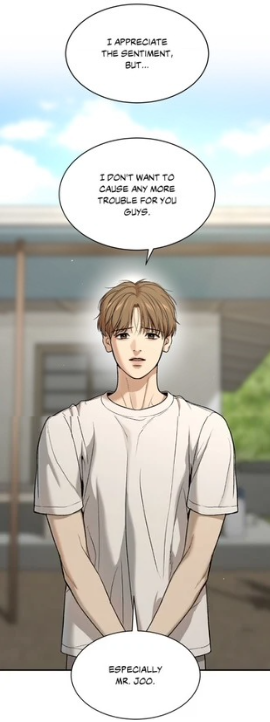 (chapter 58)
  (chapter 57)
 (chapter 65) She uses his past flaws to outline his immaturity and need of guidance. However, she is not taking into consideration the transformation in the doctor due to the recent incidents (switched spray). He is no longer the same than he was 6 months ago or 2 years old. He changed thanks to the athlete and because of unfortunate events (sexual harassment from the hospital director, switched spray). But the halmoni has no idea about such incidents.
  (chapter 53) Unlike Park Namwook who uses blame and delegation in professional settings, she applies emotional avoidance in private and familial spaces. Much like the manager, she outsources responsibility, asking others to step in
  (chapter 65) Her silence is not protective—it is evasive.
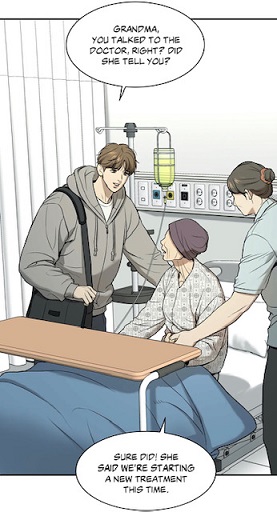 (chapter 7), medication, comfort
 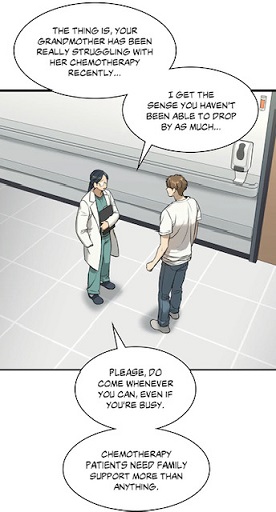 (chapter 21), and other people (nurse, Joo Jaekyung) —to maintain her emotional balance. But as doc Dan himself once observed, she is ultimately on her own in her battle. No system can fight it for her.
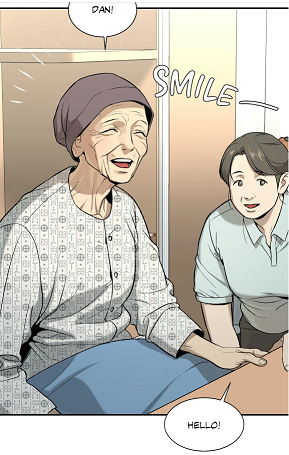 (chapter 7) His grandmother was not truly abandoned; she simply equated his physical absence with neglect, ignoring the emotional and financial burden he already carried. Like Park Namwook, she prefers others to carry the discomfort while maintaining a façade of suffering and sacrifice.
  (chapter 65)
 (chapter 47) , and her narrative of selflessness becomes another form of emotional pressure. She does not yell, she does not accuse directly, but her avoidance is equally powerful in shaping Dan’s self-image as a burden. Doc Dan came to internalize that she suffered because of him.
 (chapter 57) —his visible exhaustion, disconnection, and quiet suffering—becomes a thorn in her eye, a reminder that her peace is not whole. As long as he suffers, she cannot entirely escape the shadow of her own regrets. Sending him away to Seoul represents a new of flight. Out of sight means out of mind. That way the grandmother wouldn‘t have to worry about doc Dan, as he has been entrusted to the athlete.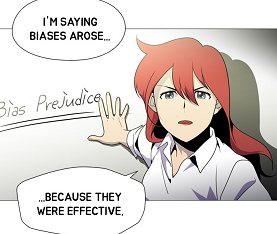
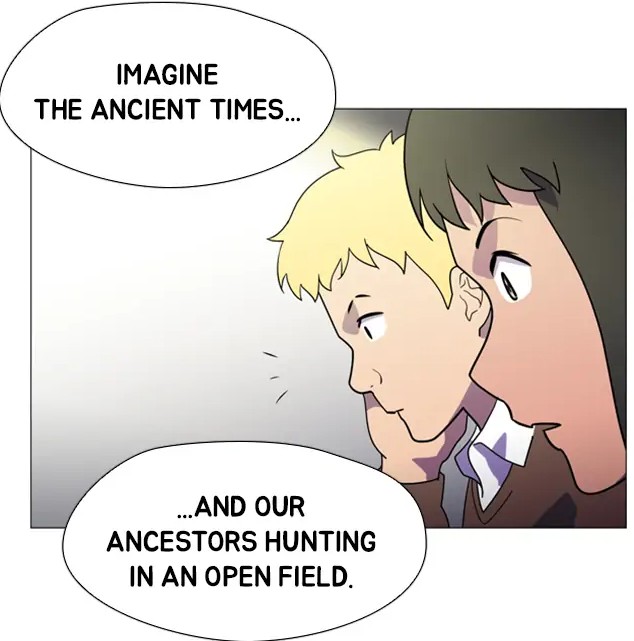
 (chapter 163) and supported by the article on confirmation bias, human survival was deeply dependent on mental shortcuts. Biases were not flaws, but adaptive tools — heuristics that helped our ancestors make quick decisions under threat. Faced with a potential predator, they could not afford the luxury of curiosity or debate. Run first, think later.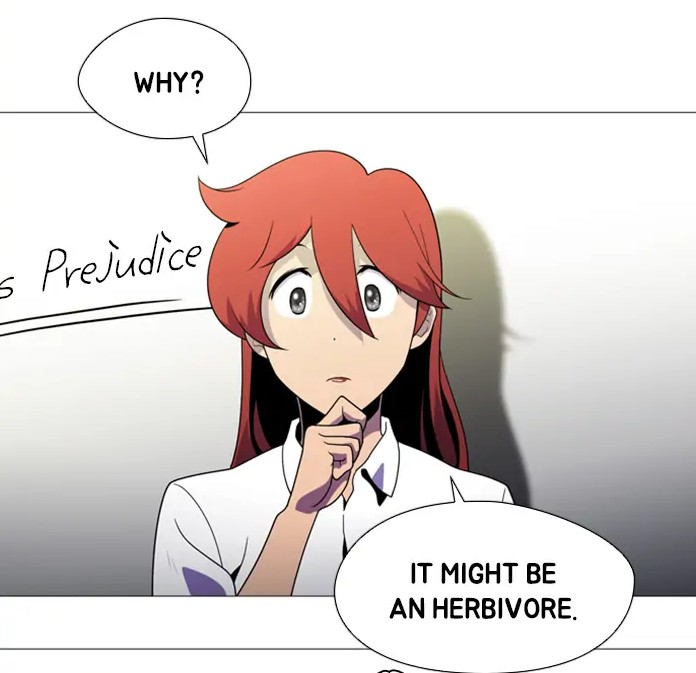
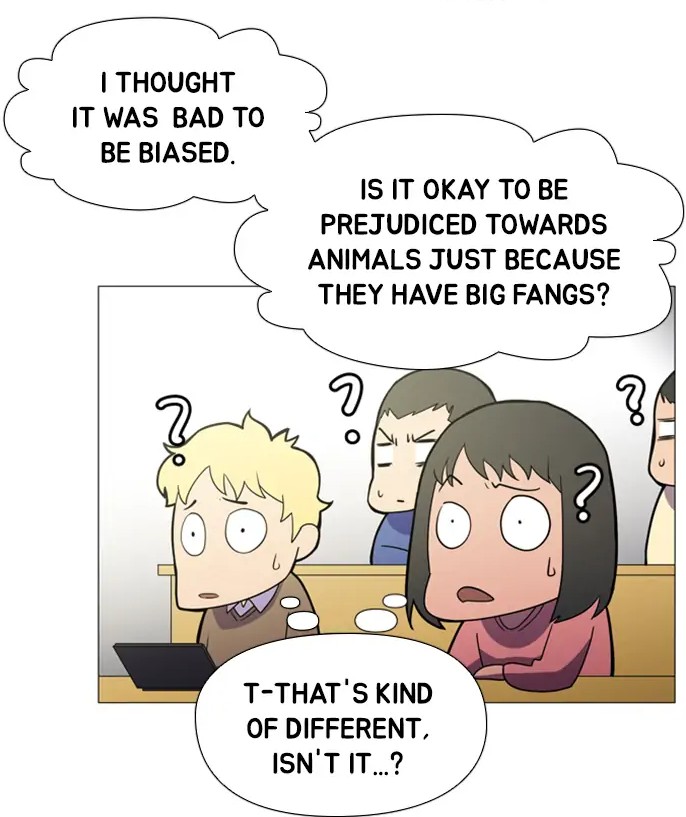 (chapter 163) In this sense, biases were effective precisely because they increased the chance of survival.
 (chapter 9) But once Joo Jaekyung became the target of criticism and scandals, his fear response activated.
  (chapter 41) he recommends the opposite at the restaurant because the idea comes from the CEO!
 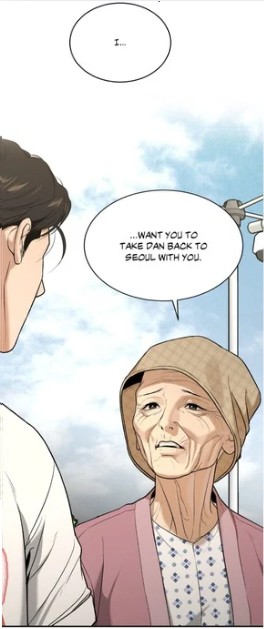 (chapter 65) It was her decision to settle down at the hospice.
  (chapter 67) His survival bias told him: “Don’t trust a man who once treated you violently.” or “Doctors are ignorant, they don’t know me“. It was easier to discredit the source than to weigh the merit of the message. Likewise, in Season 1, the champion dismissed doc Dan’s medical opinions
  (chapter 41), trusting instead in MFC and his agency — despite the fact that those institutions are overtly motivated by money. His bias protected his ego, but at the cost of his health and relationships.
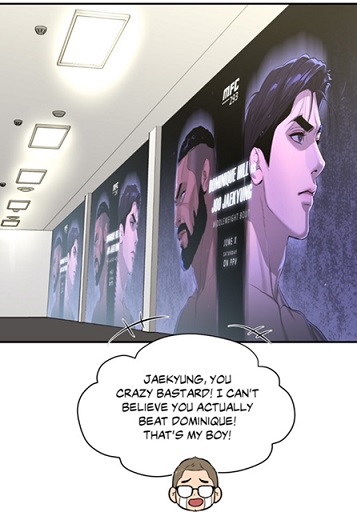 (chapter 40) who needs to fight to prove himself, yet likely doesn’t treat his own family this way.
 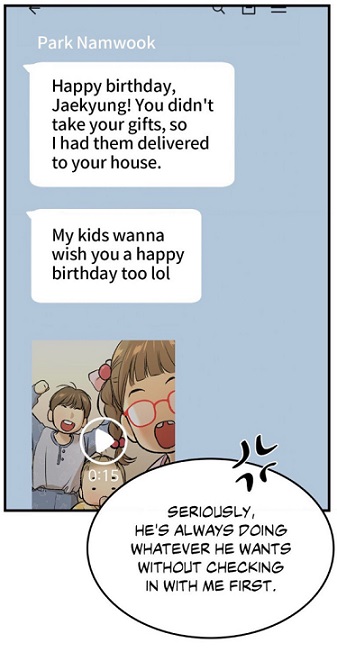 (chapter 45) His double standard is not conscious hypocrisy — it’s a form of selective laziness. He does not challenge his beliefs because doing so would unravel the identity he’s built as a competent, authoritative manager.
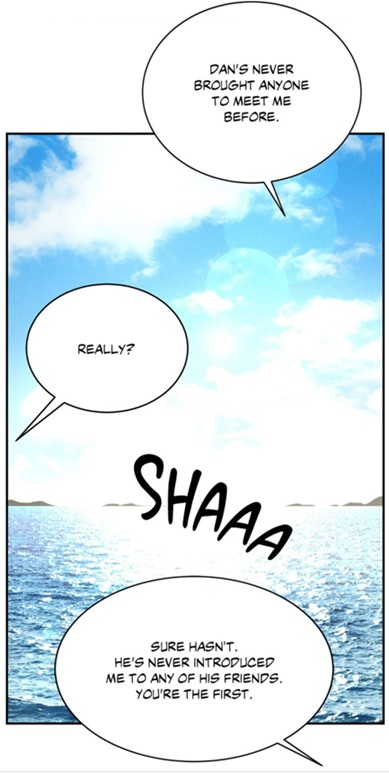 (chapter 65) or a support network. It is not her fault, if she never met doc Dan’s friends in the past while hiding the fact that he had been bullied by his peers. Her request for him to return to Seoul, a place he has no roots, only furthers his habit of isolation. Similarly, when she asked Jaekyung to bring him to Seoul and have him diagnosed, she implicitly discouraged any shared decision-making. Like Park Namwook, she bypassed dialogue in favor of directive control, reinforcing the habit of emotional withdrawal.
 (chapter 67) That shift marks a turning point from survival to conscious thought. The mind cannot reflect when it believes it is under attack. The tragedy is not that these characters are irrational — it’s that they were taught fear before they were taught trust. Thus I come to the following conclusion. As soon as both are curious about each other
 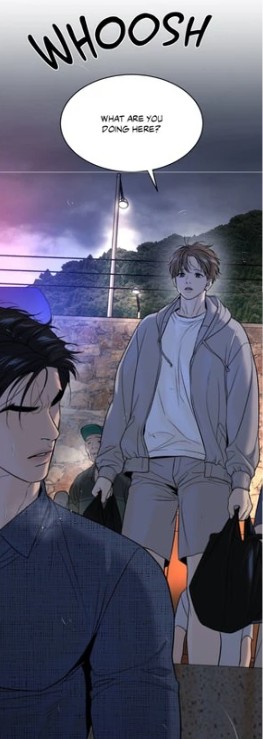 (chapter 69), they are now free from their bias and prejudices.
  (chapter 69) They will be able to communicate which will help them to discover the truth about MFC. Yes, their ability to ponder will lead them to unmask the villains and defeat their opponents. By fighting for justice, both will discover true peace of mind. This hardship at the end of season 1 was necessary to reset their heart and mind: what is the true meaning of life? Money? Work? Duty? Sacrifice?… The answer is happiness which is strongly intertwined with love and selflessness.

 (chapter 69) it is a harbinger of disruption. A radio broadcast delivers the warning: skies turning cloudy, strong winds forecasted at 20 to 25 meters per second. This is no ordinary breeze. It signals the arrival of a whole gale—powerful enough to topple trees, strip rooftops, and fracture routines.
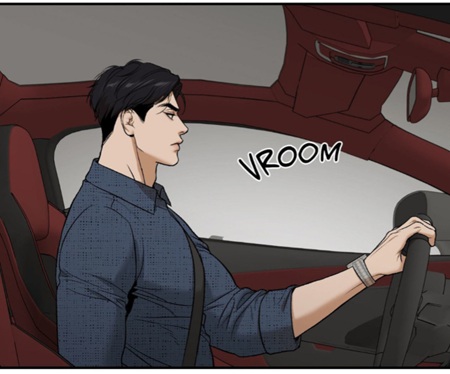 (chapter 69) Hence he is still wearing his dark blue shirt, pants and an expensive watch. But more importantly, he is now driving his white sports car. This means before meeting his hyung and the CEO, he went to the penthouse and changed not only his outfit but also his vehicle. He selected the white car,
  (chapter 69) Since the latter is a high-performance luxury model, it symbolizes wealth, speed, and prestige. That’s how he wanted to appear in front of the CEO. However, now he is going to the place where the storm will be the most violent. Because the star is still dressed in his dark blue shirt and expensive watch, I came to the following interpretation. This is not the champion in training clothes, but a man who now owns time
 (chapter 60)
 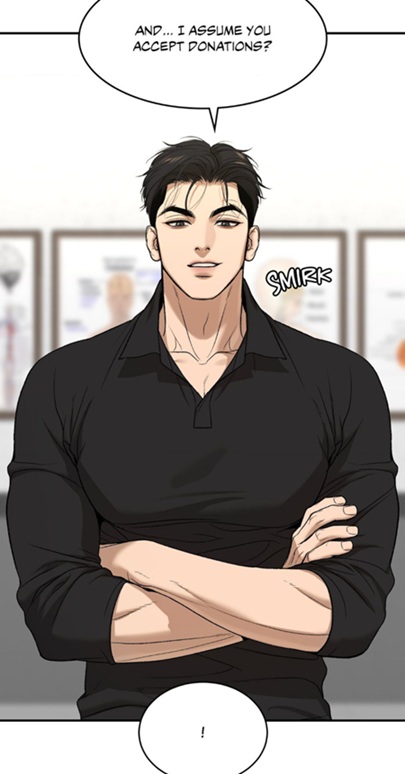 (chapter 61) No longer is he defined by his cellphone or his car, but by a reclaimed sense of agency.
 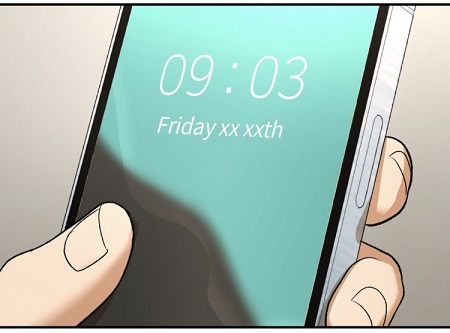 (chapter 38) or his car
 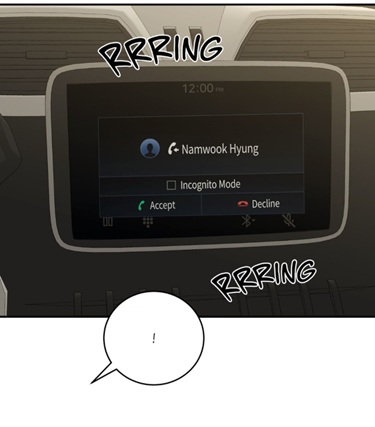 (chapter 69). Hence the manager can no longer be in touch with him.
  (chapter 66)
 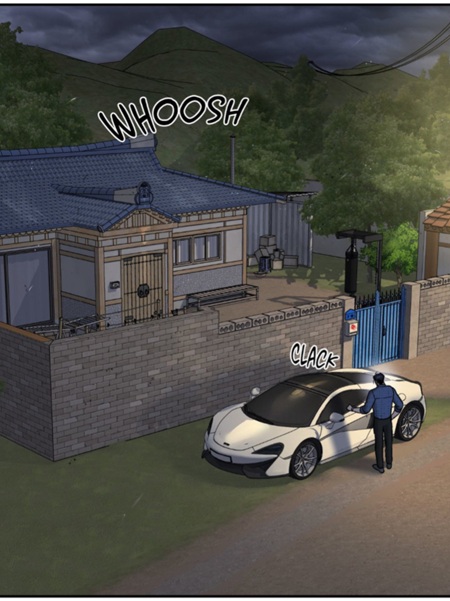 (chapter 69) might be damaged or lost to the tempest—a symbolic stripping away of status which reminded me of the way doc Dan treated the halmoni’s Wedding Cabinet.
  (chapter 53) Both instances symbolize a relinquishing of material attachments (he leaves his huge penthouse for a rented little “hostel”) and a profound shift toward emotional growth. For Jaekyung, the potential loss of his prized possession is not just about property—it marks the beginning of relying on others, accepting vulnerability, and letting go of his rigid, self-reliant identity. Similarly, the doctor’s decision to leave behind the Wedding Cabinet signals a break from the past and a readiness to build something new, no longer defined by inherited burdens or emotional debts. In both cases, possessions lose meaning. With nothing left to prove, the champion accepts vulnerability. He is no longer above asking for help, nor afraid of stillness. And that realization could only emerge under pressure.
  (chapter 57) This initial depiction – of the sparkling blue sea, the gentle rhythm of waves (shaaa), the birds in the sky, the beautiful sunset
  (chapter 59) and
 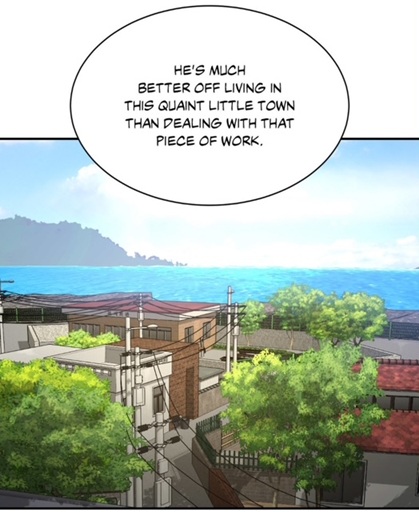 (chapter 58) daily life in slow motion—sets up a stark contrast to the approaching storm. All these images and including the elderly proclaiming
  , (chapter 65) “It’s a nice little town, isn’t it?”, lulled both the characters and readers into a false sense of permanence. But beauty is ephemeral. Storms, by nature, contradict stability. They sweep away trees, roofs—and with them, pipe dreams.
  (chapter 53) That’s why Mingwa zoomed on her gaze, but “cut” her ears, a symbol for her “deafness”. Hence she didn’t hear and feel the wind during her stroll with the champion.
 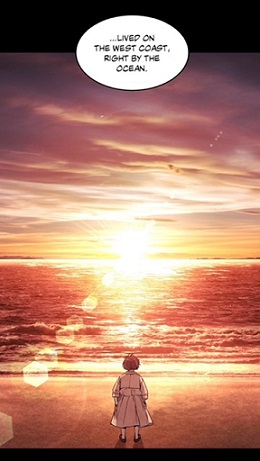 (chapter 53), bathed in the orange glow of a perfect sunset, reflected her toxic positivity—her tendency to ignore pain and erase any negative memories, including a life marked by hardship in Seoul. It encapsulated her attempt to embellish the past and project into the present
 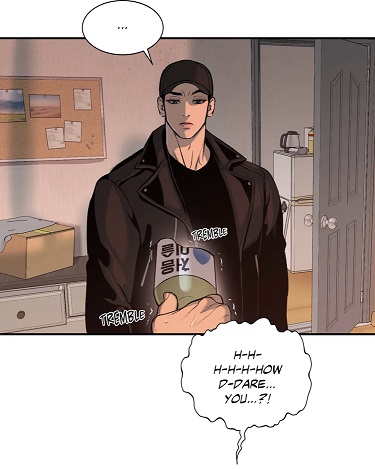 (chapter 17), where the walls were decorated with actual postcards of beaches she had never visited. These were not souvenirs, but illusions—windows into an idealized elsewhere that helped her ignore the hardship around her.
 (chapter 47), symbolizing distance from reality. In the hospice, it is placed next to the window
 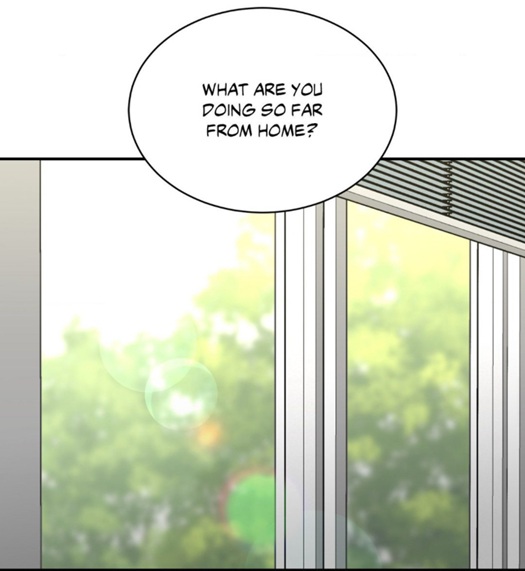 (chapter 61), revealing trees and the sky—nature encroaching. By her second stroll with Jaekyung, the image of the window reappears
 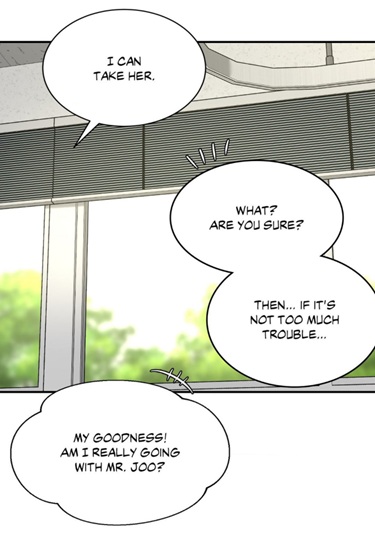 (chapter 65), subtly reminding readers of its fragility. Now, as the storm rolls in, the trees outside become potential hazards, and the window that once offered a view might shatter. Should this happen, then it will rupture her illusion of control and all her repressed fears should come to the surface.
 (chapter 56) But he misjudged her case for two reasons. First, the file had been tampered: she had received a new treatment. Secondly, he did not know her. What he saw as acceptance was actually a mix of comfort, avoidance and unresolved fear. The gale will expose the limits of both clinical assumptions and self-deception. The woman who once believed she could choose the time and manner of her death now faces nature’s blunt reminder: she is not in control of life and time—nor of anything else.
  (chapter 56) —it is a layered terrain of symbolism and vulnerability. Perched on what appears to be a peninsula
  (chapter 65) in a bay
  (chapter 60) ; the docks, roads, and shops follow at level 1
  (chapter 62)
  (chapter 69); and the town proper stretches up with retaining walls
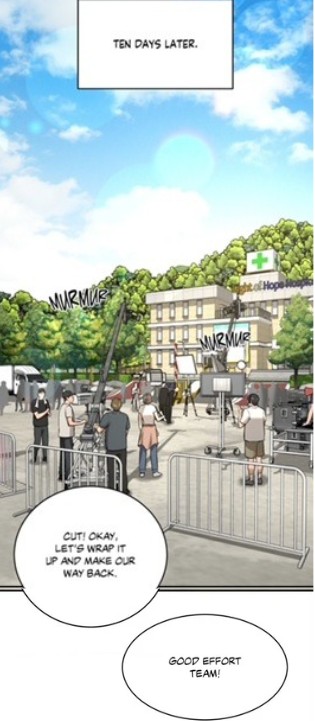 (chapter 59) (Light of Hope) overlook the coast and the landlord’s house
 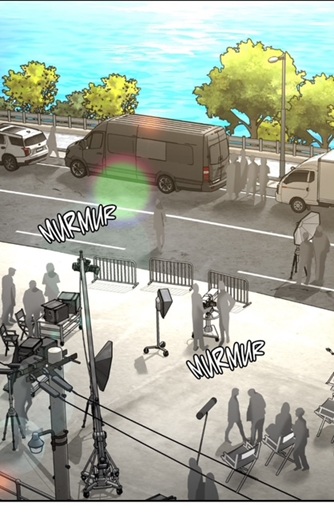 (chapter 57). I came to this deduction, as the champion could see the building from the beach, when he rescued doc Dan.
  (chapter 61) Like pointed out before, his name is misleading, for hope implies “rescue”. However, a stay in that place means that their “inhabitants” are all destined to die due to cancer. There’s no real cure there. In other words, the tempest will bring to light its true nature. The hope, just like its comfort, are illusory.
 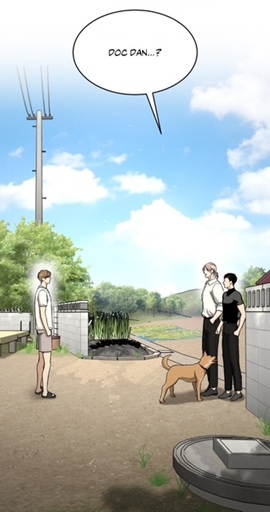 (chapter 57), fields and close to two power masts
  (chapter 58) Back then, Jaekyung was still on the outside of that communal warmth. But with such a prediction, the roles would be reversed. His home would become the beacon of safety, and he would be the one providing it.
  (chapter 69) would be left outside, symbolizing that this “sport” has become less central and vital in the main lead’s life. This is the first true pause in their relationship. Jaekyung, used to immediate gratification and external control, must slow down. And for the first time, he will see what he always overlooked: that meals take effort, that conversation has value, as it can help to get closer to another person. He doesn’t need the grandmother to get “through Kim Dan”.
 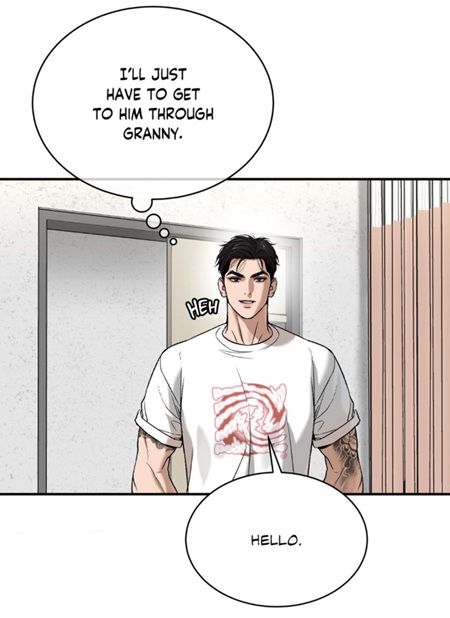 (chapter 65) Finally, if my prediction is correct, then by living with different people in a small place, he will realize the benefits of relying on others. He will discover the joy of having a family, having found a home. The storm creates a space for redefinition.
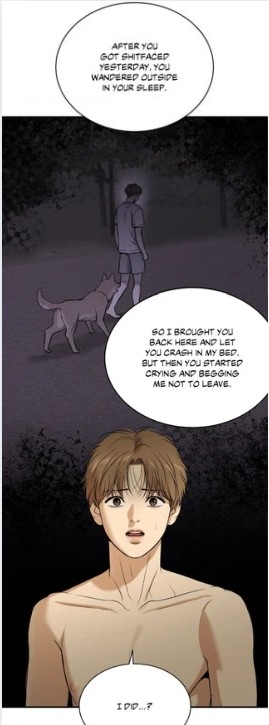 (chapter 66) Jaekyung, who has never seen the puppies, might discover them now. That discovery mirrors his gradual awareness of fragility and caretaking. For Kim Dan, nurturing the puppies symbolizes reclaiming his capacity for love and responsibility—free from obligation.
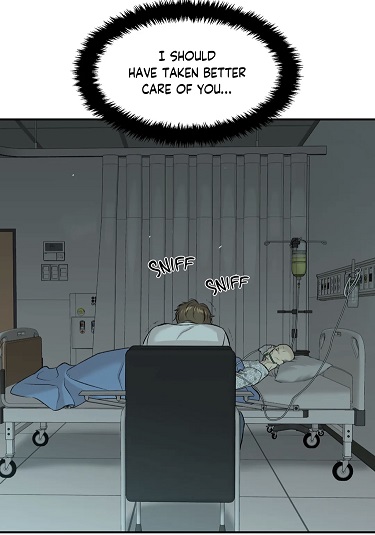 (chapter 21) and needed company.
  (chapter 21) The doctor would drop everything and rush to her side overlooking his own health. But now, with blocked roads and dangerous winds, Kim Dan cannot come—even if he wants to. He is no longer her servant or safety net. Nature has intervened where he could not set a boundary.
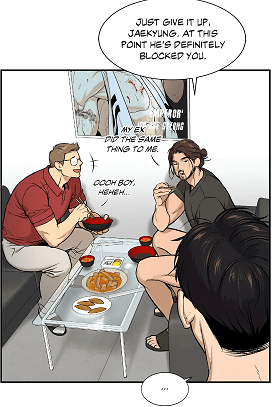 (chapter 5) Thus his anxieties should reach a new peak. His grip on the boy he used to control is gone. The storm draws a line between who remains—and who fades.
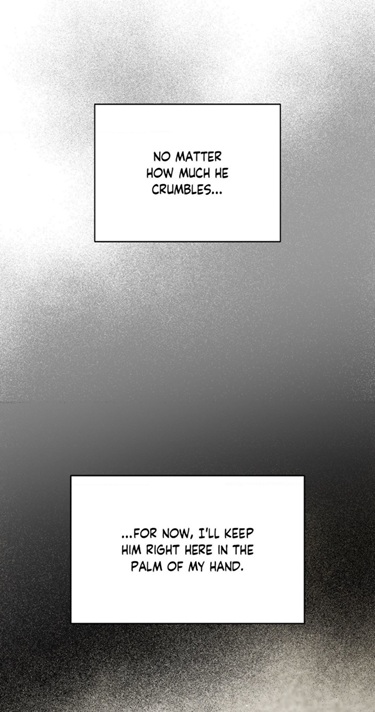 (chapter 68)—stand firm.


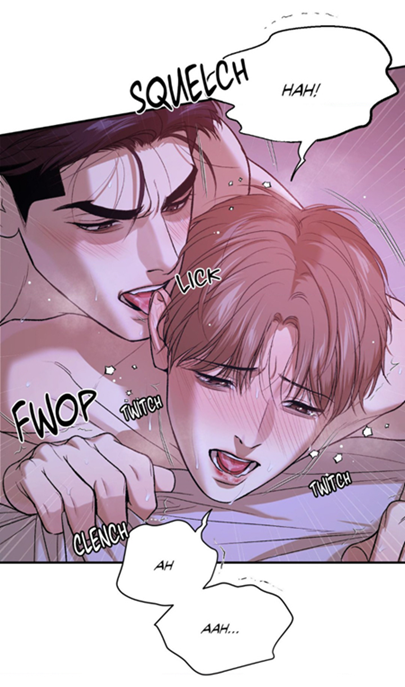 (chapter 64), and the language of touch—their dynamic undergoes a profound shift. This moment is not just about desire but about power, communication, and the fight for control. It is in this intimate space that both men are confronted with their vulnerabilities
 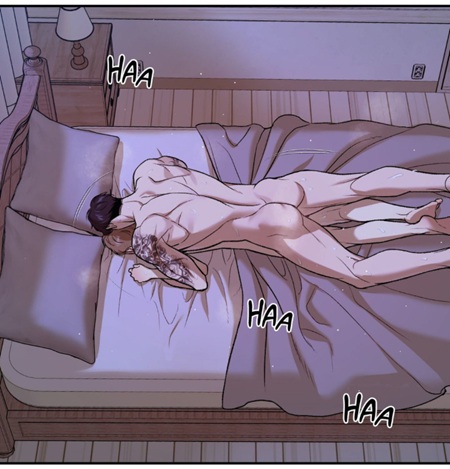 (chapter 64) and the evolving nature of their relationship. During this lavender-tinted night, their intimacy is no longer just a matter of physicality—it becomes a language of contradictions. Through grasping, biting, and kissing, their touch oscillates between control and vulnerability, rejection and longing. This moment encapsulates the shifting power dynamics between them, where Jaekyung’s physical presence no longer guarantees submission
  (chapter 64), and Kim Dan begins to push back, not with force, but with emotional detachment. He avoids his gaze, hides his moaning and as such remains silent. This night is a pivotal moment, signaling the champion’s awakening to his emotions and Kim Dan’s assertion of his autonomy.
  (chapter 63) it is a stark contrast to the usual aggressive or mechanical physicality of their past encounters. Let’s not forget that when the athlete kissed the doctor for the first time
  (chapter 14) in the locker room, he not only used his hand
  (chapter 14) This comparison outlines that their first kiss was more the result of conscious and tactical decisions than of passion and desire. It was not only to protect the hamster’s life, but also to be able to fight against Randy Booker. In other words, their first kiss was strongly intertwined with work and absence of consent. He had not informed Doc Dan before.
 (chapter 63), until the latter finally opened his mouth. This gesture reminded me of a wolf licking his progeniture in order to show affection. My avid readers will certainly recall my analysis of their “love session” at the penthouse in Episode 44: there were traces of “animalistic behavior”
  (chapter 15)
  (chapter 63) represented the next step of his “generosity”. Yet, the divergence is that the star had done the French Kiss by instincts, whereas the fellatio was more a calculated move. He selected this new approach based on his own likes and experiences. In other words, this magical night represents the birth of a “lover” and “boyfriend”.
  (chapter 62) The celebrity could do anything he wanted. In other words, he had clearly giving him his consent to be kissed and the doctor could not refuse as such.
  (chapter 63) It is clear that Kim Dan had anticipated a different approach: a renewal of their First wedding night. The irony is that the French kiss and the fellatio became the evidence that the star was not treating the doctor as a doll per se. Why? The star has changed a lot due to the main lead’s influence. He had gained knowledge and confidence. Nevertheless, their interaction here forces a confrontation not just between them, but within themselves—Jaekyung, who has always relied on physical dominance to maintain control, is confronted with a newfound uncertainty, while Kim Dan, whose silence once reinforced Jaekyung’s belief in his own power, now wields that same silence as a weapon.
 (chapter 61) or exhaustion—has his tongue metaphorically freed by this act.
  (chapter 63) The significance of this kiss becomes evident when, later that night, he finally speaks up, voicing everything he has suppressed.
  (chapter 64) It is, as though Jaekyung has unknowingly opened a door within the hamster. Yet, despite this newfound ability to speak, Kim Dan still bites his lip at times, revealing his continued hesitation. He is not yet ready to embrace vulnerability fully, but this moment marks the beginning of that journey.
 (chapter 64), the scent in the air
  (as seen through the presence of scent sticks in the background), and the vision and sensation of the man beneath him. Unlike the previous intimate moment in Chapter 44, where he was inebriated, this time he is conscious.
  (chapter 64) This is the rebirth of Jaekyung—not as the infallible champion but as a man experiencing intimacy in a new way.
 (chapter 64) It indicates that the star was actually revealing his attraction toward his companion. We could say that with this attitude, he was gradually lowering his guard. But there’s more to it. Just before he “was going to finish inside”, he chose to kiss his partner.
  (chapter 64) This privileged position indicates that the main lead was not ready to face Kim Dan’s gaze during an orgasm. In other words, he had not entirely lowered his guard in front of the doctor. The reason is simple. While he was giving pleasure to his partner, this is what he was forced to see:
  (chapter 64) rejection, anger and resentment. This was not a gaze full of love, the remains from the “surrogate fights”. His facial expression was reminding him that his fated partner was more a prostitute than a lover, for he saw this sex session not as a source of pleasure. That’s why he thought like this:
  (chapter 64) Under this new light, I deduce that the champion was not aware of the true motivations behind his actions. He was actually longing for the doctor’s love and embrace.
  (chapter 64) His act of biting his lips in Chapter 64 is not just a nervous tic; it expresses not only physical manifestation of his restraint, but also his suicidal tendencies. He doesn’t mind hurting himself. This shows that he still doesn’t value and treasure his own body.
 (chapter 64) The lip bite signifies hesitation but also resistance. It reflects his internal struggle: he does not want to engage, but something within him still reacts. He still has feelings for the athlete. This small gesture encapsulates his frustration—not just with Jaekyung, but with himself.
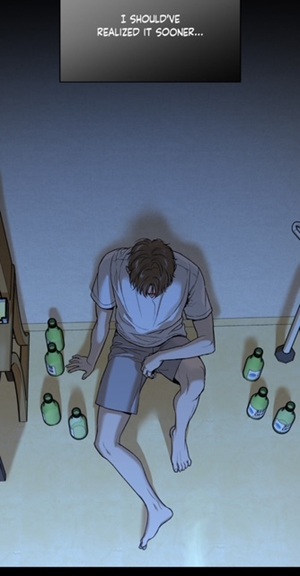 (chapter 57) and overworks himself. That’s the reason why I couldn’t truly rejoice when Kim Dan rejected the champion. In fact, he selected work and pain over “joy and pleasure”. And why? Because of the past and the athlete’s actions.
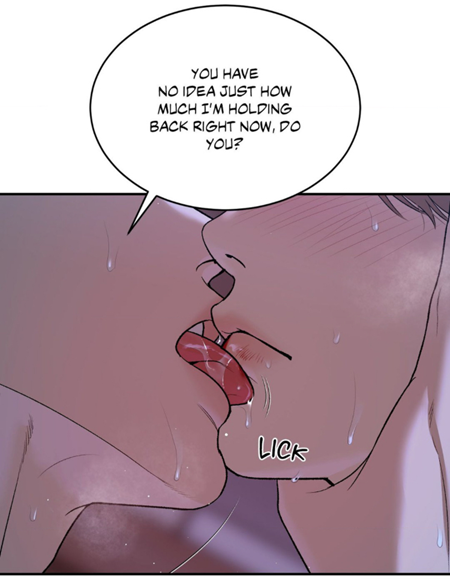 (chapter 64) Further by licking his lip, he is acting like his doctor and guardian. But there’s more to it. Observe the comment from the champion: he was holding back. This means that by biting his lips, the doctor reminded Joo Jaekyung of his own weak constitution. Thus I interpret that the champion came to associate the kiss with vulnerability and affection.
  (chapter 15) and touches were purely acts of dominance—ways to assert ownership over Kim Dan. However, the ear lick, which almost looks like a bite, in Chapter 64 carries a different weight.
 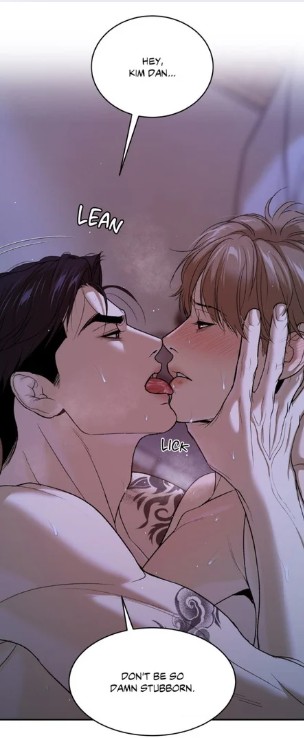 (chapter 64) He refused to see and listen to others and to the athlete, because he was trying to deny the existence of his love. The reason is simple. He is trapped in his own world, full of darkness. He was trying to clinch onto the past, where he portrayed himself as a victim and doll of the champion. But the reality is that doc Dan treated himself as a doll or servant, for he didn’t value his own body. Hence he didn’t eat properly and drank soju to drown his pain.
  (chapter 5) This is a habit he had before he met Joo Jaekyung. Moreover the latter was living in abstinence, until he drank alcohol by mistake because of him.
 (chapter 24) of Season 1. Instead, there is waiting and hesitation, an unspoken question in the way he leans in. For the first time, it seems as though he is searching for something more—perhaps a response, a reciprocation, or even just an acknowledgment from Kim Dan. This shift underscores Jaekyung’s internal transformation; he is gradually internalizing Kim Dan’s values and beginning to approach intimacy differently, even if he himself is not yet fully aware of it.
 (chapter 64). He thought, using strength could still help him to conquer Kim Dan’s heart, though it is just an unconscious attempt.
  (chapter 8)
  (chapter 15)
  (chapter 61) That’s the reason why during this lavender-tinted night, Mingwa used reflections of all sex sessions from season 1. Let’s not forget that Joo Jaekyung was never seen cleaning up “the mess” he made. Doc Dan had to clean himself, which is the reason why he made the following request:
  (chapter 29) Not washing his partner implies his refusal of becoming responsible. The problem is that since it was a first for him, he has no idea about its true meaning. Besides, due to his own traumas and fears, he didn’t pay attention to his PT’s emotions and well-being. Striking is that Joo Jaekyung compared himself to fire during that night.
  (chapter 63) And what is the opposite to fire? WATER!! Thus this image came to my mind. How do you kill desires and passion? One might say by becoming ice-cold! However, my answer is this: by pouring a glass of cold water on the champion’s face! Yes…
  (chapter 37) This means that Joo Jaekyung is getting punished for this gesture. Let’s not forget that he mentioned their stay in the States to bring back good memories. But I have another reference for this interpretation.
  (chapter 64) This panel is a reflection from that particular day:
  (chapter 27) And where did he go to calm down? In the swimming pool…
  (chapter 27) And now, you comprehend why I came to see this scene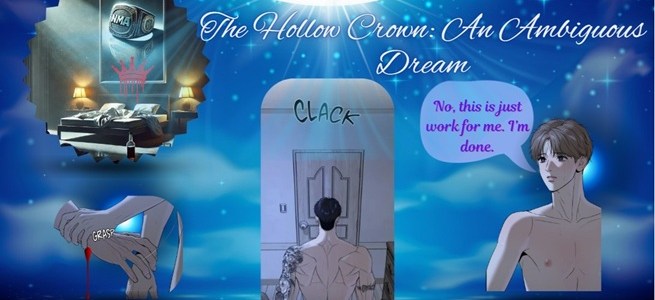

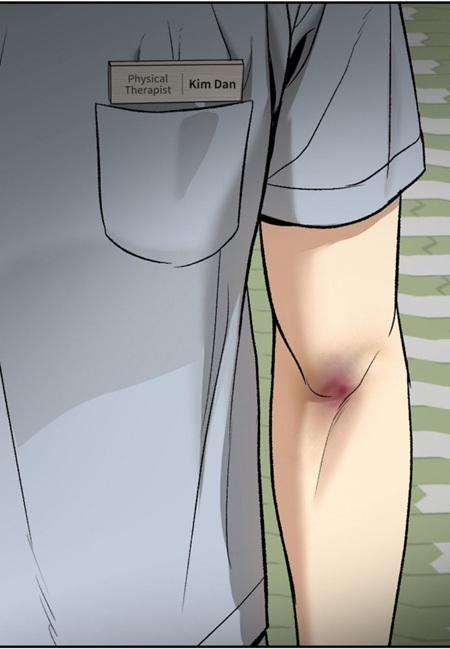 (Chapter 61) However, this moment is not isolated—it reflects patterns in his personality that have appeared throughout the series.
  (Chapter 11)
  (chapter 18) This essay delves into the significance of Kim Dan’s physical and emotional bruises, examining how they symbolize his suffering, internal conflict and transformation. I will examine Kim Dan’s conflicted emotions surrounding gratitude and debt, contrasting his interactions with Joo Jaekyung and his grandmother, Shin Okja. Additionally, I will explore how Kim Dan’s conditioned identity as a caregiver drives his choices, even in his current living situation with the landlord, where he unconsciously replicates past dynamics. Ultimately, I will elaborate how Kim Dan’s newfound awareness could reshape his identity and relationships moving forward.
 (Chapter 61) His unexpected reaction catches Kim Dan off guard, further emphasizing how disconnected the doctor has become from his own well-being. However, contrary to the past
  (chapter 11), Kim Dan is truly responsible for the contusion. He caused the injury by removing the needle from the drip.
  (chapter 60) By taking this action, he absolved Joo Jaekyung of any responsibility for the injury, but this is merely a superficial conclusion.
 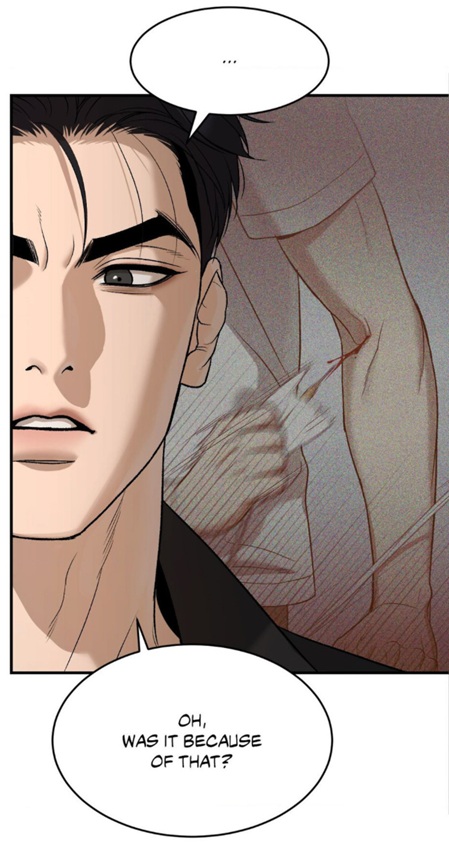 (Chapter 61) On the hand the circumstances surrounding the bruise, where Kim Dan removed the needle on his own, provide insight into his psyche. The deeper cause of the bruise lies in Kim Dan’s declining health, which is intrinsically connected to his malnutrition and the neglect he faces from those around him. It is important to recall that Joo Jaekyung was explicitly informed that Kim Dan needed rest
  (chapter 60). Yet, with his insistence,
 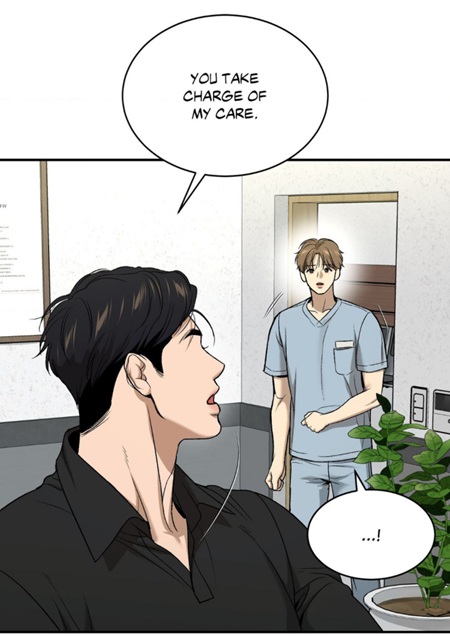 (chapter 61), he forced the physical therapist to keep working, adding even more strain than before. Though the physical therapist attempted to voice his disapproval,
 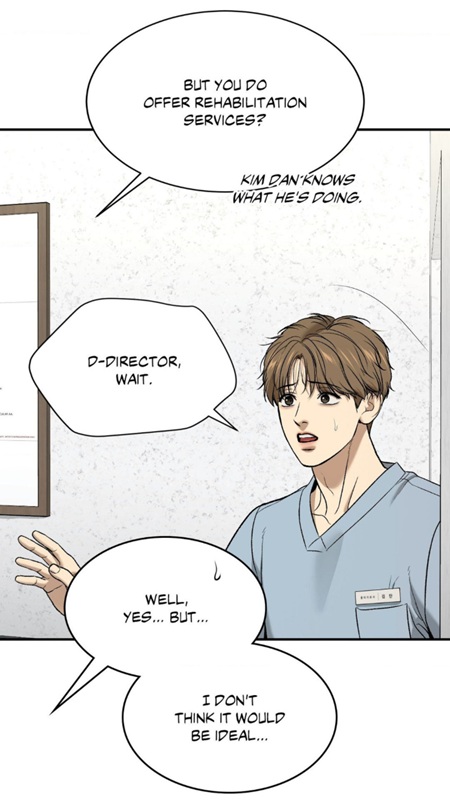 (chapter 61), he ultimately had no choice but to comply, as his order came from the hospice director.
  (Chapter 61) And why did the director override Kim Dan’s need for rest? Money and free PR. Joo Jaekyung’s influence secured the director’s approval, disregarding the doctor’s well-being in favor of business interests. This conversation at the director’s office makes one thing clear: words hold no power against profit. An d that realization led me to another connection—every one of Kim Dan’s bruises is linked to exploitation, whether by authority, obligation, or financial influence.


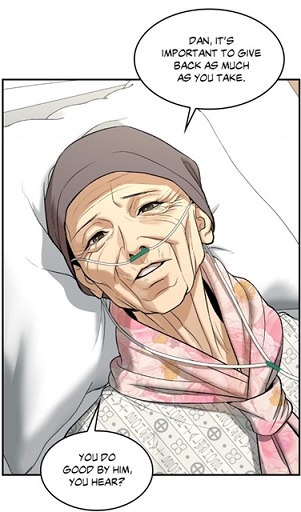 (Chapter 41) It is clear that she was inciting him to work harder than before. This displays that Kim Dan was not allowed to rest. During this encounter, she didn’t ask him about his well-being either. And what is the link between these 3 episodes? The grandmother and her poverty. The latter was responsible for the loan.
  (chapter 18) and took Kim Dan along, ensuring he was seen as an emergency patient. However, this visit was brief and lacked any comprehensive medical examination—no blood samples were taken, and his underlying health concerns remained undiagnosed. This omission further underscores the neglect Kim Dan has suffered, as even in a medical setting, his long-term health issues were overlooked.
 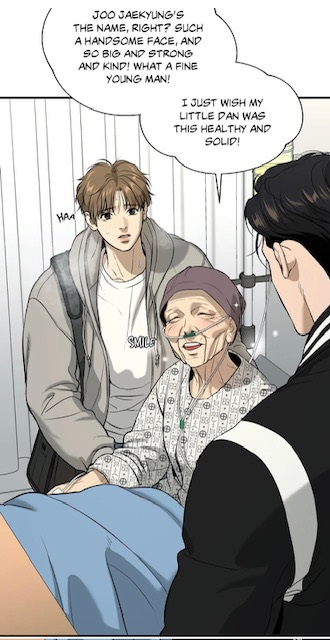 (chapter 21) He had never been healthy and strong. Moreover, when he joined them, at no moment the senior asked if he had gone to the doctor, though he had been sick before.
 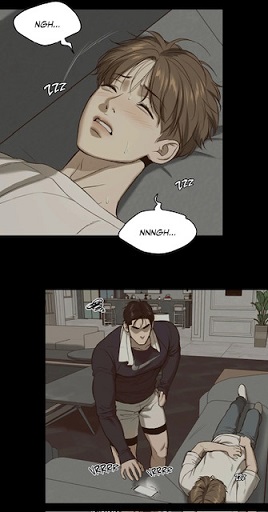 (chapter 21) But back then, the champion didn’t pay too much attention to it. In my opinion, her response will likely reflect her established pattern of emotional detachment and deflection of responsibility. Rather than admitting her lack of concern for his well-being, she may shift blame onto the staff or Kim Dan himself
  (chapter 5), or his general reluctance to ask for help. He rejected the athlete’s help and concern.
 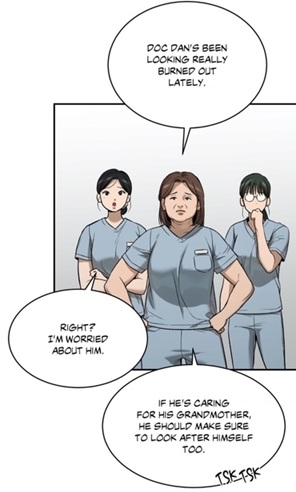 (chapter 57). She blamed the main lead, because she imagined that Shin Okja would worry about him. However, it becomes clear that the halmoni is not worried about her grandson at all. She is acting like a fan in front of the athlete.
  (chapter 61) One might argue that based on this scene, the grandmother didn’t see him with the bruise on his arm.
  (chapter 61) He only remained at the door. However, observe that there was a cut between this image
 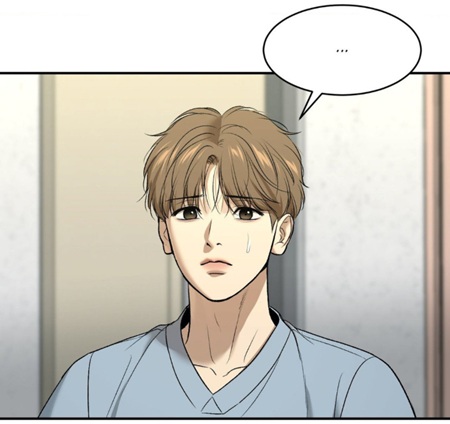 (chapter 61) and the conversation between the main couple in front of the hospice.
 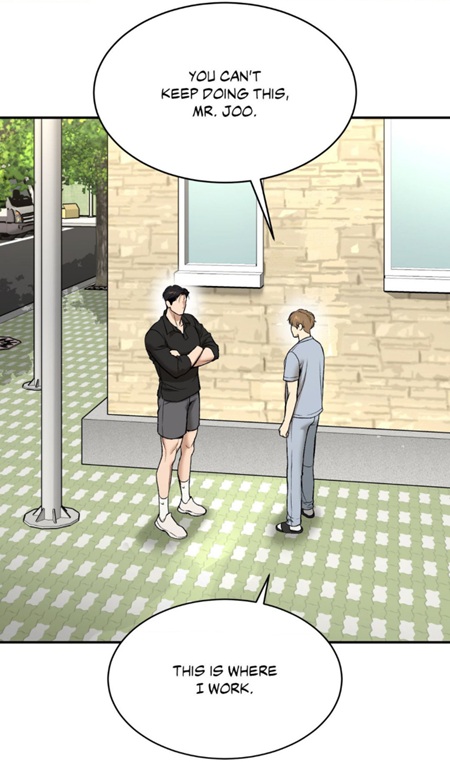 (chapter 61) So he could have made his presence known to his relative before asking Joo Jaekyung to follow him because of his treatment. To conclude, I believe that she had the time and occasion to see her grandchild and his bruise.
 (chapter 13) He is the only doctor who has ever examined the protagonist so closely and even paid attention to his fingernails!
  (chapter 13) At the same time, the chingu from the club was the first one pointing out that his wounds were never treated!! Furthermore, I realized that the doctor’s lies from episode 11
 (chapter 59) He would space out and even fall asleep at any moment.
 (chapter 13) The latter was the cause for the severe exhaustion. However, like mentioned above, the doctor is not blameless either, because he never questioned why his wounds on the hand were bleeding again.
  (chapter 43) He thought, it was related to the massage, yet the reality was that this incident showed that he had coagulation issues. To conclude, all the bruises could have always been noticed by people due to their locations (eyes, hands, arm)!
  (chapter 61) and his relationship with Joo Jaekyung.
  (chapter 61) That’s how I recognized why these women’s warm welcome and curiosity about Kim Dan were rather superficial.
  (chapter 56) His arrival stands for novelty and a breath of fresh air at the institution. However, with this change, the female staff is forgetting their original duty: they need to pay attention to their colleagues. They are behaving like the grandmother
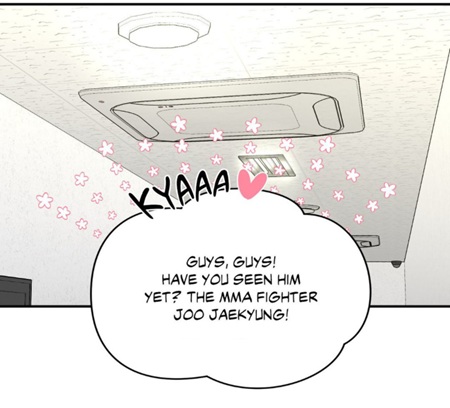 (chapter 61): fangirling over the handsome guys visiting their little town. That’s why Mingwa drew flowers in the last two images. No wonder why no one around Kim Dan is observing the bruise and his deteriorating condition. Moreover, since the physical therapist has a relative at the hospice, the staff is envisioning that Shin Okja is doing “her work”, she is paying attention to Kim Dan’s mental and physical conditions. On the other hand, there is no doubt that the grandmother has already delegated her own responsibility onto others, Kim Dan and the hospice. It is a medical institution, therefore they should pay attention to his working conditions. In other words, since no one feels responsible for the protagonist’s health, no one is worried about Kim Dan at all. At the end of episode 61, he is even so pale and breathless
 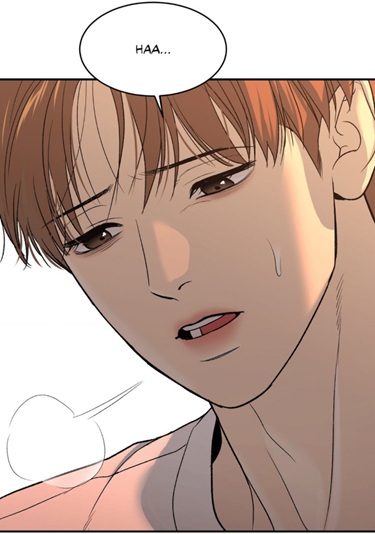 (chapter 61) that I am anticipating a terrible incident leading to a rude awakening for everyone.
 (chapter 18) In episode 18, when Joo Jaekyung confronts Kim Dan about the loan, the doctor has a bruise on his left eye, symbolizing his entrapment and helplessness. This earlier injury highlights how Kim Dan has been conditioned to view himself as responsible for burdens that are not his own, perpetuating a cycle of sacrifice and self-neglect. And a new bruise appeared just after the athlete reminded the physical therapist of his past promise:
  (chapter 61) His grandmother’s disregard for his well-being amplifies the injustice of this situation; she allowed him to shoulder the debt despite knowing it was never truly his to bear. The bruise becomes a recurring motif, a visual representation of how others have imposed their responsibilities on Kim Dan, leaving him physically and emotionally scarred.
  (chapter 60). The juxtaposition of the vibrant environment with Kim Dan’s deteriorating health underscores the neglect he faces. The hospice is meant to be a sanctuary, yet it becomes a space where Kim Dan is further burdened by the champion and his grandmother’s expectations
  (chapter 55) This line “I finally feel like I can breathe again”, written by Kim Dan, reveals a subconscious acknowledgment that his relationship with the champion represents a breath of fresh air, a chance to escape the suffocating expectations and burdens he has carried for so long. The bruise, a physical manifestation of his struggle, signals the breaking point of his role as a selfless caregiver. It challenges the illusion of invulnerability that Kim Dan has maintained and forces those around him to confront his vulnerability.
 (chapter 60) The beach, with its open and untamed expanse, symbolizes freedom and a return to the self. It foreshadows that Kim Dan’s true journey toward healing will require him to step outside the roles and confines imposed upon him, finding solace not in what is expected but in what feels authentic and liberating.
 (chapter 18) —or, more accurately, the lack thereof. The champion’s actions were motivated by a desire to help
  (chapter 18), hence the star was waiting for a smile from Kim Dan. Yet the latter perceived it as meddling. His immediate response
 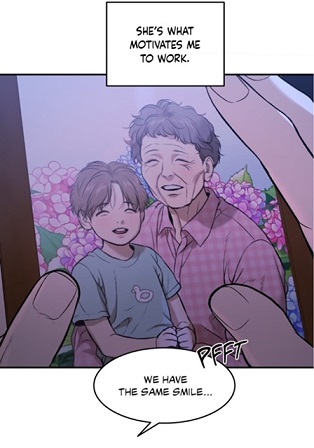 (chapter 47) The physical therapist’s entire existence had revolved around fulfilling her needs, from managing the debt to taking care of her health. With her now approaching death and actively pushing him away, Kim Dan is left grappling with a profound sense of meaninglessness.
  (chapter 60) He had never been given the opportunity to develop dreams or ambitions of his own, as his life was entirely defined by his grandmother’s circumstances. This lack of agency further explains his rejection of Joo Jaekyung’s generosity in Episode 18 and his later promise to reimburse the loan. Clinging to this promise was Kim Dan’s way of creating purpose and meaning in a life that had otherwise been dictated by others. It highlights how deeply entrenched his self-sacrificing tendencies are, as even his attempts to assert independence are rooted in his conditioned need to serve others. That’s why I come to the following prediction. Kim Dan needs to get confronted with illness and death (he could lose his life) so that his will for life comes to the surface. Right now, he imagines that since he is young, he will outlive his relative, but the death of the puppy was a warning to him that youth is no guarantee for a long life.
  (chapter 59) Death can take away anyone and at any moment. In my eyes, if Joo Jaekyung uses his own body to save the doctor again (like for example blood transfusion and CPR), this time Kim Dan would feel truly grateful towards the champion. So far, the doctor has not recognized the star as his savior yet. By removing the needle, he denied the protagonist’s intervention on the beach:
  (chapter 60)
 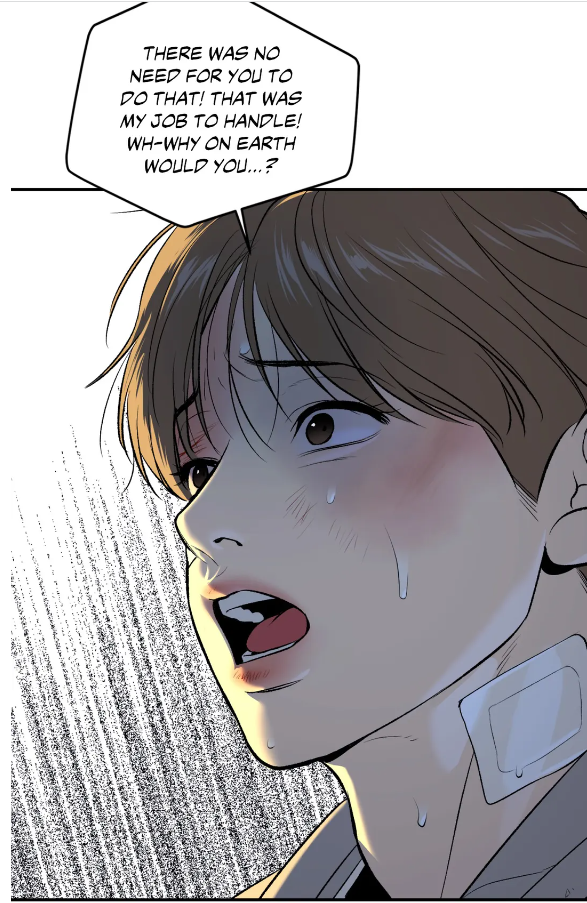 (chapter 18) Deep down, Kim Dan knows that the debt was never truly his responsibility, making it difficult for him to view the champion’s actions as a genuine act of kindness. This inner conflict is compounded by his suicidal disposition, which renders the concept of repaying the debt meaningless.
 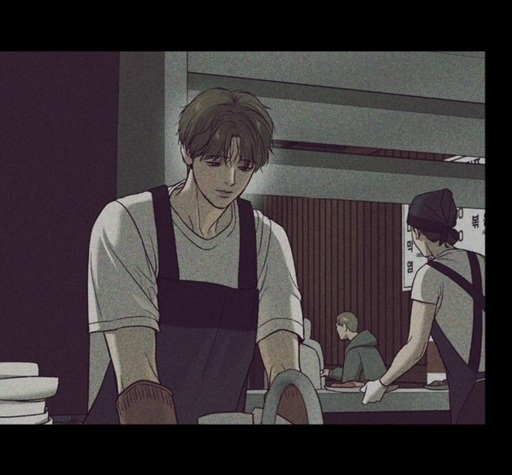 (chapter 59) He worked so hard, was even beaten, but he could never voice his torment.
  (chapter 59) Why? It is because the grandmother was no longer by his side and she never talked to him either. The absence of communication indicates her lack of interest in Kim Dan. And it becomes comprehensible why during that night, he felt the need to go to the ocean and drown himself. It is because he was gradually realizing his loneliness. With his relative’s death, he would only keep living a terrible life determined by work and nothing else.
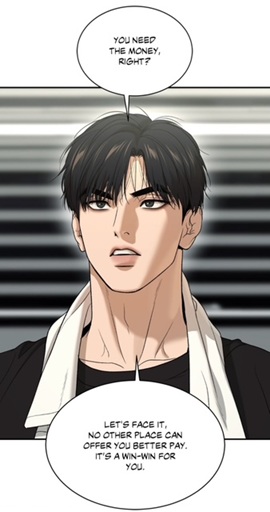 (chapter 60)
  (chapter 11) and even uses his own words against him:
  (chapter 22) The loan was the result of his grandmother’s decision. He never helped him, rather his grandmother.
  (chapter 11) However, he never explained his circumstances to the generous athlete. By keeping him in the dark, he reinforced his negative disposition about the doctor. And chapter 61 exposes this reality. His suffering was the result of his own decision.
 (chapter 61) Do you recognize the room? That was the doctor’s
  (chapter 19)
  (chapter 53) His decision to allow Joo Jaekyung into his bedroom in episode 61 demonstrates that he consented to the relationship, even if begrudgingly.
 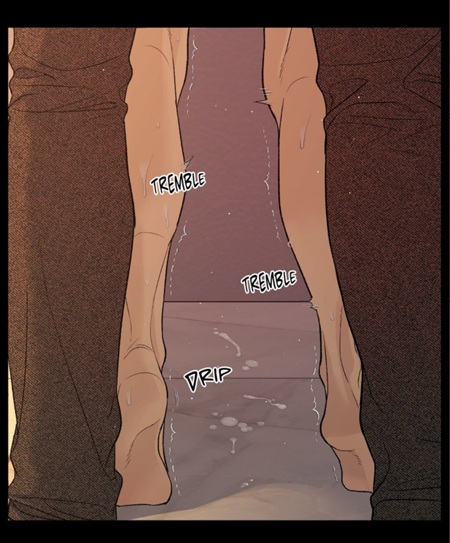 (chapter 61) and acted like in episode 6.
  (chapter 6) or 8
  (chapter 8) where he would abandon the protagonist right after the climax and not care about his partner’s conditions and feelings:
 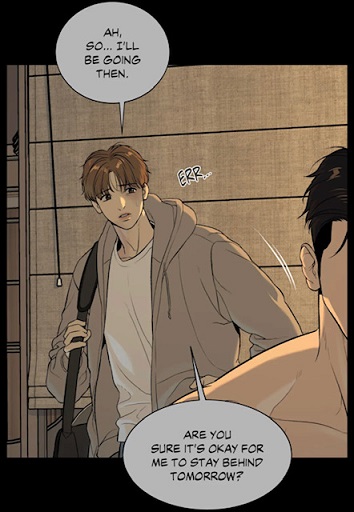 (chapter 13) Since the doctor mentioned that a match was right around the corner
  (chapter 61) It leaves us four possibilities. Randy Booker, Dominic Hill, Alfredo
  (chapter 47) and Baek Junmin. However, for the intercourse took place in the doctor’s bedroom (he wished to be carried to his own bed)
  (chapter 36), for they had sex every day. However, in episode 53, we discover their night before the match against the Shotgun
 (chapter 53) So this scene can only have taken place in chapter 47, when the match with Angelo got canceled and Kim Dan had been confronted with the terrible news about his terminally ill grandmother.
  (chapter 47) In the previous part of this essay, my avid readers could see the strong parallels between 61 and 47. But there exists another reason why I am inclining to think that the sex scene took place later in the story. It is because during that “magical night” (44), Kim Dan learned the notion of “consent”.
 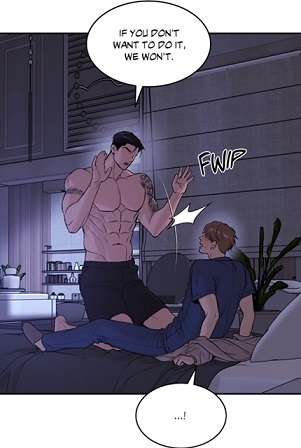 (chapter 44) During that blue hour, Kim Dan discovered that he could say no! And notice that in his memory, he clearly thought that he could have rejected the athlete’s advances.
  (chapter 46) He should mistrust the members from the gym and keep his distance from people. So during that time, Joo Jaekyung did follow his hyung’s advice
  (chapter 53) doc Dan was copying the champion’s behavior from episode 61. Right after the sex, he would leave the bed and return to his bedroom. How did Joo Jaekyung recall this night?
 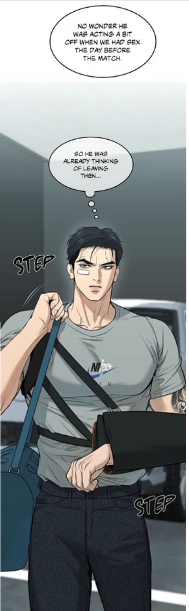 (chapter 53) He saw his attitude as a sign of disloyalty and “abandonment”. And that’s how Kim Dan is feeling in the restroom:
  (chapter 61) The darkness around the eyes is a metaphor for his resent and anger. And the moment you contrast the two memories (53 and 61), you can detect the hypocrisy of the two main leads. They only recall scenes where they were hurt and felt betrayed. However, in reality, they were both victims and perpetrators, because none of them chose to open up and talk to each other. Why? It is because both chose to listen to their “guardian” and their “favor”. Like mentioned before, in a quarrel, no one is right and wrong. The purpose of an argument is to listen to the counterpart and view incidents from their perspective. Finally, the physical therapist’s recollection serves as an important evidence that he had never been powerless and helpless. He could have refused all the time because their deal was never official.He could have used the contract as a shield. But the best evidence of Kim Dan’s power is this rejection:
  (chapter 61) I had already pointed out the increasing resistance and resilience from Kim Dan in episode 60:
 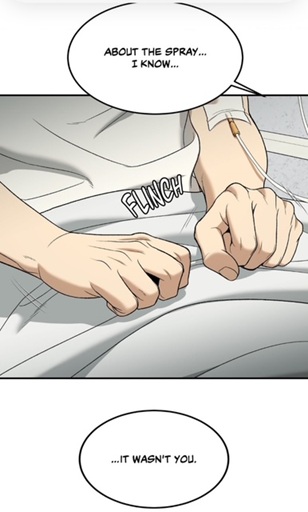 (chapter 61) My prediction came true. In the past, he could have denied the existence of the deal, Joo Jaekyung was free to seek another physical therapist. He never realized that he had some leverage. Yet he still followed the athlete’s requests. He saw himself bound by obligations. However, this was just an illusion. Hence in episode 61, we see him legitimating his consent that there was an imminent fight.
  (chapter 61) He is expected to work despite his declining health, his suffering dismissed by those around him.
  (chapter 40) He is paid to receive bruises, to push his body past its limits
 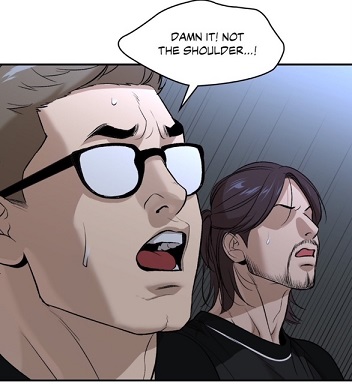 (chapter 50), to endure pain while the public watches and profits are made. His suffering is entertainment, a spectacle that fuels the business of MMA. Though he is a champion, he is still a commodity, expected to perform regardless of his condition.
  (chapter 61) He understands, better than anyone, what it means to be physically used for the sake of others, yet he remains blind to the fact that he has placed Kim Dan in the same position. While one has no file about his health condition, the other has many files, but they are not studied, because this would push the manager to question his decision and even ruin the business:
 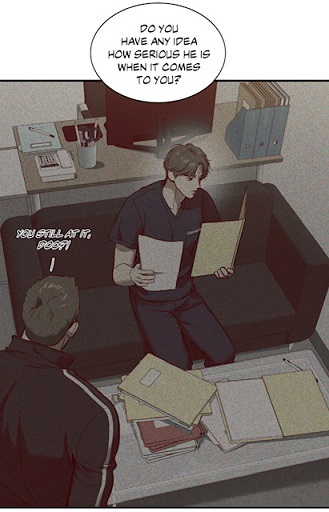 (chapter 17) I doubt that Park Namwook studied them, and notice that the recently hired PT didn’t ask for the champion’s files first:
  (chapter 54) Thus I deduce that the champion’s files are in reality a subterfuge. They give the impression that the doctors and Park Namwook truly care for his well-being, but it is not correct. They are only interested in his body because of wealth and reputation. But let’s return our attention to episode 61 and the champion’s attitude towards Kim Dan.
 (chapter 54) It is clear that the manager wants Joo Jaekyung to return to the ring as soon as possible to erase the last “debacle”. In my opinion, the doctor’s illness could serve Joo Jaekyung as an excuse to delay his return to the ring and even not to accept the next challenge.
  (chapter 57) is another manifestation of his conditioned role as a caregiver. By living with an older man, he creates the illusion of a familial bond, mirroring the dynamic he shared with his grandmother. This decision highlights his struggle to break free from the identity imposed on him—one defined by servitude and selflessness. He assumes that he should take care of the landlord, offering to cook and expressing guilt for not fulfilling this perceived duty. Yet, the landlord subtly challenges this narrative. By inviting Kim Dan to eat breakfast
 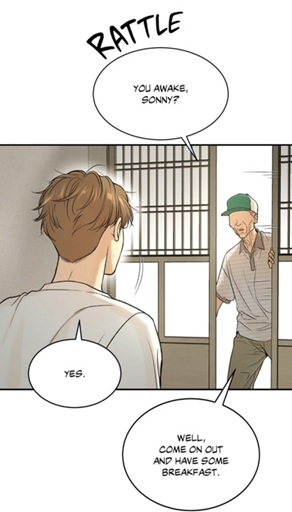 (chapter 57) and dismissing his apologies, the landlord treats him as an equal rather than a caretaker. This dynamic forces Kim Dan to confront his false perception of himself.
 (chapter 57) Despite this, Kim Dan rejects the advice, demonstrating his resistance to being cared for. This moment underscores his internal conflict—he craves independence yet clings to the role of the selfless provider. The landlord’s actions expose the fallacy of Kim Dan’s identity, revealing that his caregiving is not always necessary or effective.
 (chapter 61) is indicating the increasing resent and anger towards the star. Joo Jaekyung is no longer seen as a celebrity and idol, but as a inconsiderate man. This transformation is subtle but meaningful, as it reflects his burgeoning awareness of his own worth and the unjust treatment he has endured. For the first time, Kim Dan acknowledges himself as pitiful
 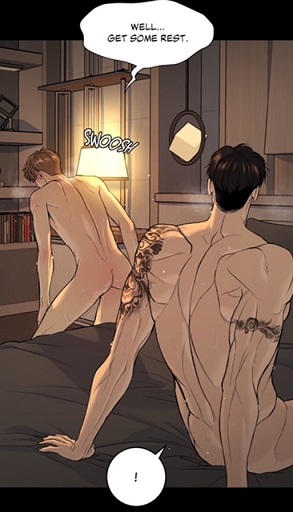 (chapter 53)
  (chapter 61), no longer bound by the roles others have imposed on him but shaped by his own choices and growing self-respect.
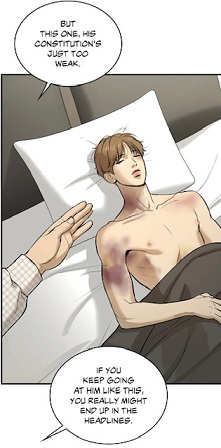 (chapter 13) and the fragility of Kim Dan’s existence. For Kim Dan, it challenges his self-perception as an indestructible caregiver. This realization could lead him to an inevitable conclusion: his own needs and well-being are just as important as those of others.


 (chapter 56) in Jinx serves as a powerful symbol and narrative device, encapsulating the themes of observation, communication, and truth, as reflected in the title “Unspoken Gifts, Unveiled Truths in the Light of Hope.” Its name evokes images of enlightenment and clarity, which stand in stark contrast to the gym Team Black and the grandmother’s internal state of denial and her rejection of responsibility. This tension between the hospice’s symbolic essence and the grandmother’s actions deepens the narrative’s exploration of personal accountability and transformation.
 (chapter 35), where people’s actions and words can go unnoticed, the hospice fosters an environment of close-knit relationships and mutual observation.
  (chapter 56) While in the previous essay, I pointed out that this door reflected Kim Dan’s emotional entanglement—he is physically present but emotionally excluded from his grandmother’s world, highlighting the imbalance in their relationship -, in verity this transparent door offers an opportunity for the main lead. How so? The glass door stands not only for transparency, but also for “emotional distance”. The glass allows visibility but creates a barrier, symbolizing a balance between openness and detachment. This is essential in a hospice environment, where the focus is on providing care and support without becoming overly attached to the inevitable outcome: death. For the staff, maintaining a degree of detachment is necessary for their well-being, as becoming too attached could make the emotional toll of their work unbearable. Therefore I am suspecting that the two nurses
  (chapter 56) Her hypocrisy, particularly in her treatment of Kim Dan, remains hidden behind the guise of socially acceptable behavior. Within the hospice, residents maintain a positive opinion of her, which enables her to mask her neglect and selfishness effectively. But since the two nurses are sharing their thoughts and working as a team, it signifies that Shin Okja’s wrongdoings could be detected this time. Or better said, they will realize the true suffering from the protagonist. Nurse Heart and nurse Mind will do their best to protect their new mascot and give him what he truly needs:
 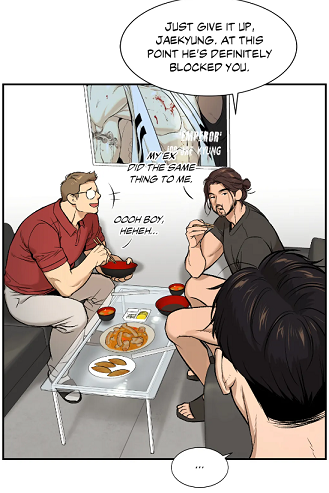 (chapter 5) And the other laughed. Then the coach seems to have no cellphone. Maybe he believes to have no need for it, for he goes to the gym every day. This signifies that he expects to be informed by his hyung Namwook. However, like mentioned in the previous essay, I believe that the manager has been sweeping under the rug the terrible condition of his “boy” from the coach and the team members. To sum up, Team Black embodies the opposite of the hospice’s values. There is no transparency, because the conversation took place not outside, but behind closed door. The door might be translucent, the reality is that they sent away all the members.
  (chapter 36) The gym, while ostensibly a team environment, is ruled by indifference, anonymity, and a lack of genuine camaraderie. The heart and the mind are not working together. Why? It is because the coach is trusting the manager, as he views him as the heart of the gym. What he fails to see, is that Park Namwook is neither the heart nor the mind, for he is more reflecting his surroundings: money. Secondly, the manager is easily influenced and is using conformity and social norms to avoid responsibility. He fears making decisions and lets others become proactive. Joo Jaekyung, the leader, relies exclusively on Park Namwook, the manager, who undermines team spirit by fostering distrust and misinformation.
 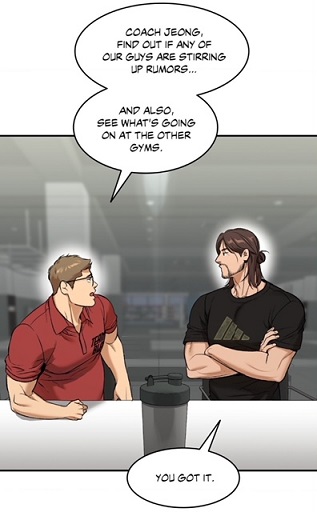 (chapter 46) The member’s loyalty got questioned, but the irony is that they had the real insight.
  (chapter 47) Thus rumors about Baek Junmin being an illegal fighter never reached Jaekyung’s ears. That’s why the author made fun of the main lead here:
  (chapter 47) His ear seemed to have caught their badmouthing, but not the real information. But why did he not listen to the members? It is because Namwook had encouraged the champion to keep his distance from others. He had even planted seeds of distrust among the team with his badmouthing about the champion. He has a bad temper and is a spoiled child, so no one needs to pay attention to him and his moods. The slap was the evidence of his disrespect and hypocrisy.
  (chapter 52) The man acted, as if he had been the biggest victim. Moreover, Namwook’s actions often reflect a lack of genuine loyalty, as seen in
  (chapter 22) episode 22, when he falsely claims ownership of the gym and again in episode 56 when he reminds the champion of his absence from the gym, behaving as though he were the boss.
  (chapter 56) In reality, the true owner of the gym is the “wolf,” and Namwook’s behavior underscores his disregard for loyalty and responsibility. In fact, his words mirror the nurse’s at the hospice:
  (chapter 56) Since she approached the physical therapist to get closer to him and used work to create a connection, people can see the similarities between her and the manager. While she represents honesty, curiosity, care but also “ignorance”,, it means that Park Namwook embodies the opposite values: indifference and a certain dishonesty.
  (chapter 56) Hence he is seen talking over the phone and not face to face, unlike the nurse. He knows that his boy is struggling, but he acts, as if he didn’t know. This contrast validates my previous interpretation of the manager. His question “Is everything okay with you?” exposes his lack of genuine concern. He uses work not to praise his “boy”, but to blame him for his “negligence”. He downplays the champion’s struggles while still recovering from surgery. This lack of care creates an atmosphere of apathy, anonymity, and selfish expectation, sharply contrasting with the hospice’s values of dignity and communal care. But how do we explain this huge divergence? First, the main principles of the hospice are dignity and care, and not primarily money. Therefore the institution offers free health check once a month:
  (chapter 56) This contrasts with the gym, where fighting is treated as entertainment and sport, emphasizing the physical aspect while neglecting the mental health of its athletes. Ironically, even the physical treatment of its members was neglected at the gym from the very beginning, like we could see it in two occasions:
 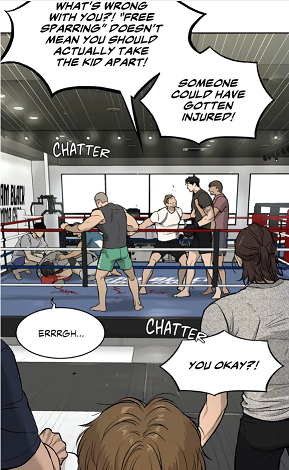 (chapter 1) The fighter with the head injury received treatment from the members (self-medication) and Kim Changming had a shoulder injury which got neglected.
  (chapter 7) These incidents reflect the gym’s underlying indifference and mismanagement. This disparity explains why Jaekyung’s mental health suffered under Namwook’s leadership, as the gym lacked the supportive and transparent environment required to nurture emotional resilience. Jaekyung’s stay at the hospice is likely to open his eyes to this overlooked aspect, prompting him to reconsider his leadership style and the values governing Team Black. But it is the same for Kim Dan, especially if he sees how weak and neglected the fighter looks:
 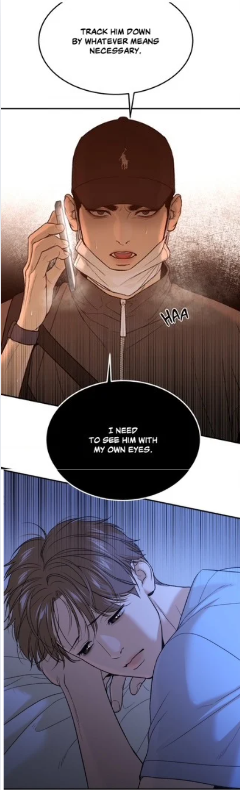 (chapter 56) he has already become a shadow of himself.
  (chapter 56) Her actions, such as allowing Kim Dan to stay by her side and covering him, contrast sharply with her earlier attempts to push him away. In this scene, a caretaker might pass through the rooms to ensure everything is in order, noticing the doctor present. To an outsider, the visible outcome suggests that she accepts her grandchild’s relentless care without protest. It was, as if she had said nothing at all. Yet, this perceived acceptance masks her internal struggle and the discomfort of being dependent on Kim Dan, reflecting her conflicted emotions. These moments of vulnerability and acceptance highlight the gradual erosion of her denial under the hospice’s symbolic light.
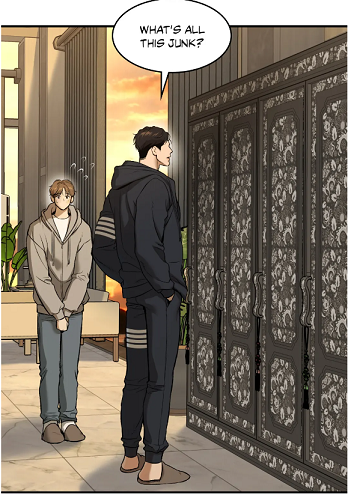 (Chapter 19) Hence it is not surprising that at the end, he chose to abandon this huge cupboard.
  (chapter 42) This explicates why the athlete didn’t pay attention to his soulmate’s clothes. And now, observe that the doctor is only wearing his PT uniform.
  (chapter 56) Thus I am predicting a huge awakening for the champion. Without the cupboard, the champion can see that the physical therapist almost has no cloth. Thus he can only admit his humbleness and benevolence. However, the moment he hears that this furniture belonged to the grandmother, the champion can only perceive the relative in a different light. Yes, the gift should expose her true personality. At the same time, Shin Okja never gave her Wedding Cabinet to Kim Dan, so should she discover that she lost her gift or the latter ended up in the athlete’s hands, she could protest and reclaim it. My point is that this legacy serves as a tool to expose the grandmother’s childish and shallow nature.
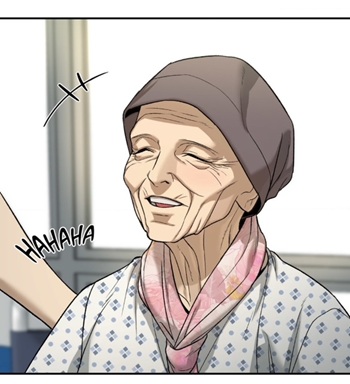 (chapter 56) She is wearing it daily and is proud of it. Deep down, she knows the true value of the scarf: it was expensive
  (Chapter 41) as she employs the expression „spoil to death“. By wearing the scarf with flowers, she appears wealthy, but also vain! Since I detected that Kim Dan likes pink flowers, my interpretation is that this gift mirrors the doctor’s taste indicating that he was slowly regaining his identity and confidence..
  (chapter 31) And notice that the bouquet of pink roses pushed Kim Dan to talk to Joo Jaekyung about his taste. That’s how I detected a strong connection between presents and communication. Notice that on the champion’s birthday, the manager sent a message while the presents were delivered.
 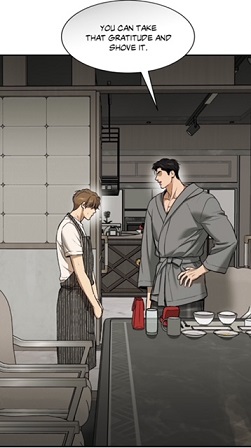 (chapter 45), but also encouraged the doctor to convey his thoughts and expectations in the card. On the other hand, he didn’t expose the whole truth
  (chapter 55) Another interesting aspect lies in the doctor’s shaking hands which the champion noticed, when he offered the present:
  (chapter 55) This scene reminded me of their first encounter:
 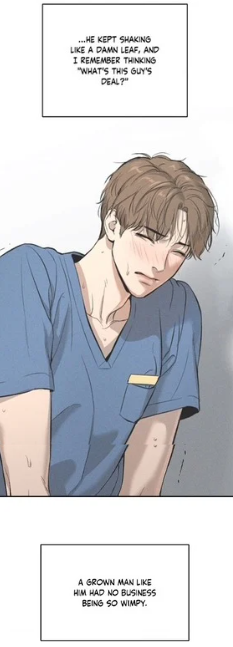 (Chapter 56) So the man must have recognized the doctor‘s fear, which explains why the champion could voice his anger later. But back then, he never wondered why the doctor‘s hands were shaking like leaves. It is because the doctor feared rejection. The present had the following meaning for the physical therapist: recognition and acceptance. The gift was the symbol for „conditional affection“ which he had long internalized due to his grandmother. But this doesn‘t end here. The shaking hands appeared in a different scene:
  (chapter 49) The common denominator between these three scenes is the mistake. Kim Dan feared to have made a mistake with the present, because he was afraid of the champion‘s reaction: will he accept him or not? But let‘s return our attention to the gifts from the doctor.
 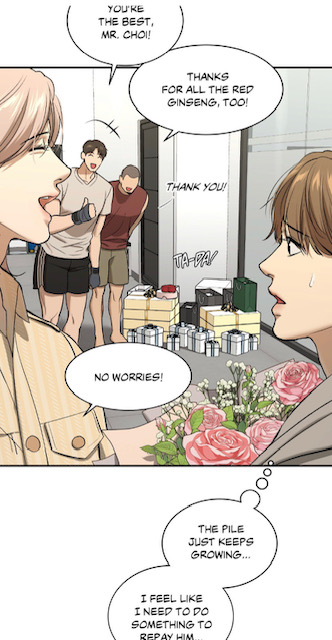 (chapter 31)
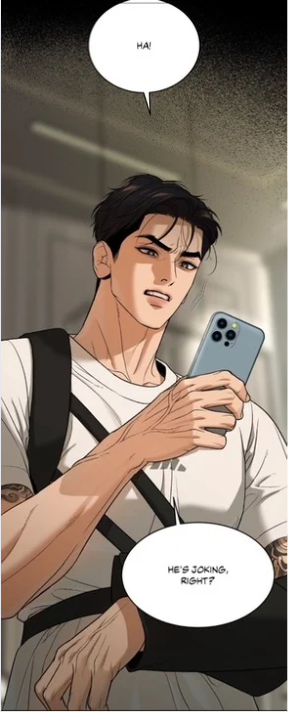 (chapter 55) implies that as soon as the main couple meet each other, they will have to discuss this matter. To sum up, a gift encourages the couple to communicate, yet contrary to season 1, both should be more honest to each other at the Light Of Hope. Every word and action will appear in a different light. Another aspect is that none of them takes things for granted, which stands in opposition to hyung Namwook and the grandmother. This explicates why the latter have no problem to spend money.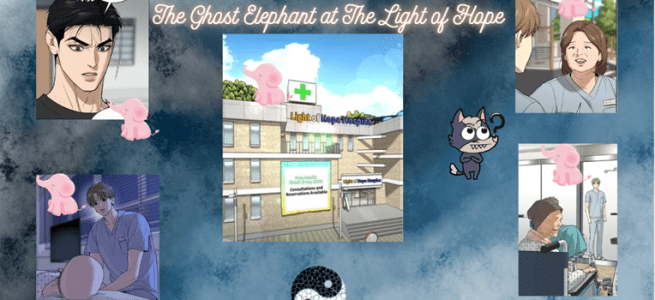

 (chapter 56) and
 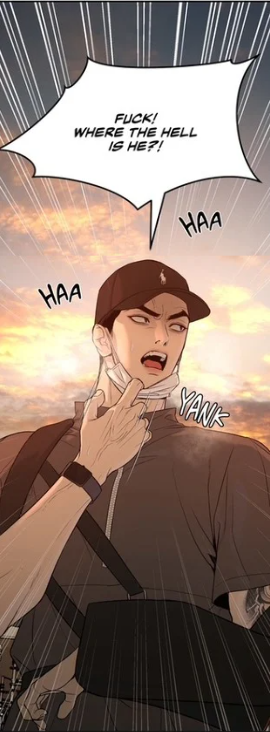 (chapter 56) While in the first picture, Joo Jaekyung is calm, concentrated and silent, in the second one, the fighter is agitated, lost, breathless and yelling. These two mental dispositions are reflected in the location. In the first image, the MMA celebrity appears behind the steering wheel, which is a symbol for power, determination and control, whereas in the second panel the champion is wandering alone in the street. This running is no longer part of his training and routine, but it exposes his powerlessness, loneliness and despair. He has no idea where to go contrary to the first picture. This means that the latter embodies goal and destination, whereas the second image represents the opposite values: beginning, start, ground zero and source. In other words, the end of episode announces the athlete’s rebirth or better said, the start of a new life. I will elaborate further below. But let’s return our attention to the symbolism of the auto.
  (chapter 56)
  (chapter 56) Even if the main lead is moving among other cars, people can recognize that the owner of such a car is rich and probably famous due to the brand and design. On the other hand, by roaming in the street, the champion blends into the background and as such to the mass.
 (chapter 35), Joo Jaekyung succeeded. He is just a passerby. In other words, the avenue indicates not only his failure to find Kim Dan, but also his loss of power and status. He has just become a nobody. Thus we should consider this as the athlete’s karma for thinking that Kim Dan could be replaced, because he was just a nobody:
 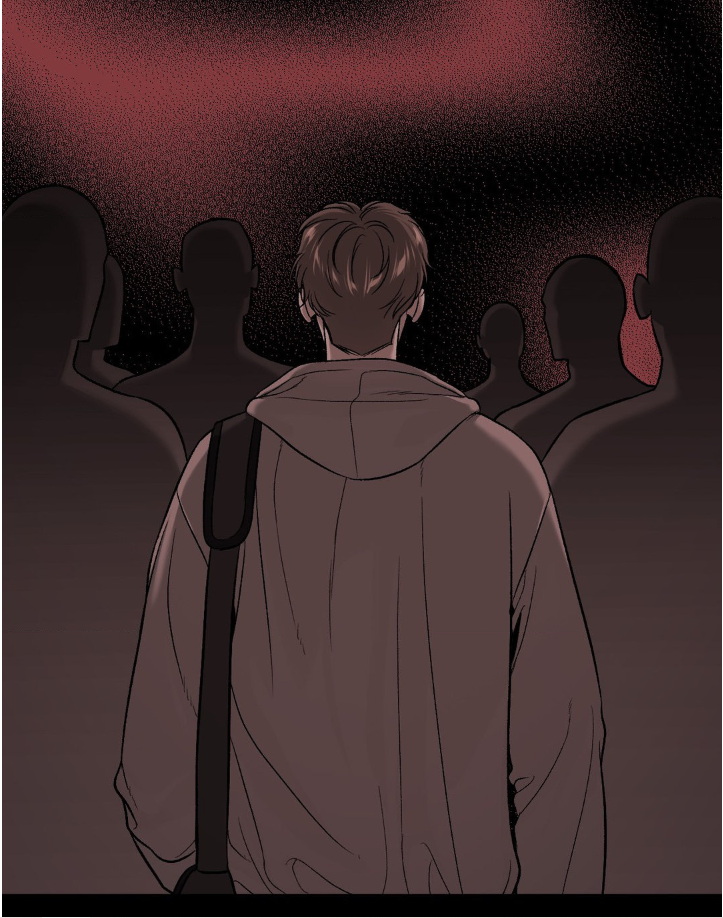 (chapter 55) It is no coincidence as well that the author showed us the star’s back, when the latter called his hyung Park Namwook.
 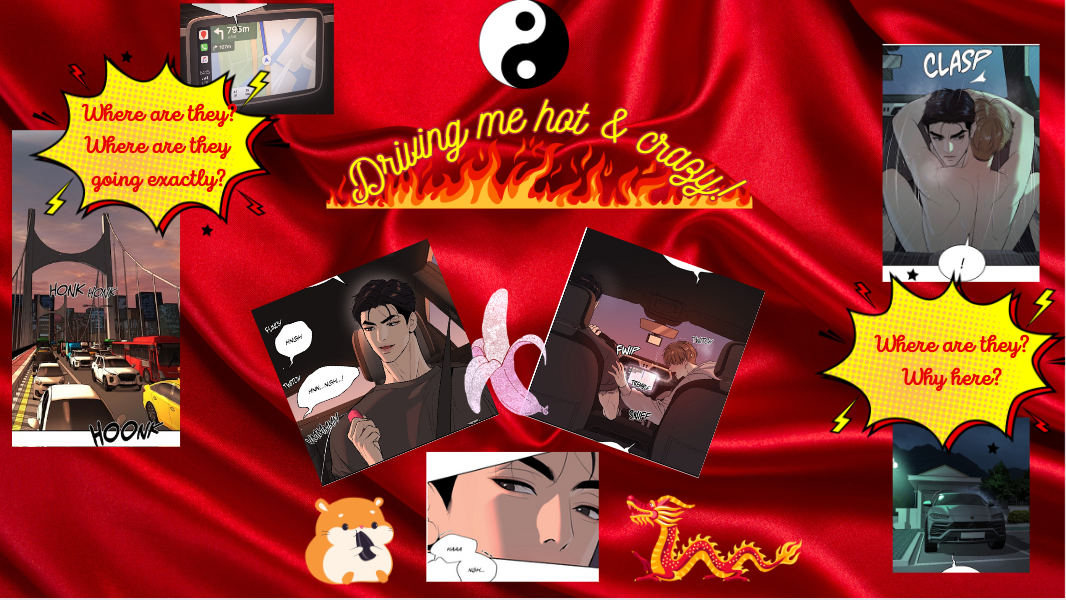 These two chapters are similar, for they convey the same emotions: anger, anxiety, frustration and despair of the fighter. In the car, the champion attempted to control the doctor’s libido.
  (chapter 33) On the one hand, he appeared calm and concentrated like in 56, yet deep inside, he was burning up. The pink dildo was used as a tool to voice his negative emotions (abandonment issues, insecurities and jealousy). With the release of episode 56, another reason came to my mind why the athlete proposed to drive the physical therapist to Choi Heesung.
 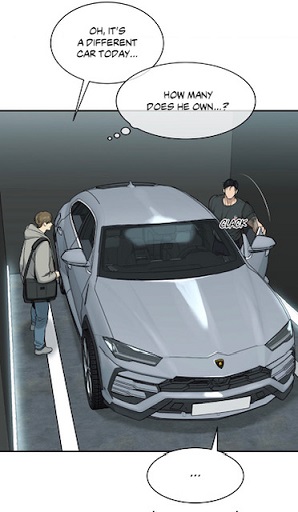 (chapter 32) First, he switched the car in order to demonstrate his wealth and status. It was, as if he wanted to show off to his fated companion, which reminded me of the actor. The latter would bomb doc Dan with “presents”, an indirect demonstration of his fortune. In addition, Jinxphiles will certainly recall that during the same day, the comedian came to fetch the physical therapist with his white Porsche.
  (chapter 32) Consequently, I came to the following deduction. The man selected the gray car in order to distinguish himself from his rival, to impress his companion.
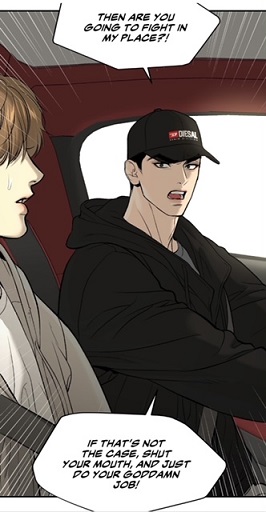 (chapter 42) And what was his attitude there? He would not listen to his passenger. Moreover, he would separate his job from his roommate’s. It looked like they were living in two different worlds, though they were sharing the car. This scene exposes miscommunication, lack of faith, stubbornness and prejudices. The fighter was not willing to accept the physical therapist’s doubts and chose to go through with the training and match.
  (chapter 2)
  (chapter 37) with arrogance and weakness, but this is not true. [For more read this
  (chapter 54)
  (chapter 5) He allows the coach to drive the car and the manager to sit in the front. Thus they represent the higher authorities. However, so far, the doctor had only been his passenger. Thus a new idea popped up: what if the athlete let the physical therapist drive his car? Let’s not forget that the loner wolf shouldn’t be driving on his own, for his shoulder has not healed properly yet. I already pointed out the wrongdoings from the two hyungs.
  (chapter 5) Then in episode 49, the champion kept The Shotgun’s words as a secret, while his coach confessed his trust in his “boy”
 (chapter 49). Yet, he revealed his true thoughts at the hospital:
  (chapter 52) Imagine that he only reported his investigation and actions afterwards. Then on the athlete’s birthday, he didn’t send any private message as well.
 (chapter 37) He was using the landline telephone. This observation is relevant, because it exposes the coach’s dependency on Park Namwook. The latter’s task is to keep in touch with his boss and champion, for he has his cellphone number. Nevertheless, how do we explain the absence of the coach’s cellphone? I have the feeling that this could be related to his divorce.
  (chapter 49), Jinxphiles could never view the driver.
  (chapter 13) His question “Is everything okay with you?” is purely mechanical and as such meaningless, for he doesn’t inquire, when he hears a silence from the other side of the line. I would even say that he doesn’t really wait for his boy’s answer as well.
  (chapter 56), he could end up in the same situation than the protagonist. And keep in mind that the coach Yosep is actually relying on the manager. Thus I reckon that the champion’s other source of power is actually his cellphone! Without him, he has no connection
  (chapter 5), no money
 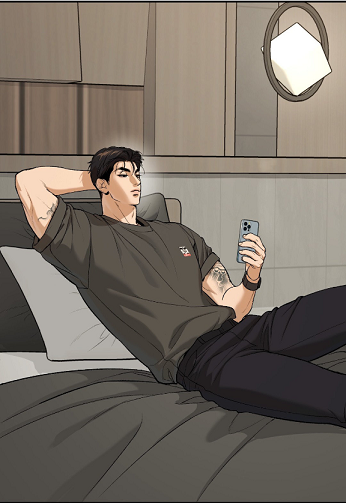 (chapter 32) and no power. His call to the manager during that evening represents his last resort. Thus he is calling the manager “Namwook hyung” contrary to episode 5.
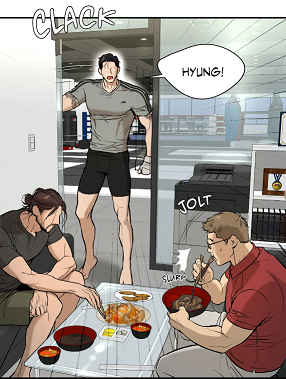 (chapter 5) This title is indicating that the champion is opening up, and willing to show his vulnerability and despair. On the other hand, this change also implies “expectations” from the fighter,
 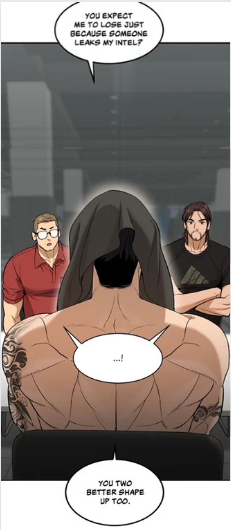 (chapter 46) Keep in mind that at the gym, the athlete denied the relevance of information. Though both hyungs were warned, the reality was that they got off scot-free. They never received any blame for failing to protect him and this twice. And now, he is looking for intel about the doctor. Indirectly, fate is teaching him to recognize his error. In fact, information can procure a good insight about people’s behavior and as such fears. Let me give you an example: if Joo Jaekyung were to hear about Kim Dan’s first employment as PT, he should understand why the PT made mistakes, why he took odd jobs and why he “left” Seoul. If he wanted to work as PT, he needed to go elsewhere.
 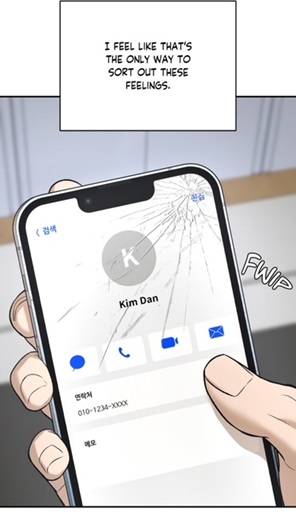 (chapter 56) He somehow expected doc Dan to listen to his words and accept them. That was it. Then at the end, it is just about seeing doc Dan and nothing more. At no moment, he voiced the desire to get to know his partner or to listen to his side of the story. Why? It is because he had strongly internalized that the man was a liar. He never questioned his perception and detected his own prejudices. It is important to recollect how Jinx-philes could sense a positive change in the physical therapist:
  (chapter 22) Yes, it is the view with the star’s back. The author selected such a position on purpose. The face represents the character’s identity and as such his personality. By showing the back, Mingwa is implying that the beholder is full of prejudices and doesn’t know his partner that well. That’s why I judge this image
  (chapter 7)
  (chapter 32)
  (chapter 37)
  (chapter 40)
  (chapter 43)
  (chapter 45)
 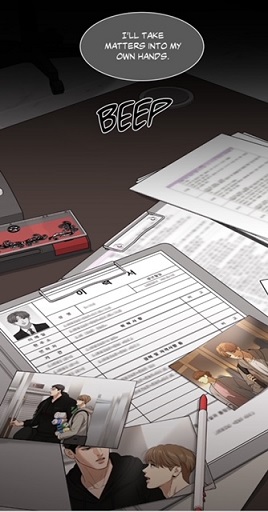 (chapter 46)
 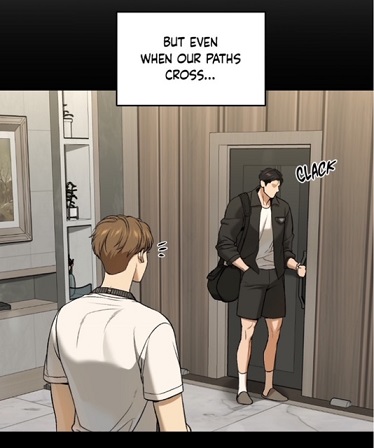 (chapter 47) Looking at his face had become his new secret ritual and as such his source of joy. Naturally, his heart and unconscious were the causes for this new habit. This explicates why he hated hearing the doctor leaving the penthouse during the night: he feared that he would no longer be able to see his cute face. That’s also the reason why Joo Jaekyung got angry/upset, when he saw the doctor turning his head away
  (Chapter 54) This nightmare exposed his regret which he tried to deny and bury. At the same time, I have the feeling that his secret desire was to wipe away his tears as well. Nevertheless the problem is that such a love is rather superficial, for people’s body deteriorate over time. What matters in love is a good personality and a good heart. According to Erich Fromm, love is knowledge, respect, care and responsibility. Hence this separation became a necessity for the fighter. Fate had to force him to admit this:
  (chapter 56), when he imagined that she had died. In reality, he helped financially more the grandmother than Kim Dan himself. Kim Dan is the one he should really empathize with. He has always been a victim of circumstances.
 (chapter 56) Desperation can strip away the higher faculties that make us human—reason, empathy, and self-control—exposing something primal.
  (chapter 17) and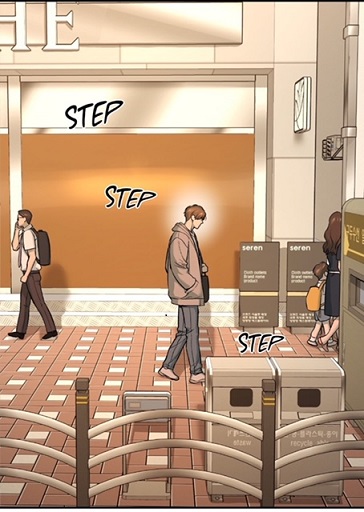
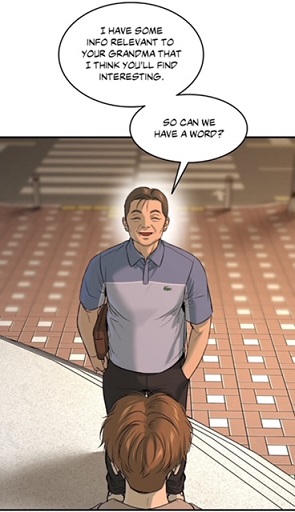 (chapter 48) As you can see, this detail made me realize that the next chapter should contain reflections from episode 35 and 48, the meeting with an old/new acquaintance. I am writing new and old together on purpose, for Director Choi Gilseok had been the halmoni’s loan shark, but the “hamster” had no idea. Choi Gilseok is the boss of Heo Manwook. If this encounter takes place, it signifies that on the one hand, it will cause pain and suffering to the athlete, on the other hand, this incident will become a “blessing in disguise”, for it will push the champion to reflect and mature. That’s how I had the following revelation. Why did the author ensure that the MMA fighter’s shoulder would get badly injured?
  (chapter 52) It is because this exposes the champion’s bad coping mechanism. The champion always uses his fists, therefore he doesn’t reflect and as such analyze his emotions.
  (chapter 5) In both cases, the athlete asked for his manager’s help. However, as Jinx-philes can sense, there exist two huge differences between the past and present. Back then, Park Namwook didn’t care for Kim Dan. He was just a PT like any other doctor. He didn’t even care that Joo Jaekyung would lose his temper and ruin the sandbag.
  (chapter 5) It was not worrisome in his eyes, because his day would consist of training and punching the sandbag. The problem is that the fighter is no longer coming to the gym and he is not even calling him:
 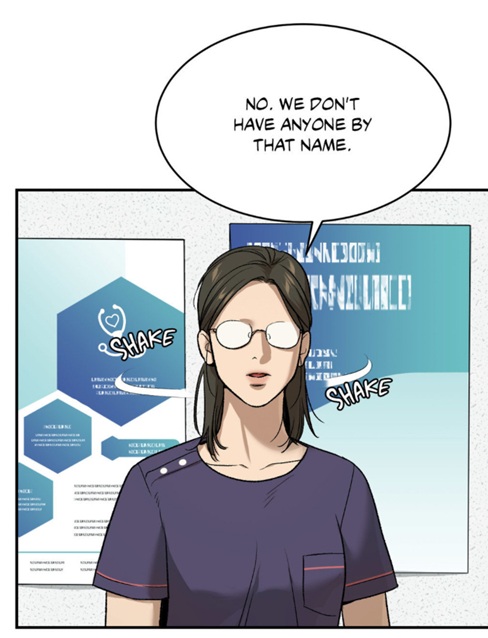 (chapter 56) Notice that even at the end, readers were not even able to see the PT’s faces:
  (chapter 56) This shows that the athlete is using more and more his intelligence, he is forced to interact with people. He is gradually developing his social skills which stand for COMMUNICATION. And how did he get deceive in the past?
 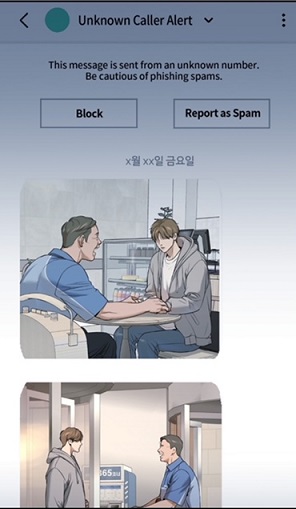 (chapter 48) He got manipulated by his eyes! They used a trick to deceive the athlete: delivering the truth in delay. Joo Jaekyung didn’t confront Kim Dan, because he saw the pictures as proofs! He never tried to hear his side from the story. And now, you comprehend why I am expecting that the champion will suffer another “blow” in the next episode. In my opinion, he will hear an important information. The fire in the illustration is there to indicate “Tabula Rasa”, a clean state. Joo Jaekyung has to lose all his principles and his bias about doc Dan. But for that he needs to face his own past and mistakes. Only through this effective anguish, he can become a better man, a new man.

 (chapter 55) One might think that the causes for his throbbing head are his depression and insomnia. On the other hand, I am quite certain that many readers had a different explanation for his migraine. He is missing his lover, Kim Dan, as the color red symbolizes the headache and the physical therapist’s name is strongly intertwined with this pigment which was once again confirmed in episoe 56.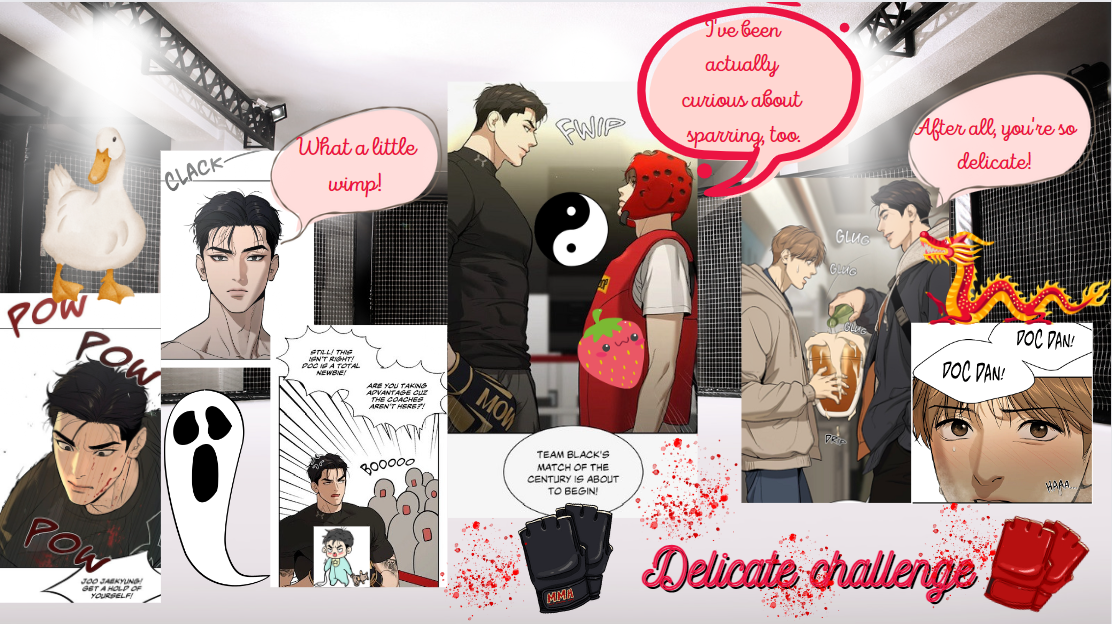

 Thus I consider this image, where the champion is seen
 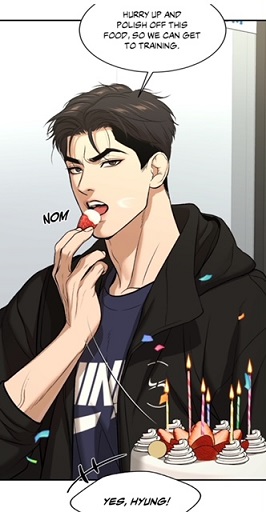 (chapter 43) eating a strawberry with cream as the announcement of the magical night between Kim Dan and his fated partner. The fruit with the cream represented a violation to his strict diet.
  (chapter 55) or the medicine against migraine.
 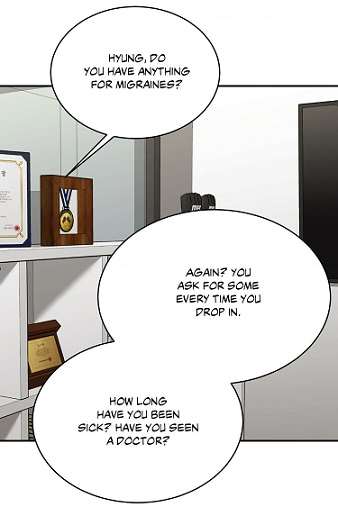 (chapter 54) However, in episode 55, we can observe a huge change in the champion.
  (chapter 55) The latter is finally admitting the inefficiency of the medicine. In other words, in this scene, he was giving up on them. This represents an important step on his way to enlightenment. For me, it signifies that he is stopping relying on pharmaceutical products. Let’s not forget that in the past, he rejected the PT and even neglected them. Why? It is because he trusted more sprays and other medicines than people.
  (chapter 49) Therefore the switch of the spray had to occur. He needed to question his prejudices and attitude. But let’s return our attention to the champion and his throbbing head. One detail in this panel caught my notice.
 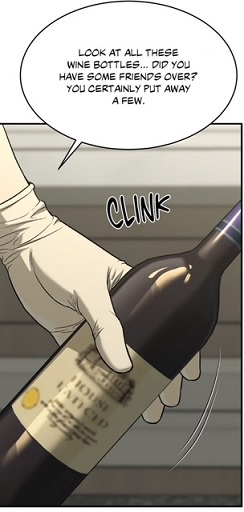 (chapter 55). This means that she had not seen the mess in the master room before:
  (chapter 55) And now, pay attention to the number of the bottles in his room:
  (chapter 55) I count 12 bottles of wine exactly like in the last image from chapter 54. Thus I came to the following deductions:
 (chapter 54) and the appearance of the staff in chapter 55. It indicates that Jinx-philes can witness time deceleration in season 2. From one month in one chapter, then a week in the next episode, finally we have a reference to a day: Monday. Thus I deduce that in episode 56, only 2 or 3 days elapsed. I have already announced that the couple should meet each other around 25th:
  (chapter 55)
 (chapter 55) Consequently, I judge the cleaning lady as the positive version of Park Namwook. Though she uses social norms, she doesn’t use them against her employee. She didn’t condemn him, it is a mixture of teasing and reminder. At the same time, her intervention implies that she must have noticed changes in her boss after the arrival of Kim Dan in the flat and his departure. That’s the reason why I have the impression that this image is announcing another turning point in the champion’s life either:
  (chapter 55) He won’t drink like before. However, I don’t think that he will behave like in the past: reject any alcohol entirely.
 (chapter 55), his migraine vanished. Though he is holding his head the next morning and hiding his gaze
  (chapter 55), the Webtoonist didn’t add any red or “throb” as an indication for a migraine. As you can see, his headache is strongly intertwined with repressing the physical therapist and as such locking away memories. However, there exists another cause. What had the doctor done in the past?
  (chapter 23) That’s how little kids are admired and loved. This stands in opposition to the abuser’s behavior:
  (chapter special 2) The same way than Kim Dan with the patting! In other words, the champion is deep down longing for such a gesture, but he has not realized it yet. Nevertheless, I believe that he just needs a trigger.
 (chapter 55) With his left opened eye!! The exact opposite from this picture:
  (chapter 56) As long as the fighter thinks of his fated partner, he is not plagued with a throbbing head. This shows that it has something to do with repressing memories. However, his physical condition is still not improving:
  (chapter 55) This signifies that in reality, the uke is the one benefiting more from this relationship, while the “Gucgi guy” is a placebo for Joo Jaekyung. He can not replace the true medicine: Dan’s love. But Joo Jaekyung chose to close an eye to the truth forgetting his “insight” from chapter 2:
  (chapter 2) However, back then, he had just stated it in order to get rid of the mint-goblin. He needed a justification for switching his partner. In other words, this was reflecting more the protagonist’s corrupted mind and heart. Therefore he is designed eyeless, the symbol for ignorance, lies and blindness.
 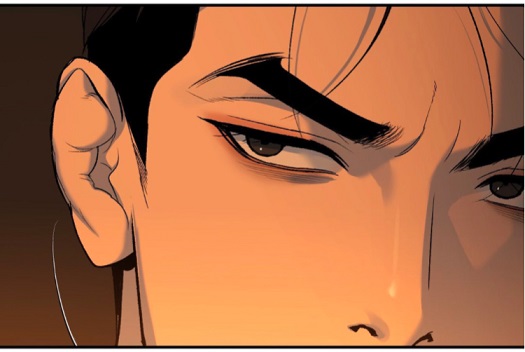 (chapter 55) And where did he have his migraine exactly?
 (chapter 55) It was on the right side and eye! It truly exposes that Joo Jaekyung was getting punished for his attitude. He is not allowed to bury and forget Kim Dan. The star’s open eyes in this episode symbolize denial, lack of self-awareness and as such the absence of insight. He is also punished for his lies in episode 2. His words might have reflected the truth, but his words didn’t expose a change of heart. He was taking advantage of this situation as well. So when the pain intensified pushing him to close his right eye, we should consider this image as a short moment of reflection and realization. In the restroom, he was forced to admit that only Kim Dan could kiss him. Is it a coincidence that just before Mingwa presented this image
  (chapter 55) He was just standing there and avoiding his gaze.
  (chapter 5) Therefore he was in a happy mood after that match. A simple gesture with a lot of power! He has been missing this hand or better said this gesture. This action was the main lead’s true motivation.
  (chapter 54) Don’t forget that Dominic Hill had expressed his admiration in a similar way, patting on the back:
  (chapter 40) No wonder why he felt so lost and empty after the last fight.
  (chapter 43) this was the coach’s hand. In other words, the athlete felt more close to the coach than to the manager. This would explain why he would listen to the coach and even entrust him with huge tasks like the charity event. Strangely, in season 1, we can observe how more or more he is distancing himself from the fighter. Probably related to his secret relationship with Kim Dan. According to my theory, the coach is aware of their relationship. They are more than just boss and employee. As you can see, I don’t think that the champion is right now just missing the doctor’s sweet lips. Deep down, he would like to be patted by his loved one, exactly like Potato.
  (chapter 23)
  (special episode 2) But this is what he received after the last match:
  (chapter 2) The champion’s reaction is quite telling. He is not easily swayed. But we have another bigger evidence that his intercourses were replacement for “fights”. In The States, the fighter asked Kim Dan to join him at 11:00.
  (chapter 38) He needed to prepare himself mentally, to visualize how he would screw his opponent Dominic Hill. He was just taking the expression “fuck/screw” too literally. The latter idiom has the following synonyms: to cheat, oppress, bleed, coerce, wrest and to tighten. Just before the doctor came to his door, what was the athlete doing? He was watching a video from his challenger:
  (chapter 38) Therefore it is not surprising that he rejected Kim Dan’s request first.
  (chapter 39) He didn’t feel like it, because he was not aroused at all. Imagine that he needed two hours for that erection, a sign that during that night, Kim Dan was in reality a replacement for the American fighter.
  (chapter 38) In fact, he needed a fellatio to get an erection, and he only started getting excited, when he saw the doctor’s gaze. That’s the reason why he remembered this image under the shower:
 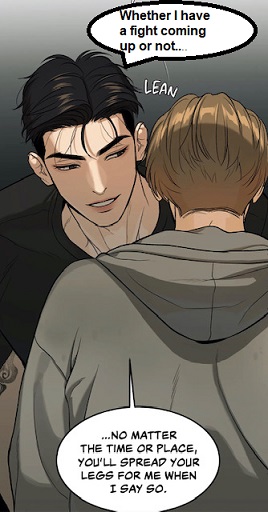 (chapter 6), Sex was no longer linked to matches, but to his own desires. To conclude, for the first time, the fighter connected sex to pleasure and desires and not “work and fighting”. Because of the deal and Joo Jaekyung’s strange behavior (sex shower scene, …) the PT had the impression that his boss was a man obsessed with sex.
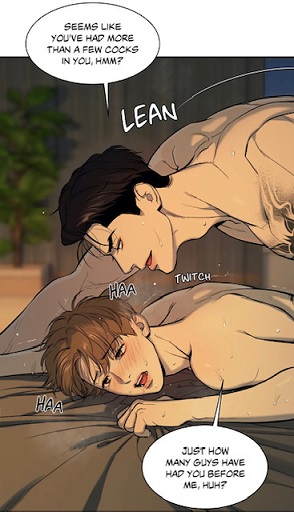 (chapter 4)
  (chapter 53) Pay attention to the behavior from the fighter during their last night together. He is looking away, he is not paying attention to his fated companion. His mind was elsewhere, focused on Baek Junmin! In my opinion, during that night, the champion had been able to differentiate between the physical therapist and his opponent. Fighting was more important than sex and as such his sex partner. To conclude, the physical therapist had been able to win Joo Jaekyung’s belief and heart. He was no longer a replacement at all. He had become a person close the fighter.
 (chapter 49) he wanted to screw Baek Junmin for real. In this image, the athlete oozes confidence and strength. This means that he was no longer dependent on the good fuck before the match.
  (chapter 53) However, the main lead never realized this huge change, he kept his old belief as a tradition out of habit. This explicates why the fighter tried to replace with a new uke
  (chapter 56). I don’t think, he was referring to the spray incident, rather to their night before the match. The doctor had not behaved like a real opponent, he had admitted his “defeat” quite easily. He had left the ring before procuring him a good fuck. He was blaming his partner for violating his rule:
  (chapter 44) Sex is a synonym for love and as such it is about giving pleasure and affection to his partner. It is a two-way street. And this is something that the champion has to admit and accept. Thus I deduce that the fighter still has a long way to go before dropping all his fake principles. Like mentioned before, he needs to ponder on the following question: what matters to him the most? His championship or his happiness? Or what is sex to him? Why does he think that he is jinxed? He needs to face his own painful past and remember the face of his tormentor.
 (chapter 49) Baek Junmin and the abusive parent.
  (chapter 54) However, this gesture had the opposite signification: rage, resent… but also sweet revenge! He must have recalled the Shotgun’s face.
  (chapter 52) There’s no doubt that thanks to the doctor, the champion will learn that he can get “justice” and satisfaction through other means. He can defeat the ghosts from the past, not just thanks to his fists and hard work, but also thanks to his surroundings and knowledge. Lawsuit and media!
 (chapter 1) The physical therapist is not only his reward and price, but also his “second shoulder” and as such his pillar. The new PT won’t be able to replace him. Joo Jaekyung is not just a champion, but also a team: Kim Dan as his PT and his lover. As for Kim Dan, the celebrity is his “energy drink”, his source of comfort and joy. He is also his home, for he is the first one who invited him to stay with him! Yes, the grandmother didn’t invite her grandson to live with her, he was just dumped at her place. And because the celebrity is like a home and family, it explicates why the doctor is once again “living like a ghost”.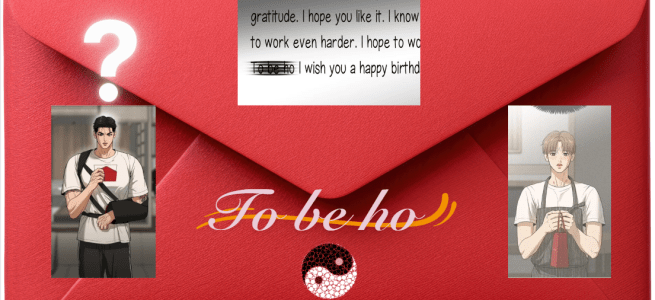




 (chapter 27)
  (chapter 13) He is definitely sure that this man won’t betray him. He is not judging him for his job or “sexual preferences”. He embodies fairness, tolerance and impartiality. And since in his cellphone, Doctor Cheolmin is registered under the name Cheolmin hyung, it exposes his closeness with this cute doctor. He is like a “brother”.
 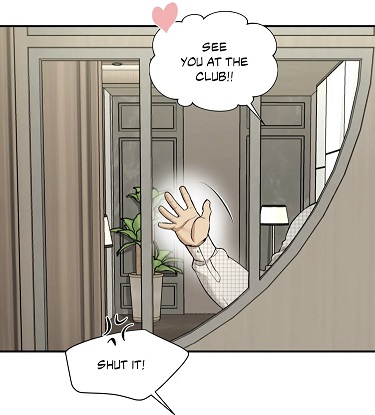 (chapter 13) This gesture with the hand implied not only that he was just looking forward to meeting him again, but also generosity. And if there was a request from Cheolmin, it was just about an information:
  (chapter 13) It had nothing to do with money and promoting his hospital.
 (chapter 33) According to me, the man was calling his friend Cheolmin, because he truly believed that the actor had been hurt. The fact that he went to the rooftop in order to call the person is indicating that he desires to hide his contact from Park Namwook and Jeong Yosep. In other words, he was seeking secrecy, exactly like the actor. As you can see, the dragon and the gumiho had a similar attitude. They thought that the rooftop was the perfect place to hide a secret. So by calling Cheolmin who is working at a hospital, the MMA fighter was making sure that there would be no scandal. However, when he called him, he discovered the truth. Choi Heesung had faked his injury. Therefore how could he use his connection with Cheolmin, when there was no emergency? In his eyes, he would have abused his busy friend’s generosity. That’s the reason why the star chose not to intervene. If he had revealed the truth and as such accused the actor of deception, he would have no one by his side to prove the truth. It was one man against two. Secondly, by revealing his presence on the rooftop, he would have been forced to mention his close friend: Cheolmin hyung. His connection with the athlete would have raised some question. And because he didn’t utilize the Joker in that situation, he became a victim of a trick. It is important, because the champion’s decision to hide Cheolmin’s existence from Jeong Yosep and Park Namwook is a sign that deep down, he is not trusting his two other hyungs. In my eyes, it is related to his homosexuality. But there could be other reasons as well, for example he met this doctor, before he became a celebrity.
 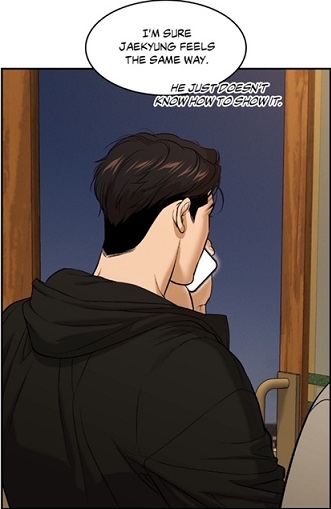 (chapter 33) For me, the doctor was the person Joo Jaekyung was talking to. Interesting is that contrary to episode 33, he didn’t leave the inn in order to talk to his acquaintance. In fact, he did it in front of the door. By acting that way, he didn’t attract the attention from the members. No one questioned the celebrity why he was talking on the phone for quite some time. They just imagined that it was work-related due to the selfie with a stan.
  (chapter 43) They didn’t even bother to wait for him to arrive before drinking and eating, though the man was the birthday child. He was actually the guest of honor.
  (chapter 43) This exposes violation of social norms and even the disrespect towards Joo Jaekyung. He is just seen as a cash cow, hence there was no thank you from them or even a short invitation for him, like Park Namwook and Kim Changmin had done it in episode 9.
  (chapter 9)
  (chapter 9) In fact, Joo Jaekyung was totally neglected at the restaurant, no one even paid attention to his actions. Under this light, I recognized why Mingwa created this incident:
  (chapter 43) It was not just to bring the two main leads closer, but also to expose the wrongdoers. If they had waited for him, the champion wouldn’t have drunk some soju from the glass of water, for Kim Dan couldn’t have used his glass.
 (chapter 43) That’s why the manager got red, a sign of embarrassment. He realized that they should have all waited for the birthday child. Moreover, don’t forget that the star was even paying the bill. And now, you are wondering if I didn’t diverge from my original topic, the Joker and Cheolmin hyung. No, as this new interpretation helped me to understand why Joo Jaekyung talked to his hyung in front of others. He already sensed that no one was observing him or waiting for him.
  (chapter 43) Moreover, it is possible that the mysterious caller desired to congratulate for his birthday or even to thank for his donation. Let’s not forget that just before his real birthday, the celebrity organized a charity event, and it could be related to Cheolmin’s work place.
  (chapter 41) Because I detected ingratitude, selfishness and rudeness from Team Black, I couldn’t help myself thinking that the other person must have behaved differently, which put the young man in a good mood. Therefore he overlooked the incident with the switch of glass:
  (chapter 13) Here we have a threat from the champion to which Cheolmin replied with a joke. Here, we have the same situation: a threat, but people got scared
 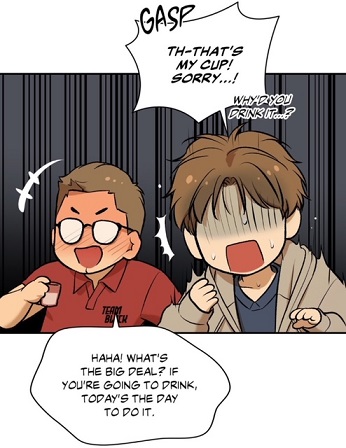 (chapter 43) before Park Namwook tried to relativize the incident.
 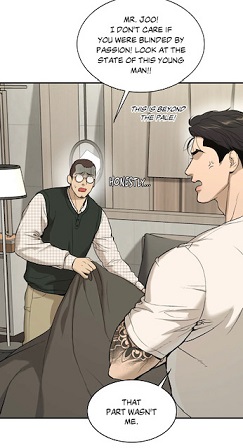 (chapter 13). Hence I believe that the other reason why our cute PT didn’t meet Cheolmin in season 1 is that he was not ready to interact with him. Kim Dan needed to mature, to free himself from social norms in order to accept such a man as a “role model”. That’s the reason why I am expecting the return from this mysterious doctor in season 2. In my opinion, he will play a central role in dethroning the king Park Namwook at Team Black, but also in helping Kim Dan to obtain justice. Keep in mind that according to me, the protagonist was a victim of many crimes committed by doctors. (The hospital director, Kim Miseon, MFC doctors)
 (chapter 35) He offered his assistance, but at no moment the main lead thought of even asking for his help.
  (chapter 46) If he had voiced his struggle to Heesung, the latter would have understood him and “talked” some sense to the dragon. And it is the same for Potato. In the locker room, when Kim Dan was criticized for his sloppiness,
 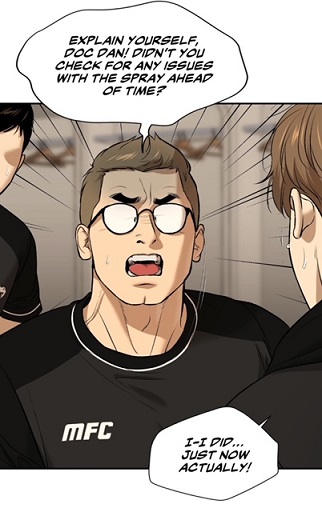 (chapter 50) he didn’t ask from Potato to vouch for him. He could have reached to him, requesting from him to testify in his favor. Yes, I believe that not only the actor and the maknae are to blame for their passivity, the physical therapist is also responsible for his own suffering. He is not seeing that he has already gained two friends. However, he didn’t treat them properly. No wonder why Kim Dan ended up alone at the end of season 1. At no moment, he confided to Potato or other members about his struggles, he kept everything to himself which is similar to his soulmate.
 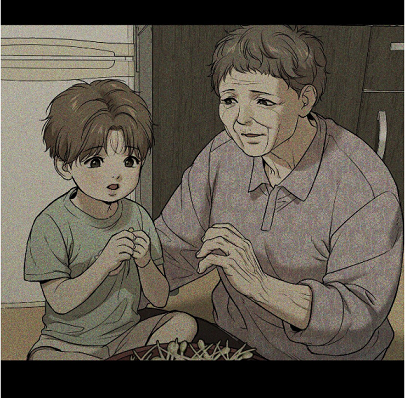 (chapter 47) Hence he was taught cooking. In addition, we can already envision that when he was a high school student, he had to take a part-time job. She definitely minimized his assistance, creating a debt towards her.
 (chapter 23), he just acted as their “PT” and nothing more. In other words, he acted, as if they only had a professional relationship. This explicates why Kim Dan never talked about himself, in other words he never shared any information with them. However, I doubt that he just considered them as his “patients”. He was happy to give his assistance. For me, the fact that he never lowered his guard is a sign of his low-esteem. So they had a strictly professional relationship, except with Potato.
  (chapter 26) However, even here, Kim Dan never shared his cellphone number with the maknae. If Potato had it, he would have tried to contact him immediately. To conclude, though I criticized Yoon-Gu and Heesung for their indifference and neglect, I feel that Kim Dan is partially responsible for this too. He didn’t take the first step to improve their relationship. Friendship is a two-way Street!
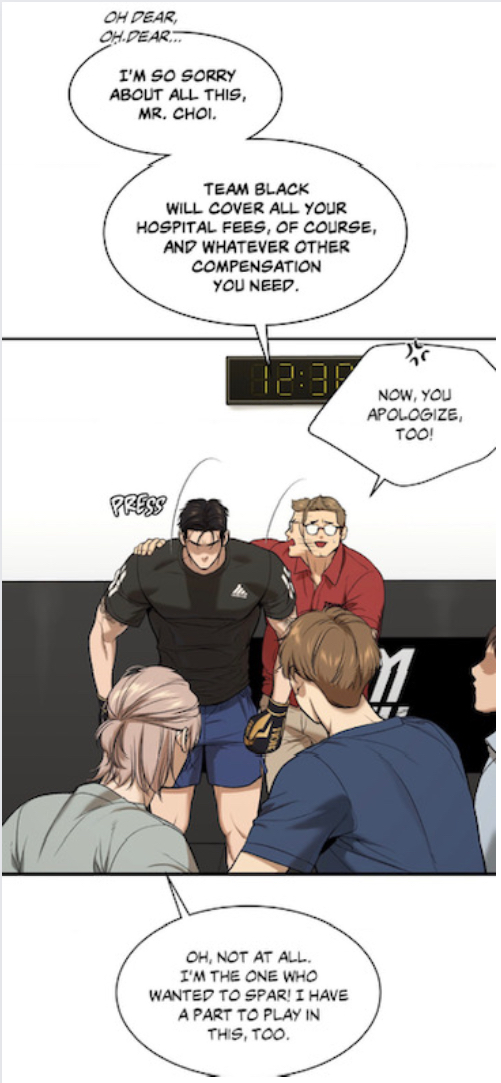 (chapter 31)
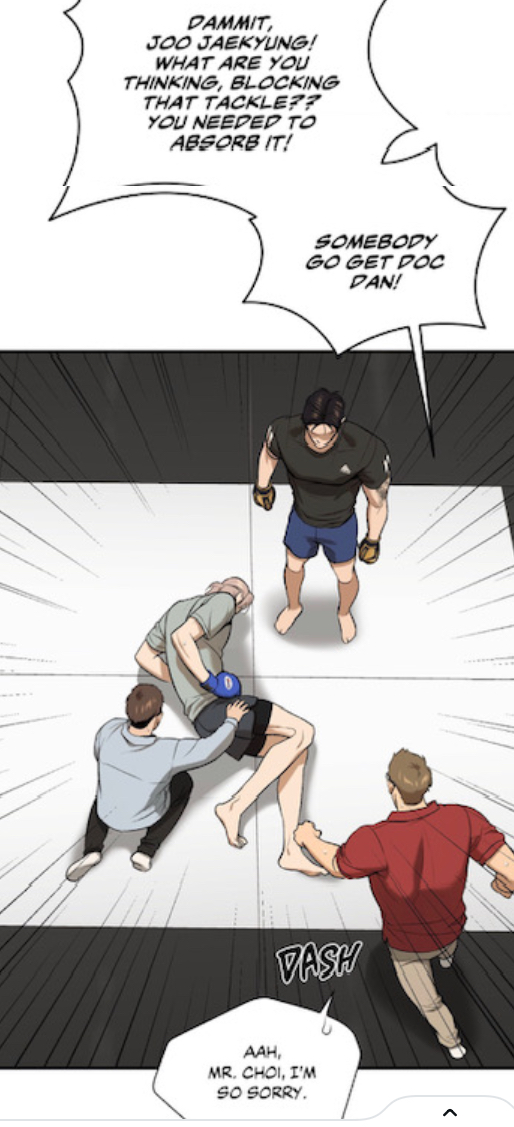 (chapter 31) As you can see, as soon as the actor was lying on the floor, the manager was already blaming his “boy”. This exposes that the man was not interested in the truth in the end. He had already given the judgement. But notice that Park Namwook chastised the protagonist for blocking the tackle. He reproached his star that he should have absorbed the comedian’s tackle.
  (chapter 31) He used his whole weight and strength to take down his counterpart. This corresponds to a low-speed car accident and Mingwa let us see the effect of this terrible impact:
  (chapter 31) His facial expression was betraying him: he was in pain. This means that in verity the one who had caused an injury was not the champion, but Heesung. But there is more to it.
  (chapter 37) Look at this: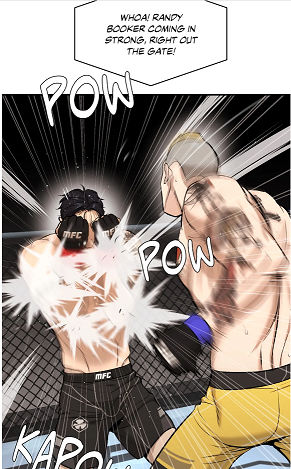

 In the second case, the athlete had to change his strategy, for he was already wounded. In other words, Kim Dan’s mistake was to teach Joo Jaekyung to trust his instincts and as such himself. He needs to stop using his body as a shield, but as a weapon, like he did in the doctor’s home: become proactive and anticipate his opponent’s moves.
  (chapter 25) The latter desired to learn the moves from MMA fighting
  (chapter 25) in order to understand the involvement of the muscles and the possible consequences on the body. This scene displays the lack of expertise from Park Namwook. How did he become a manager and even a coach? Perhaps a crash course organized by MFC
  (chapter 22), but the latter is definitely influenced by the criminal underworld. This new observation reinforces my previous theory that Kim Dan will come to replace the manager and coach’s position. What distinguishes them from each other is their attitude to knowledge. Kim Dan keeps learning, reading and watching, whereas the other has the impression, he already knows everything. I guess, he has never heard from the concept “lifelong learning”.The latter promotes the idea of continuously acquiring knowledge and skills throughout a person’s life. This approach values education beyond formal schooling, emphasizing that learning can happen in various settings
  (chapter 42), including personal, professional, and community experiences. The goal is to adapt to changes, meet evolving job requirements, and stay mentally engaged. In Germany and other countries, lifelong learning is promoted to foster personal growth, social inclusion, and employability, especially as technology and society rapidly evolve. I am myself a follower from this concept. Hence I am still looking for new things (learning new cultures, new languages, reading about psychology, …).
  (chapter 27) Yet, he was chastised. I had always stated the coach’s responsibility before, but I had only found indirect evidences for this interpretation. Since he should have absorbed the impact, it implies that the latter should accept the pain as a normality. However by blocking Heesung’s assault, the athlete had tried to protect his own body. Thanks to Kim Dan, the fighter was learning how to treasure his own body. Moreover, it displays another flaw from Park Namwook: his risky attitude by making a bad recommendation. I would even add that his slap on the fighter’s neck is revealing his recklessness and thoughtlessness.
 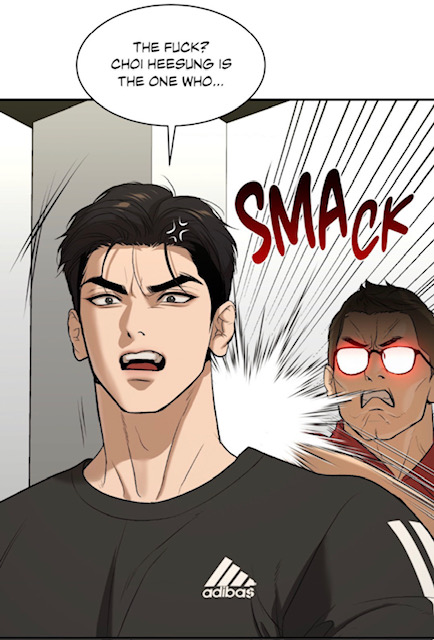 (chapter 31)
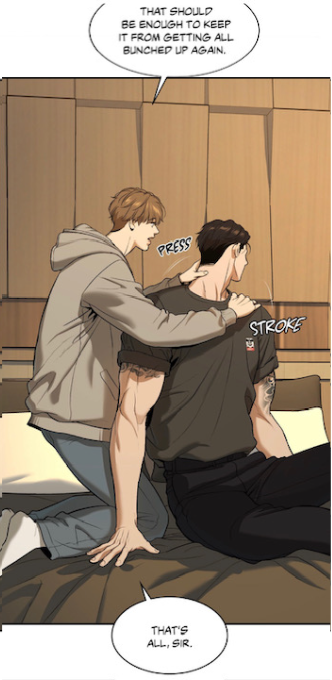 (chapter 32) Joo Jaekyung was finally receiving his treatment for his injury, the consequence of Heesung’s tackle. No one checked on his body, just because the other was faking his injury. While writing this, I can’t stop my blood from boiling out of anger. To conclude, I am confirming once again that Park Namwook is a bad coach and manager. He shouldn’t be allowed to become one for the other fighters. He would treat them like toys or even “punching bags”. Imagine that he would also recommend such a strategy to Potato as fighter. That would be very dangerous. In addition, why was he treating his star so badly and privileging the actor? It is because the latter brings money forgetting that the champion is the source of his own income! And this brings me back to the initial picture:
 (chapter 43) Interesting is the idiom is a synonym for deceitfulness. And this brings me to my next observation. Why did he add “whatever other compensation you need”? The moment I asked myself this question, I couldn’t restrain myself from thinking that the manager might have known about the true intention from Choi Heesung. Is it a coincidence that Kim Dan was used as compensation for the athlete’s mistake? Moreover, the latter was supposed to meet the actor on a Saturday, his own day-off.
  (chapter 32) And this proves that Park Namwook is the reason why the athlete never took a day-off. He was forcing an employee to work during his day-off and the latter wouldn’t even be paid for this. It was included in the “salary”. It was, as if the manager was using the PT as his servant.
  (chapter 31) in the hallway, next to the meeting room and office. So technically, Park Namwook could have heard them talking behind the door, a new version of this scene:
 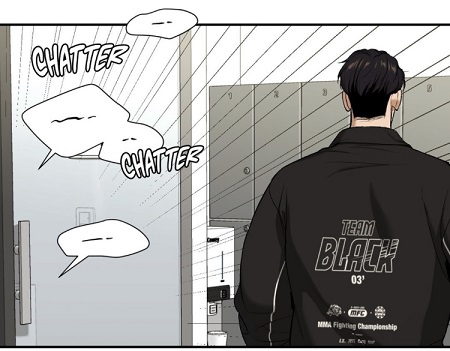 (chapter 36) Was he truly ignorant about the actor’s intentions with all this wooing and sponsoring?
  (chapter 31) In addition, he had heard the comment from the gumiho’s manager.
  (chapter 30) Just because we didn’t see this, it doesn’t mean that it didn’t happen. And maybe that’s the other reason why he was more than willing to use Kim Dan. The latter was bringing a huge client to the gym.
  (chapter 31) He would come on a regular basis. Naturally, I have no more proof for this theory than the remark “whatever other compensation you need” and its timing. Nevertheless, one thing is sure. Kim Dan was treated the exact same way than Joo Jaekyung, a doll and servant at his disposal.
  (chapter 37) It is because Park Namwook had become his voice. And we can observe this with the apology at the gym:
 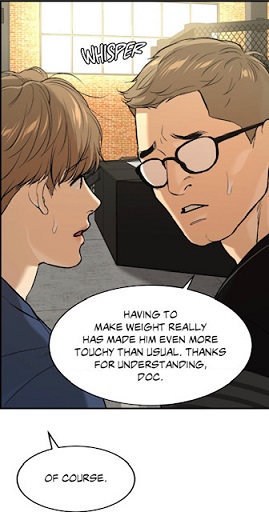 (chapter 37) are just lip-services because at the end, he has no problem to replace Kim Dan.
 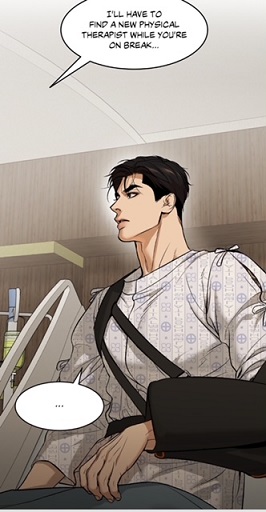 (chapter 53) That’s the reason why I have been wondering if the last incident was not the trigger for the coach to drop his “boy” and find a new “star and champion”. Since he is so obsessed with money and fame, I can’t help myself wondering if he will take a new pupil and torment him so that the latter only becomes a shadow of himself. Let me know what you think about this.
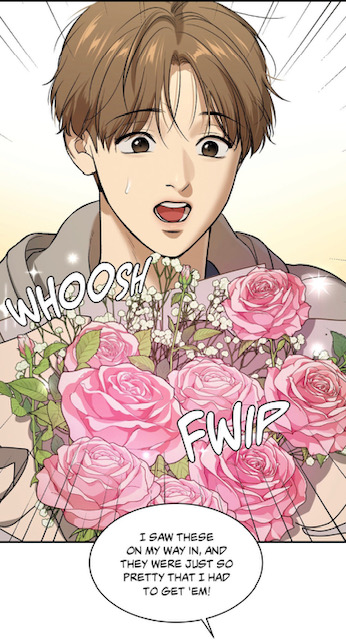 (chapter 31)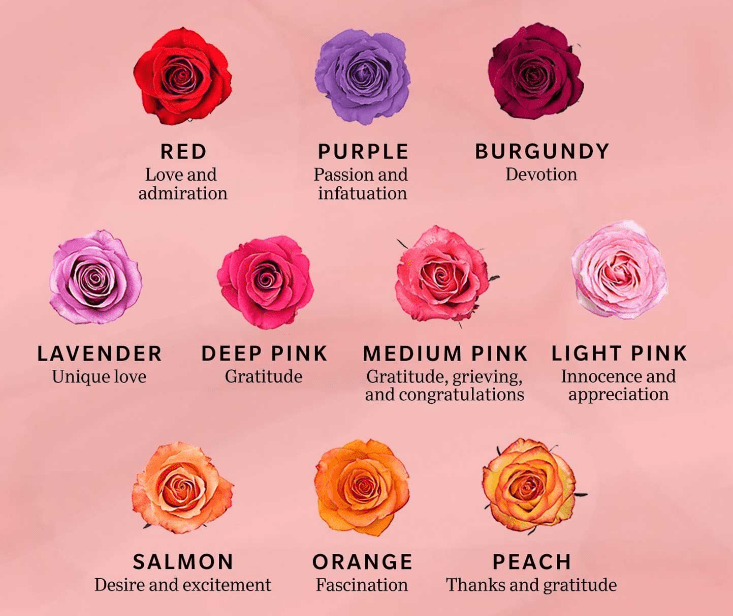
 (chapter 31) They look more like the light pink rose: Innocence and admiration. However, keep in mind that back then, the gumiho was already love bombing the physical therapist with presents, a sign that he was already thinking of dating the main lead. While the bouquet of flowers was not reflecting his intentions, in verity it exposes his true thoughts unconsciously. He was simply impressed and desired to express gentleness, grace, and gratitude. This observation made me realize that the actor couldn’t identify his emotions in the end. In other words, he doesn’t know what LOVE is! That’s his curse. He mistook his feelings for love, while in reality, it was simply LUST. 😉 While the latter is important in a relationship, it only represents the first stage of love. So not overcoming this first stage, means that the relationship is doomed to fail.
 (chapter 30) “The angel speaks” outlines that he is creating a false image of the main lead. It was, as if he was living a dream which corresponds to the third characteristic. This is no coincidence that Heesung was seeing a lot of stars, when he looked at the “hamster’s face”.
  (chapter 30)
  (chapter 33) His emotions couldn’t be maintained over time, which corresponds to the second sign.. Thus he was suddenly perceiving the unknown man as clingy and the grass would always look greener
  (chapter 33), each time he faced someone he felt attracted to. We could say, he was under the spell of his “type”. At the same time, this discovery reinforces my previous interpretation about Kim Dan’s role. The actor needed to experience rejection in order to learn that lust can not always lead to love. We could say that the doctor was the angel who freed Heesung from his terrible lust spell.
  (chapter 35) Since the actor has always confused lust with love, it was necessary for him not to feel “lust” in front of Potato first. In that scene, the man was moved, not by the uke’s touch like with Kim Dan
 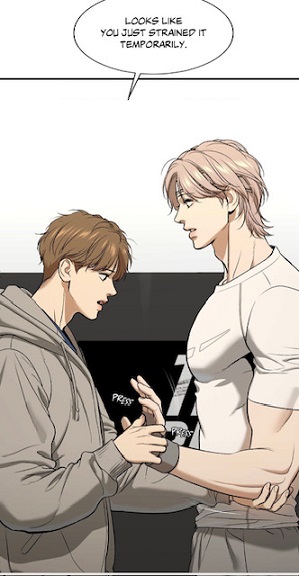 (chapter 30), but by Yoon-Gu’s words.
 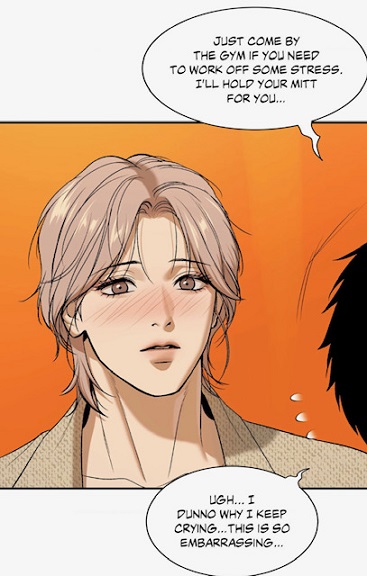 (chapter 35) The latter was offering him some help without expecting anything in return. Yes, he got attracted by his beautiful mind and heart. Through their conversation, they got to know each other. In other words, for the actor it was necessary to not experience lust, as a first stage of “love”, but to develop an emotional connection first! In addition, it becomes comprehensible why the artist suggested Potato to work as an actor.
 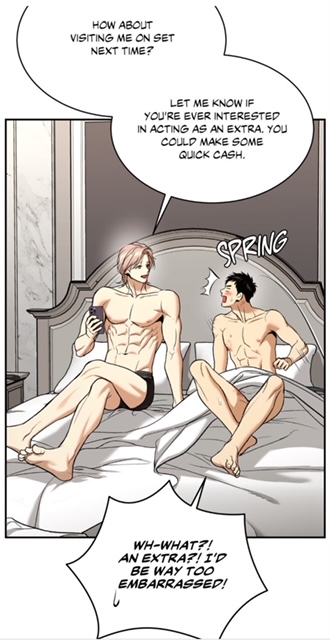 (special episode 2) It was his way to develop a longer relationship. He was trying to find the right balance between seeking thrill and pursuing stability. As a conclusion, the two special chapters display why the actor came to fall in love with Potato.
 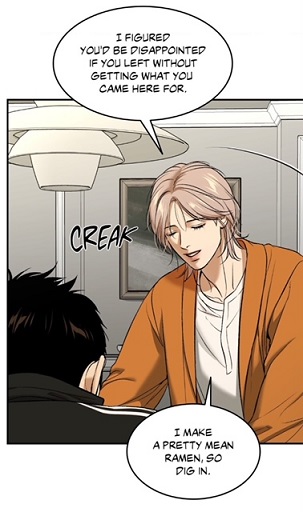 (chapter special 1) By preparing some ramen, he acted as a selfless person, though his thoughts revealed his dark side. Nevertheless, what matters the most are the actions and not the thoughts.
 (chapter 41) He bought it during his trip to the States. Interesting is that the young man chose not to bring pink roses to his grandmother. Why has he never brought flowers to his halmeoni? Chapter 31 gives us the answer:
  (chapter 31) The flowers stand for “ephemerality”, for they are destined to wilt in a very short time. Yes, this shows that deep down, Kim Dan knew how his grandmother is trying to escape from reality. He knows her likes for flowers and roses as pattern because of the bed sheets
 (chapter 11) or bouquets of flowers for his school career.
  (chapter 47) Hence she generated guilt, indebtedness and obligation in her grandson. Because he was able to travel to the States, he must have felt somehow guilty, as the latter was trapped in her hospital room. Therefore he felt the need to compensate his grandmother with an expensive present.
 (chapter 41) The two flowers have the following meanings:
 (chapter 19) But this will be the topic for the next Daily Jinx Advent Insight! 😉
 (chapter 40) Park Namwook answers to the maknae’s question about the doctor’s whereabouts. Kim Dan is with the security from MFC because of the drug incident. So far, this is nothing new and very interesting. But the devil is in the details. How did the MFC guys get informed about the drug incident? It seems easy to answer: Park Namwook must have informed them, as he is the one giving the answer to Potato’s question. Furthermore Nevertheless, we shouldn’t forget that the questioning was taking place in the USA. The official language is English!! And now look at Kim Dan’s reaction, when he was being interrogated. :
  (chapter 40) He could barely talk in English, he had troubles to understand the comments from the men in black.
 (chapter 37) Only Joo Jaekyung speaks English fluently, a sign that he is intelligent and educated. On the stage after his victory, you can see him talking to Dominic Hill, whereas Park Namwook is standing next to him alone!
  (chapter 37) Interesting is that Park Namwook was standing behind „his boy“ while trying to restrain him. But he was not looking at the American coach, a sign that he was not trying to talk to that man. On the other hand, he didn’t separate them either or slapped Joo Jaekyung on the neck in order to silence him.
  (chapter 37) except in front of Kim Dan! The latter’s passivity and silence in all the images from episode 37 shows that the Korean coach in the States was putting a lot of responsibilities on his “boy”. Hence I can only conclude that he is not fluent in English exactly like Kim Dan . Moreover, since the physical therapist has a diploma, but he can not speak very well, I can only jump to the following conclusion. Park Namwook’s knowledge in English must be quasi-inexistent. This observation leads me back to my initial question. How could he have mentioned the incident with the drugged nutrition shake to MFC authorities, when he can not speak English? I doubt that the MFC security guys could talk in Korean.
  (chapter 37) And that’s how it dawned on me that Park Namwook must have met him or talked to him. Hence I am deducing that this mysterious man must be an acquaintance of Park Namwook. I would even go so far to say that this could be the mysterious MFC manager. That’s the reason why he hid his face with the cap. He needed to make sure that the person opening the door wouldn‘t recognize him. This observation led me to another question: if the manager knows him well, how could he be sure not to get caught? And now, look at this! Jeong Yosep was on the phone, therefore he couldn‘t open the door. This call was not random in my opinion.
  (Chapter 36) So none of the members from Team Black could recognize him. Since Park Namwook is a former wrestler, it is very likely that he knew this man from the past. Naturally, because the man is a fellow citizen, there is no ambiguity that the manager would entrust him with this terrible incident.
  (chapter 37) was the one who had encouraged Kim Dan to drink the poisoned nutrition shake. So Kim Dan could blame for his suggestion, especially when the physical therapist had suggested to return the beverage. That‘s how I realized why Park Namwook had also an interest to abandon Kim Dan, as he didn‘t want to become responsible. Moreover, he couldn‘t intervene either, he couldn‘t speak in English either. That way, he could mask his incompetence.
  (Chapter 40) The man prefers relying on others, even delegate tasks to others, but at the same time, he takes credit for Joo Jaekyung‘s success.
