Please support the authors by reading Manhwas on the official websites. This is where you can read the Manhwa: Jinx But be aware that the Manhwa is a mature Yaoi, which means, it is about homosexuality with explicit scenes. Here is the link of the table of contents about Jinx. Here is the link where you can find the table of contents of analyzed Manhwas. Here are the links, if you are interested in the first work from Mingwa, BJ Alex, and the 2 previous essays aboutJinxEchoes of a Blue Friend(locked)andIllumination in the Tiled Sanctuary (locked)
It would be great if you could make some donations/sponsoring: Ko-fi.com/bebebisous33 That way, you can support me with “coffee” so that I have the energy to keep examining Manhwas. Besides, I need to cover up the expenses for this blog.
Headache, Poison and Addiction
In the previous essay, I focused on the symbolism of the rooms in the champion’s life. Therefore I came to neglect the champion’s headache in the restroom. (chapter 55) One might think that the causes for his throbbing head are his depression and insomnia. On the other hand, I am quite certain that many readers had a different explanation for his migraine. He is missing his lover, Kim Dan, as the color red symbolizes the headache and the physical therapist’s name is strongly intertwined with this pigment which was once again confirmed in episoe 56. (chapter 56) So it is true that his migraine are caused by the doctor’s absence. It was, as if the main lead was suffering from withdrawal symptoms. The fighter has a love addiction, but he is not aware of the existence of this “sweet poison”. But there’s more to it.
Very early on, I had associated the “hamster” to a drug, but more precisely to a sweet candy and even a strawberry, like my different illustrations of analyses are displaying it Thus I consider this image, where the champion is seen (chapter 43) eating a strawberry with cream as the announcement of the magical night between Kim Dan and his fated partner. The fruit with the cream represented a violation to his strict diet.
The wolf’s coping mechanisms
So the moment Joo Jaekyung was left alone, he tried to cope with the withdrawal symptoms by replacing with other drugs, like for example alcohol (chapter 55) or the medicine against migraine. (chapter 54) However, in episode 55, we can observe a huge change in the champion. (chapter 55) The latter is finally admitting the inefficiency of the medicine. In other words, in this scene, he was giving up on them. This represents an important step on his way to enlightenment. For me, it signifies that he is stopping relying on pharmaceutical products. Let’s not forget that in the past, he rejected the PT and even neglected them. Why? It is because he trusted more sprays and other medicines than people. (chapter 49) Therefore the switch of the spray had to occur. He needed to question his prejudices and attitude. But let’s return our attention to the champion and his throbbing head. One detail in this panel caught my notice. (chapter 55) Interesting is that Mingwa portrayed him with closed eyes. It is not anodyne in my opinion, for the author was referring to the star’s third eye. Here, the protagonist was using it. That’s the reason why I interpret this image as a metamorphosis in the fighter.
Headache and alcohol
And what about alcohol? When the cleaning lady with her colleagues removed all the empty bottles of wine, she made the following comment: (chapter 55). This means that she had not seen the mess in the master room before: (chapter 55) And now, pay attention to the number of the bottles in his room: (chapter 55) I count 12 bottles of wine exactly like in the last image from chapter 54. Thus I came to the following deductions:
The cleaning staff only comes once a week and it is on Mondays!!
This signifies that a week had passed between the moment the fighter started drinking (chapter 54) and the appearance of the staff in chapter 55. It indicates that Jinx-philes can witness time deceleration in season 2. From one month in one chapter, then a week in the next episode, finally we have a reference to a day: Monday. Thus I deduce that in episode 56, only 2 or 3 days elapsed. I have already announced that the couple should meet each other around 25th: (chapter 56), for the day Kim Dan wired his money to his “loved one” took place after 10th of the month: XX = two digits. (chapter 55)
Then, the fact that this woman questioned the fighter’s behavior before removing the bottle, (chapter 55), indicates her surprise. She can not explain his huge change of behavior (messy and dirty room). She is trying to find an explanation: maybe a party with friends? The woman’s comment about the champion’s drinking habits seems to carry a dual tone. On one hand, it could be interpreted as playful or ironic banter, potentially lightheartedly teasing him about drinking heavily or having an active social life. On the other hand, it could also function as a reminder or critique, subtly pointing out the extent of his drinking and perhaps hinting at concern or judgment. For me, she was showing concern for her boss. The other evidence for this interpretation is that she brought the gift with the card: (chapter 55) Consequently, I judge the cleaning lady as the positive version of Park Namwook. Though she uses social norms, she doesn’t use them against her employee. She didn’t condemn him, it is a mixture of teasing and reminder. At the same time, her intervention implies that she must have noticed changes in her boss after the arrival of Kim Dan in the flat and his departure. That’s the reason why I have the impression that this image is announcing another turning point in the champion’s life either: (chapter 55) He won’t drink like before. However, I don’t think that he will behave like in the past: reject any alcohol entirely.
Migraine and the power of love
Moreover, I would like to point out that the moment the champion masturbated himself, (chapter 55), his migraine vanished. Though he is holding his head the next morning and hiding his gaze (chapter 55) (chapter 55), the Webtoonist didn’t add any red or “throb” as an indication for a migraine. As you can see, his headache is strongly intertwined with repressing the physical therapist and as such locking away memories. However, there exists another cause. What had the doctor done in the past? (chapter 44) Yes, the main lead had patted his lover’s head, while the champion had his eyes close. In my opinion, his unconscious had registered this gesture and loved it. However, the champion had not seen it himself. He was drunk and had his eyes closed. This stroke on the head symbolizes appreciation, affection and recognition. (chapter 23) That’s how little kids are admired and loved. This stands in opposition to the abuser’s behavior: (chapter 54) parental criticism and absence of contact. And how did Choi Heesung express his “love” to Yoon Gu? (chapter special 2) The same way than Kim Dan with the patting! In other words, the champion is deep down longing for such a gesture, but he has not realized it yet. Nevertheless, I believe that he just needs a trigger.
And what was he doing it here? (chapter 55) Stroking himself his head!! On the one hand, it stands for self-reliance, on the other hand it symbolizes his growing maturity. He is somehow attempting to be gentler with himself. Thus I interpret this image as the symbol of growth and insight, whereas I judge the scene in the bathroom as its negative reflection. How was the champion drawn under the shower?
(chapter 55) With his left opened eye!! The exact opposite from this picture: (chapter 55) This signifies that under the shower, he made the opposite decision: no insight and clairvoyance. He chose to bury the doctor again. The problem is that it was already too late. And what is the other difference between these two panels? The absence of the migraine! As long as the athlete thinks about Kim Dan, he has no throbbing head. This explicates why at the end, of episode 55, he was no longer suffering from a migraine. (chapter 55) This observation got confirmed in episode 56, though I couldn’t expose it before the release of the new chapter. (chapter 56) As long as the fighter thinks of his fated partner, he is not plagued with a throbbing head. This shows that it has something to do with repressing memories. However, his physical condition is still not improving: (chapter 56) He even looks worse than before: exhausted and malnourished. There is no one by his side taking care of him: his only interaction with his manager is through the phone. At no moment, the guy felt the need to pay a visit to his boss and champion. (chapter 56) Because I discovered the connection between memories and the physical therapist, it is important to examine the interaction between the main lead and the new uke.
Migraine and the placebo
Yes, I am comparing the new uke to a placebo, a fake “medicine”.
The placebo effect is when a person’s physical or mental health appears to improve after taking a placebo or ‘dummy’ treatment. Placebo is Latin for ‘I will please’ and refers to a treatment that appears real, but is designed to have no therapeutic benefit. A placebo can be a sugar pill, a water or salt water (saline) injection or even a fake surgical procedure. Quoted from https://www.betterhealth.vic.gov.au/health/conditionsandtreatments/placebo-effect
Funny is the original meaning of placebo: “I will please”. Who is pleasing whom at the club? I would say, the celebrity is like a sweet reward to the bottom. Hence the latter is smiling, when he starts talking to the fighter. (chapter 55) This signifies that in reality, the uke is the one benefiting more from this relationship, while the “Gucgi guy” is a placebo for Joo Jaekyung. He can not replace the true medicine: Dan’s love. But Joo Jaekyung chose to close an eye to the truth forgetting his “insight” from chapter 2: (chapter 2) However, back then, he had just stated it in order to get rid of the mint-goblin. He needed a justification for switching his partner. In other words, this was reflecting more the protagonist’s corrupted mind and heart. Therefore he is designed eyeless, the symbol for ignorance, lies and blindness.
What caught my attention is that the author zoomed on Joo Jaekyung’s gaze and notice that the zoom was more on his right eye. (chapter 55) And where did he have his migraine exactly? (chapter 55) It was on the right side and eye! It truly exposes that Joo Jaekyung was getting punished for his attitude. He is not allowed to bury and forget Kim Dan. The star’s open eyes in this episode symbolize denial, lack of self-awareness and as such the absence of insight. He is also punished for his lies in episode 2. His words might have reflected the truth, but his words didn’t expose a change of heart. He was taking advantage of this situation as well. So when the pain intensified pushing him to close his right eye, we should consider this image as a short moment of reflection and realization. In the restroom, he was forced to admit that only Kim Dan could kiss him. Is it a coincidence that just before Mingwa presented this image (chapter 55), she designed her characters eyeless? (chapter 55) Naturally no, she was mirroring the attitude of both figures: both were in denial!! Notice that though the star had no reaction in front of the “replacement”, the latter chose not to give up at all. This man was not expecting a rejection, in fact he was in total denial as well. He didn’t notice the star’s passivity and silence.(chapter 55) He was just standing there and avoiding his gaze. (chapter 55) By such a lethargy and the absence of an erection, the uke should have recognized that the fighter was not into him at all! But no, this man chose to close his eyes to the truth. Why? Because of his greed and selfishness. This explains his shocked reaction, when the athlete pushes him away and leaves: (chapter 55) How can the MMA fighter reject him? This displays his huge confidence or arrogance. There’s no doubt that he will put the blame on Joo Jaekyung. At the same time, I believe that his blindness was also caused by his greed. (chapter 55) He knew that the protagonist was rich and famous.
But let’s return our attention to the athlete. Since the champion’s headache is located on the right side, Jinx-philes should pay attention to the place the doctor patted him: the left side! (chapter 44) This shows that he would like to be patted on his whole head, exactly like Potato. And he had received it in episode 5: (chapter 5) Therefore he was in a happy mood after that match. A simple gesture with a lot of power! He has been missing this hand or better said this gesture. This action was the main lead’s true motivation. (chapter 54) Don’t forget that Dominic Hill had expressed his admiration in a similar way, patting on the back: (chapter 40) No wonder why he felt so lost and empty after the last fight. (chapter 5) But whose hand is this? Park Namwook or coach Jeong Yosep? Because I saw connections between chapter 43-44 and 55, I deduce that (chapter 43) this was the coach’s hand. In other words, the athlete felt more close to the coach than to the manager. This would explain why he would listen to the coach and even entrust him with huge tasks like the charity event. Strangely, in season 1, we can observe how more or more he is distancing himself from the fighter. Probably related to his secret relationship with Kim Dan. According to my theory, the coach is aware of their relationship. They are more than just boss and employee. As you can see, I don’t think that the champion is right now just missing the doctor’s sweet lips. Deep down, he would like to be patted by his loved one, exactly like Potato. (chapter 23) (special episode 2) But this is what he received after the last match: (chapter 52) Nevertheless, Joo Jaekyung is lost as well, because he needs to face his old and fake belief: he is jinxed. But in order to remove this persistent superstition, it is important to study the origins of the athlete’s sexuality. How can I do this?
The origins for the wolf’s excitement
I have always stated that the champion’s libido was strongly intertwined with his aggressiveness. His intercourses were like surrogate fights in the bed. This explicates why the mint-goblin didn’t put much effort to “seduce” him and only touched his sex, when he was on the verge of losing his biggest income: (chapter 2) The champion’s reaction is quite telling. He is not easily swayed. But we have another bigger evidence that his intercourses were replacement for “fights”. In The States, the fighter asked Kim Dan to join him at 11:00. (chapter 38) He needed to prepare himself mentally, to visualize how he would screw his opponent Dominic Hill. He was just taking the expression “fuck/screw” too literally. The latter idiom has the following synonyms: to cheat, oppress, bleed, coerce, wrest and to tighten. Just before the doctor came to his door, what was the athlete doing? He was watching a video from his challenger: (chapter 38) Therefore it is not surprising that he rejected Kim Dan’s request first. (chapter 39) He didn’t feel like it, because he was not aroused at all. Imagine that he needed two hours for that erection, a sign that during that night, Kim Dan was in reality a replacement for the American fighter. (chapter 39) Even when the doctor rubbed his hand against his sex, he had no reaction. (chapter 38) In fact, he needed a fellatio to get an erection, and he only started getting excited, when he saw the doctor’s gaze. That’s the reason why he remembered this image under the shower: (chapter 55) However, the more time the champion spent time with his physical therapist, the more he came to violate his own rules and principles: It started with their first meeting, when he crossed the line by mixing private and professional life together: (chapter 56) Here, Jinx-philes should detect a change, for the champion used the idiom “play”, which is strongly intertwined with fun and entertainment. Then the second violation took place, when the main lead suggested this deal. (chapter 6), Sex was no longer linked to matches, but to his own desires. To conclude, for the first time, the fighter connected sex to pleasure and desires and not “work and fighting”. Because of the deal and Joo Jaekyung’s strange behavior (sex shower scene, …) the PT had the impression that his boss was a man obsessed with sex.
However, this connection between sex and fight was not truly severed at the end of season 1, as the athlete didn’t give up on his biggest rule: to have sex before a match. This observation brings me to the last intercourse between the doctor and Joo Jaekyung. (chapter 53) The latter didn’t feel the need to have more sex with Kim Dan, he let his partner leave the place. Why? This contrasts so much to their First Wedding Night: (chapter 4) (chapter 53) Pay attention to the behavior from the fighter during their last night together. He is looking away, he is not paying attention to his fated companion. His mind was elsewhere, focused on Baek Junmin! In my opinion, during that night, the champion had been able to differentiate between the physical therapist and his opponent. Fighting was more important than sex and as such his sex partner. To conclude, the physical therapist had been able to win Joo Jaekyung’s belief and heart. He was no longer a replacement at all. He had become a person close the fighter.
This signifies as well, the sex before the match had lost its true purpose, and this change occurred in the bathroom, when the athlete made the following resolve: (chapter 49) he wanted to screw Baek Junmin for real. In this image, the athlete oozes confidence and strength. This means that he was no longer dependent on the good fuck before the match. (chapter 53) However, the main lead never realized this huge change, he kept his old belief as a tradition out of habit. This explicates why the fighter tried to replace with a new uke (chapter 55), but here the sex was longer connected to a match, rather to fun. Finally, observe how the champion is now blaming his PT for his ruined match: (chapter 56). I don’t think, he was referring to the spray incident, rather to their night before the match. The doctor had not behaved like a real opponent, he had admitted his “defeat” quite easily. He had left the ring before procuring him a good fuck. He was blaming his partner for violating his rule: (chapter 2) But here is the thing. Kim Dan had just accepted the deal because of his grandmother. Secondly, he learned an important lesson during that magical night: consent! (chapter 44) Sex is a synonym for love and as such it is about giving pleasure and affection to his partner. It is a two-way street. And this is something that the champion has to admit and accept. Thus I deduce that the fighter still has a long way to go before dropping all his fake principles. Like mentioned before, he needs to ponder on the following question: what matters to him the most? His championship or his happiness? Or what is sex to him? Why does he think that he is jinxed? He needs to face his own painful past and remember the face of his tormentor.
However, so far, I didn’t elaborate why Joo Jaekyung came to link fight and sex together. So where does it come from? The answer is simple. The origins of his anger and belligerence were linked to the ghosts from the past: (chapter 49) Baek Junmin and the abusive parent. (chapter 54) Deep down, he wants to punish them. Back then, he must have felt powerless, therefore he chose to erase them from his memories.In both cases, the athlete succeeded to forget them, but he didn’t truly move on with his life. The sufferings they brought upon him were still lingering in his heart and mind. Many readers could detect that the fighter had masturbated on the couch, as he left two tissues on the table: (chapter 54) But I doubt that he had been thinking about the doctor during that time, as Kim Dan only emerged in his nightmare: (chapter 54) But the masturbation had taken place before. So who did he have in mind, when he was jerking off? I might shock my avid readers, but I would say: Baek Junmin. (chapter 54) However, this gesture had the opposite signification: rage, resent… but also sweet revenge! He must have recalled the Shotgun’s face. (chapter 52) There’s no doubt that thanks to the doctor, the champion will learn that he can get “justice” and satisfaction through other means. He can defeat the ghosts from the past, not just thanks to his fists and hard work, but also thanks to his surroundings and knowledge. Lawsuit and media!
The Price Of Desire
Before meeting the doctor again, Joo Jaekyung has to mature and reflect on his way of life. That’s why I included “Sweet Redemption” in the title. The latter mirrors the transformative influence of Kim Dan, who acts as the “cure” to Jaekyung’s toxic patterns, helping him grow emotionally and morally. Kim Dan is sweet like a strawberry, but it signifies that his lover needs to violate his own old “rules”. As for “Sweet Poison”, it ties into the lingering struggles, like the headaches and the karmic weight of his past actions, symbolizing how this transformation isn’t without pain and challenge.
Kim Dan’s influence is a blessing or a painful process of reckoning (or both). It is not surprising that Joo Jaekyung is cursing him. It also balances the themes of suffering (his headaches, physical changes) and healing (learning to separate aggression from intimacy, and focusing on his true battles). It perfectly mirrors the push and pull of his internal conflict. He needs to give up on his false principles, like self-reliance or jinx. In fact, Mingwa already exposed the message of Jinx in the first episode: (chapter 1) The physical therapist is not only his reward and price, but also his “second shoulder” and as such his pillar. The new PT won’t be able to replace him. Joo Jaekyung is not just a champion, but also a team: Kim Dan as his PT and his lover. As for Kim Dan, the celebrity is his “energy drink”, his source of comfort and joy. He is also his home, for he is the first one who invited him to stay with him! Yes, the grandmother didn’t invite her grandson to live with her, he was just dumped at her place. And because the celebrity is like a home and family, it explicates why the doctor is once again “living like a ghost”. (chapter 56) He feels lonely, but contrary to his fated partner, he is not truly looking for replacement. He might use work to divert his mind, yet he is not erasing Joo Jaekyung from his memory due to his promise: he needs to repay him. So his MO is slightly different. He is just using work and his halmoni to survive. Yes, he is also suffering from depression. In other words, when both main leads will meet each other again, they should have reached the bottom so that they can see each other’s misery and both are willing to listen to each other.
Feel free to comment. If you have any suggestion for topics or Manhwas, feel free to ask. If you enjoyed reading it, retweet it or push the button like. My Reddit-Instagram-Twitter-Tumblr account is: @bebebisous33. Thanks for reading and for the support, particularly, I would like to thank all the new followers and people recommending my blog.
Please support the authors by reading Manhwas on the official websites. This is where you can read the Manhwa: Jinx But be aware that the Manhwa is a mature Yaoi, which means, it is about homosexuality with explicit scenes. Here is the link of the table of contents about Jinx. Here is the link where you can find the table of contents of analyzed Manhwas. Here are the links, if you are interested in the first work from Mingwa, BJ Alex, and the 2 previous essays aboutDaily Jinx Advent Insight 15andDaily Jinx Advent Insight 16(locked)
It would be great if you could make some donations/sponsoring: Ko-fi.com/bebebisous33 That way, you can support me with “coffee” so that I have the energy to keep examining Manhwas. Besides, I need to cover up the expenses for this blog.
In the composition The Magic Of Numbers I demonstrated the strong link between numbers, characters and situations. This led me to focus on the number 7 and its signification in Jinx. [For more read Magic 7 : Navigating between Jinx and Luck]. Is it a coincidence that number has for synonym “figure”, which is also an equivalent for “character”, person”? I don’t think so. However, the biggest discovery has not been revealed yet. Thus if my avid readers look carefully at the new illustration now, they will detect the digit 1, 0 and 9. What do they mean in Jinx? I will answer to this in the following analysis.
Numbers and Characters
For that, it is important to look at the following chapters and their digits:
Chapter 1
Chapter 1
Chapter 10
Chapter 11
Chapter 16
Chapter 17
Chapter 20
Loan Sharks
Perverted Hospital Director
Heo Namwook/ the loan shark and his minions
Heo Namwook and minions
Heo Namwook and minions
Heo Namwook
Loan Shark and Perverted Hospital Director
Chapter 37
Chapter 46
Chapter 46
Chapter 47
Chapter 48
Chapter 49
Mysterious MFC agent
Heo Namwook and minions
First appearance of Choi Gilseok
Baek Junmin’s first appearance
Choi Gilseok meeting Kim Dan
Baek Junmin meeting Joo Jaekyung and Director Choi switching the spray thanks to his minions
What do these episodes have in common? The number 10 or better said 1 and 0. Let me give different examples. 11; 37 : 3+7= 10; 46: 4+6=10; 4+7= 11. What caught my attention is that the number 1 and 0 are strongly intertwined with the villains.
Before going any further, it is relevant to define a villain.
A villain in literature is a character who represents evil or opposing moral values and often creates conflict with the protagonist. Villains typically display malicious intent, seeking to harm, dominate, or oppose others for personal gain or twisted ideals. Examples include:
Darth Vader (Star Wars): A dark lord driven by a desire to impose order through domination.
Hannibal Lecter (The Silence of the Lambs): A brilliant but psychopathic serial killer.
Voldemort (Harry Potter): A dark wizard seeking immortality and control
This means that villains in Jinx are people resenting the main leads, they wish to harm or even ruin them. But let’s return our attention to my interpretation. The digit 1 announces the presence of a villain. One might argue about this perception, for number 48, 49 or 20 doesn’t mirror this theory. Nevertheless, Jinx-philes shouldn’t keep in mind that 8 embodies Kim Dan. Moreover, we should see it like that: 47= 4+7= 11, then 48=: 47 (Baek Junmin) + 1 Director Choi. Additionally, in 49, we have 4 persons involved in the scheme to kill the champion with Shotgun: (chapter 49) These 3 men and The Shotgun have to be seen as a team. Moreover, 4 is a synonym for death. Then, observe that the image from episode 20 contains two villains, the loan shark and the perverted hospital director. 1 +1 = 2. So when we see the number 10, 11, 16, 17 and 18, we could perceive it as an allusion to Heo Namwook, the villain.
However, another objection could be raised. What about episode 47? If you add the digits together, you have 11. So where are the two “villains”? It is clear that one is referring to the Shotgun, as for the other we could say, it is an allusion to the invisible involvement of Choi Gilseok. Then what about 11? One possible answer would be to say that the other villain in episode 11 was the representative of the association (chapter 11) and indirectly the persons involved in the redevelopment. However, I have to admit that I have a different explanation.
1 and antagonists
And this brings me to my other observation. In my eyes, the digit is not just referring to villains, but also to antagonists. You might ask about the difference between a villain and an antagonist.
An antagonist, by contrast, is any force or character that opposes the protagonist, creating conflict. They act as barriers to the protagonist’s growth or objectives, embodying stagnation or forces that resist transformation. Unlike villains, antagonists are not necessarily evil. For example:
The Party (1984): The oppressive government represents the antagonist but is not embodied by a single “villainous” character. The party embodies immobility through oppressive control, rejecting individuality or societal progress. It acts as a hurdle for Winston Smith, who seeks freedom and truth.
Miss Havisham in Great Expectations:: She is trapped in her heartbreak, she resists emotional healing and inadvertently thwarts Pip’s development.
As for Captain Ahab in Moby-Dick:, though a protagonist in his own story, Ahab’s obsessive immobility (revenge on the whale) becomes an antagonist force against his crew and their survival.
In other words, they create tension by opposing the protagonist’s goals. They test the main character’s resolve, adaptability, and resourcefulness. By clinging to outdated systems, ideologies, or personal fears, they symbolize forces that resist progress. Many antagonists refuse change, either out of fear, selfishness, or a belief in their own superiority. This refusal often highlights the protagonist’s drive for transformation or growth. To conclude, they embody hurdles to overcome, immobility, intern and extern conflict, resistance and regression.
Therefore for episode 11, one might think that the other 1 was referring to Joo Jaekyung, for the latter appears like a barrier which the young physical therapist needs to overcome. (chapter 11) Let’s not forget that in Jinx-Fandom, many Jinx-addicts calls him a “red flag”. Here, he was abusing his position. Furthermore, this theory could be seen as validated with the first episode with this image: (chapter 1) The main lead appears as a beast, triggering the doctor’s fears. He seems to be like an antagonist. However, I believe that it is just a deception. First, Mingwa has clearly stated that the champion is the protagonist of Jinx. As such, he can be neither a villain nor an antagonist. Secondly, though he seems to serve as a barrier, the reality is that Kim Dan is incited to mature and overcome his own fears. In fact, the celebrity represents the opposite notions of “conformity” and “immobility”. He embodies verity, maturity, transformation and progression. The evidence of this perception is the gradual transformation of Kim Dan as an inexperienced PT to a very professional and performant physical therapist. According to my interpretation, the Emperor works as the mirror of truth. He confronts the delusional physical therapist with his mental and emotional issues, like here: (chapter 20). Sex is not dirty, he is not an old creep. He is just 29 years old. He is pure and innocent like a baby. Hence we should see this discussion (chapter 45) as a good trigger for the 29 years old man to turn into a good PT. From that moment on, he only focused on the sportsman, and stopped asking the help from colleagues or listening to them. (chapter 42) He only relied on his hands. He was forced to become a serious and confident PT!!
On the other hand, there is no denial that the athlete shares some similar traits with an antagonist: his selfishness, the use of threats and an ideology (his jinx). Consequently, one might still contest my interpretation. Nonetheless, this hesitation can be removed easily, when we return our attention to chapter 1 again. (chapter 1) This image was not reflecting reality, but Kim Dan’s vision!! The following panel is the unbiased truth: (chapter 1) The star was just waiting, and not threatening the doctor. As you can see, Joo Jaekyung doesn’t appear like a threat or a monster. But this doesn’t end here. One detail caught my interest. The champion is associated with blue. It is his true color, whereas Kim Dan is “red”, like a sweet strawberry. So why does this young man ooze a red aura, when his true shade is blue like water (chapter 27) or the ocean. It is because he was under the influence of his hyung Park Namwook which explains why Mingwa introduced him like this: (chapter 1) Note the contrast to his “boy”. The red is not coming from Joo Jaekyung’s body (chapter 1), but more from the side which stands in opposition to the coach.
Thus I came to the following deduction. In episode 1, the MMA fighter appears as an antagonist, but he is not the real one, it is his coach and manager. The latter only shows his true colors at the end of season 1. This interpretation gets corroborated with episode 11: (chapter 11) The coach is yelling for Joo Jaekyung’s comment, yet the reality is that the manager didn’t treat Kim Dan at all. In fact, he feigned ignorance. Moreover, look at the champion’s t-shirt: (chapter 1) There is a spider on his t-shirt, which represents the manager’s personality and behavior. (chapter 26) In this composition, I compared the MMA star with a leopard and Park Namwook to a spider: Daily Jinx Advent Insight 12. This shows that the main lead had been copying his mentor’s behavior for a while. And the moment you associate 1 with Park Namwook, it becomes more comprehensible why he argued with his pupil in 17 (chapter 17) or in episode 46 (chapter 46) He represents regression or the hurdle to overcome.
However, we should consider the first episode as a combination of 1 and 0: 01. And who was missing in this chapter? Naturally, Shin Okja, the doctor’s grandmother. She is the other antagonist for our beloved couple: (chapter 11) (chapter 11) And I can prove my statement by showing the episode where she appears:
Chapter 5
Chapter 7
Chapter 10
Chapter 11
Chapter 19
Chapter 20
Chapter 21
Chapter 22
Chapter 30
Chapter 41
Chapter 47
Chapter 48
Chapter 53
Here, we should see as a continuation of episode 47.
By looking at the numbers carefully, I suddenly realized what the halmoni’s true number could be. It is 11 which actually makes 2. Hence we have 20, 21 and 22 where she plays a huge role. One might argue for this hypothesis, for she appears in episode 5 and 7. However, combine these two numbers together, then you have 12. A combination of 2 and 1, which is similar to 11 and 2. Under this new light, it becomes comprehensible why the Webtoonist made her appear again, when Baek Junmin (the criminal embodies 5) entered the spotlight: 5 *2 = 10 or 47 = 11. But what does the number 1 and 0 mean.
1: Isolation, Ego, and Domination
The number 1 is often associated with leadership, individuality, and beginnings. However, its negative side can symbolize isolation, self-centeredness, and authoritarianism.
Isolation and Loneliness
As a singular entity, 1 can represent someone who stands alone, often by choice or force, cutting themselves off from others. Park Namwook has always excluded the athlete from the “parties” (chapter 9) or other events like this one: (chapter 37) Buying in secret junk food.
This isolation can stem from arrogance or a belief in their superiority, which distances them from meaningful relationships. (chapter 52) Hence he shouldn’t be seen as a true friend of the champion. He views himself as the better one: manners, temper and decisions. The reality is that he is never making any decision.
In Jinx, the antagonistic figures, such as the surrogate parents, could embody this isolation by choosing control over connection, leaving the leads emotionally detached and alienated. Hence the grandmother keeps asking favors from her grandchild (chapter 11) (chapter 47)
Selfishness and Ego
Negatively, 1 reflects the “me-first” mentality, where the individual prioritizes their needs, desires, and ambitions at the expense of others.
In villains, this could manifest as manipulative behavior or exploitation, as they treat others as tools rather than equals. (chapter 1)
Domination and Tyranny
In its extreme, 1 represents absolute power—one ruler, one decision-maker—leading to oppressive or dictatorial behavior. Hence Kim Dan could never get a job as PT at a hospital. (chapter 1) But it is the same for the champion who got his “gym” stolen from his hyung: (chapter 22) He is acting here like a tyrant.
This can parallel the way antagonists in Jinx drain others emotionally and physically, exercising control in a way that leaves the protagonists powerless and diminished. They feel jinxed. That’s the reason why I added bats on the illustration. I came to this revelation thanks to this article:
The hidden vampires in Jinx
There are people who transmit very good vibes and fill us with their optimism to brighten our day. However, there are others who wear us down with pessimism, immaturity or selfishness. These are emotional vampires, people who extract our vital energy and use it to feed their negativity.
7 types of emotional vampires
1. Pessimistic vampires.This is the typical person who sees the world in grey, for them everything is negative and making them see that it is not really like that is an impossible mission since they always have an argument at hand to prove that their life and the world are not worth living. If we maintain a prolonged relationship with this person, they can end up making us adopt their negative and pessimistic perspective, robbing us of our will to live and our hopes. […]
6. Aggressive vampires.In this case, the person reacts disproportionately and violently to the slightest stimulus. Any word or the slightest gesture can cause a storm, so you feel like you are continually walking a tightrope. Being forced to measure each phrase and calibrate each gesture, interacting with them is deeply exhausting. […] Quoted from https://psychology-spot.com/emotional-vampires-types/
And naturally, these two descriptions reminded me of the manager from Team Black. He slaps or yells at the champion, each time he is frustrated. Then he trusts no one (chapter 52), spreading rumors, mistrust and doubts. (chapter 46) This would explain the champion’s emptiness and darkness: (chapter 29) As for the halmoni, she embodies the last type of emotional vampire:
7. Helpless vampires. This is the most difficult emotional vampire to recognize because they are not aggressive, on the contrary, they constantly need help because they are not capable of taking care of themselves. You feel so sorry for them that you put yourself at their disposal, but there comes a point where their problems have consumed all your energy. This is a person who steals your time, invades your space and damages your interpersonal relationships, but when you need them, they completely forget about you. Quoted from https://psychology-spot.com/emotional-vampires-types/
This description reminded me of the last conversation between the doctor and his grandmother. (chapter 53) The request for another sacrifice and promise. It is also possible that she represents a combination of another type, though we didn’t see her complaining too much in season 1:
3. The whiny vampires. This is the typical person who has the habit of complaining about everything, they complain when it rains and when it’s sunny too, when their economy is bad and when it’s good. You will never find support in them because any problem you have will always be infinitely smaller than theirs. In fact, they use you as a shoulder to cry on but they are never willing to listen to you when you need it. It is likely that one day you will approach them with a problem but end up comforting them because the grass in their garden has dried up. Quoted from https://psychology-spot.com/emotional-vampires-types/
Maybe the phone call during the night, her repetitive requests the next morning (chapter 21) and Kim Miseon’s reproach to Kim Dan could be seen as an indirect allusion. And if my interpretation about her number is correct, then we would have a good explanation why Kim Dan was unable to perceive her true nature, but also why she is so selfish.
11: The false spiritual guide
The number 11 in numerology is often referred to as a “Master Number,” carrying profound spiritual energy and potential for enlightenment. However, its heightened sensitivity and intense energy can also manifest negatively. While they are visionaries, individuals influenced by 11 sometimes struggle to transform their dreams into reality. Their focus on idealism or spirituality may distract them from practical implementation. People influenced by 11 may feel overwhelmed by their internal energy, leading to high levels of stress and emotional instability. Their sensitivity to external stimuli can make them prone to chaotic thoughts and anxiety when life feels out of balance. The number’s dual nature can create internal conflict, making it difficult for individuals to find stability. They may oscillate between extremes—hope and despair, inspiration and doubt. Despite their innate strength, they may overly depend on others for validation or support, sometimes at the expense of their own goals. This arises from their deep need to connect and help others, which can leave them emotionally exhausted or vulnerable to exploitation [for more read Numerologist.com ] Being a master number, 11 carries an intense energy that can be difficult to manage. People influenced by it might feel an excessive burden to achieve greatness, leading to burnout or feelings of inadequacy. This can prevent them from realizing their full potential, as they fear taking risks or making mistakes. This can lead them to remain passive. [Building Beautiful Souls] Finally, the number 11 would also explain why she is only focusing on herself. Emotional intensity, indecisiveness, imbalance and duality, overwhelm and pressure reflects the grandmother’s personality, as the latter always avoids conflicts and prefers running away from reality.
And that’s how I came to the following conclusion. Season 1 stands under the color of red. Note that the halmoni is always seen wearing red or dark pink clothes in the past (chapter 48), just like Park Namwook is wearing a red t-shirt with Team Black on it. These were the vampires who were draining out their “boys”. However, in the last episode, Park Namwook is no longer wearing the red t-shirt, but a blue one. (chapter 53) Only the logo is red. (chapter 53) It is important, because it announces the manager’s resignation. He doesn’t want to become responsible for the mess. Unconsciously, he is no longer claiming to be the owner of the gym. Furthermore, notice that the grandmother desires to return to the West Coast in order to see an ocean of “fire”. (chapter 53) This shows that she is longing for warmth and red colors. Yet, the color of the sea is rather green or blue. As you can see, everything is pointing out that the couple had to overcome the antagonists from season 1, the emotional vampires, who were so close to them than none of them realized that they were the origins of their suffering. And now, if you look at my table again:
Chapter 1
Chapter 1
Chapter 10
Chapter 11
Chapter 16
Chapter 17
Chapter 20
Loan Sharks
Perverted Hospital Director
Heo Namwook/ the loan shark and his minions
Heo Namwook and minions
Heo Namwook and minions
Heo Namwook
Loan Shark and Perverted Hospital Director
Chapter 37
Chapter 46
Chapter 46
Chapter 47
Chapter 48
Chapter 49
Mysterious MFC agent
Heo Namwook and minions
First appearance of Choi Gilseok
Baek Junmin’s first appearance
Choi Gilseok meeting Kim Dan
Baek Junmin meeting Joo Jaekyung and Director Choi switching the spray thanks to his minions
you will realize that the villains’ shades are blue, black and green. (chapter 35) In episode 16 and 17, the presence of the sun is a reference to the MMA fighter, it is announcing his arrival. This corresponds to the color I had detected with the first scheme: MFC with the blue “ring” embodies this pigment, just like the ocean. In other words, blue should be the dominant color in season 2, and in Taoism blue stands for YIN! On the other hand, Kim Dan also represents red with his name. Moreover, if you look at the numbers of the quoted episodes again, you will realize that the villains are strongly connected to the number 10 and as such one and zero. Thus Director Choi Gilseokf’s phone number is 010-1…. (chapter 46)
0: Emptiness, Neglect, and Obliteration
The number 0, often associated with nothingness and potential, has a shadowy counterpart that embodies destruction, void, and futility.
Emptiness and Neglect
0 represents a void—a lack of presence, empathy, or nurturing. Antagonists or villains embodying this aspect may not just harm directly but leave a gaping hole in the lives of those they affect. (chapter 10) Here, the manager showed no empathy or understanding in front of the champion. (chapter 37) He never complimented him for his hard work at all.
In Jinx, this could reflect the emotional neglect or apathy the antagonists or villains show, as their actions drain the main leads of energy, motivation, and a sense of self-worth.
Annihilation and Destruction
As the symbol of “nothingness,” 0 can represent obliteration. It suggests an absence of growth, hope, or meaning, as antagonists and villains tear down rather than build up. (chapter 46) With these words, the manager creates a negative atmosphere, therefore there is no longer any trust and loyalty among the members.
The destructive aspect of 0 mirrors how the surrogate parents or antagonists in Jinx consume and drain the leads, leaving them emotionally barren and mentally fragmented. (chapter 10)
Cycles of Futility
As a closed loop, 0 suggests an endless cycle, often one of despair or entrapment.
In the Korean Manhwa, this seems to symbolize how the protagonists are trapped in abusive dynamics with antagonists and villains (the loan sharks, director Choi, MFC and the way they treat their athletes like pawns) who repeatedly exploit and manipulate them, making escape seem impossible. The grandmother created the illusion that Kim Dan would be able to pay off the debts by working hard (chapter 18), until the champion confronted the protagonist with reality.
And if we analyze the number 46 (as a representative of 10), this is what we have:
46: Cycles of Dependence and Exploitation
4 (Stability/Control) combined with 6 (Responsibility/Dependence) often represents a dynamic of obligation and control, but when tied to antagonism, it takes on a darker tone: a cycle where the protagonist is trapped in an exploitative relationship, unable to break free due to misplaced responsibility or imposed stability. Thus in episode 46 from jinx, the champion tried to express his expectations about the manager and coach (chapter 46), however Park Namwook refused to accept such a behavior from his boss. Therefore he put his pupil under pressure.
The surrogate parent attempted to enforce a toxic sense of responsibility (6) on the athlete, ensuring control (4) over his actions and emotions. However, the champion tried to escape from this by running away: (chapter 46) He avoided a confrontation. This number symbolizes how the lead feels burdened by obligations imposed by his oppressor, who positions himself as provider of “stability” while actually fostering dependence and draining his victim. And naturally, in the same chapter, we have a similar interaction between Heo Manwook, the minion and his hyung, the real boss: (chapter 46) Here, the director was reminding him of his mistakes and obligations. However, this time the boss chose to become proactive and responsible.
Since I linked season 1 to red, it dawned on me why Cheolmin or the perverted hospital director didn’t appear in that season. (chapter 1) (chapter 13) They are strongly intertwined with the color green and as such blue. In literature, art, and psychology, the color blue often represents calmness, loyalty, and introspection.This fits to the description made by the author concerning season 2. The latter would focus more on emotions and thoughts than on the plot. And now, it is time to reveal why in the illustration I added the number 9.
Number 9 and its significance
This number stands for “change and help”. In this part, I will only focus on the following numbers: 9, 18, 19, 27, 29, 36, 39, 45 and 49. In episode 9, the champion was asked to take care of Doc Dan. The latter needed help, for he was too drunk to return home on his own. (chapter 9) The leopard agreed and that’s how they came to argue about his home the next morning: (chapter 10)- So from 9 to 18, the story is focusing on the doctor’s home. In episode 18, Joo Jaekyung invites the poor physical therapist to his home. (chapter 18) In this episode, both main leads refuse the assistance from the other. Kim Dan is bothered that Joo Jaekyung paid off the debts, while the other dismissed the worries from the PT: (chapter 18) Then in episode 19, Joo JAekyung is not asking for his “help”, until he calls him. But even here, he is refusing to prepare his partner: (chapter 19) As for Kim Dan, the latter doesn’t feel truly needed as PT, hence he is already thinking about taking another job: (chapter 19) Then in episode 27, Kim Dan offers his assistance. (chapter 27) He encourages his VIP client to take a break by remaining by his side. However, this attempt fails, as in episode 29 , (chapter 29) the champion rejects the idea of resting for a day. Then after the incident with the article, at no moment Kim Dan offers his assistance to help the champion. He remains totally passive, (chapter 36) it shows his passivity and neglect. He doesn’t feel responsible for the champion’s career or safety. His concerns earlier were rather superficial. This explicates why he is also treated like a doll. Then in episode 39, for the first time, the doctor is requesting his help and assistance. (chapter 39) The problem is that it is related to a drug and sex. This has nothing to do with his job or career. Interesting is that in episode 45, for the first time, Joo Jaekyung voiced his needs to have him as a PT: (chapter 45). Without him, he can not do it. But here is the thing. In the locker room, the champion chose himself to treat his pain, he selected the pain relief spray over the doctor’s hands. (chapter 49) This means that in that scene, Joo Jaekyung refused to let Kim Dan treat him out of doubts and mistrust which were triggered by the manager’s words and the pictures. As you can see, the number 9 is strongly intertwined with help, but also with a change. The beginning of a new circle. Thus I am expecting in the new season, chapter 54, that for the first time, Joo Jaekyung will ask for help and support. But he can not ask Park Namwook or others from Team Black… he has only one true friend and that would be Cheolmin, unless he finds the protagonist immediately. At the same time, I would like to point out another observation. What is the opposite of 9? Naturally 6, which represents the end of a circle. And now, look at this:
Chapter 6
Chapter 26
Chapter 36
Chapter 42
Chapter 46
The end of Joo Jaekyung’s torment. He doesn’t need to chase after him.
Kim Dan is overcoming his fears. It is an allusion to Heo Manwook and his minions. On the other hand, the champion can not play with Kim Dan.
The end of a peaceful cohabitation, the return of fears from Joo Jaekyung (his jinx) the presence of a scheme
The return of the mint-goblin, and as such the doctor’s fears (low self-esteem) At the same time, we shouldn’t overlook the presence of a third person in that flat who could appear in season 2.
The villains are exposed: they are now targeting Team Black and in particular Kim Dan.
The number 6 is strongly intertwined with regression, negative influence, schemes, antagonists and villains. Moreover, I detected a link between 6 and green/grey. That’s the reason why I am expecting more than ever in season 2, the fight between two green: nature versus money, fun versus seriousness, justice versus crimes/schemes. But in order to take place, the main couple needs to reflect about their own true desires in their life. What do they want exactly? A PT or a friend, a lover or a partner, a family or a company, justice or a scapegoat, fame or happiness?
Feel free to comment. If you have any suggestion for topics or manhwas, feel free to ask. If you enjoyed reading it, retweet it or push the button like. My Reddit-Instagram-Twitter-Tumblr account is: @bebebisous33. Thanks for reading and for the support, particularly, I would like to thank all the new followers and people recommending my blog.
Please support the authors by reading Manhwas on the official websites. This is where you can read the Manhwa: Jinx But be aware that the Manhwa is a mature Yaoi, which means, it is about homosexuality with explicit scenes. Here is the link of the table of contents about Jinx. Here is the link where you can find the table of contents of analyzed Manhwas. Here are the links, if you are interested in the first work from Mingwa, BJ Alex, and the 2 previous essays aboutDaily Jinx Advent Insight 12 andDaily Jinx Advent Insight 13
It would be great if you could make some donations/sponsoring: Ko-fi.com/bebebisous33 That way, you can support me with “coffee” so that I have the energy to keep examining Manhwas. Besides, I need to cover up the expenses for this blog.
The topic of this essay is coach Jeong Yosep. It came to my mind that I had a little neglected this side character, though in a previous essay, I predicted that he could become a couple with Cheolmin. In the following panel (chapter 9), we discover the origin for Yoon-Gu’s nickname, Potato. The coach and sparring partner from Joo Jaekyung is the one behind it. However, this connection reveals a lot about the divorced man. He is actually a soft and tender man. Yes, in my opinion, Yosep’s nickname should be Potato.
Yosep, the real Potato
Is it a coincidence that this vegetable, when connected to a man, often symbolizes simplicity, resilience, and humility? Another important detail caught my attention in episode 9. He bowed to Kim Dan, when he was introduced: (chapter 9) This gesture oozes humility and respect. This contrasts so much to Park Namwook’s behavior during their first meeting: no bowing and no shaking hands. (chapter 1)
Potatoes, as staple foods, represent sustenance and practicality, embodying someone who is grounded, dependable, and essential in their environment. In literature or culture, a man compared to a potato might be seen as unpretentious, nourishing in spirit, or deeply rooted in their values and traditions. At the same time, the potato can represent love. This stems from its association with sustenance and nurturing qualities. Potatoes are hearty, versatile, and grow underground, symbolizing grounded-ness and resilience. Gifting potatoes can convey love, as they represent providing for someone’s well-being. The healing aspect comes from their nourishing properties, historically sustaining populations through hardship. This dual symbolism ties potatoes to the ideas of enduring care, connection, and renewal in relationships or life challenges. Jinx-philes could detect his caring nature right from the start: (chapter 1) He came right away, whereas the manager was busy with his phone-call and never asked later about the incident.
To conclude, potatoes are linked to earthy, “everyman” qualities—hardy, adaptable, and silently enduring through life’s challenges. This description fits the coach perfectly. Only in chapter 5, he exposed the circumstances of his divorce: (chapter 5) At no moment, he claims the champion as his boy or tries to attract attention from people for being the Emperor’s sparring partner. Thus each time the protagonist wins, he doesn’t appear in the ring contrary to Park Namwook. (chapter 5) (chapter 40) Yes, at no moment Jinx-philes can detect his presence. The bearded man embodies humbleness. As you can observe, this man doesn’t mind standing in the champion’s shadow. He already knows that fame and success are no guarantee for happiness, as he lost his wife. In fact, he knows that success means rather loneliness. This remark brings me back to his confession in the office. (chapter 5) If you read my previous analysis, you are aware of the strong connection between the cellphone and vanishing. So why did the ex-wife act like that? I suppose that Jeong Yosep led a similar life than the Emperor. He was racing against time, and was only in touch with his family through the phone. Thus I can imagine that one day, the former champion must have returned home and found his house empty, an older version of this scene: (chapter 53) So when he tried to call her, she blocked his calls. One of the causes for their failed marriage is that they had stopped talking to each other. [As for the other reason, I will expose it below] That’s the other reason why I developed the theory that the coach Yosep was behind this phone call. (chapter 19) He definitely knew about his relationship with Kim Dan, as he was the only one who was not surprised by this revelation. (chapter 22) This observation is relevant, for it indicates that the former champion must have listened to his manager as well. He never questioned the responsibility of his former coach or manager or organization. I am suspecting that he might have already been working with Park Namwook in the past, which would explain their closeness. For his divorce, Jeong Yosep chose to take the whole blame. Hence he kept his failure to himself. However, observe the manager’s attitude concerning this revelation. (chapter 5) He laughed, which indicates a lack of empathy. And if the man was working for Yosep before, then it exposes his neglect, ignorance and indifference. Secondly, he called the former champion “boy”, a sign that the manager feels superior to him. One might reply that the manager is just one year older than Yosep. For me, the scene exposes the true nature of their relationship. Park Namwook has the upper hand. Hence he can claim Joo Jaekyung as his boy (chapter 40) Interesting is that the idiom “boy” has historically been used to mean “servant” or “attendant” in certain contexts, particularly in colonial or hierarchical settings. For instance, it was often used during the colonial era to refer to male domestic workers, typically in a demeaning or racially charged manner. No wonder why though Yosep is the sparring partner of the Emperor, (chapter 37) he acts more like a servant. In my eyes, the last image displays the manager’s three “boys”: Yosep, Kim Dan and Joo Jaeykung. They are the former wrestler’s servants, while he can stand on the sideline and watch as a superior and guardian. (chapter 37)
Therefore such a remark “my boy” (chapter 5) is exposing the man’s arrogance and delusion. With these words, he is actually denying the hard work from Jeong Yosep and the Emperor himself. That’s how it dawned on me that this man doesn’t embody Teamwork at all. He is trying to steal the spotlight and success from others. On the other hand, the absence of reaction from Yosep shows the sparring partner’s lack of critical thinking. Yes, he is also very passive, just like the champion.
Yosep’s gradual maturity
And now, if you pay attention to Yosep’s evolution, you will notice a gradual transformation. He is getting more and more involved. First, he follows Park Namwook’s lead (chapter 26) (chapter 36). He even agrees to everything the man says and decides. (chapter 36) Yet, I see a turning point in the States. For the first time, he is seen talking on the phone, which indicates a certain responsibility. (chapter 37) However, till this scene, Yosep was treated like a “boy”, which I outlined above. The gradual transition can be perceived if you contrast the two following images (chapter 49) (chapter 40) In the States, he was not visible at all, he would even walk behind Oh Daehyun next to Yoon-Gu. In my opinion, he felt the need to be next to the maknae. However, in South Korea, he is standing right behind the protagonist. Moreover, note how Joo Jaekyung entrusted him with the charity event, another indication that the main lead was trusting more and more his sparring partner: (chapter 41) In addition, in the locker room, he is the one who made the decision to let the Emperor fight against Baek Junmin. (chapter 50) For the first time, he voiced his own opinion, yet his choice lets transpire the great influence from his “hyung” and MFC. His decision was influenced by money. Naturally, the high peak of his action is, when he announces to the main lead that he went to different authorities (chapter 52). However, it is important to recall that putting the whole blame on the manager and coach is not right either. How so? As a former athlete, he has more experiences and he should have realized that he should not just trust people blindly. Yes, I believe that his major flaw is that he is too trusting and doesn’t ponder deeply why his relationship with his wife failed. As you can see, he embodies the opposite notions of Park Namwook: faith in authorities and people. This explicates why in chapter 47, he didn’t say anything in the conference room. (chapter 47) He let his “hyung” and the other “experts” who were never in the ring do the talking. (chapter 47) Why did he let it happen? It is simply because he just views himself as a “sportsman”. The others act with their title (managers, advisors), as if they had more knowledge than the sparring partner from the Emperor. Another mistake from him is that he never looked at his sparring partner’s files. He let Park Namwook take care of this, thinking that he would pay attention to their star’s health and security.
That’s the reason why I believe that Kim Dan’s departure must have saddened him a lot. (chapter 52) Since he lost his wife and as such has no family, it is clear that this former champion views Team Black as a family. Therefore he participated in the surprise party. (chapter 43) Consequently, I come to the following conclusion that the last scheme made him realize his own wrongdoing. He didn’t protect his sparring partner correctly. He failed him. However, like pointed out in a previous Daily Jinx Advent Insight, Yosep was manipulated from his colleague. Therefore the coach didn’t meet Kim Dan in the office and couldn’t talk him out of it. This discovery exposes that one of the protagonist’s problem is that he was following his sparring partner’s lead as well. Because Yosep trusted blindly Namwook, his “pupil” did the same. And this remark leads me to the confrontation in episode 46. The true owner of Team Black warned his both hyungs: (chapter 46) This led the manager to give a task to the coach Jeong. (chapter 46) Why did he delegate it to the former athlete? Simply because that way, he could avoid responsibility. If something wrong happened, then “Potato” would take the blame. The hot potato was passed around. I am using this term on purpose. The reason is that “Potato” embodies harmlessness. And because Yosep comforted the manager and didn’t criticize him for his outburst and slap, it displays that the coach has not questioned the manager’s integrity yet. He is not doubting his trustworthiness. This explains why Joo Jaekyung returned home on his own, though he had an injured shoulder. (chapter 53) So we could say that Jeong Yosep is not entirely free from the negative influence from the manager. However, I have still hope for a true change in this gentle and caring man. How so? (chapter 26) It is because he is wearing a bird on his jacket. And what is the natural enemy of the spider which represents Park Namwook? The bird and the fish. For me, this animal announces his future liberation and transformation. According to me, Cheolmin is associated with fish and water (chapter 13) Interesting is that these two hyungs are linked to a similar color: dark green. This shade embodies hope and nature. However, since they are still living in the city and working for corrupted organisation (hospitals, MFC), they are not true themselves.
Consequently, I have the feeling that the cute doctor could help Yosep to emancipate himself from Park Namwook’s shadow. The latter stands for fun, joy and joke, which stands in opposition to the values MFC is promoting: wealth, fame and money at the cost of the own safety. Interesting is that Yosep’s hobby is knitting which he never showed to others. Knitting often symbolizes motherhood, as it evokes the nurturing and protective act of creating clothing or blankets for loved ones. It can also represent patience, creativity, and connection, as the intricate process of weaving yarn mirrors the effort required to build relationships or maintain traditions. Additionally, in literature and art, knitting can symbolize fate or destiny, as seen in mythological references like the Fates weaving the threads of life. Knitting is also associated with healing and comfort, offering a meditative and restorative activity. That’s the reason why I couldn’t help myself comparing Yosep to an obedient wife. This new connection explains why Yosep remained in the shadow of Park Namwook, whom appears so manly, caring and confident in front of others. In addition, this feminine side from Jeong Yosep made me realize that if Yosep came to marry one of his admirers, the wife might have grasped that she had not married a famous fighter, but a gentle and caring potato. In other words, through the marriage, the wife discovered the huge discrepancy between the image of a “hero and champion” and the true self of Yosep: caring, gentle and humble. She might have had other expectations: more strength, charisma and decisiveness. Under this new light, it becomes comprehensible why the coach chose to remain in the shadow after ending his career as “champion”. He experienced the negative aspects of “fame”: loneliness, illusion and superficiality. However, he didn’t lose hope. He still remained an optimistic person which explains why he trusts people so easily.
Therefore I come to the following conclusion: Team Black can only become a true family and team, the moment Jeong Yosep, Kim Dan, Joo Jaekyung and all the others are working together, protecting each other. Only that way, the “owner of Team Black” can be dethroned. He can no longer treat others as boys or tools. From that moment, they would be all equal, the opposite of this situation: (chapter 7) Note the absence of Yosep in that panel, a sign that his work and position were minimized. Nevertheless, this was just the consequence of his own decision. He chose to minimize his own value and to rely on his hypocrite partner.
Feel free to comment. If you have any suggestion for topics or manhwas, feel free to ask. If you enjoyed reading it, retweet it or push the button like. My Reddit-Instagram-Twitter-Tumblr account is: @bebebisous33. Thanks for reading and for the support, particularly, I would like to thank all the new followers and people recommending my blog.
It would be great if you could make some donations/sponsoring: Ko-fi.com/bebebisous33 That way, you can support me with “coffee” so that I have the energy to keep examining Manhwas. Besides, I need to cover up the expenses for this blog.
In this essay, I will talk about vanishing without leaving any traces. Anyone might think that the trigger for this analysis was the doctor’s departure in this panel (chapter 53). Because the latter is slowly vanishing into the light, it looks like the champion will have difficulties to find his soulmate. However, if you pay attention to this picture, you will perceive that Kim Dan’s shadow is huge. In fact, we have to envision that the closer he gets to the “sun”, the bigger his shadow becomes. This metaphor is implying that the cute hamster is leaving a trail behind. This represents the traces he left in Joo Jaekyung’s life and heart. The farer he is, the clearer the fighter can only realize the importance of his roommate in his life. However, I believe that though Kim Dan is about to become a ghost, the huge shadow is implying that Joo Jaekyung will be able to find him quickly.
The ghost in Kim Dan’s life
Funny is that the topic “Vanishing without leaving traces” came to my mind with a different panel, more precisely with this one: (chapter 47) You might find it strange, but everything started with the following question: where is the grandmother’s cellphone? One might argue that as an elderly woman, she doesn’t possess one. I can only reply that all the seniors I know (even my grandmother who is much older than Shin Okja) have one. Besides, let’s not forget that according to me, this image or this one (chapter 47) represent moments where pictures were taken. I doubt that the grandmother had a camera. Then in the last picture, Kim Dan was definitely too young to have on his own cellular telephone. Finally, observe that in this panel (chapter 47), people were taking pictures with a cellphone. However, since Kim Dan only recalled this moment in the bathroom, it exposes that the young man couldn’t look at the picture, as he desired it. In other words, he didn’t own this picture, but the grandmother did. And now, you are wondering how cellphone and vanishing are linked to each other. The reason is simple. Nowadays, the cellphone has almost become part of our own identity. If you watch the following videos
you will realize the importance of the cellphone and as such of social media. The best example for this connection in Jinx is Baek Junmin. (chapter 47) Before he was practically inexistent, only famous in the underground fighting ring (chapter 47), and notice that the champion had even forgotten him. (chapter 47).Interesting is that disappearing without traces implies the notion of “the right to be forgotten”. But why would people make such a decision? Either they want to escape from their environment (abusive husband, debts, …) or they desire starting a new life afresh. So when we look back at Shotgun, it becomes clear that his new identity is to mask his dark past. (chapter 47) It was, as if this man had not existed before. That’s how a star got born, or better said, he was a new-born man.
But let’s return our attention to the grandmother and her cellphone. One might reply that the elderly woman had a fixed-line telephone, like I detected in this image (red circle): (chapter 19) Nevertheless, since the readers are unable to see the cable, it signifies that the latter was coming from the front. I am deducing that the phone was placed on the small table. And now, look at the following images:
(chapter 10) (chapter 21) There is no landline telephone. Its absence seems to indicate that the senior switched to a different phone. She had to have one because of the authorities (school for Kim Dan, etc.). I would even go so far to say that the elderly woman changed her phone number. But why would she change her phone?
According to my theory, the fixed-line phone call symbolizes the moment the little boy was abandoned. As you can see, the phone call is linked to the vanishing of Kim Dan’s parents. (chapter 19) Not only it left a wound on the young boy’s heart and mind, but also on the halmoni’s as well. My assumption is that she internalized the phone with betrayal and abandonment. Moreover, my avid readers should keep in mind the remark from Joo Jaekyung: (chapter 22) He doubted her existence. Why? It is because he never heard Kim Dan talking with his grandmother over the phone. He had only mentioned her in his drunken state. (chapter 10) Finally, he didn’t see the picture from her on the night table, for the doctor had not placed the image there yet. In other words, she appeared like a ghost to the champion. Is it a coincidence that readers only know this terminally ill woman unter the name “grandma” in Jinx (English version). I am calling her Shin Okja, because the Japanese version revealed a name. Nevertheless, by having no name in Jinx, it reinforces the impression that this woman is like a ghost.
And this remark brings me back to the starting question: where was the grandmother’s cellphone? Notice that Kim Dan only received phone calls from the hospital (chapter 21) Thus I deduce that the elderly woman must have got rid of it. One might say that at the hospital, she no longer needed it. Nevertheless, such a reasoning is too superficial and simple. I am convinced that the grandmother had other motivations as well. First, that way she was putting the whole responsibility on her grandchild. Why do you think the association called him and not the grandmother? (chapter 11) There is no ambiguities that she was registered there as a resident. But if she got rid of her phone, the authorities are forced to call her closest relative. Secondly, observe that Kim Dan used the cellphone to pay bills and have a look at his bank account: (chapter 11) In other words, by refusing to have any phone, she dropped all the debts on her grandchild. He was now responsible for their household and expenses. Yes, the question with the grandmother’s phone led me to the following observation. Little by little, Shin Okja was vanishing which reminded me of the action from Kim Dan’s parents. At the same time, with no cellphone, she forced her grandchild to visit her, to keep in touch with her. Hence I can’t stop restraining myself from feeling that the grandmother used the hospital and the nurse to control her grandchild’s moves. No wonder why Kim Miseon complained to Kim Dan about his neglect (chapter 21) The senior could express her distress to the doctor, for she couldn’t see her grandchild so often. That way, Shin Okja wouldn’t appear as a whiny person. If my perception is correct, this means that the elderly woman utilized social norms and conventions to achieve her goal. The absence of a cellphone made her dependable on her grandson. Under this perspective, Jinx-philes can grasp why I am suspecting that her behavior is strongly intertwined with the abandonment in chapter 19. There is no doubt that with her illness, she could feel like she had become a burden herself to Kim Dan, and the latter could decide to leave her too. If you read all my previous analyses, you are aware of the existence of two theories concerning the parents:
They ran away after leaving the amount of debts, because they didn’t want to face the consequences. Moreover by being raised by such an immature mother, there is no ambiguity that the child could learn how to become selfish and immature as well.
They died by committing suicide.
No matters what their fate is, they definitely vanished into thin air. Therefore the male figure never tried to search for them.
How to Legally Vanish Without Leaving Traces: A Comprehensive Guide
Building a new identity requires careful planning and lawful actions. Here’s a detailed guide to achieving this while addressing all aspects of personal information.
1. Understand Your Current Identity
Your identity is made up of:
Personal Information: Social Security Number (SSN), date of birth, gender, and education.
Contact Details: Phone numbers, email addresses, and residential address.
Relationships: Ties to relatives, friends, and professional contacts.
These details define how companies and institutions recognize you. Begin by auditing your digital and physical presence to understand where their traces exist. This aspect is important, because Park Namwook will be forced to admit his ignorance about Joo Jaekyung’s private life. He might know where he lives, and have his cellphone number, but he never brought up his family and social background. On the other hand, Joo Jaekyung can find Kim Dan through the halmoni because he knows her name, probably her date of birth and her SSN!! (chapter 22) Yes, by paying the bills, he got access to this information. However, for that he needs a person who can have access to such information: (chapter 13) Cheolmin who is also a doctor. Medical professionals often use the Resident Registration Number (RRN) or equivalent patient IDs provided by hospitals to manage medical records. Access to sensitive personal data like RRNs is restricted and regulated under South Korean privacy laws such as the Personal Information Protection Act (PIPA). This ensures that sensitive data is protected and only accessed when absolutely necessary for healthcare purposes. Only a doctor could detect the move to the Hospice “Light Of Hope”.
2. Inform Trusted Individuals
Before embarking on this journey, it is necessary to notify a few close friends or relatives about this decision. Without doing so, they might mistakenly report the person missing, which could lead to unwanted legal and social complications. The purpose is to prevent unnecessary investigations and keeps trusted contacts informed. This aspect made me wonder if this phone call (chapter 19) was not just announcing the abandonment, but also a request not to file a missing report. Maybe they “promised” that they would come back soon. And don’t forget that during the last incident, coach Jeong Yosep reported a crime to the authorities. (chapter 52) If the champion doesn’t return to the gym and moves to the place where Kim Dan is without informing Team Black, they could fear the worst. The champion is the target of criminals. Finally, it is important to recall that Heo Manwook only knew how to contact Kim Dan with his address. (chapter 1) He didn’t have his cellphone number at all. That’s the reason why he would come to his house to harass him. This explicates why he disliked so much the idea of Kim Dan’s move: (chapter 16)
3. Relocate and Start Fresh
Move to a different city or town, ideally a place where you have no connections.
Change your mailing address and inform relevant institutions confidentially.
The purpose is to breaks ties with your existing community and offers a new environment to establish yourself. That’s exactly what the grandmother is doing, she is imagining to start fresh (chapter 53)
4. Modify or Rebuild Your Digital Presence
Delete old email accounts, social media profiles, and cloud accounts.
Create new ones using pseudonyms or a new legal name if you’ve changed it.
Opt for encrypted communication platforms.
The goal is to prevent tracking, but also it offers better privacy. Don’t forget that Joo Jaekyung kept receiving calls from journalists and unknown persons. (chapter 48) Besides, these persons seemed to know about the champion’s habits (being awakened late, being home) I had already pointed out that “the cellphone” represents the negative side of “sharing is caring”. And now imagine that Joo Jaekyung decides to leave his cellular telephone behind or even he decides to switch his phone with the one from a friend.
5. Pursue a Legal Name Change
File for a name change through your local government.
Inform necessary agencies such as banks, employers, and the DMV.
The purpose is to establishe a lawful new identity. This aspect brings me to the champion’s identity. We know that many celebrities have a stage name, and they are hiding their true identity behind their stage name. Sure, many MMA fighters use their real name. But since they are artists as well, they can also decide to hide their true origins by using a stage name. As you can see, through this topic, I came to question Joo Jaekyung’s name as a celebrity. It is definitely possible that he took a different name because of his family background, for the relatives disliked his choice of career. Moreover, let’s not forget that the company Team Black (chapter 16) is an incorporated business. This means that Joo Jaekyung is the shareholder. So he is hiding his true power and identity behind Team Black. And since the Emperor was the victim of a hatred campaign in the media (chapter 52), his vanishing wouldn’t be surprising at all. It would be actually a normal reaction to be fed up of being online, and of being defined by the last match. What the schemers didn’t realize is that they pushed indirectly Joo Jaekyung to make the opposite decision than Baek Junmin. To disappear from the spotlight. But this can only lead him to create a whole new identity.
6. Reinvent Your Professional Life
Transition to a new career field or job role unrelated to your previous work. Here, I was thinking that the last crisis might lead the champion to act like the real owner of Team Black. So far, he hid behind his hyung, but in the future he could act like the director or even support Kim Dan to become a PT specialized for MMA fighters.
Avoid using professional references tied to your past.
The purpose of these measures is to ensures a clean slate in the professional world.
7. Build a New Social Circle
Engage in new hobbies, clubs, or volunteer activities to meet new people. Why? It is because if you keep the same interests, people will find you more easily. In our case, Joo Jaekyung could decide to focus on swimming, something he neglected before due to his job as MMA fighter. I had already speculated that the star might teach Kim Dan how to swim.
Though in reality, it is important to avoid revealing details about one’s past, I believe that in the champion’s case, the opposite would happen. He would be forced to reveal his true identity and past to the doctor. That’s how he would show his trust. As you can see, through the topic of “vanishing without leaving traces”, I came to make the connection between the champion’s vanishing and the revelation of his true identity and past. This means, Kim Dan will be the one who knows the fighter the best. As for the new social circle, everything will revolve around the physical therapist.
8. Manage Financial Privacy
Open new bank accounts in your new name if applicable. Kim Dan has already planned to pay back the champion and is not thinking of disappearing. (chapter 53) It signifies that Joo Jaekyung has a way to track him down. On the other hand, should the MMA use the black card, (chapter 24), his relative could detect his whereabouts and moves. That’s why it is important if you desire to avoid of being detected, you need to use cash or prepaid cards to limit traceable transactions. That way, it reduces the risk of financial links to your old identity.
9. Avoid Revisiting Old Patterns
Avoid traveling to places tied to your previous life. This represents another reason why the athlete can find his beloved PT’s whereabouts. Don’t forget that the athlete spent some time with the grandmother and it is possible that she talked about her youth and the West Coast. (chapter 21) Back then, many readers wondered about the content of their conversation. However, I believe, whatever it was, the champion didn’t forget her words. Furthermore, by joining Kim Dan’s side, the star will be forced to drop his routine and change his habits. And that’s how he will change.
“Resist contacting old acquaintances unless necessary”, Jinx-philes can already understand the person I am referring to. During his stay with the doctor, there is no ambiguity that the athlete will ignore Park Namwook and even phone calls from the Entertainment agency or MFC.
Since the purpose is to prevent accidental encounters or recognition, Joo Jaekyung will have to change his appearances so that no one will suspect him of being the Emperor. Under this light, it becomes comprehensible why Mingwa posted this image: . He is wearing piercing, jewels and rings, and his clothes don’t look like designer clothes. Finally, remember how Kim Dan imagined his soulmate: (chapter 32) Yes, clothes make the man, and as such through new clothes and hair dress, you can appear as a different person. That’s how it dawned on me why the Webtoonist created such a scene: (chapter 35) Choi Heesung made a terrible mistake, he attracted the attention from the guests at the café by covering his face. In order not to be detected as a star, the athlete has to act and dress like an average person: no fancy dress or car. And this leads me to my final point: using public transportation or the bike would represent a huge change for the Emperor. Once again, no one would suspect that a biker is a celebrity, similar to this scene: (chapter 21)
To conclude, I think that this research for Kim Dan will push the champion to vanish like thin air. Indirectly, he is following the grandmother. However contrary to her, he wouldn’t live like a ghost, quite the opposite. He would become a real man, no longer the celebrity. By acting that way, the champion would not realize that he is getting closer to his true self. That’s how Joo Jaekyung would become forgotten. That’s how I realized why Park Namwook was putting his pupil so much under stress and pressure, forcing him to race against time. It is because he is himself a “forgotten” national wrestler athlete. Naturally, I am not saying that the star will drop everything, it is just that he will take his time to take control of his life for good. Since I compared Baek Junmin with the grandmother and Joo JAekyung, I assume that Shotgun’s fame can only be short-lived, as he got terribly injured. However, there is no doubt that the Emperor will make a huge comeback exposing the truth to public.
As a final thought, I would like to underline this important aspect. The former CIA-agent pointed out how tough it is to vanish completely, as it is strongly connected with loneliness. Hence we have to envision that if Kim Dan’s parent vanished, they must have struggled too (if they are still alive). In addition, by joining the doctor, the champion won’t make such an experience, quite the opposite. He will discover the good aspects of life with a companion. The cute doctor has become his true friend and family. He can no longer live without him.
However, I am suspecting that the champion’s disappearance can not take place without any assistance. For me, people close to the protagonist will help him to find the doctor and even to take a break: Potato, Cheolmin and Choi Heesung.
Feel free to comment. If you have any suggestion for topics or manhwas, feel free to ask. If you enjoyed reading it, retweet it or push the button like. My Reddit-Instagram-Twitter-Tumblr account is: @bebebisous33. Thanks for reading and for the support, particularly, I would like to thank all the new followers and people recommending my blog.
It would be great if you could make some donations/sponsoring: Ko-fi.com/bebebisous33 That way, you can support me with “coffee” so that I have the energy to keep examining Manhwas. Besides, I need to cover up the expenses for this blog.
The starting point of this composition is the following image from chapter 53:
Sacrifice and responsibility
While standing in front of the huge window, Kim Dan makes the following resolution. He is sacrificing himself for the champion’s sake. Interesting is that in the same chapter, Kim Dan displays similar self-sacrificial behavior with his grandmother, prioritizing her well-being above his own despite the personal cost. It looks like he is giving up on his career as PT for her. Yet, deep down, he is doing it because he feels like he has no other option. (chapter 53) Nevertheless, this parallel emphasizes Kim Dan’s inclination to bear burdens and deny his own needs for others’ sake. In this chapter, he seems to be undergoing a form of penance, sacrificing himself repeatedly as if to atone for the perceived guilt of being a burden to those around him. His actions reflect deep-seated feelings of responsibility and self-blame, shaping his interactions with both his grandmother and Joo Jaekyung in his life. While he admits his responsibility for the last disaster with the injury and the tie, he was made feel guilty by his own grandmother. With this statement (chapter 53), she implied that she never got the chance to go to the West Coast because of him. It was, as if he had been a burden in her life (“life got so hectic”). This expression made me realize why Kim Dan came to live like a ghost. He embodies “life” for the grandmother: burden, responsibility, missed chance. It exposes her delusional mind-set. She is definitely chasing after an illusion. On the other hand, I detected that despite her words, she was not able to move her grandson’s heart. The latter was actually unwilling to leave the penthouse. (chapter 53) His decision was strongly connected to filial duty and not to “love”. Moreover, by fulfilling her request, he is one step closer to become free from self-blame and accountability.
Then the moment you realize that “sacrifice and responsibility” stand in the center of the final episode, you will realize that there was someone who was not willing to sacrifice himself: Park Namwook. (chapter 53) Neither for the doctor nor for his “boy”. (chapter 52)
I would even add that at no moment, he even thought like this: “It would be better for both of us if I just leave”. Yet, just before he had blamed the star for everything: (chapter 52) If he is that unsatisfied with the main lead and his personality, why doesn’t he “quit”? The thing is that he can’t leave, because he claimed that he was the owner of the gym. But in that case, he could decide to fire Joo Jaekyung. However, it is impossible either, as he is not the true owner of the gym. In other words, his “departure” would expose the truth. As a conclusion, he is trapped due to his lie. He can do nothing except let others take the burden. His deception represents his livelihood in the end.
Under this light, it becomes comprehensible why he can not think like Kim Dan at all. At the same time, the contrast between these two hyungs displays the true nature of the former national wrestler. He embodies self-preservation, selfishness, greed, cowardice and deception. That’s the reason why he had no problem to replace the protagonist immediately. (chapter 53) The latter would take the fall for the incident, a new version from the drug scheme in the States: (chapter 40) Though he lacked awareness in the States, for he was not present in the interrogation room, he can no longer claim to be oblivious. He knows about Kim Dan’s innocence. But why didn’t he call the physical therapist then?
The view and the doctor’s resignation
But before answering to this question, it is necessary to focus on the timeline. (chapter 53) Notice that before leaving the penthouse, the main lead was holding the resignation in his hand. This means that the young man had not informed Park Namwook yet. This gesture exposes that Kim Dan was convinced that the manager was his boss, the master of Team Black. Nevertheless, Jinx-lovers should detect that the “hamster” left the flat during the evening. This signifies that the PT handed out his abdication the next morning, I can’t imagine that it happened during the night, for the man has a family with kids. (chapter 53) By leaving the penthouse before going to the gym, it becomes clear that Park Namwook must have realized or even was informed that the doctor would no longer live with the champion, the opposite of this scene where he was caught by surprise: (chapter 22) That’s how I detected the second lie from the manager, lying by paltering. He just mentioned that Kim Dan was quitting, but kept silent about his departure from the penthouse. As you can see, Park Namwook was trying to reduce the main couple’s relationship to a boss-employee contract, while he was trying to act like a close acquaintance and relative from Joo Jaekyung.
But let’s return our attention to the confession from Park Namwook. (chapter 53) He portrayed himself as active and helpless. Yet the reality was different, for the physical therapist took his time to organize the athlete’s files (chapter 53). This signifies that he must have spent some time at the office. To conclude, the young man didn’t vanish quickly from the gym like a ghost, similar to the PT from episode 1. (chapter 1) Kim Dan didn’t return to the office just to give his termination. He stayed there for quite some time. It exposes not only Kim Dan’s dedication for the athlete but also the manager’s deception. In verity, he didn’t do his best to stop him from quitting. He had time to talk to him, but chose not. He didn’t see it as an emergency. Hence there was no call! The latter symbolizes need and seriousness. (chapter 1) (chapter 13) (chapter 20) I selected only three scenes in order to prove my point, but I could give more examples (16, 17, 19, 35, 48). This new perspective corroborates my previous theory: the manager is not so innocent like he appears.
Moreover, the way the resignation is exposed made me realize that it reflects the doctor’s departure. First, the champion is blamed, then the coach announced Kim Dan’s desertion. However, the doctor gave the letter in delay, not right after hearing the reproaches from Joo Jaekyung in the locker room. Park Namwook used this incident, because all the members could hear the celebrity. (chapter 53) He gave the impression that he was telling the truth. This incident was used to explain the doctor’s resignation. But here is the thing. If the doctor spent some time at the office in order to organize the files, why didn’t Potato stop him or tried to talk him out of it? That’s how I came to the following deduction. When Kim Dan came to the gym, the latter was empty, only the manager was there!! A new version of this scene: (chapter 23) Thus I deduce that all the members from Team Black were busy due to the discovery of the scheme: (chapter 52) Yosep was sent to investigate, Oh Daehyun took care of Potato. In other words, they were sent on errants. Moreover, I would like to outline the absence of Kwak Junbeom in the hospital room. The latter had observed the meeting between Choi Gilseok and Kim Dan (chapter 48), he was an important witness. Yet he is missing here. (chapter 52) Under this new light, I am suspecting that Park Namwook already knew about Kim Dan’s innocence, but he never revealed it to the physical therapist. He made sure that no one from Team Black met the main protagonist Kim Dan so that no one would stop him from quitting. That’s why there was no phone call during that week. As conclusion, I believe that Park Namwook used the members from Team Black at the hospital to have the majority on his side, to hide his passivity. There is no doubt that he feared to be blamed for his behavior in the locker room. (chapter 50) Moreover, he could be blamed for the spray incident, for he failed to protect his own athlete. That’s why there was no apology from his side.
However, he made a mistake, when he manipulated his “boy”, the way he announced the doctor’s departure. First, he blamed the champion, then he revealed his desertion. Observe the athlete’s reaction to this news: (chapter 53) Why would the physical therapist quit, if he is innocent? It is because Park Namwook said that Kim Dan did it because of the champion. It was, as if the man’s pride had been hurt:. The verity is that he was actually projecting his own thoughts onto the doctor.
However, the letter addressed to the champion is exposing the truth: at no moment the main lead blamed the athlete for his harsh words!! (chapter 53) He took his words to heart. Thus I come to the following deduction: Park Namwook already knew about the physical therapist’s innocence, but he chose to keep the truth from his boss to mask his own wrongdoings: his passivity and negligence. The reason is that the discovery of the scheme took place in the evening, and Kim Dan gave his letter in the morning. Moreover, some days had passed, when they showed up at the hospital. Potato’s vanishing injuries are the evidence. They waited for the right time to announce the terrible news, something similar to this: (chapter 48) “If we tell him now, it will only throw him off his recovery or his surgery”. Once again, he chose silence and inactivity. Thus no one called the champion or the doctor.
Yet, the best evidence is that Park admitted this: “I tried to talk him out of it”. With his own words, he revealed that he was the only one who faced the physical therapist. If Potato had been there, he would have tried to stop him either, a new version of this panel: (chapter 50) And what did the manager say to the protagonist? (chapter 52) He should have checked the facts. The letter is exposing the manager’s lie. He is expecting that Kim Dan vanished like the previous PT. However, contrary to the previous one, the “hamster” lived with the celebrity. Thus he left a letter to Jaekyung in the penthouse, and the manager had no way to know the existence of this message. And now, you comprehend why Kim Dan never received any phone call from Park Namwook. It is because he would have to inform him about the existence of the scheme. There was no emergency from his side, for he desired to hide his own wrongdoings (negligence, blindness and stupidity).
The true nature of Park Namwook
This signifies that the hyung copied the behavior from MFC agent in the States. He desired to sweep under the rug his own blame and passivity. But since he is not willing to sacrifice himself and as such to leave, I can only come to the following conclusion: Joo Jaekyung will be the one leaving. It is because he will see it as his responsibility to reveal the truth to Kim Dan. That’s how he will release the young man from his low self-esteem and guilt.
But why would the coach act like this? It is because his motto is to stand on the sidelines. This mirrors his actions at the gym: (chapter 36). No wonder why the man is passive. But his inactivity is the result of his indecisiveness (I had portrayed him as someone suffering from Decidophobia). Interesting is that making no decision is the worst people can do. Why?
This reinforces my interpretation about this character, he is responsible for the champion’s emptiness and “death”. Since in my previous essay, I compared Joo Jaekyung to a leopard, let me ask you this. Which animal represents Park Namwook then? It has to be an animal that embodies gain, self-preservation, death, passivity (standing on the sideline) and selfishness. (chapter 26) Yes, the spider!! Is it a coincidence that Mingwa drew him with a grey jacket with the arachnid? The negative aspects from the spider are the following:
The spider person has two speeds: motionless and lightning strike. The spider person can have a stinging bite when angered. Deceit is the negative side of spider personality. A web of rumors, gossip and lies can easily be woven. The person with spider energy may be ruthless and once incited to attack, the punishment is decisive and lethal.
The lesson of the spider is maintaining balance – between past and future, male and female, spiritual and physical. She teaches you that everything you do and experience now is weaving what you will encounter in the future. Quoted from http://www.pure-spirit.com/more-animal-symbolism/664-spider-symbolism
Fascinating is that Park Namwook acts like the spider, he does not much, but when he strikes, it is sudden and quite violent: (chapter 52) This signifies that the leopard had a spider on his back the whole time 😉. Each time the feline didn’t behave like the manager wanted, he just needed to strike him. At the same time, this metaphor explains the absence of retaliation from the athlete. A spider is so small, yet its poison can kill the heart and mind. Interesting is that the arachnid stands for balance, a sign that it rejects novelty and change. It is no coincidence that Kim Dan was encouraged to leave the gym, the place where Park Namwook spread a lot of lies and rumors about members and Joo Jaekyung: (chapter 46) In addition, this new discovery corroborates my connection between chapter 52 and 40. In my eyes, Park Namwook should be perceived as a representative of MFC. I had already compared the scheme in the States to a web and a spider, indicating that MFC is far from being a good organization. As a conclusion, the manager is an accomplice of the schemers, even if he was not involved directly. The reason is simple. With his inactivity and deceptions, he is assisting the villains. However, like explained in an earlier essay, the spider is not only connected to negative aspects. It represents wisdom, patience, creativity and even rebirth. Hence it is likely that this man will change or come to regret it at some point. Contrary to the halmoni, he has time in front of him and I am counting on the champion’s huge heart (for example like forgiveness).
The hamster and leopard’s maturity
But let’s return our attention to this panel. (chapter 53) Interesting is that this was not the first time that the doctor was standing in front of the window. (chapter 53) Look at this. Back then, he was thinking of taking another job, a sign that he was not taking his job as PT seriously. The cause for this is that he didn’t view himself as a real PT. Nevertheless, this shows that he was not judging Joo Jaekyung as a champion, but as a man obsessed with sex: (chapter 19) This comparison outlines the PT’s metamorphosis. Not only his perception of Joo Jaekyung changed, but also he has become a responsible and dedicated physical therapist. He defines himself as a PT too. Hence he didn’t leave a mess behind with the files (chapter 53). His decision exposes that this was not an escape.
And note that during the night in episode 19, the young man received a call from Joo Jaekyung: (chapter 19) Striking is that this conversation is strongly intertwined with emergency and racing against time. Back then, I had already developed the theory of the involvement of a third person in their relationship. Why would the champion think of sex suddenly after training for 10 days without any break? Jinx-philes can detect two common denominators: Break and responsibility. How so? In that chapter, Kim Dan was asked to become responsible for the “intercourse” (“I don’t feel like doing it myself, so get your ass ready”). As you can see, the contrast between these two episodes reinforces my hypothesis that the champion will be taking a break, though Park Namwook had not this in mind. The fact that he desires to hire a new PT indicates that he is already anticipating the return of Joo Jaekyung. (chapter 53) Since all the PT were treating him at the gym, I doubt that the manager has the intention to send the new doctor to the penthouse. The hiring of a physical therapist implies the return of the champion to the gym. In his mind, everything will return to normality. But he is totally wrong. The champion can’t accept the disappearance from his soulmate. And this raises the following question: Why didn’t the champion call the doctor right away, when he noticed his desertion? Why did he remain passive in front of the window? (chapter 53) It is because the doctor’s words reached his heart and mind. He must have realized that he couldn’t act like in chapter 1 (chapter 1) or (chapter 19) or (chapter 32). Here, he prioritized his own needs and desires, he rushed things. He never took his time to understand Kim Dan or discover his life. The letter made him realize that he knows nothing about his PT. He has only noticed just now that he is reliable and honest. He is trustworthy. He even listens to him, accepts his words (he took his words to heart twice: the blame for the incident and the Wedding Cabinet). The other reason why he can not use the phone is this. He also knows that he could get blocked. This means that he will ponder how to find and approach his fated partner. (chapter 53) Yes, in front of the window, the man recognized that he had misjudged his partner. The latter was not obsessed with money!! Kim Dan felt terrible, though he had become a victim of a trick. The paper let transpire his true nature: he was a lamb. Furthermore, they had more than a boss-employee relationship. Hence I come to the conclusion that the athlete must have grasped that his relationship with Kim Dan has moved to the next level, like with this doctor : (chapter 13)
The other reason for the absence of a call
I discovered another reason why during that night Kim Dan didn’t call the star. (chapter 53) It is because for Kim Dan saying goodbye over the phone is not proper. The reason is simple. He experienced it himself as a child. (chapter 19) And it hurt him terribly. I am suspecting that the person on the phone might have vanished without saying anything.
But my avid readers should go even deeper and ask themselves the following question: why did neither the champion nor the doctor contact each other? Why is there this huge silence between them? It is because Joo JAekyung had other worries: the bad PR, his injury and the tie. Secondly, he had imagined that Kim Dan would still be with the team. He was unconsciously relying on them. As for the doctor, the latter envisions that Park Namwook and the others were taking care of their athlete. Let’s not forget that he was left behind, while all the others followed the champion to the health center. So in his mind, everyone from Team Black would take care of Joo Jaekyung. He was not needed. This means, he envisioned that Team Black acted as a Team. That’s why he never asked anyone. He thought, the others would do their job properly. And now, imagine Kim Dan seeing Joo Jaekyung approaching him alone with his injured shoulder, similar to this scene: (chapter 53) He just left the hospital after a surgery and he is already carrying a heavy bag. No one is assisting him. There is no driver either. As a PT, Kim Dan can only get worried and feel bad. That’s how Kim Dan will realize that he is needed! (chapter 53) Even more than before!! Joo Jaekyung needs assistance and protection. From that moment on, he can grasp that his sacrifice was not the best for both of them, why his sacrifice was in reality pointless. He should have been more selfish and more confident.
Feel free to comment. If you have any suggestion for topics or manhwas, feel free to ask. If you enjoyed reading it, retweet it or push the button like. My Reddit-Instagram-Twitter-Tumblr account is: @bebebisous33. Thanks for reading and for the support, particularly, I would like to thank all the new followers and people recommending my blog.
Please support the authors by reading Manhwas on the official websites. This is where you can read the Manhwa: Jinx But be aware that the Manhwa is a mature Yaoi, which means, it is about homosexuality with explicit scenes. Here is the link of the table of contents about Jinx. Here is the link where you can find the table of contents of analyzed Manhwas. Here are the links, if you are interested in the first work from Mingwa, BJ Alex, and the 2 previous essays aboutDaily Jinx Advent Insight 9and Daily Jinx Advent Insight 10
It would be great if you could make some donations/sponsoring: Ko-fi.com/bebebisous33 That way, you can support me with “coffee” so that I have the energy to keep examining Manhwas. Besides, I need to cover up the expenses for this blog.
In the last essays I studied a lot the manager and coach from Team Black. Therefore I decided to focus on a different person today. And that will be our beloved Kim Dan.🐹🦆 The starting point of this essay is the following panel:
Chapter 44
Doc Dan’s laugh and its symbolism
In my composition “A Summer Night’s Dream “ I described the doctor’s smile and laugh as a magical moment. The little bubbles of light reminded me of fairies and in particular of Tinker Bell with her pixie dust. Interesting is that this character from Peter Pan and her magical powder symbolize the magic of youth, joy, and the power of belief. Her dust, which grants characters the ability to fly, represents imagination and the freedom that comes from thinking like a child, unbound by adult limitations or fears. Tinker Bell herself often embodies loyalty and playful spirit, sparking wonder and adventure. Her presence reminds characters—and viewers—of the youthful joy, innocence, and boundless possibility that magic can bring into their lives, even in challenging or serious moments.
And that’s exactly what happened during that night, the return of youth and simple joy. Kim Dan’s fears and prejudices vanished immediately. Because the champion had asked for Kim Dan’s consent, the latter discovered freedom. He felt so free that he could voice his desires sensually. (chapter 44) He stroke his soulmate’s face, kissed his cheeks and finally his ears. His actions triggered a singular reaction in the star: (chapter 44) This made the physical therapist’s laugh. (chapter 44) His genuine laugh combined with the following realization (chapter 44) shows that in that moment, the physical therapist rediscovered his youth again. I would even add that Jinx-philes were witnessing in this panel how Kim Dan reconnected with his inner child. (chapter 44) The blushing is an indication of life and innocence. But if this young man’s childish nature was brought to the surface, who was Tinker Bell during this night? Naturally Joo Jaekyung. Under the influence of soju, the man could no longer hide his true nature. He has a childish side too. In other words, he was lowering his guard. Anyone has already heard from the quote “In wine, there’s truth” (the original quote comes from Latine: “in vino veritas”). As you can see, this beautiful night corresponds to this one: (chapter 10)
Chapter 10
Chapter 44
Darkness
Light
Tears
Laugh and Smile
Poverty
Wealth
Stench
Wonderful Smell
Money
Free
And what was the common denominator? Drunkenness. However, back then the champion did not choose to have sex with the young physical therapist: (chapter 10) Under this light, it becomes comprehensible why Kim Dan’s beautiful night became a dream, an illusion. The young doctor had done something wrong from a moral point of view. However, because the young man had treated the champion so well before, his reward was to experience what love is. (chapter 44) Thanks to Tinker Bell, he could fly: he was brought to Nirvana. (chapter 44) The problem is that the physical therapist was reducing love to sex (“making love”). True love has to be expressed in a lot of different ways (spiritual intimacy, experiential closeness, responsibility etc) and not just through sex.
Another common point between these two scenes is the doctor’s longing for companionship. And this brings me back to the protagonist’s laugh and observation. He compared the Emperor to a sulky cat. (chapter 44) Why was he thinking of an animal? Let’s not forget that in chapter 10, the very same person was confusing the celebrity with his grandmother. (chapter 19( The comparison suggests that Kim Dan still hadn’t fully recognized or understood Joo Jaekyung’s true character. Under this new perspective, it becomes comprehensible why Kim Dan still came to misjudge and misinterpret the athlete’s words and behavior later. Yes, even this night outlines the physical therapist’s flaws. Exactly like his soulmate, he still couldn’t love his partner properly. Nevertheless, this thought (“sulky cat”) divulges the doctor’s inner child.
Kim Dan’s sulky cat
Most children desire to have a pet at home, it is often either a dog or a cat. Cats and children often share a unique bond due to their mutual curiosity and playfulness. Cats can offer children a gentle introduction to empathy and responsibility, as children learn to care for a creature with needs and boundaries. The independent nature of cats also teaches children about respect for personal space. For kids, cats provide comfort and companionship, while cats, in turn, appreciate the warmth and attention. This dynamic can foster compassion and self-awareness in children, helping them grow emotionally and socially.
But what does a cat symbolize in literature and cultures? Cats have held various symbolic roles across history. In ancient Egypt, they were sacred and associated with the goddess Bastet, seen as protectors of the home and often honored in death. In medieval Europe, cats became linked to superstition and witchcraft, often seen as mysterious or foreboding. By the 19th century, authors like Carroll and Dickinson used cats as symbols of freedom and intelligence. In 20th-century literature, cats evolved to represent loyalty and companionship (for example French author Colette with The Cat). As you can see, this feline has always been associated with magic, supernatural and mystery (witchcraft, gods, death). So we could say that the cat Jaekyung was the one who helped Kim Dan to discover a lost world; his long forgotten and repressed inner child.
At the same time, cats also symbolize home and protection. This means that in that moment, Kim Dan felt truly at home. (chapter 44) For a brief moment, they were no longer in a boss-employee relationship. Hence I come to the conclusion that we should consider Kim Dan’s laugh and smile as a reflection from the champion’s hug and drunken confession: (chapter 43) Interesting is that in that scene, the protagonist couldn’t see his lover’s face. He couldn’t detect the glimpse of a smile and his warm gaze.
Another point is that he compared the fighter to a sulky cat. (chapter 44) On the one hand, this expression exposes that the main lead was not wearing any pink-tinted glasses and as such he was not delusional. On the other side, this idiom often represents independence, moodiness, and a desire for autonomy. In folklore and literature, cats that appear sullen or aloof can represent mystery, self-possession, or quiet resentment, emphasizing traits like defiance and emotional complexity. They might also convey an inner conflict or unspoken feelings, as their behavior reflects the subtle tension between closeness and detachment. This image often serves to remind us of the value of personal space, boundaries, and the instinct to guard one’s inner self. This means that with this discovery, Kim Dan was encouraged not to become clingy and depend on the athlete. Yes, I see this laugh (chapter 44) as a positive reflection from this night: (chapter 11)
The doctor’s laugh from the past and the present
By comparing both images, Manhwa-lovers can detect the differences. Kim Dan might have a wide open mouth in both pictures, yet there is no sound in the humble home. Secondly, his eyes are wide open contrary to the magical night. What does it mean? The absence of a laughing sound and a blushing are revealing that the little boy was faking his joy. He didn’t want to show his fear and sadness. Like mentioned in a previous essay, during that night, he was acting like a Teddy Bear comforting his grandmother. In other words, this memory from the main figure is exposing his delusion and suffering. A Teddy Bear doesn’t require any attention or care, as it is just an object. This explains why this toy was not treated properly (chapter 21). He was simply put on the floor. Yet small children usually treat such cuddly toys as treasures. While making this contrast, I realized why the halmeoni never took care of her grandchild properly. Observe what happened to the Wedding Cabinet and the expensive scarf she received from her grandson. They were all left behind or vanished, just like the little boy’s Teddy Bear. (chapter 53) They were literally abandoned, as they lost their sentimental value overtime. I am suspecting that they had become “useless”. Hence I am suspecting that by calling him a puppy dog, she didn’t truly mean it. (chapter 47) By saying that he was a puppy dog, she was implying that she would be responsible for him. Keep in mind that pet are linked to care and accountability. However, her wish is strongly connected to one single moment: (chapter 53) She is not thinking about the future at all. For her, it doesn’t matter, for her time is limited. Dog can be abandoned in the end, especially when the responsibility becomes a burden. That’s the reason why I believe that in verity, she was treating the protagonist more like an object than like an animal. Moreover, Jinx-philes should keep in their mind she used to describe him as a little boy, which also represents responsibility and care. Therefore I conclude that this scene didn’t stand for Kim Dan’s true home, it was just an illusion. (chapter 11) He was smiling and faking happiness in order to comfort the grandmother. That’s how he reinforced her mental issues and his own abandonment issues. Everything would be fine, as long as he acted like she expected it. At no moment she desired to be confronted with his own suffering or with reality. This was not a “magical night”, but a night where the boy got “cursed”, like Sleeping Beauty. This night is strongly connected to silence which stands in opposition to the magical night from chapter 44. On the bed, both tried to have a conversation (chapter 44), though the communication failed, for Joo Jaekyung was drunk. Moreover, Kim Dan kept most of his thoughts to himself, a sign that he was still guarded. Hence while Doc Dan felt at home during that night, it didn’t last long. The next morning, they became once again boss and employee. (chapter 45) Moreover, by comparing the Emperor to a sulky cat, he is indirectly thinking and behaving like his grandmother. A cat can be abandoned, the latter can find new owners. Nevertheless, I still think, this night left traces in Kim Dan’s heart and mind. He had grown fond of this place, almost at home. Therefore he struggled to leave the penthouse. (chapter 53) And compare his attitude to the one in chapter 19: (chapter 19) They were no deep lingering feelings towards the grandmother’s house. In fact, before leaving, he remembered an incident, a mysterious phone call which I consider as the moment, which broke the boy’s soul and heart. For me, he was almost glad to leave this place behind.
I pointed out above that one difference between these two laughs (chapter 11) (chapter 44) is the closed eyes from the main lead during the bright night. Since I interpreted the boy with wide open eyes as an allusion to deception, illusion and toxic positivity, the closed eyes should be perceived as the awakening of the third eye. Moreover, the young man’s mind and heart turned towards his inner world. Simultaneously, they also imply the absence of reality. Like mentioned above, Doc Dan is not truly perceiving the fighter for whom he is. This implies that there are aspects of Joo Jaekyung’s personality, motivations, or emotions that Kim Dan is overlooking or misinterpreting, which influenced their dynamic negatively so that they couldn’t relate to each other. However, I still think, Doc Dan was not really far from the truth. How so?
According to Mingwa, Kim Dan is a hamster and Joo Jaekyung is a wolf. So he sensed his animalistic nature. As you already know, I came to associate these two protagonists to other animals: dragon and his Yeouiju, Kim Dan as a DUCK! Hence it is possible that deep down, the celebrity has another hidden nature, like a cat.
The other nature from Joo Jaekyung
In my eyes, the champion is also a feline, more precisely a leopard. 😮 Remember the champion’s pajamas from episode 30: (chapter 30) The pajama pattern in the image appears to resemble a leopard print, which features distinct rosette-shaped spots that are commonly associated with this type of design. He also looked like a sulky “cat”. (chapter 30) And what was he trying to do here? To seek closeness to his new mate!
Leopards are wild animals and are generally not suitable for domestication. Though they are sometimes trained in captivity, they retain strong instincts and can be unpredictable and dangerous. Leopards often haul their kills up into a tree, out of reach of other carnivores, few of which can match a leopard’s climbing agility. They then leave the carcass and return at their leisure, safely enjoying a prolonged meal high up in a tree.
The symbolism and meaning of Leopard resonate through many cultures. Regarding the origin of the word “Leopard”, you’ll find the term comes from two Greek words translating as “Lion” and “Male Panther.” It’s a reference originating from a time when people felt Leopard was the child of both Panther and Lion.
This description corresponds a lot to the champion’s behavior: seeking isolation, bringing his prey to his penthouse (chapter 19), very territorial and disliking surprises. In literature, leopards often symbolize strength, courage, agility, and stealth. They are seen as solitary and powerful hunters, often representing independence or mystery. In totemic traditions, the leopard can symbolize resilience, adaptability, and personal power, often embodying a person’s inner strength and ability to face challenges.
In ancient Egyptian culture, leopards were revered, with priests wearing leopard-skin robes to signify their connection to the divine. Similarly, in African cultures, leopards are seen as symbols of royalty and protection. In the Chinese zodiac, the leopard (or panther) is associated with bravery and assertiveness, often symbolizing fierce guardianship and sharp intuition. Finally, leopards are historically associated with British royalty and heraldry, especially through their depiction as symbols of power and courage. In the British royal coat of arms, the “leopard” typically represents a stylized lion (often called a “lion passant guardant”)—a lion walking with its head turned to face the viewer. These symbols are often connected to English kings, with each “leopard” or lion reinforcing the monarchy’s strength, nobility, and bravery. This emblem has been used in military contexts as well, representing valor and leadership. To conclude, this predator is strongly intertwined with nobility and healing, as the latter was perceived to have a connection to the beyond.
Leopard as a Spirit Guide often comes to you after tremendous suffering. The Animal is a healer and counselor in such times. When all seems lost, Leopard comes to help you take back your Power; this is the time to look at the skills you have and appreciate them. Get rid of negative patterns and embrace fresh approaches on all levels of your being.
That’s exactly how Joo Jaekyung has been affecting Kim Dan’s life. He is bringing luck in his life, he is healing him and the symbol for this healing is Doc Dan’s smile and laugh (chapter 44). He is the only one who can bring him joy and happiness. Note that he smiled for the first time after their first sparring: (chapter 26) One might argue that he laughed with Potato and Oh Daehyun in the States. But are you sure? We never saw him laughing. Only Joo JAekyung heard their laughs, but did it also belong to the hamster? (chapter 37) Moreover, observe that during that terrible night, the athlete was wearing an t-shirt with a feline on it: (chapter 37) Puma was designed on it. As you can see, everything is pointing out that this man is a leopard which was mistaken to a sulky cat or a puma.
And now imagine that the young man is moving to the West Coast in order to watch the sunset: (chapter 44) That’s how the champion should reconnect with his true nature. Interesting is that leopards are adaptable animals that thrive in various environments, from savannas and rainforests to mountains and deserts. They prefer areas with dense vegetation for stalking prey, as well as access to water sources for hydration. Though leopards are not as dependent on water as some animals, they will drink when it’s available. They are often active at night or during dawn and dusk, making them well-suited to both sunny and shaded habitats. Their adaptability to different climates is one reason they have such a broad geographic range. It shows that the champion will adapt himself very well in a new environment. His hamster or duck has become his lifetime companion. He can no longer live without him.
One might reply that I am overinterpreting this story, because Mingwa only associated her characters with the hamster and the wolf. But I would like to remind my avid readers that there was a reference to chapter 30: (chapter 44) So since the champion was naked during this night, we could say that his true nature was slowly coming to the surface. As a predator, his annoyance to the strokes and kisses appears more normal and understandable: (chapter 44) Kim Dan is teaching him how to control his strength and discover playfulness. And now, imagine Kim Dan patting a leopard 😉 (chapter 44) and the leopard fighting a wounded and isolated hyena: (chapter 52) But what had triggered the champion? (chapter 52) Eye-contact! Making direct eye contact with a leopard can be dangerous. Leopards may interpret prolonged eye contact as a threat or challenge, triggering an aggressive response. In the wild, they rely on stealth and avoid open confrontation, so they may react defensively if they feel they are being stared at. This behavior is common among many predators, as eye contact often signals dominance or confrontation. It’s generally advised to avoid direct eye contact and back away slowly if you encounter a leopard in close proximity. Baek Junmin had totally underestimated the true nature of his opponent. This could explain as well why Park Namwook is wearing his glasses all the time and even avoiding eye-contact with the emperor.
To conclude, Kim Dan was slowly perceiving the champion’s true nature, his feline side. However, since leopard can not be domesticated and are extremely territorial, it signifies that the carnivore will be searching for his mate and master. In my eyes, thanks to the physical therapist, Joo Jaekyung will discover his second nature: raising cubs. Potato the chow chow (chapter 24), Oh Daehyun the eagle… (chapter 9)
Leopard mothers raise their cubs with care and caution. After giving birth, they keep the cubs hidden in dense vegetation or secluded rocky areas to protect them from predators which reminded me of the gym. The latter is not famous. The mother frequently moves her young to new locations to avoid detection by other animals. Cubs rely on their mother’s milk for the first few months, after which she gradually introduces them to solid food by bringing back small prey. The mother teaches her cubs essential hunting and survival skills, often for up to two years, until they can fend for themselves. In other words, Joo Jaekyung will train the remaining members of Team Black to develop their killer instincts far away from public eyes.
Feel free to comment. If you have any suggestion for topics or manhwas, feel free to ask. If you enjoyed reading it, retweet it or push the button like. My Reddit-Instagram-Twitter-Tumblr account is: @bebebisous33. Thanks for reading and for the support, particularly, I would like to thank all the new followers and people recommending my blog.
Please support the authors by reading Manhwas on the official websites. This is where you can read the Manhwa: Jinx But be aware that the Manhwa is a mature Yaoi, which means, it is about homosexuality with explicit scenes. Here is the link of the table of contents about Jinx. Here is the link where you can find the table of contents of analyzed Manhwas. Here are the links, if you are interested in the first work from Mingwa, BJ Alex, and the 2 previous essays about Daily Jinx Advent Insight 8andDaily Jinx Advent Insight 9
It would be great if you could make some donations/sponsoring: Ko-fi.com/bebebisous33 That way, you can support me with “coffee” so that I have the energy to keep examining Manhwas. Besides, I need to cover up the expenses for this blog.
If you pay attention to the illustration, you will notice that I switched the pictures in the photography album. However, assuming that you read all my previous daily insight compositions, you should recognize that I didn’t examine all the panels. The reason why I created a new illustration is that the topic for today was not related to the previous selected images.
And now, you are probably wondering what Keinshorm effect is. The latter describes a cognitive bias where individuals reject ideas simply because they come from people they dislike. This emotional response clouds judgment, leading to a refusal to consider the content’s merits objectively. It often stems from the “horn effect,” where a single negative trait is extended to the entire person, or from cognitive dissonance when new information challenges deep-seated beliefs. This effect can lead to polarization, impeding constructive dialogue and personal growth. Who do you think is suffering from Keinshorm effect in Jinx?
Naturally Park Namwook. He is constantly silencing his boy with his words (chapter 36), slaps (note) and punches. But how do psychologists explain this creation?
That is, we form an unfavorable first impression based on some characteristic that we consider negative – which can even be physical. This means that we are already negatively predisposed towards that person and, therefore, also towards their ideas. Quoted from Keinshorm Effect: why do we reject the ideas of those we can’t stand?
As you can see, it is strongly linked to negative first impressions and as such to appearances. Mingwa let us know how the manager met the protagonist from Jinx: (chapter 26) He would destroy the arcade’s punching machines constantly, which led him to become blacklisted. This means that for the coach from Team Black, the young man was just a brutal and thoughtless thug and nothing more. He judged him based on his appearance and actions. Since he had money in order to open his own gym, he became a spoiled rich brat in the former wrestler’s eyes. But notice that the article is pointing out that the person suffering from Keinshorm Effect rejects any discussion from their counterpart because in truth, they actually dislike this person. This exposes the truth about Park Namwook: he actually resents the main lead. He only accepts him because of his success and fame. At the same time, this biased perception incites him to view himself superior to his pupil.
Under this new light, it becomes comprehensible why Park Namwook slapped his boy after the surgery. It symbolizes the summit of the Heinshorm Effect and as such the manager’s dislike towards the champion. Additionally, it is important to recall the trigger which led to such a reaction: (chapter 45) The Emperor had voiced his thoughts and emotions. This shows that he was trying to have a discussion with his hyung. He desired to be heard too: he voiced his powerlessness and questioned the coach’s intention behind his previous reproach.
That’s how I realized that we should see this argument as the negative version from this discussion at the penthouse: (chapter 45) While some readers still judge the athlete as a red flag and bad guy, they fail to realize that in a discussion, it is not about right and wrong. They are probably under the effect of the Heinshorm Effect due to the first bad impressions. 😉 In this discussion, both made valid points, yet both were in the wrong too. In reality, in a discussion, it is relevant to listen to the counterpart’s opinion and words. And that’s exactly what both did, though it hurt them too. But there is more to it.
First, it exposes that the manager never checked the facts about his own “boy”. (chapter 52) Why would he destroy the punching machines constantly? Hence I come to the conclusion that he has no idea about the past from Joo Jaekyung: (chapter 49) Like mentioned in a previous essay, I am suspecting that the athlete was a target of bullying and the perpetrators used his weakness and isolation to their own advantage. In other words, Park Namwook only saw the young man, once the latter had started training in order to protect himself. If he could ruin the machine, then it means that he had developed some strength. Thus I deduce that he never saw the future champion crying. At the same time, his negative perception led him to think that it was not possible to reason with him. He would only understand the power of the fists and nothing else. And this brings me to my next point.
Kim Dan represents the manager’s positive perception. That’s the reason why Mingwa created situations where both would argue. But because the hyung is much smaller and weaker, Joo Jaekyung was encouraged to voice his thoughts and emotions. Through their discussions (heated or not), they developed a mutual respect, which deepened their understanding of each other over time. Therefore I came to perceive these two scenes as a positive and negative reflections.
Chapter 36
Chapter 42
Though both hyungs have the same attitude concerning violence, their response diverges. Kim Dan is not condemning his boss openly. His emotional reaction is more moderate, there is no yelling and threatening. He is teaching gently not to use his fists. With such an attitude, he displays acceptance and tolerance. Thus I come to the following interpretation. The relationship between Park Namwook and Joo Jaekyung was not bad right from the start. Yet as time passed on, the Keinshorm Effect reinforced the negative perception from the manager leading him to silence his star and as such to disrespect him.
In reality, the Keinshorm effect is not so much a rejection of the person or group as of what they represent. Whenever someone rejects an idea, what they are really doing is denying constructive disagreement and mature reflection.
In the long run, the Keinshorm effect distorts our judgment and prevents us from properly evaluating information or ideas presented by people or groups we find unpleasant. However, when we indiscriminately close ourselves off to everything that comes from our antipode, we fall into mental rigidity , which prevents us from growing and making more informed or adaptive decisions. Quoted from Keinshorm Effect: why do we reject the ideas of those we can’t stand?
Hence at the end, he chose not to communicate with him anymore. This explains why the manager didn’t inform him about the desertion of the last PT. (chapter 1) The champion was confronted with this new fact, when he saw Kim Dan for the first time. It signifies that when the story starts, the Keinshorm Effect is already deeply rooted. No wonder why there’s only one message from the hyung during the whole season (chapter 45) This was the sign of a poor connection between these two characters. Whereas the gap between them grew bigger and bigger, the opposite happened between the two protagonists. Under this new perspective, Jinx-philes can grasp why Mingwa created so many scenes with arguments between the two main leads. They should be seen as reflections from the past.
However with the manager, the latter had less patience and understanding right from the start. Therefore he came to choose his hands to turn the sportsman into a “passive and obedient” doll. That’s the reason why I see a connection between these two images:
Chapter 52
Chapter 53
The letter is the highest form for communication. Putting thoughts into words means that the writer took his time to communicate with his counterpart. It stands for rationality and respect which contrasts to the manager’s slap. The latter acted on his negative emotions (anger, fears). The author from the article pointed out that Heinshorm Effect is nowadays widely spread. Why?
Unfortunately, we are living in a true emotiocracy, a dictatorship of emotions that feeds extremism, polarization and, of course, non-thinking. We act by letting ourselves be carried away exclusively by feelings of sympathy or animosity. Without thinking. And when this extends to all levels of society, it becomes highly dangerous. Quoted fromKeinshorm Effect: why do we reject the ideas of those we can’t stand?
The moment I read this passage, it made me think of Choi Heesung and his k-drama: Extreme Worlds (chapter 29) (chapter 30) In the past, I used to think that this title were referring to the existence of two worlds: celebrity versus criminal world. But now I am thinking that these extreme worlds should be seen as “emotions” versus “reason” and “love versus hate” too. Idols are exposed to such extreme emotions (stalking, adoration versus hate). (chapter 36) In the second case, Joo Jaekyung could experience it twice during the first season. Whereas he got upset with the article from Shim Yoon-Seok (chapter 35), in the second one he was more composed. (chapter 52) He was already learning that the media were not reflecting verity. He was already distancing himself from social media. He had slowly realized that his image as star was not his true identity. At the same time, the letter contrasts with the short messages from haters. It outlines that Kim Dan’s admiration and recognition is sincere and deep. He didn’t get influenced by the media.
Hence I come to the conclusion that Park Namwook’s passivity and slap were triggered by the Heinshorm Effect. Yes, he was thinking like the media which distinguishes him from the cute “hamster”. (chapter 52) For him, Joo Jaekyung deserved to be suspended… he had punched his opponent at the hospital. Imagine the irony of the situation. Later, the manager used violence too, but it was excusable: (chapter 52) Consequently, it is understandable why Park Namwook didn’t fight against the suspension or organize a conference in order to save his star’s reputation. He had the same view about his boy. In addition, it exposes the shortsightedness and lack of reflection from Park Namwook. That’s why he shouldn’t be allowed to be the star’s manager. While he accuses his pupil of being hot-tempered, the former never checked the facts either: (chapter 52) Why was Baek Junmin place next to his opponent? Someone will have to confront this man for his negligence, unfairness, stupidity and incompetence.
But there exists another evidence for the presence of the Keinshorm Effect: (chapter 1) Due to his words, Kim Dan came to perceive the Emperor as a brutal and brainless man: (chapter 1) However, despite his biased perception about the athlete, he came to overcome all his prejudices about his boss and came to truly love the fighter. And this brings me back to this comparison:
Chapter 52
Chapter 53
The champion’s reaction made laugh many readers. He was so calm. However, the moment you contrast this image with the one from episode 53, you will realize that his reaction is exposing his final detachment from Park Namwook. He is not upset, but this means that he is no longer seeking his admiration and recognition. The slap puts an end to their ambiguous and toxic relationship. For me, the manager lost his position as his hyung and as such his “family”. This explains why he listened to his coach, and said nothing. (chapter 53) However, later the champion thought otherwise: (chapter 53) This shows that he is now making his own decisions and this in the absence of his mentor. It somehow implies that the champion also stops communicating to Park Namwook. Finally, notice how he reacted after reading the letter: he truly felt bad. He was already attached emotionally and mentally to Kim Dan. As a conclusion, the season ends with the switch of the position between Kim Dan and Park Namwook. The former has already come to replace the manager. Indifference versus guilt and pain.
After making this discovery, it dawned on me why Kim Dan was not included in the discussions concerning the imminent fights. (chapter 36) He wouldn’t have been allowed to voice his opinion. He would have been even suspected of spying and leaking information (lawyer and manager from the Entertainment agency). Kim Dan needed to realize and admit his love and admiration for the athlete. first in order to stop Keinshorm Effect. He needed to be a confident and competent PT and become a friend for the protagonist. Since Kim Dan stands for communication, tolerance, respect and openminded-ness, the former hyung embodies the opposite notions: silence, dislike, clouded judgement and mental rigidity. Thus I deduce that in the future, the discussions about fights will take place differently. Involvement from all the members, opening listening and Kim Dan as a PT will have the decisive right for allowing a fight or not.
Feel free to comment. If you have any suggestion for topics or manhwas, feel free to ask. If you enjoyed reading it, retweet it or push the button like. My Reddit-Instagram-Twitter-Tumblr account is: @bebebisous33. Thanks for reading and for the support, particularly, I would like to thank all the new followers and people recommending my blog.
It would be great if you could make some donations/sponsoring: Ko-fi.com/bebebisous33 That way, you can support me with “coffee” so that I have the energy to keep examining Manhwas. Besides, I need to cover up the expenses for this blog.
Navigating the Dark Path: Choices and Consequences
The starting point of this essay is an image from episode 26 where Kim Changmin and Kwak Junbeom (chapter 26) are talking about Joo Jaekyung’s past. In this episode, Jinxphiles discover through the testimonies from Oh Daehyun (chapter 26) and Kim Changmin that Joo Jaekyung could have become a thug. However, the confession from the fighter with the beige t-shirt grabbed my interest, in particular the sentence “didn’t go down a darker path”. Notice that the innocent sportsman is employing the adjective dark in the comparative form. The usual expression is to go down on a dark path. So why did he say “darker”? Interesting is that by using the comparative, the sportsman insinuates that the protagonist didn’t make a good choice either. Why? It is because dark implies danger, corruption and chaos. It was, as if the man had still veered off course. It seems to hint that Jaekyung is still involved in some morally ambiguous or risky associations. This subtle implication not only complicates Jaekyung’s character but also suggests a tension between his ambition and possible hidden affiliations. This observation raises the following question: why would the sportsman state this?
Why a darker path?
It becomes clear through the conversation with Kwak Junbeom (chapter 26) that both fighters don’t know the star very well. During the sparring, the former judo champion is surprised the way the celebrity is treating Kim Dan. He is judging his actions based on his observation and feelings (it feels like…). He sees him in a rather positive light, a man amusing himself with a kid. This sparring is associated with fun due to the words “toying” and “kid”. This shows that the sportsman is only now noticing the protagonist’s childish nature.
As for his listener, it becomes clear that this young man is simply repeating Park Namwook’s words. The clues for this interpretation are two expressions: “we should be grateful” and “especially with that personality of his”. Only the manager and coach has been underlining the bad personality from the main lead. He has no manners (chapter 7), he is a maniac, (chapter 9) he is a stubborn workaholic (chapter 27) (chapter 27) (chapter 52) Then in front of Kim Dan, the latter would always voice his gratitude (chapter 9) (chapter 43) The moment this expression “darker path” grabbed my interest, I wondered why the manager and coach would employ such an expression. It implies that he still saw the athlete’s career as a dark path.
On the one hand, it could be related to MMA fighting which the hyung doesn’t view in a good light. It was, as though the athlete should have selected a different career like doctor or teacher. Nevertheless, my avid readers should keep in their mind that on the morning of the protagonist’s birthday the man sent a video with his kids. (chapter 43) The latter seem to be cheering on the star. The video exposes that Park Namwook has been portraying the main lead as a champion and as such as a hero. He doesn’t see his job as MMA in a negative light. If so, he would have never allowed his children to know about his relationship with Joo Jaekyung. In fact, the message and video are exposing the father’s pride. He is the coach and manager from the famous and invincible MMA fighter. Consequently, I don’t think that the man is truly condemning him for becoming a MMA fighter.
This conclusion leads us right back to the start. Why would he say “darker path”? One might reply that the purpose is to outline his role as Joo Jaekyung’s savior and luck. Nevertheless, I doubt that this man realized that with this little addition he was exposing his true thoughts. From my point of view, the comparative is exposing that the manager from Team Black is not totally oblivious of the connection between MFC and the criminal world. Since Baek Junmin’s path crossed the athlete’s in the past (chapter 49), it signifies that Joo Jaekyung could have become involved in this type of games: (chapter 47) And from my perspective, Park Namwook is aware of this. As you know, for me, Joo Jaekyung became the official face of MFC, the one covering up the dark side. He stands in the light to mask the true nature of that organization. For me, “darker” is the indication that the manager is aware of the connections.
Joo Jaekyung, a winner or a target?
And the other evidence for this hypothesis are his words in chapter 46: (chapter 46) In this picture, I detected a contradiction from the hyung. If the star is bringing a lot of money, why would he become a target? In fact, people would rather bet on the man, as his victory seems more probable than his defeat. No one has an interest to bet against him, unless the schemers are malicious and malevolent. The word “target” is not random, it implies the existence of a scheme. Hence the manager should have been even more prudent concerning his star’s safety. Yet, he allowed him to return home alone during the night and he had no guard by his side. (chapter 48) This remark outlines the manager’s neglect. His boy has no protection, though he had already become the target of a “malicious fan” according to the “fake investigation”. Moreover, in the office, Park Namwook is finally admitting the existence of illegal gambling, a topic which was never brought up before. (chapter 46) He is explaining this, as if that was something new. However, even the members from TEAM Black already knew about them. (chapter 47) Imagine that Joo Jaekyung has been fighting for a while, and only after so many years, the topic “illegal gambling and schemes” is brought up. In my eyes, everything seems to point out that the manager was aware of the corruption of MFC and even crimes, but he chose to close an eye to the truth. But please don’t get me wrong. I am not saying that he knew about the existence of the first scheme. From my perspective, the man is a silent accomplice. Moreover, he doesn’t need to know everything, he just needs to know a few facts, but by hiding them from the champion, he becomes an accomplice. Moreover, with this explanation, Jinx-philes can grasp why the coach and manager is portraying himself as the owner of the gym. That way, he can keep his pupil in the dark, a similar attitude than the physical therapist with his grandmother. He never brought up the truth to Shin Okja concerning the physical assault from the loan sharks..
Moreover, why would he avoid meeting director Choi Gilseok the week before the fight? (chapter 49) The drop of his face is not only indicating his discomfort, but also his lie. It is because if he had met the director from King Of MMA, he could have been suspected of being a traitor or a spy. Thus I come to the following theory: Park Namwook knew about the meeting between the director of Choi Gilseok and Kim Dan. Let’s not forget that the physical therapist encountered the villain right in front of the gym and Kwak Junbeom was a witness of their meeting. (chapter 48) This raises the following question: did he know about the anonymous message? (chapter 48) It is difficult to say, but this incident is revealing the manager’s complicity. How so? It is his job as a manager to protect his boy from the public. No personal information should be so easily accessible. He has to make sure that his cellphone number is not given to any random guy. Yes, his cellphone number was leaked not only to journalists, but also to rival gyms. I am suspecting that the leaking could be linked to „favors“ and free PR. One might say that the Entertainment agency could be behind the leak. However, my avid readers shouldn’t forget that the person who pushed Joo Jaekyung to sign a contract with the agency was Park Namwook. (chapter 30) He explained this choice by saying that many athletes would sign such contracts. His justification outlines his herd mentality. That way, he would delegate his responsibility to the agency. Hence Park Namwook is accountable for the signature of this contract. Thus it dawned on me that the manager has played the same role than the halmoni’s in the end. Both put a leash to their “relative’s neck”, though it had never been their intention. There is no ambiguity that these two characters were definitely motivated by their selfishness, greed and dream. Finally, we should question ourselves why the manager and coach is so obsessed with money and is treating his “boy” like a doll. His mentality was definitely influenced by his surroundings. However, at the gym, most of the fighters were portrayed as little kids who got corrupted over time. Since I detected similarities between the two main leads, I can only come to the deduction that Kim Dan is the champion’s emancipator. While the doctor needed money to get liberated from debts, the other needs to find a true family in order to be free from fighting restlessly. But there is more to it.
Park Namwook’s glasses
If you already read my analysis Who are you?”, the significance of masks in Manhwas, you are aware of the symbolism of glasses in Manhwas. The latter should be considered as masks too, where people hide their true thoughts and emotions. Thus the spectacles often embody hypocrisy, deceitfulness but also blindness. (Painter Of The Night, chapter 7) Jung In-Hun from Painter Of The Night is the perfect illustration. The latter had the impression to be superior to others due to his knowledge. He imagined to have fooled Yoon Seungho. Thus he envisioned that he had been able to manipulate the main lead, whereas the opposite had happened. Finally, the scholar had the tendency to dream big, which led him to his doom. On the other hand, since Matthew Rayner from Under The Green Light decided to wear spectacles in order to avoid rejection and fear, I deduce that Park Namwook represents a combination of both metaphors. On the one hand, he is hiding his true thoughts behind the spectacles. He also has high ambitions and he is not entirely honest to his “boss”, like I exposed it in the last composition. On the other hand, there is no doubt that the man is also motivated by fears. (chapter 53) They serve him as shield literally and figuratively. No one would punch or slap a man wearing glasses. Furthermore, he is protecting his own heart and mind that way. It was, as if he was closing his eyes to reality. That’s the other reason why I believe that the coach is not entirely ignorant about the existence of corruption in MFC. Yet, I couldn’t help myself noticing the absence of Park Namwook’s eyes, especially at the end of the season 1. Jinx-philes could only see them, when he voiced his anger towards his “champion”: (chapter 52) After that outburst, they vanished behind the glasses. (chapter 53) Is the author lazy to draw eyes? Or if not, why is this man portrayed eyeless even with glasses?
In literature and visual media, eyeless characters often represent themes of emotional detachment, moral ambiguity, or hidden motives, amplifying the eerie nature of a character who appears soulless or devoid of empathy. When eyes are covered, concealed, or even omitted entirely, it can imply an emotional blindness, a lack of self-awareness, or even a refusal to face reality. The saying “The eyes are the mirror of the soul” underscores that eyes reveal inner truth and vulnerability, allowing us to connect with others. So, when a character lacks eyes, it suggests a separation from these very qualities, making them appear either emotionally empty, sinister, or untrustworthy. Such portrayals can also indicate a person who hides behind a “mask,” unwilling to reveal their true self, as their concealed eyes prevent others from truly understanding or trusting them. In other words, by portraying the manager with eyes, Mingwa is indicating that this man symbolizes mistrust, lack of self-awareness and detachment.
In addition, in a darker interpretation, being “eyeless” can also imply a loss of control or identity, as if the person is a mere shell, lacking an inner life that grounds their actions or connects them with the world around them. And now pay attention to Joo Jaekyung’s portrait in episode 26: (chapter 26) The shadow is eyeless, mirroring his mentor’s mentality. In other words, the man with glasses symbolizes emptiness and lack of compassion and even morality.
To conclude, for Park Namwook in Jinx, this eyeless portrayal, combined with his glasses, intensifies his mysterious and unsettling nature. His glasses serve as a “mask,” hiding his thoughts and emotions, much like how characters in manhwas often use spectacles to obscure their true intentions. This concealment implies that Park is not fully honest or transparent, particularly with those he interacts with in his role as coach. (Chapter 52) By putting them back, he is displaying that he is acting again. His hidden eyes may also hint at an emotional or moral blindness, as though he either cannot or chooses not to see the deeper consequences of his actions or the corruption around him. And now, you comprehend why he stands for fake gratitude and fake compassion. His mouth is not reflecting his mind.
When his eyes are briefly shown during this moment of anger (chapter 52), they reveal a flash of his true feelings, but they quickly disappear behind the glasses again. This momentary exposure suggests that his mask slips only under intense emotion, reinforcing his general detachment and guarded nature. Through Park Namwook’s eyeless depiction, he is portrayed as a character who is both morally ambiguous and emotionally shielded, distancing him from both the audience and the characters around him. This shows that the coach and manager is not Joo Jaekyung’s savior. In reality I am more than ever convinced that the opposite happened. Thanks to him, the coach was able to make a living. Under this new light, you comprehend why the hyung utilized the comparative darker in that context. In reality, he is the one who brought him to the dark path, but he is in denial.
Before closing this essay, I would like my avid readers to remember this scene: (chapter 52) (chapter 52) Park Namwook removed his spectacles, when he cried. However, notice that he still protected his eyes by using his arm. A sign for his dishonesty in my opinion. Moreover, it indicates how guarded and mistrustful this man is. At the same time, it becomes clear why he had to remove them. It is because the glasses are a mask. The tears would not have been visible. I would even add that this man was mimicking a crying person, as his weeping stopped very quickly. He needed to awake compassion or sympathy, for he had acted like a ruffian at the hospital. He had used violence on a patient.
One thing is sure: Park Namwook is neither a savior nor a hero. He is the reason why Joo Jaekyung has not been living at all. Now, Joo Jaekyung is on his way to find the light of his life: Kim Dan, his true companion and soulmate. He chose love and Enlightenment over blindness, greed and ambition.
Feel free to comment. If you have any suggestion for topics or manhwas, feel free to ask. If you enjoyed reading it, retweet it or push the button like. My Reddit-Instagram-Twitter-Tumblr account is: @bebebisous33. Thanks for reading and for the support, particularly, I would like to thank all the new followers and people recommending my blog.
It would be great if you could make some donations/sponsoring: Ko-fi.com/bebebisous33 That way, you can support me with “coffee” so that I have the energy to keep examining Manhwas. Besides, I need to cover up the expenses for this blog.
Since I updated the analysis “Precious Puppy Pals”, I decided not to write the second part of “Loves me, loves me not”.
Here, I would like to focus on the following panel and its significance: (chapter 27)
Joo Jaekyung a bad loser?
They are playing cards, and the champion is on the verge of exploding because of the Joker in his hand. He is about to lose the game. Since he is swearing (“Goddamn it…” and his facial expression is revealing his frustration, the readers are coming to the same conclusion than the athlete. He lost this card game. Moreover, they could witness his losses before. (chapter 27) His fine motricity and his sense of observation were not well developed, hence he selected the wrong pieces in both games. (chapter 27) In order to win in such games,the players need to take their time and observe. Yes, playing such games are encouraging calmness and patience. Indirectly, it is promoting peace of mind, people can forget their worries and anxieties. And because the athlete had lost all the games before, there is no doubt that he was rushing for a victory. Let’s not forget that he had bet with the doctor, he could win so easily. (chapter 27) In addition, because of the previous negative experiences, I believe that the champion’s belief (being jinxed) got revived. How could he explain that he would lose to such a poor and small opponent? That’s why it is necessary to question ourselves what kind of card games they were playing. (chapter 27)
Cards and the Joker
Based on the image, where a Joker card and a pair of 3s are visible, it seems likely they’re playing a card game where the Joker holds a special value, such as poker, Rummy, or a variation of a game like “Old Maid” or “Chase the Joker.” However, given the characters’ expressions and the presence of a Joker, poker or a poker-based game might be the most probable, as the Joker is often considered a “wild card” in these games, which can dramatically influence the outcome and cause tension.
In poker, the Joker could potentially be used to complete a hand, making the game more unpredictable and intense—explaining the “Goddamn it” reaction if someone has an unexpected advantage due to the Joker. Alternatively, if they’re playing a simplified, casual game where the Joker simply “beats” lower cards or acts as a trump, that could also explain the reaction. The Joker often adds an element of surprise or disadvantage, depending on the context of the game.
Striking is that the Joker in cards is associated with “surprise” and “wild card” which contrasts so much to the champion’s philosophy: routine. Moreover, the game “Chase the Joker” caught my attention.
Coming in at number two on our list is Chase the Joker, a game where a Joker card is the star of the show. You play with just one Joker card plus a standard 52-card deck. Just like lots of other card games, you take turns playing cards that either match the rank or suit of the previous card played. If you can’t go, you must “chase the Joker” by picking up cards until you find a playable one. The fun part is that the Joker can pop up at any moment during the chase (much like an Exploding Kitten card randomly appearing in that game). But this time, it’s good news because the Joker serves as a “Wild Card”. The first player to get rid of all their cards shouts “Chase the Joker!” and wins the round. Quoted from https://luckandstrategy.com/what-card-games-use-jokers/
As you can see, the joker is good news in this game, though the title of the name makes it sound otherwise, as though The Joker were the target. So the moment you imagine that they were playing this version (“Chase the Joker”), you can’t help yourself laughing about the absurdity of the situation. (chapter 27) Jaekyung could indeed have won the game if “Chase the Joker” was played with the Joker as a “Wild Card” that helps rather than hinders. Since he had only one card left, he was in a prime position to shout “Chase the Joker!” and win, especially if the Joker allowed him to play strategically and discard his remaining card.
If Jaekyung’s misunderstanding led him to see the Joker as a losing or undesirable card, he may have felt defeated prematurely. This adds an ironic twist where he believes he’s losing while actually being close to victory. It underscores themes of perception versus reality, where the “wild” or unexpected (like the Joker) can be beneficial if approached correctly. This might mirror Jaekyung’s tendency to view “wild” and “interruption of routine” as threats when, with the right perspective, they could be opportunities or strengths. Hence we could say that the champion is not a bad loser, as he chose defeat and let the other win. The irony is that with this action, he boosted the doctor’s low self-esteem.
Evidence for this interpretation
Interesting is that in the same episode, Mingwa utilized a similar trick with Kim Dan. (chapter 27) Because the latter couldn’t swim, he jumped to the conclusion that he was drowning. (chapter 27) He had no idea that the pool was not deep. Look at the similarities of the images, for the perspective is similar: (chapter 27) (chapter 27) Joy and embarrassment masked behind frustration. This not only made me laugh, for Joo Jaekyung could have won, but also it dawned on me that during that day, both were put in similar situations. Because they were new to this, their past experiences led them to misjudge the situations. One more time it displays that people’s misery and anger is self-inflicted. It is related to their perception of reality influenced by their beliefs and past experiences.
Joker and its signification
But there is more to it. The moment you see the Joker as a metaphor for the physical therapist, you will recognize the true significance of this scene. It foreshadows his function in the story. Joo Jaekyung had not recognized yet that he was holding the “wild card Kim Dan” which would make him win his game. (chapter 37) Is it a coincidence that the doctor drank his drugged nutrition drink? No… The reason why both became a victim of the second scheme is that they were no longer communicating to each other. (chapter 47) They are no longer facing each other, the athlete was even turning his back on his precious roommate and PT. Joo Jaekyung had started keeping his distance from his soulmate because he had listened to his toxic mentor (chapter 46) who takes everything so seriously. In other words, he had suspected the joker to be the “wild card” to make him lose (chapter 51), while in reality the latter had protected his back. Interesting is that exactly like in the penthouse (chapter 27), the athlete deserted the room out of anger (chapter 51) leaving the doctor behind. It was, as if he had thrown away his Joker without realizing his true value. However, we shouldn’t overlook this aspect. The fighter’s words were not reflecting his true thoughts and emotions. He was acting impulsively and thoughtlessly overlooking that words can be as harmful as punches. And what is the common denominator between these two matches? Team Black had reacted impulsively. They made accusations and rushed decisions, while just like in board games, patience and observations are necessary to win a round. Yes, this connection between these two scenes displays that life is like a game… you should take your time, enjoy the moment, you can start afresh and play a new game. While the manager is envisioning to replace the doctor (chapter 53) and as such to change the cards, the wolf (chapter 53) decided to pick up the Joker on the floor and continue the game, as the round is not finished yet. His intention is to bring his Joker Kim Dan back in order to use him properly in the future. He will treat him with patience, trust, respect and care! Moreover, observe that the goal of “Chase the Joker” is to get rid of the cards. Consequently, I perceive this game as a metaphor for the champion’s future actions and decisions: he will have to get rid of certain cards like MFC manager, the Entertainment agency and the lawyer in order to become the true winner. He regains control of his own life. I am leaving out the manager and coach, for I believe that Park Namwook will stay there, but he will have a different position.
Feel free to comment. If you have any suggestion for topics or manhwas, feel free to ask. If you enjoyed reading it, retweet it or push the button like. My Reddit-Instagram-Twitter-Tumblr account is: @bebebisous33. Thanks for reading and for the support, particularly, I would like to thank all the new followers and people recommending my blog.
It would be great if you could make some donations/sponsoring: Ko-fi.com/bebebisous33 That way, you can support me with “coffee” so that I have the energy to keep examining Manhwas. Besides, I need to cover up the expenses for this blog.
Before starting writing the series “Daily Jinx Advent Insight”, I had already announced to release this essay. However, since my time is limited and I desire to keep my promise, I chose to combine these two series together. Hence the analysis “Loves me, loves me not” will have many parts. I can’t compose long essays each day.
During the first season, some Jinx-philes used to contact me and ask me the following question. Does Joo Jaekyung already love Kim Dan and if yes, when did he fall in love with him? As you can imagine, I will try to give an accurate answer in this series “Loves me, loves me not”. On the other hand, it is necessary to keep in mind that here, I will focus more on the emotional side of “love” than the one defined by Erich Fromm. Love is care, respect, knowledge and responsibility. Nevertheless, this raises the following question. How can we measure or notice his affection for the physical therapist? What are the signs for love? For that, we need to return to the beginning of the story Jinx.
The strawberry hamster and the mint goblin
What did Joo Jaekyung incite to drop the green-haired guy for the physical therapist? (Chapter 1) Imagine that he was in the middle of an intercourse. Yet he felt the need to have someone else by his side. It was, as if the grass on the other side was looking greener. 😉 Yes, in this scene, I detect parallels between Choi Heesung and Joo Jaekyung. (Chapter 33) On the one hand, the celebrity felt attracted to Kim Dan, on the other hand he had already sensed that the green-haired uke was greedy and even too passive. He was letting the celebrity fuck him. Yet there was neither real interaction nor sensuality between them. Hence the athlete could call Kim Dan during their sex. Funny is that the other didn’t mind at all, or in the worst case he didn’t even notice it. This shows not only the deafness and blindness of the mint goblin, but also the absence of communication and understanding in their “couple”. It was, as though the green-haired uke had submitted himself of becoming a sex toy. So by recalling the doctor, there is no doubt that the athlete couldn’t have voiced this change verbally. Why was he thinking of someone else during the intercourse? He was just simply not feeling it, the “great fuck”. In other words, Joo Jaekyung was attracted to Kim Dan by lust! In my previous analysis entitled Daily Jinx Advent Insight 3, I had pointed out the importance of “lust” in a relationship, as the latter represents the first step of love. As a source for this statement, I used this video:
Lust and love, though both powerful forces, differ significantly in how they manifest and endure. Lust primarily centers on physical attraction and thrives on fantasy, often fueled by an idealized version of the person rather than a grounded, realistic connection. While lust can feel intense initially, it typically weakens over time as the novelty fades. Love, in contrast, deepens with shared experiences, evolving into a bond built on emotional connection and mutual understanding. Unlike lust’s pursuit of excitement and thrill, love seeks stability, turning a romantic partner into a lifelong friend. Finally, love is selfless, focusing on the well-being and happiness of the other person, whereas lust tends to be more self-centered, driven by personal desires rather than a lasting commitment.
Since the green-haired uke only saw the athlete as a cash cow (“milking”) (chapter 42), it becomes clear why the athlete’s lust for the mint goblin couldn’t last. The latter was only interested in his money and not even in his body. Thus he didn’t try to bring thrill into their relationship or even seduce him. And now, you comprehend why Mingwa let us see such a scene in the beginning of the story. (chapter 2) He had never done it before. As for the champion, Manhwa-lovers can grasp that since their relationship was purely physical (not even accompanied with romanticism due to the athlete’s jinx), the lust from the champion’s side could only weaken overtime. When the athlete met the actor, he had not met the green-haired man before. Hence the sportsman was sitting at the bar looking more or less for a new partner. (chapter 33) So the relationship between the “prostitute” and the fighter must have lasted around 3 months, the same amount of time than with the physical therapist. The uke had put no effort, for in verity he was relying on the athlete’s jinx. The latter just needed him, and no one was willing to experience such a rough sex session. The reason why I gave the green-haired uke the nickname “mint goblin” is the following. He brought some fresh breathe in the athlete’s life, for contrary to his past lovers, this one didn’t run away. However, as time passes on, the mint taste couldn’t mask his corrupted mind and heart. He was passive and rotten deep inside. But there’s more to it. Thanks to the mint goblin, the athlete learned an important lesson. It was possible that someone could match his strength in bed. Yes, the latter wasn’t passing out like the others. Deep down, the star could sense that he was no monster, a criticism he had received from the actor.
Thanks to this new perception, it dawned on me why the athlete felt the need to reveal this secret to the mint goblin. Note that “lust” is strongly intertwined with “fantasy and as such romanticism”. So by exposing his odd belief, he desired to mask even his own attraction, so that the goblin wouldn’t notice that he was lusting after him. No one should know his type, his true weakness. Simultaneously, this revelation helped him to conceal and protect his own heart. He wouldn’t be exploited. With his jinx, he didn’t see himself as totally vulnerable, for he was actually denying the existence of a future close relationship. The uke could get replaced, he just needed someone and that was it. In other words, the revelation of the jinx was like a death sentence to their liaison. (chapter 2) There would be nothing left in the future, it was a work relationship. Under this new light, it becomes comprehensible why Kim Dan had to end their relationship at the end of the season. Because of his confession, their relationship was doomed to fail. It stood under the sign of “jinx”. We could say that the champion was receiving his karma for treating people like sex toys or surrogate fighters.
Joo Jaekyung and lust
The moment I made a connection between Choi Heesung and the green-haired guy, I had another revelation. Joo Jaekyung had criticized the actor for switching his partners constantly (chapter 33). The irony is that as soon as he saw Kim Dan (chapter 1), he got attracted to this pretty and cute new face. However, contrary to the comedian, he didn’t realize this, for the athlete is not someone who thinks deeply. He acts rather on his emotions, exactly like his mentor Park Namwook. Since lust is the first stage of love, the recipient of his “attraction” needed to give him a signal that he was interested in him. I doubt that the celebrity would have made a move on him, if the doctor had not made this mistake (chapter 1). Naturally, grabbing his phallus was the expression of the doctor’s masked sexual desires. This signifies that when the couple met for the first time, the grass appeared greener on the other side (medical world) for the first time. Since we have the first step of love in their relationship, we could say that the athlete was already in love with Kim Dan. While “lust” only represents the first stage in a love relationship, I decided to examine their relationship on this aspect.
Sex toy and lust
Since in the beginning of the story, the athlete was using his partners as sex toys, I detected a huge progression in chapter 33. This episode stands under the sign of LUST. The presence of the dildo is exposing the switch of the doctor’s position. The physical therapist is now treated like a human who can have his own pleasure. Under this new light, one might conclude that the actor was rather acting under the influence of “lust” in the car scene: (chapter 33) We have the novelty aspect (bringing thrill into their relationship) and the champion’s selfishness. The sex toy was utilized as a “punishment”, for the athlete was upset due to his jealousy. However, this perception is still too short-sighted. You will laugh, as soon as you read my new interpretation.
When Kim Dan started spending time with Choi Heesung, Joo Jaekyung feared that the actor could appear as the “greener grass”. He was generous, smiling and would compliment the young man. But more importantly, the fighter was tormented, because he didn’t know his soulmate’s type. He feared that the actor was totally the hamster’s type. The champion was exposing his insecurities, for he didn’t know if Kim Dan was actually attracted to him or not. Remember how the cute hamster kept rejecting his advances (chapter 8) (chapter 27) Consequently, the man had to bring up the deal constantly. Besides, their relationship started because of money. Finally, I would like Jinx-lovers to keep in mind the doctor’s lie: he had previous relationships with men. (chapter 3) As you know, I am quite certain that the athlete had sensed his lie (thus he utilized no condoms later). Yet, Kim Dan never came out with the truth either. This is relevant, for there could be lingering doubts from the MMA star’s side. Since the athlete had no idea about the doctor’s taste and physical attraction, Joo Jaekyung worried that his partner would start fantasizing the gumiho. Under this light, my avid readers can grasp why in episode 33, it was important for the champion to use the sex toy first. Initially it was to exhaust the doctor so that the latter would no longer feel attracted to Choi Heesung. Yes, it was to kill in him “lust”. Moreover, the moment the young man asked for his assistance (chapter 33), Joo Jaekyung had the impression that he was needed. Finally, don’t forget how this scene ended. Kim Dan was finally admitting that he was really sensitive to him: (chapter 33) However, this desire was accompanied with rejection and denial too. This explicates why the champion didn’t know how to interpret Kim Dan’s thoughts and emotions. (chapter 33) Was Kim Dan feeling the same way than him or not? Did Kim Dan desire him or not? And this leads me to the next sex session: (chapter 34) For the first time, the athlete was divulging his physical attraction and desire towards the doctor. He seduced him with his own body. Yet, in order to keep the upper hand in their relationship, he was the one who was determining how they would have sex: (chapter 34) As you can see, during season 1, it took a long time for the athlete to admit “lust and physical attraction” towards the doctor. One might reply that the celebrity had already admitted this to the physical therapist: (chapter 29) However, this confession is connected to the anus, and not to the doctor’s face and as such identity. Thus I don’t consider it as an admission that Kim Dan was his type. One might object too that he had already wooed the doctor before next to the swimming pool. (chapter 27) The divergence between these two chapters is that in the first scene, the athlete had not planned this. He was acting on his instincts and emotions, while in the living room, he was seducing the doctor on purpose. (chapter 34) I would even add that he gave more freedom to Kim Dan to decide if he would accept his offer or not. As you can see, Joo Jaekyung was learning to internalize the notion “consent and respect”. Here, the doctor could have refused… the evidence is his reaction at the gym, the slap on the athlete’s hand. That’s how I realized the strong connection between the athlete’s ignorance about his soulmate’s taste (partner type) and his consent. Respecting the doctor’s boundary meant to trust that the doctor was attracted to him and accepted him as a partner.
The signification behind the forgotten confession
And this brings me to my final thought. When Kim Dan confessed this in the States (chapter 39), this could only make the athlete happy first. He had the impression that he had finally discovered his soulmate’s taste and secret: he was also feeling the same… LUST. Yes, I am not writing love, but lust on purpose. Why? The irony is that the athlete was not recognizing that he was feeling more than lust for Kim Dan. He was already in love. 😉 However, so far he had only been busy focusing on Kim Dan’s type. Was the man also lusting after him or not? Under this new perspective, Manhwa-lovers can grasp why Joo Jaekyung asked this to Kim Dan in the dining room: (chapter 41) He didn’t expect a love confession He wanted to know if Kim Dan was finally accepting him as his partner, if he desired him too. Yes, gradually the possibility of dating was slowly emerging. Like mentioned in the introduction, lust is just the beginning of love. So should Kim Dan have remembered this night in the hotel room, he would have come not only to deny his feelings for the athlete, but also he would have reduced this “I love you” to lust, just a physical reaction due to the drug. A new version of the blue night, the only difference is that that night he kept his thoughts to himself.
In my eyes, it was important for the star not to know if the doctor was attracted to him, for the latter was making the same mistake than his frenemy: confusing lust with love. That way, their relationship wouldn’t have improved, as time passed on. They would have remained simply “fuck buddies”. Nevertheless, that’s not what the fighter truly desires deep down. He is also looking for companionship. Hence Mingwa confronted him with reality and forced him to make a choice: (chapter 45) What did the athlete imagine here? A fake love confession from Kim Dan, a stan trying to live out a fantasy. He was expecting “dating”, a notion he couldn’t accept, for he was confusing “lust” with “love”. That’s the reason why he couldn’t accept Doc Dan’s present and “gratitude”. They sounded like fake, especially since he was showing respect to the celebrity and not to the man himself! Yes, even in that scene, the PT was still hiding his own true emotions and attraction towards the handsome man. Joo JAekyung has no idea that Kim Dan views him as “perfect” (chapter 1) despite his injured shoulder: the muscles, the skin, the handsome face. He has never voiced such thoughts in front of his VIP client.He always kept them to himself.
That’s how I recognized why these two men stopped having sex after that time. Joo Jaekyung needed to learn how to distinguish love from lust. This explicates why the star got more upset with this departure (chapter 53) than with this one: (chapter 53) He let him go, for he anticipated that the latter would remain by his side. In addition, he didn’t feel the need to have sex the whole night, as his affection had already moved to the next stage. There was more than physical attraction and desire.
That’s it for today. In the next part, I will expose how we can see the champion falling in love. I will divulge the signs helping to identify that the wolf is under the spell of the cute hamster.
Feel free to comment. If you have any suggestion for topics or manhwas, feel free to ask. If you enjoyed reading it, retweet it or push the button like. My Reddit-Instagram-Twitter-Tumblr account is: @bebebisous33. Thanks for reading and for the support, particularly, I would like to thank all the new followers and people recommending my blog.
Please support the authors by reading the Manhwas on the official websites. This is where you can read the manhwa: Jinx But be aware that the Manhwa is a mature Yaoi, which means, it is about homosexuality with explicit scenes. Here is the link of thetable of contents about Jinx.Here is the link where you can find the table of contents of analyzed Manhwas. Here are the links, if you are interested in the first work from Mingwa, BJ Alex, and the previous essay about JinxSound Of Water (third version)
It would be great if you could make some donations/sponsoring: Ko-fi.com/bebebisous33 That way, you can support me with “coffee” so that I have the energy to keep examining manhwas. Besides, I need to cover up the expenses for this blog.
The trigger for this essay were quotes from “The Art Of Loving”, a book written by Erich Fromm. In my essay “The Art Of Loving”I had already introduced the German-American socio psychologist, psychoanalyst, sociologist and humanistic philosopher, where I presented his definition of love: Care, knowledge, respect and responsibility. However, notice that the title of my analysis is “To give or To Take?”, which was inspired by other books from Erich Fromm: “To Have or To Be?” and “Escape From Freedom”. The reason is simple, the quotes led me to his other theories which give explanations to the origins of unhappiness or happiness. There he outlined the problems of our modern society and gave advices how to lead a good life. This brings me back to the Korean Manhwa Jinx, where (un)happiness is in the center of the story. As the seme and uke are both really miserable despite their different social status. Both believed to be jinxed. The reality is that they were trapped, and their unhappiness was the result of their own bad choices. How would Erich Fromm explain this?
1. Masters and Slaves
In works like Escape from Freedom and The Art of Loving, Fromm suggested that humans often avoid the responsibility of true freedom by conforming to societal norms, seeking authority figures to follow, or focusing on material gains. This “escape from freedom,” as he called it, results in a loss of autonomy and self-awareness, keeping individuals from mastering their own lives. While Fromm believed we have the potential for self-mastery, he cautioned that this requires a conscious rejection of limiting social pressures and a commitment to self-discovery and personal responsibility. Under this new perspective, my avid readers can grasp my selection for the heading. Freedom defines the distinction between a master and a slave—those with freedom have agency, autonomy, and control over their choices, while those without it are subject to another’s will and have nothing to give to others. It highlights how freedom is fundamental to self-determination and power, establishing a boundary between control and subservience.
1. 1. The poor child and dog
And if you read my previous analysis “Sound Of Water“, you should have realized that Shin Okja embodies the slave who chose to escape from freedom. Thus she blamed life and others (“we”) (chapter 53) for not realizing her biggest wish: to return to the West Coast. With her words, she implies that she never had any choice. Hence she is not responsible for her “misery”. However, after reading Erich Fromm’s philosophy, it becomes clear that she must have always followed social norms and listened to authority figures (parents, husband, doctors, …). That’s how she gave up on her own freedom. One might argue that her scoop of maneuver was limited due to her poverty. However, the Mother Of Pearl Wedding Cabinet is definitely expensive and no junk (chapter 16), especially since the latter is rather old. The grandmother could have sold it, but she never did, for the latter has a sentimental value. Consequently, I would say that she had missed her chance, and naturally her misery is the result of her own wrong choices. Under this new light, it becomes comprehensible why the grandmother portrays herself as poor who has nothing to give to her grandchild. (chapter 53) As a slave, she can not become responsible for Kim Dan and his life. However, she is wrong here again. She was not entirely powerless. She could have talked about her experience with the ocean, she could have loved her grandchild more properly so that Kim Dan wouldn’t have to suffer from abandonment issues and a low self-esteem. Yes, love is something free and no one has control over the emotions of a human being. Due to her lack of self-awareness (Peter Pan Syndrom), she influenced her grandchild negatively, and the latter became a copy of herself: trapped in the past, living in an illusion and rejecting reality. Funny is that by relying on Kim Dan constantly, she was actually teaching her grandson to become accountable and independent. She was entrusting her life into his own hands. Consequently, the main lead chose to accept the deal from Joo Jaekyung during their first night and later asked for a higher salary. Finally, at the end, he chose to leave the penthouse out of obligation (chapter 53) (filial duty), a sign that he is not able to break free from social norms. At the same time, it displays that his feelings for Joo Jaekyung are much stronger than the ones for Shin Okja. His short time spent in the penthouse left a deep impression on him.
On the other hand, we shouldn’t overlook one important aspect. The halmeoni asked for a favor from Kim Dan, and her wish is actually the expression of her own will. In other words, she is making a choice and as such becomes responsible for her own destiny. She can no longer say that life or others had a saying in her desire and choice. That’s the reason why during that night, she turned Kim Dan into a puppy dog. (chapter 53) Her vocabulary exposes that she became a master and in her mind, the puppy dog has to follow her owner. Therefore it is no coincidence that Mingwa created such an image: (chapter 53) The grandmother is now the master of her own life and Kim Dan’s. On the one hand, just before her death, she is learning to become accountable for her own life, even though I still have my doubts that she is really realizing the consequences of her choice. She is still chasing after after an illusion. As you already know, I am anticipating a rude awakening fron her part, as she can not escape from reality and her own mortality. On the other hand, with her request, she gets responsible for her grandchild’s career, and someone could criticize her for making him quit. She didn’t take his job’s obligations into consideration. Simultaneously, this image illustrates a relapse of Kim Dan. He is once again trapped, though he wished to be freed. Thus he wrote this to Joo Jaekyung: (chapter 53) Deep down, he would like to be recognized as a competent physical therapist. Moreover, my avid readers should recall that the champion had already noticed the change of heart in the doctor before the scheme took place. (chapter 53) So the athlete could come to the realization that his departure was related to the grandmother’s sickness and dying wish, a new version of episode 20 and 21. However, even if the fighter helps the grandmother, he can not entirely free the physical therapist. How so? It is because the doctor has to free himself, breaking free from conformity and his own psychological constraints (lack of confidence and as such courage). And the best evidence for his servitude mentality is the absence of his love confession to the athlete. He disguised it behind gratitude. (Chapter 45) But how can he change his condition? I will give the answer below.
1. 2. The release of the rich slave
As you can imagine, the person I am referring behind this heading is the champion. Interesting is that in the story, he received the title “Emperor”. (chapter 14) Yet, the reality is that despite his wealth, he is not free at all. Actually, he reminded me of a Roman gladiator. Gladiators in ancient Rome lived under challenging and contradictory conditions. Although they were often slaves or prisoners of war, some achieved fame, wealth, and admiration comparable to modern-day sports stars. Successful gladiators could earn prizes, attract fan followings, and even enjoy certain luxuries within their restrictive lives. However, they remained under the control of their lanista (manager) or the state, with little freedom to make personal choices. They could not select their opponents or refuse combat, and each fight carried the risk of injury or death, underscoring their vulnerability and lack of autonomy despite their celebrated status.
Most gladiators were enslaved people forced to fight. But a small contingent were free-born citizens who volunteered in hopes of earning money and fame. Before they could enter combat, gladiators trained for months in specialized schools managed by wealthy investors who profited from their fighters’ success.
Contrary to popular perception, gladiators didn’t necessarily battle to the death. Instead, fighting progressed until one of them surrendered, usually by holding up a single finger. All told, only between 10 and 20 percent of gladiators died during matches—a reflection, in part, of their high financial value to investors.
It wasn’t easy for gladiators to stand out. Each warrior fought only two to three times per year, usually in events featuring 10 to 13 gladiator fights, according to Murray—with each individual match lasting about 10 to 15 minutes. But some, owing to their extravagant personalities, personal backgrounds or memorable performances, gained lasting renown via ancient artists or historians. Quoted from https://www.history.com/news/most-famous-ancient-roman-gladiators
This comparison between the main lead and a Roman gladiator reinforced my negative perception about Park Namwook. He acts as the owner of the athlete (chapter 40), though the gym belongs to the celebrity. But let’s return our attention to the American-German philosopher. The latter pointed out the importance of self-awareness and the rejection of materialism and social pressures (authority figures, conformity) in order to become truly free.
This aspect is really important, because the athlete Joo Jaekyung is a homosexual which represents a huge taboo in the MMA world. Remember my hypothesis that the jinx could also be an excuse in order to hide his own sexual orientation. (chapter 2) Therefore sex is linked to prostitution and work. Back then, this had nothing to do with pleasure, sensuality and entertaining. It was revolving around power and domination. That way, he wouldn’t appear as weak, he is not controlled by his sexual desires and emotions. That’s how it dawned on me why the champion has been denying the existence of feelings in his past relationships. Naturally, it is possible that he got his heart broken before, but it is also possible that he could never live out his own true homosexuality. Note that his father figure, Park Namwook, has no idea about his sexual life. The athlete could fear to disappoint him. This raises the question how the manager will react, when the athlete’s secret is exposed. Should he request from his boy to organize a conference and deny the allegation there, he would divulge not only his lack of loyalty, but also his hypocrisy. Why? It is because this is something he should have organized after the last match. A conference to expose the existence of schemes. But everything got swayed under the rug. On the other hand, I deduce that if the topic of sodomy is brought up in season 2, there is no ambiguity that both main leads won’t give in to conformity and external pressure (even in the form of threats). Why? It is because during season 2, both characters will come to be true to themselves. That‘s how they can become master of their own life.
This signifies that in order to go on the past of self-mastery, the champion needs to break free from materialism (chapter 41), from his manager’s influence (father figure) and even from the MFC world (authorities) !! What is the common denominator between these three persons? MONEY! (chapter 50) Hence the last match was not cancelled in the last minute. The athlete is not fighting out of fun and passion, but out of obligation and survival. He is trapped in a world where money is everything. Thus he was always pushed to accept any challenger despite his injuries. That’s how I realized why the athlete always suspected Kim Dan of being greedy. It is because he projected his own thoughts onto his partner. However, this negative perception was definitely influenced by his “hyung”, we have the best example in episode 46. Due to Park Namwook, Joo Jaekyung was the one who was constantly thinking and talking about money in front of Kim Dan. (chapter 26) No wonder why he got so surprised by Kim Dan’s reaction in the locker room: (chapter 51) He was disarmed by a single question and a shocked and disappointed face: (chapter 51) The question implied that the doctor had been trusting him.
1. 3. The “lanista’s” chains
We had another perfect example of “Escape from Freedom” in episode 43 at the restaurant. Note that Park Namwook underlined that the fight was the champion’s decision (chapter 43), yet he added shortly this comment: : (chapter 43) The hypocrite coach utilized the personal pronoun “WE” indicating that he and his peers had played a role in the athlete’s decision. Funny is that though he complained about the schedule, he still accepted the switch of the fighter later. But he could have voiced his fears and objections. Nevertheless, he did nothing. Since I connected the halmeoni to past, I suddenly realized that the “lanista” embodies the opposite notion. He is trapped in the future, thus he is always anxious. Imagine that in that scene, they were celebrating Joo Jaekyung’s birthday, it should have been a good time. Yet, the manager kept talking about work and the future. (chapter 43) (chapter 43) This is a sign that he was not “enjoying the present”. In my eyes, with his comments, he was actually ruining the party. Fortunately, no one paid attention to his words except the physical therapist and Yosep. By talking like that, he gives the impression that he is caring and paying attention to the fighter. Yet this is just an illusion, for he is not focused on the present. He neglected his duties, therefore the schemers were able to bring drugs to the champion’s rooms. (chapter 49) Notice that he was afraid of an outburst from Joo Jaekyung in the locker room, therefore they were restraining him. This was no real protection. I am suspecting that the manager is trusting MFC and its organization. In addition, his obsession with the future explains why the athlete’s mental health has been neglected by the coach and manager. As a conclusion, Park Namwook is himself trapped in his own world: money, fear of the future and the champion‘s retirement which means the end of his own career as manager and coach. Therefore he is pushing his fighter to race against time. It is only a matter until his boy gets injured!!
This means that we should see the athlete’s suspension as his moment of release. He is no longer forced to fight. He is “abandoned” by MFC, fans and even by his manager (chapter 53). The latter announces that his “boy” can take a break. What caught my attention is his idiom. The suspension got turned into a break which sounds much more positive. Interesting is that break is not only a synonym for “rest”, but also for “opportunity, chance”. This new discovery reinforces my previous interpretation: the loss of his “title” and his suspension are in verity an escape to freedom. Why? It is because he is no longer exposed to manipulations and external pressure like in episode 36: (chapter 36) money, social media, the agency, the lawyer, Park Namwook and Jeong Yosep. For the first time, Joo Jaekyung can think of something else other than work. Nevertheless, the athlete had not realized it yet. Striking is that the longer the fighter thought about the PT’s resignation, the longer he came to object to it. (chapter 53) This means that the fighter was acknowledging the “uke” as an important member of Team Black. In addition, he was recognizing Kim Dan’s effort and talent as PT. Moreover, it exposes the absence of change in Joo Jaekyung’s mentality. He was still “thinking” of work and fighting. It displays that the protagonist had not realized the true signification of his suspension yet. Hence the doctor’s departure was necessary. Joo Jaekyung is forced to think about his fated partner, making him forget his work and his career. His “obsession” with Kim Dan will push him to stop being a workaholic. But there is more to it.
By leaving the city behind (my prediction), the champion’s not aware that this trip will become a spiritual journey where he will discover his true self. But for that, meditation is required. In my opinion, the grandmother’s illness should serve him as a wake-up call. He spent a lot of money on her treatment, but she couldn’t be saved. It looks like he never visited her again. Should he see her again, he could get shocked. From this (chapter 21) to this (chapter 47) Money is powerless in front of death and terrible injuries. Therefore he is lucky that his shoulder is not ruined forever. Moreover a trip represents a good metaphor for an escape, a travel is a synonym for freedom and the end of “routine”.
2. The ability to love
Far away from medias, public eyes, the agency and his manager, he can discover a different world: the West Coast and nature. And this brings me to a quote from Erich Fromm:
Paradoxically, the ability to be alone is the condition for the ability to love. (The Art Of Loving)
Through this statement, we have the explanation why Joo Jaekyung can love and why he couldn’t love Kim Dan properly in season 1. The fact that he lived alone in the penthouse is a proof of his independency (chapter 35). However, since he didn’t spend much time in his own home, he never took the time to take care of his soulmate. By leaving the city and Team Black behind, he would become truly alone (as opposition to his trips to Busan, the States) which would give him an opportunity to become more honest to himself and to Kim Dan.
In addition, this quote exposes the absence of “unconditional love” from the grandmother. (chapter 53) So far, she could never be alone, she always needed the assistance of others: Kim Dan, the doctor, the nurse, Joo Jaekyung. She always relied on others (“we”, “life”). But it is also the same for Kim Dan who has always been listening to people, as his desire was to get accepted. His conformity led him to experience misery, as he lacked critical thinking. He never questioned people’s words, decisions or behaviors. Only thanks to his soulmate, he started changing. His psychological restrains were his abandonment issues and his low self-esteem. That’s the reason why their love couldn’t flourish in season 1. Nevertheless, Kim Dan still had a good disposition for being capable of loving someone, exactly like his fated partner. He could live on his own as well.This signifies that their future love relationship won’t be toxic, as they won’t be needy or dependent on each other, the exact opposite between the grandmother and Kim Dan or Joo Jaekyung and his hyung Park Namwook. However, this doesn‘t mean that they won‘t help each other.
I am quite certain that the fighter must have noticed the doctor’s low self-esteem in the letter. Therefore he felt bad for his reproaches and lack of trust. Remember that the champion never expressed a compliment or even showed gratitude towards the doctor. (chapter 43) In episode 1, he gave a positive feedback (chapter 1). Nonetheless, his words sounded more negative due to the usage of negation. Moreover, Kim Dan was too scared to take his words seriously. Consequently, it becomes obvious that Kim Dan needs to hear praises from the athlete himself. It is not just about an apology about his misjudgment, the “hamster” needs to hear from his own patient that he trusts him and his hands. Thus he wants to be needed: (chapter 53) This explicates why the young man kept questioning the actor’s intentions behind his gifts. He could see that the man didn’t need him. This thought displays his desire to give a meaning to his own existence as well. If he is needed, he has a reason to exist. This desire of being needed can be expressed by words, but also with the hands: or like this: And what does the hand symbolize? The latter symbolizes gratitude and love! Hence the grandmother took the MMA fighter’s hand in order to thank him. (chapter 22) (chapter 22) As a conclusion, love and gratitude represents the key to freedom and as such to power. And now, you comprehend why The Art Of Loving can not be separated from „Escape from Freedom“.
2. 1. Love and Power
This explains why the famous author declared this:
“For a productive character, giving is the highest expression of his abilities. It is precisely in the act of giving that I experience my strength, my richness, my power.“
This means that by giving, the person feels strong and powerful. Why? Fromm views the act of giving not as a depletion of oneself, but rather as a fulfillment and actualization of one’s capabilities. The productive character, according to him, doesn’t define himself by what he possesses or hoards, but rather by what he can give to others. It is his heart which defines his strength. Giving becomes a way of affirming one’s own power and abundance, showcasing that true fulfillment is found in one’s ability to be generous, creative, and life-affirming. Notice that the author contrasts generosity with passivity. By giving, the person becomes proactive and is no longer passive. In the past, I had described Joo Jaekyung as a person suffering from “inner passivity” [For more read “Couch Confession”]. As soon as I read the quote from The Art Of Loving, I realized why the champion disliked receiving presents (chapter 45) so much and preferred organizing a charity event for his birthday . (chapter 41) Being on the receiving side makes him feel weak and powerless. He is reduced to become a passive man. Furthermore, we shouldn’t overlook that such presents are not entirely selfless. Companies or admirers have expectations from Joo Jaekyung, earning some money or getting his attention. At the same time, these presents are strongly connected to his title and fame as champion. Thus they are not taking into consideration about the athlete’s dislikes and likes. Thus he was offered a bottle of wine (chapter 12), though he is no drinker or he doesn’t eat cakes. (chapter 41) The fact that the athlete organized a charity event for his birthday exposes not only his huge heart, but also that he had long recognized the power of generosity. Under this new light, it becomes comprehensible why the champion was willing to pay off the doctor’s debts. (chapter 18) Here, he hoped to see gratitude on his fated partner’s face, but it didn’t happen like he imagined. Yet, notice that despite their argument, Joo Jaekyung proposed to the main lead to live with him in the penthouse: (chapter 18) His facial expression is exposing his true thoughts. He was definitely happy to help the doctor. The reason is simple. He is in control of his heart and life. This shows that deep down, the man has always had a soft heart and could find fulfillment in giving. However, the problem is that the champion had also internalized that there is nothing free in this world. Due to his past experiences, he realized that receivers would exploite his goodness. The green-haired guy was the perfect example. (chapter 2) Therefore it is not surprising that he kept denying his kindness to the doctor: (chapter 18) He had to, because the man was now living with him. Joo Jaekyung feared that his roommate could come to take advantage of his new position and even consider this place as his own. As you can see, the champion had long discovered the power of giving to others. Yet his problem was that he couldn’t live out this principle: he was either exploited or he has no family or close friend so far.
And now, let me ask you one question: who likes giving presents in Jinx? One might reply Kim Dan and Choi Heesung. The doctor and the actor have both something in common. (chapter 30) They both desire to be acknowledged and appreciated. (chapter 45) With this image, it was, as if Kim Dan wanted to be distinguished from all the stans. Yes, I do think that this has something to do their own negative feelings. However, there is a difference between Choi Heesung and Kim Dan. Note that the gifts are related to his sponsors and the agency. They were related to his work. Moreover, the gumiho rarely gave the meals or the presents personally. (chapter 31) (chapter 31) Furthermore, the actor gave these things for one reason: it was to obtain the doctor’s heart or to maintain his good image as a celebrity. In other words, these gestures were not selfless at all. This explains why the athlete was so weary of such “gifts”: a return of favor or a service. But the comedian is not the only one donating things. Naturally, it is the manager Park Namwook. (Chapter 26) (chapter 36) However, my avid readers should ponder on the following aspect: how did he buy the jackets and the junk food? (Chapter 37) This last scene is terrible, for this purchase happened behind the boss’ back. Naturally, everything was bought with the company card!! In other words, Park Namwook’s generosity is fake, for he is not spending his own money. After this new realization, I started wondering if the athlete’s negative attitude towards Kim Dan is not the consequence of Park Namwook’s behavior as well who takes it for granted to spend money on the athlete’s account. Why did the champion anticipate an expectation from Kim Dan, when he received the keychain? (Chapter 45) It is because his relationship with his coach has always been based on „conditional love and expectations“. Don’t forget that the coach was particularly nice to the athlete after winning his match in Busan. He was willing to be his „servant“ in that moment. Furthermore, there exists another evidence that in episode 45 the fighter latched out on the doctor because of his unresolved feelings towards his hyung. (Chapter 45) Kim Dan had not only followed the stans‘ behavior, but also listened to Park Namwook‘s words constantly. ’ (chapter 41) This frenzy was portrayed as something positive. Jinxworms can observe that the manager is mentioning the existence of „favors“. For me, it is no coincidence that in episode 45, the arrival from presents coming from his hyung coincides with the present with Kim Dan. It shows the underlying conflict between the celebrity and the former wrestler. Nevertheless, the fighter has not grasped it yet. So far, Joo Jaekyung has not tried to defy Park Namwook openly, to claim his place as the true owner of Team Black. We should see his words here as a first attempt to act as the boss (Chapter 46) The tension reached its peak in that scene: (chapter 52) The manager imagined that he could act like in the past (recurring to force), for Joo Jaekyung was „used“ to take his slaps. That’s where the generosity from Park Namwook comes from: he gives his punches to Joo Jaekyung and takes Joo Jaekyung‘s company for granted. And now, you comprehend why I selected such a title for this essay.
(Chapter 26) The sparring in episode 26 represents the positive version of giving a punch and taking it. The fighter was not upset about his defeat, moreover he was acting like a real teacher asking the physical therapist to overcome his own fears. On the hand, the slap at the hospital embodies the opposite notions: resent, no real teaching, no reflection, no listening, the one slapping is not overcoming his own fears and vents his anger. The give and take in episode 26 was happiness, true generosity, self-awareness, while this slap displays misery, anger, ignorance: (Chapter 52) True generosity, for Kim Dan had risked his health for the sake of Potato. (Chapter 26) The contrast not only exposes Park Namwook’s fake generosity, but also his greed and selfishness. For me, he missed the opportunity, as at the gym, Kim Dan took the chance, when the athlete was distracted. Hence in my opinion, chapter 52 was the turning point in their toxic relationship. Moreover, it signifies that the manager lost his special position as hyung. Far away from the gym, Joo Jaekyung will see Kim Dan under a different light, maybe even as a true role model, for he is wearing his heart in his hand.
2. 2. The wolf, the hamster and the world
But Erich Fromm wrote this about love:
“If I can say to another, ‘I love you,’ I must also be able to say, ‘I love in you all others, I love through you the entire world, I love in you also myself.'”
For Fromm, love transcends a personal or exclusive attachment to one individual; it is a universal force that connects the self to humanity and existence as a whole. True love, in his view, is inclusive and expansive. It’s not a possessive or isolating sentiment but rather one that opens the lover to the wider world, fostering a connection to humanity and, ultimately, a deep acceptance and love for oneself.
Thus I come to the following conclusions: the moment the doctor and the champion admits their affection for their fated partner, they won’t be suffering from self-loathing or low self-esteem. But there is more to it. If you keep the quote in mind, you will realize that the champion’s affection for Kim Dan was not true love. [Like mentioned above, he couldn’t love properly] He couldn’t stand the idea of sharing his partner to others. (chapter 7) (chapter 43) He needed to seclude him from the others. But where does this possessiveness come from? In my opinion, it is not just the result of his own insecurities, but also the influence of the bad role model he had: Park Namwook. First, only in chapter 45, the manager sent congratulations from his family: (chapter 45) This means that Joo Jaekyung was never treated like a real family member. Then, due to his bad portrait of Joo Jaekyung (chapter 9), the manager kept creating a bad image of the athlete: brutal, moody, maniac… but the reality is that the man is actually generous and caring, like mentioned above and the coach knew this. Hence he could lie without any remorse: he is a savior and the gym owner. Moreover, the athlete can speak well and be polite. (chapter 22) This scene at the hospital displays that the fighter had been mirroring the behavior of his counterpart: Shin Okja is sweet and kind. And who is moody, yelling, brutal ? Park Namwook: (chapter 43) (chapter 52) The one who raised him like that is actually him: (chapter 7) Therefore I conclude that this possessiveness and obsession with Kim Dan is the result of the manager’s influence. Park Namwook treated him like a possession. And this brings me to my next part. How to become happy? One might reply: by loving someone. However, how can Joo Jaekyung drop his insecurities and open his heart like that? As you can see, we need another explanation.
3. The guide for happiness
Erich Fromm’s philosophy in To Have or To Be? revolves around two fundamental modes of existence: the having mode and the being mode. These modes represent distinct ways of interacting with the world, structuring relationships, and understanding one’s identity.
I am posting this video which I found very well made. Funny is that the blogger used a haiku to illustrate the difference between the being mode and the having mode.
3. 1. The Having Mode
In the “having” mode, identity and value are based on possessions and control over objects, people, and even oneself. The having mode is characterized by:
Possession and Ownership: One’s self-worth and sense of security are derived from what one possesses—material wealth, status, knowledge, even relationships. (Chapter 40) This explicates why the manager is happy in this scene. Thanks to him, he earned a lot of money and felt recognized.
Security in Stability: Individuals in the having mode seek to secure their identity through accumulation, feeling stable only when they can cling to things.
Alienation and Objectification: Relationships and experiences become objects to be owned or controlled, reducing people and emotions to mere assets.
Fromm argues that the having mode can lead to anxiety and insecurity because possessions can always be lost or taken away. It fosters competitiveness, isolation, and a fixation on external validation, ultimately stunting genuine self-growth and connection with others. Under this light, Manhwa-philes can grasp why the athlete, pushed by his mentor, kept accepting fights after another. The champion was suffering from self-loathing, but in order to get recognition and admiration from his hyung, he needed to win. Notice how gentle and proud the man was after the victories (chapter 15), but as soon as his idol lost his title and got even suspended, he yelled and slapped his fighter: (chapter 52) Why did he not blame the cheaters who had tricked Joo Jaekyung and framed the physical therapist? If you read my previous analyses about the coach, you will certain recall about my diagnosis: he seems to suffer from decidophobia. But as you can see, the man is unhappy, for he is living in the “Having Mode”. Hence he is taking no risk and letting the athlete make decisions. Furthermore, it explains perfectly why the manager lied to the members here: (chapter 22) Since his relationship with the main lead is so secure, he could claim the gym as his own. Notice how he treats the members here: he’s putting them under pressure, threatening them. Everything is revolving around competition, seriousness and greed. Why doesn’t Joo Jaekyung mess with his weight and nutrition? It is because his hyung made sure that the latter would fulfil all his expectations. He needs to be ready for the next fight. Why was the manager not present here? (chapter 43) This exposes his lack of engagement and indifference in the end, but this becomes even more obvious during the night: (chapter 43) Where was he, when his star was drunk? It was, as though he had vanished. (chapter 43) But the best evidence for this interpretation is this image: (chapter 52) The manager is upset, because his boy lost his title and his reputation is ruined. Moreover, many members left the gym which means that the company lost a lot of money.
“If I am what I have and if I lose what I have, who then am I?”From Erich Fromm (To Have or To Be?)
This highlights the danger of building identity around possessions and the resulting vulnerability. And how did Park Namwook define himself in his life? He was a coach, a manager, the owner of Team Black…. (chapter 9) However, he never presented himself as a father or a husband. It was, as if his children or wife were not a source of his happiness. Why? It is because they don’t bring money, but rather cost money. Thanks to Joo Jaekyung’s popularity, the manager could stand in the spotlight (chapter 40), yet notice that no fans or fighter know his name as a successful coach or manager. He is not a famous manager in the end. His income depends on the athlete’s career and victories. No wonder why he put so much pressure on his celebrity. Thus I had the following revelation: he was actually exposing his true self in front of the doctor at the restaurant. (chapter 43) Joo Jaekyung would have to pick himself up, Park Namwook wouldn’t be there in order to assist him. Why? It is because it represented his own fears. Don’t forget that he is a former wrestler and athlete. He must have experienced it. The end of his boy’s career represents the end of his own career. Hence I am suspecting that the real savior of Park Namwook was the fighter himself, as the latter offered him an opportunity to find a good job.
But there is more to it. Why did the coach neglect doctor Kim Dan (chapter 40) in the States and even at the gym? (Chapter 43) It is because he doesn’t view the uke as a possession contrary to his „boy“. Why? It is because the young man doesn’t bring money or contribute to boast the manager’s self-esteem. In fact, Kim Dan is an expensive PT and the manager is aware of his high salary. Moreover, contrary to the hamster, Park Namwook was never seen in the penthouse, and the celebrity refused to invite the members. This is a clue that the champion could have refused to invite his coach there. The doctor’s stay at the penthouse is something Park Namwook discovered by accident. (Chapter 22) And now, it is important to recall that in the mode of Having, rivalry and competition are predominant. Therefore I deduce that deep down, the coach and manager sensed the physical therapist as a source of threat and rival. Therefore Jinx-philes shouldn’t be surprised that the coach did nothing to keep Kim Dan. (Chapter 53) Here his gestures and words should be judged as lip-services. He can even rationalize his departure: bad luck, they save a lot of money, for the next PT will have a lower salary. In addition, Kim Dan was treated as the celebrity’s possession, therefore he used him as a tool in order to compensate the actor. The manager is definitely imagining that once the break ends, things will work like before. (Chapter 53) Here, I feel the need to add that though I am portraying the coach in a rather pejorative light, I am not saying that he is a malicious or evil man. My point is that he needs to change and realize his wrong-doings. As long as he lives in this mode, he won’t be able to be happy: always in the fear of losing his possessions. So should a separation take place, it is possible that the distance brings more clarity and helps them to improve their relationship. However, I have to admit that I wished to witness a real argument between the hyung and his pupil. A new version of this scene: (chapter 17)
Interesting is that the sociologist stated this as well:
“In the having mode, one’s happiness lies in one’s superiority over others, in one’s power, and in one’s capacity to conquer, to defeat, and to kill.”
With this observation, it becomes comprehensible why the coach not only used violence against the athlete but also pushed the main lead to be rough with his own body. (Chapter 43) It is not random that Mingwa showed a rough manager while complaining about his star. She was implying his responsibility for mistreating his body in this scene. Park Namwook needed to prove his superiority over the celebrity to justify his position. And he used the fighter’s good heart, trust in him and social norms to manipulate his prize and possession. As a conclusion, both characters have a toxic relationship, exactly like between the halmoni and Kim Dan.
But Kim Dan was not different from the manager. He also lived in the mode of “having”. Hence once he earned money, he would buy gifts to others: (chapter 41) In his eyes, possessions and money determine someone’s values. Hence he bought an expensive keychain for his fated partner. Furthermore, I have been wondering if this spending is not related to Shin Okja, the latter could have been a spendthrift. In the essay „Click 📸: Between Fleeting illusions and Enduring Realities“ I had outlined that all the objects in the flat would belong to the grandmother (Chapter 19). Another possibility is that she made sure that her grandchild would spend money on her: (chapter 41) And this brings me to my next important revelation. The grandmother never said thank you to Kim Dan. She either apologizes (chapter 53 ) or makes it sound like a reproach „Spoil me to death“. There is no THANK YOU. She didn‘t give him her hand like in episode 22 with the celebrity as well. But there is another detail that caught my attention: the nurse mentioned the paid bills (chapter 22) after the departure of Joo Jaekyung, but notice how the halmeoni thanked the benefactor: (Chapter 22) She didn’t express the reason for her gratefulness. She didn‘t bring up the hospital bills, but she knew about it. In other words, when she showed her gratitude, she was in reality just thanking him for his company. That‘s how Kim Dan perceived it first and we should do it as well. To conclude, the grandmother is not really thankful, when it comes to money. Exactly like the manager, she takes it for granted. In fact, she gave him the yoghurt which was offered by the hospital. (chapter 21) One might argue that the poor woman couldn’t do much to express her gratitude. However, this is just a deception. Shin Okja could have written a letter to express her gratitude to Joo Jaekyung. Why do you think Mingwa created two scenes with a letter or card? (chapter 45) (chapter 53) The comparison lets transpire the importance of words. The champion might have judged the keychain differently, if he had read the card. But he didn’t. Another parallel between these two scenes is the rejection of a gift! However, in the final episode, Kim Dan voiced genuine gratitude towards his benefactor. The latter had allowed him to work as his PT. With the letter, he could voice his thoughts and emotions much better. And now, you realize that Shin Okja could have acted the same way. This made me realize that deep down, she resents being poor. She likes Dan spending money on her. (Chapter 41) Despite her rebuke she actually doesn’t meant it. She never actually told him to stop or rejected Joo Jaekyung‘s generosity. Instead, she made the following request to her grandson: (chapter 41). He should treat the sportsman nicely (“do good”). Kim Dan is the one who should be indebted to Joo Jaekyung. However, observe what she said in front of her grandchild before: she was the one who was grateful to the main lead, and not Kim Dan!! (chapter 41) She should have been the one who expressed her gratitude to Joo Jaekyung, but not Kim Dan for the trip (it was work related anyway). One might argue that the poor woman is trapped in the hospital, she can not do much. But you are wrong. She could have written a letter to her benefactor which means that she would have sacrificed some of her time for the athlete. Imagine that she had sent a message to the athlete, the latter might have decided to pay a visit to her. He is not truly heartless. With this silence, she created the impression that his assistance had changed her situation.
As you can see, she delegated her “gratitude” to her relative. Hence no wonder why Kim Dan chose to work hard for the keychain. He had to “work hard” in order to repay the huge debt (the trip to the States, the hospital). That’s why I come to the conclusion that the grandmother doesn’t represent true gratitude. She is similar to her male version: putting the responsibility on others and using words as lip-services. Simultaneously, this new discovery exposes another cause for her own suffering: she was also living in the mode of „having“. As my avid readers can notice, all the characters in Jinx were living the wrong way.
And this brings me to another aspect: Kim Dan’s diploma as physical therapist. In the having mode, education is centered on acquisition and possession of information. Knowledge is seen as something to be accumulated, memorized, and quantified—often in terms of grades, certificates, or degrees. Hence the doctor thought for a brief moment to take a MMA trainer seminar. (chapter 22)
Focus on Outcomes Over Process: Success in the having mode is defined by external achievements, grades, or credentials, rather than by actual understanding or personal growth.
Competitive Learning: Students are encouraged to see education as a competitive endeavor, where success often involves outperforming others rather than cooperating or collaborating.
Dependency on External Tools: This mindset can make students more prone to relying on shortcuts like cheating or using AI to complete assignments without really engaging with the material. In this context, tools like AI might be used to bypass learning rather than deepen understanding, reducing education to a means to an end.
Lack of Internal Motivation: The focus on external validation makes intrinsic motivation scarce. This dependency on external rewards may undermine creativity, critical thinking, and the desire for genuine understanding, as students prioritize “having knowledge” over “being knowledgeable.”
Kim Dan was not a proud PT. In fact, he had no problem to take a job as a courier. For him, the diploma was just a piece of paper. Why? It is because he was not truly motivated to become a PT. His choice was influenced by his halmoni and his financial situation. He was doing it for the money: (chapter 1) In other words, he was not passionate about his profession. This means that he didn’t define himself as PT due to his lack of engagement and low self-esteem. Besides, let’s not forget that he judges people based on their social status and seniority. I would even add, the main lead had not recognized the existence of his own skills (knowledge, genuineness and dedication). But by working for Joo Jaekyung, he came to enjoy his job. This explicates why he kept buying books. (chapter 53) He likes not only his job now, but also learning as such. This is no coincidence that education in the mode of “being” means that the focus is on learning and developing skills. Hence I still see a change in the hamster at the end of season 1: (chapter 53) He is defining himself by his skills: he is a PT!! Money plays no longer a role. He is about to live in the mode of „being“.
However, there are other students in Jinx. Fromm’s explanations about human psychology made me realize why many members from Team Black left the gym soon after the champion’s loss and bad PR: (chapter 52) In this panel, the author let us see glimpses of their motivation and thoughts. For them, the champion has nothing to teach them, since he lost his title and is injured. This shows that they are only interested in the outcome, success and as such fame, but not in the process, how to become skilled! In other words, they see “success” as a possession. He has no title, then he has nothing to offer. They are all living in the mode of having, which can only lead to misery and even self-destruction. No wonder why they were not too upset or shocked, when they heard that the game had been rigged. But what led them to make such a decision?
Naturally, the manager played a huge role in this. The gym gave the impression that by being by the athlete’s side, they would become successful as well. Park Namwook contributed to this wrong evolution, for he didn’t confront the fighters with reality: he made false promises. (chapter 23) Then he only focused on the “outcome” and not on the process. Hence he neglected them, delegated his task on the pressured athlete. The latter had to train them: (chapter 25) and (chapter 36) In my eyes, he didn’t want to play the bad guy. The meeting or his worries were more important (chapter 36) than their training and career. Moreover, he kept bribing them with junk food (chapter 26) or new jackets or towels. He was only interested in getting new members, but not in developing their skills. This explains why he treated Seonho so well: (chapter 46) The latter was a new source of income and fame. Everything was revolving around money. That’s how it dawned on me why the manager got angry for the bet in episode 26: (chapter 26) We shouldn’t judge his words as a verity, he was just using the doctor as a false excuse. The reality is that the sparring had brought no money at all! This fight was strongly intertwined with fun. The notion of „entertaining“ stands in opposition to money. Fun means feeling emotions and being to true one’s self. In other words, Kim Dan stands for a different notion of MMA fighting: the sportsmen shouldn’t work for money, but for fun. They are artists too. This signifies that as time passed on, the members of Team Black lost their passion for fighting (chapter 26) and became more obsessed with possessions and fame. Potato and the remaining members represent the exceptions. They enjoyed the lessons despite the pain and struggles. The other members became dependent on external tools which led them to lose their integrity. To conclude, the reason for their disloyalty is that at the end, they had long internalized the mode of having and were just interested in getting successful.
3. 2. The Being Mode
In contrast, the “being” mode focuses on authentic self-expression, inner fulfillment, and experience rather than ownership. Key aspects include:
Living Authentically: People in the being mode derive meaning from their experiences, creativity, and actions, rather than from acquiring or possessing. That‘s why fun is so important. And who embodies fun in Jinx? Naturally Heesung (special episode2 ), but also Cheolmin (chapter 13) who likes making jokes. That‘s how I came to understand why Cheolmin appeared only one time in season 1. He will come to replace the manager: (chapter 13)
Dynamic Engagement: This mode emphasizes growth, spontaneity, and a deep, active engagement with life. Here, identity is fluid and self-renewing, driven by inner growth rather than external gains.
Connectedness and Compassion: Fromm sees the being mode as fostering a sense of unity with others and the world, as it’s grounded in compassion, shared experience, and a true sense of community.
The being mode fosters qualities like love, empathy, joy, and creativity, enabling individuals to experience life in a richer, more meaningful way.
Cheolmin stands for understanding and trust in humans. He criticized the man first, but he didn‘t imply that he had done it with bad intentions. Secondly, he believed his sunbae, (Chapter 13) when the latter denied his responsibility. This shows that the man doesn’t mistrust people. He has faith in humans. And in this short scene, the doctor shows alle positive notions mentioned above: love, empathy, joy and creativity. Therefore I come to the following interpretation: he embodies the being mode. No wonder why he was not present in season 1. The main lead was definitely obsessed with work. Hence the moment Cheolmin’s path crosses Kim Dan’s, the funny doctor should become the hamster’s new role model.
3. 3. The Larger Philosophical Context
Fromm’s philosophy reflects a critique of modern consumerism and materialism, which, in his view, has led society towards the having mode. He argues that this mode is ultimately destructive, as it alienates individuals from their true selves and from others. The being mode, on the other hand, aligns with the principles of humanistic and existential philosophy, emphasizing the pursuit of self-actualization, meaning, and interconnectedness.
Fromm warns that without a shift from “having” to “being,” society risks falling into moral and psychological decay, driven by the insatiable quest for possessions and power. And we can observe this in Jinx. MFC and the medical world (chapter 48) are full of greedy people who have no problems to commit crimes in order to achieve their goals (more fame, more wealth, revenge, more connections). Baek Junmin became a champion by cheating. (Chapter 49) Thus he thought, the athlete had earned his title the same way. His fights were rigged, yet the verity is that the idol worked hard to achieve this level. The irony is that The Gunshot experienced much too late that his assumption was wrong. (Chapter 52) His shaking is exposing his fears. Like mentioned in the past, I am anticipating that The Shotgun will avoid a new fight with the celebrity.
Thus I interpret these two panels from Mingwa like this: They embody the mode of being. The hands are touching each other directly. They are not attached by money. Moreover, the hands express positive emotions and thoughts: support, gratitude, honesty, tenderness, acceptance and more importantly trust and fun. They are enjoying the present moment. Mingwa announced with these images the happy ending for these two characters who thought that they were jinxed. The reality is that they were responsible for their own misery.
This work urges a reassessment of values and priorities, where personal growth and human connection take precedence over material wealth and social status. And that’s where Joo Jaekyung is standing now. (chapter 53) He is standing at a crossroad. What does he truly want in life? Fame? More money? Or happiness and as such love and fun?
Feel free to comment. If you have any suggestion for topics or manhwas, feel free to ask. If you enjoyed reading it, retweet it or push the button like. My Reddit-Instagram-Twitter-Tumblr account is: @bebebisous33. Thanks for reading and for the support, particularly, I would like to thank all the new followers and people recommending my blog.
It would be great if you could make some donations/sponsoring: Ko-fi.com/bebebisous33 That way, you can support me with “coffee” so that I have the energy to keep examining manhwas. Besides, I need to cover up the expenses for this blog.
The countdown for season 2 is running. The author and Lezhin announced that chapter 54 will be released on November 22nd. 🎉 Almost exactly one year after the start of the first season.
A great thank you to @Rin_de_eegana who provided me with the original Haikus. Hence the English translation was changed.
Initially, I desired to release this essay , but as always I didn’t anticipate the effort and energy involved in the composition. Thus I decided to publish the essay “Sound Of Water” first, as it is much easier to write (less literature to read). The trigger for this essay are Haikus which I discovered in a recently published French Book entitled “Le bruit de l’eau” (Sound of water). And now, you know the origin for this essay. As you can see, the collection of Haikus is focusing on the topic “Water”. Since I only possess the French version of Haikus, I could only give you my own English translation. Fortunately, my friend @Rin_de_eegana was able to find the original version, Japanese. Therefore in the second version, I am giving a second English translation whích gave me new insight once again. Anyway, the thing is that as soon as I read certain poems, it made me think of Jinx and the characters. This shows my obsession for this terrific Manhwa.
1. Haikus and nature
On the other hand, you might be wondering how the Korean Manhwa is connected to Haikus and to water as well. In order to answer to this question, it is first necessary to present the characteristics of a Haiku.
1. 1. Characteristics of a Haiku:
Syllable Structure: Traditionally, a haiku consists of three lines following a 5-7-5 syllable pattern. This means the first line has 5 syllables, the second line 7, and the third line 5. However, in modern haiku, especially in non-Japanese contexts, this structure can be more flexible.
Seasonal Reference (Kigo): Classic haikus often include a reference to nature or a specific season, known as a kigo. This ties the poem to the natural world and evokes a sense of time or environment.
Juxtaposition (Kireji): There is typically a contrast or shift in perspective, often marked by a cutting word (kireji) in Japanese. This brings two images or ideas into sharp focus, inviting the reader to connect them in a meaningful way.
Present Moment (Awareness): Haikus capture a single moment in time with brevity and clarity. The poet seeks to express the essence of an experience, often related to nature, through minimalistic yet vivid language.
Subjectivity and Simplicity: The poem is usually personal, expressing the poet’s direct experience or observation in a simple, unsentimental manner.
If you read all my previous analyses about Jinx, you are already aware that in this story, Mingwa has been portraying the city as a place full of corruption and estrangement. Yet the main leads are slowly reconnecting to their own true nature thanks to each other. Furthermore, the Webtoonist is stating through Jinx that fame or wealth are no real source of happiness, rather love and fulfilment. Thus the champion is suffering from depression, insomnia and anger issues. Finally, through her characters, it becomes clear that they need to learn how to “enjoy the moment”. That’s how they will come to love life and stop living like ghosts. That’s how they will learn how to live a good life. And that’s exactly what a Haiku is conveying too. The latter is often linked to the concept of “enlightenment” and “carpe diem” (seizing the day), though not always in an overt way. Many haikus emphasize the fleeting nature of life or the ephemeral beauty of a single moment—key elements of the carpe diem philosophy. The seasonal references, especially to autumn or falling leaves, often remind readers of life’s transience (ephemerality) encouraging an appreciation of the present moment before it passes. For example, a haiku may evoke the beauty of cherry blossoms in spring (a symbol of both renewal and impermanence) or describe the changing of seasons to highlight the inevitability of change and decay, which can be interpreted as a quiet call to embrace life while we can.
In essence, haikus share with carpe diem the philosophy of mindfulness—appreciating the now because it is fleeting. And now, you comprehend why the French book about Haikus is containing poems about water. Since the illustration is showing the sea, , anyone will think immediately of the ocean. But where is the sea in Jinx?
1. 2. Blue and Boundary
It was implied in chapter 14/15 with the doctor’s trip to Busan, a city which is situated on the Southern coast. (chapter 14) Yet, the main lead never got the chance to see it. Then the ocean is only mentioned directly at the end of the first season. The halmeoni was expressing her wish to return to the West Coast (chapter 53) where she hoped to see a beautiful ocean one more time. (chapter 53) When she was 10 years old, she was moved by how the ocean changed colors with the beautiful sunset. It was no longer blue or grey, but yellow, red, pink, orange and purple. This wonderful but brief moment left such a deep impression on her that she could never forget it. (chapter 53) She never came to regret her walk to the beach, because this souvenir also became her source of strength. This memory created in her the desire to see it again, thus she kept postcards with views of the ocean. (chapter 17)
In addition, I believe that the mesmerizing view also made her forget everything: her worries or her family. (chapter 53) Hence she remained immobile and silent in front of the amazing view. We could say, she felt totally engulfed by the ocean in fire, forgetting herself in the brilliant glow of the sunset as if she were becoming one with the view. This interpretation reinforces my perception about the intention behind the halmeoni’s wish: escapism from reality. She believes that with such a view, she will forget her terminal disease and even her pain, as though it will help her to live longer.
But there is another reason why she was so affected which I discovered with this Haiku written by Santoka:
French
English
Japanese
“Me voilà là où le bleu de la mer est sans limite.”
“Here I am, where the blue of the sea knows no bounds.” New translation: I am here now, in the boundless blue of the sea.”
われ今ここに 海の青さのかぎりなし
The Haiku evokes a profound sense of openness and freedom, often reflecting a Zen-inspired approach to nature and self-awareness. Since the ocean embodies infinity and timelessness, the observer “Here I am” is remembering through the beautiful view of the ocean of his own limit: mortality. At the same time, the contrast encourages the “Here I am “ not only to meditate. It also motivates the person to grow, to push away his own limits. Why? It is because the boundless blue sea symbolizes both the vastness of nature and the limitless potential of the self, inviting reflection on life’s expansive and uncontainable aspects. The sea here represents a place beyond the limits of ordinary concerns, not as a void but as openness and infinite potential. This limitless “blue” suggests an escape from the mundane, a place for self-discovery, and the eternal flow of time, reminiscent of the Buddhist idea of impermanence. As a conclusion, this haiku captures a moment of complete presence within the vastness of nature. The poet stands before the limitless blue of the sea, feeling both awe and a sense of unity with its expansiveness. The phrase “I am here now” grounds the poet in the present (ephemerality), whereas “boundless blue” emphasizes the sea’s infinite reach, a powerful symbol for freedom, mystery, or eternity. The haiku suggests an experience of feeling both small and deeply connected within the immense, unending beauty of the natural world.
As you can sense, this poem captures the “now,” encouraging readers to embrace a moment as fleeting as the sea’s endless horizon, thus aligning with “carpe diem.” Shin Okja must have felt free, peaceful and powerful in that moment. As you can imagine, as soon as I saw this picture with the poem, I couldn’t help myself thinking about Kim Dan. In front of the sea, the PT should find his true self: no boundary… like the sea! In front of the sea, he could get more self-awareness and realize that he is also strong. In season 1, people could sense his low self-esteem. So by being next to nature (sea, trees), he could regain his self-confidence. In other words, I believe that his journey to the sea will affect him deeply too, though he has no expectation at all.
Is it a coincidence that his silhouette (chapter 53) is glowing blue? I don’t think so. Let’s not forget that blue symbolizes wood for Koreans. The sea (water) and a tree (chapter 41) are the doctor’s true elements. Under this new light, it becomes comprehensible why under the tree, he came to acknowledge his feelings for the athlete. In addition, if Kim Dan gets close to water, this signifies that he will get replenished and truly nourished. And notice that during season 1, he never ate properly.
But this doesn’t end here. The poem also reminded me of Joo Jaekyung: (chapter 53) He is standing in front of the blue city. But he doesn’t feel free and powerful. Why? There is a window in front of him. The window is showing him his own boundaries. His penthouse is like a cage, and he is not truly dominating the city. In reality, he is isolated. To conclude, the panel stands in opposition to the Japanese poem and the grandmother’s vision: alienation, regret and powerlessness. So we should write the haiku like this, from the champion’s perspective:
“Here I am, where the blue of the city knows my limits.”
In Seoul, he is now portrayed as a thug and loser. Since the image contradicts the original haiku from Santoka, this means that the moment in front of the window embodies not self-awareness, but the opposite: obliviousness, ignorance, or even self-deception. These terms imply a lack of insight into his own thoughts, feelings, or actions, which led him misunderstand or misjudge Kim Dan. Similarly, the opposite of peace of mind can be described as anxiety, distress, or turmoil, which are states marked by worry, unease, or mental unrest, often resulting from unresolved conflicts or lack of clarity. Thus the fighter can not express his emotions and thoughts properly. (chapter 53) Together, these opposites suggest a state of inner turmoil or confusion, where a person lacks clarity about both themselves and the world around them, which can inhibit personal growth and well-being. And this is exactly how the main lead feels in the final panel of season 1.
Thus it dawned on me that both characters could make a beautiful experience in front of the ocean in fire. How so? I realized that the grandmother never shared this experience with her grandson before. She kept this beautiful moment as a secret (chapter 53) which is the exact opposite to Santoka. By writing the haiku, the author desired to share his thoughts and emotions, and encourage his readers to meditate and to feel this freedom and peacefulness. Thus I am expecting that both characters will go to the ocean together and that’s how the latter will get closer to each other. Their intimacy will improve not just through clear and direct communication, but also through shared experiences. However, we shouldn’t imagine that they will make the exact same experience than Shin Okja, as each person is different. Furthermore, they could go there to a divergent season or time, hence the nature of the ocean could be different:
Like this Haiku from Amari Ôki
French
English
Japanese
Loin d’être aussi calme qu’un mort la mer hivernale !
“Far from being as calm as the dead, the winter sea!” New translation: There is no ease of death in the winter sea.
死ぬといふ やすらぎ 冬の海になし
The French version of this haiku contrasts the common image of calmness with the intense energy of the winter sea. By comparing it to the dead, the poet suggests that even in the cold and desolate season, the sea is dynamic, restless, and alive—defying the stillness and finality of death. This evokes a sense of nature’s persistent vitality, even in winter’s harshest state. The constant, unrelenting waves of the winter sea indeed suggest an image of persistence and ceaseless motion contrasting with the sleeping nature in winter. This naturally made me think of the grandmother’s death, who might have vanished, but she remains present in the heart and mind of the main leads. In front of a changing and vigorous sea, the beholder is also reminded of his own life and mortality.
However, the Japanese version and the second English translation gives a totally different interpretation. The « winter sea » conveys a vision of death that is neither gentle nor peaceful, but rather restless and intense, like the winter sea itself. In this image, the cold, churning waters of winter contrasts with the idea of a calm, serene end. The winter sea embodies a relentless, almost haunting energy, where waves are constantly breaking and crashing, echoing a sense of turmoil rather than tranquility.
This interpretation suggests that, just as the winter sea is harsh and unyielding, so too might death be something that doesn’t bring the expected ease or comfort. It reflects an unsettling vision of nature and existence, where peace is elusive and even death holds an enduring, untamed force. This means that once the halmeoni is facing the ocean, the latter could scare her, because she is reminded of her own death. She would be confronted with her own powerlessness and mortality, this can only reinforce her fears about death. Another possibility is that Kim Dan is triggered by this vision (don’t forget that he fears water: (chapter 27) Like mentioned above, the beholder in front of the ocean can have a different experience than the young girl.
2. The grandmother’s confession
Let’s return our attention to Shin Okja’s childhood and magical moment once again. (chapter 53) What caught my attention is the vocabulary employed to describe her past life is revolving around “chaos”, “urgency” and “race against time: “to evacuate” and “so hectic”. (chapter 53) Thus I deduce that in that moment, she must have felt at peace. This explains why she could never forget this magic moment. However, her confession displays a deep regret as well: she couldn’t go back to the ocean. I would even add that she is portraying herself as a person who had no control over her life. It was either « we » or « life ». Through her words, we can sense her passivity, but also her victim mentality. It was not her fault that she couldn’t go back to the ocean. She never had the opportunity to do so!! She never had missed her chance. She is denying the existence of a missed chance or timing. After reading the description of her past life, I am quite certain that my avid readers can recognize the similarities between the athlete and the halmeoni’s destiny. Until his defeat, Joo Jaekyung had no time either. He was also racing against time. However, there exists one divergence between them: the chance to make the right decision. This means that the champion has now the opportunity to take a break. Furthermore, he also has one chance to get back the doctor, but he shouldn’t miss it.
“In my opinion, the reason why most people fail in their lives is because they never know when the decisive moment has arrived.” Erich Fromm
This quote underlines the importance of awareness and self-knowledge in seizing opportunities and making meaningful choices. Fromm frequently discussed how individuals miss chances for genuine self-fulfillment because they are distracted by external pressures or conformist habits, thereby losing touch with the pivotal moments that could bring change and growth. Thus I deduce that Shin Okja is not truly honest to herself and her grandchild. She must have had a chance at some point, but she made the wrong decision. Thus she portrays herself as a victim of circumstances. There is no doubt that contrary to Shin Okja, the athlete won’t miss his second chance and will change for the better.
However, we shouldn’t forget that with her request, the grandmother is making a rush decision in reality. She is not taking her time to reflect if her desire to go to the West coast is a good thing. Like I wrote in the previous analysis Click : Between Fleeting illusions and Enduring Realities, she got definitely deceived by this brochure: (chapter 53) Furthermore, she is imagining that she can make the same experience again. But this is just an illusion, like the Greek philosopher Heraclitus explained it:
“No man ever steps in the same river twice, for it’s not the same river, and he’s not the same man.” Heraclitus
Heraclitus uses the river as a metaphor to show that everything is in constant flux. Just as the water in a river is always moving, flowing from one place to another, everything in life is always changing—from our thoughts, feelings, and bodies to the external world. This idea (“everything flows”) points to his belief that nothing remains static or permanent.
Yes, Shin Okja is no longer the 10 years old child. She needs someone by her side to go to the beach. (chapter 53) Secondly, I doubt that the beautiful view could make her forget her suffering. Finally, let’s not forget that for one single moment, she will spend many days in a hospice, where she will be surrounded by dying people. Furthermore, the image of the ocean could generate a different feeling: torment like mentioned above. She is expecting to make the same experience, but the opposite could happen. She gets terrified and tormented. Therefore I have the impression that the grandmother might come to regret her past decision. But contrary to the past, she can not blame the others (« we ») or life, as it was her own choice and request! Therefore I deduce that in the past, she let others make decisions for herself, like we could see it with her expensive treatment. She listened to Kim Dan and the oncologist. (Chapter 7) And we could see that Joo Jaekyung had a similar attitude in season 1, he would listen to his hyungs and the people working for MFC. Consequently, I come to the following deduction: this time, the fighter will make the decision on his own. He won’t follow Park Namwook’s advice: (chapter 53) The latter is asking him to simply wait and to rely on him. Joo Jaekyung will take the matter into his own hands, the exact opposite attitude to the beginning of season 1.
3. Regret and Water
As you can see, thanks the first two haikus, I got a much better understanding of the characters from Jinx. However, the biggest revelation came with another haiku. Water comes under different forms, like a river, a waterfall or rain. Therefore the book contains the following haiku written by Ryokan Taigu.
French
English
Japanese
Jour après jour Tombe la bruine – La vieillesse me saisit
“Day after day The misty rain falls— Old age grips me.” New translation based on the Japanese version: Day by day, as the winter rain falls, people grow old.”
日々日々に 時雨の降れば 人老いぬ (Thanks to @rinsan)
This haiku reflects the passage of time and the inevitability of aging, with the winter rain symbolizing the steady, unstoppable rhythm of nature that mirrors life’s transient nature. The imagery of rain falling “day by day” emphasizes the gradual, almost unnoticed progress of time that ultimately leads to aging. Despite the slight change in the translation, it doesn’t affect my revelation and new interpretation. Thanks to this poem, I had suddenly realized two aspects. First, the fall and winter in Jinx symbolize the dying Shin Okja. The seasons are mirroring the aging and the changes. This means that we should expect her death either in fall or in winter. I am opting more for fall due to the rain, though the poem from Amari Ôki is connecting death to winter. Why? Striking is that in season 1, Mingwa always showed us a beautiful weather. The sun was always present following the main lead, (chapter 1) (chapter 47) (chapter 47) even when the doctor was confronted with the truth about his terminally ill grandmother. The sun was always shining brightly. Since in the haiku from Ryokan Taigu, the rain is associated with old-age and fall (misty), it dawned on me that the rain should be associated with the grandmother’s death. If this comes true, it was, as though the sky and gods were weeping for her vanishing. Additionally, the first season took place in Spring and Summer, thus I deduce that season 2 will take place around late summer, fall and winter. This means that the weather should change. And this remark led to my second revelation. I started looking for South Korea’s climates, particularly I was curious about the climate on the West Coast.
Should they move to the beige region on the West coast, this signifies that it will rain more often, especially in the Summer. 😮
South Korea is affected by the Asian monsoon regime: in winter, cold air masses from the Asian continent prevail, while in summer, the country is reached by warm and moist air masses of tropical origin. For this reason, the precipitation pattern is opposite to that of the Mediterranean climate: the driest season is winter, while the rainiest one is summer. Moreover, in summer and early autumn, South Korea can be affected by typhoons (see below).
Total annual precipitation is significant, spanning generally from 1,200 to 1,500 millimeters (47 to 60 inches), with the exception of both the southern coast, where it is higher and can reach 1,700 mm (67 in), and the northernmost inland regions, where it is lower and can go down to 1,000 mm (40 in), in addition to some particularly sheltered valleys like that of Daegu (or Taegu), where it does not exceed 1,000 mm (40 in) per year. […] Typically, typhoons affect Korea from July to early October, with a higher probability in the first half of September. Sometimes, they also arrive in the second half of June, when they are generally less strong and only affect the extreme south.
As you can see, late Summer and fall in South Korea are strongly linked to rain and even typhoons😨. And we would have a possible explanation about the circumstances for the vanishing of Kim Dan’s parents and his fear of water. Imagine this. By returning to the West Coast and as such by reconnecting to her past, the doctor’s past and his parents’ vanishing will certainly come back to the surface. Don’t forget that his parents were never brought up in season 1.
But let’s return our attention to my previous observation. The weather and as such nature could decide not to fulfil her wish. Due to the rain or a tempest, she is not able to go to the beach. She didn’t take the season into consideration, a sign that she didn’t truly ponder on her decision. This would explain why we had no bad weather in season 1, for her grandchild was fulfilling all her desires. Moreover, since the halmeoni lived for quite some time at the hospital, there is no ambiguity that she came to forget the seasons. She only remembers the ocean on a beautiful day. And now, look at the following picture: (chapter 19) the presence of pink and purple hydrangeas indicates that it was taken in Summer. This new approach reinforces my perception that the grandmother is about to get confronted with harsh reality despite her attempts to escape from it. Her wish can not be fulfilled so easily, like she is imagining it. In addition, Manhwa-philes should keep in their mind that weather has a great influence on elderly people’s health.
How Weather Affects the Elderly
It’s hard to believe that cooler temperatures will be here soon. As I sat here composing today’s blog, my weather app is showing a maximum temperature of 19 Degrees with rain due throughout the day. This will drop quick and suddenly as we approach autumn!
This raises the question as to how temperature changes affect the elderly, whether it is hot or cold and how we can be prepared to assist our elderly relatives.
Hot Weather and the Elderly
The reality is that the older we get the more sensitive we become to temperature changes. Elderly people are far more prone to heat stress than younger people. As one specialist commented, “elderly people account for a disproportionate number of heat related hospital admissions and deaths.” […]
This observation leads me to even conclude that her move to the West Coast could in reality accelerate her death. 😮And now, I am adding the picture which was placed next to the haiku from Ryokan.
We have an elderly man walking through the rain in front of the blue sea. The latter is accompanied with a Waka-poem from Yoshihiro (which was not translated). According to my Japanese friend @Rin_de_eegana (飯乞ふと 里にも出でず この頃は 時雨の雨の 間なくし降れば), this phrase describes a situation where one cannot even go out to the village to beg for alms due to the long rain. Here, we have the topic of poverty linked to old-age and rain. Yes, the pages of this book reminded me of Shin Okja, a poor elderly woman who is so sick. And like mentioned above, the rain could be the reason why the woman doesn’t go to the beach. The two poems are underlining one important aspect: the powerlessness of humans in front of nature. No one can stop aging, just like no one can control the weather. At the same time, it outlines the importance for a senior to be surrounded by people, so that they don’t end up dying from dehydration, from a cold or hypothermia.
4. Tears and rain
In the part above, I presented the following expectation: the day of the grandmother’s death is strongly intertwined with the rain. The drops from the sky should be seen as a metaphor for tears. But I have another evidence for this prediction. My avid readers should keep in their mind that Mingwa’s story is written like a kaleidoscope, like an eternal circle. Thus scenes are always reflecting each other. This means, the author left traces of the rain in season 1. And where were they? In the bathroom (chapter 47) (chapter 49) Both main leads went to the restroom in order to hide their emotional turmoil and suffering. They used flowing water (in Joo Jaekyung’s case the shower) in order to cover the sound of their weeping: SHAAA. Yes, the tears are making sound… so the rain should make sound as well. And this brings me to my next remark. (chapter 53) When she mentioned this beautiful experience to Kim Dan, she was only focusing on the mesmerizing view: a colorful ocean. Thus the author zoomed on her eyes and blushing cheeks. However, she didn’t pay attention to the sound of the ocean. Yes, the waves are making sound. Thus the author zoomed on her eyes and blushing cheeks, but her ears are not really visible. Moreover, her memory is presented without a sound. (chapter 53) There is only silence, whereas in reality, this is how the ocean sounds:
If you pay attention to the title of this video, you will see that sea waves are used to help people to relax and to fall asleep!! Thus I am inclined to think that the champion will discover the true power of nature in front of the Yellow sea. The sound of the waves will help him to overcome his insomnia. In season 1, the author implied the existence of a connection between the sea waves and his insomnia in the champion’s life : (Chapter 29) Remember how I had described this panel. The fighter feared to be swallowed by the darkness, to drown because of the many opponents. The fighters are placed like waves. Thus the celebrity could decide to change his career (to become a fighter like Dominic Hill who selects his own fighters) and move to the countryside in order to live a better life. And this brings me to my last haiku composed by Suéko Fujii
French
English
Le bruit de l’eau éclairé par la lune plus intense
“The sound of water illuminated by the moon— more intense.”
In this haiku, the poet highlights how moonlight not only illuminates but enhances perception, sharpening the experience of nature’s sounds. The moonlight doesn’t physically alter the water, but it creates an atmosphere that heightens the beholder’s awareness, making the sound seem richer or more intense. This effect reveals the power of the night and the way natural elements interact, transforming something ordinary into something profound. The haiku suggests a quiet moment of immersion where the listener becomes deeply attuned to the surrounding world, connecting to the peaceful yet amplified rhythm of nature. As a conclusion, the poet becomes engulfed by the moon’s illumination and the ocean’s sound, as if fully absorbed into this heightened sensory experience. The moonlight and the intensified sound draw the poet into a deep, almost meditative state, where each element—the visual of the moon and the sound of the water—merges, enveloping him completely. This poem represents a reflection of the grandmother’s experience, though the latter diverges slightly. She didn’t focus on the sound. And look at the drawing next to the haiku. We have a room with a view! Under this new light, it becomes comprehensible why I am already envisaging that Joo Jaekyung moves to the countryside. As you can envision it, the Haiku from Suéko Fujii triggered my imagination.
Joo Jaekyung is getting his enlightenment during the night in front of the sea, and who is standing in front of the ocean? Naturally, it can only be Kim Dan who stands for the moon!! A new version of these two blue nights: (chapter 29) (chapter 35) The blue would be a reference to the ocean. After that couch confession night, the athlete got a certain enlightenment, hence he tried to get closer to Kim Dan the next morning . (chapter 30) In episode 35, the night stands for ignorance and self-deception, for the doctor was not present. Joo Jaekyung reverted to his old self. However, don’t forget that the haiku was not just about the moon light, but also about the sound of the waves. All the senses are awakened which represents a better experience than the grandmother’s. Moreover, since I am anticipating the presence of Kim Dan, this means that Kim Dan embodies not only the light in the dark, but also sound of water. This interpretation brings me to the following remark. In season 1, the athlete had already associated his fated partner to “sound”, though in the beginning he viewed it as noise (chapter 18) and as a source of stress and worries. (chapter 45) This means that the night view of the ocean should make him discover the beauty of the sound of water. He will come to associate the sound of the sea waves with Kim Dan. That’s how he will be able to fall asleep. In other words, I am expecting a new version of this scene: (chapter 47) To conclude, Joo Jaekyung will also have an Enlightenment in front of the ocean, but contrary to the grandmother, this experience will be associated with the night, the sound and a person: his soulmate Kim Dan.
That’s it. I hope you enjoyed reading this composition. If yes, let me know if I should write a similar essay with haikus which are focusing on a different topic, like for example flowers, food etc.
Feel free to comment. If you have any suggestion for topics or manhwas, feel free to ask. If you enjoyed reading it, retweet it or push the button like. My Reddit-Instagram-Twitter-Tumblr account is: @bebebisous33. Thanks for reading and for the support, particularly, I would like to thank all the new followers and people recommending my blog.
Please support the authors by reading the Manhwas on the official websites. This is where you can read the manhwa: Jinx But be aware that the Manhwa is a mature Yaoi, which means, it is about homosexuality with explicit scenes. Here is the link of thetable of contents about Jinx.Here is the link where you can find the table of contents of analyzed Manhwas. Here are the links, if you are interested in the first work from Mingwa, BJ Alex, and the previous essay about JinxPassions in Purple: Jealousy and Joy – part 1
It would be great if you could make some donations/sponsoring: Ko-fi.com/bebebisous33 That way, you can support me with “coffee” so that I have the energy to keep examining manhwas. Besides, I need to cover up the expenses for this blog.
Reminder: This essay is a combination of an interpretation and predictions. (Enlightenment, Imagination, Creativity and Individuality)
1. Friends with Benefits: Responsibility beyond Desires
In the first part, I pointed out that the second couple had become “fuck buddies”, a synonym for Friends with Benefits. This raises the following question. Why is Heesung no longer obsessed with his quest for a soulmate? One might find the answer to this interrogation in the following image. (special episode 1) The actor chose to use the black-haired sportsman as “Friends with Benefits”. But what would be Potato’s benefits then? Support and connections, like we could see it in special episode 2: (special episode 2) So when Heesung is already envisaging to get rid of his new lover (special episode 1), we have to envision that the comedian is projecting his own past relationships onto the 20 years old man. Many of his former sexual partners would always long for his attention and affection. (chapter 35) Because he is famous and wealthy, he is expecting a similar reaction from the chow-chow. At some point, he will appear too clingy, hence he will perceive his relationship as burdensome. This is no longer fun. (chapter 33) However, the change of Heesung’s mind-set (Friends with Benefits, no longer the search for a soulmate) is also related to Potato’s reaction after their first night together. (special episode 1) With his words, the sportsman implied that he had taken advantage of the actor, while in reality the opposite had happened. Heesung had taken advantage of Potato’s drunkenness (special episode 1), ignorance and purity (special episode 1).The confession of Yoon-Gu’s wrongdoing could only shock the actor. (special episode 1) How did Yoon-Gu come to this reasoning, when he admitted in the same breath that he was drunk? It is because the night before, Heesung had confided that he was heartbroken due to Kim Dan’s rejection. (chapter 35) With his behavior, the fox gave the impression that his affection for Kim Dan was running deep. Under the tent, he was drowning his sorrow with soju. Hence in the maknae’s mind, Heesung was still in love with the physical therapist. Yes, the irony is that the chow-chow was also projecting his own thoughts onto the comedian. Let’s not forget that when the young fighter discovered the true nature of the relationship between the doctor and the emperor, he didn’t give up on his admiration and affection for Joo Jaekyung. (chapter 35) My avid readers should keep in their mind that the chow-chow is famous for his strong loyalty. To sum up, Potato imagined that Heesung was still loving Kim Dan, exactly like him with the fighter… he would remain faithful and keep his one-sided love.That’s why I came to the following conclusion: their relationship started on a misunderstanding, which was also reflected in this situation: (special episode 1) Yet, contrary to the main couple, the misunderstanding is not driving an edge between them, in fact it is bringing them closer.
Under this new light, Manhwaworms can grasp why Potato chose to become responsible. (special episode 1) It was, as if he had disregarded the gumiho’s feelings, he had incited the latter to commit a sin. Heesung had broken his vow of faithfulness 😂. That’s the reason why he mentioned “zero regrets”. It is important, because with such a mind-set and attitude, he is indirectly pushing the gumiho to face the truth: his dishonesty. His affection for Kim Dan was just a crush, a superficial attachment, as he knew nothing about him. In fact, he was just chasing after an illusion. He even admitted it at the restaurant: (chapter 35) His description for a partner and as such love doesn’t correspond to the definition of true love: care, respect, knowledge and responsibility (Definition from Erich Fromm, for more read “The Art Of Loving”). That’s why Yoon-Gu was surprised and left speechless. Thus I deduce that through Potato, Heesung is encouraged to love properly and genuinely. Moreover, the last statement from Heesung exposes his self-deception. Here, he appears as humble, while in front of Joo Jaekyung, he appears as exigent, because he said the exact opposite. (chapter 33) He had high expectations: a soulmate: he should be fun and not too clingy. Yes, Potato’s purity and honesty is inciting Heesung to become more honest to himself and to others. His affection towards Kim Dan was rather frivolous, especially when he acted as a rather irresponsible person. (chapter 32) He didn’t try to protect him from the athlete’s fury. He never clearly stated his true desire, he wished to date the doctor, until he was cornered (threatened).
But let’s return our attention to my previous statement. (special episode 1) Yoon-Gu decided to become responsible for Heesung due to his mistake, he had not respected his feelings for the doctor.
Interesting is that with his confession, Potato had reversed the situation. In general, the drunk person will claim to have acted under the influence of alcohol, which would give them the opportunity to cut off ties with the sex partner. The sex session will be reduced to a mistake. That’s exactly what the champion did the next morning after that simulacre of love making. (chapter 45). This means when the MMA amateur fighter decided to become responsible and as such to make up for his mistake, (special episode 1) he has no expectation concerning the actor’s attachment. In other words, in his mind, he is just helping Heesung to satisfy sexual needs, while the latter can still keep his one-sided crush for the physical therapist. This made me laugh, because it looks like Potato is now sacrificing himself for the comedian’s sake. Yes, it is because he is no longer paying attention to his own feelings and desires. It was, as if he was offering his body to make up for his sin… he tempted him to break his vow of loyalty. That’s the reason why their relationship is purely sexual. This explicates why Yoon-Gu could still admire his idol after his night with Heesung which is visible in this scene: (chapter 41) In other words, both second leads are on the same wavelength despite the misunderstanding. Both have the same expectations: Friends With Benefits. Yet, they are not equal in their relationship, as Potato feels indebted towards the actor so that the latter has “Zero regrets”. In other words, he is bound by a debt and a contract. He has to please his partner, he can not refuse to his demands. That’s why Heesung said this (special episode 1) and why Potato couldn’t refuse the role-play. (special episode 2) He is put in a similar situation than his role model Kim Dan. He can not say no to Heesung. (special episode 2) However, he is not entirely powerless, like I mentioned in the first part. He is not forced to admit that he had fun after the intercourse. (special episode 2) In other words, he is not obliged to say YES either! It is funny because thanks to this examination, I realized that Yes and No have “become” like taboo words. Yoon-Gu is avoiding these idioms by using the expression “I don’t know”. Hence I am suspecting that Heesung will become obsessed with the word “yes”! 😂 Only Heesung can procure him fun and pleasure, and no one else. He is getting disarmed by the sentence “I don’t know”.
However, since both started this relationship as “Friends With Benefits” out of obligation, it is not surprising that Heesung hid his increasing desire for Potato behind a role-play. But it is the same for Yoon-Gu. Because the latter has in his mind that the actor has a one-sided crush on Kim Dan, he can not show his “affection” towards the comedian. His heart was touched by the compliment and this gesture (special episode 2), yet in the past he had a different reaction. (chapter 23) The reason is simple. This was not patting, but rubbing. Neither Oh Daehyun nor Kim Changmin did it to express gratitude, rather for selfish reasons. They wanted luck on their side. Potato didn’t feel recognized and accepted, rather used as a tool. Hence he was bothered. Under this new light, it becomes comprehensible how Heesung can win Yoon-Gu’s heart in the long run. It is not because of his sexual performances, but thanks to his selfless gratitude and generosity!! We have the perfect example in these two scenes: (chapter 26) The main lead had taken a risk for him. He could win his heart by turning his dream into reality. He would be able to spar with the emperor. Then observe how Potato was full of admiration, when the champion decided to organize a charity event for his birthday. (chapter 41) Joo Jaekyung had nothing to win from his “birthday”.
Under this perspective, Manhwalovers can comprehend why Potato chose to run away, when he decided to accept the offer from the actor. (special episode 2) He was attempting to hide his growing affection for the comedian. He feared that his feelings for him could become a burden for the comedian. In his eyes, Heesung should remain faithful to the physical therapist. He shouldn’t expect any affection from the actor either.
Funny is that when I was looking for a synonym for “fuck buddy”, I found this other idiom: “no-strings-attached partner”. In a previous essay, I associated this term with the doctor “Cheolmin”. (chapter 13) And the moment I read this expression, I couldn’t help myself thinking of a leash as a new sex toy. (chapter 34) In this scene, the physical therapist looked like attached to his owner. In the first part of “Passions in Purple: Jealousy and Joy”, I made the following prediction. Heesung would order a sex toy (special episode 2) out of annoyance and jealousy (special episode 2), for Potato had run away from him. He needs to put him on a leash to feel in control, to obtain his chow chow’s attention. Naturally, there is no guarantee that this prediction is correct. Yet since according to my examination, Potato is thinking that Heesung is in love, it signifies that Heesung is already attached to Kim Dan. Hence he won’t do anything to ruin this attachment… therefore Heesung can only be put in front of a dilemma. How can he make Potato look at him? He could reveal the truth to Yoon-Gu, but by doing so, he would ruin his image as a good and caring guy. Moreover, since he has lived for a long time deceiving himself and others, it is very unlikely that the actor might change his behavior so suddenly. Old habits are hard to die. Therefore for me, honesty won’t be his initial choice, rather acting. He will express his thoughts and emotions behind a new role-play and sex.
And this observation brings me to my next statement. Finally, Mingwa gave us a clue about Potato’s absence in chapter 43: (episode 43) Yoon-Gu must have gone to the set, like promised! (special episode 2) This explicates why he didn’t join Team Black at the restaurant. He spent the whole day and night with his fated partner. Heesung must have made sure to keep him by his side… It’s also very likely that the actor used Potato’s promise to his own advantage. They had a deal… He had to ensure that the actor had zero regrets and he would become responsible for him (special episode 1) Bound by a promise which he couldn’t violate. His absence at the restaurant is very important, because he never heard the drunken confession from his idol: (chapter 43) He would have perceived this statement differently from the others, as he knew about the true nature of their relationship. On the other hand, his absence was necessary. Why? It is because the young fighter needed to learn to distinguish between himself and his idol. Yes, in my opinion, Yoon-Gu’s motivation to bring back Kim Dan to Team Black won’t be just for the athlete’s sake! It will be Potato’s own desire to bring him back. He is missing the physical therapist. Through the last incident, Potato must have realized how much Kim Dan meant to him. His departure left him so heartbroken. (chapter 52). In the past, Heesung saw Joo Jaekyung as a rival, hence he made sure that Potato didn’t participate in the champion’s surprise party. So I believe that he was not upset about Joo Jaekyung’s downfall. In fact, he could have envisioned that this could help him to gain Potato’s attention. However, what he didn’t realize is that since feelings and affection can change, this could also happen towards other persons: the physical therapist. Potato’s attachment towards the doctor deepened, as time passed on, especially since they spent some time together in the States. Therefore I conclude that the departure of the doctor will not only affect the relationship between Potato and the comedian, but also force them to follow the main couple to the West coast. Mingwa left many clues for this prediction. Where?
2. The Birth Of A Star
If you read my analysis Star-crossed lovers, you are aware that for me, Yoon-Gu is linked to the goddess of Love, Venus or Aphrodite. And where was she born? In the sea… In the myth of Aphrodite’s birth, the beautiful Goddess of Love emerges naked from the water.. She had just been created from the foam of the sea caused by Cronus castrating his father Uranus and throwing his genitals into the water. Interesting is that the sea on the West Coast is called Yellow Sea! And what is the signification of Yoon-Gu’s name Hwang? Yellow!!
In other words, by going to the west Coast, we should assist to the birth of a new star and god: Yoon-Gu, the new champion as bantam fighter. During the champion’s 3 months suspension, the main leads can focus on the maknae’s training. And no one would expect this!! That’s how they could prove the medias (chapter 35) (chapter 52), the enemies, in particular Baek Junmin wrong. Even if he is injured or ends his career as MMA fighter, his life is not over. He is strong, talented and trustworthy, because Yoon-Gu chose to trust him and his career. He is no thug or spoiled child, as despite his injury, he “assisted” someone to become a new fighter.
I have many other reasons to think like that. First, pay attention to this panel: (chapter 53). In this scene, the halmoni was shown as a young child, just before she left this region. Her departure announces the future loss of her innocence. This explicates why she desires to return to her roots. It was, as though she was trying to escape her fate. Moreover, by reconnecting to her childhood, she is actually denying the existence of her grandchild. It was, as if she was trying to erase the time between her departure and return. On the other hand, this scene announces her imminent death as well… it was, as if she wanted to be swallowed by nature (sea, sun). And death is strongly connected to birth. No one can die, if they were not “born” before. Hence I am suspecting that the birth of a new star, the Bantam Fighter Yoon-Gu, is associated with the halmoni’s vanishing. Finally, any reader can notice the two main colors in this image: yellow and red!! And you know that Potato’s colors are yellow and red. From my point of view, Potato is destined to go to the West Coast and naturally Heesung will follow him there. He has to because of the saying “Out Of Sight, Out Of Mind”. Let’s not forget that Heesung treated Kim Dan that way. As soon as he stopped seeing the doctor, he stopped thinking about him. He could fear to lose his soulmate, as the latter forgets him. The gumiho’s fate is to be the “clingy one”.
3. The Arrival of Happiness
And this observation leads me to mention my illustration for the essay: There, I included two gemstones, the Bloodstone and the Aquamarine! Choi Heesung, born on 21st March, is represented by these birthstones! In this composition Powerful Hidden Gemstones – part 2, I had speculated about his birthday and gemstones, which turned out to be wrong. On the other hand, my hypothesis was not entirely false, for I had correctly associated him to Spring. This already implies the actor’s huge role in bringing happiness to the main couple. Spring stands for renewal and rebirth. And now, it is time to explain the symbolism behind the Bloodstone and Aquamarine.
3. 1. Bloodstone, the shining talisman
Bloodstone, named for its striking appearance that resembles droplets of blood on a deep green surface, is also known as Heliotrope, derived from the ancient Greek for “sun turner.” This name reflects the ancient belief that when placed in water, the stone could turn the reflection of the sun red.
As soon as I read such a description, two pictures came to my mind, first this one: (chapter 53) The sea turning red due to the sun… Thus I feel like the halmoni could meet her idol in the sunset which could affect the actor deeply. Let’s not forget that the grandmother came to adore him through this k-drama: (chapter 30) And what was he wearing in the poster? A blue pale suit which is close to Aquamarine and even to light purple ! The color is no coincidence. I have the impression that thanks to the weak woman, Heesung will become a part of the “new family”. If you look at the sunset again, you will detect glimpses of purple in the sky. As for the second image which came to my mind is this: the actor swimming in the ocean. When the bloodstone is put in water, it changes the color of the sun: red for love. Yes, we should expect a new version of this scene: (chapter 28) which I had interpreted as a baptism, a purification. If the actor bathes in the Yellow Sea, he will be purified and as such his true self will come to the surface. That’s how he will recognize his love for Potato, but also his friendship for the doctor. So far, the man has no real friend, but he has been longing for one. At the same time, the metaphor (the sun turning red) could be a reference to the interaction between the actor and the emperor, the former helps the latter to recognize his true feelings for the physical therapist. As a conclusion, we should expect to see Heesung under the sunset and next to the ocean or water. There, he should ponder and have a realization.
Renowned for its healing properties, bloodstone is believed to cleanse and purify the blood, aiding in detoxification and improving circulation. It’s thought to boost the immune system, helping the body fend off infections and diseases. Thus I am wondering if he won’t bring the doctor “Cheolmin” to the coast, if the athlete doesn’t invite him himself.
Emotionally, bloodstone is valued for its ability to stabilize emotions, reduce stress, and foster self-confidence, contributing to a sense of inner peace. In other words, he would have the opposite effect to season 1. (chapter 30) After getting enlightened, he would know what he truly desires. He would have no interest to get on the champion’s nerves. Potato would be the one bringing him happiness and novelty. Athletes and those seeking to enhance physical endurance often turn to bloodstone for its reputed ability to increase stamina and energy. This signifies that thanks to Heesung’s presence, the champion’s training won’t appear as a torture. Yes, expect a new version of this scene: (chapter 37) Here each fighter was on his own, they were not really training together. The champion was the leader due to his imminent match, he put the others under pressure, as he was himself stressed. But with his suspension, he is no longer racing against time. In other words, the training routine should be different. They will help each other, encouraging each other to become better. The presence of Heesung should help them to see the training under a different light. But for that, he has to reconnect to his true nature: bloodstone and aquamarine.
Throughout history, bloodstone has served as a powerful talisman and amulet, offering protection against evil spirits and bringing good fortune. This description reminded me of the incident in the States with the drug (chapter 37) or the switch of medicine. Unfortunately, the gumiho was not present both times, hence Kim Dan and Joo Jaekyung became the targets of revenge. On the other hand, the author stated that in season 2, the focus would be more on emotions, which means that there shouldn’t be many plot. Nevertheless, my avid readers should keep in mind my previous interpretation about the “beautiful” Kim Miseon (chapter 21) I had criticized her on many occasions, like disculssing a case in a hallway. Before, she had proposed an expensive treatment, well aware of the grandmother’s age and her weak condition. Moreover, I had suspected her to have leaked information to the director Choi Gilseok. Thus I hope that season 2 will expose her misdeeds and the corruption of the medical world. This was already present in episode 1. But let’s return our attention to the gemstone and its symbolism. In medieval Europe, the stone was deeply linked to the crucifixion of Jesus Christ, believed to have formed when drops of His blood fell to the earth. As you can see, the gumiho is strongly connected to selflessness, sacrifice, death and rebirth. This reinforces my expectation that his encounter with the grandmother will have a huge impact in his life, like for example the “neglect and indifference from his parents”. Exactly like the other main characters, he has abandonment issues. Bloodstone is commonly associated with the root chakra, which governs grounding, stability, and physical well-being.
Mystically, bloodstone is said to offer protection from negative energies (depression), psychic attacks, and emotional drain. It is believed to enhance decision-making, aiding in analytical thinking and logical choices. The stone is also thought to stimulate psychic senses, supporting divination and spiritual growth. Bloodstone is revered for grounding spiritual energy into the physical realm, providing strength and stability during difficult times. This means that this gemstone is strongly connected to choice and decision. In other words, Heesung should play a huge role in the champion’s next decision, a new version of this scene: (chapter 34) Here, he forced the champion to claim the doctor as his possession. However, in season 1, the main lead came to regret his actions (34, 43), for he has never been honest to himself. And now, it is time to focus on the second gemstone.
3. 2. The Ocean and Aquamarine
Aquamarine is a captivating gemstone known for its tranquil blue-green color, reminiscent of the sea. Its name is derived from the Latin words “aqua” (water) and “marina” (of the sea), reflecting its oceanic hue. Beyond its beauty, aquamarine holds significant cultural, spiritual, and metaphysical meanings across various societies.
3. 2. 1. Cultural Significance of Aquamarine
Ancient Rome:
The Romans believed aquamarine was sacred to Neptune, the god of the sea. They thought the stone could protect sailors and ensure a safe voyage. They would often carve it into amulets shaped like fish, a symbol of the sea.
Medieval Europe:
In medieval times, aquamarine was considered a symbol of true love and was often given as a gift between lovers. It was also believed to reawaken married love, making it a popular choice for engagement rings.
Eastern Cultures:
In some Eastern traditions, aquamarine was believed to be a treasure of the mermaids and was used by sailors as a talisman to protect against drowning and other perils of the sea. It was also associated with water spirits and was used in rituals to communicate with them.
Modern Times:
Today, aquamarine is recognized as the birthstone for March and is often associated with the zodiac sign Pisces. It continues to be a symbol of youth, health, and hope.
3. 2. 2. Virtues and Metaphysical Properties
Hope and Courage:
Aquamarine is often called the “Stone of Courage.” It is believed to empower the wearer with the courage to speak their truth and to stand up for what is right. This quality stems from the stone’s historical use by sailors who saw it as a protective talisman, giving them hope and strength in perilous journeys.
Meditation and Relaxation:
Aquamarine’s calming blue color is said to promote relaxation and peace. It is commonly used in meditation practices to help achieve a serene state of mind. The stone’s ability to calm the mind and reduce stress is linked to its association with water, which symbolizes cleansing and purification.
Calmness and Communication:
Aquamarine is believed to enhance clear communication and understanding. It is thought to help calm the mind and reduce confusion, making it easier to articulate thoughts and feelings. This virtue is especially valued in relationships and as such friendships, as it encourages honest and compassionate dialogue. Aquamarine is believed to help people express themselves more clearly and understand others better, fostering a deeper connection and mutual respect.
Spiritual Insight and Intuition:
The stone is also said to enhance spiritual awareness and intuition. It is believed to open up channels for inner wisdom and to strengthen the connection to the higher self. This is why it is often used in spiritual practices to deepen meditation and to facilitate connection with the divine.
Trust and Loyalty:
Trust is a cornerstone of any friendship, and aquamarine is thought to strengthen trust between people. Its association with loyalty and fidelity makes it a popular gift among friends, symbolizing enduring and faithful connections.
Renewal and Reconnection:
Aquamarine is also believed to rekindle friendships that may have drifted apart over time. Its gentle energy can help renew bonds and bring people back together, reminding them of the shared experiences and understanding that form the basis of their friendship.
3. 2. 3. Origins of Its Virtues
The virtues of aquamarine can be traced back to ancient mythologies and beliefs. Its association with water, a universal symbol of life, purification, and emotional depth, is the foundation of its calming and protective qualities. The ancient seafarers’ reliance on aquamarine for protection likely contributed to its reputation as a stone of courage and hope.
Over time, these beliefs evolved and spread across different cultures, each adding their own interpretations and values. The stone’s serene color also played a role in shaping its virtues, as colors have long been linked to emotional and psychological states. Blue, in particular, is universally associated with calmness, trust, and communication, further reinforcing aquamarine’s symbolic meanings.
In summary, aquamarine is more than just a beautiful gemstone; it carries a rich history of cultural significance and is revered for its spiritual, emotional, and relational virtues. Whether used for protection, love, friendship, or spiritual growth, aquamarine remains a powerful symbol of the sea’s tranquility, strength, and enduring connections.
This means that by going to the West Coast, Heesung is fated to find his true self as well. The sea is his natural environment! He represents friendship, loyalty and trust. However, pay attention that this gemstone is associated with the god Neptune. According to my examination, Cheolmin is the character associated with the god of the Sea. And what are his colors and gemstones? Green and jade! Yes, we should expect his return in season 2. The way he treated the star shows that he viewed the main lead more as a friend than as a patient or client.
Since Aquamarine is a mixture of blue and green and the bloodstone is a combination of red and green, it becomes comprehensible why Heesung felt attracted to the uniforms from the guards in the special episode (special episode 2) or why he chose to wear such a t-shirt in episode 31: (chapter 31) They were green. He is attracted to “green”, his origin self. Nevertheless, in episode 31, this was rather a khaki version due to his corruption. No wonder why he played a trick on the champion. And this observation brings me back to the doctor’s clothes. What was he wearing, when he was young? (chapter 19) A green t-shirt!! No wonder why Heesung felt a connection towards Kim Dan. They have something in common. Moreover, the doctor is a “duck”, so Heesung’s role is to help the doctor to recognize and accept his true self. Hence, the former helped him, when he confessed this to Kim Dan: (chapter 35) At the same time, it explains why Heesung changed for the better thanks to the physical therapist. Thus I assume that Heesung is destined to become an aquamarine, bringing all these characters closer to each other: Potato, Cheolmin, Kim Dan, Joo Jaekyung. However, contrary to the past, he won’t use his money to help people to become happier. His smile and happiness should affect the others: (chapter 31) However, this should no longer be superficial. The celebrity is associated with flowers, stars, fun and happiness. Because he symbolizes “Spring”, I deduce that his rebirth and as such his Enlightenment are primordial. He is there to assist the others. And the color for understanding, compassion, self-awareness and wisdom is purple:
Inspiration: Original and sound ideas are created with violet – use it when looking for inspiration during brainstorming sessions.
Imagination: Violet inspires creativity with intellect – it is also stimulating to dream activity.
Individuality: Violet is unconventional, individual and original. It hates to copy anyone else and likes to do its own thing.
Spirituality: Violet assists us during prayer and meditation, helping us to get in touch with our deeper subconscious thoughts. Churches often feature violet in their stained glass windows. From a negative perspective it can relate to the cult follower. Quoted from https://www.empower-yourself-with-color-psychology.com/color-purple.html
This brings me back to the image with the sunset on the beach:(chapter 53) The presence of purple in this panel is a reference to inspiration, dream, spirituality and even individuality. And now, you comprehend why I am expecting a meeting between the halmoni and the actor related to the sunset. Let’s not forget that the young man is a gumiho, he is linked to “soulmate” and “immortality”. The imminent vanishing of the grandmother can only be a wake-up call for the comedian. He is a human, and life is short. Moreover, he could discover the doctor’s past making him realize reality. Contrary to Kim Dan, the comedian is blessed, for he is young, healthy and rich. He never had to suffer like the other (debts, death of relatives…) Besides, so far, he has not been confronted with death yet. Hence he could make such a comment: (special episode 1) Since the elderly woman confided to Joo Jaekyung, we can assume that she could do the same with the gumiho, as soon as she sees her idol. It is important, because he could grasp the physical therapist’s suffering and low self-esteem.
4. Nature and reflections in Jinx
My other reasoning about the trip of the second couple to the Yellow Sea is based on the script from season 1 either. The Webtoonist used reflections in order to outline the progression of the story. Hence we had many similar pictures, like these ones:
Chapter 4
Chapter 43
Chapter 48
Chapter 53
This means, certain scenes or items are fated to reappear again, yet each time there are slight changes. Therefore we should expect a new version of this scene (chapter 48), but the actor would be replacing the fake director. We had a sunset here, dark water (the coffee), the symbol for corruption. Then notice that he is wearing a blue t-shirt (but two colors, a symbol of his hypocrisy)!! This reinforces my expectation that we should witness the actor’s awakening, the exact opposite of the other Choi, who chose revenge and manipulations. But there is more to it. Thanks to the comment of @Milliformemes24, I had another revelation. The latter wrote that places of knowledge and self-awareness are related not only to the ocean, but also to the mountains. It is normal, as the hill is closer to the sky and as such closer to the gods. Notice that Heesung’s new home is situated on the top of a hill, surrounded by a forest. In other words, Heesung could get enlightened on a mountain too, during a stroll for example. And the moment I read this from my friend, this image came to my mind: (chapter 41) The huge tree at the hospital!! The latter is even strongly connected to a stroll. In that scene, the doctor thought of his lover, as he associated him with the sun. (chapter 41) That’s the moment when he realized his feelings for the fighter. As you can see, Mingwa used the tree and as such nature as a source to spirituality. And now let me ask you this question. Since the story is written with reflections, the tree should have appeared before and after. Where was it then? First, the first plant to appear was the bouquet. The roses from Heesung (chapter 31) could be seen a mirror of the tree. The roses encourage the doctor to ponder and show an interest in his employer. (chapter 37) However, the first time, the tree appeared as such was in the States, and this on two occasions: (chapter 37) However, here there was no reflection! In fact, the figures kept complaining, and Park Namwook acted as the one with full of wisdom and understanding. Interesting is that in that scene, Kim Dan simply listened to the coach and manager and trusted the man. He never reflected on his own. And what about later? (chapter 47) Kim Dan imagined going on a trip with his grandmother, totally delusional, as he was in denial about his grandmother’s deteriorating health conditions. However, the vision shows the desire to become closer to his relative, to become more proactive as well. His words (“She’s been so busy raising me, she’s never had a day’s rest”) imply the presence of reflection. It indicates his gradual transformation and maturity. But this doesn’t end here. The tree was also present in the special episode 2: (special episode 2) Yes, the barn!! The tree had been transformed into a home. However, don’t forget that this was just a fantasy from Heesung. However, during this intercourse, he came to expose his jealousy and growing attachment towards his soulmate. Yes, the last two mentioned scenes have two common denominators: a mixture of fantasy and Enlightenment. Nature is strongly intertwined with meditation and communication. To conclude, we should expect the presence of woods and trees in season 2 as well. And this hypothesis got reinforced, when Mingwa released this image on X: We have a sunset, a palm tree and purple in the sky… Joo Jaekyung is wearing a similar shirt than Heesung: (chapter 34) I consider this as an allusion that the actor will be by the fighter’s side. On the other hand, since the shirt is open, I interpret as the star’s emancipation. The latter has been able to escape from his mental prison and suffering. In his cage, he was racing against time. Now, he is able to relax and enjoy time. At the same time, since the champion in the image from X is seen wearing rings with stones, it somehow confirmed my interpretation about the role of birthstones in Jinx. Thanks to them, the celebrity is becoming more honest to himself. He is more relaxed, he can control his emotions. Simultaneously, this new examination leads me to the following conclusion. The nature of their relationship will change. In season 1, they were frenemies, but they still show their true thoughts to each other, a sign that they somehow trusted each other. This signifies that both seme will be able to overcome their “prejudices, jealousy and insecurities”! The latter was symbolized by the shade green. However, because these characters will move to the West Coast, they will be closer to nature: ocean, mountains and trees. Hence the color green can only get now a new meaning: hope, harmony, growth and freshness! This pigment is strongly intertwined with Spring. This brings me back to Cheolmin and his advices:(chapter 13) This scene conveys such notions: a new start, improvement, change, health, friendliness, harmony, hope, fun, happiness and originality. Thus I conclude that jealousy and envy in season 2 will only be found among the antagonists and enemies. Because of all these new discoveries, I couldn’t restrain myself looking for a place on the West Coast where we would have a sand beach, a hospice, a forest and mountains. And that would be Incheon!
But we will see!
And now, I am closing this long essay with the following interpretation. Since the doctor thought of the champion under the tree and sunlight, (chapter 41), I consider this image as a new version of the image from season 1. The fighter’s hand is a mirror of the tree. He is giving support and protection. Hence I am assuming that the champion will be also reminded of Kim Dan in a particular place.
Feel free to comment. If you have any suggestion for topics or manhwas, feel free to ask. If you enjoyed reading it, retweet it or push the button like. My Reddit-Instagram-Twitter-Tumblr account is: @bebebisous33. Thanks for reading and for the support, particularly, I would like to thank all the new followers and people recommending my blog.
Please support the authors by reading the Manhwas on the official websites. This is where you can read the manhwa: Jinx But be aware that the Manhwa is a mature Yaoi, which means, it is about homosexuality with explicit scenes. Here is the link of thetable of contents about Jinx.Here is the link where you can find the table of contents of analyzed Manhwas. Here are the links, if you are interested in the first work from Mingwa, BJ Alex, and the previous essay about Jinx Reluctant Moving
It would be great if you could make some donations/sponsoring: Ko-fi.com/bebebisous33 That way, you can support me with “coffee” so that I have the energy to keep examining manhwas. Besides, I need to cover up the expenses for this blog.
1. Purple in Jinx
The new special episode reinforced my interpretation about colors in Jinx. The shades are not just beautiful, but also full of symbolism and insight. They indicate the characters’ personality, their mood and transformation. As my illustration is indicating it, purple was predominant in the new special chapter. (special episode 2). This pigment is a combination of blue and red/pink. And now pay attention to the last panel. Potato is blushing while wearing dark-green clothes, his lover is standing in front of the blue sky and his skin is rather pale. His hanbok has purple and white shades. As you can see, this wonderful night represents their union: white meets black, blue meets red and yellow (hence purple and green). The light from outside contrasts to the darkness of the shelter. That’s how purple came to shine. On the other hand, since Heesung is acting as the master, and the maknae is relegated to the role of a male servant, the actor is exposing his inner darkness. He is longing for dominance and possession. (special episode 2) To conclude, Heesung is gradually showing his true colors: the hidden black spot behind his perfect white skin. However, dark shouldn’t be reduced to evil, for in Taoism, black has another signification. It represents yin, the feminine energy. This means that thanks to that night, Heesung could display his motherly and caring side. Therefore he kissed, hugged Yoon-Gu and stroke his cheek. But this doesn’t end here. After the intercourse, he caressed his lover’s head. (special episode 2). One might argue that in the last picture, he was not entirely honest, for his eyes were closed. Besides, he was just paying him a compliment. Nevertheless, this gesture is still exposing that the actor is opening up his mind and heart to the chow-chow. He is no longer indifferent like in the past! This stands in opposition to his gifts to the members from Team Black and Kim Dan. (chapter 31) The latter reflected his superficiality and detachment. How so? It is because he had bought them. Moreover, his manager was tasked to carry the presents. (chapter 31) It was, as if the manager was cursing him and his gifts. As you can see, there was no direct contact between him and the beneficiaries of his generosity. Money was between them in the end: Heesung, the manager and the members from Team Black. This could only corrupt their relationship. However, the pat on the head between the two second leads symbolizes genuineness and real gratitude. (special episode 2) Therefore it is not astonishing that Potato feels so moved by such a caress that he starts blushing. His dream has always been to be patted on the head. (chapter 23) This signifies that the comedian fulfilled one of the young fighter’s dreams. Yet, the color in the last panel is not purple, but coral peach. Why? The reason is simple. The emperor is linked to red (anger, blood thirst), whereas the maknae embodies yellow. The pigment exposes the young stan’s ignorance, for he was not able to detect his hero’s true colors and as such his flaws. In his eyes, he was just a “god”, as he embodied perfection. Thus he had a pink version of his idol. Moreover, observe that this dream is connected to light, day and publicness, while the other is linked to darkness, night and privacy. (special episode 2) The young fighter and his lover are slowly discovering the existence of a double life (public/professional versus private life). This signifies that Potato is learning to distinguish between image (hero) and reality. In fact, he only knows the MMA fighter Joo Jaekyung and not the private man with his troubled past. As for the actor, with his blog (chapter 30), pictures and sponsoring (chapter 31) he never drew a line between his private and professional life either. He acted, as though he had no secret. That’s the reason why his manager knew about his tragic love life. This explicates as well why he used the “deal” with Park Namwook to go on a date with Kim Dan. (chapter 32) The gumiho never felt the need to hide his sexual orientation, it was never a taboo. It indicates that he felt safe among his colleagues and agency. Therefore the manager could talk so freely about his love life in front of others. (chapter 30) There was no secrecy and privacy. Manhwaphiles should keep in their mind that homosexuality in MMA world and boxing is a huge taboo. So if Potato’s homosexuality were to be exposed to the netizens, this could ruin his career. This is also valid for Joo Jaekyung. Other fighters could question their manhood. And this brings me back to that night. Purple is strongly connected to yin and as such to the moon, like you can detect in the illustrations below.
The flow of colors upward the rainbow from violet to red indicates the increase of Yang energy and decrease of Yin energy. The flow of colors downward the rainbow from red to violet indicates the increase of Yin energy and decrease of Yang energy. Warm colors (yellow, orange and red) indicate the domination of Yang over Yin. Cool colors (sky-blue, blue and violet) indicate the domination of Yin over Yang. Green is the transitional color between warm and cool colors and indicates the balance of Yin and Yang. Quoted from https://sunmooncalendar.com/extra-materials/yin-yang/yin-yang-dark-light-rainbow-colors.htm
We have a perfect illustration of this flow of colors in Jinx. In episode 20, yang was dominant in the bathroom scene. It was about the doctor’s first ejaculation and as such about his manhood. The fighter (yang) acted like the teacher. Hence (chapter 20) the main pigments were yellow, rosa, red and orange, whereas on the bed, the roles and topics were switched. Kim Dan’s feminine side was the dominant one. His motherly and caring instincts were so strong that he had no problem to challenge his sex partner. (chapter 21) Here, black and purple were the dominant pigments, similar to the sex scene from the special episode. The moon stands for softness, quietness, but also mystery and receptiveness. And during the night of episode 21, the doctor taught to Joo Jaekyung the importance of family. Besides, the athlete discovered a secret from the physical therapist. Though the former was pushed away, he didn’t react violently. Joo Jaekyung remained passive. This was the influence of Kim Dan’s yin. (chapter 21) And the next morning, the emperor chose to show his motherly and caring side to Kim Dan and the halmeoni. (chapter 21)
And now, it is time to return our attention to the scene in the shelter. (special episode 2) First, the person associated with purple is not Heesung, but Potato. 😮 It is because we need to differentiate between interior and exterior. We can detect this in many panels during that night, (special episode 2) Potato is literally glowing, while the other is just wearing a purple hanbok (disguise). One might wonder why. The answer is simple. Potato stands for innocence, reflection and ignorance. Contrary to his new role model (Kim Dan), he has no real prejudices against sex. He doesn’t view it as dirty. This explicates why Potato is always surprised by his own pleasure and always claims his ignorance. (special episode 1) (special episode 2) He doesn’t make quick conclusions. The irony is that by expressing his ignorance and as such denying the existence of his own pleasure, he is actually challenging his gumiho. The latter is not recognized as a good lover! 😂 Moreover, it was, as though the young man had not been thrilled and excited contrary to his partner. This means that the maknae is pushing his companion to become more creative in sex. He is hoping that Potato would come to confess his joy and excitement as well. This means that Heesung has to find new ways to impress and woo his companion. Innocence and ignorance are the best weapons to tame the mythological creature. Simultaneously, it implies the actor’s underlining desire: he wishes to share his happiness with others!! As you can see, though Heesung is indeed a red flag [Further explanations are below], he shouldn’t be simply reduced to the stigma “jerk”. Exactly like the terrible emperor, he also has redeeming qualities. Moreover, this made me realize that his words are turning into a reality: (special chapter 1) Potato has become his “fuck buddy”. By developing friendship through sex, he is not realizing that he is falling for the young fighter. Thus I am suspecting that in the past, he paid too much attention to emotions and less to sex… he was not trying to give pleasure to his sex partners in the first place. Now, he is doomed to find ways to give pleasure to his “fuck buddy”. And that’s how he is learning to become a responsible person.
But there exists another reason why this night stood under the sign of purple. It is because Yoon-Gu became the actor’s perfect lover. (special episode 2) That’s why the actor was glowing like a star after their passionate role-play. The presence of “stars” indicates his excitement and joy. His heart is racing, hence he is full of joy and feels rejuvenated. Moreover, the Webtoonist already implied the link between Potato and purple in the following scenes: (special episode 1) The young sportsman’s innocent statement brought Heesung to another galaxy. It was, as if he had entered a new world. Then we see Potato carrying a purple towel, when he is alone with Kim Dan and Joo Jaekyung. (chapter 23) Don’t forget that his family name is Hwang which means yellow in Chinese. That’s the reason why I don’t think, the purple towel is random. One might argue that the towel belongs to the gym, and they got changed later: (chapter 36) Park Namwook selected black towels, a sign that he was taking over the gym. But the purple towel announces the moment, where the doctor and Potato gets closer to each other. (chapter 23) For the first time, the young fighter showed a certain curiosity towards the physical therapist: the beginning of “Enlightenment” and friendship. Under this new light, Manhwaworms can grasp why Heesung was under Potato’s spell during this intercourse. (special episode 2) But we have another evidence that Heesung has always been looking for a “purple” person. It is because he picked up a purple suit for Kim Dan. (chapter 32) This means that this night stands under the sign of Yoon-Gu! The latter came to shine to the point that he affected his lover… that’s how the actor blushed more and more. (special episode 2) This observation brings me to my next interpretation.
Thanks to Potato, Heesung became closer to his true self: a yang with a black spot. And what is the opposite to purple? Dark red… full of passion. The actor could expose his possessiveness and jealousy, though he masked it behind a role-play. (special episode 2) (special episode 2) Remember my previous analysis about the actor. The latter has always longed to be recognized and admired as a man and not as a god or star. And now, you comprehend why after this intercourse, the gumiho made the following suggestion: (special episode 2) This exposes his desire for companionship and his loneliness. Additionally, it shows that he desires to get closer to his sex partner, to include him in his life. Once again, Manhwaphiles can detect the absence of boundaries between private and professional life. However, by making such a suggestion, he is not realizing that he is ignoring the MMA fighter’s career. But wait …notice that they had sex in a shed. But this was just an illusion, for they were having sex in the actor’s white bedroom. (special episode 2)
2. Purple between dream and reality
This image (special episode 2) brought the readers back to reality. In fact, this picture indicates that all this wonderful sex session in the shelter took place in the comedian’s head. (special episode 2) With that, I am implying that the actor imagined a scene from a historical drama (Joseon, hierarchical society and the shed). It was interesting, because for the first time, the author allowed us to penetrate Heesung’s mysterious inner world. It shows his “creativity”, inspired by his last shooting (special episode 2) and his own desires. As you can see, the sex session is a mixture of dream and reality which is reflected in the color purple.
The color purple relates to the imagination and spirituality. It stimulates the imagination and inspires high ideals. It is an introspective color, allowing us to get in touch with our deeper thoughts. […] In the meaning of colors, purple and violet represent the future, the imagination and dreams, while spiritually calming the emotions. They inspire and enhance psychic ability and spiritual enlightenment, while, at the same time, keeping us grounded. The color violet relates to the fantasy world, and a need to escape from the practicalities of life. It is the daydreamer escaping from reality.From a color psychology perspective, purple and violet promote harmony of the mind and the emotions, contributing to mental balance and stability, peace of mind, a link between the spiritual and the physical worlds, between thought and activity. Violet and purple support the practice of meditation. Quoted from https://www.empower-yourself-with-color-psychology.com/color-purple.html
It shows that the purple from Yoon-Gu pushed Heesung to become creative and meditate. Under this new light, it becomes understandable why Heesung became more honest and genuine after that spicy night. Sincerity is strongly connected to spirituality. In addition, in my previous essay, I stated that this night corresponds to the revival of the second lead. (special episode 2) He is blushing, he is enjoying this moment with his partner. He has the impression that his dream has come true. In his mind, he was breaking rules. A prince has sex not only with a man, but with a guard, a commoner. Secondly, they were having sex in the shed, hence they could get caught. He felt like he was playing with fire. This shows that the man enjoys thrilling situations. This explains his blushing in this scene: (chapter 34) He was not shocked or disgusted, when he saw Kim Dan having sex with the champion (chapter 34). In fact, he got aroused. Hence I am suspecting that Heesung’s life lesson in this scene was to respect “privacy”, he can not meddle in people’s life and relationships, just because of his belief “soulmate” and selfish desires. (chapter 33) Under this new light, his visit in the sauna appears like an intrusion. (chapter 34) He knew about the emperor’s schedule, a sign that he was somehow “monitoring” the main lead’s moves. Here, I feel the need to include this video exposing Heesung’s dark side.
0:31 overwhelming affection – love bombing (chapter 31) 1:07 too much quality time 1:33 saying “I love you” too soon (chapter 35) 2:13 constant texting 2:49 constant monitoring (special episode 1) With this statement, he is actually taking over Potato’s schedule and life 3:19 jealousy and possessiveness (special episode 2)
And now, it is time to explain why Heesung fell under Potato’s spell. It is because Potato listened to all his requests without protesting. He allowed him to be the one leading the sex session. He made no request either. That’s why Heesung patted Potato’s head. (special episode 2) He not only had so much fun, but also he felt powerful. I believe that his possessiveness comes from his social status. His wealth comes from his family, therefore he feels like he doesn’t possess anything on his own. Everything is related to “money”.
This sex session symbolizes “transgression”, whereas in verity, it just took place in the bed. Here, my avid readers can sense the actor’s inner conflict. Though he likes transgressing social norms, he is still preferring conformity. He doesn’t want to stand out too much. [For more read the essay La Vie En Rose ] This interpretation leads me to my next statement. Their first night together also stands under the sign of “infraction”. He disliked to have sex with virgins (special episode 1). Then he still chose to have sex with Potato, though he knew that the young sportsman was drunk. (special episode 1) The irony is that though Potato had said, he was a virgin, the actor chose to ignore it. Hence he got shocked later, when he realized Potato’s age.. (special episode 1) There’s a huge gap, he appears as a “seductive” wolf like in the fairy tale “The Little Red Riding Hood” That’s how it dawned on me why Heesung will have problems in his relationship with Potato. It is related to his dishonesty and mistrust which he projects onto others. This explicates why he doubted about Yoon-Gu’s virginity. (special episode 1) And what is the synonym for “truth”? Reality and Real World!! And now, you understand why Heesung created a historical drama in his mind for the sex session. It was his way to avoid truth and honesty. He used the role play to expose his jealousy (special episode 2) and possessiveness. (special episode 2) He fears to expose his true self to others and especially to Potato. He could scare him, as he is much younger and less experienced. To conclude, this sex session was a combination of truth and lie. No wonder why Potato’s answer was “I don’t know”. (special episode 2) He was not swayed by this role-play, for he didn’t feel it genuine. He couldn’t see the vision Heesung had in his mind. On the other hand, this night exposes the emergence of feelings from the actor’s side. But contrary to his past, he is not saying “I love you” too quickly and easily. It is because his initial thought was to seek fun and entertainment and not fated love! (special episode 1)
3. Purple, Green and Rejection
At the same time, since this night (special episode 2) stands under the sign of dream and illusion, we should compare it to this love session: (chapter 44) After this wonderful moment, Kim Dan came back down to earth. His present got rejected, he was just viewed as a physical therapist and nothing more. (chapter 45) We also have a refusal in the special episode. Potato initially rejected the offer from his sex partner: (special episode 2) He refused saying that he would be “embarrassed”. However, here is the thing. When he proposed to visit his lover on set, he was running away and turning his back to him. (special episode 2) Moreover, his words were definitely spoken more softly with a lot of hesitations. Hence I am doubting that Heesung saw his offer (visit to the set) as an acceptance. From my point of view, we should envision that the comedian saw it as a rejection. Potato was actually refusing to become an actor like him, then he employed the word “embarrassment”. It was, as if he was ashamed to be seen close to the actor Heesung. Finally, we should compare the last panel with this one: (chapter 34) He was also running away after getting threatened and rejected. In other words, Potato didn’t realize that with his behavior, he had triggered Heesung’s jealousy, insecurity and anger. That’s why he has this cold gaze. (special episode 2) It is the same glaring than Joo Jaekyung’s (chapter 7) who was full of jealousy here! Thus I conclude that this special night ended on a bad note, though Potato had no idea. The fox is no longer amused. Because Heesung is not happy deep down, he is planning something!! (special episode 2) Moreover, Manhwaphiles should keep in mind that he is talking in the past: “I had a ball”.His joy was just short-lived.
Since he is displeased, I believe that this scene should be compared to this one! (chapter 33) Observe the parallels: (chapter 33) (special episode 2) Both seme are holding a cellphone in bed. While the emperor had already bought sex toys, the onomatopoeia “music note” is indicating that the gumiho sent a message. In my opinion, he must have ordered some sex toys. But why? It is because Potato brought him back to reality. Heesung has a false notion of love. Like mentioned in a previous episode, Heesung has a romanticized version of love, inspired from movies and fairy tales.
I am including this short video, because it reflects Heesung’s mentality perfectly. At the same time, it reminds us a little of Potato, though the latter is actually the positive version of the fox.
And now, you comprehend why Heesung stated, he had no problem to go after people who were in a relationship. (chapter 33) Simultaneously, Manhwaphiles can grasp why Heesung is now targeting Yoon-Gu, who only had eyes for “Joo Jaekyung”.
Potato put boundaries, when he said this: (special episode 2) He would be the one determining the type of visit. He is not giving up on his career as MMA fighter. He doesn’t want to become an extra, dependent on the actor’s generosity. (special episode 2) As you can see, Mingwa played with the contrast “dream versus reality”. And what is the color for jealousy? Green!
Negative keywords include: being possessive and materialistic, indifferent and over-cautious, envious, selfish, greedy and miserly, devious with money, inconsiderate, inexperienced, a hypochondriac and a do-gooder. (…)
Possessiveness:Green is a color that encourages us to want to own things and people, to collect and possess. Green encourages materialism.
And when did this color appear in the special episode? It is related to the costumes of the guards. (special episode 2) Yes, we need to question ourselves what triggered Heesung’s fantasy for the role-play. (special episode 2) IT is not just because of the costumes. My hypothesis is that the guards are working as an item, you can observe this in the following two panels: (special episode 2) Two guards are following the prince Heesung. Then in this one, (special episode2), there are 4 guards working as two teams. In my opinion, Heesung noticed his loneliness which contrasts so much to the situation with the other actors. , (special episode 2) This scene triggered his envy and jealousy. He wanted to have someone by his side whom he could talk to. , 8special episode 2), Here, he thanked everyone, yet he was standing in the middle of the scene, far away from everyone. In reality, his “gratitude” was superficial, for his thank was addressed to no one in particular. Just empty words. Under this new light, Manhwalovers can understand why he made such a suggestion after the intercourse: (special episode 2) It is, because he really wanted to have someone by his side on set. He hoped to lose this sense of loneliness. He longed for companionship too. Therefore it is not surprising that the actor got upset, when Potato didn’t accept his offer so blindly. Like mentioned above, I am even doubting that he heard Potato’s suggestion. For him, it was a rejection, especially if you take his words in the shed seriously: (special episode 2) Turning his back to Heesung is like a disobedience, he is not looking at his lover.. But the color green is not just connected to negative connotations. This shade stands for growth, hope and restoration.
From a meaning of colors perspective, green is also the color of growth, the color of spring, of renewal and rebirth. It renews and restores depleted energy. It is the sanctuary away from the stresses of modern living, restoring us back to a sense of well being. This is why there is so much of this relaxing color on the earth, and why we need to keep it that way. Quoted from https://www.empower-yourself-with-color-psychology.com/color-green.html
Note that the costume from the guard has different shades of green: dark-green, grey-green and pale green. (special episode 2) Each pigment of green has a different signification: dark green can symbolize balance, drive, money, greed and fertility, while pale green symbolizes peace.
In my opinion, the color green affected the young comedian on the set as well. He associated it with positive notions like calmness, hope, companionship and motivation. (special episode 2) That’s why the author created such a panel. Here, the color takes a bigger place than the costume itself, for you only see a part of the disguise. And this observation brings me back to Taoism and the colors. The green color corresponds to sunset or sunrise which makes me think of a moment of transition. This corresponds to the notion of change and as such growth. Moreover, it stands for balance between yin and yang, like quoted above. The shade implies an equity between female and male energy. And now, you comprehend why Mingwa used green light in the car scene: (chapter 33) On the one hand, it was an allusion to the emperor’s hidden jealousy. The latter had masked it as a challenge and game: But the shade is implying that the fighter was slowly calming down. He accepts the doctor’s embrace, he even grabs his phallus in order to give pleasure to his partner. (chapter 33) In the end, he did show a caring side to the doctor. (chapter 33) He knew that his lover was sensitive to his touch. He desired to give pleasure to his companion. Yes, I see some parallels between the sex scene in the car and the one in the shed: public place, the connection between work and love life, the miscommunication, the importance to satisfy his partner sexually, a challenge, the grabbing of the phallus: (special episode 2), the jealousy, the possessiveness… making sure that the companion is not looking elsewhere… but more importantly, both seme are and were unaware of their growing affection towards their “fuck buddy”. Yet, there exists a huge difference between these two sex sessions: THE KISS! (special episode 2) In the car scene, the champion never smooched the physical therapist. Nevertheless, Heesung knows the signification of a kiss, but since he was acting in the role-play, he didn’t pay too much attention to it. IT was part of the “game”.
Thanks to the color green, I had a new revelation. That’s why I selected this image (chapter 33) The points of suspension from Joo Jaekyung are exposing his “ignorance”. He doesn’t know what to do, when he sees Kim Dan like this. (chapter 33) The emperor has now regained control of his emotions, but he couldn’t interpret his emotions correctly (jealousy, longing for love, insecurities). Moreover, we shouldn’t forget that he has not associated the kiss to love yet. In the locker room, he kissed the “hamster” in order to protect him. He had been simply following his friend’s advice. Then in the swimming pool, he felt attracted towards him. (chapter 27) He had acted instinctively… but in the car, his emotions were clouding his judgement. The ejaculations brought him back to reality. He had somehow achieved his goal. He had no idea what to do after the intercourse. That’s why I believe that in this panel (chapter 33), we should see the older version of Potato: “I don’t know … Why did I act like that?” The color indicates a change within the figure. He had not sex like that with Kim Dan in the past (he was only focusing on his partner’s pleasure). Don’t forget that the doctor had begged him for help: (chapter 33) He had admitted his defeat. However, this sex scene had the opposite effect on the champion. It didn’t bring him any Enlightenment, he was still clueless and worried, because he felt, he was losing control of his life. (chapter 34) As a conclusion, he came to “deny” this reality. He rejected his own emotions, until he was challenged once again in the sauna.
And now, you comprehend why I am envisioning Heesung ordering sex toy in order to tame and even punish his chow-chow, similar to the scene in the car. There the pink dildo played a huge role in the car scene, a mixture of pleasure and punishment. If you read my previous essay about the second couple. you are aware of my hypothesis that Heesung enjoys BDSM deep down. And note that in the shed, Heesung talked about punishment. (special episode 2) In addition, I noticed that the fighter’s buttocks are red (special episode 2), a sign that Heesung must have grabbed and even slapped his lover’s butt: From my point of view, the actor has a different attitude than the champion on the bed: (special episode 2) He wants to renew the intercourse, he wants to prolong this fantasy…don’t forget that this man is trying to escape from reality. His belief “soulmate” is strongly intertwined with eternity. But happiness can only exist, when pain and misery are there. Without them, people wouldn’t be able to feel any joy and happiness. In other words, the actor has to internalize the notion of time and temporality as well. Humans are not eternal, thus they can get sick or even die.
5. Time and purple
Since Yin and Yang are connected to time, it signifies that colors are also connected to the moon. link Purple announces a new moon, while red symbolizes full moon. Interesting is that during that purple night, readers can’t see the moon at all. (special episode 2) This means that this sex session took place during the new moon. Hence we have the color purple… This corresponds to the actor’s transformation. He is revived… he has finally found his soulmate, but he is not aware of it yet. And now, pay attention to this scene: We have the color blue, (chapter 53) (chapter 53) There is no moon, only the artificial lights from the city. Hence I deduce that the couple is now entering in a new phases, there is a new moon soon. The absence of the moon corresponds to the doctor’s departure. Don’t forget that these panels took place on two different days. One thing is sure. The dominance of the blue symbolizes the dominance of Kim Dan in Joo Jaekyung’s life, but also the loss for the two characters. There is no warmth… yet calmness and softness. Joo Jaekyung is not throwing a tantrum. He is not breaking any sandbag or throwing away the letter. It shows the calming influence of Kim Dan over the champion. With his departure, he is pushing the athlete to face his own emotions and to analyze them. And now pay attention to the last panel from season 1: there are glimpses of purple: (chapter 53) It announces the start of Joo Jaekyung’s Enlightenment. He is on his way to recognize the source of his joy and happiness: Kim Dan as his companion. This signifies that Potato’s vision should come true in the end: (chapter 23) He will find joy by training other sportsmen, he is also longing for a “sparring” partner… He will recognize that friendship and family can be a source of joy. He needs to stop mistrusting people… And it is the same for Heesung. The latter chose dishonesty and manipulations out of fear and mistrust towards people.
Since yin and yang are connected to time, it reinforces my prediction that Joo Jaekyung will have a revelation in front of the sunset: (chapter 53) Red and yellow are strongly connected to Yang. The latter is conceived of as heaven, maleness, light, activity, and penetration..And now, you comprehend why I am expecting an Enlightenement from the athlete on the beach. Hence I am expecting that the champion will come to recognize the doctor’s true character there: he is strong, brave, manly and so selfless. He is not a baby like in the bathroom. Yes, I am expecting a new version of this scene (chapter 53), where both roles are switched. And now, it is your turn to reread the first season and interpret the sex scenes under the yin and yang aspects, like in this scene: : (chapter 39)
However, like you could see it in the title, I am planning to compose a second part… I left clues about the focus in the illustration.
Feel free to comment. If you have any suggestion for topics or manhwas, feel free to ask. If you enjoyed reading it, retweet it or push the button like. My Reddit-Instagram-Twitter-Tumblr account is: @bebebisous33. Thanks for reading and for the support, particularly, I would like to thank all the new followers and people recommending my blog.


 (chapter 55) One might think that the causes for his throbbing head are his depression and insomnia. On the other hand, I am quite certain that many readers had a different explanation for his migraine. He is missing his lover, Kim Dan, as the color red symbolizes the headache and the physical therapist’s name is strongly intertwined with this pigment which was once again confirmed in episoe 56.
  (chapter 56) So it is true that his migraine are caused by the doctor’s absence. It was, as if the main lead was suffering from withdrawal symptoms. The fighter has a love addiction, but he is not aware of the existence of this “sweet poison”. But there’s more to it.

 Thus I consider this image, where the champion is seen
 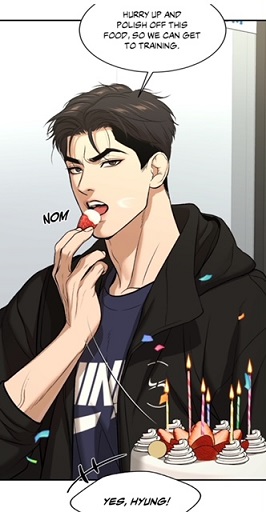 (chapter 43) eating a strawberry with cream as the announcement of the magical night between Kim Dan and his fated partner. The fruit with the cream represented a violation to his strict diet.
  (chapter 55) or the medicine against migraine.
 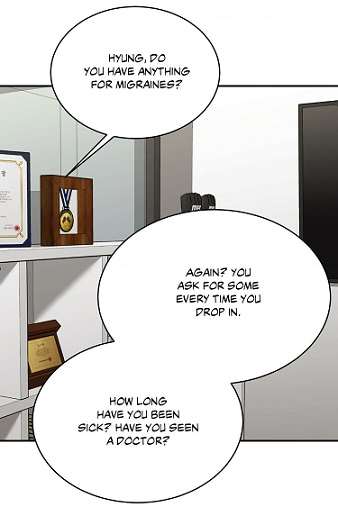 (chapter 54) However, in episode 55, we can observe a huge change in the champion.
  (chapter 55) The latter is finally admitting the inefficiency of the medicine. In other words, in this scene, he was giving up on them. This represents an important step on his way to enlightenment. For me, it signifies that he is stopping relying on pharmaceutical products. Let’s not forget that in the past, he rejected the PT and even neglected them. Why? It is because he trusted more sprays and other medicines than people.
  (chapter 49) Therefore the switch of the spray had to occur. He needed to question his prejudices and attitude. But let’s return our attention to the champion and his throbbing head. One detail in this panel caught my notice.
 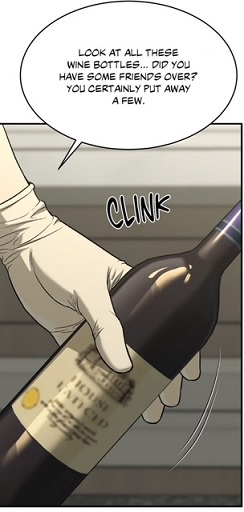 (chapter 55). This means that she had not seen the mess in the master room before:
  (chapter 55) And now, pay attention to the number of the bottles in his room:
 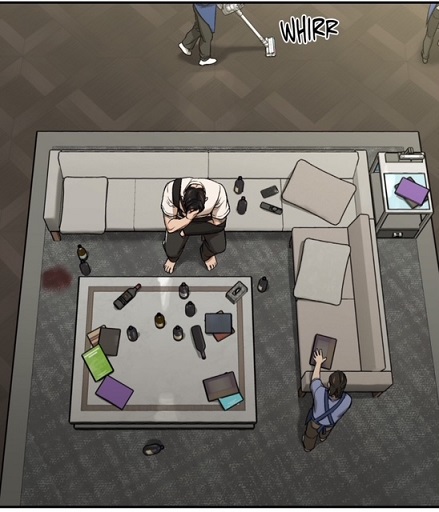 (chapter 55) I count 12 bottles of wine exactly like in the last image from chapter 54. Thus I came to the following deductions:
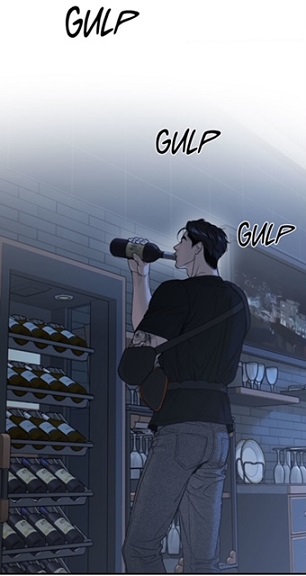 (chapter 54) and the appearance of the staff in chapter 55. It indicates that Jinx-philes can witness time deceleration in season 2. From one month in one chapter, then a week in the next episode, finally we have a reference to a day: Monday. Thus I deduce that in episode 56, only 2 or 3 days elapsed. I have already announced that the couple should meet each other around 25th:
  (chapter 56), for the day Kim Dan wired his money to his “loved one” took place after 10th of the month: XX = two digits.
  (chapter 55)
 (chapter 55) Consequently, I judge the cleaning lady as the positive version of Park Namwook. Though she uses social norms, she doesn’t use them against her employee. She didn’t condemn him, it is a mixture of teasing and reminder. At the same time, her intervention implies that she must have noticed changes in her boss after the arrival of Kim Dan in the flat and his departure. That’s the reason why I have the impression that this image is announcing another turning point in the champion’s life either:
  (chapter 55) He won’t drink like before. However, I don’t think that he will behave like in the past: reject any alcohol entirely.
 (chapter 55), his migraine vanished. Though he is holding his head the next morning and hiding his gaze
  (chapter 55), the Webtoonist didn’t add any red or “throb” as an indication for a migraine. As you can see, his headache is strongly intertwined with repressing the physical therapist and as such locking away memories. However, there exists another cause. What had the doctor done in the past?
  (chapter 44) Yes, the main lead had patted his lover’s head, while the champion had his eyes close. In my opinion, his unconscious had registered this gesture and loved it. However, the champion had not seen it himself. He was drunk and had his eyes closed. This stroke on the head symbolizes appreciation, affection and recognition.
 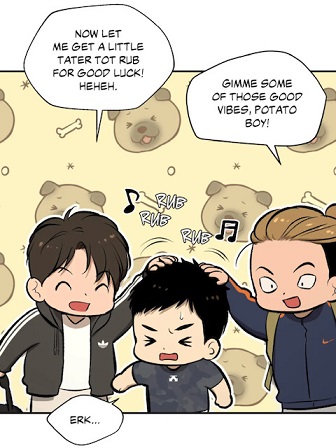 (chapter 23) That’s how little kids are admired and loved. This stands in opposition to the abuser’s behavior:
  (chapter 54) parental criticism and absence of contact. And how did Choi Heesung express his “love” to Yoon Gu?
 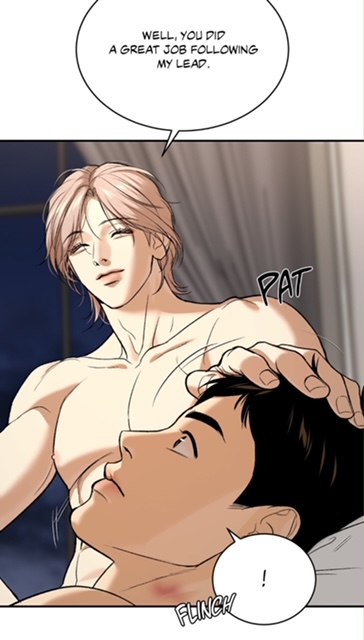 (chapter special 2) The same way than Kim Dan with the patting! In other words, the champion is deep down longing for such a gesture, but he has not realized it yet. Nevertheless, I believe that he just needs a trigger.
 (chapter 55) With his left opened eye!! The exact opposite from this picture:
 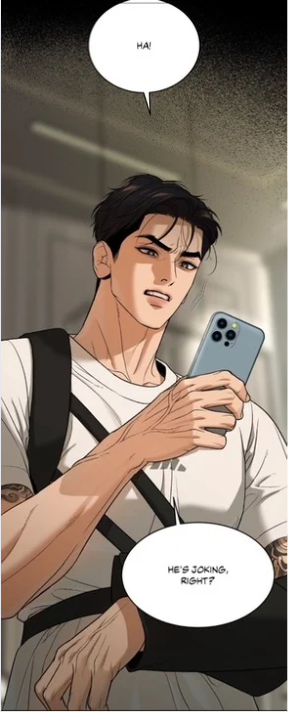 (chapter 55) This observation got confirmed in episode 56, though I couldn’t expose it before the release of the new chapter.
  (chapter 56) As long as the fighter thinks of his fated partner, he is not plagued with a throbbing head. This shows that it has something to do with repressing memories. However, his physical condition is still not improving:
 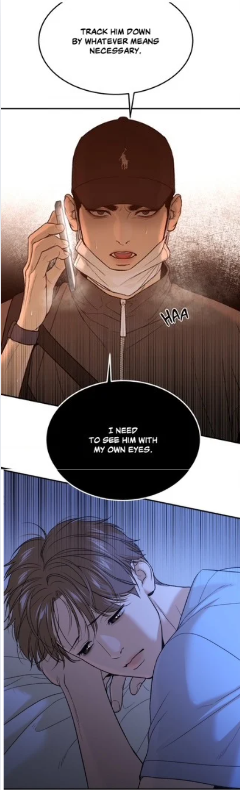 (chapter 56) He even looks worse than before: exhausted and malnourished. There is no one by his side taking care of him: his only interaction with his manager is through the phone. At no moment, the guy felt the need to pay a visit to his boss and champion.
  (chapter 56) Because I discovered the connection between memories and the physical therapist, it is important to examine the interaction between the main lead and the new uke.
 (chapter 55) This signifies that in reality, the uke is the one benefiting more from this relationship, while the “Gucgi guy” is a placebo for Joo Jaekyung. He can not replace the true medicine: Dan’s love. But Joo Jaekyung chose to close an eye to the truth forgetting his “insight” from chapter 2:
  (chapter 2) However, back then, he had just stated it in order to get rid of the mint-goblin. He needed a justification for switching his partner. In other words, this was reflecting more the protagonist’s corrupted mind and heart. Therefore he is designed eyeless, the symbol for ignorance, lies and blindness.
 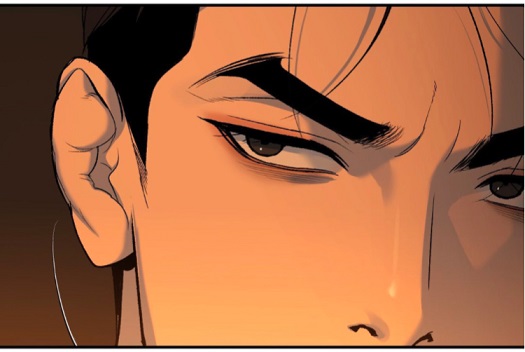 (chapter 55) And where did he have his migraine exactly?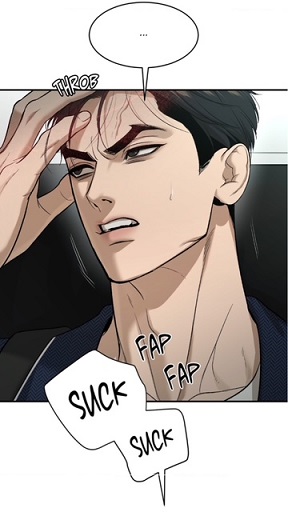
 (chapter 55) It was on the right side and eye! It truly exposes that Joo Jaekyung was getting punished for his attitude. He is not allowed to bury and forget Kim Dan. The star’s open eyes in this episode symbolize denial, lack of self-awareness and as such the absence of insight. He is also punished for his lies in episode 2. His words might have reflected the truth, but his words didn’t expose a change of heart. He was taking advantage of this situation as well. So when the pain intensified pushing him to close his right eye, we should consider this image as a short moment of reflection and realization. In the restroom, he was forced to admit that only Kim Dan could kiss him. Is it a coincidence that just before Mingwa presented this image
 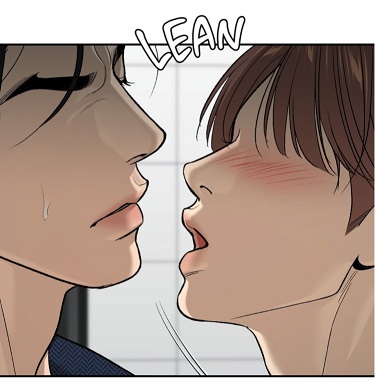 (chapter 55) Naturally no, she was mirroring the attitude of both figures: both were in denial!! Notice that though the star had no reaction in front of the “replacement”, the latter chose not to give up at all. This man was not expecting a rejection, in fact he was in total denial as well. He didn’t notice the star’s passivity and silence.
 (chapter 55) He was just standing there and avoiding his gaze.
 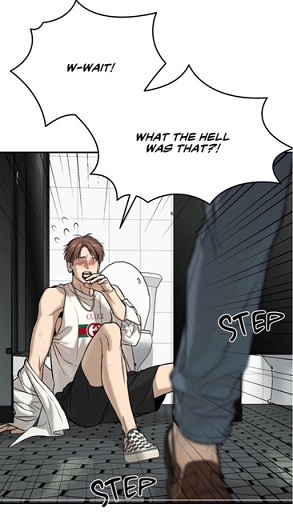 (chapter 55) How can the MMA fighter reject him? This displays his huge confidence or arrogance. There’s no doubt that he will put the blame on Joo Jaekyung. At the same time, I believe that his blindness was also caused by his greed.
 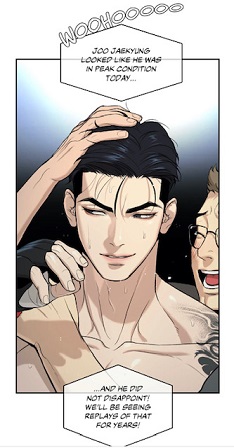 (chapter 5) Therefore he was in a happy mood after that match. A simple gesture with a lot of power! He has been missing this hand or better said this gesture. This action was the main lead’s true motivation.
  (chapter 54) Don’t forget that Dominic Hill had expressed his admiration in a similar way, patting on the back:
  (chapter 40) No wonder why he felt so lost and empty after the last fight.
  (chapter 43) this was the coach’s hand. In other words, the athlete felt more close to the coach than to the manager. This would explain why he would listen to the coach and even entrust him with huge tasks like the charity event. Strangely, in season 1, we can observe how more or more he is distancing himself from the fighter. Probably related to his secret relationship with Kim Dan. According to my theory, the coach is aware of their relationship. They are more than just boss and employee. As you can see, I don’t think that the champion is right now just missing the doctor’s sweet lips. Deep down, he would like to be patted by his loved one, exactly like Potato.
 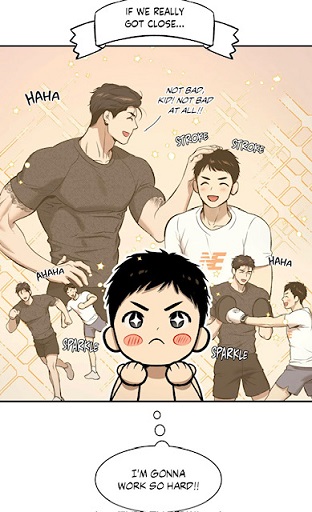 (chapter 23)
 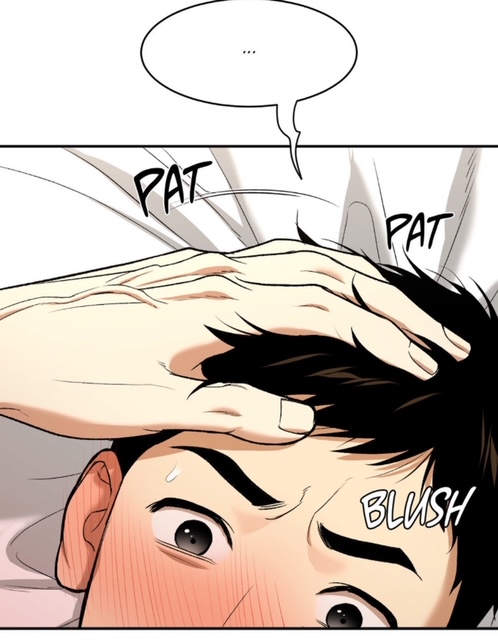 (special episode 2) But this is what he received after the last match:
  (chapter 52) Nevertheless, Joo Jaekyung is lost as well, because he needs to face his old and fake belief: he is jinxed. But in order to remove this persistent superstition, it is important to study the origins of the athlete’s sexuality. How can I do this?
 (chapter 2) The champion’s reaction is quite telling. He is not easily swayed. But we have another bigger evidence that his intercourses were replacement for “fights”. In The States, the fighter asked Kim Dan to join him at 11:00.
  (chapter 38) He needed to prepare himself mentally, to visualize how he would screw his opponent Dominic Hill. He was just taking the expression “fuck/screw” too literally. The latter idiom has the following synonyms: to cheat, oppress, bleed, coerce, wrest and to tighten. Just before the doctor came to his door, what was the athlete doing? He was watching a video from his challenger:
  (chapter 38) Therefore it is not surprising that he rejected Kim Dan’s request first.
 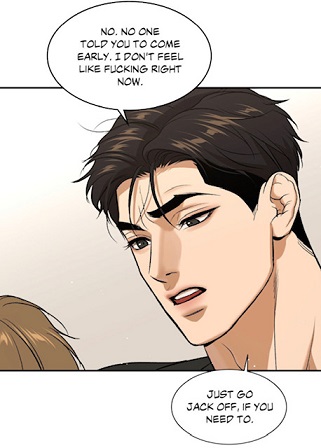 (chapter 39) He didn’t feel like it, because he was not aroused at all. Imagine that he needed two hours for that erection, a sign that during that night, Kim Dan was in reality a replacement for the American fighter.
 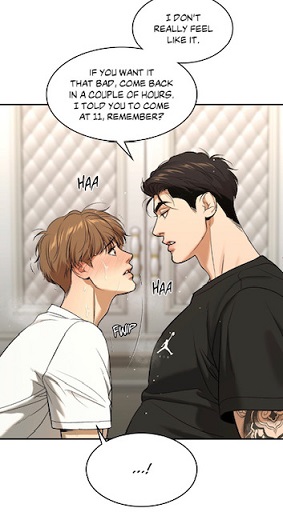 (chapter 39) Even when the doctor rubbed his hand against his sex, he had no reaction.
  (chapter 38) In fact, he needed a fellatio to get an erection, and he only started getting excited, when he saw the doctor’s gaze. That’s the reason why he remembered this image under the shower:
  (chapter 55) However, the more time the champion spent time with his physical therapist, the more he came to violate his own rules and principles: It started with their first meeting, when he crossed the line by mixing private and professional life together:
  (chapter 6), Sex was no longer linked to matches, but to his own desires. To conclude, for the first time, the fighter connected sex to pleasure and desires and not “work and fighting”. Because of the deal and Joo Jaekyung’s strange behavior (sex shower scene, …) the PT had the impression that his boss was a man obsessed with sex.
 (chapter 53) The latter didn’t feel the need to have more sex with Kim Dan, he let his partner leave the place. Why? This contrasts so much to their First Wedding Night:
  (chapter 4)
  (chapter 53) Pay attention to the behavior from the fighter during their last night together. He is looking away, he is not paying attention to his fated companion. His mind was elsewhere, focused on Baek Junmin! In my opinion, during that night, the champion had been able to differentiate between the physical therapist and his opponent. Fighting was more important than sex and as such his sex partner. To conclude, the physical therapist had been able to win Joo Jaekyung’s belief and heart. He was no longer a replacement at all. He had become a person close the fighter.
 (chapter 49) he wanted to screw Baek Junmin for real. In this image, the athlete oozes confidence and strength. This means that he was no longer dependent on the good fuck before the match.
  (chapter 53) However, the main lead never realized this huge change, he kept his old belief as a tradition out of habit. This explicates why the fighter tried to replace with a new uke
  (chapter 55), but here the sex was longer connected to a match, rather to fun. Finally, observe how the champion is now blaming his PT for his ruined match:
  (chapter 56). I don’t think, he was referring to the spray incident, rather to their night before the match. The doctor had not behaved like a real opponent, he had admitted his “defeat” quite easily. He had left the ring before procuring him a good fuck. He was blaming his partner for violating his rule:
 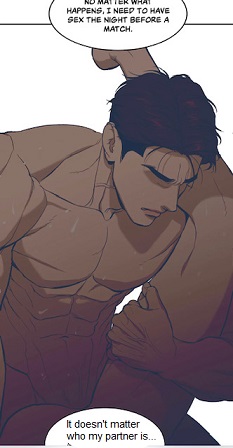 (chapter 2) But here is the thing. Kim Dan had just accepted the deal because of his grandmother. Secondly, he learned an important lesson during that magical night: consent!
  (chapter 44) Sex is a synonym for love and as such it is about giving pleasure and affection to his partner. It is a two-way street. And this is something that the champion has to admit and accept. Thus I deduce that the fighter still has a long way to go before dropping all his fake principles. Like mentioned before, he needs to ponder on the following question: what matters to him the most? His championship or his happiness? Or what is sex to him? Why does he think that he is jinxed? He needs to face his own painful past and remember the face of his tormentor.
 (chapter 49) Baek Junmin and the abusive parent.
  (chapter 54) But the masturbation had taken place before. So who did he have in mind, when he was jerking off? I might shock my avid readers, but I would say: Baek Junmin.
  (chapter 54) However, this gesture had the opposite signification: rage, resent… but also sweet revenge! He must have recalled the Shotgun’s face.
  (chapter 52) There’s no doubt that thanks to the doctor, the champion will learn that he can get “justice” and satisfaction through other means. He can defeat the ghosts from the past, not just thanks to his fists and hard work, but also thanks to his surroundings and knowledge. Lawsuit and media!
 (chapter 1) The physical therapist is not only his reward and price, but also his “second shoulder” and as such his pillar. The new PT won’t be able to replace him. Joo Jaekyung is not just a champion, but also a team: Kim Dan as his PT and his lover. As for Kim Dan, the celebrity is his “energy drink”, his source of comfort and joy. He is also his home, for he is the first one who invited him to stay with him! Yes, the grandmother didn’t invite her grandson to live with her, he was just dumped at her place. And because the celebrity is like a home and family, it explicates why the doctor is once again “living like a ghost”.
  (chapter 56) He feels lonely, but contrary to his fated partner, he is not truly looking for replacement. He might use work to divert his mind, yet he is not erasing Joo Jaekyung from his memory due to his promise: he needs to repay him. So his MO is slightly different. He is just using work and his halmoni to survive. Yes, he is also suffering from depression. In other words, when both main leads will meet each other again, they should have reached the bottom so that they can see each other’s misery and both are willing to listen to each other.




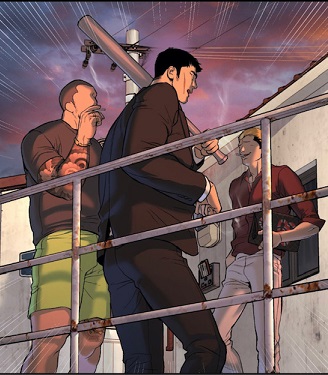





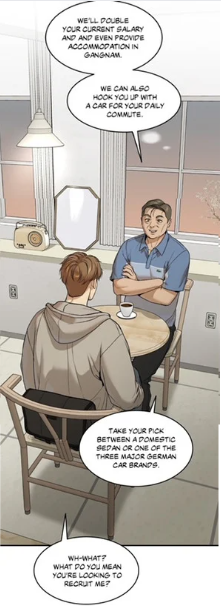

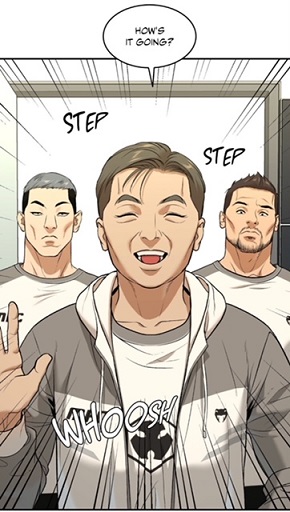 (chapter 49) These 3 men and The Shotgun have to be seen as a team. Moreover, 4 is a synonym for death. Then, observe that the image from episode 20 contains two villains, the loan shark and the perverted hospital director. 1 +1 = 2. So when we see the number 10, 11, 16, 17 and 18, we could perceive it as an allusion to Heo Namwook, the villain.
 (chapter 11) and indirectly the persons involved in the redevelopment. However, I have to admit that I have a different explanation.
 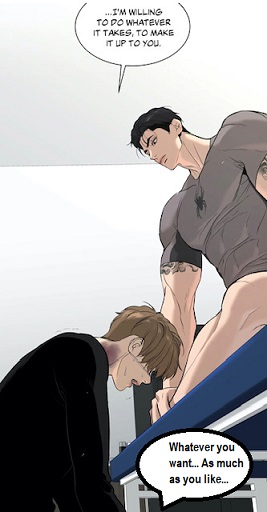 (chapter 11) Let’s not forget that in Jinx-Fandom, many Jinx-addicts calls him a “red flag”. Here, he was abusing his position. Furthermore, this theory could be seen as validated with the first episode with this image:
 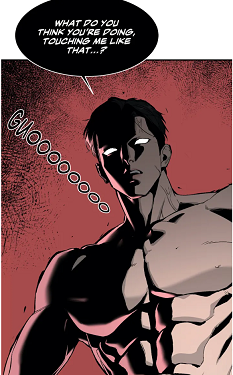 (chapter 1) The main lead appears as a beast, triggering the doctor’s fears. He seems to be like an antagonist. However, I believe that it is just a deception. First, Mingwa has clearly stated that the champion is the protagonist of Jinx. As such, he can be neither a villain nor an antagonist. Secondly, though he seems to serve as a barrier, the reality is that Kim Dan is incited to mature and overcome his own fears. In fact, the celebrity represents the opposite notions of “conformity” and “immobility”. He embodies verity, maturity, transformation and progression. The evidence of this perception is the gradual transformation of Kim Dan as an inexperienced PT to a very professional and performant physical therapist. According to my interpretation, the Emperor works as the mirror of truth. He confronts the delusional physical therapist with his mental and emotional issues, like here:
  (chapter 45) as a good trigger for the 29 years old man to turn into a good PT. From that moment on, he only focused on the sportsman, and stopped asking the help from colleagues or listening to them.
  (chapter 42) He only relied on his hands. He was forced to become a serious and confident PT!!
 (chapter 1) The star was just waiting, and not threatening the doctor. As you can see, Joo Jaekyung doesn’t appear like a threat or a monster. But this doesn’t end here. One detail caught my interest. The champion is associated with blue. It is his true color, whereas Kim Dan is “red”, like a sweet strawberry. So why does this young man ooze a red aura, when his true shade is blue like water
  (chapter 27) or the ocean. It is because he was under the influence of his hyung Park Namwook which explains why Mingwa introduced him like this:
  (chapter 1) Note the contrast to his “boy”. The red is not coming from Joo Jaekyung’s body
  (chapter 11) The coach is yelling for Joo Jaekyung’s comment, yet the reality is that the manager didn’t treat Kim Dan at all. In fact, he feigned ignorance. Moreover, look at the champion’s t-shirt:
  (chapter 26) In this composition, I compared the MMA star with a leopard and Park Namwook to a spider:
  (chapter 17) or in episode 46
  (chapter 46) He represents regression or the hurdle to overcome.
  (chapter 11)
  (chapter 11) And I can prove my statement by showing the episode where she appears:
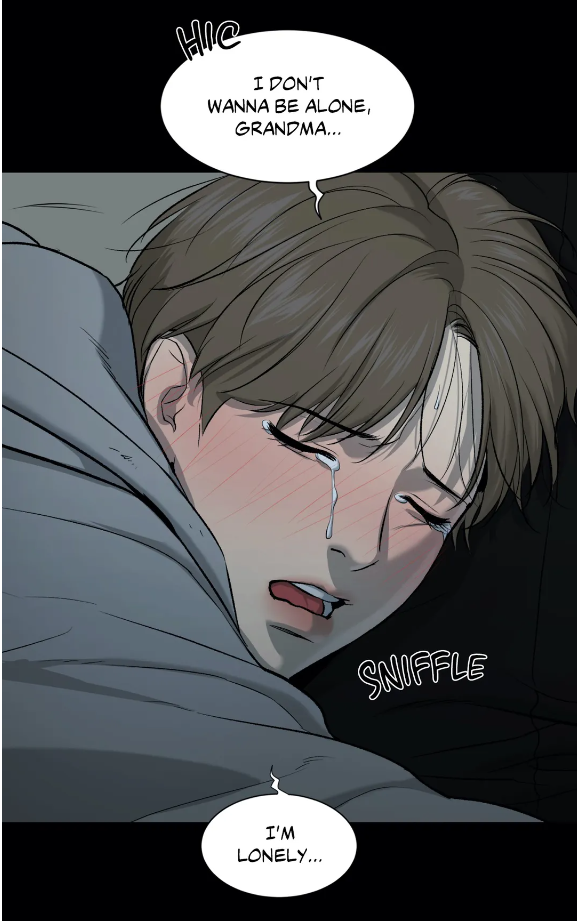

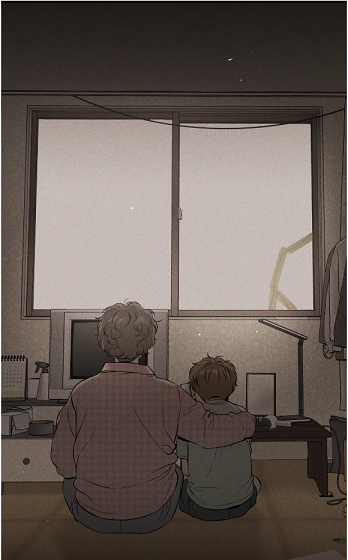


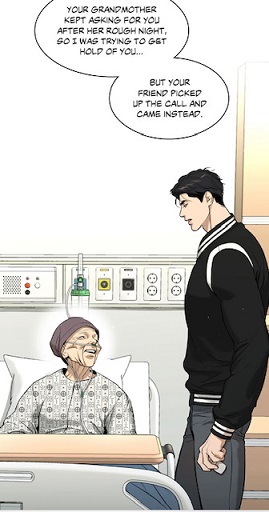

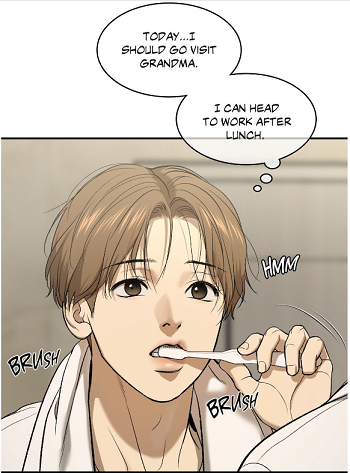
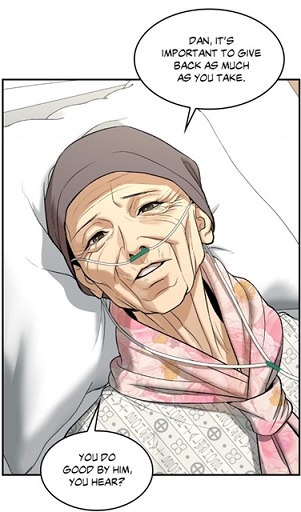
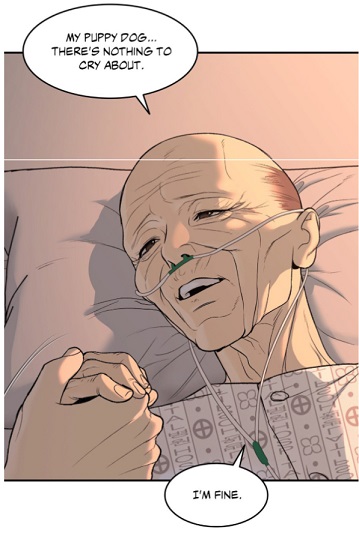
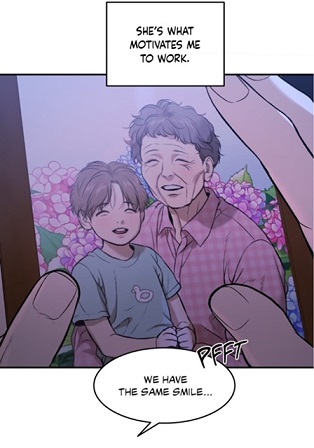


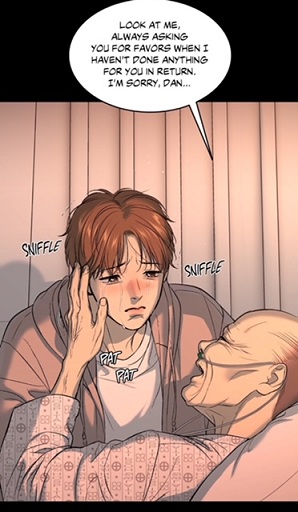 Here, we should see as a continuation of episode 47.
  (chapter 9) or other events like this one:
  (chapter 37) Buying in secret junk food.
 (chapter 1)
 (chapter 1) But it is the same for the champion who got his “gym” stolen from his hyung:
  (chapter 22) He is acting here like a tyrant.
 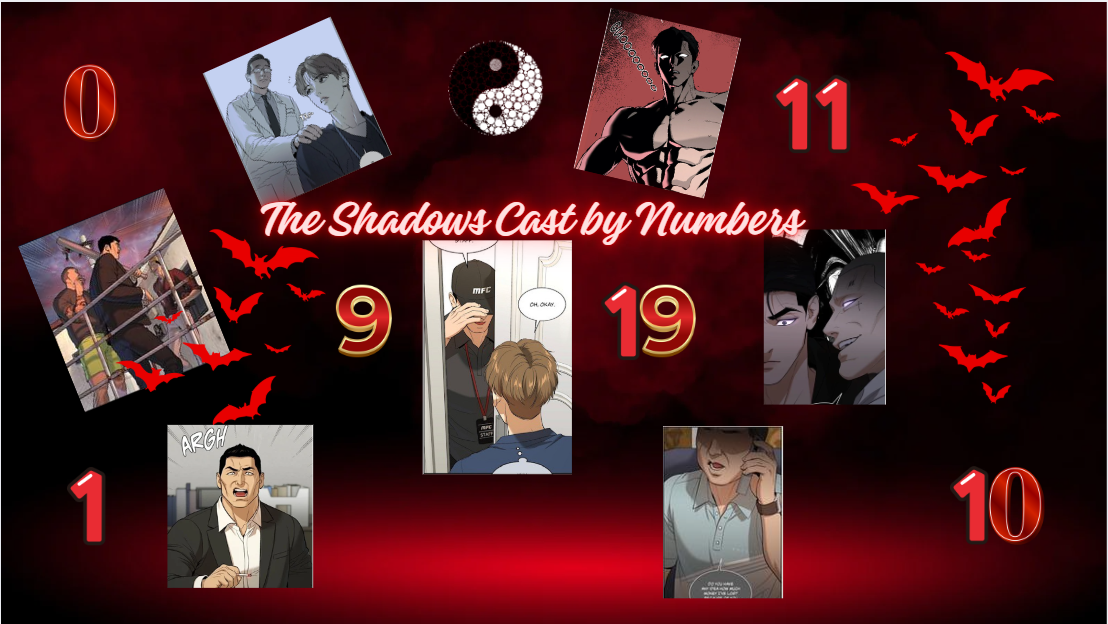 I came to this revelation thanks to this article:
 . (chapter 46) This would explain the champion’s emptiness and darkness:
  (chapter 29) As for the halmoni, she embodies the last type of emotional vampire:
 (chapter 21) and Kim Miseon’s reproach to Kim Dan could be seen as an indirect allusion. And if my interpretation about her number is correct, then we would have a good explanation why Kim Dan was unable to perceive her true nature, but also why she is so selfish.
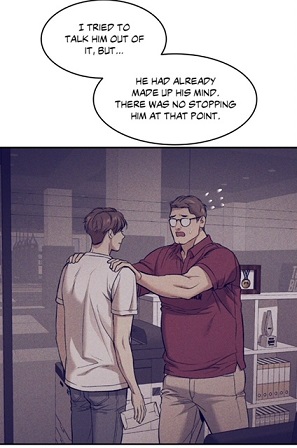 (chapter 53) Only the logo is red.
 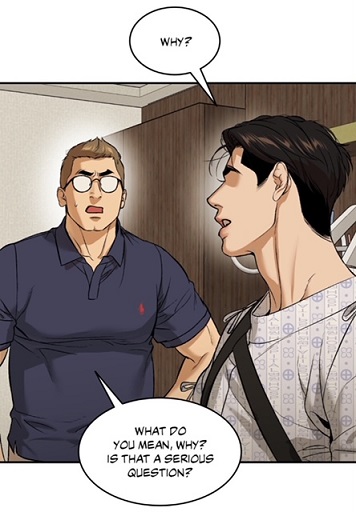 (chapter 53) It is important, because it announces the manager’s resignation. He doesn’t want to become responsible for the mess. Unconsciously, he is no longer claiming to be the owner of the gym. Furthermore, notice that the grandmother desires to return to the West Coast in order to see an ocean of “fire”.
 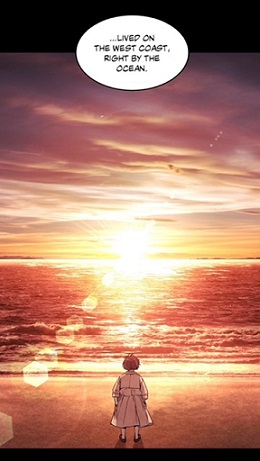 (chapter 53) This shows that she is longing for warmth and red colors. Yet, the color of the sea is rather green or blue. As you can see, everything is pointing out that the couple had to overcome the antagonists from season 1, the emotional vampires, who were so close to them than none of them realized that they were the origins of their suffering. And now, if you look at my table again: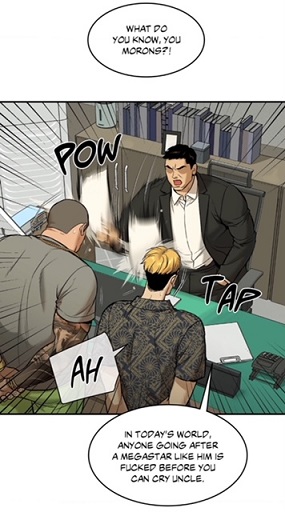
 (chapter 35) In episode 16 and 17, the presence of the sun is a reference to the MMA fighter, it is announcing his arrival. This corresponds to the color I had detected with the first scheme:
 MFC with the blue “ring” embodies this pigment, just like the ocean. In other words, blue should be the dominant color in season 2, and in Taoism blue stands for YIN! On the other hand, Kim Dan also represents red with his name. Moreover, if you look at the numbers of the quoted episodes again, you will realize that the villains are strongly connected to the number 10 and as such one and zero. Thus Director Choi Gilseokf’s phone number is 010-1….
 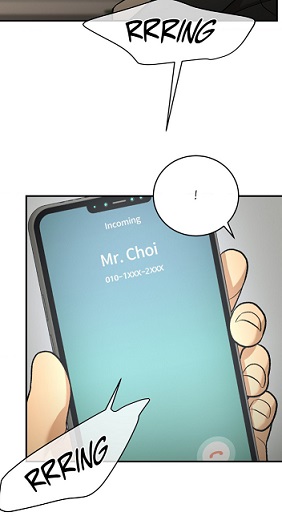 (chapter 46)
  (chapter 37) He never complimented him for his hard work at all.
  (chapter 46) With these words, the manager creates a negative atmosphere, therefore there is no longer any trust and loyalty among the members.
  (chapter 18), until the champion confronted the protagonist with reality.
 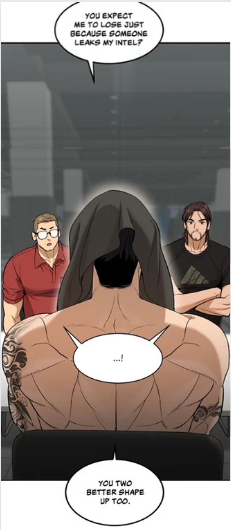 (chapter 46), however Park Namwook refused to accept such a behavior from his boss. Therefore he put his pupil under pressure.
 (chapter 46) He avoided a confrontation. This number symbolizes how the lead feels burdened by obligations imposed by his oppressor, who positions himself as provider of “stability” while actually fostering dependence and draining his victim. And naturally, in the same chapter, we have a similar interaction between Heo Manwook, the minion and his hyung, the real boss:
 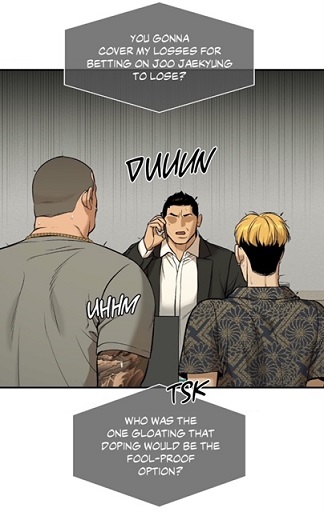 (chapter 46) Here, the director was reminding him of his mistakes and obligations. However, this time the boss chose to become proactive and responsible.
  (chapter 1)
  (chapter 13) They are strongly intertwined with the color green and as such blue. In literature, art, and psychology, the color blue often represents calmness, loyalty, and introspection.This fits to the description made by the author concerning season 2. The latter would focus more on emotions and thoughts than on the plot. And now, it is time to reveal why in the illustration I added the number 9.
 (chapter 9) The leopard agreed and that’s how they came to argue about his home the next morning:
  (chapter 10)- So from 9 to 18, the story is focusing on the doctor’s home. In episode 18, Joo Jaekyung invites the poor physical therapist to his home.
 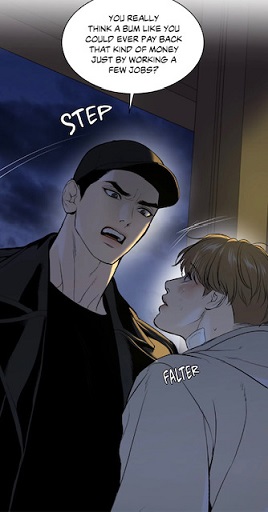 (chapter 18) In this episode, both main leads refuse the assistance from the other. Kim Dan is bothered that Joo Jaekyung paid off the debts, while the other dismissed the worries from the PT:
  (chapter 18) Then in episode 19, Joo JAekyung is not asking for his “help”, until he calls him. But even here, he is refusing to prepare his partner:
 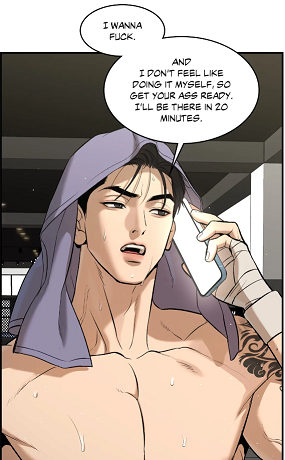 (chapter 19) As for Kim Dan, the latter doesn’t feel truly needed as PT, hence he is already thinking about taking another job:
 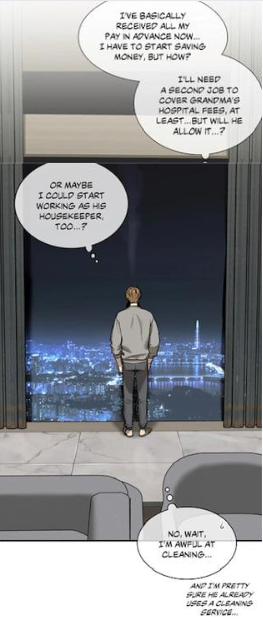 (chapter 19) Then in episode 27, Kim Dan offers his assistance.
 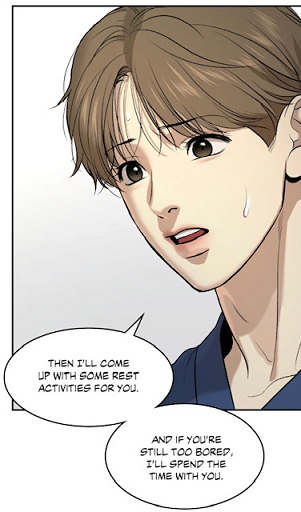 (chapter 27) He encourages his VIP client to take a break by remaining by his side. However, this attempt fails, as in episode 29
 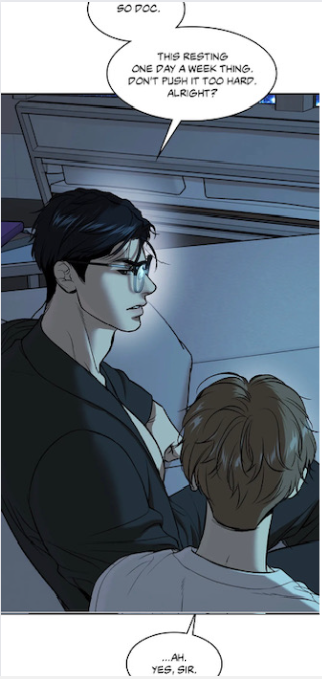 , (chapter 29) the champion rejects the idea of resting for a day. Then after the incident with the article, at no moment Kim Dan offers his assistance to help the champion. He remains totally passive,
  (chapter 36) it shows his passivity and neglect. He doesn’t feel responsible for the champion’s career or safety. His concerns earlier were rather superficial. This explicates why he is also treated like a doll. Then in episode 39, for the first time, the doctor is requesting his help and assistance.
  (chapter 39) The problem is that it is related to a drug and sex. This has nothing to do with his job or career. Interesting is that in episode 45, for the first time, Joo Jaekyung voiced his needs to have him as a PT:
  (chapter 49) This means that in that scene, Joo Jaekyung refused to let Kim Dan treat him out of doubts and mistrust which were triggered by the manager’s words and the pictures. As you can see, the number 9 is strongly intertwined with help, but also with a change. The beginning of a new circle. Thus I am expecting in the new season, chapter 54, that for the first time, Joo Jaekyung will ask for help and support. But he can not ask Park Namwook or others from Team Black… he has only one true friend and that would be Cheolmin, unless he finds the protagonist immediately. At the same time, I would like to point out another observation. What is the opposite of 9? Naturally 6, which represents the end of a circle. And now, look at this:
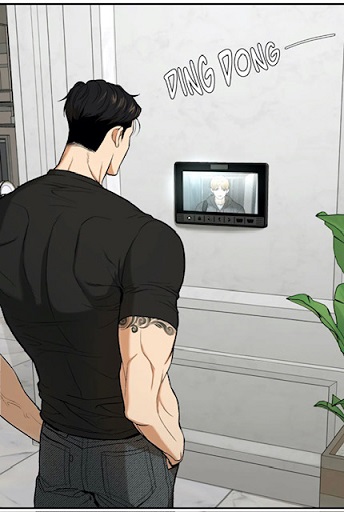 The end of Joo Jaekyung’s torment. He doesn’t need to chase after him.



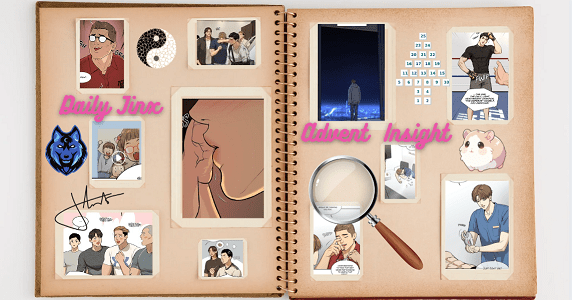

 (chapter 9), we discover the origin for Yoon-Gu’s nickname, Potato. The coach and sparring partner from Joo Jaekyung is the one behind it. However, this connection reveals a lot about the divorced man. He is actually a soft and tender man. Yes, in my opinion, Yosep’s nickname should be Potato.
  (chapter 9) This gesture oozes humility and respect. This contrasts so much to Park Namwook’s behavior during their first meeting: no bowing and no shaking hands.
  (chapter 1)
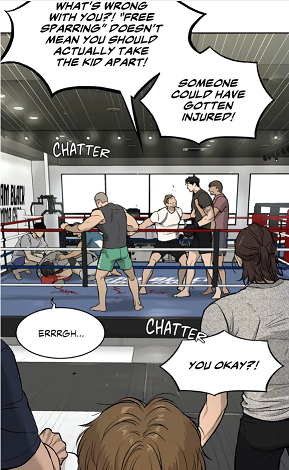 (chapter 1) He came right away, whereas the manager was busy with his phone-call and never asked later about the incident.
  (chapter 5) At no moment, he claims the champion as his boy or tries to attract attention from people for being the Emperor’s sparring partner. Thus each time the protagonist wins, he doesn’t appear in the ring contrary to Park Namwook.
  (chapter 53) So when he tried to call her, she blocked his calls. One of the causes for their failed marriage is that they had stopped talking to each other. [As for the other reason, I will expose it below] That’s the other reason why I developed the theory that the coach Yosep was behind this phone call.
  (chapter 22) This observation is relevant, for it indicates that the former champion must have listened to his manager as well. He never questioned the responsibility of his former coach or manager or organization. I am suspecting that he might have already been working with Park Namwook in the past, which would explain their closeness. For his divorce, Jeong Yosep chose to take the whole blame. Hence he kept his failure to himself. However, observe the manager’s attitude concerning this revelation.
  (chapter 40) Interesting is that the idiom “boy” has historically been used to mean “servant” or “attendant” in certain contexts, particularly in colonial or hierarchical settings. For instance, it was often used during the colonial era to refer to male domestic workers, typically in a demeaning or racially charged manner. No wonder why though Yosep is the sparring partner of the Emperor,
  (chapter 37) he acts more like a servant. In my eyes, the last image displays the manager’s three “boys”: Yosep, Kim Dan and Joo Jaeykung. They are the former wrestler’s servants, while he can stand on the sideline and watch as a superior and guardian.
  (chapter 37)
 (chapter 36). He even agrees to everything the man says and decides.
 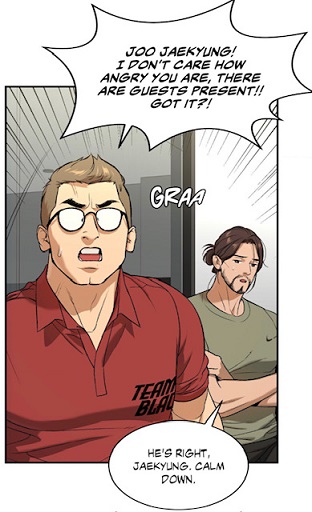 (chapter 36) Yet, I see a turning point in the States. For the first time, he is seen talking on the phone, which indicates a certain responsibility.
  (chapter 37) However, till this scene, Yosep was treated like a “boy”, which I outlined above. The gradual transition can be perceived if you contrast the two following images
  (chapter 49)
 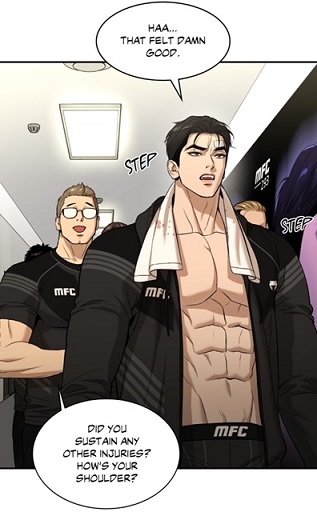 (chapter 40) In the States, he was not visible at all, he would even walk behind Oh Daehyun next to Yoon-Gu. In my opinion, he felt the need to be next to the maknae. However, in South Korea, he is standing right behind the protagonist. Moreover, note how Joo Jaekyung entrusted him with the charity event, another indication that the main lead was trusting more and more his sparring partner:
  (chapter 41) In addition, in the locker room, he is the one who made the decision to let the Emperor fight against Baek Junmin.
  (chapter 50) For the first time, he voiced his own opinion, yet his choice lets transpire the great influence from his “hyung” and MFC. His decision was influenced by money. Naturally, the high peak of his action is, when he announces to the main lead that he went to different authorities
 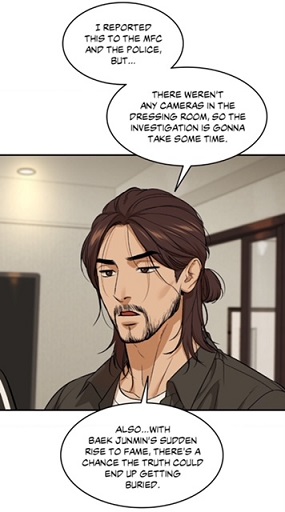 (chapter 52). However, it is important to recall that putting the whole blame on the manager and coach is not right either. How so? As a former athlete, he has more experiences and he should have realized that he should not just trust people blindly. Yes, I believe that his major flaw is that he is too trusting and doesn’t ponder deeply why his relationship with his wife failed. As you can see, he embodies the opposite notions of Park Namwook: faith in authorities and people. This explicates why in chapter 47, he didn’t say anything in the conference room.
  (chapter 47) He let his “hyung” and the other “experts” who were never in the ring do the talking.
  (chapter 47) Why did he let it happen? It is simply because he just views himself as a “sportsman”. The others act with their title (managers, advisors), as if they had more knowledge than the sparring partner from the Emperor. Another mistake from him is that he never looked at his sparring partner’s files. He let Park Namwook take care of this, thinking that he would pay attention to their star’s health and security.
  (chapter 52) Since he lost his wife and as such has no family, it is clear that this former champion views Team Black as a family. Therefore he participated in the surprise party.
  (chapter 43) Consequently, I come to the following conclusion that the last scheme made him realize his own wrongdoing. He didn’t protect his sparring partner correctly. He failed him. However, like pointed out in a previous Daily Jinx Advent Insight, Yosep was manipulated from his colleague. Therefore the coach didn’t meet Kim Dan in the office and couldn’t talk him out of it. This discovery exposes that one of the protagonist’s problem is that he was following his sparring partner’s lead as well. Because Yosep trusted blindly Namwook, his “pupil” did the same. And this remark leads me to the confrontation in episode 46. The true owner of Team Black warned his both hyungs:
  (chapter 46) Why did he delegate it to the former athlete? Simply because that way, he could avoid responsibility. If something wrong happened, then “Potato” would take the blame. The hot potato was passed around. I am using this term on purpose. The reason is that “Potato” embodies harmlessness. And because Yosep comforted the manager and didn’t criticize him for his outburst and slap, it displays that the coach has not questioned the manager’s integrity yet. He is not doubting his trustworthiness. This explains why Joo Jaekyung returned home on his own, though he had an injured shoulder.
  (chapter 53) So we could say that Jeong Yosep is not entirely free from the negative influence from the manager. However, I have still hope for a true change in this gentle and caring man. How so?
  (chapter 13) Interesting is that these two hyungs are linked to a similar color: dark green. This shade embodies hope and nature. However, since they are still living in the city and working for corrupted organisation (hospitals, MFC), they are not true themselves.
  (chapter 7) Note the absence of Yosep in that panel, a sign that his work and position were minimized. Nevertheless, this was just the consequence of his own decision. He chose to minimize his own value and to rely on his hypocrite partner.

 (chapter 53). Because the latter is slowly vanishing into the light, it looks like the champion will have difficulties to find his soulmate. However, if you pay attention to this picture, you will perceive that Kim Dan’s shadow is huge. In fact, we have to envision that the closer he gets to the “sun”, the bigger his shadow becomes. This metaphor is implying that the cute hamster is leaving a trail behind. This represents the traces he left in Joo Jaekyung’s life and heart. The farer he is, the clearer the fighter can only realize the importance of his roommate in his life. However, I believe that though Kim Dan is about to become a ghost, the huge shadow is implying that Joo Jaekyung will be able to find him quickly.
 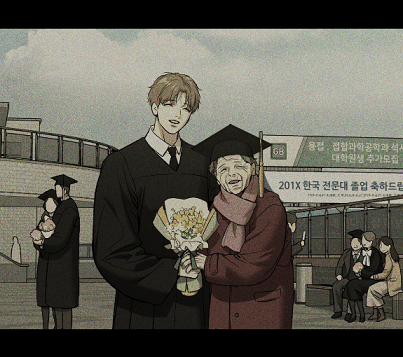 (chapter 47) You might find it strange, but everything started with the following question: where is the grandmother’s cellphone? One might argue that as an elderly woman, she doesn’t possess one. I can only reply that all the seniors I know (even my grandmother who is much older than Shin Okja) have one. Besides, let’s not forget that according to me, this image or this one
 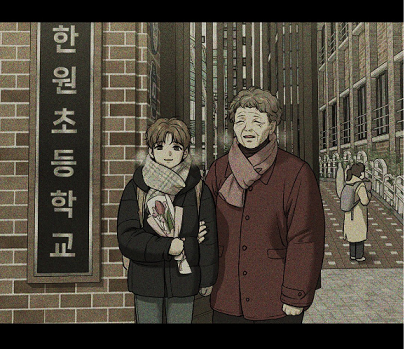 (chapter 47) represent moments where pictures were taken. I doubt that the grandmother had a camera. Then in the last picture, Kim Dan was definitely too young to have on his own cellular telephone. Finally, observe that in this panel
  (chapter 47) Before he was practically inexistent, only famous in the underground fighting ring
 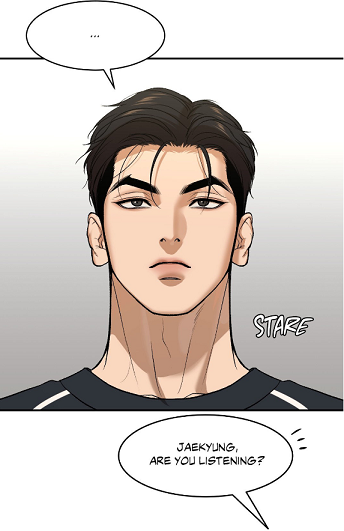 (chapter 47).Interesting is that disappearing without traces implies the notion of “the right to be forgotten”. But why would people make such a decision? Either they want to escape from their environment (abusive husband, debts, …) or they desire starting a new life afresh. So when we look back at Shotgun, it becomes clear that his new identity is to mask his dark past.
 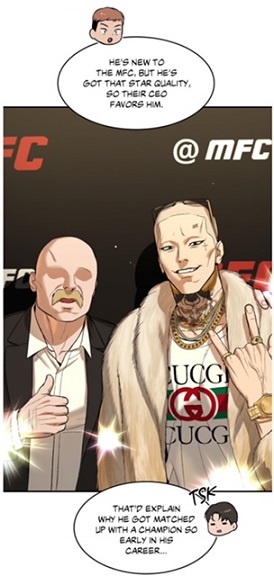 (chapter 47) It was, as if this man had not existed before. That’s how a star got born, or better said, he was a new-born man.
  (chapter 19) Nevertheless, since the readers are unable to see the cable, it signifies that the latter was coming from the front. I am deducing that the phone was placed on the small table. And now, look at the following images:
  (chapter 10)
  (chapter 21) There is no landline telephone. Its absence seems to indicate that the senior switched to a different phone. She had to have one because of the authorities (school for Kim Dan, etc.). I would even go so far to say that the elderly woman changed her phone number. But why would she change her phone?
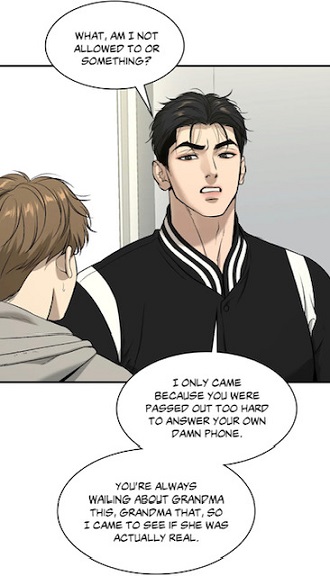 (chapter 22) He doubted her existence. Why? It is because he never heard Kim Dan talking with his grandmother over the phone. He had only mentioned her in his drunken state.
  (chapter 11) There is no ambiguities that she was registered there as a resident. But if she got rid of her phone, the authorities are forced to call her closest relative. Secondly, observe that Kim Dan used the cellphone to pay bills and have a look at his bank account:
  (chapter 11) In other words, by refusing to have any phone, she dropped all the debts on her grandchild. He was now responsible for their household and expenses. Yes, the question with the grandmother’s phone led me to the following observation. Little by little, Shin Okja was vanishing which reminded me of the action from Kim Dan’s parents. At the same time, with no cellphone, she forced her grandchild to visit her, to keep in touch with her. Hence I can’t stop restraining myself from feeling that the grandmother used the hospital and the nurse to control her grandchild’s moves. No wonder why Kim Miseon complained to Kim Dan about his neglect
 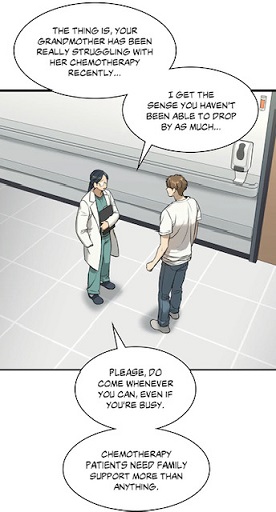 (chapter 21) The senior could express her distress to the doctor, for she couldn’t see her grandchild so often. That way, Shin Okja wouldn’t appear as a whiny person. If my perception is correct, this means that the elderly woman utilized social norms and conventions to achieve her goal. The absence of a cellphone made her dependable on her grandson. Under this perspective, Jinx-philes can grasp why I am suspecting that her behavior is strongly intertwined with the abandonment in chapter 19. There is no doubt that with her illness, she could feel like she had become a burden herself to Kim Dan, and the latter could decide to leave her too. If you read all my previous analyses, you are aware of the existence of two theories concerning the parents:
 (chapter 22) Yes, by paying the bills, he got access to this information. However, for that he needs a person who can have access to such information:
  (chapter 13) Cheolmin who is also a doctor. Medical professionals often use the Resident Registration Number (RRN) or equivalent patient IDs provided by hospitals to manage medical records. Access to sensitive personal data like RRNs is restricted and regulated under South Korean privacy laws such as the Personal Information Protection Act (PIPA). This ensures that sensitive data is protected and only accessed when absolutely necessary for healthcare purposes. Only a doctor could detect the move to the Hospice “Light Of Hope”.
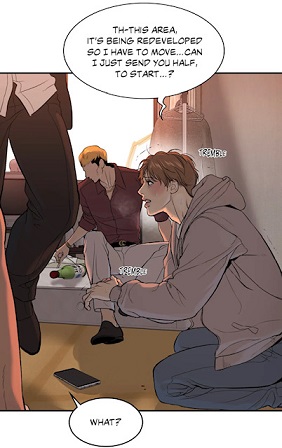 (chapter 16)
  (chapter 53)
  (chapter 48) Besides, these persons seemed to know about the champion’s habits (being awakened late, being home) I had already pointed out that “the cellphone” represents the negative side of “sharing is caring”. And now imagine that Joo Jaekyung decides to leave his cellular telephone behind or even he decides to switch his phone with the one from a friend.
  (chapter 16) is an incorporated business. This means that Joo Jaekyung is the shareholder. So he is hiding his true power and identity behind Team Black. And since the Emperor was the victim of a hatred campaign in the media
 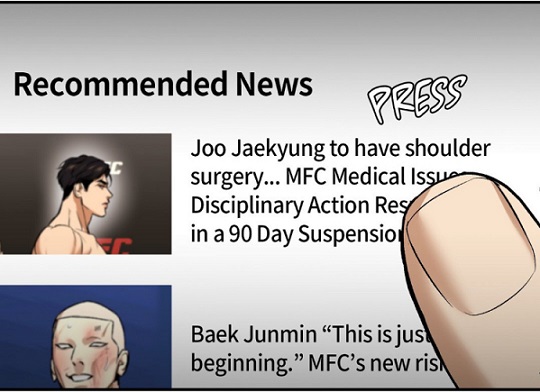 (chapter 52), his vanishing wouldn’t be surprising at all. It would be actually a normal reaction to be fed up of being online, and of being defined by the last match. What the schemers didn’t realize is that they pushed indirectly Joo Jaekyung to make the opposite decision than Baek Junmin. To disappear from the spotlight. But this can only lead him to create a whole new identity.
 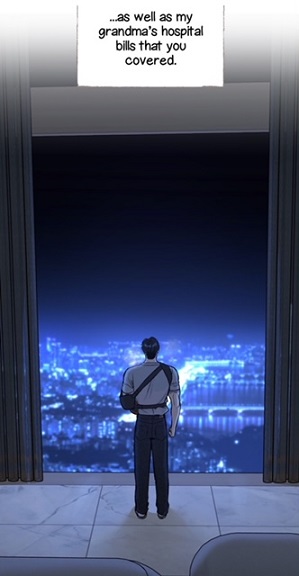 (chapter 53) It signifies that Joo Jaekyung has a way to track him down. On the other hand, should the MMA use the black card,
  (chapter 24), his relative could detect his whereabouts and moves. That’s why it is important if you desire to avoid of being detected, you need to use cash or prepaid cards to limit traceable transactions. That way, it reduces the risk of financial links to your old identity.
 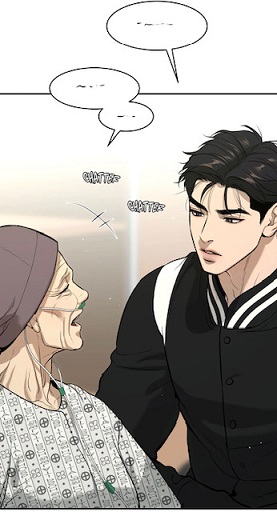 (chapter 21) Back then, many readers wondered about the content of their conversation. However, I believe, whatever it was, the champion didn’t forget her words. Furthermore, by joining Kim Dan’s side, the star will be forced to drop his routine and change his habits. And that’s how he will change.
  . He is wearing piercing, jewels and rings, and his clothes don’t look like designer clothes. Finally, remember how Kim Dan imagined his soulmate:
  (chapter 32) Yes, clothes make the man, and as such through new clothes and hair dress, you can appear as a different person. That’s how it dawned on me why the Webtoonist created such a scene:
  (chapter 35) Choi Heesung made a terrible mistake, he attracted the attention from the guests at the café by covering his face. In order not to be detected as a star, the athlete has to act and dress like an average person: no fancy dress or car. And this leads me to my final point: using public transportation or the bike would represent a huge change for the Emperor. Once again, no one would suspect that a biker is a celebrity, similar to this scene:
  (chapter 21)
 (chapter 53) Nevertheless, this parallel emphasizes Kim Dan’s inclination to bear burdens and deny his own needs for others’ sake. In this chapter, he seems to be undergoing a form of penance, sacrificing himself repeatedly as if to atone for the perceived guilt of being a burden to those around him. His actions reflect deep-seated feelings of responsibility and self-blame, shaping his interactions with both his grandmother and Joo Jaekyung in his life. While he admits his responsibility for the last disaster with the injury and the tie, he was made feel guilty by his own grandmother. With this statement
  (chapter 53), she implied that she never got the chance to go to the West Coast because of him. It was, as if he had been a burden in her life (“life got so hectic”). This expression made me realize why Kim Dan came to live like a ghost. He embodies “life” for the grandmother: burden, responsibility, missed chance. It exposes her delusional mind-set. She is definitely chasing after an illusion. On the other hand, I detected that despite her words, she was not able to move her grandson’s heart. The latter was actually unwilling to leave the penthouse.
  (chapter 53) His decision was strongly connected to filial duty and not to “love”. Moreover, by fulfilling her request, he is one step closer to become free from self-blame and accountability.
 (chapter 53) Neither for the doctor nor for his “boy”.
  (chapter 52)
 (chapter 40) Though he lacked awareness in the States, for he was not present in the interrogation room, he can no longer claim to be oblivious. He knows about Kim Dan’s innocence. But why didn’t he call the physical therapist then?
  (chapter 53) Notice that before leaving the penthouse, the main lead was holding the resignation in his hand. This means that the young man had not informed Park Namwook yet. This gesture exposes that Kim Dan was convinced that the manager was his boss, the master of Team Black. Nevertheless, Jinx-lovers should detect that the “hamster” left the flat during the evening. This signifies that the PT handed out his abdication the next morning, I can’t imagine that it happened during the night, for the man has a family with kids.
  (chapter 53). This signifies that he must have spent some time at the office. To conclude, the young man didn’t vanish quickly from the gym like a ghost, similar to the PT from episode 1.
  (chapter 1)
  (chapter 13)
  (chapter 53) He gave the impression that he was telling the truth. This incident was used to explain the doctor’s resignation. But here is the thing. If the doctor spent some time at the office in order to organize the files, why didn’t Potato stop him or tried to talk him out of it? That’s how I came to the following deduction. When Kim Dan came to the gym, the latter was empty, only the manager was there!! A new version of this scene:
  (chapter 23) Thus I deduce that all the members from Team Black were busy due to the discovery of the scheme:
  (chapter 48), he was an important witness. Yet he is missing here.
  (chapter 52) Under this new light, I am suspecting that Park Namwook already knew about Kim Dan’s innocence, but he never revealed it to the physical therapist. He made sure that no one from Team Black met the main protagonist Kim Dan so that no one would stop him from quitting. That’s why there was no phone call during that week. As conclusion, I believe that Park Namwook used the members from Team Black at the hospital to have the majority on his side, to hide his passivity. There is no doubt that he feared to be blamed for his behavior in the locker room.
  (chapter 50) Moreover, he could be blamed for the spray incident, for he failed to protect his own athlete. That’s why there was no apology from his side.
  (chapter 53) He took his words to heart. Thus I come to the following deduction: Park Namwook already knew about the physical therapist’s innocence, but he chose to keep the truth from his boss to mask his own wrongdoings: his passivity and negligence. The reason is that the discovery of the scheme took place in the evening, and Kim Dan gave his letter in the morning. Moreover, some days had passed, when they showed up at the hospital. Potato’s vanishing injuries are the evidence. They waited for the right time to announce the terrible news, something similar to this:
  (chapter 48) “If we tell him now, it will only throw him off his recovery or his surgery”. Once again, he chose silence and inactivity. Thus no one called the champion or the doctor.
  (chapter 50) And what did the manager say to the protagonist?
  (chapter 52) He should have checked the facts. The letter is exposing the manager’s lie. He is expecting that Kim Dan vanished like the previous PT. However, contrary to the previous one, the “hamster” lived with the celebrity. Thus he left a letter to Jaekyung in the penthouse, and the manager had no way to know the existence of this message. And now, you comprehend why Kim Dan never received any phone call from Park Namwook. It is because he would have to inform him about the existence of the scheme. There was no emergency from his side, for he desired to hide his own wrongdoings (negligence, blindness and stupidity).
 (chapter 36). No wonder why the man is passive. But his inactivity is the result of his indecisiveness (I had portrayed him as someone suffering from Decidophobia). Interesting is that making no decision is the worst people can do. Why?
 (chapter 19) This comparison outlines the PT’s metamorphosis. Not only his perception of Joo Jaekyung changed, but also he has become a responsible and dedicated physical therapist. He defines himself as a PT too. Hence he didn’t leave a mess behind with the files (chapter 53). His decision exposes that this was not an escape.
 (chapter 32). Here, he prioritized his own needs and desires, he rushed things. He never took his time to understand Kim Dan or discover his life. The letter made him realize that he knows nothing about his PT. He has only noticed just now that he is reliable and honest. He is trustworthy. He even listens to him, accepts his words (he took his words to heart twice: the blame for the incident and the Wedding Cabinet). The other reason why he can not use the phone is this. He also knows that he could get blocked. This means that he will ponder how to find and approach his fated partner.
  (chapter 53) It is because for Kim Dan saying goodbye over the phone is not proper. The reason is simple. He experienced it himself as a child.
  (chapter 53) Even more than before!! Joo Jaekyung needs assistance and protection. From that moment on, he can grasp that his sacrifice was not the best for both of them, why his sacrifice was in reality pointless. He should have been more selfish and more confident.
 (chapter 44) He stroke his soulmate’s face, kissed his cheeks and finally his ears. His actions triggered a singular reaction in the star:
  (chapter 44) This made the physical therapist’s laugh.
  (chapter 44) His genuine laugh combined with the following realization
  (chapter 44) shows that in that moment, the physical therapist rediscovered his youth again. I would even add that Jinx-philes were witnessing in this panel how Kim Dan reconnected with his inner child.
  (chapter 44) The blushing is an indication of life and innocence. But if this young man’s childish nature was brought to the surface, who was Tinker Bell during this night? Naturally Joo Jaekyung. Under the influence of soju, the man could no longer hide his true nature. He has a childish side too. In other words, he was lowering his guard. Anyone has already heard from the quote “In wine, there’s truth” (the original quote comes from Latine: “in vino veritas”). As you can see, this beautiful night corresponds to this one:
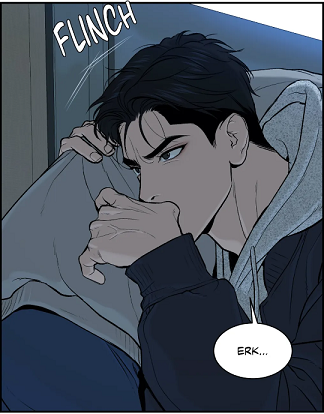

 (chapter 10) Under this light, it becomes comprehensible why Kim Dan’s beautiful night became a dream, an illusion. The young doctor had done something wrong from a moral point of view. However, because the young man had treated the champion so well before, his reward was to experience what love is.
  (chapter 44) Thanks to Tinker Bell, he could fly: he was brought to Nirvana.
  (chapter 44) The problem is that the physical therapist was reducing love to sex (“making love”). True love has to be expressed in a lot of different ways (spiritual intimacy, experiential closeness, responsibility etc) and not just through sex.
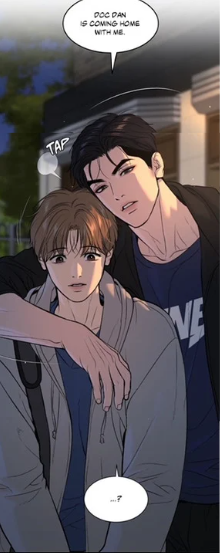 (chapter 43) Interesting is that in that scene, the protagonist couldn’t see his lover’s face. He couldn’t detect the glimpse of a smile and his warm gaze.
  (chapter 11)
 (chapter 47) By saying that he was a puppy dog, she was implying that she would be responsible for him. Keep in mind that pet are linked to care and accountability. However, her wish is strongly connected to one single moment:
  (chapter 53) She is not thinking about the future at all. For her, it doesn’t matter, for her time is limited. Dog can be abandoned in the end, especially when the responsibility becomes a burden. That’s the reason why I believe that in verity, she was treating the protagonist more like an object than like an animal. Moreover, Jinx-philes should keep in their mind she used to describe him as a little boy, which also represents responsibility and care. Therefore I conclude that this scene didn’t stand for Kim Dan’s true home, it was just an illusion.
 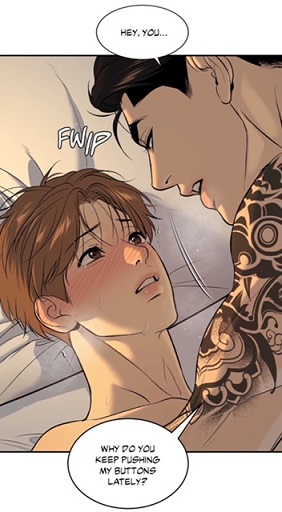 (chapter 44), though the communication failed, for Joo Jaekyung was drunk. Moreover, Kim Dan kept most of his thoughts to himself, a sign that he was still guarded. Hence while Doc Dan felt at home during that night, it didn’t last long. The next morning, they became once again boss and employee.
  (chapter 19) They were no deep lingering feelings towards the grandmother’s house. In fact, before leaving, he remembered an incident, a mysterious phone call which I consider as the moment, which broke the boy’s soul and heart. For me, he was almost glad to leave this place behind.
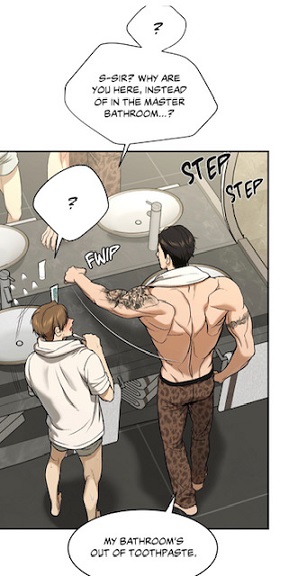 (chapter 30) The pajama pattern in the image appears to resemble a leopard print, which features distinct rosette-shaped spots that are commonly associated with this type of design. He also looked like a sulky “cat”.
  (chapter 30) And what was he trying to do here? To seek closeness to his new mate!
 (chapter 19), very territorial and disliking surprises. In literature, leopards often symbolize strength, courage, agility, and stealth. They are seen as solitary and powerful hunters, often representing independence or mystery. In totemic traditions, the leopard can symbolize resilience, adaptability, and personal power, often embodying a person’s inner strength and ability to face challenges.
  (chapter 26) One might argue that he laughed with Potato and Oh Daehyun in the States. But are you sure? We never saw him laughing. Only Joo JAekyung heard their laughs, but did it also belong to the hamster?
  (chapter 37) Moreover, observe that during that terrible night, the athlete was wearing an t-shirt with a feline on it:
  (chapter 37) Puma was designed on it. As you can see, everything is pointing out that this man is a leopard which was mistaken to a sulky cat or a puma.
  (chapter 44) So since the champion was naked during this night, we could say that his true nature was slowly coming to the surface. As a predator, his annoyance to the strokes and kisses appears more normal and understandable:
  (chapter 44) Kim Dan is teaching him how to control his strength and discover playfulness. And now, imagine Kim Dan patting a leopard 😉
 (chapter 52) But what had triggered the champion?
  (chapter 52) Eye-contact! Making direct eye contact with a leopard can be dangerous. Leopards may interpret prolonged eye contact as a threat or challenge, triggering an aggressive response. In the wild, they rely on stealth and avoid open confrontation, so they may react defensively if they feel they are being stared at. This behavior is common among many predators, as eye contact often signals dominance or confrontation. It’s generally advised to avoid direct eye contact and back away slowly if you encounter a leopard in close proximity. Baek Junmin had totally underestimated the true nature of his opponent. This could explain as well why Park Namwook is wearing his glasses all the time and even avoiding eye-contact with the emperor.
 (chapter 24), Oh Daehyun the eagle…
 (chapter 9)
  (note) and punches. But how do psychologists explain this creation?
  (chapter 26) He would destroy the arcade’s punching machines constantly, which led him to become blacklisted. This means that for the coach from Team Black, the young man was just a brutal and thoughtless thug and nothing more. He judged him based on his appearance and actions. Since he had money in order to open his own gym, he became a spoiled rich brat in the former wrestler’s eyes. But notice that the article is pointing out that the person suffering from Keinshorm Effect rejects any discussion from their counterpart because in truth, they actually dislike this person. This exposes the truth about Park Namwook: he actually resents the main lead. He only accepts him because of his success and fame. At the same time, this biased perception incites him to view himself superior to his pupil.
  (chapter 45) The Emperor had voiced his thoughts and emotions. This shows that he was trying to have a discussion with his hyung. He desired to be heard too: he voiced his powerlessness and questioned the coach’s intention behind his previous reproach.
  (chapter 45) While some readers still judge the athlete as a red flag and bad guy, they fail to realize that in a discussion, it is not about right and wrong. They are probably under the effect of the Heinshorm Effect due to the first bad impressions. 😉 In this discussion, both made valid points, yet both were in the wrong too. In reality, in a discussion, it is relevant to listen to the counterpart’s opinion and words. And that’s exactly what both did, though it hurt them too. But there is more to it.
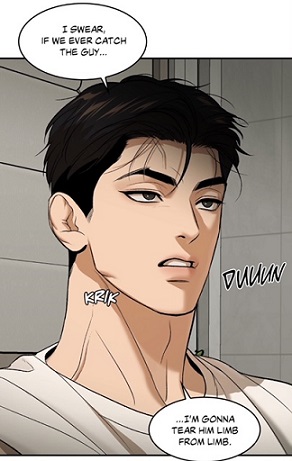

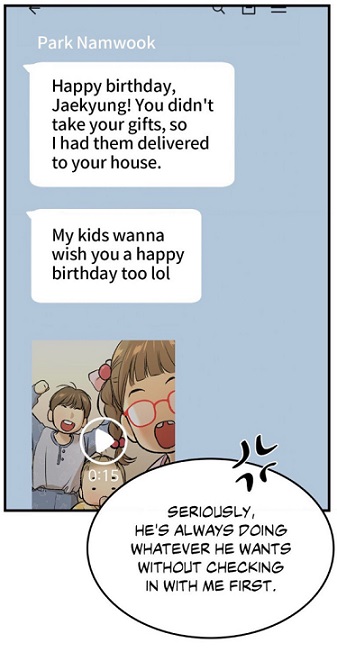 (chapter 45) This was the sign of a poor connection between these two characters. Whereas the gap between them grew bigger and bigger, the opposite happened between the two protagonists. Under this new perspective, Jinx-philes can grasp why Mingwa created so many scenes with arguments between the two main leads. They should be seen as reflections from the past.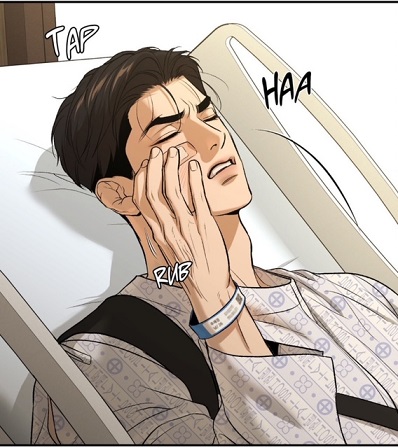
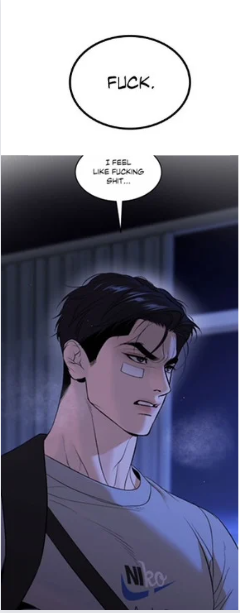
 (chapter 29)
  (chapter 30) In the past, I used to think that this title were referring to the existence of two worlds: celebrity versus criminal world. But now I am thinking that these extreme worlds should be seen as “emotions” versus “reason” and “love versus hate” too. Idols are exposed to such extreme emotions (stalking, adoration versus hate).
  (chapter 36) In the second case, Joo Jaekyung could experience it twice during the first season. Whereas he got upset with the article from Shim Yoon-Seok
  (chapter 35), in the second one he was more composed.
  (chapter 52) He was already learning that the media were not reflecting verity. He was already distancing himself from social media. He had slowly realized that his image as star was not his true identity. At the same time, the letter contrasts with the short messages from haters. It outlines that Kim Dan’s admiration and recognition is sincere and deep. He didn’t get influenced by the media.
  (chapter 52) For him, Joo Jaekyung deserved to be suspended… he had punched his opponent at the hospital. Imagine the irony of the situation. Later, the manager used violence too, but it was excusable:
  (chapter 52) Why was Baek Junmin place next to his opponent? Someone will have to confront this man for his negligence, unfairness, stupidity and incompetence.
 (chapter 1) However, despite his biased perception about the athlete, he came to overcome all his prejudices about his boss and came to truly love the fighter. And this brings me back to this comparison:
  (chapter 53) This shows that he is now making his own decisions and this in the absence of his mentor. It somehow implies that the champion also stops communicating to Park Namwook. Finally, notice how he reacted after reading the letter: he truly felt bad. He was already attached emotionally and mentally to Kim Dan. As a conclusion, the season ends with the switch of the position between Kim Dan and Park Namwook. The former has already come to replace the manager. Indifference versus guilt and pain.
 (chapter 36) He wouldn’t have been allowed to voice his opinion. He would have been even suspected of spying and leaking information (lawyer and manager from the Entertainment agency). Kim Dan needed to realize and admit his love and admiration for the athlete. first in order to stop Keinshorm Effect. He needed to be a confident and competent PT and become a friend for the protagonist. Since Kim Dan stands for communication, tolerance, respect and openminded-ness, the former hyung embodies the opposite notions: silence, dislike, clouded judgement and mental rigidity. Thus I deduce that in the future, the discussions about fights will take place differently. Involvement from all the members, opening listening and Kim Dan as a PT will have the decisive right for allowing a fight or not.
 (chapter 26) are talking about Joo Jaekyung’s past. In this episode, Jinxphiles discover through the testimonies from Oh Daehyun
  (chapter 7), he is a maniac,
  (chapter 9) he is a stubborn workaholic
  (chapter 27)
  (chapter 27)
  (chapter 43) The moment this expression “darker path” grabbed my interest, I wondered why the manager and coach would employ such an expression. It implies that he still saw the athlete’s career as a dark path.
  (chapter 49), it signifies that Joo Jaekyung could have become involved in this type of games:
  (chapter 46) In this picture, I detected a contradiction from the hyung. If the star is bringing a lot of money, why would he become a target? In fact, people would rather bet on the man, as his victory seems more probable than his defeat. No one has an interest to bet against him, unless the schemers are malicious and malevolent. The word “target” is not random, it implies the existence of a scheme. Hence the manager should have been even more prudent concerning his star’s safety. Yet, he allowed him to return home alone during the night and he had no guard by his side.
  (chapter 48) This remark outlines the manager’s neglect. His boy has no protection, though he had already become the target of a “malicious fan” according to the “fake investigation”. Moreover, in the office, Park Namwook is finally admitting the existence of illegal gambling, a topic which was never brought up before.
  (chapter 46) He is explaining this, as if that was something new. However, even the members from TEAM Black already knew about them.
  (chapter 49) The drop of his face is not only indicating his discomfort, but also his lie. It is because if he had met the director from King Of MMA, he could have been suspected of being a traitor or a spy. Thus I come to the following theory: Park Namwook knew about the meeting between the director of Choi Gilseok and Kim Dan. Let’s not forget that the physical therapist encountered the villain right in front of the gym and Kwak Junbeom was a witness of their meeting.
  (chapter 30) He explained this choice by saying that many athletes would sign such contracts. His justification outlines his herd mentality. That way, he would delegate his responsibility to the agency. Hence Park Namwook is accountable for the signature of this contract. Thus it dawned on me that the manager has played the same role than the halmoni’s in the end. Both put a leash to their “relative’s neck”, though it had never been their intention. There is no ambiguity that these two characters were definitely motivated by their selfishness, greed and dream. Finally, we should question ourselves why the manager and coach is so obsessed with money and is treating his “boy” like a doll. His mentality was definitely influenced by his surroundings. However, at the gym, most of the fighters were portrayed as little kids who got corrupted over time. Since I detected similarities between the two main leads, I can only come to the deduction that Kim Dan is the champion’s emancipator. While the doctor needed money to get liberated from debts, the other needs to find a true family in order to be free from fighting restlessly. But there is more to it.
 (Painter Of The Night, chapter 7) Jung In-Hun from Painter Of The Night is the perfect illustration. The latter had the impression to be superior to others due to his knowledge. He imagined to have fooled Yoon Seungho. Thus he envisioned that he had been able to manipulate the main lead, whereas the opposite had happened. Finally, the scholar had the tendency to dream big, which led him to his doom. On the other hand, since Matthew Rayner
  from Under The Green Light decided to wear spectacles in order to avoid rejection and fear, I deduce that Park Namwook represents a combination of both metaphors. On the one hand, he is hiding his true thoughts behind the spectacles. He also has high ambitions and he is not entirely honest to his “boss”, like I exposed it in the last composition. On the other hand, there is no doubt that the man is also motivated by fears.
  (chapter 53) They serve him as shield literally and figuratively. No one would punch or slap a man wearing glasses. Furthermore, he is protecting his own heart and mind that way. It was, as if he was closing his eyes to reality. That’s the other reason why I believe that the coach is not entirely ignorant about the existence of corruption in MFC. Yet, I couldn’t help myself noticing the absence of Park Namwook’s eyes, especially at the end of the season 1. Jinx-philes could only see them, when he voiced his anger towards his “champion”:
  (chapter 52) After that outburst, they vanished behind the glasses.
  (Chapter 52) By putting them back, he is displaying that he is acting again. His hidden eyes may also hint at an emotional or moral blindness, as though he either cannot or chooses not to see the deeper consequences of his actions or the corruption around him. And now, you comprehend why he stands for fake gratitude and fake compassion. His mouth is not reflecting his mind.
 (chapter 27)
 (chapter 27) His fine motricity and his sense of observation were not well developed, hence he selected the wrong pieces in both games.
  (chapter 27) In order to win in such games,the players need to take their time and observe. Yes, playing such games are encouraging calmness and patience. Indirectly, it is promoting peace of mind, people can forget their worries and anxieties. And because the athlete had lost all the games before, there is no doubt that he was rushing for a victory. Let’s not forget that he had bet with the doctor, he could win so easily.
  (chapter 27) In addition, because of the previous negative experiences, I believe that the champion’s belief (being jinxed) got revived. How could he explain that he would lose to such a poor and small opponent? That’s why it is necessary to question ourselves what kind of card games they were playing.
  (chapter 27) Because the latter couldn’t swim, he jumped to the conclusion that he was drowning.
  (chapter 27) He had no idea that the pool was not deep. Look at the similarities of the images, for the perspective is similar:
 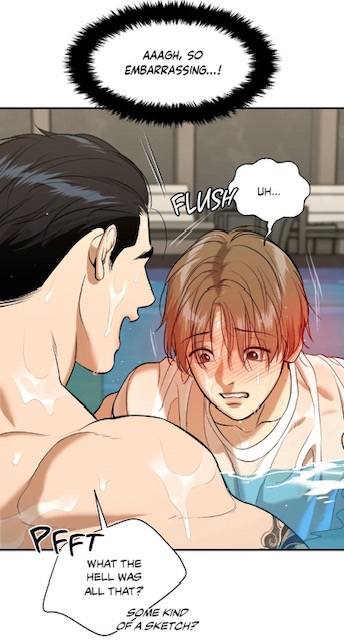 (chapter 27)
  (chapter 37) Is it a coincidence that the doctor drank his drugged nutrition drink? No… The reason why both became a victim of the second scheme is that they were no longer communicating to each other.
  (chapter 47) They are no longer facing each other, the athlete was even turning his back on his precious roommate and PT. Joo Jaekyung had started keeping his distance from his soulmate because he had listened to his toxic mentor
  (chapter 51), while in reality the latter had protected his back. Interesting is that exactly like in the penthouse
  (chapter 27), the athlete deserted the room out of anger
 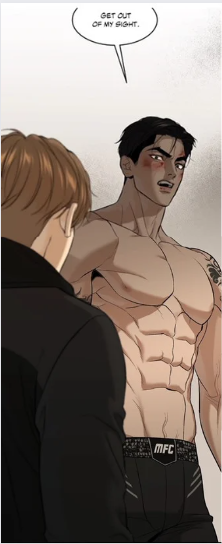 (chapter 51) leaving the doctor behind. It was, as if he had thrown away his Joker without realizing his true value. However, we shouldn’t overlook this aspect. The fighter’s words were not reflecting his true thoughts and emotions. He was acting impulsively and thoughtlessly overlooking that words can be as harmful as punches. And what is the common denominator between these two matches? Team Black had reacted impulsively. They made accusations and rushed decisions, while just like in board games, patience and observations are necessary to win a round. Yes, this connection between these two scenes displays that life is like a game… you should take your time, enjoy the moment, you can start afresh and play a new game. While the manager is envisioning to replace the doctor

 (Chapter 1) Imagine that he was in the middle of an intercourse. Yet he felt the need to have someone else by his side. It was, as if the grass on the other side was looking greener. 😉 Yes, in this scene, I detect parallels between Choi Heesung and Joo Jaekyung.
  (Chapter 33) On the one hand, the celebrity felt attracted to Kim Dan, on the other hand he had already sensed that the green-haired uke was greedy and even too passive. He was letting the celebrity fuck him. Yet there was neither real interaction nor sensuality between them. Hence the athlete could call Kim Dan during their sex. Funny is that the other didn’t mind at all, or in the worst case he didn’t even notice it. This shows not only the deafness and blindness of the mint goblin, but also the absence of communication and understanding in their “couple”. It was, as though the green-haired uke had submitted himself of becoming a sex toy. So by recalling the doctor, there is no doubt that the athlete couldn’t have voiced this change verbally. Why was he thinking of someone else during the intercourse? He was just simply not feeling it, the “great fuck”. In other words, Joo Jaekyung was attracted to Kim Dan by lust! In my previous analysis entitled
  (chapter 42), it becomes clear why the athlete’s lust for the mint goblin couldn’t last. The latter was only interested in his money and not even in his body. Thus he didn’t try to bring thrill into their relationship or even seduce him. And now, you comprehend why Mingwa let us see such a scene in the beginning of the story.
 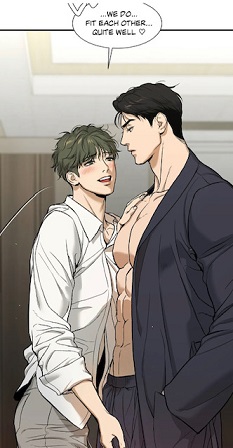 (chapter 2) He had never done it before. As for the champion, Manhwa-lovers can grasp that since their relationship was purely physical (not even accompanied with romanticism due to the athlete’s jinx), the lust from the champion’s side could only weaken overtime. When the athlete met the actor, he had not met the green-haired man before. Hence the sportsman was sitting at the bar looking more or less for a new partner.
  (chapter 33) So the relationship between the “prostitute” and the fighter must have lasted around 3 months, the same amount of time than with the physical therapist. The uke had put no effort, for in verity he was relying on the athlete’s jinx. The latter just needed him, and no one was willing to experience such a rough sex session. The reason why I gave the green-haired uke the nickname “mint goblin” is the following. He brought some fresh breathe in the athlete’s life, for contrary to his past lovers, this one didn’t run away. However, as time passes on, the mint taste couldn’t mask his corrupted mind and heart. He was passive and rotten deep inside. But there’s more to it. Thanks to the mint goblin, the athlete learned an important lesson. It was possible that someone could match his strength in bed. Yes, the latter wasn’t passing out like the others. Deep down, the star could sense that he was no monster, a criticism he had received from the actor.
 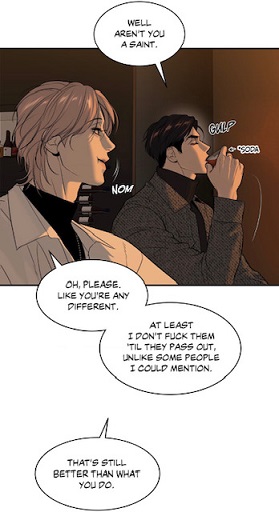 (chapter 33). The irony is that as soon as he saw Kim Dan
  (chapter 1), he got attracted to this pretty and cute new face. However, contrary to the comedian, he didn’t realize this, for the athlete is not someone who thinks deeply. He acts rather on his emotions, exactly like his mentor Park Namwook. Since lust is the first stage of love, the recipient of his “attraction” needed to give him a signal that he was interested in him. I doubt that the celebrity would have made a move on him, if the doctor had not made this mistake
  (chapter 1). Naturally, grabbing his phallus was the expression of the doctor’s masked sexual desires. This signifies that when the couple met for the first time, the grass appeared greener on the other side (medical world) for the first time. Since we have the first step of love in their relationship, we could say that the athlete was already in love with Kim Dan. While “lust” only represents the first stage in a love relationship, I decided to examine their relationship on this aspect.
 (chapter 33) We have the novelty aspect (bringing thrill into their relationship) and the champion’s selfishness. The sex toy was utilized as a “punishment”, for the athlete was upset due to his jealousy. However, this perception is still too short-sighted. You will laugh, as soon as you read my new interpretation.
  (chapter 8)
  (chapter 27) Consequently, the man had to bring up the deal constantly. Besides, their relationship started because of money. Finally, I would like Jinx-lovers to keep in mind the doctor’s lie: he had previous relationships with men.
  (chapter 3) As you know, I am quite certain that the athlete had sensed his lie (thus he utilized no condoms later). Yet, Kim Dan never came out with the truth either. This is relevant, for there could be lingering doubts from the MMA star’s side. Since the athlete had no idea about the doctor’s taste and physical attraction, Joo Jaekyung worried that his partner would start fantasizing the gumiho. Under this light, my avid readers can grasp why in episode 33, it was important for the champion to use the sex toy first. Initially it was to exhaust the doctor so that the latter would no longer feel attracted to Choi Heesung. Yes, it was to kill in him “lust”. Moreover, the moment the young man asked for his assistance
  (chapter 33), Joo Jaekyung had the impression that he was needed. Finally, don’t forget how this scene ended. Kim Dan was finally admitting that he was really sensitive to him:
  (chapter 33) However, this desire was accompanied with rejection and denial too. This explicates why the champion didn’t know how to interpret Kim Dan’s thoughts and emotions.
  (chapter 33) Was Kim Dan feeling the same way than him or not? Did Kim Dan desire him or not? And this leads me to the next sex session:
  (chapter 34) For the first time, the athlete was divulging his physical attraction and desire towards the doctor. He seduced him with his own body. Yet, in order to keep the upper hand in their relationship, he was the one who was determining how they would have sex:
  (chapter 34) As you can see, during season 1, it took a long time for the athlete to admit “lust and physical attraction” towards the doctor. One might reply that the celebrity had already admitted this to the physical therapist:
  (chapter 29) However, this confession is connected to the anus, and not to the doctor’s face and as such identity. Thus I don’t consider it as an admission that Kim Dan was his type. One might object too that he had already wooed the doctor before next to the swimming pool.
  (chapter 27) The divergence between these two chapters is that in the first scene, the athlete had not planned this. He was acting on his instincts and emotions, while in the living room, he was seducing the doctor on purpose.
  (chapter 34) I would even add that he gave more freedom to Kim Dan to decide if he would accept his offer or not. As you can see, Joo Jaekyung was learning to internalize the notion “consent and respect”. Here, the doctor could have refused… the evidence is his reaction at the gym, the slap on the athlete’s hand. That’s how I realized the strong connection between the athlete’s ignorance about his soulmate’s taste (partner type) and his consent. Respecting the doctor’s boundary meant to trust that the doctor was attracted to him and accepted him as a partner.
 (chapter 39), this could only make the athlete happy first. He had the impression that he had finally discovered his soulmate’s taste and secret: he was also feeling the same… LUST. Yes, I am not writing love, but lust on purpose. Why? The irony is that the athlete was not recognizing that he was feeling more than lust for Kim Dan. He was already in love. 😉 However, so far he had only been busy focusing on Kim Dan’s type. Was the man also lusting after him or not? Under this new perspective, Manhwa-lovers can grasp why Joo Jaekyung asked this to Kim Dan in the dining room:
  (chapter 41) He didn’t expect a love confession He wanted to know if Kim Dan was finally accepting him as his partner, if he desired him too. Yes, gradually the possibility of dating was slowly emerging. Like mentioned in the introduction, lust is just the beginning of love. So should Kim Dan have remembered this night in the hotel room, he would have come not only to deny his feelings for the athlete, but also he would have reduced this “I love you” to lust, just a physical reaction due to the drug. A new version of the blue night, the only difference is that that night he kept his thoughts to himself.
  (chapter 45) What did the athlete imagine here? A fake love confession from Kim Dan, a stan trying to live out a fantasy. He was expecting “dating”, a notion he couldn’t accept, for he was confusing “lust” with “love”. That’s the reason why he couldn’t accept Doc Dan’s present and “gratitude”. They sounded like fake, especially since he was showing respect to the celebrity and not to the man himself! Yes, even in that scene, the PT was still hiding his own true emotions and attraction towards the handsome man. Joo JAekyung has no idea that Kim Dan views him as “perfect”
  (chapter 1) despite his injured shoulder: the muscles, the skin, the handsome face. He has never voiced such thoughts in front of his VIP client.He always kept them to himself.

 (chapter 16), especially since the latter is rather old. The grandmother could have sold it, but she never did, for the latter has a sentimental value. Consequently, I would say that she had missed her chance, and naturally her misery is the result of her own wrong choices. Under this new light, it becomes comprehensible why the grandmother portrays herself as poor who has nothing to give to her grandchild.
 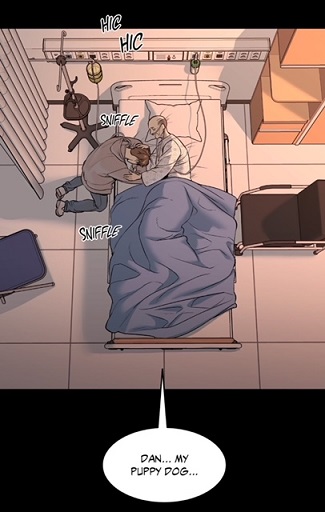 (chapter 53) Her vocabulary exposes that she became a master and in her mind, the puppy dog has to follow her owner. Therefore it is no coincidence that Mingwa created such an image:
  (chapter 53) Deep down, he would like to be recognized as a competent physical therapist. Moreover, my avid readers should recall that the champion had already noticed the change of heart in the doctor before the scheme took place.
 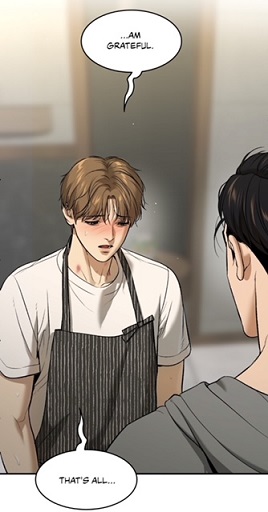 (Chapter 45) But how can he change his condition? I will give the answer below.
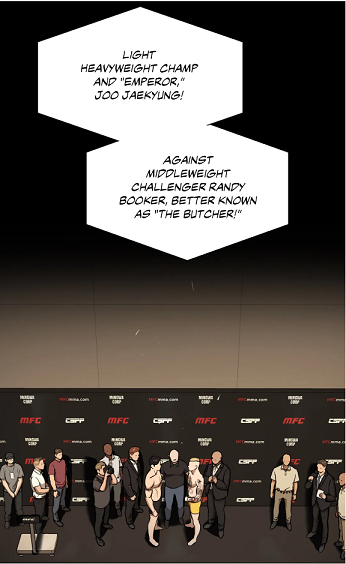 (chapter 14) Yet, the reality is that despite his wealth, he is not free at all. Actually, he reminded me of a Roman gladiator. Gladiators in ancient Rome lived under challenging and contradictory conditions. Although they were often slaves or prisoners of war, some achieved fame, wealth, and admiration comparable to modern-day sports stars. Successful gladiators could earn prizes, attract fan followings, and even enjoy certain luxuries within their restrictive lives. However, they remained under the control of their lanista (manager) or the state, with little freedom to make personal choices. They could not select their opponents or refuse combat, and each fight carried the risk of injury or death, underscoring their vulnerability and lack of autonomy despite their celebrated status.
  (chapter 41), from his manager’s influence (father figure) and even from the MFC world (authorities) !! What is the common denominator between these three persons? MONEY!
  (chapter 26) No wonder why he got so surprised by Kim Dan’s reaction in the locker room:
 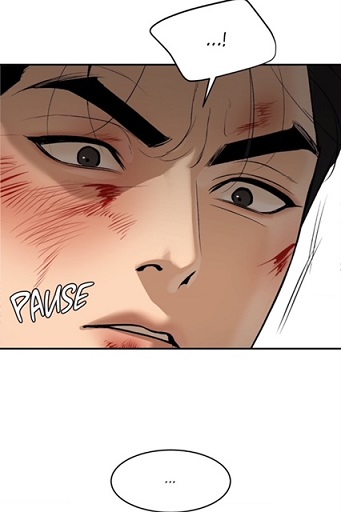 (chapter 51) He was disarmed by a single question and a shocked and disappointed face:
  (chapter 51) The question implied that the doctor had been trusting him.
 (chapter 43), yet he added shortly this comment: :
  (chapter 43) The hypocrite coach utilized the personal pronoun “WE” indicating that he and his peers had played a role in the athlete’s decision. Funny is that though he complained about the schedule, he still accepted the switch of the fighter later. But he could have voiced his fears and objections. Nevertheless, he did nothing. Since I connected the halmeoni to past, I suddenly realized that the “lanista” embodies the opposite notion. He is trapped in the future, thus he is always anxious. Imagine that in that scene, they were celebrating Joo Jaekyung’s birthday, it should have been a good time. Yet, the manager kept talking about work and the future.
  (chapter 43)
  (chapter 43) This is a sign that he was not “enjoying the present”. In my eyes, with his comments, he was actually ruining the party. Fortunately, no one paid attention to his words except the physical therapist and Yosep. By talking like that, he gives the impression that he is caring and paying attention to the fighter. Yet this is just an illusion, for he is not focused on the present. He neglected his duties, therefore the schemers were able to bring drugs to the champion’s rooms.
  (chapter 49) Notice that he was afraid of an outburst from Joo Jaekyung in the locker room, therefore they were restraining him. This was no real protection. I am suspecting that the manager is trusting MFC and its organization. In addition, his obsession with the future explains why the athlete’s mental health has been neglected by the coach and manager. As a conclusion, Park Namwook is himself trapped in his own world: money, fear of the future and the champion‘s retirement which means the end of his own career as manager and coach. Therefore he is pushing his fighter to race against time. It is only a matter until his boy gets injured!!
 (chapter 21) to this
  (chapter 47) Money is powerless in front of death and terrible injuries. Therefore he is lucky that his shoulder is not ruined forever. Moreover a trip represents a good metaphor for an escape, a travel is a synonym for freedom and the end of “routine”.
 (chapter 35). However, since he didn’t spend much time in his own home, he never took the time to take care of his soulmate. By leaving the city and Team Black behind, he would become truly alone (as opposition to his trips to Busan, the States) which would give him an opportunity to become more honest to himself and to Kim Dan.
 (chapter 43) In episode 1, he gave a positive feedback
 (chapter 1). Nonetheless, his words sounded more negative due to the usage of negation. Moreover, Kim Dan was too scared to take his words seriously. Consequently, it becomes obvious that Kim Dan needs to hear praises from the athlete himself. It is not just about an apology about his misjudgment, the “hamster” needs to hear from his own patient that he trusts him and his hands. Thus he wants to be needed:
  or like this:
  And what does the hand symbolize? The latter symbolizes gratitude and love! Hence the grandmother took the MMA fighter’s hand in order to thank him.
  (chapter 22)
  (chapter 12), though he is no drinker or he doesn’t eat cakes.
  (chapter 41) The fact that the athlete organized a charity event for his birthday exposes not only his huge heart, but also that he had long recognized the power of generosity. Under this new light, it becomes comprehensible why the champion was willing to pay off the doctor’s debts.
  (chapter 18) Here, he hoped to see gratitude on his fated partner’s face, but it didn’t happen like he imagined. Yet, notice that despite their argument, Joo Jaekyung proposed to the main lead to live with him in the penthouse:
  (chapter 18) His facial expression is exposing his true thoughts. He was definitely happy to help the doctor. The reason is simple. He is in control of his heart and life. This shows that deep down, the man has always had a soft heart and could find fulfillment in giving. However, the problem is that the champion had also internalized that there is nothing free in this world. Due to his past experiences, he realized that receivers would exploite his goodness. The green-haired guy was the perfect example.
 (chapter 18) He had to, because the man was now living with him. Joo Jaekyung feared that his roommate could come to take advantage of his new position and even consider this place as his own. As you can see, the champion had long discovered the power of giving to others. Yet his problem was that he couldn’t live out this principle: he was either exploited or he has no family or close friend so far.
 (chapter 30) They both desire to be acknowledged and appreciated.
  (chapter 45) With this image, it was, as if Kim Dan wanted to be distinguished from all the stans. Yes, I do think that this has something to do their own negative feelings. However, there is a difference between Choi Heesung and Kim Dan. Note that the gifts are related to his sponsors and the agency. They were related to his work. Moreover, the gumiho rarely gave the meals or the presents personally.
  (chapter 31)
  (chapter 31) Furthermore, the actor gave these things for one reason: it was to obtain the doctor’s heart or to maintain his good image as a celebrity. In other words, these gestures were not selfless at all. This explains why the athlete was so weary of such “gifts”: a return of favor or a service. But the comedian is not the only one donating things. Naturally, it is the manager Park Namwook.
  (chapter 41) This frenzy was portrayed as something positive. Jinxworms can observe that the manager is mentioning the existence of „favors“. For me, it is no coincidence that in episode 45, the arrival from presents coming from his hyung coincides with the present with Kim Dan. It shows the underlying conflict between the celebrity and the former wrestler. Nevertheless, the fighter has not grasped it yet. So far, Joo Jaekyung has not tried to defy Park Namwook openly, to claim his place as the true owner of Team Black. We should see his words here as a first attempt to act as the boss
 (Chapter 26) The sparring in episode 26 represents the positive version of giving a punch and taking it. The fighter was not upset about his defeat, moreover he was acting like a real teacher asking the physical therapist to overcome his own fears. On the hand, the slap at the hospital embodies the opposite notions: resent, no real teaching, no reflection, no listening, the one slapping is not overcoming his own fears and vents his anger. The give and take in episode 26 was happiness, true generosity, self-awareness, while this slap displays misery, anger, ignorance:
  (Chapter 26) The contrast not only exposes Park Namwook’s fake generosity, but also his greed and selfishness. For me, he missed the opportunity, as at the gym, Kim Dan took the chance, when the athlete was distracted. Hence in my opinion, chapter 52 was the turning point in their toxic relationship. Moreover, it signifies that the manager lost his special position as hyung. Far away from the gym, Joo Jaekyung will see Kim Dan under a different light, maybe even as a true role model, for he is wearing his heart in his hand.
 (chapter 7)
  (chapter 22) This scene at the hospital displays that the fighter had been mirroring the behavior of his counterpart: Shin Okja is sweet and kind. And who is moody, yelling, brutal ? Park Namwook:
  (chapter 43)
  (chapter 15), but as soon as his idol lost his title and got even suspended, he yelled and slapped his fighter:
  (chapter 43) This exposes his lack of engagement and indifference in the end, but this becomes even more obvious during the night:
  (chapter 43) Where was he, when his star was drunk? It was, as though he had vanished.
  (chapter 43) But the best evidence for this interpretation is this image:
  (chapter 9) However, he never presented himself as a father or a husband. It was, as if his children or wife were not a source of his happiness. Why? It is because they don’t bring money, but rather cost money. Thanks to Joo Jaekyung’s popularity, the manager could stand in the spotlight
  (chapter 40) in the States and even at the gym?
  (Chapter 43) It is because he doesn’t view the uke as a possession contrary to his „boy“. Why? It is because the young man doesn’t bring money or contribute to boast the manager’s self-esteem. In fact, Kim Dan is an expensive PT and the manager is aware of his high salary. Moreover, contrary to the hamster, Park Namwook was never seen in the penthouse, and the celebrity refused to invite the members. This is a clue that the champion could have refused to invite his coach there. The doctor’s stay at the penthouse is something Park Namwook discovered by accident.
  (chapter 41) In his eyes, possessions and money determine someone’s values. Hence he bought an expensive keychain for his fated partner. Furthermore, I have been wondering if this spending is not related to Shin Okja, the latter could have been a spendthrift. In the essay „
 (Chapter 19). Another possibility is that she made sure that her grandchild would spend money on her:
 (chapter 21) One might argue that the poor woman couldn’t do much to express her gratitude. However, this is just a deception. Shin Okja could have written a letter to express her gratitude to Joo Jaekyung. Why do you think Mingwa created two scenes with a letter or card?
  (chapter 45)
  (chapter 53) The comparison lets transpire the importance of words. The champion might have judged the keychain differently, if he had read the card. But he didn’t. Another parallel between these two scenes is the rejection of a gift! However, in the final episode, Kim Dan voiced genuine gratitude towards his benefactor. The latter had allowed him to work as his PT. With the letter, he could voice his thoughts and emotions much better. And now, you realize that Shin Okja could have acted the same way. This made me realize that deep down, she resents being poor. She likes Dan spending money on her.
 (chapter 41) She should have been the one who expressed her gratitude to Joo Jaekyung, but not Kim Dan for the trip (it was work related anyway). One might argue that the poor woman is trapped in the hospital, she can not do much. But you are wrong. She could have written a letter to her benefactor which means that she would have sacrificed some of her time for the athlete. Imagine that she had sent a message to the athlete, the latter might have decided to pay a visit to her. He is not truly heartless. With this silence, she created the impression that his assistance had changed her situation.
 (chapter 22)
 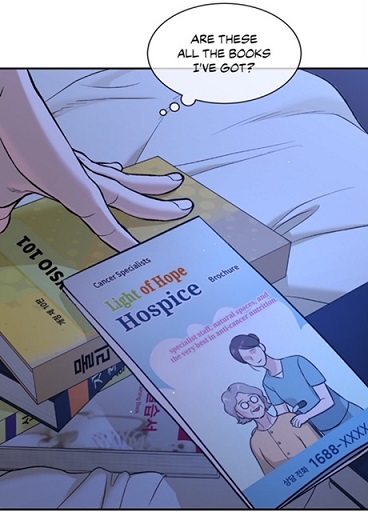 (chapter 53) He likes not only his job now, but also learning as such. This is no coincidence that education in the mode of “being” means that the focus is on learning and developing skills. Hence I still see a change in the hamster at the end of season 1:
  (chapter 52) In this panel, the author let us see glimpses of their motivation and thoughts. For them, the champion has nothing to teach them, since he lost his title and is injured. This shows that they are only interested in the outcome, success and as such fame, but not in the process, how to become skilled! In other words, they see “success” as a possession. He has no title, then he has nothing to offer. They are all living in the mode of having, which can only lead to misery and even self-destruction. No wonder why they were not too upset or shocked, when they heard that the game had been rigged. But what led them to make such a decision?
 (chapter 23) Then he only focused on the “outcome” and not on the process. Hence he neglected them, delegated his task on the pressured athlete. The latter had to train them:
  (chapter 25) and
  (chapter 36) In my eyes, he didn’t want to play the bad guy. The meeting or his worries were more important
  (chapter 36) than their training and career. Moreover, he kept bribing them with junk food
  (chapter 46) The latter was a new source of income and fame. Everything was revolving around money. That’s how it dawned on me why the manager got angry for the bet in episode 26:
  (chapter 26) and became more obsessed with possessions and fame. Potato and the remaining members represent the exceptions. They enjoyed the lessons despite the pain and struggles. The other members became dependent on external tools which led them to lose their integrity. To conclude, the reason for their disloyalty is that at the end, they had long internalized the mode of having and were just interested in getting successful.
 (special episode2 ), but also Cheolmin
  (chapter 13) who likes making jokes. That‘s how I came to understand why Cheolmin appeared only one time in season 1. He will come to replace the manager:
  (chapter 13)
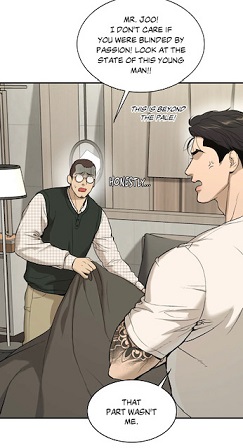 (Chapter 13) when the latter denied his responsibility. This shows that the man doesn’t mistrust people. He has faith in humans. And in this short scene, the doctor shows alle positive notions mentioned above: love, empathy, joy and creativity. Therefore I come to the following interpretation: he embodies the being mode. No wonder why he was not present in season 1. The main lead was definitely obsessed with work. Hence the moment Cheolmin’s path crosses Kim Dan’s, the funny doctor should become the hamster’s new role model.
 (chapter 48) are full of greedy people who have no problems to commit crimes in order to achieve their goals (more fame, more wealth, revenge, more connections). Baek Junmin became a champion by cheating.

 And now, you know the origin for this essay. As you can see, the collection of Haikus is focusing on the topic “Water”. Since I only possess the French version of Haikus, I could only give you my own English translation. Fortunately, my friend @Rin_de_eegana was able to find the original version, Japanese. Therefore in the second version, I am giving a second English translation whích gave me new insight once again. Anyway, the thing is that as soon as I read certain poems, it made me think of Jinx and the characters. This shows my obsession for this terrific Manhwa.
 (chapter 14) Yet, the main lead never got the chance to see it. Then the ocean is only mentioned directly at the end of the first season. The halmeoni was expressing her wish to return to the West Coast
  (chapter 53) When she was 10 years old, she was moved by how the ocean changed colors with the beautiful sunset. It was no longer blue or grey, but yellow, red, pink, orange and purple. This wonderful but brief moment left such a deep impression on her that she could never forget it.
  (chapter 53) She never came to regret her walk to the beach, because this souvenir also became her source of strength. This memory created in her the desire to see it again, thus she kept postcards with views of the ocean.
 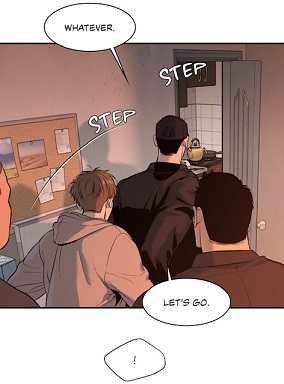 (chapter 17)
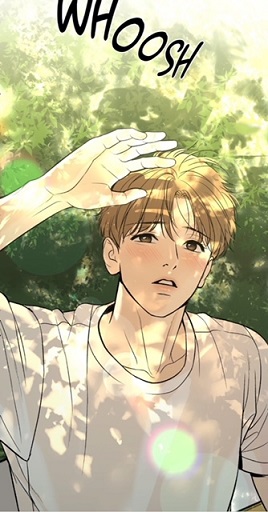 (chapter 41) are the doctor’s true elements. Under this new light, it becomes comprehensible why under the tree, he came to acknowledge his feelings for the athlete. In addition, if Kim Dan gets close to water, this signifies that he will get replenished and truly nourished. And notice that during season 1, he never ate properly.
 (Chapter 7) And we could see that Joo Jaekyung had a similar attitude in season 1, he would listen to his hyungs and the people working for MFC. Consequently, I come to the following deduction: this time, the fighter will make the decision on his own. He won’t follow Park Namwook’s advice:
 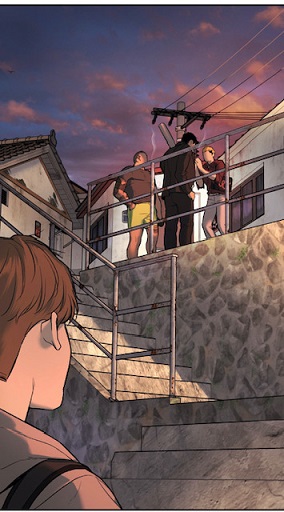 (chapter 1)
  (chapter 47)
  (chapter 47) even when the doctor was confronted with the truth about his terminally ill grandmother. The sun was always shining brightly. Since in the haiku from Ryokan Taigu, the rain is associated with old-age and fall (misty), it dawned on me that the rain should be associated with the grandmother’s death. If this comes true, it was, as though the sky and gods were weeping for her vanishing. Additionally, the first season took place in Spring and Summer, thus I deduce that season 2 will take place around late summer, fall and winter. This means that the weather should change. And this remark led to my second revelation. I started looking for South Korea’s climates, particularly I was curious about the climate on the West Coast.
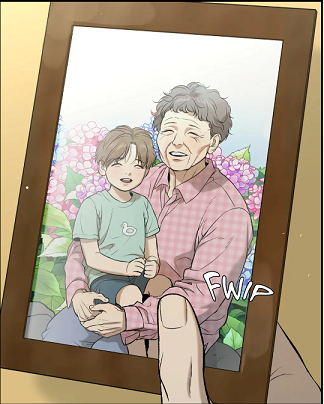 (chapter 19) the presence of pink and purple hydrangeas indicates that it was taken in Summer. This new approach reinforces my perception that the grandmother is about to get confronted with harsh reality despite her attempts to escape from it. Her wish can not be fulfilled so easily, like she is imagining it. In addition, Manhwa-philes should keep in their mind that weather has a great influence on elderly people’s health.
 We have an elderly man walking through the rain in front of the blue sea. The latter is accompanied with a Waka-poem from Yoshihiro (which was not translated). According to my Japanese friend @Rin_de_eegana (飯乞ふと 里にも出でず この頃は 時雨の雨の 間なくし降れば), this phrase describes a situation where one cannot even go out to the village to beg for alms due to the long rain. Here, we have the topic of poverty linked to old-age and rain. Yes, the pages of this book reminded me of Shin Okja, a poor elderly woman who is so sick. And like mentioned above, the rain could be the reason why the woman doesn’t go to the beach. The two poems are underlining one important aspect: the powerlessness of humans in front of nature. No one can stop aging, just like no one can control the weather. At the same time, it outlines the importance for a senior to be surrounded by people, so that they don’t end up dying from dehydration, from a cold or hypothermia.
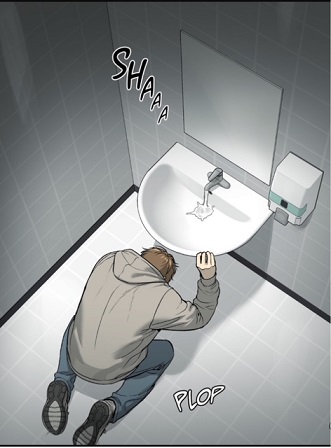 (chapter 47)
  (chapter 49) Both main leads went to the restroom in order to hide their emotional turmoil and suffering. They used flowing water (in Joo Jaekyung’s case the shower) in order to cover the sound of their weeping: SHAAA. Yes, the tears are making sound… so the rain should make sound as well. And this brings me to my next remark.
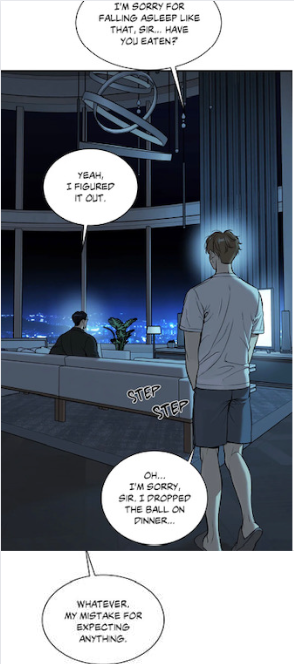 (chapter 29)
  (chapter 18) and as a source of stress and worries.
  (chapter 45) This means that the night view of the ocean should make him discover the beauty of the sound of water. He will come to associate the sound of the sea waves with Kim Dan. That’s how he will be able to fall asleep. In other words, I am expecting a new version of this scene:
 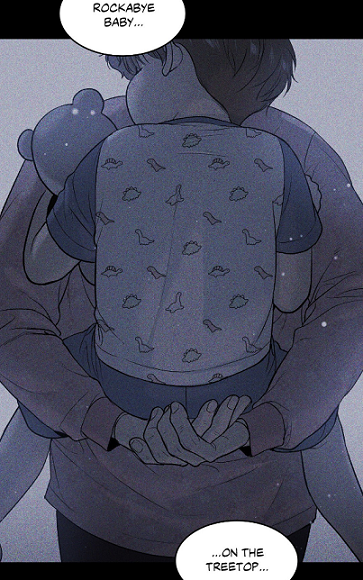 (chapter 47) To conclude, Joo Jaekyung will also have an Enlightenment in front of the ocean, but contrary to the grandmother, this experience will be associated with the night, the sound and a person: his soulmate Kim Dan.

 (special episode 1) The actor chose to use the black-haired sportsman as “Friends with Benefits”. But what would be Potato’s benefits then? Support and connections, like we could see it in special episode 2:
  (special episode 2) So when Heesung is already envisaging to get rid of his new lover
  (chapter 35) Because he is famous and wealthy, he is expecting a similar reaction from the chow-chow. At some point, he will appear too clingy, hence he will perceive his relationship as burdensome. This is no longer fun.
 (special episode 1) With his words, the sportsman implied that he had taken advantage of the actor, while in reality the opposite had happened. Heesung had taken advantage of Potato’s drunkenness
  (special episode 1), ignorance and purity
 (special episode 1).The confession of Yoon-Gu’s wrongdoing could only shock the actor.
  (special episode 1) How did Yoon-Gu come to this reasoning, when he admitted in the same breath that he was drunk? It is because the night before, Heesung had confided that he was heartbroken due to Kim Dan’s rejection.
  (chapter 35) With his behavior, the fox gave the impression that his affection for Kim Dan was running deep. Under the tent, he was drowning his sorrow with soju. Hence in the maknae’s mind, Heesung was still in love with the physical therapist. Yes, the irony is that the chow-chow was also projecting his own thoughts onto the comedian. Let’s not forget that when the young fighter discovered the true nature of the relationship between the doctor and the emperor, he didn’t give up on his admiration and affection for Joo Jaekyung.
  (chapter 35) My avid readers should keep in their mind that the chow-chow is famous for his strong loyalty. To sum up, Potato imagined that Heesung was still loving Kim Dan, exactly like him with the fighter… he would remain faithful and keep his one-sided love.That’s why I came to the following conclusion: their relationship started on a misunderstanding, which was also reflected in this situation:
  (special episode 1) It was, as if he had disregarded the gumiho’s feelings, he had incited the latter to commit a sin. Heesung had broken his vow of faithfulness 😂. That’s the reason why he mentioned “zero regrets”. It is important, because with such a mind-set and attitude, he is indirectly pushing the gumiho to face the truth: his dishonesty. His affection for Kim Dan was just a crush, a superficial attachment, as he knew nothing about him. In fact, he was just chasing after an illusion. He even admitted it at the restaurant:
  (chapter 35) His description for a partner and as such love doesn’t correspond to the definition of true love: care, respect, knowledge and responsibility (Definition from Erich Fromm, for more read “
 (chapter 32) He didn’t try to protect him from the athlete’s fury. He never clearly stated his true desire, he wished to date the doctor, until he was cornered (threatened).
 (chapter 45). This means when the MMA amateur fighter decided to become responsible and as such to make up for his mistake,
  (special episode 1) and why Potato couldn’t refuse the role-play.
  (special episode 2) However, he is not entirely powerless, like I mentioned in the first part. He is not forced to admit that he had fun after the intercourse.
  (special episode 2) In other words, he is not obliged to say YES either! It is funny because thanks to this examination, I realized that Yes and No have “become” like taboo words. Yoon-Gu is avoiding these idioms by using the expression “I don’t know”. Hence I am suspecting that Heesung will become obsessed with the word “yes”! 😂 Only Heesung can procure him fun and pleasure, and no one else. He is getting disarmed by the sentence “I don’t know”.
 (special episode 2) He was attempting to hide his growing affection for the comedian. He feared that his feelings for him could become a burden for the comedian. In his eyes, Heesung should remain faithful to the physical therapist. He shouldn’t expect any affection from the actor either.
  (special episode 2) out of annoyance and jealousy
 (special episode 2), for Potato had run away from him. He needs to put him on a leash to feel in control, to obtain his chow chow’s attention. Naturally, there is no guarantee that this prediction is correct. Yet since according to my examination, Potato is thinking that Heesung is in love, it signifies that Heesung is already attached to Kim Dan. Hence he won’t do anything to ruin this attachment… therefore Heesung can only be put in front of a dilemma. How can he make Potato look at him? He could reveal the truth to Yoon-Gu, but by doing so, he would ruin his image as a good and caring guy. Moreover, since he has lived for a long time deceiving himself and others, it is very unlikely that the actor might change his behavior so suddenly. Old habits are hard to die. Therefore for me, honesty won’t be his initial choice, rather acting. He will express his thoughts and emotions behind a new role-play and sex.
 (chapter 35)
  There, I included two gemstones, the Bloodstone and the Aquamarine! Choi Heesung, born on 21st March, is represented by these birthstones! In this composition
 (chapter 30) And what was he wearing in the poster? A blue pale suit which is close to Aquamarine and even to light purple ! The color is no coincidence. I have the impression that thanks to the weak woman, Heesung will become a part of the “new family”. If you look at the sunset again, you will detect glimpses of purple in the sky. As for the second image which came to my mind is this: the actor swimming in the ocean. When the bloodstone is put in water, it changes the color of the sun: red for love. Yes, we should expect a new version of this scene:
  (chapter 28) which I had interpreted as a baptism, a purification. If the actor bathes in the Yellow Sea, he will be purified and as such his true self will come to the surface. That’s how he will recognize his love for Potato, but also his friendship for the doctor. So far, the man has no real friend, but he has been longing for one. At the same time, the metaphor (the sun turning red) could be a reference to the interaction between the actor and the emperor, the former helps the latter to recognize his true feelings for the physical therapist. As a conclusion, we should expect to see Heesung under the sunset and next to the ocean or water. There, he should ponder and have a realization.
 (chapter 30) After getting enlightened, he would know what he truly desires. He would have no interest to get on the champion’s nerves. Potato would be the one bringing him happiness and novelty. Athletes and those seeking to enhance physical endurance often turn to bloodstone for its reputed ability to increase stamina and energy. This signifies that thanks to Heesung’s presence, the champion’s training won’t appear as a torture. Yes, expect a new version of this scene:
  (chapter 37) Here each fighter was on his own, they were not really training together. The champion was the leader due to his imminent match, he put the others under pressure, as he was himself stressed. But with his suspension, he is no longer racing against time. In other words, the training routine should be different. They will help each other, encouraging each other to become better. The presence of Heesung should help them to see the training under a different light. But for that, he has to reconnect to his true nature: bloodstone and aquamarine.
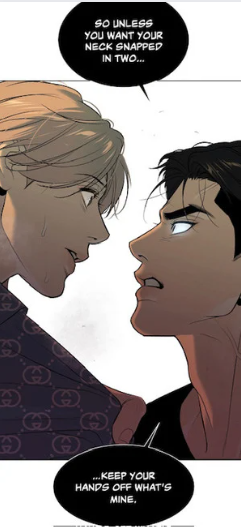 (chapter 34) Here, he forced the champion to claim the doctor as his possession. However, in season 1, the main lead came to regret his actions (34, 43), for he has never been honest to himself. And now, it is time to focus on the second gemstone.
 (chapter 31) They were green. He is attracted to “green”, his origin self. Nevertheless, in episode 31, this was rather a khaki version due to his corruption. No wonder why he played a trick on the champion. And this observation brings me back to the doctor’s clothes. What was he wearing, when he was young?
  (chapter 35) At the same time, it explains why Heesung changed for the better thanks to the physical therapist. Thus I assume that Heesung is destined to become an aquamarine, bringing all these characters closer to each other: Potato, Cheolmin, Kim Dan, Joo Jaekyung. However, contrary to the past, he won’t use his money to help people to become happier. His smile and happiness should affect the others:
  (chapter 31) However, this should no longer be superficial. The celebrity is associated with flowers, stars, fun and happiness. Because he symbolizes “Spring”, I deduce that his rebirth and as such his Enlightenment are primordial. He is there to assist the others. And the color for understanding, compassion, self-awareness and wisdom is purple:
 (special episode 1) Since the elderly woman confided to Joo Jaekyung, we can assume that she could do the same with the gumiho, as soon as she sees her idol. It is important, because he could grasp the physical therapist’s suffering and low self-esteem.

 (chapter 48), but the actor would be replacing the fake director. We had a sunset here, dark water (the coffee), the symbol for corruption. Then notice that he is wearing a blue t-shirt (but two colors, a symbol of his hypocrisy)!! This reinforces my expectation that we should witness the actor’s awakening, the exact opposite of the other Choi, who chose revenge and manipulations. But there is more to it. Thanks to the comment of @Milliformemes24, I had another revelation. The latter wrote that places of knowledge and self-awareness are related not only to the ocean, but also to the mountains. It is normal, as the hill is closer to the sky and as such closer to the gods. Notice that Heesung’s new home is situated on the top of a hill, surrounded by a forest.
  In other words, Heesung could get enlightened on a mountain too, during a stroll for example. And the moment I read this from my friend, this image came to my mind:
 (chapter 41) The huge tree at the hospital!! The latter is even strongly connected to a stroll. In that scene, the doctor thought of his lover, as he associated him with the sun.
  (chapter 41) That’s the moment when he realized his feelings for the fighter. As you can see, Mingwa used the tree and as such nature as a source to spirituality. And now let me ask you this question. Since the story is written with reflections, the tree should have appeared before and after. Where was it then? First, the first plant to appear was the bouquet. The roses from Heesung
  (chapter 31) could be seen a mirror of the tree. The roses encourage the doctor to ponder and show an interest in his employer.
  (chapter 37) However, the first time, the tree appeared as such was in the States, and this on two occasions:
  (chapter 47) Kim Dan imagined going on a trip with his grandmother, totally delusional, as he was in denial about his grandmother’s deteriorating health conditions. However, the vision shows the desire to become closer to his relative, to become more proactive as well. His words (“She’s been so busy raising me, she’s never had a day’s rest”) imply the presence of reflection. It indicates his gradual transformation and maturity. But this doesn’t end here. The tree was also present in the special episode 2:
  (special episode 2) Yes, the barn!! The tree had been transformed into a home. However, don’t forget that this was just a fantasy from Heesung. However, during this intercourse, he came to expose his jealousy and growing attachment towards his soulmate. Yes, the last two mentioned scenes have two common denominators: a mixture of fantasy and Enlightenment. Nature is strongly intertwined with meditation and communication. To conclude, we should expect the presence of woods and trees in season 2 as well. And this hypothesis got reinforced, when Mingwa released this image on X:
  (chapter 34) I consider this as an allusion that the actor will be by the fighter’s side. On the other hand, since the shirt is open, I interpret as the star’s emancipation. The latter has been able to escape from his mental prison and suffering. In his cage, he was racing against time. Now, he is able to relax and enjoy time. At the same time, since the champion in the image from X is seen wearing rings with stones, it somehow confirmed my interpretation about the role of birthstones in Jinx.
 (special episode 2). This pigment is a combination of blue and red/pink. And now pay attention to the last panel. Potato is blushing while wearing dark-green clothes, his lover is standing in front of the blue sky and his skin is rather pale. His hanbok has purple and white shades. As you can see, this wonderful night represents their union: white meets black, blue meets red and yellow (hence purple and green). The light from outside contrasts to the darkness of the shelter. That’s how purple came to shine. On the other hand, since Heesung is acting as the master, and the maknae is relegated to the role of a male servant, the actor is exposing his inner darkness. He is longing for dominance and possession.
  (special episode 2) To conclude, Heesung is gradually showing his true colors: the hidden black spot behind his perfect white skin. However, dark shouldn’t be reduced to evil, for in Taoism, black has another signification. It represents yin, the feminine energy. This means that thanks to that night, Heesung could display his motherly and caring side. Therefore he kissed, hugged Yoon-Gu and stroke his cheek. But this doesn’t end here. After the intercourse, he caressed his lover’s head.
  (special episode 2) The young fighter and his lover are slowly discovering the existence of a double life (public/professional versus private life). This signifies that Potato is learning to distinguish between image (hero) and reality. In fact, he only knows the MMA fighter Joo Jaekyung and not the private man with his troubled past. As for the actor, with his blog
  (chapter 30), pictures and sponsoring
  (chapter 31) he never drew a line between his private and professional life either. He acted, as though he had no secret. That’s the reason why his manager knew about his tragic love life. This explicates as well why he used the “deal” with Park Namwook to go on a date with Kim Dan.
  (chapter 32) The gumiho never felt the need to hide his sexual orientation, it was never a taboo. It indicates that he felt safe among his colleagues and agency. Therefore the manager could talk so freely about his love life in front of others.
  (chapter 30) There was no secrecy and privacy. Manhwaphiles should keep in their mind that homosexuality in MMA world and boxing is a huge taboo. So if Potato’s homosexuality were to be exposed to the netizens, this could ruin his career. This is also valid for Joo Jaekyung. Other fighters could question their manhood. And this brings me back to that night. Purple is strongly connected to yin and as such to the moon, like you can detect in the illustrations below.

 (chapter 20) the main pigments were yellow, rosa, red and orange, whereas on the bed, the roles and topics were switched. Kim Dan’s feminine side was the dominant one. His motherly and caring instincts were so strong that he had no problem to challenge his sex partner.
  (chapter 21) Here, black and purple were the dominant pigments, similar to the sex scene from the special episode. The moon stands for softness, quietness, but also mystery and receptiveness. And during the night of episode 21, the doctor taught to Joo Jaekyung the importance of family. Besides, the athlete discovered a secret from the physical therapist. Though the former was pushed away, he didn’t react violently. Joo Jaekyung remained passive. This was the influence of Kim Dan’s yin.
  (chapter 21) And the next morning, the emperor chose to show his motherly and caring side to Kim Dan and the halmeoni.
  (chapter 21)
 (special episode 2) Potato is literally glowing, while the other is just wearing a purple hanbok (disguise). One might wonder why. The answer is simple. Potato stands for innocence, reflection and ignorance. Contrary to his new role model (Kim Dan), he has no real prejudices against sex. He doesn’t view it as dirty. This explicates why Potato is always surprised by his own pleasure and always claims his ignorance.
  (special episode 1)
  (special episode 2) That’s why the actor was glowing like a star after their passionate role-play. The presence of “stars” indicates his excitement and joy. His heart is racing, hence he is full of joy and feels rejuvenated. Moreover, the Webtoonist already implied the link between Potato and purple in the following scenes:
  (chapter 23) Don’t forget that his family name is Hwang which means yellow in Chinese. That’s the reason why I don’t think, the purple towel is random. One might argue that the towel belongs to the gym, and they got changed later:
  (chapter 36) Park Namwook selected black towels, a sign that he was taking over the gym. But the purple towel announces the moment, where the doctor and Potato gets closer to each other.
  (chapter 23) For the first time, the young fighter showed a certain curiosity towards the physical therapist: the beginning of “Enlightenment” and friendship. Under this new light, Manhwaworms can grasp why Heesung was under Potato’s spell during this intercourse.
  (special episode 2) But we have another evidence that Heesung has always been looking for a “purple” person. It is because he picked up a purple suit for Kim Dan.
 (chapter 32) This means that this night stands under the sign of Yoon-Gu! The latter came to shine to the point that he affected his lover… that’s how the actor blushed more and more.
  (special episode 2) This observation brings me to my next interpretation.
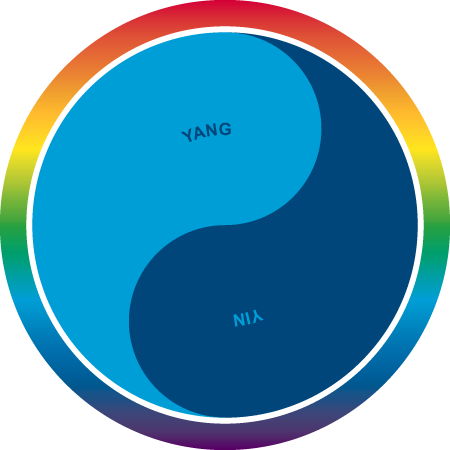 Dark red… full of passion. The actor could expose his possessiveness and jealousy, though he masked it behind a role-play.
  (special episode 2)
  (special episode 2) With that, I am implying that the actor imagined a scene from a historical drama (Joseon, hierarchical society and the shed). It was interesting, because for the first time, the author allowed us to penetrate Heesung’s mysterious inner world. It shows his “creativity”, inspired by his last shooting
  (special episode 2) and his own desires. As you can see, the sex session is a mixture of dream and reality which is reflected in the color purple.
 (special episode 2) He is blushing, he is enjoying this moment with his partner. He has the impression that his dream has come true. In his mind, he was breaking rules. A prince has sex not only with a man, but with a guard, a commoner. Secondly, they were having sex in the shed, hence they could get caught. He felt like he was playing with fire. This shows that the man enjoys thrilling situations. This explains his blushing in this scene:
 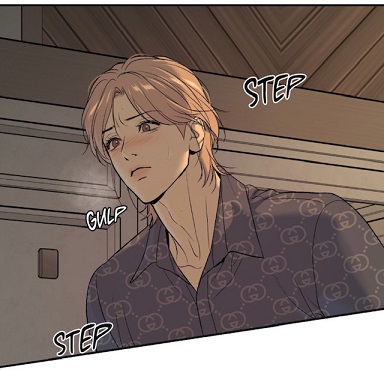 (chapter 34) He was not shocked or disgusted, when he saw Kim Dan having sex with the champion
  (chapter 33) Under this new light, his visit in the sauna appears like an intrusion.
  (chapter 34) He knew about the emperor’s schedule, a sign that he was somehow “monitoring” the main lead’s moves. Here, I feel the need to include this video exposing Heesung’s dark side.
 (chapter 35)
  (special episode 1). Then he still chose to have sex with Potato, though he knew that the young sportsman was drunk.
  (special episode 1) There’s a huge gap, he appears as a “seductive” wolf like in the fairy tale “The Little Red Riding Hood” That’s how it dawned on me why Heesung will have problems in his relationship with Potato. It is related to his dishonesty and mistrust which he projects onto others. This explicates why he doubted about Yoon-Gu’s virginity.
  (special episode 1) And what is the synonym for “truth”? Reality and Real World!! And now, you understand why Heesung created a historical drama in his mind for the sex session. It was his way to avoid truth and honesty. He used the role play to expose his jealousy
 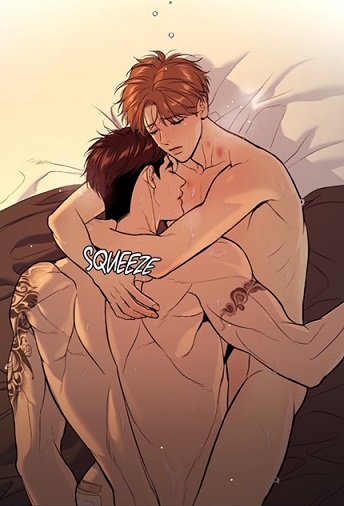 (chapter 44) After this wonderful moment, Kim Dan came back down to earth. His present got rejected, he was just viewed as a physical therapist and nothing more.
 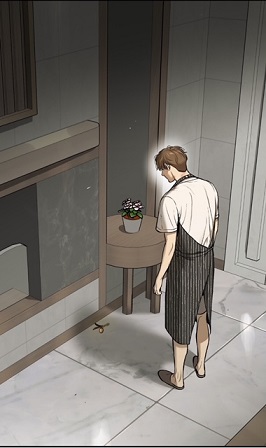 (chapter 45) We also have a refusal in the special episode. Potato initially rejected the offer from his sex partner:
  (chapter 34) He was also running away after getting threatened and rejected. In other words, Potato didn’t realize that with his behavior, he had triggered Heesung’s jealousy, insecurity and anger. That’s why he has this cold gaze.
  (chapter 7) who was full of jealousy here! Thus I conclude that this special night ended on a bad note, though Potato had no idea. The fox is no longer amused. Because Heesung is not happy deep down, he is planning something!!
  (chapter 33) Observe the parallels:
 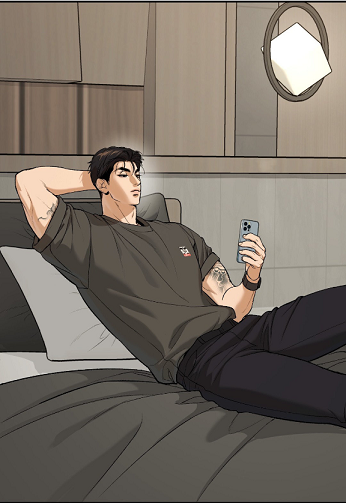 (chapter 33)
  (special episode 2) Yes, we need to question ourselves what triggered Heesung’s fantasy for the role-play.
  (special episode 2) IT is not just because of the costumes. My hypothesis is that the guards are working as an item, you can observe this in the following two panels:
  (special episode 2) This scene triggered his envy and jealousy. He wanted to have someone by his side whom he could talk to. ,
  8special episode 2), Here, he thanked everyone, yet he was standing in the middle of the scene, far away from everyone. In reality, his “gratitude” was superficial, for his thank was addressed to no one in particular. Just empty words. Under this new light, Manhwalovers can understand why he made such a suggestion after the intercourse:
  The green color corresponds to sunset or sunrise which makes me think of a moment of transition. This corresponds to the notion of change and as such growth. Moreover, it stands for balance between yin and yang, like quoted above. The shade implies an equity between female and male energy. And now, you comprehend why Mingwa used green light in the car scene:
  (chapter 33) On the one hand, it was an allusion to the emperor’s hidden jealousy. The latter had masked it as a challenge and game:
  But the shade is implying that the fighter was slowly calming down. He accepts the doctor’s embrace, he even grabs his phallus in order to give pleasure to his partner.
 (chapter 33) In the end, he did show a caring side to the doctor.
 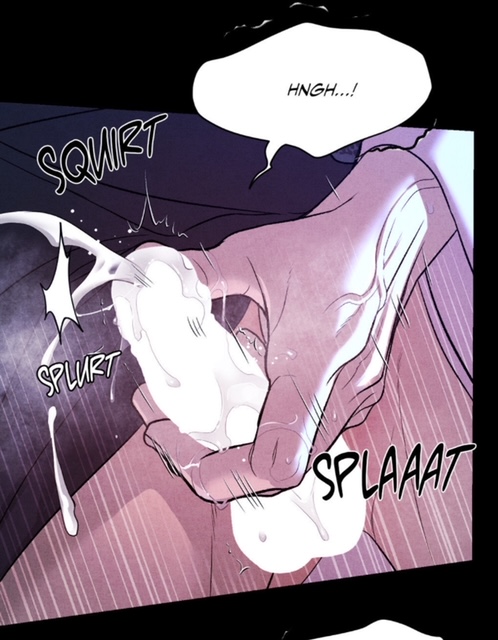 (special episode 2), the jealousy, the possessiveness… making sure that the companion is not looking elsewhere… but more importantly, both seme are and were unaware of their growing affection towards their “fuck buddy”. Yet, there exists a huge difference between these two sex sessions: THE KISS!
  (chapter 33) The emperor has now regained control of his emotions, but he couldn’t interpret his emotions correctly (jealousy, longing for love, insecurities). Moreover, we shouldn’t forget that he has not associated the kiss to love yet. In the locker room, he kissed the “hamster” in order to protect him. He had been simply following his friend’s advice. Then in the swimming pool, he felt attracted towards him.
  (chapter 34) As a conclusion, he came to “deny” this reality. He rejected his own emotions, until he was challenged once again in the sauna.
 (special episode 2) In addition, I noticed that the fighter’s buttocks are red

 (special episode 2) This means that this sex session took place during the new moon. Hence we have the color purple… This corresponds to the actor’s transformation. He is revived… he has finally found his soulmate, but he is not aware of it yet. And now, pay attention to this scene: We have the color blue,
  (chapter 53), where both roles are switched. And now, it is your turn to reread the first season and interpret the sex scenes under the yin and yang aspects, like in this scene: :
  (chapter 39)
 Bebebisous33s' analyses in K-Dramaland and Manhwas