
This is where you can read the manhwa. https://www.lezhinus.com/en/comic/painter But be aware that this manhwa is a mature Yaoi, which means, it is about homosexuality with explicit scenes. If you want to read more essays, here is the link to the table of contents: https://bebebisous33analyses.wordpress.com/2020/07/04/table-of-contents-painter-of-the-night/
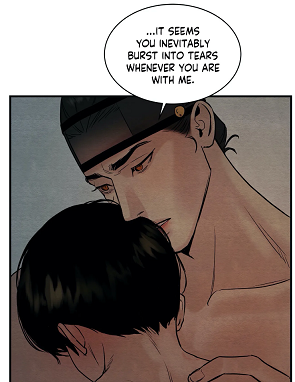
As you can imagine, the embrace between the two protagonists stands in the center of this analysis, because we had so many pictures with a hug, like these two: (chapter 76)
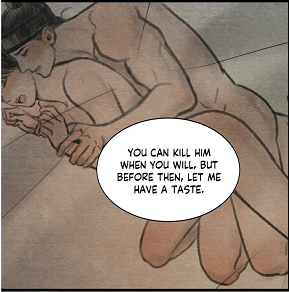
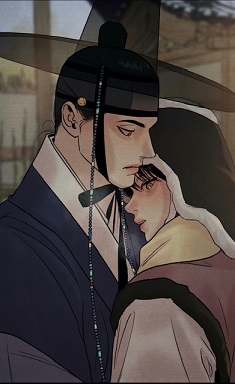 Yet, the peak was reached with the following picture, for Baek Na-Kyum and Yoon Seungho seemed to have merged as one:
  The readers can barely detect the painter’s presence: only his head and hand are visible indicating the depth of their intimacy and closeness. However, the title is mentioning the presence of a ghost. The latter can not be Yoon Seungho, because the panel above announces his official wedding with the commoner due to the presence of the red and blue lanterns called Cheongsachorong. These are used for wedding ceremony in Joseon. Therefore who is the ghost? And why do I perceive the existence of a spirit in this chapter? But before revealing the identity of the ghost, I would like to expose the reason behind such a title. While focusing on the embrace, I came to the following observation.
Each time Baek Na-Kyum and Yoon Seungho embraced each other, I detected the presence of a ghost. During the second season, we had 6 real hugs:
- chapter 49
 ,
, - chapter 53
 ,
, - chapter 62
 ,
, - chapter 66
 ,
, - chapter 71
 ,
, - chapter 76
 .
.
While comparing all the hugs, I will determine the ghost’s identity each time. In chapter 49 the painter was reminded of Jung In-Hun  due to the warmth exuding from the main lead. The painter couldn’t restrain himself from thinking about that fake embrace
 (chapter 29), therefore he chose to push away the wealthy aristocrat out of fear that he might get hurt and betrayed again. The commoner judged the embrace and warmth as a deception. This means that the low noble as a “spirit” was the reason why both protagonists couldn’t get closer. The low-born was only acknowledging Yoon Seungho as his sex partner and nothing more. Striking is that in episode 76, we have a reference to the hug from chapter 49, as the position of the painter’s head in this image
 resembles a lot to this one: (chapter 49). Yet the outcome is different, as the manhwaphiles can witness how the painter moves his head closer to Yoon Seungho’s.
 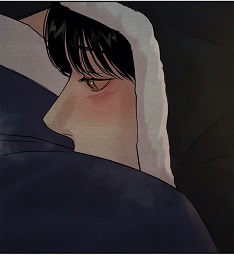 Moreover, the artist’s gaze is truly looking at his lover. We even have the impression that the artist is smelling the lord’s scent in order to reassure himself. Although the manhwaphiles couldn’t enter Baek Na-Kyum’s thoughts this time, they could perceive the change of his attitude. The embrace is no longer judged as fake. This signifies that the ghost Jung In-Hun has vanished for good, which is even reflected in a different panel:
 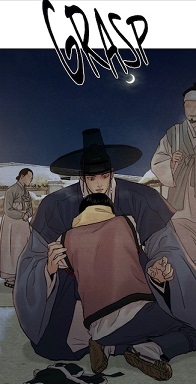 (chapter 76) The lord allowed the low-born to embrace him in front of people, whereas the scholar had to ask the commoner to follow him in a deserted alley.
 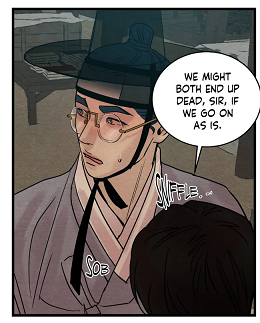 (chapter 29) The low noble feared people’s gaze, his attitude truly showed that he didn’t want to be connected to Baek Na-Kyum. His action was definitely a sign of hypocrisy and cowardice. That’s why in chapter 76, the painter could only come to the conclusion that the lord’s embrace was genuine and the lord’s feelings were not trivial. Moreover, the main character never pushed his lover away
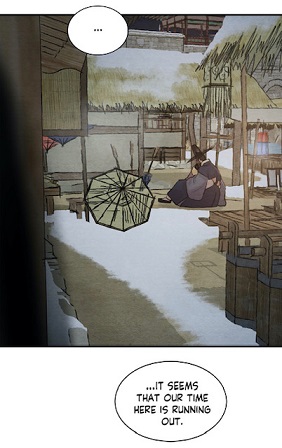 (chapter 76), he even lowered himself and sat down on the ground for a while, so that Baek Na-Kyum could calm down. Imagine, when the powerful lord arrived to the place where the main character had a panic attack, everyone was bowing in front of the noble.
 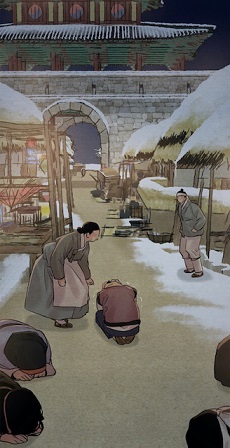 They didn’t even dare to face him, yet when he saw his lover trembling, the master lowered himself and attempted to help his partner. However, his gestures led to be misinterpreted in the beginning, hence a shop owner started interfering.
  However, he was stopped with a frightful gaze:
 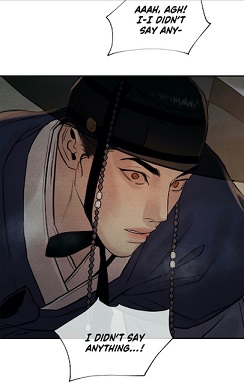 Besides, when the noble kept calling the protagonist in an informal way (Na-Kyum-Ah), people could realize his real intention. He meant no harm. In fact, he was treating the low-born like a precious treasure, who needed help.
 By calling his name Na-Kyum-Ah, the main lead tried to reassure his lover. Hearing his name made the low-born realize that he wasn’t attacked by the jester. This explains why the artist immediately embraced his companion. (chapter 76) Thus we could say that “Na-Kyum” had finally become a magical word like Seungho-Ya. Another contrast to the scene in episode 29 is that the way the low noble called Na-Kyum.
  (chapter 29) The former teacher was just caught by surprise, hence “Na-Kyum” was said more or less randomly. On the other hand, Yoon Seungho used this name as a sign of intimacy. He desired to give comfort and warmth to his lover. And now, you understand why Baek Na-Kyum hugged his lover by instinct. With his embrace, the protagonist would feel safe, which contrasts so much to the one in chapter 29. Back then, after the hug the learned sir brought the artist back to the mansion, although the low-born had run away out of fright. He mostly feared for the scholar’s life
 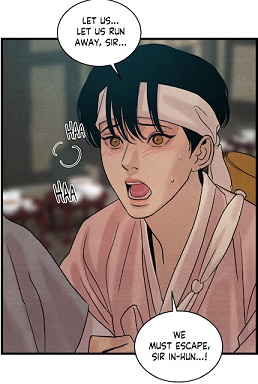 (chapter 29) thus he tried to find him. And now the mansion has become the painter’s home, just like the lord’s embrace. It is a synonym for comfort, warmth and safety. Another huge contrast is that for the first time, the painter asked for Yoon Seungho’s help directly.
 (chapter 76) Imagine that so far, he has never relied on others. Even as a low-born, he was willing to save others (Jung In-Hun or Deok-Jae or Heena
  (chapter 65). Surprising is that when he was bullied by Deok-Jae, he never complained and asked for the head-maid’s assistance or his lover’s. His attitude to never rely on others was even more perceptible in his escape in chapter 46. The cause for this behavior is linked to his abandonment issues. Due to his past, he was forced to only rely on himself. Nonetheless, in chapter 76 he changes his attitude. This shows that he is now opening up. That’s why his head rests on the lord’s shoulder completely. (chapter 76) This is a sign of trust, Baek Na-Kyum is willing to trust his lover. By comparing these 2 hugs, I come to the conclusion that Jung In-Hun has been totally removed from the painter’s mind as well. This embrace and marriage represent the scholar’s defeat. From now on, he won’t be able to use the painter as his pawn, because the latter is no longer attached to him. The lord’s love for Baek Na-Kyum can not be used as a weakness, since the low-born is reciprocating the affection. That’s why I would say that this panel (chapter 76) embodies the learned sir’s loss. There’s no one separating them, not even Heena noona who was the last person defending the scholar and as such representing his interest. So was Jung In-Hun the ghost I was referring to? Yes and no… because there’s more to it. That’s why it is important to examine the other embraces.
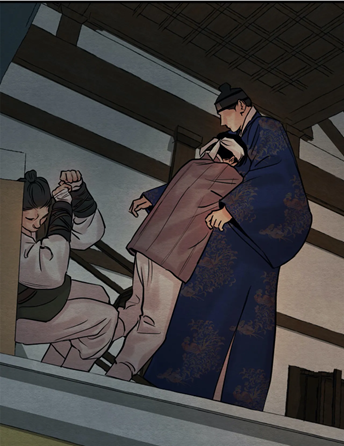
In chapter 53, the ghost was Yoon Seungho himself, since he was considering himself as a spirit. (chapter 53) However, the painter’s hug made him realize that he was a human after all, and that his fists and punches could definitely hurt his precious painter. Unlike in chapter 76, the painter’s voice couldn’t calm down the vengeful spirit (chapter 53), hence the gentle boy needed to intervene directly. The lord was definitely deaf to the artist’s words. Striking is that here again, we had the presence of danger, the painter feared for Deok-Jae’s life. Moreover, despite his fear and shaking hands,
  (chapter 53)the commoner chose to protect the vicious servant, but Yoon Seungho too. He desired him not to let his emotions blind his behavior. The gentle and selfless man didn’t even ask for help, he stopped the noble with his body twice: first his face, then he hugged him. Striking is that in chapter 62 and 66, we had a similar situation. One of the protagonists was behaving like a ghost. In chapter 62, Yoon Seungho, who was reliving his traumatic past, almost became a demon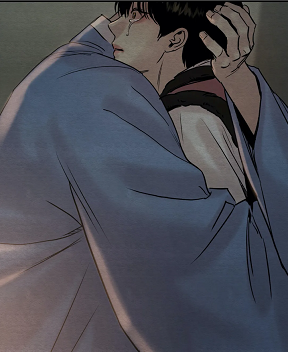
 (chapter 62), whereas in chapter 66 the artist had a flashback, hence he wasn’t himself.
  (chapter 66) This meant that in both episodes, neither the aristocrat nor the commoner could sense the lover’s comfort and warmth.
  (chapter 66) Both of them didn’t feel safe and displayed extreme fear due to betrayal and abandonment.
But let’s return to the embrace in chapter 53, because this incident has another common denominator with the embrace from episode 66 and 76, the presence of a certain witness: Black Heart. 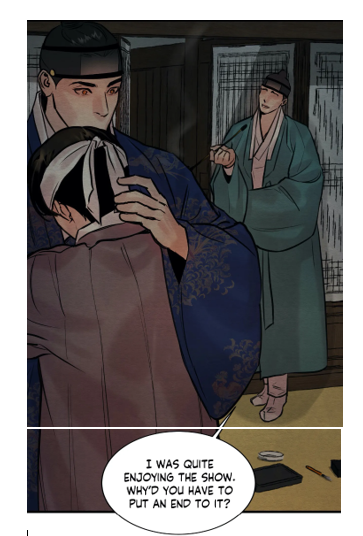 There’s no doubt that the vicious noble felt extremely jealous in both episodes (53-66). The manhwaphiles should envision that despite his rage and his terrible behavior, the artist was willing to embrace such a man, which could only make Min envious. Moreover, the low-born showed courage and even strength. He didn’t reproach anything to his sexual partner. He just attempted to calm him down. Then even after seeing how poorly the main lead had treated the artist, the latter chose not to leave Yoon Seungho’s side. Min was definitely certain that after waking up, Baek Na-Kyum would follow his sister and come back to the kisaeng house.
 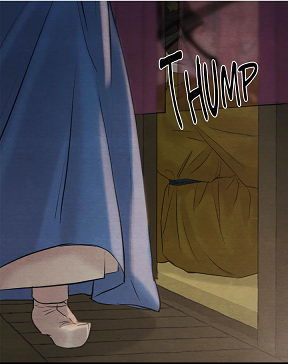 (chapter 69) That’s why he was waiting there. He imagined that the boy would be delivered to him on a silver plate, yet nothing like he had expected happened. In chapter 76, we have a new version of chapter 53. However, when Black Heart witnesses the painter’s second embrace, he can detect the huge difference. (chapter 76) This time, the artist is seeking his lover’s warmth and love. There’s no fear related to the “monster”. While in the past (53-54) The Joker mocked Yoon Seungho for his affection, here he can’t do it at all. The noble is not denying anything. In fact, he accepted the low-born’s embrace without feeling shame or embarrassment. He didn’t pay attention to the town folks, he just followed his heart. While in chapter 54, Min was able to separate the protagonists with his mockery and words
 (chapter 54), in episode 76 Black Heart is truly defeated. And by contrasting these two scenes, it becomes obvious why Yoon Seungho assaulted his guest back then. The noble was in fact punishing The Joker for insulting his lover, as the latter was just reduced to his status: a low-born. He had no name and as such no identity. The powerful aristocrat didn’t do it in order to protect his honor, but the artist’s. At no time, the main lead was afraid of losing his reputation, he is well aware of his bad notoriety. Thus this shows that in chapter 54, the one who feared more social norms was indeed Baek Na-Kyum, which was still visible in chapter 75. That’s why the commoner denied the lord’s affection.
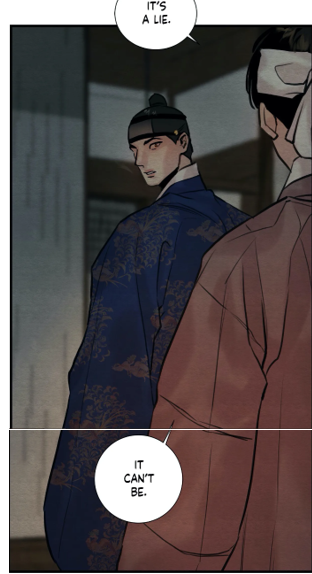 (chapter 54)The expression “it can’t be” was referring to permission and social rules. No wonder why the noble felt so hurt in the end and retaliated. He misunderstood the artist’s rejection.
What caught my attention in chapter 76 are Black Heart’s behavior and words. First, he notices that he is too late. (chapter 76) He imagined that time would work for him, as in his mind, no one would ever stay by Yoon Seungho’s side. That’s why he didn’t hurry the second abduction. The latter had such a terrible reputation (mood swings, his huge rage, his violence), yet nothing could pressure the artist to leave the mansion. Even his noona was not able to convince him to follow her and to return to the kisaeng house. However, when he saw the couple in front of the tailor’s shop, his jealousy and greed reached a new peak. That’s why that night he had planned to visit Nameless. He wanted him to abduct the artist a second time. The expression “time is running out” outlines The Joker’s urgency. He couldn’t wait any longer, as he could witness how close they had become within 2 weeks. And if you look at the panel above, you’ll detect the presence of a shadow, in other words, a ghost. However, this is the jester Nameless looking at the couple. When the painter faced the joker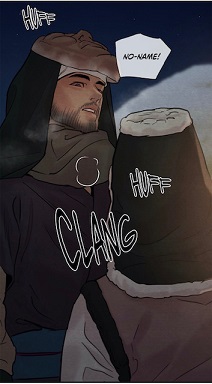 (chapter 76), the ghost from his nightmare
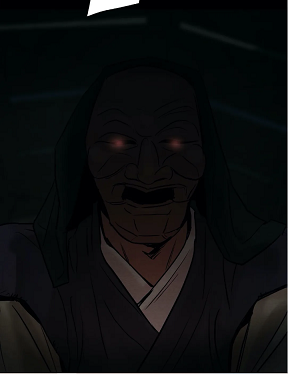 (chapter 61), the painter got so panicked that he got paralyzed. Only the lord’s embrace could calm him. As you can see, the commoner denominator between 53 and 76 is that the presence of a terrible ghost. The latter pushed the artist to embrace his lover. This time, he needed himself protection. However, Nameless was not the only ghost witnessing the protagonists’ embrace. Lord Min has already become a ghost himself in my opinion. First, he is wearing a black hanbok which I am associating to death. Moreover, because he threatens the criminal to kill him
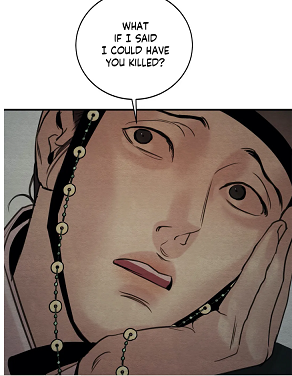 (chapter 76), I view The Joker as a grim reaper. What caught my attention is his reaction, when he saw the heartfelt hug. He had to vomit and this is no coincidence.
  (chapter 76) Observe that the color green is connected to two reactions: “to be green with envy” and “to be green” (sickly). Besides, we have in French “être vert” as a synonym for fuming, furious and disgusted. Hence it’s not surprising that it exist these emojis: 🤮🤢. Both contain green. That’s why I believe that when Min saw the embrace between the protagonists, he got so upset and disgusted that he felt the urge to vomit. It was definitely a mixture of envy and rage. However, he had to lie to the others in order to hide his “weakness”.
  (chapter 76) For me, there’s no ambiguity that The Joker was not honest here. First, he has no dark circle and red eyes like Jihwa who definitely drank again.
 (chapter 76) Besides, has Black Heart ever apologized to others? No. He didn’t even care, when he smoked opium in front of commoners. When he was asked to stop it,
 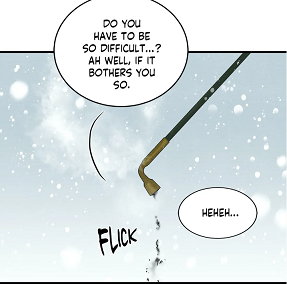 (chapter 52), he never expressed a real apology, he rather criticized the other for ruining the good mood and his fun. Besides, he looks down on low-borns and even Jihwa…
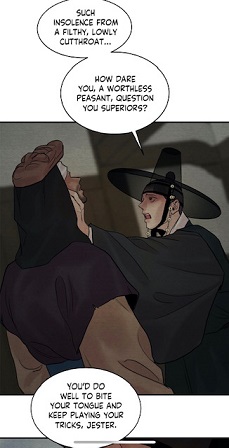 (chapter 76) so why would he apologize? It is, because he is slowly recognizing that his urges for Baek Na-Kyum are not linked to sex!! When he saw the hug, he could recognize the affection between the two lovers, and he felt powerless. Moreover, he envied Yoon Seungho even more than before. Let’s not forget that Min fears social norms despite his nihilistic tendencies. In this scene, the main lead showed courage and genuine affection, something that The Joker can’t do. Till chapter 76, he thought that he had been bewitched and he only felt the urge to have sex with Baek Na-Kyum. In other words, he wasn’t honest to himself and to the others. Until now, he had always imagined that once he had tasted the artist, his thirst would be satisfied. But the warm and tender embrace made him realize that he was wrong. Consequently, when he saw the hug, his envy and jealousy reached a new peak. He had to vomit. This signifies that the resent from chapter 53 became much stronger and obvious to the point that others could detect it now. Hence he has to lie. But in my opinion, he had another reason for vomiting. From my point of view, while the main lead spent his time drinking and reading, Min was busy smoking opium. Let’s not forget that Byeonduck portrayed Min with such a hanbok
  (chapter 56) and the pattern reminds the readers of opium smoke. Contrary to Yoon Seungho who only smoked it once during that terrible party, Min chose to keep smoking opium. First, the manhwaphiles could detect that he enjoyed the kick in chapter 52.
 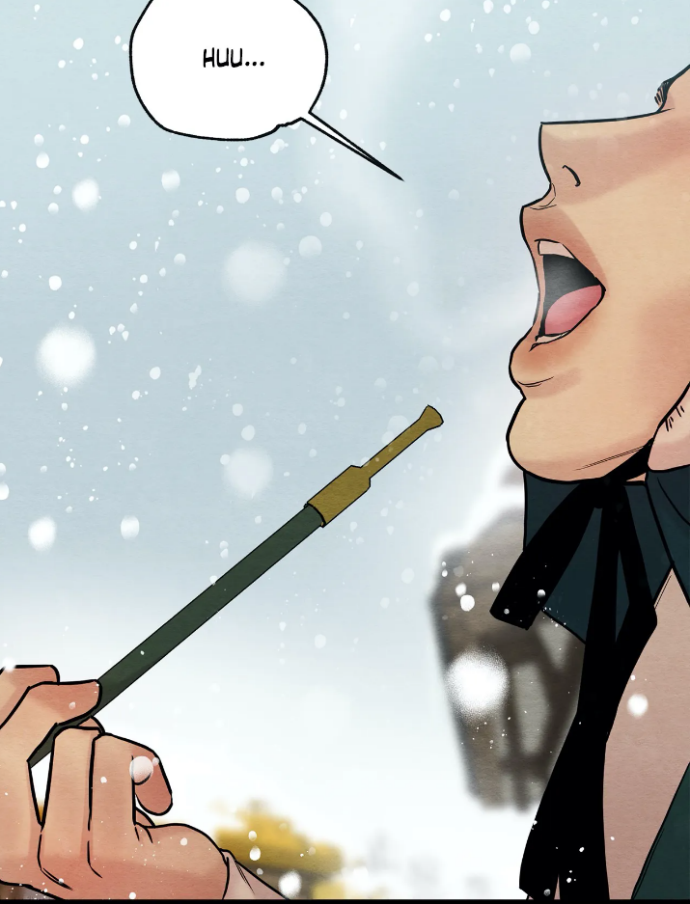 (chapter 52) Secondly, the hanbok was another indication. Finally, I perceive the lord’s nausea in chapter 76 as another evidence for Black Heart’s opium addiction. Vomiting/nausea are listed as side effects of opium. From my point of view, when he saw the happy couple in the street
 (chapter 74), he chose to smoke one pipe in order to relieve his frustration before visiting Jihwa and urging him to contact Nameless. This was a new version of chapter 56. That’s why they came both to meet the criminal.
  (chapter 76) Hence I come to the conclusion that Min is slowly turning into a ghost himself, losing his mind due to his addiction to opium and at the same time due to his greed and obsession for Baek Na-Kyum. The embrace in chapter 53 led to the kiss and indirectly it was the trigger for Min to change his original plan.
  (chapter 56) Therefore I deduce that this second embrace is forcing him to change his plan again. From my point of view, he is no longer interested in tasting the painter once and have him killed afterwards. Black Heart is now determined to take away Baek Na-Kyum from Yoon Seungho. He is definitely longing for the artist’s love. He has every reason to be so jealous. The painter showed such a loyalty and courage. He is no longer fearing people’s gaze unlike in the past. Then, he even forgave his lover for his violence and mistreatment. Slowly, Min is showing his vulnerability in front of Jihwa and as such losing his power over him. He is definitely less laughing. As a conclusion, in chapter 76, the ghost Jung In-Hun vanished for good, while a new one appeared: Black Heart, who is now dressed like a grim reaper. However, there’s a huge difference, because Min has never entered Baek Na-Kyum’s mind and heart. He has no chance at all.
But wait… you might now wonder why I have not mentioned the hug from chapter 71 yet. Where was the ghost? Note that in this panel, the artist is portrayed without eyes. This insinuates that the artist is somehow blind. Secondly, we have this picture where the manhwalovers could see the lord’s footprints.  (chapter 71) My explanation is the following: Baek Na-Kyum wasn’t sure how to judge the lord’s behavior. Imagine that in the morning, his lover had tied him up, while in the evening he was so gentle and calm. That’s why I believe that in this hug, the artist wasn’t certain how he should perceive the lord’s embrace. He knew that it was no longer fake, but like he explained it much later… how long would Yoon Seungho have feelings for him? Therefore I believe that in this scene, Baek Na-Kyum viewed him as an illusion, a spirit who could give him warmth and comfort.
 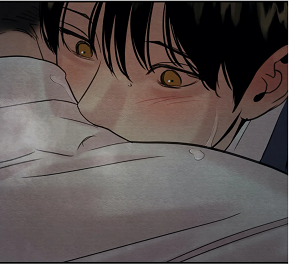 (chapter 71) Note the difference with the following picture: (chapter 76) First, the painter’s gaze is much softer and less questioning. In addition, the position of his head is different which exposed that they are much closer now. Besides, let’s not forget that the embrace took place before the long love session. The artist’s reaction was totally normal.
As a conclusion, the last picture from chapter 76 displays two major developments. (chapter 76) The protagonists are no longer separated by their fears and issues. The ghosts in their mind and heart have finally disappeared. That’s why they are portrayed like one here. However, there are now other shadows and ghosts surrounding them, the ones who would do anything to destroy their relationship, like Min, Jung In-Hun and father Yoon.
Feel free to comment. If you have any suggestion for topics or manhwas, feel free to ask. If you enjoyed reading it, retweet it or push the button like. My instagram-tumblr-twitter account is: @bebebisous33. Thanks for reading and for the support, particularly, I would like to thank all the new followers and people recommending my blog.


 (chapter 40)
  (chapter 75: repetition from chapter 74)
 (chapter 40) versus
 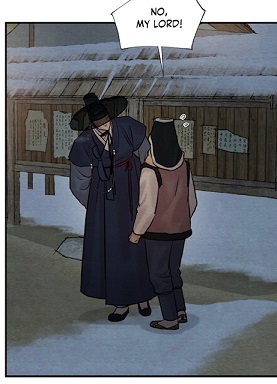 (chapter 75)
 (chapter 40) versus
 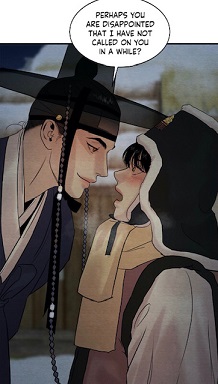 (chapter 75)
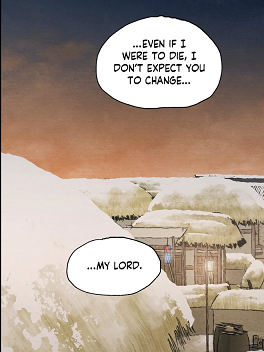
 (chapter 40) versus
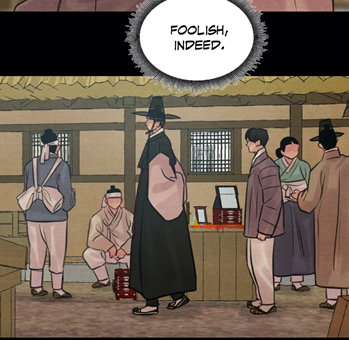
  (chapter 75)
 (chapter 40) versus
 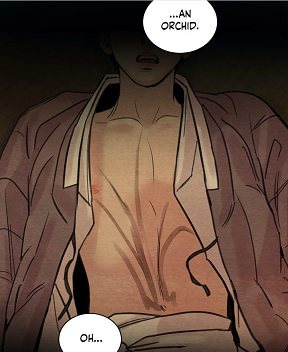 (chapter 75)
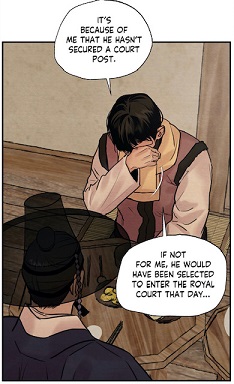 (Chapter 75) And this made me realize two things: Baek Na-Kyum embodies memories, hence we got many flashbacks from the painter (chapter 2, 11, 23, 34, 38, 40, 41, 46, 56, 57, 60, 66, 74, 75), whereas Yoon Seungho embodies truth. Note that unlike the artist, Byeonduck showed us only a few memories from the aristocrat (chapter 19, 25, 48, 55, 74 with the nightmare). Moreover, the latter is always confronting the painter with his questions and observations. The noble wants him to be true to himself and question his own motivation.
 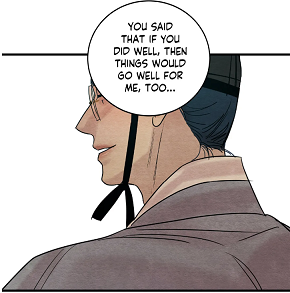 (chapter 29) Thanks to the memories, the low-born had gathered courage and faced his teacher. However, this discussion led to a tragedy. Baek Na-Kyum got hurt, because his learned sir chose to destroy him in the worst possible way. With his words, he showed his true thoughts
  (chapter 40) and in order to reinforce his statement, he made sure that Baek Na-Kyum would perceive his real gaze: cold and ruthless.
 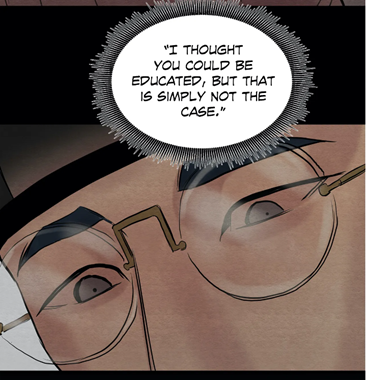 (chapter 41) But more striking is that the scholar used memories (the kisaeng house) to define the painter’s identity: he was born to be a prostitute despite his “lessons”. He puts the whole responsibility and blame on the commoner. As a conclusion, the memories served in the conflict to identify Baek Na-Kyum. Who was he really to the scholar? Was he his helping hand, like the low-born claimed, or was he just a “prostitute” according to the scholar?
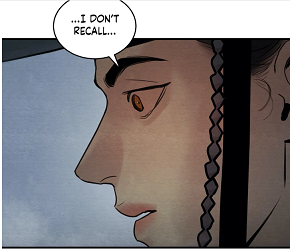 (Chapter 75), an indication that his short-term memory was defective due to his lack of sleep.
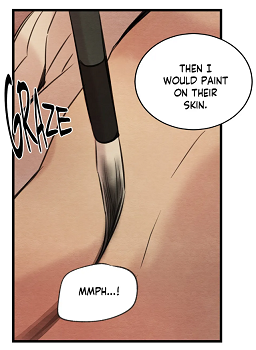 (chapter 36) Therefore I come to the conclusion that Yoon Seungho’s short-term memory is not working properly. Imagine, he could remember one incident from his childhood, but he couldn’t remember painting the orchid. Hence I believe that the lord can’t even reminisce the drawings in chapter 8
 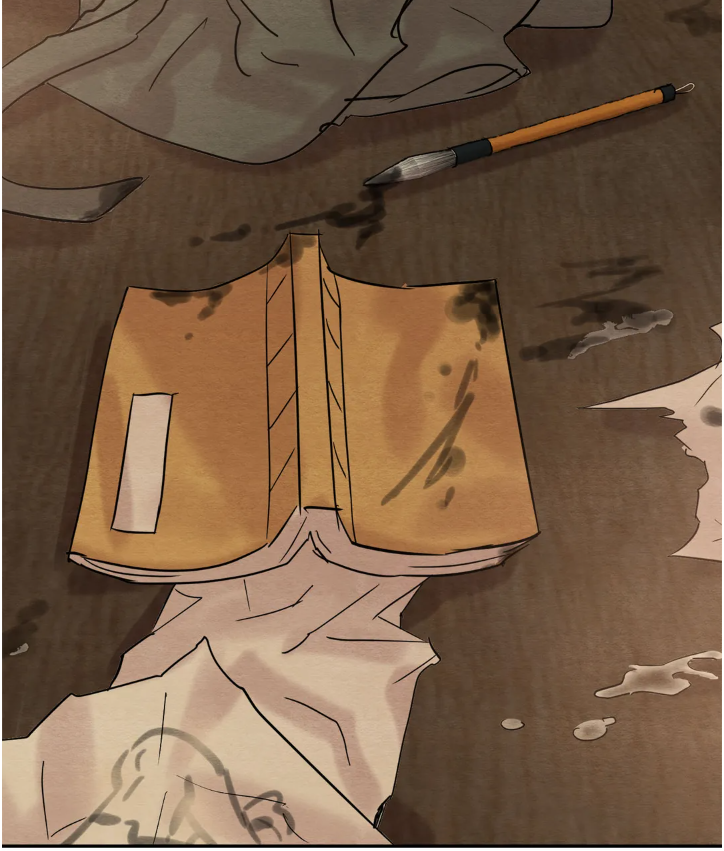 and 23
  . Only thanks to Baek Na-Kyum’s mention, he was able to recall the drawing. Thus the manhwalovers can comprehend why I consider the artist as a synonym for memories.
 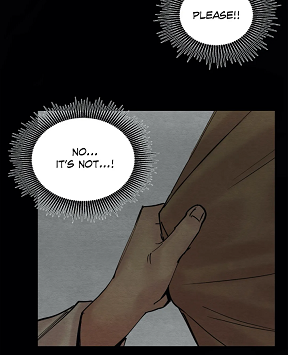 (Chapter 65) While he can’t remember what truly happened due to his poor emotional and physical state, Kim somehow blames him. The young master is so confused that he has to defend himself. This means that after the first rape, the domestic didn’t even comfort the protagonist, but he used the victim’s vulnerable state of mind (who was confused due to this terrific incident) to manipulate the noble’s memory.
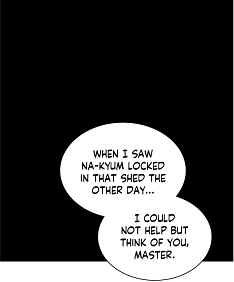 (Chapter 68) He mixed facts with lies in order to confuse his master’s judgement and memory. That’s the reason why it is important now to recall my initial statement: without any memory, there’s no identity. This signifies that in chapter 68, when Kim tried to give him memories, he desired to give him a certain identity: he was similar to his father. The latter would punish or imprison the boy and not release him. Giving a false reflection and identity is something Kim had never done before in front of his master, as he knew that his master feared his own image. However, he never imagined that Yoon Seungho would react differently. Instead of pushing away the painter, he let the artist choose his fate.
  (Chapter 18) In my opinion, this shows that Yoon Seungho had no true memory in reality. He knew that they had sex together, but that was it. It was more like “the night is long and I need to kill time so that dawn can come faster.” Note that he never mentions their childhood together. With this interpretation, it becomes comprehensible that the main lead could act, as if nothing had happened between Jihwa and himself after the topknot incident.
  From my point of view, he had literally forgotten the incident, yet for Jihwa, it meant that he had been forgiven.
 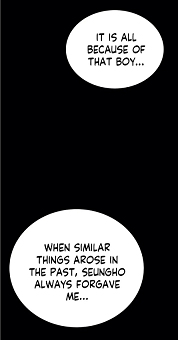 (Chapter 59) And this explicates why Yoon Seungho barges in the mansion in chapter 67: he makes it clear that he won’t forget what happened.
 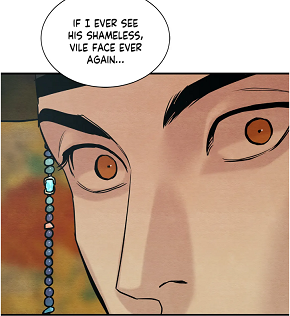 (Chapter 67) The real forgiveness occurred in chapter 59: Despite the caused pain, Yoon Seungho was willing to overlook the terrible action
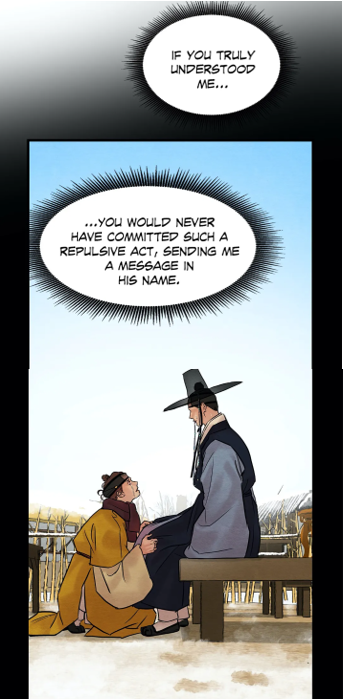 (chapter 59), but he made it clear that he would never reciprocate the feelings. This was real forgiveness from my perspective, whereas in the past, Yoon Seungho couldn’t remember anything. Jihwa had the terrible habit to use the past in order to torment his childhood friend, which always triggered buried emotions connected to memories, which the noble couldn’t control. From my point of view, the lord only had flashbulb memories which the readers could discover in chapter 55:
  (chapter 55)
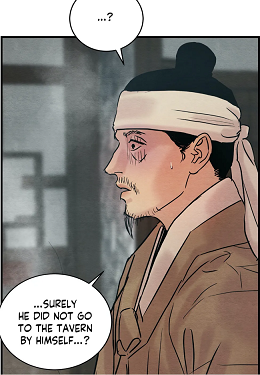 (chapter 56), when he heard that lord Song asked for a meeting. The latter could definitely reveal new information and let the protagonist realize that he was truly suffering from memory loss.
 (Chapter 1) Striking is that when Baek Na-Kyum confronts him with his poor image (“man consumed by lust”)
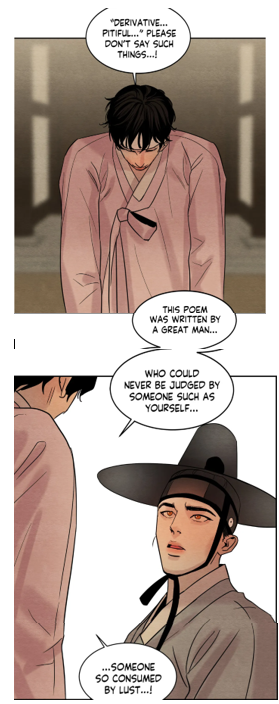 (chapter 4), the lord is bothered. He is forced to ponder why he is described like that, hence he has to recall events from the past. At the same time, when the lord read the poem, he was encouraged to recall the original sijo. This shows that at some point, Yoon Seungho rediscovered literature. Words and paintings helped to create memories. Thus if you pay attention, you’ll notice that the more time passes on, the more memories the lord has. They are strongly intertwined with the paintings. The latter helped him to reminisce the sex sessions and his past. He can’t forget how the painter masturbated behind the door. He is even getting more and more good memories.
  (chapter 18) Then in chapter 19, he reminisces the painter’s facial expressions which puts him in a good mood.
 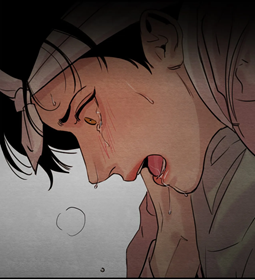 (Chapter 19) This explicates why Yoon Seungho was so moved by the painter’s confession during their Wedding night. For the first time, he experienced warmth and love, he even heard a love confession. This could only be stored as a wonderful memory. At the same time, he hoped, the artist would create a picture of this night in order to ensure that this memory was real. Moreover, note that in chapter 58,
 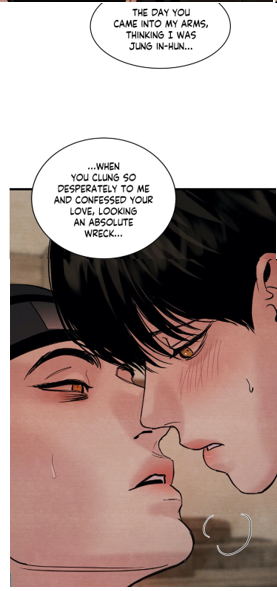 he externalized how much this night meant to him.
 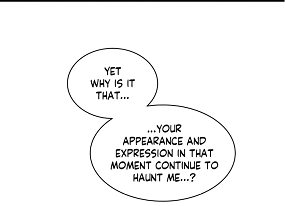 (Chapter 58)
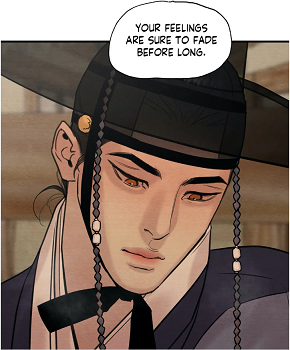 (Chapter 75) His feelings will fade away just like memories. He will forget him. What the painter doesn’t realize is the following: this date is actually an important moment in Yoon Seungho’s life. For the first time, he gets to discover the painter’s memories and past, which now the noble can store as his own. He will never forget this day, especially when he heard that the painter would cry because of him
  (a new version of chapter 21:
  (chapter 21) , but here out of concern. In other words, Baek Na-Kyum would like to be remembered. Hence he complains that the lord didn’t call for him. And this can only make the lord happy, because he can detect through the painter’s words that the latter is longing for his presence and care. From my perspective, Yoon Seungho has finally grasped why the artist is not truly honest with him. Therefore he can only tease his lover pushing him to make the first step. Let’s not forget that right now, the master is now treating his lover as his new lord. So the latter has to call for him.
 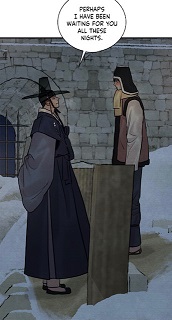 (Chapter 75) Here, the protagonist clearly displays that he has never forgotten his companion. Their date is so important for two reasons. It allows the noble to gather more information about the commoner, and get a really good memory before the next tragedy.
  (Chapter 60) and could cope with the kidnapping much better. Note that he has no nightmare afterwards. And this detail is important, because we have to envision that while Yoon Seungho was exposed to physical and sexual abuse for a decade, he had no good memory at all in order to remain sane. Moreover, he never felt loved. Consequently, he couldn’t even think of anyone in a positive way. That’s why he was so damaged in the end. (Chapter 57)
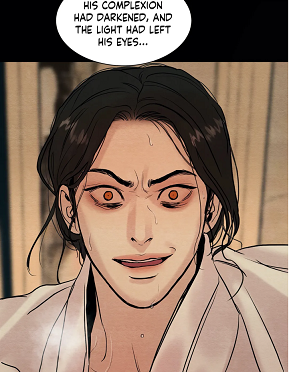 The presence of a loved one is necessary in order to cope with traumatic childhood abuse.
 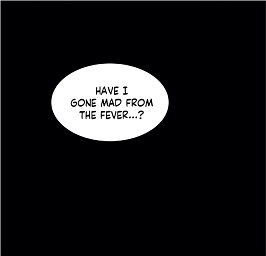 (Chapter 58) This signifies that he is unsure if what he is experiencing is real or not. From my point of view, the memory loss and his life as ghost affected his brain and the way to encode and store information. Hence he has no real recollection of the incident with Deok-Jae (chapter 30 and 53). That’s why he is not asking for his whereabouts. However, I believe to see a turning point in chapter 75. By giving the lord the opportunity to have a real date, where he could hear and see that Baek Na-Kyum was definitely affected by him, the noble will react differently compared to the first abduction and after the painter’s first flashback. He will not lose his mind blinded by his emotions and insecurities, he knows that the artist chose him. And he won’t blame himself like for the first flashback. Remember that in chapter 66, he never called the physician. Why? Because someone told him that the painter needed the presence of a loved one to recover. Kim made sure that Yoon Seungho would feel guilty. Deep down, Yoon Seungho knew that he was responsible for the panic attack.
 (Chapter 66) But the real cause for all this was the butler’s silence and complicity. That’s why he remained by his side, until the artist had recovered. Thus I had predicted that after meeting Nameless, Baek-Na-Kyum would get a panic attack.
 (Chapter 75)
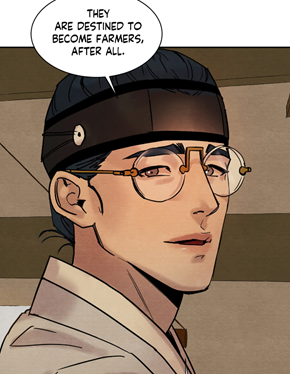 (Chapter 6) They can not escape their conditions. Thus the gods chose to punish him the following way: he could never escape his own situation. He would remain a man with no wealth and connection. Thus no matter what he did, it ended with a failure. Therefore it is not surprising that he came to resent the painter, for he caught the attention of a powerful noble and this at least twice. The scholar was offered a position, but due to the incident in the gibang, the sponsor changed his mind. Hence he blamed Baek Na-Kyum for not securing a post. It was, as if he had stolen it from him. I think, Jung In-Hun published poetry, but couldn’t get recognition. Therefore he used the incident (discovery of the erotic pictures) in order to punish him and force him to give up on painting. He couldn’t allow that a commoner was more successful than him. At the same time, it was the reason why there was a ruckus in the gibang too. But now, we have to wonder why Baek Na-Kyum talked about his past. From my point of view, an important detail played a huge role at the inn:
 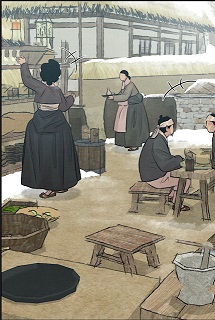 (Chapter 74) Observe that the woman has a similar hair dress than his noona. That’s why I believe that when he saw her, he must have been reminded of her. Note that when he speaks about the leftovers, he describes leaving food as a sin,
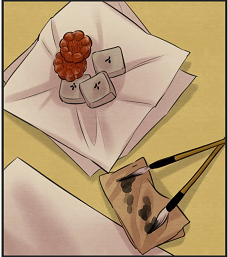 (Chapter 41) He didn’t eat all the sweets or even skipped meals.
  (Chapter 41) In other words, he didn’t eat everything and committed a sin. This indicates a certain hypocrisy, simultaneously Baek Na-Kyum’s lack of critical thinking, when it comes to his noona. Moreover, he says the opposite of what he thinks. In chapter 74, he claims that the lord has changed
 (chapter 74), in episode 75, he claims that he has not improved his behavior. The painter’s memories clearly reveal Heena’s strong influence, which explains why he doesn’t make the first step in the end. He would like the lord to become responsible for him. But Yoon Seungho would like the opposite, because that way, the low-born can never claim that he was forced or pressured by him. In my eyes, Baek Na-Kyum still fears to be perceived as a man consumed by lust, if he makes the first move.
 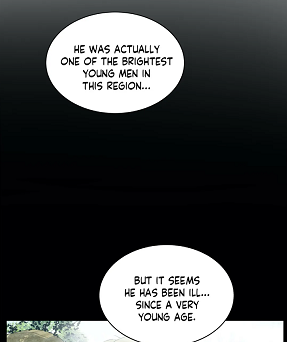 (chapter 57), which will assist him to regain his lost memories.


 (Chapter 60) In this picture, the manhwaphiles can even hear Nameless’ explication why the lord would jump to the wrong conclusion. The expression “on his own two feet” was actually visualized by the imprints left on the snow. We know for sure that Nameless knocked out the painter before carrying him away. He carried him the same way than he did with Lee Jihwa:
  (Chapter 59) What caught my attention is that the space between the footsteps on the wood
 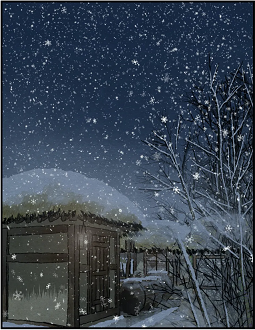 (Chapter 59) This image caught my attention for two reasons. Thanks to the analysis “The five candles”, I realized the true meaning of the pictures with landscapes. They expose the actual situation, therefore the beholder should study them under the following elements: moon or sun, air, water, earth and fire. So in this picture, you can detect the absence of the moon symbolizing the lord’s illness. He is too weak to look after his lover. Striking is that the earth element is predominant here, as the tree branches standing next to the buildings are almost touching the sky. So since the snow is falling, it indicates the presence of water and note that water is almost everywhere: in the sky, on the trees, on the ground and on the rooftops. The only element missing is fire. Yet if the manhwalovers examine the image more closely, they will detect the presence of a light hanging on the side of the restroom. However, the candle surrounded by glass is not lit. To sum up my observations, this panel exposes the predominance of water and earth and the presence of a lamp with glass. In other words, this image symbolizes butler Kim, the new version of chapter 58
  . First, let’s not forget that Kim is often seen carrying a bucket of water
 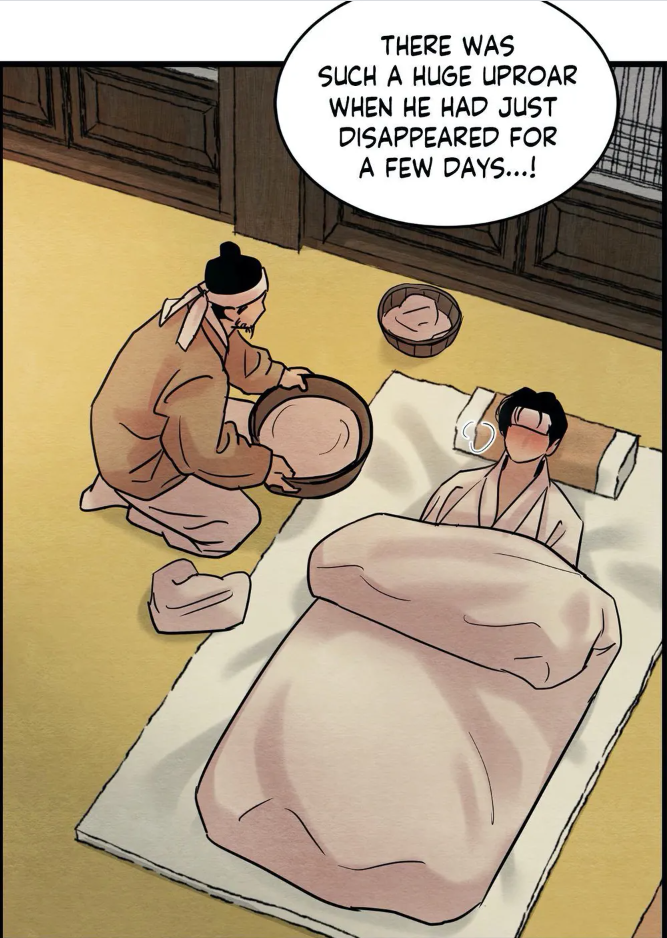 (chapter 33)
 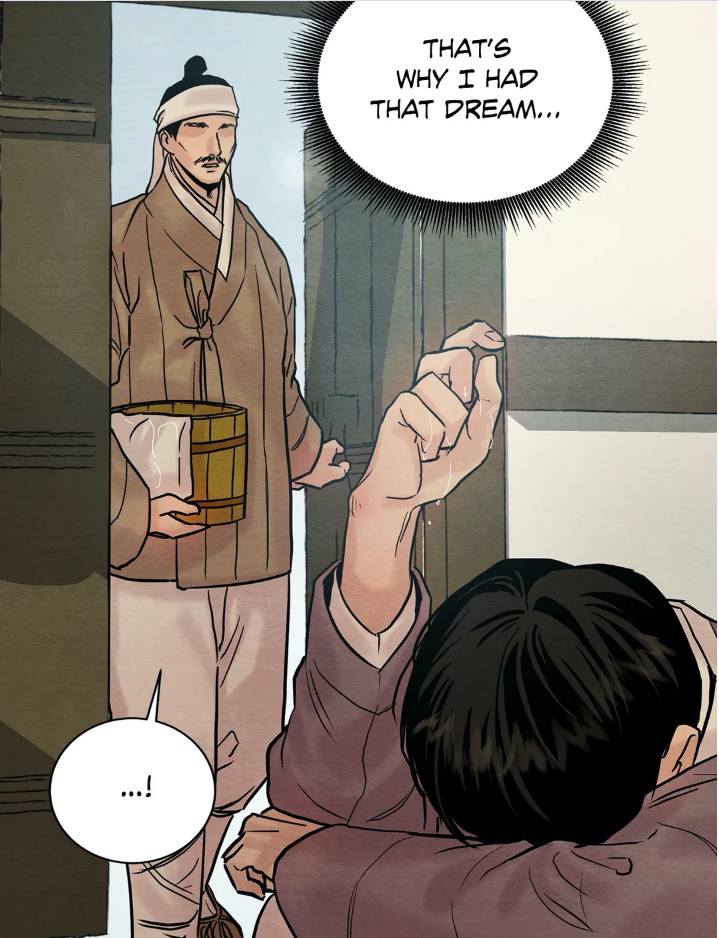 (chapter 56). Secondly, he is also linked to the lantern with a glass
  (chapter 20)
 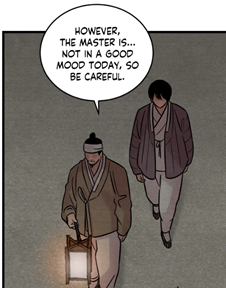 (chapter 36) But more importantly is that in the image from chapter 59, there is no light,
  (Chapter 59) Note that the painter is standing in front of the bathroom. He has just cleaned himself and note that the lamp is in the background. How is this a proof? If the painter had run away, he wouldn’t have gone to the restroom… he would have left the room right away, just like the footprints are indicating.
  (chapter 59) But since the artist was silent right away, as the Joker knocked him out immediately, the physician could have jumped to the conclusion that Baek Na-Kyum met an acquaintance. So when the vanishing of the painter was discovered, the doctor assumed that the artist had followed the person he met during that night. Honestly, I can’t blame the doctor for his “passivity”, if my assumption is correct. Due to the lord’s agitated state of mind, the doctor could only realize it afterwards. With this new discovery, it becomes more comprehensible why the physician hesitated the next morning. He didn’t know what he should do.
  (Chapter 63) If he revealed what he had heard, then he imagined that he could bring the person who had „helped“ Baek Na-Kyum to escape into trouble. Observe the presence of the drop of sweat on his face. He was definitely uncomfortable. If he testified, then he could reveal the presence of a conspiracy. Nonetheless, I believe that he had jumped to the wrong conclusion: desertion. And with this new discovery, you can understand why the butler was so worried. He had no idea what the doctor had noticed. Imagine, the valet got caught by his own method (spying behind doors), however in the physician’s case, the latter was not doing out of malevolence. He just happened to become a witness, but he had assumed something else. That’s the reason why Kim was so worried, he had seen no one, yet the doctor had observed something. Kim never imagined that such a small detail (noise) could become a threat for him. This explicates why he chose to visit the doctor during the night.
  (Chapter 64) He needed to ensure that the doctor remains silent. Many manhwaphiles will certainly recall how Kim threatened the doctor…
 (chapter 65) Back then, I had assumed that out of cowardice, he had not intervened due to Kim’s harsh words. Nonetheless, I came to a different interpretation. After recognizing how Byeonduck is tricking the readers, she gives the impression of a continuity, I believe that during that night, the butler visited two different physicians. According to my theory, there exist 3 different doctors. For more, please read the analysis “The mysterious doctor“. How did this idea come up? Simply by paying attention to the BEARD!!
  (Chapter 57) Note that the beard of this physician is covering the cheek and is straight.
 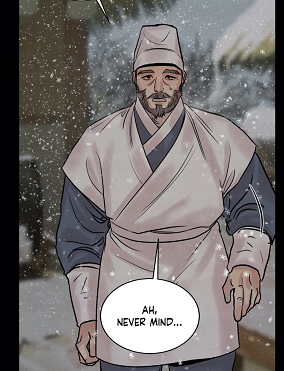 (Chapter 63) But now compare it to the physician’s beard in episode 65:
 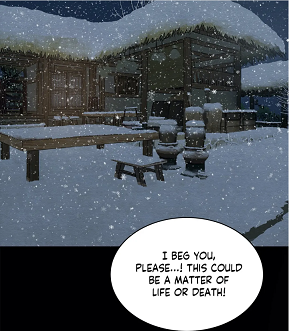 (Chapter 65) and from my point of view, he used pity to discover what the physician knew. Remember how he had used compassion the night before (chapter 57). Besides, if you contrast both statements, you will detect a contradiction. “This could be a matter of life or death“ implies that it was about saving someone, while in the second image, it is about killing someone: the other doctor! In my eyes, the valet must have begged the physician
 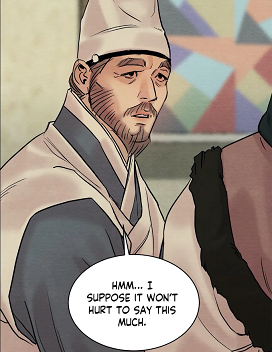 (chapter 57) to remain silent. If he revealed that he had discovered the presence of someone, then the other could get into trouble. In my opinion, the butler must have suggested that Baek Na-Kyum had tried to escape, because the lord had been abusing him. Don‘t forget that he had been treating the artist for his wrist. Then he must have seen the lord panicking too.
  (Chapter 60) But now, the manhwaphiles are probably wondering why he went to the other physician then. It was related to the lord’s behavior in the shed. He was acting like a sex-maniac.
 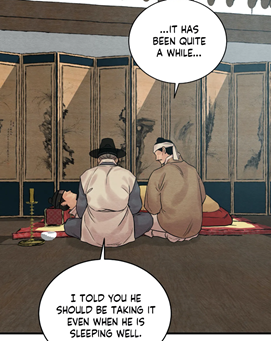 (Chapter 55) This doctor had reprimanded the butler and had been prescribing a tonic. So he visited the physician and used this opportunity to put the whole blame on the poor doctor.
  (Chapter 65) The man never saw anything, Kim just described to him how the main lead had been behaving! Yes, he was acting like Yoon Chang-Hyeon who had gone to the doctor and described the son’s illness.
  (Chapter 57)
  (chapter 61)
  (chapter 62)
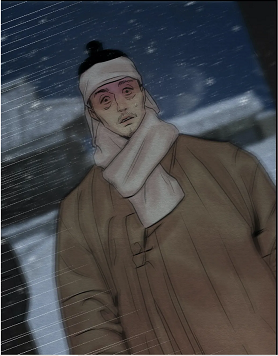 (chapter 64) He needed to confirm his death. But since the lord was having sex the whole night, the butler had to make sure to bury the truth. If the artist had fainted, then the valet would have fetched the other doctor, the one who imagined that Baek Na-Kyum had escaped. And now, you comprehend why the man hesitated to question the painter after his return:
 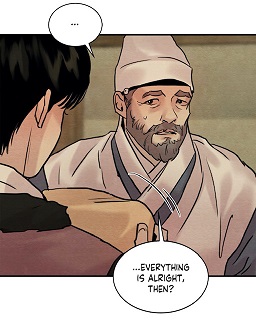 (chapter 74) He was wondering why the artist would look so fine, as he had attempted to escape before. Another evidence for this theory is the following rule: a reflection within the same season. Since the doctor had been puzzled by Yoon Seungho‘s illness, I am deducing that he had the exact opposite disposition concerning the artist. He imagined what the artist had done. He had jumped to the wrong conclusion due to the injured wrist. Besides, he was “aware“ of the lord‘s mood swings.
 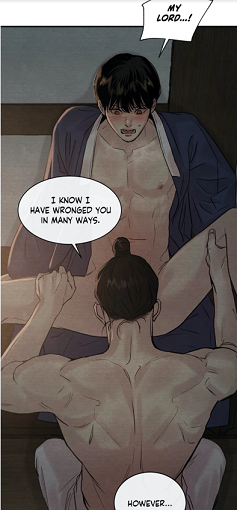 (Chapter 71) Consequently, he was not investigating the real circumstances of the abduction. But he has another reason for neglecting this aspect: he knows the culprit’s identity, unaware that unveiling the mastermind’s identity is far from enough. Real justice is to uncover truth. However, at the end of season 2, the wealthy noble was more like a teenager in love. That’s the reason why he was making a huge mistake.
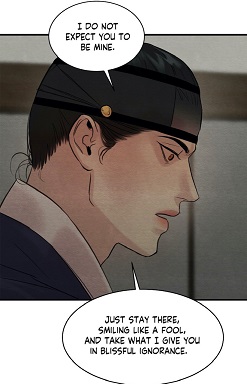 (chapter 85) He was already content if the artist would look at him, the moment you recall his first confession:
  (chapter 55). Hence in chapter 71, he’s blushing and happy, for Baek Na-Kyum is definitely starring at him with such a curiosity and desire.
 Moreover, the painter talks to him, has even accepted his advances. That’s why he is no longer paying attention to the circumstances that led him to think that the painter had run away on his own feet. As for Kim, he was running out of time, because at any moment, Baek Na-Kyum could mention his visit to the restroom or meeting the Jester. Consequently, the former had to use any trick to remove the artist. Hence he encouraged the kisaeng Heena to take away her brother.
  (Chapter 67)
 (chapter 100) Here, they revealed that the main lead had gone down on his knees, the moment he had seen the traces of fresh blood. Then note that in the shaman’s house, the lord had left a bloody foot print
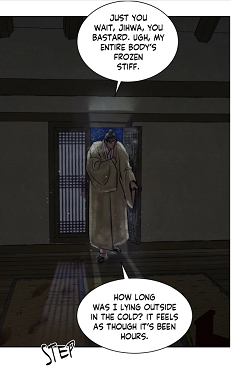 (chapter 102), yet in the snow it was no longer visible.
  (Chapter 102) Someone had erased the traces by putting mattresses on the soil. However, while the lord was walking through the mountain, he was definitely leaving a bloody trail behind
  (chapter 102), a sign that someone had been helping him. And this can only be KIM!! And the last chapter from season 3 seems to confirm my initial investigation: The butler had erased the traces from the abduction. He knew about the kidnapping and helped Lee Jihwa and the Joker.
 Back then, the identity of the “bride” was unknown. However, there were two witnesses: the wandering merchant and the servant Deok-Jae.
 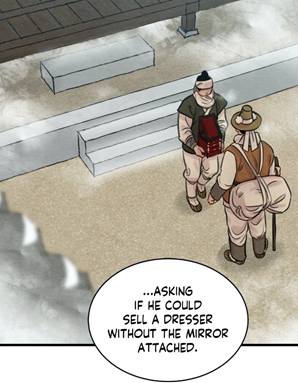 (chapter 45) The former mentioned this event to others so that a rumor started among the town folks. They were all wondering if Yoon Seungho was engaged due to the bridal carry. Since no marriage had happened, but simultaneously he showed great care in that person, they definitely perceived that the latter in his arm meant a lot to the master. They could judge that the noble was in love. At the same time, they were pleased, because they had realized that the black sheep of the Yoons seemed to have calmed down. Many painterofthenight-lovers couldn’t help smiling, when the entertainer praised the fiancée for her good sexual technics,
  (chapter 45) because the truth was that Yoon Seungho was so dissatisfied with the painter’s tricks.
  (chapter 45) And with such a contrast, it becomes obvious how strong and deep the noble’s affection for the artist already was. While the commoner’s comment diminished Yoon Seungho’s love for Baek Na-Kyum, as it was reduced to sensuality and seduction, the lord’s attitude clearly displayed that Yoon Seungho was expecting something else, but he had no idea what exactly. Striking is that the low-born was also clueless that the aristocrat had carried him like that, for he had fallen asleep. The fact that the wealthy man used his own hanbok to carry the commoner to the bathroom illustrated how caring Yoon Seungho was, but no one told him about this. Furthermore, this gesture outlined that the protagonist was taking great of the painter’s body. He shouldn’t get cold and he should get cleaned immediately, underlining that the first sex marathon had left a huge trauma on him. This incident (the bridal carry) was never mentioned within the mansion for two reasons. The domestic Deok-Jae had no interest in telling it to others, as he was filled with jealousy and still hoped that Baek Na-KYum would lose the lord’s favor. As for Kim, when he discovered that the incident had reached the ears of the inhabitants, he seized the opportunity to hide the fiancée’s identity in order to limit the damages. On the surface, it looked like he was protecting the couple’s interest, whereas in reality he feared a scandal. But more importantly, he wanted, just like Deok-Jae, this situation to be just temporary. Therefore he could only reduce the painter’s status: he was neither a bride nor a fiancée, at best a favored servant.
 (chapter 45) That way, if the low-born was to disappear, no one would connect Baek Na-Kyum to the bridal carry. All the men were convinced that it was a woman due to the smooth legs.
 (chapter 45) Since the painter had been kept in the dark about the noble’s action, he couldn’t realize the noble’s feelings. The only person pointing out the master’s affection for the commoner was the head-maid.
  (chapter 46) Since she had been kept in the dark by Deok-Jae and Kim about the bridal carry, she had to mention another conversation to prove her observation. Yet it was definitely less convincing, as it was more related to comfort and respect.
 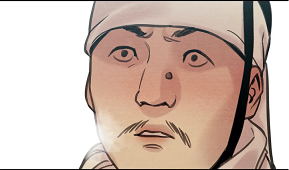 chapter 45) and he is definitely jealous of the main lead, similar to Deok-Jae. This made me realize why The Joker revealed Jihwa’s abduction right after. Imagine, if people got aware of this incident, then The Joker wouldn’t be able to taste the artist. Every one would know about Baek Na-Kyum and his importance to Yoon Seungho. He was no longer a low-born, but the lord’s official wife and partner. If he were to disappear, no one would be able to escape punishment. Therefore he needed to separate the couple… since the artist was in a poor condition
  (chapter 66) It is definitely possible that they looked at their lord’s action from faraway. If so, this would signify that the news about Baek Na-Kyum as the lord’s bride has finally reached the ears of the staff.
  (chapter 71) to this one:
  (chapter 33). Back then, the butler was worried that Baek Na-Kyum would reveal his complicity in the escape. However, this time Kim is concerned for another reason: the painter is no longer a favored servant, but now the bride and as such Yoon Seungho’s official partner. But if the readers compare the two previous bridal carries, they’ll remember that there were more than just one testifier… although in the second case, it was just implied. Thus I think that there could be another witness. In the first version of this essay, I had imagined that the Joker could have been present:
  In chapter 44, he saw how the painter walked to the study. Secondly, he was present during the second love session:
  . (chapter 60) However, I was wrong here. Then it occurred to me that if there was a second witness, then it could have been the new version of Deok-Jae. He had been following the guest
  (chapter 66), when Min entered the propriety. And according to social norms, he should have followed the noble. So he could have seen the painter’s legs from a certain distance. And this also would explicate why the domestic had such eyes, when he approached the bedchamber in season 3.
 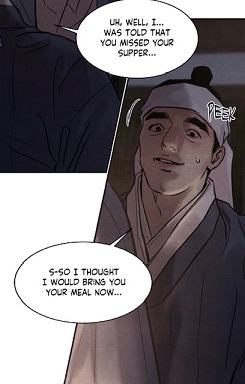 (chapter 80) He was interested in the painter. And there is another evidence that there are always two witnesses of that bridal carry, the love session in the gibang.
  (chapter 96) The noona was joined shortly after by Min who could now hear their love session.
  (chapter 96)
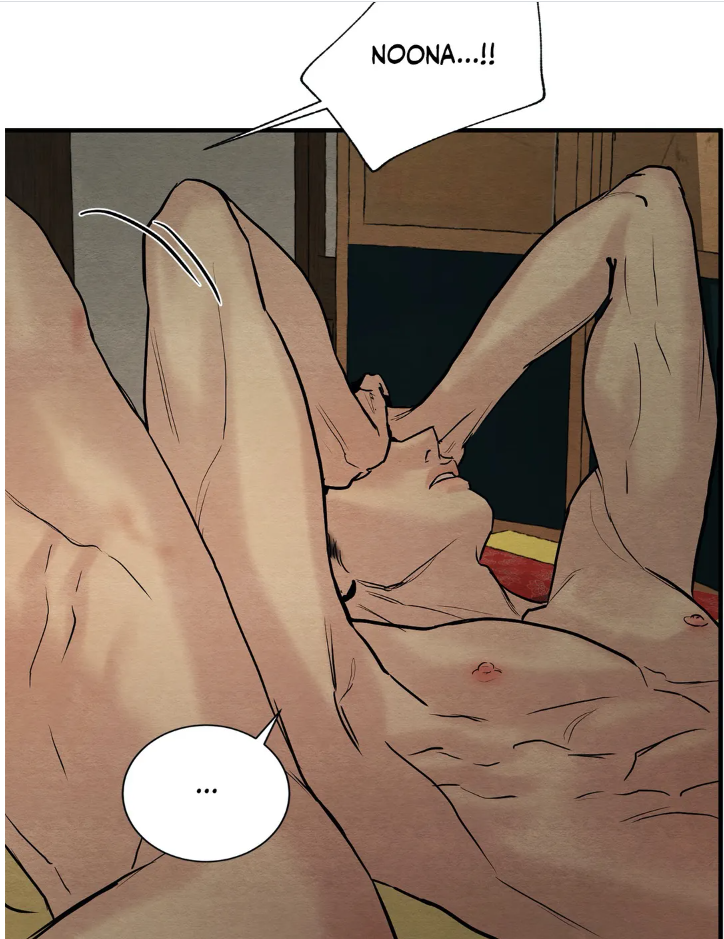 (chapter 65) This means that the painter was now the official partner of the protagonist. Nonetheless, the lord tied his bride so that the latter wouldn’t leave. The bridal carry was connected to forced marriage.
 Before the love session, though their intimacy began in delay. Note that the bride was the one who determined, when they should be intimate. However, they got interrupted. Then the consumption was quite painful, though the painter had masturbated before and as such prepared himself.
  (chapter 81) For me, this is an allusion to Yoon Seungho’s rape in his youth.
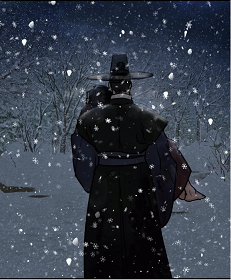 This happened after the sexual assault. The lord was acting like in chapter 66. He was full of regret and tenderness. We could say that he was acting like a knight protecting his bride. Here, again the bridal carry is intertwined with death and pain. Don’t forget his words in the bath:
  (chapter 70)
 and kisses.
  (chapter 77) and clean up his mess… no wonder why Yoon Seungho came to resent the man. He left the young master totally unprotected, exposed to all forms of abuse. And the man might have wondered why Yoon Seungho was so difficult to tame… Therefore he could never entirely trust the main lead. Consequently I view the gesture as the symbol of bravery, care, responsibility and strength. From my point of view, the main lead must have recognized that he was “married” much too young to the pedophile. During his conversation with Bongyong, the lord indicated that age mattered. He still had time.
 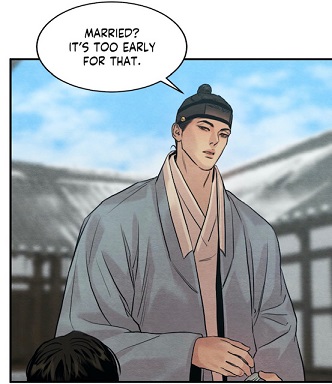 (chapter 78) They shouldn’t get married too young, and in my opinion, he was speaking out of experience.
  (chapter 68)
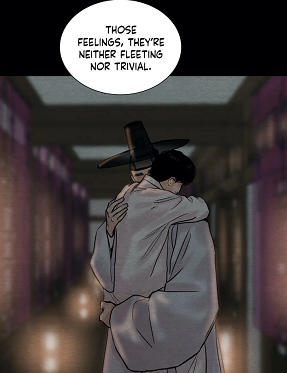
 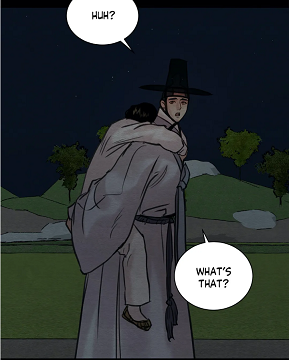 (chapter 70). The learned sir acted like a father and with the recollection of the piggyback, Baek Na-Kyum recognized the true value of this carry. He was never loved, like the commoner desired, the young man just viewed him as a child. He was innocent and pure and couldn’t realize the true nature of the scholar’s feelings: trivial and fleeting emotions, which turned into indifference, when the artist became an adult. That’s the reason why the artist is no longer upset… he judges this event in a different light. Back then, he was only a child for Jung In-Hun. This scene represents Baek Na-Kyum’s loss of innocence. He is now a mature man who makes decisions on his own. He is no longer idealizing Jung In-Hun, and the bridal carry reflects this maturity.
 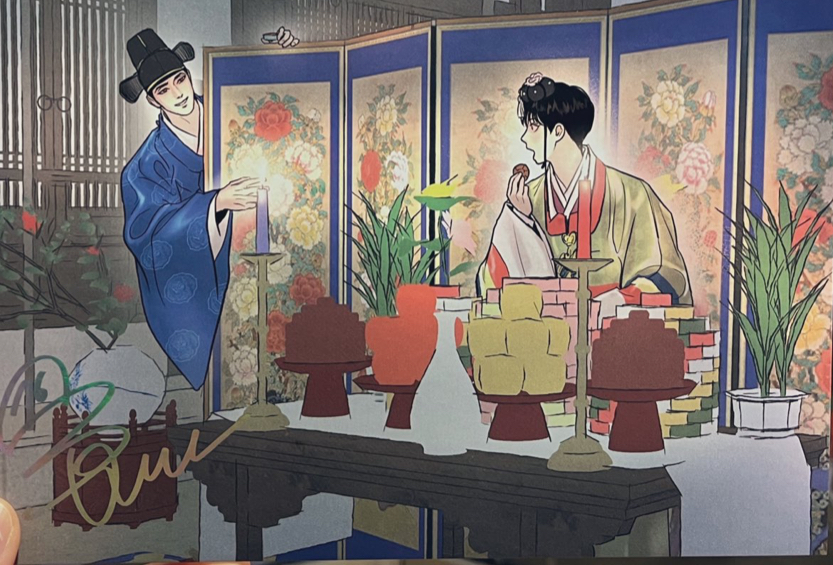 Thus expect new bridal carries in season 4, but some of them will be connected to death, pain and sorrow. 😥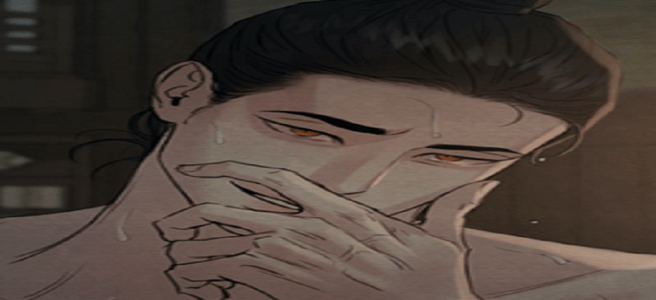
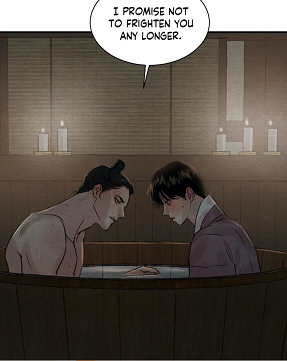 (chapter 70) When you look at the panel, you’ll observe that Baek Na-Kyum is represented by three white candles, while on the lord’s side there are just two white bougies. Since the color white symbolizes purity, this picture exposes that both protagonists are not just healing, but also getting less selfish and more open. Nonetheless, the noble’s purification is not complete yet. Here, I would like the manhwaphiles to keep in mind that since 3 is often associated with order, perfection, completion, reconciliation or fecundity due to the fusion of 1 and 2, it explicates why 3 is considered as magical and mystical. On the other hand, the number 2 symbolizes not only duality (light-darkness; ying-yang), but also balance and companionship. It is also related to kindness, and reflects a quiet power of judgment. At the same time, it indicates the need for planning and boundaries in order to keep the balance. And now, the readers can grasp why I view this panel as a confirmation that the master’s carthasis isn’t finished. In chapter 70, he has finally dropped his armor, this just means that he has finally abandoned father Yoon’s doctrines for good. But let’s not forget that Yoon Seungho’s life has not only be determined by father Yoon, but also by Kim, his surrogate father. Hence he is still under his influence.
 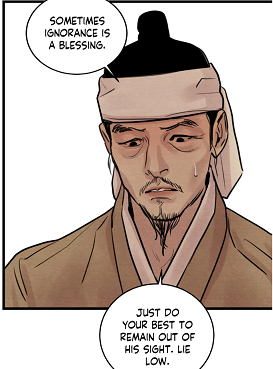 (chapter 23) Ignorance is a blessing for him, because it allows him to let his master to be in the dark. That’s why the master relied on the valet all this time. Kim was his eyes and ears, therefore certain rumors didn’t reach the noble’s ears.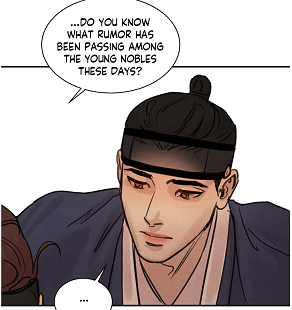

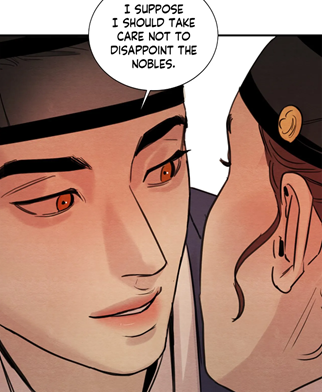 (chapter 18) On the other hand, the butler let him know about this gossip.
  (chapter 22) Since Yoon Seungho perceives himself as cultured, because he reads so much, he could only laugh about this rumor. However, he never realized the origin of these gossips. The valet utilized the rumors in order to deceive everyone, including the main lead. That’s why Kim could only judge “ignorance as a blessing”, because it helped him to manipulate the staff, the town folks and the nobles. He had an interest to create a bad image about Yoon Seungho. This helped him to keep the main character in isolation and in the dark. Moreover, it reinforced the lord’s dependency on his assistant. In order to corroborate my interpretation, I will use a panel reflecting the true nature of their relationship:
 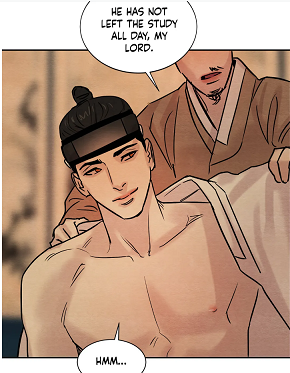 (chapter 11) Observe that the valet is not portrayed with eyes. This is not just an indication of the butler’s lie. The valet’s eyes became the master’s. This signifies that the words and the vision of the valet became the noble’s reality. At the same time, the noble’s mouth is closed and his hands are not present either. Note, he is getting dressed by his own valet. As a conclusion, he is entirely relying on Kim. He has no mouth, no hand, no ear and no eye. Everything belongs to the butler. This single picture exposes the butler’s true powers. The lord was totally deprived of all his senses and his own body, a real puppet. And this interpretation leads me to the following question: Who killed the servant in chapter 1? In my eyes, the noble was just the executioner, while the butler was the judge. Why do I see it like that? First, note that in the scene, the main lead has no eye
  (chapter 1) and he doesn’t want to know about the painter’s reasons for not painting any longer. I know, some readers might reject this idea, but I would like them to remember that we see the butler acting like a judge in front of the doctor, that’s why the commoner begs the valet (“Are you trying to have me killed”).
 (chapter 1) and the butler didn’t need to be by his side, as he had a real control over the lord’s hands, eyes and ears. Now you understand why Kim really treasures ignorance. Simultaneously, the valet values knowledge, as it procures him power.
  (chapter 50) This idiom doesn’t only imply to ignore your feelings, but also to deny the existence of your heart. If the noble has no emotions, then he can be the perfect puppet. This explicates why Yoon Seungho had a relapse after this conversation. Despite his warning, the master did listen to the butler’s advice.
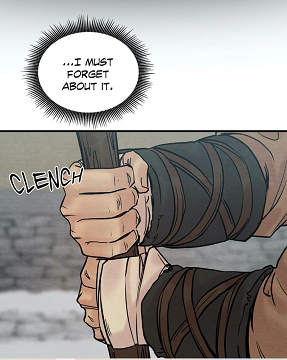 (chapter 65) That’s why there is no sincere apology.
  (chapter 65)
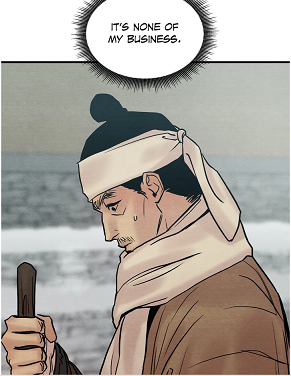 (chapter 65). He prioritizes his own life. He is not interested in people’s passion and well-being. He doesn’t care about people’s motivations. The latter just become relevant, the moment they affect his life. He needs to know about people’s behavior and thoughts for his manipulations in order to protect his quiet life.
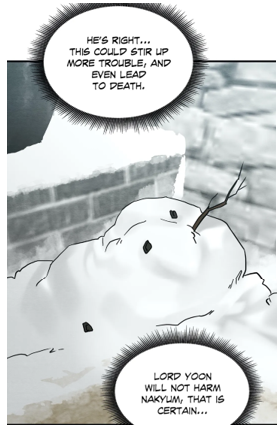 (chapter 65) therefore any incident must be covered up. At the same time, it implies as well that everything must be done in the shadow. That’s why without any spectator, he removes the snowman embodying the painter. The final panel contain all the butler’s doctrines. He will erase everything related to the past, acting as if nothing happened. It doesn’t matter, if someone gets destroyed in the end, because on the surface, it will look like he just cleared a way. He gives the impression that he helped the persons concerned, not taking into consideration how his actions and decisions will affect others. If someone has to pay the price for this, then so be it, as long as it doesn’t disturb his life. From my point of view, this scene is full of symbolism. From my perspective, he is ruthless and even willing to dirty his hand to a certain extent, since he is using a broom. However, this gesture exposes too that he is not directly soiling his hands. This is the reason why he is never directly involved with people’s wrongdoings. He will just push others to commit wrongdoings with remarks. They have to act according to his own thoughts and benefit. This interpretation is not exaggerated, if you compare this scene with Deok-Jae’s misdeed in chapter 46. The vicious servant used his own feet to ruin the artist’s creation
  or he pushed the painter with his own shoulder.
 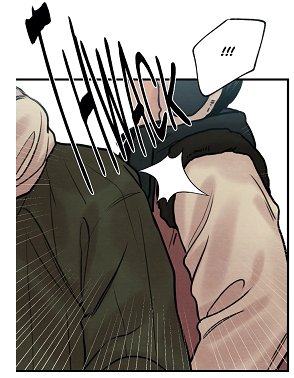 (chapter 46) At the same time, with this new approach, it helps to understand why the butler’s evilness was never caught. He could always feign ignorance with such a behavior and was never directly involved.
 , 17, 59). He also allowed the vicious servant Deok-Jae to betray Yoon Seungho and plan a murder
 (chapter 51). He hoped that Heena noona would take the painter away
  (chapter 68) and he is now expecting that Min organizes a second abduction while framing others: Nameless, Heena noona and Jihwa.
  (chapter 62) Here, the noble stated that he adored the painter). This means that the light and warmth had finally reached the lord’s heart, which is also mirrored by the light in the panel. But the problem is that after the low-born’s disappearance, the master had the impression, he had been betrayed and abandoned. Hence he became enraged and blinded by his own wound. This is a sign that he definitely took it to heart. Moreover, we shouldn’t forget that despite the incident at the barn, the noble was not even able to stick to the rule, treating the artist like a sex toy. In the end, Yoon Seungho brought him to his own bed, indicating that he considered him as his partner. To sum up, the noble was still not honest to himself exposing the valet’s influence.
 . Then another scandal appeared, when the lord punished the staff for not following his order (chapter 30).
 As you can see, the uproar remained within the mansion in season 1. This is the reason why the noble retreated in chapter 30, when he was pressured by the other aristocrats.
  (chapter 33) Here, he was definitely avoiding any scandal. He was running away, although he tried to deceive the nobles by declaring that the painter would belong to him. And during the second season, the readers can observe a progression, the scandal and uproar is now reaching the town (chapter 64)
  . Thereby the climax was reached in chapter 67, when Yoon Seungho visited the Lees’ mansion. For the first time, he was confronting a noble and didn’t fear to cause a scandal, when he showed up with a sword and didn’t even remove his shoes.
  (chapter 67)
 (chapter 70) And this confession could be used against the lord later, hence after that night, Yoon Seungho kept his distance from his lover. Thus he said this to his lover in chapter 75
  (chapter 79) But this doesn’t signify that this doctrine had completely vanished. For me, it has been gradually weakened, the moment the lord started feeling remorse. The problem is that he still relied on the butler to correct his wrongdoings. That’s why he sent the valet to the artist in chapter 12 or left the artist behind in chapter 33. He ran away from his responsibility
  (chapter 33) and let Kim take the burden. Yet the more time passed on, the more the noble took his responsibility. He protected him from the maids and decided to buy him better clothes. This is no coincidence that in chapter 40, he implied to the painter that the latter could now rely on him. This progression is visible, when he took care of the painter in chapter 55. He covered him
  (chapter 55) and watched over him during the night. But this principle will be truly abandoned, the moment the lord apologizes properly, and this expectation was proven correct, as the real apology took place in season 3.
  (chapter 71) The problem is that in the bathroom, he chose the wrong words. Hence the painter could only misunderstand him and pushed his hand away. While the manhwaphiles could witness his huge pangs of conscience, the painter never did. He was either unconscious (chapter 32)
  or asleep
  (chapter 50) or blind or deaf
 (chapter 49). And little by little, the lord learned how to apologize to his lover. In season 3, he admitted his wrongdoing right away.
  (chapter 82) Then later he tried to redeem himself.
  (chapter 84) Note that here, he was doing everything himself. He was no longer relying on Kim. Hence in the first version, I had voiced that the lord would apologize to Baek Na-Kyum, after the second abduction had been solved. And this expectation became a reality. The lord felt definitely huge pangs of conscience.
  (chapter 102) He is tasked to investigate how this tragedy could take place. Why did they get separated for so long.
 (chapter 23), because he liked keeping people in the dark as well. We had a perfect example with the deal between Jung In-Hun, the painter and the protagonist. First, Yoon Seungho gave the scholar the impression that the former was just an uncultured fool, whereas in truth the low noble was the one deceived, because Yoon Seungho was giving him just an empty promise. At the same time, the rich noble lied to the painter, when he claimed that Jung In-Hun had come to see him.
 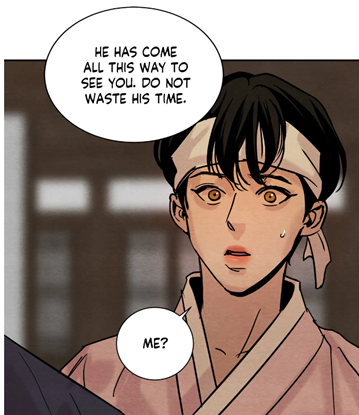 (chapter 7) However, it backfired on Yoon Seungho the moment the latter saw the painter’s reactions. He would run to his former teacher immediately, leaving the main character behind. Then he smiled to Jung In-Hun
  (chapter 7) and blushed in his presence. That’s the moment Yoon Seungho’s heart was moved, justifying the words in chapter 63:
  (chapter 63) No one has ever questioned how the master could treasure the artist’s smile so much? One might say that the first smile occurred in chapter 40
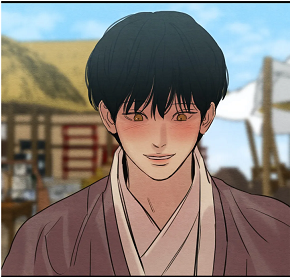 (chapter 40), but as you know, each event happens twice during the same season. So the lord experienced it much earlier. That’s why I believe that the first smile in chapter 7 played a huge role. The incident marked the return of the aristocrat’s jealousy, which had been buried for a long time. That’s why Yoon Seungho decided to reveal his plan. He hoped that with this new approach, Baek Na-Kyum would perceive him as a benevolent lord and look at him differently. He hoped that Baek Na-Kyum would smile for him. This explicates why the lord underlined the importance of connections and wealth.
 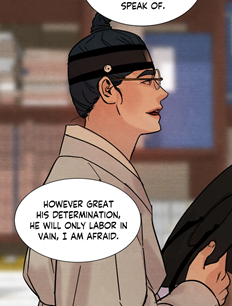 (chapter 7) Note that at the end of the chapter, he treated the painter as a real guest. He invited him to his bedchamber officially.
  (chapter 8) And observe that the noble was here smiling, he was already imitating the artist. This explicated too why not only his moves in this chapter were contradicting each other, but also Kim was introduced here for the first time. And note that from that moment, the lord never tried to trick the painter afterwards. Like I have already pointed out, the incident at the pavilion was definitely organized by the butler. And with this example, the manhwaphiles can see that the lord was applying the 6th rule as well, but dropped it due to the low-born’s reaction. This is not surprising why this manipulation ended up causing more and more pain. Yoon Seungho had brought him upon himself, revealing how the first doctrine “ignorance is not a blessing“. With this new observation, I perceive the episode 7 as a first major turning point. The lord was dropping the 6th rule (to utilize others in order to achieve his goal). However, this doesn’t mean that he abandoned the first doctrine. Quite the opposite… it took him a long time to realize why he couldn’t achieve his goal. In my opinion, the master started changing in chapter 67. Contrary to chapter 33
 , Yoon Seungho couldn’t bear to hear how people would talk behind his back: a sodomizer and a beast who corrupted Lee Jihwa and others.
 (chapter 67). Note that for the first time, the lord decided to defend himself
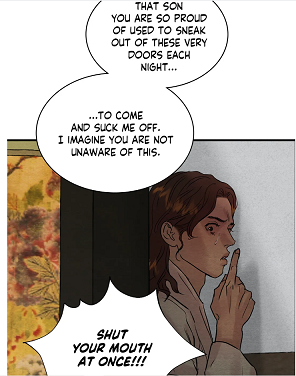 , correct people’s perception about him, which he never did before (chapter 18, 22, 57
 ). This coincides the return of the lord’s hearing and speech abilities. In chapter 67, he is using his own ears and mouth, he is no longer relying on the butler’s help. What the lord imagined to perceive as help was just an illusion. However, I believe that the lord decided to drop the first principle in chapter 68
 , when he heard the conversation between Baek Na-Kyum and Heena noona. Observe that he is listening behind the door, as if he was spying, which I perceive as another evidence for Kim’s spying activities. Nevertheless, this was never the main lead’s intention, hence he left quietly. Yet the painter’s words did push the lord to abandon the butler’s first principle. But what did he hear exactly? Here, I have to admit that I can’t be 100% sure, but I think that he heard the painter’s confession, because in chapter 70, Yoon Seungho asked the painter, if the latter was afraid of him
  (chapter 70). And note that when the painter confessed, he externalized his fear.
 (chapter 68) But what caught my attention is that when we see the lord’s feet in front of the door, we have to keep in mind, Yoon Seungho was not able to see the painter’s tears. He could only hear his words. Consequently he was relying on his own ears. However, this doesn’t signify that Yoon Seungho is blind. In my opinion, in this precise moment Yoon Seungho was able to envision Baek Na-Kyum’s tears, because he was forced to use his mind’s eye. Then with this new perspective, we have a new version of chapter 3
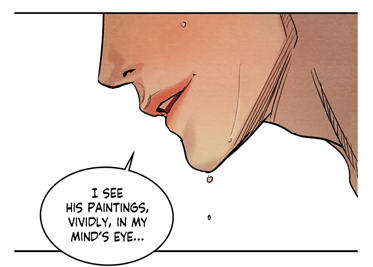 . However, the huge difference is that Yoon Seungho’s mind’s eye is no longer focused on himself, but on the painter. This explicates, why the master decided to retrieve and to give him space. Without seeing his face, he could sense that there was affection, because the painter was crying. The readers should recall that the painter’s tears have always had a huge impact on the noble, because they healed his eyes, hand and heart. The manhwaworms can comprehend why the lord chose to let the painter determine his own fate. The presence of tears and the painter’s voice were able to remove the lord’s veil on his eyes and ears for good. I would like to remind the manhwaphiles that in chapter 68, Kim tried to destroy the lord’s own judgement by recurring to gaslighting and distorting the past. [For more explications, read this essay:
  (chapter 69) although he is sitting in his bedchamber. Imagine, he is no longer relying on the butler’s information contrary to chapter 56:
  (chapter 56) With this new approach, the readers can understand why the aristocrat can make such a comment in chapter 70:
  . Therefore I deduce that the butler can no longer control the lord’s body, since he is no longer required to be his eyes, ears and hands. However, this doesn’t mean that Kim is truly defeated. He still controls the staff, especially the male domestics. Here, I would like to make a little disgression. In my opinion, the butler played a huge role in the first abduction. How come that the servants were so sure that the painter had run away?
 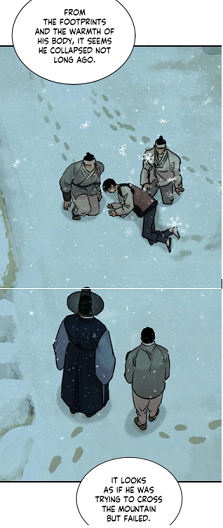 (chapter 61) They were not present, since both protagonists were at the physician’s. From my point of view, Kim must have manipulated the servants… he just needed to imply that Baek Na-Kyum had escaped, while in front of Yoon Seungho, he would say the opposite later due to the commoner’s return:
 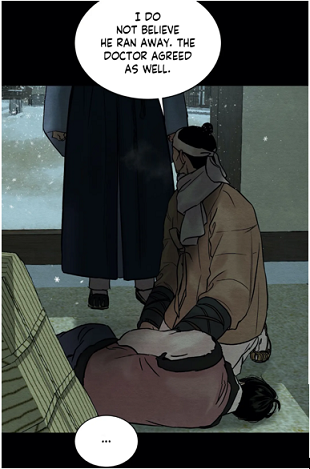 (chapter 62) There’s no doubt that with the painter’s appearance, he could use the incident to obtain more support from the servants. The painter had caused trouble again, he was responsible for their misery. But since he truly exposed his true nature to the main lead (abusing his authority, criticizing and judging his master), he can no longer appear in front of him. Right now, he has to lie low, hence he needs other people to be his eyes and ears. This explains why the servant is portrayed without eyes either
 (chapter 70). The absence of the eyes is an indication that they belong to Kim, just like the lantern indicates that the domestic is acting on the valet’s order. And in season 3, we can observe a similar situation. This time, they faked obedience
 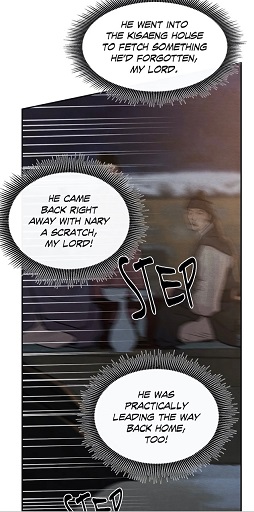 (chapter 99), while they badmouthed their master.
  (chapter 98) Because the lord feared to lose his lover, he didn’t pay attention to the domestic’s insult:
  (chapter 98) But the insult was the proof that they never treated the painter as a part of the household. He was just a spoiled brat.
  and gives orders
 . He is truly rude. We could say that he treats the low-born like a servant, as though he wanted him to feel so little. Kim’s strategy was to remind the painter of his position: he is just a servant, a new version of chapter 52. Remember that Kim’s intention from the start of the second season was always to diminish the artist’s status: he is just a temporally favored servant, nothing more. Striking is that the domestic never says that the lord gave him the order to bring the painter. He uses here a passive sentence “you are to attend to him” which is important. That way, the servant can hide the identity of the person who requested this. And since the lord was looking at the intruder in a rather cold way, I believe that he didn’t expect Baek Na-Kyum.
 However, when the door was closed loudly, the lord must have realized that this must have been Kim’s action. The lord didn’t mind, for it looked like the butler was helping him to improve his relationship with the painter. This interpretation was also confirmed in season 3. Yoon Seungho showed no desire to investigate the matter of “Jung In-Hun” or Deok-Jae’s death, for he was too much focusing on his lover. He kept saying that this was not of his concern.
 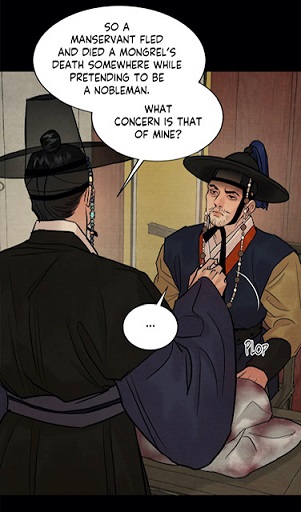 (chapter 98) However, he was totally wrong here. That’s the reason why the abduction could even take place. Because of the last incident, the main lead is forced to recognize that he needs to investigate the matter, as everything or everyone can affect his life. This is important, because that’s the only way for Yoon Seungho to recognize the butler’s wrongdoings. He encouraged him not to pay attention on others so that he wouldn’t detect his wrongdoings. Thanks this rule, Kim could live freely.
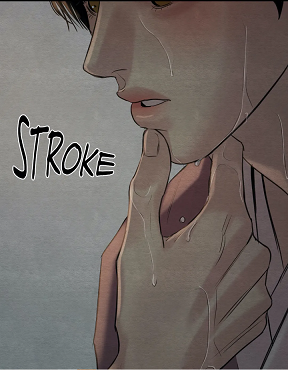 (chapter 70), kissing him tenderly
  . That’s why Kim will have the impression that the painter is still not accepting the lord. This explicates why after that night, they were separated. The butler imagined that if they had no longer sex, the artist would feel neglected and believe that the lord had already a change of heart. He hoped that after such a separation, the painter would leave the mansion, exactly like the lord had been encouraged to have a relapse in chapter 50. In my eyes, Kim was slowly viewing the artist as a man consumed by lust. How could he still accept to have sex with Yoon Seungho after the latter had treated him like a sex toy in the shed? The butler couldn’t grasp the protagonists’ thirst for love and warmth.
  (chapter 70) Under this new light, it becomes understandable why Kim decided to betray his master and rekindle with Yoon Chang-Hyeon. The punishment was the signal for the valet to switch the alliance.
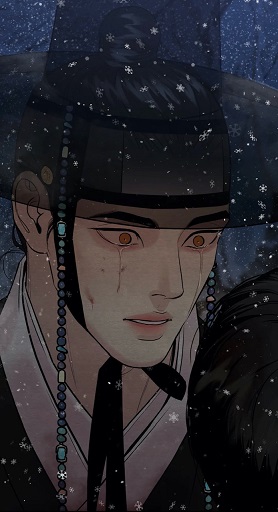 (chapter 102) From that moment on, the light had now reached the mind. He could drop his self-loathing finally which was the foundation of Kim’s principle. It was okay to cry. These were tears of happiness and relief… He had been able to rescue his lover. This means that Yoon Seungho did everything what the butler rejects: the embrace as a way to console and apologize and the tears as a sign of regret and happiness. But why does the valet abhor them? It is because he could never admit his own mistakes and as such he could never beg for forgiveness.
 (doctor Frost, chapter 211)
  (chapter 50) Here, the butler never cried, he just showed pity and sympathy towards Baek Na-Kyum, however he was not speaking from the heart.
  ). Optimism is a choice (chapter 68/69: the lord recognized that he still had some chance, though he was very scared). Kindness is a choice. Giving is a choice. Respect is a choice (chapter 69
 ). Whatever choice you make makes you. Choose wisely.”
 This would announce the butler’s complete loss of power. At the same time, it would signify that the lord is showing that he trusts Baek Na-Kyum and is using his hair to woo the painter. And this could definitely correspond to the master’s attitude: his will to open up. Simultaneously, he could express the following wish: he would like to comb his lover’s hair himself encouraging him to have a topknot.
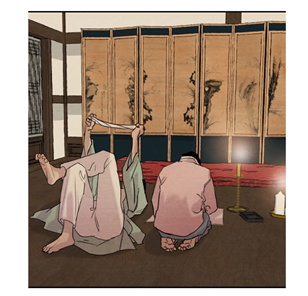 He is not only playful, but also flirtatious. Note how he puts the headband on the main lead giving him a seductive allure.
  At the same time, he acts like an innocent teenager who keeps asking questions: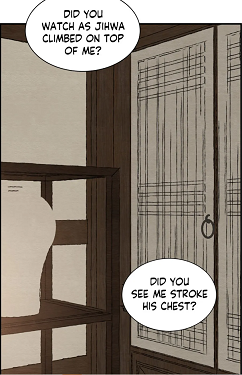
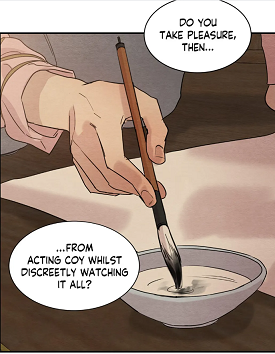 Yet, the topic is actually about sex, which contrasts so much to purity and innocence. It was, as if Yoon Seungho was behaving like a teenager discovering sexuality for the first time.
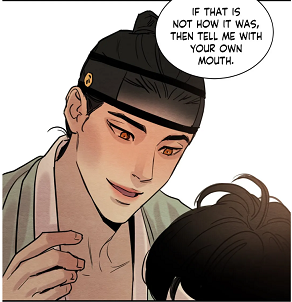 While talking, he can’t even help himself smiling. Striking is that his joke and words are used to woo the painter. He keeps getting closer and closer to Baek Na-Kyum, so that his head approaches the painter’s, before his hand starts touching his leg.
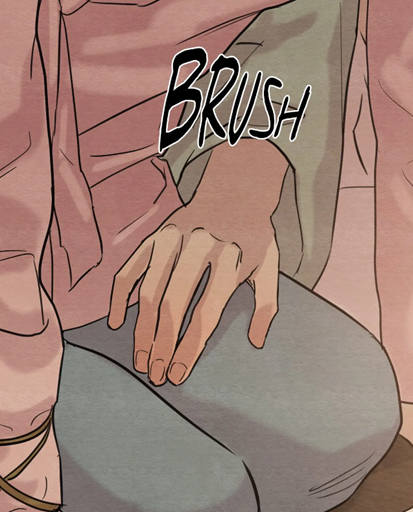 As you can detect, the scene in episode 16 is a combination of seduction and frivolity. He is so happy to be by the painter’s side, hence he is talkative. He desires to have a real conversation with the painter. On the other hand, since the topic of the conversation is revolving around sexuality, it explains why Yoon Seungho is tempting the painter. And we have a similar situation in chapter 70. Therefore there exist so many similarities between these two episodes, which I will now list:
 (chapter 16) versus
  (chapter 70)
 (chapter 70)
  (chapter 70)
 and
and 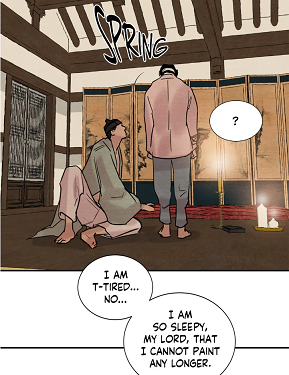 (chapter 16) versus
  the removal from his hand and
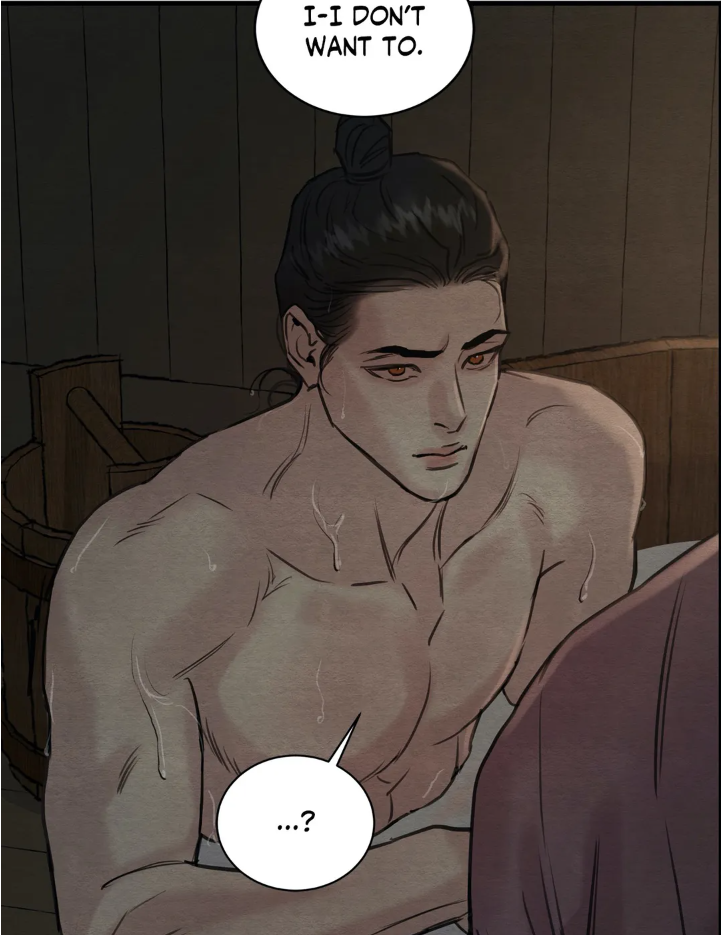 (chapter 70)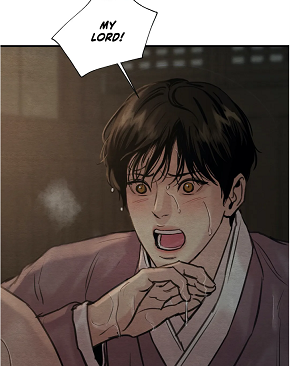
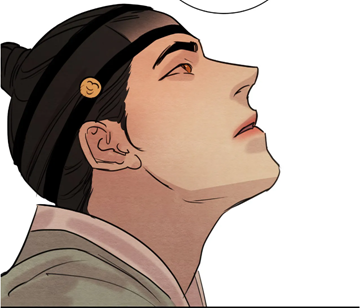 (chapter 16) versus
  (chapter 16)
 (chapter 70)
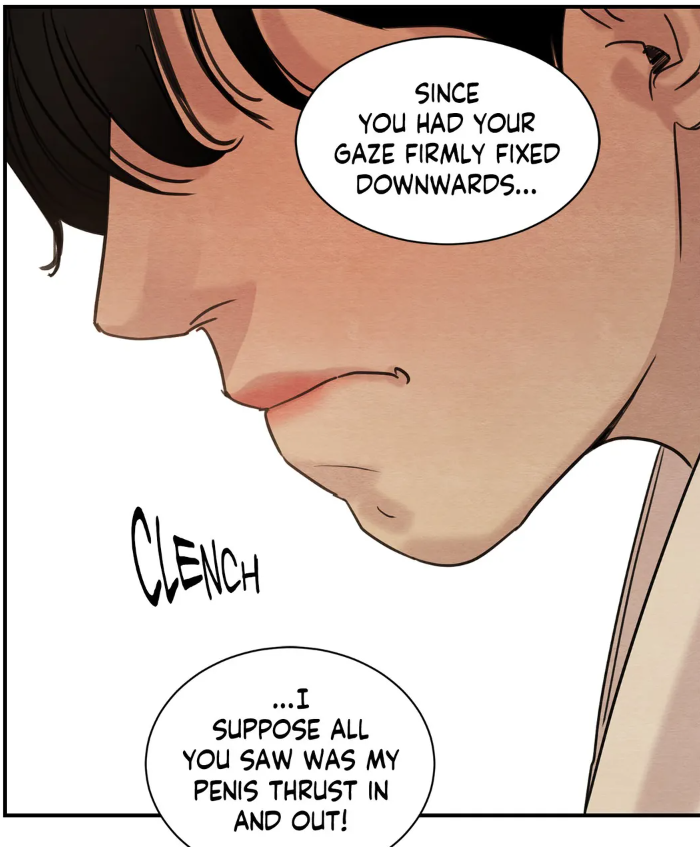 And here, we can detect the first huge difference between these two episodes. Because the artist is no longer denying his homosexuality, and as such he has finally dropped the scholar’s doctrines, he is able to perceive the aristocrat’s true personality. He is indeed moved,
 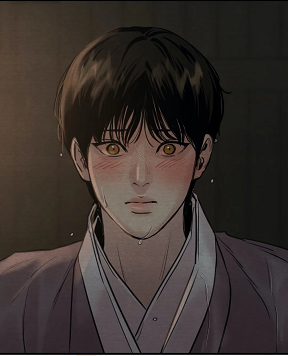 when he sees Yoon Seungho smiling after playing his prank. He blushes so much that he feels the need to hide his face,
 , when he hears the main lead calling his sister a wench. He requests respect from the lord. He is confident in his words and behavior. He even gives further explications.
 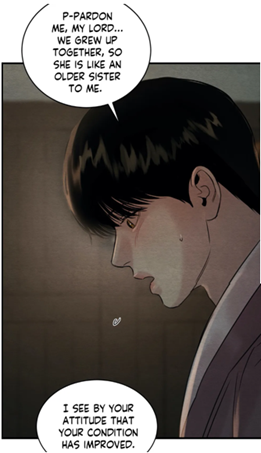 Moreover, he is no longer using fake excuses, unlike in the past. He rejects the lord’s suggestion (taking a bath together) clearly and directly without displaying any disrespect. When the lord keeps pressuring him, his justification sounds reasonable.

 (chapter 26). Yet back then both were driven by negative emotions (anger and sadness) due to their wounds. However, this time it is different. They are both calm and very careful. The two are determined to treat each other with respect.
  (Chapter 70) In other words, the bathroom is the place where the main leads can be honest to themselves, hence they are genuine to their counterpart. This is no coincidence that the painter was indeed touched, when he reminisced the lord cleaning him.
 (chapter 59) In this place, there is no rule or social class separating them, they are equal. In the washroom, there’s only purity symbolized by water. I would conclude that they are truly naked physically and mentally. That’s why they can only be honest to themselves and in front of each other.
 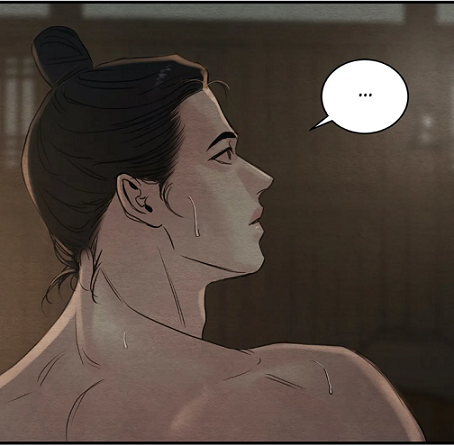 , when the painter retorts that he should mention her differently. His facial expression oozes naivety and shock. He didn’t pay attention to the idiom (“wench”), as all his thoughts were revolving about the painter’s happiness. He just desired to know if he had succeeded:
  (chapter 66). The artist has no idea that Yoon Seungho is referring to the flashback.
  (chapter 66) Nonetheless, due to his mistake, Baek Na-Kyum retrieves his hand. The reality is that Yoon Seungho was attempting to show his concern and his remorse. Unfortunately, he chose the wrong diction, thereby his thoughts were not expressed properly. Moreover, I would like the readers to keep in mind that the lord has never apologized before. First, as a noble, he was never asked to apologize to a commoner. Secondly, it is related to his own trauma. The main lead associates the apology
 to fakeness and hypocrisy due to the butler, who keeps repeating these words
 (chapter 25)
  (Chapter 11) This explicates that he misjudged the painter’s apology in chapter 62. Moreover, exactly like in episode 11, the painter had selected silence over giving a proper explanation. As you can see, silence was another reason why the couple had such huge issues in the past. It generated doubts and increased insecurities. However, in chapter 70, silence is barely present.
  (Chapter 70) Both are communicating verbally in all sincerity. In other words, this panel

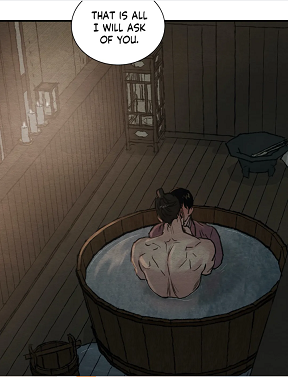 quoted from
 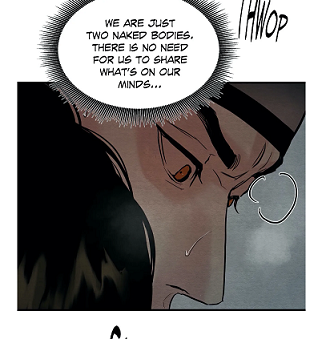 (“to share what’s on their mind”) got revived. He was once again full of hope, that’s why he felt the need to touch the painter. He wanted to share his feelings and thoughts. Unfortunately, the low-born rejected the offer
 I believe that for the first time, the low-born is able to detect a new side from the aristocrat. Imagine that the artist could not only make the noble laugh, but also smile. That’s why the painter can no longer reject the lord, as his fear is slowly disintegrating. Note that he doesn’t reject the kiss from the aristocrat.
 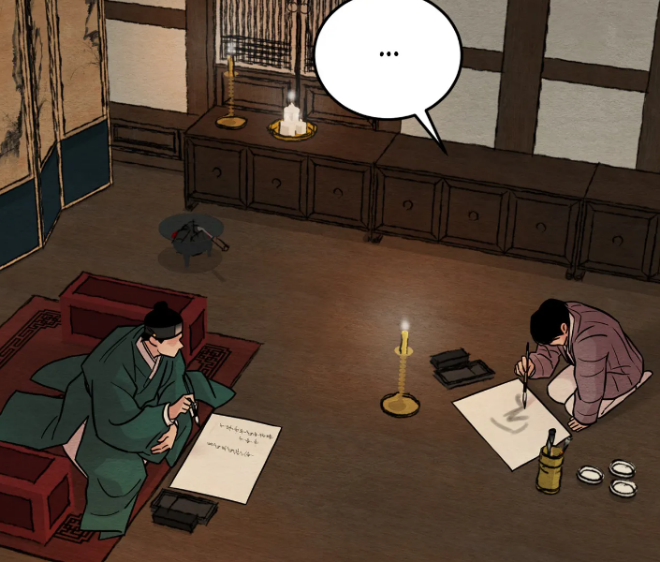 , because the butler had warned the artist not to irritate the main lead. According to him, he was in a bad mood, which was untrue.
  (chapter 38)
  (chapter 50): caresses, embrace and kisses, the symbol of harmony, love and sincerity.
  (chapter 47) by saying that he had just made a prank. But now, you will wonder where there was a prank in chapter 46, 56 and 66.
  (Chapter 56) He knew that this would hurt the noble, yet note that he felt no remorse and blamed his childhood friend. However, like I pointed out, he was impersonating a person. If asked, the childhood friend would have used a similar excuse. That’s why Yoon Seungho answers in a quite similar way: he calls him “lord song”. However, he pushes him.
 (chapter 66) , he implied with his words that Jihwa played just a prank, since the painter returned alive. Yoon Seungho shouldn’t just get angry, because it was just a joke. As you can observe, all the misdeeds are reduced to a joke. It was, as though they had done nothing wrong. However, the intention is definitely different: the perpetrators intended to hurt the protagonists. And this is not surprising that the chapter 36 contains both pranks: Kim drugged the painter against his will, while the joke from the noble was harmless. And in my opinion, the episode 70 contains both pranks as well. Kim was the one who sent the painter to the aristocrat. Why do I believe this? The reason is quite simple: the servant leading the painter to the bathroom is portrayed with no eye
  (chapter 36). And remember that this chapter is a new version of chapter 36. In that episode, the valet was the one who brought the artist to the lord’s chamber. Moreover, the way the door is shut clearly exposes a certain violence.
  (Chapter 70) Besides, the domestic is also urging the painter to join the bathroom. From my point of view, the domestic wants to make sure that the artist arrives, before the lord leaves the bathroom. Moreover, the lord’s expression in beginning is not quite welcoming
 (chapter 34) in order to incite the latter to have sex with the commoner. Imagine, he had just regained consciousness, therefore this trick could have cost the artist’s life. And we shouldn’t forget, the butler witnessed the second sex marathon. He even viewed the flashback from the painter. Therefore in my opinion, the butler is hoping with his “prank” that the lord will act like the previous night. Furthermore, I would like to point out the presence of domestics in chapter 16 and 36. We have Deok-Jae who spied on the couple and manipulated the butler to open the door
 [theory confirmed by the author herself]. Then during that evening (chapter 36-37), Kim tried to stop Yoon Seungwon from entering the room.
 (Chapter 37) Hence this means, he was paying attention to what was happening in the bedchamber. What caught my attention are the following panels:
 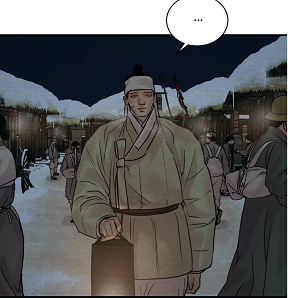 (Chapter 69)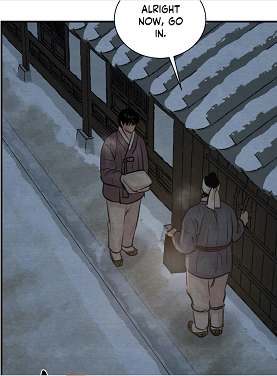

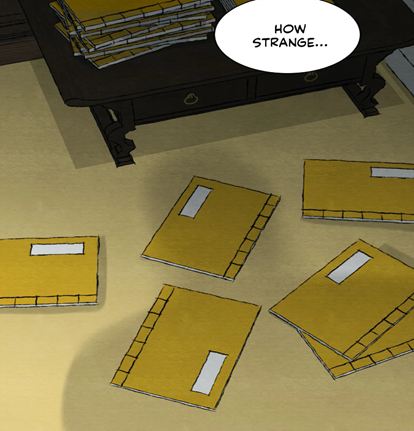 (chapter 50) I tried to find answers by speculating. However, my assumptions were totally wrong due to the lack of information. Only time and new chapters helped me to understand the story much better. Thereby I could better anticipate its progression, and comprehend the reasons for the characters’ actions. Due to the constant examination, I made the following observations:
 (chapter 55).
 (chapter 16) Here, he was wondering how the painter was able to create the painting, while he didn’t seem to look at them the whole time. What caught my attention are two elements:
 (chapter 49) The painter expressed his thoughts: he only saw the noble as a sex toy, the main lead was the one who should give pleasure to Baek Na-Kyum. Yet despite the hurt, Yoon Seungho was willing to accept this situation. They would no longer exchange their thoughts and emotions. He was already lowering his expectations. At the same time, he couldn’t help caring for the low-born. He caressed his cheek and kissed him gently at the end.
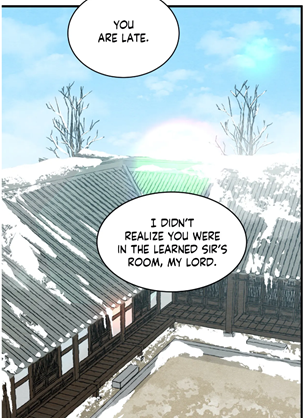 (chapter 50) And this scene reminded me of the main lead running to the scholar’s room in chapter 28/29
 , after witnessing the artist’s desertion. There was a time jump as well. Therefore I came to the conclusion that the night in chapter 48-49-50 has the same importance than the night with the forced sex and fellatio. This explicates why the lord has a sword again. Back then, he took the weapon due to his jealousy, hence we can definitely conclude that he is angered again due to the return of his jealousy. So chapter 50 was not only a reflection of the episode 16, but also of the episode 28-29.
 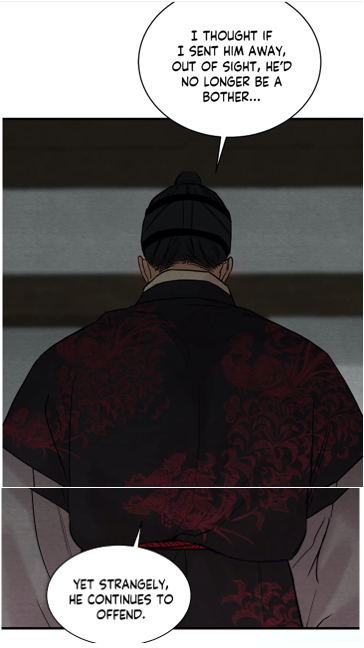 (chapter 50) What had triggered his fury and jealousy?
 (chapter 21). The paper in the book is very similar to the poem in chapter 4. Remember the theory I exposed in the essay “hypotheses about the second season”: Yoon Seungho had not returned the original poem, but given the artist his own poetry. So if he didn’t give back the scholar’s poem, then what did he do with it? I doubt that he would have kept it, hence I deduce that he must have asked his assistant to throw it away, exactly like the painter in chapter 44. However, Kim must have read it and kept it, well aware that this could be of use later. From my point of view, the butler must have entrusted it to the teacher with the hope that he would leave the mansion. And I can imagine that when Jung In-Hun left his room, he didn’t take it with him. That’s why it ended up again in the butler’s hand. However, if the lord discovered that the poem had not be thrown away, he would have realized that Kim had disobeyed him. That’s why I came to rule out the first possibility.
  , the readers should expect that this picture will be used twice during the second season. Because I already exposed that Heena noona recognized the painter’s presence due to the inauguration painting
 (chapter 65), it is definitely possible that Kim planted the picture in such a way that Yoon Seungho’s jealousy would get triggered, a new version of the panel from episode 41. Let’s not forget that the aristocrat was not present, when Baek Na-Kyum decided to discard the drawing. Kim was quite clever with this move. As he knew that the noble had now just a purely physical relationship, he could only get infuriated, when he saw the picture. He had already sensed the painter’s admiration in the drawing: the image oozes pure adoration and spiritual admiration, something Yoon Seungho has always been longing. Hence the noble could only get wounded with this terrible experience. I can imagine that Kim could have praised the picture in front of his master (a new version of chapter 44
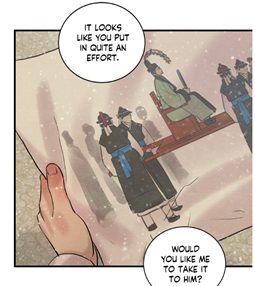 ), then added that Baek Na-Kyum had trusted him with the picture to give to Jung In-Hun. Kim hoped with this intervention not only to separate the couple, but even to have the painter killed by the main lead, a new version of chapter 35.
 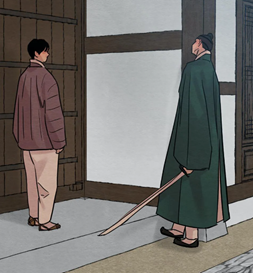 But what he didn’t expect is that the noble would rush to the teacher’s room, and not to the study. However, his delay could be explained differently. He had been busy giving the sentence to Deok-Jae, the straw mat beating. And this leads me to the following observation: denunciation. In chapter 28, Deok-Jae covered up for Kim’s betrayal, for he hoped that Kim would come to protect him.
 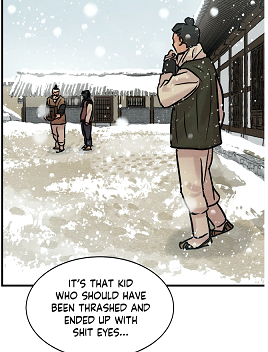 (chapter 51) The man believed the butler, because he had not covered up for him about the prank with the spoiled rice. Finally, I discovered that this expression “how strange” was used by someone else:
  (chapter 37) It was the fake servant who had mentioned the purge! This means that someone had betrayed the Yoons, tattled on them! At the same time, the words from the old bearded man implied that the patriarch Yoon had been the denunciator. Thus he could expect the purge.
 (Chapter 37) As a conclusion, the expression “how strange” is connected to denunciation and deception! I have two other evidences for this interpretation. Jihwa had also spoken like that, when he had heard from the amateur spy that his master had a change of heart! Here again, we have spying activities and denunciation.
  (chapter 13) Finally, observe that in season 3, Baek Na-Kyum is portrayed and stigmatized as a traitor.
 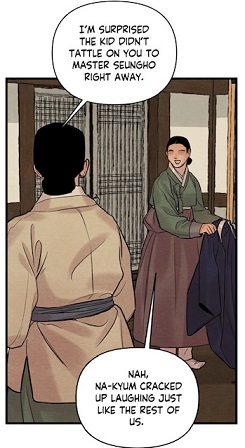 (chapter 91) The maid’s statement (“I’m surprised…”) truly exposes that the painter had such a reputation among the staff. The so-called treacherous nature of the painter served as a justification for Kim’s punishment. The butler’s kindness had been used against him. He had been sentenced to the straw mat beating, because he had allowed the noona to enter the mansion for the painter’s sake! In that scene, the maids had been tasked to leak a certain information to the couple: the existence of the kisaeng’s letters. That way, the painter could accuse his lover of his deception. He had kept away the letters from his noonas. However, the separation didn’t take place, because the painter didn’t hear the comment from the maid. He was no spy!
 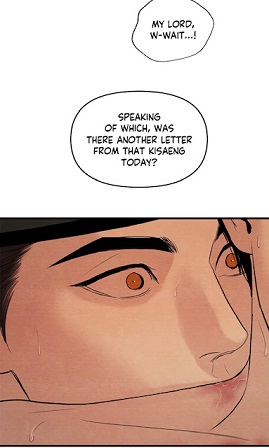 (chapter 91) But Yoon Seungho is one, for he is the surrogate son of the butler… who listens to conversations in the shadow!
  (chapter 77) His presence was undetected in the courtyard, until Bongyong wounded the painter. Here, he came out of the shadow!
  (chapter 78)
 (chapter 50) That way, he could separate the couple. Due to their last sex session, he had discovered that the protagonists were getting closer to each other. He made sure to utilize Yoon Seungho’s hatred for prostitution. And keep in mind observations with the comment “How strange…”: we had spying, deception, contradiction and denunciation. The spiritual love stands in opposition to prostitution.
 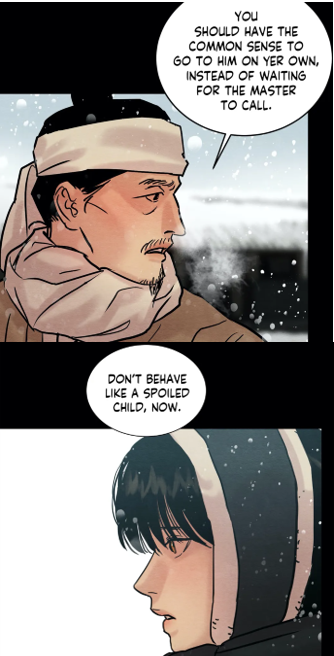 , whereas the butler didn’t consider him as a servant in chapter 23
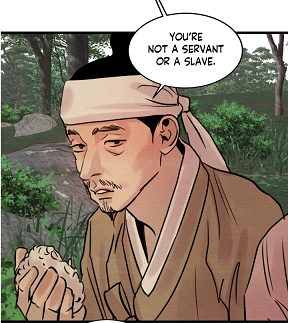 , another evidence for the valet’s hypocrisy.
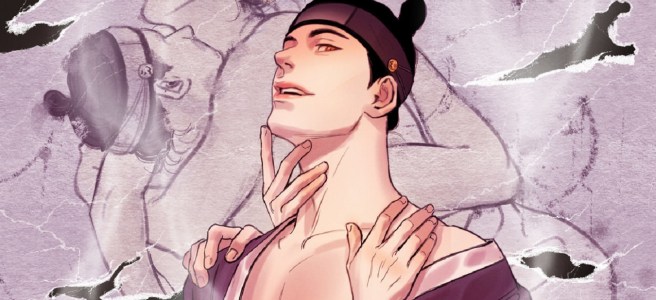
 (chapter 48) But strangely, the main lead never realized it, until each time the commoner had to externalize it. How did he not see it before, and how didn’t the noble recognize that the artist hadn’t changed his perception about him in the second season? Thus I will try to answer these two questions in this essay.
 here, no servant is sent to announce the noble’s arrival, which is quite rude; chapter 10
 , 17, 43). He acts, as if he owns the place. Moreover, the noble with the mole requests from the host to send away the artist (chapter 8).
  He acts, as if he had a saying in this, nevertheless he is just a guest and not the owner of the house. Moreover, he requests the whole attention from the main lead, as though the latter had to follow the guest’s desire.
 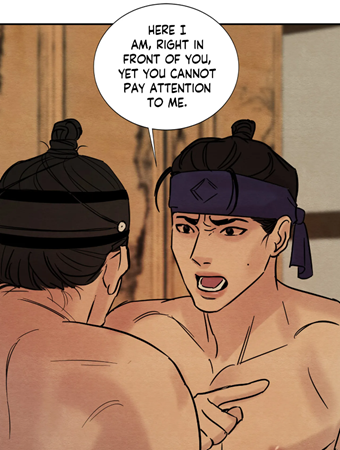 . No wonder, Yoon Seungho got infuriated and ejected the man. The painter’s presence revealed the disregard the noble had for the host. Striking is that even after getting dragged by the topknot, the aristocrat demanded an explanation for this humiliation. He didn’t realize his wrongdoing. This is not surprising that the Joker’s friend noticed the change in the protagonist.
  (Chapter 8) For the first time, the protagonist didn’t allow his peers to look down on him and requested more respect.
 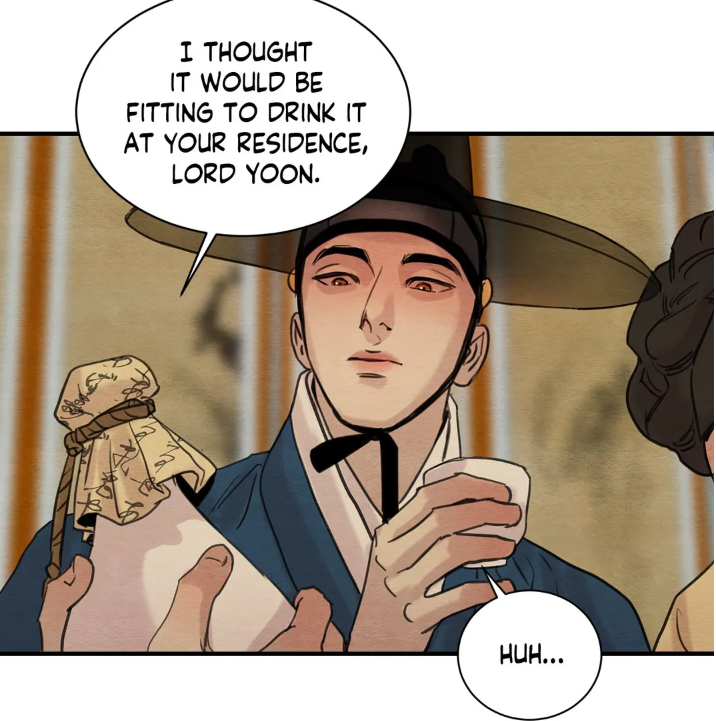 (Chapter 19) He imposed himself upon the main character, yet Yoon Seungho didn’t feel upset. In fact, he just accepted the suggestion by a silence. It was, as if the protagonist was not allowed to refuse the invitation. More surprising is the place where The Joker suggested this: the brothel, an indication that the Yoon residence is considered as the noble kisaeng-house. I would even say, his mansion is the real place for pleasure and vices. And now, you comprehend why Yoon Seungho was pressured by the nobles in chapter 33. In the past, he would have given in, yet this time he showed them that there was a line not to cross.
 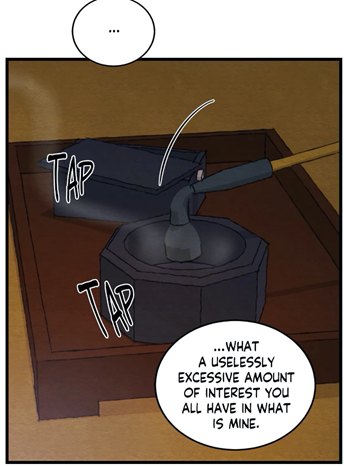 (Chapter 33) Imagine what would have happened, if the noble had followed their suggestion. The artist would have indeed turned into a prostitute.
 (Chapter 52) In Yoon’s residence, there was no parent or authority to interfere. This explicates why father Lee blames the main lead for his son’s sodomy. He corrupted Jihwa, while in reality Jihwa treated Yoon Seungho like his possession and his personal concubine. He was the one visiting his place and not the other way around, like a husband visiting his “wife”
 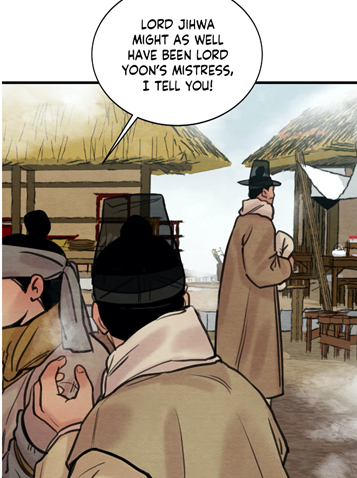 (chapter 45), in other words the mistress of the house (the second definition: a mistress is a person of authority and power). This explains why he could trespass the mansion, like he desired. He considered Yoon Seungho’s mansion as his property, where he could enter at any time.
 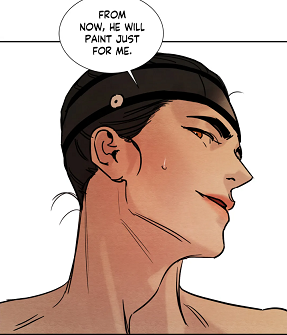 (Chapter 8) He was clearly demonstrating that he would never accept to give up on the painter. Slowly Yoon Seungho started asking respect for himself from others. In reality, he is a noble and he is quite rich through trade. This explicates why lord Min used the wine as an excuse to come to Yoon’s residence. He couldn’t ask the main lead, if he could borrow the painter. Furthermore, this statement and the humiliation revealed that Yoon Seungho was no longer a pushover. Hence Black Heart was more careful around the main lead. From my perspective, The Joker imagined that if the lord got drunk with the expensive bottle, he wouldn’t notice the artist’s disappearance. However, because the wine was stolen, Black Heart couldn’t achieve his goal that’s why he asked for a harsh punishment for the theft. Besides, Yoon Seungho showed no interest to organize a sex session any longer. His eyes were already set on Baek Na-Kyum. Since his initial plan failed, and the lord was no longer organizing parties, then he could only use the sex sessions as an excuse to see the painter.
 (chapter 33)
  (chapter 52) Everyone among the aristocrats did see the main lead as a head-kisaeng, who had to please her guests. Thus Byeonduck created such panels indicating that the nobles had always taken advantage of Yoon Seungho.
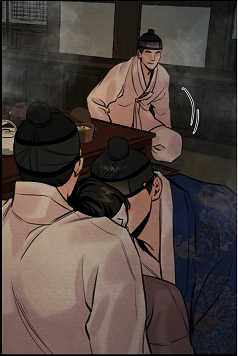 (Chapter 54) They look like conniving creatures. Their wish would get granted in the detriment of the host. And now you comprehend why the lord got so angry, when he saw this.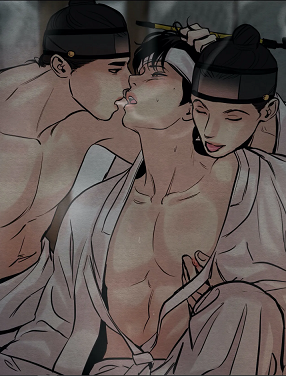
 (Chapter 54) It was not just a reflection of his own past as an uke, but he saw his actual reflection. His house was a brothel and nothing more, and his guests were taking advantage of him. That’s why he got so infuriated and evicted the aristocrats. They truly showed no respect to him. It took many months for the lord to recognize this. And now you comprehend why he abhorred the idea of prostitution. He wasn’t even realizing that he was still doing it. Therefore Yoon Seungho could only come to the conclusion in chapter 55 that he needed to confess. First, this night made him realize that all this attempts in the past were to win the painter’s heart. Yet he was well aware that with his last action, he had almost sold his loved one to nobles, thereby the painter could only reject him. Besides, he had another reason to expect this outcome: his self-hatred.
 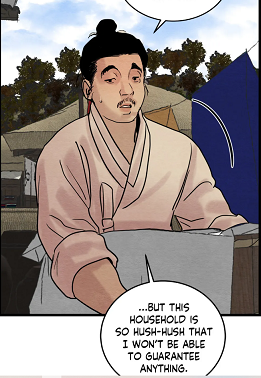 (Chapter 29) Since a kisaeng belongs to the lowest class in Joseon society, the servants could look down on their master. Despite his title, he was living like a head-kisaeng, therefore the staff showed no respect towards their lord.
  (Chapter 32) This explicates why they didn’t follow his order, when he asked them to keep an eye on the artist. Nevertheless, as time passed on, the noble started acting more like a lord, hence the head-maid accepted his reprimand and decided to treat him differently. That’s why she bowed to Yoon Seungho in chapter 46.
 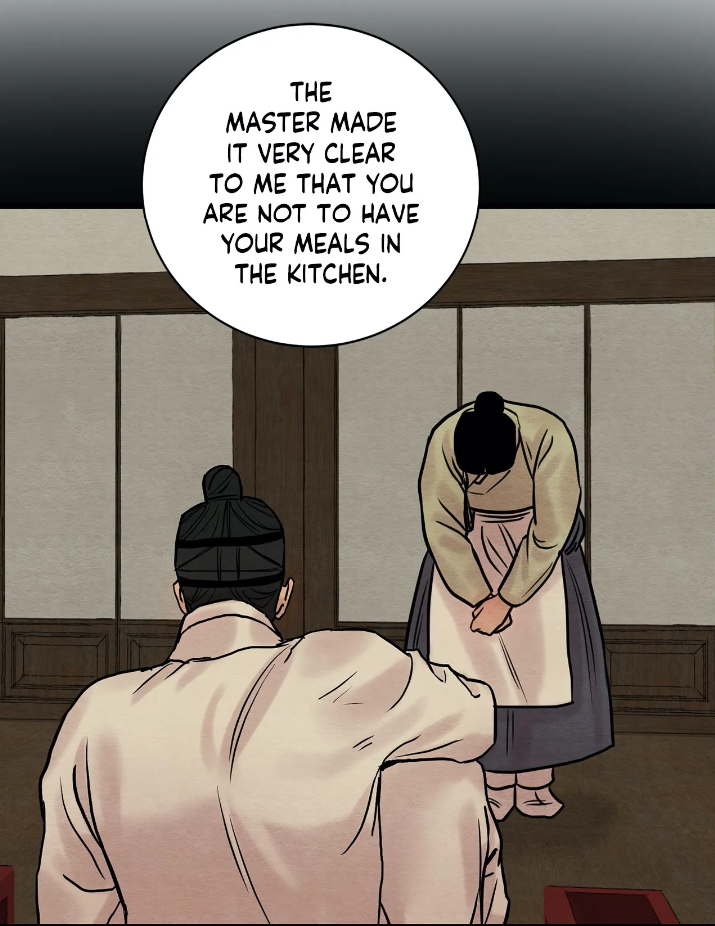 (chapter 46) And by comparing the two last pictures, the readers con detect the butler’s absence. the latter was responsible for the past situation, because he didn’t want to get into trouble. As long as the lord was acting like a head-kisaeng, providing entertainment for the local aristocracy, the valet could lead a peaceful life and definitely sway his misdeeds under the rug. Moreover, he could even use the master’s authority and act like a lord.
  (Chapter 33) The lord fell for this illusion, and he would have never realized it, if the painter had not entered his mansion. I also fell for this illusion myself for a while, calling him an alpha, while he was disrespected the whole time. However, this doesn’t mean that the main lead is powerless. He has indeed connections to the government (exactly like the kisaeng-house) and he is definitely rich, because he is a trendsetter. Min keeps copying his clothing and the master’s windscreen is the same at Min’s pavilion and the noble with the mole. That’s why Yoon Seungho never got to see his true reflection. In his mind, he was either busy reading or fighting with nobles, while in reality he was having sex for the most part of the time. Moreover, no one truly gave him a true reflection, since they had no interest to switch the situation.
 (Chapter 2) Therefore the main lead’s gaze in the picture mirrored the image of a man showing true interest, warmth and beauty. Later, he only got to see the ruined painting, which triggered a huge anger, hence he didn’t pay attention to the image. Then in the third picture,
 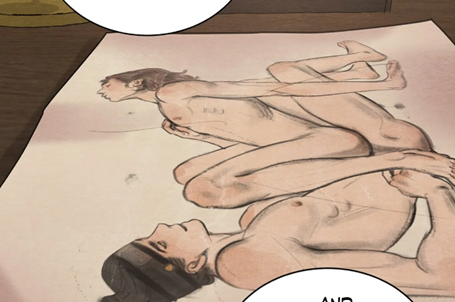 (chapter 16) he was no longer interested in the creation, since Yoon Seungho had already started wooing the commoner.
  , he still didn’t observe it. His gaze and mind were all focused on the painter and his face. Then in chapter 41, he never saw the multitude pictures of him having sex with the low-born
 (chapter 41), because his gaze was only focused on the inauguration drawing with Jung In-Hun.
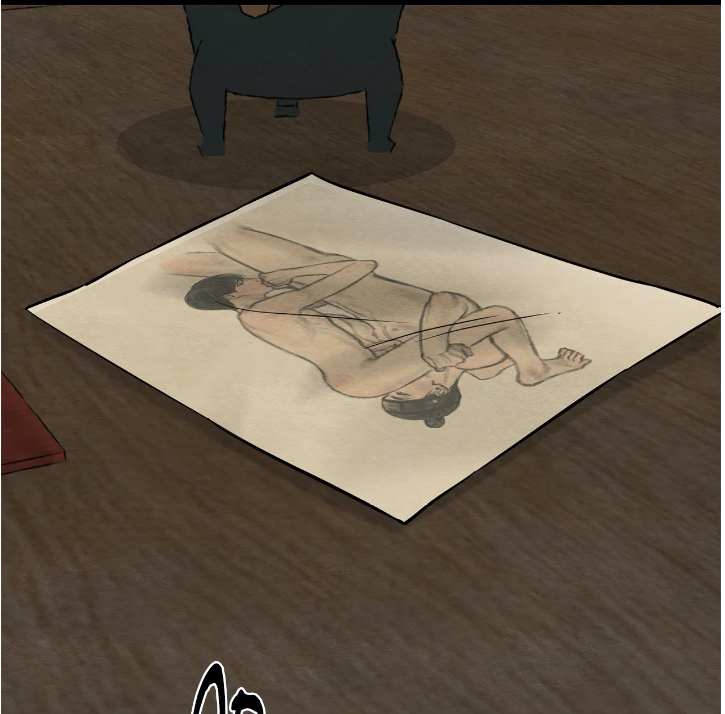 (Chapter 47) It was unfinished, and it gave the impression that both of them were acting like whores. That’s why the lord was indeed a little annoyed and made the following remark:
 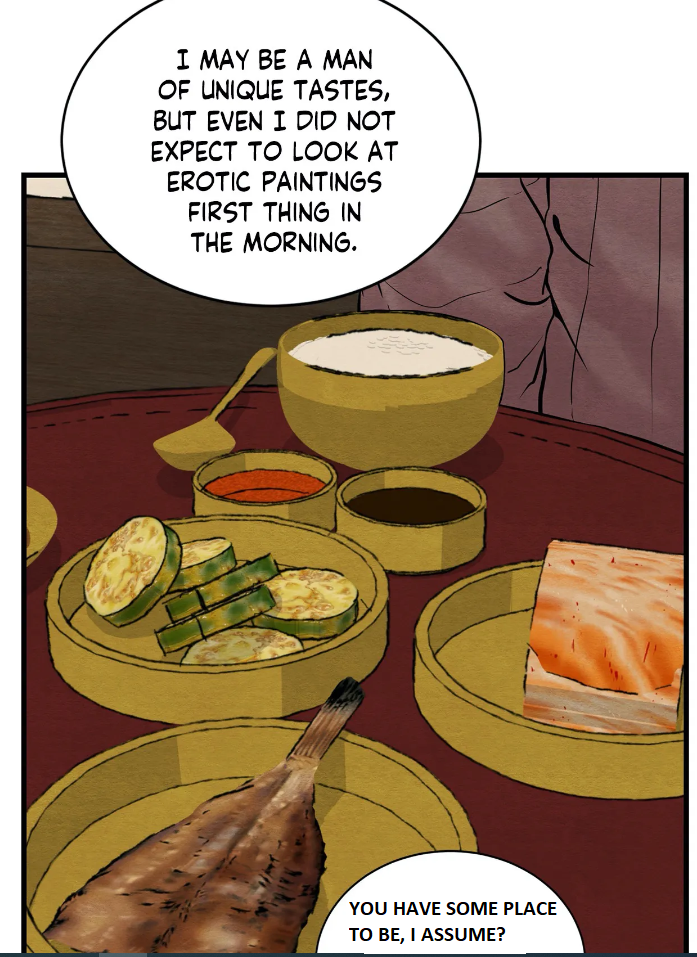 (chapter 47) And it is in this chapter that he gets to discover his reflection… or better said, Baek Na-Kyum hadn’t changed his judgement about him, which provoked the next crisis. With the last painting, Baek Na-Kyum reproduced the situation, where the master was focused on provoking reactions in his partner in order to force him to abandon his torpor.
  (Chapter 52) Therefore the beholder couldn’t detect any love and affection in this drawing, only the attempt to incite pleasure. This explicates why Min described this as salacious, and had the feeling that the commoner was only interested in sex either.
  (Chapter 41) For him, every action from Yoon Seungho was caused by his obsession for sex, while the lord was trying to win his heart.
 (Chapter 2) Simultaneously, Baek Na-Kyum destroyed it because of his jealousy (under the influence of his unconscious). The manhwalovers shouldn’t forget that in that wet dream, he wanted to take Jihwa’s place, attracted by the lord’s huge penis. Yet, he justified it with his doctrine. Furthermore, the second painting with Jihwa is created on a small sheet of paper reflecting the loss of the red-haired noble’s influence.
 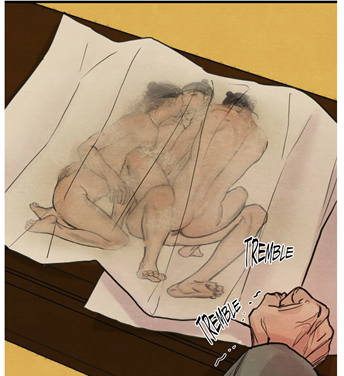 (Chapter 44) from that moment, the protagonist was no longer hosting any sex orgy which led Min to take over this role. Jihwa’s gesture symbolized that the childhood friend was not allowed to fool around with other men. However, he was quickly replaced by the painter. Let’s not forget that in the noble’s mind, Jihwa was just visiting him for his own sexual desires. He never recognized the childhood friend’s feelings. He had no reason to see otherwise, since the second lead treated him poorly.
 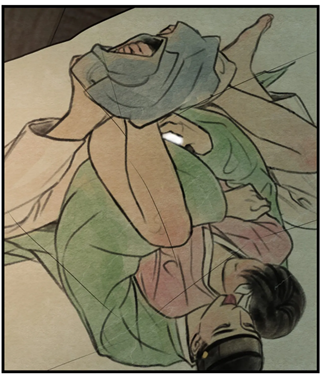 (Chapter 25) And here, the lord couldn’t perceive his own image as man consumed by lust, because his gaze was looking at the painter’s expression. This exposed the lord’s desire to see the attraction for Yoon Seungho in the painter’s eyes. His eyes were always focused on the painter the entire time, revealing that he was longing for more than sex. He wanted to see a mutual attraction… in reality, he wished to see a painting oozing warmth and love, exactly like in the publications he bought. And note that Yoon Seungho never got to see the last drawing, because his heart was too wounded by the distance. He hated so much the idea that the artist considered himself as a prostitute, while all this time, Yoon Seungho was just longing for love. Striking is that the ultimate picture is a blank sheet of paper mirroring the transition.
 (Chapter 65) Here, the lord has finally cut ties with his past. This marks the start of a new life and the painter will reflect his rebirth. But as you can see, the multitude of pictures

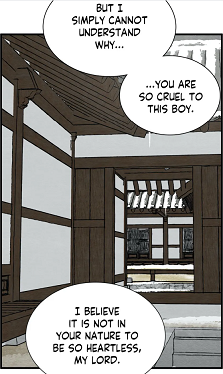 (chapter 68) In their eyes, valet Kim had turned into a hero not fearing his death. But we had another hero in this chapter, the scholar Jung In-Hun. The latter took the crying Baek Na-Kyum in his arm and brought him away from the scene, where Heena noona was getting beaten by a rich noble.
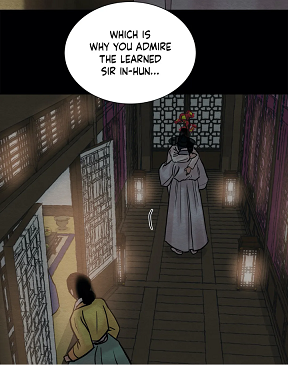 (chapter 68) In her eyes, he was a hero, because he showed concern and care towards her tenderhearted brother.
 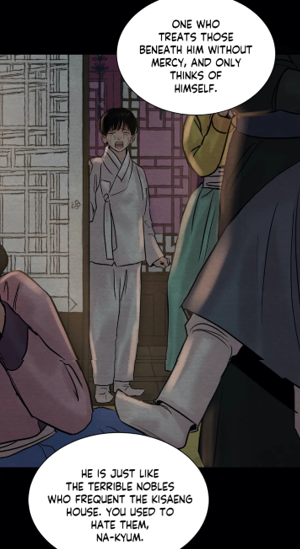 (chapter 68) Yet, the so-called hero abandoned her to her misery, as he walked away from the room.
  (chapter 68) As you can detect, the absence of her eyes reflect her blindness. The feelings she is projecting onto the painter’s are actually her own.
  (chapter 68) Now, we know why Baek Na-Kyum was so indoctrinated in the end. His own sister was also a victim of the manipulator, whom I had already diagnosed as a person suffering from a narcissistic personality disorder. Note that she uses the same vocabular than the scholar.
 (chapter 18) Hence I come to the conclusion, the teacher used the school in order to manipulate the commoners and the gisaengs. While he portrayed himself as righteous and kind, he described the powerful nobles as violent and arrogant, so that he would get the admiration from the commoners. In truth, he was deceiving them, since he looked down on them. Yet he needed them in order to get some connections to the powerful and rich nobles visiting the gisaeng house. On the other hand, since he didn’t want to get too close to the gisaengs, he employed the innocent boy as a shield, misleading Heena noona to think that Jung In-Hun had feelings for her brother. That’s why he hugs the protagonist so tightly.
  (chapter 65) He had two reasons for allowing her to meet the painter. First, Kim feared that she would cause more chaos in the future. Secondly, Kim realized that Baek Na-Kyum had become a huge source of trouble. He knew that the artist had been abducted, hence he got aware that Baek Na-Kyum had become a target of nobles. Furthermore, as soon as he had been returned, his sister made such a ruckus that she had turned the mansion upside down. Besides, like I had mentioned before, due to her behavior, she had put Kim in a difficult spot. Finally, he had another ground for giving his help:
  (chapter 67) In his mind, the butler thought that Baek Na-Kyum would leave the place right away after the harsh treatment he had received. For him, there was no doubt that no one in his right mind would stay at such a place. He knew that Yoon Seungho would come back soon. In other words, he was not helping Heena or Baek Na-Kyum here. He was doing himself a favor: his desire was to lead a peaceful life. Therefore, this explanation contradicts the first point.
  (chapter 67) In my opinion, we have here a new version of the painter’s escape from the first season: Kim acting as a shadow helped the artist to run away (chapter 29-30). However, the problem is that he got caught by Yoon Seungho.
  (chapter 68) What should he do now? I would like to remind the manhwaphiles that Kim had not only disobeyed his master’s order, but he had acted, as if he was a lord. He had given the permission without Yoon Seungho’s consent.
 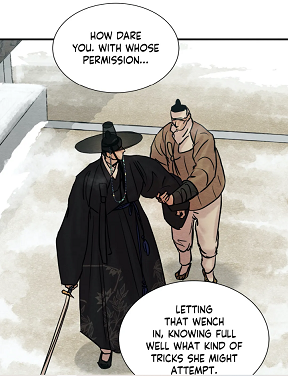 (chapter 68 It is important to recall that this story takes place in Joseon, therefore Kim’s action can definitely be judged as a betrayal and usurpation of power. One might argue that he desired to help Heena, yet like I exposed above, he did out of selfishness and not because he felt concerned for the painter and for her. As such, Yoon Seungho has the right to be upset. He is the master and someone is acting behind his back, overlooking his orders. Under this perspective, the head-maid appears more loyal to her lord than Kim himself. In this scene, he was only serving his own interest.
  (chapter 68). Note that the protagonist doesn’t menace to kill the gisaeng. He just desires to send her away, but he is now determined to punish his butler for his disobedience. He usurped his position, and as a lord he is allowed to do so. And that’s the moment, when Kim starts speaking the truth, which many readers associate to something positive.
 Note, that in that chapter, the lord had the sword in his hand, and strangely the valet came late. As you can imagine, this is no coincidence. In my opinion, butler knew that something bad had happened and in order to escape his lord’s bad mood, he arrived late on purpose (lie by commission), but at the same time he revealed his knowledge about the cause for Baek Na-Kyum’s depressed mood in order to divert his master’s attention. That way, he could put the blame on the absent noble, but also on the painter. The latter had disregarded him due to the scholar’s words. At the same time, he made the lord feel insecure, because it showed him that he had behaved exactly like a client, a man obsessed with sex. That’s why with the butler’s intervention, the master had a relapse. What mattered for Kim was a peaceful life, the rest is
  (chapter 68) Initially, it looks like he is appealing to the lord’s heart, but in reality the main point is the noble’s judgement. The valet is reprimanding his master for his lack of discernment. He misjudged the painter’s behavior. This is relevant because in this panel, I view a first emotional manipulation. His real intent is to make the lord doubt his own judgement, like “look, back then you made the wrong decision… therefore you could be wrong here”. But the readers know that Yoon Seungho is right. Heena is determined to take away his lover, so his initial judgement about Heena is indeed correct. In his eyes, she represents a source of thread, he might lose the artist. One might argue that Yoon Seungho is sequestring the painter which is also correct, yet like my reader Luzy pointed out, this is the painter’s decision. Neither Kim nor Heena nor Yoon Seungho have to make the decision for him. And here, Kim and Heena are trying to do so. The problem is that Kim got caught. But let’s go back to my initial thought. Kim used his knowledge (the lord’s misjudgment) in order to make his lord doubt himself. and he appealed to his emotions for that. This type of manipulation is called gaslighting:
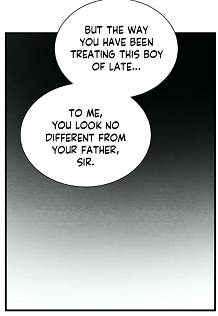 (chapter 68)
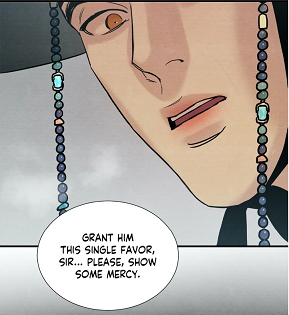 (chapter 68)
 (chapter 68) He had heard, how Heena noona was comparing him to misfortune, reinforcing his negative opinion about himself.
  He had been already prepared mentally by his butler. He was as wounded as Baek Na-Kyum, when the scholar had voiced his true thoughts about the painter.
 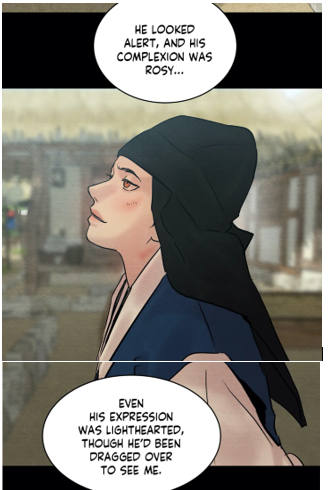 (chapter 57) His gaze is only focused on his valet, not realizing that the latter is not honest with him. From my point of view, there’s a reason why Byeonduck put Jung In-Hun’s so-called heroism
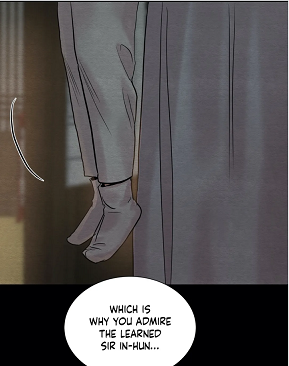 (chapter 68) He slowly takes the artist in his arms. He doesn’t rush to her side, remains silent and immobile. His passivity reflects his true personality, but Heena is too focused on her young brother to grasp the situation.
 (chapter 68), but also his quality: his honesty
 (chapter 58). Let’s not forget that the artist realized his dedication in chapter 58. Note the huge difference. The artist never uses others in order to judge the lord. Kim will realize soon enough the consequences of opening Pandora’s box. He might have achieved his goal (the lord won’t punish him for his disobedience), yet he lost his lord’s trust. Notice that right after this quarrel, Yoon Seungho started treating Baek Na-Kyum like a noble.
 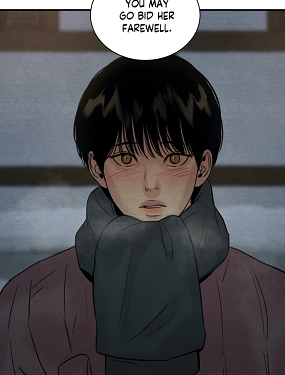 (chapter 69)
 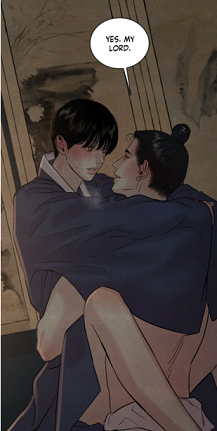 (chapter 72) From that moment on, Yoon Seungho was no longer viewing the valet as the unofficial lord. We could say that he had lost his status as “hero” in the main lead’s eyes.
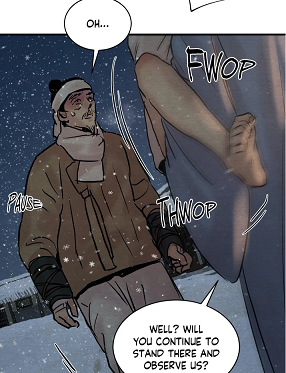 (chapter 64) The teenager was left behind by the servant, and his hand couldn’t even stop him. But since it is a reflection, I think that the butler was the one who brought the main lead to the predator, naturally his intention was not to have him raped. And now, I grasp why the lord feels the need to hurt people with his hand, like for example strangling the painter
  (chapter 61) or grabbing the topknot of a noble
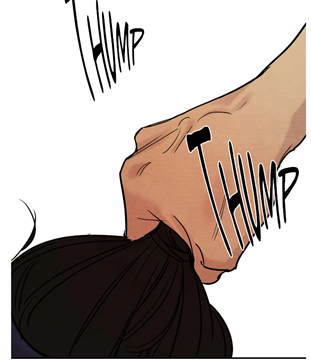 (chapter 8). His hand expresses not only his rage, but also his powerlessness. With his hand, he wasn’t able to stop the valet from leaving him behind. He had tried to stop his father from leaving his side with his hand too.
 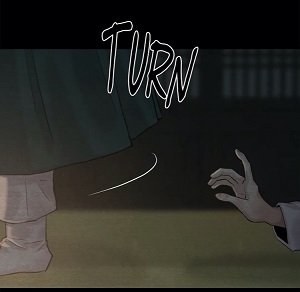 (chapter 86) Furthermore, Yoon Seungho couldn’t even punish the valet for betraying him, because he had no authority and no strength. Back then, he was just a teenager. In chapter 63 and 64, Yoon Seungho was indeed reliving his traumatic past. Because the butler was recollecting two different memories (the night before and the lord’s sexual abuse), my first impression was that the young boy had been abused in the shed.
 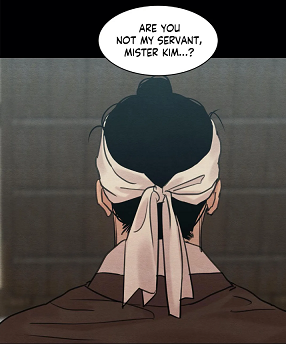 (chapter 77) My theory is that the main lead was raped by “lord Song”, the king. Therefore I assume that the man was invited by father Yoon. Remember that the kisaeng Heena proposed to her donsaeng to seek the protection of a nobleman, as he is a low-born.
  (chapter 97) My idea is that the valet thought that by seeking the monarch’s protection, the young master’s suffering would end, for the king stands above the scholars and elders. Anyway, I believe that the valet made a bad choice and regretted it afterwards. Due to his guilt, he developed resent towards Yoon Seungho. And this explains why Kim said this to the painter in order to ease his pain:
  (chapter 12) He couldn’t tell him details, since he would reveal his complicity to the crime. Furthermore, since the valet led the painter to the pavilion, it is very likely that Kim was the one who offered Yoon Seungho to the pedophile, which makes his crime even worse.
  (chapter 77), he became more and more burdened by his guilty conscience. He turned into an accomplice, for he never revealed his involvement and mistakes.. He could no longer reveal the truth, because he would have to get punished. He feared father Yoon’s wrath and he had reasons too. He could definitely die. That’s the reason why he reproaches the doctor his passivity and silence, though in my opinion, it was not about the abduction, but about the tonic. Sure, in Joseon, there was no law called “Duty to rescue or Failure to provide assistance”.
 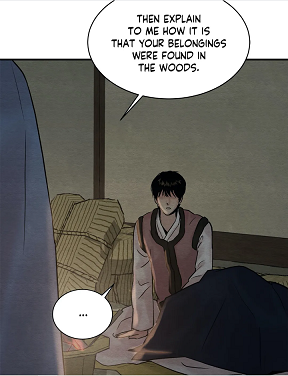 , (chapter 62) especially when you think that Baek Na-Kyum is just a commoner. But the problem is that he was biased, just like his father who had the impression that his son was a homosexual due to the testimonies of close people (Kim, Lee Jihwa and probably Yoon Seung-Won). After the rape, Yoon Seungho got punished. And this interpretation was proven correct in season 3
 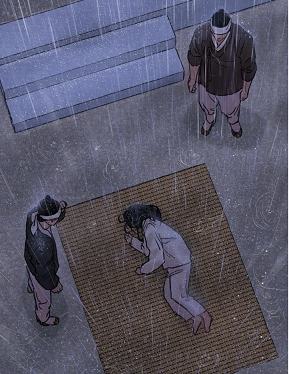 (chapter 77). But here Kim remained silent too.
 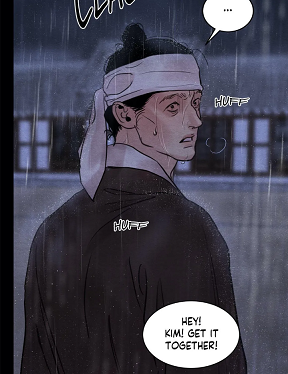 (chapter 77) It was even worse than before, because after the straw mat beating, he was paralyzed. No one spoke for him and believed his words, and Kim wasn’t willing to step in. Moreover, I believe that Kim had another reason for remaining silent.
  (chapter 65) That’s why I believe that the author is not showing that Kim and the physician chose secrecy and silence, because they feared for their life. They only started fearing for their life, when the truth is about to be revealed, as the painter was not dead yet. As the victim, he was a witness. Because once the lord discovers the butler’s passivity and complicity, it becomes a matter of life or death for him. According to me, there are two doctors. So the chapter 65 unveils that the first doctor didn’t testify, as he wanted to help the artist.
  (chapter 65) This represents his attitude in life, therefore he is responsible for Baek Na-Kyum’s loss of innocence. His other leitmotiv is
 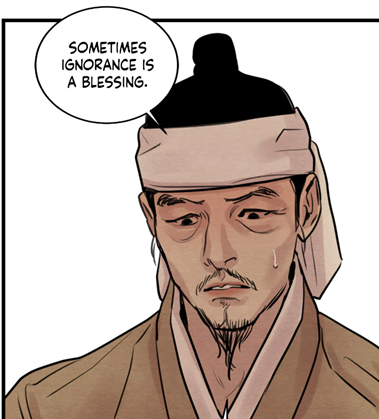 (chapter 23) He acts, as if he knows nothing reminding us of this scene.
 (chapter 65) the artist after their intercourse and even gives him his own shirt. He shows a certain sense of responsibility.
  (chapter 82) Why didn’t he ask for a punishment after this humiliation? It is because he couldn’t. However, he must have definitely sought revenge. And the main lead became the sacrificial lamb, as in father Yoon’s eyes, his son was the reason for the purge: desertion, betrayal and probably drugs played a role in the purge. It is definitely possible that I have to change this theory about his traumatic past, but as you can observe, the main elements don’t change:
 (chapter 65) The lord realized that something had happened. Due to the painter’s reaction, he was brought back the past.
  (chapter 66) This stands in opposition to silence. Therefore it is no coincidence that Min revealed the truth.
  (chapter 66) The irony is that Heena suspected the main lead of kidnapping her brother and everything looked like her words were true: the wrist, the wounds around his wrist, his actual position (the mouth covered and his hands tied together…)
 (chapter 66)
  (chapter 66) Thus the circumstances were turned against him.
  (chapter 65) But she was not present, when Min admitted Lee Jihwa’s crime. That’s how I realized that while chapter 65 represents silence, deception, cowardice and passivity, chapter 66 embodies the exact opposite. Min told the truth, Heena tried to save her brother by creating a ruckus! For Yoon Seungho, silence is a sign of culpability which he learnt from Kim. Hence he lied to the kisaeng
  (chapter 65), and later never spoke to the painter about the incident. If he had done it, he would have been forced to admit his misjudgment and wrongdoing. And now, you understand why Martin Luther King said this:
 (chapter 57) It doesn’t matter, if the butler told lies to the physician in the past, as they are now perceived as truth. Remember what Kim confided to the painter:
  (chapter 86) He believes that he is the only one left who knows the past. But he is wrong, since the doctor also recalls the past. Hence how can Kim prove that he is telling the truth, since he told a different story to the physician? In addition, we have also lord Song. Besides, by giving the drug to Yoon Seungho without his knowledge and consent, Kim committed a wrongdoing. His knowledge won’t serve him in the end. I am deducing that the saying “silence is a true friend who never betrays” will no longer be valid. Therefore we have to expect a betrayal, and that would be from the physician, especially after we recall the butler’s warning in the first season, which was addressed to a different doctor from my point of view:
  (chapter 33) Let’s not forget that in chapter 65, the servant tried to put the whole responsibility on the physician, making him feel guilty. And since Byeonduck is even using elements from the first and second season, I believe, we will have a reversed situation in season 4, where the doctor will speak up and put the whole blame on someone. Neither the physician nor Kim expected that the painter’s body wouldn’t remain silent
  (chapter 98) As you can see, slowly people are forced to talk
 (chapter 99), hence their testimony can be questioned and perceived as lie.
 (chapter 100). This is important, because by getting confronted with lies, the lord will be able to discern the truth! In other words, silence embodies darkness and as such death.
  (chapter 74) Thus there was only silence in the lord’s nightmare. And this contradicts this statement:
 (chapter 57) And if we look at the picture, the manhwaphiles can detect that Kim seemed to have the teenager’s trust. This is visible thanks to the domestic and Yoon Seungho’s gestures. They are talking to each other in a very natural way. We can conclude that they were close, especially if I include this panel in my examination.
  (chapter 57) That’s why I come to the conclusion that the butler Kim was in fact loyal to the elder master and not to Yoon Seungho. He might have had an affection for the teenager, yet in truth he serves the head of the family. And notice that valet Kim is still giving the expensive medicine to the protagonist, although this was ordered by father Yoon.
 (chapter 35) In this scene, the valet gives an order to his master and not an advice, since he employs the verb “must”. Why? Because he thinks, the letter was sent by the elder master. And Yoon Seung-Won knew that Kim was loyal to their father. Hence when he sent the letter, he used his father’s name and authority, but in order to maintain the illusion that father Yoon was the author, the brother also requested that valet Kim would bring back himself the reply. The deceitful brother used not only the butler’s fidelity to his advantage, but also gave the impression that father Yoon cared somehow for the black sheep. It was, as if the elder master was trying to rekindle with his older son. The readers can sense more his loyalty to the elder master, if they compare his reaction, when Yoon Seungho received the fake letter from lord Song.
 (chapter 56) Here, the domestic got scared, by just hearing the name. Nevertheless, he gave his master the advice to postpone the meeting due to his health.
 Yet, observe how he hides his discomfort and fear to his master by suggesting to postpone the meeting which exposes that he is hiding his true emotions. He justifies his advice by faking concern for his lord. Hence the lord can only have the impression, he is protecting his interest. Striking is that since we saw him scared, we have the impression that he is brave enough to propose not to the follow the invitation. My initial impression was to think that he got afraid of the name lord Song due to the lord’s traumatic past and he feared for his master’s mental health condition. However, the moment the valet realizes that the noble is on his way to meet this aristocrat, he gets so scared that he leaves the mansion immediately. So he doesn’t want them to meet.
  the butler expresses his worries concerning father Yoon. He doesn’t want the elder master to hear the news about Jihwa’s public confession, as the servant is well aware of father Yoon’s mentality.
  (chapter 57) He seems concerned for Yoon Seungho again. He knows that the head of the family hates homosexuality. He witnessed how the father separated Jihwa from Yoon Seungho with the excuse of an illness. He was present, when the teenager was imprisoned in the mansion.
 (chapter 57) One might question his loyalty to father Yoon, since the butler chose to remain by Yoon Seungho’s side after the topknot incident. However, I could respond that the valet saw it as his duty to keep an eye on the elder son on behalf of the head of the family. From my point of view, valet Kim decided to follow Yoon Seungho for other reasons than true loyalty to the protagonist. In the past, I used to think that he felt guilty for the main lead’s suffering. But I had to review my judgement. If he truly felt remorse, then he should have treated the eldest son differently in the mansion. Yet, he let him become a head-kisaeng. Moreover, the guilty conscience only resurfaces the moment he is confronted with a situation reminding him of his wrongdoing.
  (chapter 57) Furthermore, as an infamous hell-raiser, no powerful noble would be interested in him. When the purge occurred, the son had become the sacrifice and scapegoat, hence he was forced to remain at the property. And now, you can grasp where the butler’s loyalty lies. He is faithful to the mansion and property, and not to Yoon Seungho or father Yoon in reality. This explicates why he lies to Seung-Won and tries to stop him from entering the lord’s chamber. As Seung-Won is only the second son, he is not considered as the lord of mansion, while father Yoon is the senior and is supposed to be the head of the family. Because he is bound to the domain Yoon, he is definitely acting more like a dog than like a matchmaker or a father. He is able to find his owner very quickly, as if he was following his scent.
 (chapter 57) He barks like one, when he yells at Deok-Jae.
 (chapter 47) He is also sent to fetch the painter, when the latter is somehow “abducted” by the scholar.
  (chapter 24) But the most conclusive evidence for this association is his rapport to the door. He is always shown next to an opened door or even often stands on the door threshold.
  (chapter 45) Since dog owners often put the sign “beware of the dog” on their door, you understand why I see it as an evidence that the valet is more as a dog than anything else. The butler is the guardian of the mansion, watching out for the owner’s safety. However, here we should comprehend it in a figurative sense. On the surface, the butler is looking out for the reputation of the Yoons, while in truth he is just focused on living a peaceful life far from trouble.
 (chapter 64) The dog is not only a symbol for loyalty, but also it represents obedience and secrecy. He knows what is happening in the mansion, but he won’t let it transpire to the outside world. Therefore I deduce that valet Kim is quite similar to Jihwa. He knows the main lead’s whole past and tragedy, but he doesn’t truly feel sorry for the main character, for if he revealed the truth, because it would expose his culpability.
 (chapter 26)
 (chapter 26) He is leaving the artist behind, as he doesn’t want to be confronted with his wrongdoing: his passivity and cowardice. Then when he meets the protagonist in the main way, he sees his cold and distant gaze. So he knows that his master is in a bad mental condition, yet out of fear, he still leaves the artist behind, well aware that something bad could happen. That’s why he chose to intervene in the shadow (like for example, sending a servant to the scholar) so that I am now convinced that he even witnessed what happened to Yoon Seungho, but chose to close the door. There’s a reason for this assumption. First, he is connected to an opened door. Secondly, there’s this incident with the door in chapter 16.
 (chapter 64) He resented valet Kim for his betrayal and abandonment. That’s why I believe, in that scene, Yoon Seungho is using the same words than his rapist from back then.
  (chapter 64) In this scene he is reliving his own traumatic past, the first rape. And after it had occurred the first time, the valet must have told him this:
  (chapter 65) Baek Na-Kyum is now the lord’s companion, while in the past he used to plot against him. In that moment, the valet recognized that ignorance is not a blessing, because this doesn’t erase the event. Observe that Kim has a similar approach than Jihwa again. Since the painter returned to Yoon Seungho’s side, the noble has now the feeling that nothing happened. For the first time, Kim sees the true face of his master
  . (chapter 45) First, it symbolized that the painter was more than just a favored favor. But more importantly, he never cared about the item, since
  (chapter 63) He is indeed a hypocrite, a selfish person,
 (chapter 56) He trusts him to a certain extent, because the valet took care of him, while he was delirious. The domestic even stopped him from committing suicide.
 (chapter 50) This explicates why Yoon Seungho can’t trust Kim’s words in the end.
 (chapter 62) In his eyes, he betrayed and abandoned him once, therefore it is definitely possible that he is lying. The longer the lord lives with the artist, the more he senses that Kim shouldn’t be trusted. This explicates why the lord’s relationship with the valet is deteriorating. In season 1, he never doubted Kim’s words, but now it has changed. The painter’s genuineness makes Yoon Seungho detect the butler’s fakeness and hypocrisy. And since the lord threatened him with the sword, I am envisaging that he will do it, the moment he feels that his loyal butler betrayed him.
  (chapter 45) The purpose of this action is simple. On the one hand, he gave the impression that he was protecting Yoon Seungho’s interest, on the other hand he was pushing the jealous servant to plot something so that Baek Na-Kyum would disappear. Kim was well aware of Jihwa’s visit in chapter 43. He knew that the second lead would do something out of jealousy. Kim needed the painter’s submissive attitude, as this could only affect his lord positively, turning the mansion into a golden cage. And while I envisaged that the shock Kim experienced during that night would make change his mind,
 (chapter 31) Consequently in chapter 34, the painter sensed a change of perception about his body after the sex marathon. For the first time, he detected his heartbeat and the butterflies in his stomach, which were triggered by the main lead’s presence.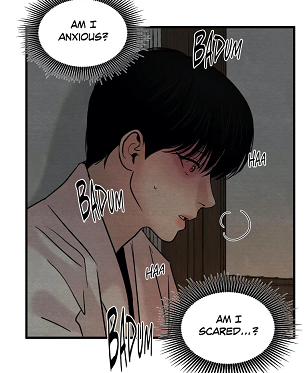
 (chapter 34) The parallels can be observed by the absence of the eyes of the protagonists in certain panels. Compare the picture with the mirror
 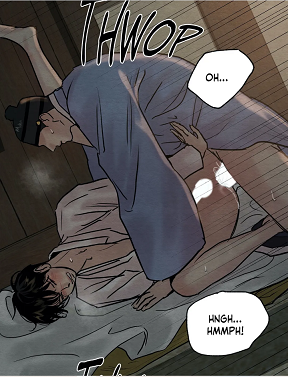 (chapter 63) Striking is that the character represented with eyes plays the role of the liberator for his sex partner. Due to the sex marathon, Yoon Seungho had helped the painter to free himself from his torpor, since due to the coercive persuasion, the artist had come to deny not only his sexual orientation, but also the existence of his own body. That’s why he could no longer admire his learned sir like before after the sex marathon. By recognizing the existence of his own body, the painter couldn’t feel the same attraction towards the teacher. And since the sex marathon played a huge role in his healing process, we have to imagine that the sex scene in the barn has the same signification for Yoon Seungho. He is on his way to be liberated from his self-hatred, but as you can imagine, it will be a painful process. Back then, the painter got ill and the lord ran away from his responsibility. That’s why this time, the blinded person will be the one suffering from the sex marathon: he will feel like dying, when he realizes that he wounded his lover blinded by his prejudice and anxieties.
  (chapter 63) He has no guarantee that this is true, and love is like a leap of faith. This isn’t something that you can grasp or see. Besides, he would have no control over him, if he accepts the confession. Loving means taking risks, which is linked to fears. This displays how much the master has been brainwashed. Since the painter disappeared in his mind, he came to acknowledge his father’s doctrines one more time before dropping them completely, when he discovers the truth.
 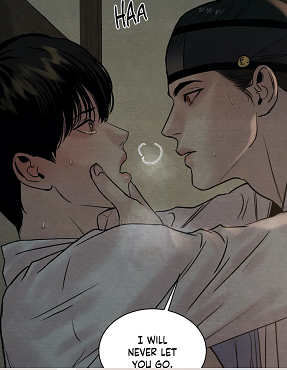 (chapter 63)
 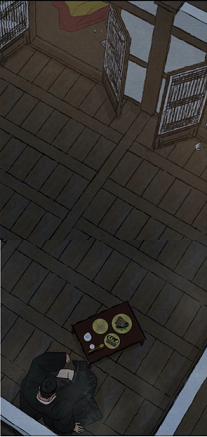 (chapter 69) He had ruined his relationship with the artist. Because he refused to make the leap of faith in the shed, Yoon Seungho decided to make the opposite choice. He let the painter decide about his own fate, yet he was definitely living in agony. The wounded, fearful and desperate gaze revealed his turmoil.
  (chapter 62)
 He rejected his concern and yelled at him. In chapters 62-63, the positions are switched. Yoon Seungho is the one upset and pained, since he is convinced that the artist abandoned him, therefore his anger is aiming at the commoner. Yet, the true culprit of his wound is his childhood friend Jihwa. Simultaneously both have a common point: Baek Na-Kyum gets hurt, because he becomes the target of Yoon Seungho’s anger, while in chapter 40, he is backstabbed by his admired sir and used the master to get some comfort. Yet, the situation is similar, as the real culprits of the wound never witness the consequence of their actions and words.
  (chapter 63) And if we take the chapter 41/42 into consideration, the painter did request that the lord should be particularly rough.
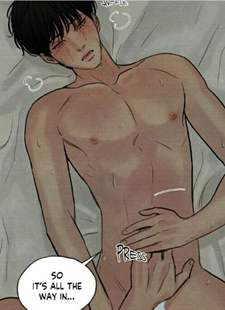 (chapter 42) As you can see, the chapter 40 can not be really detached from the sex scene which follows the teacher’s betrayal. Another contradiction is that the painter is just asking the lord to stop, since Baek Na-Kyum is exhausted, while the aristocrat believes that the commoner is pushing him away, begging him to let him go for good.
 (chapter 63) But this divergence comes from the fact that this scene is a new version of the sex marathon, which I mentioned above. Back then, the painter made a similar request. As conclusion, the violence of the sex in chapter 62-63 is strongly connected to an emotional wound, a repetition of chapter 41/42. And in my opinion, the artist understood the situation and the lord’s motivation. Hence he doesn’t feel badly about Yoon Seungho. Notice that the next night, Baek Na-Kyum doesn’t think badly of this sex marathon.
 (chapter 40)
 (chapter 63) What caught my attention is the contrast between the two declarations. While the artist’s feelings for his admired sir seem to be very strong (I adore you), his words don’t really correspond to his affection, because his feelings have already diminished. He did lie to his teacher and protected the main lead in chapter 38. That’s why the “I adore you” should be judged as an exaggeration. It was, as though the painter desired to convince himself and his teacher that he was still attached to him. Besides, he needed to persuade him not to abandon him, after hearing so many reproaches. This observation leads me to the conclusion that Baek Na-Kyum made up his mind to still follow his teacher out of loyalty despite the harshness of Jung In-Hun’s words. On the other hand, the author used a litotes (“I do not dislike you”), implying that in fact his attachment is much stronger. And this is exactly what happens during this scene. Despite the harshness, the painter is forced to question his true feelings for the main lead and recognize them. He is even willing to confess, yet he is stopped. I doubt that Yoon Seungho would have perceived it as a love confession, as he hates meek words. I can use this panel as a reminder:
 (chapter 48). Yoon Seungho is exactly like the painter, he loves strong and metaphorical confessions, like “you’ve made me a wreck” or “I will never let you go”. But let’s return our attention the scholar and Yoon Seungho. Both nobles act the same way. Both can’t accept the artist’s declaration, yet their motivation diverges. The teacher finds it disgusting to be connected to a commoner, whereas Yoon Seungho is too afraid of being lied. He has the impression that this dream can never come true. Yet, while contrasting them, we see the painter’s determination who is willing to overlook the reproaches expressed before by both aristocrats. And he remains faithful till the end. That’s why he waited for Jung In-Hun at the gate in episode 44.
  He needed to see with his own eyes, how the learned sir had truly abandoned him. This represents another explication why the low-born didn’t react like Kim and Min anticipated. He didn’t follow his sister out of loyalty, compassion and a certain trust. However, Heena noona was able to sow seeds of doubts.
 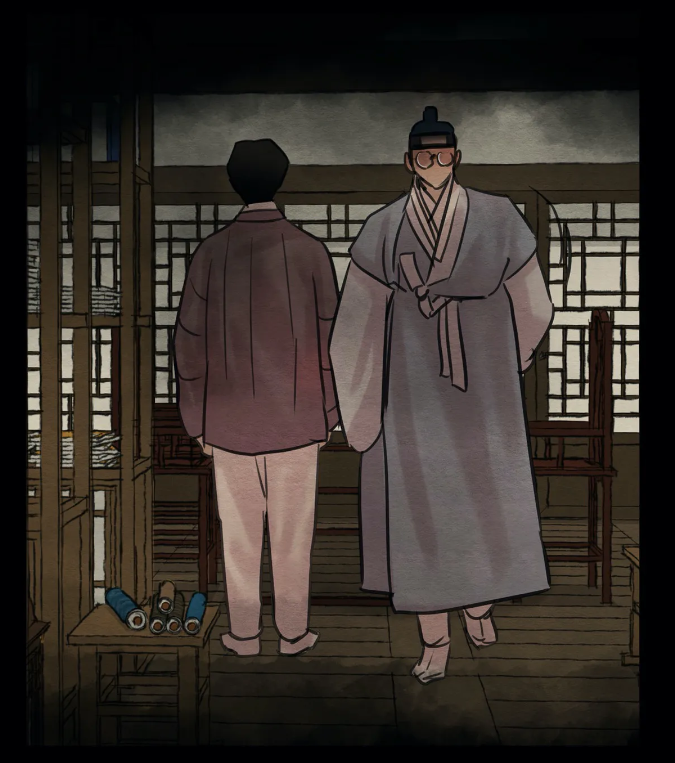 (chapter 40) In this picture, the scholar leaves the painter behind, a metaphor for his abandonment. He even repeats this action, when he leaves for the capital. In chapter 62-63, Yoon Seungho sees in the commoner’s escape a rejection and betrayal.
  (chapter 62) This panel illustrates the thoughts of the protagonist: the commoner has turned his back on him.
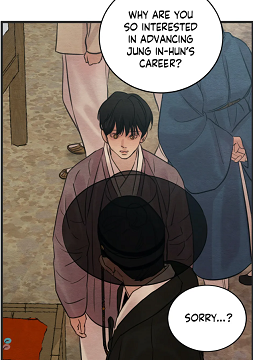 (chapter 40)
 (chapter 40)
  (chapter 62)
  (chapter 63) In both cases, the aristocrats questions the commoner’s motivations for his actions. While Jung In-Hun’s interrogation serves him as an occasion to break his promise by putting the blame on Baek Na-Kyum, the other character is more curious to know about the reasons for his desertion. From my point of view, this shows the noble’s desire to comprehend the painter better. And this illustrates that his obsession with the “why” is well meant. Why is he pushing him away? If he knows the cause, he could find a solution in order to bring the painter to his side.
  (chapter 40) The painter became happy, when he heard that the civil service examination would take place soon. He immediately thought of his learned sir and envisioned that this would please his former teacher. Jung In-Hun’s excitement became the painter’s joy, this is how the painter was thinking in that scene.
  (chapter 40)
  (chapter 40) The former had Yoon Seungho’s attention all the time, and we all know that Jung In-Hun’s desire is to get attention and admiration. Striking is that the comparison enlightens the materialistic and narcissistic side of Jung In-Hun, while Yoon Seungho appears purer. He is just content with a smile. Besides, he would like to be the source and recipient of Baek Na-Kyum’s smile, whereas the other wishes to get favors (clothes, a room closer to the lord’s chamber, the favor to spend the evening in the bedchamber etc). That’s why by contrasting both chapters, the protagonist’s purity and simplicity become even more palpable, which is hidden due to the violence employed during that confrontation.
  Furthermore, if we take the chapter 41 into consideration, since we have a flashback of the incident at the library,
 (chapter 41) He only knew sex. In chapter 62, the lord hold the artist in his arms, only to betray him afterwards. The warmth is faked.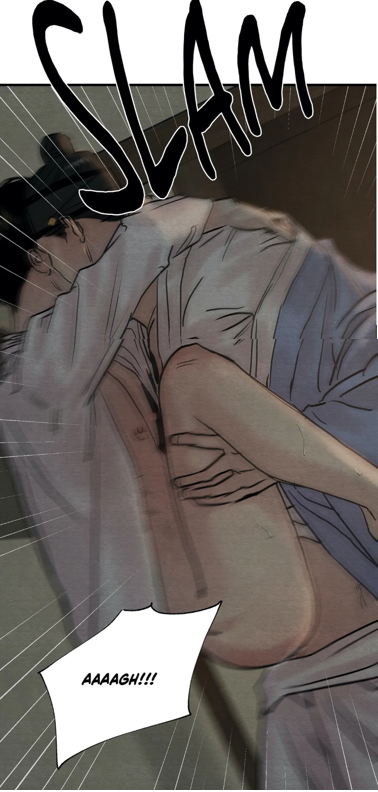
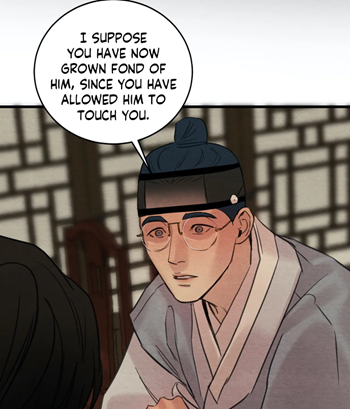
 (chapter 40) while in chapter 63, it is the turn of our seme to reveal his expectations and desires.
  ,(chapter 62) while the scholar calls the artist a fool
 . (chapter 41) He is just jealous, furious and repulsed. Yoon Seungho is seeking closeness and uses sex in order achieve his goal, therefore he is is refusing to stop. He is so desperate to remain intimate with the painter, while the other noble has only one thought: keeping his distance from the low-born.
 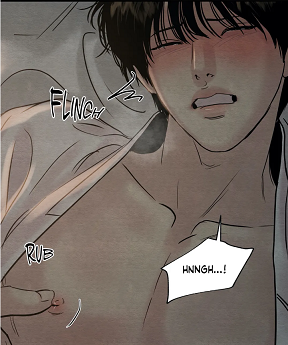 (chapter 63) and words
 (chapter 63) have a huge effect on the upset protagonist. They trigger the noble to open up and reveal himself. That’s why the chapter ends with a face to face: the aristocrat is not decided to look at the painter’s eyes directly.
 (chapter 40)
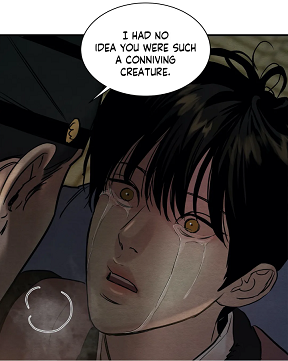 (chapter 62)
 (chapter 71) and Yoon Seungho’s outburst
  (chapter 62)
  (chapter 71) There was a “love confession” in the barn, but the lord didn’t use the typical expression for that:
 Bebebisous33s' analyses in K-Dramaland and Manhwas