

This is where you can read the manhwa. https://www.lezhinus.com/en/comic/painter But be aware that this manhwa is a mature Yaoi, which means, it is about homosexuality with explicit scenes. If you want to read more essays, here is the link to the table of contents: https://bebebisous33analyses.wordpress.com/2020/07/04/table-of-contents-painter-of-the-night/
It would be great if you could make some donations/sponsoring: Ko-fi.com/bebebisous33 That way, you can support me with “coffee” so that I have the energy to keep examining manhwas. Besides, I need to cover up the expenses for this blog.
“The ultimate tragedy is not the oppression and cruelty by the bad people but the silence over that by the good people” from Martin Luther King
With this quote, the famous American Baptist minister denunciated the passive attitude of many Americans, who didn’t feel concerned with racism and segregation in 60’s. Why?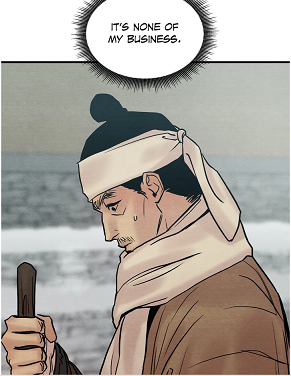 (chapter 65) As you can see, the valet Kim is not revealing the truth, not out of fear, but he has the impression, this is not his problem. He chooses indifference. With this single attitude, the readers discover Kim’s true personality and past, confirming my last analysis about him. When he heard the painter’s refusal,
  (chapter 65), he was brought back to the past. The domestic was a witness of Yoon Seungho’s rape and as such of his sexual abuse. Striking is that in episode 65, he didn’t even open the door, but instead of helping, he let it happened. He didn’t act according to his belief. This means that in the past, he must have acted the opposite. The door was open. This signifies that he abandoned the young Yoon Seungho, when the main lead asked for assistance.
 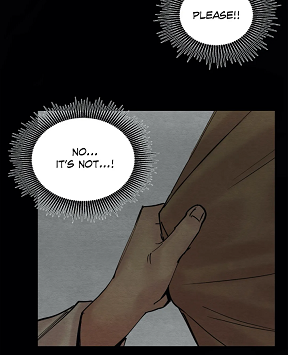 (chapter 65) He refused to listen to the young master’s plea. And now, you understand why Yoon Seungho had sex in front of him outside the barn. Unconsciously, he wanted to confront the valet with the consequences of his actions.
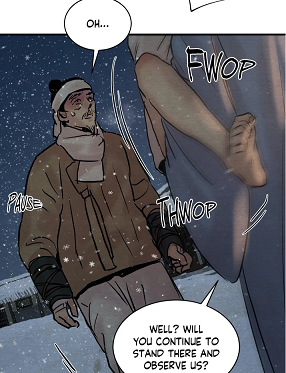 (chapter 64) The teenager was left behind by the servant, and his hand couldn’t even stop him. But since it is a reflection, I think that the butler was the one who brought the main lead to the predator, naturally his intention was not to have him raped. And now, I grasp why the lord feels the need to hurt people with his hand, like for example strangling the painter
  (chapter 61) or grabbing the topknot of a noble
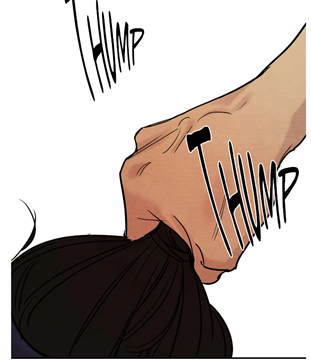 (chapter 8). His hand expresses not only his rage, but also his powerlessness. With his hand, he wasn’t able to stop the valet from leaving him behind. He had tried to stop his father from leaving his side with his hand too.
 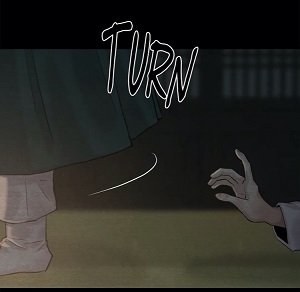 (chapter 86) Furthermore, Yoon Seungho couldn’t even punish the valet for betraying him, because he had no authority and no strength. Back then, he was just a teenager. In chapter 63 and 64, Yoon Seungho was indeed reliving his traumatic past. Because the butler was recollecting two different memories (the night before and the lord’s sexual abuse), my first impression was that the young boy had been abused in the shed. (chapter 65) Yet, the storage room is the place where the valet betrayed him, as he changed his lord.
 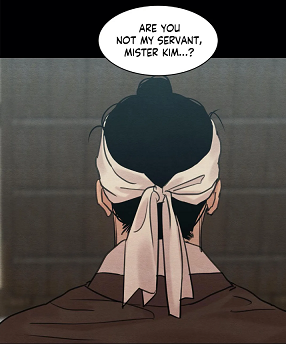 (chapter 77) My theory is that the main lead was raped by “lord Song”, the king. Therefore I assume that the man was invited by father Yoon. Remember that the kisaeng Heena proposed to her donsaeng to seek the protection of a nobleman, as he is a low-born.
  (chapter 97) My idea is that the valet thought that by seeking the monarch’s protection, the young master’s suffering would end, for the king stands above the scholars and elders. Anyway, I believe that the valet made a bad choice and regretted it afterwards. Due to his guilt, he developed resent towards Yoon Seungho. And this explains why Kim said this to the painter in order to ease his pain:
  (chapter 12) He couldn’t tell him details, since he would reveal his complicity to the crime. Furthermore, since the valet led the painter to the pavilion, it is very likely that Kim was the one who offered Yoon Seungho to the pedophile, which makes his crime even worse.
With Kim’s silence came a huge price: fear and guilt.  (chapter 65) Since he had not assisted the young master repeatedly
 (chapter 77), he became more and more burdened by his guilty conscience. He turned into an accomplice, for he never revealed his involvement and mistakes.. He could no longer reveal the truth, because he would have to get punished. He feared father Yoon’s wrath and he had reasons too. He could definitely die. That’s the reason why he reproaches the doctor his passivity and silence, though in my opinion, it was not about the abduction, but about the tonic. Sure, in Joseon, there was no law called “Duty to rescue or Failure to provide assistance”.
“Failure to assist a person in danger is a criminal offence that condemns the failure to assist a person in danger. Contrary to most criminal norms, it is an offence of omission and not of commission, i.e. the perpetrator does not act when he should have done so.”
However, from a moral perspective, Kim committed a wrongdoing, and he knew it. That’s why he couldn’t forget and felt guilty. Even nowadays “Duty to rescue law” doesn’t exist everywhere, nonetheless many European countries, like Germany or France or UK possess one and its creation was partially influenced by the experiences made due to Nazism. And now, the manhwalovers can comprehend why my association to dictatorship was correct. Kim and other ordinary people are their willing assistants in the end. They prefer avoiding trouble out of convenience. Consequently, they turn a blind eye to injustice. Yet, though they try to forget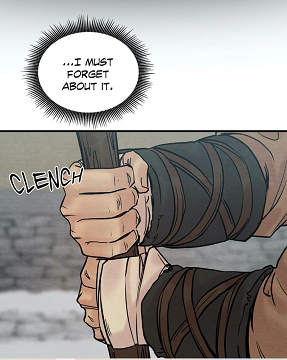 (chapter 65), they can’t, because they feel guilty and remorse. Note that right after voicing his wish to forget the incident, he recalls Yoon Seungho’s tragedy indicating his incapacity to forget. This explains why Kim gives the doctor the following advice: (chapter 65) Although Kim’s words in the panel are addressed to the physician, they actually reflect that Kim is speaking out of experience. He knows by experience that “silence is a true friend who never betrays”. Observe that Kim’s complicity was never brought to light, hence he never got punished. This explicates why Yoon Seungho is acting differently from his biological father in reality. Each time there was a crime, the lord let the painter defend himself and asked questions: chapter 11 and 62
 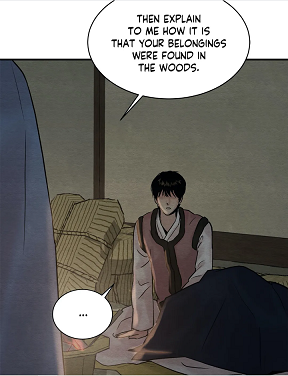 , (chapter 62) especially when you think that Baek Na-Kyum is just a commoner. But the problem is that he was biased, just like his father who had the impression that his son was a homosexual due to the testimonies of close people (Kim, Lee Jihwa and probably Yoon Seung-Won). After the rape, Yoon Seungho got punished. And this interpretation was proven correct in season 3
 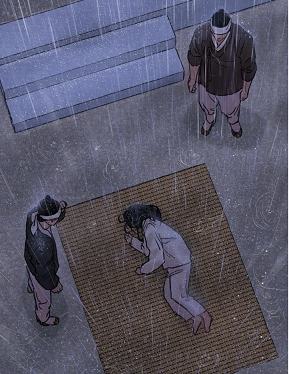 (chapter 77). But here Kim remained silent too.
 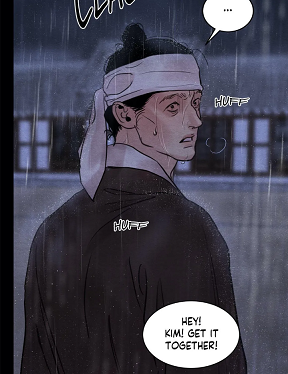 (chapter 77) It was even worse than before, because after the straw mat beating, he was paralyzed. No one spoke for him and believed his words, and Kim wasn’t willing to step in. Moreover, I believe that Kim had another reason for remaining silent.
 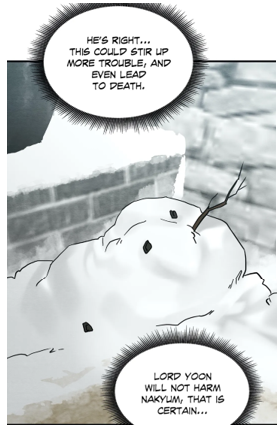 (chapter 65) He disliked the idea of a scandal and trouble. If he had told the truth, he knew that his punishment would be death. Out of convenience, he ran away from responsibility and from the uncomfortable truth.
  (chapter 65) That’s why I believe that the author is not showing that Kim and the physician chose secrecy and silence, because they feared for their life. They only started fearing for their life, when the truth is about to be revealed, as the painter was not dead yet. As the victim, he was a witness. Because once the lord discovers the butler’s passivity and complicity, it becomes a matter of life or death for him. According to me, there are two doctors. So the chapter 65 unveils that the first doctor didn’t testify, as he wanted to help the artist.
 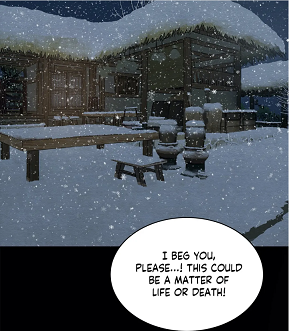 (chapter 65) In my opinion, the butler had deceived the commoner, he let him believe that Baek Na-Kyum had run away because of the lord’s violent temper. The painter had come wounded to his office. This negative perception of the young lord Yoon could only make the doctor jump to wrong conclusion. ,Striking is that this scene
 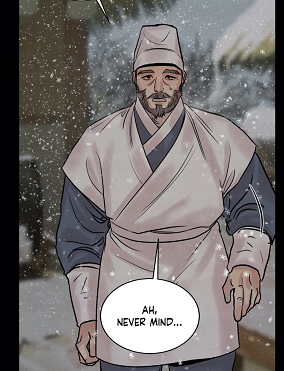 (chapter 63) revealed that the doctor was hesitating to give his opinion to the butler, he thought that the artist had run away. And what is the common denominator of all these scenes with the doctors. They all chose silence for different reasons. Just like Kim, the doctor had become an accomplice. As for the second, he remained silent out of fear, that he could get into trouble.
 (chapter 65) My theory is that the valet used the drug as an excuse to silence the physician. Now, the doctor is hoping that the boy says no word about it, so that his “wrongdoing”, the false medication, won’t be discovered. Kim blamed the doctor that after that, his master had behaved like a crazy man. The result was that both physicians chose silence!! Why? It is because the valet had pushed them to make this choice. And note the pattern. Kim used pity and compassion for the first doctor, and fear and brutality for the second! Exactly like in this scene: (chapter 12) In this scene, we have all three elements: pity, fear and silence (“can’t go into details”).
And despite knowing the truth, Kim makes the same decision like in the past. He chooses to sweep the incident under the carpet. He is glossing over the abduction with all fake excuses. (chapter 65) He has the audacity to say that his master won’t hurt the painter, although he even witnessed the roughness the artist was exposed to. Yet, for him harm was flogging or execution. From my perspective, this is no coincidence that the author showed us the valet sweeping.  (chapter 65) This represents his attitude in life, therefore he is responsible for Baek Na-Kyum’s loss of innocence. His other leitmotiv is
 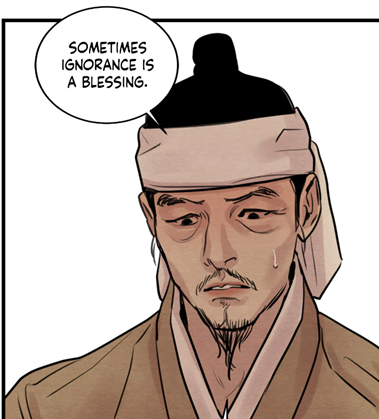 (chapter 23) He acts, as if he knows nothing reminding us of this scene.
 (chapter 28)That’s why I believe that the butler was lying back then and had even allowed the artist to run away that morning. I see a new version of chapter 29. But let’s go back to chapter 65. Notice that he is the one removing the snowman built by the painter, the last reminder of the low-born’s innocence. In two occasions, he chose cowardice and silence. First, he did nothing to stop his master (chapter 65), as he didn’t desire to feel his master’s wrath. Secondly, he asked the physician to keep silent by making him feel guilty. (chapter 65) But if he had seen this, he could have intervened and reasoned his master. But he chose not. He was too embarrassed, for he had been caught “spying”.
 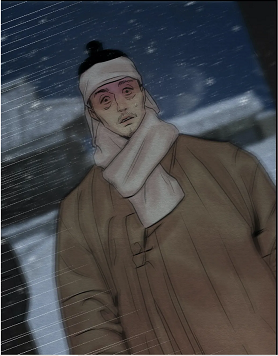 (chapter 64)
And the next day, he prefers to forget this incident. (chapter 65) What caught my attention is that he feels nothing for the painter, he doesn’t even express any regret or remorse. Since he knows that the artist won’t be killed, then everything will return to normal. He doesn’t consider the impact of Yoon Seungho’s violence used against the painter, which he witnessed on several occasions. For him what matters the most is silence, the absence of ruckus! And now, I can understand why the lord is not able to distinguish genuine from hypocritical care. When the lord was young, he saw in his valet a surrogate father, but he got betrayed in the worst way. He turned away from the wounded master. He closed his eyes, closed the door and ran away. Therefore, it becomes comprehensible why Yoon Seungho’s unconscious always expresses itself through the hand, the eye and the feet. This was the result of Kim’s abandonment, but not only from him: from his own family and even his best friend. And back then, the butler must have thought exactly the same in order to justify his behavior: (chapter 65). He legitimated his cowardice and passivity by saying that Yoon Seungho wasn’t part of his life and his adoptive son. He was just a noble, with such a statement, Kim was drawing a line. Due to his mistakes, he chose not to intervene any longer. But observe that in season 1 and 2, he meddled in his lord’s life, as he viewed it as his own business. Why? It is because he feared that he could lose his position. However, I think that in season 1, he was more influenced by his unconscious, but not in season 2.
After all these observations, I come to the conclusion that Kim has many common points with Lee Jihwa. He knows the past and feels remorse and repentance. But both are forced to hide their wrongdoings and as such their culpability. That’s why the chapter 65 reinforced my conviction that Lee Jihwa was indeed responsible for Yoon Seungho’s misery and the red-haired noble was aware of it. Yet, exactly like the butler, he denied his responsibility. Sure, many are to blame for the main lead’s tragedy as well: father Yoon, his brother and lord Song/the king. All of them lied and chose to remain silent.
From my point of view, Byeonduck has another reason for making Baek Na-Kyum going through the same experiences than the protagonist’s. This is not just to make Yoon Seungho realize what he has become and sees his own reflection in the end. In my opinion, the author uses the painter’s suffering to reveal the main lead’s tragic past. Since we all suffer for the artist, the manhwaphiles have to imagine that Yoon Seungho experienced it too, but in the worst possible way, as he had really no one by his side. While Yoon Seungho might be rough and hurtful towards the artist, he is still in love with the artist, hence he still cleans (chapter 65) the artist after their intercourse and even gives him his own shirt. He shows a certain sense of responsibility.
So my actual theory about Yoon Seungho’s past is the following: Yoon Chang-Hyeon got deceived by many people, making him believe that his son was an idle young master before being stigmatized as sodomite. The king had to ruin the protagonist’s reputation in order to approach him. The real puppet master was lord Song alias the king. But every culprits had to suffer the consequences of their crimes and deceptions. I don’t think that even the king was spared. He also got punished by the gods, yet he never realized it. Yoon Chang-Hyeon thought, he could benefit from such an alliance, but he got betrayed by father Lee, but the scholar never recognized it.  (chapter 82) Why didn’t he ask for a punishment after this humiliation? It is because he couldn’t. However, he must have definitely sought revenge. And the main lead became the sacrificial lamb, as in father Yoon’s eyes, his son was the reason for the purge: desertion, betrayal and probably drugs played a role in the purge. It is definitely possible that I have to change this theory about his traumatic past, but as you can observe, the main elements don’t change:
- coercive persuasion: sexual, physical and emotional abuse
- a wrongdoing and the innocence of the main lead, yet the father believes that his words are all lies
- the abandonment from everyone: Lee Jihwa, the staff, the butler, his brother and his biological father
- The responsibility of Jihwa and Kim in his misery due to their behavior (action versus passivity)
- sexual abuse committed by a repressed homosexual
- “prostitution” and gangrape As the king would share Yoon Seungho to his officials
As a conclusion, silence is as terrible as words. Both can kill in the end.
Silence in the face of evil is itself evil: God will not hold us guiltless. Not to speak is to speak. Not to act is to act.” Dietrich Bonhoeffer
That’s why it is important not to turn away from injustice. This is not just a question of courage. Not helping someone in the need is committing a crime, and it contributes to reinforce injustice. Fear for life can not be an excuse in this story, since the matter of life and death appears afterwards. The silence is related to a misdeed. Besides, this kind of behavior explains why Third Reich could exist. First, while some people were convinced believers, many chose comfort over trouble. Let’s not forget that Hitler could install his dictatorship, because the MP from the Reichstag voted for Enabling Act (1933). That law gave Hitler the power to enact laws without the involvement from the Reichstag. One might argue that Hitler used terror to coerce the MP, but this is not correct, as Otto Wels gave a speech against it and the socialist party (SPD) followed him. This was the only party that voted against it. I have to admit that while reading the last chapter, I couldn’t help myself thinking of the Third Wave.
In our case, it is not about Nazism, but about civil courage. Once one remains passive, the other follows creating a common movement: all become inactive and silent. IT takes courage to admit a mistake and a wrongdoing. And we have to imagine that in the past, the servant Kim remained silent once leading the others to close an eye as well. And the phenomenon is occurring again. The physician was a witness, but did nothing (not even asking for help after the painter’s disappearance). He was convinced that if he shut his mouth, he would help the artist! But this was simply wrong, for with his passivity and false conclusion, the painter could have died. The irony is that Kim is following him after their conversation. (chapter 65) Slowly, he is recognizing that his master won’t hurt the artist. Yet, during his visit, he thought the exact opposite. (chapter 65)
However, this time it is different because of Baek Na-Kyum’s panic attack and his sister’s intervention. (chapter 65) The lord realized that something had happened. Due to the painter’s reaction, he was brought back the past.
  (chapter 66) Striking is that the painter’s words were the trigger for revealing the truth.
 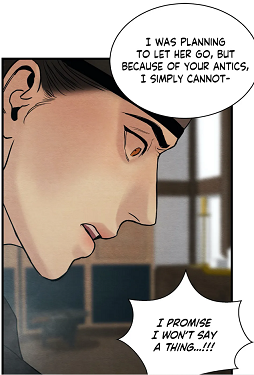 (chapter 66) This stands in opposition to silence. Therefore it is no coincidence that Min revealed the truth.
  (chapter 66) The irony is that Heena suspected the main lead of kidnapping her brother and everything looked like her words were true: the wrist, the wounds around his wrist, his actual position (the mouth covered and his hands tied together…)
 (chapter 66)
  (chapter 66) Thus the circumstances were turned against him.
  (chapter 65) But she was not present, when Min admitted Lee Jihwa’s crime. That’s how I realized that while chapter 65 represents silence, deception, cowardice and passivity, chapter 66 embodies the exact opposite. Min told the truth, Heena tried to save her brother by creating a ruckus! For Yoon Seungho, silence is a sign of culpability which he learnt from Kim. Hence he lied to the kisaeng
  (chapter 65), and later never spoke to the painter about the incident. If he had done it, he would have been forced to admit his misjudgment and wrongdoing. And now, you understand why Martin Luther King said this:
“The ultimate tragedy is not the oppression and cruelty by the bad people but the silence over that by the good people”
The physician and the butler are no evil men per se, as they don’t find pleasure in death and suffering. However, like the following idiom is revealing, people can change due to their decisions:
The way to hell is paved with good intentions.
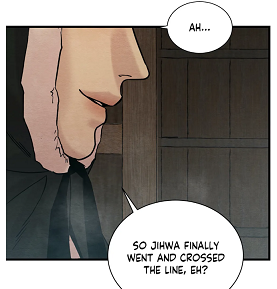
That’s why in season 4, the tragedy won’t be repeated and the truth about Yoon Seungho’s martyrdom, strongly intertwined with the artist’s, will come to the surface. You are wondering why now. The reason is quite simple: The doctor revealed his knowledge to Baek Na-Kyum,  (chapter 57) It doesn’t matter, if the butler told lies to the physician in the past, as they are now perceived as truth. Remember what Kim confided to the painter:
 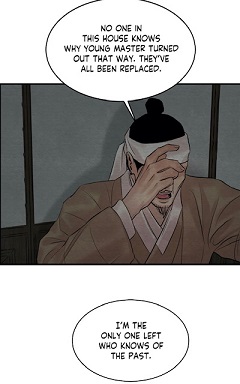 (chapter 86) He believes that he is the only one left who knows the past. But he is wrong, since the doctor also recalls the past. Hence how can Kim prove that he is telling the truth, since he told a different story to the physician? In addition, we have also lord Song. Besides, by giving the drug to Yoon Seungho without his knowledge and consent, Kim committed a wrongdoing. His knowledge won’t serve him in the end. I am deducing that the saying “silence is a true friend who never betrays” will no longer be valid. Therefore we have to expect a betrayal, and that would be from the physician, especially after we recall the butler’s warning in the first season, which was addressed to a different doctor from my point of view:
 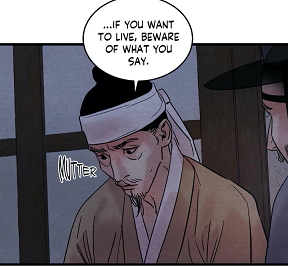 (chapter 33) Let’s not forget that in chapter 65, the servant tried to put the whole responsibility on the physician, making him feel guilty. And since Byeonduck is even using elements from the first and second season, I believe, we will have a reversed situation in season 4, where the doctor will speak up and put the whole blame on someone. Neither the physician nor Kim expected that the painter’s body wouldn’t remain silent (chapter 65), a proof that the truth needed to be unveiled. It was impossible to act, as if nothing had happened, just because the painter had been returned to Yoon Seungho. And it is the same at the end of season 3. The painter gave his husband a task:
  (chapter 102) He needs to find the answer, which stands in opposition to silence and burying the truth (sweeping it under the carpet). This signifies that this time, Yoon Seungho has to gather information himself, and he can not rely on Kim:
 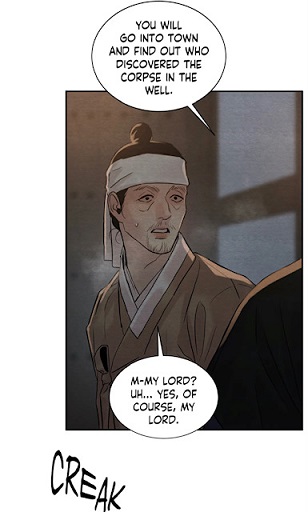 (chapter 98) As you can see, slowly people are forced to talk
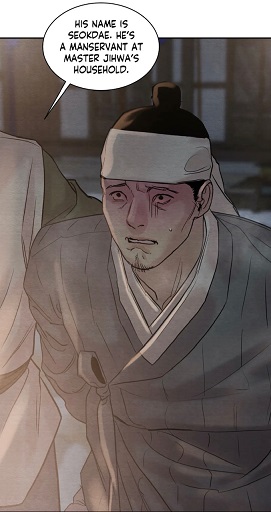 (chapter 99), hence their testimony can be questioned and perceived as lie.
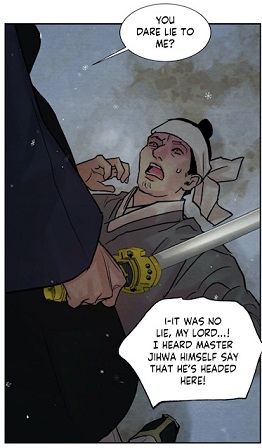 (chapter 100). This is important, because by getting confronted with lies, the lord will be able to discern the truth! In other words, silence embodies darkness and as such death.
  (chapter 74) Thus there was only silence in the lord’s nightmare. And this contradicts this statement: (chapter 65) Because Germans chose silence, the Holocaust could take place.
Feel free to comment. If you have any suggestion for topics or manhwas, feel free to ask. If you enjoyed reading it, retweet it or push the button like. My Reddit-Instagram-Tumblr-Twitter account is: @bebebisous33. Thanks for reading and for the support, particularly, I would like to thank all the new followers and people recommending my blog.

 (chapter 35). But what does the window symbolize?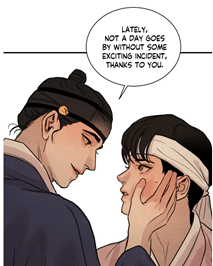
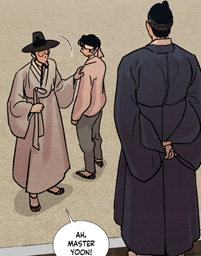
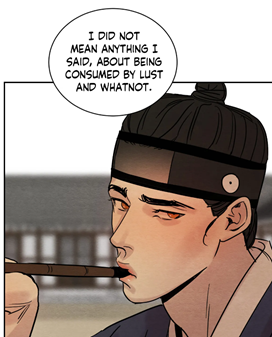 (chapter 5) and it is still there at the end of season 1.
 (chapter 44). It looks like there wasn’t much progression, yet this time, the painter walks towards his mansion and remains by his side.
 This is important, because I realized that with the vanishing of the learned sir, Yoon Seungho chose to remain in the lord‘s bedchamber. What caught my attention is that the lord always went to the courtyard because of the admired sir. We have two chapters for this interpretation: chapter 7 and chapter 35
 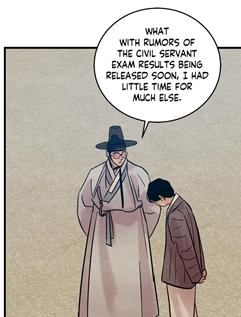 . What caught my attention is that when the lord visited the scholar for the first time, both were sitting in front of a door which looked like a window at the same time.
 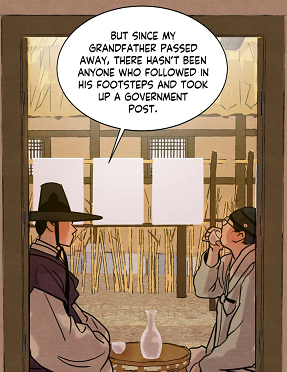 (Chapter 7) This is not random at all, as from my perspective, it introduces the role played by Jung In-Hun in the main lead‘s life. He will be the one forcing the lord to move away from the window so that he can leave the bedchamber. Thus we had this scene: Yoon Seungho is observing the learned sir and his student from far away.
  (Chapter 19) This explicates too why the noble remained so passive in season 2 in the end. Baek Na-Kyum was the lord‘s love interest, hence his „place“ is the bedchamber. So how can the lord move away from the window and as such from the bedroom? Jung In-Hun is the trigger. And note that only in season 2, we discovered how the learned sir used walks through the countryside to console the painter.
 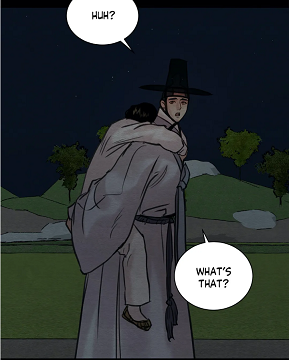 (Chapter 70) Finally, the main lead organized a hunt for the first time because of his honored guest.
 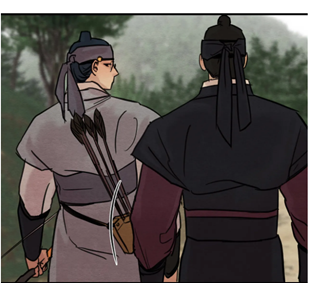 (Chapter 22) And if you recall the lord‘s behavior, you will notice that he left the city for the first time, when he wanted to meet the scholar.
 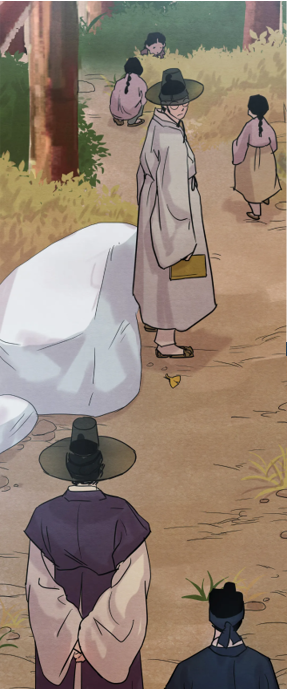 (Chapter 6) He encountered him in the woods. Under this new light, it reinforces my conviction that the learned sir‘s death will be the lord‘s motivation to become proactive and leave his past behind. Why? It is because of the painter‘s words.
  (Chapter 94) The painter still respects the scholar, but he already loves Yoon Seungho. He is not disloyal towards his former teacher despite falling in love with the protagonist. With the last incident, Yoon Seungho got aware how much the painter means to him, but at the same time, he realized the importance of the learned sir in Baek Na-Kyum‘s life. He needs to answer his question:
 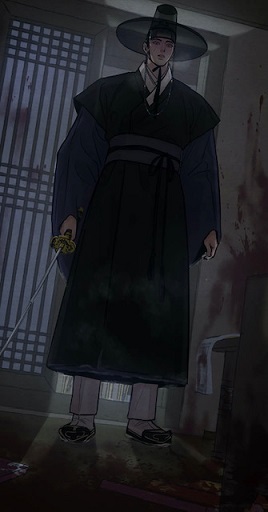 ( 100) Don‘t forget that the main lead saw the room covered in blood, though the latter had already dried. To conclude, the main lead was encouraged to walk thanks to the scholar, and as such to leave his window!
  (Chapter 100)
 (Chapter 44) It was the painter’s role. This signified that he was still trapped by his past and trauma, something that he hadn’t revealed to anyone. Since Yoon Seungho is still inside the room smoking in front of the window, it reveals that the lord had not really let go of his past at all, he had not expressed himself in front of Baek Na-Kyum yet. If he reveals his inner feelings and thoughts, this means he will disclose his secret and unveil his vulnerability. This explains why there was no confession from the noble’s side for instance [there were other reasons why he hadn’t confessed anything too], why he was still not sharing his inner thoughts and emotions to his partner.
  (Chapter 37)
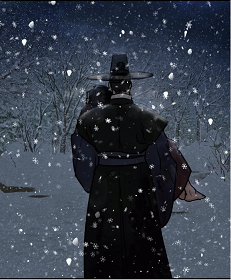 (Chapter 102) This signifies that Yoon Seungho will act differently in season 4: he will be proactive. Like I mentioned in the essay „Scandal(s) in Jemulpo“, he will become the scholar’s disciple and follow his footsteps: ruthless, but also caring and gentle. The only difference is that his affection for the painter is genuine.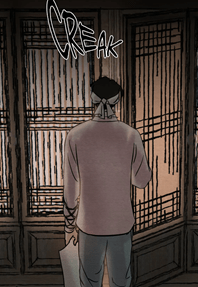

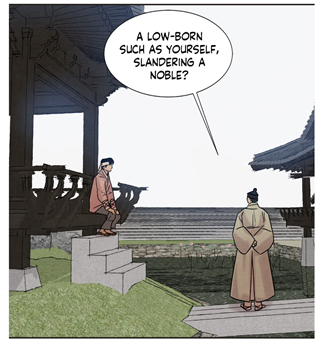 (chapter 10),
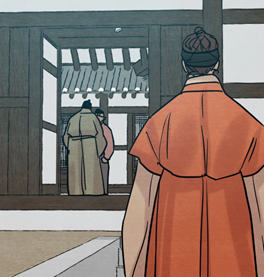 (chapter 12)

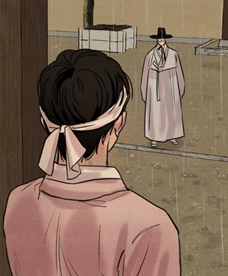
 (chapter 20)
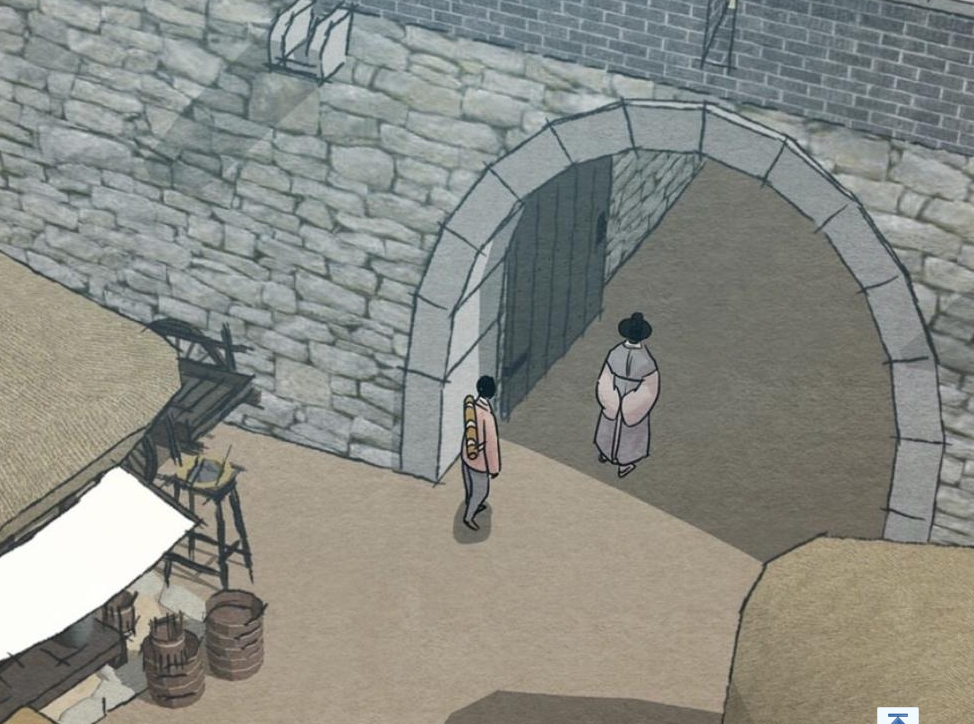 (chapter 29)

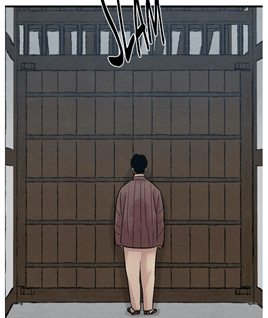


 It is still the same. Despite getting a blowjob, he still wants to hide his homosexuality to the outside. Hence he still gets scared and would like the noble to stop from exciting him. So for the first time, he is experiencing sex with someone.
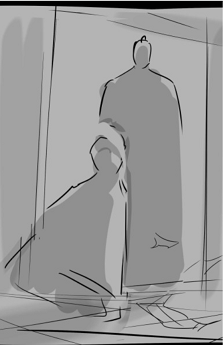 Note the opened door. The learned sir caught him by surprise. That’s how the learned sir was forced to repress and hide his homosexuality. This is no coincidence that in season 1, the scholar had the opposite attitude.
  By feigning ignorance, he actually encouraged the artist to become a sodomite. After their return to the mansion, the teacher showed leniency. He accepted that his student would paint erotic paintings, but he was well aware of their sexual encounter.
 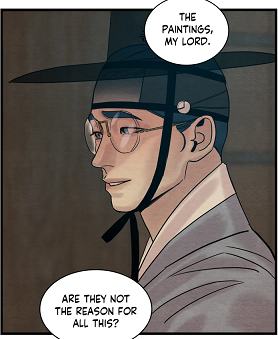 (Chapter 30) The moment he arrives back and the lord brings him back to his chamber, the nature of their relationship is no mystery any longer, though painting is used as a justification.
 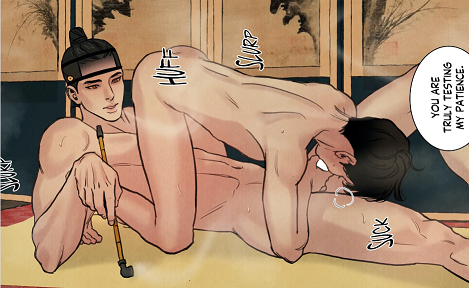 (Chapter 45) He just accepted him as his sexual partner, hence he went to his room and not to the lord’s side in chapter 44. If we compare their respective situation. Yoon Seungho hadn’t progressed much compared to the painter at the end of season 1, because he needed to express his emotions and reveal his secrets and vulnerabilities to Baek Na-Kyum. It took him a long time to open up, as he had been coerced to view himself as a bird of misfortune. He didn’t dare to voice any wish out of fear that these wishes would get ruined.
 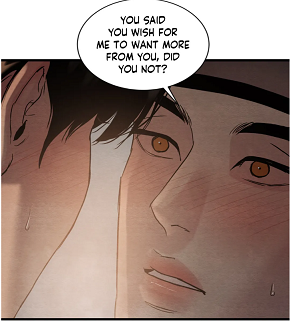 (Chapter 96) In his mind, he had no right to voice any desire, as they would be perceived as GREED!
  (Chapter 96)
 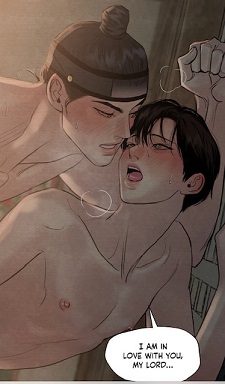 (chapter 96) and Heena could hear his words. Hence at the end, the door got broken:
 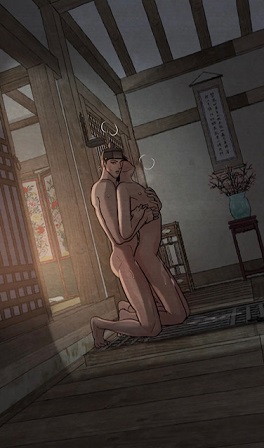 (chapter 96) This represented the final emancipation of the artist. He no longer cared, if he was seen. He was so moved that he didn‘t pay to his surroundings.
 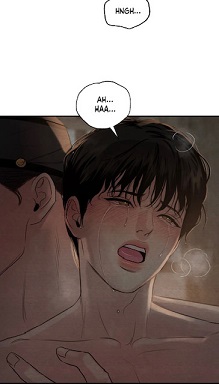 (Chapter 96), while it was not the case for the noble. The latter knew about the artist‘s shyness. This truly shows that Heena was responsible for the sexual oppression of her brother. The painter was no longer hiding his affection for the main lead, when he decided to wait for his master‘s return in the bedchamber.
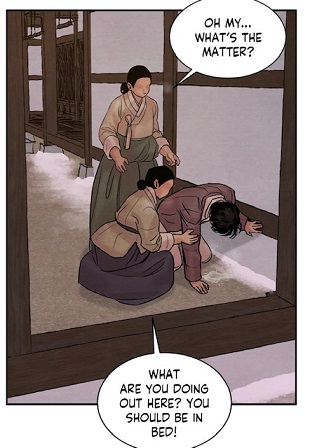 (Chapter 98) Observe that the artist was going there on his own will, and he was sharing his bed with his husband.
 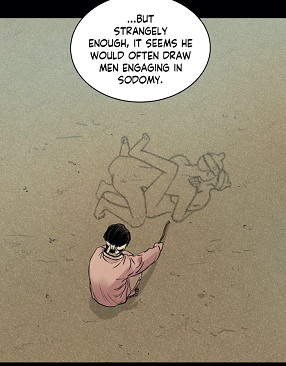 (Chapter 1) This memory was from the learned sir. Why was he approaching the painter during the day? Secondly, note that he only scolded the artist in his house!
 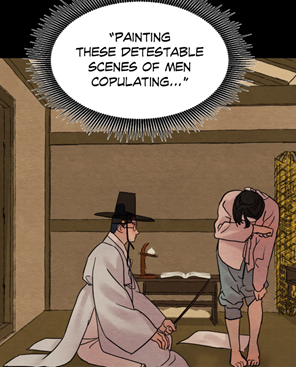 (Chapter 34) So he had discovered a secret, he imagined that the painter had assisted to an immoral love session.
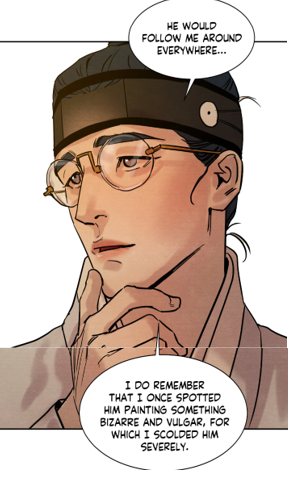 (chapter 6) In my opinion, the kisaeng was responsible for this incident. We have a clue for this interpretation:
 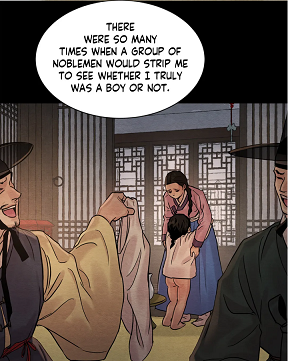 (Chapter 94) The noona is the one standing in front of the opened door with her donsaeng. Here, the artist was getting embarrassed and humiliated. That‘s how little by little, the artist associated the closed door to shame and safety. This is not surprising that the kisaeng is also standing behind the closed door, when she hears her brother making love to the main lead.
 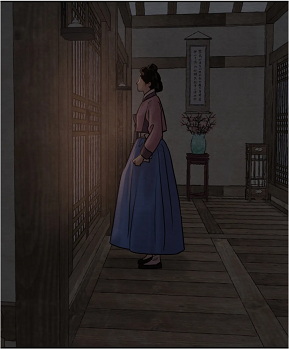 (Chapter 96) In addition, she is constantly seen in connection with an opened door, but this opened door is linked to anxieties, pain, shame and guilt:
 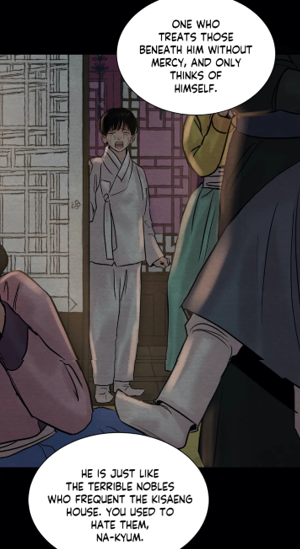 (chapter 68)
  (chapter 66)
 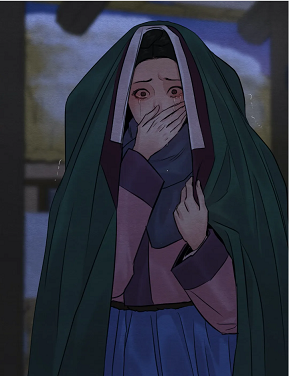 (chapter 88) I have the impression that she was acting out of jealousy, and she had intended to tarnish her brother‘s reputation.
 (Chapter 102) This symbolized the final emancipation of Yoon Seungho. He could finally move on from his past, and as such leave the darkness of his mental prison. He no longer needs a window to view life. This scene announced that he was starting living again. Thus I am expecting to see Yoon Seungho becoming more proactive and funny in season 4. He will show his intelligence and strength in order to defeat his enemies because so far, he never revealed his qualities to others, only to the scholar. His past had left him somehow paralyzed, hence he has laid a low profile. In his past, he believed that his prison was his protection, for he could observe and remain quite wealthy and powerful. For me, Baek Na-Kyum is in reality his strength, the reason why he will be able to leave his cage and shows his true colors and skills.
 (chapter 7)
 (chapter 19)
 (chapter 29)
  (Chapter 22)
 which is connected to the expression “castles in the air”. His aspirations are boundless, he is aiming at the highest position without being competent or even trying to improve himself. He also attempts to air dirty laundry, when he is hunting with Yoon Seungho. He wants to force the lord to admit his lie so that he can criticize him. But here he fails. As you can observe, many expressions with air reflect his personality. However, there is one scene that contrasts to this observation, that’s when he is in his library in the chapter 40. We actually see him at the library in two occasions: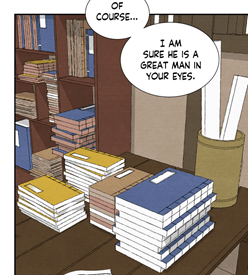

 His words there are suffocating the poor boy, that’s the reason why Baek Na-Kyum is left speechless.
  (Chapter 40) He can’t breathe properly. Since there is no view and no door to the outside visible in the drawing, we have to imagine this reflects his narrow-mindedness. He is surrounded by books (see the pictures from the chapter 7) therefore he lacks real experience and knowledge. He is literally buried behind his books, therefore his knowledge is superficial.
  (Chapter 27) Even in his bedroom there are books so his own bedchamber gives the readers a suffocating feeling. Since there is no window visible in his room and the library, there is no fresh air in the closed room which explains why it is asphyxiating. Usually, we say in a closed room that it smells musty. He only knows the world through his books and the moral standards. He is not even opened to the outside, only his words and thoughts count. Everything else has no value hence there is no life next to him. People living by his side will end up suffocated as he doesn’t allow them to breathe. He is stubborn and he will never change, a fake, empty and narrow-minded man with no conscience. Because of this connection, I realized that Jung In-Hun had no future in Hanyang. He would end up buried, and this became a reality. Because the moment he left for the capital, he ended up dead. And now, if you think carefully, you will recognize that the learned sir is associated to nature! Thus he was seen in the woods (chapter 6, 22) or in the countryside admiring the moon.
  (Chapter 70) Air means also breathing! Hence he represents the fresh air entering Yoon Seungho‘s bedroom, hence we had such a scene:
  (chapter 35) The lord witnessed the intimate interaction between the learned sir and the artist, thus he was incited to leave the bedroom. Strangely, we could say that he was the initiator for the lord‘s liberation. No wonder, why Kim wished to get rid of the learned sir in the end, and just viewed the artist as less annoying and evil!
 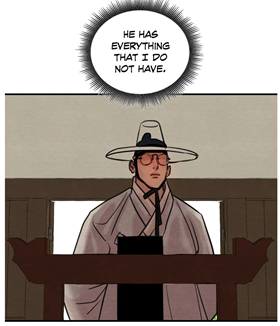 (Chapter 18) so that he ended up letting his guard down. He was not so competent and intelligent like Yoon Seungho, he relied more on the stupidity on others. He could deceive commoners, but not spies. In my first version, I had envisioned that the learned sir had many tricks up his sleeves so he would survive, but I had not realized that he had met a fake servant
 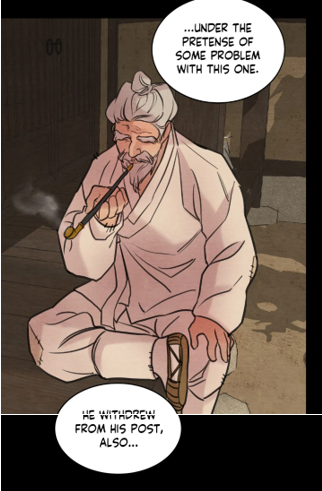 (chapter 37) definitely a noble who could see through him. For me, it was the pedophile himself. I had predicted that he would disappear into thin air, and it became a reality, especially if my theory about his assassination is correct. We could see the transformation of the scholar into a ghost,
 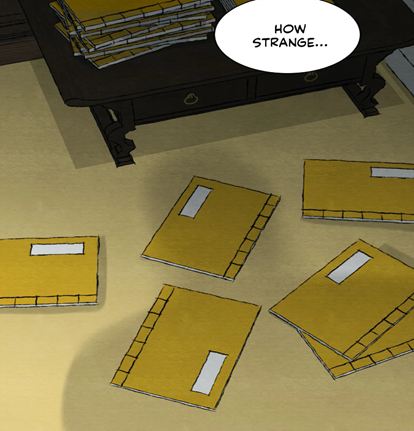 (chapter 50) who would come to haunt the couple because of his resent.
 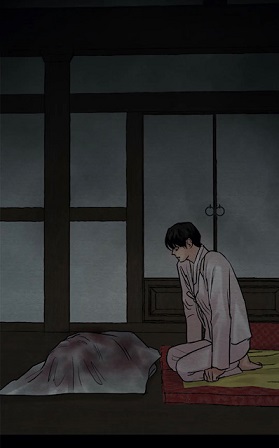 (Chapter 98) As the air, he became a spirit! And note that the lord was encouraged to stroll too!
