

This is where you can read the manhwa. https://www.lezhin.com/en/comic/painter But be aware that this manhwa is a mature Yaoi, which means, it is about homosexuality with explicit scenes.
In the other parts, I concluded that Jihwa and Seungho were more persons of the past. Nonetheless due to the painter they were forced to change and live more in the present. On the other hand, Min was linked to the present, however because of his fateful meeting with the artist, he was also forced to focus on the future. The cause for his transformation was his desire towards the artist kept growing. He wanted to taste him but couldn’t as Seungho represented the biggest hindrance. Then I saw Nameless and valet Kim as persons personifying the future since both were strategists and made plans for the future (forcing the separation first, later bringing them together, forcing Jihwa to face reality and no longer live in an illusion) for the main characters. However, there were two figures left: the scholar and father Yoon. In this essay, I will examine Jung In-Hun and his relationship to time, just like I did with the other characters.
Jung In-Hun is a teacher who comes from low nobility hence he possesses no connection and wealth. Because of his actual poor situation, he keeps dreaming of his future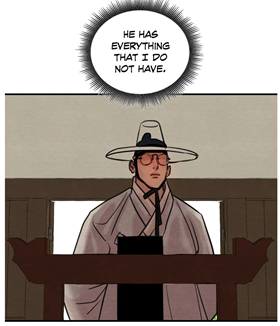
 With these two pictures, it becomes obvious that he is imagining a time where he will live like the rich protagonist. Therefore the first impression would be to judge him as a person symbolizing the future. However, if you pay attention to his words, you’ll notice that he is speaking in the present (“can count”, “has”, “do not have”)
 The enumeration doesn’t just expose his greed and envy but also outlines his strong connection to the present because he also employs two senses, the touching and the sight. This reinforces the impression he is somehow living in the moment. This scene is really important as it shows that the present plays a huge role in his life. I come to the first observation that this is his source of inspiration, the present leads him to dream of a future where he will be different. Envy, jealousy and resent are his generators, strongly intertwined with the present.
Furthermore, if you observe his interactions with others, you’ll note that Jung In-Hun keeps utilizing the present for the most part of the time. I chose first the following panels. 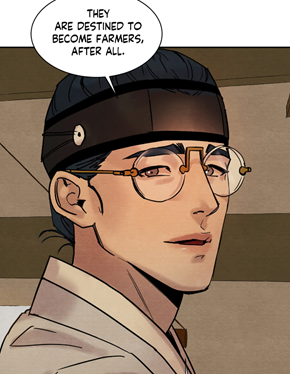 (chapter 6)
  (chapter 10)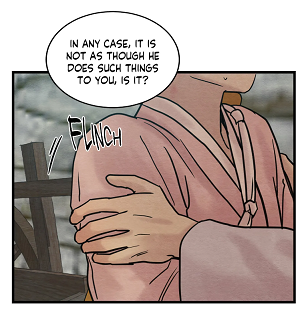
 (chapter 29) Therefore for me, Jung In-Hun is a person of present. And now here is the next question. What do these pictures have in common, excluding the present as tense? What caught my attention is though present is the utilized tense, he is actually referring to the past (“are still not painting”= didn’t paint /”does such things ” = didn’t do) or to the future (“are destined” = will be). The best example for this would be this panel.
  Notice that he is already thinking about the future, planning to use the painter, yet he speaks in the present. Strangely is that after realizing the importance of Baek Na-Kyum, he chooses not to bid farewell to his former student. Any normal person would recognize that he needs to treat the painter better from now on but no, he does nothing like that. Because of the contradiction between the different parts of time, I sense a confusion between past, future and present. My first explication is the following. In the scholar’s mind, his future is a certitude, that’s his fate. He is destined to have what Yoon Seungho has. Therefore, we could say, the present represents not only his strong motivation but also his future. In his eyes, his fate is to become rich and powerful. Thereby this is not astonishing that he talks to Yoon Seungho and Baek Na-Kyum about fate, path and destiny.
Simultaneously, we could say that he is not really living in the moment, as past and future are confused with the present. This explicates why he thinks about the future, while talking in the present.
The irony is that he was tricked by his favorite tense, the present. If the manhwaworms read again the episode 7, they will realize that time played a huge part in the deception. We shouldn’t forget that the learned sir needs to learn in order to pass the second examination. And like I had demonstrated it before, he only realized his mistake, the moment he discovered the existence of the deal (chapter 19). In his mind, he had already achieved his goal, the moment the main lead proposed to sponsor him. He didn’t recognize that the lord’s words were just an empty promise as he needed to pass first the civil service examination. He didn’t see the trap as the lord was talking in the present, for him a sign of destiny and certitude.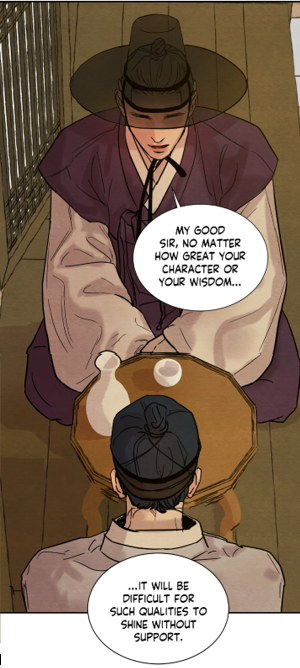
 First, the main lead implies that the scholar is an intelligent person (“are” is omitted), while he thinks the opposite. Secondly, he fools the arrogant man that he will succeed with the examination since he employs “when” and not “if”. The condition is disguised behind the idiom “only that”. As you can detect, Yoon Seungho is selling these as facts, while it was not the case. Due to the tense, Jung In-Hun was manipulated and fell into his own trap. He thought, he was deceiving the protagonist, whereas it was the opposite and his major mistake was the employed tense: present. Moreover, note that in chapter 18, he only used two senses: the sight and the touching. But he isn’t employing his mind or better said, his brain, limiting his own skills. That’s why he couldn’t perceive the deception. Since he is so certain about his path, he doesn’t really have to utilize his knowledge and his brain. This explicates why he is a lazy person in the end and couldn’t become successful before.
Since I outlined how the doubled-faced character would confuse present, past and future as his fate is already determined, this is not surprising that he is neglecting the present in reality. His present is different from reality, it stands under the sign of destiny. It is his path to climb the social ladders. Therefore he resents his real present, confronting him with reality. He has nothing. Now, you understand why I associate the learned sir to the present, meaning that he has some similarities with the low-born and the vicious lord Min.
However, as you can envision, he is different from the painter and Black Heart for different reasons. In my eyes, he personifies the negative version of Min. While the latter is a carpe diem person who enjoys the present 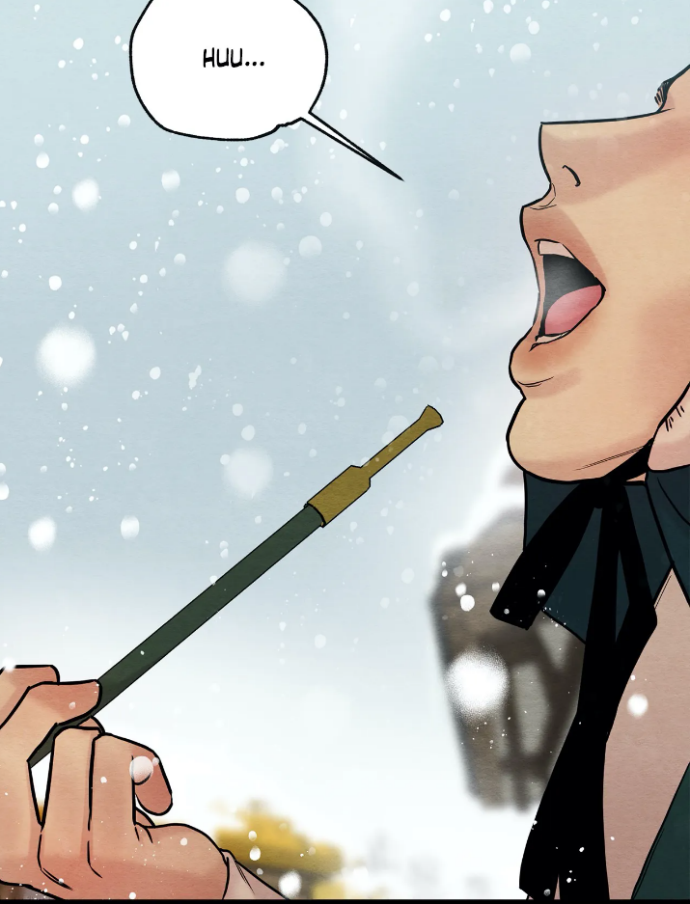 by taking advantages of others for his own pleasure but is still envious of the main lead, the scholar is never satisfied with his current situation and resents everyone: Yoon Seungho, Baek Na-Kyum and the commoners. His real present is a constant reminder that he has not fulfilled his destiny. He doesn’t desire to be associated to commoners, although his clothes in the beginning don’t diverge so much from peasants’, while he wishes to resemble to the powerful main lead due to his wealth. As a conclusion, Baek Na-Kyum is the only satisfied with the present due to his modesty and selflessness. He has been accustomed to his social status. Due to his past, he knows what he should expect from the world which outlines that even if he was hurt in the past, he could move on but learnt from his bad experiences. Therefore he stands in opposition to Jung In-Hun who seems to have no real past and has not learnt from his mistakes at all. Now, you understand why. Since it is his destiny to have a high position, he doesn’t need to focus on the past or on the real present. That’s why he never reflects about his own actions and words, hurting the low-born, without noticing it.
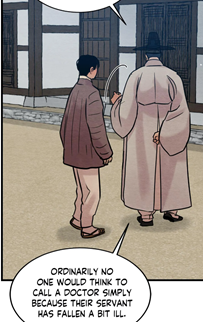 For him, fate will always play in his favor, yet by acting like that, he reveals gradually his true colors.
Striking is that his common past with the low-born is just briefly mentioned. He only taught him to read and write. Then he adds this: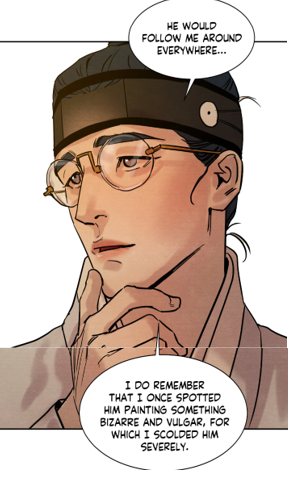 It was, as if they had no special relationship, except that the artist only caught his attention as he would follow him around and drew something immoral and vulgar. By reading it for the first time, the manhwalovers have the impression that the purpose of the scholar’s words is to undervalue Baek Na-Kyum, while emphasizing his own good personality. The artist is someone with an unappropriated behavior, whereas he was a man of virtue, a role model, because he punished the low-born for his erotic paintings.
Yet, we could interpret the idiom “once” differently. He has already forgotten what he really inflicted on the low-born. His coercive persuasion meant nothing to him hence he is overlooking the impact of his actions. In other words, in his mind he just did it once. And if you pay attention to the teacher’s behavior, it really appears that he has no real recollection of the physical abuse he did on the painter. When he meets him again, he acts as if nothing happened before.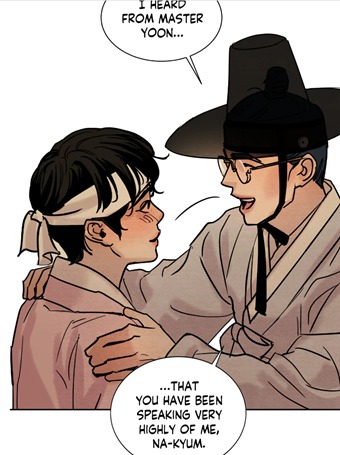 One might argue, he is just faking everything which is also correct hence this could be no real sign that he truly forgot the coercive persuasion. However, if you observe his behavior during the first season, you’ll realize that this is actually Jung In-Hun’s MO. In chapter 40, he almost killed the painter with his words
 , yet the next morning he still believes that he can still use him as his pawn… just like he did in the past. It was always like that, each time Jung In-Hun hurt the artist, the latter would still remain faithful. In chapter 29, he already betrayed which the artist sensed but once they arrived the mansion, the artist was still willing to sacrifice his own life in order to protect his admired sir from the infuriated and jealous lord. Let’s not forget that he never changed his attitude towards him after the coercive persuasion therefore the teacher wrote a bad poem. It becomes clear that he took the commoner for granted. In my perspective, this reasoning is simple. Since the low-born’s destiny is to be a prostitute after stopping painting, the ow noble imagined that he didn’t need him in the first place. However, now it diverges. In chapter 44, it becomes obvious that the scholar plans to use him as a prostitute. It was as if in his eyes, their paths were now connected. The low born will help him to achieve his goal. And this explicates why he doesn’t say goodbye to the artist. He can’t imagine that the low-born might change his mind and feelings. He is so sure of his “affection” and his power over him. He believes in his destiny hence he doesn’t need to pay attention to the commoner, the latter will play his role.
Nonetheless, it becomes obvious that because of his strong belief of destiny, Jung In-Hun is ignoring reality and as such present. He is neglecting the fact that Baek Na-Kyum is truly changing. He noticed his lie hence he punished him for his “betrayal”,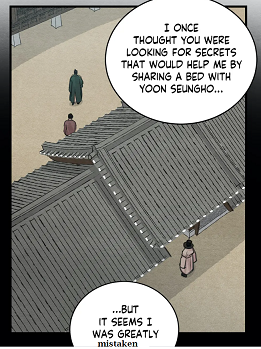 unaware that with these exact words, he unveils his true personality. He is in fact the one who backstabbed him first violating his own doctrines.
Another point for my interpretation why Jung In-Hun is strongly connected to the present as he often acts on impulse. Due to his jealousy, he decided to beat the painter forcing him to vow to never paint again. He didn’t want to see how a low-born could become successful, destroying his own dream and belief: the low noble is destined to achieve greatness. By doing so, he didn’t recognize that he condemned himself to remain working as teacher in the end. As Baek Na-Kyum’s guardian , he could have used his popularity and even claimed to have a right to get his money earned through the paintings but he couldn’t bear the thought, he was living next to someone talented, mirroring his own lacking. Out of resent and jealousy, he abused the painter physically and mentally, that’s one of the reasons why he is describing it as a single event. He acted on impulse, until his anger and resent disappeared. And this attitude never changes. In chapter 10, he persuades the painter to stop painting hoping to get rid of a rival, unaware that he is actually ruining his own career and chances.
 Then in chapter 22, he forgets that Yoon Seungho is his sponsor and insults him by describing him as someone with no education, since he has been mocked for his poor talent. To his surprise, Yoon Seungho isn’t hurt by his words, in fact he retaliates right away. He is in no place to criticize his benefactor, especially when he has no real talent.
 Observe that the powerful lord is teaching an important lesson to Jung In-Hun, he needs to pay attention to the real present as it can affect his immediate future implying that his fate and big dream are nothing sure. By using a conditional sentence, he demonstrates that present is no guarantee for certainty as it is bound to a condition. I perceive this scene as another evidence that he lives in the present, an unreal one nourished by his vanity and his arrogance, which is an illusion in reality. The cause for this is that he believes in destiny. Each time, he gets disappointed and hurt, he unleashes his fury and the painter becomes his target. Notice how furious and violent he was after the hunt.
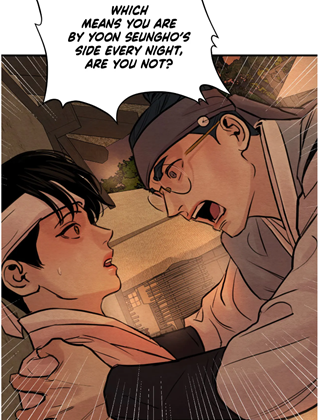 He hurt the painter, until he regained his senses and recognized that he needed to treat the low-born differently, since he was relying on his relationship to his sponsor.
  In other words, not only he is neglecting the present due to his belief of destiny but he is so caught up with the present that he is always damaging his own career. Like my follower @SpringDayYum noticed it correctly, in reality Baek Na-Kyum symbolized his future, although he is also a person of the present. The latter was determined to do anything for him, willing to break his vow for his learned sir’s sake. As a conclusion, he never realized that he could have achieved his destiny by supporting the painter in his work. He would have gotten recognition for becoming his guardian and chose not, proving that fate and destiny are never determined. Choices are relevant and influence life.
Another interesting aspect is that he is not paying attention to his own changes. He starts acting like a pimp and even a prostitute, betraying his own doctrines, too consumed by his dream and his desire to secure his future. That’s why I have already predicted, he will become a prostitute [for furthermore information, read the following essay: https://bebebisous33analyses.wordpress.com/2020/07/08/painter-of-the-night-jung-in-hun-a-new-version-of-bel-ami/ ] Nevertheless he will only recognize it too late, especially the moment he faces the painter and the latter realizes how his learned sir secured his position.
Note that when the double-faced man meets the powerful protagonist for the first time, he describes his job as a diversion showing that his occupation is to pass time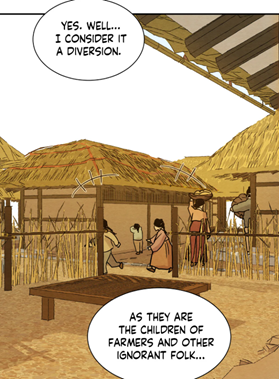 which reminds us of “carpe diem” philosophy, living in the moment. Nonetheless there is a huge contrast as it is not linked to joy of life and pleasure. He only has negative emotions. That’s why for me, his mind isn’t truly directed towards the future. In fact, he is always jealous of others, especially of the artist and Yoon Seungho. Another evidence that he is a person of the present can be perceived in the scholar’s following words:
 He has been waiting indicating that he has been actually doing nothing at all. In order to be judged as a person focused on the future, the teacher should have made plans for his career but he doesn’t. He is so different from Kim and Nameless. Both anticipate reactions and try to move things in the right direction, they have strategies, like giving an aphrodisiac for example or postponing the murder. Therefore I would say that the scholar is trapped in the present, while he dreams of his destiny, which is in reality an uncertain future. His dissatisfaction is the reason why he would like to change his situation but he has no idea how. He lives in an illusion that the world owns him something and at some point, it will happen.
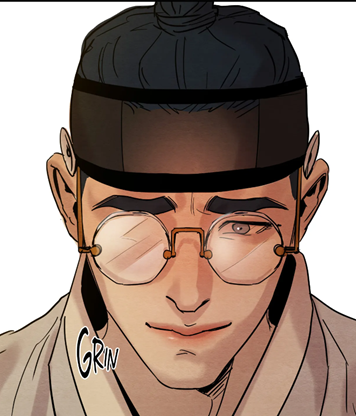 Therefore we could say that he is not a man of foresight which is symbolized by his glasses. Like my reader @nonoboy-oops pointed out to me, “the glasses symbolizes his being unable to look as far into the future due to his selfish ways”. Since he is short-sighted, it signifies that he can only see what is really close to him. That’s the reason why he uses people and tricks that are near him, another indicator that he is strongly linked to the present. Finally, I interpret his bad sight as another evidence that he is lacking knowledge. He has a very bad overview about his real situation hence he makes bad decisions. He is unable to perceive people’s true nature as well. He doubts Seungho’s intelligence and education, although he could have sensed it, after discovering the existence of the deal. He is not capable to recognize Baek Na-Kyum’s talent too and jeopardized his own ascension by forcing the painter to drop painting. And his blindness is actually reflected in the panel above. The manhwalovers can only see one eye. Back then, I interpreted that he was hiding his true thoughts. As you can note, this single image offers so many possibilities. It shows his underhandedness and hypocrisy, simultaneously his lack of foresight and knowledge as he can’t see everything. It was as if he had lost one eye and perceives the world in only one dimension. Two eyes are necessary in order to judge distance which is a metaphor for predicting the future. As a conclusion, this image illustrates his lack of foresight and “blindness”.
Since he resents the present so much as it doesn’t correspond to the image he has in his mind, he seems to be similar to the red-haired aristocrat, who hates his actual situation wishing to go back to the past and projecting it as a possible future. Jung In-Hun has also developed a sort of escapist attitude. However, there is a huge difference between them. Jung In-Hun is neglecting the past that’s why we only have one flashback of the teacher in the first season. He is not learning from his mistakes, allows his emotions to cloud his judgement and jeopardize his future career. There is no doubt that the moment Jung In-hun returns to the mansion asking for more support, the painter will ignore his plea. He has definitely cut ties with his learned sir. As for Yoon Seungho, the moment he knows his affection is returned, he will drop the former teacher for good. He doesn’t need him any longer as he was just a tool to force the artist to work for him. Baek Na-Kyum will create beautiful erotic paintings, inspired by their mutual love. Like my follower @Denize59542085 suggested it, we have to expect that the artist will create a new big picture like in chapter 2. However, this time the noble will look directly at his lover, there won’t be any distance between them and the artist will gaze at his loved one tenderly, a gaze full of warmth, admiration and love proving to his lord that he is worthy to be loved.
Because of all the changes, Jung In-Hun will be forced to find a new sponsor and since he caught attention by getting help from Yoon Seungho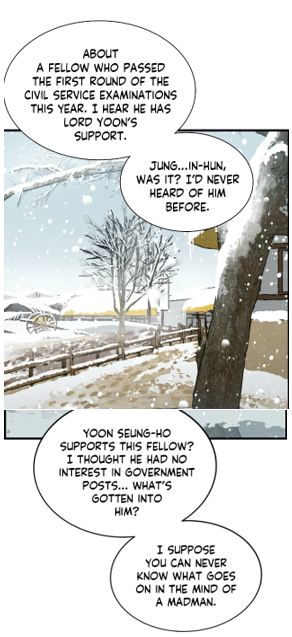 , I am quite sure that father Yoon will imagine that he can approach the former teacher. And that’s how he will meet his true destiny: becoming a prostitute. I know, these are just predictions from my part but there were already clues about this evolution, like I explained in the other essay mentioned above. The scholar won’t escape his fate in my opinion, his punishment for all the wrongdoings he inflicted on Baek Na-Kyum.
Feel free to comment. If you have any suggestion for topics or manhwas, feel free to ask. If you enjoyed reading it, retweet it or push the button like. My tumblr-twitter account is: @bebebisous33. Thanks for reading and the support.
 However, this expression describes my own feelings as well after imagining the evolution of this story. What will happen next? Will Jihwa choose the death sentence or send him to Min or send him back to Yoon Seungho? Since I have already observed that Byeonduck likes using elements and even chapters from the first season with divergences, I started thinking about the elements and episodes she could use. Then I came up with a certain idea but it sounded too beautiful to be true: „It cannot be“. That’s why in this essay, I’ll present my own continuation of the story with the hope, it will come true but well aware that this is more wishful thinking. Yet, like I pointed out above, this fantasy is inspired by the first season hence I’ll explain my reasoning for this continuation of the story, a dream.
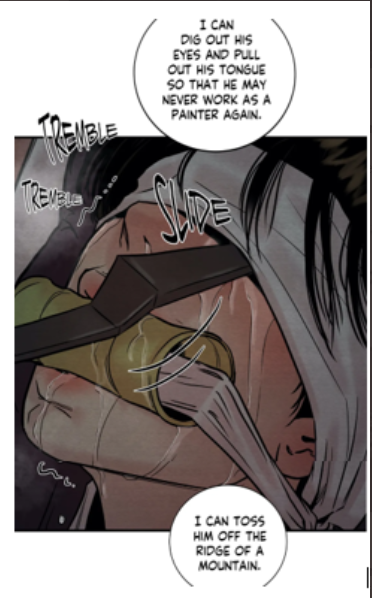 Handicapped, Baek Na-Kyum would lose his life in the end, unable to earn a living. Jihwa might get away with it, yet he will be burdened by the knowledge that he is responsible for the painter’s misery. The crime doesn’t represent the end of his suffering but the beginning, as he will be the only one who knows what happened to the artist. The knowledge as such will be a heavy price to pay. As you can detect, for me Nameless is trying to change his client’s mind without imposing his opinion. The commoner might become his hands but Jihwa’s mind will be tainted and indirectly his hands.
 That was the message of his unconscious but Jihwa chose to ignore it. Fortunately, the criminal voiced exactly what Jihwa’s righteous mind was expressing. Hence I come to the deduction that Nameless has already planned the best outcome for Jihwa. That’s why I came up with the following ideas. Either he will send away the artist, making him disappear. This explicates why he wanted the painter to be abducted outside the mansion. Since Nameless has already killed Deok-Jae, he could use his body
 while faking Baek Na-Kyum’s death (“no one can recognize him”). So far, nobody has noticed Deok-Jae’s disappearance and his death is quite recent so his body must still be well preserved due to the winter. Another possibility is that Nameless has already decided to send back the painter to Yoon Seungho and will frame Deok-Jae for the crime. Many servants have already noticed his jealousy and the latter disappeared so suddenly. The second idea is actually my favorite because it fits Nameless’ good heart and sensibility. He must have realized the painter’s modesty and honesty. It can not be, it is too beautiful to be true. A criminal is helping our OTP!!
 but chose not to intervene as he was sure that Jihwa felt uncomfortable with the idea. Moreover, he must have heard about the gossips in town how the noble suddenly changed for the better.
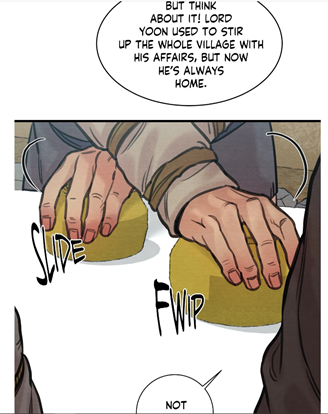 He was a reformed man desiring to settle down which couldn’t escape the former convict’s notice. Besides, Nameless must have noticed that valet Kim would even buy materials for Baek Na-Kyum.
 Note that this is not the first time, the butler is doing it again for the painter (“Again?”). And if the ex-thief didn’t observe him personally, I am quite sure that Deok-Jae must have told him how the valet would take care of the low-born, just like he disclosed him the situation in chapter 51. Consequently the criminal seems to be the second person who had the best overview about the whole situation, especially since he is not directly involved, like Jihwa, Deok-Jae or Baek Na-Kyum or Seungho. A noble is deeply in love with a low-born and doesn’t care about social norms, something quite unusual.
 Why is there this animosity in this scene when it was not like that in chapter 29?
 Observe that Deok-Jae speaks in Kim’s name in the end, since he utilizes the personal pronoun “we”. Furthermore, the manhwalovers can sense that Kim has literally the vicious servant’s back, since he stands behind him. I would even add, I detect Kim’s confidence in the vicious servant, when the valet even entrusts the bought paintbrushes and ink stone to Deok-Jae. He even calls him “my good fellow”
 , a sign of respect and trust. He doesn’t get upset, when Seok-Jae is rather cold and angry, indicating a certain patience and tolerance. He even puts his hand on the servant’s shoulder, a gesture illustrating his reliance and closeness towards Deok-Jae.
 For me, they are quite close because when in chapter 47 Kim gets mad at him and yells that he should clean up the mess, it looks like Deok-Jae got away pretty easily, although he insulted his master.
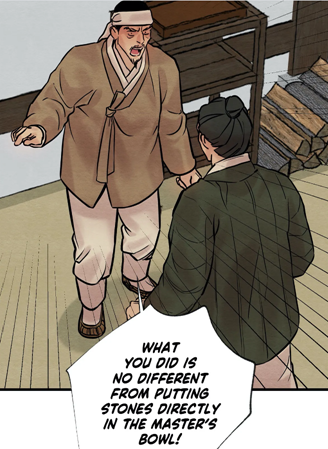 Their close relationship is in my opinion one of the reasons why Deok-Jae thought, he could ruin the rice, imagining that he wouldn’t get caught and if the painter would ever complain, then he would have Kim’s support. Notice that when he is confronted with the wrongdoing, the mean domestic even justifies his action by wailing to Kim,
 although the latter is his superior. He shows no fear and respect that’s why I believe that Deok-Jae had always seen in the loyal butler a backer. And now, you might wonder why I write about Deok-Jae and Kim’s relationship, when the main topic of this essay is how the story will evolve. This is quite simple: Nameless explained to Jihwa how he was able to kidnap the painter without getting caught. He faked an escape.
 And remember, we had two escapes in the first season: chapter 4 and chapter 29. While the first one corresponds to the departure in chapter 46, the second is definitely a new version of chapter 29, where the artist ran away as he feared for his life and his teacher’s. Both disappearances are linked to danger and life. And what happened back then?
  Kim never envisioned that the surrogate father would bring the artist back to the mansion, sealing the painter’s life to Seungho’s mansion. From that moment, the butler realized that it was too late, he got aware of his lord’s feelings for the painter. He was present, when the protagonist flew towards the painter.
 His feet were barely touching the ground. And that’s the moment when Deok-Jae started resenting valet Kim. He had been the one who received the worst beating. On the other hand, the butler must have felt guilty towards Deok-Jae hence he wanted to show his trust and a certain closeness to his accomplice “my good fellow”.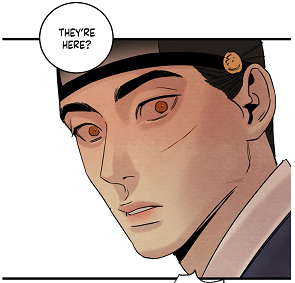
 If you compare both scenes, you’ll note a huge contrast. There’s no longer any fury and rage. Even if the cover has been removed quickly, exposing a certain nervousness, he is not agitated like in the past. That’s why I had the impression that he looks more resigned as the panel reminds me of his mouth in chapter 35, where he was on the verge of giving up.
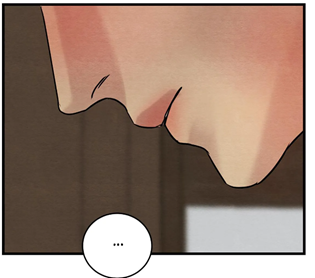 Because of this association, I have the feeling that this time, the noble won’t throw any tantrum and vent his rage on his staff. I came to this idea that this is his turn to believe that this magical night with the painter was just an illusion due to his fever.
 Let’s not forget that this time, he didn’t clean the painter’s body like he did in the past.
 Furthermore he hasn’t yet viewed the last painting the low-born made which showed that the painter never saw their night in chapter 49 as something terrible. His mouth and facial expression revealed pleasure. Therefore I imagine that he won’t be looking for the painter right away. But what he fails to recognize is that there was a witness of their magical night, valet Kim who put their shoes next to each other.
 That’s why I believe that valet Kim will be the one bringing back the painter, assuming his new role as surrogate father for Baek Na-Kyum therefore we would have a new version of chapter 29.
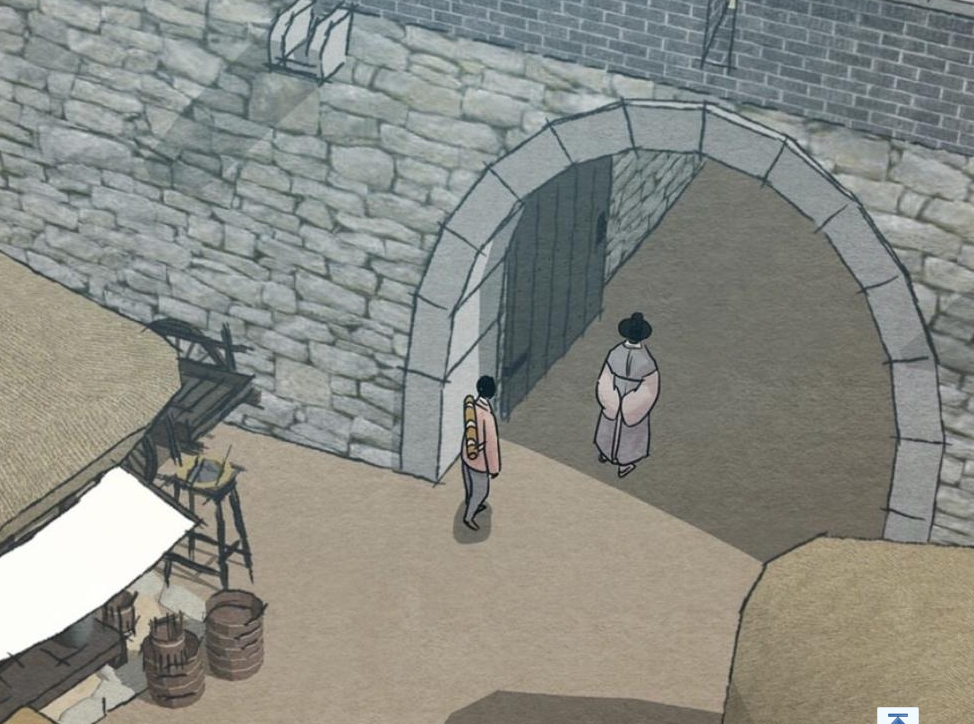 Besides, the readers shouldn’t forget that Kim took a similar role in the past. In chapter 24, Baek Na-Kyum was kind of abducted by Jung In-Hun and Kim was the one who discovered his disappearance and fetched him.
 The other reason why I believe that the gentle and caring domestic will become the painter’s rescuer is that he always visits his lord’s room during the night and he must have seen the painter’s missing shoes. In my opinion, Nameless could anticipate Kim’s actions and envisioned that he would look for the missing painter. Imagine his reaction, when he discovers the painter. The latter is in a poor state and is reminded of the night of the rape where he had to fetch the hurt low-born.
 He will console the artist, hug him and bring him back to his lord as quickly as possible. And once they arrive at the mansion, Baek Na-Kyum will be the one running into the lord’s arms.
 The noble says the exact same words than the artist, like my follower @Denize59542085 truly noticed.
 He was utilizing the imperfect due to the conditional sentence, a mixture of past and future linked to hope and dream. As you can observe, the use of tense has now switched.
 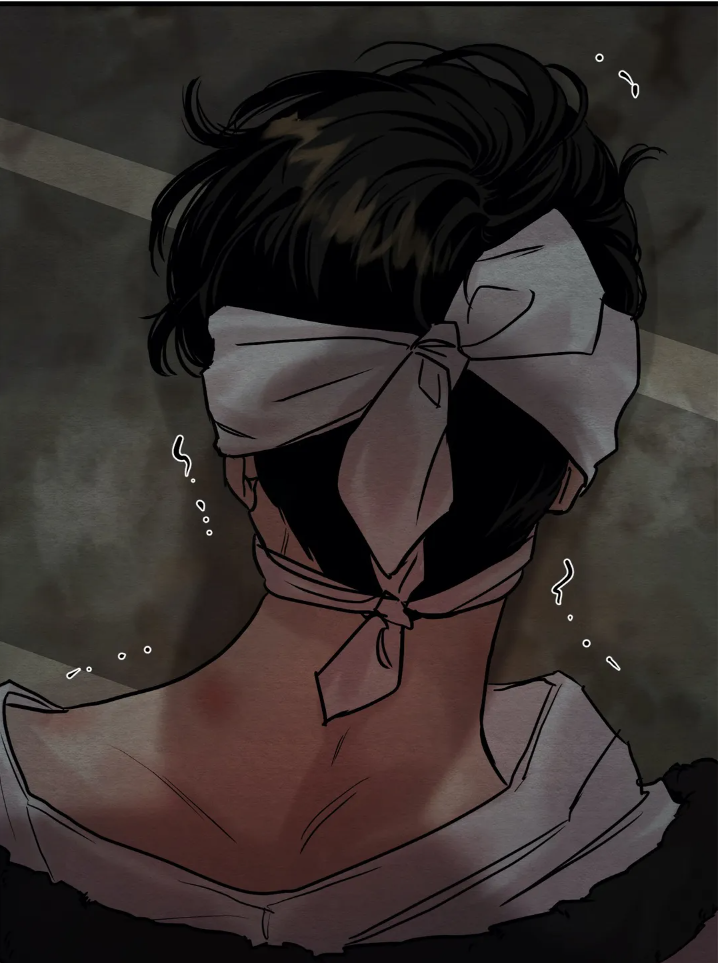 Like I had explained before, the artist is a person living in the present hence he embodies this time. On the other hand it is not the same with the noble. So the reason behind the artist’s doubts are different. It’s like a dream has come true, while for the red-haired aristocrat, it was, as if his dream and hope had been destroyed. And notice that right after seeing the hickey, he gets so shocked that he falls back on his butt and even moves away from the low-born.
 The shock was so huge that he has no energy left in his legs. Moreover, it was, as if the second character was trying to run away from reality, his eyes couldn’t take the blow. But his nightmare doesn’t stop here, he has to hear the painter’ scream for his lover.
 As you can sense, Jihwa’s senses are all confronted with reality. His own eyes saw the hickey, his own ears detected the intimacy between his ex-lover and the low-born. He can’t escape from the truth which he has been attempting so hard to avoid all this time. Now, his eyes and his ears are hurting him as they are revealing him the reality.
  (10), visiting Seungho’s mansion without an invitation
 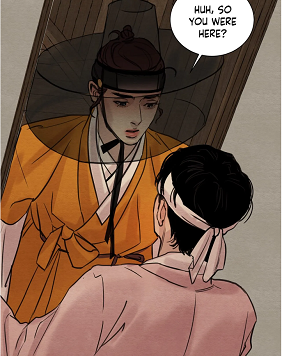 as he wanted to investigate the painter (17), hiring an assassin
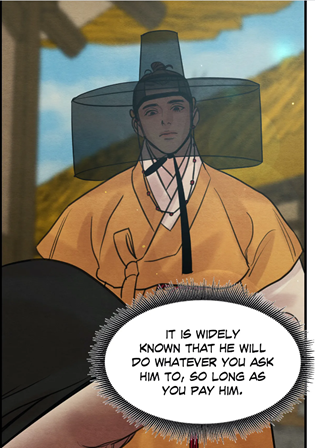 (43), showing the killer the target (50)
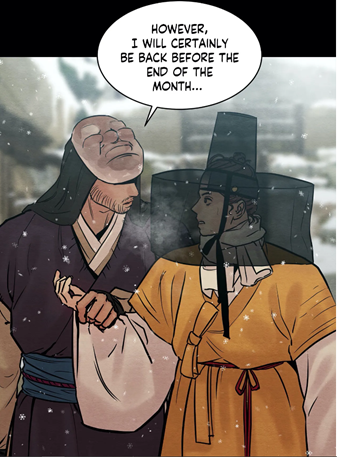 and visiting the criminal in order to remind him of his task.
  (51). The rational answer would be to say that he was wearing it in order to hide his identity. But in reality, there is a diverse motivation. The hat with the veil is used in order to cover his eyes and ears. While wearing such an item, he can avoid to be confronted with his crimes. His eyes can’t really see, just like his ears can’t really hear. This explains why he never questioned himself and his actions which I always criticized. Since he was veiling his eyes and ears, he was not facing the present and could escape from any responsibility. I would even add that this item reinforced his negative disposition. He would justify his actions with the past (f. ex. taking revenge on the behalf of the noble with the mole and accusing Seungho to be the cause for his evil actions
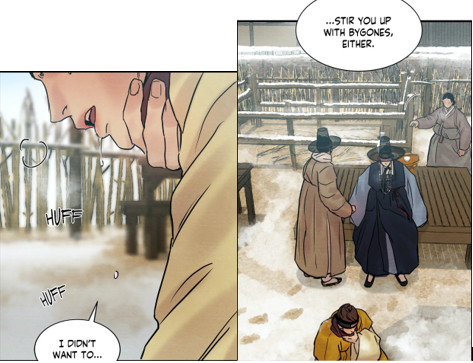 ) and would rejoice if they worked out.
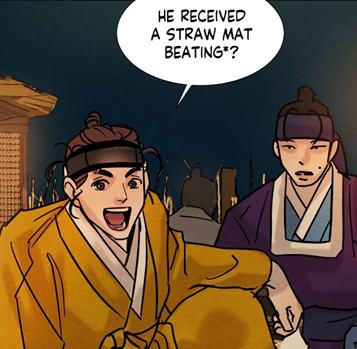 Observe that he only hears about the straw mat beating through his spy but he never witnesses the actual event. Hence he never sees the outcome of his decisions and actions. It would have been the same in chapter 17, if Seungho hadn’t intervened.
 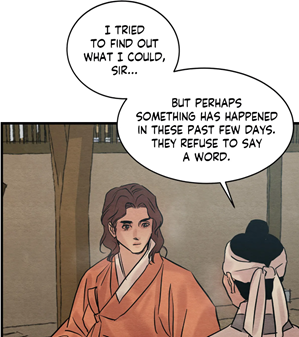 , the spy he hired
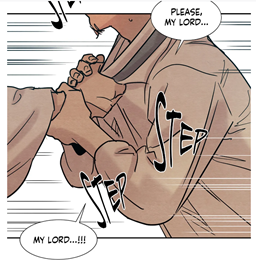 , Min
, Min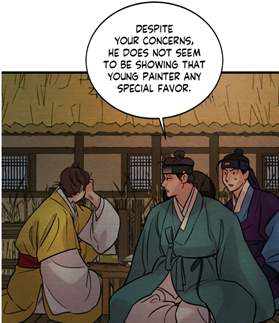
 and rumors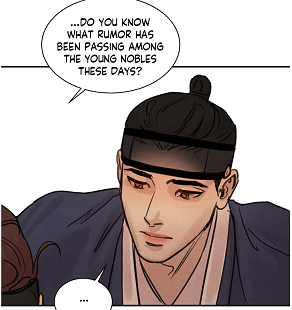

 . Concerning the second panel, it indicates that Jihwa has truly no idea about Seungho’s real power and wealth and is more relying on hearsay. Here, Jihwa is confusing the elder master’s situation with Seungho’s. The latter might have a bad reputation but his power is far from declining. This explicates why his brother contacted the protagonist in the end, he desired to get his support. The last picture is relevant as it outlines why Jihwa would always perceive Seungho as a man consumed by lust. He never witnessed how the lord would sleep with other men as he was never present. He could never judge with his own eyes that Seungho was actually fighting with other nobles rather than enjoying having sex with them. Fooling around implies pleasure which was never the case. In fact, with this statement it becomes clear why Seungho always had sex with Jihwa separately. Jihwa made sure to never be confronted with other aristocrats, preferring avoiding reality. It didn’t help him in the long term because he always heard Seungho’s conquests through others and this could only reinforce his prejudice. In other words, these private sessions could only increase the gap between them. Jihwa could never understand his childhood friend as he was influenced what people were saying because he never saw it himself. That’s why he got hurt in the end, he only got his knowledge by hearsay.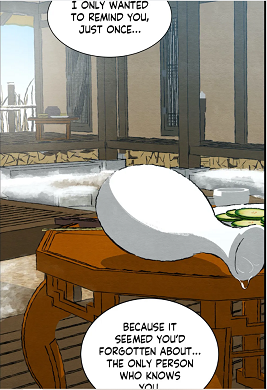
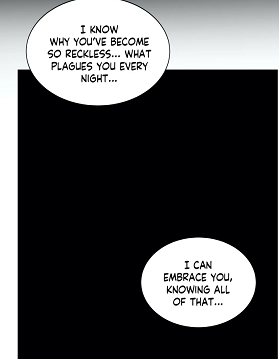 This idiom underlines that Jihwa is just using knowledge but neither his heart nor his eyes nor ears to understand him. He might know things but he can’t feel as he is himself deprived of his own senses. He’s deaf and blind in reality, very similar to the artist’s attitude in season 2 from chapter 45 to 49. In my opinion, Jihwa’s behavior reminds me of this picture with Baek Na-Kyum:
  A man without his head as his mind is full of prejudices and he is not even using his own eyes and ears. That’s why his so-called love for Seungho is shallow as he shows no true compassion. One might refute this argument by saying that the noble saw the lord’s nightmares. However, if you pay attention to this scene,
  you’ll notice that they are related to the past and not to the present. Jihwa was never a witness, when Seungho was directly wounded emotionally and physically. He could only observe the consequences of his suffering (the trauma), yet he knew nothing about their origins, only a name: lord Song. His knowledge is very limited, yet it gave him a certain feeling of superiority, explaining why Jihwa always considered himself as special. First, he knew certain things about his past as they were childhood friends. Secondly they had sex alone and finally Seungho always forgave Jihwa’s wrongdoings.
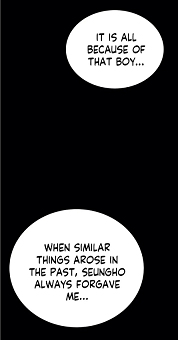 The reason for this is quite simple: both were living in the past, yet it changed the moment Baek Na-Kyum entered the two figures’ life, the person symbolizing the present. Let’s not forget that the protagonist’s tumultuous relationship with his friend got affected the moment the low-born created his first work. The sex at the pavilion affected not only Seungho but also Jihwa. While the former had come back to life without noticing it and saw a different image about himself, the other had the impression that he had been able to stimulate his friend for the first time and this gave him hope that he was closer to his dream.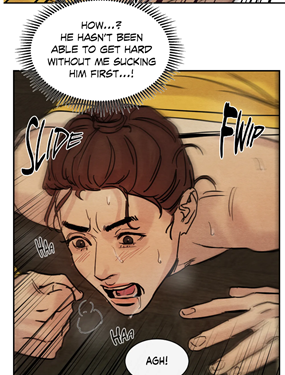
 Only now I comprehend why the lord could see the painter’s virginity. Let’s not forget that in this scene, Jihwa touches Baek Na-Kyum’s body. So he is not relying entirely on his gaze. Like I mentioned above, the noble lived more through his body and his hand helps him to sense the painter’s virginity. Let’s not forget that the character has learnt himself through his own body to detect sexual experiences. From my perspective, he sensed through his hand the painter’s shyness, that’s how he discovered his secret. He acted as if he was a man with a bad sight. But he was not only blind before, he was also deaf therefore in the same chapter, he doesn’t hear Seungho’s annoyance about his bad reflection, he is a man consumed by lust.
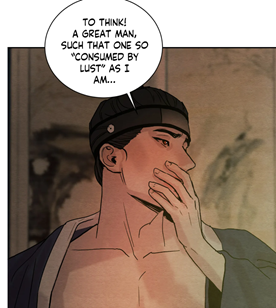 In my opinion, Jihwa lived through his other senses (taste and touch) to feel alive. And that’s one of the reasons why he drinks so much in the end.
 Happy or not, he drinks. Strangely is that in chapter 8, Jihwa has just bought an erotic picture but he looks at it without taking any pleasure. And this is important as it shows that his eyes are not sensitive, they are starting to come back to life. That’s why he can not be deeply moved by Baek Na-Kyum’s paintings in reality. For me, it becomes clear that due to the appearance of Baek Na-Kyum in Jihwa’s life, the noble is forced more and more to use his own eyes and ears, especially after hearing from his friend about the locked gaze between Yoon Seungho and the low-born. Hence we see many zooms on his gaze in chapter 13, 14 and 15 underlining that he is forced to use them. He has to witness with his own eyes the attraction between the two main leads and attempts to change it.
 He had to touch it literally to realize the consequence of his wrongdoing, he had to sense it with his hand.
  His eyes are absent and observe, he is touching his body in order to detect the marks left by the main lead. And the manhwaphiles should remember that one of the mirror’s purpose is to help the beholder to perceive his identity. Unlike his friend, he is not avoiding the mirror but since he is blind, he can’t perceive himself and needs his hands to see. And it is quite similar in chapter 41:
  here he’s holding himself the big spoon that’s how he can see his own reflection the water. I hope, you can understand why I can not examine each scene where Jihwa’s eyes play a huge role. However, with this new discovery, I would like to incite the manhwalovers to read the manhwa from the start and pay attention to Jihwa’s eyes and ears. But because he has been deaf and blind for so long figuratively speaking, it is not surprising that Jihwa is a selfish person. He is trapped in his own world where his interactions with others are restricted and his world is linked to the past. That’s why he can’t live in the present. Who would like to be reminded of his disabilities?
 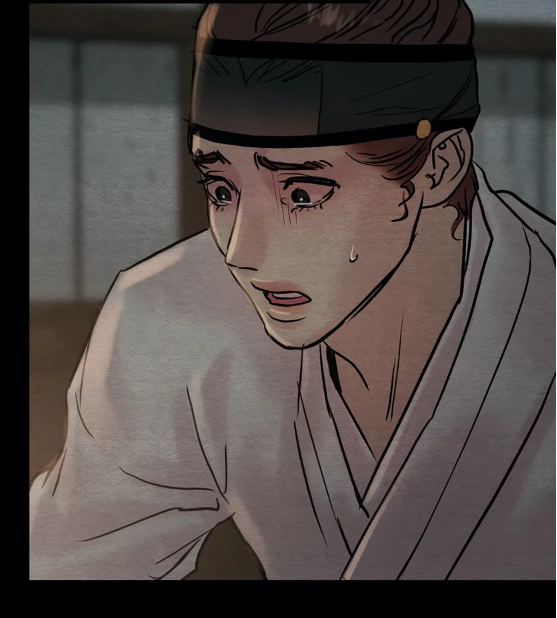 Yet, the beholder will recognize that the noble’s tears are barely visible. The tears don’t flow down the cheeks like in the latest chapter. From my point of view, this scene is very important as it explains Jihwa’s obsession with his friend in the end. In his presence, he was able to feel something, it moved his heart to the point to have some tears in his eyes. But he didn’t see with his own eyes, Jihwa detected it through his body and especially his hands. Note how Seungho is holding his hand on his friend’s shoulder and he is looking down. Both have no eye contact.
  or uses his hand to cover his tears
  (observe the position of his hands here) or hide his tears with the veil of the hat
 or bury his head so that the tears are not visible
 These gestures represent his resistance to accept reality. He is not able to face reality and the present hence he urges Nameless to kill the painter very soon. It was as if he tried to hurry the time so that the murder would happen very quickly.
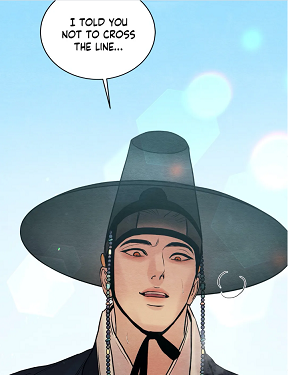 How is it possible for a blind person to see a line?
  He couldn’t believe his own ears that the main lead would never be together with him. That’s why in the cabin, he is still in denial, until the criminal confronts him with the reality. Striking is that once the noble complains about his incompetence,
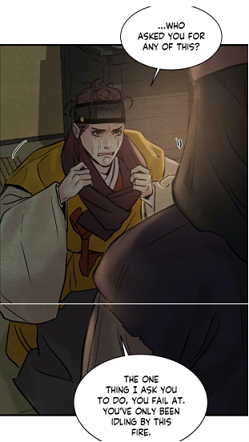 he shows him the kidnapped painter.
 which leaves him speechless. Striking is that right after, the noble hides away from the commoner. First, he turns his back to Nameless and even hides his eyes behind his hands. Another sign that he is still avoiding the present and the terrible situation.
 and observe that he is talking about the past again, using it as an argument. He criticizes Nameless for not doing his job illustrating that he is not taking any responsibility. But what the aristocrat fails to recognize is that Nameless is acting as the mirror, the mirror of fact, reality and truth!! His good heart made him detect the aristocrat’s guilty conscience hence he first postponed the murder hoping that Jihwa would change his mind. However, it didn’t work hence he reminded him of the severity of the crime
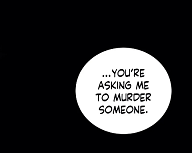 but the latter didn’t really budge, despite a certain hesitation. Each time, he urged the commoner to hurry up and finish it. I believe that’s how Nameless recognized that Jihwa would never see any responsibility after the crime despite a certain guilt. He sensed that Jihwa would become just like all the nobles who order a murder and then frame and blame low-borns for their wrongdoings. And this escapist attitude concerning the hit was present right from the start. What caught my attention is that in chapter 43, when Min incites Jihwa to kill the low-born, the upset noble is not using the personal pronoun “I” but “we”.
 He is including the others with his question. It was as if he wanted them to share the responsibility. Sure, Min was the one who brought it up, yet Jihwa could have refused. This question also unveils a certain hesitation. In my opinion, he’s hoping that they will stop him. However nothing happens like that. Min shows no remorse. My point is that even if Jihwa was reluctant to commit the murder, he was the one who made the decision in the end and hired Nameless. Through their different meetings, the commoner recognized the presence of guilt but simultaneously the lack of sense of responsibility. Hence Jihwa is forced to look at his victim
 and his misdeeds by Nameless.
 But just like the mirror in Snow White, the mirror is also speaking and even letting him hear that he is no longer innocent as he played a key role in the target’s capture. He is no longer innocent, even if he had no idea about it.
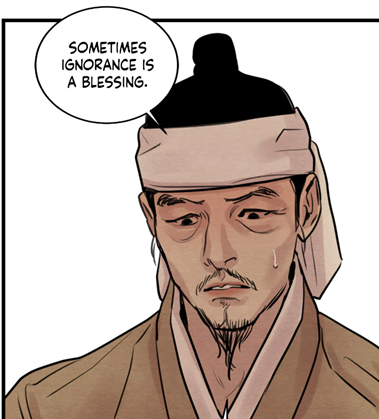
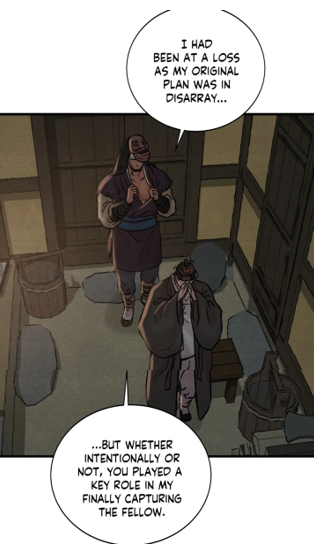 The irony here is that Nameless is using the same strategy than Jihwa but in the opposite sense. Ignorance is no blessing in the end. Even if he was unaware, he has become part of the plan, a sort of accomplice. Therefore he is already accountable for the future event. As you can see, the commoner uses the exact two senses which Jihwa refused to use in the end: sight and hearing. But he even provoked the aristocrat by describing what his friend had been doing after he left him
 leading him to verify his saying. As you can observe, Nameless is manipulating him for his own good. We all know that he wasn’t truly blind and deaf but since he was hurt, he chose to act as if he was blind and deaf, turning him into a selfish and lonely person. But Nameless doesn’t stop here with the confrontation.
  He has already committed so many wrongdoings but he still has an option to escape. He can drop the project. Let’s not forget that he would have killed the painter in affect if Nameless hadn’t stopped him. The criminal wants him to make a decision with a clear mind, similar to the painter who stepped out to clear his mind and face the reality. He is not allowing his client to act on his emotions. He recognized that Jihwa was again using the future, attempting to escape from the present and reality again.
 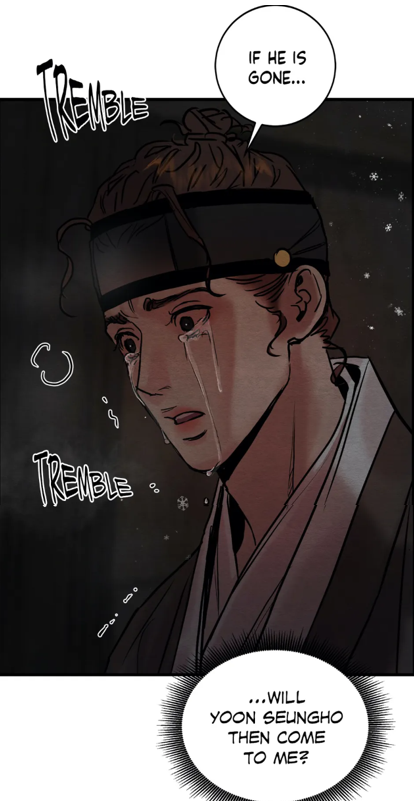 That’s why Jihwa’s eyes and ears play a huge part in chapter 60. Only here, I was able to recognize Jihwa’s real blindness and deafness, both related to his past and explaining why he was so obsessed with his friend. As a conclusion, the lord Lee Jihwa was not really living. Yet this was not so perceptible like with the main protagonist for his smiles and clothes gave a different impression. In other words, he is a mixture of the two protagonists: the painter due to his tears and his naivety and the powerful master Yoon Seungho due to his attitude towards life, his refusal to live in the present, escaping from reality.
 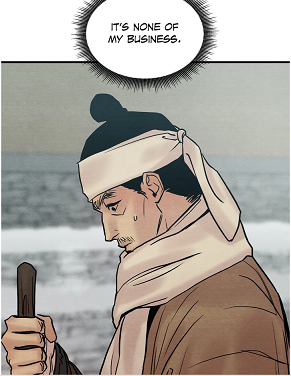 He doesn’t care about his lord or the painter, for only his interests matter. Since Kim has been following his master for a long time, he is well aware that the former is suffering and still living in the past. Striking is that when the butler portrays his lord to the painter in chapter 12, he talks about Yoon Seungho’s past and present:
 But before, he elaborates that he still fears his lord after living with him for so many years.
  Hence it looks like the assistant is more linked to the present. However, this is only partially true. In reality, valet Kim has a strong connection to the future too. Why? First, if you contextualize his words, you’ll notice the existence of a purpose behind his comment. On the surface, the readers have the impression that the butler wants the painter to accept his new situation and perceive his master in a different light. Nevertheless, the order of the lord’s description is important. First, he explains his master’s terrible past, only to underline the consequence. Yoon Seungho has a terrible temper. Note that the lexical field employed by the valet is revolving around fear. This is especially perceptible, if you pay attention to the following picture:
 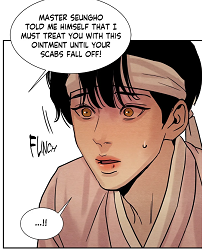 Note the painter’s reaction. He is scared, because the treatment with the ointment is presented like a threat and an order. The reality is that Yoon Seungho showed great care by sending his own valet, but due to the valet’s expressions, the lord appears more overbearing and threatening. That’s why I come to the conclusion that Kim is instilling fear in the painter, and if you pay attention to the protagonist’s attitude later, you’ll notice that he is indeed afraid.
  Hence he bows to the owner of the mansion, not out of respect but out of scare. Kim’s words were pretty effective, yet when he suggests to Baek Na-Kyum to go out for a walk, he is actually hoping that the artist will run away.
 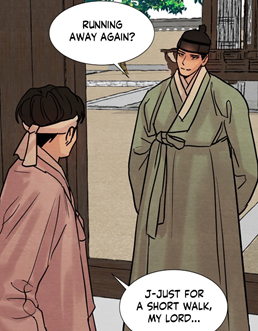 How is it possible? Kim was present, when Baek Na-Kyum somehow defied his lord and even refused to obey him.
 (chapter 11). He will do anything for the noble except painting, and this even after getting slapped and insulted. Kim had observed the rebellious side from the artist. From my perspective, Kim hoped that by saying that the lord had mood swings and Baek Na-Kyum should accept his fate, the latter would make the opposite decision. While the first impression is to think that Kim desires to reconcile Baek Na-Kyum with the lord so that their relationship can improve, the reality is totally different from my perspective. Let’s not forget that Kim is someone from Yoon Seungho’s past, who knows his traumas very well, but doesn’t do anything to change his master. Since the latter is living in the past, Kim has been focused more on the present. Yoon Seungho should never change and behave like a child, so that he needs to relying on his butler, who became his eyes and ears.
  Even an outsider commented that there was no real control in that household.
 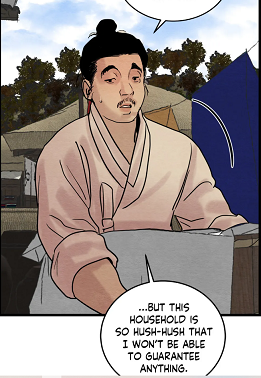 The servants could speak about Yoon Seungho behind his back and contribute to the gossips. The lord wasn’t even offended, when the door of his bedchamber was opened. He never investigated the matter. Finally the staff even didn’t take his order (keeping an eye on the painter) seriously, when asked. That’s why the painter could escape. Baek Na-Kyum’s appearance in the mansion revealed the master’s laxity. Note that so far, the staff has got punished only once, because they had obviously ignored his order. The gossips and the bad remark from the maid truly exposed that Yoon Seungho had no real authority and respect among his staff, and he was not such a terrifying master. Hence the butler’s words about the lord as a terrible master should be judged more critically.
  He is worried about the consequences of the painter’s escape. Let’s not forget that he helped Baek Na-Kyum to flee
  and the lord could definitely uncover his involvement. Hence he is worried. Nevertheless on the surface, it looks like he cares for the painter and the consequences of the sex marathon. As you can sense, in both interpretations he is already thinking about the future. And now, if you recall all the valet’s actions during the two seasons (until the chapter 68), you’ll realize that he has been working all this time for the future, while in truth he is determined to go back to the past. He wants to change the current situation, he would like the lord to behave like he used to. Consequently, I will try to list all his decisions showing that they are all related to the future.
  He is pushing away the commoner, making sure that this doesn’t happen again. The valet doesn’t desire that Baek Na-Kyum gets close to his master, because this would mean that he would lose his position. While in the past, I had imagined that Kim wished the protagonist to take over his role, I am thinking the opposite now. Only his life matters, and as such he was definitely benefitting from his position as butler. He could order medicine
  and buy items without being questioned. Since in chapter 39, the tailor requested a confirmation about the order, this truly exposes that Kim had a certain authority and power. Moreover, in chapter 45, with only one gaze, the butler is able to silence the tailor.
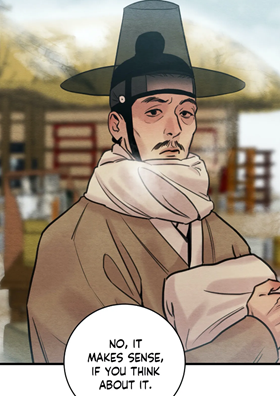 The way he is dressed and acts shows a man behaving like a noble (the hat, the hanbok and the headband), hence the tailor follows his recommendation. For me, the advice from chapter 23 was actually a warning, the painter shouldn’t use the “wedding night” in order to get closer to Yoon Seungho and become powerful. Note that Kim was wondering why the painter was joining them during the hunt.
 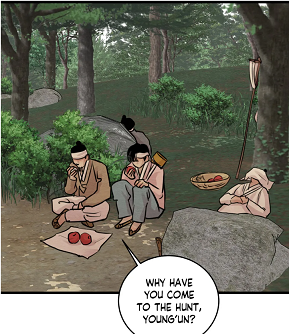 The lord was showing Baek Na-Kyum such a great respect, treating him like a honorable guest to the point that the main lead stopped him from falling.
  The butler was definitely worried about his own future, the painter could decide that once he had won the lord’s favor and heart that he needed to get rid of his rival: Kim. As you can observe, Kim represents the present, but a different kind: the status quo… the immobility which stands in opposition to Baek Na-Kyum’s present. However, like I have already outlined, Kim’s “present” is in reality the past. Moreover, he has another reason to separate the main leads. If it was known that Yoon Seungho had a relationship with a low-born, this would create a scandal, which the valet abhors. He hates ruckus, because he has no control over this kind of incident. Kim, as a butler, has a legitimation to be close to his master, but for the painter it is different, for their relationship is sexual and affectionate. As the manhwaphiles can sense, Kim’s philosophy and time contrasts so much to Baek Na-Kyum’s, which becomes more obvious during the second season. The moment the main character reflects on himself, he begins to attempt to understand the noble, while Kim doesn’t truly ponder on his own actions. He sways them under the rug, he needs to forget them.
 and complains that Yoon Seungho has not returned home for a while. While he fakes concern for his master, his true goal is that the artist remains in the lord’s bed.
 In his mind, the moment Yoon Seungho returns, he will see the painter and will desire to have sex with the artist. Note that the painter has barely recovered. This shows that the valet is hoping that his master will be like in chapter 30: selfish and greedy… so consumed by lust that the artist will pay the price. Note the huge contrast between the chapter 12 and 34. In the previous episode, the master was portrayed as a terrible man with mood swings, now Kim’s words imply the opposite. His master has been feeling guilty and he remained away, as he couldn’t face the painter, which is actually true. With these words, his intention is quite clear: he is attempting to put his lord in a good light, the latter feels remorse and he did everything he could in order to help the painter to recover from the illness. First, he underlines all the good deeds he did, then he speaks for his lord’s regrets hoping that this would move the low-born’s heart. Why? Kim desires to ensure that the low-born is no longer pushing away Seungho, and it really worked even in a short term. But more importantly, it looks like he is working for his master’s interest, which explains why initially I misjudged the butler’s true intentions. However, here the butler is actually forcing the artist to accept his new situation: a servant whose role is to please this master and nothing more. He has no right and he just needs to listen to Kim’s words. This explicates why the valet let the painter drink an aphrodisiac in chapter 36.
  The butler is well aware that if his master sees the erection, he will act upon it. Therefore I deduce that in the valet’s mind, Yoon Seungho is indeed a man obsessed with sex, but he will make sure that he remains that way. He has an interest for this situation, the noble doesn’t pay attention to his surroundings and what the staff and Kim are doing behind his back. And this interpretation that Kim is only accepting the painter as a favored servant is confirmed in chapter 52:
 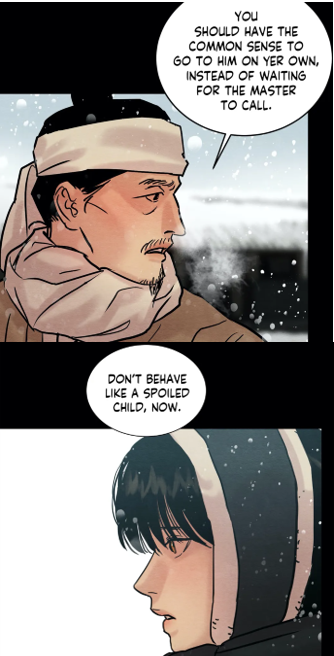 He is just a servant, and not a spoiled child, therefore he needs to do everything in order to please Yoon Seungho. This explicates why the painter puts on the white headband again. However, if you pay closer attention to the valet’s words, you’ll notice a contradiction. How can Baek Na-Kyum be a spoiled child, if he waits for the master to call? A spoiled child would refuse to follow a request… and would do whatever he pleases which is not the painter’s case. He was even so submissive to the point that Yoon Seungho complained about it.
  Why? Because of his strong will… once he makes a decision, he won’t change his mind at all. I would even say that Baek Na-Kyum embodies true loyalty, contrary to the butler who fakes loyalty, whereas he is only working for his own interests. With this new interpretation, it explains why Deok-Jae was in the painter’s room.
 He had seen the painter approaching the master’s room, hence Kim and Deok-Jae imagined that he would run away due to his wounded heart, especially if the lords would treat the boy as their prostitute.
 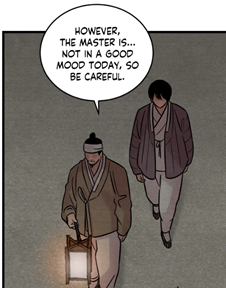 Then the assistant gives the painter advices on how to behave in front of the lord indicating that he expects from him that he won’t talk to his master under the pretense that his master is not in a good mood, whereas it was the opposite. The noble had happily discovered that the painter was no longer rejecting him, because he was planning to paint their last session. The truth was that Yoon Seungho was just tired. By telling him how the protagonist is feeling, he is definitely hoping that their time spent together will end up in a sex session, so that the noble still remains oblivious to his surroundings.
  , when he hears that lord Song would like to meet his lord. Note the contrast between the previous panel and this one:
  As you can detect, the butler is showing no fear at all. He even gives the impression that everything is done for his master’s well-being and future. He is determined to make him happy. But in that moment, we have to question: what about the painter’s interest then, which he defended in chapter 50?
 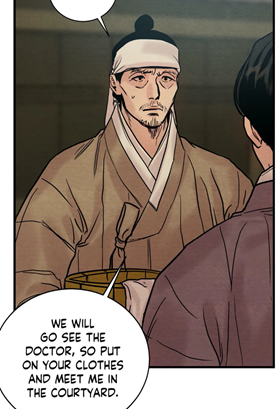 Notice that in the last two panels, he uses the future tense twice (will, shall), another sign that he is linked to the future. However, he is not working for his master’s future, in reality he would like to go back to the past, which reminds us a lot of Jihwa’s mentality. However, there’s a huge difference between them. Jihwa wanted to go to the time, when both were quite cheerful and innocent, while Kim prefers the recent past, the time before the painter’s appearance. The other difference is that he doesn’t wait, just like the second lead. He makes plan and anticipates people’s movements. He observes his surroundings in order to judge their personality so that he can take advantage from this knowledge. Striking is that when the loyal butler converses with the doctor, he can’t help mentioning elder master Yoon and his reaction
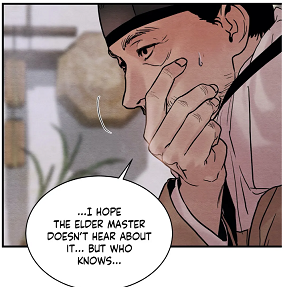 While it looks like he feels concern, the fact that he covers his mouth is a strong clue that he is actually not expressing his real thoughts. He really hopes for the eldest master’s intervention. Observe that he employs the idiom ” hope” and the latter is strongly connected to prospect. And the final proof is visible in chapter 58 where his presence is only revealed through the bucket of water.
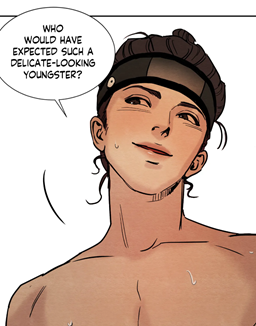 This exposes that he has never tried to discover the real identity of the creator and let his prejudice make the decision. He enjoyed the erotic publications, but that was it. One might say that since Black Heart is determined to overthrow Yoon Seungho and he is very manipulative, he could be perceived as a person focused on the future. However, if you pay attention to his schemes, you’ll recognize that they are never planned in the long run, rather decided in the moment, because he felt like it. It starts with the chapter 33, where he challenges Seungho by asking him to bring the painter to them.
 He manipulates the crowd, yet he acts more in the moment, since he acts in such an ostentatious way. He doesn’t hide his intentions. The lord is no fool, he’s well aware of the significance of Min’s words and its outcome but he chooses to overlook it. And here it is again related to pleasure. He would like to taste the artist. Another clue for the lack of real planning appears in chapter 37. Here he lies so obviously and a careful person would have verified his saying.
  indicating that he wanted to play a prank and mock Jihwa. Notice that even if he incites the red-haired noble to have the painter killed, he never monitors Jihwa’s moves. He never ensures that his acquaintance has indeed hired the killer. He believes that his manipulations will work, underlining that he is not really planning carefully. I would even say that the lord is even overestimating his skills and power. And this becomes even more visible in chapter 52 and 53. First, he is not even capable to hide his involvement in the murder.
 He literally reveals the truth in front of the painter because he can’t control his emotions. He is definitely caught by surprise. If he was a real strategist, he would have hidden his cards much better. Fortunately for him, the lord was more focused on protecting Baek Na-Kyum in the moment that he didn’t hear the guest’s comments. This observation leads me to the following deductions. Min is strongly influenced by his emotions: either by his jealousy or his desire to enjoy or his pleasure to hurt others. This explicates why this character keeps provoking his host to the point he gets beaten.
 He doesn’t even care, for him it was fun to make Seungho angry, to humiliate him… but note that no one witnesses Seungho’s humiliation. In his eyes, he had won the game hence he smiled.
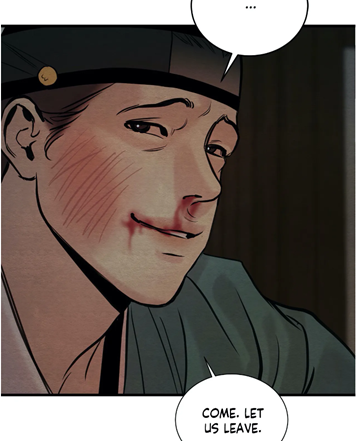 Yet this is only partially correct because at the end, Seungho put an end to his manipulations. Min’s victories are only superficial, as his plans never truly succeed. He never got to taste the painter in chapter 54. Notice that in chapter 55, Min even reveals his intentions to Jihwa.
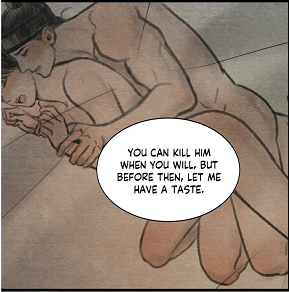 His desire to taste the painter has grown so strong that he requires Jihwa’s assistance. The trigger for this change is the new erotic painting of Baek Na-Kyum he saw during that night. Note that he is not doing anything on his own. He has to use “hounds” in order to catch his prey, exactly like during the hunt. This displays how much Min values pleasure over caution therefore he should be just considered as a lazy mastermind who lets others do his dirty work.
 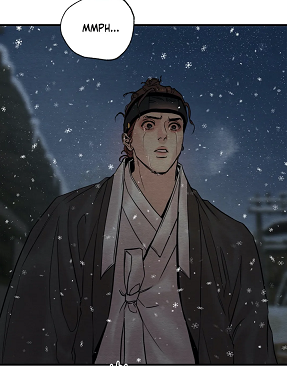 Since Jihwa is now confronted with the present and forced to make the decision himself, his choice is already linked to Min. Exactly like I had anticipated it, the red-haired noble didn’t decide to eliminate the painter. Hence thanks to Nameless’ good heart, Jihwa chose to send back Baek Na-Kyum to Seungho, however this means that he had disobeyed his master and surrogate father Min. That’s why the latter is forced to become more proactive in the end, he needs to plan something in order to achieve his goal. He can no longer live in the present, he needs to develop new strategies so that he can taste the painter. That’s why in chapter 69
 , Black Heart is seen dressed like Jihwa. Due to his second failure, Min is forced to change his habits and become more directly involved in the schemes. And this will be his weakness, as he is not a good strategist in reality. Like I had pointed out above, his manipulations are more born in the moment, which we could observe in chapter 66 again. The Joker is still unaware that a servant disappeared and he just revealed Jihwa’s crime in order to punish his pupil. However, this means that if Baek Na-Kyum disappears or gets hurt again, the noble won’t believe that Baek Na-Kyum was trying to run away from him. There will be terrible consequences, and his friend warned him about this.
  Note that here again, he is utilizing the present underlining one more time he is not thinking about the future. The past pushed him to make this decision and observe that during his escape, he expresses no reproach towards his adoptive mother or to Jung In-Hun. He just remembers their nice gestures, the caress on the cheek
 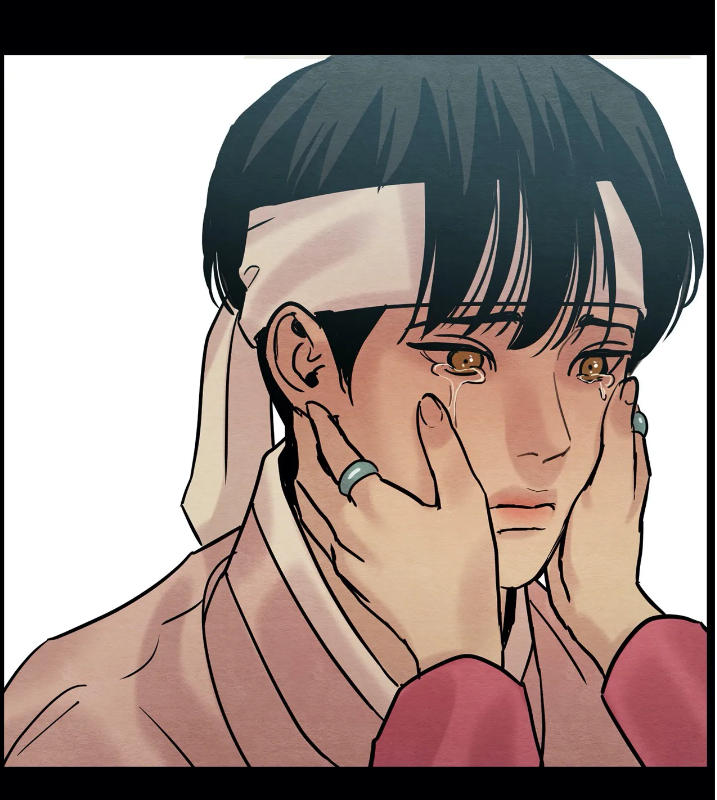 and the teacher’s smile,
  , he has never criticized him for that night afterwards, although he could have, since he could have been raped. In fact, he has never brought it up, while the lord was actually expecting resent and rejection the next morning. He even confessed in such a way that he imagined that the artist would escape. But to his astonishment, the artist had remained by his side. Besides, note, it is not even present during the memories!!! Then when they meet again, he takes care of him and wants to make sure that Seungho feels more comfortable.
 I have the impression that he is not using the past because he has no ill intention towards others and he doesn’t want to play the victim either. Moreover, I believe, in his eyes bringing up the past doesn’t change his actual situation: he was abandoned and that’s a fact. He accepts his fate as painful as it is therefore he doesn’t blame anyone either. Now, you understand why I associated Baek Na-Kyum to the present in this panel and why Jihwa embodies the past.
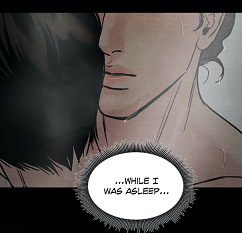 Observe how close the lord’s head is touching the painter’s. He is embracing him as if he didn’t want to be separated.
 his future is now to enjoy his sexual encounters with the painter, never hoping that they will share what they have on their mind. As you can observe, he is gradually adopting the painter’s philosophy: enjoying the moment. Thanks to the painter, he has been able to move on from the past but he is no longer projecting a future too. Therefore he rejects Jihwa by saying that he will never reciprocate his feelings.
  He has given up on the future hence he can stipulate that Jihwa and him can never be together in the future (“ever”). Actually the climax is reached in chapter 58 which chronologically happens after Jihwa’s love confession and his rejection. When the master confesses his feelings for the low-born, he declares to his lover, he is no longer expecting a love confession from him, it will remain an illusion.
 He is now embracing the painter’s philosophy. He is living in the moment, enjoying his time with him. That’s why I perceive this second wedding night stands under the sign of present too. The lord wants to love the painter selflessly and is expecting nothing in return. That’s the reason why the lord can sleep more peacefully during that night.
 He started moving on from the past before
  and is no longer dreaming of an uncertain and even impossible future.
 In chapter 35, the lord spent a terrible night as he was thinking how to reconnect with the painter (another reference to the future). These aspects are relevant in my opinion because it explicates why the lord hasn’t paid attention to his lover’s real desires or future yet. We know for sure that the low-born wanted to be able to read and write. He felt very embarrassed, when Seungho exposed his illiteracy. And now you understand why Baek Na-Kyum was left unprotected in the end. Because the lord was living more and more in the moment, he neglected the future and as such a real protection for his lover. As you can observe, in the beginning Seungho was a man living in the past but thanks to the artist, he transformed into a different person. And with Jihwa by his side, he could never move on from the past as the latter kept reminding him about it with the hope, they could be together one day. The problem was that with these actions, Seungho could never dream of any future as Jihwa kept him trapped in the past.
  etc….
etc….  Therefore I have come to the deduction that Baek Na-Kyum will definitely show the same attitude towards Jihwa like he did with Seungho. At some point, he will forgive him for his kidnapping and the terrible treatment he suffered afterwards. Let’s not forget that the artist is now the one discovering the past and heard that Jihwa was considered sick as well. And this is no coincidence. For me, the artist will come to understand what Jihwa and Seungho went through and help them to move on. Like I pointed out above, the commoner has always been able to move on from the past and has never held deep grudges. For me, the artist will serve as a model for his lover and will show him and Jihwa what true forgiveness means. But I have to admit that this is more a prediction, yet based on my observations and interpretation.
 Although he has problems to accept the obvious, the master has loved him for a long time, he blushes because he is definitely moved. Notice that even in that moment, he is not thinking about the future. What does it mean if Seungho loves him and confessed to him? How will their relationship change? At no moment, he is projecting himself and the lord in the future. And while looking at this panel, I couldn’t help myself connecting to the following picture from chapter 1.
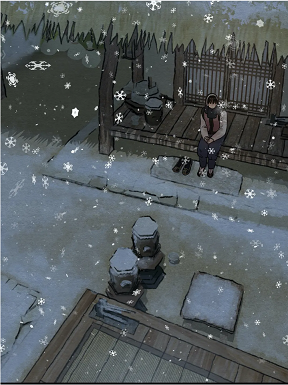
 Thanks to the lord, the painter has also transformed. Instead of being drunk and not thinking, he has been able to paint and is thinking on his own. Now, he is not lying on the ground but sitting straight while pondering. He is still on his own but his solitude is here chosen and not forced. He left Seungho’s side in order to reflect about the master’s confession and love. And this is no coincidence that the painter’s former position is now mirrored by Jihwa’s. The latter is the one who has been rejected and abandoned by his surrogate “father”/lover.
 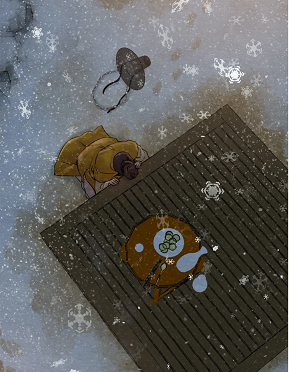 Their positions are quite similar, yet the only difference is that Jihwa is not even sitting on the wood. He is still kneeling as he has problems to process the rejection. He is in denial, although he remembers Seungho’s words. Since we know that he values the past so much, it is quite normal that Jihwa chooses to repress his friend’s explications. And now, you can imagine what I am about to tell. The chapter 59 is a new version of the chapter 1 which makes me think that something bad is about to occur, since we had the servant’s death in that episode. Another clue for this prediction is the color of Jihwa’s robe, when he faces the captured painter.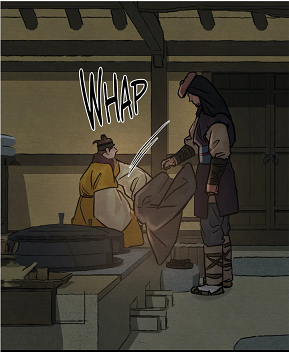

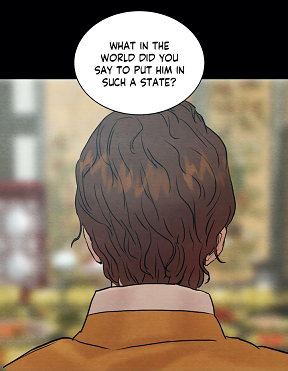
 . When the protagonist explained in chapter 55 how he felt to the painter, he was actually referring to the rape. When he got rejected by the painter at the pavilion, the painter’s reactions and gaze triggered such negative emotions in Yoon Seungho.
 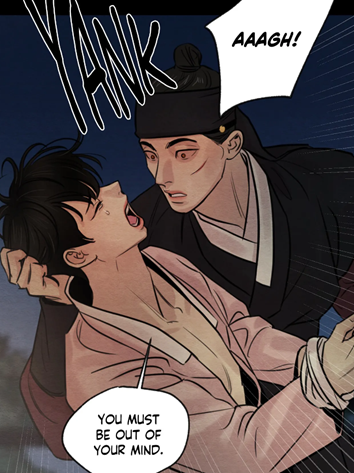 He was reminded of his past and the incident with the topknot. Like I had explicated in another analysis, this scene from the protagonist’s past is deeply intertwined with jealousy, rejection, fear of abandonment and his self-hatred due to the negative reflection perceived in the father’s gaze. Hence we have to imagine that Jihwa must have said something about father Yoon, abandonment and Yoon Seungho’s negative image which could only trigger the lord’s fury. The negative reflection is already implied with the idiom “common brute”. As you can observe, the red-haired aristocrat utilizes his knowledge of the past in order to hurt his lover and in my opinion, it was related to Seungho’s abandonment issues. The third evidence for Jihwa’s preference to use the past is visible in the following panel.
 Imagine, Jihwa was even willing to get humiliated if in the end, the friend would maintain his relationship with him. At least, Seungho showed reactions towards him and not indifference. And now, it makes sense why Jihwa was never present at sex sessions with other nobles. He wouldn’t have been able to handle the situation, he would have suffered from immense jealousy. I guess, Yoon Seungho must have conceded to be his exclusive sex partner, when they met that’s why they were always alone. This observation leads me to the following deduction: Jihwa and Seungho had both abandonment issues and the red-haired character used the friend’s weakness in order to hide his own anxieties and abandonment problems. And since the red-haired aristocrat kept backstabbing Seungho (see the incident with the topknot and his insult “common brute”, the letter), it becomes clear why the main lead didn’t distinguish his childhood friend from all the other nobles in chapter 57.
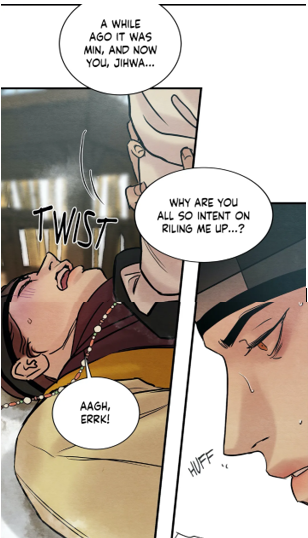 One might argue that he was just referring to the letter and Black Heart’s insult here. Yet, now we know for sure that the former sex partner wounded his friend even before the appearance of the painter in their life. Because of his friend’s bad actions, the main lead could never reveal his vulnerabilities out of fear that his loved one would use it as a weapon to hurt him, something he had even experienced with his childhood friend. Jihwa did contribute to his loneliness as the former wanted him to rely on him, to look at him. This also explains why Seungho could never sense Jihwa’s attachment for him.
 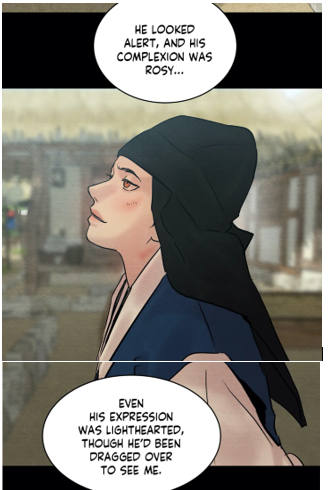 but directed at him this time. And now you understand why Jihwa is so obsessed with the past. It was, as if he wanted to return to the past before the tragedy occurred but this was and is impossible. At the same time, his hopes made him project himself in the future. He would get loved by his friend as he was the only one constant lover in the main lead’s life. And now, it becomes more comprehensible why the aristocrat played with time. In his mind, time would help him: the past and the future were his motivations. The consequence of this mindset is that Jihwa was never satisfied with the present, the current situation where he saw Yoon Seungho fooling around with other men.
 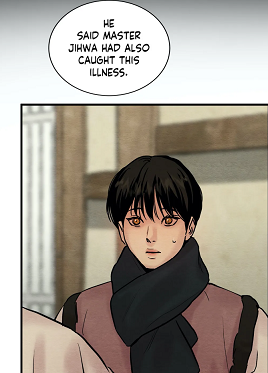 Jihwa was declared sick, just like Seungho. In my opinion, with this statement, something bad must have happened to Jihwa, yet his suffering was different to Seungho’s therefore his insecurities are expressed differently. He was never exposed to gangrape and prostitution. The second proof appears when Jihwa declares to his friends this :
 The expression “the most wretched of states” is an indication that Jihwa must have been suffering as well and Seungho knew about this hence he was always willing to forgive his friend’s pranks and stabs.
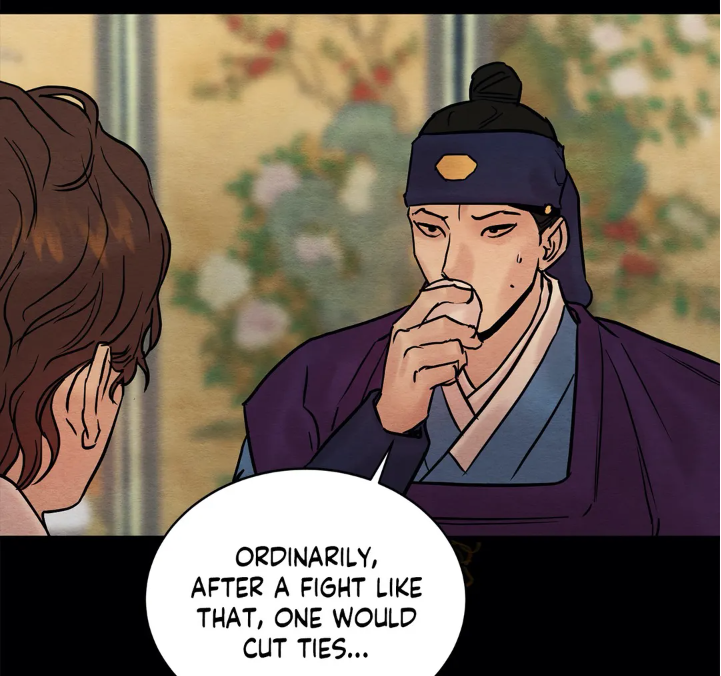 Even the noble with the mole points out that after such a humiliation and fight, the person would distance himself from the offender for good. But Jihwa justified his behavior by pointing out that he had a special position in Seungho’s life without revealing too much. He was connected to Yoon Seungho by their past and knew about his nightmares and his insomnia.
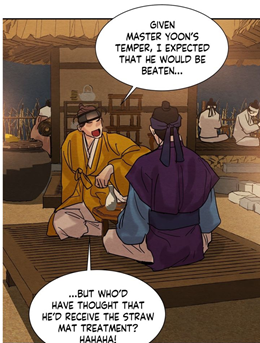 And this shows that Jihwa’s prank was not the only plot he did behind his friend’s back. He knew exactly which trigger he could pull in order to infuriate and wound his lover.
 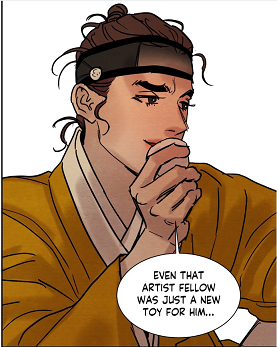 Observe that Jihwa is comparing the painter to a toy. These words are relevant for two reasons. First Jihwa tries to diminish the importance of the protagonist’s sex partners. They are just toys, while in reality he considers them as rivals. Consequently, he needs to make sure that they are just toys for his lover and nothing more. In his mind, they are no humans, just pawns for the friend’s distraction, he is trying to reassure himself in the end. But in my opinion, his mouth is actually contradicting his own heart, as he was never satisfied with the situation that Seungho had many lovers. He felt really upset and betrayed hence in his heart, he always resented his childhood friend which he finally admitted in his love confession.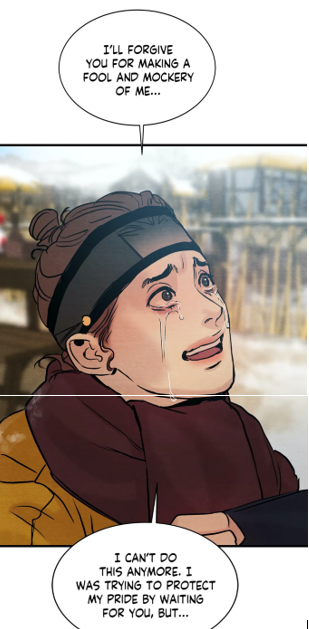


 (we never saw his face on the way to the mansion here but based on his robes, we can definitely assume that he was happy. He imagined that because of the brother’s visit, he had a reason to pay him a visit and they would reconcile) quoted from
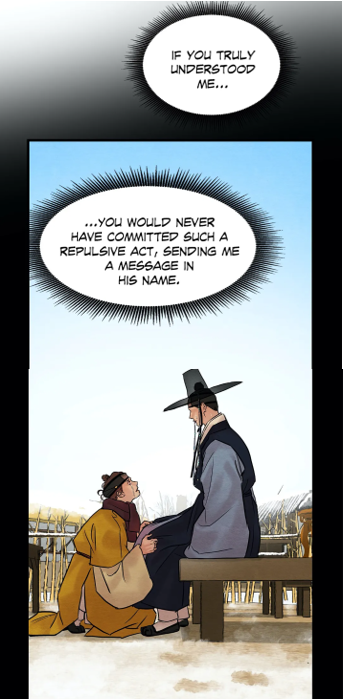 The red-haired aristocrat just knows a little bit of his past but doesn’t truly comprehend Seungho’s suffering. He just saw the symptoms but is not aware of the real source of his nightmares (the true events). His obsessive love disorder stands in opposition to the painter’s pure adoration. While Jihwa only saw his friend’s flaws, the artist was doing the opposite. He idealized his learned sir to the point that he was used. With these two examples, Byeonduck clearly illustrates what true love really means: accept a person with his qualities and flaws and being selfless. Real love shouldn’t make someone blind as it can only lead to disappointment.
 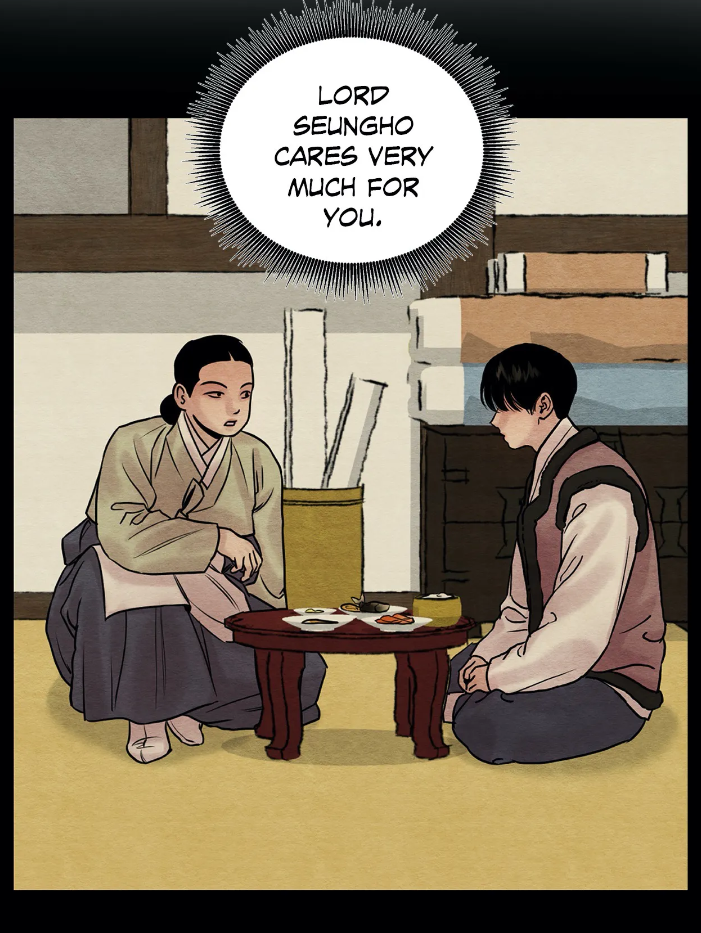 , he couldn’t believe his own ears so that he had to ask her for a confirmation.
 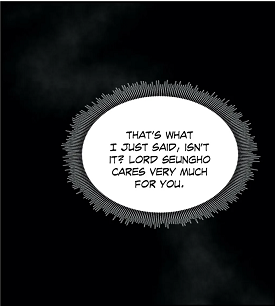 this displays how his mind was refusing to see and hear what his heart and unconscious was already sensing. There’s a reason for his resistance. The manhwaphiles should remember that the painter’s conscious has always represented his strength but also his last wall of protection. This explains why it took the noble a very long time to be able to remove the doctrines imposed by Jung In-Hun on the low-born. At the same time, his unconscious was always the one telling the painter what he truly wished deep down. Consequently, we witness how Baek Na-Kyum dreams of Yoon Seungho’s love confession first but when it happens, his mind can’t process it. It’s too crazy to accept this truth. But if you pay attention, despite his reluctance to accept the obvious, his face is red showing how much these memories and this reality affect him. He is definitely moved. This reminds us of the lord’s attitude who denied his feelings for the low-born. We could say that Baek Na-Kyum is experiencing a similar situation. And the flashbacks reveal the disappearance of the scholar’s influence in Baek Na-Kyum’s life. He only appears once and just as a reminder. Back then, the low-born felt a little hurt by Jung In-Hun’s comment and now, he feels nothing. He just remembers his words and nothing more. Slowly, the painter is accepting the reality that Seungho loves him and has cared for him for a long time.
 For the first time, he is deeply sleeping. Sure, one might argue that he is sick, yet I doubt that the illness explains everything. In my opinion, the fact that Baek Na-Kyum accepted his confession and made love in that room could only make him happy. For the first time, someone accepted him without criticizing or blaming him. He was allowed to be himself and to show his vulnerabilities without getting hurt. Jihwa never saw the real signification of Seungho’s gestures, when he spent the night with him. Since he is overlooking the present, he had the impression that this night together had brought them closer, while it was not the case. Seungho had sensed that Jihwa couldn’t give him the comfort needed. But since Jihwa had spent one night with him, it became a memory and a justification to claim that he knew his friend better than everyone else.
 (chapter 58) Finally, Baek Na-Kyum’s deeply repressed desire and dream becomes a reality, his lord is in love with him. But since this wonderful chapter should be considered as a new version of the events related to the tailor shop, we need to examine chapter 58 under a different aspect: responsibility which was the main topic of chapter 39-40. [Here, this is my analysis about these chapters
  (chapter 40)
 (chapter 40) However, we have now to understand that this gesture was under the influence of his unconscious and the lord had not recognized his own feelings for the painter so far. He was more under the impression that he was making decisions rationally. Furthermore, he was not taking the painter’s feelings into consideration, since he was well aware of Baek Na-Kyum’s “adoration” for Jung In-Hun. In other words, this gesture signified that Yoon Seungho would become Baek Na-Kyum’s husband and companion, even if the artist was not in love with him. Now, you might be wondering why I focus first on the red dot than the event at the tailor shop. There’s a reason for that. Here, the topic “reliability” is more developed and plays a huge role in their relationship.
 (chapter 39) Here, he accepts the blame, because he has now a reason to have some sexual interactions with the painter. Consequently, he proposes another fellatio
  (chapter 39) under the pretense of forgiveness, which the artist refuses by objecting that he is not blaming the noble at all.
  Notice that the painter is forced to become the accountable one and take the blame for the whole situation. And this shows that in that scene the lord is actually the one with the upper hand as he uses Baek Na-Kyum’s shyness and embarrassment in order to tease him and actually obtain what he has been longing: intimacy with Baek Na-Kyum.
 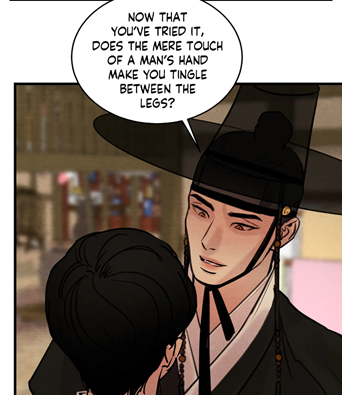 (chapter 39) However, when the boy apologized to the lord and claimed that he was responsible for everything
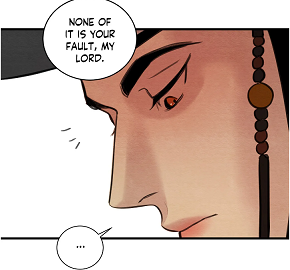 (chapter 39) In my opinion, the painter’s reaction must have been triggered by Seungho’s offer for a fellatio. Observe that, while he’s whispering to the painter, the latter’s face blushes again, but more importantly, there’s a sudden light in the artist’s eye.
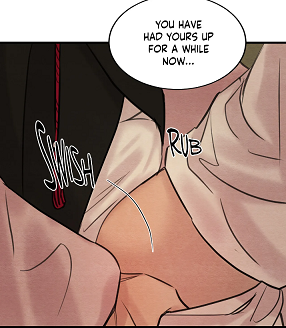 (chapter 39) He needs to satisfy him as he is now excited too. As you can observe, there was a shift of responsibility at the tailor shop. However, the lord shows a certain reliability as he just asks for a foreplay because of his concern that the painter could feel uncomfortable afterwards.
 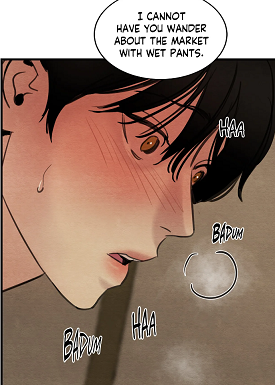 (chapter 39) As a conclusion, the lord showed signs that he was willing to be responsible for the low-born, although at the end, the artist ended up as the one who had to become the accountable one. In order to compare both scenes (39-58), it is necessary to list all the important elements present in the chapters 39-40 again: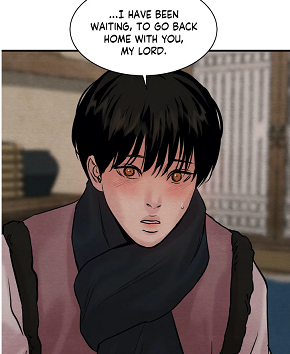

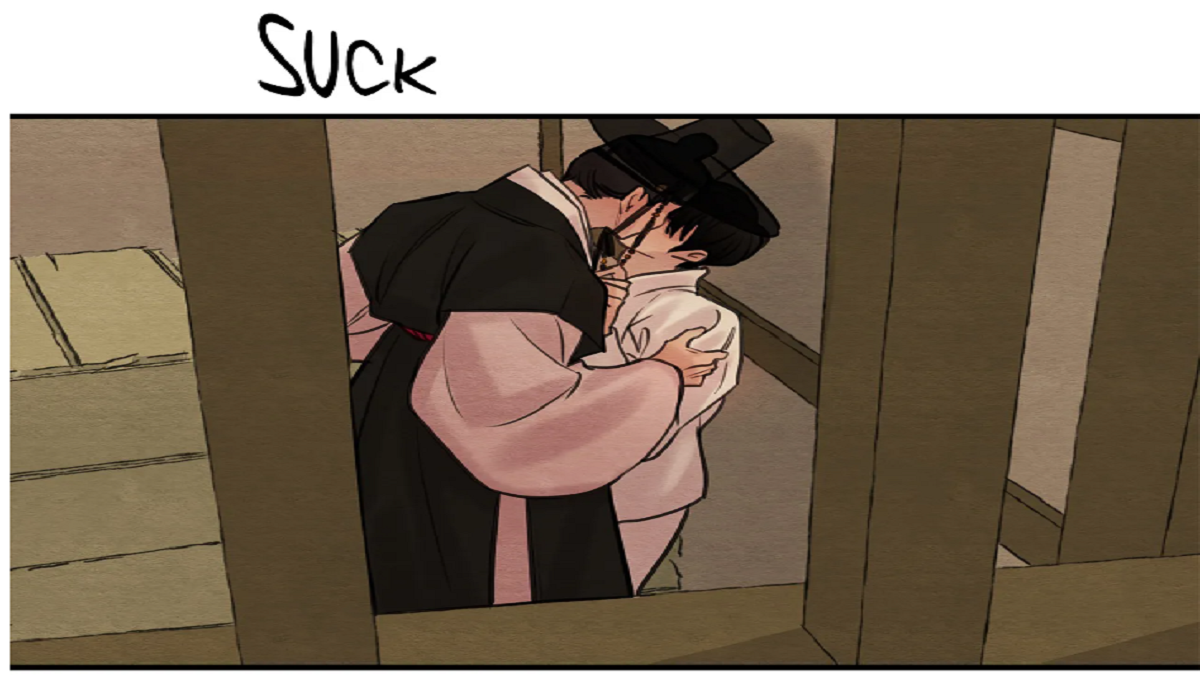 (chapter 39) And now, it’s the opposite: Seungho is against the wall as he can no longer deny his feelings for Baek Na-Kyum.
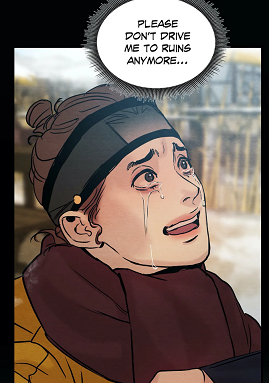
 (chapter 58) Note that both idioms have a similar connotation: destruction (ruins, wreck) and blame (you/don’t). However, Jihwa’s words contain reproach and resent indicating that he is not enjoying his situation. Since the main lead is to blame for Jihwa’s misery, the former should become responsible for him. As the manhwalovers can detect, Jihwa’s confession has a different signification. Jihwa is recognizing his defeat, which indicates that he indeed associates affection for weakness and a sex/love session as a fight. He never confessed before, because he didn’t want to surrender but preferred his childhood friend being the one. Jihwa was hoping that due to his loneliness, the main character would seek comfort by him as the only one remaining loyal by his side. That’s why he pushed away any possible rival before.
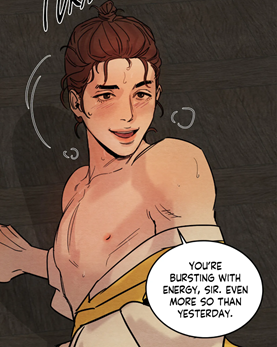 (chapter 3), which explains why he treated the painter so arrogantly and even barged later at Seungho’s house in the chapter 12, a behavior which Seungho disapproved. The red-haired noble had imagined, his status had improved and he was on the verge of becoming his official lover. This analogy between love and demise/defeat is important, because it truly shows how much Jihwa and Yoon Seungho had internalized these values and why it took the lord a long time to confess to the painter properly. Therefore, when the red-haired noble admits his attachment to his childhood friend, he knees in front of his childhood friend, a symbol for defeat and submission.
 (chapter 58) Simultaneously, this explains why Jihwa’s words reflect resent and selfishness
  (chapter 58) And now, if we contrast it with the main lead’s confession, we discover a different state of mind. The lord is definitely admitting his defeat as well, yet he is not blaming Baek Na-Kyum, in fact he is enjoying his actual situation. There’s a certain admiration for the “you” who has turned him into a wreck. The word responsibility has a different signification here. It’s no longer blame or accountability but maturity and trustworthiness. He’s no longer paying attention to his pride, there’s no resent. His only joy is to be able to show his love for the artist, since the latter is allowing him to express his feelings through words and actions.
  (chapter 58) After reading it for the first time, the reader would judge “wreck” in a rather pejorative light. On the surface, it seems that the lord is referring to the painter’s drunkenness, yet it gets a different meaning after reading the whole chapter. Moreover, it becomes more obvious that the noble judges “wreck” as something admirable, since “wreck” is combined with absolute. Despite his terrible state and his first rejection, the artist was determined to confess no matter what. He was brave and strong, although he looked terrible at the same time: drunk, desperate and full of tears. Yet, at no moment he blamed his “learned sir” for succumbing to his feelings or saw his love as something terrible. Unlike Jihwa and Seungho so far, he was true to them. It was so pure that the lord could only be impressed. That’s the reason why he wanted to mock him in the first place, as he had been taught that love is a synonym for weakness and surrendering to feelings was like admitting his inferiority and his defeat. This explicates why the lord was haunted by the pure and genuine kiss in the first place, it was something new.
 (chapter 58)
 He heard the painter’s confession addressed to the scholar. Thus he was well aware that his master was seizing the opportunity to make a move on Baek Na-Kyum, which he could only disapprove. That’s why he remained there, until the lord reacted to his passivity. This explains why Yoon Seungho had to order him to close the door by whispering. With his command, the noble forced him to obey him.
 Here, their dynamic changed. In that moment, the loyal valet became just a servant who needed to listen to his master’s orders. And his presence during their “Wedding night” marked a turning point in the butler’s life as well. From that moment, he started acting more and more like a surrogate father or mother, though the noble treated him more and more like a domestic. This opposition is really perceptible in chapter 50:
 But let’s return our attention to the first season. After witnessing this “Wedding night”, the butler never divulged this incident to others. The manhwaphiles should question the cause and the signification for the butler’s behavior. He couldn’t approve such a relationship for two reasons. First, this would create a scandal
 . For Kim, this meant that the other aristocrats would distance themselves from Yoon Seungho, since the butler has already internalized social values. Totally isolated, the noble would become more vulnerable. Therefore he could become the target of other aristocrats. In my eyes, Kim had imposed his own philosophy on Yoon Seungho: knowledge is power, but he needs to lie low.
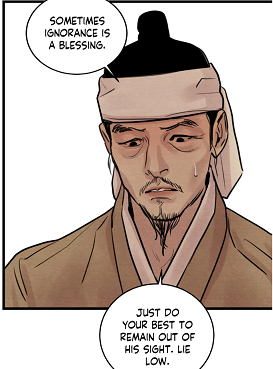 (chapter 23) That’s why I come to the following conclusion: Kim might have been the Best man, yet in reality he was refusing to acknowledge this alliance. And now, the readers can grasp why he said those words in chapter 23. He was acting like a father disapproving the partner’s choice of his “son”. Hence he tried to advice the painter not to remember that night
  (chapter 36)
  (chapter 30). This action was clearly reminding the butler that he was in the end just a servant. Hence Kim resigned and had to support his lord’s choice. Yet, what he did is the following: he attempted to turn the artist into a prostitute or “favored servant”. At no moment, Baek Na-Kyum should be recognized as the master’s official partner. Therefore he asked the doctor for an aphrodisiac for the painter, or he hid the information about the incident at the library
  (chapter 50). He had to ensure that the noble would never recognize the nature of his feelings for the painter. This explicates why he criticized the artist for acting like a spoiled child
  (chapter 52). When he asked him to visit the lord’s chamber, he was reminding the artist of his situation: he was just a servant. Simultaneously, he wanted him to go to Yoon Seungho’s bedroom in order to witness that he had no special status, he was not a treasure. He incited the artist to see with his own eyes the master’s debauchery and feel disgusted. He hoped with such a situation, the artist would run away. Kim was well aware that the aristocrat was starving for love. In other words, till chapter 58, the butler was denying the existence of the Wedding and their union. He refused to be their Best man.
  and chapter 20
 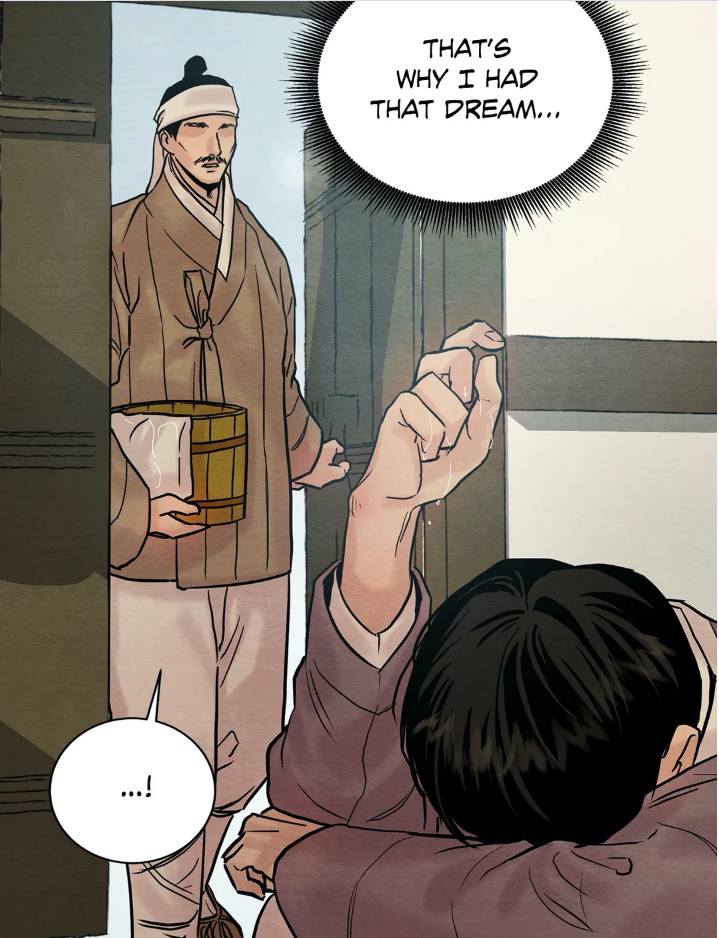 Besides, remember what Baek Na-Kyum said in chapter 57. The assistant was supposed to fetch water, and observe the smoke coming from the bucket.
 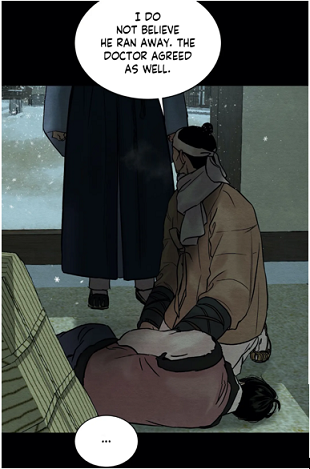 (chapter 62). He could have talked to Yoon Seungho that he had heard how the artist had reacted to his confession. In other words, he was still refusing to become their Best Man, though he had a second chance. He knew how much the artist meant to him and because he was sick and shouldn’t have sex, Kim recognized the signification of that moment. And the last panel mirrors the evolution of Kim’s position.
  (chapter 70), he was acting on Kim’s order. Due to the way the domestic closed the door, you could sense that he was resenting the artist.
  (chapter 70). The latter had created so much trouble in two days: his supposed escape and the kisaeng’s appearance. However, by “playing cupid”, the servant was actually acting as their “Best Man”. In my eyes, he hoped, the artist would stop rejecting his master. There’s no doubt that after this night, the staff was happy.
  This explicates why Kim ends up in the backyard. The head-maid and the male servants have come to realize that Baek Na-Kyum is playing an important role in their master’s life.
  (chapter 51).
  (chapter 64) After each disappearance, the staff would get into trouble. This leads me to the following conclusion: The real Best men are Yoon Seungho’s domestics, for they accept this union and relationship.
  But this gesture just marks the beginning of the renewal of their intimacy. However, in this chapter we have a sort of repetition of their Wedding night. Hence, we need to ask ourselves why it came to this, although the lord is physically diminished. The kiss and the caress of the hand are just signals and not the real explanations, especially after the readers recall the protagonists’ long separation and the terrible night which could have led to a catastrophe. What is motivating Yoon Seungho to overlook his own exhaustion and to create a magical night? Striking is that before the release of episode 58, I had predicted the following:
 and the former doesn’t even cry out of happiness. Moreover, he keeps refusing the lord’s advances.
 Besides, he is much more passive than in the reality where the painter continues moaning “my lord”
 and even gets an orgasm, when he hears the lord whispering such erotic and passionate words,
  while in the illusion, he got so scared that he decided to wake up. He was still rejecting the lord’s confession.
 in front of Yoon Seungho if this was an illusion, there’s no room for ambiguity at the doctor’s. First, the artist is not drunk. But the most important aspect is that the master makes sure that this will feel so real. He ensures that all the painter’s senses are activated:


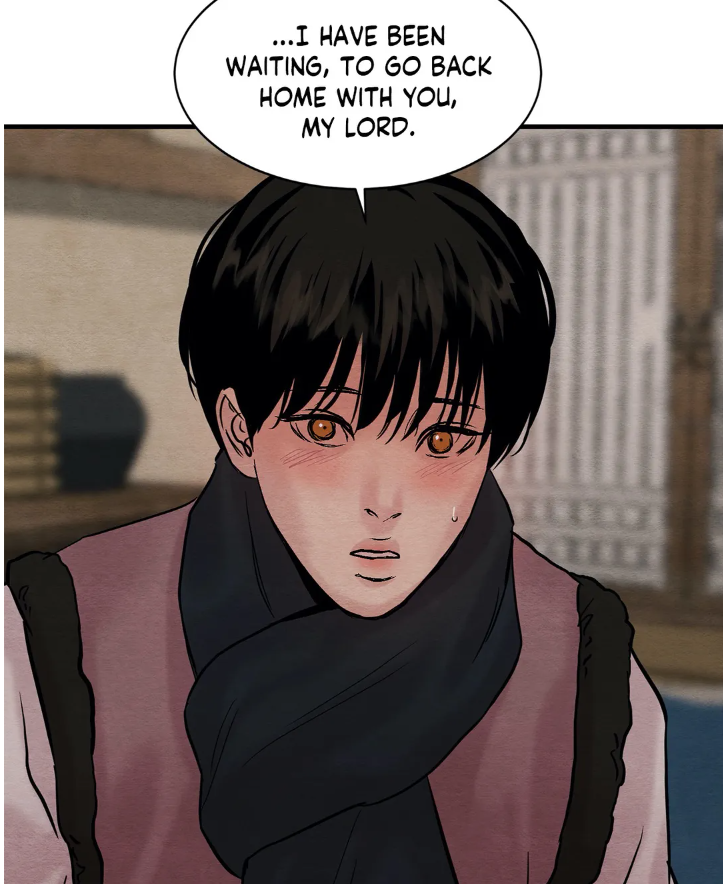 , the latter senses that Baek Na-Kyum has finally accepted him as a part of his life and even consider him as a part of his family “home with you”. For Yoon Seungho, it’s such a surprise because it’s now clear that Baek Na-Kyum no longer views him as a man consumed by lust but as a companion (“With you”). This represents such a huge progression because in the chapter 49, the main character who already lowered his expectations came to the compromise that they would just maintain a physical relationship hence sex was the only thing connecting them and nothing more. However, with these words “home with you”, the commoner truly reveals that his judgement about his “lord” has changed but the aristocrat has no idea about the extent. This is the return of hope and this is relevant as hope is often used as a synonym for dream. That’s why he laughs first
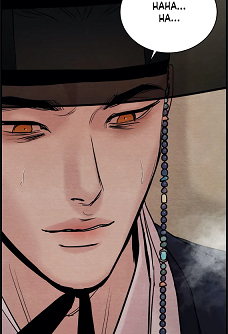 , he can’t believe his own ears and eyes. It was as if his dream has come true. Therefore he initiates the kiss in order to taste the water. But he’s not rejected at all hence he keeps pushing a little further.
 From my point of view, he is impulsive, acting in the moment. He has no clue where all this could lead. However, he can’t accept this “dream” as a reality. That’s why he stops at some point questioning his own behavior.
  , caressing the painter’s butt. And this question marks the return to reality and resignation.
  underlining that only skills matter. This is how Jihwa and Yoon Seungho were raised hence the red-haired aristocrat hid his feelings behind the appearances and sexual experience and it must be the same for the protagonist too. Therefore I come to the observation that only rationality, manipulation and calculating are allowed among nobles, while feelings are disdained, considered as weaknesses. Hence for nobles, sex is a synonym for fights and the readers assist to prostitution among nobles. Let’s not forget the sex sessions Yoon Seungho organized are in reality an exchange of favors. Therefore Jihwa could claim that he had used Yoon Seungho in the chapter 18. The only difference is that unlike in the past, Yoon Seungho is no longer following his father’s orders, his former pimp. So the lord is doubting his actions. Is it correct to act like that? Is it correct to follow his feelings and to even dream of being loved? Since the master has already encountered many rejections, he can’t help himself doubting what is happening right now. That’s why he stops and decides to confess what his dream was all along and how it came to life. Yet simultaneously he makes it clear that he is not really hoping to get confessed.
 That’s the reason why he talks about that night and what it really meant to him. He wanted to mock the painter for his lack of experience, yet it affected him so much that he couldn’t forget the painter’s love confession, gestures and words from that night.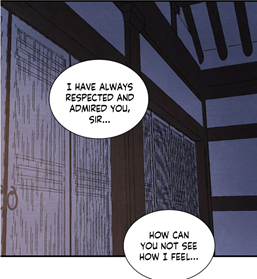
 (chapter 21)
 (chapter 48). For him, this would be enough to make him happy as they represent a real treasure. The tears as a symbol of Baek Na Kyum’s purity can wash away all the sins Yoon Seungho committed and even destroy the corruption in his heart.
 This represents the painter’s gaze at his lover, as Seungho is embodied by the moon and the night sky. The moon shines brightly and the stars are even visible. This picture oozes a certain warmth as the beholder can distinguish the snow flakes very well. For me, this picture mirrors the painter’s thoughts. Now, he is able to recognize and enjoy the lord’s affection. And this contrasts so much to the following panel from their wedding night.
  Here, it was the opposite. It’s the perspective of Yoon Seungho looking at the painter represented by the house. However, we don’t see the moon as the noble has acted as if he was the teacher. This was just an illusion which explains why the aristocrat suffered for a long time. He had to pay the price for his selfishness and greed. This explicates why his dream could never become true and why this hope is going to turn into a reality as he decided to become selfless and love the painter without expecting anything in return. Therefore I am not expecting any memory loss from the lord, like in the first season. Let’s not forget that back then, the noble wanted to have a painting of their night, as he was hoping to have a proof that this dream had not been an illusion. In my opinion, the painter’s confession is strongly connected to his work. Since the painter’s wrist has been hurt, he won’t be able to produce any work. It will take some time until the painter achieves the painting, where he expresses his feelings for the lord. The moment the master sees the picture, he will be so moved as the drawing will become proof that his desire has finally been fulfilled.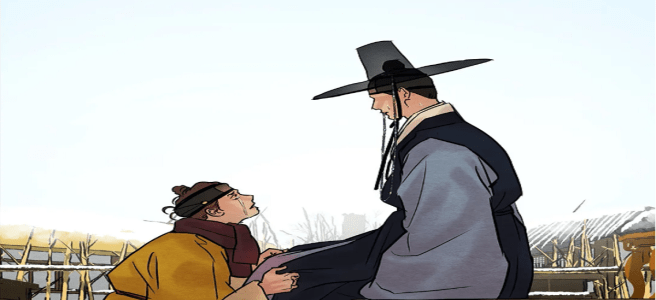
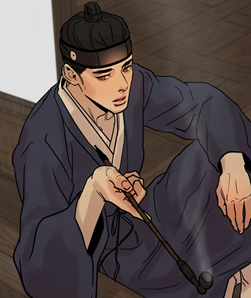 where Baek Na-Kyum approaches the lord asking for his forgiveness with the hope that the latter will be willing to return the poem from Jung In-Hun. Observe the parallels between the two scenes:

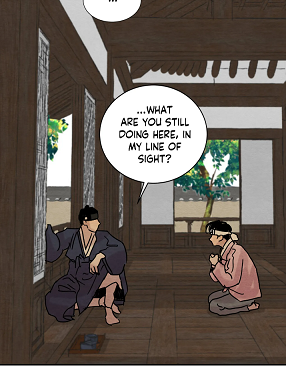
 And you know that there’s no coincidence in this manhwa. Blue is associated to care, trust, loyalty, and peace of mind.
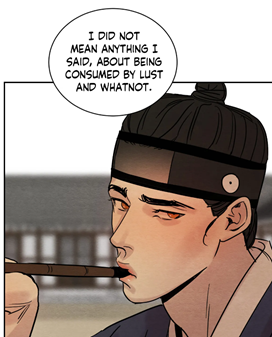
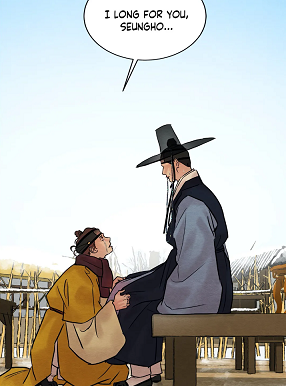 Then in the chapter 57, Jihwa is also on his knees, while the lord is sitting too as he can no longer stand due to his illness. Both beg the lord in the end.
 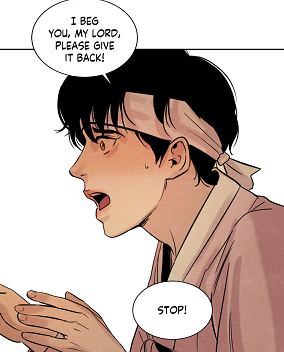 Striking is that everything is indeed related to love. The manhwaphiles should remember that the plagiarized poem deals with love. The scholar faked his affection for the painter with his poetry.
  , in the episode 57 the second lead plays now an active role because he is at the forefront. This time, he confesses. However, the real similarity is the following. Jihwa used the letter in order to get his friend’s attention.
 In other words, the ex-lover’s advances are jilted which really upsets the red-haired aristocrat. In the chapter 57, the manhwaphiles don’t witness the rejection personally, we hear about this through the butler’s testimony.
 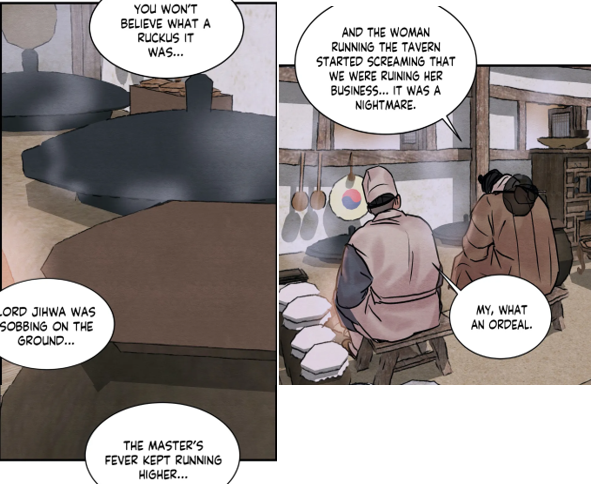 And this occurs again, when the aristocrat confesses to his friend. The latter’s mind is focused on the painter again.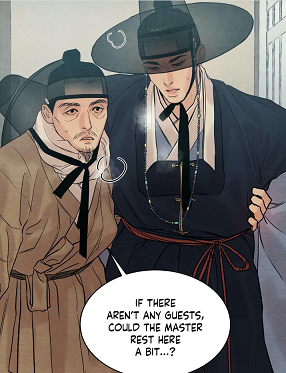
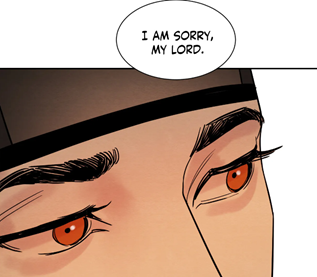 was just a lip service which the noble could sense. The irony in this scene is that while the low-born denies that he views the master as a man consumed by lust,
 , due to his busy sex life. And notice that in the chapter 5, he only repeats the part “consumed by lust” but the allusion to his education is reduced to “what not”. Therefore this leads me to the observation that Baek Na-Kyum’s lip service did cause a change of heart but not a change of mind!! For the first time, Yoon Seungho is confronted with his negative image by someone so honest and direct. This reveals that no one has an idea how literate he is. The day before, he was upset when he heard these words but he just dismissed it, thinking that the painter had no idea about his true personality. But the moment the painter refers to the incident, he is omitting the part about his intelligence and education. And this is important because the artist is the only one who gives a true reflection to the protagonist, while Jihwa is not complaining at all.
  Both were confronting the protagonist with his bad reflection, yet their intentions and approach were different. First, the painter never intended to hurt the noble with his lip service. Secondly, he somehow admitted his wrongdoing
  hence he expressed his apology. Striking is that he’s not blaming the counterpart. There are no reproach expressed here. His apology might be insincere, yet he admits to be in the wrong, whereas the red-haired noble is reprimanding his friend and never questioning his actions. That’s why he is the one forgiving and not apologizing. Now, you understand why he’s blaming his childhood friend. He had to hurt him because he had changed
 and he expressed his feelings
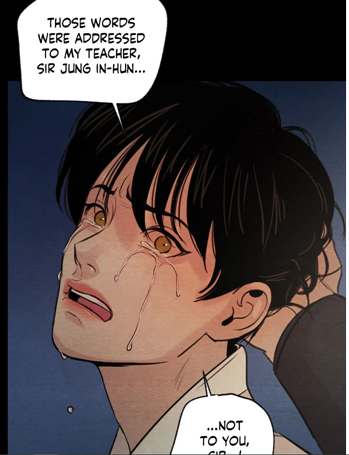 . He argued with him showing that he was noting his presence as a spirit, a mind and he wasn’t just a man obsessed with sex. Consequently, Jihwa could only fail as he never exchange his true thoughts and feelings. Even when they had sex
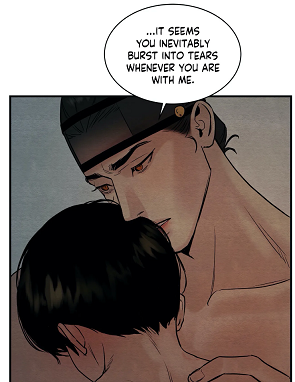 , they would talk to each other with a certain honesty. And this was not the case with Jihwa. Besides, by only having sex with him and not sharing his mind, he contributed to Seungho’s mental isolation and loneliness. Seungho was first attracted by the painter’s works, hence there was a mental connection between them before their first meeting. And from the moment they were together, they kept talking to each other, while it was never the case with Jihwa. He was not listening to his friend’s words, even when the latter warned him or reminded him that he didn’t know him that well.
 It was, as if his words meant nothing. This is not surprising that Yoon Seungho could only consider himself as a spirit using his body to get revenge on the double-faced nobles. This explains why the main lead can’t distinguish Jihwa from Min in the end. Both are treating him the same way. Both assume, they know him so well
 and can do anything to him, justifying their actions with this excuse. As a conclusion, this manhwa reveals that love can only work if there’s a real communication and attraction is not the main component.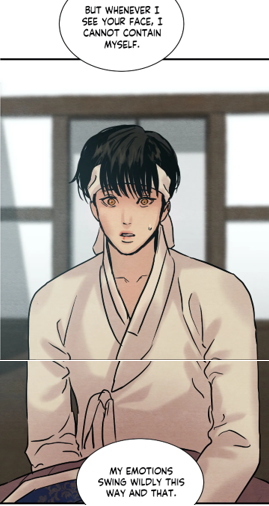
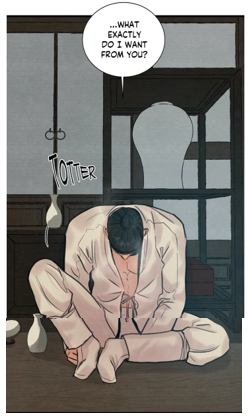 , while confessing as he recognized his bad actions. He had no hope and was actually expecting to get rejected. However, Jihwa looked at the friend’s face on his knees, searching his closeness in order to convey his feelings properly.
  But the low-born kept rejecting him which made the aristocrat suffer. Consequently the loved one had to suffer due to their “rejections”. And we have the same case here. Yoon Seungho became the real victim of Jihwa’s pranks.
 Here, the painter was using a lot the personal pronoun “I, me” and was telling his lover that he was finally willing to accept Yoon Seungho as lover but he would never give him his heart. Since Seungho was the one who had to lick and to kiss him in order to make the artist feel good, the painter was not hiding that he was using Yoon Seungho as a tool for his own enjoyment. The artist had put himself on a pedestal,
 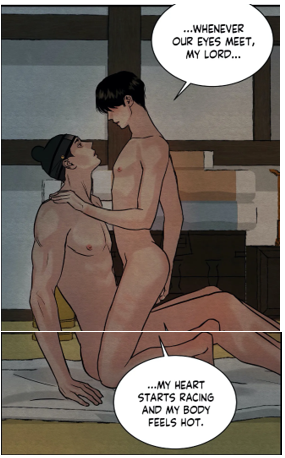 which was also reflected in his position. Notice that the noble had to look up. The powerful master should treasure him and their physical relationship. Since in that confession, he was admitting that he was using the lord, this signifies the artist didn’t pay attention to Yoon Seungho’s feelings and desires. Baek Na-Kyum was indeed inconsiderate, yet here he wasn’t even hiding his thoughts. He was once again brutally honest. There’s reason why I continue associating brutality with honesty. It’s because each time the painter was sincere, his words wounded the lord very much. For Yoon Seungho, each word must have felt like a stab in his heart, hence he was not happy at all, after hearing this confession. Remember that he wanted to get angry but was stopped by a tender kiss. Besides, I am not the only one who criticizes the painter for his selfishness. Even valet Kim reminded him in the chapter 52 that he was acting like a spoiled child.
 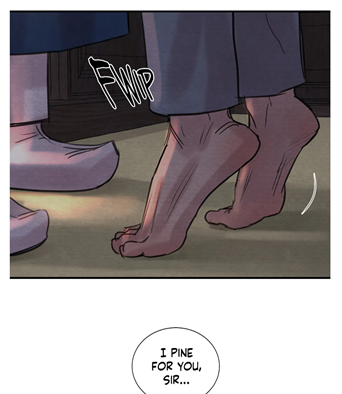 Back then, the low-born had put the scholar on a pedestal indeed. He had confessed that he pined on him and would respect him so much and as you can detect, Jihwa is actually saying the opposite. Yoon Seungho is far from being admirable that’s why the protagonist’s heart can never be moved.
  Hence this is the other cause for the failure of his confession. Jihwa could never obtain what he wanted, the admiration in Yoon Seungho’s eyes as the red-haired master never reflected real admiration in his eyes. As a conclusion, he couldn’t get past the image of a man obsessed with sex. How can Yoon Seungho love him back, if the noble judges him like all the others? In order to love someone, the main lead needed to perceive himself differently, as he already hated himself so much.
 He showed him an attractive man, worthy to be desired. Besides, he was indeed physically attracted to him. Sure, now he is not admiring the lord spiritually but once he accepts the noble, the latter will reveal his qualities which he could never reveal as he never felt loved. Baek Na-Kyum will discover a new side of Yoon Seungho: educated, intelligent and even patient. Jihwa says that he knows the reason for this reckless behavior, however I believe that Jihwa doesn’t grasp the whole dimension of the main lead’s suffering.
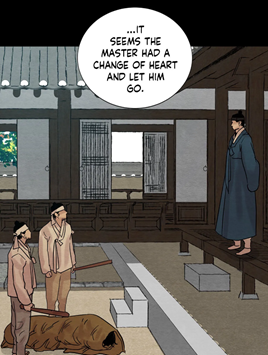 The lord came personally later and stood there, like he was on a podium, while the painter was lying on the ground. Just before, he had been rolled up in a mat. And observe, the scene at the tavern is really similar, although the perspective diverges. The lord kicked the friend so that the latter fell down.
 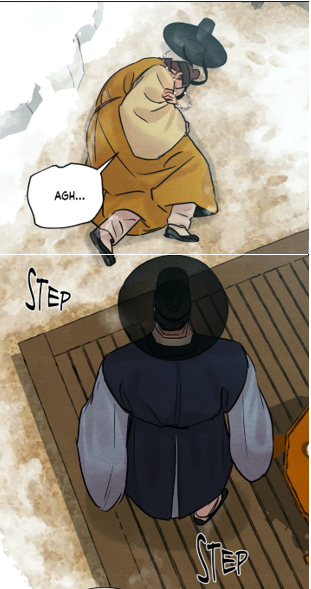 The main lead is standing, while the other is lying on the floor, hurt, exactly like the painter. Let’s not forget my theory that Jihwa is the noble version of the painter. But there are actually more parallels between these two incidents hence it is necessary that I outline all the similarities by listing all the elements contained in both incidents:
 , whereas we have a letter reminding the lord of his terrible past.
 Both are just pieces of paper, yet they have such an impact on the main lead. Both causes immense pain in the main character’s heart. In the first case, it was as if his identity had been erased. Let’s not forget that the protagonist perceived himself as a ghost but thanks to the erotic pictures, he could feel alive. And the moment the painter portrayed him, he saw a different reflection about himself, like I mentioned above. It could liberate him from his self-hatred, he saw that he was desirable. Simultaneously, the drawings were a proof that he was actually a man defeating his enemies, the double-faced and treacherous nobles, as a part of his “revenge”. As for the letter, it was a reminder of his terrible past. It’s clear that Lord Song is someone terrible based on Kim’s reaction. I have to admit that after giving some thoughts, I have come to the conclusion, the mysterious lord must be an older version of lord Min. But let’s get back to the comparison. Both pieces of paper caused a scene: a punishment. While Jihwa received a kick,
  the painter was condemned to the straw mat beating. One might say that the last punishment is worst as Baek Na-Kyum could have become handicapped or even worse, he could have lost his life. However, the kick in a public place for a noble is already a big humiliation. Not only he appears as a weak person but a kick is a treatment rather reserved to commoners. His reputation can only be affected (rumors). Let’s not forget the importance of honor for an aristocrat. Having a title is a synonym for respect and privileges, yet the boot on his arm gives the impression to the folks that Jihwa’s lacking of honor. It was as if he was a low-born despite his nice appearance.
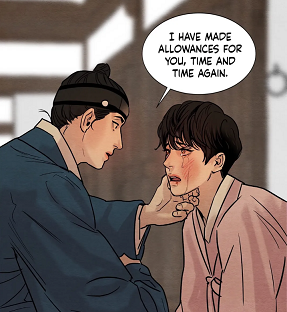 (chapter 12)
 after his release.
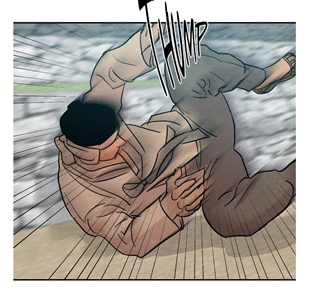 in the chapter 13 by pushing him very hard onto the floor hence we could say the kick Jihwa receives in the chapter 56 is the punishment for his gesture towards the servant and the foot on his throat is the sanction for the prank with the letter. Jihwa is indeed treated like a commoner. People might say that Jihwa is acting according to his status, as a noble is entitled to mistreat commoners. Nonetheless, my impression is that one of the main messages from this manhwa is that “prejudices” will only lead to suffering: karma. Baek Na-Kyum got sanctioned for rejecting and denying his own homosexuality, whereas one of Jihwa’s prejudice is about the commoners. This is not surprising that his suffering keeps increasing as he is never questioning this doctrine that low-borns are no real humans, not worthy of any respect. My readers are well aware that Baek Na-Kyum was living according to the scholar’s doctrines, therefore we have to imagine that Jihwa has also been living following the social norms of the nobility: commoners are low lives.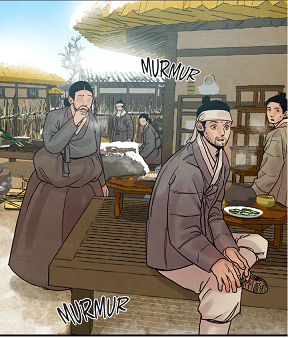
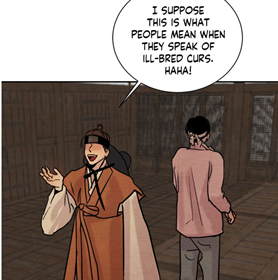 therefore he constantly gets disgraced in front of them (chapter 18, 36, 43, 57). This is his karma for defending such unjust norms. That might be the common norm for back then, but since Baek Na-Kyum has suffered because he defended doctrines condemning sodomy, it becomes clear that Jihwa’s role as a character has another purpose: the lack of respect for low-borns.
  But this one is less obvious because he loved his teacher, a low noble. Since I sense that Jihwa is very similar to the painter, then we have to conclude that Jihwa has two prejudices. The artist denied his homosexuality and he saw the nobles as nobles only good in appearance. That’s why I believe that Jihwa is more prejudiced towards commoners, yet he isn’t truly admitting his homosexuality. I am well aware that some might doubt this interpretation. First, the manhwalovers should remember that Baek Na-Kyum came to deny his sexual orientation due to the intervention of the low noble. So his natural homosexuality was repressed. Since Jihwa has been in love with Yoon Seungho, he’s also a natural homosexual. And it looks like Jihwa’s sexual orientation has also been repressed somehow. Remember that we have this:
  The other evidences for this interpretation are the following:
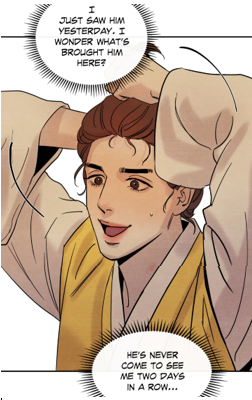 Observe, this time the lower lip is going down. Therefore I come to the conclusion that he is actually reproaching his friend for living marks on his body, a proof of his hidden homosexuality. Besides, if he was rejoicing, we should see the exclamation mark and not the suspension point. Another evidence of his not truly outlived homosexuality is the following: he hides the hickeys the moment the servant barges in his room.
  Yet, the moment he hears about the visit, he doesn’t pay attention that the hickeys are still visible. Then at the pavilion, he tries to suggest to move to his bedchamber.
  He is definitely trying to influence Yoon Seungho with this rhetorical question. He doesn’t want to be seen by his staff. But for me, the biggest clue that he is not truly admitting his sexual orientation is in the chapter 18:
  He could legitimate his sodomy by saying that he had some favor to ask. Yet, this was just a cover and everyone was well aware that Jihwa was in love with the noble. So there’s a certain hypocrisy, which is quite similar to Baek Na-Kyum’s who accepted to work for the main lead for his scholar’s sake.
 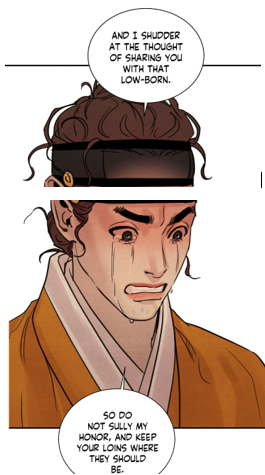 in order to save his face. Here, we can definitely perceive how much he values his reputation and honor. That’s why he couldn’t go to his friend and beg to take him back, after witnessing the love session between Seungho and the painter. Jihwa was well aware that he could no longer approach the friend, because this would mean, he would go back on his word. Hence he knew that he had to initiate something so that Yoon Seungho would come to see him. So the painful reminder was the only way to force the noble to encounter him. That’s why the noble laughed, when he saw his former friend. His trick had worked. Yet the moment, his friend put him together with Min, he could only get hurt. He was treated like all the others, while he saw himself as different, since he had feelings for him. Hence he tries to legitimate his action with the letter, he was trying to explain that he was only one who knew his dark past.
 where the wolf symbolizing Yoon Seungho is tamed by Baek Na-Kyum, the innocent rabbit. When I saw this very cute story, it made me smile because it illustrates the taming of the main protagonist.
  quickly, like in the chapter 57. Let’s not forget how he yelled at Deok-Jae for his so-called prank.
 The next morning, he is no longer wearing it. He gave his robe to the painter as cover.
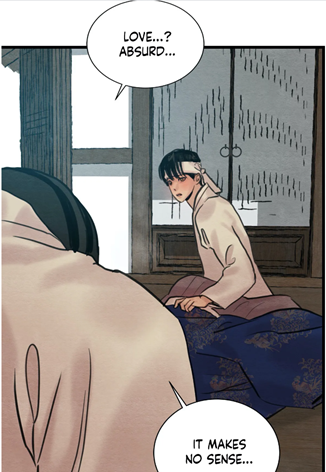 It definitely marks the moment of his “death” and announces his rebirth. It has not occurred yet, since he is still feverish but we should consider it as a part of his rebirth: he rises from the ashes. It becomes clear that the rebirth of a phoenix is related to fire and you all know the expressions “to burn a fever” or “to burn out a fever”. As you can observe, fever is indeed linked to fire. That’s why I came to the realization that Yoon Seungho is in reality a phoenix which would explain why father Yoon was so jealous of his son. How can a dragon exist next to a phoenix? Both are mystical animals, yet let me remind my readers that father Yoon has only the eyes of a dragon, he’s not a real dragon. Nonetheless, my association to a bird for Yoon Seungho was actually correct , it’s just the choice of the bird was wrong.
 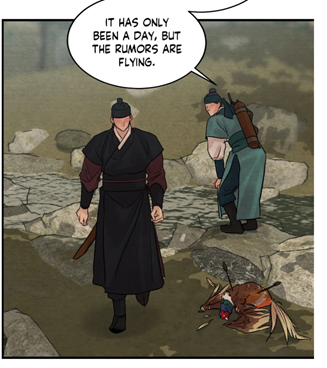 That’s why I feared for his life after reading the first season. Since the start of the new season, I had to review my prediction and now I believe that he will get terribly hurt. My thoughts were that he would either lose his title or get a scar… due to a big injury. I came to this belief after recognizing that this character is very similar to Baek Na-Kyum. Since the latter got raped in the first season, I am anticipating that the noble will suffer a lot as well. It will take him a while before he becomes a true crane and that’s only because of his fateful encounter with Nameless. But as Jihwa is the mirror of Baek Na-Kyum, this means that the painter is actually a crane too. And this is definitely no coincidence that in the chapter 45, Baek Na-Kyum is covered with a cloth where the pattern contains cranes.
  That’s why I came to the conclusion, Baek Na-Kyum is actually a crane but due to his social status, he was a lamb. I have to admit that in the manhwa “Serene Bird” which is very similar to “Painter Of The night”, the pure and innocent Yoo Chung is called a crane by the seme
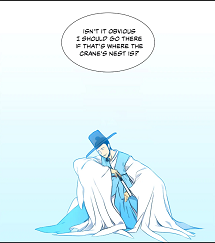 which can only reinforce my interpretation. Baek Na-Kyum is the one who will bring good fortune, freedom, honor, royalty, happiness, balance, grace, prestige and love to our protagonist Yoon Seungho.
 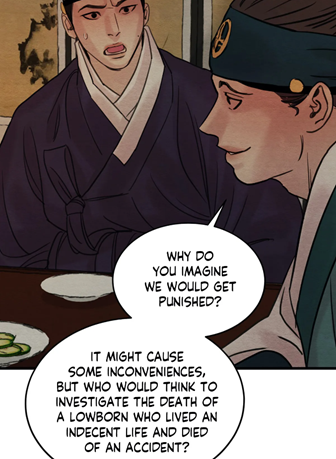 Yoon Seungho might have power but since this is a norm among nobles not to go after the nobles responsible for a commoner’s death, the protagonist can’t use officials in order to get justice. They might suffer some inconveniences but they won’t be punished harshly, like losing their title. However, this incident makes the main character realize that in order to protect his lover, he needs to elevate his social status.
 Imagine the humiliation for Jung In-Hun. He is indeed used by the powerful seme and has to confirm that Baek Na-Kyum is a noble in exchange for the sponsorship. We shouldn’t forget that the painter’s origins are unknown and the head gisaeng handed over the artist to the low noble, implying that the latter had become his official guardian.
 As for the women from the brothel, they would never reveal his true origins since they are well aware of the negative repercussions.
 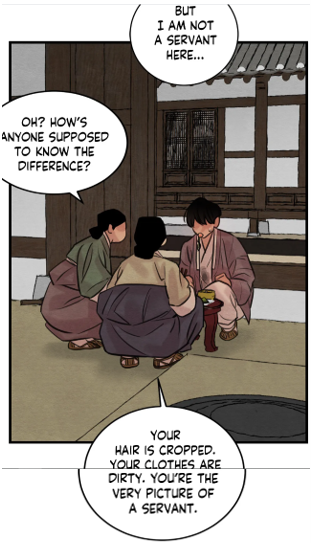 Secondly, the scholar arrived at the mansion shortly after the painter’s occurrence. Third, when his study was always next to the lord’s chamber and he was sleeping in a bed reserved for a master. Even the doctor got confused because the painter was dressed like a low-born but he was sleeping in a nice bed, when he examined him for the first time.
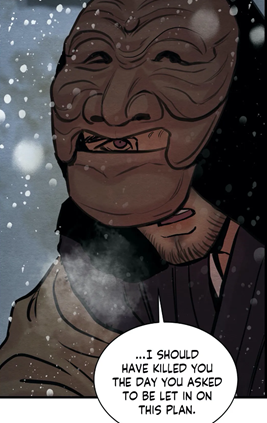 At the same time, a wolf is very loyal and protective which the criminal does, when it comes to Jihwa. A wolf can definitely be tamed too, yet it still keeps his dangerous aura.

 He keeps saying that Yoon Seungho is sick. In other words, the protagonist’s relative acts as if he was a doctor and he knows exactly the diagnosis. Yet the words “he said strange things” expressed by the doctor outlines the incompetence of the noble with “dragon eyes”. He uses technical words without knowing the true meaning. With this, I conclude that father Yoon’s real knowledge is superficial and he is actually overestimating his intelligence. The lack of knowledge didn’t get unnoticed by the expert. In reality, the noble with the khaki robe is just picking up the medicine for his son and needs the doctor’s collaboration. Here, it is important to point out that after this visit, the father never went to this physician again. The latter only became Yoon Seungho’s personal doctor again, after the latter had been abandoned by his own father. Let’s not forget that the physician only visits Yoon Seungho after the topknot incident.
 Valet Kim must have decided to ask for his help remembering their first visit and how good and qualified the doctor was. The latter took his time and talked a long time with the father, like we can witness in this panel. The father had to sit down indicating that the doctor didn’t fulfil his wish right away. He had to persuade the expert.
  Unfortunately, despite his doubts, he did follow the father’s wish. So when the doctor visits the lord for the second time, he is able to diagnose that the young aristocrat is really sick.
 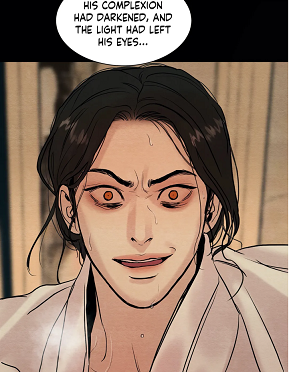 Here, he can observe the symptoms. As a conclusion, despite his doubts about the mysterious illness diagnosed by the father, he did prescribe the medicine and kept giving it to valet Kim. Strictly speaking, he has still not questioned the real use of that medicine because after his second visit, the patient was indeed unwell. It’s important to note that until now, Yoon Seungho has kept drinking this medicine, ordered by his own father.
  Valet Kim was the one taking care of it all this time. Yet this has nothing to do with insomnia, since Baek Na-Kyum asks if his “usual medicine” is related to his sleeping problems
  and the doctor denies it. He replies that he has been taking it since his youth and back then, insomnia was never brought up. All this indicates that the corruption is still effective due to the drug. No one has ever questioned the true purpose for that medicine, neither Yoon Seungho nor valet Kim nor the physician. That’s the reason why he is still agitated in my perspective.
 ,
,  ,
, 

 etc). Jung In-Hun’s influence and shadow has disappeared for real. Like I wrote once, the lord has been the cure for Baek Na-Kyum, so is the painter for lord’s. The artist will be the one who purifies the main lead. And now, I come to the second part of this essay: purification.
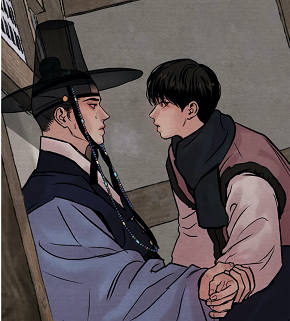 For the first time after the lord’s confession, Yoon Seungho is looking at the painter’s gaze. He is no longer avoiding his eyes showing that he has regained some confidence. He no longer fears his eyes. he has gathered enough courage to face his lover. He would like to read the painter’s thoughts and emotions, as he knows about his transparency. Furthermore, both protagonists are quite close and this hasn’t happened since the chapter 54.
 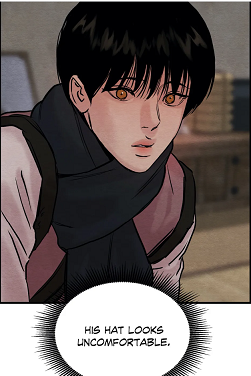 However, we could say that he is just looking for an excuse to approach the master as he keeps starring at him. Hence we have two pictures about Yoon Seungho’s handsome face from his perspective.
 .
. 
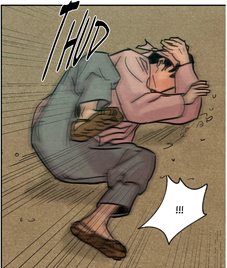

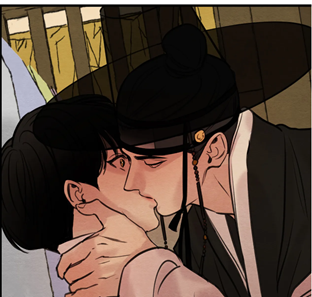 Back then, the painter didn’t hide his pleasure and reciprocated the kisses making the lord so happy. That’s why I believe that in the next chapter we will witness a kiss, as the hat will be the trigger for the kiss. And since I’ve made a connection between the chapter 39 and 57, I also think that this chapter should be judged as a new version of the chapter 39: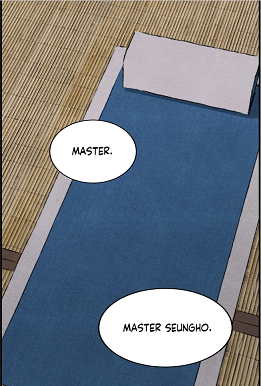
 , just like the night was light blue.
  They used a blue robe as bed. And we had also the presence of white as well in during their Wedding night: the white candles and the paper in the background and the white bottle.
  Back then, the painter was under the influence of alcohol, yet the lord once commented that the low-born was delirious, another reference to the lord’s actual sickness. Notice that in the final panel
  there is no distance between them, the painter doesn’t need to stand on tiptoes. They are now equal which is an indication that their relationship can work for real now. Consequently I am expecting a confession. Let’s not forget that the painter has just dreamed about a confession coming from Yoon Seungho and like I am pointed out before, his visions always became a realit. Consequently, I am quite sure, his wish will become true.
  He couldn’t believe, that this was real, it was so beautiful that it felt like a dream.
 Therefore we should expect a renewal of this scene: a hug, the reference to a dream and a love confession. The manhwalovers are well aware that Baek Na-Kyum had a dream and loved to be confessed. I have the impression that the painter will change his words: From “it feels like a dream” it will become “my dream has come true”. Back then, he was doubting if all this was true therefore I am expecting that this time, there will be no insecurity from his part. He will accept it as a reality which will make him happy. And he will shed tears of happiness again. That’s why I am even more convinced that the next chapter will be a renewal of their wedding night but quite different. After kissing, hugging and even caressing each other, they will share the same bed
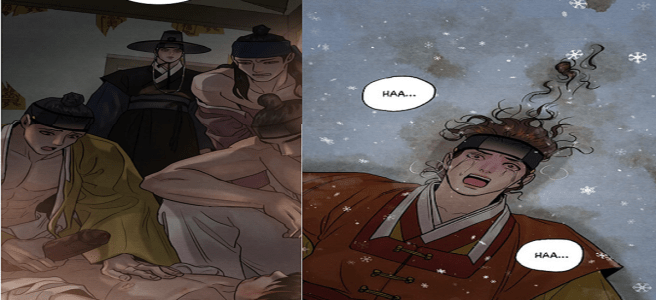

 Observe that during the first real dream, the painter imagines the unknown man to be Yoon Seungho and not Jung In-Hun showing that his “love” for the scholar was actually more mental. In reality, his adoration was just the result of the coercive persuasion and the painter’s coping mechanism. In order to stop and forget the abuse, he idolized the scholar.
 It reminds us of the night from the chapter 48 and 49 because of the disposition of the candles. That’s why the manhwalovers are not sure if this is real or not first. However, the black frame between the pictures is the clue that we are witnessing a dream. And if you look carefully, you’ll notice that this dream is inspired by that night. Not only the room is the same but also the words and the gestures. Compare the pictures from the chapter 49 to the ones from the chapter 56:


 And now, you understand the lord’s words in the previous picture (chapter 49). He was right, he noticed the contradiction between the painter’s words and his physical reactions. And because of this rough session, Baek Na-Kyum was finally forced to admit that he liked having sex with the lord.
 Note that his mouth is open, it was as if he was moaning and there are no tears and no visible pain. As a conclusion, this illustrates that the readers should be careful with what they witness and hear in this manhwa. The spoken words and behavior don’t always reflect the true thoughts and emotions, especially if someone has been brainwashed.

 The commoner’s unconscious wants him to remember his first night as he felt loved and ecstasy at the same time.
 (chapter 49, then he recollects Jung In-Hun’s fake hug so that he judges the warmth coming from Yoon Seungho as not real)
 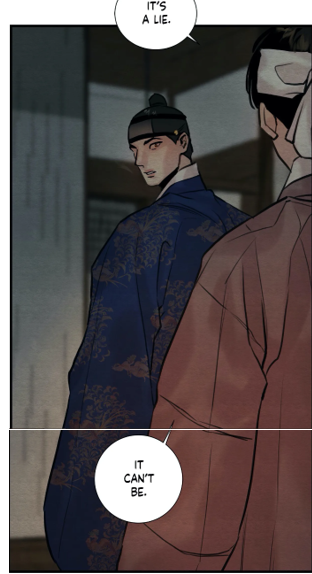 (chapter 54)
  (chapter 55)
  And this observation made me realize how similar both protagonists are in reality. One might have been a homosexual right from the start, while the other wasn’t, yet both have a huge heart hence they are really passionate. They both possess a strong will and used their mind for many years in order to control their unconscious and body. One did it because he suffered a huge trauma like rape and abandonment, consequently he viewed himself as ghost and the other started denying his sexuality because he was exposed to coercive persuasion and feared another abandonment.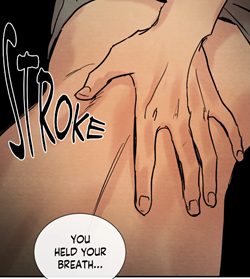
 Now, the dream feels more real as the gestures are more precise. The painter has discovered his own heterogenous zones (the nipples, his ear, his butt).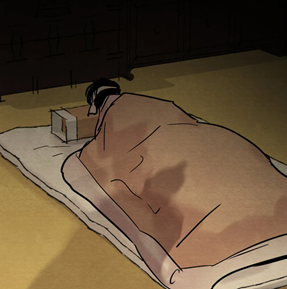
 The lord entering his room during the night, while he is in his bed.
 Here, we have the same expression.
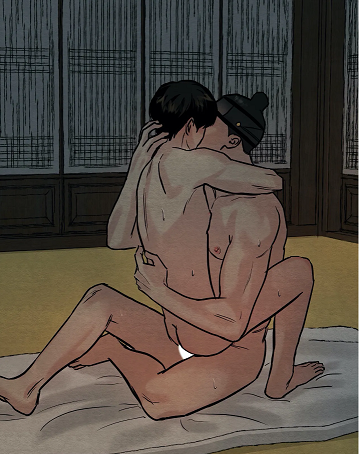 They hug the same way.
 Chapter 34
 The commoner dreamed to be called in an intimate way (Na-Kyumah) . What he doesn’t know is that the noble is already calling him Na-Kyumie which shows that for the noble, his social status doesn’t matter in their relationship. He doesn’t call him “Baek Na-Kyum” or “the painter” or the “low-born”. Observe that he always mentions him like that in front of Kim and he already did it in the chapter 11 (based on the English version). But the painter never got the chance to witness it.

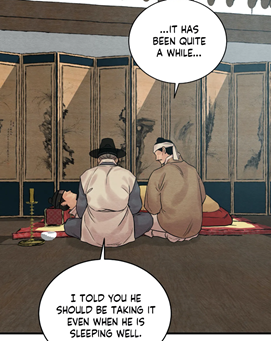
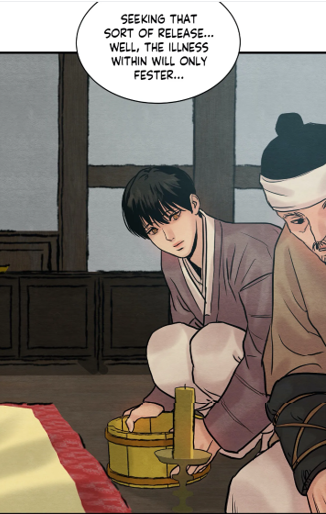 That’s the moment where there is a switch. From that moment, the yellow candle will represent the low-born. He has neither affection nor hope nor desire for Yoon Seungho right now. However, I believe that the doctor’s words must have surprised and affected him. For the first time, he discovers that the noble has been ill for quite some time and needs to take medicine regularly. Until now, he had always thought, the protagonist was just a strong and healthy man, especially after witnessing and experiencing so many sex sessions.
 In our opinion, this image announces the return of intimacy between the characters, the return of warmth and care contrasting to the coldness and brightness of the room in the morning, when the lord confessed to the painter.
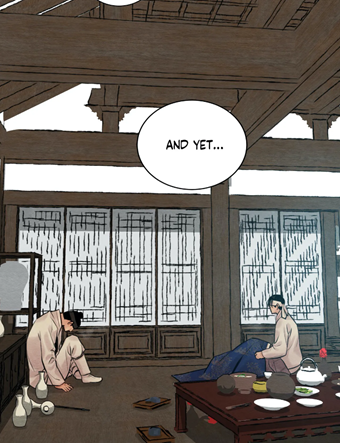 In that picture, there were two people facing each other, yet there was such a distance and loneliness exuding from this scene. With the nightfall, the atmosphere in the room changes. Let’s not forget that the rich protagonist is associated to the moon, hence he is more himself during that time.
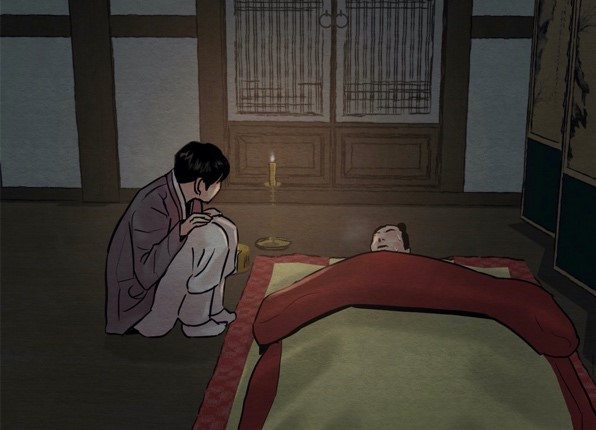 The burning bougie represents the painter. Remember that the switch occurred during the day. Sure, one might say that the burning candle is related to the night. Yet, let’s not forget that neither in the chapter 52, 53 and 54, the manhwalovers could see any candle. We shouldn’t forget that the position of the candle plays a huge role. Hence it is always important to consider the camera angle. Here, the candle stands between the painter and the aristocrat exposing a certain distance. Yet, the gap between them has considerably diminished compared to the morning’s. This displays the artist’s wish to get closer to the noble. But first there is a certain shyness and hesitation as his hands are on his knees.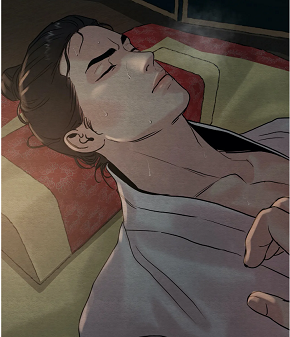
 Why, especially when the painter is not present? One might now argue that our theory is wrong, since the painter is not next to the lord and the candlestick is actually associated to him. However, the manhwalovers shouldn’t remember that in this chapter, the painter is actually dreaming about Yoon Seungho.
 The fact that the painter had reacted to his presence had such a positive effect on the main lead that he started smiling a little
 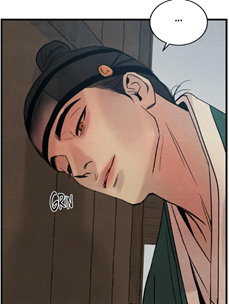 and couldn’t restrain himself from stroking the artist’s hair.
  With the low-born’s little reaction, it was enough for the lord to regain hope and attempt to get closer to him through the paintings.
  And we have a blushing Baek Na-Kyum in the chapter 55. The latter is so surprised and moved by the lord’s nodding that he can’t help himself reddening.
  That’s why we have to wonder if during that night, the lord heard the painter’s question and witnessed his lover’s reaction giving him hope that he had been accepted and forgiven. The lord might have closed eyes but this doesn’t mean that he wasn’t truly unconscious. Remember that he couldn’t face the painter’s gaze in the morning, hence he looked down but since he is lying in bed, it is impossible for him to avoid the artist’s gaze. So with closed eyes, he could face the painter without looking at him. He could detect the commoner’s reaction, as the latter cleaned his body, even stroked his face. The moment the lord’s head nods a little, observe that the painter’s gaze gets more intense and then removes his hand from the main lead’s face. So during that night, Yoon Seungho could have sensed the painter’s attitude (his care and his question) making him realize that his desire could still come true. This is just a theory based on the observation made that the second season is inspired by the events of the first season. So it is definitely possible that we might get a flashback of that night. Furthermore, this would also outline the effect of Baek Na-Kyum’s actions. During his recovery, Yoon Seungho sensed the artist’s warmth and care hence this gave him hope.
  or chapter 16
 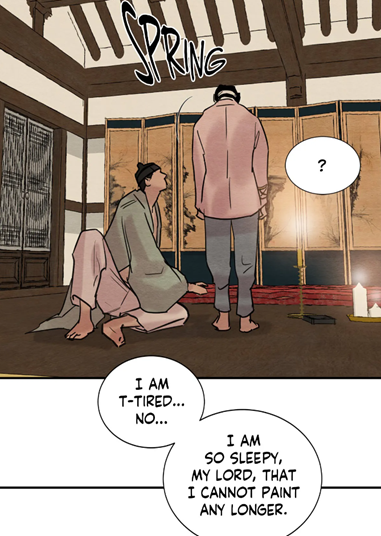 As you can observe, the yellow bougie on the candlestick symbolizes the lord, while the white ones embody the painter.
  But later, it has changed. The one on the candlestick symbolizes the painter, and the white ones the lord. The switch occurred in the chapter 32.
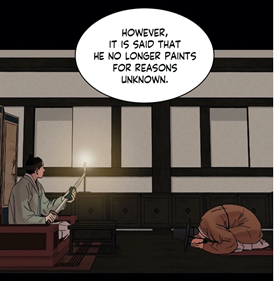 Since Yoon Seungho is right next to the candle it represents his conscious. It indicates that all his thoughts are focused on Baek Na-Kyum. In this case, the fire of the candle symbolizes his desire and hope to meet the painter soon, since the young master has been really curious about his hidden identity. Furthermore, it also announces the role played by the artist in the future. The commoner is the “light in the lord’s dark life”. In other words, the moment the lord encounters Baek Na-Kyum, a honest and pure person, his life changes forever. However, observe that there is only one candle illustrating that the affection hasn’t grown that much yet. Moreover, the candlestick stands quite far away from the lord, which seems to indicate that the lord is controlling his emotions and thoughts. Finally, the candle is on a chandelier mirroring the frozen state of our main lead. He hasn’t been living like a man, rather like a ghost as he was most active during the night.
 Why do the bougies have different colors? In my opinion, they mirror the protagonists’ purity. Yellow is linked to selfishness and white to innocence and selflessness. The lord is definitely attracted to the painter but his affection is more linked to sensuality and sexuality than real and deep love. He’s definitely selfish as he doesn’t pay attention to the artist’s emotions and state of mind. On the other hand, the two candles for the painter symbolize the innocence of his soul but simultaneously, his increasing and strong libido. On the one hand, he paints for the main lead as he has been forced to for his teacher’s sake. So his exposure to sex is not voluntary. Let’s not forget that during this sex session, he gets so aroused that he can barely control his libido. While he’s painting, he imagines himself replacing the two ukes. At the end, his urges are so strong that he leaves the chamber in a hurry in order to masturbate. Striking is that in the second picture, the candle burns differently compared to the one in the chapter 5. The light has not only increased but also the warmth as well reflecting Yoon Seungho’s growing attraction for the commoner. As you can observe, the candles illustrate the noble’s increasing desires. Not only he thinks more and more about Baek Na-Kyum but also he wants to touch him. Since there is warmth, this means that his feelings are much deeper as well.
  It was as if his wishes had been answered. He has found someone who would admire him. As for the painter, he expresses his admiration for his teacher and not for the main character hence there can be no candle with a light. Moreover, deep down he is also longing for sensuality so he is not entirely honest here either. He knows that this should remain a dream because his doctrine makes it impossible to have sex with another man. The lack of light is a signal that this event is an illusion.
  With this kiss, he is gentle and tender, he wants to take care of the artist but it is already too late as the commoner is seriously ill. From that moment, we no longer see the candlestick associated to the rich protagonist. He has learnt his lesson, he needs to be more caring and pay attention to the painter’s feelings. That’s why we have the following picture in the chapter 35.
 when they have sex, the room is totally dark and there’s no candle. This symbolizes the painter’s loss of hope and love. That’s the moment his heart gets frozen hence there can be no fire. Their sex session is full of sadness and the lord’s attempt to warm up the painter with his embrace and passionate kiss can not stop the transformation.
 On the first panel, there’s one candle separated from the other 3. From our perspective, these candles represent the noble as they are seen parallel to his head in the next picture. He’s not entirely himself. Let’s not forget that until that night, he still saw himself as a spirit. Therefore the lord’s transformation is not completed. He’s not been reunited with his heart. His mind is so focused on the painter that he has not realized that his heart was the real trigger. Since the candles are burning, it illustrates the love and affection the main lead is oozing. Striking is that the noble is conscious of his own actions, as his words reflect his intention and care. The increasing number of candles reflect the depth and power of his love. Yet, since they are closer to his head, it is now more understandable why the master has not realized his feelings for the painter. His mind was under the influence of his unconscious as his thoughts kept evolving around his lover. And since he was just a spirit, he couldn’t sense his heart beating for the low-born. As the fire symbolizes “warmth”, the bigger the fire is, the stronger the desires and the affections are. Therefore, it leads to the conclusion that those candles represent not only Seungho but the strong love coming from him. Therefore it is not astonishing that the aristocrat is the one hugging the painter and even caressing his back. Simultaneously, the former is longing for affection as well, he is hoping to have his desires fulfilled. He wants to be seen and admired, to be embraced and loved for his spirituality. We shouldn’t forget that he has been waiting for that moment for a long time.
  Bebebisous33s' analyses in K-Dramaland and Manhwas