

Please support the authors by reading Manhwas on the official websites. This is where you can read the Manhwa: Jinx But be aware that the Manhwa is a mature Yaoi, which means, it is about homosexuality with explicit scenes. Here is the link of the table of contents about Jinx. Here is the link where you can find the table of contents of analyzed Manhwas. Here are the links, if you are interested in the first work from Mingwa, BJ Alex, and the 2 previous essays about Jinx The Song Of Life (locked) and The Fabric of Silence
It would be great if you could make some donations/sponsoring: Ko-fi.com/bebebisous33 That way, you can support me with “coffee” so that I have the energy to keep examining Manhwas. Besides, I need to cover up the expenses for this blog.
People might have been wondering why I haven’t published anything after the release of episode 78. My silence is linked to my health. I was sick exactly like Joo Jaekyung. I had to remain in bed for a while. But enough about me.
When Doc Dan returned to Team Black, the fighters were so overjoyed that they immediately proposed to celebrate his comeback with a party. 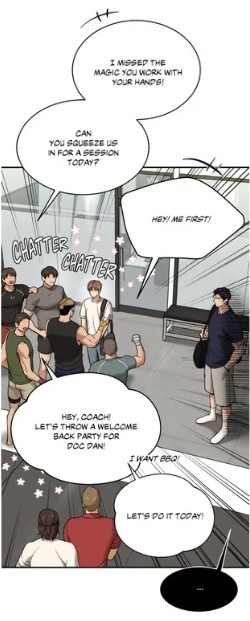 (chapter 78) Their noisy excitement — hugs, wishes, smiles, jokes, even talk of meat — gave the impression of a long-awaited reunion. Yet the suggestion was cut short by Jaekyung, who rejected it like this:
  (chapter 78) In other words, a party was “missed.” At first glance, this might appear to be an exception, a rare moment of denial in a story otherwise filled with shared rituals. Readers might recall the welcome party
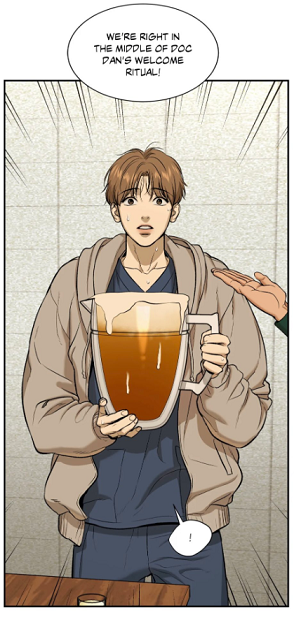 (chapter 9) in episode 9, the champion’s birthday dinner
  (chapter 43) in episode 43, the talk of hospital get-togethers
  (chapter 61), or the festive tone of fighters after director Choi Gilseok’s victory
  (chapter 52).
But the closer one looks, the clearer the pattern becomes. The missed party is not an isolated accident; it is the rhythm of Jinx itself. Whenever celebration hovers near — a victory, a birthday, a reunion, even a funeral — someone is not present. In addition, the celebration arrives too early, too late, in the wrong place, or in the wrong form. Jaekyung wins titles, but the gym shares the glory while he remains uncelebrated. 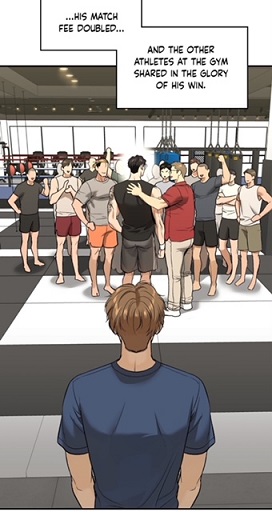 (chapter 41) Why did they not organize a party in Seoul to celebrate his victory in the States? Dan devotes himself to work, but his departures are marked by silence
 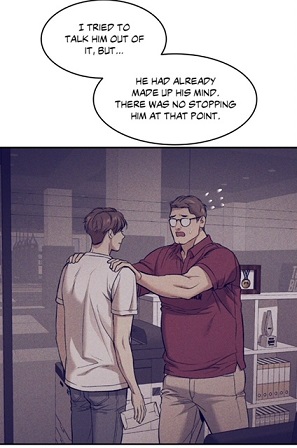 (chapter 53) rather than farewell.
 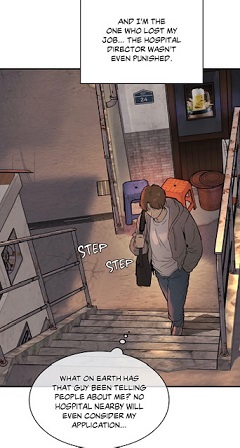 (chapter 1) The few rituals that do occur — a premature birthday cake, a noisy hug, puppies chasing after a car —
 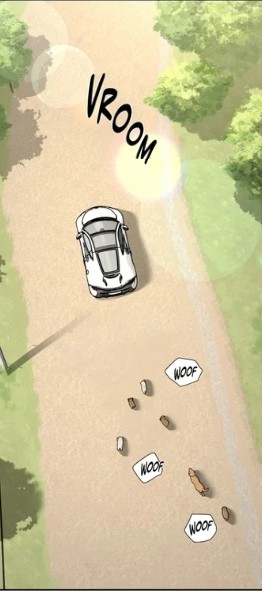 (chapter 78) always miss their mark, either hollow in substance or unseen by the very people who should be honored.
The title The Missed Party therefore names more than one canceled occasion. It captures the way the two protagonists move through a world where rituals of belonging are constantly distorted or denied. And in a culture where such celebrations carry deep social weight, the absence is all the more striking. The missed party becomes the haunting motif of their lives: recognition always promised, but never truly given.
The Meaning of Parties in Korea
In Korean culture, parties and team dinners (hoesik) hold a strong ritual function: they create bonds, display hierarchy, and confirm belonging within a group. Farewells, birthdays, and victories are all expected occasions for collective recognition. Yet in Jinx, these moments of celebration are strangely absent or hollow. When Jaekyung wins, his fee doubles, but no feast marks his achievement. Instead, the manager presents the “wolf” as his “trophy”. To conclude, others share in the reflected glory while the champion himself remains excluded, a fighter without a banquet. (Chapter 41) And this absence of recognition and respect is mirrored in the physical therapist’s position. He is not surrounded by the fighters and included by the manager. He is standing on the sideline. It was, as though his good work was not recognized  . (Chapter 43) Even the “dragon’s” birthday, supposedly a day of personal celebration, is reduced to an awkward dinner at his expense, with a cake arriving a day too early
 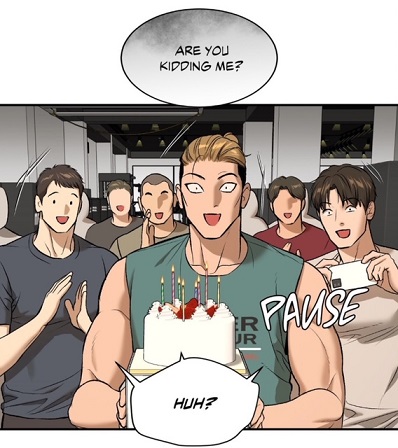 (chapter 43) or gifts from sponsors and fans he never wanted.
  (Chapter 41) In Germany, it is considered as a bad omen to celebrate a birthday too soon. Rituals that should affirm intimacy instead expose distance and lack of respect.
A striking contrast appears in chapter 52, when the fighters from King of MMA (chapter 52) gather at the very restaurant used for Jaekyung’s birthday. This time the feast is paid for not by him, but by Choi Gilseok — the rival director who had just won money betting against Jaekyung. The excuse for the banquet is twofold: the humiliation of the champion’s tie and the arrival of new members. Yet the sponsor of the event is absent, his presence felt only through the bill he covers. Unlike the wolf, whose victories go unmarked, Choi Gilseok uses food and drink to project power and buy loyalty. Yet, this celebration with the absent director displays not only hypocrisy, but also resent and jealousy due to the selection of the location. The cruel irony is that Jaekyung’s fall is more celebrated than his rise.  (Chapter 52)
This cultural backdrop makes the silences and absences in the Korean Manhwa all the more striking. Parties are repeatedly mentioned but rarely materialize, and when they do, they are strangely hollow. In chapter 61, for instance, a nurse suggests inviting the star to their next hospital get-together. (Chapter 61) The excitement is palpable — “loyalty” and celebrity sparkle in their eyes — but what stands out is the way Dan is erased in the process. They do not invite him; they want access to the famous fighter through him. His role is reduced to a conduit, the man who happens to be “close with Mr. Joo.” The irony is brutal: after two months of work in the hospice, Dan has never once been shown attending such gatherings himself. His own belonging is not on the table. He is used as a bridge to someone else’s fame, while his own exhaustion and lowered gaze silently testify to his exclusion.
But wait — is Dan not also responsible for his isolation? At no moment does he try to be close to them. He avoids their chatter, keeps his distance, and carries himself like someone already half absent. Chapter 56 seems to confirm this impression: even approached by one of the nurses, doc Dan uses work to avoid their company. 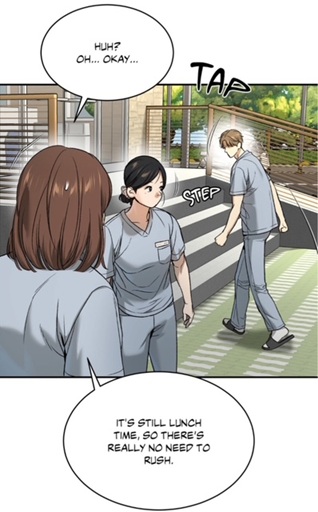 (chapter 56) However, this is just an illusion. What caught my attention is that the nurses wondered themselves why such a skilled therapist would come to a small-town hospital.
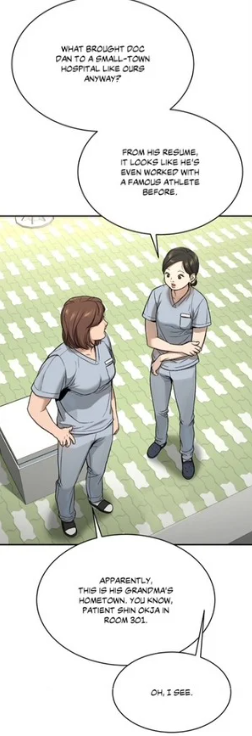 (chapter 56) They speak about him, as though he had no reason to stay there, as if he were a stranger passing through. Right from the beginning, he was treated unconsciously as temporary, someone whose presence required explanation rather than welcome. Finally, no party was held for him, no ritual of inclusion was offered. His distance and their detachment mirrored each other, producing the silence that would later define his departure.
  (chapter 78)
The paradox becomes even clearer when we turn to the star himself. Despite his status as champion, he never receives a proper victory celebration. After each match, we never see a celebration.  (chapter 5) It ends either in the car or in the locker room.
  (chapter 15) The high peak of his celebrated victories takes place at the gym where Park Namwook gather the fighters in front of the Emperor congratulating himself for his “good work” and the spectators for belonging to a winning team. (chapter 41) Yet no feast is held for Jaekyung, no toast to his perseverance. The two men at the center of the achievement are left without ritual acknowledgment, while the institution absorbs the honor. They remain a wolf and a hamster without a feast — fighting, winning, but never celebrated for who they are. And now, you understand why the manager could make such a suggestion at the hospital:
 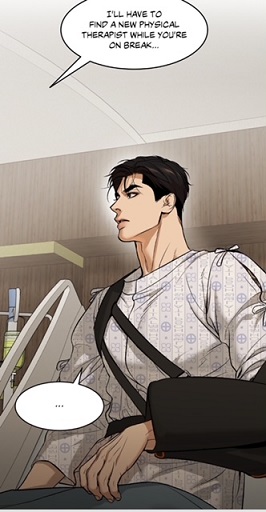 (chapter 53) For him, the physical therapists were just tools and as such replaceable.
Even Jaekyung’s birthday party in chapter 43 reveals this paradox.  (chapter 43) A birthday, especially in Korea, is typically a family-centered celebration, held at home or among close friends. Yet Jaekyung’s “party” takes place in a restaurant, under Yosep’s casual announcement that they would be having a “dinner party.” (chapter 43) The phrasing itself is odd, almost bureaucratic, as though the event were an obligation rather than a gift. Jaekyung himself had to pay the bill, reversing the usual logic of being celebrated. They even started eating before which is actually a huge violation of social norms. The cake appeared the day before his real birthday, an empty gesture more about timing than sincerity. And while fans and sponsors showered him with gifts throughout the month, Jaekyung revealed that he didn’t want any of them. The ritual forms were there — cake, dinner, presents — but the meaning was absent.
But there is another telling absence: Dan himself was left in the dark about the “surprise.” (chapter 43) The fighters never included him in the planning, as if they feared he might leak the secret. In reality, this exclusion only repeated his deeper past: once again, he was not considered part of the group’s inner circle. Had he been told, he might have brought the card and the gift of his own, softening the sting of Jaekyung’s reaction.  (chapter 45) By keeping Dan in the dark about the “surprise,” the fighters created another problem. Their silence pushed him to offer his own present on the same day as the gifts from sponsors and fans — exactly the kind of attention Jaekyung resented. He had already said he did not want those presents, and now Dan’s sincere gesture was placed in the same category, indistinguishable from the flood of unwanted offerings. What could have been a private, meaningful moment was absorbed into the hollow ritual of the group. Hence the champion never got to read his card! (chapter 43) In trying to celebrate, the team only ensured that both Jaekyung and Dan felt more isolated than ever. Instead, his silence reinforced the impression that he was peripheral. Unconsciously, Team Black treated him not as one of their own, but as an outsider to be managed. And even within the celebration, another absence was visible: Potato was missing, and no one seemed to notice. (chapter 43) The party did not affirm Jaekyung’s existence, nor Dan’s place beside him. It only reinforced their shared isolation, hidden under the noise of clapping and cheers.
Thus, Jinx presents us with a paradox: in a culture where parties are essential rituals of belonging, both Dan and Jaekyung remain excluded. They are surrounded by the signs of festivity, but the substance is always missing. Their lives are structured not by recognition but by its absence, not by celebration but by silence.
Dan’s Missed Parties
If the star’s parties are hollow, Dan’s are almost nonexistent. The only party where we see him smiling is his birthday, when he was a little boy. 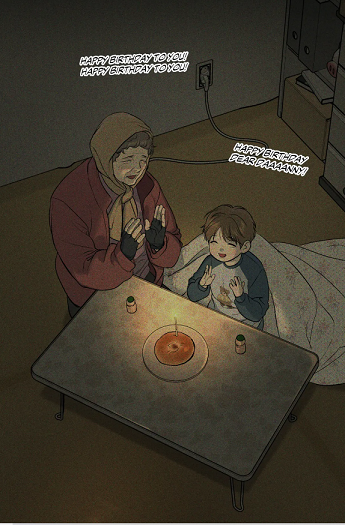 (Chapter 11) One might think, this celebration embodies a perfect birthday party. However, observe the absence of friends. It took place during the night too, a sign that his birthday was not celebrated properly. Everything implies his social exclusion. This made me wonder if this memory represents the only birthday party he ever had with Shin Okja. His life is a sequence of departures without ritual, absences without acknowledgment. Each time he leaves a place of work or community, he slips out like a ghost, denied the closure that parties are meant to provide.
At the hospital in Seoul, where he endured the predatory advances of the director, his dismissal was brutal and final. (Chapter 1) He was not only fired but blacklisted, erased from his profession’s networks. No farewell dinner was organized, no colleagues thanked him for his work, no one marked his departure.  (Chapter 1) His stay had been so brief as well. Besides, his absence was engineered to be total, as though he had never existed. The very ritual that should have affirmed his contributions instead became a ritual of erasure.
At the gym, the pattern repeated itself. The spray incident turned him first into a scapegoat. Park Namwook yelled, the fighters remained passive, and even Jaekyung rejected his presence. In the space of a few minutes, Dan was ostracized, his innocence ignored.  (Chapter 50) Then later the athlete questioned the physical therapist’s actions and told him this
 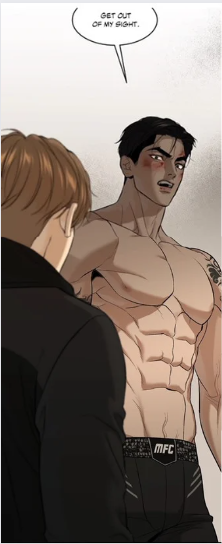 (chapter 51) out of fear and pain, the physical therapist thought, he was fired. Once again, he left in silence, unacknowledged. No one stood up for him, no one tried to reintegrate him, no farewell was offered. (Chapter 53) And keep in mind that according to me, in this scene, the manager already knew the truth. So he had a reason to dismiss a farewell party. The absence of ritual here was particularly cruel: Dan had given his skills and energy to the fighters, but his exit marked him only as disposable.
The hospice, where he briefly found genuine warmth, provided no closure either. When he left for Seoul, the staff were shocked, even saddened — but his departure was so sudden that no send-off was possible. (Chapter 78) Their affection was genuine, but the ritual was missing. Dan slipped away in silence, just as he had at the hospital and the gym. In the panel, what caught my attention is the reaction of the director. He is crying while keeping his distance, a sign that he is the one the most affected by doc Dan’s departure. For me, the author is alluding to the director’s regrets. If only he had treated doc Dan better… only too late, he had recognized that he had become accustomed to his presence. Doc Dan had always been a silent but active listener.
This absence of farewell may stretch back to his earliest traumas. If his parents truly died by suicide, it is possible that Dan never attended their funeral. Poverty, shame, and debt may have erased even that ceremony, leaving him with no closure for the loss of his own family. We can use Joo Jaewoong’s funeral as a source of inspiration. 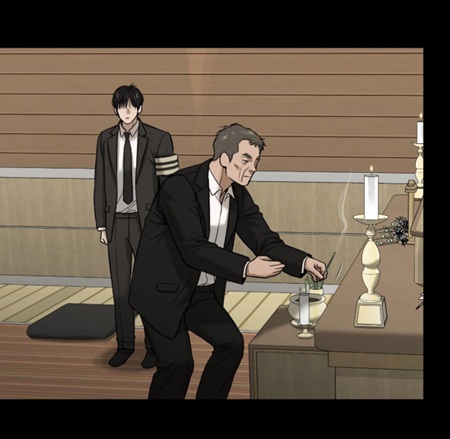 (chapter 74) The silence of his grandmother on this point suggests that even the most basic ritual of mourning was denied him.
The pattern becomes symbolic in the death of the puppy. 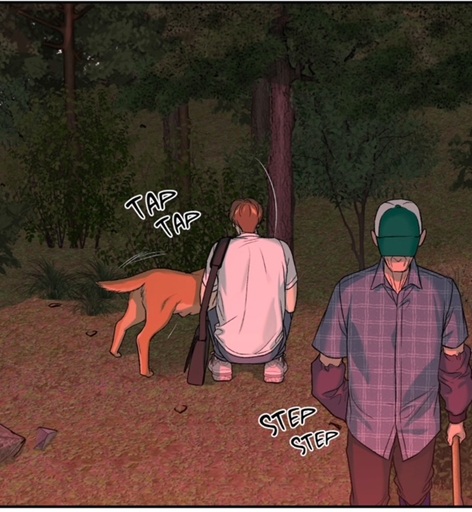 (Chapter 59) Only Dan and the landlord marked the event with a quiet burial. Since no one knew about it, it left the ritual incomplete. For Dan, the small act was meaningful, but its invisibility to the larger community echoed his own life: recognition always hidden, always partial, never public.
Even in moments that looked like parties, Dan was left on the margins. Jaekyung’s birthday party, with its cake and noisy cheer, contained an intimate truth: Jaekyung’s sudden, raw confession, “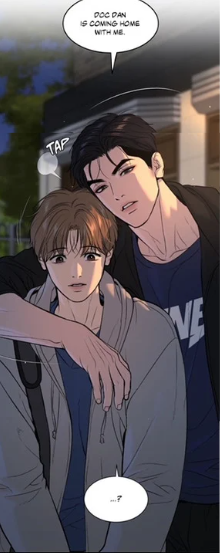 (chapter 43) This was the real heart of the evening, the only moment where ritual turned into intimacy. And yet even this was missed by Potato, who was absent at that crucial moment, lingering elsewhere with Heesung. The party’s form was there, but its essence — the recognition of Jaekyung’s loneliness and Dan’s importance — was overlooked by the two men at its center due to the presence of alcohol.
Thus, Dan’s life is a chain of missed parties. At the hospital, the gym, the hospice, even at funerals, he departs without recognition. And when celebrations do occur, the essential truth is missed — noticed only by those who are absent, while those present look away.
The Puppies’ Party
Nowhere is the irony sharper than in chapter 78, when the puppies run after the departing car.  (Chapter 78) To them, departure is not tragedy but play, a noisy farewell parade. Their barking and chasing become a spontaneous party, a joyous ritual of attachment. (Chapter 78) It is pure, instinctive, and alive. And yet, neither Jaekyung nor Dan sees it. Shut in the car, burdened by urgency, contracts, and exhaustion, they miss the little parade given in their honor.
The contrast is devastating. Humans, with their expectations of formal ritual, repeatedly fail to mark Dan’s contributions. They miss every opportunity to acknowledge him. But the animals, in their innocence, succeed where people fail: they celebrate simply because they care. The puppies recognize bonds better than the humans who claim to love him.
What makes this little parade even more striking is that the puppies do not separate between wolf and hamster. Their joy is directed at both men together, at the bond symbolized by the car’s departure. (Chapter 78) In this sense, the puppies achieve what the humans cannot: they recognize attachment without division, gratitude without debt. Their farewell is not tied to work, contracts, or hierarchy, but to presence itself. (Chapter 78) By running after the car, they express loyalty and responsibility, acknowledging the care they have received. It is the only party in Jinx that includes both protagonists as they are — not as worker and champion, not as scapegoat and boss, but as a pair worth celebrating. Finally, they have no idea that the couple plans to return soon, as they have no notion of time.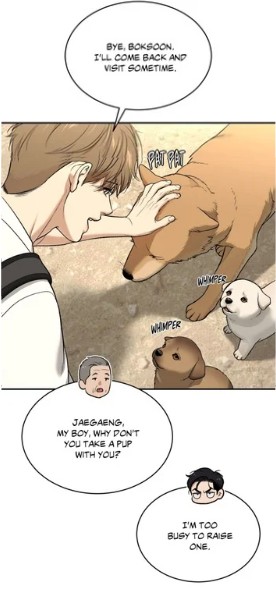 (Chapter 78) Striking is that here, doc Dan is making a promise to Boksoon and her puppies, but the latter have no idea. Therefore imagine this. On the weekend, the moment the car approaches the landlord’s house, the puppies will recognize them and celebrate their return! And this time, both characters will witness this welcome party: (chapter 78) How can doc Dan not be moved and even smile? Why did the champion reject the landlord’s suggestion (taking a puppy)? He had no time… Having a puppy will not just force him to slow down and take his time, but also attract real and genuine attention from the members of Team Black. (Chapter 78) The animals would even change Joo Jaekyung’s behavior and the fighters’ perception of their hyung.
 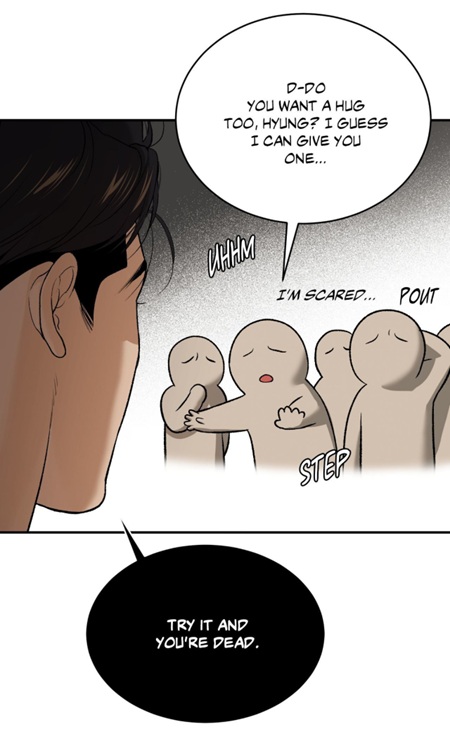 (chapter 78)
The Illusory Reset
When Dan returns to the gym, the fighters smother him with hugs and noisy affection. They beg him not to leave again, propose a welcome party, and act as if everything is back to normal.  (Chapter 78) But this “reset” is an illusion. Dan is only contracted for two matches. Interesting is that no one is capable of perceiving the truth, as the main lead’s explanation is ambiguous.
 (Chapter 78) He doesn’t limit the number of matches, only that he will focus on the “wolf”. So for them, his return is not limited in time. Nevertheless, his paleness and dark circles speak louder than their words: he is exhausted, fragile, still haunted.
The fighters, however, do not see his state. 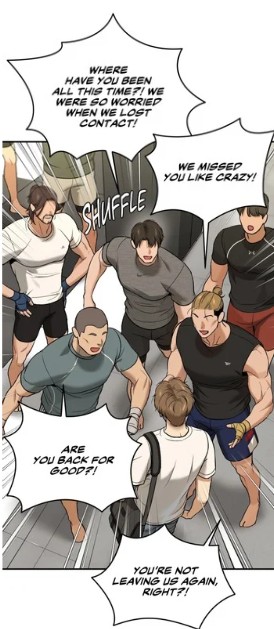 (Chapter 78) They are more worried about another possible departure than about his condition, as though his leaving again would be a greater tragedy than his ongoing suffering. This exposes that the members are not totally oblivious and their reunion is not a repetition of the past. On the other hand, warm words and a noisy welcome are enough for them. They take his generosity for granted, just as they always have. Therefore they ask for his magic hands. (Chapter 78) Their celebration is shallow, a ritual meant to restore their own comfort rather than acknowledge his reality.
Here, the cultural weight of parties in Korea sharpens the irony. Gatherings are strongly intertwined with alcohol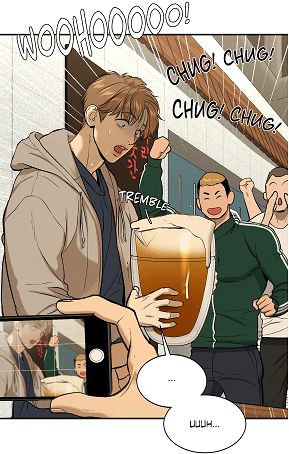 (chapter 9), and abstaining from drink often means being excluded from group belonging. Yet Dan, on medication, cannot drink. His doctor’s recommendation makes it impossible for him to participate in such “public” rituals. Even the customary sharing of a huge bowl — a symbol of intimacy and unity — must be avoided. For Jaekyung, who once used alcohol to dull his own struggles,
  (chapter 54) this becomes another reason to refuse such parties: they risk exposing Dan to temptation and harm. Park Namwook, knowing Jaekyung’s history of drinking, has no interest in promoting such events either.
 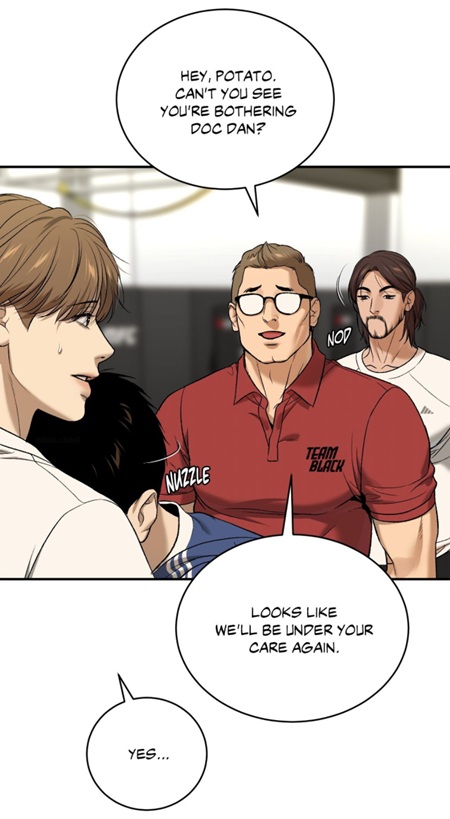 (Chapter 78) Hence the latter has no interest to organize a welcome party and even maintain the ritual with the bowl!! What might appear to others as grumpiness or stinginess is in fact a form of protection.
In contrast, Potato embodies another response. 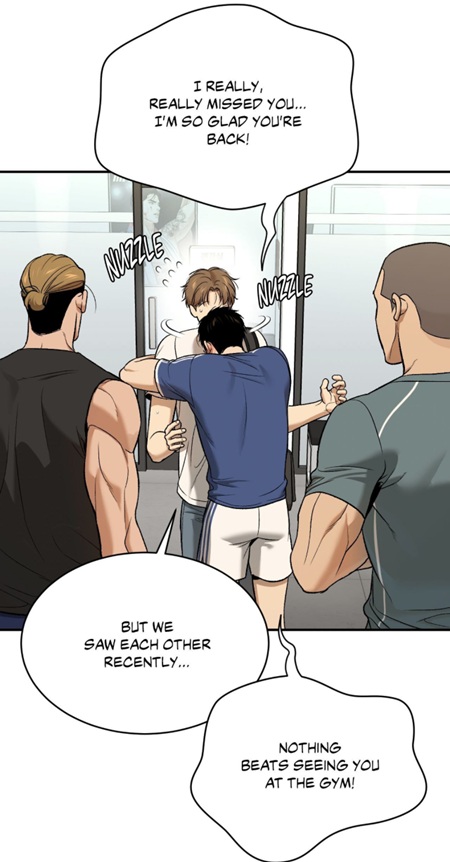 (Chapter 78) Having missed Dan most deeply during his absence, he now wishes to spend as much time as possible with his hyung. His longing shows that no party with Heesung and the landlord — no noisy drinking night —
  (chapter 58) could fill the hole left by Dan’s departure. But his form of attachment is still caught in the ritual of surface-level affection. What Potato craves is real closeness, hence he keeps hugging the physical therapist, (chapter 78) but what he proposes are the same shallow gestures that miss the truth of Dan’s fragility. The chow chow’s words — “Nothing beats seeing you at the gym” — unintentionally reveal this dependence. On the surface, it is a casual expression of joy and longing. Yet beneath it lies another truth: if the hamster were to leave Team Black for good, the gym would eventually lose all its members. From the start of the story, Dan has embodied teamwork. He is the glue that holds the fighters together, not by authority or charisma, but by care. Without him, unity dissolves into rivalry and noise. The irony is that the fighters sense this truth but cannot articulate it. They attempt to celebrate his return with hugs and the promise of a party, as if rituals could substitute for recognition. In reality, what they crave is not the feast but the fragile cohesion that Dan alone brings.
Striking is that Jaekyung’s refusal of the welcome party is linked to his position as director of the gym. It marks a turning point. Indirectly, he rejects the idea by redirecting the fighters’ attention. He points out their indifference toward him. For the first time, the athlete is voicing his dislike openly, he felt excluded. Due to this combination, the athlete doesn’t realize that he rejected the party, as if he refused to participate in hollow rituals that only disguise exhaustion and perpetuate harm. (Chapter 78) It becomes clear that for the athlete, such parties built on illusion can only harm Dan further. To conclude, thanks to his intervention, he protected the hamster from rituals that mistake noise for acceptance and even care. 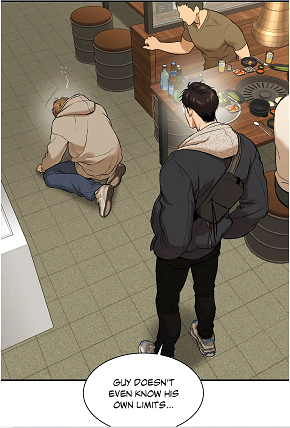 (chapter 9)
Park Namwook’s position within Team Black also sheds light on the dynamic of missed parties. In earlier chapters, he was the one who orchestrated gatherings  (chapter 26), or allowed whether welcome parties or surprise celebrations or pre-match meals
  (chapter 22). These events were never about genuine recognition but about maintaining power and appearances, boosting morale, or reminding the fighters of their dependence on the team structure he managed. The “surprise” birthday party in chapter 43 bore his fingerprints, (chapter 43) yet he stayed conspicuously absent when the cake was presented, only appearing later at the restaurant.
 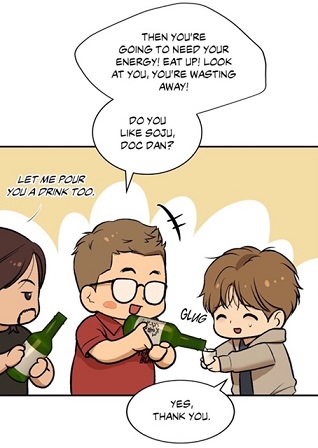 (chapter 43) This absence is revealing: Namwook preferred to avoid direct conflict with Jaekyung’s visible displeasure, leaving the awkward burden of paying and performing to the champion himself to Yosep. In other words, his parties were tools of control, not gifts of belonging. By chapter 78, however, the balance has shifted.
  (chapter 78) Standing in the back, Namwook watches as Dan returns and is embraced by the fighters. He notices a “different vibe” between the two leads, but fails to grasp what it means. Doc Dan is actually free and has the upper hand in their relationship. Hence he can no longer ask this from doc Dan:
 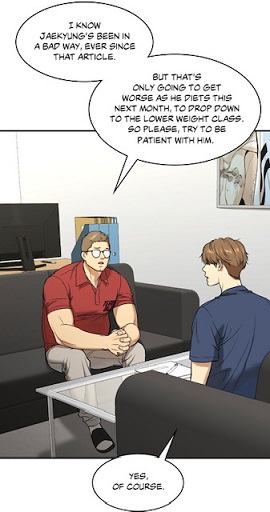 (chapter 36) Doc Dan should put up with everything. What he cannot admit is that Dan is no longer replaceable. (chapter 78) Once erased, the therapist now belongs; once central, the manager is now the outsider. Namwook is pushed into the very silence he once imposed on others. The irony is sharpened when Jaekyung openly asserts his authority: (chapter 78) With that, the wolf reclaims his rightful place. In other words, by respecting the hamster, the protagonist is learning to protect his own dignity and interests. (chapter 78) Namwook’s illusion of control dissolves, his “decisions” and rituals losing their force. Even the proposed welcome party collapses in an instant when Jaekyung refuses, proving that Namwook no longer directs the rhythm of the team. The missed party is thus his own as well: the final chance to assert authority through ritual slips away before his eyes, leaving him stranded on the margins of the very world he once managed. And in this reversal lies a striking symmetry: the silence that once excluded Dan now excludes Namwook, completing a cycle of poetic justice. What Dan endured in season one (chapter 41), sidelined and voiceless, is now mirrored in the manager’s quiet erasure.
If Dan’s health were to worsen, the most striking reversal might occur: a match could be cancelled not because of the champion, but because of his therapist. Such a possibility would mark a profound shift in the logic of Team Black. In season one, Jaekyung fought regardless of his condition; his insomnia, shoulder injury, foot injury and depression were ignored, never reasons to stop the machine. Dan was expected to keep patching him up in silence while the show went on. But if a fight were cancelled due to Dan’s weakness, it would confirm his irreplaceable place in the system. The team’s future would depend not only on the fists of the champion but on the presence of the man who heals him. For the wolf, this would be more than logistics: it would be a choice of care over profit, proof that he has reclaimed his authority to protect rather than exploit. And for Namwook, such a cancellation would represent his ultimate defeat. A missed party of the grandest kind — a fight night erased from the calendar — would signal the collapse of his management logic.  (chapter 69) Yet unlike all the hollow celebrations that came before, this missed event would finally have meaning. It would not be absence through neglect, but absence as recognition: proof that Dan’s life matters more than ritual, profit, or performance.
The Real Parties They Missed
If there was ever a “real” party in Dan’s life, it was the small gathering by the seaside with Heesung, the landlord, and Potato. (chapter 58) A simple evening of drinking and laughter, it gave him a fleeting taste of inclusion outside the world of gyms and hospitals. Yet even this was flawed: Dan’s health made alcohol dangerous, and Jaekyung never knew of the event. For him, it became another missed party, a moment of warmth hidden from his eyes.
The traces of this seaside evening resurface in chapter 78, when Potato joins the fighters to welcome Dan back. Unlike the others, however, he arrives noticeably later. 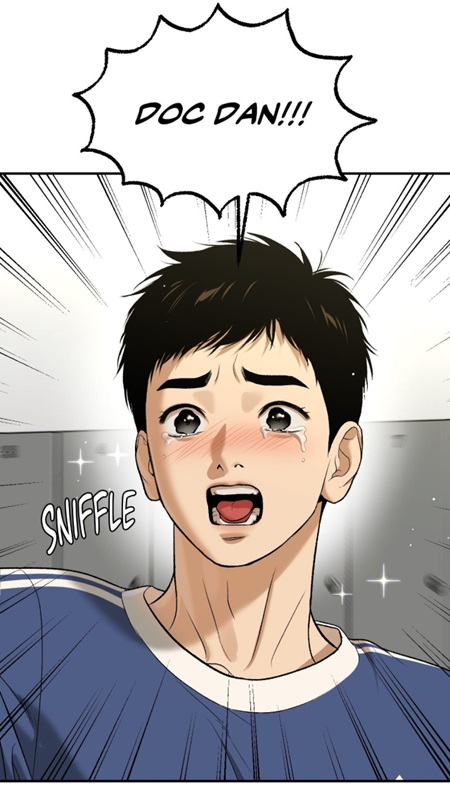 (chapter 78) This delay suggests a split loyalty: while the team is already celebrating, Potato is likely still tied to Heesung, perhaps even speaking to him on the phone. His tardiness betrays how his heart is pulled in two directions — caught between the actor’s orbit and the gym’s renewed center around Dan. Yet the embrace of the fighter, and his tearful reaction at seeing Dan again, show that his real place lies with Team Black. (chapter 78) The return of Dan shifts Potato’s focus: he no longer has to trail after Heesung, but can make his hyung and his own career a priority once more.
And here lies the seed of conflict. In chapter 59, 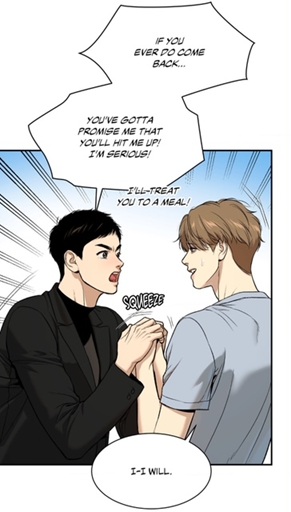 (chapter 59) Potato had made a promise to treat Dan to a meal if he ever returned, squeezing his hand with the sincerity of a puppy. That promise, innocent as it seemed, carried a hidden trap: in Korea, such “treats” almost always involve alcohol. And he could try to recreate the party on the coast. Potato, unaware of Dan’s medical restrictions, may offer him exactly what he must refuse. Only Jaekyung knows the truth of Dan’s fragile health; only he can act as his shield against such misplaced affection. Secondly, Potato possesses pictures of the puppies
  (chapter 60), which he took on the day one of them died!
What makes this tension more explosive is the role of Heesung. He alone knows that Jaekyung resorted to drinking after Dan’s departure 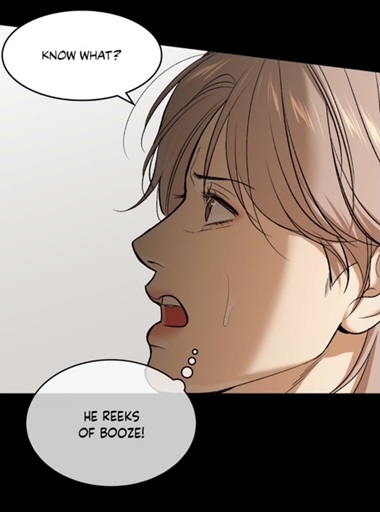 (chapter 58), and his presence ties alcohol directly to the champion’s vulnerability. At the same time, Potato’s loyalty is beginning to shift. He once orbited Heesung like a hidden lover, but Dan’s return rekindles his attachment to the gym and as such will affect his relationship with the gumiho. (chapter 78) The “puppy” now prefers Dan’s company at the gym to the actor’s beck and call. The small seaside party that once united them may become the fault line that divides them: an invitation, a bottle of soju, a clash between past habits and new priorities. For Jaekyung, it will be the ultimate test — not whether he attends the party, but whether he transforms it into something different, a celebration without alcohol, a ritual of care rather than destruction. As you can see, I am expecting the return of the fox Heesung.
And yet, even beyond the noisy welcomes and the hidden seaside gatherings, the theme of absence reaches into the most intimate farewells. When Dan prepares to leave the hospice, he leans toward his grandmother, seeking an embrace, a moment of warmth that could ease the separation. 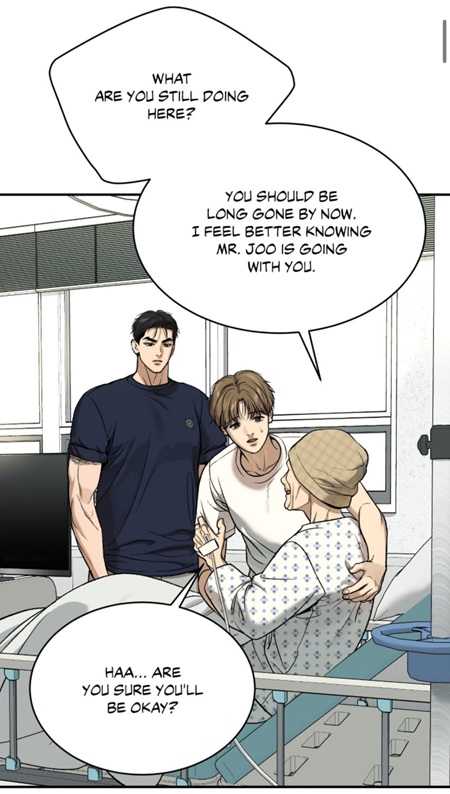 (chapter 78) But she does not return the gesture, as she might believe that he is just holding her straight. Her arms remain still, her body heavy with silence. Instead she talks, urging her grandson to leave the place as quickly as possible. So she doesn’t enjoy this moment. What should have been a small celebration of love — a hug of recognition, a party for two — dissolves into emptiness. Halmoni, who had always claimed to be his anchor, fails to give him the ritual of belonging he craves. The one gesture that could have affirmed their bond is withheld, turning tenderness into yet another missed ceremony.
Hwang Byungchul mirrors this failure in his own way. 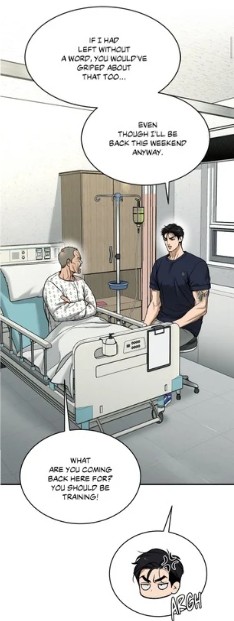 (chapter 78) Sitting stiffly in his hospital bed, he waves away any possibility of affection. His body language, arms crossed, his words reduced to commands about training, erase the emotional bond that might have connected him to Jaekyung. Where halmoni’s silence is passive, Byungchul’s is active — he refuses intimacy, replacing it with obligation. For both figures, farewell becomes an empty form, stripped of the recognition that makes partings bearable. In these moments, the absence of a hug, the denial of tenderness, is more devastating than the loudest rejection. It is a party that never begins, a rite of passage left unspoken.
This is crucial, because in Korean culture, embraces are rare, and when they occur, they carry profound weight. To hug someone is to cross into genuine intimacy, to declare loyalty and affection without words. The absence of such a gesture from halmoni and the director therefore marks not just emotional distance but outright exclusion. They cannot — or will not — celebrate Dan or Jaekyung as individuals worthy of deep affection. they only know pity, pride or annoyance. Their failure underlines the story’s central rhythm: the rituals that should affirm identity are constantly missed, postponed, or corrupted.
Placed against these failures, the quiet “parties” between Jaekyung and Dan acquire even greater weight. A home-cooked meal,
 (chapter 22)
  (chapter 13) a breakfast in silence
 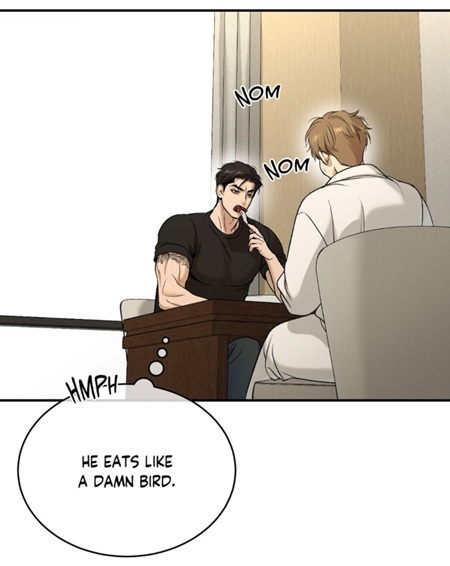 (chapter 68), the embraces in the dark
 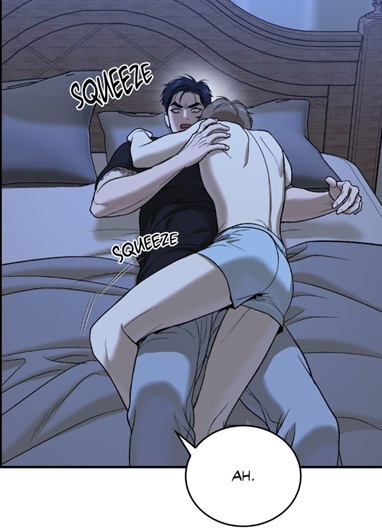 (chapter 66) (the wordless recognition of suffering) — these become the true celebrations of Jinx. They lack alcohol, noise, or spectacle, but they carry sincerity. They reveal that belonging can be built not through grand gestures but through repetition, through the transformation of fleeting kindness into ritual. This implies the existence of conscious and choice. And yet, these moments remain fragile. After their return to the penthouse, there is no shared meal, no laughter, only nostalgia and sadness.
 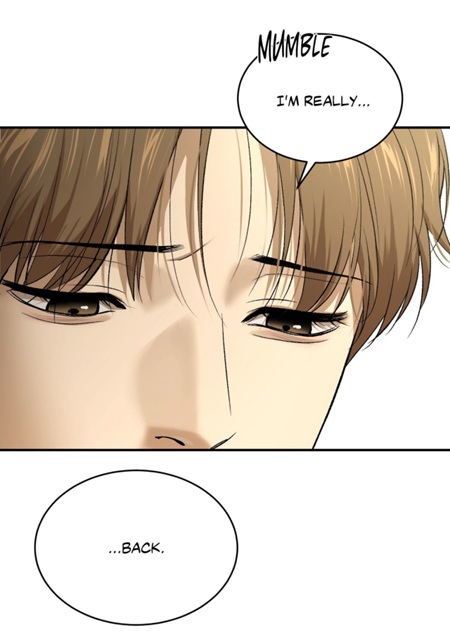 (chapter 78) Even Jaekyung is troubled by the reminder that Dan’s stay is temporary, as if the very walls of the penthouse resist turning into a home.
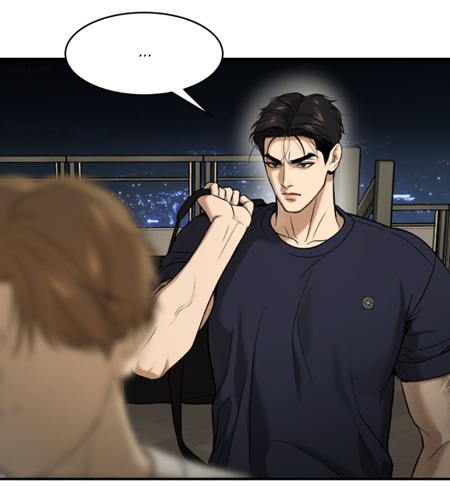 (chapter 78) In other words, the wolf’s task is no longer to win battles in the ring but to protect these fragile celebrations — to make Dan feel at home, to turn missed hugs into embraces, missed parties into warm meals, missed gestures into habits of care. Only then can the cycle of exclusion be broken. Only then can “The Missed Party” become, at last, a real one.
Conclusion
Both protagonists are marked by missed celebrations. Dan’s life has been a chain of exclusions: fired without farewell, blamed without defense, departing without closure. Even in death — (if we include the theory of his parents’ vanishing), the puppy’s burial — rituals of belonging were denied. Jaekyung, for his part, wins victories without feasts, carrying glory without intimacy.
The fighters and nurses offer illusory parties, mistaking noise for recognition, affection for change. But the true parties are elsewhere: in the puppies’ joyous run, in the hidden rituals of wolf and hamster [the embrace,  (chapter 68), the shared meal (chapter 68) and in the landlord’s quiet kindness
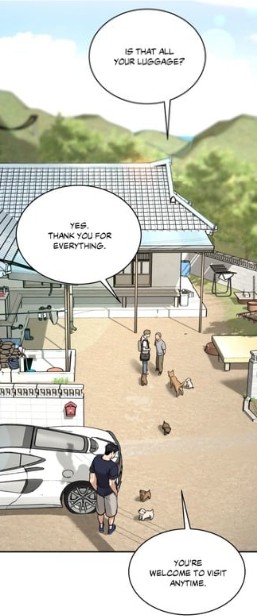 (chapter 78). For me, it is no coincidence that the senior followed them to the street and waved at them!
 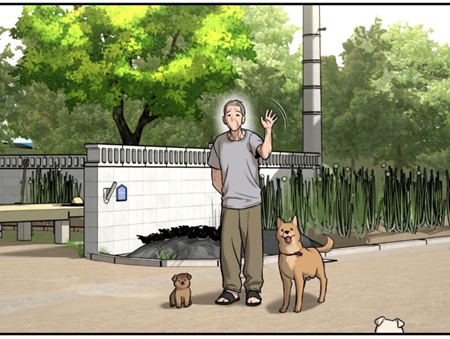 (chapter 78) He expressed not only his genuine feelings, but also his longing: he hoped to see them soon. He had come to appreciate their presence which is not related to their work. The Missed Party becomes not a single absence, but the haunting rhythm of the entire narrative: recognition always arriving too late, always seen by the wrong eyes. And perhaps the story’s promise lies here — that one day, the real party will finally be held, not in karaoke bars or gym halls, but in the unbreakable bond of two men who learn what true friendship and belonging mean. This means, the more the champion and his fated partner develop new routines, the more it will affect the gym and as such Park Namwook, which can only feel more and more excluded.
PS: If in the next chapter, the night continues, then I can’t shake the feeling that Joo Jaekyung might pat doc Dan’s head and not yank his hair, like he announced it. 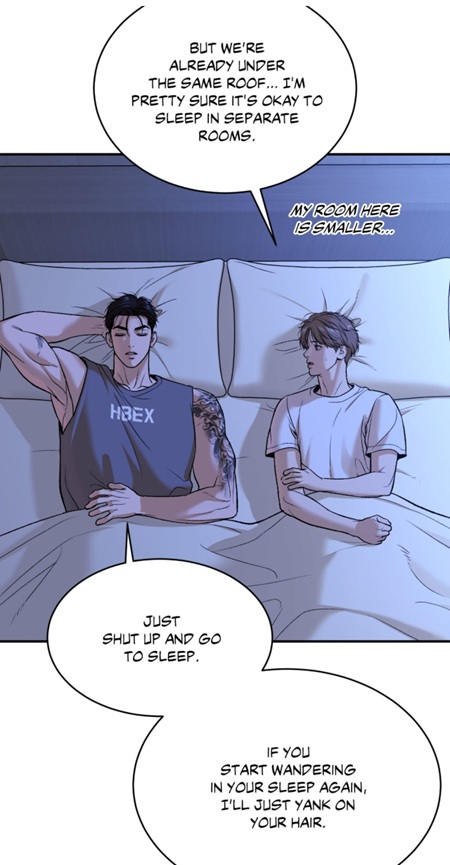 (chapter 78)
Feel free to comment. If you have any suggestion for topics or Manhwa, feel free to ask. If you enjoyed reading it, retweet it or push the button like. My Reddit-Instagram-Twitter-Tumblr account is: @bebebisous33. Thanks for reading and for the support, particularly, I would like to thank all the new followers and people recommending my blog.


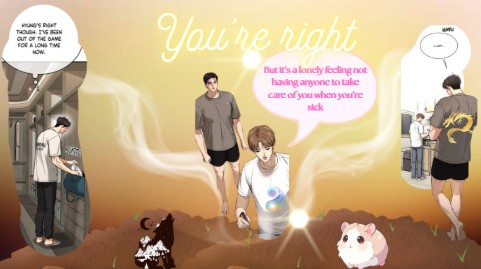
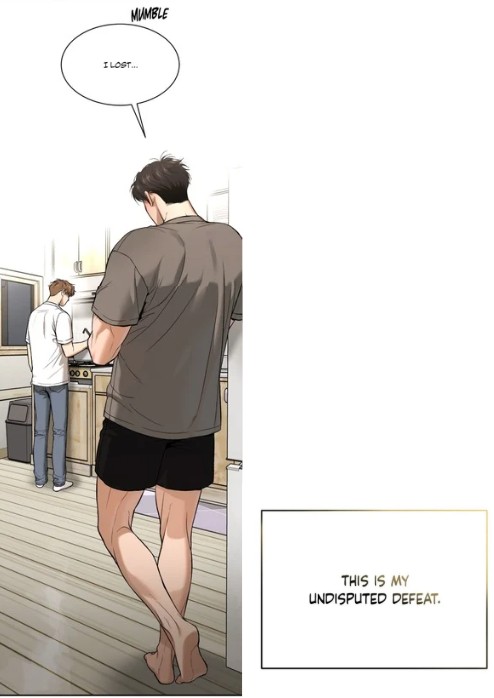 (chapter 76) This admission is no mere reversal of pride. It gestures toward something Jaekyung has never known: an exchange that does not end in domination or silence, but in dialogue. For Kim Dan, too, it marks a turning point.
 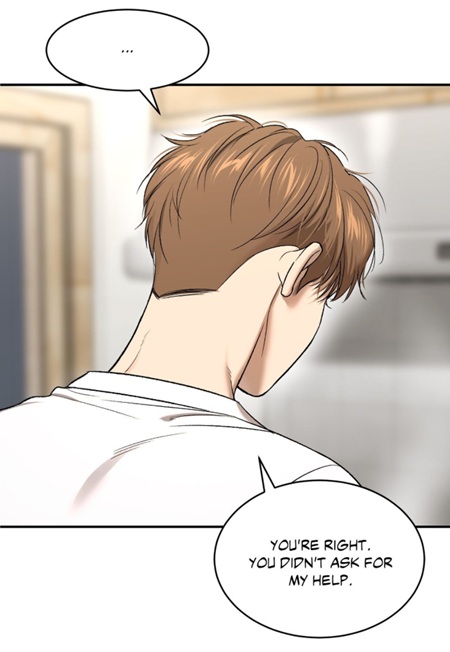 (chapter 76) For the first time, he uses the expression you’re right in front of his fated partner. He seems to concede with this idiom. Yet this apparent submission hides a deeper reversal. By admitting Jaekyung never asked for his help, he redirects the exchange toward his own truth: the loneliness of having no one to care for you.
 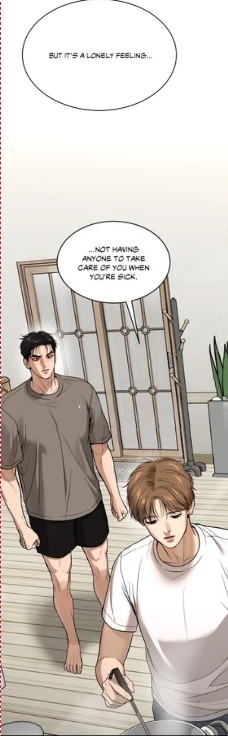 (chapter 76) What unfolds in the kitchen is not a quarrel about porridge but a fragile recognition. Dan’s “You’re right” acknowledges Jaekyung’s perspective without bitterness, while Jaekyung’s “I lost”
  (chapter 9)
 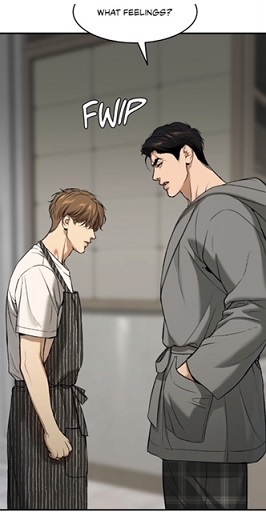 (chapter 45)
  (chapter 76) The kitchen scene closes one cycle and announces another.
  (Chapter 76) In this view, his fixation would be the product of ambition, pride, or ego: the expected cost of survival in a cage where only victory pays.
  (chapter 76), because the adults in his life cut them off before they could exist. Winning became his only mode of survival because every formative argument in his youth ended in defeat, and not the kind decided by a referee. With his father, mother, coach, and manager, words never led to recognition — only to insult, silence, utility, or obedience. He learned early that dialogue could not protect him; only victory could. His victories were not chosen freely, but forced into being by guardians who made him feel like a burden, until relationships themselves became burdens.
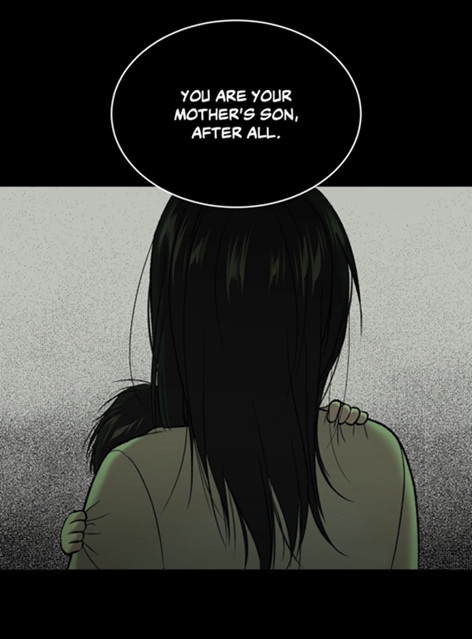 (chapter 73) He was a loser because of his mother. To lose meant humiliation and rejection; to speak at all meant to invite contempt. The only possible rebuttal was victory — to prove through strength that he was not the pathetic, worthless child his father saw in him. Winning became his sole argument against a man who would never listen, the only way to resist being branded a loser.
  “(chapter 73). It was not just defiance; it was a vow that victory would silence abuse once and for all. When he returned with the trophy, he shouted triumphantly,
 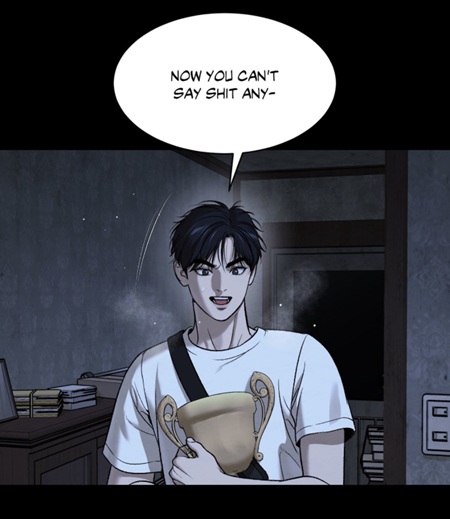 (chapter 73) ready at last to claim, “I was right.” Yet reality betrayed him. His father’s death denied him the only acknowledgment he had sought.
 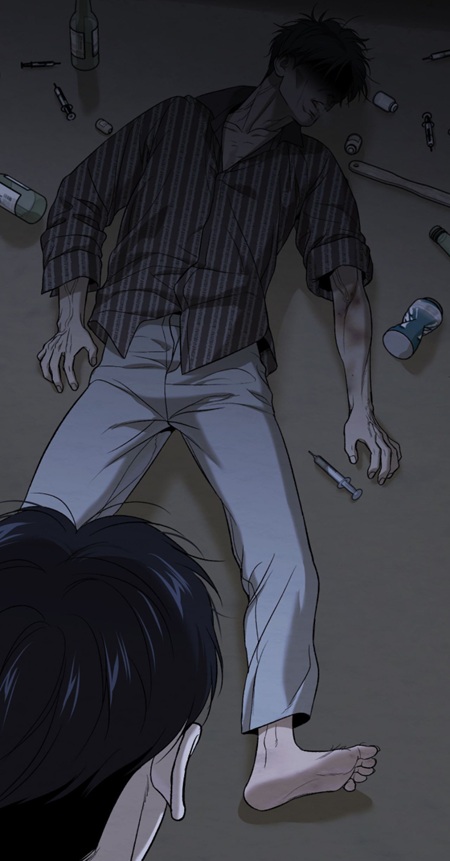 (chapter 73) The words “I was right” died in his throat. He had proved himself, yet there was no one left to recognize it. His own prediction — that his father’s death would mean nothing — proved false. The absence cut deeper than the insults had, leaving Jaekyung not with triumph but with the bitter aftertaste of self-loathing. Victory had silenced his father, but it also silenced the son. He had proved himself, yet there was no one left to hear it.
  (chapter 74) At the funeral he remained dry-eyed, his face locked in shame (ch. 74). No one saw his guilt, but it consumed him: the one man he needed to hear “I was right” from could no longer answer. At the same time, his smile and laugh were also linked to misery. For Jaekyung, laughter was never the sound of joy, but the echo of mockery and rejection due to the father. Just as tears became tied to betrayal and abandonment through his mother, so too did his father twist laughter into a weapon
 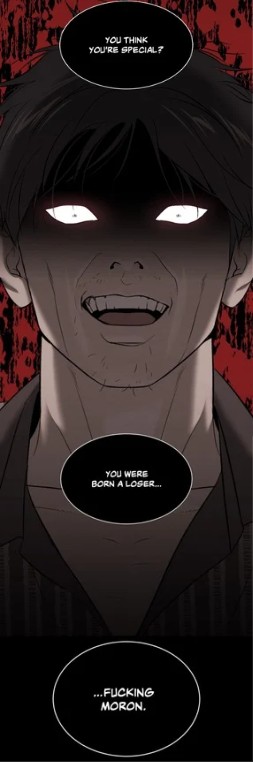 (chapter 73) — every laugh at his expense reinforcing the verdict that he was weak, pathetic, a loser. In Jaekyung’s childhood vocabulary, neither laughter nor tears could carry warmth. Both were stripped of comfort and redefined as signs of humiliation and pain.
 (chapter 72) To the boy, she was not silent at first: she must have definitely told him to become strong, to endure, to wait. She gave him her number, leaving the illusion that her departure was not abandonment but necessity. Victory and wealth became her conditions for love. That is why he swore over the payphone to work hard
 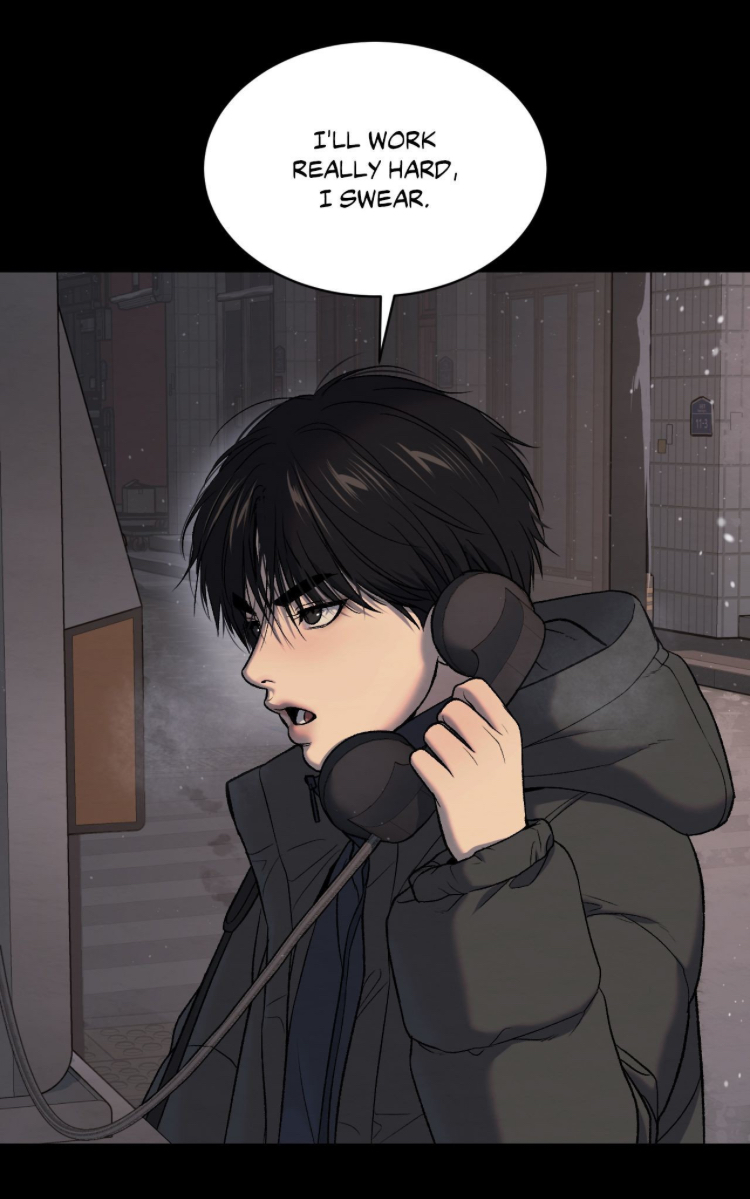 (chapter 72) and “make money” so she could return, and why after his father’s death he still hoped for her homecoming.
  (chapter 74) But when the calls went unanswered, her silence became the sharpest weapon of all. Her eventual reply
 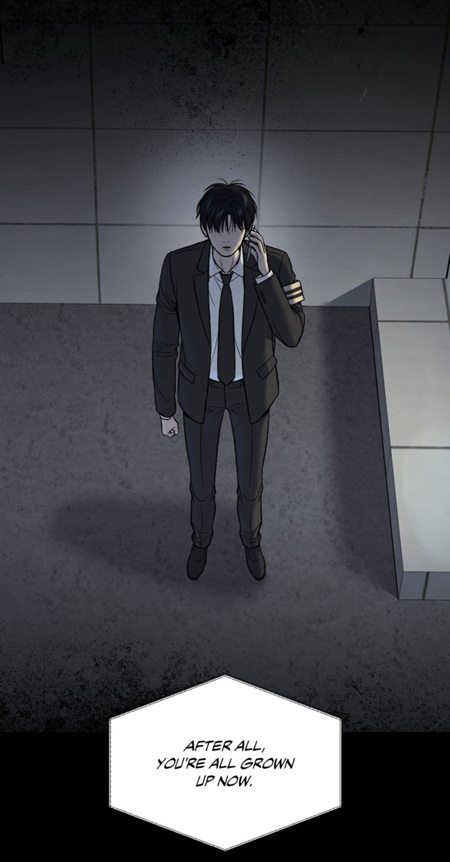 (chapter 74) confirmed that his effort had never mattered. For the first time, he cried
 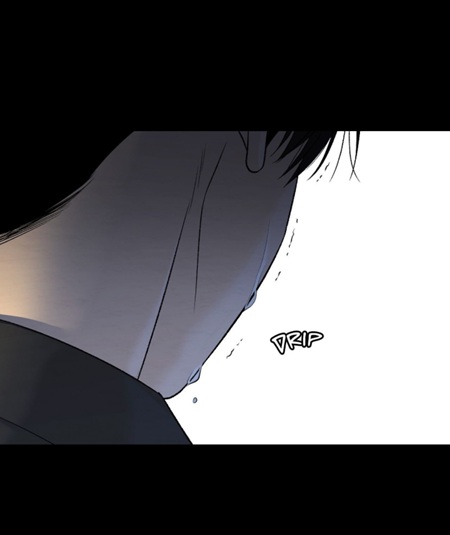 (chapter 74), his tears expressed not just grief but the recognition of betrayal. From then on, tears themselves became equated with loss, weakness, and abandonment. This is why, in the wolf’s nightmare, Dan’s crying form
  (chapter 76) appears: the sight of tears recalls the moment he unconsciously realized that even his mother’s “you’re right” was a lie. At the same time, those tears function as a mirror. The champion projects onto Dan the very weakness he has always forbidden himself to show.
 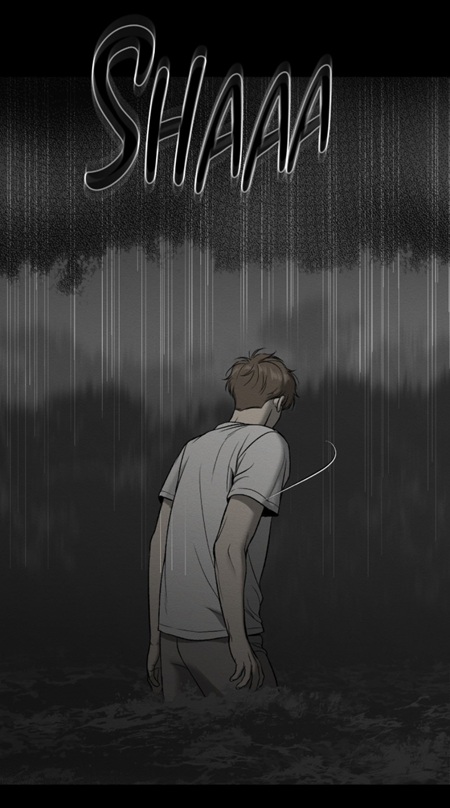 (chapter 76), the boy he once was who longed to weep but had to swallow it down. At the same time, Jaekyung himself occupies the place of the “adult” —
  (chapter 74) Hence the wolf’s tears were quickly replaced by rage and violence.
 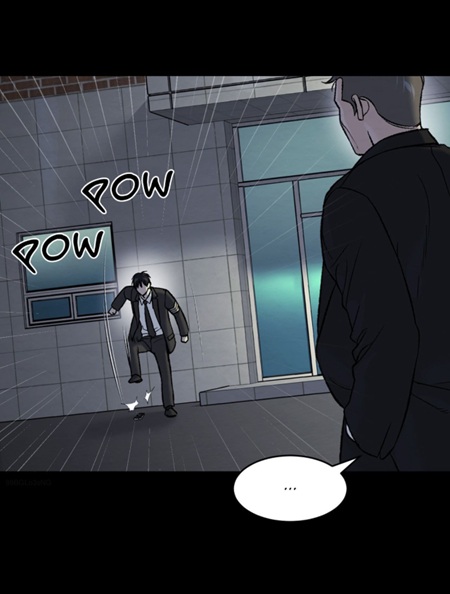 (chapter 74)
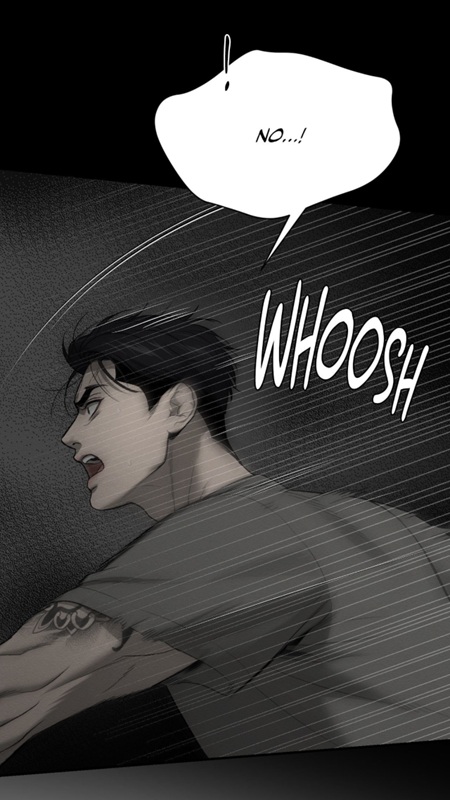 (chapter 76) His trembling hand upon waking
 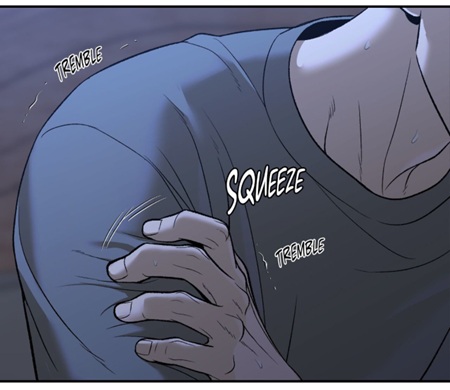 (chapter 76) shows the yearning to be held, comforted, reassured — something he never received from either parent. He is not entirely responsible for the physical therapist’s suffering. And here lies the difference: Dan’s tears are not manipulative or hypocritical , like the ones Jaekyung suspects from his mother, but unfiltered honesty. He expressed his emotions, not just through tears, but also through body language!
  (chapter 1) He was shaking, he was bowing and asking for forgiveness! Dan embodies a form of vulnerability that is real, legible, and forgiving contrary to the mother. When the teenager heard his mother’s voice after such a long time, the latter never brought up her past action. She never asked him for forgiveness.
  (chapter 74), whose quiet devotion and silence kept the gym alive, nor Jaekyung’s, whose absence he accepted without challenge.
 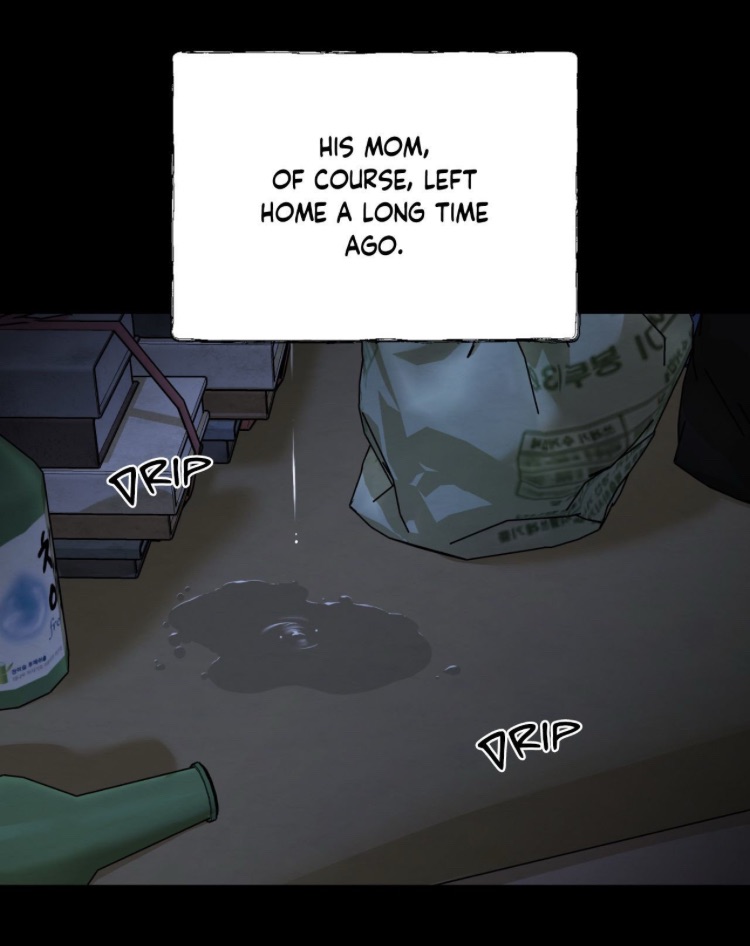 (chapter 72) In fact, his own mother’s submission reinforced this flaw: her blind trust in her son, her refusal to question his choices and the boxing world, taught him that authority need not be examined, only endured or seen as trustworthy. For him, hierarchy was unquestionable, and so he perpetuated it. Thus he stands for lack of critical thinking. This is why, with Hwang, the vocabulary of “right” and “wrong” was never about dialogue but about obedience. No wonder why he became so violent at the police station.
  (chapter 74) Unlike Jaewoon’s domination or the mother’s evasive silence, Hwang cloaked his authority in the language of advice — yet beneath it lay a black-and-white dualism: winners and losers, villains and victims. Thus Joo Jaewoon was blamed for becoming a thug
  (chapter 74), while the wolf’s mother was a victim. He viewed her as a selfless and caring mother:
  (chapter 74)And observe how he provoked the main lead.
  (chapter 74) When Hwang sneers, “What, am I wrong? Come on, answer me!” he is not inviting dialogue — he is staging a trap. The question is rhetorical, a demand for submission. Let’s not forget that he had witnessed the phone call in front of the funeral hall, but back then he had done nothing. And when the boy hesitates
  (chapter 74), unable to answer, Hwang strikes him in the chest.
  (chapter 74)and justifies his action behind social norms.
 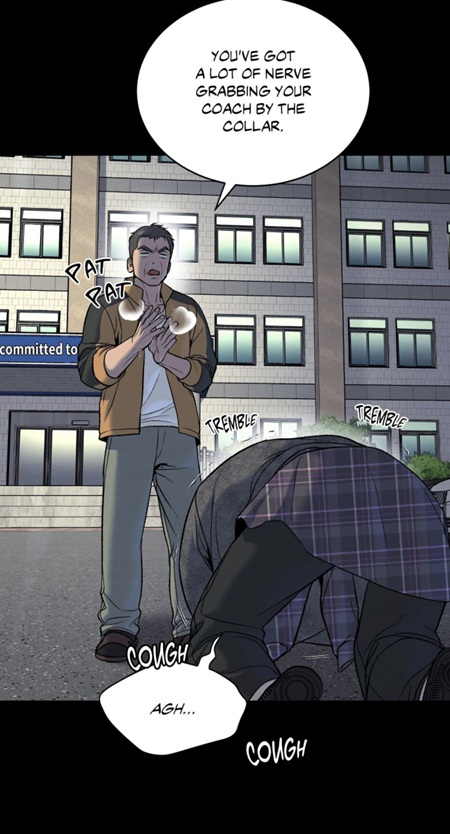 (chapter 74) In that instant, he takes the role of judge, referee, and executioner, collapsing “argument” into violence. The very words “Am I wrong?” contain the irony: the coach is less interested in truth than in reasserting his own authority. Silence is treated as guilt, hesitation as defeat.
 (chapter 74), he effectively admitted “you’re right” to the coach. Yet this wasn’t simply genuine agreement — it was submission, respect mixed with survival. The director misread it as validation of his worldview. This only reinforced his certainty, encouraging him never to reconsider his role.
  (chapter 74) When the protagonist finally left, the director could declare with satisfaction:
  t(chapter 74).
 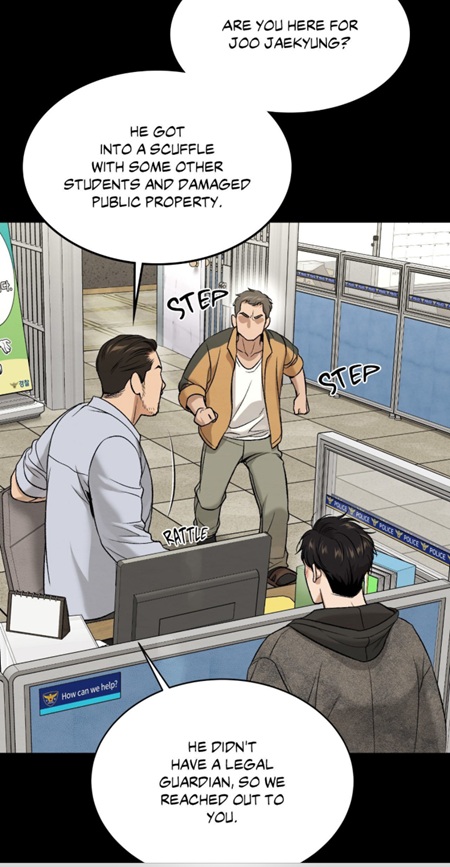 (chapter 74) The reality was that the old man had never truly become the star’s home and family, which explains why he constantly leaned on other adults, the mother or the father, to provide the guidance he himself refused to give. At the same time, I come to the following deduction: he must have lost his boxing studio, and with its vanishing, the elder was forced to face “reality”: loneliness, sickness and absence of happiness in his life!
 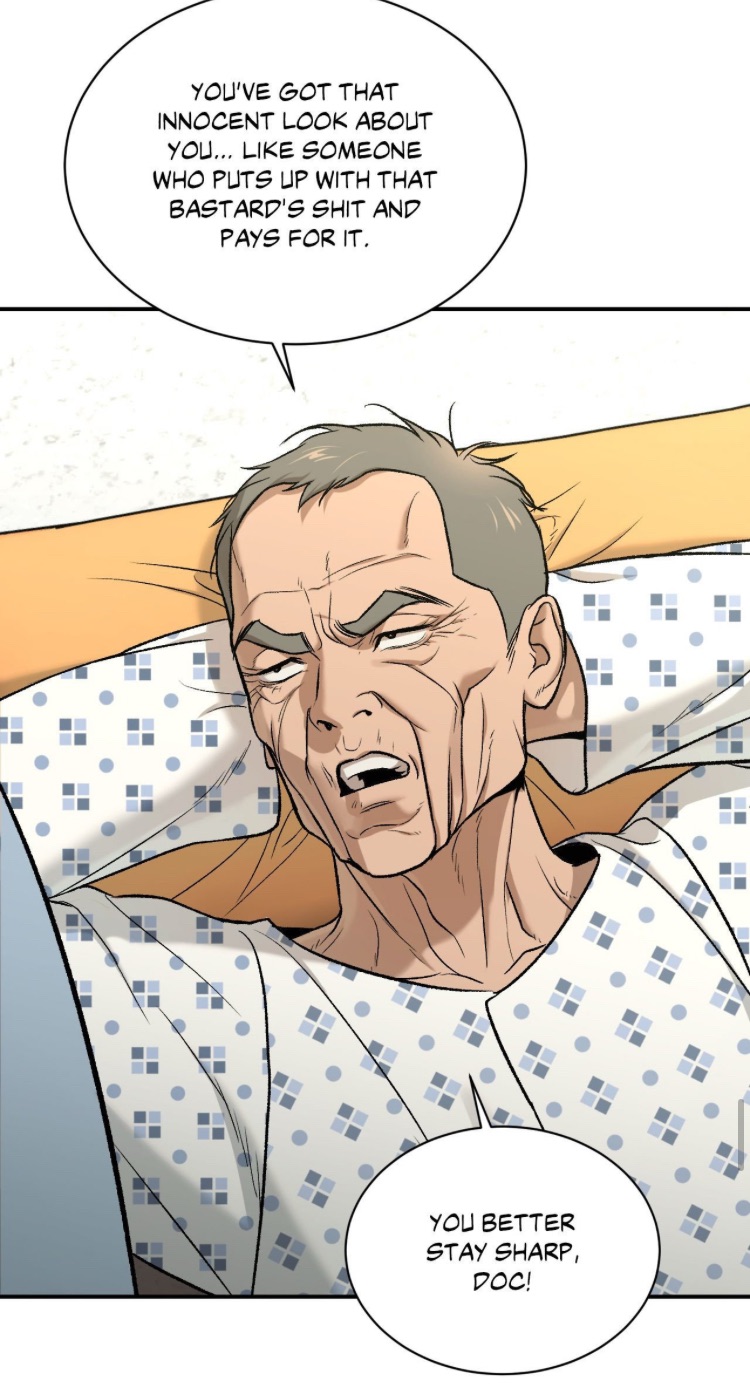 (chapter 70) Once again, Jaekyung is reduced to “that bastard” — a label, not a person — while Dan is framed as the pitiable victim. The old coot remains the righteous observer, untouched by guilt, protected by a rhetoric that always shifts responsibility elsewhere.
 (chapter 75) He was happy again, though he initially tried to hide it. We have to envision that before the wolf’s visit, the elder had to face what his own life outside the gym looked like: sickness, solitude, the collapse of the studio that had sustained him and came to resent the main lead. Yet, Joo Jaekyung’s behavior changed everything:
 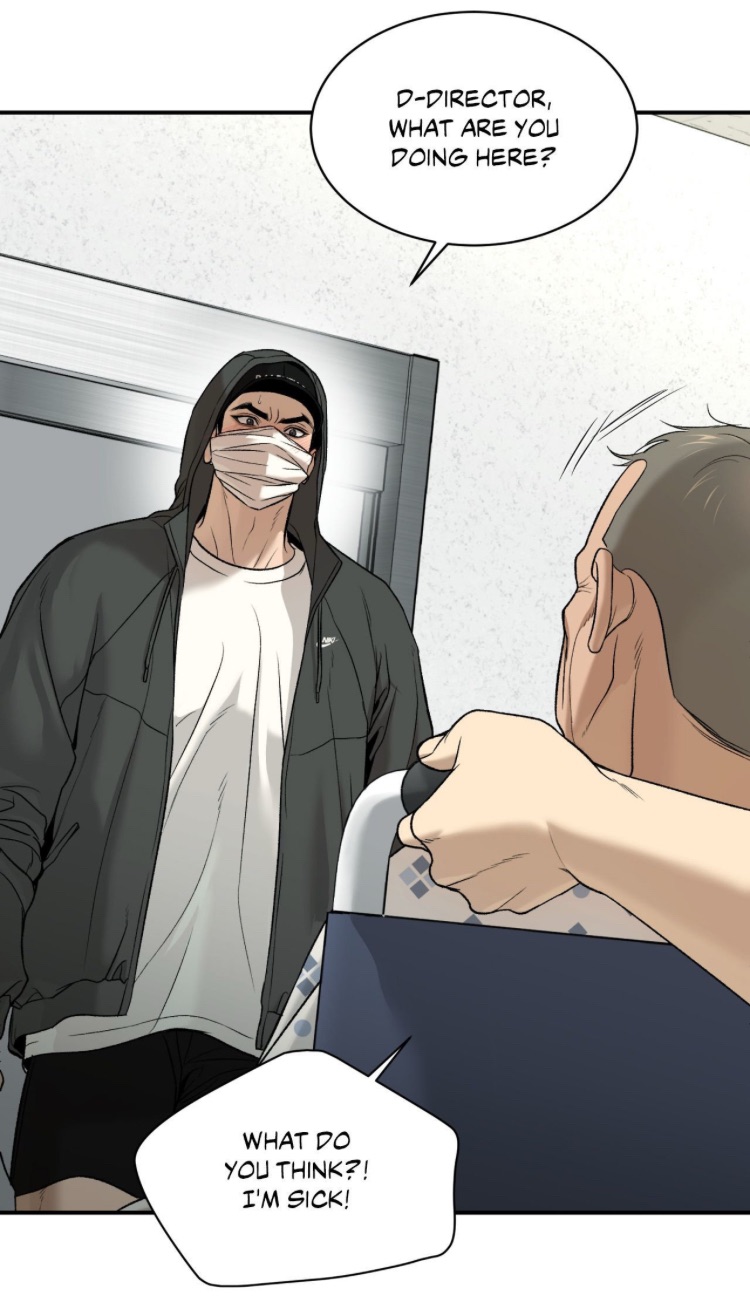 (chapter 71)
 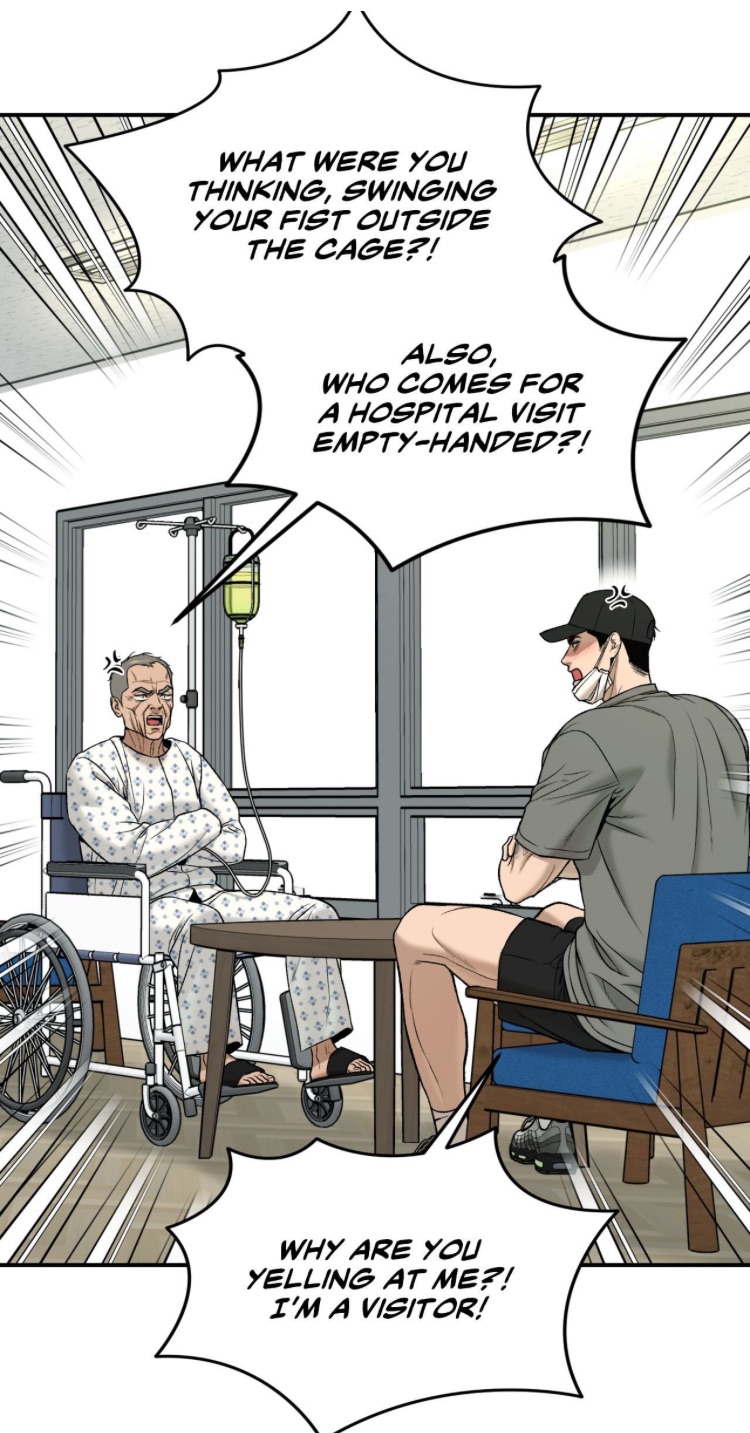 (chapter 71) Only during the champion’s visit, did his words alter.On the rooftop of the hospice, he finally tells Jaekyung:
 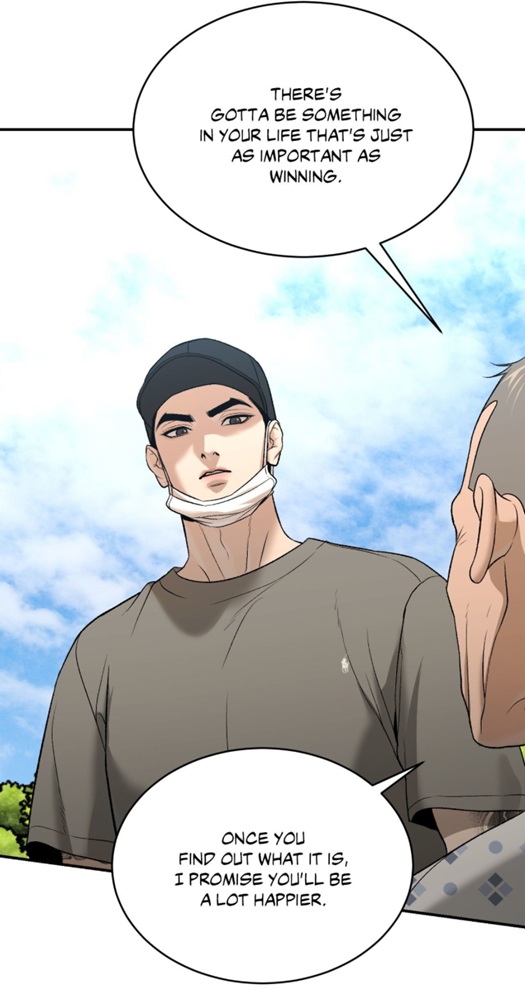 (chapter 75) This shift did not come from wisdom gained in the ring but from loss — the loss of health, the loss of the gym, the loss of illusions — and from Jaekyung’s loyalty, which pierced through his blindness. Interesting is that this time, he doesn’t give the answer to the athlete. He stops thinking “I’m right, you’re wrong”. He treats him as an adult, as a mature and thoughtful person. Through that fidelity, Hwang glimpsed at last what he had denied both himself and Jaekyung for decades: that victory alone cannot sustain a life.
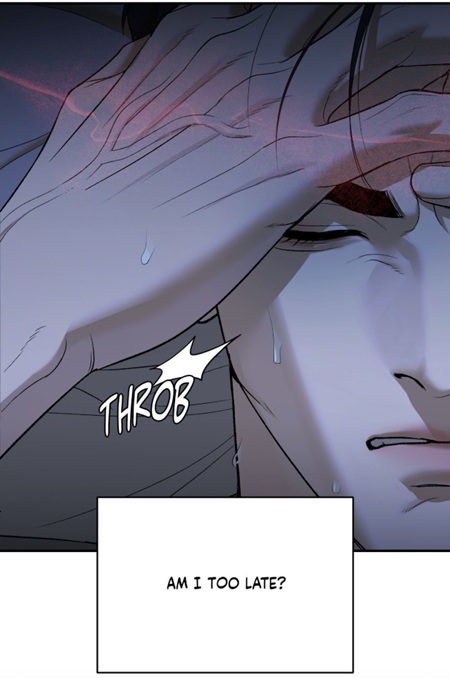 (chapter 76) It is not too late. The question “Am I too late?” is the consequence of Hwang byungchul’s words and it gradually indicates the switch in the champion’s mentality. It is no longer about being right or wrong. However, the nightmare reveals another aspect: the world is not black and white, but grey.
 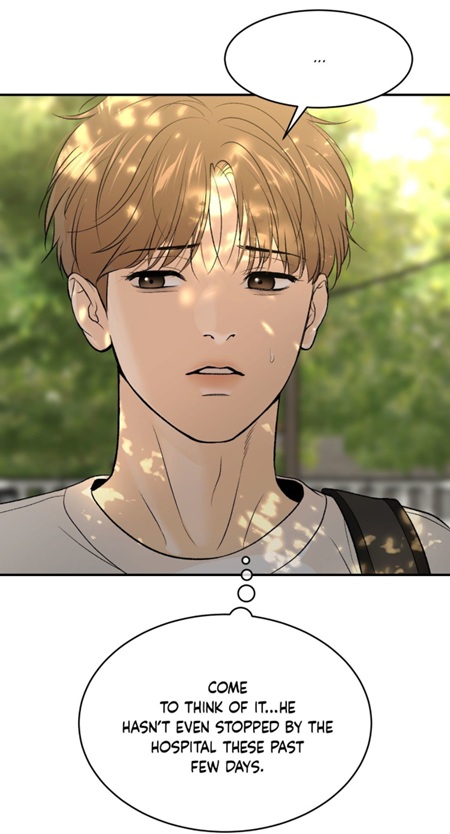 (chapter 76) Hence he remained silent and avoided his gaze. But like the director showed it, it is never too late:
  (chapter 76)
 (chapter 69) Thus my avid readers might jump to the conclusion that his biggest flaw is blindness, similar to the director. Besides, I had often criticized him for his blindness and ignorance. However, this is just a deception. The manager’s real defect is actually his deafness. How so? He does not hear Jaekyung’s words
  (chapter 17) at all. The verity is that he refuses to listen to his thoughts and emotions
 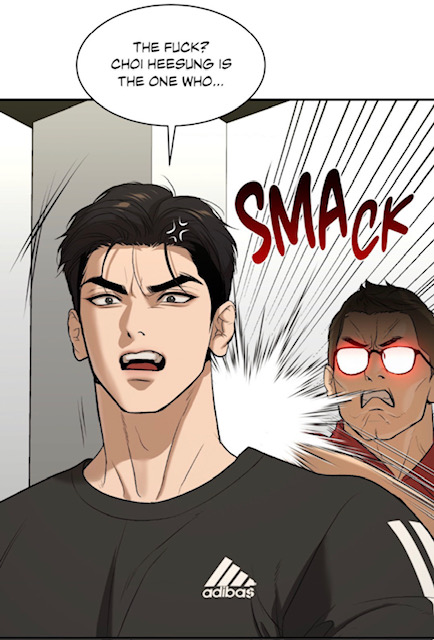 (chapter 31) in good
 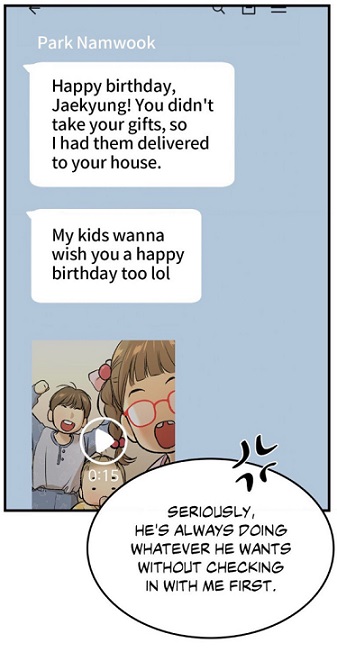 (chapter 45) or in bad times. It goes so far, he does not take his silences seriously, and does not register his pain. This explicates why the manager saw in the champion’s silence at the restaurant as an agreement for a new fight!
  (chapter 69) His role is not to guide or protect, but to extract: money, victories, publicity.
 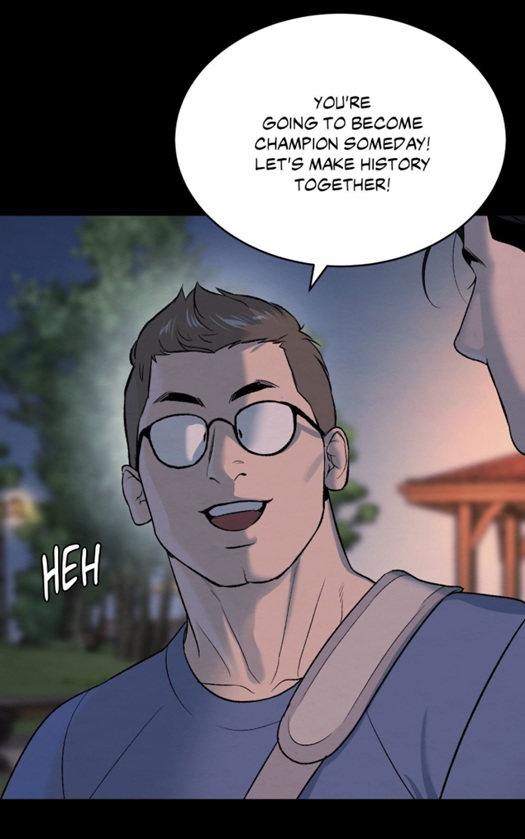 (chapter 75) In my opinion, he is fighting against oblivion through the star. This hidden disability explains why the coach can never truly connect with the champion. He listens instead to other voices – the CEO of MFC
  (chapter 46), the media
  (chapter 52), the sponsors
  (chapter 41), the spectators or “authorities”
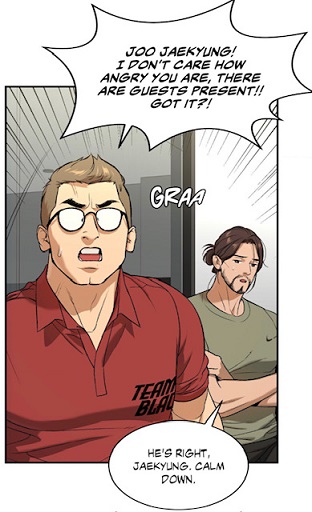 (chapter 36) — and reacts to them, even violently, as in chapter 52, when public criticism painted Jaekyung in a negative light.
  (chapter 52) The slap was less about Jaekyung’s behavior than about Namwook’s own fear of outside judgment. He was not listening to the man in front of him but to the noise around him. He feared losing control in the end, especially after the athlete’s words let transpire his true position at the gym:
 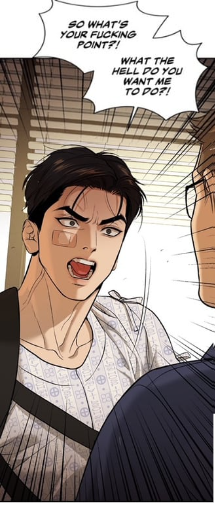 (chapter 52) His question is not mere anger. It is a confession of position — an inadvertent acknowledgment that he knows he is the true backbone of the gym. He is the one responsible, the one carrying the burden that Namwook refuses to admit. These words crack the illusion: the fighter is not subordinate, but owner. The gym lives because of him.
 (chapter 52) He acted as a child, faked “tears” in order to use empathy to his advantage.
 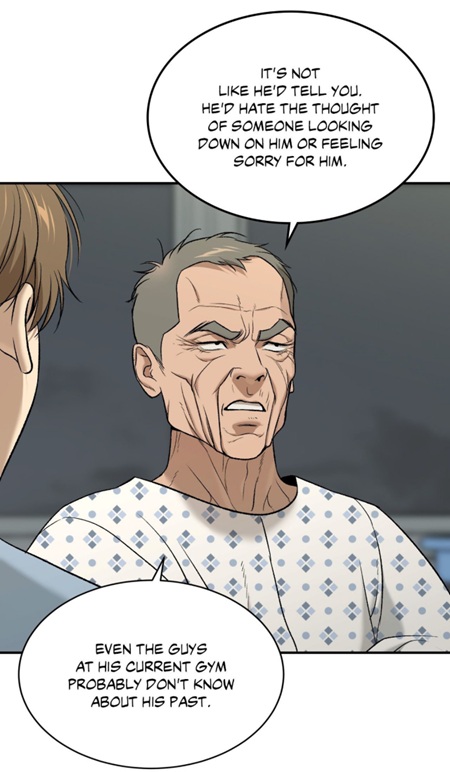 (chapter 71), hence he tried to help in his own way. On the other hand, Park Namwook shows clearly no sign to be interested in the private life of his boss. He is preferring ignorance over “knowledge and connection”.
  (chapter 66) Despite the incident, the manager hasn’t changed yet. He clinched onto the past, thinking that everything will be like before, as soon as the athlete enters the ring. He images a return to normality with the next match.
 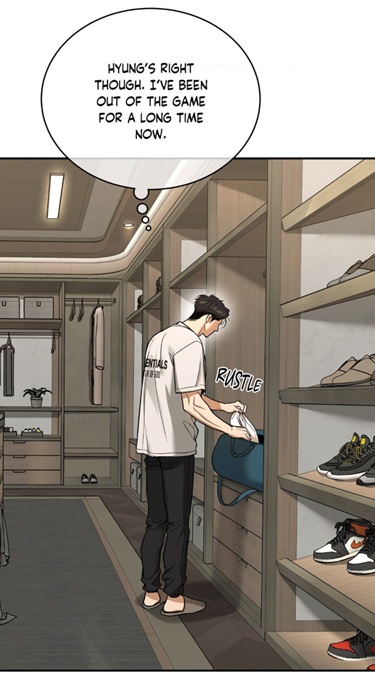 (chapter 66) For years, he had accepted his manager’s judgments out of habit, mistaking silence for consent. But here, for the first time, the repetition feels deliberate — not resignation, but reflection (“though”). The phrase becomes a question more than an agreement: is he truly right? He is admitting this out of habit.
  (chapter 69) His silence has shifted from obedience to suffocation. The weight of Namwook’s deaf authority is no longer bearable. And yet, even here, his confession is muted, confined to the private space of his car. He is not yet ready to speak the words aloud — not until someone appears who will listen.
  (chapter 48) This scene was observed by Kwak Junbeom, so the latter could have reported it to the coach. If it truly happened, this would expose the coach’s deafness and cowardice. He chose passivity instead of confronting the doctor or the champion. That way, he avoided responsibility. And this brings me to my final conclusion concerning the deaf manager. His main way to contact the celebrity is the cellphone:
  (chapter 66) It is both his mask and his crutch — a tool for barking orders, never for dialogue. The moment the line goes dead, his authority collapses, for he has no other means of contact. His power depends on Jaekyung’s reception, not his own strength. In truth, the manager’s disability is exposed here: deaf to Jaekyung’s voice, he has trained himself to hear only the ring of a phone. A fragile authority built on silence, ready to crumble the instant Jaekyung decides to switch it off.
 (chapter 76) must be read not as pride, but as a desperate shield against annihilation. In other words, in episode 76, the athlete is too harsh on himself, though I am not saying that he is innocent either. He only thought of himself because he had taught to behave that way. He was just mirroring the adults surrounding him who hid their weaknesses and wrongdoings behind “lies, social norms and hierarchy”.
 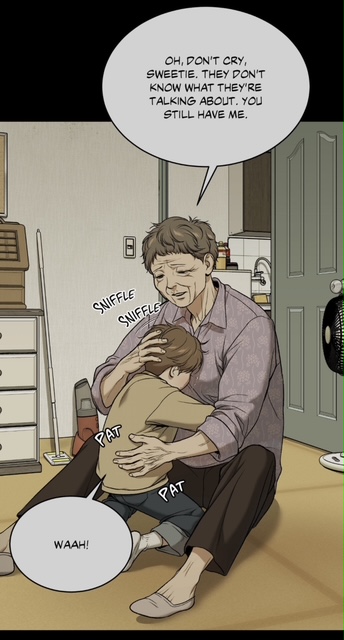 (chapter 57) With his grandmother and with every authority he encountered — doctors, employers, even predators — he believed unquestioningly that others were right and he was wrong. Hence he trusted others blindly. He was trained to accept decisions made for him or against him.
  (chapter 70) Thus he accepts criticism with defending his own interest. He was not taught how to fight back or resist or even argue.
  (chapter 6), both were forced to discuss with each other about the “content of the agreement”. That’s where the champion was trained to communciate with the physical therapist. Thanks to the champion, because of this victory/loss mentality, the doctor learned gradually to argue and “reply” with his “boss. However, due to his childhood, he couldn’t totally drop his old principles like for example “saying no”.
 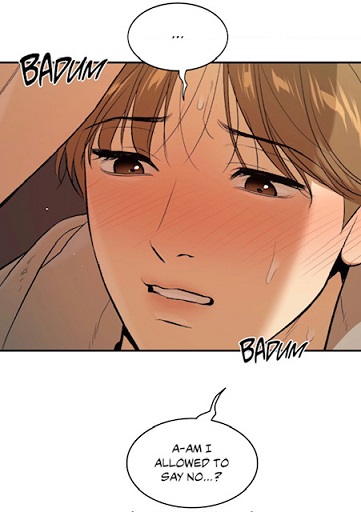 (chapter 34) To conclude, before their fateful meeting, neither man had learned how to argue as equals. But in the kitchen in front of the stove, this changed: both are right and wrong!
 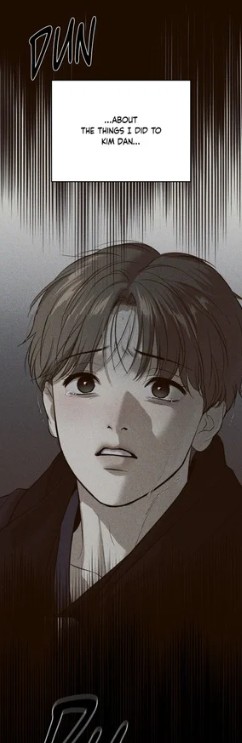 (chapter 76) He speaks like someone expecting rejection. Hence he keeps his distance. Yet the very fact that he says it at all signals change. Where once he would have doubled down — by barking an order, by firing Dan, by retreating into silence — he now admits defeat. The vocabulary of winning and losing, inherited from his father and reinforced by every adult in his life, collapses in the presence of Dan’s quiet honesty.
 (chapter 76) — an acknowledgment that he can no longer keep his walls intact. He is now willing to rely on doc Dan exclusively.
 (chapter 76). His confession reveals not strength but guilt. Kim Dan’s suffering was the price of his victories, and he knows it. “On the other hand, his mea culpa should be relativized, for both were the targets of a plot!
 (chapter 76) These words expose both responsibility and shame: he had prioritized survival over connection, career over compassion. What boils under his skin is not pride but remorse.
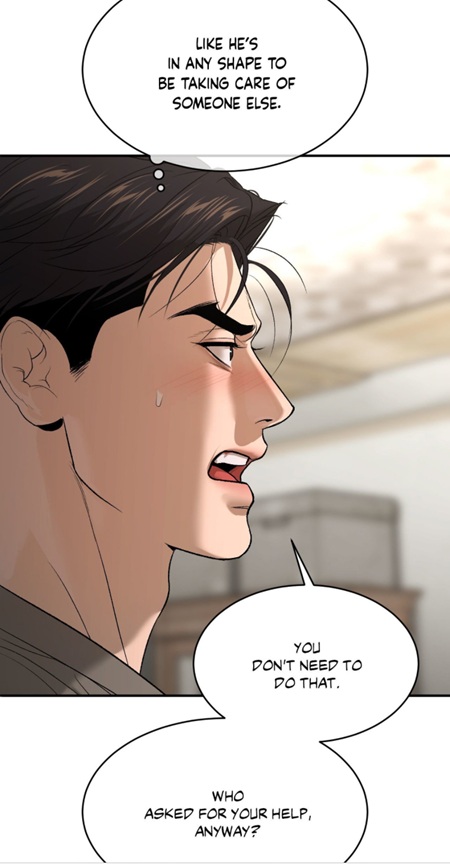 (chapter 76) The star’s thoughts in the kitchen are actually mirroring the ones in the bathroom:
 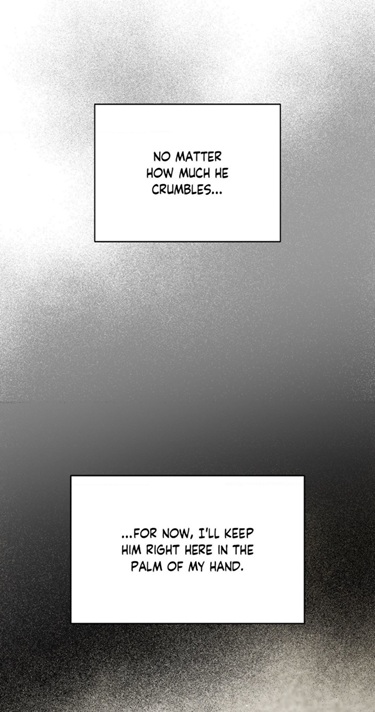 (chapter 68) In the bathtub, he still saw himself as the one in control, with the upper hand… but this is no longer the case in the kitchen. Through the physical therapist, the wolf is learning that even being in a vulnerable state doesn’t mean that this person is powerless. It is just that his “strength” lies elsewhere. In other words, someone struggling can also give comfort to another person in pain.
  (chapter 72) a place of solitary consumption rather than shared meals, the bed was the place where the little boy would drink his milk.
 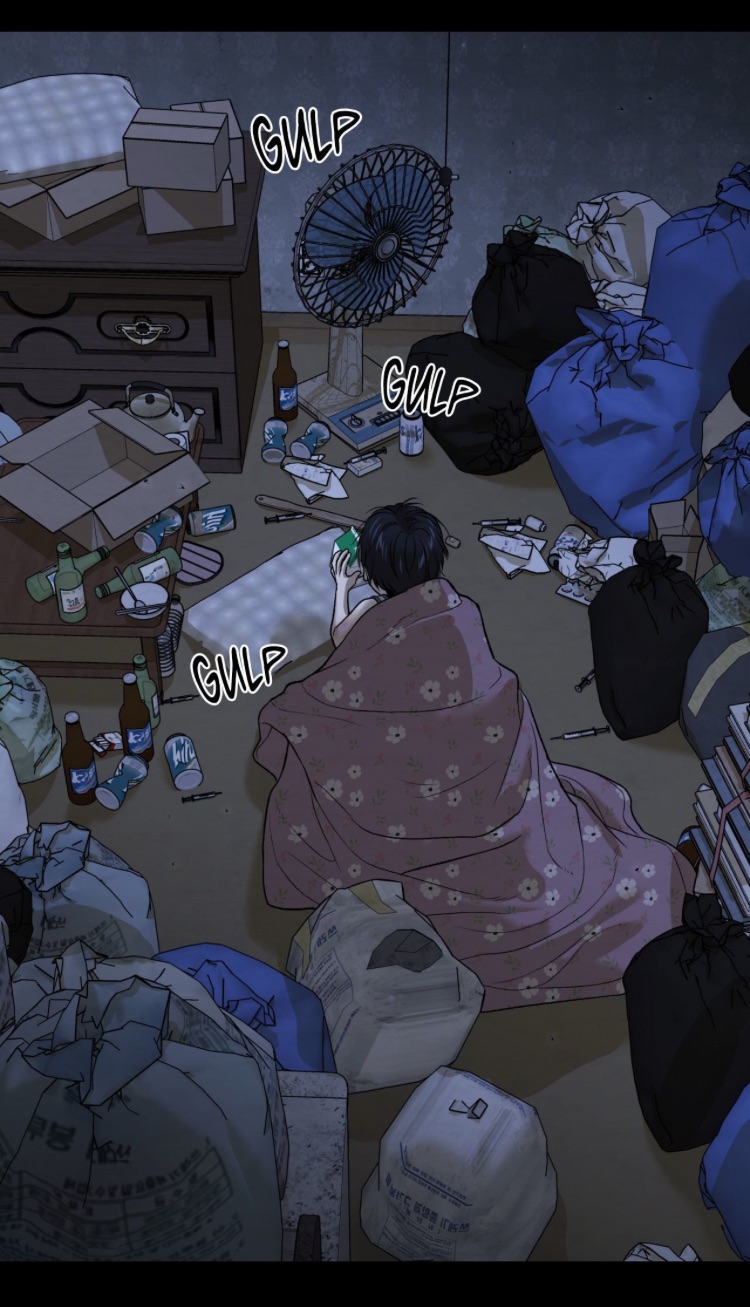 (chapter 72) It is interesting that actually, Doc Dan wanted to bring the porridge to Joo Jaekyung to his bed during that full moon night, thus the latter made the following request:
  (chapter 76) But the wolf didn’t understand the hamster’s intention and followed his “hyung” to the kitchen. That’s how a misunderstanding was born which is also reflected in this interaction:
 (chapter 76) However, doc Dan agreed to this, he remained calm.
  (chapter 41) The latter actually represented a hindrance between them, it marked their relationship: boss and “employee” (servant). Moreover, since the table in the champion’s childhood was linked to one person (the father), it is clear that the champion has never shared a table with someone. And this aspect brings me to my other observation.
  (chapter 46) It was a place where others dictated terms, while Jaekyung’s silence was mistaken for consent. And now, you comprehend why the two main leads could get closer in front of the stove in the kitchen. This place stands for warmth, care and family.
  (chapter 13) a meal after his collapse. He refused to bring a meal to the bed, he asked him to join in the dining room and sit at the table. And what did they do there? The champion talked about his career, his fight etc…
  (chapter 13) the champion has long associated the table to business and not “care”. That’s why it is important for him to remember the significance of the bed in his childhood. It was the place where he could feel comfortable and safe, where he would eat!

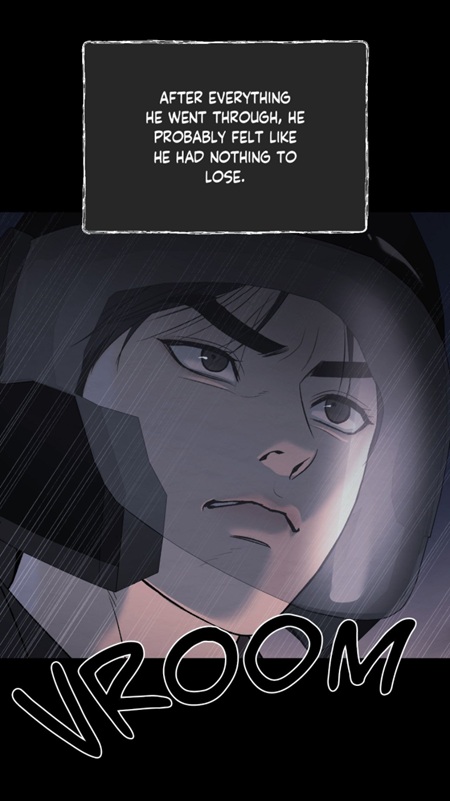 (chapter 74) What do they share? You might already have noticed it. At first glance, the answer seems obvious: each sentence turns around the word after. But if we pay closer attention, it is not just after that repeats, but after all. And here, the “all” quietly carries the weight of everything. A slight shift, but one that feels significant. But why this expression, and why here? Why does it resurface precisely in the context of Jaekyung’s family and past?
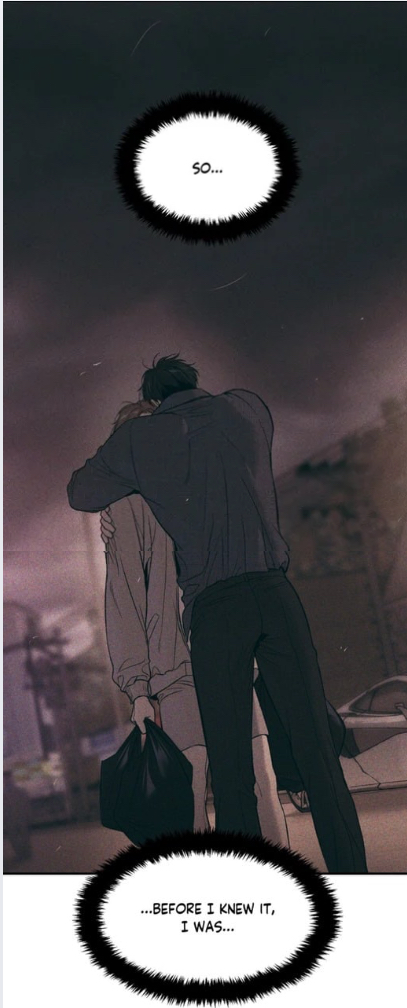 (chapter 70) For the first time, the flow of time shifted. Besides, no explanation, no certainty—just an admission that something happened beyond his planning or reasoning. Where the earlier lines spoke with closure, this one arrived without a verdict. But what does this “confession” signify for the athlete now?
  (chapter 73) He was announcing his desire to leave this place, as if he wanted to abandon his father. Nevertheless, he just said it out of anger and frustration. Yet, those words pierced Joo Jaewoong, for they reminded him of his wife’s betrayal. Unable to face his own failures, he retaliated by thrusting her image back onto the boy.
 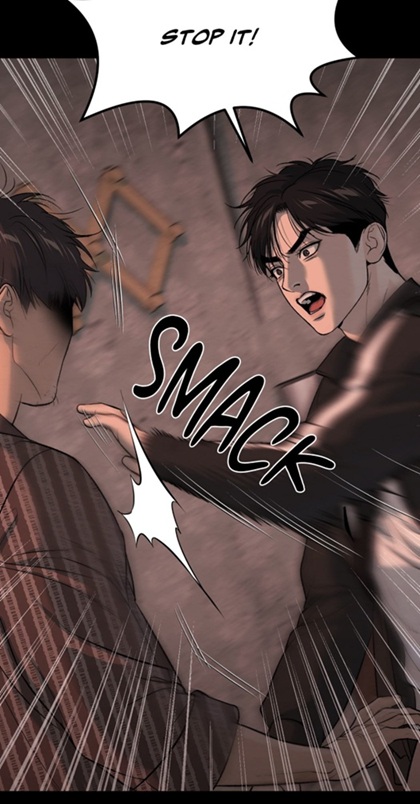 (chapter 73) locked in confrontation, while in the past, the woman had already shown her back — a gesture of refusal that foreshadowed her desertion. She had withdrawn in silence; the man, however, lashed out in noise. Both abandon, but in different registers: hers in silence and absence, his in noise and abuse. But the father’s gaze was selective.
 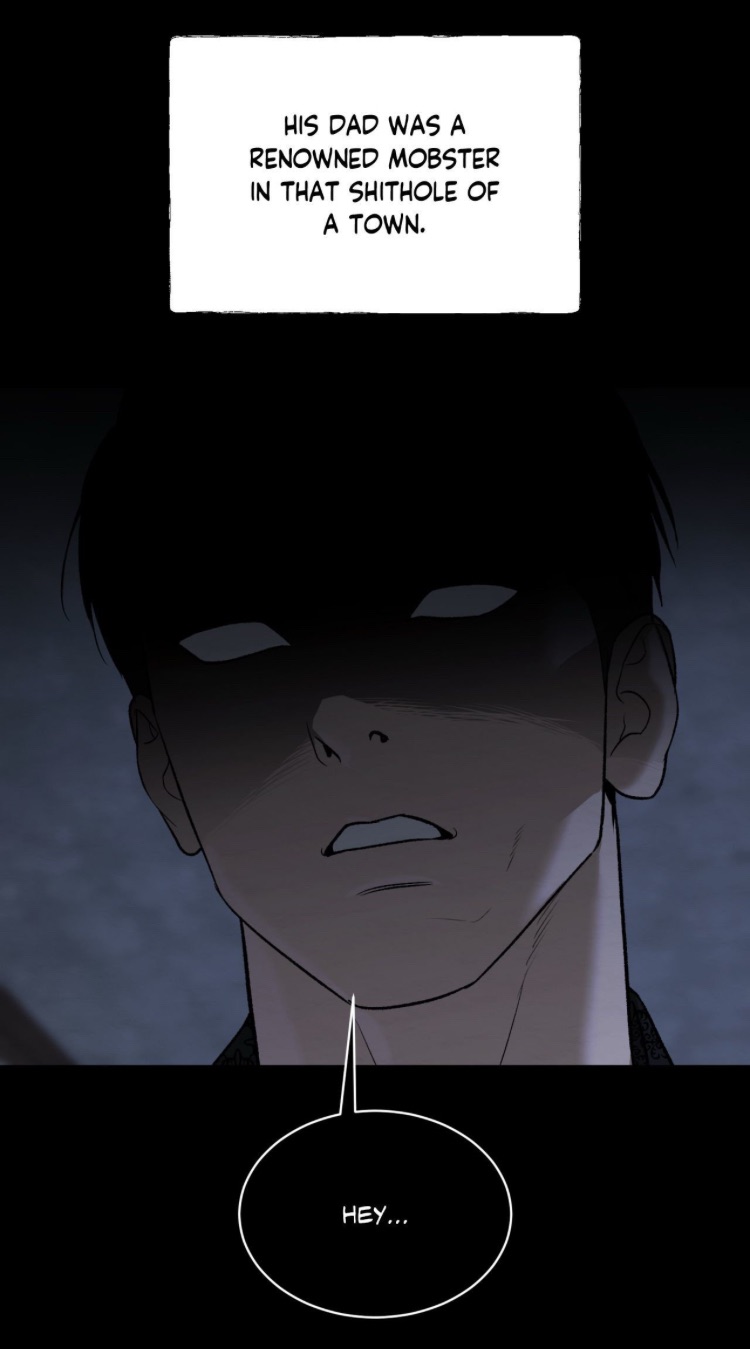 (chapter 73) — all were rewritten into a story where the woman was the sole traitor, and the child nothing more than her extension. In this way, the boy was denied recognition as a victim in his own right. He had been abandoned too. He had been abused either. He became instead a mirror in which his father projects the wound of being left behind.
 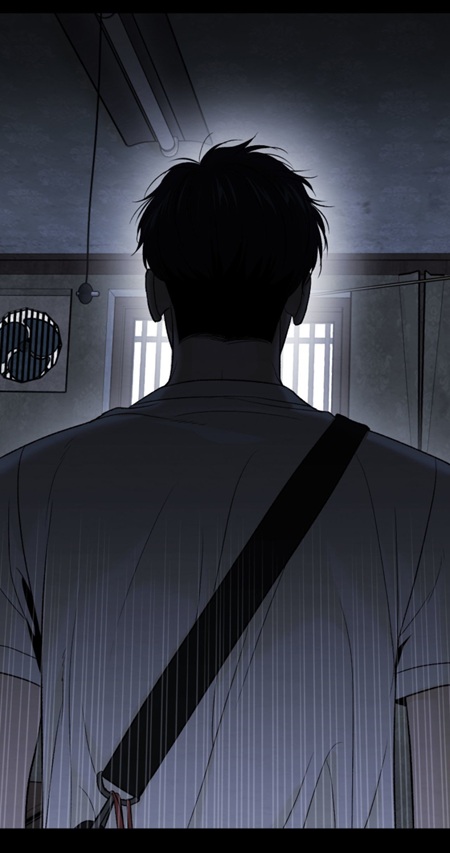 (chapter 73) To speak was to wound, to be wounded in return. Besides, the boy could never speak of this truth. He carried the memory of that last conversation in silence, crushed by the belief that he bore guilt for his father’s death. Shame and responsibility bound his tongue. That is how words, once used against him as weapons, became impossible for him to wield in his own defense. However, this was only the beginning of his withdrawal into silence. His fists would become his language, his body the only safe instrument of reply.
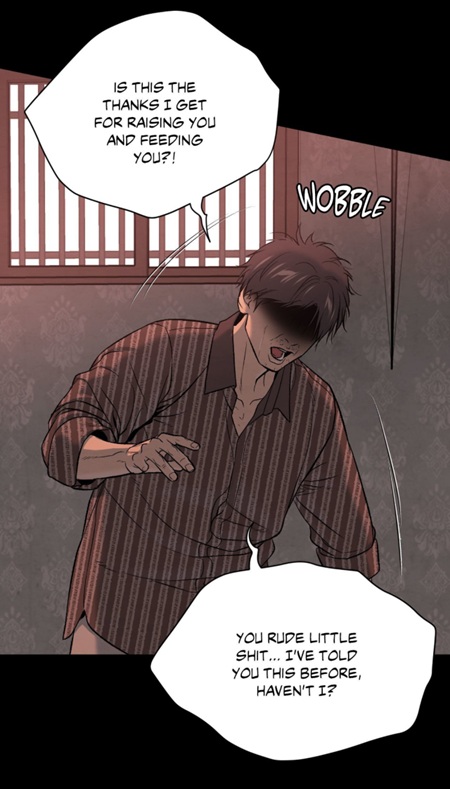 (chapter 73) The betrayal he lamented was nothing more than the logical outcome of his own principle. There had never been a we — only a man clinging to his pride, a woman turning her back, and a child caught in between. His after all
 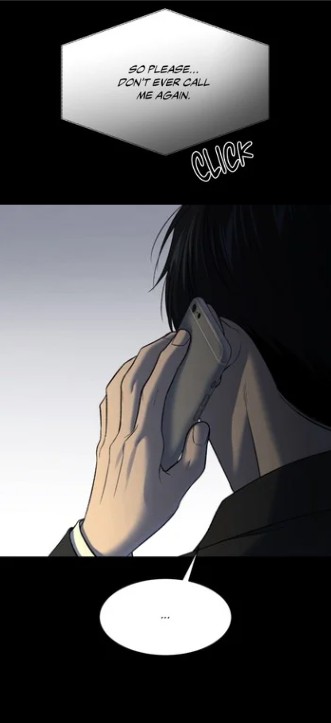 (chapter 74)
 (chapter 74) In the past, the boy had dialed her number from the same public booth
 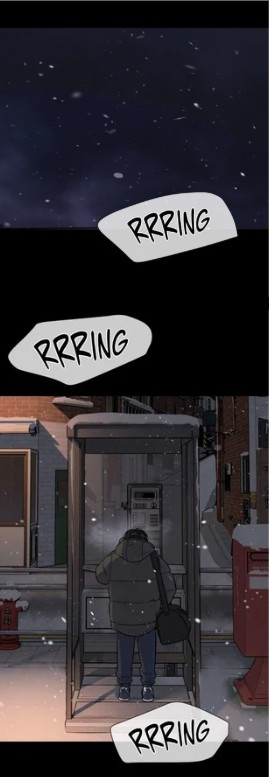 (chapter 72), clinging to the hope that she might answer one day. Eventually, those attempts ceased — but not the attachment. What remained was the number itself, saved under “Mom” on his phone
  (chapter 74) Here, he was old and rich enough to buy his own cellphone. The phone number was no longer a channel of communication, only a relic: a fragile thread he could not sever, because the fact that she never changed her number sustained the illusion that reunion was still possible. That dormant hope was shattered only when she finally picked up — not out of recognition, but by mistake, assuming the unfamiliar call must be important.
 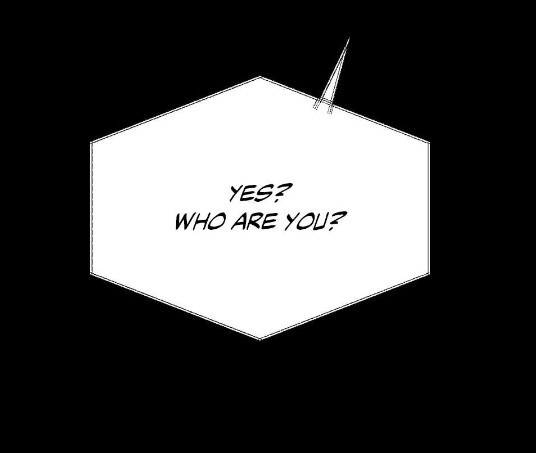 (chapter 74) And so, after years of silence, his voice reached her at last.
 (chapter 72) neglect, starvation, abuse, loneliness, betrayal — and yet the parents invoke it not to acknowledge his pain, but to hide their wrongdoings (justify their betrayal) and as such their failure! By placing after all at the front of her sentence,
  (chapter 74) In a city of anonymity, hearsay cannot replace documents. She left a paper trail — a legal identity that binds them together. Should the champion cause trouble in Seoul, or even become the victim of a crime, the police would have to turn to his legal guardian. And that can only be her.
  (chapter 26). Oh Daehyun mentions that the young fighter broke the punching machine so many times he was blacklisted. Such destruction could easily have brought police intervention — and if it had, they would have been forced to search for his legal guardian. That guardian is none other than the mother who abandoned him and her new family. In other words, her erasure was never complete: every act of the boy risked pulling her shadow back into the open. Furthermore, this is what Kim Changmin revealed to his friend and colleague:
  (chapter 26) But Joo Jaekyung had long discovered sports and MMA, when he arrived in Seoul and met Park Namwook for the first time.
 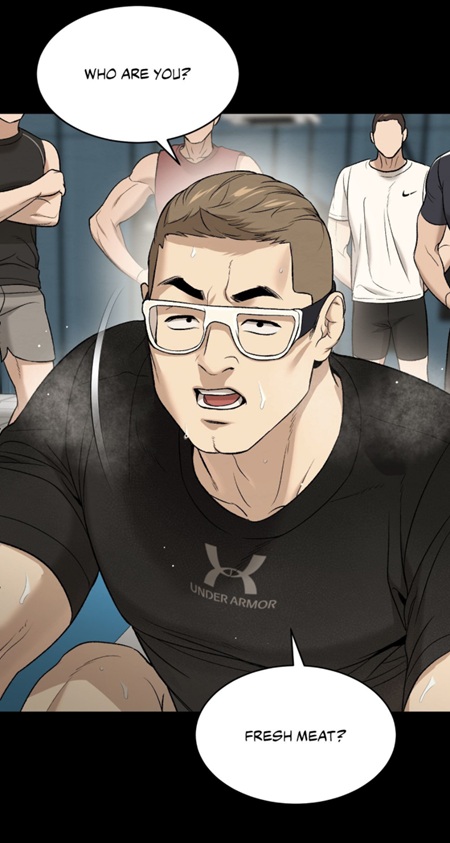 (chapter 74) He had left his hometown because of the director’s suggestion.
  (chapter 74) who redirected him before he was swallowed by the wrong path. The discrepancy between these accounts exposes more than just the manager’s manipulation: it points to the shadow of another intervention. How could he afford to destroy machine after machine without consequence? The only plausible answer is the “mother” and her new family, whose money and silence allowed him to pass as the “self-made” Emperor while erasing their own responsibility from the tale. And now, you comprehend why The Emperor was made voiceless. [For more read
 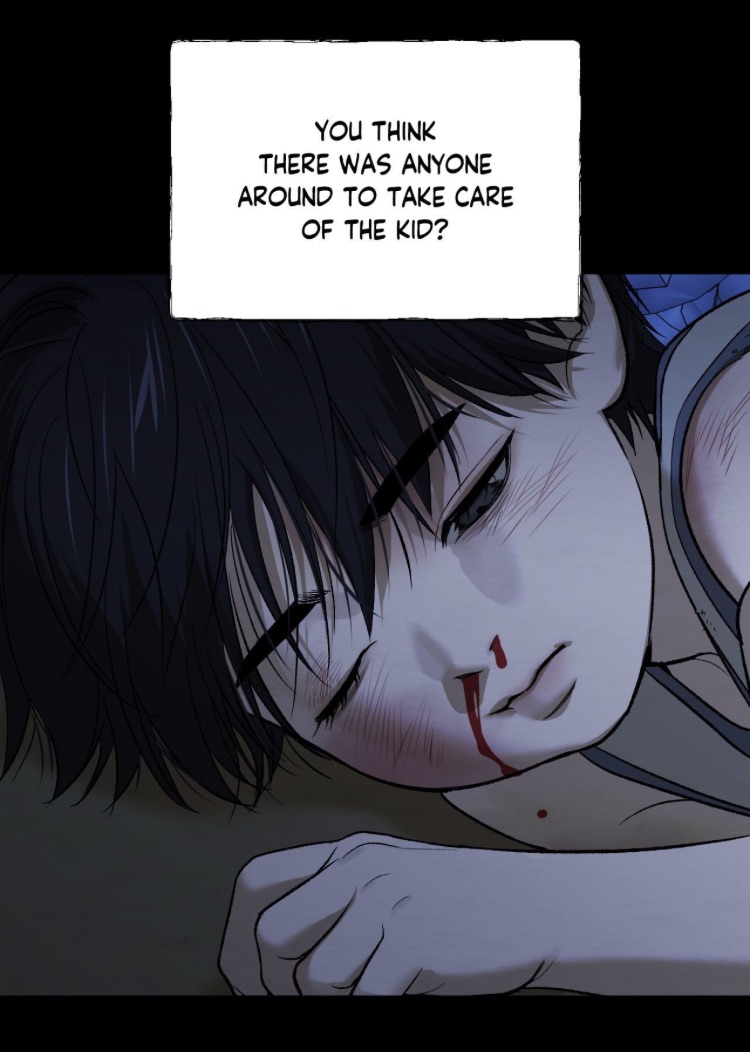 (chapter 74) For doc Dan who embodies the present, such a statement can only become the ultimate truth: the star had been an orphan like him.
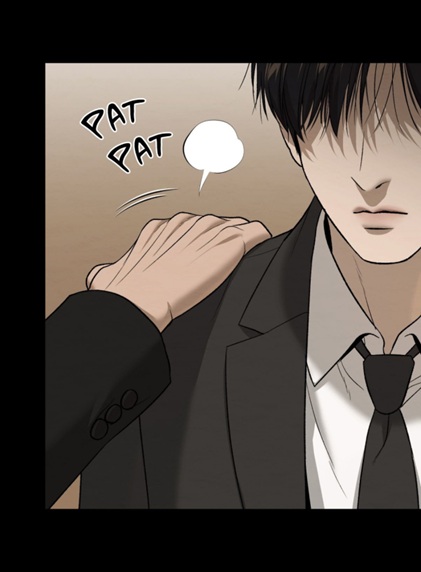 (chapter 74) Once again, the director was there — but his presence was mute. He placed a hand on the boy’s shoulder, yet he never lent him an ear. He never invited the boy to speak, never created a space where grief, anger, or longing could be put into words. In other words, he was present in body but absent in voice and heart. Thus the director’s pat was a gesture of pity. It was a substitute for words, a way of saying “poor boy” while protecting himself from deeper involvement. But precisely because he withheld speech and listening, it denied Jaekyung the chance to articulate his own grief. It comforted without connecting.
 (chapter 74), through fighting. Thus the director’s quietness, his refusal to engage, became a formative wound in itself. He chose the safety of distance over the risk of involvement, and in doing so, left the boy’s cries unanswered.
  (chapter 74)
  (chapter 74) He was given a chance to step in, to finally become the guardian he had failed to be on the night of the boy’s deepest collapse. Therefore it is no coincidence that he claims to have raised him, while the readers are well aware of the truth.
  (chapter 74) The father was dragged into memory as a warning: “Do you want to end up like him?” The mother, already gone, was turned into a conditional model: “Would she even want to live with you if she could see you now?” In both cases, the boy was denied his right to grieve. His parents were not mourned, but transformed into instruments of discipline. He was forced to run from one shadow and to chase another, leaving him no space to simply exist. The director maintained the future champion trapped in the chains of the past.
 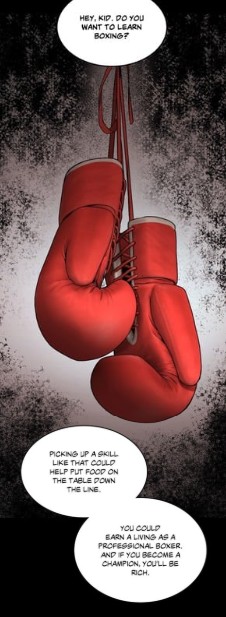 (chapter 72) At home, his father turned dialogue into a bet — a contest of strength where affection was absent and only victory mattered. Later, in front of the police station, the director reproduced the same pattern: invoking the mother not to console, but to provoke, to test, to challenge. In both cases, words became weapons. They did not open space for Jaekyung to speak; they cornered him, forcing him either to resist or to submit. This explains why in season 1, the two protagonists had similar interactions.
 (chapter 74) For him, discipline was always bound to her presence, her food, her care, her silent labor that sustained the gym. By invoking “the mother” as a motivator, he was, in truth, repeating the only model of loyalty and endurance he had ever known. But this was borrowed authority, not Jaekyung’s. What may have given the boy a flicker of purpose in the moment — to endure, to fight “for her sake” —
  (chapter 54) The director’s form of guidance could not sustain him; it was external, borrowed, conditional. Therefore, it is not surprising that he was never contacted after the main lead’s departure for Seoul. By then, the director had already become like his own mother — reduced to a memory
  (chapter 70) and nothing more. He neither possessed the boy’s number nor showed the desire to stay connected; worse, he had told him explicitly never to return.
  (chapter 56)
 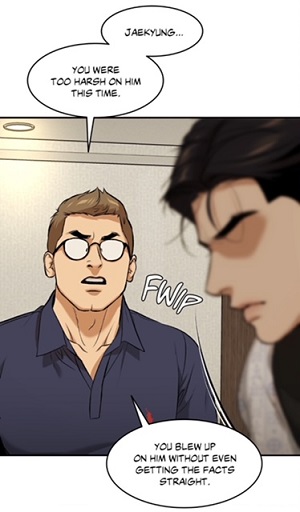 (chapter 52) That way, he could divert attention from the “before and circumstances”. And in season 2, the man hasn’t changed at all. Instead of asking what caused Jaekyung’s crisis, he chides him for straying from the routine — for not showing up at the gym, for being absent.
 (chapter 52) The slap at the hospital was more than a physical outburst; it was the eruption of long-repressed truth. Where he once swallowed pain in silence for his mother, and later endured fists in silence for his coach, here he answers back. Lately thus marks not only Namwook’s delay but also Jaekyung’s refusal to bear the weight alone anymore.
  (chapter 73), the mother’s silence through the cellphone
 (chapter 45)
 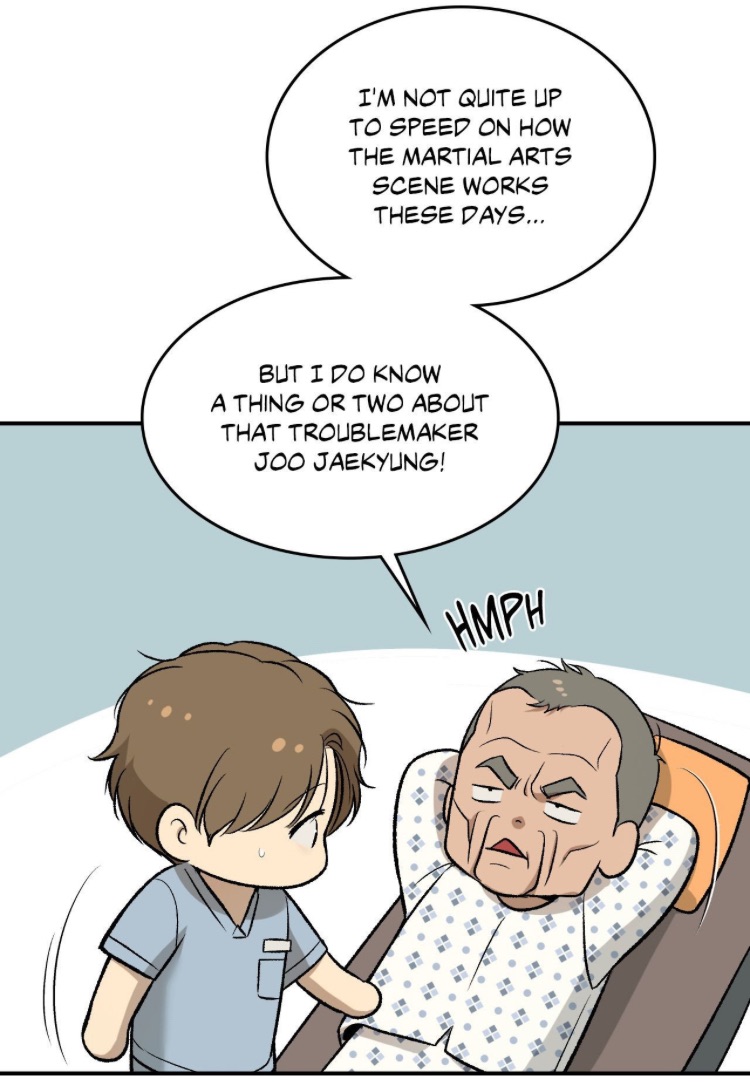 , (chapter 70), while remaining oblivious to the rot within their own world and the medical world. The director accused Joo Jaewoong of “choosing the wrong path,”
  (chapter 69): for the first time, a figure of authority assumed responsibility, however insincerely. What to others looked like shallow PR, to Namwook appeared as a dangerous break with the rule of denial. It highlighted the emptiness of his own guardianship, where reproach replaces protection and victims are erased from the narrative.
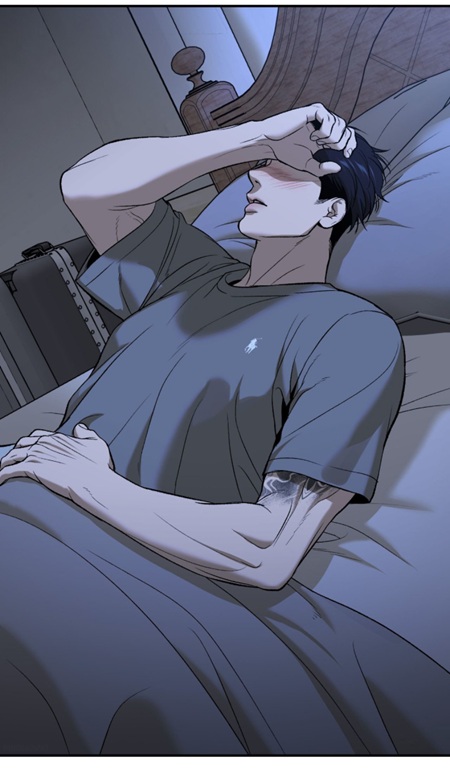 (chapter 74) Honestly, it would be funny, if the champion used the same words than his own mother against the manager
  (chapter 70) Thus the manager is confident that the star can return to the ring. By cutting the manager off in such a moment, Jaekyung would be affirming that he no longer accepts neglect disguised as toughness. Both “directors” are trapping the champion in the chains of the past and the future. For them, there’s no present and as such no happiness or fulfillment. Hence Hwang Byungchul is even bored, when he watched the MFC match.
 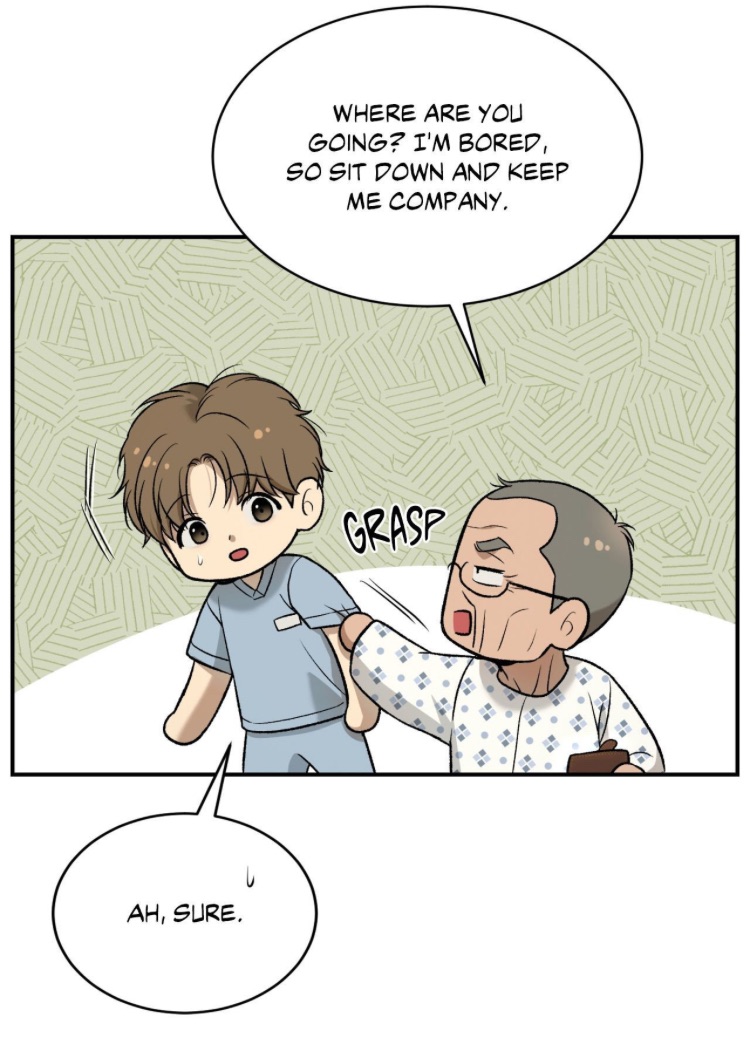 (chapter 71) Deep down, he has been longing for company too. Now, he is finally talking….
 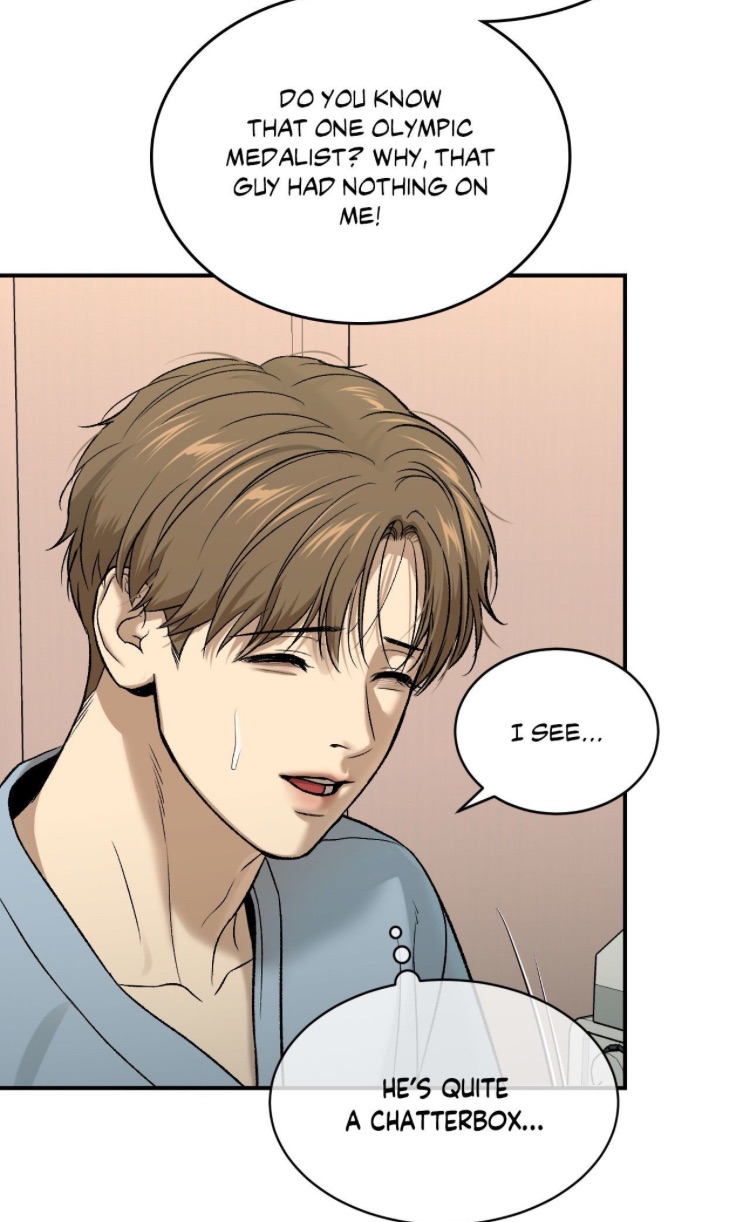 (chapter 70) As you can see, it is never too late… Thus we saw this on the roof of the hospital: a real and intimate conversation between the “guardian” and his pupil:
  (chapter 71) The director has changed!
 (chapter 65) So for someone like Joo JAekyung who suffered from constant betrayals and abandonment, his lover’s childhood must have sounded like a “blessing”. She tells the story of Dan’s life as if he had simply always been without parents. When she recalls, “He grew up without a mom and dad… my heart just breaks for him,” the formulation makes it sound as though nothing was ever lost, nothing was ever taken away — it was simply his condition from the start. Doc Dan didn’t get hurt by his parents through their words or actions.
 (chapter 65) She can appear as the perfect role model in the athlete’s eyes. No wonder why he listened to her and brought doc Dan to a huge hospital in Seoul. But here is the thing….
 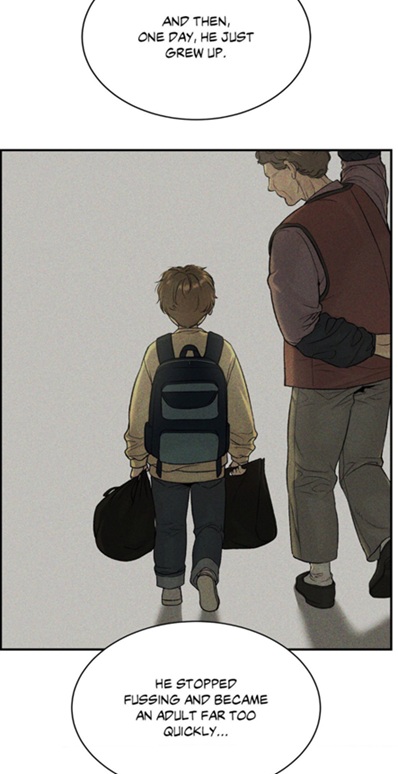 (chapter 65) The grandmother’s narrative culminates in a deceptively simple phrase: “And then, one day, he just grew up.” Unlike after all, which implies endurance, patience, and a long lapse of time, her then one day compresses everything into a brief, almost casual instant. In her telling, there is no slow accumulation of wounds, no process of wear, no history of pain to be endured. The transformation is presented as sudden and natural, as if nothing of significance had preceded it.
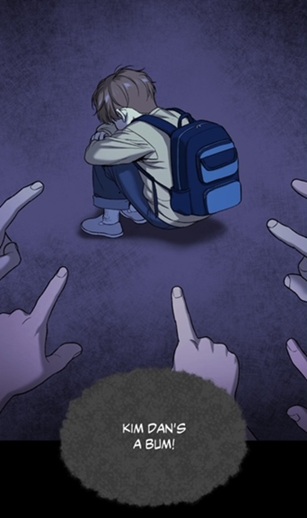 (chapter 57), and his forced maturity to a single, fleeting day. No trauma, no endurance — just inevitability. By collapsing years of hardship into a harmless “day,” she erases both the past and the victim. And now, you can understand why doc Dan is trapped in the present! By erasing the “before” (abandonment, trauma) and trivializing the process of “becoming an adult,” she collapses time into a single, static present. Kim Dan is not allowed a past that hurts (because she erased it), nor a future that could unfold differently (because “he just grew up” is presented as inevitable).
 (chapter 62) cannot, by themselves, sustain love. Emotions flare and fade, tied to the immediacy of the present. Thus the mother could break her promise and even lie to him later. What endures is not emotion alone, but the principles that Fromm identified as the essence of love: care, responsibility, knowledge, and respect. These qualities stabilize the fleeting nature of feeling and transform the present into something continuous, something that can grow. In this sense, the teddy bear bridges the gap between “present” and “future”:
 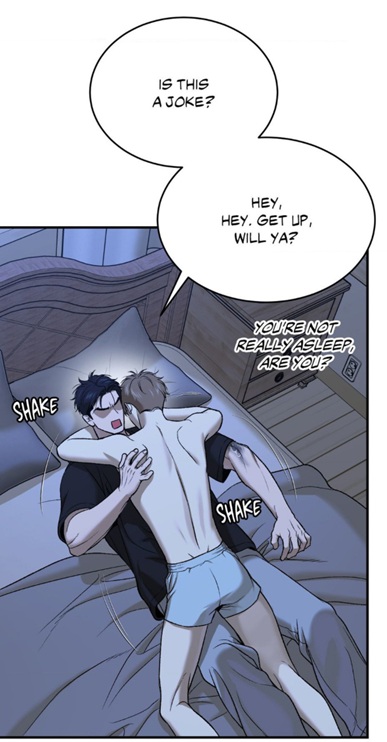 (chapter 65) it transforms the fleeting moment of emotion into a promise of constancy. After all, before it’s too late, what both men longed for was never glory or escape, but a home where they could rest — not alone, but in each other’s arms. By discovering emotions and learning to live in the present, the champion also rediscovers his inner child. His line — “Is this a joke?” — marks that shift, since jokes, like emotions, only exist in the immediacy of the moment. It is only a matter of time, until he laughs because of a joke. By embracing doc Dan like a teddy bear, he allows himself to cling and regress, no longer the wolf or the Emperor but simply a boy seeking warmth. Even his cold becomes symbolic:
 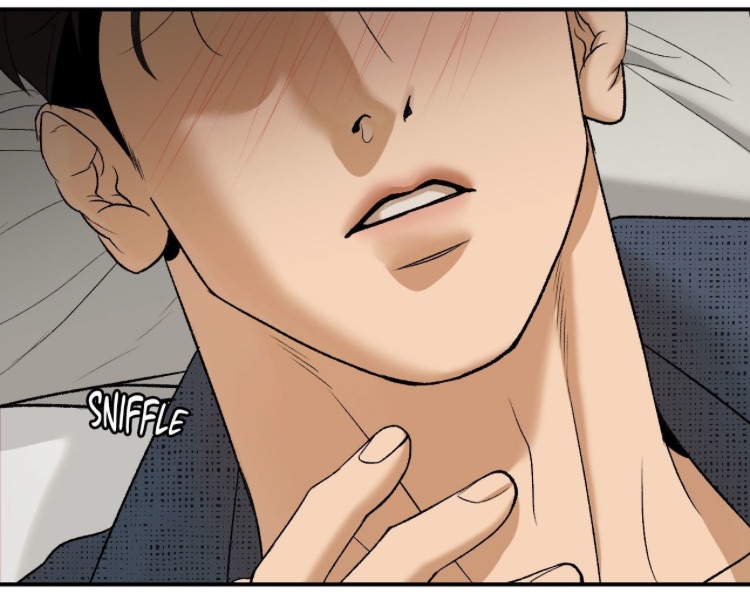 (chapter 70) illness forces him to slow down, to be vulnerable, and to receive care — something denied to him in childhood. In this way, love turns the regression into healing, transforming weakness into the possibility of renewal.
 (chapter 5) and if it’s true, then this person would be the second husband.

 51, 52, and 73 [I am excluding the match]—his role is far from minor. He is, in fact, one of the main invisible architects of the champion’s trauma and jinx, the one who once stood across from him on a night that would shape the course of both their lives. Long before he was known as the Shotgun, Baek Junmin might have pulled the trigger on something else entirely: the last remnant of Jaekyung’s innocence.
 (chapter 73) Their violent encounter may have led to the vanishing of the young boy’s smile, replacing it with the hardened scowl of the Emperor, the tyrant in the ring.
  (chapter 1) If Hwang Byungchul gave Jaekyung the tools to fight, Baek Junmin gave him the reason to fight like a bloodthirsty tyrant. He did not simply scar the soul — he engraved rage into the champion’s core. The tragedy is that Joo Jaekyung never even learned his name. Thus he didn’t react to his name, only to his face and his smile.
 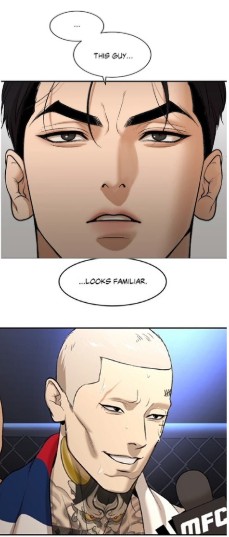 (chapter 47) And yet, Baek Junmin reappears, not as a stranger, but as the remnant of a past that refuses to stay buried. Additionally, he appears only through the narration of others (fighter)
 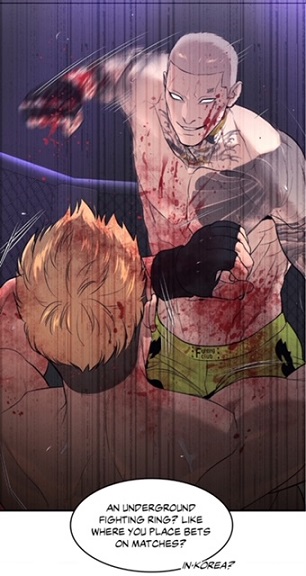 (chapter 47) or in flashes
 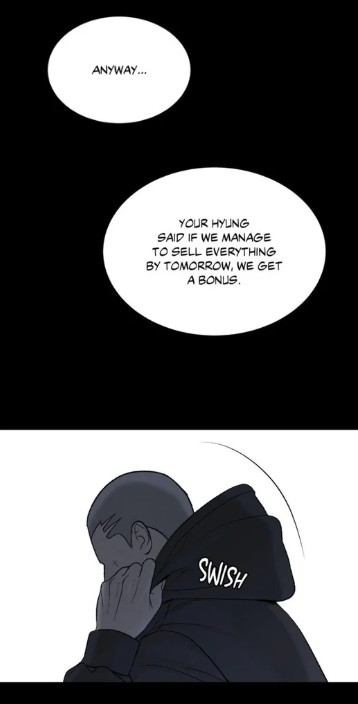 (chapter 73) — a gesture here, a line there
  (chapter 73) — before vanishing again. To understand him, we have to read between the panels, compare the boy we meet in episode 73
 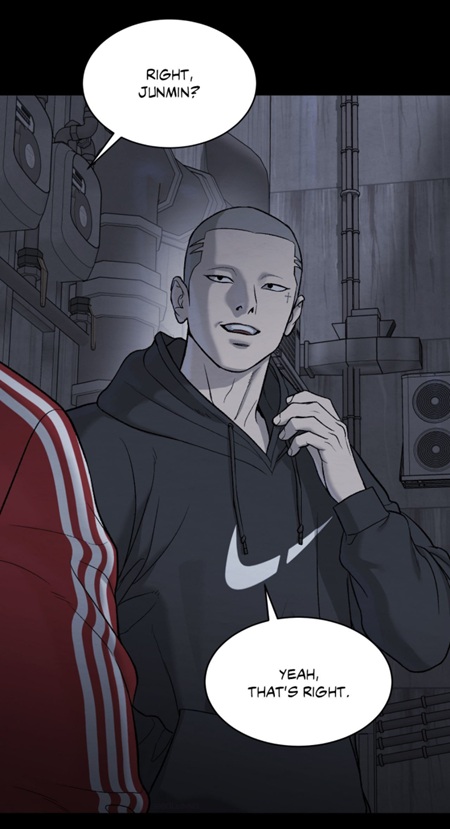 (chapter 73) to the man who resurfaces much later.
 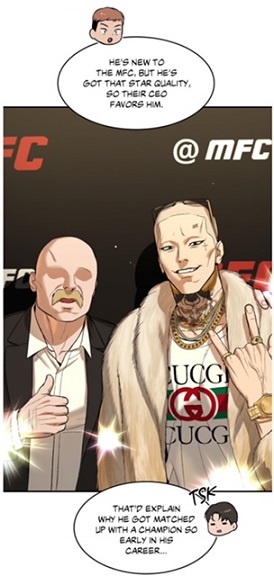 (chapter 47) This is how we catch glimpses of him — by holding the present up against the past, by noticing what has changed and what has stayed the same.
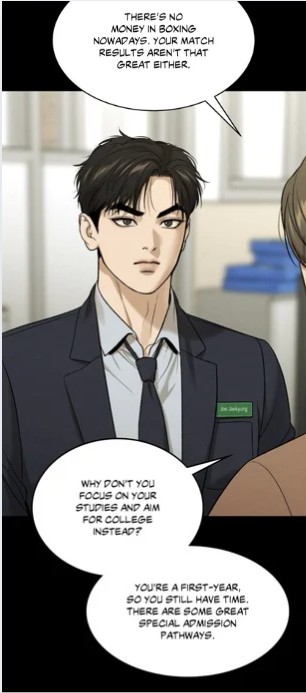 (chapter 73) Such an injury is not congenital, nor cosmetic. It is the ear’s irreversible memory of repeated trauma, often earned through unregulated or unsupervised fighting.
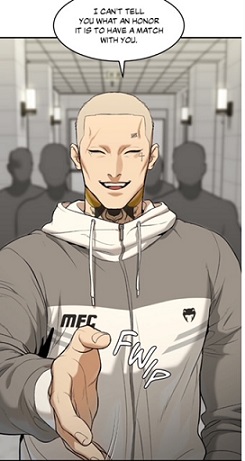 (chapter 49) Jaekyung’s ears mark him as a champion who faced real opponents in real matches, many of them brutal. His injuries are the price of transparency, visibility, and legitimacy. They are scars earned in the light, while Baek Junmin is supposed to be a novice.
 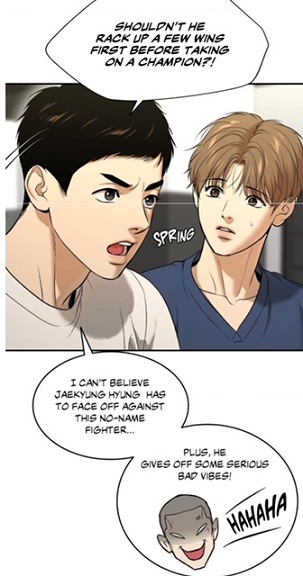 (chapter 47)
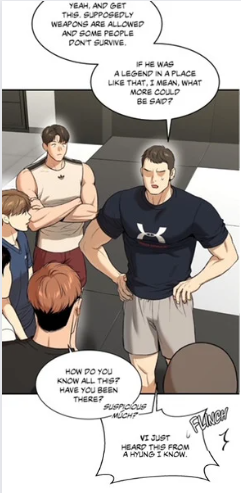 (chapter 47) His damage was earned in the shadows and in staged fights manipulated by higher powers.
 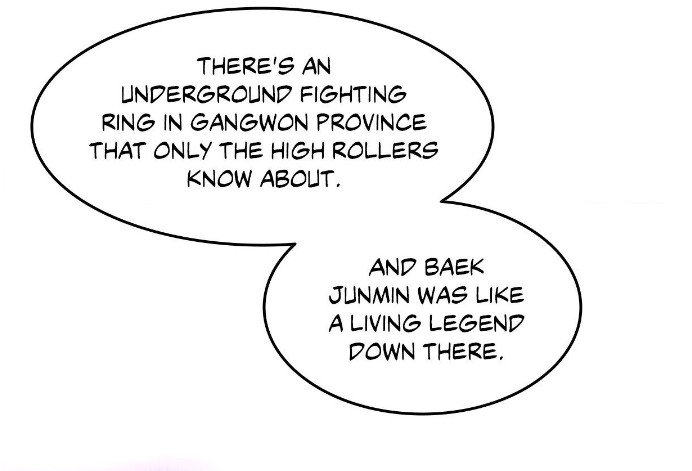 (chapter 47)
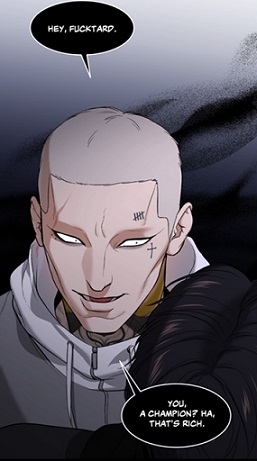 (chapter 49) His cheeks have sunk, his jaw stands out more sharply, and his features seem carved by something deeper than age. This is not the look of someone forced to cut weight for competition,
 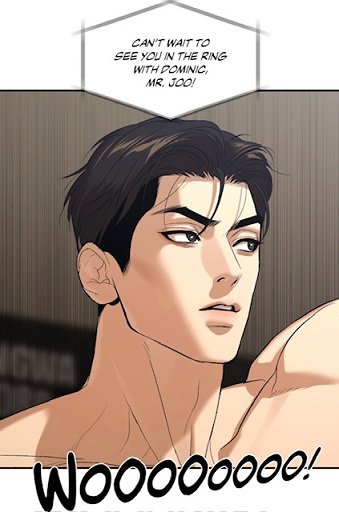 (chapter 37), for the new rising star is already much smaller and thinner than the protagonist.
  (chapter 49) It’s more likely the result of long-term stress, emotional corrosion, or drug use.
 (chapter 73) This line is telling. It reveals not only the normalization of drug use among these teenagers, but also how intimately it’s tied to fighting. Juho isn’t offering an escape—he’s offering a tool. For him, drugs aren’t about rebellion or recreation; they are a performance enhancer. They’re marketed as part of the fighter’s toolkit.
 (chapter 44) His skin is clearer, his features softer, and his face shows fewer signs of internal collapse. This is the effect of healthy food, structured discipline, clean training, and perhaps even emotional restraint. While Junmin’s face has been thinned by chaos, Jaekyung’s has been preserved by control. Under this light, it becomes comprehensible why the athlete fell in love with doc Dan at first sight. Despite being older,
  (chapter 7) the “hamster” still carries a baby face: a visual marker of youth, innocence, and gentleness. He embodies everything the Shotgun does not: vulnerability without corruption, softness without vice. If Baek Junmin stands for a corrupted adulthood — weapons (The Shotgun), shadows, and counterfeit gold — then Kim Dan, by contrast, becomes the sanctuary of all that was lost: the child, the smile, the safe bed.
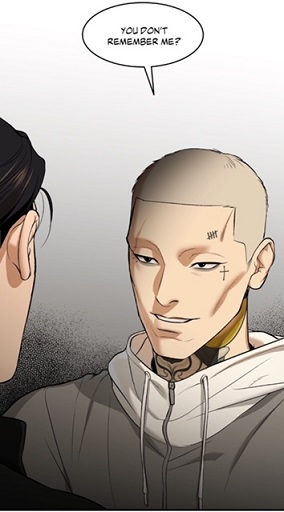 (chapter 49) reveals that anonymity was never his desire. It was his sentence.
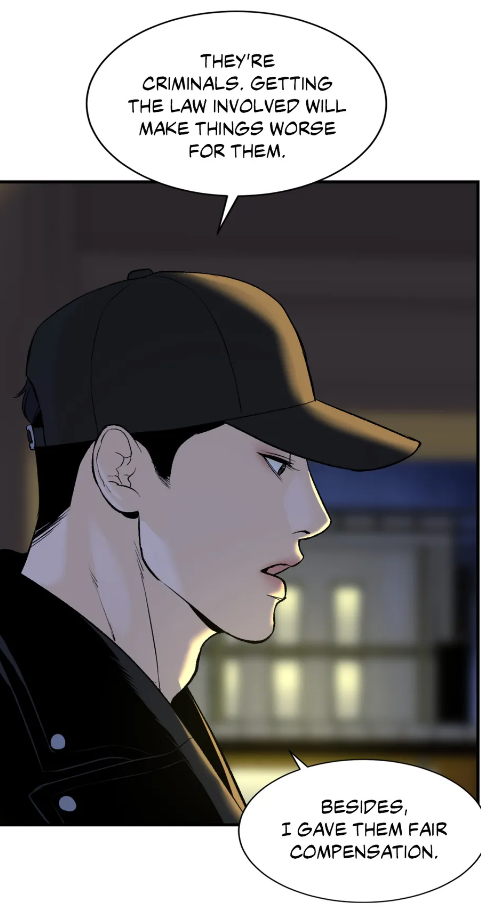 (chapter 18) criminals don’t want attention. They avoid the law. They train their subordinates to vanish, to move through shadows, to speak only when spoken to. Baek Junmin wasn’t just playing a role —he was surviving a system that required him to erase himself. His hoodie was not simply clothing; it was a muzzle, a shadow he had to wear. That’s why the protagonist has not made a connection between his nemesis Baek Junmin and a Korean gang yet.
 (chapter 69) How is this possible, when it is clear that the antagonist is already a thug? It is because Joo Jaekyung has no idea about his true identity. He only knows him as a cheater and liar!!
  (chapter 73) he blends in by choice. Black is not a neutral here; it is a decision to recede, to be part of the backdrop. The fabric pools around his hands, hiding the skin, while the hood hangs like an unspoken “no comment.” Even when he speaks, it is without volume or force.
  (chapter 73) And notice that the legend is trapped to a province, indicating that he could never make it out of there like the champion! Therefore it already implies that the future “Shotgun”‘s association with the hyung is not based on loyalty or mutual respect—it is circumstantial, even transactional. It is about money and usefulness. And now, you comprehend why Baek Junmin’s position in this gang is quite precarious.
 (chapter 73) That’s the same number of persons in the dark alley, when you exclude Joo Jaekyung and Baek Junmin
 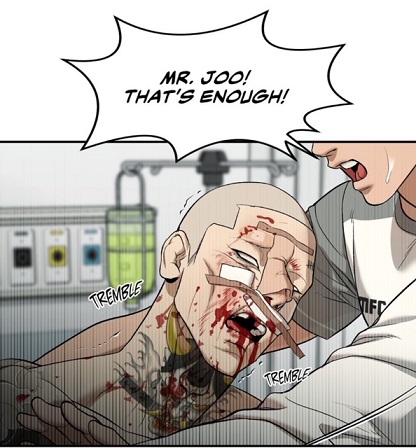 (chapter 52) Note that Director Choi Gilseok doesn’t express concern for Baek Junmin, his attention is on the Emperor!
 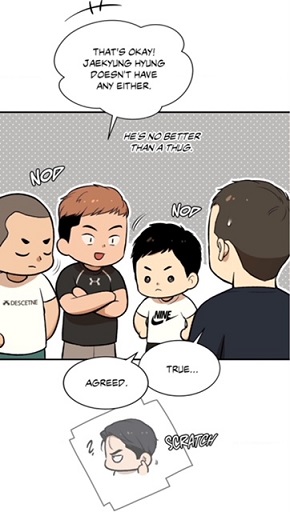 (chapter 47),he doesn’t take pride in killing someone.
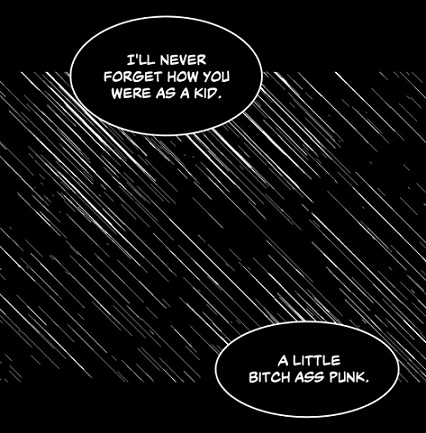 (chapter 49) and there was no direct interaction between them in the street, I come to the conclusion that their past must have crossed a second time between these two meetings. If we take the hallway encounter as their third meeting
  (chapter 49), there must have been at least a second — brief, sharp, and wounding enough to carve itself into Baek Junmin’s memory while leaving no conscious trace in Joo Jaekyung’s. The difference is telling: what the champion repressed, the Shotgun carried it like a scar. It means Baek Junmin knows more about him than the reverse, and every glare, every barb he throws later is sharpened by a history Joo Jaekyung couldn’t anticipate they share
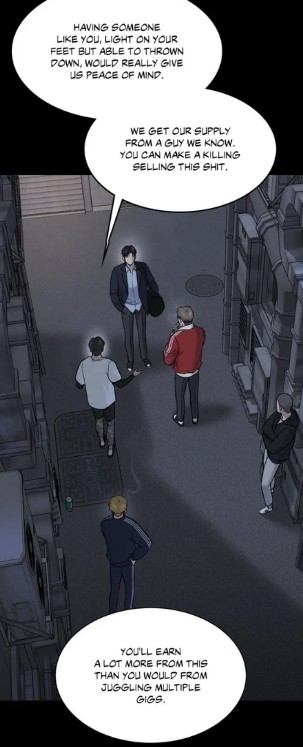 (chapter 73) lit only in patches, with more shadow than clarity. In this kind of setting, the black hoodie becomes something more than clothing — it is camouflage. He is not merely wearing the dark; he is using it, letting the folds of fabric and the absence of light blur his edges. It is as if he intends to merge with the scenery, to be just another shadow leaning against the wall. This double concealment — in time and in space — ensures that, for now, he remains invisible to the one person whose attention he will one day crave. He began in the shadows not just by circumstance but by mandate. Yet as the boy in the hoodie fades into memory, a new figure will eventually emerge from those shadows—not to hide, but to strike. And he will no longer wear a hood. He will wear scars.
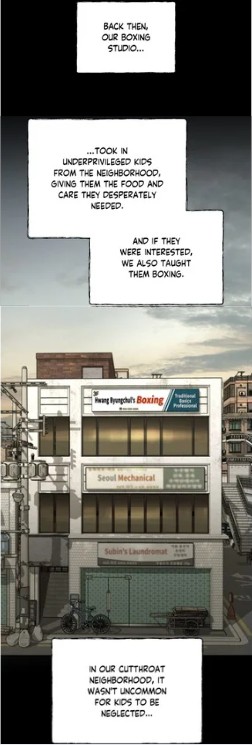 (chapter 72) and in this context, “cutthroat” is more than an idiom. It hints at the lurking threat of blades, at encounters in alleys and side streets where victory is stolen through speed and treachery. Joo Jaekyung has walked those streets without incident
  (chapter 73) in the present timeline, but an assault there can happen any time.
 (chapter 17) And what did the loan shark tell him before provoking him?
 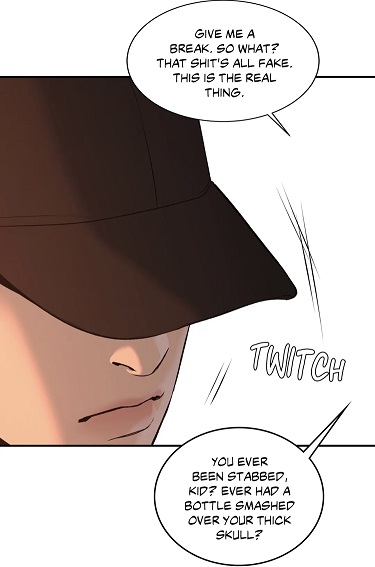 (chapter 17) Based on the champion’s facial expression after hearing Heo Manwook’s questions, it becomes clear that Joo Jaekyung experienced in the past a scene where he faced a knife and his head was smashed with a bottle of soju. The criminals are recognizable due to their tattoos and their weapons, the knife! And the logic of the knife in this world is telling: as Heo Manwook showed
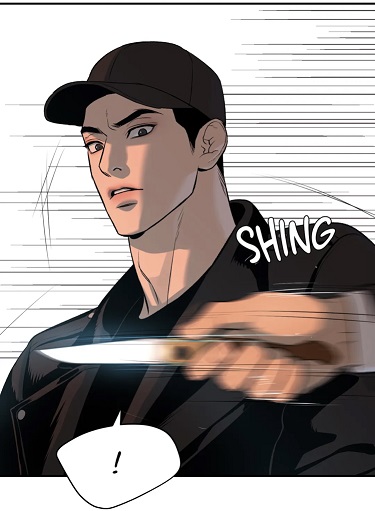 (chapter 17), it appears when a fight is already lost. It is not a weapon of open combat, but of pride and desperation — a way to cheat fate when skill is not enough. Moreover, he was particularly vicious here. He attacked the champion from behind, a treacherous move. As you can see, the knife is strongly intertwined with the underworld, deception and cowardice.
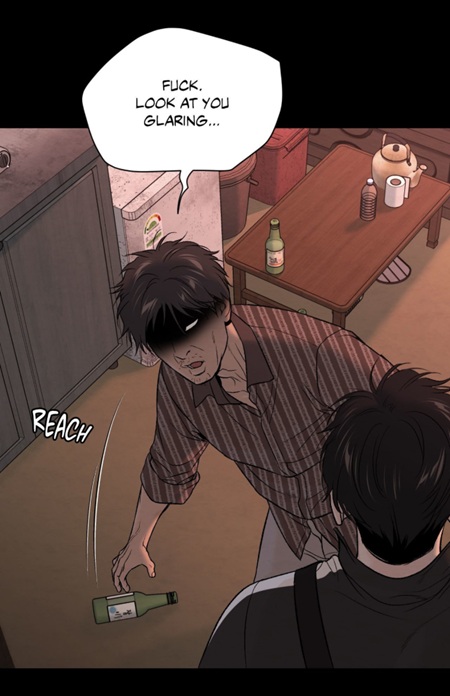 (chapter 73)
  (chapter 17), a head injury
  (chapter 73), insults and provocations
  (chapter 17) and finally an allusion to the “maker”, god versus father.
  (chapter 73) Over time, the champion chose protective symbols— clouds and a dragon-like mask—tattoos designed not to intimidate but to shield.
  (chapter 1)
  (chapter 17) They represent protection, not aggression. Where Baek Junmin’s tattoos speak of death and destruction, Jaekyung’s express escape, survival and resilience. Even in their body art, the two boys tell opposing stories: one driven by resentment and darkness, the other by endurance and self-preservation.
 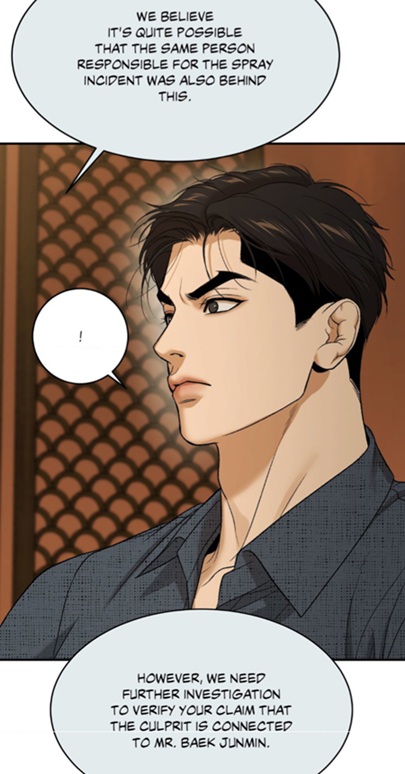 (chapter 69) Nevertheless, they are here buying time. How so? If the champion were to fight again and even lose, they could bury the investigations. They were also biding time in order to stop investigations and the involvement of the media.
  (chapter 73) No… he is copying others and in particular Joo Jaekyung whom he resents. Thus their attitude in the ring is similar (ruthless), yet both act that way for different reasons: pain and seriousness
 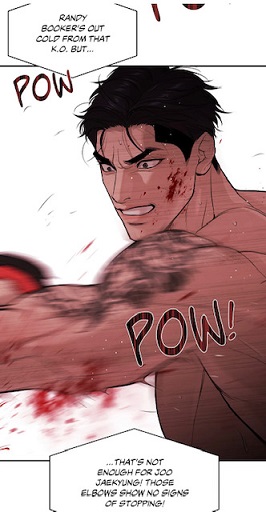 (chapter 15) versus fun and schadenfreude
  (chapter 47). His new persona feels exaggerated, theatrical, hollow. He wanted to become unforgettable, but ended up being another disposable fighter in a system that only remembers champions. Now, his face is ruined: he lost teeth and has a broken nose.
  (chapter 57) Hence the nurse felt sympathy for him. At the health center, he received his long due punishment. Baek Junmin learned through the hard way what it means fighting without rules. He got deceived himself, thinking that his “hyung” would have his back.
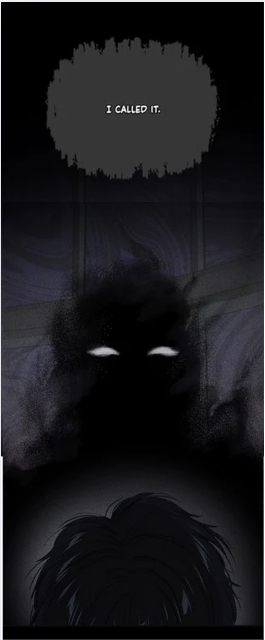 (chapter 54) These words imply that the outcome was predicted… That’s the reason why Joo Jaekyung needs to remember the past. There lies the truth: they are “rigging the games because of bets!
  (chapter 54) and Joo Jaekyung’s father, Joo Jaewoong.
  (chapter 47)
 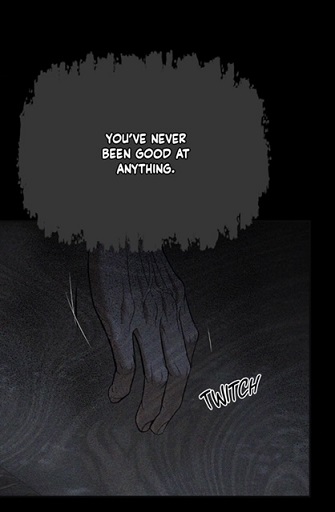 (chapter 54), the father with his fading trophy, Baek Junmin with his own unspoken history in the underground ring and the ghost’s words linked to the champion’s hands. Together, they symbolize the toxic underbelly of combat sports, the place where dreams are sold and consumed.
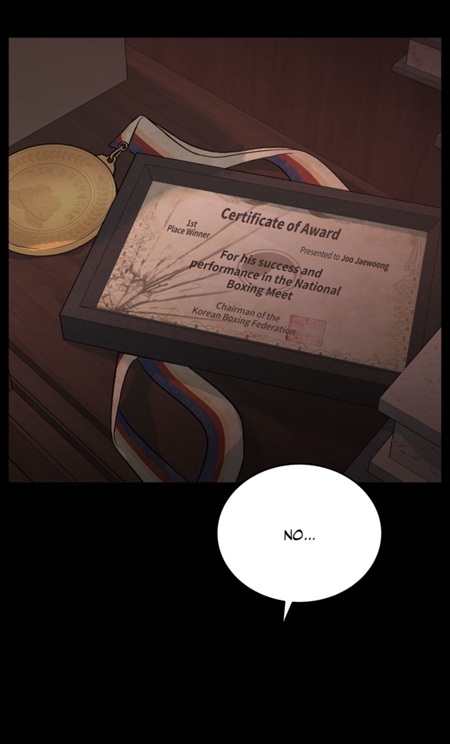 (chapter 73) He had a past worth remembering—something he even clung to in his ruined apartment, preserving his medal and document like a relic. Baek Junmin, by contrast, never belonged to the gym. He wasn’t trained. He never received formal recognition. He fought in shadows, kept to the margins, and remained a “legend” only in the backrooms of Gangwon’s illegal rings because he trusted his “hyung”.
 (chapter 49). he desired to have a real title and admiration.
  (chapter 51) all along—a spectacle, not a coronation. Hence director Choi was overjoyed when he heard the verdict.
 (chapter 52) That’s why he earned a lot of money. They used this fight to remove the Emperor from the stage quietly. It was time for him to give up on his throne. If they had let Baek Junmin win the fight, people would have questioned the referees. The Shotgun was there to prepare the coup d’Etat, hence the new champion is someone else. Joo Jaekyung wouldn’t remain so calm hearing this:
 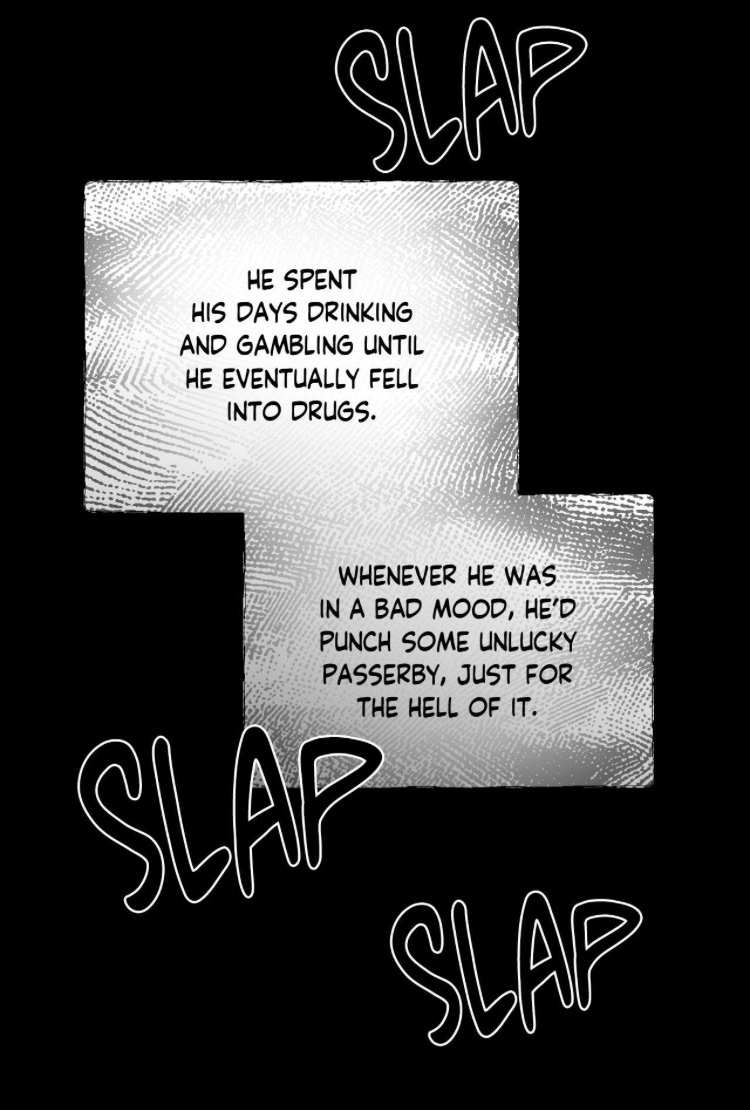 (chapter 72) This explicates why Hwang Byungchul condemned the man and sided with the mother. But while Joo Jaewoong and Baek Junmin tried to escape through the sport, they both ended up in the criminal network. And neither made it out.

 (Chapter 63) The presence—or absence—of clothing during their encounters symbolized the gradual dismantling of their emotional walls. Now, shifting the perspective to the champion, another layer of complexity emerges. Joo Jaekyung’s evolving approach to intimacy is not just a reflection of his growing feelings but also a silent, deeply ingrained struggle with dependence and control.
 (chapter 63) Why does he hesitate to strip entirely, even as he succumbs to desire? Notice that he released his erected phallus before removing his cloth.
  (chapter 63) To answer this, a comparative analysis of earlier sex scenes is necessary, unraveling the hidden dialogue between physical exposure and emotional vulnerability.
 (chapter 30) The doctor instinctively tried to cover his gray boxer shorts with his t-shirt, prompting the champion to question his reaction:
  (chapter 30) In Episode 63, this dynamic appears subtly reversed.
  (chapter 63) The champion, despite holding the dominant role, is now the one retaining a piece of clothing. This suggests an unconscious act of concealment—not of shame in the traditional sense, but of a growing dependency on Kim Dan.
 (chapter 62) with a zoom-in shot on his erection still hidden by gray sweatpants. Striking is that on the one hand he let the doctor feel his reaction to his naked body, when he embraced the doctor:
  (chapter 62) The “hamster” could sense with his leg the excitement. On the other hand, these pants were only removed once he entered the bedroom and was on the bed
  (chapter 63), reinforcing the idea that vulnerability, for him, is confined to this private space. Moreover, the choice of attire in Episode 62
  (chapter 62) —ridiculous floral-patterned pants—serves as an indirect reference to shame (in a good way), an unfamiliar emotion for the undefeated fighter. This pattern culminates in Episode 63, where Jaekyung’s thoughts confirm his internal battle:
  (chapter 63) Thus I deduce that exactly like the presence of the black underwear, the athlete’s low self-esteem hasn’t been removed completely. He still expects fear and rejection.
 (chapter 63), dominates without seeking connection
  (chapter 55), and ensures that every encounter follows his carefully constructed narrative. However, in Episode 63, a subtle but undeniable shift occurs. For the first time, Jaekyung’s actions reflect something deeper than mere desire or dominance. They reveal his growing emotional investment in Kim Dan, exposing a side of him that even he does not fully comprehend.
  (chapter 63)
 (chapter 12) In the earlier encounter, Jaekyung presented himself as a generous partner, offering Kim Dan a so-called privilege—an opportunity to enter a whole new world, thanks to him. However, his so-called generosity was nothing more than a facade, a way to conceal his inexperience in genuine intimacy. The tool he used was not just an object of pleasure but a mask for his own shortcomings as a lover. He did not know how to pleasure Kim Dan, nor did he care to learn. His focus was not on Kim Dan’s enjoyment but on reinforcing his own power and dominance.
 (chapter 63) Here, he no longer portrays himself as the benevolent provider of an experience.
  (chapter 12) – seeking both to display dominance and to elicit validation
  (chapter 12) —this time, in Episode 63, he prioritizes Kim Dan’s pleasure without explicitly expecting anything in return.
  (chapter 63) Up until this point, Jaekyung has never truly faced rejection.
  (chapter 63) His wealth, power, and physical prowess have ensured that people comply with his desires. However, in Episode 63, Kim Dan does not simply comply—he resists on an emotional level. While he consents to sex, he actively rejects any deeper connection. He avoids eye contact, creates physical distance, and refuses to acknowledge Jaekyung beyond the act itself. This rejection unsettles Jaekyung because, for the first time, his usual methods of control no longer work. He cannot use money to bridge the emotional gap, nor can he rely on his dominance to make Kim Dan want him.
  (chapter 63) This moment forces him to confront an uncomfortable truth: power and status cannot buy emotional intimacy.
 (chapter 03) or passive-aggressive remarks.
  (chapter 6) However, in this moment, he does not react with anger or coercion.
  (chapter 63) While he does voice his frustration, he does so without force, showing an unprecedented level of emotional regulation. Instead of demanding compliance, he chooses a different approach—he focuses on Kim Dan’s pleasure, attempting to bridge the emotional gap through physical intimacy
  (chapter 63) rather than control. This decision is not merely about sex; it is an unconscious attempt to regain Kim Dan’s attention, to re-establish a connection that he does not yet fully understand but deeply craves.
 (chapter 29) This remark exemplified his detachment, his refusal to acknowledge Kim Dan as a person rather than just a body. Once again, the intercourse was linked to achievement and work. However, in Episode 63, he actively seeks Kim Dan’s gaze, subtly pleading for recognition.
  (chapter 63) This reversal is crucial because it indicates that he no longer sees Kim Dan as just a means to an end. However, his desire for recognition still lingers beneath the surface—just as he once sought validation through dominance, he now seeks it through Kim Dan’s acknowledgment. He wants something more, though he cannot yet articulate what that is, and his actions reflect a subconscious craving for emotional reassurance.
 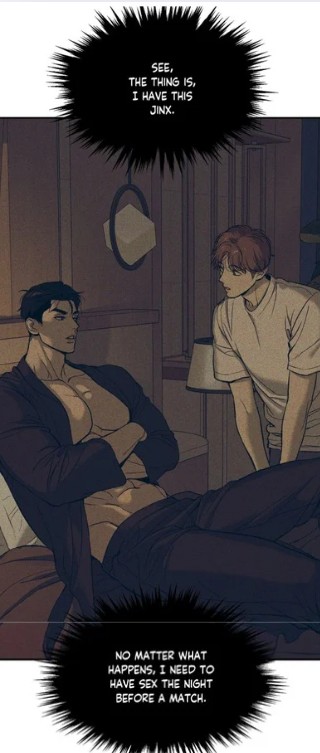 (chapter 62) the sportsman welcomes the physical therapist in blue pajamas and a robe—an overt attempt to maintain distance and control. Even as the encounter begins, he leaves his pajamas on
  (chapter 3), removing them only
  (chapter 3) – this image marks the change) when the doctor’s back is turned. Then in Episode 8, during the shower, he continues wearing shorts and underwear
  (chapter 8), and his choice of the doggy style further reinforces his desire to avoid direct, face-to-face vulnerability.
  (chapter 12) before removing it and adding the pink sex toy.
  (chapter 12) Their bodies might have been close, but their minds remained divided. That’s why he couldn’t detect the huge bruises on his companion’s body.
  (chapter 12) This guarded approach is further underlined in Episode 20
  (chapter 20), where even in the midst of nakedness, the athlete deliberately positions the doctor in the dog stance. At the same time, he uses another MO: the darkness of the room to hide himself. This calculated arrangement maintains an emotional buffer, allowing him to remain physically exposed yet emotionally detached—a recurring theme in his behavior.
 (chapter 29) while still cloaked in his familiar blue robe and pajamas. Interesting is that the room is not totally dark like in episode 20, the bedroom is illuminated by the huge TV screen. Importantly, this episode marks the first time they face each other in the bedroom, signaling a significant shift in their dynamic and announcing a switch in position. This newfound mutual visibility lays the groundwork for later developments.
 (chapter 33) —a deliberate act imbued with symbolism. Unlike earlier encounters, the champion remains fully clothed throughout this episode,
  (chapter 33) contrasting sharply with previous moments of exposure. The car scene, where they are now facing each other, reinforces the announced switch in intimacy; the light not only illuminates the scene but also serves as a metaphorical spotlight on his desire to see the doctor’s face and body
  (chapter 33) —a silent assertion that only he can truly satisfy the physical therapist. Let’s not forget that before having sex together, the fighter resorted to a dildo
  (chapter 33) rather direct physical intimacy, because he felt insecure after witnessing the actor’s advances toward Kim Dan. His goal? To reaffirm his dominance and make Kim Dan admit that he needed him for pleasure. It is important because it exposes that deep down, the champion views himself as a bad lover. There is no doubt that Heesung‘s criticism resonated with him.
 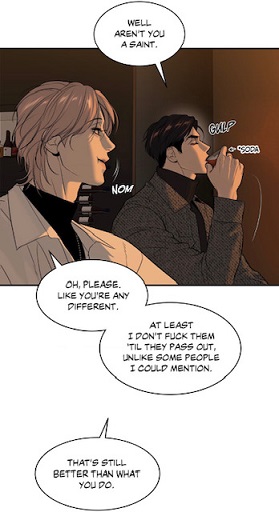 (chapter 33)
 (chapter 39) While receiving fellatio, the champion keeps his t-shirt on, only removing it later when he invites the doctor into bed.
  (chapter 39) Maintaining the doggy style during this phase, he uses such intimate acts to mask his true longing and attraction—an effort to control the encounter while keeping his emotions under wraps. Then I noticed that they switched positions, when doc Dan asked for a break.
  (chapter 39) The wolf chose to lie down on the bed:
  (chapter 39) As you can see, through the different intercourses, we can see the different methods the star used to conceal himself, to hide his “weakness”, his growing feelings for the doctor.
 (chapter 61) The physical therapist remembers an encounter bathed in bright light, where they stood before a couch: the doctor had removed his pants while the champion remained fully clothed, positioned behind him.
  (chapter 61) After both reached climax, the sportsman swiftly departed—a stark demonstration of his habitual retreat into distance and fear, even as he ensures the doctor’s pleasure.
  (chapter 61) This calculated “running away” underscores the return of old insecurities and the persistent need to assert control. Since the doctor was still living in the penthouse and as such was still working as the star’s physical therapist, it becomes comprehensible why the athlete could only resort to strength to keep his fated companion by his side. He had rejected his “gratitude” and “emotions” before.
  (chapter 63) Now lying on the bed facing each other, the pair’s physical closeness appears more genuine. Yet, even in this seemingly intimate configuration, they avoid locking eyes during penetration.
  (chapter 4), we do not see whether he is wearing anything the morning after. After their “magic night” in the United States (Episode 39), the next morning, he is only shown taking a shower
  (chapter 40) —meaning the audience never sees him leaving the bed. However, in Episode 45, the author deliberately includes a shot of Jaekyung leaving the bed while still wearing his black boxer briefs.
  (chapter 45)
 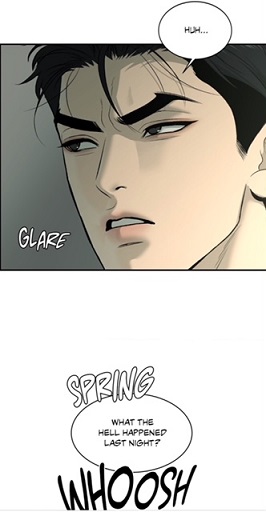 (chapter 45). This is just a rhetorical question, as he clearly remembers the night.
  (chapter 45) In reality, he was wondering why he had acted this way. This contradiction—pretending to forget while consciously recalling their time together—reflects his internal denial. His next thought,
  (chapter 45) is a transparent excuse to avoid confronting his emotions. The presence of the black underwear in this scene confirms that he had not fully lowered his guard; he still maintained a psychological barrier between himself and Kim Dan.
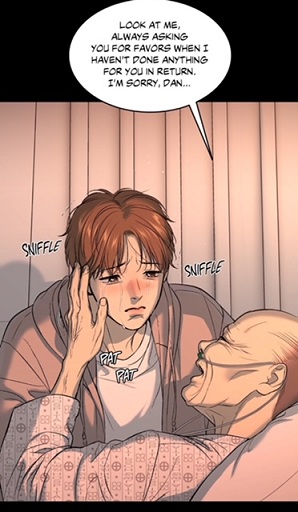 (chapter 53), Jaekyung was conditioned through shame and rigid expectations. His worth was not inherent but conditional, entirely dependent on his performance.
  (chapter 22), Jaekyung’s guardian likely did the opposite.
 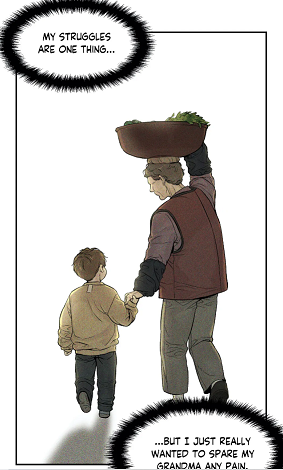 (chapter 5) This represented a source of support for the elderly woman. Secondly, during the intercourse in the lavender-tinted bedroom, neither the champion nor the doctor are trying to take each other’s hand:
  (chapter 63) In the beginning, the champion grabbed doc Dan’s wrist. This shows that the athlete was not used to touch Kim Dan’s hand. And notice how the “hamster” reacted
  (chapter 63) He pushed it away. This means that taking the doctor’s hand represents the biggest challenge for Joo Jaekyung right now. In addition, the last panel indicates the champion’s transformation, he is now willing to seek the doctor’s closeness. It also implies the vanishing influence from his past guardian.
 (chapter 54) There was no room for imperfection, no tolerance for hesitation. Thus I deduce that the champion’s choice of career could have been decided by the guardian, similar to the grandmother’s attitude with Kim Dan. Remember that he loves water and swimming.
  (chapter 27) Under this new light, it could explain why the fighter forgot his passion. They made sure that he would train restlessly. In this environment, vulnerability was a defect to be eradicated, not a human trait to be acknowledged. This description reminded me think of Park Namwook and his family. The manager is a former national wrestler who is married to an athlete too.
  (chapter 5) At the same time, it would highlight the potential danger of Park Namwook’s vision for the gym: an institution that might perpetuate the same cycle of control, shame, and expectation rather than fostering true passion and individuality in young athletes. That’s how I realized why the manager slapped his “boy” after the funny sparring:
  (chapter 26) He explained that the main lead was just a doctor. However, I am quite certain, underneath, the manager thought that doc Dan was not fit to spare: so small and weak. He doesn’t fit the criteria to become a sparring partner. Look at his reaction, when Seonho faced the champion:
 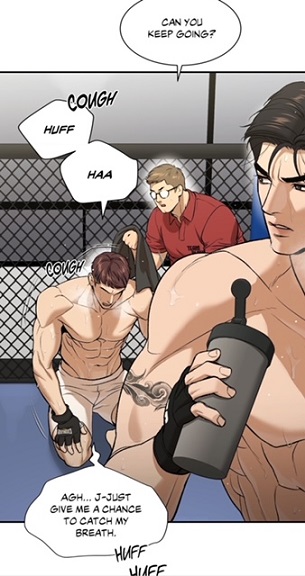 (chapter 46) Under this new light, it becomes comprehensible why Potato was also neglected by the manager. The young maknae belongs to a different weight category. There is this invisible rule that only strong people can become member from the gym. However, the purpose of such an institution shouldn’t be reduced to titles, strong and muscular men or boys. The gym should be opened to anyone who desires to have fun and improve their health.
 (chapter 1), until he received the doctor’s massage in chapter 1. His attitude toward sex mirrors his training in the gym—focused on endurance, performance, and control. His body is a tool, a machine honed for efficiency.
  (chapter 63) Pleasure is secondary; the real goal is lasting, enduring, proving his stamina. Even in his most intimate moments, he is competing against an invisible opponent—his own ingrained fear of inadequacy.
 (chapter 63), why he keeps barriers between himself and Kim Dan, even when his body betrays his true desires.
 (chapter 62)
  (chapter 4) nudity was a tool of dominance, a means of asserting control. Now, it has become a sign of submission—not in the physical sense, but in the way he is slowly relinquishing the emotional armor he has always relied upon.
  (chapter 44) His decision to keep his underwear on for as long as possible in Episode 63 is not a sign of detachment
  (chapter 63), but of his silent battle against the vulnerability he is beginning to feel.

 (chapter 2) —having sex the night before a match—was a necessary ritual to maintain his champion title. However, by Episode 62, his view of the jinx had subtly shifted.
  (chapter 46), the stretching and massage at the gym? The problem is that the champion never complimented the “hamster” for his good work directly. So it was, as if his dedication was nonexistent. Without the champion’s genuine gratitude and appreciation expressed so openly, the physical therapist couldn’t perceive the true message behind the champion’s. Joo Jaekyung’s statement was actually an acknowledgment—a sign that the fighter values their routine, not just for performance but as an integral part of his life. So when the star mentioned his jinx
  (chapter 62), the doctor’s memory got triggered. Because of his past experiences, he has long associated the jinx exclusively with sex. This contrast in understanding highlights both Jaekyung’s lack of self-awareness and Kim Dan’s tendency to filter reality through his own expectations and trauma. However, the deeper significance lies in Jaekyung’s evolving perception of dependency. His jinx is no longer just a superstition tied to his performance in bed. It now subtly acknowledges that his success has been intertwined with Kim Dan’s intervention.
 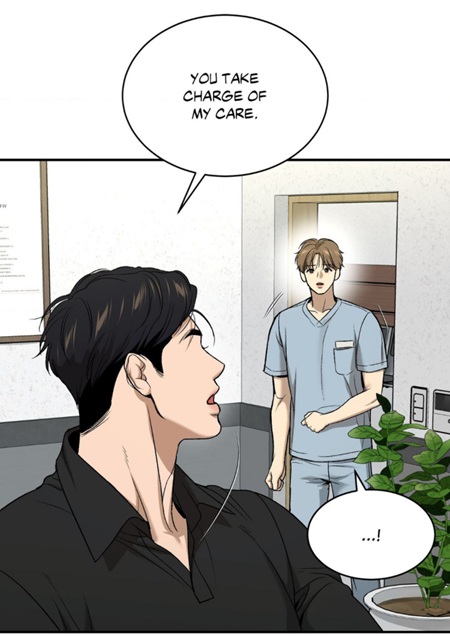 (chapter 61) By entrusting his care to Kim Dan, he was insinuating that the main lead was trustworthy and competent, yet his inability to verbally express appreciation keeps the doctor unaware of his true feelings. This struggle resurfaced in front of the hospice, where Jaekyung could only bring himself to admit that Kim Dan was not responsible for the incident with the switched spray.
 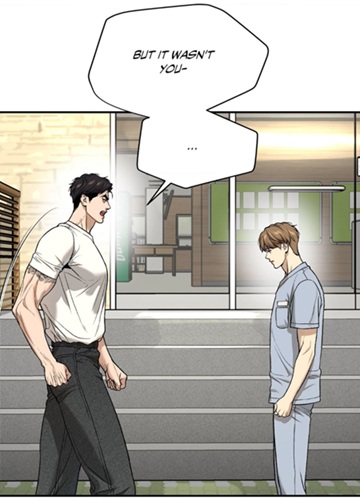 (chapter 62) His reluctance to openly acknowledge his gratitude suggests a deeper internal conflict—one that hints at a growing but unspoken emotional reliance on Kim Dan.
  (chapter 62) It was, as if he was warding off bad luck by repeating the last match. For him, past choices are justified by their results—he has built a successful career through sheer discipline and sees no reason to question his trajectory. His mentality reflects the belief that one’s past is a stable structure upon which the present and future rest. This perception explains his resistance to self-reflection and emotional vulnerability; admitting a mistake would mean disrupting the stability he relies upon.
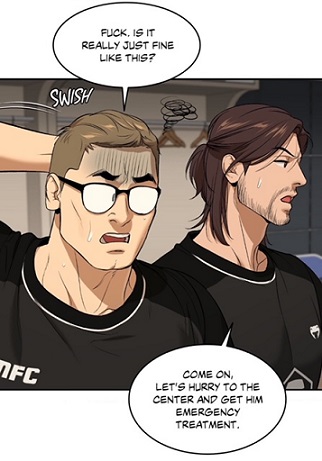 (chapter 50)
 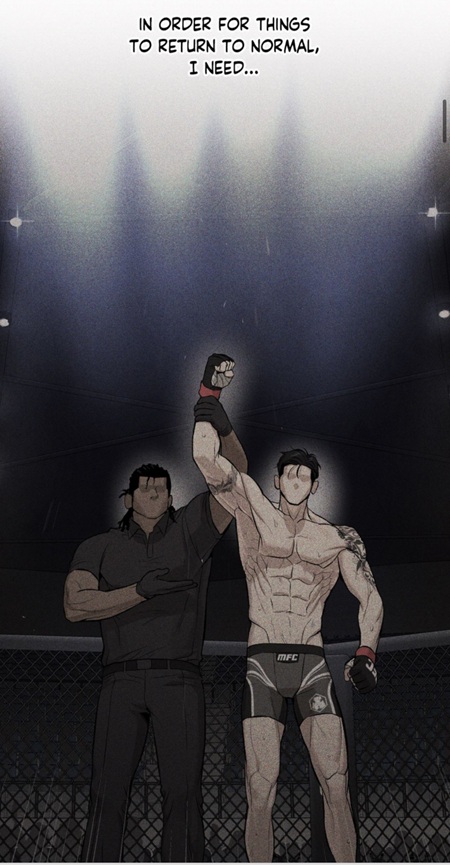 (chapter 61) This rigid perception prevents him from questioning his past choices or embracing change, reinforcing the illusion that repeating past patterns will restore stability. However, as his reliance on Kim Dan grows, the boundaries between his personal and professional life blur, challenging his belief that he can control his future by clinging to his past.
 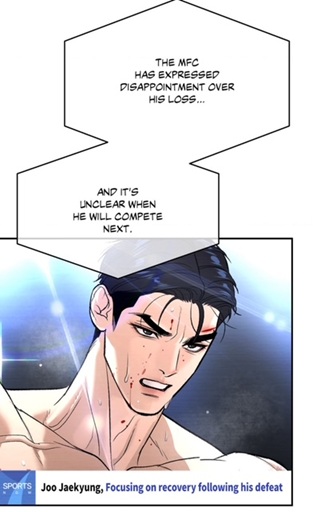 (chapter 57) and Park Namwook
  (chapter 54), who claim that Jaekyung ‘lost’ the fight, when in reality, it was a tie. The very way people around him are framing the event warps his perception, creating a false narrative where his struggles seem to stem solely from this supposed ‘loss.’ His belief in a stable past provides him with a sense of security, but that illusion is fragile. In addition, if his struggles predated his championship loss
  (chapter 29), then reclaiming his title cannot be the solution he believes it to be. Finally, what happens when he is forced to confront the reality that some of his past choices were mistakes – ones that he can no longer attribute to the jinx or external circumstances,
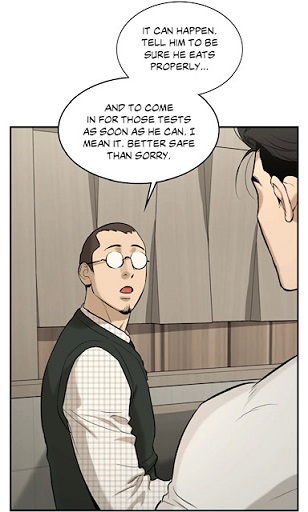 (chapter 13) because they affected the doctor’s life?
  (chapter 41) In one case, he refused to listen to his friend’s advice, whereas he trusted the words from MFC, MFC doctors and his hyung. When the foundation he has relied upon begins to crack, Jaekyung’s entire mindset is shaken, forcing him to question whether his past truly holds the answers he seeks. We could say, the athlete needs to be betrayed by his own past in order to throw his old belief. The latter is strongly intertwined with the organization MFC and authorities in general. Questioning his past equals challenging the company MFC and his past “guardians”: the terrifying ghost and even his two hyungs.
  (chapter 61), he expresses the belief that reclaiming his championship title will rid him of his headaches, nightmares, and sleepless nights. However, the reality is different—he was already suffering from insomnia long before he lost his title.
 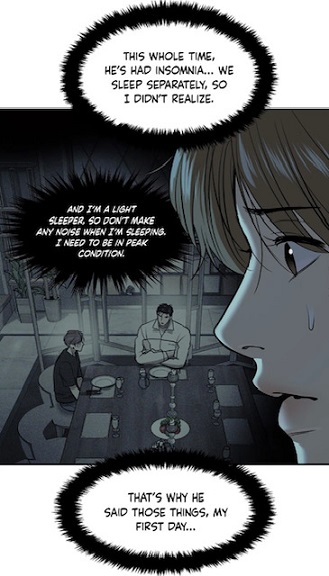 (chapter 29) The origins of his struggles existed before his recent failures, suggesting that his belief in a simple solution—reclaiming his title—is an illusion. This disconnect reveals how deeply his professional and personal life are entangled; his need for control in the ring has masked his deeper emotional vulnerabilities. He isn’t merely striving for victory—he is chasing the illusion of stability, believing that his success is the sole factor that determines his well-being.
 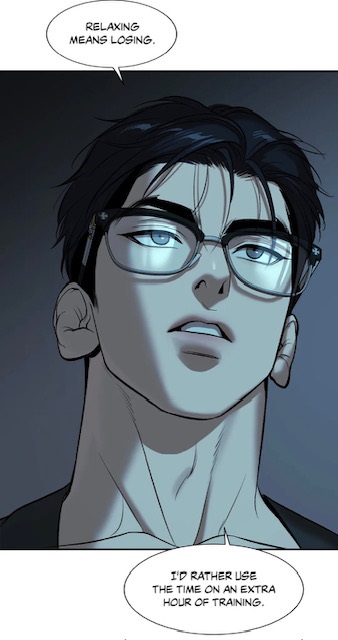 (chapter 29), you will realize that alone in his penthouse, Joo Jaekyung was actually admitting the importance of sleep and rest. His earlier belief in relentless training as the key to success now clashes with his realization that exhaustion is affecting him. This shift signifies an unconscious admission that his well-being is not just tied to physical endurance but also to recovery and relaxation—something he previously dismissed. This realization subtly parallels his growing dependence on Kim Dan, reinforcing the theme of blurring lines between his professional and personal life. And what had occurred after this magical blue night in the penthouse?
  (chapter 30) The athlete woke up later than usual. In fact, he was rather late, for he was still wearing his pajamas, while the doctor had already taken his shower. But back then, observe how he opened the door! Like a clumsy beast, grump leopard! Why? In the past, I explained that he was seeking the champion’s closeness, but didn’t know how to approach his partner. I am now adding another aspect. He was actually annoyed, because he had not been following his daily routine!! Under this new light, it becomes comprehensible why the champion had such a “angry” facial expression, while deep down he was happy. The older version of this scene:
  (chapter 44) However, this means that in episode 30, he never acknowledged his dependency on the physical therapist for his rest loudly. On the other hand, it explains why the champion felt threatened, when the actor approached his “lavender-tinted pillow” or “sleeping pill”.
  (chapter 31) In fact, he used guilt to create a link between him and his roommate. That’s the reason why I am more than ever convinced that the champion will sleep better after this lavender-tinted night.
  (chapter 62) won’t come true at all. 😉 He will stay longer and ask for Kim Dan’s presence during the night.
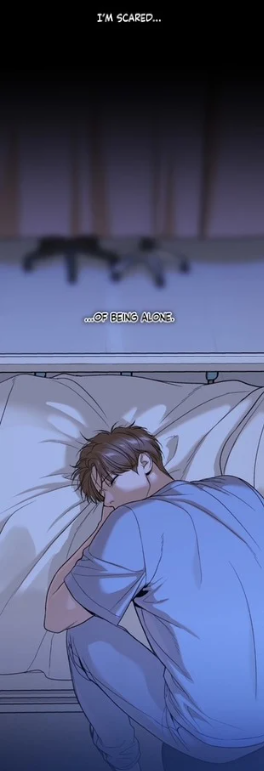 (chapter 56) His childhood and early adult experiences, marked by financial hardship, emotional neglect, abandonment, betrayal and powerlessness, have conditioned him to associate attachment with suffering. Because of this, he withdraws from relationships
 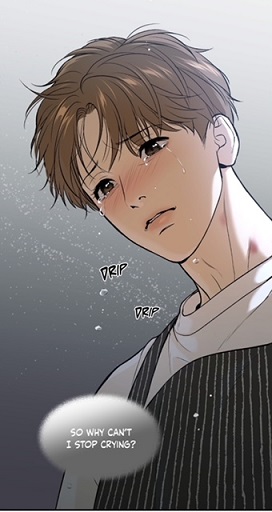 (chapter 46)
 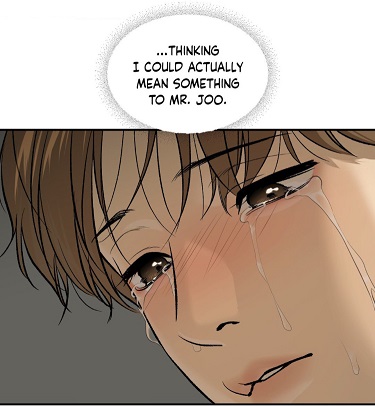 (chapter 46)
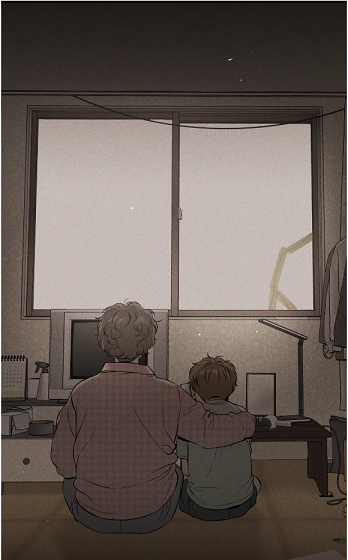 (chapter 19) She became terribly sick, while the other had to get surged and risked his career. There is no doubt that the halmoni is hiding her pain as well. Kim Dan’s declining physical and emotional state further reflects the consequences of living in avoidance.
 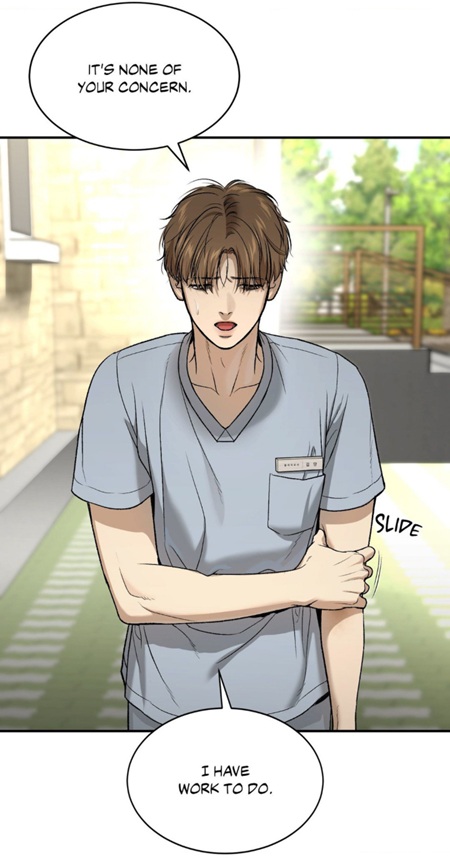 (chapter 61) He is endangering his life. Instead of taking action to improve his well-being, he isolates himself, refusing help even when it is necessary. His reluctance to accept care—be it medical, emotional, or relational—mirrors the very trap Delgado describes: mistaking survival for true agency.
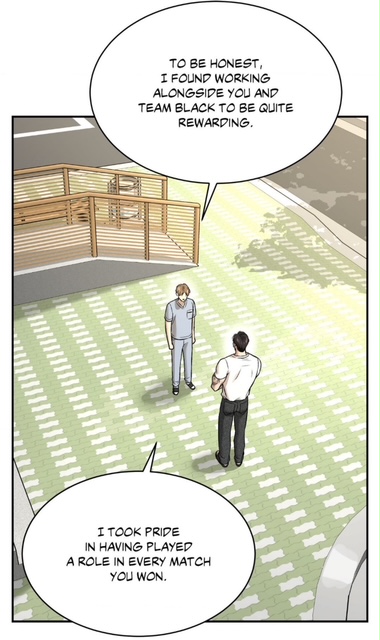 (chapter 62) If he continues making decisions based on past fears, he will remain trapped in the same cycle, unable to experience true growth or emotional fulfillment.
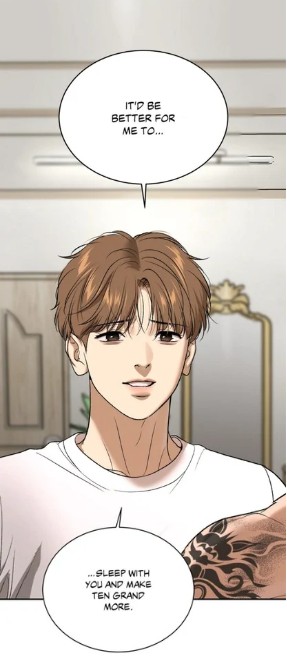 (chapter 62) Here, he is actually facing his past which he has strongly connected to regret and remorse. Don’t forget that after this night, he is expecting Joo Jaekyung’s departure.
 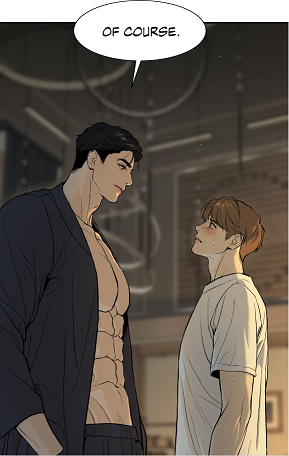 (chapter 3), which has been the setting of power imbalances, physical dominance, and silence, the living room represents a shared space—a place where dialogue and openness can exist. But why is the bedroom linked to silence? It is because of the TV, the third invisible companion!
  (chapter 48) Hence during that night, none of the protagonists talked sincerely to each other. And now pay attention to the living room at the hostel:
  (chapter 54) He needed to get rid of this poor habit: watching TV or cellphone. He had to realize that the TV or cellphones were never real companions and never brought him peace of mind! This was the invisible “love” triangle. Back then, the athlete deceived himself by thinking that he was truly self-reliant, while in verity he was dependent on his cellphone and the TV.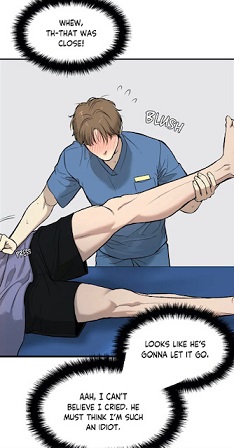


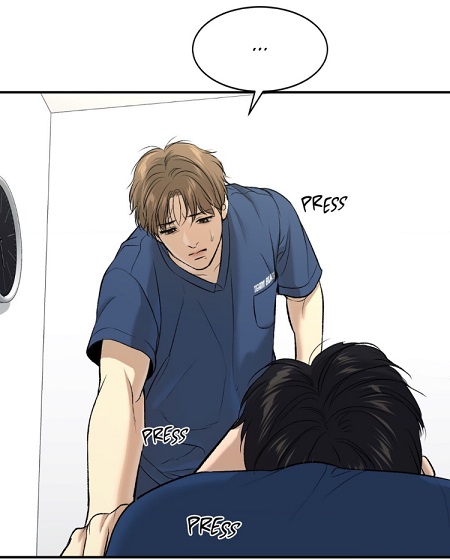

 (chapter 37) And all this started because Kim Dan had taken the initiative.
  (chapter 7) But now, it is no longer fulfilling for him, because his relationship with them didn’t go beyond their work.
  (chapter 59) Striking is that here the doctor didn’t apologize to the elderly man, but only to the family.
  (chapter 59)
 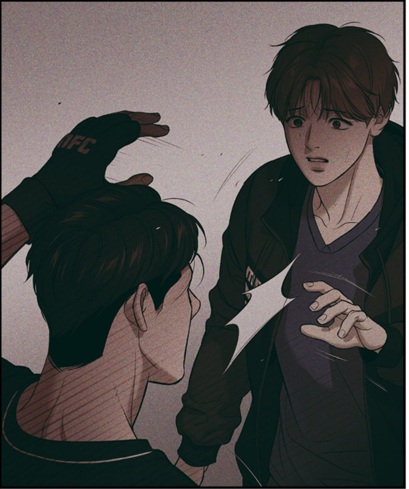 (chapter 62) – which is quite understandable in my eyes. The ones who failed the couple were the two other hyungs from my perspective. The past affected the doctor so much that he views himself and his feelings as “trash” now, yet it is clear that neither Park Namwook nor the coach are suffering from guilt or remorse. The star’s follow-up statement,
 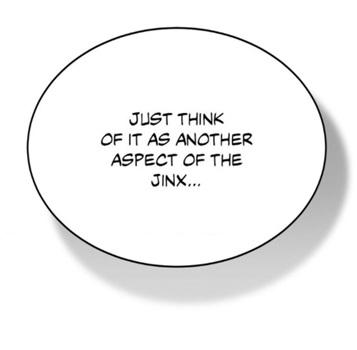 (chapter 62) further reinforces that Kim Dan has become an integral part of his preparation. Although Jaekyung does not yet frame this as emotional reliance, his words betray an unconscious attachment—one that Kim Dan himself does not recognize. Moreover, by including him in his jinx, the champion is only one step closer to include him in his “success”. Should the doctor be the target of malicious comments, the star will consider it as a personal assault or as his responsibility.
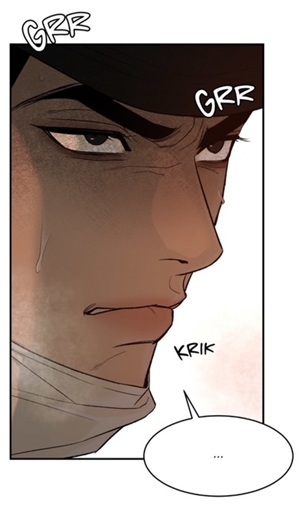 (chapter 56), but about something deeper. Here he felt the need to see his beloved “companion” again.
  (chapter 27) At the same time, this confession displays that his past was far from being perfect, the evidence of a distorted memory. After working so hard for the community, he came to receive a treatment from Kim Dan:
  (chapter 62) This means that he is now treasuring his own body. No wonder why he smiled.
 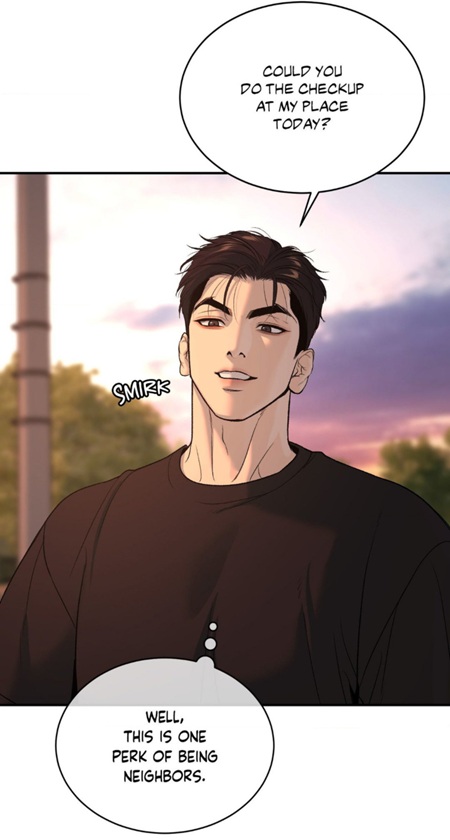 (chapter 62) That’s why I come to the following conclusion: The athlete must have felt happy in the living room, for he felt comfortable and safe.
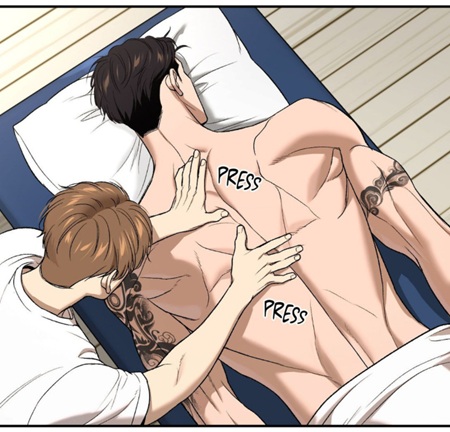 (chapter 62) But why did he show his back? One might say that he desired to hide his “satisfaction” and his “reliance” on his fated partner. Or he didn’t feel the need to watch the doctor’s facial reaction, when he would confide his new intentions and the transformation of his jinx. He didn’t expect the physical therapist to mock him for his absurd belief contrary to episode 2:
  (chapter 2) He trusted the doctor. Yet, in my opinion, there exists a bigger reason behind this change. It is related to his manager:
 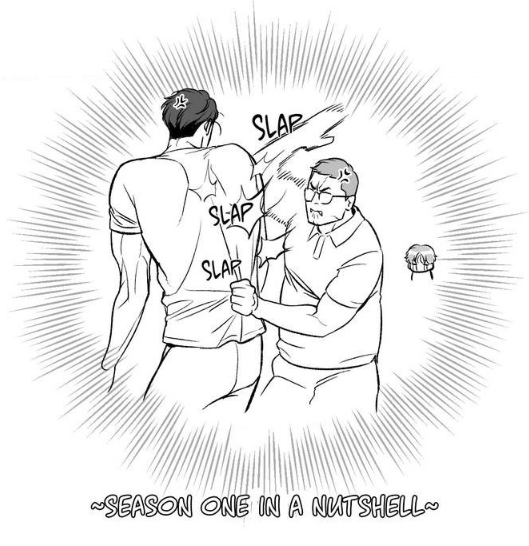 The doctor is treating the star
 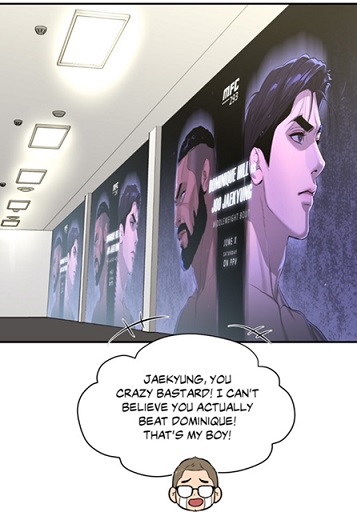 (chapter 40), as it threatens his own stability. Rather than acknowledging change, he reacts negatively to it and shifts blame onto Jaekyung, avoiding responsibility for his own shortcomings.
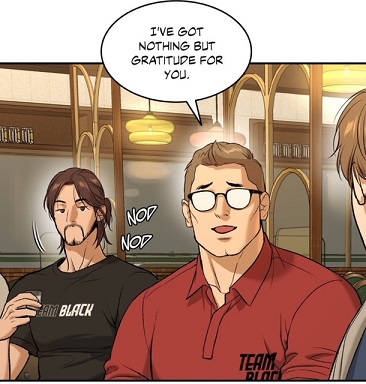 (chapter 43), but when confronted with a serious incident, he failed to take responsibility or make a decisive choice
 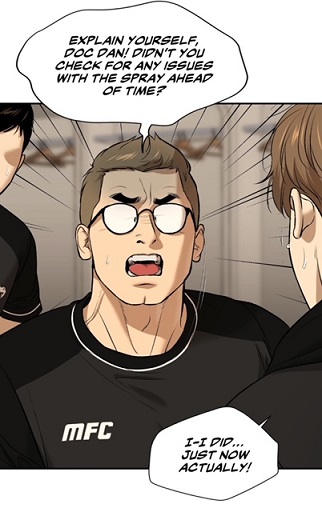 (chapter 50), allowing others to step in instead. Later, rather than addressing his inaction,
  (chapter 59)
 (chapter 5) He felt so empowered that he won very quickly.
 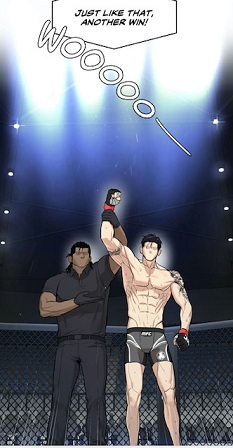 (chapter 5) But this good vibe was attributed to the sex with Kim Dan and unfortunately linked to his match. The reality was that he had slept better and longer. So by recreating the past, Kim Dan places the athlete in front of a choice. What matters in his life? His title or his peace of mind? He is correcting the champion’s distorted memory. Kim Dan is the reason why he can rest properly and not the title. Don’t forget that he was suggesting to go separate ways during the massage. But if he sleeps better before gaining his title, he won’t feel the urge to return quickly to the ring. In the living room, he was still acting as the celebrity, but in the bed chamber he is now gradually pushed to leave his title out of the bedroom. Now, in the bedroom he becomes a man and can almost make a mistake as a lover.
 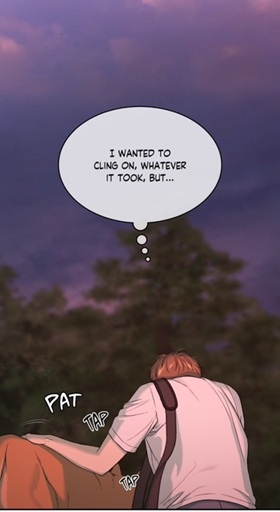 (chapter 59) However, he needs to realize that his physical and mental recovery can only happen, if he truly wishes it. From my perspective, the doctor has to sense that he is not on his own, he has someone by his side who supports him emotionally and mentally.
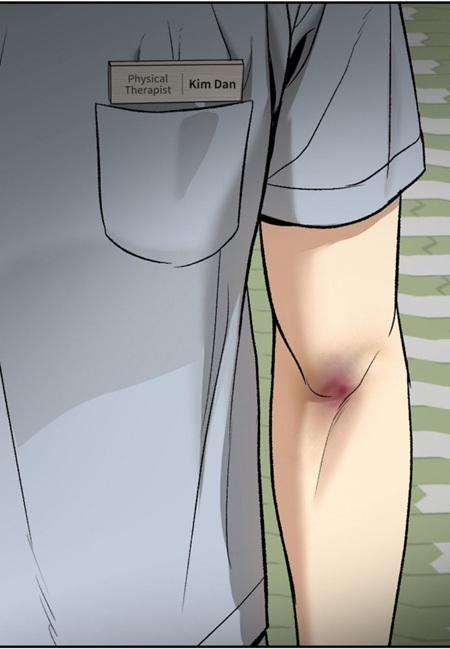 (Chapter 61) However, this moment is not isolated—it reflects patterns in his personality that have appeared throughout the series.
  (Chapter 11)
  (chapter 18) This essay delves into the significance of Kim Dan’s physical and emotional bruises, examining how they symbolize his suffering, internal conflict and transformation. I will examine Kim Dan’s conflicted emotions surrounding gratitude and debt, contrasting his interactions with Joo Jaekyung and his grandmother, Shin Okja. Additionally, I will explore how Kim Dan’s conditioned identity as a caregiver drives his choices, even in his current living situation with the landlord, where he unconsciously replicates past dynamics. Ultimately, I will elaborate how Kim Dan’s newfound awareness could reshape his identity and relationships moving forward.
 (Chapter 61) His unexpected reaction catches Kim Dan off guard, further emphasizing how disconnected the doctor has become from his own well-being. However, contrary to the past
  (chapter 11), Kim Dan is truly responsible for the contusion. He caused the injury by removing the needle from the drip.
  (chapter 60) By taking this action, he absolved Joo Jaekyung of any responsibility for the injury, but this is merely a superficial conclusion.
 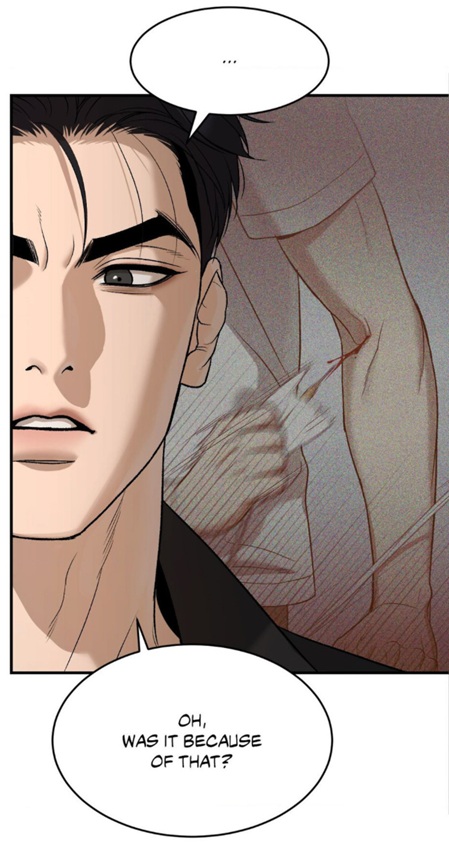 (Chapter 61) On the hand the circumstances surrounding the bruise, where Kim Dan removed the needle on his own, provide insight into his psyche. The deeper cause of the bruise lies in Kim Dan’s declining health, which is intrinsically connected to his malnutrition and the neglect he faces from those around him. It is important to recall that Joo Jaekyung was explicitly informed that Kim Dan needed rest
  (chapter 60). Yet, with his insistence,
 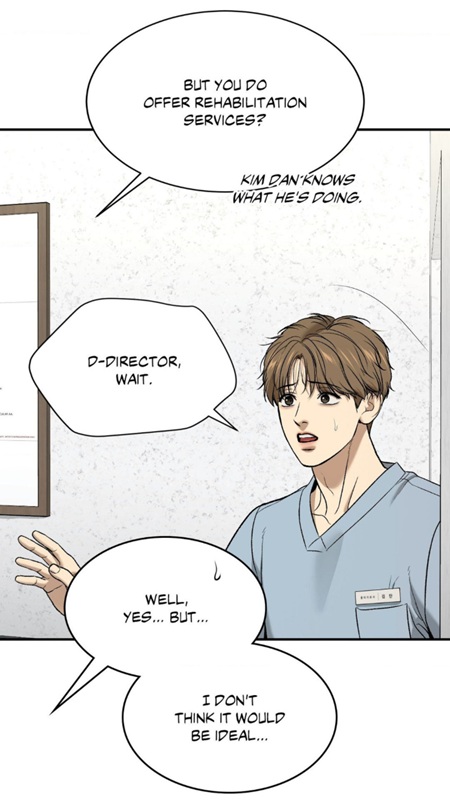 (chapter 61), he ultimately had no choice but to comply, as his order came from the hospice director.
  (Chapter 61) And why did the director override Kim Dan’s need for rest? Money and free PR. Joo Jaekyung’s influence secured the director’s approval, disregarding the doctor’s well-being in favor of business interests. This conversation at the director’s office makes one thing clear: words hold no power against profit. An d that realization led me to another connection—every one of Kim Dan’s bruises is linked to exploitation, whether by authority, obligation, or financial influence.


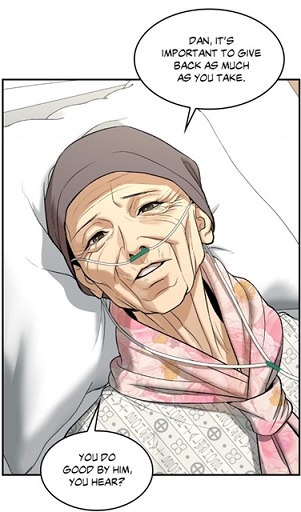 (Chapter 41) It is clear that she was inciting him to work harder than before. This displays that Kim Dan was not allowed to rest. During this encounter, she didn’t ask him about his well-being either. And what is the link between these 3 episodes? The grandmother and her poverty. The latter was responsible for the loan.
  (chapter 56) Kim Dan has only visited the hospital once, and this was solely due to Joo Jaekyung’s intervention. The latter needed medical attention himself
  (chapter 18) and took Kim Dan along, ensuring he was seen as an emergency patient. However, this visit was brief and lacked any comprehensive medical examination—no blood samples were taken, and his underlying health concerns remained undiagnosed. This omission further underscores the neglect Kim Dan has suffered, as even in a medical setting, his long-term health issues were overlooked.
 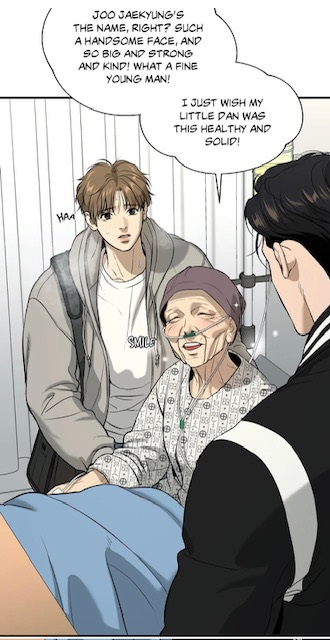 (chapter 21) He had never been healthy and strong. Moreover, when he joined them, at no moment the senior asked if he had gone to the doctor, though he had been sick before.
  (chapter 21) But back then, the champion didn’t pay too much attention to it. In my opinion, her response will likely reflect her established pattern of emotional detachment and deflection of responsibility. Rather than admitting her lack of concern for his well-being, she may shift blame onto the staff or Kim Dan himself
  (chapter 57). In the last case, she will downplay the severity of his condition, insisting that he has always been stubborn and independent. She could even mention her conversation, when she tried to convince Kim Dan to return to Seoul, but the latter refused to listen to her.
 (chapter 5), or his general reluctance to ask for help. He rejected the athlete’s help and concern.
 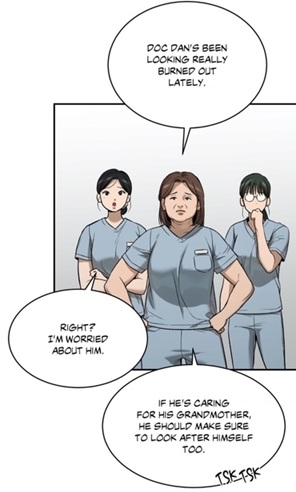 (chapter 57). She blamed the main lead, because she imagined that Shin Okja would worry about him. However, it becomes clear that the halmoni is not worried about her grandson at all. She is acting like a fan in front of the athlete.
  (chapter 61) One might argue that based on this scene, the grandmother didn’t see him with the bruise on his arm.
  (chapter 61) He only remained at the door. However, observe that there was a cut between this image
 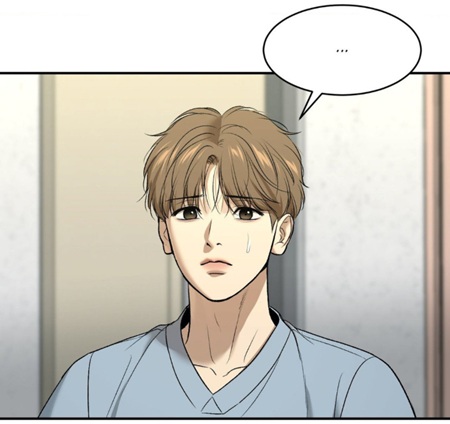 (chapter 61) and the conversation between the main couple in front of the hospice.
 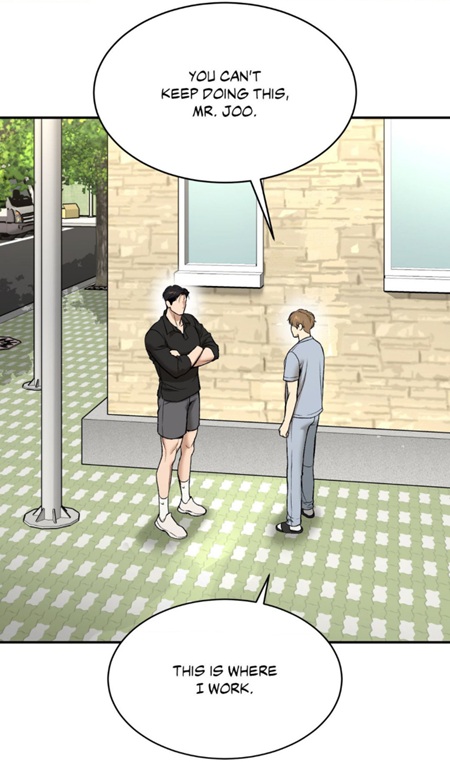 (chapter 61) So he could have made his presence known to his relative before asking Joo Jaekyung to follow him because of his treatment. To conclude, I believe that she had the time and occasion to see her grandchild and his bruise.
 (chapter 13) He is the only doctor who has ever examined the protagonist so closely and even paid attention to his fingernails!
  (chapter 13) At the same time, the chingu from the club was the first one pointing out that his wounds were never treated!! Furthermore, I realized that the doctor’s lies from episode 11
 (chapter 13) The latter was the cause for the severe exhaustion. However, like mentioned above, the doctor is not blameless either, because he never questioned why his wounds on the hand were bleeding again.
  (chapter 43) He thought, it was related to the massage, yet the reality was that this incident showed that he had coagulation issues. To conclude, all the bruises could have always been noticed by people due to their locations (eyes, hands, arm)!
  (chapter 61) and his relationship with Joo Jaekyung.
  (chapter 56) His arrival stands for novelty and a breath of fresh air at the institution. However, with this change, the female staff is forgetting their original duty: they need to pay attention to their colleagues. They are behaving like the grandmother
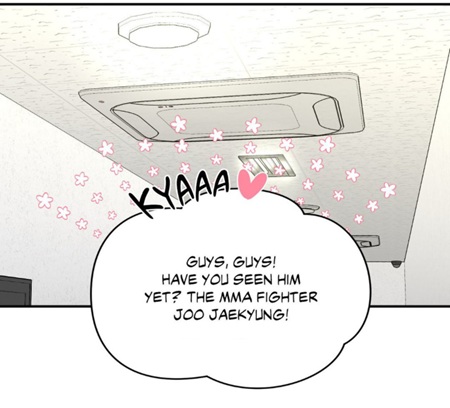 (chapter 61): fangirling over the handsome guys visiting their little town. That’s why Mingwa drew flowers in the last two images. No wonder why no one around Kim Dan is observing the bruise and his deteriorating condition. Moreover, since the physical therapist has a relative at the hospice, the staff is envisioning that Shin Okja is doing “her work”, she is paying attention to Kim Dan’s mental and physical conditions. On the other hand, there is no doubt that the grandmother has already delegated her own responsibility onto others, Kim Dan and the hospice. It is a medical institution, therefore they should pay attention to his working conditions. In other words, since no one feels responsible for the protagonist’s health, no one is worried about Kim Dan at all. At the end of episode 61, he is even so pale and breathless
 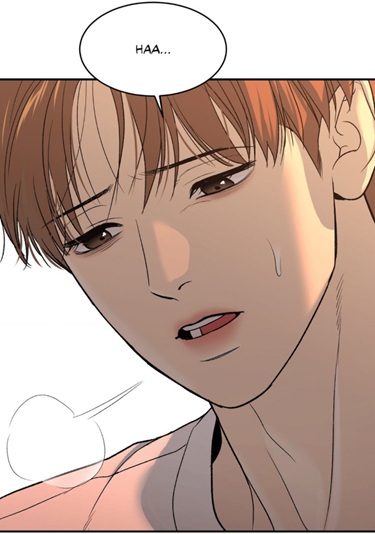 (chapter 61) that I am anticipating a terrible incident leading to a rude awakening for everyone.
 (chapter 47) For Shin Okja, raising him to adulthood marked the completion of her duty, and his current struggles are no longer her concern. This perspective becomes evident in her words from Chapter 57, where she tells him, he can’t stay here forever, and it’s not like he’ll stick around after she dies.
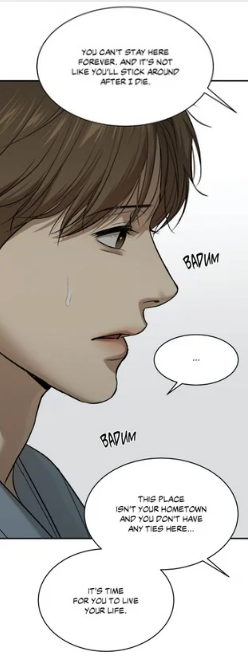 (chapter 57) By declaring that Kim Dan is now responsible for his own life, she emotionally detaches herself, absolving herself of any accountability for his deteriorating condition. However, she is forgetting
  (chapter 56) that she is still relying on him, as he is the one paying her hospice bills. Besides, she still doesn’t know that the loan is no longer existent. It was, as if he had to clean up her mess before her death. At no moment, she asks about the loan or the doctor’s future. She is not thinking about his future at all.
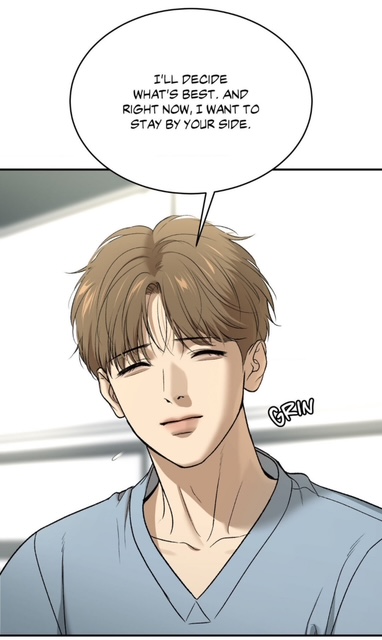 (chapter 57) — reinforces her conviction that she has fulfilled her role. In her mind, his rejection of her advice places the burden of care entirely on him, allowing her to dismiss any further involvement. This emotional withdrawal directly connects to the symbolism of the bruise:
  (chapter 18) In episode 18, when Joo Jaekyung confronts Kim Dan about the loan, the doctor has a bruise on his left eye, symbolizing his entrapment and helplessness. This earlier injury highlights how Kim Dan has been conditioned to view himself as responsible for burdens that are not his own, perpetuating a cycle of sacrifice and self-neglect. And a new bruise appeared just after the athlete reminded the physical therapist of his past promise:
  (chapter 61) His grandmother’s disregard for his well-being amplifies the injustice of this situation; she allowed him to shoulder the debt despite knowing it was never truly his to bear. The bruise becomes a recurring motif, a visual representation of how others have imposed their responsibilities on Kim Dan, leaving him physically and emotionally scarred.
  (chapter 60). The juxtaposition of the vibrant environment with Kim Dan’s deteriorating health underscores the neglect he faces. The hospice is meant to be a sanctuary, yet it becomes a space where Kim Dan is further burdened by the champion and his grandmother’s expectations
 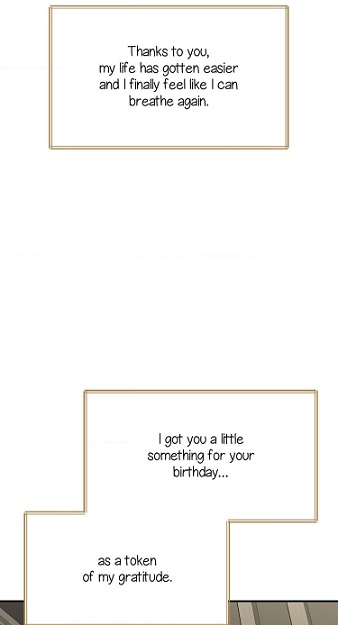 (chapter 55) This line “I finally feel like I can breathe again”, written by Kim Dan, reveals a subconscious acknowledgment that his relationship with the champion represents a breath of fresh air, a chance to escape the suffocating expectations and burdens he has carried for so long. The bruise, a physical manifestation of his struggle, signals the breaking point of his role as a selfless caregiver. It challenges the illusion of invulnerability that Kim Dan has maintained and forces those around him to confront his vulnerability.
 (chapter 60) The beach, with its open and untamed expanse, symbolizes freedom and a return to the self. It foreshadows that Kim Dan’s true journey toward healing will require him to step outside the roles and confines imposed upon him, finding solace not in what is expected but in what feels authentic and liberating.
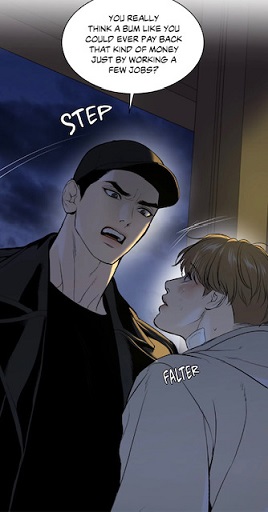 (chapter 18) His grandmother, Shin Okja, played a significant role in this mindset by fostering the illusion that hard work and sacrifice would erase the debts. However, as revealed in episode 18, this was a lie. Shin Okja made the choice to take on the loan and not to seek help
 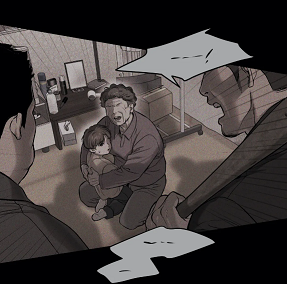 (chapter 5), yet she burdened Kim Dan with it, using his sense of duty and gratitude against him. Her statement in episode 57
  (chapter 18) —or, more accurately, the lack thereof. The champion’s actions were motivated by a desire to help
  (chapter 18), hence the star was waiting for a smile from Kim Dan. Yet the latter perceived it as meddling. His immediate response
  (chapter 53), leaving a note when he moved out that promises to settle the debt. However, by Episode 61, Kim Dan is no longer mentioning the debt, signaling a shift in his priorities and a possible breaking point in his adherence to his grandmother’s expectations.
 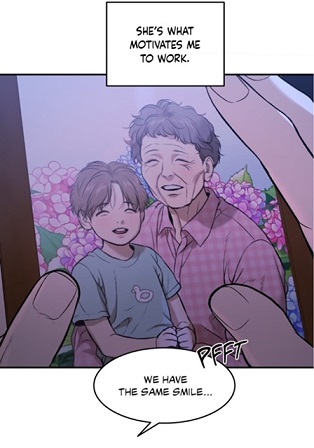 (chapter 47) The physical therapist’s entire existence had revolved around fulfilling her needs, from managing the debt to taking care of her health. With her now approaching death and actively pushing him away, Kim Dan is left grappling with a profound sense of meaninglessness.
  (chapter 60) He had never been given the opportunity to develop dreams or ambitions of his own, as his life was entirely defined by his grandmother’s circumstances. This lack of agency further explains his rejection of Joo Jaekyung’s generosity in Episode 18 and his later promise to reimburse the loan. Clinging to this promise was Kim Dan’s way of creating purpose and meaning in a life that had otherwise been dictated by others. It highlights how deeply entrenched his self-sacrificing tendencies are, as even his attempts to assert independence are rooted in his conditioned need to serve others. That’s why I come to the following prediction. Kim Dan needs to get confronted with illness and death (he could lose his life) so that his will for life comes to the surface. Right now, he imagines that since he is young, he will outlive his relative, but the death of the puppy was a warning to him that youth is no guarantee for a long life.
  (chapter 59) Death can take away anyone and at any moment. In my eyes, if Joo Jaekyung uses his own body to save the doctor again (like for example blood transfusion and CPR), this time Kim Dan would feel truly grateful towards the champion. So far, the doctor has not recognized the star as his savior yet. By removing the needle, he denied the protagonist’s intervention on the beach:
  (chapter 60) Hence his arm got bruised. The contusion was a reminder that something had happened during that night, but Kim Dan chose to ignore the incident. He never questioned why he was on the beach, he acted, as if Joo JAekyung had lied.
  (chapter 60)
 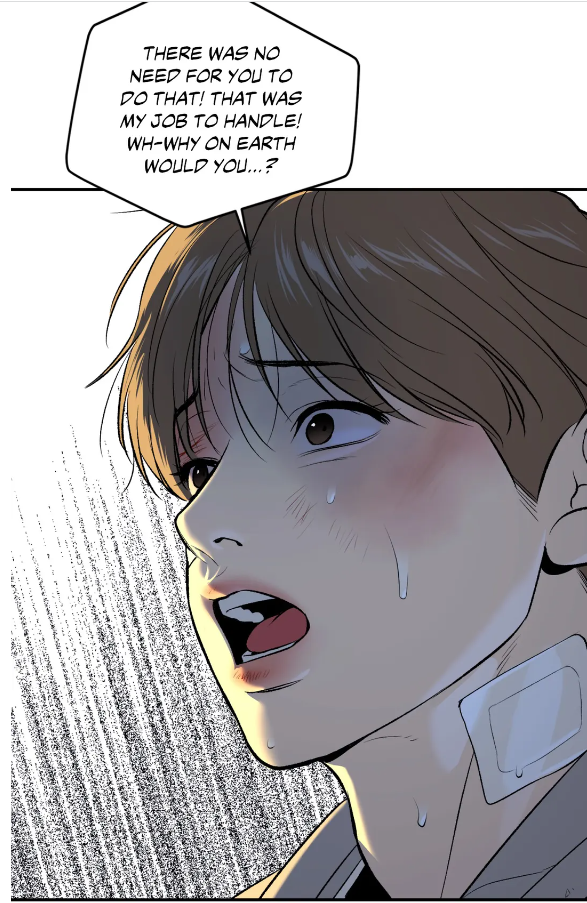 (chapter 18) Deep down, Kim Dan knows that the debt was never truly his responsibility, making it difficult for him to view the champion’s actions as a genuine act of kindness. This inner conflict is compounded by his suicidal disposition, which renders the concept of repaying the debt meaningless.
 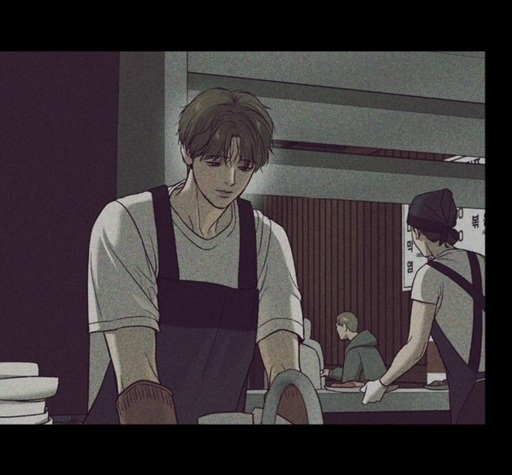 (chapter 59) He worked so hard, was even beaten, but he could never voice his torment.
 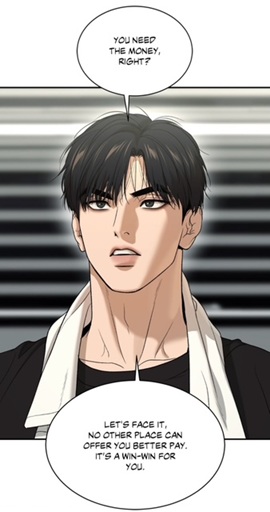 (chapter 60)
  (chapter 11) and even uses his own words against him:
  (chapter 22) The loan was the result of his grandmother’s decision. He never helped him, rather his grandmother.
  (chapter 11) However, he never explained his circumstances to the generous athlete. By keeping him in the dark, he reinforced his negative disposition about the doctor. And chapter 61 exposes this reality. His suffering was the result of his own decision.
 (chapter 61) Do you recognize the room? That was the doctor’s
  (chapter 19)
  (chapter 53) His decision to allow Joo Jaekyung into his bedroom in episode 61 demonstrates that he consented to the relationship, even if begrudgingly.
 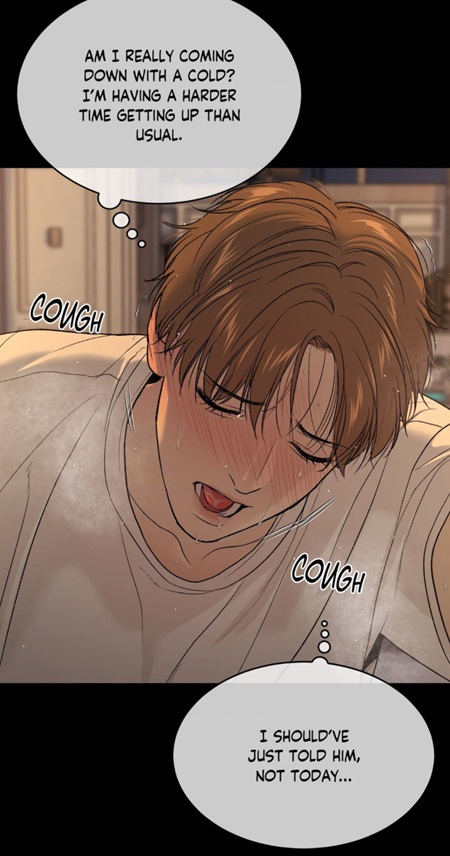 (chapter 61) However, his reaction afterward (regret) suggests that he struggles to take ownership of his choices. The fact that he recalled this sex scene in the restroom divulges a certain resent towards the athlete. The latter abandoned him right after their interaction. Hence I come to the following deduction. In reality, he is projecting his frustrations onto Joo Jaekyung, masking his true feelings about his grandmother, who is the root cause of his conditioned self-sacrifice. And this observation brings to my next remark. People wondered when this intercourse took place. One might think that this took place rather early in the story because of the way Joo Jaekyung acted. He didn’t remove his pants
  (chapter 6) or 8
  (chapter 8) where he would abandon the protagonist right after the climax and not care about his partner’s conditions and feelings:
 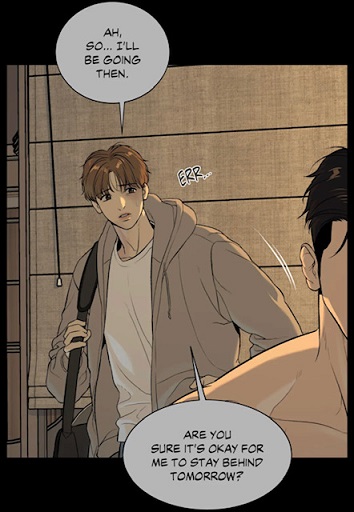 (chapter 13) Since the doctor mentioned that a match was right around the corner
  (chapter 61) It leaves us four possibilities. Randy Booker, Dominic Hill, Alfredo
  (chapter 47) and Baek Junmin. However, for the intercourse took place in the doctor’s bedroom (he wished to be carried to his own bed)
  (chapter 36), for they had sex every day. However, in episode 53, we discover their night before the match against the Shotgun
 (chapter 53) So this scene can only have taken place in chapter 47, when the match with Angelo got canceled and Kim Dan had been confronted with the terrible news about his terminally ill grandmother.
  (chapter 47) In the previous part of this essay, my avid readers could see the strong parallels between 61 and 47. But there exists another reason why I am inclining to think that the sex scene took place later in the story. It is because during that “magical night” (44), Kim Dan learned the notion of “consent”.
 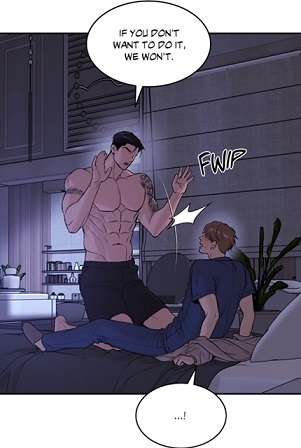 (chapter 44) During that blue hour, Kim Dan discovered that he could say no! And notice that in his memory, he clearly thought that he could have rejected the athlete’s advances.
  (chapter 46) He should mistrust the members from the gym and keep his distance from people. So during that time, Joo Jaekyung did follow his hyung’s advice
  (chapter 47), yet I can’t imagine that this man could become abstinent like in episode 19. Hence at some point, he must have felt the urge to possess Kim Dan, a mixture of fear and dominance. He imagined that way that he could impose his will onto the doctor and control his “loyalty”. With this submission, he would force the doctor to remain by his side. But naturally, this sex as “power play” could increase the gap between the main leads.
 (chapter 53) doc Dan was copying the champion’s behavior from episode 61. Right after the sex, he would leave the bed and return to his bedroom. How did Joo Jaekyung recall this night?
 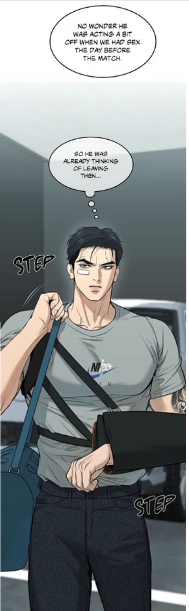 (chapter 53) He saw his attitude as a sign of disloyalty and “abandonment”. And that’s how Kim Dan is feeling in the restroom:
  (chapter 61) The darkness around the eyes is a metaphor for his resent and anger. And the moment you contrast the two memories (53 and 61), you can detect the hypocrisy of the two main leads. They only recall scenes where they were hurt and felt betrayed. However, in reality, they were both victims and perpetrators, because none of them chose to open up and talk to each other. Why? It is because both chose to listen to their “guardian” and their “favor”. Like mentioned before, in a quarrel, no one is right and wrong. The purpose of an argument is to listen to the counterpart and view incidents from their perspective. Finally, the physical therapist’s recollection serves as an important evidence that he had never been powerless and helpless. He could have refused all the time because their deal was never official.He could have used the contract as a shield. But the best evidence of Kim Dan’s power is this rejection:
  (chapter 61) I had already pointed out the increasing resistance and resilience from Kim Dan in episode 60:
 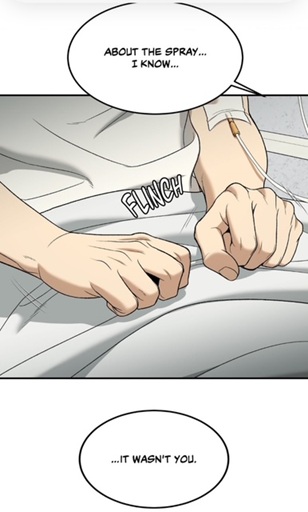 (chapter 61) My prediction came true. In the past, he could have denied the existence of the deal, Joo Jaekyung was free to seek another physical therapist. He never realized that he had some leverage. Yet he still followed the athlete’s requests. He saw himself bound by obligations. However, this was just an illusion. Hence in episode 61, we see him legitimating his consent that there was an imminent fight.
  (chapter 40) He is paid to receive bruises, to push his body past its limits
 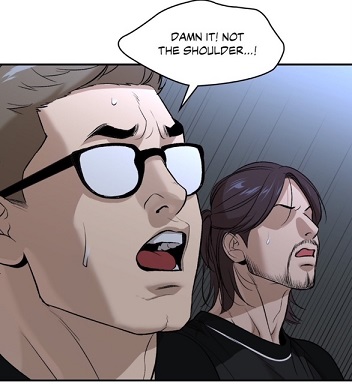 (chapter 50), to endure pain while the public watches and profits are made. His suffering is entertainment, a spectacle that fuels the business of MMA. Though he is a champion, he is still a commodity, expected to perform regardless of his condition.
  (chapter 61) He understands, better than anyone, what it means to be physically used for the sake of others, yet he remains blind to the fact that he has placed Kim Dan in the same position. While one has no file about his health condition, the other has many files, but they are not studied, because this would push the manager to question his decision and even ruin the business:
 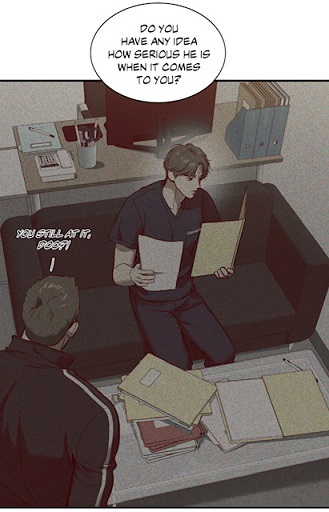 (chapter 17) I doubt that Park Namwook studied them, and notice that the recently hired PT didn’t ask for the champion’s files first:
  (chapter 54) Thus I deduce that the champion’s files are in reality a subterfuge. They give the impression that the doctors and Park Namwook truly care for his well-being, but it is not correct. They are only interested in his body because of wealth and reputation. But let’s return our attention to episode 61 and the champion’s attitude towards Kim Dan.
 (chapter 57) is another manifestation of his conditioned role as a caregiver. By living with an older man, he creates the illusion of a familial bond, mirroring the dynamic he shared with his grandmother. This decision highlights his struggle to break free from the identity imposed on him—one defined by servitude and selflessness. He assumes that he should take care of the landlord, offering to cook and expressing guilt for not fulfilling this perceived duty. Yet, the landlord subtly challenges this narrative. By inviting Kim Dan to eat breakfast
 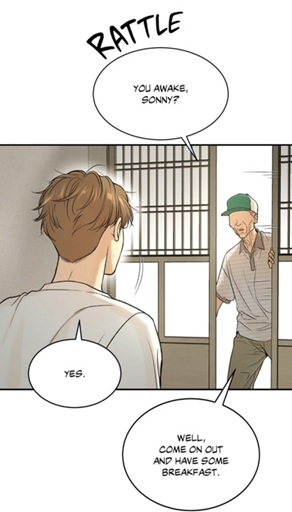 (chapter 57) and dismissing his apologies, the landlord treats him as an equal rather than a caretaker. This dynamic forces Kim Dan to confront his false perception of himself.
 (chapter 57) Despite this, Kim Dan rejects the advice, demonstrating his resistance to being cared for. This moment underscores his internal conflict—he craves independence yet clings to the role of the selfless provider. The landlord’s actions expose the fallacy of Kim Dan’s identity, revealing that his caregiving is not always necessary or effective.
 (chapter 61) is indicating the increasing resent and anger towards the star. Joo Jaekyung is no longer seen as a celebrity and idol, but as a inconsiderate man. This transformation is subtle but meaningful, as it reflects his burgeoning awareness of his own worth and the unjust treatment he has endured. For the first time, Kim Dan acknowledges himself as pitiful
  (chapter 53)
  (chapter 61), no longer bound by the roles others have imposed on him but shaped by his own choices and growing self-respect.
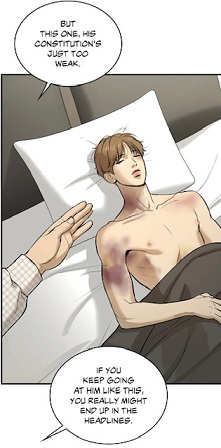 (chapter 13) and the fragility of Kim Dan’s existence. For Kim Dan, it challenges his self-perception as an indestructible caregiver. This realization could lead him to an inevitable conclusion: his own needs and well-being are just as important as those of others.

 (chapter 46) On the other hand, chapter 47 exposes that the doctor didn’t lose his interest and attention towards his boss.
  (chapter 31) It is because when the psychologist met the patient with her boyfriend for the first time, he paid attention to his micro-expressions, and more particularly to his mouth. He saw his smirk. Here, I feel the need to give an explanation how these micro-expressions were discovered.
 (chapter 30) As my avid readers can detect, the expression from the boyfriend’s mouth displeased the white-haired psychologist. He could recognize his emotion, though such facial expressions are very short-lived
 .(chapter 30) So what was the “jerk” feeling, when he was conversing with Sihyun? Cynicism.
  (chapter 31) And the reason why he stated that as soon as cynicism or scorn was present in a relationship, the couple would end up breaking up is because of John Gottham’s observations and conclusions.
 (chapter 45) We could sense it in different scenes, though I would say that his cynicism was slowly vanishing:
  (chapter 3)
 (chapter 40) This is the so-called toxic negativity. Therefore it was to expect that the champion would reject the doctor’s present. He could only doubt the sincerity behind his gesture. How so? Remember how the team desired to celebrate his birthday: a surprise party. They bought a cake…
  (chapter 45) He is not ready yet. But was it Cynicism exactly and how does it represent a hindrance for a healthy relationship?
 (chapter 7) This approach also gives us an explanation how Joo Jaekyung came to develop such an exhibitionistic sexual behavior: sex in the shower room
 (chapter 8), in the office, in the car, in front of a mirror, in front of Heesung in the living room… Don’t forget that Diogenes would even masturbate in public.
  (chapter 46)
  (chapter 46) Consequently, he never tried to get close to his members either. In fact, he is expecting from the staff to follow his lead. Potato could only get rejected with such a request.
  (chapter 23) The latter had to act like a true disciple and follow the champion’s recommendation.
  (chapter 23) The gym is like his sacred temple. Yet, the gym is just a simulacre of “nature”, as it is in the middle of Seoul. Therefore I realized why after their argument, Joo Jaekyung avoided the penthouse and Kim Dan in the end.
 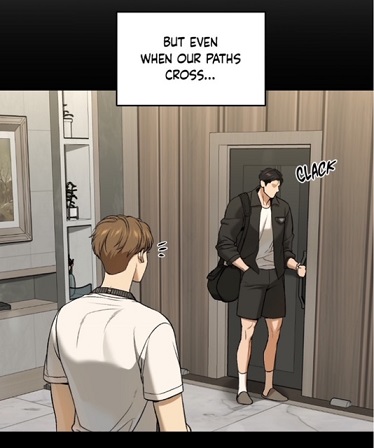 (chapter 47) It is because deep down, the champion sensed that his flat had become a home. He wanted to ensure that the penthouse was still a workplace or a hotel room. Thus he refused to eat the breakfasts prepared from his PT. In his eyes, these meals must have appeared as a violation of his self-imposed discipline. It was more than self-sufficiency. Under this new light, Jinx-philes can grasp why he rejects presents and prefers donating money.
 (chapter 41) He is looking for freedom and self-sufficiency, detached from any material need. This explains why the golden keychain from Kim Dan could only offend him.
  (chapter 45) It symbolized everything he hates: a reminder of wealth, superficiality, attachment, secrecy and silence. It also exposed the huge difference in their mind-set. Kim Dan is not his disciple! He imagined that he had found a kindred spirit, especially after that night:
  (chapter 39) The reason is simple. The champion had finally found someone who accepted his roughness in bed and could match his stamina.
  (chapter 10) He is not resigning on designer clothes.
  (chapter 42) His dress room is the evidence of his hypocrisy. He might have encouraged Kim Dan to have sex in “public places”, yet he is still hiding his sexual orientation. Furthermore, his jinx is the evidence of his dishonesty.
  (chapter 45) He might advocate autonomy and self-sufficiency, the reality is that he likes luxury. Hence he is unable to live in harmony with nature. This shows that the fighter is in denial and is living in an illusion. Thus he can not find true happiness, for his freedom is not real. He is attached to the gym which is also strongly connected to his career as the Emperor.
  No one can survive on his own. This explicates why Cynics had disciples in the end. And now, you comprehend the role of Kim Dan in Joo Jaekyung’s life. It is to remind him of his true nature. He is a human and not a dog-wolf. Thus the champion recommended his PT to live elsewhere, a sign that he was indeed a human.
  (chapter 10)
 (chapter 2) This explicates why the champion was crossing his arms while confronting the goblin. He was on the defensive. That’s how it dawned on me why the celebrity fell in love with Kim Dan at first sight, and why he enjoyed their first night together. The “hamster’s fear” was genuine. His desertion displayed respect towards the celebrity. He was recognizing his strength and power.
 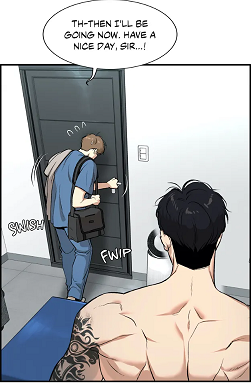 (chapter 1) Then the micro-expressions from Kim Dan exposed his lie
 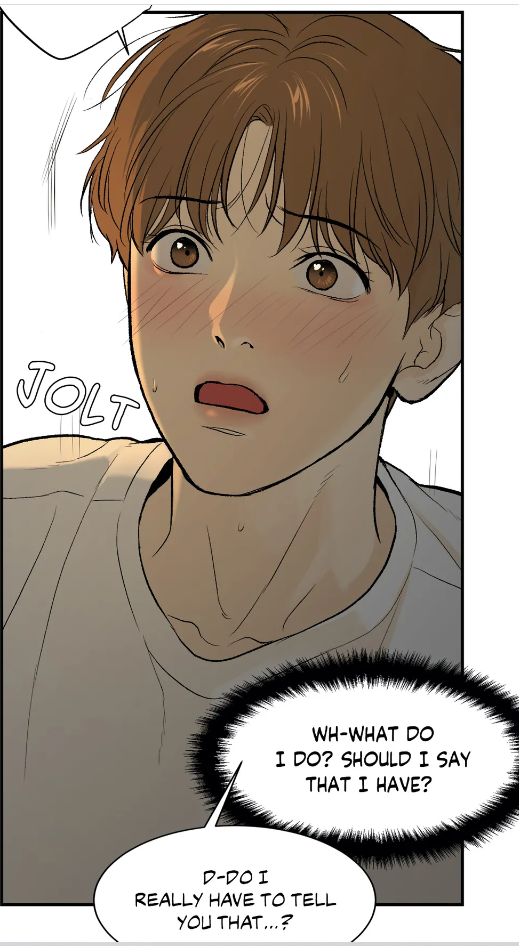 (chapter 3) On the one hand, the champion’s worldview about humans got reinforced, on the other hand the doctor’s deception symbolized his purity. He was a virgin, which was contradicting his “theory” too.
 (chapter 11) He even looked like a ruler abusing his authority.
  (chapter 11)
  (chapter 33) or even the idea of friendship
  (chapter 30) Heesung was not just taking advantage of his reputation, he was also teasing the sportsman. Joo Jaekyung has such a negative perception of humans.
  (chapter 10): Gamblers, laziness, no sense of hygiene etc. Consequently, he is not capable to understand the worries from Kim Dan
 (chapter 42), Park Namwook
  (chapter 46) and Jeon Yosep. He feels like they are questioning his success. It was, as if they had other motives. He only relies on himself, he is not “truly” listening to others… though it is not correct. He is getting manipulated by his “counselors”.
 (chapter 36)
 (chapter 2)
 (chapter 26) He is standing in front of a dilemma. Fighting is the expression of nature and self-reliance, yet his fights serve as entertainment for MMA lovers. MMA is strongly intertwined with business and money.
 (chapter 45) was showing the doctor’s golden heart. He was just judging his lover based on his past experiences and his negative worldview. And this brings me to list the cause for Cynicism:
 (chapter 45) He fears to be taken advantage. There is no ambiguity that his negative mind-set is definitely influenced by his childhood and family. I would even say that he must have been exposed to emotional blackmail. I came to this hypothesis, because I detected that the champion had been using “blackmail” as MO in order to control Kim Dan.
  (chapter 2) He learned through Cheolmin that he could kill him. This shows his good nature in verity. Hence he resorted to such gestures, when his cynical depression resurfaced:
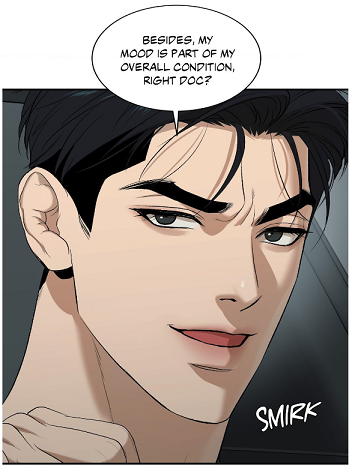 (chapter 32)
  (chapter 37)
  (chapter 45) As you can see, little by little, the champion is learning to control his rage and “cynicism”. During the last argument, he didn’t touch the physical therapist at all. He still allows him to stay at his place and he is shown as caring later.
 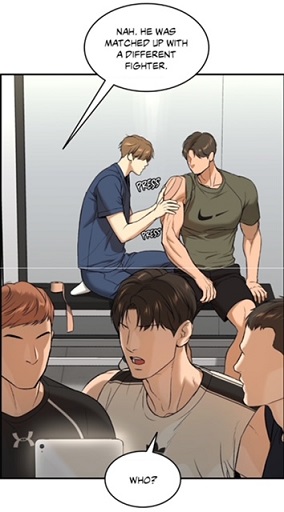 (chapter 47) It shows a certain trust. One might argue about this interpretation. This could be seen as indifference. However, I believe that his altercation with Seonho must have been quite an eye-opening for the champion.
 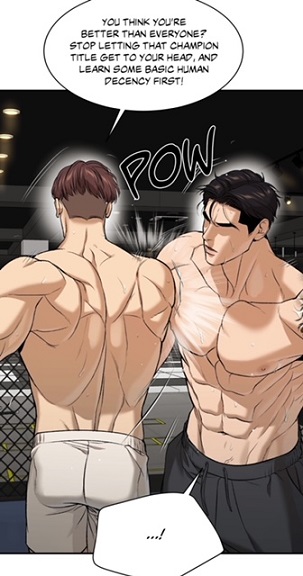 (chapter 46) It is because Kim Dan had not talked back to Joo Jaekyung during their argument. He had accepted his criticism silently contrary to Seonho. Right now, he has the impression that he still has the upper hand, but he couldn’t be more wrong.
  (chapter 26) He has the impression that he can control people, since he is wealthy. Yet, he is not realizing that he can get stabbed because of money as well. We have two perfect examples. Because of the drug incident, the MFC security guys betrayed him, as they protected the organization
 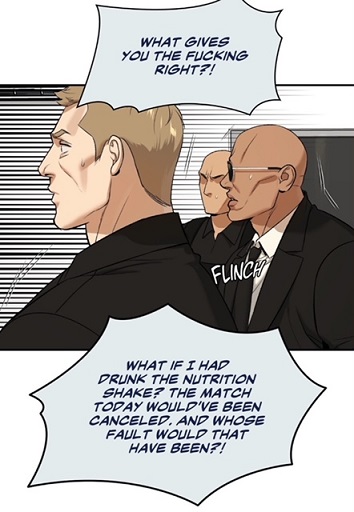 (chapter 40) Then in episode 47, the emperor got manipulated by his so-called loyal advisors.
  (chapter 47) First, I would like to outline that neither the manager from the Entertainment agency nor his acolyte brought up the underground fighting ring and Baek Junmin’s dubious success.
  (chapter 47) With their video, they presented him as an average and reliable fighter.
  (chapter 47) Observe the divergence between the advisors’ words and the members’ from Team Black.
  (chapter 21) Moreover, the grandmother’s mortality could serve as a reminder for the champion that he is also a human… just like the others he condemns. Besides, she embodies true selflessness and gratitude. Hence she took the champion’s hand to thank him
 (chapter 41) He never heard her recognition. In addition, until now, Kim Dan spoke in the name of others or didn’t defend his own point. Team Black’s loyalty would be the evidence that it is dangerous to judge people based on prejudices and past experiences. He needs to reflect on his own actions as well. If the Emperor heard “his members”, he would realize that MFC as an organization is corrupted and is even involved with criminality. He is already sensing something, but he can not identify the problem.
 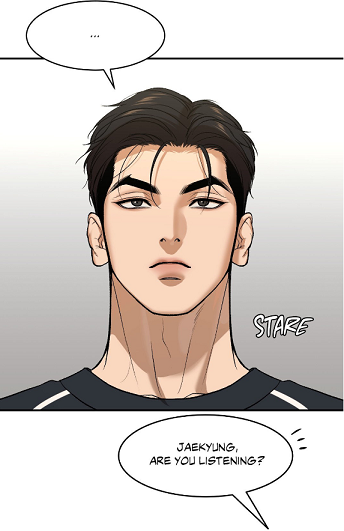 (chapter 47) Should Kim Dan divulge Baek Junmin’s connections to the underground fighting ring or simply show him the message,
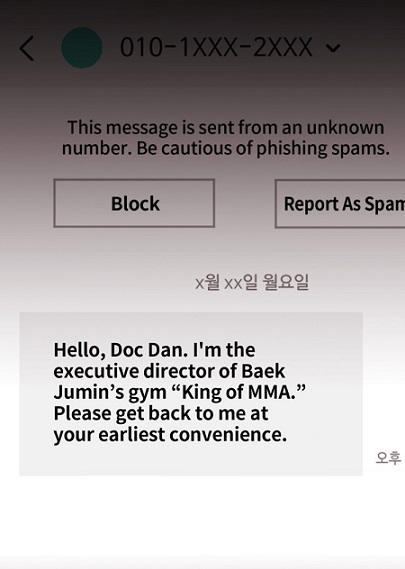 (chapter 47), he would prove his faithfulness and sincerity to the fighter. And the vicious circle would be broken. Though he is broke, he would give up on an opportunity to earn some money easily. To conclude, as long as the champion is still a cynical character, he can not enter a relationship with Kim Dan. For that, he needs to open up his heart and third eye so that he can recognize his partner’s selflessness and honesty. Finally, he will realize that he needs the assistance of others in order to be able to keep his reputation intact (witnesses, supporters). There is no doubt that the Emperor will be badmouthed again.
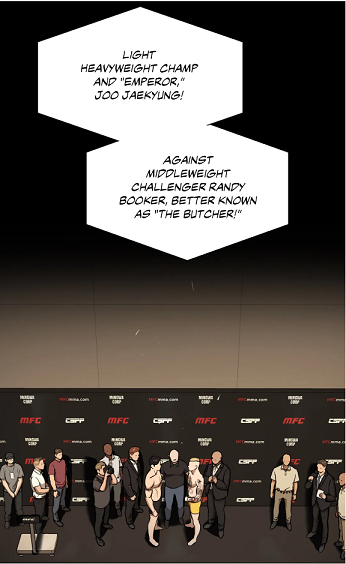 (chapter 14) On the other hand, some readers might wonder why I am connecting Kim Dan to princess (Prince S). I have many reasons for this association.
 (chapter 30) This woman, named Sihyun, is suffering from Dependent Personality Disorder. And the author of the Webtoon Doctor Frost called her story: “The tears of Princess Pyeonggang”. Due to her personality, she was linked to the famous “princess”. She would do everything for her companions, yet she kept getting dumped. What caught my attention is that both women defined themselves through their partner. Their ultimate goal in life is to assist them, to make the other happy or recognized. But how is it a problem?
 (chapter 33) What appeared as caring turned out to be a load, for the partners were all forced to be responsible for her and in every aspect of her life. They definitely felt asphyxiated, hence they could only get sick of her. Interesting is that this person would find shortly after the separation a new boyfriend, a sign that she could not live on her own.
  (chapter 33) And now, you are wondering how Sihyun is similar to Kim Dan, who only had one person in his life before he met the champion. It is related to traumas in their childhood.

 (Doctor Frost, chapter 39) After reading this, Jinx-philes can realize that Kim Dan is also suffering from Dependent Personality Disorder, though it is less obvious. He got abandoned by his parents making him feel insecure.
 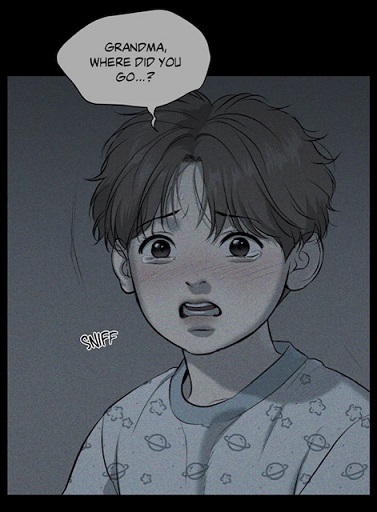 (chapter 21) We could detect his low self-esteem
 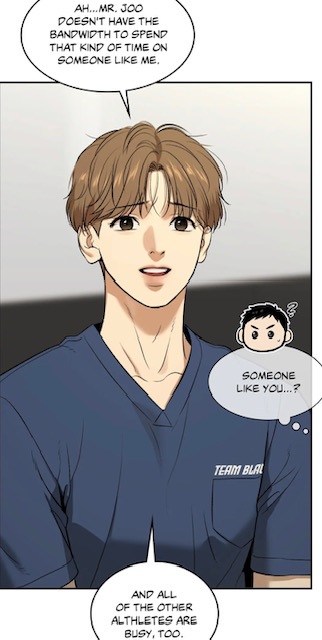 (chapter 25)
  (chapter 46) and his overprotectiveness
 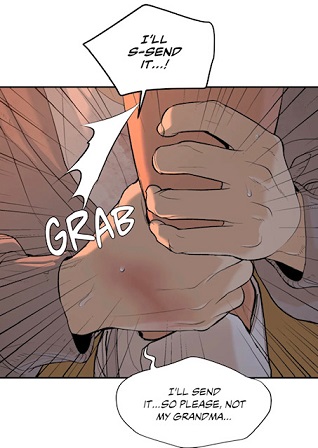 (chapter 16)
  (chapter 26)
  (chapter 42) and before it was by his halmoni’s fate.
  (chapter 19) However, here please don’t get me wrong. For me, the athlete is the physical therapist’s emancipator. This huge argument in the dining room pushed him to differentiate himself from the champion. In my eyes, Kim Dan would have returned to his old bad habits… relying on someone else, sacrificing himself for someone’s else sake. He would have neglected his career in the end.
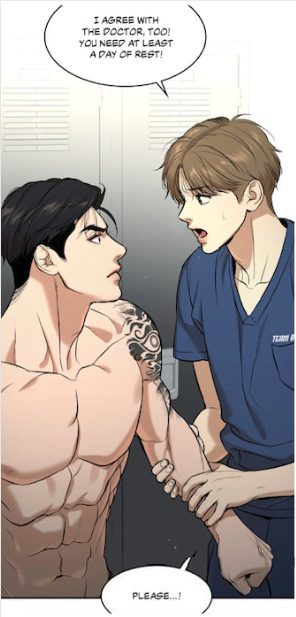 (chapter 27)
  (chapter 31) Here, we get an explanation why he couldn’t detect the trick from Choi Heesung. He feared to make a diagnosis on his own, as he didn’t desire to question the words from the comedian. The hospital seems to be the sacred place in the doctor’s eyes.
 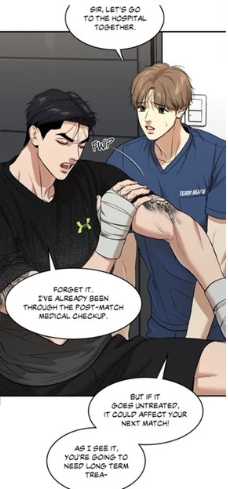 (chapter 41) There, nothing can go wrong. But by entrusting his patients to hospitals, he didn’t realize that he was appearing as untrustworthy or even “incompetent”. His lack of confidence and hesitation explicate why the athlete replied to his suggestion like this:
  (chapter 41) How could he question the doctor from MFC, when he kept hiding behind a hospital or the words from other physicians? That’s how the physical therapist got silenced. He couldn’t confront the athlete with his diagnosis. Interesting is that he never gave him the file later!
  (chapter 42) Consequently, it is not surprising why the champion complained about the doctor’s negligence. The latter was avoiding any responsibility in the end. On the other hand, the report is the symbol of his hard work, but also of his knowledge. That’s the reason why I am still considering the dispute in chapter 45 as a good omen for the physical therapist. He needs to develop his own identity. They are two different people. He needs to live for himself, to give a meaning to his life and not:
  (chapter 27) That’s how it dawned on me why the doctor reverted to his old habits (not participating to the meeting, taking odd jobs, not voicing his own judgment, relying on others) after the night, when he was treated as sex toy. However, in my eyes, the trigger for this switch was the release of the tabloid article.
  (chapter 35). Why did the doctor appear so confident in front of his client to the point that he could reject his hand after going to the hospital?
  (chapter 27) It is because his self-esteem had been boosted by Dr. Lee. The latter had complimented him which didn’t fall on deaf ears. However, the relationship between the respectable hospital and the athlete went sour due to his article.
 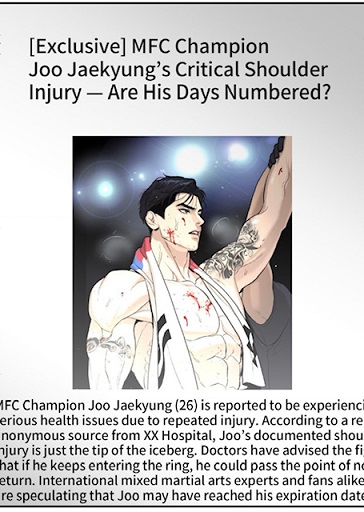 (chapter 35) Imagine what it meant for Kim Dan. He could only remain passive, as he is called “doctor”. He views himself as a member from the medical field. Furthermore, observe what the sports therapist told him during the treatment session:
 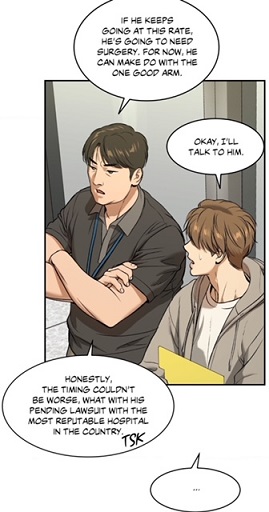 (chapter 42) He mentioned the lawsuit against the most reputable hospital. The dispute could only diminish his self-esteem. As time passed on, there is no ambiguity that this lawsuit must have burdened more and more the physical therapist. Besides, there is no doubt that he felt some loyalty towards doctor Lee who had been complimenting him. Secondly, let’s not forget that despite his “efforts”, he had not been able to convince his patient to stop training for one day.
 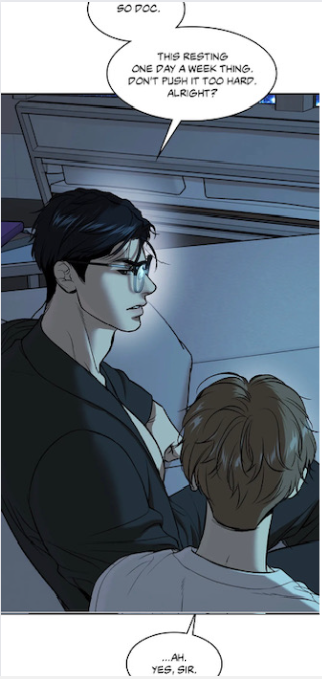 (chapter 29) Hence he jumped to the conclusion that his patient would not listen to him anyway.
  (chapter 46) This is not surprising that Mingwa zoomed on his feet.
  (chapter 46) It is full of symbolism. For the first time, he is standing on his own feet. His walk in direction to the trash bin illustrates his choice.
 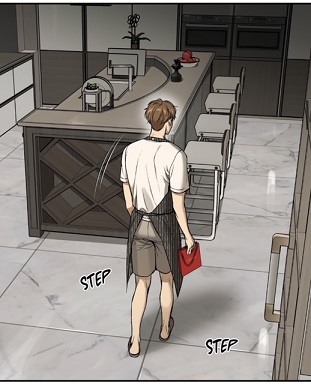 (chapter 46) Besides, he is using the personal pronoun “I”.
  (chapter 46) It is his Coming-Of-Age. He is on the verge to become independent. On the other hand, he didn’t fight back verbally against his boss. He accepted his reproach.
  (chapter 46) He was just a physical therapist and nothing more. This shows his lack of criticism. He is still not mentally strong enough to question the champion’s words and argue back. In the past, he could do it, for he was identifying himself with his grandmother and her values.
  (chapter 42) The latter was also dependent on the champion, but his “addiction” was money and not love or recognition. Therefore he picked up the money before leaving the flat
 (chapter 2), while the other threw away the expensive keychain
  (chapter 46). This scene exposes the return of Kim Dan’s dignity. This comparison reinforces my interpretation that the champion misjudged the doctor’s present and actions. He imagined that Kim Dan had been acting like his “previous sex-partners” or stans. They would offer him some gifts in exchange of favors. Another contrast with the goblin is the absence of a fight and discussion.
 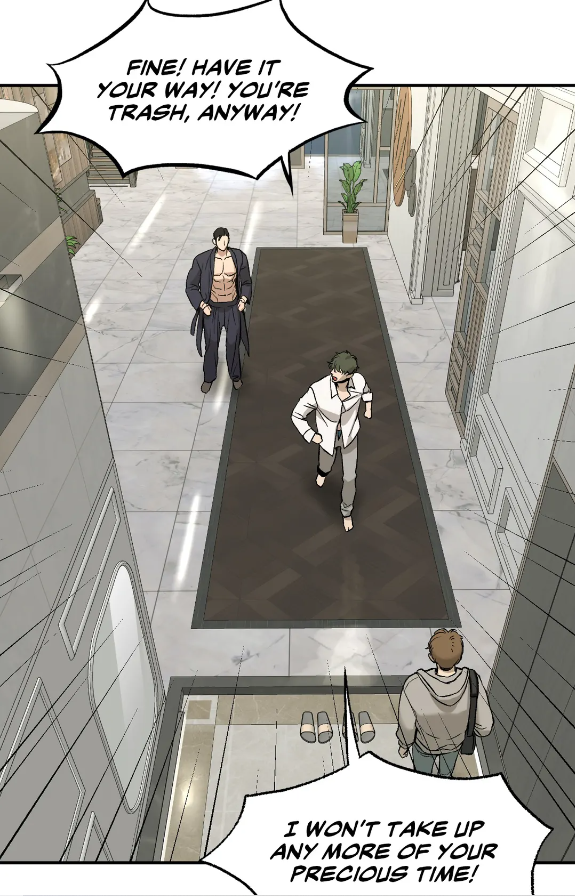 (chapter 2) I would even add that contrary to the green-haired guy, the doctor is not judging his patient’s personality, he is blaming himself.
  (Doctor Frost, chapter 32) Interesting is that doctor Frost revealed to her later that her condition made her an easy target, as she kept relying on others.
  (Doctor Frost, chapter 39) And this observation brings me to my next conclusion: he will be approached by really bad guys, the mysterious Mr. Choi!
  (chapter 1)
  (chapter 1) He even needs to learn the difference between good guy and nice guy, but this remark applies to the grandmother.
  (chapter 21), yet their actions were not truly selfless.
  (chapter 44) He found fulfilment in sex, which stands in opposition to the recommendation of zackbeach. Moreover, I would like to underline that the doctor reduced knowledge to sex:
  (chapter 44) How could he get to know the champion better, when the latter was supposed to be drunk and they would have sex? Getting closer to someone means communication and not really sensuality. Hence his happiness could only be short-lived and illusory. He didn’t take the reality into consideration. Thus I see the physical therapist’s tears as a therapy session:
  (chapter 46) It helps him to face reality. He is on his own, he needs to stop relying on others. I would even say, he is encouraged to make decisions and as such to become responsible for his own life. It is important, because this means that he will have to fight back, if he wants to survive. He can not make any desperate and hasty decisions, like this one:
  (chapter 1) However, since he listened to the champion’s reproach and became submissive again, their relationship seems to have returned to normality. They even appear as close.
  (chapter 41) reminded me of the ending of a fairy tale: they lived happily ever after. But the doctor was forgetting that life doesn’t end after the match in the States. Life ends with death. In verity, the champion is destined to be challenged, until he retires. What the doctor saw was not the end. This exposes his naivety. How could he have such a view? It is influenced by his grandmother.
  (chapter 10) At no moment he pondered about himself. Happiness was never his goal, exactly like in fairy tales. Sleeping Beauty is rather passive. She sleeps, until the prince charming appears and kisses her. After that, they have kids. Interesting is that they don’t get married right away, so that the princess initially has the status of a mistress or concubine. Once the prince can secure his position, he marries her. Then the moment her husband leaves her side for war, she is tormented by her mother-in-law, the ogress. She can only escape death thanks to the intervention of her husband. We could say that happiness fell on her lap. Sleeping Beauty stands for passivity, dependence on her parents and husband and lack of critical thinking. Why? It is because the princess in fairy tales, in particular Sleeping Beauty, embodies toxic positivity.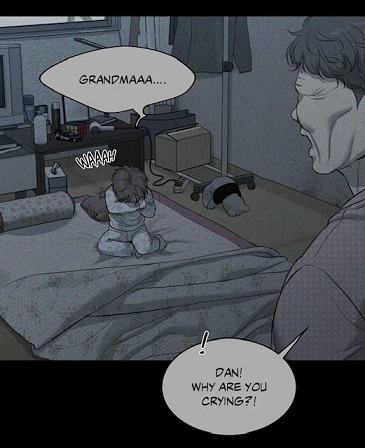
 (chapter 21) She rejected her grandson’s fear and tears. She didn’t allow him to express his abandonment issues. She diminished his anxiety by questioning his behavior: “It’s okay, grandma was just in the kitchen getting a glass of water.” Then in the present, we could use his visit at the hospital:
  (chapter 41) While the halmoni didn’t mention her suffering, the doctor gave expensive gifts to the nurse and his grandmother. He acted, as if money was no longer a problem… as if everything was fine, as if she would recover soon. Yet, he never mentioned his problems with the champion during his stay in the States (no drug incident, the humiliation, the harsh words). He is never voicing his problems to his grandmother. Both are putting smiles on their face. And the moment, I connected Kim Dan to Toxic positivity, I had another revelation. The best example for this negative attitude is actually his own birthday. 😱
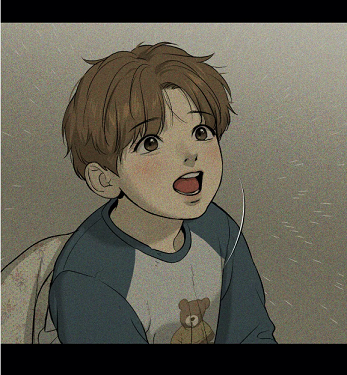
 (chapter 45) With this contrast, the fear from the champion becomes more palpable. Joo Jaekyung got angry, for he had been put in the same situation. But the latter was never influenced by Toxic Positivity. Besides, he was fighting against his own inner demons. Nevertheless, this new interpretation of the birthday made me recognize why the author chose this chronology concerning Kim Dan’s past:


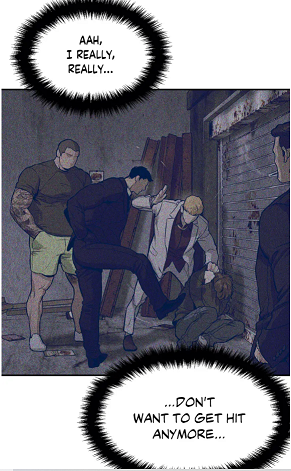 (chapter 1) However, he could never confide to his grandmother about the physical abuse from the loan shark. However, the moment his hope got up
  (chapter 11), as he imagined that he could pay off the debts, he recalled his birthday. He had a nice “souvenir”… convincing himself that everything was fine. He would be able to do it, like his grandmother had told him.
 (chapter 12) Therefore I understand why the doctor didn’t fight back against Heo Manwook and his minions.
  (chapter 1)
  (chapter 11) But the moneylender and his minions are no honest bankers, but criminals. They enjoy using their strength, that makes them feel powerful. It boosts their ego.
