Protected: Painter Of The Night: Guilt and sin (fourth version)
Bebebisous33s' analyses in K-Dramaland and Manhwas
Analyses of K-dramas and Manhwas (for the most part Yaoi)

This is where you can read the manhwas. https://www.lezhinus.com/en/comic/pawn https://www.lezhinus.com/en/comic/painter But be aware that these manhwas are a mature Yaoi, which means, it is about homosexuality with explicit scenes. If you want to read more essays, here is the link to the table of contents of Painter Of The Night: https://bebebisous33analyses.wordpress.com/2020/07/04/table-of-contents-painter-of-the-night/ As for The Pawn’s Revenge, this is where you can read other essays: https://bebebisous33analyses.com/2021/06/06/table-of-contents-of-analyzed-mentioned-manhwas/
Warning: I used the German version Snow White “Schneewittchen” as basis. Hence I translated myself the quotes.
Everything started with this panel: 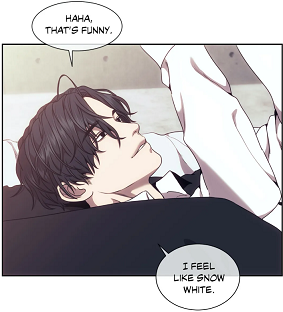 (chapter 22) The protagonist starts viewing himself as the main character from the fairytale Snow White. Hence he comes to the conclusion that since he is Snow White, then there must be a hunter and a witch, the famous stepmother of Snow White.
 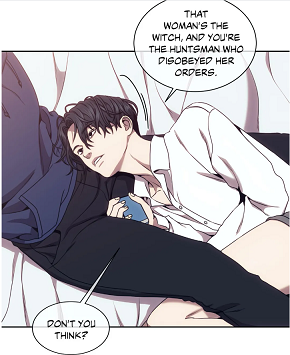 (chapter 22). That’s why he believes that Do Seong-Rok is the huntsman, while Jeon Hee Seong is the witch, because the former didn’t kill him. The former prostitute had planned to get rid of the young man, as he represented a source of danger for her. That’s why she ordered the killing to her lover. Soon after the release, an user asked Evy who was the Prince in this story. The author replied by denying his existence in this story.
What caught my attention is that there are more references of Snow White in this manhwa, like for example the presence of the shared apple. 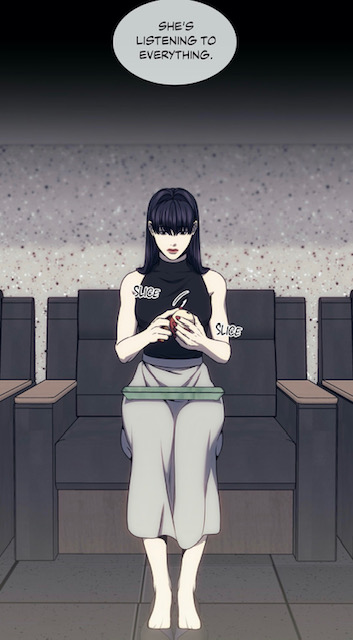 (chapter 24) Thanks to The Pawn’s Revenge, I came to recognize that even Painter Of The Night has so many common denominators with this fairytale.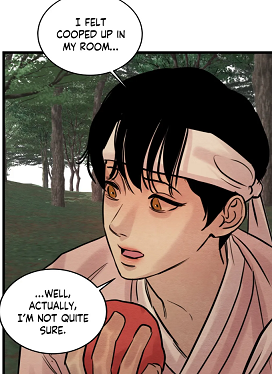
 (chapter 23) That’s the reason why I decided to compare the two manhwas with Snow White. This means, I’ll also explain why they diverge. But for that, it is necessary to explain the fairytale Snow White and its functions.
Actually, the focus of this fairytale is the daughter-mother relationship creating some rivalry and jealousy. Though there exists so many stories about this topic (for more read this article https://news.harvard.edu/gazette/story/2020/07/the-tale-of-snow-white-and-what-the-various-versions-mean-to-us/), only two are famous, the fairytale written by the brothers Grimm (19th Century) and the version from Walt Disney, “Snow White and the 7 Dwarfs” (1937).
But the famous psychologist Bruno Bettelheim, who considered tales as very important for the child’s development, looked down on the version from Walt Disney calling it “empty minded entertainment”, as the creators had modified too much the Grimms’ story to the point that it had softened and robbed the meaning of this fairytale. Why did he say that? It is because the darkness from the Grimms’ version had totally disappeared. The stepmother in Walt Disney’s version doesn’t eat the lever and lung of a boar boiled in salt in order to keep her beauty, or she doesn’t asphyxiate Snow White with a lacing strap. The jealousy had turned into more in a rivalry and competition because of beauty. Besides, the movie focused on fated love too, for the prince met Snow White as a child. As you can see, the prince plays a bigger role in the movie. For Bruno Bettelheim, only the Grimms’ version is the true one, as it truly deals with the oedipal complex.
The oedipal complex is when a young daughter feels jealous of her own mother, she is unconsciously attracted to her father. But since having such feelings is forbidden, she projects her own jealousy onto her mother. That’s why the daughter feels that her mother is jealous of her. The darkness from the child is now personified by the “mother”. I need to add that the German authors turned the mother into a stepmother in the second version. For Bettelheim, the fairytale helps a child to overcome the negative emotions (oedipal complex, jealousy, rivalry), it also helps him/her to understand the world around by giving him/her a meaning to life. Furthermore, it explains to the young daughters the future transformation unconsciously: it announces the adolescence and adulthood through sexuality. We have to imagine, when Snow White lives with the dwarfs, she is protected growing up in an environment free from sexuality. So when the Queen offers the apple and both are eating from the same apple, Snow White discovers sex and temptation. The apple is a reference to the bible. And now, you comprehend why I choose such a title. The Queen is a witch introducing Snow White to sexuality. As you can see, Bruno Bettelheim judged the fairytale from the point of view of a psychologist. Yet what he failed to realize is that fairytales have other functions.
First, fairytales were not written for just children, but also for grown-ups. They were supposed to teach lessons to the adults.
“They were meant to entertain adults while they were spinning, sewing, repairing tools, and doing chores late at night. John Updike tells us that fairy tales were the television and pornography of an earlier age, and a story like that is revelatory about the true uses of enchantment.” quoted from https://news.harvard.edu/gazette/story/2020/07/the-tale-of-snow-white-and-what-the-various-versions-mean-to-us/
How to deal for example, when a lord betrays or abandons a servant? Here, I would like to outline that the notion “family” is strongly connected to the house, and as such a household including the staff. Imagine that Snow White is a maid. Remember that the Queen acts as a lord, the head of the house, so when she orders Snow White’s execution, the young girl can only escape from this terrible fate thanks to the hunter’s fake generosity. This story shows that a servant or even daughter has no right, the lord can do whatever he wants. He won’t get sanctioned. And this remark leads me to the following statement. Bettelheim didn’t recognize that fairytales actually reflect history and the society of their period.
And now, you comprehend why the Disney version was less brutal, more romantic and the Dwarfs were portrayed as rich but hardworking miners. When the American author released the fairytale, marriage in America is associated to love. There exists the myth about fated love too. In addition, American society is promoting free market economy and hard work: American dream. Therefore we see the Dwarfs working so hard in the mine while singing. In the other version, it is just said casually. The parents are supposed to protect their children from any kind of violence, the children have even rights. Consequently the cruelty was removed. Moreover, motherhood is considered as sacred, while in the past, it was different. In the 18th Century and even before, parents didn’t ponder on how to raise their children properly. There were neither psychologist nor pediatrician nor educationalist. The children just needed to learn how to act and dress according to their social status. They were treated like small adults. However, slowly from the end of the 18th Century on, government and as such society started perceiving children differently, as a tool for their own politics. Napoleon created lycées (high schools) in order to increase his army. He promoted education, while in truth he misused it for propaganda and indoctrination. My point is that when the brothers Grimm published Snow White, people treated young children differently than in 1937 in the United States. In Germany, adults used fear to control the children!
Secondly, violence was a way to expose the children to the brutality of their world (there were many revolutions in Germany in 19th Century). But there’s more to it. And we have a proof that Snow White from the brothers Grimm reflected the society of the 19th Century: the presence of a lacing strap.
“But the old woman quickly laced and laced so tightly that Snow White lost her breath and thought she was dead.”
It was a reference to the corset. Young girls would try to lace their corset so tight that they could faint. This was one of the lessons in Snow White: “Don’t lace the corset to tight, because you could have the same fate than Snow White!” This explicates why Walt Disney didn’t include this scene in his story. The corset had vanished from fashion a long time ago. How did I realize that old fairytales are a mirror of the past? It is because when I was a P. A. of a History professor, I was asked to translate his essay about the definition of House and Foreign in late Middle Age and early modern times, and he used the fairytale “Town Musicians of Bremen” from Grimm as an example. The servants were indeed part of the House, once they were old, they would be thrown out of the mansion. The house was a synonym for family, like I mentioned above. During the Middle-Age, European cities, like Bremen, became more and more powerful leading to their emancipation from lords. Bremen like other cities became independent, hence the city councils could hire hire their own musicians. Though this fairytale was written in the 19th Century, it let transpire the social norms and mentality from a previous period. That’s why I came to the conclusion that Snow White must also reflect society from the 19th Century. I could give you another example.
In the Grimms’ version, the presence of sexuality was hidden, because it was symbolized by the apple. Since religion occupied a huge place in the 19th Century, people knew the bible. Consequently they could comprehend the message. But the moment Snow White ate the apple, she discovered sex. But note that she fell into a deep sleep right away. Once she woke up due to an accident occurring during the transportation of the coffin, Snow White had already found her husband, the prince. The latter had selected her as his bride, as he couldn’t forget her. The prince had even asked for the dwarfs’ permission.
“Then he said to the dwarves, “Let me have the coffin, and I will give you what you want for it.”
In other words, this fairy tale was promoting marriage of convenience and the interdiction of sex before marriage, while in the Disney version we have the opposite message. Since the prince kisses the protagonist, before he marries her, it implies that sex can occur before marriage.
Thus even if I consider that The Pawn’s revenge and Painter Of The Night are new versions of Snow-White, they can only be different. Now, sexuality, sexual education and homosexuality are no longer a taboo. That’s the reason why there is no hidden message concerning this topic. As a conclusion, the stories will reflect Korean society or modern society as such. The stories will teach lessons to the readers and give meaning to their life, but only if they decide to ponder about these stories.
This truly exposes that Grimms’ and Walt Disney’s Snow White is just a mirror of the past. But don’t get me wrong: these fairytales are still useful. First, like Bruno Bettelheim, they help children to forge their own identity and to navigate in the world as moral compass. Since the characters are black (evil) or white (good), the children can easily differentiate between right and wrong. Simultaneously, the fairytales prepare them to recognize that reality is more complex. We have the perfect example in Snow White (Grimm) with the huntsman.
It seems that people only remembers him as a good-hearted man, as he had pity and disobeyed the Queen’s orders. But what many don’t know or overlooked is that the huntsman embodies cowardice and selfishness. In truth, he is just a weak-hearted person and a hypocrite.
“And because she was so beautiful, the hunter took pity on her and said, “So run along, you poor child!” The wild animals will soon have eaten you, he thought, and yet he felt as if a stone had rolled from his heart, because he did not need to kill her.“
He acts kind and benevolent in front of Snow White, while in reality he envisions that she will die. At no moment, he wants to save her. She survives, because he doesn’t want to feel guilty and fate is on her side. This means, he just refuses to become responsible for her death. Others will do it for him. That way, his Queen won’t notice that he disobeyed. And notice that the moment the stepmother discovered that she had been played, the huntsman’s disobedience was not punished. Why? It is because she didn’t discover it right away. She ate the lung and lever believing that these were the parts of Snow White.
As you can see, the fairytale was teaching the meaning of fake kindness, cowardice and hypocrisy. But the irony is that in the latest movies, the huntsman was turned into a hero! In addition, it also exposes the “powerlessness” of the Queen. The huntsman could fool her due to her obsession. Simultaneously, it teaches that disobedience doesn’t lead to a death sentence. Here, I would like to point out that after the end of World War II, many German soldiers or guards from camps of concentration claimed that they didn’t dare to disobey. They just followed the orders they had received as a justification for their misdeeds. The reality is that it was just a myth. Historians could prove that no one got executed or no one was forced to become a guard in a camp of concentration.
Because of these parallels between The Pawn’s Revenge, Painter Of The Night and Snow White, I wondered if the manhwas could be considered as fairytales. The presence of violence or sexuality can not be judged as evidences that they can not be fairytales, for they are considered as old form of pornography, destined to adults too. So what is the definition of fairytale?
The story must contain the following elements:
According to this definition, The Pawn’s revenge can’t be considered as a fairytale, for there is no magic. But I would like to point out that The Pawn’s revenge still contains some “supernatural elements”. Lee Je-Oh compares the serial killer to a grim reaper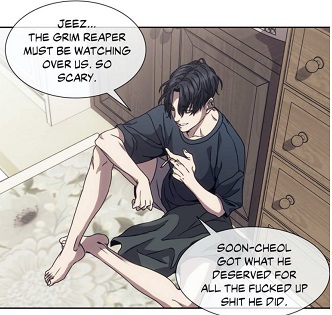 (chapter 1) or
  a god. Then the characters are often associated to animals: dog, mutt,
  snake, horse, pig, elephant, chicken
 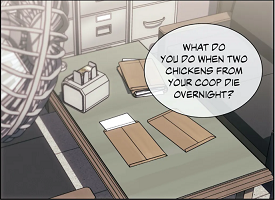 (chapter 2). Furthermore, the figures in this story are perceived as living pawns of Janggi.
  (chapter 12) Finally , I compared Jeon See Heong to a mermaid
  (chapter 6) bewitching her prey. On the other hand, the figures have a precise identity. The time and the place are quite defined. As for Painter Of The Night, it looks like the same. We know the birthdays of Yoon Seungho and Baek Na-Kyum and there’s no magic or supernatural elements. Yet, we sometimes see the presence of magic and a lustful spell.
  Imagine, in this scene we have the impression that the painter’s spirit summoned the Ghost Seungho to approach him. Striking is that this repressed desired got fulfilled. While he had his eyes closed, the lord approached him.
 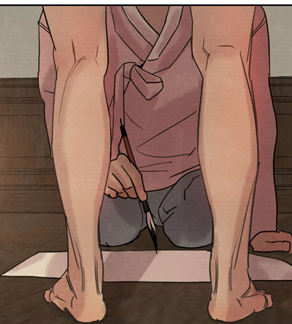 Another positive aspect is that the time and space are not defined. It’s just Joseon period, but that’s it. The mention of Hanyang can not be seen as transgression, because remember that there exists the fairytale Town Musicians of Bremen. The town has no name. Byeonduck said that her manhwa was not a historical story, but she found her inspiration in History. Besides, the trials of the two protagonists are more in the center, while Lee Je-Oh and Do Seong-Rok have already struggled, before the story starts. Consequently, Painter Of The Night resembles a lot more to a fairytale than The Pawn’s revenge, though the sentence “once upon a time” is missing.
On the surface, this comparison seems pointless, yet I wanted to expose that these stories might not entirely correspond to a fairytale, they still resemble to Snow White. Just like the fairytales, the manhwas can have a deeper meaning, for they serve the same purposes: Teach lessons to adults, incite the readers to question their own society and social norms, develop a better understanding of psychology, encourage them to become more committed, less indifferent to injustice, more thoughtful and not judge people too quickly.
In order to be able to contrast the stories to the fairytale, it is necessary to list all the elements present in Snow White from the brothers Grimm. Besides, this version resembles more to the manhwas due to the sexual content. Seduction and temptation are more obvious. Nevertheless, I will not just list the characters and the relevant items present in the fairytale, but also the topics while giving some explanations:
And now, it is time to analyze how similar the manhwas are to Snow White.
As this essay is already long and to outline the similarities, I will put the common denominators to bold. Simultaneously, I will follow the list developed above by examining the main figures.
Since the 7 Dwarves are owners of mines and seem to be very rich, I couldn’t help myself connecting these supernatural creatures to the following characters:  Contrary to the fairytale, they embody not innocence, generosity, selflessness and chastity, but the opposite: sex, hypocrisy, corruption, selfishness, ruthlessness and immorality. They are not owners of mines, but they possess brothels which reminded me of chicken farms
  . They don’t live surrounded by nature and among animals, but in the city. The animals are the humans, they are treated like chickens. In other words, they stand in opposition to the dwarves of the fairytales: corruption, urbanization, poverty and misery. They don’t work themselves, but let others work for them like slaves. Yet they act, as if they were normal citizens abiding laws. This explicates why Ma Jong-Seok hides his affection from Snow White. He can’t be labelled as homosexual. The dwarfs, associated to different vices, symbolize the negative aspects of free market economy and the problems, when the government is not strong enough or too corrupt to stop such an evolution. I could even say, we have here the negative reflection of Snow White and the 7 Dwarves from Walt Disney. Motherhood is no longer sacred, the kids are exposed to any kind of abuse.
 Snow White is now held captive in the mansion of the dwarves! He is exposed to exploitation, the perverted version of Grimes’ version. In the fairytale, the young girl was supposed to take care of the house in exchange of protection, here we have the opposite: Enslavement. The male prostitute has no choice. But what they didn’t realize is that the witch would betray them. Hence I consider the apple as the tool the witch used to get rid of her rivals! The fruit served as a diversion, she was busy listening to their affairs so that she could develop her plan to climb the social ladders.
Since Jeon Hee Seong was the one who introduced Do Seong-Rok to sex, she can definitely be seen as the witch and evil queen.  She seduced him with her experience and insight. She could read him like an open book. She knew that he was so pure and innocent, hence she compared him to a lamb. Her resemblance to the evil mother explains why she is seen with the apple. However, unlike the fairytale, the fruit doesn’t symbolize sexuality, but betrayal. She is actually spying on the boss of the red light district and his minions. She behaves exactly like the Queen, as she is not longing for warmth and love. But her wish is still different, as she wishes power and wealth. Yet, they resemble each other, as both felt somehow powerless. In the fairytale, the absence or passivity of the king, Snow White’s father, gives me the impression that the evil Queen could have been a neglected wife, and the lord selected her as his new wife, out of convenience. He needed to have a wife by his side, and couldn’t remain as a widower. She was treated like a trophy explaining his absence. But because he married her for her beauty, it signifies that she had no power. Her appearance was her source of strength, and now you comprehend why she became obsessed with her image. If she lost her beauty, she would become even more powerless than before. She had nothing else to do. Jeon Hee Seong was forced to marry Choi, and while the Queen from Snow White was neglected, the witch was abused by her husband. So both were unhappy in their marriage and life. This explains their desire to get power in their own way. As the manhwaphiles can detect, both witches have something in common: ambition and greed, though Jeon See Heong uses her beauty differently. She is aware of her own attraction and has no fear or insecurities. She doesn’t need a mirror to tell her how beautiful she is. Her body is her tool, not the mirror. Yet both have another aspect in common: they try not to do the dirty work themselves. Both hire a killer, the only difference is that due to the huntsman’s betrayal, the Queen learned her lesson. She had to do it herself, if she wanted to get rid of her rival. And this leads me to the following observation. The witch from The Pawn’s revenge has two reasons to use others for her dirty work. First, she is no queen, hence she could get charged with murders. Secondly, if we use the fairytale as a parallel, she could have a similar mindset than the huntsman. She doesn’t want to feel burdened by guilt, notice that she is never facing the consequences of her order and decisions. She didn’t see the corpse of her dead husband and the gambler Lee Soon-Cheol.
  She just communicates through a cellphone. Besides, even Do Seong-Rok felt uncomfortable after killing two people. Hence I perceive Jeon Hee Seong as less bloodthirsty than she appears to be. She could be more of a coward.
On the other hand, in the manhwa the witch is still relying on her lover, Do Seong-Rok. She got angry, when she realized that he had disobeyed her and let him become responsible for Lee Je-Oh. However, it is just a matter of time, until she gets aware that Do Seong-Rok is no longer bewitched by her. In chapter 26, he can no longer have sex with her. Hence we have a parallel with the fairytale: the allusion of aging and change. The woman is no longer attractive to him, because he has perceived her true nature. She manipulated him and he got aware that she was fake. With this, we would another similarity with the fairytale, the distinction between seeming and being. He realizes, that her promises were all an illusion.  In this scene, the manhwaphiles can sense her witchcraft.
And since Jeon Hee Seong has already chosen Ahn Jae Oh as her official partner due to his social position, it becomes understandable why her relationship with Do Seong-Rok was doomed to failure. I would say, since the police officer is on the verge to become a congressman, the protagonist could only appear weak to her. His strength were his loyalty and blinded trust. Consequently Ahn reminds me of the king from the fairytale, while I perceive Do Seong-Rok not just as the huntsman, but also as a second Snow White. First, he had dark hair and a white skin like the protagonist.  Secondly, he was as pure as Snow White. But since he was neglected and had abandonment issues, he longed for maternal warmth and love. In the Korean version, we see his father promising to come back, an indication that he had no mother. Hence I judge, Do Seong-Rok’s relationship with the witch was a form of an oedipal complex. She served as a surrogate mother, that’s how much he longed for a mother and family. The manhwaphiles will realize the common denominators: neglect and abandonment perceptible in the beginning of the fairytale. Secondly, note that Do Seong-Rok had changed the color of his hair, when he met her again. That’s why I deduce that the card she gave him should be perceived as the apple from the fairytale.
  (chapter 16) With her appearance, her words and this card, she casted a spell on him. That’s why he was so full of lust during their second encounter. The red hair could be judged as the indication of the lustful spell. Simultaneously, this color implies the loss of virginity and the beginning of adulthood. The most fascinating is that in the bedroom, two colors are prevailing: red and white, which coincidences to the red and white side of the poisoned apple from Snow White. The witch’s beauty was so strong that he had to transform himself.
  (chapter 16) This was his desire to resemble her, to get closer to her. Since he was a man, the witch didn’t see him as a rival. This explicates why she didn’t feel jealous at all. But for me, there’s no ambiguity that she filled the void left by the missing mother. Hence, since he was having sex with a surrogate mother, this can not be considered as the real discovery of sex. I conclude that when he met Lee Je-Oh, he discovered real sexuality. That’s the reason why he can no longer have any erection with the Queen. If we judge The Pawn’s revenge as a fairytale, then it teaches, homosexuality is a normality. He didn’t know about this, until he saw the male prostitute having sex with the pimp and felt aroused.
Moreover, by sleeping with him, Jeon Hee-Seong somehow committed a sin. Let’s not forget that she was already married. The woman embodies evil, for she promotes cheating, betrayal, murder, selfishness and avidity. Her ambition is to become the Queen of the red light district. This means, the readers are witnessing the raising of the evil mother, who is on the verge of becoming the Queen! But due to her greed and ambition, she doesn’t realize her own blindness. Her arrogance makes her overlook the male prostitute, Lee Je-Oh. She trusts too much her beauty, and believes to be smarter than others. Thus her arrogance is the reason why she will fail in the end. She showed her true face to Do Seong-Rok too soon, when she showed her anger,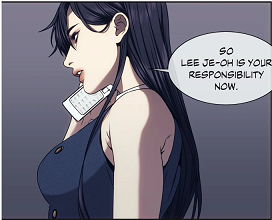 because the huntsman had disobeyed her order. The man could see a glimpse of her true personality. Due to his past experience, he had learned his lesson. In addition, she is underestimating the power of love. Thus she had planned to betray and abandon her lover, but she doesn’t anticipate the killer’s betrayal. Exactly like the stepmother, she is not reflecting on her own actions. She didn’t pay too much attention to her words over the phone and the consequences. The absence of critical thinking will be another reason why she is doomed to fail: too obsessed to reach the top. She has the impression, she is almost there, the presence of the ring offered by Ahn is the proof of her success. And now, you can see why I saw so many parallels with the fairytale.
Naturally, this is not surprising that Lee Je-Oh considers Do Seong-Rok as the huntsman. 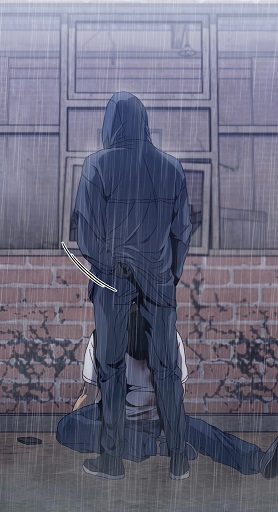 The latter’s actions resemble to the ones from Snow White. Yet, unlike the hunter, the red-haired man has not a weak heart, but a good heart. He is not a coward or a hypocrite. He can feel pity, and doesn’t fear to dirty his hands. On the other hand, he has nightmares
 , as his unconscious is telling him that he made the wrong choice. And in this scene, we have the presence of conscious and unconscious. He shouldn’t have listened to his lover’s suggestions, but he is still in denial. That’s the reason why he keeps starring
  and looking at the letter with a fake confession. Hence I believe that contrary to the hunter, he feels some remorse, as he senses that he has been tricked. In my opinion, by sleeping with her, Do Seong-Rok got tainted by her darkness. This explicates why when he strangled Ma Jeong-Sok, he had an erection.
 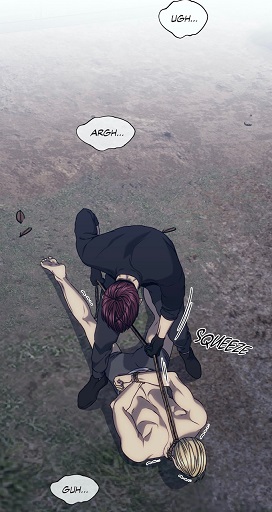 And remember that in the Grimms’ version, we had the presence of a lace in connection to Snow White. And this reinforces my interpretation that the killer is actually more a combination of both characters: the huntsman and Snow White. He has become the “perverted version” due to the Queen’s influence, he is her step-son. Striking is that Lee Je-Oh is giving him another interpretation of his wrongdoings: he liberated him from his prison and misery.
Since Jeong Hee-Seong resembles a lot to Lee Je-Oh, he appears to be indeed the real Snow White. Exactly like Do Seong-Rok and Snow White, he has dark hair, a white skin and red cheeks. Moreover, similar to the Grimms’ version, the main lead has been neglected and abandoned by his father.
Their fate seems similar, yet there is a huge difference. The male prostitute learned not to rely on others. When he tried to free himself, he didn’t ask for help, he stabbed Ma Jong-Seok himself. However, he was encouraged to use the knife by the witch, that’s how he discovered her true personality. Her beauty can no longer bewitch him. Striking is that he could already perceive her true personality, even before knowing her true identity.
In my opinion, Lee Je-Oh is actually a combination of the mirror of Truth and Snow White. Through his comments, he is confronting Do Seong-Rok and forcing him to reflect on his actions , questioning his relationship with the witch.
  But notice that he has a similar attitude with other characters. He confronts Choi Yeong-Gil with his hypocrisy and negative attitude.
  Just before the pimp is killed, he confronts him with his true personality and sins. He is responsible for the misery and death of many people.
  Once cornered, the “dwarf” is forced to confess his affection to Lee Je-Oh. Both dwarves had something in common: hypocrisy. Hence you can comprehend why I come to the conclusion, Lee Je-Oh is the mirror of truth. He embodies honesty and loyalty, just like the protagonist, he longed for a home and family.
Hence the huntsman’s “jail” corresponds more to the house of the dwarfs from the fairy tale. It’s the place where love, trust and innocence are protected. Since I have already predicted a revolution, I believe, Lee Je-Oh will give another sense to Do Seong-Rok’s murders. They will try to destroy this corrupted world full of selfishness and greed. That’s how Lee Je-Oh will become the witch’s rival. He will ruin her plan due to his sense of justice. The manhwaphiles will certainly remember that the fairytale is centered on jealousy, rivalry and competition. The young boy was already jealous that he felt the need to steal the killer. Right after having sex with him, he considers Do Seong-Rok as his boyfriend. He compliments him and caresses him
 , giving him the warmth and affection the killer had been longing.
What also caught my attention is that both Snow Whites are “corrupted”. While the one kills, the other lies, schemes and steals. This stands in opposition to “Schneewittchen” from the Grimms’ version. It is comprehensible, because both protagonists got tainted by their parents. Lee Je-Oh’s father was selfish and had no sense of responsibility, while Jeon Hee Seong desired to use the main lead’s weaknesses (isolation, lack of experience and innocence) to her advantage. This signifies, both are the products of bad parenting and a ruthless and selfish society. So if the two Snow Whites start working together and keep killing others in order to clean society, what will happen to this city? Chaos. But Lee Je-Oh would see it as delayed justice.
Why did Evy say that there was no prince in this story? My explanation is the following. Since the prince embodies “marriage” and in South Korea, homosexual marriage is not allowed, there can’t be a prince. Secondly, since I have already portrayed that the two protagonists have two functions, this signifies that both could also be perceived as the prince. They both free each other, as they give each other what they need. In the episode 27, Lee Je-Oh decided to lie to Kang Hyeon-Jong in order to protect his lover. He gave him an alibi and used the video as an evidence. This means that from now on, he is now responsible for Do Seong-Rok, just like the latter is now accountable for Lee Je-Oh’s survival. And since there’s no justice in this world, I believe that the prostitute Snow White will take matters into his own hands and give justice to others. Remember that Snow White sentenced her stepmother to death! This signifies that she gave justice herself.
As a first conclusion, though The Pawn’s Revenge doesn’t correspond to the definition of a fairytale, the manhwa and Snow White are really similar due to the topics and characters. It truly shows that such stories are a great source of inspiration. Then the readers should question themselves why the city and its inhabitants are portrayed in such a negative light. 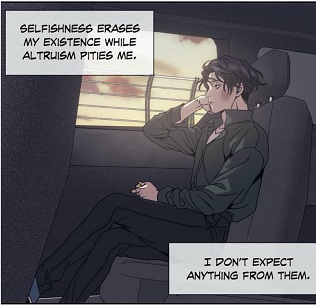 From my point of view, it is related to the huge political scandals South Korea had to face like for example with the president Park Geun-hye, and the economical boom with the development of new districts which doesn’t lead to a diminution of poverty. Then, there was the Sewol ferry incident, where many students died, while the captain and the crew abandoned them. This terrible event caused a huge mistrust in the authorities and the adults’ hypocrisy and selfishness. As the manhwaphiles can detect, I view this story as a mirror of our modern society: the failure of parents as role model, the disintegration of families… Simultaneously, it teaches the same lessons: recognize hypocrisy, selfishness and the importance of reflection. Lee Je-Oh could become the killer’s ally, the moment he recognized his own mistake. He imagined his intelligence made him superior, he underestimated the huntsman’s strong will. He might have felt pity, but he was not a fool, rather a dangerous man because of his strength. He mistook his innocence for stupidity. That’s why Snow White is superior to the witch.
As you can imagine, I won’t write the comparison with the Painter Of The Night here, for the analysis is already so long, however I would like the readers now to ponder on the following question: Who is the witch with her lustful spell, Snow White, the mirror of truth, the 7 dwarves, the huntsman and the prince in Byeonduck’s work?
Feel free to comment. If you have any suggestion for topics or manhwas, feel free to ask. If you enjoyed reading it, retweet it or push the button like. My reddit-Instagram-tumblr-twitter account is: @bebebisous33. Thanks for reading and for the support, particularly, I would like to thank all the new followers and people recommending my blog.

This is where you can read the manhwa. https://www.lezhinus.com/en/comic/painter But be aware that this manhwa is a mature Yaoi, which means, it is about homosexuality with explicit scenes. If you want to read more essays, here is the link to the table of contents: https://bebebisous33analyses.wordpress.com/2020/07/04/table-of-contents-painter-of-the-night/
Announcement: I updated the essay “Sins”
In the essay “Sins”, I had pointed out the parallels between episode 40 and 75. We had a stroll through town, and both main leads had a long conversation. But there’s another aspect I had overlooked, the reason why both episodes were connected to each other. While the first one stood under the sign of “responsibility”, the other embodies “regrets”. And now, the manhwaphiles can grasp the connection. The moment a person becomes responsible, he must make choices. And if the decision leads to a disaster, then the person will come to regret his choice. This explains why Jung In-Hun stood in the center of both episodes. Thus I will examine the characters’ decisions and regrets.
But before starting, I would like to outline the difference between remorse and regrets, though these expressions are often employed as synonyms. What distinguishes them from each other is the nature of the action and decision. When the person did something wrong and now feels some remorse, it means that the person acknowledges the wrongdoing. On the other hand, there’s an absence of judgement in regret. It’s totally neutral. The person just wished, he or she had made a different choice. This signifies that a person can regret a decision, but feel no remorse. In other words, he has no guilty conscience. This indication might seem anodyne, yet it is the opposite, for in Painter Of The Night, many characters feel regrets, but are not suffering from pangs of conscience. They don’t see their actions as a crime or a sin. This truly exposes that these characters are not reflecting on their actions, even the absence of remorse displays their ruthlessness and selfishness.
Naturally, remorse and regret can coexist. We had a perfect example with Jihwa. First, the red-haired master expressed regret concerning the painter’s abduction.  (chapter 61) Observe that he has realized that Baek Na-Kyum’s disappearance doesn’t change the situation. Yoon Seungho will never come to return his affection. The abduction and even the murder are totally pointless. Yet, while confessing to his “priest”, he doesn’t acknowledge the wrongdoing perpetrated against the artist, for all his thoughts are revolving around his love for Yoon Seungho. He doesn’t see the pain afflicted to Baek Na-Kyum.
He only feels remorse, when it comes to his childhood friend.  (chapter 61) For the first time, he is admitting his sins. He has always hurt his friend (the letter, the ruined painting, the topknot incident
 , chapter 59), that’s why the main lead could never reciprocate the feelings. And now, you understand why the young master Lee said this:
 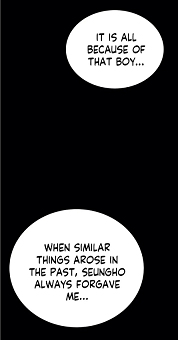 (chapter 59) Since Yoon Seungho would always overlook his wrongdoings, the latter never felt the urge to reflect on his actions. Why should he feel regret or even remorse, for their relationship never changed? But with the painter everything changed. The noble would no longer close an eye to Jihwa’s sins.
Under this new light, the manhwaphiles can grasp why Jihwa made the following reproach to his friend.  (chapter 59) Lee Jihwa used the name of lord Song on purpose, he knew definitely that this would scare and wound Yoon Seungho. I am even thinking that he imagined Yoon Seungho would behave like in the past, refusing to leave his mansion. Since I interpreted that the lord had a flashback in episode 1, I deduce Jihwa had planned with a letter to cause a flashback in Seungho, just like he had done in the past: the topknot incident. We had two clues for this signification.
First, Yoon Seungho had also triggered a flashback in his lover Na-Kyum unconsciously, when he trapped him under the bed in episode 66. 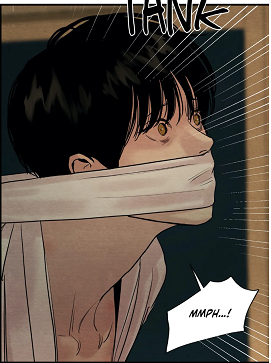 Secondly, the childhood friend had discovered the main lead’s weakness
  (chapter 59). In this panel, Yoon Seungho has a flashback. Thus, Jihwa used this to his advantage, when he was displeased with the protagonist. Nevertheless, I suspect that Lee Jihwa was not truly responsible for the topknot incident, for he had been incited by Min’s words. Yet, instead of regretting his actions, the second lead preferred putting the whole blame on the victim, which often happens with perpetrators and accomplices. He didn’t want to be confronted with his terrible reflection. So back then the young lord Lee didn’t reflect on his actions, rejected his responsibility, for he didn’t want to feel guilty. Let’s not forget that the painter is just a low-born, the second lead didn’t see him as a human.
As you can imagine, Jihwa didn’t realize his wrongdoing, when he let the painter abducted. Since he was still alive, nothing had happened. But the moment Yoon Seungho barged into his room confronting him with his bad action, the other recognized that he had indeed hurt his friend again. But unfortunately, he didn’t learn the right lesson from this experience. He started regretting that the painter was alive. He had now in his mind this: if the artist vanishes, then his crime and sin will disappear. (chapter 61) Really silly regrets! As you can see, he decided to make the opposite decision. And now, you comprehend why Lee Jihwa remained silent, when he got confronted by the Joker. 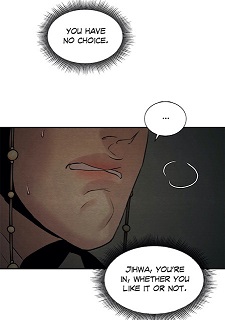 (chapter 76) Min had used his past to bind him to the second scheme. That’s his “punishment” for using the past as a way to tame his childhood friend. This truly shows Jihwa’s lack of intelligence. He never takes time to ponder over events and behaviors. He takes words and behavior as face-values. This is totally normal, for neither Yoon Seungho nor father Lee encouraged him to nurture his mind. Sure, the main lead was too hurt to take this burden. Besides, this is not his role, for he is not his guardian.
The irony is that unlike in the past, Yoon Seungho showed real leniency and forgiveness towards his friend.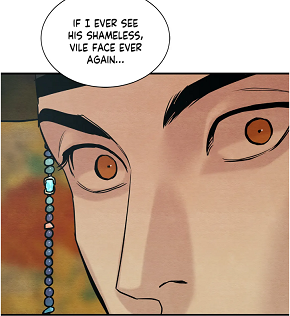 (chapter 67) He caused a commotion, but he never reported the incident to the authorities. Once again, we can detect father Lee’s stupidity, hypocrisy and superficiality. He didn’t scold or warn his son again despite the main lead’s request, allowing Min to influence his son in the bad way.
As a conclusion, as long as the red-haired aristocrat doesn’t acknowledge his sins towards Baek Na-Kyum, he will keep making mistakes and never learn his lessons.
Hence it is totally possible that Jihwa gets punished, when the second crime occurs, even if he is not participating actively. One might get upset and argue that he is innocent this time. But like I said it before, passivity and silence are indeed crimes! He doesn’t use his knowledge to stop a kidnapping and a rape, therefore it is failure to assist a person in danger. Moreover, the readers will certainly remember that The Joker’s second plan was to ask Jihwa to do nothing, while Min would impersonate him at the kisaeng house.
I can’t help myself thinking that Jihwa could obtain his friend’s forgiveness, though the former gets punished by the authorities. Let’s not forget that once the officers get notified, the system can not be stopped so easily. One thing is sure: Jihwa will learn to recognize the nature of a sin, real guilt and the importance of reflection. He needs to focus on education, exactly like Baek Na-Kyum. The only difference is that the latter never had the access to books and to a real good teacher. But let’s stop here with the predictions.
So the moment the young master Lee expressed his remorse in front of the criminal, the latter changed into a priest receiving a confession. Since the latter is an assassin or thief, he embodies sins and guilt. That’s why he could only become Jihwa’s mirror. The former definitely dirtied his own hands by accepting requests from nobles, while Jihwa accepted to “soil” his hands for Min’s sake by hiring No-Name. The “butcher” will teach to Jihwa the true meaning of guilt and sins. In addition, he shows him the ugly side from aristocrats through their actions. (chapter 61)
Naturally, I believe that No-Name is not different from Jihwa, putting the blame on others and not recognize his own culpability. He puts the blame on the aristocrats, as they are the masterminds behind the crimes. That’s the reason why he showed pity towars Baek Na-Kyum. 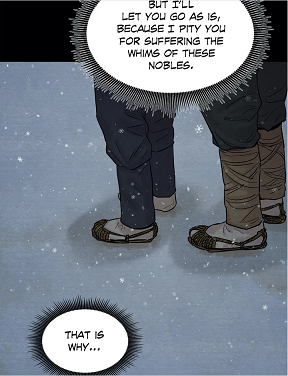 (chapter 66) With these words, he expressed a certain remorse linked to pity, yet it was limited, for he viewed the nobles as the culprits. He never included himself in the reproach, he even showed himself in a good light (“I’ll let you go”). According to him, he was benevolent and generous. But he contradicted himself, as he threatened his prey.
 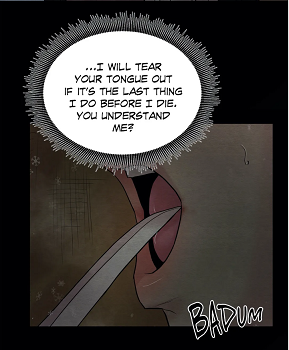 (chapter 66) Moreover, there’s no ambiguity, the painter didn’t pay attention to this confession. The Joker wanted his victim to remember his threat, thus Na-Kyum could only forget the helping hand’s “good heart”. This explicates why the painter got so frightened that he even got a nightmare, he kept remembering the mask of the Joker.
 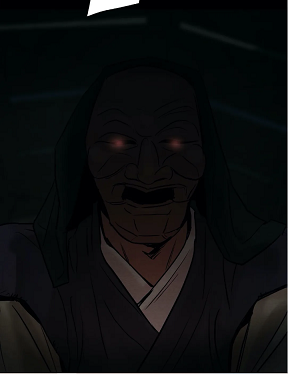 (chapter 61) As a reminder: Baek Na-Kyum never saw Nameless’ face. This image is related to Jihwa at the tavern.
 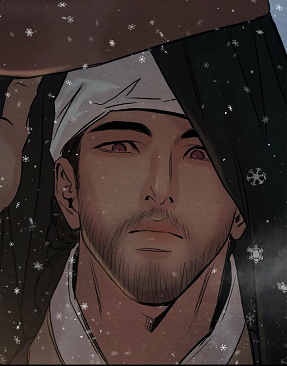 (chapter 59) His pity for the noble Jihwa was stronger than for Baek Na-Kyum’s, hence he didn’t see the negative side of his last actions. In his mind, he had truly showed his good heart! But the painter let him see in chapter 76 the real impact of his so-called “good heart”.
The latter got a flashback because of the mask and the clothes. Baek Na-Kyum noticed the mask and the colors (purple/beige), visible in the nightmare. Nonetheless, even if the aristocrats are schemers, the assistants are by no mean pure and innocent. They are accomplices, and their silence is one of the reasons why the lords are not punished. In addition, without helping hands, the nobles wouldn’t be able to commit so many wrongdoings easily, for they would be forced to witness the consequences of their own actions. (chapter 61) They might feel remorse. Jihwa got so horrified by the brutality, he had to vomit. As you can see, both second leads have a similar attitude in the beginning. This explicates why neither Jihwa nor the Joker recognized the real nature of their wrongdoing, when they took away the artist.
Yet, the incident in town served as an eye-opener for the Joker. 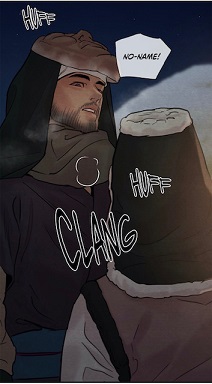 (chapter 76) The latter could realize that his action had affected Baek Na-Kyum. He definitely sensed that the artist had a panic attack and he couldn’t act, as if nothing had happened. This explicates why he kept looking at his previous target.
 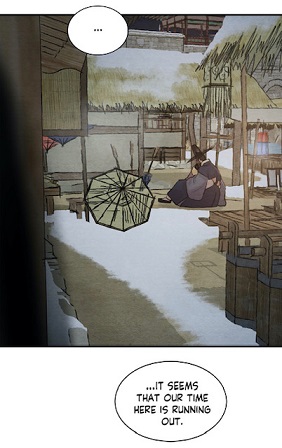 (chapter 76) He could see with his own eyes that both main characters had an affection for each other. Consequently, I deduce that he made the opposite decision from Jihwa. The low-born recognized his sin and guilt. This is the other reason why first he rejects Min’s suggestion
  and even gets infuriated
  (chapter 76), when he gets threatened by Min. He won’t act, as if nothing happened. In fact, now he has every reason to get involved again, though he is refusing the participation. He is well aware that he could get framed. Min already warned him.
 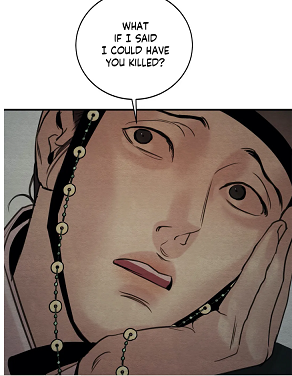 (chapter 76) That’s why exactly like in the beginning of the second season, he will remain passive by monitoring the nobles’ moves. He will definitely use other channels to get updated. And one more time, I am confirming my prediction that Nameless will play a key-role in Min’s defeat. He will definitely help the two protagonists and even Jihwa indirectly by confronting him with his true image.
As you see, I judge Nameless in a better light, though he’s a murderer. He is slowly recognizing that this world is not black and white. His actions are truly condemnable, but I have the impression, he will become Yoon Seungho’s hand of justice. As long as The Joker supports a crime, he is not blameless. His courage, patience and intelligence are his strengths, hence he was able to make the right decision in episode 76. He was no longer willing to dirty his hands for others. Hence I connect him to “pitiful regrets”.
In episode 75, the painter expressed many regrets.
One of them is that he regretted his decision to stay by the lord’s side. 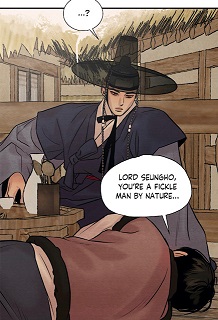 Remember that in chapter 68, he announced to his sister that he wouldn’t follow her. This could only upset his noona, hence she said this:
  (chapter 65) She implied that her brother would come to regret his choice, as he had not realized that he was pressured and it was a rushed decision. She instigated fear in her brother letting him know that such a “love” is just a trivial and temporary emotion. Since the lord had changed, exactly like his noona had predicted, the painter was starting regretting his choice, for he was getting more and more swayed by the noble’s good and kind behavior, while the other had a different evolution: he would love him less and lose his interest for him. The painter was interpreting the inexistence of love sessions as a sign of disinterest from Yoon Seungho, for the latter had always expressed his love through sex. The artist feared a change of heart from his lover. Hence the former felt awful, while in reality he was responsible for his own misery. He just needed to approach the lord himself, as the latter had already declared that he would view Baek Na-Kyum as a lord. But notice that though he was regretting, he put the blame on his lover. He didn’t want to assume the responsibility of his choice, he preferred blaming his companion. Since he had refused to listen to his “mother”, he needed to find someone else for his wrong decision.
Yet, we all know that in chapter 69, Yoon Seungho had planned to let him go, visible thanks to this image:  This was a new version of this situation:
 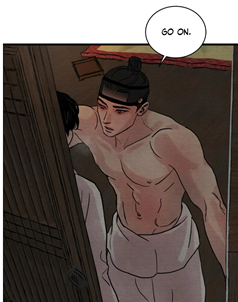 (chapter 34) The problem is that in episode 69, Yoon Seungho never let his companion know. He didn’t even show it by opening the door for him.
But the low-born’s reaction to make Yoon Seungho into the guilty one is normal, because the young man was actually imitating Heena. When the latter met her surrogate son, she put the whole blame on her brother.  (chapter 68) He is now in this situation, because he didn’t come back to the kisaeng house and he didn’t write to her. When the artist dismisses her reproach, he was just following her request, she diverts his attention by saying:
 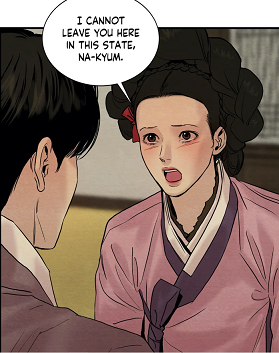 (chapter 68) With these words, she implies that that this is not the time for regret. They have more urgent matters. Because she worries so much for him, they should quickly leave the mansion. And note, at no moment she expresses regret, when she sent him away from the kisaeng house. The absence of regret and remorse from Heena is palpable in this panel too:
 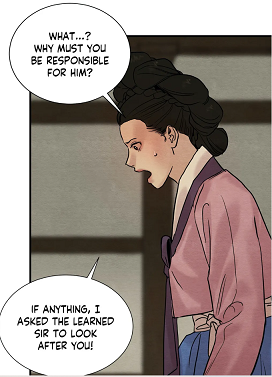 Here, she makes an allusion that if anything, Jung In-Hun is accountable for that situation, for he was supposed to look after him. As a conclusion, the head-kisaeng has never regretted her decision. She even had not the impression that she had done something wrong towards her son. Let’s not forget that she never contacted him herself during their separation and this for a long time (more than 15 months). This means, she doesn’t view herself as a sinner. Her remorseless and regretless attitude really exposes her selfishness, for she is blind to the wounds she afflicted to Baek Na-Kyum: abandonment issues.
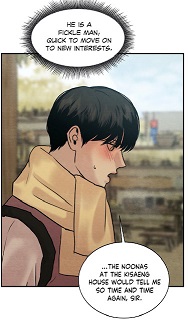
And now, you comprehend why Baek Na-Kyum copied her afterwards. Her behavior tainted on him. Furthermore, I believe that her words and attitude must have wounded her son unconsciously. He must have sensed her lack of sensitivity and selfishness deep down, explicating why he decided to put his fate into Yoon Seungho’s hands, though he feared him. With this new interpretation, it becomes understandable why the painter felt regret later. It was a combination of fears initiated by Heena’s words and his intuition, which he mistrusted now. As you can imagine, I judge his “regret” as quite silly, especially because he was contradicting himself. On the one hand, he had been pleased with the change  (chapter 74), on the other hand he judged the change as something bad: futile and superficial. So in the tavern, the artist was wishing that he had listened to his noona
  . But fortunately, his random encounter with Nameless made him realize that such thoughts were totally pointless. (For more, read the essay “Sins”) Because the lord had changed, he saved and comforted Baek Na-Kyum. He had acted the exact opposite to his attitude during and after the abduction. He rushed to his side, exactly like Baek Na-Kyum had hoped
  (chapter 60) With this incident, the painter experienced that the noble’s feelings had not changed at all, and he was indeed reliable and trustworthy. That’s why he closed his eyes at the end.
  His intuition had not misled him. This signifies that from that moment on, the painter will stick to his initial choice. He won’t leave Yoon Seungho’s side. At the same time, this incident with Nameless destroyed the little power Heena still had over her son. Now, the son is living his life as an grown-up without his mother’s interference.
But before regretting his decision to stay in the mansion, the low-born expresses his regret concerning painting. But it only occurs, when the lord gets curious about the reason why he dropped his passion. (chapter 75) He was missing painting. Deep down he wished, he hadn’t vowed to stop painting, because he was so sad and hurt. Though he felt so miserable, he saw it as an obligation, for it was his punishment. Because of him, Jung In-Hun had failed to secure a position.
 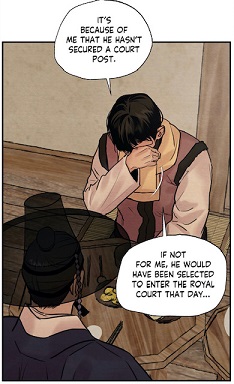 (chapter 75) This means, Baek Na-Kyum felt remorseful. He had the impression, he had done something wrong. It was, as if he had sinned, therefore losing his passion was the price he had to pay for his sin.
This topic came to the surface, because Baek Na-Kyum had started talking about his past and more precisely about his lessons revolving around sin and afterlife, reinforcing my interpretation that the kisaeng house was a place full of Christians. This truly shows that the young artist only received a religious education, because he still can neither write nor read.
In this scene, the painter looks really pitiful, for he is blaming himself entirely. The sin is so big that he accepts the scholar’s hatred towards him. 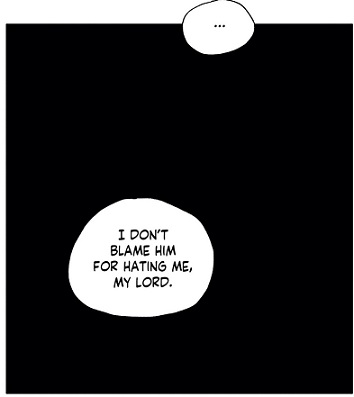 (chapter 75) This explicates why for each bad action Jung In-Hun did towards him before, the latter would still overlook the betrayal and abandonment. He accepted all of this deep down, as he felt culpable. Thus the manhwaphiles can comprehend why Jung In-Hun is still so sure about his power over the painter,
  (chapter 44) and even left him without biding goodbye, though he had hurt him so deeply before. He knows the artist’s weaknesses: his adoration for him and his so-called sin. Thus the teacher appears as remorseless. He has no regret either. He never suffered from huge pangs of conscience, when he beat him or abandoned him.
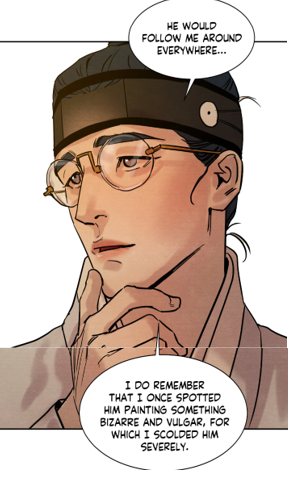 (chapter 6) His attitude resembles a lot to Heena’s.
But remember how I described this conversation in the inn. I compared it to a confession, and Yoon Seungho was a priest embodying Truth.
Back then, he just said this to Baek Na-Kyum 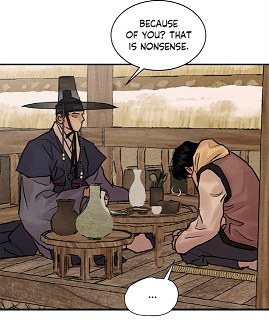 (chapter 75). He tried to free his lover from his guilty conscience. But I doubt that these words were enough for liberate the painter from his remorse. Therefore I am suspecting that in the next season, Yoon Seungho will be forced to reveal the true reason why the scholar failed to secure a high position and expose his lie to Baek Na-Kyum.
Remember how he sent a black man to dig information about the learned sir. For this story is going in circle, we have to anticipate that the protagonist will repeat this action. However, this time he could ask for the learned sir’s dirty secrets. Another possibility is that he mentions the Christian religion, for I am suspecting the scholar of using this religion to get free support from low-borns. And this attempt of separating the learned sir from the painter would definitely serve Kim’s interests, as the latter had already tried to ruin the relationship between the artist and the teacher during the first season. The butler’s initial goal was that the main lead doesn’t meddle in politics and official positions. He had to lie low in order not to attract the attention from the king.
While the painter is still attached to the scholar by his sin, the moment the truth is unveiled, the artist has no reason to feel responsible for the scholar’s fate. And now, the readers can comprehend why the artist said this to the head-kisaeng.  (chapter 68) It was not just, because he wanted to hide his true emotions and thoughts from his mother, he was still bound by his “sin”. Besides, he has other “sins” to cover up: Heena is still unaware of his illiteracy. Remember how the painter felt embarrassed. Once Baek Na-Kyum is freed from his guilty conscience, no one can stand in the way of the lovers.
Therefore I conclude that the scholar has still power over the painter, but it is just a matter of time, until the scholar’s lie is unveiled to Baek Na-Kyum. Byeonduck has already announced that Jung In-Hun’s secret and past will be revealed soon. With such a prediction, Kim will appear in a good light, as he will give the impression that he is helping his lord and the painter again. His stans will come to the deduction that I was totally wrong. However, the explanation is quite simple. Kim’s interests will be just aligned with Yoon Seungho’s. But this doesn’t mean that once the learned sir is sent away, Kim will remain passive again. In fact, this could lead the lord’s next mistake. He trusts the butler one more time, and since the butler has achieved one goal, he can let the second kidnapping occur without dirtying his hands. That way, he can become the unofficial lord of the mansion again. Since I am predicting that Jihwa will do nothing, I am expecting that the valet fakes a letter, for the butler was always connected to a fake letter.
In chapter 75, the painter felt regretful, when he had to renounce on his passion: painting. And I started pondering about this aspect. I wondered if Heena didn’t regret herself that she allowed her son to draw such erotic pictures. 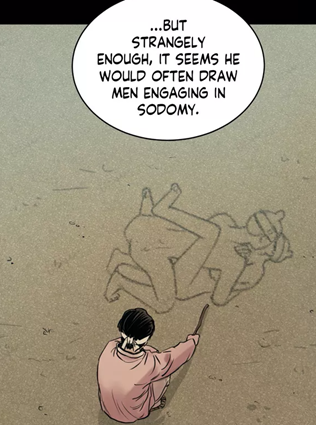 (chapter 1) We know that she neglected him, as she was too young to assume her responsibility as a mother. So maybe she regretted adopting him, hence she wanted to share her burden with others (kisaengs and the scholar). She must have resented him at some point for painting such images, as she despises sex. But then I realized one important aspect in the following panel. Heena could only see the lewd pictures, not the boy’s passion for painting. She never realized that if she had encouraged him to paint something else, he would have picked up a different topic: painting nature and landscapes.
However, since the kisaeng was overwhelmed with the task, the orphan was trapped in a kisaeng house. Besides, the young mother viewed the kisaeng house as a prison. Secondly, in this place people only come for entertainment, yet they act behind veils and closed doors. Hence he could never witness what was going on there. And if the door was open, he witnessed violence. 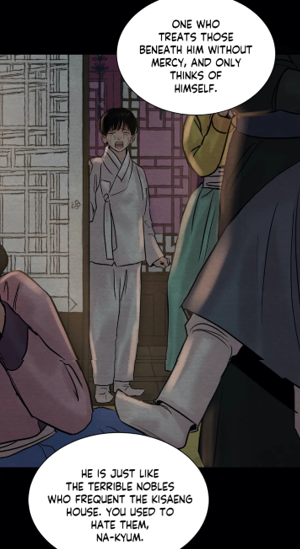 (chapter 68)
So since Baek Na-Kyum was encaged in such a house, he could only seek for topics within his reach. Hence at some point he caught two men having sex as peeping tom. This topic fascinated him so much that he started painting. But deep down, his true desire was just painting. Since the kisaeng neglected him, she couldn’t change the topic of his drawings. That’s why she blamed Baek Na-Kyum for this passion. She associated painting to erotic pictures.
What caught my attention is that Baek Na-Kyum was so impressed by the lord’s orchid. 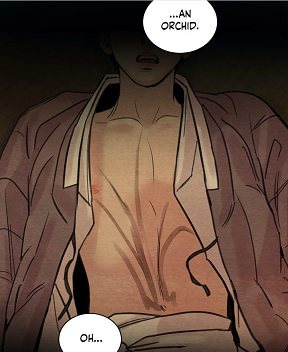 (chapter 75) Then he even created an inauguration painting with Jung In-Hun, revealing that he was inspired by his admiration and love proving that sex is not his obsession. He is just misunderstood by Heena noona. Consequently, I believe that later he will regret to have painted such an image
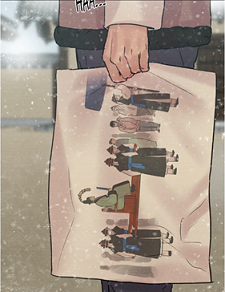 (chapter 44), as it doesn’t reflect reality. That’s why I come to the conclusion that Yoon Seungho could become the painter’s teacher, and not just his muse. As a painter himself, he will incite his companion to select other topics. Let’s not forget that the noble invited his “guest” to a hunt.
 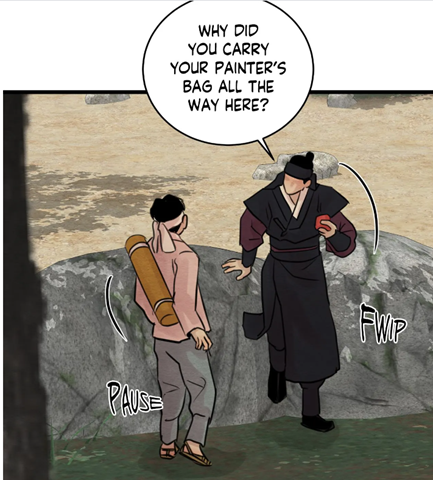 We should envisage that Yoon Seungho makes a similar request: they go outdoors so that the painter can paint a landscape.
In reality, Baek Na-Kyum became an erotic painter due to his circumstances, while his true passion was just painting. Heena never gave him the opportunity to nurture his talent, too blinded by her prejudices and belief.
But as you can imagine, though Heena and the scholar have a similar attitude, I am expecting a different evolution. The kisaeng will be confronted by her sins (not teaching her son writing and reading, misjudging the learned sir’s true nature, her abandonment and betrayal), hence she will feel immense remorse, whereas it won’t be the case for the learned sir. The latter will mostly regret his decisions by putting the blame on others. Silly regrets for Jung In-Hun, but pitiful regrets for the mother, as the latter always believed that she was acting out of love and selflessness.
Feel free to comment. If you have any suggestion for topics or manhwas, feel free to ask. If you enjoyed reading it, retweet it or push the button like. My reddit-Instagram-tumblr-twitter account is: @bebebisous33. Thanks for reading and for the support, particularly, I would like to thank all the new followers and people recommending my blog.
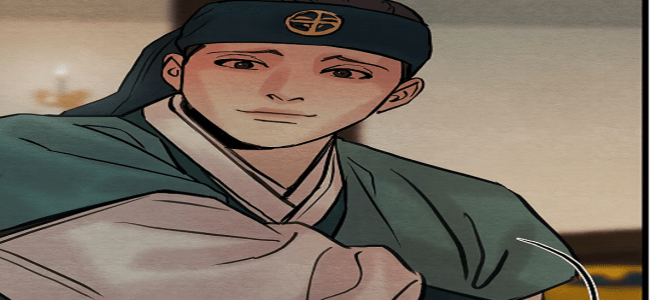

This is where you can read the manhwa. https://www.lezhinus.com/en/comic/pearlboy (English) https://www.lezhin.com/ko/comic/seashell_boy (Korean) The second season has not been released in English yet, hence I will just use 10 screenshots from the Korean version due to copyrights. Besides, be aware that this manhwa is a mature Yaoi, which means, it is about homosexuality with explicit scenes. Here is the link, if you are interested in more analyses about this manhwa and others https://bebebisous33analyses.com/2021/06/06/table-of-contents-of-analyzed-mentioned-manhwas/
In the essay “Choi Pilwon’s true face”, I pointed out that the fish in the aquarium represented Jin Jooha’s fate. The CEO desired to keep him trapped in a huge house so that no one would know about his existence. Only him would be entitled to look at him. But since the poor fish felt lonely and encaged in this huge aquarium, the latter started eating his own tail , a sign that the fish was suicidal and could no longer bear its situation. Hence I had predicted that Jooha would attempt to commit suicide later, and my prediction became a reality in episode 31. However, what caught my attention in the second season is the stronger presence of animals. That’s why in this essay, I will examine the allusion to the preys and predators in the manhwa, which will help us to perceive the characters’ evolution. Hence I can make some new predictions too.

Striking is that the manhwaphiles can detect the presence of an animal, a black snake, whereas in the first season the cover only portrayed the two protagonists. As you can imagine, the snake symbolizes Choi Pilwon. This was already outlined by the authors: 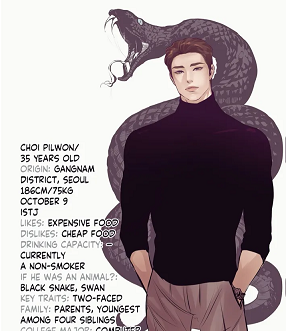
Besides, it fits his personality perfectly, as he is the one seducing Jin Jooha and his mother to temptation. I couldn’t help myself connecting it to the bible. As you already know, the original sin is actually a metaphor for sex. 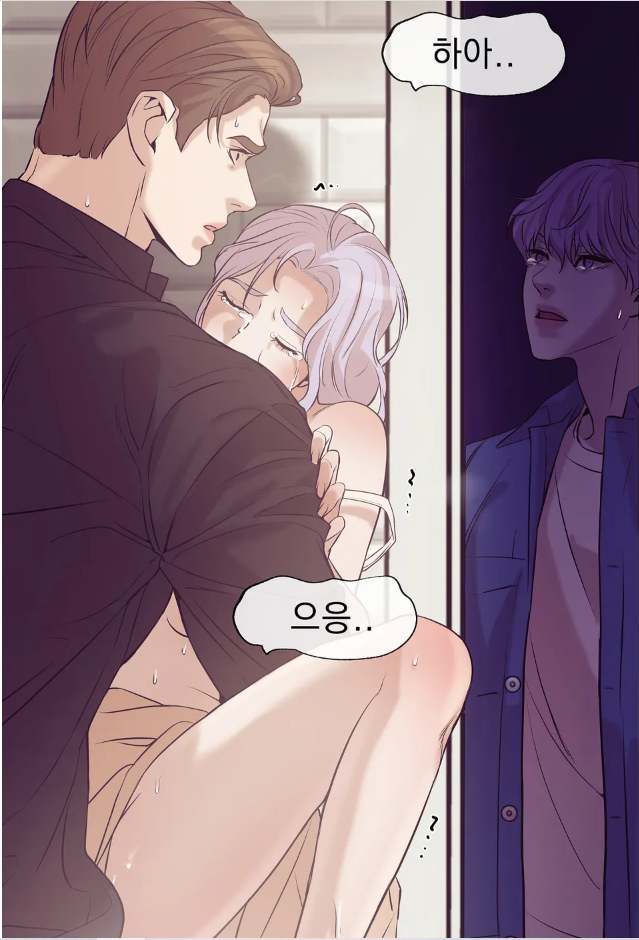 (chapter 30)
The brown-haired man was the main character’s first lover, and had even planned to marry Jooha’s mother to hide his relationship from his own family. He knew that if he came out, he would be rejected by his own family. That’s why he imagined that by getting married to Jooha’s mother, he would meet less resistance from his own family. Let’s not forget that he belongs to another social class: the high society, where homosexuality can only be rejected, as it is judged as a weakness and abnormality. However, the young CEO never anticipated that Jooha would reject the idea, and even perceive the marriage as a betrayal so that he would choose to end their relationship.
The innocent boy had many reasons to be wounded. Choi Pilwon had never explicated his plan in advance. Besides, his boyfriend was caught in the act, so that Jooha could only view it as cheating. As for the mother, she saw the young CEO as a blessing, for he would help her to live a decent life: no more debts and no more running away from the creditors due to her first husband. She definitely considered the wealthy man as a blessing, a way to escape poverty and help her son to have a real future (college). However, nothing happened like expected, because Jooha refused his lover’s project. He hated the deception and lies. Observe that with such a plan, Jooha would always live in the shadow and darkness, exactly like the image displays it. On the surface, they would live like a normal family, whereas the relationship between Jooha and Pilwon would become a secret, even a sin.
Therefore Jooha’s rejection announced the start of the main lead’s suffering. What the family Jin saw as a blessing was in reality a curse: Choi Pilwon ruined their life. He used the debts from the first husband in order to pressure Jooha to accept his idea. That’s why I perceive this panel as a new version of the Fall of man, the departure from Eden. Consequently, the main lead paid a huge price for accepting the CEO’s advances in the first place. He never thought that the CEO was a hypocrite and coward. He would choose to act behind people’s back. He was ruthless enough to manipulate Jooha’s mother, not taking into consideration the lover’s feelings towards his own mother. That’s why the CEO can only be judged as a snake, as the latter is connected to evil, death, destruction, deception and temptation. Jooha’s mother died, and the main lead suffered terribly: isolation, sexual abuse and prostitution.
This is not random that Choi’s words are also poisonous to the point that he is able to manipulate and gaslight the protagonist, particularly visible in episode 29. Observe that at the end of his duplicities (the manipulation of the footage and recorded conversation), his smile looks malicious.  (chapter 29) At the end of the first season, it became clear that the purple-haired man started believing that his lover Kang Dooshik had betrayed and abandoned him. That’s why during the episode 29, Jooha was slowly vanishing, before getting replaced by the fish as a metaphor. The last image has even something in common with the cover of the second season: the colors and in particular the red. Unaware of the consequences of his actions, Choi Pilwon was hurting Jooha so much that the latter was bleeding internally, which corresponds to the red eye of the snake.
  As you can see, Choi Pilwon is associated to red, the color for passion and love, but also for blood, violence and rage!
Another difference is that the black snake is wrapped around the necks of the main leads, a sign that Choi Pilwon will do anything to disturb the OTP. He is willing to strangle them.
Yet, if the manhwalovers pay attention to its position, they can notice that the snake is bringing them closer. Due to adversity, Dooshik and Jooha will come closer. Their relationship can only deepen. Dooshik was able to convince his lover that it was just a trick from Choi Pilwon, and he had never planned to use his partner with his special ability. That’s why at the end of chapter 32, both main leads kissed each other so passionately. They could overcome the riff created by Choi Pilwon’s lies.
The black, dark purple and red in the cover announce the darkness of the second season. Imagine that within three episodes, we had a lot of bloody and painful scenes: Jooha got raped, hence he bled. In addition he had to fight against his creditor, just like Dooshik had to defend himself from thugs sent by Choi Pilwon. Then the restaurant from Jooha’s mother exploded, and Jooha attempted to commit suicide twice. Finally both protagonists clashed against each other.
As a conclusion, Choi Pilwon, as a snake, is a predator and this is not surprising that Jooha as his prey couldn’t defeat him, for the former is a fish. But there’s more to it. Choi Pilwon, too blinded by his own desires, misjudged his lover’s real personality. He thought that Jooha was just a fish due to the pearls, hence he stood in front of the aquarium and compared him to Jooha.  (chapter 29) The antagonist didn’t recognize Jooha’s second nature: a cat. This explains why Choi Pilwon couldn’t accept his struggling and rejection. He thought, both were similar: two cold-blooded animals.
Though Jooha is a fish, he could escape from the snake. The irony is that he broke a vase on the antagonist’s head.  (chapter 30) For me, this gesture is not a coincidence. It was, as if the fish broke the glass from the aquarium in order to free himself. But as you know, a fish leaving an aquarium can die. Therefore the vase already implies that Jooha’s escape can only lead to his death. The fish can only suffocate, as its lungs are not adapted to the air. That’s why Jooha’s first suicidal attempt fits to the fish’s death. The latter decides to kill himself by breathing gas.
  (chapter 31) In other words, the main lead plans to die by asphyxiation. That’s his only way to escape from his miserable life and from Choi Pilwon.
However, what brings the main lead over the edge is the reminiscence of his last date with Kang Dooshik. Both were sitting next to a blossoming tree, which made Jooha totally happy. He had the impression, a dream had come true. However, now by looking back, he believes that this was just an illusion and the petal from the tree was in fact the forbidden fruit. This means, Jooha concluded that this event was a lie and as such a sin. The blossoming tree had deceived him… reminding me once again of the original sin in the bible. And now, you comprehend why Jooha chose to kill himself in the end. He had no longer any hope, every happy moment with Dooshik felt like a lie. He felt more lonely than before to the point that he started having an hallucination. He imagined himself having a conversation with his mother. In his mind, she was the only one genuine and honest with him. Since she is dead, he preferred following her in the afterworld. At least there, he would no longer suffer and could be comforted. Only by dying, Jooha could escape from Choi Pilwon’s obsession. He felt so lonely and hopeless.
However, if you read the main lead’s portrait, you will notice that he is also associated to the cat.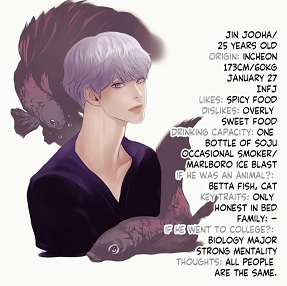 And this connection was already palpable during the first season. We had an allusion to it, when Jooha, following Dooshik’s advice, used the scissors to protect himself. It was, as if the scissors were a claw.
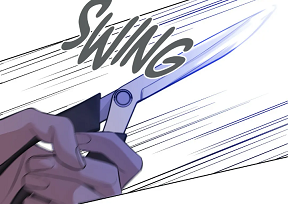 (chapter 9) Observe how the protagonist’s face got scratched with the scissors. It definitely looked like an animal had used its claw to defend itself.
 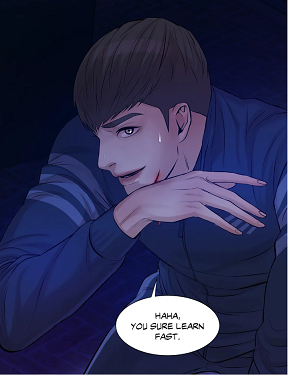 (chapter 9) But there were more obvious clues.
First, I could mention Jooha’s closeness to the black cat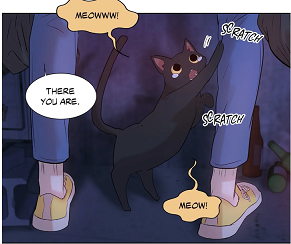 (chapter 5), the latter even rescued him from getting raped. Furthermore, Jooha behaved in certain situations like a cat:
  (chapter 7). In the last panel, he looks like he is hissing with spiky hairs. The double nature of the main character explicates why he resisted to the snake Pilwon. He was hot-tempered and he would never blindly follow his former boyfriend. He would always try to run away and fight back. However, in chapter 29, Jooha had been suffocated by Pilwon’s last tricks, so that Jooha could only wish to die. The tragedy is that he chose the claw to commit suicide.
 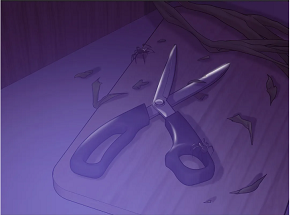 (chapter 31) Observe the debris next to the scissors. The beholder gets the impression that an animal had scratched some tissues, like a cat sharpening his claws, whereas in reality Jooha had used the scissors to destroy the gas pipes. By acting so, it was, as if he was giving up on his nature as cat and as such on Dooshik. Remember that the latter was the one who taught him how to use the scissors and as such his claw.
From my point of view, Jooha had never sensed his other personality: the cat. He only viewed himself as a fish, but by meeting the black leopard Dooshik , he discovered his second nature.
Exactly like the protagonist Jin Jooha, the other main lead is embodied by two animals. However, I doubt that the young man was also aware of his true nature. Only by meeting the “mermaid”, his true personality came to the surface. His attraction to Jooha triggered his protective instincts. But since he hadn’t detected Choi Pilwon’s true character, he never saw an occasion to demonstrate his strength in front of his boss.
However, in chapter 30, he, as a captive, is wounded by thugs. In this panel, the manhwalovers can detect in him the predator, the black leopard. 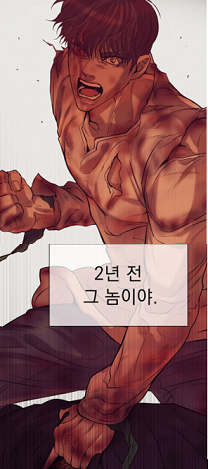 (chapter 32) He’s growling like a panther, the clenched fist on the left reminds us of a paw, while the fingers from the other hand resemble to claws. Once faced with a terrible situation, he can unveil his real strength. That’s the reason why the gangsters could get defeated so easily. For Choi Pilwon had never sensed his rival’s true nature, he didn’t warn his minions. Then he runs so fast that Jooha is not able to escape from him.
And now, you comprehend the significance of his encounter with Jooha. Thanks to him, Dooshik’s second nature came to life. That’s why he taught him how to use the scissors, the symbol for the claw. Under this new light, the readers can comprehend why Dooshik is wearing a black shirt in the cover of the second season. It is a reference to the black leopard and the crow.
And now, it is time to list the features linked to the black leopard. First, a leopard usually embodies strength, agility, stealth, elusiveness, perception, self-reliance, authenticity, and rare beauty. However, Dooshik is a black leopard, which signifies that this animal has even more significations: mystery, rebellion and transformation. Dooshik helped Jooha to change and to reveal his second nature. This explicates why with his appearance, Jooha couldn’t resist to help Dooshik and become attached to his sexual partner. Jooha’s second nature as a cat became more obvious. However, it ends the moment he wants to end his life. As a conclusion, since a cat and a black leopard are both felines, the authors gave us an explication why both fell for each other so quickly.
But like I mentioned above, the main lead has two natures, he is also a black crow. The readers could sense this in the following panels:  (chapter 32) The hand has turned into a claw, Dooshik, as a strong bird, is a natural predator of the snake. Then when Dooshik is able to catch his lover so that the latter doesn’t try to kill himself a second time, you have the impression that his arms are like wings.
  (chapter 32) He caught his lover by flying over. From my point of view, his encounter with Choi Pilwon incited to transform and show his true nature: he was a strong animal, capable to resist to any attack. Let’s not forget that the black crow is not just associated to death, it is associated to change and transformation. And now, you comprehend why Jooha changed in his company. Their encounter awoke Jooha’s second personality: a cat, which is also a predator. Therefore he will be able to protect himself more and more from Choi Pilwon.
Since this bird doesn’t live alone, but in a colony, the black crow embodies teamwork and reciprocity. Therefore this is not a coincidence that Dooshik was so popular in Seoul. His colleagues and clients liked him for his cheerfulness, modesty and honesty. Furthermore, he was always willing to assist his friend Lee Choonbae or his ex-lover. For the black crow lives in every continent, except Antarctica, the bird is also linked to adaptability, cleverness and intelligence. It can survive everywhere and is full of resources. No wonder that Dooshik could adapt so easily in the small town next to the sea. This truly shows that the author paid attention to the characters’ features.
As a conclusion, the crow brought the change in the relationship between Jooha and Pilwon. He naturally incited Jooha to metamorphose. The latter started having hope again and desired to rely on him. But with the second season, this signifies that a cat and a black panther will have to fight against a snake.
One might wonder about his role in the story, since so far, he didn’t play a huge role. He was tasked to separate the couple, but he decided not to accomplish his mission, for he sensed that Jooha and Dooshik were compatible. He couldn’t bear the thought of separating the couple. What caught my attention is the following: Lee Choonbae is a snake as well, more precisely a python.  As you already know, a python is capable to eat a goat, even a human!! Therefore, Lee Choonbae is a predator to the black snake. That’s why I believe that he will play a major role in Choi Pilwon’s defeat. We could detect his strength and his “predatory” nature in episode 17.
  He could push down the man, and it gives the impression that he is almost swallowing the man. Here, at no moment he felt intimidated by the CEO. He even refused his money, a sign of his strong will. He could even make a deal with Choi Pilwon.
 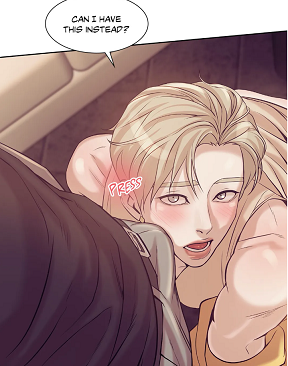 (chapter 17). During this episode, it was obvious that the CEO imagined himself with the upper hand. However, if the manhwaphiles pay attention to Lee Choonbae’s words and actions, they will notice that at no moment, he was hurt or humiliated by the antagonist’s actions. The former knew exactly what he wanted. That’s the reason why I deduce that the antagonist misjudged the second lead’s personality and as such his dangerousness.
Consequently, I am wondering if the black snake in the cover for the second season is an allusion to Lee Choonbae as well, the latter is next to the protagonists, not strangling them but surrounding them in order to protect them, ready for the battle. Or it is also possible that he has already swallowed the antagonist.
Unlike Choi Pilwon who would like to get a real family with Jooha, Dooshik’s friend is not truly looking for love. His dream is to get a rich guy as sponsor. Yet contrary to the antagonist, he has not become immoral and ruthless. He is well aware that Dooshik has different needs than himself. The blond-haired man is sensitive and selfless enough to recognize that his own desire shouldn’t ruin others’ happiness. Striking is that he considered the CEO as a blessing, when he met him for the first time. He corresponded to the dream Lee Choonbae had. That’s why he followed the CEO’s request in the first place with the idea that after his deal was done, he could get more out of it. There’s no ambiguity that the young man misjudged the antagonist’s personality. That’s why it is definitely possible that he will retaliate against the antagonist, for his desire to assist Dooshik will be stronger than his own desire. Let’s not forget that he was the only one who was truly worried about the main lead, and looked for him. He truly desired to help him. Besides, observe in the biography that the second lead’s strong trait is fakeness and hypocrisy. This signifies that he has a cunning side, and can even act. Consequently, I have the feeling that Lee Choonbae will not only be able to deceive Choi Pilwon, but also swallow him. The result is that he will push the antagonist to transform into a swan.
Note that each character has two natures, even Choi Pilwon. I had already elaborated that Choi Pilwon must have been raised in a cold and ruthless family, which pushed him to become a snake. However, his second nature is a swan. I have to confess that I couldn’t restrain myself from connecting him to “the ugly duckling”. Remember that he has siblings… similar to the ugly duckling who felt rejected by his own family. Furthermore, this would explicate why Choi Pilwon is so arrogant as well. A swan is known for its beauty, but also for self love, which would coincide with Pilwon’s narcissistic personality.
On the other hand, the swan symbolizes love, trust and loyalty. But since Choi Pilwon is always connected to black , I have the feeling that he is in truth a black swan, and the latter represents personal power. As a conclusion, I believe that the antagonist will be cornered and transformed into a black swan thanks to Lee Choonbae. Remember what I wrote about the latter in “Curse or blessing?”, he could be a blessing in disguise. There’s no doubt that if this theory is correct that Choi Pilwon will view him as a curse at some point.
As a conclusion, the second season is already announcing a hunt, a fight between preys and predators, a snake fighting against a crow and black leopard and even later at some point against a python. On the other hand, I believe that we will witness another transformation, Choi Pilwon’s. Simultaneously, I am encouraging the readers to pay attention to the images so that they can try to perceive the characters’ animalistic behavior. When is Lee Choonbae acting like a python or Dooshik like a black leopard in the second season? Moreover, it is very possible that the authors introduce other villains: Dooshik’s former partner, Choi Pilwon’s family etc.
Feel free to comment. If you have any suggestion for topics or manhwas, feel free to ask. If you enjoyed reading it, retweet it or push the button like. My instagram-tumblr-twitter account is: @bebebisous33. Thanks for reading and for the support, particularly, I would like to thank all the new followers and people recommending my blog.
This is where you can read the manhwa. https://www.lezhinus.com/en/comic/pawn But be aware that this manhwa is a mature Yaoi, which means, it is about homosexuality with explicit scenes. Besides, this manhwa is categorized as HARDCORE. Here is the link, if you are interested in more analyses about this manhwa and others https://bebebisous33analyses.com/2021/06/06/table-of-contents-of-analyzed-mentioned-manhwas/
Feel free to make some donations/sponsoring: Ko-fi.com/bebebisous33 That way, you can support me with “coffee” so that I have the energy to keep examining manhwas. It would also cover my expenses for the blog.
When the episode 24 was released, I couldn’t help myself connecting this panel with the following one  (chapter 21) As you can detect, both have so many similarities: a memory, an open area, the blue sky with clouds, two people close to each other, a very confidential conversation, a plan and a clear view. When I analyzed the second panel [read for that the essay “Hope” https://bebebisous33analyses.com/2021/07/13/the-pawns-revenge-hope-%f0%9f%94%9e/], I described that this image represented a dream and as such a hope. Kang Hyeon-Jong explained his plan to his younger brother, and envisioned that an open space was the perfect place for secrecy. In a park, no one would ever suspect them to have such a project (getting rid of corruption among the police and its connection to the red-light district). However, we all know that the police officer’s dream got ruined, for he went missing. There’s no doubt that he got killed, because he got betrayed.
As you can imagine, this image oozes the same atmosphere. Do Seong-Rok and the former prostitute are “hoping” that everything will go well with their plan. By killing Jeon Hee-Seong’s enemies, the serial killer has the impression that he will free her so that they can be together. Because of the parallels, the manhwaphiles can already sense that their dream is doomed to failure, since Kang Hyeon-Jong’s vision never came true. This signifies that their “dream” is in fact just an illusion. Why? I believe that first we can get some answers by comparing both panels again. Yet this time I will focus on the divergences. Then in the second part, I will elaborate their “perfect” project more concretely.
First, the place diverges. The protagonist is with Jeon Hee-Seong at the beach. This is no coincidence, as the beach symbolizes new beginning. The reason is simple. It’s because the water washes away the sand and allows the sand underneath to have its new beginning on top. This means that the moment their project is finished, the couple is supposed to start their life anew.
Secondly, both are facing the ocean, while the brothers were facing the city. It was, as if the couple desired to leave the civilization and to return to nature. They would leave everything behind, as there exists nothing else next to them. They are alone and carrying no possession. On the other hand, the detective’s wish was to clean the city with his brother’s support. We have the impression that the protagonist and his companion have no real aspiration except escaping from their “prison”, whereas the detective, associated to the mountain, is full of idealism and ambition. Imagine that he plans to purge the whole organization alone, a huge task for a simple human. But as you know, the villainess Jeon Hee-Seong is actually far from being contented and humble. Like the author has already revealed it, her flower is snapdragon embodying greed and ambition. This aspect is even reinforced with the choice of color, purple.
Purple: “pompous and arrogant, fraudulent and corrupt, delusions of grandeur and the social climber.” Quoted from https://www.empower-yourself-with-color-psychology.com/color-purple.html
And this truly shows that the chosen place for the confidence, the beach, is actually a deception planned by the former prostitute.
Striking is that the ocean is a symbol of power, strength, life, mystery, hope and truth. It is also referred to as being the tears, or sorrow, of God. These associations can be perceived with the following legend. Aphrodite, the Greek goddess of beauty and love, was born from the ocean and its foam, as a drop of blood and semen fell from the sky into the ocean. The titan Cronus had severed his father’s genitals and flung them into the sea. Her birth reflects life, mystery but also power and strength.
Simultaneously, the ocean is also related to chaos. Remember that the goddess’ birth is linked to blood and violence. But the chaos is also explainable, as the ocean is boundless and ungovernable. This signification is important, for it already announces the prostitute’s huge mistake. She thinks, the beach is the perfect place to manipulate her lover, making him believe that they have a future together: they are facing the limitless ocean, a symbol for freedom. But she is overlooking one aspect: the ocean can be a synonym for destruction represented by hurricanes and tsunamis. That’s why I come to the conclusion that the ocean embodies Do Seong-Rok. Remember how Lee Je-Oh viewed him as a god and admired his force. (chapter 1) I would like the reader to keep in their mind that even in Janggi, the protagonist is acting as a cannon, hence he is definitely no ordinary pawn. For her, the young man is still an innocent and pure lamb, easily manipulated, that’s why she said this to her ally Ahn:  (chapter 11) In her mind, he is just a worker and not a boyfriend. She is unaware that by turning him into a killer, she will change his nature. He can no longer be a lamb or even a simple pawn. That’s why he gets an erection while strangling Ma Jong-Seok.
 (chapter 18) He has become a weapon, and as the ocean, she can never control him. As you can see, if you interpret such an image, you can already anticipate the evolution of the story and realize the villain’s errors. Besides, pay attention to the place of the biggest cloud. It stands next to the main lead. The cloud often represents hope, but it also embodies danger, because it covers the view. And now if we combine the ocean with the cloud, we have a hurricane, the chaos!! This observation really outlined the villain’s mistake one more time. She is not realizing her lover’s true nature. And we have another clue for Do Seong-Rok’s dangerousness:
 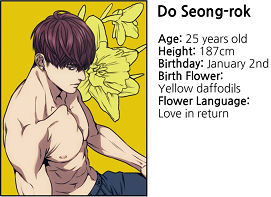 The color yellow! This pigment is often associated to positive features like optimism, cheerfulness, logic and wisdom. [For more information: https://www.empower-yourself-with-color-psychology.com/color-yellow.html] But what is less known is that this shade is the color of deception, physical illness (jaundice, malaria, pestilence) and caution. That’s why we have the yellow signal light for example and the yellow tape for a crime scene:
  (chapter 1) This negative association comes from the Middle-Age in Europe, where Jews and prostitutes were forced to wear some yellow on their clothes reflecting their social status. This pigment was a warning, and this justifies why in French (yellow=jaune) and in English there exist many negative expressions with yellow: “rire jaune” (two-faced laugh) or “jaune cocu” (cuckold yellow) or “yellow belly” (coward). Therefore yellow represents deception, betrayal, adultery, arrogance, vanity and jealousy. And note that Do Seong-Rok is indeed committing adultery with the main lead, (chapter 18) though now the roles have been switched. In episode 25, Lee Je-Oh is already treating Do Seong-Rok as his boyfriend
 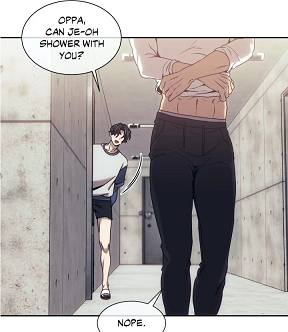 and has the impression that his lover will cheat on him with Jeon Hee-Seong.
 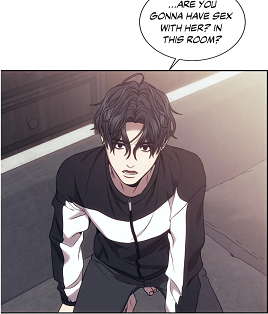 That’s why he gets upset. And now, you comprehend why the femme fatale’s dream is an illusion. She thought, she was deceiving her pawn, while in reality she didn’t recognize her own misjudgment. Her delusion of grandeur is the cause for her future defeat.
Another difference is their position. (chapter 24) The villainess and her pawn are standing, while the brothers are sitting. This is relevant, for it indicates that the detective and his Kang Hyeon-Woo are resting. By confiding to his brother, the future victim is taking a break, trying to release his stress and getting some comfort and support from his relative. On the other hand, the couple is standing indicating a certain tension. They are attempting to relax, but they can’t due to the pressure. They are about to start their project.
Another divergence is that the main characters are touching each other, their physical intimacy is even reinforced, as both are holding hands 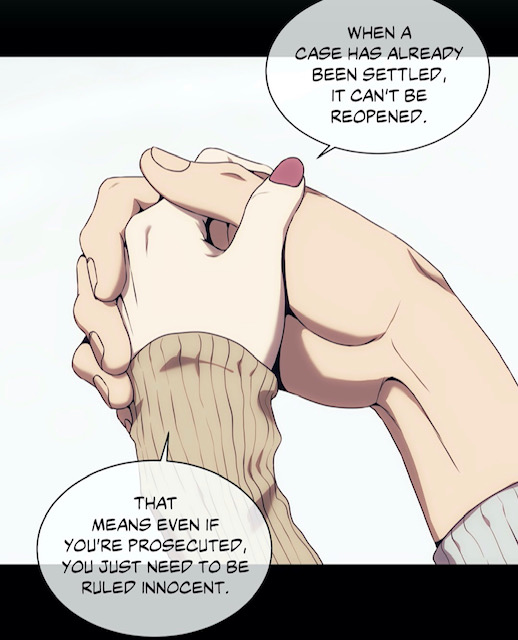 (chapter 24), while the brothers are just sitting next to each other with a certain distance. (chapter 21) However, this doesn’t reflect the real nature of their relationship. The siblings are indeed very close, as Kang Hyeon-Jong is confessing his true desire and wish. That’s why his brother mostly remained silent, this was his way to express his support.
  (chapter 21) And when he spoke, he expressed his concern for his brother. This signifies that safety mattered more than his dream back then.
Now, you can grasp why there exists this physical intimacy between the former prostitute and the future serial killer. It serves a purpose: to mask their distance, which is actually perceptible through their words. On the surface, it looks like they are working together in this, however this is just an illusion. Note that the killer is bearing the whole burden (“It’s something that only I can do” and repetition of the personal pronoun I), while the femme fatale is supposed to risk her life by using something. In other words, she only needs to do one thing. This interpretation is even reinforced by her fake concern in the next image. (chapter 24) Her so-called comforting words truly display that only Do Seong-Rok is getting his life in danger, as he will be the only one prosecuted. This means, the serial killer will divert the attention of the investigation and the prosecution office from Jeon Hee-Seong. The woman’s gentle gesture is actually masking the high expectation she has from her “lover”.
What caught my attention is the presence of darkness in the blue sky, while the black was only present as a frame in the other picture. This announces that their plan has nothing pure, for it is related to murders and as such death. Secondly, I interpret that this darkness indicates the presence of manipulation. The red-haired man is actually deceived by his lover, it was, as if the magician had created a fake vision of their hope and dream, while behind the blue sky and clouds the reality is waiting for the future murderer. He will become a scapegoat, but he is not realizing it.
What caught my attention is that the villainess and the deceased police officer’s pullover has the same color: beige.  Yet, this is not visible from behind, for she is wearing a black jacket. The appearance of beige is no coincidence, because this color is associated to loyalty and responsibility.
“Beige: is practical and reliable, conservative, constant, unchanging and loyal”. Quoted from https://www.empower-yourself-with-color-psychology.com/color-brown.html
Here, I would like the manhwaphiles to pay attention to the femme fatale’s clothes. Her choice of color is never random, they always reflect her intentions. She uses the colors to mask her true thoughts and deceive her counterparts. That’s why she was dressed like that in chapter 25:  Her bun and her clothes gave the impression that she was just an average married woman, but when she visited her so-called boyfriend, she had dressed up. Her long hair was left in the open, an important sign for seduction, just like the white shirt exudes purity and innocence.
  (chapter 25) At the same time, the black skirt embodies mystery and seduction.
But let’s return our attention to the clothes she was wearing at the beach. So when she had the beige pullover on, she wanted to exude reliability and fidelity. That’s the reason why she asks her companion to trust her, just like she trusts him. In addition, beige is a devirated shade from brown, and brown symbolizes sincerity, warmth and protection. However, brown and beige can serve as deception and can definitely be associated to hypocrisy and fakeness. And now, you understand why the scene at the beach was just a vision, and not a real wish. The villainess used her body (the hand and her clothes) to convince Do Seong-Rok to set the plan in motion. The former prostitute had the impression, she had developed the perfect plan. She would get her freedom, but she would be able to achieve her dream: getting power and wealth,  (chapter 23), while she would let the young man take the fall.
Actually, she is well aware that she will become the prime suspect. Even Koo Jeong-Moo was already suspecting her after Choi Yeong-Gil’s disappearance. (chapter 11) That’s why she is well aware that she needs to find someone to become her scapegoat. But who would be so stupid to do her dirty work and even trust her? Only a person blinded by her intelligence, her terrible situation (a fragile prostitute who got forced to get married to an abusive husband) and by his thirst for affection and warmth: Do Seong-Rok.
What caught my attention is that her manipulations are based on truth. She told him for example that her life was so terrible that from now on, she would do anything for her own sake, she would use every trick, and even the main lead.  (chapter 16) And observe that the future assassin was willing to accept this terrible situation
  (chapter 16) He would be her tool. And don’t forget that in that scene, she was trembling on her knees, a sign of huge vulnerability, which could only move his heart. He felt that she needed him, that’s why he accepted to follow her plan. I could use another evidence that truth is her MO. She confided to him this (chapter 23). For the pure man, her words sounded normal and natural. She didn’t desire to be stigmatized as a prostitute, she just wanted to be part of the society. However, in truth, she meant something else. By climbing up the ladder, she was aiming at a higher position: becoming the king of the red-light district. That’s why it is important to even question people’s intention, when they speak the truth. Nevertheless, when he decided to follow her perfect plan, he had one request: she was the only one who could save him, if it became too hard for him.
And now, it becomes understandable what he meant with this promise. It is related to her plan.  (chapter 24) Once he has been prosecuted and he is proven innocent, he can’t be charged with the same crime. But just because this rule exists, this doesn’t mean that this will be applied in this case.
And now, you comprehend why he killed Lee Soon-Cheol first. The latter was in possession of the videos compromising Jeon Hee-Seong.  (chapter 24) These videos were her weaknesses, therefore the main lead needed to find and erase them. We don’t know for sure that he was tasked with this request as well. That’s my assumption, because she stated that she wanted to erase her past, and the footage was part of her terrible past. Once her husband was removed, she would be able to get rich thanks to the property situated in the redevelopment.
And now, you are wondering what the former prostitute was supposed to use. She just needed to keep a paper showing that she rented a car for Do Seong-Rok. She anticipated that the detectives involved in the investigations might look for a lover.  (chapter 24) She desired to lead the detective to Do Seong-Rok and the pieces of Janggi left on the body would serve as a clue for his involvement in the assassinations. This explicates why Lee Je-Oh wondered about the reason for leaving evidence next to the victims an.
  (chapter 13) The femme fatale has power over his life, because she could reveal the truth. That’s her promise, if his situation worsens, she can save him implying that she has an evidence that could prove Do Seong-Rok’s innocence. However, she knew that once her husband dies, she will become a suspect. Thus she needed the main lead to divert the attention from her. Her plan was to redirect the investigation towards the red-haired man.
But as you can imagine, she has already planned to throw him away, once she got rid of all her enemies. When she stated (chapter 24), she implied that she was risking her life. On the other hand, she was actually lying. She is not truly compromising herself, as renting a car for a person doesn’t represent a crime. Yet, the true intention is to incriminate the young man.
Do Seong-Rok is becoming a serial murder, because he has already eliminated three people. Striking is that the former prostitute could say that he is just a delusional lover and even a psychopath, and the pieces of Janggi would serve as an evidence. Besides, she has Ahn by her side serving as protection, so her plan is still perfect.
But she made many huge mistakes, like I had already mentioned in the first part. But I will include other errors. First, she never told her lover how to eliminate the targets, that’s how the protagonist got aware of the killer’s presence. He could have been arrested much sooner, if Lee Je-Oh had revealed his observations. Secondly, she showed her true face, when she yelled at Do Seong-Rok. She declared that now, the main lead was on his own… something she had always planned. That’s how the assassin started mistrusting her and relying on Lee Je-Oh. Since the latter has recognized her identity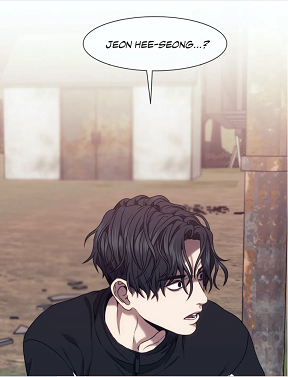 (chapter 25), and has even realized her true goal thanks to Do Seong-Rok’s confession (chapter 23), he will change the game and do anything to protect his lover and weapon.
 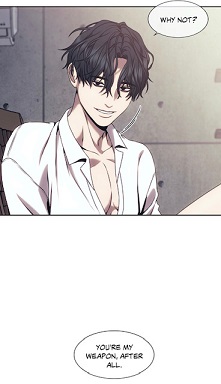 (chapter 23) Unlike the female prostitute, the young man made the terrible experience by scheming very early on. He learned that he shouldn’t underestimate the killer’s strength and strong will. Hence he came to realize that he should treat his ally with respect.
 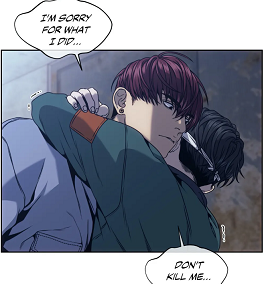 (chapter 12) Do Seong-Rok might not be clever, but he is not weak either. Actually, his major flaw is his innocence, for he is not cunning enough. And remember what I wrote above: she misjudge her lover’s true personality. Therefore she will recognize her error too late.
Furthermore, now the protagonist Lee Je-Oh represents a source of threat for Jeon Hee-Seong. He is an important witness and could testify against her.
Moreover, she is also making another mistake: she is underestimating emotions and affection. Her power over the serial killer was strong, for the latter was in love with her. But as soon as his admiration and affection vanish, her manipulations are no longer effective, and she loses her control over him. Their relationship is already falling apart. First, the main lead is forced to lie to her on different occasions. She even believes that the male prostitute has been removed. Secondly, their alienation is already announced with the following panel: (chapter 25). Notice the color of the sky: it is evening twilight, a huge symbol for a doomed relationship. And we have the presence of dark clouds and the presence of yellow… everything is signalizing the presence of a danger. Her perfect plan is on the verge of getting ruined, as the male prostitute will discover her identity. Because of him, her relationship with Seong-Rok can only be doomed.
Finally, since she is just judging her lover as a worker and pawn, she is not viewing him as a part of her life. He is just an accessory, whereas the male prostitute has a different perception of Do Seong-Rok. He considers him not just as a weapon, but also as a real boyfriend. I have to admit that I view the two protagonists as an entity. Lee Je-Oh is slowly becoming the brain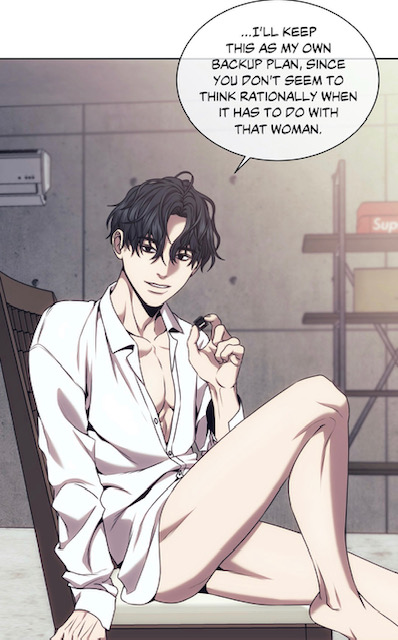 (chapter 23), while the serial killer will become his arm and hand! Besides, don’t forget my recent interpretation. Do Seong-Rok is linked to the ocean, and the manhwalovers will certainly remember how the male prostitute viewed himself:
 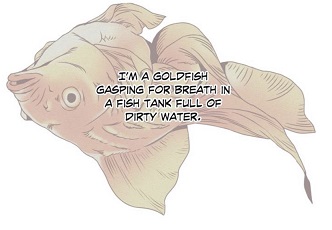 (chapter 1) A fish!! I am well aware that a goldfish is not living in the ocean, but I doubt that the male prostitute could ever afford himself an expensive fish from the ocean. Besides, in the essay “The goldfish and the lamb – part 1”, I had already explained that for me, the young main lead reminded me a lot of the devil firefish / common lionfish.

As you can see, my previous interpretation seems to be confirmed. Since Lee Je-Oh is a common lionfish and the other is the ocean, they are a perfect match.
In addition, both protagonists have a similar disposition. They are starving for affection and have a huge sense of justice… Lee Je-Oh truly perceived Do Seong-Rok’s intentions behind the murders: liberation from slavery, whereas Jeon Hee-Seong used Do Seong-Rok’s empathy and generosity for her own dream: power and wealth! Due to the young main lead’s past experience and cunningness, Lee Je-Oh will be able to anticipate the villainess’ “perfect plan” and protect his boyfriend. Thereby, the femme fatale will slowly realize that this dream of her was just an illusion, and she was a victim of her own delusion.
Feel free to comment. If you have any suggestion for topics or manhwas, feel free to ask. If you enjoyed reading it, retweet it or push the button like. My instagram-tumblr-twitter account is: @bebebisous33. Thanks for reading and for the support, particularly, I would like to thank all the new followers and people recommending my blog.

This is where you can read the manhwa. https://www.lezhinus.com/en/comic/madplace_en But be aware that this manhwa is a mature Yaoi, which means, it is about homosexuality with explicit scenes. Here is the link, if you are interested in more analyses about other manhwas https://bebebisous33analyses.com/2021/06/06/table-of-contents-of-analyzed-mentioned-manhwas/
It would be great if you could make some donations/sponsoring: Ko-fi.com/bebebisous33 That way, you can support me with “coffee” so that I have the energy to keep examining manhwas. Besides, I need to cover up the expenses for this blog.
After reading such a title, readers familiar with this story will wonder how I came to select such a headline, because it gives the impression that this manhwa contains supernatural elements, while in reality the story is a mystery, or more precisely a crime novel. Besides, the illustration of Mad Place is clearly reflecting this situation. The Korean prosecutor, Gu Sehyuk, has handcuffed and trapped in his arms the suspect Ha Ideun, while holding the keys of the handcuffs in one hand. But if you pay attention to the scenery, you will notice that the district attorney is also trapped, hugged by the chaebol Ha Ideun. Yet, at no moment there‘s a presence of a ghost or a priest.
However, the manhwaphiles should look carefully at the way the two protagonists are introduced and even portrayed. Only through a meticulous analysis, they will realize that both characters are more than just a prosecutor and a chairman‘s son.
And now, it is time to focus on Ha Ideun. 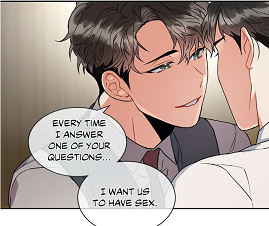 (Chapter 7) After viewing such a panel, the readers can only judge him as weird, but funny. Though the main lead is now a murder suspect, he keeps smiling while making requests, and as you can see, his main condition is sex. Because of such a behavior, he can not look trustworthy in the attorney district’s eyes, rather obsessed with sex. It was, as if he was amused by this situation. That‘s even how Gu Sehyuk views him in the beginning of this story. Nonetheless, this is just a deception. The man is actually using the situation for his own benefit. Why? First, his first request is quite serious. He is asking for an investigation.
  (Chapter 2) This signifies that he needs Gu Sehuyk’s help and power as district prosecutor. And this observation leads me to the following conclusion. He created such an opportunity to approach his target, Gu Sehyuk. How did I come to such a conclusion?
The author gave us clues on different occasions. First, he knows the code for the house. 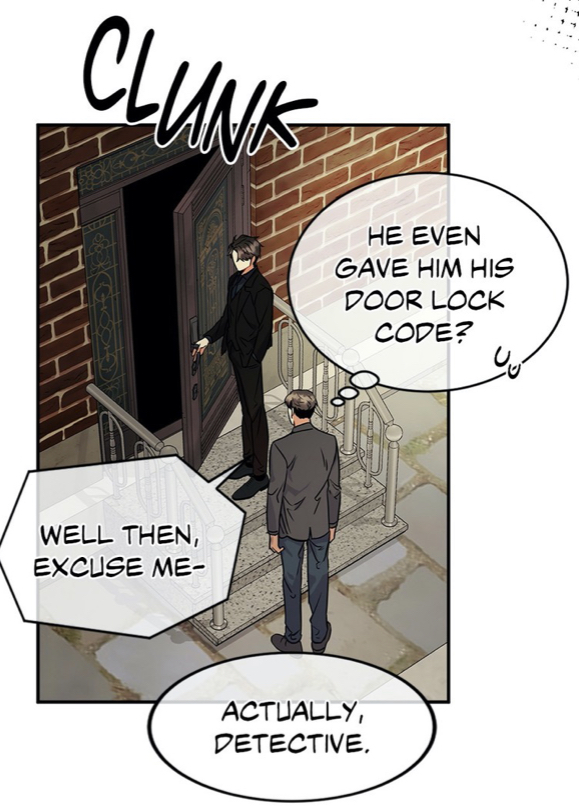 (Chapter 12) I doubt that the main lead gave it to the „suspect“, since the latter is under investigation. Secondly, he knows the prosecution officer’s life so well. Observe that he is the one telling the young detective how long Gu Sehuyk will stay at work.
  (Chapter 12) Moreover, he knows about the death of Gu Sehyuk’s brother and the circumstances of his assassination. That’s why he sent him a picture of the killer, Yoon Gyuho, who had committed suicide right after. Then, the manhwaworms can witness
  him kissing the prosecutor’s wrist tenderly, a sign of affection. He might have introduced himself as his biggest fan
 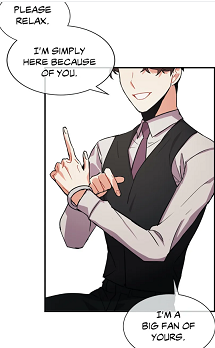 (chapter 2), yet such a gentle kiss expresses more than just admiration. Moreover, I would like to point out the absence of the eyes in the last picture, a sign that the protagonist is here wearing a mask and not entirely honest.
All these elements truly expose that he is well informed about the district attorney‘s life. But since the latter has no idea how he is connected to the „suspect“, the first assumption would be that Ha Ideun has been spying on him like a shadow. A second possibility would be that he was an acquaintance of Gu Sihwan, the assassinated brother, but the prosecutor was left in the ignorance. Yet, I have to admit that I have a different theory. I am actually more inclined to perceive him as a ghost from Gu Sehyuk‘s past, but the latter has no recollection due to his trauma. This means that he would have ghosted Ha Ideun. This theory would also explain why he proposes the deal: sex in exchange for information. That way, he would restore their past relationship. As you can detect, for me the sex scenes in a really good manhwa are not just created for entertainment, they always have a purpose (see Painter Of The Night, The Pawn’s revenge etc.) Moreover, we could perceive the ghost’s behavior in episode 18 as an evidence for this thesis.  (Episode 18) Notice that in this scene, the „suspect“ is blushing and hiding his gaze with his hand, while he admits that he did it because of him. In addition, he reminds the attorney district of their actual situation. One sex session means the divulgation of intel. Here, Gu Sehyuk had the impression that he was the only one who got carried away, whereas Ha Ideun was still able to remain rational and calm. Yet, due the blushing and the covering of his eyes, it becomes obvious that the „suspect“ was definitely moved. Besides, Ha Ideun justifies his action with the prosecutor. It is for him or his brother. Then he begs him for his trust. Yet, this is just a theory of mine and you have every right to think otherwise. But one thing is sure: the young man is definitely more close to Gu Sehyuk than the latter is aware.
As you could see, I used in two opportunities the idiom „ghost“, when I described his relationship with the prosecutor:
Yet, at no moment I elaborated why I couldn‘t help myself connecting the chaebol‘s son to a phantom. First, the protagonist is presented as Gu Sihwan‘s shadow  (chapter 6), exposing that both characters are similar and in fact related. Furthermore, what caught my attention is that the face of the chairman’s third son is never revealed to citizens, when his arrest is mentioned in the news. In fact, we only get to see a white television screen.
  (Chapter 1) But this doesn‘t stop here. Later, when the attorney district meets the deputy prosecutor general Na Joohwan, the latter reveals that during a search concerning the existence of a slush fund, he noticed that Ha Ideun’s room was devoid of life.
  (chapter 8). There was no picture and no cloth. It was, as if the owner of the room was a phantom. Besides, note that we have the presence of white again. The manhwaphiles certainly know the expressions „white as a sheet“, „pale/white like a ghost“. As you can see, these panels reflect these idioms. That’s how I connected the chaebol’s son to a ghost.
Furthermore, if the manhwalovers recall how the young man is described, they will notice that neither the detective and the prosecutors can truly perceive his identity. He is rumored to be consumed by sex  (chapter 7), he is not working and he doesn’t own any apartment. In other words, he is living in the shadow, for he has no possession and is not interacting with people. His sexual habits are presented as hearsay. And now, you comprehend why I made this association. That‘s why it is not surprising that at the end of episode 18, Gu Sehyuk wondered about Ha Ideun‘s true personality.
And note again that the young man appears quite emotional, once he is alone in front of the mirror. This truly exposes that their last sex session definitely affected him and he was controlling himself, when he made new revelations.
Another parallel is his words addressed to Gu Sehyuk. First, he confesses to him that he knows the truth. (Chapter 5), while the district attorney is only aware of facts.
  (Chapter 4) There’s no doubt that the suspect is telling the truth. He is not blinded by agony, like Gu Sehyuk who suffered a lot from his brother’s loss. I will explain the difference between truth and facts more in details later. Besides, let‘s not forget that a spirit is able to see more than humans, because they are detached from the physical world. They can move from one place to another very easily. Therefore they can gain more insight than mortals. As a ghost, he is able to spy and discover new clues.
Since Ha Ideun is related to the color white, a symbol for purity, wisdom, knowledge and light, it becomes obvious that the young man is in reality more than just a hedonistic and carefree person. Observe this scenery:  (chapter 2) The light oozing from the television stands in the protagonist’s back and illuminates the prosecutor. It was, as if Ha Ideun was bringing light into the main lead’s darkness. With his knowledge, he will be able to help to unveil the mystery of his brother’s death. For me, there’s no ambiguity that he has long planned to approach the prosecutor and he knows very well, why Gu Sihwan was murdered. But he can‘t reveal everything at once, because the latter would never believe him. Besides, he needs to prepare the protagonist to face the truth and exactly for this reason, the young man has to investigate himself. Only by becoming the investigator, Gu Sehyuk can discover and accept the verity. Moreover, Ha Ideun has to gain the prosecutor‘s trust. And now the manhwaphiles can comprehend why he is asking for the prosecution officer‘s confidence.
  (Chapter 15) Therefore he is willing to be investigated and questioned by Gu Sehyuk. He has no problem to get tested. Since he is clean, he has nothing to fear. On the other hand, he is not releasing much information, because he is well aware that his knowledge could generate suspicions among the prosecution office. Observe that once caught in the CCTV, he was immediately turned into a murder suspect. Words can be misinterpreted, hence he is very reluctant to speak so freely. The readers should keep in their mind that each information he gave was related to a concrete evidence (the picture, the bag full of drugs and the knife),
  (Chapter 15) something that can not be tampered, as long as the district attorney is supervising the investigation. In other words, he is guiding the district attorney to unveil the mystery.
And now, you might be wondering why he approached the prosecutor after two years. In my opinion, it is related to his good notoriety. Gu Sehyuk has become famous as a hardliner, as a serious and integer prosecutor. He made sure that the accused would always receive a harsh sentence. Nonetheless, there exists another reason from my perspective. Since Ha Ideun is a „ghost“, this signifies that he is powerless. I suspect that the absence of his life and presence is related to his other brother Ha Sungjoon.  (Chapter 2) After analyzing so many manhwas, I discovered that many characters wearing glasses were hypocrites, often manipulative and ruthless. Hence I am suspecting that everything is related to Hasung Group. I believe that Ha Ideun’s powerlessness is related to Ha Sungjoon. Note that in that scene, the main lead showed a disdain towards his brother, when the latter appeared on television. There exists a rivalry and Ha Ideun‘s bad reputation (lazy, consumed by sex) is definitely playing into Ha Sungjoon‘s hands. Simultaneously, it could be a diversion from the main lead‘s part, that way he could deceive his brother and investigate his crimes. The manhwaworms shouldn‘t forget the existence of a slush fund and the sudden increase of benefits from Hasung Group.
Finally, by approaching the district attorney, Ha Ideun is slowly revealing his existence to the outside world. For the first time, his name becomes public. This means, he can no longer be hidden. This is no coincidence that he allows the NFS to take his hair and blood, because that way he can prove his existence. I have to confess that Ha Ideun sounds similar to „hide“. From my perspective, it looks like the protagonist was forced to live in the shadow. And now, with this interpretation, it becomes more understandable why he would make the request to have sex. Through sexual encounters, he has the impression to feel alive. It was his only way to prove his existence. Furthermore, it would give him the perfect excuse to hide his true intentions. He needs Gu Sehyuk’s strength and trust, and through intimacy, he can get his faith and as such justice.
Now, the manhwaphiles are wondering about the origin of this interpretation. What caught my attention is the protagonist’s behavior. First, he lives like a hermit, keeping his distance from his coworkers and totally disinterested in worldly pleasures. This explicates why after his victory at the trial he refuses to celebrate with his colleague.  (Chapter 1) His whole life is revolving around his work as prosecutor, a life full of dedication, humbleness and chastity. He is actually not truly living, just determined to keep his vows. He is making sure that the defendants are all receiving harsh sentence.
  (Chapter 1) What the other district attorney calls as obsession, is in my eyes the protagonist’s religion.
The way I portrayed the main lead reminds me of a priest, and more precisely of a monk: seclusion, modesty, abstinence of worldly pleasure, hard work and virtue are the features corresponding to a ascetic. His cult is to make sure that culprits are receiving their punishment, since he failed to do it with his brother. It was, as if he was trying to absolve his sin towards Gu Sihwan. But if Gu Sehyuk is a priest, then he needs to have a shrine. (Chapter 3) The pictures on the cupboard are representing his „idol“ or „saint“. Since Gu Sihwan got assassinated, he became a martyr and his brother turned him into a „saint“. And now, you comprehend why Ha Ideun is not allowed to touch his deceased brother’s belonging. They are sacred relics.
  Therefore it is not surprising that the brother’s bedroom is associated to white as well:
  It was, as if his bedroom was a crypt. That’s why I came to the following interpretation. The mansion, which Gu Sehyuk described as „frozen in time“, is his tempel. Consequently, his residence is intemporal. Because this is a sacred place, he can’t live properly there. At the same time, he feels the intrusion of a stranger as a sacrilege. Therefore the manhwaphiles can grasp why Gu Sehyuk cleaned the house after the ghost‘s visit.
  (Chapter 3) The tempel had lost his purity. The reason for his transformation is naturally his brother’s murder. The latter suffered so much from it, that he couldn’t move on. This is no coincidence that once he is confronted with the culprit’s face, he gets a flashback, a panic attack.
  (Chapter 3) But since he is so trapped in his past, he starts suffering, once he encounters Ha Ideun, for the latter forces him to remember his repressed memories.
Because he lived as a monk, he never got the occasion to get emotional. However, once the „ghost“ touched his wounds from the past, the prosecutor could only get infuriated and upset, and as such became a sinner. This is not surprising that he even got violent. And now, it is time to explain what Ha Ideun meant with this:
(Chapter 4) The hard working man witnessed Gu Sihwan’s murder and caught the culprit at the crime scene. Hence he could never forget his face.  But the problem is that memories are never objective. They are definitely influenced by the subject‘s past experiences, emotions and mentality. What Gu Sehuyk saw here could be viewed differently. He views a murderer in this image, while I detect the killer‘s despair and angst through the eyes. From my point of view, the man was not lusting for blood, though he stabbed him 7 times, a sign for rage and madness. And notice that after the crime, Gu Sehuyk investigated the matter from the culprit‘s perspective. Why would he stab his brother 7 times? Why would he do this? In other words, he tried to find out his motivations. But like Ha Ideun pointed out, he was missing something important there: the victim.
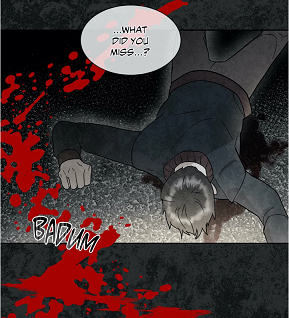 (Chapter 4) Because he was close to his brother, he had the impression that he knew his brother: he was a smiling and cheerful person with no secret.
 The picture of his idol exposes Gu Sehyuk‘s blindness. And now, you comprehend why the „ghost“ put it down in the end. This was not the truth, Gu Sihwan hid things from his brother. And this leads me to the following conclusion. Because the prosecutor idolized his brother so much, he couldn‘t discover the truth. Moreover, he acted like every district attorney. They just need to catch the culprit and the case is closed. However, there‘s a huge difference between truth and identifying the perpetrator‘s identity. There was definitely a conspiracy, but the protagonist failed to see this, as he was too obsessed with the assassin. Here I would like to mention my other essay called „Truth and memories: Memorist, Nobody knows, Find me in your memories and The King“, where I elaborated the problematic of unveiling the truth through memories.
Under this new light, it becomes comprehensible, why Ha Ideun switched on the light in the prosecutor‘s residence, which caught the district attorney by surprise. This has a methaphorical signification. He brings the prosecutor closer to the truth, he enlightens him. This explicates too why the spirit entered Gu Sihwan‘s room and grabbed his book. He was violating the sacred place for one reason. He wanted Gu Sehyuk to leave the darkness of his temple and fight for his brother’s rights.  (Chapter 4) Why did he have to die? Ha Ideun needs to transform the deceased brother into a human so that Gu Sehyuk decides to look into his brother’s past life.
However, Ha Ideun has to change the prosecutor’s way of life as well. He needs to force him to become sinful so that he stops being a monk and the house is no longer perceived as a shrine. That’s another reason why the „suspect“ requests sex as an exchange for information. He is inciting the main lead to become a sinner. That way, the main lead is pressured to drop his role as an ascetic. By turning him into a sinful priest, the latter is forced to question himself. Hence the main lead gets violent enraged in the episode 3 and 4, signs of wrongdoings. Besides, this is exactly what is happening in episode 18. For the first time, he discovers pleasures  and is taken by surprise. He wonders why he acted like this.
  (Chapter 18) In my eyes, this scene indicates that Gu Sehyuk is slowly coming back to life. But the problem is that the main lead has lived like that for two years, therefore he won’t change right away. From my point of view, his „temple“ will become a mad place, because he commits a sin in a sacred place.
 (Chapter 1) Ha Ideun won’t be able to remove the prosecutor’s religion despite their sex sessions, as long as the truth is not totally unveiled. This is my explanation why Junah chose such a title.
And now, you comprehend why both protagonists are trapped in each other‘s embrace. Both need each other in order to unveil the whole truth. Ha Ideun is definitely lacking power, as he has always lived in the shadow. He needs to become a human in order to get justice, just like Gu Sihwan.
Feel free to comment. If you have any suggestion for topics or manhwas, feel free to ask. If you enjoyed reading it, retweet it or push the button like. My instagram-tumblr-twitter account is: @bebebisous33. Thanks for reading and for the support, particularly, I would like to thank all the new followers and people recommending my blog.
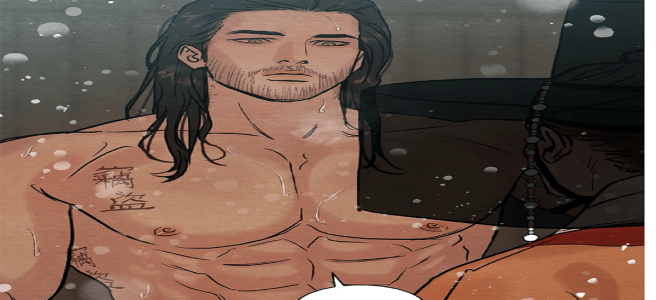

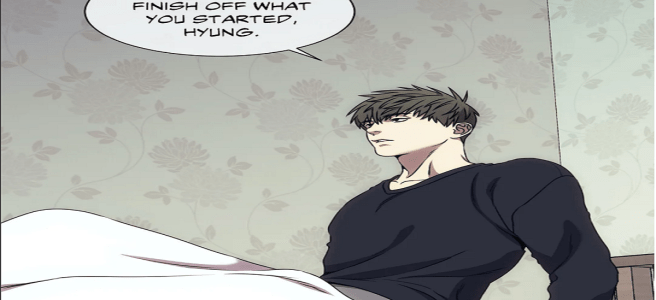
This is where you can read the manhwa. https://www.lezhinus.com/en/comic/pawn But be aware that this manhwa is a mature Yaoi, which means, it is about homosexuality with explicit scenes. Besides, this manhwa is categorized as HARDCORE: 🔞 Here is the link, if you are interested in more analyses about this manhwa and others https://bebebisous33analyses.com/2021/06/06/table-of-contents-of-analyzed-mentioned-manhwas/
Feel free to make some donations/sponsoring: Ko-fi.com/bebebisous33 That way, you can support me with “coffee” so that I have the energy to keep examining manhwas. It would also cover my expenses for the blog.
Readers familiar with The Pawn’s Revenge might be surprised that I selected such a title, because when you read the sypnosis and see this panel , it gives you the opposite impression: dark, asphyxiating, destructive and hopeless.
However, when I read the latest chapter (chapter 21), I couldn’t help myself connecting it to hope, and as such to belief, aspiration and goal. And now, you might wonder how.
First, it is related to Kang Hyeon-Jong, , the missing brother from lieutenant Kang Hyeon-Woo. When the former confides his intentions to his brother (he would like to clean the corruption in the police forces and remove the dirty connections between authorities and the red-light district), the former appears integer, righteous, courageous and determined. This means, he is full of energy and aspirations to achieve his goal.
But what caught my attention is that when Kang Hyeon-Woo recalls his conversation with his brother, we see them discussing it on the top of a hill. Not only they have a perfect view over the city, but also the weather is quite nice. The sky is blue and there are a few clouds. Finally they are sitting in a park surrounded by nature. As you can imagine, in my eyes this scenery is not random at all. This scene is full of symbolism.
The presence of the hill with the perfect view over the city is an indication that Kang Hyeon-Jong had the bigger picture of the situation in his head. He knew what was going on: officer Ahn was working with the hostess Jeon Hee-Seong, and the latter had already planned something out of resent. In addition, he was well aware that many police officers were dirty. Therefore the sight over the city is a metaphor of Kang Hyeon-Jong’s thoughts. The existence of the recorded evidence and his words to his brother truly display Kang Hyeon-Jong as an idealist and pure police officer. He was full of hope and bravery. Moreover, a hill represents the climb to higher attainment, wider view of life or opportunities. Hence it is linked to potential and change either. And now the manhwaphiles can grasp that the detective’s selected place mirrored his state of mind. He was attempting to climb to the top to remove all the corruptive elements.
This perception was also reinforced, when Evy drew this panel  combined with the idioms “chance” and “expose this case to the public”. Note the presence of the wooden plank in the bottom. It was, as if the perspective and the wooden plank were the stage, and the city in the background was symbolizing the public. In other words, the scenery was representing the detective’s vision. He was full of confidence and dream here. Moreover, since it is an open air area, you can breathe more easily. This signifies that the scenery oozes a certain relief, liberation and release. The brother could confide to his brother about his intentions and his latest information. He knew that the young detective was trustworthy and would support him. It represented a moment of relaxation for the investigating Kang Hyeon-Jong. Thus the readers see the machines as a symbol for relaxation and entertainment. Since the hyung was disclosing his discoveries and his evidence, it means that the younger brother was his pillar in his quest to clean up the police forces.
But there exists another element for this interpretation. The cloud is linked to future, dream and change, because clouds always move on and their form can change. Besides, since they are close to the sky, the clouds are connected to the gods, the former are bringing messages from the gods. That’s why in certain cultures, shamans would read the clouds and interpret these. And now, you understand why the author created such a scene. The cloud was embodying the detective’s dream and ambition. He was full of hope.
In that moment, I realized that the author used the sceneries to express certain ideas and emotions. Remember how Lee Je-Oh reacted after leaving his testimony to Park Gwang-Soo. He expressed his admiration about the murderer. (chapter 2) Note the similarities: We had a nice weather with clouds and a hill in the background. The male prostitute was also full of hope here. He could breathe in that moment, he had lost another violent tormentor to his relief. Therefore I came to realize the existence of the connection between dream and nature contrasting to the city represented as a chicken battery.
And these two scenes (chapter 21-2) lead me to the following observation. The weather and the place reflect the mental disposition of the characters. When Do Seong-Rok killed the first victim, it was night, dark and raining. (chapter 1) Furthermore, he abandoned the corpse in an abandoned area. This scene was quite oppressing and depressing which mirrored the perpetrator’s disposition. Let’s not forget that later the manhwaphiles could witness the murderer’s fears, when he had a nightmare. (chapter 6) Instead of looking up to the sky (a symbol for dream and hope), the criminal looked down. I could bring up another scene:  (chapter 16) Both characters are looking down, both hurt and depressed. The prostitute is full of doubts and resigning to her fate. She will do anything in order to survive, and if it is necessary, she will betray and abandon her lover. She announces that she will be definitely ruthless and selfish. She is no longer expecting happiness and relaxation. It’s a fight for her. Besides, in that scene, the city looks lifeless, as there are no plant or people. I would even say, it’s suffocating, for the sky is so dark and clouded. It was, as if it functioned as a lid. As a conclusion, the weather and the scene reflect the character’s state of mind. The blue sky with clouds is linked to hope, while a raining dark grey day is associated to hopelessness, fear and doubts. Thus the town is related to suffocation, loneliness and resignation. Let’s not forget that the characters are all embodying animals (Lee Je-Oh is a goldfish and a dog, Do Seong-Rok is a dog, Jeon Hee-Seong is a snake etc…), but the problem is that they are all trapped in the Janggi game, that’s why they are not free and feel so oppressed. In my opinion, the Janggi board is in reality the city itself. Instead of representing civilization and progress, the town embodies despair, corruption and asphyxiation: death.
And now, it is time to look again at the episode 21. If you compare the bed scenes with the protagonists, you’ll detect a huge change. The room and the sheets appear so white and pure (chapter 21), which contrasts to this scene for example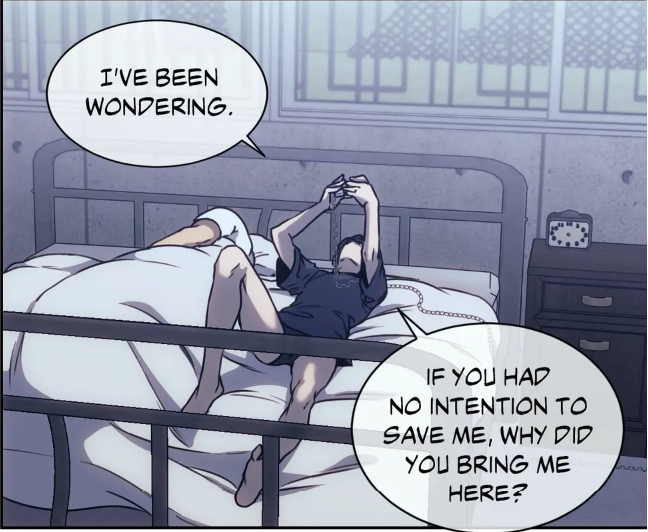 (chapter 7) where grey was the dominant color. Contrary to the scene in episode 7, the main leads are no longer separated by the sheet, and they are facing each other. As you can sense, the color and the position mirror their increasing closeness and trust. I would say that the main couple is full of hope in that chapter. This is particularly perceptible in this image. Lee Je-Oh is already thinking about the future.
  He is confident in his skills and intelligence to protect his partner. The presence of relief and aspiration explains why the main leads are tender and caring towards each other.
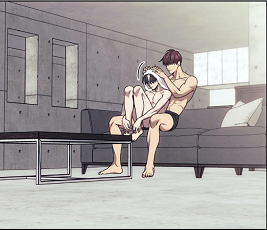 Here, you might argue that we don’t have the presence of nature, hence this contradicts my previous interpretation that nature is a signal of liberation and relief. However, I can refute this argument by pointing out that we don’t see the city here. In my eyes, the room has now become a refuge, a shelter of two wounded and lonely souls. Lee Je-Oh is no longer viewing the bedchamber as a place where he is held hostage. He is now cohabiting with the murderer. Thanks to him, Seong-Rok could sleep much better and wasn’t tormented by a nightmare, though he had killed Ma Jeong-Seok. To sum up, the bedroom shouldn’t be judged as a contradiction to nature. It is the place for privacy and relief as well. Furthermore, the better the bond between the killer and the male prostitute is, the clearer the room appears.
Due to these last significations (the symbolism of the scenery and the bedroom as a shelter and place to relax and privacy), I come to the final scene from the chapter 21: Kang Hyeon-Woo in his bedroom. The latter is still full of hope as well 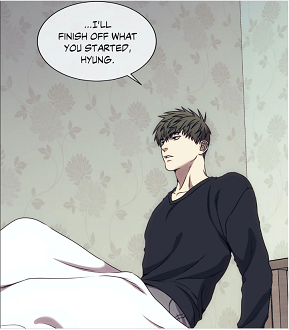 despite the loss of his brother. He hasn’t given up on his dream and ambition. Consequently he makes this promise to fulfil his brother’s hope. Hence Kang Hyeon-Jong’s uniform hangs on the wall at the end of the bed.
 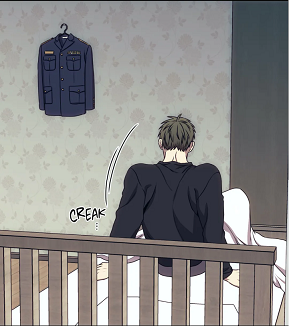 It symbolizes the detective’s goal: he is seeking for the truth and eradication of corruption. The bedroom is the officer’s refuge, where he can express his true thoughts and emotions. He doesn’t feel lonely, because he still has the brother’s uniform by his side. It was, as if the latter was still alive and by his side. And if you pay attention to the images, you’ll detect the indirect presence of nature: the wallpaper. It is slightly green and there are flowers. I tried to identify the flower, but I wasn’t sure. For me, it looks like a chrysanthemum which symbolizes longevity, fidelity, joy and optimism. Naturally, this flower has other meanings, but it depends on the color. A white one is offered to the relatives of the deceased as a sign of grief. On the other hand, a white chrysanthemum signifies loyalty and honesty. Striking is that the flower has the same color than the shirt Kang Hyeon-Jong was wearing, when he was confessing his last discoveries and dream. Consequently, I come to the conclusion that the flower in the background embodies the missing brother who is supporting Kang Hyeon-Woo in his quest to find the truth. One might argue that this can only be a coincidence, yet I can bring up the following point. Evy selected for each character a particular flower and color:
  But like I mentioned above, I am not certain about the identity of the flower on the wallpaper. It could be a dahlia too… If you have any idea or suggestion, feel free to leave a comment.
One thing is sure: the flower represents the brother and the light green could be seen as an allusion to the lieutenant’s actual investigation. He is only at the beginning of his quest: unveiling the truth. He is not aware that his brother’s former partner, Kim Seung-Tae, is also involved.  (chapter 20) Though the latter desires to give the lieutenant the impression that he is honest and supportive, in reality it is the opposite. Since he asked the lieutenant for update, though he is quitting his job, this means that Kim Seung-Tae is actually asking for information. In my eyes, he belongs to the team facing officer Ahn and Jeon Hee-Seong.
Since the recorded evidence has not been used against officer Ahn, we can conclude that the opposite team doesn’t have it either, because they didn’t blackmail the former prostitute and her lover. In my opinion, the idealist Kang Hyeon-Jong made a huge mistake. While he was investigating his superior Ahn, he didn’t imagine that his partner was unethical too. Let’s not forget that when the hyung confided to his brother, he mentioned the prostitute’s resent against the brothel crowd. That’s why I think that he must have been digging some information about the origins for her animosity. Koo Jeong-Mo revealed that they did something terrible to her, indicating that this incident was quite important. In other words, Kang Hyeon-Jong must have discovered the existence of this terrible event. And if I recognized the flower correctly which embodies loyalty, this would explain why the officer went missing. He got betrayed by his partner, for he didn’t expect it. All his attention was focused on officer Ahn and the prostitute, because the two were more obvious.
And now, it is time to refer to the second meaning of the cloud. The latter is also related to secret and danger, as it hides the sun. This truly reflects the hyung’s past situation. He wasn’t aware of the deception surrounding him. Furthermore, I have two other reasons to suspect Kim Seung-Tae: the scar on his face and the black clothes, a symbol for death. So by meeting the younger brother, Kang Hyeon-Jong’s partner can hope to find evidences against his enemy and rival Ahn. And now, you understand why the conversation between Kang Hyeon-Woo and Kim Seung-Tae took place outside close to trees. The young officer full of energy and ambition represented a source of aspiration for the former police officer. The latter could get real results in order to get rid of his enemies. Once the officers supporting Ahn are removed, he can place people close to him so that the corruption and as such connections between the authorities and the red-light district remains unchanged.
As a conclusion, the chapter 21 stands for hope, belief and confidence. That’s why I love this manhwa very much😍 and recommend it. The story might be dark and painful, yet the author manages to find the right balance between light and darkness. The killer is the perfect example. He has already dirtied his hands, yet many readers are not condemning him, for he is not doing it out of selfishness, greed and sadism. He was in reality manipulated by the prostitute. And remember my interpretation in “Janggi and life”. In my eyes, only the criminal couple and the detective Kang Hyeon-Woo will be able to destroy this terrible corruption: the revolution is on its way.
Feel free to comment. If you have any suggestion for topics or manhwas, feel free to ask. If you enjoyed reading it, retweet it or push the button like. My reddit-Instagram-tumblr-twitter account is: @bebebisous33. Thanks for reading and for the support, particularly, I would like to thank all the new followers and people recommending my blog.
This is where you can read the manhwa. https://www.lezhinus.com/en/comic/painter But be aware that this manhwa is a mature Yaoi, which means, it is about homosexuality with explicit scenes. If you want to read more essays, here is the link to the table of contents: https://bebebisous33analyses.wordpress.com/2020/07/04/table-of-contents-painter-of-the-night/
Now, you might wonder if I have not developed an obsession with the tears. This is already the fourth essays about this topic, if I include the analysis about Baek Na-Kyum’s tears. However, remember that in the composition entitled “Tears and characters – part 1”, I had explained that Min’s tear  had inspired me.
And now, it is time to reveal my theory. For the first time in the manhwa, we had a combination between tears and humor. Furthermore, just after Nameless had mentioned the intercourse between him and Jihwa, the latter had punched him in the stomach.  However, as you can imagine, the lord’s punch didn’t hurt the criminal at all. But since Nameless didn’t desire to embarrass his former sexual partner, he acted, as if he had been hurt. In other words, he wasn’t actually honest, when he said this: “That hurt, my lord”. (chapter 76) For the readers, the situation was transformed into a joke and comedy, exactly like Black Heart pointed out right after. Yet, for the villain, it was a serious situation: “Jihwa had fallen so deeply into sodomy that he had reached to a low-born!” Besides, Min hadn’t been able to taste himself the painter.
And this combination between humor and tears made me realize that at the end of the story, the readers should expect that Baek Na-Kyum or Jihwa will cry out of laughing. Byeonduck’s fanarts are already indicating this, because the artist is always seen laughing with an open mouth.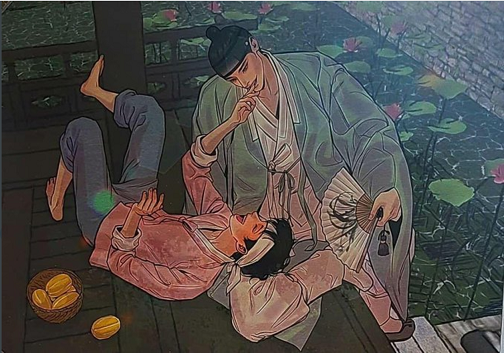 This signifies that Yoon Seungho and Nameless will make jokes and tease their partners. In this picture, the noble is biting the artist’s finger. Let’s not forget that both ukes are always crying so much, when they are sad, angry and pained. It displays that they tear up easily.
Besides, Painter Of The Night indeed contains many jokes and pranks, but there are not perceptible right away. Let me give you another example. (Chapter 67) Nameless excused his roughness with his lack of experiences. But the readers are well aware that The Joker did it from the back with the kisaeng in episode 51
  and he has quite a reputation. And when I combined the low-born’s excuse with Jihwa’s reaction, I couldn’t help myself laughing.
 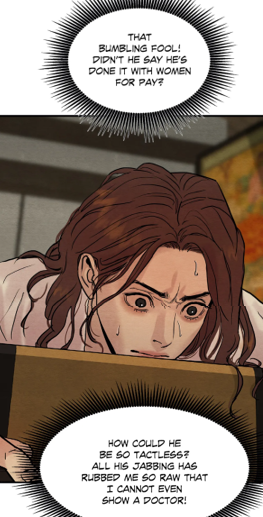 The latter was so innocent here, for he believed the man. He wasn’t able to recognize why Nameless rubbed him so raw. His description reflected the butcher’s passionate desires. The latter couldn’t restrain himself. His heart had been moved by the aristocrat’s remorse and tears. The criminal could sense his purity despite his horrible intentions. The young master imagined that for the criminal had never done it with a man before, he would be more careful. Moreover, if he had done it with women before, in his eyes, it signified, the lover was quite delicate and tender. In other words, Nameless hid his sexual desires and affection behind a false excuse. We have another indication that the low-born did more than rubbing. He left many hickeys on his sex partner, a sign of possession and passion. For the first time, Jihwa experienced what a love session is, but didn’t recognize it. 😉 Nameless is well aware that the aristocrat has no real affection for him, therefore he has to hide his true emotions behind a joke.
In addition, we have Yoon Seungho who keeps playing pranks (chapter 16:  , 74
, 74  and teasing his lover
 (chapter 23)
  (chapter 75). Nevertheless the latter hasn’t truly recognized his master’s sense of humor due to social norms.
Baek Na-Kyum is always worried about his doctrines and appearances. In chapter 16, he was fighting against his arousal and didn’t want to get caught. In episode 23, he tried to hide the fact that he had stolen the bottle of wine. Then in chapter 39, he was uncomfortable, because the tailor could see the nature of their relationship. In episode 75, he is still in denial that he is hoping for more. Therefore he refuses to admit the truthfulness of his lover’s words. Baek Na-Kyum could only blush, each time he was teased. Consequently I come to the conclusion that the protagonist will only shed tears out of laughing, when he has been able to overcome the social norms. That’s why the moment the artist won’t feel flustered any longer, he can pay attention to his lover’s words and behavior and grasp his intentions. From that moment on, he will sense the main lead’s sense of humor. On the other hand, this can only happen rather late in the story. Furthermore, since Jihwa is very similar to Baek Na-Kyum, for both are trying to follow traditions and are influenced by their peers (Min- Heena), it signifies that the young master will have a similar evolution.
As a conclusion, I am predicting that at the end of the story, the jokers Nameless and Yoon Seungho will make their respective partner laugh so much with their words and gestures that tears will come out. However, so far none of the ukes could enjoy the pranks and comical situations. Both were always very serious, because they are influenced by humorless and austere people: Min, Heena and Jung In-Hun.
Now, I will explain why I perceive them as unhumorous persons. The kisaeng lives in an environment, where she needs to entertain the rich and powerful nobles. That’s the reason why jokes are a synonym for work for the sister. In other words, humor is linked to seriousness. Besides, I think, she has never experienced fun with lightness. She was trained to make the clients laugh. Moreover, I would like to remind that Black Heart is no real jester, as his pranks are always aiming at hurting others, he wants to be entertained in detriment of others. This villain’s humor stands for Schadenfreude which is no real humor. As for the scholar, he is only focused on his dream: getting a high position, that’s why he never interacts with people. He only meets commoners, when he needs them. In other words, he is always very serious and doesn’t understand humor at all. This explicates why he failed to recognize the lord’s sarcasm in chapter 6. He took the compliments as face-value, but if he had paid attention to the tone of the voice and the smirk from the protagonist, he would have realized the situation: he was seen as a joke by Yoon Seungho. 😂
The presence of jokes and pranks truly shows that Painter Of The Night is not just a heavy drama and romance, the story contains humor as well. But the problem is that the jokes are and were never obvious. (see for example the scene with the book in episode 6) Only attentive readers can catch these little details. I have to admit that one of my favorite chapters from the first season is indeed the episode 6 due to the lord’s teasing and cynical remark. It’s because I laughed so much that I fell in love with this character. His sense of irony revealed his intelligence. My readers will certainly remember that my first essays were always about the infamous sodomite, who was greatly misunderstood by the manhwaphiles. And now you know why.
So my question is: Do you like the idea? Do you want to see Baek Na-Kyum and Jihwa crying out laughing?🤣 This would be a perfect ending for me, because this would compensate the readers for the long agony experienced while reading this manhwa. Besides, this would explain why Byeonduck created such happy fanarts.
Feel free to comment. If you have any suggestion for topics or manhwas, feel free to ask. If you enjoyed reading it, retweet it or push the button like. My reddit-instagram-tumblr-twitter account is: @bebebisous33. Thanks for reading and for the support, particularly, I would like to thank all the new followers and people recommending my blog.

This is where you can read the manhwa. https://www.lezhinus.com/en/comic/painter But be aware that this manhwa is a mature Yaoi, which means, it is about homosexuality with explicit scenes. If you want to read more essays, here is the link to the table of contents: https://bebebisous33analyses.wordpress.com/2020/07/04/table-of-contents-painter-of-the-night/
Now, it is time to focus on Black Heart and his famous tear. (chapter 76) Contrary to Baek Na-Kyum and Jihwa’s crying, the villain is shedding one single tear while laughing. It looks like he’s having fun and entertained. But if you replace the scene in the whole context, you’ll come to a different conclusion.
He is actually far from enjoying this “joke”. First, he had to witness before that he had been defeated by his rival Yoon Seungho. He couldn’t separate them. He was so annoyed and upset by the situation that he vomited. In other words, he was green of envy and simultaneously he was green (sickly)🤢🤮 due to his opium consumption. This signifies that he was definitely not in the best mood.
Then in the shed, he hears from Nameless that Jihwa had sex with the criminal behind his back.  Though it looks like this secret puts him back in a good mood, I noticed two details:
The manhwaphiles should wonder why the Joker has his eyes closed. It can’t be explained with the laughing, as his laugh comes to an quick end (only 2 HAHA), and he is already talking to Jihwa and the commoner. But observe that while mocking his puppet, he avoids eye contact. So why does he have closed eyes? In order to get an answer, I tried to compare it to the previous situations, when he laughed. That’s how I realized that Byeonduck never let the readers see his gaze, when he was laughing.


The absence of his face (19, 43, 54, 69) and of his eyes (chapter 53) is an indication that he is actually wearing a mask. That’s why I deduce that the Joker is actually closing his eyes in front of the second leads, for he is attempting to hide his pain and vulnerability. After seeing how Baek Na-Kyum escaped from all his traps (the wine, the sex orgy, the murder, the kidnapping, the gangrape, the rape, the sex at the kisaeng house), he has to discover that he is also losing control over his puppet Jihwa. This can only increase his stress and bad mood. The manhwaphiles should remember how much Black Heart loves using his power and influence over Yoon Seungho’s childhood friend. That way, he feels powerful. This explicates why he punished him in chapter 67. He made sure to scare and humiliate him so that the latter would become obedient again:  .
.
But during that night, he hears that Jihwa had even violated social norms. His disciple had sex with a commoner. Let’s not forget that the second lead had declared this in chapter 18:
Jihwa: “Yoon Seungho has fallen into sodomy that he is now reaching for a low-born”.
In my eyes, the red-haired aristocrat was just repeating what Min and the other nobles were advocating. This sexual encounter between the second leads could only infuriate Black Heart, as the latter in reality follows traditions blindly out of fear.
Here, I need to elaborate the signification of Min’s laugh. In truth, his laugh is not a signal for pleasure and excitement, but the opposite. It reveals his discomfort and anxieties. This means, his laugh is linked to negative emotions and nervousness, which the character tries to mask from the others. Why do I interpret it so? I could use the situation from chapter 53. He has just been punched by Yoon Seungho and he fell onto the ground. This was definitely painful. But notice that though he is laughing, he is hiding his mouth with his hand, a sign that he is masking his true thoughts and emotions. In this panel, the readers are seeing Min the clown as his best. The covered mouth and the absence of the eyes are strong indications that he is not honest at all here. Since he is laughing, we have to imagine, he is feeling the opposite: scared and hurt. But he has to grin and bear it. That’s his MO in my eyes. Furthermore, there exists this famous study organized by Yale University psychologist Stanley Milgram that revealed people often laughed nervously in uncomfortable situations. People in his study were asked to give electric shocks to a stranger, with the shocks becoming increasingly powerful (up to 450 volts). The higher the shocks, the more the participants were laughing in order to mask their embarrassment and fear. They did it to reassure themselves and give the impression to others that this was normal.
One might argue that in episode 43, Black Heart had no reason to feel discomfort. He was truly making fun of Jihwa’s hypocritical behavior. But even so, this truly outlines that while he was truly mocking Jihwa in episode 43, the new version of this scene (chapter 76) has to be different. Why? It is because this time, Jihwa didn’t act, like Min had anticipated. In chapter 36, The Joker had made sure that the second lead wouldn’t stick to his promise. He had manipulated him to visit Yoon Seungho’s mansion. In chapter 76, Min has to discover that nothing he had planed worked out. The assassination didn’t take place immediately, then he never involved Min like requested. Finally, Jihwa had even sex with the criminal. That’s why this comparison even reinforced my interpretation that Min’s laugh is more often a sign of stress, anxieties and negative emotions than real pleasure and enjoyment. Consequently I believe that the tear and the laugh are in truth a sign of discomfort, pain and stress.
But there’s another clue why I believe that his tear is the result of negative emotions.
What caught my attention is the presence of an oxymoron: a comedy of errors. While comedy stands for fun and lightness, error embodies gravity and seriousness. The contradiction indicates the presence of emotions, the noble is definitely torn apart by this revelation. Besides, notice the idiom “you found yourself in” which portrays Jihwa as weak and rather stupid. The words imply that the disciple is a puppet. According to Min, he had sex, because Nameless convinced his disciple to this. He was a victim of circumstances in Min’s eyes. That’s why his words truly exposes a huge reproach. Black Heart’s words reflect that he is very serious in that moment, he is even talking about money.
If I had to rephrase his true thoughts, this would be the result: “How could he let himself be so manipulated to make such a mistake? Is this a joke?” That’s why I believe that Min is not shedding a tear out of joy or out of laughing, rather because he is frustrated and pained. That’s the reason why in the same scene he will lose his temper in front of Nameless, and shows his true face: nasty, violent and arrogant.  And note the contrast of the mouth. The lips are positioned in the opposite way than when he smiles. And now, you understand why Min had his eyes closed. He was hiding his true emotions from the others, as the eyes are the mirror of the soul. Yet during that night he could no longer keep his mask as the Joker.
Another huge divergence is that unlike all the other characters weeping, he only sheds one tear which is quite significant. This shows that Min’s heart has been wounded, yet due to his true personality, he can’t cry buckets. Let’s not forget that I had already diagnosed him as someone suffering from ASPD (Antisocial Personality Disorder). His lack of empathy is the explanation of his lack of tears.
One might say that this is just a crocodile tear.
This is definitely correct in the sense that the lord fakes his happiness and pleasure, while in my opinion he is masking his hurt, frustration and stress. In that panel, he is definitely a hypocrite, nonetheless I doubt that his emotions are insincere. It is just that he is a crocodile himself, therefore he has never shed a tear before.
As you can perceive, the appearance of the tear is important in my eyes. We have to imagine that until the appearance of the painter Min felt bored to death or better said bored to tears.
“bored to death/bored to tears”: extremely bored to the point of distraction, frustration or irritation. quoted from https://idioms.thefreedictionary.com/bore+to+death%2ftears%2c+to
That’s why he kept looking for fun and entertainment.  (chapter 66) Striking is that when the lord found Baek Na-Kyum in a terrible situation, he looked excited. In my opinion, the situation was pleasing to his eyes for two reasons. Min could see how Yoon Seungho had mistreated the painter, therefore he sensed that he could have an opportunity to approach the artist. Since Yoon Seungho was not willing to share his lover to others,. Min had only one possibility left: separate the couple. That’s why he found it entertaining. He imagined that his chances to taste the low-born had increased. This explicates why he takes pleasure in the misery of others. He is able to profit from the suffering of others. In other words, he never had to put a lot of effort. Everything was always delivered to him on a silver plate.
But since he was using others to play his games, this means that Min never had to work either. I am quite certain, the readers remember this idiom:
“blood, sweat and tears”: a huge amount of effort, dedication and hard work. quoted from https://idioms.thefreedictionary.com/blood%2c+sweat%2c+and+tears
That’s another explanation why he couldn’t shed a tear. Note that during the first season, he made requests to Yoon Seungho (chapter 19, 33). The latter had to bring the painter to the bedchamber in order to show the pictures or to bring him to the sex orgy. Then he asked the same thing during the second season. The host had to fetch his artist. Then he incited Jihwa to hire Nameless and gave him the information about the criminal. Nonetheless he never went there himself. Striking is that the more he lusted after Baek Na-Kyum, the more he became proactive. In chapter 56, he visited his “student” on his own, and made the request to be involved: “Let me in on it”. Then he visited the protagonist’s mansion on his own in chapter 66, this signifies that he was more and more walking around. In chapter 69, we see him waiting at the kisaeng house. He hoped to meet the artist there, thinking that Baek Na-Kyum would want to run away from Yoon Seungho. The fact that Byeonduck portrayed Min walking in so different scenes (52, 56, 66, 76) is an indication that Min is becoming more and more active. In poetry and literature, the walk is often a metaphor for life. That’s why I come to the conclusion that the tear symbolizes Min’s revival. Hence this picture truly mirrors Min’s life before his meeting with Baek Na-Kyum.  (quoted from https://9gag.com/gag/awXAwnW) This image is inspired by the song “Beautiful” written by Eminem, because the latter referred to the presence of a mask and act by singing “hide behind the tears of a clown”.
As you can observe, Black Heart is making a similar experience than Yoon Seungho. He is starting to live his true life and as such dropping his disguise: The Joker. And this picture truly mirrors Min’s life before his meeting with Baek Na-Kyum. But old habits are hard to die.
Min: “What if I said I could have you killed?” (chapter 76)
He threatened the criminal to have him eliminated. His words expose that Black Heart wouldn’t still do it himself, but he would use others. On the other hand, his remark displays a transformation, for Min is now taking responsibility for a person’s death. By becoming more active, he is no longer running away from accountability. This signifies that at some point, he will be responsible for his own actions and words and won’t be able to put the blame on others. Simultaneously, this situation forces him to show his true colors. However, there’s a huge difference between the wealthy main lead and Black Heart. Instead of transforming into a phoenix and shine, Black Heart will turn into a monster, a zombie. Since Min can now feel pain, this indicates that he is alive. I can’t help myself associating him to rotting flesh due to the opium and his nausea. Because of the connection between work and tears, I am expecting that Min will begin to show an interest in the officials and get in touch with Jung In-Hun.
To summarize, the Joker was always hiding his true self from others. He played The Joker in order to cover up his own anxieties, emotions and thoughts. Then he never had to make any effort. Finally, he always felt entitled due to his social status. Thereby I come to the conclusion that Black Heart was quite similar than Yoon Seungho in the end. He was also living like a ghost, yet he was different at the same time. Since he fears to break social norms, yet resents them deeply, he learned that he had to hide his true self behind a mask. Therefore he became a clown, a Joker who would use others as his puppets and as such toys. But as a clown, he couldn’t show his true emotions, for it was not his “function”.
tears of a clown: A phrase used to describe a person who appears joyful and chipper around people but is actually emotionally distraught. Usually this results from heartbreak or a severely stubbed toe. https://www.urbandictionary.com/define.php?term=tears%20of%20a%20clown
This expression corresponds totally to the image from chapter 76: , the clown was in really distressed and wounded, but he had to grin and bear it. He had to keep playing his role of the Joker, until his position as the puppet master got threatened by Nameless’ intervention. This explicates why The Joker had to stop Nameless from talking. The Joker realized that the commoner could have a huge influence over the second lead.
Min: “Such insolence from a filthy, lowly cutthroat…. How dare you, a worthless peasant, question your superior? You’d do well to bite your tongue and keep playing your tricks, jester.” (chapter 76)
He attempted to humiliate him through insults, but nothing worked on the commoner. In this scene, Min was defeated for the first time, though he managed to keep the red-haired noble by his side.
Since I elaborated that Min and Yoon Seungho had so many similarities, the Joker’s tear is another indication that the main lead will also come to cry. Yet, contrary to Black Heart, I am expecting the lord crying a river. In addition, this means that the reason for the appearance of Min’s tear is caused by Baek Na-Kyum, though it happened in front of Lee Jihwa. On the other hand, the manhwaphiles shouldn’t forget that the latter is a different version of Baek Na-Kyum. Therefore we have to imagine that in the past Min became interested in the second lead due to his closeness to Yoon Seungho too. That’s the reason why Min chose to snatch Jihwa from Yoon Seungho. Remember the main lead’s words in chapter 55:
Yoon Seungho: “I brought you here as a new plaything, that’s all…” (chapter 55)
Because the main character and Min are similar, this image is in my eyes an evidence that Min considered Jihwa as his plaything too. First, the protagonist showed an interest in painting, so did Min. The former was close to his childhood friend, therefore Black Heart desired the same relationship between Jihwa and himself. And now, you comprehend why he is determined to taste the painter. Yoon Seungho’s gaze revealed that he was sexually attracted to the painter, and the latter had a similar reaction. Hence Min feels the need to lust after Baek Na-Kyum. But he is making a huge mistake: for he sensed sexual attraction in their gaze, he believes that this is the real foundation of the relationship between the two main leads. Yet, it becomes obvious that Black Heart has fallen in love with the painter, but unlike Yoon Seungho, the Joker is not willing to admit this. He fears the consequences: to be laughed.
But why is Min so obsessed with the main lead? It is, because he envies the protagonist for his way of life. On the one hand, he lives above social norms and doesn’t pay attention to rumors and traditions, hence he has a bad reputation. On the other hand, the nobles keep seeking his company despite everything. Yoon Seungho is attracting attention, therefore the clown can only judge Yoon Seungho as a rival. However, people are mocking him behind his back. That’s why Min can’t truly take the main lead’s place and can only copy him. In my opinion, Min is longing for freedom too, but in a more destructive way.
And now, you comprehend why Jihwa became his disciple. Min was able to earn his trust, which explains why Jihwa admires Min’s relationship with the noble with the mole in chapter 59.
Jihwa: “We have seen each other in the most wretched of states. Of course our relationship is not the same as yours.”
From my point of view, Min was motivated to take away Jihwa from Yoon Seungho and have the same influence over Jihwa than Yoon Seungho. But even here, Min failed in one aspect. The red-haired noble was always faithful to his childhood friend, therefore their relationship never turned into a sexual relationship. It is possible that first Min was aiming to have him as a sexual partner, until he realized that Jihwa only had eyes for Yoon Seungho. That’s why in the end, Black Heart played with the second lead’s naivety.
However, Min’s obsession over Yoon Seungho is slowly changing. I would say that he is now getting obsessed with Baek Na-Kyum. This would explicate why Min shed one tear in the shed after witnessing the embrace. He definitely felt agony in that moment, thereby he felt the need to vomit. But since Jihwa’s tears are famous, I can’t restrain myself thinking that Min’s tear was provoked by Jihwa’s betrayal. It was the straw that broke the camel’s back. And this leads me to the following conclusion:
Min has now discovered that his influence over Jihwa is in danger, then this means that he has to pay more attention to his student. It is definitely possible that the “mentor” torments Jihwa more than before. But it could backfire on him. At the same time, his obsession for the painter is increasing, therefore I am expecting that Min will be forced to make a choice at the end: who is more important in his eyes? Jihwa or Baek Na-Kyum? And the moment Black Heart selects the painter, the second lead can only recognize Min’s hypocrisy and false preaching. One thing is sure: Min will shed more tears in the future… he will be more and more tormented which will be his karma.
As a conclusion, Min’s tear was a sign of his revival. The tear was triggered due to pain and stress. The puppet master experienced how little control he had over people. However, the master attempted to hide his heartache by masking with a laugh.
There will be a third part. 😉
Feel free to comment. If you have any suggestion for topics or manhwas, feel free to ask. If you enjoyed reading it, retweet it or push the button like. My reddit-instagram-tumblr-twitter account is: @bebebisous33. Thanks for reading and for the support, particularly, I would like to thank all the new followers and people recommending my blog.

This is where you can read the manhwa. https://www.lezhinus.com/en/comic/painter But be aware that this manhwa is a mature Yaoi, which means, it is about homosexuality with explicit scenes. If you want to read more essays, here is the link to the table of contents: https://bebebisous33analyses.wordpress.com/2020/07/04/table-of-contents-painter-of-the-night/
In this essay, we will try to answer what the characters have been seeking during their intimacies. Did they want sex or love?
If we look at the first sex session, it becomes clear that Seungho was looking for sex, or more precisely speaking, for excitement and arousal. He wanted to see a new erotic painting so that he would get aroused from it again. That’s the reason why in the chapter 1 he asked to the painter while taking care of the noble:
This truly reveals that sex as such didn’t create much pleasure in his sexual life. The paintings Baek Na-Kyum created were the only tools that could arouse him. On the other hand, Jihwa has always been longing for Seungho’s love, but used sex as an excuse to get closer to him. He even hoped that at some point his childhood friend would come to fall in love with him. In other words, for Seungho the sex session was more for sex, more precisely for sexual stimulus, while it was love that motivated Jihwa hence he made love to Seungho.
Yet at the pavilion, this situation somehow changed. Seungho showed arousal without any external  (chapter 3) stimulus, his phallus was still erected after Jihwa’s first climax. It looks like Seungho was attracted by Jihwa… so much that his appetite couldn’t be satiated. This gave Jihwa the impression that something had been triggered in Seungho. He was finally appealed to him, this gave him the illusion that his dream had come true. He mistook the excitement as a sign of “love” making him believe that he had now more privileges than the other sex partners. In his mind, the sex at the pavilion was love and even love for him, while in reality for Seungho it was just the discovery of real pleasure in sex. He had finally come to love sex with men. Since he kept seeing the painting in his mind, it was as if he was making love to himself. Hence I interpret that for the powerful noble the sex at the pavilion is a mixture of sex and love. He finally comes to love sex with men and to love himself as a seme. He feels his own attraction.
That’s why he says: “I can’t think of anything else”
These words truly expose that he isn’t paying attention to Jihwa’s needs and doesn’t focus on giving him pleasure. It was all about his own ecstasy and sexual enjoyment. But since Jihwa is used to Seungho’s selfishness, he didn’t pay too much attention. He was just happy that Seungho had now become a real homosexual and even felt enticed by him. That’s why he acts as if he was a lover after the sex session at the pavilion. Now, imagine his disappointment. In chapter 5, Jihwa comes back only to discover that the attraction and excitement was so short-lived. He can’t focus on him because of the painter, hence he sends the noble away:
“In any case, I am not in the mood today. You may leave”. (chapter 5)
Then later, the young noble is reminded by Seungho that he was just looking for sex and nothing more, while we know for a fact that Jihwa has been longing for his love all this time.
Here, it becomes clear that Jihwa never really understood Seungho’s true motivations behind the sex parties. He really thought that the rich noble was just looking for sex as a diversion and entertainment, while there was another motivation behind all this: the revenge against the father. He never imagined that Seungho was not a homosexual for the start. He must have explained the issues with the arousal that Seungho had no deep feelings for the sex partners. However, deep down, the powerful master was longing for something else: genuine love.
Then we have the “wedding night” in the painter’s chamber (chapter 20-21). During that night, Baek Na-Kyum confessed his “love” for the learned sir. He was longing for his love because he had been rejected by the low noble before (chapter 19). The drunkenness allowed him to express his love based on an illusion and manipulation. That’s why we see him kissing Seungho so tenderly and even embracing him while caressing his back:  (chapter 20)
On the other side, the lord was rather looking for sex. He had been wanting to taste the young man and Jihwa’s words
“Yoon Seungho has fallen into sodomy that he is now reaching for a low-born” (chapter 18)
gave him another justification for this move. Since people kept saying that he was interested in the young man, why shouldn’t he do it for real? That’s why after the long kisses, when he noticed the sexual desires and ecstasy on the low-born’s face due to his blushing and moaning,
the lord suddenly pulled up this butt and removed the artist’s pants quite violently.
These simple gestures reveal his strong desire to have sex with the young man. He is so impatient, he is only focused on his own needs. He has finally the opportunity and is even able to create some arousal in the low-born. He is definitely looking for a good sexual experience with him. However, the long kisses mixed a certain tenderness before are demonstrating that Yoon Seungho was definitely feeling more than sexual desires. The foreplay did last quite some time which was unusual for him. He didn’t even realize the lack of inexperience in the commoner, although he should have sensed it with the innocent confession and kiss. But he is stopped by the commoner who finally concedes to be a virgin. Striking is that Baek Na-Kyum puts his hand on Yoon Seungho’s shoulder while crying,
he is even sitting on his lap. Both are facing each other, their bodies are so close touching each other. Strangely, the noble is not angry at all. He is a little annoyed that his “appetite” has not been fulfilled, yet he doesn’t get angry or violent.
This closeness and the hands on his chest have a calming effect in my opinion that’s why despite his comment showing a certain annoyance, he accepts the tears and the break. Furthermore, this marks the pivotal moment during their “wedding night”. For the first time, Seungho is forced to pay attention to his partner’s needs leading him to create pleasure. Because Baek Na-Kyum spoke about his fear and about being a virgin, Seungho has no other choice to be more careful. And from that moment, if you pay attention to their conversation, you’ll notice that Seungho keeps asking about the well-being of the low-born:
“Why are you so quiet?” / “If you do not tell me… I cannot help you“
He makes sure that the other feels comfortable and even comforts him, when he feels pain after the first penetration. And notice that he is hugging the young man, while kissing him. His gaze has totally changed. While in the first part, you could sense pure lust in his eyes, now his gaze is much softer and oozing warmth. He makes sure that his partner takes pleasure and feels good during their encounter. This contrasts so much to the sex scene at the pavilion with Jihwa, where he ignored Jihwa totally and was only focused on himself and his urges. He even apologizes for taking the low-born’s virginity which was preserved for someone else. (chapter 21)
Here, he is smiling and his gaze is full of warmth. For the first time, he has experienced how to make love. He came for sex but found love. By giving ecstasy in his partner, it made him feel good. But this is not the end. Baek Na-Kyum hugs him, which Seungho likes very much. He is feeling warmth and tenderness. Yet, he has to hear the name of the loved one which bothers me. However, he decides to return the huge despite the “misunderstanding”, he wants to give the embrace Baek Na-Kyum is longing for. Therefore he puts him on his lap.
Simultaneously, he asks to be called differently, to let him know that he is not sir Jung In-Hun. He definitely hopes that Baek Na-Kyum will remember calling him “my lord”.
And he kisses the young man with such a gentleness. He is no longer looking for sex but love. That’s why when the low-born confesses that making love to him made him so happy, he can’t help himself to kiss the eye and the tears again.
This gesture shows tenderness and love. He has never heard before that he could make someone happy. He, who has felt so miserable for so long and only saw himself as someone repulsive and terrible, is finally able to evoke genuine happiness. The sincerity moves the lord so much. The tears, the hug, the words have reached his heart. And the climax of their wedding night is when Baek Na-Kyum admits that he likes him by whispering it into his ear, a very sensitive place.

This gesture and the simple words have an impact on him. So far, he has never been confessed before. All his sex partners were just interested in his body and wealth, even Jihwa, who loves him, was too scared to confess his love for him out of fear that Seungho might reject him for good. For the first time, he felt loved and made someone happy. While he was looking for sex in the beginning, he found love in the end. All this time, he could never connect sex with love. But since he could pleasure the young man so well, he believes that once the man is sober and remembers, he will remember the ecstasy he felt thanks to him. That’s why Seungho believed that the commoner wouldn’t reject him, besides he is used to be sought out. He is well known for his good performance in bed. He thinks that the pleasure felt can move the young man’s heart so that he can switch his place with the teacher. His gestures contrast so much to the first part where he was brutal and rough… in the second part, he is gentle and sensitive. He listens to the low-born’s whispering and sees the tears. His behavior stands in opposition to his attitude at the pavilion with Jihwa where he was blind and deaf. He could only think of his own image from the painting.
Now, if we analyze the sex scene at the pavilion in the chapter 25, we come to realize that here Seungho was expecting to find love. He had imagined that the painter had remembered their night together as Baek Na-Kyum had mentioned that he was keeping something embarrassing in his belongings. Imagine his surprise, when he discovers that the painting was about the masturbation. For Seungho, their first night together was unforgettable hence he is annoyed that the artist has not remembered it. That’s why he tries to repeat the same gestures from that night. He kisses him  (chapter 25
and explains his actions hoping that this would trigger his memories and their love making would be renewed. But none of this happens because he is rejected by the uke. He never expected a violent rejection. He never imagined that pleasure and love are not the same thing. That’s why he decides to force himself onto the poor artist. He really thinks that his performance will convince the young man to accept him as his partner. So he went to the pavilion in order to find love but it ended up in a violent sex session. Notice that unlike in the chapter 3, he pays attention to the low-born’s reaction. He wants to witness the sexual enjoyment but he only hears and sees pain. He hugs him trying to mimic the same gestures from that night . But he fails and for many reasons. First, he didn’t face the uke but took him from behind, just like he did with Jihwa. So this position doesn’t create intimacy, furthermore he believed that sexual performance was the reason why Baek Na-Kyum cried out of joy during their wedding night. He never thought that feelings play a much bigger part. Actually he has been in love with the low-born right from the start (a growing attraction was there) but since he has never felt anything before, he can’t technically recognize these feelings as love. The low-born went to the pavilion with no expectation and experienced raw sex with such a violence that he couldn’t love the noble. However, like I described it before, the wet dream from the chapter 2 reveals that Baek Na-Kyum desired Seungho so much. He wished that he had become Jihwa and even replaced him. As a conclusion, it started with love and became raw sex for the master, while it was just violent sex for the painter.
In the chapter 31 and 32, it is quite clear that this was all about sex. Seungho wanted him to accept his true sexual orientation, to witness his own sexual enjoyment by seeing his own facial expressions. At the same time, Seungho was still longing for love. That’s why he kisses the man right in the beginning. Sure, he wants to be the cause of his arousal, hence he ensures that he provokes an ejaculation.
Therefore he uses his hand and says this: “This time I will see you get hard for me.“
This is again brutal sex but unlike in the chapter 25, his goal is to give sexual enjoyment to the young man. He has to because if not, the artist would never been able to admit his homosexuality. Hence we can say that the master has learnt his lesson from the rape. He can’t force himself like that, yet he is still quite rough.
On the other hand, Baek Na-Kyum has to accept everything from the master. He can’t reject him as he had promised to do everything he wanted. So the sex with the lord is like a task, an order but at some point, he experiences pleasure in the sex. Furthermore, the noble hasn’t given up on his own sexual needs hence he is not satisfied with one session. This sex marathon is a mixture of love and sex… deep down, the noble is looking for love but he has no idea how to get it. If he is able to evoke ecstasy in the commoner through sex, then he thinks that he will be accepted by the young man. So his sexual performance which made him quite famous becomes his “hindrance” which he doesn’t realize. Besides, he is still quite selfish… it is only, when Baek Na-Kyum has collapsed that he realizes his mistake. And here, it ends with a gentle kiss announcing the change in Yoon Seungho. He can no longer be proud, act like a master. He has to lower himself therefore the kiss marks a pivotal moment in the noble’s life.  (Chapter 32) He has realized that his behavior has not been normal. He is confused hence he doesn’t get angry, when he is criticized by the doctor later. He knows that his emotions made him blind so that he somehow endangered the painter’s life. He must definitely feel guilty but he sees it as his duty to make sure that Baek Na-Kyum can recover.
During that time, he starts sleeping elsewhere. He visits his sex friends and even participates in sex orgies.  Here, it is quite clear what the protagonist’s real intention was. He was looking for sex in order to understand what led him to act like a crazy person in the presence of the painter. What was he looking for? During the separation, he makes a huge discovery: sex is not his true motivation, he gets aware that he has been longing for the painter’s attention and affection.
  Besides, due to Min’s words, he gets aware that he wants Baek Na-Kyum for himself. He is “his”. He knows that now but he has no idea how the artist will react after his recovery. He could definitely blame him for his illness and the sex marathon. Little by little, the main lead is learning to differentiate sex and love. What I mean is that he has learnt that sex is a way to express love, making the partner feel sexual enjoyment and pleasure is making love. It is about to give and not just to take. That’s why from that moment, the seme is focusing on pleasuring the artist. He feels that he needs to wait so that Baek Na-Kyum will come to fall in love with him and will express the need to have sex with him. So he is definitely waiting for Baek Na-Kyum’s move.
But unfortunately, it doesn’t happen like he expected it. Instead of being a love confession like during the first night, the artist is crying. He is so sad and upset that at the end he asks to be hold.
Striking is that Baek Na-Kyum is asking for comfort and love because “being hold” indicates that he wants to be embraced. This is the proof that he is longing for love, yet his mind is very confused. What does he want? Sex or love? The gestures stand in opposition to the words.
On the other hand, the lord is well aware that Baek Na-Kyum can not have fallen in love with him just like that. He knows how deep his love for the low noble was. That’s why he is still hesitating. He doesn’t want to be a replacement, a surrogate like during their “wedding night”. He wants to make the things quite clear.
He will be his sex partner, his lover, the one who embraces him. He feels the huge difference from the love confession in the chapter 20, besides he sees the drawing with Jung In-Hun and he is so turned off. First, he feels the lack of passion and love in the kiss which can no longer be explained by the lack of experience. Besides he realizes that this is related to Jung In-Hun. That’s why he gets jealous and grabs him by the hair.
He is just like during the “wedding night” as his rough side emerges again but this time for a different reason. He is not looking for sex, he wants love but feel that Baek Na-Kyum isn’t giving what he wants. He acts more like a prostitute, someone who is forced to do something. He grabs the Seungho’s phallus without passion, he is just about to be penetrated without any preparation. This contrasts so much to their first night, where Seungho had to be patient and was listening to the uke’s words and moans. So in the noble’s eyes, the young man is looking for sex. Yet the words are reflecting something else which the lord doesn’t realize. All this leads him to think that Jung In-Hun asked him to sleep with him for a favor.
While the lord longed to hear that he was admired and pinned by the young man, he has to listen to a different confession:
“That night I spent with you, my lord, that too… My lord, you… you scare me so much, my heart starts pounding…“
He finally admits that he remembers their first night together and did it willingly but at the same time, he confesses how scared he is in front of Yoon Seungho. As you can observe, the parallels with their first night are so obvious. He holds the lord again begging him to embrace him, while in the chapter 20 he pleaded the lord to be more gentle. Back then he explained that he was scared because he was a virgin. The hug, the tears, the plead are repeated in the chapter 42 but they are triggered by something else: the huge pain caused by the teacher. The teacher is no longer admired, Baek Na-Kyum wants to be hold in order to overcome the rejection and abandonment. Notice the opposition, in their first night he was so pure, a virgin, and now he has become a prostitute. He has been so hurt that he can’t even say the word “prostitute”. He is accepting his homosexuality and is even accepting the lord as his partner because he has no one to turn to.
Striking is that the noble has a similar reaction than in the chapter 21. He is annoyed but no longer angry. At least, he has been able to obtain something. He is no longer rejected but you can feel his dissatisfaction. He would like to be loved and admired like Jung In-Hun, but this will do now for him.
And notice that now they are facing each other, Seungho is no longer taking him from behind. This underlines Baek Na-Kyum’s acceptance and willingness. Furthermore, it outlines their closeness and intimacy. While having sex, Baek Na-Kyum can’t help himself taking the hand of the master and puts it on his stomach. “So it’s all the way in…”
Here again, there is a huge difference between the words and the gestures. He speaks like a “prostitute” or someone looking for sex, while with the hand, he shows gentleness and warmth. This time, Baek Na-Kyum is calling Seungho “my lord”. The noble has finally been able to take the teacher’s place for real. And what caught my attention here is that during the wet dream, Baek Na-Kyum wanted to switch places with Jihwa, while in reality the opposite happened. Seungho wanted to switch places with the teacher and become Baek Na-Kyum’s lover. Despite the raw sex which bothers the protagonist, Seungho can’t help longing for love that’s why at the end, he hugs him and kisses him.  (Chapter 42) Here, there is a mixture of tenderness and passion. He is attempting to evoke other feelings in the uke. He actually shows his love for the commoner. While during their first night, the artist cried out of happiness, here the tears are expressing immense sadness and pain. This is the reality: he had never been truly accepted by the low noble. He always saw his social background, a low-born raised at the brothel. He is admitting his sexual orientation which he is now connecting to prostitution. The painter doesn’t see the love in Seungho’s gestures, too immersed in his own suffering. In other words, the lord wanted love here but only got the opportunity to have sex, while deep down Baek Na-Kyum was longing for love but just asked for sex. However, Seungho attempted to shower him with love at the end but the painter didn’t see it, just like during their first night.
As a conclusion, in his mind the lord was seeking for sex and ended up finding love, while Baek Na-Kyum was longing for love and ended up having sex, unaware that his dream of being loved had come true, but he never expected that Seungho would be the one who would come to love him.
Feel free to comment. If you have any suggestion for topics or manhwas, feel free to ask. If you enjoyed reading it, retweet it or push the button like. My Reddit-Instagram-Tumblr-Twitter account is: @bebebisous33. Thanks for reading and for the support, particularly, I would like to thank all the new followers and people recommending my blog.
 Bebebisous33s' analyses in K-Dramaland and Manhwas