
Please support the authors by reading the manhwas on the official websites. This is where you can read the manhwa. https://www.lezhinus.com/en/comic/painter But be aware that this manhwa is a mature Yaoi, which means, it is about homosexuality with explicit scenes. If you want to read more essays, here is the link to the table of contents: https://bebebisous33analyses.wordpress.com/2020/07/04/table-of-contents-painter-of-the-night
It would be great if you could make some donations/sponsoring: Ko-fi.com/bebebisous33 That way, you can support me with “coffee” so that I have the energy to keep examining manhwas. Besides, I need to cover up the expenses for this blog.
1. The man with the purple hanbok
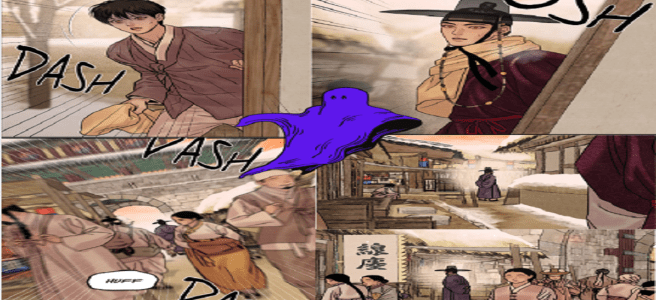
When manhwaphiles saw the man with the purple hanbok  (chapter 106) strolling through town, they jumped to the conclusion that this must be lord Song! They remembered the recollection from Lee Jihwa.
  (Chapter 83) However, since I have been examining Painter Of The Night so closely, I learned to pay attention to details. Consequently, I recognized very quickly that Yoon Seungho was not chasing one ghost, but he was running after 3 different people
  (chapter 106) impersonating „lord Song“
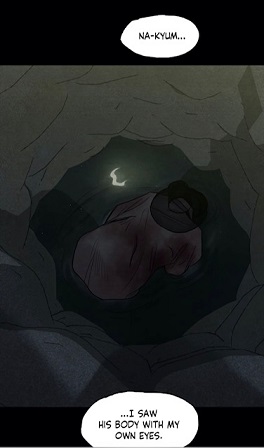
 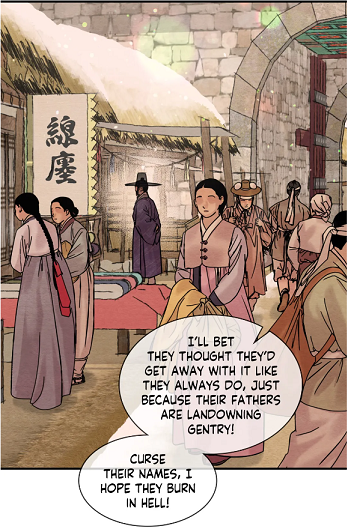 (chapter 106) If you look very attentively at the hanboks, you will realize the slight differences. First, the shade of the cloth diverges, then one cloth has a pattern, the other hanbok none. The form of the gat is also a little different, just like the color of the hair diverges. Besides, the readers should keep in their mind that in season 3, we had at least 3 bodies, though I am suspecting 4 corpses:
  (chapter 94)
  (chapter 97)
  (chapter 97) and
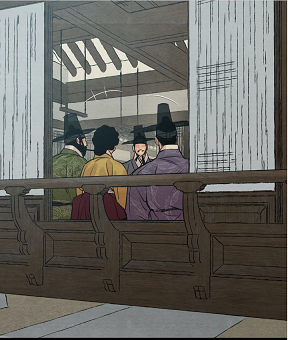
 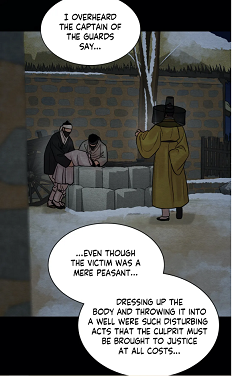 (chapter 101) Thus I come to the following conclusion that these 3 persons wearing the purple hanbok are not the “real lord Song”, the one who tormented the protagonist. In my eyes, he was watching the protagonist from the tower!
  (chapter 106) Let’s not forget that each scene is reflected in each season! And in episode 37, we had this memory from the fake servant:
  (chapter 37) The empty street was the indication that the monarch was present in the city. And now pay attention to the situation in episode 105:
  (chapter 105) Why is the street empty, when it was not the case during the night in episode 69?
 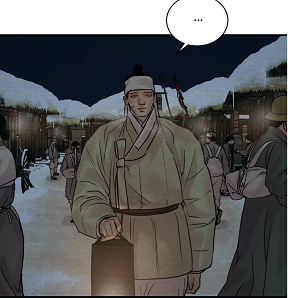 (chapter 69) For me, the pedophile was in the kisaeng house. But let’s return our attention to episode 37. (chapter 37) The view was divulging that the person was watching the town from above… so it had to be from the gate. Such a scene should be repeated, as the story is going in circle. Besides, note that the lord is also wearing a purple hanbok with a design. This means that he can be recognized very easily and this from afar!
  (chapter 106) To sum up, for me, the 4th “lord Song” was present in this scene, but the protagonist couldn’t detect his presence, for the other “shadows” were there to divert his attention.
2. The purpose of lord Song’s ghosts
But what was the purpose to use these „ghosts“ embodying lord Song? For me, they served two purposes. Since the painter had refused to be separated from his lover, they had to create a subterfuge, to create the illusion that Yoon Seungho was abandoning Baek Na-Kyum. In other words, they wanted the painter to witness how the main lead would break his own promise.  (Chapter 106) As you can see, they used a prank to wound the artist. Their goal was to incite the painter to return to the kisaeng house. He should cut ties with the main lead, as the latter is a man with a fickle nature. Yes, episode 106 was the negative version of chapter 75.
 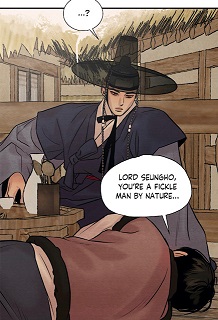 (chapter 75) That’s the reason why the couple was sent to the same inn. However, I don’t think that they had expected the painter’s fainting.
 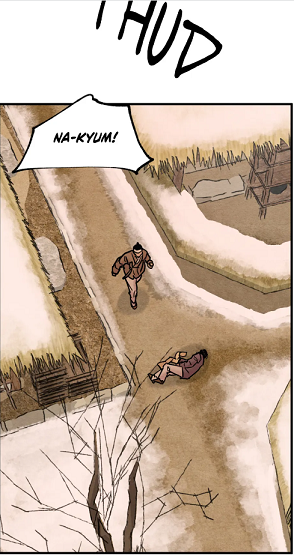 (chapter 106) For me, this is a blessing in disguise.
3. The helping hands in the trick
But how could they plan such a „joke“ so quickly, for the painter was supposed to stay in the gibang? Here, it is important that the manhwalovers remember what the lord did before eating with his companion. He stopped at the tailor’s shop!! 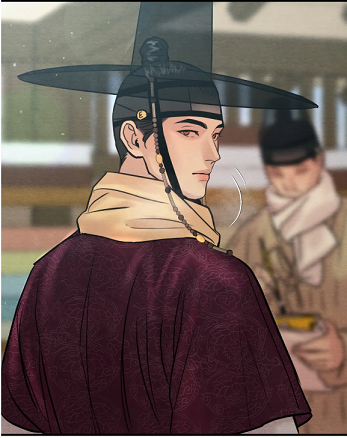 (Chapter 106) The latter had to be informed not to send the new clothes to the kisaeng house, but to his own mansion. That’s the reason why Baek Na-Kyum asked this question to the butler.
  (chapter 106) That’s how the schemer and his accomplices knew for sure that their original plan had not worked out. And if you read my previous analyses, you are aware that I had discovered the existence of two tailors!! (chapter 106) Observe how the tailor in the background is wearing his scarf. It is the same way than Yoon Seungho‘s! But now take a closer look at the tailor from episode 45
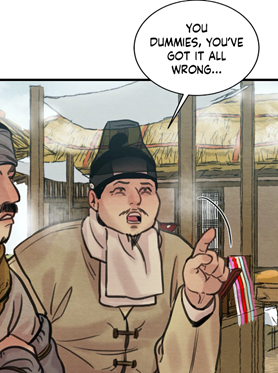 (chapter 45) and 74
 (chapter 74) This tailor is wearing the scarf the same way than the artist‘s. Finally, in episode 64, the manhwalovers could see the face of the second tailor. :
 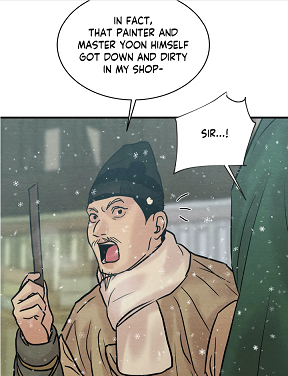 (chapter 64) In the past, I had already outlined the divergences in the body shape and the clothes, but the most visible evidence is the scarf!! Finally, I would like my avid readers to detect that the tailor from chapter 64 has been calling the main lead master Yoon, and not lord Yoon Seungho. This shows that this man is involved not only in the recent prank, but also in the main lead‘s suffering. He is not recognizing Yoon Seungho as a real lord. The usage of different hanboks is the proof that the tailor is an accomplice in the latest trick. But this also explicates why the tricksters had not planned the artist’s fainting. First, he had been able to run after his lover.
 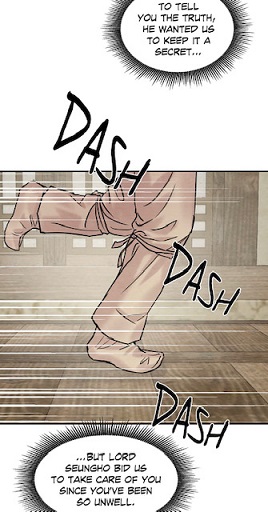 (chapter 105) Besides, this is how Baek Na-Kyum acted, when he saw his lord looking at him:
  (chapter 106) The fake smile from Baek Na-Kyum was hiding his true condition, he was still suffering from PTSD. Nonetheless, for the tailor and the other witnesses, it looked like the artist was strong. Nonetheless, since the main lead had learned in the past to fake his smile, he could detect that his lover was far from feeling well.
  (chapter 106) But there is another reason why they had not predicted such an outcome: the doctor!! They had to ensure that the lord’s path never crosses the physician’s! That’s the reason why the manhwaphiles never saw him in episode 106. He was like a ghost. But there is more to it.
What caught my attention is the couple was first encouraged to eat before meeting the physician. Here, it is implied that they are not at the medicine store. 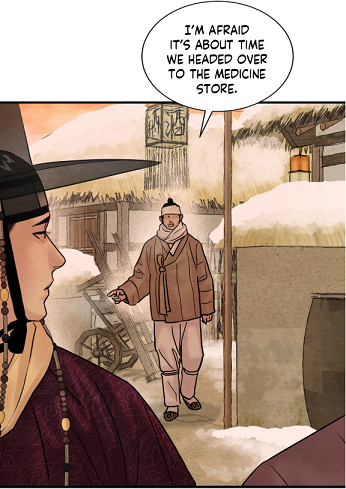 (chapter 106) Yet, in the Spanish version, the butler informs them that it’s soon their turn. This means that they are next to the medicine store. But let’s return to our main observation. Why was the couple pushed to „eat“? For the painter had wounded his hand, the first priority would have been to ask for an immediate treatment. Since the valet mentioned that it was about time to go to the medicine story, the manhwalovers should wonder why it was time. Thanks to the Spanish version, we know that according to the valet, the doctor had been treating other people before indicating that lord Yoon could not receive special treatment.
Secondly, Byeonduck drew such a panel where you could see the kitchen outdoors: (chapter 106) As you already know, each picture contains important information. Why did the artist create such an image? That’s how the mortar and the grinder caught my attention. I had seen these tools before.  (chapter 57) Yes in the kitchen of the physician! Then in a different image, you can the kitchen with the stool and the circle with the shamanism drawing right behind the lord’s back.
 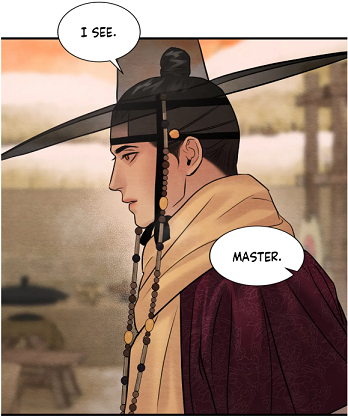 (chapter 106) We assumed that the couple was eating in an inn, but it is true? Finally, in the shelves, the manhwalovers can see small packages hanging around,
  (chapter 106), they look exactly like the medicine Kim fetched in episode 55.
  (chapter 55) Because of these parallels, I started wondering if the couple and the readers had not been fooled in the end. They were actually sitting in the medicine store, but due to the butler’s words and episode 75, the manhwalovers had the impression that the couple was in an inn. And the Spanish version seems to confirm my suspicion. I had already outlined that the furniture and shelves in the library had been switched. So it could be the same with the doctor’s office. Besides, the form of the building reminded me a lot of the house from the physician’s.
  (chapter 106)
  (chapter 74) Once you remove the cupboard from the side, you have a patio where you can eat. Under this new light, it explains why Yoon Seungho would say this to the butler:
  (chapter 106) It is because they were already there! And this would explain why the painter went to the restroom!
  (chapter 106) This coincides to the night of the abduction executed by No-Name!
  (chapter 59) To conclude, there was another ghost in episode 106, the invisible doctor. No matter what, the couple was not supposed to see the physician. Why? It is because he would have noticed the existence of two different doctors. That’s the reason why Kim acted as a mediator!
 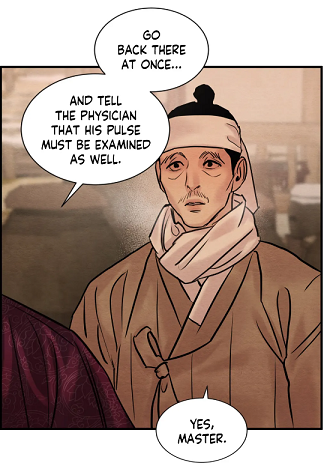 (chapter 106) This was not to help his master and the painter at all. Quite the opposite. He had to cover up his own wrongdoings and help the schemer. Therefore it is not surprising that the valet was confronted with the artist’s fainting!
  (chapter 106) The latter had played a mean prank on Baek Na-Kyum!! Yes, you are reading it correctly. Now, you are wondering when the valet fooled the pure painter. Observe that Kim had joined his master (chapter 106), while the latter was waiting for his lover. He was standing next to him. (chapter 106) But look where he was standing, when Baek Na-Kyum saw him:
 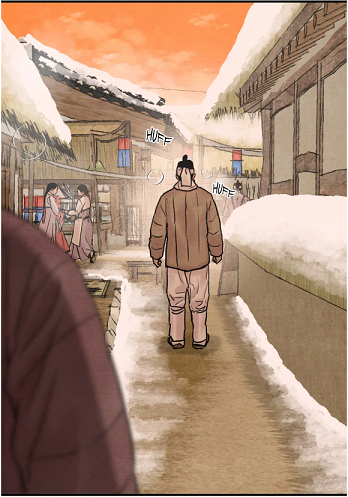 (chapter 106) He had barely moved… maybe run for 4 meters! How could he be out of breath? Besides, why would he scream like that, when the lord was standing next to him?
 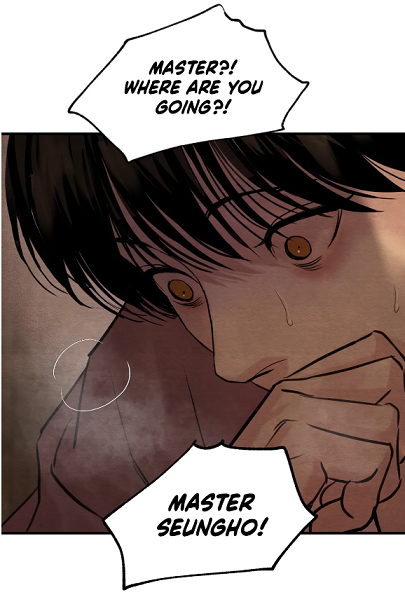 (chapter 106) It is because he needed Baek Na-Kyum to hear his lover’s departure!! Because we see this panel, we assume that the valet was left in the dark, especially after witnessing such a scene.
  (chapter 106) Our brain is trying to fill the blanks. But the moment you realize that Kim didn’t run such a long distance to be out of breath, you will realize that this “abandonment” was staged. This was the reflection of chapter 85, another fake run!
 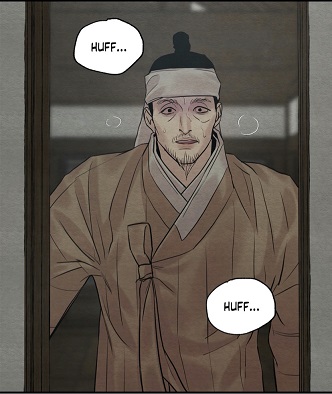 (chapter 85)
In episode 106, Yoon Seungho just had to ask Kim to wait for him there with Baek Na-Kyum, similar to this scene!  (chapter 86) Thus the butler got punished for his acting. He has now to take care of an unconscious painter. (chapter 106) And now, Kim is put in front of a choice. What should he do with the fragile artist? In my eyes, no matter what he chooses, he will get into trouble. Why? If he brings him to the doctor, the young noble will question the identity of the physician. Why is he not the same doctor than in the past? If he decides to bring him to the gibang, the lord will never believe that this was the artist’s choice. Besides, according to me, the noble asked his servant to wait for him there. Finally, if he brings him to the mansion, the lord will question his choice, for the artist needed the presence of a doctor. So the moment Yoon Seungho returns to the place where he left the butler and the painter, he could get scared, for they are no longer there. Thus the main lead could jump to the conclusion that his companion has been “kidnapped” again, especially after seeing the purple man circulating around them and hearing such grapevines.
 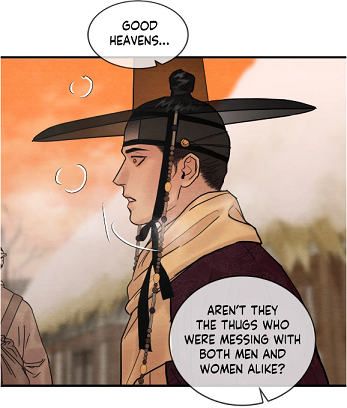 (chapter 106) Besides, I have another evidence that the painter got fooled by the valet. According to my observation, there is always a reflection within the same episode. Since the lord got fooled and was incited to follow the man with the purple hanbok, the artist had to experience the same. However, while the one got scared out of abandonment issues, the other got worried because of “lord Song”‘s obsession! Besides, because neither the butler nor the physician got punished for their crimes (passivity, silence, lies and disobedience), both need to receive their “punishment”. Let’s not forget what Yoon Seungho had said to the artist back then:
  (chapter 58) Kim had usurped his authority, he had made a decision without his master’s permission.
Moreover, I would like to outline that the place where the artist fainted is actually very close to the place when Jung In-Hun had dragged him.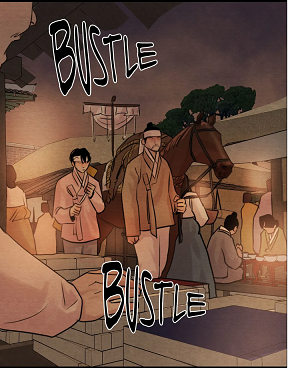 (chapter 24) The gate serves as the indication.
 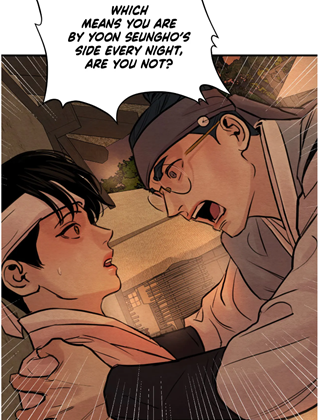 (chapter 24) And in that episode, the artist got dragged twice.
 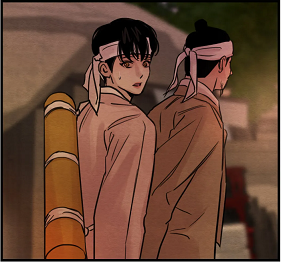 (chapter 24) First, it was the scholar, then the butler. However, in that scene, the butler had lied to the artist, for the noble had never requested to meet the artist in the pavilion. From my point of view, he was still hunting in the woods. As you can see, episode 24 contained all the elements of an abduction, though it was not perceptible. That’s the reason why I am suspecting that Yoon Seungho might think that his lover has been kidnapped again, especially after hearing such horrible gossips. Nonetheless, since the painter fainted, the valet will be forced to take care of Baek Na-Kyum. In addition, observe that the butler brought back the unconscious painter to the mansion, though the doctor was right next to them! This shows that Kim and the physician had not the artist‘s best interests in heart. He should have been treated right away.
4. The purple hanbok
But why did they utilize a purple hanbok in order to attract Yoon Seungho‘s attention? We have to envision that this mean prank is the negative version of the incident in chapter 76!!  (Chapter 76) Coincidence versus trick! They wished to scare Yoon Seungho, to let him think that „lord Song“ knew about his crime and was about to denunciate him. Yes, in my eyes, the man with the purple hanbok embodies treason and was the reason why Yoon Seungho got arrested and tortured in the past!! Under this new light, it becomes comprehensible why the lord would get so mad at his childhood friend.
 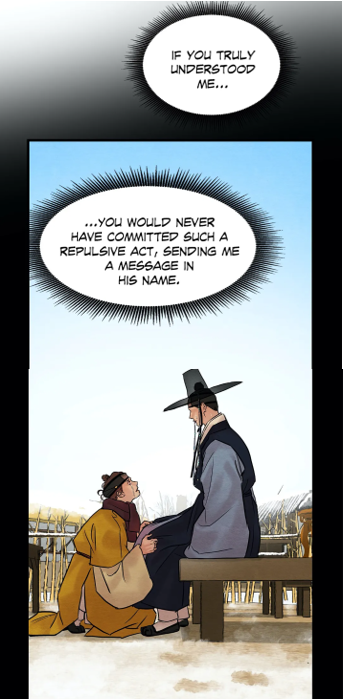 (Chapter 59) But the moment Yoon Seungho’s mother killed herself, it became clear that her son had been unfairly arrested and tormented. So someone had to take the fall for the injustice, the real lord Song.
  the (chapter 82) Nonetheless, there is no ambiguity that in reality the one behind the denunciation was father Lee. But the purple hanbok is connected not only to the arrest and torture, but also to the sexual abuse. Thus the painter had such a memory in the gibang:
  (chapter 1) The latter is the witness of Yoon Seungho’s sexual abuse. And what did the women say in the street? (chapter 106) The nobles would lust after men and women. Thus I am suspecting that Yoon Seungho won’t act like the schemers had planned. He will get the impression that the nobles might be still lusting after his lover, and the man with the purple hanbok is behind this. Yoon Seungho could remember Min’s words
  (chapter 102), Lee Jihwa was behind the scheme… and what had Lee Jihwa done in the past? He had sent a letter in his name.
 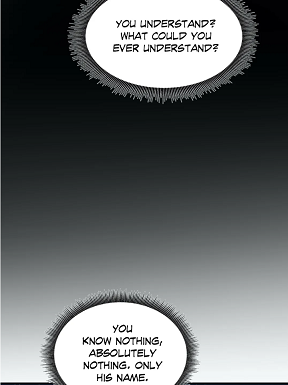 (chapter 59) Back then, Yoon Seungho assumed that his childhood friend knew nothing… but now, he is seeing the ghost lord Song circulating in town. So he could jump to the conclusion that the Lees have been helping lord Song. Finally, the manhwaworms will certainly recall the red-haired master’s confession, he knew everything!!.
 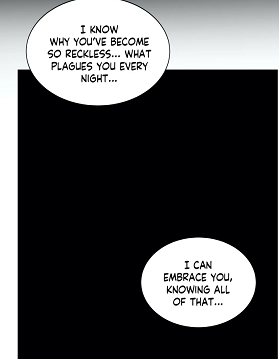 (chapter 57)
In my eyes, the women were spreading rumors on purpose!! They could recognize the main lead with his hanbok. 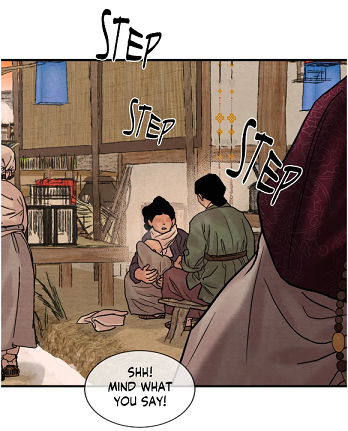 (chapter 106) And this scene is a reflection of episode 64, where the two women were ignorant about the incident of the previous night.
 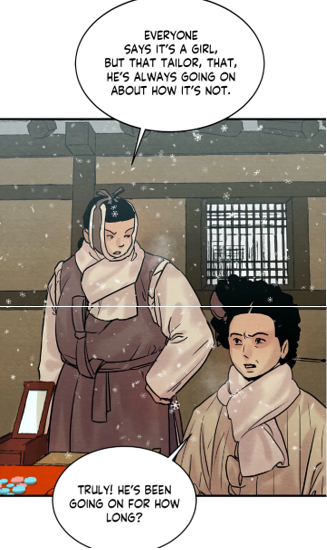 (chapter 64) Once again, this proves that the tailor is involved in the scheme.
The person behind this hoped to scare the noble, believing that Yoon Seungho was a superstitious man. Why? It is because he has the poem composed by Yoon Seungho. 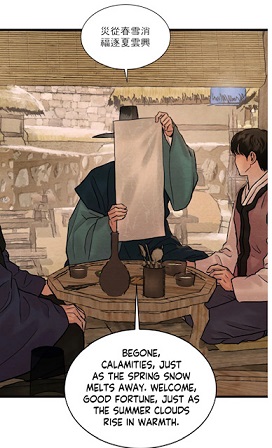 (chapter 106) The Spring Poem is actually reflected in this scenery: (chapter 106) This explicates why there is the refraction. During that day, both main leads are making important discoveries which indicates their relationship will only get reinforced.
When the lord wrote the poem in episode 92, what did the readers see there? A man in the shadow observing the couple, but the main lead had not detected his presence! 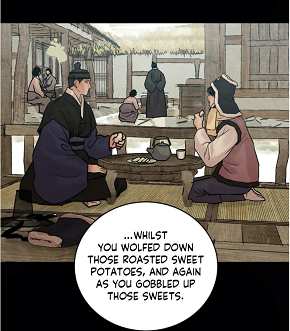 (chapter 92) Yet this doesn’t end here. Episode 92
  (chapter 92) is the positive reflection of episode 106: (chapter 106) This is no coincidence that there is the tower and gate in the background. From my point of view, the schemers are trying to manipulate the lord through rumors. But the puppet master is overlooking one important aspect, the gossips can be interpreted very differently. Besides, while the woman pointed out the existence of a manhunt against nobles
  (chapter 106), she contradicted her statement right after.
 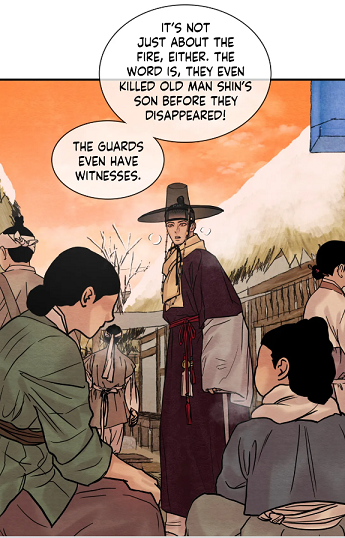 (chapter 106) If nobles were involved in this, why did they kill the son of lord Shin? Besides, let’s not forget that Yoon Seungho never ordered the fire in the shrine and he never killed lord Shin! This means that he is innocent. That’s the reason why I come to the conclusion that contrary to their expectation, the lord won’t decide to leave the painter behind because of the imminent misfortune! From my point of view, Yoon Seungho could ask his lover to paint a lucky charm on their house, the tiger!
  (chapter 105) That way, the artist would feel that his master needs his help and talent. Moreover, I have the feeling that the main lead will go to the authorities and ask for their assistance. (chapter 101) Why did the shaman’s house get burned? How come that the son of lord Shin got killed? But we know for sure that the murderer had staged his death, he died because of a tiger.
 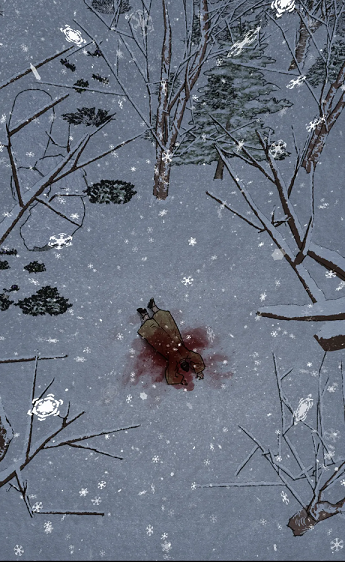 (chapter 103) Why are such rumors circulating in town and who are the witnesses? (chapter 106) Moreover, it is not random that the woman gossiping is similarly dressed than the maid in the kitchen.
  (chapter 103) As you can see, the schemers are no longer able to control Yoon Seungho and his lover, for both are supported by the gods. Chance stands on their side!
And this prediction leads me to the following observation. In town, there exists another ghost, the captain of the guards and his officers! 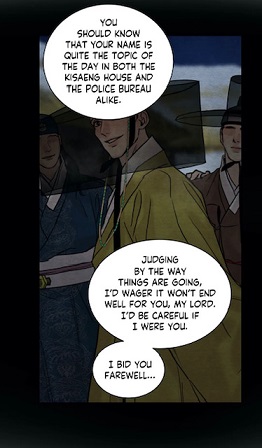 (chapter 100) (chapter 101)
 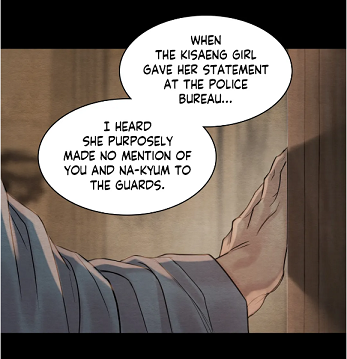 (chapter 104) Though there is a manhunt, where is he? (chapter 106) As you can see, his absence is contradicting their statement. On the other hand, Yoon Seungho heard from the women this.
  (chapter 106) (chapter 106) So he could ask about the identity of the culprits and the witnesses, the new version of this scene.
  (chapter 98) To conclude, while the schemers thought that due to his crime, Yoon Seungho would lie low and cut ties with his lover, due to their meddling, they achieved the opposite. The lord will request an investigation… something he has never done before. He could even denunciate Lee Jihwa
  (chapter 67), that way he can escape punishment. This means that Black Heart’s last confession (and lie) could help the lord to protect himself and his lover. Finally, if Yoon Seungho were to mention the purple hanbok to his lover, the latter’s memory could get triggered and he could remember this night: (chapter 01) To conclude, the mysterious man with the purple hanbok is bringing the couple closer than before, whereas he hoped to achieve the opposite.
Feel free to comment. If you have any suggestion for topics or manhwas, feel free to ask. If you enjoyed reading it, retweet it or push the button like. My Reddit-Instagram-Tumblr-Twitter account is: @bebebisous33. Thanks for reading and for the support, particularly, I would like to thank all the new followers and people recommending my blog.

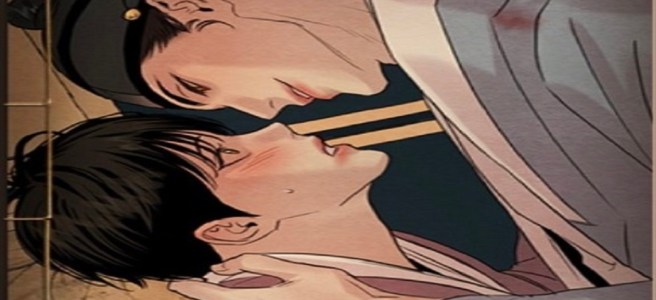
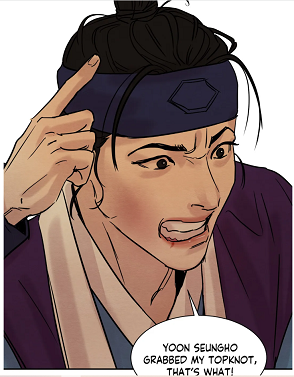 (chapter 9)
 (chapter 1) This means that no one had witnessed the wrongdoing committed on the anonymous lord. However, it is important, because it exposes how a person committing a wrongdoing could escape scolding and punishment, even from the readers. There was no witness! Only an attentive reader could detect this. Hence you have the explanation why Yoon Seungho suffered for so long. There was either no witness or the persons chose to close an eye and remained silent. Since it was the negative reflection from Baek Na-Kyum’s slap and the main lead had used his right hand
  (chapter 11), I deduced that the culprit was left-handed. That’s how I could identify the culprit, lord Min. The lord was in reality left-handed. We could observe this in chapter 8
 , episode 19
 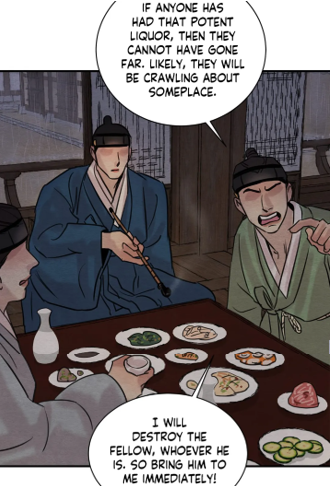 , chapter 33
 and episode 43
 , but also in episode 76
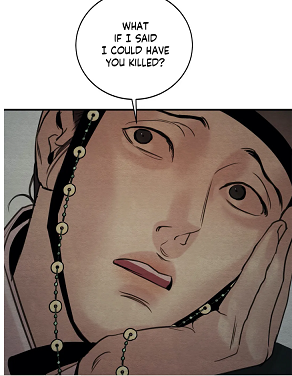 , in chapter 96
 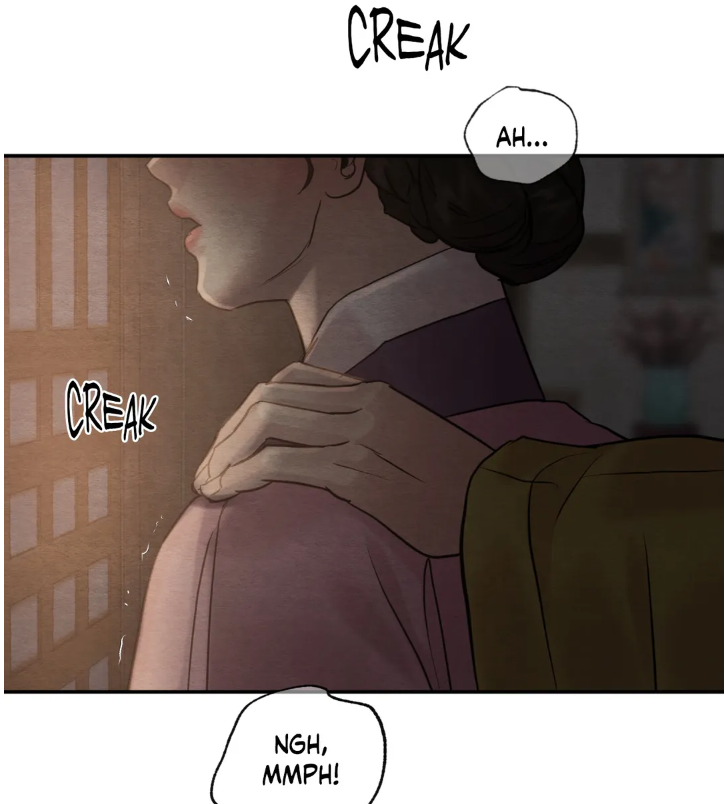 , in episode 100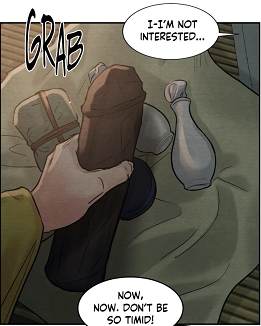
 and finally in chapter 102
  ! Yet, in other occasions like in episode 33
  or 43, or 52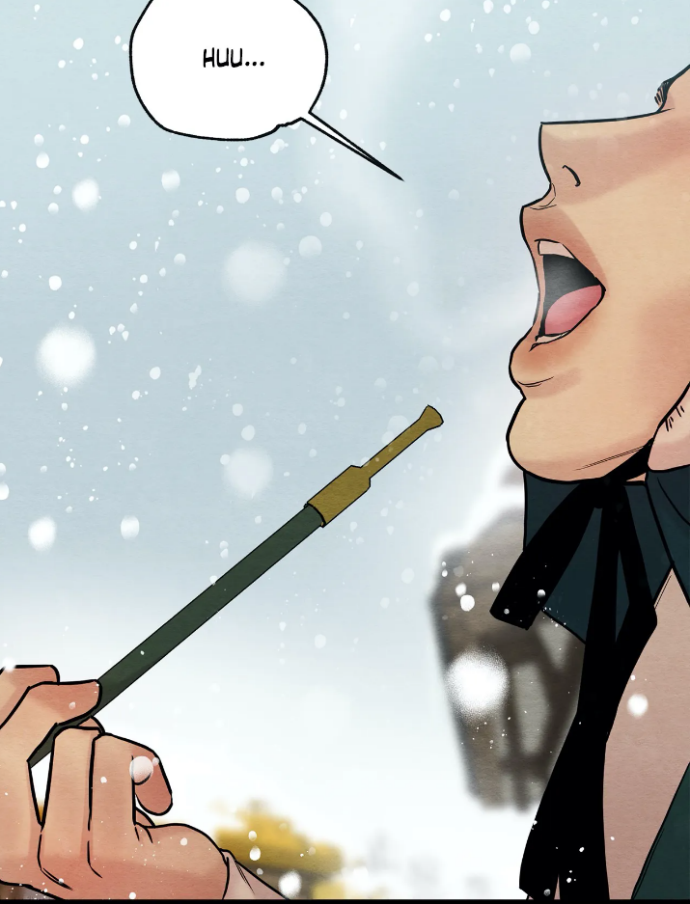
 , he used his right hand! Thus one might argue that Min was simply ambidextrous. However, I can prove 100% that Black Heart is left-handed!😮 The evidence is the usage of the bow.
 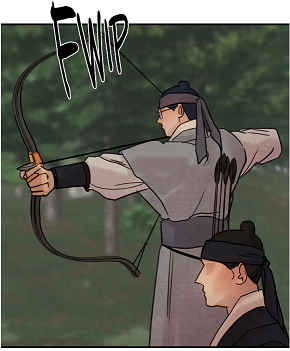 (chapter 22) This is how a right-handed man shoots an arrow. On the other hand, we never saw Min using the bow. The bird was already wounded by the arrows, when the scene of the second hunt took place.
 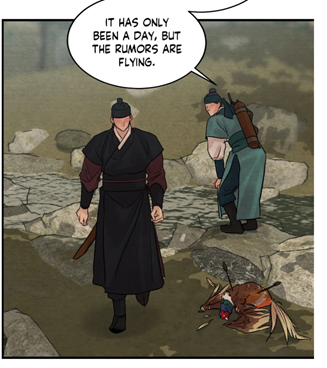 (chapter 41) However, the manhwaphiles can discover the verity thanks to one detail: the bag of arrows.
 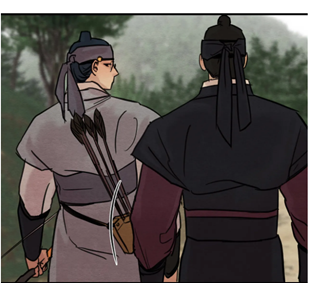 (chapter 22) As you can see, the bag is carried on the right side, but the arrows are almost touching the left shoulder. They need to be on the other side, since the scholar needs his right hand to grab the item. And now compare the position of Min’s bag. It is inclined in the opposite direction, hence the arrows are visible on his right side!
 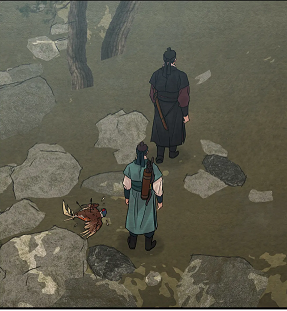 (chapter 41) Thus the noble is carrying the bag
  (chapter 41) differently from the painter too.
 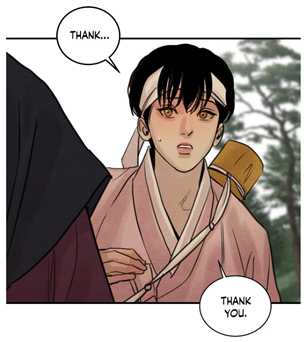 (chapter 22) Under this new light, it becomes comprehensible why Byeonduck never showed the Joker’s hunting skills. People would have noticed that he is left-handed immediately. She made sure to hide this important fact, thus within the same chapter Min was often portraying as using both hands. In episode 43, he employed his left hand to pour the alcohol in the glass
 (chapter 43), when he gave the drink to Lee Jihwa.
  (chapter 9) Here, he was still present, but even before the end of the sex session, he had already vanished.
 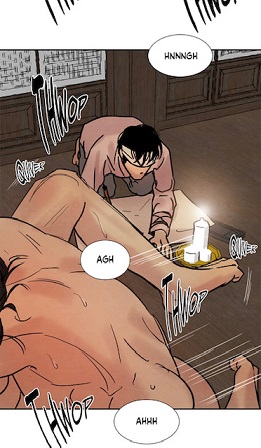 (chapter 9) Finally, when the noble with the mole visited Lee Jihwa, the latter claimed that he had spent a long time at Yoon Seungho’s.
 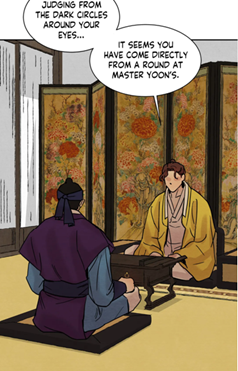 (chapter 9), and his friend never denied it. As you can see, the characters made sure to confuse the readers with the change of the chronology. As you can see, it took me a long time before noticing the bruised face (only during season 3), then to bring up the conclusive evidence that Min was the culprit of the slap. Then in the shaman’s house, he took the dildo with his left hand, because he was angry and frustrated.
  (chapter 100) too. This shows that he could barely control himself here. And once he faced the main lead’s sword, he got so scared that he showed Jung In-Hun’s glasses with his left hand again.
  (chapter 92) The irony is that in this scene, the main lead employed his left hand too, the positive reflection from the night in the pavilion (chapter 43). While here it was to bring him back to reality, in the pavilion, the Joker had the opposite intention: to lure Lee Jihwa to believe in illusions.
 (chapter 74) They announce the future events, though the information is not given properly. On the other hand, since they are memories either, this signifies that they contain insight about the lord’s tragedy. Thus I noticed that the anonymous perpetrator used his left hand to grab his hanbok!! I deduced that the perpetrator in the past is also left-handed!! Secondly, since this vision can also be seen as the announcement of the painter’s second kidnapping, this is no coincidence that Byeonduck created such panels during the painter’s last torment.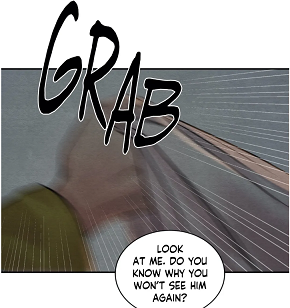
 (chapter 99) However, in the shaman’s temple, Black Heart grabbed Baek Na-Kyum with his right hand. He was trying to manipulate the artist, he was acting. He was not showing his true self. Yet, the vision was revealing the truth: the future mastermind of the last scheme was in reality left-handed!! It didn’t matter, because at the end, the main lead was able to discern the truth. He sentenced Black Heart, for he believed that he had killed his loved one! That’s how I realized why the author would focus so much on the hands and on the distinction between unconscious and conscious! The hand in Painter Of The Night represents the crucial clue to identify the culprits!!
 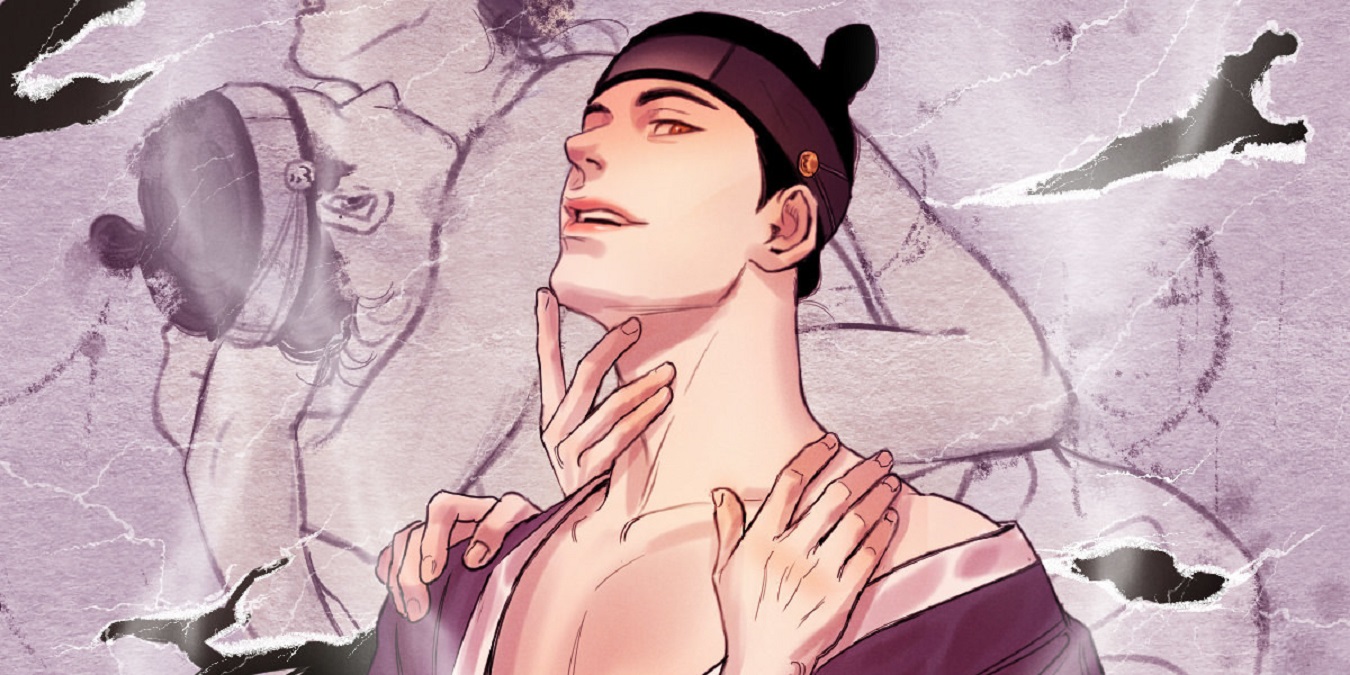 In season 1, we had the hands in the illustration. The hands were revealing the crime committed against the main lead. The latter was totally passive in this picture. The hands are touching and unclothing the immobile man. It also shows that Yoon Seungho was at the center of the conspiracy, in the past and in the present! The painting in the background indicates the presence of a hidden painter. Thus Baek Na-Kyum was not drawn in the cover. The painter of the night was in truth someone else, the painter from the past! Nevertheless, the main lead was looking at the readers, indirectly at Baek Na-Kyum, the young painter of the night. This describes the arrival of Baek Na-Kyum in his life. Striking is that the painting in the background was destroyed… indicating that the portrayed relationship was no longer existent. This represents another clue that the lord’s suffering is linked to a previous relationship. Then in season 2,
 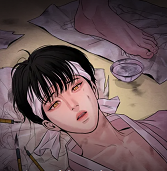 the author revealed Baek Na-Kyum as the painter, who had now become the target of the plot. Yet behind him we see Yoon Seungho’s foot. The latter symbolizes the main lead feared to get close to him, but he wouldn’t leave his side. Moreover, this corresponds to the lord’s impulsive decisions, he let his foot guide him. Thus during the first night of the failed gangrape, he walked towards the study and stopped unconsciously, when he was next to the room.
  (chapter 53) Due to his strong denial, he was strolling not realizing that his feet were under the influence of his subconscious. And it was the same, when he opened the door with his foot at the Lees’
 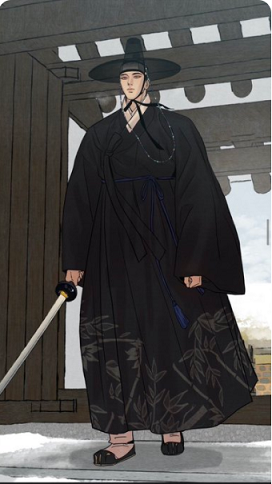 (chapter 67) Nonetheless, I believe that the author had another reason to draw the foot in the cover. The foot prints are the evidence of the crime, and as such the deceptions and the culprits.
 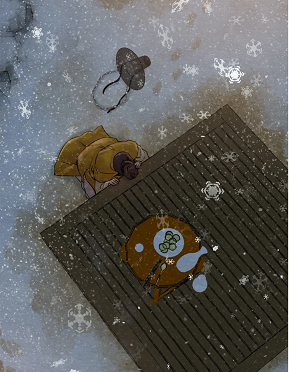 (chapter 59)
  (chapter 60)
 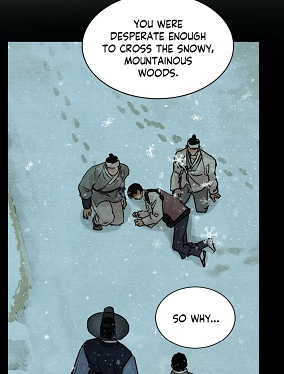 (chapter 61) The shoes were the clues how to recognize the perpetrators and accomplices. That’s why I compared these feet
  (chapter 59) with those
 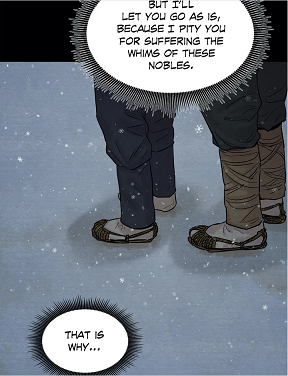 . (chapter 66) My avid readers are already aware of my theory. For me, we have two kidnappers, and one tried to kill the artist! To conclude, Byeonduck left the clues how to unveil the mystery from the past and the present in the illustrations of each season. The paper in the second cover
  (chapter 56), but also to the theft of the painting
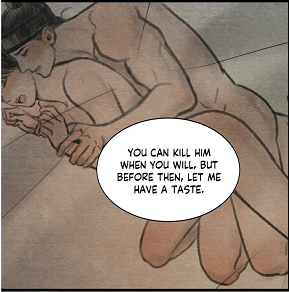 (chapter 56) and the painter’s break! At the end of season 2, he was no longer painting and in the beginning, he had also stopped due to his heartbreak. Simultaneously, we have the presence of water which serves as a connection to season 1 with the ruined painting and to season 3 with the well and drowning. The dark shades were an allusion to the lord’s darkness and suffering. The latter would come to the surface. However, since the cover only showed the lord’s foot, it exposes that the lord would not divulge his traumatic past.
 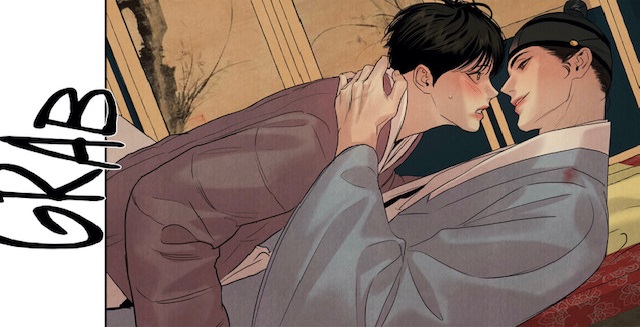 (chapter 78) In season 3, this time the main leads were facing each other, they were recognizing each other: their true self! But this stands in opposition to the deceased people without identity!
 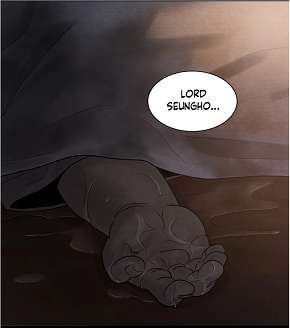 , the back
  (chapter 44) And the nightmare exposed the number of persons involved in his suffering: 4 men!!
  Here, we have 3 men, and don’t forget the left hand from before.
  (chapter 99) That’s the reason why I am anticipating a cover with the gibang. It would be the perfect place to find closure for the couple. It is a place where both suffered. Moreover, I think, belongings should serve as an evidence for the identification of the schemers and accomplices. Remember that we had the glasses as the evidence of a murder in season 3, yet I am sensing that the possession should serve to identify the perpetrators from the past and the present. Since the clothes were used to confuse people in season 3, I am assuming that in season 4, they should help to recognize people, but at the same time, it is totally possible that our main leads decide to employ the same method to fool the schemers and accomplices. And now, we have the cover for season 4. Both protagonists are not only facing each other, but also touching each other. They are no longer hiding their emotions and thoughts.
 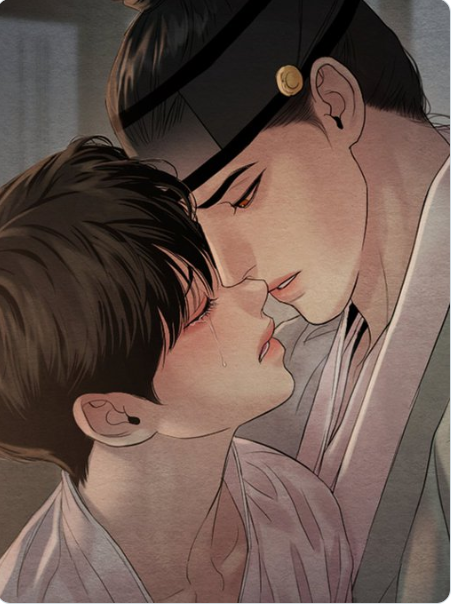 This image represents the opposite to the other seasons. At the same time, the author is again referring to the bedchamber indicating that this place is strongly connected to the protagonists’ suffering. On the other side, since the painter is wearing a silk white shirt, it implies that he is not a commoner. This panel indicates that the main lead was able to the true owner of the study and even bed. However, due to the tears, the beholder can sense that this season will be painful as well. Striking is that in the cover, they were either alone, or they were just looking at each other, hence they didn’t pay attention to their surroundings. Consequently, they couldn’t sense the presence of a plot and the schemers. This indicates that the couple is still not prepared to face new schemes. To sum up, the author selected such covers because she had planned to leave clues there about the mystery! But wait… I had outlined that the person who grabbed the young master Seungho was left-handed, and he played a huge role in the main lead’s downfall and suffering! But who is left-handed in this story?
  (chapter 12)
  (chapter 56). But then I noticed that he carried his master on the left side.
 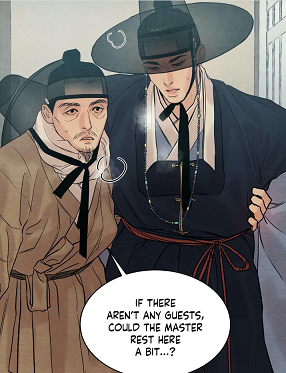 (chapter 57) Nevertheless, the person threatening the painter was right-handed.
  (chapter 66) and since it is for me the butler, he was not the person from the nightmare. That’s the reason why I am excluding him from the suspect list. For me, if he was involved in the past, it is because he lit the candles
 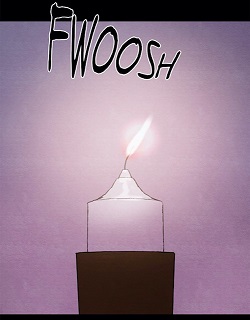 (chapter 74). Furthermore, don’t forget that in his nightmare, the author exposed the presence of plates with 3 candles
 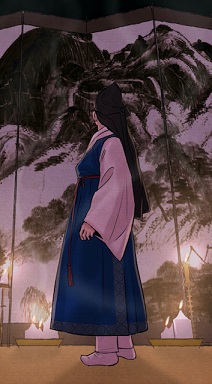 (chapter 74) which were also used in the shaman’s house. Finally, in this picture, we have a right-handed person.
  (chapter 74) So Kim could have been the one silencing him with his hand.
 (chapter 86) Hence his right cheek was red and he had a wounded lip.
  (chapter 86) On the other hand, at the doctor’s office, he employed his right-hand to keep his son by his side.
  (chapter 57). Why is there this change? The turning point was the prank in the bedchamber.
 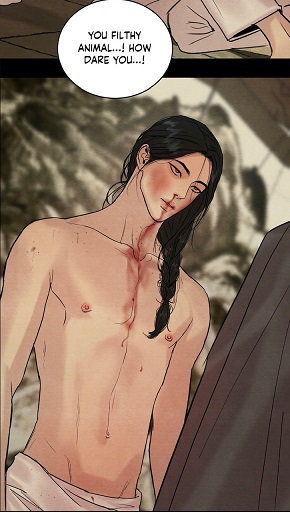 (chapter 83) During that scene, the father slapped his son with both hands. First with the right
 (chapter 83), then with the left! Striking is that the author never showed, when the patriarch employed his left hand. The readers could only hear the sound, and see the result of the beating. Both cheeks were wounded. From my point of view, he was conditioned exactly like Min! He was not allowed to use his left hand, but the angrier he got, the less he could hide his true self: he was left-handed and he was a stupid and brutal father!!
 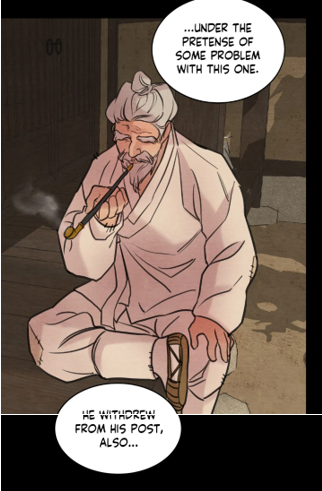 (chapter 37) On the other hand, I am doubting that Byeonduck will introduce many new characters in season 4. That’s the reason why I believe that the man with the pipe is the real schemer, as the pipe was in the annex. Since Min grabbed Baek Na-Kyum in the shaman’s house, I am more inclined to think that the perpetrator grabbing the young master Seungho by the collar was just an accomplice and not the mastermind. In other words, he was the helping hand.
  (chapter 57)
 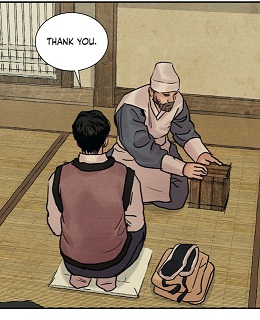 (Chapter 74) I don’t believe in hazard. Besides, the lord had his nightmare during the same chapter. This means that he could have leaked this information about Yoon Seungho to an outsider, like he did with the painter. As the manhwalovers can grasp, the physician is more suspicious than before.
  (chapter 92) Besides, observe that the angry man put the brush on the left side.
 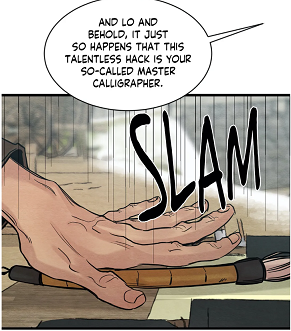 (chapter 92) The man is left-handed! And what did Yoon Seungho do?
  (chapter 92) He grabbed him by the collar! Exactly like in the dream!!
 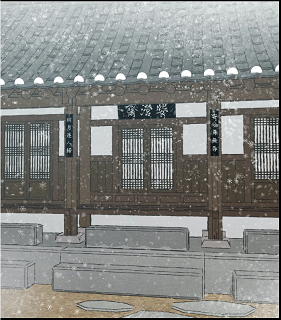 (chapter 44) or patio of his mansion, similar to Heena’s. And since the young main lead suffered so much, it is normal that he doesn’t have such believes. IT is also possible that the young master Seungho played a prank which made the man angry and humiliated. As you can see, I come to the conclusion that jealousy and resent were the reasons why he got involved in the first place. Moreover, we shouldn’t forget that the calligrapher is linked to the kisaengs! He even recognized Baek Na-Kyum, as he called him a peasant.
  (chapter 92) Yet, he was either perceived as servant, a noblewoman or as a sir so far! He was never recognized as a peasant. Since he could identify the artist, it is also possible that he was also able to identify Yoon Seungho. But he thought that he was not well educated after living as a male kisaeng for so long. From my point of view, the man could have decided to get revenge on Yoon Seungho and participated in his abduction and gangrape!! Thus his karma was to lose his home!
  (chapter 91) The fact that Yoon Seungho grabbed him the same way than in the nightmare is not random. It was, as if he was getting justice. Honestly, I am more and more suspecting that in the past, Yoon Seungho got raped by commoners! Naturally, I have not changed my mind that the king was behind this plot: to get revenge on the Yoons! Who benefitted the most from the crime? Definitely the king, as he was able to ruin their influence.
  (chapter 39), the other only recognizes him as master Yoon.
  (chapter 83) disguised himself and hide his true identity behind “lord Song”. But is he the king or someone else? He was definitely a pedophile, but since we can’t see his face, it is not certain that it was the king.
  (chapter 86) Let’s not forget that in season 3, clothes were used to deceive Yoon Seungho, and the authorities played along. Besides, as the painter had become the love interest of Yoon Seungho and Black Heart, it is very likely that in the past, the victim was exposed to two different abusers, but they all hid behind the name: lord Song. Note that during this feast, one man had a moustache beard which is in Painter Of The Night the sign that he is no yanbang, not even chungin, the upper-middle class. He could be a rich merchant. Just because they are all wearing hanboks
  (chapter 87), this doesn’t mean that these men belong to the aristocracy. Furthermore, Kim never said “nobles”, he just said “visitors”!! Finally, I would like to point out that since Yoon Seungho lived secluded for 10 years, I doubt that he had the means and the knowledge to be involved in the trade:
  (chapter 22) This theory of the participation of a merchant got even reinforced, when I made the following discovery. The wooden boxes in season 1 were present at the tailor‘s shop!!
  (chapter 39) Thus I am deducing that the barn in season 2
  (chapter 51) could have belonged to the tailor or the owner of this shop. And note the couple was in the same position than with the kisaeng with No-Name in episode 51!
  (chapter 51) This was the negative reflection from episode 39: no penetration versus penetration, no interruption versus interruption, no rumor versus rumor etc. And this contrast clearly displays that the tailor shop is involved in Yoon Seungho’s suffering. And the best evidence for this is the nightmare. The main lead’s clothes had a design.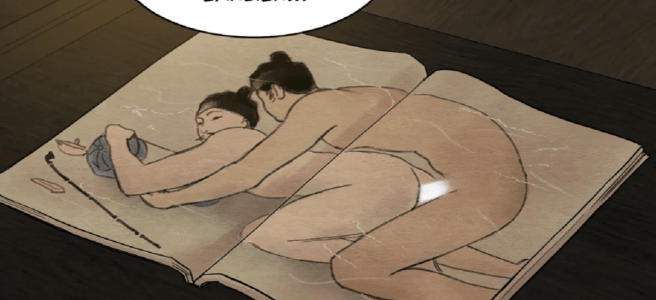
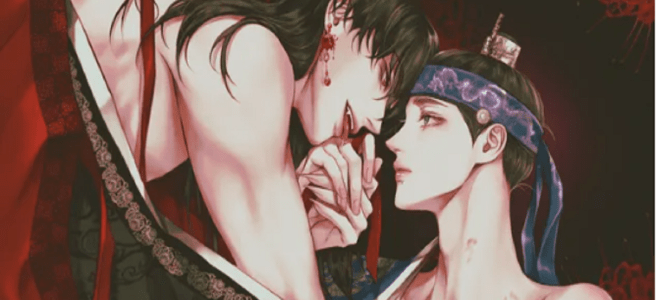
 (chapter 2) Queen Yoon vanished, because she was condemned as a witch. Naturally, her disgrace is linked to Lee Nok’s special situation. His yin energy is so strong that he attracts ghosts which his mother noticed. If the king knew about this, he would definitely see it as a curse. Thus Queen Yoon tried to protect her son with talismans which led to her demise. Because of this incident, the king turned concubine Han into his new Queen. The latter gave birth to a son who definitely represents a threat to Lee Nok.
  (chapter 8) This explicates why the boy is turning his back to Lee Nok. Their position in this picture already displays the existing rivalry between them which Queen Han is trying to diminish by faking concern and pity for the Crown prince. She seems to take the Crown Prince’s side, for she has to mask her involvement and true intentions: ambition. She is eyeing at the throne. If the main lead was involved in a scandal, the king could decide to nominate his second son as the future Crown prince. As you can see, Lee Nok’s situation is quite fragile and as such precarious. There is no ambiguity that the loss of his mother wounded the Crown prince deeply. We could detect it thanks to Jae Shin. The main lead chose to adopt the cute puppy, as the latter was motherless.
 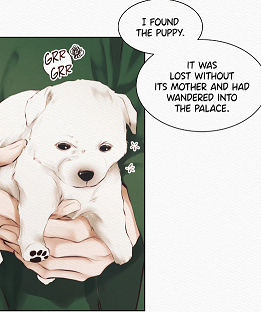 (Chapter 7) As you can see, the main lead was projecting his own emotions and thoughts onto the small dog. He feels also abandoned in the palace, as he has no one to rely on. He can not even trust his close aid, the eunuch Ahn, and his love interest, Choi Kyung Joon, as his secrets (sodomy and the ghosts lusting after him) would shock them (disbelief and rejection).
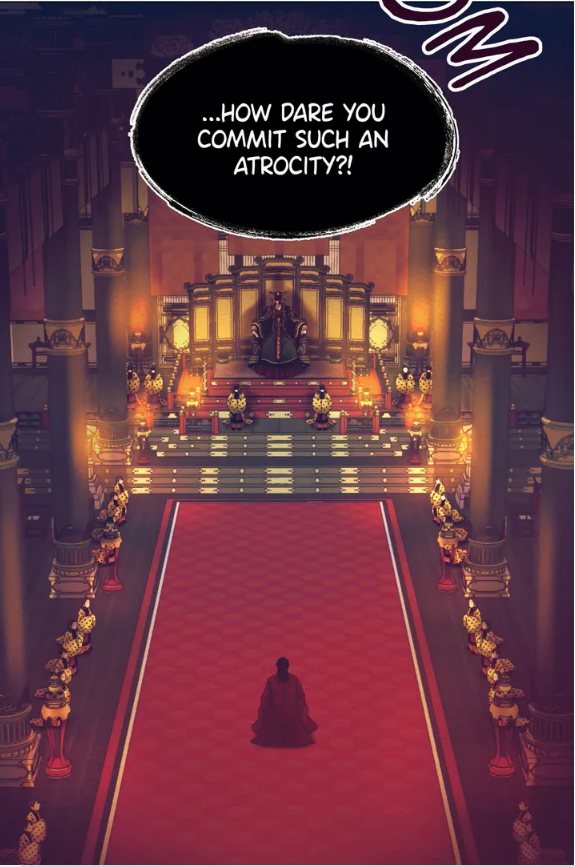 (chapter 1)
  (chapter 2). Though the verdict looks similar, I come to a different interpretation. How so?
  (chapter 1), the other is badmouthed to be involved with dark arts through posters.
  (chapter 2) Yet there is no evidence. I would even add that contrary to Yeomra, the king never gave Lee Nok a choice to defend himself and to determine his fate. How so? As soon as the father read the poster, he accused his son: “What have you been doing that things have come to this?” This means that he believes that there exists a kernel of truth in this rumor. The cause for his mistrust is Lee Nok’s birth mother, the former Queen Yoon. Because his mother was already involved in such a ruckus, the king can only blame the Crown prince, all the more when the latter defends his mother’s honor.
  (chapter 2) These words could only reinforce the father’s prejudices. He was already guilty by association.
  (chapter 2) No one is able to see his face. His only support and connection to aristocrats is his friend Choi Kyung-Joon, the son of a minister. That’s how powerless the Crown prince is in the palace. He is even surrounded by maids spying for Queen Han. Consequently, I come to the conclusion that Lee Nok’s father represents the negative reflection of Yeomra. He doesn’t send away his son in order to protect him, rather to hide him out of shame and resent. In other words, the king doesn’t love his son contrary to Yeomra. Interesting is that the latter let his son make the choice about his own destiny. Why? He wished to give him the liberty to determine his fate in order to prove him what DESTINY is.
  (chapter 3). Let’s not forget that the son’s crime had been to change a person’s fate. Striking is that both monarchs believes in fate, but the mortal ruler has a different notion. Since Queen Yoon is viewed as a witch, the son seems to be “tainted”. Moreover, while Yeomra trusts his son, the mortal king behaves differently. In reality, he relies on his wife, Queen Han. Thus he recommended her to Lee Nok
 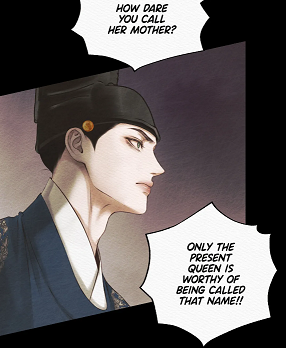 (chapter 2), and later he listened to her fake concerns. This shows how easily the king can be manipulated, he is not even realizing that his royal secretary
 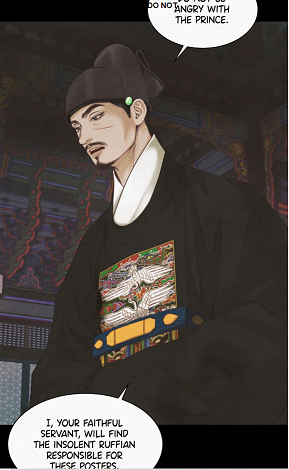 (chapter 2) is working against Lee Nok, while claiming that he will look for the author of these posters. I couldn’t help myself connecting Lee Nok’s seclusion in his quarters to the death of the shaman Yeom: both are “buried alive”.
 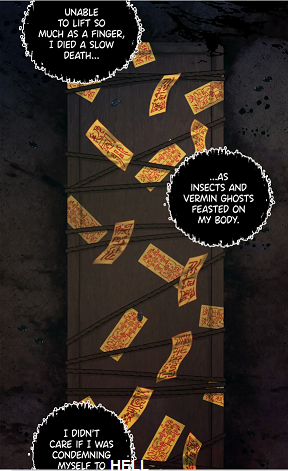 (chapter 13) Hence she can “understand” him. Another proof for this interpretation is the spirit’s following statement: they share the same fate.
  (chapter 8) The only difference is that the Crown prince is still living. However, for the Queen, it is just a matter of time, until people forget Lee Nok completely so that her son can replace him. At the same time, his isolation can only increase suspicions. And the more he is badmouthed (dark arts or sodomy), the more the king will turn away from his own son. While the king of the hell of tongue ripping wished Jae Shin to recognize his mother, the king of Joseon desired the exact opposite: he should deny his relationship to his birth mother, Queen Yoon.
  (Chapter 2) Moreover, the god never imposed his will onto Jae Shin. The latter has to discover this himself, whereas the king made the opposite choice.
 (chapter 1). This shows that the ghost has a deep respect for his father in the end. This explains why after his sentence he thought about his father
  (chapter 1) His words don’t ooze resent, he is more pleading his cause, begging his father to recognize that humans don’t deserve such mercy and care. He trusted his father and his fairness, hence he spoke the truth. He never hid anything from him. As for Lee Nok, despite the father’s verdict, he still follows social norms. He accepts his father’s order. Then despite the rejection, he tried to see his father, and he even went to the Queen’s palace to greet her. He acts like an obedient and dutiful son. Finally, he tried to defend his mother’s honor, as he knew that she had sacrificed herself for him. I am convinced that he must feel guilty for her disgrace.
 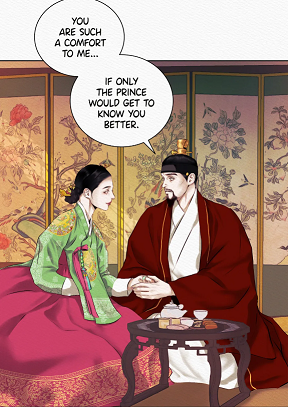 (Chapter 8) This truly displays that he had no faith in his son, for in the king’s eyes, the prince is ignorant about Queen Han’s good nature. To sum up, Lee Nok is rejected by his own father, he has no one to rely on. He might have loyal servants like inspector So-Rib
  (chapter 2) or Eunuch Ahn, but the latter have no real power in the palace. Furthermore, he can not confide to them everything. He is not loved which stands in opposition to Jae Shin who grew up as a spoiled prince.
 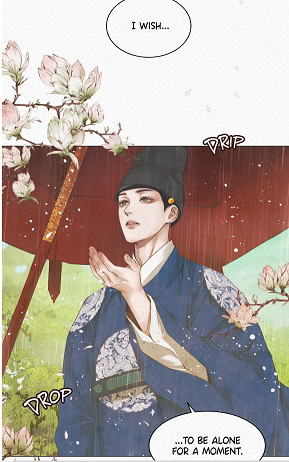 (Chapter 2) That’s the moment he can finally breathe. This corresponds to the situation of being buried alive which I mentioned above. Since he is surrounded by maids, he has no privacy. But contrary to the Queen and the king, he has no real control over his staff. Due to his innocence and purity, he is not aware that one of his maids is reporting to Queen Han. He is definitely cautious, but he is not cunning enough to anticipate the Queen’s moves. As the manhwaphiles could sense, Lee Nok is indeed a fragile and lonely prince.
 (Chapter 1) Imagine that he can control someone from the afterlife. But the problem is that he is not aware of his power, as he has no idea about Jae Shin’s curse. Yeomra’s son can not return to his father’s side, as long as he had not won Lee Nok’s heart. On the other hand, the immortal prince has no intention to reveal his secret to Lee Nok, because if so, he would become his puppet. This explicates why in chapter 18, Jae Shin treats the Crown prince like an object.
  (chapter 18) He is masking his own vulnerability, at the same time he gives the impression that Lee Nok has no other choice than to depend on him. He is trying to turn the tables in the end.
  (Chapter 4) Besides, according to me, Yeomra fell in love with a human, this means that his action affected the mortal world, so he has to restore the harmony in the mortal realm. But the problem is that Lee Nok is already in love with his childhood friend Choi Kyung-Joon. So the main lead might have become the Crown prince’s sex partner, but he has not conquered his heart yet. Nevertheless, it is just a matter of time. The irony is that humans are mortals, hence their time is limited. This shows that Jae Shin is actually working against time. He could end up living as a puppy forever. So he is also weak, totally depending on Lee Nok’s heart and good will.
  (Chapter 16) The latter might have not died, but he lost his yin energy. Thus he lost his strength. Only the Crown prince could heal him.
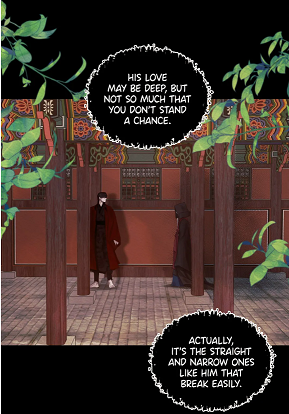 (Chapter 13) Why would she say that? First, Lee Nok is aware that his friend hates sodomy.
  (Chapter 3) Hence he is forced to hide his affection from him. This means that he can never be honest to Choi Kyung-Joon, yet like already pointed out above, the Crown prince embodies innocence and as such honesty. This means that his lack of honesty towards his loved one can only wound his heart. So far, the Crown prince could never outlive his sexual orientation, for he had no partner at all. Thus he could still maintain his image in front of his loved one. This hopeless love gave him a certain strength.
  (Chapter 9) This outlines the mortal’s power.
  (chapter 13) The friends can not become lovers, as this would represent a threat to them. However, there is no ambiguity that Choi Kyung-Joon is aware of the Crown prince’s affection and he is taking advantage of it. By using social norms, rejection of sodomy, he can keep his distance from Lee Nok, but still maintain his relationship with him. How did I come up with this interpretation?
 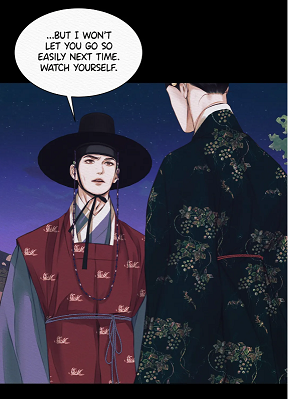 (Chapter 3) Note that he is using the personal pronoun “I”, while in reality he is just usurping the Crown Prince’s authority.
  (Chapter 3) He was definitely arrogant, selfish and intolerant in that scene. He didn’t pay attention that his friend was not feeling well the whole time. Secondly, with such an attitude, he could create a ruckus for the Crown prince and damage his reputation.
  (Chapter 3) They were in a gibang, and note that the poster was released shortly after this visitation. Finally, Jae Shin was already hinting about Lee Nok’s love to Choi Kyung-Joon
 (chapter 3) It was clear that he was designating his companion, as their path crossed there for the first time. But since the ghost was just insinuating, the other could still feign ignorance. However, despite this warning, the minister’s son didn’t change his attitude. In fact, he became even more caring and gentle than before. Moreover, observe that when the main lead was summoned to his father, Choi Kyung-Joon never asked for an audience and speak up for his friend.
  (chapter 10) Thanks to Painter Of The Night, we all know that this exam has more rounds. Why did he not pass the second round? In my opinion, it is because he is relying on Lee Nok’s support. This shows that he is not determined to become a high official on his own merit. That’s the reason why he is close to the Crown prince in the end. His well-being is his ticket to get power.
  (Chapter 9) But since Queen Han sent someone to tail the childhood friend, it is only a matter of time, until jinsa Choi realizes that he can obtain more, if he supports Queen Han. Besides, if he detects that Lee Nok is hiding things from him, he can utilize this as a sign that he is losing favors. And the moment he switches sides, Lee Nok won’t be able to forgive him. But there exists another possibility how their friendship can get ruined, Choi Kyung-Joon’s attitude represents a problem itself, which I had already outlined above. He almost caused a ruckus in the gibang, then he didn’t try to defend his friend in front of the father, and finally, he made another huge mistake. He let Lee Nok sleep outside.
  (chapter 10) Though his advices sound selfless and great, they are actually terrible. How could he leave the room, after the prince had fallen asleep? He should have left before. Then he makes sure that no one sees him. This can create a misunderstanding. Why did they do there together? So the moment there is a rumor that Lee Nok is a sodomite, the minister’s son could get suspected. So in order to save his skin, he could betray his friend and testify against him. He saw the hickeys.
  (Chapter 13) This is important, because Jae Shin is powerful contrary to the childhood friend. He can use his connection from the afterlife: his brothers, Yeom and the ghosts. And contrary to the minister’s son, his movements can not be detected first. As an investigator, he can unveil how Queen Han used ghosts to ruin Lee Nok by altering the book of names. The ghosts remained in the mortal world,
  (chapter 15) because they were not fetched by the warden and messenger to the deceased.
  (chapter 15) The reason is simple. They were not supposed to die.
  (Chapter 13) Remember that he questioned Yeom’s choice, as she had not accepted the tragic death of her loved ones which was in his eyes predestinated.
  (chapter 13) Like his father, he believes in fate, not realizing that his sin is the evidence that destiny can be changed. From my perspective, this change of heart and conviction can only happen, when he discovers that someone else committed the same crime affecting him directly. Interesting is that Yeom serves as a mother figure to Jae Shin. Despite his rejection, he still followed her advice. He trusted her words, when she said this:
  (chapter 13) He recognized the truth in her words. This shows that through Jae Shin, Lee Nok can gain powers. Indirectly, the latter is also receiving the help of the mother figure, Yeom. The punished prince can give orders to ghosts, he can chase away evil spirits and as such put an end of Queen Han’s influence. Moreover, thanks to his loving brothers, Jae Shin can get an access to the book of names and know about people’s fate.
 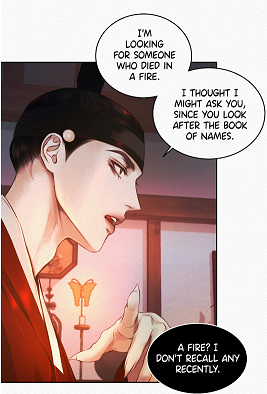 (Chapter 15) He doesn’t necessarily needs to interfere directly, his knowledge can help Lee Nok (for example the king’s passing). Remember the saying: knowledge is power. As a puppy, Jae Shin can tail Choi Kyung-Joon too, and he won’t be suspected, as a white puppy is supposed to chase away evil spirits. In fact, the friend knows how Lee Nok cherishes the dog, so he has no interests to mistreat or suspect him. This shows that the Crown prince has powers in the afterlife,
 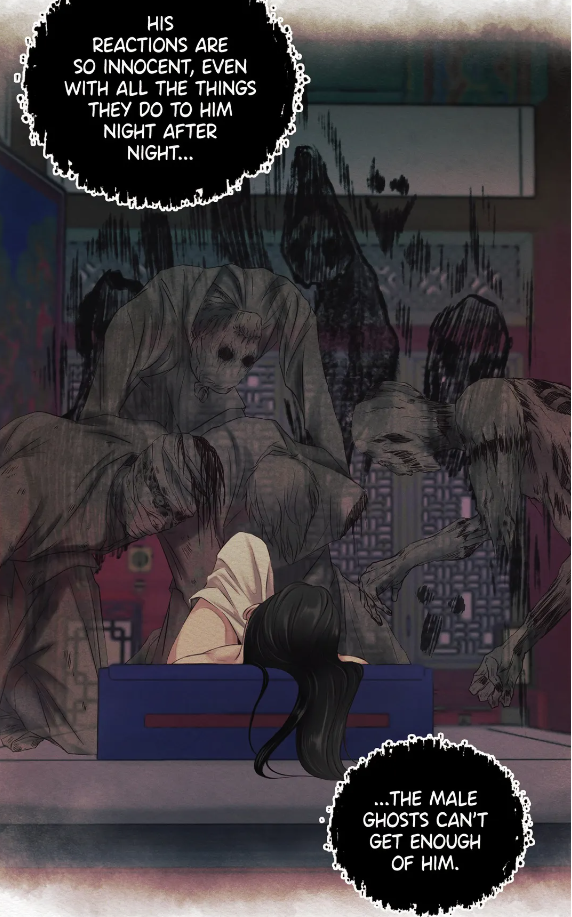 and his purity is his strength.
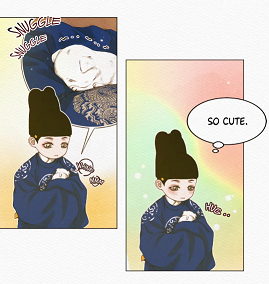 (chapter 2) and chose to protect him. Despite his status, he showed humbleness. But this doesn’t end here. He shared not only his bed and his food with him, but also his secrets. .
  (Chapter 2) Jae Shin had already become his confident. And this leads me to my final conclusion: Lee Nok is strong because of his huge heart too. He is neither arrogant nor selfish, and he has not such a negative view about humans and life in general, more about ghosts, the cause for his suffering. For me, he has never lost hope. He contrasts so much to his lover, thus he can teach him these values and change him. On the other hand, Jae Shin can give the Crown prince what he has been missing the most: a true home thanks to his affection and support.
  (chapter 8).
  (Chapter 1). He appears as more brutal and partial, for his kingdom is called the hell of tongue ripping. It was, as if he was not allowing protest or disobedience, and there would only exist one sentence: tongue ripping. Secondly, he banished his own son to the mortal world, because the protagonist had played a trick on the book of names.
 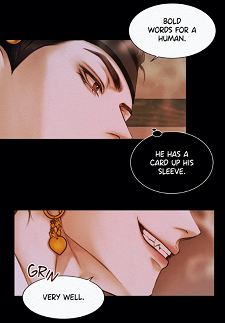 (chapter 1), had been asking this favor from him while tricking him. However, Yeomra wouldn’t listen to his defense so that at the end, Jae Shin was turned into a puppy.
 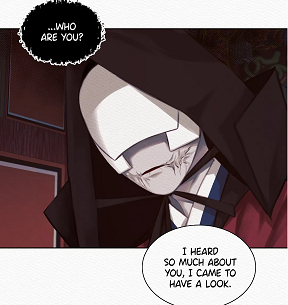 (chapter 8) or
  (chapter 14) what is he? A dream, a ghost, a human? And this leads me to the following observation: Jae Shin might be Yeomra’s son, but he has three appearances: the puppy, the nobleman and the ghost. This divulges that he has more than just one identity. In this picture, the author outlined the two sides from the main lead.
 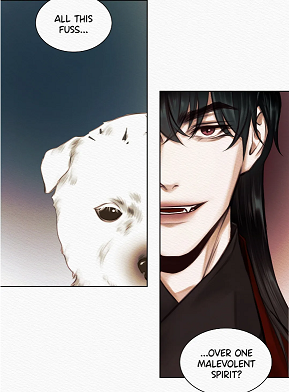 (chapter 7) This is no coincidence. If you pay attention how the main figure was called by Yeom, HALF-BREED
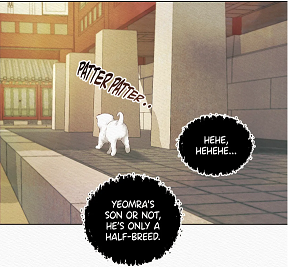 (chapter 7)
 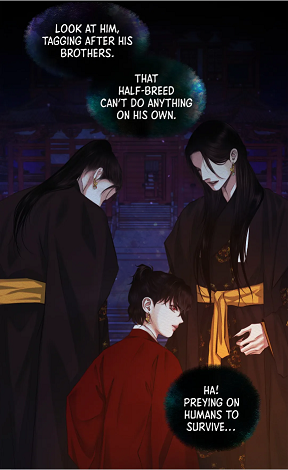 (chapter 15) Even Yeom who didn’t recognize him immediately, as she had never met him before,
  (chapter 8) still knew about his rumor. This indicates that Jae-Shin is different. One might say that it is related to his dependence on yin energy (“preying on humans to survive”). Hence he portrayed himself as defective.
  (chapter 15) This shows that he wished to be different, to resemble his hyungs and other “ghosts”. However, in my eyes, this is not the true origin for his reputation as half-breed. If the beholders look carefully at this image
 (chapter 1)
  (chapter 1) The color is exposing his special status. Secondly, in this image, we could see the young version of Jae-Shin
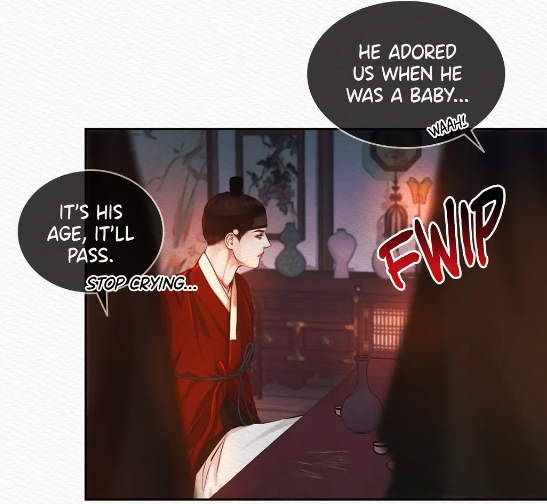 (chapter 15) In other words, he had the same evolution than a human! The only difference is that he doesn’t age and die like humans. He is already a few centuries old.
  (chapter 3) Thus I came to the conclusion that Jae Shin is actually the result of an union between Yeomra and a human. Hence he resembles a lot to a vampire with his teeth and long nails, as the vampire is considered as a living corpse. Moreover, the Korean version of a vampire, the gangsi is supposed to absorb Qi, life force. Nevertheless, Jae Shin is not a gangsi, for he can move freely and his body contains blood. My point is that Jae Shin became immortal thanks to his father, but since he was born from a human, he was first a baby before becoming an adult. This explains why Jae Shin’s main color is red, the symbol for life, combined with black, a reference to his father, as this color symbolizes the underworld! Under this new approach, it becomes comprehensible why Jae Shin is forced to go to the mortal world to replenish in yin energy, which is not a necessity for his hyungs. The older brothers don’t often visit the mortal world.
  (chapter 15) As you can sense, for me chapter 15 was very eye-opening! And once you accept this theory, you can comprehend why the father turned him into a puppy.
 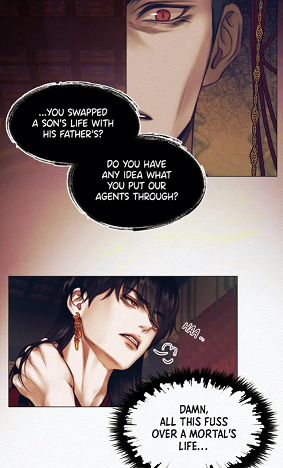 (chapter 1) In his eyes, they have no real value. Moreover, he resents them for their hypocrisy
  (chapter 3) He prefers the afterlife world to the mortal one. And because he was different from the others, he got spoiled by his father, brothers and other gods.
  (chapter 3) Since he is the result of an union between a god and a human, he needs human energy (yin). Therefore he bleeds like a human
 (chapter 15), when he gets stabbed, but because he is an immortal, he can heal.
  (chapter 16) Striking is that he called himself a ghost, but Lee Nok didn’t accept this, for he is visible to humans.
 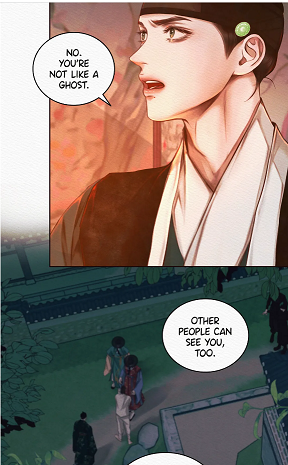 (chapter 16) This is important, because by identifying himself as a ghost, he is actually denying his “human nature”. However, he is not realizing that “ghosts” were all once humans which is not the case to Yeomra, Jin-Gwang, Cho-Gang and probably to his brothers. They are “gods”. In other words, the moment he calls himself a ghost, he indirectly admits his “human origins”.
 The association is already presented in the title, as it is part of the “ghost”.
  Besides, the manhwalovers can detect its presence in three occasions.
  Jae Shin is wearing an earring in the form of the lycoris. Then the red spider lily
  (chapter 9), was present, when he changed his appearance and dressed as a noble.
  (chapter 9) But what is the meaning of this flower then?
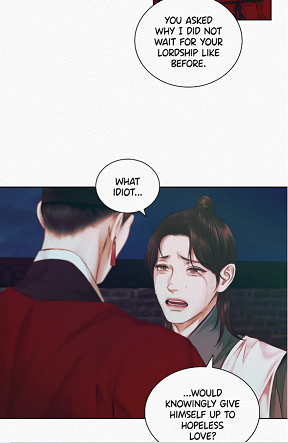 (chapter 9) This was their final goodbye. It takes courage to love someone so different, to love an immortal. That’s the reason why the father sentenced his son to win a human’s heart. He was teaching him a lesson, he should learn how his father fell in love with a human.
 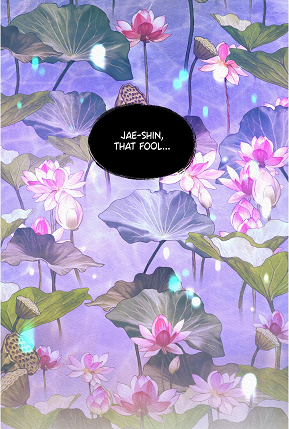 The purple lotus flower symbolizes spiritual enlightenment as well as faithfulness and innocence. The purple flower indicates harmony and balance between different parts of ourselves. [For more read the essay: The lotus and the snake] But since the pavilion and pond were facing the palace where Jae Shin was staying, the presence of the lotus is announcing the future purification of that place full of evil spirits and ghosts.
 (chapter 14) This shows that his body’s energy works like a huge talisman. But in order to become effective, he needs human energy. Hence I couldn’t help myself making the following connection, when I read Yeom’s comment about Queen Han:
  (chapter 13) She attributed the queen’s protection to a strong amulet, as she believed that the woman was a human. However, the moment you admit that Jae Shin is the fruit of a love between the god of the underworld and a human, you can imagine that Queen Han could have the same nature. Her aura could be so strong that she can push away powerful ghosts like Yeom. Yeom thought that the young girl was attracting ghosts like Lee Nok
  (chapter 8), thus the shaman advised to the father:
  (chapter 8) She encouraged him to have his daughter accumulated good karma. She was indirectly trying to change the girl’s personality and as such destiny.
  (chapter 8) From my point of view, the young girl was discovering her second nature, she could see and talk to ghosts. Thus she smiled. As you can see, I came to develop the following idea: Queen Han is a half-breed like Jae Shin, but contrary to him, she prefers the human world. Why? Because of her powers, she can control people and gain power. This explicates why she chose to get rid of the shaman whom she viewed as a threat. At the same time, thanks to the intervention of the “spirits”, she discovered how powerful she was. Thus she smiled…
 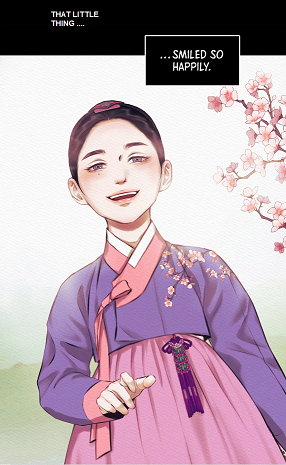 (chapter 8) like a flower
 (chapter 8) These words reminded me of the lycoris, the flower of death and funeral. We have many possibilities for her lineage. Either she is a new version of Gongju Bari, or she could be the product of another god, like for example this one: Seokga.
 (chapter 13), yet the brother had not heard about such a death.
 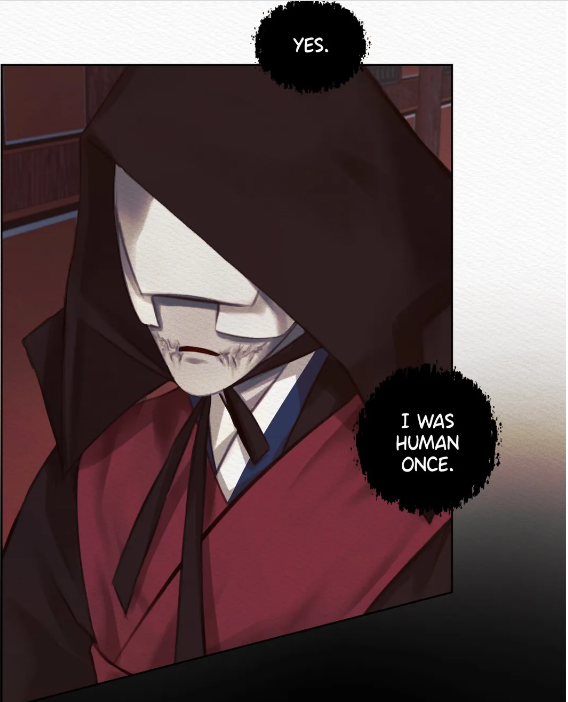 (chapter 8) Exactly Jae Shin, she is living between two worlds, her body might have died, but she is by clear conscious.
 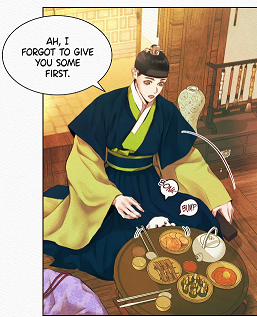 (chapter 9)
 (Chapter 5) It took him a whole week to recover from this encounter. (Chapter 5) He was physically and mentally wounded. His behavior fits all the criteria in chapter 6. He is totally selfless and is risking his life emotionally, physically and mentally. He definitely sees the champion as a „criminal“, since he keeps comparing him to the director from the hospital. (chapter 6) He has indeed become a true hero, hence he received the admiration and love from all the readers.
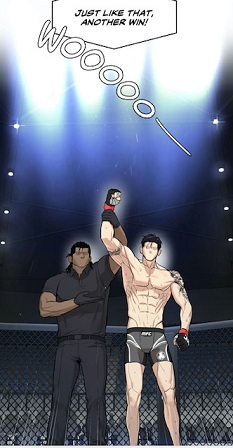 (Chapter 5) At no moment, in the ring, he risked his life, for this fight is controlled by a ref and both boxers are required to follow certain rules. But the seme has not realized this yet. Like I had pointed out before, he takes everything too seriously. He views his games as a matter of life or death. One might think that he has never had a strong opponent so far, but we have two indications that his career wasn’t always smooth.
  . (chapter 1) The legend is implying that this was not like that in the past (“the streak continues”). Secondly, he has cauliflower ears
 (chapter 1), a typical consequence for fighting. [Here I would like to thank @delune_art for her observation]
 (chapter 5) The lover and Kim Dan have the same hair dress and the same height, they are both muscular, yet slender.
  (chapter 2) In other words, Joo Jaekyung favors a certain type, but he is not aware of it. Hence he claims that all his sex partners were different. And now, you have the explanation why he views people he has sex with as tools and even whores. He used money as a protection, a wall to keep his distance from people. This is not surprising why he was happy, when Kim Dan asked for financial support. That way, there was no string attached.: “So it was just the money, after all”. (chapter 6) But naturally, he is deluding himself, because observe that he is now changing his sexual habits!
 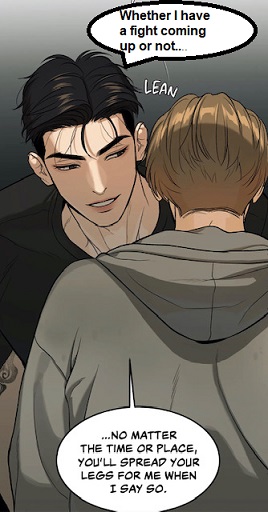 (chapter 6) It is no longer linked to his jinx, because he is asking Kim Dan to have sex no matter the time or place. This little detail makes a huge difference, the start of his new obsession.
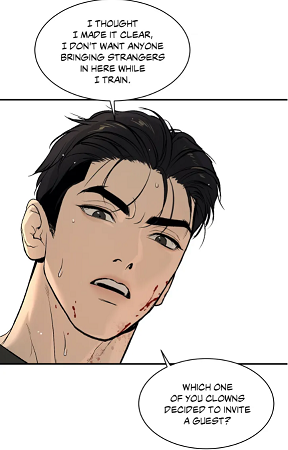 (chapter 1) before and after the arrival of the manager. The tone changed immediately.
 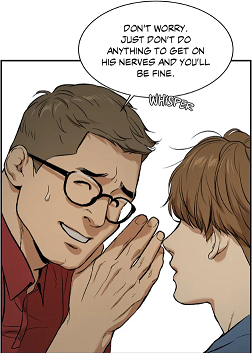 (chapter 1) Then when his athlete wondered why he had not heard from Kim Dan, the manager not only took Kim Dan’s side, but also criticized his athlete. First, when he said that the main lead had asked him like a million times, (chapter 5), he was implying that he had bothered him a lot. Then
  (chapter 5) the idiom “something” is a reference to the sportsman’s behavior. He reproached him in a calm manner that he would nag constantly. Yet, at no moment, the boxer felt insulted. That’s why I couldn’t help myself judging him as a “hero”. He could tame his sportsman and turn him into an obedient “puppy”. The latter is always well-mannered in front of him and never showing his frustration.
 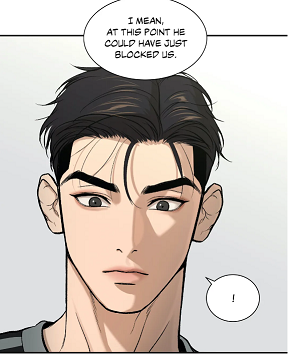 (Chapter 5) He got caught by surprise by this point. He never imagined that Kim Dan would reject or even block him, as he is considered as a “champion”, a hero!! But the moment he turned his back from the manager, he couldn’t control his frustration and anger. Thus he smashed the punching bag with such a force. (chapter 5) On the other hand, he couldn’t control his gaze, when he heard that he could get blocked. (chapter 5) This whole scene displayed the respect Joo Jaekyung had for the manager and his friend. At the door, he never exploded. But why is it so? Like mentioned above, he views the man as his family. And we have another proof for this: “block us” was turned into “block me”. As you can see, the personal pronoun “us” indicates that Joo Jaekyung considers the man with the red shirt as an unit, a home.
 (chapter 1), yet he used an ambiguous expression. For the manager, it sounded like the champion had beaten him, while the sexual insinuation was present. His choice of expressions indicates that he desired to stay as close as possible to the truth. This shows that the main lead has no real intention to manipulate his “hyung”. He is not doing it out of malevolence, rather out of fear in my eyes. This is also perceptible in this scene.
  (chapter 5) Joo Jaekyung was frank enough to voice his dissatisfaction about the physical therapists. For me, this image exposes that the boxer is not just a violent and selfish man, he is still capable to have a normal relationship. He respects his peer and never vents his rage towards him. Under this new approach, you can grasp why I selected “my hero” as a title. I wished to outline the good influence the manager has on Joo Jaehyunk. The former will definitely take the physical therapist’s side, like we could sense in chapter 1 and 5!! I am looking forward for the interaction between Kim Dan and the manager, because it will definitely affect the relationship between the hyung and the champion!
 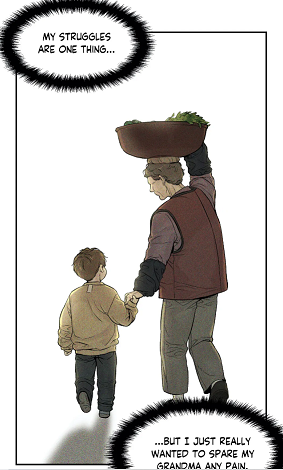 (chapter 5) This is perceptible due to her clothes and her basket. She was more or less a “peasant”, living in the countryside. And the young child could sense her struggle. She dedicated her life to raise Kim Dan properly so that he could get an education. She was so selfless and caring that she protected her grandchild from the loan sharks’ brutality.
 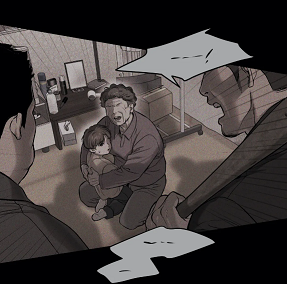 (chapter 5) With this scene, the manhwalovers could discover that Kim Dan’s debts existed, even before he became an adult. This means that this was the heritage from his parents. Hence I am suspecting that one of a parent deserted the family in order to escape from the loan sharks and left the debts to the halmoni and Kim Dan. And if you recall the criteria for heroism, you will recognize the halmoni is a true heroine. Hence you comprehend why the young protagonist is willing to do anything for his grandma. He is trying to repay his “debts”, since she had to suffer so much in the past. There is no ambiguity that the young man feels responsible for her. And if you observe the chapters I quoted the most so far, this was episode 5 where the manager and the halmoni were introduced properly for the first time!!
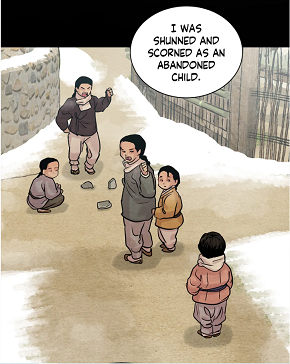 (Chapter 94) In this scene, the painter was rejected by the children, for he had no braid. Due to his hair dress, he was recognized as orphan immediately. The justification was that that way, the artist would appear more boyish. But by mentioning the loss of Yoon Seungho’s topknot, Heena was actually revealing that she knew the true signification of the haircut: abandonment and intolerance. Her words to her brother exposed her hypocrisy, though she attempted to portray the elder master as respectable. One might argue that when Na-Kyum was just a child, she had suggested the short hair, for she had good intentions. But after this experience with the children, the noona should have grasped the wrongness of her decision. She should have admitted her bad decision and stopped the painter from cutting his hair. Moreover, don’t forget that Na-Kyum was just a young boy, so the haircut must have been done by Heena herself. This shows that her gesture actually divulged her future behavior: she would betray and abandon the painter constantly (season 1, 2 and 3). At the same time, since the painter was seen with short hair in chapter 68
  , this indicates that Heena kept cutting Baek Na-Kyum’s hair. So even in the past, she was betraying her brother, though the latter never realized it. The loss of hair could never be viewed as a sign of love or empathy, for it contributed to the painter’s abandonment issues and his self-loathing. He was suffering as an outcast and due to his girly features. The men in the gibang could mistreat him, for he had no long hair or topknot. Why?
 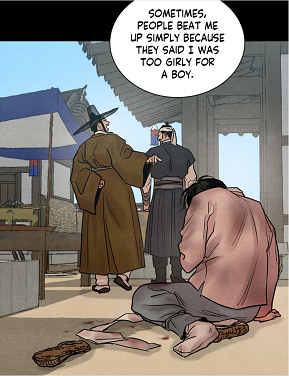 (Chapter 94) He had no parents or guardians protecting him which is true, for here he was exposed to violence. Heena, as the head-kisaeng, had not protected him at all, she must definitely have portrayed herself as powerless. Yet as a slave of the state, she was belonging to the king. So she had connections to officers and the court. In my eyes, the head-kisaeng made sure that the artist could never get a topknot, and as such he would never be able to become a “noble” or even a man. Hence Baek Na-Kyum was constantly called boy
  (Chapter 56)
  (Chapter 59)
  (chapter 66) and treated as one too. This observation made me realize that Heena’s belief could be used as an explanation for her action (cutting off his hair): she hates nobles so much that she didn’t allow her brother to have a topknot. But why would she do that? My idea is that deep down, she resented him, for he was a free man, while she was a slave. It went so far that he was encouraged to wear a white headband, the symbol for servitude, though he is no slave! To conclude, the loss of hair in Joseon should be perceived as a brutal and harsh punishment. Without a topknot, one is left unprotected, is not viewed as an adult. But this stands in opposition to Yoon Seungho’s action in front of Jung In-Hun’s home.
  (Chapter 101) Here, the lord had spared his friend’s life.
 (Chapter 23) cuts off the hair of the general Woo Jong Han, because he had committed crimes. First, he hid the fact that his sister had had a child before getting married to the emperor, which was actually a huge sin. The future Empress should have been a virgin. To sum up, he had committed treason, for he had allowed his sister to become Empress unrightfully. Then the field marshal had treated his niece as a slave violating social norms.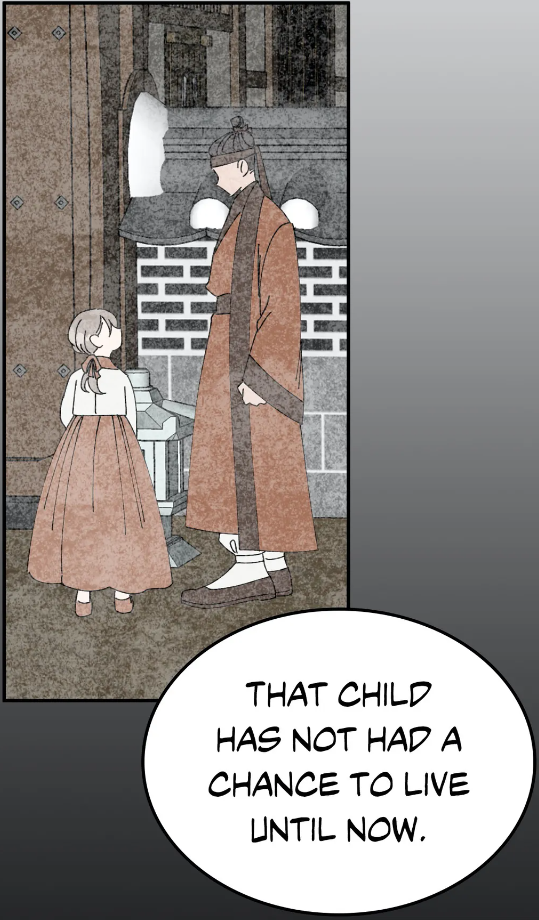
 (chapter 34) That way, he assisted his sister to become powerful by covering up for her crimes (silence and passivity). She had killed many people to hide her previous relationship and to increase her power. Striking is that the prince still spared Baek-Ha’s uncle, and this for many reasons. First, the latter had not only saved both protagonists, the empress’ illegitimate daughter Baek-Ha and the prince Nan-Woo, but also had admitted his sins. Secondly, he was thinking of his wife Baek-Ha who is kind-hearted. He knew that his death could upset his bride.
 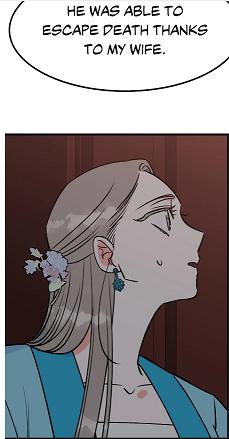 (chapter 26) But there is more to it. Nan-Woo didn’t spare the man out of benevolence.
  (chapter 26) He had a role to play. By cutting off his topknot, the general lost his “power”, he became the prince’s pawn! Nan-Woo wished to use the uncle in order to get rid of the Empress.
  (chapter 23) That way, the protagonist wouldn’t even have to dirty his own hands. On the other hand, we could also say that Nan-Woo was forcing the Empress’ brother to undo his bad decision.
  (chapter 23) Since he had protected his sister Seo-Ha out of affection, it was normal that now he had to show no mercy towards her. By presenting Baek -Ha to Nan-Woo, the general was well aware that the future ruler would recognize the female lead’s origins due to her resemblance to her mother. Therefore, we could interpret that Nan-Woo had spared the general, for the latter had switched sides and expressed the wish to undo his wrongdoings.
  (Chapter 101) It is because he must have witnessed it himself in the past. I have already pointed out that Yoon Seungho would imitate people, especially his tormentors. So where did he learn from? I believe, Yoon Seungho copied it from someone… and this can only be “lord Song”. And now, the first loss of Lee Jihwa’s topknot can be perceived in a different perspective. The red-haired master was well aware that he had been spared, when he had lost his hair for the first time.
 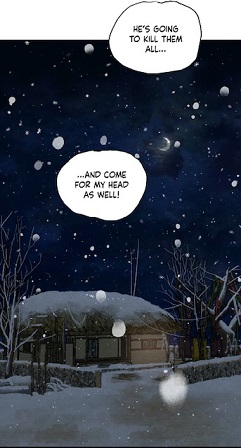 (Chapter 101) He knew deep down that thanks to his friend, he had been able to escape the worst. Since he had been spared once, he was well aware that this time, the ruler would show no leniency and would ask for his head, as the main lead was no longer protecting him. Remember what the lord had whispered to Baek Na-Kyum:
 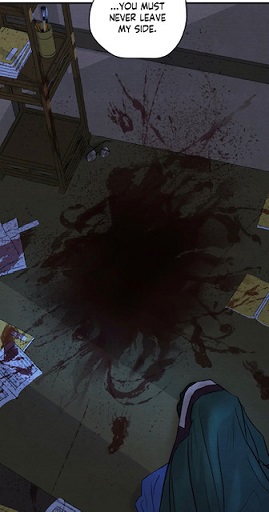 (chapter 88) (chapter 88) By cutting off the friend’s hair, he was showing that he was abandoning his friend. He was leaving him behind, and Lee Jihwa was forced to face lord Song alone.
  (chapter 23), he swore loyalty to the future emperor. This signifies that the topknot also symbolizes faithfulness, especially because it is connected to marriage. Thus I deduce that when Lee Jihwa lost his topknot for the first time, he was already judged as disloyal. Hence it is no coincidence when the antagonist screams that he would become the target of lord Song’s fury.
 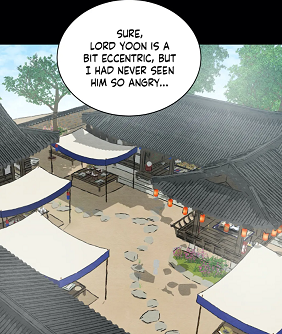 (Chapter 59) First, lord Yoon could be a reference to the father and not only the son. Secondly, he implied that he had witnessed the scene, yet in reality he could have been referring to the outcome: the friend’s hair cut, just like the noona had only seen the hickeys on her brother’s neck. She had never witnessed the sex session. The noble with the mole assumed the perpetrator’s behavior, rage, based on the hair loss. Moreover, he could have been telling the truth: he had never seen Yoon Seungho so angry before, as the latter used to be weak in the past due to his social status: he was a male kisaeng due to his braid. This explicates why the noble with the purple robe would give an order to the host
 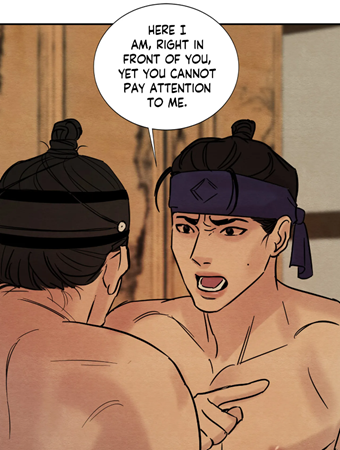 (chapter 8) He felt himself superior to Yoon Seungho, and never expected “disobedience” or “rage” from the protagonist. Striking is that the lord didn’t vent his anger onto him, he first smiled before grabbing him by the topknot.
 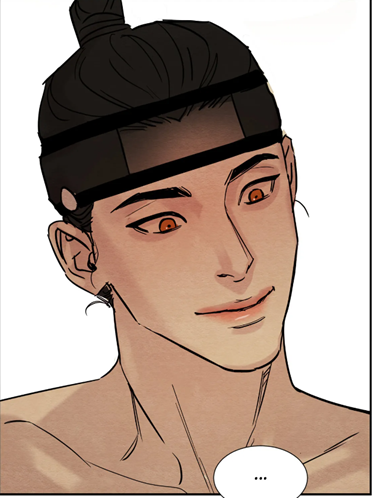 (Chapter 8) A simple change of hair dress had transformed the main lead. This exposes the gods’ intervention in this story. They let the man with the mole see the wrongness of his manipulations. Since he had stated that he had never seen the man so angry, his words became a reality in 3 occasions: chapter 8 like mentioned above, chapter 53
 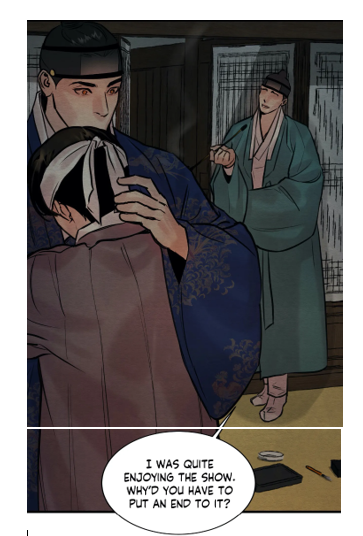 , for he was not present, chapter 57
  in the inn. Here, he chose to run away, yet despite everything he still helped his friend Black Heart, for he was present in the gibang.
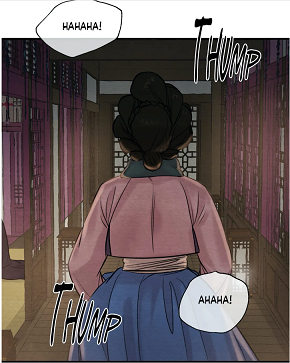 (Chapter 69) Under this new light, this panel from Twitter get a total new meaning:
  The aristocrat knew about the true identity of “lord Song”, and he had indeed never seen the man so angry that he would cut off the topknot of a noble!! This means that the fate of the noble with the mole should be to end up as the lord’s new plaything. In other words, he takes over the main lead’s previous status. He becomes the male kisaeng and ends up living in the shed like the protagonist in the past where the pedophile vents his rage and resent him for his tricks. But we will see.
 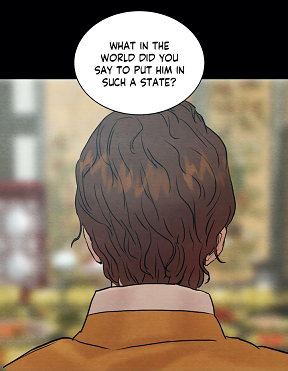 (chapter 59) Furthermore, he associated it to abandonment too.
 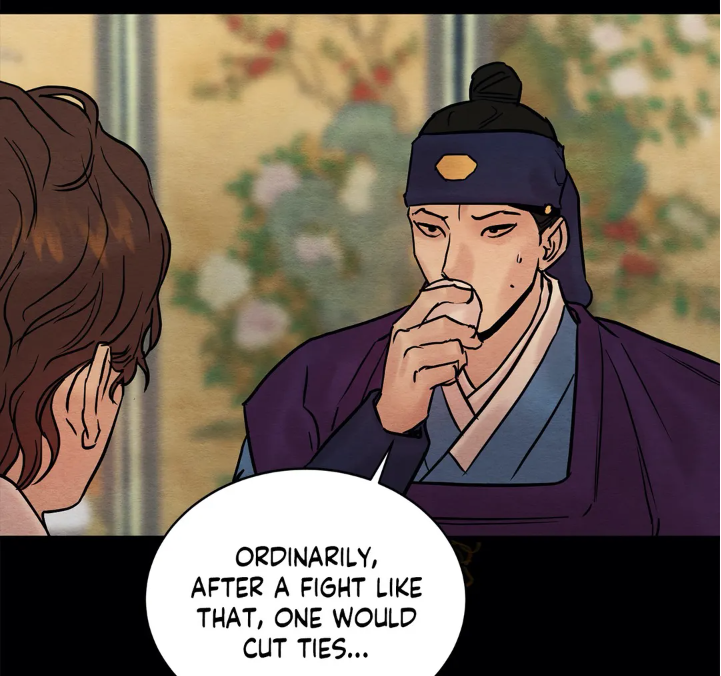 (Chapter 59) Yet, observe the drop of sweat. This exposes that neither Min nor the noble with the mole were expecting that Lee Jihwa would be spared!! They acted, as if the loss of the topknot couldn’t be a sign of mercy. But observe what Lee Jihwa was recalling, when the “friend” was talking about abandonment.
  (Chapter 59) He was by the protagonist’s side! This means that lord Song had spared Lee Jihwa’s life, for he had been present, when Yoon Seungho was suffering. Till the middle of season 2, no one was aware of the fallout between Lee Jihwa and the protagonist. None of the incidents in season 1 was leaked to the outside, hence the “pedophile” was not officially aware of the red-haired master’s wrongdoings. But the loss of hair in front of the learned sir’s house becomes the proof that the main lead has now left his friend’s side. He will be blamed for his suicide. Therefore it is not surprising that the young master chose to run away.
 (Chapter 101) He knew that the ruler would show no leniency or understanding. Thus the noble with the mole’s karma should be to keep his topknot.
  (chapter 27) The painter had saved his teacher’s life, and later the lord had restrained himself from hurting the scholar in the courtyard despite Jung In-Hun’s lies and lack of respect (he had touched the man’s shoulder).
  (Chapter 30) Here again, the scholar had been spared. Then in episode 53, the painter had embraced the lord to stop him from killing Deok-Jae. This means that Yoon Seungho must have also saved people in the past by using his body, and this twice, for I had detected the presence of two circles: Yoon Chang-Hyeon and Lee Jihwa. That’s the reason why the father could survive the purge, and why Lee Jihwa only lost his topknot. And the heroine from A Sip Of Poison can serve as an example.
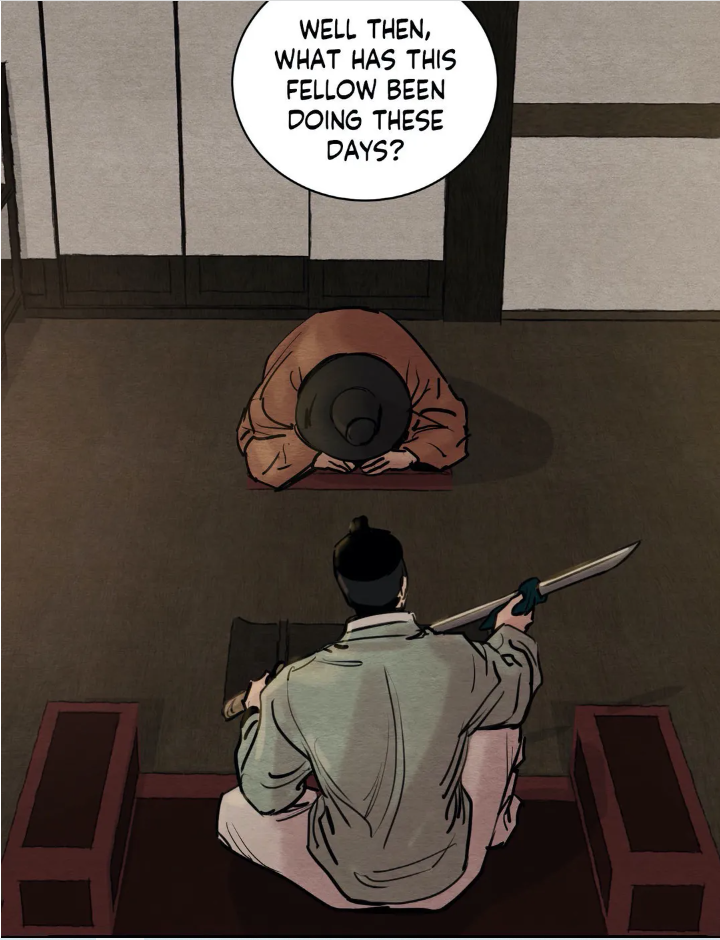
  (Chapter 1) As long as the latter was living there, the Lees had nothing to worry. The main lead was protecting them from the king. However, the manhwalovers should keep in their mind that Nan-Woo had showed mercy to the general for his own interests. He should become his helping hand in order to obtain the throne. Hence I come to the following deduction: neither Nan-Woo nor the “perpetrator” had cut off the topknot out of real leniency. This shows that for these characters, the loss of the topknot is not the symbol for forgiveness which is not true for the last incident with Lee Jihwa.
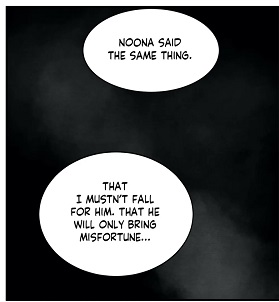
  (chapter 1) Even the headband was different. This was no coincidence. He should never develop confidence and act as a lord. That’s how I recognized the following pattern. In front of the painter who looked like a minor, the main lead was forced to act like an adult. Thanks to the painter, he was encouraged to mature. Simultaneously this meant that at some point, while living with the Lees, the elder master Lee had to be confronted with the truth: his son’s sodomy.
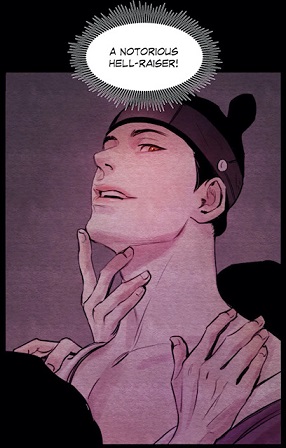
  (Chapter 86) The reality was that the pedophile was the bad omen, but they couldn’t insult the king. Hence the young main lead became the scapegoat, people couldn’t separate the pedophile from Yoon Seungho. The “mysterious lord Song” would never give up on the protagonist. No matter what he would keep him by his side.
  (chapter 1) Moreover, we shouldn’t overlook the publications with the braided man:
  (Chapter 1) Baek Na-Kyum was not supposed to recognize the identity of the man having sex with the bearded man. From my point of view, Heena made sure to confuse her brother. Lee Jihwa’s humiliation became Yoon Seungho’s stigma. He became the culprit. Since in the past, the main lead had been blamed for everything, the perpetrators and accomplices chose to follow this “tradition”, because so far, they had been able to cover up their crimes. But thanks to the painter, it is no longer possible. Why? It is because the painter’s hair dress will serve as a mirror of truth: the absence of a topknot due to the braid and the hair cut will be perceived as an evidence for abandonment, cruelty and huge wrongdoing. This won’t be seen as a gesture of mercy or leniency by the two protagonists, for they suffered because of it!! That’s the reason why I am thinking that the pedophile’s karma should be the loss of the topknot which he viewed as a gesture of mercy and tolerance. But without the topknot, he is actually “castrated”, and as such humiliated for he can not wear his golden sangtu.
  Yet, contrary to Lee Jihwa’s haircut, the loss of the topknot should not be judged as the symbol of mercy and forgiveness, in fact, the lord would officially cut ties with him. That’s how the mysterious Lord Song would be taught an important lesson: he was a huge hypocrite and a violent and ruthless pervert.
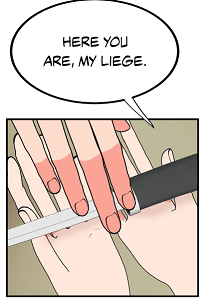
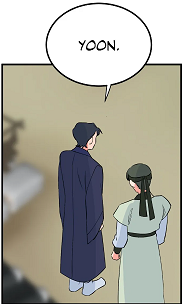 (chapter 23) to give him a knife:
  (chapter 23) before grabbing Woo Jang-Hon by his topknot
 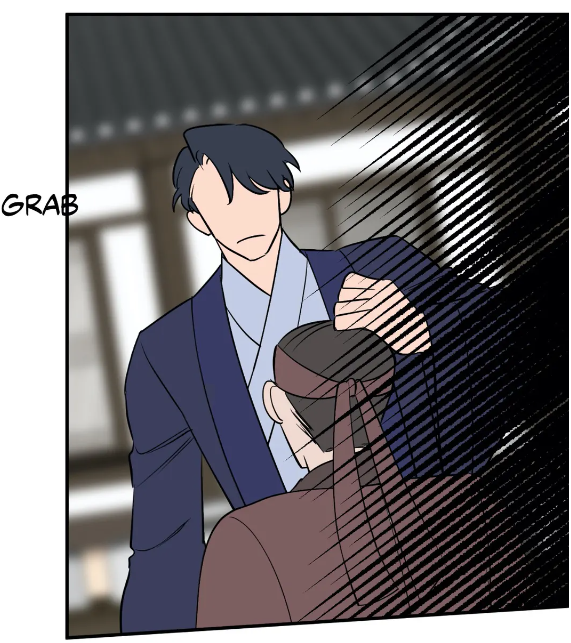 (chapter 23). Hence the hair fell between the men.
  (chapter 23) And now, let’s return our attention to Painter Of The Night. Compare the position of the aristocrat’s topknot after Yoon Seungho had punished his friend.
  (chapter 101) It was behind him!! Thus I deduce that he had used the sword, when Lee Jihwa had approached his friend. But wait… in season 1 and 2, Byeonduck drew scenes with a knife: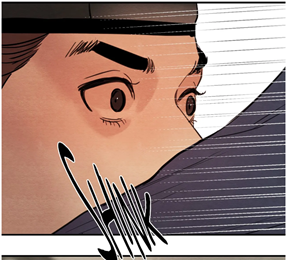
 And what had happened before? Yoon Seungho had dragged his friend by the topknot before stabbing the amateur spy. This is no coincidence.
 When this chapter had been released, I had assumed that this must have happened, when Yoon Seungho had lost his topknot! As you can see, I had already connected the knife to the loss of the topknot incident.
 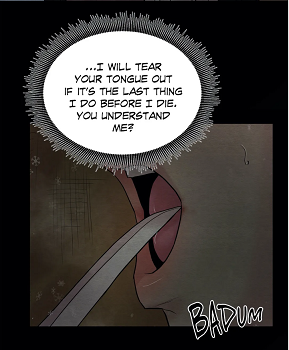 (chapter 66)
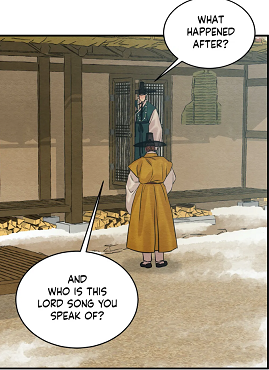 (chapter 83)
 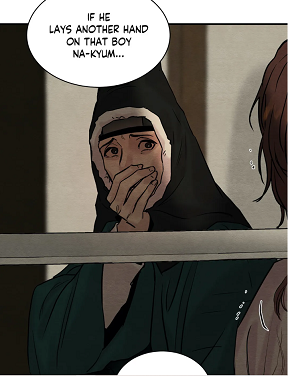 (chapter 67) This shows that till season 3, Lee Jihwa had never been exposed to real justice. There was always someone ready to intervene for him. And now, you comprehend why the red-haired master felt no remorse to blame his friend for his humiliation in the past. He must have thought that if he had not been in his bedchamber during that night
  (chapter 83) This explicates why Lee Jihwa said this to Black Heart and his friend:
  (chapter 59) The antagonist had witnessed his friend’s humiliation and suffering in the past, just like Yoon Seungho had been present, when the first topknot incident occurred. From my point of view, the lord must have even protected Lee Jihwa. But the problem is that Lee Jihwa was just receiving his punishment in delay for the stolen kiss and his lies
  (chapter 77) He had kissed him without his consent, thus he got “castrated”. Let’s not forget that the main lead was forced to become a male prostitute, an uke, for he had not been able to perform, to have an erected phallus. On the other hand, Lee Jihwa had done nothing wrong in the bedchamber
 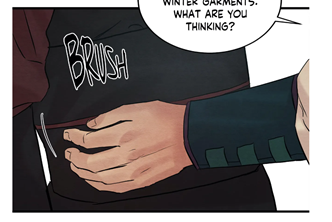 (Chapter 41) Due to the incident in the kisaeng house, Min had lost his privileged position with the king. Hence he got jealous. He could no longer screw” the protagonist, while he had to watch the lord’s slow ascension. To sum up, the loss of Jihwa’s topknot led to the “symbolic castration” of the infamous couple: Min and the noble with the mole.
 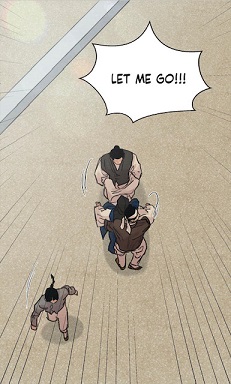 (chapter 77) And now, you comprehend why the pedophile cut off Lee Jihwa’s topknot! The latter had been blamed for the lord’s change of hair dress.
 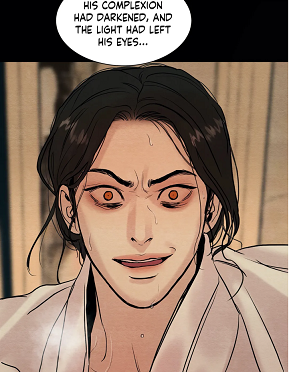 (chapter 57) The hair was short or not? Now, I don’t think so. The mystery of Yoon Seungho’s suffering is linked to the hair dress, yet the readers shouldn’t realize it too quickly. According to me, he still had the braid, until the doctor questioned why Yoon Seungho still had no topknot.
  (chapter 33)
 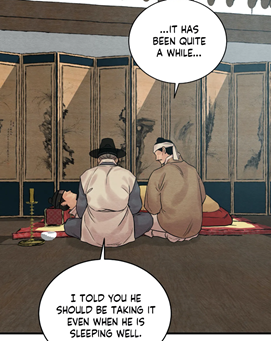 (chapter 55) And who had given him the topknot? Naturally… Kim! Because he didn’t want to be perceived as someone who was violating social norms. However, there is no ambiguity that he hid his responsibility. That’s how Lee Jihwa and his “servant” got framed. They were responsible for giving the main lead the new hair dress. On the other side, I still believe that Yoon Seungho must have lost his hair too, but only once to the difference of Baek Na-Kyum! My reason is simple. Since the painter and Lee Jihwa lost their hair, and Yoon Seungho’s destiny is mirroring his lover’s, it signifies that the lord’s hair must have been cut too. But who did it? Let’s not forget that when Yoon Seungho punished his friend in front of the scholar’s home,
 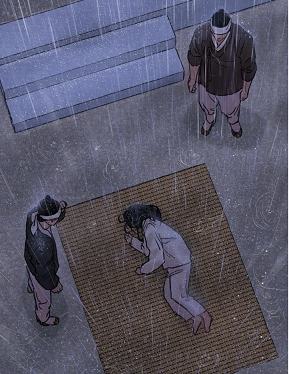 (chapter 77) and this one
 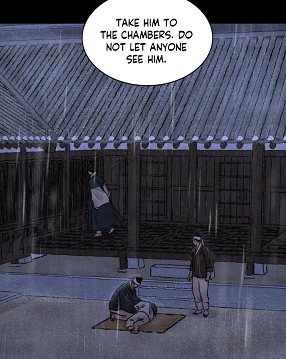 (chapter 77) and Kim had also experienced rejection from Yoon Seungho
  (chapter 77) in that scene. For the butler, this gaze could be judged as betrayal and abandonment. Under this new perspective, it becomes comprehensible why the main lead was encouraged to blame and resent his father. If this theory is true, Kim pushed the main lead to cut off his braid, he did it out hatred and anger towards the Yoons. This would mask his own manipulation and culpability too. At the same time, the pedophile could benefit from it. The main lead was now an orphan, thus the bearded man could use him like he wished. I have an evidence for this interpretation. This is what Baek Ha said to her husband:
  (chapter 23) Being slave meant being orphan. The pedophile could feign ignorance about the main lead’s true origins. If he truly cared for him, he just needed to ask this: papers!
 (chapter 24) This shows that in Painter Of The Night, all the elders were depraved and violent hypocrites. Like mentioned above, the pedophile had a huge interest to keep the main lead as his slave, thus he was turned into an orphan and asked to keep a braid. And Yoon Seungho’s mother could do nothing, for the son had cut off his own hair, a huge symbolic act. He was no longer considering her his mother. But because of his status as slave, the pedophile could never trust the main lead. Then the suicide from the mother put an end to this farce. Hence lord Song could tell his sex partner that he had become the head of the Yoons and let him “have” the properties, while it was never his intention to let him become responsible. If he had become a lord, he could escape from his claws. He needed him to remain in an infantile and dependable state.
  (chapter 33)
  (chapter 33) She not only treated his wounds, but also helped him to overcome on his guilt. He felt responsible for his brother’s death, for Nan-Woo had attempted once to commit suicide on the battlefield, and his brother had sacrificed himself to protect him. He was definitely plagued with remorse, self-loathing and shame. And that’s exactly what Baek Na-Kyum has been doing too: by simply loving him so selflessly and purely. Finally, Baek-Ha’s fate made him realize the Empress’ immense culpability. She was so greedy and selfish that
 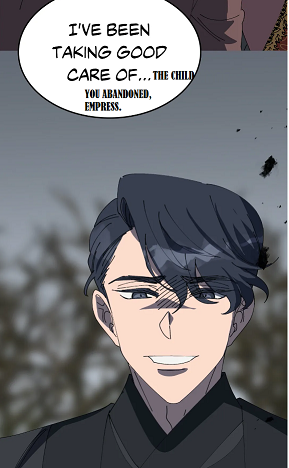 (chapter 34) she had abandoned her own child! Thus he was freed from his hatred and guilt. Nan-Woo was able to perceive the wrongness of this social norm which was common in Joseon: the child is responsible for the parents’ sins!
  (chapter 33) Being an orphan outlined her innocence. And since I have already connected Baek Na-Kyum to the mysterious lord Song, I am quite sure that the painter will have a similar attitude than Baek Ha:
  (chapter 33) He will feel responsible for Yoon Seungho’s martyrdom. And if he is truly his son, his abandonment can serve an evidence of his innocence. On the other hand, the readers shouldn’t forget that his surrogate parents, Jung In-Hun and Heena, played a role in lord Yoon’s torment as well. Thus he can only indebted towards his husband.
  (Doctor Frost, chapter 225) With this picture, the manhwaphiles can detect the presence of the endless vicious circle, the ouroboros, which I had described as a kaleidoscope. The absence of empathy in both stories was the reason why no one stopped the main perpetrators. Woo Jang-Hon felt guilty, for he had raised his younger sister who had become a monster. Kim felt deep down guilty, but chose to reject his responsibility by putting the blame on others. Out of fear, he preferred hiding his wrong decisions and later wrongdoings. And now it has become his MO. This distinguishes him from the general who chose to put an end to his guilty conscience and paid for his crimes..
 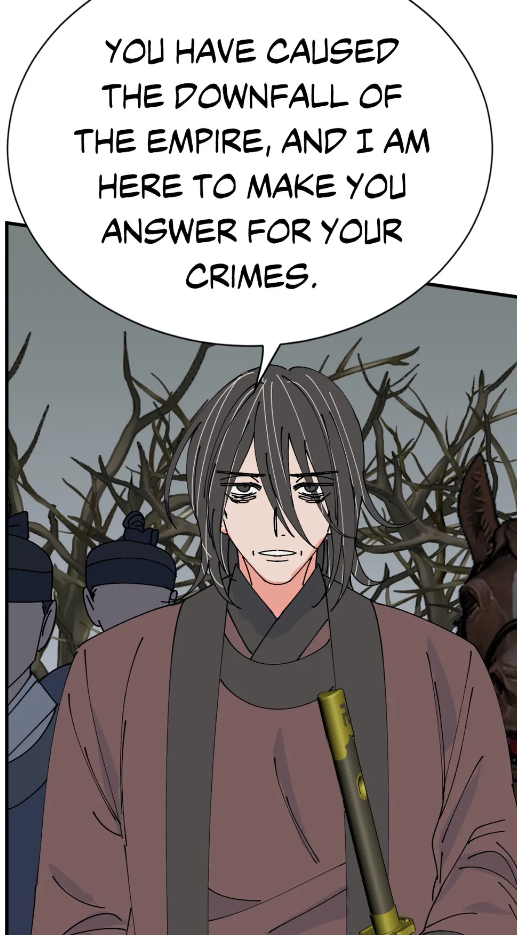 (chapter 34)
 on Twitter yesterday, and naturally this made many people happy, for Jung In-Hun was stroking Baek Na-Kyum’s foot gently. How could people identify the characters, though we don’t see their faces? Simply by the clothes! The manhwaphiles remember the painter’s grey pants and the learned sir’s favorite color, lavender,
 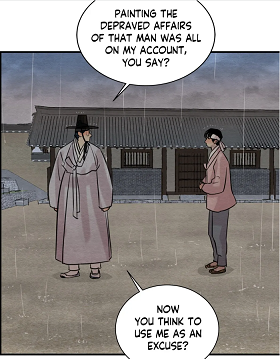 (chapter 19)
 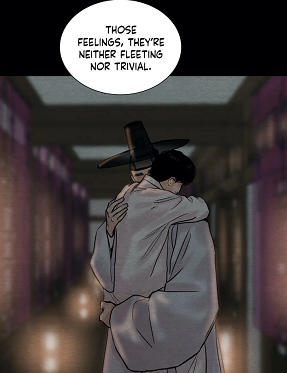 (chapter 68). While many manhwalovers found this image cute
  (chapter 70) The manhwalovers can immediately detect the contrasts: the visages of the protagonists versus the hand and the foot, day versus night, sun versus moon. That’s the reason why I came to the deduction that this image embodies a happy memory of the painter: sadness versus happiness.
 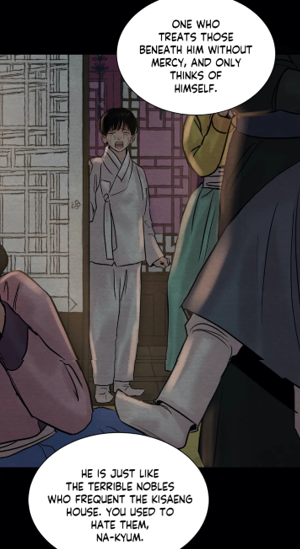 . (chapter 68) This means that Baek Na-Kyum was removed, because he was a witness and could generate a scandal. He is beloved by the kisaengs. However, back then, he got misled due to Heena’s indoctrination and false impressions. When he saw this, he was only looking at his noona, hence he didn’t pay attention to the actions of the black guard. Moreover, he had no idea why Heena and Yoon Seungho were behaving like that. So when the painter recalled Jung In-Hun from that night, he was no longer heartbroken, because the stroll with the scholar came to his mind.
  (chapter 70). The trigger for this recollection was his farewell to Heena. This time, he could say goodbye to Heena properly by embracing her and giving her a scarf so that she would remember him. In the painter’s mind, after that night, he would never see her again.
 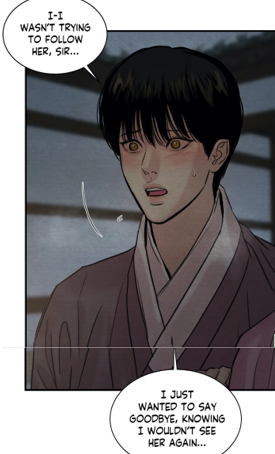 (chapter 69) In other words, this night represented a closure for Baek Na-Kyum, the end of his abandonment issues. In episode 70, Jung In-Hun had consoled him, he had tried to cheer him up. Thus the learned sir was smiling. Yet, this couldn’t cover the painter’s scar. He felt that he had betrayed Heena, for he had not been able to protect her. It was, as if he had run away. Nevertheless, when this incident occurred, the learned sir had not run away from the gibang, because you could see that Baek Na-Kyum was wearing socks and shoes.
 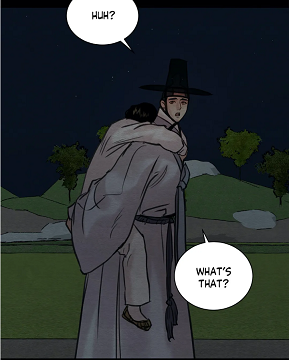 (chapter 70) The man had put the shoes on the child, as in the building, the painter only had his socks on. Because of the presence of the socks,
  (chapter 68), I deduce that this walk must have taken place in a colder season (fall)
  while in this picture, Jung In-Hun was carrying the painter on his shoulders in the summer.
  (chapter 102) In both scenes, the main lead is seen with bare feet. He is also carried by his loved one. But here, it is snowing, hence this signifies that it is winter. On the other hand, the manhwalovers can detect the presence of a purple flower on the right side. This signifies that Spring is on its way. That’s how I came to realize why Baek Na-Kyum is now recalling the learned sir’s gesture from the past.
  (chapter 102) where it is even colder than in the valley, secondly it is snowing and there is no sun, only the moonlight. So the moment Yoon Seungho witnessed that Baek Na-Kyum was alive, he must have recognized the seriousness of the situation. Since Baek Na-Kyum had only a hanbok on, he could die of hypothermia. What he had imagined for himself, death, had terrible consequences. He could be the reason for the painter’s curtains. So in my opinion, he must have warmed the painter’s feet with his hands, a new version of this scene:
 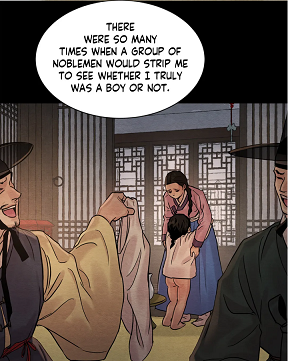 (chapter 94) His presence was to divert the attention from these men so that she wouldn’t be asked to have sex with them. And since I have already detected that each time, the painter suffered, karma would retaliate, the logical consequence is that Heena got punished for her wrong action. This signifies that while the painter was following the learned sir, his noona was abused in the kisaeng house. This would explicate why later she had no remorse to turn Yoon Seungho into a victim. And don’t forget that the painter was much younger than in this scene.
 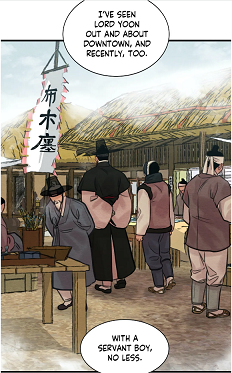 (chapter 45)
  (chapter 75) The latter would let his partner walk through town in order to please him. He would even follow the painter. In other words, it was always for the painter’s sake, and in the mountain, it was the same. But it was not the same for Jung In-Hun, it was for his own benefit. We have the best example in chapter 10:
  (chapter 10) Here, he desired to separate the couple. Baek Na-Kyum should refuse to paint erotic pictures.
  (chapter 29)
 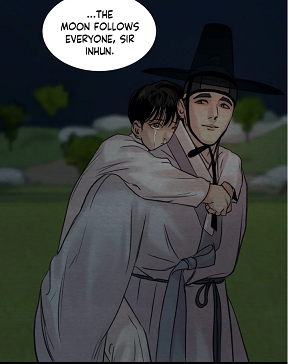 (chapter 70): The artist is dressed with good clothes, he looks more like a young master than a commoner, only the shoes are indicating that he is a commoner. That’s the reason why I believe that during that night, the learned sir was avoiding people. They could have wondered why the young boy was carried in his night clothes outside. From my point of view, this scene
 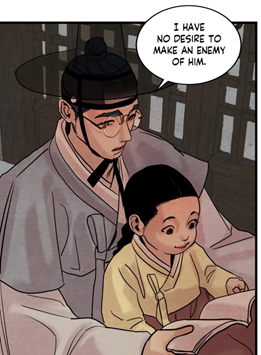 (chapter 29) He had already been seen with a girl before who seems to like him either.
  (chapter 6) Thus I couldn’t help myself wondering if the learned sir was not directly involved in prostitution, bringing girls to the gibang and even covering up for the sexual child abuse. We shouldn’t forget that the pedophile was portrayed as a man consumed by lust who would never pay attention to the time and the hour.
  (chapter 6)
 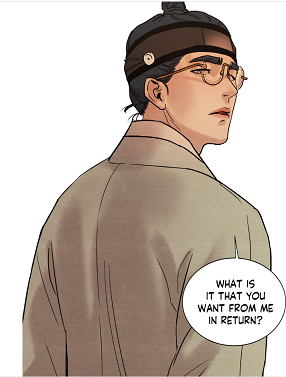 (chapter 7)
 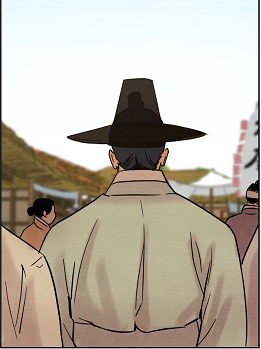 (chapter 7) This change is not random in my eyes. I had already associated the learned sir to a chameleon. This change of color seems to validate my theory that Jung In-Hun had been sponsored by Min, hence we have the light green. Black Heart is symbolized by green. However, the light pigment reflects that he had been abandoned and betrayed. Nonetheless, when he encountered Yoon Seungho, the latter was wearing a purple hanbok.
 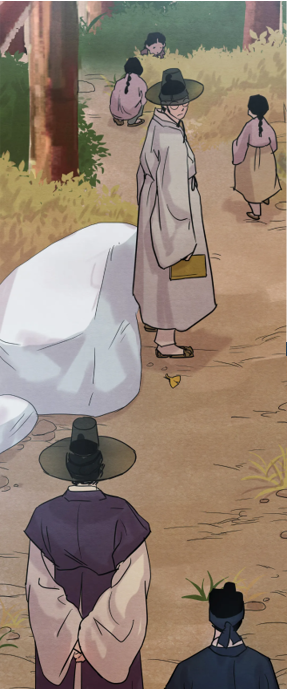 (chapter 6) That’s how the man got influenced and chose to wear his lavender hanboks again. But he never realized that behind the young noble, there was standing the pedophile, someone he had helped in the past. From my point of view, the change of the learned sir’s hanbok was the indication of his betrayal. According to me, the old bearded man
  (chapter 37) was not a former servant, but the pedophile. So he could have recognized the learned sir thanks to his hanbok… just like the readers did with this picture:
  (chapter 73) From my point of view, the intimacy in the bedchamber stands in opposition to the teacher’s gesture in the countryside. His caress was just a casual gesture with no real deep meaning in the end. This explicates why he could betray and abandon the artist on so many occasions in season 1 (chapter 11, 24, 25, 29, 35, 40). The learned sir had always prioritized his own interests.
  (chapter 102), the painter should realize the difference.
  (chapter 70) talk and ask questions before apologizing and hugging him. The lord never acted, as if nothing had happened,
 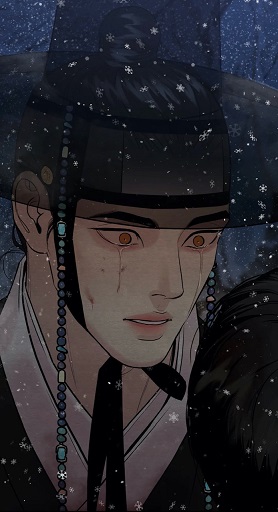 (chapter 102) This was true love and Baek Na-Kyum’s feet always reflect his emotions:
  (chapter 58)
  (chapter 80) So now, imagine how the painter must feel if the lord took his feet in his hands! This is no coincidence that there is this saying:
  (chapter 100)
 (chapter 102) and the zooms on the feet:
  The couple was following their heart!! But this was not the case with the scholar. Baek Na-Kyum had no other choice than to follow Jung In-Hun.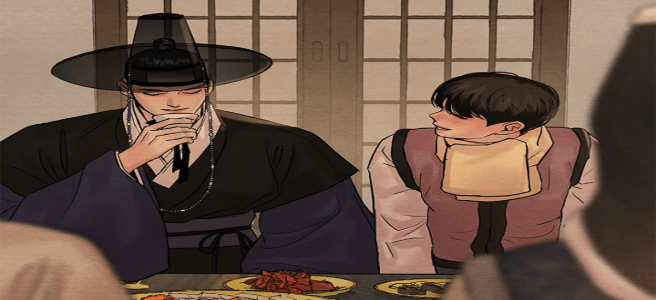
 (chapter1) Or was she simply the noona?
 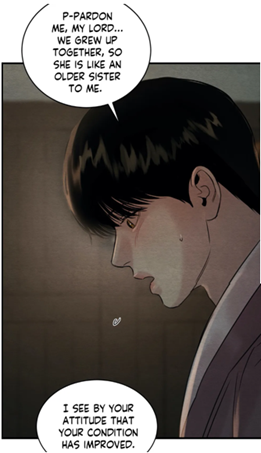 (chapter 70) At some point, I came to realize that Heena had acted as the surrogate mother, but she had never clearly stated that she was the painter’s mother. In other words, his adoption was never official, which explicates why the main lead only considered her as his older sister. This is important, because her ambiguous status can not only generate problems, but also expose her betrayal towards Baek Na-Kyum. Note that in chapter 97, the noona treated Baek Na-Kyum as her “child” who wouldn’t listen to her
  (Chapter 97), while later she implied that they were both equal, for she employed the personal pronoun “us”.
  (chapter 97) On the other hand, she used her seniority as status, when she called him a fool
  (Chapter 97). He lacked experiences, hence he was too naïve, and as such he would trust the protagonist too easily. As you can see, Heena herself had an ambiguous relationship with her brother. Nonetheless, thanks to chapter 93, I got finally a definitive answer about Heena’s true identity. She is indeed the head-kisaeng in the gibang. I realized that the protagonists were invited to stay in Heena’s personal room.
  (Chapter 93) That’s the reason why the seat of the host was empty and why Yoon Seungho didn’t go there. He would have violated social norms, if he had taken her seat.. Moreover, by doing so, he would have revealed that he knew where the woman was. This could have raised questions.
 (Chapter 93) This means that the figures were not sitting in the room shown in the last panel. On the other hand, their voices in the hallway exposed their location. The noonas and Heena were not far away from that door hidden by the veil. That’s how I got aware where Heena’s room was situated. In the last picture, the readers are turning their back from Heena’s study, which is right after the corner. Thus I could recognize the design of the building: ][ In the center, there is this huge hallway with the purple veils, but at its end, on each both sides, there exists a corridor perpendicular to the one with the purple curtains. What the beholder imagined as a door at the end of the hallway,
 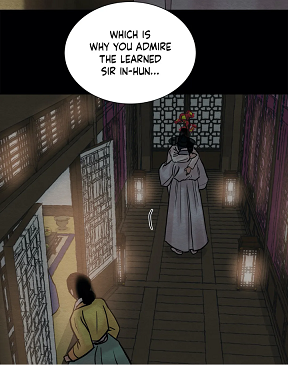 (Chapter 68) was in truth a huge window. How do I know this? First, in this scene, the scholar was hiding a huge white vase with red flowers. Hence I deduced that Jung In-Hun couldn’t have walked through that “gate”, it was just a window. Therefore I assumed that he had to walk past the flowers, either turn to the right or the left. Secondly, observe that next to the lantern on the left, there is a small white panel. This means that the view from chapter 93 was more or less taken from the right corner. Moreover, in the next chapter, Heena is not facing this “window”, when she is in the same building.
  (Chapter 69) This time, the white vase with the flowers is standing in front of a wall. That’s how I deduced that Heena had to turn to the left in order to go to the hallway.
  (chapter 93) which is not present in episode 69.
  (chapter 93) Since I came to the conclusion that Heena’s private room was on the right side after the corner, I deduce that the kisaeng was not on her way to her room. Moreover, since the kisaeng was walking in the same direction than the scholar, I can only conclude that Heena was actually approaching the entrance of the building. I believe that she had turned around, but the author didn’t reveal this. One might argue that it is possible that in chapter 68, the learned sir could have gone with the painter to Heena’s bedroom. However, back then the latter was not the head-kisaeng. We know this due to the presence of a kisaeng standing right behind Yoon Chang-Hyeon during the sexual lesson.
  (chapter 86) She was the superior. Moreover, we saw the teacher walking through the countryside during the night.
  (chapter 69) It was done on purpose!! She wished that Min would take care of her brother. Under this new light, it becomes comprehensible why the noona has a drop of sweat on her cheek. She is faking ignorance, she is acting, as if she was very protective of her brother. She uses illusion to manipulate people. In reality, she was acting here. One might argue that I am overthinking again. This is not possible, for Heena didn’t know Min at all. Hence she couldn’t manipulate him. The latter had heard of her for the first time in Yoon Seungho’s mansion.
  (chapter 66) But let me ask you this. How could Heena have never met Min, when she was the head-kisaeng? Secondly, just because the servant had never heard of the noona, this doesn’t mean that it was the case for Black Heart. The domestic assumed Black Heart’s ignorance, just like the readers. Moreover, recently I had detected that Heena had been standing in front of a mansion belonging to a noble.
 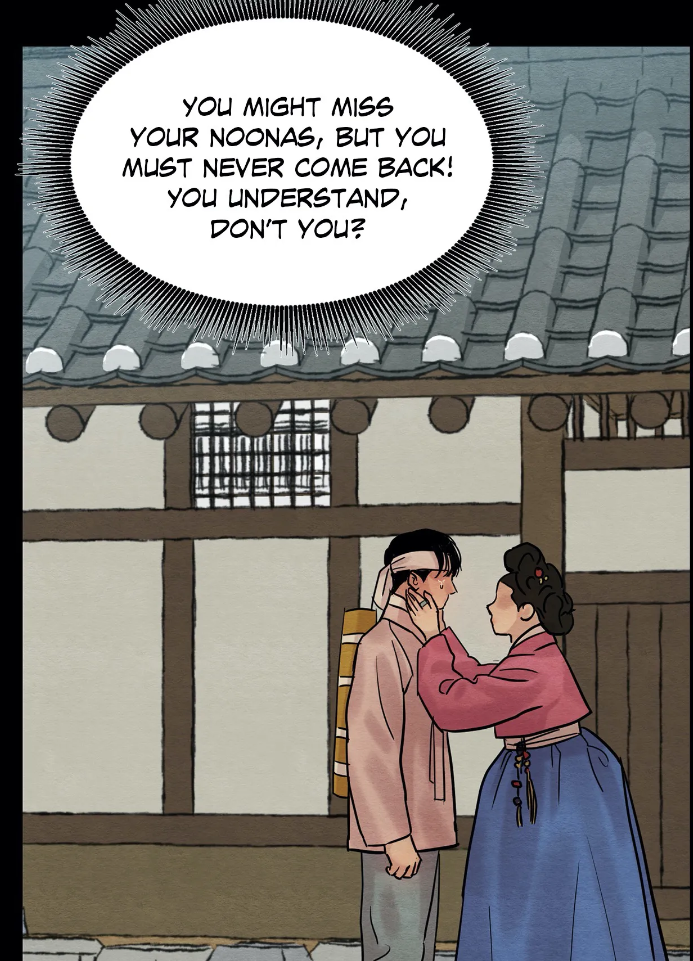 (chapter 46) This was not Yoon Seungho and Lee Jihwa’s mansion, for the gate and walls
  , (chapter 19)
  (chapter 59). Here, I would like to point out that in episode 59, Lee Jihwa had visited the kisaeng house on different occasions, for his hair was slowly growing.
 (chapter 1)
  (chapter 19) This image was showing us that Yoon Seungho was visiting the gibang. However, pay attention to the pattern of the doors in the last picture and the next:
 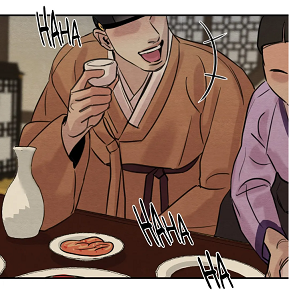 (chapter 19) The motive diverges, it looks like the one from the hallway with the purple veils. This means that the party was not taking place in the room shown in the former picture. What caught my notice is the presence of the white vase with the red flowers in front of the building. It was present in each scene taking place in the gibang.
  (chapter 93) For me, the red flowers symbolize Heena noona. This explicates why during the painter’s dream, the flowers were not present.
 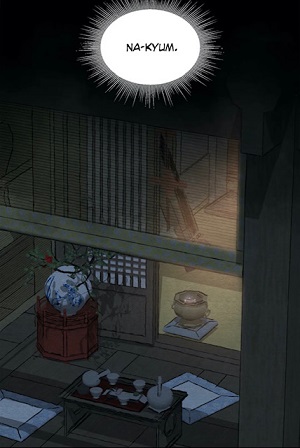 (chapter 87), as Heena was not included in his vision. And this image
  (chapter 44) Due to the similarities, I believe that in chapter 19, Byeonduck was actually exposing the ghost head-kisaeng. Exactly like the father, she was hiding. Why? It is because she is involved in Yoon Seungho’s suffering. And now, imagine her reaction, when she hears that Black Heart has organized a feast for the main lead’s honor. The woman could only avoid the main character. And now, you have the explication why Heena as the head-kisaeng was not present during that festivity. It was deliberate.
  (chapter 19) Striking is that the kisaeng had a similar hair dress than Heena, This is no coincidence. She was acting as the head-kisaeng. The manhwalovers will certainly remember that only two kisaengs had no braided bun or braids: this one
 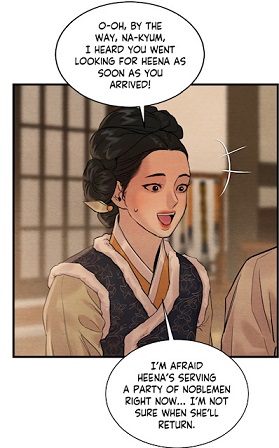 and Heena. Look at all the others:
  (chapter 93)
 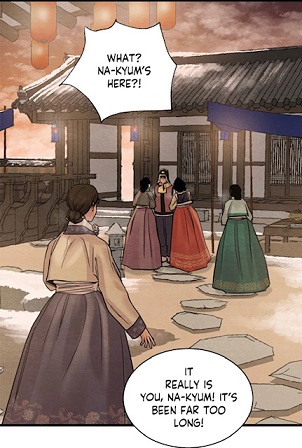 (chapter 93)
  (chapter 95) The extravagant hair dress was exposing the kisaeng’s status. And now, you comprehend why the other noona explained the disappearance of Heena during that night.
  (chapter 19) But how could she sense that the noble was in a good mood? The latter was silent and not even smiling.
 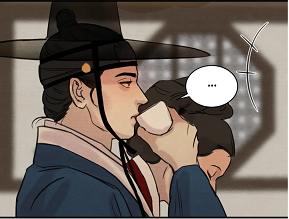 (chapter 19) How could she claim this? In reality she was actually spying on him. Heena had no idea why the lord would come to the gibang, especially after suffering there so much. The kisaeng’s task was to dig up information. This visitation must have bothered the head-kisaeng.
 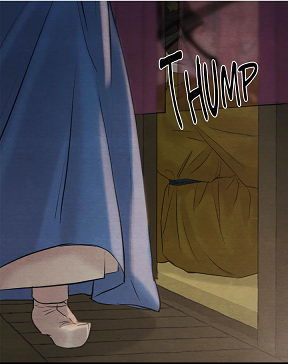 (chapter 69) She was even turning her back to him. But actually, she could have detected his presence, exactly like I had recognized him: through his laugh!!
  (chapter 99) He was wearing a veiled hat, yet in chapter 69, this was not the case.
 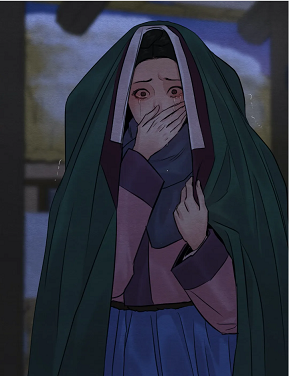 (chapter 88)
 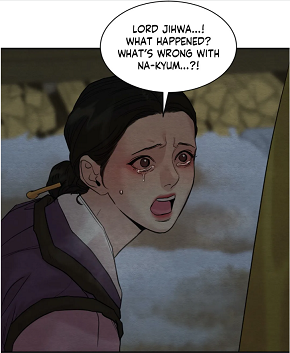 (chapter 99) Under this new light, Min’s words get a new signification:
  (chapter 99) He was implying that they knew each other for a long time! The irony is that the manhwaphiles had the impression that their relationship was recent, and his cynical tone contributed to it. Secondly, he called her Heena, a sign that they were close to each other. Note that Lee Jihwa never mentioned her name.
  (chapter 99) His words even insinuate that Black Heart had just given the following order. The red-haired master should just fetch a kisaeng and in my opinion, Heena was waiting for Lee Jihwa’s arrival to leave the gibang. According to his words, he had no idea about the kisaeng’s identity. But is it true? I have my doubts now, and this for two reasons. Why would he ask about her identity, when he already knows that she is a kisaeng? The drop of sweat on his face is an indication that he is lying. But the problem is to determine if the deception is only referring to “I heard not a word” and to all the questions. Let’s not forget that he knew about Min’s initial intention. The moment Lee Jihwa arrived in the gibang, she just followed him. That way, they would avoid to attract attention, and with her new hair dress
  (chapter 93), the gibang had lost its “leader”. This explains why this noona as her right-hand had to explain the absence of the owner.
 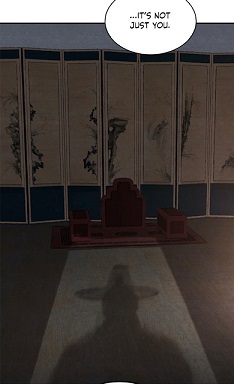 (chapter 86) The latter had been eyeing the throne in the family mansion, but he failed to take over the mansion. This was the negative reflection of Heena. Whereas the kisaeng had a powerful position in the gibang, it was the opposite for the patriarch. He was no longer recognized as the head of the Yoons. Yet, both have something in common. Both lost their position for good, for Heena and Yoon Chang-Hyeon couldn’t take or keep the seat. We could say that both got defeated by Yoon Seungho. In chapter 93, the main lead acted as a respectful and calm master, whereas in the bedchamber he showed no respect to his own father. He talked back and even made fun of him.
  (chapter 87) This picture stands in opposition to this one:
  (chapter 93) To conclude, the surrogate mother and the patriarch made a similar experience in season 3. Both got deceived by manipulations and in both cases, letters played a huge role.
  (chapter 99) No one would be looking for her. The problem is that the witnesses of her curtains all vanished. Lee Jihwa ran away, Black Heart got killed with his friends, and the only survivor, lord Jang, was confronted with real corpses in the shaman’s house.
  (chapter 102) That’s why I come to the deduction that her murder will be questioned. Why? There is no blood contrary to the bloodbath in the shaman’s house and there is no corpse!! Since Black Heart used different corpses in order to deceive Heena and the couple, there is no ambiguity that the head-kisaeng’s curtains will be doubted. Striking is that Heena staged her death out of cowardice and selfishness, while Yoon Seungho made the opposite decision. He was resolute to commit suicide in order to follow his lover in his death. During that night, Heena and Yoon Seungho lost their “home”, but at the end, he found his true home: the painters embrace.
  (chapter 96), though he is a noble. Besides, I am suspecting her of suffering from genophobia (fear of sex and intimacy) Their behavior exposes closeness and a certain trust. But how is this possible? It is because she knows that Min is a sodomite, and he is not looking for sexual favors. That’s the reason why she trusted Black Heart in my opinion. Moreover, he is smiling like Jung In-Hun. Therefore it is not surprising that she was speaking like the Joker in chapter 97. Here, the man had actually projected his own thoughts onto Yoon Seungho, and due to her own belief, Heena was more than willing to believe Black Heart.
  (chapter 52) It is because Black Heart knew Heena! I even believe that he had already met the scholar. Note that the man with the black hanbok was repeating the rumors about the learned sir. And the other questioned the main lead’s action exposing that he had never heard about this grapevine before. Hence I am deducing that the one spreading this rumor could only be MIN!! That’s the reason why he just said this
 (chapter 52) That means that the noble knew the teacher in the end. Therefore it is no coincidence that Min was aware where the learned sir lived!!
  (chapter 52). Why? It is because there was an incident in the gibang!!
  (chapter 97)
  (chapter 92) That’s the reason why I believe that in season 4, the visage will play a major role! The couple will recognize people due to the face!! In my eyes, the former head-kisaeng knows the identities of all the persons involved in Yoon Seungho’s suffering.
  (chapter 97) her brother is detecting her deception.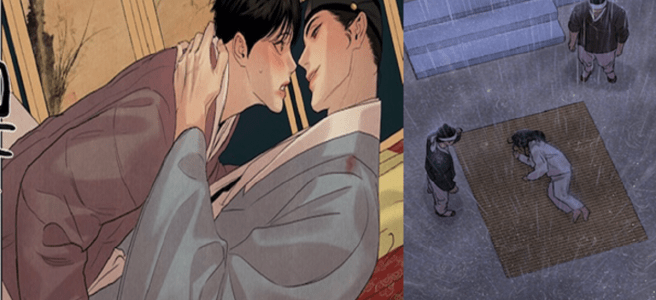
 (chapter 102) The painter had confessed too late, for the schemers were already pulling the strings in the shadow. To conclude, the main leads’ self-deceptions were connected to love and time. The importance of self-manipulation leads me to the next observation. All the antagonists and villains were liars, because they were also deceiving themselves. They refused to admit their own fears and flaws, therefore they chose to commit a wrongdoing and manipulate others in order to hide their true thoughts. This means that not only the crime was covered up with a deception, but also the manipulation was hidden by another lie. This means that the list of their sins increased. Therefore it is not surprising that the gods chose to confront the liars with the verity, as they kept refusing to admit their sins. Now, it is time to focus on the antagonists and villains’ manipulations and the scenes where they were facing the mirror of truth. However, the readers are probably wondering where the mirror of truth is. The answer is simple. The mirrors of truth are not only the two main figures, but also Kim and Min, though they are their negative reflections. Remember that in Snow White, the item led the evil Queen to her doom, for the latter refused to accept reality. At the same time, the mirror of truth was not entirely honest either, for it never explained the definition of “Beauty”. In other words, it lied by “omission”. I realized that I can not examine all the antagonists and villains in one text, as I am so detail-oriented. Consequently, I selected Lee Jihwa and Yoon Chang-Hyeon first, for both characters’ lies are strongly intertwined.
  (chapter 77) However, since he had been caught by the valet, he was facing the butler’s visage. And what did he see in his facial expressions? Shock and horror!! That’s how Lee Jihwa realized the gravity of his sin and chose to blame his friend. Thus I imagine that he must have blushed again and this time out of shame and embarrassment. It is very possible that in that moment, he must have copied the valet’s facial expressions before leaving Yoon Seungho behind and lying to the butler. Why do I think so? It is because the butler had made such an expression in front of the barn, when he had been caught.
  (chapter 64) And what did the main lead say?
  (chapter 64) Since the painter seems to have forgotten it, I deduce that it was the reverse for Lee Jihwa which explains why he felt so guilty in the end. As for the butler, when he had barged in the study, he had committed a wrongdoing himself. He should have asked for the main lead’s permission, but he did not. Consequently, he decided to believe in Lee Jihwa’s deception. One hand washes the other. He was covering up the guest’s sin, while the latter was doing the same thing for the domestic, though I doubt that Lee Jihwa truly realized it. Simultaneously, Kim had the perfect justification to hide the violation of social norms. He had caught the main lead red-handed, hence no one would question his own action. As you already know, I associate the butler to Pilatus, therefore he is connected to the bucket.
 (chapter 13) However, in my eyes, this doesn’t represent the biggest confrontation with the mirror of truth. For me, it is the altercation in episode 17, for it took place in the same place than the aristocrat’s crime. When the red-haired master looked at the picture, he was suspecting that the painter had seduced his friend due to the insinuations by the staff. And his fear reached the peak, when he saw the painter’s reaction:
 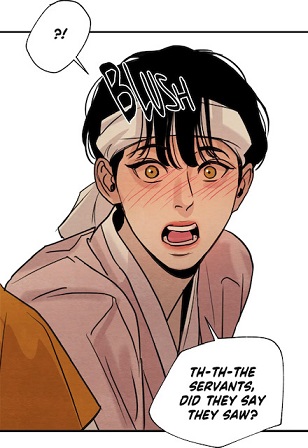 (chapter 17) As you can see, in this episode, the gods were recreating the same situation: a servant had witnessed how the two men “were fooling around”
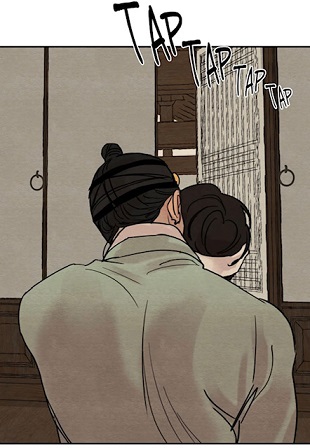 (chapter 16), though this was definitely not the case!! And this is exactly like in the past, Yoon Seungho was totally pure and innocent. And what was Lee Jihwa’s reaction? A slap!
 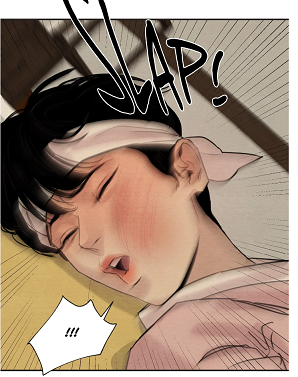 (chapter 17) This is what Yoon Seungho had experienced in the past. Yoon Chang-Hyeon had definitely abused him.
 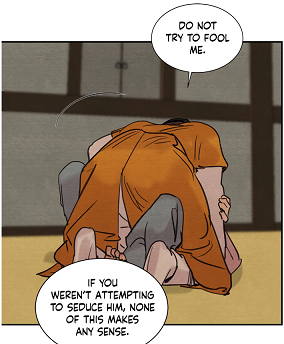 (chapter 17) These words were exposing the verity about the past. Lee Jihwa was admitting in front of the painter that his friend would never act like that, and as such he had not attempted to woo him in the past. Striking is that in front of the painter, the red-haired master was misinterpreting the incident. Why? It is because he was influenced by his past experiences. Since he had lied twice, he jumped to the wrong conclusion that it was the same in the present. And back then, he had even achieved to fool Kim. Therefore he couldn’t allow himself to be fooled like the butler. That’s the reason why he couldn’t imagine that someone was innocent.
  (chapter 17) He was a liar in the past, so it must be the same for the painter. Yet, this was the negative reflection from the past. Thus his karma was to get caught by his childhood friend. Striking is that this time, he was put in his friend’s place. He was turning his back to the door. Moreover, due to his anger, he didn’t hear Yoon Seungho’s steps and the opening of the door!
 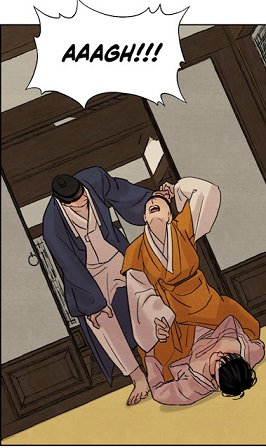 (chapter 17) But the childhood friend refused to face reality in that moment, and as such to admit his guilt and responsibility. Why? It is because he had committed another crime in the past. This is related to the bedchamber incident.
  (chapter 83) However, here he had been caught by his father, hence I believe that this confrontation represents mainly the elders’ punishment. As for Lee Jihwa, despite the humiliation and abandonment in chapter 18, he refused to give up on his friend.
  (chapter 18) One might say that he was motivated by love, yet I think that it is related to his denial about his sexual orientation. And this coincides with his lack of honesty. He had not confessed his own sins and lies yet. Therefore
  (chapter 36) he presented himself as a pitiful creature, as he was sharing the protagonist’s suffering due to his knowledge. However, this was not empathy, just sympathy. The person only feeling sympathy will always put a distance between himself and the counterpart. There‘s a “I“ and “you“, but no „we“. The person might come to pity the other, yet he won‘t intervene and help. He will just understand and that‘s it.
 (chapter 36) This panel is the evidence for this interpretation. Lee Jihwa never used the personal pronoun “we”, even during the abduction.
 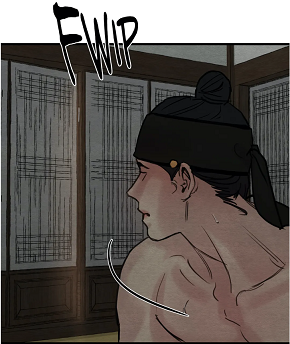 (chapter 43) Based on this panel, Lee Jihwa had more or less barged in the study, but his presence was detected too late! One detail caught my attention in this picture, the presence of the light reflected on the door. Hence I assume that the main lead detected the presence of a witness because of the light!!
  (chapter 43) Let’s not forget that the room was dark, when they were having sex.
 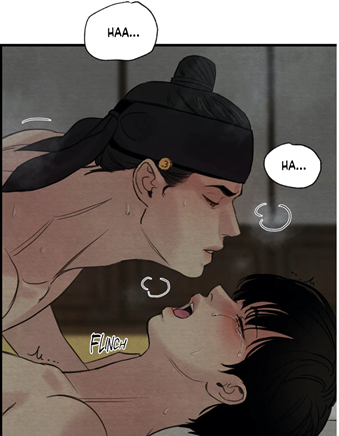 (chapter 42) He was still looking at his lover’s face, when he perceived the change of the light. Hence he turned his head in direction of the light reflected on the door. My friend Luzaly brought my attention to this detail. The couple was turning their back to the door before.
  (chapter 42) The form of the light reflected on the door doesn’t come from behind the gate
 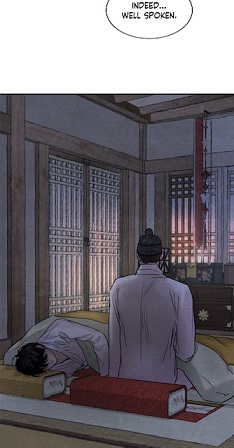 (chapter 97) And now, you comprehend why I came to the deduction that Lee Jihwa had witnessed the love session not from this door,
  (chapter 41) However, in the next episode, Byeonduck showed us a slight change.
  (chapter 42) The door was now close. This means that the butler had intervened at some point. This was the negative reflection from episode 20.
 (chapter 20) This time, the main lead had not requested for more privacy, for he had not detected the presence of his right-hand. And this leads me to the following conclusion. Since this is not the door
  (chapter 43) I am even suspecting that he didn’t view this scene at all, because logically, the light should be coming from the other side!! But on the other side, there is no door!!
  (chapter 49) But there is the window…. And now, you comprehend why Yoon Seungho never investigated the matter with the “door”. It had never been opened in the first place. But how could Lee Jihwa imagine such a scene?
  (chapter 42). It sounded like he was indeed seducing the main lead. As for the embrace, he couldn’t hear it, but someone had heard the longing from the painter.
  (chapter 43) The gods were punishing Lee Jihwa for his lie: his friend’s smile!! But I have more evidences for this theory. First, it is important to pay attention to Min’s words, when he manipulated Lee Jihwa. First, he portrayed the painter in a pejorative light with the idiom “indecent life”.
 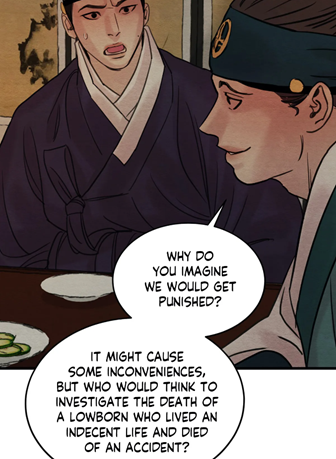 (chapter 43) Moreover, the noble employed the personal pronoun “we”, which is not typical for the selfish and hypocrite villain. This means that he was repeating Kim’s words. Then he added how the couple would have sex in the barn
  (chapter 43) (“vulgar roll in the hay”), but this was not true. However, this is what had happened in the past with Lee Jihwa. The latter would have sex with his childhood friend in the storage room. This explicates why Lee Jihwa came to believe in Black Heart’s words and manipulations. With such a description, he was reminded of his own past!! Therefore it is not surprising that Lee Jihwa had such a vision.
  (chapter 21) The windows!! As you can see, the door is not the only place to spy or interrupt intimacy. Secondly, we should have reflections of the spying through the window in season 2.
  (
( Chapter 49) In this episode, the light in the study had suddenly vanished, and this is what we had before:
  (Chapter 70) I had already suspected back then, that someone was listening to their conversation, and with this new discovery, Lee Jihwa hearing the love session from the window, this interpretation gets reinforced. Furthermore, in chapter 96, the main lead had explained the opening of the door with this:
 (chapter 96). This signifies that in the past, the lord had explained the sudden opening of a window and the vanishing of the candle light with the wind during the night of chapter 49.
 (chapter 36) The reality is that he couldn’t cut ties with his friend. He had lied in the past, therefore he got manipulated in the present. And since he was confronted with his auditory and visual senses in season 1, he was put in a similar situation in season 2. However, there was a slight change, now the red-haired master was confronted with a real crime: murder!!
  The darkness of the room and the silence from Yoon Seungho and the painter were referring to the master’s loss of senses and his guilt. Deep down, the young master knew that the assassination was not right. And note that the aristocrat had this nightmare in his own bedroom confirming that the room is the symbol for the subconscious. Finally, in season 3, Lee Jihwa got confronted with another uncomfortable truth: his friend’s sexual abuse. Lee Jihwa had acted, as if this stolen kiss was nothing. However, due to his silence, he let his friend get raped. And he knew about this, but he chose to close an eye to this. First, Lee Jihwa refused to share his friend with the painter
 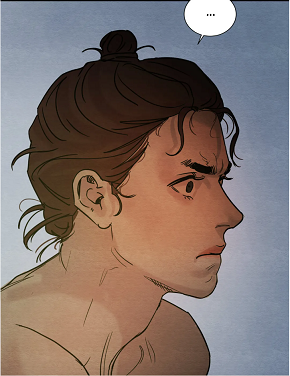 (chapter 5) Therefore it is no coincidence that in the shaman’s house, he was put in the same position than Yoon Seungho. He couldn’t select his partner
 (chapter 100), he had to rape Baek Na-Kyum. This is no coincidence that the Joker was standing in front of the door. He was pushing the young man to face his repressed memories and lies. That’s the reason why exactly like in the pavilion (chapter 43), Black Heart coerced the antagonist. He used words to manipulate the second lead, but there is a huge difference. The shaman’s house was representing the young noble’s unconscious and as such his true personality, while it was not the case in the pavilion. The room in chapter 43 was more embodying the Joker’s unconscious. Why? It is because Lee Jihwa was speaking the truth in that scene.
 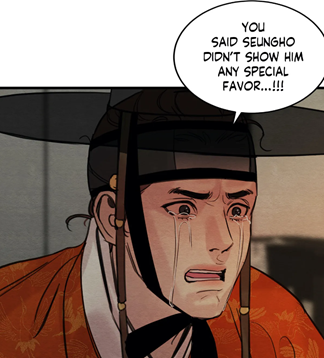 (chapter 43) He reproached Black Heart to have deceived him. On the other hand, the scene in the shaman’s house corroborates my interpretation that Lee Jihwa had not seen the embrace from chapter 42, for Black Heart was voicing the butler’s thoughts and emotions.
  (chapter 100) This shows that during the night of chapter 42/43, the valet had intervened. Thus Min was acting, as if he was a victim in the recent past. He had been deceived by Lee Jihwa’s lies by omission or commission. This is what had happened in the past. Besides, I realized that when the man confessed the incident in the bedchamber
 (chapter 83), Min couldn’t see the whole story. He had to rely on the second lead’s words. Just because we could observe the whole scene, this doesn’t mean that this was the case for the character. It is very likely that Lee Jihwa left details out, especially as he portrayed himself as a victim. Due to the narration, Min could have been misled. He could have envisioned that the childhood friend was living in the study and had dragged his friend to the bedchamber. Hence you comprehend why I consider it as another evidence that Lee Jihwa didn’t view the love session in the study from chapter 42 with his own eyes. He had to rely on his ears and naturally Kim played a role before Black Heart’s intervention. The servant hoped that Lee Jihwa would decide to do something…. in other words, he had been gradually manipulated by Kim and Min to hire an assassin. That way, he could be blamed for the murder of the scholar. He would become guilty by association. And the one pulling the strings behind the scene can only be the mysterious lord Song, for he can no longer interfere directly, though I am certain that he was not aware of the butler’s own meddling. Why? It is because in the past, Kim had never become proactive like that. Moreover, I think that even in the past, the man was not omniscient and omnipotent either. He over-estimated his own abilities, and didn’t recognize that he had been fooled himself either.
  (chapter 100) This is no coincidence, for the sexual abuse is the reason why Yoon Seungho’s heart and soul got destroyed. This had the same effect than killing someone, especially if the person is so innocent and pure. Because he recognized the truth, he had the courage to abandon and betray Black Heart. That’s how he could redeem himself in the end.
  (chapter 100) At the same time, this is not surprising that Lee Jihwa met his friend and admitted his wrongdoing. For the first time, he didn’t remain silent and chose to intervene!! I also believe that during that night, he apologized to the protagonist before vanishing. In other words, Lee Jihwa had to face 4 different mirrors of truth, until he was able to admit the verity. He was responsible for Yoon Seungho’s suffering. He had lied, therefore he got deceived, until he had no other choice to confess his guilt and sins.
  (chapter 77) He would do anything to cure Yoon Seungho implying that he wouldn’t mind spending money for the main lead’s treatment. However, the truth was that he refused to send for the physician, when the young boy was sick after the straw mat beating.
  (chapter 77) This means that he broke his promise. Striking is that the vow to the butler was introduced in connection to the patio!! When the readers hear this promise, this is what we see shortly after.
 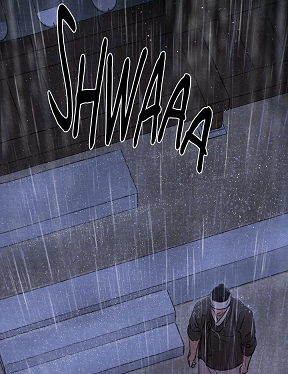 (chapter 77) Secondly, the elder master Yoon was seen shortly after there.
  (chapter 87) Finally, there exists the flashbulb from Yoon Seungho’s memory:
  (chapter 55) My avid readers will certainly recall how I had claimed that this scene was representing Lee Jihwa and father Lee. I am not changing my mind, but I would like to point out that this story is built like a kaleidoscope and as such, each image is actually a reflection. Thereby I come to the conclusion that in this panel, the young boy and the elder are in verity embodying 4 people: the boy is Lee Jihwa and Yoon Seung-Won, as for the elder, it is father Lee and the elder Yoon. Why? It is because the punishments were related to the Lees’ behavior and words. There is no ambiguity that elder Lee intervened to protect his son’s reputation. In other words, father Yoon was seen in the patio in chapter 55. Then when he visited the physician, he remained outside too contrary to the main leads.
  (chapter 57) It was, as if the elder master had nothing to hide, for the domestic and the butler could hear him. However, the latter got deceived. There is no ambiguity that the valet and the young master trusted him. On the other hand, the valet was the one who introduced him to the physician, like we could see here.
  (chapter 57) But what does it mean? First, it shows that Yoon Chang-Hyeon was never seen in the bedchamber!! In other words, his power was fake. This interpretation gets validated, when I use the confrontation between Heena and Yoon Seungho.
  (chapter 65) In that very same place, the protagonist had been insulted and could do nothing, for neither Kim nor his staff intervened. And this perception reinforces my perception that the patriarch has always been delusional and arrogant, over-estimating his own power. Moreover, the lord was not honest either.
  (chapter 65) This shows that the patio is connected to violence, hypocrisy, deceptions and offenses.
  (chapter 7) Then in the study, Yoon Seungho confessed that his father had been dismissed from his post which contradicts the previous statement.
  (chapter 80) But how did Yoon Chang-Hyeon obtain his office then? Then the expression “follow in his footsteps” caught my attention. That’s how I realized that the elder master never passed the civil service examination!! In truth, he failed terribly. How can I be so sure about this? First, the civil service examination consists of different tests. Secondly the idiom from Yoon Seungho indicates an gradual rise in the grandfather’s career which is not reflected in the lord’s confession to the messenger. Finally, in front of the mirror of truth, the father voiced the following wish:
  (chapter 86) This expectation exposes that this had not happened in the past. But why didn’t he expect this from Yoon Seungho earlier, though the latter had such a good notoriety? It is because he desired to be admired himself. He viewed himself as the Yoons. Thus he said this to his son:
  (chapter 86) This means that he was using his own sons for his own career, though he claims that he is doing for the Yoons’ notoriety. In other words, the patriarch’s position was obtained through sexual favors. But since the king was the sponsor, there is no ambiguity that at some point, the elder master must have started dreaming even bigger, similar to the scholar:
 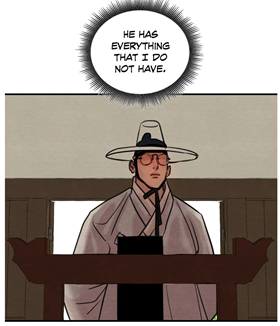 (chapter 18) Hence I have the impression that he must have acted, as if he was the king’s relative. Hence he asked to be called by a certain title. This could only infuriate the mysterious lord Song, for the latter was hiding his sodomy and debauchery behind closed doors. No one was supposed to make a connection between him and the Yoons. However, I don’t think that the elder master Yoon had planned everything from the start. He had definitely been misguided, for in season 1 and 3, we could see that he was believing blindly what people would say to him. He never doubted his son’s words, when the latter said that Yoon Seungho had given him such a paper.
  (chapter 44) And it is the same with father Lee. That’s the reason why I still think that he had been manipulated. He was pushed to sell his own son, thinking that the Yoons would benefit from it. However, this was just a delusion, as he was dependent on the monarch’s benevolence.
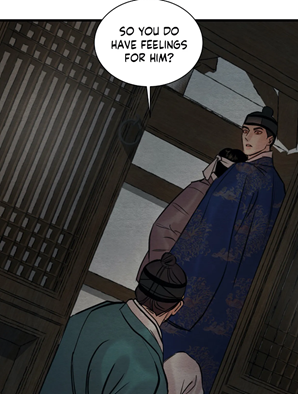 (chapter 53) But Yoon Chang-Hyeon refused to admit it, it went so far that he was denying his relationship with Yoon Seungho. He was just an animal.
  (chapter 87) He was paying the price for his lies about the cure. Furthermore, the manhwaphiles will realize that he is no longer seen in the patio.
  (chapter 86) Why? It is because the young lord was supported by the “king”. But since he had cut ties with the main lead in the past, treating him like a servant, there is no doubt that the pedophile doesn’t view Yoon Chang-Hyeon in a good light. Hence the son became the true owner of the mansion. In the bedchamber, the father was confronted with the consequences of his decisions and lies. He had lost everything: his position as the head of the family, the propriety, the wealth and the connections. Thus he was left speechless.
 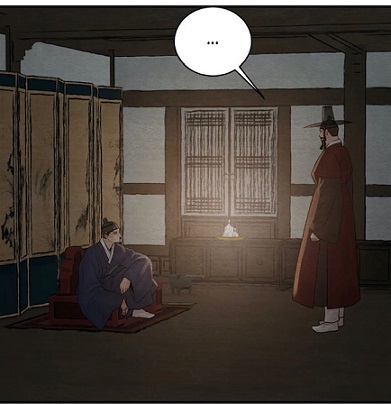 (chapter 86) But when he arrived in the study, this is what he saw. This picture revealed his greed and ambition
  (chapter 87) This was another self-deception. Without the main lead, the latter would have lost everything. Note that he is living comfortably in the house in Hanyang. So if the young master were to disappear, I doubt that the mysterious lord Song will allow the father to take over the mansion. His regret implied that he shouldn’t have sent for a doctor. This is important, because this signifies that he will be punished the same way, it will be even worse. No one will be by his side to protect him and to save him… no one will request for the physician’s assistance. Similar to the broken promise in the patio:
  (chapter 87), while Yoon Seungho was compared to a monster!
 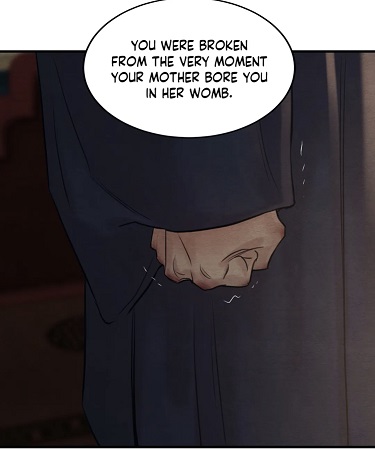 (chapter 86) The outcome of his lie can only be that he will be perceived by people as a monster, as an immoral father who had no conscience at all. How do I come to this conclusion? First, the painter could see right through the father’s gaze.
  (chapter 87) He was a cruel and resentful father. Moreover, the lord’s words always become a reality. Hence the father can only be condemned as the licentious and depraved degenerate.
 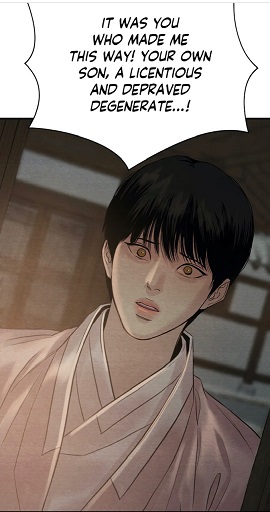 (chapter 86), the black sheep! Furthermore the moment Yoon Chang-Hyeon loses the house in Hanyang, he has no place where he can hide himself from public gaze. He can only ended up as a powerless outcast. I am suspecting that since he longed to be admired and fawned, he could end up committing suicide, for he is unable to tolerate people’s rejection and insults. To conclude, the father refused to admit his guilt and wrongdoings till the end. Even cornered, he chose to avoid reality, preferring to trust father Lee and the butler’s lies. Why? It is because he envisioned that by removing the main lead, he could take over the mansion, and act, as if nothing had happened, as if Yoon Seungho had never existed. The gods will fulfil his wish so that he can be confronted with reality. Besides, note that the patriarch never stopped his son from kissing the painter, he even followed him to the seat.
  (chapter 87) This shows that deep down, the man was not truly against sodomy and prostitution. The father resented the son, for he could only achieve “glory” through debauchery and sodomy. I believe that the elder master Yoon was thinking like this: “no matter what” the Yoons’ power and notoriety must increase. In the bedchamber, the man exposed his true personality, while in the patio he was just the fake image of a powerful, decent and righteous man. This explicates why it took the teenager so long to realize the father’s betrayal.
 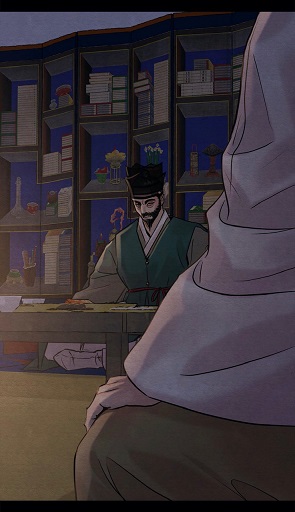 (chapter 82) He was just an empty shell, his knowledge, experiences and possessions were just an illusion.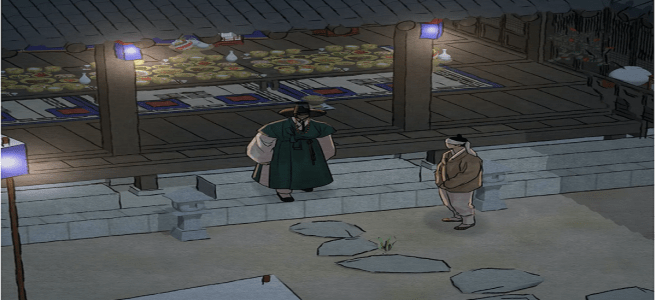

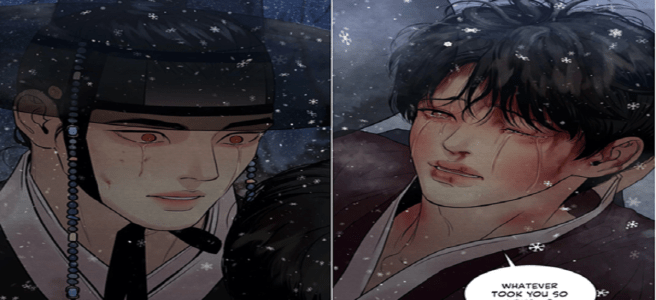
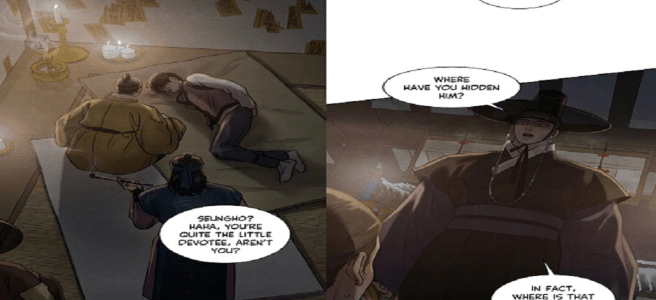
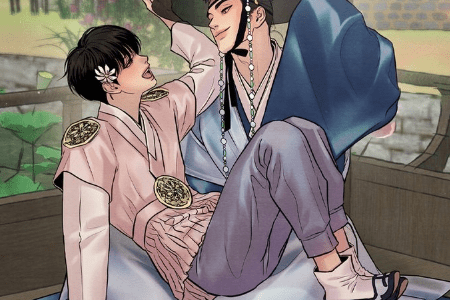
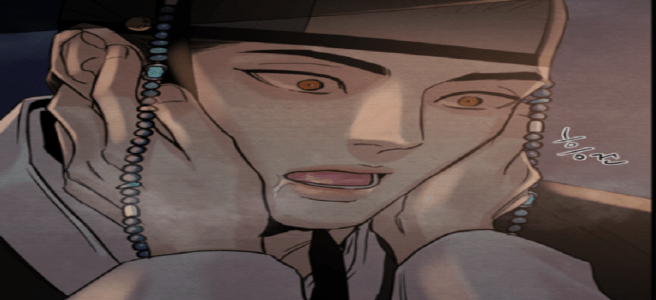
 Bebebisous33s' analyses in K-Dramaland and Manhwas