

Please support the authors by reading Manhwas on the official websites. This is where you can read the Manhwa: Jinx But be aware that the Manhwa is a mature Yaoi, which means, it is about homosexuality with explicit scenes. Here is the link of the table of contents about Jinx. Here is the link where you can find the table of contents of analyzed Manhwas. Here are the links, if you are interested in the first work from Mingwa, BJ Alex, and the 2 previous essays about Jinx ️The Clash 💥Of Flesh👄 and Will 🤯 and Prison of Glass 🪟, Key 🔑 Of Time ⏲
It would be great if you could make some donations/sponsoring: Ko-fi.com/bebebisous33 That way, you can support me with “coffee” so that I have the energy to keep examining Manhwas. Besides, I need to cover up the expenses for this blog.

The title Wheels and Waves – part 1 captures the tension between confinement and freedom, vulnerability and strength, appearances and hidden truths. Finally, readers could see the grandmother leaving the hospice for a stroll. The irony is that she was not accompanied by her grandson or a caretaker, but by the champion himself.  (chapter 65) At first glance, the grandmother’s wheelchair and the ocean seem to represent opposing forces, yet they also reveal a complex relationship between power and vulnerability. Thus in this analysis, I will explore how these elements, rather than simply contradicting each other, might actually reflect a struggle to find balance between dependency and independence.
The grandmother’s conversation with Joo Jaekyung by the ocean raises unsettling questions. Her gentle words suggest concern for Kim Dan’s future  (chapter 65), yet her portrayal of him seems unexpectedly harsh—emphasizing his flaws (smoking, drinking).
  (chapter 65) This description stands in opposition to the gumiho’s statement: he was an angel.
 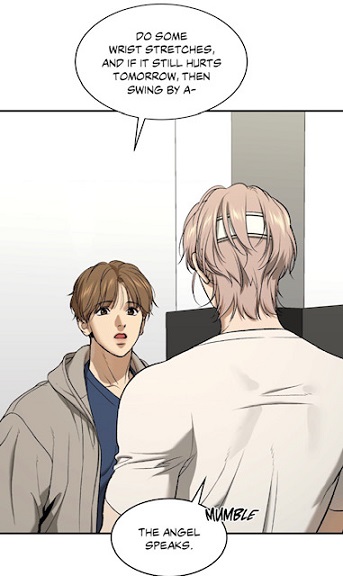 (chapter 30) It is because Kim Dan didn’t ask for money or recognition, this gesture was entirely selfless. Why would the lady badmouth the protagonist, when she requested from the champion that he brings the doctor back to Seoul?
 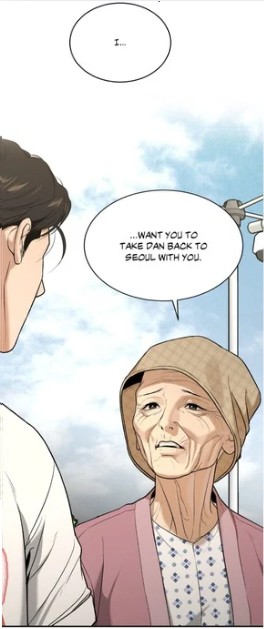 (chapter 65) Is she genuinely worried for him, or is there a hidden motive behind her request to send him back to Seoul? And why does Joo Jaekyung, usually so straightforward, respond with silence and hesitation
 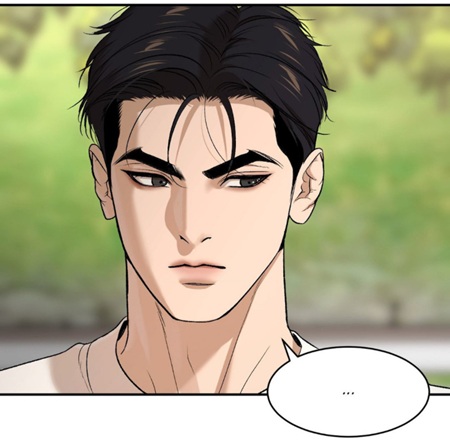 (chapter 65) or with shock?
 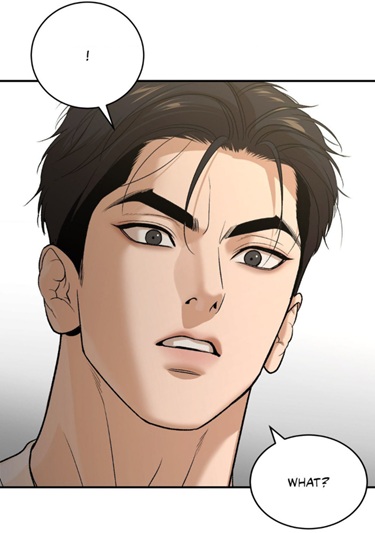 (chapter 65)
Meanwhile, Kim Dan’s nocturnal walks seem to oppose the grandmother’s immobility. 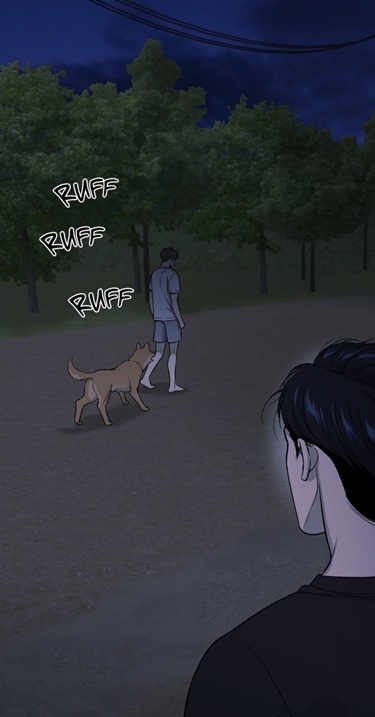 (chapter 65) His bare feet on the cold ground
  (chapter 65) suggest a longing for freedom, yet the direction of his steps remains uncertain. Whereas these walks reveal about his inner struggle, they don’t reveal the destination of his nightly strolls. Where was he going during that night? Was he going to the ocean—vast and untamed— like in episode 59,
 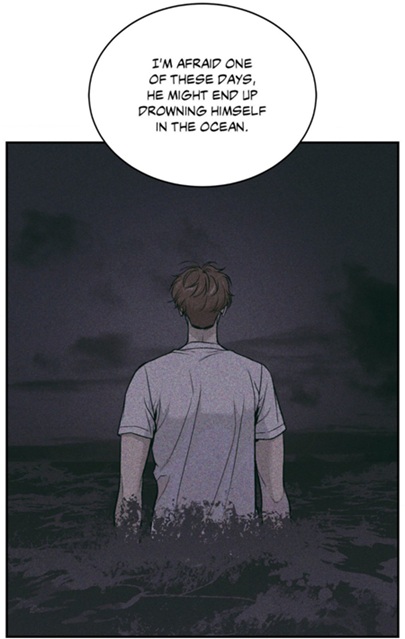 (chapter 65) or had his destination changed? These questions will be answered in the second part.
By examining the tension between appearances and reality, the contrast between confinement and escape, I hope to uncover the true nature of sacrifice and survival in the characters’ life. Wheels and Waves invites you to question what it really means to move forward—and at what cost. But let’s start with the interaction between Shin Okja and Joo Jaekyung.
The grandmother and the ocean
Between CREAK, STEP and TAP
First, it is important to realize that the champion was the one who chose the ocean as a destination. The nurse had only planned to walk around the hospice: 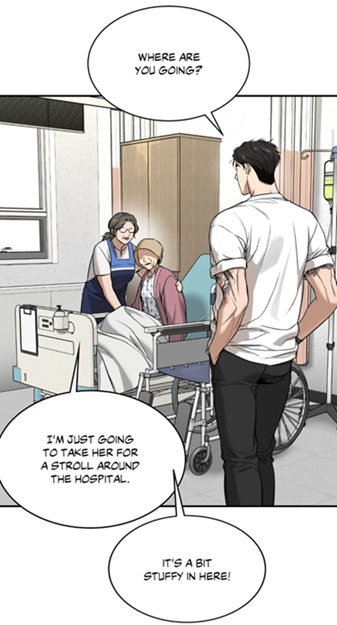 (chapter 65) This destination reflects the athlete’s desire and mind-set. He likes this place because it is quiet.
 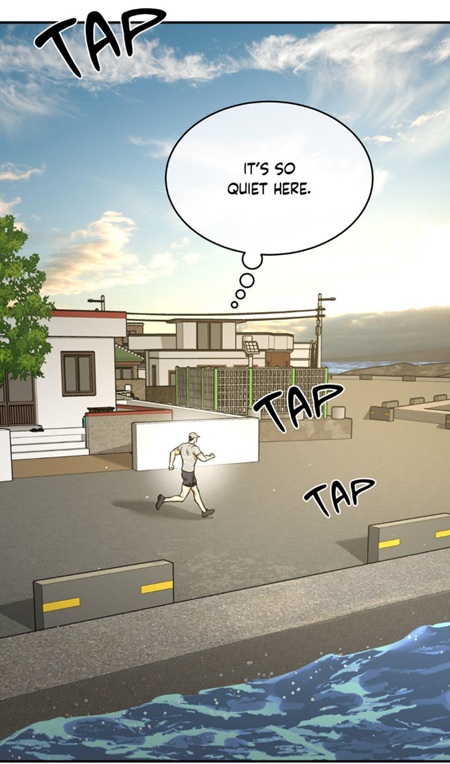 (chapter 62) From my perspective, the man has now internalized the beach to nature and privacy. Striking is the way Mingwa introduced the scenery. First, she focused on the wheel and Joo Jaekyung’s feet.
  (chapter 65) The contrast between the creaking wheels of the grandmother’s wheelchair and the steady steps of the champion immediately establishes the theme of control versus freedom. The wheelchair’s wheels represent civilization, immobility, passivity, and the grandmother’s obsession with control—over her own fate (chapter 65) and Kim Dan’s future. In contrast, Joo Jaekyung’s feet symbolize the potential for naturalness, movement and agency (chapter 65), emphasizing his ability to choose and act, even if he is currently unaware of the extent of the grandmother’s manipulation. I will explain further why I see the grandmother’s conversation as a deception. On the other hand, the rhythm of two steps per two creaks reflects how, despite his apparent strength and independence, the champion is unwittingly aligning himself with the grandmother’s pace and will. He is not realizing that he is actually slowing down, an indication that he will getting closer to rest for real this time. Note that he is no longer running and his steps are more “gentle”. We don’t have any TAP TAP TAP anymore, but STEP STEP.
The focus on the wheels and feet also serves as a prelude to the conflicting worldviews of the two characters. While the grandmother’s immobility reflects her fear of facing reality and her reliance on others to push her forward—both literally and metaphorically—Joo Jaekyung’s steps suggest a willingness not only to move forward, but also to impede. Little by little, he is getting closer to the ocean which means that he is about to confront the unknown represented by the ocean. Yet, the irony lies in the fact that despite his steady steps, the champion is the one being emotionally led by the grandmother’s words and direction.
Furthermore, the choice to highlight the wheels and steps before revealing the larger scenery suggests a gradual unveiling of the truth—both about the grandmother’s intentions and the emotional journey that awaits Joo Jaekyung.
“It’s a nice little town, isn’t it”
By choosing the ocean, Joo Jaekyung subconsciously aligns himself with nature, emotions, and freedom—the very things the grandmother seeks to avoid by emphasizing the beauty of the town. (chapter 65) His choice of destination foreshadows a deeper conflict between confinement and escape, between facing the truth and continuing to live under the illusion of control that the grandmother represents. Another relevant detail is the moment Shin Okja praises the town. Observe the position of her head. We don’t see her gaze because of her hat. But since the town is on the right, this signifies that she isn’t truly looking at the town.  (chapter 65) In fact, she is just looking ahead of her. The “nice little town” is reduced to the pathway next to the beach. This observation exposes her narrow-mindedness. Because she is not truly admiring the place, I feel like she is praising the town more based on her childhood memories. This explains why she mentions her youth afterwards. Moreover, the fact that she employed the expression “isn’t it” with her description, reveals her tendency to lead the conversation. It was, as if she pushed the young man to agree to her claim. The irony is that she didn’t even wait for his reply. She explained why she was so fond of the place: her childhood memories. In her eyes, because her companion didn‘t spend his youth here, he can not connect to this town, overlooking that people can create new memories anywhere. Moreover, they are not obliged to live in the same town their whole life or to live where they spent their childhood. In other words, this frail lady has no real notion of time as such. I would even say, her gaze is not truly directed in the present or the future, she is rather obsessed with the past.
The grandmother and the beach
But let’s return our attention to this panel. (chapter 65) Here, the ocean dominates the frame, uncontained and powerful, suggesting that the control and order symbolized by civilization are ultimately limited. The receding wharf becomes a metaphor for the boundaries of this control, emphasizing that beyond a certain point, civilization’s reach falters in the face of nature’s raw power. This shift in focus—from the orderly path along the shore to the turbulent waves beyond— accentuates the futility of the grandmother’s obsession with control, medicine, and structured living. But there’s more to it. Mingwa added the onomatopoeia “Whoosh” in order to indicate the presence of wind. The latter is responsible for the “waves”. Funny is that the halmoni is not paying attention to it at all. We could say that the absence of comments about the ocean and wind divulges her blindness and deafness, and the falsehood of her “wish” expressed in the hospital. In addition, this image is announcing the way the conversation will take place. There won’t be any real exchange of thoughts and as such active listening from her part. She will lead the conversation.
This image contrasts so much to the scene with Kim Dan on the beach:  (chapter 59) The contrast between these two images—one of the halmoni accompanied by Joo Jaekyung and the other of Kim Dan sitting alone by the ocean—exposes the stark difference in their emotional worlds and the dynamics of control and isolation that define their lives.
In the first image, (chapter 65) the halmoni’s presence with Joo Jaekyung creates an illusion of support and control. (chapter 65) The sunlight high in the sky bathes the scene in brightness, suggesting a façade of warmth and clarity. This lighting aligns with the halmoni’s belief that she can influence Kim Dan through the champion, using Joo Jaekyung as an intermediary to extend her authority. The fact that she is in a wheelchair, however, subtly contradicts this impression of power, revealing her true state of passivity and reliance on others to act on her behalf. The ocean, tamed by the pathway, symbolizes her attempt to domesticate nature—
 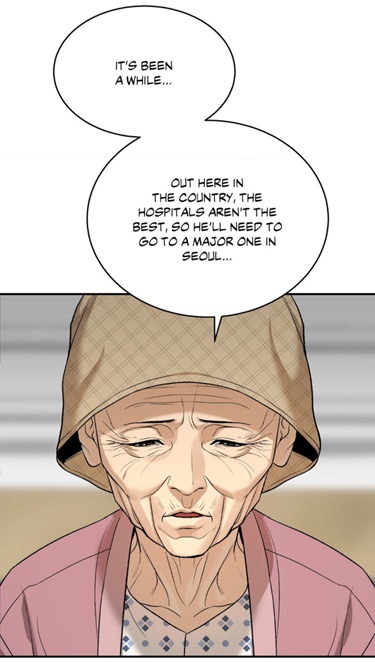 (chapter 65) just as she tries to domesticate Kim Dan’s emotions and decisions. At the same time, it exposes that the champion is still far away from his true self, but he is getting closer to become “reborn”.
In contrast, the second image of Kim Dan alone at sunset paints a completely different picture. (chapter 59) Here, the setting sun hints at the end of the halmoni’s control over his life, casting a melancholic glow that embodies both the beauty and isolation of freedom. Unlike Shin Okja, doc Dan faces the ocean directly, unprotected by railings or pathways, exposing his vulnerability and willingness to confront the unknown—his emotions, his trauma, and his desire for escape. The absence of others highlights his profound loneliness, a loneliness that even the vastness of the ocean cannot fill but seems to reflect. The parasol, standing solitary like Kim Dan, reinforces the sense of isolation amidst an open space. On the other hand, the walk with the grandmother exposes the superficiality of the champion’s connections. He might know many people, but they aren’t his friends or family.
The sound effects further emphasize this dichotomy. The “whoosh” accompanying the halmoni and Joo Jaekyung suggests the wind—a natural element that moves freely despite the artificial path, subtly mocking the halmoni’s illusion of control. Meanwhile, the “shaa” with Kim Dan reflects the waves, raw and untamed, symbolizing the overpowering emotions he battles alone.
Joo Jaekyung’s perception of the halmoni’s influence over Kim Dan is thus an illusion: 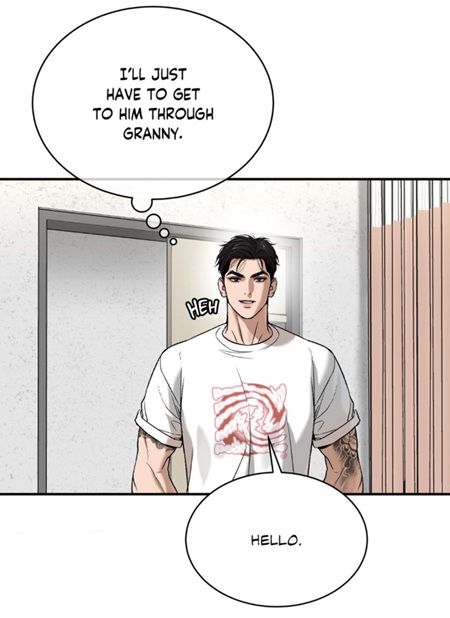 (chapter 65) the same illusion that the high sun implies. The latter can not shine if there are clouds. (chapter 65) My avid readers know that the latter usually stand for danger. Thus I come to the following deduction: the clouds represent the doctor’s untreated wounds. The champion’s assumption that the halmoni can sway Kim Dan is a misunderstanding of the true nature of Kim Dan’s struggles. While Joo Jaekyung might see the halmoni’s appeals as genuine, I don’t think, he grasped entirely that her words are merely another form of control, one that Kim Dan subconsciously rejects as he continues to seek solace by the ocean, far from the halmoni’s reach.
 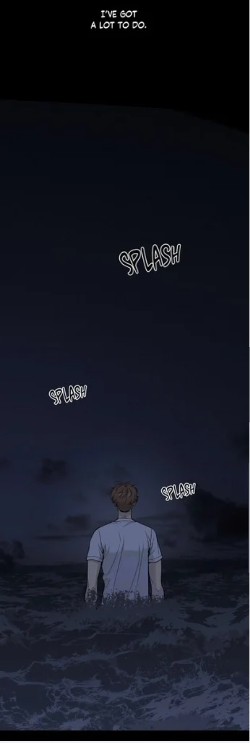 (chapter 59)
In essence, the halmoni’s daytime stroll represents a false clarity and a temporary illusion of control, while Kim Dan’s solitary sunset confrontation with the ocean was foreshadowing a breaking point—an inevitable dusk for the halmoni’s authority and a prelude to a night where Kim Dan chose escape and freedom but at his own life expense.
Another important detail is the way she initiated the conversation. It was about this pretty community and not her grandson. Why? (chapter 65) It is because she is trying to incite the athlete to return to Seoul. He doesn’t belong here. Her statement, “This is where I grew up. But you’re from Seoul, so you probably don’t see what the fuss is about,” dismisses Joo Jaekyung as an outsider while subtly reasserting her authority. Yes, she is using the same MO than with Kim Dan. 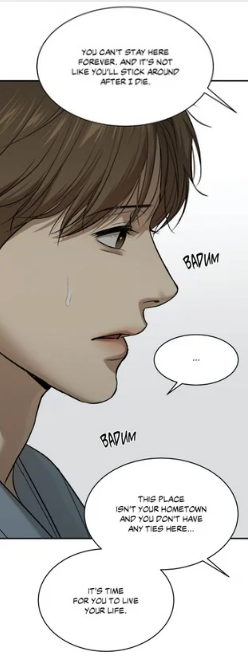 (chapter 57) By telling him that he had no ties here, she effectively erased their shared past and portraying him as a stranger in the very place she calls home. Thus I deduce that she is aware that she is racing against time. The longer the athlete stays in that place, the lower are the chances that her grandson will leave this town. She has to ensure that Joo Jaekyung doesn’t feel like settling here. I don’t think, she heard about the athlete’s involvement in the little town, for her only source of information comes from the staff
 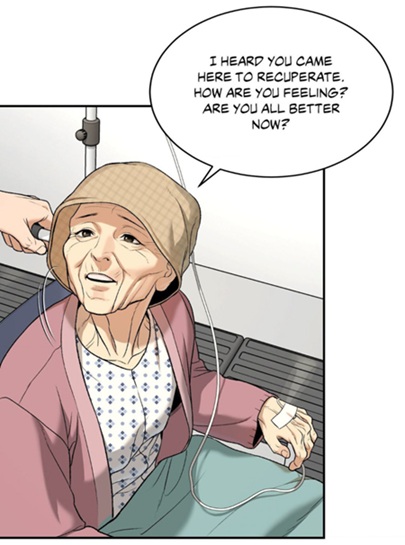 (chapter 65) and the residents from the hospice. She has no connection to the town chief and other inhabitants. This exposes how small her world is and little her knowledge is. However, her ignorance doesn’t make her an innocent “lady”, quite the opposite. – Don’t get me wrong, I don’t see her as a malicious person, just as a selfish person suffering from Peter Pan Syndrome.
Let me give you an example.  (chapter 65) Here, she claims that she only knows about the sportsman’s job thanks to the patient next door. However, she is lying, because she watched his match in the States.
  (chapter 41) The irony is that she is not realizing that she is showing her true colors.
  (chapter 21) In episode 21, the halmoni’s description of the champion as a “good friend” was, in hindsight, a superficial and self-serving characterization. At that time, she likely saw Joo Jaekyung as someone who could be beneficial for Kim Dan’s financial situation without truly caring about who he was as a person. Her interest in him was more about what he represented—a source of money and stability—rather than any genuine appreciation of his character or the impact of his presence in Kim Dan’s life. Thus she said this in front of the ocean:
  (chapter 65) If he was a good friend, then why didn’t she show more interest in him before? It is because she needs him now. Yes, this woman is a good-weather friend in the end. The term “good-weather friend” refers to someone who shows interest, support, or kindness only when it is convenient for them or when they stand to gain something. Hence she goes outside, when the sun shines. This perfectly encapsulates the grandmother’s attitude towards Joo Jaekyung. But it is the same with the champion. He only visited her,
  (chapter 61) when he thought, he needed her assistance. He used her to appear as a friend.
  (chapter 61) Yes, the conversation at the beach played an important role, for Shin Okja’s behavior serves as a distorted mirror to Joo Jaekyung’s actions and mindset, exposing the flaws and contradictions in both. When she voiced this wish (chapter 65), she exposed her belief: money and big hospital are the symbol for care. That’s exactly what the champion had done in the past.
In episode 22, when Joo Jaekyung paid the bills for the halmoni,  (chapter 22) he acted out of a simplistic view of good deeds—believing that financial support alone could resolve problems and fulfill his moral obligations. His subsequent failure to visit her again reflects his tendency to distance himself emotionally once he has performed what he sees as his duty. This is reminiscent of his behavior towards Kim Dan: helping him materially but avoiding deeper emotional involvement or responsibility.
Shin Okja’s current behavior mirrors this mindset but in a more manipulative and self-serving manner. Her sudden interest in Joo Jaekyung now that she needs him exposes how she, too, equates support with utility rather than genuine care. She projects a generous and sacrificial image  (chapter 65), much like how Joo Jaekyung likely saw himself when paying her bills—believing that fulfilling a material need is equivalent to showing genuine concern. Park Namwook is a representative of this mind-set too.
- Transactional Attitude vs. Emotional Avoidance:
- Shin Okja’s willingness to praise Joo Jaekyung now that she needs him mirrors how the sportsman’s sense of duty stops at financial aid without further emotional involvement.
 (chapter 45) Both characters avoid deeper emotional connections, opting instead for transactional solutions—she with her manipulations and he with his money.
- Shin Okja’s willingness to praise Joo Jaekyung now that she needs him mirrors how the sportsman’s sense of duty stops at financial aid without further emotional involvement.
- Superficial Care:
- Just as the star’s one-time payment was a way to offload guilt without genuine interaction, Shin Okja’s praise
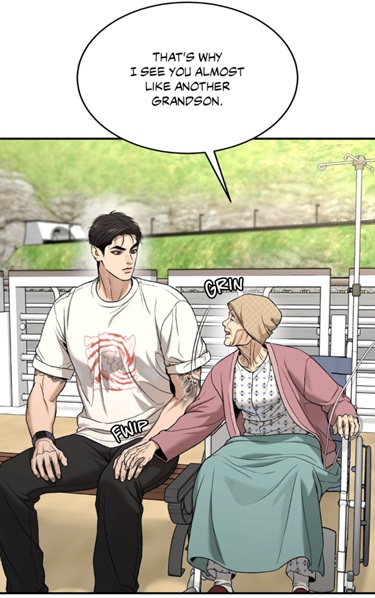 (chapter 65) is a way to offload responsibility for doc Dan while maintaining an image of concern. Both display a form of care that lacks true depth.
- Just as the star’s one-time payment was a way to offload guilt without genuine interaction, Shin Okja’s praise
- Avoidance of Accountability:
- Shin Okja’s deflection of her failures as a guardian (chapter 65) reflects Joo Jaekyung’s reluctance to confront the emotional and mental consequences of the star towards Kim Dan. Besides, Jinx-lovers should keep in their mind that the champion is the owner of the gym. The incident with the switched spray was swept under the rug, just like the drugged beverage. Everyone involved acts, as if nothing had happened or by saying that the doctor was innocent, the witnesses believe that the damages has been repaired.
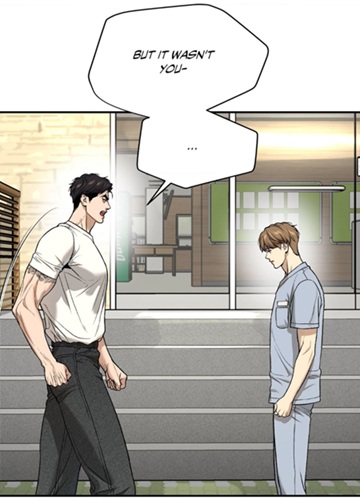 (chapter 62) Both avoid the emotional accountability that comes with their actions, preferring to distance themselves once a material obligation (debts)
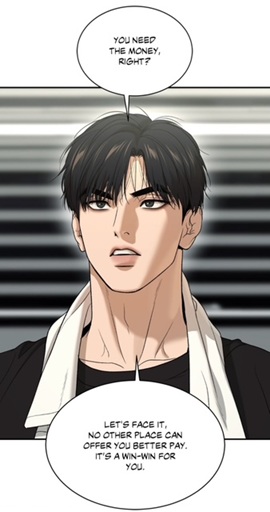 (chapter 60) is fulfilled.
- Shin Okja’s deflection of her failures as a guardian
- Perception vs. Reality:
- The fact that Joo Jaekyung thought he had done a good deed by paying the bills contrasts sharply with Shin Okja’s sudden friendliness, (chapter 65) which is merely a cover for her self-serving motives. This contrast highlights the theme of perception versus reality: both characters’ actions appear kind on the surface but conceal underlying self-interest or emotional avoidance. Yet, there is a difference between them. The champion had sacrificed his time for the doctor, he made sure to keep the elderly woman company so that Kim Dan could rest. Moreover, he had made her happy, that’s the reason why doc Dan was so grateful.
 (chapter 22)
- The fact that Joo Jaekyung thought he had done a good deed by paying the bills contrasts sharply with Shin Okja’s sudden friendliness,
In this sense, the halmoni serves as a mirror reflecting the champion’s own flaws back at him—his tendency to equate care with material support and his discomfort with emotional intimacy. The paradox here is that while Joo Jaekyung might see the halmoni’s behavior as genuine concern, it is actually a reflection of his own transactional approach to relationships. Recognizing this mirror might be a crucial part of his redemption arc, forcing him to confront the superficiality of his past actions and understand the difference between real care and transactional gestures. However, it is relevant to recall that the star’s past behavior was nurtured by his own surroundings. MFC and the members from Team Black also treated him as a tool for success and money.
So, the mirroring aspect adds a deeper layer to the conflict between civilization (control and superficial care) and nature (authentic emotions and freedom), reinforcing the idea that Joo Jaekyung must break away from this mindset, if he is to truly connect with Kim Dan.
One might think that they are both shallow and selfish. Yet, there exists a huge difference between them. Joo Jaekyung embodies action and he is now embracing changes. Thus he is willing to do anything to improve their relationship, whereas the grandmother is just waiting at the hospice for the “right time” and the “right person”. She is just reacting to an uncomfortable situation than becoming proactive like the champion. She sees the decline of her grandson’s health, but she is reducing it to insomnia which can be treated with pills and a stay at an expensive hospital. (chapter 65) She is not mentioning his loss of weight on the beach contrary to her comment at the hospice.  (chapter 57) This displays that she is not entirely honest. She is not reaching out to Kim Dan in the end. Her excuse is that he refused to see a doctor
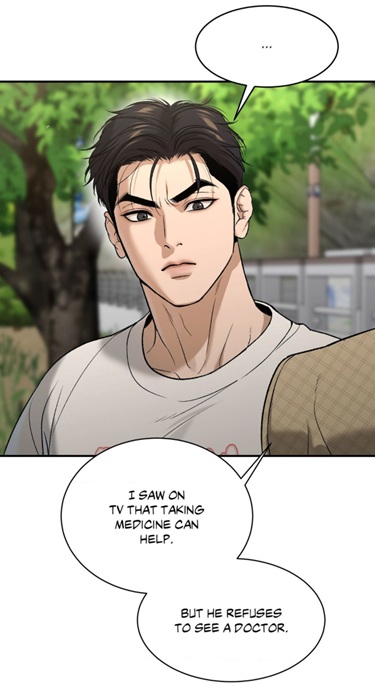 (chapter 65), but so far we never saw her making such a suggestion. It is possible that she jumped to this conclusion because she heard about this incident:
  (chapter 60) If my assumption is correct, the woman didn’t realize that this rejection was linked to Joo Jaekyung’s intervention. So if she had talked to her grandchild himself, she could have had an impact… But they are actually avoiding each other. One thing is sure: the absence of communication and avoidance between these two family members reinforced the doctor’s suffering. Imagine the consequences of her request: she is preferring locking him up in a hospital receiving drugs than giving what doc Dan has been longing: warmth, love and a home.
Another contradiction is that while she praised the “little town” in the beginning, she was looking down at this place, when she said: (chapter 65) It was, as if she was insulting the hospice where she is staying and as such the staff (which included Kim Dan).
The problem is that the grandmother has long forgotten this day,  (chapter 65) where both were happily smiling. The picture is the evidence that she could make Kim Dan smile despite their poverty. Moreover, it is important to recall that she introduced Kim Dan as an orphan from birth:
  (chapter 65) According to my hypothesis, this image
  (chapter 19) is linked to the doctor’s abandonment and betrayal. I have to admit that her attitude and words reminded me a lot of the director Choi Gilseok’s offer.
 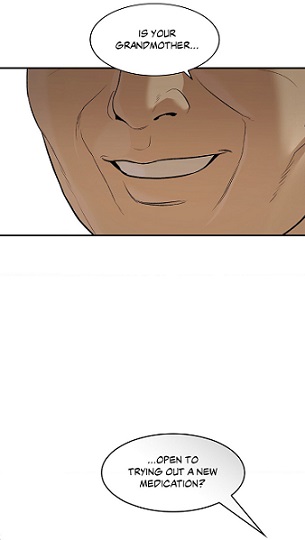 (chapter 48). Both the halmoni and Choi Gilseok embody betrayal and the theme of acting behind the back
 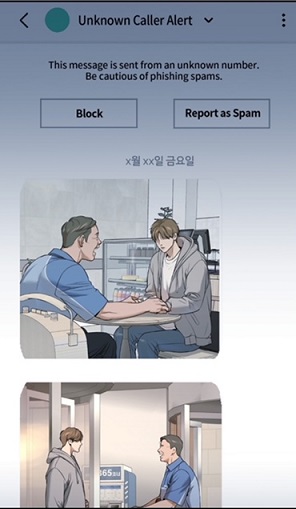 (chapter 48), weaving a web of deception under the guise of care and concern. The halmoni’s betrayal is subtle but profound—she presents herself as a self-sacrificing guardian, but her true motives are revealed through her willingness to entrust Kim Dan to Joo Jaekyung without genuinely considering his well-being. Her criticisms of Kim Dan’s habits, her attempts to send him back to Seoul, and her selective truths paint a picture of a woman more interested in relieving herself of a burden than providing real support. Her actions behind Kim Dan’s back—discussing him negatively with Joo Jaekyung—further emphasize her betrayal, showing a willingness to manipulate perceptions for her own convenience.
Similarly, Choi Gilseok’s offers of lodging, financial help 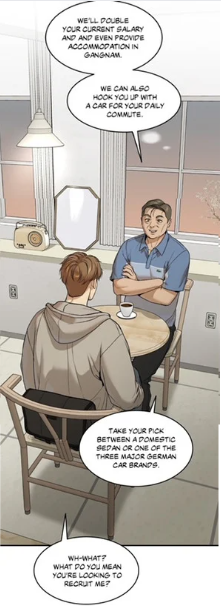 (chapter 48) and superior medical care
  (chapter 48) mask a deeper betrayal. His real aim was never to assist but to control, using offers of support as bait to tie Kim Dan into a powerless position. The parallel between his proposition to Kim Dan—promising a better life in exchange for leaking information and compliance—and the halmoni’s push for Seoul’s hospitals underlines their shared strategy: make the target believe they have a choice, while the outcome is already decided. The fact that Heo Manwook, who collects Kim Dan’s debts, called Choi Gilseok “hyung” further hints at a deeper conspiracy, suggesting that the offer might have been a tool to ensnare Kim Dan from the start. He would have committed a crime (illegal drugs).
Both characters act behind the scenes, manipulating others to achieve their goals while maintaining an outward appearance of concern. This duplicity can only deepen the sense of betrayal felt by Kim Dan, whose struggle for freedom becomes not just a battle against overt control but also against the subtle, insidious influence of those who pretend to care. Moreover, she broke her promise, but chose to walk to the ocean with the star. It was, as if the grandmother had been ashamed of her own grandson. The halmoni’s and Choi Gilseok’s actions reveal the painful truth that sometimes, the worst betrayals come from those who claim to love and protect. I made this connection for another reason. The director of the gym is actually the one behind the debts and loan. I doubt that Shin Okja would have trusted Heo Manwook for example. It is important, because the loan is the reason why the champion became a target of schemes. But since the doctor refused to abandon his lover, I am convinced that the champion won’t follow Shin Okja’s suggestion.
Moreover, contrary to the grandmother, the star wants the doctor to agree on his own accord.  (chapter 62) That’s the reason why he was seeking the grandmother’s support. He was hoping that she could influence him. But what he hears, shocks him: (chapter 65) She desires the same as him, but she is in the same position than him. She is powerless in front of the doctor’s will. It looks like this walk to the ocean was pointless for the champion. However, it is not true, as the athlete got to see a glimpse of the verity in front of the ocean. He is surprised by this request, because unconsciously he senses it as a “betrayal” and “abandonment”. And keep in mind that the ocean represents freedom, the unconscious mind, emotions, death, and the unknown. The wolf was encouraged to perceive the falsehood of his past believes. Moreover, he was incited to question his own past behavior.
Striking is the way both were placed on the beach.  (chapter 65) Though they are next to each other, they are not sitting together. The wheelchair represents the invisible barrier between them. This scene contrasts with the conversation in the penthouse. And what had the athlete done during that night? He had not only shared his thoughts and issues to doc Dan, but he had asked for his wish and opinion.
 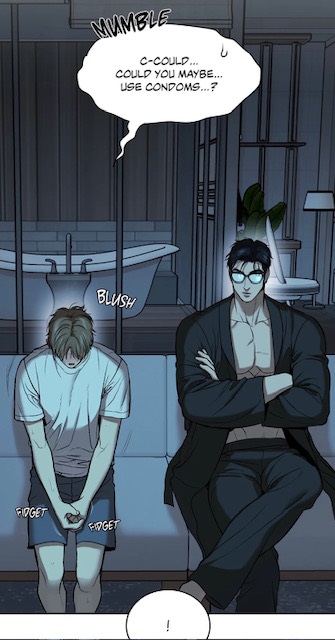 (chapter 29) He had even advised to think of himself first. As you can see, the fact that the two characters were just sitting next to each other reinforces my previous interpretation about the conversation. The grandmother was the one who had been leading the conversation, there is no real exchange of thoughts. In episode 29, the champion refused to accept the doctor’s help and suggestion. That’s the reason why I am more than ever convinced that the star won’t listen to the grandmother.
In other words, she was acting like in the past. How so? 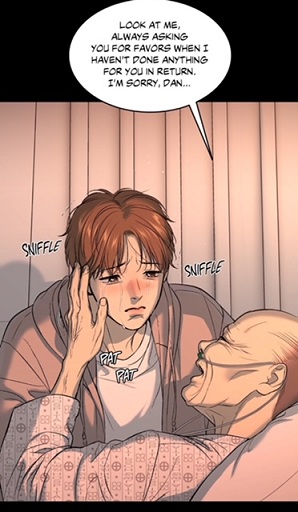 (chapter 53) She was asking for a favor again, but this time, she was begging for someone else’s generosity. No wonder why she said that she was still the same! (chapter 65) 😉 And what is her MO? She uses pity and vulnerability to her advantage. Since she is so old and weak, she can not do much for her grandson. In other words, she is showing to the celebrity that vulnerability can be a source of strength, that’s how she could turn her grandson into an obedient puppy. However, this can only work, as long as the “target” is listening to his heart and has not developed his own identity and strength. The wheelchair is the symbol for her powerlessness and passivity. Hence she needs the involvement of a third person. The twist is that her wheelchair is the evidence of her dishonesty. How so? She could go to the beach
  (chapter 53) and watch the ocean with her grandson
  (chapter 53), but they never did it. Why? One might respond that she refused to do it.
 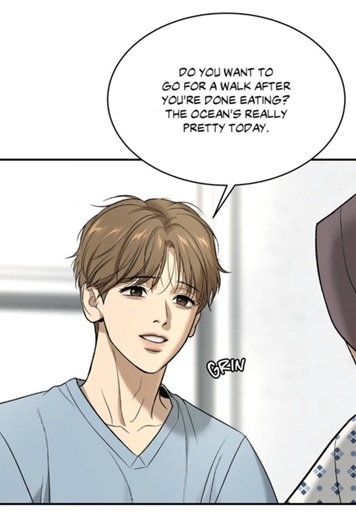 (chapter 57) But it is only partially correct. The doctor only suggested this walk to the ocean much later, when he was already suffering emotionally. This means that the grandmother would have not been able to enjoy this walk. Yes, the timing played a huge role. In fact, she confessed her crime to the star:
  (chapter 53) She never had any intention to spend some time with him. Notice the personal pronoun “we” vanished. It is only about her request: “I wanted to see the ocean”. This means that at the hospital, she never had any intention to keep Kim Dan by her side. She employed the “with you, we” in order to achieve her goal. She acted, as if they were a family. She used her illness for her own advantage. In my opinion, her request was an excuse to avoid to return to the old broken home. For her, home is a place and not a person. Therefore she couldn’t love Kim Dan properly. Her “I’m so sorry” was actually fake. She had only thought of herself… She never thought of her grandson’s future at all. This observation corroborates my previous statement: she is unable to plan for the future. What only matters to her is the past or the present. Why? It is because she doesn’t want to be plagued by remorse or regrets. And now, she is doing it again with the champion. Using emotions and fragility for her own benefits. The paradox is that this is something Joo Jaekyung has always feared his whole life. Nonetheless, he doesn’t react so violently like in the past: rejection or outburst. One might say the reason is that she is weak and terminally ill.
 (chapter 65) However, I believe that her words reached the champion’s third eye. The latter was not focusing on the grandmother, but on his fated companion. He was trying to understand why he had changed. This question was already on his mind before:
 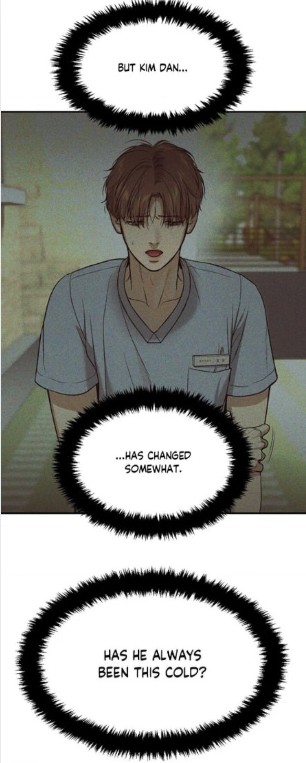 (chapter 62) And notice that the words from the grandmother (chapter 65) in front of the water reflects the champion’s intentions:
  (chapter 62) Once he has achieved his goal (reclaim his champion title), they will depart from each other. He would treat the doctor the same way than the grandmother! No wonder why doc Dan is getting angry and rejecting the offers from his destined partner. IT is only about his own selfish desires and not about doc Dan’s future and desires. Both have a similar mind-set: they don’t know what doc Dan plans to do with his life and the future…. And it shows that Joo Jaekyung was imitating the grandmother, though this suggestion was born from the following thought. Since Doc Dan was no reluctant to work for him, he imagined that maybe he would still accept to work for him for a limited time. But that’s not what Kim Dan is looking. He is longing for a home and at the same time for freedom.
On the other hand, though Shin Okja tried to use the same MO with the celebrity, it is clear that she is destined to fail. Let’s not forget that his private conversation took place outside, in front of the ocean, and the latter represents reflection and unconscious. Hence Joo Jaekyung voiced his hesitation constantly: (chapter 65)  (chapter 65) The points of suspension are indicating that he is meditating on her words and suggestions. This stands in opposition to his past behavior where he got manipulated so easily.
 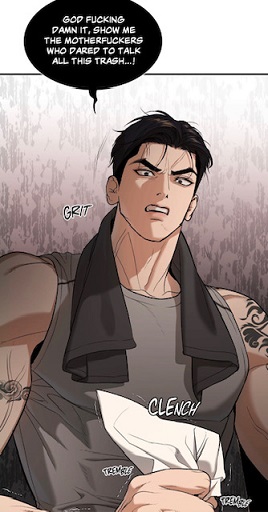 (chapter 36) The reason for this huge metamorphosis is that because of the lavender-tinted night, he learned to control his emotions.
 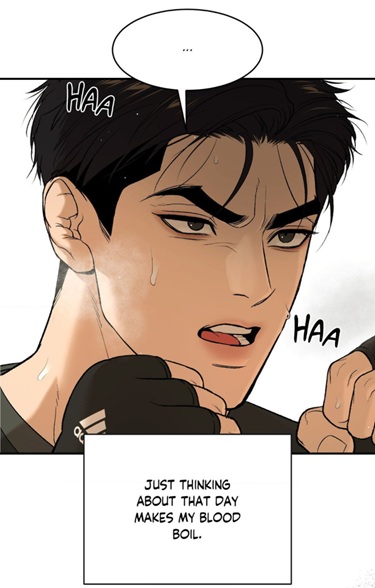 (chapter 65) He was forced to admit that he needed the “hamster”. He knew that if he reacted on these negative emotions, doc Dan would have another reason to put the blame on him. Consequently, his goal would be much further away. Secondly, though the conversation was private, their encounter was far from secretive. Both were visible, as it took place during the day. This means that the grandmother’s words in front of the ocean symbolize that they are in the open. (chapter 65) So they should reach the doctor’s ears. And this observation leads me to my next connection, the grandmother’s deceptions.
Shin Okja’s lies
What caught my attention is this image combined with the grandmother’s claim 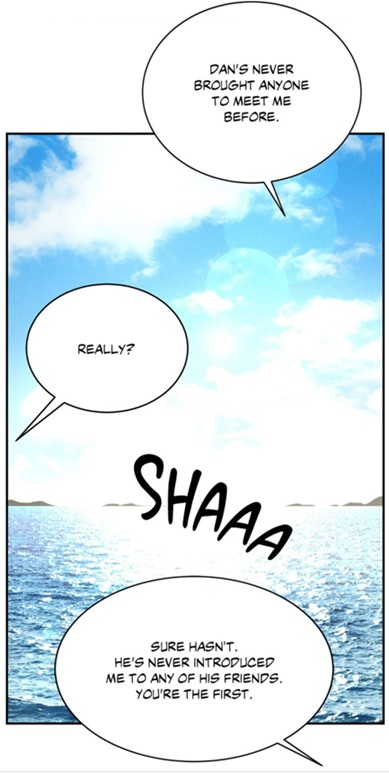 (chapter 65) According to her, Kim Dan has never introduced her to any of his friends. The celebrity would be the exception! But she is lying here. How so? Joo Jaekyung introduced himself to her on his own. It is because he answered a call from the nurse.
 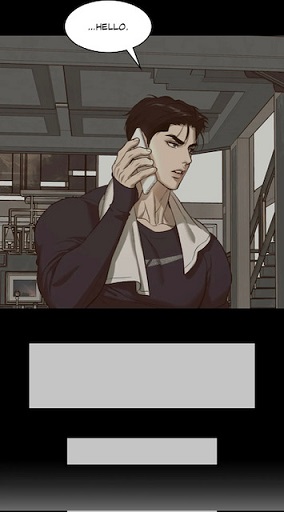 (chapter 21) It happened behind doc Dan’s back in the end. The latter was sick, but the old lady didn’t seem concerned. The second lie is this statement which is exposed with the memory: (chapter 65) The panel depicting the halmoni holding an infant Kim Dan offers a complex portrayal of her character—one that blends guilt, self-victimization, and manipulation. Her downcast eyes and the way she cradles the child suggest a mix of regret and weariness, but this expression lacks the warmth expected of a caring guardian. She is not smiling, only feeling pity for the “poor child”. Instead, the scene gives off a performative air, as if she is convincing herself (and, by extension, Joo Jaekyung) that she was indeed a dedicated guardian who did her best. The dark, muted background only deepens this impression, isolating her and the child in a way that hints at unresolved guilt and a lack of genuine affection.
Her words, “I tried my best to raise him, but it was never enough,” carry a double meaning. On one hand, they paint her as a martyr who struggled valiantly despite overwhelming odds. On the other, they imply a subtle judgment of Kim Dan, as if his troubles were a reflection of his own failings (greed) rather than a result of her negligence. The emphasis on “never enough” shifts the focus from Kim Dan’s suffering to her own perceived sacrifices, turning the conversation away from her shortcomings and towards her self-proclaimed burden. This choice of words aligns with her tendency to externalize blame, presenting herself as a victim of circumstances rather than acknowledging her role in Kim Dan’s suffering.
The portrayal of Kim Dan as an infant rather than as the grown man he is now exposes a deeper layer of control. By framing the memory this way, the halmoni preserves her position as the ultimate decision-maker in his life, reinforcing the notion that he is incapable of making his own choices. This imagery ties directly into the theme of Peter Pan Syndrome—the idea that Kim Dan, in her eyes, is perpetually a child who must be protected and guided, even if this means denying him the agency to confront his past and shape his own future. However, this is just a projection of herself. This infantilization serves her interests by keeping him emotionally dependent and by masking her own failings as a guardian.
Moreover, the halmoni’s repeated use of the word “never” (chapter 65) (chapter 65) (chapter 65) is not a mere slip of the tongue but a deliberate linguistic tool to control the narrative. In this context, “never enough” serves a dual purpose: it downplays her own responsibility while subtly casting Kim Dan as a source of endless trouble and dissatisfaction. This manipulation of language highlights a broader pattern in her behavior—her use of selective truths to paint herself as a victim of fate, rather than a participant in the decisions that led to Kim Dan’s suffering. Her words echo the myth she has carefully constructed of herself as the sacrificing grandmother who did everything she could, even as the dark atmosphere of the panel suggests otherwise.
The dark background, devoid of warmth or light, not only isolates the halmoni and Kim Dan but also symbolizes her repressed guilt and closed-off perspective. By presenting herself as the victim of an ungrateful or inherently troubled child (chapter 65), she avoids confronting the real roots of Kim Dan’s suffering—such as the bullying, the debts, and the truth about his parents. For her, it would have been better if he had been raised by his parents. This is what she implied: she could never replace them. (chapter 65) It is important because it exposes her traditional mind-set overlooking that certain parents are unfit guardians. Secondly, with her own words, she legitimated the kids’ bullying. This explicates why she didn’t intervene in the end. What I had interpreted in the past was confirmed in this episode. She represents civilization and as such social norms. Therefore she is a representative of herd mentality. She accepted the kids’ bullying as truth which led to Kim Dan’s isolation. And now, you comprehend why she is not mentioning the harassment from the past. 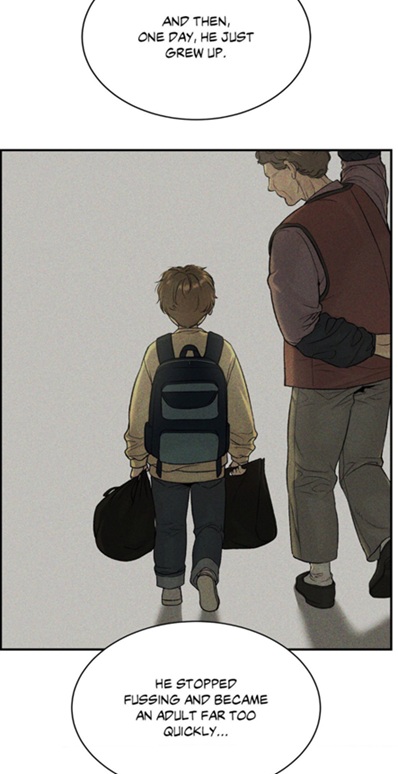 (chapter 65) Here, note that the little boy is wearing the same clothes than in the doctor’s nightmare.
 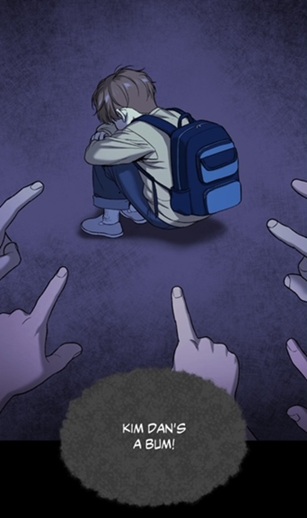 (chapter 57) She claims her ignorance why the little boy acted like an adult at such a young age. The reality is that she hasn’t forgotten the incident at all. This explicates why she confessed this to the “wolf”: (chapter 65) And who is to blame for her seclusion? Kim Dan who refused to introduce her to his friends. The irony is that Kim Dan mentioned her to the actor Choi Heesung,
  (chapter 30) a sign that she was never a source of embarrassment for him. (chapter 65) The truth is that she wanted him to mature quickly so that he could take her burden.
  (chapter 47) Her refusal to address these deeper issues reveals that her sacrifices were less about genuine care and more about maintaining her self-image as a righteous guardian. (chapter 65) The absence of any visible light or open space in the panel reinforces the idea that her perspective is narrow, unwilling to confront the broader context of Kim Dan’s pain and isolation.
In essence, this panel illustrates how the halmoni’s portrayal of herself as a sacrificing guardian is a carefully crafted narrative. Her use of language, the infantilization of Kim Dan, and the dark visual elements all work together to expose the underlying hypocrisy of her actions. She is not seeing Kim Dan as a man in the end (“sweet boy”). By framing herself as a victim of circumstances, she manages to absolve herself of guilt while keeping Kim Dan emotionally trapped in a narrative of helplessness and dependency. Far from being a scene of genuine regret or love, this moment reveals the true nature of her sacrifices—self-serving acts designed to control the narrative and shift the blame away from her own failures. That’s the reason why she is not bringing up the debts either. Under this light, you comprehend why she portrays Kim Dan in such a negative light: he is a drinker and smoker. (chapter 65) It is because of his personality: he was an orphan and had no real parents to guide him properly. Hence he didn’t listen to her nagging. The irony is that readers never saw her showing concerns about his drinking or smoking habits before. For me, it exposes her passivity and accountability. And what is her MO? She uses the past to justify her request. But the past is no longer valid, for the doctor has grown up. He is no longer smoking for example. She can only use the past, because she stopped living with him. Hence she has no idea how and where he is living right now. She is overlooking that she could have done something: refuse to let him carry the bags or take his hand (chapter 65), talk to him properly and listen to him. But she did not, she used food as a diversion. Walk silently by his side… Like expressed before, this senior stands for secrecy, shame and taboo.
As long as Kim Dan was working and paying off the debts, everything was fine. But now, she is noticing that he is showing signs of illness, but she doesn’t want to feel accountable for that. But there is more to it. In my eyes, Shin Okja never trusted the main lead. It is because of her own lies. She had told him, if he kept working, he would be able to pay off the debts. 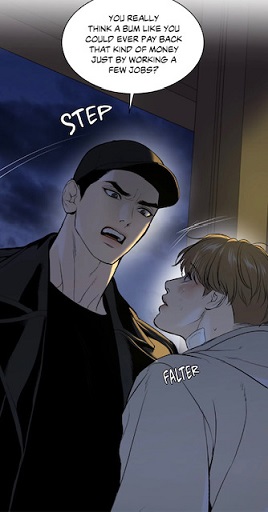 (chapter 18) What caught my attention in her revelation is her lack of enthusiasm for her own grandson.
  (chapter 65) “Is he that good?” exposes a lack of faith in her grandchild, a remark which caught the athlete by surprise. For me, he unconsciously sensed this negative aspect.
  (chapter 65) While this image is actually humorous, the grandmother’s words don’t match her body language. She is not showing any joy or smile. Therefore I comprehend why Kim Dan was so hurt by the champion’s behavior:
  (chapter 51), the absence of trust because of MONEY! She knew, he was drinking and smoking. Yet according to her, she couldn’t stop him, as she was powerless. He wouldn’t listen to her nagging. But here is the thing. She never asked him why he would act this way. Drinking and smoking were the only things he could allow himself as “fun and diversion”. In her long confession, she is diverting the attention from the causes for this rebellious behavior. Indirectly, she is portraying him as a stubborn boy who can not live on his own. In reality, she is just projecting her own desires and thoughts onto her grandson. For her, the city stands for wealth, fame, success and power.
  (chapter 65) I am suspecting that deep down, she wants him to shine for her own peace of mind. (chapter 41) Don’t forget that she has been living through him. But Seoul is related to Kim Dan’s suffering: the debts, sexual assault, violence from the loan sharks, the bullying, ,, his “failures” (prostitution, the switched spray), mockery and rejection. So he has nothing there that would draw him back to the city so far. On the other hand, her words imply that the doctor can not lead a good life here (chapter 65), as if there was nothing good in this place. So is this little town nice or not? She is looking down on that place, though she doesn’t realize it.
Captain Hook and his t-shirt
Since the grandmother is suffering from Peter Pan Syndrome, it becomes clear that she views Kim Dan as a lost boy. But she considers the athlete the same way: (chapter 65) Observe that she employed the expression “almost” here. This idiom is even recurrent in her vocabulary (chapter 65) and it is not anodyne. It symbolizes her conditional love and support. That’s why the athlete is almost a grandson. The paradox is that the champion embodies adulthood and as such Captain Hook. That’s why he was racing against time in season 1. Hence he is responsible for the grandmother’s deteriorating health, as the expensive treatment was more an experiment. But here is the thing. Notice what the young man is wearing. (chapter 65) The T-shirt that Joo Jaekyung wears, emblazoned with the words “Peek a Boo” in a spiral pattern, is far from a random detail. Its presence in the scene with the halmoni adds a layer of irony and serves as a visual metaphor for the nature of deception and hidden truths. The game Peek a Boo is typically associated with infants— a playful way for parents to teach children about object permanence, the idea that things continue to exist even when they are out of sight. However, in the context of this scene, it takes on a darker significance, highlighting how the halmoni manipulates what is seen and unseen to maintain control over Kim Dan’s life and, now, over Joo Jaekyung’s perception of the situation.
The spiral arrangement of “Peek a Boo” mirrors the cyclical nature of the grandmother’s manipulation tactics. Much like the game itself, where the face reappears only to disappear again, the halmoni presents selective truths, allowing glimpses of her vulnerability and supposed selflessness while concealing the deeper reality of her motives. This back-and-forth between what is shown (chapter 65) and what is hidden keeps Joo Jaekyung—and even Kim Dan—in a state of uncertainty and guilt, making it difficult for them to see through her facade. The spiral could also represent a descent into deeper layers of deceit and emotional entanglement, suggesting that the more Joo Jaekyung becomes involved, the harder it will be to hide the truth.
On a symbolic level, Peek a Boo ties directly to the halmoni’s treatment of Kim Dan. As a child, Kim Dan was deprived of a real parental figure who could engage with him honestly and lovingly. When he talked the first time, she didn’t reply or smile. His words were met with silence. That’s how he created a negative perception of himself. The halmoni’s refusal to play simple games like Peek a Boo—games that help children develop a sense of identity and emotional security—suggests that Kim Dan’s early emotional needs were systematically neglected. The memories are revealing her passivity and negative thoughts. This absence of genuine interaction is paralleled by her current behavior: her reluctance to openly discuss his past, the bullying, and the truth about his parents. By avoiding such confrontations, she has effectively kept Kim Dan in a state of perpetual insecurity and self-doubt, much like a child who has not yet grasped the concept of object permanence.
Moreover, the game Peek a Boo also involves a degree of deception—the face that disappears and reappears, creating a mix of surprise and relief. This aligns with how the halmoni reveals just enough of the truth to seem trustworthy, while keeping the more damaging parts hidden. Her feigned helplessness and the way she strategically reveals information to Joo Jaekyung—such as her portrayal of Kim Dan’s drinking and smoking habits—are part of a calculated act to elicit sympathy and compliance. By making Kim Dan appear troubled and unreliable, she diverts attention from her own failures as a guardian. Her trust is conditional: (chapter 65) She wants him to follow her request. So what will she do, if he refuses? Moreover, she doesn’t know that the athlete has already created connections with the local inhabitants. The landlord and neighbor has an interest to keep these two young men in that place: he feels less lonely.  (chapter 61) Finally, it is important that the athlete never agreed to her “demand” or suggestion. (chapter 65)
Ironically, Joo Jaekyung’s naive acceptance of her words shows that he, too, is caught in this game of Peek a Boo. He believes that by getting through to the halmoni, he can reach Kim Dan’s true feelings, not realizing that the halmoni is using this access to manipulate both of them. The T-shirt becomes a bitter reminder of the gap between appearances and reality—how the champion’s straightforwardness is no match for the halmoni’s subtle control of the narrative.
In essence, the Peek a Boo T-shirt encapsulates the main themes of deception, control, and the struggle to see past appearances. It reflects how the halmoni’s manipulations are not merely a means of survival but a way to maintain her dominance over both Kim Dan and Joo Jaekyung. Just as in the game, the truth is never fully revealed—only glimpsed in fleeting moments, distorted and reshaped to serve her ends.
Conclusion
This selective blindness extends to her treatment of Kim Dan. She speaks of his smoking and drinking habits with a judgmental tone, implying that his actions are signs of moral failure rather than coping mechanisms for his trauma. Her refusal to address the bullying incident—a pivotal moment in Kim Dan’s life—is part of this broader pattern of denial. If she cannot acknowledge the cause of his suffering, she can continue to frame herself as the sacrificing guardian who did her best. This evasion is also evident in her avoidance of the ocean, a symbol of emotions, danger, and the freedom that she refuses to confront. That’s why her request is doomed to fail. But there is another reason why Shin Okja’s favor won’t be fulfilled. (chapter 65) It is because she doesn’t care about the champion’s mental and emotional well-being. By making such a request, she is pushing him to return to work and as such disregard his mental and emotional issues. Just like Kim Dan, the wolf needs vacancy and rest. He needs to enjoy the present and make good memories so that he can finally sleep properly. Nevertheless, I do see a small change in her, because for the first time, she asked for someone else’s help. Moreover, she is mentioning her death (chapter 65), a sign that she is gradually accepting her mortality. On the other hand, her statement “I’ll go, when my time comes” is linking walk with death, But here, she is not walking, she is using the wheelchair! This means that as long as she is not walking, she won’t die. It is her effort to push away the inevitable. She is giving the impression that she has control over her life, but deep down, she knows that she is powerless. Therefore I perceive her final words as a deception as well. But there’s more to it. The fact that she is expressing her fear that her grandson might die before her is exposing her fear of responsibility. I would even say, her words imply that she has already witnessed the suicidal tendencies of a person in the past (that would be the parent). That’s why she suggested to the owner of Team Black to send him to a huge hospital and drugs (confinement).
Feel free to comment. If you have any suggestion for topics or Manhwas, feel free to ask. If you enjoyed reading it, retweet it or push the button like. My Reddit-Instagram-Tumblr-Twitter account is: @bebebisous33. Thanks for reading and for the support, particularly, I would like to thank all the new followers and people recommending my blog.


 (chapter 13), who had been awakened by the champion, though contrary to the fairy tale, this arising was associated with pain. [For more read the analysis
 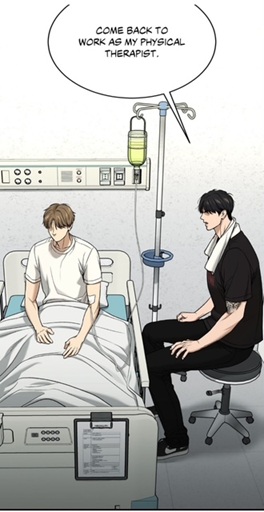 (chapter 60) But how did they ended up both cursed by the same spell? The reason is simple. They were either halted by guilt and self-loathing or distorted by the desperate need to escape a traumatic past. Yet, amidst this stasis, small cracks are beginning to appear, suggesting that the flow of time cannot be denied forever. The past can not be repeated
 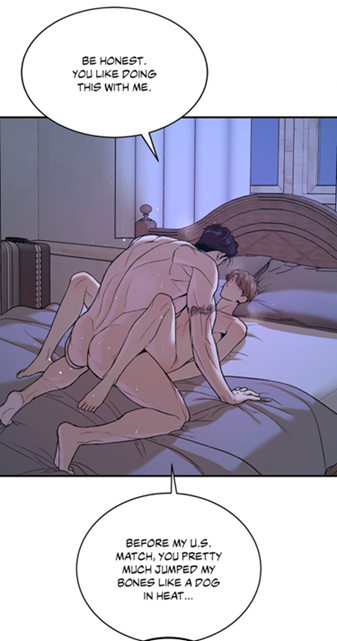 (chapter 64) or become the present or future. At the heart of this struggle lie symbols of doors, windows, and reflections—metaphors for how both characters perceive their realities and their chances of breaking free.
 (chapter 44), he still does not fully include himself in this awareness. His concern was limited to his grandmother’s limited time
  (chapter 59), reflecting his selfless role as a caregiver. As someone who has long allowed others to define his time—whether as a physical therapist or as a prostitute—Kim Dan has yet to acknowledge his own mortality. Even during the lavender-tinted night, while he determined the length
  (chapter 64) and nature of the encounter
 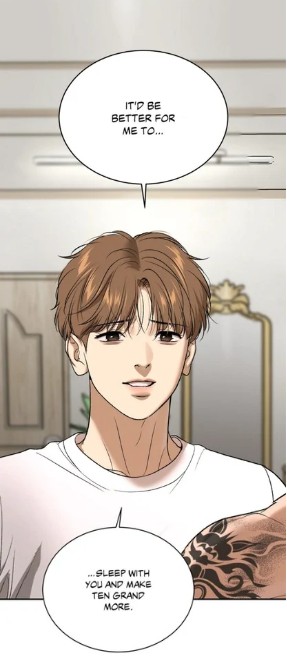 (chapter 62), he did so for the sake of debts, not for himself.
  (chapter 64) The recent death of the puppy serves as a stark reminder
  (chapter 59) that he is not exempt from time’s reach, that he too is aging and vulnerable. But the doctor failed to recognize this warning. He only viewed it as a sign of his own powerlessness, reducing it from his own perception. He overlooked the fragility of life as such.
  (chapter 35), he created an illusion of freedom that only masked his deeper confinement—his glass prison. When Kim Dan closed the door and left
 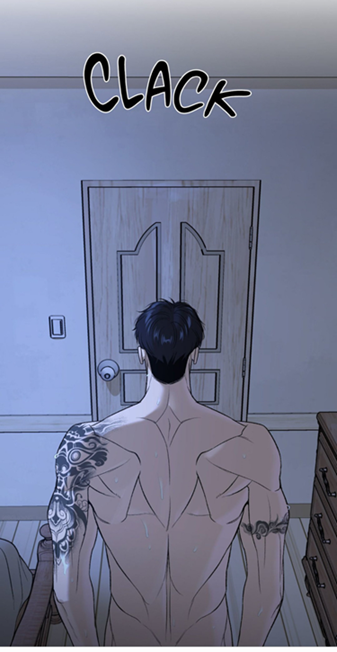 (chapter 64), the illusion shattered, revealing the reality of his loneliness. The jinx,
  (chapter 55) once confined to the bedroom, now permeates his entire life, binding him to a past shaped by his abuser’s cruel words.
 (chapter 55) The view created an illusion of openness and freedom, masking the reality of his confinement. Glass, by its very nature, is transparent—a barrier that is invisible yet unbreakable, creating a false sense of freedom. The window’s clarity hid the fact that it was, in truth, an impassable wall that confined him, turning the promise of escape into a cruel irony. By focusing on the horizon, he could avoid looking inward, denying the unresolved trauma left by his anonymous abuser.
  (chapter 54) The ghost’s words, ‘
 (chapter 54) were designed to create the illusion of eternity—as if time itself was under the phantom’s control. This assertion not only sought to freeze Joo Jaekyung in a perpetual state of inadequacy but also to distort his perception of change as impossible. Trapped in a cycle of hatred and self-loathing, the athlete’s vision of freedom was limited to the false infinity of the horizon.
 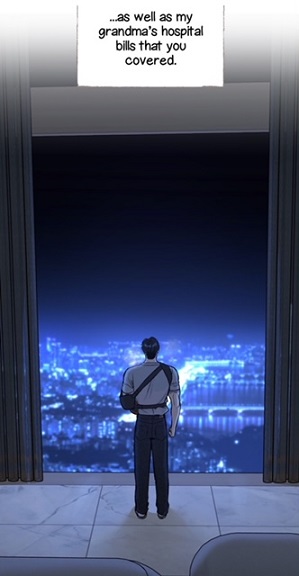 (chapter 53) And now, you comprehend why the champion chose not to look for Kim Dan after his departure. He was so close to the window, making him think that he had a “choice”. That’s how I realized that the closer he would stand to the window, the less he would get Enlightenment. Hence he is portrayed eyeless here.
  (chapter 53) Ironically, the window—symbol of escape—became his glass prison, a barrier that reflected the endlessness of his struggle rather than a path to liberation.
 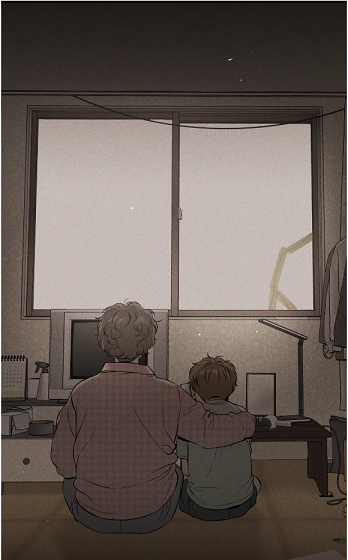 (chapter 19) —a window that offered no view of the outside world. This reflected his entrapment in a life defined by guilt and sacrifice, unable to envision a future beyond repaying debts and fulfilling duties. The window’s visible cracks and makeshift repairs represent not only the physical deterioration of their environment but also the psychological fragmentation within Kim Dan himself. By choosing to patch the window rather than replace it, Shin Okja’s actions reflect a mentality of denial and resignation—an unwillingness to confront the full extent of their impoverishment and suffering.
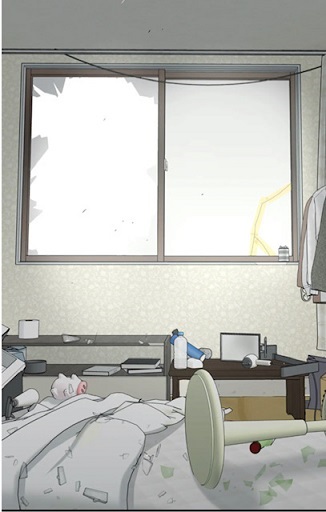 (chapter 19) suggests a deeper symbolic resistance to change or moving forward. In a sense, the grandmother’s decision to live with the broken window mirrors her acceptance of a life defined by limitations and unspoken grief.
 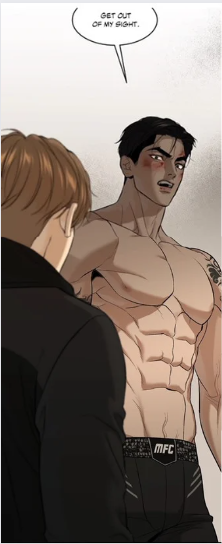 (chapter 51) served as the key that triggered Kim Dan’s abandonment trauma. How so? While “get out of my sight” implied that Kim Dan should leave him, the reality is that the champion left the locker room first.
 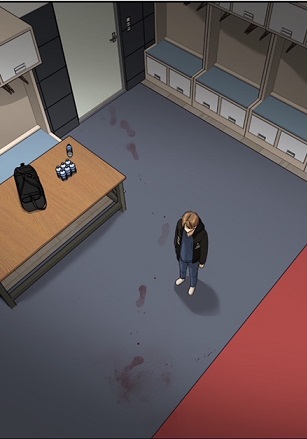 (chapter 51) Observe how the “hamster” is once again turning his back to the door. However, the bloody footprints became an evidence for Kim Dan that he had been abandoned and left behind. And now, you comprehend why the main lead took the athlete’s request seriously and literally. It is because the door in the past was the symbol of betrayal and abandonment. This explicates why he is so sensitive to the sound of a closing door and could recognize it, even if his ears and eyes were covered.
 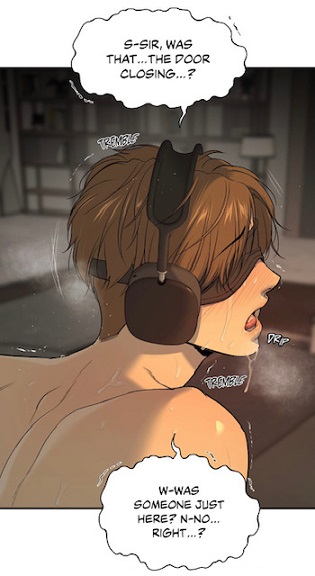 (chapter 35)
 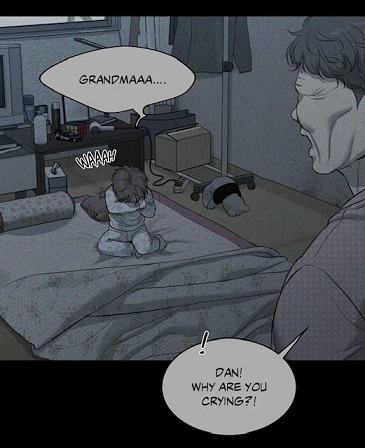 (chapter 21) Consequently, I interpret the following scene like this:
  (chapter 19) When he was standing here, he must have sensed it as a betrayal against his own grandmother. Hence he employed the expression “goodbye” and not “farewell” to diminish his guilt. No wonder why he chose to hide his move from his relative and bring the Wedding Cabinet to the penthouse. Under this new perspective, my avid readers can grasp why Kim Dan’s nightmares in season 2 were linked to the opened door:
  (chapter 57) His unconscious was telling him this: Shin Okja had broken her promise. She was about to abandon him. He had the impression that he was reliving the past. That’s the reason why he was scared and suffering.
 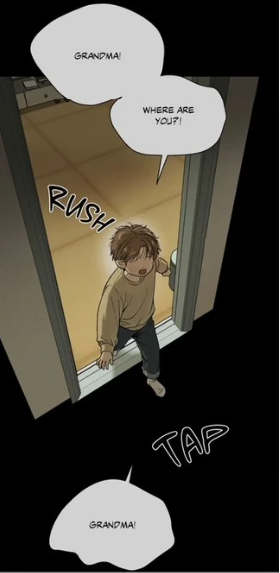 (chapter 57) In addition, I believe that his unconscious was pushing him to come clean with the past, to reveal the changes in his life. It was impossible for both of them to keep such unreal promises.
  (chapter 11)
 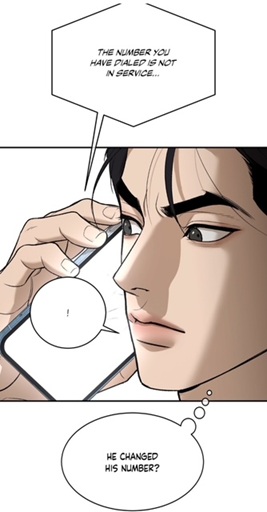 (chapter 56) revealed the existence of a past trauma. It highlighted his own fear of abandonment and rejection—an emotion he had long denied. The door, a supposed barrier against the outside world, now stood as a reminder of all he had pushed away, including his own need for connection. Therefore he never left his door open in the penthouse:
 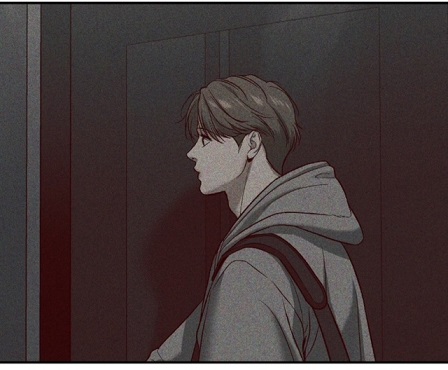 (chapter 55) That’s why I perceive this scene as an important step for Kim Dan himself:
  (chapter 64) By opening and closing the door, he is overcoming his abandonment issues. He becomes the ruler of his own life (time and relationship). He is freeing himself from the mental torment which readers could witness in earlier episodes.
  (chapter 24) The physical therapist has kept his past trauma a secret. And what is the synonym for “secret”? Key! So when the main lead leaves the champion behind
  (chapter 24), yet the latter didn’t get fooled at all. He found out the true nature of their relationship.
  (chapter 19) the Wedding Cabinet in Kim Dan’s home functioned both as a mirror and a false window, preserving an illusion of timelessness.
  (chapter 19) Unlike the rest of the dilapidated house
  (chapter 10), the cabinet remained pristine, suggesting a futile attempt to halt the passage of time and maintain the status quo.
  (chapter 53) By throwing it away, Kim Dan unknowingly released time from its prison, breaking the spell that his grandmother’s control had cast over him. This act was not just a rejection of his past but an unconscious acknowledgment that time was moving forward—that he could no longer live as if he were already dead. Simultaneously, this gesture symbolizes his separation from his grandmother, breaking the illusion of perpetuity that she maintained. So while he might have been by her side physically
 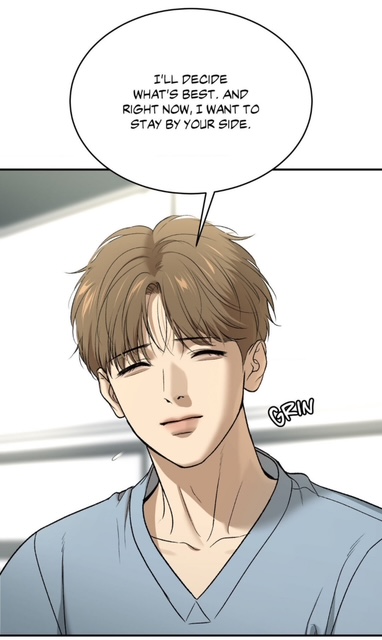 (chapter 57) On the one hand, it shows that he was maturing, on the other hand as a young adult, it is clear that he is destined to make mistakes. He has always defined himself as the caregiver, but he forgot his own true nature: he is a human before anything else. And what is the definition of humanity? I would say, the capacity of benevolence and the inevitability of mistakes. It reflects the dual nature of human existence—the potential for compassion, kindness, and altruism on one side, and the propensity for mistakes, weaknesses, and moral failings on the other. And that’s exactly what the doctor has been mirroring to the champion in the lavender-tinted bedroom:
  (chapter 64) Joo Jaekyung was in his eyes a human, and not a champion. The irony is that with this idiom “always”, he is implying that he had hopes and expectations. The athlete would change and treat him better. Since the doctor has always been the embodiment of “selflessness”, the gods made sure to remind him of his own true nature: “mistakes”. That’s why he is often making blunders
  (chapter 1) to the point that I called him “Mister Mistake”.
 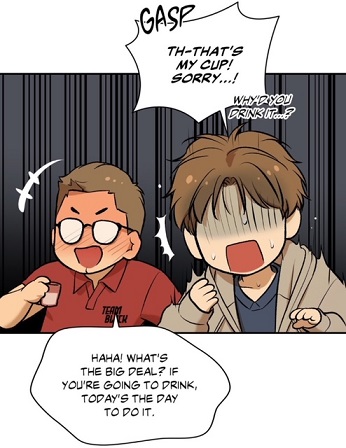 (chapter 43) On the other hand, his missteps are there to teach the fighter to drop his perfectionism and to bring the notion of entertainment in his fated partner’s life. Kim Dan is funny in his own way.
  (chapter 64) He doesn’t respect humans in general. The irony is that by criticizing Joo Jaekyung, the doctor is overlooking his own nature. He is also a sinner.
 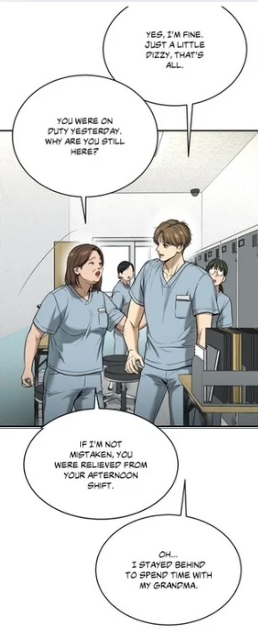 (chapter 57) Is it a coincidence that the doctor’s cold attitude takes place in chapter 60 -64?
 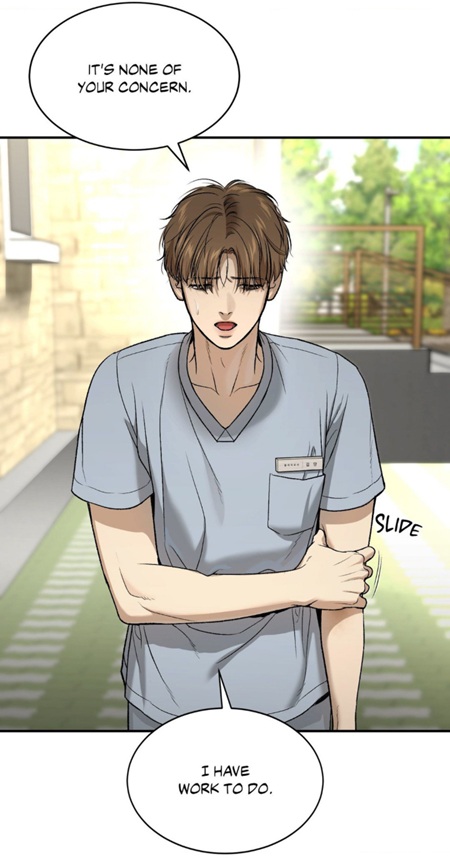 (chapter 61) No, as the number 6 sounds similar to sex. Moreover, don’t forget that Satan’s number is strongly associated with 6 (666 or 616). From my point of view, the “hamster” is on his way to become an adult and as such a sinner as well. The physical therapist’s stubbornness reminded me of the behavior of a teenager who believes to know everything about life, while in verity, such people lack experiences. And what did the nurse say about the main lead?
 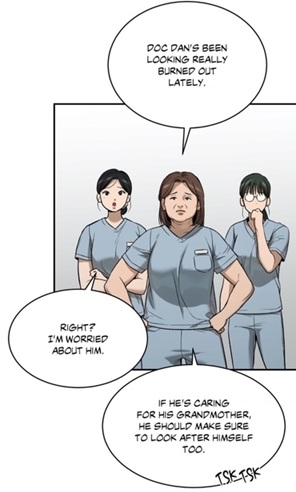 (chapter 57) He should nurse himself for his halmoni’s sake so that the latter wouldn’t worry. From my point of view, if doc Dan gets sick, he could be the catalysator for her deteriorating health. But now, it is time to return our attention to the “champion”.
 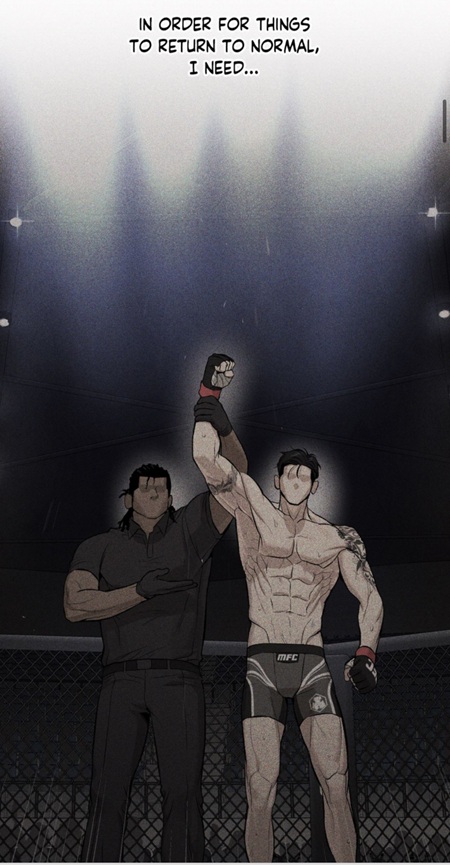 (chapter 61) But why did he want to return to the past? It is because of the ghost’s criticism
 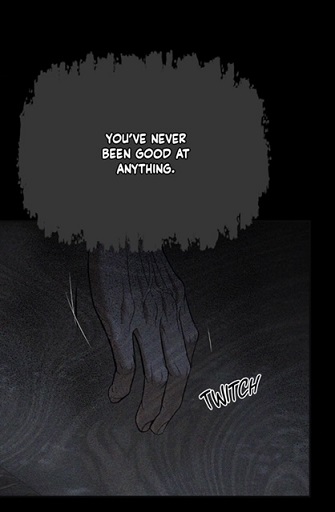 (chapter 54) ‘You’ve never been good at anything’ were designed to freeze Joo Jaekyung in time, trapping him in a mental prison where change was impossible. I would even add, the mysterious person gave a negative connotation to “change”. On the one hand, the champion was pushed to prove the tormentor’s statement wrong, on the other hand, this implied that one “loss” would be perceived as a validation of the ghost’s claim. This signifies that his obsession with maintaining his title stemmed not from pride but from a desperate need to refute the man’s statement. We could say that the fighter fought not out of fun, but out of hatred and fears.
  (chapter 29) That’s why he was on survival modus and could never refuse any challenge. By associating sex with endurance and control
 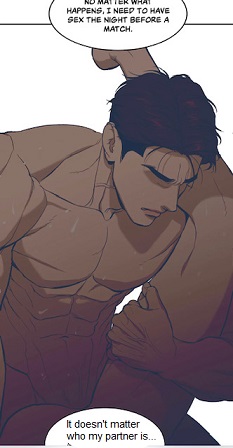 (chapter 2), he replicated the sports-like expectations imposed by his abuser—likely someone from the medical or sports world who viewed him not as a human but as an asset. This means that despite the distance, this invisible abuser was still ruling over the athlete’s life exposing the falsehood of his belief: self-reliance. He was still acting as a helpless person. Under this new light, it becomes comprehensible why Joo Jaekyung had to leave the penthouse with its huge windows. By leaving this place behind, he was actually moving away from the abuser’s claws, similar to the doctor’s move in episode 19.
 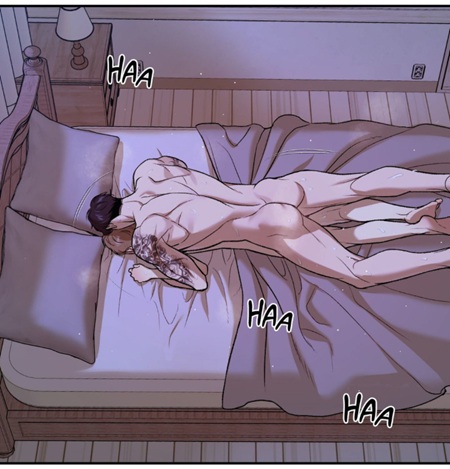 (chapter 64)
 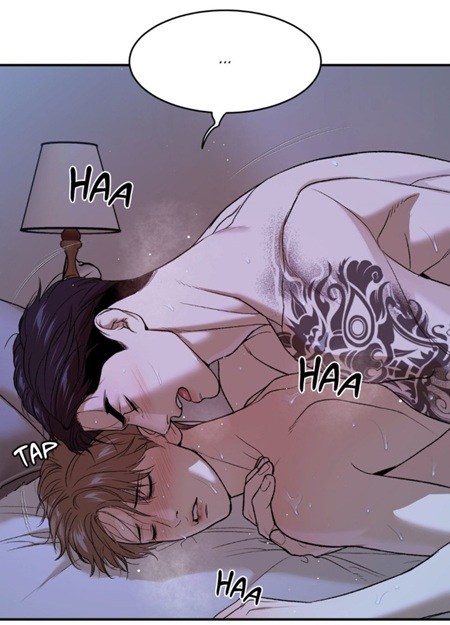 (chapter 64) That’s why the door
  (chapter 64) Hence the author focused on his wide opened gaze. Kim Dan’s intervention was painful but necessary, because through this reflection, the athlete’s motivation to fight is bound to change. In the future, the fight won’t be deadly serious like before, he won’t act like a tyrant in the ring where he couldn’t control his rage.
 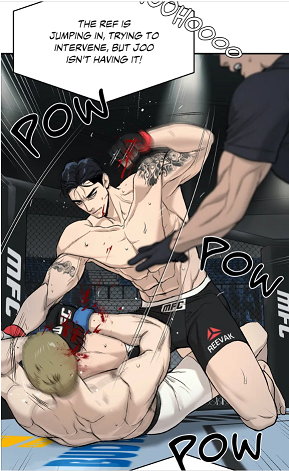 (chapter 1) He will see his opponent as an artist too.
 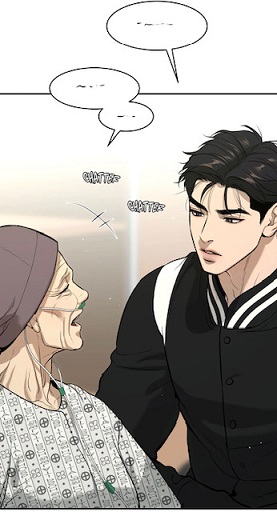 (chapter 21) with her, because he felt treasured.
  (chapter 61)
  (chapter 63) —no matter how reluctantly—represents the second turn. With the doctor’s cold rejection, he is forced to choose: What does he want in life? Only the champion title or something else?
 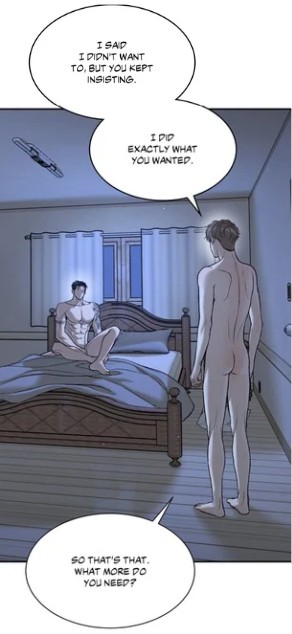 (chapter 64)
 Hence the latter will become his hyung. For me, there’s no doubt that through this confrontation, the athlete’s respect for Kim Dan can only increase.
  (chapter 27), and he noticed the quietness of the ocean
  (chapter 59) But this time, that would be a conscious choice. That’s how he will reconnect with his true self for good. But strangely, I am expecting that he won’t be on his own. I am quite certain that this man will make a similar experience than the grandmother:
 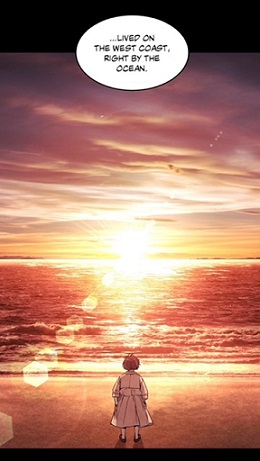 (chapter 53) However, from my point of view, Joo Jaekyung should witness the sunrise and not sunset… which would announce his rebirth. There was only one sunset in season 1, which was linked to Shin Okja’s mortality:
 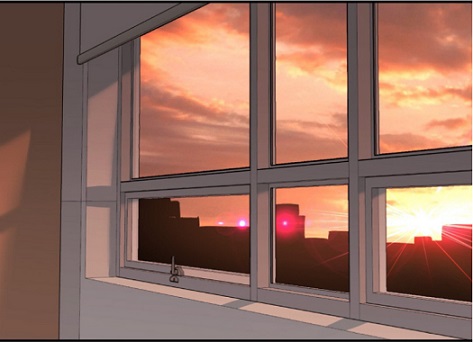 (chapter 47). Moreover, in season 1 and 2, the doctor was often connected to the sunset:
 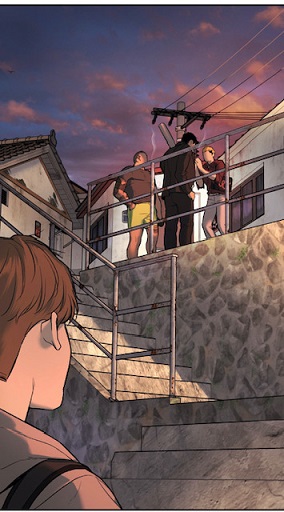 (chapter 1)
 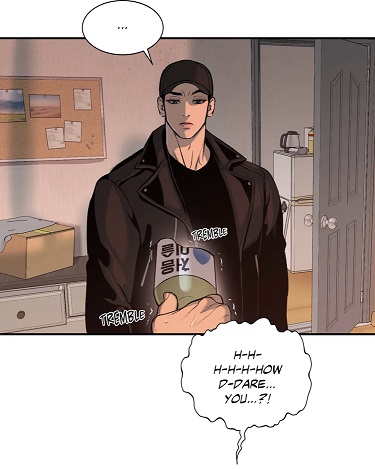 (chapter 17) And we had the beach here in the background.
 (chapter 48) This was an ominous sign for the champion’s symbolic “death” and rebirth. Sun and moon are natural tools to determine the flow of time.


 (chapter 62), as his actions increasingly reflect a willingness to embrace his own fragility and build meaningful ties with those around him. Through his growing interactions with others and his immersion in the rhythms of town life, the champion begins to redefine his sense of identity and purpose, moving beyond dominance to discover the power of connection. From a man defined by strength, dominance, and transactional relationships
  (chapter 62)
 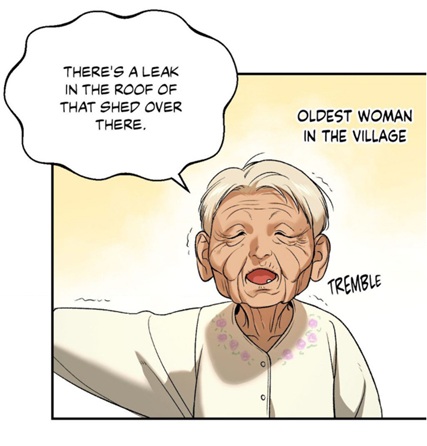 (chapter 62) and, more importantly, to himself.
 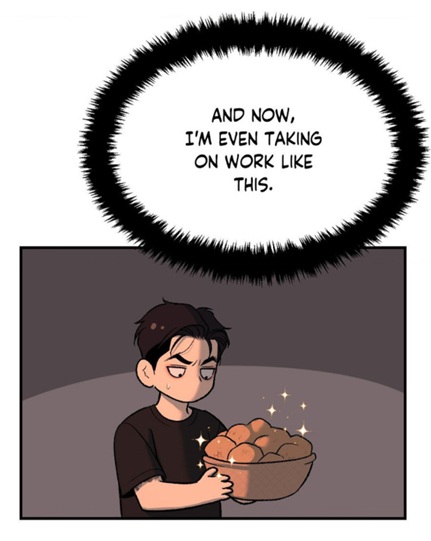 (chapter 62) Thus in this essay I will explore the symbolic meaning behind his actions in the town, the interplay of nature and community in his transformation, and how these moments reflect his internal growth. The analysis begins with his transformative experience in the ocean during his rescue of Kim Dan
  (chapter 60), followed by his newfound attentiveness to his surroundings—jogging in silence and responding to the natural rhythms of life.
  (chapter 62) and community service. His gradual acceptance of simplicity, represented by his clothing and the symbolism of cucumbers and potatoes, signals his reconnection to nature and humanity.
  (chapter 62)
 (chapter 60) In many ways, this moment functions as a symbolic baptism, reflecting a deeper narrative of renewal and change. In Chapter 28, Kim Dan’s immersion in water during a pool scene
  (chapter 28) was symbolic of his acceptance of intimacy, reshaping his view of sex from something “filthy”
 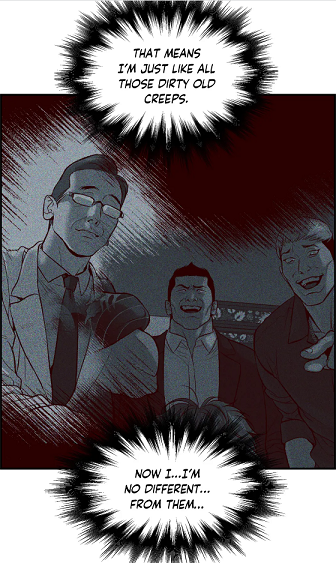 (chapter 20) into something natural and human.
 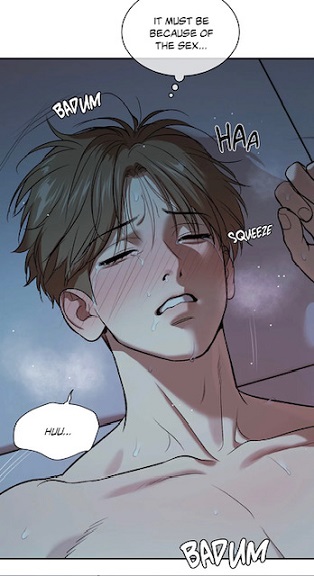 (chapter 29) Similarly, Joo Jaekyung’s dive into the ocean can be interpreted as his baptism into a new “religion”: love and vulnerability.
 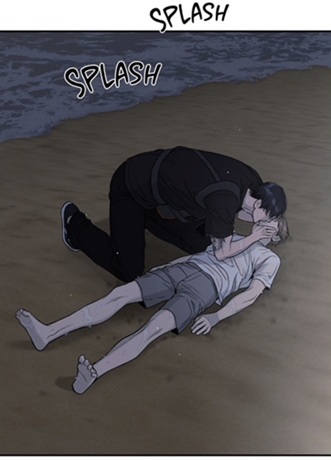 (chapter 60) His gesture is not just about saving his loved one, but also showing care to humans in general. He can no longer be indifferent to someone in pain or in danger.
 (chapter 62) He might complain, but in the end he accepts the presents. This change is reinforced by his willingness to accept gratitude in the form of vegetables and food rather than monetary gain, showing a newfound appreciation for simple, heartfelt exchanges over transactional relationships.
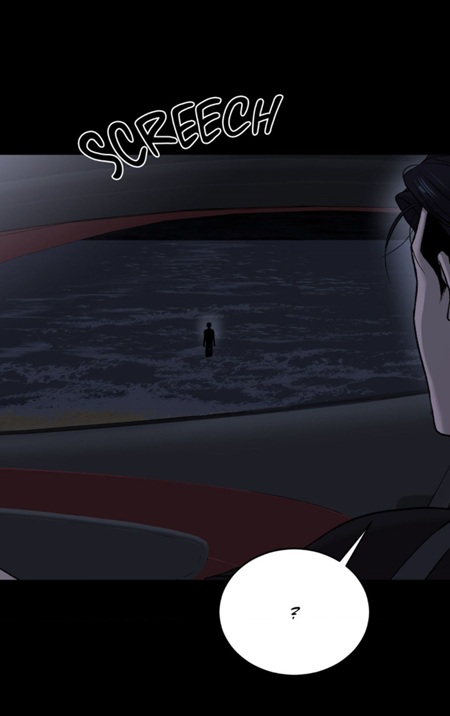 (chapter 60), not the natural world around him. The rescue planted a subconscious seed, setting the stage for his later behavior. When Kim Dan denies his assistance in Episode 60
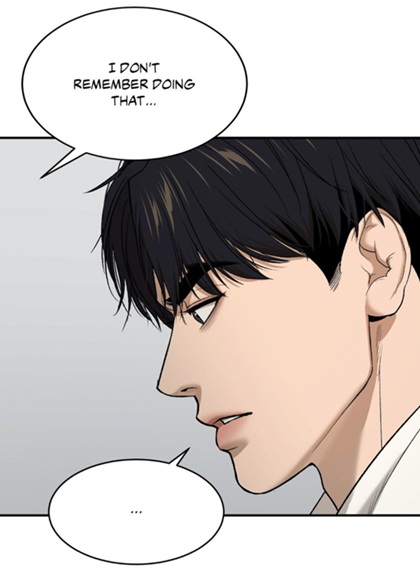 (chapter 60), it’s as if the doctor erases that defining moment, refusing to acknowledge the champion’s care. Yet Joo Jaekyung does not react with anger or frustration. Instead, he takes the doctor’s rejection as challenge.
 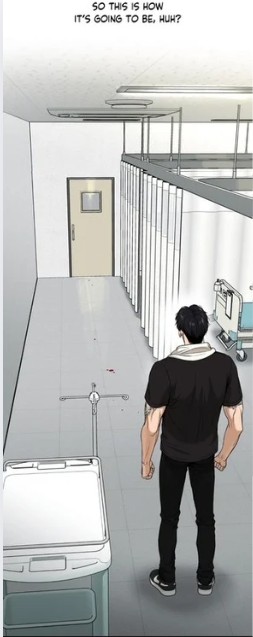 (chapter 60) However, contrary to the past, money and influence seems to have no impact on the physical therapist’s mind and heart. He is keeping the athlete at arms-length.
 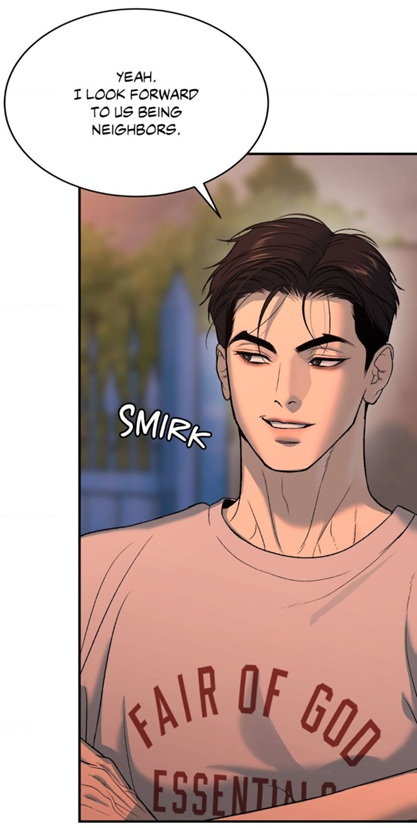 (chapter 61), he begins to demonstrate his growth through quiet, consistent actions—helping others without expecting gratitude in return.
 (chapter 62) For the first time, he is not merely running for fitness or competition; he is paying attention to his surroundings.
  (chapter 62), and the natural rhythm of life around him.
  (chapter 62) Running along the ocean, a setting that profoundly influences his state of mind, Joo Jaekyung demonstrates a newfound openness.
  (chapter 62) This moment underscores his growing ability to connect with others sincerely, without suspicion or defensiveness. His willingness to engage reflects a broader transformation—one that prioritizes meaningful connections over dominance or transactional relationships. This newfound awareness signifies a major shift in his character. His senses are becoming attuned to the world beyond himself, and he is learning to differentiate between what truly matters and what does not.
  (chapter 10) At that time, his perception was clouded by indifference and a focus on material circumstances. Now, however, his response to the elderly woman’s request reflects empathy and an awareness of human vulnerability.
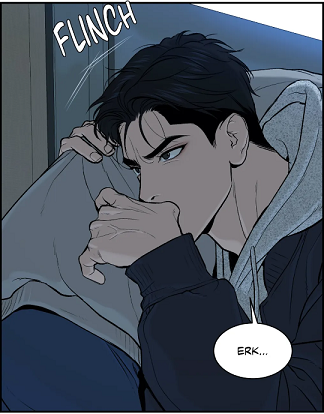 (chapter 10), evoking a sense of cold detachment and judgment. In contrast, the moment where Joo Jaekyung is asked to repair the roof is bathed in daylight
 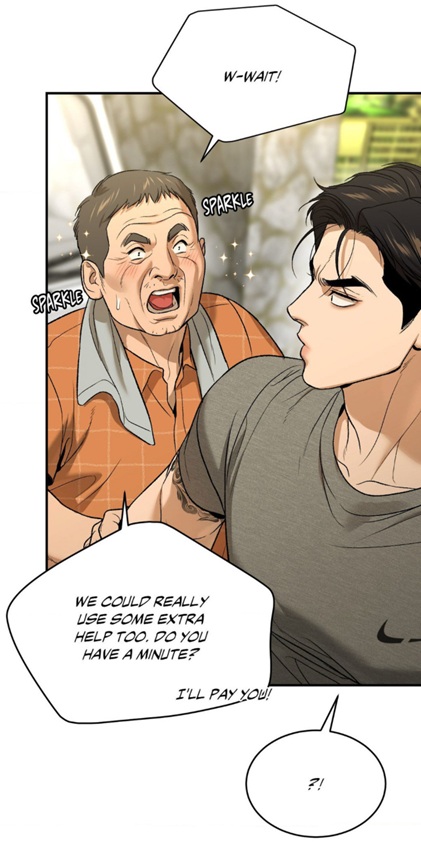 (chapter 62) Thus I deduce that he never accepted any kind of compensation in the end. But none of the inhabitants could accept such a generosity, therefore they brought vegetables or dishes. Unlike his previous life, defined by detachment and impermanence, these acts of community-oriented labor mark a significant shift in how he values his strength—not as a tool for control
  (chapter 62), but as a way to support and uplift others. The admiration from the inhabitants is genuine
 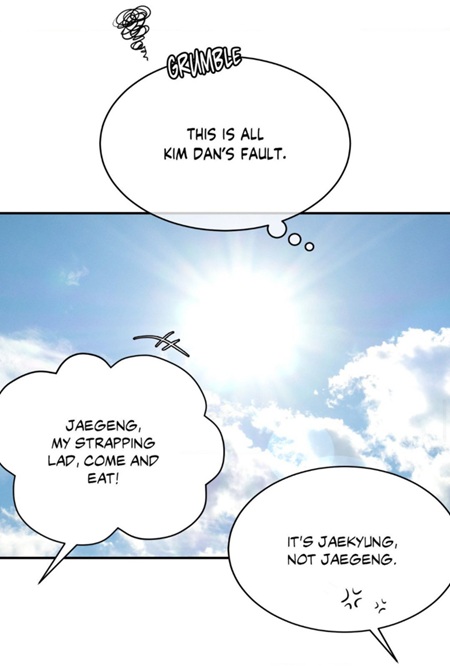 (chapter 62) One might think, he is doing all of this against his will and heart. In my opinion, it is related to his past behavior:
 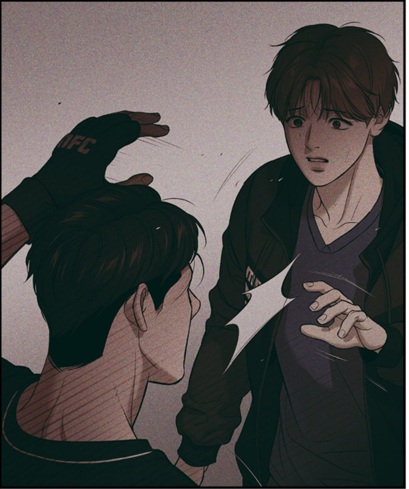 (chapter 62) The champion feels really bad for his rejection after the incident with the spray. And since he believes that Kim Dan comes from that town, he thinks that he can redeem himself by helping his “community”.
 (chapter 47), she rarely prioritized Kim Dan’s nourishment. The grandmother’s actions were driven by financial survival. Joo Jaekyung, on the other hand, receives food as a form of gratitude and recognizes the significance of nourishment beyond monetary gain.
  (chapter 58) with the reality of his evolving personality and his behavior toward others. Choi Heesung’s dismissive remark that Joo Jaekyung would “flip his shit” if he knew the living conditions of Kim Dan implies a static, unchanging view of the champion, one that aligns with a superficial understanding of him as merely ruthless and violent. However, this chapter reveals the fallacy in such an interpretation, exposing the actor’s arrogance and lack of true insight into Joo Jaekyung’s character.
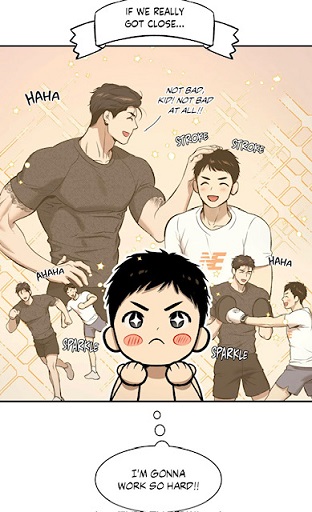 (chapter 23), they could have succeeded. Potato, the youngest member of the team, embodies this missed opportunity.
  (chapter 9) His nickname, “Potato,” while intended as lighthearted and affectionate, is something he despises because he perceives it as demeaning. Yet the reality is quite the opposite—nicknames like these often carry affection and camaraderie. Yet he rejects it out of insecurity or an internalized belief in its inferiority.
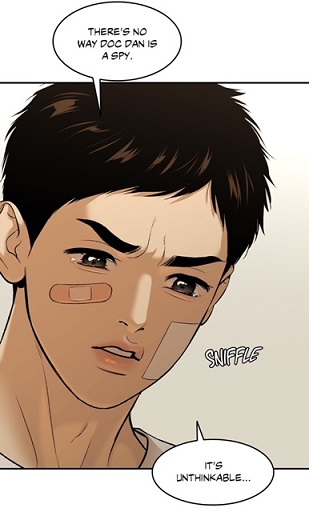 (chapter 52) reveal a missed opportunity for bonding. The champion, who is evolving into a more open and empathetic individual, might have been an unexpected source of support and connection had Potato not listen to others and chosen to embrace this chance instead of harboring negative assumptions.
 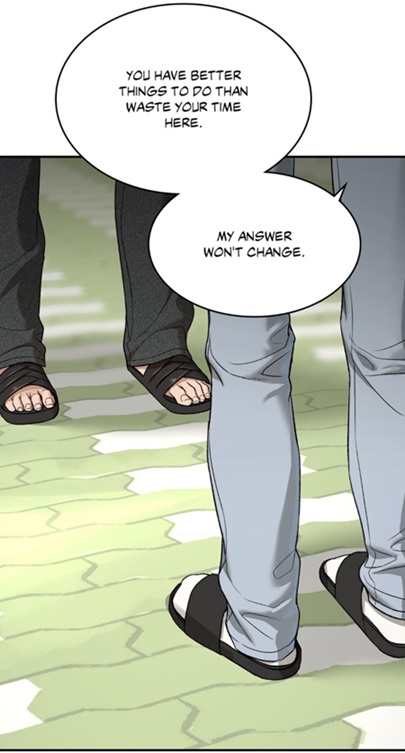 (chapter 62) , while he had put on his expensive jeans and CK tee-shirt.
  (chapter 62). This stands in opposition to the previous scene in front of the hospice:
  (chapter 61) The focus on Joo Jaekyung’s feet
 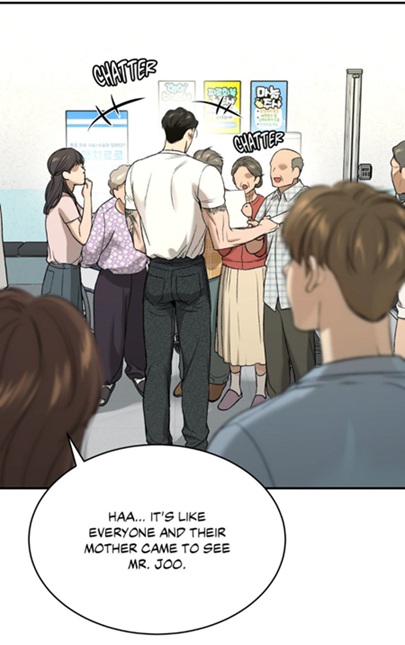 (chapter 62) The hospital or Kim Dan’s presence may provide him with a sense of stability and calmness, allowing him to adopt a more casual and relaxed appearance. Additionally, the contrast between his expensive jeans and branded t-shirt and his unassuming sandals reveals a division between his public image and private self. While his clothing aligns with his status as a wealthy and successful individual, the casual footwear hints at a simpler, more authentic side of him that is emerging in this setting. It reflects his willingness to shed some of the societal expectations tied to his identity.
 (chapter 62) Feet often represent movement or progress, and wearing casual footwear like sandals might signify that he is in a state of personal transformation. The lack of socks further emphasizes this shedding of layers—he is slowly allowing himself to be more vulnerable and introspective, stepping away from his usual, controlled persona. Finally, sandals reflect his connection to the environment. His footwear choice underscores that the hospital is a place where he feels secure and unthreatened. The focus on his feet could symbolize his groundedness in the moment, highlighting that this environment allows him to pause and reflect, rather than act or defend.
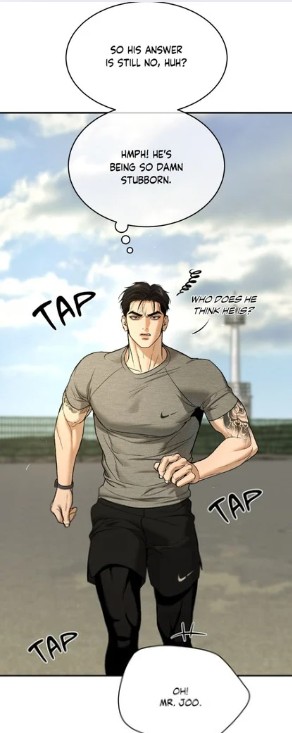 (chapter 62), he is immediately approached by the town chief.
  (chapter 42), where appearances and dominance once took precedence over community and connection.
  (chapter 02) The penthouse, perched high above the city, served as a symbol of isolation and self-reliance—an ivory tower of sorts, detached from the world below. In contrast, the town’s hostel
 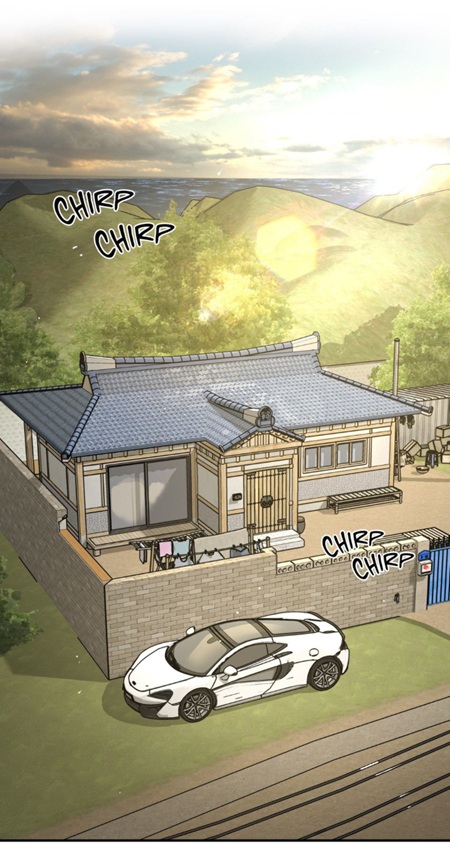 (chapter 62) reflects shared experiences and human connection, embodying a shift toward groundedness and humility.
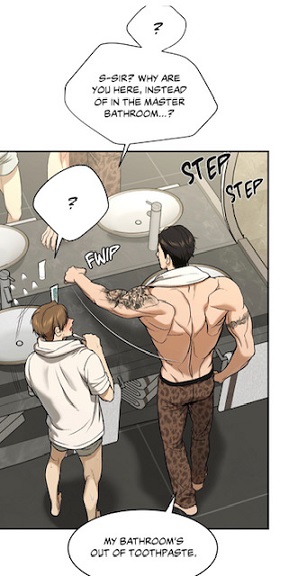 (chapter 30) This evolution from animalistic aggression
  (chapter 30) to floral gentleness mirrors his inner journey—from a man who thrived on dominance to one who values connection and vulnerability. By choosing practicality over intimidation, he signals a readiness to embrace his humanity and shed the pretensions of his past. Moreover, the hat has here a different function: it serves as a real protection from the sun, hence his neck is covered.
 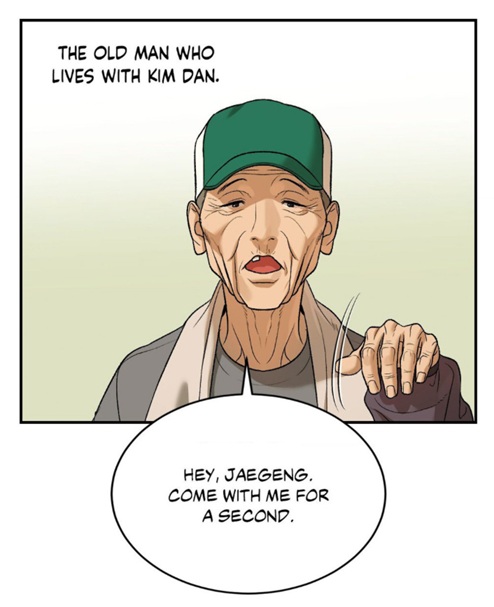 (chapter 62) “Jaegeng.” While this may initially appear as a simple mistake due to the landlord’s poor hearing, it holds deeper symbolic weight. This renaming can be interpreted as part of Joo Jaekyung’s rebirth in the town—a reflection of his evolving identity.
 (chapter 52), spoiled rich brat:
  (chapter 7) Yet here, in the quiet simplicity of the town, he is seen not for his image but for his actions. The landlord’s care and warmth
  (chapter 54) Like mentioned above, his stay in this little town is teaching him to become immune to manipulations in the end. His self-esteem is getting boosted, hence he doesn’t mind being called “Jaegeng”.
 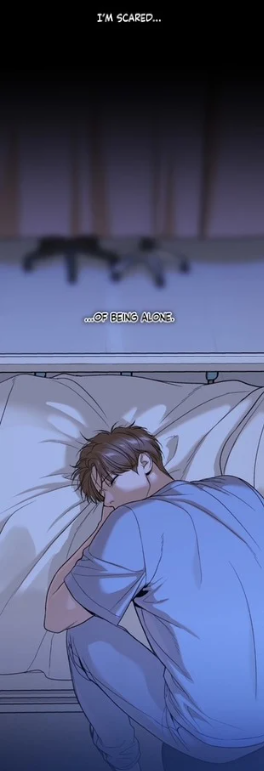 (chapter 56) that has continually rejected him (parents, students, hospital; Team Black), Joo Jaekyung is learning how to stop running—physically and emotionally—and to establish a sense of permanence for the first time in his life.
 (chapter 62) So far, the champion has not paid attention to Boksoon. He has not even looked at her, because his eyes are always directed at Kim Dan:
 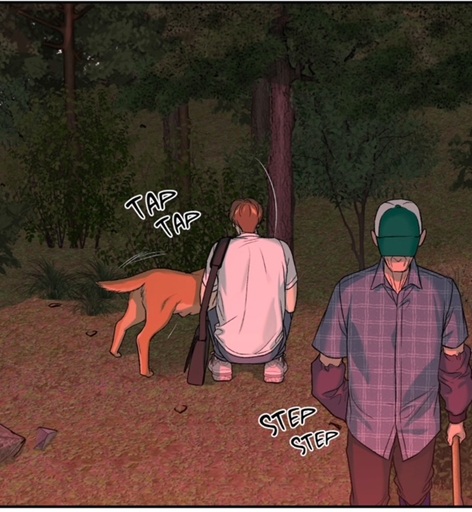 (chapter 59) Hence I have the impression, she could be the one leading him there, if not Kim Dan. Let’s not forget that the doctor’s deepest wish is to go on a walk through the woods:
 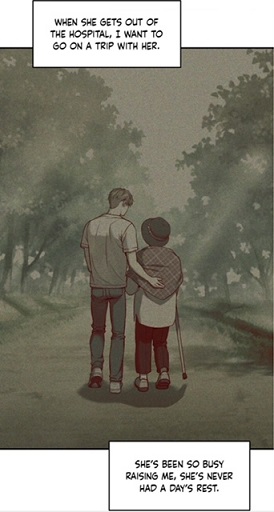 (chapter 47) Another interesting aspect is that the trip to the forest is connected to rest in the physical therapist’s mind. Striking is that though the champion helped the community, he still worked. So technically, he has never had a day’s rest either. But this is what he said to the landlord:
 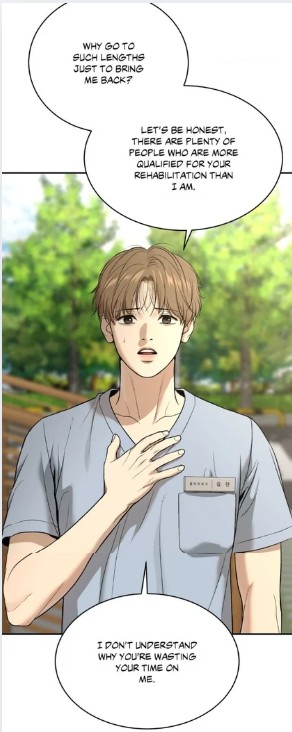 (chapter 62) Ultimately, Joo Jaekyung’s journey is not just one of self-improvement but a quiet challenge to societal values. True strength is not about control, but about the ability to grow, connect, and embrace change. Blooming muscles signifies not just physical power, but a strength nourished by care, community, and the courage to evolve. Finally, I would like my readers to pay attention to the sky, when the champion approached his fated lover:
 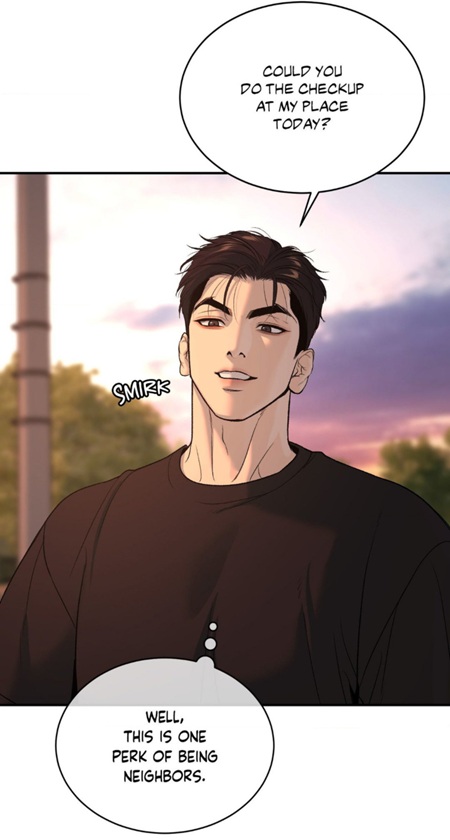 (chapter 62) It was a mixture of white, purple, pink and orange, a sign that not only the champion’s life has become more colorful, but also the night stands under the sign of love, enlightenment and life. At the same time, it reminded me of the night when the puppy was buried:
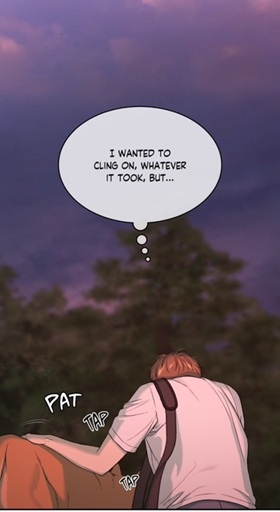 (chapter 59) Thus I am expecting another huge transformation in the next episode.

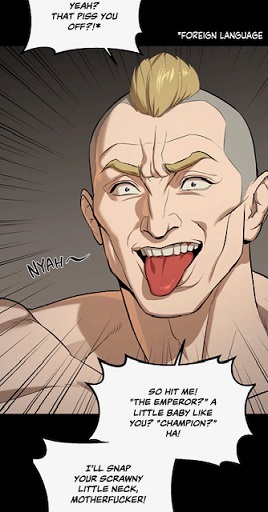 (chapter 14) which visibly destabilized the champion. Then in chapter 49, Team Black failed to perceive the duality of appearances and reality:
  (chapter 49) the surface shows two athletes seemingly engaged in a normal, even friendly interaction – they are shaking hands -, while the panels reveal a darker undercurrent of verbal harassment and manipulation.
  (Chapter 49)
  (chapter 61), while Joo Jaekyung represses his emotions and thoughts through “physical activities”.
 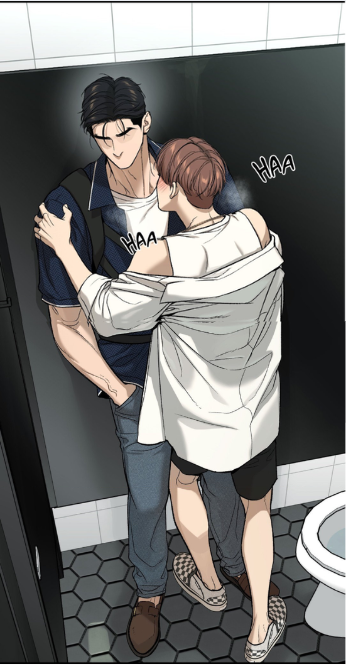 (chapter 55) This essay will explore how their experiences in the restroom space serve as a mirror to their past and reveal the psychological scars that shape their behaviors.
 (chapter 14)
  (chapter 38)
 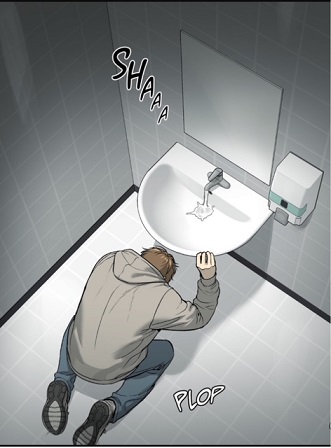 (chapter 47) However, in Season 2, the lavatory appears isolated for the first time, reinforcing a shift in symbolic meaning. This distinction helps to explain why restrooms (toilets/water closets) hold different meanings for the two protagonists. [for more read
  (chapter 19) —a space where one is free to confront their inner selves without external pressures. In Jinx, the use of the restroom emphasizes the external pressures and the characters’ reactions to their environments, reinforcing their struggles with exposure and control. But how did I come to this realization?
 (chapter 34), vulnerabilities are exposed, and participants are pushed to their limits. In the essay
  (chapter 33) This would explain why Heesung was determined to hide the physical therapist’s whereabouts.
  (chapter 58) He saw in him a bully and even a stalker. His judgment was based on these two incidents:
  (chapter 58) He imagined that Kim Dan had been coerced to it, while the physical therapist always had the choice to refuse. Joo Jaekyung would never hurt the doctor.
  (chapter 59) The imminent death of his grandmother triggered his repressed fears.
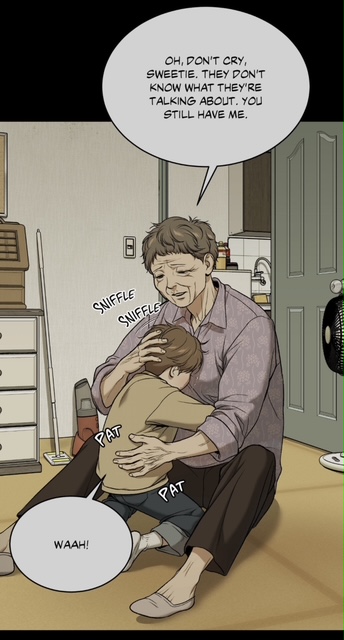 (chapter 57) Without her, he is now left with no protection. Stalking, in contrast, occurs later in life but evokes the same psychological distress—trapping victims in a cycle of hyper-awareness, helplessness, and anxiety. What makes stalking even more insidious is that it often mimics past experiences of bullying, dragging the victim back into a state of learned helplessness.
 (chapter 61), reacts with pursuit. His behavior mirrors the tendencies of a stalker—not out of malice, but because his entire life was shaped by the belief that to be ignored is to be erased and forgotten.
 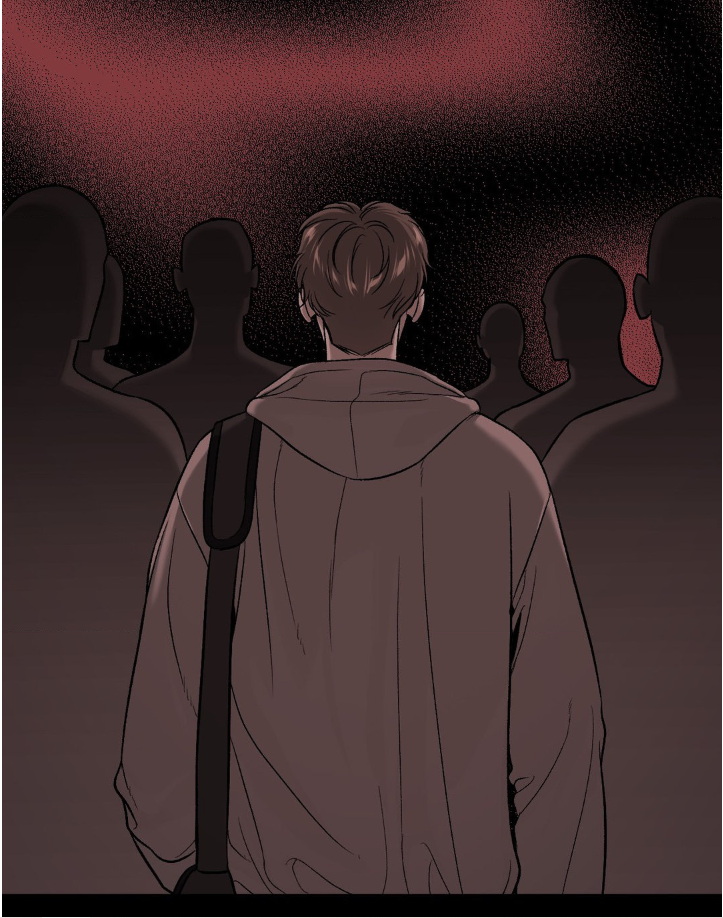 (chapter 55) In childhood, he learned that only strength could secure attention
  (chapter 26)
  (chapter 61) Deep down, he wants to be part of his life. Hence he moves next to Kim Dan’s house as his final attempt.
  (chapter 57) and cornered, leading him to associate confined spaces with protection. The restroom was his only escape from ridicule, his sanctuary where he could momentarily regain control. This explains why he went crying there, when he heard the terrible news about his grandmother.
  (chapter 61) Since he can not escape the champion, he decides to ignore him.
  (chapter 55) – the mirror is very low -, Kim Dan retreats into memories to rationalize his pain. Instead of processing his suffering, he shifts blame to Jaekyung, using the restroom space to wall himself off emotionally. The restroom in Jinx thus acts as a metaphor for entrapment—whether through self-isolation or forced exposure, neither character is truly free from their past.
  (chapter 38) So he could faint there or hurt himself and he would have no one by his side. Don’t forget that this place stands for seclusion and privacy.
  (chapter 57), it is clear that the kids were not thinking of sex or using the restroom to assault the little boy. However, we should question ourselves how this rumor about Kim Dan being an orphan started.
  (chapter 54) bears a striking resemblance to this boy, leading to the possibility that this new character could be Kim Dan’s childhood bully. Given Jinx’s themes of positive psychology and confronting past demons, it is plausible that Kim Dan will encounter this schoolmate again. Such an interaction could force Kim Dan to address his unresolved trauma and reexamine his perceptions of strength and vulnerability. Moreover, don’t forget that the doctor in green saw the champion in a terrible shape who had admitted that he had drunk the night before.
  (chapter 54) And in episode 61, the main lead announced to Park Namwook that he had to fire the physical therapist.
  (chapter 61) I sense some retaliation here.
  (chapter 08) It is because in his mind, this place is associated with toilets in general. That’s how it dawned on me that the athlete could have been harassed at school, but contrary to the physical therapist, it took place later. The leader was Baek Junmin who hid behind the “mob”.
 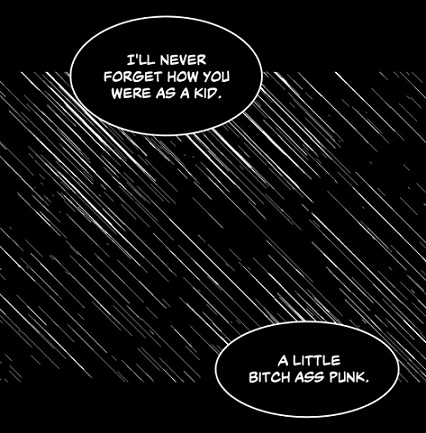 (chapter 49) Because he utilized the expression “how you were as a kid”, it signifies that the MMA fighter was not only older, but also an adult, whereas the champion must have been a teenager. And now, you comprehend why Baek Junmin acted like a friendly athlete in front of the public:
 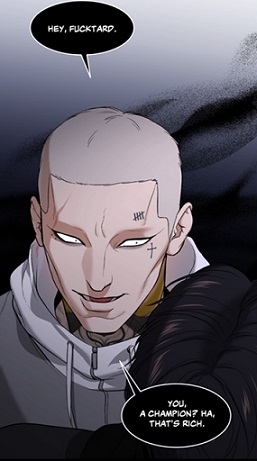 (chapter 49) People could discern his true personality: he was nothing more than a thug. Moreover, he would be perceived as a cheater, because he used others and his seniority to torment a child or teenager. At the same time, since Joo Jaekyung became a victim of bully later, the content about the mobbing should have been different. I am suspecting that he could have been targeted because of his homosexuality.
  (Chapter 14)
  (chapter 55), he showed no reaction. In fact, his headache got even worse than before.
  (chapter 55) The champion’s passivity and migraine could be the symptoms of the athlete’s past suffering. His pain worsened in that place because of the past, but he didn’t realize it, for he was so focused on his soulmate. Secondly, the moment he was about to get kissed
  (chapter 55), he pushed the uke away and left the place
 (chapter 55).In this place, he could show vulnerability, yet he experienced that nothing bad happened to him. This explicates why after this experience is willing to remember and even reconnect with the doctor.
  (chapter 61) In my opinion, the departure of Kim Dan forced the champion to be confronted with his repressed past.
 (chapter 54) While he calls his former rival and tormentor’s name and recollects his beating, he is not plagued with a migraine. This means that the real cause for Joo Jaekyung’s suffering (his headache linked to his repressed memories) is triggered by the attitude of his guardian. That’s the reason why he had a nightmare with the ghost of the past.
  (Chapter 54) There is no ambiguity that Randy Booker‘s insults had triggered the athlete‘s repressed memories and fears. Joo Jaekyung’s avoidance of mirrors suggests a fear of self-recognition—an unwillingness to face the vulnerability he tries so hard to suppress. His reaction mirrors the response of someone who has internalized a rigid sense of masculinity, where showing emotion is equated with weakness. The restroom, then, becomes a battleground where he unconsciously fights his past conditioning, yet he is unable to overcome it.

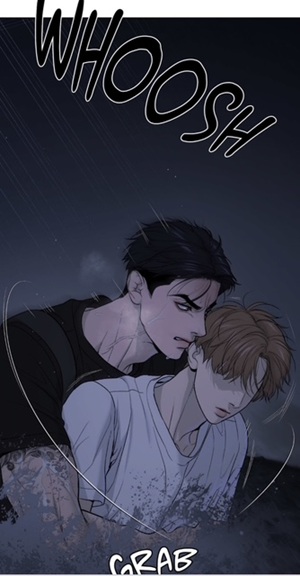 (chapter 59), the scene mirrors the iconic moment in The Little Mermaid where the mermaid saves the prince from drowning. Kim Dan, unconscious and seemingly following the voices of the hospice
 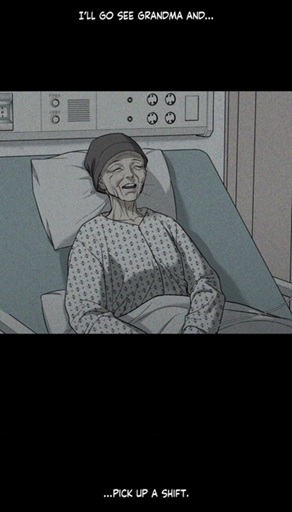 (chapter 59) —a representation of the mermaids’ song—drifts into a state of surrender, much like the prince. This act of salvation becomes a pivotal moment, connecting both characters to the themes of water, transformation, and rediscovery of purpose.
 (chapter 54), performance, and the longing for a deeper connection.
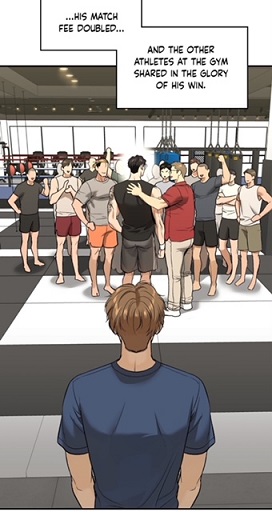 (chapter 41), and the mermaid, as he grapples with voicelessness and the pressures of his world.
  (chapter 36) Choi Heesung, representing another prince with Potato as his bride, benefits from others’ sacrifices
 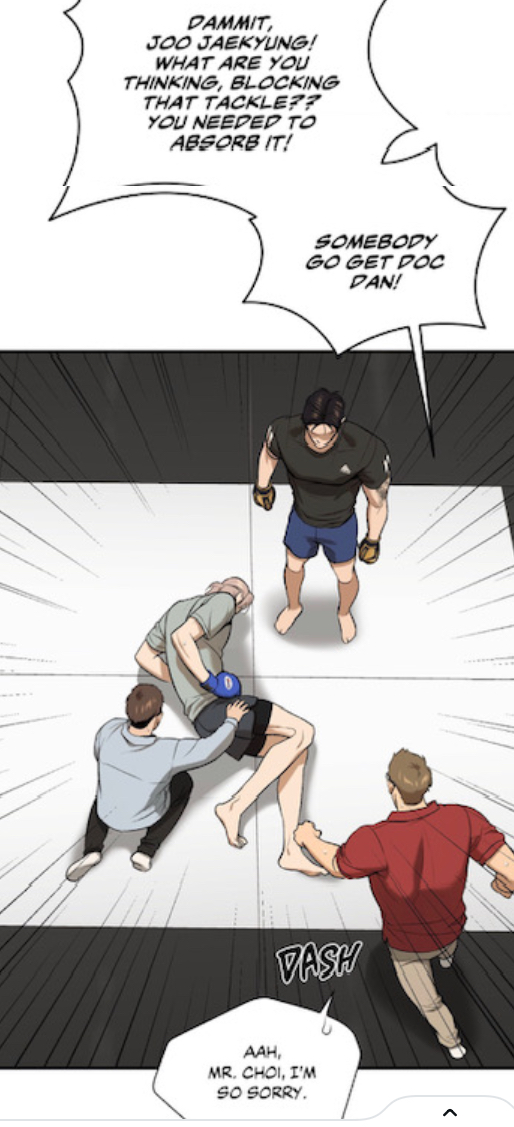 (chapter 31)
 (chapter 53) Joo Jaekyung, representing the “new world,” acts as both a source of transformation and a mirror reflecting Kim Dan’s sacrifices.
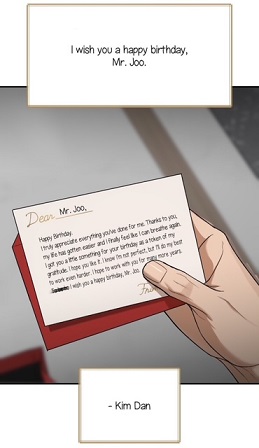 (chapter 55) and hardship
 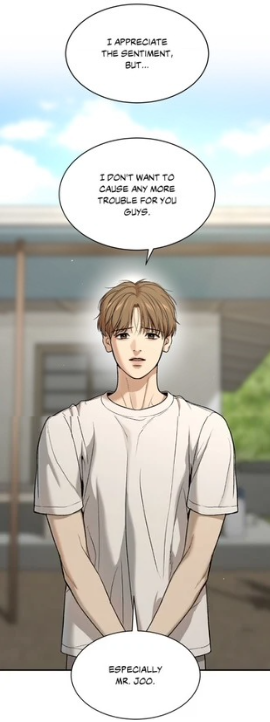 (chapter 58), yet it serves as the catalyst for his growth. Just as the little mermaid’s journey leads her to a higher spiritual purpose as a daughter of the air, Kim Dan’s experiences with Joo Jaekyung force him to confront his own worth, identity, and emotional needs. Just before he went to the ocean, he wondered about his own future and desires, a sign that he was standing at a crossroad:
  (chapter 59) However, let’s not forget that Kim Dan’s profession had been determined by Shin Okja, as the latter desired to have her grandchild taken care of her. Therefore his own desires and needs were overlooked. Traditions and social norms were used to decide about the protagonist’s life and future. His journey from voiceless suffering to self-realization echoes the mermaid’s transformation.
 (chapter 59) Like the mermaid, he has always lived disconnected from his own needs, burdened by the expectations of others—his grandmother, Heo Manwook, the doctors
 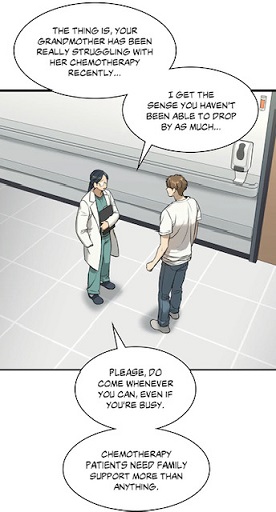 (chapter 21) , and even Joo Jaekyung.
  (chapter 59), he is not capable of crying. It is because he has been living like a ghost for the last two months. Depression, for both the mermaid and Kim Dan, manifests as a silent struggle, making their eventual transformations even more poignant.
 (chapter 1) hiding his true self behind a facade of strength and success. On the other hand, Joo Jaekyung also embodies the mermaid’s longing and sacrifice. Living in the world of MMA, a high-pressure environment where he is constantly pushed to perform, he resembles the mermaid in the underwater kingdom—a place of death and materialism where the mermaids feed on drowned humans. It is no coincidence that the fighters are displayed like mermaids in the water full of blood.
 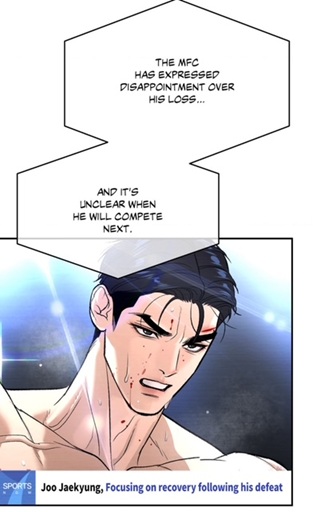 (chapter 57), only allowing him to speak when it benefits them financially.
 (chapter 19) Hence he never went to the swimming pool in his own penthouse, until Kim Dan triggered his memory and longing. This interplay of water and fire
  (chapter 52)
  (chapter 41) Joo Jaekyung’s image was exploited to lure these individuals down a darker path, highlighting how his light has been misused by those around him.
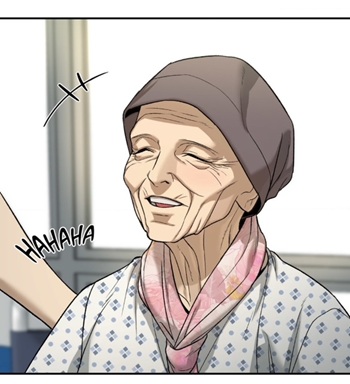 (chapter 56) as long as they were not associated with burden or suffering, while the mermaid’s grandmother celebrates the beauty and decorum of their underwater realm.
  (chapter 52) This dynamic parallels the members of Team Black in Jinx. Although they are treated like Joo Jaekyung’s co-workers
  (chapter 7), in reality, he is their boss and the foundation of their success. Their indifference mirrors the mermaid sisters’ behavior; they only notice his struggles and absence when his winning streak falters, prompting many to leave the gym for the rival King of MMA. However, if we take Andersen’s fairy tale as a source of inspiration, it signifies that at some point, the remaining members of Team Black might come to “sacrifice” themselves for their “little sister,” symbolically representing Kim Dan and Joo Jaekyung. This potential act of loyalty could mirror the mermaid sisters’ gesture, showing that even belated recognition and care can lead to transformative redemption for those involved.
 (chapter 1), attracting others seeking the same level of fame and fortune.
 (chapter 46) However, the gym’s inability to produce another champion reveals its “fake gardening” nature—focused on maintaining an image rather than fostering true growth.
 (chapter 22) and a “neglected child”
 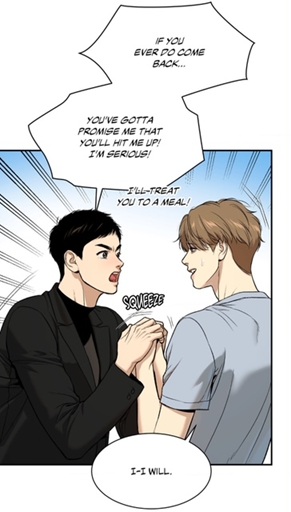 (chapter 59) further emphasizes the immaturity and lack of responsibility prevalent in this environment. In Andersen’s story, the mermaid sisters are given gardens to tend from a young age, instilling responsibility early on. Potato’s journey mirrors the mermaid sisters’ visit to the surface, as his trip to the sea represents a moment of exploration and self-discovery. While working as an actor for the first time, he realizes during his stay with Kim Dan that he has no intention of leaving Team Black.
  (chapter 58) Feeling lost without Kim Dan, he initially requests his return so that they can be together again. This longing for a companion reflects Potato’s deeper need for guidance and connection, much like the mermaid sisters who briefly visit the surface but ultimately return to their underwater world when the novelty fades. Yet, when they reach maturity and are allowed to visit the surface, the novelty of the human world quickly fades, and they return to their underwater realm indifferent to human suffering. However, notice that on his day of the departure, Potato tells Kim Dan that he won’t call him, the mermaid has to initiate the first step.
 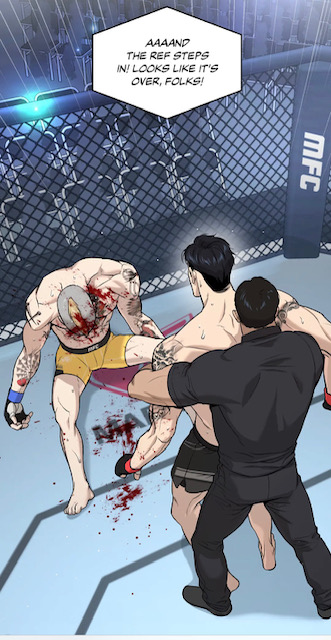 (chapter 15) strongly parallel the detached, high-pressure environment of MMA fighting. Joo Jaekyung, trained relentlessly since youth, embodies this world’s harshness, where vulnerability is a luxury rarely afforded.
 (chapter 59) suggests that Joo Jaekyung might reclaim his authentic self through activities like swimming, reconnecting with nature, and symbolically planting the seeds for a new life. Kim Dan, who cannot swim, learns from Joo Jaekyung, and together, they forge a path toward mutual healing and immortality—not in the literal sense but through finding their “soul” and purpose.
 (chapter 56) The city represents the oppressive expectations and artificial constructs that have shaped Joo Jaekyung and Kim Dan’s lives. By meeting again in the ocean, they reconnect with a more authentic and unburdened version of themselves. This transition echoes the little mermaid’s connection to the natural world as a place of solace and transformation.
 (chapter 59) They imagined that Kim Dan would be better off without Joo Jaekyung
  (chapter 58), but this assumption reveals their failure to truly understand Kim Dan’s plight. Their ignorance ties them to the selfishness and guilt that mark the couple in the fairy tale. Despite their faults, however, their actions indirectly contribute to Kim Dan’s transformation.
 (chapter 15) his kiss with Joo Jaekyung, shared in the locker room, was both an act of protection and a pivotal moment in their dynamic. Like the mermaid’s unforgettable first kiss with the prince (when he was rescued), Joo Jaekyung’s kiss in the locker room was an act of initiation, driven by his “fears” and sense of responsibility, reflecting his growing attachment to Kim Dan. The kiss symbolized his struggle to connect and protect, even as he grappled with his emotional restraint. The locker room, a symbol of physical endurance and vulnerability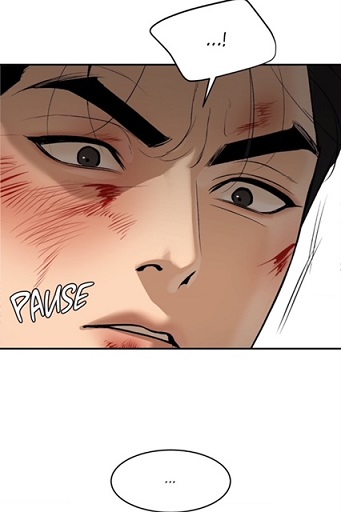
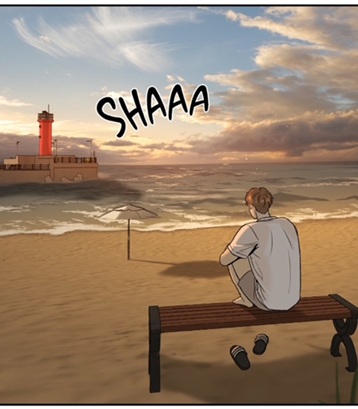 (chapter 59) finding light not in others but within himself. Through his hardships, he gains the strength to pursue his own identity and agency.
 (chapter 49) The maknae’s tears are an indication that he is no mermaid, but a human, I would even say, he still has the soul of an innocent boy.
 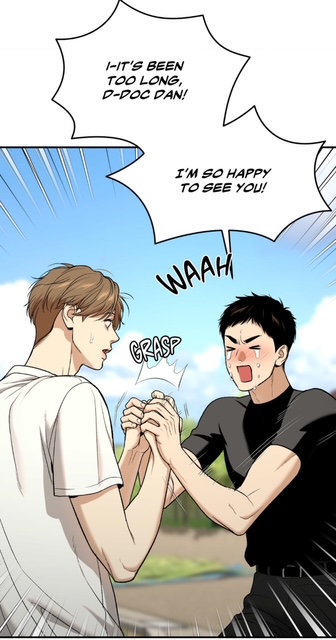 (chapter 58) reminding me of the princess looking for the voiceless mermaid. It is clear that in both stories, the mermaid left traces in the humans’ hearts.

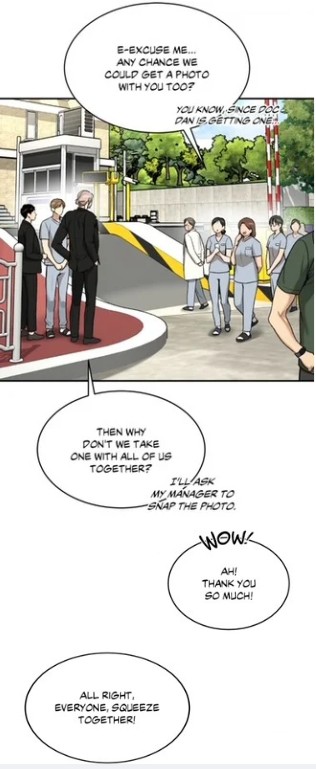 (chapter 59) —which becomes the pivotal clue leading Joo Jaekyung to Kim Dan. Through a careful analysis of the timeline and the use of contrasting events, it becomes clear that Mingwa’s narrative mirrors a kaleidoscope, reflecting positive and negative elements rooted in Taoist principles. While the doctor’s unconscious
 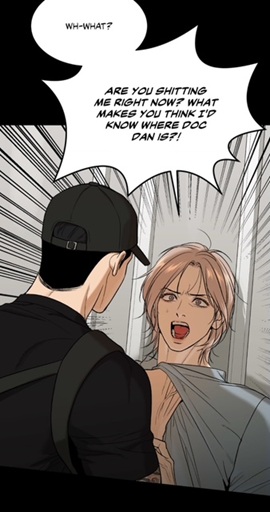 (chapter 59 ) a conscious choice to follow his heart, hence he was full of anger and frustration. Joo Jaekyung was no longer repressing his feelings, even if he had yet to fully recognize his affection.
 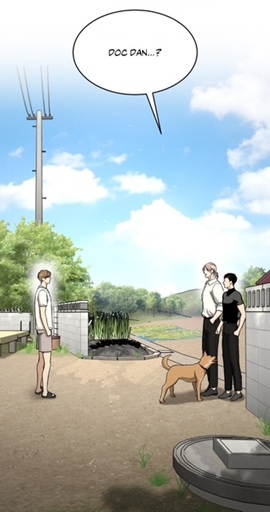 (chapter 59) embodies the negative reflection of Joo Jaekyung’s purposeful arrival. We can detect the divergences: day versus night, work versus break, healthy versus unhealthy etc. Through the juxtaposition of images and situations, Mingwa provides profound insight into the characters’ thoughts, desires, and intentions. The photograph’s role becomes pivotal: while it marks the end of Heesung and Potato’s visit
 (chapter 59), it simultaneously signifies the first crucial clue in Joo Jaekyung’s search. This marked the turning point where his ongoing efforts were given direction, transforming his pursuit into a decisive journey toward discovery.
 (chapter 59) —each of whom had interacted with Kim Dan
  (chapter 57) during his time at Light of Hope. While these individuals appear as potential candidates for revealing Kim Dan’s location, the true helper remains shrouded in mystery. This ambiguity emphasizes the layered narrative of Jinx, where each small action—no matter how mundane—contributes to the larger theme of fate’s intricate web, offering insight into the power of both intentional and unintentional intervention. If Potato had not suggested the picture
 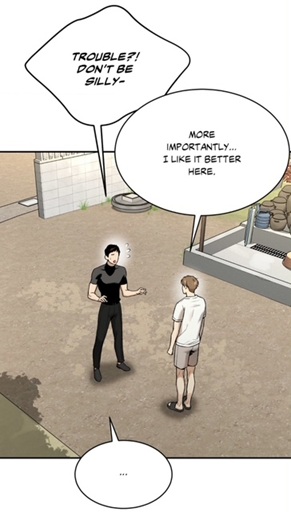 (chapter 58), ignorance and superficiality
  (chapter 58), becomes the shadowed reflection of the proactive search by Joo Jaekyung. This interplay of light and dark is central to unraveling how fate unfolded.
 (chapter 58), came to the same conclusion: they should not reveal Kim Dan’s whereabouts to Joo Jaekyung. Heesung argued that Kim Dan was better off in his secluded life, away from the chaos of Joo Jaekyung. Potato, deeply trusting his lover’s seniority and judgment, chose to follow Heesung’s lead. Their decision reflects not only their loyalty to Kim Dan’s expressed wishes but also their passive adherence to the belief that avoiding intervention was a form of help which reminds us of Potato’s former principle:
  (chapter 35) This shows that despite the last incident, Yoon-Gu didn’t drop this terrible principle. Notice that he is advocating the same philosophy than Shin Okja. Heesung justified his stance by claiming that it was in Kim Dan’s best interests
  (chapter 59) Importantly, Joo Jaekyung did not arrive during this period, further affirming their resolve. The photograph taken just before their departure was the key turning point. However, the timeline—marked by the sunsets
  (chapter 8)
  (chapter 37) and Kwak Junbeom was a witness of the encounter between Kim Dan and director Choi Gilseok.
  (Chapter 48) Nonetheless, there exist significant points against this theory. Despite their fondness for the actor
  (chapter 30) and their interactions with Heesung and Potato
  (chapter 35), they are unaware of the actor’s relationship with Potato. The author left many clues for this interpretation. They didn’t notice the maknae’s absence at the champion’s birthday
  (chapter 43), but more importantly the presence of Yoon-Gu‘s embarrassment in front of his hyung indicates secrecy. .
  (chapter 58) His “redness” indicates that he doesn’t want to expose his special relationship with Heesung. Therefore I believe that he didn’t mention this trip to other members. Consequently, I doubt that the members were looking for Potato in such a photograph. Furthermore, from my perspective, members of Team Black are still left in the dark about Joo Jaekyung’s struggles. They are unaware of his drinking habits
  (chapter 56), or his emotional state. They think, he has not come to the gym due to his recovery. Furthermore, they don’t use his cellphone number to contact him. The hiring of a new physical therapist and
  (chapter 57) the interview suggested that Joo Jaekyung was taking a break to recover from his injury, leaving no indication of his active search for Kim Dan. However, Yoon-Gu got informed through Heesung that Joo Jaekyung was desperately looking for him:
  (chapter 58), but probably saw this as another “negative reaction” (bad temper) of a spoiled child. This makes it unlikely that members of Team Black could have provided the critical information.
  (chapter 50)
 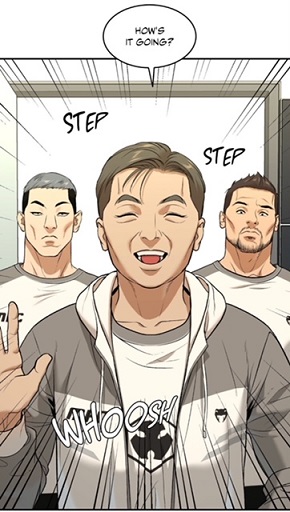 (chapter 49), highlighting the failures of relying solely on fate. The champion’s eventual discovery of Kim Dan underscores the necessity of teamwork and active intervention. Notably, this also reflects the flaws in Team Black, whose inaction and superficiality limited their understanding of both Joo Jaekyung’s struggles and Kim Dan’s situation. While Heesung’s stardom and blog
 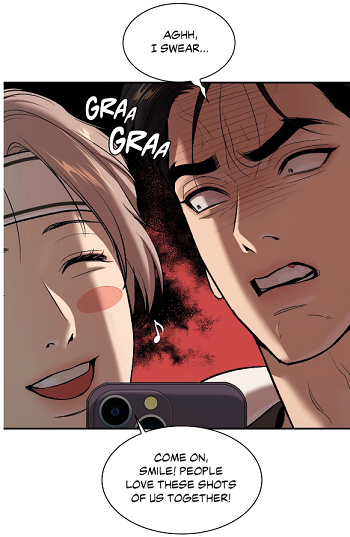 (chapter 30) could have amplified the picture’s reach, it’s unlikely Joo Jaekyung relied on such sources directly. I can not imagine him spying on the actor’s blog. Instead, the role of the helpers — the nurse and her acquaintance— emerge as crucial to piecing together the connection. The inadvertent role of the nurses Mind and Heart, urging Heesung to take the picture, becomes an integral part of the story’s progression.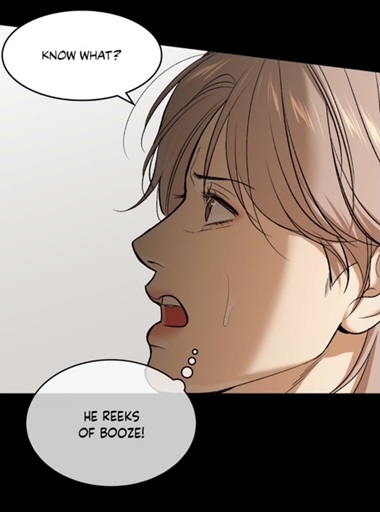
 (chapter 13) The latter knew the PT’s face,
  (chapter 13) but didn’t know his identity. He mistook him for someone who was selling his body for money.
  (chapter 13) In addition, Kim Dan never got to know the intervention of this hyung: he was the invisible helping hand in season 1. And now, if you reread the scene in episode 13, you will notice that this conversation between Joo Jaekyung and his friend contains all the ingredients in episode 59: the use of the phone, fainting, malnutrition, secrecy, neglect, secret suffering, pictures and public knowledge
  (chapter 13), the death of a man and finally urgency. Moreover, remember what his friend told him before: the importance of rest and
 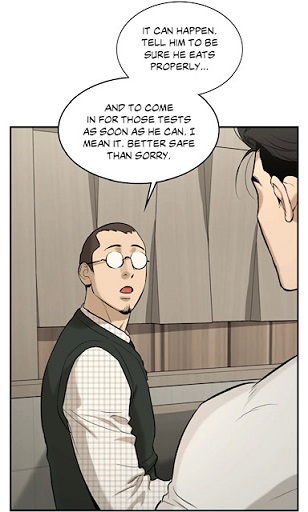 (chapter 13) He should send him to the hospital for tests, but the fighter refused. Why? It is because the latter feared his “chingu”. The doctor seemed rather interested in Kim Dan, therefore he feared that the PT might dump him for a “colleague”. That’s why Heesung was sent later to his gym. Karma was punishing him for not listening to his friend’s advice. Finally, it is important to recall his advice:
 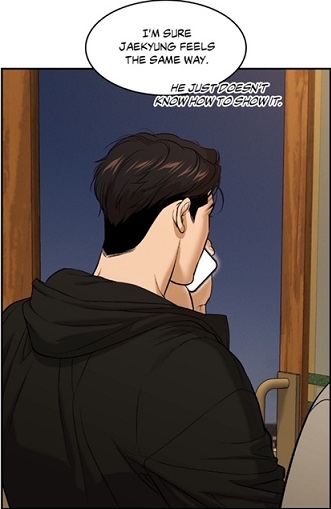 (chapter 43) And during that evening, the champion called his penthouse with the doc “Home” for the first time. Finally, in season 2, Joo Jaekyung started visiting each hospital or Sports Rehabilitation Center in Seoul in order to find Kim Dan.
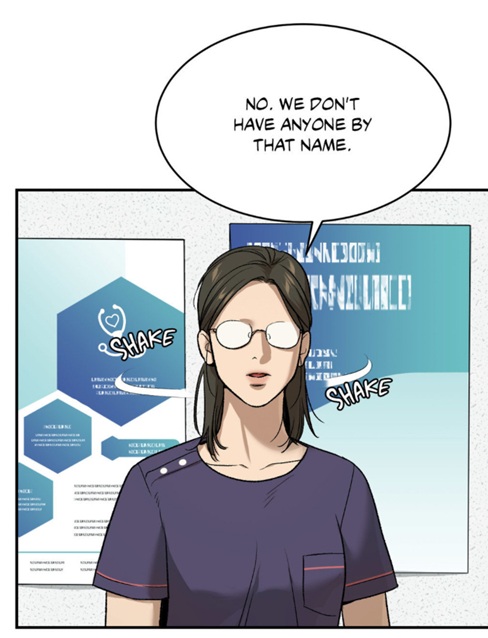 (chapter 56) And there’s no doubt that Joo Jaekyung got recognized by people forcing him to use a mask to hide his identity. So this frenetic search must have reached the mysterious doctor’s ears, but I doubt that he made the connection between the star’s lover and the physical therapist right away. Since he‘s a guest of XY club,
  (Chapter 13), it is also possible that he could have heard about the last incident in the restroom with doc Dan’s replacement. Since Cheolmin found Dan cute, it is very likely that he was also drawn to the surrogate „Dan“. But I don‘t think, this was enough to intervene, as Joo Jaekyung didn‘t ask for his help.
 and to Neptune
  and strangely, the doctor moved to a place next to the coast. So maybe Cheolmin comes from that little town and the green-haired nurse is his relative. I had already outlined their similarities. Finally, look at the numbers, we have 4 in both episodes, 13 and 59 (13: 1+3 = 4 / 59: 5-9= -4) The -4 would coincide with Kim Dan’s vanishing, but also with the intervention of Cheolmin. And if my theory is correct, this means that the champion will come to regret his past decision
 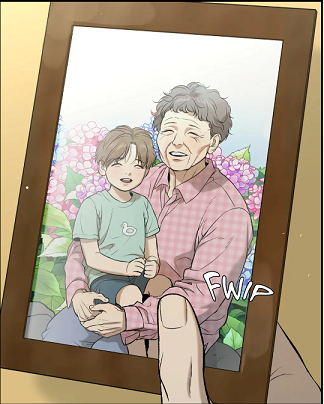 (Chapter 19) and the group photograph at the hospice

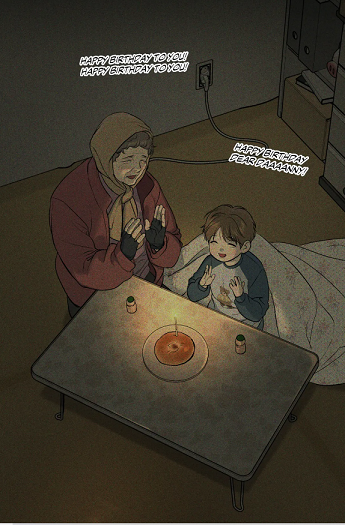 (chapter 11) Here, she offered him a sweet bread as present, but since it was his birthday cake, he had to share his “own present” with his grandmother. The little he possessed was given to his grandmother, a new form of this scene
  (chapter 43) In other words, he was the one sharing his food with her. But there exist more conclusive evidences.
  (chapter 5) When he visited her in episode 5, the main lead was the first one to bring up the topic “dinner”. How did the grandmother respond to his question? “You know your granny never skipped a meal”. Her statement is implying that someone else skipped his meals before. That can only be the doctor. So she knows that he has not been eating on a regular basis. And what is the opposite of “never”? ALWAYS! Yet, observe that she is smiling, when she is saying this. It exposes that she never saw the doctor’s skipping meals as worrisome. She must have probably thought that her grandson was a picky eater.
 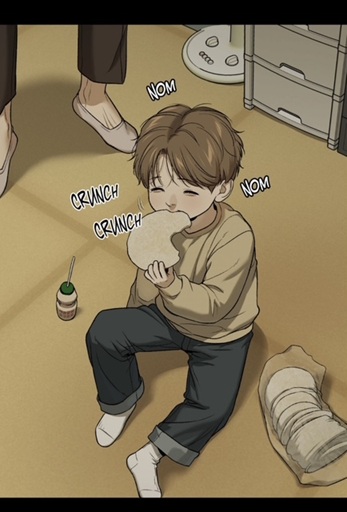 (chapter 57) So she was not sitting down to a meal with her grandchild literally. In addition, when she suggested snacks to console him, she didn’t realize the terrible consequences of her decision. Once it was dinner time, Kim Dan would no longer feel hungry. With the introduction of such a ritual (eating became the synonym for repressing negative emotions), it is normal that the little boy would stop eating with his grandmother. That’s how the routine of eating on a regular basis got dropped, as it was strongly intertwined with his negative emotions and terrible incidents.
 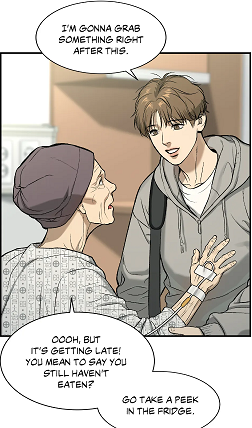 (chapter 5) Thus she offered him two sweet yogurts.
  (chapter 5) Her words “You used to love these when you were little” are alluding that she perceives the main lead as a picky eater. As a child, he would never refuse the drinks. So when she offers them to him, she is sure that he will eat these. Finally, when she saw the celebrity, she indirectly put the blame on her grandson. He is thin and weak, because he didn’t eat properly.
 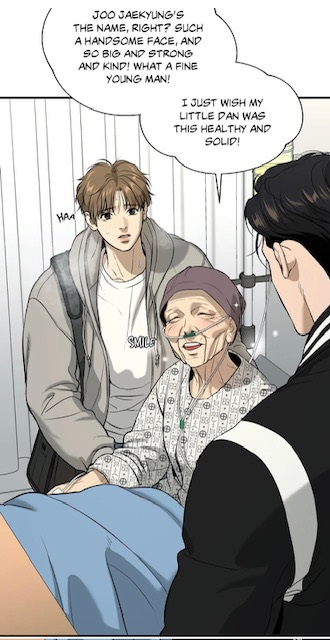 (chapter 21) In her eyes, Kim Dan’s habit for skipping meals was the expression of an avoidance of certain foods. It was because he was a picky eater. This shows that she never questioned herself and her past decisions. Then in the latest episode, she is seen eating her lunch,
 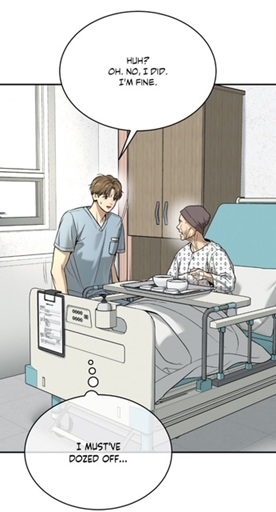 (chapter 57) yet at no moment she shares her food or questions him if he has already eaten. For me, this scene exposes her neglect. Her focus lies elsewhere:
 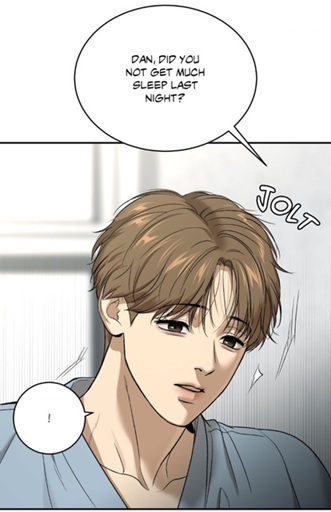 (chapter 57) She asks this question, because she has already witnessed him sleeping next to her. She associates tiredness with lack of sleep, but she is not making the connection between malnutrition and his exhaustion.
  (chapter 56) In other words, she is relying on the hospice, while the staff is too busy and overwhelmed with work to notice that Kim Dan has been working too much and even avoiding lunches.
  (chapter 57) This shows that Kim Dan had become a ghost at the hospice for the last few days, and no one paid attention to him. He was invisible because it was his way to be “accepted” and not stigmatized as “bun” or “orphan”. People only noticed him, until he created some ruckus at the institution. However, this means that the man must have spent the night with his grandmother. Yet, at no moment she sent him away or even shared her meals with him. This shows her indifference and egoism. She contrasts so much to the protagonist’s landlord.
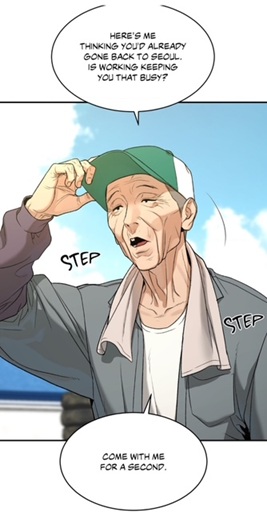 (chapter 57) He noticed right away that he was missing. Why? It is because his room was empty.
 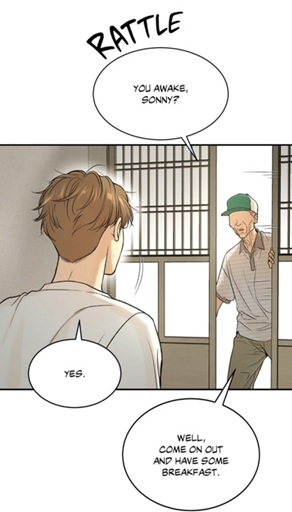 (chapter 57) This scene represents the man’s new routine. He would go to Kim Dan’s bedroom and ask the protagonist to eat breakfast with him. On the other hand, though he noticed the doctor’s absence, he jumped to a false conclusion. He imagined that his new room mate had returned to Seoul. This raises the following question. Why is this caring man assuming that Kim Dan moved to that small and insignificant town just for a short moment?
  (chapter 57) And why did he think that Kim Dan had left for good? First, I can imagine that the doctor looked for a place without deposit.
 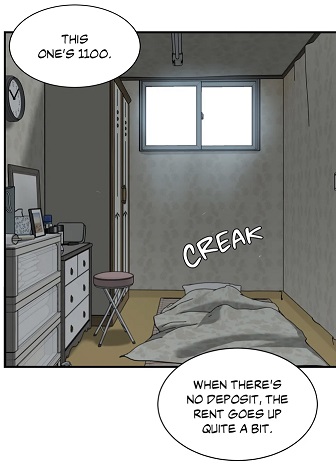 (chapter 16) But more important, it is because the physical therapist only arrived on the West Coast with two small bags.
 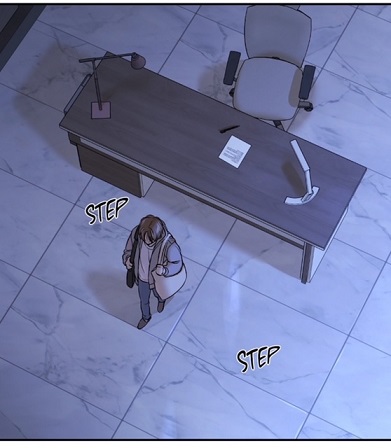 (chapter 53) And now pay attention to the PT’s departure on the day he was sent back:
 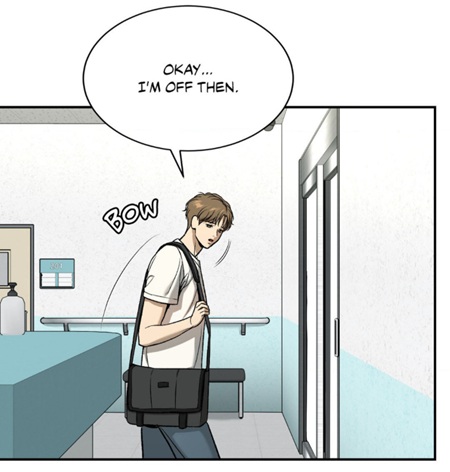 (chapter 57) He had gone to the hospice with all his belongings, a sign that he had planned to stay with his grandmother until his “death”. In other words, his “workplace” would have become his tomb. This means that the landlord already noticed that the main lead only had a few belongings, and the moment he didn’t see the black bag with the halmoni’s picture, he assumed that Kim Dan had returned to the city. Thanks to the introduction of the new landlord, my interpretation about the champion’s biased judgment got confirmed.
 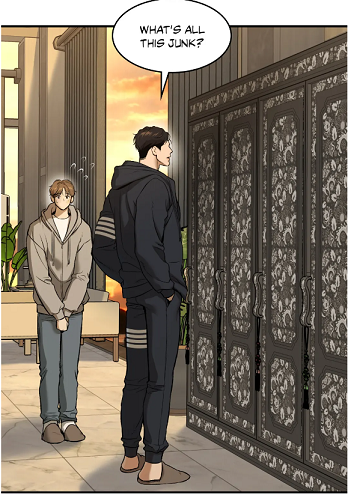 (chapter 19) When Joo Jaekyung saw the huge Wedding Cabinet, he thought that Kim Dan had many clothes. Thus he saw it as a sign of “greed”, Kim Dan was poor, because he was not able to save money. And this observation brings me back to the landlord:
  (chapter 57; here he used guilt and shame to incite Kim Dan not to drink), he is attempting to be close to his new room mate, to understand him. The problem is that the protagonist is keeping everything to himself. He is not speaking about himself and his past. This is quite understandable, as the grandmother keeps telling him that he has no roots here.
  (chapter 57) Care, curiosity and responsibility. Here he is asking for help as well. Nevertheless the nature of his request is different, for it is not about himself, but about Boksoon and her puppies. As you can see, he is making sure that she gets the best environment to raise her puppies. On the other side, Shin Okja used to prioritize herself and her own suffering. Notice that the doctor was resting under a tree in the yard
  (chapter 57), until the owner appeared. Thus I couldn’t restrain myself thinking that this man is strongly associated with the sun (fatherly figure) and life, whereas the grandmother stands for darkness
 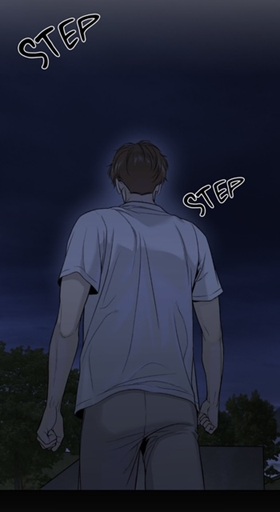 (chapter 57), night and death.
  (chapter 43) No, his avoidance of eating increased. Park Namwook and the others assumed like many readers that it was related to his overwork and exhaustion, but it is only partially true. Sleeping was also his way to avoid food in the end. And this brings me back to the incident with the switched spray:
 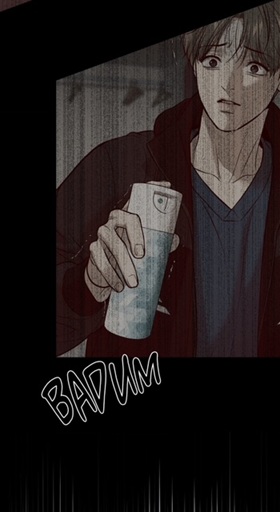 (chapter 57) This crime triggered a trauma in the doctor. Hence his hands were shaking, and he is plagued by a huge guilty conscience. It was, as if his hands had become poison too. However, hands are necessary to eat. To conclude, this could only worsen his condition. And notice that even with the landlord, he is not seen eating. In fact, he is patting the dog.
 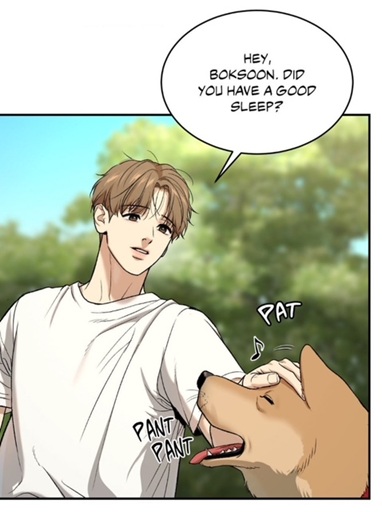 (chapter 57) That’s the reason why I don’t think that Kim Dan’s ARFID can be suddenly cured, the moment Potato reveals the truth about the incident. He has to develop a routine around eating. Someone has to put food right into his mouth, to feed him literally. On the other hand, I can imagine that a change will take place, when he sees his fighter totally diminished. He would serve as a reminder and reflection to himself.
 , (chapter 41) the doctors and the authorities diminished the importance of such a wrongdoing, because they denied the existence of psychological sequels. Thus they only investigated it from the athlete’s perspective:
 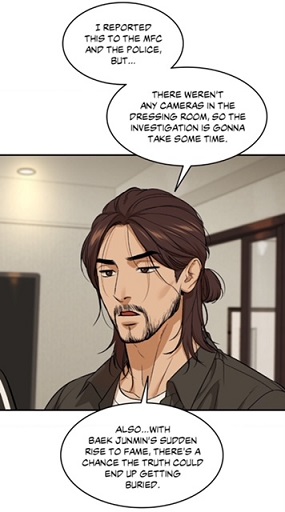 (chapter 52) He was the only target and victim. Therefore it was reduced to the work of a hater and rival. Nevertheless, they didn’t interrogate the real victim of the crime correctly. Either he was about to get framed or his involvement was totally denied. It was, as if he had not been present. By not taking the physical therapist’s psychological damages into consideration, they actually expose their true nature. They don’t care about mental health at all. This explicates why the athlete had to prove his worth constantly. We should see these comments as a new form of bullying
 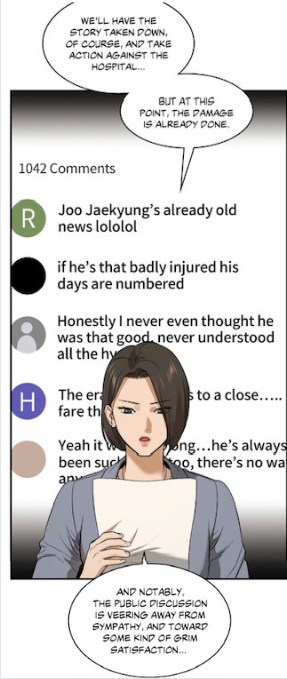 (chapter 36), which were supported by MFC, the Entertainment agency and Park Namwook. Joo Jaekyung had to prove them wrong: his career is not finished yet. So when the couple meets again, they should quickly realize the importance of mental health, as both are definitely at their lowest point in their life. In other words, the mental issues from Kim Dan serve a purpose in this story: people close to him should come to the realization that mental health is essential in life, something they neglected before. Either they didn’t feel concerned or they were biased or simply ignorant. Thus the athlete in the illustration for season 2 is looking at his fated partner’s face :
  He is now paying attention to his facial expressions and trying to discover his thoughts. Moreover, note that he is also grabbing his wrist, which could be interpreted like this. On the one hand, he is attempting to stop Kim Dan from working, as the symbol of a PT is the helping hand. He should relax and rely on the fighter’s care and protection. He is his shelter and home. On the other hand, it could be seen as his attempt to stop Kim Dan from using his wrist against the sinners and criminals: Kim Miseon who used her halmoni as guinea pig, Choi Gilseok who tricked him etc… Yes, I have the impression that at some point, the physical therapist could end up feeling like his fated partner:
 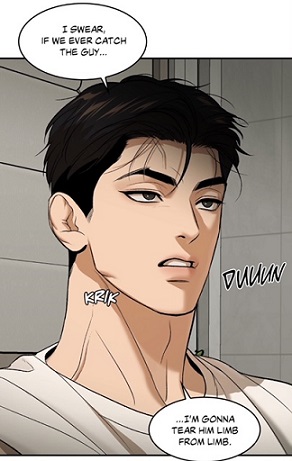 (chapter 41) Kim Dan is looking for light, because he has been trapped for too long in that darkness:

 (chapter 56) in Jinx serves as a powerful symbol and narrative device, encapsulating the themes of observation, communication, and truth, as reflected in the title “Unspoken Gifts, Unveiled Truths in the Light of Hope.” Its name evokes images of enlightenment and clarity, which stand in stark contrast to the gym Team Black and the grandmother’s internal state of denial and her rejection of responsibility. This tension between the hospice’s symbolic essence and the grandmother’s actions deepens the narrative’s exploration of personal accountability and transformation.
 (chapter 35), where people’s actions and words can go unnoticed, the hospice fosters an environment of close-knit relationships and mutual observation.
  (chapter 56) In this communal setting, actions carry weight, and behaviors are scrutinized. Thus the door to the meeting room is made of translucent glass.
  (chapter 56) While in the previous essay, I pointed out that this door reflected Kim Dan’s emotional entanglement—he is physically present but emotionally excluded from his grandmother’s world, highlighting the imbalance in their relationship -, in verity this transparent door offers an opportunity for the main lead. How so? The glass door stands not only for transparency, but also for “emotional distance”. The glass allows visibility but creates a barrier, symbolizing a balance between openness and detachment. This is essential in a hospice environment, where the focus is on providing care and support without becoming overly attached to the inevitable outcome: death. For the staff, maintaining a degree of detachment is necessary for their well-being, as becoming too attached could make the emotional toll of their work unbearable. Therefore I am suspecting that the two nurses
  (chapter 56) will become the physical therapist and champion’s mentors and advisors. Why? It is because the nurse with the brown hair embodies those values. Her emotional distance is already perceptible in her conversation with her colleague:
  (chapter 56) She is projecting herself in his shoes. Why? IT is because she got influenced by the comment from her colleague. That’s how I realized that together, they represent the balance of heart and mind, their unity and understanding forming a cohesive whole. That’s how both are able not to become indifferent or too much attached. This coincides to the dualism of their profession: care but also detachment. Under this new perspective, it becomes comprehensible why the second nurse is not referring to facts, but to impressions and imagination. Her words are strongly intertwined with rumors: “with his experience”. So far, the main lead had barely experience in his field, as his first big gig ended up in a fiasco. He didn’t stay that long at the hospital and it is the same for the champion. He only worked at the gym for three months. The dark haired woman might have seen Kim Dan’s resume and the last employer, but she didn’t notice his name (Joo Jaekyung). This is her MO for „detachment“, she doesn’t pay attention to names. Moreover, she didn’t detect that he had barely worked as a PT before indicating that she has no notion of „time“. The discrepancy between her thoughts and reality can be easily explained. She also recognized the transformation in the patients, and could link it to the doctor’s skills. The reference to “famous athlete” and the doctor’s skills created a false perception, and this had an influence on her colleague: “You’re telling me!”.
 (chapter 56) Her hypocrisy, particularly in her treatment of Kim Dan, remains hidden behind the guise of socially acceptable behavior. Within the hospice, residents maintain a positive opinion of her, which enables her to mask her neglect and selfishness effectively. But since the two nurses are sharing their thoughts and working as a team, it signifies that Shin Okja’s wrongdoings could be detected this time. Or better said, they will realize the true suffering from the protagonist. Nurse Heart and nurse Mind will do their best to protect their new mascot and give him what he truly needs:
  (chapter 5) And the other laughed. Then the coach seems to have no cellphone. Maybe he believes to have no need for it, for he goes to the gym every day. This signifies that he expects to be informed by his hyung Namwook. However, like mentioned in the previous essay, I believe that the manager has been sweeping under the rug the terrible condition of his “boy” from the coach and the team members. To sum up, Team Black embodies the opposite of the hospice’s values. There is no transparency, because the conversation took place not outside, but behind closed door. The door might be translucent, the reality is that they sent away all the members.
  (chapter 36) The gym, while ostensibly a team environment, is ruled by indifference, anonymity, and a lack of genuine camaraderie. The heart and the mind are not working together. Why? It is because the coach is trusting the manager, as he views him as the heart of the gym. What he fails to see, is that Park Namwook is neither the heart nor the mind, for he is more reflecting his surroundings: money. Secondly, the manager is easily influenced and is using conformity and social norms to avoid responsibility. He fears making decisions and lets others become proactive. Joo Jaekyung, the leader, relies exclusively on Park Namwook, the manager, who undermines team spirit by fostering distrust and misinformation.
  (chapter 46) The member’s loyalty got questioned, but the irony is that they had the real insight.
  (chapter 47) Thus rumors about Baek Junmin being an illegal fighter never reached Jaekyung’s ears. That’s why the author made fun of the main lead here:
  (chapter 47) His ear seemed to have caught their badmouthing, but not the real information. But why did he not listen to the members? It is because Namwook had encouraged the champion to keep his distance from others. He had even planted seeds of distrust among the team with his badmouthing about the champion. He has a bad temper and is a spoiled child, so no one needs to pay attention to him and his moods. The slap was the evidence of his disrespect and hypocrisy.
  (chapter 52) The man acted, as if he had been the biggest victim. Moreover, Namwook’s actions often reflect a lack of genuine loyalty, as seen in
  (chapter 22) episode 22, when he falsely claims ownership of the gym and again in episode 56 when he reminds the champion of his absence from the gym, behaving as though he were the boss.
  (chapter 56) Hence he is seen talking over the phone and not face to face, unlike the nurse. He knows that his boy is struggling, but he acts, as if he didn’t know. This contrast validates my previous interpretation of the manager. His question “Is everything okay with you?” exposes his lack of genuine concern. He uses work not to praise his “boy”, but to blame him for his “negligence”. He downplays the champion’s struggles while still recovering from surgery. This lack of care creates an atmosphere of apathy, anonymity, and selfish expectation, sharply contrasting with the hospice’s values of dignity and communal care. But how do we explain this huge divergence? First, the main principles of the hospice are dignity and care, and not primarily money. Therefore the institution offers free health check once a month:
 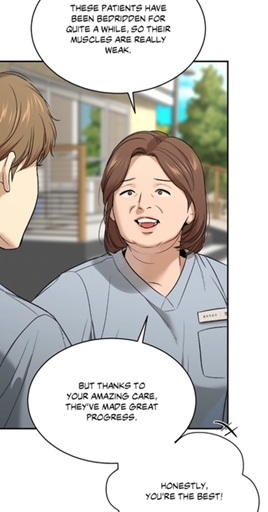 (chapter 56) This contrasts with the gym, where fighting is treated as entertainment and sport, emphasizing the physical aspect while neglecting the mental health of its athletes. Ironically, even the physical treatment of its members was neglected at the gym from the very beginning, like we could see it in two occasions:
 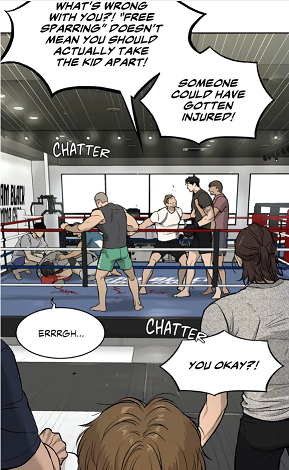 (chapter 1) The fighter with the head injury received treatment from the members (self-medication) and Kim Changming had a shoulder injury which got neglected.
  (chapter 7) These incidents reflect the gym’s underlying indifference and mismanagement. This disparity explains why Jaekyung’s mental health suffered under Namwook’s leadership, as the gym lacked the supportive and transparent environment required to nurture emotional resilience. Jaekyung’s stay at the hospice is likely to open his eyes to this overlooked aspect, prompting him to reconsider his leadership style and the values governing Team Black. But it is the same for Kim Dan, especially if he sees how weak and neglected the fighter looks:
 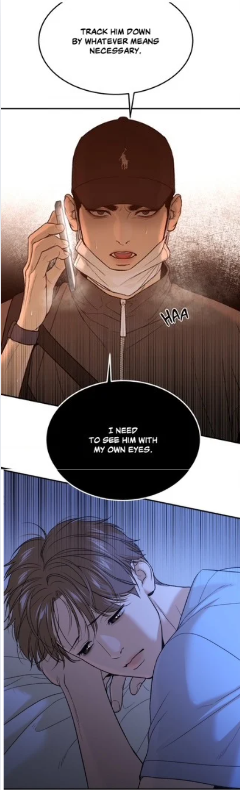 (chapter 56) he has already become a shadow of himself.
  (chapter 56) Her actions, such as allowing Kim Dan to stay by her side and covering him, contrast sharply with her earlier attempts to push him away. In this scene, a caretaker might pass through the rooms to ensure everything is in order, noticing the doctor present. To an outsider, the visible outcome suggests that she accepts her grandchild’s relentless care without protest. It was, as if she had said nothing at all. Yet, this perceived acceptance masks her internal struggle and the discomfort of being dependent on Kim Dan, reflecting her conflicted emotions. These moments of vulnerability and acceptance highlight the gradual erosion of her denial under the hospice’s symbolic light.
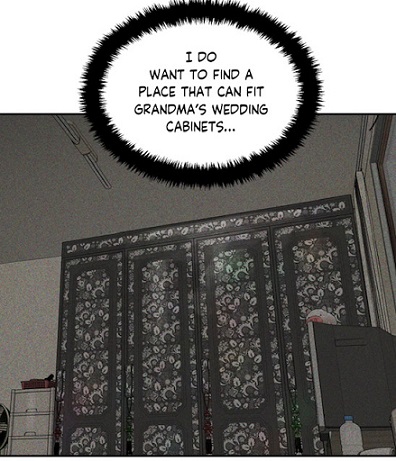 (chapter 16) Despite its substantial value, the grandmother never sold the cabinet to pay off the debts, prioritizing its preservation over the survival of her home and family. On the one hand, this reveals her immaturity and selfishness, as she put up with her grandson’s suffering. On the other hand, her decision created the impression to Kim Dan that this belonging had just a sentimental value and nothing more. So when the champion saw that huge Wedding cabinet, he judged it as „junk“ and that’s how the doctor got this perception validated.
  (Chapter 41) as she employs the expression „spoil to death“. By wearing the scarf with flowers, she appears wealthy, but also vain! Since I detected that Kim Dan likes pink flowers, my interpretation is that this gift mirrors the doctor’s taste indicating that he was slowly regaining his identity and confidence..
  (chapter 31) And notice that the bouquet of pink roses pushed Kim Dan to talk to Joo Jaekyung about his taste. That’s how I detected a strong connection between presents and communication. Notice that on the champion’s birthday, the manager sent a message while the presents were delivered.
 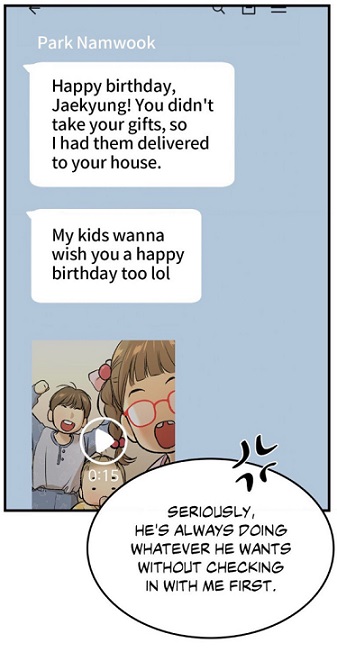 (chapter 45) This aspect gets even validated with the doctor’s keychain. The latter not only caused an argument between the two room mates
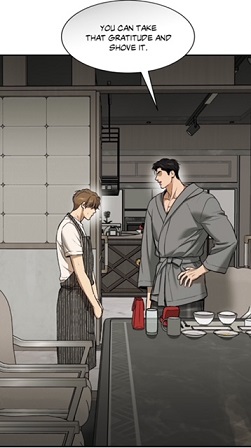 (chapter 45), but also encouraged the doctor to convey his thoughts and expectations in the card. On the other hand, he didn’t expose the whole truth
  (chapter 55) Another interesting aspect lies in the doctor’s shaking hands which the champion noticed, when he offered the present:
  (chapter 55) This scene reminded me of their first encounter:
 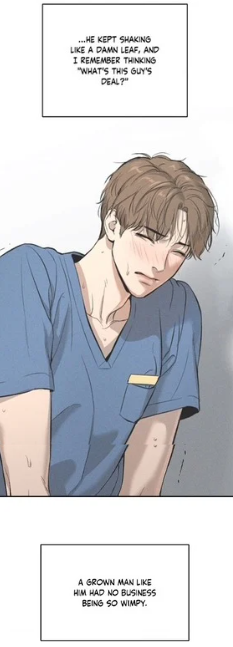 (Chapter 56) So the man must have recognized the doctor‘s fear, which explains why the champion could voice his anger later. But back then, he never wondered why the doctor‘s hands were shaking like leaves. It is because the doctor feared rejection. The present had the following meaning for the physical therapist: recognition and acceptance. The gift was the symbol for „conditional affection“ which he had long internalized due to his grandmother. But this doesn‘t end here. The shaking hands appeared in a different scene:
  (chapter 49) The common denominator between these three scenes is the mistake. Kim Dan feared to have made a mistake with the present, because he was afraid of the champion‘s reaction: will he accept him or not? But let‘s return our attention to the gifts from the doctor.
 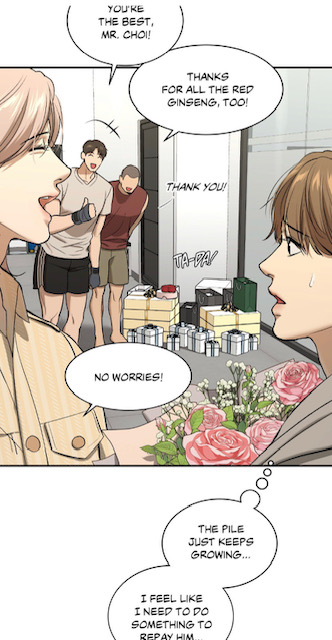 (chapter 31)
 (chapter 55) implies that as soon as the main couple meet each other, they will have to discuss this matter. To sum up, a gift encourages the couple to communicate, yet contrary to season 1, both should be more honest to each other at the Light Of Hope. Every word and action will appear in a different light. Another aspect is that none of them takes things for granted, which stands in opposition to hyung Namwook and the grandmother. This explicates why the latter have no problem to spend money.


 (chapter 56) This dichotomy in season 1 is vividly illustrated in a scene where Kim Dan, under the dappled light of a tree
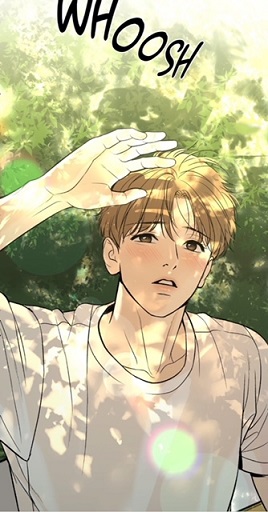 (chapter 41), experiences a profound moment of awakening. As his hand seems to reach towards the leaves
 (chapter 41), his senses come alive—he sees the light filtering through, feels the breeze, and hears the faint rustling sound. It is, as if in that moment, he reconnects to his true nature. Like a tree, Kim Dan is deeply rooted, yet capable of growth and resilience.
  (chapter 41) Nature awakens something within him— his heart and as such his third eye —allowing him to realize his affection for Joo Jaekyung. This quiet yet powerful moment emphasizes how nature offers clarity and purity, serving as a contrast to the suffocating, impersonal urban world where Kim Dan often found himself lost. Striking is when Joo Jaekyung met Kim Dan for the first time, he compared him to a “leaf,” shaking and fragile—an unconscious recognition of his true nature.
 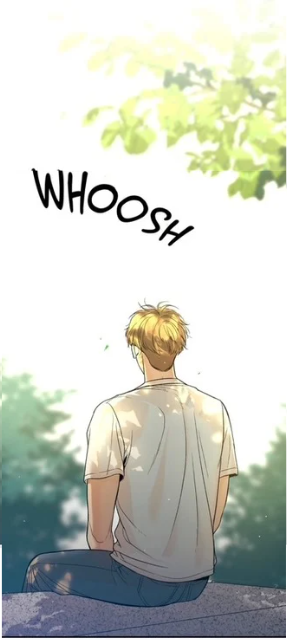 (chapter 55) However, note that the main lead isn’t stretching his hand to the sky and sun. He is almost immobile. Just before, he was holding the cellphone in his hand:
  (chapter 55) Another divergence to the scene in episode 41 is that Jinx-philes couldn’t see his face. It indicates that the doctor reverted to his old self, and as such he is not true to himself. Therefore I come to the following conclusion. Mingwa uses nature as a mirror to Kim Dan’s emotional and spiritual state. While moments of connection with nature reflect clarity and self-realization, the juxtaposition in this scene underscores the opposite. Here, Kim Dan sits surrounded by trees and bathed in sunlight, yet his attention is consumed by his cellphone—symbolizing his entanglement with money, duty, and his ongoing struggles. Just moments prior, he wired money to the champion, a decision rooted in his past traumas and present desperation. The irony of the setting cannot be overlooked: though nature surrounds him, its purity and tranquility remain unnoticed, emphasizing how Kim Dan is still trapped in patterns of survival, burdened by his circumstances. He has become a ghost once again. This disconnect reveals how the weight of his past prevents him from embracing the present moment and reconnecting with his true nature, contrasting starkly with earlier scenes where his senses came alive under the trees.
 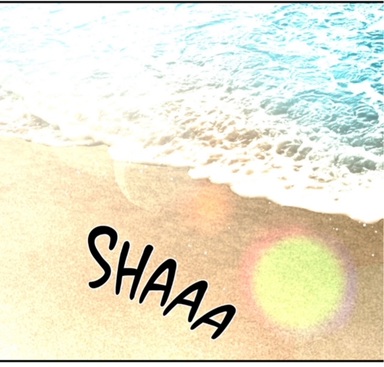 (chapter 56) The empty beach scene, with its sunlight and tranquil beauty, reflects peace, but also unfulfilled connections. Kim Dan’s absence from this moment underscores his failure to keep a heartfelt promise to his grandmother:
  (chapter 56) Abandoned once again, Kim Dan is consumed by the weight of his trauma, isolating himself emotionally and excluding himself from others.
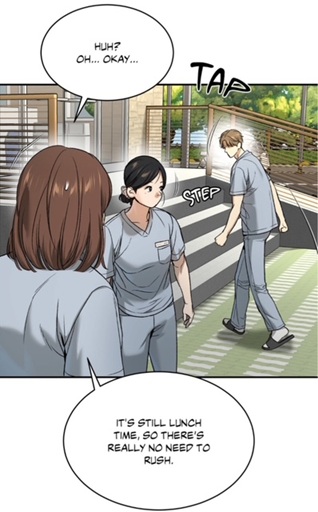 (chapter 56) When approached and complimented, such as when the nurse praises him and encourages him to take a break for lunch, Kim Dan pointedly ignores the praise and instead chooses to return to work. His inability to engage with others reflects the same disconnection that prevents him from connecting to nature. Mingwa subtly reveals a painful truth: Kim Dan’s fixation on his suffering not only blinds him to the solace and clarity offered by nature, but also hinders his ability to nurture relationships.
 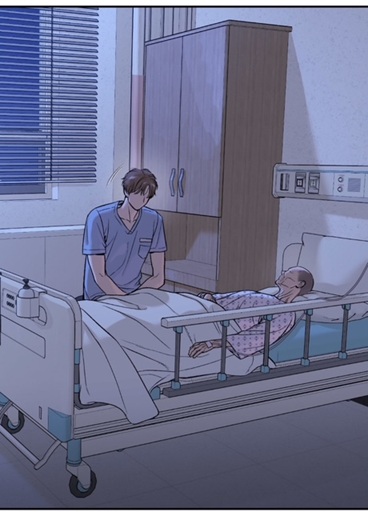 (chapter 56) and, symbolically, to the moon, Kim Dan remains oblivious to what has always been there for him: the enduring forces of love, stability, and healing.
 (chapter 56) the ocean and celestial elements like Saturn (Kim Dan stands for this planet). These forces, outside human control and independent of Kim Dan’s struggles, offer opportunities for renewal and clarity. Yet Kim Dan, consumed by his pain, remains trapped in patterns of survival and alienation. Nature’s constancy mirrors what he needs most—connection, healing, and presence—yet his inability to see it reflects his broader struggle to connect with others and himself.
 (chapter 26) Yes, the day where they sparred out of fun. For the first time, Kim Dan chose to accept a challenge for himself and for Potato. He felt a connection with Yoon-Gu, because he saw in him a puppy:
 (chapter 29) That’s the moment he started opening up to others, he confided his struggles to Oh Daehyun and Potato:
  (chapter 37) The puppy symbolizes not only nature, but also innocence. Let’s not forget that he was moved by the actor’s flowers in the past:
 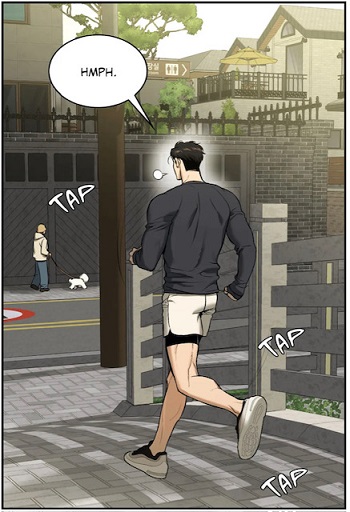 (chapter 21) Yes, by offering him a puppy! Is it a coincidence that the author made the champion jog next to a dog owner? I don’t think so. Until now, nothing could move Kim Dan’s heart:
  (chapter 44) In other words, Kim Dan feels a strong connection to animals, but he could never have one due to his poverty and his grandmother. By taking care of a dog, he would be forced to pay attention to nature and in particular to trees. Naturally, I believe that Potato will play a similar role in the future, for Mingwa associated him with a dog.
  (chapter 47), the nursing attendant
  (chapter 21) or the reporters:
  (chapter 37)
  (chapter 40) However, Manhwa-worms will notice a significant distinction: in Season 1, these women were all tied to the world of work. Even Kim Dan’s grandmother, though she represents a familial figure, falls into this category.
 (chapter 56) Moreover, the grandmother’s choice of words, “Why don’t you turn in?”, implies that she sees Kim Dan’s presence as a form of “work” or duty. This phrasing is often associated with someone finishing a day’s tasks or obligations before going to bed, which fits into the broader dynamic between Kim Dan and his responsibilities. In my eyes, it shows that she is seeing her grandson more as a caretaker than as a family member. We shouldn’t forget that she was the reason why the main lead became a PT. It was, as if her dream had come true. Nevertheless, the verity is that his grandmother is receiving treatment from his colleagues.
  (chapter 56) It looks like she’s pushing him away. On the one hand, her request sounds right, for she is treated quite well and the suggestion was made out of concern. She sees her grandchild struggling, and probably imagines that this move must weight down on Kim Dan. On the other hand, I can’t help myself thinking that this woman also has other reasons to send him back to Seoul. The nurse was already pitying the physical therapist:
  (chapter 7) before she got reassured. Then she made this request
  (chapter 55) and later brought the doctor’s present:
  (chapter 55) And what is the common denominator with these two images? The woman’s hand. In the previous essay, I explained that her intervention signalized that the champion would stop drinking and was starting acknowledging Kim Dan. The zoom on the cleaning lady’s hand is a powerful visual cue that encapsulates many of the symbolic meanings associated with a woman’s hand, reinforcing the themes of care, healing, humility, and transformation.
 (chapter 19) He is not capable to take care of himself well.
  (chapter 55) Observe how she smiled to him by saying goodbye. This is a sign that her respect and care are genuine. One might think that this nameless cleaning lady was unfortunately portrayed as eyeless:
  (chapter 56) I don’t think, we should see it in a pejorative light, like for an example of blindness or manipulation. In my eyes, the absence of her eyes are mirroring the nature of their relationship between the champion and the cleaning service. So far, he never met these people, as he was always away. In other words, the absence of the eyes is showing that the sportsman doesn’t know her that well. But it could change and this because of Kim Dan.
 (chapter 56) Male physical therapists like this one
  (chapter 13) He is neglecting himself to the point of exhaustion, because he is living as a PT non-stop. While the champion was fighting with his bad shoulder, the other is using his hands for treatment, hence he is not eating.

 (chapter 56) and
 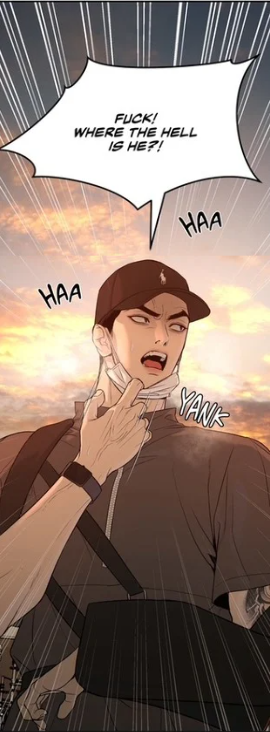 (chapter 56) While in the first picture, Joo Jaekyung is calm, concentrated and silent, in the second one, the fighter is agitated, lost, breathless and yelling. These two mental dispositions are reflected in the location. In the first image, the MMA celebrity appears behind the steering wheel, which is a symbol for power, determination and control, whereas in the second panel the champion is wandering alone in the street. This running is no longer part of his training and routine, but it exposes his powerlessness, loneliness and despair. He has no idea where to go contrary to the first picture. This means that the latter embodies goal and destination, whereas the second image represents the opposite values: beginning, start, ground zero and source. In other words, the end of episode announces the athlete’s rebirth or better said, the start of a new life. I will elaborate further below. But let’s return our attention to the symbolism of the auto.
  (chapter 56)
  (chapter 35), Joo Jaekyung succeeded. He is just a passerby. In other words, the avenue indicates not only his failure to find Kim Dan, but also his loss of power and status. He has just become a nobody. Thus we should consider this as the athlete’s karma for thinking that Kim Dan could be replaced, because he was just a nobody:
  These two chapters are similar, for they convey the same emotions: anger, anxiety, frustration and despair of the fighter. In the car, the champion attempted to control the doctor’s libido.
  (chapter 33) On the one hand, he appeared calm and concentrated like in 56, yet deep inside, he was burning up. The pink dildo was used as a tool to voice his negative emotions (abandonment issues, insecurities and jealousy). With the release of episode 56, another reason came to my mind why the athlete proposed to drive the physical therapist to Choi Heesung.
 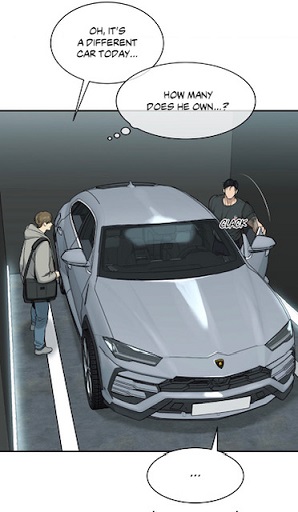 (chapter 32) First, he switched the car in order to demonstrate his wealth and status. It was, as if he wanted to show off to his fated companion, which reminded me of the actor. The latter would bomb doc Dan with “presents”, an indirect demonstration of his fortune. In addition, Jinxphiles will certainly recall that during the same day, the comedian came to fetch the physical therapist with his white Porsche.
  (chapter 32) Consequently, I came to the following deduction. The man selected the gray car in order to distinguish himself from his rival, to impress his companion.
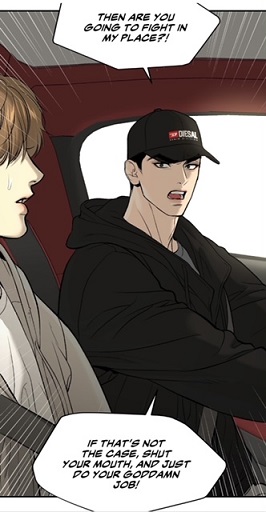 (chapter 42) And what was his attitude there? He would not listen to his passenger. Moreover, he would separate his job from his roommate’s. It looked like they were living in two different worlds, though they were sharing the car. This scene exposes miscommunication, lack of faith, stubbornness and prejudices. The fighter was not willing to accept the physical therapist’s doubts and chose to go through with the training and match.
  (chapter 2)
  (chapter 37) with arrogance and weakness, but this is not true. [For more read this
 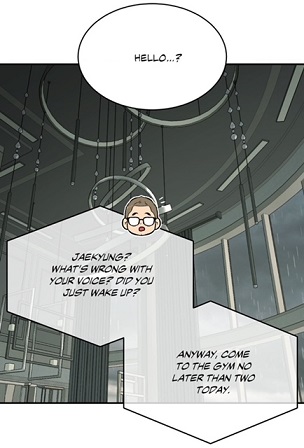 (chapter 54)
  (chapter 5) He allows the coach to drive the car and the manager to sit in the front. Thus they represent the higher authorities. However, so far, the doctor had only been his passenger. Thus a new idea popped up: what if the athlete let the physical therapist drive his car? Let’s not forget that the loner wolf shouldn’t be driving on his own, for his shoulder has not healed properly yet. I already pointed out the wrongdoings from the two hyungs.
 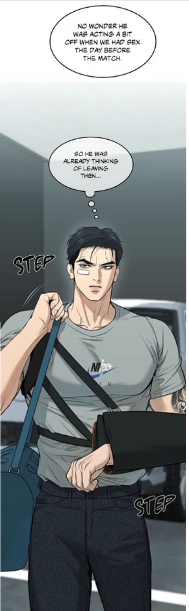 (chapter 53) They should have brought him home. They stand for neglect and indifference due to their passivity and routine. In my eyes, they are happy at the gym, the latter represents their second family. So they imagine that it is the same for their boss. In other words, they projected their own thoughts and feelings onto the celebrity. They embody silence and lack of communication and this is actually palpable in the car. In episode 5, the manager and the MMA fighters lied to each other:
  (chapter 5) Then in episode 49, the champion kept The Shotgun’s words as a secret, while his coach confessed his trust in his “boy”
 (chapter 49). Yet, he revealed his true thoughts at the hospital:
  (chapter 37) He was using the landline telephone. This observation is relevant, because it exposes the coach’s dependency on Park Namwook. The latter’s task is to keep in touch with his boss and champion, for he has his cellphone number. Nevertheless, how do we explain the absence of the coach’s cellphone? I have the feeling that this could be related to his divorce.
  (chapter 49), Jinxphiles could never view the driver.
 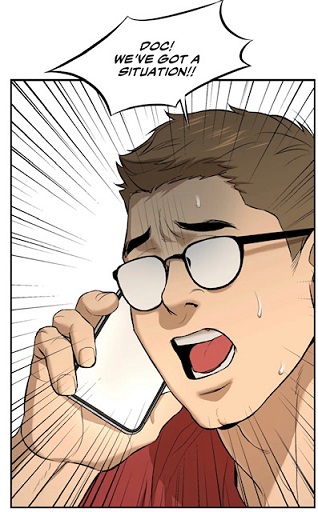 (chapter 13) His question “Is everything okay with you?” is purely mechanical and as such meaningless, for he doesn’t inquire, when he hears a silence from the other side of the line. I would even say that he doesn’t really wait for his boy’s answer as well.
  (chapter 5), no money
 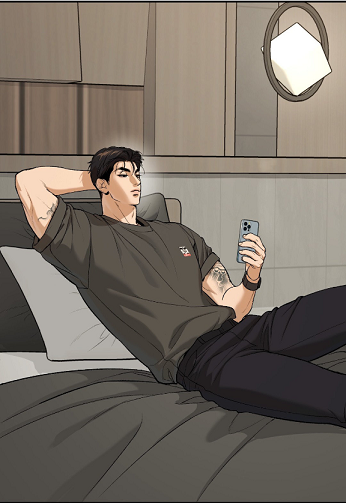 (chapter 32) and no power. His call to the manager during that evening represents his last resort. Thus he is calling the manager “Namwook hyung” contrary to episode 5.
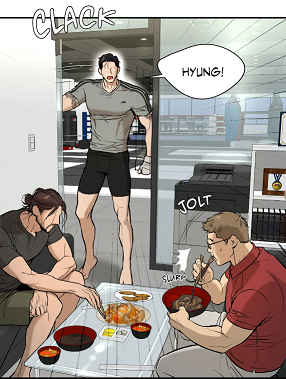 (chapter 5) This title is indicating that the champion is opening up, and willing to show his vulnerability and despair. On the other hand, this change also implies “expectations” from the fighter,
 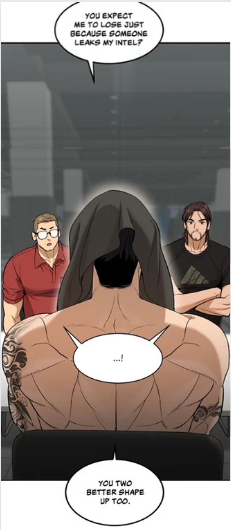 (chapter 46) Keep in mind that at the gym, the athlete denied the relevance of information. Though both hyungs were warned, the reality was that they got off scot-free. They never received any blame for failing to protect him and this twice. And now, he is looking for intel about the doctor. Indirectly, fate is teaching him to recognize his error. In fact, information can procure a good insight about people’s behavior and as such fears. Let me give you an example: if Joo Jaekyung were to hear about Kim Dan’s first employment as PT, he should understand why the PT made mistakes, why he took odd jobs and why he “left” Seoul. If he wanted to work as PT, he needed to go elsewhere.
 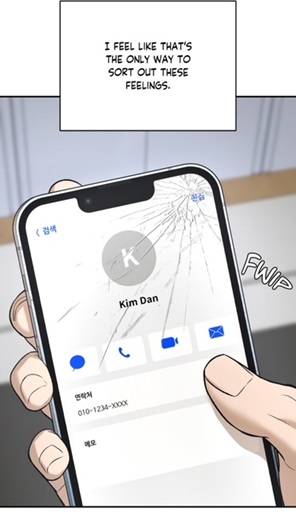 (chapter 56) He somehow expected doc Dan to listen to his words and accept them. That was it. Then at the end, it is just about seeing doc Dan and nothing more. At no moment, he voiced the desire to get to know his partner or to listen to his side of the story. Why? It is because he had strongly internalized that the man was a liar. He never questioned his perception and detected his own prejudices. It is important to recollect how Jinx-philes could sense a positive change in the physical therapist:
  (chapter 22) Yes, it is the view with the star’s back. The author selected such a position on purpose. The face represents the character’s identity and as such his personality. By showing the back, Mingwa is implying that the beholder is full of prejudices and doesn’t know his partner that well. That’s why I judge this image
  (chapter 7)
  (chapter 32)
  (chapter 37)
  (chapter 40)
  (chapter 43)
  (chapter 45)
 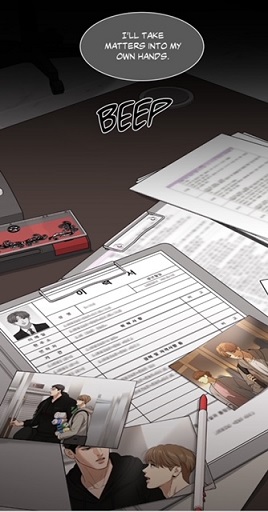 (chapter 46)
 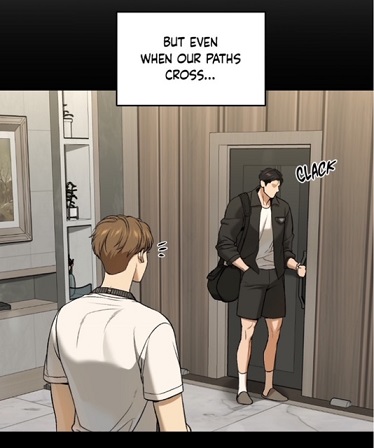 (chapter 47) Looking at his face had become his new secret ritual and as such his source of joy. Naturally, his heart and unconscious were the causes for this new habit. This explicates why he hated hearing the doctor leaving the penthouse during the night: he feared that he would no longer be able to see his cute face. That’s also the reason why Joo Jaekyung got angry/upset, when he saw the doctor turning his head away
  (Chapter 54) This nightmare exposed his regret which he tried to deny and bury. At the same time, I have the feeling that his secret desire was to wipe away his tears as well. Nevertheless the problem is that such a love is rather superficial, for people’s body deteriorate over time. What matters in love is a good personality and a good heart. According to Erich Fromm, love is knowledge, respect, care and responsibility. Hence this separation became a necessity for the fighter. Fate had to force him to admit this:
  (chapter 56), when he imagined that she had died. In reality, he helped financially more the grandmother than Kim Dan himself. Kim Dan is the one he should really empathize with. He has always been a victim of circumstances.
 (chapter 56) Desperation can strip away the higher faculties that make us human—reason, empathy, and self-control—exposing something primal.
  (chapter 17) and
  (chapter 11). In season 1, the athlete stands for golden hour, whereas Heo Namwook embodies blue hour. “Entre chien et loup” is the time of day when the light is such that is becomes difficult to distinguish between a dog and a wolf, between friend and foe, between known and unknown. Hence I am thinking that if the next episode represents a continuation of that nightfall, it signifies that the champion is on his way to meet someone from the past. Moreover, I detected that the pavement is the same than in front of the gym: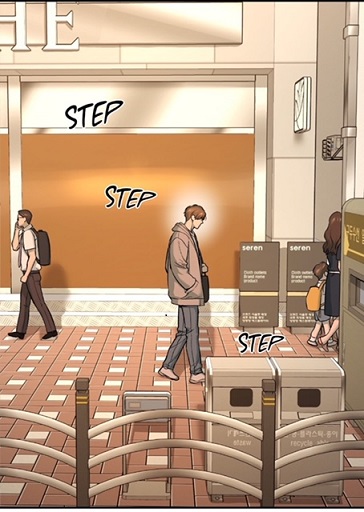
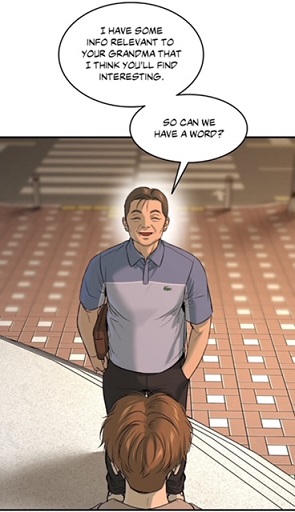 (chapter 48) As you can see, this detail made me realize that the next chapter should contain reflections from episode 35 and 48, the meeting with an old/new acquaintance. I am writing new and old together on purpose, for Director Choi Gilseok had been the halmoni’s loan shark, but the “hamster” had no idea. Choi Gilseok is the boss of Heo Manwook. If this encounter takes place, it signifies that on the one hand, it will cause pain and suffering to the athlete, on the other hand, this incident will become a “blessing in disguise”, for it will push the champion to reflect and mature. That’s how I had the following revelation. Why did the author ensure that the MMA fighter’s shoulder would get badly injured?
  (chapter 52) It is because this exposes the champion’s bad coping mechanism. The champion always uses his fists, therefore he doesn’t reflect and as such analyze his emotions.
 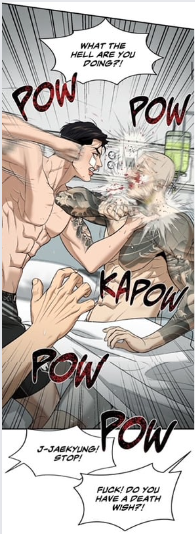 (chapter 52) That’s how he felt right into the trap of the schemers. So by having his splint, Joo Jaekyung is indirectly coerced to meditate on his feelings., as he can no longer use his shoulder and as such his fist. His physical injury represents in reality his “lucky charm”, for it helps him to transform, to overcome his trauma and face the shadows from his traumatic past. Notice that for the first time, the athlete came to accept the existence of feelings for Kim Dan.
 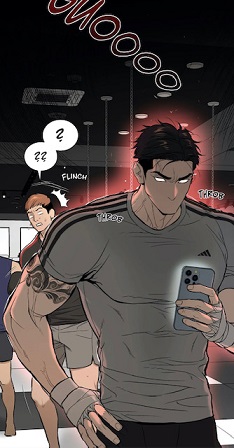 (chapter 5) He is much calmer. He is not oozing red and remaining silent. He is not burning up inside, in fact he is expressing his thoughts and emotions:
  (chapter 5) In both cases, the athlete asked for his manager’s help. However, as Jinx-philes can sense, there exist two huge differences between the past and present. Back then, Park Namwook didn’t care for Kim Dan. He was just a PT like any other doctor. He didn’t even care that Joo Jaekyung would lose his temper and ruin the sandbag.
  (chapter 5) It was not worrisome in his eyes, because his day would consist of training and punching the sandbag. The problem is that the fighter is no longer coming to the gym and he is not even calling him:
  (chapter 56) This shows that the athlete is using more and more his intelligence, he is forced to interact with people. He is gradually developing his social skills which stand for COMMUNICATION. And how did he get deceive in the past?


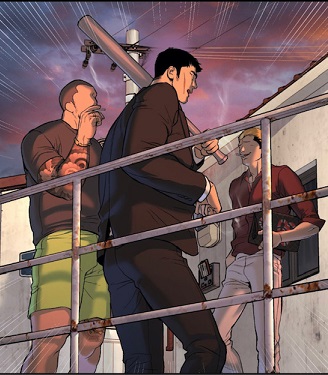

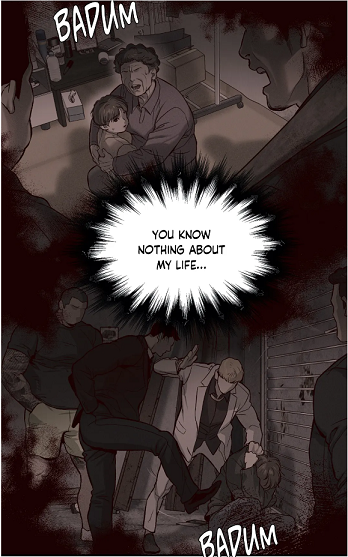


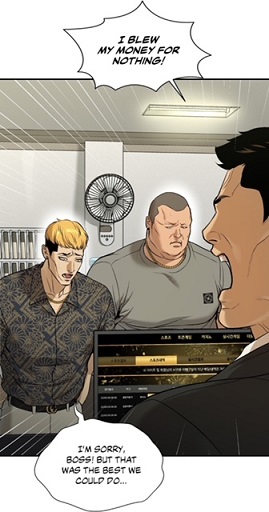

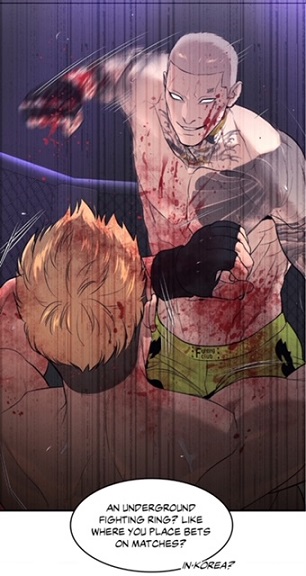

 (chapter 11) and indirectly the persons involved in the redevelopment. However, I have to admit that I have a different explanation.
 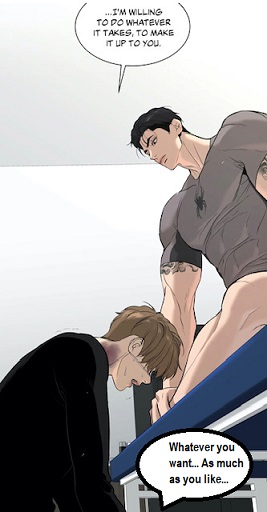 (chapter 11) Let’s not forget that in Jinx-Fandom, many Jinx-addicts calls him a “red flag”. Here, he was abusing his position. Furthermore, this theory could be seen as validated with the first episode with this image:
 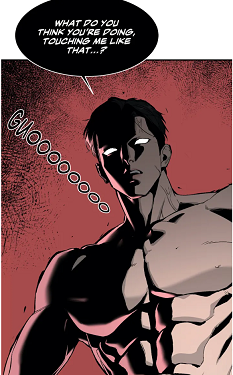 (chapter 1) The main lead appears as a beast, triggering the doctor’s fears. He seems to be like an antagonist. However, I believe that it is just a deception. First, Mingwa has clearly stated that the champion is the protagonist of Jinx. As such, he can be neither a villain nor an antagonist. Secondly, though he seems to serve as a barrier, the reality is that Kim Dan is incited to mature and overcome his own fears. In fact, the celebrity represents the opposite notions of “conformity” and “immobility”. He embodies verity, maturity, transformation and progression. The evidence of this perception is the gradual transformation of Kim Dan as an inexperienced PT to a very professional and performant physical therapist. According to my interpretation, the Emperor works as the mirror of truth. He confronts the delusional physical therapist with his mental and emotional issues, like here:
 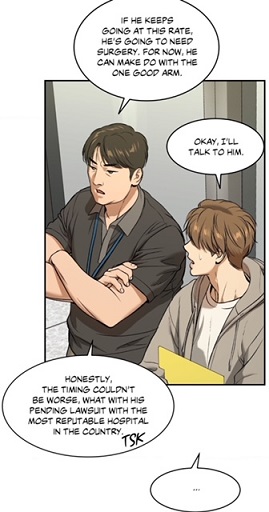 (chapter 42) He only relied on his hands. He was forced to become a serious and confident PT!!
 (chapter 1) The star was just waiting, and not threatening the doctor. As you can see, Joo Jaekyung doesn’t appear like a threat or a monster. But this doesn’t end here. One detail caught my interest. The champion is associated with blue. It is his true color, whereas Kim Dan is “red”, like a sweet strawberry. So why does this young man ooze a red aura, when his true shade is blue like water
  (chapter 1) Note the contrast to his “boy”. The red is not coming from Joo Jaekyung’s body
 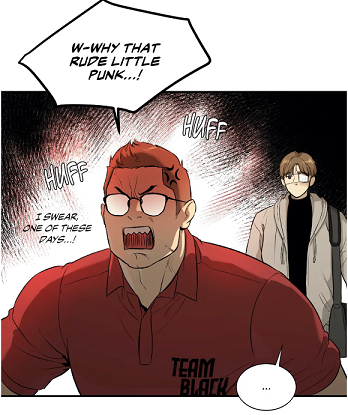 (chapter 11) The coach is yelling for Joo Jaekyung’s comment, yet the reality is that the manager didn’t treat Kim Dan at all. In fact, he feigned ignorance. Moreover, look at the champion’s t-shirt:
  (chapter 26) In this composition, I compared the MMA star with a leopard and Park Namwook to a spider:
  (chapter 17) or in episode 46
  (chapter 46) He represents regression or the hurdle to overcome.
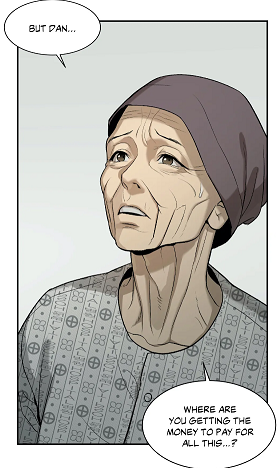
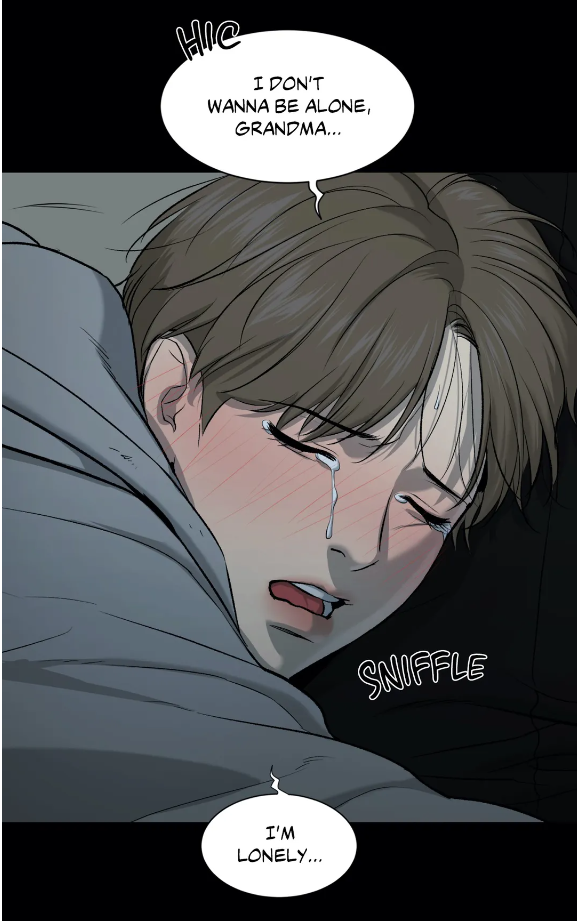

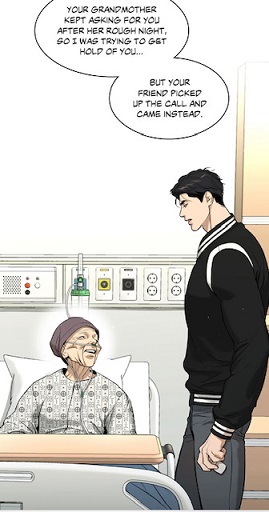
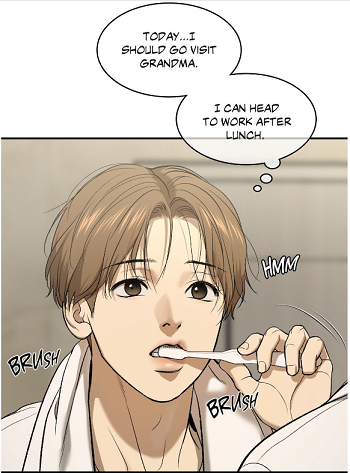
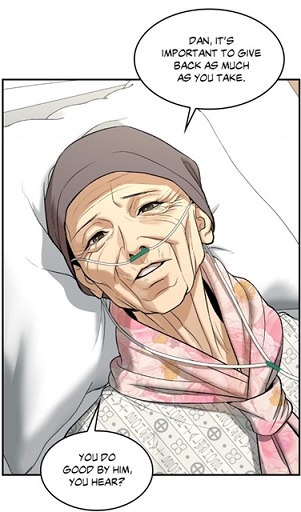
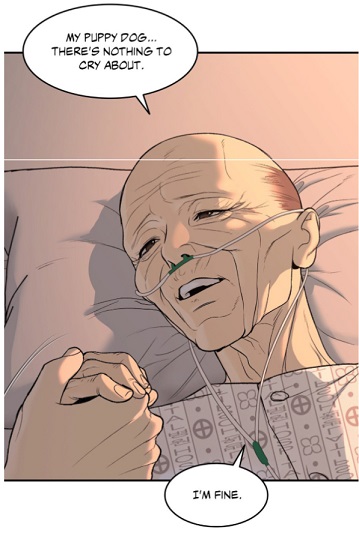
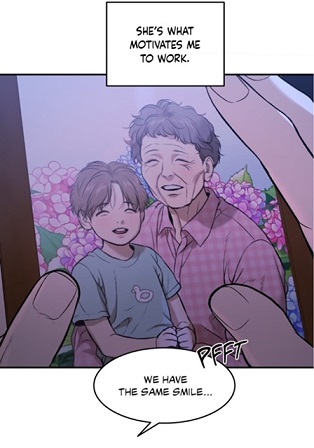


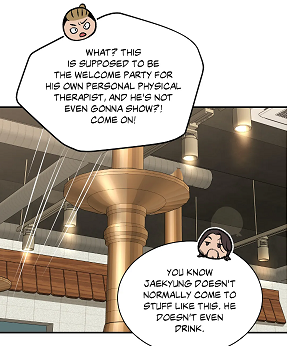 (chapter 9) or other events like this one:
  (chapter 37) Buying in secret junk food.
 (chapter 1)
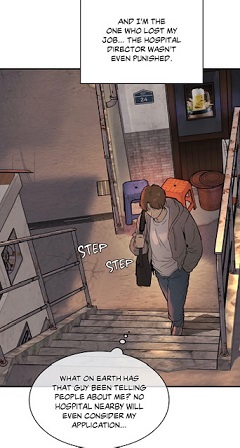 (chapter 1) But it is the same for the champion who got his “gym” stolen from his hyung:
  I came to this revelation thanks to this article:
 . (chapter 46) This would explain the champion’s emptiness and darkness:
  (chapter 21) and Kim Miseon’s reproach to Kim Dan could be seen as an indirect allusion. And if my interpretation about her number is correct, then we would have a good explanation why Kim Dan was unable to perceive her true nature, but also why she is so selfish.
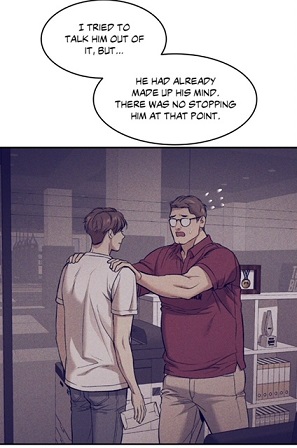 (chapter 53) Only the logo is red.
 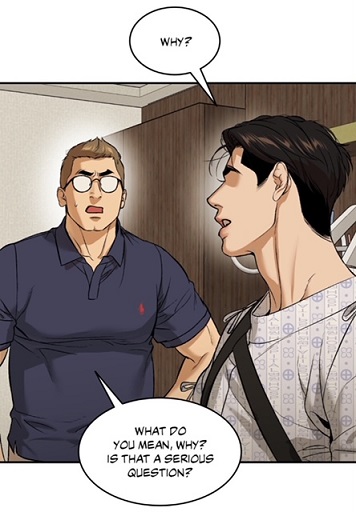 (chapter 53) It is important, because it announces the manager’s resignation. He doesn’t want to become responsible for the mess. Unconsciously, he is no longer claiming to be the owner of the gym. Furthermore, notice that the grandmother desires to return to the West Coast in order to see an ocean of “fire”.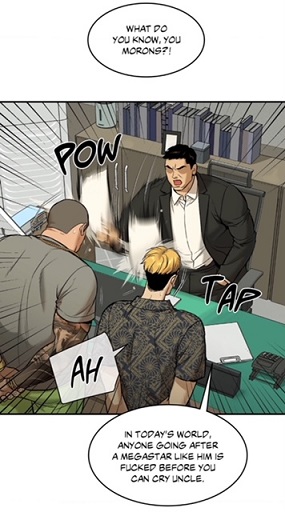
 (chapter 35) In episode 16 and 17, the presence of the sun is a reference to the MMA fighter, it is announcing his arrival. This corresponds to the color I had detected with the first scheme:
 MFC with the blue “ring” embodies this pigment, just like the ocean. In other words, blue should be the dominant color in season 2, and in Taoism blue stands for YIN! On the other hand, Kim Dan also represents red with his name. Moreover, if you look at the numbers of the quoted episodes again, you will realize that the villains are strongly connected to the number 10 and as such one and zero. Thus Director Choi Gilseokf’s phone number is 010-1….
 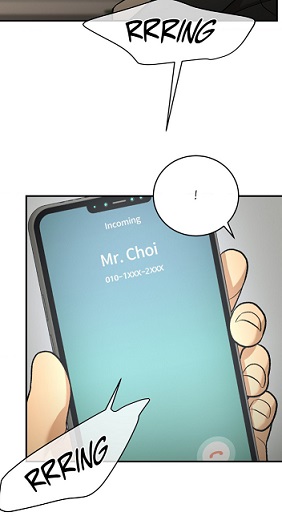 (chapter 46)
  (chapter 37) He never complimented him for his hard work at all.
  (chapter 46) With these words, the manager creates a negative atmosphere, therefore there is no longer any trust and loyalty among the members.
  (chapter 18), until the champion confronted the protagonist with reality.
  (chapter 46) He avoided a confrontation. This number symbolizes how the lead feels burdened by obligations imposed by his oppressor, who positions himself as provider of “stability” while actually fostering dependence and draining his victim. And naturally, in the same chapter, we have a similar interaction between Heo Manwook, the minion and his hyung, the real boss:
 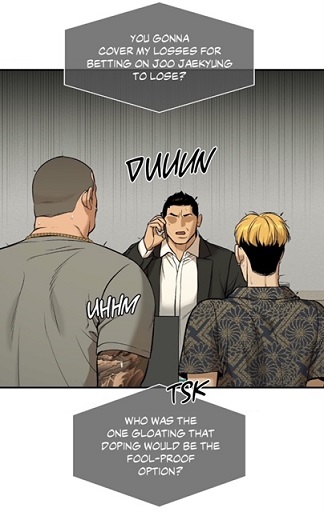 (chapter 46) Here, the director was reminding him of his mistakes and obligations. However, this time the boss chose to become proactive and responsible.
  (chapter 1)
 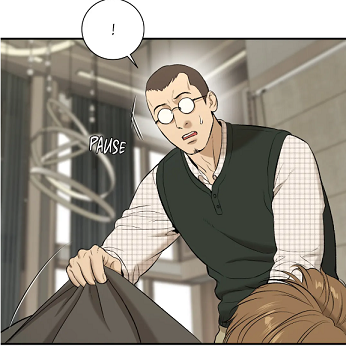 (chapter 13) They are strongly intertwined with the color green and as such blue. In literature, art, and psychology, the color blue often represents calmness, loyalty, and introspection.This fits to the description made by the author concerning season 2. The latter would focus more on emotions and thoughts than on the plot. And now, it is time to reveal why in the illustration I added the number 9.
 (chapter 9) The leopard agreed and that’s how they came to argue about his home the next morning:
  (chapter 10)- So from 9 to 18, the story is focusing on the doctor’s home. In episode 18, Joo Jaekyung invites the poor physical therapist to his home.
  (chapter 18) Then in episode 19, Joo JAekyung is not asking for his “help”, until he calls him. But even here, he is refusing to prepare his partner:
 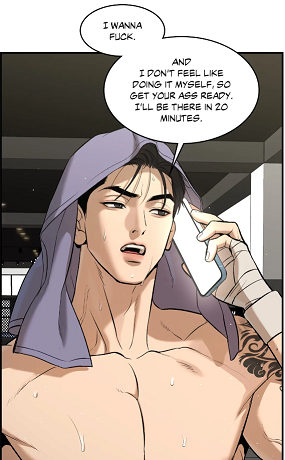 (chapter 19) As for Kim Dan, the latter doesn’t feel truly needed as PT, hence he is already thinking about taking another job:
  (chapter 27) He encourages his VIP client to take a break by remaining by his side. However, this attempt fails, as in episode 29
  , (chapter 29) the champion rejects the idea of resting for a day. Then after the incident with the article, at no moment Kim Dan offers his assistance to help the champion. He remains totally passive,
  (chapter 39) The problem is that it is related to a drug and sex. This has nothing to do with his job or career. Interesting is that in episode 45, for the first time, Joo Jaekyung voiced his needs to have him as a PT:
  (chapter 49) This means that in that scene, Joo Jaekyung refused to let Kim Dan treat him out of doubts and mistrust which were triggered by the manager’s words and the pictures. As you can see, the number 9 is strongly intertwined with help, but also with a change. The beginning of a new circle. Thus I am expecting in the new season, chapter 54, that for the first time, Joo Jaekyung will ask for help and support. But he can not ask Park Namwook or others from Team Black… he has only one true friend and that would be Cheolmin, unless he finds the protagonist immediately. At the same time, I would like to point out another observation. What is the opposite of 9? Naturally 6, which represents the end of a circle. And now, look at this:
 The end of Joo Jaekyung’s torment. He doesn’t need to chase after him.





 (chapter 9) This gesture oozes humility and respect. This contrasts so much to Park Namwook’s behavior during their first meeting: no bowing and no shaking hands.
  (chapter 1)
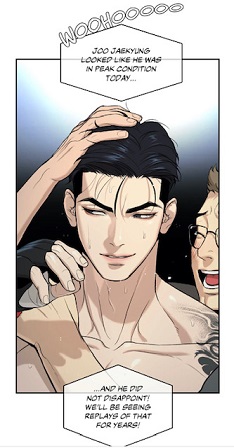 (chapter 5)
  (chapter 40) Yes, at no moment Jinx-philes can detect his presence. The bearded man embodies humbleness. As you can observe, this man doesn’t mind standing in the champion’s shadow. He already knows that fame and success are no guarantee for happiness, as he lost his wife. In fact, he knows that success means rather loneliness. This remark brings me back to his confession in the office.
  (chapter 53) So when he tried to call her, she blocked his calls. One of the causes for their failed marriage is that they had stopped talking to each other. [As for the other reason, I will expose it below] That’s the other reason why I developed the theory that the coach Yosep was behind this phone call.
  (chapter 22) This observation is relevant, for it indicates that the former champion must have listened to his manager as well. He never questioned the responsibility of his former coach or manager or organization. I am suspecting that he might have already been working with Park Namwook in the past, which would explain their closeness. For his divorce, Jeong Yosep chose to take the whole blame. Hence he kept his failure to himself. However, observe the manager’s attitude concerning this revelation.
  (chapter 40) Interesting is that the idiom “boy” has historically been used to mean “servant” or “attendant” in certain contexts, particularly in colonial or hierarchical settings. For instance, it was often used during the colonial era to refer to male domestic workers, typically in a demeaning or racially charged manner. No wonder why though Yosep is the sparring partner of the Emperor,
  (chapter 37) he acts more like a servant. In my eyes, the last image displays the manager’s three “boys”: Yosep, Kim Dan and Joo Jaeykung. They are the former wrestler’s servants, while he can stand on the sideline and watch as a superior and guardian.
  (chapter 37)
 (chapter 36). He even agrees to everything the man says and decides.
  (chapter 36) Yet, I see a turning point in the States. For the first time, he is seen talking on the phone, which indicates a certain responsibility.
  (chapter 49)
  (chapter 40) In the States, he was not visible at all, he would even walk behind Oh Daehyun next to Yoon-Gu. In my opinion, he felt the need to be next to the maknae. However, in South Korea, he is standing right behind the protagonist. Moreover, note how Joo Jaekyung entrusted him with the charity event, another indication that the main lead was trusting more and more his sparring partner:
  (chapter 41) In addition, in the locker room, he is the one who made the decision to let the Emperor fight against Baek Junmin.
  (chapter 50) For the first time, he voiced his own opinion, yet his choice lets transpire the great influence from his “hyung” and MFC. His decision was influenced by money. Naturally, the high peak of his action is, when he announces to the main lead that he went to different authorities
  (chapter 47) He let his “hyung” and the other “experts” who were never in the ring do the talking.
 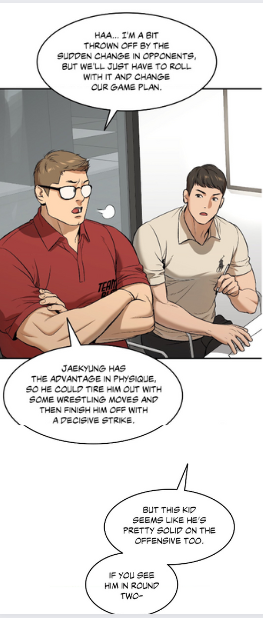 (chapter 47) Why did he let it happen? It is simply because he just views himself as a “sportsman”. The others act with their title (managers, advisors), as if they had more knowledge than the sparring partner from the Emperor. Another mistake from him is that he never looked at his sparring partner’s files. He let Park Namwook take care of this, thinking that he would pay attention to their star’s health and security.
 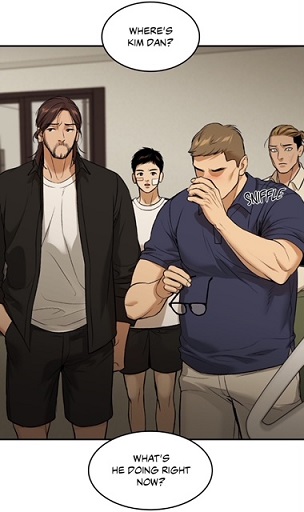 (chapter 52) Since he lost his wife and as such has no family, it is clear that this former champion views Team Black as a family. Therefore he participated in the surprise party.
  (chapter 43) Consequently, I come to the following conclusion that the last scheme made him realize his own wrongdoing. He didn’t protect his sparring partner correctly. He failed him. However, like pointed out in a previous Daily Jinx Advent Insight, Yosep was manipulated from his colleague. Therefore the coach didn’t meet Kim Dan in the office and couldn’t talk him out of it. This discovery exposes that one of the protagonist’s problem is that he was following his sparring partner’s lead as well. Because Yosep trusted blindly Namwook, his “pupil” did the same. And this remark leads me to the confrontation in episode 46. The true owner of Team Black warned his both hyungs:

 (chapter 53). Because the latter is slowly vanishing into the light, it looks like the champion will have difficulties to find his soulmate. However, if you pay attention to this picture, you will perceive that Kim Dan’s shadow is huge. In fact, we have to envision that the closer he gets to the “sun”, the bigger his shadow becomes. This metaphor is implying that the cute hamster is leaving a trail behind. This represents the traces he left in Joo Jaekyung’s life and heart. The farer he is, the clearer the fighter can only realize the importance of his roommate in his life. However, I believe that though Kim Dan is about to become a ghost, the huge shadow is implying that Joo Jaekyung will be able to find him quickly.
 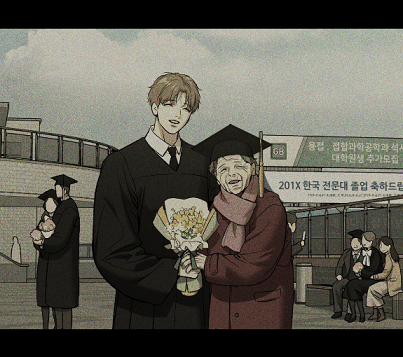 (chapter 47) You might find it strange, but everything started with the following question: where is the grandmother’s cellphone? One might argue that as an elderly woman, she doesn’t possess one. I can only reply that all the seniors I know (even my grandmother who is much older than Shin Okja) have one. Besides, let’s not forget that according to me, this image or this one
 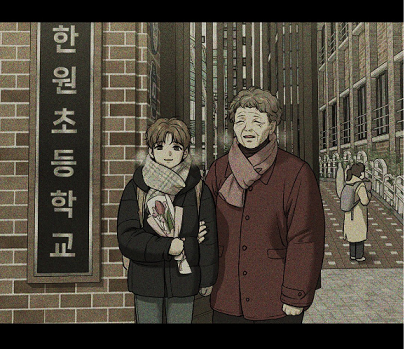 (chapter 47) represent moments where pictures were taken. I doubt that the grandmother had a camera. Then in the last picture, Kim Dan was definitely too young to have on his own cellular telephone. Finally, observe that in this panel
  (chapter 47) Before he was practically inexistent, only famous in the underground fighting ring
 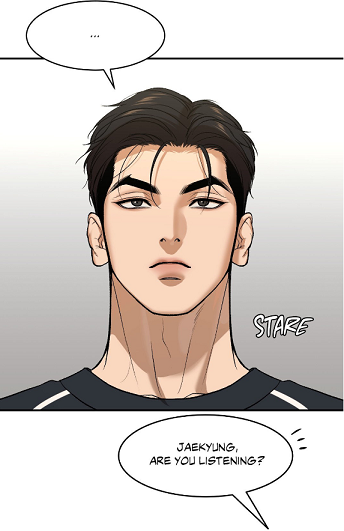 (chapter 47).Interesting is that disappearing without traces implies the notion of “the right to be forgotten”. But why would people make such a decision? Either they want to escape from their environment (abusive husband, debts, …) or they desire starting a new life afresh. So when we look back at Shotgun, it becomes clear that his new identity is to mask his dark past.
  (chapter 47) It was, as if this man had not existed before. That’s how a star got born, or better said, he was a new-born man.
  (chapter 21) There is no landline telephone. Its absence seems to indicate that the senior switched to a different phone. She had to have one because of the authorities (school for Kim Dan, etc.). I would even go so far to say that the elderly woman changed her phone number. But why would she change her phone?
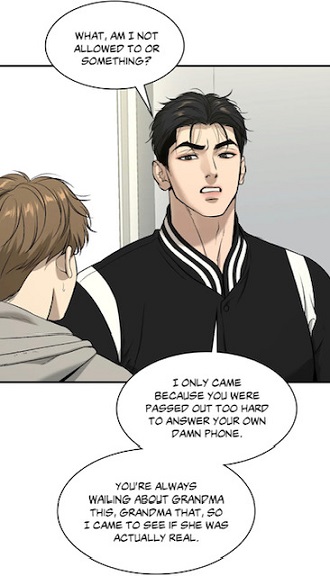 (chapter 22) He doubted her existence. Why? It is because he never heard Kim Dan talking with his grandmother over the phone. He had only mentioned her in his drunken state.
  (chapter 11) There is no ambiguities that she was registered there as a resident. But if she got rid of her phone, the authorities are forced to call her closest relative. Secondly, observe that Kim Dan used the cellphone to pay bills and have a look at his bank account:
  (chapter 11) In other words, by refusing to have any phone, she dropped all the debts on her grandchild. He was now responsible for their household and expenses. Yes, the question with the grandmother’s phone led me to the following observation. Little by little, Shin Okja was vanishing which reminded me of the action from Kim Dan’s parents. At the same time, with no cellphone, she forced her grandchild to visit her, to keep in touch with her. Hence I can’t stop restraining myself from feeling that the grandmother used the hospital and the nurse to control her grandchild’s moves. No wonder why Kim Miseon complained to Kim Dan about his neglect
  (chapter 22) Yes, by paying the bills, he got access to this information. However, for that he needs a person who can have access to such information:
 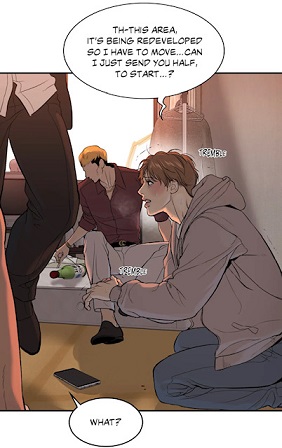 (chapter 16)
  (chapter 16) is an incorporated business. This means that Joo Jaekyung is the shareholder. So he is hiding his true power and identity behind Team Black. And since the Emperor was the victim of a hatred campaign in the media
 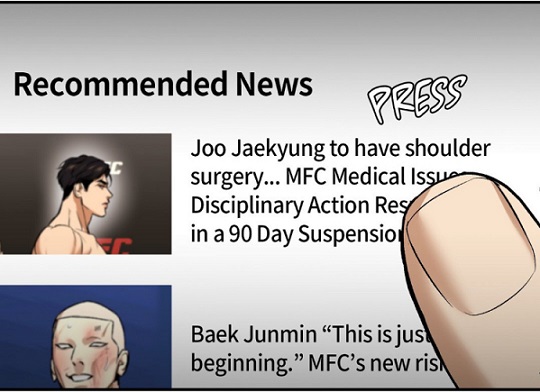 (chapter 52), his vanishing wouldn’t be surprising at all. It would be actually a normal reaction to be fed up of being online, and of being defined by the last match. What the schemers didn’t realize is that they pushed indirectly Joo Jaekyung to make the opposite decision than Baek Junmin. To disappear from the spotlight. But this can only lead him to create a whole new identity.
  (chapter 24), his relative could detect his whereabouts and moves. That’s why it is important if you desire to avoid of being detected, you need to use cash or prepaid cards to limit traceable transactions. That way, it reduces the risk of financial links to your old identity.
  . He is wearing piercing, jewels and rings, and his clothes don’t look like designer clothes. Finally, remember how Kim Dan imagined his soulmate:
  (chapter 32) Yes, clothes make the man, and as such through new clothes and hair dress, you can appear as a different person. That’s how it dawned on me why the Webtoonist created such a scene:
  (chapter 35) Choi Heesung made a terrible mistake, he attracted the attention from the guests at the café by covering his face. In order not to be detected as a star, the athlete has to act and dress like an average person: no fancy dress or car. And this leads me to my final point: using public transportation or the bike would represent a huge change for the Emperor. Once again, no one would suspect that a biker is a celebrity, similar to this scene:
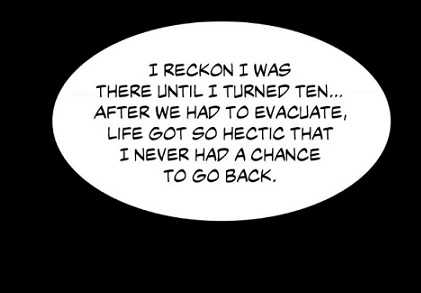 (chapter 53), she implied that she never got the chance to go to the West Coast because of him. It was, as if he had been a burden in her life (“life got so hectic”). This expression made me realize why Kim Dan came to live like a ghost. He embodies “life” for the grandmother: burden, responsibility, missed chance. It exposes her delusional mind-set. She is definitely chasing after an illusion. On the other hand, I detected that despite her words, she was not able to move her grandson’s heart. The latter was actually unwilling to leave the penthouse.
  (chapter 53) His decision was strongly connected to filial duty and not to “love”. Moreover, by fulfilling her request, he is one step closer to become free from self-blame and accountability.
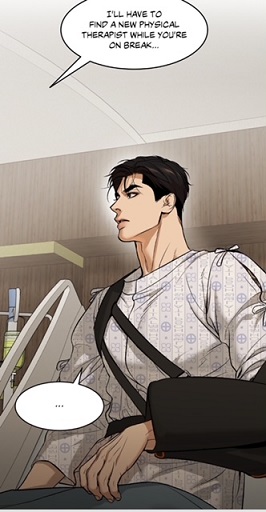 (chapter 53) Neither for the doctor nor for his “boy”.
  (chapter 40) Though he lacked awareness in the States, for he was not present in the interrogation room, he can no longer claim to be oblivious. He knows about Kim Dan’s innocence. But why didn’t he call the physical therapist then?
  (chapter 53) Notice that before leaving the penthouse, the main lead was holding the resignation in his hand. This means that the young man had not informed Park Namwook yet. This gesture exposes that Kim Dan was convinced that the manager was his boss, the master of Team Black. Nevertheless, Jinx-lovers should detect that the “hamster” left the flat during the evening. This signifies that the PT handed out his abdication the next morning, I can’t imagine that it happened during the night, for the man has a family with kids.
  (chapter 53). This signifies that he must have spent some time at the office. To conclude, the young man didn’t vanish quickly from the gym like a ghost, similar to the PT from episode 1.
  (chapter 1)
 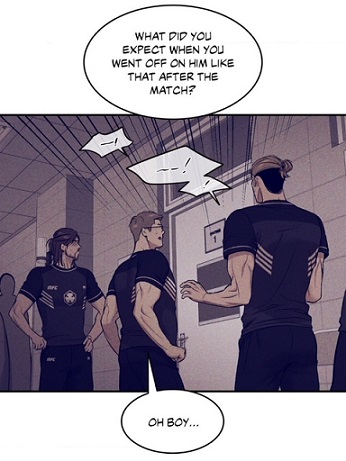 (chapter 53) He gave the impression that he was telling the truth. This incident was used to explain the doctor’s resignation. But here is the thing. If the doctor spent some time at the office in order to organize the files, why didn’t Potato stop him or tried to talk him out of it? That’s how I came to the following deduction. When Kim Dan came to the gym, the latter was empty, only the manager was there!! A new version of this scene:
  (chapter 23) Thus I deduce that all the members from Team Black were busy due to the discovery of the scheme:
 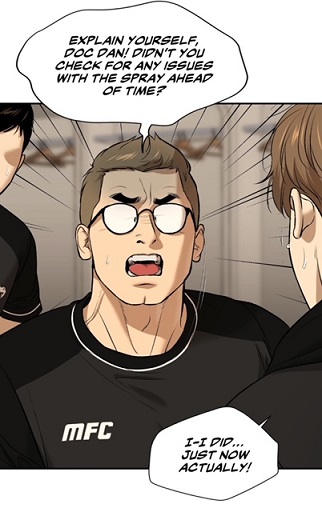 (chapter 50) Moreover, he could be blamed for the spray incident, for he failed to protect his own athlete. That’s why there was no apology from his side.
  (chapter 53) He took his words to heart. Thus I come to the following deduction: Park Namwook already knew about the physical therapist’s innocence, but he chose to keep the truth from his boss to mask his own wrongdoings: his passivity and negligence. The reason is that the discovery of the scheme took place in the evening, and Kim Dan gave his letter in the morning. Moreover, some days had passed, when they showed up at the hospital. Potato’s vanishing injuries are the evidence. They waited for the right time to announce the terrible news, something similar to this:
  (chapter 48) “If we tell him now, it will only throw him off his recovery or his surgery”. Once again, he chose silence and inactivity. Thus no one called the champion or the doctor.
  (chapter 50) And what did the manager say to the protagonist?
 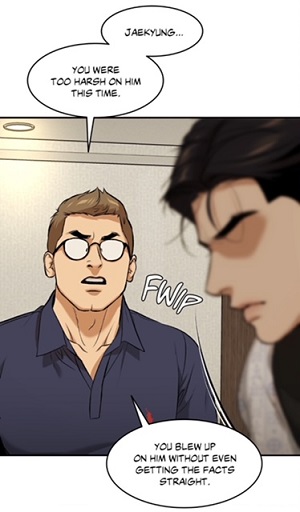 (chapter 52) He should have checked the facts. The letter is exposing the manager’s lie. He is expecting that Kim Dan vanished like the previous PT. However, contrary to the previous one, the “hamster” lived with the celebrity. Thus he left a letter to Jaekyung in the penthouse, and the manager had no way to know the existence of this message. And now, you comprehend why Kim Dan never received any phone call from Park Namwook. It is because he would have to inform him about the existence of the scheme. There was no emergency from his side, for he desired to hide his own wrongdoings (negligence, blindness and stupidity).
 (chapter 36). No wonder why the man is passive. But his inactivity is the result of his indecisiveness (I had portrayed him as someone suffering from Decidophobia). Interesting is that making no decision is the worst people can do. Why?
 (chapter 19) This comparison outlines the PT’s metamorphosis. Not only his perception of Joo Jaekyung changed, but also he has become a responsible and dedicated physical therapist. He defines himself as a PT too. Hence he didn’t leave a mess behind with the files (chapter 53). His decision exposes that this was not an escape.
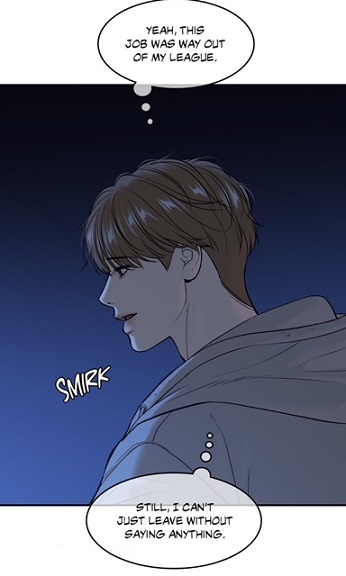 (chapter 53) It is because for Kim Dan saying goodbye over the phone is not proper. The reason is simple. He experienced it himself as a child.
  (chapter 53) Even more than before!! Joo Jaekyung needs assistance and protection. From that moment on, he can grasp that his sacrifice was not the best for both of them, why his sacrifice was in reality pointless. He should have been more selfish and more confident.
 (chapter 44) He stroke his soulmate’s face, kissed his cheeks and finally his ears. His actions triggered a singular reaction in the star:
 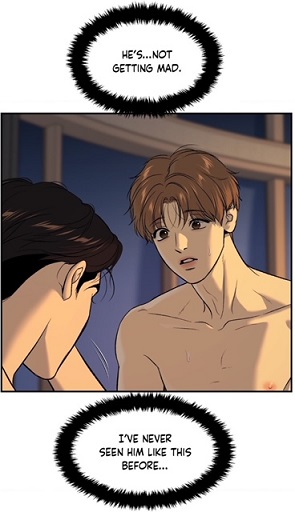 (chapter 44) This made the physical therapist’s laugh.
  (chapter 44) shows that in that moment, the physical therapist rediscovered his youth again. I would even add that Jinx-philes were witnessing in this panel how Kim Dan reconnected with his inner child.
  (chapter 44) The blushing is an indication of life and innocence. But if this young man’s childish nature was brought to the surface, who was Tinker Bell during this night? Naturally Joo Jaekyung. Under the influence of soju, the man could no longer hide his true nature. He has a childish side too. In other words, he was lowering his guard. Anyone has already heard from the quote “In wine, there’s truth” (the original quote comes from Latine: “in vino veritas”). As you can see, this beautiful night corresponds to this one:

 (chapter 10) Under this light, it becomes comprehensible why Kim Dan’s beautiful night became a dream, an illusion. The young doctor had done something wrong from a moral point of view. However, because the young man had treated the champion so well before, his reward was to experience what love is.
  (chapter 44) Thanks to Tinker Bell, he could fly: he was brought to Nirvana.
  (chapter 44) The problem is that the physical therapist was reducing love to sex (“making love”). True love has to be expressed in a lot of different ways (spiritual intimacy, experiential closeness, responsibility etc) and not just through sex.
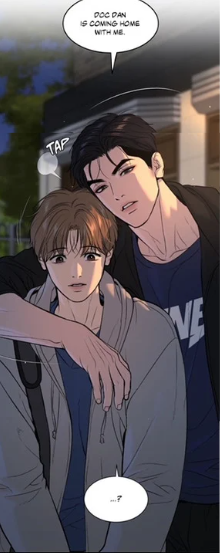 (chapter 43) Interesting is that in that scene, the protagonist couldn’t see his lover’s face. He couldn’t detect the glimpse of a smile and his warm gaze.
 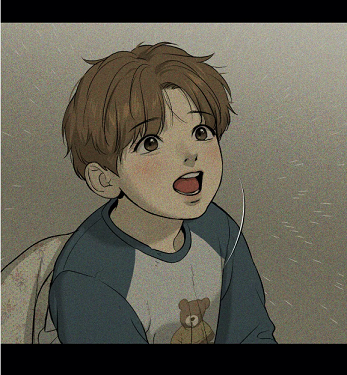 (chapter 11)
 (chapter 47) By saying that he was a puppy dog, she was implying that she would be responsible for him. Keep in mind that pet are linked to care and accountability. However, her wish is strongly connected to one single moment:
  (chapter 53) She is not thinking about the future at all. For her, it doesn’t matter, for her time is limited. Dog can be abandoned in the end, especially when the responsibility becomes a burden. That’s the reason why I believe that in verity, she was treating the protagonist more like an object than like an animal. Moreover, Jinx-philes should keep in their mind she used to describe him as a little boy, which also represents responsibility and care. Therefore I conclude that this scene didn’t stand for Kim Dan’s true home, it was just an illusion.
 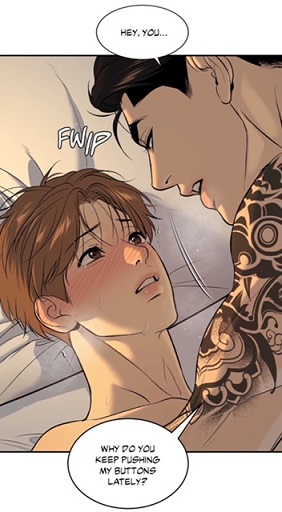 (chapter 44), though the communication failed, for Joo Jaekyung was drunk. Moreover, Kim Dan kept most of his thoughts to himself, a sign that he was still guarded. Hence while Doc Dan felt at home during that night, it didn’t last long. The next morning, they became once again boss and employee.
 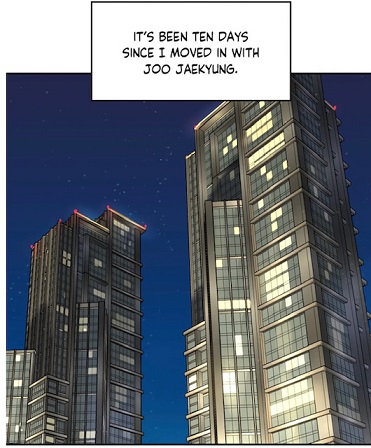 (chapter 19), very territorial and disliking surprises. In literature, leopards often symbolize strength, courage, agility, and stealth. They are seen as solitary and powerful hunters, often representing independence or mystery. In totemic traditions, the leopard can symbolize resilience, adaptability, and personal power, often embodying a person’s inner strength and ability to face challenges.
  (chapter 26) One might argue that he laughed with Potato and Oh Daehyun in the States. But are you sure? We never saw him laughing. Only Joo JAekyung heard their laughs, but did it also belong to the hamster?
 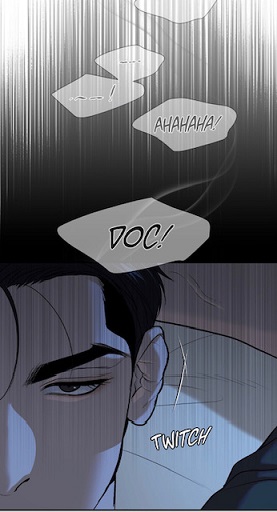 (chapter 37) Moreover, observe that during that terrible night, the athlete was wearing an t-shirt with a feline on it:
  (chapter 37) Puma was designed on it. As you can see, everything is pointing out that this man is a leopard which was mistaken to a sulky cat or a puma.
  (chapter 44) So since the champion was naked during this night, we could say that his true nature was slowly coming to the surface. As a predator, his annoyance to the strokes and kisses appears more normal and understandable:
 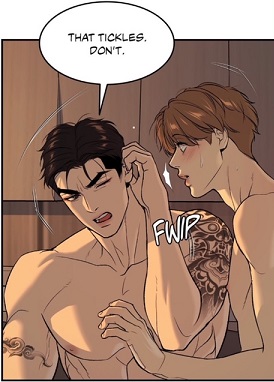 (chapter 44) Kim Dan is teaching him how to control his strength and discover playfulness. And now, imagine Kim Dan patting a leopard 😉
 (chapter 44) and the leopard fighting a wounded and isolated hyena:
  (chapter 52) Eye-contact! Making direct eye contact with a leopard can be dangerous. Leopards may interpret prolonged eye contact as a threat or challenge, triggering an aggressive response. In the wild, they rely on stealth and avoid open confrontation, so they may react defensively if they feel they are being stared at. This behavior is common among many predators, as eye contact often signals dominance or confrontation. It’s generally advised to avoid direct eye contact and back away slowly if you encounter a leopard in close proximity. Baek Junmin had totally underestimated the true nature of his opponent. This could explain as well why Park Namwook is wearing his glasses all the time and even avoiding eye-contact with the emperor.
 (chapter 24), Oh Daehyun the eagle…
 (chapter 9)
  (chapter 16) the loan shark and the old lady. He knew where she was (hospital), and notice that her grandson had been paying the loan from his own account and cellphone.
  (chapter 16) As you can see, the debt was strongly connected to the grandmother’s house. But who had moved out from the small dwelling? The grandmother. Interesting is that this district was about to get redeveloped. The thugs could have noticed it… there were everywhere banners announcing the new construction.
  (chapter 9) But who was not aware of the redevelopment? The grandmother… She had been living at the hospital for 3 years. I came to this deduction because of Choi Heesung’s remark about his k-drama:
 (chapter 30) She was not working non-stop. Another important aspect is that such persons are passive, because they are waiting for the right time or for the outside help. They somehow imagine that a prince charming will suddenly appear and remove all their problems. Consequently, I conclude that the elderly woman views herself as “Sleeping Beauty”, hence the doctor adopted her mentality. The athlete must have appeared like a knight in shining armor for the grandmother that day.
  (chapter 31)
 (chapter 31) They look more like the light pink rose: Innocence and admiration. However, keep in mind that back then, the gumiho was already love bombing the physical therapist with presents, a sign that he was already thinking of dating the main lead. While the bouquet of flowers was not reflecting his intentions, in verity it exposes his true thoughts unconsciously. He was simply impressed and desired to express gentleness, grace, and gratitude. This observation made me realize that the actor couldn’t identify his emotions in the end. In other words, he doesn’t know what LOVE is! That’s his curse. He mistook his feelings for love, while in reality, it was simply LUST. 😉 While the latter is important in a relationship, it only represents the first stage of love. So not overcoming this first stage, means that the relationship is doomed to fail.
 (chapter 30)
  (chapter 33) His emotions couldn’t be maintained over time, which corresponds to the second sign.. Thus he was suddenly perceiving the unknown man as clingy and the grass would always look greener
  (chapter 33), each time he faced someone he felt attracted to. We could say, he was under the spell of his “type”. At the same time, this discovery reinforces my previous interpretation about Kim Dan’s role. The actor needed to experience rejection in order to learn that lust can not always lead to love. We could say that the doctor was the angel who freed Heesung from his terrible lust spell.
  (chapter 35), though it appears rather superficial. After their separation, Choi Heesung didn’t try to stay in touch with the protagonist.
  (chapter 35) Since the actor has always confused lust with love, it was necessary for him not to feel “lust” in front of Potato first. In that scene, the man was moved, not by the uke’s touch like with Kim Dan
  (chapter 30), but by Yoon-Gu’s words.
  (chapter 35) The latter was offering him some help without expecting anything in return. Yes, he got attracted by his beautiful mind and heart. Through their conversation, they got to know each other. In other words, for the actor it was necessary to not experience lust, as a first stage of “love”, but to develop an emotional connection first! In addition, it becomes comprehensible why the artist suggested Potato to work as an actor.
  (special episode 2) It was his way to develop a longer relationship. He was trying to find the right balance between seeking thrill and pursuing stability. As a conclusion, the two special chapters display why the actor came to fall in love with Potato.
  (chapter special 1) By preparing some ramen, he acted as a selfless person, though his thoughts revealed his dark side. Nevertheless, what matters the most are the actions and not the thoughts.
 (chapter 41) He bought it during his trip to the States. Interesting is that the young man chose not to bring pink roses to his grandmother. Why has he never brought flowers to his halmeoni? Chapter 31 gives us the answer:
  (chapter 31) The flowers stand for “ephemerality”, for they are destined to wilt in a very short time. Yes, this shows that deep down, Kim Dan knew how his grandmother is trying to escape from reality. He knows her likes for flowers and roses as pattern because of the bed sheets
 (chapter 5)
 (chapter 41) The two flowers have the following meanings:
