Protected: Painter Of The Night: A stranger in the study! 👣 👣(Second version)
Bebebisous33s' analyses in K-Dramaland and Manhwas
Analyses of K-dramas and Manhwas (for the most part Yaoi)



This is where you can read the manhwa. https://www.lezhinus.com/en/comic/painter But be aware that this manhwa is a mature Yaoi, which means, it is about homosexuality with explicit scenes. If you want to read more essays, here is the link to the table of contents: https://bebebisous33analyses.wordpress.com/2020/07/04/table-of-contents-painter-of-the-night/
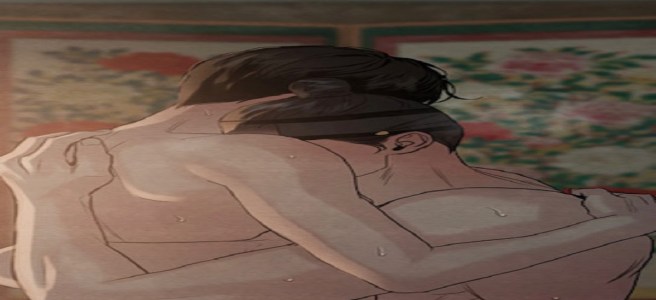
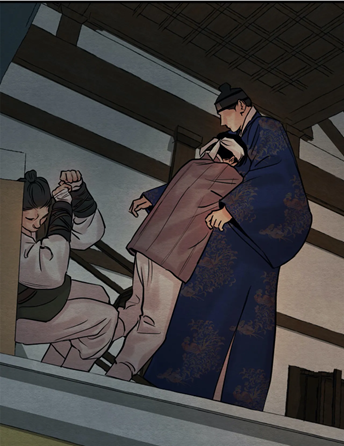
As you can imagine, the embrace between the two protagonists stands in the center of this analysis, because we had so many pictures with a hug, like these two: (chapter 76)
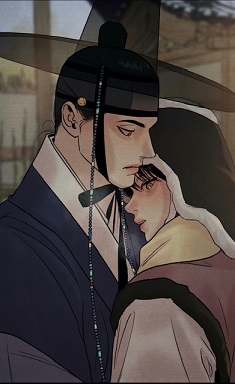 Yet, the peak was reached with the following picture, for Baek Na-Kyum and Yoon Seungho seemed to have merged as one:
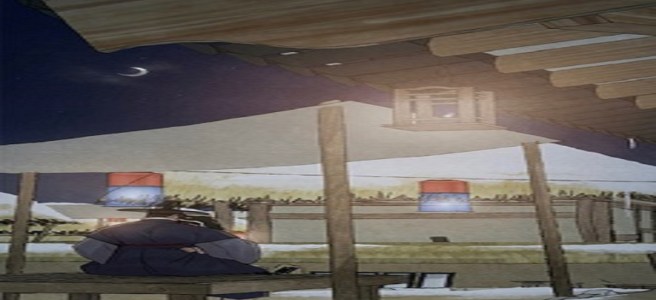
  The readers can barely detect the painter’s presence: only his head and hand are visible indicating the depth of their intimacy and closeness. However, the title is mentioning the presence of a ghost. The latter can not be Yoon Seungho, because the panel above announces his official wedding with the commoner due to the presence of the red and blue lanterns called Cheongsachorong. These are used for wedding ceremony in Joseon. Therefore who is the ghost? And why do I perceive the existence of a spirit in this chapter? But before revealing the identity of the ghost, I would like to expose the reason behind such a title. While focusing on the embrace, I came to the following observation.
Each time Baek Na-Kyum and Yoon Seungho embraced each other, I detected the presence of a ghost. During the second season, we had 6 real hugs:
 ,
,  ,
,  ,
,  ,
,  ,
,  .
.While comparing all the hugs, I will determine the ghost’s identity each time. In chapter 49 the painter was reminded of Jung In-Hun  due to the warmth exuding from the main lead. The painter couldn’t restrain himself from thinking about that fake embrace
 (chapter 29), therefore he chose to push away the wealthy aristocrat out of fear that he might get hurt and betrayed again. The commoner judged the embrace and warmth as a deception. This means that the low noble as a “spirit” was the reason why both protagonists couldn’t get closer. The low-born was only acknowledging Yoon Seungho as his sex partner and nothing more. Striking is that in episode 76, we have a reference to the hug from chapter 49, as the position of the painter’s head in this image
 resembles a lot to this one: (chapter 49). Yet the outcome is different, as the manhwaphiles can witness how the painter moves his head closer to Yoon Seungho’s.
 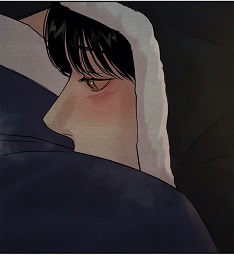 Moreover, the artist’s gaze is truly looking at his lover. We even have the impression that the artist is smelling the lord’s scent in order to reassure himself. Although the manhwaphiles couldn’t enter Baek Na-Kyum’s thoughts this time, they could perceive the change of his attitude. The embrace is no longer judged as fake. This signifies that the ghost Jung In-Hun has vanished for good, which is even reflected in a different panel:
 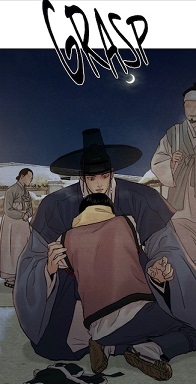 (chapter 76) The lord allowed the low-born to embrace him in front of people, whereas the scholar had to ask the commoner to follow him in a deserted alley.
 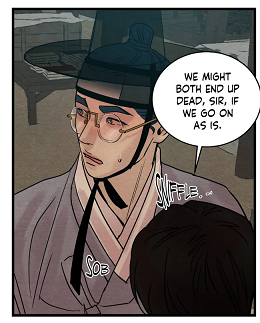 (chapter 29) The low noble feared people’s gaze, his attitude truly showed that he didn’t want to be connected to Baek Na-Kyum. His action was definitely a sign of hypocrisy and cowardice. That’s why in chapter 76, the painter could only come to the conclusion that the lord’s embrace was genuine and the lord’s feelings were not trivial. Moreover, the main character never pushed his lover away
 (chapter 76), he even lowered himself and sat down on the ground for a while, so that Baek Na-Kyum could calm down. Imagine, when the powerful lord arrived to the place where the main character had a panic attack, everyone was bowing in front of the noble.
 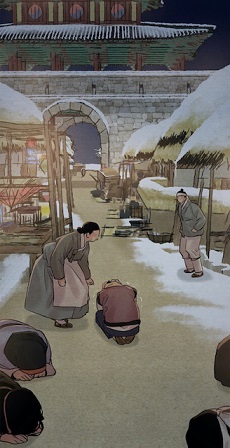 They didn’t even dare to face him, yet when he saw his lover trembling, the master lowered himself and attempted to help his partner. However, his gestures led to be misinterpreted in the beginning, hence a shop owner started interfering.
  However, he was stopped with a frightful gaze:
 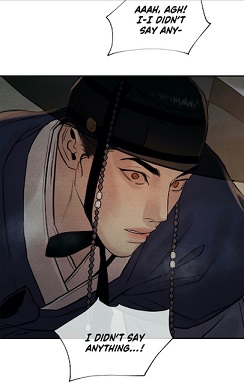 Besides, when the noble kept calling the protagonist in an informal way (Na-Kyum-Ah), people could realize his real intention. He meant no harm. In fact, he was treating the low-born like a precious treasure, who needed help.
 By calling his name Na-Kyum-Ah, the main lead tried to reassure his lover. Hearing his name made the low-born realize that he wasn’t attacked by the jester. This explains why the artist immediately embraced his companion. (chapter 76) Thus we could say that “Na-Kyum” had finally become a magical word like Seungho-Ya. Another contrast to the scene in episode 29 is that the way the low noble called Na-Kyum.
  (chapter 29) The former teacher was just caught by surprise, hence “Na-Kyum” was said more or less randomly. On the other hand, Yoon Seungho used this name as a sign of intimacy. He desired to give comfort and warmth to his lover. And now, you understand why Baek Na-Kyum hugged his lover by instinct. With his embrace, the protagonist would feel safe, which contrasts so much to the one in chapter 29. Back then, after the hug the learned sir brought the artist back to the mansion, although the low-born had run away out of fright. He mostly feared for the scholar’s life
 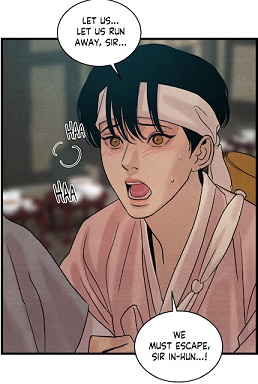 (chapter 29) thus he tried to find him. And now the mansion has become the painter’s home, just like the lord’s embrace. It is a synonym for comfort, warmth and safety. Another huge contrast is that for the first time, the painter asked for Yoon Seungho’s help directly.
 (chapter 76) Imagine that so far, he has never relied on others. Even as a low-born, he was willing to save others (Jung In-Hun or Deok-Jae or Heena
  (chapter 65). Surprising is that when he was bullied by Deok-Jae, he never complained and asked for the head-maid’s assistance or his lover’s. His attitude to never rely on others was even more perceptible in his escape in chapter 46. The cause for this behavior is linked to his abandonment issues. Due to his past, he was forced to only rely on himself. Nonetheless, in chapter 76 he changes his attitude. This shows that he is now opening up. That’s why his head rests on the lord’s shoulder completely. (chapter 76) This is a sign of trust, Baek Na-Kyum is willing to trust his lover. By comparing these 2 hugs, I come to the conclusion that Jung In-Hun has been totally removed from the painter’s mind as well. This embrace and marriage represent the scholar’s defeat. From now on, he won’t be able to use the painter as his pawn, because the latter is no longer attached to him. The lord’s love for Baek Na-Kyum can not be used as a weakness, since the low-born is reciprocating the affection. That’s why I would say that this panel (chapter 76) embodies the learned sir’s loss. There’s no one separating them, not even Heena noona who was the last person defending the scholar and as such representing his interest. So was Jung In-Hun the ghost I was referring to? Yes and no… because there’s more to it. That’s why it is important to examine the other embraces.
In chapter 53, the ghost was Yoon Seungho himself, since he was considering himself as a spirit. (chapter 53) However, the painter’s hug made him realize that he was a human after all, and that his fists and punches could definitely hurt his precious painter. Unlike in chapter 76, the painter’s voice couldn’t calm down the vengeful spirit (chapter 53), hence the gentle boy needed to intervene directly. The lord was definitely deaf to the artist’s words. Striking is that here again, we had the presence of danger, the painter feared for Deok-Jae’s life. Moreover, despite his fear and shaking hands,
  (chapter 53)the commoner chose to protect the vicious servant, but Yoon Seungho too. He desired him not to let his emotions blind his behavior. The gentle and selfless man didn’t even ask for help, he stopped the noble with his body twice: first his face, then he hugged him. Striking is that in chapter 62 and 66, we had a similar situation. One of the protagonists was behaving like a ghost. In chapter 62, Yoon Seungho, who was reliving his traumatic past, almost became a demon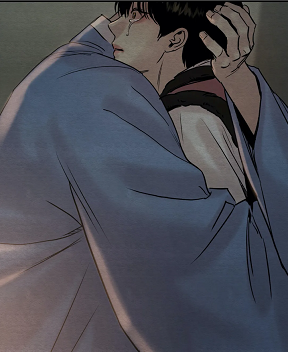
 (chapter 62), whereas in chapter 66 the artist had a flashback, hence he wasn’t himself.
  (chapter 66) This meant that in both episodes, neither the aristocrat nor the commoner could sense the lover’s comfort and warmth.
  (chapter 66) Both of them didn’t feel safe and displayed extreme fear due to betrayal and abandonment.
But let’s return to the embrace in chapter 53, because this incident has another common denominator with the embrace from episode 66 and 76, the presence of a certain witness: Black Heart. 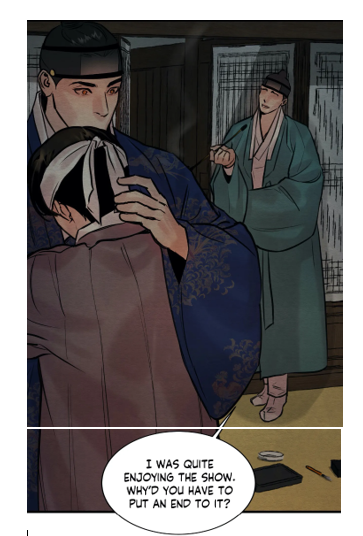 There’s no doubt that the vicious noble felt extremely jealous in both episodes (53-66). The manhwaphiles should envision that despite his rage and his terrible behavior, the artist was willing to embrace such a man, which could only make Min envious. Moreover, the low-born showed courage and even strength. He didn’t reproach anything to his sexual partner. He just attempted to calm him down. Then even after seeing how poorly the main lead had treated the artist, the latter chose not to leave Yoon Seungho’s side. Min was definitely certain that after waking up, Baek Na-Kyum would follow his sister and come back to the kisaeng house.
 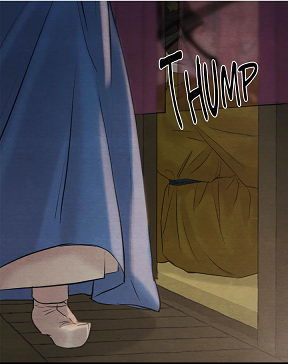 (chapter 69) That’s why he was waiting there. He imagined that the boy would be delivered to him on a silver plate, yet nothing like he had expected happened. In chapter 76, we have a new version of chapter 53. However, when Black Heart witnesses the painter’s second embrace, he can detect the huge difference. (chapter 76) This time, the artist is seeking his lover’s warmth and love. There’s no fear related to the “monster”. While in the past (53-54) The Joker mocked Yoon Seungho for his affection, here he can’t do it at all. The noble is not denying anything. In fact, he accepted the low-born’s embrace without feeling shame or embarrassment. He didn’t pay attention to the town folks, he just followed his heart. While in chapter 54, Min was able to separate the protagonists with his mockery and words
 (chapter 54), in episode 76 Black Heart is truly defeated. And by contrasting these two scenes, it becomes obvious why Yoon Seungho assaulted his guest back then. The noble was in fact punishing The Joker for insulting his lover, as the latter was just reduced to his status: a low-born. He had no name and as such no identity. The powerful aristocrat didn’t do it in order to protect his honor, but the artist’s. At no time, the main lead was afraid of losing his reputation, he is well aware of his bad notoriety. Thus this shows that in chapter 54, the one who feared more social norms was indeed Baek Na-Kyum, which was still visible in chapter 75. That’s why the commoner denied the lord’s affection.
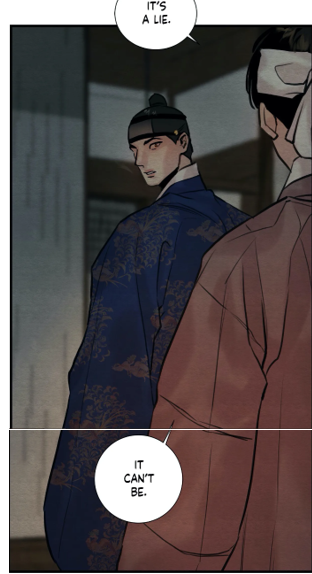 (chapter 54)The expression “it can’t be” was referring to permission and social rules. No wonder why the noble felt so hurt in the end and retaliated. He misunderstood the artist’s rejection.
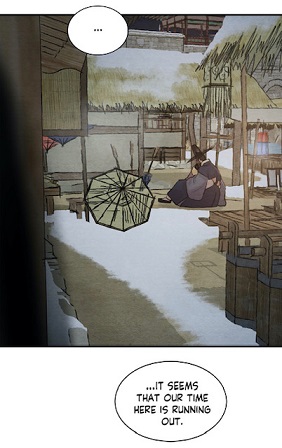
What caught my attention in chapter 76 are Black Heart’s behavior and words. First, he notices that he is too late. (chapter 76) He imagined that time would work for him, as in his mind, no one would ever stay by Yoon Seungho’s side. That’s why he didn’t hurry the second abduction. The latter had such a terrible reputation (mood swings, his huge rage, his violence), yet nothing could pressure the artist to leave the mansion. Even his noona was not able to convince him to follow her and to return to the kisaeng house. However, when he saw the couple in front of the tailor’s shop, his jealousy and greed reached a new peak. That’s why that night he had planned to visit Nameless. He wanted him to abduct the artist a second time. The expression “time is running out” outlines The Joker’s urgency. He couldn’t wait any longer, as he could witness how close they had become within 2 weeks. And if you look at the panel above, you’ll detect the presence of a shadow, in other words, a ghost. However, this is the jester Nameless looking at the couple. When the painter faced the joker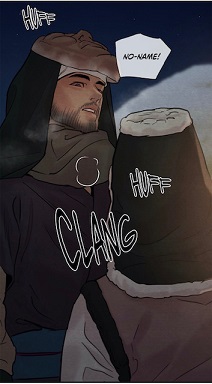 (chapter 76), the ghost from his nightmare
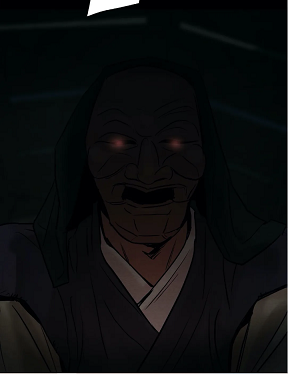 (chapter 61), the painter got so panicked that he got paralyzed. Only the lord’s embrace could calm him. As you can see, the commoner denominator between 53 and 76 is that the presence of a terrible ghost. The latter pushed the artist to embrace his lover. This time, he needed himself protection. However, Nameless was not the only ghost witnessing the protagonists’ embrace. Lord Min has already become a ghost himself in my opinion. First, he is wearing a black hanbok which I am associating to death. Moreover, because he threatens the criminal to kill him
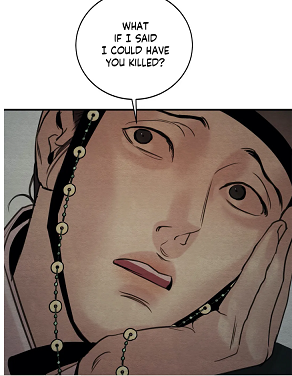 (chapter 76), I view The Joker as a grim reaper. What caught my attention is his reaction, when he saw the heartfelt hug. He had to vomit and this is no coincidence.
  (chapter 76) Observe that the color green is connected to two reactions: “to be green with envy” and “to be green” (sickly). Besides, we have in French “être vert” as a synonym for fuming, furious and disgusted. Hence it’s not surprising that it exist these emojis: 🤮🤢. Both contain green. That’s why I believe that when Min saw the embrace between the protagonists, he got so upset and disgusted that he felt the urge to vomit. It was definitely a mixture of envy and rage. However, he had to lie to the others in order to hide his “weakness”.
  (chapter 76) For me, there’s no ambiguity that The Joker was not honest here. First, he has no dark circle and red eyes like Jihwa who definitely drank again.
 (chapter 76) Besides, has Black Heart ever apologized to others? No. He didn’t even care, when he smoked opium in front of commoners. When he was asked to stop it,
 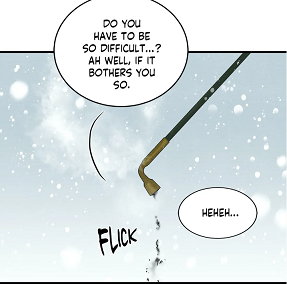 (chapter 52), he never expressed a real apology, he rather criticized the other for ruining the good mood and his fun. Besides, he looks down on low-borns and even Jihwa…
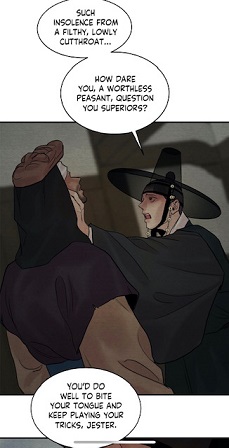 (chapter 76) so why would he apologize? It is, because he is slowly recognizing that his urges for Baek Na-Kyum are not linked to sex!! When he saw the hug, he could recognize the affection between the two lovers, and he felt powerless. Moreover, he envied Yoon Seungho even more than before. Let’s not forget that Min fears social norms despite his nihilistic tendencies. In this scene, the main lead showed courage and genuine affection, something that The Joker can’t do. Till chapter 76, he thought that he had been bewitched and he only felt the urge to have sex with Baek Na-Kyum. In other words, he wasn’t honest to himself and to the others. Until now, he had always imagined that once he had tasted the artist, his thirst would be satisfied. But the warm and tender embrace made him realize that he was wrong. Consequently, when he saw the hug, his envy and jealousy reached a new peak. He had to vomit. This signifies that the resent from chapter 53 became much stronger and obvious to the point that others could detect it now. Hence he has to lie. But in my opinion, he had another reason for vomiting. From my point of view, while the main lead spent his time drinking and reading, Min was busy smoking opium. Let’s not forget that Byeonduck portrayed Min with such a hanbok
  (chapter 56) and the pattern reminds the readers of opium smoke. Contrary to Yoon Seungho who only smoked it once during that terrible party, Min chose to keep smoking opium. First, the manhwaphiles could detect that he enjoyed the kick in chapter 52.
 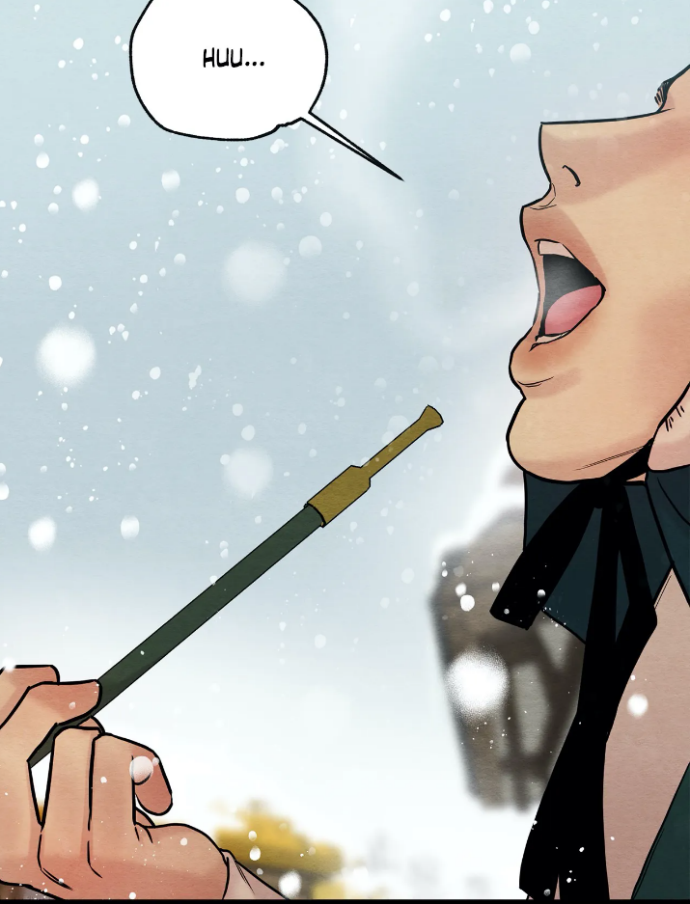 (chapter 52) Secondly, the hanbok was another indication. Finally, I perceive the lord’s nausea in chapter 76 as another evidence for Black Heart’s opium addiction. Vomiting/nausea are listed as side effects of opium. From my point of view, when he saw the happy couple in the street
 (chapter 74), he chose to smoke one pipe in order to relieve his frustration before visiting Jihwa and urging him to contact Nameless. This was a new version of chapter 56. That’s why they came both to meet the criminal.
  (chapter 76) Hence I come to the conclusion that Min is slowly turning into a ghost himself, losing his mind due to his addiction to opium and at the same time due to his greed and obsession for Baek Na-Kyum. The embrace in chapter 53 led to the kiss and indirectly it was the trigger for Min to change his original plan.
 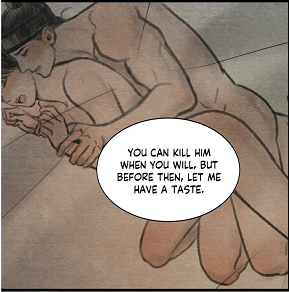 (chapter 56) Therefore I deduce that this second embrace is forcing him to change his plan again. From my point of view, he is no longer interested in tasting the painter once and have him killed afterwards. Black Heart is now determined to take away Baek Na-Kyum from Yoon Seungho. He is definitely longing for the artist’s love. He has every reason to be so jealous. The painter showed such a loyalty and courage. He is no longer fearing people’s gaze unlike in the past. Then, he even forgave his lover for his violence and mistreatment. Slowly, Min is showing his vulnerability in front of Jihwa and as such losing his power over him. He is definitely less laughing. As a conclusion, in chapter 76, the ghost Jung In-Hun vanished for good, while a new one appeared: Black Heart, who is now dressed like a grim reaper. However, there’s a huge difference, because Min has never entered Baek Na-Kyum’s mind and heart. He has no chance at all.
But wait… you might now wonder why I have not mentioned the hug from chapter 71 yet. Where was the ghost? Note that in this panel, the artist is portrayed without eyes. This insinuates that the artist is somehow blind. Secondly, we have this picture where the manhwalovers could see the lord’s footprints.  (chapter 71) My explanation is the following: Baek Na-Kyum wasn’t sure how to judge the lord’s behavior. Imagine that in the morning, his lover had tied him up, while in the evening he was so gentle and calm. That’s why I believe that in this hug, the artist wasn’t certain how he should perceive the lord’s embrace. He knew that it was no longer fake, but like he explained it much later… how long would Yoon Seungho have feelings for him? Therefore I believe that in this scene, Baek Na-Kyum viewed him as an illusion, a spirit who could give him warmth and comfort.
 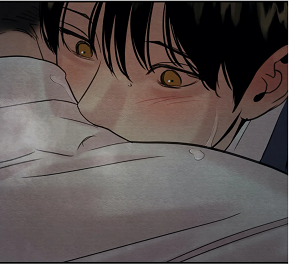 (chapter 71) Note the difference with the following picture: (chapter 76) First, the painter’s gaze is much softer and less questioning. In addition, the position of his head is different which exposed that they are much closer now. Besides, let’s not forget that the embrace took place before the long love session. The artist’s reaction was totally normal.
As a conclusion, the last picture from chapter 76 displays two major developments. (chapter 76) The protagonists are no longer separated by their fears and issues. The ghosts in their mind and heart have finally disappeared. That’s why they are portrayed like one here. However, there are now other shadows and ghosts surrounding them, the ones who would do anything to destroy their relationship, like Min, Jung In-Hun and father Yoon.
Feel free to comment. If you have any suggestion for topics or manhwas, feel free to ask. If you enjoyed reading it, retweet it or push the button like. My instagram-tumblr-twitter account is: @bebebisous33. Thanks for reading and for the support, particularly, I would like to thank all the new followers and people recommending my blog.

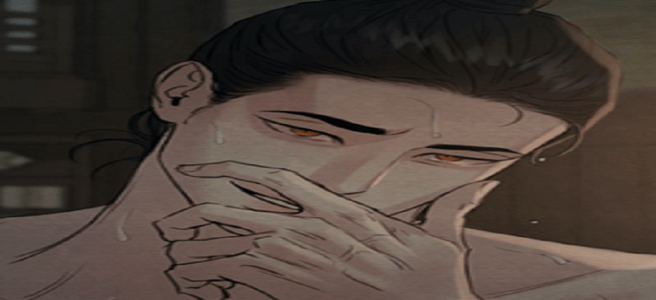
This is where you can read the manhwa. https://www.lezhinus.com/en/comic/painter But be aware that this manhwa is a mature Yaoi, which means, it is about homosexuality with explicit scenes. If you want to read more essays, here is the link to the table of contents: https://bebebisous33analyses.wordpress.com/2020/07/04/table-of-contents-painter-of-the-night/
It would be great if you could make some donations/sponsoring: Ko-fi.com/bebebisous33 That way, you can support me with “coffee” so that I have the energy to keep examining manhwas. Besides, I need to cover up the expenses for this blog.
In my last analysis entitled “The Light in the Heart”, I had portrayed Baek Na-Kyum as someone whose recovery and transformation were completed due to the number of white candles next to the painter’s head. 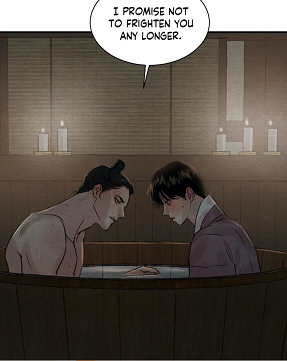 (chapter 70) 3 symbolizes perfection and completion. But I have not entirely explained how the artist could overcome his traumatic past and even find closure. So far, I elaborated that the missing farewells played a huge role in the painter’s trauma, as they triggered his abandonment issues. Thanks to Yoon Seungho’s decision, the artist was allowed for the first time to bid farewell to his noona properly.
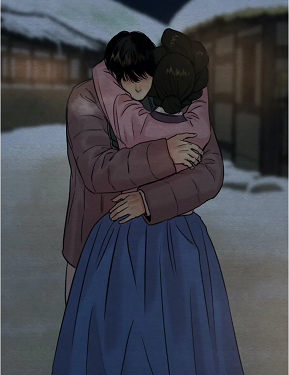 (chapter 69) But there’s more to it. In my opinion, the physical touch, in the form of caress and embrace, played a huge role in the painter’s traumatic past too. However, before starting to explain this element, I need to elaborate how it came to this.
First, I have to admit that I had problem to discern the true nature of the relationship between the painter and Heena. She is acting like a mother, although the protagonist describes her as his older sister.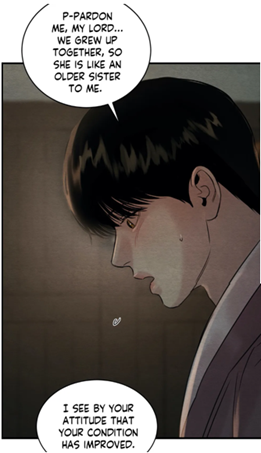 (chapter 70) Then thanks to my readers @_Winnie_L_ and @AkaiHikariChan who pointed out, the kisaeng is definitely too young to be the mother, I got a new revelation. Since Baek Na-Kyum is a reflection of Lee Jihwa, it means that the commoner was raised by an absent parent too. That’s why we don’t see the head-kisaeng at all. She is also like a ghost, the female version of father Lee.
  (chapter 67) Thus we have two possibilities. Either the head-kisaeng is someone else and Heena noona took over her role, or Heena noona became the head-kisaeng, but she never claimed Baek Na-Kyum as her son. Thus the painter ended up with a ghost mother. On the one hand, Heena noona acted like a sister in front of him and she requested from him to be called “noona”, on the other hand, she behaved like a mother towards Baek Na-Kyum. Observe that Heena is the only one with a name. The only difference is that the head-kisaeng relied on the kisaengs to raise the low-born, whereas the noble Lee employed his domestics. This explicates why Heena noona started acting like a mother. But this caused her to struggle due to her young age. She was so overwhelmed with this task, that she had to rely on the scholar. And there is a reason why the kisaeng trusted the low noble so much. She was not just blinded by her own feelings
 (chapter 68). Her decision was influenced by her past experiences and fears. The head-kisaeng judged the learned sir as a good and responsible man. And how could he win her trust? Since the story is constructed like a kaleidoscope, this means, we must have a new version of this during the first season. In my opinion, the scene with the worker is the repetition from the past.
 (chapter 29) First, observe that the young girl is sitting on the teacher’s lap and the learned sir is holding a book. So if someone saw this from far away, the beholder would think that the scholar is reading the book to the child. It even gives the impression that he is actually teaching the young girl to read. But note that in this scene, the low noble is in reality talking to the commoner. For the young girl, it means that she is forced to sit and do nothing. That’s why she turns her her head to the learned sir wondering what he is expecting from her.
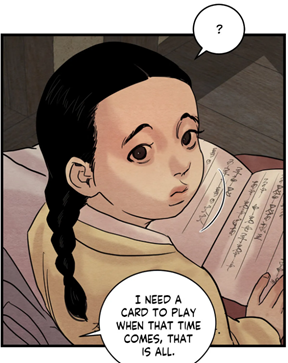 (chapter 29) What is she supposed to do? Observe that he replies to her interrogating expression with a smile, yet he doesn’t give her any instruction. I would say, he treats her like a doll. And now, replace the young girl with Baek Na-Kyum, and the latter has to sit there for a while. You can easily grasp why the painter could only fall asleep.
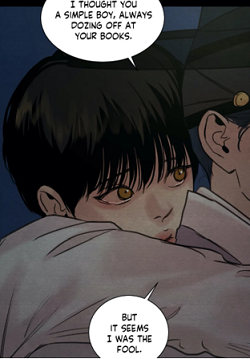 (chapter 70) In front of the kisaengs, the scholar created the illusion that he was teaching, while in truth he just saw it as a diversion. This explicates why he utilized this idiom to Yoon Seungho.
 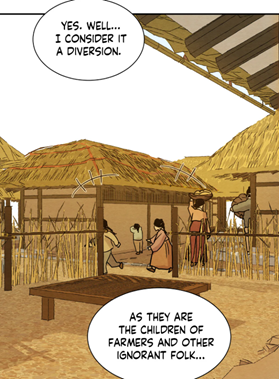 (chapter 6) Diversion has two meanings:
- something that takes your attention away from something else: Shoplifters often work in pairs, with one creating a diversion to distract the staff while the other steals the goods.
- an activity you do for entertainment: Reading is a pleasant diversion. quoted from https://dictionary.cambridge.org/dictionary/english/diversion
This outlines that this expression is far from anodyne. While we all associated “diversion” to the second significance, the low noble meant the first meaning. In the past, I used to think that the scholar was hoping for the artist to doze off so that he would spy on the guests at the kisaeng house. He was talking to the noonas with the boy on his lap in the hope to discover “secrets”. However, since I realized that Jung In-Hun was the one who brought the baby to the gibang, he had many reasons to go to the kisaeng house. He could hope to get connection to powerful nobles and even get information. However, from my point of view, since he had entrusted the artist to the noonas, he knew that the gibang was the perfect place to hide secrets as well. Remember that the conversation in this precise chapter was about “secret and protection”. 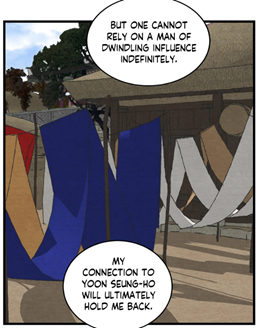 (chapter 29) And now the scene at the kisaeng house can only be perceived in a new light.
 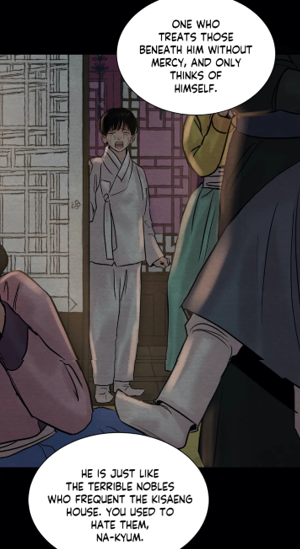 (chapter 68) Jung In-Hun must have come to an agreement with a rich noble and made a deal with him. The presence of the painter was no coincidence, and it diverted attention from the real target of abuse: Yoon Seungho, who got dragged away. The painter and the other noona thought that Heena had been the victim of violence from a noble, but she was not. She served as diversion. Too blinded by her prejudices and own fears, the young woman wasn’t able to perceive the true nature of the learned sir. While she saw the scholar as a hero, because he hugged the painter and took him away from this terrible place, she never questioned the scholar’s attitude. If he had been a true hero, he would have rescued her and not abandoned her. She never got aware of his betrayal. In other words, the scholar helped to create a secret. This explicates why the learned sir is well aware of the nobles’ fear. In his eyes, they all have something to hide.
But let’s return to our first observation: the head-kisaeng neglected her adopted son, for she was too overwhelmed with the huge responsibility. The manhwaphiles should remember that neglect is a form of abuse and it can lead to the loss of senses. That’s why I described Lee Jihwa as blind and deaf. With this new interpretation, I come to the conclusion that Baek Na-Kyum had the same fate. Moreover, his mind’s eye couldn’t get developed. Due to his abandonment issues, he desired to grant Heena’s wishes. That way, he wouldn’t be rejected. However, this couldn’t fill the void. That’s the reason why Baek Na-Kyum drew a lot of paintings as a child.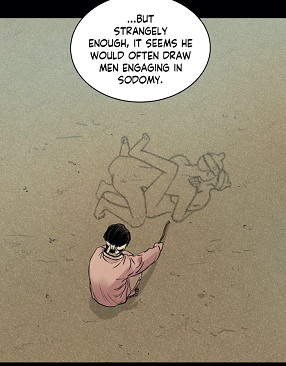 (chapter 1) Here, the witness was lying, as he was distorting the past, the painter wouldn’t draw erotic pictures constantly. The head-kisaeng didn’t take care of her son and during the day, the noonas were all resting so that the painter was on his own. This panel illustrates the painter’s isolation and loneliness. At the same time, I envision that the scholar visited the kisaeng house during the night so that he could approach the noonas, explicating why the boy would doze off too. Moreover, painting was a way for the painter to cope his loneliness and his loss of senses. As a conclusion, the painter was not only suffering from abandonment issues, but also from neglect which made him more and more dependable on Heena noona and the learned sir.
Yet, this doesn’t end here. Each time, Heena noona was confronted to violence, she sent away the painter. He was not just forced to leave his noona’s side, he had to leave the house as well. He ended up in the countryside (chapter 70) , in the middle of nowhere, surrounded by water and rice fields. While some might view these panels as quite idyllic, I interpret these as the opposite: Baek Na-Kyum had no roots and no roof over his head. He couldn’t even find a refuge, which reminds us of the scene in the first chapter:
 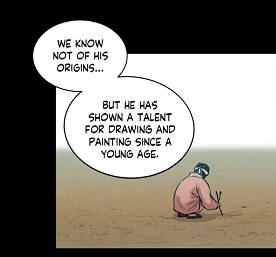 (chapter 1) This picture exposes the painter’s lack of attachment. He has no home, no wall to protect him… there’s only emptiness surrounding him, which contrasts so much to Yoon Seungho’s situation, who lived in a prison. Hence I understand now why Baek Na-Kyum is determined to remain by Yoon Seungho’s side.
  (chapter 68) For the first time, he has a room for himself, and even if he is pushed away, he can express his sadness and seek comfort in his room:
  (chapter 41) and
  (chapter 52). Note that each time, he was unhappy, he was requested not to cry
  (chapter 26)
 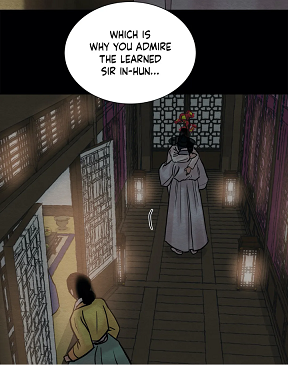 (chapter 68: he is sent away due to his tears)
  (chapter 70) If you pay attention, you’ll notice the only one allowing the painter to voice his wound and to shed his tears is indeed Yoon Seungho. Each time, he desires to know the cause for Baek Na-Kyum’s tears.
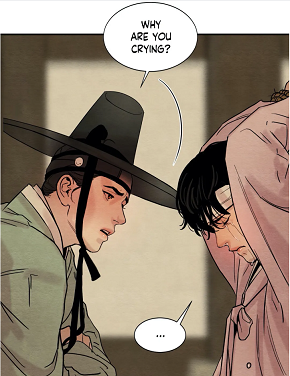 (chapter 1) The difference is even palpable in chapter 26:
 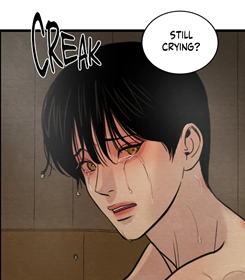 He left him some space and time to cry, hence when he returned, he didn’t say: don’t cry. He just makes this comment
 (chapter 26). And like I underlined it before, the lord is always focused on the reason for the artist’s tears. This led to the confrontation: who is responsible for his heartache?
  (chapter 26) Sure, in the bathroom, Yoon Seungho is still very rude, however he never employs the negation. Nonetheless, the low-born could never perceive this divergence, as the nuance is not so obvious. This explicates why in chapter 41, the artist misjudged the noble’s intervention. When the latter wanted to see his face and as such his tears
 , (chapter 41) the former refused to do so, because he anticipated that the lord would ask the same thing: stop crying. However, the master wanted to know the cause for his agony, which is totally different. This scene is really important, because it shows another issue. Baek Na-Kyum was never allowed to cry. His tears were associated to annoyance and burden. That’s why he desired to be left alone in the end. He feared that if the lord saw his tears, he would be requested to stop crying. And this fear of letting his tears coming up explains why the painter hid his eyes with his arm during the physical abuse.
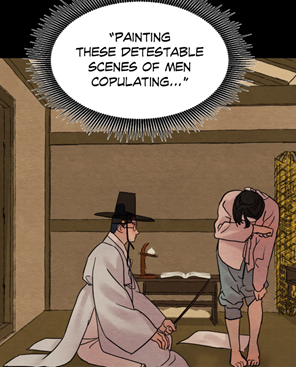 (chapter 34) Under this new approach, we understand better
  (chapter 68) why the lord chose to retreat. Here, the master saw the commoner’s tears with his mind’s eye and realized that he needed to give him some space and time again. But more importantly, he never entered the room, giving him some privacy. He learnt an important lesson here: solitude doesn’t stand in opposition to distance and abandonment. In this scene, Heena noona never requests from the painter to stop crying, she just wipes his tears with her hand and caresses her brother’s cheeks.
 (chapter 68) In my opinion, she hoped that if he voiced his emotions, he would follow her. She had an interest in this, that way she could express her disapproval and use her authority to force the painter to obey her.
 (chapter 68) What the noona didn’t realize is that the main lead’s decision to respect the low-born’s needs (crying and not entering his room) was the reason why Baek Na-Kyum selected him in the end. There’s no doubt that the lord was associated to home for good, because he is the first one who allowed him to cry and to have a room, where he could seek refuge after getting hurt. Under this new light, the readers can better grasp why Baek Na-Kyum is healed now.
However, my examination is still not finished. I had portrayed the commoner as suffering from the loss of sight and hearing due to his neglecting mother/noona. But this doesn’t mean that he had lost his body too. Since he was deprived of these two senses, he had to rely on the physical touch in order to compensate his isolation. And now, you understand why the learned sir and Heena noona had such power over him and why the young boy was so submissive. They used the caress and the embrace as a way to impose their will. That’s how they got so close to Baek Na-Kyum, explaining why the commoner would lose his voice after all (speech ability). He became submissive in his desire to please his loved ones. He saw in their caresses and embraces a sign of affection. He was not wrong, but their attachment was linked to their own interests. Thus their love was rather superficial.
What caught my attention is that the kisaeng stroke the painter’s cheeks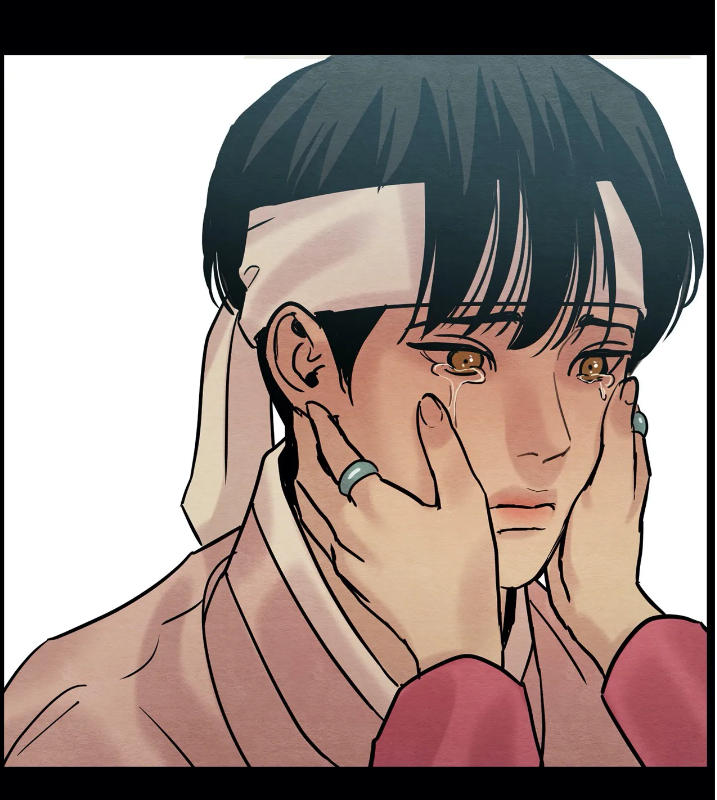 , (chapter 46) when the latter was sent away, But she didn’t hug her brother. Why? It was to stop him from protesting.
 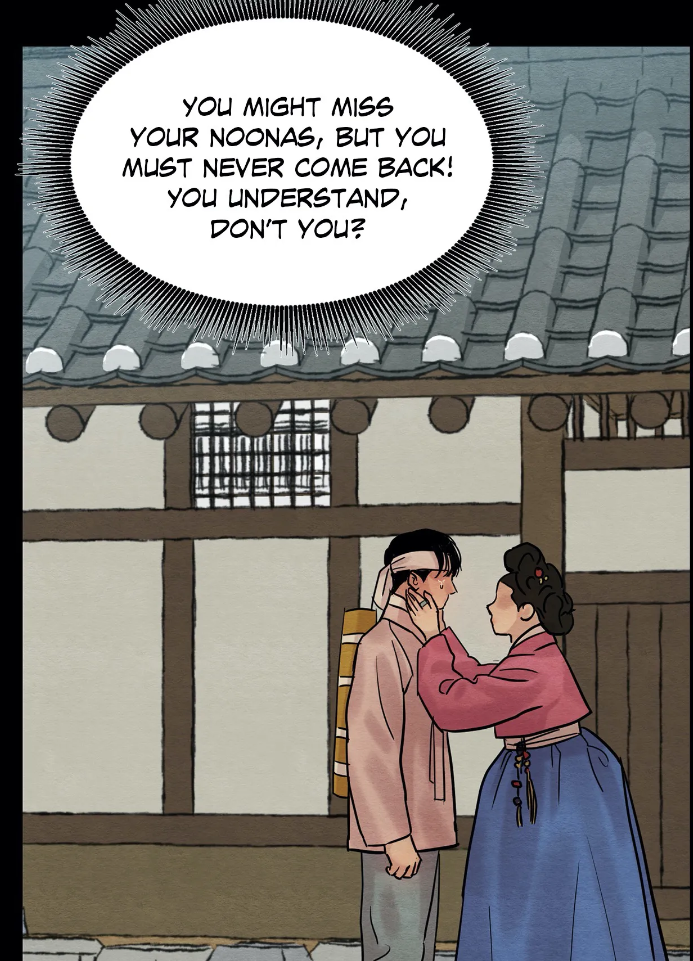 (chapter 46) But I would even go further. I don’t think that Heena noona used to embrace her brother. This perception was somehow confirmed in season 3.
 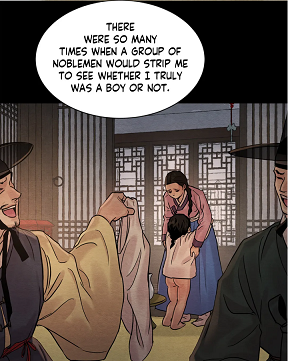 (chapter 94) Here, the infant hugged his noona, but she didn’t return his gesture. Moreover, she hadn’t stopped the laughing nobles as well. Furthermore, (chapter 66) note the huge distance between the two characters in the last panel. This is no coincidence, therefore I perceive the embrace in chapter 66 in a new light.
 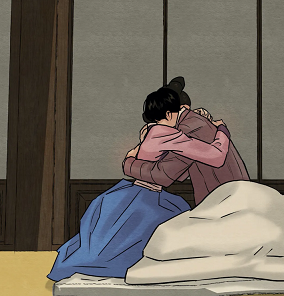 (chapter 66) It was the first time that Baek Na-Kyum got embraced by his noona. And all this, thanks to Yoon Seungho. In my opinion, the kisaeng got really scared and concerned for her brother. And there’s a reason for this lack of worry. She relied too much on Jung In-Hun. Her false perception is particularly visible, when she claims
 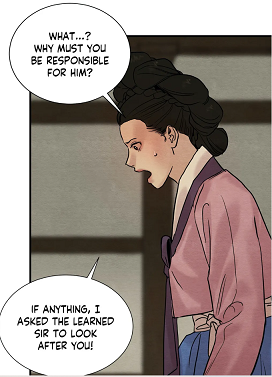 . (chapter 68) Why does she expect this? From my point of view, her words imply, she must have helped the learned sir in the past: one thing is sure. She was not entirely honest with her donsaeng here, as the manhwaphiles can detect the drop of sweat. But more importantly, we have to question ourselves if the gibang was not used in the past to spread rumors about the Yoons again, and Jung In-Hun could heard something. I am even envisioning that she must have reported conversations to him, a new version of chapter 24:
 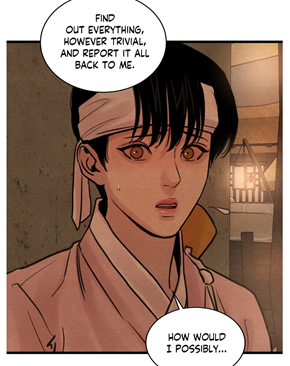 Remember that in that scene the painter doesn’t comprehend the meaning behind this order. If this theory is true, then she never saw the consequences of her action, similar to her brother in chapter 24. If she truly did it, she must have justified this, because the learned sir needed it, she was responsible for him. This would explicate why she is surprised that the artist is responsible for the learned sir. Anyway, due to her assistance, she expected from Jung In-Hun that he would take care of the painter. There’s no doubt that she loved the scholar, and since the boy had entered the kisaeng house due to the learned sir, there is a high possibility that Heena noona got close to Baek Na-Kyum for that reason too. That way, she hoped to earn the scholar’s acceptance and admiration. Since the painter was left alone and longed for love, the latter could only rely more and more on Heena noona, especially due to the incidents where Baek Na-Kyum was wounded. (chapter 94) She created a dependency, while simultaneously, she would delegate her responsibilities on the other noonas. Heena noona became the painter’s mother, yet she was never one officially. Consequently, I believe that her bond was not entirely selfless, which became truly visible in season 3. Let’s not forget that the kisaeng was portrayed as quite rude and selfish in certain scenes. The way she hugged her brother was not tender in my eyes.
 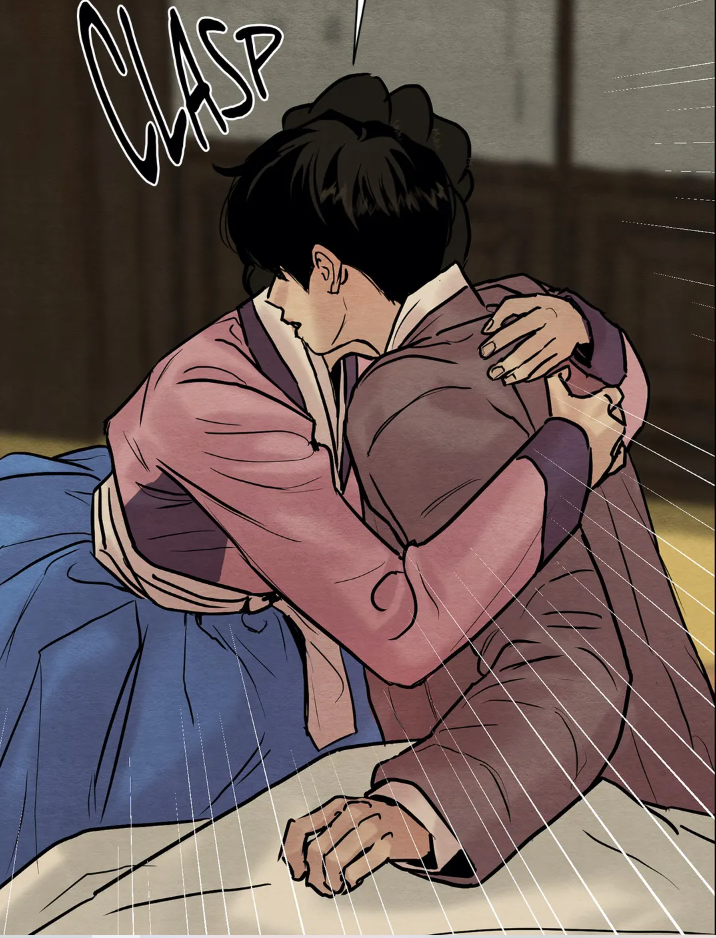 (chapter 68) For me, her real “admiration” was for the learned sir, therefore it becomes understandable why she wasn’t bothered, if Jung In-Hun asked for her help in exchange for taking care of Baek Na-Kyum. According to my theory, the learned sir had brought himself the baby to the gibang, this means that in chapter 46, he could only accept the kisaeng’s request. He had no other choice, for in Heena’s eyes, they were somehow related. From my point of view, Heena noona hoped that Jung In-Hun would even assist her and help her to leave the gibang. But this never happened. In my opinion, there exists another reason why the painter was sent to the learned sir. And it is related to Yoon Seungho, the erotic paintings and the pedophile.
The kisaeng helped the scholar, while the latter assisted her with her burden: raising a boy. From that moment, a toxic relationship started, which could only affect the young boy. This would explicate why she accepted that Jung In-Hun would leave her behind while getting beaten. For this kind of incident recurred, we have to imagine that the low noble and the kisaeng contributed to add another artist’s trauma: the abandonment issues and the loss of home.
From that moment, he was forced to roam around with the scholar during the night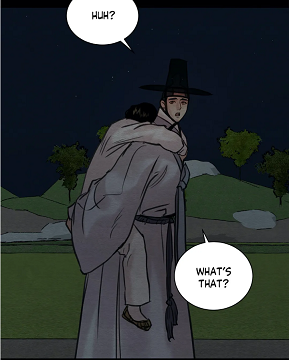 . (chapter 70) And now, we have to question ourselves why the kisaeng chose to send away the painter in the end. From my point of view, it wasn’t really to protect him… since Baek Na-Kyum was now an adult, the role of the scholar was no longer necessary. First, the artist was supposed to be literate. At the same time, the low noble couldn’t take him any longer, when the kisaeng got hurt again. This kind of diversion was no longer possible. The man was old enough to intervene, hence not only he could have defended his sister, but also he could have investigated what was happening in the gibang. That’s why Heena sent him away to the scholar and observe that the noonas were not even informed. (chapter 46) Why? Because she knew that they would have questioned her. Moreover, the noonas might have convinced the donsaeng to stay in the gibang. In my eyes, the noona thought that she was doing it for her son’s best interest, while in reality she had other motives to ask the painter to leave the gibang. Unconsciously, she desired to leave that place too. From my point of view, she dreamed that the learned sir would take her away at some point. This interpretation was proven correct in season 3.
  (chapter 97) In exchange for her services, she had to bring Baek Na-Kyum to Min, the noona would be able to escape the gibang.
Therefore it is time to focus on the learned sir again. Exactly like I had anticipated, the low noble blamed the painter for his inability to read: he would doze off , while in reality the low noble made sure that the artist would fall asleep. Besides, if the painter was awake during the night, this signifies that he had to sleep during the day. And in order to obtain the painter’s assistance, he noticed that the low-born was sensitive to physical touch: the scholar chose the hug. That’s why we see him embracing the young boy in chapter 68 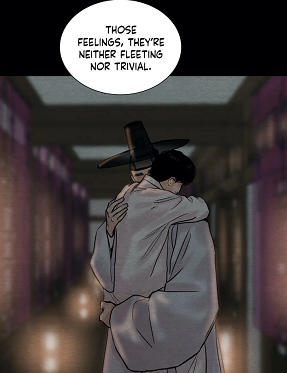 or piggybacking in chapter 70. We have to envision that first he embraced him in front of the kisaeng, then once they had left the town, the noble would change the position. Yet, I believe that Heena had here romanticized this embrace. It represents a distorted memory mixed with fantasy. What caught my attention is that in both hugs, the noble could hide his face and in particular his eyes. At the same time, the learned sir wasn’t faced with the commoner’s tears and sadness. He could feign ignorance. (chapter 70) But this could only work, until the painter entered adulthood. After that, he could no longer use the boy as tool and diversion. Even if the learned sir’s affection was genuine in the beginning, the nature of their relationship could only change, for the learned sir had kept using him in the past. It had become a habit.
Envision this: his ties with the kisaeng house were cut off. And since he had never taught the painter to write and read properly, Jung In-Hun was cornered. Moreover, there is no ambiguity that the learned sir started viewing Baek Na-Kyum as a burden, this means that at some point Jung In-Hun must have felt the exact opposite of this: (chapter 44)
And since the scholar has always disdained the commoners, he could only abhor the idea to keep hugging the artist. The latter was now a grown-up. Hence he used the erotic painting as an excuse to abuse Baek Na-Kyum physically. That way, the noble was no longer obliged to caress or embrace the painter. However, because of this method, he destroyed the painter’s body symbolically. (chapter 34) And this leads me to the following conclusion: the painter ended up in the same state than Yoon Seungho’s. Both lost their senses and their own body. And now, you can comprehend why the main lead can’t cry yet. The return of his tears will mark the end of the transformation and his recovery.
Nonetheless, let’s return our attention to the scholar and his relationship with the painter. If the manhwaphiles pay attention to the progression of the first season, they will notice the increasing intimacy between Baek Na-Kyum and Jung In-Hun. First, it started with a stroke 
 (chapter 10), then in chapter 24 he touches his shoulder and kisses his hands.
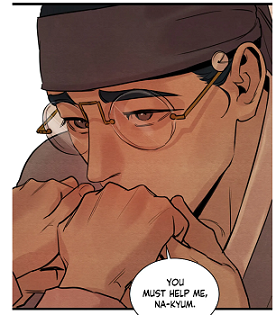 (chapter 24) With my new interpretation, you can comprehend why he did this. He tried to use the same method from the past: he knew that physical touch would make the artist submissive. And the climax was reached in chapter 29 with the fake embrace and the betrayal: (chapter 29) From that moment, it went down again. We returned to patting
 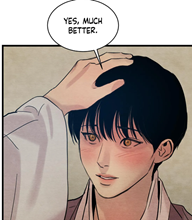 (chapter 35) and strokes
  (chapter 35) and finish with this final touch of the painter’s cheek:
 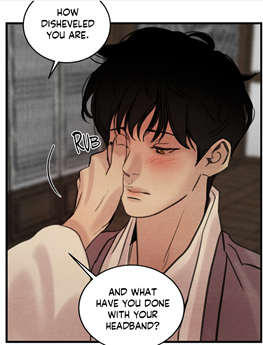 (chapter 38) And the physical interaction reflects the learned sir’s loss of power. Despite his attempts, he was not able to obtain the artist’s submission like in the past. That’s the reason why he could only resent the artist. We have to remember that the low noble really detested this physical intimacy, hence he would tighten his jaw or grind his teeth.
  (chapter 24) Note that in many panels, we never see the scholar’s facial expressions, but there is no ambiguity that he could never truly hide his disdain. But the painter was still blinded by his “admiration” for Jung In-Hun. However, after the argument at the library, the painter lost his sight and hearing again. He was too wounded by the final blow.
And now, you understand why Yoon Seungho’s actions (seeking intimacy) could only help the painter to recover. First, he had been able to remove the poison from the artist’s mind before the backstab in the library. The lord had encouraged Baek Na-Kyum’s critical thinking. This explicates why after the scholar’s betrayal, the painter’s independent mind resurfaced first.  (chapter 46) Then the readers witness the return of the artist’s 5th sense (touching) in chapter 49. That’s the reason why the noble could finally get the painter’s attention afterwards. For me, the touching has always been the most important sense in his life, which explains why Heena and Jung In-Hun had such control over the low-born. Then in chapter 52, we assist to the revival of the artist’s sight:
  (chapter 52) And now you comprehend why Heena and Jung In-Hun were defeated. The hug in chapter 66 helped him to satisfy an important need: he was truly embraced while getting comforted. Simultaneously, the hug is not entirely related to the kisaeng, but to the study. Remember that we never saw her hugging him before. At the kisaeng house, he didn’t feel like he truly belonged there, and Heena would always send him away due to his cry. While Heena anticipated with this embrace, the painter would follow her like in the past, she experienced a shock. Now, the painter was no longer blindly listening to her suggestion. And now, you understand why she kept touching the artist. She was trying to influence the painter through the physical touch. Under this new light, I understand why she said this after all: (chapter 68) Yoon Seungho is famous for intimacy, then this would signify that she would lose control over the painter forever. This explicates why Heena noona is not respecting her brother’s wish in the end. And if you compare the two farewells between the kisaeng and the main lead, you will detect a huge progression: (chapter 69) They hug each other here, the painter can get closure, because this is just a goodbye. The noona asks him to send letters, this means that she is telling him that he is not abandoned. This night was important, because the painter’s abandonment issues got treated. Hence it is no wonder why the painter could move on from the past during the same night.
And now, it is time to come to the final part, the significance of the painter’s memory in chapter 70. From my point of view, we should perceive as a new version of chapter 34: 
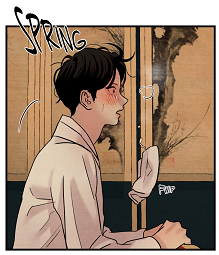 Back then, he recalled the repressed physical abuse. However, his conscious dismissed it again. However, this time it is different. The painter in possession of his whole body is reminded of the scholar due to Heena noona’s farewell. The closure he got by bidding her farewell triggered a long repressed memory too. The learned sir was the one who consoled him in the past. And while he recalls that night, the adult Baek Na-Kyum realizes that the scholar’s care was not fake in the past. He would keep him company and talk to him, he was his companion of the night. However, for me, this scene outlines his superficiality and indifference. He diverts his attention so that he wouldn’t feel sad any longer. But it was, as if he was ignoring his sadness, for he wouldn’t talk about the incident. (chapter 70), He would even smile making him look indifferent.
  (chapter 70 Then he makes the following reproach: he was lazy. (chapter 70). For me, during that night the artist realizes that despite the huge blow in the library, Jung In-Hun had not been bad to him all this time. He had good memories. This means that he was able to take his distance and look back at his childhood under a new perspective. The learned sir had been there for him in the past. In this moment, when he saw the moon, he was reminded of the learned sir. It might not follow him specially, but it is always there.
 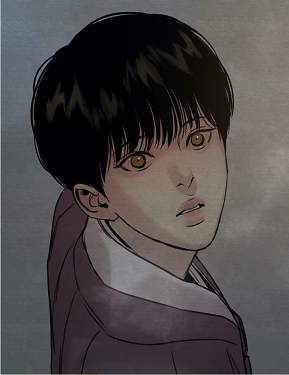 (chapter 70) The learned sir will always be a part of his life, as he belongs to the past. As you can see, in this scene, Baek Na-Kyum was moving on. Therefore I interpret this scene as a real breakthrough. The painter is no longer under the influence of the scholar. The latter can not longer manipulate him like in the past [though now I believe that he is dead], and this revelation was triggered by Heena noona and her embraces. But at the same time, he is not rejecting or resenting the man. And this interpretation becomes even more visible in season 3:
 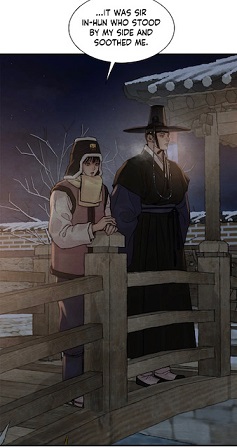 (chapter 94) His heart and mind are now in peace. He is no longer suffering from a guilty conscience. And this truly exposes that the artist’s abandonment issues were created by Heena.
Under this new interpretation, the scene at the bathroom becomes another significance. The lord decided to let the painter feel and see his affection. He chose a different approach: caressing the finger and the hand tenderly , then the chin
 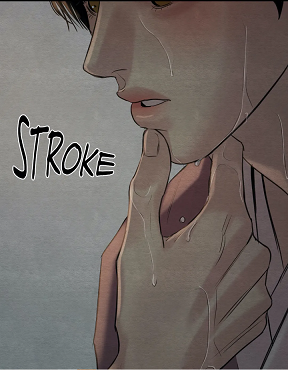 before kissing him.
 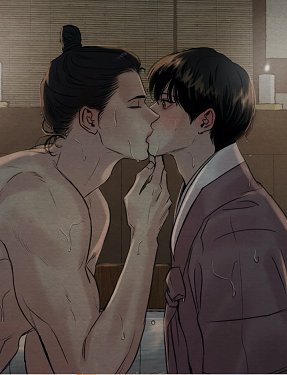 (chapter 70) However, what caught my attention is that his touch is never to shut the artist’s mouth. Observe that he lets the mouth open, while he caresses the hands, the chin and even after kissing the painter.
  (chapter 70) He has the right to speak, while Heena noona and Jung In-Hun used the embrace and caress as a way to render Baek Na-Kyum mute. And since the affection through physical touch was a way to win the painter’s heart, there is no doubt that Yoon Seungho is on his way to win his heart. Now, the painter is finally looking at him and the scholar’s influence has been finally erased. Baek Na-Kyum is now totally over Jung In-Hun, as he has now only view him as a companion and friend, and nothing more. He is no longer his idol. In other words, the low-born has finally found closure. In episode 70, his heart is free.
Feel free to comment. If you have any suggestion for topics or manhwas, feel free to ask. If you enjoyed reading it, retweet it or push the button like. My reddit-instagram-tumblr-twitter account is: @bebebisous33. Thanks for reading and for the support, particularly, I would like to thank all the new followers and people recommending my blog.

This is where you can read the manhwa. https://www.lezhinus.com/en/comic/painter But be aware that this manhwa is a mature Yaoi, which means, it is about homosexuality with explicit scenes. If you want to read more essays, here is the link to the table of contents: https://bebebisous33analyses.wordpress.com/2020/07/04/table-of-contents-painter-of-the-night/
It would be great if you could make some donations/sponsoring: Ko-fi.com/bebebisous33 That way, you can support me with “coffee” so that I have the energy to keep examining manhwas. Besides, I need to cover up the expenses for this blog.
I have to admit that when I read the chapter 50 for the first time, I was quite confused. Why would Yoon Seungho rush to the teacher’s bedchamber with a sword? Why would he comment „How strange…” at the end? 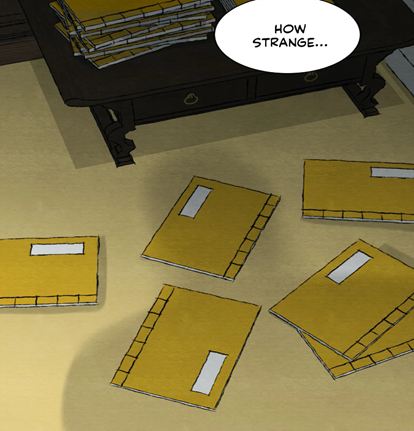 (chapter 50) I tried to find answers by speculating. However, my assumptions were totally wrong due to the lack of information. Only time and new chapters helped me to understand the story much better. Thereby I could better anticipate its progression, and comprehend the reasons for the characters’ actions. Due to the constant examination, I made the following observations:
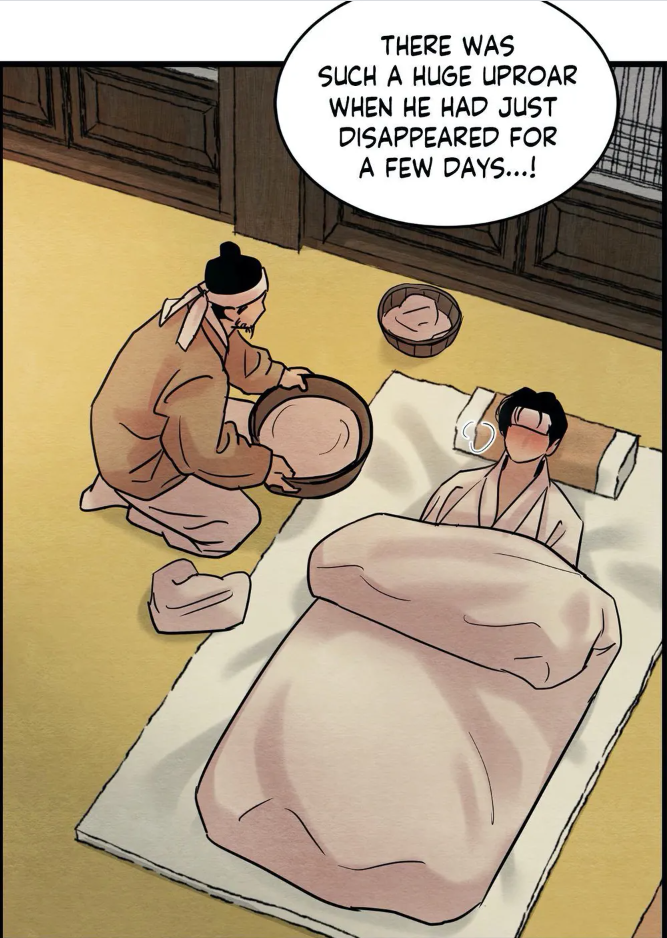 (chapter 33)
 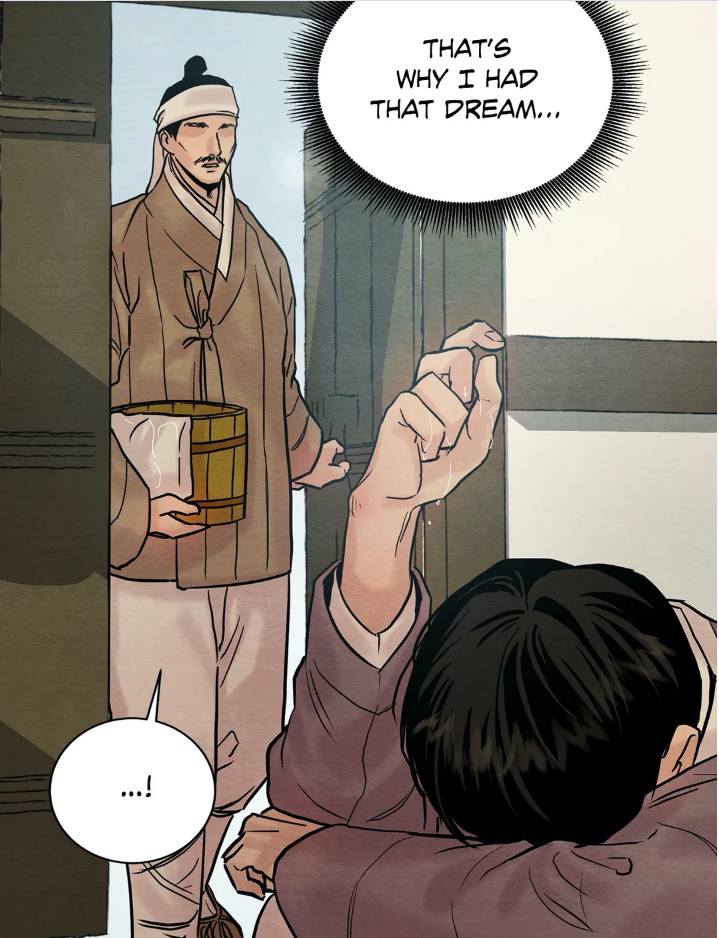 (chapter 56), and there’s always a drop of sweat on his face. However, if you pay attention, you’ll notice that the valet is never seen washing. He carries the bucket around, and that’s it, which stands in opposition to Baek Na-Kyum. The latter cleans his own underwear, but also the protagonist’s face
 (chapter 55).
 Yet I still had no idea what truly triggered Yoon Seungho’s anger and frustration in chapter 50. And then, while analyzing the chapter 16 in connection with the essay entitled “Desires and communication”, I made this discovery: Yoon Seungho used the same expression there: 
 (chapter 16) Here, he was wondering how the painter was able to create the painting, while he didn’t seem to look at them the whole time. What caught my attention are two elements:
The noble didn’t realize that during the sex session, Jihwa described the scene to attract his friend’s attention. That’s the reasony why the artist could create the painting, as he listened to the aristocrat’s words. In other words, he was spying on them by listening to their conversation. Since there is the same expression in chapter 50, this means that the latter is a reflection of chapter 16. The manhwaphiles should remember that we have a sex session during that night.
 (chapter 49) The painter expressed his thoughts: he only saw the noble as a sex toy, the main lead was the one who should give pleasure to Baek Na-Kyum. Yet despite the hurt, Yoon Seungho was willing to accept this situation. They would no longer exchange their thoughts and emotions. He was already lowering his expectations. At the same time, he couldn’t help caring for the low-born. He caressed his cheek and kissed him gently at the end.
 (chapter 50)
Since I explained that the expression “how strange…” was connected to deception, contradiction and spying, I recognized that something similar must have happened during that night (chapter 50). Besides, we also have a time jump. Suddenly, there’s morning, and the lord has rushed to the scholar’s room with a sword. 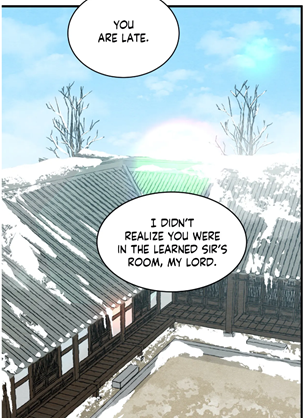 (chapter 50) And this scene reminded me of the main lead running to the scholar’s room in chapter 28/29
 , after witnessing the artist’s desertion. There was a time jump as well. Therefore I came to the conclusion that the night in chapter 48-49-50 has the same importance than the night with the forced sex and fellatio. This explicates why the lord has a sword again. Back then, he took the weapon due to his jealousy, hence we can definitely conclude that he is angered again due to the return of his jealousy. So chapter 50 was not only a reflection of the episode 16, but also of the episode 28-29.
Because of the connection with the painter’s escape and the incident with the opened door (chapter 16), I couldn’t help myself linking the chapter 50 to Kim and his actions in the shadow. Like I have already pointed out, Kim was observing the event of the night (25-26-27-28) in order to ensure that the protagonist wouldn’t cause too much trouble. Moreover, the manhwalovers should recall that he played a huge role in the low-born’s escape. While Deok-Jae informed Baek Na-Kyum about the scholar’s whereabouts, we have to imagine that the teacher must have talked to the butler about the destination of his trip. Jung In-Hun will always choose to talk a domestic closer to the master than to a simple guardian. Besides, Kim was the one who brought him to his room and the library (chapter 7). Therefore I am quite certain that Jung In-Hun must have mentioned to the valet where he was going. Consequently, I came to the following observation: the butler must have monitored Yoon Seungho and Baek Na-Kyum during that night (chapter 48-49).
From my point of view, Kim was standing behind the door, and he must have heard the low-born’s words.(chapter 49) , reminding us of the “spying” in chapter 16 (listening to their conversation). Because the confession gave the commoner the upper hand in the relationship, and the main lead had not protested, this meant that Baek Na-Kyum was getting closer to Yoon Seungho. He was almost on the verge of becoming the official partner, while the protagonist was resigning to his fate: he would never be able to converse with the artist. Since I demonstrated that the butler was spying on them in chapter 58 (chapter 58), as the presence of the butler is perceptible through the bucket of hot water and the readers can hear the low-born’s moaning, we have another clue that the valet was listening to their conversation in chapter 50.
In my perspective, the butler had every reason to spy on them. First, the invitation to share his meal with the artist was already announcing that the latter was getting more and more favored to the point that he was almost treated as the noble’s official partner. And now, you understand why Kim revealed the incident between Jung In-Hun and Baek Na-Kyum the next morning. He needed to separate the couple, and he used lie by omission and truth in order to achieve his goal. But this doesn’t explain why Yoon Seungho who was tender and humble during the night became a wounded fury the next morning. The hanbok clearly indicates that the protagonist’s heart is bleeding. 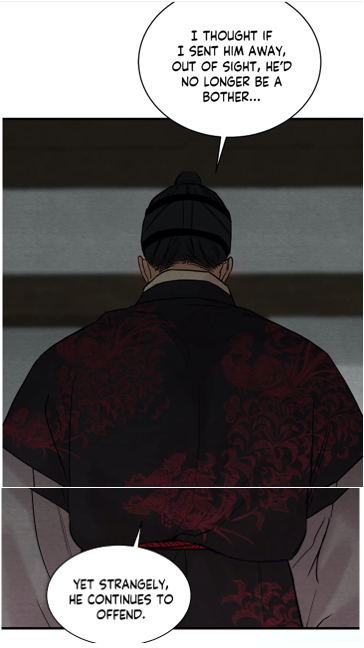 (chapter 50) What had triggered his fury and jealousy?
For we have another incident with the sword in the first season (chapter 35), where Kim manipulated the master to witness a conversation between the teacher and his former pupil, in order to provoke his jealousy. We have to imagine that in chapter 50, the butler made a similar move. He let the main lead discover something reminding him of the painter’s love for Jung In-Hun. We have three possibilities: he let Yoon Seungho see
What caught my attention is this panel:  (chapter 21). The paper in the book is very similar to the poem in chapter 4. Remember the theory I exposed in the essay “hypotheses about the second season”: Yoon Seungho had not returned the original poem, but given the artist his own poetry. So if he didn’t give back the scholar’s poem, then what did he do with it? I doubt that he would have kept it, hence I deduce that he must have asked his assistant to throw it away, exactly like the painter in chapter 44. However, Kim must have read it and kept it, well aware that this could be of use later. From my point of view, the butler must have entrusted it to the teacher with the hope that he would leave the mansion. And I can imagine that when Jung In-Hun left his room, he didn’t take it with him. That’s why it ended up again in the butler’s hand. However, if the lord discovered that the poem had not be thrown away, he would have realized that Kim had disobeyed him. That’s why I came to rule out the first possibility.
So what about the second possibility? Since the painting with the scholar appeared in two chapters during the first season (41-44) , the readers should expect that this picture will be used twice during the second season. Because I already exposed that Heena noona recognized the painter’s presence due to the inauguration painting
 (chapter 65), it is definitely possible that Kim planted the picture in such a way that Yoon Seungho’s jealousy would get triggered, a new version of the panel from episode 41. Let’s not forget that the aristocrat was not present, when Baek Na-Kyum decided to discard the drawing. Kim was quite clever with this move. As he knew that the noble had now just a purely physical relationship, he could only get infuriated, when he saw the picture. He had already sensed the painter’s admiration in the drawing: the image oozes pure adoration and spiritual admiration, something Yoon Seungho has always been longing. Hence the noble could only get wounded with this terrible experience. I can imagine that Kim could have praised the picture in front of his master (a new version of chapter 44
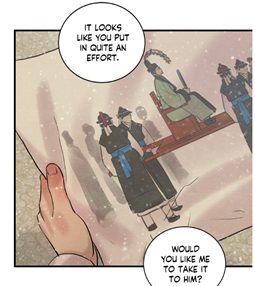 ), then added that Baek Na-Kyum had trusted him with the picture to give to Jung In-Hun. Kim hoped with this intervention not only to separate the couple, but even to have the painter killed by the main lead, a new version of chapter 35.
 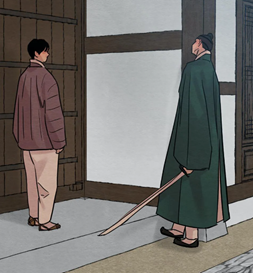 But what he didn’t expect is that the noble would rush to the teacher’s room, and not to the study. However, his delay could be explained differently. He had been busy giving the sentence to Deok-Jae, the straw mat beating. And this leads me to the following observation: denunciation. In chapter 28, Deok-Jae covered up for Kim’s betrayal, for he hoped that Kim would come to protect him. (chapter 28) Observe that Deok-Jae’s treacherous action in chapter 47 (the spoiled rice) had not been exposed to the lord! Thus I am deducing that Kim must have tattled on Deok-Jae about the insult, and told to the vicious servant that Baek Na-Kyum had complained to his lover! He had denunciated him! This would also explain why Deok-Jae resented so much the painter later.
 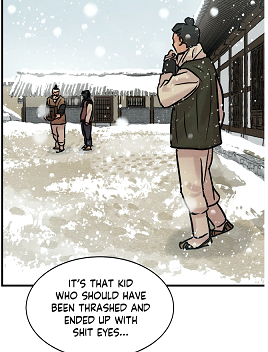 (chapter 51) The man believed the butler, because he had not covered up for him about the prank with the spoiled rice. Finally, I discovered that this expression “how strange” was used by someone else:
  (chapter 37) It was the fake servant who had mentioned the purge! This means that someone had betrayed the Yoons, tattled on them! At the same time, the words from the old bearded man implied that the patriarch Yoon had been the denunciator. Thus he could expect the purge.
 (Chapter 37) As a conclusion, the expression “how strange” is connected to denunciation and deception! I have two other evidences for this interpretation. Jihwa had also spoken like that, when he had heard from the amateur spy that his master had a change of heart! Here again, we have spying activities and denunciation.
  (chapter 13) Finally, observe that in season 3, Baek Na-Kyum is portrayed and stigmatized as a traitor.
 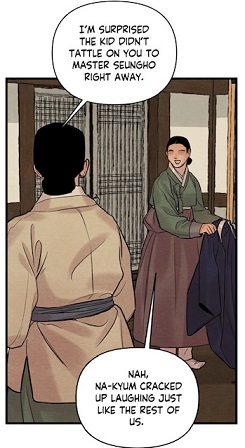 (chapter 91) The maid’s statement (“I’m surprised…”) truly exposes that the painter had such a reputation among the staff. The so-called treacherous nature of the painter served as a justification for Kim’s punishment. The butler’s kindness had been used against him. He had been sentenced to the straw mat beating, because he had allowed the noona to enter the mansion for the painter’s sake! In that scene, the maids had been tasked to leak a certain information to the couple: the existence of the kisaeng’s letters. That way, the painter could accuse his lover of his deception. He had kept away the letters from his noonas. However, the separation didn’t take place, because the painter didn’t hear the comment from the maid. He was no spy!
 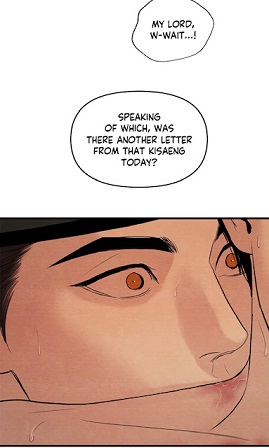 (chapter 91) But Yoon Seungho is one, for he is the surrogate son of the butler… who listens to conversations in the shadow!
  (chapter 77) His presence was undetected in the courtyard, until Bongyong wounded the painter. Here, he came out of the shadow!
  (chapter 78)
Under this new light, it becomes now understandable why Kim decided to reveal the incident at the library to his master. 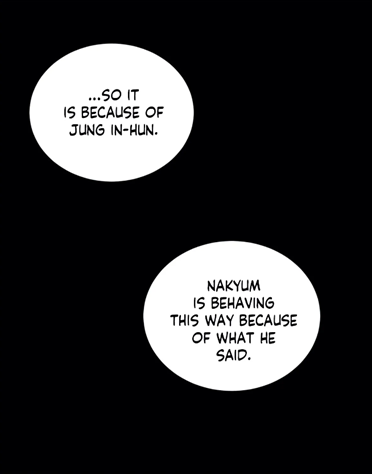 (chapter 50) That way, he could separate the couple. Due to their last sex session, he had discovered that the protagonists were getting closer to each other. He made sure to utilize Yoon Seungho’s hatred for prostitution. And keep in mind observations with the comment “How strange…”: we had spying, deception, contradiction and denunciation. The spiritual love stands in opposition to prostitution.
And now it becomes more understandable why Yoon Seungho had a relapse. How strange is it that the moment he gets closer to the painter, he experiences a setback? No, it is, because there is someone interfering in his life. Kim was determined to sabotage their relationship, he didn’t want the painter to become the lord’s official partner. But what was his motivation? First, it was to preserve his own position, for he is the unofficial lord of the mansion. Secondly, he could justify his action by saying that he was helping the mysterious “lord Song”. The latter is supposed to be Yoon Seungho’s unofficial partner. That’s the reason why Kim kept calling Baek Na-Kyum a favored servant. The butler was hoping that this would fuel Deok-Jae’s jealousy and greed. At the same time, he hoped that Yoon Seungho would get tired of him. However, since time was not helping him, then he needed to take things into his own hands. Yet, for that he could only act in the shadow, exactly like in the terrible night during the first season. And now, the manhwalovers comprehend why there’s the return of the headband in chapter 52. The butler’s scolding in chapter 52 triggered the artist to act like a servant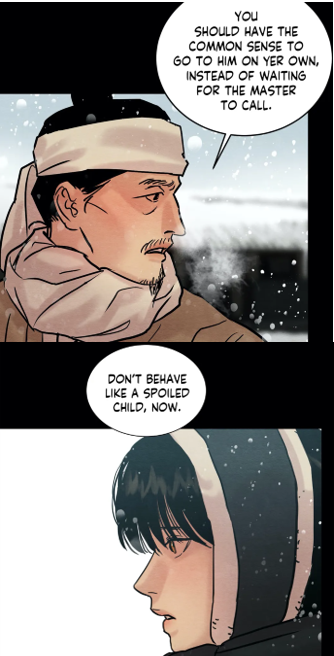 , whereas the butler didn’t consider him as a servant in chapter 23
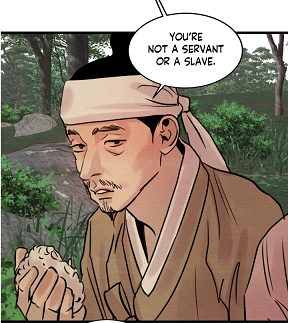 , another evidence for the valet’s hypocrisy.
And now if I examine the last panel again with this new approach, I come to a new interpretation: The lord’s real spirit has not been perceived by the painter yet, just his body, hence he is embodied by a shadow. This doesn’t really represent his true self. Besides, the lord is associated to a shadow, because he is the puppet of his own butler, who keeps working in the dark. At the same time, he is a shadow, for his fate is to learn from his surrogate father, Kim’s spying activities. He hears conversations behind the door (chapter 68) or the window. This is important, because that way, he is getting prepared to fight against his biggest opponent, lord Song who stands behind Kim. However, there exists one huge difference between Kim, Yoon Seungho and Baek Na-Kyum. The protagonists are no secret agents, they are both detectives. They want to understand their partner and their past, but since both were victims of crimes, this means that their role is unveil the truth so that both can get justice.
Feel free to comment. If you have any suggestion for topics or manhwas, feel free to ask. If you enjoyed reading it, retweet it or push the button like. My instagram-tumblr-twitter account is: @bebebisous33. Thanks for reading and the support, particularly, I would like to thank all the new followers and people recommending my blog.
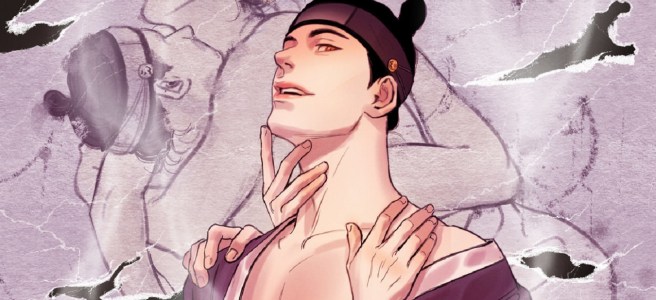
This is where you can read the manhwa. https://www.lezhinus.com/en/comic/painter But be aware that this manhwa is a mature Yaoi, which means, it is about homosexuality with explicit scenes. If you want to read more essays, here is the link to the table of contents: https://bebebisous33analyses.wordpress.com/2020/07/04/table-of-contents-painter-of-the-night/
Feel free to make some donations/sponsoring: Ko-fi.com/bebebisous33 That way, you can support me with “coffee” so that I have the energy to keep examining manhwas.
I would like thank Luzy again for her observations, because her comments inspired me a lot.
What caught my attention is the idiom employed by the painter to describe the wealthy main lead: a man consumed by lust. These words were pronounced, when the commoner criticized the main lead for mocking the poor quality of the poem. Since he was just a man obsessed with sex, he had no right to make fun of the poetry and author. He was worse than Jung In-Hun in his eyes, as he lived in debauchery. Striking is that the low-born kept seeing the lord that way until chapter 47:  (chapter 48) But strangely, the main lead never realized it, until each time the commoner had to externalize it. How did he not see it before, and how didn’t the noble recognize that the artist hadn’t changed his perception about him in the second season? Thus I will try to answer these two questions in this essay.
I had exposed that Yoon Seungho feared his own image due to his self-hatred. Consequently, it meant that he had to rely on others to get a reflection about himself. However, we have to imagine that neither Kim nor Jihwa nor the other nobles gave him a honest portrait. They had no interest to reveal that he was a man obsessed with sex. Why? It is quite simple. Yoon Seungho’s mansion had become the kisaeng house for sodomy, and Yoon Seungho was the head-kisaeng. If you read the story from the start again, you’ll detect how the main lead is actually disrespected by his peers the whole time. Jihwa enters the lord’s mansion unannounced on multiple occasions (chapter 5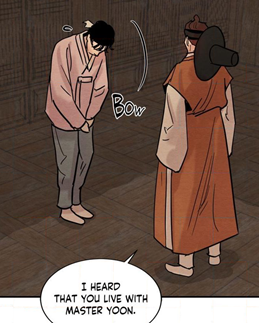 here, no servant is sent to announce the noble’s arrival, which is quite rude; chapter 10
 , chapter 12
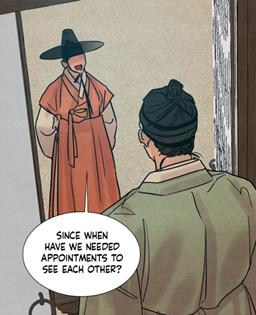 , 17, 43). He acts, as if he owns the place. Moreover, the noble with the mole requests from the host to send away the artist (chapter 8).
 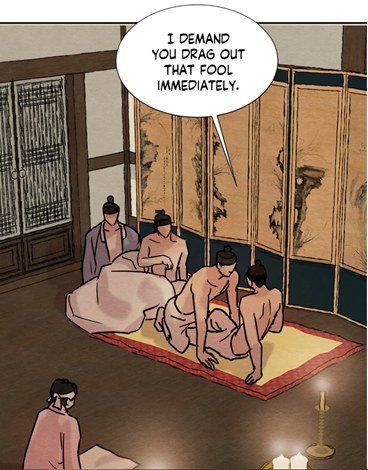 He acts, as if he had a saying in this, nevertheless he is just a guest and not the owner of the house. Moreover, he requests the whole attention from the main lead, as though the latter had to follow the guest’s desire.
 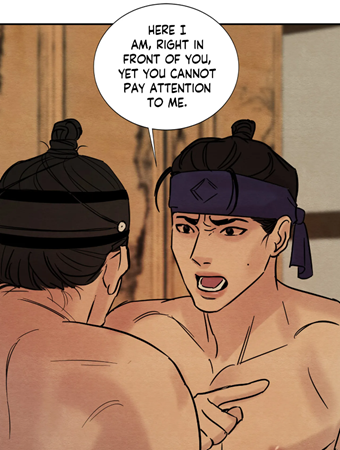 . No wonder, Yoon Seungho got infuriated and ejected the man. The painter’s presence revealed the disregard the noble had for the host. Striking is that even after getting dragged by the topknot, the aristocrat demanded an explanation for this humiliation. He didn’t realize his wrongdoing. This is not surprising that the Joker’s friend noticed the change in the protagonist.
  (Chapter 8) For the first time, the protagonist didn’t allow his peers to look down on him and requested more respect.
In chapter 19, Min invited himself at Yoon Seungho’s house in order to taste the expensive wine. 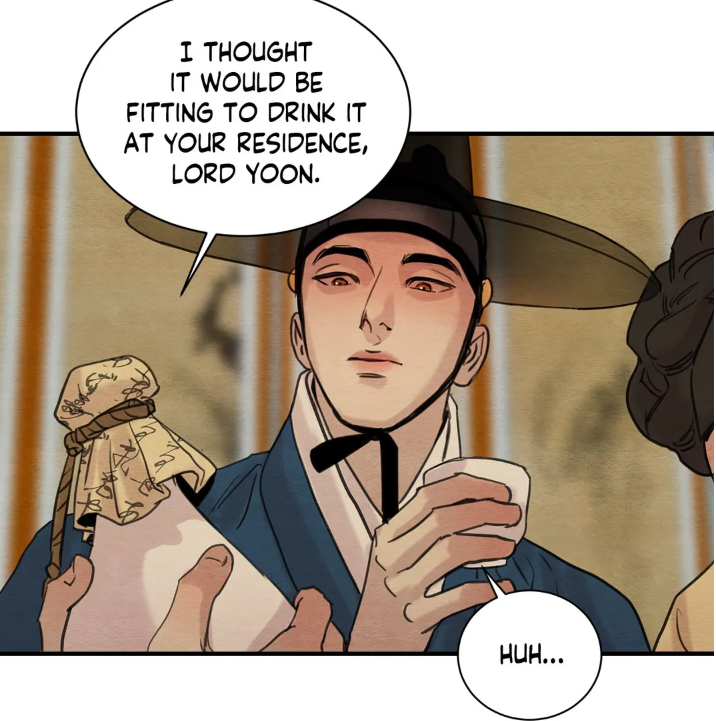 (Chapter 19) He imposed himself upon the main character, yet Yoon Seungho didn’t feel upset. In fact, he just accepted the suggestion by a silence. It was, as if the protagonist was not allowed to refuse the invitation. More surprising is the place where The Joker suggested this: the brothel, an indication that the Yoon residence is considered as the noble kisaeng-house. I would even say, his mansion is the real place for pleasure and vices. And now, you comprehend why Yoon Seungho was pressured by the nobles in chapter 33. In the past, he would have given in, yet this time he showed them that there was a line not to cross.
 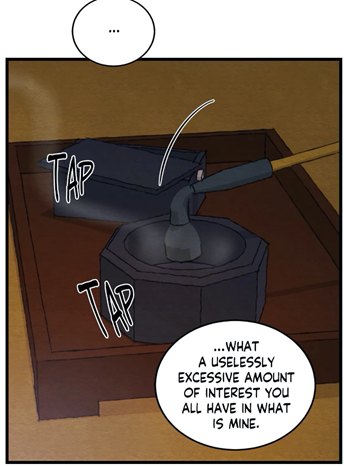 (Chapter 33) Imagine what would have happened, if the noble had followed their suggestion. The artist would have indeed turned into a prostitute.
From my point of view, the young nobles considered the protagonist as their head-kisaeng, he entertained them and allowed them to do immoral things (sodomy, wine and opium), while they could maintain their respectability and honor. Yet, since a kisaeng belongs to the lowest cast, it signified that the lord could get mistreated, exactly like a kisaeng. Besides, only the lord got the bad notoriety, he was a hell-raiser, because the aristocrats desired to hide behind him. He was their scapegoat and shield for their debauchery. He actually embodied all the vices the aristocrats were doing in secret. And now, you understand why the guest in chapter 53 told Min, he wanted to having fun without ruckus. (Chapter 52) In Yoon’s residence, there was no parent or authority to interfere. This explicates why father Lee blames the main lead for his son’s sodomy. He corrupted Jihwa, while in reality Jihwa treated Yoon Seungho like his possession and his personal concubine. He was the one visiting his place and not the other way around, like a husband visiting his “wife”
 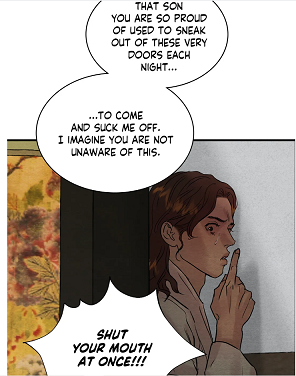 (chapter 67) explicating why Jihwa could only get infuriated and jealous. The “husband”, treated like a concubine, was unfaithful. The second lead was even perceived by the town folks as the mistress
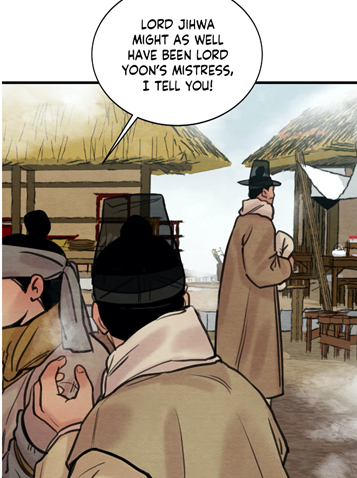 (chapter 45), in other words the mistress of the house (the second definition: a mistress is a person of authority and power). This explains why he could trespass the mansion, like he desired. He considered Yoon Seungho’s mansion as his property, where he could enter at any time.
But if he was the real mistress of the house, why didn’t he stop Yoon Seungho from fooling around with men? Why didn’t he act more responsibly? First, the young man was blind and deaf, hence he couldn’t truly grasp what was going on. Secondly, he was too afraid to confront the friend. Remember that he always played tricks behind the lord’s back. Besides, we shouldn’t forget that Jihwa was himself treated like a servant by Min. If the mistress is disregarded, then the head-kisaeng can only get mistreated. Moreover, the second lead never realized that the nobles’ behavior contributed to the lord’s bad sexual habits. The manhwaphiles should remember that the second lead blamed the main character for fooling around (chapter 57), yet his friend was the one participating to the sex session. At no moment, he reproached him his behavior. In Jihwa’s eyes, only Yoon Seungho was responsible for this due to his past. Yet, he never tried to change the situation. I would like to remind the readers that the origins of Yoon Seungho’s bad notoriety are quite complex. Many people had an interest that Yoon Seungho focused on sex and nothing more: Yoon Seungho (he wanted to hurt his father), father Yoon (covering up his cowardice and own misdeeds), lord Song (making sure that the main lead doesn’t retaliate), Kim (leading a peaceful life and covering up his own wrongdoings), the nobles… and in the end Jihwa. The latter always wounded the main lead by using the past in order to attach the protagonist to him due to his neglecting father. Since the second lead had obtained a certain control over Yoon Seungho, he saw no reason to change. He could outlive his sexuality and have sex any time he wanted. Sure, his dream was to obtain the childhood friend’s love, yet he never saw the urgency, because he believed that time would help him. For him, there was this hope that at some point, the main character would confess. Yet, with Baek Na-Kyum’s appearance in Yoon Seungho’s life, the fragile balance was destroyed due the sex at the pavilion. For the first time, Yoon Seungho felt true desires and pleasure. This detail is important, because it truly outlines that Yoon Seungho was living like a head-kisaeng. He had sex without feeling any pleasure, just to serve others.
And now, it becomes understandable why the noble claimed the artist as his possession in two occasions (chapter 8 and 33). First, he voiced that the low-born would only paint for him.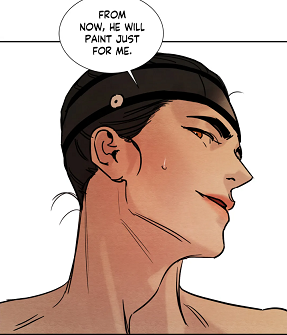 (Chapter 8) He was clearly demonstrating that he would never accept to give up on the painter. Slowly Yoon Seungho started asking respect for himself from others. In reality, he is a noble and he is quite rich through trade. This explicates why lord Min used the wine as an excuse to come to Yoon’s residence. He couldn’t ask the main lead, if he could borrow the painter. Furthermore, this statement and the humiliation revealed that Yoon Seungho was no longer a pushover. Hence Black Heart was more careful around the main lead. From my perspective, The Joker imagined that if the lord got drunk with the expensive bottle, he wouldn’t notice the artist’s disappearance. However, because the wine was stolen, Black Heart couldn’t achieve his goal that’s why he asked for a harsh punishment for the theft. Besides, Yoon Seungho showed no interest to organize a sex session any longer. His eyes were already set on Baek Na-Kyum. Since his initial plan failed, and the lord was no longer organizing parties, then he could only use the sex sessions as an excuse to see the painter.
 (chapter 33)
  (chapter 52) Everyone among the aristocrats did see the main lead as a head-kisaeng, who had to please her guests. Thus Byeonduck created such panels indicating that the nobles had always taken advantage of Yoon Seungho.
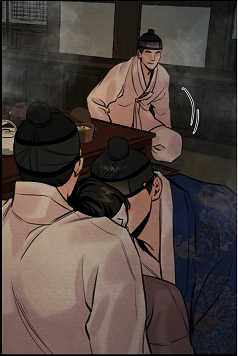 (Chapter 54) They look like conniving creatures. Their wish would get granted in the detriment of the host. And now you comprehend why the lord got so angry, when he saw this.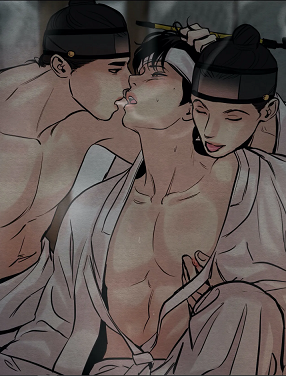
 (Chapter 54) It was not just a reflection of his own past as an uke, but he saw his actual reflection. His house was a brothel and nothing more, and his guests were taking advantage of him. That’s why he got so infuriated and evicted the aristocrats. They truly showed no respect to him. It took many months for the lord to recognize this. And now you comprehend why he abhorred the idea of prostitution. He wasn’t even realizing that he was still doing it. Therefore Yoon Seungho could only come to the conclusion in chapter 55 that he needed to confess. First, this night made him realize that all this attempts in the past were to win the painter’s heart. Yet he was well aware that with his last action, he had almost sold his loved one to nobles, thereby the painter could only reject him. Besides, he had another reason to expect this outcome: his self-hatred.
Under this new interpretation, the manhwalovers comprehend why the household had a terrible reputation. 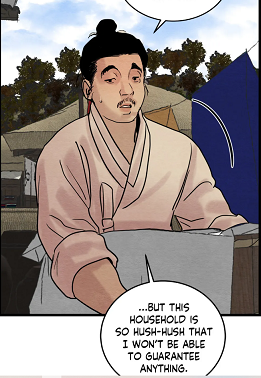 (Chapter 29) Since a kisaeng belongs to the lowest class in Joseon society, the servants could look down on their master. Despite his title, he was living like a head-kisaeng, therefore the staff showed no respect towards their lord.
  (Chapter 32) This explicates why they didn’t follow his order, when he asked them to keep an eye on the artist. Nevertheless, as time passed on, the noble started acting more like a lord, hence the head-maid accepted his reprimand and decided to treat him differently. That’s why she bowed to Yoon Seungho in chapter 46.
 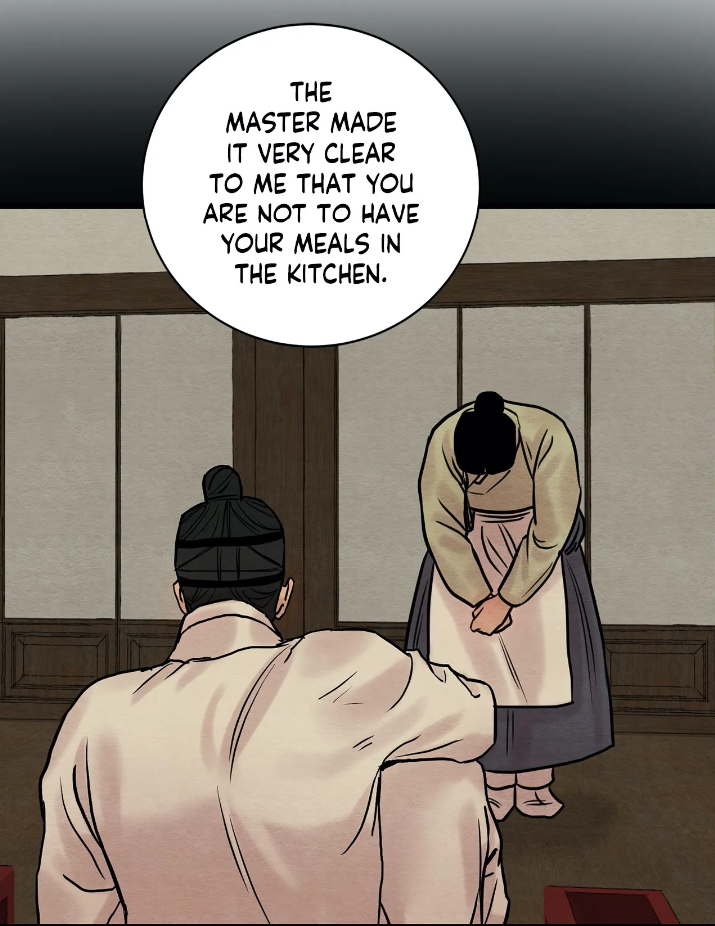 (chapter 46) And by comparing the two last pictures, the readers con detect the butler’s absence. the latter was responsible for the past situation, because he didn’t want to get into trouble. As long as the lord was acting like a head-kisaeng, providing entertainment for the local aristocracy, the valet could lead a peaceful life and definitely sway his misdeeds under the rug. Moreover, he could even use the master’s authority and act like a lord.
But let’s return our attention to The Joker. When the main lead stated this: (chapter 8), he was looking at Min, for he viewed the noble’s envy in his gaze. Since the artist was not allowed to paint for others, then the only possibility left for Black Heart was sex. If the painter joined their sex orgy, then he could achieve his goal: taste the commoner. Therefore you comprehend why The Joker is determined to kill Baek Na-Kyum. If he kills him, then Yoon Seungho is left with nothing. He is like in the past: he becomes again a “head-kisaeng” with no right. But as you can imagine, the Joker is deceiving himself. I doubt that he would be satisfied with just one session.
The problem was that Yoon Seungho never sensed that he was treated like a prostitute, because they created the illusion that he was the alpha among the sodomy community.  (Chapter 33) The lord fell for this illusion, and he would have never realized it, if the painter had not entered his mansion. I also fell for this illusion myself for a while, calling him an alpha, while he was disrespected the whole time. However, this doesn’t mean that the main lead is powerless. He has indeed connections to the government (exactly like the kisaeng-house) and he is definitely rich, because he is a trendsetter. Min keeps copying his clothing and the master’s windscreen is the same at Min’s pavilion and the noble with the mole. That’s why Yoon Seungho never got to see his true reflection. In his mind, he was either busy reading or fighting with nobles, while in reality he was having sex for the most part of the time. Moreover, no one truly gave him a true reflection, since they had no interest to switch the situation.
And this negative reflection is also palpable in the paintings Baek Na-Kyum created, yet curiously the rich main lead never saw this image reflected in the pictures for many reasons. First, his unconscious noticed something else, the painter’s desire, so that the lord acted differently towards the artist.  (Chapter 2) Therefore the main lead’s gaze in the picture mirrored the image of a man showing true interest, warmth and beauty. Later, he only got to see the ruined painting, which triggered a huge anger, hence he didn’t pay attention to the image. Then in the third picture,
 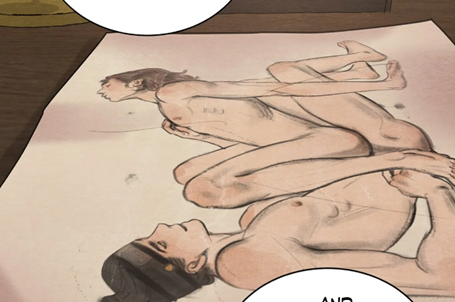 (chapter 16) he was no longer interested in the creation, since Yoon Seungho had already started wooing the commoner.
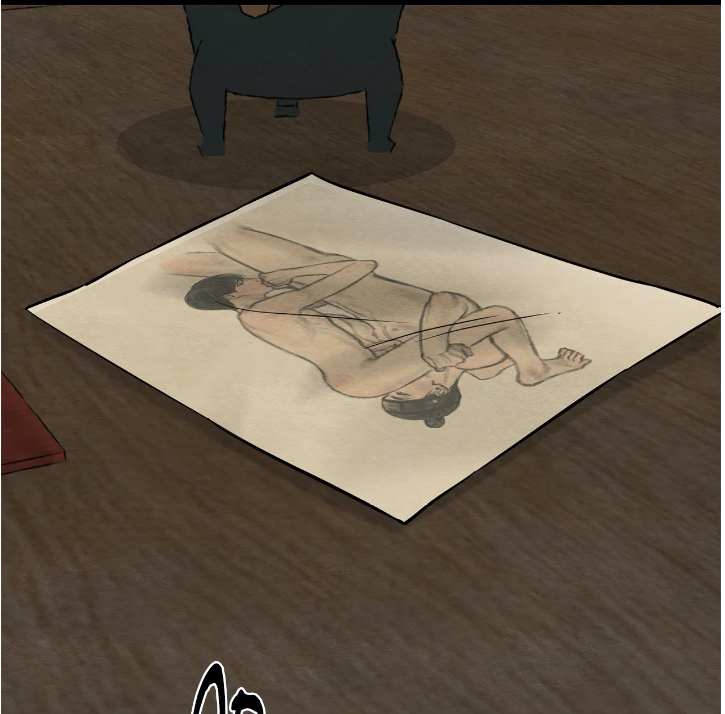
  (Chapter 16) Here the second lead was exploring an unusual position. Although the protagonist could have noticed this reflection “man consumed by lust”, because Black Heart commented it as lewd
 , he still didn’t observe it. His gaze and mind were all focused on the painter and his face. Then in chapter 41, he never saw the multitude pictures of him having sex with the low-born (chapter 41), because his gaze was only focused on the inauguration drawing with Jung In-Hun. (Chapter 41) And the moment the painter accepted him as his sex partner, he showed no interest in the paintings. However, he got annoyed, when he saw the first new creation.
  (Chapter 47) It was unfinished, and it gave the impression that both of them were acting like whores. That’s why the lord was indeed a little annoyed and made the following remark:
 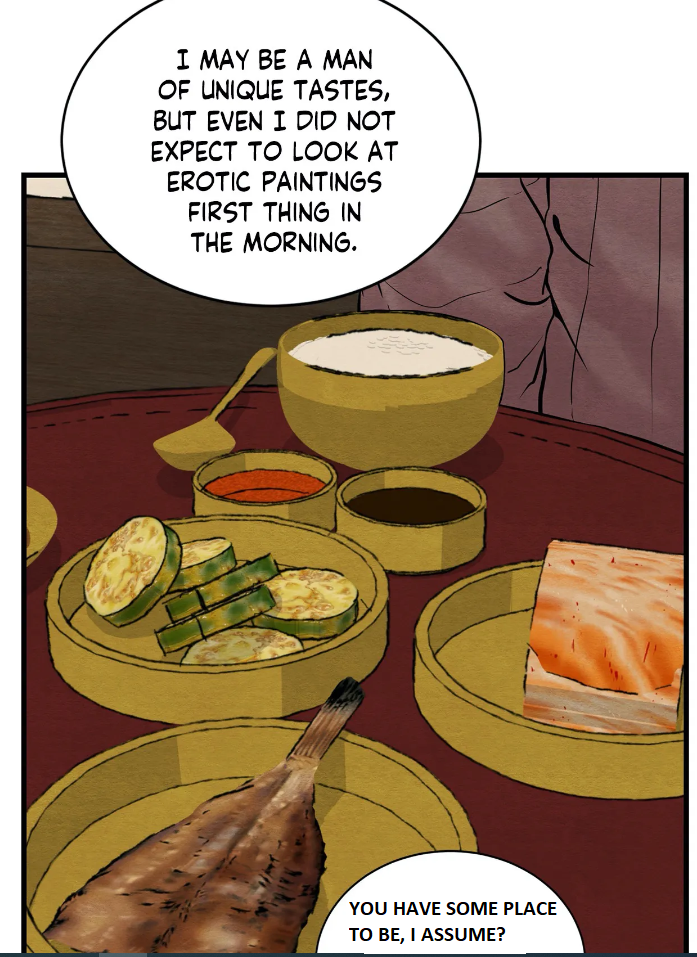 (chapter 47) And it is in this chapter that he gets to discover his reflection… or better said, Baek Na-Kyum hadn’t changed his judgement about him, which provoked the next crisis. With the last painting, Baek Na-Kyum reproduced the situation, where the master was focused on provoking reactions in his partner in order to force him to abandon his torpor.
  (Chapter 52) Therefore the beholder couldn’t detect any love and affection in this drawing, only the attempt to incite pleasure. This explicates why Min described this as salacious, and had the feeling that the commoner was only interested in sex either.
Striking is that in the first painting, Baek Na-Kyum used a big wallpaper (chapter 2), while he only used small sheets of paper later. In my opinion, this is strongly connected to the return of the repressed sexual desires with the low-born. What also caught my attention is when he painted all the situation, when he had sex with Yoon Seungho having sex, the characters have no facial expression. It was, as though the lord was treating the commoner as his sex toy at his disposal. And that’s how the painter explained the rape.  (Chapter 41) For him, every action from Yoon Seungho was caused by his obsession for sex, while the lord was trying to win his heart.
And while comparing all the creations, I recognized that they reflect not only his image as man consumed by lust, but also the disappearance of Yoon Seungho’s past life as sodomite and head-kisaeng. First, the huge painting with Jihwa is ruined, exposing that the latter is losing his control over his childhood friend.  (Chapter 2) Simultaneously, Baek Na-Kyum destroyed it because of his jealousy (under the influence of his unconscious). The manhwalovers shouldn’t forget that in that wet dream, he wanted to take Jihwa’s place, attracted by the lord’s huge penis. Yet, he justified it with his doctrine. Furthermore, the second painting with Jihwa is created on a small sheet of paper reflecting the loss of the red-haired noble’s influence.
Later, when Jihwa ruined the painting with the threesome, the result was showing that Yoon Seungho’s life as head-kisaeng was starting vanishing. 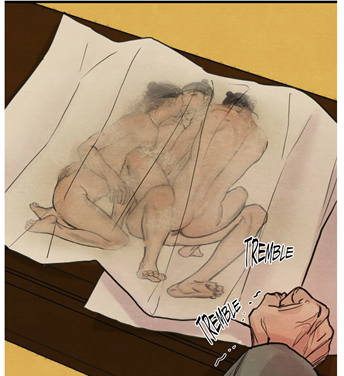 (Chapter 44) from that moment, the protagonist was no longer hosting any sex orgy which led Min to take over this role. Jihwa’s gesture symbolized that the childhood friend was not allowed to fool around with other men. However, he was quickly replaced by the painter. Let’s not forget that in the noble’s mind, Jihwa was just visiting him for his own sexual desires. He never recognized the childhood friend’s feelings. He had no reason to see otherwise, since the second lead treated him poorly.
  (Chapter 59) That’s why, after having sex with Jihwa, the “head-kisaeng” neglected his guest and went directly to Baek Na-Kyum for the painting in chapter 15, because the noble is already interested to taste the artist. At the same time, the low-born got his first sexual experience with the main lead.
 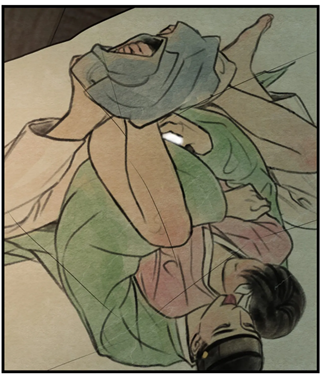 (Chapter 25) And here, the lord couldn’t perceive his own image as man consumed by lust, because his gaze was looking at the painter’s expression. This exposed the lord’s desire to see the attraction for Yoon Seungho in the painter’s eyes. His eyes were always focused on the painter the entire time, revealing that he was longing for more than sex. He wanted to see a mutual attraction… in reality, he wished to see a painting oozing warmth and love, exactly like in the publications he bought. And note that Yoon Seungho never got to see the last drawing, because his heart was too wounded by the distance. He hated so much the idea that the artist considered himself as a prostitute, while all this time, Yoon Seungho was just longing for love. Striking is that the ultimate picture is a blank sheet of paper mirroring the transition.
 (Chapter 65) Here, the lord has finally cut ties with his past. This marks the start of a new life and the painter will reflect his rebirth. But as you can see, the multitude of pictures (chapter 41) only mirrored the painter’s perspective about the main lead. For him, he was just a man obsessed with sex, while in truth he was just longing to get love. The problem was that the protagonist had never been taught how to show love. Furthermore, Kim made sure that the artist would only see this image. That’s why it took Yoon Seungho a long time, before he realized that he needed to recreate the Wedding night, so that the artist would be able to perceive his true feelings. For me, there’s no doubt that at some Baek Na-Kyum will create a huge painting with the main lead, and the low-born will be represented as well. Both will be portrayed with facial expressions exposing confidence and love. I am even predicting that Baek Na-Kyum will paint a new inauguration portrait with Yoon Seungho, which will contrast so much to the one with Jung In-Hun, where the commoner had no face and as such no identity.
Feel free to comment. If you have any suggestion for topics or manhwas, feel free to ask. If you enjoyed reading it, retweet it or push the button like. My reddit-instagram-tumblr-twitter account is: @bebebisous33. Thanks for reading and the support.
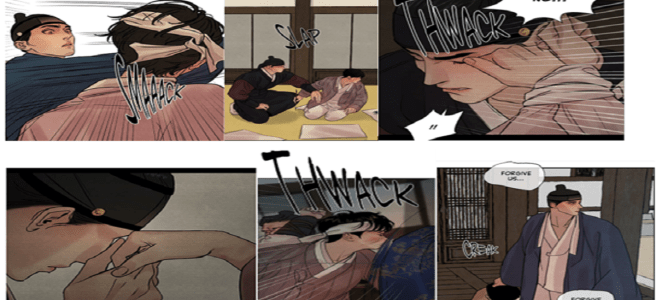

This is where you can read the manhwa. https://www.lezhinus.com/en/comic/painter But be aware that this manhwa is a mature Yaoi, which means, it is about homosexuality with explicit scenes. If you want to read more essays, here is the link to the table of contents: https://bebebisous33analyses.wordpress.com/2020/07/04/table-of-contents-painter-of-the-night/
It would be great if you could make some donations/sponsoring: Ko-fi.com/bebebisous33 That way, you can support me with “coffee” so that I have the energy to keep examining.
In the first part, I had compared the chapters 62-63 to the scene at the pavilion in order to outline the progression of the OTP’s relationship and to announce Yoon Seungho’s imminent emancipation. However, due to the length of the first part, I didn’t get to mention that the scene in the storage room is also a new version of the sex marathon.
Back then, the lord used the mirror for the painter so that the latter would see his own appearance and realize the existence of his body. The true purpose for the sex marathon was to force the painter to accept his sexual orientation, and as such Yoon Seungho as his sex partner. It was, as though the master had employed the mirror for a hypnosis session. (chapter 31) Consequently in chapter 34, the painter sensed a change of perception about his body after the sex marathon. For the first time, he detected his heartbeat and the butterflies in his stomach, which were triggered by the main lead’s presence.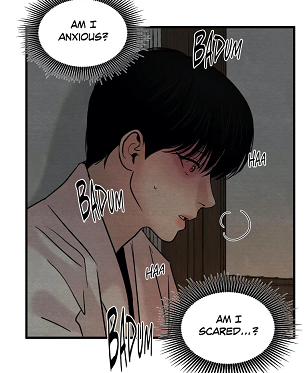
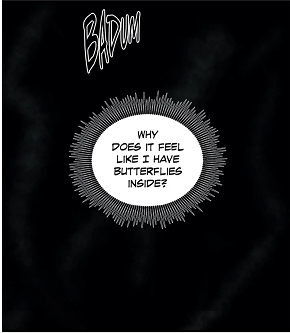 (chapter 34) The parallels can be observed by the absence of the eyes of the protagonists in certain panels. Compare the picture with the mirror (chapter 31) with the following one:
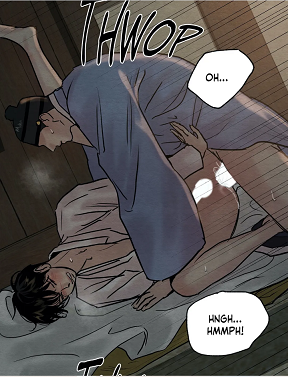 (chapter 63) Striking is that the character represented with eyes plays the role of the liberator for his sex partner. Due to the sex marathon, Yoon Seungho had helped the painter to free himself from his torpor, since due to the coercive persuasion, the artist had come to deny not only his sexual orientation, but also the existence of his own body. That’s why he could no longer admire his learned sir like before after the sex marathon. By recognizing the existence of his own body, the painter couldn’t feel the same attraction towards the teacher. And since the sex marathon played a huge role in his healing process, we have to imagine that the sex scene in the barn has the same signification for Yoon Seungho. He is on his way to be liberated from his self-hatred, but as you can imagine, it will be a painful process. Back then, the painter got ill and the lord ran away from his responsibility. That’s why this time, the blinded person will be the one suffering from the sex marathon: he will feel like dying, when he realizes that he wounded his lover blinded by his prejudice and anxieties.
Nonetheless, there’s a huge difference between the two scenes. Unlike the painter, the aristocrat never denied the existence of his body as such, he just judged his body as a weapon and a armor. This explains why in the latest episode, the noble is so rough with the low-born. He is trying to defeat the painter, so that the latter will accept his submission, and won’t leave his side. He is too afraid to lose the artist, especially if he hears a love confession from him, that’s one of the reasons why he interrupts him. (chapter 63) He has no guarantee that this is true, and love is like a leap of faith. This isn’t something that you can grasp or see. Besides, he would have no control over him, if he accepts the confession. Loving means taking risks, which is linked to fears. This displays how much the master has been brainwashed. Since the painter disappeared in his mind, he came to acknowledge his father’s doctrines one more time before dropping them completely, when he discovers the truth.
The second sex marathon announces the imminent noble’s death. Contrary to the first one, Yoon Seungho has no idea about this. Unlike in the first marathon, he made only emotional decisions, which is normal. The manhwaworms shouldn’t forget that unlike the artist, who remained only one year with the scholar, the noble has been exposed to violence and indoctrination for years. And now, you can understand why I perceive father Yoon as another dictator, like Jung In-Hun. Power and strength are all what matter in their eyes. Finally, the main lead can’t imagine that his dream became true, that he is loved, since he considers himself as a monster. In other words, his self-hatred hinders him to lose his last principles taught by his ruthless and immoral father too. Therefore the lord uses his status as lord to claim the painter.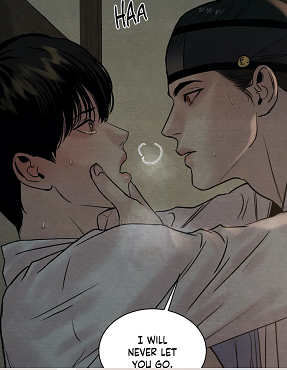 (chapter 63)
As a conclusion, the “therapy session” for the main lead is still ongoing. From my point of view, the ending scene represents a turning point in the hypnosis session. The lord has already revealed his feelings and thoughts (chapter 63), so his love confession to never let the painter go symbolizes one of the last principles Yoon Seungho has internalized. As a master, he can decide about the painter’s fate. So if we consider this scene as a hypnosis session, where is the mirror? As you can imagine, the painter’s face and gaze serve as a mirror for the lord, where he can perceive himself. Therefore the last image shows our protagonist looking closely at the painter’s face and his eyes. (chapter 63) Unlike in chapter 55 or 58 or 62, he is no longer avoiding the artist’s gaze. And there is no doubt that what he will perceive is a different reflection he had received,
 when his father betrayed and abandoned him. This will help him to forget the father’s gaze engraved in his heart. The latter was full of hatred and resent, which the main lead internalized. And with this new interpretation, the chapter 63 appears in a different light. It gives the manhwaphiles hope.
And now, you understand why Baek Na-Kyum didn’t leave Yoon Seungho’s side after this night. Though the lord acted like a common brute, the painter was able to see his soul through his gaze and sense his agony through his words. (chapter 63) With this strong “confession”, the artist’s own fears were addressed too. Let’s not forget that the artist has terrible abandonment issues either. The master’s words left a deep impression on him as well. That’s why he could use the same words the next morning. (chapter 65)
Then in the first version, I wrote this:
“On the other hand, we shouldn’t forget that after the sex marathon, the artist got so sick that some servants had already envisioned that Baek Na-Kyum would die. Therefore, we have to prepare our heart that Yoon Seungho will suffer, just like the low-born. I am expecting a return of his suicidal thoughts, when he realizes that he failed as lord and couldn’t even protect his lover.“
This took place, exactly like I had predicted. The noble was definitely pained and destructive after discovering the truth. He ransacked his own bedroom out of anger and despair. 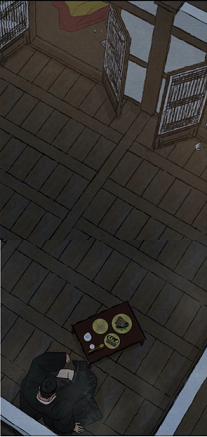 (chapter 69) He had ruined his relationship with the artist. Because he refused to make the leap of faith in the shed, Yoon Seungho decided to make the opposite choice. He let the painter decide about his own fate, yet he was definitely living in agony. The wounded, fearful and desperate gaze revealed his turmoil.
  (chapter 69) In my eyes, the absence of the lord’s eyes during the night of revelations stands in opposition to the lord’s gaze full of expressions in chapter 69. Note that in that episode, the author always drew his eyes, underlining that now the noble was using his own eyes finally. He is no longer relying on Kim and his information. I was also right that this night would affect Yoon Seungho’s relationship with the valet, yet I didn’t expect, it would unveil his true personality. For me, this second sex marathon was a real eye-opener: it made me recognize Kim’s hypocrisy and cowardice. From that moment on, I could no longer view him as a real father figure.
And since the painter’s gaze and facial expressions will play a huge role in the master’s healing process, it signifies that the artist won’t show any disdain or repulsion, in fact the opposite: acceptance. But how is it possible, when the master behaved like a rough sex-maniac in the barn, the very same image the aristocrat kept denying? The response is very simple. If you compare the scene in the barn with the chapter 40, which includes the incident at the tailor shop and at the library, the similarities will become so obvious that after the contrasting, you will realize the true meaning of this confrontation in the storage room.
Therefore I would like to point out all the common denominators in both scenes, accompanied with comparisons and observations:
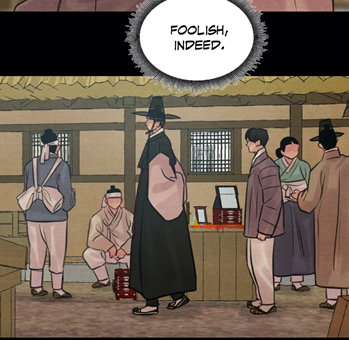 (chapter 40)
 (chapter 62)
 , which leads the artist to hurt the main lead as well in chapter 41.
  He rejected his concern and yelled at him. In chapters 62-63, the positions are switched. Yoon Seungho is the one upset and pained, since he is convinced that the artist abandoned him, therefore his anger is aiming at the commoner. Yet, the true culprit of his wound is his childhood friend Jihwa. Simultaneously both have a common point: Baek Na-Kyum gets hurt, because he becomes the target of Yoon Seungho’s anger, while in chapter 40, he is backstabbed by his admired sir and used the master to get some comfort. Yet, the situation is similar, as the real culprits of the wound never witness the consequence of their actions and words.
  (chapter 63) And if we take the chapter 41/42 into consideration, the painter did request that the lord should be particularly rough.
 (chapter 42) As you can see, the chapter 40 can not be really detached from the sex scene which follows the teacher’s betrayal. Another contradiction is that the painter is just asking the lord to stop, since Baek Na-Kyum is exhausted, while the aristocrat believes that the commoner is pushing him away, begging him to let him go for good.
 (chapter 63) But this divergence comes from the fact that this scene is a new version of the sex marathon, which I mentioned above. Back then, the painter made a similar request. As conclusion, the violence of the sex in chapter 62-63 is strongly connected to an emotional wound, a repetition of chapter 41/42. And in my opinion, the artist understood the situation and the lord’s motivation. Hence he doesn’t feel badly about Yoon Seungho. Notice that the next night, Baek Na-Kyum doesn’t think badly of this sex marathon.
 (chapter 40)
 (chapter 63) What caught my attention is the contrast between the two declarations. While the artist’s feelings for his admired sir seem to be very strong (I adore you), his words don’t really correspond to his affection, because his feelings have already diminished. He did lie to his teacher and protected the main lead in chapter 38. That’s why the “I adore you” should be judged as an exaggeration. It was, as though the painter desired to convince himself and his teacher that he was still attached to him. Besides, he needed to persuade him not to abandon him, after hearing so many reproaches. This observation leads me to the conclusion that Baek Na-Kyum made up his mind to still follow his teacher out of loyalty despite the harshness of Jung In-Hun’s words. On the other hand, the author used a litotes (“I do not dislike you”), implying that in fact his attachment is much stronger. And this is exactly what happens during this scene. Despite the harshness, the painter is forced to question his true feelings for the main lead and recognize them. He is even willing to confess, yet he is stopped. I doubt that Yoon Seungho would have perceived it as a love confession, as he hates meek words. I can use this panel as a reminder:
 (chapter 48). Yoon Seungho is exactly like the painter, he loves strong and metaphorical confessions, like “you’ve made me a wreck” or “I will never let you go”. But let’s return our attention the scholar and Yoon Seungho. Both nobles act the same way. Both can’t accept the artist’s declaration, yet their motivation diverges. The teacher finds it disgusting to be connected to a commoner, whereas Yoon Seungho is too afraid of being lied. He has the impression that this dream can never come true. Yet, while contrasting them, we see the painter’s determination who is willing to overlook the reproaches expressed before by both aristocrats. And he remains faithful till the end. That’s why he waited for Jung In-Hun at the gate in episode 44.
  He needed to see with his own eyes, how the learned sir had truly abandoned him. This represents another explication why the low-born didn’t react like Kim and Min anticipated. He didn’t follow his sister out of loyalty, compassion and a certain trust. However, Heena noona was able to sow seeds of doubts.
 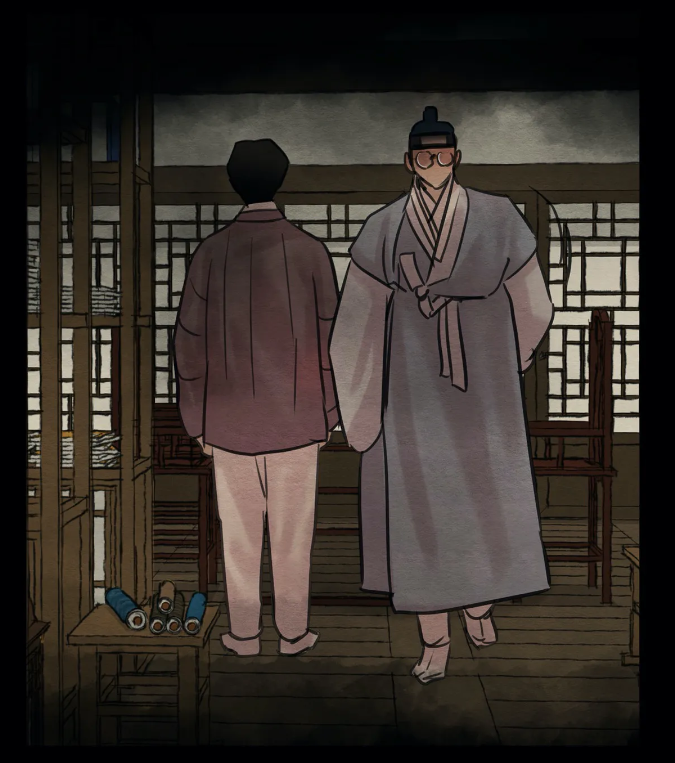 (chapter 40) In this picture, the scholar leaves the painter behind, a metaphor for his abandonment. He even repeats this action, when he leaves for the capital. In chapter 62-63, Yoon Seungho sees in the commoner’s escape a rejection and betrayal.
  (chapter 62) This panel illustrates the thoughts of the protagonist: the commoner has turned his back on him.
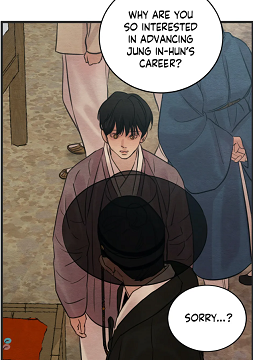 (chapter 40)
 (chapter 40)
  (chapter 62)
  (chapter 63) In both cases, the aristocrats questions the commoner’s motivations for his actions. While Jung In-Hun’s interrogation serves him as an occasion to break his promise by putting the blame on Baek Na-Kyum, the other character is more curious to know about the reasons for his desertion. From my point of view, this shows the noble’s desire to comprehend the painter better. And this illustrates that his obsession with the “why” is well meant. Why is he pushing him away? If he knows the cause, he could find a solution in order to bring the painter to his side.
 (chapter 40) The painter became happy, when he heard that the civil service examination would take place soon. He immediately thought of his learned sir and envisioned that this would please his former teacher. Jung In-Hun’s excitement became the painter’s joy, this is how the painter was thinking in that scene. (chapter 62) (chapter 63) In the scene in the barn, there are two smiles, the first one is a cynical one. However, if the manhwalovers pay attention to Baek Na-Kyum’s smile, his gaze is missing. The absence of his eyes indicates that this picture represents the lord’s mind. Hence the smile full of “schadenfreude” and sarcasm mirrors the noble’s smile, the one he uses in front of people. We had an example in chapter 6, when he made fun of Jung In-Hun, because the latter fell so easily into his trap. However, in the second panel, the master reveals his biggest wish: he would like to smile genuinely too. If he sees a gentle and honest smile in the painter’s face, he will also return the smile. This shows the lord’s humbleness and desire to become honest and genuine to someone. He would like to make such a facial expression, something he has long forgotten. In the end, I believe with these words, the aristocrat would like to drop his mask of deception.
  (chapter 40)
  (chapter 29) By contrasting both panels from chapter 40, the readers can detect the painter’s lie. He expects something from the low noble. He is indeed hoping that Jung In-Hun will keep his promise and he will take his responsibility for him, since the painter supported him. In chapter 63, the noble confesses that the words said by the painter (going home together) gave him hope that he had achieved his goal, that the painter would smile for him one day. (chapter 40) Now, it looks like the lord is determined to keep him by his side, his fate has been also defined by another noble. The painter seems to have no saying in the end. Yet, there is a slight difference. Here, the main lead doesn’t consider Baek Na-Kyum as a prostitute, but as his sexual partner and lover. Yet, in both cases, he is treated like an object, a possession. This explains why the artist has no right to make a decision. So his “fate” has barely improved. Yet, there is definitely a huge difference between the two nobles. Whereas the scholar wanted to use him for his own benefits, while the other’s dream was not to get any concrete advantage: the commoner’s happiness will make the lord happy. And because of this divergence, the lord will realize that his order (chapter 63) stands in opposition to his wish. If his true goal is to make the painter happy, then he needs to let him go so that the artist can make his own decision. He wished to have been the cause of the artist’s smile. And Jung In-Hun is definitely jealous of the low-born due to Yoon Seungho’s care for him. He had to witness how a commoner was treated so well, unlike him, who is a noble.
  (chapter 40) The former had Yoon Seungho’s attention all the time, and we all know that Jung In-Hun’s desire is to get attention and admiration. Striking is that the comparison enlightens the materialistic and narcissistic side of Jung In-Hun, while Yoon Seungho appears purer. He is just content with a smile. Besides, he would like to be the source and recipient of Baek Na-Kyum’s smile, whereas the other wishes to get favors (clothes, a room closer to the lord’s chamber, the favor to spend the evening in the bedchamber etc). That’s why by contrasting both chapters, the protagonist’s purity and simplicity become even more palpable, which is hidden due to the violence employed during that confrontation.
  Furthermore, if we take the chapter 41 into consideration, since we have a flashback of the incident at the library,
 then the readers can recall that in this episode, Baek Na-Kyum was so heartbroken that he asked from Yoon Seungho to be embraced. He needed a shoulder as solace and comfort. The low-born literally begged him, while crying to be hold in his arms, but the noble didn’t know how to respond to this request.
 (chapter 41) He only knew sex. In chapter 62, the lord hold the artist in his arms, only to betray him afterwards. The warmth is faked. (chapter 62) Yet, if you pay attention, you’ll observe a second hug in the barn:
  (chapter 63) The painter is forced to cling onto the master. This position reflects the lord’s intention. He desires the painter to depend on him. Hence the hug is no longer a fake one, but the expression of longing. As a conclusion, the embrace mirrors Yoon Seungho’s need and is indeed connected to warmth, despite the rather cold expression.
 (chapter 40) while in chapter 63, it is the turn of our seme to reveal his expectations and desires. (chapter 63) Yet, unlike the low noble, the master keeps describing himself in such a negative way (f. ex. he is pathetic, a fool)
 ,(chapter 62) while the scholar calls the artist a fool (chapter 40) and a liar. Sure, when Yoon Seungho says “pathetic”, it could be perceived, as if he was insulting the low-born. Yet, like I had mentioned it before, since he is talking about himself right after, his description (pathetic) is in fact more addressed to him. He is still masking his true thoughts a little. (chapter 63) And here, we see his cynical smile accompanied with a gaze expressing agony. This stands in opposition to Jung In-Hun’s coldness and disdain, who shows neither pain nor compassion.
  . (chapter 41) He is just jealous, furious and repulsed. Yoon Seungho is seeking closeness and uses sex in order achieve his goal, therefore he is is refusing to stop. He is so desperate to remain intimate with the painter, while the other noble has only one thought: keeping his distance from the low-born. (Chapter 41) In the scene at the storage room, the painter’s face
  (chapter 63) and words
 (chapter 63) have a huge effect on the upset protagonist. They trigger the noble to open up and reveal himself. That’s why the chapter ends with a face to face: the aristocrat is not decided to look at the painter’s eyes directly.
 (chapter 40)
 (chapter 62) (chapter 63) The irony is that in chapter 40, the scholar is correct. The artist did lie to him, while it is the opposite in chapter 62-63, hence the Yoon Seungho’s reproaches are not valid. Baek Na-Kyum just didn’t tell him the truth, the existence of the kidnapping. Yet, despite the correct observation of the artist’s lie, the low noble’s words are full of falseness. They reveal his true thoughts and emotions. He is quite manipulative, by blaming the artist. With the lie, he can justify his criticisms. He resents the painter for his origins and his so-called immoral behavior. However, let’s not forget that the scholar actually asked the innocent man to sleep with Yoon Seungho in order to obtain information, but because he revealed nothing, he has become a whore according to the teacher. Here, the latter’s hypocrisy reached his climax, exposing that all his reprimands are unfounded in reality. Jung In-Hun is just jealous and infuriated, because he perceives the painter’s lie as a disobedience. And defiance means punishment, that’s the reason why he wounds the commoner with his words. What caught my attention is that despite all the reproaches expressed by Yoon Seungho towards the artist, the master is not willing to cut ties with Baek Na-Kyum. In fact, despite his wounds and the imaginary betrayal, he is willing to overlook all this, because his need and dependency are greater than the injuries the painter afflicted on him. In other words, he is accepting the painter with all his misdeeds and indirectly his flaws. What a statement! And now, the manhwaphiles can better grasp the true meaning of the lord’s confession. His words mirrors his true thoughts and feelings: his roughness, his despair, his possessiveness, but also his willingness to accept Baek Na-Kyum as a whole. He doesn’t care for his social background nor for his desertion. As long as he remains by his side, this is enough for him. Sure, with this kind of statement, he doesn’t promise him to give any special treatment. Since he utilizes his status as lord, this means that he can treat him however he likes, just like during the night. Nevertheless, the manhwaphiles shouldn’t forget that right before, the lord let the painter see his expectations. He will be satisfied, if he is granted to perceive a genuine smile on the painter’s face. In other words, he gave him the solution for the future. (chapter 40), the grange exudes darkness. One might argue that this is related to the time. Baek Na-Kyum visited the teacher during the day, whereas the protagonist arrives during the night. Yet, I see another signification in the contrast. The purity of the white in the library illustrates the clarity of the teacher’s mind. He might be jealous, yet he is in possession of all his skills. He knows how to direct the conversation, how to embarrass and hurt the artist. Notice that during their conversation, there’s no real exchange, the teacher is leading the discussion. Baek Na-Kyum is barely able to finish his sentences
  (chapter 40), while the scholar held a speech about the low-born’s flaws and his terrible social background. Imagine that the teacher doesn’t allow the artist to finish his confession nor to reply to his origins. He leaves the library, before the artist has the opportunity to say something, so that his words are final and represent the truth. (chapter 40) As a conclusion, there’s no real exchange of opinions, and the teacher used his status as noble and teacher to shut the painter’s mouth. The latter is neither allowed to speak nor to make any claim. During this discussion, the room with its light reflects the true personality of Jung In-Hun: manipulative, cold, heartless but most importantly cruel and ruthless. (chapter 40) He uses his power over words to wound his rival, the one who is receiving the lord’s attention. The teacher didn’t employ physical violence to injury the low-born, but this doesn’t mean that there’s no violence. Byeonduck is actually here referring to the saying: words can kill. The scholar used his words to destroy the artist’s personality. And now, you comprehend the symbols behind the color and clarity. The library reflects the coldness of Jung In-hun and his mental abilities. And pay attention that there is neither candle nor fire at the library, a metaphor for Jung In-Hun’s heartlessness and coldness. With this new approach, the scene in the barn appears in a different light. The darkness of the room symbolizes the lord’s darkness in his heart and mind. He is not truly himself. He also wounds the painter with his words, (chapter 62) yet it is not entirely deliberated, he is another person. That’s why the moment he regains some of his senses, his face seems brighter, just like the room. The change is visible, if you contrast the two following pictures (chapter 62) (chapter 63) That’s why I believe that we should perceive beyond the harshness and sexual force employed by the lord. He is totally different from the scholar. And more importantly, his position in the room reflects his mental and emotional disposition. Yoon Seungho is turning his back to the light and as such to the truth, (chapter 63), yet he still manages to let transpire a certain warmth, which explains why the painter never expresses a reproach towards his lover or pushes him away. He just asks him to stop, because he is exhausted. He has a similar behavior during the next night. He keeps the lord at a certain distance, as he fears his own emotions
  (chapter 71) and Yoon Seungho’s outburst
 (chapter 70). Furthermore, when the painter is able to calm down the main lead by calling his name “Lord Seungho” and showing a blushed face, the aristocrat initiates a real conversation and lets the painter the opportunity to reply. There’s a real conversation, although it is interrupted the moment the artist desires to confess. (chapter 63) The lord can’t face the truth, he is in denial. But at the end, despite his relapse, he is finally able to voice his deepest desires: He wished the painter to show him a smile. And unlike the scholar, he doesn’t feel dirty or disgusted to touch a commoner. There’s no gap between them, unlike at the library, where the painter attempts to approach the low noble, only to be pushed away and left behind. And remember that at the end, they are both facing each other: (chapter 63)
The beholder can observe a switch of the positions. Notice that the lord is no longer standing above the painter, like in chapter 62 or during the chapter 63:  (chapter 62) (chapter 63) Now, the painter stands at the same eye level with the master reflecting that the gap between them has diminished. Like I pointed out above, Yoon Seungho is forcing the artist to hold him, implying that he desires the low-born to rely on him. Hence the words gives us now another perspective. The first interpretation was to say that he is ordering, as a lord, the servant to remain by his side, in reality he is revealing his dependency and his need. That’s the reason why his last words should be judged in a more positive light. He is insinuating that the painter has much more power than it seems like.
As a conclusion, by contrasting the behavior of the two nobles in both scenes, the brutality in chapter 63 is diminished and lets transpire that the powerful protagonist is less vicious and hurtful than the teacher, although Yoon Seungho is revealing his dark side. The painter is able to perceive the agony and the despair in his lover. At the same time, the main lead shows to the painter that his person affects the noble in a positive way. That’s why you can now comprehend that I am less perceiving this chapter in a negative light. And this comparison was definitely correct, because it explains why the painter was reminded of the learned sir the next night and felt no longer a heartache.  (chapter 71) There was a “love confession” in the barn, but the lord didn’t use the typical expression for that: and . (chapter 63) Baek Na-Kyum could no longer be in denial that the noble was in love with him.
After this analysis, I recognize that Byeonduck is a master of deception. She is asking from her readers to question appearances and behavior. People should detect disguised cruelty and brutality, words and manipulations can be as mortal as physical violence. I am not saying that Yoon Seungho did nothing wrong, it is just that he is not entirely responsible for this situation: the coercive persuasion, his disorders, his huge insecurities and his self-hatred are the causes for his brutality. He stands in opposition to Jung In-Hun, whose words and moves were all calculated to destroy the painter. Yet, the artist was able to distinguish between the seem and real. This explicates why he is able to move on and to rely more on Yoon Seungho. (chapter 76). The only problem is that Baek Na-Kyum is still fearing his own emotions for the infamous noble. Therefore he has not confessed yet, which will be the reason why both main leads will suffer again. The painter has just opened up and is not trusting Yoon Seungho entirely.
Feel free to comment. If you have any suggestion for topics or manhwas, feel free to ask. If you enjoyed reading it, retweet it or push the button like. My reddit-Instagram-tumblr-twitter account is: @bebebisous33. Thanks for reading and the support.


This is where you can read the manhwa. https://www.lezhinus.com/en/comic/painter But be aware that this manhwa is a mature Yaoi, which means, it is about homosexuality with explicit scenes. If you want to read more essays, here is the link to the table of contents: https://bebebisous33analyses.wordpress.com/2020/07/04/table-of-contents-painter-of-the-night/
It would be great if you could make some donations/sponsoring: Ko-fi.com/bebebisous33 That way, you can support me with “coffee” so that I have the energy to keep examining manhwas. Besides, I need to cover up the expenses for this blog.
After reading the chapter 49, I was happy to have released my last analysis “Yoon Seungho’s long fight and struggle” (part 1/2) just before the new chapter for two reasons. First, my observations and even my predictions were point on. Secondly, it was indeed important to list the laws set by Jung In-Hun because without them, the readers can’t understand the chapter 49 and perceive the huge progression Baek Na-Kyum is making here. Therefore I am mentioning the regulations one more time as I will refer to them later in this essay:
Besides, the chapter 49 confirms that Yoon Seungho’s words and actions in the chapter 48 were motivated by his desire to provoke a reaction in the painter. He wanted him to drop his stuporous state. He had no own will, he was just determined to please the master, whom he still considered as a man driven by his libido. (chapter 48) The noble had noticed that the artist was blind and deaf hence he needed to use the low-born’s body to awake his senses and arouse the painter’s instincts. That’s why he licked the painter’s ears while whispering,
  (chapter 49) or pinched his nipples. At no moment, the protagonist let his emotions (anger, frustration) take control over the situation. That’s why we definitely can’t say that we have another rape in the chamber. First, since “Baek Na-Kyum is a whore” (in the painter’s mind), then the lord can do anything he wants. The noble’s reasoning is quite simple: “Because the commoner is acting, then I should act too”. Secondly, the noble is trying to discover the root of the problem
 (chapter 49), while at the pavilion, he thought that if he forced himself on the painter, he would achieve what he wanted: being recognized as the painter’s partner and husband. From my point of view, we can observe the master of deception in action in this scene. He is using his body as a tool, just like in the past, when he had a sex session with the nobles. However, his goal concerning Baek Na-Kyum is different. This is not to defeat his counterpart. Inflicting pain is just his way to get through the painter’s mind and body. In fact, his goal hasn’t changed at all since the chapter 23. He is still hoping to be loved by the painter but right now, his immediate purpose is to discover the truth. Pay attention to the seme’s face in the illustration above. He knows that he is inflicting pain on the painter hence he is hurt as well. The manhwalovers can perceive the noble’s true face. That’s why I called Seungho as the master of deception. In the image above, the artist can’t see the noble’s true emotions and personality. Our seme feels, he has no other option left as the painter is living like a robot, or better said, a robot prostitute. This contrasts so much to the scene at the pavilion where his selfish desires and negative emotions led him to wound the man. From my perspective, Yoon Seungho is actually selfless here, he is doing it for the artist’s sake. He prefers being hated than getting unnoticed or objectized as an image: Seungho is a man consumed by lust. As a conclusion, Seungho is taking the bull by the horns, willing to get hurt and even hated in the process. The painter needs to answer his question:
Why did he change so much to the point that Baek Na-Kyum was just a shadow of himself?
Let’s not forget that the courageous aristocrat is well aware that Jung In-Hun is behind this but he doesn’t know how. (chapter 48) Did the scholar request the painter to sleep with him in order to discover a weakness? Sure, Baek Na-Kyum said that he was doing it on his own free will, yet his reactions led the lord think otherwise hence he couldn’t lower his guard entirely.
Yoon Seungho is taking some risk here because the painter could resent him for his rough manners. First, he points out the contradiction between his past comment and his actual behavior. He acted as a prostitute, then he should keep acting as such.  (chapter 49) He triggers him with his comments and actions, yet he is determined to make sure that once the artist reaches the breaking point, he will stop. That’s why the noble doesn’t listen to the painter’s complaints
 (chapter 49), until Baek Na-Kyum yells to his lover and starts crying for real. Notice that in the drawing above, the artist expresses his own thoughts and desires for the first time. What caught my attention is that in this drawing, Baek Na-Kyum is speaking without a pause, unlike in the past where he is not even using the pronoun “I” or “me”:
  (chapter 45). My interpretation is that in that situation, the painter was only perceiving himself as an object. Sure, right after he admitted that he was feeling something.
  (chapter 45) But the emotions were quite superficial, he had great difficulties to externalize these. While the pronoun “I” was only used for the first time for a short moment, there was still the presence of an object in his confession. In other words, he was still denying the existence of two naked bodies till the chapter 49. Either he was an object (“it feels nice”) or the lord was one (“I like it”). Hence the lord’s remark was so point on:
 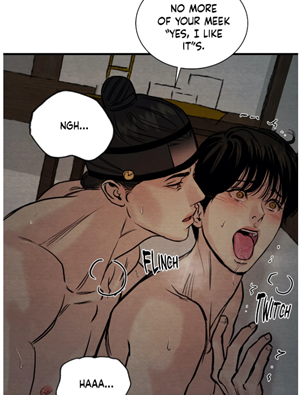 (chapter 48) First, he had misunderstood the confession, yet at some point he perceived his “confessions” for its real value: the presence of an object in his expressions. (chapter 49) Nonetheless, in this scene the painter keeps speaking about himself as he uses the pronoun “I” 9 times, until he is hugged.
The expression “I don’t like it” said in one sentence without any break outlines the effect of the master’s actions. Once cornered, Baek Na-Kyum is forced to externalize his own emotions and thoughts.
 (chapter 49)
He has a body, he believes that his body has reached its limits. So in the image above, he is recognizing the existence of his body. First, we have the admission that he was a person on his own: “I don’t like it”. I couldn’t help myself connecting these words to the quote “I think, therefore I am”, a famous principle developed by the French Philosopher Descartes. Now he is conceding that he has a body on his own: “I can’t”. I see a progression here following the theory developed by Descartes, but the other way around. The French Philosopher used the body as a proof to doubt the existence of the human being/conscious. He used the ghost pain as proof that the body couldn’t be perceived as a proof of the existence. [a ghost pain: an amputated person feels some pain in the missing part] However, the French scientist came to the belief that the existence of the thought is a validation of the existence of the self, the “I” (“Cogito ergo sum”, the expression in Latin).
Consequently, with his words, the artist is slowly validating his own existence: first he has his own thoughts (“I don’t like it”), then he recognizes the presence of his body (“I can’t”). He is a person on his own, neither an object nor a prostitute. He has his own identity.
While during all this time, Yoon Seungho is not listening to the painter’s complains, he keeps reminding the painter that he is doing it for one reason: WHY? Striking is the difference in the writing in the speech bubbles reflecting the tone of the voice.
Notice the progression: Baek Na-Kyum’s voice is getting louder. From “I don’t like it” and “I can’t” to “NO, PLEASE…… I’M GONNA-“, the readers can sense the raising of the painter’s voice to a scream. His yelling announces his outburst.  (chapter 49)
 (chapter 49)
Due to the picture above, you might argue that the sentences are broken again but this time, I interpret it differently. His emotions are the cause for the broken sentences. He can’t speak properly because of the explosion of his genuine feelings. His mind and heart are no longer frozen. Furthermore, he is criticizing the noble but the latter doesn’t mind it, as it was his real goal all this time. He wanted the painter to reconnect with his body and rediscover his true emotions and thoughts.
Another difference is his gesture. He is closing his eyes while crying, turning his face away from Yoon Seungho and even hiding his tears with his arm, which he never did in the past. Compare the drawing above with the following.  (chapter 42)
In the chapter 42, he was looking at the lord with his eyes wide open. There is no arm in the way either. The contrast is really telling, displaying that despite the presence of Yoon Seungho, the artist was not able to perceive the noble’s proximity. This confirms my earlier statement: the painter was blind and deaf and it started in the chapter 42 hence he begged the lord to push harder and deeper as he felt nothing at all. In the retrospective, we could say that we were witnessing Baek Na-Kyum’s slow withering in the chapter 42, or more precisely, the beginning of his winter rigidity (like the frogs). However, I would like to outline that the embrace in the chapter 42 did move the artist’s heart and didn’t get unnoticed. He felt the warmth and love hence he was able to remember his hug and kiss, when he was masturbating.  (chapter 42)
But now let’s go back to this scene:
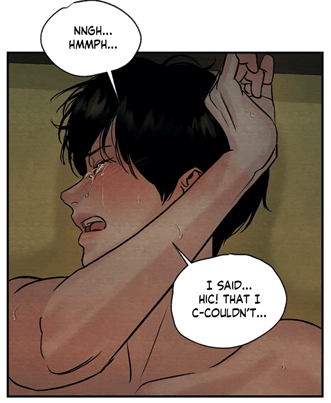
He is doing the exact opposite of the way he behaved in the chapter 42. My explication for the huge contrast is the following. First, Baek Na-Kyum is finally sensing the lord’s presence. All his senses are back, fully awaken. Besides, he is revealing himself. All his emotions and thoughts are real and genuine. But since he is so vulnerable, he is scared to show his true personality. Furthermore, he must have remembered the lord’s words (from the chapter 42), the master could complain again. (chapter 49) However, nothing happens. Yoon Seungho allows the artist to cry and to voice his thoughts for it was exactly what the lord was aiming at. For the first time, he did succeed. This is the reason why I choose this drawing as the illustration for this essay. The lord’s acting did ignite a fire in Baek Na-Kyum. The master destroyed the image Baek Na-Kyum had about himself, being a prostitute, because he expressed his own emotions and thoughts. Therefore I state that Yoon Seungho has liberated the painter from his cage or better said, his frozen state. With his voice and gestures, Baek Na-Kyum is proving that he is existing, he’s a full-fledged person with feelings and thoughts. Simultaneously, he is confessing that he is existing.
This marks a pivotal moment in the painter’s life because so far, he was living under the teacher’s doctrine. He had been submitted to an indoctrination, which is often utilized by dictators. You know that under dictatorships, people are not perceived as persons on their own. The citizens living under a dictator are either numbers or enemies or pawns or objects, they are never recognized as human beings. Due to Jung In-Hun’s coercive persuasion, a method employed in dictatorships, and his doctrine, Baek Na-Kyum was never able to live his life like he wanted. The scholar robbed him all his human rights. The painter had to follow the rules that’s why he got punished by the scholar in the chapter 40. He was questioning the scholar’s actions and power. Hence my claim that Baek Na-Kyum’s love for the scholar was never a real “love” is here confirmed. I’ll go as far as to compare Baek Na-Kyum’s love to a “ruler’s cult” which is another feature for a dictatorship.
Consequently, I compare Jung In-Hun to a dictator on a small scale. Until now, he could only impress the commoners (the head gisaeng, Baek Na-Kyum, the craftsman) but if he gets a high position, he will impose his doctrines on the officials and the nobles, there is no doubt about it. And just like any dictator, Jung In-Hun is delusional and resents people, even his followers. As you know, I am a History teacher in Germany, that’s why I am using Hitler as example. Hitler said that if the Aryans (pure-blooded Germans) were not able to win, then they should all die. This shows that this megalomaniac man never liked Germans in reality. All his doctrine was based on hatred, jealousy and cold-hearted reasoning: “Since The Jews are responsible for our misery and they are just parasites, then they should just be eliminated. They are no human beings, just bugs”. You might now wonder if I’m not drifting away from the topic. I am describing Hitler and the IIIrd. Reich for one reason. Jung In-Hun’s ideology and mentality is really similar to the nazi ideology. For Jung In-Hun, homosexuals are parasites, they are just prostitutes hence they can be destroyed. He has always hated Baek Na-Kyum because the latter was popular among nobles, while he was not noticed with his poetry. Hitler tried to become recognized as a painter but failed, hence he resented more the painters and Jews. The painting about Jung In-Hun’s inauguration could be compared to a propaganda poster.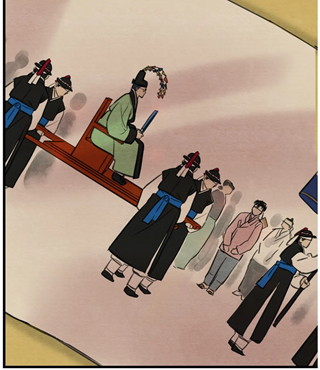 (chapter 41) In other words, I see a lot of common points between Jung In-Hun and modern dictators like Hitler, Stalin and Mussolini. We have the following common denominators:
Now, you understand why I am comparing Jung In-Hun to Hitler. The moment Baek Na-Kyum claims that he is a full-pledged person, he is actually abandoning the scholar’s doctrine. He is no longer a subject, a prostitute because he is no longer following the scholar’s laws. In other words, the coercive persuasion is no longer effective. Now, he is using his own mind for real. We could already catch some glimpses of the painter’s critical thinking in the second season, like when he wondered about the cause of his ejaculation and why he kept thinking about Yoon Seungho. He is no longer living under the shadow of the false sun. This explains why Baek Na-Kyum can’t help thinking about the scholar’s hug, when he is embraced by Yoon Seungho. (chapter 49) (chapter 29) While some people judged it as something negative, I viewed it in a positive way. First, this flashback shows that the painter is thinking on his own. Secondly, he gets aware that the teacher’s hug was fake. He realizes the contradiction between the hug and the words said in the chapter 40: “He was born to be a prostitute”. “If so, why did he hug me back then?” From that thought, Baek Na-Kyum comes to the right conclusion. Jung In-Hun was not sincere and he is finally able to perceive the true nature of his learned sir: a hypocrite, though he doesn’t voice it. This is definitely relevant, this illustrates that Baek Na-Kyum is abandoning the scholar’s doctrine for real. He questions the teacher’s power and control and criticizes him for his dishonesty and duplicity. Since I stated that the rule 6 was central, this means that all the rules become obsolete as well. Baek Na-Kyum decides to live like he wants. And unaware of this, the lord makes the same decision.  (chapter 49)

During that night, both come to the same conclusion, hence they are getting closer to each other. Baek Na-Kyum is taking his fate into his own hand and doesn’t want to rely on anyone else, even Yoon Seungho. Yoon Seungho’s fans might get upset as our main character is not getting what he wants. However, we shouldn’t forget three aspects:

2. In order to love the noble, the painter needs to love himself first. Since he has just started living as a real human being, it is impossible to expect that he can reciprocate the noble’s feelings. But in my opinion, he is already in love with the aristocrat but he has no idea about it. [I’ll explain it further in the second part]
3. With his confession, he is admitting that he is a homosexual and that he tried to repress his sexual desires in the past (“despite myself”) but won’t do that any longer. This means that he will paint again. He won’t repress his unconscious, but will allow it to express itself in his paintings. In other words, his real passion and talents will come back with full power. The future drawings won’t be like the last one, an unrefined or unfinished painting full of mistakes, which was a proof of his frozen state and lack of passion. This confession reveals the determination and the return of the painter’s confidence.
As for Yoon Seungho, the latter chooses to live the way he desires. On the other side, he is lowering his expectations. Simultaneously, he is also trying to live his life the way he desires. This signifies that he is no longer taking people’s opinion into consideration. This is important, for Now, you might ask, where I see a return of the artist’s confidence. Pay attention to the pronouns used in the confession. He is using in each sentence “Me, my, myself and finally I”, while he wasn’t able to speak about himself in the past. With the repetition of these pronouns, he shows that he is existing, but unlike in the confession from the chapter 20, he shows no love for the lord. If someone has to show his adoration and affection for the other, then it should be the lord and not the painter. That’s why the lord is the subject in the confession and not the object (“You press, You bite, You kiss, …”). The artist loved someone in the past (“I have always respected and admired you”, “I pin for you”), yet the result was that he got deceived and betrayed. Imagine, he could have never confessed in reality because for the low aristocrat, he was just a nobody. Here, the artist is definitely taking the lead in his speech and in his action. But he has a reason to do so. He is protecting himself from another betrayal, a possible heartbreak. (chapter 49) He has suffered a lot and he fears to mistake the warmth from the protagonist as something real, whereas it could be fake too. That’s why Yoon Seungho can’t be pleased with this confession. He has to hear that he won’t be loved, that their relationship is only physical, he can’t expect more. Therefore Seungho gets upset and is about to complain, when he hears “I feel good”. Remember that I had explained that their position had been switched from the chapter 36 on. The noble had lowered himself and become a servant in order to get accepted. Now, with this confession, the painter is accepting the noble as his servant and he will be the master. No wonder that the seme is bothered first because this was not his true goal in reality. But when the commoner kisses the lord, Yoon Seungho’s negative feelings disappear.  (chapter 49) Why? The lord senses that there are feelings here. For the second time, Baek Na-Kyum takes the initiative. This time, the confession, the caress and the kiss are directed at the noble. Besides, the artist shows that despite their new defined relationship, Baek Na-Kyum is genuine. This is not a real master-servant relationship, as there is some warmth in his gestures despite his words.
So when the lord is talking to himself, the painter has the exact same thoughts. That’s why the readers, including myself, were so confused. Who was thinking like that? Yoon Seungho or Baek Na-Kyum? Here, it was the noble, yet the painter had the same mind-set. Don’t forget that the painter serves as a mirror in the story, so he had the same thoughts. This explicates why he admitted his sensuality in front of his lover. And the noble understood the message. We should remember that Yoon Seungho is really perceptive (see the chapter 47) and can read the artist pretty well. There is no deception in reality. The painter is just lying to himself that he has no feelings for Yoon Seungho, yet the kiss and the stroke did contradict his words. Yoon Seungho sensed it. That’s the reason why Baek Na-Kyum is no longer acting as a prostitute. We have to imagine that if the lord came to abandon him, then in his mind, he won’t be affected. He will do what he wants in his life. He will paint again because his body and his talents are strongly connected to each other. (chapter 49)
As a final comment, I’ll explain the lord’s following comment  (chapter 49) which is strongly connected to Baek Na-Kyum’s confessions. Let me summarize all his confessions:
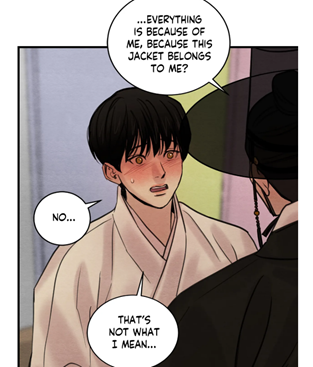 (chapter 39) So he won’t react like in the past, hide his special relationship with the lord. He won’t show any fear, when it comes to gossip or judgement from others. Why should he feel ashamed? This is something natural, which means that the next time Deok Jae calls him
  (chapter 47), he will be able to reply.
 To all these confessions, the lord responds with a similar confession. (chapter 49) He understood the painter’s words and there is a certain resignation in him. He also makes up his mind that there are just sex partners and nothing more. His decision mirrors the painter’s confessions. He has also got aware that the painter is not willing to open his heart. However, what caught my attention here is the word “mind”. All this time, the noble imagined, he desired that the painter revealed his thoughts, while in reality, he was aiming at the artist’s heart. The lord has not realized that what has moved him all along was his own heart and not his mind. I have the impression that Yoon Seungho explained his love with his mind. He couldn’t recognize love, since all his thoughts were revolving around the painter. The painter was in his mind, he wanted to know what the artist thought, unaware that his heart was the trigger for his thoughts, and not his mind. He explained everything with his mind, therefore only valet Kim and Min were able to perceive his true motivation. We have to envisage that the lord has never experienced love before. So in this moment, he is taking his distance from the painter. He will act like in the past: he is just following the reaction of his body.
On the other hand, due to all these confessions, the readers witnesse Baek Na-Kyum’s transformation. He is accepting his homosexuality and his physical relationship with Yoon Seungho. He has no problem to admit that he enjoys their physical interactions and he will now follow the reaction of his body. All this indicates he has regained some pride. That’s why I am declaring that the commoner doesn’t act and perceive himself as a prostitute any longer as having sex means work and not pleasure. Now, you understand why I liked this chapter very much. Baek Na-Kyum reveals his real strength, he has almost returned to his older self. Like I had described him in my first analysis (Baek Na-Kyum and Seungho: a comparison), Baek Na-Kyum has always accepted his homosexuality as something positive and natural, until he met the terrible scholar and in chapter 49, we can witness it. With his confessions, he is rejecting all the rules set by Jung In-Hun, one by one. He is dropping Jung In-Hun’s belief for good.
Feel free to comment. If you have any suggestion for topics or manhwas, feel free to ask. If you enjoyed reading it, retweet it or push the button like. My Reddit-Instagram-Tumblr-Twitter account is: @bebebisous33. Thanks for reading and for the support, particularly, I would like to thank all the new followers and people recommending my blog.


This is where you can read the manhwa. https://www.lezhinus.com/en/comic/painter But be aware that this manhwa is a mature Yaoi, which means, it is about homosexuality with explicit scenes. If you want to read more essays, here is the link to the table of contents: https://bebebisous33analyses.wordpress.com/2020/07/04/table-of-contents-painter-of-the-night/
It would be great if you could make some donations/sponsoring: Ko-fi.com/bebebisous33 That way, you can support me with “coffee” so that I have the energy to keep examining manhwas. Besides, I need to cover up the expenses for this blog
If you have already read my former analyses, you know that our protagonist Yoon Seungho is associated to the window, because he spends so much time in a room looking at his courtyard through the window.  (chapter 35). But what does the window symbolize?
In order to answer this question, let us take a look at the definition of the window:
It’s an opening in the wall or roof of a building or vehicle, fitted with glass in a frame to admit light or air and allow people to see out.
Since our story takes place in Joseon, there is no glass, only thin paper or an open frame, yet it doesn’t change the definition. It’s an opening… that admits air and light and allows people to see out. Striking is that the window is connected to fresh air and sun therefore we can say that through the view, people can definitely broaden their horizon as they are able to witness what it happening outside.
However, let us not forget that their view is limited. Yoon Seungho can only see what is happening in the courtyard, but not in the servants’ room or in the painter’s room. Therefore we come to the next conclusion, the window can represent a barrier, a hindrance. That’s the reason why f. ex. writer Emily Bronte used the window in that aspect in her novel Wuthering Heights.
The window can even symbolize the boundary between the inner world of a character (room) and the outside. Therefore the room could be seen as the personification of the protagonist embodying his inner thoughts and feelings trapped in his darkness. Hence he is seeking light and air through the window. Consequently, I interpret that Yoon Seungho sitting or standing in front of the window like the following. The room seems to be a prison, it is suffocating for Yoon Seungho, hence he looks out of the window in order to be able to breathe and survive. He is caught in his darkness, yet the window allows him to escape from his dungeon, from his past. His passivity reflects his resignation, he is already thinking that nothing exciting in his life will ever happen, until he met the painter. That’s why he said in the chapter 18:
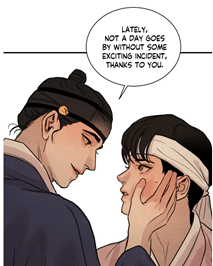
From the moment he met the low-born, he started acting differently. First he kept touching the painter and then he even started leaving the room behind and came to the door. It is interesting that in chapter 7, Yoon Seungho even followed the younger painter, after the latter had heard about the arrival of his admired teacher. Notice how the lord stands in the courtyard and looks at the welcome of the low noble.
This picture reflects the social hierarchy. Yoon Seungho stands at the top, and the teacher is closer to him. However, if you pay attention to Jung In-Hun’s gesture, he is turning his body in order to face the powerful noble. It was as if he was pushing away the young artist. Now, you realize that such a single picture can contain so much symbolism. But now let’s return to our main topic, the meaning of the room and the window.
So the room with the window represented the situation of the powerful lord at the beginning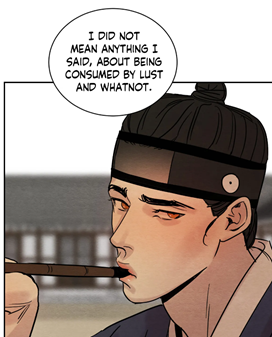 (chapter 5) and it is still there at the end of season 1.
 (chapter 44). It looks like there wasn’t much progression, yet this time, the painter walks towards his mansion and remains by his side.
 This is important, because I realized that with the vanishing of the learned sir, Yoon Seungho chose to remain in the lord‘s bedchamber. What caught my attention is that the lord always went to the courtyard because of the admired sir. We have two chapters for this interpretation: chapter 7 and chapter 35
 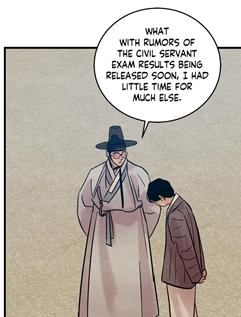 . What caught my attention is that when the lord visited the scholar for the first time, both were sitting in front of a door which looked like a window at the same time.
 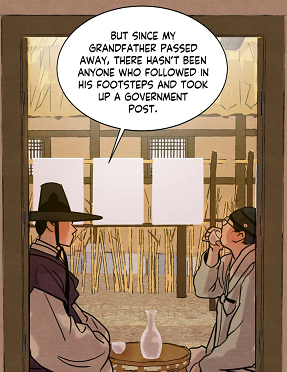 (Chapter 7) This is not random at all, as from my perspective, it introduces the role played by Jung In-Hun in the main lead‘s life. He will be the one forcing the lord to move away from the window so that he can leave the bedchamber. Thus we had this scene: Yoon Seungho is observing the learned sir and his student from far away.
  (Chapter 19) This explicates too why the noble remained so passive in season 2 in the end. Baek Na-Kyum was the lord‘s love interest, hence his „place“ is the bedchamber. So how can the lord move away from the window and as such from the bedroom? Jung In-Hun is the trigger. And note that only in season 2, we discovered how the learned sir used walks through the countryside to console the painter. (Chapter 70) Finally, the main lead organized a hunt for the first time because of his honored guest.
 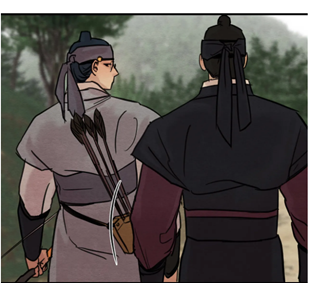 (Chapter 22) And if you recall the lord‘s behavior, you will notice that he left the city for the first time, when he wanted to meet the scholar.
 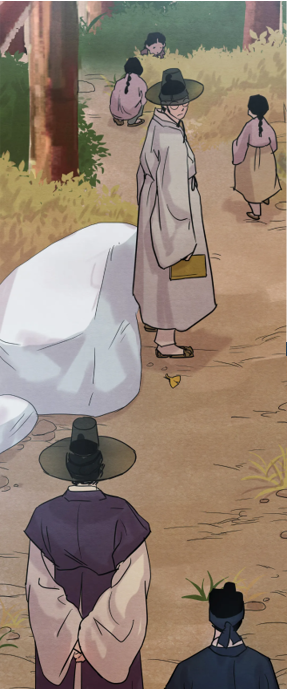 (Chapter 6) He encountered him in the woods. Under this new light, it reinforces my conviction that the learned sir‘s death will be the lord‘s motivation to become proactive and leave his past behind. Why? It is because of the painter‘s words.
  (Chapter 94) The painter still respects the scholar, but he already loves Yoon Seungho. He is not disloyal towards his former teacher despite falling in love with the protagonist. With the last incident, Yoon Seungho got aware how much the painter means to him, but at the same time, he realized the importance of the learned sir in Baek Na-Kyum‘s life. He needs to answer his question:
  (Chapter 102) And this question is strongly connected to the scholar, for the main lead was first sent to Jung In-Hun‘s home.
 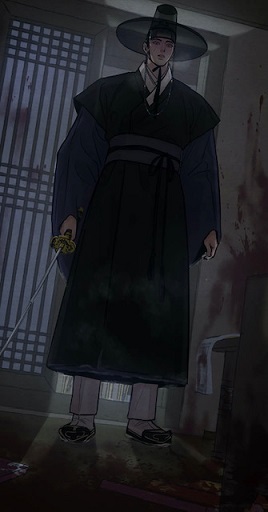 ( 100) Don‘t forget that the main lead saw the room covered in blood, though the latter had already dried. To conclude, the main lead was encouraged to walk thanks to the scholar, and as such to leave his window!
  (Chapter 100)
Therefore it is not surprising why Yoon Seungho remained in front of the window at the end of season 1. He no longer needed to seek him out and bid him farewell.  (Chapter 44) It was the painter’s role. This signified that he was still trapped by his past and trauma, something that he hadn’t revealed to anyone. Since Yoon Seungho is still inside the room smoking in front of the window, it reveals that the lord had not really let go of his past at all, he had not expressed himself in front of Baek Na-Kyum yet. If he reveals his inner feelings and thoughts, this means he will disclose his secret and unveil his vulnerability. This explains why there was no confession from the noble’s side for instance [there were other reasons why he hadn’t confessed anything too], why he was still not sharing his inner thoughts and emotions to his partner.
First, he has never opened up to anyone before. Trust is needed and the artist needs to win that trust, because so far, Baek Na-Kyum had always pushed the noble away. There was still a gap between Baek Na-Kyum and the lord, hence the former didn‘t go to his room, but to his own study. My prediction was that Baek Na-Kyum had to open up first so that the lord could learn from him. And it became a reality. The reason was that the seme was very inexperienced, for no one had ever confided to him. Moreover, he had long internalized that weaknesses must be hidden. Unconsciously, he had already claimed Baek Na-Kyum as his bride, nonetheless this indicated that there was still this distance, this invisible wall between them. We have to understand that Yoon Seungho had never learnt how to share pain and express emotions verbally to others. He had to hide his secret, his past and trauma.  (Chapter 37)
The shaking hand with the fist embodies his repressed inner feelings and thoughts. He had learned to keep everything to himself. Now, you are probably thinking that all this is not entirely new because I already mentioned his passivity. And now, you can grasp the origins of Yoon Seungho‘s silence and inactivity. This stroll through the mountain corresponds to his true revival. 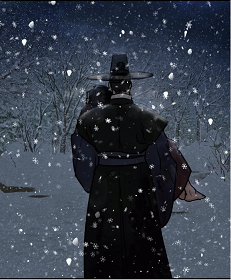 (Chapter 102) This signifies that Yoon Seungho will act differently in season 4: he will be proactive. Like I mentioned in the essay „Scandal(s) in Jemulpo“, he will become the scholar’s disciple and follow his footsteps: ruthless, but also caring and gentle. The only difference is that his affection for the painter is genuine.
However, I needed to describe this again in order to contrast Yoon Seungho’s position with the painter’s situation. What caught my attention is that Baek Na-Kyum is connected to the door, unlike the main lead. We have so many scenes where the low-born is seen close to a door or stands on the doorstep. This is what I could gather so far (I still might have missed some):
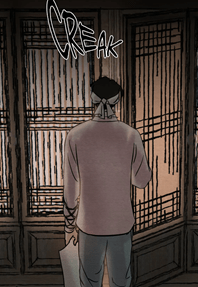

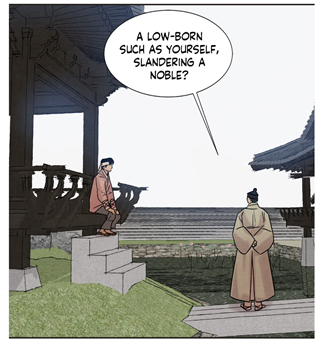 (chapter 10),
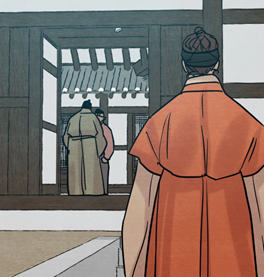 (chapter 12)


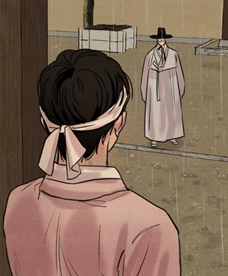
 (chapter 20)
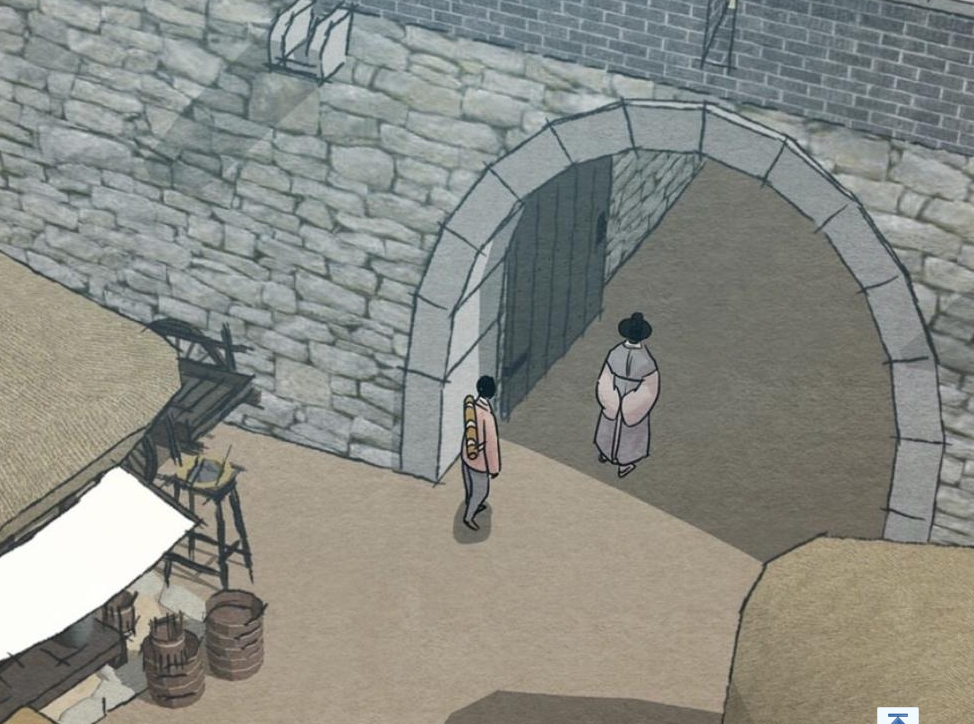 (chapter 29)


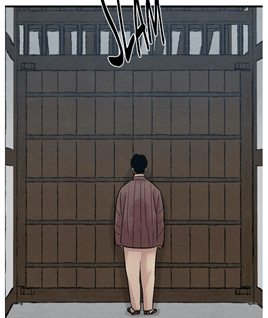


Now, you realize the importance of the door. But what does it mean? Why is Baek Na-Kyum related to the door? First, the window and the door have two common denominators: the room and the limited view to the outside world. However, since a door connects the outside with the inside, it allows to move. The person can leave the room behind, the painter has more possibilities, while with the window the person inside must feel more trapped.
Since I already pointed out that the room embodies the lord’s inner world, we have to imagine that for Baek Na-Kyum it is the same. However, the room represents something else: his unconscious, his hidden true personality and desires and not his past and trauma, like Yoon Seungho. That’s the reason why the room is not a prison like in Yoon Seungho’s case but rather a secret. The painter is hiding his secret behind the door. And now, you can understand the true signification of the door for the artist. The door embodies the doorstep where Baek Na-Kyum has to admit his homosexuality. Now, if we look back at the different situations where the door was seen. Byeondock even drew many pictures of the door in the same chapter underlining the significance and the true meaning of the door.
Now, I’ll interpret different scenes with the door which caught my eye. Little by little I am adding more and more images with the door. And this is what I found so far. I examined the following scenes: 8, 9, 10, 16, 20, 29, 35, 41 and 44.
When we look at the chapter 8, we have this situation. The young man is about to enter the lord’s chamber standing in front of the door. He has been asked by the lord to go there so that he can paint another erotic picture.
Here, the artist is opening the door. It was as if he was entering a forbidden world, where sex and homosexuality are indulged, where people enjoy their sexuality to the fullest. By entering this room, Baek Na-Kyum is reminded of his own repressed and natural desires. Then in chapter 9,
he leaves the lord’s chamber in a hurry after witnessing a sex session. Right behind the door, he can’t help himself and starts masturbating. Hidden behind the door, he feels his sexual urge growing and starts right away with his masturbation. Since he is touching himself so close to the door separating his room from Yoon Seungho’s room, it outlines that he has trouble to control his repressed sexual desires. His unconscious is urging him to become sexually active again. On the other hand, he ensures that the lord doesn’t see his erection demonstrating that he is still denying his own sexual orientation and attraction. On the other hand, the lord heard him which led him to the following conclusions: Baek Na-Kyum is somehow attracted to him and he has some experience with men as he shows no hesitation to masturbate very quickly. So the door served as a protection, he wanted to keep his sexual desires hidden from the noble. Notice how horrible he feels after his ejaculation. He is burying his face as if he was avoiding reality and his own sexual desires. He still wants to deny these urges.
Then chapter 10, the pavilion could be perceived as the unconscious hidden behind the painter’s body. (Chapter 10) Since the pavilion is open aired, it looks like there is nothing there… it was as if the true sexual orientation of the low-born didn’t exist but since there is a roof with beams, we can conclude that Jung In-Hun’s attempt to eradicate his true sexuality has in reality failed. There are rest of it. In other words, the pavilion mirrors Baek Na-Kyum’s denial and brainwashing through Jung In-Hun. This also explicates why Jung In-Hun used here emotional and cognitive techniques as a warning here. He was coercing him to drop the painting.
Then in chapter 16,
Yoon Seungho catches the low-born, because he wants him to experience sex. He has noticed the reluctance hence he just masturbates the young man. Striking is that the door is opened at some point by a servant. This opening of the door by someone else embodies the fear of being discovered. Baek Na-Kyum is determined to never reveal his repressed sexual desires. Consequently he wants the door to stay closed. So if he is seen then, he fears that his sexual orientation will be discovered, yet he wants it to remain a secret. Now, you can understand the meaning of the door in chapter 37.  It is still the same. Despite getting a blowjob, he still wants to hide his homosexuality to the outside. Hence he still gets scared and would like the noble to stop from exciting him. So for the first time, he is experiencing sex with someone.
Here, the door is wide open and this coincides with the commoner’s confession. The young man was drunk, yet he was hiding behind the door until it got opened by the lord. So Baek Na-Kyum’s unconscious wanted to reveal his repressed sexual desires (homosexuality) and his love to the outside world.
In chapter 29, the low noble is bringing him back to the mansion. Striking is that the door is completely open too. This picture illustrates the role played by Jung In-Hun in the painter’s homosexuality. He is the one who “forces” to become an official sodomite, therefore he can no longer hide his sexual preference behind a closed door. I believe that this is related to this incident. 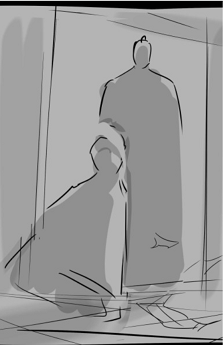 Note the opened door. The learned sir caught him by surprise. That’s how the learned sir was forced to repress and hide his homosexuality. This is no coincidence that in season 1, the scholar had the opposite attitude.
  By feigning ignorance, he actually encouraged the artist to become a sodomite. After their return to the mansion, the teacher showed leniency. He accepted that his student would paint erotic paintings, but he was well aware of their sexual encounter.
 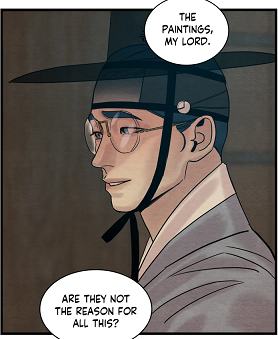 (Chapter 30) The moment he arrives back and the lord brings him back to his chamber, the nature of their relationship is no mystery any longer, though painting is used as a justification. (Chapter 29) Striking is the thickness of the wall. This symbolizes a long way for Baek Na-Kyum to admit his sexual orientation. Just because people know, this doesn’t mean that he is acknowledging his homosexuality immediately.
In chapter 34/35, there are three different scenes where the door plays a huge part. I have to say that the last scene was the one that caught my attention in the first place and that’s how I was able to connect the door to Baek Na-Kyum.
The first drawing shows the lord opening the door for Baek Na-Kyum. This signifies that the noble has somehow given up on forcing the painter to admit his homosexuality and his attraction to the lord. That’s the reason why Yoon Seungho spent the entire night thinking over how to convince the low-born to come to his side and become his partner.
However, the sex marathon has not left the young man unaffected. He hides behind the closed door, while his body is shaking and his heart is beating loudly. He eve feels butterflies. For the first time, we see Baek Na-Kyum confronting himself with his repressed feelings… for the first time there is a connection between his thinking and his unconscious. He is somehow admitting that the lord’s presence has left an impact on him. However, with his body he is making sure that no one will ever find out this secret. He is still denying his homosexuality to the outside world. He wants to keep it a secret, yet he is no longer denying the existence of these feelings.
Then in the same chapter, we see Jung In-Hun abandoning the low-born and he even closes the door in front of him.
This single action has so many significations. First, it visualizes the rejection of the teacher. He cuts ties with him. It also shows that Jung In-Hun is well aware of what happened 10 days before. It reveals his selfishness as he shows no concern. In fact, it was as if the low noble was pushing him back. It was as if Baek Na-Kyum was pressured to become a homosexual even without admitting it. The teacher is forcing him to accept his situation but at the same time, he is denying the responsibility. Imagine the hypocrisy of the lord’s action. In reality, he is the one who pushes the painter to sleep with the lord, since he needs a spy. But by closing the door, he ensures that Baek Na-Kyum doesn’t need to admit his own homosexuality. This scene symbolizes the prostitution Jung In-Hun referred later. The teacher wants to use the artist’s sexual orientation for his own needs and simultaneously he doesn’t need to require this from the painter. As a conclusion, Jung In-Hun is now pushing the low-born to become a homosexual without revealing it to the outside world. At the same time, he acts as if he has no idea what is happening to the commoner. That way, Baek Na-Kyum can never reproach him to have used him as a prostitute or to be a hypocrite.
Then in chapter 41, we see a certain progression. The door has been opened by Yoon Seungho but Baek Na-Kyum doesn’t care any longer. Since he is begging the lord to be held, he is finally admitting his true desires. He likes being embraced by a man. This marks a pivotal moment in Baek Na-Kyum’s life. And this explains why the door is wide opened at the end.
Baek Na-Kyum is no longer hiding his true sexual orientation. He is facing the world without being embarrassed. He waited for Jung In-Hun, hoping that the young man would still accept him, but he experienced rejection. He was literally left behind. However, his acceptance of his own sexual orientation doesn’t necessarily mean that he loves Yoon Seungho. In the beginning of season 2, he viewed himself as a prostitute. 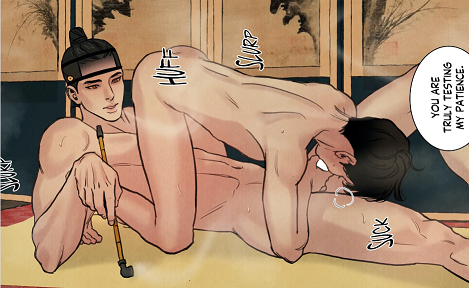 (Chapter 45) He just accepted him as his sexual partner, hence he went to his room and not to the lord’s side in chapter 44. If we compare their respective situation. Yoon Seungho hadn’t progressed much compared to the painter at the end of season 1, because he needed to express his emotions and reveal his secrets and vulnerabilities to Baek Na-Kyum. It took him a long time to open up, as he had been coerced to view himself as a bird of misfortune. He didn’t dare to voice any wish out of fear that these wishes would get ruined.
 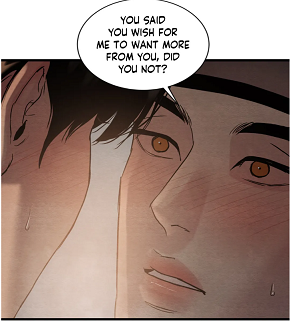 (Chapter 96) In his mind, he had no right to voice any desire, as they would be perceived as GREED!
  (Chapter 96)
But like I had written above, the low-born was in a better position right from the start. He had more freedom, while for Yoon Seungho the room is indeed a prison. Under this new approach, it becomes comprehensible how the main lead could leave the window and as such the darkness of his nightmare. Because of the painter, Yoon Seungho met Jung In-Hun, and the latter made him feel superior, but also jealous. That’s how his attention got diverted from the window making him discover the existence of the door! We could say that the painter as the butterfly led the poor protagonist to the door, and thanks to his mind, Yoon Seungho could release Baek Na-Kyum from his cage, as his mind was also trapped by social norms. And this sexual emancipation could only take place in the bedchamber. This explicates why the artist’s liberation was the first step for the lord’s liberation. But by opening the door for the painter, Yoon Seungho could free himself. Therefore it is not surprising that the painter‘s final confession took place in front of a closed door, 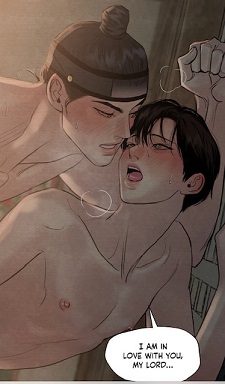 (chapter 96) and Heena could hear his words. Hence at the end, the door got broken:
 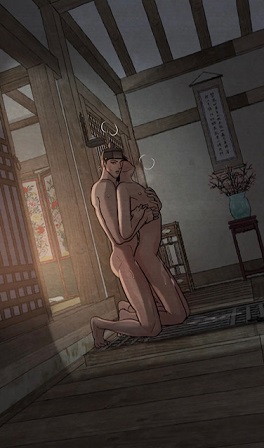 (chapter 96) This represented the final emancipation of the artist. He no longer cared, if he was seen. He was so moved that he didn‘t pay to his surroundings.
 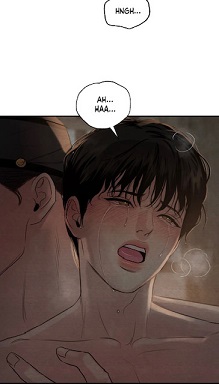 (Chapter 96), while it was not the case for the noble. The latter knew about the artist‘s shyness. This truly shows that Heena was responsible for the sexual oppression of her brother. The painter was no longer hiding his affection for the main lead, when he decided to wait for his master‘s return in the bedchamber.
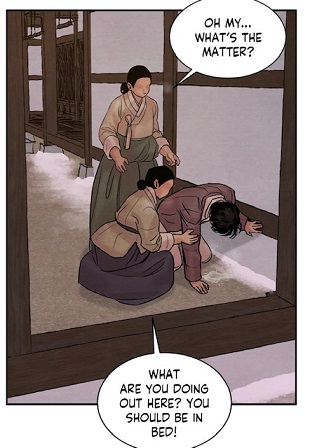 (Chapter 98) Observe that the artist was going there on his own will, and he was sharing his bed with his husband.
How did the scholar discover that Baek Na-Kyum was painting erotic paintings of sodomy? (Chapter 1) This memory was from the learned sir. Why was he approaching the painter during the day? Secondly, note that he only scolded the artist in his house! (Chapter 34) So he had discovered a secret, he imagined that the painter had assisted to an immoral love session.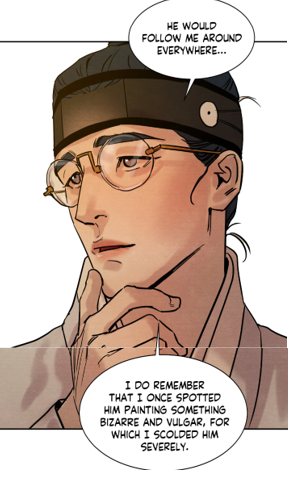 (chapter 6) In my opinion, the kisaeng was responsible for this incident. We have a clue for this interpretation: (Chapter 94) The noona is the one standing in front of the opened door with her donsaeng. Here, the artist was getting embarrassed and humiliated. That‘s how little by little, the artist associated the closed door to shame and safety. This is not surprising that the kisaeng is also standing behind the closed door, when she hears her brother making love to the main lead.
 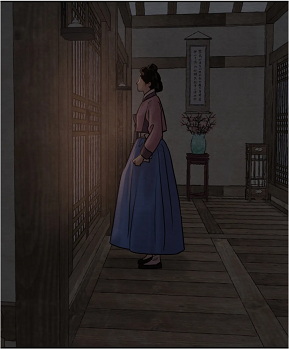 (Chapter 96) In addition, she is constantly seen in connection with an opened door, but this opened door is linked to anxieties, pain, shame and guilt: (chapter 68)
  (chapter 66)
 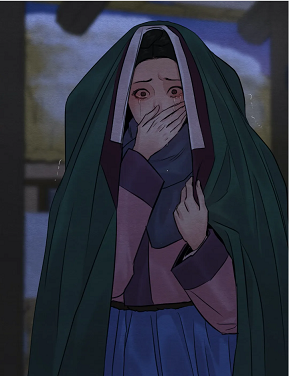 (chapter 88) I have the impression that she was acting out of jealousy, and she had intended to tarnish her brother‘s reputation.
And this leads to my final words. In my first version, I had expressed the following thoughts:
„Does it mean that the lord needs to leave the mansion behind in order to liberate himself from his suffering? If so, then we have two possibilities. Either he gives up his title and everything for the painter or he decides to move to the capital and helps the artist to develop his career and even starts meddling in politics.“
And look at the progression of the story. Yoon Seungho did leave the mansion behind and went to the mountain with the painter in his arms.  (Chapter 102) This symbolized the final emancipation of Yoon Seungho. He could finally move on from his past, and as such leave the darkness of his mental prison. He no longer needs a window to view life. This scene announced that he was starting living again. Thus I am expecting to see Yoon Seungho becoming more proactive and funny in season 4. He will show his intelligence and strength in order to defeat his enemies because so far, he never revealed his qualities to others, only to the scholar. His past had left him somehow paralyzed, hence he has laid a low profile. In his past, he believed that his prison was his protection, for he could observe and remain quite wealthy and powerful. For me, Baek Na-Kyum is in reality his strength, the reason why he will be able to leave his cage and shows his true colors and skills.
But if the window symbolizes Yoon Seungho and Baek Na-Kyum the door, what is representing the teacher? In my opinion the open air. He is mostly seen outside.

 (chapter 7) (chapter 10)
 (chapter 19)
 (chapter 29)
  (Chapter 22) (chapter 35) He often strolls through the courtyard. Therefore I would say that the air embodies him so perfectly. He is seen with his nose in the air

which shows his arrogance. Simultaneously, he gives himself airs. How can he be touched by this low-born? The picture shows both aspects. Then in the chapter 6, he is just hot air (this expression means empty talk in order to impress) , when he says that he was the one who taught how to read to the painter. Here, he tries to present himself as a good teacher to Yoon Seungho. Furthermore, he is overestimating his own skills and he is definitely daydreaming  which is connected to the expression “castles in the air”. His aspirations are boundless, he is aiming at the highest position without being competent or even trying to improve himself. He also attempts to air dirty laundry, when he is hunting with Yoon Seungho. He wants to force the lord to admit his lie so that he can criticize him. But here he fails. As you can observe, many expressions with air reflect his personality. However, there is one scene that contrasts to this observation, that’s when he is in his library in the chapter 40. We actually see him at the library in two occasions:

chapter 7 and 40. However only the scene in the chapter 40 is memorable. Therefore I would say that he is linked to two spaces: open air and closed room like the library. It seems strange that Jung In-Hun is linked to a world with no boundary and the opposite, a closed room. Actually, it is quite simple. The outside signifies that he is actually empty and superficial behind his smile. He is so fake hence he has no real personality. Besides, since there is no limit, then it can also signify that he has no conscience as he knows no boundary. Furthermore, it also illustrates that he has no past and no trauma too. Finally, it also indicates that he will never change, there will be no transformation and as such no progression. Air remains air. Yet he only shows his true thoughts in a closed door in the chapter 40.  His words there are suffocating the poor boy, that’s the reason why Baek Na-Kyum is left speechless. (Chapter 40) He can’t breathe properly. Since there is no view and no door to the outside visible in the drawing, we have to imagine this reflects his narrow-mindedness. He is surrounded by books (see the pictures from the chapter 7) therefore he lacks real experience and knowledge. He is literally buried behind his books, therefore his knowledge is superficial.
  (Chapter 27) Even in his bedroom there are books so his own bedchamber gives the readers a suffocating feeling. Since there is no window visible in his room and the library, there is no fresh air in the closed room which explains why it is asphyxiating. Usually, we say in a closed room that it smells musty. He only knows the world through his books and the moral standards. He is not even opened to the outside, only his words and thoughts count. Everything else has no value hence there is no life next to him. People living by his side will end up suffocated as he doesn’t allow them to breathe. He is stubborn and he will never change, a fake, empty and narrow-minded man with no conscience. Because of this connection, I realized that Jung In-Hun had no future in Hanyang. He would end up buried, and this became a reality. Because the moment he left for the capital, he ended up dead. And now, if you think carefully, you will recognize that the learned sir is associated to nature! Thus he was seen in the woods (chapter 6, 22) or in the countryside admiring the moon. (Chapter 70) Air means also breathing! Hence he represents the fresh air entering Yoon Seungho‘s bedroom, hence we had such a scene:
  (chapter 35) The lord witnessed the intimate interaction between the learned sir and the artist, thus he was incited to leave the bedroom. Strangely, we could say that he was the initiator for the lord‘s liberation. No wonder, why Kim wished to get rid of the learned sir in the end, and just viewed the artist as less annoying and evil!
So the moment he left the domain, the admired sir was confronted by reality. His stay in the mansion had made him dream  (Chapter 18) so that he ended up letting his guard down. He was not so competent and intelligent like Yoon Seungho, he relied more on the stupidity on others. He could deceive commoners, but not spies. In my first version, I had envisioned that the learned sir had many tricks up his sleeves so he would survive, but I had not realized that he had met a fake servant
  (chapter 37) definitely a noble who could see through him. For me, it was the pedophile himself. I had predicted that he would disappear into thin air, and it became a reality, especially if my theory about his assassination is correct. We could see the transformation of the scholar into a ghost, (chapter 50) who would come to haunt the couple because of his resent.
  (Chapter 98) As the air, he became a spirit! And note that the lord was encouraged to stroll too!
Feel free to comment. If you have any suggestion for topics or manhwas, feel free to ask. If you enjoyed reading it, retweet it or push the button like. My Reddit-Instagram-Tumblr-Twitter account is: @bebebisous33. Thanks for reading and for the support, particularly, I would like to thank all the new followers and people recommending my blog

 Bebebisous33s' analyses in K-Dramaland and Manhwas