

This is where you can read the manhwa. https://www.lezhinus.com/en/comic/painter But be aware that this manhwa is a mature Yaoi, which means, it is about homosexuality with explicit scenes. If you want to read more essays, here is the link to the table of contents: https://bebebisous33analyses.wordpress.com/2020/07/04/table-of-contents-painter-of-the-night/
It would be great if you could make some donations/sponsoring: Ko-fi.com/bebebisous33 That way, you can support me with “coffee” so that I have the energy to keep examining.
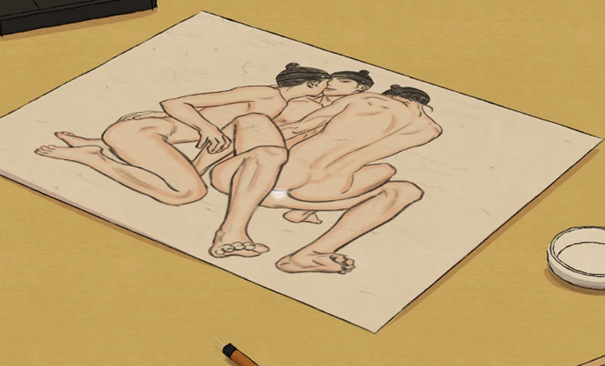
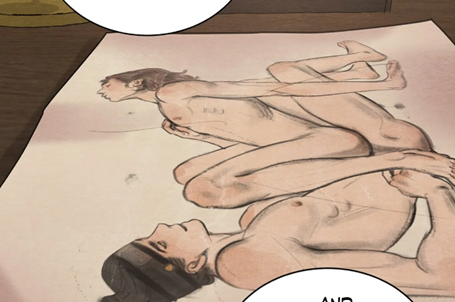
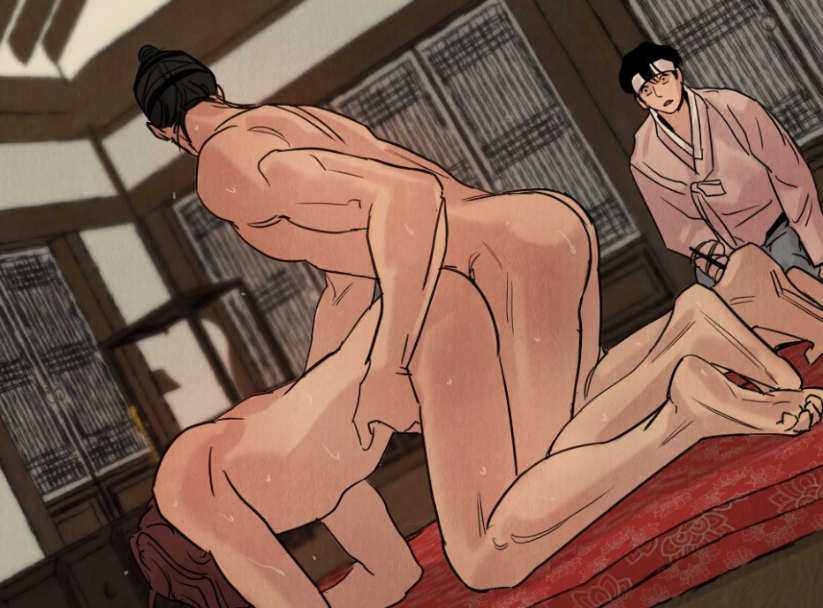
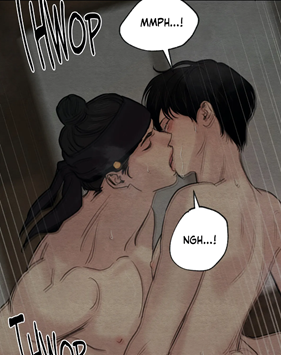
In the first part, I had compared the chapters 62-63 to the scene at the pavilion in order to outline the progression of the OTP’s relationship and to announce Yoon Seungho’s imminent emancipation. However, due to the length of the first part, I didn’t get to mention that the scene in the storage room is also a new version of the sex marathon.
1. The signification of sex marathon
Back then, the lord used the mirror for the painter so that the latter would see his own appearance and realize the existence of his body. The true purpose for the sex marathon was to force the painter to accept his sexual orientation, and as such Yoon Seungho as his sex partner. It was, as though the master had employed the mirror for a hypnosis session. (chapter 31) Consequently in chapter 34, the painter sensed a change of perception about his body after the sex marathon. For the first time, he detected his heartbeat and the butterflies in his stomach, which were triggered by the main lead’s presence.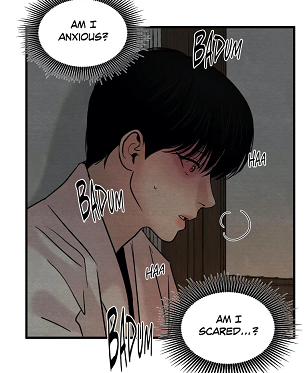
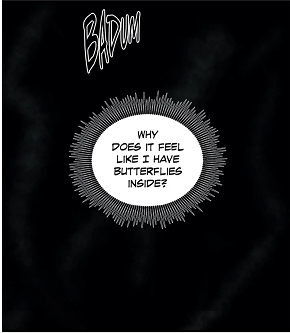 (chapter 34) The parallels can be observed by the absence of the eyes of the protagonists in certain panels. Compare the picture with the mirror (chapter 31) with the following one:
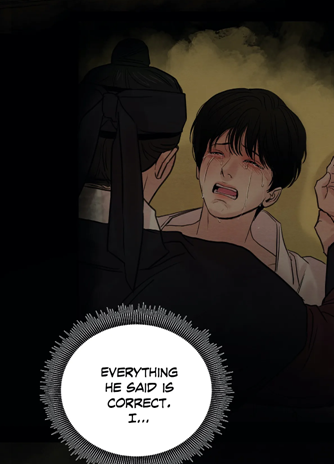
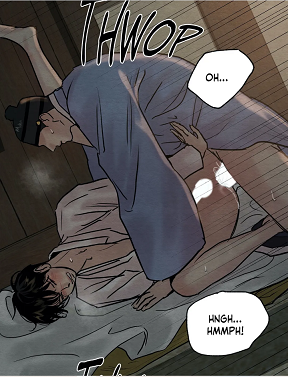 (chapter 63) Striking is that the character represented with eyes plays the role of the liberator for his sex partner. Due to the sex marathon, Yoon Seungho had helped the painter to free himself from his torpor, since due to the coercive persuasion, the artist had come to deny not only his sexual orientation, but also the existence of his own body. That’s why he could no longer admire his learned sir like before after the sex marathon. By recognizing the existence of his own body, the painter couldn’t feel the same attraction towards the teacher. And since the sex marathon played a huge role in his healing process, we have to imagine that the sex scene in the barn has the same signification for Yoon Seungho. He is on his way to be liberated from his self-hatred, but as you can imagine, it will be a painful process. Back then, the painter got ill and the lord ran away from his responsibility. That’s why this time, the blinded person will be the one suffering from the sex marathon: he will feel like dying, when he realizes that he wounded his lover blinded by his prejudice and anxieties.
2. Comparison between the two sex marathons
Nonetheless, there’s a huge difference between the two scenes. Unlike the painter, the aristocrat never denied the existence of his body as such, he just judged his body as a weapon and a armor. This explains why in the latest episode, the noble is so rough with the low-born. He is trying to defeat the painter, so that the latter will accept his submission, and won’t leave his side. He is too afraid to lose the artist, especially if he hears a love confession from him, that’s one of the reasons why he interrupts him. (chapter 63) He has no guarantee that this is true, and love is like a leap of faith. This isn’t something that you can grasp or see. Besides, he would have no control over him, if he accepts the confession. Loving means taking risks, which is linked to fears. This displays how much the master has been brainwashed. Since the painter disappeared in his mind, he came to acknowledge his father’s doctrines one more time before dropping them completely, when he discovers the truth.
The second sex marathon announces the imminent noble’s death. Contrary to the first one, Yoon Seungho has no idea about this. Unlike in the first marathon, he made only emotional decisions, which is normal. The manhwaworms shouldn’t forget that unlike the artist, who remained only one year with the scholar, the noble has been exposed to violence and indoctrination for years. And now, you can understand why I perceive father Yoon as another dictator, like Jung In-Hun. Power and strength are all what matter in their eyes. Finally, the main lead can’t imagine that his dream became true, that he is loved, since he considers himself as a monster. In other words, his self-hatred hinders him to lose his last principles taught by his ruthless and immoral father too. Therefore the lord uses his status as lord to claim the painter.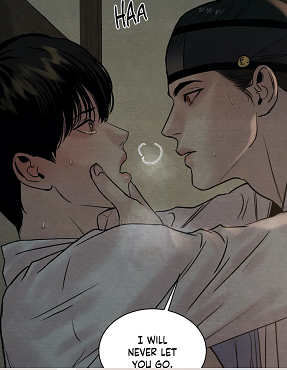 (chapter 63)
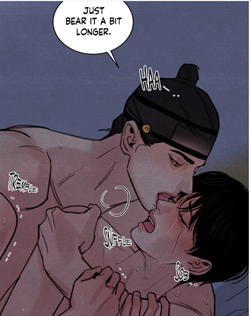
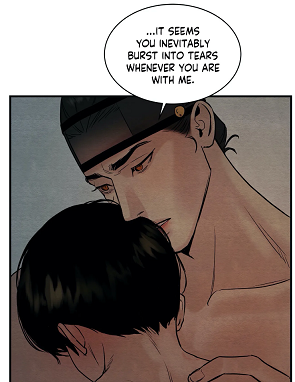
As a conclusion, the “therapy session” for the main lead is still ongoing. From my point of view, the ending scene represents a turning point in the hypnosis session. The lord has already revealed his feelings and thoughts (chapter 63), so his love confession to never let the painter go symbolizes one of the last principles Yoon Seungho has internalized. As a master, he can decide about the painter’s fate. So if we consider this scene as a hypnosis session, where is the mirror? As you can imagine, the painter’s face and gaze serve as a mirror for the lord, where he can perceive himself. Therefore the last image shows our protagonist looking closely at the painter’s face and his eyes. (chapter 63) Unlike in chapter 55 or 58 or 62, he is no longer avoiding the artist’s gaze. And there is no doubt that what he will perceive is a different reflection he had received,
 when his father betrayed and abandoned him. This will help him to forget the father’s gaze engraved in his heart. The latter was full of hatred and resent, which the main lead internalized. And with this new interpretation, the chapter 63 appears in a different light. It gives the manhwaphiles hope.
3. The repercussions of this night of revelations
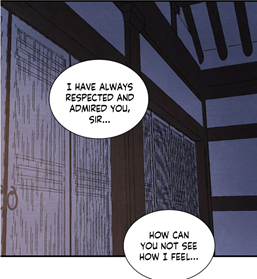
And now, you understand why Baek Na-Kyum didn’t leave Yoon Seungho’s side after this night. Though the lord acted like a common brute, the painter was able to see his soul through his gaze and sense his agony through his words. (chapter 63) With this strong “confession”, the artist’s own fears were addressed too. Let’s not forget that the artist has terrible abandonment issues either. The master’s words left a deep impression on him as well. That’s why he could use the same words the next morning. (chapter 65)
Then in the first version, I wrote this:
“On the other hand, we shouldn’t forget that after the sex marathon, the artist got so sick that some servants had already envisioned that Baek Na-Kyum would die. Therefore, we have to prepare our heart that Yoon Seungho will suffer, just like the low-born. I am expecting a return of his suicidal thoughts, when he realizes that he failed as lord and couldn’t even protect his lover.“
This took place, exactly like I had predicted. The noble was definitely pained and destructive after discovering the truth. He ransacked his own bedroom out of anger and despair. 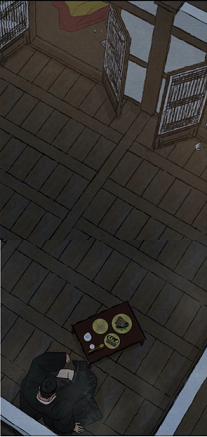 (chapter 69) He had ruined his relationship with the artist. Because he refused to make the leap of faith in the shed, Yoon Seungho decided to make the opposite choice. He let the painter decide about his own fate, yet he was definitely living in agony. The wounded, fearful and desperate gaze revealed his turmoil.
  (chapter 69) In my eyes, the absence of the lord’s eyes during the night of revelations stands in opposition to the lord’s gaze full of expressions in chapter 69. Note that in that episode, the author always drew his eyes, underlining that now the noble was using his own eyes finally. He is no longer relying on Kim and his information. I was also right that this night would affect Yoon Seungho’s relationship with the valet, yet I didn’t expect, it would unveil his true personality. For me, this second sex marathon was a real eye-opener: it made me recognize Kim’s hypocrisy and cowardice. From that moment on, I could no longer view him as a real father figure.
4. Betrayals, pain and sex
And since the painter’s gaze and facial expressions will play a huge role in the master’s healing process, it signifies that the artist won’t show any disdain or repulsion, in fact the opposite: acceptance. But how is it possible, when the master behaved like a rough sex-maniac in the barn, the very same image the aristocrat kept denying? The response is very simple. If you compare the scene in the barn with the chapter 40, which includes the incident at the tailor shop and at the library, the similarities will become so obvious that after the contrasting, you will realize the true meaning of this confrontation in the storage room.
Therefore I would like to point out all the common denominators in both scenes, accompanied with comparisons and observations:
- The length of the scene: 4 chapters (39-40-41-42). If we include the whole chapter 40, then we can add the chapter 39, since in chapter 40, the painter leaves the tailor shop and in chapter 41, we have a flashback with the scholar and the request of Baek Na-Kyum to get comfort from Yoon Seungho. And it looks like we will have two episodes in the storage room (62-63-64-65).
- The use of flashbacks
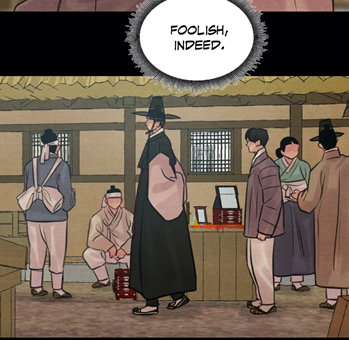 (chapter 40)
 (chapter 62)
 - The terrible wound afflicted on the protagonist: In chapter 40, Baek Na-Kyum is the one who gets wounded by his former teacher
 , which leads the artist to hurt the main lead as well in chapter 41.
  He rejected his concern and yelled at him. In chapters 62-63, the positions are switched. Yoon Seungho is the one upset and pained, since he is convinced that the artist abandoned him, therefore his anger is aiming at the commoner. Yet, the true culprit of his wound is his childhood friend Jihwa. Simultaneously both have a common point: Baek Na-Kyum gets hurt, because he becomes the target of Yoon Seungho’s anger, while in chapter 40, he is backstabbed by his admired sir and used the master to get some comfort. Yet, the situation is similar, as the real culprits of the wound never witness the consequence of their actions and words.
 - Sex: tailor/painter’s study versus barn: The intensity diverges here. We had a romantic date in chapters 39/40 and a painter acting like a prostitute in chapter 41 due to his pain. Sex was used in order to cover the emotional wound and in chapter 62/63, it is the same. The roughness in Seungho’s behavior during the intercourse displays his wound and need for embrace, yet he can’t ask for warmth and love, since in his mind, the painter will never open his heart to him.
 (chapter 63) And if we take the chapter 41/42 into consideration, the painter did request that the lord should be particularly rough.
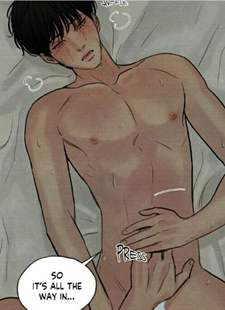 (chapter 42) As you can see, the chapter 40 can not be really detached from the sex scene which follows the teacher’s betrayal. Another contradiction is that the painter is just asking the lord to stop, since Baek Na-Kyum is exhausted, while the aristocrat believes that the commoner is pushing him away, begging him to let him go for good.
 (chapter 63) But this divergence comes from the fact that this scene is a new version of the sex marathon, which I mentioned above. Back then, the painter made a similar request. As conclusion, the violence of the sex in chapter 62-63 is strongly connected to an emotional wound, a repetition of chapter 41/42. And in my opinion, the artist understood the situation and the lord’s motivation. Hence he doesn’t feel badly about Yoon Seungho. Notice that the next night, Baek Na-Kyum doesn’t think badly of this sex marathon.
 - The question of responsibility: In episode 40, the lord desires to become responsible for the painter, while the latter desires the low noble to be his “guardian” and keep his promise. (For further explanations, you can read my analysis about chapter 39-40). In chapter 63, the powerful noble is using his right to claim the painter and as such, he becomes his guardian.
- An interrupted confession

 (chapter 40)
 (chapter 63) What caught my attention is the contrast between the two declarations. While the artist’s feelings for his admired sir seem to be very strong (I adore you), his words don’t really correspond to his affection, because his feelings have already diminished. He did lie to his teacher and protected the main lead in chapter 38. That’s why the “I adore you” should be judged as an exaggeration. It was, as though the painter desired to convince himself and his teacher that he was still attached to him. Besides, he needed to persuade him not to abandon him, after hearing so many reproaches. This observation leads me to the conclusion that Baek Na-Kyum made up his mind to still follow his teacher out of loyalty despite the harshness of Jung In-Hun’s words. On the other hand, the author used a litotes (“I do not dislike you”), implying that in fact his attachment is much stronger. And this is exactly what happens during this scene. Despite the harshness, the painter is forced to question his true feelings for the main lead and recognize them. He is even willing to confess, yet he is stopped. I doubt that Yoon Seungho would have perceived it as a love confession, as he hates meek words. I can use this panel as a reminder:
 (chapter 48). Yoon Seungho is exactly like the painter, he loves strong and metaphorical confessions, like “you’ve made me a wreck” or “I will never let you go”. But let’s return our attention the scholar and Yoon Seungho. Both nobles act the same way. Both can’t accept the artist’s declaration, yet their motivation diverges. The teacher finds it disgusting to be connected to a commoner, whereas Yoon Seungho is too afraid of being lied. He has the impression that this dream can never come true. Yet, while contrasting them, we see the painter’s determination who is willing to overlook the reproaches expressed before by both aristocrats. And he remains faithful till the end. That’s why he waited for Jung In-Hun at the gate in episode 44.
  He needed to see with his own eyes, how the learned sir had truly abandoned him. This represents another explication why the low-born didn’t react like Kim and Min anticipated. He didn’t follow his sister out of loyalty, compassion and a certain trust. However, Heena noona was able to sow seeds of doubts.
 - A betrayal and abandonment: In chapter 40, the low noble refuses to take his responsibility and breaks his promise.
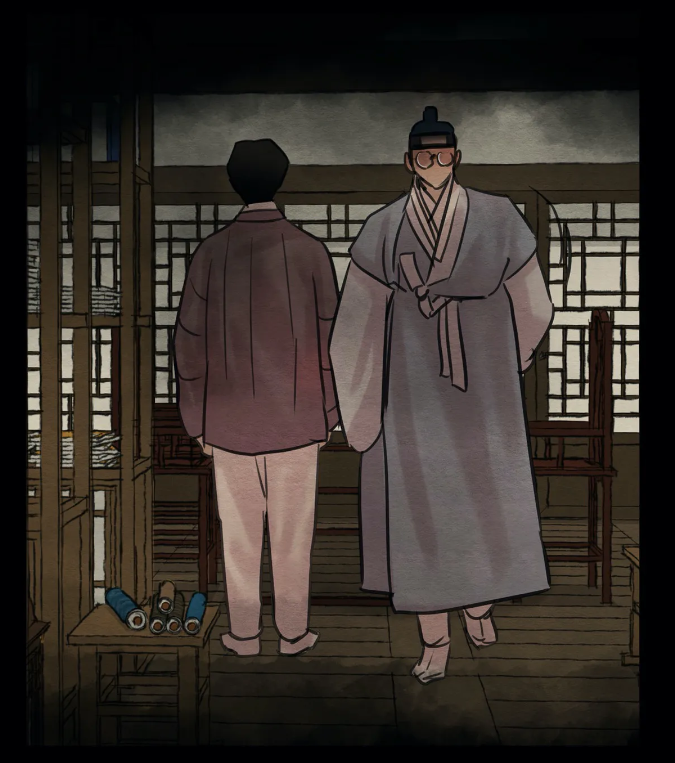 (chapter 40) In this picture, the scholar leaves the painter behind, a metaphor for his abandonment. He even repeats this action, when he leaves for the capital. In chapter 62-63, Yoon Seungho sees in the commoner’s escape a rejection and betrayal.
  (chapter 62) This panel illustrates the thoughts of the protagonist: the commoner has turned his back on him.
 - The recurrence of the question: “why”
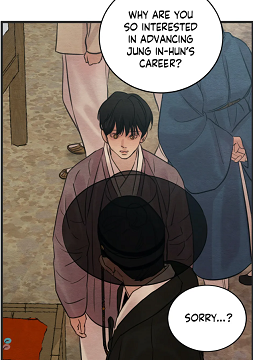 (chapter 40)
 (chapter 40)
  (chapter 62)
  (chapter 63) In both cases, the aristocrats questions the commoner’s motivations for his actions. While Jung In-Hun’s interrogation serves him as an occasion to break his promise by putting the blame on Baek Na-Kyum, the other character is more curious to know about the reasons for his desertion. From my point of view, this shows the noble’s desire to comprehend the painter better. And this illustrates that his obsession with the “why” is well meant. Why is he pushing him away? If he knows the cause, he could find a solution in order to bring the painter to his side.
 - The importance of the commoner’s smile:
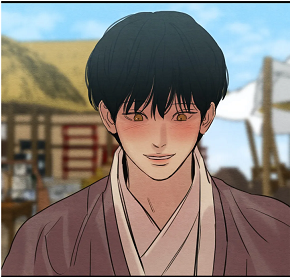
 (chapter 40) The painter became happy, when he heard that the civil service examination would take place soon. He immediately thought of his learned sir and envisioned that this would please his former teacher. Jung In-Hun’s excitement became the painter’s joy, this is how the painter was thinking in that scene. (chapter 62) (chapter 63) In the scene in the barn, there are two smiles, the first one is a cynical one. However, if the manhwalovers pay attention to Baek Na-Kyum’s smile, his gaze is missing. The absence of his eyes indicates that this picture represents the lord’s mind. Hence the smile full of “schadenfreude” and sarcasm mirrors the noble’s smile, the one he uses in front of people. We had an example in chapter 6, when he made fun of Jung In-Hun, because the latter fell so easily into his trap. However, in the second panel, the master reveals his biggest wish: he would like to smile genuinely too. If he sees a gentle and honest smile in the painter’s face, he will also return the smile. This shows the lord’s humbleness and desire to become honest and genuine to someone. He would like to make such a facial expression, something he has long forgotten. In the end, I believe with these words, the aristocrat would like to drop his mask of deception.
 - The hope of both protagonists:
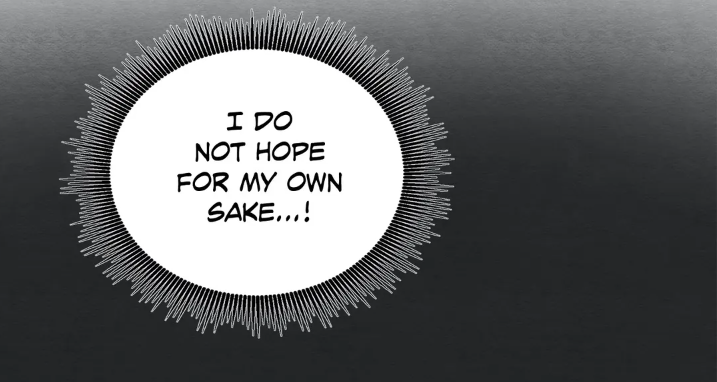 (chapter 40)
 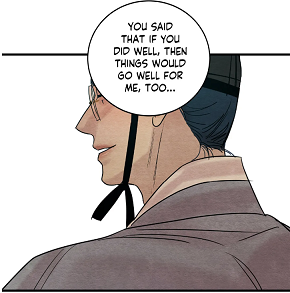 (chapter 29) By contrasting both panels from chapter 40, the readers can detect the painter’s lie. He expects something from the low noble. He is indeed hoping that Jung In-Hun will keep his promise and he will take his responsibility for him, since the painter supported him. In chapter 63, the noble confesses that the words said by the painter (going home together) gave him hope that he had achieved his goal, that the painter would smile for him one day.
 - The painter’s fate: In chapter 40, Jung In-Hun declares that despite his efforts, Baek Na-Kyum has been destined to remain a prostitute. (chapter 40) Now, it looks like the lord is determined to keep him by his side, his fate has been also defined by another noble. The painter seems to have no saying in the end. Yet, there is a slight difference. Here, the main lead doesn’t consider Baek Na-Kyum as a prostitute, but as his sexual partner and lover. Yet, in both cases, he is treated like an object, a possession. This explains why the artist has no right to make a decision. So his “fate” has barely improved. Yet, there is definitely a huge difference between the two nobles. Whereas the scholar wanted to use him for his own benefits, while the other’s dream was not to get any concrete advantage: the commoner’s happiness will make the lord happy. And because of this divergence, the lord will realize that his order (chapter 63) stands in opposition to his wish. If his true goal is to make the painter happy, then he needs to let him go so that the artist can make his own decision.
- The jealousy is also present in both chapter. The lord witnesses the commoner’s smile in chapter 40 and gets so jealous, which the master is referring to in chapter 63. He wished to have been the cause of the artist’s smile. And Jung In-Hun is definitely jealous of the low-born due to Yoon Seungho’s care for him. He had to witness how a commoner was treated so well, unlike him, who is a noble.
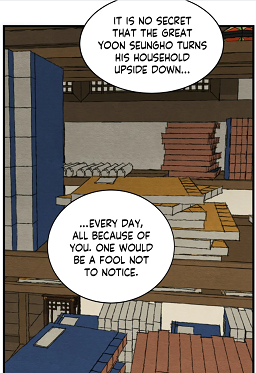 (chapter 40) The former had Yoon Seungho’s attention all the time, and we all know that Jung In-Hun’s desire is to get attention and admiration. Striking is that the comparison enlightens the materialistic and narcissistic side of Jung In-Hun, while Yoon Seungho appears purer. He is just content with a smile. Besides, he would like to be the source and recipient of Baek Na-Kyum’s smile, whereas the other wishes to get favors (clothes, a room closer to the lord’s chamber, the favor to spend the evening in the bedchamber etc). That’s why by contrasting both chapters, the protagonist’s purity and simplicity become even more palpable, which is hidden due to the violence employed during that confrontation.
 - The role played by the hug: In chapter 40, Yoon Seungho hugs the painter in order to protect him.
 Furthermore, if we take the chapter 41 into consideration, since we have a flashback of the incident at the library,
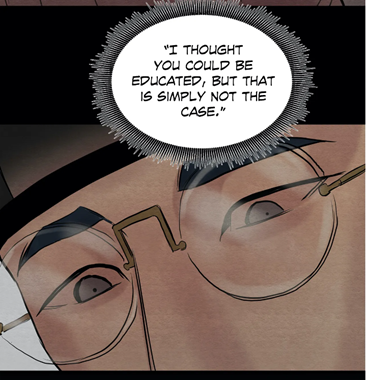 then the readers can recall that in this episode, Baek Na-Kyum was so heartbroken that he asked from Yoon Seungho to be embraced. He needed a shoulder as solace and comfort. The low-born literally begged him, while crying to be hold in his arms, but the noble didn’t know how to respond to this request.
 (chapter 41) He only knew sex. In chapter 62, the lord hold the artist in his arms, only to betray him afterwards. The warmth is faked.
  (chapter 62) Yet, if you pay attention, you’ll observe a second hug in the barn:
 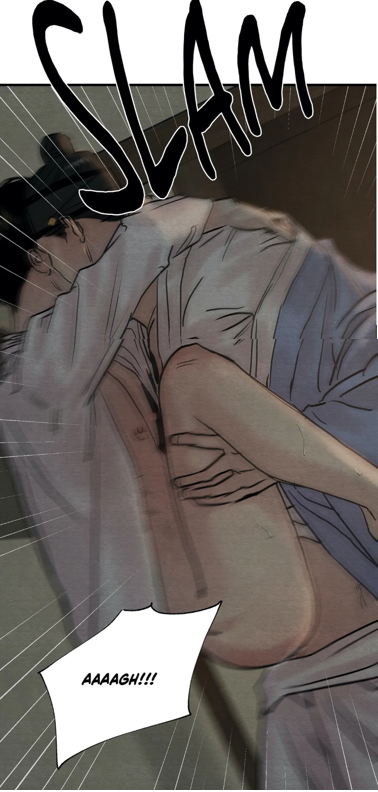 (chapter 63) The painter is forced to cling onto the master. This position reflects the lord’s intention. He desires the painter to depend on him. Hence the hug is no longer a fake one, but the expression of longing. As a conclusion, the embrace mirrors Yoon Seungho’s need and is indeed connected to warmth, despite the rather cold expression.
 - In both scenes, an important character reveals his true personality in front of the painter. This signifies that this figure shows his true thoughts and emotions. In chapter 40, Jung In-Hun unveils, how he judges the commoner,
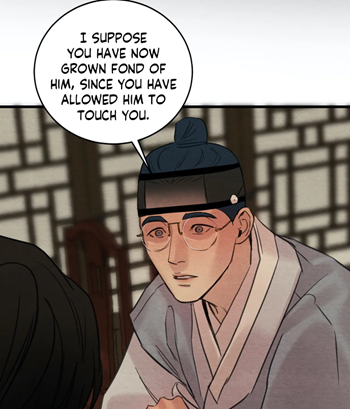
 (chapter 40) while in chapter 63, it is the turn of our seme to reveal his expectations and desires. (chapter 63) Yet, unlike the low noble, the master keeps describing himself in such a negative way (f. ex. he is pathetic, a fool)
 ,(chapter 62) while the scholar calls the artist a fool (chapter 40) and a liar. Sure, when Yoon Seungho says “pathetic”, it could be perceived, as if he was insulting the low-born. Yet, like I had mentioned it before, since he is talking about himself right after, his description (pathetic) is in fact more addressed to him. He is still masking his true thoughts a little. (chapter 63) And here, we see his cynical smile accompanied with a gaze expressing agony. This stands in opposition to Jung In-Hun’s coldness and disdain, who shows neither pain nor compassion.
  . (chapter 41) He is just jealous, furious and repulsed. Yoon Seungho is seeking closeness and uses sex in order achieve his goal, therefore he is is refusing to stop. He is so desperate to remain intimate with the painter, while the other noble has only one thought: keeping his distance from the low-born.
 - The importance of the gaze: The learned sir’s gaze was almost deadly for the painter. And this is accompanied with an indifferent facial expression and cruel words, hence the artist’s heart could only get wounded by such an assault. They were almost fatal for the painter. (Chapter 41) In the scene at the storage room, the painter’s face
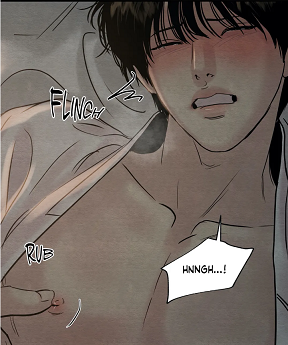 (chapter 63) and words
 (chapter 63) have a huge effect on the upset protagonist. They trigger the noble to open up and reveal himself. That’s why the chapter ends with a face to face: the aristocrat is not decided to look at the painter’s eyes directly.
 - Then we have reproaches addressed to the commoner: Not only he is a liar, but also he is a scheming traitor.
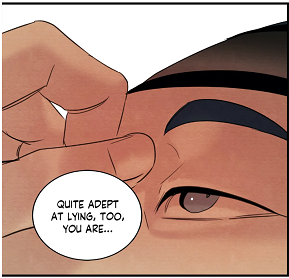
 (chapter 40)
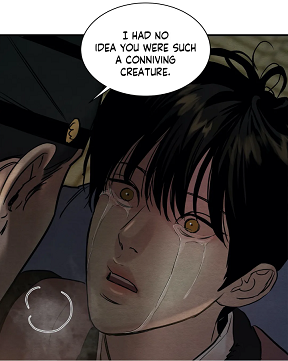 (chapter 62) (chapter 63) The irony is that in chapter 40, the scholar is correct. The artist did lie to him, while it is the opposite in chapter 62-63, hence the Yoon Seungho’s reproaches are not valid. Baek Na-Kyum just didn’t tell him the truth, the existence of the kidnapping. Yet, despite the correct observation of the artist’s lie, the low noble’s words are full of falseness. They reveal his true thoughts and emotions. He is quite manipulative, by blaming the artist. With the lie, he can justify his criticisms. He resents the painter for his origins and his so-called immoral behavior. However, let’s not forget that the scholar actually asked the innocent man to sleep with Yoon Seungho in order to obtain information, but because he revealed nothing, he has become a whore according to the teacher. Here, the latter’s hypocrisy reached his climax, exposing that all his reprimands are unfounded in reality. Jung In-Hun is just jealous and infuriated, because he perceives the painter’s lie as a disobedience. And defiance means punishment, that’s the reason why he wounds the commoner with his words. What caught my attention is that despite all the reproaches expressed by Yoon Seungho towards the artist, the master is not willing to cut ties with Baek Na-Kyum. In fact, despite his wounds and the imaginary betrayal, he is willing to overlook all this, because his need and dependency are greater than the injuries the painter afflicted on him. In other words, he is accepting the painter with all his misdeeds and indirectly his flaws. What a statement! And now, the manhwaphiles can better grasp the true meaning of the lord’s confession. His words mirrors his true thoughts and feelings: his roughness, his despair, his possessiveness, but also his willingness to accept Baek Na-Kyum as a whole. He doesn’t care for his social background nor for his desertion. As long as he remains by his side, this is enough for him. Sure, with this kind of statement, he doesn’t promise him to give any special treatment. Since he utilizes his status as lord, this means that he can treat him however he likes, just like during the night. Nevertheless, the manhwaphiles shouldn’t forget that right before, the lord let the painter see his expectations. He will be satisfied, if he is granted to perceive a genuine smile on the painter’s face. In other words, he gave him the solution for the future.
 - The location: the library versus the barn. Both rooms are closed and without any window. Yet, I detect two huge differences between them: the presence of light and warmth. While the library oozes a certain clarity (chapter 40), the grange exudes darkness. One might argue that this is related to the time. Baek Na-Kyum visited the teacher during the day, whereas the protagonist arrives during the night. Yet, I see another signification in the contrast. The purity of the white in the library illustrates the clarity of the teacher’s mind. He might be jealous, yet he is in possession of all his skills. He knows how to direct the conversation, how to embarrass and hurt the artist. Notice that during their conversation, there’s no real exchange, the teacher is leading the discussion. Baek Na-Kyum is barely able to finish his sentences
 (chapter 40), while the scholar held a speech about the low-born’s flaws and his terrible social background. Imagine that the teacher doesn’t allow the artist to finish his confession nor to reply to his origins. He leaves the library, before the artist has the opportunity to say something, so that his words are final and represent the truth. (chapter 40) As a conclusion, there’s no real exchange of opinions, and the teacher used his status as noble and teacher to shut the painter’s mouth. The latter is neither allowed to speak nor to make any claim. During this discussion, the room with its light reflects the true personality of Jung In-Hun: manipulative, cold, heartless but most importantly cruel and ruthless. (chapter 40) He uses his power over words to wound his rival, the one who is receiving the lord’s attention. The teacher didn’t employ physical violence to injury the low-born, but this doesn’t mean that there’s no violence. Byeonduck is actually here referring to the saying: words can kill. The scholar used his words to destroy the artist’s personality. And now, you comprehend the symbols behind the color and clarity. The library reflects the coldness of Jung In-hun and his mental abilities. And pay attention that there is neither candle nor fire at the library, a metaphor for Jung In-Hun’s heartlessness and coldness. With this new approach, the scene in the barn appears in a different light. The darkness of the room symbolizes the lord’s darkness in his heart and mind. He is not truly himself. He also wounds the painter with his words, (chapter 62) yet it is not entirely deliberated, he is another person. That’s why the moment he regains some of his senses, his face seems brighter, just like the room. The change is visible, if you contrast the two following pictures
  (chapter 62) (chapter 63) That’s why I believe that we should perceive beyond the harshness and sexual force employed by the lord. He is totally different from the scholar. And more importantly, his position in the room reflects his mental and emotional disposition. Yoon Seungho is turning his back to the light and as such to the truth, (chapter 63), yet he still manages to let transpire a certain warmth, which explains why the painter never expresses a reproach towards his lover or pushes him away. He just asks him to stop, because he is exhausted. He has a similar behavior during the next night. He keeps the lord at a certain distance, as he fears his own emotions
  (chapter 71) and Yoon Seungho’s outburst
 (chapter 70). Furthermore, when the painter is able to calm down the main lead by calling his name “Lord Seungho” and showing a blushed face, the aristocrat initiates a real conversation and lets the painter the opportunity to reply. There’s a real conversation, although it is interrupted the moment the artist desires to confess. (chapter 63) The lord can’t face the truth, he is in denial. But at the end, despite his relapse, he is finally able to voice his deepest desires: He wished the painter to show him a smile. And unlike the scholar, he doesn’t feel dirty or disgusted to touch a commoner. There’s no gap between them, unlike at the library, where the painter attempts to approach the low noble, only to be pushed away and left behind. And remember that at the end, they are both facing each other: (chapter 63)
The beholder can observe a switch of the positions. Notice that the lord is no longer standing above the painter, like in chapter 62 or during the chapter 63:  (chapter 62) (chapter 63) Now, the painter stands at the same eye level with the master reflecting that the gap between them has diminished. Like I pointed out above, Yoon Seungho is forcing the artist to hold him, implying that he desires the low-born to rely on him. Hence the words gives us now another perspective. The first interpretation was to say that he is ordering, as a lord, the servant to remain by his side, in reality he is revealing his dependency and his need. That’s the reason why his last words should be judged in a more positive light. He is insinuating that the painter has much more power than it seems like.
As a conclusion, by contrasting the behavior of the two nobles in both scenes, the brutality in chapter 63 is diminished and lets transpire that the powerful protagonist is less vicious and hurtful than the teacher, although Yoon Seungho is revealing his dark side. The painter is able to perceive the agony and the despair in his lover. At the same time, the main lead shows to the painter that his person affects the noble in a positive way. That’s why you can now comprehend that I am less perceiving this chapter in a negative light. And this comparison was definitely correct, because it explains why the painter was reminded of the learned sir the next night and felt no longer a heartache. 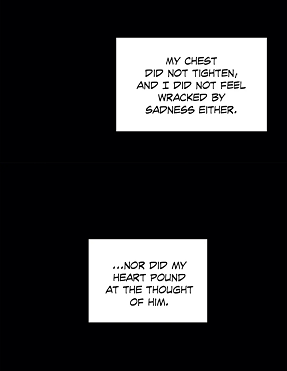 (chapter 71) There was a “love confession” in the barn, but the lord didn’t use the typical expression for that: and . (chapter 63) Baek Na-Kyum could no longer be in denial that the noble was in love with him.
After this analysis, I recognize that Byeonduck is a master of deception. She is asking from her readers to question appearances and behavior. People should detect disguised cruelty and brutality, words and manipulations can be as mortal as physical violence. I am not saying that Yoon Seungho did nothing wrong, it is just that he is not entirely responsible for this situation: the coercive persuasion, his disorders, his huge insecurities and his self-hatred are the causes for his brutality. He stands in opposition to Jung In-Hun, whose words and moves were all calculated to destroy the painter. Yet, the artist was able to distinguish between the seem and real. This explicates why he is able to move on and to rely more on Yoon Seungho.  (chapter 76). The only problem is that Baek Na-Kyum is still fearing his own emotions for the infamous noble. Therefore he has not confessed yet, which will be the reason why both main leads will suffer again. The painter has just opened up and is not trusting Yoon Seungho entirely.
Feel free to comment. If you have any suggestion for topics or manhwas, feel free to ask. If you enjoyed reading it, retweet it or push the button like. My reddit-Instagram-tumblr-twitter account is: @bebebisous33. Thanks for reading and the support.

 (chapter 1) However, the moment Baek Na-Kyum stopped publishing, the addicted noble realized his terrible situation. He needed to have the creator by his side, since he couldn’t give up on his “addiction”. The paintings had become his drug and the moment the author stopped publishing, it made the lord recognize, that he needed to become the supplier. He couldn’t remain a buyer, since he was put in a vulnerable and insecure position. Therefore we could say as well, it all started with the painter’s vow.
  (chapter 1) in case his wish didn’t get fulfilled, and why he became so “bloodthirsty” after the rejection. Just like a drug addict who becomes violent, if he is unable to get his drug, he felt the urge to release his anger.
  (chapter 1) It was, as if he was in withdrawal and couldn’t bear the thought, he hadn’t obtained what he desired. So when I compare the painter and his work to a drug, it puts the low-born in a bad light. Nonetheless this is not my intention at all. For me, the painter represents his cure in reality. Let’s not forget that the powerful aristocrat’s heart has been poisoned, corrupted by his father, therefore in order to get cured, he needs to find another “poison”, it’s like fighting a poison with another poison.
  (chapter 3) We see here the lord intoxicated by the new drug. It did release him from his prison, his self-hatred. Moreover, it helped him to see more clearly for the first time. His eye in his mind was now free from any corruption. Nonetheless the next day, he is faced with a different image. More precisely, his ears have to hear a terrible truth. Now, he is a man consumed by sex, which causes him to become pensive and depressed. He is no longer feeling the urge to have sex with Jihwa.
 And now, the manhwaphiles comprehend the true nature of the new drug: the painter’s gaze is liberating the lord’s senses, very similar to Jihwa. This is not surprising that the first two paintings
 (chapter 2)
  (chapter 10) he makes show our lord looking at the painter. Imagine, in the second image, he even has two sex partners by his side, yet his attention is directed at the creator and not his partners. This painting exposes their locked gaze and their growing intimacy. Baek Na-Kyum’s gaze has become the lord’s obsession, his new drug. The paintings Baek Na-Kyum creates exude warmth, beauty and naturality which stands in opposition to the world, where the lord is living: fakeness, superficiality, distance and coldness. But the lord’s attraction towards the painter increases so much that he would like to taste the artist. In other words, if he devours Baek Na-Kyum, he might get high again because the pictures are no longer enough to satiate his urges. Now, you can understand what this means. Having sex with the low-born signifies, he is “increasing” the dose. Note that this coincides with the third painting, where he is looking at Jihwa and not at the painter.
 During that night, he asked the commoner to join them. He was clearly expressing his interest in the artist. The locked gaze was no longer satisfying. This is also not surprising that the next day, he has no problem to cut ties with his long-time lover Jihwa. The artist has slowly replaced the sex partners. Without realizing it, the lord is becoming monogamous. Observe that from chapter 16, he has no nightly activity at all, contrary to the past. He makes a relapse in chapter 33, due to his guilty conscience. However, the moment he realizes that some nobles, especially Min, are looking at his “drug”, he recognizes what it really means, if he came to lose his new “drug”. His life and situation would be worse than before. Baek Na-Kyum’s gaze only belongs to him, hence he is willing to face a negative reflection.
  (chapter 19) Notice that the moment the painter confesses to Seungho, he puts his hands on his shoulder and then he kisses him. But this doesn’t end here, later he puts his hands around his shoulders.
  (chapter 20) For the first time, the noble is embraced. And now, if you look at all the sex sessions he had with Jihwa or the others, the main lead was never truly hugged.
 (chapter 8)
  (chapter 9)
  (chapter 15) [I am not quoting the paintings again which could be added to this list] One might argue that in the first panel, the sex partner is hugging the main lead from behind.
  (chapter 20) Yet, the more time passes on, the more the low-born holds the noble more tightly.
 (chapter 21) The painter voices the wish to be embraced. That’s why the former puts him on his lap.
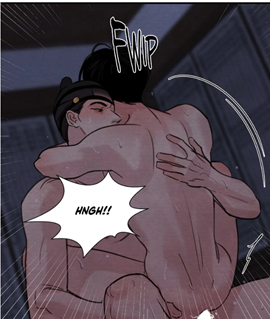 (chapter 21) You can sense that Yoon Seungho is willing to fill the gap and feel as close as possible to Baek Na-Kyum. He hugged him on his own first, yet the artist was the one embracing him fully at the end.
  (chapter 21) That’s why we could say that it all started with an embrace, the real cure. The painter’s gaze accompanied with the hands on Seungho’s shoulder created a new euphoria. This explicates why he was so obsessed with that night, why he attempted to renew this wonderful experience. In chapter 25, he tried to hug the painter from behind but failed terribly.
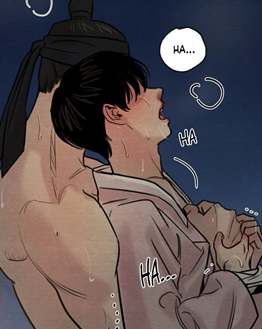 (chapter 26) This was a gesture of defeat and submission and never an embrace full of love. One might argue that the noble had already hugged the painter before,
 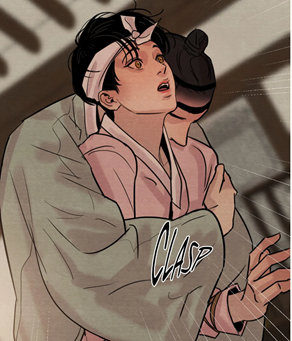 (chapter 16) hence the artist’s hug during their Wedding night can’t mark the start. Yet, if the manhwaworms look at the way the master held the commoner in chapter 16, they’ll notice that the lord is hugging Baek Na-Kyum from behind. He was definitely restraining him from leaving his bedchamber, like a predator catching his prey. Sure, there’s no doubt that there exist emotions behind his gesture. Nonetheless, the hug was more under the influence of the unconscious. Consequently it is different from the night in chapter 19. Here, the lord was more looking for sex, whereas in chapters 20 and 21, it was a mixture of sex and love. However, at the end love became triumphant and the lord was no longer interested in sex.
 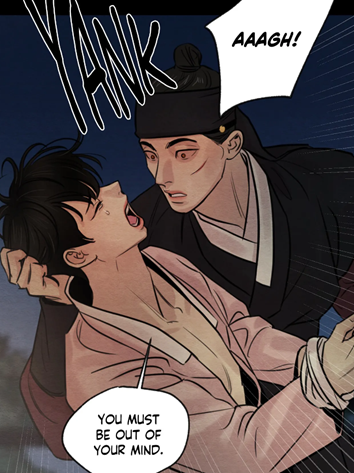 Once he became sober, he realized his mistake. His mind had become clearer again. In my perspective, the “cure” helped him to release his emotions, which he had been repressing for so long. This explicates why he was reminded of his tragic past and relived his traumatic experience. He had decided to become numb in order not to feel any pain. The problem is that the moment he discovered love, he was not recognizing that he was allowing his heart to feel pain as well. Love and pain can’t be separated.
 (chapter 59) He became addicted to the hug. The problem was that the painter seemed to have forgotten their lovemaking. On the other hand, the lord couldn’t forget the painter’s arms therefore he often grabbed the artist’s arm
  (chapter 22)
  (chapter 30), as if they were a treasure to him. The roughness vanishes gradually, for the lord changes for the better as well. But more importantly, in the following gestures, the readers can sense his desire to hug the artist. And as time passes on, the gesture becomes more obvious and pronounced. It started with an arm,
 (chapter 22) then it was the chest
 (chapter 42) until it became a real hug.
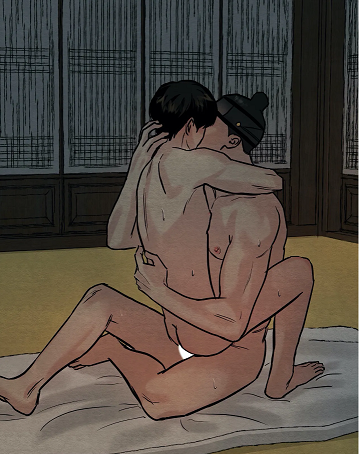 (chapter 49) However, the real climax is reached in chapter 58. This time, the aristocrat in love is holding him so tightly with his both arms.
 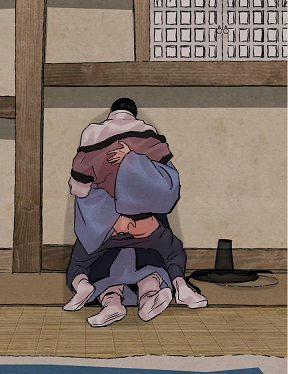 (chapter 58) There is no gap between them, the artist is no longer putting some distance with his head, unlike in chapter 49 (third panel above) or the lord is grabbing the neck to make sure that the artist keeps kissing him (second panel above). Yet, while they make love
 (chapter 58) , the lord is no longer holding him and gazing at him, he is just grabbing his hand and whispering his love confession. This signifies that the lord has truly given up on his dream and has accepted reality. The painter’s gaze and hug were just an addiction and he is admitting that he will never be loved. He will see this night as a wonderful illusion but he won’t feel any anger, despair and pain after that night. We could say that the lord has finally defeated his inner demons and addiction. He is free from his past and can now use his mind clearly.
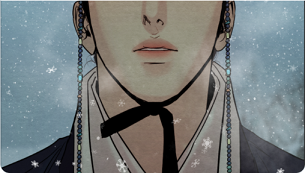 (chapter 61) Baek Na-Kyum purified the lord so that the latter has truly become selflessness and no longer needs sex. He won’t organize any sex session or any party with wine and opium. In my opinion, the last debauchery symbolized his final relapse. Observe that during that week, he had no sex and wasn’t even aroused, when a noble gave him a blowjob
 . Sex has become irrelevant thereby we can conclude that his transformation is complete. He has become a truly reformed man.
  Imagine his emotions, when the low-born did this. In that scene, the master was acting like a monster, nevertheless it didn’t stop the artist to embrace him despite the slap and his ugly behavior. But for Baek Na-Kyum, it was the same as well. He also longed to be embraced hence for him, their Wedding night represented a dream, where he could express his desire and experience what he wanted to have. He wanted to express his love, shower his learned sir with his affection. Strangely, it started with a hand
 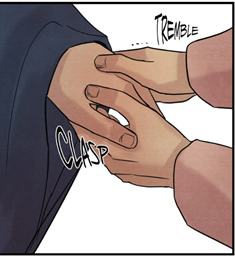 (chapter 30) forcing the low-born to accept him as his new master. However, notice that the painter’s hands become more decisive and grab more firmly Yoon Seungho’s wrist in chapter 42.
  (chapter 42) This reflects the evolution of their relationship. The painter is here accepting the aristocrat as lover. Simultaneously, he is touching the place where the lord’s unconscious is voicing his desires. And this gesture triggers the lord later to put him on his lap, attempting to embrace him. And the more the lord hugs the painter, the more the latter is affected by it. The reason is simple. Just like the main lead, the commoner was deprived from warmth and love for so long and receiving it for the first time, this could only move the main lead. The manhwaphiles should remember that the artist asked the master to hold him in chapter 41
 (chapter 41), exposing his need for comfort and embrace. Yet back then, the lord was confusing love with sex hence he couldn’t give correctly what the painter desired. He was not able to distinguish the difference. In truth, both were lost persons mixing up sex with love due to their terrible fathers.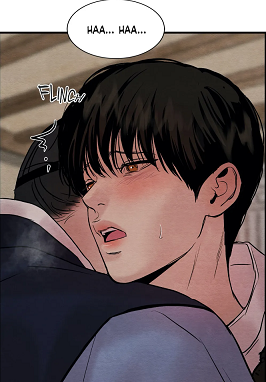
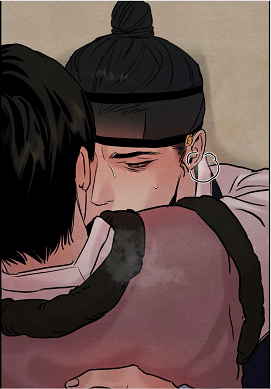 He keeps blushing displaying his emotions. He is really loved, displayed by the lord’s words and gestures. That’s why the hug is reciprocated but it is too beautiful to be true. Consequently the noble doubts its existence.

 (chapter 19) in episode 19/20 and the second in chapter 49. .
 (chapter 48) Then I had started contrasting both scenes, nonetheless I was not able to examine all points. That’s what I wanted to do in the 4th part. However, at some point, I had a revelation. The confession in chapter 49 represents the painter’s evolution, and it could also be compared to the confession in chapters 41/42. Because there was a confession back then as well. Yet, in that scene the painter could barely speak, he could only admit this:
  (chapter 48) All this led me to the following observation. We had the artist’s many confessions. Hence I am listing the common denominators that are always present during the three different scenes.
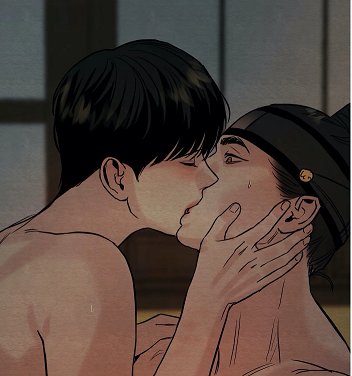 The opposition of the two gestures illustrates the diminution of the social and emotional gap between the two main characters. Note that despite standing on tiptoe, the artist’s head was still below the aristocrat’s head.
 (chapter 49) the painter. The former is literally admiring his lover, pining on him but he doesn’t express it.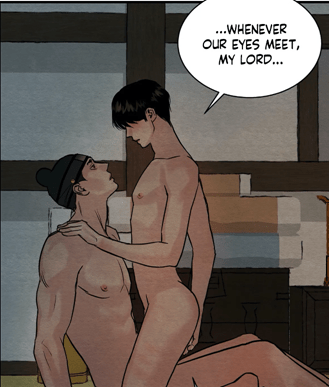
 (chapter 49) he is apologizing to the artist. He might not use the word “apology”, unlike in the chapter 20, nonetheless his wording unveils regret and heartache. During their wedding night, the aristocrat did apologize for taking the painter’s virginity, nevertheless his excuse didn’t sound genuine.
  In the chapter 49, Seungho acts the opposite. He doesn’t mention the word “apology”, yet he feels regret. He is sorry for making his lover cry. He admits that he is responsible for this, as each time they had such an encounter, he cried.
  (chapter 25) The painter admitted for the first time that he loved a man and his confession was addressed to the teacher, his “learned sir”. We have a long kiss
 (chapter 25), the attempt of a hug
 (chapter 25), the lord’s comments
 (chapter 25) and the commoner’s agony either. And this confirms that the lord did attempt to recreate the wonderful night he had with him, but could only fail, because the painter couldn’t recognize him as his partner. His “love” was for someone else. Therefore, I stipulate that this manhwa contains not just three but actually four confessions of the painter. In other words, my title “Baek Na-Kyum’s confessions” was indeed so point on. Yet, each confession diverges from the others, as the artist’s emotional state differs each time. However, all of them mirror the painter’s heartache. No wonder, if the lord blamed himself for the low-born’s tears. Indirectly, he was apologizing to him, as he recognized that he was wounding him. He was the reason why the artist would cry.
 (chapter 49) The man had just humbled himself, yet this was totally ignored. I would even add that the artist’s words even devalued the noble’s words and actions even more. Like I mentioned it before, the low-born somehow treats the aristocrat as a tool for his own pleasure. We have an indirect rejection as the artist refuses to give him his heart.
  (chapter 20) The low-born’s head is much lower, and there is a certain distance between both bodies due to the way the low-born’s hands and head are placed. Here, the lord is even complaining about the painter’s lack of experience and reaction. Now, if you look at the hug in chapter 42
 , you’ll note here that the low-born’s head is higher and they are physically much closer but there still exists some distance. Even the lord’s behavior is different. His gestures oozes warmth, love and despair. His affection has truly gone deeper and with this huge hug, the manhwalovers can detect that the painter is indeed his first priority, while it was not the case before. His own selfish desires mattered more (20-21/25) back then. And now, we should look at the hug in the chapter 49.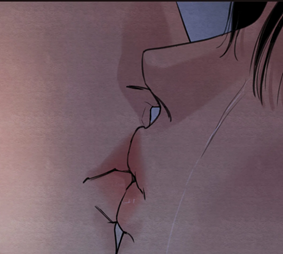
 The first one was full of innocence and inexperience. Yet, there was warmth and affection. The lord responded to it with passion and lust. Then during the scene in chapter 41, Baek Na-Kyum initiates the kiss again. Here, the kiss is lacking of emotions.
  (chapter 41)
 (chapter 49) There is lust and love mixed together. Therefore the lord can’t restrain himself from accepting the kisses. This is exactly what he was longing for. So Yoon Seungho made a huge progress, little by little he was getting closer to his goal. The painter was slowly opening his heart to the rich noble.
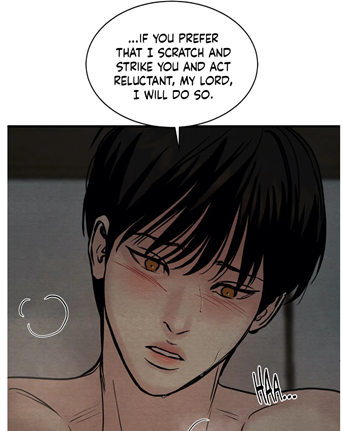 (chapter 48) The noble had noticed that the artist was blind and deaf hence he needed to use the low-born’s body to awake his senses and arouse the painter’s instincts. That’s why he licked the painter’s ears while whispering,
 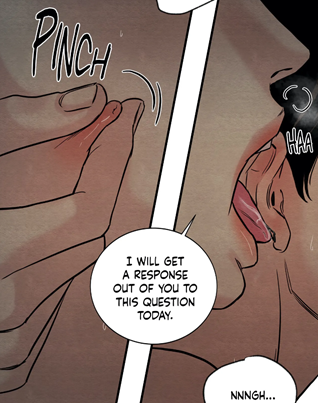 (chapter 49) or pinched his nipples. At no moment, the protagonist let his emotions (anger, frustration) take control over the situation. That’s why we definitely can’t say that we have another rape in the chamber. First, since “Baek Na-Kyum is a whore” (in the painter’s mind), then the lord can do anything he wants. The noble’s reasoning is quite simple: “Because the commoner is acting, then I should act too”. Secondly, the noble is trying to discover the root of the problem
 (chapter 49), while at the pavilion, he thought that if he forced himself on the painter, he would achieve what he wanted: being recognized as the painter’s partner and husband. From my point of view, we can observe the master of deception in action in this scene. He is using his body as a tool, just like in the past, when he had a sex session with the nobles. However, his goal concerning Baek Na-Kyum is different. This is not to defeat his counterpart. Inflicting pain is just his way to get through the painter’s mind and body. In fact, his goal hasn’t changed at all since the chapter 23. He is still hoping to be loved by the painter but right now, his immediate purpose is to discover the truth. Pay attention to the seme’s face in the illustration above. He knows that he is inflicting pain on the painter hence he is hurt as well. The manhwalovers can perceive the noble’s true face. That’s why I called Seungho as the master of deception. In the image above, the artist can’t see the noble’s true emotions and personality. Our seme feels, he has no other option left as the painter is living like a robot, or better said, a robot prostitute. This contrasts so much to the scene at the pavilion where his selfish desires and negative emotions led him to wound the man. From my perspective, Yoon Seungho is actually selfless here, he is doing it for the artist’s sake. He prefers being hated than getting unnoticed or objectized as an image: Seungho is a man consumed by lust. As a conclusion, Seungho is taking the bull by the horns, willing to get hurt and even hated in the process. The painter needs to answer his question:
  (chapter 49) He triggers him with his comments and actions, yet he is determined to make sure that once the artist reaches the breaking point, he will stop. That’s why the noble doesn’t listen to the painter’s complaints
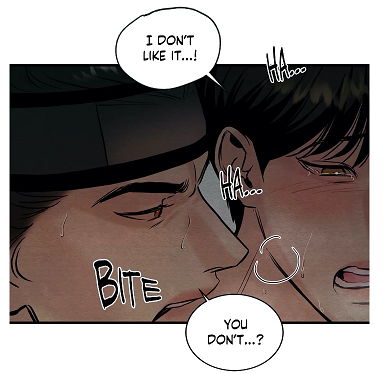 (chapter 49), until Baek Na-Kyum yells to his lover and starts crying for real. Notice that in the drawing above, the artist expresses his own thoughts and desires for the first time. What caught my attention is that in this drawing, Baek Na-Kyum is speaking without a pause, unlike in the past where he is not even using the pronoun “I” or “me”:
  (chapter 45). My interpretation is that in that situation, the painter was only perceiving himself as an object. Sure, right after he admitted that he was feeling something.
  (chapter 45) But the emotions were quite superficial, he had great difficulties to externalize these. While the pronoun “I” was only used for the first time for a short moment, there was still the presence of an object in his confession. In other words, he was still denying the existence of two naked bodies till the chapter 49. Either he was an object (“it feels nice”) or the lord was one (“I like it”). Hence the lord’s remark was so point on:
 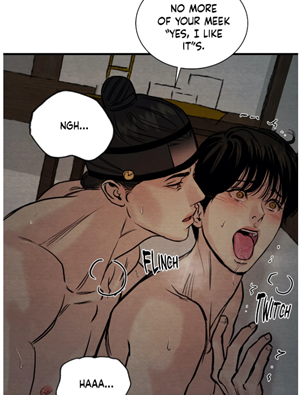 (chapter 48) First, he had misunderstood the confession, yet at some point he perceived his “confessions” for its real value: the presence of an object in his expressions.
  (chapter 49)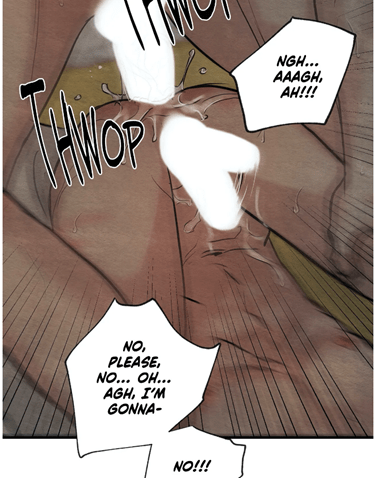
 (chapter 49)
 (chapter 49)
 (chapter 42)
 (chapter 42)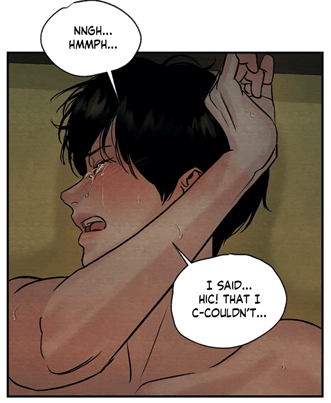
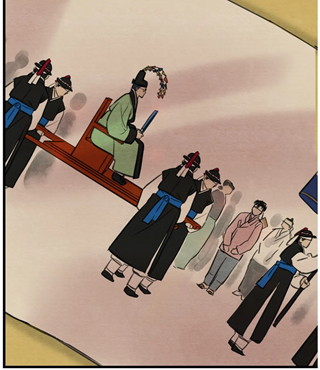 (chapter 41) In other words, I see a lot of common points between Jung In-Hun and modern dictators like Hitler, Stalin and Mussolini. We have the following common denominators:
 (chapter 29) While some people judged it as something negative, I viewed it in a positive way. First, this flashback shows that the painter is thinking on his own. Secondly, he gets aware that the teacher’s hug was fake. He realizes the contradiction between the hug and the words said in the chapter 40: “He was born to be a prostitute”. “If so, why did he hug me back then?” From that thought, Baek Na-Kyum comes to the right conclusion. Jung In-Hun was not sincere and he is finally able to perceive the true nature of his learned sir: a hypocrite, though he doesn’t voice it. This is definitely relevant, this illustrates that Baek Na-Kyum is abandoning the scholar’s doctrine for real. He questions the teacher’s power and control and criticizes him for his dishonesty and duplicity. Since I stated that the rule 6 was central, this means that all the rules become obsolete as well. Baek Na-Kyum decides to live like he wants. And unaware of this, the lord makes the same decision.
  (chapter 49)
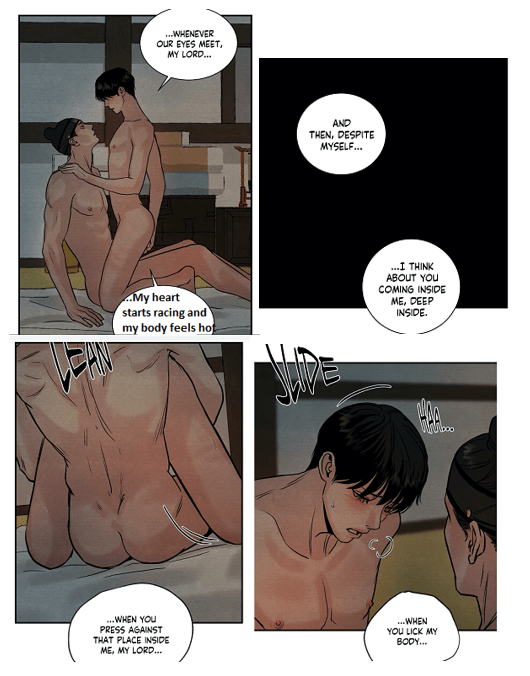

 (chapter 49) He has suffered a lot and he fears to mistake the warmth from the protagonist as something real, whereas it could be fake too. That’s why Yoon Seungho can’t be pleased with this confession. He has to hear that he won’t be loved, that their relationship is only physical, he can’t expect more. Therefore Seungho gets upset and is about to complain, when he hears “I feel good”. Remember that I had explained that their position had been switched from the chapter 36 on. The noble had lowered himself and become a servant in order to get accepted. Now, with this confession, the painter is accepting the noble as his servant and he will be the master. No wonder that the seme is bothered first because this was not his true goal in reality. But when the commoner kisses the lord, Yoon Seungho’s negative feelings disappear.
 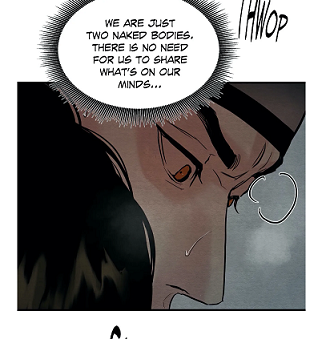 (chapter 49) which is strongly connected to Baek Na-Kyum’s confessions. Let me summarize all his confessions: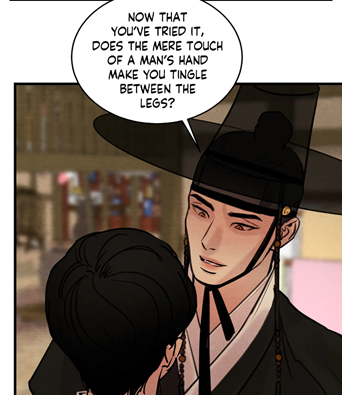
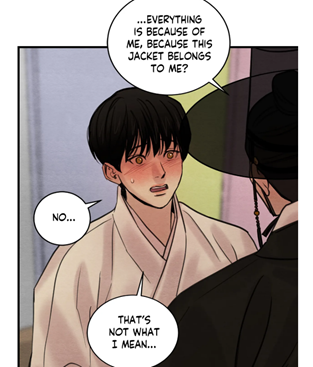 (chapter 39) So he won’t react like in the past, hide his special relationship with the lord. He won’t show any fear, when it comes to gossip or judgement from others. Why should he feel ashamed? This is something natural, which means that the next time Deok Jae calls him
  (chapter 47), he will be able to reply.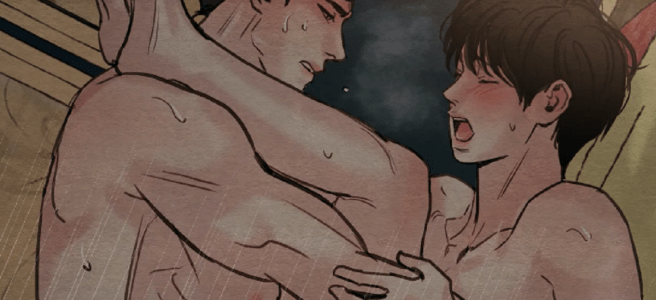

 chapter 19
 , Yoon visits the painter’s study because he heard from the servants that the painter wouldn’t leave his room and would keep painting without eating much. As you can see, the lord pays a lot of attention to the mental health of the painter. He knows from the way BNK is acting that something is wrong. The reason for BNK’s strange behavior is that BNK had just heard before from Jung In Hun that he was born to be a prostitute. His love for In Hun was so pure and for the teacher, BNK was just a prostitute.

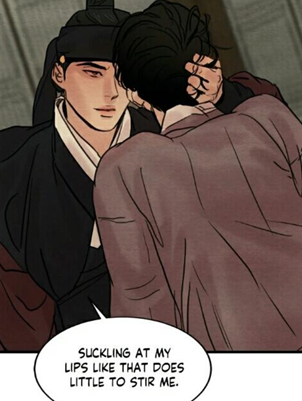 While he criticizes the painter’s kiss in the chapter 42, this would not arouse him, in the earlier chapter he made no complaint. He saw it as an opportunity to finally taste the painter. He was not annoyed by the lack of inexperience unlike in the chapter 41. However, both kisses have something in common. Both outline BNK’s innocence and purity. These kisses are not here to excite the partner but to express a deep and pure love (chapter 19) or to ask for warmth and comfort (chapter 41).
 (chapter 41), he would have sex with the seme without any preparation. The lord is actually surprised by BNK’s actions because this doesn’t resemble him at all. He acts as a prostitute that’s why Seungho asks if the teacher has talked the painter into it.
  (chapter 41) For him, paintings are treasures. This gesture reveals some changes in BNK. The painter is well aware that the teacher has abandoned him as the former doesn’t want to assume any responsibility. Therefore, his disrespect for the picture is a sign of disrespect for the teacher. Although he has internalized In Hun’s words and views, he is so affected that he no longer admires In Hun like before. In the chapter 42, he no longer calls Jung In Hun “learned sir” but “my teacher” which illustrates that BNK no longer views IH as a noble (“sir”) but as a simple teacher. He only sees Jung In Hun in his actual position and not as his social status. We all know that despite being a noble, JIH is not rich and influential. He belongs to the lower nobility. IH is no longer put on a pedestal. But BNK has still some respect for IH as he calls him “my teacher”. So there is still a string between the teacher and the painter but it is about to disappear.
 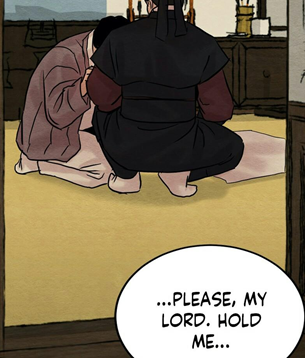 (chapter 41) Yet, this request only got fulfilled at the end of the love-sex session, the main lead put the painter on his lap while kissing him and even embraced him in an desperate attempt to console the artist. Simultaneously, this shows that Seungho is longing for warmth, love and tenderness. But despite this night, Seungho is well aware that Baek Na-Kyum is not loving him. He has sex with him because BNK has confessed before that he has never hated the things he did with Seungho which represents a huge step for the lord.
 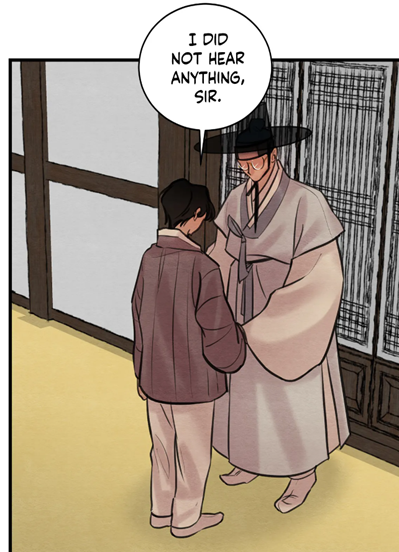 (chapter 38) Striking is that the painter blamed himself. From my point of view, the painter’s confession could only wound the noble’s heart.
 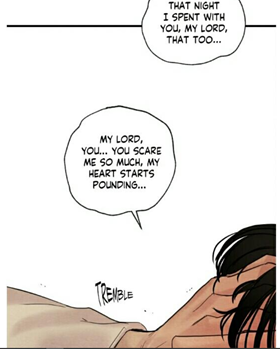 (chapter 41) He had the impression that he was somehow responsible for the artist’s tears. Yet after this night, Yoon Seungho had sensed that something had changed in their relationship, just like Baek Na-Kyum’s relationship with the teacher had changed. Notice that this room is connected to betrayal, love, sex and pain.
