Protected: Jinx: Color Clash🟢🟣🔴: Decoding MMA Posters 🧐 (second version)

Bebebisous33s' analyses in K-Dramaland and Manhwas
Analyses of K-dramas and Manhwas (for the most part Yaoi)

Please support the authors by reading the manhwas on the official websites. This is where you can read the manhwa: Jinx. But be aware that the Manhwa is a mature Yaoi, which means, it is about homosexuality with explicit scenes. Here is the link of the table of contents about Jinx. Here is the link where you can find the table of contents of analyzed manhwas. Here are the links, if you are interested in the first work from Mingwa, BJ Alex, and the previous essay about Jinx “Harmony’s Clash⚡: Prince S 👸 and Emperor 🤴- part 2”
It would be great if you could make some donations/sponsoring: Ko-fi.com/bebebisous33 That way, you can support me with “coffee” so that I have the energy to keep examining manhwas. Besides, I need to cover up the expenses for this blog.

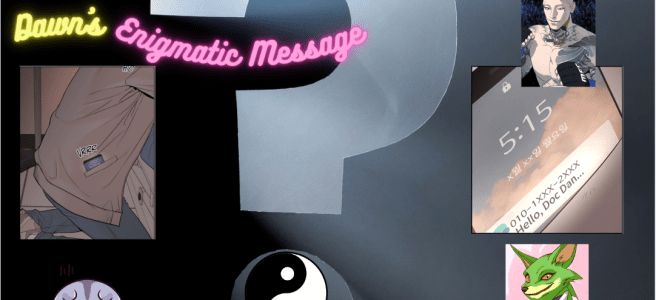
Like the illustration is displaying it, my main focus will be on the last part of chapter 47, the phone call and message from the “executive director” of King of MMA.  (chapter 47) Now, you are wondering why I decided to dedicate an essay about this scene. It is because the phone call and message raise a lot of questions. Why did the mysterious man call Kim Dan at such an early hour? Notice that it is in the morning, at 5. 15 am.
  (chapter 47)
How can I be so sure that it is in the morning, and not in the evening? Notice that in the Spanish version, the translator wrote “Buenas tardes” for hello giving the impression that it was in the afternoon. The person came to this conclusion because during the night before, Kim Dan looked at his cellphone. The doctor’s meeting with Kim Miseon was in the afternoon.  (chapter 47) The Spanish translator thought, the person calling Kim Dan was contacting him, after the doctor had met the oncologist. She imagined that not much time had passed. Yet, I believe, it is in the morning. First, it is important to place the day in the year. Since Joo Jaekyung’s birthday is on June 21st, and the next match is shortly after
 (chapter 47), I deduce that we are in July. However, the sunset in Seoul during that month is between 8:29 and 8:12 pm, whereas dawn in the same period and place is between 4:44 am and 5:07 am and sunrise between 5:15 and 5:36 am. Jinx-philes can now determine the time thanks to the position of the sun:
 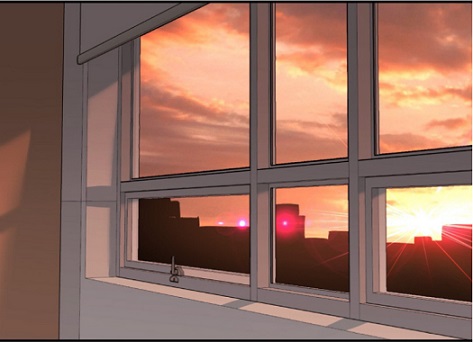 (chapter 47) It is in the morning. Moreover, the Webtoonist tipped off her avid readers with this panel:
  (chapter 47) In Korean, it is written MONDAY!! I had already detected a certain pattern. The protagonist would visit his grandmother on Sundays,
 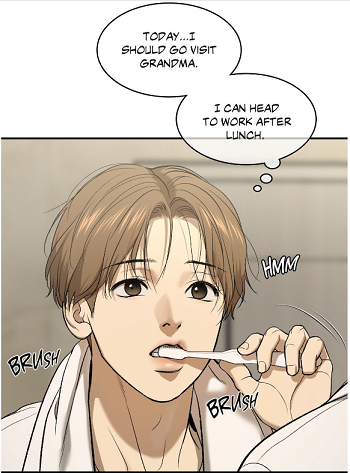 (chapter 30) as Saturdays are Kim Dan’s days. The morning in chapter 30 took place after the couple had spent their day-off together.
Thus I deduce that when the doctor returned home  (chapter 47), it was Saturday evening. Then the next day, he went to the hospital in order to get the results. After hearing the terrible news, he lost track of time. Hence he didn’t look at his cellphone contrary to episode 5.
 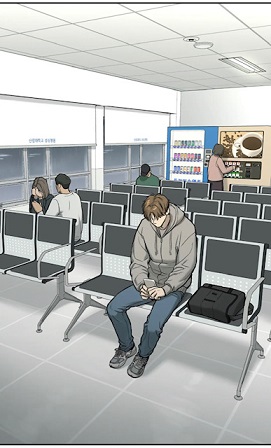 (chapter 5) On the other hand, I don’t think, he visited Shin Okja right after meeting Kim Miseon, for his grandma would have known that he had remained by her side the entire night. Nonetheless, her worries were about eating and not about lack of sleep.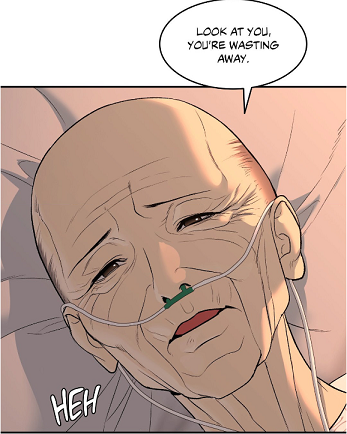
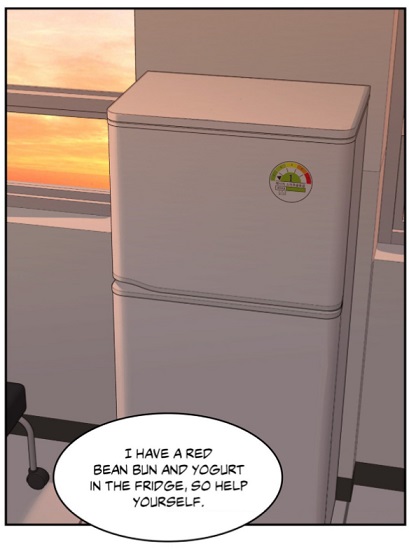 (chapter 47) Thus I come to the conclusion that he spent the whole night at the hospital like in episode 21:
 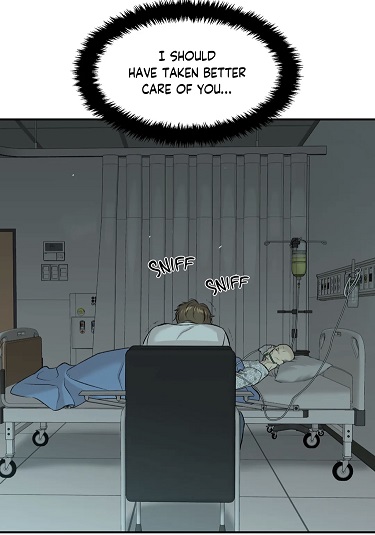 (chapter 21) This explains why the grandmother was not wearing her headgear. She was sleeping. But back then, Kim Dan returned to the penthouse at dawn.
 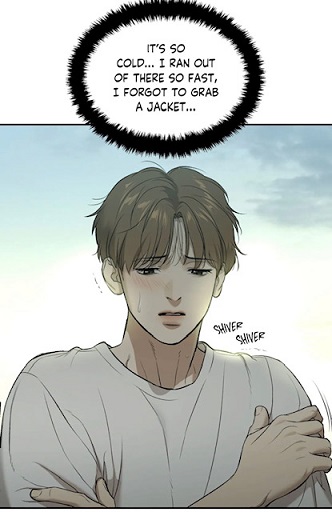 (chapter 21) Therefore the grandma didn’t notice that he had stayed by her side for quite some time, for she was asleep. Hence she requested his presence the next morning. Nonetheless, there exists another difference between chapter 47 and 21. In my eyes, Kim Dan entered her room during the night and spent some time in the bathroom.
  (chapter 47) He didn’t approach the bed the same way:
 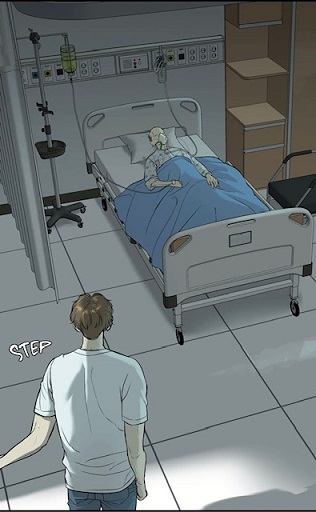 (chapter 21) However, I doubt that he spent just one hour in the restroom covering his tears by running the tap water.
 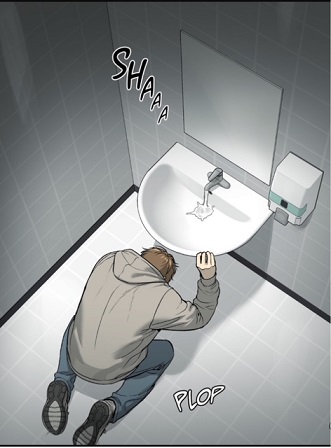 (chapter 47) I have the feeling that this scene is a reflection from their first night.
 (chapter 3) Here, he was also sitting on the floor pondering if he should still accept the deal. And what had happened back then? The protagonist was lost in the moment, he had no notion of time because of his fears and social norms. As a first conclusion, Kim Dan spent a lot of time in the bathroom reliving the moment when he was receiving the bad news. This interpretation displays how much his grandmother’s imminent death devastated him. He had spent the entire night crying:
  (chapter 47) Therefore he had red eyes. Furthermore, the halmoni’s name is Shin Okja, and Shin can signify “morning, dawn and daybreak”. For me, it is no coincidence. First, it was her moment to shine due to her compassion. (chapter 47). She symbolizes humanity in both senses of the word: empathy and humankind (mortality). Though she is weak physically, she is strong mentally. At the same time, Okja can only treasure this moment, for Kim Dan was by her side, when she woke up.
 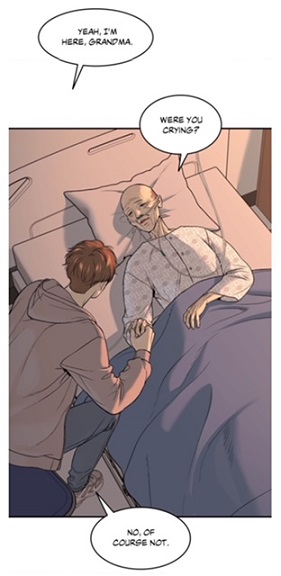 (chapter 47) In my eyes, this scene represents the positive reflection from that nightmare:
 (chapter 21) As a little boy, he had asked his grandmother to never leave his side, unaware that this meant that he should do the same. He should remain by her side too. Yet, he didn’t do it.
 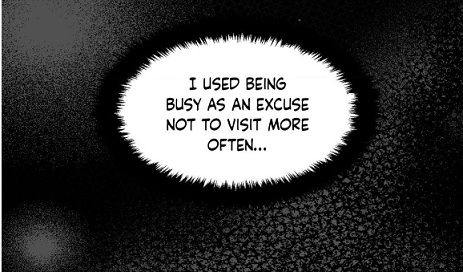 (chapter 47) This observation made me realize another aspect. When he heard the diagnosis from Kim Miseon for the first time, he admitted his powerlessness.
 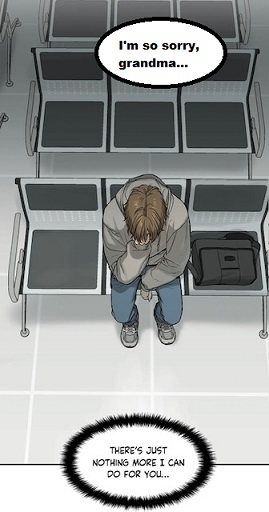 (chapter 5) In his eyes, he could do nothing for his grandma. But he was wrong, as he could support her by spending time with her. From my point of view, when the halmoni left home for the hospital, deep down, he must have felt abandoned. On the other hand, we shouldn’t forget that he also had other worries and problems to solve: the loan, the hospital bills and finding a job as a PT. Hence I deduce that through his grandmother, he learned the following lesson: he should spend more time with his loved ones, as they can vanish at any moment. He learned how precious time is. This remark made me realize the huge contrast between these two scenes:
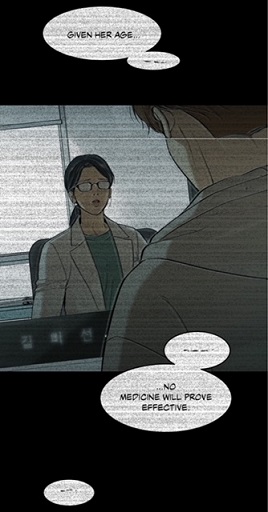 (chapter 47) He was in the bathroom crying and kept recalling the terrible monologue from the oncologist. He felt lost and trapped in the same moment. It felt like an eternity for him. But when he listened to his grandmother, bathed in the sunlight, it triggered his memory about his childhood with her.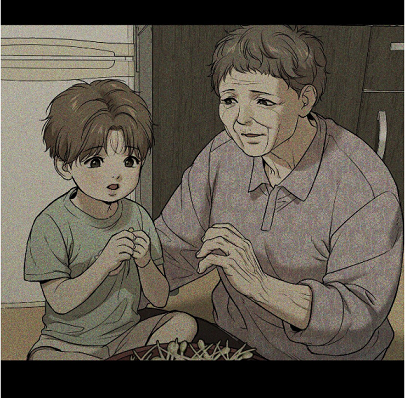
 (Chapter 47) Not only she had kept her promise, but also through this recollection, he got a notion of time again. We could say, he could feel time again. He sensed her true nature: her mortality. It is important, because of this new realization, he can move on and focus on the future in a long term. That’s the reason why I see this scene as a new leaf for both characters:
  (chapter 47) Shin Okja is no longer a goddess, a star during the night… but a human facing her mortality. Besides, the doctor focused too much on money, not realizing that goods are irrelevant in front of death.
  (chapter 41) This explicates why the champion is not attached to clothes and presents.
And now, it is time to return our attention to the phone call in the morning. Why would he call the physical therapist at such an early hour? One might reply that it was an emergency, for the next match is around the corner.  Yet, I can refute this point. How so? Note that the caller only let the phone ring 3 times:
  (chapter 47) Then he left a message. This stands in opposition to Joo Jaekyung’s action in episode 5:
  (chapter 5) The latter even spent about 23 minutes to reach the protagonist. He started calling at 10: 12 am and the next person he called was the MFC manager at 10:30 am. 12 + 23 times = 25 minutes. It means that for each call, he waited more than one minute before calling again. Another difference is that the athlete phoned him each hour: around 10 am, before around 9.00 am., hence I am assuming that he must have called around 8:00 am. This exposes the champion’s despair and huge desire!! However, he never tried to reach him at 5: 15 am. The director’s action appears as tactless and selfish. Since it was not an emergency, then why would he call the doctor so early? What was the point to act that way, when he left a message right immediately? (chapter 47) One might say that he feared that the doctor would reject his phone call, as he couldn’t recognize the number. On the other hand, I would like to outline that the man didn’t introduce himself properly. He didn’t mention his name at all. He just described his work and position. Compare his message to the one from the journalist:
  (chapter 35) So what does the divergence display? I would say, the lack of seriousness and integrity from the executive director. Shim Yoon-Seok wished to appear as a serious reporter, though he was intruding in the champion’s private life. Don’t forget that the latter messaged Joo Jaekyung during the night, but he didn’t call him:
  (chapter 35) He desired to give the impression that he was a hard-working journalist. On the other hand, because he just sent a message, it indicates that the reporter wished to hide, to remain anonymous. In other words, he was hiding his identity behind a name. How so? It is because the champion could not hear his voice at all. Joo Jaekyung can not recognize the journalist contrary to this scene:
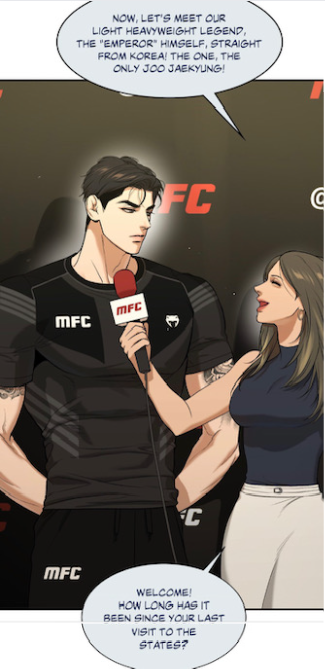 (chapter 36) This divergence reveals that the executive director has a different approach than the reporter. The former seeks to „get close to Kim Dan“, while the journalist desired to avoid the famous fighter’s wrath. Shim Yoon-Seok anticipated his reaction. Therefore I have the feeling that the mysterious man contacted the physical therapist so early to create the illusion that it was urgent. They needed him. Interesting is that when the champion received the message from Shim Yoon-Seok, he never questioned how the reporter got his contact.
 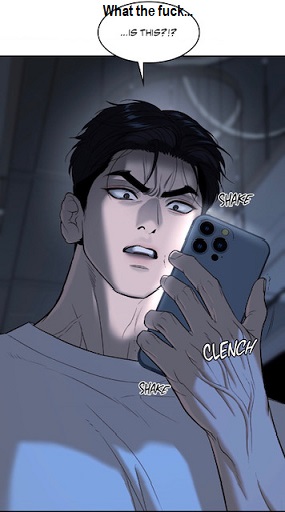 (Chapter 35) Besides, I noticed that the text from the journalist was ambiguous, especially for the readers.
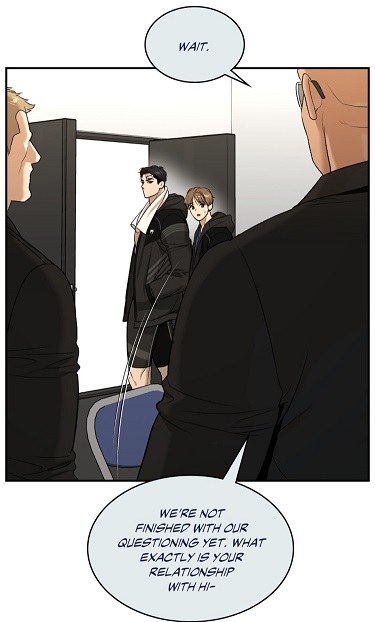
 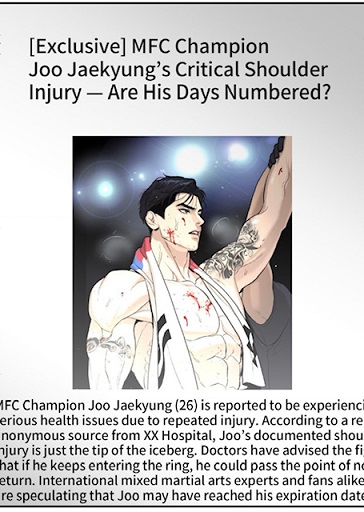 (Chapter 35) The latter doesn’t claim to be the author of the article. He doesn’t employ the possessive pronoun „my“, then the column doesn’t expose the name of the author. And we have a similar situation with the message. (Chapter 47) No name and as such no identity… Kim Dan could not recognize the man in the street, if he were to meet him. Furthermore, the message could be from someone else, impersonating him… the latter could deny that he ever sent such a message, as it is not his „phone number“. As you can see, I detected a pattern. The schemers are playing with ambiguity which mirrors the doctor’s situation. The MFC security guys had no idea about Kim Dan’s identity:
  (chapter 40) A fighter, a prostitute, a lover or a physical therapist? Another difference between the two texts (35 and 47) is that (chapter 47) above the anonymous message, Manhwalovers can read the warning about phishing and spasms, while the champion’s cell phone doesn’t show such a message. It could be an indication that the debts from Kim Dan are related to phishing scams.
Fraudulent phone calls and text messages, also known as phishing, in South Korea have caused nearly 1.7 trillion won ($1.3 billion) in damage over the past five years, data showed Tuesday.
According to data received by Rep. Kang Min-kuk of the People Power Party from the Financial Supervisory Service, a total of 227,126 scams were reported from 2018 to 2022, and the expense of reported loss from these scams was some 1.66 trillion won, with the number of such crimes seeing an uptake since 2020. […] More than 60 percent were victimized by scammers claiming they would help them with loans, which accounted for nearly 1 trillion won of the phishing damage. Some 22.8 percent of phone call fraudsters preyed on people by impersonating public institutions, while 17.1 percent of the crimes were carried out over mobile text messages by impersonating the victims’ acquaintances. Quoted from https://www.koreaherald.com/view.php?ud=20230221000590
After this quote, Manhwaworms can grasp that phishing represents a huge problem in South Korea. Therefore I have the feeling that this number could get blocked or even reported as spam. Let’s not forget my previous conclusion. The fact that the mysterious sender didn’t mention his name is exposing his mind-set. He doesn’t want his true identity to be discovered in verity. This would corroborate my theory that the man behind the message is Mr. Choi. In the analysis “Angel(s) Of Death: Shadows versus Serenity”, I had already outlined the similarities between the mysterious phone number (chapter 47) and Mr Choi’s: 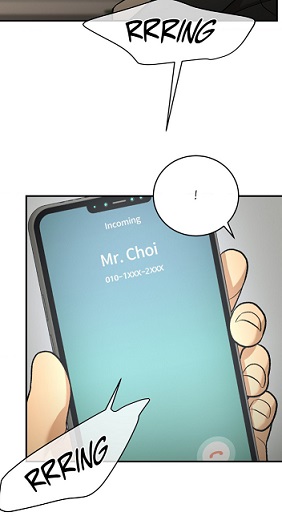 (chapter 46) And now, imagine the consequences, when Kim Dan or Joo Jaekyung reports the text as spam. Not only he doesn’t prevent the scammer from sending more texts to him, but it does let the authorities know as well that there’s a problem. Carriers might block the sender’s messages. Government bureaus might take action to prevent the scammer from messaging other cellphone users.
  (Chapter 46) And remember that Mr. Choi used this cellphone to contact his underling, a sign that their relationship was not official and should remain a secret. Hence if the line got cut, then Heo Manwook and Mr. Choi would be forced to meet. As you can imagine, the moment I discovered the connection between „carrier“ and „spam“, I couldn‘t help myself thinking that Mr. Choi might have received the CV from the courier company!!
 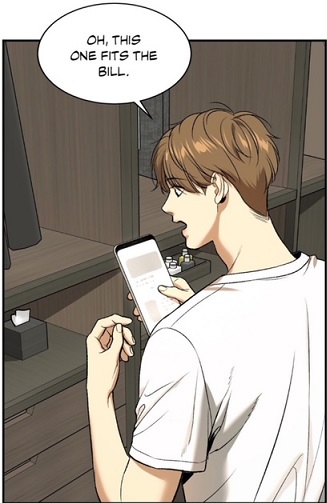 (Chapter 42) Yes, we have here a text on a cellphone too. Therefore I couldn‘t help myself laughing!! Why? It is because I believe that the schemers are thinking that Kim Dan is a member of Team Black, a fighter, and he is Joo Jaekyung‘s protégé. My reasoning is the following: since my hypothesis is that he got the doctor‘s curriculum vitae through the courier enterprise
 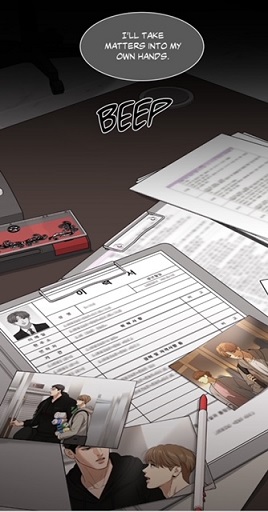 (Chapter 46), I doubt that Kim Dan mentioned that he was working as PT for Joo Jaekyung. This would have raised an eye-brow!! His side gig was supposed to be a secret implying that his official work was to be kept hidden as well. Furthermore, I am assuming that Mr. Choi must have tried to figure out Kim Dan based on his CV. He worked for a short time at the hospital and after he chose to take odd jobs. So he could have had a change of heart, he desired to pursue a different career, like for example becoming a professional MMA fighter. I don‘t think, people would mention such a hobby, as it could give a bad impression. Finally, if my theory is correct, then it signifies that Mr. Choi got tipped off by the hidden person from chapter 42.
  (chapter 42) Remember my previous interpretation: the anonymous person had discovered a secret, but back then it was difficult to determine the secret.
 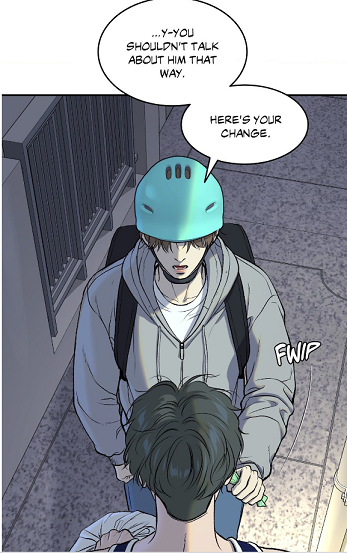 (Chapter 42) First, I thought that they knew that Kim Dan was probably his „sex partner“ as a fan, as he didn‘t object to this statement
  (chapter 42) But note that Kim Dan had protected the champion’s name and reputation first. Hence my idea is that in the mind of the anonymous observer, Kim Dan might have been left speechless for a different reason. He was described as a parasite, for he was using Joo Jaekyung‘s care and talent to become himself a professional MMA fighter!! In other words, they are mistaking him for Potato. And now, you comprehend why I added the green fox in the illustration:
 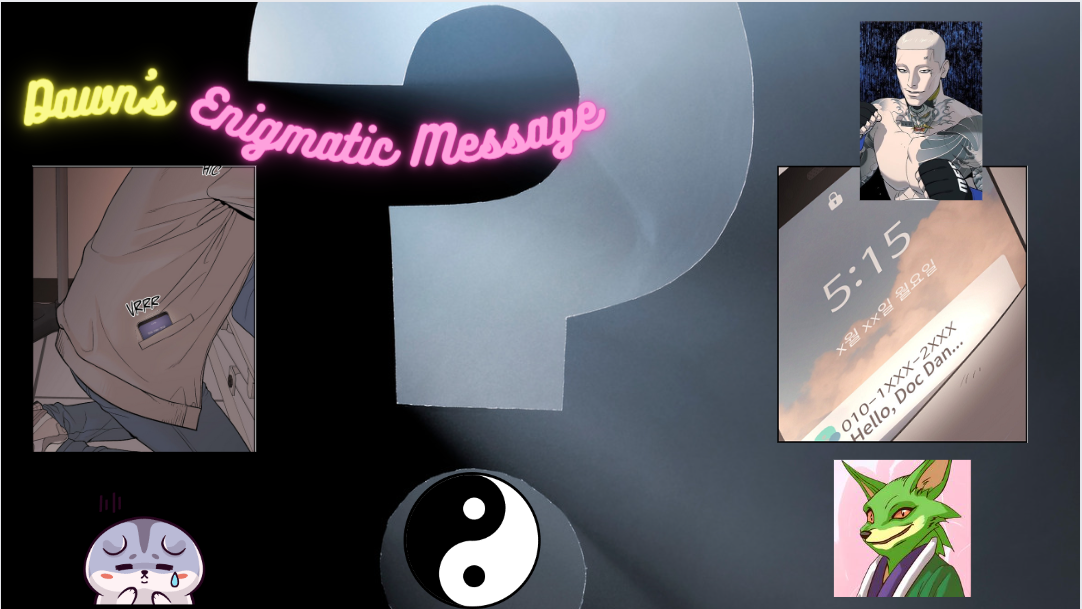 They are trying to snatch away the favorite athlete from Team Black in order to destabilize Joo Jaekyung mentally (chapter 46), as the champion was seen quite caring towards Kim Dan. We could see that fighters at Team Black believes in luck
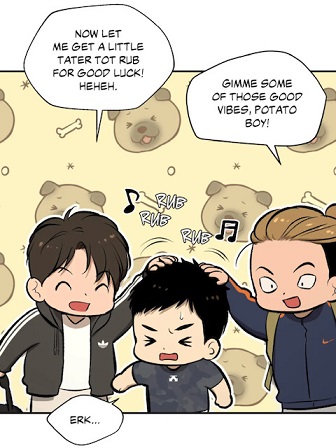 (chapter 23) So they could think, Kim Dan is not questioning the belief too, as he is a fighter. However, in the picture, Kim Dan looked depressed alone. So the picture was exposing his disillusion and Mr. Choi could misinterpret the origins of his disappointment: he was not able to achieve his dream. (Chapter 47) Because he is a member from Team Black, he is not paid well. He is not sponsored by Joo Jaekyung, in fact he needs to pay fee memberships. One might argue about this theory (Kim Dan is confused as a fighter) for the sender addressed the protagonist as Doc Dan. This is the indication of a spy, only members from Team Black know his nickname. Nonetheless, the Spanish version diverges, as he is addressed as Mr. Kim. Hence that could be an error made by the English translator, similar to „Buenas tardes“. On the other hand, let‘s not forget that during the sparring, the main lead’s nickname got a different meaning.
  (Chapter 26) They could have jumped to the conclusion that Doc Dan was his stage name as a reference to his education and past, unaware that in reality it was indicating his true job. Thanks to @joojaedan, I got access to the original version.
  He is addressed as Kim Dan, and @joojaedan told me that he got addressed the same way than the fighter and Joo Jaekyung would call him. I have to admit that I let the app Deepl translate the Korean version. This is what I got:
Hello Mr. Kim Dan, I’m the representative of Baek Junmin’s gym “King of MMA”. Please contact me, when you are available.
The official English version is definitely the better translation for two reasons. First, what caught my attention is the title “executive director”. According to my research, executive director is not the same than CEO or “jefe del gimnasio…”. In Spanish, the author of the message is presented as the owner of the gym, but now take a look at this source:
An executive director is the senior operating officer or manager of an organization or corporation, usually at a nonprofit. Their duties are similar to those of a chief executive officer (CEO) of a for-profit company. The executive director is responsible for strategic planning, working with the board of directors (B of D), and operating within a budget. Quoted from https://www.investopedia.com/terms/e/executive-director.asp
This shows that the author of the message is presenting himself as the right-hand of the fighter. He is not the owner of the gym officially, for he acts as a representative and takes care of the finances and PR!! I would even say, he must be working with a law firm as well. As you can see, thanks to the original and English translation, I discovered a new aspect, the connection between the Entertainment agency and the law firm, which corroborates my previous interpretation: the lawyer and the manager from the agency were working together, covering up for each other. (Chapter 36) Moreover, this signifies that Baek Junmin is presented as the owner of the gym
  (chapter 47), as he is the face of that gym. In reality, he is just the cover, whereas the true owner is the mysterious sender of the text.
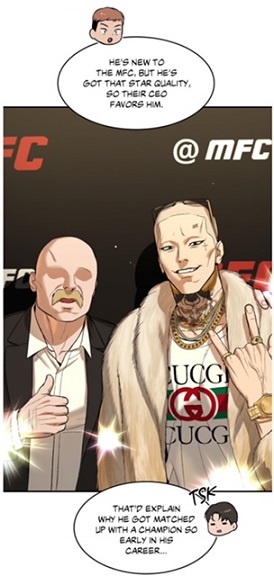 (Chapter 47) This signifies that he is acting like Park Manwook
 (chapter 22). Yet, he is his negative reflection, as Mr. Choi is the real owner, but he hides behind the thug Baek Junmin. On the other hand, Park Manwook views himself as the owner of the gym, for he takes care of contracts and finances, but the one with the final saying is in truth Joo Jaekyung. To conclude, we have a similar situation between the two gyms: the owners are keeping a low profile, they stand in the shadow. However, there exists a difference between them. Joo Jaekyung is allowing his hyung to call himself the owner of the gym out of respect, whereas the other is doing in order to hide his criminal activities. I would even say, he is making sure that Baek Junmin would take the fall in case he would get into trouble.
Moreover, since he asked Kim Dan to call him back, it implies that he wished to be in touch with Kim Dan through his cellphone. In other words, he doesn’t desire to meet Kim Dan personally. I would even add that he wished to be connected to Kim Dan like to Heo Manwook, not through the official line, but a private and secret phone. (chapter 46) As you can see, through this comparison, we can discern the personality and the intentions of the anonymous caller much better. It stands for secrecy and intrusion. At the same time, it exposes that the schemers are not exchanging information between each other which can only need to a failure. Heo Manwook knows that Kim Dan is well paid, whereas Mr. Choi thinks, he is still struggling financially. But why did he call him at 5:15 am then?
One might reply that he needed to call him before the doctor would go to the gym with Joo Jaekyung. (chapter 46) He wanted to ensure that the athlete wouldn’t notice his phone call. He couldn’t reach him around 9:00 or 10:00 am, this would have been noticed by Team Black’s members. On the other hand, he could have called him during the weekend, especially on Saturday evening or on Sunday. The last picture with Kim Dan is portraying him leaving a place alone, in my opinion, it is the hospital. Thus my hypothesis is that Mr. Choi must have known that the main lead would visit his relative on Sunday. On the other hand, since my theory is that he got the CV through the carrier enterprise, it is also possible that Mr. Choi imagines that Kim Dan is still working as a courier, especially if he is assuming that the doctor is planning to become a professional MMA fighter. He has no idea about the truth: it was to offer a present to the star.
Don’t forget that the two protagonists reflect each other. While Joo Jaekyung was misled to think that the hospital leaked information to the journalist (chapter 36) which was definitely not true, I deduce that this must have happened to Kim Dan in reality. A company leaked his information, yet the doctor is unaware of it.
Therefore I assume that Mr Choi called him briefly at 5:15 am, as he knew that his night shift as courier would end around dawn. 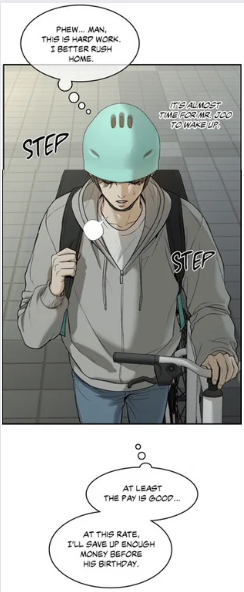 (chapter 42) He let it ring three times before texting him in order to catch the doctor’s attention, to distinguish himself from the previous calls (for his job). If so, then Mr. Choi must believe that Kim Dan is being “exploited” by the athlete. Hence the doctor would look so unhappy, when he is alone. In other words, the pictures taken in secrecy would expose the hypocrisy of the celebrity towards the main lead. (chapter 46) That’s how Mr. Choi interpreted the images. Nevertheless, it would signify that the executive director is projecting his own thoughts onto the fighter. According to me, Baek Junmin is his “slave”. He needs to bring him the result Mr. Choi desires. (chapter 47)
That’s how I came to the following deduction. In order to perceive the caller’s intention, we need to compare his text to the previous ones. And we have two other messages in Jinx:
In chapter 34, Heesung, Kim Dan and Joo Jaekyung communicated to each other through messages.  (Chapter 35) Here, the actor had planned to confess to him, while the other wanted to divulge the true nature of their relationship:
  (chapter 34) It was pure sex, yet the comedian didn‘t get fooled. Joo Jaekyung had feelings for him. Striking is that during that night, the doctor got fooled and this twice!!:
  (chapter 34) First, the star knew about the invitation from Choi Heesung. This even caught Kim Dan by surprise. This image exposes that the champion had violated the doctor’s privacy. So how did he know it? We have different possibilities, yet my idea is that he had seen the message!! Thus he replied with a text to Heesung. Besides, observe how he dissuaded the doctor from visiting the actor.
 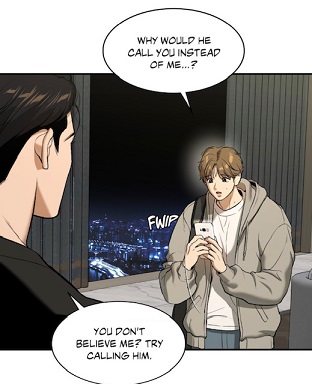 (Chapter 34) He should CALL him… a sign that the champion had not called anyone. Since Mingwa is writing like Byeonduck, I have the feeling that the message from Mr. Choi will be discovered by Joo Jaekyung. Remember how his hyungs had warned him
 (chapter 46), but he had refused to listen to them.
  (Chapter 46) But the moment the champion is confronted with such a message directly, this would be a wake-up call for Joo Jaekyung, he should treat his members much better, as the existence of his company is in jeopardy. Moreover, I am hoping that such a discovery will push Joo Jaekyung to play a trick on his enemy too, like for example he gives a task to Potato, act as a spy!!
But it is relevant to recall that the executive director initially called Kim Dan before leaving a message on his cellphone. Hence I believe that we should also compare it to the previous phone calls the main leads received in the past. This led me to notice the recurrence of certain notions: sex, emergency, treatment, interruption, spying, secrecy, manipulations, rejection, and finally ignorance.
| Chapter 1 | Chapter 5 | Chapter 11 | Chapter 13 | Chapter 16/17 | Chapter 19/20 |
|---|---|---|---|---|---|
  Emergency, treatment, manipulation, sex and interruption |  Kim Dan saw the calls, but he ignored them. Kim Dan saw the calls, but he ignored them. 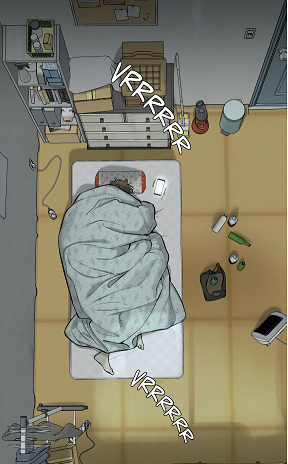 Here, Joo Jaekyung heard that the doctor could have blocked him. Emergency, treatment, secrecy (the reason behind the contract) and rejection |  It was another emergency call, for he needed to leave the place within a week. Interesting is that the person didn’t present himself. No name… As you already know, I am suspecting that the doctor got fooled, for I doubt he ever received any compensation for his move. He should have received money. Emergency, rejection, manipulation, interruption and spying (Heo Manwook interrogated the doctor right after) It was another emergency call, for he needed to leave the place within a week. Interesting is that the person didn’t present himself. No name… As you already know, I am suspecting that the doctor got fooled, for I doubt he ever received any compensation for his move. He should have received money. Emergency, rejection, manipulation, interruption and spying (Heo Manwook interrogated the doctor right after) | 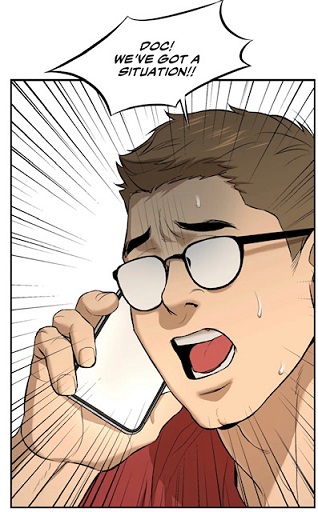 In this chapter, we have in fact two calls related to a danger.  Emergency, treatment, sex, interruption, manipulation and secrecy |  Treatment, interruption, sex, secrecy, rejection and manipulation  | 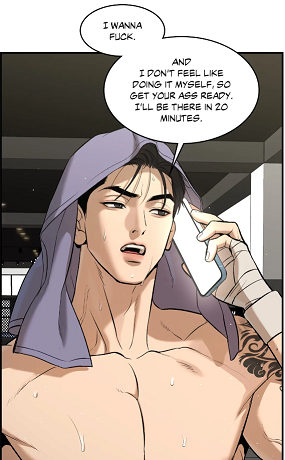  Sex, interruption, „emergency“, as the champion didn‘t take off his shoes and put down his bag. Then during the intercourse, the doctor was called by the hospital Sex, interruption, „emergency“, as the champion didn‘t take off his shoes and put down his bag. Then during the intercourse, the doctor was called by the hospital 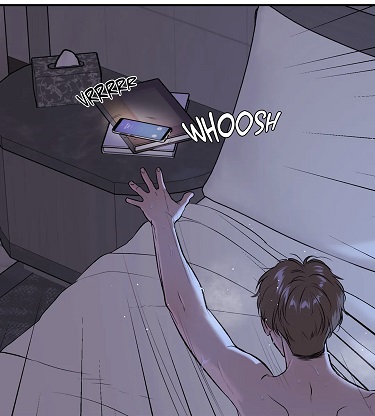 Sex, treatment, interruption, secrecy (hidden in the bathroom) Here, the doctor could not refuse the champion‘s suggestion. |
| ChaPter 21 | Chapter 24 | Chapter 32 | Chapter 38 | Chapter 45 |
|---|---|---|---|---|
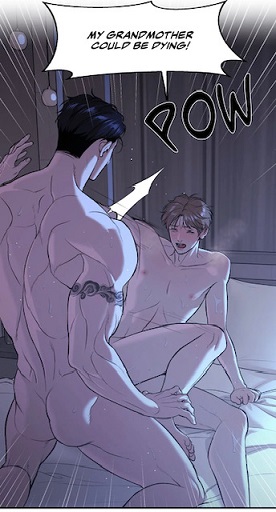 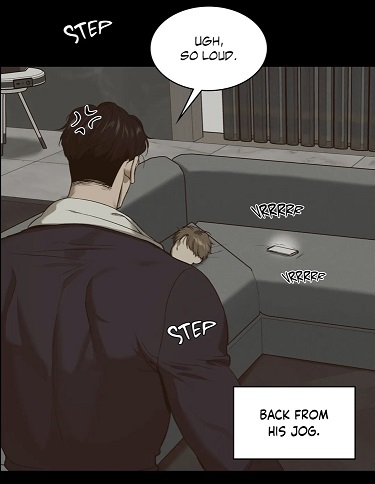 Here, we have sex, interruption, secrecy (grandma‘s existence and illness), rejection and ignorance. Kim Dan didn‘t answer the phone calls right away, as he was sick. | 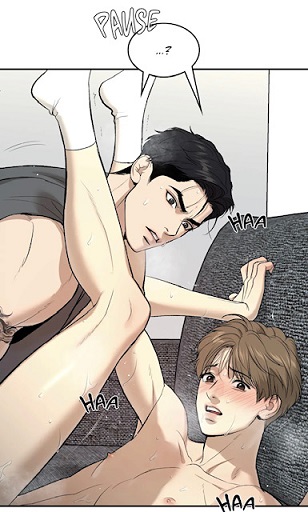 Sex, interruption (food), secrecy, manipulation, ignorance and spying. Potato had tried to listen to their conversation. Sex, interruption (food), secrecy, manipulation, ignorance and spying. Potato had tried to listen to their conversation. | 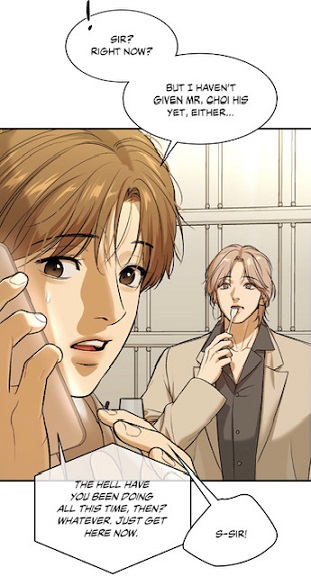 Treatment, emergency, interruption (food), ignorance, manipulation and „spying“. Heesung tried to discern the nature of their relationship. | 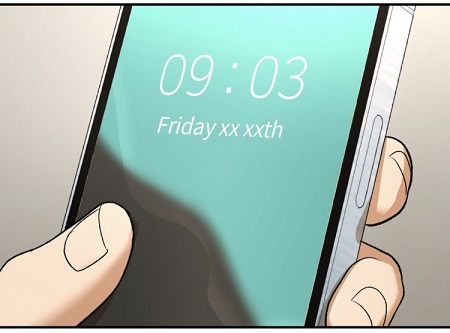 Interesting is that here, there was no emergency from the champion‘s part. This time, Kim Dan was the one longing for the athlete. Interesting is that here, there was no emergency from the champion‘s part. This time, Kim Dan was the one longing for the athlete. Sex, emergency, ignorance, manipulation, though here the victims of the trick were the two main leads. Sex, emergency, ignorance, manipulation, though here the victims of the trick were the two main leads. | This message stands in opposition to all the other messages: honesty, family.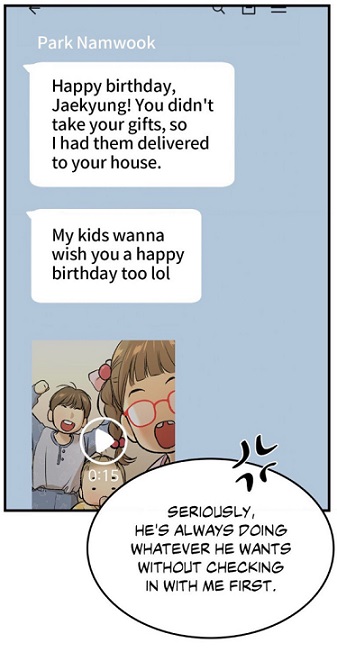 But it shares a common point from the text in chapter 34: love confession. Park Namwook and his family view him as a family member. Yet, the star saw it as an intrusion, it happened right after the sex-love session |
And now, which notions do we find in the phone call from Mr. Choi? Manipulation, because he is not introducing himself properly. He doesn’t explain how he got his contact. Then we have secrecy, because he is calling so early. Interesting is that the caller gave the impression that it was an emergency by calling at dawn, (Chapter 47) yet his words contradict the notion of crisis and danger. Kim Dan can determine the time. Then we have ignorance, for Kim Dan didn’t notice the ringing and the texting. (Chapter 47) That’s why we have NO interruption. Furthermore, it displays spying, as the contact raises the question how the executive director got his phone number. Funny is that the notion of rejection is present through the notice above the text: (chapter 47) As for treatment, it is related to the grandmother, a sign that the sender is not interested in any treatment. Hence I come to the following deduction: the mysterious sender has the intention of deceiving Kim Dan. In exchange for betraying the champion, the executive director will promise him a career at the gym „Kim of MMA“!! Yet, I don’t think, he has the intention to keep his promise, because Baek Junmin has been used as his tool to get rich. The fame in the underground fighting ring is not only fake, but also dangerous. 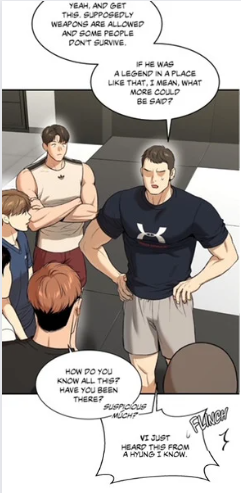 (Chapter 47) And how should he betray the athlete?
We have different possibilities. Since I linked this scene to the altercation with the goblin and his mysterious room mate, they could ask him not to be his sex partner before the match. Or they could ask him to drug the champion like in the past. According to my previous observations, MR. Choi was left in the dark concerning the failure of the last trick.  (Chapter 40) He has no idea that Kim Dan became the victim and got framed later.
  (Chapter 46) Furthermore, since Heo Manwook was the one who hired this man
  (chapter 37) indicating that he used another channel than Mr. Choi‘s. Hence I am suspecting that Mr. Choi wasn‘t informed about the corruption of the MFC’s doctors.
  (Chapter 47) So my idea is that they could ask Kim Dan to injure the athlete during a sparring. First, Mr Choi judged the champion based on his performance. He still won the fight against Dominic Hill, though he was supposed to be injured. So in his eyes, the shoulder injury was exaggerated. Besides, he received a go from the MFC doctors and his match is very soon. Everything is pointing out that the athlete is healthy. Moreover, Alfredo was replaced in the last minute due to an injury.
  (Chapter 47) The MMA fighter could have been asked to fake an injury, similar to Heesung‘s plot. As for Kim Dan, his task would be to „target his shoulder, his weak point“. Another possibility is to expose his vulnerabilities. One thing is sure: their approach will fail, hence they will propose the deal to Seonho.
  (Chapter 47) And the latter has a reason to get revenge on the celebrity because the suffered humiliation and beating.
  (Chapter 46) What caught my attention is that this athlete definitely boosted his situation by advertising that he was the champion’s sparring partner. I doubt that the main lead‘s criticism was unfounded.
 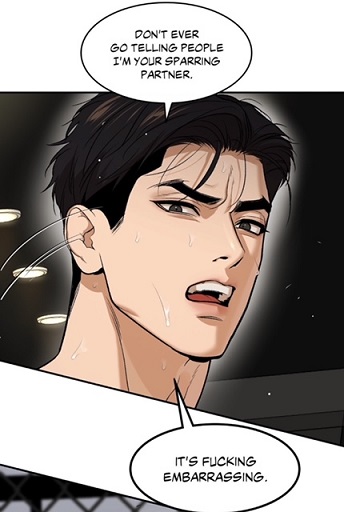 (Chapter 46), for he had been bragging about his merits.
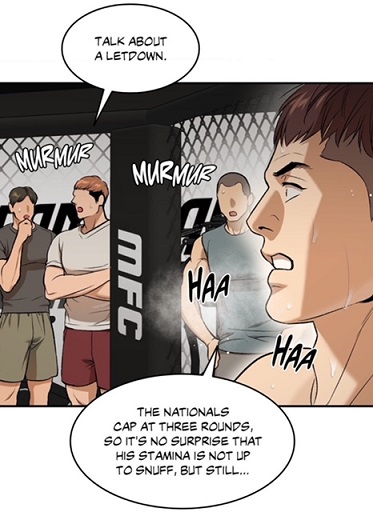
 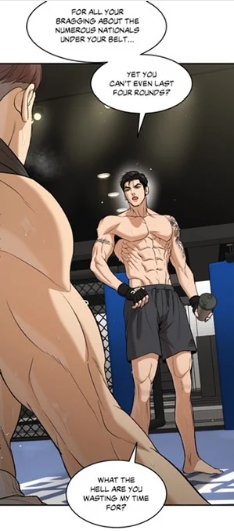 (Chapter 46) By the way, I believe, Seonho was a recent recruit. Therefore he doesn‘t know the champion that well and he is not close to the other fighters. Hence they didn‘t protect him
  (Chapter 46) like in episode 1
 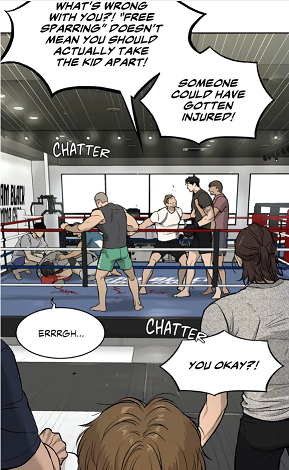 (chapter 1) He had no idea about the roughness during the sparring, though this scene exposes that the champion had toned down the brutality during the sparring.
 (Chapter 46)
  (Chapter 25) So Seonho could expose the true identity of the main lead, he is a physical therapist… Hence the schemers would understand why he got blocked or reported as spam. Their retaliation would be to tarnish his reputation as physical therapist.
Besides, I am envisaging that Seonho could be encouraged to trespass and steal the files  (chapter 42) On the other hand, since I am predicting a failure of their scheme, they could decide to take revenge on Seonho by sending him to an illegal fighting game, where he could get badly injured. Moreover, the moment they discover how weak the red-haired man is, they could jump to the impression that Seonho deceived them!!
 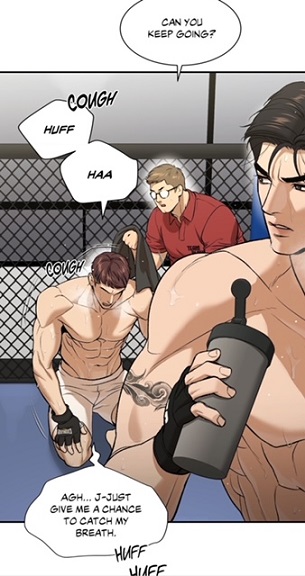 (Chapter 46) Don’t forget that the champion is the mirror of truth, while the doctor‘s role is to expose the hideous side from people: the goblin and the green fox! It divulges their true nature: greed, ambition, selfishness, ruthlessness, immorality… That‘s the reason why Mr. Choi made his entrance.
Moreover, because of the files, they could frame the physical therapist as the leak for the article, unaware that the doctor is living with the athlete. And that would force Shim Yoon-Seok to come out of the shadow. At the same time, the doctor‘s past suffering would come to the surface. So far, Joo Jaekyung only met trustworthy doctors, Dr. Lee and Cheolmin. Hence he had no reason to doubt the integrity of doctors. Notice that after the release of the article, they framed the hospital, but not the doctor himself. (Chapter 36) And this is what Kim Dan and the champion will have to learn: the corruption of organizations like the Entertainment company, MFC and hospitals, if their directors are themself dishonest and greedy.
Since my idea is that the champion discovers the message, I am hoping that he can hear and recognize the voice of Mr. Choi so that he can realize that he got betrayed by the Entertainment agency. Interesting is that coach Jeon Yosep was tasked to investigate the matters about the underground fighting ring.  (Chapter 46) But he was sitting with the others later. Consequently, I come to the deduction that he failed to discover any lead, or better said, any connection between the bets and Mr. Choi. Why? It is because he is a former champion, and professionals among MMA world must know that he works for the star.
 (Chapter 47) Joo Jaekyung needs to realize that he can not just rely on his hyungs alone, he needs the assistance from the whole staff: Kim Dan and the other fighters, as they are not known in the MMA world.
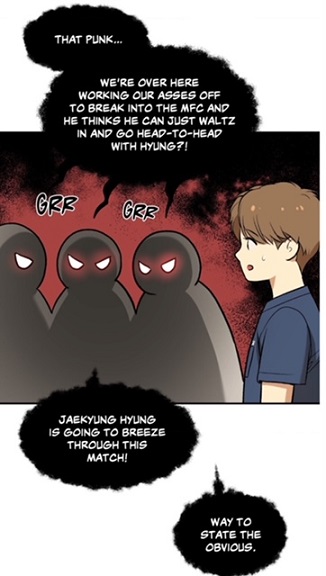 (Chapter 47) They couldn‘t break into MFC, on the other hand, their position helps them to get insight, to approach the illegal fighting ring. (Chapter 47) To conclude, I am sensing a new undercover mission and a trick from Team Black.
Feel free to comment. If you have any suggestion for topics or manhwas, feel free to ask. If you enjoyed reading it, retweet it or push the button like. My Reddit-Instagram-Twitter-Tumblr account is: @bebebisous33. Thanks for reading and for the support, particularly, I would like to thank all the new followers and people recommending my blog.

Please support the authors by reading the manhwas on the official websites. I am also using doctor Frost as reference again. This is where you can read the manhwas: Jinx and Doctor Frost. But be aware that the first Manhwa is a mature Yaoi, which means, it is about homosexuality with explicit scenes. Here is the link of the table of contents about Jinx. Here is the link where you can find the table of contents of analyzed manhwas. Here are the links, if you are interested in the first work from Mingwa, BJ Alex, and the previous essay about Jinx “Angels of Death: Shadows versus Serenity (second version)“
It would be great if you could make some donations/sponsoring: Ko-fi.com/bebebisous33 That way, you can support me with “coffee” so that I have the energy to keep examining manhwas. Besides, I need to cover up the expenses for this blog.

In the first part, I examined Kim Dan’s mentality more closely. There, I portrayed the physical therapist as someone suffering from Dependent Personality Disorder. Moreover, I underlined that so far, Kim Dan had been raised under the influence of toxic positivity. Therefore he was constantly denying his own pain and struggles. Because of these two characteristics, I came to the following interpretation: the physical therapist was raised like a princess, and by meeting Joo Jaekyung, he got confronted with reality. Hence the argument with his fated partner incited him to change his mind-set. First, he was pushed to acknowledge the existence of his broken heart. Then from that moment on, he would no longer rely on the champion. 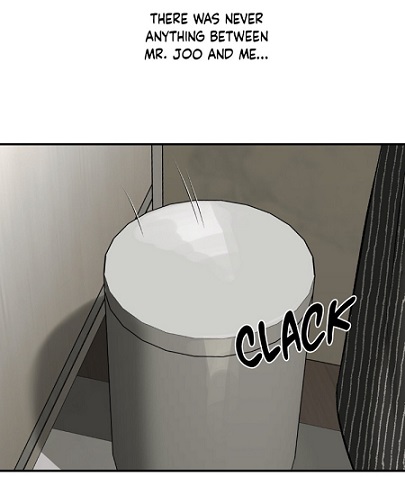 (chapter 46) On the other hand, chapter 47 exposes that the doctor didn’t lose his interest and attention towards his boss.
  (chapter 47) This exposes that Kim Dan didn’t choose resent or indifference towards Joo Jaekyung despite the inflicted pain. On the other hand, why did I write that the celebrity is Kim Dan’s reflection? Why is the athlete the doctor’s mirror of truth? It is because Joo Jaekyung embodies his negative reflection: independency and toxic negativity. But what is the latter exactly?
Interesting is that I connected the physical therapist to Dependent Personality Disorder thanks to the case of “Tears of Princess Pyeonggang” from the Manhwa Doctor Frost. When the patient Sihyun met Doctor Frost, the latter explained to her why her last relationship was doomed to failure. How so?  (chapter 31) It is because when the psychologist met the patient with her boyfriend for the first time, he paid attention to his micro-expressions, and more particularly to his mouth. He saw his smirk. Here, I feel the need to give an explanation how these micro-expressions were discovered.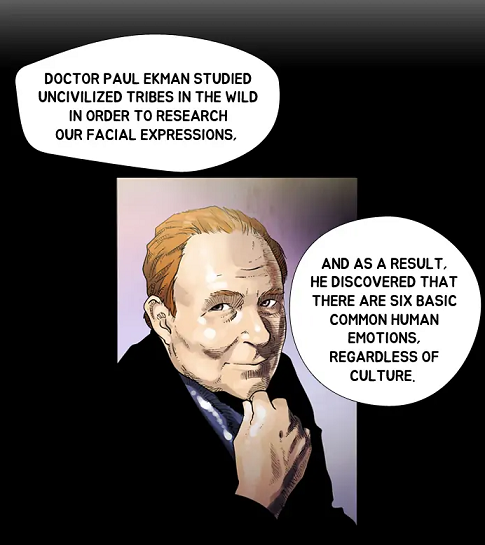
 (chapter 30) As my avid readers can detect, the expression from the boyfriend’s mouth displeased the white-haired psychologist. He could recognize his emotion, though such facial expressions are very short-lived
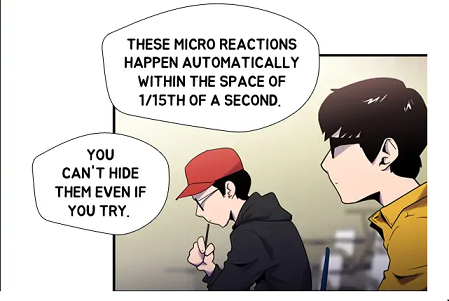 .(chapter 30) So what was the “jerk” feeling, when he was conversing with Sihyun? Cynicism.
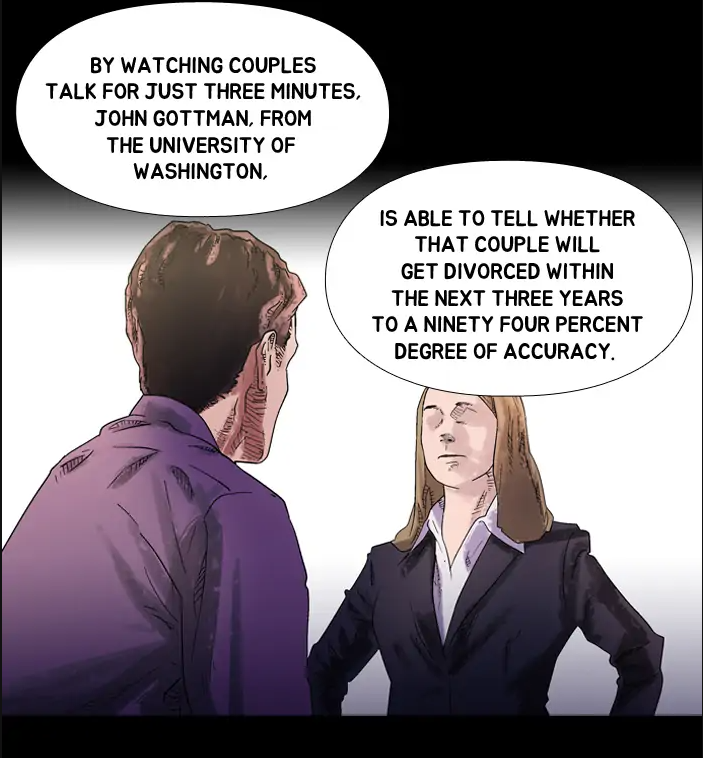
 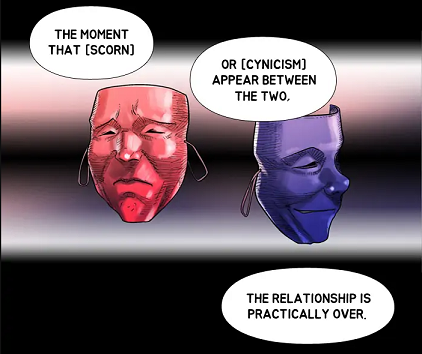 (chapter 31) And the reason why he stated that as soon as cynicism or scorn was present in a relationship, the couple would end up breaking up is because of John Gottham’s observations and conclusions.
  (chapter 31) And now, you are wondering how this is related to Joo Jaekyung. It is because the famous sportsman is full of cynicism
  (chapter 45) We could sense it in different scenes, though I would say that his cynicism was slowly vanishing:
  (chapter 3)
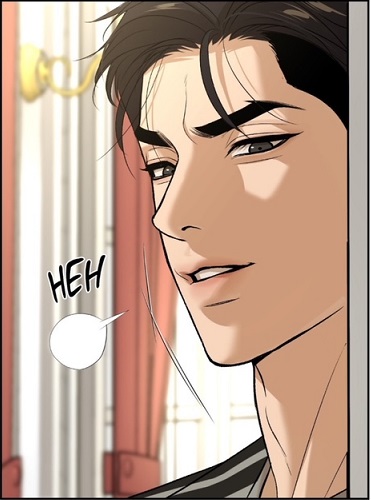 (chapter 40) This is the so-called toxic negativity. Therefore it was to expect that the champion would reject the doctor’s present. He could only doubt the sincerity behind his gesture. How so? Remember how the team desired to celebrate his birthday: a surprise party. They bought a cake…
  (chapter 43) but what happened afterwards? Yosep spoke in the name of the gym’s owner: the latter would pay for the dinner (beef restaurant)
  (chapter 43) So technically, they offered a cheap cake and got in exchange a super expensive dinner. One might say that this was just a joke. But cynical people are taking things very seriously. This is what the champion learned from this experience, the cake in exchange for a super expensive meal … and now imagine that the next morning, he received an „expensive“ present from Kim Dan which was similar to the gifts from fans (exchange of favors). It is normal that he doubted the genuineness from his doctor, not only because of his past experiences, but also because of the parties before. But there exists another reason why he had to refuse the gift: Cynicism… the end of relationship. Thus dating for the athlete was impossible.
  (chapter 45) He is not ready yet. But was it Cynicism exactly and how does it represent a hindrance for a healthy relationship?
First, I would like to present the philosophy of Cynicism in order to outline certain positive aspects of such a mind-set. The latter, originating in ancient Greece, is often associated with the notion of living a life of simplicity, virtue, and independence. The term “Cynic” comes from the Greek words “kynikos,” meaning “dog-like,” and “kyôn,” meaning “dog.” While the origins of this name are not entirely clear, there are two popular beliefs regarding its origin:
Firstly, it is believed that the Cynics were called dogs because the first Cynic, Antisthenes, began teaching in the Cynosarges gymnasium in Athens. “Cynosarges” translates to “the place of the white dog,” hence the association with canines. Another possible origin for the term “dog” in Cynicism is attributed to Diogenes of Sinope, one of the most famous Cynic philosophers. Diogenes famously lived in a large ceramic jar (known as a “pithos”) and embraced a lifestyle of extreme simplicity and disregard for social conventions. He would reportedly wander the streets of Athens with a lantern in broad daylight, searching for an honest man.
Cynic ethics revolve around the principles of freedom, parrhesia (frank speech or fearless expression), living according to nature, and rejection of societal norms and conventions. Cynics believed that true happiness and virtue could only be attained by living in accordance with nature and rejecting the desires and comforts of society. They often practiced asceticism, eschewing material possessions and living a life of self-sufficiency.
The Cynics emphasized the importance of living in accordance with one’s true nature, rather than conforming to societal expectations or pursuing external desires. They criticized authorities and traditions, they valued self-reliance, resilience, and inner strength, believing that true freedom could only be achieved by freeing oneself from the constraints of society and material wealth. In addition to their rejection of societal norms and conventions, Cynics also challenged the traditional notion of family and social hierarchies. They believed that attachments to family and social status were sources of unnecessary suffering and constraint on individual freedom.
Cynics advocated for a radical form of individualism, promoting self-sufficiency and independence from familial ties and obligations. They viewed the traditional family structure as a hindrance to living a virtuous and authentic life, arguing that it often led to conflicts of interest, attachment to material possessions, and moral compromise. Instead of relying on familial relationships for support and identity, Cynics encouraged individuals to cultivate relationships based on mutual respect and philosophical kinship. They believed that true friendship and community could only be found among those who shared their commitment to living a life of simplicity, virtue, and freedom from societal constraints.
By rejecting the traditional notion of family, Cynics sought to liberate themselves from the expectations and obligations imposed by social norms and hierarchies. They embraced a lifestyle of radical individualism and self-sufficiency, prioritizing personal autonomy and philosophical integrity above all else.
Central to Cynic philosophy was the concept of parrhesia, or fearless expression of truth. Cynics advocated for speaking openly and honestly, even if it meant challenging social norms or offending others. They believed that by speaking truth to power and living authentically, individuals could cultivate inner freedom and achieve true happiness.
In summary, Cynicism is a philosophical school that advocates for living a simple, virtuous life in accordance with nature, free from societal constraints and material desires. It emphasizes the importance of parrhesia, self-sufficiency, and fearless expression of truth as essential elements of living a truly fulfilling and authentic life.
After reading this short presentation, Jinx-philes can sense some similarities between the athlete and this philosophical movement. First, he rejects norms and conventions. He is behaving like an animal, compared to a wolf.  (chapter 7) This approach also gives us an explanation how Joo Jaekyung came to develop such an exhibitionistic sexual behavior: sex in the shower room
 (chapter 8), in the office, in the car, in front of a mirror, in front of Heesung in the living room… Don’t forget that Diogenes would even masturbate in public.
Additionally, he doesn’t see Team Black as “family”, but as a place to learn toughness and endurance. That’s where he could experience “freedom”. Thus his honesty is brutal. (chapter 46) (chapter 46) Consequently, he never tried to get close to his members either. In fact, he is expecting from the staff to follow his lead. Potato could only get rejected with such a request.  (chapter 23) The latter had to act like a true disciple and follow the champion’s recommendation.
 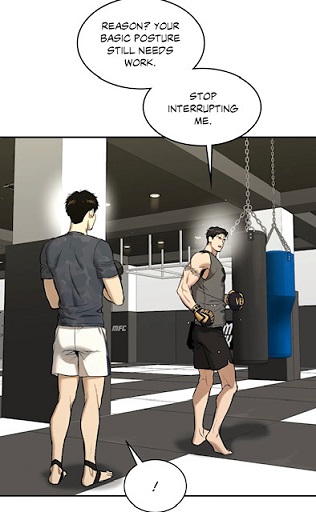 (chapter 23) The gym is like his sacred temple. Yet, the gym is just a simulacre of “nature”, as it is in the middle of Seoul. Therefore I realized why after their argument, Joo Jaekyung avoided the penthouse and Kim Dan in the end.
 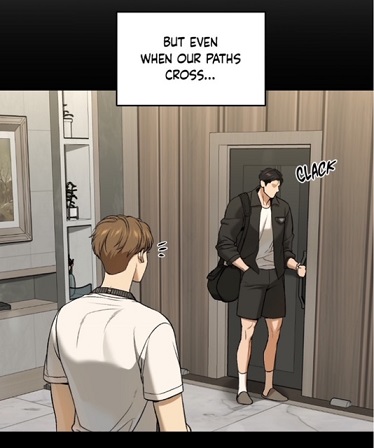 (chapter 47) It is because deep down, the champion sensed that his flat had become a home. He wanted to ensure that the penthouse was still a workplace or a hotel room. Thus he refused to eat the breakfasts prepared from his PT. In his eyes, these meals must have appeared as a violation of his self-imposed discipline. It was more than self-sufficiency. Under this new light, Jinx-philes can grasp why he rejects presents and prefers donating money.
 (chapter 41) He is looking for freedom and self-sufficiency, detached from any material need. This explains why the golden keychain from Kim Dan could only offend him.
  (chapter 45) It symbolized everything he hates: a reminder of wealth, superficiality, attachment, secrecy and silence. It also exposed the huge difference in their mind-set. Kim Dan is not his disciple! He imagined that he had found a kindred spirit, especially after that night:
  (chapter 39) The reason is simple. The champion had finally found someone who accepted his roughness in bed and could match his stamina.
As you can imagine, Joo Jaekyung is naturally a fake Cynic, for he is not giving up on his comfort.  (chapter 10) He is not resigning on designer clothes.
  (chapter 42) His dress room is the evidence of his hypocrisy. He might have encouraged Kim Dan to have sex in “public places”, yet he is still hiding his sexual orientation. Furthermore, his jinx is the evidence of his dishonesty.
 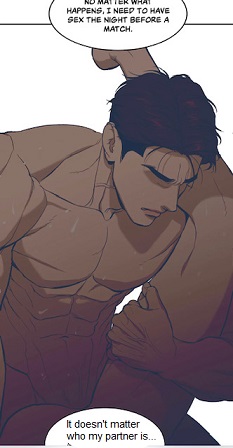 (chapter 2) He needs someone to have sex. This stands in opposition to Diogenes’ masturbation. Besides, he had to pay the goblin and Kim Dan in order to have a sex partner. Hence he needs to be confronted with truth as well. Manhwaworms can grasp the rage from the athlete, when he heard the doctor’s justification:
  (chapter 45) He might advocate autonomy and self-sufficiency, the reality is that he likes luxury. Hence he is unable to live in harmony with nature. This shows that the fighter is in denial and is living in an illusion. Thus he can not find true happiness, for his freedom is not real. He is attached to the gym which is also strongly connected to his career as the Emperor.
  (chapter 46) With his brutal attitude, he is doing himself a disservice. Exactly like Kim Dan, he is even ruining his career and own reputation. Not only he lost 4 athletes (I am including Seonho), but also his loyal admirers are calling him a thug now:
 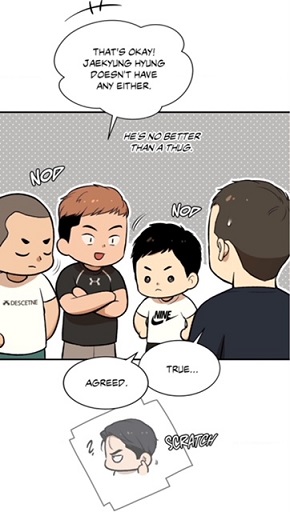 (chapter 47) Even Potato announcing the gradual Coming-Of-Age from his admirer. However, like Dr. Frost mentioned it, humans are social beings.
 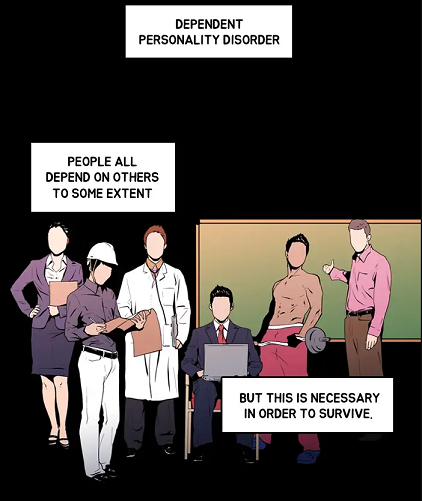 No one can survive on his own. This explicates why Cynics had disciples in the end. And now, you comprehend the role of Kim Dan in Joo Jaekyung’s life. It is to remind him of his true nature. He is a human and not a dog-wolf. Thus the champion recommended his PT to live elsewhere, a sign that he was indeed a human.
  (chapter 10)
Yet, pure cynicism is not the way to find happiness. We have the perfect example with Diogenes:
He was so devoted to living a Cynic way of life that, upon seeing a child drinking water with his hands, he threw away his cup, stating that a child had beaten him to living a simple life. Quoted from https://www.orionphilosophy.com/stoic-blog/the-philosophy-of-cynicism
He had the impression that it was never enough, and the pure action from the child caught him by surprise. He seems to have been obsessed with his theory.
However, in the first part, I mentioned Cynicism from a psychological perspective. So now, it is time to examine what Cynicism means for psychologists.
Cynicism is a philosophical and psychological attitude characterized by skepticism and a general distrust of the motives and sincerity of others. Cynics tend to view human behavior as selfish and driven by self-interest, often dismissing conventional social norms and values as hypocritical or insincere.
This worldview is rooted in the belief that people act primarily to fulfill their own desires, without genuine concern for others or higher principles. Cynics may adopt a critical and sarcastic demeanor as a defense mechanism against perceived deception and disingenuousness in the world. Read more here: https://mind.help/topic/cynicism/

In other words, they have no trust in human beings. Hence Cynicism is undermining relationships. They judge people as selfish hypocrites. Therefore they use Cynicism as a way to keep people at a certain distance.  (chapter 2) This explicates why the champion was crossing his arms while confronting the goblin. He was on the defensive. That’s how it dawned on me why the celebrity fell in love with Kim Dan at first sight, and why he enjoyed their first night together. The “hamster’s fear” was genuine. His desertion displayed respect towards the celebrity. He was recognizing his strength and power.
 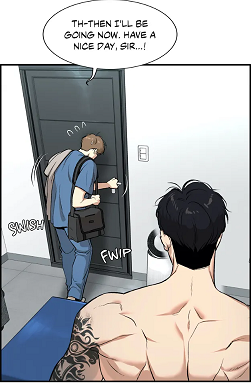 (chapter 1) Then the micro-expressions from Kim Dan exposed his lie
 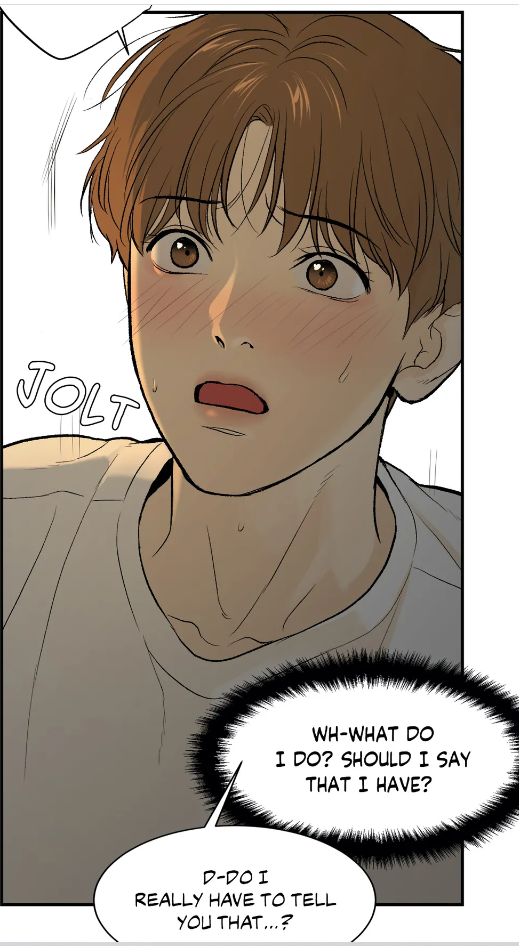 (chapter 3) On the one hand, the champion’s worldview about humans got reinforced, on the other hand the doctor’s deception symbolized his purity. He was a virgin, which was contradicting his “theory” too.
But wait… the title of this essay is Prince S and Emperor and not wolf or dog. Interesting is that the notion of an emperor or ruler could indeed symbolize cynicism, especially in the context of power and authority. Here’s why:
Skepticism and Distrust: Cynicism often involves skepticism and a general distrust of motives and intentions. An emperor or ruler, representing authority, may be associated with a cynical outlook on the motives of others, assuming that actions are driven by self-interest. This explicates why the champion assumed another intention behind the doctor’s present. (chapter 45) He imagined that the doctor had ulterior motives. This explicates why he felt no empathy, when Kim Dan asked for an advance.  (chapter 11) He even looked like a ruler abusing his authority.
 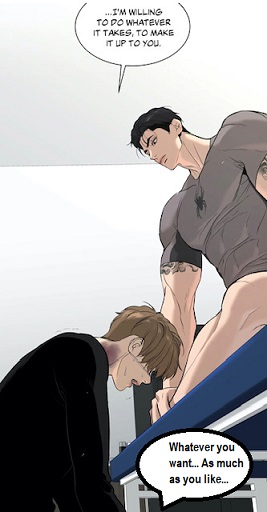 (chapter 11)
Negative Interpretation of Intentions: Cynicism often leads to a negative interpretation of others’ actions. An emperor or ruler, when used symbolically, can represent someone who interprets the actions of others with suspicion, assuming that individuals are motivated primarily by personal gain.
Lack of Idealism: It tends to reject idealism and a positive view of human nature.  (chapter 11) Here, the champion thought that Kim Dan had been gambling. An emperor or ruler, especially one characterized by a lack of idealism, may embody the cynical belief that individuals are primarily driven by self-interest and that altruistic motives are rare. Therefore the celebrity rejects the notion of soulmate
  (chapter 33) or even the idea of friendship
  (chapter 30) Heesung was not just taking advantage of his reputation, he was also teasing the sportsman. Joo Jaekyung has such a negative perception of humans.
  (chapter 33) Hence he looks down on poor people.
  (chapter 10): Gamblers, laziness, no sense of hygiene etc. Consequently, he is not capable to understand the worries from Kim Dan
 (chapter 42), Park Namwook (chapter 46) and Jeon Yosep. He feels like they are questioning his success. It was, as if they had other motives. He only relies on himself, he is not “truly” listening to others… though it is not correct. He is getting manipulated by his “counselors”.
  (chapter 36)
Use of Power: An emperor or ruler traditionally holds significant power, and cynicism may be associated with the idea that those in power are inherently self-serving. This aligns with the cynical perspective that individuals act in their own interest, particularly when they hold positions of authority. Thus the protagonist is selfish and abused his position during their first night together:  (chapter 2)
On a personal level, cynicism can have several impacts. While it may provide a form of self-protection against exploitation or disappointment, chronic cynicism can also contribute to stress, alienation, chronic pessimism, hopelessness, depression and anxiety. It may inhibit personal relationships and lead to a reduced sense of life satisfaction or happiness. Though the champion is rich and even famous, he is far from being happy, as his negative perception of humans represents a hindrance to his inner freedom and peace of mind. He rejects society, yet he needs people to fight and spare with. And now, you comprehend the origins of his inner passivity and emptiness.  (chapter 26) He is standing in front of a dilemma. Fighting is the expression of nature and self-reliance, yet his fights serve as entertainment for MMA lovers. MMA is strongly intertwined with business and money.
That’s the reason why he was condemned to loneliness, until he met the physical therapist. As time passed on, he had the impression that he had found a kindred spirit, his real new disciple. But the present which was bought in secret ruined everything. What Joo Jaekyung failed to realize is that the golden keychain  (chapter 45) was showing the doctor’s golden heart. He was just judging his lover based on his past experiences and his negative worldview. And this brings me to list the cause for Cynicism:
Experts researching into what causes cynicism point to the following developmental factors:
Negative past experiences or betrayals
Observing dishonesty or hypocrisy in others
Feeling disconnected or disillusioned with society
Perceiving pervasive corruption or unethical behavior
Exposure to cynicism from influential figures or media
Psychological defense mechanism against vulnerability
Lack of trust-building experiences or positive relationships
Personal feelings of powerlessness or lack of control
Cultivation of critical thinking without balance in perspective Read more here: https://mind.help/topic/cynicism/
Manhwaworms can grasp why the athlete is a control-freak, why he hates to expose his vulnerability  (chapter 45) He fears to be taken advantage. There is no ambiguity that his negative mind-set is definitely influenced by his childhood and family. I would even say that he must have been exposed to emotional blackmail. I came to this hypothesis, because I detected that the champion had been using “blackmail” as MO in order to control Kim Dan.
 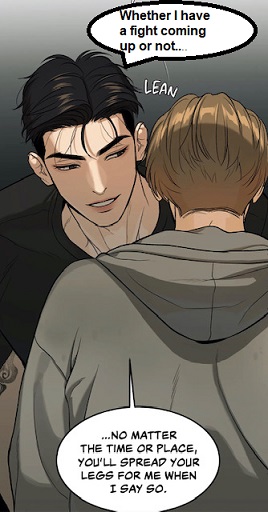 (chapter 6)
Emotional blackmail within parent-child relationships can have particularly damaging effects on the child’s emotional development and well-being. Here’s how emotional blackmail may manifest in the context of a parent raising a child:
This would explain why Joo Jaekyung fears and even rejects any affection and relationships. This is the lesson he learned through his bad experiences. No attachment and no love is freedom, as love is synonym for vulnerability, That’s why he chose independency, rejection of norms and brutal honesty. He sees relationships as a source of danger and vulnerability. I am quite certain that no one would suspect the emotional abuse from his family. Hence he came to view people as selfish hypocrites. The absence of his “family” for his birthday is the proof of their bad education and “abuse”.
That’s how I realized why Joo Jaekyung chose MMA fighting as career too. It was not just a mere coincidence.  (chapter 26)
Cynical depression may be the most common form of the many-faceted disorder.
It’s usually masked by energizing or sedating coping habits.
Sufferers don’t feel depressed; they use adrenaline to raise their mood or illusions to numb it.
The adrenaline mask takes the form of risky behavior, chronic resentment, anger, chronic envy, dogmatic zealotry, or abuse of loved ones. Sufferers don’t look or feel depressed; the adrenaline militates out of depressed mood. It gives a surge of temporary energy and confidence, manifested in facial expressions and body language. https://www.psychologytoday.com/intl/blog/anger-in-the-age-entitlement/202205/your-partner-may-be-suffering-cynical-depression
The adrenaline from the training and fighting is diverting his attention from his misery. He can mask his depression behind his anger and his fighting. It was to numb his negative thoughts and emotions. Hence he can not “meditate”. But he knows that Kim Dan is fragile, he can not treat him like the others.  (chapter 2) He learned through Cheolmin that he could kill him. This shows his good nature in verity. Hence he resorted to such gestures, when his cynical depression resurfaced:
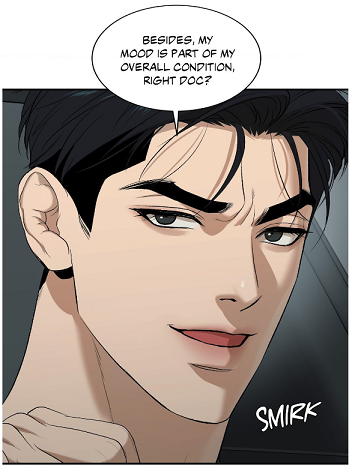 (chapter 32)
  (chapter 36)
  (chapter 37)
  (chapter 45) As you can see, little by little, the champion is learning to control his rage and “cynicism”. During the last argument, he didn’t touch the physical therapist at all. He still allows him to stay at his place and he is shown as caring later. (chapter 46) The irony is that Joo Jaekyung is not recognizing his own transformation. The most obvious evidence for his metamorphosis is the absence of his jealousy towards the doctor.
 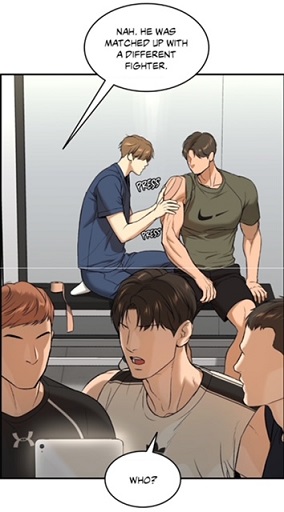 (chapter 47) It shows a certain trust. One might argue about this interpretation. This could be seen as indifference. However, I believe that his altercation with Seonho must have been quite an eye-opening for the champion.
 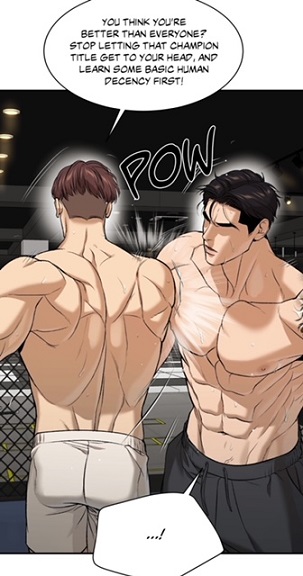 (chapter 46) It is because Kim Dan had not talked back to Joo Jaekyung during their argument. He had accepted his criticism silently contrary to Seonho. Right now, he has the impression that he still has the upper hand, but he couldn’t be more wrong.
Since the champion has such a long mistrust in people, Jinx-philes can grasp why the champion believes in the power of money.  (chapter 26) He has the impression that he can control people, since he is wealthy. Yet, he is not realizing that he can get stabbed because of money as well. We have two perfect examples. Because of the drug incident, the MFC security guys betrayed him, as they protected the organization
 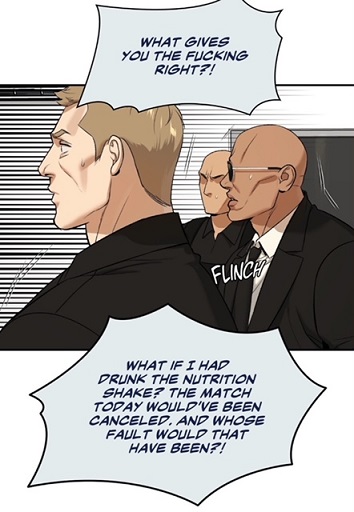 (chapter 40) Then in episode 47, the emperor got manipulated by his so-called loyal advisors.
 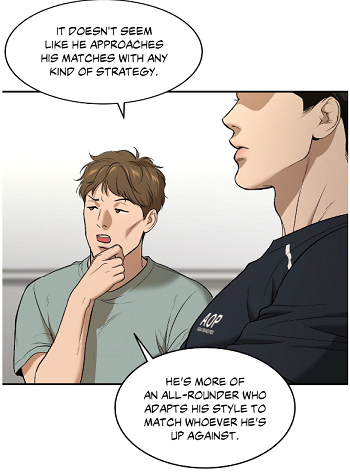 (chapter 47) First, I would like to outline that neither the manager from the Entertainment agency nor his acolyte brought up the underground fighting ring and Baek Junmin’s dubious success.
 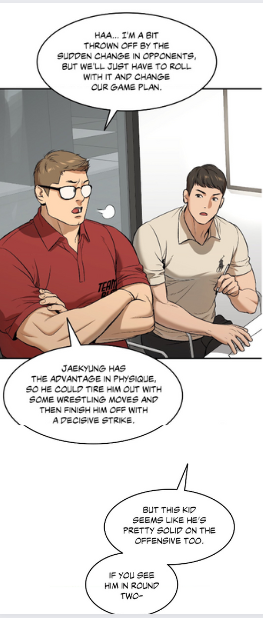 (chapter 47) With their video, they presented him as an average and reliable fighter. (chapter 47) Observe the divergence between the advisors’ words and the members’ from Team Black.
 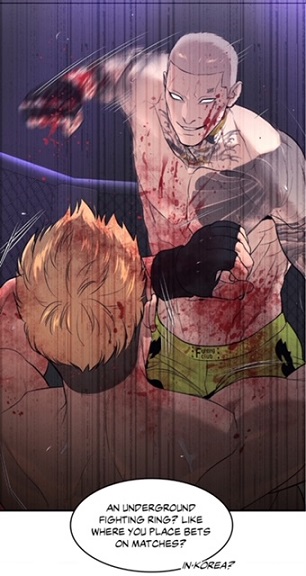 (chapter 47) The latter portrayed Baek Junmin as dangerous, for he would use any mean to win the fight. He doesn’t stand for fairness and responsibility. The champion didn’t get to hear anything about these rumors.
And how can the champion change his cynical view of life? Naturally, through pain… as he needs to be confronted by his fears. Nonetheless, I believe that the halmoni next to Kim Dan has a huge role in his healing as well. Since the latter is so weak and gentle, he doesn’t fear danger from her. 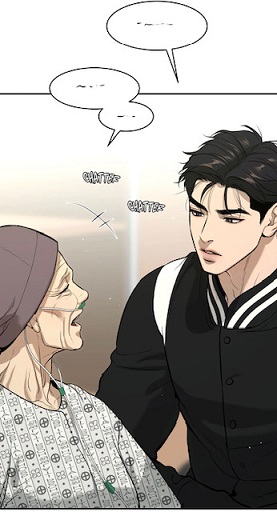 (chapter 21) Moreover, the grandmother’s mortality could serve as a reminder for the champion that he is also a human… just like the others he condemns. Besides, she embodies true selflessness and gratitude. Hence she took the champion’s hand to thank him
 (chapter 22) This is what psychologists recommend to overcome Cynicism:
Practice self-awareness and recognize cynical thoughts and attitudes.
Challenge negative assumptions and beliefs about others’ motives.
Seek support from friends, family, or a therapist to discuss and process emotions.
Engage in activities that foster positive emotions and a sense of well-being.
Cultivate empathy and understanding by considering others’ perspectives.
Focus on building positive and genuine relationships with trustworthy individuals.
Limit exposure to excessively negative media or influences.
Practice gratitude and focus on the positive aspects of life.
Adopt a more balanced and realistic perspective on human behavior.
Set realistic expectations for others while acknowledging imperfections. Read more here: https://mind.help/topic/cynicism/
As you can see, COMPASSION, GRATITUDE, MEDITATION and CONVERSATION play a huge role in changing the mind-set. So far, the couple never shared their fears and own thoughts. They still kept secrets from each other and they didn’t converse a lot. Moreover, the problem was that Kim Dan had acted in secrecy for the gift, which could only reinforce the fighter’s negative disposition. That’s the reason why I believe that Joo Jaekyung needs to learn through a positive experience that not all people are selfish and have ill intentions. He has to discover his own bias through the doctor’s reflection. He needs to receive unconditional love and respect: 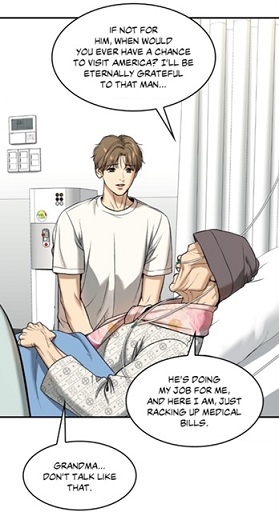 (chapter 41) He never heard her recognition. In addition, until now, Kim Dan spoke in the name of others or didn’t defend his own point. Team Black’s loyalty would be the evidence that it is dangerous to judge people based on prejudices and past experiences. He needs to reflect on his own actions as well. If the Emperor heard “his members”, he would realize that MFC as an organization is corrupted and is even involved with criminality. He is already sensing something, but he can not identify the problem.
 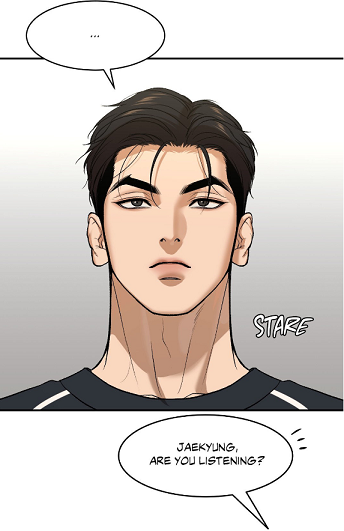 (chapter 47) Should Kim Dan divulge Baek Junmin’s connections to the underground fighting ring or simply show him the message, (chapter 47), he would prove his faithfulness and sincerity to the fighter. And the vicious circle would be broken. Though he is broke, he would give up on an opportunity to earn some money easily. To conclude, as long as the champion is still a cynical character, he can not enter a relationship with Kim Dan. For that, he needs to open up his heart and third eye so that he can recognize his partner’s selflessness and honesty. Finally, he will realize that he needs the assistance of others in order to be able to keep his reputation intact (witnesses, supporters). There is no doubt that the Emperor will be badmouthed again.
Feel free to comment. If you have any suggestion for topics or manhwas, feel free to ask. If you enjoyed reading it, retweet it or push the button like. My Reddit-Instagram-Twitter-Tumblr account is: @bebebisous33. Thanks for reading and for the support, particularly, I would like to thank all the new followers and people recommending my blog.
Please support the authors by reading the manhwas on the official websites. This is where you can read the manhwa: POTN But be aware that this Manhwa is a mature Yaoi, which means, it is about homosexuality with explicit scenes. If you want to read more essays about Painter Of The Night, here is the link to the table of contents.
It would be great if you could make some donations/sponsoring: Ko-fi.com/bebebisous33 That way, you can support me with “coffee” so that I have the energy to keep examining manhwas. Besides, I need to cover up the expenses for this blog.
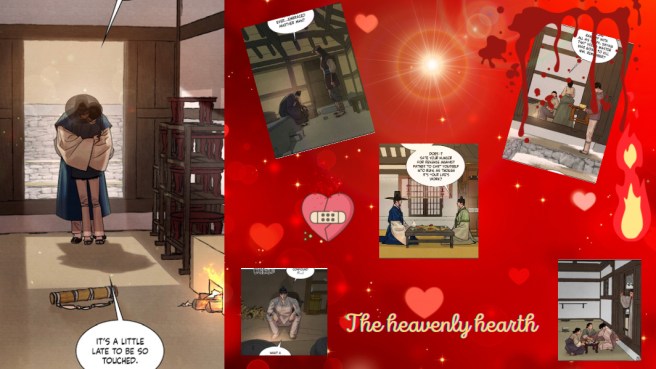
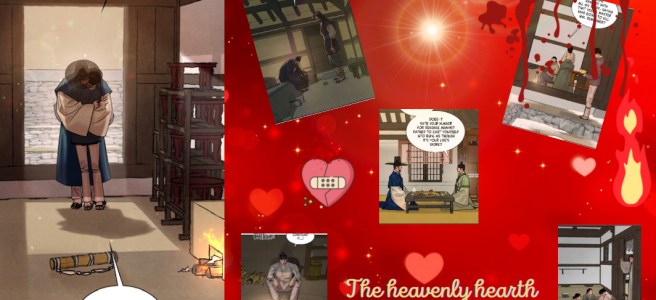
When many readers heard Yoon Seungho‘s statement  (chapter 119), they got worried and nervous, as they considered the expression „as long as I live“ as a clue for a sad ending. Why? It is because the lord was referring to his own death. Under this light, it becomes comprehensible why I selected „heavenly“ in the title. I was naturally alluding to the afterlife. However, I perceived his words in a positive light. He expressed his desire to live. He is no longer suicidal, he wishes to live a long life next to the painter and treasure his moments with him. That’s the reason why the author included the refraction in the scene. A dream had come true, the lord was finally able to escape the darkness.
  (Chapter 119) He is now truly alive. This explicates either why he smiled and laughed at the end. But why was he so happy? It is because Baek Na-Kyum had just confessed that he loved him not for his wealth or power, but for himself.
  (Chapter 119) He even described him as a treasure. Yoon Seungho had finally achieved his goal: to win the painter’s heart. His presence and love bring happiness to Baek Na-Kyum which stands in opposition to his reputation as bird of misfortune. Moreover, this description contrasts so much to Jung In-Hun
  (Chapter 119) and Yoon Seungwon’s.
  (Chapter 118) where both portrayed the main lead as a man consumed by lust and revenge. In other words, he was presented as a huge sinner. This implies that he stands so far away from heaven. But all these words were erased the moment the painter confessed his love for Yoon Seungho once again. What Baek Na-Kyum didn’t realize is that his love confession is pushing the protagonist to fight for the painter. (Chapter 119) If something were to happen to him, the low-born would be heartbroken and miserable. Baek Na-Kyum is his reason to live. Thus I consider this scene as the positive reflection from that terrible night:
 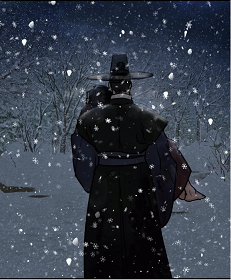 (chapter 102) In episode 102, he was renouncing on everything (life, mansion, wealth and connection), because he imagined that the artist had died. Consequently, I deduce that in episode 119, the painter’s life is attached to the lord’s for good. If the artist got into trouble, Yoon Seungho would side with him and the reverse. Thereby, I come to the conclusion that this moment in the kitchen represents their union, as they are no longer tied to the mansion. They are now a family no matter where they are. Let’s not forget that the painter expressed his wish to run away with his lover.
  (Chapter 119) It is important, because such a departure symbolizes that the bird “Yoon Seungho” is leaving the nest. He is now starting a family on his own.
Striking is that heavenly can be employed in a different context food. Let’s not forget that food is often served as offering to gods and spirits. Interesting is that in Asian societies, it is a tradition to offer the favorite dishes on the anniversary of the relatives’ death. As you can imagine, this custom was already practiced in Joseon. And now, take a closer look at this scene.

Yoon Chang-Hyeon was honoring his ancestors by bowing in front of the shrine. But what caught my attention is that in such an occasion, he should have brought food and his sons to such a ceremony. However, he just had lit incense 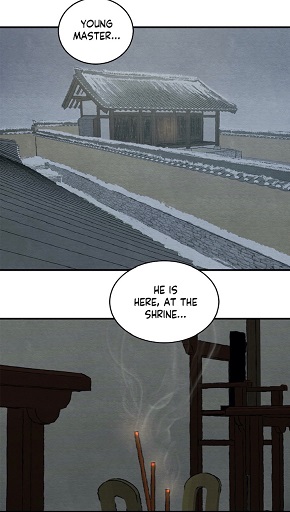 (chapter 85) and put a glass and that was it. This exposes the father’s hypocrisy, ignorance and greed. By acting on his own, he was exposing his true mindset. He views himself as the family. The sons are just the extension of himself, for they are his reflections.
Narcissists need a scapegoat to preserve their self-image, avoid taking responsibility for their actions, and to feel emotionally stable. Quoted from https://unfilteredd.net/why-do-narcissists-need-a-scapegoat/
As a narcissist, the father projects all his flaws onto Yoon Seungho, hence he is his scapegoat.  (Chapter 45) On the other hand, Yoon Seungwon is his golden child, for he represents his positive reflection.
A “golden child” is one who is considered “special” by their family and chosen as a proxy for a parent’s own achievements and magnificence. Unfortunately, the child must live up to perhaps unattainable levels of accomplishment and perfection. Being the golden child does not necessarily represent a positive familial position, and narcissistic parents frequently place this identity on one of their children. Quoted from https://www.choosingtherapy.com/golden-child-syndrome/
This explicates why in the bedchamber, the patriarch called his son a monster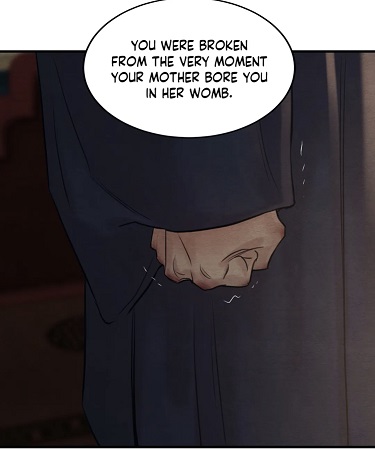 (chapter 86), whereas he put the other on a pedestal
 (chapter 86). Thus I created this illustration.
 Under this new light, it becomes comprehensible why the father could only reject the offer from lord Song in the gibang. Doubting Yoon Seungwon’s sexuality meant to question about the father’s sexual orientation. At the same time, it is not surprising why the elder master would blame Yoon Seungho for everything, for he couldn’t admit his responsibility for the purge. Consequently, the Manhwaphiles can grasp why Yoon Chang-Hyeon came alone to the shrine. If he had brought Yoon Seungwon, the father would have been reminded of the elder son, as both can not be separated. This explicates why the younger master asked his elder brother to submit to his father.
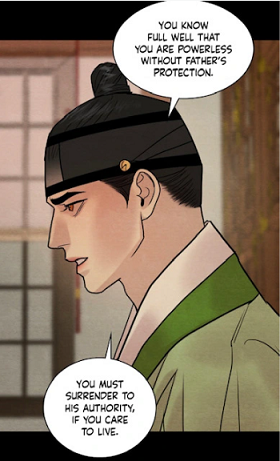 (Chapter 119) I couldn’t help myself smirking when the brother attempted to make him believe that.
 (Chapter 119) the protagonist could ever gain the father’s favor. Yoon Seungwon was definitely playing with his brother’s feelings, as if he could hope that their father would change.
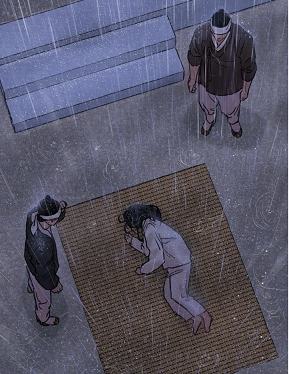
At the same time, his position as golden child explicates why the younger brother resents the father and betrayed him:  (Chapter 118) It is because as a golden child, he is also suffering, but it is naturally nothing compared to Yoon Seungho’s position who could have died.
  (Chapter 77)
Parents with NPD often shape one of their children into the golden child role. The golden child becomes an extension of that parent, and the child’s role is to please that parent. Narcissistic parents are unable to appreciate the golden child’s unique identity, and attempt to control their child’s interests and activities in ways that would reflect positively on them. They live vicariously through their golden child and they feed on their child’s successes, which serve as the parents’ narcissistic supply. Quoted from https://www.choosingtherapy.com/golden-child-syndrome/
Interesting is that psychologists said that it was easier for a scapegoat child to escape from this nightmare, as they can cut off ties more easily than the golden child who got used to special treatment. Moreover, the flaws from the patriarch rubbed off on Yoon Seungwon which often happens in such a toxic family. This signifies that for Yoon Seungwon, it is difficult to maintain good and healthy relationships in the end too. And now, you comprehend why the younger master made such a request to his brother. He needs him for two reasons.  (Chapter 119) First, by returning the petition to the father, Yoon Seungho would become the culprit. He was not only a traitor, but also a blackmailer of the Yoons and lord Song.
 (Chapter 107), for he had stolen the petition. Yoon Seungwon would hide his wrongdoing, he betrayed their father.
  (Chapter 118) There is no doubt that Kim played a role in this as well. In other words, the brother and the valet would bury the truth by diverting the attention of the patriarch towards the main lead, if Yoon Seungho followed this suggestion.
  (Chapter 116) The elder master would no longer seek the truth, similar to the kidnapping in season 2 which was turned into a desertion and later Lee Jihwa’s abduction occulting the instigator and the helping hands. Simultaneously, Yoon Seungwon needs his brother as scapegoat, because the pressure coming from the patriarch and lord Song must have definitely increased. (Chapter 119) How ironic that Yoon Seungwon employed the expression “care to live”. Back then, the protagonist was just surviving, he had already developed suicidal tendencies, when this incident took place.
  (Chapter 83) This shows that the young master wants to sacrifice his brother once again. Out of selfishness and cowardice, he is trying to convince Yoon Seungho that this is the right thing to do! (Chapter 119) This is a new version of this scene!
  (Chapter 37) He is even implying that he needs to sacrifice himself in order to protect Baek Na-Kyum!! Moreover, he is distorting the reality, because he implies that his father is still powerful. (Chapter 119) However, the purge took definitely place,
  (chapter 37) like the memories from episode 37 are exposing it. It becomes clear that if Yoon Seungho returned the petition, he would die.
 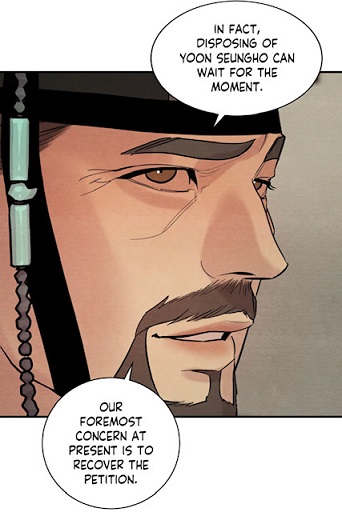 (Chapter 116) Thus I come to the conclusion that the meeting between the brothers in the gibang represents an offering. For the Yoons’ sake, Yoon Seungho should admit his wrongdoings (Chapter 119) and beg for forgiveness. Thus I interpret the scene in the kitchen hearth as true hope (chapter 119) while the table with many dishes in the gibang stands for fake hope and offering. (Chapter 118) It was, as though Yoon Seungwon was giving his brother his last meal before his sacrifice. This situation exposes that in the past, the main lead had been put in a similar situation, covering up for the brother’s mistake.
  (Chapter 55) People had played with his hopes and longing for acceptance and recognition. Interesting is that offerings is a synonym for atonement and sacrifice. But why is Yoon Seungwon so sure that he can repeat the same action from the past? It is because Kim and Yoon Seungwon have known for a long time that Yoon Seungho was longing for acceptance and love from his family, just like the scholar knew about the painter’s love for him.
  (Chapter 119) But everything changed, when the painter met the lord. So who is worse here? Jung In-Hun who tried to rape the painter or Yoon Seungwon who is sentencing his elder brother to death? Let’s say that the valet convinced the younger master to suggest this solution, this doesn’t diminish Seungwon’s responsibility at all. He knows that his father abused his elder brother. In my opinion, he is copying his father, like the former tried to diminish the responsibility of the patriarch.
 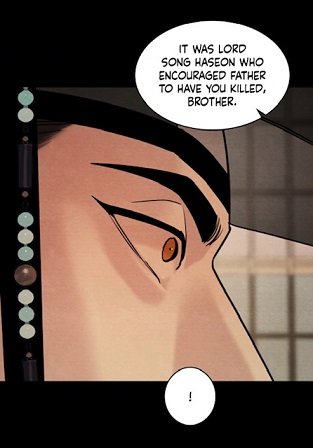 (Chapter 119) Yoon Seungho got hurt because of lord Song and not because of Yoon Chang-Hyeon. This means that the younger master was denying the existence of the patriarch’s choice and the helping hands. And if the brother listened to his advise and the father hurt or killed the main lead afterwards, the younger master could put the blame on the elder master, for the decision and responsibility belonged to the patriarch. Moreover, he heard from lord Song that killing Yoon Seungho was just a matter of time. (Chapter 116) Fact is that the younger master is betraying his brother once again.
Yet, the former is making two huge mistakes. He is considering the painter as a servant (chapter 119), therefore he believes that the artist is tied to the mansion. Secondly, I am quite certain that his perception about the artist is influenced by Kim. This signifies that the latter is also projecting his own thoughts onto the painter, for he is himself a narcissist. The latter is interested in wealth and comfort. If he came to lose everything, he would abandon Yoon Seungho, that’s what Kim is envisaging. Thus if Yoon Seungho were to submit himself to the father, Baek Na-Kyum would lose everything. Besides, I am even thinking that Jung In-Hun’s approach in the gibang is also related to the brother and the butler. All of them had an interest to separate the couple! And note that when the lord went to the noonas’ room, it looked like the painter had deserted him.  (Chapter 119) So technically, this situation could have triggered the protagonist’s insecurities like in season 1
  (chapter 28), 2
 (chapter 60) and 3
 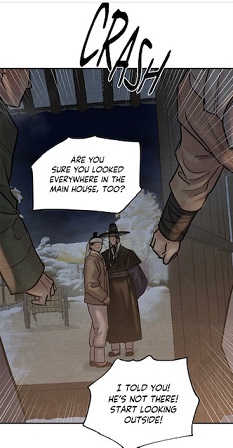 (chapter 98). However, through these constant exposures, Yoon Seungho came to learn not to jump to conclusions and to have faith in Baek Na-Kyum. He knew that he would return to the mansion. Hence he ran to the bedchamber first.
 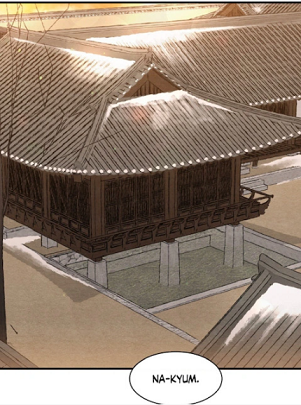 (Chapter 119) Another important detail is that we don’t see any staff in the courtyard or in the kitchen. It was, as if the propriety had been deserted.
 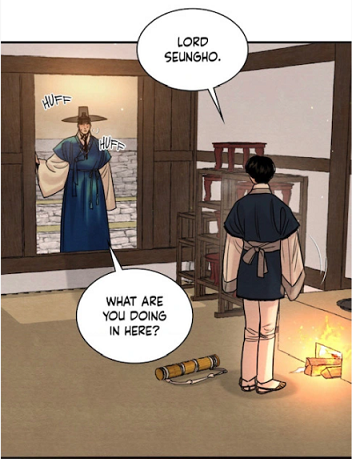 (Chapter 119) This implies that at no moment, he relied on the domestics’ testimonies which contrasts to the following scenes: (chapter 98)
 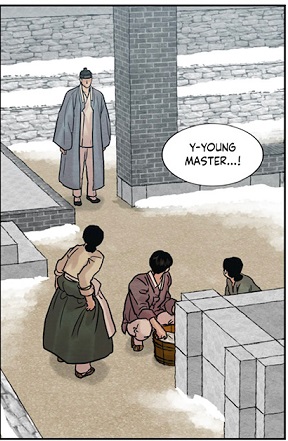 (chapter 104)
 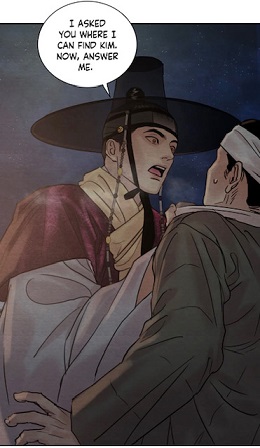 (chapter 107) and
 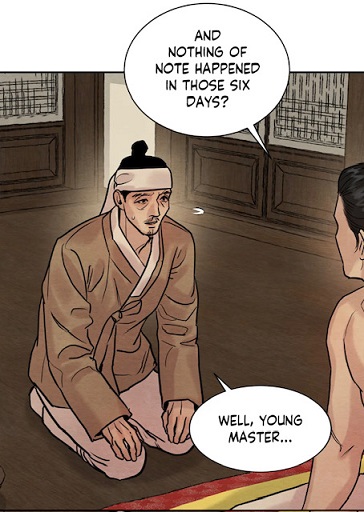 (chapter 116) However, observe that in episode 116, Yoon Seungho had witnessed how his lover had taken care of him, while he was unconscious. Furthermore, the petition had been handed over to the painter and not Kim, a sign that the artist had become the protagonist‘s confident. As you can see, as time passed on, the main protagonist learned the following lessons: he should stop relying on servants, he should only trust his partner. I would even add that he was taught the following principle: “If you want something done right, you have to do it yourself”. In my eyes, (chapter 119) the scene in the kitchen is exposing the betrayal from the staff, that’s the reason why we see no one! They were either expecting their lord’s return and imagined that he would be upset or even violent! At the same time, by not meeting the artist, the servants could feign ignorance about the lover’s whereabouts and claim their innocence. The proof is that this scene (chapter 119) is the positive reflection from that night:
  (Chapter 103) Here, they never expected the return of Yoon Seungho and the painter. The staff ‘s absence in episode 119 is the evidence of their desertion! Moreover, I consider Yoon Seungho’s search for his lover as a new version from episode 28/29/30:
  (chapter 28) Back then, they feigned ignorance, but they never anticipated a punishment from Yoon Seungho.
And this leads me to the following observation: Baek Na-Kyum’s action in the kitchen reminded me of an offering! (Chapter 119) Why? It is because he burned a paper. The evidence for this is the presence of the painter’s belongings. This is the place where he used to hide the scholar’s poem (chapter 4). Moreover, the painter is standing in front of the hearth which certainly triggered the manhwaphiles’s memory. Jung In-Hun was seen in front of the hearth burning the letter from Min in order to hide his involvement in the painter’s sexual abuse. 
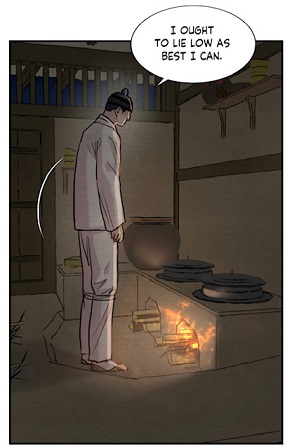 (chapter 115) And now you are wondering how the painter’s gesture can be considered as an offering. It is because the kitchen hearth is considered as sacred due to the fire. First, in shamanism, there exists the god of fire named Jowangshin.
The origin of Jowangshin is the fire of the home. But their realm also extends to the area that uses fire and water harmoniously. It is good etiquette to brig a set of matches when you move to a new house. One can enshrine the house god with an onggi of water placed on/above the stove or utilizing sacred mulberry paper put up on the wall in the kitchen. (…) Jowangshin is the emissary of heaven and will ascend to report the wrongdoings of the home’s inhabitants to Hwanin, God of Heaven. https://www.firelightlotus.com/post/jowangshin-god-of-the-kitchen
In China, people had a similar belief.
Zao Shen, Wade-Giles romanization Tsao Shen, in Chinese religion, the Kitchen God (literally, “god of the hearth”), who is believed to report to the celestial gods on family conduct and to have it within his power to bestow poverty or riches on individual families. Because he is also a protector of the home from evil spirits, his periodic absences are thought to make the house especially vulnerable to becoming haunted at such times. Zao Shen’s identity in life and in the history of his cult are uncertain. The god of the kitchen has also been confused with Huo Shen (god of fire) and with Zao Jun (“Furnace Prince”). Quoted from https://www.britannica.com/topic/Zao-Shen
As you can see, the kitchen is a sacred place. This explicates why next to the hearth, people had to follow the following rules:
- Do not curse while in the hearth.
(Chapter 115)
2. Do not sit on the hearth.
(Chapter 59)
3. Do not place your feet on the hearth.
(Chapter 98)
(Chapter 115)
4. Maintain the cleanliness of the kitchen.
(Chapter 47)
5. You may worship other deities in the kitchen. Quoted from https://en.wikipedia.org/wiki/Jowangsin
That’s how I realized why Byeonduck mentioned that lord Min would help Yoon Seungho. Note that Jung In-Hun cursed lord Min (chapter 115), when he burned the letter! Moreover, let’s not forget Black Heart’s claim during that night: Lee Jihwa  (chapter 102) who was a traitor, for he had tattled on Black Heart and his friends to Yoon Seungho. And now, you comprehend why I connected the shrine to the kitchen hearth. Both places are considered as sacred, for they are connected to gods and spirits.
And now it is time to return our attention to Yoon Chang-Hyeon.  (Chapter 85) The absence of his sons and of food as offerings reveals that he was not showing true respect to his ancestors. He used religion and social norms to hide his true intentions. He wanted to take over the mansion. Hence the black guards were standing at the entrance of the sacred house. Their presence symbolizes violence. Therefore it is not surprising that the gods chose to punish the elder master through Yoon Seungho. The former was not received properly
 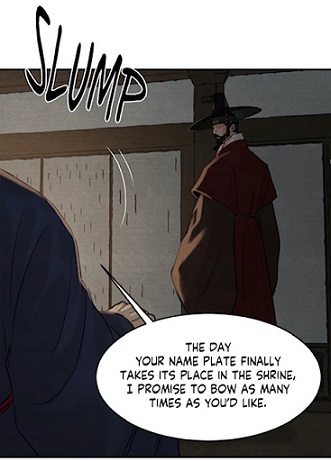 (chapter 86): no bow, no food and no seat.
  (Chapter 86) Let’s not forget that the elder master had entered the lord’s chambers without the permission of his owner. No wonder why he was left speechless. And now, you are wondering if I am not drifting away from the topic, as these chapters from season 3 don’t seem to be connected to episode 119. However, it is important to realize that these chapters have many common denominators
| Chapter 85-86-87 | Chapter 119 | |
| Death |   Here, we could detect the suicidal tendencies of the protagonist. He wouldn’t fight back. Here, we could detect the suicidal tendencies of the protagonist. He wouldn’t fight back. | Here, he wants to live and as such to fight back in order to protect his lover. |
| Coup d’Etat |  The seat looks like a throne. The seat looks like a throne. | Yoon Seungwon advises his brother to admit submission. It is like a surrendering. |
| The fire |  | Note the contrast. In the furnace, the fire was not properly lit. This explicates why the bedchamber didn’t get destroyed by the fire during that night. |
| The absence of the staff |  The courtyard is empty! No one is defending their master. The courtyard is empty! No one is defending their master. | No one is working in the kitchen. |
| A quarrel with a slap |  |  |
| Someone is out of breath |  | |
| Treason |  | 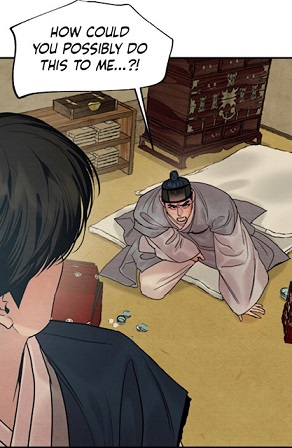 |
| Threat |  | |
| Sexual assault in the gibang | 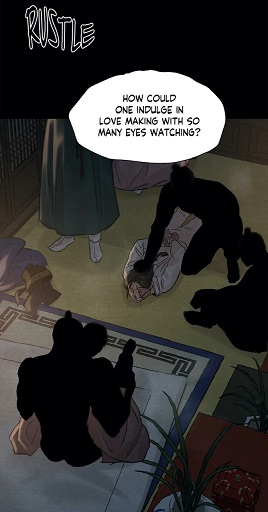 |  |
| A sudden kiss |  |  |
| the importance of family | | |
| The indirect reference to religion (curse, heaven versus hell, faith/trust) |   | |
| Wishes (ambition, dream) | | 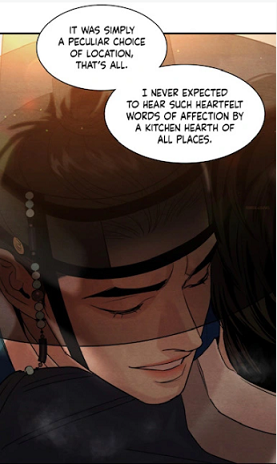 |
| Yoon Seungho portrayed as a depraved monster |  |  |
| An important paper/ document |  | |
| Jung In-Hun |  | Baek Na-Kyum not only wounded the learned sir, but also humiliated a person who passed the civil service examination. He is now a military official. |
| The painter’s escape | He was supposed to remain in the study. Kim allowed him to leave the room. |  Baek Na-Kyum freed himself. Baek Na-Kyum freed himself. |
As you can see, the night from episode 85 to 87 corresponds to the day in chapter 119. And now, it is time to examine the meaning behind this connection. First, the contrast between these two scenes reinforces my interpretation about the butler. At the beginning of the noble‘s suffering, the valet was ignorant, just like the painter is still unaware of the nobles’ death. But it is no longer the case. In episode 85, (chapter 85) he had faked his breathlessness. First, he didn’t need to run from the kisaeng house like Yoon Seungho. The kitchen, the gate or the servants’ quarters are not far from the study. Besides, why did Kim run in the end, when he joined the study? Contrary to his master in episode 119, he knew about his master’s whereabouts, for they had taken their lunch there.  (Chapter 85) The study is even close to the gate.
  (Chapter 51) He could have reached the study before the father entered the shrine. Finally, observe that the patriarch even arrived to the bedchamber before Yoon Seungho, (chapter 86) though the study is close to the host’s chamber. As you can see, paying attention to the location of the different rooms exposes the betrayal from the staff and especially from the butler. He had been listening to their conversation, hence he knew about their quarrel. Interesting is that in the kitchen, the lord’s wish got fulfilled.
 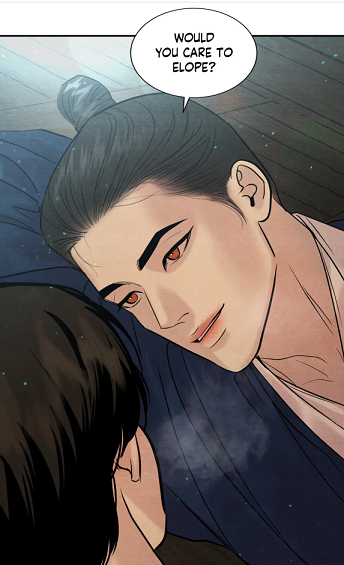 (Chapter 117) The painter wants to leave everything behind too.
  (Chapter 119) Thus I am deducing that the authorities will be involved very soon. (Chapter 86) Why? It is because someone desires to take over the mansion.
  (chapter 119) They are not expecting the lord‘s resistance, for he remained passive all this time (season 2 and 3). The scholar has now the means to do so, and the necessary motivation. Imagine that he got wounded and humiliated by the couple! Besides, we have this broken promise due to Yoon Seungwon
  (Chapter 115) exposing the younger master’s lies and Yoon Chang-Hyeon’s delusions. Without the protagonist’s help, the younger brother would not be „successful“. Furthermore, the absence of food and fire in episode 86 indicates that this house was neglected and even not protected. (Chapter 86) It explains why the argument between father and son oozed hatred, coldness and looked like war! The hearth symbolizes home, family, warmth, love and protection.
Under this light, it is no coincidence that this new confession took place in the kitchen. At the same time, the kitchen hearth symbolizes humbleness and honesty, which stands in opposition to the love confession in the kisaeng house.  (Chapter 94) The gibang is connected to money, power, pleasure, artificiality, sensuality and lack of privacy.
  (Chapter 96) I am sure that you can detect all the contrasts (night, door close, spies, confession outside and inside, no fire, only light). Thus I am deducing that the painter’s words in the kitchen were not heard by others. As you can see, this scene in the kitchen is full of symbolism. In my previous essay “The true face of family”, I had already pointed out that sharing meals represented a criteria to define a real family. Therefore I had demonstrated that Yoon Seungho and Baek Na-Kyum were excluded from the mansion, for they wouldn’t eat their meals in the kitchen like the staff.
  (Chapter 17) Moreover, the hearth doesn’t just provide warmth, but also light! The latter embodies knowledge and as such Enlightenment.
  (Chapter 119) Hence they were clueless about the wrongdoings from the staff. Only in the kitchen, the lord could finally grasp the depth of Baek Na-Kyum’s love for him. It is an unconditional love contrary to Yoon Seungwon’s. The latter would only recognize him, if he listened to him. And he only seeks his assistance, when he needs him. It shows that Yoon Seungho is only approached, when he has power.
  (Chapter 118) (chapter 119) Moreover, because they are embracing each other in clothes, it exposes that their love is pure and not driven by lust. This scene contrasts so much to his meeting with his brother, for the latter never hugged him. He kept his distance from his brother.
 (Chapter 119) I would like to outline that during their conversation, Yoon Seungwon remained calm and indifferent, when he talked about the assassination attempt from Yoon Chang-Hyeon.
 (Chapter 116) But the biggest difference is the absence of fire in the kisaeng house. (Chapter 118) This reflects the lack of empathy from Yoon Seungwon.
Striking is that the couple stood at the entrance of the kitchen, when the painter declared his unconditional love to the noble. (chapter 119) It was, as if two worlds were meeting. Simultaneously, the door step symbolizes the gateway to new opportunities. In other words, it announces changes. Moreover, the embrace and the lord’s words expose that Yoon Seungho is focusing on the present moment and the future. This means that he is now moving on and as such cutting ties with the past! How ironic that Yoon Seungwon’s recommendations came true! (Chapter 118) Nonetheless, I doubt that he is including his brother and father in his future plans. For me, the noble’s words spoken in the bedchamber will become a reality:  (chapter 78) Furthermore, he tried to leave before
 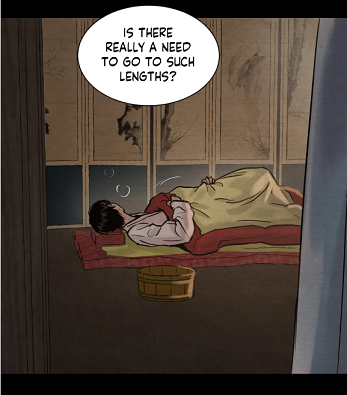 (Chapter 104)
  (chapter 105) Finally, we saw him in the courtyard standing next to a horse and a servant indicating that he had given him a task, and the latter needed to leave.
  (Chapter 108) Hence you comprehend why I am full of optimism in the end. Yoon Seungho has already made some preparations in my opinion. On the other hand, I am quite certain that their love will be tested. Can they face together trouble? Yes, because through their pain, they learned their lessons and changed.
But why didn’t Yoon Seungho expect that he would be blessed next to the kitchen hearth?  (Chapter 119) It is because in the past, he was never allowed to join the kitchen hearth. This place was either beneath him or he was not worthy of entering the place. Thus he employed the expression scullery boy to Yoon Seungho.
 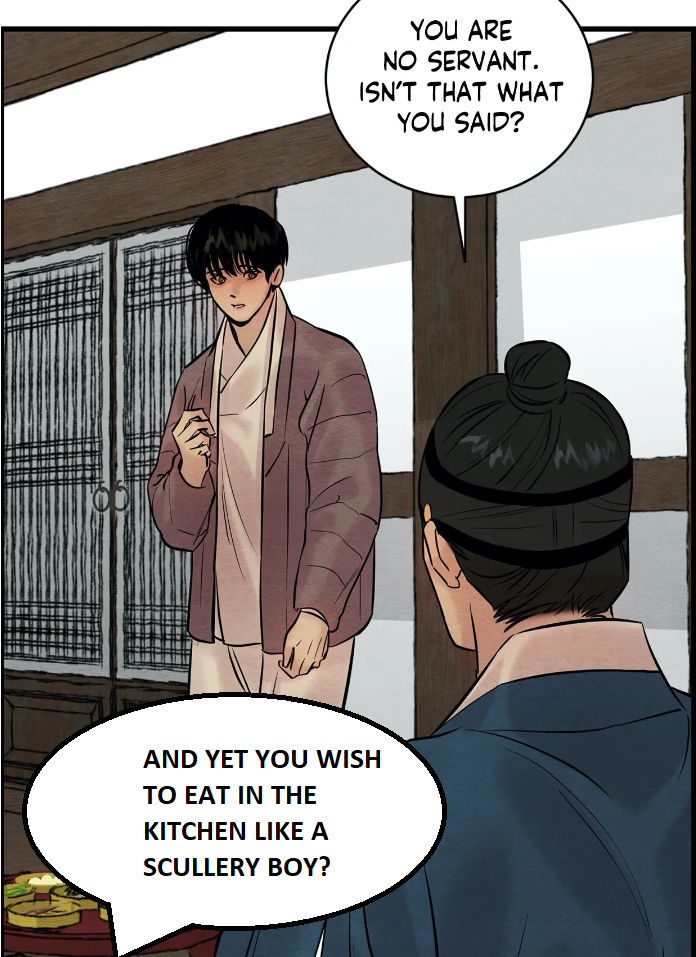 (Chapter 47) Here, I would like to outline that when the protagonist was held in the shed, someone brought him food .
  (Chapter 83) That‘s how I realized that the shed is connected to the kitchen!
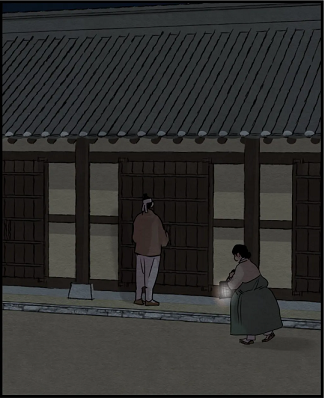 The maid had just brought water to the couple.
 During that night, Baek Na-Kyum had been held captive in a shed.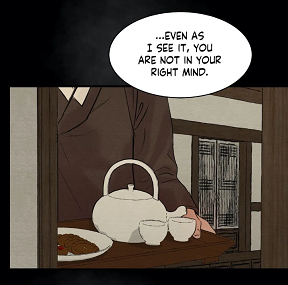
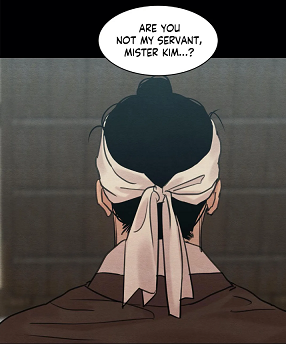
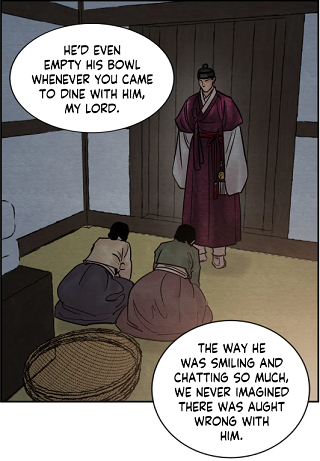

And what is the common denominator between these scenes? Kim was responsible for the kitchen and the shed. This observation brings me to the following conclusion. Then, you know why Yoon Seungho could never imagine that in the kitchen hearth, he would experience unconditional love. It is because the valet never allowed Yoon Seungho to enter the kitchen! And now take a closer look at this scene: 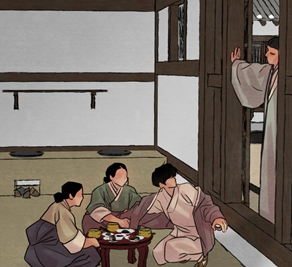 (chapter 38) Yoon Seungho remained outside on the door step. Consequently, I started comparing scenes where the kitchen hearth appeared and that’s how I discovered a pattern:
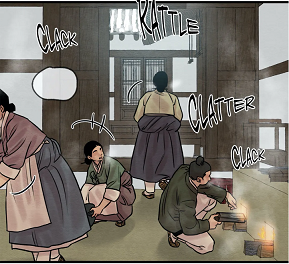
 (Chapter 46)
 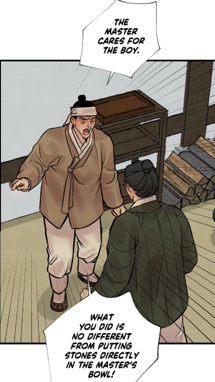 (chapter 47) (Chapter 98)
  (Chapter 110)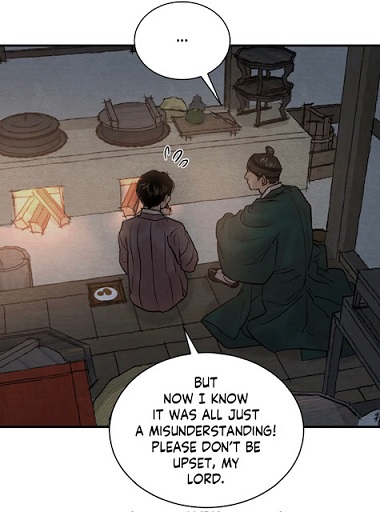
 (Chapter 77)
 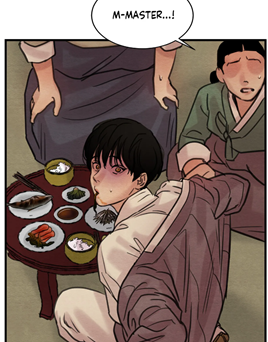 (chapter 38)
 (chapter 59)
  (chapter 119)
 (chapter 38)
  (chapter 47)
 (chapter 77)
  ( Chapter 110)
  (chapter 119)
  (chapter 47) (chapter 38) (chapter 110)
 To sum up, the kitchen is connected to a wrongdoing, an apology, a confession, a fire and a quarrel. Where was Baek Na-Kyum during the abduction? In a shed, while Lee Jihwa was arguing with No-Name!! That’s how I realized that the gods wanted to teach Kim a lesson. In the past, the butler should have invited Yoon Seungho to the kitchen hearth so that he would have found a family among the staff. Remember how the servant scolded the valet, it is because Kim must have taken pride to be the elder master’s servant.  (Chapter 77) For me, Kim must have looked down on the other domestics. I consider this scene as the best example what Kim should have done in the past. (Chapter 119) He should have brought him to the hearth and hugged him. That’s why Lee Jihwa got embraced during that night. Kim should have comforted him and made him smile! The father wouldn’t have noticed it, for there is a second entrance. The evidence is here:
 (Chapter 119)
  (Chapter 98) One door leads to the backyard and the other to the smaller courtyard. And this scene confirms my previous assumption
The kitchen is detectable thanks to the big wooden door in the smaller courtyard. However, I am quite certain that there’s a second access to the kitchen. They need to have an easy access to the jars situated in the backyard close to the walls. (…) This means that from the kitchen, if you follow the wall, you can pass by the lord’s bedchamber. And if you follow this path, you will discover the pond with the pavilion. Quoted from https://bebebisous33analyses.com/2022/03/31/painter-of-the-night-a-guided-tour-of-yoon-seunghos-domain🏡/
This means that Kim could have done something in the past.  (Chapter 87) Baek Na-Kyum is there to prove him wrong. He had other opportunities, like giving him a good meal.
  (Chapter 63) He should have sided with his master and even remained by his side. This signifies that this scene (chapter 83) exposes the butler’s betrayal and wrongdoing. Thus I conclude that the painter will show to the valet his cowardice and his treacherous nature.
(Chapter 119) So by burning the poem  (chapter 7) the artist is not only cleansing the kitchen, but also cutting off ties with the scholar. The latter is no longer protected. The spirits will intervene through chance. As a conclusion, the hearth has a spiritual and healing power, for it is connected to „Heaven“. Yoon Seungho‘s paradise is to have a family.
Feel free to comment. If you have any suggestion for topics or manhwas, feel free to ask. If you enjoyed reading it, retweet it or push the button like. My Reddit-Instagram-Tumblr-Twitter account is: @bebebisous33. Thanks for reading and for the support, particularly, I would like to thank all the new followers and people recommending my blog.

Please support the authors by reading the manhwas on the official websites. This is where you can read the manhwa. https://www.lezhinus.com/en/comic/painter But be aware that this manhwa is a mature Yaoi, which means, it is about homosexuality with explicit scenes. If you want to read more essays, here is the link to the table of contents: https://bebebisous33analyses.wordpress.com/2020/07/04/table-of-contents-painter-of-the-night
It would be great if you could make some donations/sponsoring: Ko-fi.com/bebebisous33 That way, you can support me with “coffee” so that I have the energy to keep examining manhwas. Besides, I need to cover up the expenses for this blog.
I have to admit that chapter 109 left me wanting more, for the story barely moved on. Technically, only a few minutes elapse between the end of episode 108 and 109. The former begins with the painter’s arrival in the library and the latter ends with Yoon Seungho’s shocked expression:  (chapter 109) He discovers that Baek Na-Kyum has already prepared himself, as he is longing for him.
  (chapter 109) He never expected such a reaction. The reason why the evolution of Painter Of The Night is flowing at a snail’s pace is that season 4 is now focusing more on the past. First, Byeonduck needs to divulge the lord’s suffering and its causes. And this can only happen, if memories are brought up. Hence in episode 109, the painter’s memories stood in the center. Why? It is because he is trying to understand why his loved one is now avoiding him. Thus he is remembering what happened just before. The readers are actually put in the same situation than the artist. On the one hand, the focus on recollection is a method to unveil how the young master was turned into a “sodomite and pariah”, for the painter is going through the same experience than his partner. In episode 109, he is isolated from his “lover” and as such from his family, for he has now maids by his side. The latter are supposed to be his new “family”. On the other hand it helps the manhwaphiles to anticipate the future main events,. as the progression is in slow motion. This means, the Webtoonist left all the elements in the previous seasons in order to decode the past, the present and the future. That way, the manhwalovers are capable to unveil the mystery. Besides, the author has to answer all the questions the beholders had while reading the previous seasons, like this one:
  (chapter 27) What book was the scholar looking for? Up to now, we have no clue, though I had developed the following theory: Jung In-Hun was a Christian and had a bible.
What caught my attention in chapter 109 is the falling book!  (chapter 109) How did this happen? One might reply that the book fell from the shelf, when the painter kissed his lover.
  (chapter 109) This interpretation can be easily refuted, for the noble stood next to the shelf and not in front of it. Besides, the counter stands on the noble’s left, while the ledger was on his right. However, one detail caught my notice, the beholder can not see Yoon Seungho’s hands!! That’s how I realized that the book came from the protagonist! He had carried it hidden in his right sleeve. This explicates why the book stands on the right side.
  (chapter 109) Besides, contrary to the previous panel, now the lord’s hand is visible! This is no coincidence. But if he was hiding the copy from Baek Na-Kyum, I deduce that it is related to the painter. But there is another person associated to manuscripts in this story, Jung In-Hun!! But what have the low-born and the scholar in common then? The erotic publications!
  (chapter 34) Note that in the background, there’s a book open on the desk, and it has the exact opposite position than in episode 109! And now, you comprehend why Yoon Seungho rejected the painter’s company next to his table. He didn’t want him to see the publication, for he feared that the painter would be reminded of Jung In-Hun. In the lord’s mind, the young artist still treasures his former teacher. He heard his confession on the bridge next to the pavilion.
  (chapter 94) However, Yoon Seungho is suspecting that the learned sir was behind the trick in the shaman’s house due to the glasses Min had in his hand before dying.
  (chapter 102) Hence he doesn’t want to break the main lead’s heart and mind. In other words, the main lead is determined to hide the past from Baek Na-Kyum so that the latter’s memory and agony won’t be triggered. The book could definitely remind the low-born of all the events which led to the massacre in the shaman’s shrine. Besides, I feel that the noble must feel guilty as well. If only he hadn’t admired the erotic publications which led to Baek Na-Kyum’s stay in his mansion. Consequently, I think that the noble is also in agony because of the work.
So far, I didn’t prove that the copy was an erotic publication. This is just a speculation from my part. But like mentioned in the introduction, the clues are all left in the previous seasons, for the story is constructed like a kaleidoscope. That’s why I included it in the illustration.  However, there exist two reasons why I came to this deduction. I detected similarities with the first encounter between Yoon Seungho and his nemesis in the scholar’s home and the painter’s kisses.
First, let’s start with a comparison with episode 6. Here, the lord was holding a book while interrogating the learned sir.  (chapter 6) Both were standing in front of the cupboard, while the learned sir suddenly took away the copy and closed it to put it back on the cupboard. This made the protagonist smirk. Due to the characters’ reaction,
  (chapter 6), I had assumed that the protagonist was making fun of Jung In-Hun. He had played a prank on the host, especially after asking about his occupation. I have always wondered about the content of the volume. Therefore I had developed the idea that this could be the bible. However, it was clear that the book was not for children which is visible due to the writing.
  (chapter 6) In fact, the learned sir should have the manual Thousand Character Classic (Chinese: 千字文; pinyin: Qiānzì Wén), also known as the Thousand Character Text.
“The Thousand Character Classic has been used as a primer for learning Chinese characters for many centuries. It is uncertain when the Thousand Character Classic was introduced to Korea.” Quoted from https://en.wikipedia.org/wiki/Thousand_Character_Classic [I usually avoid wikipedia, but here I was not able to find another source mentioning Joseon and classic book]
The main lead was holding the evidence for Jung In-Hun’s hypocrisy. That’s the reason why the learned sir was forced to admit that he wasn’t dedicated to his job.  (chapter 6) In reality, he wasn’t teaching them reading and writing at all. But Yoon Seungho had feigned ignorance with this discovery. With his indifference and praises, the false teacher had the impression that he was supporting his attitude. This scene is relevant, because the learned sir had lied to the protagonist about the painter’s education.
  (chapter 6) This means that the book represents the evidence of learned sir’s betrayal and abandonment. He is responsible for his illiteracy. To conclude, this scene contains the following elements: a prank, a lie, a confession which was triggered by a book that Yoon Seungho had picked up by chance. But wait… it could be the book from the scholar’s home!
  (chapter 06) But this image can be used to refute this theory. How so? It is because this book has a title, hence there is a white rectangle!! However, take a closer look at the copy on the floor. (chapter 109) There is no white rectangle and as such no title! Why? It is because the publication is illegal, for sodomy was condemned by Joseon society and traditions. According to me, the tailor was involved in the erotic publications. Besides, compare it to the manuscripts in the learned sir’s bedroom!
  (chapter 50) Finally, I would like the readers to keep in mind that they could only see the content of the books
  (chapter 1), but they never got the chance to see the cover.
Now it is time to return to our contrast between chapter 6 and 109. Since the scene in the library from episode 109 represents the positive reflection from chapter 6, this signifies that the characters must have behaved the opposite way. And what did the noble do in the library? He made sure that the painter wouldn’t come close to the table, while in episode 6, the host did the exact opposite.  (chapter 6) He proposed him to sit and have a cup of tea to divert his attention from the books on the cupboard. Besides, I would like to outline the huge contrast between these two scenes. The scholar needed the assistance of the prestigious family Yoon, while the protagonist replied this to his loved one:
  (chapter 109) Needed versus not necessary!
Finally, in the same chapter, the scholar admitted that he had scolded Baek Na-Kyum, but he never revealed what he had truly done and why. (chapter 6) He was here very vague (“bizarre and vulgar”), he spoke of a scolding, but never of rejection and abandonment!! This is important, because Yoon Seungho also experienced something similar in the shed:
  (chapter 77) Back then, the butler’s words must have wounded him terribly, he must have felt dirty either. Under this new perspective, it becomes comprehensible why I came to this conclusion that the book is related to the learned sir and to the erotic publication. But this doesn’t end here. In my eyes, episode 109 clearly outlined the importance of the library in the protagonists’ life. This is the place where both main leads got betrayed and abandoned.
  (chapter 40) When the scholar wounded the artist with his words, he implied that the artist was responsible for his lack of education. With the idiom “I thought, you could be educated”, he gave the impression that he had put some effort, but due to the artist’s disposition, he had failed. We had another scene where the learned sir was blaming Baek Na-Kyum.
  (chapter 70) He would fall asleep instead of studying. And who knows about the learned sir’s hypocrisy? Yoon Seungho!! That’s the reason why the goddess Byeonduck let them meet in the library. It is to heal their wounds. In this room, Yoon Seungho’s suffering started and later, the painter got betrayed by his former teacher, someone whom he viewed as his “family and mentor”.
But like mentioned above, I identified the publication thanks to the painter’s kisses as well. That’s the reason why these kisses are in the center of the illustration, where I chose a kaleidoscope in the background.  When Yoon Seungho got kissed by the painter
  (chapter 109), he got surprised, and he had the same gaze and facial expression than the one during the First wedding night
  , in the gibang
  and in the study
  (chapter 42), though here the artist kissed his companion twice!
  (chapter 49) And what had these scenes in common? Paintings and the artist’s confession. And now, you comprehend how I made the connection between the book and painting.
In episode 19, the artist had been asked to show his latest creation to the guests, and Min was present.  (chapter 19) This scene could only break the artist’s heart, because he was reminded of the learned sir’s reaction: his rejection. The latter got angry and jealous that the low-born would be treated as someone special. Furthermore, Jung In-Hun had only got the noble’s sponsorship thanks to Baek Na-Kyum and not thanks to his own talent! In verity, the learned sir had been the tool to submit Baek Na-Kyum. Shortly after the exposition, the protagonist went to the study. There he got confused for Jung In-Hun, hence he received a wonderful confession
  (chapter 19) before getting kissed and embraced!
In episode 42, the lord noticed the artist’s agony, but he blamed the learned sir.  (chapter 42) Yet, the artist was unable to explain the situation, for he had internalized Jung In-Hun’s criticism.
  (chapter 42) So we could say that the yangban tried to get a confession from the painter, but he failed. Hence they had just sex. The artist’s heartbreak was the reason why he never got to confess the truth! And what had happened in the study after the painter kissed the main lead? The lord saw the inauguration illustration and got jealous of Jung In-Hun (chapter 42)
Then in season 2, the painter had voiced his perception of his sex partner  (chapter 48), and the painting had exposed the main lead’s uneasiness and pain. The drawing was not refined, barely finished.
  (chapter 47) The behavior from the painter and the new painting had not only wounded the main lead, but also pushed the lord to discover why the artist was behaving this way. After the rough sex session, the artist had made a confession: he was dropping the rules he had been raised.
  (chapter 49) He was admitting his sexual orientation and his own pleasure, but he still kept his distance from Yoon Seungho. Why? It is because he was reminded of the learned sir’s fake embrace and betrayal.
 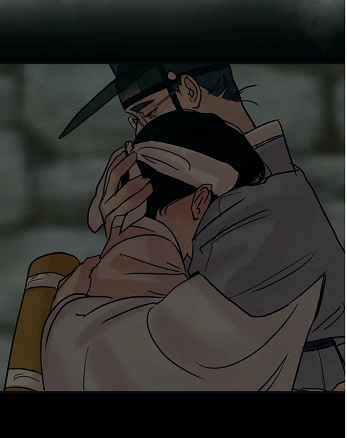 (chapter 49)
Finally, in the kisaeng house, the noonas had shown the artist’s paintings 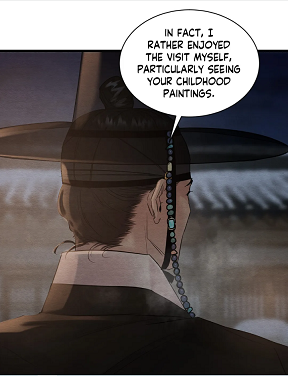 (chapter 94) which incited the artist to recall his childhood. That’s how he came to unveil his past and confess his love to the noble! (chapter 94) And what do have all these kissing scenes in common?
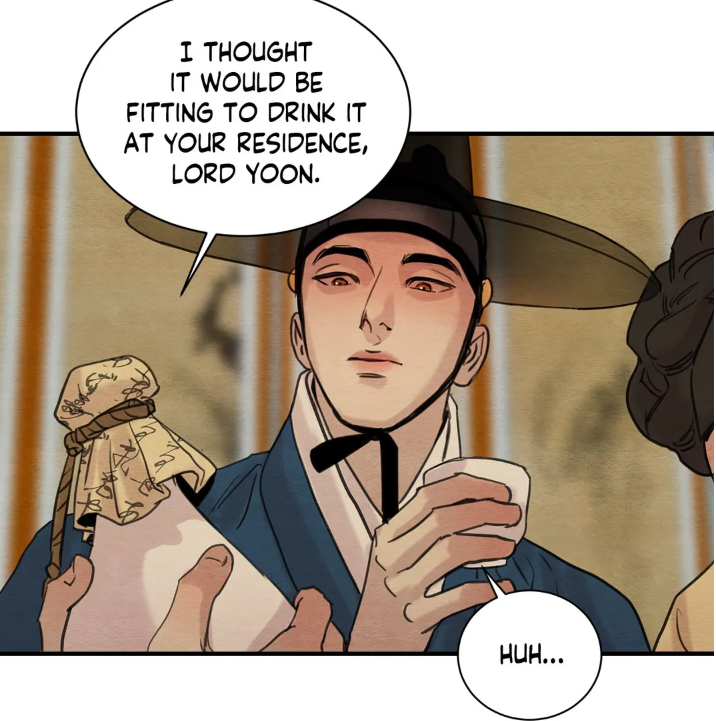 (chapter 19), the parties after the separation
  (chapter 51), his visit in the gibang and his tricks
  (chapter 96). In episode 109, the painter confused Yoon Seungho’s shadow with Black Heart’s. In his nightmare, he was brought back to the shaman’s house and the lord’s smile was similar to Min’s.
 (chapter 109)
  (chapter 99) Besides, let’s not forget that during that terrible night, Black Heart never touched the artist himself, as if he didn’t want to touch a trinket sullied by another man”. On Twitter, the author revealed that Min would help Yoon Seungho. Through this comparison, the beholder can confirm this. Thanks to Black Heart, the couple got closer in the end.
  (chapter 19), the spying on the painter – though here it appears like a good thing –
  (chapter 41), the stones in the rice (chapter 47) and the words from the maid who repeated the noona’s principle
  (chapter 109). Here, the maid was triggering the painter’s memory and as such fears. That’s the reason why the readers can see the laugh of someone outside the building
  (chapter 109). She was acting, as if Baek Na-Kyum was not present, but in reality she knew that he could listen to her. How do I know this? The evidence are the sweets on the windowsill.
  (chapter 109) They never encouraged the tormented boy to eat the sweets!! Besides, this episode confirmed my interpretation about the complicity of the maids. As their role is to comfort Baek Na-Kyum, the readers should question themselves about their absence.
  (chapter 108) Why is the room dark? Where are the maids during that night, as they are supposed to sleep next to the painter?
  (chapter 109) The absence of the light is truly noticeable, an indicator that they are not in the bedchamber. Moreover, I had detected that the brown bed cover symbolizes the meddling of Kim. [For more read the essay “The riddle with the bed cover”] Finally, this scene contrasts to the painter’s dream with the noonas:
  (chapter 87) Sincerity versus fake concern; own choice versus manipulation, happiness versus sadness. Under this perspective, you comprehend why I view the maids as traitors. But since season 1, the women were never punished. Hence they felt free to badmouth Yoon Seungho or Baek Na-Kyum. So while he was preparing himself, where were the ladies-in-waiting? I doubt, the painter would give them orders. The painter was left alone on purpose. Finally, the manhwalovers should question why there is a bottle of oil in the bedchamber. So far, Yoon Seungho utilized it once
  (chapter 20) and it was during the first Wedding Night. And oil comes from the kitchen, the lord had fetched it from that room!! Naturally, there is an exception, and it is the kiss in the gibang. Yet, here the kisaengs had just replaced the maids. In other words, they had played a role in the confession. And this explains why the noona’s words are superposed with the maids. (chapter 109) This exposes that the couple has enemies not only in the mansion, but also in the kisaeng house, though I don’t think that the noonas have truly ill intentions.
 But I have left the most important common denominator, Jung In-Hun!! He was always present, before, during and after the kiss and the sex session! However, the last episode represents the exception. At no moment, the artist thought about the teacher for one moment! All his thoughts were revolving about Yoon Seungho  (chapter 109) That’s the reason why I am convinced that the book is strongly connected to the learned sir. In my eyes, it can only be the erotic publication of sodomy!! Why? It is because it represents the painter’s biggest wound. It explains his low self-esteem. Consequently, I am expecting the appearance of this panel:
  (tweet) The teacher told him “It’s dirty”, and wounded him the most with his gaze full of hatred, the symbol of rejection! Note that in episode 109, the painter always focused on the mouth and not the gaze,
  (chapter 109)
  (chapter 109) (chapter 109), because he fears to meet such a resentful gaze. This observation leads me to the following conclusion. In season 1, the painter’s memory got triggered due to the lord’s behavior, as the latter wanted to see a painting of their Wedding Night, but he got something else.
  (chapter 25) Moreover, during that night, we have the same elements: a painting, a confession, sex, a book that the scholar was looking for. From my point of view, in chapter 34, Baek Na-Kyum only recalled the beating from Jung In-Hun. (chapter 34) Moreover, observe that the artist was covering his eyes, a sign that he was trying to deny the existence of the hateful and cold gaze from the learned sir. As if he wanted to forget it. However, in chapter 34, the artist never realized that this incident had triggered his abandonment issues. And now, in the library, the painter is about to get confronted with his biggest fear: he is not lovable, for he is dirty. Moreover, he is not educated, because he is just a low-born. And this can only be triggered by an image, an erotic painting of sodomy, like in the artist’s nightmare from episode 34:
  (chapter 34) But like I wrote above, this place is also where Yoon Seungho got betrayed and in my opinion, the schemers are planning to use this place to ruin the protagonist!!
So what is the trick? Naturally, this can only be a conjecture… yet my prediction is based on observations and deductions. My method is to compare the scenes containing parallels. And what have all the scenes mentioned above in common? SEX!! That’s the reason why I am now expecting that the couple won’t have sex, but they will have a painful and long discussion. Yes… this is the true night of revelation. Thus I believe that Yoon Seungho will talk about his own past to Baek Na-Kyum…. as the former also feels guilty and dirty. Remember that he views himself as the bird of misfortune. The couple has been separated for one week on purpose… it is to push the painter to have sex with Yoon Seungho. Why? The purpose is to prove that Yoon Seungho is guilty of sodomy. Yes, it is because in Joseon, it is a crime. Homosexuality had to happen behind closed doors. The father had never reported it to the authorities in order to protect his reputation. In the street, the gossiping women were complaining about the depravity of noblemen who would have sex with women and men.  (chapter 106)
  (chapter 106) And if Yoon Seungho gets caught having sex with the painter and he has an erotic publication of sodomy, he can be framed for the murder of lord Shin and the other nobles. He will be guilty by association. Thus I deduce that the schemers needed the father to report him to the authorities.
  (chapter 107) That way, he can prove that his son is a depraved lunatic and regain the control of the mansion. (chapter 86) And if they are not caught having sex, the schemers are hoping for an argument between the two main leads because of the separation. This was planned to incite Baek Na-Kyum to resent his lover, to accuse him of „abandonment and betrayal“, a new version of this scene.
  (Chapter 105) As you can see, the staff had encouraged the lord to keep his distance from his companion on purpose, to create a misunderstanding… they used the painter’s anxieties. Why? That way, the artist would be more inclined to betray his lover, if the latter was in difficulty. He could put the blame on him. In my opinion, the book was planted there on purpose. Remember how the artist denied that he was the author of the erotic publications.
  (Chapter 1) Besides, there is no doubt that the father refuses to take any responsibility in his son’s suffering. And now, you comprehend why this copy was put on the lord’s desk. He was supposed to be the owner of the erotic book and even the author! I am suspecting that he was accused of the „same crime“ in the past. Then this observation raises the following question. Which erotic publication is it? The original
 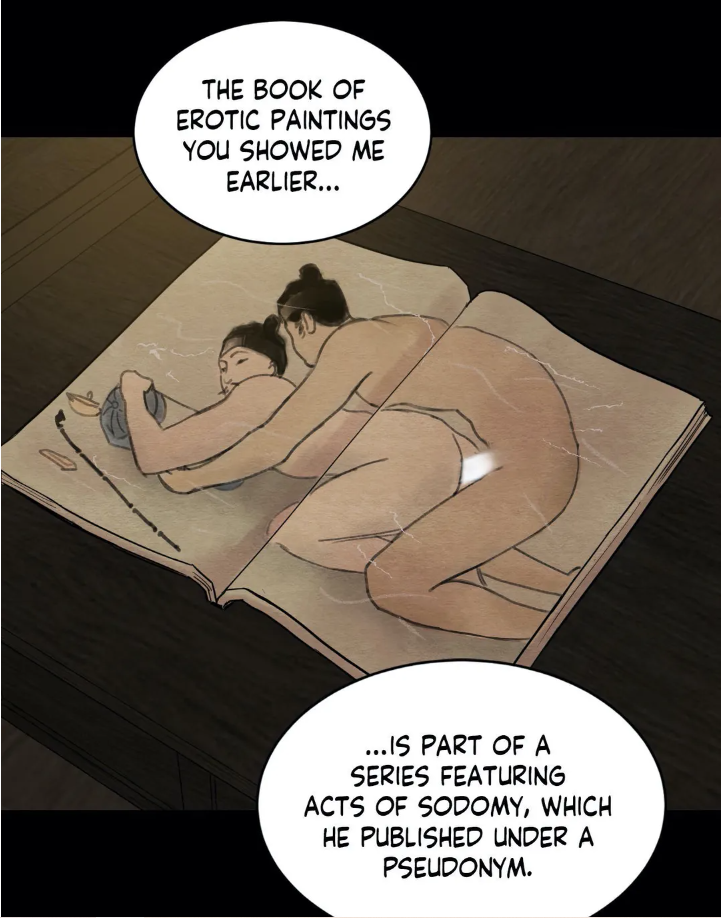 (chapter 1) or the copy (chapter 1)? For me, it can only be the original. I have two reasons to think so. First, the painter had only painted such pictures, because he had no other choice, or better said he was asked by someone close.
  (chapter 1) This would stand in opposition to the scholar’s rejection (dirty), as the artist was just the helping hand. Besides, there is no ambiguity that Yoon Seungho blames himself due to the erotic book. If he had not brought the painter to his mansion, none of this would have happened. But the painter’s confession would make him realize that his misery started long before he met Yoon Seungho. And how did the puppetmaster come up with such an idea? From my point of view, this plan was inspired by the learned sir.
 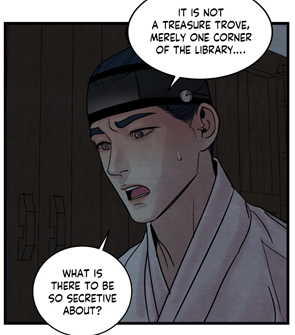 (chapter 27) Notice that he has a drop of sweat on his face, a sign that the book is really important and could be even dangerous. He was diminishing the value. In the past, I had already pointed out that the learned sir had planned to backstab the main lead and denunciate him to the authorities (my first theory was the bible or the the absence of jesa in the mansion). But the erotic publications of sodomy would fit the profile.
Secondly, the schemers believe that with the original, they can ensure Yoon Seungho’s culpability. If they are caught having sex and there is this publication, then both can only be sentenced. They would even kill two birds with one stone, as the painter is in reality the real target of the scheme. That’s the reason why the painter was left alone in the bedchamber. The maids needed to give him space so that he would make a move and seduce his lover. Thus I deduce that during that night, Kim won’t spy on the couple. He has no need to, for he “knows” what is going to happen. He definitely views them as people consumed by lust. However, the gods are on the couple’s side. Hence the book fell on the ground.
And who could have the right to barge in the mansion followed by officers? A family member… and this can only be Yoon Seungwon… who had been a witness of his brother’s sodomy.  (chapter 37) Back then, he imagined that the man hidden under the green hanbok was the learned sir, but he was mistaken. Both father and son believes to have seen the relative’s sodomy. Besides, the brother mentioned letters and these usually are written on a desk and as such in the library. Yes, this night should trigger the lord’s memory… his brother’s betrayal and abandonment.
  I am still waiting for this picture. Yoon Seungwon had definitely tattled on his brother out of jealousy in the past. Don’t forget this flashbulb. (chapter 55) Finally, Heena could serve as a witness, for she did hear their conversation in the annex and saw their intercourse:
  (chapter 96) She would tell the truth… yet it wouldn’t serve her, because she reported it too late. She could be perceived as pathological liar. Besides, she was not supposed to be in the kisaeng house. Moreover, note that all the erotic paintings the painter created vanished. There is no evidence that the artist is the author of the erotic publications of sodomy, as his notebook contains images of nature.
  (chapter 84) Finally, the childhood paintings could be used as an evidence. But what about the book in the library? Both could decide to burn it…
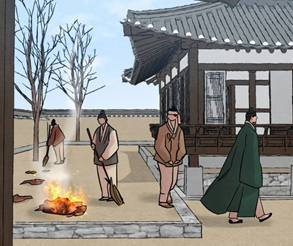 the burned letter
 the shrine
And now it is time to conclude this essay. I would like to remind the role of the painter’s kiss in this story. It is to emulate his lover, to trigger emotions and thoughts in him, to open up. Hence he is caught by surprise all the time. While in chapter 49, the artist kissed his partner to silence him (chapter 49) so that he wouldn’t argue with him (being his sex toy), I view the kiss in the library as the opposite, it is liberating Yoon Seungho.  (chapter 109) Note that there is no rejection from the lord, just surprise and shock. Besides, in the kisaeng house, the artist’s confession had led the main lead to confess as well.
 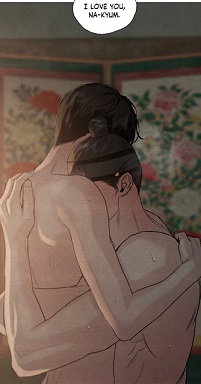 (chapter 96) Striking is that he had hidden his gaze from the artist first. As if love was a sin…Hence I am expecting a confession from Yoon Seungho in that very room too, something he has never done before! Why? It is because he was not the owner of his own past. Kim acted, as if he possessed his memories. Finally, the moment the painter divulges this incident to his companion,
  (tweet), the latter can only come to the conclusion that the scholar would have no problem to hurt Baek Na-Kyum and even get revenge on the artist, for he received the favors from the protagonist. Yoon Seungho would no longer feel obliged to respect Heena’s wish, for her words wouldn’t reflect reality.
  (chapter 105) And it was Yoon Seungho’s luck, when the book fell from his sleeve! (chapter 27) contrary to the night of the rape.
  (chapter 27) The goddess Byeonduck is on their side. But the problem is that the readers have the impression that both are followed by misfortune due to their misery. The reality is that they are both victims of manipulations and tricks. That’s their tragedy. But by repeating that the two figures are “birds of misfortune”, the accomplices are trying to deny their own involvement and as such responsibility. The maids are the perfect example. They blame Baek Na-Kyum for his own illness. He eats like a bird and he would hide his illness.
  (chapter 108) To sum up, he was responsible for his own suffering, for he was in denial and the maids could do nothing to help. But the lord can see the truth, when he touches his lover’s butt.
  (chapter 109) He lost weight in such a short time. And their presence by Baek Na-Kyum’s side was supposed to help him. They were responsible for his well-being, but the women never realized it.
I have to admit that I am always anticipating the story due to the slow progression of the story. We are all waiting for the time, when Yoon Seungho and Baek Na-Kyum can have a date properly. One thing is sure. The storm is coming during this night… and it will affect the life of many people, the schemers and accomplices! The question is now how long this night will last (how many episodes).
Feel free to comment. If you have any suggestion for topics or manhwas, feel free to ask. If you enjoyed reading it, retweet it or push the button like. My Reddit-Instagram-Tumblr-Twitter account is: @bebebisous33. Thanks for reading and for the support, particularly, I would like to thank all the new followers and people recommending my blog.

This is where you can read the manhwa. https://www.lezhinus.com/en/comic/painter But be aware that this manhwa is a mature Yaoi, which means, it is about homosexuality with explicit scenes. If you want to read more essays, here is the link to the table of contents: https://bebebisous33analyses.wordpress.com/2020/07/04/table-of-contents-painter-of-the-night
It would be great if you could make some donations/sponsoring: Ko-fi.com/bebebisous33 That way, you can support me with “coffee” so that I have the energy to keep examining manhwas. Besides, I need to cover up the expenses for this blog.
There is a reason why I selected the illustration  of season 4 for this essay, though my focus is the past, and more precisely Yoon Seungho’s suffering. It is because the darkness surrounding the protagonist not only refers to his tragic youth, but also it reflects the situation of the manhwalovers. The latter are still in the dark concerning his torment. His terrible secrets have not been totally unveiled. So far, the author allowed the readers to see glimpses of his past, like f. ex. the gangrape or the suicide of his mother. But these were just small pieces of the puzzle, thus it is still impossible to have a complete picture of his martyrdom. There are many reasons for this. The main victim never testified about his suffering, he refused to open up to Baek Na-Kyum.
  (chapter 84) Then many witnesses vanished
  (chapter 86) or the ones alive preferred telling lies in order to hide their own wrongdoings or are simply in denial about their own culpability. Finally, the victim, the perpetrators and accomplices had no idea about the whole truth. They only know or knew certain facts, because many of them were deceived as well. What exactly happened to Yoon Seungho? How could this take place, though he belonged to one of the most powerful noble families? Now, you are probably expecting that I will give you answers to all these questions, and recreate the past. But I have to admit that it is not possible, for I don’t know the whole chronology. Consequently, I added “shadowy” in the title. To conclude, my real intention is more to offer new pieces from the riddle than create a whole new “story”. The main source for this new insight is the painter’s fate which is a reflection from the noble’s past and torment. This means that Byeonduck left traces in season 1, 2 and 3! That’s how I discovered that he had been abandoned and betrayed by everyone, kidnapped, treated as a male kisaeng, robbed, abused, raped and even gangraped at least twice, tortured and finally drugged! But like mentioned above, it is difficult to give the proper order and the persons truly involved in the crimes. On the other hand, what I can guarantee is that Yoon Seungho’s nightmare is linked to conspiracies. I came to this conclusion, because if you compare all the seasons, you will detect the presence of plots. There exists at least 3 main plots in each season, though there definitely exist more. The conspiracies are all connected to incidents.
To validate my theory, I will use the first season as an example. The incident with the ruined drawing was actually initiated by Min and his friend with the mole. Black Heart had slapped his friend 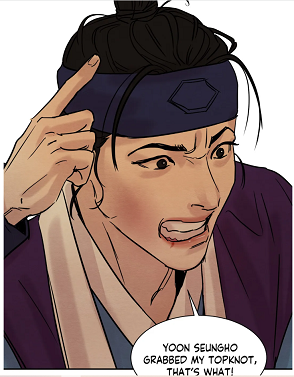 (chapter 9), so that the latter visited Lee Jihwa to arouse his jealousy. It was to push him to commit a crime so that Baek Na-Kyum would be removed from the main lead’s side. As you can see, there were 3 people involved, though the readers only saw the result.
  (chapter 12) They had the impression that the red-haired master had acted on his own. However, he had been manipulated, incited to commit a crime. But my point is not to diminish his wrongdoing, rather to expose the involvement of the schemers. Hence at the end of season 1, the author unveiled their true role and as such their identities.
  (chapter 43) However, observe that when Lee Jihwa went to the pavilion, the noble with the mole had other guests. 2 nobles left the place, as they refused to participate in a murder.
 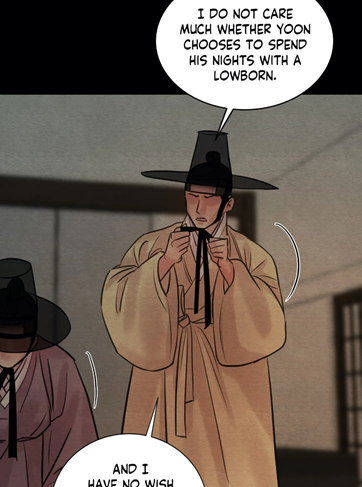 (chapter 43) Funny is that they are now witnesses of Min’s crime. This can have repercussions in season 4. Black Heart had been the one who had suggested the assassination to Lee Jihwa. And the aristocrats were still there, when he had made this proposition. (chapter 43) But the two empty seats also serve as a metaphor for the existence of other helping hands: Kim and No-Name! The latter was about to get hired by the young master. Hence I deduce that this scene was to display the existence of accomplices who had always been acting in the shadow. Or we could say that the number of conspirators increased! However, I would like to point out the existence of a second conspiracy: the stolen wine. (chapter 19) And this is related to Kim and the gibang. Yet, the butler ruined Black Heart’s plan. To conclude, we have two main plotters in season 1, but the butler’s bad intentions were not detected, for Yoon Seungho’s bad actions were more eye-catching. People had the impression that the valet was defending the artist’s best interest. From my point of view, the number of persons involved in the plot kept increasing, as they needed more and more accomplices. The reason is that their plans didn’t work out like expected. At the end of season 3, Min involved the kisaengs in the gibang, while Kim asked the assistance of the staff, the maids
 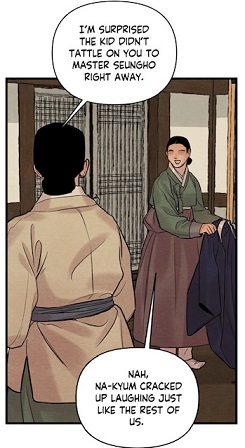 (chapter 91) and the servants
  (chapter 97). Thus I deduce that in the past, the same must have happened. Many people were involved in the downfall of Yoon Seungho and his family. But who was the real target in the end? It is difficult to say with 100% certainty.
While Min serves as a reflection from the main mastermind in the past, his actions are not entirely clear. Note that he kept changing his mind and heart. On the one hand, he wished to have the painter killed, then later to have the young artist by his side as a source of entertainment. Yet, there is no doubt that he wished to have sex with Baek Na-Kyum right from the start. 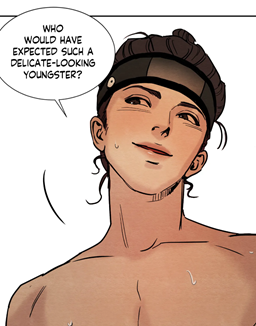 (chapter 8) Thus in season 2, he came to this resolution:
  (chapter 56) He had planned to rape him before having him eliminated. This shows his inner conflict. From my point of view, the painter’s death is connected to the incident in the gibang.
  (chapter 1) Baek Na-Kyum was a witness of Min’s wrongdoing, just like the painter was a witness and victim of his crimes in the shrine. (chapter 99) One thing is sure: Min was full of greed and jealousy. He was determined to harm and ruin Yoon Seungho. Hence I come to the deduction that the real target of the conspiracy in the past was Yoon Chang-Hyeon. And his son was used against him.
Interesting is that in the first season, the plots were not obvious, except one: the painter’s murder! The conspiracies only came to light, when the readers paid attention to details. The best example is the incident with the open door:  (chapter 16) This doesn’t look like a crime. However, it is one! It was done on purpose, to separate the couple. Someone had intervened in order to interrupt this session, and as such someone had been spying on them. Deok-Jae only revealed his spying activity from chapter 16 in season 2:
  (chapter 53) Yet, the one opening the door had been Kim. This gesture can be considered as trespassing and invasion of privacy, the new version of this scene.
  (chapter 16) But instead of revealing the truth, the butler sided with Lee Jihwa, and allowed him to trespass the propriety again. In my eyes, the butler thought
  (chapter 17) that Yoon Seungho would come to perceive the painter as a man consumed by lust. He imagined that he would caught them fooling around. As you can see, this ruckus was also a plot, though it doesn’t look like one. Why would the maids gossip in the courtyard?
  (chapter 18) From my point of view, the valet expected that the lord would fear people’s gaze and a scandal. Thus he would send away the painter to protect his “reputation”, but the opposite happened. Under this perspective, the manhwalovers can grasp why it is difficult to calculate accurately the number of plots and accomplices. Besides, some were naïve pawns, others not. And since I examined the first season more closely, it is necessary to analyze the vanishing of Jung In-Hun. His disappearance is strongly intertwined with Yoon Seungho’s secret. How so? The learned sir was determined to find the lord’s vulnerability and as such secret.
Many readers have the impression that the learned sir is still alive, for they never saw his corpse or his execution. Since they had somehow witnessed Jung In-Hun’s departure, they knew that the learned sir could not have been killed in his humble home. I had already detected very early on, like other manhwaphiles, that the murder scene had been staged.  (chapter 88) Thus many readers jumped to the conclusion that the learned sir had already switched sides and was plotting against the main lead. They had his following words in their mind:
  (chapter 29) Thus many concluded that he had participated in the prank, faking his death. On the other hand, the manhwalovers believed to have seen Heena’s death!
  (chapter 99) However, observe that we never saw her corpse. She was still alive in this panel. I had already pointed out that her murder was actually faked. Her mouth was not covered, hence she could have screamed, but she remained silent (blank speech bubble). Secondly, she never moved her legs… contrary to Yoon Seungho’s behavior in the gibang.
  (chapter 68) That’s the reason why I came to the conclusion that Heena’s curtains didn’t take place. Hence I deduced that in the past, someone’s death must have been “faked” too and this vanishing must have affected the main lead’s fate. The other deduction is that the learned sir must be “dead”, as the author is working with positive and negative reflections. I had already presented this theory in two different compositions (“That day” and “The secret behind the library“) However, for each murder, the culprit must have a strong motive. For me, the mastermind behind his death is the pedophile himself. This man,
  (chapter 37) who is the king in my eyes. [For more read the essay “The face of lord Song“]
Why would he eliminate the learned sir? In the past, I had said that he had ordered it out of jealousy. He believed that Jung In-Hun had become Yoon Seungho’s lover, for his brother had mistaken his identity. (chapter 37) Since Baek Na-Kyum was wearing a hanbok, Yoon Seung-Won thought that the person hidden under the hanbok was no commoner! Thus he called him a fellow. However, this motive is quite thin! Yet, two new details caught my attention. His visit to the “fake shaman” and his request. Notice what he told the man: (chapter 29) He was announcing to the dark haired man his true intention. He desired to abandon and betray Yoon Seungho the moment he reached the first place in the civil service examination. He saw him as a burden. This is important, because his words represent a confession of his “sin”!! The scholar was admitting to the commoner that once he reached the first place, he would cut off his ties with the protagonist. But actually, the latter is connected to the pedophile. It was, as if he was saying that he would betray the king, for the young main lead is close to the king. On the other hand, he needed to reach the first place for this. And now, you have the explanation why he got killed. He needed to vanish, before he participated in the next round! The mysterious lord Song needed to remove him, before Jung reached the first place and betrayed his “lover”. In a certain way, the man could justify his action that he has been protecting Yoon Seungho from a future betrayal. However, there is no ambiguity that the true motive was jealousy. But he had naturally another motivation. It was important that the lord’s past never came to light either, as his secret was strongly intertwined with the ruler’s past actions. To conclude, the pedophile had every reason to order his assassination. But he was not the only one behind his death. Other people had an interest in this crime as well.
Jung In-Hun’s ”dream” stands in opposition to Yoon Seungwon‘s statement who somehow promised his father that he would reach first place. That’s the reason why the father boasted in the bedchamber. (chapter 86) However, in reality, he was relying on the king’s help and intervention. And this confession to the “fake shaman” represents the learned sir’s karma. He had asked the painter to act like a spy  (chapter 24), not realizing that he could be spied himself! He didn’t grasp that he exposed his weakness to the commoner: the civil service examination. Thus the man had constantly drops of sweat
 on his face and interrogated Jung In-Hun.
 (chapter 29) The girl was there to create a certain closeness. He was acting like Kim, asking why! But the stupid and arrogant learned sir thought that because the man was a commoner, he was ignorant and could be manipulated like the painter!
  (chapter 29) He thought that the low-born would buy his lie here… but in my eyes, it was the opposite. He had already perceived the learned sir’s true nature. But he acted, as if he was agreeing. In other words, the scholar fell into his own trap. He envisioned that the man was “powerless”, but he overlooked his connections. The manhwalovers can see the contradiction, for he had approached the man due to his connections! .As you can see, I am more than ever convinced that the scholar has long been murdered. He was betrayed, exactly like he had planned to abandon Yoon Seungho! The pedophile must have heard from the servant about Jung’s plan, as he had confided it to the worker!!
Thus the man decided to meet Jung In-Hun himself, and give him a warning. He described the Yoons as powerless due to the purge.  (chapter 37) But this doesn’t end here.
  (chapter 37) Yoon Chang-Hyeon was portrayed as a traitor! The “fake servant” implied with his statement that there was a conspiracy, and the patriarch was involved. But in exchange to save his own skin, he had tattled on the others! He was trying to insinuate that if Jung In-Hun interacted more with the Yoons, his reputation could get tainted. He could get suspected of “treason” too, or he could get betrayed too. While the man met the learned sir during the day, the brother went to the villa in a hurry during the night. (chapter 37) So it looked like the “scholar” had not grasped the warning. And if Yoon Seungwon had been informed about the content of the conversation between the learned sir and the “fake shaman”, it is not surprising that he rushed to his brother’s side. He could use this opportunity to warn him about a betrayal. However, he couldn’t do it so, because he imagined that the learned sir was present. This would explain this image:
  (chapter 36) Hence he chose a different approach: filial duty. And the brother’s observation could only corroborate the pedophile’s perception. The scholar was Yoon Seungho’s lover, but he was also a backstabber. But let’s return our attention to the “mysterious lord Song”‘s statement: Yoon Chang-Hyeon is a denunciator, not a man of honor. (chapter 37) Due to his denunciation and crime, he had to leave the mansion so suddenly leaving the protagonist behind. That’s what the old bearded man implied here. However, I believe that this declaration is a mixture of truth and lie! That’s how I could make the sudden connection:
  (Chapter 67) Lee Jihwa had not only been denunciated, but he had been confronted by his friend! And the traitor was right by his side. As you can see, chapter 67 was a reflection from episode 37!! These two episodes have another common denominator: the betrayer had made the following suggestion.
  (chapter 67) In exchange for his “survival”, he should help Black Heart and allow him to act on his behalf. This was the new plan. That’s how he started impersonating Lee Jihwa. That’s the reason why I come to the conclusion that in the past, the impersonation must have happened, but it took place in the beginning. Secondly, I am assuming that a traitor must have suggested to Yoon Chang-Hyeon to leave the mansion and abandon his son behind!
  (chapter 27) And who is it? For me, it is Kim acting on the pedophile’s behalf. Striking is that in episode 27, the learned sir escaped death thanks to the intervention of the old bearded domestic and Baek Na-Kyum. Thus it came to my mind that the pedophile could even claim that he had eliminated the learned sir, because Yoon Seungho had attempted himself to kill him in the past. He had acted on his behalf. And what do have all these chapters have in common? SPYING and tattling! In episode 27, the servant unveiled a part of the past,
  (chapter 27) Someone had tattled on the Yoons in the past, but the patriarch was turned into the traitor himself which the young main lead came to believe. Thus Yoon Seungho could say this to his father: (chapter 86) However, I am suspecting that this is not true, someone else tattled on the powerful family and made a false accusation! As you can imagine, I am inclined to think that father Lee must have been behind this! Why? It is because he can no longer do it! Thus in season 3, he approached the patriarch Yoon.
  (chapter 82) If the lord Seungho had truly committed a crime, he should have reported it to the authorities. The stupid Yoon Chang-Hyeon never wondered why the elder Lee visited him during the night and asked for his assistance. Furthermore, the elder Lee had been allowed to enter the bedchamber and see the huge drawing which could have been perceived as a sign of treason. He was eyeing at the throne.
  (chapter 82) Note that the aristocrat mentioned “punishment” in this context. So maybe, he denunciated the patriarch so that the whole family would get punished. Father Lee was definitely played in this scene, hence I believe that someone had already anticipated his reactions. He would seek revenge. But this doesn’t end here. I had connected “rash departure” to “treason and spying”. And now, observe what Yoon Seungho said to his butler
  (chapter 50) He had sent Jung In-Hun away in order to get rid of him! However, because of the expression “I thought”, I am quite certain that this idea had been suggested to him by the valet! I would like to underline that in this episode, the valet was acting as a tattler!
  (chapter 50) But in order to hide his own crime, he portrayed it as a rumor (It may not be accurate”). This truly underlines the butler’s MO. He used information and turned it as gossips to hide his spying activities. The shadow… Simultaneously, he turned gossips into a verity!! This is no coincidence that in season 3, the same method was employed. Yoon Seungho was supposed to have murdered the scholar and Deok-Jae! My avid readers can sense the leitmotiv in all these episodes. RUMORS are turned into a reality, and as such a CRIME! Even here…
  (chapter 37) (chapter 37) But Kim is not the only spy and traitor! The younger brother Seungwon is also one! Thus he was introduced in the same chapter. And I have an irrefutable evidence that the old bearded man was in contact with the younger master. Only recently, I realized that the man never mentioned the protagonist’s name, he just said “this one”. This idiom implies that there is another one!!! This is the evidence that he was in contact with Yoon Seungwon. Finally, why would the man talk about the elder master Yoon the entire time? It is, because technically Yoon Seungho is just the elder son. This means that the pedophile never officially gave the title to the protagonist. These were empty words. (chapter 86) But since our beloved man started living in the bedchamber, this became a reality. That’s the other reason why Yoon Seungho was encouraged to live in debauchery and not to take the civil service examination. But this only occurred, the moment the lord returned living in the mansion and not before!! Secondly, I realized that this statement about Yoon Chang-Hyeon will become a reality for the “fake servant” himself. (chapter 37) Not only he justified his return to the familial domain with the main lead’s lunacy (“under the pretense of some problem with this one”), but also he accused his own son of a crime.
 (chapter 94) This means that he acted as a traitor, tattling on his own relative. Finally, observe that once confronted with brutal reality, the father did run away.
  (chapter 87) The white bearded man’s words became a reality. However, since the fake servant, the mysterious lord Song, judges the elder master Yoon as a troublemaker and hypocrite, there is no ambiguity that the elder master Yoon will get into trouble. Since he did it in the past, he can only get suspected in the present.
Besides, because the scholar is now dead, the pedophile can only put the whole blame on someone else refusing to become responsible for this. He has always acted in the shadow. We have three possibilities: he puts the blame on Yoon Seungwon, and say that he had done it out of jealousy. Or Yoon Chang-Hyeon had intervened, because Jung represented an hindrance to the Yoons’ dream. Besides, he was supposed to stay in the mansion in Hanyang, and that’s where the rest of the family is living. (chapter 86) But the worst would be that the painter is blamed for his assassination. He did it out of resent! But this would expose the true thoughts of the schemers, the pedophile and Kim. That’s how they act, when they feel offended and bothered.
Striking is that the protagonist has no idea, that the banishment was staged, for he was told the same lie. In his mind, the father lives in exile.: (chapter 37) One thing is sure: the father’s dream will turn out to be an illusion. For me, the younger brother’s biggest wrongdoings are spying, tattling and badmouthing. And the best evidence for this interpretation is this situation:  (chapter 44) He had given the ruined painting to his father, putting the blame on his brother, well aware that the latter would get angry. He was observing his father’s reaction.
  (chapter 44) Yet, there is a difference to the past. Here, he had been fooled! He truly believed that this was his brother’s doing, whereas in truth the butler had been the one who had fooled him.
  (chapter 38) And this is important, because when the letter was given to the brother, Jung In-Hun witnessed the wrongdoing from the butler!!
  (chapter 38) And now, you know why the learned sir had to die!! He had caught the valet in the act. He had betrayed Yoon Seungho, though he didn’t realize it. The learned sir tried to discover the content of the letter, and as such was prying on his sponsor’s weakness.
 (chapter 38) Hence I come to the conclusion that KIM played a huge role in the learned sir’s death as well. I would even say that he was the one who pushed the others to have the scholar and the painter killed. Both knew about the butler’s tricks without realizing his significance.
  (chapter 37) Hence I deduce that as the story progressed, the role of the butler started changing. Now, I see him as a the main plotter, while all the others are now his pawns. We could say that the valet has gradually followed the pedophile’s path. However, there is no ambiguity that it was not the same in the past!
I am quite certain that many manhwalovers are doubting my theory that the fake servant is the king and the main culprit in Yoon Seungho’s nightmare. Why? It is because in chapter 83, we saw a dark haired man, and according to Lee Jihwa, this was the mysterious lord Song. 
 (chapter 83) How can he be the same than the one from episode 37? The change of his hair color could be explained by a huge shock. But this is rather thin as a justification. Besides, now I am more inclined to think that these are two different persons, and that the main culprit is the one from episode 37. Why? It is because he smoked and utilized the same expression: “strange”.
  (chapter 37) An idiom that Yoon Seungho constantly utilized: chapter 16, chapter 21
 , chapter 50, chapter 71
  (chapter 71). This means that he couldn’t understand, for he has a different way of thinking. This outlines his narrow-mindedness and his tendency to plan everything. He doesn’t like surprises.
Since the readers saw the hanbok and the beard, they imagine that he is the main culprit. But I would like the readers to keep in mind that Baek Na-Kyum’s fate is the clue about the main lead’s suffering. And how many people desired to have him by their side? TWO! Yoon Seungho and Min…. and we could say that both kidnapped the artist! The main lead did it in episode 1, and the other in episode 99! This means that Yoon Seungho should have two main sexual abusers in the past! However, in difference to the young lord, the painter only had sex with the main lead. Min always failed to taste him! That’s the reason why I am suspecting that the man from chapter 83 could represent the “first sexual abuser”. Besides, observe that he is not smoking! (chapter 83)
Because we saw the purple hanbok, we all imagined that he was representing the king or was connected to the palace. But is it true? Notice that one of the guests only has a moustache beard (chapter 83) which is actually connected to commoners. [For more read the essay “Painful departures“] Remember that Min tried to deceive people by wearing a similar hanbok which Lee Jihwa would often wear.  (chapter 69) Hence I started wondering if the mysterious man with the beard was not impersonating someone, for example “lord Song” and in reality he was just a merchant. Why merchant? It is related to the shungas and the hanboks. The king can not be involved in trading directly. However, this is what Yoon Seungho told to the learned sir:
  (chapter 22) Nevertheless, the main lead could have never been involved in commerce, for he lived as a prisoner for many years. And this is what was said about the ruler:
  (chapter 76) He is not so wealthy. How come? Yoon Seungho’s fortune must have a different origin.
Besides, I would like to outline that when Min was facing the ghost Yoon Seungho, he denied his responsibility by putting the blame on the childhood friend:  (chapter 102) Min had never predicted that the young master would run to his friend and denunciate him to Yoon Seungho. However, since Black Heart had employed the assistance of servants
 (chapter 101) , the kisaengs
  (chapter 95) (chapter 96), the officer
 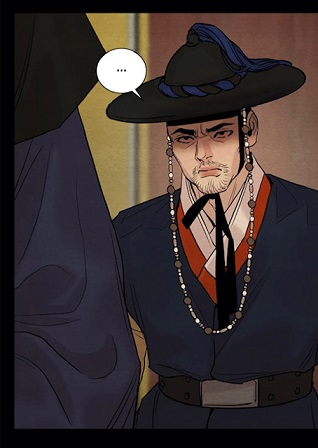 (chapter 98), No-Name, the doctor with the drugs and butler Kim, this signifies that behind the name Lee Jihwa stand many people! As you can see, the name “lord Song” doesn’t refer to one person, but many… My theory is that No-Name is the true owner of the title, but that’s how he ended up losing his home and his name! That’s the reason why I believe that in this image (chapter 83), we only see one of many persons hiding behind the name “lord Song”. To conclude, I came to the theory that the men from chapter 37 and 83 are both “lord Song”, though the one from episode 37 can only be the king. But if the man in episode 83 was impersonating lord Song, and as such was dressed up as a royal, he was actually violating laws.
I would like to point out that Min had three goals, not only to ruin Yoon Seungho, but also to get rid of Baek Na-Kyum and Lee Jihwa. Why? It is because he had framed them for the incident in the gibang. (chapter 1) Furthermore, Lee Jihwa could testify that Black Heart was the mastermind of the murder. Thus I deduce that in the past, the mastermind must have had three intentions as well:
(chapter 50)We shouldn’t overlook that Min used to be the main lead’s sexual partner too. Hence we could say that he was trying to get rid of a former lover and potential rival! That’s why I can’t help myself thinking that the man in purple could have been fooled himself. (chapter 83) Here, he was smiling… but don’t forget that in this story, karma always retaliates immediately! The best example is the scholar who wished to discover the noble’s secret, but didn’t realize that his vulnerability and intentions were revealed. In episode 83, this smiling man tried to drive an edge between the two childhood friends, and he could definitely witness how the two sons entered the room before the arrival of the elders! Therefore his punishment should have been separation as well. (chapter 83) The main lead was slapped and called animal, hence there is no ambiguity that at some point, the man must have suffered as well, unless he let others take the fall for him. We know for sure that the main lead was tortured, and as such arrested for a crime he didn’t commit! Besides, I would like the manhwaworms to keep in mind the importance of cosplay and “coup de théâtre”. We had the perfect illustration in chapter 37, 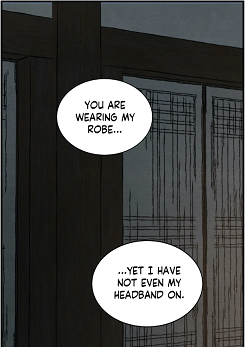 (chapter 71)
  chapter 87) and
  episode 92. The schemers in the past had definitely played with illusions and tricks. Thus I am expecting that it is now the pedophile’s turn to get fooled.
One possibility is that father Lee denunciated the Yoons saying that they were planning a coup d’Etat, and had already selected a new king. And don’t forget that he was wearing clothes that was indicating that he belonged to the royal family!! Thus his identity could have been mistaken. To conclude, for me, the man with the purple hanbok represents the reason why Yoon Seungho suffered. This led to the purge of the noble families close to the Yoons. But since the real “lord Song” had allowed people to use his name, he became the culprit for all the wrongdoings committed by others. Hence he lost everything.  (chapter 82)
Another possibility is that the man with the purple hanbok got poisoned, and Yoon Seungho was framed for the man’s death or injury. I am suspecting a poisoning incident in the past. If it didn’t take place during that fateful night/day (chapter 83), then it definitely must have taken place before. But how did I come to this conclusion? According to my observations, karma always retaliates right away, though the “wrongdoer” has no idea, as the person doesn’t see the connection between the “punishment” and the sin. But I would like to point out that in each season, we had poisoning.  (chapter 36) Here, the painter was forced to take an aphrodisiac under the pretense of his health. This action was repeated in season 2
  (chapter 54) and 3.
  (chapter 100) The nobles made him smoke opium or drink the aphrodisiac. The purpose of such drugs is to obtain the painter’s submission and control his mind and reactions. Striking is that each time, the perpetrators were “punished”. Kim was insulted and his plan didn’t work out.
  (chapter 37) As for the young lords, they were evicted like commoners and later the others were even killed. As you can see, each time the poison was employed, there was a retaliation.
But note that in season 2, Deok-Jae had put stones in the painter’s rice.  (chapter 47)
 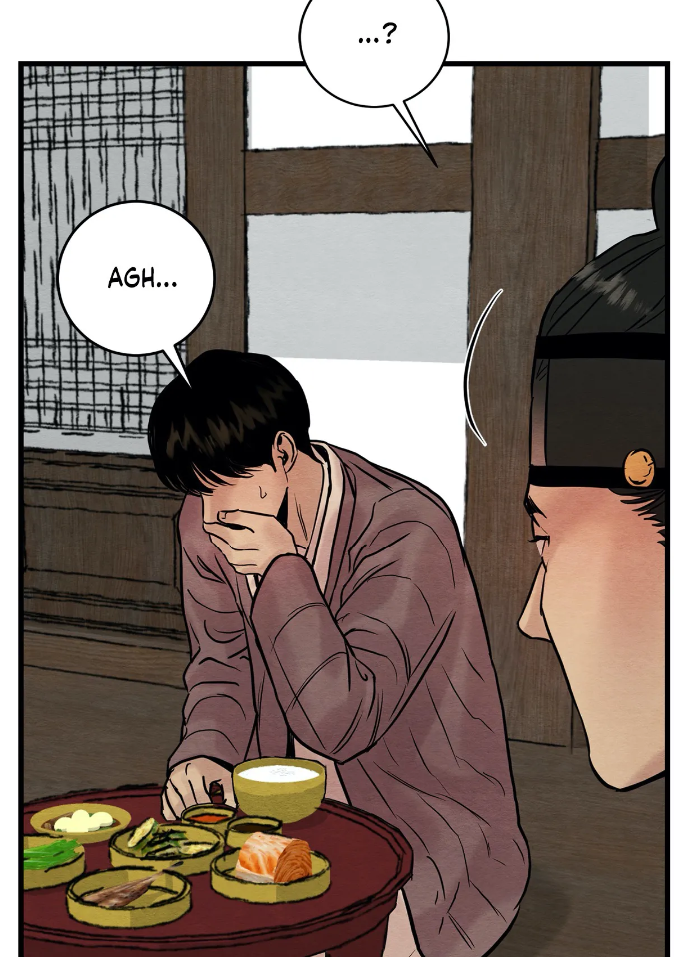 (chapter 47) If the painter had not eaten with the lord, the latter would have never noticed the incident. However, he believed the maids’ words.
  (chapter 47) Hence he never investigated the matter. But this prank represented a serious issue. This could have been judged as an attempt against the owner of the mansion. (chapter 47) And now look at this panel:
  (chapter 83) Yoon Seungho had refused to take the drug! The bowl reminded me of the one from chapter 47! Finally, the butler had tried to give his master the drug in season 3
  (chapter 77), but the latter had again rejected it and this twice.
 (chapter 77) Kim calls the drug “medicinal tea”, truly an euphemism. It is also possible that the real target of the poisoning was Yoon Seungho, but since he was protected by the gods, someone ended up taking the “drug”. Because he was wearing a purple hanbok, the investigator mistook his identity, a royal member. Hence the Yoons were suspected of treason. Don’t forget that during this party, there was a kisaeng by their side. (chapter 83) And the latter are trained to cook dishes for the clients. My avid readers are certainly recalling that since season 2, I have been waiting for a poisoning incident which became a reality at the end of season 3. Thus I come to the conclusion, that such an incident should be shown in season 4, one in the past and the other in the present.
To conclusion, since many people were hiding behind the name “lord Song”, it became a taboo. However, as the king had achieved all his goals thanks to this name,  (chapter 56), he came to adopt this title in order to hide his identity and actions. Byeonduck explained in her notes that Baek Na-Kyum had no idea about Min’s name. And this is the same for Yoon Seungho. The pedophile could continue hiding behind “lord Song”, as the latter was blamed for everything. The pedophile could divert attention from his own tricks. That’s the reason why he would never write any letter to Yoon Seungho under this name. This means that at the end, the main culprit, the king, will be perceived as the main responsible for Yoon Seungho’s torment, similar to Min’s situation, just before got killed. Though many other people were involved, Yoon Seungho was able to judge the joker’s actions correctly, he was the main mastermind behind the plots. This explicates why the gods made Yoon Seungho forget the old bearded men’s face.
  (chapter 44) This was a blessing in disguise. The moment the main lead faces the king, Yoon Seungho will be able perceive the truth. The king was behind his torment, and the butler had been his helping hand all along, the professional spy planted in his family. However, I don’t think that the monarch will admit his crimes and apologize for his wrongdoings. He will need a scapegoat, and this can only be the butler, the only one who knows the truth!
Feel free to comment. If you have any suggestion for topics or manhwas, feel free to ask. If you enjoyed reading it, retweet it or push the button like. My Reddit-Instagram-Tumblr-Twitter account is: @bebebisous33. Thanks for reading and for the support, particularly, I would like to thank all the new followers and people recommending my blog.