

This is where you can read the manhwa. https://www.lezhinus.com/en/comic/painter But be aware that this manhwa is a mature Yaoi, which means, it is about homosexuality with explicit scenes. If you want to read more essays, here is the link to the table of contents: https://bebebisous33analyses.wordpress.com/2020/07/04/table-of-contents-painter-of-the-night/
Feel free to make some donations/sponsoring: Ko-fi.com/bebebisous33 That way, you can support me with “coffee” so that I have the energy to keep examining manhwas.
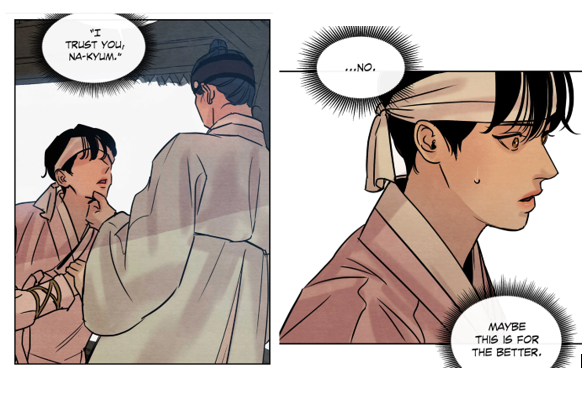
While I was reading the manhwa again, the scene when the lord caressed the painter’s cheek in chapter 18/19  caught my attention. Striking is that neither the noble nor the painter cared too much about that gesture. The artist was too shocked due to the huge scandal, and the main lead had the impression, he just wanted to taste the artist out of curiosity and interest. So there was no deep meaning in the caress, yet this gesture was witnessed by the scholar Jung In-Hun.
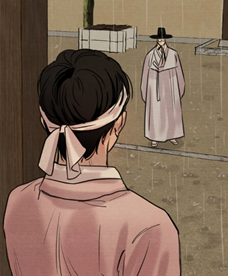 (Chapter 18) And this not only shocked him, but more importantly, it really made him jealous.
1. The scholar’s jealousy
 Imagine, he was upset, because the painter had been the recipient of a caress from the powerful noble. Yet, he didn’t feel repulsed, just displeased and resentful But if he was jealous, then it signifies that he desired to have received this mark of attention. That’s the reason why I come to the conclusion, Jung In-Hun would have even accepted the noble’s advances, if it meant that he would get some benefit from it. And this interpretation is even confirmed, when you compare it with its reflection in chapter 35.
2. The comparison of the caress on the cheek
Here, we have a reversed situation. Exactly like the main character, he strokes the artist’s cheek, while he seems not to be aware that he is observed by Yoon Seungho. However, unlike in chapter 19, the caress has a huge signification. Jung In-Hun is faking affection in order to achieve his goal: the painter should spy on the benefactor on his behalf. Consequently, before he leaves the mansion, he reminds him of his request. 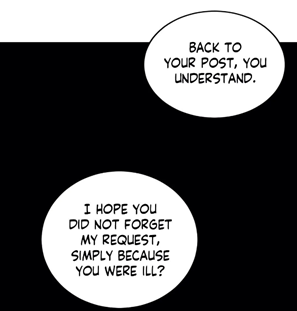 (Chapter 35) In other words, although the caress from Yoon Seungho was anodyne, his gentleness was genuine, whereas it is the opposite with the teacher’s stroke. Moreover, if you compare the vocabulary field, you’ll notice the contrast: duty/work versus entertainment. And although the low noble is aware that Baek Na-Kyum has been very ill, he just sends him back to his “work”. He makes sure that the artist doesn’t fall for the lord’s generosity. He should remember that this is just work, and not entertainment. Moreover, the teacher reminds the painter of his promise: he is his servant. As the manhwaphiles can detect, in chapter 19, Jung In-Hun was already jealous of the painter, because he was receiving the lord’s attention and affection. But this was just a caress, therefore envision how he must have felt, when he heard this from the painter:
  (chapter 35) He must have realized that he was on the verge of losing the artist’s favors. That’s why he reminded the painter of his “loyalty” and “promise”. In chapter 35, Yoon Seungho was the one jealous, hence imagine the resent and jealousy Jung In-Hun must have felt in chapter 19. Yoon Seungho had even cut ties with another aristocrat due to the low-born. But unlike the scholar, Yoon Seungho’s jealousy was much more intensive to the point he would have killed the artist, if he had set a foot outside the mansion, though I doubt that he would have done it for real.
  But why are these characters jealous?
3. Jealousy: its origins and consequences
I made some research about the origin of jealousy and this is was I discovered: This feeling appears, when someone feels insecure in his relationship with another person due to the appearance of a third person. And if we take this definition into consideration, then the scholar’s jealousy is triggered by two aspects. First, he resents the artist, because he caught the lord’s attention. Yet there is more to it. He resents the low-born, as the latter seems to have escaped his control. Let’s not forget that Baek Na-Kyum allowed another man to touch his cheek. For the first time, Jung In-Hun saw another man getting closer to Baek Na-Kyum, indicating that his influence over the artist was diminishing. The readers shouldn’t forget that the scholar enjoyed it very much to use the low-born as his puppet. In the past, Baek Na-Kyum would always follow his orders, yet with this anodyne gesture, Jung In-Hun realized that something had changed. That’s the reason why he had to blame the painter for this, and accused him of seducing the main lead.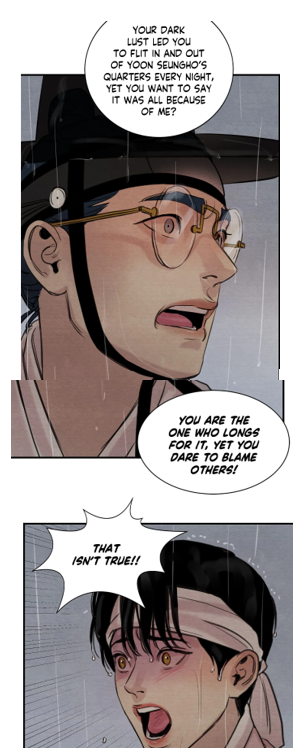 (Chapter 19) In truth, he projected his own thoughts onto the painter. He wanted to be the one getting closer to the powerful aristocrat, and would do anything in exchange for his own interests. Simultaneously, he needed the artist to remain obedient and loyal, so that he wouldn’t become a rival. And now, if we examine the protagonist’s jealousy in chapter 35 with this definition, we recognize that it is related to the sex marathon. Yoon Seungho had envisaged that after that event, the painter had finally accepted him as his partner, and their relationship had changed. Besides, after his return, Baek Na-Kyum had been in his bed and had never reproached the sexual encounter leading to his illness. Therefore, he had envisaged that the commoner was slowly accepting him.
While many think, jealousy is terrible, evolutionary psychologists regard it as a necessary emotion, because it helps people to preserve their social bonds and motivate them to improve their relationship, since it serves as a wake-up call for the affected person. And if you pay attention to Yoon Seungho’s behavior, you’ll indeed sense that right after feeling jealous, he tries his best to improve his relationship with the painter. In chapter 35, he compliments the painter , approaches him and smiles to him. 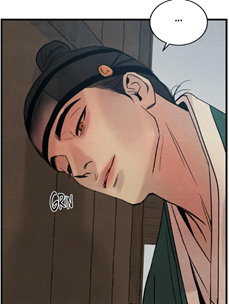 (Chapter 35) Moreover, he caresses his head
  (chapter 35) after finally asking him about his interest. This scene made him realize that he needed to get to know Baek Na-Kyum better, and their relationship shouldn’t only be limited to sex. Hence he invited the painter to his bedchamber that night. In my opinion, he really hoped to initiate a conversation. That’s the reason why he was writing something, he hoped that Baek Na-Kyum would ask, but due to the aphrodisiac and the “warning” from Kim, the artist didn’t dare to speak. As a conclusion, we could say, Kim would have totally succeeded to ruin Yoon Seungho’s plan, if the brother hadn’t appeared that night. At the end, Baek Na-Kyum did earn the lord’s trust, he was able to sleep by the lord’s side.
4. Heena and Yoon Seungho’s jealousy
And now, with the release of chapter 69, we have a reflection from these two chapters. We see two jealous persons, Heena noona and Yoon Seungho, the kisaeng is replacing the teacher. Yet, there’s a huge change. Why? While Baek Na-Kyum in the past would trust his adoptive parents and follow them blindly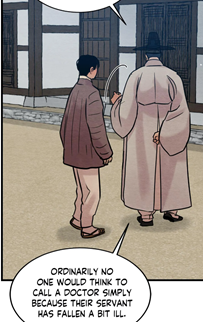 (chapter 35)
 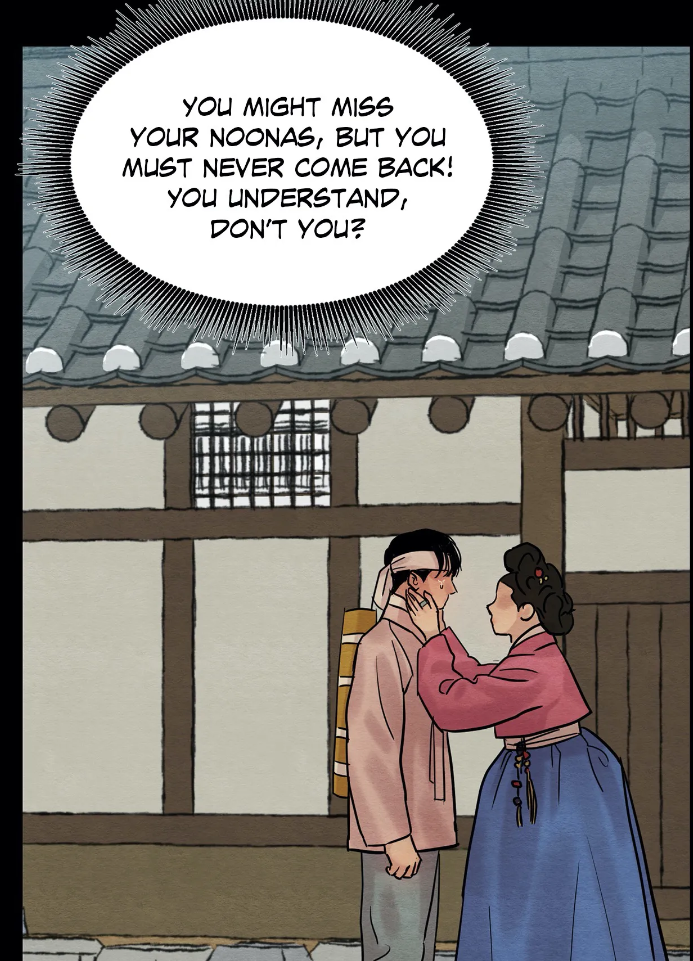 (chapter 46), we see the painter deciding his own fate. He prefers remaining in the mansion.
  Not only he is no longer listening to his parents, but also he becomes proactive. He gives his noona his own scarf, a sign that he is now old enough to take care of her.
 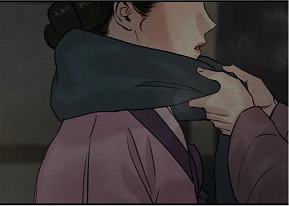 (Chapter 69) He is no longer a child. In reality, this gesture has so much meaning. With this tender gesture, he desires to end the discussion. Notice that she keeps pressuring him
  (chapter 69), illustrating that she is still not giving up on her adoptive son. Since the chapter 19 is a reflection of episode 69, I believe that Heena noona’s behavior is indeed motivated by jealousy. Imagine, for the first time, her son doesn’t obey her, while in the past, even if he admired the teacher, the latter never represented a threat to her relationship with her son. For the first time, he has refused her help
  (chapter 68) and pushed her hand away, a huge shock for the kisaeng.
  (Chapter 68) For her, the only explanation can be the negative influence of Yoon Seungho. And because she attempts to change the painter’s mind just before leaving, Baek Na-Kyum stops her by smiling. He is trying to reassure her that he is fine.
  (Chapter 69) But she doesn’t trust her son’s judgement. She believes, she knows what is right for her son. Therefore, her last words exposes her true intentions. She won’t respect the artist’s choice.
 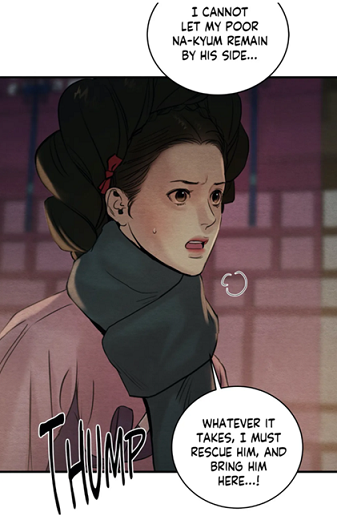 (Chapter 69) She thinks of herself as her son’s savior, whereas in reality, she will jeopardize Baek Na-Kyum’s safety. There’s no doubt that she will be manipulated by Min and Kim. Due to his kind words, she has already judged him as a good man
 (chapter 67), unaware that she is trusting a terrible servant who is determined to hurt her son. This reminds us of the chapter 35, where Jung In-Hun risked the painter’s life. I have to admit that after comparing the scene from episode 19 with 35, I had the impression that Jung In-Hun could have been demonstrating his affection in order to show off to the lord that the painter would only listen to him. Let’s not forget that in chapter 30, the teacher tried to sell off Baek Na-Kyum by telling Yoon Seungho that the artist would only obey to him. And in both cases, Jung In-Hun never recognized the real situation: he was putting his life in danger. And observe that we have many parallels in chapter 69 with chapter 30 as well. We have the painter’s intervention
 (chapter 69), when he senses that Heena noona keeps challenging Yoon Seungho by refusing to recognize his benevolence and her wrongdoing. Here again, he speaks to the main lead in order to deescalate the situation. While in chapter 30, he feared the main lead,
  (chapter 30) yet he desired to protect his learned sir, in episode 69 we have a reversed situation. The one menacing is the kisaeng, and not the lord. The latter steps back
 , as he knows that he did something wrong to his lover. Baek Na-Kyum could have exposed his brutality. However, due to Yoon Seungho’s past action, Baek Na-Kyum has learned to fear the noble’s power and strength. Hence he intervenes, because he wishes to protect his noona. (Chapter 69) Nevertheless the readers can sense that the artist is feeling more uncomfortable than scared. Moreover, his sincerity and his thoughtfulness is palpable. He is indeed recognizing the lord’s leniency.
 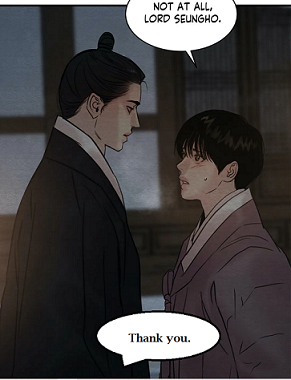 (Chapter 69) Another similarity is the constant blushing of the painter, the lord’s action and words surprise him. Therefore there is this awkward moment, for both protagonists are trying to figure out the situation. The lord never expected a thank you from the low-born, especially after receiving such a mistreatment.
  (chapter 69)
In chapter 35, he detected his exhaustion and honesty, but he felt indeed affected by his presence. Nonetheless, the cause of his reddening diverges here.  (chapter 69) He is not just affected by the main lead’s appearance, but also by his gestures. Baek Na-Kyum is finally able to see the kindness in Yoon Seungho. First, he did keep his promise to the artist. He restrained himself to punish the kisaeng. Secondly, he put himself the scarf around the low-born’s neck, which is quite extraordinary. The manhwaphiles shouldn’t forget that Yoon Seungho is actually lowering himself by acting so, he prioritizes the commoner. This is not surprising that at the end, Baek Na-Kyum can’t help himself blushing.
 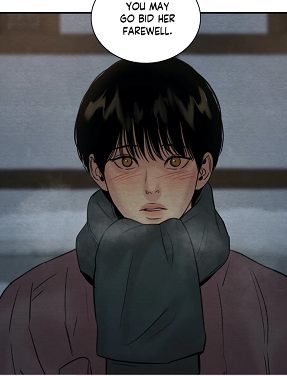 (Chapter 69) Unlike in the past, Yoon Seungho is willing to trust the painter by his actions and words. Therefore he emphasizes this:
  (chapter 69) “I do believe”. He has learnt his lesson. He recognized that his judgement had been clouded by his insecurities and jealousy. That’s why he stares at the painter, when the latter is looking at his mother walking away.
  (Chapter 69) He notices the artist’s concern and attention towards his mother. This explicates why he allows the painter to follow the kisaeng to the front gate. However, as you can observe it, the painter is not realizing that the lord is paying attention to his facial expressions. In my opinion, Yoon Seungho is trying to make the painter smile, when he gives his consent.
Let’s not forget that in chapter 44, he did ask Jung In-hun to bid farewell to Baek Na-Kyum, but the latter never cared for the boy. Yet, Yoon Seungho is only at the beginning to trust the painter entirely, hence he asks him to remain in his sight.  (chapter 69) This explains why he asks him to follow his mother only to the front gate. That’s the limit of his trust. I would even add, he can’t bear Baek Na-Kyum out of sight. That’s how much he loves him. He needs to feel his presence close to him. And exactly like in chapter 35, the readers sense the importance of the door. While in episode 35, the gate was associated to life or death, now the door symbolizes trust. Within the building, he will put his faith in the artist’s words. Finally, we have another allusion to chapter 35: the reference to coldness.
  (chapter 35)
  And this parallel reinforces my perception about the valet. He is a hypocrite, because he incited the lord to go to the window, while claiming that it was cold. That’s why I perceive the chapter 69 as a good sign. Yoon Seungho is definitely willing to trust the painter. He let him make his own choice, and the moment Baek Na-Kyum expressed that he was not leaving the mansion
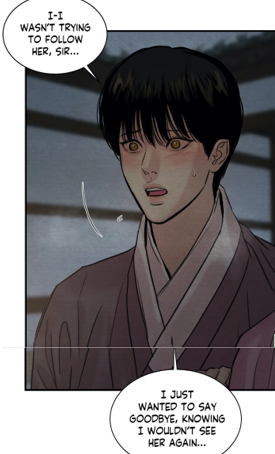 (chapter 69), the lord could only feel relieved. That’s why he had a softer gaze right after.
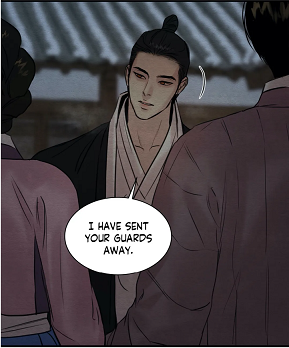 (Chapter 69) He was definitely happy that the commoner had chosen him. However, there’s still awkwardness between them, hence the noble can’t entirely trust him. And this lack of trust becomes a reality, when in chapter 80, the manhwaphiles witness that Yoon Seungho had threatened the kisaeng behind the painter’s back.
  (Chapter 80) He had once again listened to the butler’s advice… How can I be so sure? It is because the real author of the threat was the butler and not the lord.
 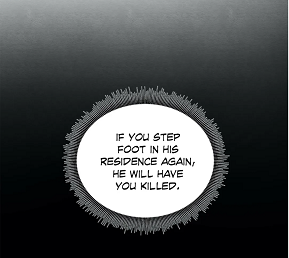 (chapter 69) Yoon Seungho will never order someone to eliminate a person. He will always use his own hands. We have many evidences for this: the hunt and the scenes with the sword. (chapter 69) The tragedy is that in the courtyard, the artist made the lord this promise: (chapter 69) He would remain by the lord’s side, but the lord still didn’t trust the artist’s words. And now, it is time to examine the origin of Yoon Seungho’s jealousy and lack of trust.
5. The real cause for the lord’s jealousy
As you can imagine, the answer is quite simple. It’s Kim. The latter has always been mistrusting people, he always felt insecure. In other words, he was jealous. This signifies that deep down, he always wanted to keep the noble’s attention and affection. That’s the reason why he revealed the incident with the door to father Yoon.  (chapter 77) The young boy was looking at someone else. He would stop looking at him like that.
 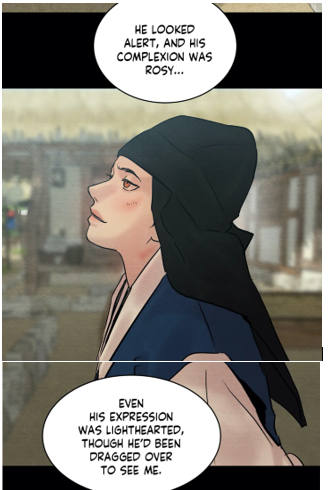 (chapter 57) The butler would lose his influence over the boy. Under this new light, you comprehend why he decided to betray father Yoon after the straw mat beating. The young boy was rejecting him and despising him.
  (chapter 77) Yoon Seungho’s gaze was telling all his emotions and thoughts. That’s the reason why the butler isolated his master for so many years. And note that in chapter 69, he projected his own thoughts onto the painter again. Since the butler has always backstabbed, betrayed and abandoned Yoon Seungho, he imagined that the artist would have a change of heart too… like Kim always did in the past. Naturally, this is the negative version of a change of heart: not compassion and remorse, but resent and jealousy!!
And now, you comprehend why the bride’s abduction has to take place right now. Kim is not only on the verge of losing his home… but also he has lost his master’s love and affection. He is no longer looking at him. For the first time, he was punished which had never happened before. 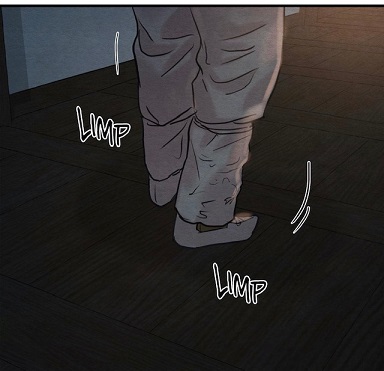 (chapter 77) If the painter leaves the mansion, the butler will make sure to portray the painter in a negative light. But there’s one thing that Kim overlooked: Yoon Seungho’s ability to learn!! Remember that jealousy is there to make the partner realize that he needs to improve his behavior. Since he mistrusted the painter’s choice, he realized later that he needed to earn the artist’s trust first. Therefore he made the following promises:
 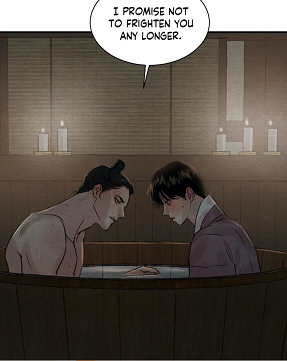 (chapter 70) and he would always ask for the artist’s consent.
  (chapter 71). Furthermore, the artist’s reproach in the tavern
 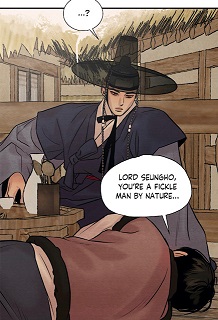 (chapter 75) must have been an eye-opener for the wealthy aristocrat as well. How can he expect “loyalty and trust” from Baek Na-Kyum, if he is himself a fickle man by nature? With such words, the artist encouraged the lord to stop wavering and doubting his lover. He needed to show his love and trust first, before expecting it right away from the low-born. And now, you comprehend why Yoon Seungho started courting Baek Na-Kyum. He needed to show his trust and love in order to obtain it. And in chapter 80, he finally succeeded it. Therefore the bride’s abduction is doomed to failure. Kim won’t be able to achieve his goal. However, there’s one thing that this incident will make the lord recognize that he trusted the wrong person. He should never have listened to the butler’s advice and threatened the kisaeng, because this meant that he was mistrusting his lover!
Feel free to comment. If you have any suggestion for topics or manhwas, feel free to ask. If you enjoyed reading it, retweet it or push the button like. My reddit-Instagram-Tumblr-Twitter account is: @bebebisous33. Thanks for reading and for the support, particularly, I would like to thank all the new followers and people recommending my blog.

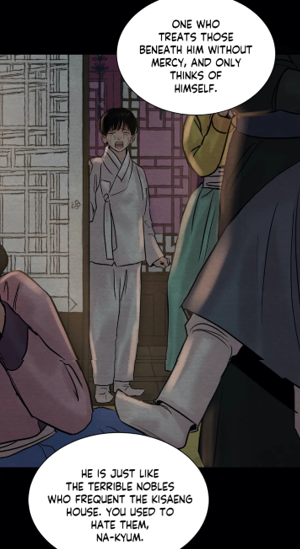 (chapter 68) to the situation in chapter 53, where the vicious domestic Deok-Jae got beaten for hurting Baek Na-Kyum.
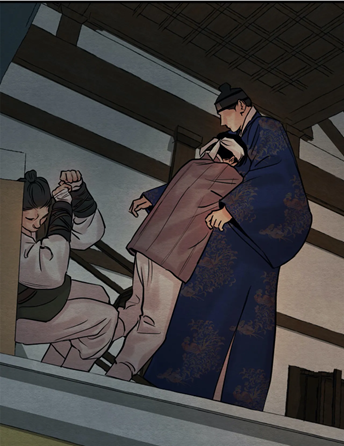 (chapter 53) This made me realize that chapter 68 was a new version of chapter 53 and 54. Therefore I would like to compare these two scenes for two reasons. First, the contrast will help us to judge better the protagonists’ actions.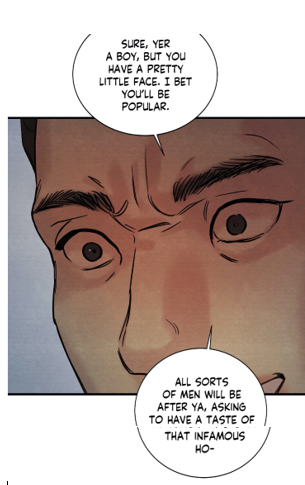
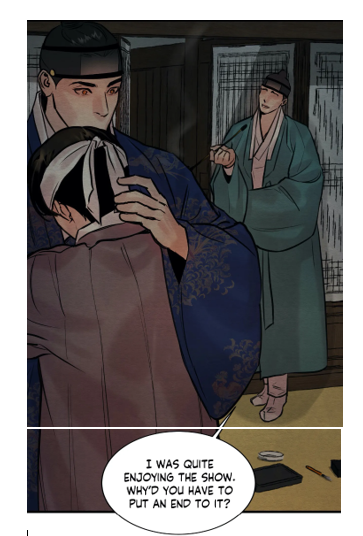 (chapter 53)
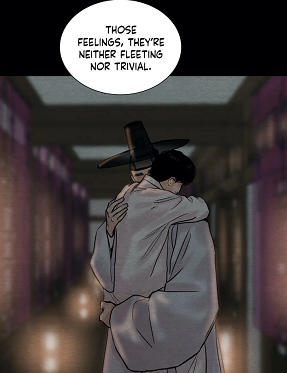 (chapter 68) versus Yoon Seungho)
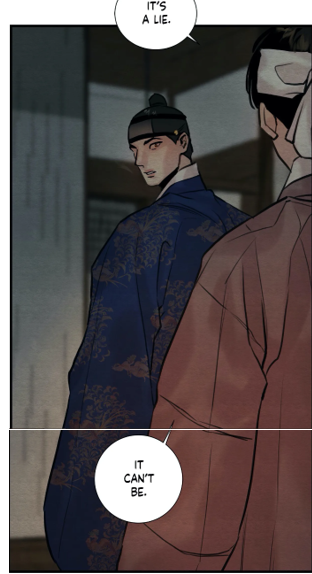 (chapter 54)
  (chapter 53) versus
 (chapter 68)
 (chapter 53) This explicates why Baek Na-Kyum couldn’t recognize the lord’s love in the end. The violence had blinded him, exactly like Heena noona had been blinded by her own prejudices. She was lumping the teenager Yoon Seungho under the same comb than the nobles. However, I would like to point out that her testimony represented a distorted memory. Why? It is because that way, she was justifying her inaction. Here, the person threatened and abused was not the noona, but the child Seungho recognizable with his hanbok. Under this approach, the manhwaphiles can grasp why she is not mentioning the helping hand in that scene, the black guard.
  (chapter 99) We don’t just see nobles frequenting the kisaeng house, but also commoners! Heena’s statement gives the impression that only nobles are going there. This exposes Heena’s biased perception. To sum up, the kisaeng and the painter were blinded, though the latter had been influenced by the noona’s doctrines. This explicates why Baek Na-Kyum was in denial in the end and saw the lord’s love as a lie. Furthermore, this signifies that the artist experienced the opposite from what Heena noona is describing to Baek Na-Kyum:
  (chapter 68). In truth, the artist mistook love for fear. Note that in each confession, the low-born expresses a certain fear, while in truth his heart is already racing for Yoon Seungho out of desire and affection. In chapter 41, he explains that his heart is pounding due to fear
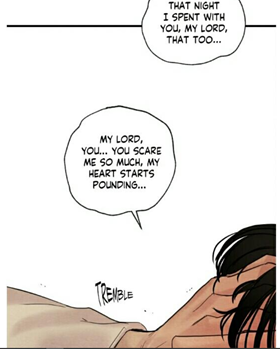 and in chapter 49, he chose to reject the lord’s hug as a genuine embrace and decided to just admit his physical attraction.
 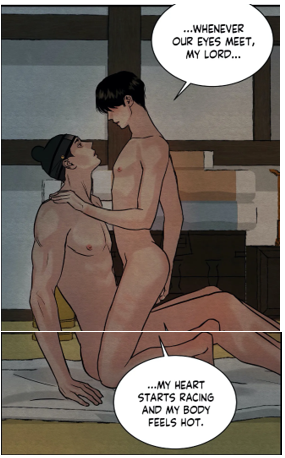 Since the lord had always been brutal, Baek Na-Kyum could never truly distinguish the cause for his heart pounding. And with this observation, it becomes obvious that the low-born was never in love with his teacher romantically, as he had never felt any heart racing for him. From my point of view, Heena noona was the one who mistook affection for fear. That’s the reason why she never saw the noble’s hypocrisy and cowardice. According to my latest theory, she is suffering from sex phobia [For more read the essay “Arrogant, filthy and lying nobles 🏯”]. But I am also suspecting that pride could have played a role as well.
 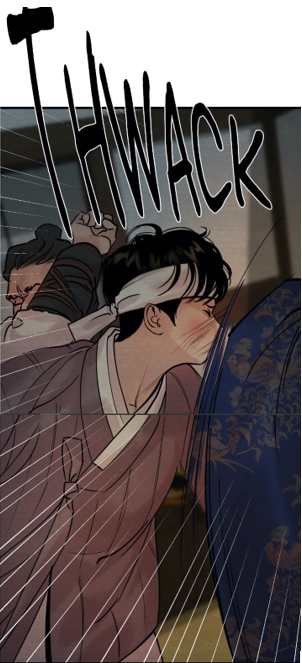 (chapter 53) He protected Deok-Jae from the noble’s violence (condition 1: Acting voluntarily for the service of others who are in need)), risked his own life (condition 3) and never receive any reward or gratefulness, in fact he never expected anything from the vicious man and the main lead. (condition 2: Performing actions without any expectation of reward or external gain). He even embraced the noble and his hug was totally genuine which the main lead sensed.
 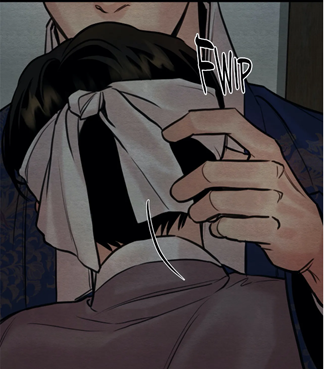 (chapter 53) And with this new approach, I believe that when Min mocked the lord by calling Baek Na-Kyum a low-born
  (chapter 54), the main lead punched Black Heart, because he was actually protecting the painter’s name and honor. He no longer felt embarrassed to love such a person, Baek Na-Kyum was a true hero in his eyes. And now you understand why Yoon Seungho felt truly rejected, when Baek Na-Kyum called the lord’s love a lie. Sure, he asked for an explanation before
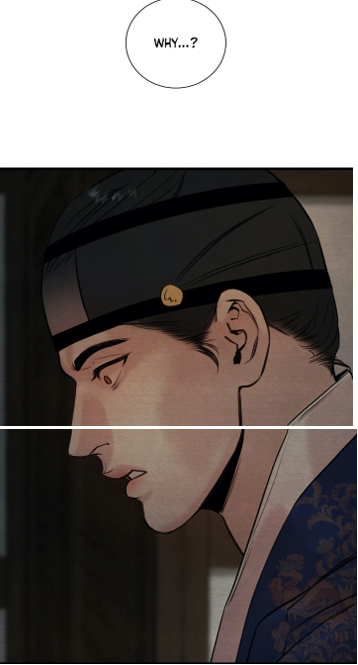 (chapter 54), yet since the lord was acting under the influence of his heart, he couldn’t voice his thoughts and feelings properly. Besides, before reaching the study, he had been denying his feelings too.
  (chapter 53) The painter’s question was pushing the lord to admit his affection. However, because he had been in denial, the painter mirrored his attitude.
 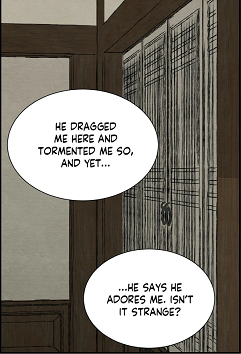 (chapter 68) When did the noble say that he adores Baek Na-Kyum? And remember that we have a flashback of that night from Yoon Seungho’s perspective:
  And this panel
  (chapter 62) made me realize that this could be the moment the lord chose to declare that he adores the painter. In this picture, the manhwaphiles have the impression that Baek Na-Kyum is whispering something to the lord, yet there’s no speech bulb and not even a moan. And since the painter is a reflection of the aristocrat, then this signifies that Yoon Seungho could have been whispering these words “I adore you”, especially after getting fully embraced by the low-born. Moreover, he experienced the heart pounding of Baek Na-Kyum
 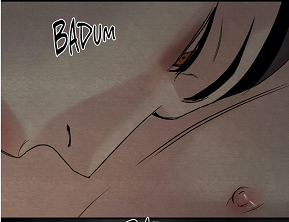 (chapter 62) so that he felt compelled to reveal his adoration. However, despite the confession, Baek Na-Kyum was still in denial. And now, you can better grasp why Yoon Seungho was enraged afterwards and felt betrayed. He had confessed properly this time, and the commoner abandoned him for real, or better said, that’s what he envisioned. We have another evidence that Yoon Seungho declared not only his defeat, but his deep affection:
  (chapter 62) As you can observe, Yoon Seungho is also connecting love to fear, but in a different way. He was always afraid of admitting his love out of fear to be abandoned. And when he did it, the artist left him behind in his eyes. His nightmare came true, until he discovered that he had misjudged the whole situation. This repetition of misunderstanding proves me that chapter 68 is a reflection of the scene in the study from episode 53-54.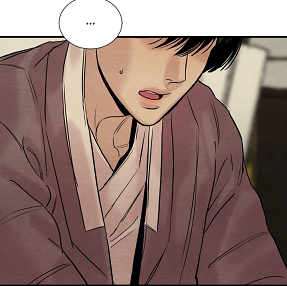
 (chapter 68) First, he uses the scholar as his legitimation for his stay at the mansion.
  (chapter 68) Then when Heena noona pressures more the painter, the latter gives other justifications, like f. ex. the lord treats him well
  (chapter 68). Surprising is that he is actually mentioning others to legitimate his stay: the scholar, the master of the mansion
  (chapter 68) and “everyone”
  (chapter 68). But Heena noona can’t accept these excuses and forces him to confess his affection. However, even when he admits his feelings, he gives the impression that he is doing it against his will.
  (chapter 68) and observe that he is using the truth for his allegations. Yet, in my opinion, he is doing the same thing than Kim in the end. He is trying to put the whole responsibility on the lonely aristocrat. But what is the truth? Yoon Seungho might have dragged and mistreated the painter, but he also protected him and treated him with care, exactly like Baek Na-Kyum mentioned it first (“the lord is very good to me”). However, if the manhwaphiles look carefully at the artist’s second justification
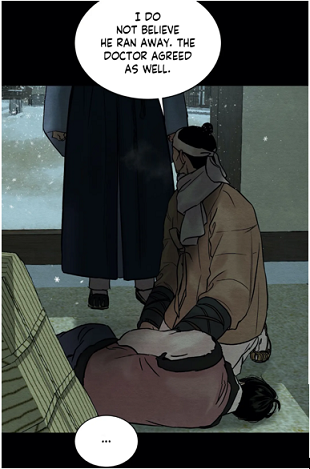 (chapter 62)
  (chapter 61)
 (chapter 63)
  (chapter 57), therefore Kim desired to push him to make the opposite decision. Since his father kept him captive, then Yoon Seungho should renounce on Baek Na-Kyum, because he doesn’t want to be like his own father. Kim knows Yoon Seungho’s good heart and wishes to utilize it to his own benefit.
  (chapter 68), but also to push Yoon Seungho to accept the painter’s departure. This explicates why Yoon Seungho didn’t enter the study and waited for the kisaeng’s departure.
  (chapter 69) Don’t forget that in episode 68, we have Yoon Seungho getting dragged against his will.
  (chapter 102) So was he acting like a hero here?
  (chapter 102) Black Heart had already stated this before:
 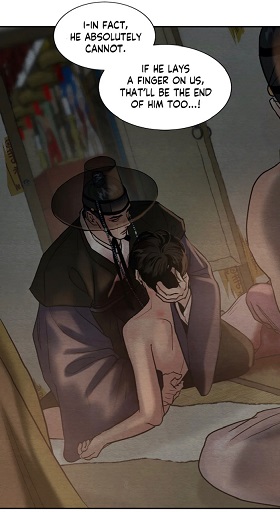 (chapter 102) Yoon Seungho had already stabbed lord Jang, therefore he could be punished for this action, even if he spared the aristocrats. In reality, there was only one solution for Yoon Seungho now: to kill them all. Why? Like mentioned above, Min would have backstabbed him. Moreover once arrested, the main lead wouldn’t have been able to protect Baek Na-Kyum. The latter would have ended in Min’s hands. Nonetheless, the lord was not acting rationally during this night. He was guided by his emotions exactly like in chapter 53/54. The only difference is that he was acting like a cold-blooded killer. The rage and pain were only palpable in his gaze.
  (chapter 102) The irony is that the Joker had reproached this to the main figure in chapter 53:
 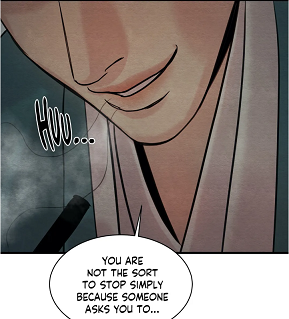 (chapter 53) He had been a killjoy, for he had showed mercy! As you can see, Black Heart’s words came back to bite him.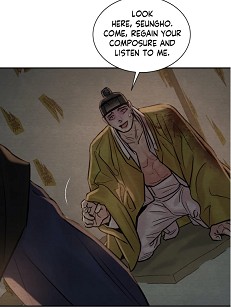
 (chapter 102) He didn’t stop, because Min asked him to. The gods were showing to Min the cruel reality: violence is not a game! And the painter’s soul and heart got spared during that night. Since he was unconscious, he never saw the bloodbath. The goddess showed mercy to the pure artist. He was rewarded for his bravery and good heart. He had remained loyal to his lover. He never believed in the manipulations of the schemers or gave in to the perpetrators. He resisted till the end to the point that he risked his own life too. Just like his lover, he was a hero.
  (chapter 102) And this brings me to the following observation: Heena described the nobles as violent and arrogant liars, but she occulted the reasons why a lord would employ violence and deceptions. Yoon Seungho didn’t become ruthless, because he likes brutality. He was forced to, and it is the same with the lie! There is no ambiguity that Yoon Seungho and Baek Na-Kyum will have to lie concerning the bloodbath. It will be a new version of this scene:
  (chapter 11) He lied in order to protect the learned sir! He took even responsibility for the crime. Both have to lie in order to protect each other.
  (chapter 53)
  (chapter 60) He was hoping for his arrival. He was already considering him as his lord and knight in shining armor. And at the end of season 3, the painter hoped the same!
 (chapter 99) Yoon Seungho was his hero and protector. It is because the painter had perceived the noble’s true personality. He was humble, generous, but more importantly, he was a man of honor. He would keep his promises!
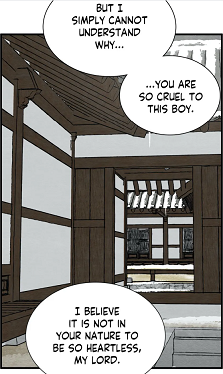 (chapter 68) In their eyes, valet Kim had turned into a hero not fearing his death. But we had another hero in this chapter, the scholar Jung In-Hun. The latter took the crying Baek Na-Kyum in his arm and brought him away from the scene, where Heena noona was getting beaten by a rich noble.
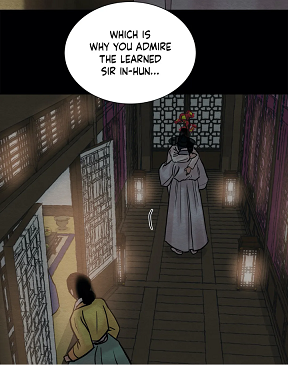 (chapter 68) In her eyes, he was a hero, because he showed concern and care towards her tenderhearted brother.
 (chapter 18) Hence I come to the conclusion, the teacher used the school in order to manipulate the commoners and the gisaengs. While he portrayed himself as righteous and kind, he described the powerful nobles as violent and arrogant, so that he would get the admiration from the commoners. In truth, he was deceiving them, since he looked down on them. Yet he needed them in order to get some connections to the powerful and rich nobles visiting the gisaeng house. On the other hand, since he didn’t want to get too close to the gisaengs, he employed the innocent boy as a shield, misleading Heena noona to think that Jung In-Hun had feelings for her brother. That’s why he hugs the protagonist so tightly.
  (chapter 67) However, the second component (“Performing actions without any expectation of reward or external gain“) doesn’t apply, because he is not doing it for free. Let’s not forget Kim’s philosophy, which was exposed in chapter 65:
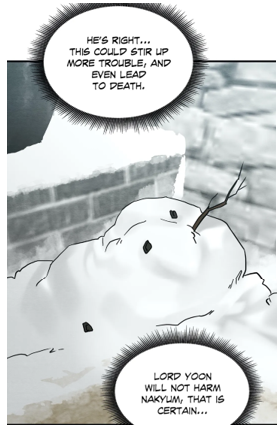 (chapter 65) He hates scandal and trouble. The gisaeng created such a uproar that Kim almost lost his credibility in front of his master.
  (chapter 65) He had two reasons for allowing her to meet the painter. First, Kim feared that she would cause more chaos in the future. Secondly, Kim realized that Baek Na-Kyum had become a huge source of trouble. He knew that the artist had been abducted, hence he got aware that Baek Na-Kyum had become a target of nobles. Furthermore, as soon as he had been returned, his sister made such a ruckus that she had turned the mansion upside down. Besides, like I had mentioned before, due to her behavior, she had put Kim in a difficult spot. Finally, he had another ground for giving his help:
  (chapter 67) He had never received the authorization from his master. However, the manhwalovers should recognize that he painted his master in a rather negative light, while leaving a good impression on her.
  (chapter 67) In my opinion, we have here a new version of the painter’s escape from the first season: Kim acting as a shadow helped the artist to run away (chapter 29-30). However, the problem is that he got caught by Yoon Seungho.
 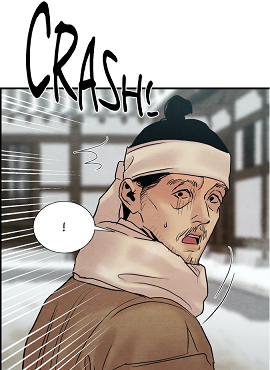 (chapter 68) What should he do now? I would like to remind the manhwaphiles that Kim had not only disobeyed his master’s order, but he had acted, as if he was a lord. He had given the permission without Yoon Seungho’s consent.
 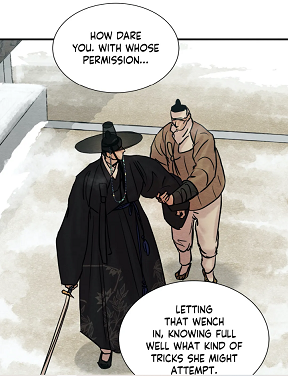 (chapter 68 It is important to recall that this story takes place in Joseon, therefore Kim’s action can definitely be judged as a betrayal and usurpation of power. One might argue that he desired to help Heena, yet like I exposed above, he did out of selfishness and not because he felt concerned for the painter and for her. As such, Yoon Seungho has the right to be upset. He is the master and someone is acting behind his back, overlooking his orders. Under this perspective, the head-maid appears more loyal to her lord than Kim himself. In this scene, he was only serving his own interest.
  (chapter 68). Note that the protagonist doesn’t menace to kill the gisaeng. He just desires to send her away, but he is now determined to punish his butler for his disobedience. He usurped his position, and as a lord he is allowed to do so. And that’s the moment, when Kim starts speaking the truth, which many readers associate to something positive.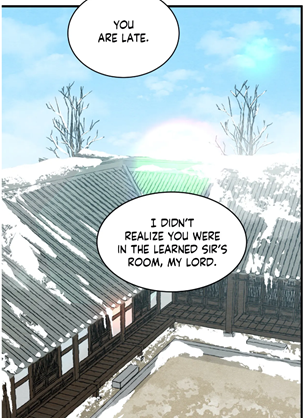
 Note, that in that chapter, the lord had the sword in his hand, and strangely the valet came late. As you can imagine, this is no coincidence. In my opinion, butler knew that something bad had happened and in order to escape his lord’s bad mood, he arrived late on purpose (lie by commission), but at the same time he revealed his knowledge about the cause for Baek Na-Kyum’s depressed mood in order to divert his master’s attention. That way, he could put the blame on the absent noble, but also on the painter. The latter had disregarded him due to the scholar’s words. At the same time, he made the lord feel insecure, because it showed him that he had behaved exactly like a client, a man obsessed with sex. That’s why with the butler’s intervention, the master had a relapse. What mattered for Kim was a peaceful life, the rest is
 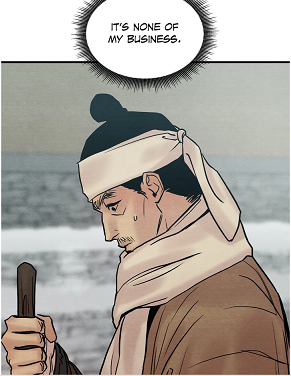 (chapter 65) Yet, he never expected such a change of behavior in the main lead, that’s why he blamed the painter afterwards.
 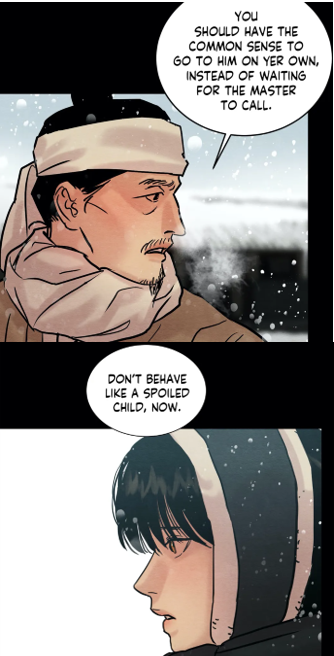 (chapter 52)
 (chapter 68) Initially, it looks like he is appealing to the lord’s heart, but in reality the main point is the noble’s judgement. The valet is reprimanding his master for his lack of discernment. He misjudged the painter’s behavior. This is relevant because in this panel, I view a first emotional manipulation. His real intent is to make the lord doubt his own judgement, like “look, back then you made the wrong decision… therefore you could be wrong here”. But the readers know that Yoon Seungho is right. Heena is determined to take away his lover, so his initial judgement about Heena is indeed correct. In his eyes, she represents a source of thread, he might lose the artist. One might argue that Yoon Seungho is sequestring the painter which is also correct, yet like my reader Luzy pointed out, this is the painter’s decision. Neither Kim nor Heena nor Yoon Seungho have to make the decision for him. And here, Kim and Heena are trying to do so. The problem is that Kim got caught. But let’s go back to my initial thought. Kim used his knowledge (the lord’s misjudgment) in order to make his lord doubt himself. and he appealed to his emotions for that. This type of manipulation is called gaslighting:
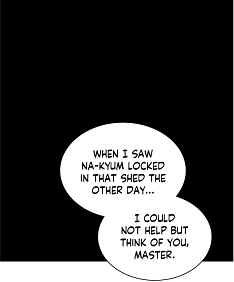 (chapter 68) Here, he is using the past in order to distort reality and memories while speaking truth. What Kim doesn’t mention here is his involvement in that incident.
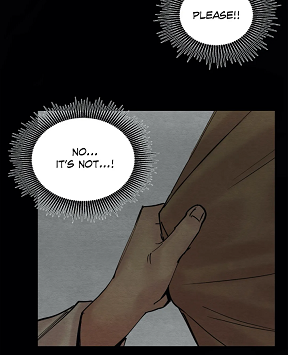 (chapter 65) Kim is destroying the lord’s confidence, so that Yoon Seungho will rely on Kim’s judgement.
  (chapter 64) He literally looked away, because truth wasn’t helpful in this case. Feigning innocence and ignorance was more appropriate.
 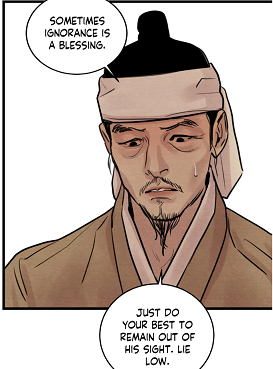 (chapter 23)
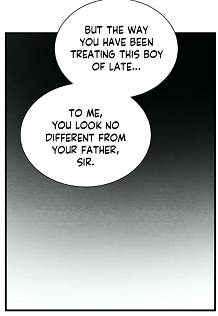 (chapter 68)
 (chapter 68) Here, Kim is mentioning the past, where he played an active role between the father and son. In other words, he is reminding the master that he is acting like a mediator. However, this revelation exposes the servant’s manipulation. He was one of the causes for the falling apart between father Yoon and the eldest son. We have to imagine that he never revealed the real reason for Yoon Seungho’s rebellious nature to father Yoon. And here, he is behaving like in the past. He tries to intervene between Baek Na-Kyum, Heena noona and Yoon Seungho, as if he had the right to.
 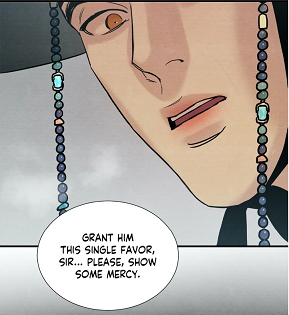 (chapter 68)
 (chapter 68) He had heard, how Heena noona was comparing him to misfortune, reinforcing his negative opinion about himself.
  He had been already prepared mentally by his butler. He was as wounded as Baek Na-Kyum, when the scholar had voiced his true thoughts about the painter.
  (chapter 40) While the artist’s fate is to become a prostitute, the other is destined to bring misery. He already externalized this perception about himself in chapter 49:
 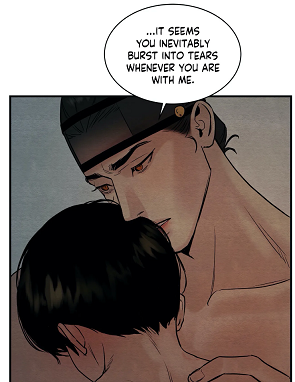 (chapter 68) For me, chapter 68 is the new version of chapter 40. That’s why I wasn’t rejoicing at all about Kim’s behavior. He was far from being honest with his truth. In reality, he used truth mixed with emotions as his ultimate tool in order to save his own skin. In other words, he functioned as the noble’s mirror.
 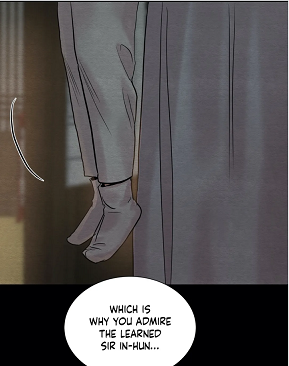 (chapter 68) He slowly takes the artist in his arms. He doesn’t rush to her side, remains silent and immobile. His passivity reflects his true personality, but Heena is too focused on her young brother to grasp the situation.
  (chapter 58). Let’s not forget that the artist realized his dedication in chapter 58. Note the huge difference. The artist never uses others in order to judge the lord. Kim will realize soon enough the consequences of opening Pandora’s box. He might have achieved his goal (the lord won’t punish him for his disobedience), yet he lost his lord’s trust. Notice that right after this quarrel, Yoon Seungho started treating Baek Na-Kyum like a noble.
 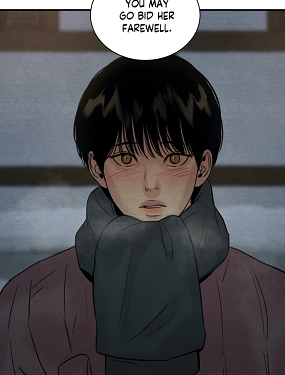 (chapter 69)
 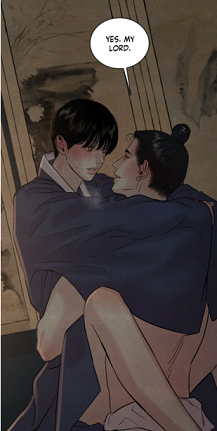 (chapter 72) From that moment on, Yoon Seungho was no longer viewing the valet as the unofficial lord. We could say that he had lost his status as “hero” in the main lead’s eyes.
 (chapter 31) Consequently in chapter 34, the painter sensed a change of perception about his body after the sex marathon. For the first time, he detected his heartbeat and the butterflies in his stomach, which were triggered by the main lead’s presence.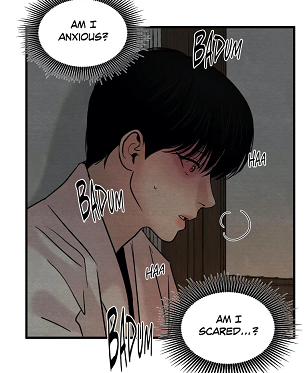
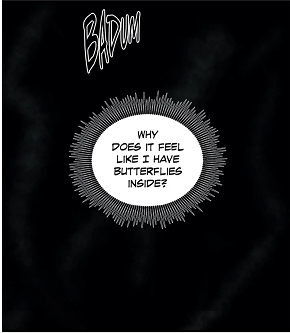 (chapter 34) The parallels can be observed by the absence of the eyes of the protagonists in certain panels. Compare the picture with the mirror
 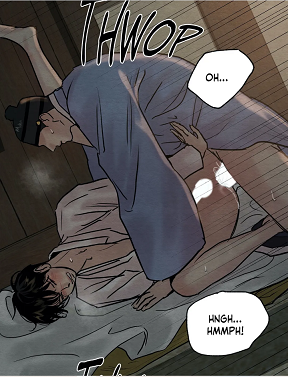 (chapter 63) Striking is that the character represented with eyes plays the role of the liberator for his sex partner. Due to the sex marathon, Yoon Seungho had helped the painter to free himself from his torpor, since due to the coercive persuasion, the artist had come to deny not only his sexual orientation, but also the existence of his own body. That’s why he could no longer admire his learned sir like before after the sex marathon. By recognizing the existence of his own body, the painter couldn’t feel the same attraction towards the teacher. And since the sex marathon played a huge role in his healing process, we have to imagine that the sex scene in the barn has the same signification for Yoon Seungho. He is on his way to be liberated from his self-hatred, but as you can imagine, it will be a painful process. Back then, the painter got ill and the lord ran away from his responsibility. That’s why this time, the blinded person will be the one suffering from the sex marathon: he will feel like dying, when he realizes that he wounded his lover blinded by his prejudice and anxieties.
  (chapter 63) He has no guarantee that this is true, and love is like a leap of faith. This isn’t something that you can grasp or see. Besides, he would have no control over him, if he accepts the confession. Loving means taking risks, which is linked to fears. This displays how much the master has been brainwashed. Since the painter disappeared in his mind, he came to acknowledge his father’s doctrines one more time before dropping them completely, when he discovers the truth.
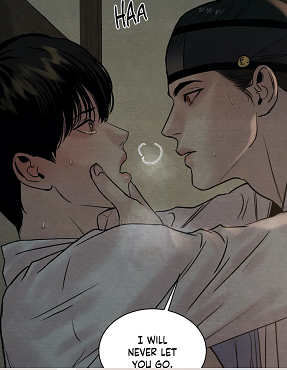
  (chapter 63), so his love confession to never let the painter go symbolizes one of the last principles Yoon Seungho has internalized. As a master, he can decide about the painter’s fate. So if we consider this scene as a hypnosis session, where is the mirror? As you can imagine, the painter’s face and gaze serve as a mirror for the lord, where he can perceive himself. Therefore the last image shows our protagonist looking closely at the painter’s face and his eyes.
 when his father betrayed and abandoned him. This will help him to forget the father’s gaze engraved in his heart. The latter was full of hatred and resent, which the main lead internalized. And with this new interpretation, the chapter 63 appears in a different light. It gives the manhwaphiles hope.
  (chapter 65)
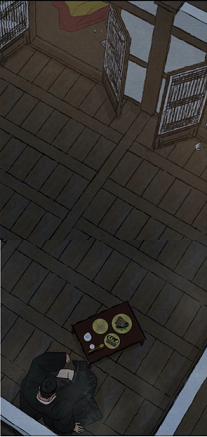 (chapter 69) He had ruined his relationship with the artist. Because he refused to make the leap of faith in the shed, Yoon Seungho decided to make the opposite choice. He let the painter decide about his own fate, yet he was definitely living in agony. The wounded, fearful and desperate gaze revealed his turmoil.
 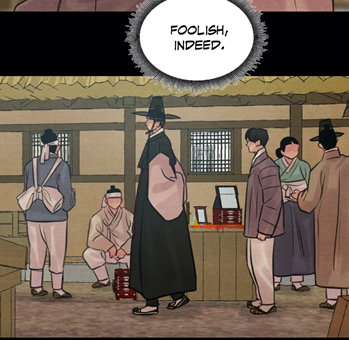 (chapter 40)
 (chapter 62)
 He rejected his concern and yelled at him. In chapters 62-63, the positions are switched. Yoon Seungho is the one upset and pained, since he is convinced that the artist abandoned him, therefore his anger is aiming at the commoner. Yet, the true culprit of his wound is his childhood friend Jihwa. Simultaneously both have a common point: Baek Na-Kyum gets hurt, because he becomes the target of Yoon Seungho’s anger, while in chapter 40, he is backstabbed by his admired sir and used the master to get some comfort. Yet, the situation is similar, as the real culprits of the wound never witness the consequence of their actions and words.
  (chapter 63) And if we take the chapter 41/42 into consideration, the painter did request that the lord should be particularly rough.
 (chapter 42) As you can see, the chapter 40 can not be really detached from the sex scene which follows the teacher’s betrayal. Another contradiction is that the painter is just asking the lord to stop, since Baek Na-Kyum is exhausted, while the aristocrat believes that the commoner is pushing him away, begging him to let him go for good.
 (chapter 63) But this divergence comes from the fact that this scene is a new version of the sex marathon, which I mentioned above. Back then, the painter made a similar request. As conclusion, the violence of the sex in chapter 62-63 is strongly connected to an emotional wound, a repetition of chapter 41/42. And in my opinion, the artist understood the situation and the lord’s motivation. Hence he doesn’t feel badly about Yoon Seungho. Notice that the next night, Baek Na-Kyum doesn’t think badly of this sex marathon.
 (chapter 40)
 (chapter 63) What caught my attention is the contrast between the two declarations. While the artist’s feelings for his admired sir seem to be very strong (I adore you), his words don’t really correspond to his affection, because his feelings have already diminished. He did lie to his teacher and protected the main lead in chapter 38. That’s why the “I adore you” should be judged as an exaggeration. It was, as though the painter desired to convince himself and his teacher that he was still attached to him. Besides, he needed to persuade him not to abandon him, after hearing so many reproaches. This observation leads me to the conclusion that Baek Na-Kyum made up his mind to still follow his teacher out of loyalty despite the harshness of Jung In-Hun’s words. On the other hand, the author used a litotes (“I do not dislike you”), implying that in fact his attachment is much stronger. And this is exactly what happens during this scene. Despite the harshness, the painter is forced to question his true feelings for the main lead and recognize them. He is even willing to confess, yet he is stopped. I doubt that Yoon Seungho would have perceived it as a love confession, as he hates meek words. I can use this panel as a reminder:
 (chapter 48). Yoon Seungho is exactly like the painter, he loves strong and metaphorical confessions, like “you’ve made me a wreck” or “I will never let you go”. But let’s return our attention the scholar and Yoon Seungho. Both nobles act the same way. Both can’t accept the artist’s declaration, yet their motivation diverges. The teacher finds it disgusting to be connected to a commoner, whereas Yoon Seungho is too afraid of being lied. He has the impression that this dream can never come true. Yet, while contrasting them, we see the painter’s determination who is willing to overlook the reproaches expressed before by both aristocrats. And he remains faithful till the end. That’s why he waited for Jung In-Hun at the gate in episode 44.
  He needed to see with his own eyes, how the learned sir had truly abandoned him. This represents another explication why the low-born didn’t react like Kim and Min anticipated. He didn’t follow his sister out of loyalty, compassion and a certain trust. However, Heena noona was able to sow seeds of doubts.
 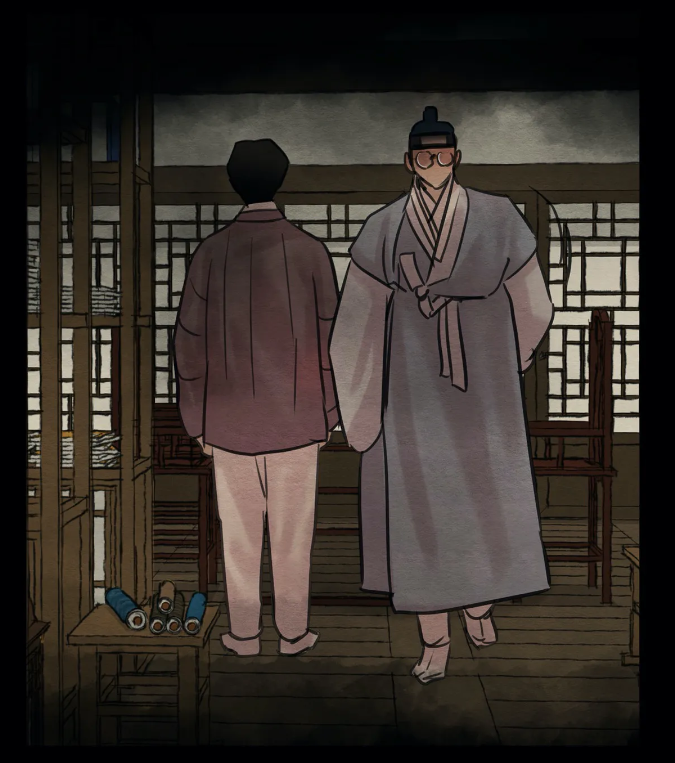 (chapter 40) In this picture, the scholar leaves the painter behind, a metaphor for his abandonment. He even repeats this action, when he leaves for the capital. In chapter 62-63, Yoon Seungho sees in the commoner’s escape a rejection and betrayal.
 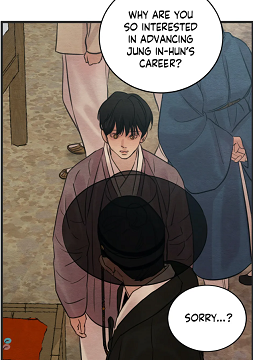 (chapter 40)
 (chapter 40)
  (chapter 62)
  (chapter 63) In both cases, the aristocrats questions the commoner’s motivations for his actions. While Jung In-Hun’s interrogation serves him as an occasion to break his promise by putting the blame on Baek Na-Kyum, the other character is more curious to know about the reasons for his desertion. From my point of view, this shows the noble’s desire to comprehend the painter better. And this illustrates that his obsession with the “why” is well meant. Why is he pushing him away? If he knows the cause, he could find a solution in order to bring the painter to his side.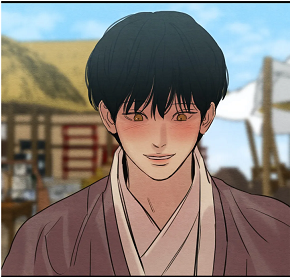
 (chapter 40) The painter became happy, when he heard that the civil service examination would take place soon. He immediately thought of his learned sir and envisioned that this would please his former teacher. Jung In-Hun’s excitement became the painter’s joy, this is how the painter was thinking in that scene.
  (chapter 40)
 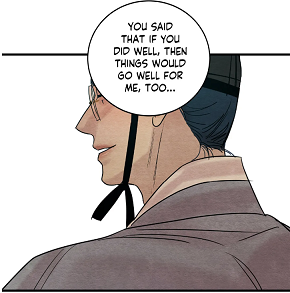 (chapter 29) By contrasting both panels from chapter 40, the readers can detect the painter’s lie. He expects something from the low noble. He is indeed hoping that Jung In-Hun will keep his promise and he will take his responsibility for him, since the painter supported him.
 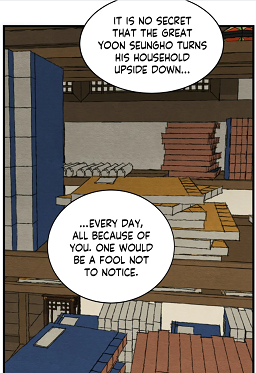 (chapter 40) The former had Yoon Seungho’s attention all the time, and we all know that Jung In-Hun’s desire is to get attention and admiration. Striking is that the comparison enlightens the materialistic and narcissistic side of Jung In-Hun, while Yoon Seungho appears purer. He is just content with a smile. Besides, he would like to be the source and recipient of Baek Na-Kyum’s smile, whereas the other wishes to get favors (clothes, a room closer to the lord’s chamber, the favor to spend the evening in the bedchamber etc). That’s why by contrasting both chapters, the protagonist’s purity and simplicity become even more palpable, which is hidden due to the violence employed during that confrontation.
  Furthermore, if we take the chapter 41 into consideration, since we have a flashback of the incident at the library,
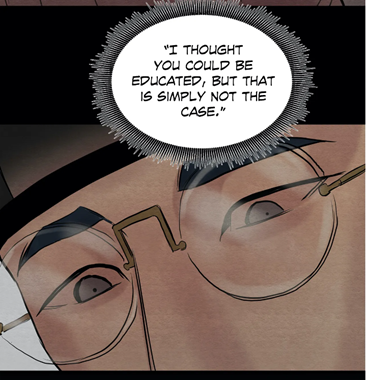 then the readers can recall that in this episode, Baek Na-Kyum was so heartbroken that he asked from Yoon Seungho to be embraced. He needed a shoulder as solace and comfort. The low-born literally begged him, while crying to be hold in his arms, but the noble didn’t know how to respond to this request.
 (chapter 41) He only knew sex. In chapter 62, the lord hold the artist in his arms, only to betray him afterwards. The warmth is faked.
  (chapter 62) Yet, if you pay attention, you’ll observe a second hug in the barn: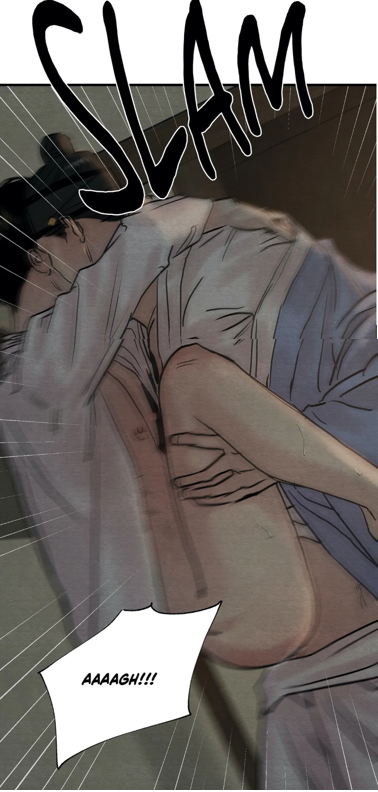
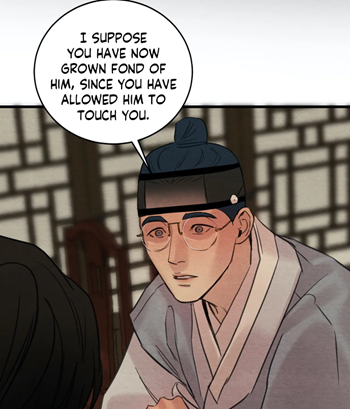
 (chapter 40) while in chapter 63, it is the turn of our seme to reveal his expectations and desires.
  ,(chapter 62) while the scholar calls the artist a fool
 . (chapter 41) He is just jealous, furious and repulsed. Yoon Seungho is seeking closeness and uses sex in order achieve his goal, therefore he is is refusing to stop. He is so desperate to remain intimate with the painter, while the other noble has only one thought: keeping his distance from the low-born.
 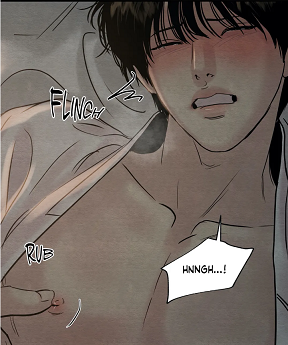 (chapter 63) and words
 (chapter 63) have a huge effect on the upset protagonist. They trigger the noble to open up and reveal himself. That’s why the chapter ends with a face to face: the aristocrat is not decided to look at the painter’s eyes directly.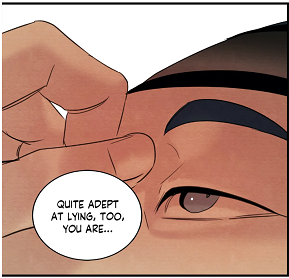
 (chapter 40)
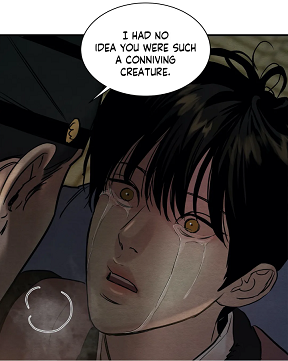 (chapter 62)
 (chapter 62)
  (chapter 71) and Yoon Seungho’s outburst
 (chapter 70). Furthermore, when the painter is able to calm down the main lead by calling his name “Lord Seungho” and showing a blushed face, the aristocrat initiates a real conversation
  (chapter 62)
 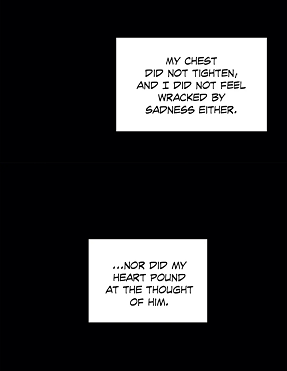 (chapter 71) There was a “love confession” in the barn, but the lord didn’t use the typical expression for that:
  (chapter 76). The only problem is that Baek Na-Kyum is still fearing his own emotions for the infamous noble. Therefore he has not confessed yet, which will be the reason why both main leads will suffer again. The painter has just opened up and is not trusting Yoon Seungho entirely.

