
Please support the authors by reading Manhwas on the official websites. This is where you can read the Manhwa: Jinx But be aware that the Manhwa is a mature Yaoi, which means, it is about homosexuality with explicit scenes. Here is the link of the table of contents about Jinx. Here is the link where you can find the table of contents of analyzed Manhwas. Here are the links, if you are interested in the first work from Mingwa, BJ Alex, and the 2 previous essays about Jinx The Unseen Game of Life and Tactile Dissonance: When Touch Falls Out of Sync
It would be great if you could make some donations/sponsoring: Ko-fi.com/bebebisous33 That way, you can support me with “coffee” so that I have the energy to keep examining Manhwas. Besides, I need to cover up the expenses for this blog.
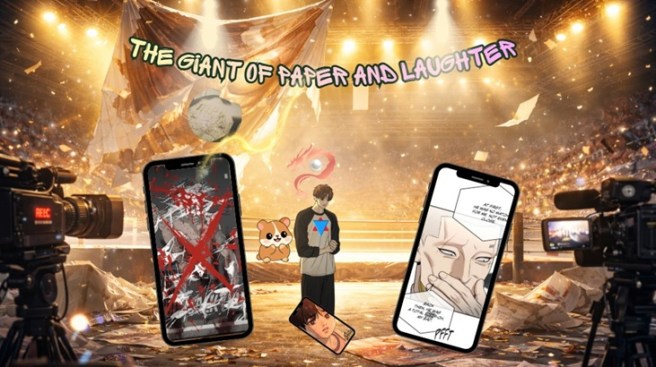
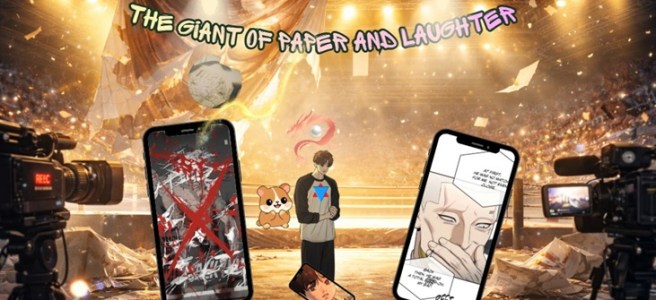
The Champion: A Giant?
Who is the giant? The answer seems self-evident—at least at first.  (chapter 1) A towering figure, a champion, a name that carries weight across arenas and screens. Someone whose image is large enough to be printed, displayed, and recognized at a glance. And yet, that same image can be torn.
A poster is damaged. 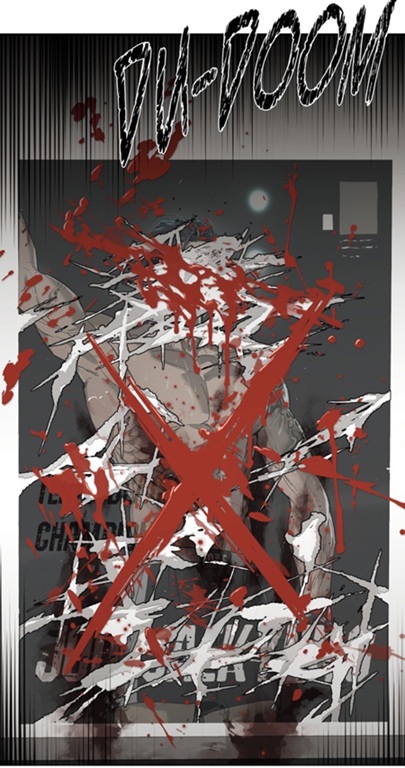 (chapter 96) Its surface scratched, its authority weakened. What was meant to represent strength suddenly appears fragile, almost replaceable. Around it, nothing changes immediately. The world continues, the match approaches, the voices keep speaking.
 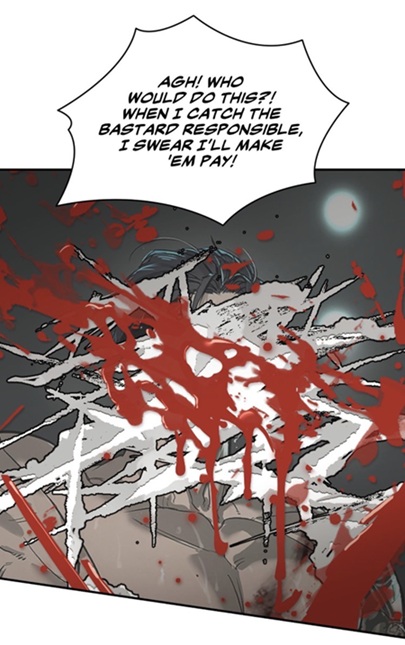 (chapter 96) But something has shifted. The image no longer holds in the same way.
At nearly the same moment, another kind of intervention takes place. 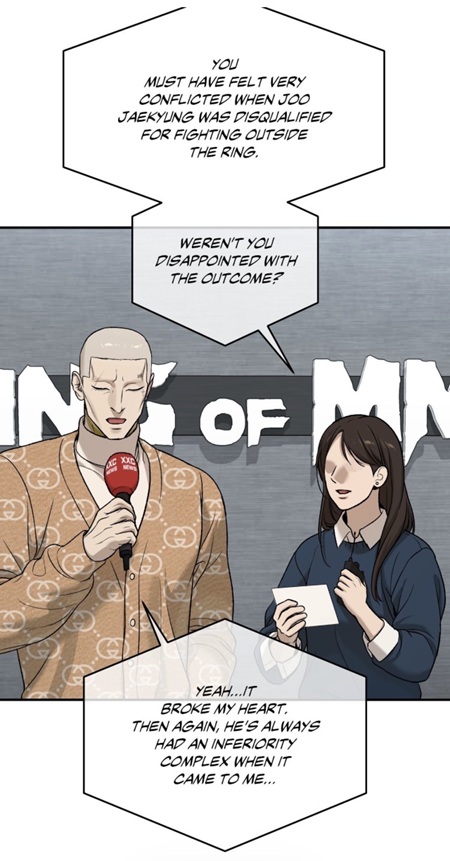 (chapter 96) Not physical, but verbal. A voice begins to recount a past—selectively, confidently, as if it had always been clear.
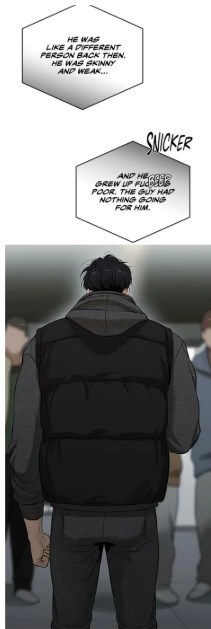 (chapter 96) Details are rearranged, others omitted. What emerges is not a lie, nor entirely the truth, but something in between: a version that is easy to follow, easy to accept, and difficult to challenge. And with it, the figure at the center begins to change.
This is not a confrontation. It is a process. What appears to be under attack is a person. But what is actually being altered is something less tangible and far more unstable: the way that person is seen. An image, once fixed, becomes negotiable. A narrative, once assumed, becomes uncertain. And suddenly, the question of strength is no longer tied to the body, but to something else entirely. 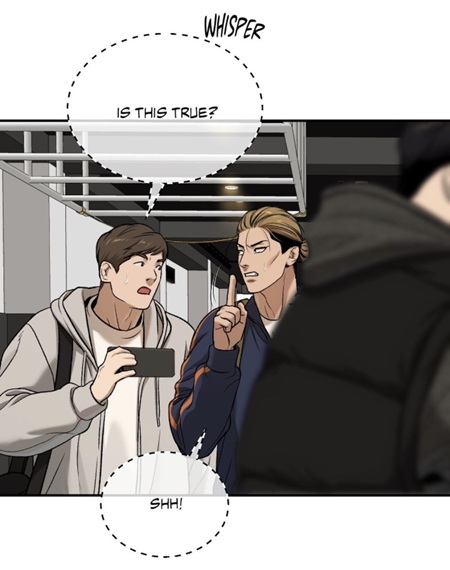 (chapter 96)
So we must ask again. If the giant can be reduced to paper, then perhaps the giant was never there to begin with. (chapter 96) Or perhaps it was never where Jinx-lovers were looking. Because if the Emperor is not the Giant, then the real one has yet to be named.
To approach this question, it is not enough to follow the fight itself. One must look elsewhere: at images that are destroyed as easily as they are produced, at voices that reshape the past in real time, and at the sequence of events that gradually transforms perception without ever appearing as a direct attack. Only by tracing these shifts—between what is shown, what is said, and what begins to disappear—can we begin to understand where power truly resides.
The Making of the Giant of Paper
Before it is destroyed, the image must first be made.
But this construction does not begin in the present. It has already taken place—earlier, more discreetly, and under different conditions. At that time, the narrative surrounding Baek Junmin followed a familiar pattern.  (chapter 47) He was introduced as the “underdog,” the one rising unexpectedly, the figure whose ascent could be celebrated. The framing was simple, effective, and, to some extent, transparent. It invited attention, but it also raised suspicion.
There were signs. Voices questioned the legitimacy of the narrative (chapter 47) 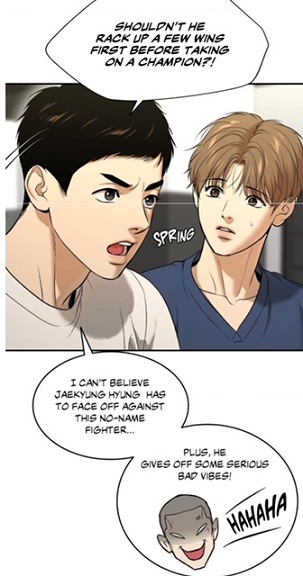 (chapter 47), suggesting that what appeared as spontaneous recognition might in fact be influenced, if not orchestrated. The idea that media coverage could be shaped (chapter 47) —financially or strategically—was not dismissed. It circulated, hesitantly, at the margins. Yet this suspicion remained limited in scope. It did not extend to the system itself. The integrity of the organization, and more specifically of the MFC, was not openly challenged. Instead, doubt was redirected toward the figure of the rising fighter. The question was not whether the structure produced the narrative, but whether Baek Junmin had benefited from it.
This distinction is crucial. By locating the potential manipulation at the level of the individual rather than the institution, the system remained intact, unquestioned, and therefore protected. What was perceived as irregularity did not lead to structural critique, but to localized suspicion. This also explicates why the main lead couldn’t find any information about Baek Junmin.  (chapter 47) The system was not yet fully opaque. It could still be glimpsed—but only indirectly, through inconsistencies that were sensed rather than fully articulated.
The present situation is markedly different. As the match approaches, the same mechanisms reappear—but without resistance. The headlines no longer build an underdog 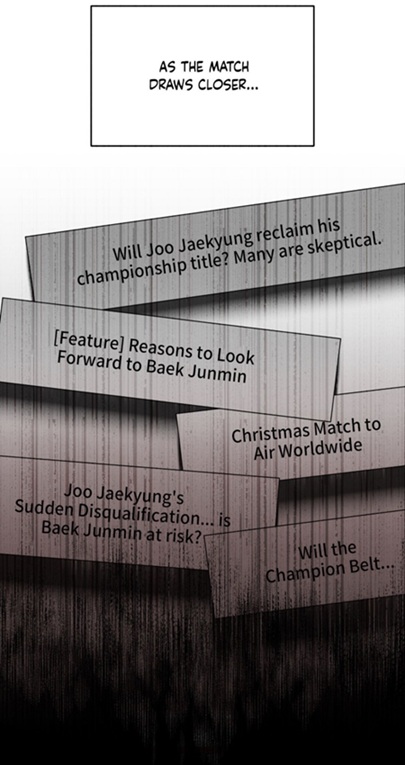 (chapter 95); they reorganize an already established hierarchy. Joo Jaekyung is no longer presented as the stable center of the narrative. Instead, uncertainty surrounds him. One headline, in particular, reveals the logic at work with striking clarity:
“Joo Jaekyung’s sudden disqualification… is Baek Junmin at risk?”
At first glance, the headline appears contradictory. A disqualification, by definition, should settle a situation. It should close the case, eliminate ambiguity, and stabilize the hierarchy. And yet, here, it produces the opposite effect. This is not a simple inconsistency. It is a deliberate construction that operates on two temporal levels simultaneously.
On the one hand, the headline refers backward. By invoking a “sudden disqualification,” it reinterprets the past. What had previously been presented as a suspension — temporary  (90 days), reversible, even later framed as recovery
  (chapter 57) — is now recoded as something definitive. (chapter 96) The shift is subtle but decisive. A suspension belongs to the logic of administration; a disqualification belongs to the logic of judgment. The suspension was grounded in medical authority. (chapter 52) It was issued by MFC doctors, as the incident took place there. It implies a temporary exclusion, a controlled interruption that does not fundamentally challenge legitimacy. The athlete remains inside—recognized, ranked, and, in principle, recoverable. Hence he was ranked as third in August.
  (chapter 69) A disqualification operates differently. (chapter 96) It does not merely suspend participation; it redefines status. It exceeds medical judgment and enters the domain of institutional authority. It relocates the athlete outside the system, not only temporarily but symbolically. What is questioned is no longer his presence, but his legitimacy. The issue is no longer whether he can compete, but whether he should have been recognized as a competitor at all.
This distinction is decisive. It points toward the involvement of the institutional hierarchy—figures such as the MFC CEO and those who operate alongside him. Hence his “invitation” for a match in Paris was never revealed to the public.  (chapter 69) The panel from chapter 47
 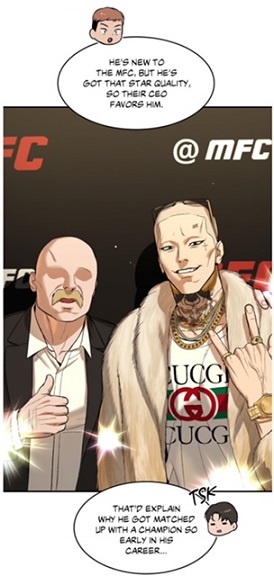 (chapter 47), makes this structure perceptible. The presence of executive figures, the proximity between management and select fighters, and the emphasis on “star quality” reveal a structure in which recognition is not solely determined by performance.
In this light, the shift in terminology acquires a broader significance. It does not simply reinterpret an event; it exposes the conditions under which decisions are made. The hierarchy of the organization is not neutral. It intervenes, adjusts, and, when necessary, redefines outcomes in order to preserve its own coherence.
By allowing the media to replace “suspension” with “disqualification,” the MFC does not intensify the punishment—it repositions the athlete. What had been a procedural measure becomes a moral and structural judgment. The shift authorizes a different interpretation of past events.
(chapter 95) In this sense, the change of terminology performs a protective function. If the situation remains a suspension, it can be contested. It leaves open the possibility of return, of reinstatement, and, crucially, of legal challenge. The athlete remains within the framework and can therefore claim rights—question prior decisions, contest irregularities, and potentially demand compensation.
A disqualification closes that space. By framing the exclusion as definitive and justified, it neutralizes the possibility of reclamation. It stabilizes the loss of the title by presenting it not as a consequence of circumstance, but as the logical outcome of misconduct. The narrative anticipates contestation and preempts it. It transforms a potentially disputable situation into one that appears settled.
This is where the broader context becomes relevant. The sequence of events—the unresolved tie  (chapter 51), the irregularities surrounding the match, the incident with the switched spray—contains elements that could be reexamined. Joo Jaekyung’s public challenge in Paris reactivates these tensions. It signals not only resistance, but the possibility of escalation. By refusing to accept the existing narrative, he reopens questions that the system had already moved to close.
From this perspective, the headline does not simply report—it anticipates. (chapter 95) It prepares the ground for a conflict that has not yet fully emerged. By framing the situation as a disqualification and by presenting the athlete as a destabilizing figure, it redirects attention away from the structural irregularities and toward individual behavior. At the same time, it reassures those who depend on the system’s stability—sponsors, partners, and institutional actors—that the situation is under control.
The transformation of language thus serves a double function: it delegitimizes the athlete while protecting the structure. Moreover, if something were to happen again—another incident, another “sudden” event, it would not appear as an isolated occurrence, but as confirmation of an already established pattern. The result is a double bind. The past justifies suspicion, while the future is prepared to confirm it.
Within this structure, Baek Junmin occupies an equally unstable position. The question of risk does not truly endanger him; it legitimizes him indirectly. By presenting him as someone who could lose what he has gained, the headline acknowledges his status without fully affirming it. He is recognized, but conditionally. His position depends less on his own victory than on the continued framing of his opponent as problematic.
What appears, then, is not uncertainty in a general sense, but a controlled instability. The narrative does not aim to clarify the situation. It aims to maintain a tension in which one figure is constantly redefined as a potential threat, while the other is never entirely secured as a legitimate successor.
Even in apparent advantage, he is not affirmed. What is striking is that, even after his so-called victory, he continues to be referred to as the “underdog” (chapter 52), notably among the members of King of MMA. This persistence is not merely rhetorical; it reflects a deeper uncertainty regarding the legitimacy of his rise. Within the fighters’ own environment, the outcome of the match is not experienced as a clear victory. Baek Junmin himself acknowledges that he was “this close to winning,”
 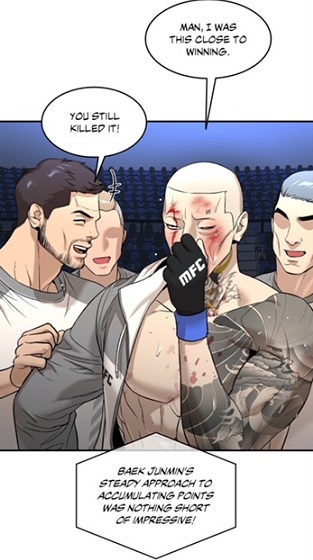 (chapter 51) revealing that the tie has not been integrated as a legitimate conclusion. It persists instead as a wound: a result experienced not as confirmation, but as deprivation. In this sense, his current aggression does not only seek promotion; it seeks retrospective compensation.
The betting dynamics further reinforce this ambiguity. (chapter 52) While it is suggested that significant sums were placed on Baek Junmin, this perception proves misleading. The apparent support masks a more calculated position, in which the outcome itself—rather than the fighter—is the object of investment. The smile that accompanies the announcement of the tie reveals that the result was not a disruption, but a realization of expectation.  (chapter 51) So he had not bet on the Shotgun’s victory.
This distinction is crucial. What appears as confidence in Baek Junmin is, in fact, confidence in the structure that produces the outcome. The fighter becomes the visible beneficiary of a system whose logic exceeds him, while the absence of a decisive victory prevents his recognition from stabilizing. He is supported, but not validated. The problem is not that he lost. The problem is that he never clearly won against Joo Jaekyung and that this unresolved result seems to have fixed him in a position of grievance.
In this light, the persistence of the “underdog” label is no longer paradoxical. It reflects the gap between institutional designation and experiential acknowledgment. This gap becomes even clearer when one recalls that Baek Junmin never earned the KOFC belt in the way Joo Jaekyung did.  (chapter 75) The latter’s rise was marked by a visible title, publicly attached to his name and career trajectory. Baek Junmin, by contrast, occupies the position of champion without passing through the same symbolic sequence of recognition. All this time, he was working in the shadow, in the illegal underground fighting. What he inherits institutionally, he does not fully possess symbolically. He may occupy the position of champion, but the conditions of his ascent prevent that position from being fully recognized as legitimate. The label that once signified ascent is never replaced by one that would confirm his dominance. At the same time, his stage name The Shotgun
  (chapter 49) fails to establish itself. Neither his peers nor the media adopt it. Instead, he is consistently referred to by his real name: Baek Junmin.
 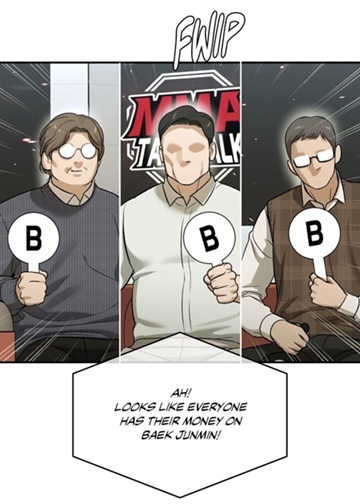 (chapter 95) This absence is not insignificant. In the world of competitive sports, a title or nickname is not merely decorative; it is a marker of recognition, a sign that an identity has been collectively validated. To name a fighter is to fix his position within the symbolic order of the sport. By refusing—or failing—to adopt his stage name, the media and his environment deny him that stabilization.
This absence of recognition is not limited to language; it extends to the level of the image. A champion, within the logic of modern sports media, is not only defined by a title but by the visual confirmation of that title. 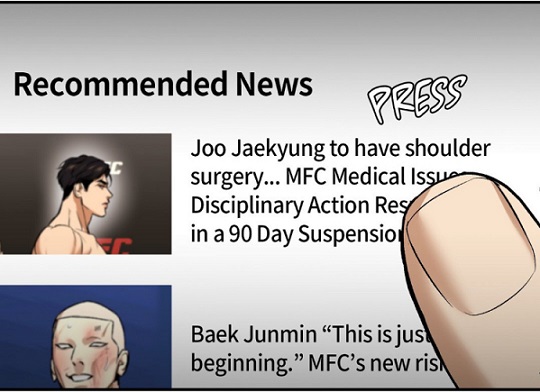 (chapter 52) Victory must be seen, fixed, and circulated in order to become real. In this respect, Baek Junmin’s position reveals a fundamental volability. His so-called victory does not produce a defining image. The match that secured his title was neither clearly decisive nor widely broadcast, leaving no shared visual reference through which his dominance could be established.
As a result, the media does not construct him as a figure. It names him, but does not show him. 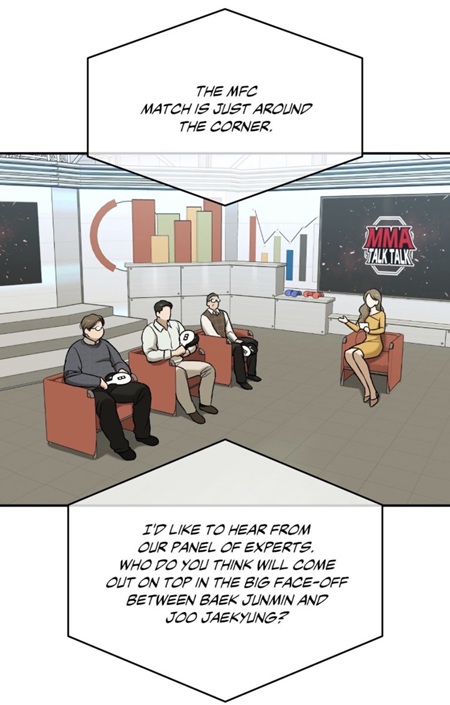 (chapter 95) It becomes more visible, if you contrast this show with the one about the celebrity in episode 52:
  (chapter 54) Instead, it continues to rely on the image of Joo Jaekyung. Even in defeat, the latter remains visually central: his body, his injuries, his presence provide the material through which the narrative is articulated.
 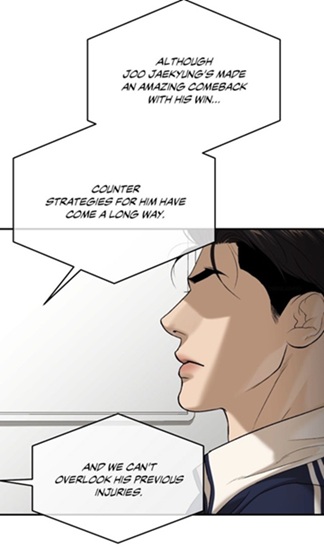 (chapter 95) The fallen champion supplies the image that the reigning one lacks. This imbalance has significant consequences.
Without a stable visual identity, Baek Junmin’s title remains abstract, insufficiently anchored in public perception. His victory does not become an event that can be collectively remembered, but a result that must be asserted repeatedly. In this sense, he occupies the position of champion without acquiring the symbolic legitimacy that would normally accompany it. He wins the position—but not the identity. He does not fight to win—he fights to be seen. And now, you comprehend why he did the interview on the day, the champion’s image got ruined. 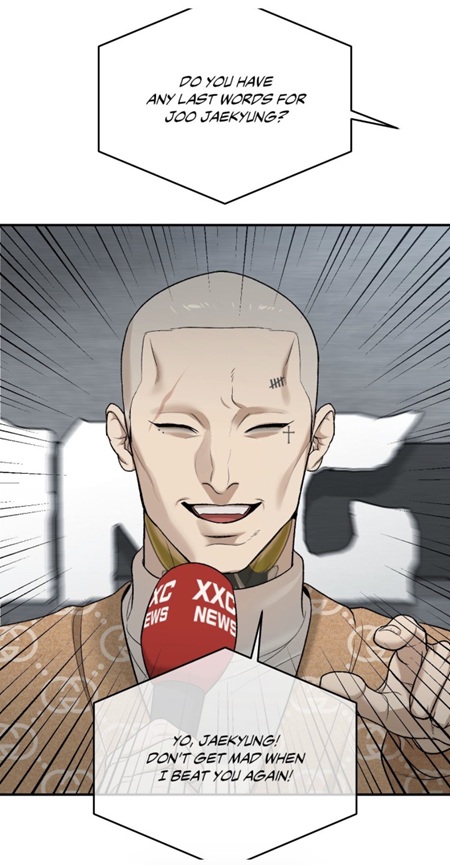 (chapter 96) The MFC may have declared him champion, yet this recognition remains institutional; it does not translate into collective acknowledgment among the masses. Hence he is never seen signing autographs.
 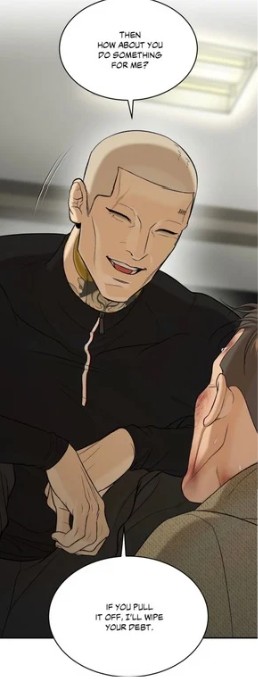 (chapter 93) He always appears sitting in the office separated from the other members. Hence, visibility must be manufactured for him to be recognized as a champion.
In doing so, it also redefines the role of Joo Jaekyung. Disqualified, he should disappear. Instead, he persists as a destabilizing presence—no longer a contender, but still a threat. His exclusion does not neutralize him; it transforms him into a figure whose very absence continues to structure the narrative. and the headlines with the sudden disqualification becomes a focal point. (chapter 96) Doubt replaces confidence. The questions posed are no longer about the rise of one fighter, but about the possible fall of another.
What is striking is not the content itself, but the absence of reaction. Where earlier moments revealed suspicion, the current ones are met with silence. Neither the fighters nor the surrounding figures openly challenge the narrative. (chapter 96) The possibility of manipulation, once acknowledged, is no longer articulated. It is as if the system no longer needs to hide. Its operations have become sufficiently integrated to function without being named.
It is within this context that the poster must be understood. (chapter 96) Its destruction does not initiate the process—it materializes it. What had been unfolding across media and digital spaces now appears in physical form. The gesture, however minimal, suggests a continuity between what is said and what is done. The narrative does not remain abstract; it produces effects.
And yet, this effect raises a deeper question about agency. At first glance, the figure associated with this transformation seems clear. Baek Junmin dominates the narrative space. His name circulates, his rise is emphasized, his position reinforced. It would be tempting, therefore, to identify him as the Giant—the one who displaces, replaces, and ultimately stands at the center of this reconfiguration.
But this identification does not hold. Because Baek Junmin does not control the narrative; he moves within it. He benefits from it, embodies it, and perhaps even believes in it—but he does not produce it. The coherence of the operation exceeds him. It extends across media outlets, digital platforms, and institutional structures that coordinate visibility, attention, and interpretation.
What emerges, then, is a different configuration of power. The Giant is not the figure that appears, but the structure that allows it to appear in a certain way. It is not located in the individual, but in the network that sustains and amplifies him. (chapter 95) Behind the visible face lies a set of interests that do not present themselves directly—economic, strategic, and, at times, illicit. The circulation of narratives is not neutral; it is tied to flows of capital, influence, and control that operate beyond the surface of the story.
In this sense, Baek Junmin is not the Giant, but its surface. (chapter 96) This becomes visible when one considers the asymmetry of representation between the two fighters. At Team Black, Joo Jaekyung’s presence is materially affirmed through the large poster displayed at the entrance. His image is fixed, visible, and collectively recognized. It establishes him not only as a champion, but as a figure whose status is publicly validated. (chapter 1) No such affirmation exists at the rival gym, King of MMA. That’s why Baek Junmin remains a champion on paper—validated by the system, but not embodied within it.
At the same time, this absence points beyond the individual. The figure that appears in the foreground conceals a more complex network of influence. Behind Baek Junmin stands not only the local structure of the gym (chapter 96), but also broader institutional connections 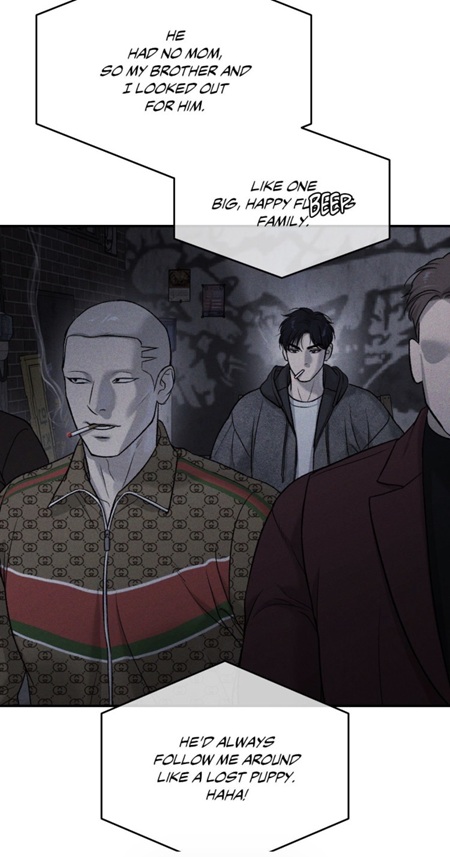 (chapter 96), including corporate interests that extend beyond the immediate context of the sport.
  (chapter 48)
The image, then, is not missing by accident. Its absence reflects a displacement: what is not consolidated at the level of the individual is sustained elsewhere, within a network that organizes visibility without fully exposing itself. He gives it form, visibility, and direction—but the force that sustains it remains elsewhere, less visible, and therefore more difficult to confront.
The ruined poster (chapter 96), then, does more than signal the fragility of an image. It reveals the presence of a system capable of extending its influence from representation to action, from discourse to intervention—without ever fully exposing itself.
And yet, this configuration produces an unexpected reversal. The figure that appears largest—the one whose name circulates, whose presence dominates the narrative—is not the one that holds power. (chapter 96) Conversely, what truly determines the outcome remains largely unseen, operating through structures that do not present themselves directly. The opposition, then, is not between two equally visible figures, but between what can be perceived and what cannot, between a presence that can be attacked and a force that cannot be easily located. Under such conditions, the struggle cannot take the form it seems to promise.
And yet, this progression leads back to the initial question. Who is the Giant? If we must finally name the Giant, we find it is not a person, but an entity: Goliath. Yet, in this modern arena, the script of the ancient myth has been inverted. Unlike the biblical Goliath—a singular, towering physical presence—this Goliath is invisible and decentralized. It is a vast network of corporate interests, manipulated media headlines, and systemic corruption. The traditional ‘Giant’ is an easy target because of its scale, but the MFC remains untouchable precisely because it hides behind its ‘paper’ constructions. 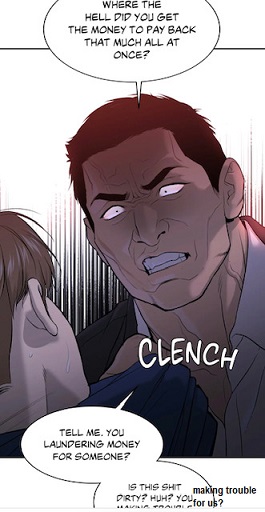 (chapter 11) It is a shadow that cannot be struck with a stone. However, this configuration reveals a fundamental weakness: the Giant is not just made of paper; it is rotting from within. If the foundation of the MFC is nourished by money laundering (chapter 48) and sustained by “paper companies,” then its strength is an illusion maintained by silence and complicity. In this light, the damaged poster in Chapter 96 (chapter 96) acts as a physical mirror for this hidden corruption. Just as the poster’s surface is scratched and its authority weakened, the system itself is rotting. The perpetrators here are not just sports managers; they are criminals operating under the guise of legitimacy—white-collar offenders hiding behind tax evasion and financial fraud.
This corruption signifies that the Giant’s power is entirely transactional. It exists only as long as the ‘papers’—the ledgers, the contracts, and the bribe receipts—remain hidden. The “paper” that grants the Giant its size is the same material that ensures its fragility. It implies that the removal of a single, strategic sheet—not a physical blow, but a structural one—could bring the entire edifice to collapse. In this light, the stone that brings down Goliath is not found in the ring, but in the hands of the law. A single police report 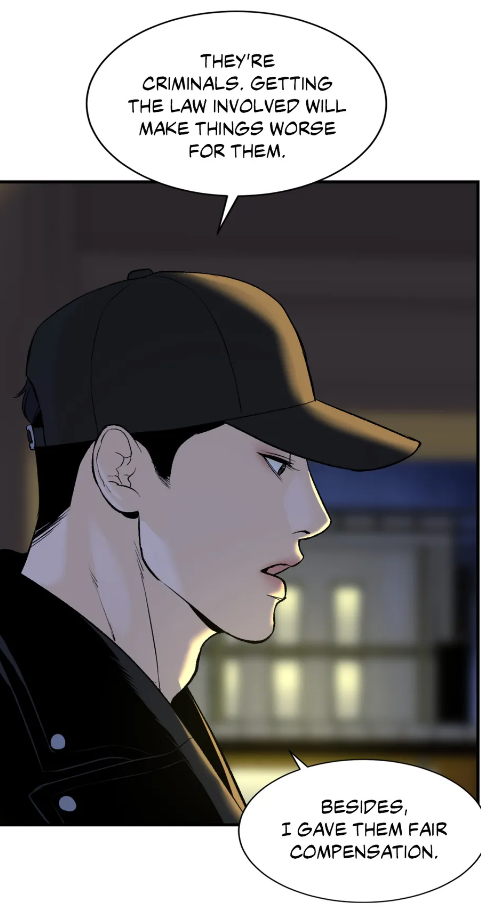 (chapter 18), a testimony, a leak of financial records, or a documented truth becomes the only weapon capable of tearing through the Giant of Paper. To destroy the narrative, one does not fight the image; one strikes the ledger.
To conclude, the threat does not come from within the arena, but from outside it. Not from physical confrontation, but from the transformation of hidden records into acknowledged facts. The Giant of Paper does not collapse under force. It collapses when what sustains it can no longer remain concealed.
The Laughter That Rewrites a Life
So if Goliath is a “Giant of Paper” (Money and Shell Companies), then this interview is the “Ink.” The money laundering creates the Giant’s body, but Junmin’s laughter and rewritten history provide the Giant’s “skin”, the part the public sees. What unfolds in the interview is not a spontaneous outburst, nor the crude provocation of a rival seeking attention. It is something far more controlled. The tone oscillates between mockery and composure 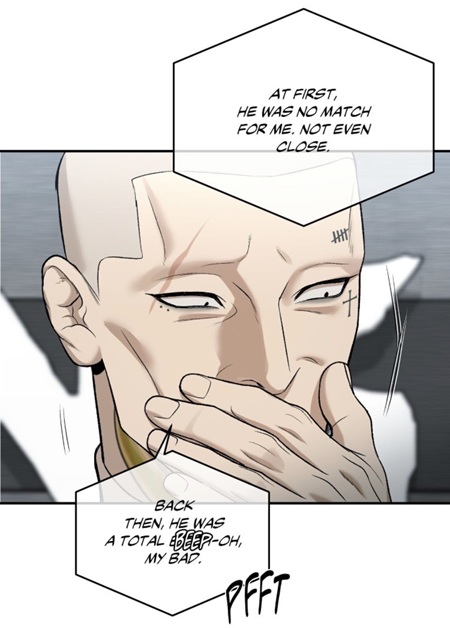 (chapter 96), between laughter and measured statements (chapter 96), as if two registers were deliberately intertwined. On the surface, Baek Junmin performs the role expected of him: the confident fighter, amused, dismissive, superior. The smirk, the laughter, the casual insults
 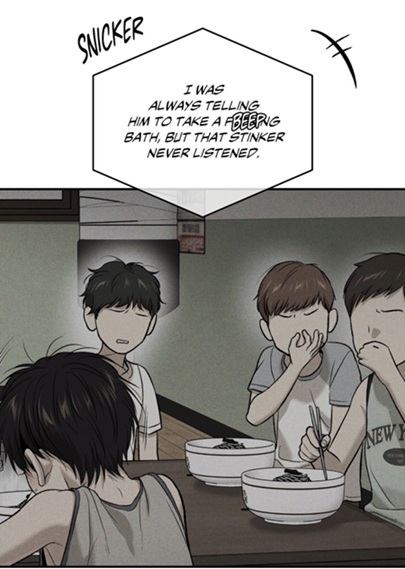 (chapter 96) — these elements construct an image of dominance that appears almost effortless. (chapter 96) And yet, beneath this performance, another layer becomes visible. The vocabulary shifts. The insults become structured. (chapter 96) The accusation of an “inferiority complex” does not belong to the same register as the crude remarks that surround it. It introduces a clinical tone, one that suggests interpretation rather than reaction. This is not the language of impulse. It is the language of framing.
This shift is not accidental. It indicates preparation. Baek Junmin does not speak as an isolated fighter improvising under pressure. His discourse bears the marks of prior construction, as if it had been shaped, filtered, and calibrated before being delivered. (chapter 96) This physical evasion—the refusal to meet the gaze of the lens—suggests a speaker who is not recounting a memory, but reciting a script. The ‘clinical’ term is a foreign object in his mouth, a tool handed to him by the ‘Giant’ behind the scenes. The alternation between vulgar insults and quasi-medical terminology creates a carefully controlled ambiguity: what is said can wound, but cannot be easily prosecuted. The insults remain indirect, the claims remain interpretative, and the responsibility is constantly displaced.
In this sense, the interview operates within a legally protected gray zone. It is not pure defamation, because it avoids explicit false statements that could be challenged in court. (chapter 96) Instead, it relies on suggestion, selective truth, and reframed memory. The figure speaking appears spontaneous, but the structure of his speech reveals constraint. Someone, somewhere, has ensured that the line is never fully crossed: lawyers, doctors… (chapter 96) Crucially, the author employs a recurring visual metaphor to mark the boundary between Baek Junmin’s calculation 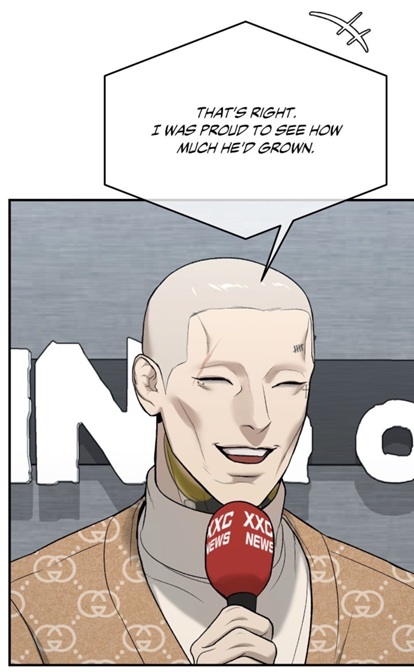 (chapter 96) and his true self. Whenever he is forced into restraint—when he must deliver the scripted, empathetic lie—his eyes are firmly shut (Chapter 96). As he claims his heart was ‘broken’ by the disqualification, he physically blinds himself to the truth of his own joy, locking his real expression behind his eyelids to maintain the professional mask. The public sees only his calculated composition.
This contrasts sharply with his open-eyed laughter elsewhere (Chapter 96). In this moment, the mask slips completely. His eyes are wide, his face is true to itself, and his smile let transpire pure disdain. Here, he reveals to the audience that he is no real friend. His words about Jaekyung’s ‘growth’ become an act of deep condensation. The closed eyes represent the restraint required to lie, but the open, mocking face is the true reflection of his contempt. However, the script lets transpire that he is the one suffering from a huge inferiority complex. (chapter 96)
This is where the role of the surrounding structure becomes visible. The discourse does not only protect the speaker; it protects those behind him. The gym, its backers, and the wider network that sustains him remain shielded. What is exposed is the target; what remains invisible is the mechanism that enables the attack.
The laughter, then, is not simply mockery. (chapter 96) It is part of the strategy. It softens the accusation, disguises intent, and transforms aggression into performance. It allows the speaker to say what must be said—while appearing not to say it at all.
This duality is essential. It allows the discourse to operate in a gray zone where it can neither be dismissed as pure aggression nor fully challenged as a verifiable claim. By alternating between vulgarity and pseudo-analysis, the speaker protects himself. The laughter and smile disarm, the terminology legitimizes. What emerges is a narrative that can circulate freely without exposing itself to direct contestation. It resembles testimony, yet avoids accountability. In this sense, the interview does not simply attack; it reorganizes.
The past becomes its primary terrain.
Rather than confronting Joo Jaekyung in the present, the discourse moves backward (chapter 96), selecting fragments of childhood and reassembling them into a coherent but partial story. Absence is introduced where complexity once existed. (chapter 96) The mother disappears, reduced to a simple fact—“he had no mom”—as if this absence were self-explanatory, requiring no further inquiry. The father is not mentioned at all. With this omission, an entire dimension of the champion’s history is removed, along with the implications it carries. What remains is a simplified figure, detached from lineage, stripped of context, and therefore easier to redefine. This absence becomes all the more striking, when one recalls that Baek Junmin only began interacting with the main lead after the death of his father, himself a former boxer. 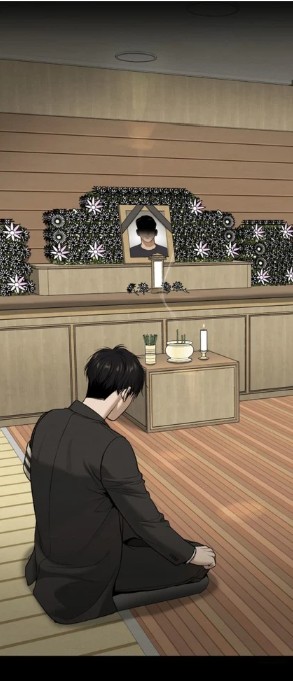 (chapter 74) The omission cannot therefore be reduced to coincidence. It suggests either a lack of knowledge regarding this dimension of the past, or a deliberate decision to leave it unaddressed. In both cases, the effect is the same: a crucial element of the champion’s formation is excluded from the narrative, preventing any recognition of continuity, inheritance, or transmission.
The moment his existence becomes publicly acknowledged, the narrative constructed by Baek Junmin begins to collapse. What was presented as a story of weakness and isolation is recontextualized through lineage and inherited proximity to the world of fighting. Even if the father did not train him—and indeed opposed boxing—his presence reintroduces continuity where the interview imposed rupture. At the same time, at no moment, the Shotgun brought up the physical abuse from Joo Jaewoong, so Baek Junmin’s hypocrisy gets exposed (“It breaks my heart…”). Besides, this revelation risks extending beyond the individual case. It reopens the question of the structural links between combat sports and illicit networks  (chapter 73), a connection that the narrative had carefully displaced. What appears as a personal account thus becomes unstable, exposing not only its own inconsistencies, but the broader system it sought to conceal.
But let’s return our attention to the Champion in Paper. The latter inserts himself into that past. (chapter 96) He becomes the one who “looked out for him,” the one who was followed, the one who observed, judged, and ultimately surpassed. The relationship is rewritten as hierarchical and unilateral. He was the hyung who knew everything better, and Joo Jaekyung was just stubborn. (chapter 96) What might have been coexistence becomes dependence. What might have been proximity becomes subordination. In doing so, Baek Junmin does not merely diminish the other; he constructs himself as the necessary reference point through which that past can be understood.
And yet, this reconstruction is unstable.
Because it encounters a form of resistance that does not depend on counter-speech, but on the persistence of verifiable traces. 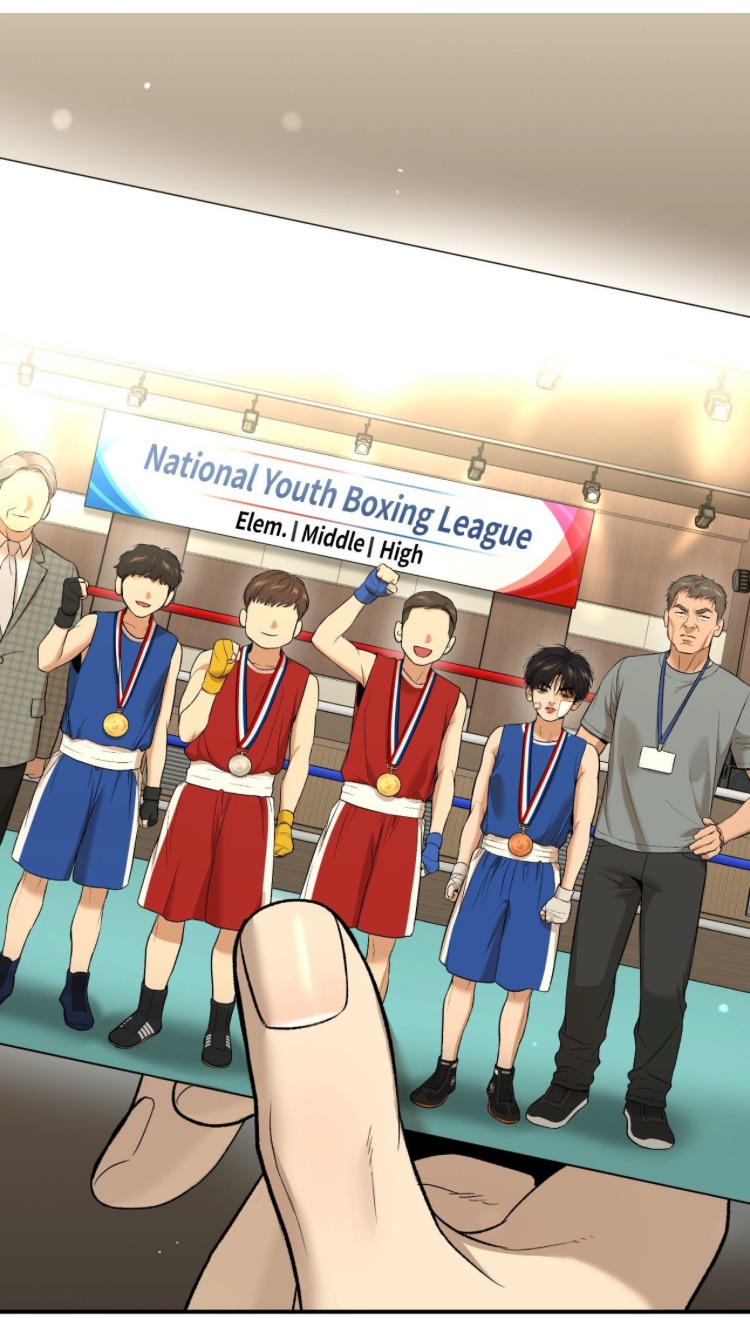 (chapter 71) The photograph of the young fighter with his coach introduces a contradiction that the interview cannot fully absorb. It does not merely suggest discipline or continuity; it attests to a process that precedes and exceeds the narrative imposed upon it. The trajectory it reveals is not incidental, nor dependent on a single relationship, but anchored in duration, training, and transmission.
This contradiction is reinforced by another element. On the night of his father’s death, Joo Jaekyung had already won his first boxing tournament  (chapter 73). This detail is decisive. It establishes that his development was already underway, and that his formation cannot be reduced to the simplified account presented in the interview. It also repositions Hwang Byungchul. Far from being the negligible or ineffective figure implied indirectly by the discourse, he appears as part of a structure that enabled this early progression.
What emerges, then, is not simply an alternative narrative, but the presence of a witness. A successful coach and gym owner 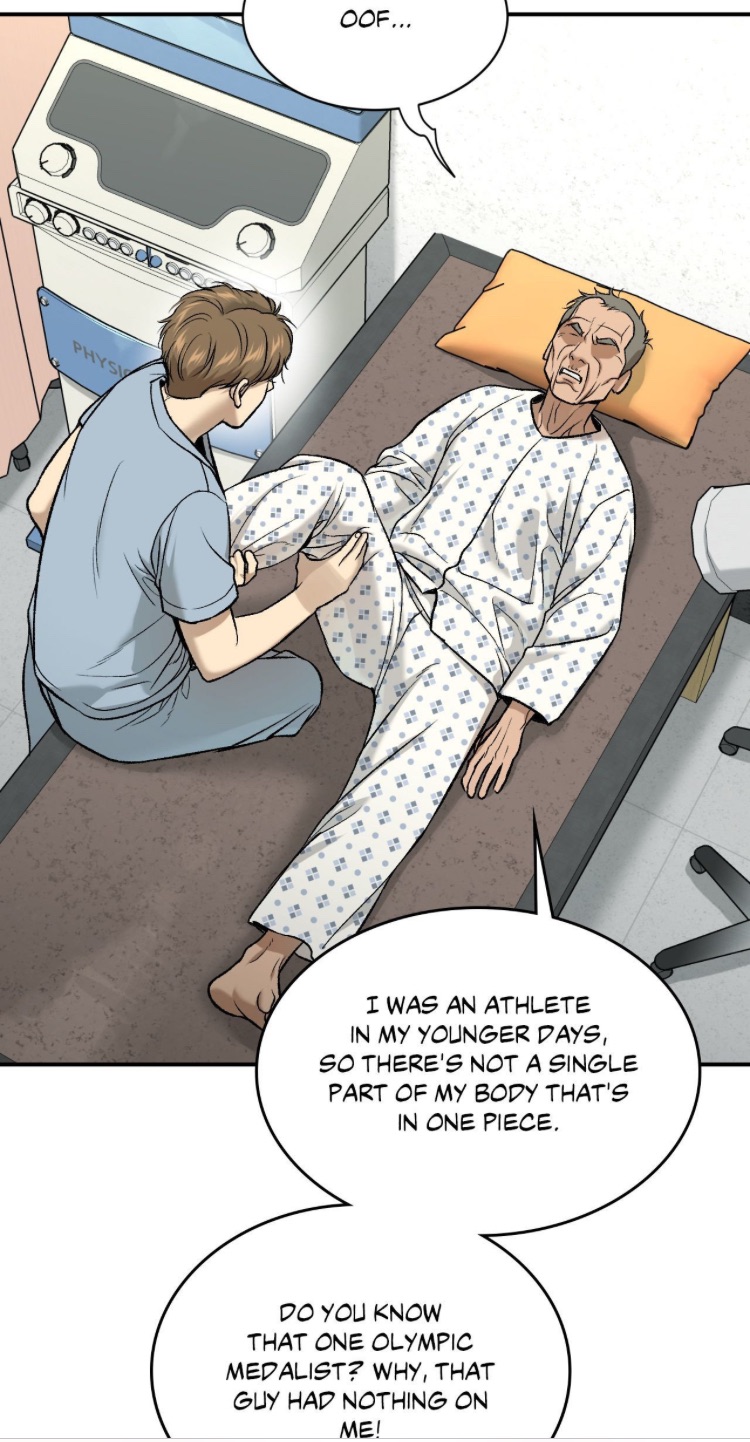 (chapter 71) , the tournament, the documented progression—these elements introduce points of verification that resist the logic of selective reconstruction. The past is not entirely available for reinterpretation; parts of it remain anchored in events, relations, and figures that can contradict the imposed version. On the other hand, the Champion in Paper has only his recollection as evidence which is based on the narration of others.
This is precisely what Baek Junmin fails to account for. His discourse is structured by comparison and hierarchy, focused on the figure of the main lead as an isolated reference point. In doing so, it overlooks the broader network of relations within which that figure was formed. The result is a narrative that appears coherent, but rests on an incomplete—and therefore unstable—foundation.
This is precisely what the interview seeks to neutralize. By reducing the past to a series of humiliating details—isolation, poverty, neglect, weakness—it transforms development into deficiency. The years of training disappear behind anecdote. Dedication is replaced by ridicule. The champion is no longer someone who became strong, but someone who was once weak. The temporal movement is inverted. Growth no longer leads forward despite his claim,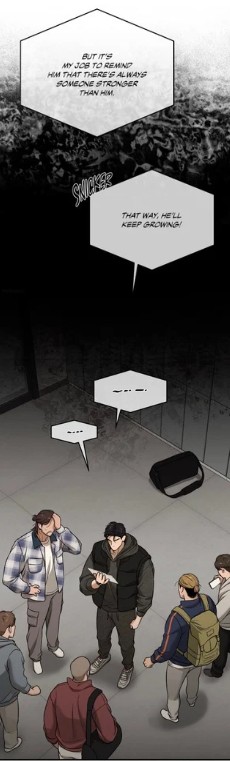 (chapter 96); it is used to anchor the subject in a diminished origin that can be continuously recalled and reactivated.
In this sense, the strategy aligns with the earlier shift from suspension to disqualification. It is not enough to destabilize the present; the past must also be rewritten. Only then can the figure be fully redefined. And yet, this operation produces an unintended effect.
By insisting on hierarchy, by constantly positioning himself above, Baek Junmin reveals the very limitation that structures his discourse. He can only define himself in relation to another. He only knows one world: social darwinism, while Mingwa via Shin Okja and the landlord are promoting “mutual aid”. His identity depends on comparison (chapter 96), on opposition, on the maintenance of a vertical order in which he occupies the superior position. This is why the notion of “inferiority complex” becomes central. It is projected outward, attributed to the other (chapter 96), but it simultaneously exposes the logic that governs his own position. Without that hierarchy, his discourse loses its foundation.
This dependency explains why his recognition remains incomplete. Despite the visibility granted by the interview, despite the circulation of his name and statements, he does not acquire a stable identity as champion. He is present everywhere, yet never fully constituted. The system amplifies his voice, but does not anchor his image. He speaks, but does not replace. The absence noted earlier persists. His figure remains suspended, contingent on the very narrative he helps to produce.
This is where the notion of a Pyrrhic victory becomes relevant. (chapter 96)
The attempt to destroy the opponent’s image does not result in consolidation, but in exposure. By bringing the past into public discourse, by mobilizing language that exceeds his own register, by aligning himself so visibly with a broader narrative apparatus, Baek Junmin reveals the conditions that sustain him. The interview does not conceal the system; it makes it perceptible. The coordination between discourse, timing, and prior events—such as the vandalized poster (chapter 96) —suggests an operation that extends beyond the individual. What was meant to appear as personal testimony begins to resemble a structured intervention.
Even the proximity to cyberbullying operates within this ambiguity. (chapter 95) The content humiliates, distorts, and circulates widely, yet it remains carefully calibrated. It avoids direct falsification, relies on selective truth, and frames interpretation as opinion. This positioning allows it to evade legal accountability while maximizing its effect. The attack is real, but its form protects it from being easily named as such.
In the end, the interview does not establish Baek Junmin as the Giant.
It confirms his role within the system that produces the Giant. He acts, speaks, and provokes, but the coherence of the operation does not originate with him. It passes through him. And in doing so, it exposes both his intention and his limitation. He seeks recognition through destruction, but what he ultimately reveals is the structure that makes such destruction possible.
The Echo of Laughter: When Others Begin to See
The interview does not end with the one who speaks. (chapter 96) What is said circulates, settles, and reaches those who were never meant to be its primary audience. Its impact is not measured by its accuracy, but by the way it interferes with existing perceptions. It does not simply construct a narrative; it tests how that narrative will be received, absorbed, or resisted. In this sense, its true effect becomes visible only when it encounters those who carry fragments of the past it attempts to rewrite.
The Bad Coach and his Dump Gym
For Hwang Byungchul, this encounter produces a rupture. Until this moment, his position had been defined by distance and partial understanding. He had witnessed certain events, sensed irregularities, and yet never fully questioned the structure within which they occurred. His interpretation of the past remained localized, focused on individual decisions  (chapter 74) rather than systemic conditions. Thus he accepted that his body as a fighter got so damaged. (chapter 71) And he did not have a physical therapist back then either. The interview disrupts this equilibrium. By erasing his role
 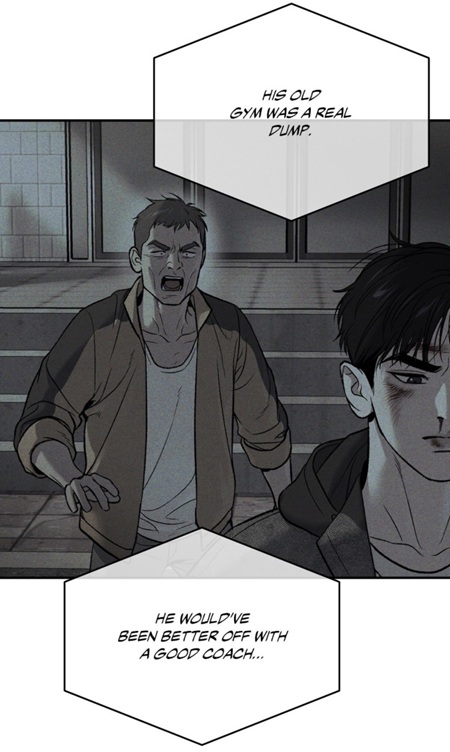 (chapter 96) —by reducing the champion’s formation to failure, neglect, or insignificance—it forces a confrontation the coach had previously avoided.
Baek Junmin’s words disturb that stability in another aspect: the champion’s mother. For Hwang Byungchul, her absence had long been integrated into a tragic but coherent explanation. She had left 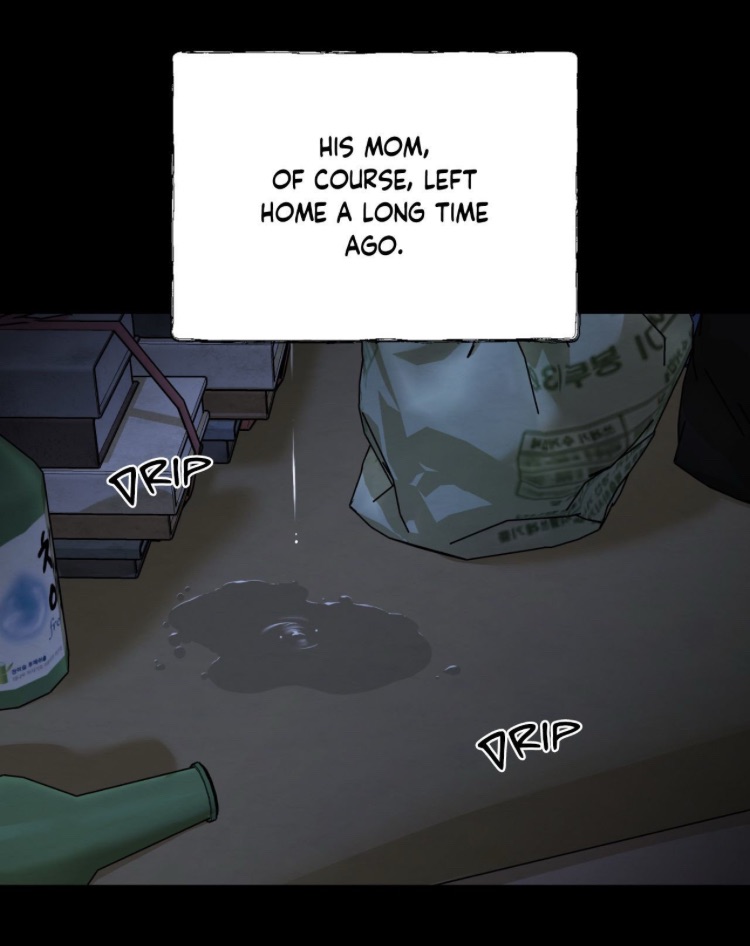 (chapter 72), yes, but she had reasons. The father was violent, the household unstable, and escape could therefore be understood as a form of necessity. In this interpretation, the mother’s departure remained painful, but intelligible. What he failed to ask, however, was the decisive question: if she left to save herself, why did she leave the child behind? Why was the boy not taken with her? For him, absence did not mean abandonment. He still had a positive vision of the mother: caring and selfless.
  (chapter 74) The interview brutalizes this unresolved contradiction by collapsing it into a simpler formula: (chapter 96) That statement is false in one sense, since Hwang Byungchul knew she existed, but it also exposes the existential truth he had failed to confront. The child may have had a mother in biography, yet he was lived and treated as if he had none. What Hwang Byungchul had accepted as abandonment with reasons now reappears as a far more troubling failure of protection.
The same pattern returns in his understanding of bullying. Hwang Byungchul had once witnessed mockery 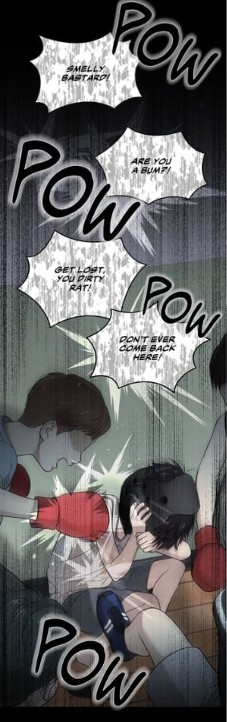 (chapter 72) and humiliation directed at the young fighter. But he interpreted it as an isolated incident, something that could be resolved by intervention, discipline, or the simple restoration of order.
  (chapter 72) In doing so, he mistook a visible moment for the whole of the problem. He overlooked the impact on the little boy’s soul. What Baek Junmin reveals—despite his malicious intentions—is that (chapter 96) this mockery was not occasional. It was structural. It became a gossip. The insults about smell, weakness, dependency, and social inferiority do not describe a single event; they evoke an entire environment in which the child was continuously reduced, laughed at, and pushed to the margins. The director of the gym had believed that stopping one episode meant ending the problem. The interview forces a more painful recognition: he had not grasped that ridicule was not an interruption in the boy’s life, but one of its formative conditions.
This is why I believe that the interview must have affected him so deeply. Sure, he might have felt insulted by such comments, (chapter 96) Yet, Baek Junmin’s statement compels the former coach to revisit the foundations of his own understanding. He had totally misjudged the mother, his image of her was influenced by his own projection and experience. Thus he had not grasped the champion’s suffering: the longing for his mother and her betrayal. The bullying he had witnessed, he had not truly measured. The ruthlessness he later attributed to the champion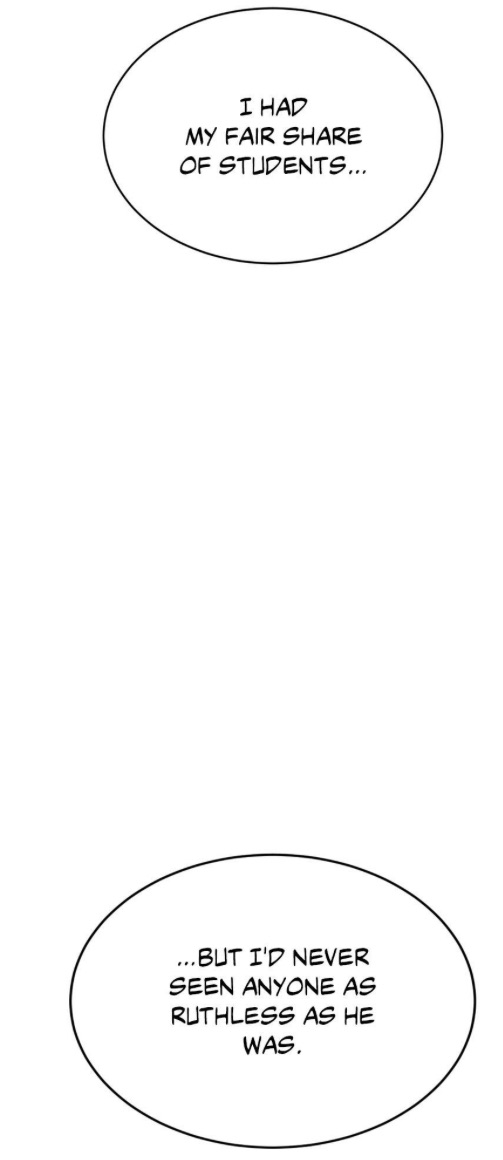 (chapter 71), as if it were an exceptional trait now begins to look like the product of a much longer history of humiliation, abandonment, and misrecognition.
In this sense, Baek Junmin’s version does not become powerful because it is true. (chapter 96) It becomes dangerous because it exploits gaps that were already there. Hwang Byungchul is not destabilized by a complete fabrication, but by a narrative that twists fragments of reality he himself had once simplified. The interview therefore produces a delayed crisis of interpretation. It reveals that what he took for explanation had often been only a way of stopping inquiry too soon.
What is at stake for him is not merely recognition, but responsibility. The narrative he hears does not simply contradict his experience; it exposes its limits. What he once perceived as isolated incidents now appears as part of a larger configuration he failed to grasp. The figure he believed he understood is re-presented in a way that both distorts and reveals. In this tension, a new possibility emerges: not the recovery of a stable truth, but the realization that his previous certainty was incomplete.
This delayed recognition extends even further. Until now, Hwang Byungchul had been confronted with a fact he could not fully explain: Joo Jaekyung never contacted him. 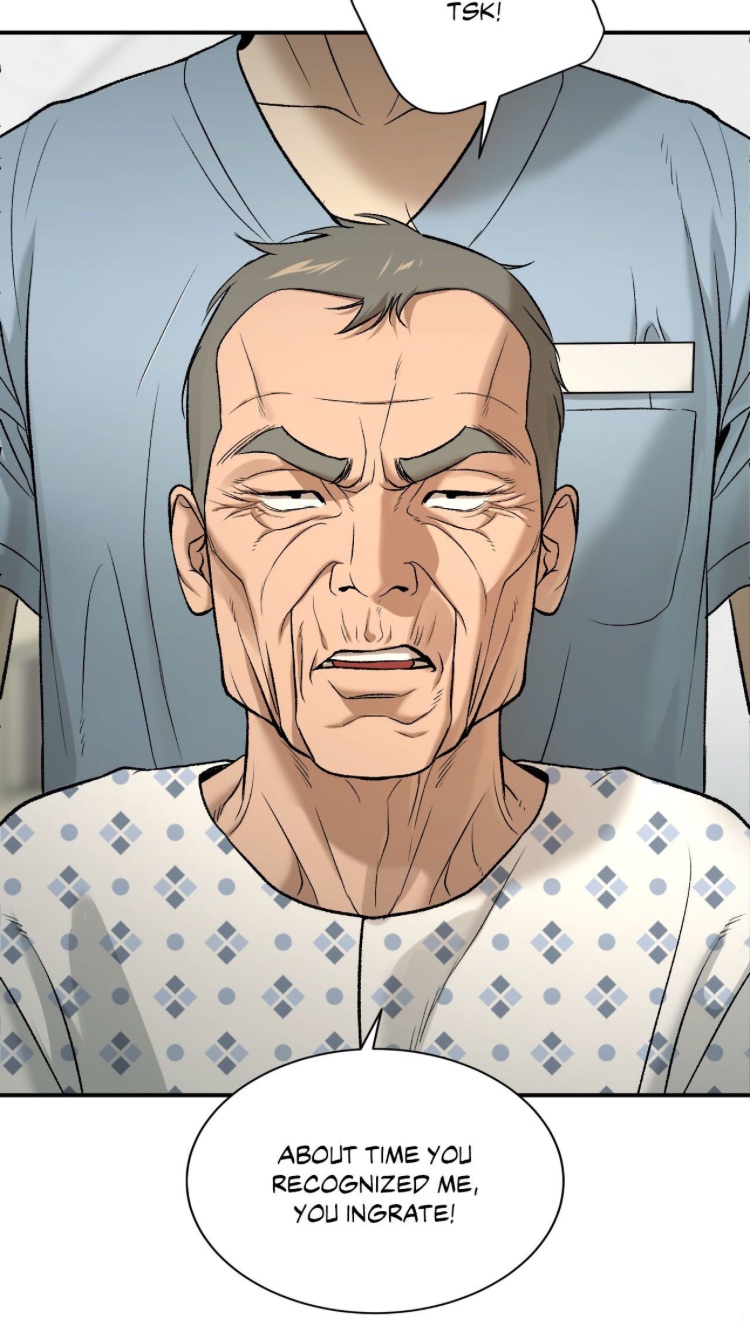 (chapter 71) Not once. Despite the years of training, despite the shared history, despite the role he himself believed to have played
  (chapter 74), the champion had cut all contact without explanation. This absence had remained unresolved, almost suspended—something to be accepted, but not truly understood. Hence he became resentful.
The interview alters that. By reconstructing a childhood marked not by isolated hardship (chapter 96) but by continuous ridicule, it introduces a new interpretative frame. The gym, which Hwang Byungchul had perceived as a place of discipline and formation, reappears under a different light. It was also a space where the young fighter had been exposed, diminished, and observed by others without protection. But furthermore, the mockery existed outside that environment and Hwang Byungchul had no idea about it.
This realization produces a shift that is both subtle and decisive. The silence of Joo Jaekyung no longer appears as distance, indifference, or ingratitude. It becomes legible as avoidance. Not of the coach as an individual, but of everything he represents: a place, a period, a configuration of relationships in which humiliation and growth were inseparably intertwined.
In this sense, the absence of contact is no longer a mystery. It is a continuation. What the interview does, then, is not simply distort the past. It forces Hwang Byungchul to recognize his own shortcomings. The bond he believed to exist was real—but it was not the only one. Alongside discipline and effort, there had always been something else: exposure, vulnerability, and the gaze of others.
The Grandmother’s Hero
If the interview unsettles Hwang Byungchul by forcing him to reinterpret the past, its effect on Shin Okja can only follow a darker, more intimate path. It does not invite analytical distance; it collapses distance altogether.
The words about the absent mother resonate with a haunting familiarity. For Shin Okja, (chapter 96) is not a piece of news; it is a recognizable configuration of suffering.  (chapter 65) The simplified narrative offered by Baek Junmin aligns too easily with her own history of hardship. But this immediacy has a cost. By recognizing the pain, she risks accepting the distorted framework through which it is presented.
The Collapse of the “Best Effort” Myth
This recognition forces a reassessment of her own narrative. For years, Shin Okja’s internal conviction was built on a single idea: she had done her best to raise Kim Dan  (chapter 65), even if it was never enough. Her role was defined by sacrifice, by the necessity to protect and sustain the “child” she still perceives in him—someone to be fed, guided, and contained rather than allowed to stand fully on his own.
Baek Junmin’s account destabilizes this framework. (chapter 96) By presenting a version of Joo Jaekyung who grew up without stable protection—without consistent care—the interview challenges the assumption that such protection is the decisive condition for survival. If the celebrity was once weak, isolated, and exposed, yet became the strong and composed figure she now sees, then his development cannot be fully explained through the model she has relied on. One could say that to Shin Okja, the black wolf is a “Giant of Flesh and Bone”—someone whose strength is real—which makes her realize that her grandson, and her own history, have been built on “Paper.” (the pictures of Kim Dan’s childhood).
At the same time, this confrontation extends beyond Joo Jaekyung and returns to Shin Okja’s own past. For years, she had described Kim Dan as an orphan—a term that appears factual, but in reality simplifies a far more complex history. The photographs contradict this reduction. 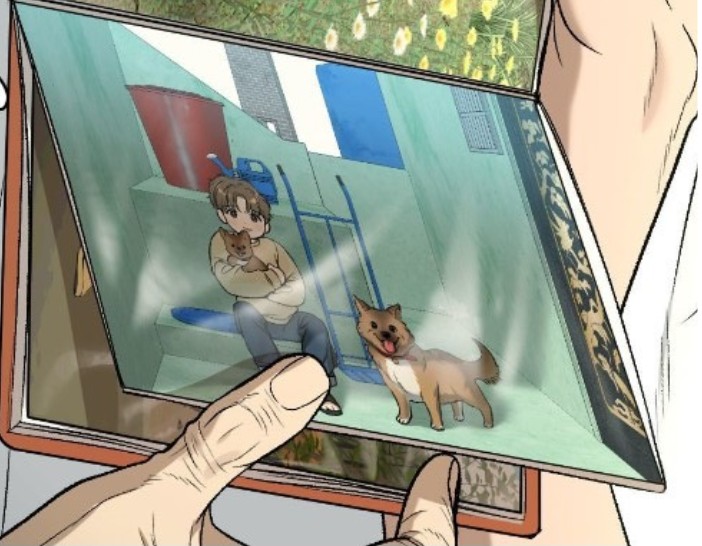 (chapter 94) They attest to the existence of parents, of a prior life, of relationships that were not entirely erased but quietly set aside.
In this sense, Shin Okja did not simply care for Kim Dan; she also reshaped the narrative of his childhood. By presenting him as an orphan, she created a version of the past that was more coherent, more manageable, and easier to endure. In other words, she rewrote the past out of guilt and “protection”. The ambiguity surrounding his parents—their absence, their responsibility, their place in his life—was not explored, but neutralized.
This alteration, however, is not without contradiction. While Shin Okja presents Kim Dan’s past as one of absence, the present remains marked by a persistent trace: debts. Unlike Joo Jaekyung, who endured poverty but was not bound by it, Kim Dan’s life is structured by an obligation he cannot escape.  (chapter 7)
This aspect is notably absent from her own account. When she speaks of the past on the beach, she evokes hardship, sacrifice, and endurance, yet she avoids addressing the existence of this burden. 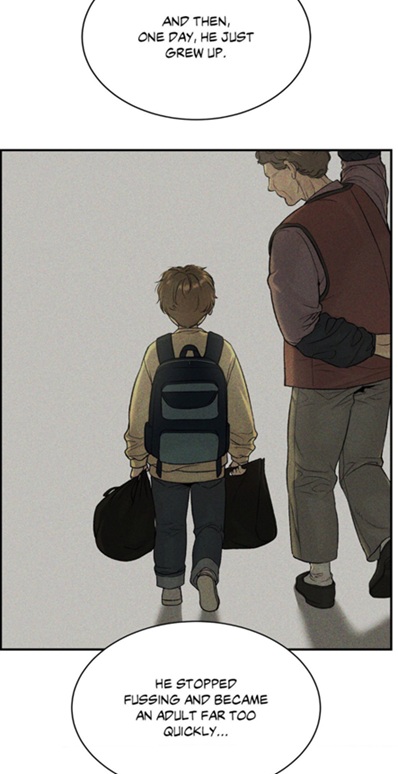 (chapter 65) The debt is not mentioned; it is simply endured. In doing so, its cause is displaced, if not entirely obscured.
But debt is never neutral. It implies a prior history, a chain of decisions and responsibilities that cannot be reduced to absence. In this sense, it contradicts the narrative of orphanhood she has constructed. It suggests that the past was not erased, but transformed into a silent obligation carried into the present.
The interview reactivates this contradiction. (chapter 96) By reducing Joo Jaekyung’s childhood to a simplified narrative of poverty and abandonment, it mirrors the very mechanism through which Shin Okja has spoken about Kim Dan. Yet the presence of debt prevents such simplification from holding entirely. It anchors the past in the present, making it impossible to maintain a version of events in which nothing preceded her care.
Baek Junmin’s interview reactivates this suppressed dimension. By reducing Joo Jaekyung to a child “without a mother,” it reproduces the very mechanism Shin Okja herself had employed. The parallel is difficult to ignore. What appears as manipulation in one case reflects a similar simplification in the other.
Taking Strength for Granted
This realization forces Shin Okja to confront a dimension of Kim Dan’s past she had long underestimated. When he was hurt, her response had always been immediate and absolute: to reassure him, to remain by his side, to insist that her presence was enough. 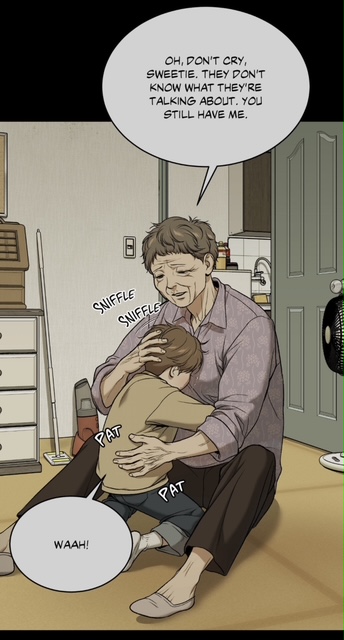 (chapter 57) It was not only a gesture of comfort; it was a conviction. It implied that the absence of others could be compensated by her own care.
But this belief now reveals its limits. Kim Dan’s suffering was not confined to the private sphere. It extended into the social space, where absence became stigma  (chapter 57), and where being “different” invited mockery and exclusion. What Shin Okja had perceived as a problem of loneliness was also a problem of exposure and humiliation.
In this sense, her care did not eliminate the wound; it coexisted with it. She protected him from being alone, but not from being seen by others in a way that diminished him. The interview reactivates this overlooked dimension. By describing Joo Jaekyung as a child who was mocked and reduced, it forces her to recognize that Kim Dan may have endured something similar—even while she believed she had protected him. (chapter 57) And exactly like the director of the gym, what she imagined as a single incident, was not. It followed the main lead constantly.
This realization reveals the limits of her perspective. Shin Okja had taken Joo Jaekyung’s strength as something self-evident. 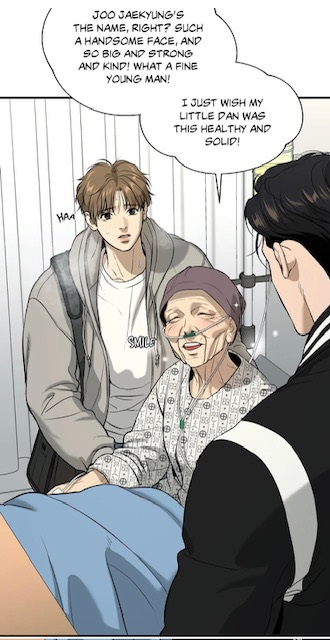 (chapter 21) She perceived him as a finished figure—healthy, solid, and self-sufficient—without questioning the conditions that made such stability possible. Even when she turned toward him with warmth
 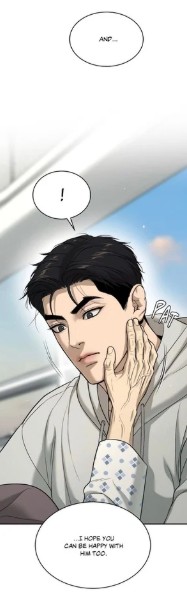 (chapter 94), her perception remained structured by Kim Dan. She acknowledged his place beside her grandson, but not the history that had formed him. She had never asked him any question in the end.
A dissonance emerges. If a child can grow up and become strong without the form of protection she considers essential, then the meaning of her own care becomes uncertain. (chapter 65) The question shifts: not whether she cared, but how that care has shaped the one who received it.
The contrast takes on the form of a mirror. Kim Dan continues to struggle with basic acts such as eating 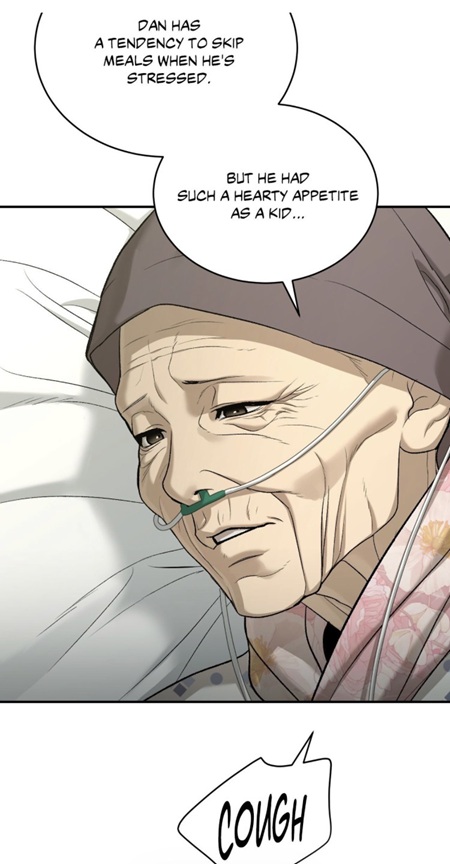 (chapter 94), withdrawing under pressure rather than sustaining himself. While Jaekyung’s strength appears to have been forged under conditions of absence, Kim Dan’s fragility seems to persist within the structure of her presence.
In this sense, the interview does not only reshape her perception of Joo Jaekyung. It fractures the image she had constructed of her own life. For years, she had organized her story around sacrifice. She had done her best, endured hardship, and carried responsibility for Kim Dan. This narrative gave coherence to her actions. But the existence of another child—equally abandoned, yet differently formed—introduces a contradiction she can no longer ignore.
It displays her own shortcomings as well.
Not as a lack of care, but as a limit in perception. She acted, protected, and endured, but without fully questioning the effects of her own form of care. In doing so, she may have replaced one form of absence with another form of dependency.
The Hesitation of the Heart
Shin Okja does not reject the narrative, but she can no longer fully accept her own. The interview generates a space of hesitation—a subtle but decisive shift in which the image she had constructed begins to destabilize. For the first time, the narrative does not pass through her unchanged.
The interview sought to fix Joo Jaekyung’s meaning as a failure. Instead, it unsettles the foundation of Shin Okja’s identity as a caregiver. By exposing the champion’s past vulnerability, Baek Junmin unintentionally reveals the limits of her own understanding. The laughter that accompanies the discourse continues to circulate (chapter 96), but for Shin Okja, it no longer confirms anything. It becomes a source of volability.
And within that uncertainty lies a consequence that has yet to unfold. The past she had simplified can no longer remain closed. What was once presented as settled now demands to be reconsidered. The interview does not simply alter her perception of Joo Jaekyung—it compels her to reopen the question she had avoided: the story of Kim Dan’s parents, and the truth she chose not to tell.
The Hamster, The Stone and The Giant
If the earlier parts exposed how the image is constructed, manipulated, and weaponized, the final movement begins where all structures fail: in the body. Kim Dan’s injured hand is not a minor detail. 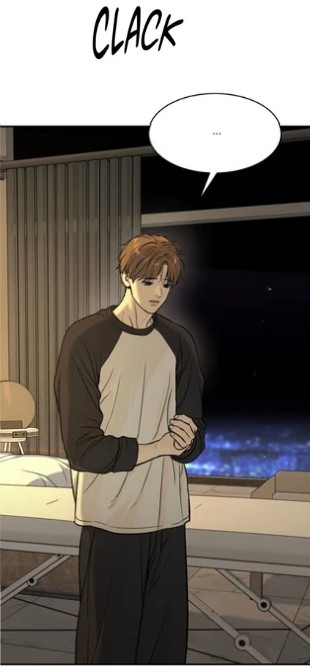 (chapter 96) It marks the collapse of his function. Up to this point, his position remained stable precisely because it was limited. He could stay at Joo Jaekyung’s side
 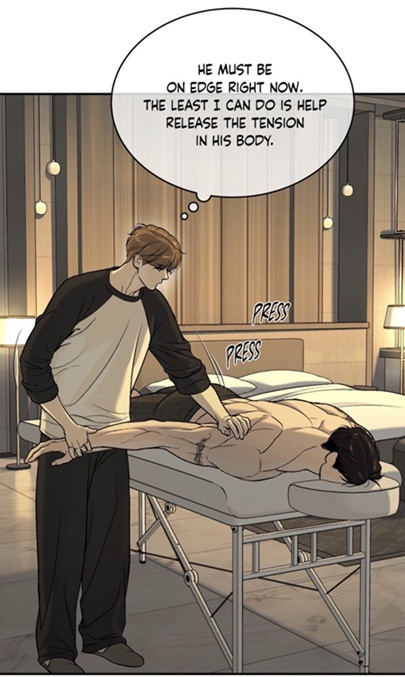 (chapter 96) without confronting what that presence truly meant, because he occupied a role. He was the physical therapist. His gestures, his proximity, his care—all of it could be justified, contained, and, above all, depersonalized.
The injury disrupts this equilibrium. Without his hand, he can no longer act. He can no longer treat, no longer intervene, no longer define himself through usefulness. The role disappears, and with it, the distance it maintained. What remains is no longer a function, but a presence. No longer a professional relation, but a personal one. At this point, concealment becomes impossible. Because what had remained unspoken now demands articulation. If he is no longer “needed” as a therapist, then why does he remain? And if he chooses to remain, on what grounds?
For the first time, Kim Dan cannot rely on necessity. He must decide.
The Two Triangles: A Structure That Must Be Chosen
When you look at my illustration, you will realize that I added a star on the physical therapist’s shirt. 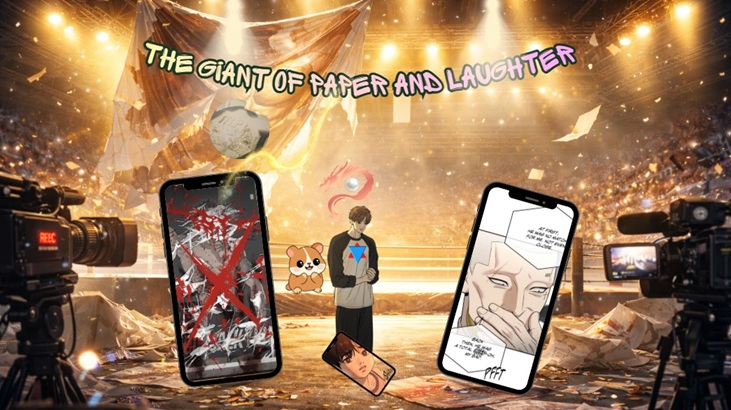 The addition of the star on the therapist’s uniform is more than a “badge of office”; it is a geometric prophecy. It represents the intertwining of two disparate lives—the red triangle of Jaekyung’s force and the blue triangle of Dan’s empathy. When these two triangles overlap, they create a structure (The Star) that is far more stable than the ‘Paper Giant’ of the MFC. This star is naturally a reference to the star of David. But at the same time, I wanted to avoid any reference to religion as such. The star of David is created by 2 triangles intertwined together. And the moment you accept that each main lead represents one triangle, you realize that both can become the star of David, once they become a team and a couple.
Until now, the connection between Joo Jaekyung and Kim Dan existed, but it remained indirect. It was sustained through intermediaries, through roles, through asymmetries that prevented true alignment. Joo Jaekyung’s red triangle was defined by force, hierarchy, and isolation. Kim Dan’s by care, dependency, and containment. The two structures intersected, but they did not yet stabilize into a shared configuration.
The injured hand alters this balance. (chapter 96)
It removes Kim Dan from the passive stability of his role and forces movement. He can no longer remain the one who adapts, who follows, who responds. He must now step into the point of intersection—the space where both triangles meet. And this space is not given. It must be chosen.
At this stage, Shin Okja’s position becomes decisive. (chapter 94) Throughout the narrative, she functioned as a center of gravity, bringing both structures into contact without resolving them. She connected, but she also maintained separation—protecting, guiding, and, at times, limiting.
Now, this role shifts.
By confronting her own shortcomings—by recognizing both the limits of her protection and the reality she had obscured—she no longer holds Kim Dan in place. Instead, she allows for movement. Not through direct intervention, but through the collapse of her previous certainty. She does not create the union. But she makes it possible.
David Against the Giant
Within this configuration, the opposition can now be clearly defined. The Giant is not Joo Jaekyung. It is not really Baek Junmin. It is the structure that produces images, controls narratives, and sustains itself through circulation—media, institutions, capital, operating without a single visible center. It is Goliath.
Not because it is singular, but because it is diffuse, difficult to locate, and nearly impossible to confront directly. Against it stands not a figure of strength, but a transformation of position. Kim Dan does not oppose the Giant through force. He has none. His injured hand marks precisely this limitation. He cannot act within the logic imposed by the system.,
And yet, this limitation redefines the confrontation. Because David does not prevail by matching strength. He prevails by refusing the conditions under which strength is measured. The ‘hamster’—Dan’s symbolic identity—is the stone that brings down Goliath. Not because it strikes a blow, but because it represents a pure relation (family and companionship) that the corporate system cannot monetize or understand. Goliath falls because he cannot compute the value of a love that requires no ‘function.'”This is where Joo Jaekyung becomes decisive. 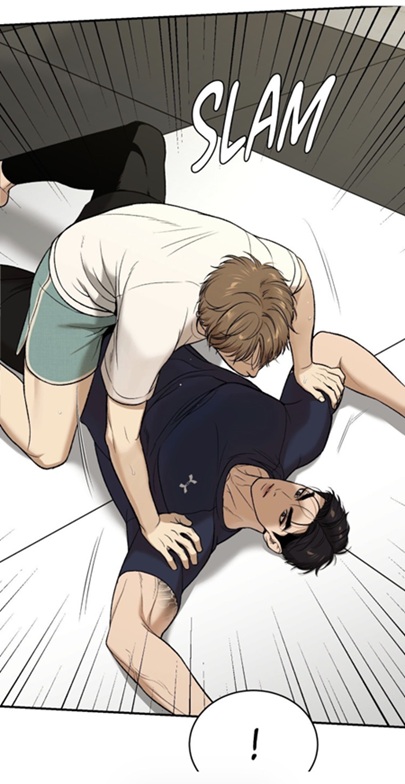 (chapter 88) The “hamster” is not an isolated symbol. It has been shaped in relation to Joo Jaekyung—through proximity, through tension, through a form of attention that is neither hierarchical nor purely functional. If Kim Dan embodies connection, Joo Jaekyung embodies determination and direction.
 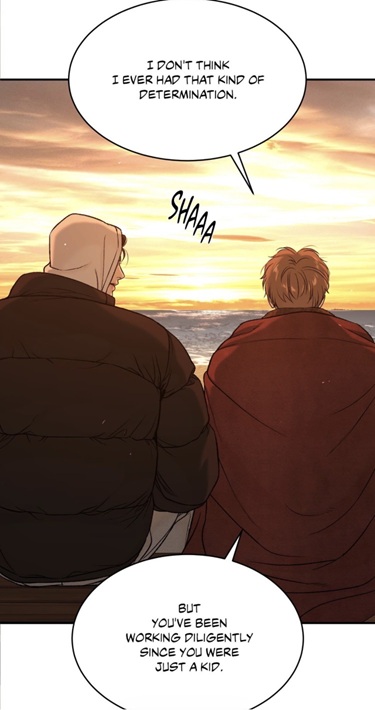 (chapter 94) What emerges between them is not dependency, but a potential alignment. That’s the reason why I believe that contrary to that morning
 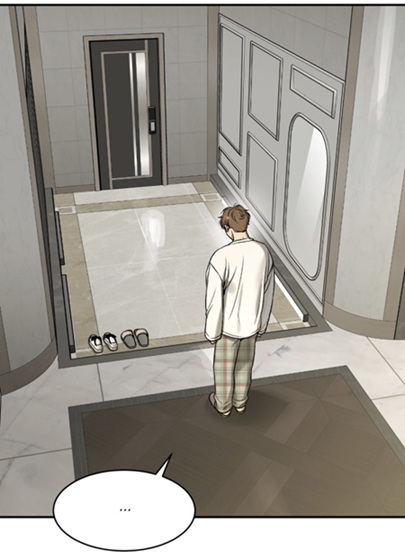 (chapter 96), Kim Dan might decide to follow Joo Jaekyung. (chapter 96) Is it a coincidence that his pajamas are black and white, the two colors of the yin and yang?
Kim Dan’s decision—to remain, to speak, to step forward without the protection of his role—is therefore not an individual gesture. It is the moment where both trajectories intersect. He does not act as a therapist. He does not act as someone who is “needed.” He acts without function. He becomes the hamster, and as such the companion and family. And this changes the terms entirely.
Because the system depends on roles: the fighter, the doctor, the champion, the underdog. These roles can be named, framed, circulated, and manipulated. They can be turned into headlines, into narratives, into images. But what cannot be easily captured is a relation that escapes these definitions.
And now, let me ask you this: what does Joo Jaekyung desire from Kim Dan in the end? To be looked at 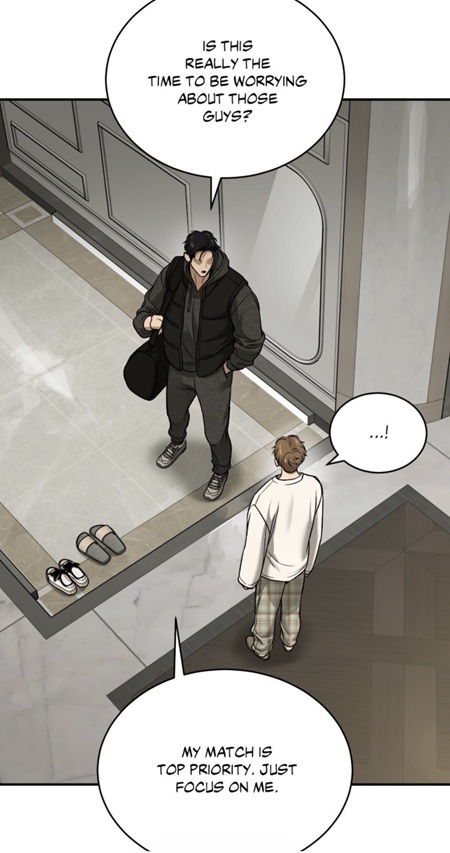 (chapter 96) and as such to be loved, something his mother never did.
 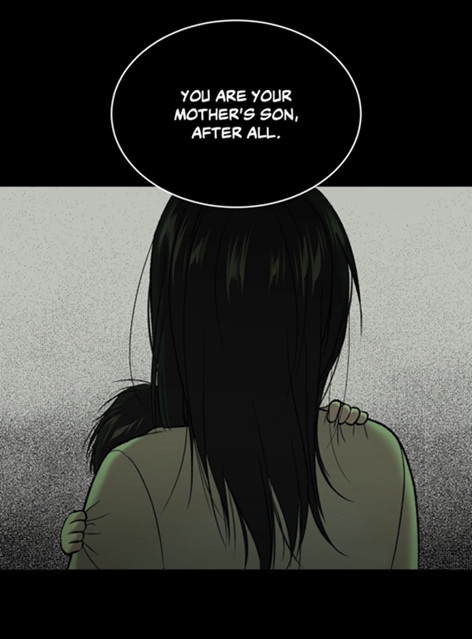 (chapter 73) Even with an injured hand, he can do this. As you can see, I am full of hope.
From Laughter to Meaning
At this point, the motif of laughter undergoes a decisive transformation. Until now, laughter functioned as a weapon. (chapter 96) It diminished, exposed, and rewrote. In Baek Junmin’s discourse, it accompanied the reconstruction of the past, turning memory into ridicule and experience into spectacle. What he did not know is that he was acting like Joo Jaewoong. 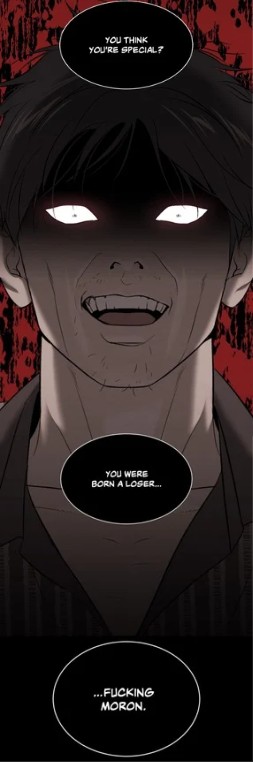 (chapter 73) His words are punctuated by smirks, interruptions, and mockery. The childhood he evokes is not one of growth or development, but of humiliation, hierarchy, and control. (chapter 96)
What is striking, however, is what is absent. (chapter 96) There is no trace of joy, only resent. No trace of play. No trace of shared experience (chapter 96) that would give meaning to the past beyond domination. Everything is reduced to struggle, inferiority, and dependence. Childhood, in his account, is not a space of formation, but a field of comparison.
This absence is not insignificant. It reveals a fundamental limitation. As Aristotle suggests, Pleasure in the job puts perfection in the work. 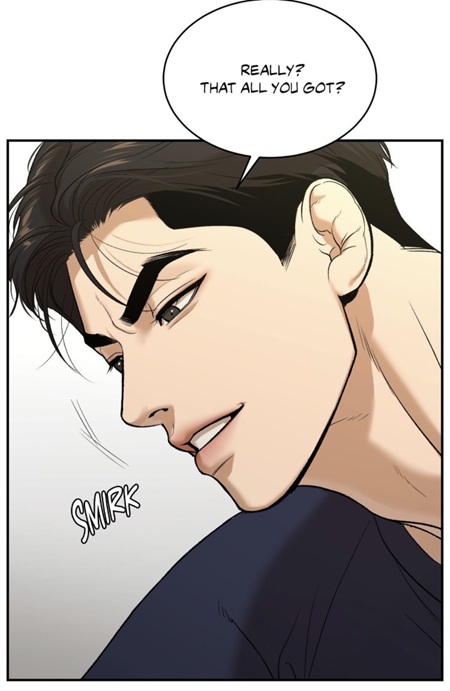 (chapter 88) Without it, action becomes mechanical, external, and ultimately unsustainable. What is done without pleasure cannot reach completion, because it remains detached from the subject who performs it.
 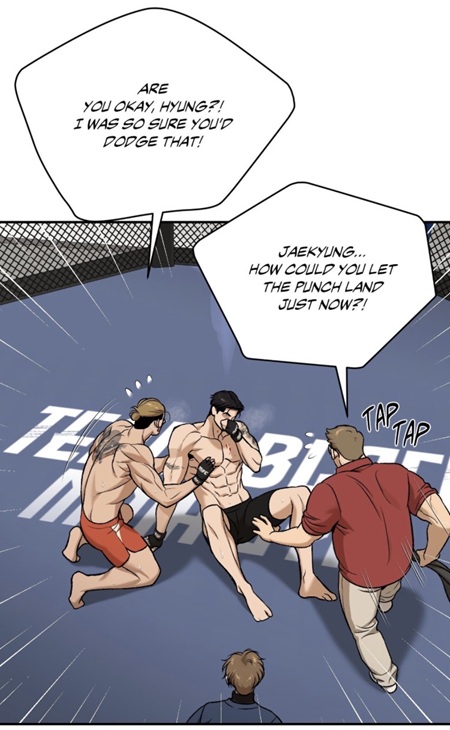 (chapter 95)
In this light, Baek Junmin’s narrative exposes its own failure. He speaks of training (chapter 96), of hierarchy, of superiority—but never of enjoyment. His relationship to fighting is entirely structured by comparison and domination. It is something to win, to prove, to impose—not something to inhabit. As a result, his position remains fundamentally unstable. He can occupy the role of champion, but he cannot embody it. He performs strength, but does not internalize it. His smile contrasts so much to the champion’s after his first victory. (chapter 73)
This is why his laughter remains empty. 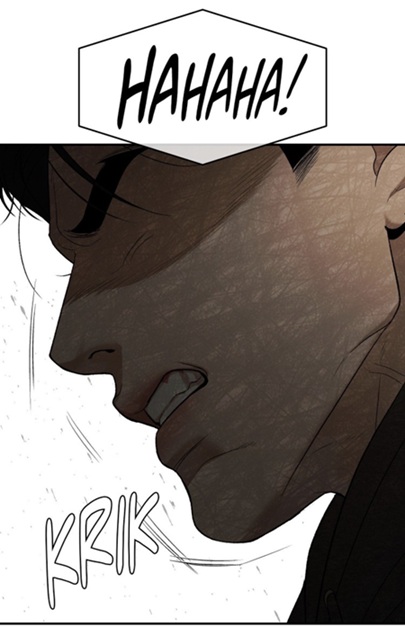 (chapter 96) It is directed outward, against the main lead and others, and depends entirely on their diminishment. It cannot sustain itself. It requires a target. In contrast, Kim Dan is associated with a different form of laughter.
 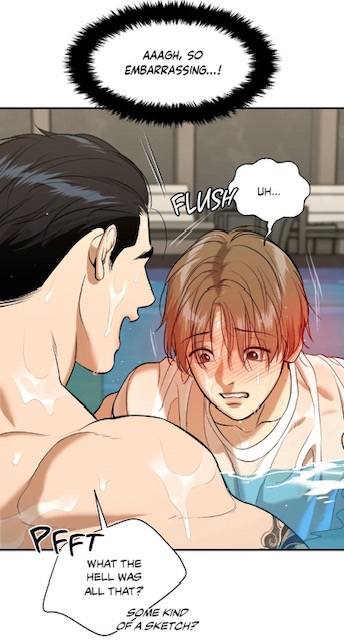 (chapter 27) The hamster—seemingly insignificant—represents companionship, warmth, and a form of joy that does not depend on hierarchy or recognition.
This laughter is not directed at someone. It is shared. And this distinction is decisive. Because it introduces a form of meaning that cannot be produced or controlled by the system. It cannot be staged, monetized, or weaponized. It exists outside the logic of visibility that governs the Giant. At this stage, the opposition is no longer between two fighters, but between two forms of value:
one that circulates, amplifies, and consumes
and one that connects, sustains, and transforms
The End of the Circle, The Beginning of Another
Episode 96 marks the closure of a cycle. 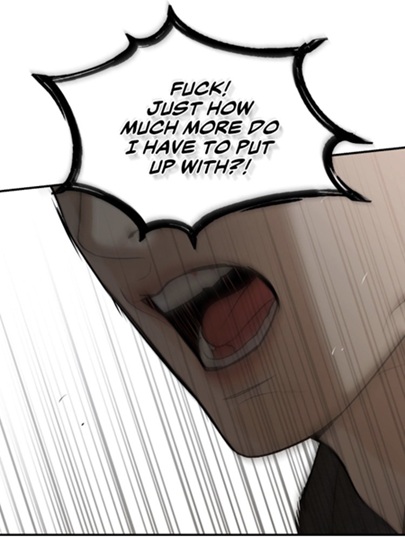 (chapter 96) The athlete voiced his distress, exhaustion and loneliness. The mechanisms that structured the previous movement—manipulation, narrative control, role-based identity—reach their limit. The image is destabilized, the past is rewritten, the system becomes visible.
But this closure does not conclude the movement. It opens a threshold. 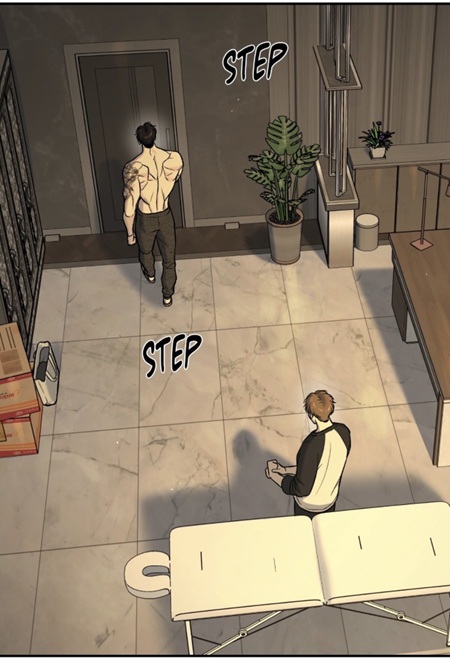 (chapter 96)
What follows does not extend what came before. It interrupts it. And this new cycle does not begin with a fight. It begins with a decision. The question is no longer external. It cannot be delegated, postponed, or reframed. Should he follow the champion’s words—or respond to what those words conceal? 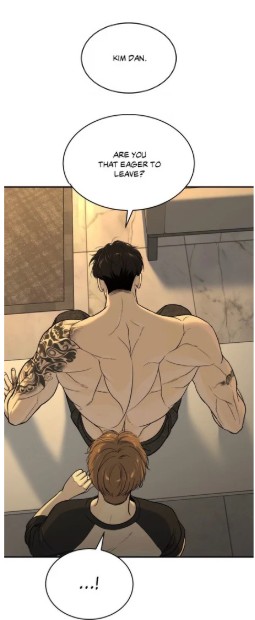 (chapter 96) “I want you to stay!” To obey the word is to remain a servant; to hear the silence behind the word is to become a partner.
Because Joo Jaekyung’s command to leave is not neutral. 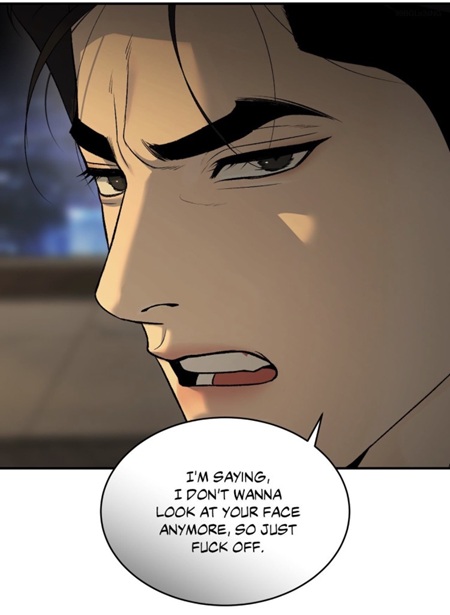 (chapter 96) It’s the consequence of pain, it belongs to the logic of rupture, of protection through distance, of a structure that resolves tension by separation. To obey would be to repeat the past—to accept absence as the only possible form of resolution. To follow the athlete, however, would be something else entirely. Not obedience to his words, but an understanding of what they conceal. Not submission, but a deliberate alignment: an act of commitment. A decision to remain—not because he is told to, but because he chooses to.
The Giant remains. The structure persists. But for the first time, it is no longer the only force shaping the outcome. Because David has entered the field. Not as a figure of opposition. But as a position that refuses to be absorbed.
PS: My prediction is that the doctor goes to the bathroom, where the athlete is! A new version of this scene, but here, the roles would be switched.  (chapter 30) Let’s not forget that the champion’s “jinx” is linked to the smell, something which Baek Junmin revealed earlier. (chapter 96)
Feel free to comment. If you have any suggestion for topics or Manhwa, feel free to ask. If you enjoyed reading it, retweet it or push the button like. My Reddit-Instagram-Twitter-Tumblr account is: @bebebisous33. Thanks for reading and for the support, particularly, I would like to thank all the new followers and people recommending my blog.
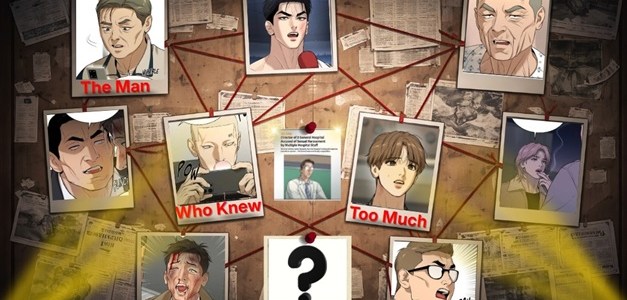
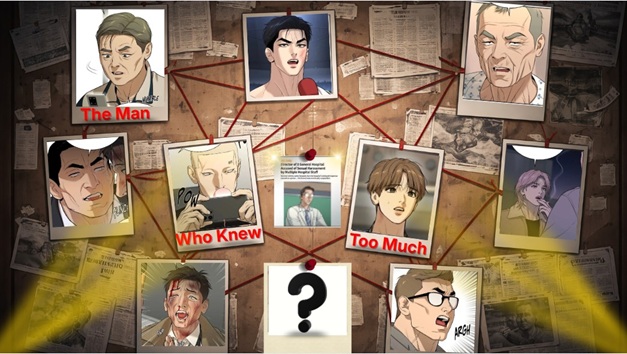
 Beautiful, right? Yet I could not help myself returning once again to the criminals. My fascination with thrillers and investigations probably gives it away: when I read this story, I instinctively begin to examine every image, words and event like a detective reconstructing a case.
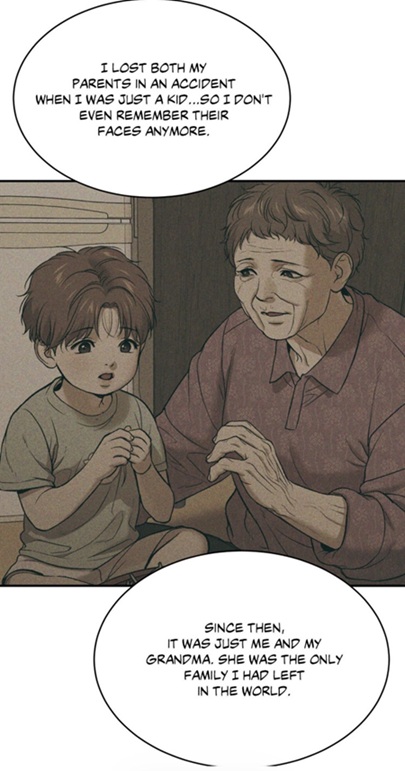 (chapter 94) In this moment we learn that Kim Dan lost his parents in an accident when he was a child, though we shouldn’t trust this confession as the truth due to the debts. Anyway, the word “accident” immediately resonates with a principle that has appeared again and again throughout the story: someone being at the wrong time, at the wrong place.
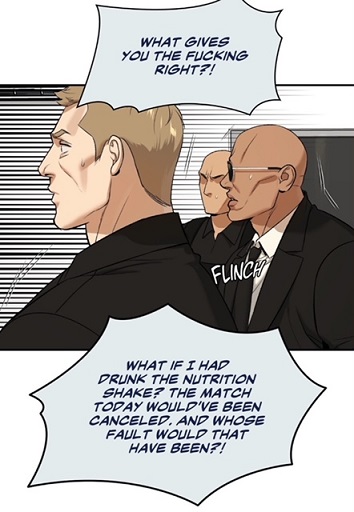 (chapter 40) What appears to be coincidence is often carefully engineered.
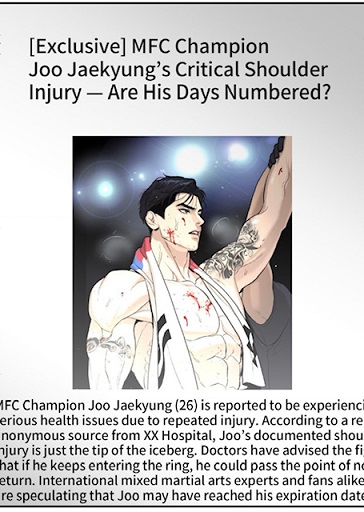 (chapter 36) At the same time, social medias were manipulated in order to stir public pressure and push the champion toward accepting the match in the States.
 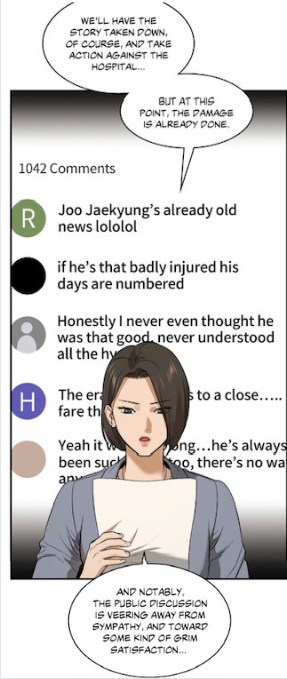 (chapter 36) But we only discover this MO thanks to the match with Arnaud Gabriel and the Entertainment agency’s involvement.
  (chapter 81)
  (chapter 71)
 (chapter 54) He was increasingly portrayed as reckless and irresponsible for continuing to fight despite his condition.
 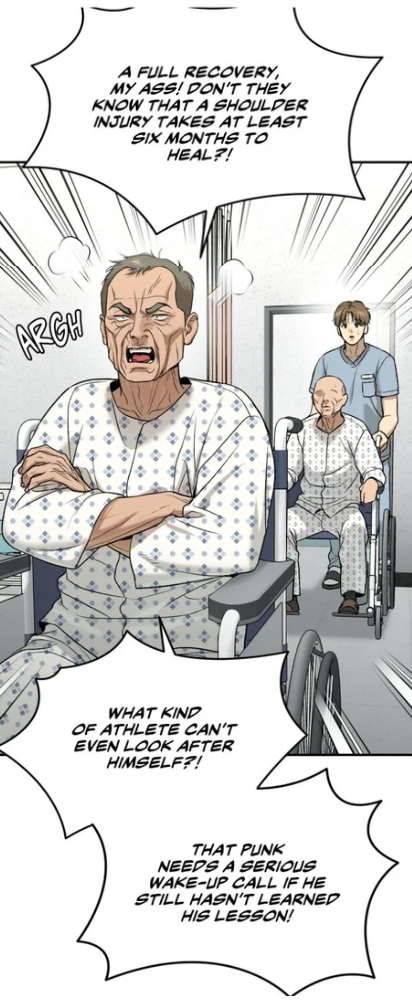 (chapter 70) Once such stories enter public discourse—injury, temper, arrogance—every later incident can be read as confirmation. The narrative becomes self-reinforcing. The media no longer merely reports events; it prepares the framework through which future events will be judged.
 (chapter 37) and the suspicious spray
  (chapter 49) used during the manipulated match both belong to this category. These substances create uncertainty about the athlete’s physical condition and about the legitimacy of his treatment. But this implies the involvement of the pharmaceutical industry.
  (chapter 41)
 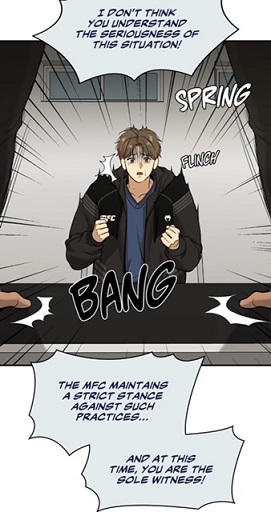 (chapter 40) The scene resembled a police investigation, yet these men were not representatives of the state. Hence there was no translator and lawyer. They were dressed-up employees of a private organization whose primary objective is to protect the company from scandal and as such from losing money
 (chapter 40) At first glance, this strategy appears effective. By redirecting attention toward the therapist, the organization can distance itself from the real problem: the suspicious beverage that had been introduced into the environment of the fight.
 (chapter 40) A doctor took a blood sample from Kim Dan, and the laboratory later produced a component analysis report.
  (chapter 41)
  (chapter 41) This coincidence exposes another layer of the mechanism. While the laboratory analysis confirms that an illicit substance had been present, the medical authorities simultaneously authorize the champion to continue fighting. The two decisions cannot easily be separated. Together, they suggest that the involvement of the doctors helps stabilize the narrative: the suspicious beverage becomes a secondary issue, while the focus shifts toward the champion’s physical condition and his decision to fight despite his shoulder injury.
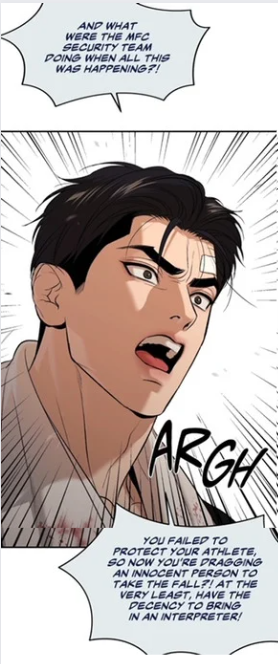 (chapter 40) That’s why they needed a scapegoat. First Kim Dan, later antis and finally the athlete himself. And who fears a scandal in Jinx? One might say Park Namwook
 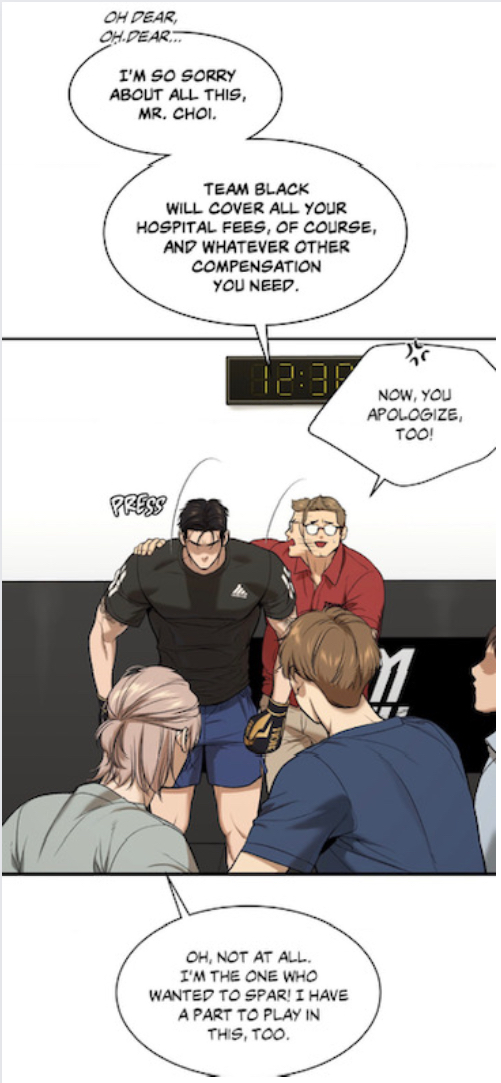 (chapter 31) who always hides behind authorities and shows distrust toward fighters. But he is just reflecting the attitude of the other MFC accomplices.
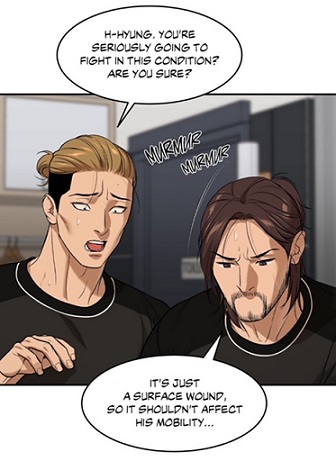 (chapter 50) Observe that in the locker room, the coach declares the athlete as fit despite the injury before going to the health center. The chronology is important, as the MFC doctors have the final saying. So when the champion is taken to the health center before the fight. the responsibility is shifted.
 (chapter 54) Hence Park Namwook remained passive.
  (chapter 69) apologized for the behavior of the security staff toward one of Joo Jaekyung’s team members.
 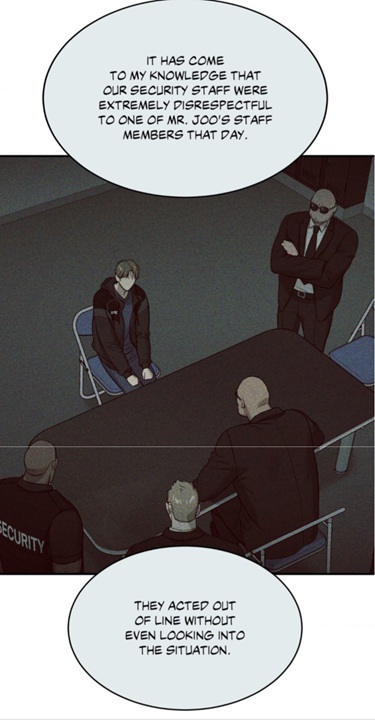 (chapter 69) Significantly, this apology took place behind closed doors, not in front of the media, and doc Dan is still left in the dark about it. The goal was therefore not transparency but damage control. They were in reality attempting to bury everything, to buy some time, until the athlete would lose his next match.
  (chapter 69) The problem was reduced to a matter of manners rather than a potential security failure or institutional complicity. In this way, the apology functioned less as an admission of guilt than as a mechanism to close the case quietly before it reached the public sphere.
 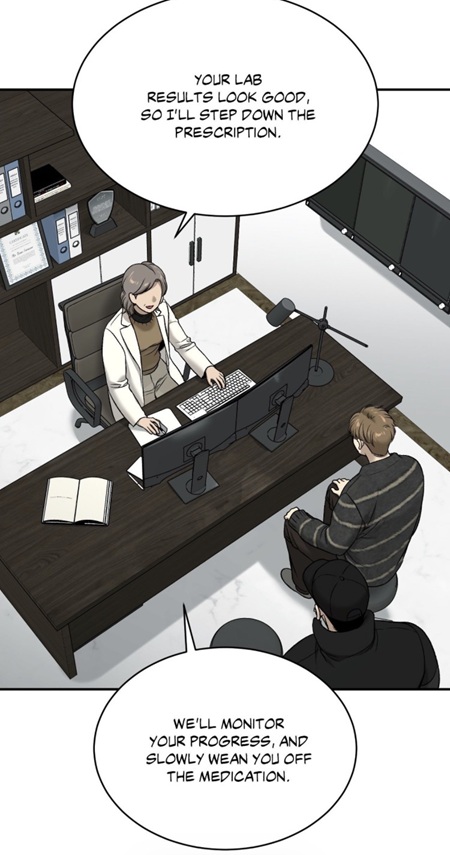 (chapter 91), drinks , smoking,
  (chapter 65), or other forms of contamination, each incident would undermine Kim Dan’s credibility as a medical professional. If the therapist can be portrayed as irresponsible, incompetent, or compromised by substances, the institutional narrative could once again shift responsibility onto him.
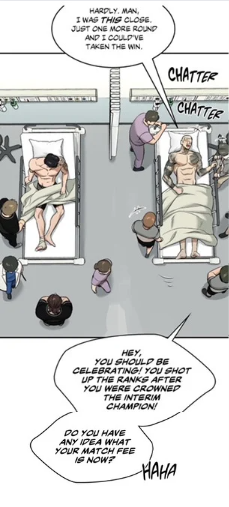 (chapter 52), Kim Dan is no longer present. After confronting him and suspecting a betrayal
 (chapter 51), Joo Jaekyung leaves the locker room alone and goes to the health center. And don’t forget that before, he even refused his treatment for the ankle injury before.
  (chapter 50)
 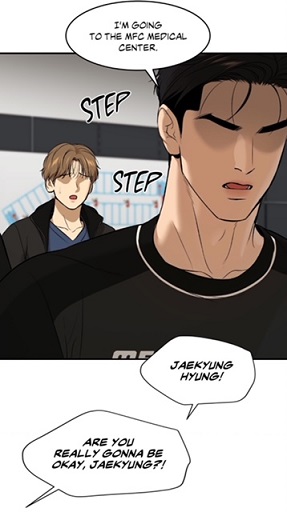 (chapter 50) He therefore has no knowledge of what happens there: the medical examination, the decisions taken by the doctors, and the institutional narrative that later emerges from this encounter.
 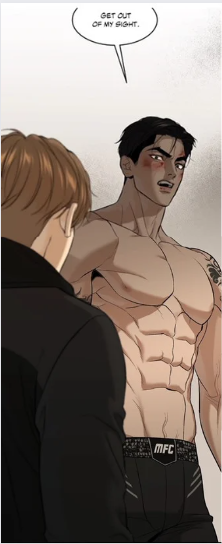 (chapter 51) But this time, the pattern is disrupted. Kim Dan is not there when the institutions intervene.
  (chapter 52)
 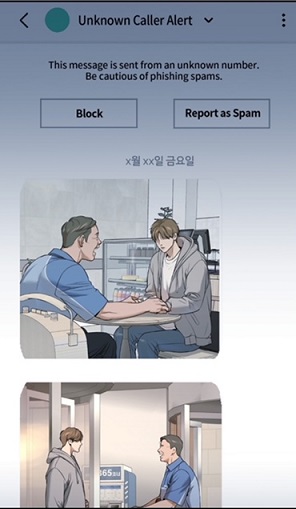 (chapter 48) Photographs of him had been sent to Joo Jaekyung, suggesting that the physical therapist might have been communicating with Baek Junmin through the director of the other gym.
 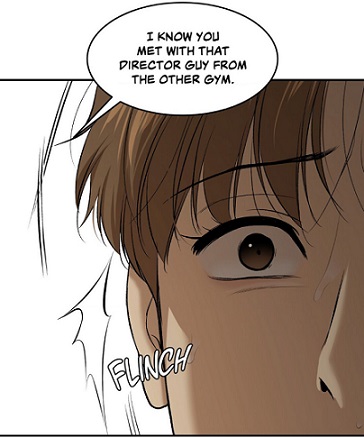 (chapter 51) Confronted with these images and the growing confusion surrounding the match, the champion reaches a painful conclusion: that his roommate may have betrayed him.
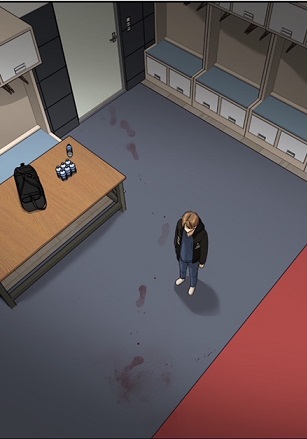 (chapter 51)
 (chapter 52) By that point, the circumstances have already changed. The use of the switched spray introduces a new dimension to the case, and with it the possibility that another authority must intervene.
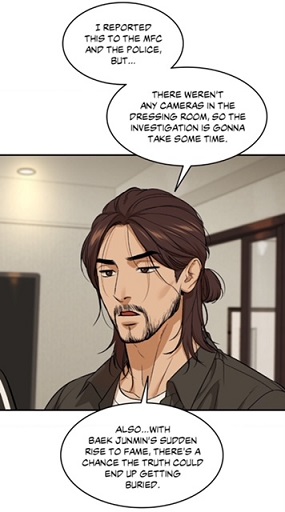 (chapter 52) The situation now risks attracting the attention of the police. As you can see, by remaining passive, Joo Jaekyung in his own way protected the physical therapist from real trouble. If he had truly blamed him, he could have “called” the police, but he did not.
 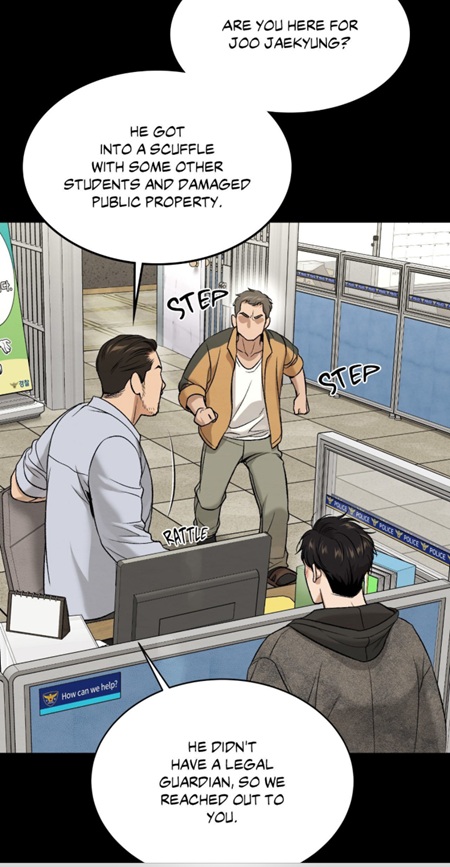 (chapter 74) The coincidence between these two moments—chapter 52 and chapter 74—suggests more than a simple narrative repetition. Both situations involve the same institutional actor: the police.
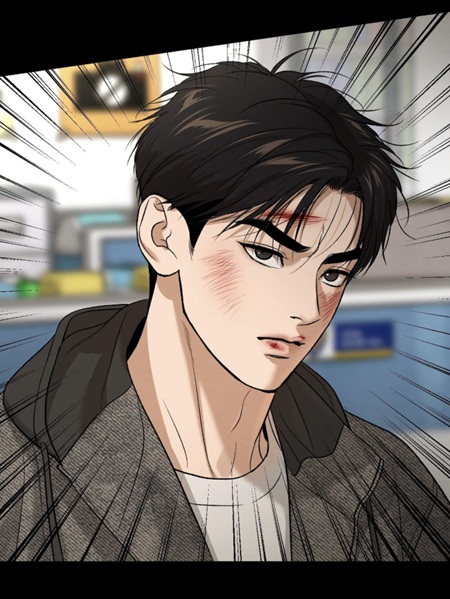 (chapter 74) has a similar wound on the forehead than The Shotgun.
 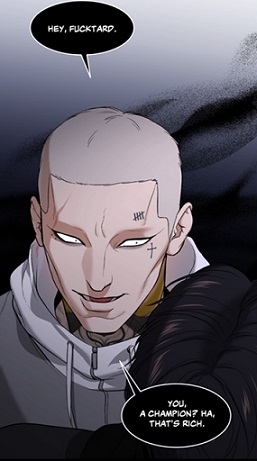 (chapter 74) If Baek Junmin had orchestrated that earlier event, the strategy would have been simple but effective. Instead of attacking his rival directly, he could create circumstances that forced the authorities themselves to intervene. But why would he involve the police, when he is involved in the criminal world? Such a tactic would allow him to remove or weaken Joo Jaekyung without openly violating the protection imposed by his hyung
 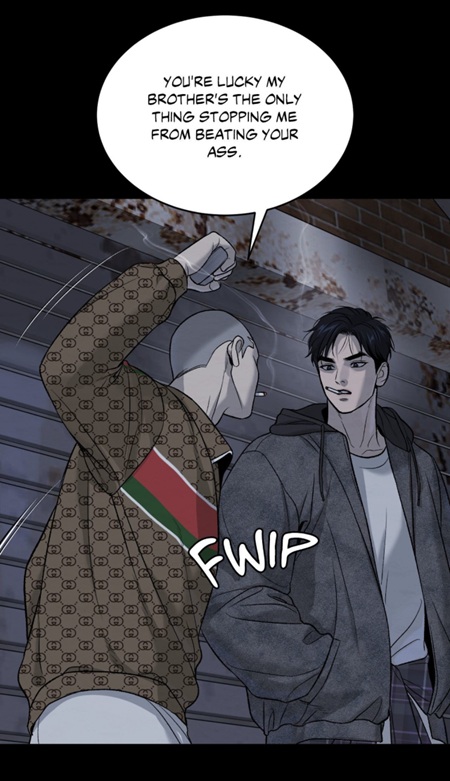 (chapter 74), who had explicitly forbidden him from harming the champion.
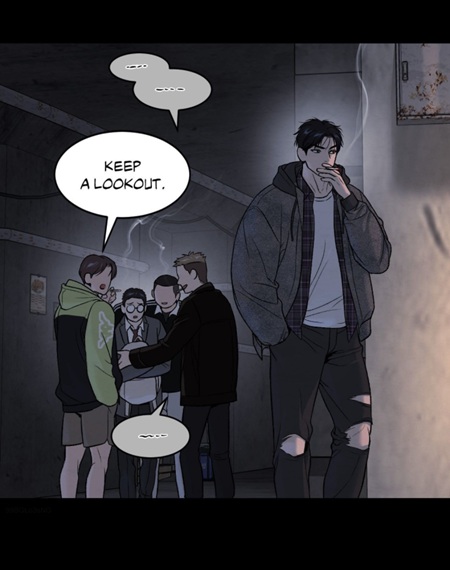 (chapter 74) —Junmin could ensure that the story presented to the authorities pointed toward Joo Jaekyung. For the students involved, the arrangement would offer a practical advantage: financial compensation and a chance to escape their own precarious situation. But for that stunt, The Shotgun got to pay a heavy price: not only the scar on his forehead
 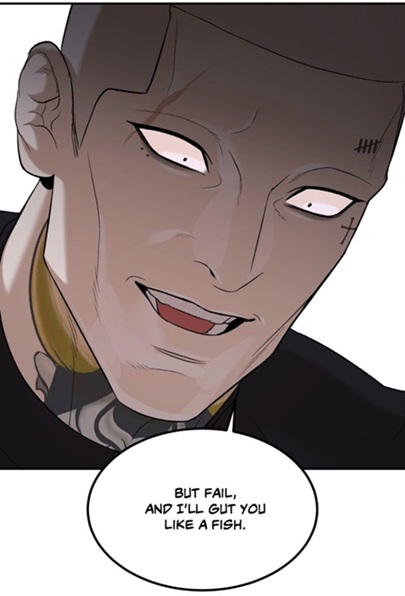 (chapter 93), but also a life in the shadow forever. It is clear that he could never get rich and famous through his illegal fights. Hence he resents the main lead so deeply.
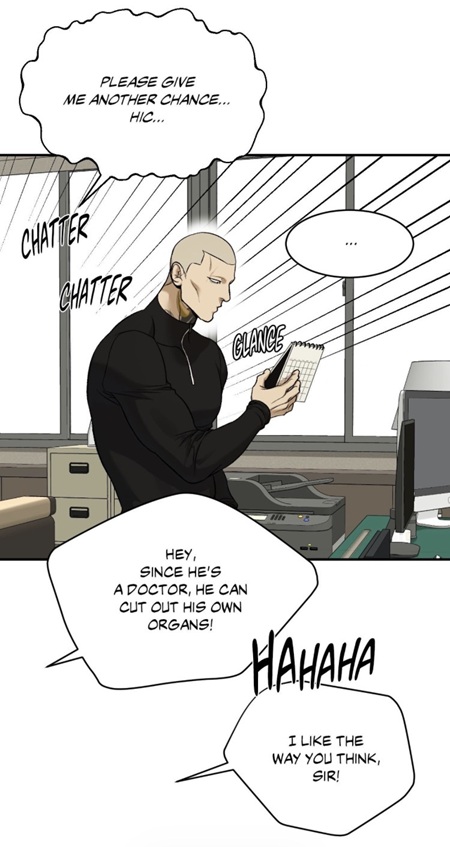 (chapter 93) The authorities perform the task that Junmin himself is forbidden to carry out.
 (chapter 91) The article reports that the director of X General Hospital was accused of sexual harassment by several members of the hospital staff. The scandal eventually forced the institution to suspend his medical license. Yet the wording of the report also exposes an important detail: the hospital reacted slowly, and the affair was handled primarily as an internal disciplinary matter.
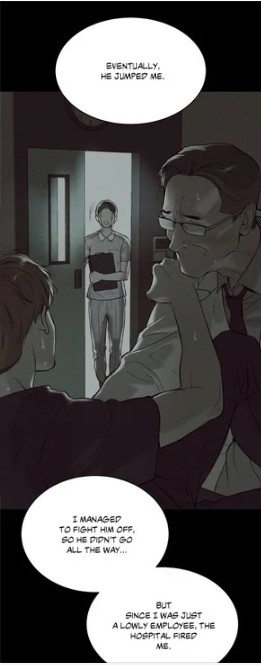 (chapter 90)
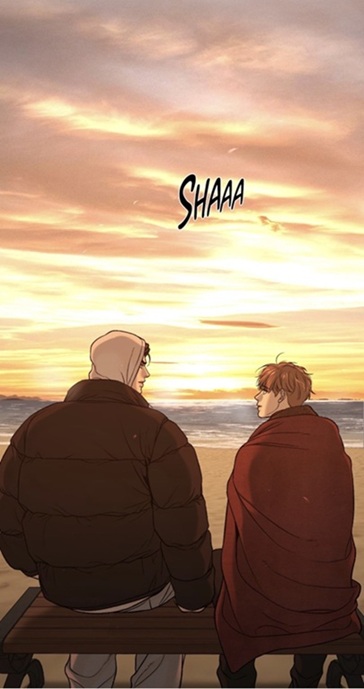 (chapter 94) Up to this point, the antagonists have relied on a simple but effective strategy. By manipulating circumstances, they repeatedly place others at the wrong place and at the wrong time. Each incident—whether involving the media, drugs, or institutional authorities—follows this logic. Someone is caught in a situation carefully arranged by others and must carry the consequences.
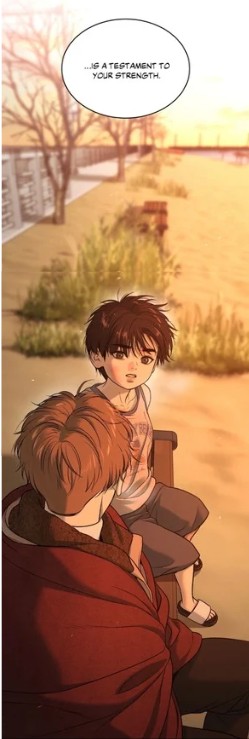 (chapter 94) There is trust, recognition, admiration and open-mindedness. In their mutual confession, the two protagonists do something that none of the criminals ever achieve: they seize the moment at the right time and in the right place. They speak and listen to each other. Instead of being manipulated by circumstances, they recognize the opportunity before them and act upon it.
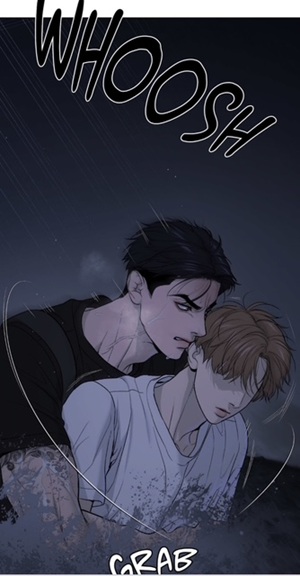 (chapter 59)
  (chapter 79)
 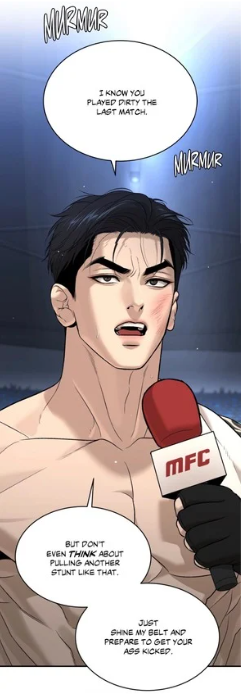 (chapter 87) By issuing the challenge in front of the cameras, the champion forces the MFC to respond. Even though the season had effectively ended, the public nature of the declaration creates pressure that the organization and the media cannot easily ignore.
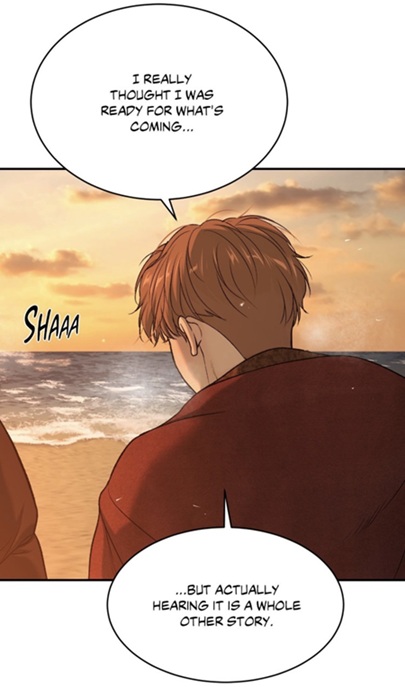 (chapter 94), the situation could disrupt the plans surrounding the anticipated fight with Baek Junmin.
 (chapter 47)
 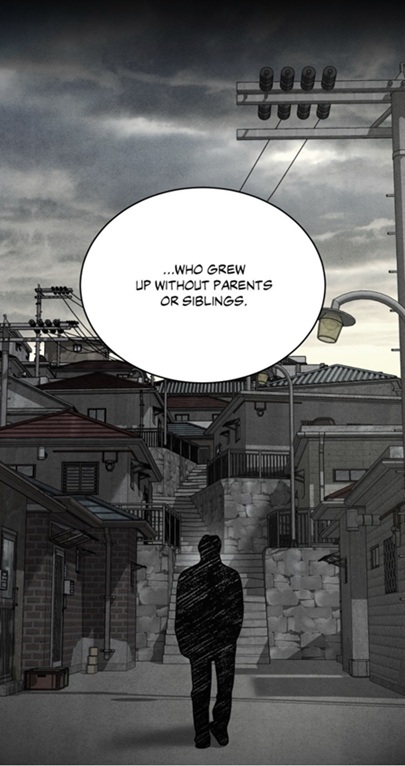 (chapter 94) Joo Jaekyung has survived the criminal world long enough to understand how its mechanisms operate. Through his actions, he gradually passes this knowledge on to Kim Dan.
 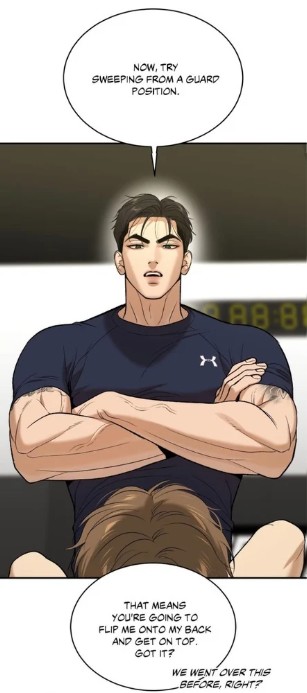 (chapter 88)
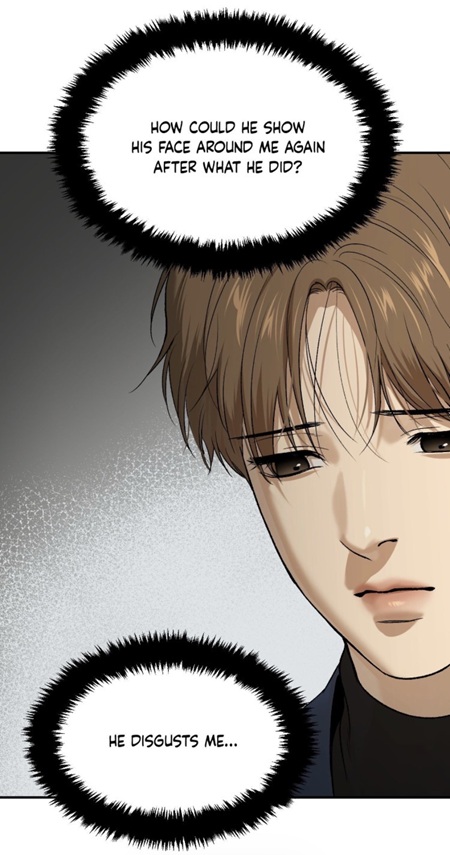 (chapter 91) The athlete exposed him to situations that forced him to grow stronger and more independent. He shared his thoughts and philosophy to his “pupil” as well
 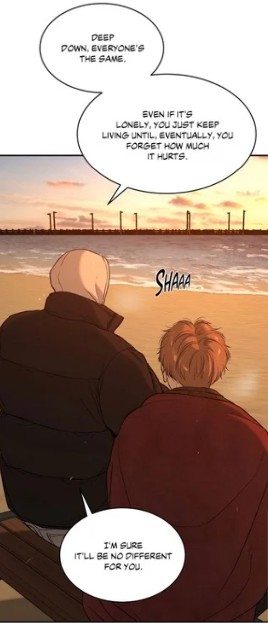 (chapter 94) so that at the end, Kim Dan admits to see him as a “younger sibling”. (donsaeng in Korean)
 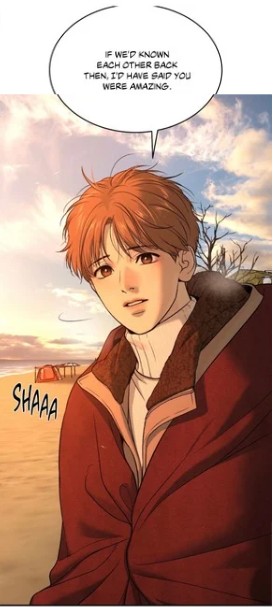 (chapter 94)
 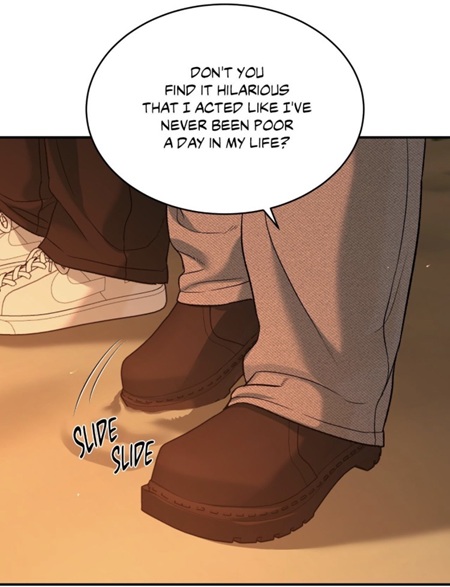 (chapter 94) The champion carried the weight of his past—his violent environment, the humiliation he endured, and the circumstances that shaped his rise. Speaking about these events would have meant revealing parts of his life he preferred to bury.
 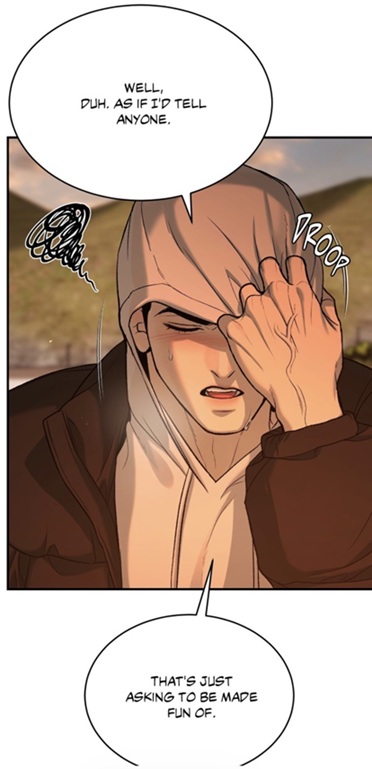 (chapter 94) The conversation on the beach changes this dynamic. By confessing his past to Kim Dan, Joo Jaekyung frees himself from the silence that had protected his enemies. The shame that once prevented him from speaking begins to lose its power.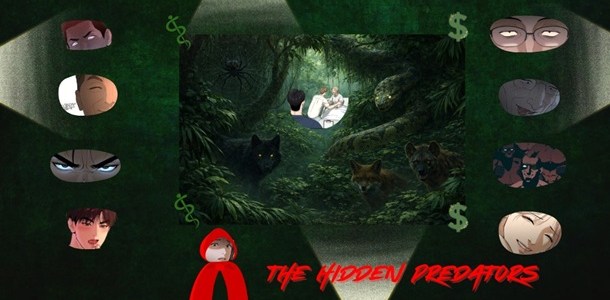
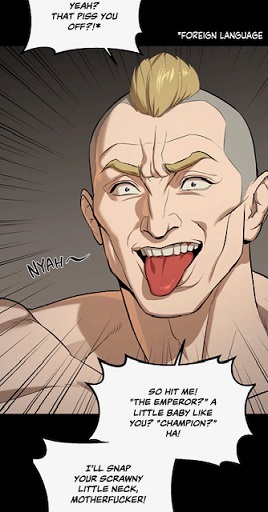 (chapter 14) Others hide behind systems.
 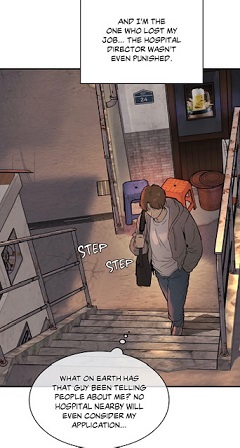 (chapter 1) Some exploit bodies.
 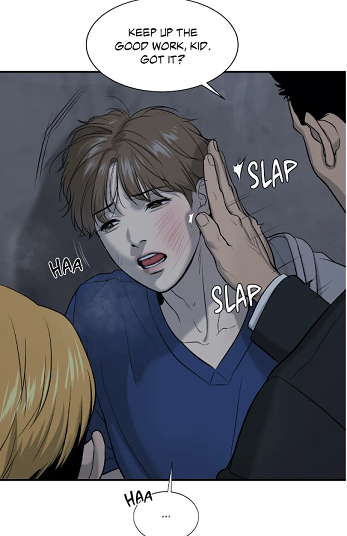 (chapter 11) Others exploit labor, fear, loyalty, or belief. The forest contains them all.
  (chapter 42). When he speaks of Joo Jaekyung, his language is explicit: the champion was a source of milk, a body that could be “milked” for money, favors, and reflected status. In biological terms, this is parasitism rather than hunting — survival not through direct attack, but through prolonged attachment to a stronger host. As long as the host remains productive, the parasite thrives. When the bloodsucker is removed, flow stops, hunger turns first into regret
 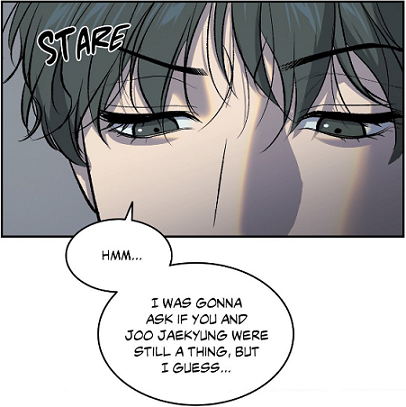 (chapter 42) before resentment.
 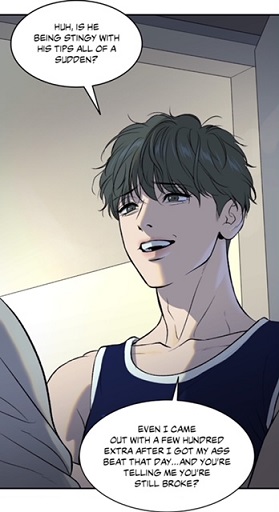 (chapter 42)
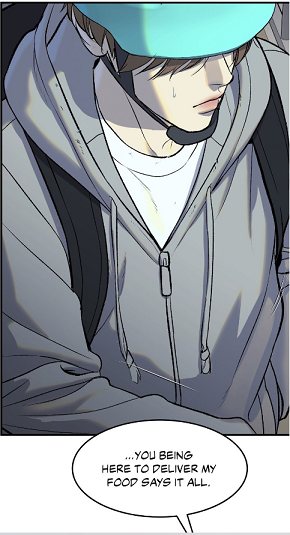 (chapter 42), but why he does so at the precise moment he does.
  (chapter 42) His hostility does not emerge from poverty alone, nor from moral outrage. It is triggered by a rupture in his expectations.
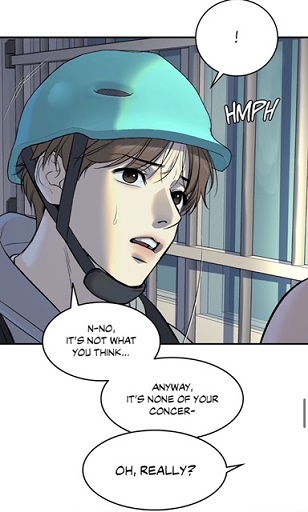 (chapter 42) In that moment, the green-haired man realizes that closeness still exists without visible profit. This is intolerable to him. It contradicts the logic through which he has justified his own past behavior: the belief that proximity to power must be monetized, that relationships exist to be exploited, that affection without gain is either naive or dishonest.
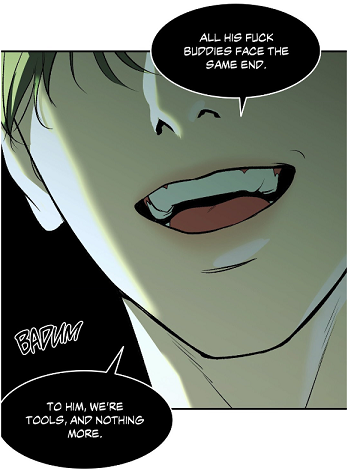 (chapter 42) Something used and discarded. In other words, he reframes Kim Dan’s loyalty as delusion and reasserts predation as the only intelligible model of intimacy.
 (chapter 02) and that the exchange of attention and money implied mutuality. Joo Jaekyung’s refusal shattered that illusion. What Kim Dan represents now is not competition, but refutation: proof that closeness does not require extraction, and that survival does not have to pass through exploitation.
 (chapter 42) The green-haired man refuses to pay for food this, while implying that his roommate is taking advantage of him, as if he would barely contributes. On the surface, the image suggests exploitation: one man living off another’s labor. Yet the scene refuses to clarify who truly benefits. The roommate remains largely invisible, economically opaque, almost spectral. Is he a dependent quietly feeding off the green-haired man’s remaining resources? Or is the green-haired man himself the parasite, overstaying, consuming, and justifying his presence through grievance? The narrative does not resolve this tension — deliberately so. Predation here is not readable at a glance. It hides in everyday arrangements, in domestic negotiations, in the language of fairness and contribution.
 (Chapter 31), the contract is made visible: the manager’s income depends entirely on the star’s uninterrupted productivity. When work stops, pay stops. Yet neither the star nor the agency appears exposed. Heesung himself, who proposed the risky sparring, shows no empathy for his caring manager. He doesn’t feel concerned for this arrangement and makes no attempt to renegotiate it for his manager’s sake. Financial risk is displaced downward, onto the least protected figure. The manager is not the predator here, but a human buffer, absorbing the instability produced by a structure that benefits the star and the Entertainment agency while refusing to insure those who sustain them.
 (chapter 34) or on Saturdays
 (chapter 32), treating the physical therapist’s work and time as indefinitely available. This is not an isolated lapse but a recurring pattern, later reproduced with Potato as well.
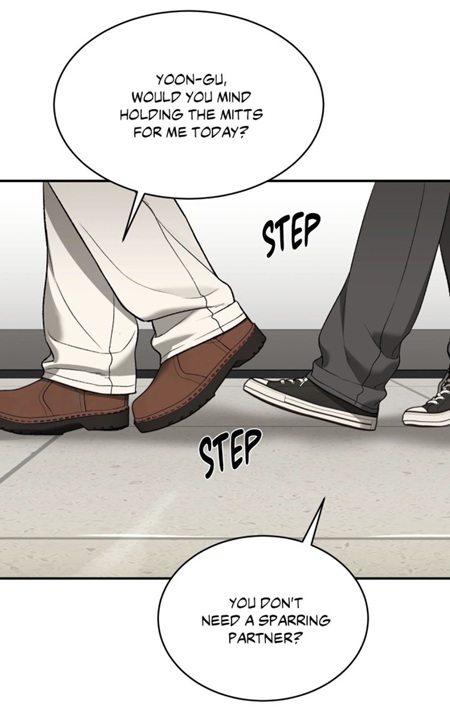 (Chapter 88) In both cases, access replaces consent: labor and care are extracted on polite request, while the cost—fatigue, intrusion, and loss of private time—is borne entirely by the subordinate.
 (chapter 70) but “Take better care of yourself.” Not “We failed to protect you,” but “You caused inconvenience.” This is the core of economic predation: the harm is real, but the blame is displaced downward so the system remains clean.
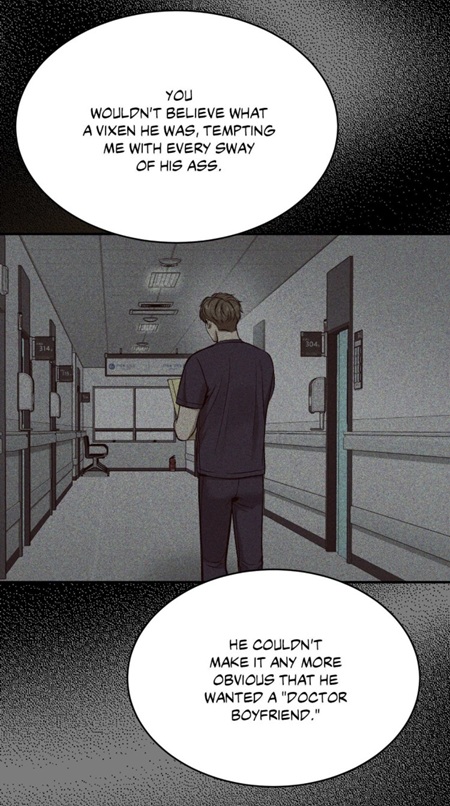 (Chapter 90) A sexual predator targets someone whose circumstances make refusal impossible or costly — socially, economically, professionally, physically, psychologically. The predator does not need to use overt violence to be dangerous; often the strategy is precisely to stay close to the border where the victim can later be blamed: You wanted it. You tempted me. You misled me. You didn’t say no clearly enough. This is why victim-blaming belongs structurally to sexual predation: it is a technique of retroactive absolution. This logic does not remain abstract in Jinx. It finds a concrete site where authority, legitimacy, and bodily access converge.
 (chapter 29) Rival fighters do not need to engineer the champion’s collapse; they only need to anticipate it. What defines them is not ambition alone, but timing.
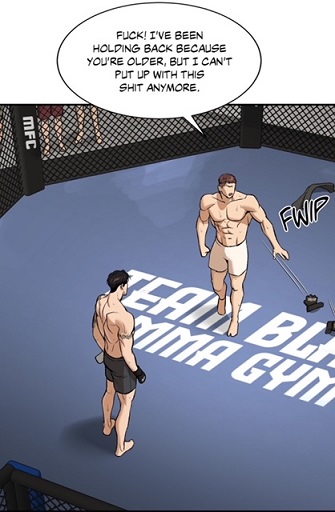 (chapter 46) His words are exposing not restraint, but accusation. The implication is clear: the champion’s body is already failing; respect has become optional. Seonho is not trying to overthrow Jaekyung through skill alone. He is announcing that the moment of vulnerability has arrived, and that patience is no longer required.
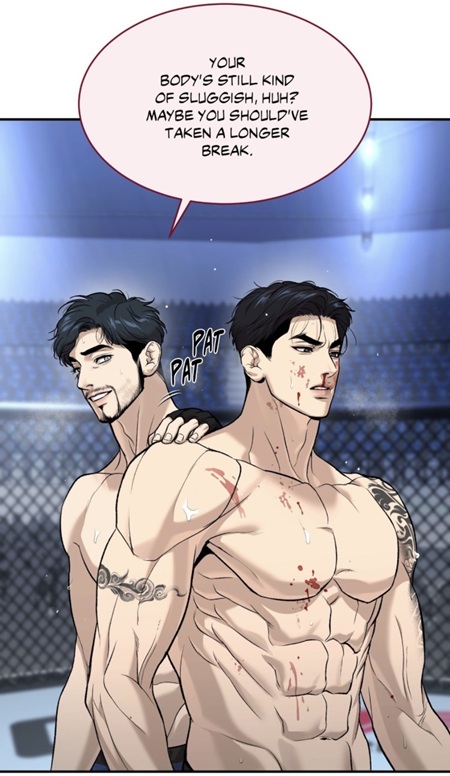 (chapter 87) He thought, he had found his perfect “meal”. To conclude, Arnaud Gabriel articulates the same logic even more coldly.
  (chapter 87) There is no personal animosity here, only inevitability. The statement is not a threat; it is a forecast. Power, in this worldview, is temporary by nature, and the role of rivals is not to prevent collapse, but to be present when it happens. Like hyenas, they do not waste energy on the kill. They wait for age, injury, scandal, or exhaustion to do the work.
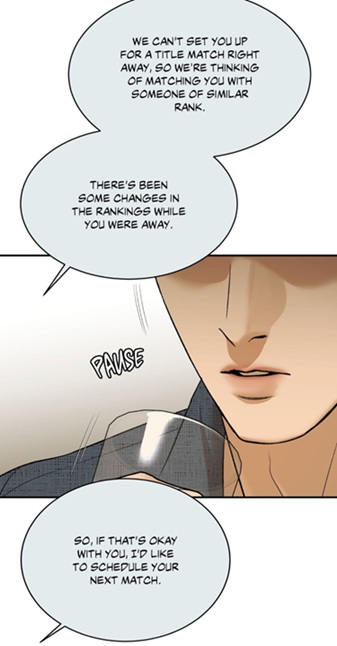 (chapter 69) A new match is organized. An invitation is extended. Noise is generated. Attention is redirected. The spectacle resumes.
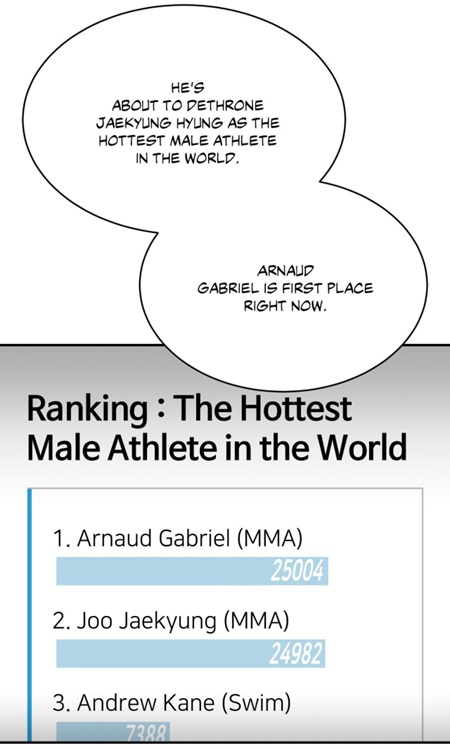 (chapter 81) The distinction matters. An athlete is managed for performance and longevity; a celebrity is managed for visibility. Injury is a problem in the first case. Scandal is profitable in the second.
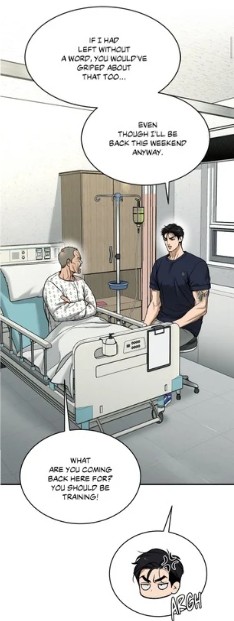 (chapter 78) The latter has always blamed the “boxer Joo Jaewoong”, but not the boxing world, the institution.
  (chapter 61) Joo Jaekyung accepts matches while injured
 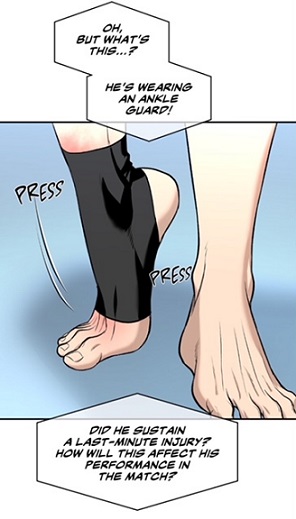 (chapter 50) later participate in his suspension. In both cases, the logic is identical: the body is usable until it is not. MFC remains intact; the cost is borne by the fighter.
 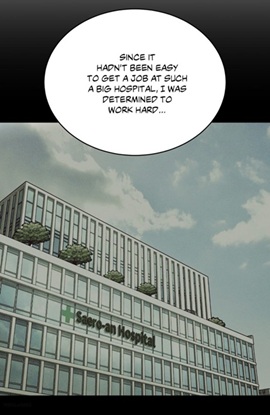 (chapter 90) is the first figure in Jinx who embodies all three dimensions of predation at once. He is a biological predator in logic, an economic predator in practice, and a sexual predator in effect — yet none of these appear as transgression. They are exercised under license.
 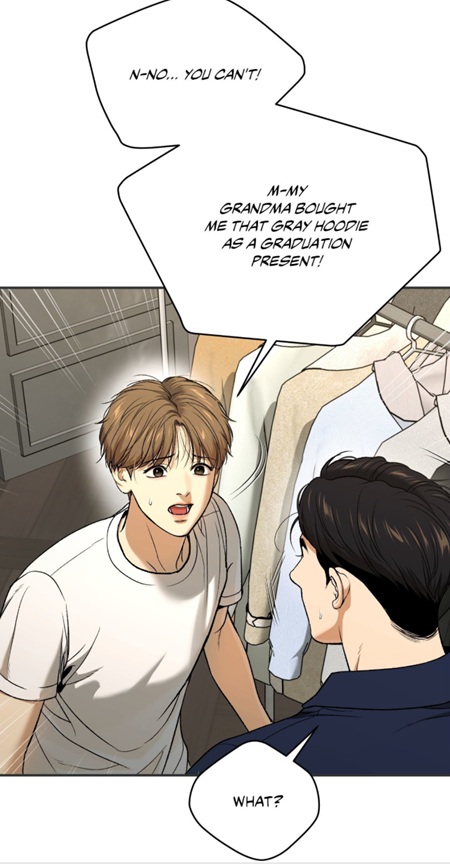 (chapter 80) In this environment, appearance is not superficial. It is a language of rank. To arrive without fluency in that language is already to be classified as provisional.
  (chapter 54)
  (chapter 1) The expression matters. It implies opportunity rather than integration: freelance labor, paid by hours or shifts, without institutional protection. In such conditions, negotiation is not expected. The contract is accepted, not discussed.
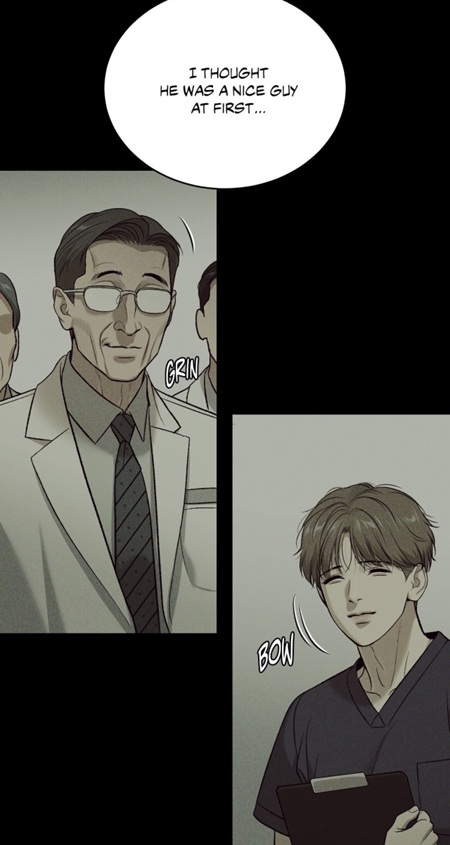 (chapter 90) — the same signs previously associated with the hospice.
 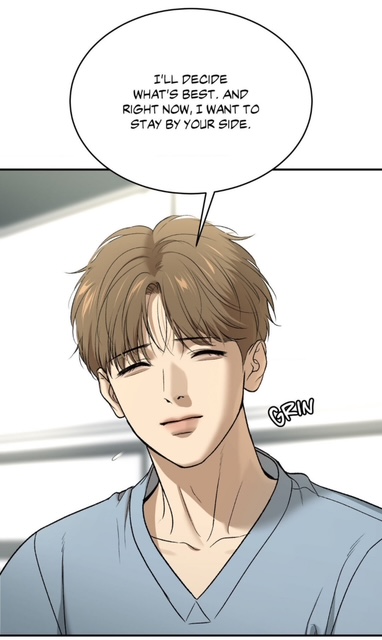 (chapter 57)
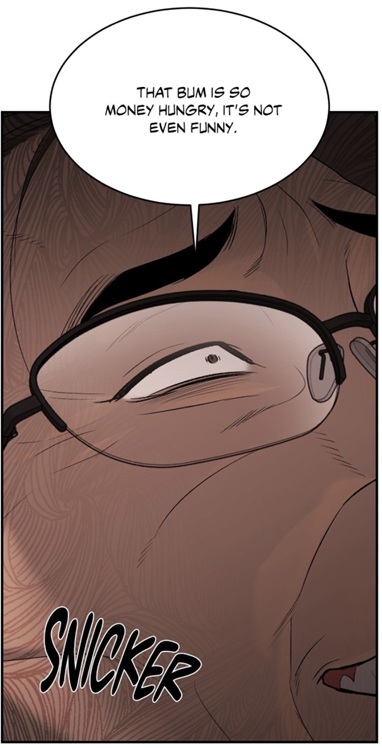 (chapter 90) Constant availability is misrecognized as appetite. Endurance becomes ambition. Constraint is translated into desire. Vulnerability is reclassified as greed. This misreading is not accidental; it is functional. If Kim Dan is greedy, then the director is not coercive. If Kim Dan “wants more,” then nothing is being taken from him.
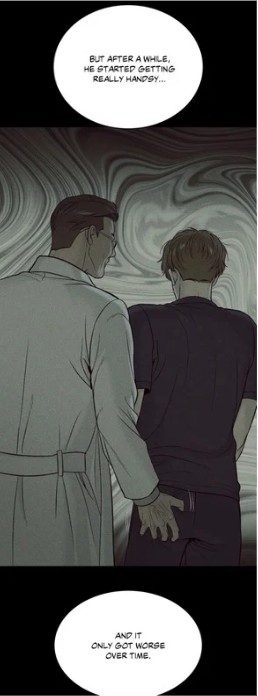 (chapter 90) The contact is quiet, progressive, and deniable. It blends into routine movement, into institutional normalcy. “After a while, he started getting really handsy… and it only got worse over time.” Each tolerated touch becomes precedent. Boundary erosion is not sudden; it is cumulative.
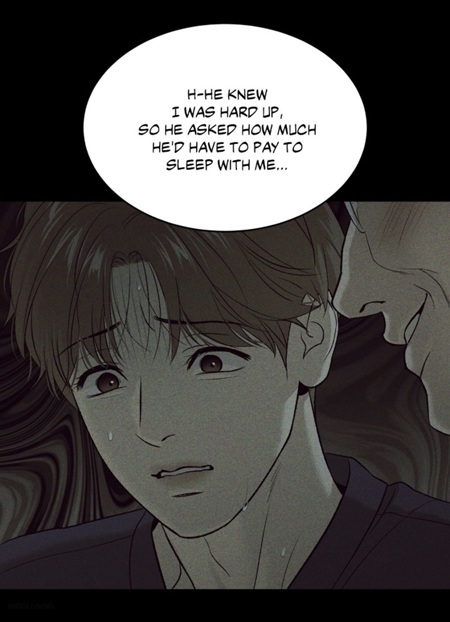 (chapter 90) In the doctor’s eyes, the predator knew about Kim Dan’s difficult financial situation, then he asked how much he would have to pay to sleep with him. The timing is crucial. The offer does not initiate desire; it tests whether vulnerability can be converted into consent. Payment reframes coercion as transaction, need as availability, and silence as something that can be bought in advance.
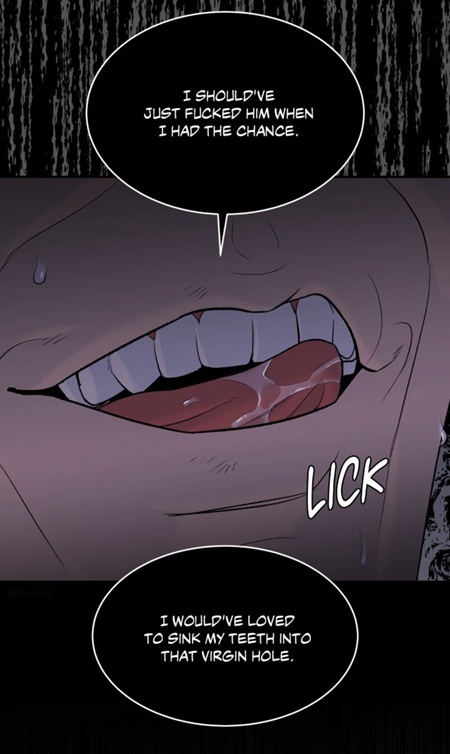 (chapter 90) His regret is not moral but tactical — that he did not take Kim Dan “when he had the chance.” Value resides in the moment of breaking resistance, not in the person afterward. Once the prey yields, interest vanishes.
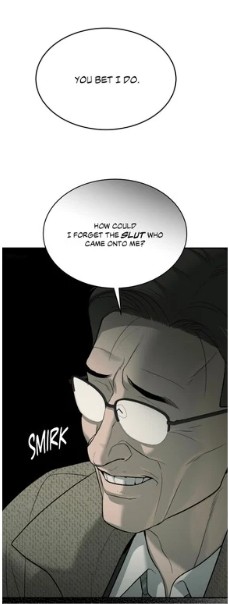 (chapter 90), despite never having paid him, never having offered gifts, dinners, or compensation. The hospital paid Kim Dan’s salary — and the director used his position as a low employee to see himself entitled. Hierarchy replaces money. Shame replaces consent. This is retroactive absolution perfected by institution.
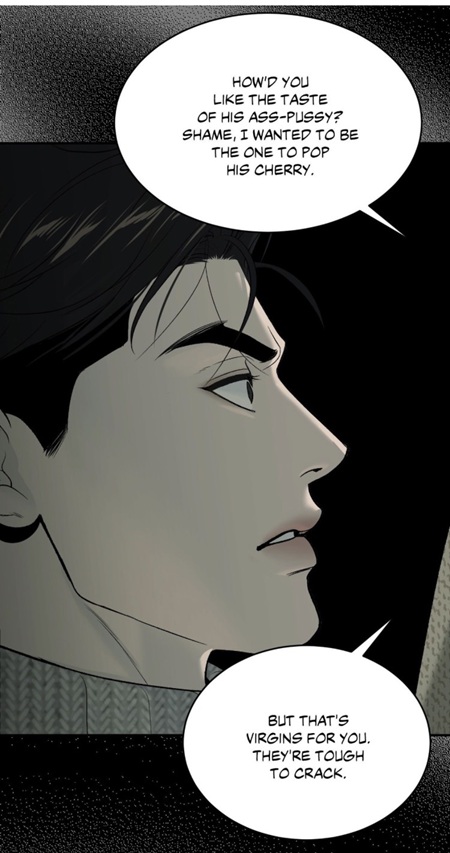 (chapter 90) as bodies that are “tough to crack,” with the confidence of repetition. The metaphor is consumptive: a shell broken to reach what is inside, then discarded. Once resistance is broken, interest disappears. This is practiced predation. The hospital is not merely the setting of abuse; it is his hunting territory — a space where authority guarantees access, exhaustion weakens refusal, and legitimacy ensures silence.
 (chapter 21) The juxtaposition of two buildings, the rooftop park, the sterile façade, and above all the near-identical hallways collapse
  (chapter 5) Professional and personal life are folded into the same architectural body. This is not decorative repetition; it signals circulation — of staff, of protocols, of information.
 (chapter 5) — professional legitimacy, research success, advancement within a system that rewards results over outcomes. Progress functions as an absolute good, one that authorizes human cost without requiring personal cruelty. Harm is acceptable so long as it produces data.
 (chapter 21), age and vulnerability become a risk factor, endurance becomes a resource. When the new drug fails and the grandmother deteriorates, the explanation is procedural: side effects, unpredictability, regulatory timelines. Failure is framed as scientific, not ethical.
  (chapter 47)
  (chapter 21) Treatment patients “need family support,” she says — a statement that sounds compassionate, but functions as deflection. Psychological care is outsourced; responsibility for deterioration quietly migrates away from the institution (“we”). The setting of her disclosures reinforces this posture. She does not speak in a protected office, but in the hallway — a transitional, impersonal space governed by efficiency rather than care, as if she had nothing to hide. However, by behaving like that, she violated the confidentiality rights. Unlike the Saero-An director, who relies on enclosure and isolation, Kim Miseon operates through openness and institutional flow.
  (chapter 48) It is no coincidence.
  (chapter 56)
 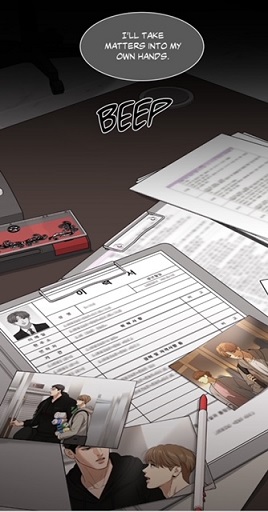 (chapter 46) This is not a coincidence. It is evidence. Personal and professional data move through institutional networks without consent. The same is true of medical information. Choi Gilseok knows about the grandmother’s illness despite having no clinical mandate.
 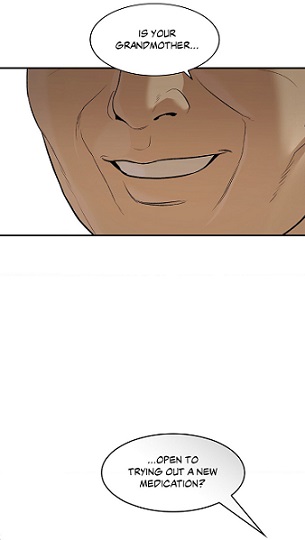 (chapter 48) That knowledge could only have reached him through leakage — informal, normalized, unremarked. Bodies are not the only things consumed here; information is too.
 (chapter 49) In both cases, harm is delivered chemically, not physically — quietly, indirectly, and in ways that can later be reframed as accident, misuse, or personal failure. This symmetry matters. The same mechanism governs the grandmother’s fate.
  (chapter 56) Unlike Saero-An or Sallim, this space does not extract profit or prestige; it operates under scarcity. Kim Dan works there as a freelancer, not as protected staff. When he collapses, he is advised to take a day off, not sick leave — a telling detail.
  (chapter 70) It confirms that, even here, labor is contingent, negotiability absent, protection minimal. The vocabulary of care masks the reality of precarity.
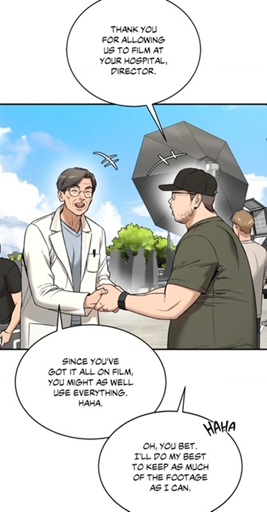 (chapter 59) Thus he is happy to let a film crew use his building for a movie. This is why he sometimes works night shifts himself.
 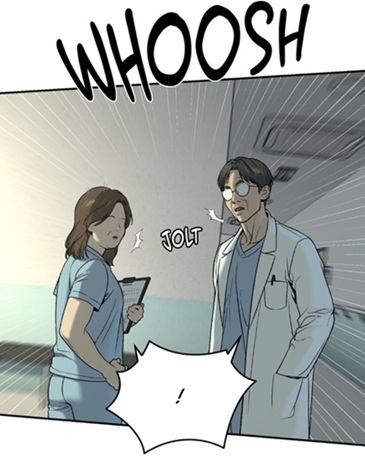 (chapter 60) His authority does not shield him from exhaustion; it exposes him to it. He enforces discipline because collapse anywhere threatens survival everywhere.
 (chapter 59) And yet, harm still occurs. Responsibility is displaced not upward, but sideways — onto the most vulnerable worker present. Kim Dan becomes the buffer once again, not because the director is powerful, but because he is trapped. Predation here is no longer driven by appetite, but by attrition.
 (chapter 61), preserving the impression of treatment rather than end-of-life care. This semantic slippage matters. For Joo Jaekyung, who has been treated there himself, the space remains associated with improvement.
 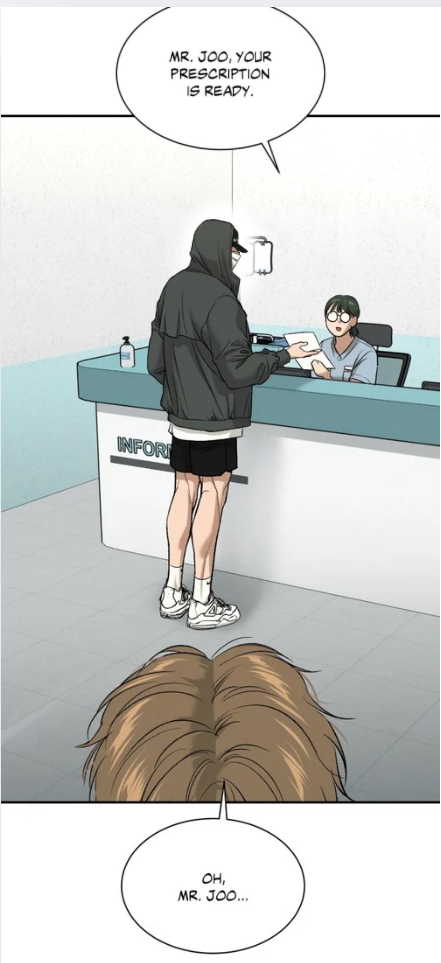 (chapter 70) He thinks, Hwang Byungchul is treated properly, as he still looks lively and strong.
  (chapter 71) The champion does not fully register that it is a place at the threshold of death. Care and closure blur. This confusion is not accidental; it mirrors the broader system’s refusal to name limits. By calling a hospice a hospital, death is softened into treatment. By calling resignation progress, responsibility is deferred.
 (chapter 65) For her, medicine is sacred and progress meaningful.
  (chapter 65) This belief is not naïve in the childish sense; it is aspirational. It is tied to the idea of success, of legitimacy, of having “made it.” And in her mind, that idea has a name: Seoul.
 (chapter 65) It is where competent doctors work, where advanced hospitals stand, where progress happens, where you can earn a lot of money. This belief structures her entire horizon. Corruption, abuse, and institutional predation do not register there, because acknowledging them would mean admitting that the space she has invested with hope is also capable of harm. Within Seoul, institutions are not suspect; they are self-justifying.
 (chapter 65) as if it was recent, temporary, and situational. The wording matters. What has been chronic is compressed into the present. Duration disappears. Suffering becomes recent, temporary, and therefore manageable. This is temporal minimization — not denial of harm, but deferral of its cause.
  (chapter 57) Only then does his condition become visible. Not because it is new, but because it now implicates her. Before that moment, his endurance could remain unnamed. After it, it must be explained. This is not cruelty; it is belief colliding with responsibility.
 (chapter 41) He spends so much for her that he doesn’t have anything left for himself.
 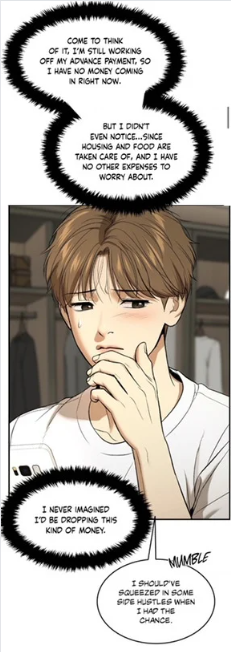 (chapter 42)
  (chapter 22)
 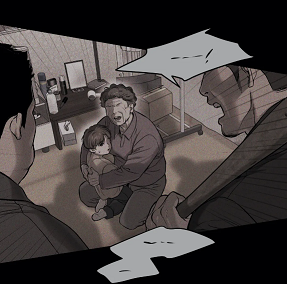 (chapter 5), not systems. And so, she imagines that as long as Kim Dan is working, earning, and paying back what he owes, nothing truly irreversible can happen to either of them. To conclude, what governs Shin Okja’s thinking is a simple equation: payment equals safety. In her mind, debt is a temporary problem with a finite solution. Once money is paid back, danger ends. Order is restored. Life resumes. This belief explains her silence around the loan. To name it would be to admit uncertainty; to erase it is to preserve control.
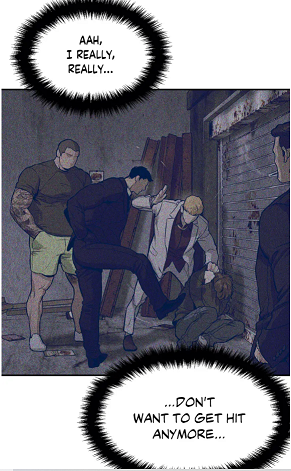 (chapter 1) Kim Dan is beaten not because he refuses to pay, but because payment structures domination. He accepts the abuse precisely because he believes it is temporary — a punishment that will end once the balance is cleared. Violence is normalized as consequence, not crime. This logic mirrors hers exactly. The more the main lead paid back, the more he was exposed to violence.
  (chapter 11) Here, he talked back to Heo Manwook, a sign that he was no longer tolerating the loan shark’s intrusion. The result was that he ended up being beaten more violently than before.
  (chapter 13) This reached its peak, when after sending his whole salary
 (chapter 16), Heo Manwook intended to rape him. As you can see, the more they got money, the more abusive they became… and all this time, the grandmother has no idea. But the best evidence is when Joo Jaekyung pays the loan in full, the pattern repeats at a higher level.
  (chapter 17) The debt is erased — and the danger escalates. Kim Dan might become free, but now the target is the champion. He becomes visible. Settling the debt marks him as someone worth targeting, someone who can be extracted from again.
  (chapter 46) What Shin Okja imagines as closure functions, in reality, as a signal.
 (chapter 46) Each appearance sustains sponsors, broadcast value, betting volume, and gym economies. This is why he becomes the “biggest target”: not because he is weak, but because he represents the highest return.
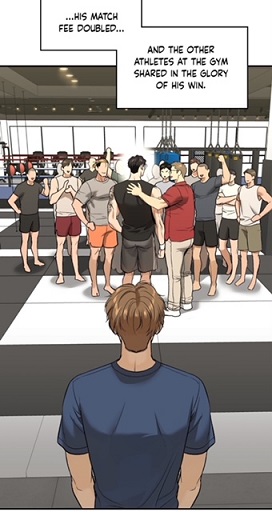 (chapter 41) A champion who keeps winning cleanly, visibly, and on his own terms becomes difficult to manage. His victories increase his market value, distribute prestige and income to others, and create expectations of legitimacy. At that point, success stops being profitable in a controllable way. It begins to threaten both institutional authority and informal economies that rely on predictability, influence, and narrative control.
 (chapter 46) A dominant, credible champion reduces volatility, resists manipulation, and makes engineered outcomes harder to disguise. In such a configuration, continued victory is destabilizing. The problem is no longer his body failing — it is his body refusing to fail on schedule.
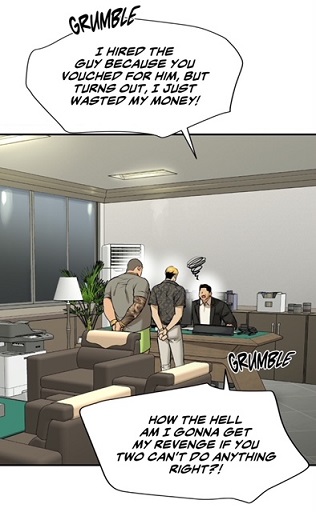 (chapter 46) is violent. The question is: what kind of predator is he?

 (chapter 87), and the destruction of black glass under Baek Junmin’s foot.
 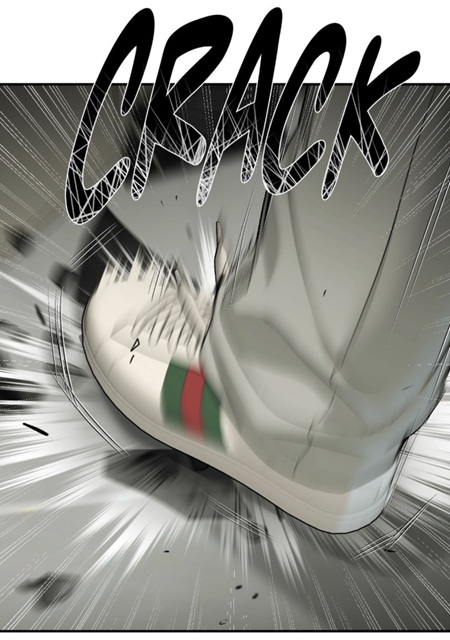 (chapter 87) Both moments operate under pressure, yet they belong to radically different economies. One gathers force inward to protect, contain, and care. The other expels force outward to fracture, dominate, and erase. The biggest difference is not intensity, but direction—and whether the other is held, or destroyed.
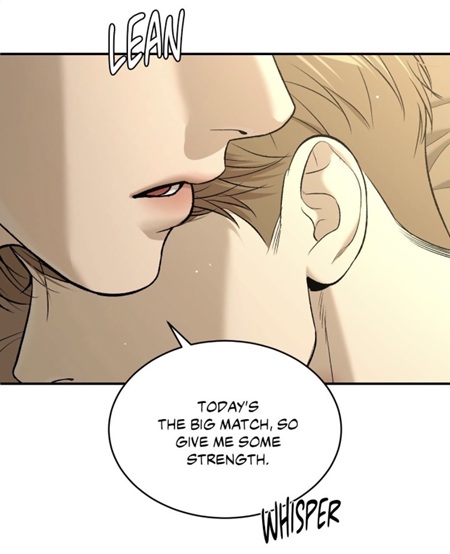 (chapter 87) He asks for strength and luck
  (chapter 87). Kim Dan answers with a gesture, the offered hand accompanied with a wish:
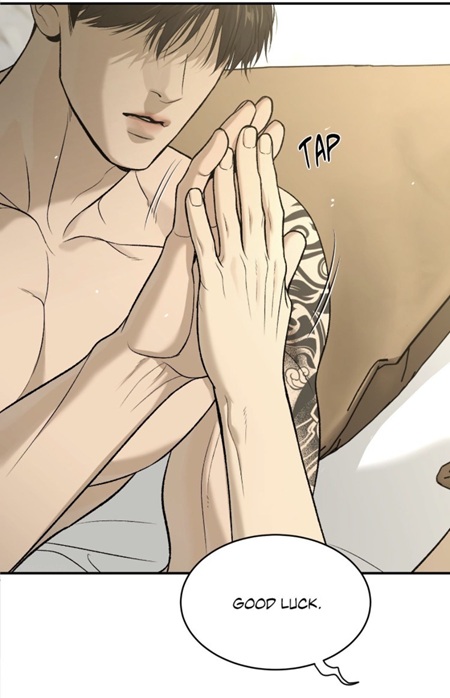 (chapter 87). Only then does the squeeze occur. Words initiate connection; the body confirms it. Speech and gesture align. Pressure becomes care.
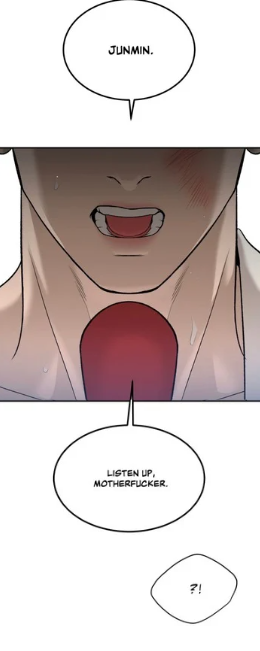 (chapter 87) —but they are refused. Baek Junmin is denied any possibility of reply—no space to answer, to justify himself, or even to speak back.
  (chapter 87) The screen interposed between them
 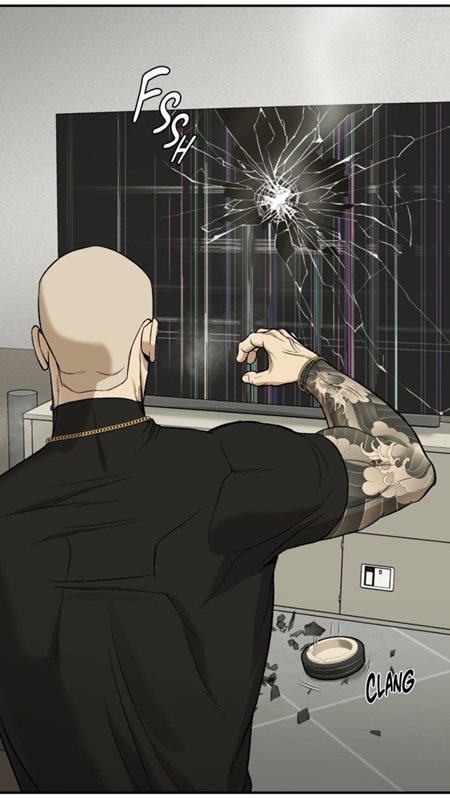 (chapter 87) functions as both a physical and symbolic barrier: it delivers judgment without permitting response. Deprived of dialogue, Junmin is pushed out of language altogether. What remains available to him is not speech, but the body. His answer therefore does not come in words, but through the hand
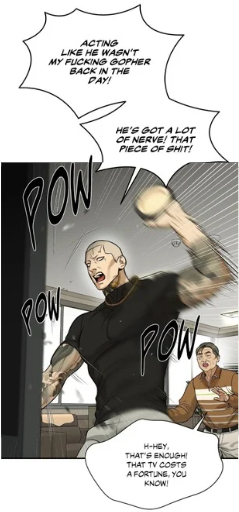 (chapter 87) and then through the foot.
 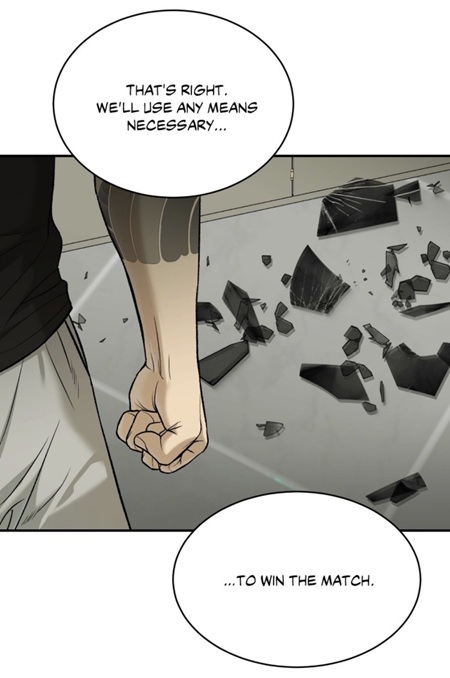 (chapter 87) The violence is not misdirected; it is precisely directed at the medium that silences him. The screen is the site of exclusion,
  (chapter 87), before the challenge
 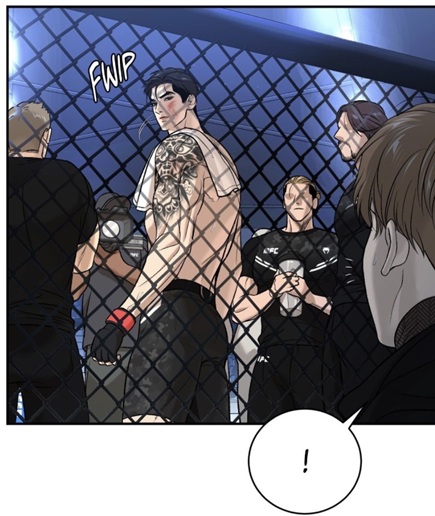 (chapter 87) He looks—not at the crowd, not at the institution, but at Kim Dan. The gaze matters. It establishes a circuit. Like a phone call finally answered, it places both on the same wavelength. Only then does the question come.
 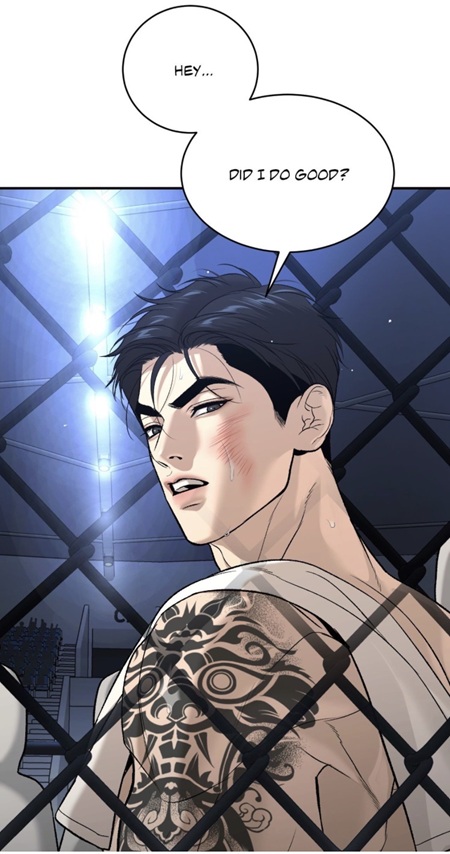 (chapter 87) Here again, language and body are aligned.
  (chapter 87) Kim Dan answers—first with a nod, then with words. The response is clear, immediate, and embodied. And what follows is decisive: the champion raises his arm.
  (chapter 87)
 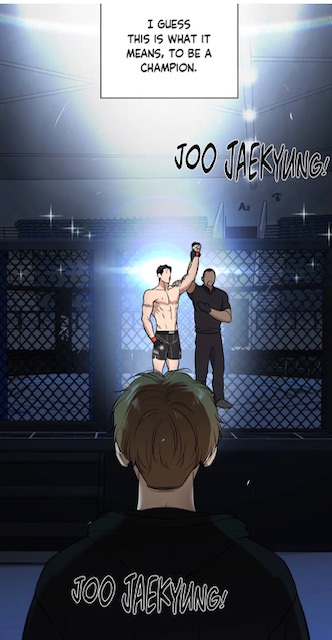 (chapter 15)
 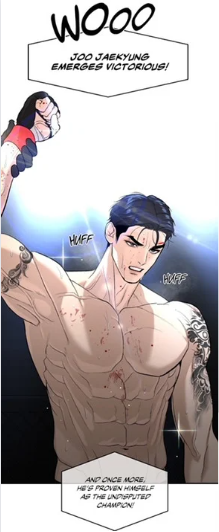 (chapter 40)
 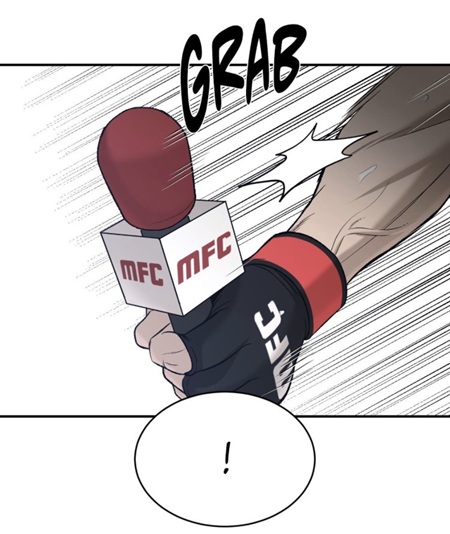 (chapter 87) Joo Jaekyung is no longer a puppet or zombie, but a man with a heart and voice.
 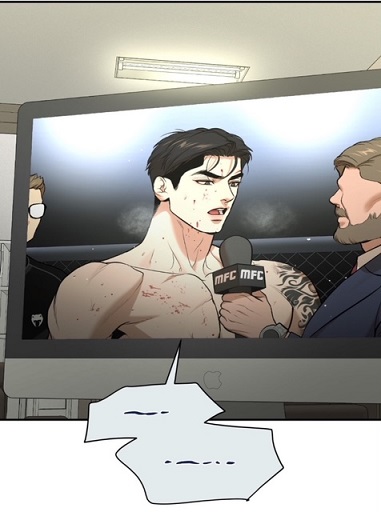 (chapter 46) It regulates turn-taking, determines who may speak, in what order, and under which framing. As long as it remains in the moderator’s hand, speech is mediated, filtered, and contextualized. Questions lead; answers follow. Meaning circulates vertically.
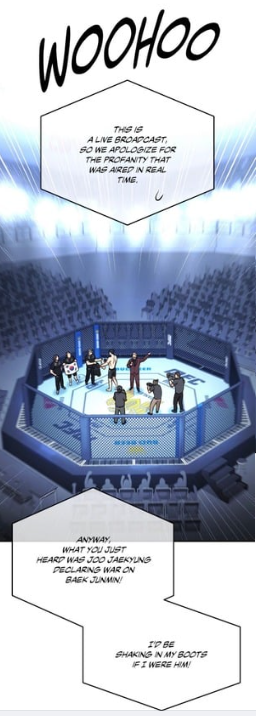 (chapter 87) He no longer moderates; he reacts. He cannot redirect the statement, soften it, or translate it into spectacle. He can only acknowledge that something has escaped containment. The apology is not moral—it is procedural. It marks the moment the institution loses authorship.
 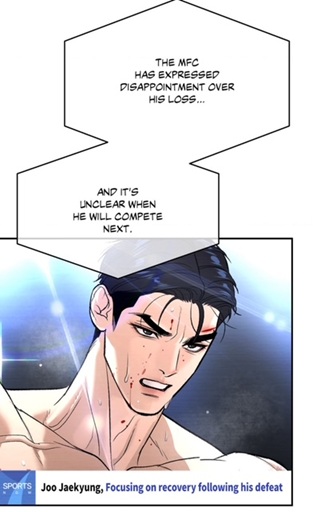 (chapter 57); he is narrating. He does not answer a question
 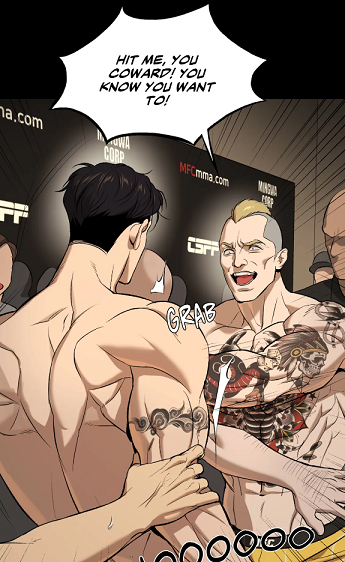 (chapter 14) Yet, CSPP
  appears more and more insistently
 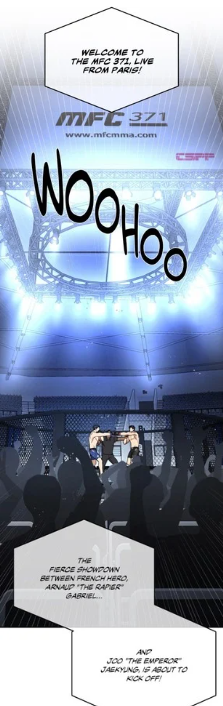 (chapter 87), even in the cage
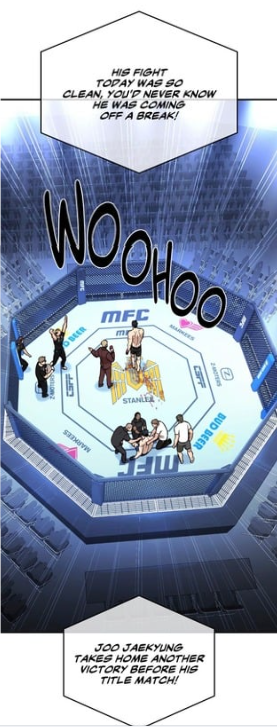 (chapter 87), contrary to before.
  (chapter 15) Either you only see the C or the name is placed out of the frame.
  (chapter 40) Yet it remains unexplained. What does it stand for in the world of Jinx? A sponsor? A broadcaster? The story never defines it explicitly—and that absence matters. What goes unnamed is often what exercises the most power. I will elaborate about it further.
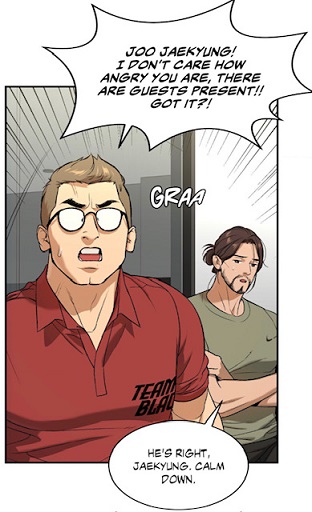 (chapter 36) —depends on mediation. Delay. Scoring. Interpretation. The quiet redistribution of meaning after the fact. As long as nothing is said outright
  (chapter 87), people in the seaside town, a public that exists before commentary can shape it.
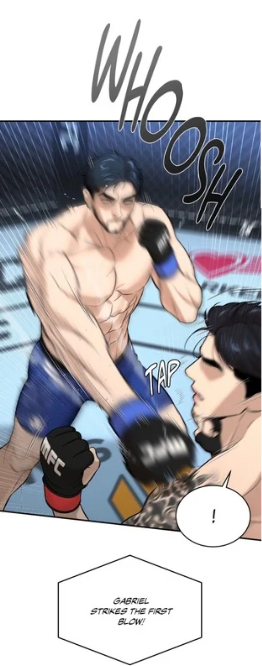 (chapter 87) And the fight already answers the questions the system hopes to postpone. What we see in the cage is not merely a contest of strength, but a clash of communicative regimes. How one fights here is inseparable from how one speaks, evades, provokes, or withholds.
 (chapter 87) His movement privileges distance, tempo
  (chapter 87) and visibility. That way he gives the impression that he is superior to the former champion. The middle kick appears not as a finishing tool
  (chapter 87), but as an instrument of disruption—enough to score, enough to interrupt rhythm, never enough to end the exchange. The rest of his offense follows the same logic: repeated punches to the face
  (chapter 87), the hands, the shoulder. Targets chosen not for collapse, but for points. Not to silence the opponent, but to keep him talking through damage. The choice of targets is not arbitrary. The hands and the shoulder are not neutral zones. They are sites of vulnerability that presuppose knowledge. Arnaud Gabriel does not fight, as if he were discovering his opponent in real time; he fights as if he were acting on prior information.
 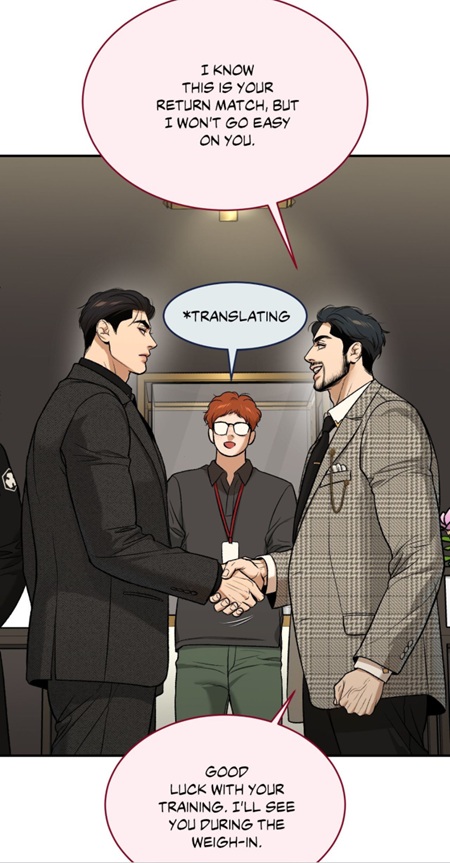 (chapter 82) He anticipated a diminished MMA fighter at the end of his career who would train at the hotel gym. His punches repeatedly return to the same areas—not to finish, but to aggravate. Not to silence, but to extract fatigue.
 (chapter 82)—noticed earlier during training—signals something even more fragile: limits that are physiological, not tactical.
 (chapter 47) Already discussed. Already framed. Gabriel’s reliance on point accumulation is inseparable from this logic.
  (chapter 87) He does not need to dominate the body; he needs to activate its known limits and let the scoring apparatus do the rest.
 (chapter 87) —his decision to close distance, to counter decisively, to end the exchange rather than prolong it—appears less like impatience than resistance. He does not correct the narrative. He interrupts it.
 (chapter 51) The fight is no longer about what happens between bodies, but about who controls evaluation. And that’s how they could rig the match between Baek Junmin and Joo Jaekyung.
  (chapter 70) acquires a different meaning. What he condemns as arrogance is not a moral failure, but a structural adaptation. These fighters have learned that they do not need to finish fights with a knockout. They only need to prolong them—to survive them—because the system will finish the sentence for them. Therefore, the moderator’s commentary during the match introducing the new Korean fighter takes on a clearer function.
 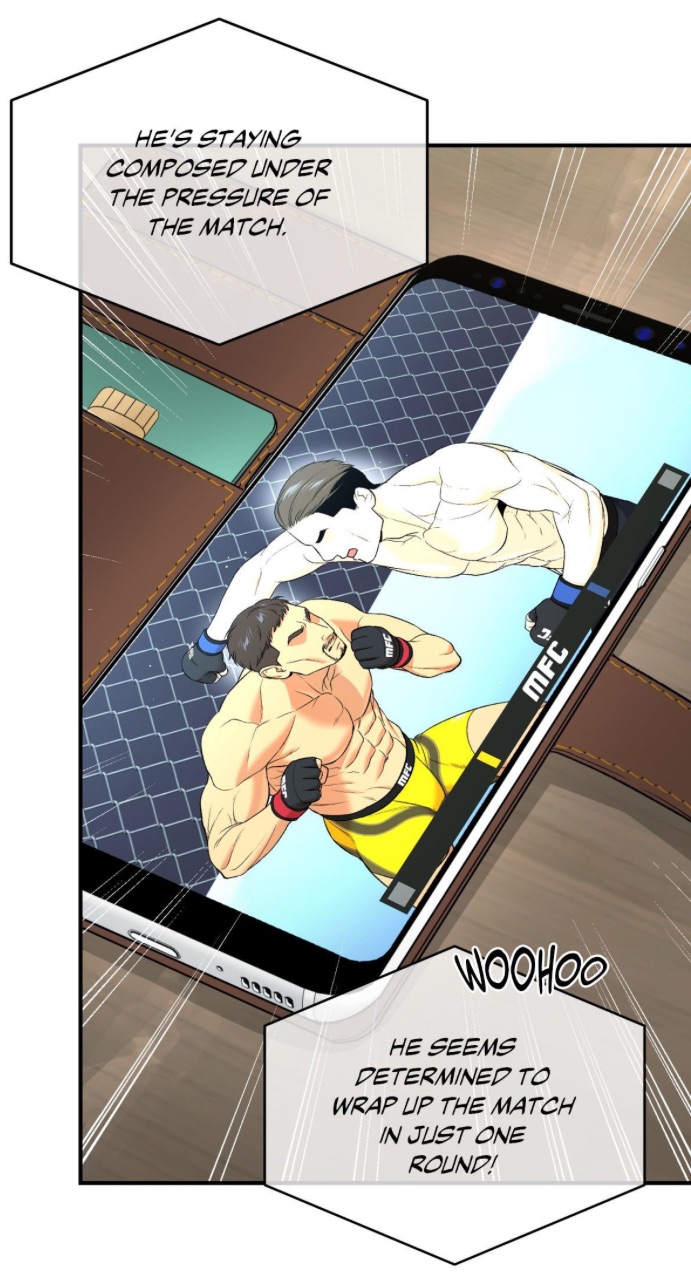 (chapter 71) He frames the rookie as someone “waiting for the right timing,” subtly suggesting a coming knockout rather than prolonged survival. The language is important: it reassures the audience that decisiveness still exists within the system, that power is merely deferred—not absent.
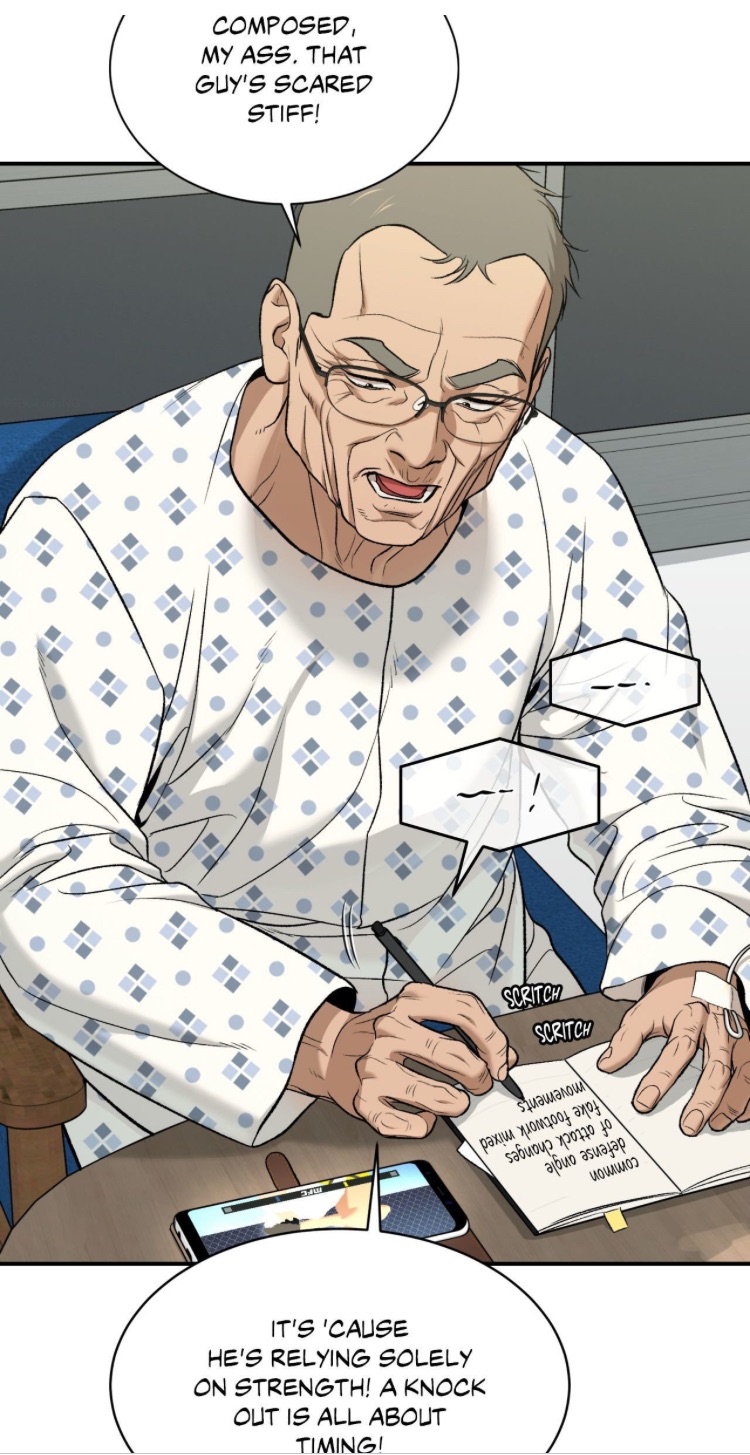 (chapter 71) The director is not persuaded. Hwang Byungchul reads the situation differently. He recognizes stiffness, fear, and overreliance on structure—not composure, not strategy. Where the moderator sees patience, the director sees hesitation. Where commentary insists on strategy, experience detects rigidity and lack of instincts.
 (chapter 82) and inside the cage.
  (chapter 87) Publicly, he is courteous. Measured. Even complimentary.
  (chapter 82), gentle and polite gestures, and tactical distance— away from the spotlight, away from overt confrontation. His restraint is not humility, but alignment. He performs civility so that judgment, narration, and authority can be outsourced to the institution. That’s why for him, fighting is strongly intertwined with fun and he sees himself more as a star than as an athlete. He is definitely influenced by MFC. Hence we can say that his suit mirrors his mind-set. Gabriel’s suit does not soften his presence; it disciplines it. The patterned fabric signals rigidity rather than elegance—structure over fluidity. It mirrors his fighting style: calibrated, rule-bound, resistant to improvisation. Nothing about his appearance invites rupture. Everything is designed to hold form.
 (chapter 49) It is to smirk, to whisper, to apply pressure obliquely. In both cases, the logic is identical: control is preserved by never being fully present.
 (chapter 87) It is more observation. He allows the opponent to speak first—to reveal the structure of the exchange.
  (chapter 87) When it lands, it collapses distance. It forces the opponent inward. And crucially, it targets the center of the body—not the face that earns applause, but the core that sustains movement.
 (chapter 87) and delivers an uppercut.
  (chapter 87) This is not escalation; it is completion. Where Gabriel sought to keep the fight open, Joo Jaekyung compresses it. He refuses the long exchange. He refuses circulation. He refuses to wait for judgment. His strategy is not to be evaluated later, but to be undeniable now.
  (chapter 87) This is not silence imposed from outside, but silence produced by gravity. Once the body crashes, breath cannot return, and speech has nowhere to perch.
  (chapter 87)
 (chapter 87)
 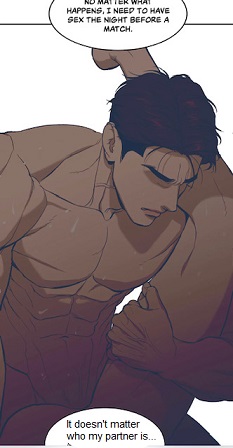 (chapter 2) While the jinx held, action could still occur, but speech could not carry consequence. Words dissipated, were deferred, or were absorbed by systems designed to neutralize them. Powerlessness expressed itself as speechlessness.
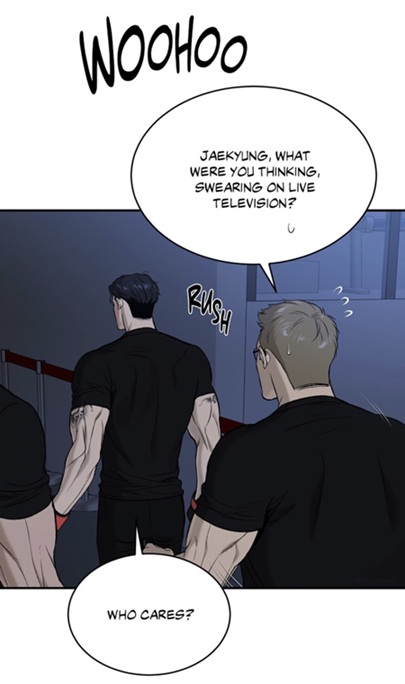 (chapter 87) His actions arrive before meaning can be reassigned. His words arrive where no answer is prepared. In this sense, episode 87 marks the moment Joo Jaekyung becomes fluent in his own discipline. Not merely competent, not merely dominant, but articulate. His movements surprise
  (chapter 5) which had surprised his manager Park Namwook.
 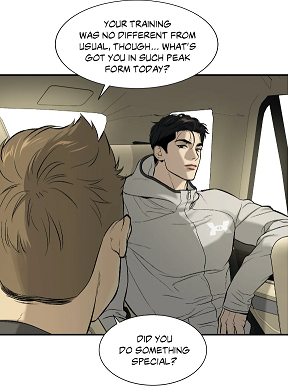 (chapter 5)
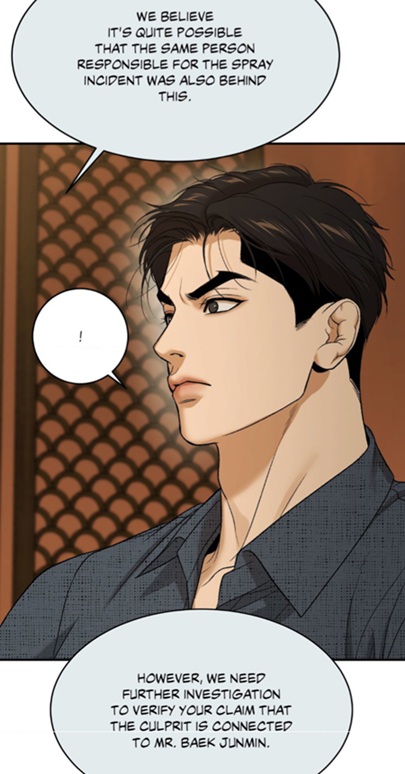 (chapter 69) , the switching, the method—the institution could have responded. Clarifications could be issued. Liability could be managed. But by speaking elliptically, by pointing to manipulation without anatomizing it, the champion places the burden of interpretation onto the audience. And MFC can not deny the existence of an incident in the locker room.
 (chapter 62) They are not close enough to trust the system blindly.
 (chapter 57)
 (chapter 69), by allowing attention to cluster around foreign misconduct
 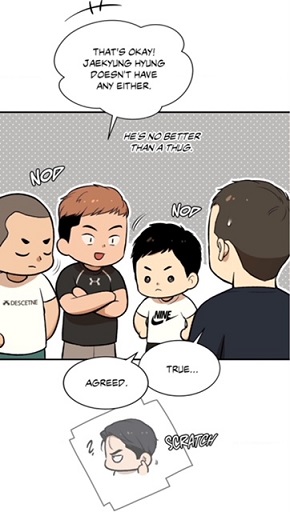 (chapter 47) Nothing new needs to be invented. Only reassembled. They know about the dragon’s past, because they brought Baek Junmin, someone who resented the celebrity for his wealth and fame.
  (chapter 78) Secondly, Kim Dan is now able to distinguish the past from the present. Finally, thanks to doc Dan
 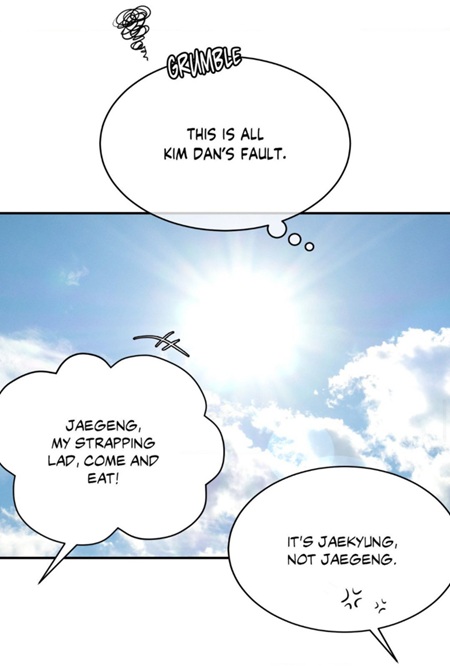 (chapter 62), he did so many good deeds in the seaside town that the inhabitants and the patients from the hospice won’t accept such accusations. I believe that such people won’t see “motherfucker” as a problem at all, they will rather see it as a part of his role after the match. What will remain in their mind is rather the accusation and riddle he voiced: the stunt Baek Junmin played.
 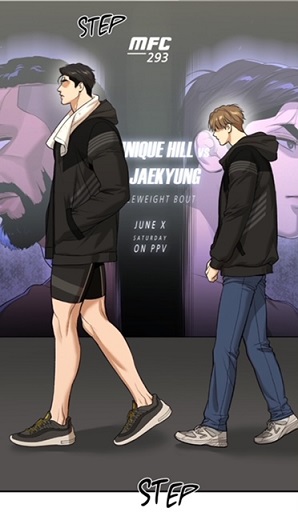 (chapter 87), which already tells us that CSPP does not function as a simple broadcaster. My idea is that CSPP operates as an intermediary apparatus: a company that packages events, sells broadcasting rights, coordinates visibility, and transforms violence into consumable spectacle. In other words, CSPP does not show fights; it produces events. This explicates why CSPP was present right from the start
 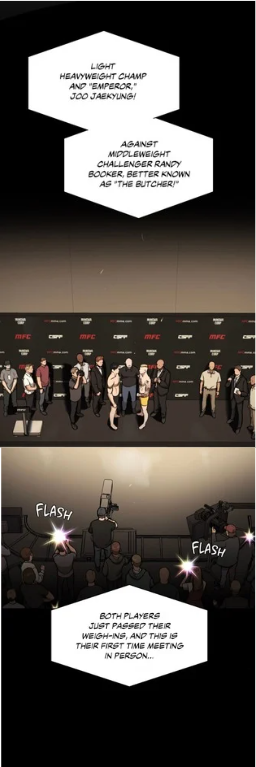 (chapter 14), but barely visible. But the moment it caught my attention in Paris, I realized that its increasing visibility displays the success of MFC as company. Observe that when the champion faced Randy Booker, the weight-in took place on the same day than the fight and in the arena, not at a prestigious hotel like in Paris. Here, the champion held a conference many days before the weight-in, and the latter took place the night before the match with Arnaud Gabriel. Secondly, you can observe the success of MFC through the banners. In Busan, the website of MFC was posed in the background next to CSPP.
  (chapter 50), only MFC and CSPP. But in Paris, it is now totally different.
 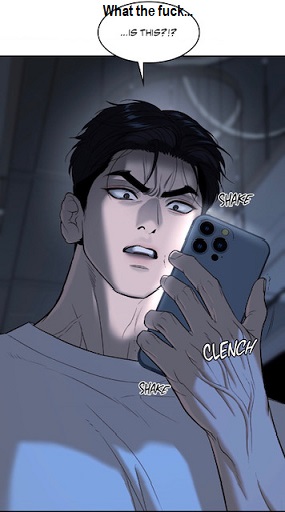 (chapter 35), his suspension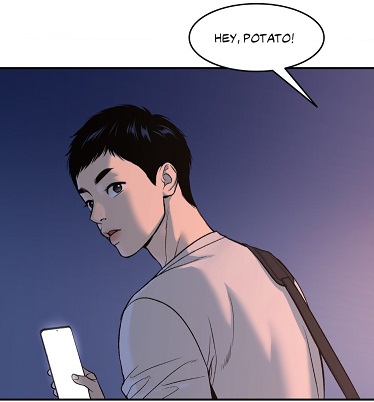
 (chapter 70) His matches are scheduled at hours accessible even to a Korean hospital
  (chapter 41) or hospice patients.
  (chapter 71) becomes intelligible. It is not a mark of anticipation, but of expendability. The match is placed where attention is thinnest, where failure or success carries minimal consequence. By contrast, Joo Jaekyung’s fights are positioned to be seen. The asymmetry exposes how dependent MFC’s visibility economy is on him—not as a competitor, but as the primary organizer of audience attention.
 (chapter 47) His rise is engineered through selective visibility.
  (chapter 47) His image is inflated before he ever faces Joo Jaekyung. CSPP does not need to expose him fully; it needs only to prepare recognition. However, CSPP is an official company, they can not control rumors among fighters.
 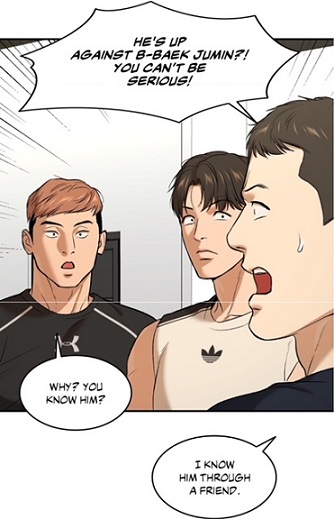 (chapter 47) Thus the manager suggested this to his boss just before:
  (chapter 46) By mentioning the existence of spies, he incited the main lead to keep his distance from the doctor and the members so that the rumors about the underground fighting wouldn’t reach his ears.
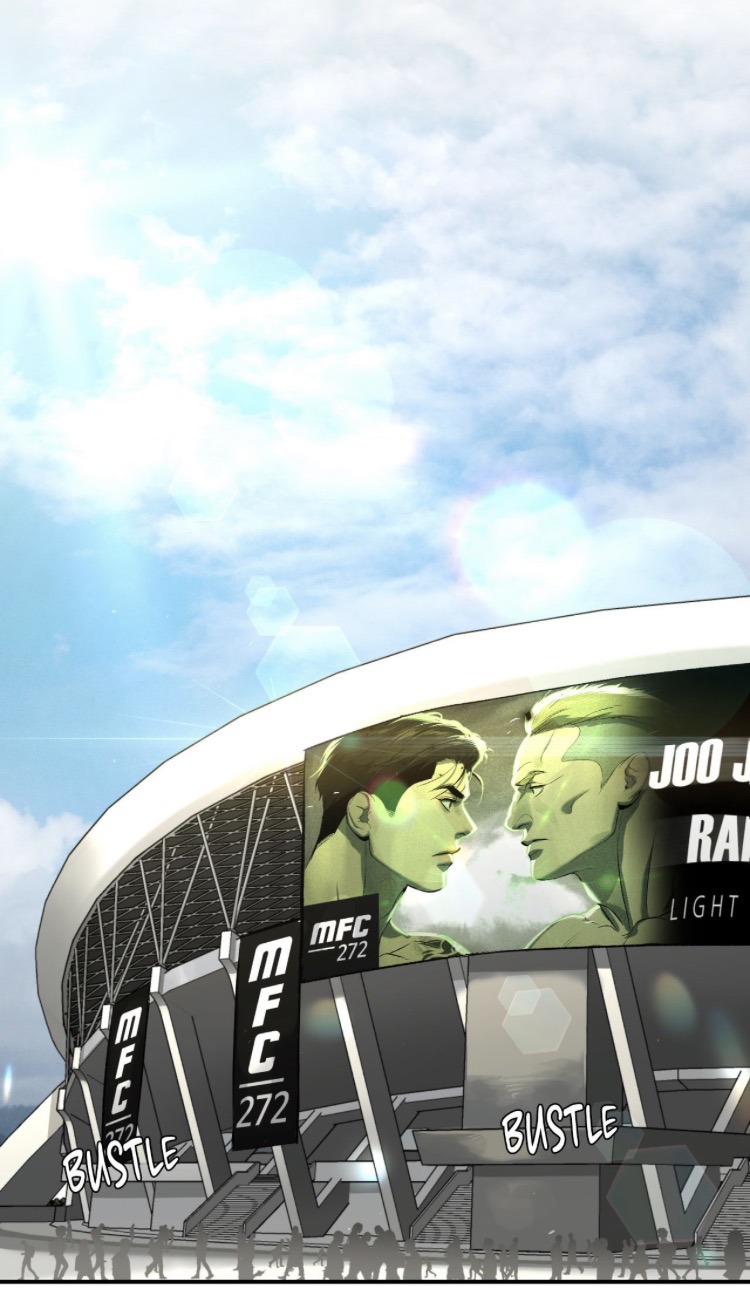 (chapter 14), the United States, Paris—the fights are placed in high-visibility slots. Loss must be witnessed. Decline must be shared. By contrast, the fight between Baek Junmin and Joo Jaekyung takes place in the morning
  (chapter 49), a time of dispersed attention, private viewing, and reduced collective response. Visibility is not maximized; it is managed.
  (chapter 49) CSPP’s role, then, is not neutral mediation. It is temporal governance. It decides when exposure becomes dangerous and when it becomes profitable. It does not silence events; it times them.
 (chapter 77) Once Joo Jaekyung does not contest the loss of his title—once he does not sue, demand more investigation, or interrupt the administrative process— MFC and CSPP no longer need to justify anything. Delay becomes normalization. Silence becomes confirmation.
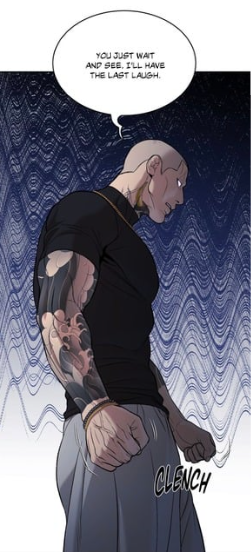 (chapter 87) is dangerous not only for MFC, but for CSPP itself. If his connections to the underworld surface, CSPP is no longer a distributor of sport, but a conduit for illicit spectacle. Contracts dissolve not because violence occurred, but because violence escaped framing.
 (chapter 49) Under normal medical protocol, this should have stopped the fight immediately.
 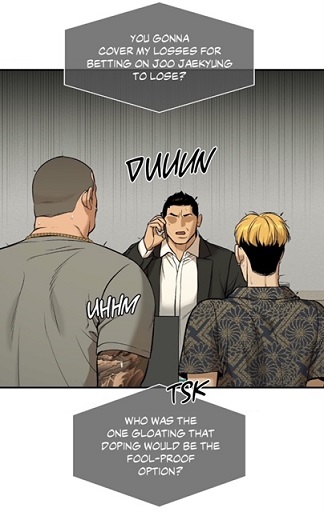 (chapter 46) that began elsewhere—losses already acknowledged when Choi Gilseok brought him into the system in the first place.
 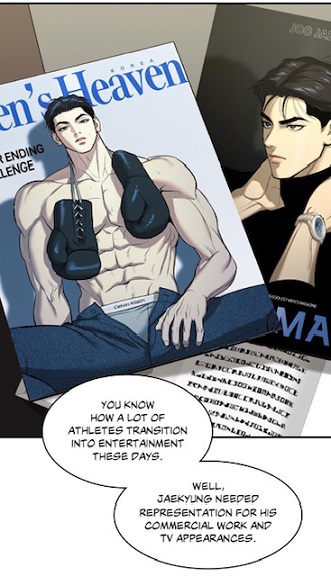 (chapter 30) This implies that he won’t remain passive and silent like in the past, relying on structure and institutions (Entertainment agency…) and accepting to become a scapegoat.

 (chapter 85) represents the positive reflection of this night
  (chapter 58)
  (chapter 58)
  (chapter 58), when the physical therapist chose to give up on the athlete and stop listening to his heart. Here, I am not only referring to the numerical symmetry but also to the doctor’s shifting vision of Joo Jaekyung.
 (chapter 85), Jaekyung appears with a towel around his neck. This simple object evokes water and sweat, but in Jinx, these elements are never neutral. They are tied to one of the champion’s earliest traumas: the humiliation of being called “dirty”
  (chapter 75) and “smelly” as a child. This is why Jaekyung learned to perfuse his body with cologne after every shower
  (chapter 75) and why physical proximity has always carried the risk of shame. Hence he kept people at arms length. In chapter 40, when he rescued Kim Dan from the security guards, he kept his distance
 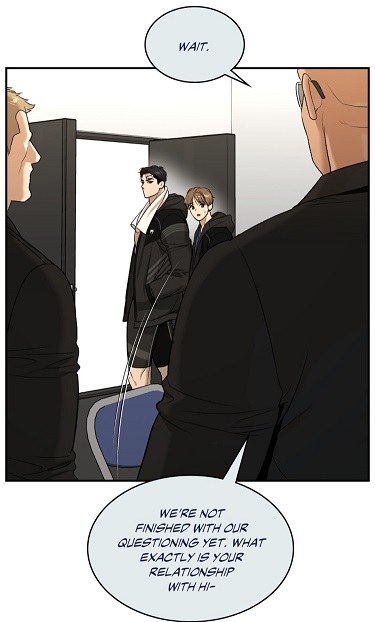 (chapter 40) — he had not yet showered, for the towel on his shoulders was stained with blood. Mingwa was indirectly referring to the champion’s psychological wounds.
  (chapter 40) It was, as if the fear of smelling “wrong,” of being perceived as contaminated, was still dictating his movements. Hence he could only claim doc Dan as one of his own, but not as his “physical therapist” or even “family”. And interesting is that doc Dan copied his attitude. In the hallway, he maintained a certain distance from the athlete.
  (chapter 40) the moment he dried off
  (chapter 85) His hair is unstyled, his scent unmasked — and yet he approaches Dan without hesitation. He even kisses him. The item that once symbolized rejection now signifies trust: without fragrance, he is certain that doc Dan will not call him “dirty,” will not recoil, will not shame him. What once provoked distance becomes an unexpected bridge, revealing that Jaekyung is finally letting someone remain close, when he feels most vulnerable. The night in Paris does not simply suggest a return of desire; it announces the return of hope
  (chapter 85) and trust — and perhaps even the moment when Dan chooses, for the first time, to be honest with his own body and heart.
  (chapter 85)
  (chapter 85) — fulfilling, without knowing it, a secret wish the physical therapist has harbored since childhood
  (chapter 61) [I will elaborate it further later]. And perhaps this is why the moment feels so disarming: because the downfall is not tragic but tender, not humiliating but intimate. Sweet, even.
 (chapter 85), when a single careless comment shattered the champion’s composure and revealed just how fragile his newfound hope really was.
 (chapter 85) In contrast, both Park Namwook and coach Jeong Yosep wear generic MFC T-shirts.
  (chapter 85) Dan is lost in his thoughts — anticipating the night ahead with the champion — and has barely touched his food. Park Namwook notices this. One might think, such a remark displays the manager’s concern for the main lead’s well-being. However, the manager adds that the other members of the team are all almost finished. With such a remark, it becomes clear that the manager is urging the protagonist to finish his plate. Although Park Namwook addresses Dan as if showing concern, the content of his remark betrays his true priority: not Dan’s well-being, but the team’s schedule. By pointing out that ‘the rest of us are almost finished,’ he urges Dan to keep pace, treating him as staff who had to follow the group rather than someone with personal needs. As you can sense, schedule is essential for the manager. However, because doc Dan couldn’t reveal the true reason behind his behavior, he gives an excuse for his lack of appetite.
  (chapter 53) The manager’s words bring Joo Jaekyung back to reality and its uncomfortable truth that Dan’s presence now is still bound to a contract — temporary, contingent, never fully his. In other words, with his remarks, Park Namwook is reopening old wounds which shows his total blindness and lack of finesse and of empathy. He treats the last match, as if nothing bad had happened. The incident with the switched spray is simply erased.
 (chapter 53) leaving without thinking; now, after Dan vanished from his life entirely, that earlier departure feels like a sign he failed to read. Park’s question brushes against this bruise, and Jaekyung’s lips reflect the discomfort.
 (chapter 85) The younger fighter suddenly bursts into panic, declaring how nervous he would be in Jaekyung’s place, how his heart would be pounding out of his chest. His outburst is sincere, naïve, and completely focused on the champion — he never once considers Dan’s feelings. Yet these words strike deeper than he intends. At the mention of a pounding heart, Jaekyung’s eyes lift upward in a brief, involuntary movement. It is the smallest gesture, but it exposes everything he wishes to hide. Because his heart is pounding — but not for the match. It is because of doc Dan!
  (chapter 85) “Come to my room at 11.”
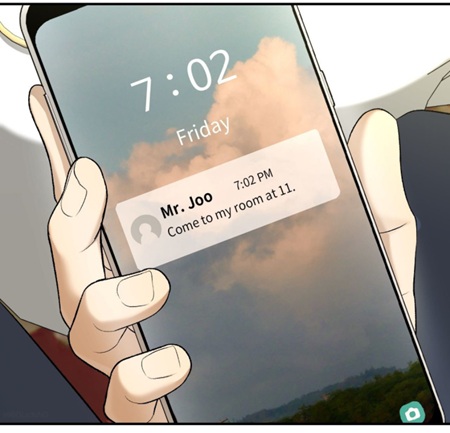 (chapter 85) the need for reassurance, the wish to rewrite the pattern of the past, the quiet hope that Dan will not leave him again — not tonight and not afterwards.
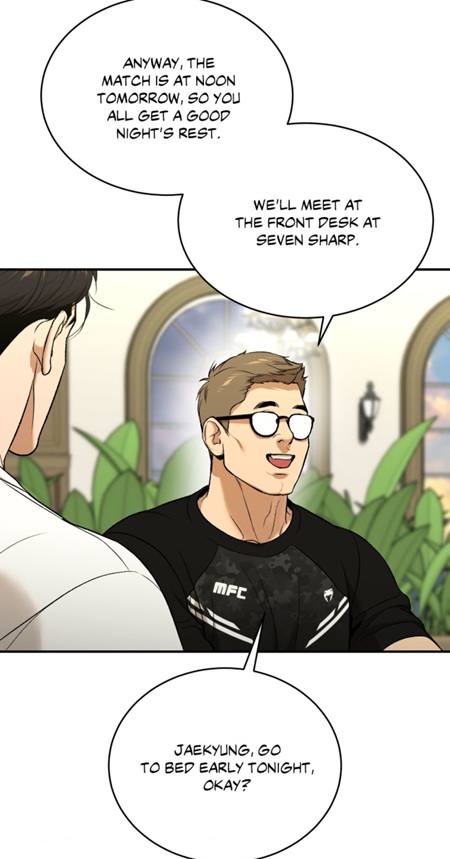 (chapter 85) Schedules are his armor, punctuality his hiding place. Whenever something threatens to slip beyond control, he retreats behind procedure.
  (chapter 85), as soon as the athlete stands up right after his recommendation and announces he is now returning to his room.
  (chapter 54)
  (chapter 85) In theory, this is the perfect window to do what he used to do in the States
 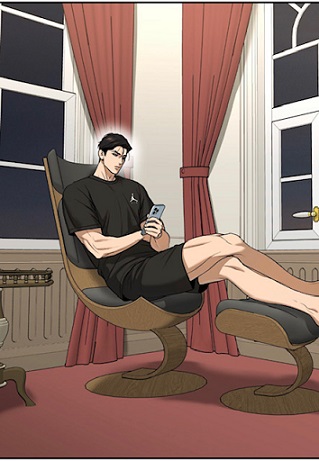 (chapter 38) and Korea
  (chapter 48) before a big fight: watch his opponent’s videos, study their habits, rehearse counters. If we only looked at the clock, we might assume he spent the evening thinking about Arnaud Gabriel.
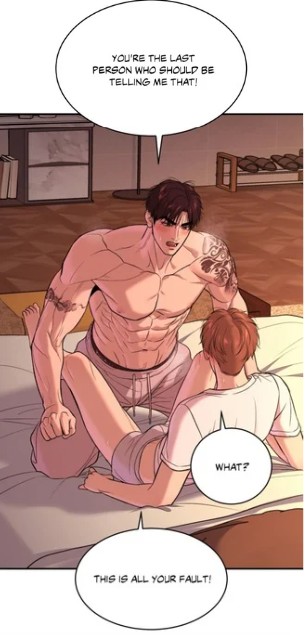 (chapter 85) From 7:02 onward, the question is no longer “How do I beat Gabriel?” but “How do I win doc Dan’s heart?” The clock from 7:02 to 11:00 p.m. stops being a “training window” and becomes an emotional countdown. He is no longer the champion preparing for an opponent—he is the man hoping not to be abandoned again. This is why the later scene at the door feels so contradictory: when Dan finally arrives, Jaekyung behaves like someone who couldn’t wait.
  (chapter 85) He opens the door and immediately grabs him inside
 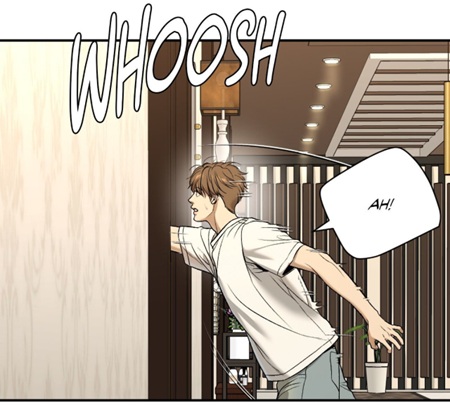 (chapter 85), cutting off any possibility of hesitation. The way he drags him over the threshold, presses him against the wall
  (chapter 85) This is not the controlled, casual emperor of old; it is someone who has been holding back for hours and refuses to risk even a second in which Dan might change his mind.
  (chapter 65) and the comment of the champion in front of this movie:
  (chapter 29) Moreover, I consider this scene
  (chapter 85) as a new version of Choi Heesung’s advice: Doc Dan just needs to sit back and enjoy!!
 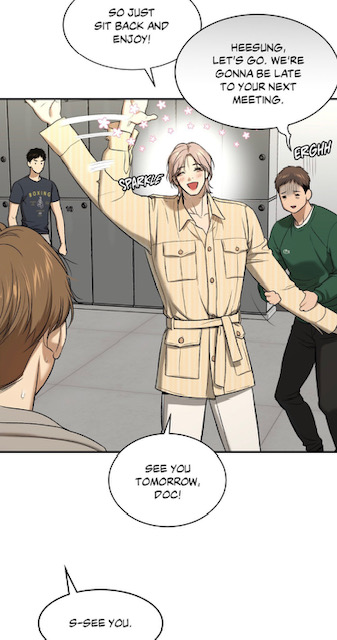 (chapter 31) Joo Jaekyung is now doing everything, as deep down he wants to become the perfect lover! And how had I described the night in the States?
  Back then, the hamster Dan had become the champion’s perfect lover, especially because he had kissed his face, hugged him and confessed to him.
 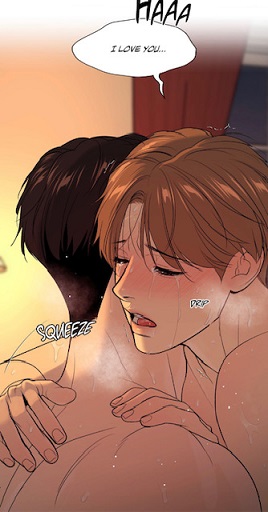 (chapter 39) But if his fear to lose doc Dan was so huge, why did he ask him to come so late then?
  (chapter 38) One might reply that the athlete desired to maintain appearances and as such to hide his suffering and anxiety. In other words, he was hiding his emotions behind routine, Jinx-sex would always start at 11 pm. However, this idea is not entirely satisfying because once doc Dan was in his room, the fighter was no longer hiding his emotions and desires.
  (chapter 72), when the latter would return late from his “work” and the death of his father
 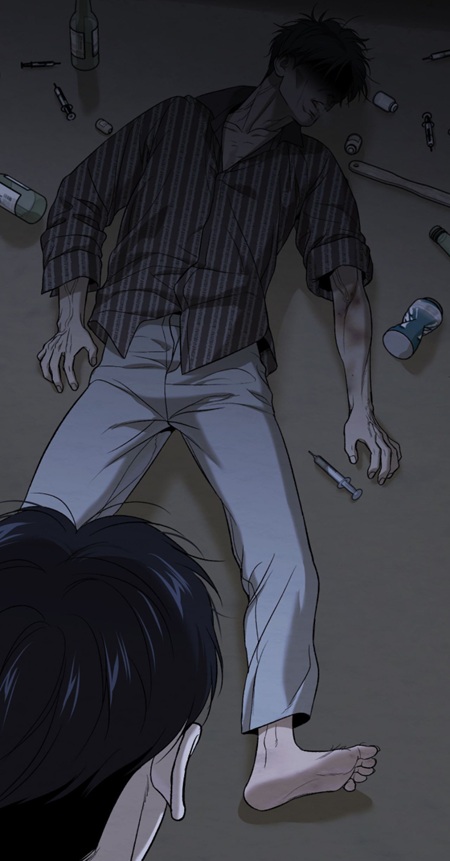 (chapter 73).
 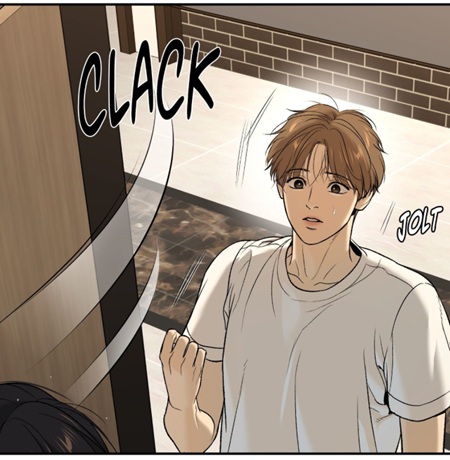 (chapter 85) Because doc Dan could have refused. He could have used his queasiness as an excuse, could have stayed in his room, could have claimed exhaustion. Instead, he obeyed the request — a request sent by someone who had hurt him deeply in the past. Doc Dan’s arrival is proof that he is not rejecting him. Proof that the night is real. Proof that the attempt to do better might actually matter. At the same time, doc Dan couldn’t miss the true meaning behind this text sent in front of others: the athlete’s anxiety and suffering.
 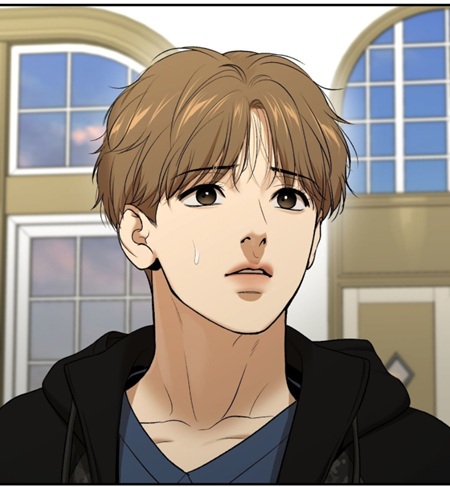 (chapter 85) This explains why his worried gaze followed his fated partner.
  (chapter 85) In other words, the text had a different meaning. It was not an order, but rather a wish…and it had nothing to do with his match against Arnaud Gabriel. During that night, Joo Jaekyung is not seeing a surrogate fighter in front of him or a sex toy, but his real partner, his future boyfriend. This means, this night stands in opposition to the one in the penthouse:
  (chapter 85) This is why he touches Dan’s face instead of flipping him over.
 (chapter 85) — something he has never done before. This does not come from instinct. It comes from intention. It comes from effort. It comes from learning. He is indeed showering doc Dan with love and tenderness, therefore it is not surprising that the “hamster” is moved sensually and emotionally. Exactly like during the Summer Night’s Dream, he is reaching nirvana, hence Jinx-philes are constantly seeing stars,.
  (chapter 85)
  (chapter 85) — or the emotional slip that comes with resurfacing feelings: the therapist losing distance, falling back into intimacy. All of these readings sound plausible at first glance.
 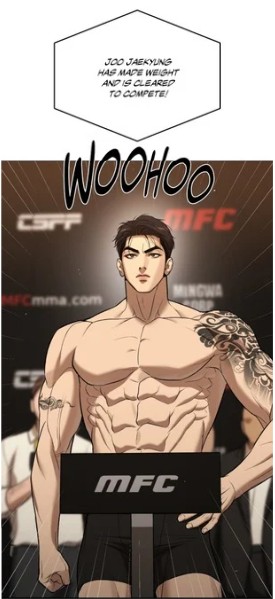 (chapter 85) Styled up, hardened with gel
  (chapter 82) When the hair stands, the image stands.
 (chapter 85) — but not the way adults or professionals usually do.
 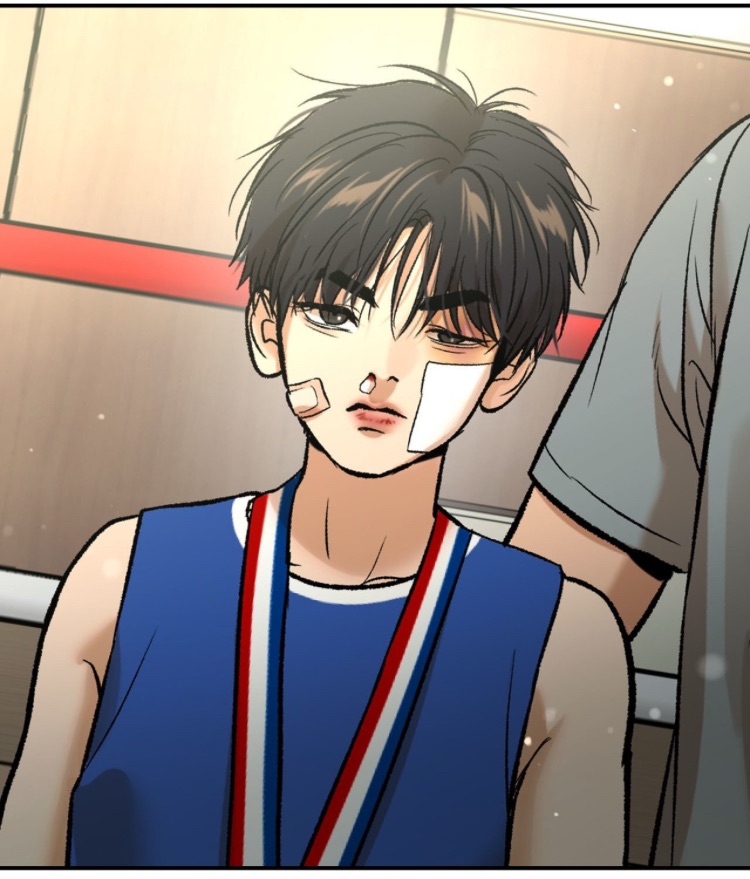 (chapter 71) So doc Dan could recognize the little boy in the athlete, the more he sees the protagonist with his hair down. Furthermore, I noticed that contrary to season 1, Doc Dan has now more memories of the “wolf” facing him.
  (chapter 85) In the past, he would more look at him from behind:
  (chapter 35)
  (chapter 35) Seeing his face reflects not only the increasing care for each other, but also the improving communication between them.
  (chapter 85) more mature, more “masculine” in the traditional sense. This explicates why the stylists had to dress him up.
  (chapter 82) Yet such an intervention did more than prepare him for the cameras — it tightened the restrictions around his own image, reducing the fighter’s rights over how he appears to the world. With the suit, he appeared older and more powerful. The French fighter leans into age, while the Korean champion leans into youth — a symbolic inversion that reinforces the central tension in the Paris arc: Gabriel performs adulthood; Jaekyung rediscovers the adolescence he never lived.
  (chapter 85) But just as Jaekyung begins to slip into these youthful, softer identities, MFC reasserts control.
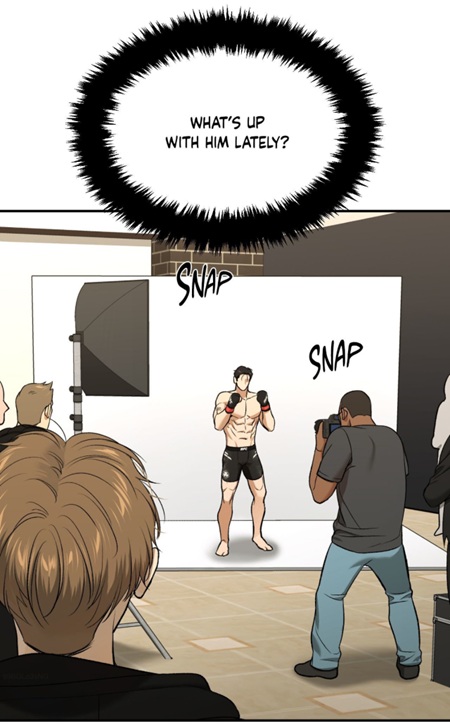 (chapter 85) hair up, face polished, a look engineered for posters and rankings. He becomes once again the Emperor — the man who must appear older, sharper, more intimidating, more manufactured.
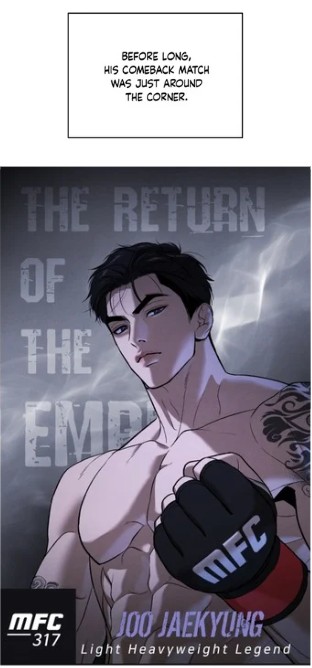 (chapter 79) This is the boy from the childhood photograph.
 In the rain, with his hair heavy and unstyled, his gaze dark and sensual, Jaekyung appears nothing like the commanding emperor. He looks free — freed by weather, freed by desire, freed from roles. It was foreshadowing, not just fanservice. It announces the end of the « jinx » in reality.
  (chapter 85) He is describing himself. His sweetness is the taste of freedom — freedom from performance, freedom from control, freedom from MFC, freedom from fear. He is enjoying this moment. Dan tastes sweet because Jaekyung is finally tasting the life he never allowed himself to want.
 (chapter 21) The image of winged rescue and divine protection hangs over the very piece of furniture that, throughout the series, has functioned as Dan’s private sanctuary. This is not incidental. In Jinx, the couch is tied to his deepest memories of care and abandonment, and Mingwa activates this symbolism each time Dan gravitates to it.
 (chapter 21) Why does he consistently feel safer on the couch than in a bed?
 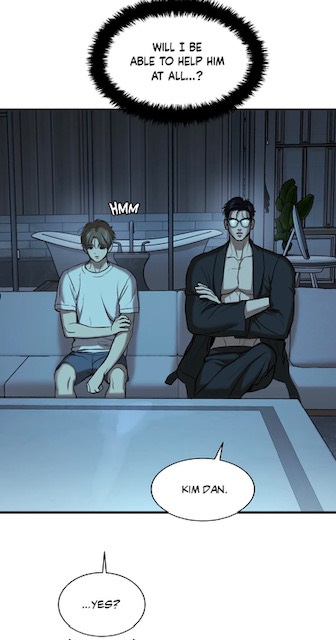 (chapter 29) Why, after the second swimming lesson, did he refuse to return to the bed
 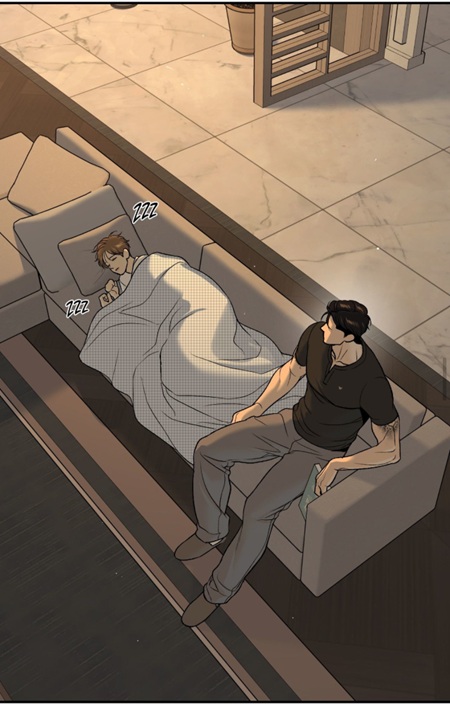 (chapter 81), even though he was exhausted? Why does he place the teddy bear
  (chapter 84) —his last substitute for lost parental affection—on the couch and not on the bed? And finally, why has he always harbored the secret wish to be carried to bed, as confessed through his memory in chapter 61?
  (chapter 10) Secondly, at no moment, we ever witness the grandmother carrying the little boy to bed. Either she is rocking him to sleep outside the house
  (chapter 47) or he is already in the bed. We never see her bringing him to bed.
  (chapter 44),
  (chapter 44) traces from parents. And now, you comprehend why the hamster could never truly rest in the bed. The couch is therefore not an adult preference; it is a trauma imprint. Resting there feels safe because beds—large, empty, abandoned spaces—became reminders of whoever no longer carried him. Hence it is no longer surprising that he woke up, when he sensed the vanishing of warmth.
 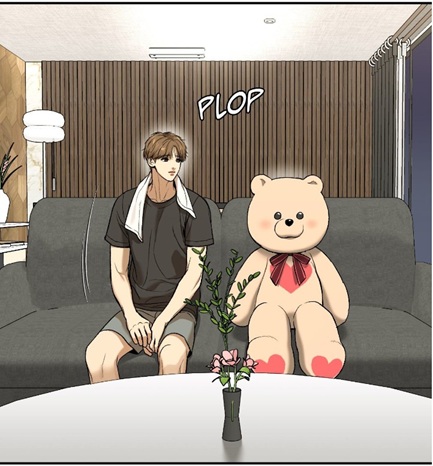 (chapter 84): the bear stands in for a lost comforting presence. It also represents the main lead, Joo Jaekyung. The latter is gradually reentering in the physical therapist’s heart and life. Therefore it is not surprising that there, he squeezes the hand of the toy. It is also why Doc Dan curls around it like a child who deep down hopes to be chosen, lifted, and held. And it is why, even as an adult, his body still whispers the same yearning: someone, please carry me to bed again.
 chapter 40, chapter 65, chapter 68, chapter 79)
 (chapter 85) and he was still able to arrive on time in the arena.
 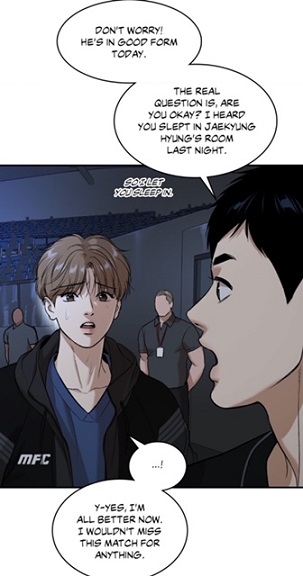 (chapter 40) For me, it is a clue that the manager would always request to meet around 7.00 am, when the match was at noon. But what should do the athlete do during all this time? He can only get nervous and feel pressured.
 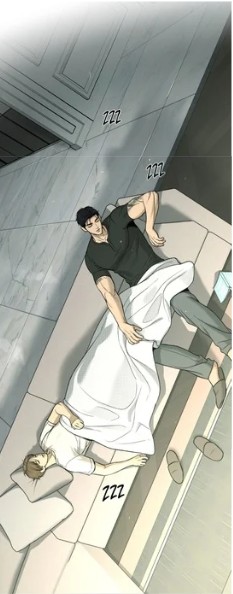 (chapter 81) I noticed that in different scenes from season 2, the athlete started waking up later and even after doc Dan.
  (chapter 66) But the manager’s rigid schedule threatens even that. An early morning summons drains the fighter’s cortisol reserves before the match has even begun, creating a long, empty corridor of waiting — a period where tension, anxiety, fatigue, and irritation ferment in the body. Instead of resting, centering, and preparing, the champion would spend hours fighting against the clock imposed on him.
 (chapter 54) , he might even jump to the wrong conclusion: that Jaekyung drank again — this time behind his back.
  (chapter 82) The irony is striking. Two days before the match, it was Park Namwook who overindulged with the others, yet he may now project that same carelessness onto the athlete. In his mind, the DND sign does not simply mean “rest”; it becomes a warning signal, a possible confirmation of the irresponsibility he fears but has never actually witnessed. Thus I can already imagine him panicking.
 (chapter 82), his look
  (chapter 82), his free time and took care of the champion’s emotional needs. In Paris, the « hamster » became the champion’s manager de facto, the unofficial right-hand. That’s why if they are late and they need a scapegoat, the manager can blame the physical therapist for the « delay », he would always come late to appointments (chapter 17: meeting the doctor) and to the fights (Busan, in the States).


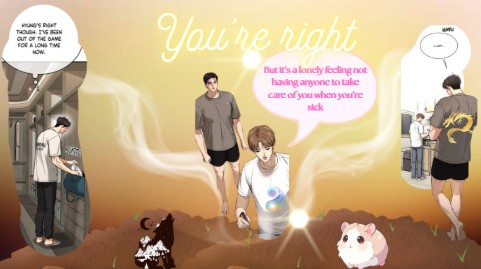
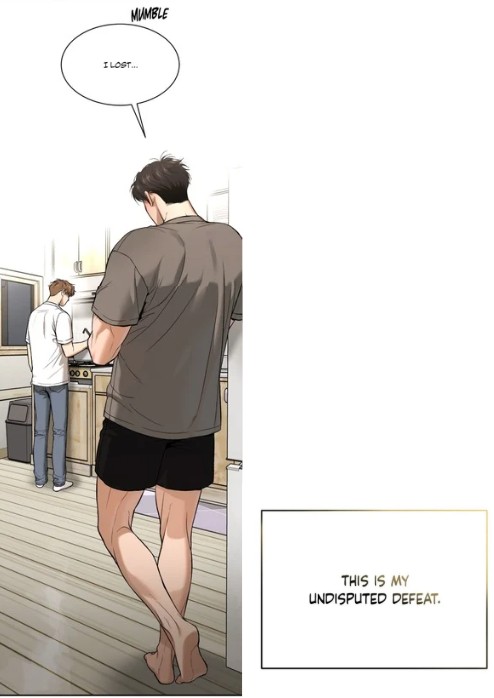 (chapter 76) This admission is no mere reversal of pride. It gestures toward something Jaekyung has never known: an exchange that does not end in domination or silence, but in dialogue. For Kim Dan, too, it marks a turning point.
 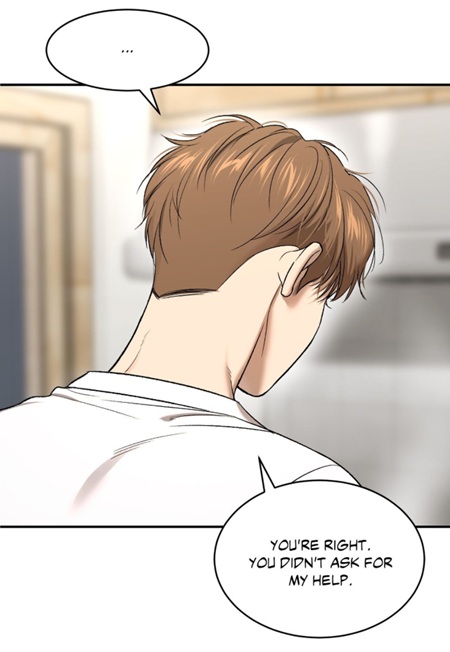 (chapter 76) For the first time, he uses the expression you’re right in front of his fated partner. He seems to concede with this idiom. Yet this apparent submission hides a deeper reversal. By admitting Jaekyung never asked for his help, he redirects the exchange toward his own truth: the loneliness of having no one to care for you.
 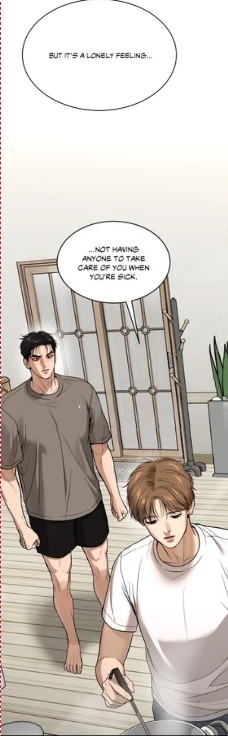 (chapter 76) What unfolds in the kitchen is not a quarrel about porridge but a fragile recognition. Dan’s “You’re right” acknowledges Jaekyung’s perspective without bitterness, while Jaekyung’s “I lost”
  (chapter 9)
 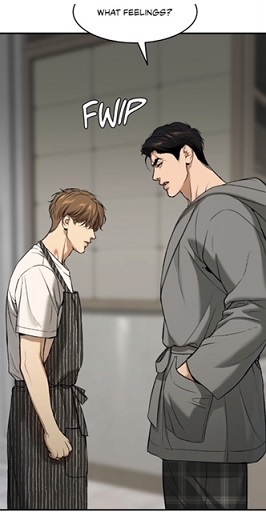 (chapter 45)
  (chapter 76) The kitchen scene closes one cycle and announces another.
  (Chapter 76) In this view, his fixation would be the product of ambition, pride, or ego: the expected cost of survival in a cage where only victory pays.
  (chapter 76), because the adults in his life cut them off before they could exist. Winning became his only mode of survival because every formative argument in his youth ended in defeat, and not the kind decided by a referee. With his father, mother, coach, and manager, words never led to recognition — only to insult, silence, utility, or obedience. He learned early that dialogue could not protect him; only victory could. His victories were not chosen freely, but forced into being by guardians who made him feel like a burden, until relationships themselves became burdens.
 “(chapter 73). It was not just defiance; it was a vow that victory would silence abuse once and for all. When he returned with the trophy, he shouted triumphantly,
 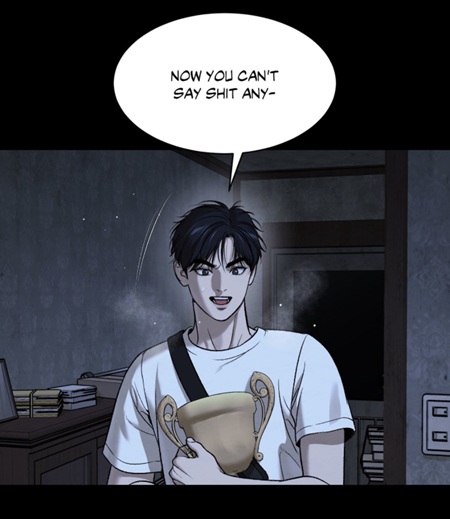 (chapter 73) ready at last to claim, “I was right.” Yet reality betrayed him. His father’s death denied him the only acknowledgment he had sought.
  (chapter 74) At the funeral he remained dry-eyed, his face locked in shame (ch. 74). No one saw his guilt, but it consumed him: the one man he needed to hear “I was right” from could no longer answer. At the same time, his smile and laugh were also linked to misery. For Jaekyung, laughter was never the sound of joy, but the echo of mockery and rejection due to the father. Just as tears became tied to betrayal and abandonment through his mother, so too did his father twist laughter into a weapon
  (chapter 72) To the boy, she was not silent at first: she must have definitely told him to become strong, to endure, to wait. She gave him her number, leaving the illusion that her departure was not abandonment but necessity. Victory and wealth became her conditions for love. That is why he swore over the payphone to work hard
 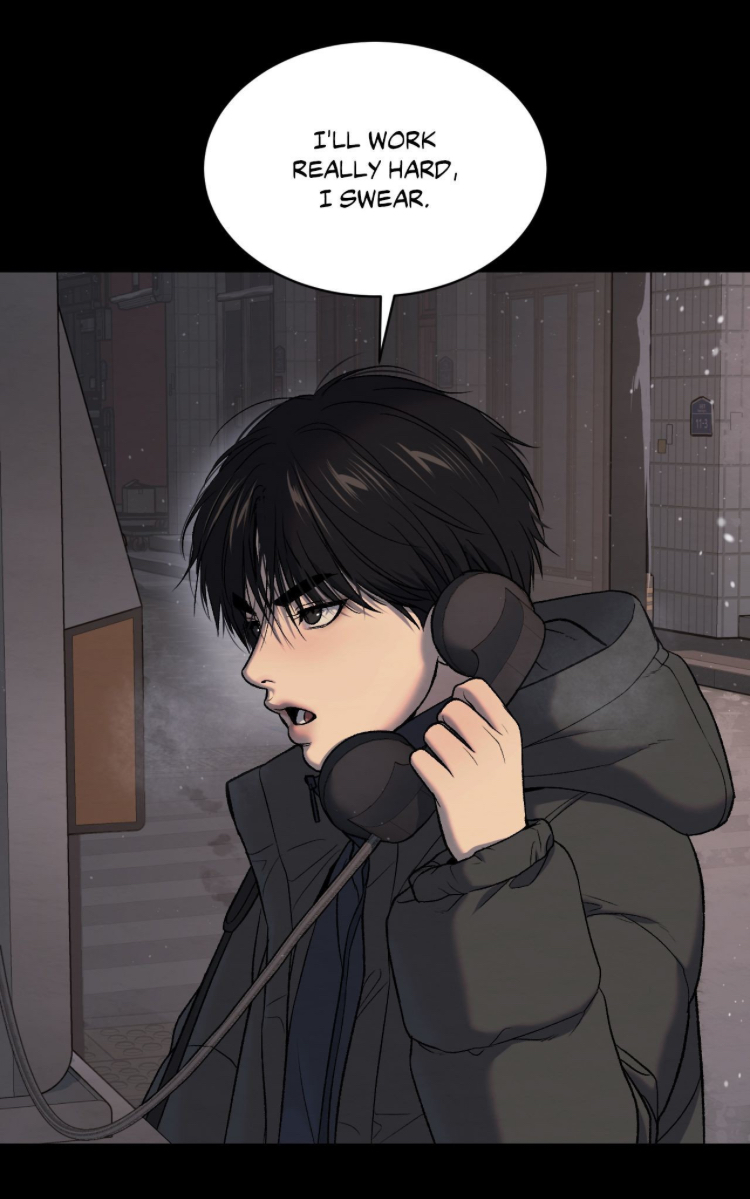 (chapter 72) and “make money” so she could return, and why after his father’s death he still hoped for her homecoming.
  (chapter 74) But when the calls went unanswered, her silence became the sharpest weapon of all. Her eventual reply
 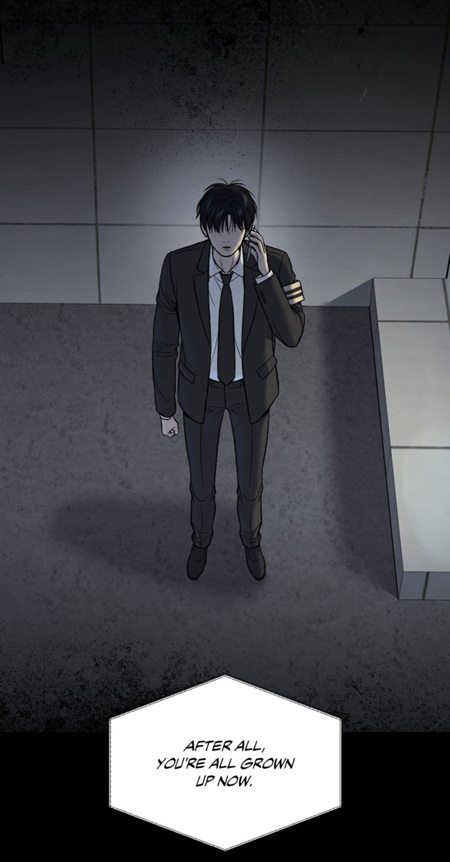 (chapter 74) confirmed that his effort had never mattered. For the first time, he cried
  (chapter 74), his tears expressed not just grief but the recognition of betrayal. From then on, tears themselves became equated with loss, weakness, and abandonment. This is why, in the wolf’s nightmare, Dan’s crying form
  (chapter 76) appears: the sight of tears recalls the moment he unconsciously realized that even his mother’s “you’re right” was a lie. At the same time, those tears function as a mirror. The champion projects onto Dan the very weakness he has always forbidden himself to show.
  (chapter 76), the boy he once was who longed to weep but had to swallow it down. At the same time, Jaekyung himself occupies the place of the “adult” —
  (chapter 74) Hence the wolf’s tears were quickly replaced by rage and violence.
 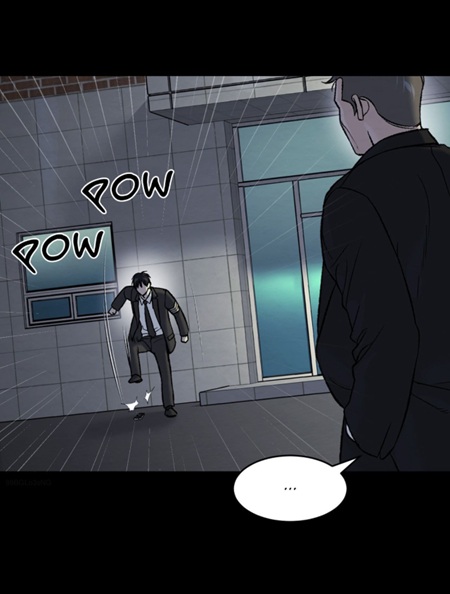 (chapter 74)
 (chapter 76) His trembling hand upon waking
  (chapter 76) shows the yearning to be held, comforted, reassured — something he never received from either parent. He is not entirely responsible for the physical therapist’s suffering. And here lies the difference: Dan’s tears are not manipulative or hypocritical , like the ones Jaekyung suspects from his mother, but unfiltered honesty. He expressed his emotions, not just through tears, but also through body language!
  (chapter 1) He was shaking, he was bowing and asking for forgiveness! Dan embodies a form of vulnerability that is real, legible, and forgiving contrary to the mother. When the teenager heard his mother’s voice after such a long time, the latter never brought up her past action. She never asked him for forgiveness.
  (chapter 74), whose quiet devotion and silence kept the gym alive, nor Jaekyung’s, whose absence he accepted without challenge.
  (chapter 74) When Hwang sneers, “What, am I wrong? Come on, answer me!” he is not inviting dialogue — he is staging a trap. The question is rhetorical, a demand for submission. Let’s not forget that he had witnessed the phone call in front of the funeral hall, but back then he had done nothing. And when the boy hesitates
  (chapter 74), unable to answer, Hwang strikes him in the chest.
  (chapter 74)and justifies his action behind social norms.
  (chapter 74) In that instant, he takes the role of judge, referee, and executioner, collapsing “argument” into violence. The very words “Am I wrong?” contain the irony: the coach is less interested in truth than in reasserting his own authority. Silence is treated as guilt, hesitation as defeat.
 (chapter 74), he effectively admitted “you’re right” to the coach. Yet this wasn’t simply genuine agreement — it was submission, respect mixed with survival. The director misread it as validation of his worldview. This only reinforced his certainty, encouraging him never to reconsider his role.
  (chapter 74) When the protagonist finally left, the director could declare with satisfaction:
  t(chapter 74).
  (chapter 70) Once again, Jaekyung is reduced to “that bastard” — a label, not a person — while Dan is framed as the pitiable victim. The old coot remains the righteous observer, untouched by guilt, protected by a rhetoric that always shifts responsibility elsewhere.
 (chapter 75) He was happy again, though he initially tried to hide it. We have to envision that before the wolf’s visit, the elder had to face what his own life outside the gym looked like: sickness, solitude, the collapse of the studio that had sustained him and came to resent the main lead. Yet, Joo Jaekyung’s behavior changed everything:
  (chapter 71)
 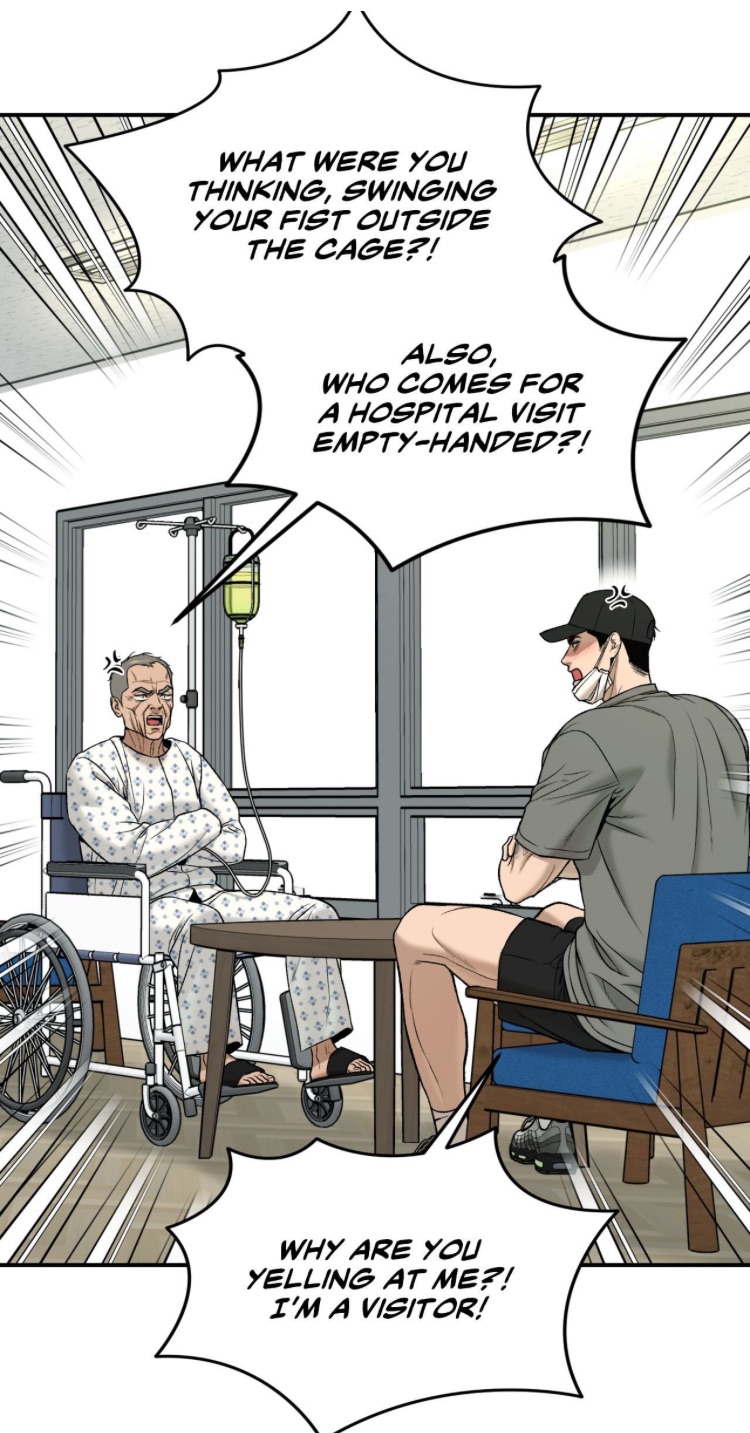 (chapter 71) Only during the champion’s visit, did his words alter.On the rooftop of the hospice, he finally tells Jaekyung:
 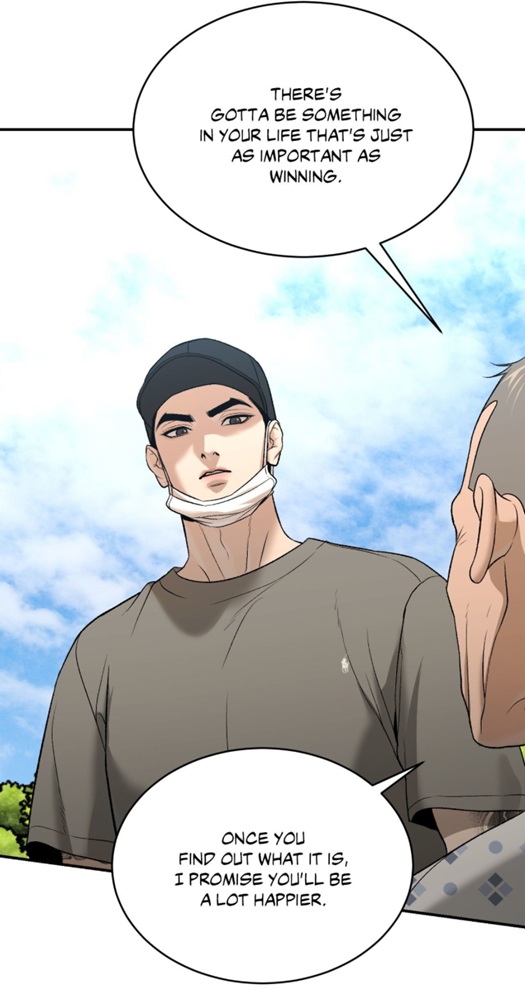 (chapter 75) This shift did not come from wisdom gained in the ring but from loss — the loss of health, the loss of the gym, the loss of illusions — and from Jaekyung’s loyalty, which pierced through his blindness. Interesting is that this time, he doesn’t give the answer to the athlete. He stops thinking “I’m right, you’re wrong”. He treats him as an adult, as a mature and thoughtful person. Through that fidelity, Hwang glimpsed at last what he had denied both himself and Jaekyung for decades: that victory alone cannot sustain a life.
 (chapter 76) It is not too late. The question “Am I too late?” is the consequence of Hwang byungchul’s words and it gradually indicates the switch in the champion’s mentality. It is no longer about being right or wrong. However, the nightmare reveals another aspect: the world is not black and white, but grey.
 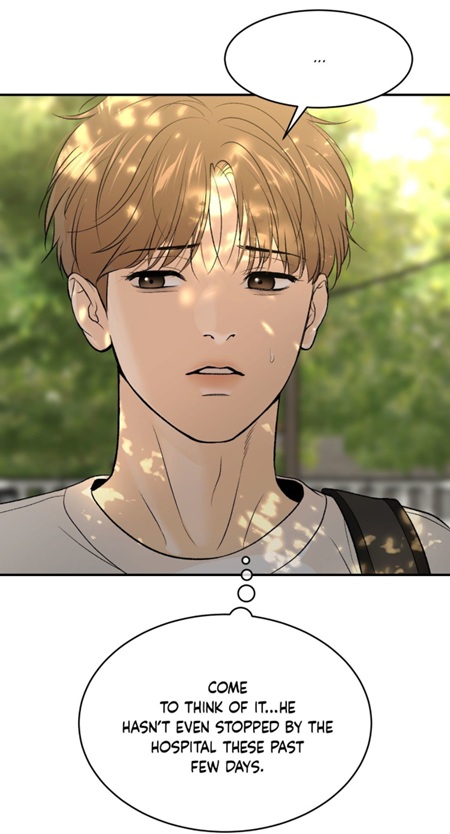 (chapter 76) Hence he remained silent and avoided his gaze. But like the director showed it, it is never too late:
  (chapter 76)
 (chapter 17) at all. The verity is that he refuses to listen to his thoughts and emotions
 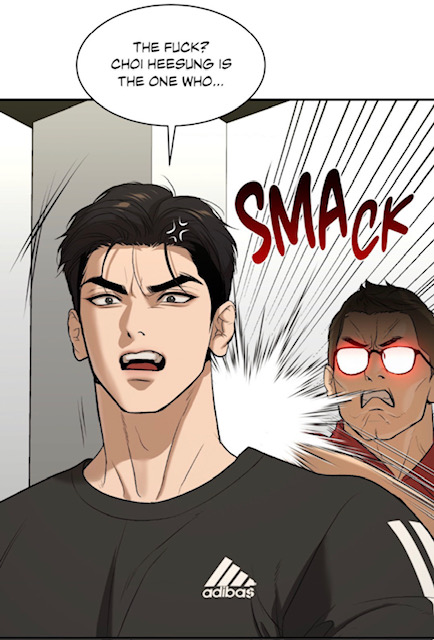 (chapter 31) in good
 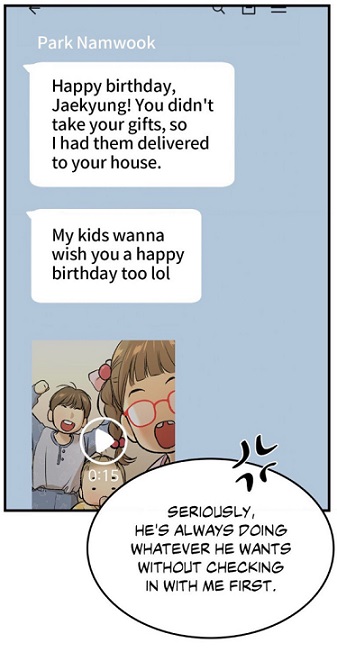 (chapter 45) or in bad times. It goes so far, he does not take his silences seriously, and does not register his pain. This explicates why the manager saw in the champion’s silence at the restaurant as an agreement for a new fight!
  (chapter 69) His role is not to guide or protect, but to extract: money, victories, publicity.
 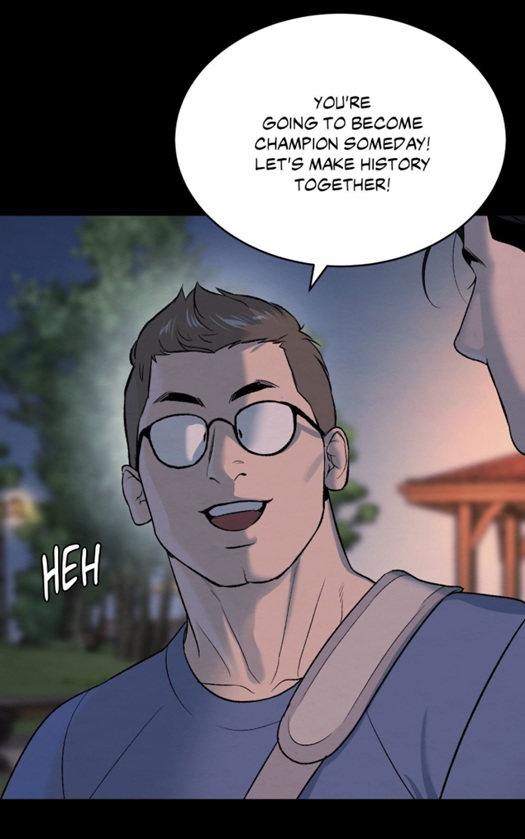 (chapter 75) In my opinion, he is fighting against oblivion through the star. This hidden disability explains why the coach can never truly connect with the champion. He listens instead to other voices – the CEO of MFC
  (chapter 69), the rumors among the directors
  (chapter 46), the media
  (chapter 41), the spectators or “authorities”
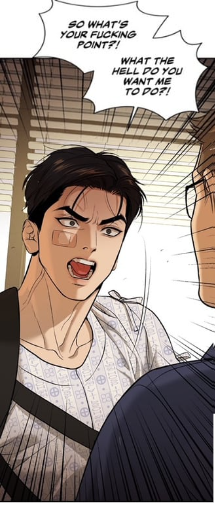 (chapter 52) His question is not mere anger. It is a confession of position — an inadvertent acknowledgment that he knows he is the true backbone of the gym. He is the one responsible, the one carrying the burden that Namwook refuses to admit. These words crack the illusion: the fighter is not subordinate, but owner. The gym lives because of him.
 (chapter 52) He acted as a child, faked “tears” in order to use empathy to his advantage.
 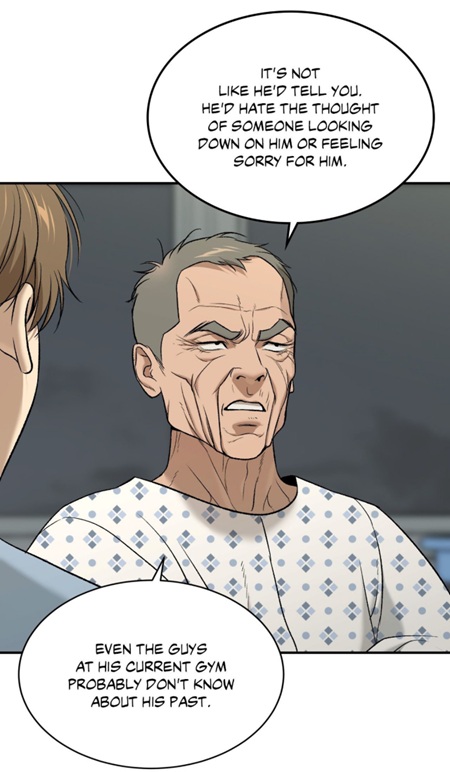 (chapter 71), hence he tried to help in his own way. On the other hand, Park Namwook shows clearly no sign to be interested in the private life of his boss. He is preferring ignorance over “knowledge and connection”.
  (chapter 66) Despite the incident, the manager hasn’t changed yet. He clinched onto the past, thinking that everything will be like before, as soon as the athlete enters the ring. He images a return to normality with the next match.
 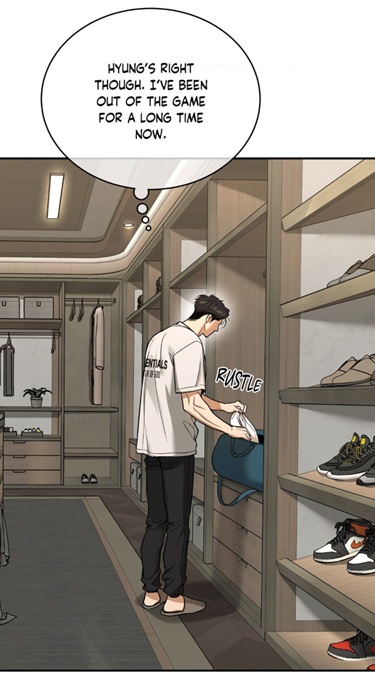 (chapter 66) For years, he had accepted his manager’s judgments out of habit, mistaking silence for consent. But here, for the first time, the repetition feels deliberate — not resignation, but reflection (“though”). The phrase becomes a question more than an agreement: is he truly right? He is admitting this out of habit.
  (chapter 69) His silence has shifted from obedience to suffocation. The weight of Namwook’s deaf authority is no longer bearable. And yet, even here, his confession is muted, confined to the private space of his car. He is not yet ready to speak the words aloud — not until someone appears who will listen.
  (chapter 48) This scene was observed by Kwak Junbeom, so the latter could have reported it to the coach. If it truly happened, this would expose the coach’s deafness and cowardice. He chose passivity instead of confronting the doctor or the champion. That way, he avoided responsibility. And this brings me to my final conclusion concerning the deaf manager. His main way to contact the celebrity is the cellphone:
  (chapter 66) It is both his mask and his crutch — a tool for barking orders, never for dialogue. The moment the line goes dead, his authority collapses, for he has no other means of contact. His power depends on Jaekyung’s reception, not his own strength. In truth, the manager’s disability is exposed here: deaf to Jaekyung’s voice, he has trained himself to hear only the ring of a phone. A fragile authority built on silence, ready to crumble the instant Jaekyung decides to switch it off.
 (chapter 76) must be read not as pride, but as a desperate shield against annihilation. In other words, in episode 76, the athlete is too harsh on himself, though I am not saying that he is innocent either. He only thought of himself because he had taught to behave that way. He was just mirroring the adults surrounding him who hid their weaknesses and wrongdoings behind “lies, social norms and hierarchy”.
  (chapter 6), both were forced to discuss with each other about the “content of the agreement”. That’s where the champion was trained to communciate with the physical therapist. Thanks to the champion, because of this victory/loss mentality, the doctor learned gradually to argue and “reply” with his “boss. However, due to his childhood, he couldn’t totally drop his old principles like for example “saying no”.
 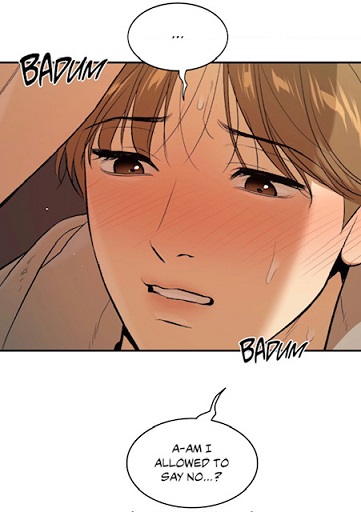 (chapter 34) To conclude, before their fateful meeting, neither man had learned how to argue as equals. But in the kitchen in front of the stove, this changed: both are right and wrong!
 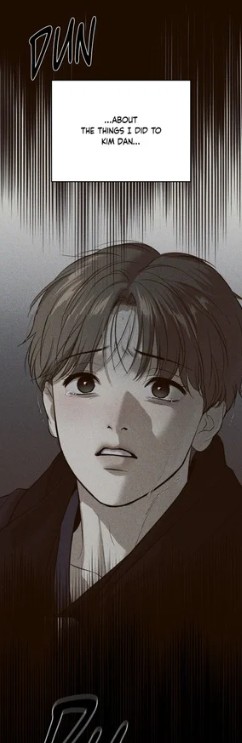 (chapter 76) He speaks like someone expecting rejection. Hence he keeps his distance. Yet the very fact that he says it at all signals change. Where once he would have doubled down — by barking an order, by firing Dan, by retreating into silence — he now admits defeat. The vocabulary of winning and losing, inherited from his father and reinforced by every adult in his life, collapses in the presence of Dan’s quiet honesty.
 (chapter 76) — an acknowledgment that he can no longer keep his walls intact. He is now willing to rely on doc Dan exclusively.
 (chapter 76). His confession reveals not strength but guilt. Kim Dan’s suffering was the price of his victories, and he knows it. “On the other hand, his mea culpa should be relativized, for both were the targets of a plot!
 (chapter 76) These words expose both responsibility and shame: he had prioritized survival over connection, career over compassion. What boils under his skin is not pride but remorse.
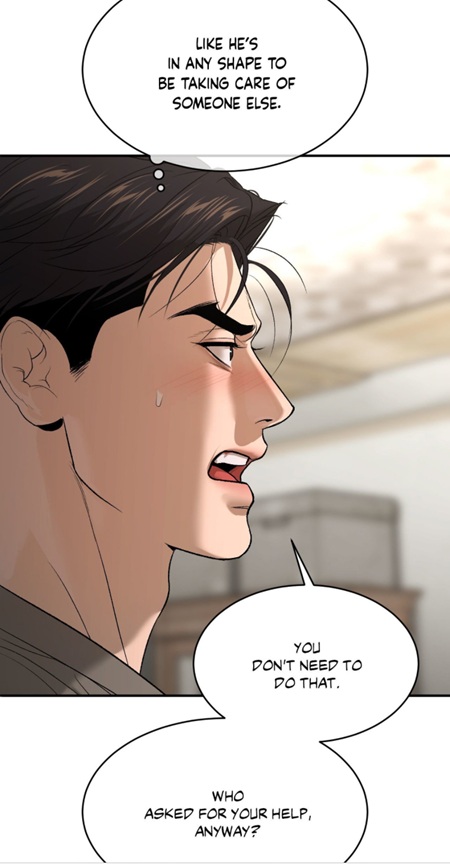 (chapter 76) The star’s thoughts in the kitchen are actually mirroring the ones in the bathroom:
  (chapter 68) In the bathtub, he still saw himself as the one in control, with the upper hand… but this is no longer the case in the kitchen. Through the physical therapist, the wolf is learning that even being in a vulnerable state doesn’t mean that this person is powerless. It is just that his “strength” lies elsewhere. In other words, someone struggling can also give comfort to another person in pain.
  (chapter 72) a place of solitary consumption rather than shared meals, the bed was the place where the little boy would drink his milk.
 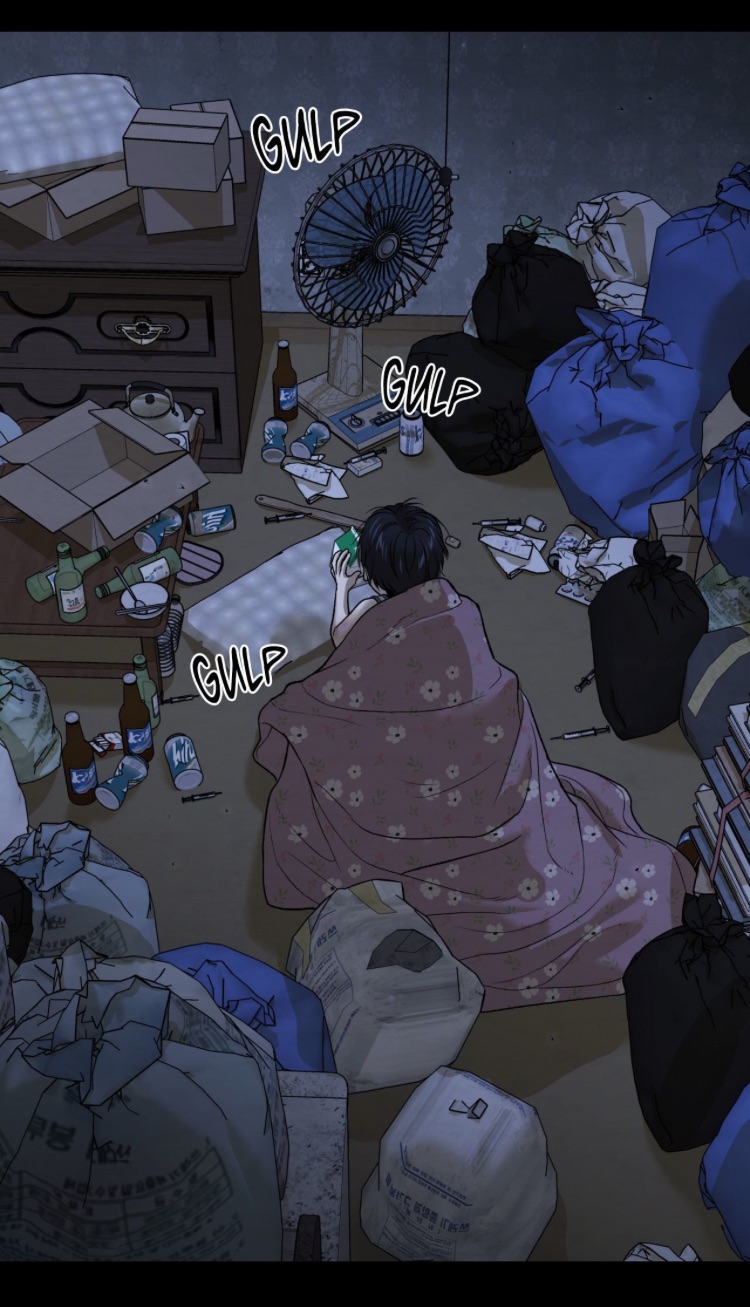 (chapter 72) It is interesting that actually, Doc Dan wanted to bring the porridge to Joo Jaekyung to his bed during that full moon night, thus the latter made the following request:
  (chapter 76) But the wolf didn’t understand the hamster’s intention and followed his “hyung” to the kitchen. That’s how a misunderstanding was born which is also reflected in this interaction:
 (chapter 76) However, doc Dan agreed to this, he remained calm.
  (chapter 41) The latter actually represented a hindrance between them, it marked their relationship: boss and “employee” (servant). Moreover, since the table in the champion’s childhood was linked to one person (the father), it is clear that the champion has never shared a table with someone. And this aspect brings me to my other observation.
  (chapter 22) Whether in meetings, weigh-ins, or dinners with the CEO
  (chapter 46) It was a place where others dictated terms, while Jaekyung’s silence was mistaken for consent. And now, you comprehend why the two main leads could get closer in front of the stove in the kitchen. This place stands for warmth, care and family.
  (chapter 13) a meal after his collapse. He refused to bring a meal to the bed, he asked him to join in the dining room and sit at the table. And what did they do there? The champion talked about his career, his fight etc…
  (chapter 13) the champion has long associated the table to business and not “care”. That’s why it is important for him to remember the significance of the bed in his childhood. It was the place where he could feel comfortable and safe, where he would eat!

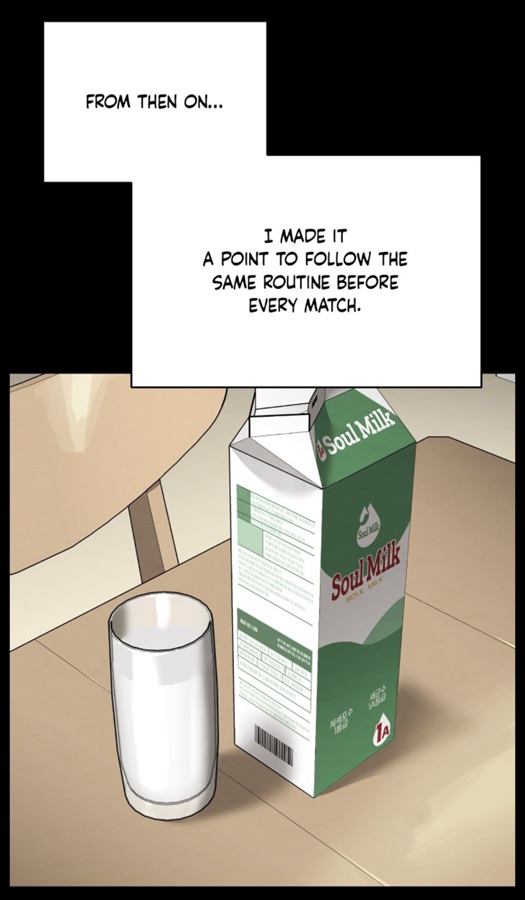 (chapter 75), the perfume
  (chapter 75), the nights of sex before a fight
  (chapter 75). His words seemed like a confession, a key to the riddle of the Night Emperor. But do we truly know him now? Yes and no. Yes, because his testimony reveals patterns we had only noticed before. No, because those patterns are only the ones he decided to share. The tattoos
 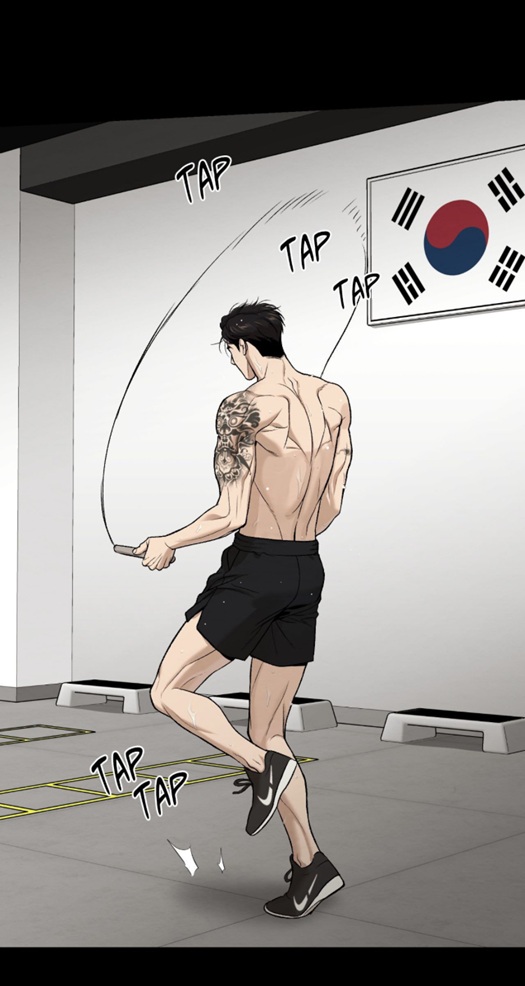 chapter 75) that suddenly appeared on his body
 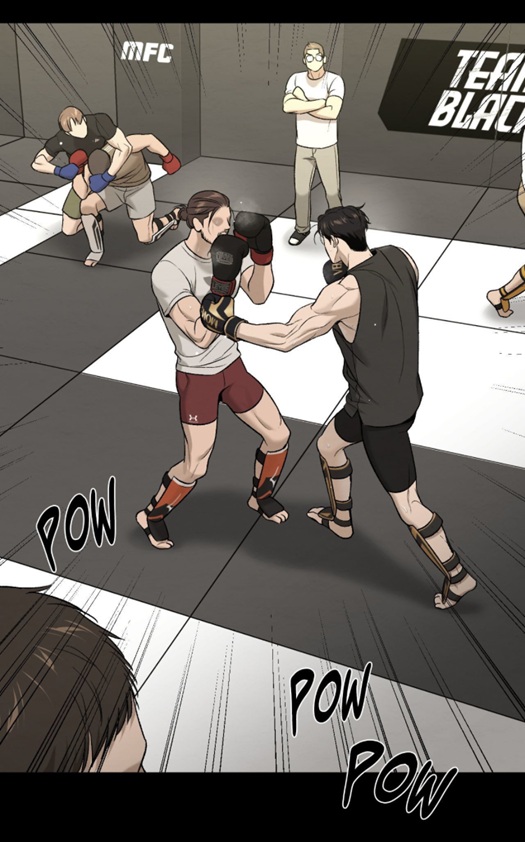 (chapter 75), for example, were left unmentioned — proof that silence still surrounds him.
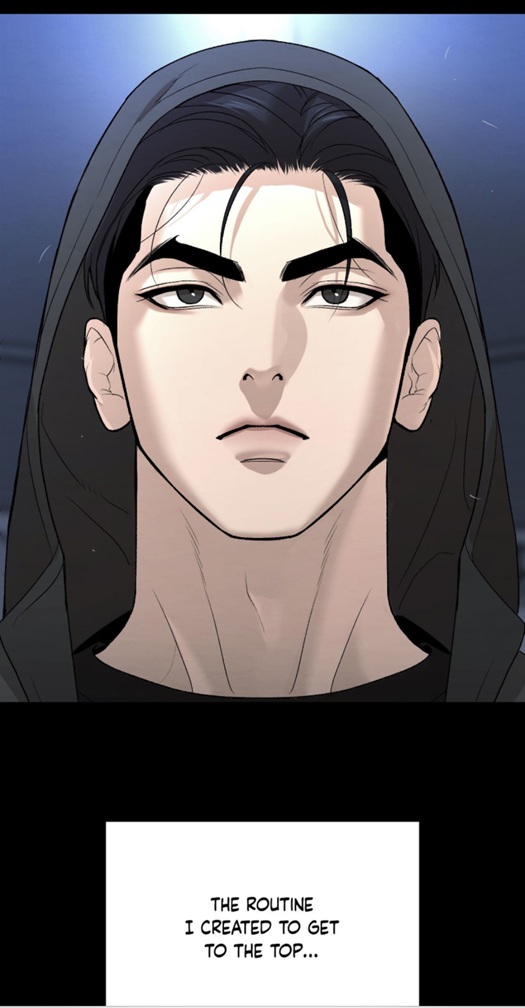 (chapter 75) Why fight as though every match were a matter of life and death? Why keep repeating the same acts, long after survival was secured?
  .(chapter 75) They are the product of a long chain of humiliations, betrayals, and systemic exploitation, each layering onto the next until a young man’s raw talent was encased in a carapace of compulsions. To understand the jinx is to understand how the protagonist’s life collapsed around the word loser, and how the fighting industry transformed his private shame into public myth.
 (chapter 72) Even before stepping into a professional cage, his life had been a series of trials to prove he was not worthless.
  (chapter 74) Hunger, poverty, bullying, insults— each branded his body with a language of violence. Among them came his father’s words, spat like a curse: loser.
 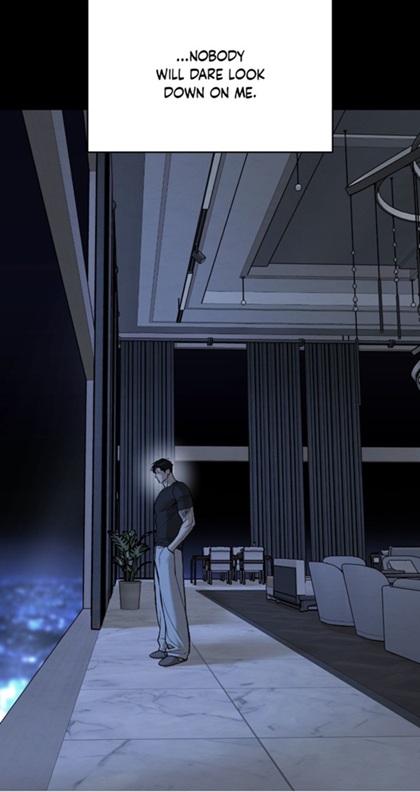 (chapter 75)
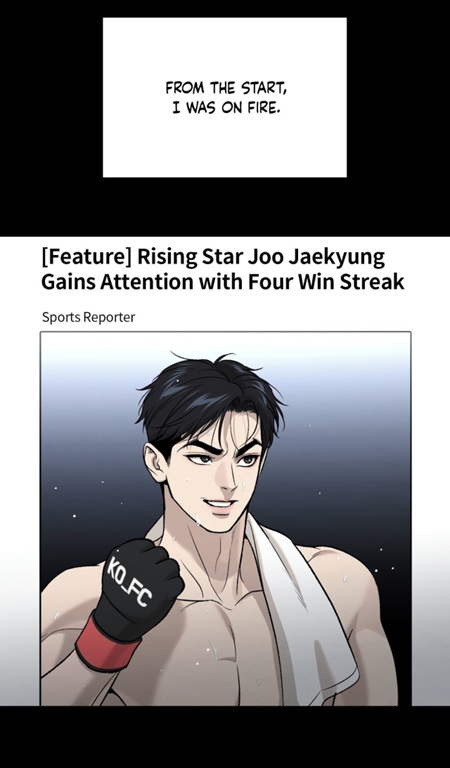 (chapter 75) — a boy who fought with the desperation of someone who had nothing else. Victory after victory gave him the illusion that he had escaped his father’s shadow. As long as he was winning, he could suppress the pain, bury the insult loser, and silence the memory of that cursed night when his father died and his mother abandoned him. Triumph became his shield, proof that he was not what he had said he was.
 (chapter 75)
  (chapter 75) To them, a fighter’s struggles had only one explanation: weakness. Park Namwook and the other coach dismissed his losses as nerves
  (chapter 75), as if the only measure of worth were what happened under the spotlight. They never thought to ask what kind of weight he was carrying, what kind of nights he was surviving before he entered the cage. While the other fighters were well aware of the champion’s insomnia
  (chapter 75), Park Namwook still has no idea of the champion’s struggles. This shows how disconnected he is from his “boy”.
 (chapter 74) bodies to be tested, pushed, and discarded if they broke. Where Jaekyung’s defeat cracked open childhood trauma, they saw only performance failure. What he lived as suffocation and despair
 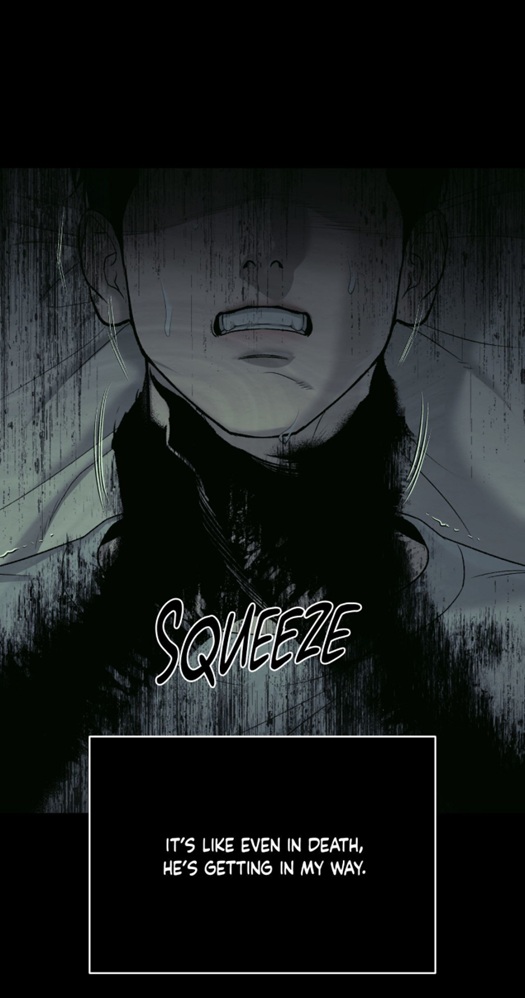 (chapter 75), they reduced to cowardice, bad luck or lack of discipline.
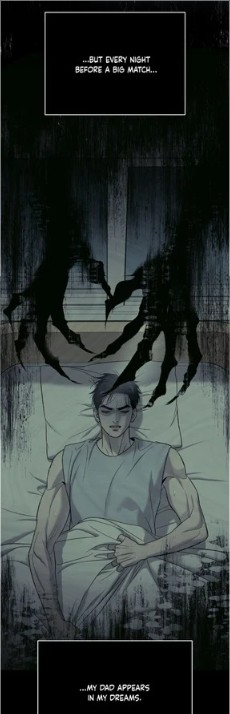 (chapter 75) Shadowed hands stretched over his body, pressing down, suffocating him as he tried to sleep. The man was dead, but still he choked the air from his son. It was, as if the father wanted to bring his son to the afterlife.
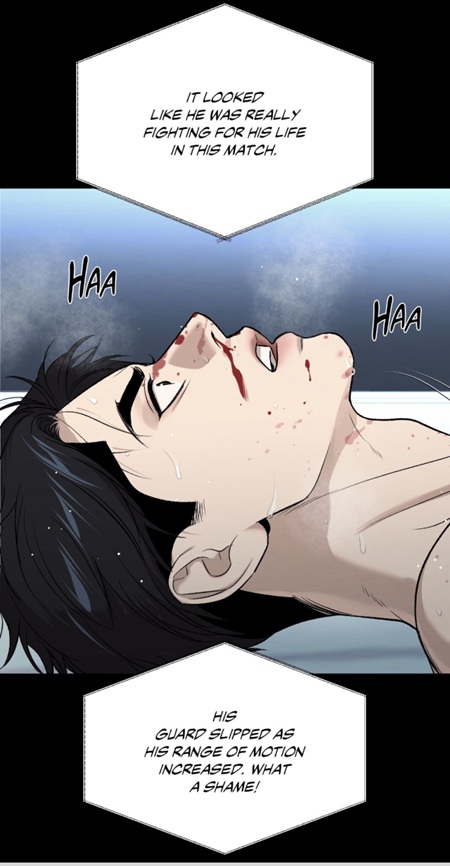 (chapter 75) Even before his first loss, Jaekyung fought like a cornered animal, pouring every ounce of strength into proving he could not be beaten. That’s why he rose so fast. But why? The reason is that all his opponents were reflections of his “father”.
  (chapter 75) Consequently, his matches always looked like life-and-death struggles. He wasn’t strategizing against a specific fighter; he was exorcising a ghost. That’s why he never refused a challenge. His opponent never mattered. Besides, as long as he could win, it didn’t matter.
  (chapter 75), the more the cracks showed — and the ghosts of his father and mother made every fight feel like a replay of abandonment and accusation. The five losses
  (chapter 75) were not just setbacks in his career; they were the repeated reopening of a wound that would never heal. Each one confirmed his father’s curse. Each one reinforced the sense that he was marked, that no matter how high he climbed, he would always be dragged down again.
 (chapter 73) To the boy, it was a cry for pain and survival — an instinctive urge to escape despair and criticism. To the father, it was betrayal. Already emasculated by failure and drink, he was reminded of his wife’s discontent, the specter of another abandonment. He lashed out the only way he knew:
 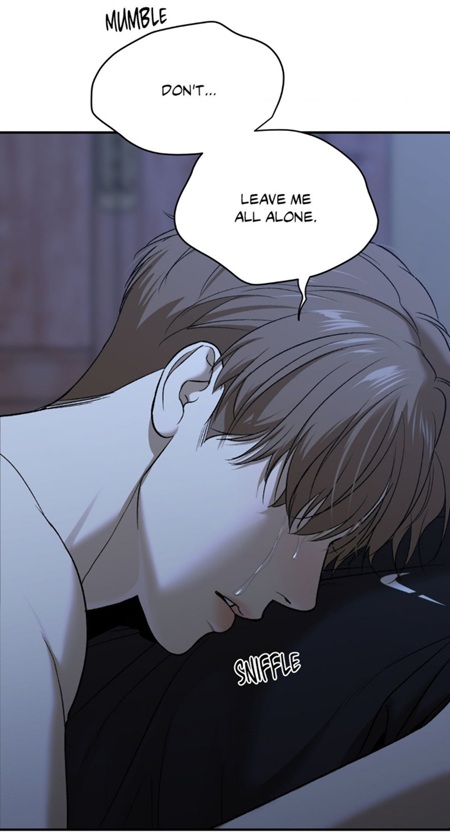 (chapter 66) — speaking not with fists or insults but with tears and an embrace.
  (chapter 66) His sleepwalking reacting to a simple touch
 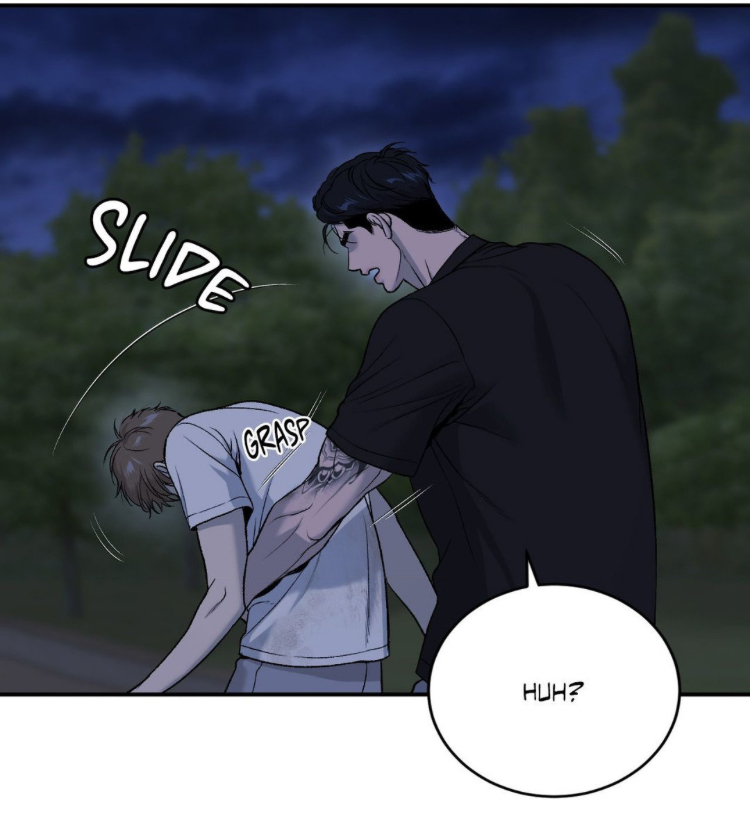 (chapter 65), his dissociative pleas
 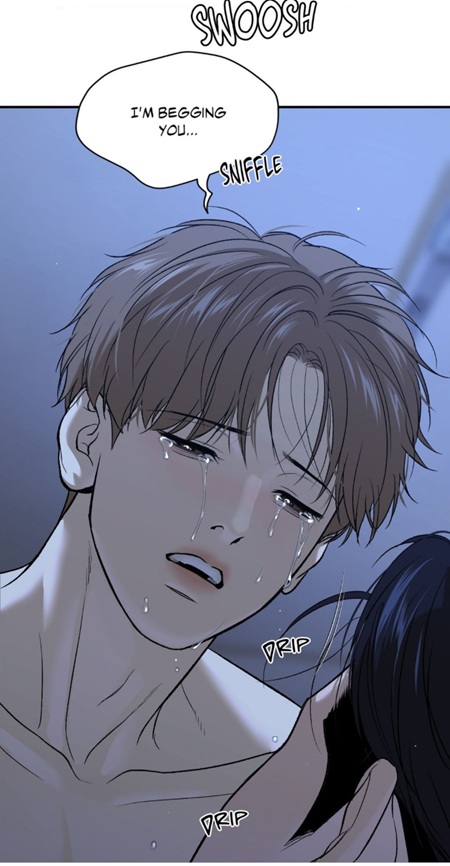 (chapter 66) give Jaekyung the words his father could not say. Where the father’s unconscious leaked out in aggression, Dan’s unconscious offers gentleness and honesty. Both men speak from a place deeper than reason; one chained Jaekyung to guilt, the other opens the possibility of release. In Dan’s trembling body, Jaekyung sees the tender reflection of his father’s hidden plea
  (chapter 73) Why does the champion have no grand-parents?
 (chapter 72) His violence expressed his powerlessness. And when his son shouted his desire to leave the “dump of a house,”
  (chapter 73) The boy’s boxing talent was a source of pride — proof of strength — but also a threat. Strength meant escape. Escape meant abandonment. The father, who had already lost his wife and his dignity, projected onto his son the terror of losing everything once again. His resentment was not born of disappointment alone but of recognition (unconsciously): you are me, and you will leave me too.
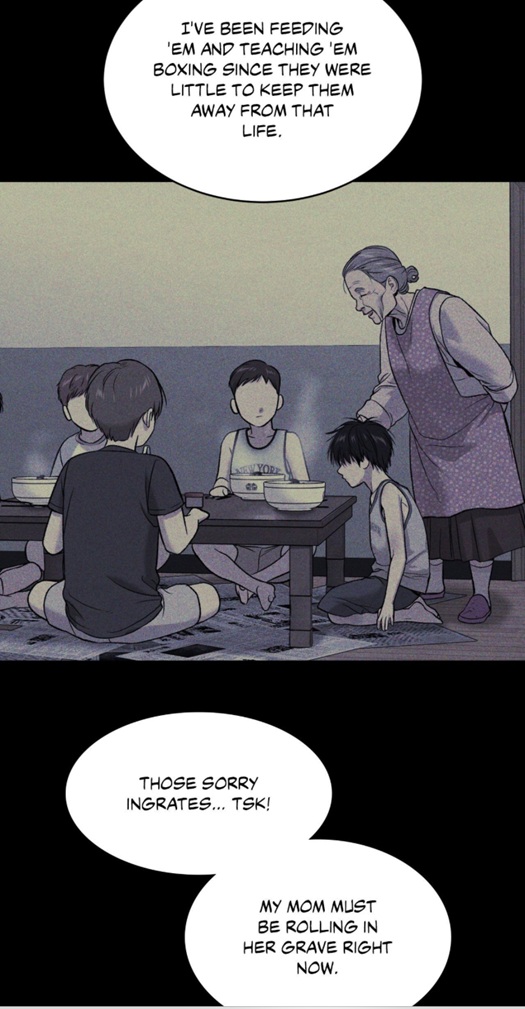 (chapter 73), while keeping Jaewoong’s own origins shrouded. Hwang had someone by his side — gentle, quiet, but present — while Jaewoong had no one, as according to me, the mother was counting on her “husband”‘s success and dream. The director’s stability, however fragile, was rooted in that maternal figure. Jaewoong had no such guide, and without it, he simply made the wrong choice.
 (chapter 73). To win was to prove his father wrong, but to stand alone in victory was to prove his mother right. Success and emptiness became inseparable.
 (chapter 56), seemingly fragile and dependent. But unlike her, he stays. Where the mother left, Dan endures. He only left because of the champion’s final words:
  (chapter 75) This is the wolf’s ritual in front of the tender mirror: the fighter who lived by curses and silence finally meeting their reflection transformed into gentleness and endurance.
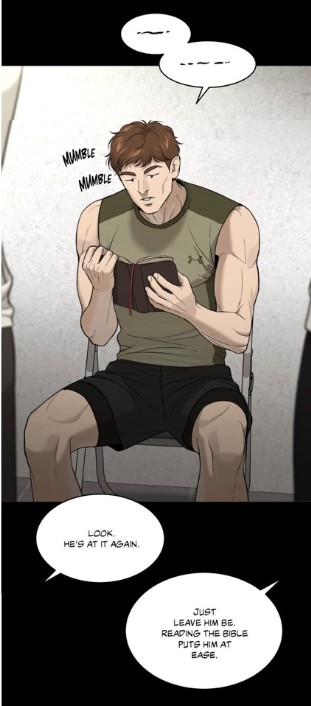 (chapter 75) This man’s jinx was startlingly simple: he read the Bible before every match. One book, one ritual, one anchor. To outsiders, it may have seemed quaint, even laughable, but to Jaekyung it was enviable.
 (chapter 75) When he prayed, it was not only for victory, but for coherence. Win or lose, the ritual bound him to a sense of belonging that Jaekyung had never tasted.
 (chapter 75) If ritual could bend fate, he would build his own. But where the Bible fighter had a single, unifying story — scripture, God, fellowship — Jaekyung had nothing to draw on. No faith to lean on, no parental blessing to inherit, no safe home to return to. Instead, he began to stitch together a mosaic of rituals, each one disguising a different childhood wound. To outsiders it looked obsessive, neurotic, almost superstitious. To him, it was survival. Each gesture was both repression and remembrance, a scar disguised as armor. And this is the paradox: the rituals made him strong enough to survive, but too broken to live.
  (chapter 75) By using another body, he cleared his head, numbed the loneliness, and convinced himself he was in control. But it was also a grim reenactment of abandonment: he could take without being left, dominate rather than risk being deserted. At the same time, he considered his sex partners as toys in order to avoid guilt. A toy can not die, it can be “thrown away”.
 (chapter 75) But in truth it was a disguised memory of hunger
  (chapter 75) To drink milk was to rewrite the past: I will not go hungry again. Yet the act was also a reminder that he once had.
 (chapter 27) , self-punishment, the willingness to suffer endlessly for the cage. He didn’t fear pain. Their sudden appearance
  (chapter 75), a reminder that he had entered a machine in motion, a system that swallowed fighters whole and spat out statistics. From that point, the acceleration was merciless: by April, he was in the 272nd bout against Randy Booker
  (chapter 14); by June, the 293rd against Dominic Hill
  (chapter 75), he had not merely “built” a career, he had been consumed by one. There was no time to recover from injuries, no space to process victory, no room to integrate defeat. No wonder why his shoulders were in bad shape.
  (chapter 27) still called him an athlete — someone whose body required balance, protection, recovery. But MFC and KO-FC never did. For them, the main lead or his colleagues were addressed as
  (chapter 14) “The Emperor”, “a crazy bastard”
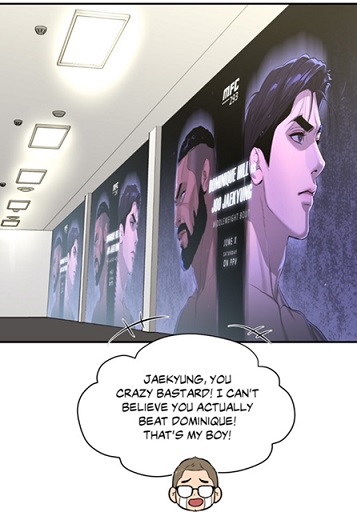 (chapter 40), “my boy”,
  (chapter 47). Thus only doctors are allowed to do them officially. But Jaekyung’s rise shifted that meaning. As “The Emperor,” he normalized tattoos for the new generation of fighters, transforming what once marked marginality into a badge of visibility. This is why even Oh Daehyun, one of his admirers and members of Team Black, now carries one:
  (chapter 8) The celebrity’s suffering literally redefined the aesthetic of the sport. His body, turned billboard, became part of the league’s branding.
 (chapter 5) the name Seo Gichan appeared here for the first time… a faceless name!
 (chapter 75) Here, it looks like a mirror, but naturally it is a fake one. It was not earned with fists alone; it could be stripped, reassigned, reshaped at will. One tie, one whisper, one adjustment in the rankings, and the Night Emperor was dethroned without ceremony.
 (chapter 75), not for intimacy but to clear his head and stave off loneliness, emptiness and his abandonment issues.
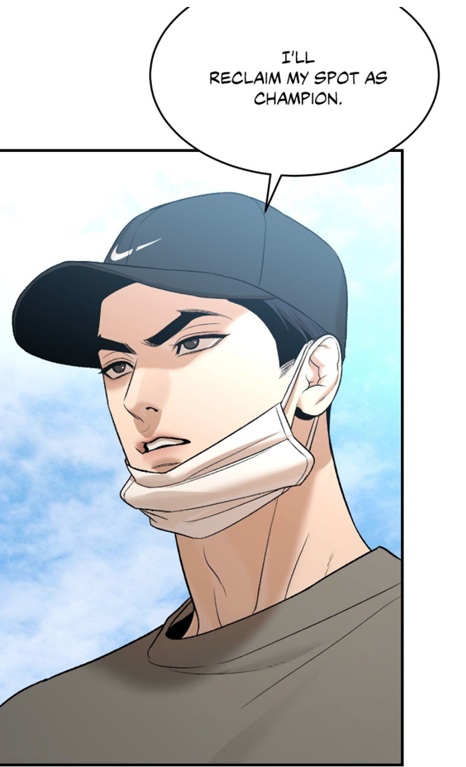 (chapter 75) must be read in this light. It is not a relapse into the system’s treadmill, nor a blind return to the pitfall laid before him. Notice that he does not say he will fight in the fall, nor does he mention the upcoming match that everyone else is waiting for.
  (chapter 71) Instead, he frames his goal with a word that changes everything: reclaim.
 “Don’t you trust me?” (chapter 54) That moment reverses the old script entirely. Where his father’s last word was condemnation, Dan’s is invitation. Where his father’s voice ended the dialogue forever, Dan opens one. Where his father made trust impossible, Dan asks for it. Besides, the latter encouraged him to reflect on himself.
 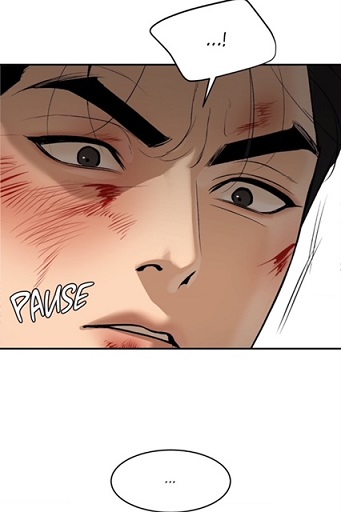 (chapter 51) The mirror is clear: the cycle can be broken, but only if he dares to answer the question that was never asked of him before. Therefore it is not surprising that the physical therapist’s question appeared in the champion’s vision:
  (chapter 54) His unconscious was telling him to have faith in his “doctor”. Thus later, the champion told the director of the hospital this:
 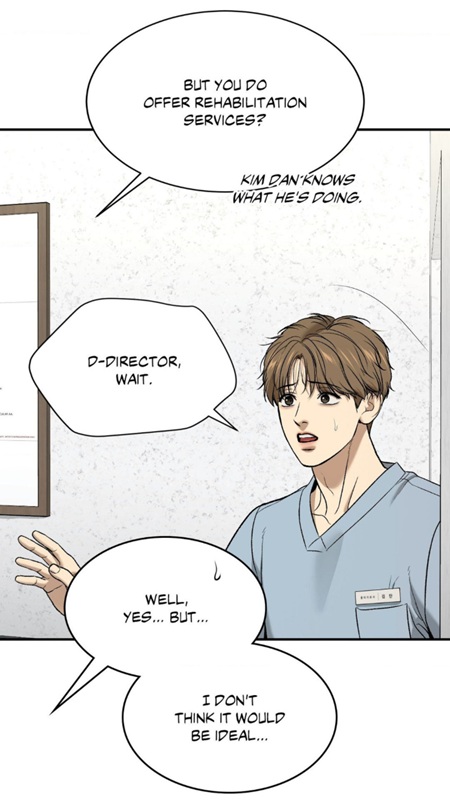 (chapter 61) He was acknowledging the main lead as a real physical therapist.
 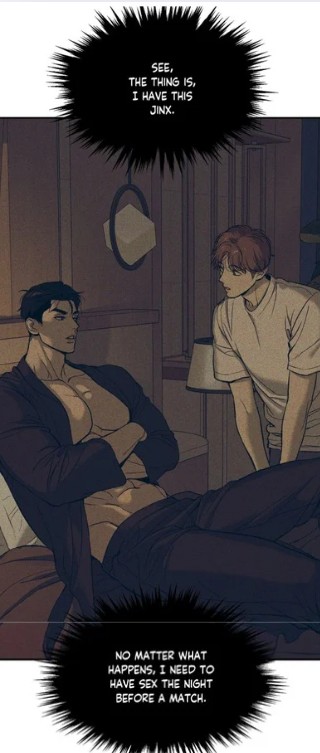 (chapter 62)— and even to those closest to his body — it looks like nothing more than sex. That was all the uke from chapter 2 saw, and it was enough for him to sneer:
 (chapter 2) The insult landed with devastating familiarity, not as a new wound but as an echo of his father’s curse: “loser.” Both words reduced Jaekyung to nothing — not a man, not an athlete, just a fraud kept alive by crutches.
 (chapter 2) In slamming his former partner against the wall, he was not merely silencing a lover’s cruelty. He was fighting the ghost of his father, the voice that had branded him weak, cursed, unworthy. The jinx that kept him alive was being twisted into proof of his failure, and he could not bear it.
  (chapter 2)
 (chapter 62), Dan recoiled.
 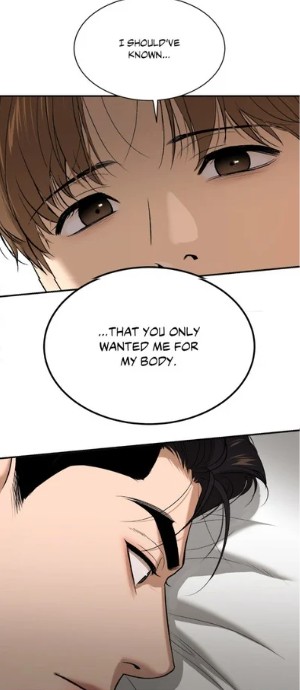 (chapter 62) To him, “jinx” meant objectification, a reduction of their bond to sex.
 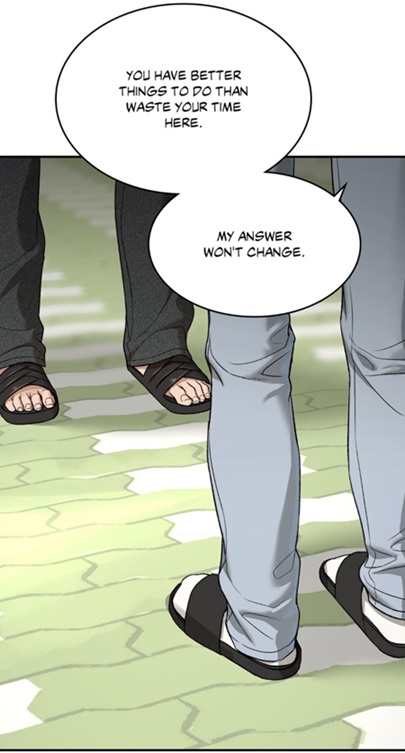 (chapter 62) but as a therapist he trusted. His words about wanting to return to the “usual pre-match routine”
  (chapter 62) were, in his mind, a way of saying: I need you to bring back wholeness, to help me steady myself again. But because Dan only knew fragments of the jinx, the message landed with devastating distortion.
  (chapter 62) For Jaekyung, the plea was about coherence; for Dan, it sounded like reduction.
 (chapter 22) He cooks breakfast for Jaekyung, offering something warm, homemade, human — a substitute for the cold, industrial glass of milk.
  (chapter 22) or cry out of joy.
 (chapter 54) throws the plate away
  (chapter 54), or sits at a vast table in silence.
  (chapter 54) But when Dan cooks, Jaekyung is surprised, even touched. For once, nourishment is not consumption but connection. The milk was always a disguised memory of deprivation; Dan’s meal becomes the antidote — food as presence. So for him, the prematch-routine was also referring to the meals prepared by his fated partner. And I feel the need to bring another aspect. Since there was no “family” in the athlete’s life, he never got the chance to discover the joy of the table.
  (chapter 22) Hence it is not surprising that he looked at his phone, while the others were eating and discussing. He never had a real conversation with a family member around the table.
  (chapter 45), whispering that he misses Jaekyung’s warmth, reveals that the champion’s natural scent is already enough. He never gets to see this — Jaekyung doesn’t know how deeply Dan treasures his smell.
 (chapter 40) Here he turned around and placed his lover in the middle of the bed. He even let him rest.
  (chapter 2), and not the other rituals? Because to admit the rest would be to expose the origin of the jinx: the father’s insult, the mother’s abandonment, the hunger, the bullying. Sex was the only ritual that could be spoken without directly dragging the past into the room. It was the “safe” shorthand — though tragically, it became the most dangerous. Homosexuality is definitely a stigma among boxers and MMA fighters.
 (chapter 68) In his own way, he was showing him that he did care! He was more than just a body… or even a physical therapist!!
 (chapter 13) — helpless, cornered, often pleading. Thus the champion taught the doctor to overcome his fear and fight back:
  (chapter 26) This imbalance was no accident. It replayed Jaekyung’s own childhood roles: he became what his father had been to him (the better version naturally, for he is the mirror of truth), and forced Dan into the position he had once held himself. Through Dan, Jaekyung unconsciously re-enacted his trauma, reversing their positions as if to master what had once mastered him. That way, he was pushed to mature emotionally! That’s why he could connect with the main lead unconsciously. His trembling words in Chapter 51
  (chapter 71) He believes to know the truth, while he is ignorant. He is insecure, extreme in his behavior (drinking)
 (chapter 71), but also selfish and questioning, still fragile yet capable of protest. He is struggling with his own emotions and thoughts.
 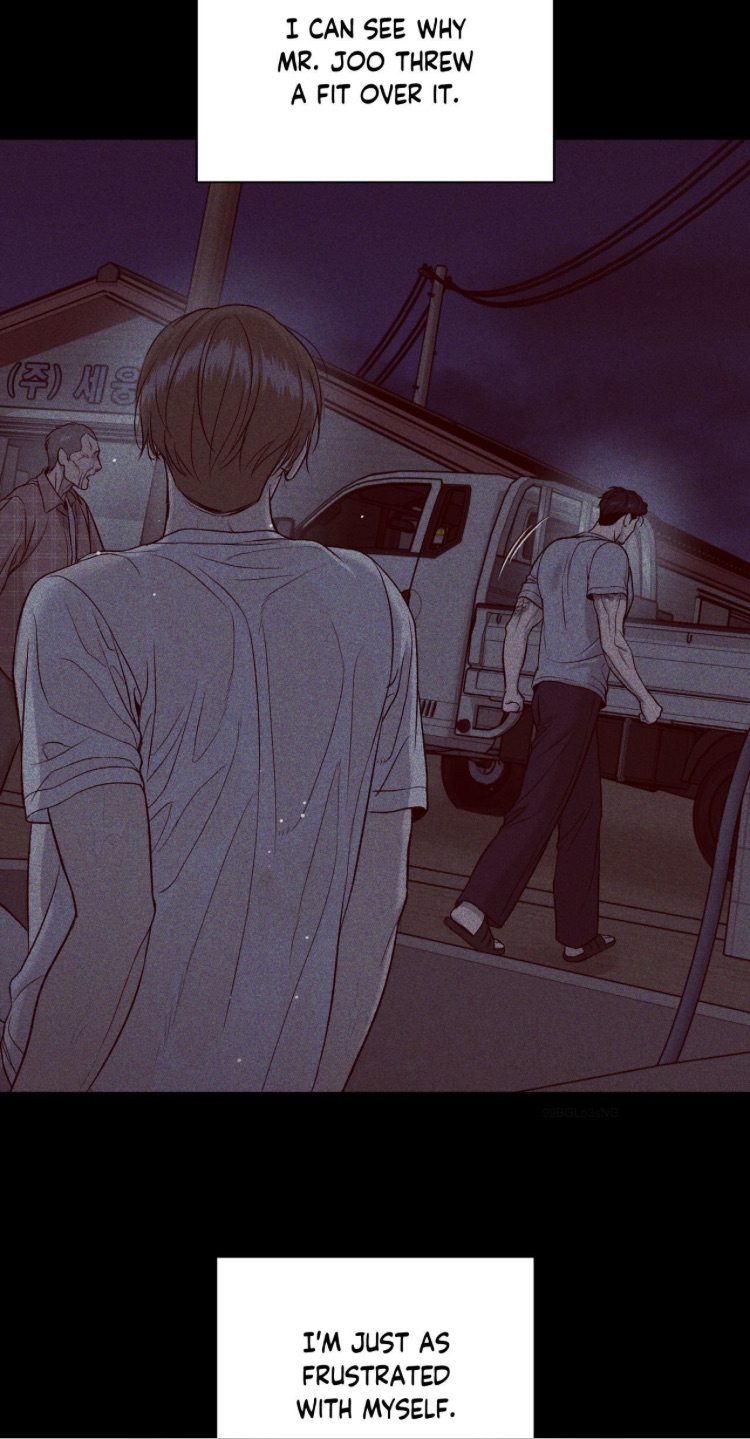 (chapter 71) How can he trust the athlete, when he doubts himself so much? From my point of view, he is on the verge of become “mature mentally” and as such “responsible”. At the same time, Jaekyung is revealed as the adult in crisis. His exhaustion
  (chapter 70)
 (chapter 74) It is because thanks to the director’s confession, the “hamster” is able to see the champion as a “a kindred spirit“, an orphan and as such as the younger “boy”.
 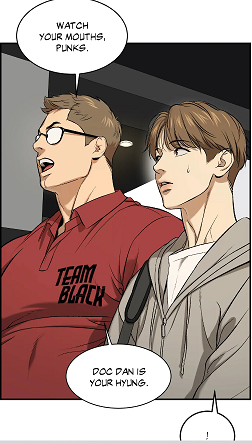 (chapter 7)
  (chapter 26), because it is play, because it is chosen.
 (chapter 69) It is not about treatment or jinx, but about presence. This hug reframes the meaning of strength. True strength is not the ability to fight endlessly, but the ability to hold and be held, to mirror” is like touching oneself! Let’s not forget that the mirror represents the reflection of a person. Respecting the physical therapist signifies respecting oneself!
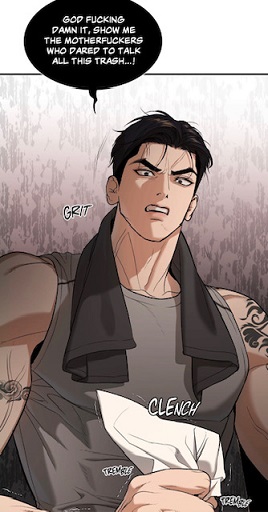 (chapter 36) He can retaliate differently. With his money and power, he can prove to them, he is no loser!

 (chapter 40)
  (chapter 53)
  (chapter 75) His eyes open after the dream, and they open to the same light. It’s the opposite of every earlier awakening
  (chapter 54) —no gasp for air, no clutching his throat
  (chapter 75), no father’s voice strangling him. This sudden awakening embodies enlightenment.
  (chapter 75)
 (chapter 70) He knows the athlete from the past. The latter was attached to people and not to places. Why does he speak of “something” rather than “someone”, if he knows? The lesson is not about fixing a new goal or object to chase, but about discovering how to live differently — how to live happily.
  (chapter 75). Even before, he could only mutter to himself this:
  (chapter 70) The negation indicates denial, but observe that he couldn’t even use a noun. He cannot yet translate this vision into words, because he has never heard “I love you” himself
  (chapter 41), and doc Dan claims to have no recollection of it. His father left him with mockery, his mother with resignation, his coach in the past with discipline, the grandmother-figures with burdens (honor, debt, favor).
 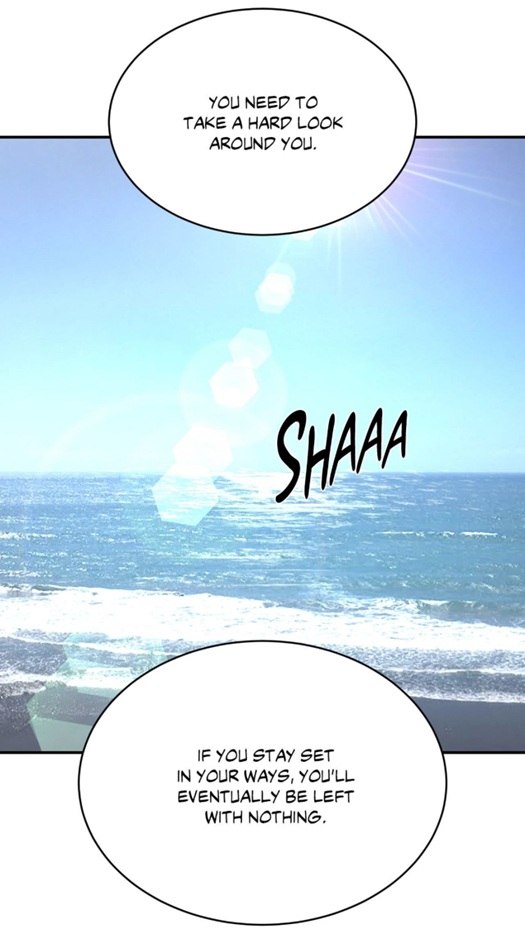 (chapter 75) The openness is what makes it love — it is respect.
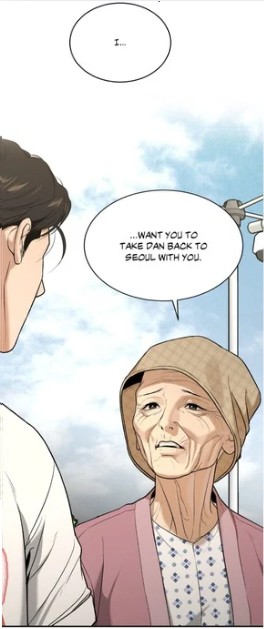 (chapter 65) Halmoni believed she already knew the solution to Dan’s suffering: sacrifice yourself, work hard, pay the debts or make money, endure. She closed off alternatives by imposing her narrative on him. Her love was distorted into certainty. The director, by contrast, recognizes the limit of his role. He has learned (belatedly) that he cannot dictate meaning for someone else. Instead, he tells Jaekyung:
  (chapter 75) His love is expressed through humility — through not knowing. At the same time, his words and facial expression ooze trust and confidence.
 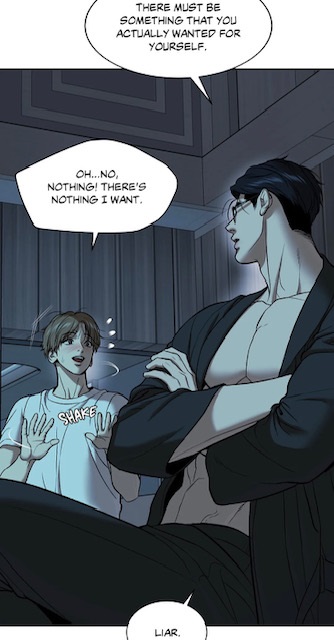 (chapter 29), Joo Jaekyung opened up a little to doc Dan! Thus the next morning, he visited the bathroom where doc Dan was!
 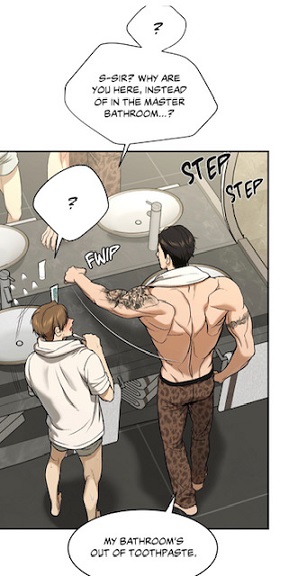 (chapter 30) It was just an excuse to spend more time with his fated partner.
  (chapter 74), no “dear,” no “I love you.” In the father’s memory, she used the child as an excuse to distance herself from her spouse. In that moment, Jaekyung is not a son to be cherished but a barrier in an adult quarrel.
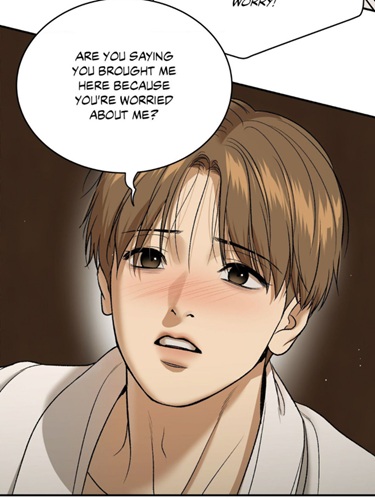 (chapter 67) His question is really an appeal for recognition. If Jaekyung answered yes, Dan could interpret it as proof of love, because in his own distorted framework being worried about equals being cared for. But Jaekyung answered with silence.
 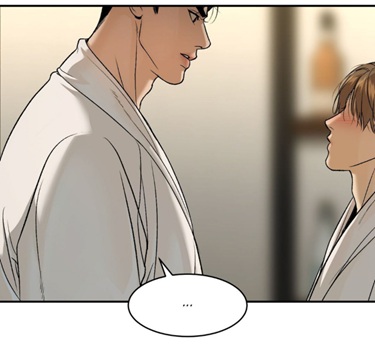 (chapter 67) Not because he felt nothing, but because he lacked the language to connect worry with love. In his conscious mind, conception of care was still bound to usefulness — Dan mattered because he was needed for training, not because he was loved as himself, while deep down, he had already moved beyond this aspect. He was just in denial in this scene,
 (chapter 74) On one level, she does not recognize his voice. But on a deeper level, her words ring as truth: she does not know her son. She has no idea who he has become, what defines him, what characterizes him beyond money and survival.
 (chapter 74), promising to provide for her if she returns home. He unconsciously appeals to the only logic he has ever known: that love equals provision, that affection is secured by usefulness.
 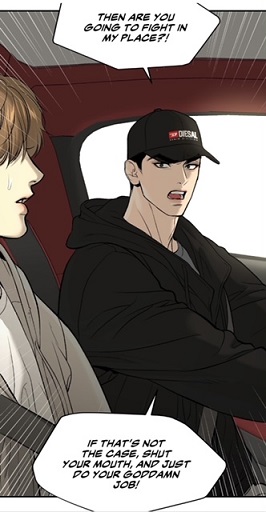 (chapter 42) His father’s voice was violent and scornful, but its framework remained lodged in him.
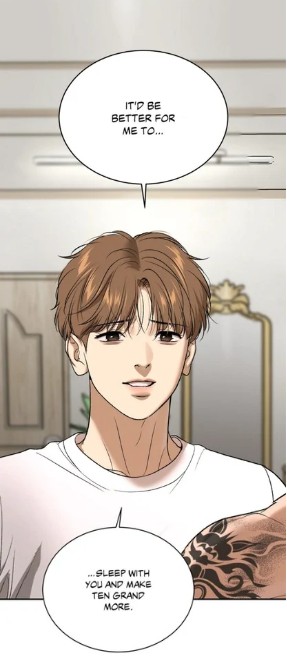 (chapter 62) That way, he can still be “free”.
 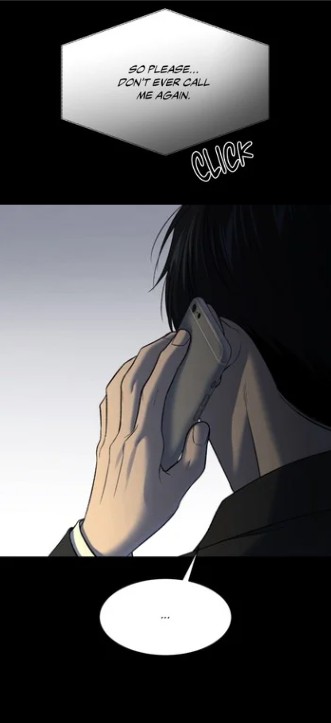 (chapter 74) She expected him to follow her request. I can definitely imagine her trying to reconnect with Joo Jaekyung, the moment he became a celebrity.
 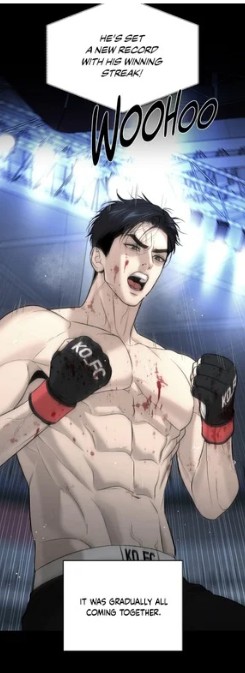 (chapter 75) Keep in mind that we have these mysterious phone calls:
  (chapter 37)
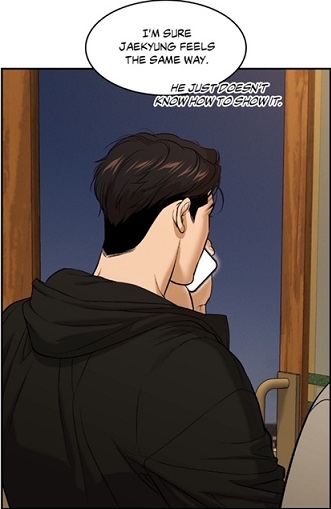 (chapter 43)
  (chapter 49)
 (chapter 75)
  (chapter 34), Jaekyung assumed later that the actor would have helped doc Dan to hide.
  (chapter 58) His violent intrusion into the actor’s home was the natural outgrowth of Namwook’s teaching: if love is real, it must show itself as service.
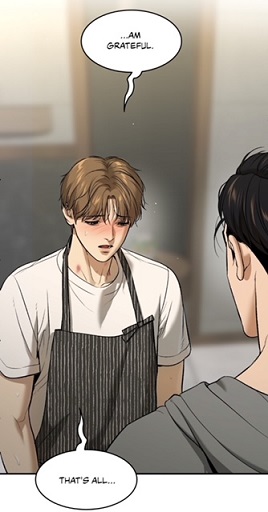 (chapter 45), Jaekyung struggled to even recognize it. Giving him a gift and expressing gratitude was not “helping the fighter”.
  “ (chapter 75) There’s a life outside the ring and the spotlight.
 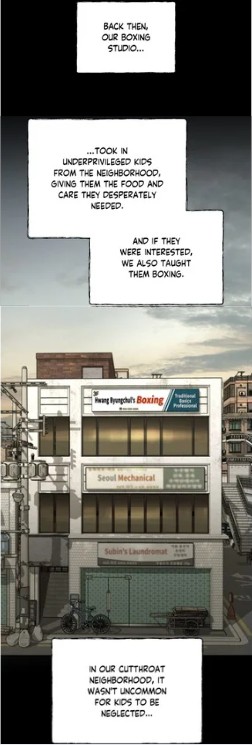 (chapter 72) was quite futile, for at the end, he ended up alone and felt lonely.
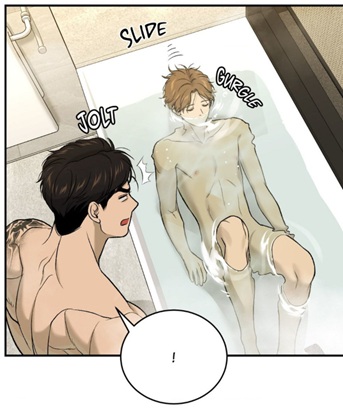 (chapter 68)
 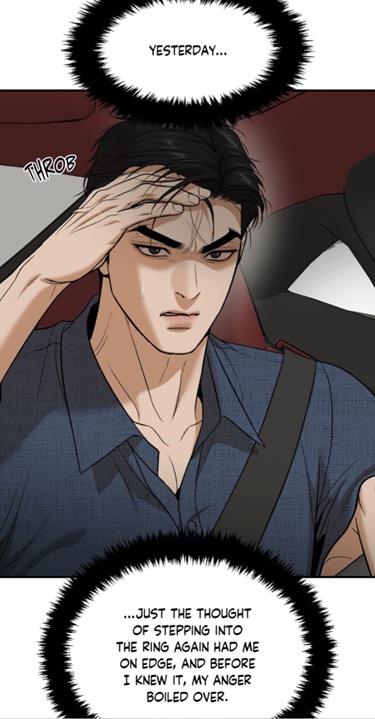 (chapter 69)
  (chapter 69) And that’s what makes him so human.
  (chapter 71) This means that he lives now in the present. It looks like the “old coot” has been tamed by the “gentle hamster or duck”.
  (chapter 41) He didn’t know how to judge such a confession. Hence these words were reduced to a mistake!
  (chapter 19), and has been unable to say it since.
 (chapter 65) We know he once had toys (teddy bear,car)
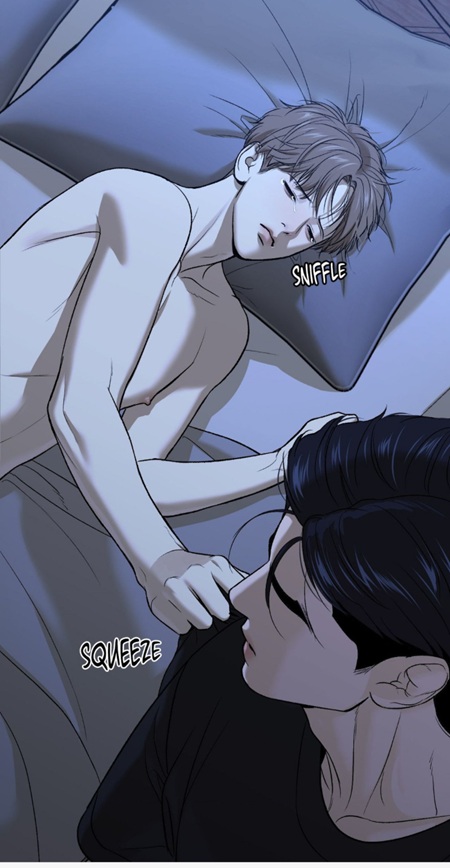 (chapter 66), whispers through tears
 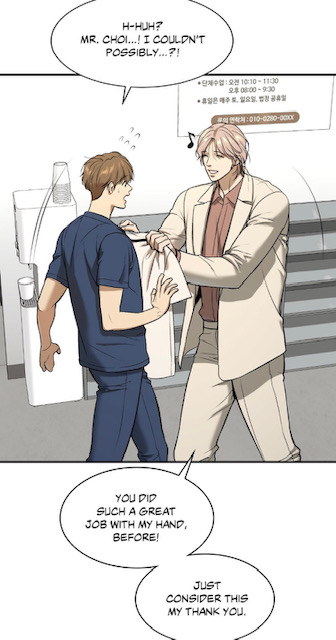 (chapter 31)— which he associates with unbearable debt. His mother’s final “gift” of love was one he could never repay. Any present risks reopening that wound: “What if I can’t repay this? What if I lose them too?”
 (ch. 47) throws this into sharper relief. There, Dan imagined taking her on a trip after the hospital, walking side by side, giving her what she never had: rest, companionship. The problem is that this image was still mixed with repayment, nevertheless doc Dan was gradually realizing that spending time together was important. This vision displays the importance of walking together. When Jaekyung dreams of Dan waiting in the sunlight,
  (chapter 74) — the quiet sign that the sun is about to rise. Dawn is not just a natural detail in Jinx; it is a symbolic hinge. It is the moment when night meets day, when moon and sun overlap, when endings bleed into beginnings. In myth and fairy tale, dawn often marks metamorphosis: the Little Mermaid turns to foam, the enchanted sleepers awaken, the beast becomes a prince. For Jaekyung, too, dawn is the threshold. His father cursed him at dawn
  (chapter 73), stripping him of worth, tying the rising sun to shame. But in this new dawn, another voice will have to intervene. Only Dan can replace the curse with a blessing. Only “I love you” can undo “you are not special.” And if it is not “I love You”, then it could be a kiss, the symbol of “affection”.
  (chapter 41), an invitation to walk together. Namwook’s long presence embodies the trap of quantity without substance. Dan’s brief but luminous presence reveals the power of quality: the kind of attention that transforms.
 (chapter 75) Namwook’s whispers, too, keep him chained to that rhythm of urgency — rankings, titles, deadlines. But once Dan’s whisper replaces Namwook’s, time itself shifts. The future is no longer a debt to repay but a horizon to approach slowly, hand in hand.
 (chapter 27), joked
  (chapter 27), even rediscovered his love for swimming. Water, his true element, was reclaimed as play rather than punishment.
  (chapter 27) That single day was a seed — a foreshadowing of what life might look like once the curse is broken for good.

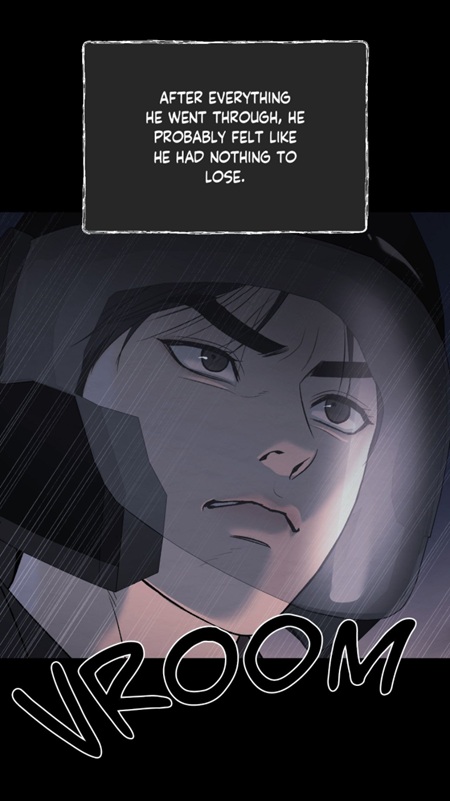 (chapter 74) What do they share? You might already have noticed it. At first glance, the answer seems obvious: each sentence turns around the word after. But if we pay closer attention, it is not just after that repeats, but after all. And here, the “all” quietly carries the weight of everything. A slight shift, but one that feels significant. But why this expression, and why here? Why does it resurface precisely in the context of Jaekyung’s family and past?
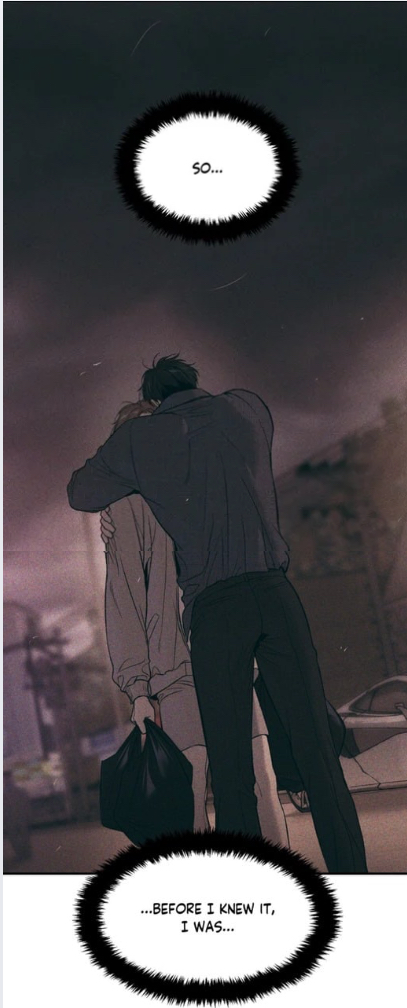 (chapter 70) For the first time, the flow of time shifted. Besides, no explanation, no certainty—just an admission that something happened beyond his planning or reasoning. Where the earlier lines spoke with closure, this one arrived without a verdict. But what does this “confession” signify for the athlete now?
 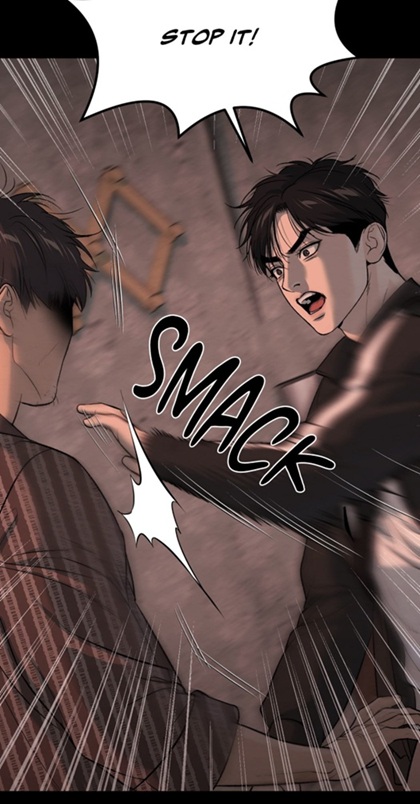 (chapter 73) locked in confrontation, while in the past, the woman had already shown her back — a gesture of refusal that foreshadowed her desertion. She had withdrawn in silence; the man, however, lashed out in noise. Both abandon, but in different registers: hers in silence and absence, his in noise and abuse. But the father’s gaze was selective.
 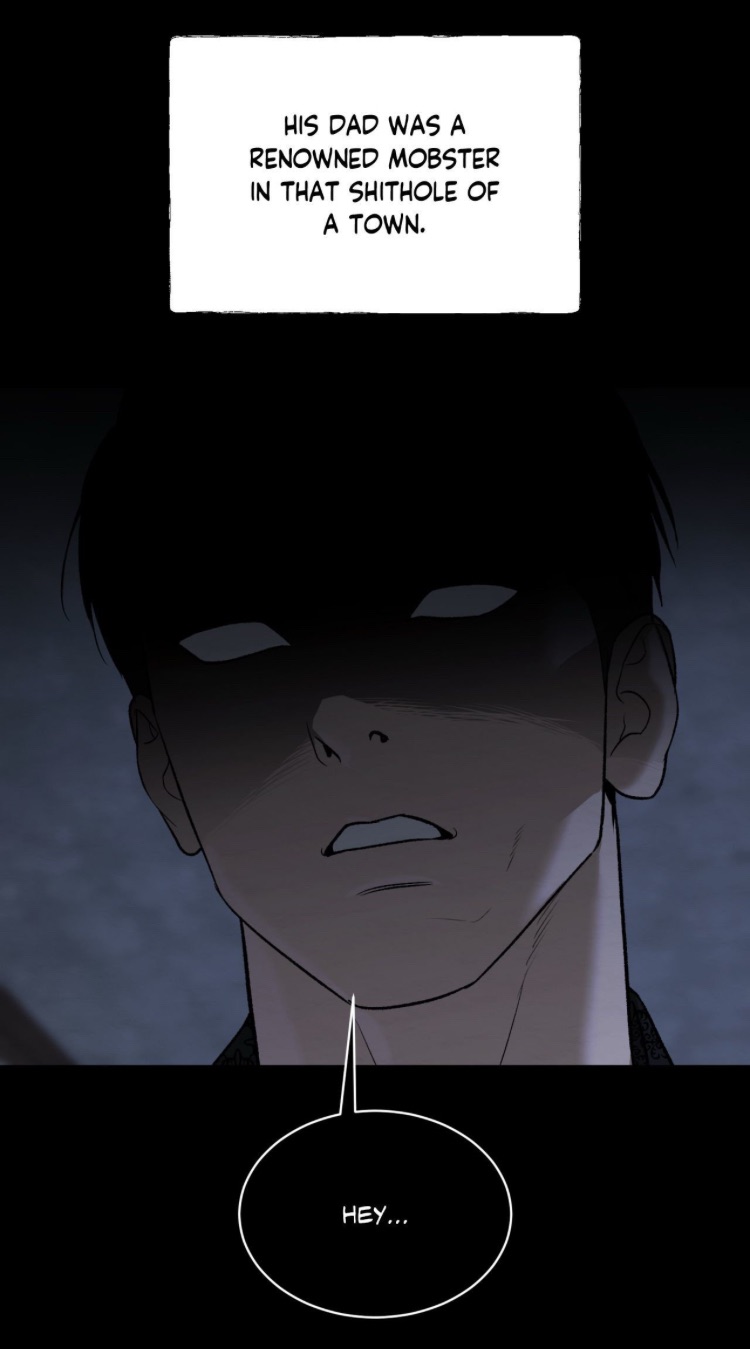 (chapter 73) — all were rewritten into a story where the woman was the sole traitor, and the child nothing more than her extension. In this way, the boy was denied recognition as a victim in his own right. He had been abandoned too. He had been abused either. He became instead a mirror in which his father projects the wound of being left behind.
 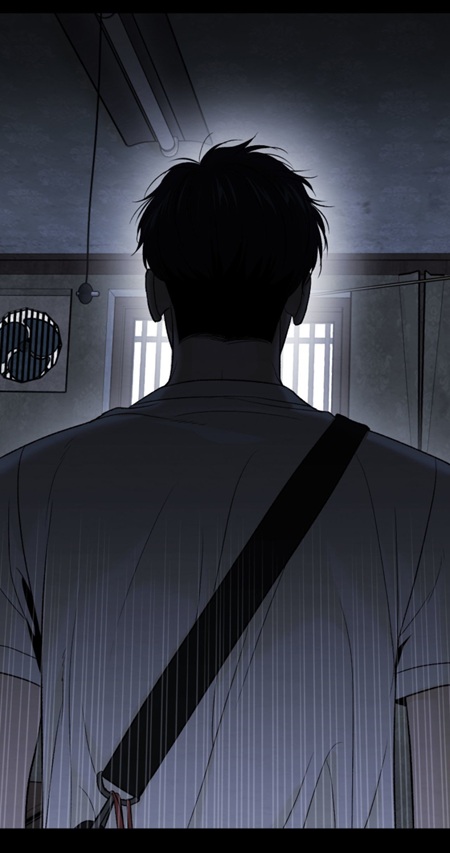 (chapter 73) To speak was to wound, to be wounded in return. Besides, the boy could never speak of this truth. He carried the memory of that last conversation in silence, crushed by the belief that he bore guilt for his father’s death. Shame and responsibility bound his tongue. That is how words, once used against him as weapons, became impossible for him to wield in his own defense. However, this was only the beginning of his withdrawal into silence. His fists would become his language, his body the only safe instrument of reply.
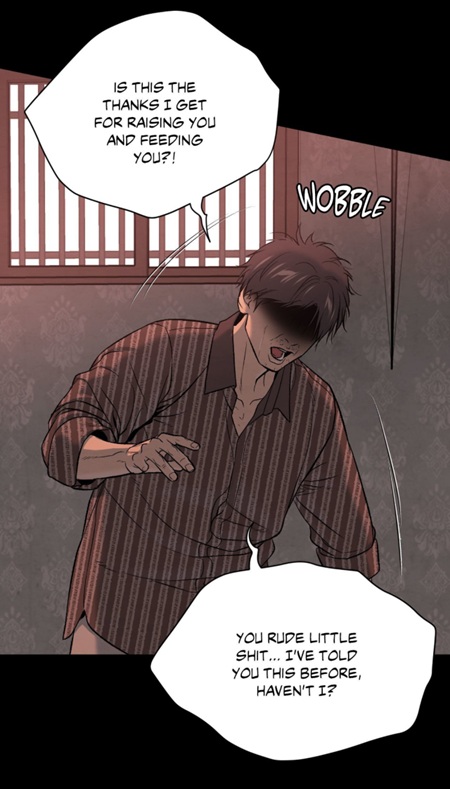 (chapter 73) The betrayal he lamented was nothing more than the logical outcome of his own principle. There had never been a we — only a man clinging to his pride, a woman turning her back, and a child caught in between. His after all
  (chapter 74) In the past, the boy had dialed her number from the same public booth
  (chapter 72), clinging to the hope that she might answer one day. Eventually, those attempts ceased — but not the attachment. What remained was the number itself, saved under “Mom” on his phone
  (chapter 74) Here, he was old and rich enough to buy his own cellphone. The phone number was no longer a channel of communication, only a relic: a fragile thread he could not sever, because the fact that she never changed her number sustained the illusion that reunion was still possible. That dormant hope was shattered only when she finally picked up — not out of recognition, but by mistake, assuming the unfamiliar call must be important.
  (chapter 72) neglect, starvation, abuse, loneliness, betrayal — and yet the parents invoke it not to acknowledge his pain, but to hide their wrongdoings (justify their betrayal) and as such their failure! By placing after all at the front of her sentence,
  (chapter 74) In a city of anonymity, hearsay cannot replace documents. She left a paper trail — a legal identity that binds them together. Should the champion cause trouble in Seoul, or even become the victim of a crime, the police would have to turn to his legal guardian. And that can only be her.
  (chapter 26). Oh Daehyun mentions that the young fighter broke the punching machine so many times he was blacklisted. Such destruction could easily have brought police intervention — and if it had, they would have been forced to search for his legal guardian. That guardian is none other than the mother who abandoned him and her new family. In other words, her erasure was never complete: every act of the boy risked pulling her shadow back into the open. Furthermore, this is what Kim Changmin revealed to his friend and colleague:
  (chapter 26) But Joo Jaekyung had long discovered sports and MMA, when he arrived in Seoul and met Park Namwook for the first time.
  (chapter 74) who redirected him before he was swallowed by the wrong path. The discrepancy between these accounts exposes more than just the manager’s manipulation: it points to the shadow of another intervention. How could he afford to destroy machine after machine without consequence? The only plausible answer is the “mother” and her new family, whose money and silence allowed him to pass as the “self-made” Emperor while erasing their own responsibility from the tale. And now, you comprehend why The Emperor was made voiceless. [For more read
 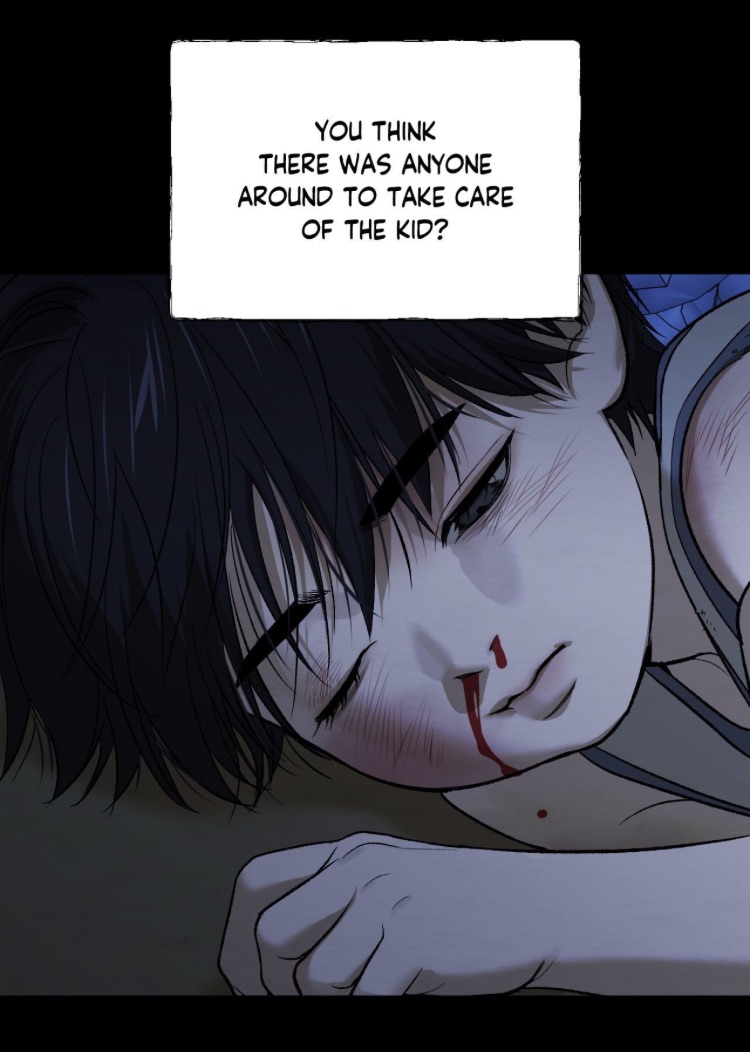 (chapter 74) For doc Dan who embodies the present, such a statement can only become the ultimate truth: the star had been an orphan like him.
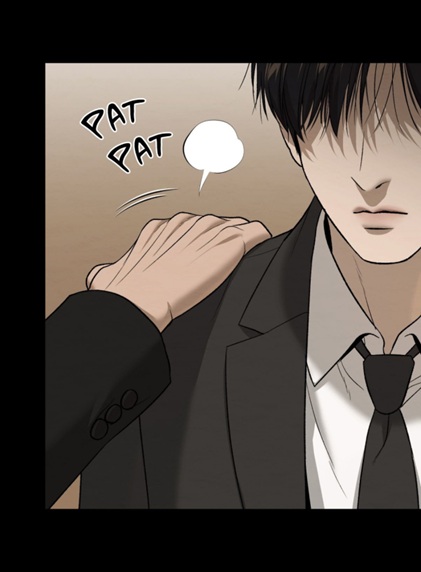 (chapter 74) Once again, the director was there — but his presence was mute. He placed a hand on the boy’s shoulder, yet he never lent him an ear. He never invited the boy to speak, never created a space where grief, anger, or longing could be put into words. In other words, he was present in body but absent in voice and heart. Thus the director’s pat was a gesture of pity. It was a substitute for words, a way of saying “poor boy” while protecting himself from deeper involvement. But precisely because he withheld speech and listening, it denied Jaekyung the chance to articulate his own grief. It comforted without connecting.
 (chapter 74), through fighting. Thus the director’s quietness, his refusal to engage, became a formative wound in itself. He chose the safety of distance over the risk of involvement, and in doing so, left the boy’s cries unanswered.
  (chapter 74)
  (chapter 74) He was given a chance to step in, to finally become the guardian he had failed to be on the night of the boy’s deepest collapse. Therefore it is no coincidence that he claims to have raised him, while the readers are well aware of the truth.
  (chapter 74) The father was dragged into memory as a warning: “Do you want to end up like him?” The mother, already gone, was turned into a conditional model: “Would she even want to live with you if she could see you now?” In both cases, the boy was denied his right to grieve. His parents were not mourned, but transformed into instruments of discipline. He was forced to run from one shadow and to chase another, leaving him no space to simply exist. The director maintained the future champion trapped in the chains of the past.
 (chapter 74) For him, discipline was always bound to her presence, her food, her care, her silent labor that sustained the gym. By invoking “the mother” as a motivator, he was, in truth, repeating the only model of loyalty and endurance he had ever known. But this was borrowed authority, not Jaekyung’s. What may have given the boy a flicker of purpose in the moment — to endure, to fight “for her sake” —
  (chapter 54) The director’s form of guidance could not sustain him; it was external, borrowed, conditional. Therefore, it is not surprising that he was never contacted after the main lead’s departure for Seoul. By then, the director had already become like his own mother — reduced to a memory
  (chapter 70) and nothing more. He neither possessed the boy’s number nor showed the desire to stay connected; worse, he had told him explicitly never to return.
  (chapter 56)
 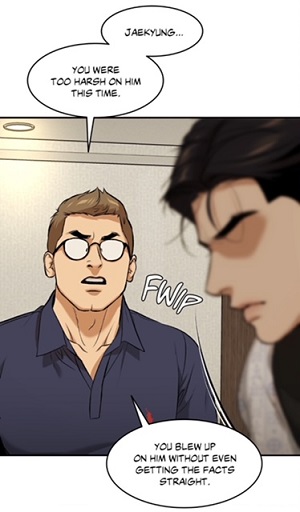 (chapter 52) That way, he could divert attention from the “before and circumstances”. And in season 2, the man hasn’t changed at all. Instead of asking what caused Jaekyung’s crisis, he chides him for straying from the routine — for not showing up at the gym, for being absent.
 (chapter 52) The slap at the hospital was more than a physical outburst; it was the eruption of long-repressed truth. Where he once swallowed pain in silence for his mother, and later endured fists in silence for his coach, here he answers back. Lately thus marks not only Namwook’s delay but also Jaekyung’s refusal to bear the weight alone anymore.
  (chapter 45)
 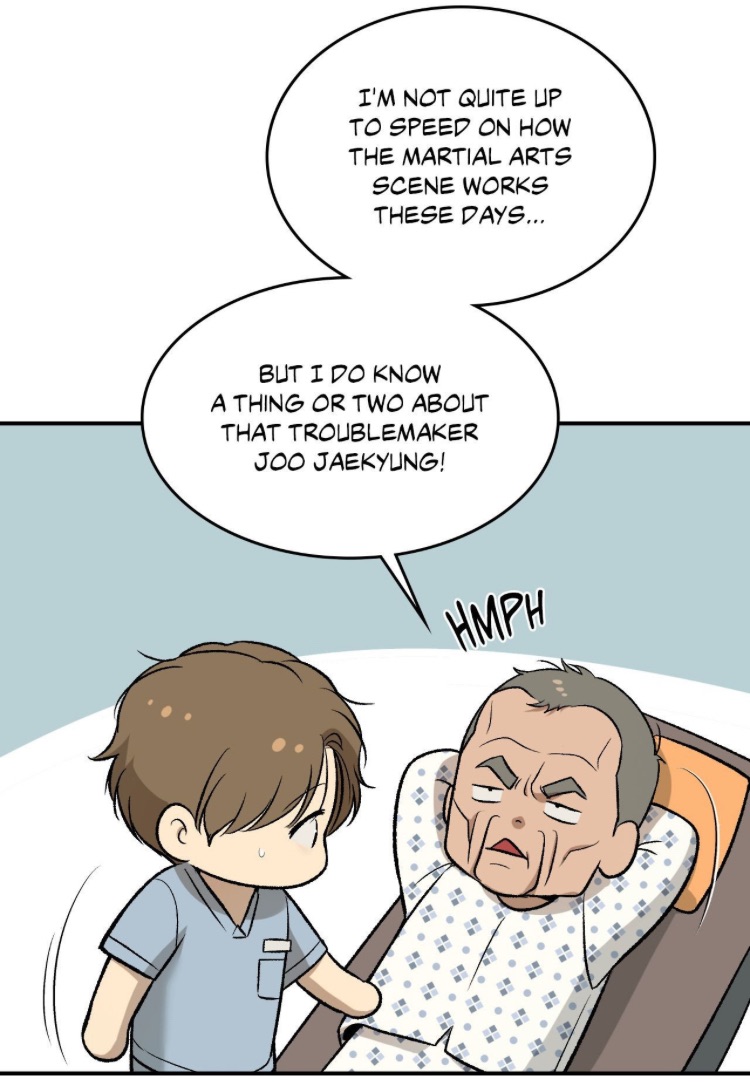 , (chapter 70), while remaining oblivious to the rot within their own world and the medical world. The director accused Joo Jaewoong of “choosing the wrong path,”
 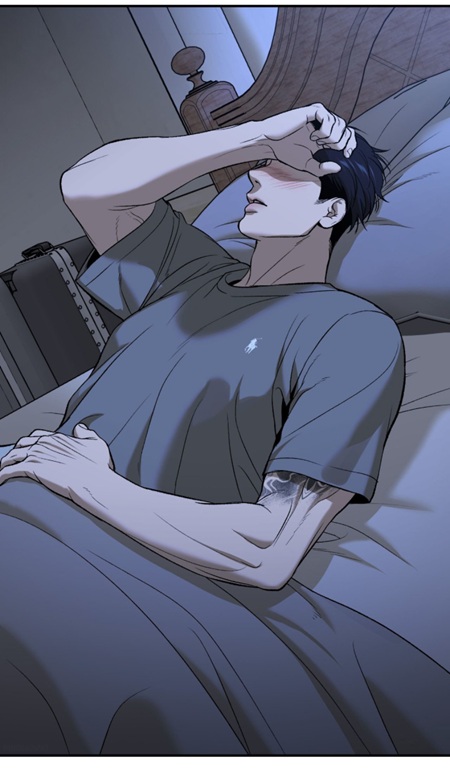 (chapter 74) Honestly, it would be funny, if the champion used the same words than his own mother against the manager
  (chapter 70) Thus the manager is confident that the star can return to the ring. By cutting the manager off in such a moment, Jaekyung would be affirming that he no longer accepts neglect disguised as toughness. Both “directors” are trapping the champion in the chains of the past and the future. For them, there’s no present and as such no happiness or fulfillment. Hence Hwang Byungchul is even bored, when he watched the MFC match.
 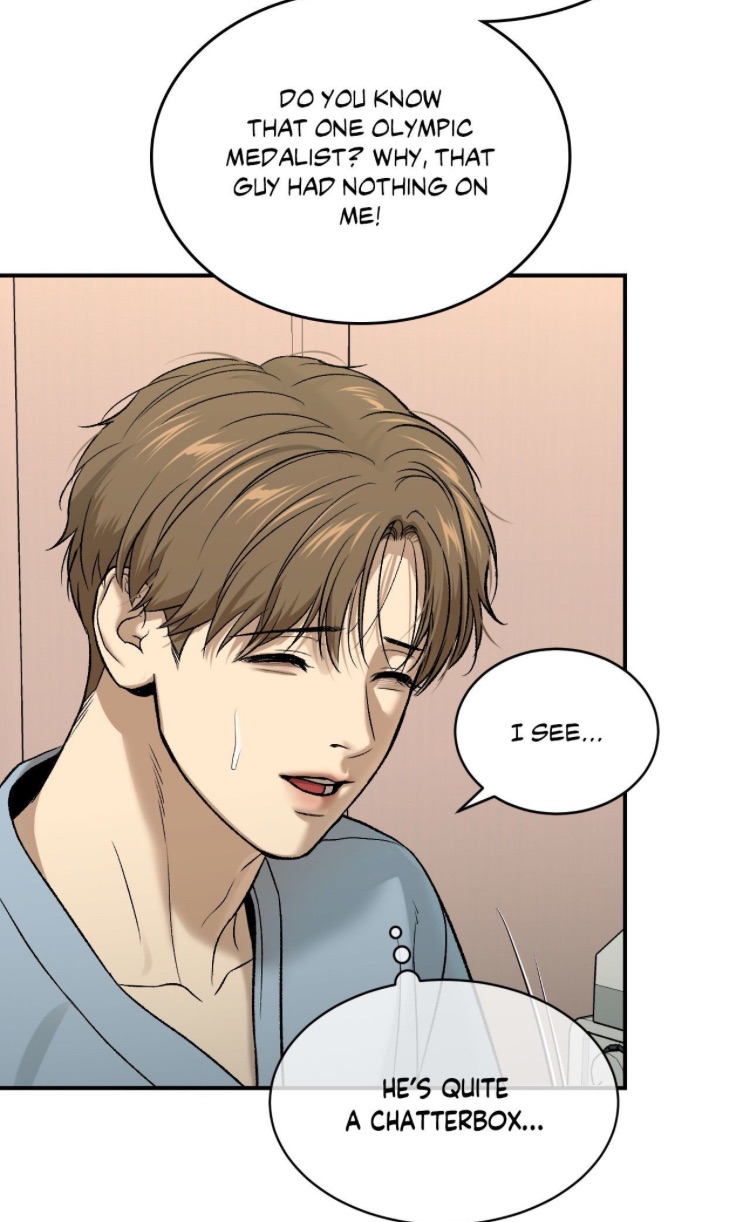 (chapter 70) As you can see, it is never too late… Thus we saw this on the roof of the hospital: a real and intimate conversation between the “guardian” and his pupil:
  (chapter 71) The director has changed!
 (chapter 65) She can appear as the perfect role model in the athlete’s eyes. No wonder why he listened to her and brought doc Dan to a huge hospital in Seoul. But here is the thing….
 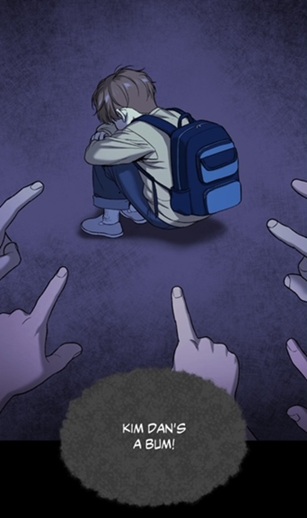 (chapter 57), and his forced maturity to a single, fleeting day. No trauma, no endurance — just inevitability. By collapsing years of hardship into a harmless “day,” she erases both the past and the victim. And now, you can understand why doc Dan is trapped in the present! By erasing the “before” (abandonment, trauma) and trivializing the process of “becoming an adult,” she collapses time into a single, static present. Kim Dan is not allowed a past that hurts (because she erased it), nor a future that could unfold differently (because “he just grew up” is presented as inevitable).
 (chapter 62) cannot, by themselves, sustain love. Emotions flare and fade, tied to the immediacy of the present. Thus the mother could break her promise and even lie to him later. What endures is not emotion alone, but the principles that Fromm identified as the essence of love: care, responsibility, knowledge, and respect. These qualities stabilize the fleeting nature of feeling and transform the present into something continuous, something that can grow. In this sense, the teddy bear bridges the gap between “present” and “future”:
 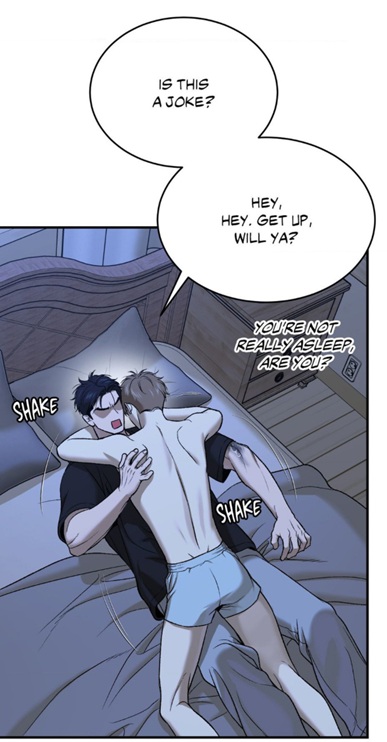 (chapter 65) it transforms the fleeting moment of emotion into a promise of constancy. After all, before it’s too late, what both men longed for was never glory or escape, but a home where they could rest — not alone, but in each other’s arms. By discovering emotions and learning to live in the present, the champion also rediscovers his inner child. His line — “Is this a joke?” — marks that shift, since jokes, like emotions, only exist in the immediacy of the moment. It is only a matter of time, until he laughs because of a joke. By embracing doc Dan like a teddy bear, he allows himself to cling and regress, no longer the wolf or the Emperor but simply a boy seeking warmth. Even his cold becomes symbolic:
 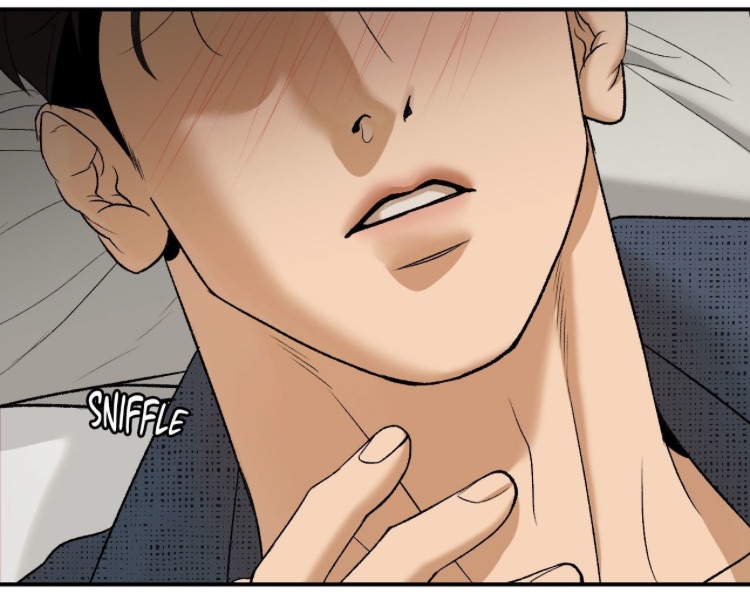 (chapter 70) illness forces him to slow down, to be vulnerable, and to receive care — something denied to him in childhood. In this way, love turns the regression into healing, transforming weakness into the possibility of renewal.

 (chapter 23), memorized his moves and titles, and repeated the anecdotes told in gyms and on TV. They’ve heard how he was “saved” by sports from a darker path, and cheered for him as the “Emperor” — the handsomest fighter, the man who broke the arcade’s punching machine
 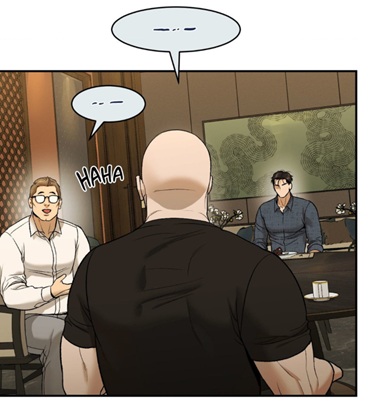 (chapter 69) It was as if the main lead, backed by his team, had personally approached MFC to request the match — an illusion strengthened by the opening line, “MFC’s former champion Joo Jaekyung will be returning to the ring this fall after serving his suspension.” This way, if the decision draws criticism, the CEO can retreat behind the fighter and his team, like they did in the past.
  (chapter 67) That’s the reason why this suggestion from the CEO appeared the very next day.
  (chapter 61), it was paired with a recommendation for rehabilitation — not an immediate return to competition. This was actually a condition for his total recovery. On the other hand, the doctor imagined or suggested that his patient wished to return to the ring so soon. No medical professional ever signed off on an autumn fight. Yet the date is already set, and the headlines frames it as a confident comeback without any medical backup. The Emperor’s name is splashed everywhere, but none of the words belong to him.
 (chapter 41), while the image released with the fall match announcement was the one from when he first won his champion title.
 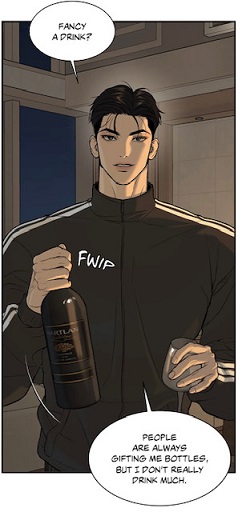 (chapter 12), never mind that he hardly drinks. The gesture fits the fantasy they’ve built around him, not the reality of a man who rejects alcohol due to his addicted father, a reminder that even the tokens of admiration are shaped by the image, not the truth. So who is this so-called close associate or “Joo Jaekyung’s team” exactly that decides for him, speaks for him, and hides behind his title? Besides, why did the journalist change from “one of his close associates” to “Joo Jaekyung’s team”?
 (chapter 57) The nickname, played for entertainment value, was another way of turning the champion into a caricature — a marketable, amusing persona instead of a man with a past and agency. It is quite telling that Park Namwook’s interview aired immediately after the anchor referred to Jaekyung as “Mama Joo Jaekyung Fighter.” This was not the lofty “Emperor” title repeated in gyms and ring intros — it was more a mocking nickname, a deliberate jab meant to provoke. In that moment, the Emperor was verbally pulled down from his pedestal, yet the images shown alongside the segment told a different story: carefully chosen shots of him as a champion, a visual echo of his marketable persona. The dissonance was striking.
 (Chapter 52) This framing lets him claim the prestige of leadership while leaving himself room to withdraw if things go wrong. Yosep was the one notifying MFC and reporting the incident to the police, Potato explaining his discovery to Joo Jaekyung and blaming the star.
 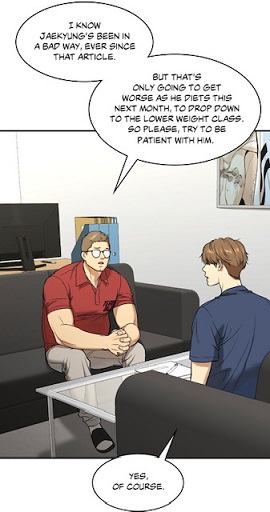 (Chapter 36) He should tolerate the celebrity’s moods and put up with everything. The manager didn’t mind, as long as he didn’t get affected. But what is the consequence of such a passive tolerance? An individual’s self-esteem can slowly erode, leading to a gradual loss of their sense of self. They may stop recognizing their own desires, needs, and rights, often without even realizing this is happening. This is because emotional exhaustion often develops subtly over time, rather than appearing as a sudden, dramatic event.
 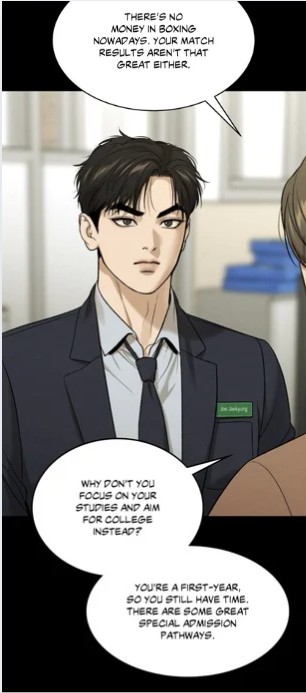 (chapter 73), by becoming a boxer, the champion wouldn’t make a lot of money. With this comment, he implied that boxing in South Korea had been losing popularity 10 years ago. This explicates why gradually, the members from Hwang Byungchul left the studio. And it was likely the same in the illegal fighting circuit.
  (chapter 73) The popularity of MMA in the States gave them the opportunity to revive fighting sports, a figure who could draw crowds and sponsors, making such events fashionable again.
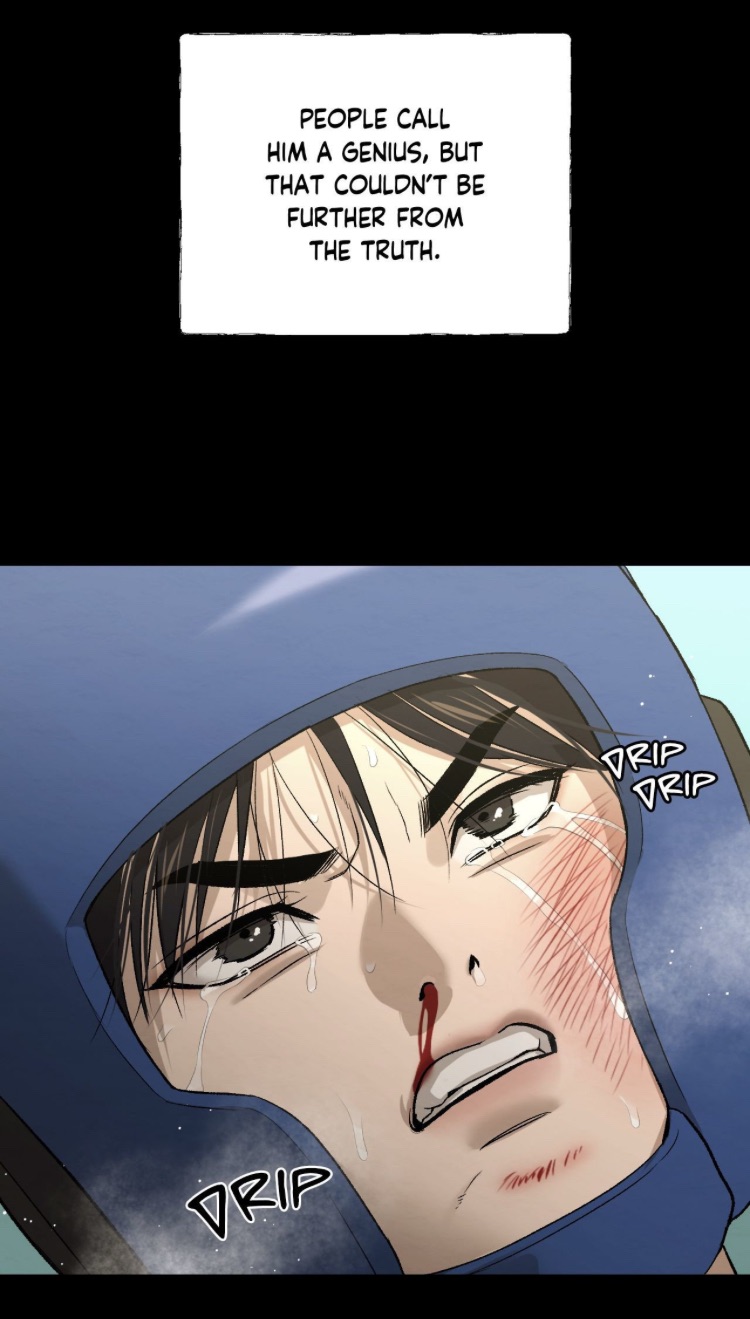 (chapter 72) instead of “hard-working,” a man who “chose sports over a dark path.” Yet if you look closely, this celebrated “ascension”
  (chapter 72), the scars of his family history, and the years of survival before the cage. This is history rewritten, his boxing past and family erased. Why? His origins could expose the ugly verity: the link between criminality and boxing (as such fighting sports). Secondly, because his real story, though moving, lacked the glamorous allure needed to market him. His real story would have revealed that to rise to the top, you need relentless work, not a miraculous moment. That version was never going to sell as well as the “genius” myth.
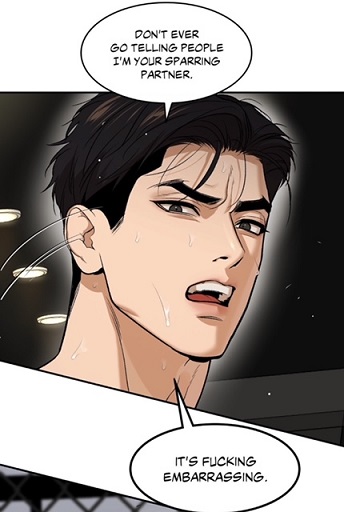 (chapter 46) Most of them thought that by staying close to him, they could benefit from his popularity. To conclude, for many of them proximity to the Emperor wasn’t about learning discipline or technique; it was about absorbing his fame by osmosis. Hence they complained and accepted the gifts and money so easily.
  (chapter 46) And, like any product, once it was seen as damaged, its value plummeted. The moment he “lost” his title and suffered injury (chapter 52), the dream began to unravel.
  (chapter 52) This panel captures this shift perfectly: two fighters casually dismiss him over dinner. In those words, the Emperor isn’t a mentor, a champion, or even a man — he’s a broken commodity, no longer worth the investment. The same people who once fed off his popularity are the first to abandon him when the promise of easy gain disappears.
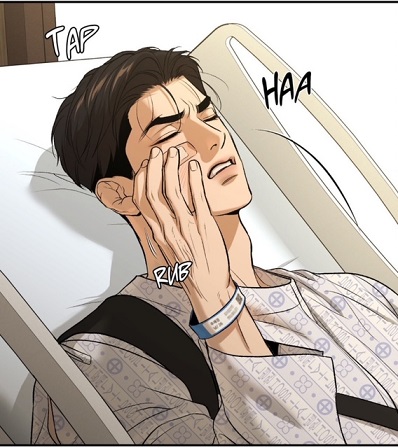 (chapter 52) He chose silence, and later avoidance, staying away from the gym. That silence was not weakness, but choice: he would listen less and less to his hyung.
  (chapter 36)
 (chapter 72) We don’t know how many times he called, but each time we see him do it, his face is injured.
  (chapter 72) The phone calls are therefore intertwined with the boxing studio, as though pain itself pushed him toward her. At ten, he picked up the receiver and let it ring only a few times before hanging up. The next time, in the dead of winter, he finally spoke, promising that if she returned, he would protect her from his father and make enough money to keep her safe.
  (chapter 55)
  (chapter 27), spent time with him, asks questions, confronts, and refuses to be reduced to a body in the room. He breaks the rule of silence. With him, Jaekyung can no longer hide behind the physical alone; he is forced to speak, to explain, to voice desires and fears. He pushes Jaekyung to engage in ways he’s spent years avoiding. In this way, Kim Dan becomes the first real threat to the system the champion built after those two curses — and possibly the first person who could prove that words can be safe again. And now, you comprehend why Joo Jaekyung was moved by the birthday card
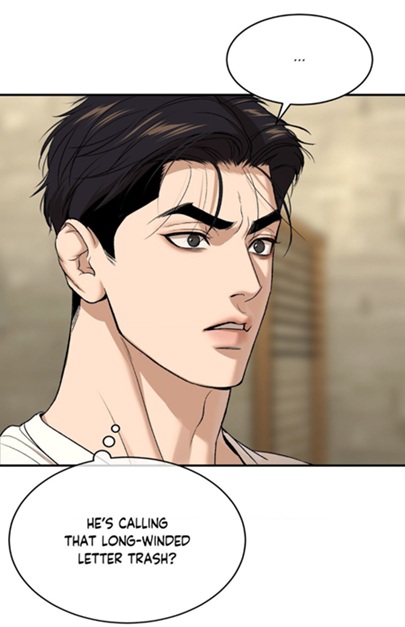 (chapter 62) To most, it might look like a simple gesture, but for him, it was a rare and precious thing — a voice that had taken the time to shape itself into words just for him.
 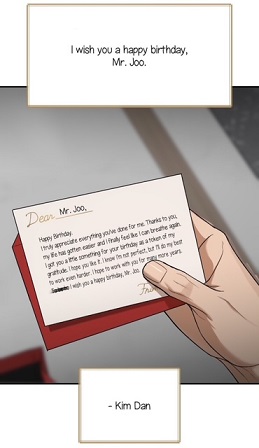 (chapter 55) After years of associating speech with either silence or harm, receiving a long-winded, carefully written message felt almost unreal. He saw the effort behind it, the deliberate choice to put thoughts and emotions into language instead of letting them fade away or turn into weapons. In that card, Kim Dan offered something neither of his parents had managed: a voice that reached him without wounding. No silence, no insult. For the champion, it wasn’t just a card — it was proof that words could be built into a gift, not a curse. The latter expressed his dreams and gratitude. Thus I deduce that the Emperor’s curse will be broken by a spell: words!
 (chapter 55) The “spell” to break it is not some grand external event, but the simple, sustained act of honest communication — something that has been denied to him since childhood.
 (chapter 68), a kiss, a pat, a caress or by simply holding hands
 . In this way, the curse that began when his voice was silenced and his hands were weaponized will only be broken when those same hands learn to speak tenderness. Look how doc Dan reacted to his public embrace:
  (chapter 71) He saw affection in the hug, but he still doubted the champion’s action.
  Until now, the design’s images have played a secondary role, yet the answer lies in a single scene from chapter 41.
  (chapter 41) Under the bright sunlight, Kim Dan reached out toward the leaves, his hand open and unguarded, as he silently thought of the man he loved. This gesture, so simple yet so revealing, became the unspoken confession that marked the start of a different kind of freedom—the freedom to feel.
 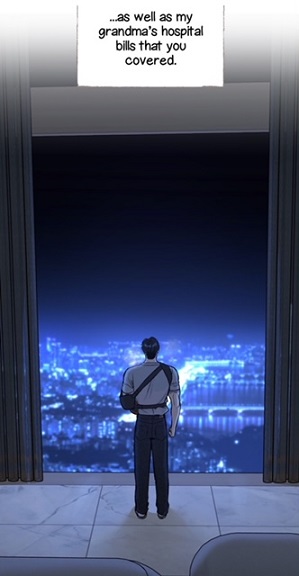 (chapter 53) The glass was an invisible barrier, offering the illusion of freedom while keeping him trapped in the moment of his unresolved trauma. The closer he stood to it, the further he was from true release, his gaze fixed outward to avoid looking inward. That’s why he had no eye in that scene:
  (chapter 55)
 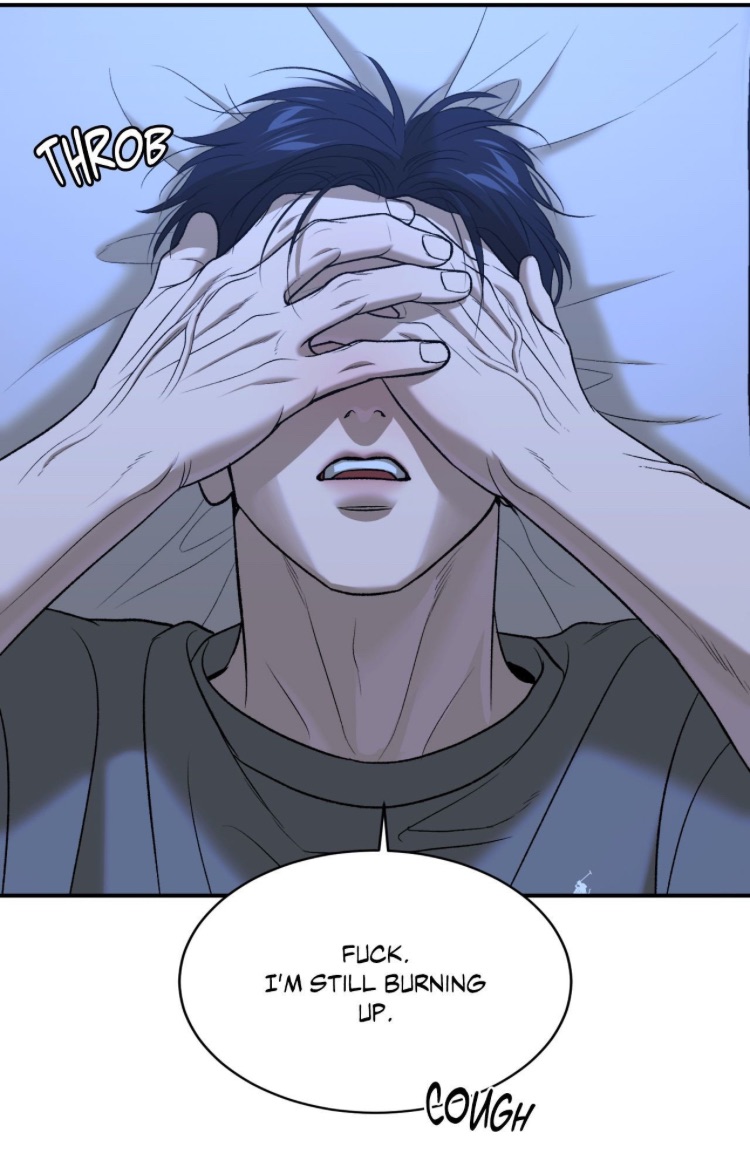 (chapter 71)
 (chapter 70) the night can also be alive, communicative, protective. In that moment, the moon becomes more than a distant light in the sky: it is a patient witness, a calm listener in the stillness, reflecting the truth he has yet to voice.
  (chapter 70) Its soft glow contrasts with the blinding glare of the cage lights, suggesting that under the moon, there is space for gentleness, for hearing one’s own heartbeat and another’s words. Just as the moon guides travelers through darkness, it can guide him toward a night that does not suffocate him with loss, but offers orientation and connection.
 (chapter 60) they were his own form of therapy. In saving someone else in the night,
 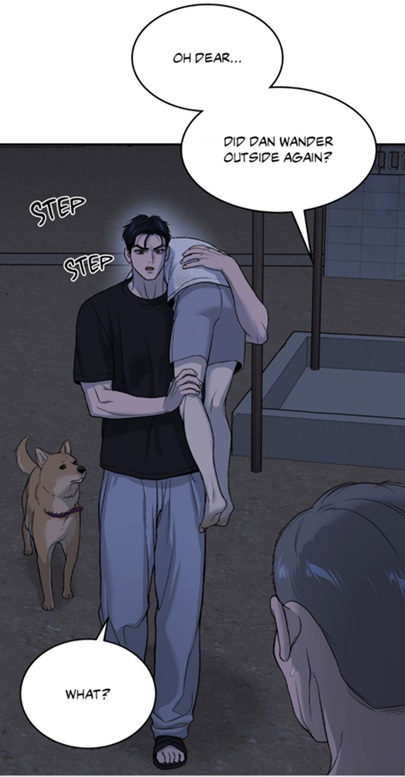 (chapter 65) he could prove to himself he was not powerless, he was valuable, capable of protecting what mattered.
 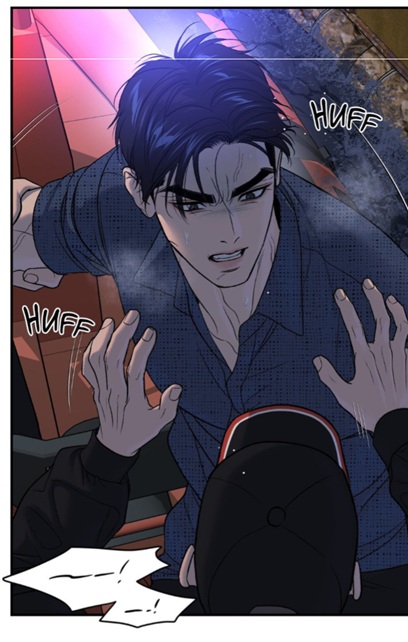 (chapter 69) He was not too late either. And the moment doc Dan discovers what the silent hero has done for him so many times, the former will realize that he has always been special to the Emperor. Moreover, the latter had never abandoned him in the end.
 , (chapter 9) as if the champion’s volatility were a quirk (the actions of a spoiled child) to be managed rather than a wound to be healed. It is because he never talked to the champion or investigated his past. It was only about money and glory. The manufactured image of the erratic, temperamental fighter served Namwook well; it excused rough handling, justified bad press, and kept Joo Jaekyung dependent. Once the Emperor can name the truth of that night, the fiction collapses — and with it, Namwook’s control. He can only be judged as a liar and even a traitor, but we know that Joo Jaekyung has a big heart. He could love his father despite the abuse. Now, the missing link is Cheolmin!
  (chapter 13) Observe that this name is a combination between Hwang Byungchul and Baek Junmin! Under this light, my avid readers can grasp why the athlete kept his existence in the dark for so long! It is because the latter belongs to his past and knows the truth behind the Emperor! He was aware of his suffering. For him, he is not just a fighter, but someone who needed FUN in his life!
 (chapter 71)These two older men mirror different systems of power: the current director, a seemingly kind authority figure who represents institutional control masked as care; and the former coach, a fallen patriarch whose past decisions shaped Jaekyung’s identity and pain. This part of the essay focuses first on the hospice director, and how his interaction with Kim Dan reveals the young man’s invisible burden and social isolation. In the final section, we will turn to the old coach, now reduced to a ghost in his own story, and explore how the symbolism of owls, coots, and crickets illuminates his emerging relationship with Kim Dan.
  (chapter 70) his dark circles, his nodding off—and suggests him to take a day off.
 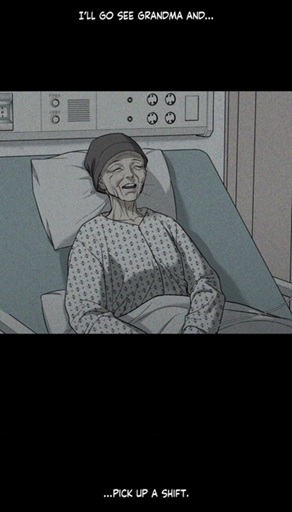 (Chapter 70) The director doesn’t say, “We’ll adjust your schedule,” or, “Let me talk to HR.” He simply tells Dan to take a day off
 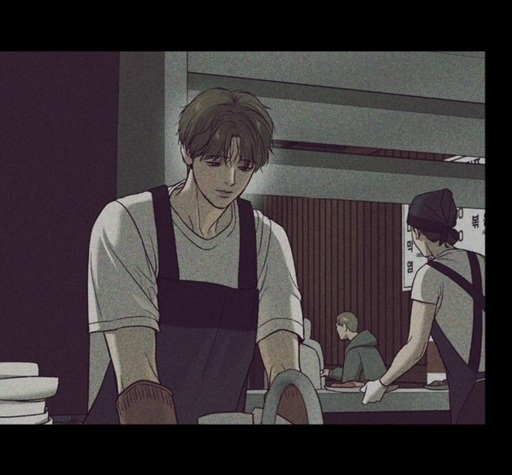 (Chapter 59) This reinforces the idea that Dan is not covered by the same protections, and that he operates outside the stable framework of regular employment.
 (chapter 66) to visit a sleep specialist, where Dan received a diagnosis and first treatment for his “sleepwalking” condition. The two spent the night in Seoul. Upon returning to the seaside town, Jaekyung received a call
  (chapter 71) and night hours
  (chapter 71), suggesting his ongoing pattern of overworking. In episode 71, Kim Dan is seen walking alone through the hospice hallway—unaccompanied, unnoticed. This quiet image stands in stark contrast to the earlier scene when, after nearly drowning, he was carried in by Joo Jaekyung and immediately met by a nurse and the hospice director, both actively working together that night.
  (chapter 60) Back then, his suffering was visible, his crisis institutionalized. Striking is that after that night, the hospital director never asked doc Dan to take a sick leave or to a day off. In fact, it took some time before making such a suggestion. Moreover, as if a single day off would make a huge difference. But now, despite his clear exhaustion and illness, doc Dan moves through the same space in silence
 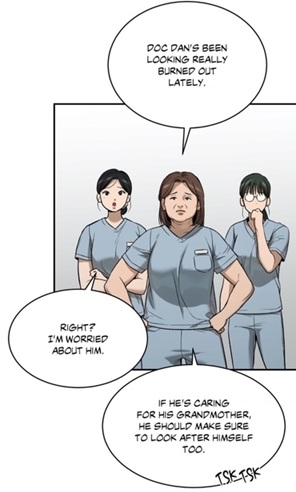 (Chapter 57) his grandmother would worry about him. Yet, during that night, Shin Okja doesn’t seem to be plagued by worries for her own grandson’s health. She sleeps peacefully.
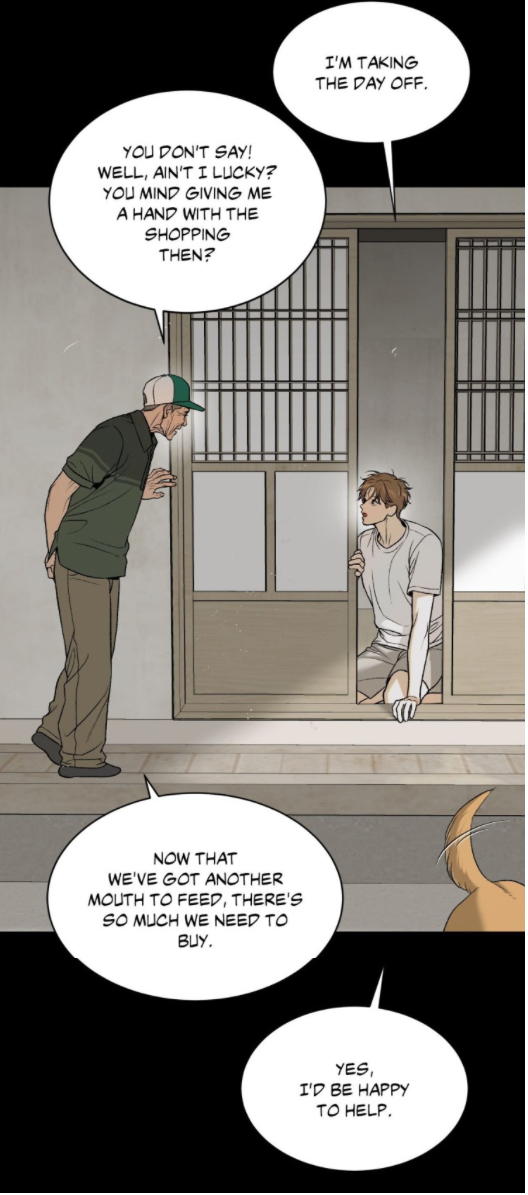 (chapter 70) only after the Seoul trip. This must mean that his conversation with the hospice director—where he was urged to rest—took place between his return from Seoul and the announced day off. We also know that
 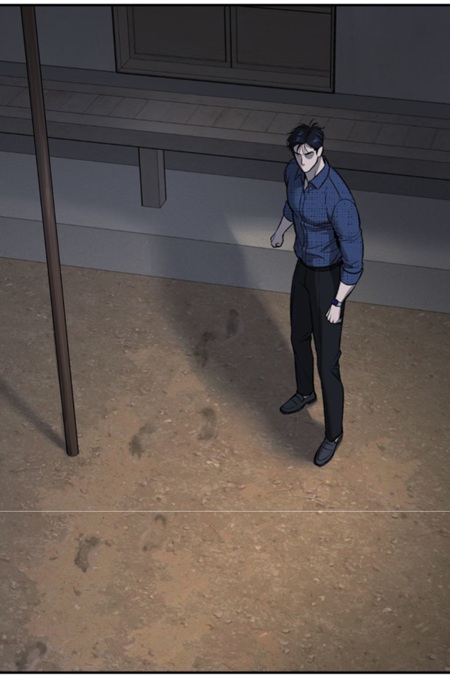 (chapter 69) the champion came back from Seoul in the evening and found footprints near the house, suspecting Dan had wandered to the ocean while drunk. These prints were left that same day
  (chapter 70), when Kim Dan chased the puppies that had stolen the shoes. Based on the shadows and the position of the sun
 (chapter 70), I am deducing that this scene took place during the afternoon. I used these images as a contrast, where the author made it clear that these scenes took place in the morning.
  (Chapter 65)
  (chapter 57) We can determine the time based on the position of the sun and the shadows.
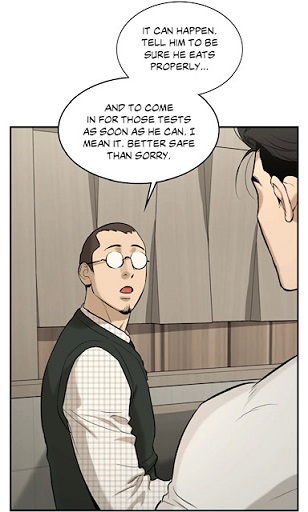 (Chapter 13) But when Kim Dan drops a patient Dan by mistake
  (chapter 59), the director acts immediately—not because of concern for the elderly man,
  (chapter 59) but because he fears that the patient’s family might sue the hospice. The elderly man’s condition was formally assessed, documented, and protected. This scene exposes that they can act in an emergency (taking tests). In contrast, Kim Dan—who is visibly unwell—is not offered even a basic check-up. His illness is reduced to tired eyes and missed sleep, framed as personal negligence rather than systemic failure. He is looked at, not truly seen. While the patient is treated as a legal liability, Dan is treated as disposable labor—an expendable worker whose wellbeing doesn’t justify institutional resources. Thus in my opinion, the director of the hospice suggested that doc Dan took a day off in order to ensure that he had done his duty, taking care of his employee.
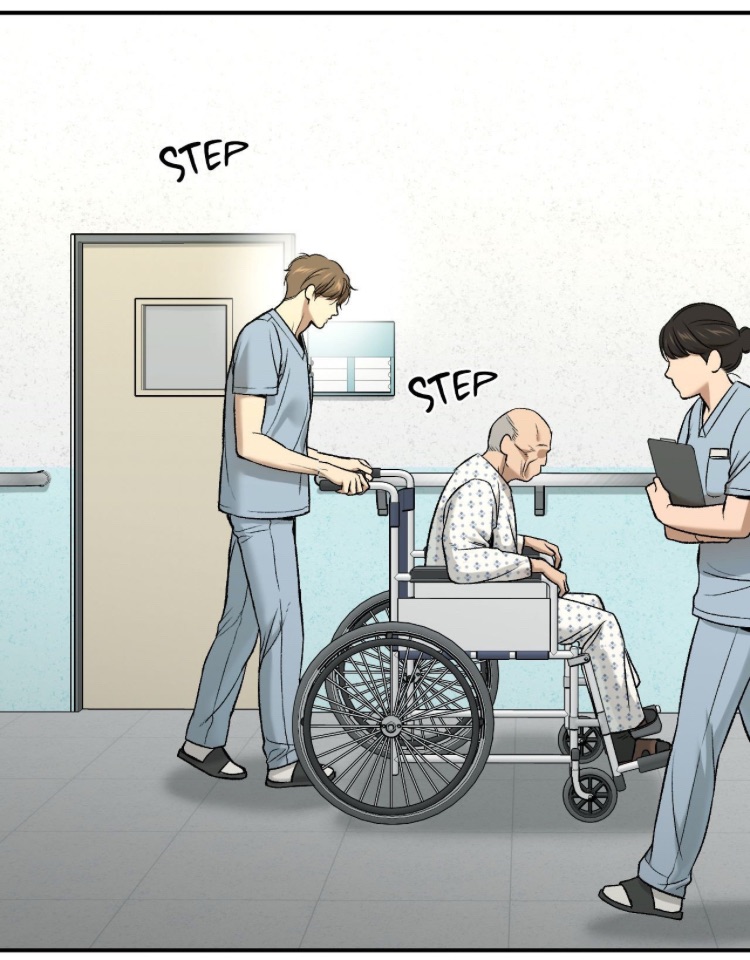 (Chapter 70) His distinct appearance—bald with tufts of grey hair—makes him easily recognizable. What stands out this time is not the accident, but the aftermath of it.
  (Chapter 70) When Kim Dan, again lost in thought, almost bypasses his room, it is this very patient who gently brings him back to reality with the teasing words, “Earth to Doc Dan.” His tone is not accusatory. On the contrary, it’s forgiving—light-hearted even.
 (chapter 62) However, the main lead was still working, thus the athlete concluded that he had made a mistake. He probably assumed that he had the afternoon shift. Hence Joo Jaekyung only returned to the landlord’s house at sunset! So during that day, he must have worked for the morning and afternoon shift. Even here, the doctor was suggested to give a special treatment to the star.
  (Chapter 62) Then in episode 71, we see him working in both afternoon
  (chapter 71) and night scenes,
  (Chapter 71) Therefore we see him in company of different nurses.
  (Chapter 57) He moves between teams, unanchored and isolated. This also explicates why the nurses still have no name. To conclude, his contract implies that Dan is paid by the hour or per shift, without salary-based benefits. I am suspecting, the regular nurses likely operate under different contracts, which could include fixed shifts, team integration, and better protections.
  (Chapter 57) Finally, we shouldn’t overlook that his job is strongly intertwined with his grandmother’s situation. He needed to get a job there, hence he couldn’t negotiate his contract. As long as he had a job as physical therapist, he could only be “happy”.
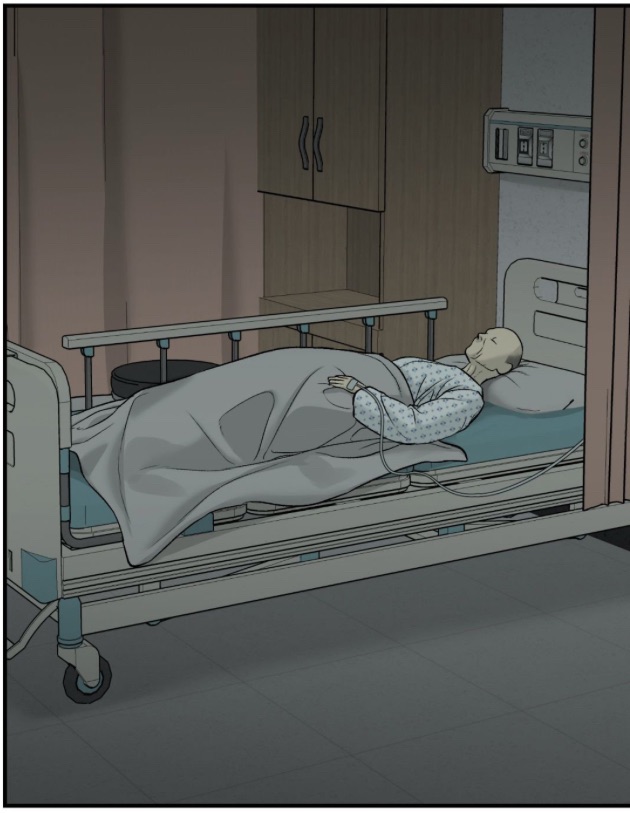 (Chapter 71) in a room designed for six patients—indicated by the six plastic protections outside the door.
  (chapter 65), while the former coach shares a room with three others and lacks personal care.
  (Chapter 71) Shin Okja lives like a VIP. Yes, the new version of this situation:
 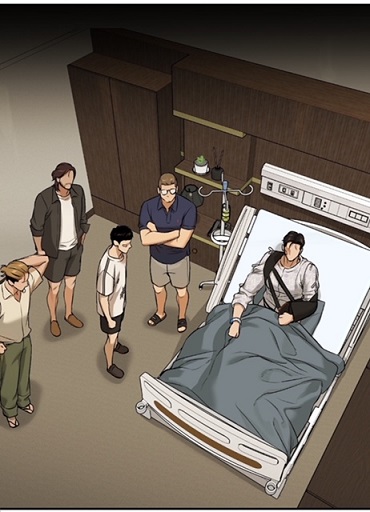 (chapter 52) That’s the reason why Mingwa made another allusion to this particular scene (chapter 52) in episode 71:
 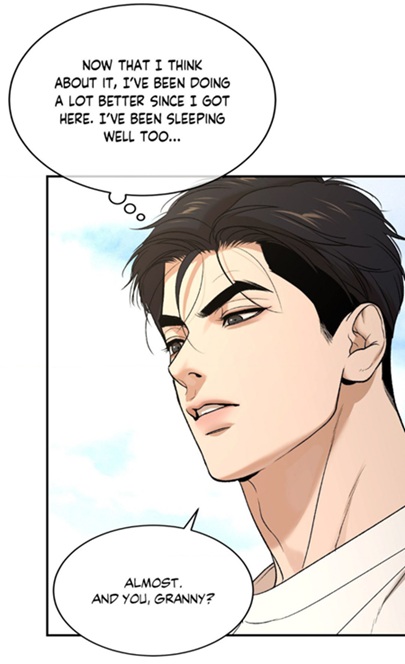 (chapter 65), and he has now a cold.
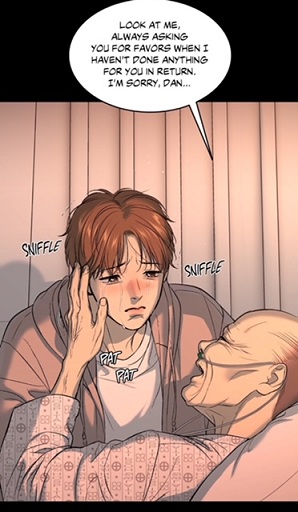 (chapter 53), become lopsided forms of dependency. And his unspoken needs—his own exhaustion, grief, and longing—are never tended to, not even by himself. He is present for everyone, yet no one is truly present for him. That’s the reason why Shin Okja knows nothing about her own grandson’s interests and dreams.
  (Chapter 65)
  (Chapter 71) In German, he would be an “alter Kauz”—an eccentric owl. But this metaphor reaches deeper than mere strangeness or aging.
  (chapter 65) Dan was found wandering the night in his sleep, pulled by unconscious fears.
  (Chapter 65) These moments mirror the owl’s behavior: navigating darkness, moving alone, and being misunderstood. Thus, the owl becomes a powerful symbol not only of the former coach but of Kim Dan himself—both are creatures of the night, shaped by what they see and endure in silence. In contrast to the chattering coot, the owl watches and remembers. And perhaps, the presence of both birds suggests that the coach, once a loud and reckless coot, is beginning to see with the quiet eyes of the owl—finally noticing the suffering he once overlooked. Their shared nocturnality ties them together: one hoots and curses, the other drifts wordlessly—but both are left behind by the daylight world.Doc Dan’s nightly behavior made me think of an owl.
  (quoted from
  (chapter 71) suggests that communication doesn’t always have to be soft to be sincere. It is precisely the coach’s lack of elegance that makes him relatable to Dan.
  (Chapter 71) This dynamic becomes especially meaningful when we recall that Kim Dan’s symbolic animal is the duck—a creature often seen as passive or domesticated, gliding over water while paddling furiously underneath. As discussed above, the duck stands for Dan’s silent endurance, his ability to move between unstable emotional terrains without ever making a splash.
 (chapter 22).
 (chapter 71), a joke. But there’s another side to the owl—the side that watches the night, that sees what others do not. And in this hospice, maybe for the first time, the former coach becomes something more: a witness who is no longer silent. An old man who still has eyes.
 (Chapter 71) The other carries bitterness and the guilt of watching too long without speaking. In this dim hallway of illness and endurance, their connection becomes a muted call for dignity.
 of season 4 for this essay, though my focus is the past, and more precisely Yoon Seungho’s suffering. It is because the darkness surrounding the protagonist not only refers to his tragic youth, but also it reflects the situation of the manhwalovers. The latter are still in the dark concerning his torment. His terrible secrets have not been totally unveiled. So far, the author allowed the readers to see glimpses of his past, like f. ex. the gangrape or the suicide of his mother. But these were just small pieces of the puzzle, thus it is still impossible to have a complete picture of his martyrdom. There are many reasons for this. The main victim never testified about his suffering, he refused to open up to Baek Na-Kyum.
  (chapter 84) Then many witnesses vanished
  (chapter 86) or the ones alive preferred telling lies in order to hide their own wrongdoings or are simply in denial about their own culpability. Finally, the victim, the perpetrators and accomplices had no idea about the whole truth. They only know or knew certain facts, because many of them were deceived as well. What exactly happened to Yoon Seungho? How could this take place, though he belonged to one of the most powerful noble families? Now, you are probably expecting that I will give you answers to all these questions, and recreate the past. But I have to admit that it is not possible, for I don’t know the whole chronology. Consequently, I added “shadowy” in the title. To conclude, my real intention is more to offer new pieces from the riddle than create a whole new “story”. The main source for this new insight is the painter’s fate which is a reflection from the noble’s past and torment. This means that Byeonduck left traces in season 1, 2 and 3! That’s how I discovered that he had been abandoned and betrayed by everyone, kidnapped, treated as a male kisaeng, robbed, abused, raped and even gangraped at least twice, tortured and finally drugged! But like mentioned above, it is difficult to give the proper order and the persons truly involved in the crimes. On the other hand, what I can guarantee is that Yoon Seungho’s nightmare is linked to conspiracies. I came to this conclusion, because if you compare all the seasons, you will detect the presence of plots. There exists at least 3 main plots in each season, though there definitely exist more. The conspiracies are all connected to incidents.
  (chapter 9), so that the latter visited Lee Jihwa to arouse his jealousy. It was to push him to commit a crime so that Baek Na-Kyum would be removed from the main lead’s side. As you can see, there were 3 people involved, though the readers only saw the result.
  (chapter 12) They had the impression that the red-haired master had acted on his own. However, he had been manipulated, incited to commit a crime. But my point is not to diminish his wrongdoing, rather to expose the involvement of the schemers. Hence at the end of season 1, the author unveiled their true role and as such their identities.
  (chapter 43) However, observe that when Lee Jihwa went to the pavilion, the noble with the mole had other guests. 2 nobles left the place, as they refused to participate in a murder.
  (chapter 43) Funny is that they are now witnesses of Min’s crime. This can have repercussions in season 4. Black Heart had been the one who had suggested the assassination to Lee Jihwa. And the aristocrats were still there, when he had made this proposition.
  (chapter 19) And this is related to Kim and the gibang. Yet, the butler ruined Black Heart’s plan. To conclude, we have two main plotters in season 1, but the butler’s bad intentions were not detected, for Yoon Seungho’s bad actions were more eye-catching. People had the impression that the valet was defending the artist’s best interest. From my point of view, the number of persons involved in the plot kept increasing, as they needed more and more accomplices. The reason is that their plans didn’t work out like expected. At the end of season 3, Min involved the kisaengs in the gibang, while Kim asked the assistance of the staff, the maids
  (chapter 91) and the servants
  (chapter 97). Thus I deduce that in the past, the same must have happened. Many people were involved in the downfall of Yoon Seungho and his family. But who was the real target in the end? It is difficult to say with 100% certainty.
 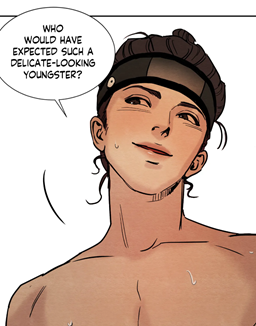 (chapter 8) Thus in season 2, he came to this resolution:
 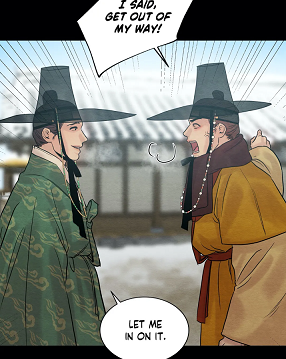 (chapter 56) He had planned to rape him before having him eliminated. This shows his inner conflict. From my point of view, the painter’s death is connected to the incident in the gibang.
  (chapter 1) Baek Na-Kyum was a witness of Min’s wrongdoing, just like the painter was a witness and victim of his crimes in the shrine. (chapter 99) One thing is sure: Min was full of greed and jealousy. He was determined to harm and ruin Yoon Seungho. Hence I come to the deduction that the real target of the conspiracy in the past was Yoon Chang-Hyeon. And his son was used against him.
  (chapter 16) This doesn’t look like a crime. However, it is one! It was done on purpose, to separate the couple. Someone had intervened in order to interrupt this session, and as such someone had been spying on them. Deok-Jae only revealed his spying activity from chapter 16 in season 2:
  (chapter 53) Yet, the one opening the door had been Kim. This gesture can be considered as trespassing and invasion of privacy, the new version of this scene.
  (chapter 16) But instead of revealing the truth, the butler sided with Lee Jihwa, and allowed him to trespass the propriety again. In my eyes, the butler thought
  (chapter 17) that Yoon Seungho would come to perceive the painter as a man consumed by lust. He imagined that he would caught them fooling around. As you can see, this ruckus was also a plot, though it doesn’t look like one. Why would the maids gossip in the courtyard?
  (chapter 18) From my point of view, the valet expected that the lord would fear people’s gaze and a scandal. Thus he would send away the painter to protect his “reputation”, but the opposite happened. Under this perspective, the manhwalovers can grasp why it is difficult to calculate accurately the number of plots and accomplices. Besides, some were naïve pawns, others not. And since I examined the first season more closely, it is necessary to analyze the vanishing of Jung In-Hun. His disappearance is strongly intertwined with Yoon Seungho’s secret. How so? The learned sir was determined to find the lord’s vulnerability and as such secret.
 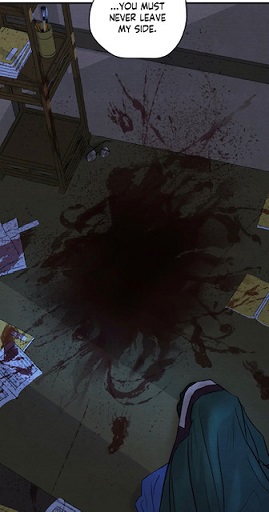 (chapter 88) Thus many readers jumped to the conclusion that the learned sir had already switched sides and was plotting against the main lead. They had his following words in their mind:
 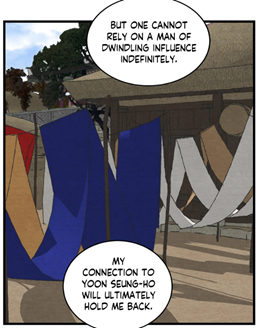 (chapter 29) Thus many concluded that he had participated in the prank, faking his death. On the other hand, the manhwalovers believed to have seen Heena’s death!
  (chapter 99) However, observe that we never saw her corpse. She was still alive in this panel. I had already pointed out that her murder was actually faked. Her mouth was not covered, hence she could have screamed, but she remained silent (blank speech bubble). Secondly, she never moved her legs… contrary to Yoon Seungho’s behavior in the gibang.
  (chapter 68) That’s the reason why I came to the conclusion that
  (chapter 37) who is the king in my eyes. [For more read the essay “
 (chapter 37) Since Baek Na-Kyum was wearing a hanbok, Yoon Seung-Won thought that the person hidden under the hanbok was no commoner! Thus he called him a fellow. However, this motive is quite thin! Yet, two new details caught my attention. His visit to the “fake shaman” and his request. Notice what he told the man:
 (chapter 86) However, in reality, he was relying on the king’s help and intervention. And this confession to the “fake shaman” represents the learned sir’s karma. He had asked the painter to act like a spy
  (chapter 24), not realizing that he could be spied himself! He didn’t grasp that he exposed his weakness to the commoner: the civil service examination. Thus the man had constantly drops of sweat
 on his face and interrogated Jung In-Hun.
 (chapter 29) The girl was there to create a certain closeness. He was acting like Kim, asking why! But the stupid and arrogant learned sir thought that because the man was a commoner, he was ignorant and could be manipulated like the painter!
  (chapter 29) He thought that the low-born would buy his lie here… but in my eyes, it was the opposite. He had already perceived the learned sir’s true nature. But he acted, as if he was agreeing. In other words, the scholar fell into his own trap. He envisioned that the man was “powerless”, but he overlooked his connections. The manhwalovers can see the contradiction, for he had approached the man due to his connections! .As you can see, I am more than ever convinced that the scholar has long been murdered. He was betrayed, exactly like he had planned to abandon Yoon Seungho! The pedophile must have heard from the servant about Jung’s plan, as he had confided it to the worker!!
  (chapter 37) But this doesn’t end here.
  (chapter 37) Yoon Chang-Hyeon was portrayed as a traitor! The “fake servant” implied with his statement that there was a conspiracy, and the patriarch was involved. But in exchange to save his own skin, he had tattled on the others! He was trying to insinuate that if Jung In-Hun interacted more with the Yoons, his reputation could get tainted. He could get suspected of “treason” too, or he could get betrayed too. While the man met the learned sir during the day, the brother went to the villa in a hurry during the night.
  (chapter 36) Hence he chose a different approach: filial duty. And the brother’s observation could only corroborate the pedophile’s perception. The scholar was Yoon Seungho’s lover, but he was also a backstabber. But let’s return our attention to the “mysterious lord Song”‘s statement: Yoon Chang-Hyeon is a denunciator, not a man of honor.
  (Chapter 67) Lee Jihwa had not only been denunciated, but he had been confronted by his friend! And the traitor was right by his side. As you can see, chapter 67 was a reflection from episode 37!! These two episodes have another common denominator: the betrayer had made the following suggestion.
  (chapter 67) In exchange for his “survival”, he should help Black Heart and allow him to act on his behalf. This was the new plan. That’s how he started impersonating Lee Jihwa. That’s the reason why I come to the conclusion that in the past, the impersonation must have happened, but it took place in the beginning. Secondly, I am assuming that a traitor must have suggested to Yoon Chang-Hyeon to leave the mansion and abandon his son behind!
  (chapter 27) And who is it? For me, it is Kim acting on the pedophile’s behalf. Striking is that in episode 27, the learned sir escaped death thanks to the intervention of the old bearded domestic and Baek Na-Kyum. Thus it came to my mind that the pedophile could even claim that he had eliminated the learned sir, because Yoon Seungho had attempted himself to kill him in the past. He had acted on his behalf. And what do have all these chapters have in common? SPYING and tattling! In episode 27, the servant unveiled a part of the past,
  (chapter 27) Someone had tattled on the Yoons in the past, but the patriarch was turned into the traitor himself which the young main lead came to believe. Thus Yoon Seungho could say this to his father:
  (chapter 86) However, I am suspecting that this is not true, someone else tattled on the powerful family and made a false accusation! As you can imagine, I am inclined to think that father Lee must have been behind this! Why? It is because he can no longer do it! Thus in season 3, he approached the patriarch Yoon.
  (chapter 82) If the lord Seungho had truly committed a crime, he should have reported it to the authorities. The stupid Yoon Chang-Hyeon never wondered why the elder Lee visited him during the night and asked for his assistance. Furthermore, the elder Lee had been allowed to enter the bedchamber and see the huge drawing which could have been perceived as a sign of treason. He was eyeing at the throne.
  (chapter 82) Note that the aristocrat mentioned “punishment” in this context. So maybe, he denunciated the patriarch so that the whole family would get punished. Father Lee was definitely played in this scene, hence I believe that someone had already anticipated his reactions. He would seek revenge. But this doesn’t end here. I had connected “rash departure” to “treason and spying”. And now, observe what Yoon Seungho said to his butler
  (chapter 50) He had sent Jung In-Hun away in order to get rid of him! However, because of the expression “I thought”, I am quite certain that this idea had been suggested to him by the valet! I would like to underline that in this episode, the valet was acting as a tattler!
  (chapter 50) But in order to hide his own crime, he portrayed it as a rumor (It may not be accurate”). This truly underlines the butler’s MO. He used information and turned it as gossips to hide his spying activities. The shadow… Simultaneously, he turned gossips into a verity!! This is no coincidence that in season 3, the same method was employed. Yoon Seungho was supposed to have murdered the scholar and Deok-Jae! My avid readers can sense the leitmotiv in all these episodes. RUMORS are turned into a reality, and as such a CRIME! Even here…
  (chapter 37)
 (chapter 86) But since our beloved man started living in the bedchamber, this became a reality. That’s the other reason why Yoon Seungho was encouraged to live in debauchery and not to take the civil service examination. But this only occurred, the moment the lord returned living in the mansion and not before!! Secondly, I realized that this statement about Yoon Chang-Hyeon will become a reality for the “fake servant” himself.
 (chapter 94) This means that he acted as a traitor, tattling on his own relative. Finally, observe that once confronted with brutal reality, the father did run away.
  (chapter 87) The white bearded man’s words became a reality. However, since the fake servant, the mysterious lord Song, judges the elder master Yoon as a troublemaker and hypocrite, there is no ambiguity that the elder master Yoon will get into trouble. Since he did it in the past, he can only get suspected in the present.
  (chapter 86) But the worst would be that the painter is blamed for his assassination. He did it out of resent! But this would expose the true thoughts of the schemers, the pedophile and Kim. That’s how they act, when they feel offended and bothered.
  For me, the younger brother’s biggest wrongdoings are spying, tattling and badmouthing. And the best evidence for this interpretation is this situation:
  (chapter 44) He had given the ruined painting to his father, putting the blame on his brother, well aware that the latter would get angry. He was observing his father’s reaction.
  (chapter 44) Yet, there is a difference to the past. Here, he had been fooled! He truly believed that this was his brother’s doing, whereas in truth the butler had been the one who had fooled him.
  (chapter 38) And this is important, because when the letter was given to the brother, Jung In-Hun witnessed the wrongdoing from the butler!!
  (chapter 38) And now, you know why the learned sir had to die!! He had caught the valet in the act. He had betrayed Yoon Seungho, though he didn’t realize it. The learned sir tried to discover the content of the letter, and as such was prying on his sponsor’s weakness.
 (chapter 38) Hence I come to the conclusion that KIM played a huge role in the learned sir’s death as well. I would even say that he was the one who pushed the others to have the scholar and the painter killed. Both knew about the butler’s tricks without realizing his significance.
  (chapter 37) Hence I deduce that as the story progressed, the role of the butler started changing. Now, I see him as a the main plotter, while all the others are now his pawns. We could say that the valet has gradually followed the pedophile’s path. However, there is no ambiguity that it was not the same in the past!
 (chapter 83) How can he be the same than the one from episode 37? The change of his hair color could be explained by a huge shock. But this is rather thin as a justification. Besides, now I am more inclined to think that these are two different persons, and that the main culprit is the one from episode 37. Why? It is because he smoked and utilized the same expression: “strange”.
  (chapter 37) An idiom that Yoon Seungho constantly utilized: chapter 16, chapter 21
 , chapter 50, chapter 71
  (chapter 71). This means that he couldn’t understand, for he has a different way of thinking. This outlines his narrow-mindedness and his tendency to plan everything. He doesn’t like surprises.
  (chapter 69) Hence I started wondering if the mysterious man with the beard was not impersonating someone, for example “lord Song” and in reality he was just a merchant. Why merchant? It is related to the shungas and the hanboks. The king can not be involved in trading directly. However, this is what Yoon Seungho told to the learned sir:
  (chapter 22) Nevertheless, the main lead could have never been involved in commerce, for he lived as a prisoner for many years. And this is what was said about the ruler:
  (chapter 76) He is not so wealthy. How come? Yoon Seungho’s fortune must have a different origin.
  (chapter 102) Min had never predicted that the young master would run to his friend and denunciate him to Yoon Seungho. However, since Black Heart had employed the assistance of servants
 (chapter 101) , the kisaengs
  (chapter 95)
  (chapter 96), the officer
  (chapter 98), No-Name, the doctor with the drugs and butler Kim, this signifies that behind the name Lee Jihwa stand many people! As you can see, the name “lord Song” doesn’t refer to one person, but many… My theory is that No-Name is the true owner of the title, but that’s how he ended up losing his home and his name! That’s the reason why I believe that in this image
  (chapter 71)
  chapter 87) and
  episode 92. The schemers in the past had definitely played with illusions and tricks. Thus I am expecting that it is now the pedophile’s turn to get fooled.
 (chapter 82)
 (chapter 36) Here, the painter was forced to take an aphrodisiac under the pretense of his health. This action was repeated in season 2
  (chapter 54) and 3.
  (chapter 100) The nobles made him smoke opium or drink the aphrodisiac. The purpose of such drugs is to obtain the painter’s submission and control his mind and reactions. Striking is that each time, the perpetrators were “punished”. Kim was insulted and his plan didn’t work out.
  (chapter 37) As for the young lords, they were evicted like commoners and later the others were even killed. As you can see, each time the poison was employed, there was a retaliation.
  (chapter 47)
 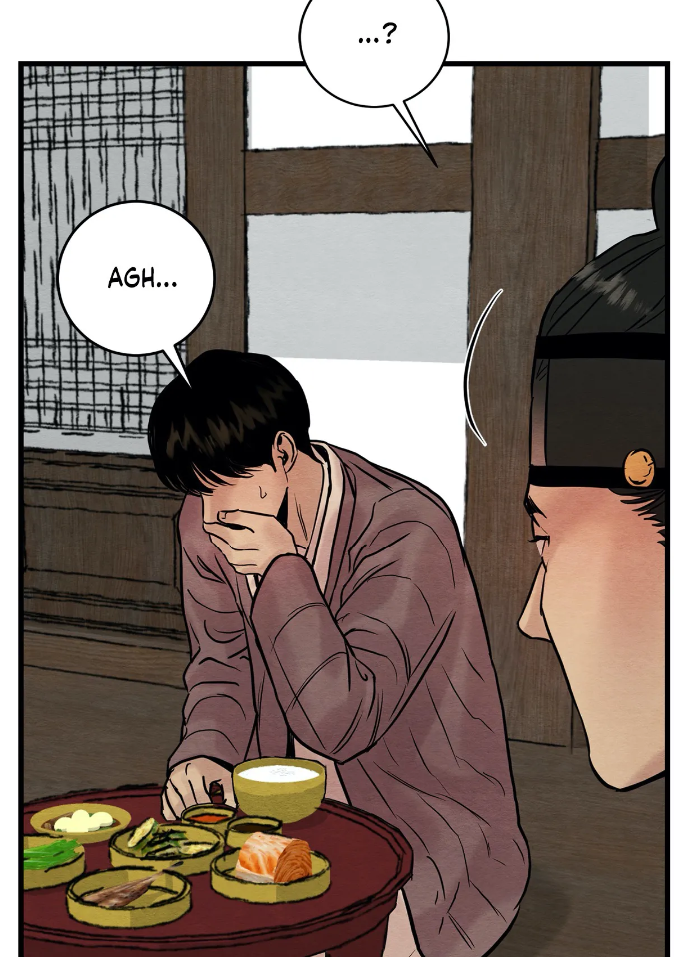 (chapter 47) If the painter had not eaten with the lord, the latter would have never noticed the incident. However, he believed the maids’ words.
  (chapter 47) Hence he never investigated the matter. But this prank represented a serious issue. This could have been judged as an attempt against the owner of the mansion.
 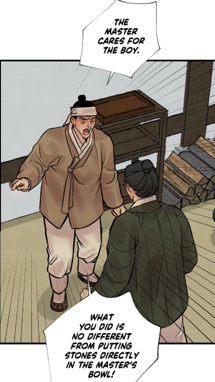 (chapter 47) And now look at this panel:
  (chapter 83) Yoon Seungho had refused to take the drug! The bowl reminded me of the one from chapter 47! Finally, the butler had tried to give his master the drug in season 3
  (chapter 77), but the latter had again rejected it and this twice.
 (chapter 77) Kim calls the drug “medicinal tea”, truly an euphemism. It is also possible that the real target of the poisoning was Yoon Seungho, but since he was protected by the gods, someone ended up taking the “drug”. Because he was wearing a purple hanbok, the investigator mistook his identity, a royal member. Hence the Yoons were suspected of treason. Don’t forget that during this party, there was a kisaeng by their side.
  (chapter 56), he came to adopt this title in order to hide his identity and actions. Byeonduck explained in her notes that Baek Na-Kyum had no idea about Min’s name. And this is the same for Yoon Seungho. The pedophile could continue hiding behind “lord Song”, as the latter was blamed for everything. The pedophile could divert attention from his own tricks. That’s the reason why he would never write any letter to Yoon Seungho under this name. This means that at the end, the main culprit, the king, will be perceived as the main responsible for Yoon Seungho’s torment, similar to Min’s situation, just before got killed. Though many other people were involved, Yoon Seungho was able to judge the joker’s actions correctly, he was the main mastermind behind the plots. This explicates why the gods made Yoon Seungho forget the old bearded men’s face.
  (chapter 44) This was a blessing in disguise. The moment the main lead faces the king, Yoon Seungho will be able perceive the truth. The king was behind his torment, and the butler had been his helping hand all along, the professional spy planted in his family. However, I don’t think that the monarch will admit his crimes and apologize for his wrongdoings. He will need a scapegoat, and this can only be the butler, the only one who knows the truth!
 on Twitter yesterday, and naturally this made many people happy, for Jung In-Hun was stroking Baek Na-Kyum’s foot gently. How could people identify the characters, though we don’t see their faces? Simply by the clothes! The manhwaphiles remember the painter’s grey pants and the learned sir’s favorite color, lavender,
 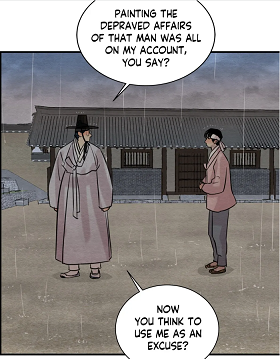 (chapter 19)
 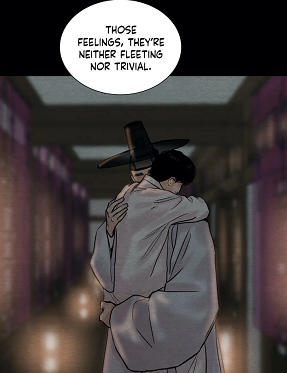 (chapter 68). While many manhwalovers found this image cute
  (chapter 70) The manhwalovers can immediately detect the contrasts: the visages of the protagonists versus the hand and the foot, day versus night, sun versus moon. That’s the reason why I came to the deduction that this image embodies a happy memory of the painter: sadness versus happiness.
  (chapter 70). The trigger for this recollection was his farewell to Heena. This time, he could say goodbye to Heena properly by embracing her and giving her a scarf so that she would remember him. In the painter’s mind, after that night, he would never see her again.
 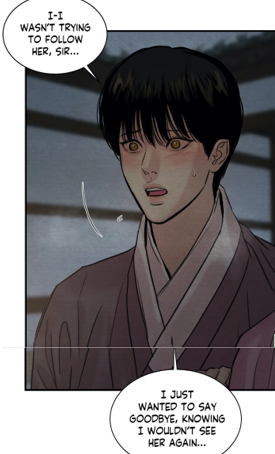 (chapter 69) In other words, this night represented a closure for Baek Na-Kyum, the end of his abandonment issues. In episode 70, Jung In-Hun had consoled him, he had tried to cheer him up. Thus the learned sir was smiling. Yet, this couldn’t cover the painter’s scar. He felt that he had betrayed Heena, for he had not been able to protect her. It was, as if he had run away. Nevertheless, when this incident occurred, the learned sir had not run away from the gibang, because you could see that Baek Na-Kyum was wearing socks and shoes.
 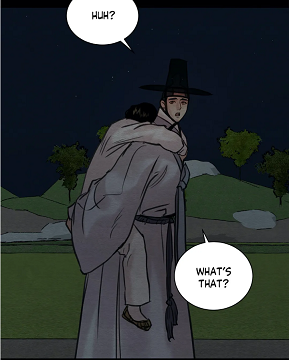 (chapter 70) The man had put the shoes on the child, as in the building, the painter only had his socks on. Because of the presence of the socks,
 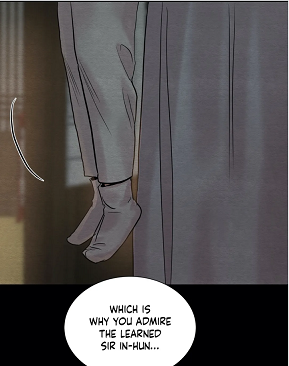 (chapter 68), I deduce that this walk must have taken place in a colder season (fall)
  while in this picture, Jung In-Hun was carrying the painter on his shoulders in the summer.
 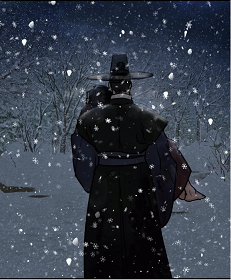 (chapter 102) In both scenes, the main lead is seen with bare feet. He is also carried by his loved one. But here, it is snowing, hence this signifies that it is winter. On the other hand, the manhwalovers can detect the presence of a purple flower on the right side. This signifies that Spring is on its way. That’s how I came to realize why Baek Na-Kyum is now recalling the learned sir’s gesture from the past.
  (chapter 102) where it is even colder than in the valley, secondly it is snowing and there is no sun, only the moonlight. So the moment Yoon Seungho witnessed that Baek Na-Kyum was alive, he must have recognized the seriousness of the situation. Since Baek Na-Kyum had only a hanbok on, he could die of hypothermia. What he had imagined for himself, death, had terrible consequences. He could be the reason for the painter’s curtains. So in my opinion, he must have warmed the painter’s feet with his hands, a new version of this scene:
 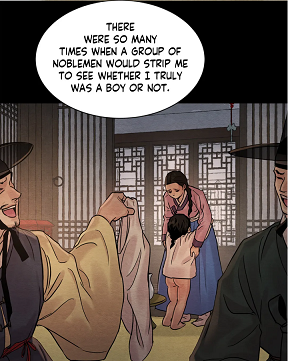 (chapter 94) His presence was to divert the attention from these men so that she wouldn’t be asked to have sex with them. And since I have already detected that each time, the painter suffered, karma would retaliate, the logical consequence is that Heena got punished for her wrong action. This signifies that while the painter was following the learned sir, his noona was abused in the kisaeng house. This would explicate why later she had no remorse to turn Yoon Seungho into a victim. And don’t forget that the painter was much younger than in this scene.
 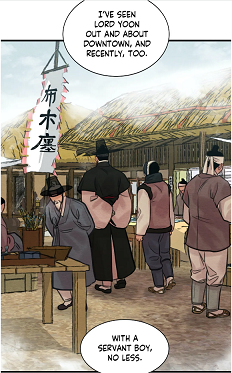 (chapter 45)
  (chapter 75) The latter would let his partner walk through town in order to please him. He would even follow the painter. In other words, it was always for the painter’s sake, and in the mountain, it was the same. But it was not the same for Jung In-Hun, it was for his own benefit. We have the best example in chapter 10:
  (chapter 10) Here, he desired to separate the couple. Baek Na-Kyum should refuse to paint erotic pictures.
  (chapter 29)
  (chapter 70): The artist is dressed with good clothes, he looks more like a young master than a commoner, only the shoes are indicating that he is a commoner. That’s the reason why I believe that during that night, the learned sir was avoiding people. They could have wondered why the young boy was carried in his night clothes outside. From my point of view, this scene
  (chapter 29) He had already been seen with a girl before who seems to like him either.
  (chapter 6) Thus I couldn’t help myself wondering if the learned sir was not directly involved in prostitution, bringing girls to the gibang and even covering up for the sexual child abuse. We shouldn’t forget that the pedophile was portrayed as a man consumed by lust who would never pay attention to the time and the hour.
  (chapter 6)
  (chapter 7)
  (chapter 7) This change is not random in my eyes. I had already associated the learned sir to a chameleon. This change of color seems to validate my theory that Jung In-Hun had been sponsored by Min, hence we have the light green. Black Heart is symbolized by green. However, the light pigment reflects that he had been abandoned and betrayed. Nonetheless, when he encountered Yoon Seungho, the latter was wearing a purple hanbok.
  (chapter 6) That’s how the man got influenced and chose to wear his lavender hanboks again. But he never realized that behind the young noble, there was standing the pedophile, someone he had helped in the past. From my point of view, the change of the learned sir’s hanbok was the indication of his betrayal. According to me, the old bearded man
  (chapter 83) According to me, in the painter’s vision from episode 1, the braided man is Yoon Seungho. The absence of shoes and socks was in truth an indication of neglect and abuse, but the warmth and gentleness from that scene deceived the painter:
  (chapter 73) From my point of view, the intimacy in the bedchamber stands in opposition to the teacher’s gesture in the countryside. His caress was just a casual gesture with no real deep meaning in the end. This explicates why he could betray and abandon the artist on so many occasions in season 1 (chapter 11, 24, 25, 29, 35, 40). The learned sir had always prioritized his own interests.
  (chapter 102), the painter should realize the difference.
  (chapter 70) talk and ask questions before apologizing and hugging him. The lord never acted, as if nothing had happened,
  (chapter 102) This was true love and Baek Na-Kyum’s feet always reflect his emotions:
  (chapter 58)
  (chapter 80) So now, imagine how the painter must feel if the lord took his feet in his hands! This is no coincidence that there is this saying:
  (chapter 100)
 (chapter 102) and the zooms on the feet:
  (chapter 53)
  The couple was following their heart!! But this was not the case with the scholar. Baek Na-Kyum had no other choice than to follow Jung In-Hun.
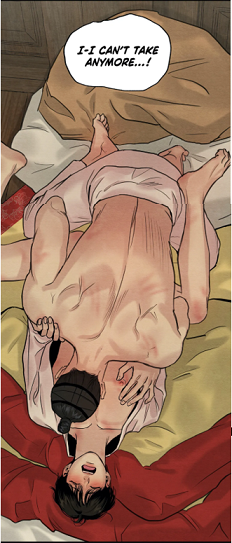 (chapter 89) The lord’s back is covered with marks. Yet, he was not brown-nosing here at all, for he was rejecting the lord’s advances. And now, it is time to take a closer look to season 1.
  (chapter 23) Baek Na-Kyum was seen holding an apple, here it looked like he was indeed polishing the fruit before eating it. Striking is that during that scene, valet Kim was interrogating him. He was acting, as if he was interested in him. It was, as if he was buttering up to Baek Na-Kyum. The purpose was to gain the artist’s trust so that at the end, he would listen to his advices.
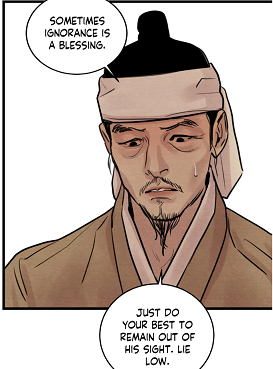 (chapter 23) However, the reality was that the valet was actually digging for information, spying on the main lead, so that he could create a new incident. As you can see, there were two apple-polishers in that scene, the painter and the butler. This was the reflection within the same episode. While Baek Na-Kyum was literally polishing the apple, the other was just cajoling Baek Na-Kyum in a figurative way. Yet, the former was not truly sweet-talking to the artist. He gave the impression that he was totally honest. And now, it is important to recall what happened to the painter in the next chapter. Jung In-Hun was kissing the painter’s hands.
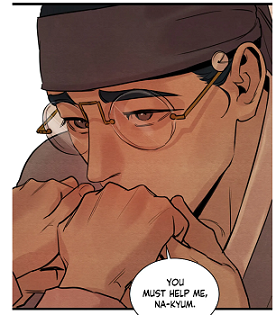 (chapter 24). He was flattering the painter with the hope that Baek Na-Kyum would spy on his account. But the scholar couldn’t succeed with his request. Why? It is because he only kissed the artist’s hands. He never licked his boot or his ass. We could even say that he did scratch his back, but in the wrong way:
  (chapter 24) In other words, he could never lower himself in front of the low-born. This was too much, explaining why the scholar failed with his request.
  (chapter 27) In exchange for saving Jung In-Hun’s life, Baek Na-Kyum was forced to do a fellatio. We could say that the artist was sucking up to the owner of the mansion. But the fellatio is not just an exchange of favors. It is also associated to forgiveness. At the tailor’s shop, the painter had blushed because of Yoon Seungho, The latter had embarrassed him. Thus the lord made the following suggestion:
 (Chapter 39) This was his way to apologize, though here he was teasing his lover. These were the principles he had been taught, therefore it is not surprising that he applied them for the painter. And now, you comprehend why in episode 71, Yoon Seungho sucked the painter’s phallus in the bathroom, he was also currying the artist’s favors. His goal was not to be pushed away, to be accepted.
 (chapter 71) He had wronged the painter so many times, that the blow-job was not enough. Thus he licked his ass in the bedchamber. He was hoping to seek his forgiveness.
 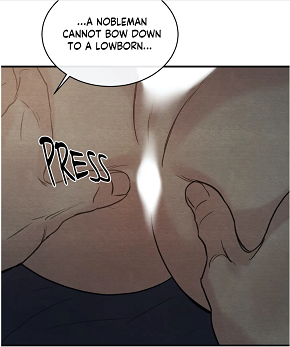 (chapter 71) It was, as if he was lowering his head, the kowtower. In this episode, the lord was on his knees in front of the painter, and this twice. One in the bathroom
 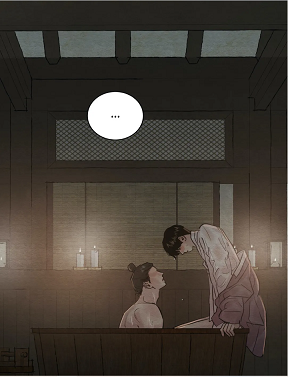 (chapter 71) and the other time in the bedchamber.
 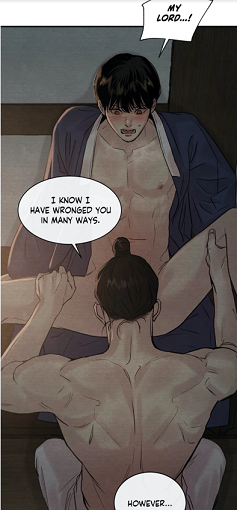 (chapter 71) However, his nose didn’t get brown, as the painter is a pure and innocent person. 😉 That’s how I realized why Baek Na-Kyum was sent to the bathroom. His role was to divert Yoon Seungho’s attention from Kim so that the master would forget to ask for the butler’s punishment. In other words, the valet used the low-born to seek his master’s favors. This shows that Yoon Seungho had been taught that the blow-job and the ass-kissing are the means to obtain forgiveness.
 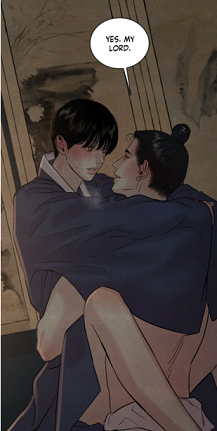 (chapter 72) On the other hand, the latter scratched the lord’s back for the first time during that night.
  (chapter 72) This was the reflection within the same episode, yet the “back-scratcher” was not doing it for his personal gain at all. We couldn’t say that he was currying favor or buttering up Yoon Seungho. He believed that he was just a servant and nothing more. From the outsider’s perspective, he was treated indeed like a favored servant, though in truth Yoon Seungho viewed him more like his new master and lord.
 (chapter 45) In this scene, the lord was acting like a teacher, and the painter was supposed to do a blow-job in exchange for a favor. But since the painter was heartbroken, he was doing it absent-mindedly. Thus the roles got switched. After the noble licked the painter’s ass,
  and masturbated him anal, the painter was able to confess his pleasure:
  (chapter 45) This shows that the lord was slowly “currying favors” to Baek Na-Kyum. And this is no coincidence that Kim brought the ink and brushes to the mansion.
  (chapter 45) Once again, he was acting, as if he was buttering up to Baek Na-Kyum and indirectly to the host. But the reality was that everything was done for Kim’s interest…. On the other hand, we could say that Yoon Seungho was not really different from his surrogate father, for in that scene, Yoon Seungho was more thinking about himself than the painter’s. Yet, there is a slight nuance, the lord was sensing that the painter was not himself. He was talking to him, so licking the painter’s ass was not just done in order to obtain the painter’s support. His true goal was to be noticed and looked by the painter. He desired to have a true exchange of thoughts. Interesting is that by licking briefly the painter’s ass, he indeed succeeded, Baek Na-Kyum started thinking about him afterwards. The irony is that Yoon Seungho was just applying what he had been taught. That’s how I discovered the other reason why the main lead is not suspecting the butler of treason. Contrary to Yoon Chang-Hyeon or the pedophile, Kim was never seen asking Yoon Seungho for sexual favors: no fellatio or no ass-kissing. But this is just a deception, for we could clearly see that the butler is connected to the sex parties:
  (chapter 33)
  (chapter 52) He was the one who separated the couple. Because of his intervention, the painter deserted the mansion and got sick afterwards. Then in chapter 50, he revealed the argument between Baek Na-Kyum and Jung In-Hun. Striking is that in that scene, he was standing on the lord’s left side!!
  (chapter 50) In fact, he should have “buttered up” his master and not pitied the painter. And now, you comprehend why the main lead misinterpreted Kim’s behavior. In his mind, the valet was actually “apple-polishing” to the painter. He had somehow “witnessed” it in the woods. But he had misjudged the situation, in reality he had caught Kim spying.
 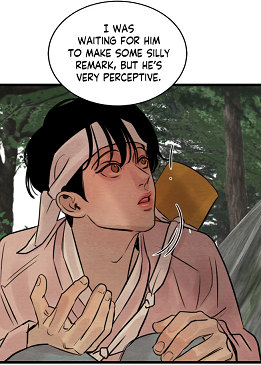 (chapter 23) Unfortunately, the lord was not perceptive at all.
 (chapter 80) He enjoyed seeing the painter’s facial expressions and reaction. He looked so shy and pure.
  (chapter 80) However, during that night, three people were trying to bootlick someone figuratively speaking: the new version of Deok-Jae, Kim and the messenger. Let’s not forget that before the arrival of the messenger, the painter made the following request to the butler:
  (chapter 79) One might say that he was currying favor to the butler, when he asked the butler about the music box. But what did Kim do? He brought the item to the bedchamber.
  (chapter 79) But this is not what the painter had actually requested, since the butler said this “I thought”. He had taken the initiative on his own. In my opinion, the painter had just asked that the music box should be brought back to the study. However, Kim brought the expensive present to the bedchamber for one reason. He expected the arrival of the messenger. We could say that he was “ass-kissing” the painter in order to obtain his trust. Kim definitely imagined that Yoon Seungho was sleeping. As you can see, this scene was the reflection of Yoon Seungho’s action in chapter 80.
  (chapter 80) While Kim had asked the painter’s to clean his face himself, the lord was cleaning the painter’s ass himself. Or we could say that he was polishing the painter’s apples, for he has an apple-shaped buttock. 😂 This clearly indicates that Kim has never washed Yoon Seungho himself. In other words, while Yoon Seungho was totally selfless here, this was not the case for the valet. And this is no coincidence that right after, the new version of Deok-Jae appeared in front of the door calling his master. He was faking loyalty and dedication.
  (chapter 80) Here, he was acting, as if he was sucking up to Yoon Seungho, but his gaze betrayed him. In my opinion, he had been deceived by the butler, for the latter expected that the painter would open the door. This situation was reflected within the same chapter. Notice what the messenger said to the young master in the study:
  (chapter 80) He was implying that his father had to bootlick an official in order to hide the incident. And how did the lord react to this? He not only asked the servant to do him a fellatio, but also made an allusion to the sexual favor:
 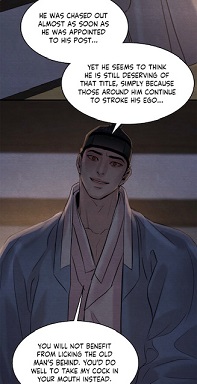 (chapter 80) His father must have kissed someone’s ass. But as you already know, Yoon Chang-HYeon is not someone who will do such a thing himself. And this shows that he has definitely used his son in order to obtain favors in such a way. Yoon Seungho had to do fellatios and let people lick his ass for his father’s sake, as he was a uke in the past. This is not surprising that the messenger received such a beating in the end.
  (chapter 80) He gave an order to the main lead, he threatened him. But actually, he was just a servant. He was not treating Yoon Seungho correctly. Interesting is that he showed more courtesy and respect to lord Lee than Yoon Seungho.
  (chapter 82) It was, as if the man was hoping to obtain father Lee’s support either. Another interesting aspect is that when the butler approached the wounded emissary, the former was definitely brown-nosing.
  (chapter 82), until he heard that the scholar Lee had approached father Yoon. On the other hand, his introduction didn’t fool the courier, for he was aware of Kim’s meddling.
  (chapter 82) In my opinion, Yoon Chang-Hyeon had followed the butler’s suggestion. Since the painter would always sleep in the study alone, he envisioned that the messenger would suggest to the artist to meet Heena. The man could fake that he had been sent by his noona. He was dressed up for that reason!! Observe that the color of the hanbok is similar to this one:
 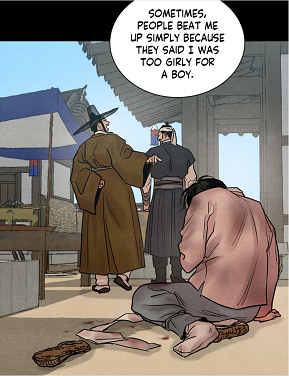 (chapter 94) Thus I had this sudden idea. What if the messenger was receiving his karma for beating the painter in the past? Remember how I had deducted that these two men could have been disguised as nobles!! And this new perception would fit my interpretation. But let’s return to our main topic. The courier refused the obsequious and submissive remarks from the butler. He was no fool, for he knew that because of his “plan”, he had become the biggest victim of Yoon Seungho’s wrath. This explicates why the author never revealed the father’s words, because the manhwaphiles would have discovered the valet’s plan and as such betrayal
  (chapter 82) This means that if father Lee or Yoon Chang-Hyeon are cornered, they could be forced to “ass-kiss” the king.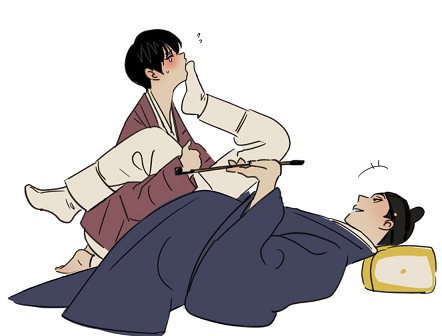
 (chapter 92) He could never refuse his lover’s requests. Thus in the gibang, he encouraged the painter to stay in the gibang.
 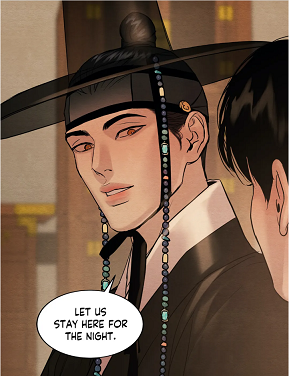 (chapter 93) It was, as if he was seeking the kisaengs’ support. Thus he chose leniency towards these women, though the latter had insulted him. At the same time, he was not hoping to receive any flattery from the noonas. He was the one “sitting on the painter’s right side”.
 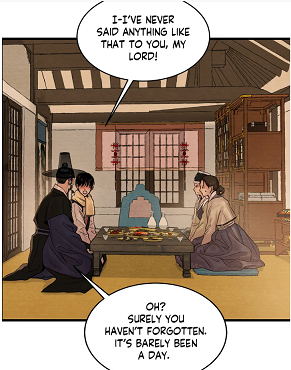 (chapter 93) To conclude, the lord had been “tamed”, he was apple-polishing Baek Na-Kyum, but not in a negative way. It is the positive reflection of Kim who will act behind people’s back, and definitely use sex for his own advantage. We have the perfect example with the 2 sex marathons. He always let the painter suffer in order to cover up his own wrongdoings. But by allowing the main lead to act this way indicates that he was not helping Yoon Seungho. What people thought as assistance was in truth “brown-nosing”.
 (Chapter 95) In his eyes, the lord didn’t need it, for he was already aroused. Remember in the beginning of the story, Lee Jihwa had to prepare his lover
  (Chapter 3) Secondly, the painter was in the position not to ask for favors, to suck up to Yoon Seungho. In their relationship, the low-born had the upper hand. Finally, Baek Na-Kyum had done nothing wrong before, so he didn’t have to beg for the main lead’s forgiveness. That’s the reason why the lord was actually rejecting the blow-job!!
  (Chapter 95) It is the expression of affection and love.
  (chapter 101) The painter had to do a fellatio to lord Jang in exchange for protection.
  (chapter 101) The artist was not acting like the teacher’s pet,
  (chapter 101), hence he needed to receive some lesson. In their eyes, Baek Na-Kyum should have licked their boot, sucked up to them… due to their power and social status. Therefore, it is not astonishing that at the end, they were executed. Why? It is because Min and the others could never “curry Yoon Seungho’s favor”.
  (chapter 102) Without the painter, the lord had no reason to continue living. Baek Na-Kyum was his source of joy and of strength. Without him, he was powerless. And this leads me to the following observation. Since we have a situation of brown-nosing concerning Black Heart in the shaman’s house, this signifies that we should have a reflection earlier in season 3. And now look at this:
  (chapter 92) In that scene, Min was indeed “flattering” his ex-sexual partner, while he was rather dismissing the painter.
  (chapter 92) He was also indirectly currying the lord’s favor. This was the reflection of the night in episode 52 either. However, contrary to season 2, Yoon Seungho had the upper-hand, as the painter had already sided with him. But one might say that this perception of “apple-polishing and buttering up” stands in opposition to my previous statement: sex is like a battle, a fight where there is only one winner. But that one doesn’t exclude the other, since Min had also tried to eliminate Baek Na-Kyum before changing his mind. This truly shows that we had two different philosophies, yet both were evolving around sex. This truly outlines that someone was “consumed by lust” in the end.
  (chapter 86) Since the lord could see through Jung In-hun’s true personality, I believe that it is the painter’s duty to grasp the valet’s treason. In my opinion, since he caught Kim having sex with the maid, it is only a matter of time, until he realizes his true personality. In chapter 77, valet Kim had thought that he could rekindle with the owner of the mansion, hence he brought him tea and the medicine. He envisioned that if he acted like a loyal and dedicated servant, he could regain Yoon Seungho’s support.
  (chapter 77) In other words, he was buttering up to the young master. But observe that in that scene, he never lowered himself in front of the young man. He didn’t go on his knees or he didn’t bow to him either. This attitude exposes the valet’s true personality. He considers himself better than Yoon Seungho and Baek Na-Kyum, refusing to admit any crime or mistake. In that scene, he never said YES! In fact, he kept contradicting his master.
  (chapter 77) Under this new light, the avid readers can understand why he contacted the patriarch in the end. He knew that Yoon Chang-Hyeon would listen to him, for he had been brown-nosing him for years. And the color brown of his shirt is no coincidence. Observe that when the father visited the mansion, he was wearing brown and red…
  (chapter 86) He envisioned that his elder son would return him the seat and as such he would become the owner of the family mansion again. Why? It is because of the main lead’s words in the library. His so-called respect towards the father was just fake. That’s the reason why the father imagined that he just needed to show up and he would get the mansion back. However, in reality, he should have sought his son’s support, and as such kiss his ass in order to achieve his goal. But the man has never done it himself. He has always been used to being fawned and ass-kissed that it is not surprising that he barged in the mansion. And this is the same for Yoon Seung-Won. The latter might have sent letters in order to obtain his brother’s support, but we can’t say that he was sucking up to Yoon Seungho. Thus it is no coincidence that at the end, the latter advised his brother to follow the father’s principles.
  (chapter 37) Here, he was implying that Yoon Seung-Won should do fellatios and other things in exchange for favors.
  (chapter 40) Moreover, according to me, she used the young master Seungho and her brother to avoid sex. Furthermore, I would like to point out that when the kisaeng argued with her brother, this is what she said to her brother:
  (chapter 97) Here, she was referring to favors. Yet, shortly after she proposed this to her brother:
  (chapter 97) It is clear that the agreement was not selfless. No nobleman would spend money and energy for nothing. The noona was hiding the content of the deal to her brother, the negative reflection from season 1. And now, you comprehend why I am sensing that since her deal was to sell her brother in exchange of favors, her karma should be that she has no other mean than to sell herself in order to survive, as she is now on her own. And if this truly happen, this can only reinforce her resent and hatred towards the couple. But we will see, if Heena is the one “sucking up” in season 4.
 (chapter 73). But keep in mind, this is related to the painter’s education. He had been raised not only to hide his homosexuality, but also to reject sexuality as such. Naturally, in reality a no means no and nothing else.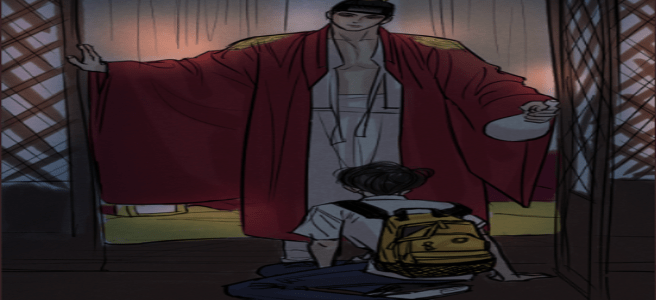
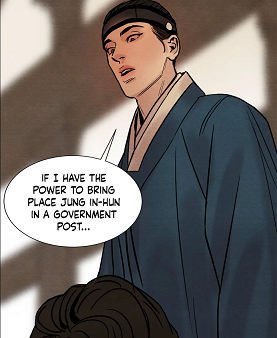 (chapter 11) Secondly, I had associated the main lead to the eagle which is the symbol for the kings and emperors in Europe. He was seen here flying
  (chapter 30), and his fingers reminded me of the eagle’s claws.
  (chapter 18) And this perception got even reinforced, when I saw this panel:
  , I had another revelation. On the one hand, it actually confirmed that Yoon Seungho was somehow destined to become a king, yet he is not represented by the eagle or the phoenix, but by the dragon. Hence the moment I saw this image, one idiom came to my mind: Dragon king!
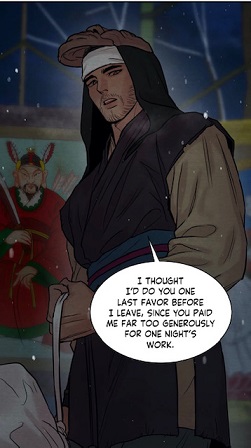 (chapter 100), though this deity is always accompanied with a dragon and in this picture, the readers couldn’t see one. However, it is possible that the author didn’t desire to reveal too much.
  (chapter 21) Why? It is because the lord was happy. These were the tears of happiness, which Yoon Seungho couldn’t express contrary to the painter. And this is no coincidence that in chapter 58, it started snowing, when the couple was making love:
  (chapter 58) And we had the same weather, when Yoon Seungho saved his lover.
  (chapter 97), and according to me, the messenger was drown there.
  (chapter 94) In addition, my theory is that Deok-Jae and/or Jung In-Hun’s body were placed in a jar in order to hide the murders. For me, the jar plays a huge role in Painter Of The Night… thus Byeonduck created such a scene in season 2
  (chapter 46) and we have so many jars next to the pond:
 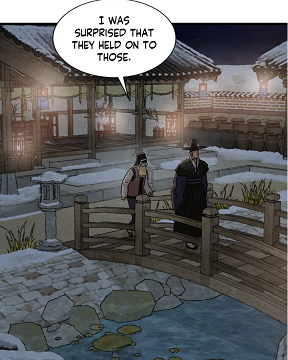 (chapter 94) [For more read the essay “The secret behind the library”]
 (chapter 91) This is no coincidence. To conclude, all these elements (rain, jar, well, soul of a deceased), connected to the dragon king, are present in Painter Of The Night. Thus I came to the conclusion that Yoon Seungho is like Dragon king. This reinforces my conviction that the main lead is not only connected to shamanism, but also embodies royalty. So he might not be the king of Joseon, but he is powerful in his own way, though he is not aware of this. And note that the moment he wished to commit suicide by drowning in the pond, he was brought back to life.
 (chapter 85) This means that in the Yoons’ mansion, people didn’t venerate this god. And since the aristocrat made such a statement to the elder Yoon Chang-Hyeon,
  (chapter 100) and this altar
 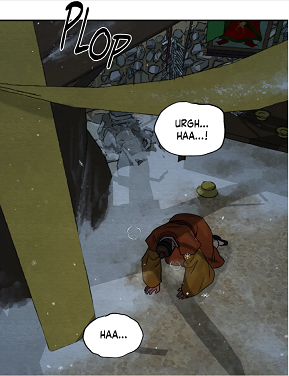 (chapter 100) were exposing the presence of a ritual. However, my problem was that I couldn’t determine exactly the nature of the ritual. But by making the connection between the dragon and good fortune, I had now more clues. I have to admit that I can not be 100% sure for this, but this is what I found:
  (chapter 4)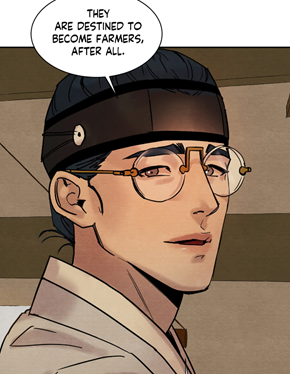
 (chapter 6)
  (chapter 83) and the deer
  (chapter 22). Then the lord compared Baek Na-Kyum’s eyes to a rabbit.
  (chapter 78) Since both resemble each other, I deduce that the main lead has the same eyes, the rabbit’s. Like mentioned above, he utilized his fingers similar to claws:
  (chapter 54) One might argue that this signification is totally impossible, for the lord doesn’t have the body of a snake. This point can be refuted very easily. What is the major characteristic of a snake is molting. A regularly recurrent event during the activity period of all snakes is the shedding of the skin. This coincides with the lord’s change of clothes. The latter reflected his downfall and rising. Furthermore, this animal is linked to death and rebirth. My avid readers are already aware that I had detected different scenes, where we could witness the lord’s spiritual death and rebirth, like for example in the shed:
  (chapter 62) When he discovered his misjudgment the next morning, he felt like dead. He no longer saw himself as a lord, but came to view the painter as his new lord :
 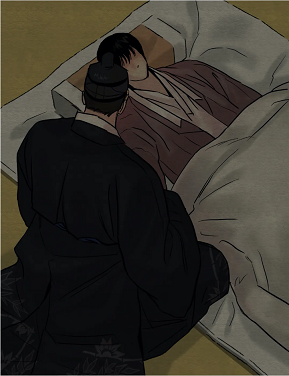 (chapter 66) As a conclusion, Yoon Seungho shares so many similarities with the dragon that I came to view him as one. This explicates why even after getting married, he will never wear a beard!
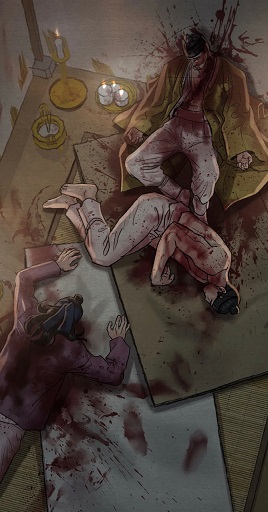 (chapter 102), and thanks to the painter, Yoon Seungho’s soul was able to escape this “mental prison”.
  (chapter 45)
 (chapter 55) and as such his heart and mind.
  The painter is sitting inside a room, while Jung In-Hun is standing outside. Nonetheless, the position of the characters are very similar. This indicates that the author’s new alternative story is actually inspired by the main story!! This can only reinforce my perception that Yoon Seungho in the main story is associated to royalty. However, since it is a reflection, I deduce that this image
 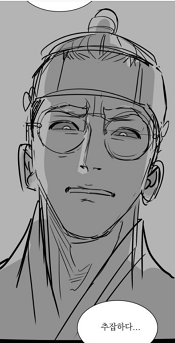 He criticized the painter by stating that this was “filthy”.
  In this scene, the characters are caught by surprise, but it becomes obvious that there is no disgust or expulsion. In fact, the fall of man took place before, for Baek Na-Kyum was sent to Joseon. In this encounter, I detect attraction and curiosity. Hence I come to the conclusion that in the original story, when this scene took place,
  (chapter 52) This means that the mysterious lord Song was actually claiming the main lead as his wife in the last scene. Min and his friends were sent there in order to entertain the protagonist, but they failed. This explicates why the next day, Black Heart was seen with a hanbok of lower quality.
  (chapter 56) It was, as if Min had been compensated for his bruised face by the mysterious lord Song. However, for the pedophile, Black Heart was just a concubine, and not his main wife! Hence the hanbok had not such a detailed and expensive design. This would explain the villain’s jealousy. And now, if you look back at the hanboks from the main lead, you will recognize his ascent. First, he is wearing green, which is similar to Yoon Chang-Hyeon’s color. At the same time, his hat resembled a lot to Kim’s.
  (chapter 1) Then later, he is mostly wearing blue which is actually the color of the Crown prince.
  (chapter 11) Yet, his robes initially have no design. Slowly, the lord is wearing colors and designs that are actually reserved for a king: blue, red, black and purple. This constant change of hanboks symbolizes the “snake molting” and as such his transformation and rising. This is not astonishing that on the night of the bloodbath, he had such a hanbok:
  (chapter 102) Here, he was no longer acting like a noble, but as a ruler. Don’t forget that according to me, the mysterious lord Song had proclaimed the main lead as his unofficial Queen by giving him hanboks with phoenixes. However, naturally, this was never mentioned to Yoon Seungho directly. Why? It is because Kim usually selects his clothes. However, this rise was not natural, as the lord had no real saying in this matter. The real metamorphosis took place in the shaman’s house, when the lord was sent back to the past and as such the darkness.
 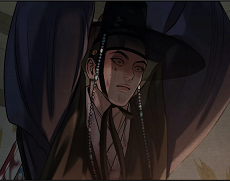 (chapter 102) The moment he left the “cave”, he went to the mountain and surrounded by the wind and water, he changed into a dragon. This expulsion corresponds to the final release, the lord’s mind is finally freed from the darkness, while I believe that this scene
  (chapter 44) It is because the main lead was thinking that the painter would actually run away. Thus the door was left opened, and he was wearing warm clothes. Yoon Seungho never imagined that Baek Na-Kyum would remain by his side. Yet, during the previous night, the lord had consoled his lover by embracing him.
  (chapter 71) But this can be refuted easily. First, don’t forget that during this love session, the lord was acting like a servant pleasing his new lord. So this had nothing to do with Yoon Seungho’s feelings like sadness or happiness. He was determined to keep the painter by his side, and ignoring his own feelings. He never expected the artist to reciprocate his feelings. Secondly, Yoon Seungho’s nocturne vision is not just a nightmare, but also a DREAM! Yes, you are reading this correctly. Only recently, I discovered that all the artist’s visions are a combination of 3 elements: memory, nightmare and dream! I will give you three examples as illustration, for I am slowly running out of time.
  This vision is a combination of these three elements: memory, nightmare and dream. This had happened during the First Wedding Night (memory)
 (chapter 21), then we have a similar situation in chapter 49: ,
  , but the painter was rejecting this future. Hence he considered it as a nightmare.
 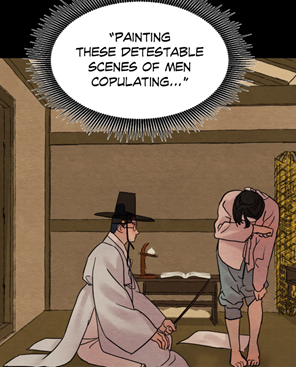 ; nightmare
  the lord becomes a ghost and confronts the painter with his biggest fears (admitting his attraction, passion for erotic paintings and homosexuality) and dream
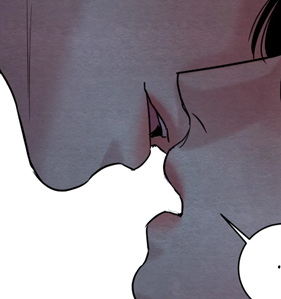 (The painter’s true desire was that the lord would kiss him, he was deeply longing for his lips, yet he was still in denial in this vision.
 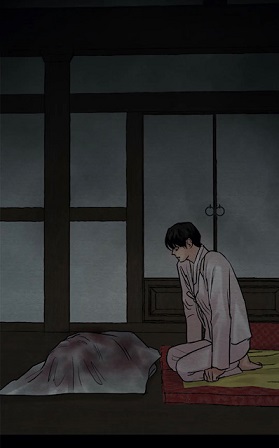 , for the painter was remembering the corpse in the courtyard, a dream, as he wished the return of his loved one
 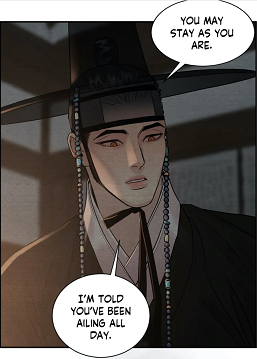 . He hoped that the lord would take care of him personally. Naturally, the “spirit” is the nightmare
  .
. 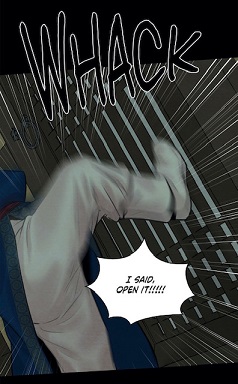 (chapter 74) This had already happened, but the lord had not grasped the significance.
 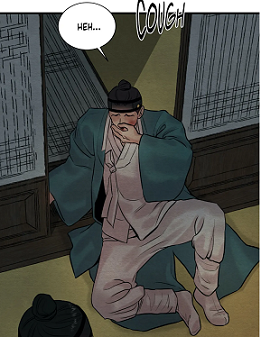 (chapter 53) Besides, he had not opened the door himself. Even when he went to the scholar Lee and opened the door with the his foot, the lord still felt trapped.
 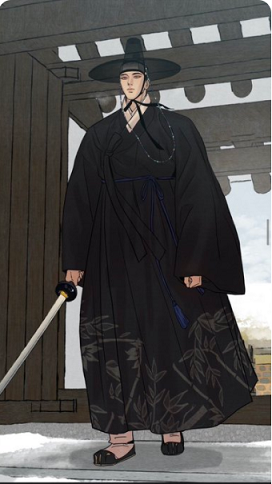 (chapter 67) Then in season 3, he could break a door, but it was thanks to the painter.
  (chapter 96) This shows that the lord’s wish to get released had not been fulfilled so far. In my eyes, it is connected to the torture Yoon Seungho suffered and as such to the purge organized by the authorities. That’s the reason why I deduce that the lord will break a door in season 4, and this won’t be by accident and it will be witnessed by many people contrary to chapter 53, 67 and 96! The broken door will reflect the lord’s rise and power, and no one will be able to stop this. In my eyes, this wish is connected to the door in the servants’ quarter. That’s how his imprisonment started.
 (chapter 74) The “dragon” wished to see Kim and his father, and confront them! And this did take place in season 3. Yoon Seungho confronted the butler with his attitude and betrayal
 (chapter 77), but this argument was just short-lived. He still viewed the valet as a hard-working and trustworthy person. He had just made bad decisions. Then in the bedchamber, the lord could blame the father for his suffering:
 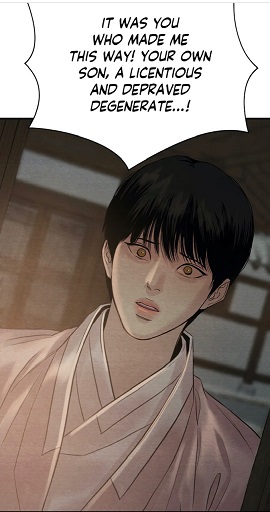 (chapter 86) As you can see, the lord’s wishes were granted, but the nocturne vision was so difficult to grasp that neither the readers nor the main lead could interpret the message correctly immediately. Besides, the nightmare was mostly silent. But this doesn’t end here.
  (chapter 74) In this image, he is floating in the air… a sign that his status is changing. At the same time, this shows that he is escaping from the hands. They are trying to drag the main lead down. Thus I come to the conclusion that the vision was announcing the lord’s transformation (into a dragon) and as such his “rise”. Note that in this image, he is still a teenager, but in the following panel the protagonist has already become an adult.
  (chapter 74) Simultaneously, the vision also displays the lord’s expulsion from “hell”, the sex orgies
 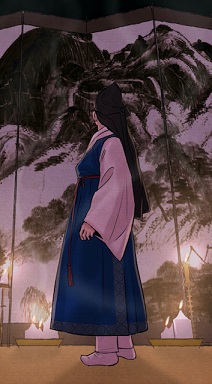 (chapter 74) Simultaneously, the dream showed that the lord wished to see this painting again, though deep down, he blames this image for his suffering. As you can see, the vision was revealing the tormented disposition of the lord. He was switching from nightmare to dream and the reverse… a mixture of anxieties and desires.
  (chapter 74) This signifies that he was approached by someone from behind, he had not noticed that the “door” had been opened. Thus he never expected his apparition. For me, this perception demonstrates that the painting is not the real cause for Yoon Seungho’s suffering. Since he had turned around, I came to recognize that this scene stands in opposition to the situation in the painter’s nightmare:
 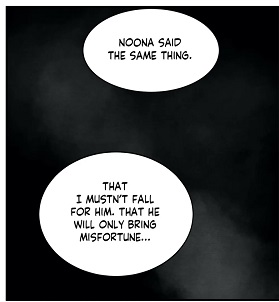 (chapter 86) In reality, he was a dragon, who could bring luck and fortune to the person who would cherish him. This is no coincidence that the pedophile sent hanboks with the crane
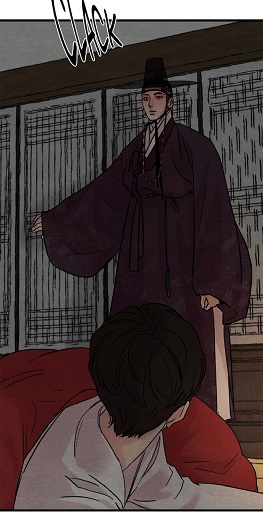 (chapter 34),
  (chapter 30), but much more brutal and violent!

