Protected: Painter Of The Night: The beauty in the summer 🌞clouds ☁☁
Bebebisous33s' analyses in K-Dramaland and Manhwas
Analyses of K-dramas and Manhwas (for the most part Yaoi)


This is where you can read the manhwa. https://www.lezhinus.com/en/comic/painter But be aware that this manhwa is a mature Yaoi, which means, it is about homosexuality with explicit scenes. If you want to read more essays, here is the link to the table of contents: https://bebebisous33analyses.wordpress.com/2020/07/04/table-of-contents-painter-of-the-night/
It would be great if you could make some donations/sponsoring: Ko-fi.com/bebebisous33 That way, you can support me with “coffee” so that I have the energy to keep examining manhwas. Besides, I need to cover up the expenses for this blog.
Next to Yoon Seungho’s suffering, Baek Na-Kyum’s lineage represents the second biggest mystery. Thus many readers have already developed their own theory about the painter’s clan. However, the problem is that the author focused more on the noble’s traumatic past than on the painter’s genealogy. We could say that she barely left any clue about Baek Na-Kyum’s origins. The only information we have is this panel: 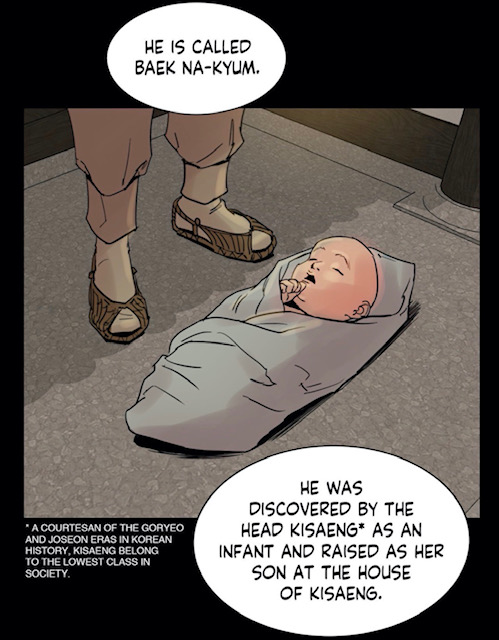 (chapter 01) But after studying the manhwa so closely, I discovered the existence of rules in the manhwa which helped me to dig up new information. I am listing the laws of Painter Of The Night again in order to avoid repeating myself. I will refer to them later in my argumentation (rule 1, 2, eg.). That way the readers can better grasp how I came to new revelations and theories.
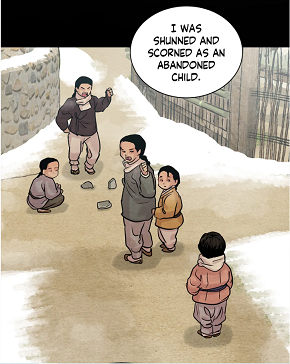 (chapter 94), Yoon Seungho experienced the opposite.
  (chapter 57) He was admired which created a source of jealousy. While the painter discovered sexuality and his homosexuality very early on, Yoon Seungho was pure, but through incidents he was forced to become a sodomite. While Heena and the scholar tried to repress Baek Na-Kyum’s sexuality, the father pushed his son to have sex out of fear and high expectation.
 And now, it is time to return our attention to the image from chapter 1. (chapter 1) What caught my attention is the presence of the black frame related to the servant’s narration. This indicates that this panel and the following represent memories, but they can not be the recollection from the servant, as the latter is just repeating what he has been told. I recognized it while reading episode 101.
Observe that we have the same situation. A servant was informing Lee Jihwa about the last events: 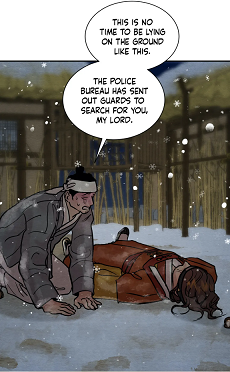 (chapter 101) Striking is that the author used the same method to introduce the memories. First, we see the servant talking before viewing the memories.
  (chapter 101) And now, compare it to chapter 1:
  (chapter 1) The order is the same, though the episodes are actually contrasting each other. How? Remember that in episode 1, Yoon Seungho followed the servant’s suggestion, whereas Lee Jihwa refused to do so. The latter chose to run away and vanish.
Striking is that the author added this picture 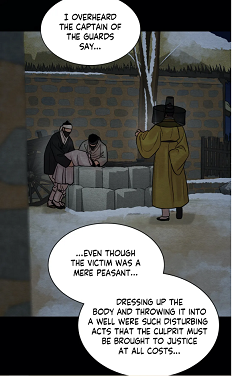 (chapter 101). She was implying that this panel symbolized the vision from the witness, the tailor. This explicates why you see the wall on the left side. The tailor was observing Min in the shadow. This is important, for these images are reflecting the truth, revealing that the servant from episode 101 was actually lying. Thus I deduce that the domestic from chapter 1 was also lying, but contrary to the episode 101, he thought, he was telling the truth. We could say that he was acting as the fake “mirror of truth“. How do I come to this deduction? Simply because the servant in chapter 101 was actually deceiving Lee Jihwa and Yoon Seungho. Note that in the beginning of episode 101, Seokdae tried to defend himself by feigning ignorance.
 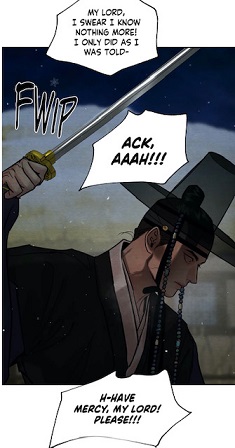 (Chapter 100) He denied his responsibility by putting the blame on someone else („I was told“), yet once facing the young master Jihwa, his declaration exposed his lie. (Chapter 101) He knows something!! Consequently, I come to the conclusion that in chapter 1, the domestic had been deceived about the painter’s childhood too, but he had no idea, while Seokdae was only partially involved in the scheme. The latter had been left in the dark that he could risk his life.
 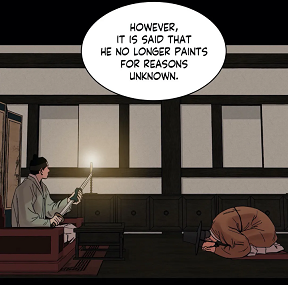 (chapter 1) So in episode 1, the servant was not aware that he was lying to the protagonist, when it comes to the painter’s past. However, the domestic with the brown hanbok lied in one aspect, the publication of the book.
 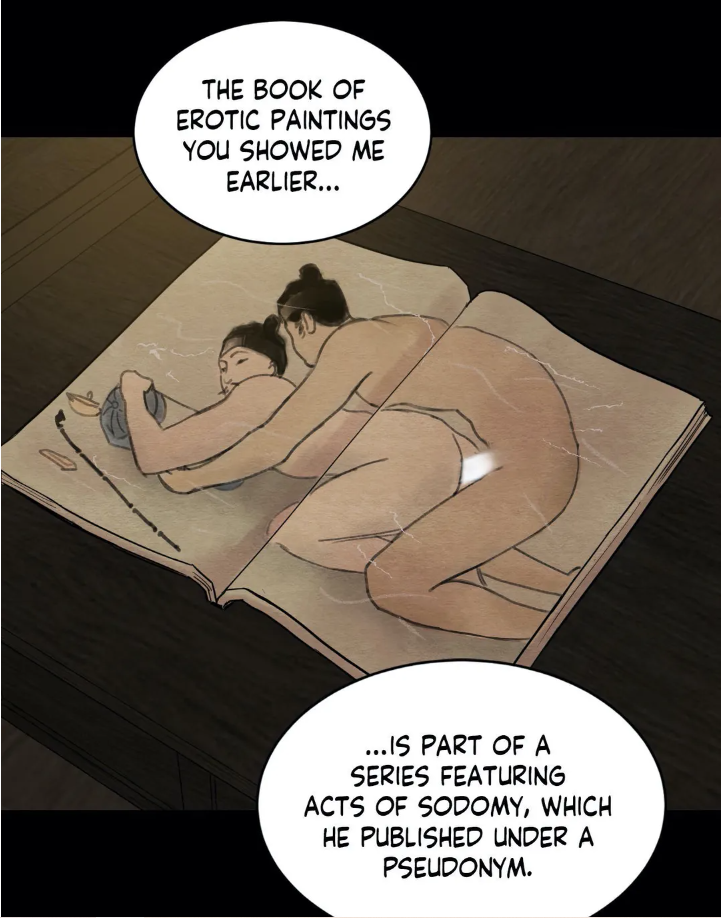 (chapter 1) One might have the impression that I am digressing from the main topic. Yet the manhwalovers should keep in their mind that the servant from episode 1 served one purpose: to show us the memories of an important witness, someone who watched Baek Na-Kyum growing up. Thus we have three different pictures. First, he is a baby, then a young infant
 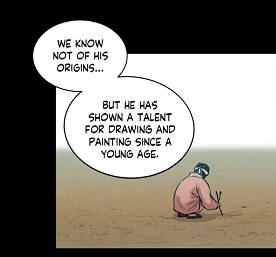 (chapter 1) and later almost a grown-up
 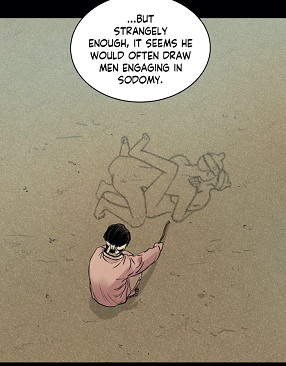 . (chapter 1) This signifies that the witness was close to Baek Na-Kyum which explains why the domestic trusted the source of his information. However, contrary to episode 101, she never divulged the identity of the witness. It is because the person wished to hide in the shadow.
Another similarity is that a third person is mentioned in the statement in order to give a certain credibility to their declaration. The head-kisaeng or the captain of the guards are the witnesses, but their absence in the image indicates that they are actually used as alibis. In addition, the manhwaphiles will recall that the episode 101 begins with the childhood friend’s sentence (the loss of the topknot), while the domestic got spared. On the other hand, we have the opposite situation in episode 1.  (chapter 1) It ends with the domestic’s death, while the incident with the topknot is mentioned in the middle. At the end, the painter is dragged to the mansion. As you can see, both chapters reflect each other. That’s how I had this revelation (chapter 01) It made me realize that this image represented the view of a WITNESS! Someone was present, when the baby was brought to that place. This corresponds to the “dragging“ at the end of episode 1 (rule 2) In the beginning of the story, the adoptive parents (Heena and Jung In-Hun) were not aware of the situation, thus I am assuming that this was different in the past. The “biological parents“ or the “father“ knew about his whereabouts. Hence we need to find out the identity of the witness, though I already gave different clues. He was close the painter and watched him growing up.
Moreover where did the domestic deliver the infant? Anyone would say that this was just the house of kisaeng. BUT no, as this panel reveals the entrance of the gibang.  (chapter 99) The soil and the position of the pillars of the main gate are different. I can now announce the precise location, and this with certainty. Yes, I discovered the place thanks to rule 4!!
  (chapter 4) This is the door! You can recognize it thanks to the pillar on the side.
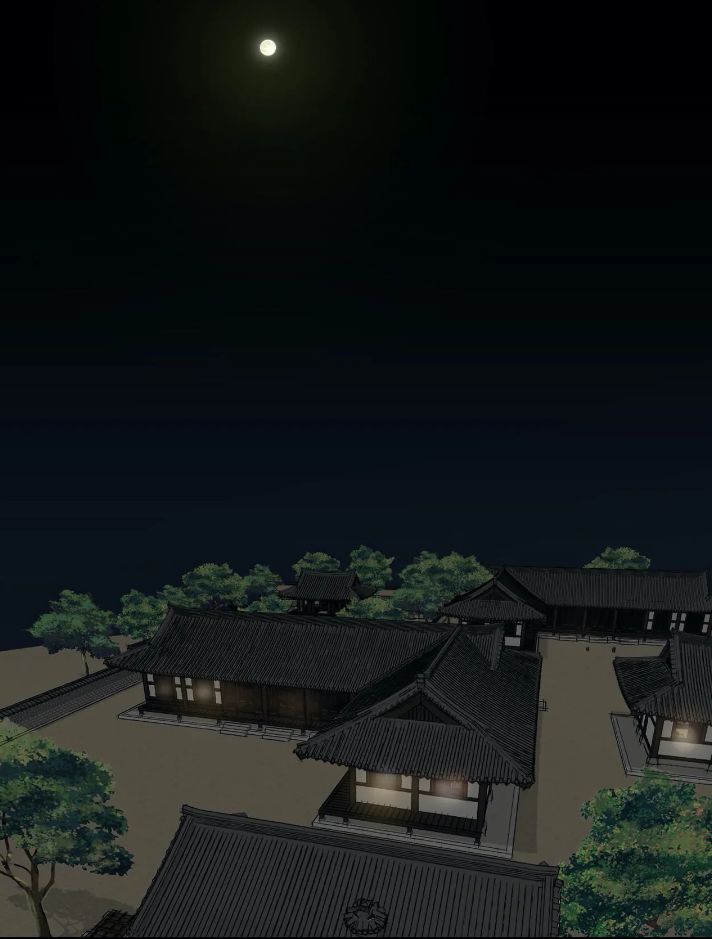
Another detail caught my notice: The shadow of the rooftop on the ground. 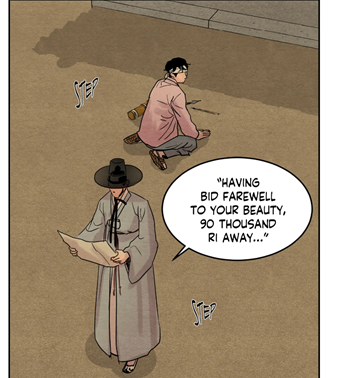 (chapter 4) Here, the shadow was bigger indicating that it was early in the morning. The painter had just woken up. Consequently, I deduce that the baby was brought to the mansion during the day. This signifies that Baek Na-Kyum was never abandoned! He was entrusted to the owner of that mansion!
  (chapter 1) You can recognize the gate in the background. This is the domain, which you see when the lord is arguing with the painter in the courtyard.
  (chapter 4) Pay attention to the background in this picture. And now, you are probably thinking that the owners of that mansion are the Yoons, as we observed the main lead living there. Nevertheless, I had already pointed out that this was not Yoon Seungho’s mansion. This is the Yoons’ domain:
 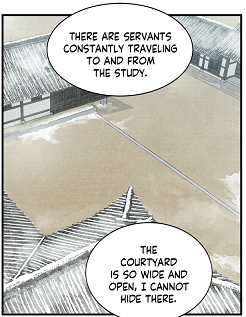 (chapter 51) The courtyard is different. According to me, this is the mansion of the Lees. [For more read the essay 360: Lee Jihwa’s special relationship with Yoon Seungho] And since episode 1 and 101 reflect each other, this can only reinforce my interpretation that the Lees are involved in Baek Na-Kyum’s past, for we have Lee Jihwa present in chapter 101. Baek Na-Kyum was brought to the Lees, thus the scholar Lee keeps calling Baek Na-Kyum a peasant! He knows about his true origins. I had always said that the man was revealing his knowledge with his insult. But does it mean that this was the vision from Lee Jihwa’s father?
(chapter 1) I don’t think so and this for two reasons! (chapter 1) First, the person was keeping an eye on the painter like mentioned above. Secondly, the artist is seen each time with the white head-band! In the last picture, he is seen drawing very young, whereas in this picture, he is much older. (Chapter 2) This item is connected to the scholar Jung In-Hun. Thus the learned sir reminded the artist to have it on his head in chapter 38 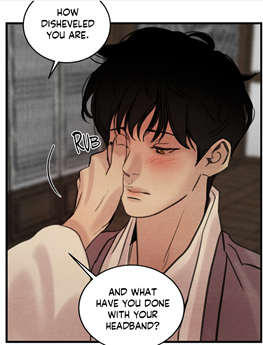 (chapter 38). Besides, father Lee views him as a peasant and not a servant. This observation gets reinforced, when you look at the memories from the painter. In his childhood, he was never wearing a white head-band.
 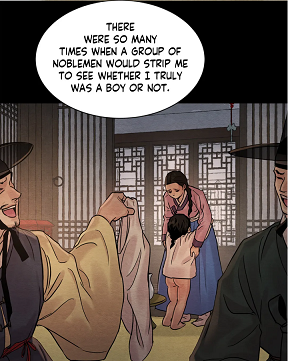 (Chapter 94)
 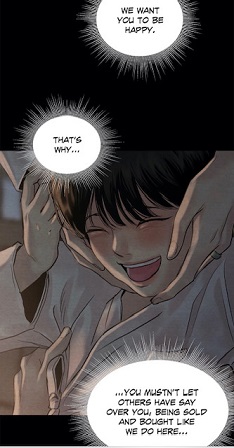 (chapter 87)
 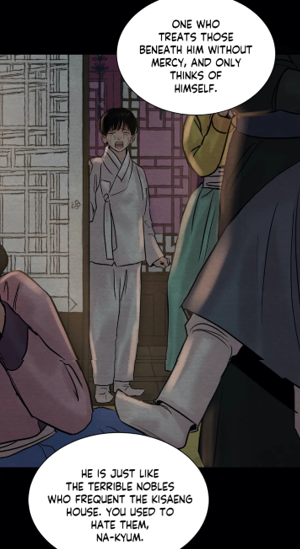 (chapter 68)
  (chapter 70) This means that this panel (chapter 1) represents a distorted memory from Jung In-Hun. 😮 The other evidence for this signification is the absence of the landscape. We don’t see the gibang in the background. Striking is that it coincides with the following statement: “we know not of his origins“. From my point of view, it reflects that the scholar has long repressed the true origins of Baek Na-Kyum. He came to adopt this vision that the main lead was a servant, for people living in the kisaeng house are considered as „slaves“. Striking is that the painter was seen for the first time with the headband in this panel:
 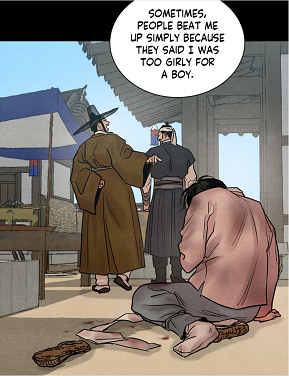 (chapter 94) Thus I assume that it was done on purpose. They used “his girly features“ as a fake excuse to beat him, but the intention behind this violence was to force him to wear the white head-band! As you can see, everything is pointing out that the learned sir and father Lee were somehow involved in this. But I have three more conclusive evidences for this theory. First, it is related to the reflection in chapter 101.
  (chapter 101) Look where the red-haired master and the servant are! It is in front of the teacher’s home! In Painter Of The Night, there is never a coincidence. This is a sign that Jung In-Hun is related to Baek Na-Kyum’s past and knows his true origins. However, by treating him like a low-born, he came to view him as one. But this doesn’t end it. Remember the rule 2: the reflection within the same chapter. The painter remembered the words from the gibang:
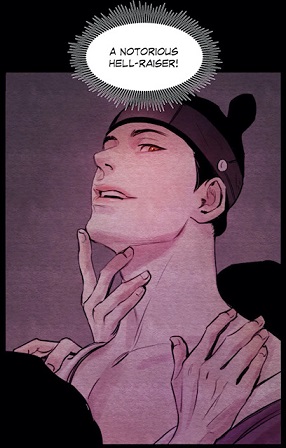 (chapter 1) Jung In-Hun would employ such expressions like fiend and sodomy
  (chapter 18), he was repeating his admired sir’s idioms. Besides, “hell-raiser” is also an indication that the learned sir was a Christian who converted Heena. Thus I deduce that when father Lee received Baek Na-Kyum as a baby, he entrusted him to the learned sir Jung In-Hun who had no connection and no wealth so far. So when the lord described him as such in episode 7, it was not entirely correct. The reality was that the man had been working for the Lees, but he had been “abandoned” at some point. The scholar was his helping hand explaining why he would appear in this scene. (chapter 68) This was the night of the fake sexual lesson.
And this new discovery led me to the following conclusion. The moment Baek Na-Kyum was forced to wear the white tissue coincides with the loss of Lee Jihwa’s topknot because of rule 5. In my eyes, the painter helped Yoon Seungho to obtain his topknot which occurred after this incident. 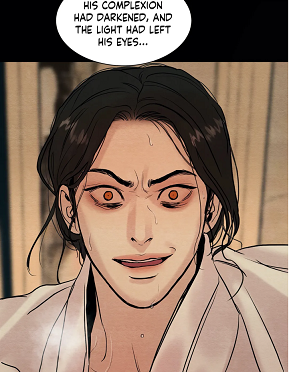 (chapter 57). However, there was a price to pay for the main lead’s emancipation. Lee Jihwa had to lose his topknot!!
  (chapter 59) Without a topknot, the red-haired master no longer looked like a real noble. He had lost his position. Hence I believe that the painter was forced to wear the headband. As you can detect, there was a chain reaction linked to the social status: lord or not, low-born or not.
However (chapter 1), since Baek Na-Kyum was so young, he needed a mother to feed him. Thus he was brought to the gibang. And that’s how he ended up in the kisaeng house. This means that Baek Na-Kyum is actually a noble! I would even add that he belongs to the royal family. And this would explain why the painter was forced to wear a headband, the moment Lee Jihwa lost his topknot. We also have the explication why the painter was living in the annex.  (chapter 87) He was definitely living in comfort. But what was the purpose to let him wear the white tissue? Dressed as a slave, no one would have wondered if he had been killed. Remember the scholar‘s words: a servant is viewed as an object and possession.
 (Chapter 10) So a lord is following social norms, when he sentences a slave to death.
Nonetheless, where are the real proofs? First his name! Why was he called Baek Na-Kyum, if he has been abandoned? He should have only a name Na-Kyum. Secondly, why did the main lead let cut his hair? It was to indoctrinate him, to make him realize that he had been abandoned by his parents!! They deceived him with the long hair. It was implied that with short hair, he would be recognized as a boy. (chapter 94) However, the purpose was to let him experience rejection and isolation. It appears to me that his resent for nobles was part of the brainwashing as well! That way, he would never think that he was coming from a noble family. (chapter 94) This means that such a scene was created in order to ruin the main lead’s self-esteem, and naturally Heena who witnessed it was also influenced. Since she was a minor herself, she couldn’t detect the schemes behind such scenes. Don’t you find it weird that the young child was brought to that room? Under this new approach, the learned sir’s neglect concerning the painter’s education appears in a different light. 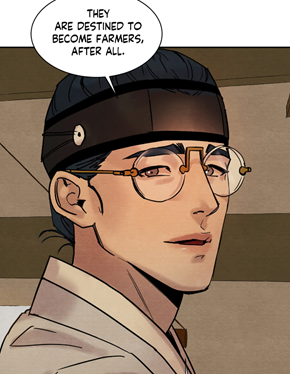 (chapter 6) The painter was never destined to become a farmer. The neglect was done intentionally. And when you recall his words in the library, you can only view his words as pure lies again:
  (chapter 40) He was never born to be a prostitute, but he was sent there on purpose. Under this new perspective, it becomes more comprehensible why Heena sent Baek Na-Kyum to the learned sir. He was the one who had brought the artist to the gibang, and now he was getting older. One might refute this point, for she declared this:
 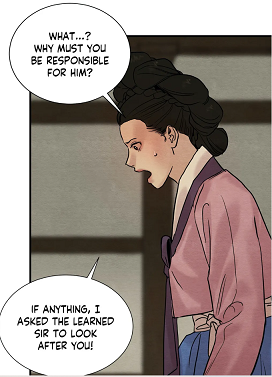 (chapter 68) Nonetheless, the beholder can detect the presence of a drop of sweat on Heena’s cheek. So she was deceiving the artist here. Why? Yes, in her mind, the painter was Jung In-Hun’s son and as such the learned sir should become responsible for the painter, for he was his father. But she had to lie in order to persuade him to leave the mansion. There’s no ambiguity that the head-kisaeng had no idea about the deal between the Lees and Jung In-Hun in the past, I believe that she must have discovered the truth at some point..
But wait… I have more evidences for this theory. The poem from the scholar! Chapter 4 is a reflection of episode 1 (rule 4). 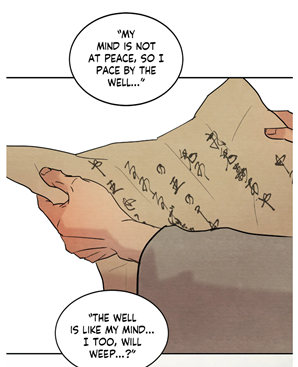 (chapter 4) This was inspired by the poetry from Wang Bang-Yeon!
  (chapter 4) In this poem, the famous author was referring to the death of the young king Danjong who had been killed by his uncle Sejo. Danjong was just a teenager, when he died! As you can see, the text is actually an allusion to royalty and exile. Under this new light, it dawned on me that the scholar Lee had been entrusted to take care of Baek Na-Kyum, but the latter chose to delegate this to the learned sir. There was a reason behind this. For me, he was eyeing at the mansion himself! One might refute this point, for the elder Lee said this:
 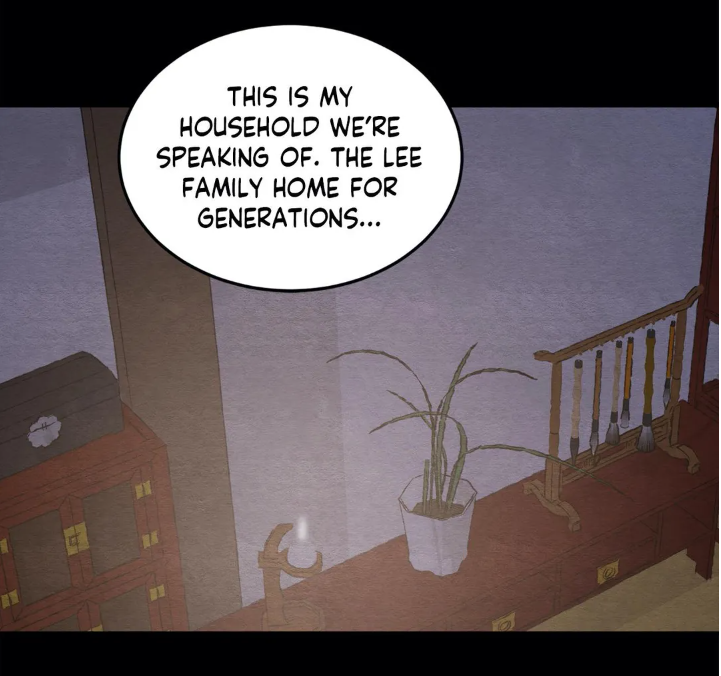 (chapter 82) But note that the man never said that this was his house, just the household of the Lee. Since the artist is related to the king, this signifies that he is related to the elder Lee too, as the family ruling over Joseon belongs to the Lee clan. Hence I am suspecting that Baek Na-Kyum could be the true owner of this mansion. (chapter 1)
“The very night of Danjong’s murder, Sejo’s sleep was haunted by the appearance of Danjong’s mother who denounced him for his evil and left him with this malediction: “You have stolen the throne and killed my son. Yours too shall die.”
When Sejo awoke, he discovered the curse had been fulfilled ― Deokjong (the crown prince and his eldest son) was dead at the age of 20. In fury, Sejo had Danjong’s mother’s tomb dug up and her bones and remains scattered into a river.” Quoted from https://www.koreatimes.co.kr/www/opinion/2019/11/721_278751.html
If you read the analysis “The Dark Knight”, you are already aware of the importance of a curse in Gothic literature. We know that the lord is right now stigmatized as a bird of misfortune, thus I deduce that when the artist was a baby, he could have been labelled as such too. I am suspecting that he was condemned, for his mother had died by giving birth. (chapter 1) Note that the baby had no hair, so he was only a few weeks old. From my point of view, Baek Na-Kyum could have been sent away for that reason. Either he was perceived as a bird of misfortune (rule 1) or the father wished to protect his son from harm, for he was in a vulnerable position. His mother had died. Within the family, he would be protected. As you can imagine, I am sensing another manipulation and scheme, where the king chose to listen to people. One thing is sure: the artist is no peasant, but a nobleman, I would even say, he belongs to the royal family.
And Yoon Seungho has already detected the painter’s true origins. Thus he keeps removing the headband. 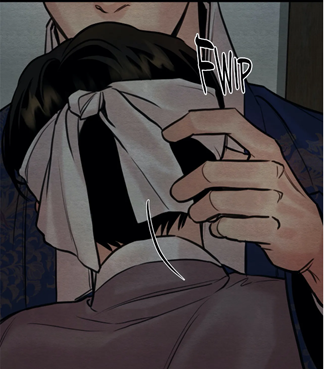 (chapter 53) How does he know it? In my opinion, it is because Baek Na-Kyum resembles to the king. The only difference is that he has no beard. This would explain why Yoon Seungho said this:
 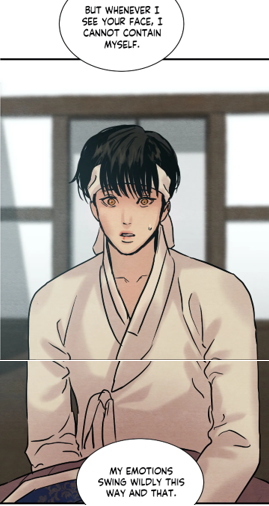 (chapter 55) Why would he get upset? Why would the painter’s face evoke such emotions? He is reminded of his abuser. This is no coincidence that the main lead had such a flashbulb right after, where you could see Lee Jihwa and his father, as they looked like Yoon Seungwon and his father.
  (chapter 55) They are all related. And now, you comprehend why the author wouldn’t reveal the face of the mysterious lord Song in chapter 83
  (chapter 83) We could have seen the resemblance, as in this picture he was much younger. As the manhwalovers can sense, I detected a strong connection between the Lees and Baek Na-Kyum. Observe that the moment Lee Jihwa lost his topknot (the symbol for nobility and adulthood), the painter received a purple/burgundy hanbok!!
 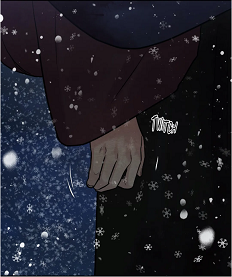 (chapter 102) The colors are already insinuating that the artist belongs to the royalty.
What the painter considered as a curse (his girly feature) is actually a blessing. Yes, his face is the evidence of his lineage! And now, you comprehend why he was beaten by these people (chapter 94), why he was forced to have short hair and wear a white head-band! 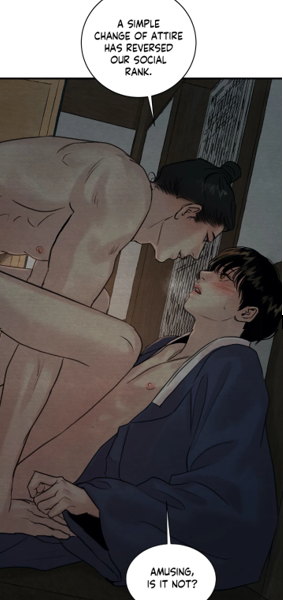 (chapter 71) If the pedophile came to the gibang and crossed the main lead’s path, he couldn’t recognize his relative (son or nephew) due to the hair and the clothes. Besides, I am certain that my avid readers can recall my other theory: the painter was stolen as a child. This new interpretation would corroborate this theory. The painter has been robbed of his true identity, he had been kidnapped, when he was brought to the kisaeng house!! Besides, if he is the true owner of the mansion, then this signifies that Father Lee succeeded in his coup d’Etat (rule 1, rule 3). In season 3, we have an attempted “coup d’Etat” with Yoon Chang-Hyeon eyeing at the seat.
 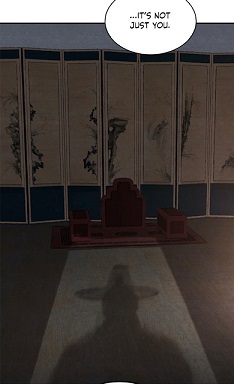 (chapter 86) Moreover, I would like to point out that we have the topic: siblings’ jealousy. This is definitely possible that father Lee is related to the artist, an uncle for example. Finally, if the painter is the king’s son, this is no coincidence that Baek Na-Kyum suffered so much. He was paying for his father’s sins (rule 5). At the same time, if Baek Na-Kyum has to face the infamous lord Song, as his son/nephew, he is put in a position where he can criticize his father/uncle. How could he abandon him and treat Yoon Seungho like that?
I had already detected that the painter was supposed to die in chapter 1. But with this new discovery, I have another explanation for his assassination. Baek Na-Kyum was not only a witness of the pedophile’s crime, but also involved in Lee Jihwa’s humiliation. Furthermore, he was on the verge of becoming an adult. Thus he could claim his inheritance. In my eyes, his existence represented a source of threat for father Lee. The latter had completely forgotten the boy (like the saying: out of sight, out of mind), until the incident with the topknot occurred. Since the learned sir and father Lee had neglected him on purpose, they had another reason to get rid of him. Since Yoon Chang-Hyeon viewed his son as a small adult who should dedicate his time to study in order to contribute to the Yoons’ reputation, it is possible that the painter’s father could have made the opposite decision. He should grew up in a more carefree environment, or maybe he could avoid being affected by a curse. Naturally, the scholar Lee has every reason to remove the painter from Yoon Seungho’s side. 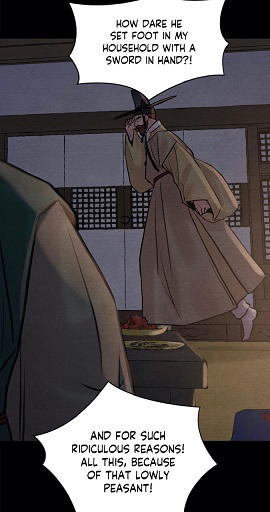 (chapter 82) All his past crimes could come to the surface! He had not taken care of the painter, and he had been neglected on purpose. He had committed a crime (disobedience to the king), thus he was a traitor. On the other hand, they could use the last publication as a justification for his death! He had threatened the ruler, he was blackmailing him with his secret. There’s no ambiguity that lord Song had no idea about the true identity of the artist.
And now, imagine this. What if Yoon Seungho had killed the painter? Jung In-Hun and father Lee could frame the main lead for the murder and accuse him of killing the king’s relative. The poem would serve as an evidence for the painter’s identification. The protagonist had committed treason… That way, the patriarch Lee could kill two birds with one stone. Yoon Seungho would be forced to leave his propriety (in chapter 1, he was living next to Yoon Seungho), and even lose the family’s mansion. He would destroy the Yoons totally. There exists this possibility that father Lee had already announced to the lord Song that his son/nephew had been kidnapped and died.  (chapter 37) Notice that here only 3 men were arrested and tortured. It was, as if the sons had to pay the crime for their father. That‘s how the noble families close to the Yoons died out.
  (Chapter 37) They had lost their heir. So far, we still have no idea about the cause for the treason: Coup d’Etat or attempt of assassination on the king or spying or murder of a royal member (here Baek Na-Kyum)? But this purge is associated to inheritance and the loss of a heir. There’s no ambiguity that the painting in Yoon Chang-Hyeon’s bedchamber was used as an evidence that the elder master Yoon was eyeing at the throne
  (chapter 83) imagining that Yoon Seungho through his “marriage” would become the crown prince. Since the author mentioned “torture”, I have the impression that the main lead was brought to the bureau of investigation and got tormented there. He was naturally framed, he had been acting as a spy. He was hoping to become the king’s successor as his “bride”. So once the artist had been executed, the scholar Jung could have claimed that he had been raising the painter the whole time and receive a huge compensation for his benevolence! And the Yoons were the culprits.
Anyway, there’s one thing that I am certain. The accusation from the past was revealing father Lee’s true desires. He was power-hungry and greedy, hence he projected his own thoughts and emotions onto the patriarch Yoon. But by running away, Lee Jihwa ruined everything! The scholar Lee can no longer aim at the throne.
And if the king were to face Baek Na-Kyum, he would recognize his relative due to his face, especially he would share some similarities with the mother. Since the painter’s face was wounded at the end of season 3 (chapter 102), I am assuming that his visage won’t be bruised again, so that his foot could get hurt, for the lord and the butler had a broken foot in chapter 77. (rule 3)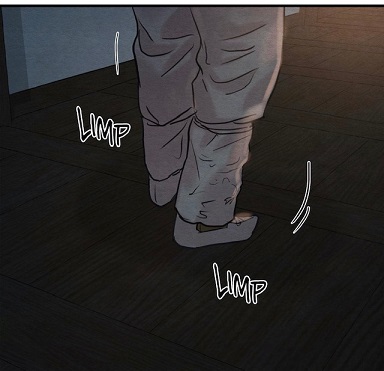
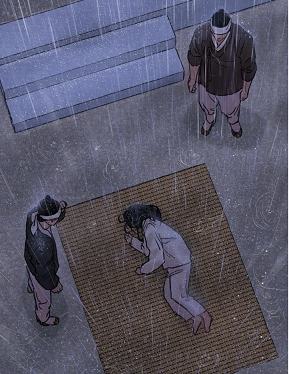 (chapter 77) And that’s how the ruler could discover the truth!! Therefore the culprits would be detected easily: father Lee and naturally Kim, as both knew the real identity of Baek Na-Kyum, but chose to remain silent. Yes, knowledge will become Kim’s downfall in the end. Why do I think so? For me, the feet in this panel are Kim’s (chapter 1), but like mentioned in a different analysis, No-Name got framed for the painter’s disappearance. How did I come to this assumption? It is because the author is often portraying the butler by his feet!
 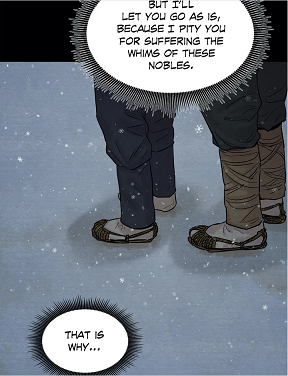 (chapter 66: According to me, this is Kim and not No-Name)
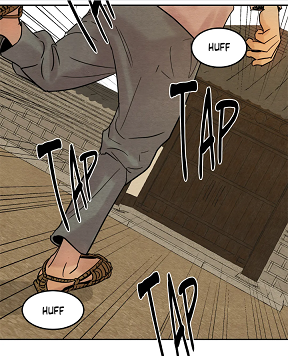
 (chapter 77) Don’t forget rule 1 and 3. Nevertheless, the main point for this interpretation is the way the painter ran: (chapter 4) He made the same sounds than the butler:
  (chapter 17)
 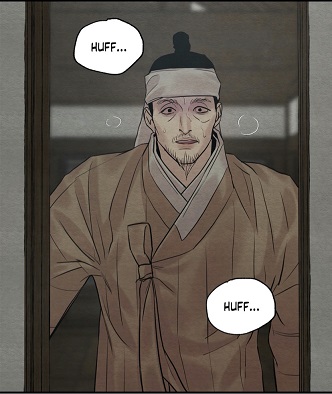 (chapter 85) Here he had faked running. Since he had been introduced with his feet in chapter 1, she needed to create reflections later. Finally, I would like to point out this:
 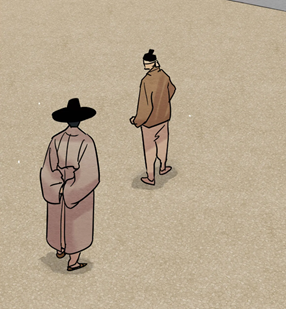 (chapter 7) Their meeting here is an indication that their past must have crossed before because of rule 1!! Since the painter was so devoted to the learned sir, the valet could only jump to the conclusion that the man had truly taken care of Baek Na-Kyum properly.
As a conclusion, the first panel is containing many clues about Baek Na-Kyum’s lineage! Only through long reflection, I could reconstruct his past partially. I am well aware that my perception of father Lee and Jung In-Hun contains more speculations concerning their motivations, since I am still lacking some information. Yet, I am convinced that Baek Na-Kyum is related to the Lees and the king. And the painter ended up in the gibang, because the scholar needed a woman to feed the boy. It was to make sure that the boy was not connected to the household Lee. This would have raised questions, if suddenly a baby had appeared in the mansion. Thus Baek Na-Kyum was entrusted to the noonas through the scholar. There’s no doubt that the painter’s face will play a huge role, for during that time, the scientists didn’t know the existence of DNA! It was not possible to take a paternity test. Besides, the author is always avoiding long narration. She uses “chance” and “coincidence” to deliver much information in a short time! Within 26-28 episodes, she has to give all the answers to the readers, while the story is still going on! And that’s how I realized the importance of the door:  (chapter 04) The protagonists’ fate got switched the moment they passed a door. Thus the painter didn’t suffer here contrary to the young master (chapter 68). He might have been sad, yet he was not exposed to violence and humiliation. But here, it was different: (chapter 94) He had entered the room. In my eyes, this door had a special meaning (chapter 4) It is where the main characters’ destiny was affected, hence the lord expressed this:
  (chapter 4) He recognized that the artist was not a servant or slave, but a free man. His words became a reality. He is not embracing a peasant, but a noble, even a member from the royal family. He was speaking the truth, while all the readers were thinking that Yoon Seungho was a hypocrite. We could say that the main lead was under the influence of the spirits/unconscious, thus he caught the artist right on time. At the same time, “peasant” is again a reference to father Lee which reinforces my theory that the scholar Lee is deeply involved in the couple’s suffering.
As for the scholar, since he never mentioned his involvement in the painter’s life (chapter 1), officially Heena raised him, the readers can grasp why Baek Na-Kyum never considered the learned sir as his “father”. He had been raised in the gibang by the noonas, but not by the learned sir. He was just a companion and a friend, whom he felt indebted and attracted to due to his “gentleness and fake selflessness”. This is not surprising that the servant in episode 1 got executed in the end. The servant had lied, because he had repeated the scholar’s words. And the latter had lied about the painter 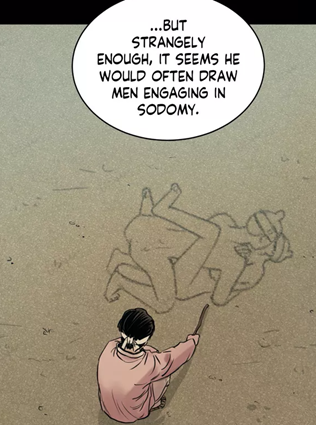 (chapter 1) He had actually painted animals and nature in his childhood, thus the noonas kept his drawings.
 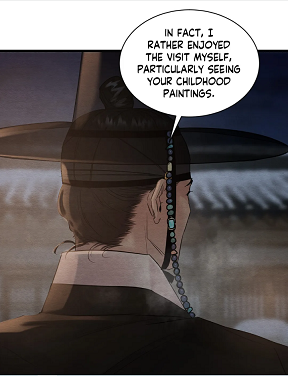 (chapter 94) The man had trusted the learned sir’s testimony without verifying the facts. He had not detected the presence of a blackmail!
  (chapter 1) This truly shows that ignorance is indeed no blessing, and people shouldn’t trust others according to their appearances or social status. At the same time, the servant had forgotten that Yoon Seungho was a noble, though he was dressed like a peasant in the bedchamber.
 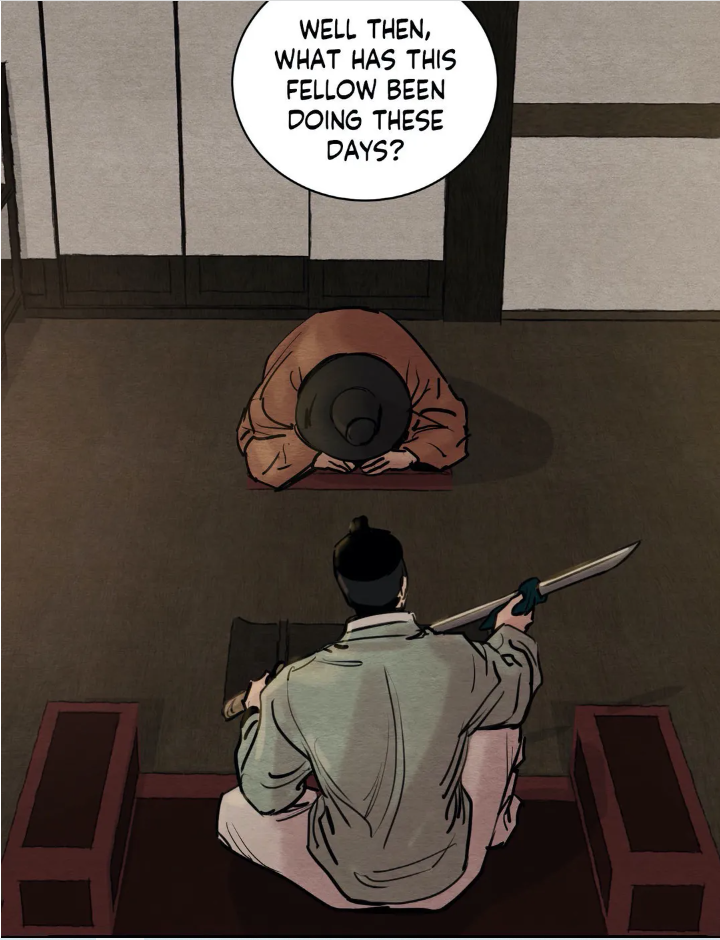 (chapter 1) He was not even wearing a hanbok here, and his head-band was different too. As you can see, both protagonists shared the same experience. They were not treated according to their social status. To sum up, my theory is that the valet Kim brought Baek Na-Kyum to the Lees, who decided to get rid of the painter by entrusting him to the scholar Jung. And Heena became his accomplice, the moment she became his surrogate mother. Let’s not forget that in season 1 and 2, the learned sir was the only one seen with children: girls.
  (chapter 6)
 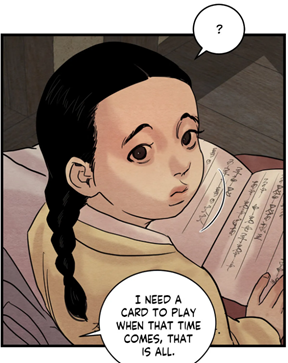 (chapter 29) and Baek Na-Kyum
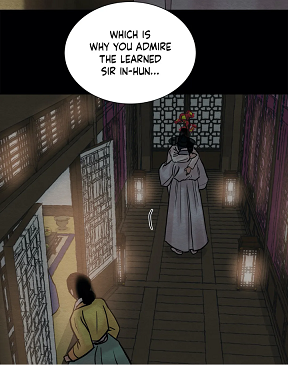 (chapter 68) This shows that the painter embodies the link between the head-kisaeng and the learned sir. Jung In-Hun had entrusted her the baby.
Feel free to comment. If you have any suggestion for topics or manhwas, feel free to ask. If you enjoyed reading it, retweet it or push the button like. My Reddit-Instagram-Tumblr-Twitter account is: @bebebisous33. Thanks for reading and for the support, particularly, I would like to thank all the new followers and people recommending my blog.
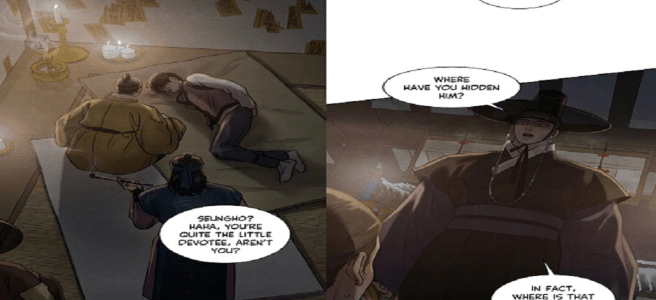
This is where you can read the manhwa. https://www.lezhinus.com/en/comic/painter But be aware that this manhwa is a mature Yaoi, which means, it is about homosexuality with explicit scenes. If you want to read more essays, here is the link to the table of contents: https://bebebisous33analyses.wordpress.com/2020/07/04/table-of-contents-painter-of-the-night/
It would be great if you could make some donations/sponsoring: Ko-fi.com/bebebisous33 That way, you can support me with “coffee” so that I have the energy to keep examining manhwas. Besides, I need to cover up the expenses for this blog.
The starting point of this analysis was this quote from Lee Jihwa. 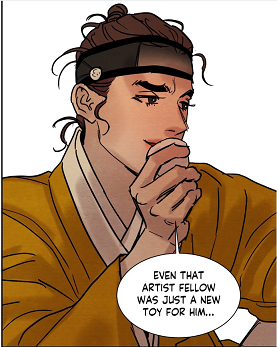 (chapter 12) The mention of a new toy implied the existence of an old plaything. But we know for sure that Yoon Seungho has never possessed anything. He was treated like a male kisaeng himself, for he was not allowed to refuse advances from anyone.
 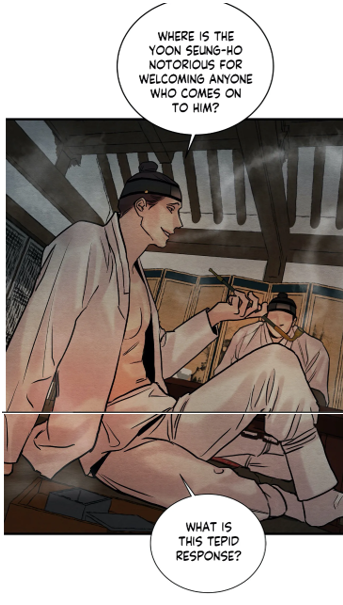 (chapter 52) Finally, he was forced to share anything he owned to others.
 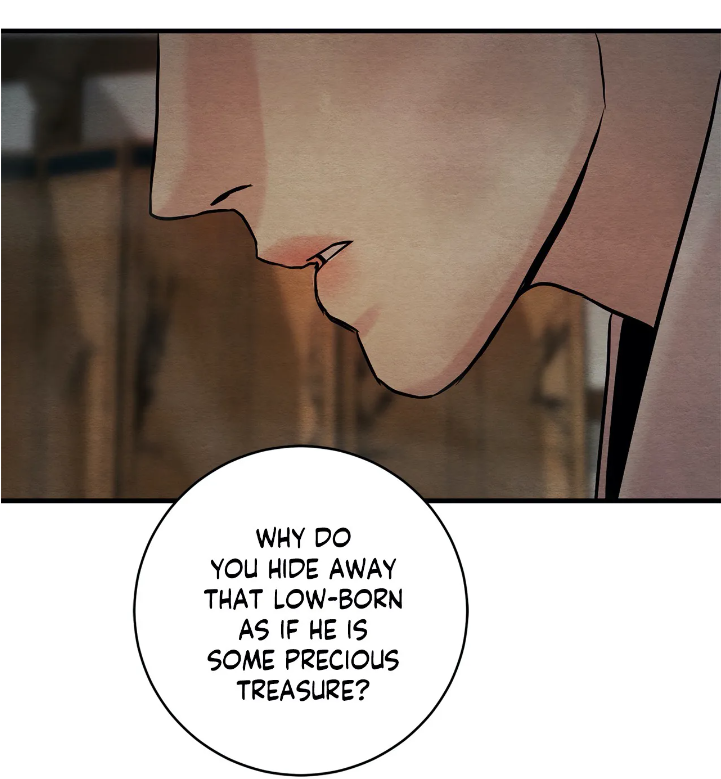 (chapter 52) That’s how I realized that the inner thought from Lee Jihwa was exposing his knowledge. The latter knew about Yoon Seungho’s true conditions. The latter had been treated like a plaything by the pedophile. As the red-haired noble had been raised as an filial son respecting elders, Lee Jihwa saw no reason to change the way Yoon Seungho was “trained”.
  (chapter 57) Besides, he could only benefit from it. Now, he could have sex to his heart content. He only started playing tricks, the moment he felt that his childhood friend was escaping from his claws.
On the other hand, the author recently explained on a live session that Yoon Seungho’s mother committed suicide, for her son was tormented. However, my problem is that I only heard about this through others. Some stans were saying that Yoon Seungho was getting abused, others would even say, he got tortured. So was it abuse or torture? There’s a slight difference between these two notions. For I was a little unsure about this, I preferred to leave it at “abuse”. But then I realized this. If he had been truly tortured, then he should have traces on his body, they used to break bones… so that they ended up crippled. The readers could witness the way the Joseon authorities tortured people in order to obtain confession. (Chapter 37) On the other hand, since the lord went to the authorities in season 3, I deduce that he must have gone there in the past too, yet not as a victim/plaintiff, but as an accused. Because of this new revelation, I made a new connection: sex and torture.
Striking is that in the father‘s eyes, he was not even a slave, he was like an animal. 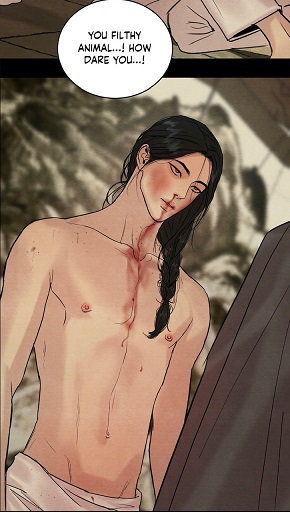 (Chapter 83) Why? He viewed him like a dog, for he was living in the shed. He even had no proper hanbok and no real hair dress, and the manhwaphiles can certainly remember the idiom: clothes make the man! If he was no man, then he was an animal, a dog. Even his food reminded me of dog food. But why was he living there?
  (Chapter 83) In this essay, I will answer to this question. As a first conclusion, the lord was not even treated like a male kisaeng in the past, but more like a dog. Consequently, I deduce that when Baek Na-Kyum met the lord in the inn (chapter 1), his status had already changed. He was slowly experiencing emancipation. He was living like a male kisaeng. Thus I conclude that Lee Jihwa contributed to his recovery to a certain extent. (chapter 59) However, don’t get me wrong. I believe that the change occurred thanks to Baek Na-Kyum’s intervention, the new version of this scene. (chapter 68) Their path crossed a second time in the gibang which led to the painter’s expulsion which affected the lord‘s living condition. But let’s return our attention to the lord’s long suffering.
In the past, while reading season 2, I started getting confused about the identity of the abuser. When in the shed (chapter 62) the lord turned into a shadow or ghost from the past, certain gestures were similar to the patriarch‘s.  (chapter 57)
  (chapter 62) This explicates why after reading episode 62 for the first time, I had suspected the father to have raped his own son. Yet this thought was dropped shortly after. Then when episode 77 was released, I realized that in the shed the lord was also reminded of Kim’s betrayal, for the latter would always drag him to the shed. Observe the way he was “carried away“. It was like an “embrace“.
  (Chapter 77) In episode 77, the readers can witness 2 incidents how the lord was brought to the storage house.
  (Chapter 77, this is a different situation, for we have different servants except Kim) Therefore in the barn, Yoon Seungho behaved like his surrogate father Kim as well. This explicates why we have the fake embrace and the insincere apology.
  (chapter 62)
  (chapter 62) As you can see, the hug from the past was the symbol of violence and hypocrisy. It served to drag the lord to the storage room. And this new observation led me to the following conclusion: Yoon Seungho was copying the behavior from all his abusers from the past: his brutal father, the hypocrite butler and naturally the pedophile.
  (chapter 62) Hence the protagonist grabbed the painter by the hair. For me, the “mysterious lord Song“ used to hurt the main lead by the hair, when he got angry. How did I come to this interpretation? Note that at no moment we never saw Yoon Chang-Hyeon taking his son’s hair. First, the lord’s head was covered with a hat. (Chapter 57) Even in the bedchamber, he would either slap his son or grab him by the throat.
  (Chapter 83)
 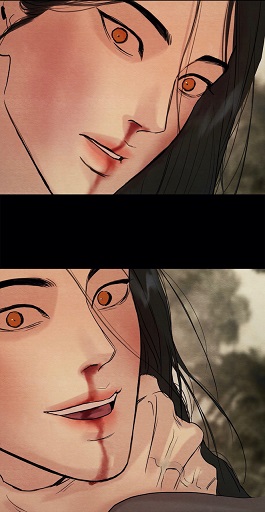 (chapter 83) As for Kim, the latter would always restrain the main lead by the shoulders, the fake embrace.
  (Chapter 57) And now, you comprehend why the lord dragged the two nobles by the topknot.
 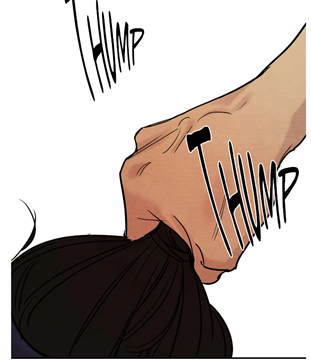 (chapter 8) For a long time, I have demonstrated that this gesture represented one of Yoon Seungho’s biggest traumas. But why would the pedophile do that? One might say that it is because of Yoon Seungho’s resistance and struggling. He needed to punish him for his disobedience. Note that the noble with the mole and Lee Jihwa got humiliated as sanctions.
 (Chapter 18) However, in my eyes there exists another explanation which I will elaborate in this analysis either. From my point of view, the shed and the humiliation are strongly intertwined. This was particularly visible, when the lord forced Baek Na-Kyum to have sex in the courtyard.
  (Chapter 64) But why would he do that in the end? It was to train him, to make him obedient.
  (Chapter 64) Remember how he had declared that the painter was now his sex toy. He should listen to his master or owner. That’s how I came to this deduction. The infamous lord Song is a sadomasochist. In the worse case, he is simply a pure sadist. I am inclined to believe more in the first view. With this, we would have the link between sex and torment. And the picture from the erotic book where you see the bearded man having a braided man on his lap outside indicates that Yoon Seungho was here getting punished. The pedophile loved seeing Yoon Seungho humiliated and in tears.
 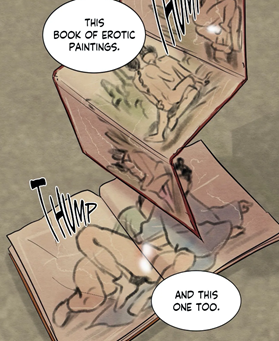 (chapter 01) And now, we have the explanation why the lord could no longer cry and how he came to hate “fake apology”. This was the result of the exposure to the sexual assaults under the form of BDSM.
But what is BDSM exactly?
It’s an abbreviation for bondage, discipline (or domination), sadism (or submission), masochism: sexual activity that involves, for example, tying a partner up, games in which one partner controls another, or giving and receiving pain for pleasure quoted from https://dictionary.cambridge.org/dictionary/english/bdsm
This means that BDSM is a role play, where one acts as a dominant and the other as submissive. However, in order to become an act, there must exist consent and agreement. A contract is necessary, for the dominant has to ensure the submissive’s safety. He needs to know the limit between real and fake, and as such when the pain becomes too much to bear and is no longer a synonym for pleasure. The dominant needs to know boundaries. Thus the couple has to have a safety word. Once this word is said, the “punishment or humiliation“ has to stop. This truly shows that BDSM is strongly regulated. Therefore on different websites, you can see many recommendations. One stipulated 10 rules so that BDSM would be enjoyable for the couple: 1. be patient, 2. be humble, 3. be open, 4. be honest, 5. be realistic, 6. be sensitive, 7. be genuine, 8. be healthy, 9. Communicate, 10. have fun. (https://modemworld.me/ds-essays/the-ten-rules-of-ds/) Striking is that during their last love session, the couple was already following these principles, though there was no real punishment. Don’t forget that the painter had sex in front of people behind the doors. 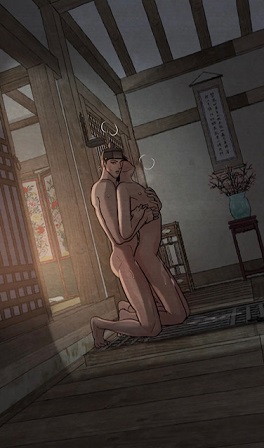 (chapter 96) They ended up in the hallway, anyone could see them. Then in another website, I found the following principles:
„What Daddy should do for his little Prince:
1. Help me brush my hair if you’re with me.
2. Help me pick out clothes and food.
3. Take bathies with me sometimes, and showers with me most of the time if you’re here.
4. Hold my hand as often as possible.
5. Call me my preferred words: little, sweetie, prince, puppy etc.
6. Give me treats when I’m good.
7. Punish me when I’m bad.
8. Praise me when I do good. No matter how small the good thing is.
11. Don’t make threats. Punish me if I’m bad, but don’t take things away or hurt me when you’re mad.
12. Never lose your temper because your day is going bad.
13. Always go to bed and get enough rest as much as possible.
16. If I’m sad I like hugs and kisses and pets and nice words.
17. Littles need to know they are loved.
18. Always be honest with me.
19. If I’m being a brat, I want attention.”
20. Don’t ever break promises, ever.” quoted from https://www.wattpad.com/amp/492636426
After reading the second list of rules, the manhwaphiles will realize two important aspects. First, the main lead was slowly developing a manual of BDSM without realizing it. Note that after the coerced sex in the pavilion, he desired to take care of the painter personally. He took the horse, and if he had not met the butler on his way to the pavilion, he would have done it himself. 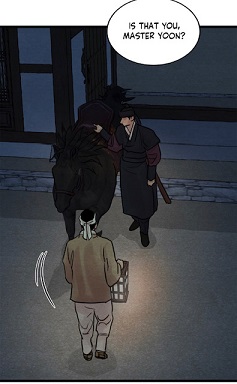 (chapter 25) He even brought the hanbok himself.
 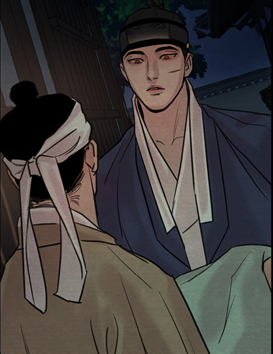 (chapter 26) The lord went so far to take his bath with his lover to clean him.
  (chapter 59) He made sure that his partner wouldn’t suffer.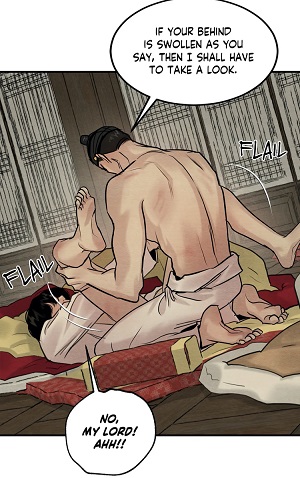
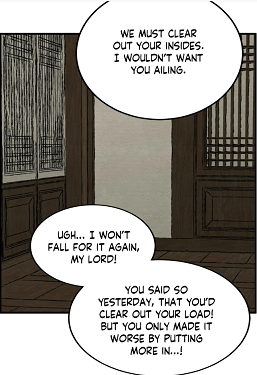 (chapter 89) Yoon Seungho knew by experience that the rest of semen in the stomach would cause him ailing. (chapter 77) This was the reason why Yoon Seungho had a fever afterwards. Don’t forget that the pedophile used Taoist sexual practices, this means the young boy had a sex marathon each time, he met the pedophile. Thus I interpret the bruise on Yoon Seungho’s eye not only as an indication of resistance, but also as a source of joy for the sexual predator. We have the reaction from lord Jang as the perfect example.
  (Chapter 101) He blushed, though he could see that Baek Na-Kyum was in pain, the face covered with blood. Remember what the painter did in the pavilion to the main lead: he scratched his face.
 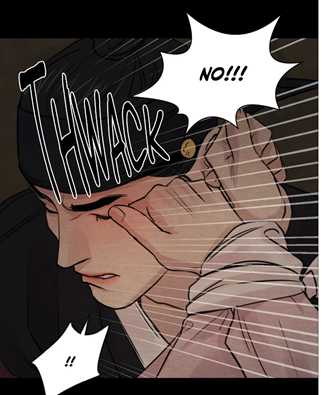 (Chapter 25) Thus we have to envision that the lord must have reacted the same way and wounded his abuser. And imagine the consequence if he had wounded the king on the face. This could be seen as a reason for a punishment.
 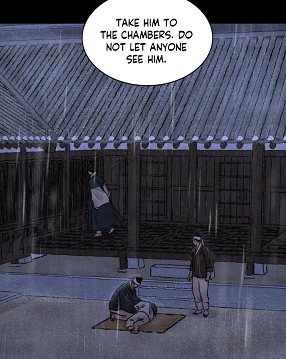 (Chapter 77) Remember Black Heart‘s warning in the shaman‘s house:
  (chapter 102)
Under this new light, the readers can comprehend what happened. Because he was the ruler, he expected acceptance. In addition, the king never took care of his “lover” properly, for in the palace, the staff was supposed to take care of everything for him: he would receive the assistance from maids and eunuchs in order to get dressed. This signifies, he must have had the same expectations in the Yoons’ mansion. He always relied on Yoon Chang-Hyeon and the so-called loyal valet. But the father could only resent his own son, for he rejected homosexuality, as it stands in opposition to lineage. As for the valet, the latter was too much plagued by his own guilt that he resented the nobles for his own wrongdoings. He never realized that he was abandoning the young master.
Yoon Seungho learned through the hard way to take care of himself. However, because the protagonist had been traumatized by the sexual fake lesson, I doubt that he could have an erection. Thus the valet went to the physician again in order to get replenishing medicine. 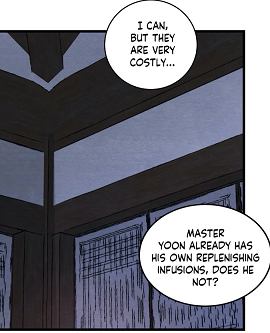 (chapter 33) This is an euphemism for aphrodisiac. Thus we had this confession from the physician.
  (chapter 57) Why did the butler visit the doctor without Yoon Chang-Hyeon? It is because he had been ordered to fetch the aphrodisiac. By feeding him with the drug, they wanted to force Yoon Seungho to accept the advances from the king, and as such to admit his sexual orientation. He was a sodomite.
 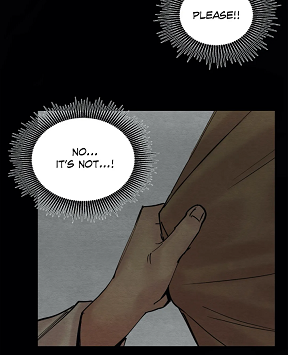 (chapter 65) They faked his “pleasure“ making him feel guity and dirty. That’s how he got tricked. This explicates why the main lead still has no idea of the use of the aphrodisiac.
And now, you have the answer why the king failed to “tame” Yoon Seungho. He did the exact opposite what he should have done. He never followed such rules: respect, health, etc… Lord Song never became responsible for the young boy, thus he never confessed as well. He never apologized for his mistakes or his brutality. 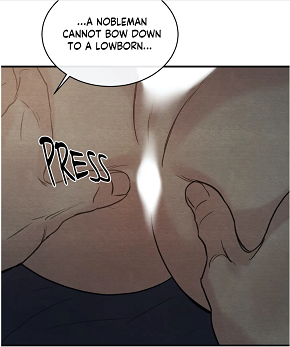 (chapter 71) As a king, he couldn’t bow down to a noble. Observe that the roles of “dominant” and “submissive” are not clearly defined between Yoon Seungho and Baek Na-Kyum. The lord is the dominant sexually speaking, but note the vocabulary:
 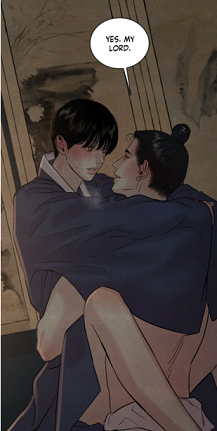 (chapter 72)
  (chapter 89) If you pay attention to their interaction, the lord acts like the servant. The reason is simple. If you take into consideration the second list of recommendations, you will recognize that the roles are switched. Outside a sex session, the submissive becomes the “king“, and the dominant has to act like his servant. That way, a certain balance is created. But this was never the case between the pedophile and the teenager. The latter was always reduced to a plaything and at the end to an animal. The pedophile never called the protagonist by his name.
 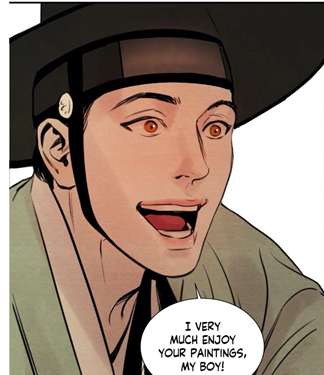 (Chapter 1) He was just called “my boy“. And that was it. He never created a real bound with the main lead. Therefore trust was totally inexistent. And because the young noble could only fear the man, he came to hate him to the point he could die. The latter made promises which he never kept!!
  (Chapter 101) How could he vow to “protect or help“ Yoon Seungho, when the latter was tormented constantly and exposed to violence against his will? And this could only escalate to Yoon Seungho‘s attempt to commit suicide. (Chapter 57) What caught my attention is that Kim needed the help from the other servant to keep Yoon Seungho on the bed. This is relevant, because this reveals that Yoon Seungho had reached an age, when the bearded man was no longer strong enough to restrain the main lead. It is very likely that before killing himself, the protagonist had even tried to hurt the ruler.
  (Chapter 55) I had this idea, for the story is going in circle, meaning that the lord must have done it before, just like he did in season 3. The possible death from the main lead and probably his own pain must have brought the mysterious lord Song back to reality. That‘s the reason why he sent for the physician‘s assistance. He was encouraged to keep his distance from the young man, just like the latter was incited to stay away from the painter in season 1 (sickness, Min), in season 2 (the scholar‘s insult) and in season 3 (the rough sex session in chapter 81-82). Thus I deduce that the pedophile has always kept an eye on Yoon Seungho and his recovery. In my opinion, the man has not forgotten the main lead at all. Why do I think so? It is because he kept the painting…
 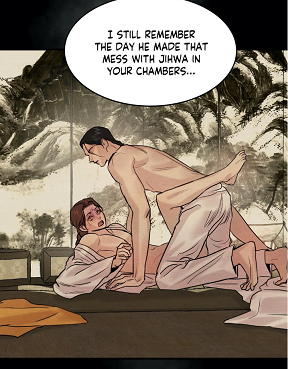 (chapter 82) a souvenir from their time together, just like Min who stole the painting in the study.
Thanks to the painter, the more time passes on, the more Yoon Seungho changed. Not only he returned to his original personality, but he slowly developed the rules how to play BDSM. He discovered the importance of “consent” after the second sex marathon. Striking is that he got reprimanded by his butler after the love session. This explicates why the main lead never requested the painter in his bedchamber, and only visited him during the night, when he was asleep.  (chapter 74) Thus I am deducing that Seungho-Ya will become the safe word between the two protagonists.
  (Chapter 72)
While Yoon Seungho dresses the painter personally, or he cleans him with his own hands, the king imagined that the butler would take care of everything. Thus I come to the deduction that the king will discover the real reason why his relationship with Yoon Seungho was doomed, and why he could never obtain his heart. Kim had also betrayed him, for he had never revealed his knowledge at the right time. He used paltering to escape punishment. However, I would like not to be misunderstood here. Naturally, lord Song is as much responsible as the other abusers. Why? The king only focused on his own pleasure, and never paid attention to the counterpart, he was totally in denial that he was using violence. Deep down, he knew that this was wrong, for the main lead was just a boy, like the “nickname“ was revealing it. He thought, as the ruler, he could overlook social norms. However, here he had definitely crossed the line. So imagine what BDSM means for a teenager. It is indeed a torture. He must have been definitely scared. And the king must have threatened him too not to share his sexual habits to others. I am quite sure that the ruler was not willing to admit his own sexual habits to others, hence he did it in the shed. It is also possible that he didn‘t mind of Yoon Seungho being described as a licentious man. That way, the king‘s behavior wouldn‘t be criticized. But because Yoon Seungho was sent to the shed, and punished there, the “fathers“ misjudged the real “value“ of the main lead. They truly thought that the king only viewed the main lead as an animal. They took the punishments in the shed as face-value reinforcing their disregard for the protagonist.
Thus I come to the conclusion that the shed was the place where the main lead was exposed to BDSM. This explicates why Byeonduck revealed such an image in a tweet.  The noble with the mole is trapped in a shed, and the color purple, a symbol for royalty, is dominant. From my point of view, the author revealed everything in this tweet. On the other hand, I would like to point out that here the man doesn’t look scared or rejecting the use of the bondage or the dildo.
This explicates why Yoon Seungho was so rough in the storage room. 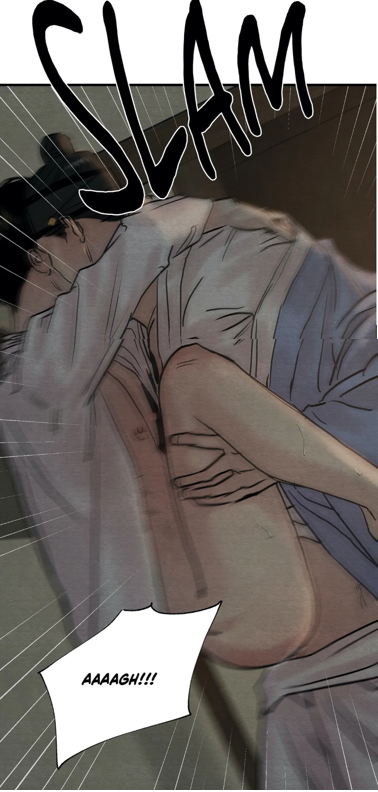 (Chapter 63) He was reliving his biggest trauma. Yet, he never went overboard in the shed. Note that the moment the painter called his lover “lord Seungho”, there was a switch.
  (chapter 63) That’s the reason why the lord changed the painter’s position and faced him.
 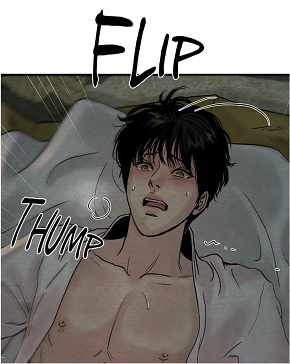 (chapter 63) The lord communicated his feelings and thoughts, and he even made a promise.
 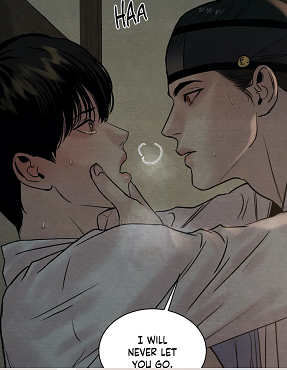 (Chapter 63) This new perception reinforces my impression that there was no rape in the storage room. The painter kept saying “no“, because he was actually scared about his own reactions. Strangely he felt pleasure, thus he kept having climaxes. He was simply in denial. The irony is that the noble attempted himself to be cruel during the night of the revelation (episode 62, 63, 64), but he failed, because the night at the doctor’s house was still fresh in his memory. He couldn‘t forget the tender embrace from the painter.
 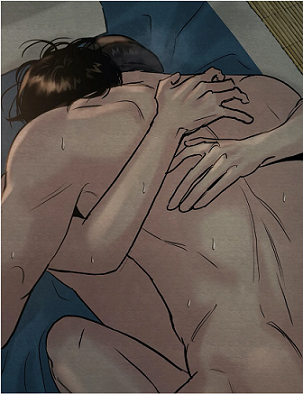 (Chapter 62) This explicates why he stood up during the penetration, he was forcing the artist to hug him, to clinch onto him. He wanted to relive it again.
As you can imagine, the infamous lord Song knew no boundary. He was simply the worst kind of sado-masochiste. First, this was never an act, the submission and as such violence were real. Why? It was because of his social position. He was the king, yet BDSM is a role play. Moreover, I would like to add the Marquis de Sade as the best illustration. The French philosopher from the 18th Century was arrested due to sexual crimes: rape, sodomy, sex with teenagers, abuses (bondage). We don’t know for sure how far he went, yet there’s no ambiguity that the libertine had definitely crossed the line. I doubt that the man knew about the necessity of rules in BDSM as well. Striking is that his „victims“ were prostitutes and people from the lower social class, while he belonged himself to the old nobility. I am suspecting that the man didn’t truly outlive his sexual fantasies with women from the same social status. Thus I came to the following conclusion: the necessity to distinguish fantasy and reality. My faithful readers will certainly recall that the protagonists had to learn to make this distinction. Consequently, I have the impression that the king didn’t make the difference in the beginning. He thought that he was finally able to outlive his sexual fantasies, not comprehending that this was just an illusion, for the “violence“ was real to Yoon Seungho. Under this new approach, we have the explanation why Yoon Seungho never paid attention to the marks left by the ties on his wrists.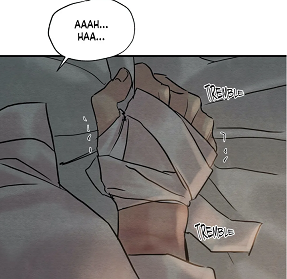 (Chapter 63) He had internalized the marks left by the bondage. This is no coincidence that the artist‘s wrist was covered by the bandage, the reflection from the torment in his youth. Under this new aspect, the presence of the bed in the shed was like a magical tool, which helped the lord to not turn into his tormentor. He was just a ghost from the past, and the word “lord Seungho“ worked like a magic spell, which stopped Yoon Seungho from becoming as vicious and cruel as lord Song. Moreover Lord Song sounds very similar to lord Seungho. And this new discovery confirms my interpretation that Kim was the helping hand of the king. He had to provide him with the white bands for the bondage, just like he had helped for the young master’s kidnapping in the gibang.
 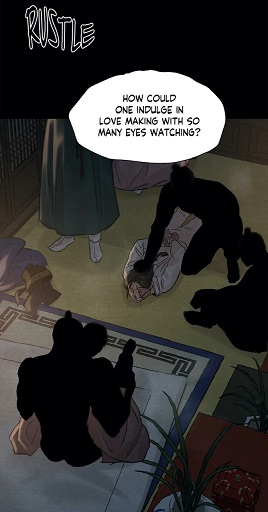 (chapter 86) But don‘t get me wrong. The king sent the main lead to the shed, when he wished to punish him. Yes, he repeated the same actions than Yoon Chang-Hyeon. And what is the common denominator between these two circles? The valet…
Besides, he didn’t treat Yoon Seungho like a slave, but like an animal. One might say that it was not his fault, for he was not aware of the physical and emotional torment from the other abusers. However, the moment he “claimed“ Yoon Seungho as his „partner“ or “plaything“, it was his duty to ensure his safety. Besides, if he truly cared for him, he should have showed more interest in the young master. Thus he became responsible for Yoon Seungho’s suffering. Note that so far, no servant was treated like that in the mansion. Even Soongap from Bongchon Bride was treated much better, until he received his terrible punishment. Soongap was never forced to live in the shed.  Under this new light, I see it as another evidence that the infamous lord Song could only be the king! He is the only person who has absolute power in Joseon, and as such knows no “real boundaries“. Furthermore, as the ruler, he is expecting no rejection from his subjects. Anyone watching sageuks (historical Korean dramas), is aware that the Joseon king was never an absolute monarch, for he was always controlled by the officials, ministers, the Queen dowager and the Queen. There were also protocols which he was forced to follow. And we have an indication about the king‘s lack of power and wealth.
 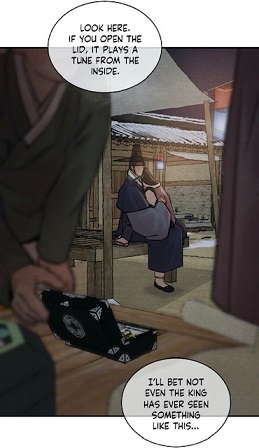 (Chapter 76) Thus I am assuming that the lord Song must have been frustrated about this contradiction. On the one hand, he was supposed to be the most powerful man in Joseon, on the other hand, he had to rely on the aristocracy. Hence I have the impression that the ruler vented his anger and frustration on Yoon Seungho unconsciously. That way, he could outlive his sexual fantasies, where he was powerful. But because of these terrible sexual habits, the young master could never get treated by a physician. Anyone would have recognized the sign of abuse.
But imagine what it meant for Yoon Seungho, a teenager who discovered sex through the most horrible way! He had been traumatized by the penetration between the kisaeng and the fake teacher. Striking is that the perpetrator and the other adults all reduced sex to penetration, like my friend Luzyla pointed out to me. The dildo and the comments from the nobles  (chapter 92)
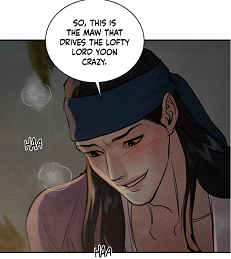 (Chapter 101) are a proof that they never discovered the importance of kisses, embraces, caresses and words during sex. They never recognized that they were denying the existence of love, too obsessed with their heritage and their reputation. The manhwalovers will remember my previous observation. The pedophile had never kissed the main lead. The king like all the nobles had disconnected sex from love. Why? It is because sex was a duty… to continue the lineage. And now, you have the explanation why the pedophile and all the others reduced sex to penetration.
Under this new perspective, it becomes comprehensible why Heena got scared in the annex.  (Chapter 96) When she heard the noise (PLOP), she was brought back to the past, when she had witnessed a scene of BDSM, though the violence was real. A similar situation to this scene:
 (chapter 73) The pictures from the erotic publication are the evidence for this theory. After hearing the description from the butler about the events in the shed, the noona Heena believed to know what had happened in the shed.
  (Chapter 68) She could see the traces on the painter’s body, and conclude that the valet was telling the truth. However, the butler had been misled himself, for his perception was biased by his past experience.
  (Chapter 64) The butler thought that the “no“ from the painter was truly real, while the latter was just dishonest. It was the result from the “indoctrination“ from Heena and Jung In-Hun. The valet had been deceived in the end. The humiliation and punishment were not real, for the painter did ejaculate, and back then he was not under the influence of the aphrodisiac.
 (Chapter 64) This was not like in the past, when the brutality was real. And now, you comprehend why Heena‘s resent towards her brother became more visible after witnessing the love session between the noble and Baek Na-Kyum.
  (Chapter 97) From my point of view, she had already internalized that the painter would never change, he was already too “damaged“ to change. However, since he was close to Yoon Seungho, he could become in danger, for she knew the connection between the ruler and the main lead.
And now, you are probably wondering why I selected such a title, when so far, I didn’t mention the pants. Nevertheless, my faithful readers will certainly recall my previous analysis “Who is wearing the pants?“ , where I had pointed out about the lord’s habit who kept his trousers for the most part of the time.  (Chapter 72) He was copying the habit from the pedophile in my eyes. The latter would never remove all his clothes on his own. As the king, he was used to get undressed by his own staff. Only the teenager as the uke was undressed, unless the lord was accompanied by the other nobles, like in this scene.
 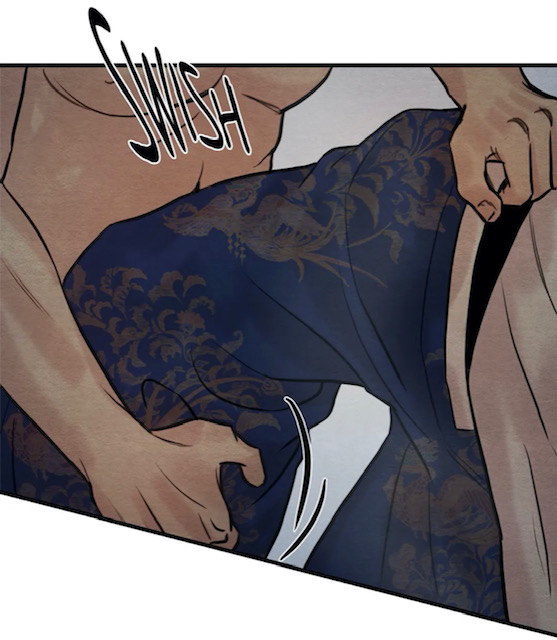 (Chapter 54) And because the ruler was too focused on his own pleasure, he never got to know the young noble. He only realized too late that he had made huge mistakes. (chapter 37) Because he couldn‘t accept his responsibility, he preferred blaming others: Yoon Seungho, Yoon Chang-Hyeon, the real lord Song, the 3 nobles who got tortured, etc. Thus everyone got punished. He had definitely developed feelings for Yoon Seungho, but he would never admit it, for love was not accepted among nobility and even less between 2 men. However, I don‘t think that the man should be romanticized, for he abused a young boy for almost a decade. He has to be judged as a sexual predator, who hunted down Yoon Seungho to get him.
  (Chapter 72) Yoon Seungho was his prey.
After reading my whole explanation, the manhwaworms can comprehend why Yoon Seungho said this to his childhood friend. 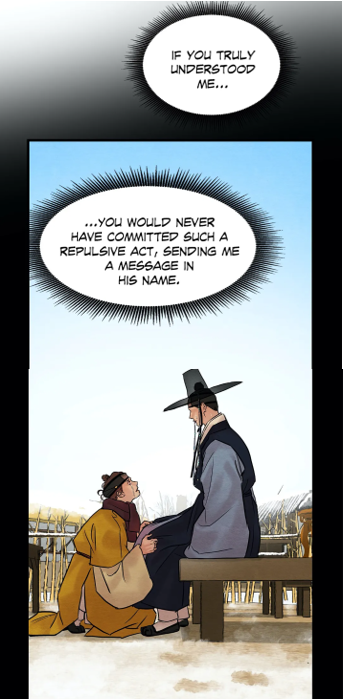 (Chapter 59) The main lead was supposed to meet his tormentor in a public place. Yet their relationship was based on “humiliation“! The “king“ loved to punish Yoon Seungho through humiliation and violence. This explicates why Yoon Seungho reacted that way.
  (Chapter 56)
  (chapter 57) This is what he experienced himself in the past. And observe that the childhood friend’s biggest punishment was actually his public humiliation, when he confessed and got rejected.
  (Chapter 59) In my eyes, the king sought to obtain Yoon Seungho’s affection, but he never realized this. He definitely confused it with submission. He definitely imagined that once the teenager would become submissive, he would have achieved his goal. But he was doomed to fail. In his mind, as the ruler no one could ever reject him. Besides, as the ruler, he was allowed to use his power and as such his strength to obtain what he desires. Don’t forget that in Joseon, people viewed all the monarchs als representatives of the gods. The latter would support them. However, since his youth Yoon Seungho had a strong opinion and mind. Therefore he had caused trouble to his father, as the latter viewed his critical thinking as a synonym for a lack of respect for traditions and the elders, the so-called illness from his childhood. Besides, I am suspecting that the lord must have had visions as well, which would contradict the father‘s dreams and expectations.
 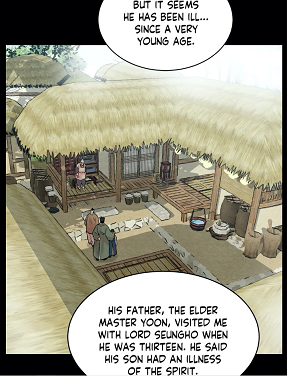 (Chapter 57) Yoon Chang-Hyeon looked down on his son’s critical thinking and came to doubt his words. The author left many clues for this interpretation:
  (chapter 101) Lord Jang got aroused, when he saw the bloodied lips from the painter. Moreover, Black Heart had brought a huge dildo.
 (Chapter 101) The item was huge, therefore it could only injure the artist’s anus.
 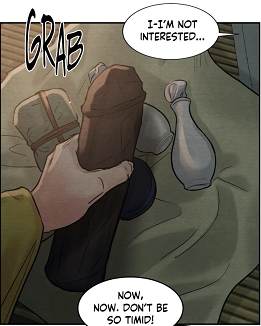 (Chapter 100)
 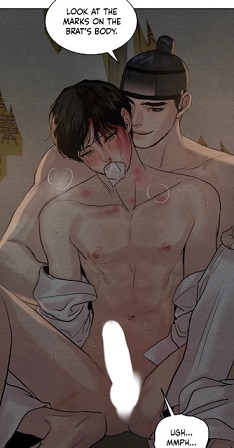 (chapter 101) Even the noble said that this must have hurt. The painter disliked being bitten in the neck.
  (Chapter 88) Furthermore, the lord said this to the painter in the study:
  (chapter 85) These were the words from the pedophile. He was repeating his sexual abuser‘s words. And this proves to me again that the lord was abused in the study, but if he rejected the man, he would be sent to the shed where he would receive his punishment. In other words, Yoon Seungho was punished with sex and violence. And now, you have the explanation why he got gangraped in the end. But the readers should keep in their mind that this was no real BDSM, for the brutality was real. The king couldn’t distinguish between reality and illusion. And this coincides with all my previous interpretations.
Naturally, the king is the biggest hypocrite in the end. He raped the boy, and he knew that. But he could always legitimate his actions with the following excuse. The young boy was a sodomite anyway, for he couldn’t do the deed with a kisaeng. He had brought him upon himself, since he had accepted his offer in the first place. He definitely used religion and philosophy (Taoism) to hide his crimes. By maintaining the harmony between the Yin and Yang, he would live healthy and live longer. But exactly like Lee Jihwa, he was attempting to fool himself and the main lead. And because he made no distinction between real and fake submission, neither father Yoon nor Kim felt obliged to view Yoon Seungho as the king’s official wife or concubine. How could they know that the man viewed the main lead more than just a plaything or a dog? This explicates why Kim had such a memory in the end.  (Chapter 65) Kim had brought him to the barn, because Yoon Seungho was punished there. This could only be suggested by the butler, as I don’t think that the king would ask for the owner of the mansion for permission. This room was definitely taboo, no one was allowed to approach the study or the shed. Yoon Seungho was exposed to rough sex, and Kim knew this, like mentioned above. But he never witnessed it himself, he only discovered the aftermath. From my point of view, this scene occurred after the lord’s loss of virginity. (Chapter 65) And now, you have the explanation why he got gangraped in the end. I had always sensed that this was a punishment for Yoon Seungho.
I will stop here, for the essay is already very long. But before ending this, I would add two more aspects. I was still unable to comment about this panel, (chapter 94). Notice that violence was used against the painter to mask attraction. The “girly features“ were definitely perceived as something tantalizing. Thus I perceive this incident as a reflection from the BDSM. It was to push the artist away, to incite him to leave the gibang. Heena feared that he might catch the attention of the pedophile, and it is very likely that she was manipulated by the scholar, her idol.
As a conclusion, this new approach gave me new insight about the pedophile‘s personality. Either he will come to the city very soon or he is already in town and this for two reasons. It is related to Yoon Seungho and Black Heart. There’s no ambiguity that the death of Min who was definitely close to him will force him to intervene directly. In the past, I had developed the theory that Black Heart and his friend with the mole were the king’s new companions. In truth, he will use this incident to reenter the main lead‘s life. First, Yoon Seungho was supposed to have committed suicide. He will ask about Yoon Seungho‘s whereabouts and about the incident leading to his disappearance: the rumor about the protagonist‘s crimes (the death of the scholar and the servants)…. And that‘s how he will discover that Baek Na-Kyum is considered as the main lead‘s bride! From my point of view, he knew about the existence of the painter, yet he must have explained his “bride“‘s behavior like this:  (chapter 18)
Feel free to comment. If you have any suggestion for topics or manhwas, feel free to ask. If you enjoyed reading it, retweet it or push the button like. My Reddit-Instagram-Tumblr-Twitter account is: @bebebisous33. Thanks for reading and for the support, particularly, I would like to thank all the new followers and people recommending my blog.



This is where you can read the manhwa. https://www.lezhinus.com/en/comic/painter But be aware that this manhwa is a mature Yaoi, which means, it is about homosexuality with explicit scenes. If you want to read more essays, here is the link to the table of contents: https://bebebisous33analyses.wordpress.com/2020/07/04/table-of-contents-painter-of-the-night/
Feel free to make some donations/sponsoring: Ko-fi.com/bebebisous33 That way, you can support me with “coffee” so that I have the energy to keep examining manhwas. It would also cover my expenses for the blog.
When I examined the sex scenes from the first season (see the analysis “Sex or Love?), I realized that each character had different expectations from the sexual encounters. They were either looking for sex or for love, but each time they were not able to express their desire and even to recognize the distinction. Why couldn’t they sense the difference? It is related to the way the characters were raised.
On the one hand, Baek Na-Kyum was taught by the learned sir and Heena noona that sex and as such homosexuality was dirty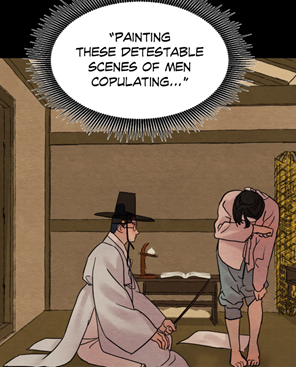 (chapter 34), only spiritual love was allowed
 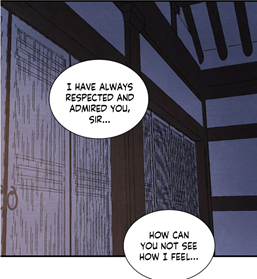 (chapter 19)
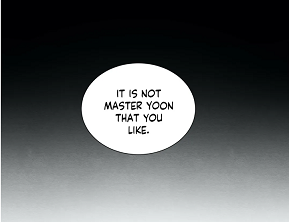 (chapter 68). This signified that in his education, not only sex was prohibited, but also sexual desires were denied. Although love was expressed through hugs
 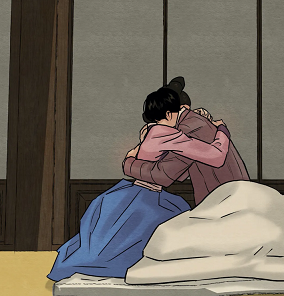 (chapter 66)
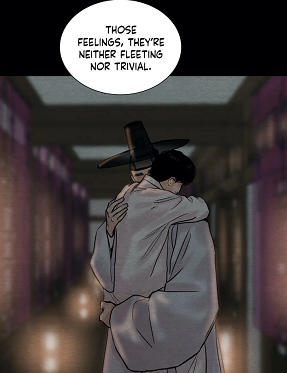 (chapter 68) and caresses
  (chapter 10)
  (chapter 68), they were devoid of sexuality. The painter experienced love, but was not allowed to experience sexuality. He was only authorized to paint it for the scholar’s sake. On the other side, Yoon Seungho was raised the opposite: love was not allowed, as it was a sign of submission and weakness. Sex was permitted, because it was considered as a fight in order to defeat his opponent. These were the butler’s doctrines. That way, he could still have a connection to the main lead. If he came to love someone (the pedophile), the lord could definitely abandon the valet and reveal his betrayals. In other words, he used pity as a way to tame the lord. At the same time, sex also served to gain some benefit, as it was an exchange of favors (giving versus receiving),
  (Chapter 71). I connect this philosophy to the king and indirectly to the butler. With sex, the nobles could exchange some favors. These huge divergences in the mindset explicate why there were so many misunderstandings between Yoon Seungho and Baek Na-Kyum, as their education diverged so much.
Yet, despite the contrast, both educations had something in common: prostitution. Heena noona hates sex, because it is related to her work. The scholar rejects it, for it is beneath him. He expects the low-borns (Baek Na-Kyum and Heena noona) to become his prostitutes, if it’s necessary, while he can maintain his image of a proper scholar. Father Yoon used his son as a prostitute, and the main lead realized it after his father’s betrayal and abandonment. This explicates why “prostitution” stands in the center of the second season. For Baek Na-Kyum was brought to the mansion against his will, but he received certain privileges, his status was never clearly defined. Although Yoon Seungho thought, he had won the battle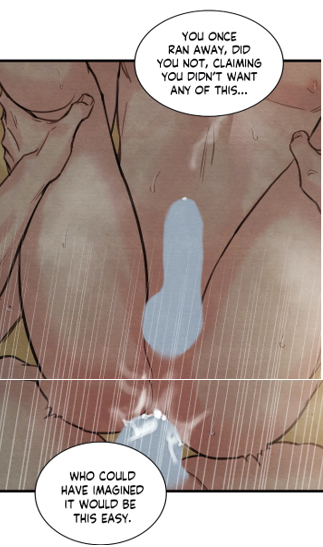 (chapt45), as the painter had accepted him as his sexual partner, he had to realize slowly that he was wrong. He imagined that since the artist had remained by his side and was accepting to have sex with him, he had achieved what he wanted: in his unconscious it was to be loved. Yet, it was just an illusion. The painter saw himself as a whore and the master as a man consumed by lust. As you can see, the noble was forced to judge the nature of the sexual encounters differently. He had associated sex to love due to their Wedding night, therefore he imagined that the moment the painter was accepting him, the problem was solved. He would be able to relive this wonderful moment, but however nothing like that happened. He felt never satisfied, as there were no feelings at all. Hence he even had sex during the day
 , believing that the artist’s lack of experience was the problem.
  (Chapter 45) While the lord became Baek Na-Kyum’s sexual emancipator, the painter became the lord’s teacher for love. This explicates why the low-born forced the lord to question his own identity and feelings.
But let’s return our focus on the common denominator: prostitution. As long as the painter chose to stay, because he had a roof over his head and could eat properly, we could definitely say that till 49 his stay at the mansion was indeed closer to prostitution  than a master- servant relationship, because the commoner was never treated like a domestic. He only had sex with the lord and had some privileges.
  (chapter 46) He was never asked to do other work, although the artist tried to change his situation. Since he was behaving like a whore, he felt that he had no right to express any thought and emotion. He couldn’t show any pleasure. That’s why there were no feelings in their sex encounters, and the lord could sense the difference. Consequently, when the lord realized that he was still perceived as a man consumed by sex
 (chapter 48), he changed his behavior. He acted like a real client at the brothel
 (chapter 48), but at the same time he cornered the painter to have multiple climaxes in order to let him experience that he liked having sex with him.
 (chapter 49) As you can observe, the lord linked sensuality to love. If he could provoke ejaculations, then it meant that the artist was definitely feeling something for him. However, the moment the lord liberated the painter from his pejorative perception about himself (he is a prostitute), the painter reacted the exact opposite. Now, he was the one using Yoon Seungho, the latter was his plaything.
 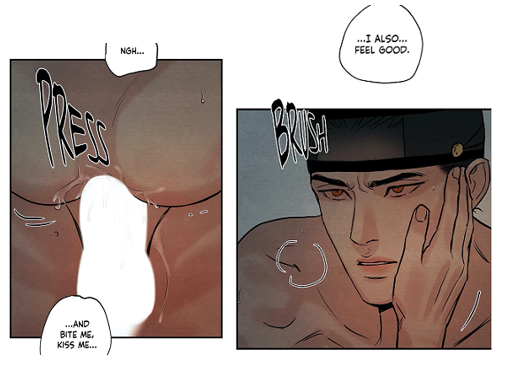 (Chapter 49), his prostitute, for he was the one procuring pleasure to Yoon Seungho. As you can see, the roles had been switched. This means that now the painter had the upper-hand in their relationship. We could even say that the noble was willing to accept his fate.
  (Chapter 49) Yet there was a difference from the past. Yoon Seungho would feel pleasure as well. This is not surprising that Kim chose to intervene and separate the couple right after. Without sex, the painter had no power over the master. That’s the reason why the butler revealed his knowledge the morning after. The protagonist had to hear from his butler the real cause for Baek Na-Kyum’s passivity and torpor:
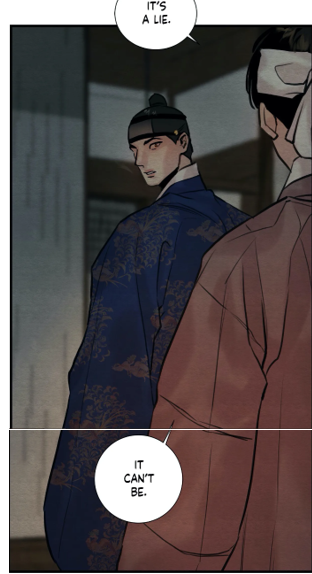
  (chapter 50). Through this revelation, the lord was indirectly confronted by his own reflection: he was indeed asking from Baek Na-Kyum sexual favors in exchange for his stay at the mansion. That’s the reason why the lord had a “relapse“ and kept his distance from the painter.
However, because Yoon Seungho was now associating sexual pleasure with the painter, the noble was no longer able to have sex at all. Don’t forget that Baek Na-Kyum symbolizes love. Seungho-Ya 😉 couldn’t even get an erection with a fellatio given by someone else.  (chapter 52). This was important, because for the noble, it meant that he could no longer have sex with other partners. Without sex, the lord was forced to question himself and ponder on the true nature of his relationship with Baek Na-Kyum. He felt jealousy during that night, he was very protective as well.
  (Chapter 52) His sexuality had already become an expression of his love, although the main lead was still unaware of his own feelings. That’s why I come to the conclusion, chapter 52 was actually revealing Yoon Seungho’s monogamy, although it looked the opposite. And this becomes truly visible, when the gangrape was about to occur. He felt no urge, when he was with the guests, yet the moment he brought the artist to the bedchamber, he couldn’t stop himself from kissing his loved one.
  (chapter 54) He was definitely longing for his warmth. This explicates why the noble got so infuriated, when he was confronted with the consequence of his bad decision:
 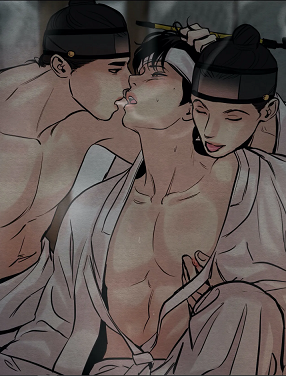 (chapter 54) the artist was on the verge to be no longer monogamous, as he would be tasted by other aristocrats. In this scene, the lord would have indeed become a client and pimp, if he hadn’t chased away his guests. Although the painter was indeed upset afterwards about this incident
 (chapter 55), deep down he sensed that his master had protected him. This night was important for the main lead: he was forced to admit his own feelings for the painter. Therefore, we could say that the issue with the prostitution was solved after chapter 54. Yoon Seungho thought that the moment he confessed, the painter would get scared and run away, but it didn’t happen. Why? Love among men and especially between a brutal noble and a commoner, was a taboo, like Min had underlined. Secondly, if the lord had indeed feelings for him, he had behaved like a beast during that night. He had mistreated Baek Na-Kyum. In his mind, the artist would never accept him.Besides, the painter had clearly denied the affection from the main lead. In his eyes, the painter’s words were indicating a rejection.
  (chapter 54) Thus I conclude that Yoon Seungho and Baek Na-Kyum had come to an implicit agreement: they had a master-servant relationship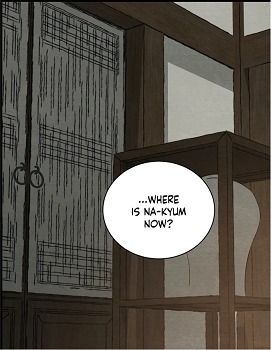
 (chapter 56), although Baek Na-Kyum started perceiving himself as a domestic from chapter 51 on again. He kept following the head-maid
  and Kim
 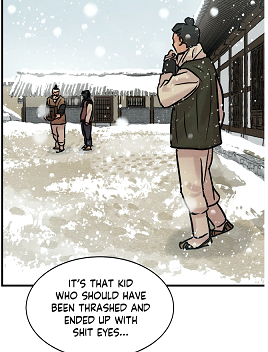 (chapter 51) in order to help them. Therefore the readers could witness the return of the white headband in chapter 52: his task was to paint for his master.
 (Chapter 52)
However, this new situation didn’t last long due to the artist’s abduction. The lord thought that since he had properly confessed to his servant (chapter 62) here, he whispered to Baek Na-Kyum that he adored him), he would bind the artist to himself.
Nevertheless the commoner disappeared making Yoon Seungho think that the moment he revealed his vulnerability, he got betrayed and abandoned. This explicates why the noble punished the artist, when he was found. Since they had a master-servant relationship and the artist had run away, this meant that Baek Na-Kyum was rejecting the lord’s love. Hence he could only treat him like his sex toy (chapter 63), exactly like he had wished in chapter 49. The only difference is that this time, the painter was here for the lord’s pleasure. The roles had been switched again. As the manhwaphiles can perceive, the noble and painter had a similar reaction: they both tried to deny the existence of love in their relationship. That’s the reason why the noble stopped the artist from confessing:
 (chapter 63) They just had a sexual relationship which could provoke pleasure, but that was it. But in order to ensure that the artist wouldn’t run away again, he used sex to “tame“ Baek Na-Kyum. If the main lead could procure multiple climaxes to the artist, then the latter was forced to admit that only Yoon Seungho could be his “partner“. This explicates why the noble kept pointing out how the artist would react to his lover’s body.
 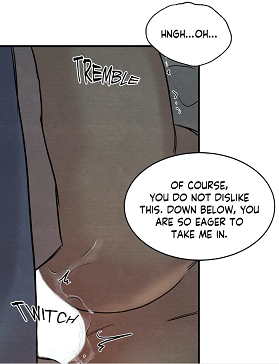 (Chapter 63)
 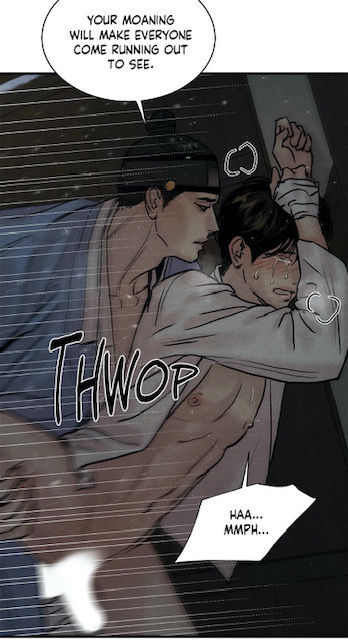 (chapter 64) He was moaning and would ejaculate constantly thanks to the main lead. Yet, during this second marathon, the noble was actually deceiving himself.
  (Chapter 62)
Although he treated the painter like a servant, as the latter was asked to paint, Yoon Seungho couldn’t help himself cleaning Baek Na-Kyum and bringing him to his bedchamber. 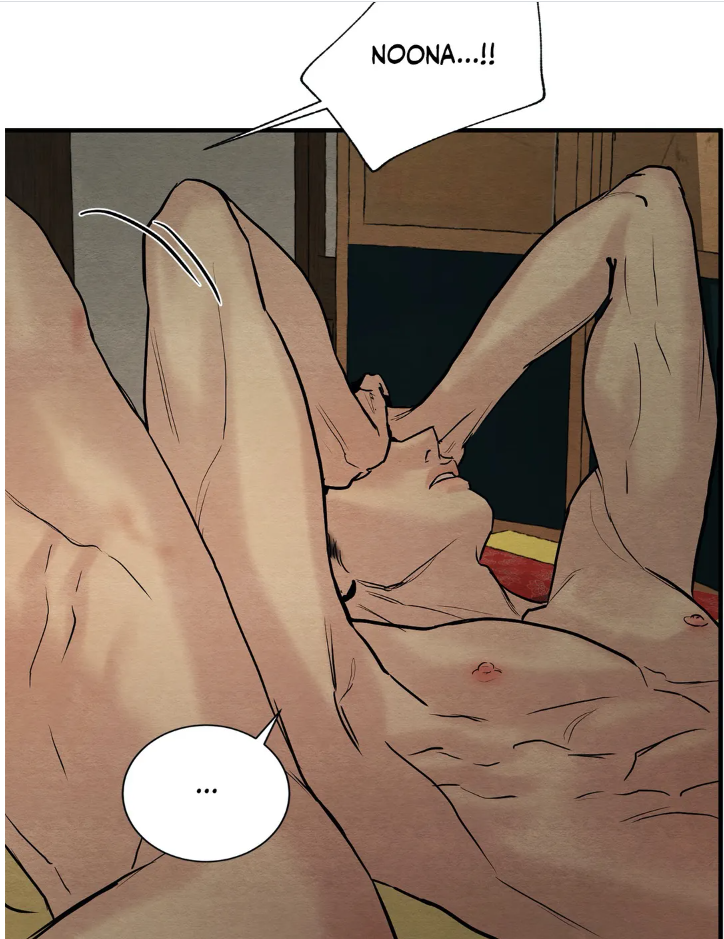 (Chapter 65) This shows that the painter had gained a new position: he was indeed a favored servant. He was allowed to spend the night in his lover’s bed and he could see the lord getting dressed.
  (Chapter 65) The slight change was that now the main lead was aware of this. This truly exposes the lord’s affection for the artist. He might have treated him like a plaything in the shed, in reality he had attempted to show “his skills“ as a lover. He had licked him, bit him and the painter had felt pleasure, though he kept saying no! This is not surprising that Yoon Seungho had denied the kiss in the study.
 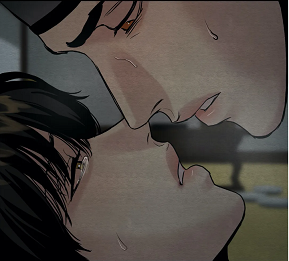 (Chapter 64) Because that’s how he had been deceived that night in the study.
 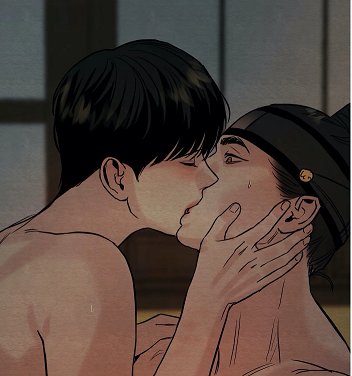 (Chapter 49) Baek Na-Kyum had silenced him with the kiss, as the main lead was about to protest. (Chapter 49) When he mentioned the kiss, the symbol for love, in his confession, it was connected to sensuality and not affection. Hence he didn‘t kiss him at the end of the second marathon. As a conclusion, by bringing the artist to his bedchamber, the lord never realized that his action was betraying his words from the night before. They were definitely more than 2 naked bodies. The lord trusted the painter so that he could lie down next to him in the bed. (Chapter 65) Striking is that Heena noona’s intervention destroyed their terrible but short-lived master-servant relationship, because the noble was faced with the truth: he had brought back the artist to the mansion against his will.
  (chapter 65) What caught my attention is that the painter’s disappearance mirrored the lord’s wrongdoing. Lee Jihwa and the main lead had both kidnapped the artist. That’s why I believe that when he heard Heena’s words in the study
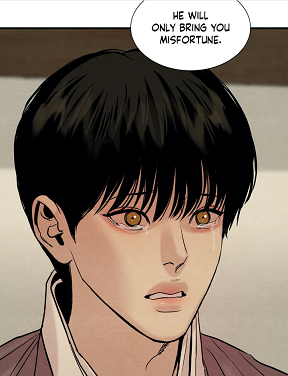 (chapter 68), the noble could only come to the following conclusion: he could only let the painter choose his destiny. But the moment the artist decided to remain by his side, he needed to change Baek Na-Kyum’s position in the mansion. He was no longer a servant, but a noble guest. Hence the lord tied the scarf like aristocrats did.
 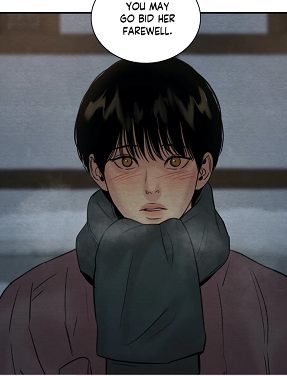 (chapter 69) Consequently, we could say that the painter had a similar status than Jung In-Hun. Yet, there was a huge difference: the owner of the mansion was now acting like the painter’s servant. Hence Deok-Jae’s words came true:
 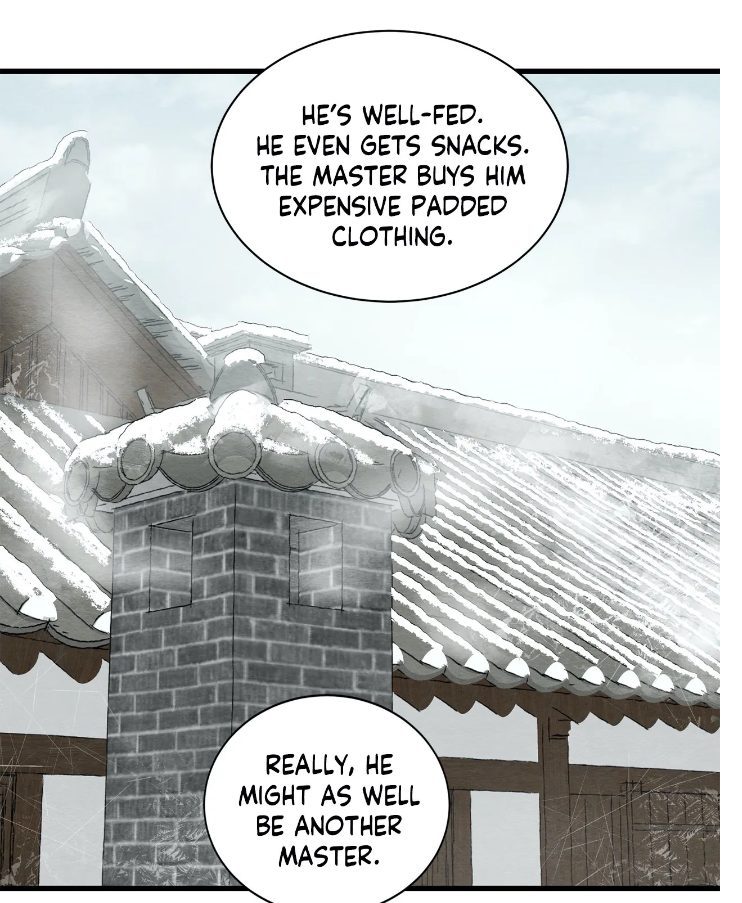 (chapter 46).
From chapter 69 on, there were two masters in the mansion:  (chapter 71). Why? It is because the lord made the decision that the painter chose him, then this means that he became his wife, though at the end of season 2, he was not thinking about marriage yet. He was not aware of this perception. By becoming his official partner, the spouse obtains the status of his husband: nobility. This explicates why the lord ate with his lover
 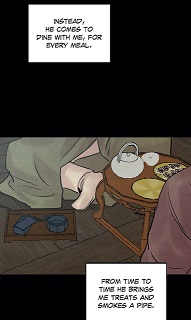 (chapter 74) and allowed him to smoke. Then in season 3, he gave him ladies-in-waiting in order to give him some company.
  (Chapter 78) He even gave him the music box, which was mistaken as a dowry. However, the problem is that the painter was still fighting his own feelings for the protagonist due to Heena noona’s words and past experience with the scholar. He feared that this new situation was too beautiful to be true, hence he thought that the lord’s feelings would fade away. But there was another reason for doubting the lord’s affection: there was no sex.
  (chapter 74) The painter had come to associate sex with love too. Yet, the moment he relived his trauma, he only found comfort and safety in the lord’s embrace.
 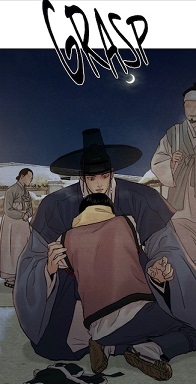 (Chapter 76) The main lead didn’t reject the painter’s urge for a hug in front of commoners. At no moment, Yoon Seungho felt embarrassment. He treated him like a special treasure. That’s how the painter came to realize that Yoon Seungho‘s love for him was true and genuine. Consequently, he decided to rely on him and to trust him. That’s why in this panel, the painter closed his eyes:
  (chapter 76) We could say that he was reminded of his own past. When he was a child, he sensed love through hugs and caresses. Since the painter could feel the lord’s genuine affection and warmth, he recognized that even when there was no sex, love was present. All his senses made him perceive the lord’s love:
 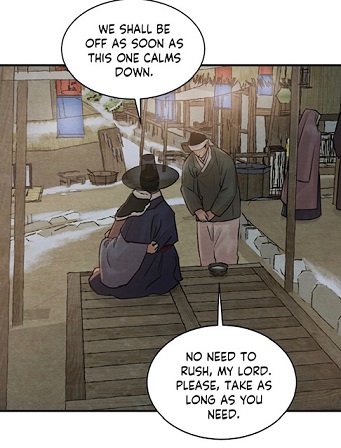 (chapter 76) His words showed his care and concern, then he bought him an expensive music box.
  (Chapter 76)
But by accepting the noble’s affection, the painter was also incited to question his affection for Yoon Seungho. On the other hand till chapter 94, he hadn’t voiced it yet. As you can see, the abstinence at the end of season 2 and the beginning of season 3 had a important function. It helped the painter to admit the existence of love and more precisely the lord’s affection for him, a reflection of the lord’s situation in season 2 (50-54). Simultaneously, it meant that the painter could no longer deny his attachment to Yoon Seungho too. Therefore it is not surprising that in the bedchamber, when the artist tried to initiate a kiss, it could be perceived as the start of a love confession. 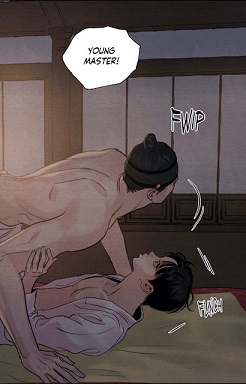 (Chapter 80) And now, you comprehend why the painter didn‘t confess during that night. He got interrupted. The kiss was the symbol for their love. Thus it is no coincidence that just after his confession,.
  (Chapter 94) the painter initiated a long and sensual kiss with his “husband“.
 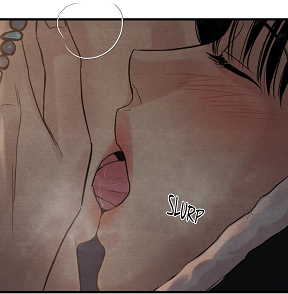 (Chapter 95) Since the painter had received caresses and embraces in his childhood, he came to view the kiss as the symbol for true love. And note that the kisses exchanged in the gibang were full of passion and love. This was the perfect combination of love and sex.
  (Chapter 95)
On the other hand, the lord had developed a different preference: the locked gaze, the warm embrace and the joined hands. Thus when he confessed his affection for the painter in the kisaeng house, observe what he did: 

 (Chapter 96) This shows that Yoon Seungho has always longed for a pure and spiritual love in the first place. His sexual preferences were already palpable in the last love session (season 2):
  (chapter 72) We could say that he discovered all his sexual preferences thanks to the painter.
Thus my prediction in the first version that the painter would express his love through sex later came true. He tried to initiate it with a kiss. He was moved by the lord’s loving gaze and smile.  (Chapter 80) But he failed due to the intervention of the butler and other schemers. Besides, the whispering of „Kyumah“ could only make his heart race. Let’s not forget that his painting in the sand (chapter 1) externalized his own philosophy: love and sex can’t be separated. Note that the couple is is hugging and kissing at the same time! 😍 This picture will represent the peak of their love! Striking is that when the couple confirmed their mutual affection, they did in the kisaeng house, the symbol for prostitution. This truly exposed that Yoon Seungho had been treated like a male night servant in the past. .
As you can imagine, I am expecting a new version of this love session. (chapter 72) in the next season, for the painter is still calling his lover “lord Seungho“  (chapter 99)
  (chapter 102) This means that he is still viewing himself as a low-born. But note that contrary to the past, Baek Na-Kum is now wearing a hanbok and he has no other clothes. Thus I am deducing that the painter’s next lesson is to drop his notion that he is a commoner. He will be taught to view himself as an equal to Yoon Seungho. Only when he has internalized that there is no gap between him and his lover, then he will be able to address him as “Seungho-YA!“ At the same time, both protagonists will come to realize that they can express their love differently. Poetry, painting and more importantly through their desire to protect their loved one. The lord will start protecting Baek Na-Kyum more actively, just like the painter will decide to show more interests in his lover’s skills and past life. Baek Na-Kyum will feel responsible for the bloodshed in the shaman’s house. In my opinion, the lord will confide to him what happened to Min and the other nobles. I am assuming this, for the lord remained silent, when the messenger of his father came to the mansion. He didn’t want to scare his lover because of his brutal outburst.
 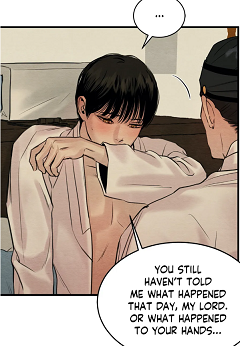 (chapter 84)
What caught my attention is that unlike in the first season, where characters came to find love and had sex or the reverse, the second season presented each sexual encounter as a sex session, but at some point love came to the surface.
 The trigger for the change is the noble’s words. The latter keeps talking to the painter asking for an reply. Hence in my eyes, there are glimpses of love the moment Baek Na-Kyum said this:
  It sounded like a confession, hence the seme became more passionate:
 Here the lord acted like a client. Yet, notice that the lord is speaking again forcing to express himself. And the moment the painter cried and started voicing his own opinion, the sexual encounter was affected. (Chapter 49) The lord comforted the artist and hugged him:
  (chapter 49) An expression of love and affection, but the painter rejected it, as he mistrusted his own judgement. He couldn’t help thinking of the learned sir’s fake embrace. Striking is that despite the rejection, the painter kissed and hugged back his lover
 (chapter 49), which made the lord believe that he could only get embraced by the painter, if they had sex.
  . Although the second sex marathon starts like a pure sex session, the moment the painter calls Yoon Seungho differently, the lord’s attitude changes. The painter is turned around and faces his lover, a sign that they are getting closer. Striking is that again through their conversation, the painter is pressured to think about his own emotions.
  However, due to his own insecurities and fear, the noble still can’t trust the artist’s words, therefore there’s no confession. As you can see, love was not absent
 , it is just that both main leads were in denial.
 Naturally, the night in chapter 58 and 70, 71, 72 and 73, are different. Although in chapter 58, the noble confessed and made love to the painter, he was also cornering his lover. The latter was not really able to move. He was trapped under his body, the lord was blaming him for turning him into a wreck.  (Chapter 58) Thus he should become responsible for him. Yoon Seungho was unconsciously trying to push the painter to reciprocate his feelings, an imitation of Lee Jihwa‘s confession. Nevertheless, the painter remained silent, therefore it meant that his love was still denied. That’s why it stands more under the sign of dream and illusion. Consequently, the night in chapter 70, 71, 72 and 73 contrasts so much to the one from chapter 58. This time, it symbolizes the lord’s pure love. As such, the sex is already a real expression of love. That’s why the lord asked to be called intimately: Seungho-Ya
  (chapter 72) On the other hand, this love session was strongly intertwined with the notion of forgiveness and punishment as well. This is important, it reveals that Yoon Seungho had internalized that sex was the expression to redeem himself. He had been tasked in the past that if he desired to obtain “forgiveness“, then he should have sex. And by comparing all these sexual encounters, I came to the following conclusion: the lord’s words definitely contributed to change the nature of the sex session, just like the hug.
And observe that the lord started hugging the painter more often outside sex, but the painter could never sense his affection. In chapter 49, he judged the warmth as fake.  In chapter 66, he had a flashback, hence he couldn’t witness his lord’s attention and care.
 But the lord discovered this kind of embrace, when he helped the painter in chapter 53:
  That’s how the noble experienced the embrace as a source of comfort and affection. Therefore you can comprehend, why I wrote above that the painter was teaching the lord how to love properly, but also why the embrace became the symbol for love in the lord‘s eyes. He had never been embraced before by a man. And Lee Jihwa had recognized the true signification of this gesture, when he spied on the couple (chapter 43). That‘s how he knew the friend‘s biggest desire: and was deeply hurt after this discovery
  (Chapter 57) However, this shows that Yoon Seungho is a quick learner, because he knew what to do, when the painter was in pain and destress. At the same time, it explains why he could fake the embrace in chapter 62: This hug stands in opposition to the one at the end of season 3:
  (chapter 102) The artist was forgiving his lover! Love represents selflessness, tolerance, forgiveness, warmth, affection and assistance which is transmitted by the embrace. Now, you understand why Yoon Seungho was still not satisfied after the sex session in the study, he was longing for the hug.
  (Chapter 84) In his unconscious, he knew that if the artist hugged him, he would have forgiven him. But he had no idea about it, thus he couldn’t suggest this. So far, he had experienced the embrace from the artist while having sex. Deep down, he had already internalized the embrace to forgiveness. So we could say that the absence of the embrace in this scene was the lord‘s punishment for the fake hug in the shed. And the painter let him discover the true nature of a warm embrace:
  (chapter 88) This is not surprising that this hug was not connected to sex at all. Yet it moved the lord so deeply. As the manhwalovers could sense it, season 3 was focused on love and sensuality. During that season, the couple was able to voice about their sexual desires and their preferences.
  (chapter 91)
As for the lord’s addiction to grab the artist’s hand, we have to envision that it is related to the lord‘s huge trauma.  (Chapter 86) No one close to him had grabbed his hand in order to show their support. This gesture in the picture embodies abandonment. On the other hand, the painter had been the first one to take his hand and to swear “loyalty“.
 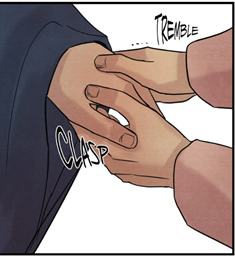 (Chapter 30) The joined hands were repeated in season 3 , the only difference is that this time, Baek Na-Kyum was doing it willingly.
 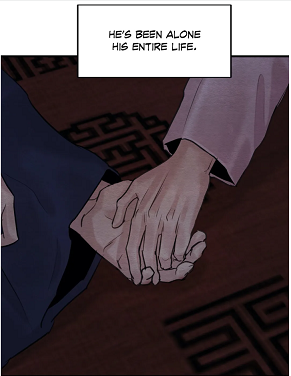 (Chapter 88) The symbol for support, company and responsibility.
As a conclusion, the dichotomy between love and sex in the relationship between the protagonists is no longer existing at the end of the third season. Both have come accept their love for each other. But it already started vanishing at the end of season 2. Although the painter had not confessed properly yet, the return of the embrace and his request for help are strong indications that Baek Na-Kyum was now accepting his affection. He was now trusting the noble, hence he revealed an important clue about the abduction.
Consequently, I am predicting that in season 4, we will see a new erotic painting of the couple, the symbol of their affection which will stand in opposition to the ones from season 1. It won’t be about conquests and as a tool to procure an erection for the nightly activities. That’s the reason why I am now expecting only one erotic picture: the document of their official union. (chapter 1) versus chapter 41  (chapter 41) Under this perspective, it becomes understandable why the couple neglected these pictures. They were all devoid of affection, it was more about prostitution and battle! And here is now the question? Where are these drawings?
Feel free to comment. If you have any suggestion for topics or manhwas, feel free to ask. If you enjoyed reading it, retweet it or push the button like. My instagram-tumblr-twitter account is: @bebebisous33. Thanks for reading and for the support, particularly, I would like to thank all the new followers and people recommending my blog.

This is where you can read the manhwa. https://www.lezhinus.com/en/comic/painter But be aware that this manhwa is a mature Yaoi, which means, it is about homosexuality with explicit scenes. If you want to read more essays, here is the link to the table of contents: https://bebebisous33analyses.wordpress.com/2020/07/04/table-of-contents-painter-of-the-night/
As you can imagine, the embrace between the two protagonists stands in the center of this analysis, because we had so many pictures with a hug, like these two: (chapter 76)
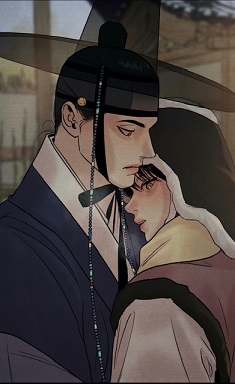 Yet, the peak was reached with the following picture, for Baek Na-Kyum and Yoon Seungho seemed to have merged as one:
  The readers can barely detect the painter’s presence: only his head and hand are visible indicating the depth of their intimacy and closeness. However, the title is mentioning the presence of a ghost. The latter can not be Yoon Seungho, because the panel above announces his official wedding with the commoner due to the presence of the red and blue lanterns called Cheongsachorong. These are used for wedding ceremony in Joseon. Therefore who is the ghost? And why do I perceive the existence of a spirit in this chapter? But before revealing the identity of the ghost, I would like to expose the reason behind such a title. While focusing on the embrace, I came to the following observation.
Each time Baek Na-Kyum and Yoon Seungho embraced each other, I detected the presence of a ghost. During the second season, we had 6 real hugs:
, 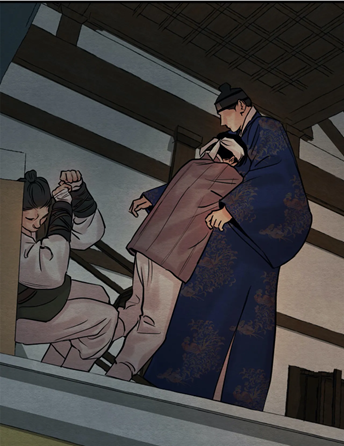 , ,
, ,  ,
,  , .
, .While comparing all the hugs, I will determine the ghost’s identity each time. In chapter 49 the painter was reminded of Jung In-Hun due to the warmth exuding from the main lead. The painter couldn’t restrain himself from thinking about that fake embrace (chapter 29), therefore he chose to push away the wealthy aristocrat out of fear that he might get hurt and betrayed again. The commoner judged the embrace and warmth as a deception. This means that the low noble as a “spirit” was the reason why both protagonists couldn’t get closer. The low-born was only acknowledging Yoon Seungho as his sex partner and nothing more. Striking is that in episode 76, we have a reference to the hug from chapter 49, as the position of the painter’s head in this image
 resembles a lot to this one: (chapter 49). Yet the outcome is different, as the manhwaphiles can witness how the painter moves his head closer to Yoon Seungho’s.
 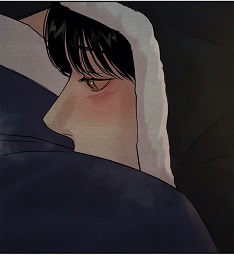 Moreover, the artist’s gaze is truly looking at his lover. We even have the impression that the artist is smelling the lord’s scent in order to reassure himself. Although the manhwaphiles couldn’t enter Baek Na-Kyum’s thoughts this time, they could perceive the change of his attitude. The embrace is no longer judged as fake. This signifies that the ghost Jung In-Hun has vanished for good, which is even reflected in a different panel: (chapter 76) The lord allowed the low-born to embrace him in front of people, whereas the scholar had to ask the commoner to follow him in a deserted alley.
 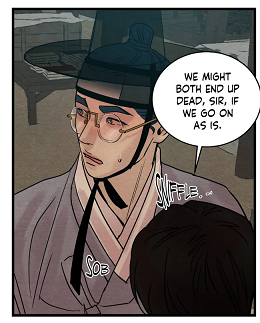 (chapter 29) The low noble feared people’s gaze, his attitude truly showed that he didn’t want to be connected to Baek Na-Kyum. His action was definitely a sign of hypocrisy and cowardice. That’s why in chapter 76, the painter could only come to the conclusion that the lord’s embrace was genuine and the lord’s feelings were not trivial. Moreover, the main character never pushed his lover away
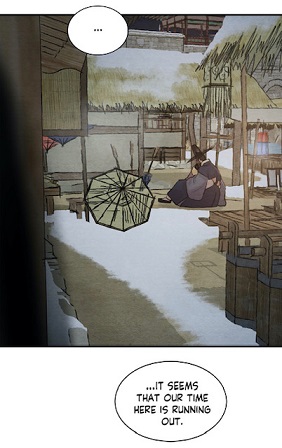 (chapter 76), he even lowered himself and sat down on the ground for a while, so that Baek Na-Kyum could calm down. Imagine, when the powerful lord arrived to the place where the main character had a panic attack, everyone was bowing in front of the noble.
 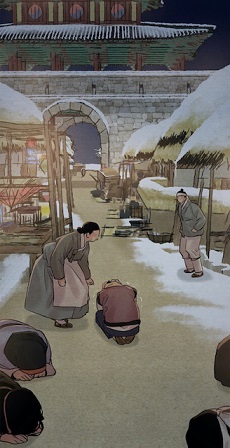 They didn’t even dare to face him, yet when he saw his lover trembling, the master lowered himself and attempted to help his partner. However, his gestures led to be misinterpreted in the beginning, hence a shop owner started interfering.
  However, he was stopped with a frightful gaze:
 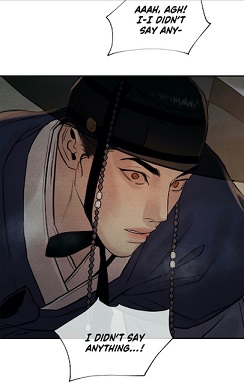 Besides, when the noble kept calling the protagonist in an informal way (Na-Kyum-Ah), people could realize his real intention. He meant no harm. In fact, he was treating the low-born like a precious treasure, who needed help.
 By calling his name Na-Kyum-Ah, the main lead tried to reassure his lover. Hearing his name made the low-born realize that he wasn’t attacked by the jester. This explains why the artist immediately embraced his companion. (chapter 76) Thus we could say that “Na-Kyum” had finally become a magical word like Seungho-Ya. Another contrast to the scene in episode 29 is that the way the low noble called Na-Kyum.
  (chapter 29) The former teacher was just caught by surprise, hence “Na-Kyum” was said more or less randomly. On the other hand, Yoon Seungho used this name as a sign of intimacy. He desired to give comfort and warmth to his lover. And now, you understand why Baek Na-Kyum hugged his lover by instinct. With his embrace, the protagonist would feel safe, which contrasts so much to the one in chapter 29. Back then, after the hug the learned sir brought the artist back to the mansion, although the low-born had run away out of fright. He mostly feared for the scholar’s life
 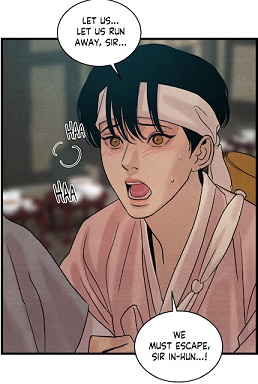 (chapter 29) thus he tried to find him. And now the mansion has become the painter’s home, just like the lord’s embrace. It is a synonym for comfort, warmth and safety. Another huge contrast is that for the first time, the painter asked for Yoon Seungho’s help directly. (chapter 76) Imagine that so far, he has never relied on others. Even as a low-born, he was willing to save others (Jung In-Hun or Deok-Jae or Heena
  (chapter 65). Surprising is that when he was bullied by Deok-Jae, he never complained and asked for the head-maid’s assistance or his lover’s. His attitude to never rely on others was even more perceptible in his escape in chapter 46. The cause for this behavior is linked to his abandonment issues. Due to his past, he was forced to only rely on himself. Nonetheless, in chapter 76 he changes his attitude. This shows that he is now opening up. That’s why his head rests on the lord’s shoulder completely. (chapter 76) This is a sign of trust, Baek Na-Kyum is willing to trust his lover. By comparing these 2 hugs, I come to the conclusion that Jung In-Hun has been totally removed from the painter’s mind as well. This embrace and marriage represent the scholar’s defeat. From now on, he won’t be able to use the painter as his pawn, because the latter is no longer attached to him. The lord’s love for Baek Na-Kyum can not be used as a weakness, since the low-born is reciprocating the affection. That’s why I would say that this panel (chapter 76) embodies the learned sir’s loss. There’s no one separating them, not even Heena noona who was the last person defending the scholar and as such representing his interest. So was Jung In-Hun the ghost I was referring to? Yes and no… because there’s more to it. That’s why it is important to examine the other embraces.
In chapter 53, the ghost was Yoon Seungho himself, since he was considering himself as a spirit. (chapter 53) However, the painter’s hug made him realize that he was a human after all, and that his fists and punches could definitely hurt his precious painter. Unlike in chapter 76, the painter’s voice couldn’t calm down the vengeful spirit (chapter 53), hence the gentle boy needed to intervene directly. The lord was definitely deaf to the artist’s words. Striking is that here again, we had the presence of danger, the painter feared for Deok-Jae’s life. Moreover, despite his fear and shaking hands, (chapter 53)the commoner chose to protect the vicious servant, but Yoon Seungho too. He desired him not to let his emotions blind his behavior. The gentle and selfless man didn’t even ask for help, he stopped the noble with his body twice: first his face, then he hugged him. Striking is that in chapter 62 and 66, we had a similar situation. One of the protagonists was behaving like a ghost. In chapter 62, Yoon Seungho, who was reliving his traumatic past, almost became a demon
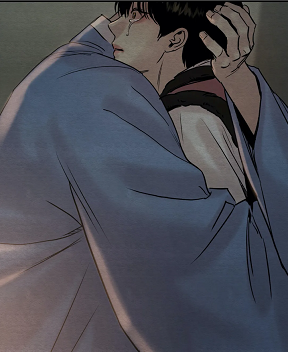 (chapter 62), whereas in chapter 66 the artist had a flashback, hence he wasn’t himself.
  (chapter 66) This meant that in both episodes, neither the aristocrat nor the commoner could sense the lover’s comfort and warmth.
  (chapter 66) Both of them didn’t feel safe and displayed extreme fear due to betrayal and abandonment.
But let’s return to the embrace in chapter 53, because this incident has another common denominator with the embrace from episode 66 and 76, the presence of a certain witness: Black Heart. 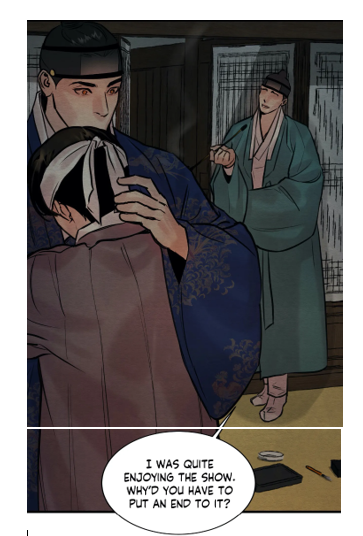 There’s no doubt that the vicious noble felt extremely jealous in both episodes (53-66). The manhwaphiles should envision that despite his rage and his terrible behavior, the artist was willing to embrace such a man, which could only make Min envious. Moreover, the low-born showed courage and even strength. He didn’t reproach anything to his sexual partner. He just attempted to calm him down. Then even after seeing how poorly the main lead had treated the artist, the latter chose not to leave Yoon Seungho’s side. Min was definitely certain that after waking up, Baek Na-Kyum would follow his sister and come back to the kisaeng house.
 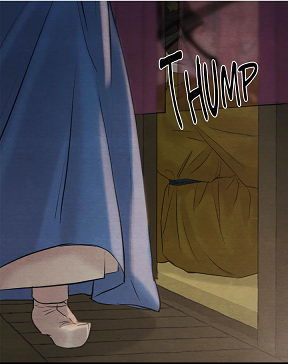 (chapter 69) That’s why he was waiting there. He imagined that the boy would be delivered to him on a silver plate, yet nothing like he had expected happened. In chapter 76, we have a new version of chapter 53. However, when Black Heart witnesses the painter’s second embrace, he can detect the huge difference. (chapter 76) This time, the artist is seeking his lover’s warmth and love. There’s no fear related to the “monster”. While in the past (53-54) The Joker mocked Yoon Seungho for his affection, here he can’t do it at all. The noble is not denying anything. In fact, he accepted the low-born’s embrace without feeling shame or embarrassment. He didn’t pay attention to the town folks, he just followed his heart. While in chapter 54, Min was able to separate the protagonists with his mockery and words
 (chapter 54), in episode 76 Black Heart is truly defeated. And by contrasting these two scenes, it becomes obvious why Yoon Seungho assaulted his guest back then. The noble was in fact punishing The Joker for insulting his lover, as the latter was just reduced to his status: a low-born. He had no name and as such no identity. The powerful aristocrat didn’t do it in order to protect his honor, but the artist’s. At no time, the main lead was afraid of losing his reputation, he is well aware of his bad notoriety. Thus this shows that in chapter 54, the one who feared more social norms was indeed Baek Na-Kyum, which was still visible in chapter 75. That’s why the commoner denied the lord’s affection. (chapter 54)The expression “it can’t be” was referring to permission and social rules. No wonder why the noble felt so hurt in the end and retaliated. He misunderstood the artist’s rejection.
What caught my attention in chapter 76 are Black Heart’s behavior and words. First, he notices that he is too late. (chapter 76) He imagined that time would work for him, as in his mind, no one would ever stay by Yoon Seungho’s side. That’s why he didn’t hurry the second abduction. The latter had such a terrible reputation (mood swings, his huge rage, his violence), yet nothing could pressure the artist to leave the mansion. Even his noona was not able to convince him to follow her and to return to the kisaeng house. However, when he saw the couple in front of the tailor’s shop, his jealousy and greed reached a new peak. That’s why that night he had planned to visit Nameless. He wanted him to abduct the artist a second time. The expression “time is running out” outlines The Joker’s urgency. He couldn’t wait any longer, as he could witness how close they had become within 2 weeks. And if you look at the panel above, you’ll detect the presence of a shadow, in other words, a ghost. However, this is the jester Nameless looking at the couple. When the painter faced the joker (chapter 76), the ghost from his nightmare
 (chapter 61), the painter got so panicked that he got paralyzed. Only the lord’s embrace could calm him. As you can see, the commoner denominator between 53 and 76 is that the presence of a terrible ghost. The latter pushed the artist to embrace his lover. This time, he needed himself protection. However, Nameless was not the only ghost witnessing the protagonists’ embrace. Lord Min has already become a ghost himself in my opinion. First, he is wearing a black hanbok which I am associating to death. Moreover, because he threatens the criminal to kill him
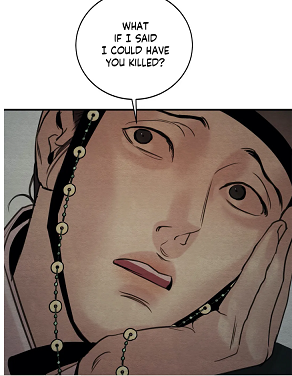 (chapter 76), I view The Joker as a grim reaper. What caught my attention is his reaction, when he saw the heartfelt hug. He had to vomit and this is no coincidence.
  (chapter 76) Observe that the color green is connected to two reactions: “to be green with envy” and “to be green” (sickly). Besides, we have in French “être vert” as a synonym for fuming, furious and disgusted. Hence it’s not surprising that it exist these emojis: 🤮🤢. Both contain green. That’s why I believe that when Min saw the embrace between the protagonists, he got so upset and disgusted that he felt the urge to vomit. It was definitely a mixture of envy and rage. However, he had to lie to the others in order to hide his “weakness”.
  (chapter 76) For me, there’s no ambiguity that The Joker was not honest here. First, he has no dark circle and red eyes like Jihwa who definitely drank again.
 (chapter 76) Besides, has Black Heart ever apologized to others? No. He didn’t even care, when he smoked opium in front of commoners. When he was asked to stop it,
  (chapter 52), he never expressed a real apology, he rather criticized the other for ruining the good mood and his fun. Besides, he looks down on low-borns and even Jihwa…
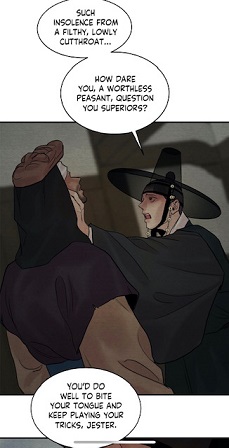 (chapter 76) so why would he apologize? It is, because he is slowly recognizing that his urges for Baek Na-Kyum are not linked to sex!! When he saw the hug, he could recognize the affection between the two lovers, and he felt powerless. Moreover, he envied Yoon Seungho even more than before. Let’s not forget that Min fears social norms despite his nihilistic tendencies. In this scene, the main lead showed courage and genuine affection, something that The Joker can’t do. Till chapter 76, he thought that he had been bewitched and he only felt the urge to have sex with Baek Na-Kyum. In other words, he wasn’t honest to himself and to the others. Until now, he had always imagined that once he had tasted the artist, his thirst would be satisfied. But the warm and tender embrace made him realize that he was wrong. Consequently, when he saw the hug, his envy and jealousy reached a new peak. He had to vomit. This signifies that the resent from chapter 53 became much stronger and obvious to the point that others could detect it now. Hence he has to lie. But in my opinion, he had another reason for vomiting. From my point of view, while the main lead spent his time drinking and reading, Min was busy smoking opium. Let’s not forget that Byeonduck portrayed Min with such a hanbok
  (chapter 56) and the pattern reminds the readers of opium smoke. Contrary to Yoon Seungho who only smoked it once during that terrible party, Min chose to keep smoking opium. First, the manhwaphiles could detect that he enjoyed the kick in chapter 52.
 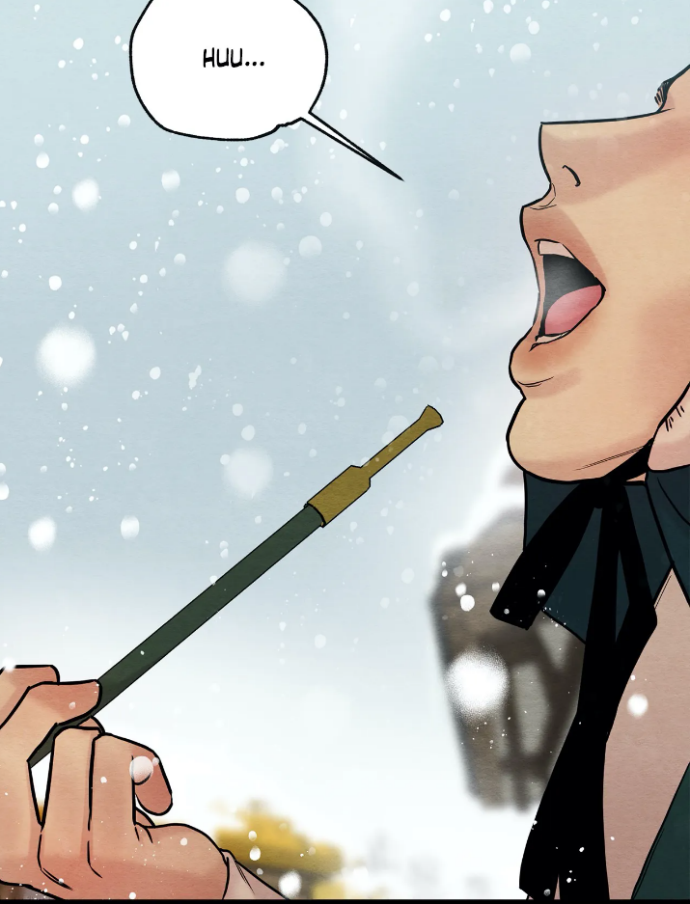 (chapter 52) Secondly, the hanbok was another indication. Finally, I perceive the lord’s nausea in chapter 76 as another evidence for Black Heart’s opium addiction. Vomiting/nausea are listed as side effects of opium. From my point of view, when he saw the happy couple in the street
 (chapter 74), he chose to smoke one pipe in order to relieve his frustration before visiting Jihwa and urging him to contact Nameless. This was a new version of chapter 56. That’s why they came both to meet the criminal.
  (chapter 76) Hence I come to the conclusion that Min is slowly turning into a ghost himself, losing his mind due to his addiction to opium and at the same time due to his greed and obsession for Baek Na-Kyum. The embrace in chapter 53 led to the kiss and indirectly it was the trigger for Min to change his original plan.
 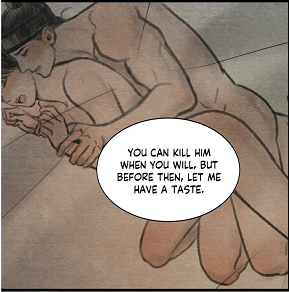 (chapter 56) Therefore I deduce that this second embrace is forcing him to change his plan again. From my point of view, he is no longer interested in tasting the painter once and have him killed afterwards. Black Heart is now determined to take away Baek Na-Kyum from Yoon Seungho. He is definitely longing for the artist’s love. He has every reason to be so jealous. The painter showed such a loyalty and courage. He is no longer fearing people’s gaze unlike in the past. Then, he even forgave his lover for his violence and mistreatment. Slowly, Min is showing his vulnerability in front of Jihwa and as such losing his power over him. He is definitely less laughing. As a conclusion, in chapter 76, the ghost Jung In-Hun vanished for good, while a new one appeared: Black Heart, who is now dressed like a grim reaper. However, there’s a huge difference, because Min has never entered Baek Na-Kyum’s mind and heart. He has no chance at all.
But wait… you might now wonder why I have not mentioned the hug from chapter 71 yet. Where was the ghost? Note that in this panel, the artist is portrayed without eyes. This insinuates that the artist is somehow blind. Secondly, we have this picture where the manhwalovers could see the lord’s footprints.  (chapter 71) My explanation is the following: Baek Na-Kyum wasn’t sure how to judge the lord’s behavior. Imagine that in the morning, his lover had tied him up, while in the evening he was so gentle and calm. That’s why I believe that in this hug, the artist wasn’t certain how he should perceive the lord’s embrace. He knew that it was no longer fake, but like he explained it much later… how long would Yoon Seungho have feelings for him? Therefore I believe that in this scene, Baek Na-Kyum viewed him as an illusion, a spirit who could give him warmth and comfort.
  (chapter 71) Note the difference with the following picture: (chapter 76) First, the painter’s gaze is much softer and less questioning. In addition, the position of his head is different which exposed that they are much closer now. Besides, let’s not forget that the embrace took place before the long love session. The artist’s reaction was totally normal.
As a conclusion, the last picture from chapter 76 displays two major developments. (chapter 76) The protagonists are no longer separated by their fears and issues. The ghosts in their mind and heart have finally disappeared. That’s why they are portrayed like one here. However, there are now other shadows and ghosts surrounding them, the ones who would do anything to destroy their relationship, like Min, Jung In-Hun and father Yoon.
Feel free to comment. If you have any suggestion for topics or manhwas, feel free to ask. If you enjoyed reading it, retweet it or push the button like. My instagram-tumblr-twitter account is: @bebebisous33. Thanks for reading and for the support, particularly, I would like to thank all the new followers and people recommending my blog.

This is where you can read the manhwa. https://www.lezhinus.com/en/comic/painter But be aware that this manhwa is a mature Yaoi, which means, it is about homosexuality with explicit scenes. If you want to read more essays, here is the link to the table of contents: https://bebebisous33analyses.wordpress.com/2020/07/04/table-of-contents-painter-of-the-night/
Announcement: I updated the essay “Kim: a dog, a matchmaker or a father?”
You are probably wondering about the selection of such a title and its signification, especially if you are not familiar with physics. What is refraction exactly?
“Refraction is the bending of light when it goes from one medium to another so, when a ray of light passes through a glass prism, refraction of light occurs both, when it enters the prism as well as when it leaves the prism. Since the refracting surfaces are not parallel, therefore, the emergent ray and incident ray are not parallel to one another. In this case the ray of light is deviated on passing through the prism.” quoted from https://www.jagranjosh.com/general-knowledge/refraction-of-light-through-a-glass-prism-1456391639-1#:~:text=Refraction%20is%20the%20bending%20of,when%20it%20leaves%20the%20prism.&text=In%20this%20case%20the%20ray,on%20passing%20through%20the%20prism.
People observe this phenomenon, when there’s a rainbow.

This spectacle can only occur, if there are rain and sunlight together. Due to the presence of water, the beholder perceive the existence of light, which is actually a combination of all colors. Although light seems colorless to our eyes, it is not correct. It is just that our brain is used to perceive light as such. Now, you are probably intrigued how I could associate the manhwa with laws of refraction, when the author never drew a rainbow. But refraction is not just limited to the rainbow. It is also perceptible under other circumstances, like for example: when the sunlight goes through a real glass prism

As you can observe, there’s a deviation and dispersion of the light through the glass prism. So when did the manhwaphiles witness this experience in Painter Of The Night?
Byeonduck applied laws of refraction in two episodes:


 Yes, the presence of the colorful bubbles are a sign of refraction.
And these episodes are quite important, for due to the refraction, the readers can finally perceive the presence of light and as such warmth. When the episode 55 was released, I had explained that these bubbles of light announced the revival of the lord’s body. He was no longer living as a zombie, he was finally becoming a real human. But only now, I’ve recognized the real signification of these bubbles of light. (chapter 55) I am not saying that my previous statement was wrong. It is just that I’ve realized the gravity of the lord’s wounds. Yoon Seungho opened the door of this bedchamber, which meant that he was letting the sunlight enter his room. This had a symbolical meaning: the noble was finally allowing the light to enter his inner world. That’s why in this chapter, the noble confessed. He was opening up to the painter and permitting him to see the darkness in his mind and heart. He was jealous and he expressed his murdering and suicidal thoughts (chapter 55), therefore he imagined that the painter would run away, too shocked by the obscurity of his inner world. And this signifies that until chapter 55, the lord’s soul and body were trapped in the darkness. Now, you might come to the conclusion that he was in a similar situation than Jihwa. Because the latter was figuratively deaf and blind, he had the impression to live trapped in a dark room, separated from the outside world.
  However, this is just a false perception. Jihwa was still in possession of his body, he could feel through his hands. Consequently, he could detect the presence of others. There’s no doubt that he felt lonely and was also lacking for warmth, however the protagonist was in the worst possible situation. He had been literally swallowed by the darkness.
  (chapter 74) He could feel nothing at all. Even his own mind was trapped in the darkness reinforced by his huge guilt triggered by father Yoon. Remember when I wrote that his body was covered by an armor, this referred to his loss of sensation. Imagine yourself in this situation: everything around you is dark and cold and you can feel nothing at all. No wonder why the lord came to believe that he was just a ghost. This is definitely the negative version of Blaise Pascal’s philosophy: cogito ergo sum (I think, therefore I am). Yoon Seungho could only recognize his existence through his thoughts. And the chapter 74 was terrible for two reasons: it unveils to the manwhaphiles how the lord became a ghost. We see him disappearing in this blackness step by step:
 (chapter 74) He can no longer yell for help and use his leg in order to defend himself, which contrasts to the beginning of his nightmare.
  (chapter 74)
 (chapter 74), this displays that the noble is losing the control of his body which can be explained with the usage of drugs. But he is still feeling the touch.
  (chapter 74), but at the same time, it indicates the loss of sensation. This panel symbolizes that he is no longer possessing his body at all. All he has left are his eyes. (chapter 74) This is the last vision he has before his eyes are also trapped in the darkness.
 So the manhwalovers have now to question themselves: How do you leave this darkness, when you are surrounded by it? It is impossible, you can’t even feel the warmth of a body, because even your sense of touch is dead. In order to perceive the presence of light, you need colors… like I explained above. Light is composed by all the colors. And that’s how the lord could slowly leave his state of torpor. When he saw the erotic panels from Baek Na-Kyum, he could see the light, as they embodied love and warmth. That’s why he became so “addicted” to the pictures. They stood in opposition to the world he had been exposed to: sex, not as prostitution, but as a symbol for affection and warmth. The “colors” from the paintings helped him to see the light. After this new interpretation, it becomes understandable why he treasured so much the artist’s hands. (chapter 1)
  They were the reason why he could see glimpses of light in the darkness of his world. And since he became trapped in the blackness due to hands of scholars and officials, it is not surprising why Baek Na-Kyum’s hands are healing him. Therefore, when the painter touched his chest with his hand
 (chapter 73), he purified his heart. This explicates why in chapter 74, the noble is no longer interested in sex. The hand liberated his heart and allowed him to express his affection differently. At the same time, the loving gaze in the painter is the reason why the lord feels warmth in the end. All he ever wanted was to see light, but he truly discovered it through the painter’s embrace.
  (chapter 21) That’s why even in the darkness of the room, he could only be moved. Therefore he was focused on the painter’s body in the first place. The warmth made him realize the existence of light next to his body.
So when Yoon Seungho met the commoner for the first time, his eyes were already healed, as his eyes were exposed to colors constantly. No wonder, why the main lead fell in love at first sight. He had every reason to love the protagonist. The latter had saved him through the colors, making him view glimpses of light. Hence he could feel alive again. But more importantly, he could sense in the pretty face genuineness and naturality. But what the main lead didn’t realize is that Baek Na-Kyum was his mirror and as such his reflection. In other words, he was his glass prism. Since the painter felt attracted to him, the lord saw in the first painting  (chapter 2) that he was handsome and attractive. That’s why he could experience his sexual emancipation afterwards. A part of his self-hatred disappeared. However, in order to liberate the lord entirely from his darkness, he needed to drop his fathers’ doctrines, which represented the biggest problem. His healing process got delayed due to Kim’s interventions and the painter’s own indoctrination. Striking is that Baek Na-Kyum was entirely healed by the lord, even before the latter has properly recovered from his own traumas. This clearly outlines his selflessness in the end.
And now, if I compare the first bubbles (chapter 55) to the ones from chapter 74, you’ll detect a huge difference. While there are only three colors in the first image (white, red, blue), the bubbles from chapter 74 remind us more of the colors from a rainbow. This coincidence with the character’s development. Yoon Seungho is seeing more and more light in his mind and heart. In chapter 55, only his conscious allowed the warmth and light associated to the painter to enter his inner world. But it is not the same with the unconscious… only in chapter 74, the light is entering his unconscious which explains why he is slowly remembering what happened to him. The lord can finally perceive his nightmares, while in the past they were just connected to terrible sensations.  (chapter 38) I doubt that in chapter 38 and 59, he saw images. Due to the darkness of his inner world, he came to repress the horror he was exposed to. Thus it is not surprising that Yoon Seungho is not sleeping next to the painter, even after that night.
  (chapter 74) He still has this fear that Baek Na-Kyum might get affected by the blackness of his unconscious. At the same time, when he is facing the sleeping artist, it gives him comfort. Remember that the low-born is the glass prism of Yoon Seungho, hence his peaceful sleep helps the lord to relax. Note that he is lying in a fetal position, an indication of the return of his innocence. There’s no doubt that the visits in the painter’s study during the night (chapter 74) help the lord to relax and move on from his insomnia. Since he is now seeing light and feeling warmth thanks to the painter’s presence, he no longer feels the need for physical intimacy. Hence the lord can’t restrain himself showering Baek Na-Kyum with affection and care. However Yoon Seungho is not realizing that thanks to the artist, he is finally able to show his true self: a phoenix who got burnt by selfish and greedy people. This explicates why Yoon Seungho still perceives himself as a bad omen, because he can still see the blackness in himself. On the other side, this truly exposes the ravages caused by the traumatic experiences. From a sensitive, gentle, selfless and intelligent man, he became the opposite, reflecting the real image of the ones who destroyed him.
The irony is that the lord is not aware of his own transformation. In his mind, the painter has become his sun, hence he gave him a yellow-orange scarf. (chapter 74). When he sees the light next to the painter, he has the impression that it comes from the artist, while in reality, the painter is just mirroring his own light and warmth. Remember that the mirror in the manhwa has the form of the glass prism described above:  (chapter 28) And in this panel (chapter 74), it is particularly visible, as the light coming from Yoon Seungho is reflected in the painter (glass prism), hence the colors are behind the artist’s head. This is not surprising why Baek Na-Kyum is so affected. Everything from Yoon Seungho is exuding love and care. At the same time, the lord serves also as a mirror for the painter. The latter can only sense love and warmth in the lord’s face and gaze.
 (chapter 74) He can only be smitten. But since the lord is also the glass prism for the painter, you can observe the refraction in this panel: (chapter 74) The painter’s affection is literally shining through the lord so that colors appear behind the lord’s back. The diversion becomes obvious for the readers, who are the beholders of such a phenomenon This is not surprising that the painter is falling more and more for Yoon Seungho. That’s why he blushes after a good night kiss.
  (chapter 74) He is now even longing for Yoon Seungho’s warmth, hence he stands up during the night and looks at the light in the lord’s chamber.
  (chapter 74) However, the lord is keeping his distance due to the darkness still existing in his unconscious. He fears that this could represent a nuisance to the painter’s peaceful sleep. Moreover, he still perceives himself as impure contrary to Baek Na-Kyum. What the lord fails to recognize is that the artist seems to have sleeping trouble now, because he is longing for his lover’s warmth too, another clue for the painter’s thirst for love and strong libido. There’s no doubt that as long as the commoner doesn’t claim the lord’s bed as his own and expresses the wish to share the bed with his lover, the latter will never suggest this to Baek Na-Kyum.
Because the lord allowed the light from the painter to enter his spirit and heart, he is shining like a sun, which coincides with the animal embodying the noble: the Phoenix. In other words, the nightmare from the aristocrat should be judged as a necessary healing process.  (chapter 74) Slowly, the lord is getting rid of the blackness. He is turning his light to the Earth, the painter, mistaking his lover for a sun. Their blossoming love will definitely bring the artist to improve his talent and creativity. But it will have the same effect on the noble. The longer Yoon Seungho is spending his time with Baek Na-Kyum, the better the lord can perceive the colors and light. Through art, the noble will rediscover his lost passion: painting and even poetry. And in my opinion, in order to reconnect to painting, the lord needs to sense the colors for real. The painting in his nightmare was made of black ink and nothing more.
 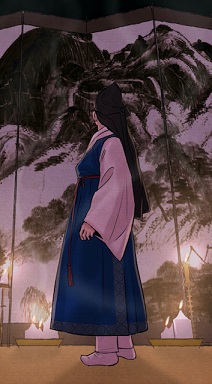 (chapter 74)
Both are so fascinated by the colors coming from the refraction that they are seeing the world in bright colors now. However, their fascination for the light makes them careless. They are not paying attention to their surroundings. (chapter 74) In their innocence, they are not realizing that if there’s light, there exists darkness too. Consequently, they don’t detect that darkness is already gathering around them, preparing for the next attack. From my point of view, the darkness should be perceived either as an eclipse or as clouds. Imagine the lord’s reaction, when he loses his prism glass, he will feel definitely devastated. However, there is one thing that even darkness couldn’t destroy after all these years: the lord’s intelligence. He might have acted stupidly during the second season, but his mind was clouded by his emotions. Now that he knows that the painter chose him and is no longer pushing him away, he will be able to use his brain properly. He has more evidences for that. Baek Na-Kyum allowed him to put the scarf properly. Observe the difference between the first (chapter 74) and second image. (chapter 74) The knot is different and he has now a hat. The noble put the scarf exactly like in chapter 69.
  (chapter 69) Moreover, the new headgear, reserved for women, is a sign that Baek Na-Kyum is accepting his marriage officially. (chapter 74) Hence there is no ambiguity that his disappearance will lead to an investigation and Yoon Seungho will interrogate his staff. Finally, neither an eclipse nor the clouds can truly separate the sun from the Earth, consequently they won’t be able to disrupt this harmonious relationship for long. As a conclusion, the painter as a representative of all virtues could only become Yoon Seungho’s savior, as he brought light into his darkness. This explicates why Yoon Seungho views the commoner as his god and lord. (chapter 71) He was as strong as a god, when he entered his obscure world. No wonder why the noble is so humble and thankful towards his lover. He brought him back to life, hence his life can only revolve around the painter from now on. The sun will never sense his own light and warmth, unless it witnesses how the nature on Earth is blossoming. It needs the existence of another planet to realize the existence of its own heat.
Feel free to comment. If you have any suggestion for topics or manhwas, feel free to ask. If you enjoyed reading it, retweet it or push the button like. My instagram-tumblr-twitter account is: @bebebisous33. Thanks for reading and for the support, particularly, I would like to thank all the new followers and people recommending my blog.


 Bebebisous33s' analyses in K-Dramaland and Manhwas