

Please support the authors by reading Manhwas on the official websites. This is where you can read the Manhwa: Jinx But be aware that the Manhwa is a mature Yaoi, which means, it is about homosexuality with explicit scenes. Here is the link of the table of contents about Jinx. Here is the link where you can find the table of contents of analyzed Manhwas. Here are the links, if you are interested in the first work from Mingwa, BJ Alex, and the 2 previous essays about Jinx The Watery Point Of No Return and Behind The Emp’s Shadow
It would be great if you could make some donations/sponsoring: Ko-fi.com/bebebisous33 That way, you can support me with “coffee” so that I have the energy to keep examining Manhwas. Besides, I need to cover up the expenses for this blog.

It begins with smoke.
Not the scent of flowers or the sweetness of victory, but the cold breath of a machine crossing an unnamed sky.  (chapter 81) No airport appears, no greeting, no applause — only movement, silent noise, and distance. The scene refuses arrival. It’s as if the air itself has become unwelcoming, unsure whether to receive or reject the traveler.
Below, the earth hides beneath a shroud of cloud, half revealing, half concealing its rivers and mountains. It is broad daylight, but only those inside the plane can see the sun. Its rays strike the cloud tops, scattering into pale reflections, almost unreachable from the world below. The light is real yet detached — dazzling, but emotionally cold. The illusion of motion comes not from the aircraft itself, which cuts the sky with mechanical steadiness, but from the slow drift of the countryside beneath — a glimmering landscape that seems to slide away on its own. The plane moves horizontally, neither ascending toward promise nor descending toward rest. It hovers in between — uncertain, as if trapped inside the very act of transition. The white smoke trailing behind is not visible, as if erased by the same sky that carried it — a trace that vanishes before it can mean anything.
How is this calm sky connected to the silence of a phone line from ten years ago?  (chapter 74) What does it mean that a man who once reached for his mother’s voice is now suspended between clouds, unreachable himself?
  (chapter 74) Why does the same stillness that once followed a farewell now fill the air around his flight?
Both moments share the same structure of emptiness: movement without arrival, connection without recognition. Yet the meaning of that emptiness deepens when we remember that death itself is often framed as a journey.  (chapter 65) Let’s not forget that the last poster of chapter 81
 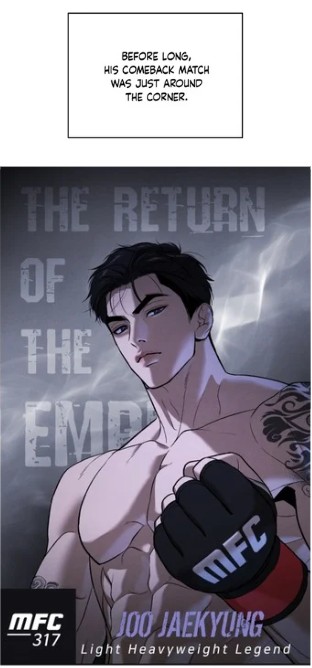 (chapter 81) echoes Joo Jaewoong’s burial in chapter 74.
 (chapter 74) In that earlier scene, the smoke rises from burning incense sticks which is linked to scent — the invisible bridge between the living and the dead. Here, it reappears as the airplane’s exhaust (chapter 81), the sterile modern echo of ritual fire. In both, the same element unites mourning and motion: smoke, a symbol that drifts, fades, and carries scent.
The father’s funeral and the champion’s flight belong to one continuous breath — the same air of transition. Each ascent, whether spiritual or mechanical, leaves behind a trace that cannot last. The scent of the jinx begins here: in this meeting of incense and engine, of devotion and pollution, where grief becomes a trail of vapor across the sky.
There is another layer to this scent. Mingwa chose the wolf to embody Joo Jaekyung — an animal torn between tenderness and hunger. In many cultures, the wolf carries the paradox of motherhood and ferocity: she nurses her young yet survives through the hunt. For such a creature, scent is language, memory, and map. It marks territory, reveals threat, and preserves kinship. Like a wolf, the champion used to live by following traces — the smell of victory, of fear, of money.
Now the trail has changed. For years, the wolf used rituals not to appease his hunger but to erase his senses — to make sure he would never taste, smell, or feel again, so that his hunger for warmth and belonging would vanish. Milk 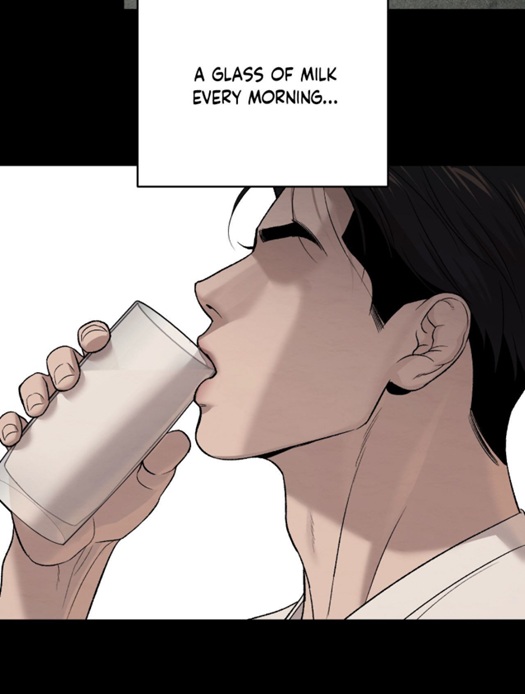 (chapter 75), perfume
 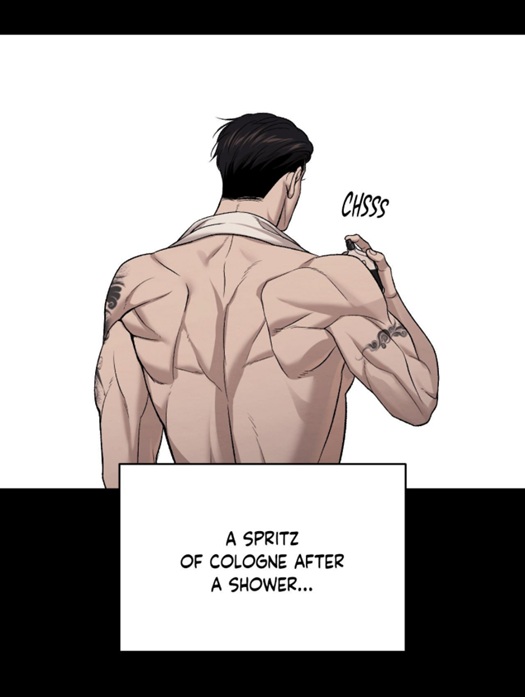 (chapter 75), sweat and sex
  (chapter 75) became instruments of anesthesia, each meant to silence the body that once betrayed him.That betrayal did not come from the body itself but from what it carried — his father’s shadow.
 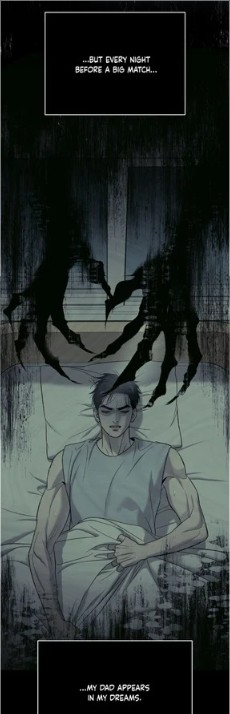 (chapter 75) Every muscle, every breath, every instinct reminded him of the man he swore never to become. The body was a mirror of lineage, and lineage meant failure. In his dreams, that failure still reached for him: black hands emerging from the dark, the father who had lost everything.
 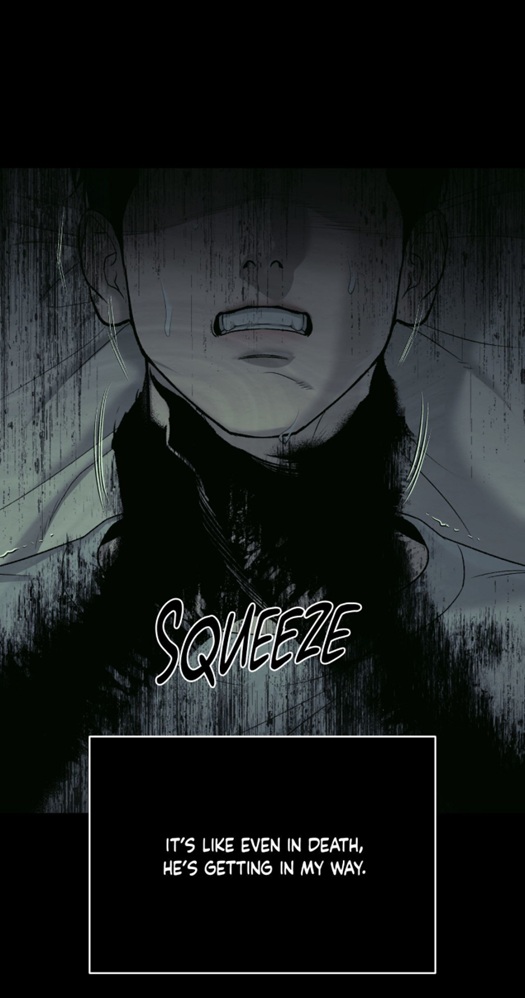 (chapter 75) The fighter calls it a “dream,” not a nightmare, because fighting was once his father’s dream — a dream of escape, of being seen, of proving that poverty was not fate. But for the son, that same dream turned into a curse. To fight was to repeat what had already destroyed the family.
Thus, he began to punish his own flesh for its resemblance to the dead. Every ritual — milk before a match, perfume after shower, sex before fighting — became an act of denial, a way to cut the bloodline out of himself. The body that once connected him to hunger and memory had to be silenced, sterilized, erased. Yet behind every gesture of control lay the same emptiness: a child’s thirst disguised as discipline. The milk that promised fulfillment was once the prize he had to steal  (chapter 75), the forbidden comfort that ended in scolding.
  (chapter 72) When he finally received it, it was not from a mother but from the director — a man whose gift could fill the stomach but not the heart. From that day, nourishment and submission became one.
Each ritual since then has repeated that confusion. He learned to mistake obedience for care, power for affection, control for love. The milk before a match was not about luck; it was a way to silence the body that once trembled from hunger. The perfume on his neck, the sweat of victory, even the scent of sex — all were substitutes for what he never truly received: the warmth of being wanted and accepted.  (chapter 72) And yet every attempt at purification only buried the rot more deeply. The more he washed, the more the stain spread inward — invisible, odorless, yet consuming.
The champion’s hickeys
Now the trail has changed. What he follows is no longer the fragrance of superstition, but the faint, human odor of the doctor. When Jaekyung presses his lips against Dan’s neck 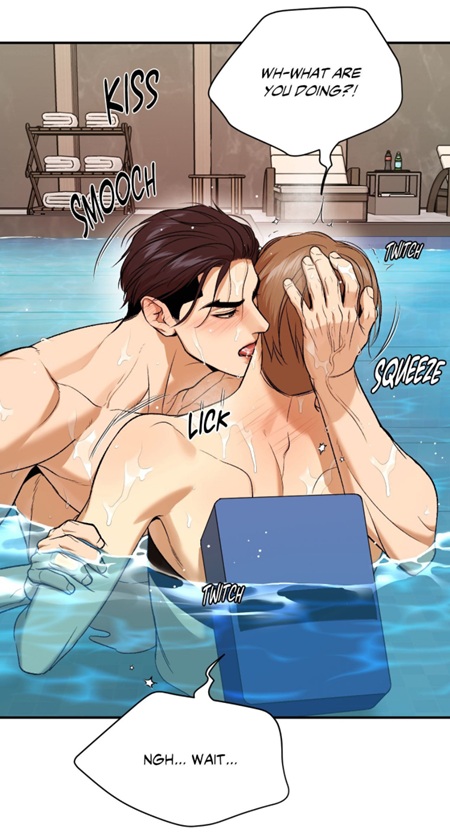 (chapter 81) — the same spot where he once sprayed his perfume
  (chapter 40) — it is more than desire: it is instinct, possession, and search. The gesture blurs the line between hunger and recognition, as if he were trying to inhale and keep what had always eluded him. The scent he once sought in bottles and rituals now breathes through another body, one that refuses to be contained. So when Jaekyung breathes against Dan’s skin, he is no longer trying to mask the stench of loss but to find the source of something living. The doctor’s scent does not erase hunger; it answers it. For the first time, the wolf eats without devouring.
Let’s not forget that during the Summer Night’s Dream, the wolf had already answered that silent call  (chapter 44) — nuzzling the one destined to become his anchor. Jinx-philes can observe not only the presence of steam (which is similar to smoke), but also the effect of the scent. Back then, the champion had calmed down thanks to the hamster’s scent.
 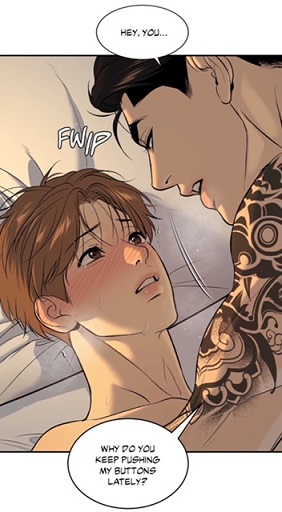 (chapter 44) To conclude, that moment, half dream and half awakening, had already begun to rewrite the map of scent. There, the fragrance from doc Dan had triggered his appetite, hence he couldn’t restrain himself during that night.
  (chapter 45)
And because of that scent, the wolf will follow his loved one  (chapter 65) He will make sure that doc Dan doesn’t smoke again and his scent remains pure. This signifies that the wolf will pursue its source through the smoke of deception, through the perfume of luxury and corruption. The doctor becomes both compass and contrast — the pure odor that exposes every false aroma around him. Through Dan’s scent he will breathe again—through that fragile, living fragrance the wolf begins to track the truth that stinks beneath luxury and lies.
The Plane and its Scent
In order to understand the meaning of this fleeting image (chapter 81) — a plane gliding through a noiseless sky — I had to return to an earlier flight. 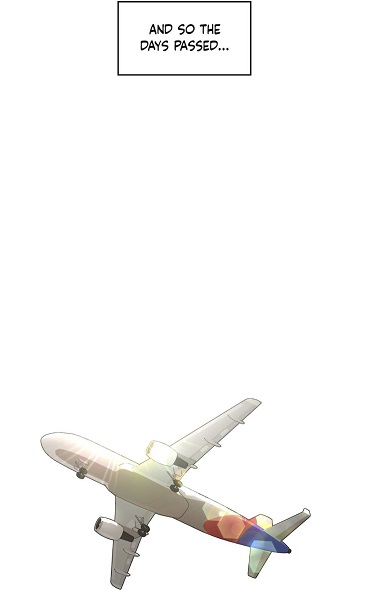 (chapter 36) When the champion left South Korea for the United States in episode 36, the plane glided through a void of light. There was no sky, no earth, no horizon — only a white expanse pierced by the sun’s glare. Even the boundaries of air and space seemed dissolved. The image radiated purity but felt sterile, stripped of texture. The machine was rising, not toward a destination but away from attachment itself.
That ascent not only announced the future victory, but also represented the Emperor’s ideal: perpetual motion without roots. He was a man of altitude, not of place. The whiteness surrounding the aircraft mirrored his own self-erasure — the body emptied through fasting 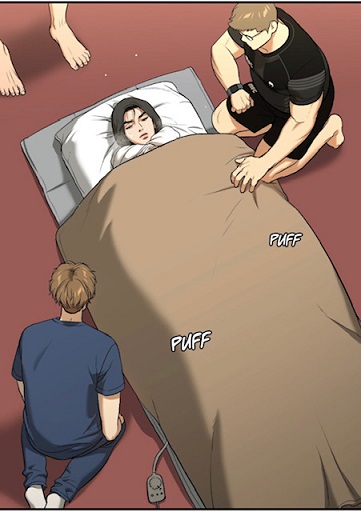 (chapter 37), the heart disinfected of need. Hence the bed became an instrument of “torture”. The upward flight marked a beginning, yet it already smelled of exhaustion and futility. A life built on departure cannot land anywhere.
Episode 81 inverts everything. The plane is now seen from above, not below. (chapter 81) Clouds and land re-emerge, spreading like a map of memory. Gray veils hang overhead; far below, blue horizon and bright rivers glint in daylight. For the first time, the world has depth again. The point of view tells us two things immediately. First, this aircraft is descending: it is approaching foreign soil, France, a country framed by water and beautiful landscapes. Secondly, the inversion foretells the champion’s own descent — the fall of the myth into the realm of the human. It already implies the existence of a scheme and his anticipated “defeat”.
The earlier plane signified departure; this one signals arrival. What had been an escape from origin becomes a forced return to reality. The hero who once vanished into whiteness now re-enters color, gravity, and consequence. I therefore deduce that Joo Jaekyung’s past will resurface after arriving in France.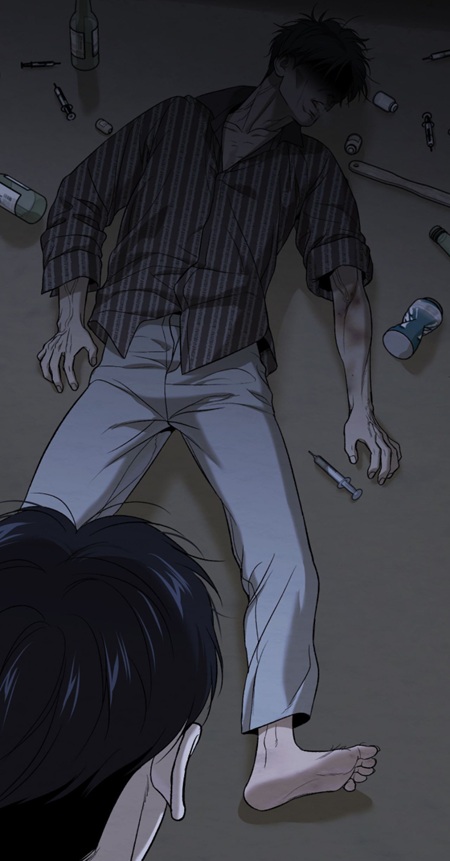 (chapter 73) His origins—the father who once fought, gambled, and collapsed into addiction before dying of an overdose— will no longer remain hidden. The revelation will spread like a smell the public (Team Black) cannot ignore. Yet this descent is not disgrace alone; it is the beginning of embodiment. Exposure will give him weight. But what did the director say?
  (chapter 78) Through Hwang Byungchul’s blunt words, the Emperor finally realized that he possessed an identity of his own—one not confined by inheritance or shame. The insults that once defined him, (chapter 75) “smelly bastard,”dirty rat” have lost its power. What once clung to his name as odor now disperses into air. The fall will wash away the false scent of stigma and let the man emerge, bare but clean.
I come to the following deduction: the change of perspective is Mingwa’s quiet confession that the age of flight — of abstraction and denial — is over. The sky of episode 36 concealed both land and direction; the sky of episode 81 exposes them. (chapter 81) Beneath the clouds lie traces of the life he once ignored: the landlord who welcome him with toilet papers and invited him to dinner, the old coach who still mirrors his pain, the grandmother whose endurance defines family, and the doctor whose presence has become home itself. These human coordinates are his new geography.
The palette itself reinforces this shift. In America, everything dissolved into white, a color of anesthesia. Over France, tones mingle: gray above, blue below, gold reflected from the rivers. The air is alive, restless, and uncertain. Clouds thicken like unspoken doubts, yet the blue horizon opens a path. It dawned on me that Mingwa is painting the boundary between dream and danger. The gray warns of turbulence; the blue promises arrival. Between them hovers the aircraft, between illusion and embodiment — just like its passenger. The coexistence of colors and contrasts (light, cloud, turbulence) displays life! Life without pain, fear, struggles, is no life, but an illusion. At the same time, it implies the return of the protagonists’ agency. Their decisions will determine the outcome of this imminent match.
Time, too, changes nature. Both flights are bound to temporal formulas, but their logic diverges — and both are told through the doctor’s eyes. In episode 36, the line (chapter 36) emerges not from the champion’s mind but from Dan’s weary observation. It carries the cadence of someone watching life slip by from the margins, a spectator of discipline rather than its agent. The phrase, neutral on the surface, reveals quiet lethargy: days blending into one another, the monotony of service and the absence of urgency. This indicates the hamster’s distance and a certain emotional indifference toward his VIP patient. No wonder that, at the hostel, he chose the impersonal word “team” 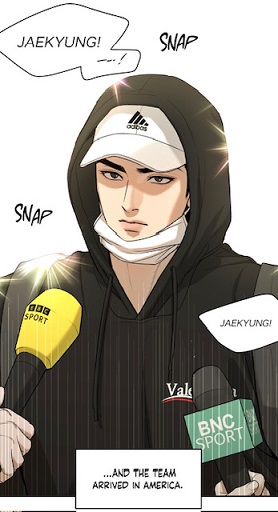 (chapter 36) instead of naming Joo Jaekyung himself. He might have stood beside the MMA fighter the entire time, yet he preferred to disappear behind collective language, as if the plural could shield him from personal involvement. It was a professional gesture, an attempt to efface the self, to stand beside the fighter without belonging to him. His role was service, not solidarity; his language confirmed distance. Thus his karma was that he got abandoned by the team after the match, while rescued by the celebrity himself!!
But in episode 81, the tone has changed. (chapter 81) The doctor’s narration “Eight days until his comeback” reveals far more than a schedule. Its tone pulses with nervous anticipation. Time, once something Dan merely endured, has regained texture. Back in chapter 36, he let the “days pass” like indistinguishable shadows — one more sign of his emotional detachment. Life moved, but he did not move with it. Now, every day counts. The number eight introduces tension, a sense of waiting and measure. He is not only aware of time; he feels it. The body trembles, breath shortens, nerves tighten. For the first time, Dan senses temporality the way athletes do: as pressure, as pulse, as future approaching.
His thought at the airport 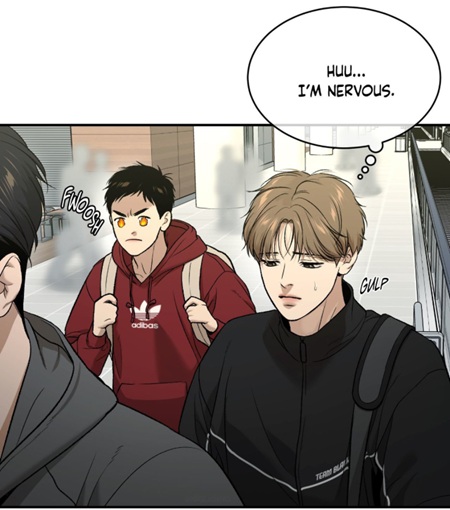 (chapter 81) translates that awareness into sensation. It’s no longer the passivity of a bystander but the heartbeat of someone invested. The count of days becomes a shared horizon between doctor and fighter, a bridge of feeling.
  (chapter 81) When Jaekyung exhales the same “huu,” their anxiety synchronizes, transforming fear into connection. The loop of repetition (“days passed”) has turned into a countdown of empathy (“eight days left”). Time itself has begun to belong to both of them. The same “team” has become real, but contrary to the past: there are only 2 members, Kim Dan and Joo Jaekyung. At the airport he wears the Team Black jacket, a subtle but deliberate signal that he has accepted inclusion. The jacket is not uniform; it is recognition. Both form 8, which is a symbol for balance and infinity.
Interesting is that this panel (chapter 81) looked like victory (due to the position of the plane) but smelled of vacancy. However, this trip was not, for the two protagonists, a symbol of rest — quite the opposite. Neither Jaekyung nor Dan ever got the chance to visit the city; the supposed journey abroad becomes another kind of confinement. 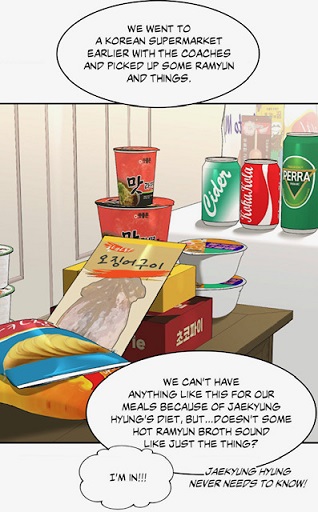 (chapter 37) The others indulge in small pleasures — snacks, shopping, light rebellion — but the champion and his doctor remain trapped in routine, orbiting one another inside sterile rooms. I am suspecting that doc Dan must have bought the scarf at the airport, a small act of thoughtfulness before departure.
  (chapter 41) Yet the gesture, though sincere, carries a quiet irony. The scarf is printed with flowers, mostly roses, but as a piece of fabric it has neither scent nor warmth. It imitates life without containing it. What he gives her, in truth, is a copy of affection, not its essence — a bouquet that cannot breathe.
And now you may wonder how this connects to the scent of the jinx. 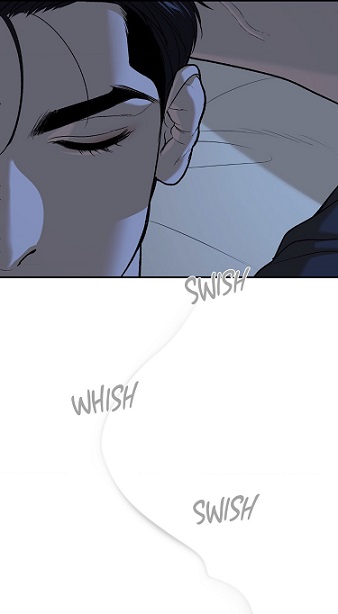 (chapter 37) The answer lies in the contrast between the smell of life and the smell of emptiness. While others seek flavor in hot ramen or the sweetness of snacks, the champion’s room remains odorless, air-conditioned, antiseptic. Then, in the quiet of night, a faint aroma drifts toward him, the flavor of hot ramen. And now observe the progression of scents through Jinx.
| Chapter 10 | Chapter 22 | Chapter 32 |
|---|---|---|
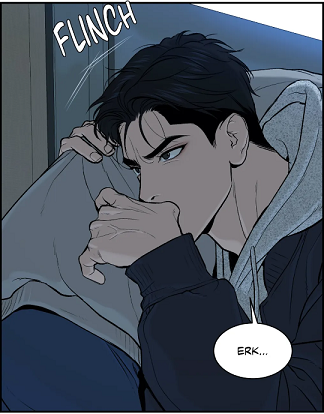 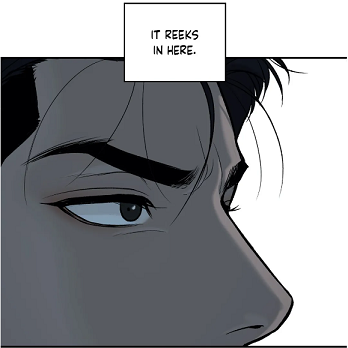  |   |   |
It traces the slow resurrection of a man who had unconsciously silenced his own senses. In chapter 10, the wolf first enters the doctor’s home and flinches even before inhaling. The moment his eyes register the dim light, the narrow hallway, the disorder, his hand rises to his nose — a movement so quick it feels primal. Only once in the room does he mutter, “It reeks in here. The overpowering stench of poverty.” He doesn’t smell first; he remembers first through visuals. The odor exists only because his past floods the scene. The sight of a modest room resurrects the atmosphere of his own childhood flat 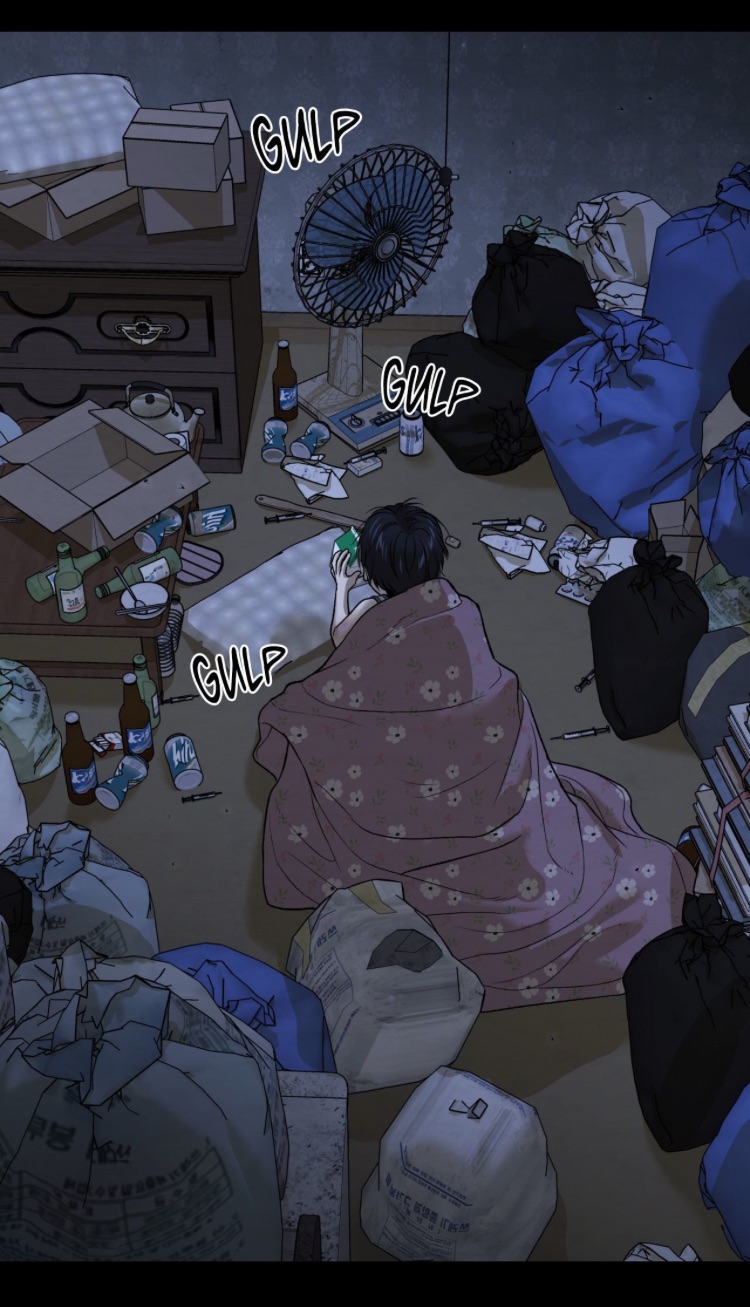 (chapter 72) — the garbage, the spoiled food, the stale air of neglect. What he truly covers is not his nose, but his fear of returning there. Later, in episode 22, when Dan cooks for him, the champion instinctively associates food with corruption: (chapter 22) Nevertheless, Jinx-philes should realize that for the first time, we had a reference to the ocean through the dishes: fish, seaweed soup.
  (chapter 22) Interesting is that here fish has a negative connotation: intrusion and thoughtlessness. This shows how detached the champion was from his true self: water and the ocean. Moreover, cooking, warmth, nourishment—all evoked garbage, the chaos of his first home.
The reason lies in his earliest environment. In that cramped room buried in trash, the boy who would become the Emperor once tried to survive on milk—an industrial liquid without smell or taste, the very opposite of maternal care. (chapter 72) His father’s addiction, the filth, the absence of real home made food—all merged into a single sensory nightmare. Odor became shame. Flavor became fear. So he began to build a life that denied every sense. And now, my avid readers can grasp the role of Kim Dan during season 1. It was not just to replace the sex ritual. Unaware, he had replaced the ritual with the glass of milk with his food. So at the beginning of season 2, Joo Jaekyung got to learn that his “glass of milk” 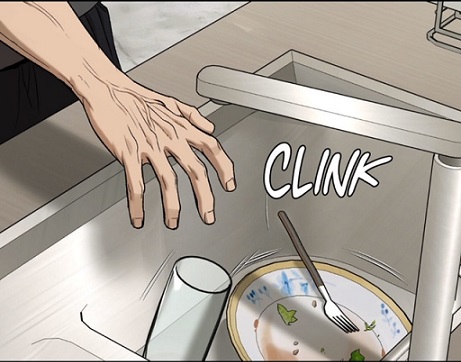 (chapter 54) couldn’t nourish him. Hence he replaced it with wine for a while.
So he built a life that denied every sense. That’s why he hates flowers. However, there’s more to it. When the doctor innocently talks about a bouquet he received in episode 31 (chapter 31), Jaekyung’s reaction (chapter 31) reveals more than irritation. For him, floral scent is associated with loss. The fragrance belongs to death. The first time he truly smelled flowers was at his father’s funeral, when incense and blossoms mingled with grief. (chapter 74) Their fragrance became the perfume of loss. To his senses, flowers never meant beauty or love or nice smell; they mean burial and as such pain. Every petal recalls the suffocating smell of the funeral room, the smoke, the artificial but painful peace of goodbye.
And that is precisely where the scent of the jinx begins to unfold. The scarf’s floral pattern recalls everything artificial in both their worlds: Jaekyung’s deodorant, the perfume of fame, the grandmother’s rehearsed kindness. Each object is meant to replace something that once had a natural smell — milk, skin, sweat, breath. The airport gift thus mirrors the champion’s life of rituals: beautiful but airless, made of gestures without fragrance.
The Location And The Fall
In season 1, Mingwa already left clues about a connection between France and South Korea.  (chapter 32) The blue tie contains 3 striped colors: red, white and blue, which are quite similar to French flag, though the order has been switched. Secondly, Choi Heesung purchased
  (chapter 32) Hermès’ item, a French company famous its bags, scarfs and perfumes. So I am quite certain that once Jinx-philes discovered the identity of the next fighter
 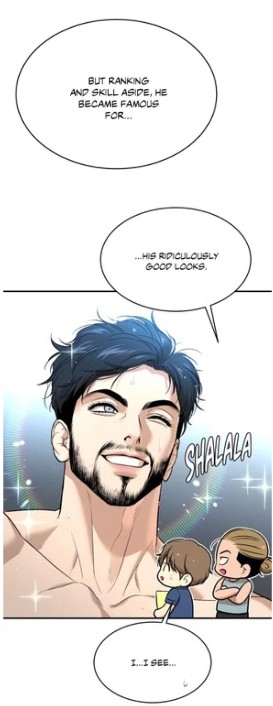 (chapter 81) and saw the plane, they must have jumped to the conclusion that the next fight will take place in Paris! But France is more just than the capital. This country is called the Hexagon due to its form, and this name stands in opposition to the MMA ring, which is an octagon!
  (chapter 40) Interesting is that the team at the airport is composed of 6 people.
  (chapter 81) So we could say that despite the disadvantage being in a foreign country, they are “equal”, 6 colors against the team from the Hexagon, the blue light from the MMA ring. But let’s return our attention to Paris. The latter is widely recognized as the symbol of love, the global center for fashion, art, and stardom. The city has a deep historical connection to these fields, being the birthplace of haute couture and home to many of the world’s leading fashion houses and luxury conglomerates. Its cultural scene is equally rich, with a long history as a hub for artists and a more recent reputation for being a center for music and film stars. However, the image with the landing plane is actually revealing the truth. (chapter 81) There are no mountain close to Paris, the river La Seine is much smaller… Finally, the airport doesn’t look like Airport Paris – Charles de Gaulle, (chapter 81) for the hallway is much smaller and it is not crowded.

Finally, observe the vocabulary of the manager: “breeze”  (chapter 81) and “splash” (chapter 81). They let transpire the presence of wind and water suggesting the presence of the sea. Thus, I deduce that they landed near the sea. And if one looks again at the image of the plane (chapter 81), the blue at the horizon seems to confirm this intuition: the aircraft is gradually descending toward the coast, not the capital. So for me, the destination is not Paris — the city of revolution and political upheaval representing popular sovereignty, as the schemers are planning a counter-revolution. They stand for conservatism and money. My theory is that this plane is arriving in the South of France, most likely Cannes, where spectacle and wealth converge. But there exists another reason for this assumption. Do you remember where the physical therapist witnessed the match between the Emperor and Randy Booker? It was in Busan, a city situated in the South of South Korea, a city closed to the ocean.
  (chapter 14) Here, exactly like in the States, his trip to Busan never gave him the opportunity to visit the city and the beach, exactly like the athlete. The next airport to Cannes is Nice- Côte d’Azur and it looks more like the one in the Manhwa. Furthermore, the South of France has a milder climate in the fall, hence it is still possible to swim in September. Besides, in my last essay, I had connected the champion to Bruce Lee and water:
  Finally, Naturally, here I could be wrong with Cannes. Nevertheless, Cannes, with its glittering shorelines and film festival glamour, symbolizes the marriage of money (millionaires, yachts) and illusion — the theater of appearances. It is where contracts are made, where bodies are displayed, traded, and consumed through the gaze, the very economy that has always governed the champion’s existence. The wolf, once born among garbage and hunger, now finds himself surrounded by luxury, in a world perfumed with artificial success. Yet beneath the surface of that “breeze” and “splash” lingers the scent of corruption. The coastal light hides what the smoke once revealed: exploitation, manipulation, and the unspoken violence of commerce.
And yet, the irony is striking. The Côte d’Azur, world-famous for its vivid palette and sensual abundance — the lavender fields, the herbs of Provence, the shimmer of olive trees, the salt air heavy with Mediterranean fragrance — stands in perfect contrast to the sterile, monochrome world the two protagonists once inhabited in the seaside town. There, the ocean had no scent 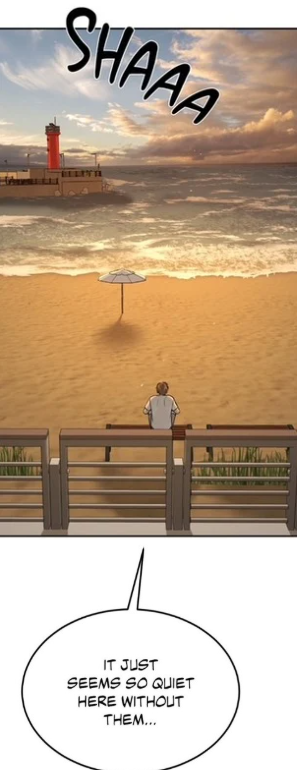 (chapter 59); silence had replaced air; life was drained of flavor. None of them truly enjoyed the nature: the ocean or the mountain. The seaside town was strongly intertwined with work
 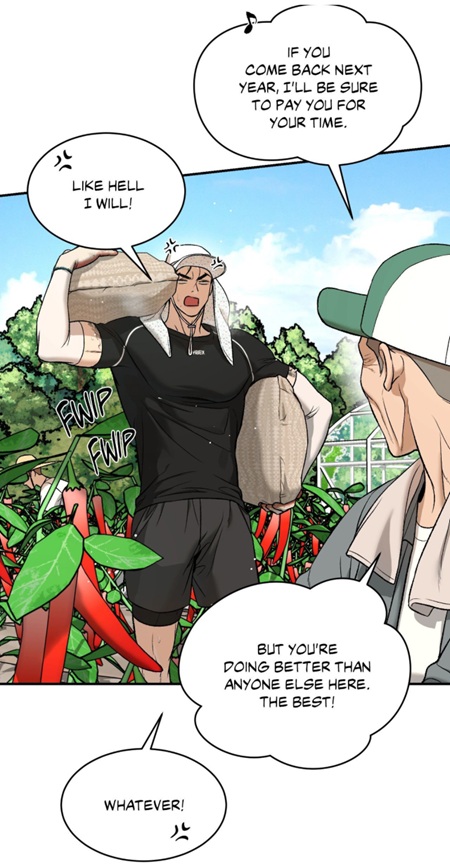 (chapter 77) or danger. Then, when they returned to that place, their time was limited to visit the grandmother and the landlord.
  (chapter 81) They had no time to walk through the woods or visit the hills. They had no time for themselves. Consequently, I believe that in The French Riviera, the two of them will discover “savoir vivre”. Everything breathes, glows, and stirs. It is a land overflowing with color, aroma, and taste — precisely the senses that the wolf had long sought to erase through ritual. Doc Dan had led a similar life too, dedicated to his grandmother and work. If they are close to the sea, they might decide to walk on the beach together.
And if my theory is correct, then the choice of Cannes would not be accidental but allegorical. While on one hand, it marks a return to the emperor’s original curse — being admired and used at the same time, it announces an imminent change: his emancipation, for the villains have planned to destroy him. The private match organized there recalls the old underground fights from the Shotgun arc, only now cloaked in legitimacy and wealth. The arena has changed, but the principle remains: rich spectators watching a man’s body perform until exhaustion, while those in charge profit from his pain. And because of his lineage, they could still look down on him. Despite his fame and fortune, the champion does not truly belong among them. To the powerful, he is entertainment — a body to be wagered upon, not an equal at the table.
Look again at this panel. First, you can detect behind the champion the reflection of water, another clue that the protagonist will shine next to the sea. Moreover, it also indicates that doc Dan’s dream is related to water. Furthermore it is not a costume he wears, but an image imagined for him (chapter 32) — the doctor’s vision of what the wolf could become. He doesn’t see the origins of the athlete, but his success: he is not only a self-made man but an artist, a star. The three-striped tie, reminiscent of American designer Thom Browne’s refined style, evokes order, discipline, and self-respect: qualities the doctor unconsciously longs to see replace the chaos of ritual and fight. In that imagined world, Jaekyung is not an object but a person, an artist, a real VIP — no longer the Emperor of violence, but a man capable of standing among other celebrities without fear or shame.
And here, I couldn’t help myself thinking of the movie The French Connection, the parallel deepens. The French Connection (1971) is a crime thriller directed by William Friedkin, inspired by real events. It follows two New York detectives, led by the obsessive Jimmy “Popeye” Doyle, as they uncover an international heroin-smuggling operation linking France and the United States. The film contrasts gritty realism with moral ambiguity, exposing how obsession and corruption blur the line between justice and criminality. That film, too, revolved around illusion and desire — the traffic between authenticity and disguise. The “connection” was both criminal and psychological, exposing how corruption travels unseen beneath surfaces of elegance. Here, the same word gains new meaning: the false connections built on money and fame will give way to a human one, forged through care, scent, and trust.
And now, the reason for setting the match in France becomes clearer. The CEO could no longer exploit the United States  (chapter 69); the scandal there had linked the previous incident to the infiltration of a Korean gang. The American branch was compromised, its credibility tainted. France, on the other hand, offers a mask of neutrality — refinement, culture, and distance from scandal. By choosing it, they manufacture the illusion of glamour and innocence, pretending that Baek Junmin and his former hyungs have nothing to do with the coming event.
But the choice of France also hides a darker lineage. One only has to look back to Thailand 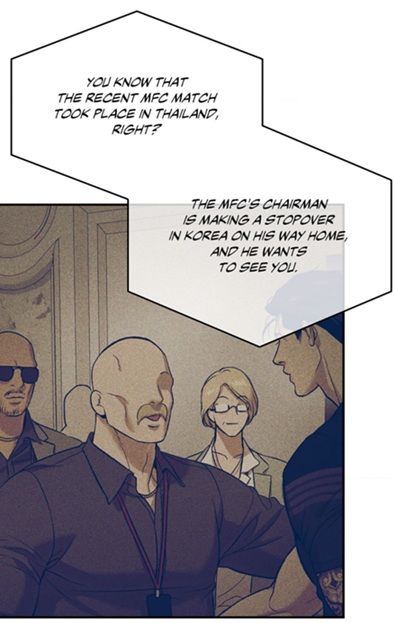 (chapter 69), where Baek Junmin once fought for the championship belt. Thailand in Jinx is not a paradise but a mirror of corruption — the place where victory turns into prostitution, where the body becomes currency. There, the Shotgun won a crown but not respect; his triumph was drenched in manipulation, spectacle, and moral decay. He was admired by no one, celebrated by ghosts.
Thailand thus stands as the antithesis of recognition. It is the kingdom of false applause, the shadow-market of sport where the price of glory is humiliation. If France embodies elegance masking corruption, Thailand embodies corruption stripped of its mask. Both belong to the same chain of deceit — one refined, the other raw. Between them stretches the moral geography of Jinx: America (illusion of success), Thailand (the sale of the body), and now France (the stage of reckoning). Baek Junmin, out of jealousy, wants Joo Jaekyung to make a worse experience, to be exploited, humiliated,, discarded and forgotten, just as he once was. His wish is not for justice but for repetition: the recycling of pain. Despite his title in Thailand, he still feels unrecognized. He now wants the Emperor to taste the same degradation under the polished surface of France. What he endured in the raw heat of corruption, Jaekyung must suffer in the refined chill of sophistication. He needs to be reminded of his true origins.
Junmin’s resentment is not born merely from defeat but from invisibility. His triumph brought no admiration, no genuine acknowledgment. The crowd that watched him fight was faceless, bought, indifferent. Hence he is not named as “champion” at the restaurant.  (chapter 69) He was crowned, yet unseen. In his bitterness, he mistakes vengeance for validation. If Jaekyung falls publicly, perhaps the Shotgun’s own shame will finally be understood. Thus, France becomes his stage of revenge — not through direct confrontation, but through orchestration. The game he once lost in Thailand, he now rewrites from the shadows.
But this repetition will not go as he imagines. The irony of the French Connection lies precisely there: the traffickers think they control the route, unaware that the real transformation is happening within the travelers themselves. The wolf, who once lived by rituals of survival, will now breathe a different air — one that carries both danger and redemption.
While the schemers imagine they are about to succeed and ruin the champion for good, I am expecting the opposite, as they form now a team. Immersed in an environment so rich in colors, fragrances, and tastes (which would be similar to Thailand), Joo Jaekyung and doc Dan may come to enjoy the very senses they both buried to survive. The air of the Riviera — fragrant, tangible, and alive — could become the breath that finally releases him from his gilded cage and fulfills, at last, the doctor’s unspoken vision.
The Airport as threshold
In episode 36  (chapter 36), the transition from flight to arrival unfolds with seamless precision: no airport, no customs, no luggage — only the honk of city traffic and the flags fluttering over a hotel entrance. Everything about that journey screams logistics. It was a corporate trip, arranged, timed, and contained. The athletes passed through invisible gates, their movement stripped of individuality. The champion, like cargo, was transported rather than welcomed. His arrival, though triumphant (chapter 36), was sterile — as if success itself had been reduced to a schedule.
By contrast, episode 81 opens the gates. The author deliberately inserts an airport scene (chapter 81). Airports are spaces of suspension, places where one stands between departure and arrival, past and future. They symbolize journeys, transitions, and connections, representing not only physical travel but also the passage between inner states of being. They are gateways to new experiences, opportunities, and, at times, spiritual awakenings.
That is precisely why we find the champion pausing in quiet reflection. (chapter 81) For a brief moment, he seems to meditate — neither fighter nor celebrity, simply a man caught in the stillness of transition. The gesture of breathing, the soft “Huu,” carries profound significance. It evokes purification, the act of expelling the stale air of superstition, trauma, and fear. What leaves his lungs are not only bad thoughts but remnants of the “jinx” itself — the invisible poison that once ruled his life.
The absence of his gaze does not denote blindness but introspection. His closed eyes signal a shift from vigilance to awareness, from the need to control to the capacity to feel. For the first time, the Emperor does not seek omens outside himself; he listens inwardly, acknowledging uncertainty, fragility, and the quiet pulse of change. In that single exhale, the wolf begins to shed his curse — not through combat or conquest, but through the simplest act of all: breathing. That’s why he looks so determined after this short break.  (chapter 81)
And amid that uncertainty, one sound cuts through the sterile air: rattle.
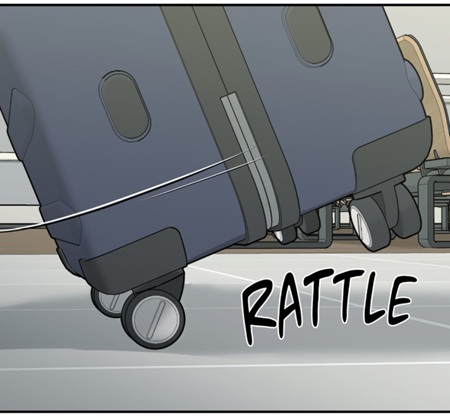 (chapter 81) The suitcase becomes the true protagonist of this threshold. In that small vibration lies all the instability the white air once denied. It is his portable home, his compressed past, the fragile proof that he finally has something to lose. In the earlier arc, he could have vanished mid-flight and no one would have noticed; now, if the suitcase disappears, another heart will break. That difference measures his evolution. Yet it also marks new vulnerability: any hand can touch what he carries.
Like the wardrobe  (chapter 41) and the wedding cabinet
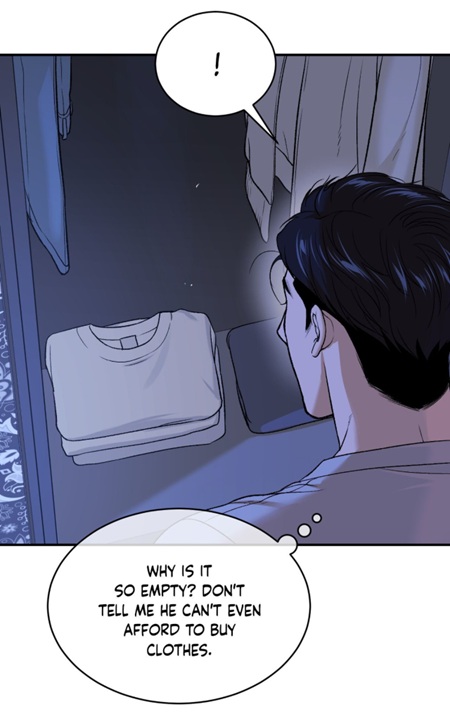 (chapter 80) before it, the suitcase belongs to the same symbolic lineage. It is the container of intimacy — filled with clothes, precious items like pictures or books, with the silent evidence of presence. But unlike its predecessors, it moves. The wardrobe once stood still, rooted in the domestic; the wedding cabinet invited intrusion within a private world, as it was once discarded. The suitcase, however, carries that vulnerability into the public realm. It is exposure on wheels — the private made portable. (chapter 81)
The object that symbolizes belonging also invites trespass. It holds what makes a person recognizable — garments, scents, textures — yet it can be opened, inspected, or stolen. That possibility haunts the scene. The suitcase is both protection and temptation, security and risk. Its rattle echoes the heartbeat of transition itself: the trembling awareness that what is finally one’s own can still be taken away. And here comes my next question: Whose suitcase is it? One might say, the champion’s naturally. If so, this signifies that in the suitcase, he placed the birthday card and the key chain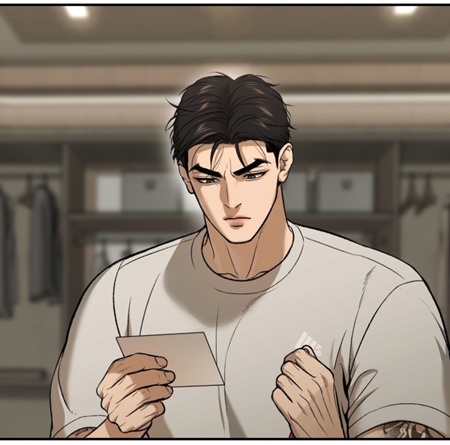 (chapter 81)
  (chapter 81) and Kim Dan has still no idea that the athlete has kept them like cherished relics. He might have placed the notebook from Hwang Byungchul as well. However, the person carrying the suitcase is the manager: (chapter 81), while Yosep is pushing a card with the other luggage. By separating one suitcase from the others, the beholder can detect that Park Namwook is separating not only himself from the team, but also his “boy”, if he is indeed carrying his suitcase.
In that sense, the airport does not replace the hotel as a site of intrusion but extends it. If the manager were to open the suitcase by mistake and discover the physical therapist’s birthday card 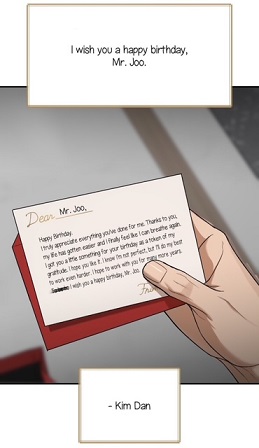 (chapter 55), where he expressed his desire to work for Joo Jaekyung for a long time. What would be the manager’s reaction, when he recalls this incident with the switched spray and Doc Dan’s sudden departure? Moreover, we have here “erased words”: to be ho… The timing of the discovery is really important. This could generate some tension and confrontation between the manager and the physical therapist. Besides, such a birthday card could generate negative feelings (like jealousy), Kim Dan is gradually taking more and more place in the athlete’s life. The violation that once occurred behind closed doors (the penthouse) now could happen in plain sight. The line between private and public collapses, just as the boundary between success and loss blurs.
Secondly, the scene at the airport could actually announces that the team will have some trouble at the hotel… Let’s not forget that in the States, Joo Jaekyung had to argue with one of the local coaches, probably because they needed a place to train: 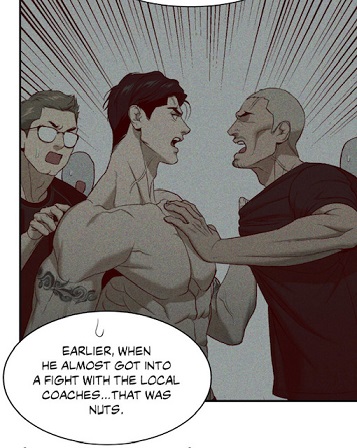 (chapter 37). So when the manager says this, (chapter 81), he is thinking, everything has been well planned and prepared. He has nothing to do, he can relax… and as such he is on “vacation” like in the States. Thus I deduce that the airport has a different signification for the manager: he is about to get confronted with reality.
The Birth of New Rituals
Until now, the champion’s rituals had been prisons disguised as protection. Each one — milk, perfume, sweat, sex — served to silence what his senses once knew. They were mechanical repetitions of comfort that had long since lost their source. But episode 81 quietly introduces a new vocabulary of intimacy: paper, metal, ink, and touch. The birthday card and the key chain, two small, ordinary gifts, begin to form a new scripture (chapter 81) — a Bible of another kind, not written in divine authority but in human handwriting. They contain no promise of victory, only the trace of another person’s care. His words represent now his motivation to win doc Dan’s heart.
The card is a voice materialized, the first object that speaks about dreams and wishes without demanding. IT is not about making history. When he opens it, he does not perform a ritual; he reads. And that simple act of reading — eyes moving line by line across words written for him — marks a profound shift. For the first time, his energy moves inward, not outward. Reading requires stillness, patience, trust that meaning will come. It is an act of surrender disguised as concentration. What once was sweat and breath now becomes quiet and language.
And this scene reminded me of the hyung’s comment: 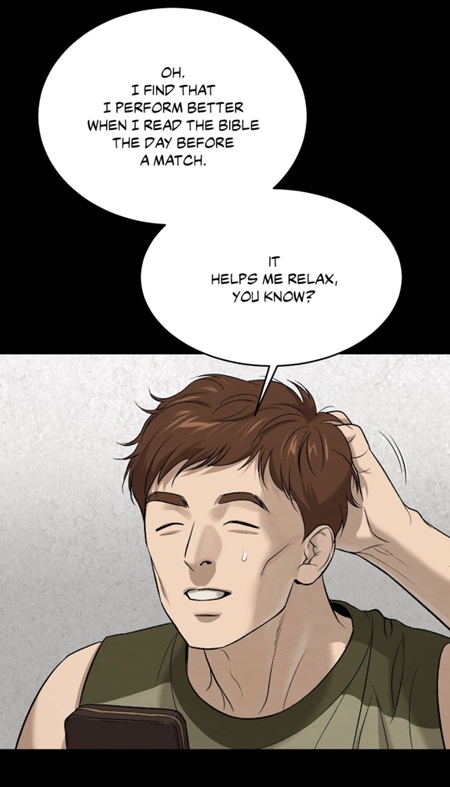 (chapter 75) While he was sick, he could recall this scene.
 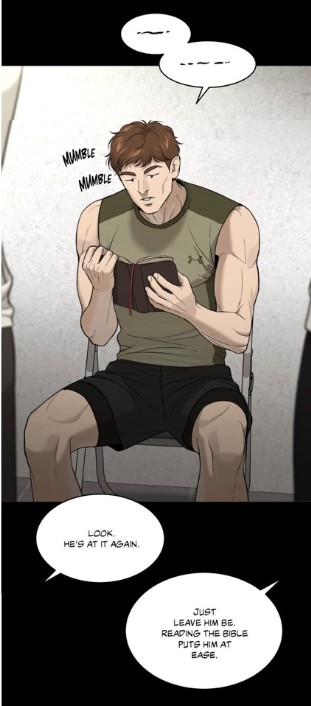 (chapter 75) where the fighter could stay focused, though he was surrounded by noise and people. The advice had seemed trivial, when first given. Now it re-emerges as revelation. The emperor, once incapable of rest, now reads
  (chapter 81) beside someone who represents safety. The book becomes a bridge between wakefulness and sleep, a ritual that does not erase consciousness but calms it. Where his earlier practices sought to block sensation, this one restores it.
The birthday card and key chain together form a new kind of talisman. They do not protect him through superstition but through memory. One he carries near his heart; the other, in his hand. The materials themselves — paper and metal — symbolize fragility and endurance.  (chapter 81) The paper bends, absorbs scent, bears traces of fingers and warmth; the metal resists, reflects light, carries weight. Together they represent the balance between tenderness and strength — precisely what his life has lacked. In contrast to the mechanical milk and odorless perfume, these objects are human, imperfect, touchable.
It dawned on me that these small tokens might become the new Bible for Joo Jaekyung. A Bible not of laws but of gestures, recording moments of real connection. Every page, every object carries a commandment: Breathe. Dream. Gratitude. Trust. Through them, the wolf learns to replace fear with curiosity, repetition with attention.
What makes this transformation more poignant is that it grows in the shadow of the oldest absence — the mother. For years, the wolf’s hunger had another name: longing for a touch that never truly existed. The embrace of the mother 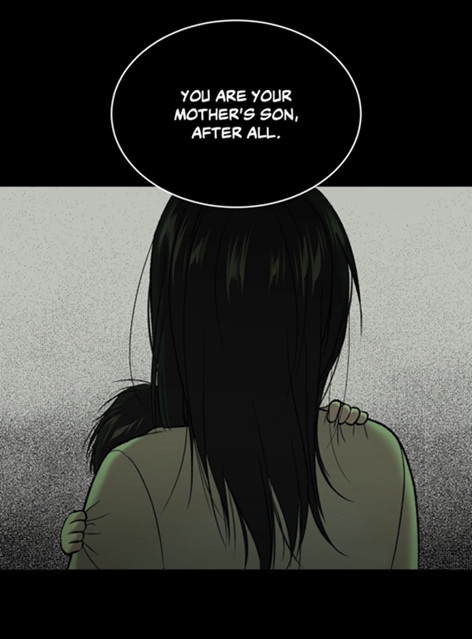 (chapter 73), which should have offered nourishment, attention and peace, had been replaced by absence and deceit. Her warmth was an illusion, a posture mimicked but never felt.
That embrace — the promise of milk, scent, warmth and safety — is the first lie he ever believed. The hug is strongly linked to the breast and breastfeeding. I doubt, his mother ever did such a thing. Thus it is no coincidence that later he had to steal milk to feed himself. Later, the director’s milk replaced hers: tasteless, industrial, stripped of scent. It filled the stomach but not the soul. From that moment on, he learned that comfort was conditional and care transactional. He mistook control for love because that was all love had ever resembled.
Joo Jaekyung doesn’t even remember his mother has ever bought clothes for him.  (chapter 80) And here, I had imagined that the mother had offered this t-shirt as a birthday present.
Behind the father’s ghost, therefore, hides the true phantom — the mother. Her absence shaped his rage more than her presence ever could have. Let’s not forget that Joo Jaewoong’s resent and mockery toward the champion were triggered by the betrayal of the wife. Secondly, when the father died, she showed no feelings or concerns for Joo Jaekyung. He was the only one who was forced to carry the memory of his father and family. With her abandonment, she pushed him to never “forget” the father. However, since Joo Jaewoong had always been harsh and resentful toward his son, the latter could only repress him. The mother had withdrawn not only her body but also her sincerity. She had long cut off ties with Joo Jaekyung, but deceived him by giving him a phone number. Her last gesture was a symbol of infinite delay — a connection that could ring but never answer.  (chapter 72) Each call was a prayer cast into emptiness, the sound of longing echoing against the wall of indifference. She taught him to expect nothing from tenderness. she had implied that she was weak, a victim of the husband’s tyranny, while she pushed the young boy to become a parent: cleaning the house, working, earning money. Her “warmth” had been performance; her concern, deception.
I come to the following deduction: she never gave him a teddy bear or any toy. The reason is not poverty but intention. The child himself had become her only comfort, her shield and excuse against the husband’s failure and disillusion. Instead of protecting her little boy, she used his body as a barrier, turning him into both witness and defense. This explains why, in his later memories, the room contains no bed of his own, no trace of play, not even a corner that belongs to him.  (chapter 72) He did not sleep like a child but like an object kept near for safety. The woman lying beside him was a mother in name only — emotionally distant, physically present. No stroke, no kiss, hence the boy had to clinch onto her. (chapter 73) Her warmth was strategic, not maternal.The child might have slept next to her in the same room, she was like a stranger to him, similar to this:
 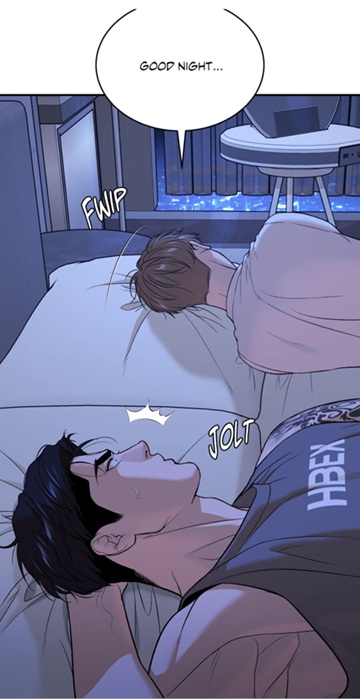 (chapter 78), without the good night! That missing intimacy was not a void but a distortion — a tenderness twisted into survival. The mother’s touch, meant to console, existed only to protect herself. She kept the child close not out of affection but out of anxieties and resent, turning him into a living barrier between her and the man she resented. What he experienced as warmth was, in truth, defense and rejection; what seemed like closeness was the choreography of avoidance. Hence she never looked at her child. The body that should have been cradled for its own sake was held as cover, its value defined by its usefulness.
From that confusion emerged the adult’s crisis: he could no longer tell care from control. The gestures of intimacy, once poisoned by self-interest, became impossible to trust. Every caress felt like potential deceit, every act of closeness a prelude to betrayal. This is why, later, the man built his life upon rituals — not to find comfort, but to contain danger. Each ritual became a kind of armor, repeating the same logic his mother had taught him: proximity without safety, touch without love.
Now, for the first time, another presence enters that space. That’s doc Dan. He had to replace not only the father, but the mother. Thus the champion sucked his nipples:  (chapter 29) which reminds us of breastfeeding. And now, look at the embrace in the swimming pool:
  (chapter 80). The hamster was imitating the behavior of the little Jaekyung in the past, clinching onto the “parent” like his life depended on him. But how did the athlete react to this embrace? He looked at his fated partner
 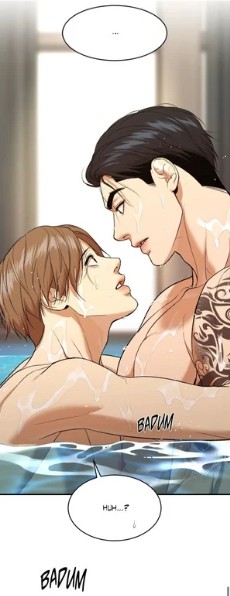 (chapter 80) and got all warm and fuzzy by looking at him:
  (chapter 81) A sign that the mother had never reacted the way her son is doing now, the feel to kiss the loved one! The problem is that in the swimming pool, the doctor’s scent and taste are covered by chlorine. (chapter 81) The doctor’s nearness on the couch recreates the missing scene — not through erotic intensity but through quiet continuity.
 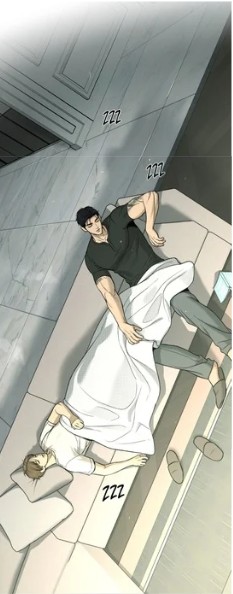 (chapter 81) The wolf falls asleep next to someone, not on top of or apart from them. That small preposition — next to — carries the weight of redemption. The couch, once a site of violation
  (chapter 61) or solitude, becomes again what it was meant to be: a place of rest and tenderness. Thus he touches his fated partner’s legs over the cover, showing his care and respect.
 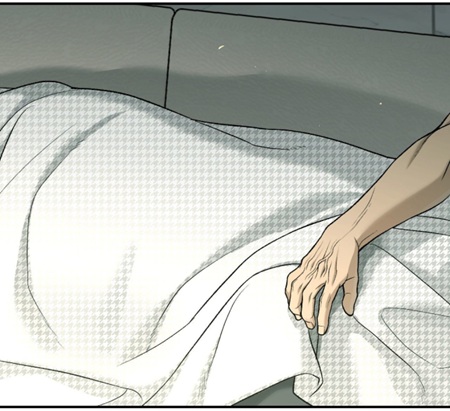 (chapter 81)
By acting like a responsible adult and mother full of gentleness and attention  (chapter 81), he can recognize the false nature of his mother’s affection. What she offered was conditional, deceptive and self-centered; what the doctor gives is ordinary and consistent. No grand gestures, no promises — only presence. The doctor does not rehearse concern; he lives it through routine. And this ordinariness, paradoxically, becomes sacred. It was, as if the athlete was treating his own inner child through the physical therapist.
Touch, once an instrument of domination, turns back into a language of reassurance. The warmth of proximity (chapter 81) reactivates a sensory world the fighter had buried: the rustle of sheets, the rhythm of another person’s breathing, the faint scent of human skin. All the senses that the old rituals sought to erase now return — not as overwhelming floods but as quiet reminders that he is alive and no longer alone.
The breathing motif continues here. The earlier “Huu” (chapter 81) that marked his introspection at the airport now finds completion in shared respiration. (chapter 81) Two lungs exhale into the same night; the air that once poisoned him becomes communal. The act of breathing, once an attempt to purge, turns into a sign of harmony.
From this point on, every ritual he creates will carry an echo of this night. (chapter 81) — of reading, of calm, of nearness. The objects (card, keychain, book) become extensions of that experience. They are reminders that comfort does not depend on superstition but on memory and connection. They mark the rebirth of ritual as choice, not compulsion. Moreover, the couch becomes a place for rest and intimacy, the opposite to this scene:  (chapter 37)
And this brings me back to the nameless and faceless mother. In a bitter twist, Joo Jaewoong was right in one aspect:  (chapter 73): she thought she could become somebody else, but she never truly left. The woman may have escaped the home physically and socially, but she remains chained to it in spirit. How so? Because she cannot erase the child who once called her eomma. No matter how far she runs, Joo Jaekyung’s existence anchors her to the very life she tried to abandon.
Every denial she utters — every silence, every unanswered call — only deepens that chain. Hence she made this request: 
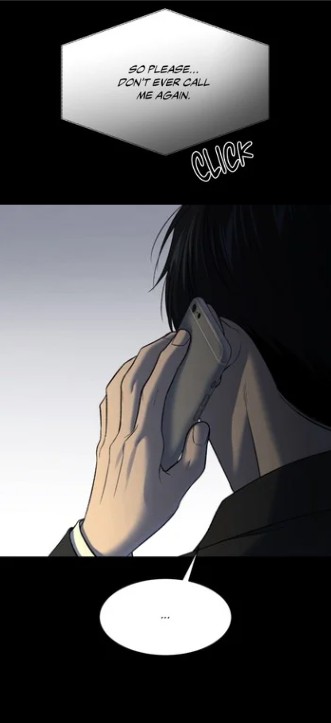 (chapter 74) At this moment, the page itself turns black, veined with smoky whorls of gray — as though her words had burned into the air rather than spoken. “I can’t live with you… please understand… let’s just go our separate ways.” The sentences rise like vapors, leaving behind the faint residue of a scent that refuses to vanish. This visual texture — half smoke, half ink — captures her true condition: she dissolves herself with every attempt at escape.
The mother’s rejection does not erase her presence; it transforms it into something atmospheric — invisible, invasive, impossible to contain. She becomes the ghost that still clings to the son’s breath, the odor that lingers in every space he enters. In that sense, her words are not final but volatile: they fill the air like perfume and smoke, leaving behind confusion between comfort and suffocation. The same element that once linked incense to mourning now binds her denial to memory. Her refusal to recognize him is not freedom but recoil; it keeps her frozen in the same emotional geography as the husband she despised. By cutting ties, she believed she could reinvent herself, but her disappearance became another form of captivity — the captivity of guilt, of fear, of unresolved motherhood. Under this light, you comprehend why I added a woman with clothes in the illustration.  France itself mirrors her — beautiful, perfumed, wrapped in silk and secrecy. She definitely climbed the social ladders through her second marriage, hence she could offer toys to her second son. The nation of couture and fragrance becomes the stage for the mother’s unmasking. Once the name of Joo Jaewoong rises again, questions about her will inevitably follow. And here, she can no longer hide behind silence or excuses. The myth of refinement — both hers and France’s — collapses under the weight of exposure.
The woman who once fled to preserve her image (a victim of abuse, who couldn’t accept her husband’s choices) will now confront the reflection she abandoned: the son who embodies everything she tried to forget. France, the country of elegance, is also the country of appearances. In the 18th Century, the king and the nobility barely took baths, they relied on scent to mask their dirtiness. It is the perfect mirror for her story — beauty masking decay, luxury concealing guilt. The garbage left in the home is a heritage from the mother 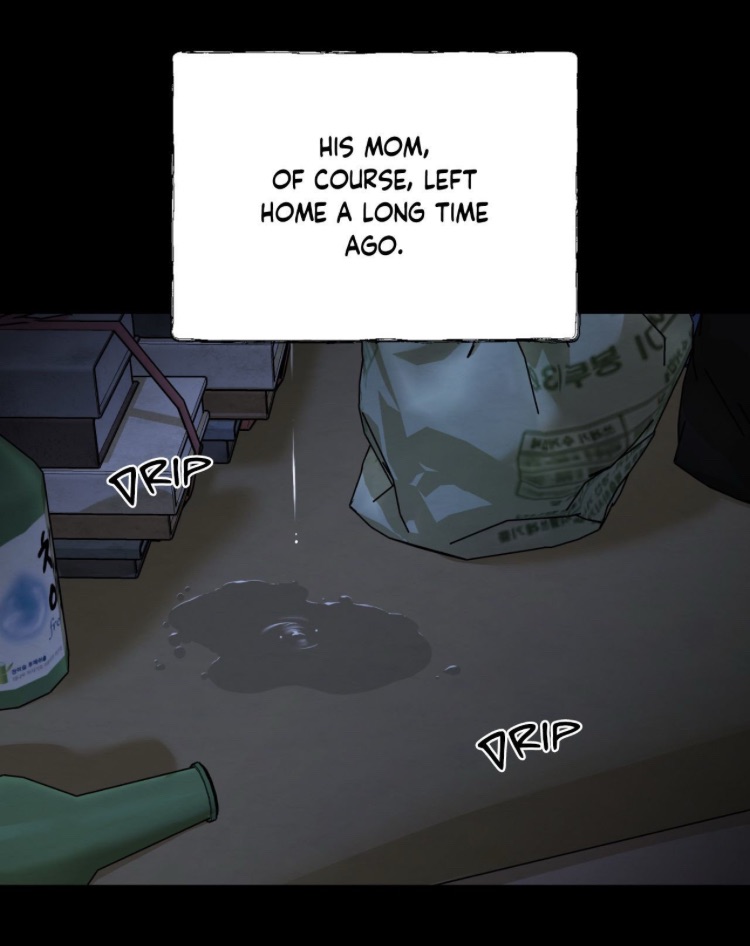 (chapter 72)
She carries Joo Jaekyung’s name in absence. The facelessness that once belonged to the child now belongs to her. In that reversal, the curse continues: both are trapped by the same invisibility, mother and son reflecting each other’s wounds across distance. And when he next confronts the ghost of his mother, the recognition will be complete. He will finally understand that the real betrayal was not abandonment alone, but false love — the performance of care without its substance. Thanks to his fated partner, he is learning to understand his feelings better and to improve his vocabulary. So he will be able to call things by its true name. Moreover, I am suspecting that doc Dan’s mother will serve as a counter-example. In discovering this truth, Joo Jaekyung will be able to free himself from this so-called love. He will no longer chase the illusion of her warmth; he will cease mistaking submission for affection. The warmth he sought was never hers to give. He will be able to move on and create his own home.
Doc Dan’s presence redefines it. His calm attention, his patience, his refusal to dramatize care — all these form a new maternal rhythm, one that heals without pretending to. Through the doctor, the wolf experiences what the mother only feigned: the safety of reciprocity. (chapter 73) And in that exchange, the jinx finally begins to dissolve.
Thus, new rituals are born — quiet, tangible, human. They don’t require smoke, nor scent, nor spectacle. Only the soft flick of a page, the weight of a key chain, the memory of someone’s voice and embrace. In those gestures, Joo Jaekyung rediscovers the senses his trauma had silenced. He no longer erases the world; he learns to breathe it in.
PS: Since the match takes place in 8 days (chapter 81) , it signifies that doc Dan and Joo Jaekyung won’t be able to visit the landlord and the halmoni like they did in the past. Moreover, I am expecting a new incident. All this could affect the grandmother’s health.
Feel free to comment. If you have any suggestion for topics or Manhwa, feel free to ask. If you enjoyed reading it, retweet it or push the button like. My Reddit-Instagram-Twitter-Tumblr account is: @bebebisous33. Thanks for reading and for the support, particularly, I would like to thank all the new followers and people recommending my blog.

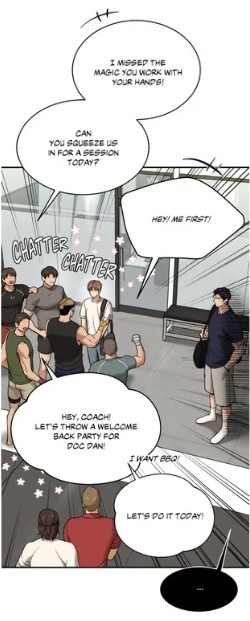 (chapter 78) Their noisy excitement — hugs, wishes, smiles, jokes, even talk of meat — gave the impression of a long-awaited reunion. Yet the suggestion was cut short by Jaekyung, who rejected it like this:
  (chapter 78) In other words, a party was “missed.” At first glance, this might appear to be an exception, a rare moment of denial in a story otherwise filled with shared rituals. Readers might recall the welcome party
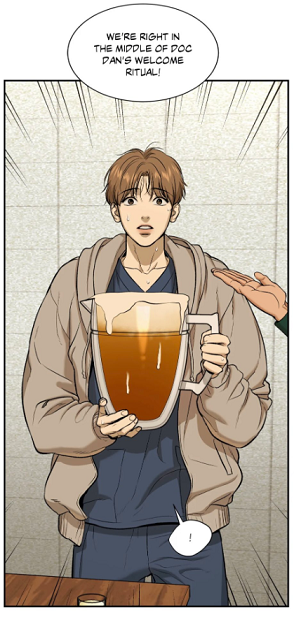 (chapter 9) in episode 9, the champion’s birthday dinner
  (chapter 43) in episode 43, the talk of hospital get-togethers
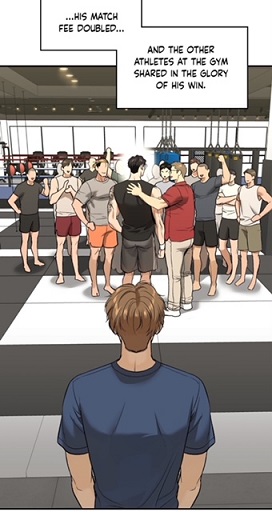
  (chapter 61), or the festive tone of fighters after director Choi Gilseok’s victory
  (chapter 52).
 (chapter 41) Why did they not organize a party in Seoul to celebrate his victory in the States? Dan devotes himself to work, but his departures are marked by silence
 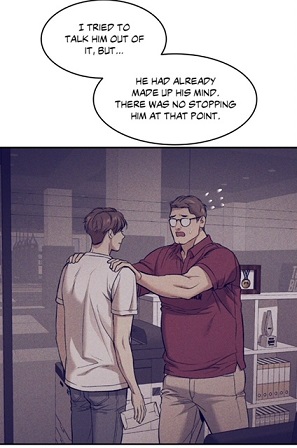 (chapter 53) rather than farewell.
 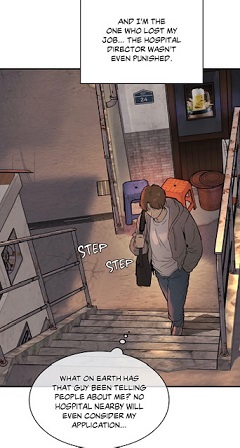 (chapter 1) The few rituals that do occur — a premature birthday cake, a noisy hug, puppies chasing after a car —
 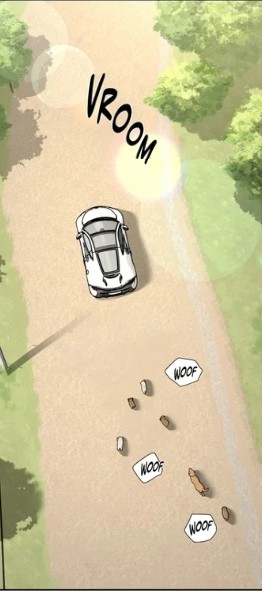 (chapter 78) always miss their mark, either hollow in substance or unseen by the very people who should be honored.
 . (Chapter 43) Even the “dragon’s” birthday, supposedly a day of personal celebration, is reduced to an awkward dinner at his expense, with a cake arriving a day too early
 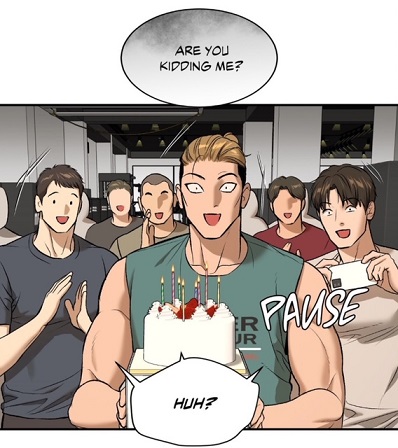 (chapter 43) or gifts from sponsors and fans he never wanted.
  (Chapter 41) In Germany, it is considered as a bad omen to celebrate a birthday too soon. Rituals that should affirm intimacy instead expose distance and lack of respect.
 (Chapter 52)
 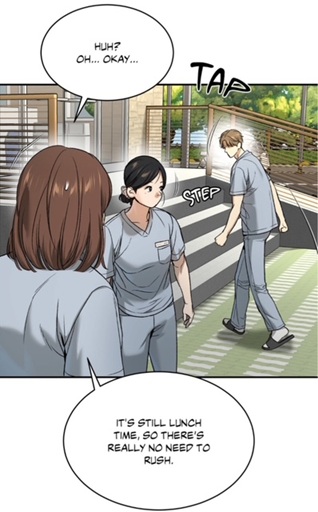 (chapter 56) However, this is just an illusion. What caught my attention is that the nurses wondered themselves why such a skilled therapist would come to a small-town hospital.
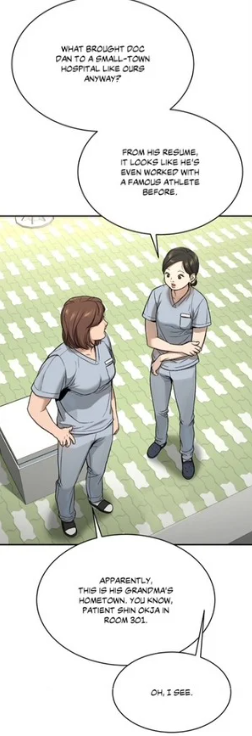 (chapter 56) They speak about him, as though he had no reason to stay there, as if he were a stranger passing through. Right from the beginning, he was treated unconsciously as temporary, someone whose presence required explanation rather than welcome. Finally, no party was held for him, no ritual of inclusion was offered. His distance and their detachment mirrored each other, producing the silence that would later define his departure.
  (chapter 78)
 (chapter 5) It ends either in the car or in the locker room.
  (chapter 15) The high peak of his celebrated victories takes place at the gym where Park Namwook gather the fighters in front of the Emperor congratulating himself for his “good work” and the spectators for belonging to a winning team.
 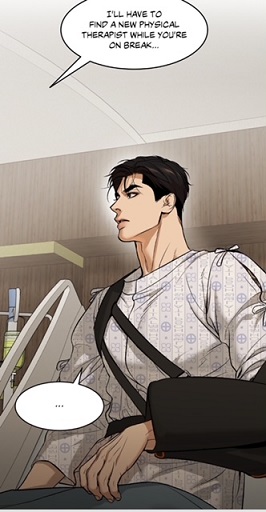 (chapter 53) For him, the physical therapists were just tools and as such replaceable.
 (chapter 43) A birthday, especially in Korea, is typically a family-centered celebration, held at home or among close friends. Yet Jaekyung’s “party” takes place in a restaurant, under Yosep’s casual announcement that they would be having a “dinner party.”
  (chapter 45) By keeping Dan in the dark about the “surprise,” the fighters created another problem. Their silence pushed him to offer his own present on the same day as the gifts from sponsors and fans — exactly the kind of attention Jaekyung resented. He had already said he did not want those presents, and now Dan’s sincere gesture was placed in the same category, indistinguishable from the flood of unwanted offerings. What could have been a private, meaningful moment was absorbed into the hollow ritual of the group. Hence the champion never got to read his card!
 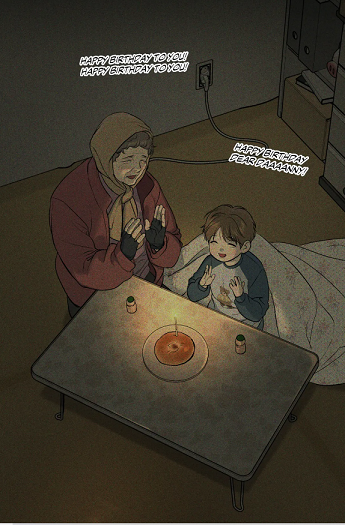 (Chapter 11) One might think, this celebration embodies a perfect birthday party. However, observe the absence of friends. It took place during the night too, a sign that his birthday was not celebrated properly. Everything implies his social exclusion. This made me wonder if this memory represents the only birthday party he ever had with Shin Okja. His life is a sequence of departures without ritual, absences without acknowledgment. Each time he leaves a place of work or community, he slips out like a ghost, denied the closure that parties are meant to provide.
 (Chapter 1) His stay had been so brief as well. Besides, his absence was engineered to be total, as though he had never existed. The very ritual that should have affirmed his contributions instead became a ritual of erasure.
 (Chapter 50) Then later the athlete questioned the physical therapist’s actions and told him this
 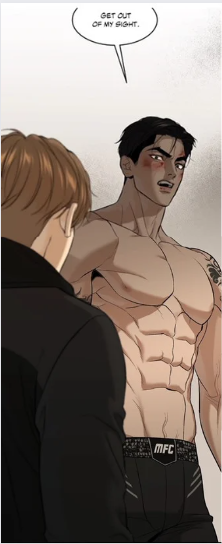 (chapter 51) out of fear and pain, the physical therapist thought, he was fired. Once again, he left in silence, unacknowledged. No one stood up for him, no one tried to reintegrate him, no farewell was offered.
 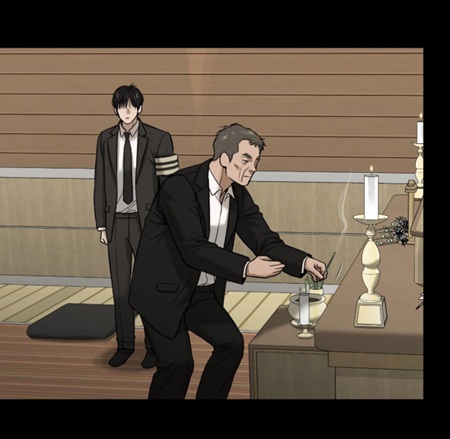 (chapter 74) The silence of his grandmother on this point suggests that even the most basic ritual of mourning was denied him.
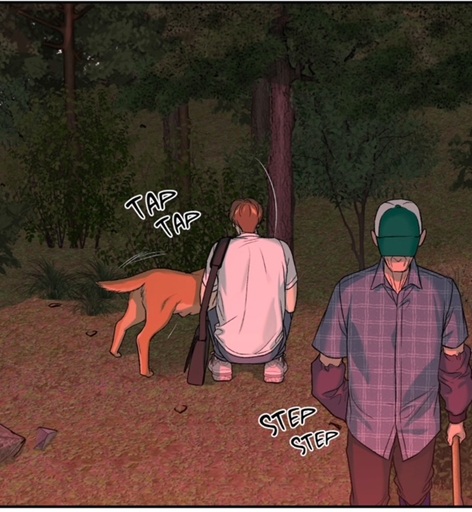 (Chapter 59) Only Dan and the landlord marked the event with a quiet burial. Since no one knew about it, it left the ritual incomplete. For Dan, the small act was meaningful, but its invisibility to the larger community echoed his own life: recognition always hidden, always partial, never public.
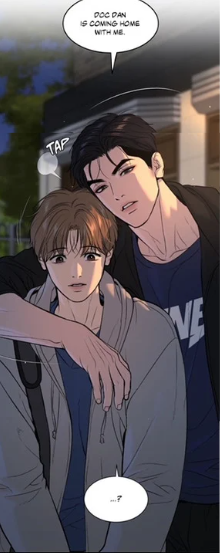 (chapter 43) This was the real heart of the evening, the only moment where ritual turned into intimacy. And yet even this was missed by Potato, who was absent at that crucial moment, lingering elsewhere with Heesung. The party’s form was there, but its essence — the recognition of Jaekyung’s loneliness and Dan’s importance — was overlooked by the two men at its center due to the presence of alcohol.
 (Chapter 78) To them, departure is not tragedy but play, a noisy farewell parade. Their barking and chasing become a spontaneous party, a joyous ritual of attachment.
 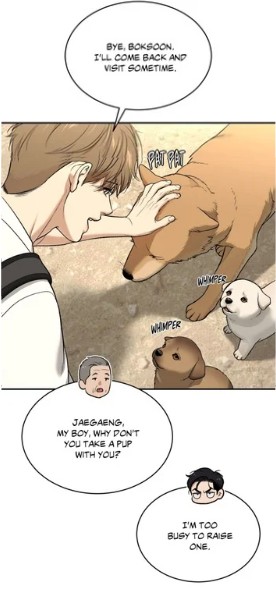 (Chapter 78) Striking is that here, doc Dan is making a promise to Boksoon and her puppies, but the latter have no idea. Therefore imagine this. On the weekend, the moment the car approaches the landlord’s house, the puppies will recognize them and celebrate their return! And this time, both characters will witness this welcome party:
 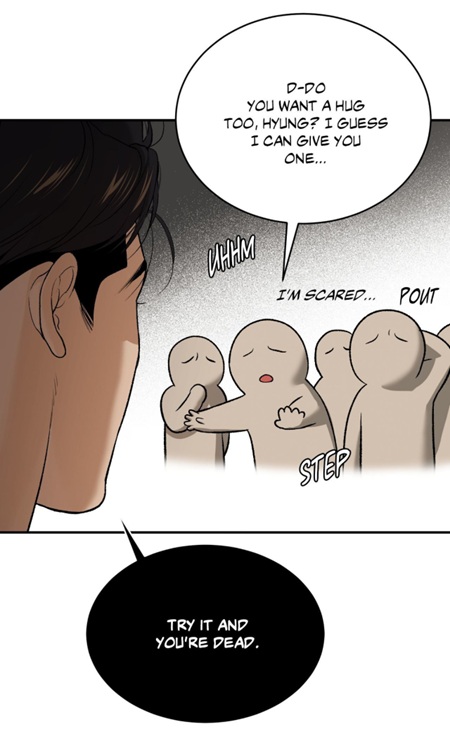 (chapter 78)
 (Chapter 78) But this “reset” is an illusion. Dan is only contracted for two matches. Interesting is that no one is capable of perceiving the truth, as the main lead’s explanation is ambiguous.
 (Chapter 78) He doesn’t limit the number of matches, only that he will focus on the “wolf”. So for them, his return is not limited in time. Nevertheless, his paleness and dark circles speak louder than their words: he is exhausted, fragile, still haunted.
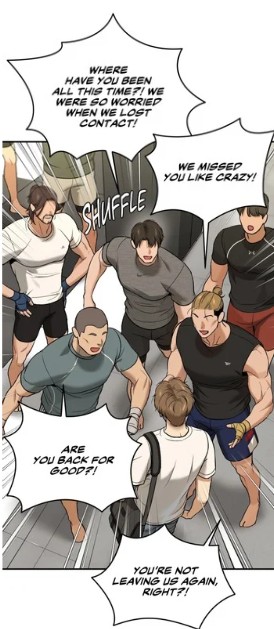 (Chapter 78) They are more worried about another possible departure than about his condition, as though his leaving again would be a greater tragedy than his ongoing suffering. This exposes that the members are not totally oblivious and their reunion is not a repetition of the past. On the other hand, warm words and a noisy welcome are enough for them. They take his generosity for granted, just as they always have. Therefore they ask for his magic hands.
 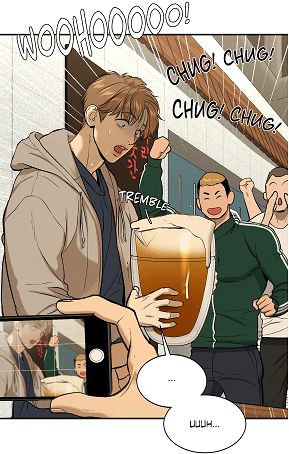 (chapter 9), and abstaining from drink often means being excluded from group belonging. Yet Dan, on medication, cannot drink. His doctor’s recommendation makes it impossible for him to participate in such “public” rituals. Even the customary sharing of a huge bowl — a symbol of intimacy and unity — must be avoided. For Jaekyung, who once used alcohol to dull his own struggles,
  (chapter 54) this becomes another reason to refuse such parties: they risk exposing Dan to temptation and harm. Park Namwook, knowing Jaekyung’s history of drinking, has no interest in promoting such events either.
 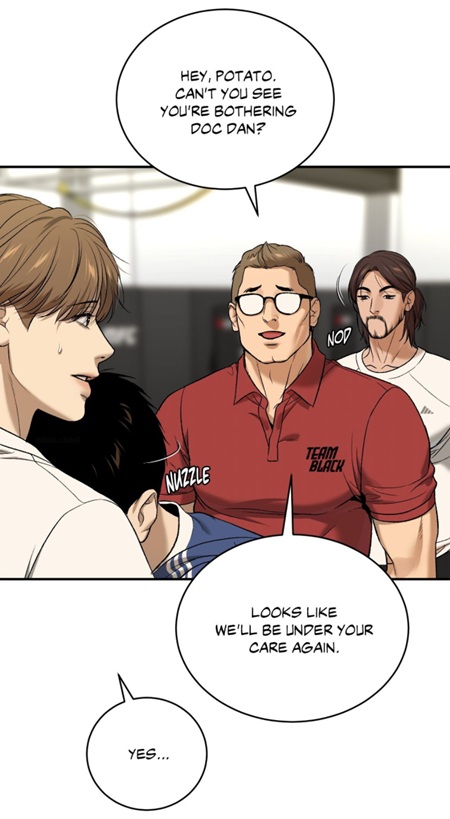 (Chapter 78) Hence the latter has no interest to organize a welcome party and even maintain the ritual with the bowl!! What might appear to others as grumpiness or stinginess is in fact a form of protection.
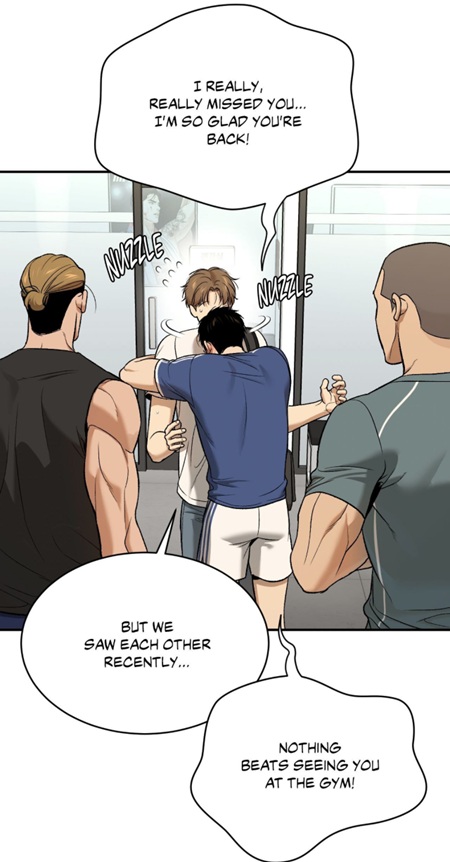 (Chapter 78) Having missed Dan most deeply during his absence, he now wishes to spend as much time as possible with his hyung. His longing shows that no party with Heesung and the landlord — no noisy drinking night —
  (chapter 58) could fill the hole left by Dan’s departure. But his form of attachment is still caught in the ritual of surface-level affection. What Potato craves is real closeness, hence he keeps hugging the physical therapist,
 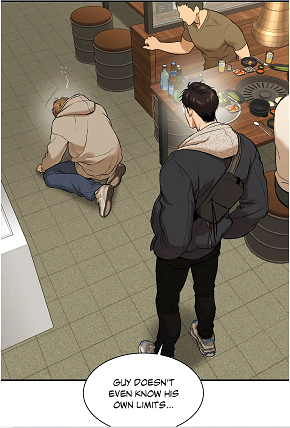 (chapter 9)
  (chapter 26), or allowed whether welcome parties or surprise celebrations or pre-match meals
  (chapter 22). These events were never about genuine recognition but about maintaining power and appearances, boosting morale, or reminding the fighters of their dependence on the team structure he managed. The “surprise” birthday party in chapter 43 bore his fingerprints,
 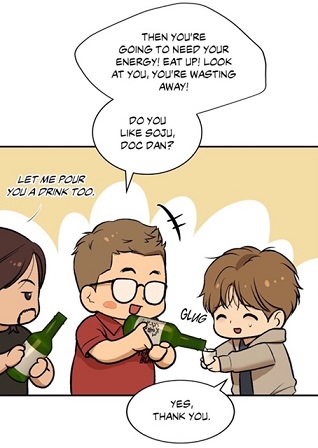 (chapter 43) This absence is revealing: Namwook preferred to avoid direct conflict with Jaekyung’s visible displeasure, leaving the awkward burden of paying and performing to the champion himself to Yosep. In other words, his parties were tools of control, not gifts of belonging. By chapter 78, however, the balance has shifted.
  (chapter 78) Standing in the back, Namwook watches as Dan returns and is embraced by the fighters. He notices a “different vibe” between the two leads, but fails to grasp what it means. Doc Dan is actually free and has the upper hand in their relationship. Hence he can no longer ask this from doc Dan:
 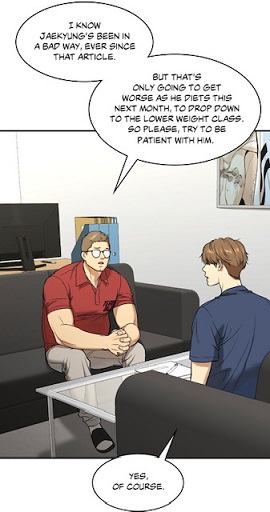 (chapter 36) Doc Dan should put up with everything. What he cannot admit is that Dan is no longer replaceable.
  (chapter 69) Yet unlike all the hollow celebrations that came before, this missed event would finally have meaning. It would not be absence through neglect, but absence as recognition: proof that Dan’s life matters more than ritual, profit, or performance.
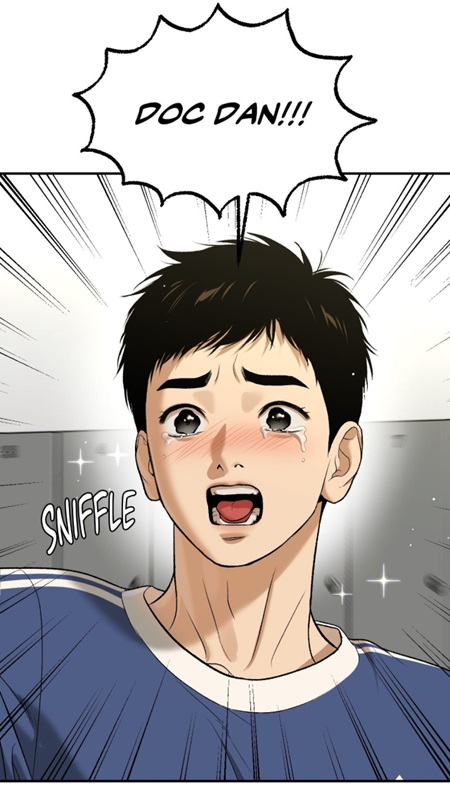 (chapter 78) This delay suggests a split loyalty: while the team is already celebrating, Potato is likely still tied to Heesung, perhaps even speaking to him on the phone. His tardiness betrays how his heart is pulled in two directions — caught between the actor’s orbit and the gym’s renewed center around Dan. Yet the embrace of the fighter, and his tearful reaction at seeing Dan again, show that his real place lies with Team Black.
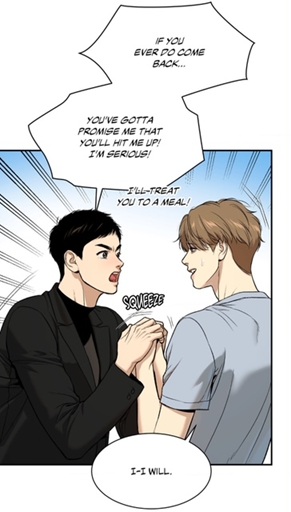 (chapter 59) Potato had made a promise to treat Dan to a meal if he ever returned, squeezing his hand with the sincerity of a puppy. That promise, innocent as it seemed, carried a hidden trap: in Korea, such “treats” almost always involve alcohol. And he could try to recreate the party on the coast. Potato, unaware of Dan’s medical restrictions, may offer him exactly what he must refuse. Only Jaekyung knows the truth of Dan’s fragile health; only he can act as his shield against such misplaced affection. Secondly, Potato possesses pictures of the puppies
  (chapter 60), which he took on the day one of them died!
 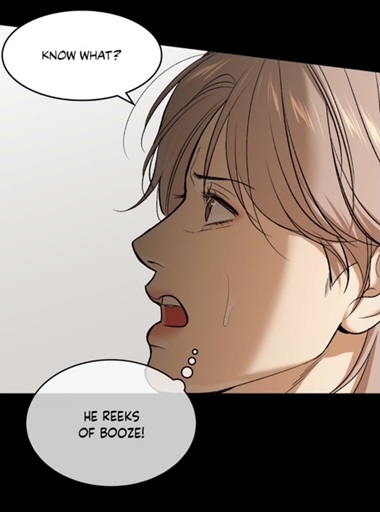 (chapter 58), and his presence ties alcohol directly to the champion’s vulnerability. At the same time, Potato’s loyalty is beginning to shift. He once orbited Heesung like a hidden lover, but Dan’s return rekindles his attachment to the gym and as such will affect his relationship with the gumiho.
 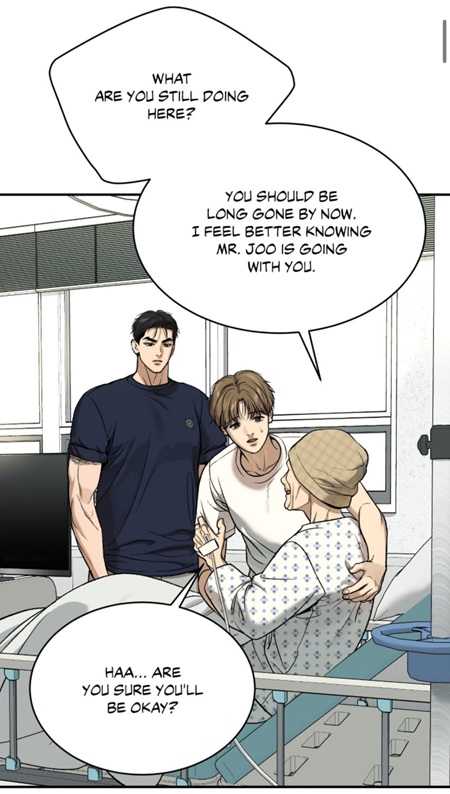 (chapter 78) But she does not return the gesture, as she might believe that he is just holding her straight. Her arms remain still, her body heavy with silence. Instead she talks, urging her grandson to leave the place as quickly as possible. So she doesn’t enjoy this moment. What should have been a small celebration of love — a hug of recognition, a party for two — dissolves into emptiness. Halmoni, who had always claimed to be his anchor, fails to give him the ritual of belonging he craves. The one gesture that could have affirmed their bond is withheld, turning tenderness into yet another missed ceremony.
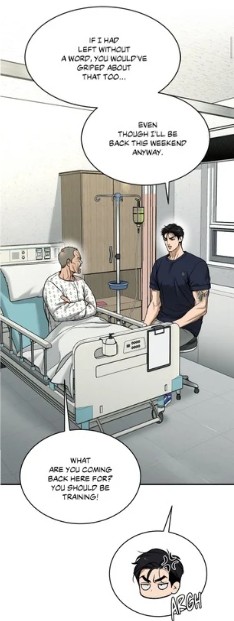 (chapter 78) Sitting stiffly in his hospital bed, he waves away any possibility of affection. His body language, arms crossed, his words reduced to commands about training, erase the emotional bond that might have connected him to Jaekyung. Where halmoni’s silence is passive, Byungchul’s is active — he refuses intimacy, replacing it with obligation. For both figures, farewell becomes an empty form, stripped of the recognition that makes partings bearable. In these moments, the absence of a hug, the denial of tenderness, is more devastating than the loudest rejection. It is a party that never begins, a rite of passage left unspoken.
 (chapter 22)
  (chapter 13) a breakfast in silence
 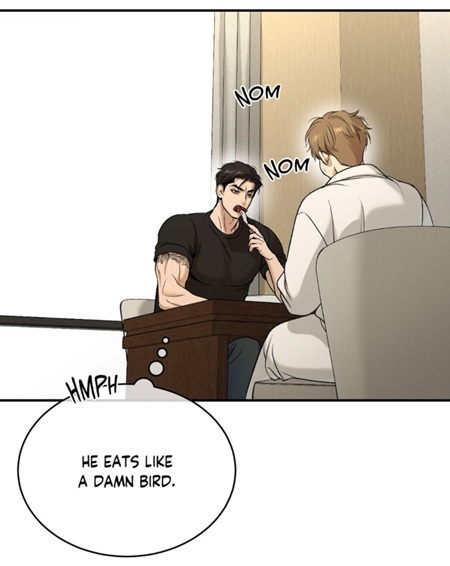 (chapter 68), the embraces in the dark
 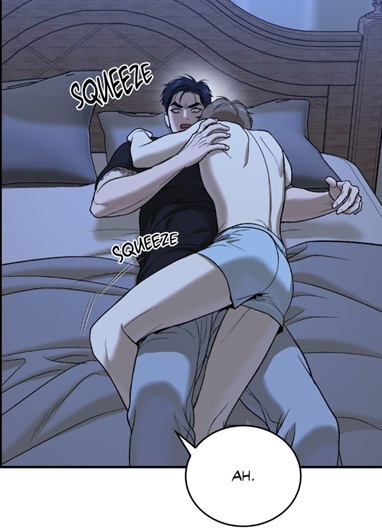 (chapter 66) (the wordless recognition of suffering) — these become the true celebrations of Jinx. They lack alcohol, noise, or spectacle, but they carry sincerity. They reveal that belonging can be built not through grand gestures but through repetition, through the transformation of fleeting kindness into ritual. This implies the existence of conscious and choice. And yet, these moments remain fragile. After their return to the penthouse, there is no shared meal, no laughter, only nostalgia and sadness.
 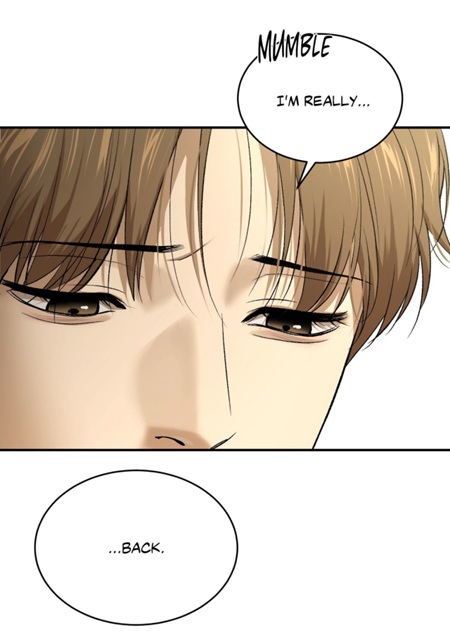 (chapter 78) Even Jaekyung is troubled by the reminder that Dan’s stay is temporary, as if the very walls of the penthouse resist turning into a home.
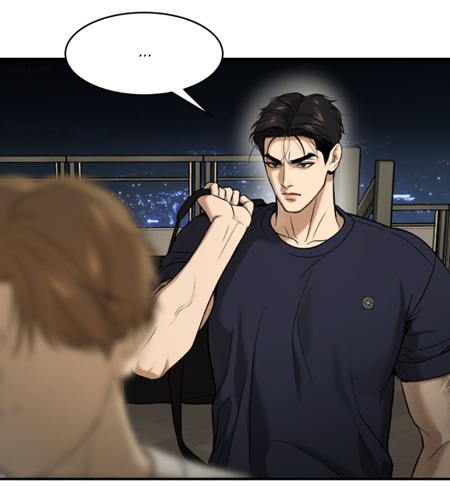 (chapter 78) In other words, the wolf’s task is no longer to win battles in the ring but to protect these fragile celebrations — to make Dan feel at home, to turn missed hugs into embraces, missed parties into warm meals, missed gestures into habits of care. Only then can the cycle of exclusion be broken. Only then can “The Missed Party” become, at last, a real one.
 (chapter 68), the shared meal
 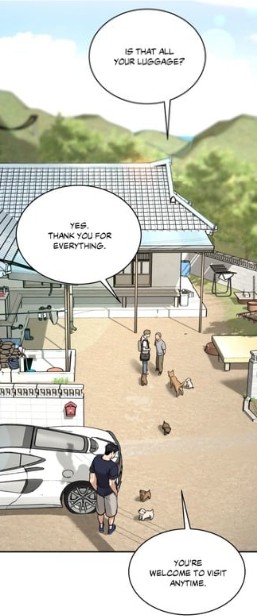 (chapter 78). For me, it is no coincidence that the senior followed them to the street and waved at them!
 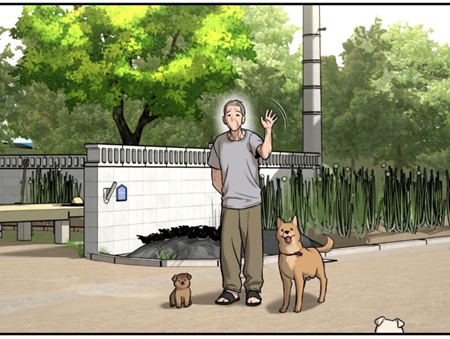 (chapter 78) He expressed not only his genuine feelings, but also his longing: he hoped to see them soon. He had come to appreciate their presence which is not related to their work. The Missed Party becomes not a single absence, but the haunting rhythm of the entire narrative: recognition always arriving too late, always seen by the wrong eyes. And perhaps the story’s promise lies here — that one day, the real party will finally be held, not in karaoke bars or gym halls, but in the unbreakable bond of two men who learn what true friendship and belonging mean. This means, the more the champion and his fated partner develop new routines, the more it will affect the gym and as such Park Namwook, which can only feel more and more excluded.
 (chapter 78)


 (chapter 70), the other a former “boxing” coach and Jaekyung’s ghostly mentor figure, now terminally ill and confined to a shared room.
 (chapter 71)These two older men mirror different systems of power: the current director, a seemingly kind authority figure who represents institutional control masked as care; and the former coach, a fallen patriarch whose past decisions shaped Jaekyung’s identity and pain. This part of the essay focuses first on the hospice director, and how his interaction with Kim Dan reveals the young man’s invisible burden and social isolation. In the final section, we will turn to the old coach, now reduced to a ghost in his own story, and explore how the symbolism of owls, coots, and crickets illuminates his emerging relationship with Kim Dan.
  (chapter 70) his dark circles, his nodding off—and suggests him to take a day off.
  (Chapter 70) But look closely: he notes that Dan has never used a sick day, and yet deliberately avoids recommending one now. Instead, he offers the less costly alternative: a personal day off, unpaid.
 (Chapter 70) The director doesn’t say, “We’ll adjust your schedule,” or, “Let me talk to HR.” He simply tells Dan to take a day off
  (Chapter 59) This reinforces the idea that Dan is not covered by the same protections, and that he operates outside the stable framework of regular employment.
 (chapter 66) to visit a sleep specialist, where Dan received a diagnosis and first treatment for his “sleepwalking” condition. The two spent the night in Seoul. Upon returning to the seaside town, Jaekyung received a call
  (chapter 69) and left again the next morning for Seoul in order to meet the CEO, marking a separation between the two after their return.
 (chapter 71) and night hours
  (chapter 71), suggesting his ongoing pattern of overworking. In episode 71, Kim Dan is seen walking alone through the hospice hallway—unaccompanied, unnoticed. This quiet image stands in stark contrast to the earlier scene when, after nearly drowning, he was carried in by Joo Jaekyung and immediately met by a nurse and the hospice director, both actively working together that night.
  (chapter 60) Back then, his suffering was visible, his crisis institutionalized. Striking is that after that night, the hospital director never asked doc Dan to take a sick leave or to a day off. In fact, it took some time before making such a suggestion. Moreover, as if a single day off would make a huge difference. But now, despite his clear exhaustion and illness, doc Dan moves through the same space in silence
 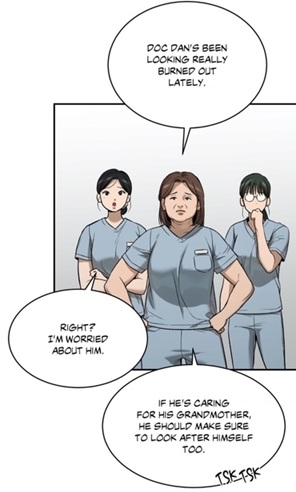 (Chapter 57) his grandmother would worry about him. Yet, during that night, Shin Okja doesn’t seem to be plagued by worries for her own grandson’s health. She sleeps peacefully.
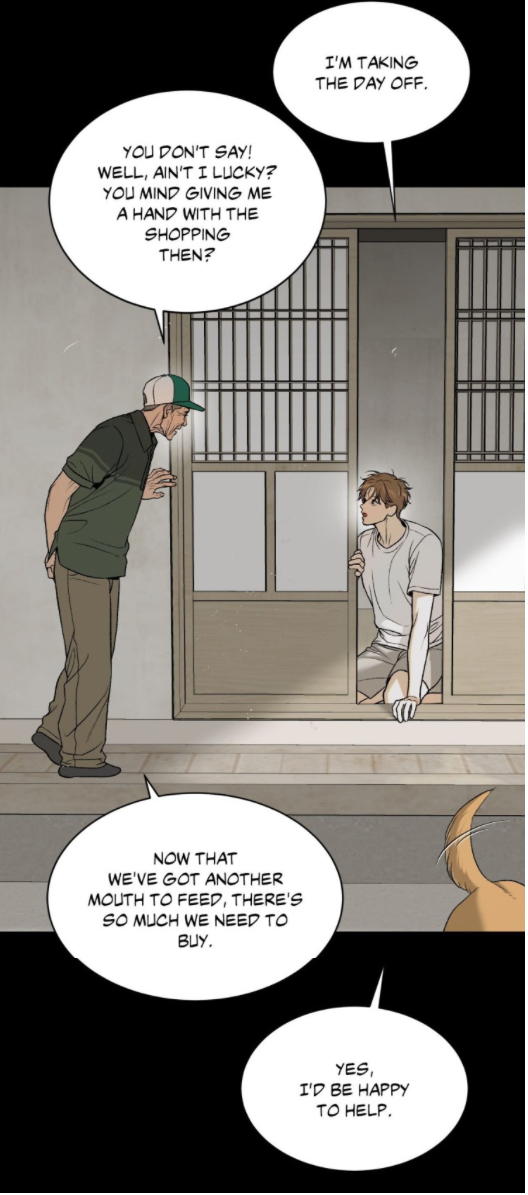 (chapter 70) only after the Seoul trip. This must mean that his conversation with the hospice director—where he was urged to rest—took place between his return from Seoul and the announced day off. We also know that
 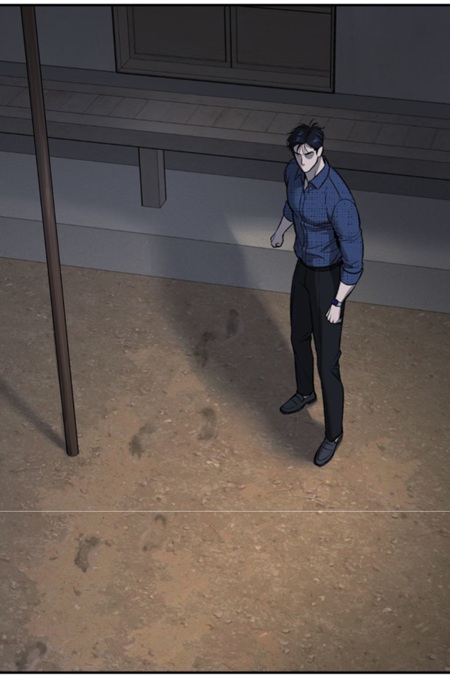 (chapter 69) the champion came back from Seoul in the evening and found footprints near the house, suspecting Dan had wandered to the ocean while drunk. These prints were left that same day
  (chapter 70), when Kim Dan chased the puppies that had stolen the shoes. Based on the shadows and the position of the sun
 (chapter 70), I am deducing that this scene took place during the afternoon. I used these images as a contrast, where the author made it clear that these scenes took place in the morning.
  (Chapter 65)
  (chapter 57) We can determine the time based on the position of the sun and the shadows.
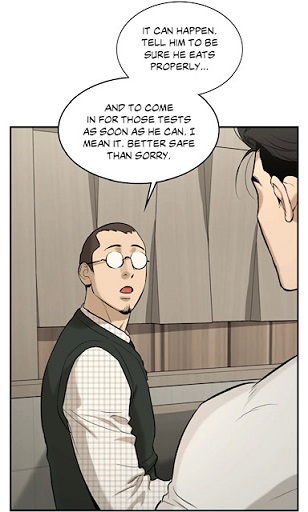 (Chapter 13) But when Kim Dan drops a patient Dan by mistake
  (chapter 59), the director acts immediately—not because of concern for the elderly man,
  (chapter 59) but because he fears that the patient’s family might sue the hospice. The elderly man’s condition was formally assessed, documented, and protected. This scene exposes that they can act in an emergency (taking tests). In contrast, Kim Dan—who is visibly unwell—is not offered even a basic check-up. His illness is reduced to tired eyes and missed sleep, framed as personal negligence rather than systemic failure. He is looked at, not truly seen. While the patient is treated as a legal liability, Dan is treated as disposable labor—an expendable worker whose wellbeing doesn’t justify institutional resources. Thus in my opinion, the director of the hospice suggested that doc Dan took a day off in order to ensure that he had done his duty, taking care of his employee.
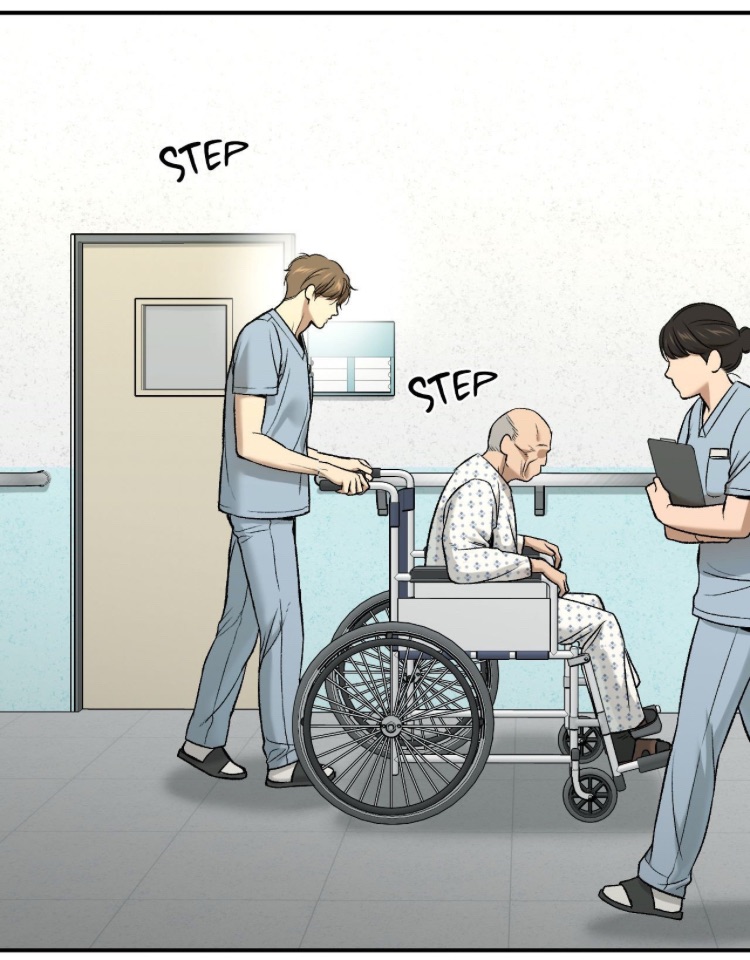 (Chapter 70) His distinct appearance—bald with tufts of grey hair—makes him easily recognizable. What stands out this time is not the accident, but the aftermath of it.
  (Chapter 70) When Kim Dan, again lost in thought, almost bypasses his room, it is this very patient who gently brings him back to reality with the teasing words, “Earth to Doc Dan.” His tone is not accusatory. On the contrary, it’s forgiving—light-hearted even.
 (chapter 62) However, the main lead was still working, thus the athlete concluded that he had made a mistake. He probably assumed that he had the afternoon shift. Hence Joo Jaekyung only returned to the landlord’s house at sunset! So during that day, he must have worked for the morning and afternoon shift. Even here, the doctor was suggested to give a special treatment to the star.
  (Chapter 62) Then in episode 71, we see him working in both afternoon
  (chapter 71) and night scenes,
  (Chapter 71) Therefore we see him in company of different nurses.
  (Chapter 57) He moves between teams, unanchored and isolated. This also explicates why the nurses still have no name. To conclude, his contract implies that Dan is paid by the hour or per shift, without salary-based benefits. I am suspecting, the regular nurses likely operate under different contracts, which could include fixed shifts, team integration, and better protections.
  (Chapter 51) Then the main lead was thinking that he was only staying there temporarily.
  (Chapter 57) Finally, we shouldn’t overlook that his job is strongly intertwined with his grandmother’s situation. He needed to get a job there, hence he couldn’t negotiate his contract. As long as he had a job as physical therapist, he could only be “happy”.
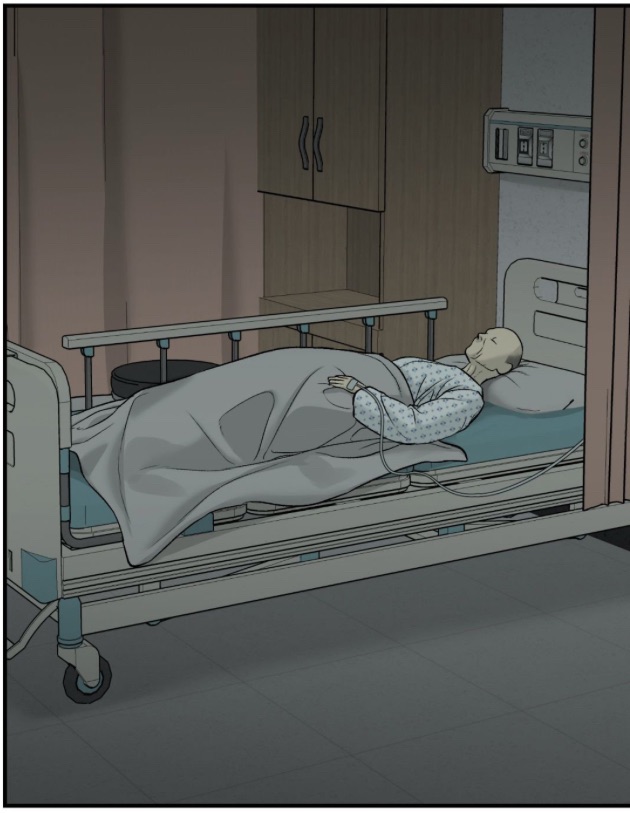 (Chapter 71) in a room designed for six patients—indicated by the six plastic protections outside the door.
  (chapter 65), while the former coach shares a room with three others and lacks personal care.
  (Chapter 71) Shin Okja lives like a VIP. Yes, the new version of this situation:
 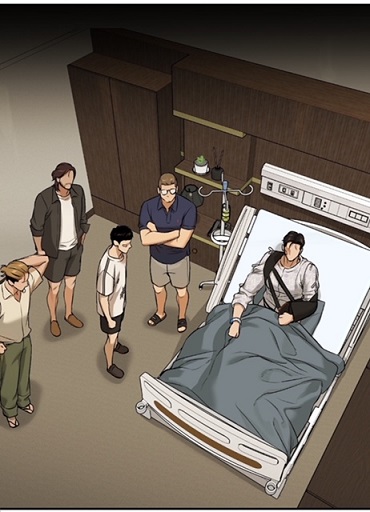 (chapter 52) That’s the reason why Mingwa made another allusion to this particular scene (chapter 52) in episode 71:
 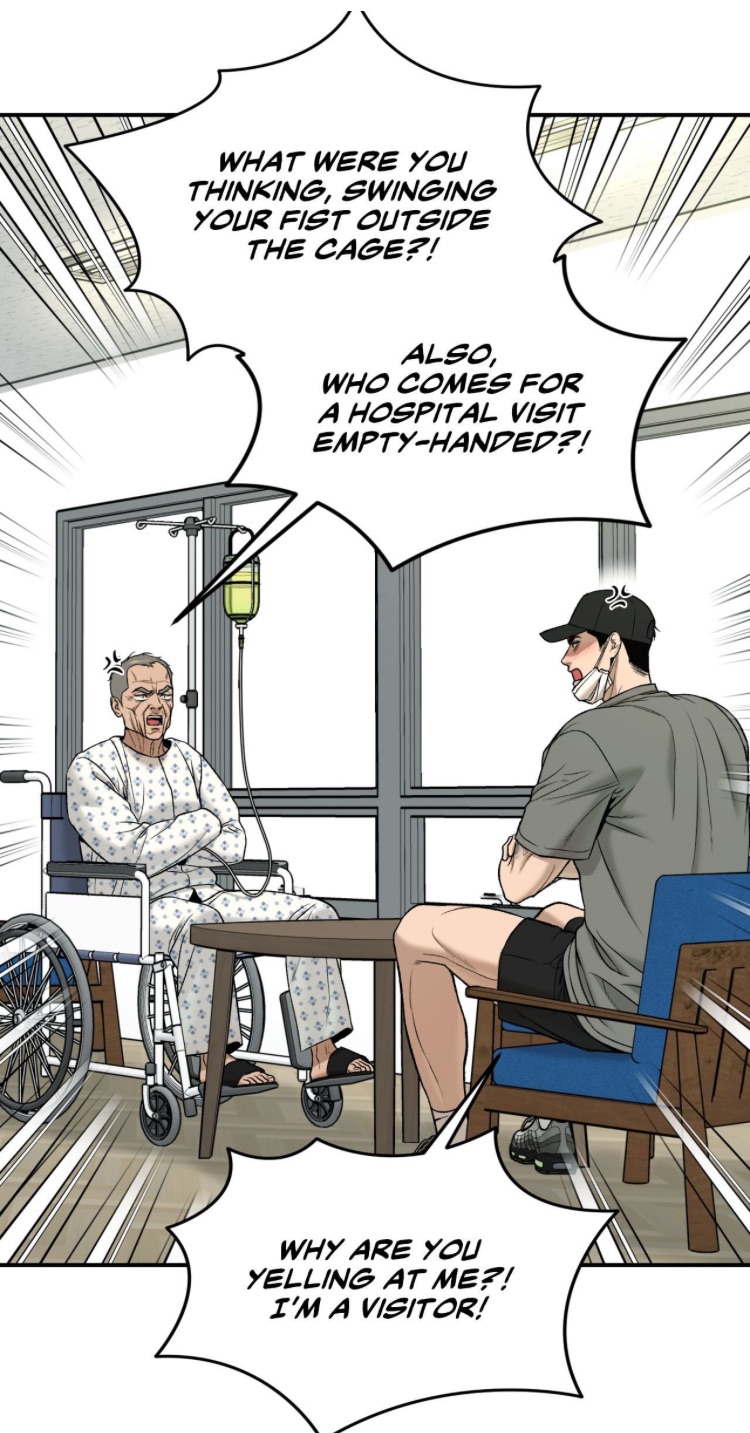 (chapter 71) The members from Team Black visited him not only empty-handed, but didn’t try to cheer him up at all. This shows the rudeness from Park Namwook and the others. But let’s return our attention to the gentle grandmother.
 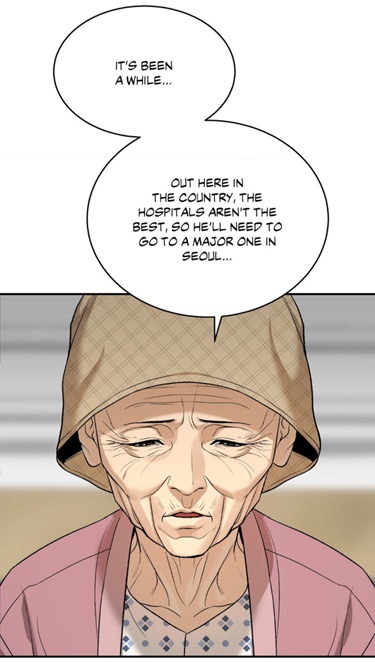 (Chapter 65) She even portrays the hospital in a rather negative light. The irony is that she asked someone who was in recovery
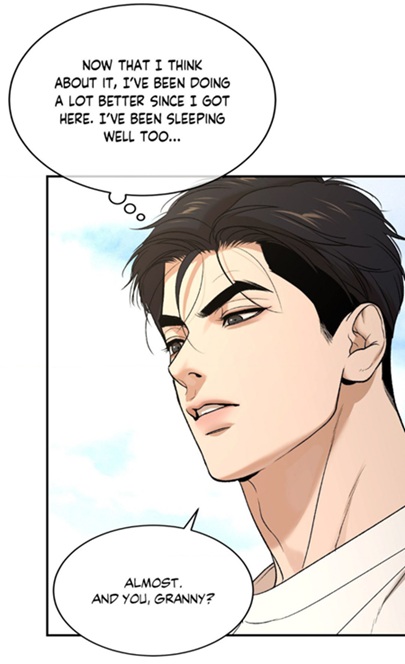 (chapter 65), and he has now a cold.
 (Chapter 70) If something were to happen to the physical therapist, who is responsible? This means, there’s no one at the Light of Hope paying attention to doc Dan. It is, as if Dan has no family, and within the hospice structure, no voice. Yet, I saw a change in the following panel.
 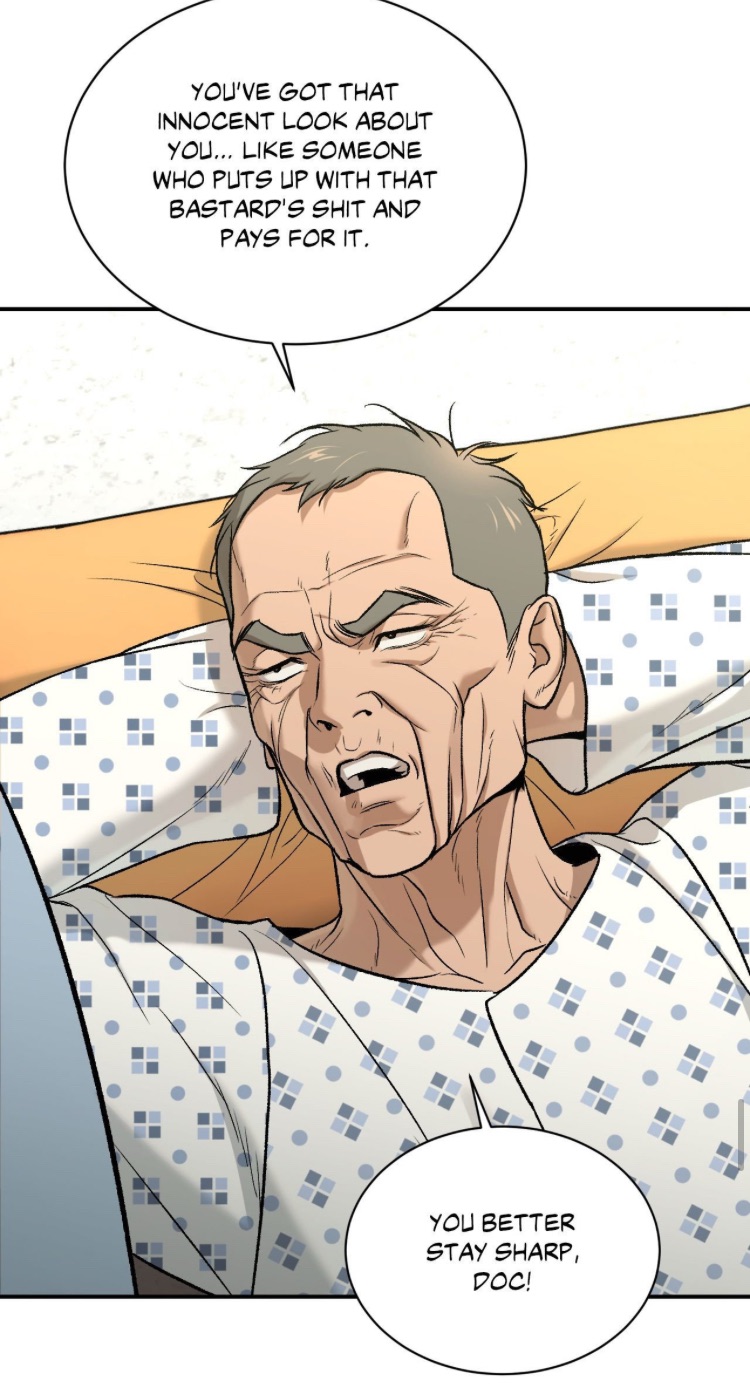 (Chapter 70) For the first time, someone spoke on the physical therapist’s behalf. He should make sure not to be taken advantage of. Secondly, when he pointed out
  (chapter 70) that the star was staying there because of him, he was already implying that doc Dan had power over the athlete. He should voice his own opinion and thoughts to ensure to protect his own interests. From my point of view, this “former fighter” will definitely side with the young man and protect him.
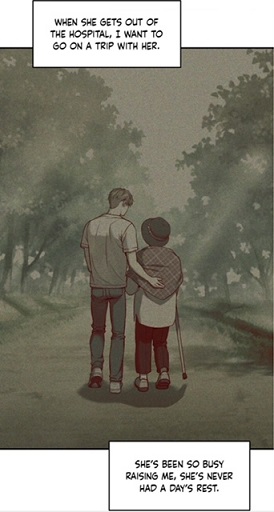 (Chapter 47) The uniform may be different, but the precarity remains the same.
  (Chapter 65) This revelation may fuel her decision to send him back to Seoul—not just out of care, but as a reflection of her lifelong obsession with money and upward mobility. Crushed by the burden of the loan and haunted by her own failures, she sees Seoul not only as a place of opportunity but as the only terrain where financial survival is possible. In her logic, professional success is meaningless without wealth, and in the seaside town, doc Dan’s work brings neither. So she urges him to leave—not because she doesn’t care, but because she has equated worth with earning power. Her mindset, forged by debt and despair, blinds her to the emotional and physical toll this cycle continues to take on her grandson.
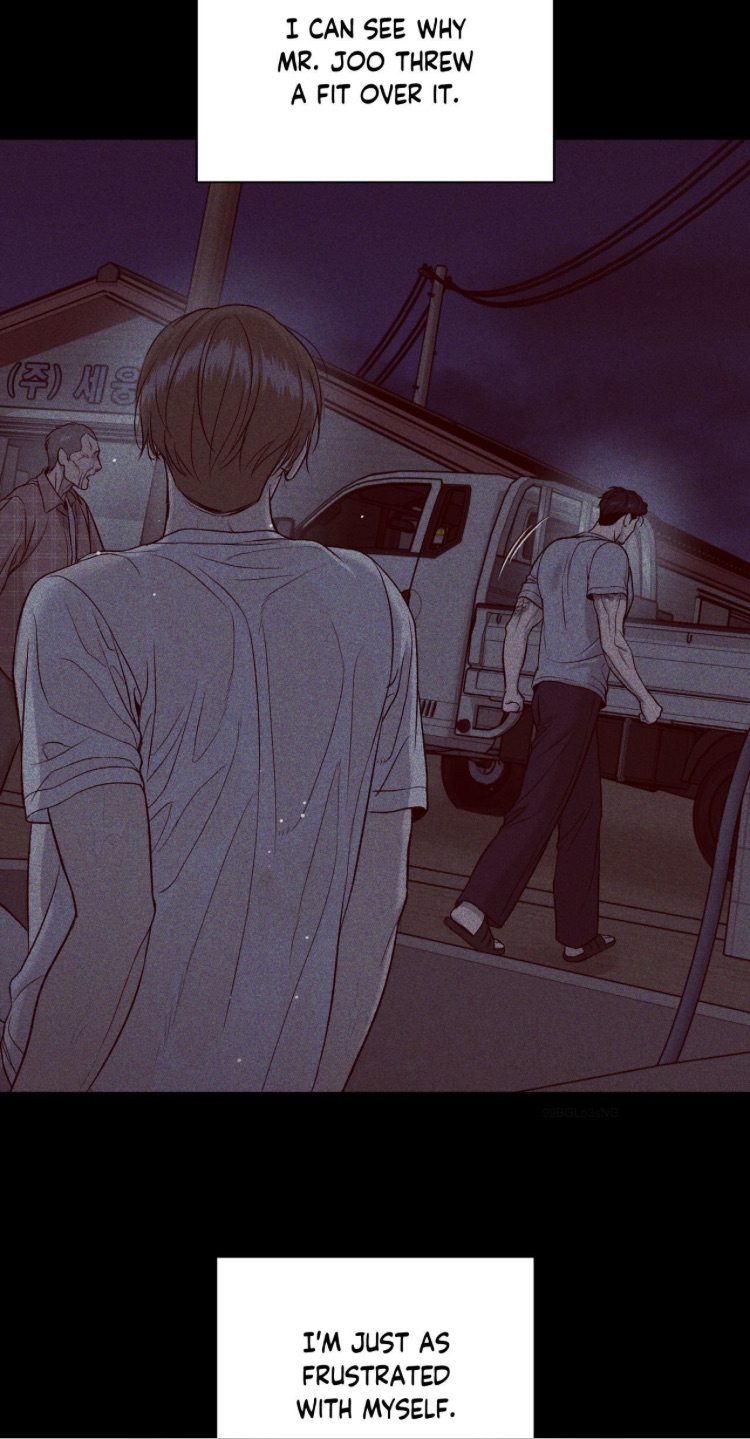 (chapter 71) to even the grandmother—assumes he is responsible for his condition. They blame him for drinking, for being tired, for looking unwell. But no one looks beyond the surface and investigates the causes. No one is wondering about the financial burden, the trigger for his fears
  (chapter 71), the emotional isolation, or the systemic overwork that drive him there. Let’s not forget that the young man drank again after hearing that Joo Jaekyung would return to the ring soon. This shows that the incident with the switched spray and its consequences left deep wounds in his heart and soul.
 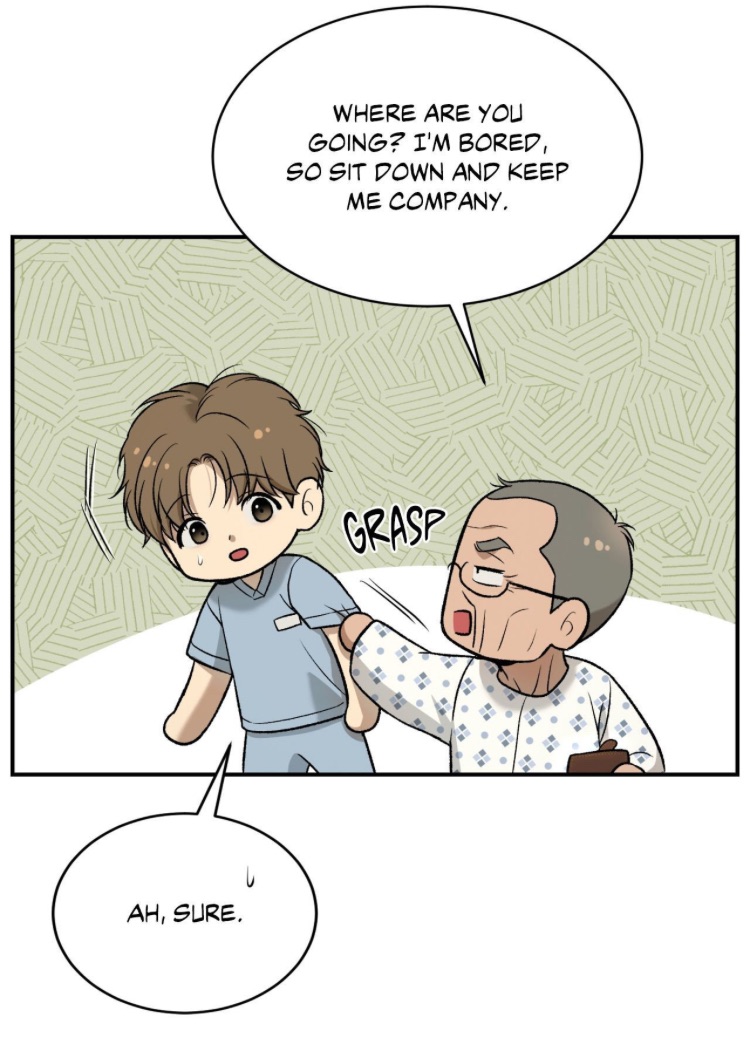 (Chapter 71) He even asks him to stay by his side, not noticing his dark circles and paleness.
 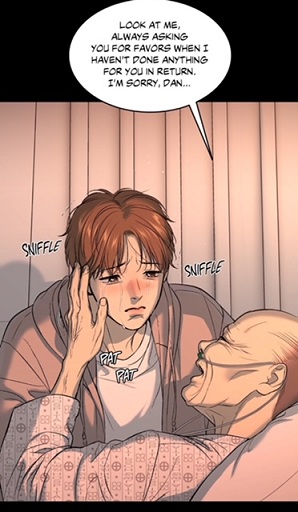 (chapter 53), become lopsided forms of dependency. And his unspoken needs—his own exhaustion, grief, and longing—are never tended to, not even by himself. He is present for everyone, yet no one is truly present for him. That’s the reason why Shin Okja knows nothing about her own grandson’s interests and dreams.
  (Chapter 65)
 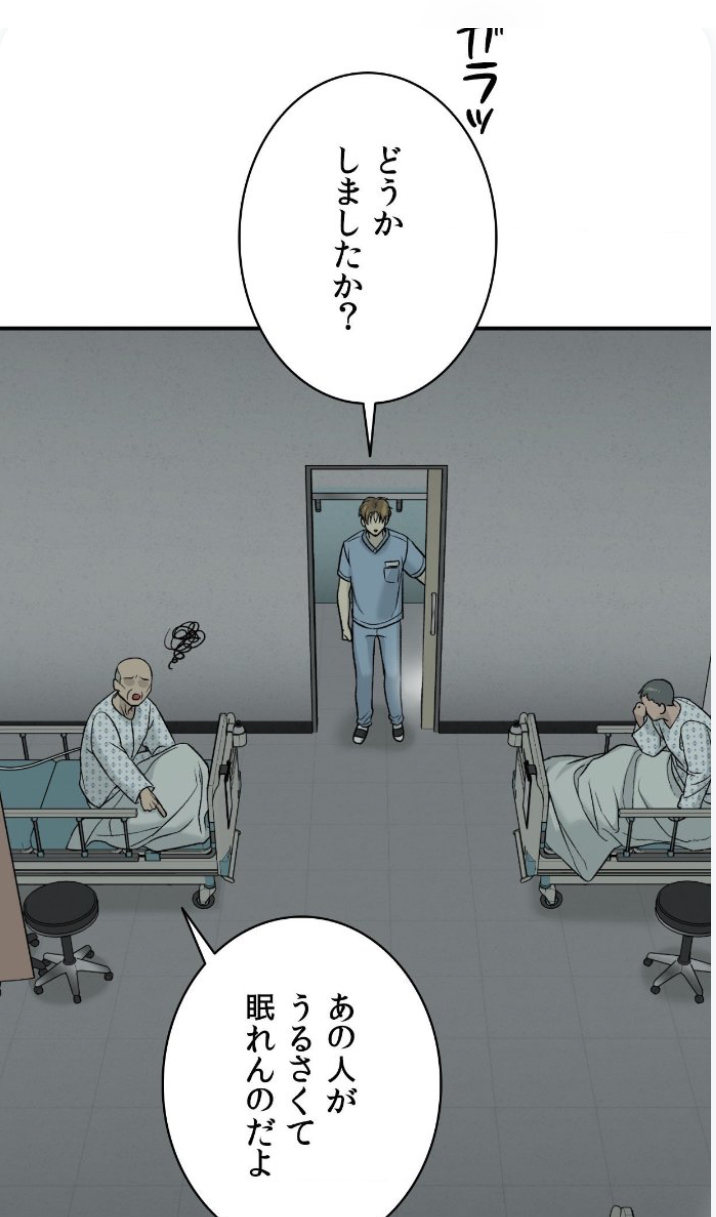 (Chapter 71) In German, he would be an “alter Kauz”—an eccentric owl. But this metaphor reaches deeper than mere strangeness or aging.
  (Chapter 71) The constant appearance of the owl connected with the champion’s house implies that Joo Jaekyung is now connected to this nightbird, as if the latter was his guardian of the night. In addition, in chapter 65,
 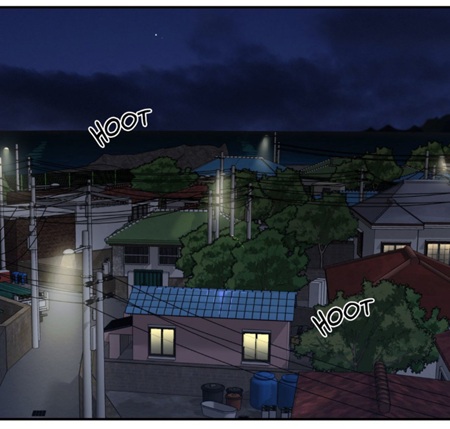 (chapter 65) Dan was found wandering the night in his sleep, pulled by unconscious fears.
 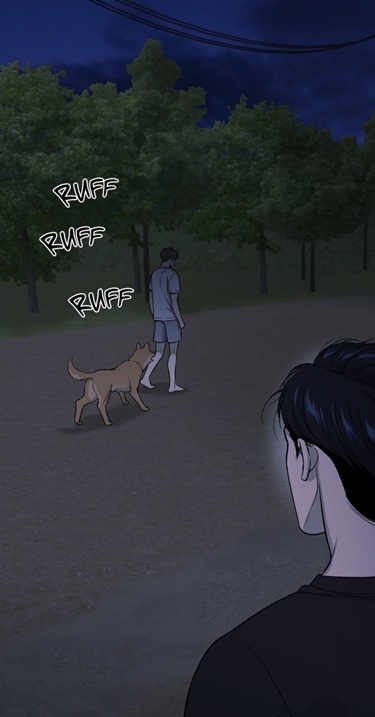 (Chapter 65) These moments mirror the owl’s behavior: navigating darkness, moving alone, and being misunderstood. Thus, the owl becomes a powerful symbol not only of the former coach but of Kim Dan himself—both are creatures of the night, shaped by what they see and endure in silence. In contrast to the chattering coot, the owl watches and remembers. And perhaps, the presence of both birds suggests that the coach, once a loud and reckless coot, is beginning to see with the quiet eyes of the owl—finally noticing the suffering he once overlooked. Their shared nocturnality ties them together: one hoots and curses, the other drifts wordlessly—but both are left behind by the daylight world.Doc Dan’s nightly behavior made me think of an owl.
  (quoted from
 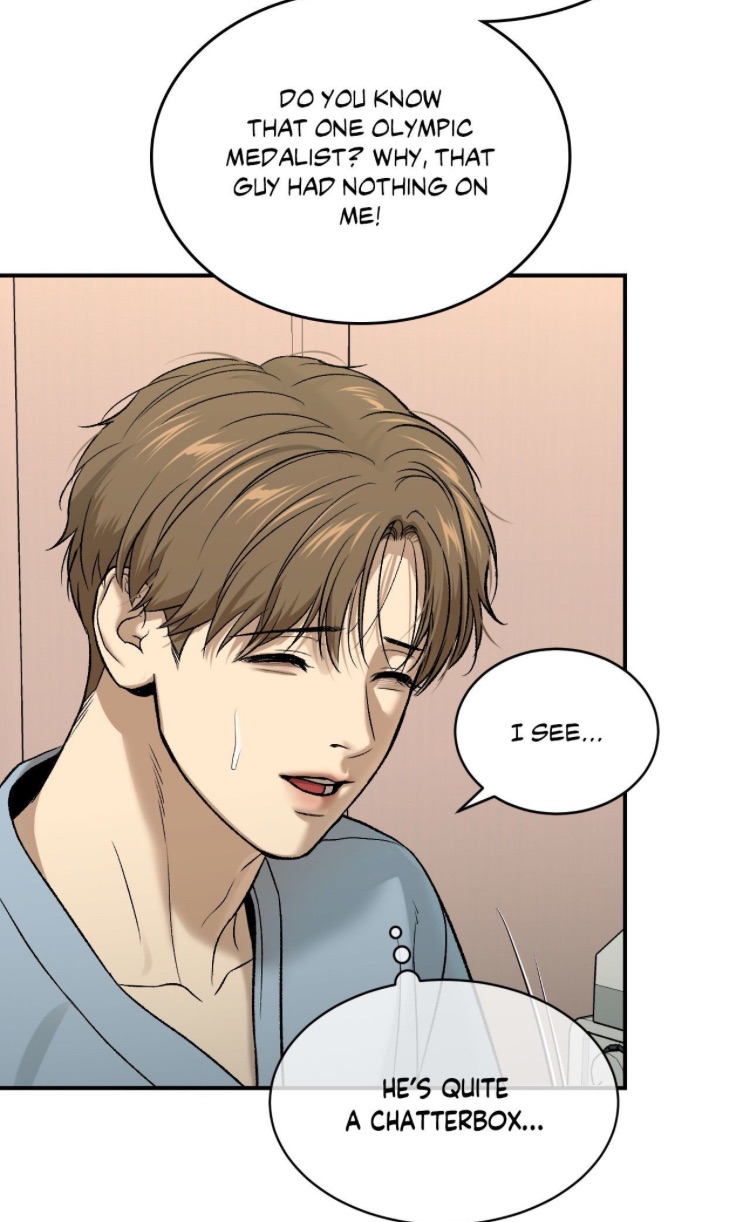 and socially awkward birds—notorious for their harsh, repetitive calls that sound more like chiding than song. Unlike the poetic silence often associated with owls, the coot communicates through blunt, raspy cries. This parallels the coach’s incessant chatter and verbal outbursts. Kim Dan even refers to him as a “chatterbox,” a man who yells, curses, and grumbles without reserve. And yet, strangely, Dan is not repulsed. On the contrary—he appears comforted by the company. For perhaps the first time, someone talks to him without judgment or restraint.
 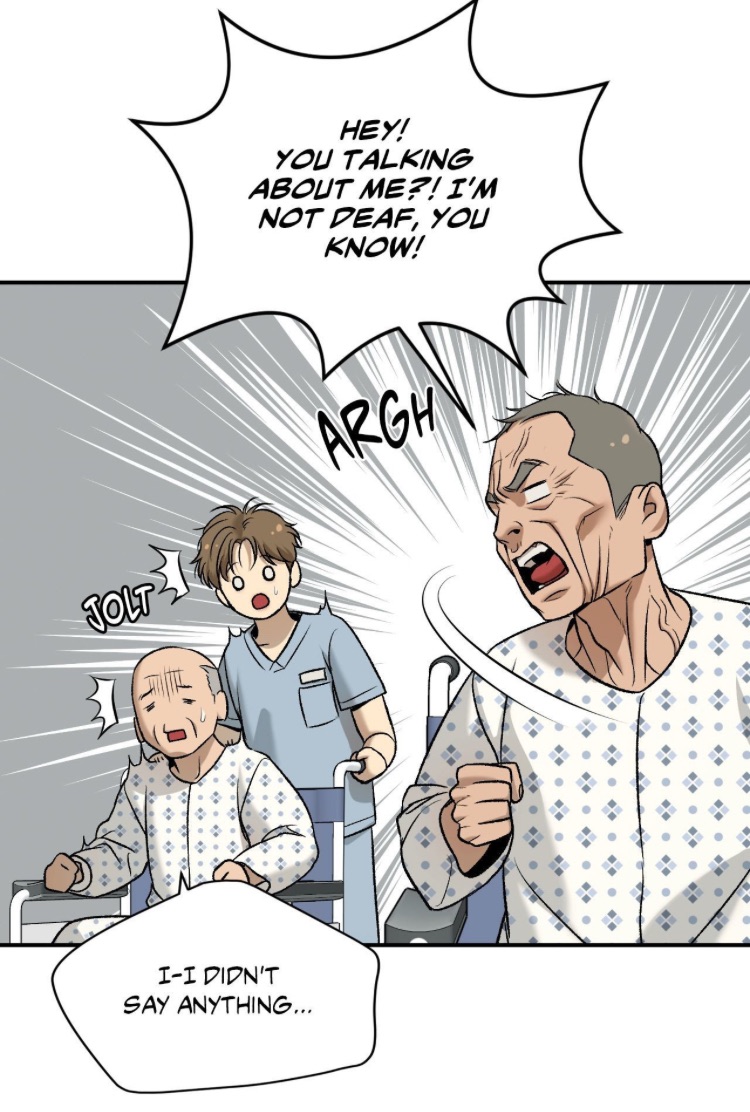 (chapter 71) suggests that communication doesn’t always have to be soft to be sincere. It is precisely the coach’s lack of elegance that makes him relatable to Dan.
  (Chapter 71) This dynamic becomes especially meaningful when we recall that Kim Dan’s symbolic animal is the duck—a creature often seen as passive or domesticated, gliding over water while paddling furiously underneath. As discussed above, the duck stands for Dan’s silent endurance, his ability to move between unstable emotional terrains without ever making a splash.
 (chapter 65) a creature that moves between water, land, and air. While he is still learning to navigate the spaces between systems, he too lacks institutional power. If the former coach is a coot, then his narrative function may be to pass on his remaining knowledge to the duck—turning his interactions with the coach and his use of the notebook into an unofficial MMA trainer seminar he once wished to attend
  (chapter 22).
 (chapter 71), a joke. But there’s another side to the owl—the side that watches the night, that sees what others do not. And in this hospice, maybe for the first time, the former coach becomes something more: a witness who is no longer silent. An old man who still has eyes.
 (Chapter 71) The latter didn’t receive proper treatment for his woundsAnd this brings me to my final interpretation, the absence of a physical therapist or doctor in the director’s world and life! His body got broken so many times, indicating that he never had a doctor by his side! .
  (Chapter 70)He never had a companion or friend in his life, which is also mirrored in the picture.
  (Chapter 71) The other carries bitterness and the guilt of watching too long without speaking. In this dim hallway of illness and endurance, their connection becomes a muted call for dignity.

 (chapter 65) corresponds to the release of Jinx Chapter 70, which marked the series’ return after a three-month hiatus. This observation is more than clever numerology—it mirrors the manhwa’s deeper message: the past always haunts the present, and at times, it even foreshadows the future. And that’s exactly what I will do in this essay. I propose that the key to understanding the protagonists and characters’ evolving identities lies in the overlooked architectural and administrative details—especially the house numbers, door placements, and legal ownership of space. These seemingly minor visual cues are in fact loaded with meaning, offering insight into how home, memory, and identity are fragmented and reassigned across time and place.
 (chapter 61) For readers unfamiliar with Korea, this looks quite bizarre. In most European and American countries, street addresses follow a linear order; house number 12 would typically be located between 10 and 14. But in Korea, especially in rural areas, many towns use the older jibeon (지번) land-lot numbering system. Here, numbers are based not on street sequence but on the chronological order of land registration and subsequent subdivisions.
 (chapter 62), newer developments, or administrative restructuring rather than deep-rooted inheritance. In this context, a higher subdivision number implies not only later division, but also the erosion of legacy and the weakening of kinship-based territorial claims—an erosion especially poignant in the context of Confucian traditions that once emphasized multi-generational cohabitation and patrilineal inheritance. In classical Korean society, a home was not merely a shelter but a physical emblem of familial continuity, with ancestral rites often performed within the same household across generations. As addresses fragment and land parcels divide, so too does the symbolic structure of the family unit. The once-cohesive ideal of the extended household dissolves into isolated, rented spaces, reflecting not only economic realities but also the fraying of intergenerational bonds and filial authority.
 (chapter 61) Though Jaekyung is a wealthy celebrity, he inhabits a parcel of land that speaks to impermanence and anonymity. Meanwhile, Dan shares space with someone who quietly represents legacy and transparency.
 (chapter 62) However, this “dynamic” (distinction) began to shift the moment Jaekyung started working for the local residents.
  (chapter 62) No longer just a “guest” or a “tourist,” he earned their recognition and acceptance through acts of service and humility.
  (chapter 62) As he helped them with manual tasks—such as lifting goods or assisting the elderly—they started seeing him not as an outsider, but as one of their own. However, it is important to note that these gestures of inclusion occurred while Jaekyung was outside the blue gate
  (chapter 62) —beyond the formal boundary of the rental property.
  (chapter 62) In this way, the gate truly functioned as a symbolic threshold: only once he crossed it through action and humility, the community began to approach him. This change in perception was symbolized, when he received vegetables from the townspeople, a traditional gesture of inclusion and local acknowledgment.
  (chapter 62) Nevertheless, the best sign that he has been accepted by the community is when he received traditional welcome gifts: the toilet paper and detergent.
  (chapter 69) [For more read
  (chapter 65), the elderly neighbor chose to open the blue gate shortly after:
  (chapter 69) Thus I deduce that the blue gate lost its purpose. The champion definitely saw the advantages of the absence of a gate by his neighbor. He could arrive there at any moment
  (chapter 62) and the landlord never rejected him. In fact, he was always welcome.
  (chapter 66)
 (chapter 59), and townspeople instinctively report Dan’s behavior to him.
  (chapter 69) I would like to point out that the kind man said “villagers” and not “villager”, a sign that he was contacted by many people. Such recognition is reserved for those woven into the community’s long memory.
 (chapter 61) Given that the rural address system is based on the older jibeon model—and most GPS systems now rely on the newer road-based address format— it is unlikely that Jaekyung could have located Dan’s home through navigation alone.
  (chapter 61) That’s the reason why the author included this scene. Even if someone had disclosed Dan’s address, the GPS in Jaekyung’s luxury car would not have been able to guide him there. Like mentioned above, the streets have no names, and the numbering lacks logical sequence. Thus, we have to envision how the Emperor followed Dan on foot, observing where he went. In doing so, he not only located the general vicinity. Afterwards, he must have contacted a local and requested for a vacant house close to 33-3. That’s how he found the “hostel” right next door.
  – chapter 69) and walking through the confusion himself.
 (chapter 65) Though she insists this seaside town is where she “grew up,” she never identifies a lot number, street, or ancestral parcel. In a rural system where numbers are more than logistical—they are signs of rootedness and intergenerational presence—her vagueness stands out. Everyone else is connected to a numbered gate, a registry, or a mailbox. She alone floats in narrative space, clinging to emotional claims without material proof: no concrete location is brought up.
 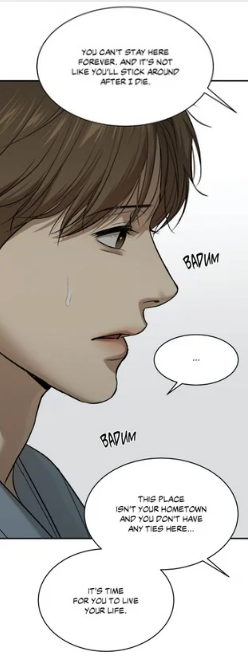 (chapter 57) The contrast becomes sharper when she refers to Seoul only in generic terms. She never mentions a district,
  (chapter 56), a neighborhood, or specific location. This lack of detail, especially when juxtaposed with the specificity of the rural jibeon system (where even a subdivision number implies lineage and ownership), exposes her rootlessness. It reinforces the idea that her ties to place are performative rather than grounded. Even her nostalgia for Seoul is flattened
  (chapter 17) As Jinx-lovers can detect, next to the entrance of her apartment, there is no blue house number plate or street name. How is that possible in a metropolis where every residence should be digitally registered? And now, pay attention to the house where the “goddess” and her “puppy” lived.
 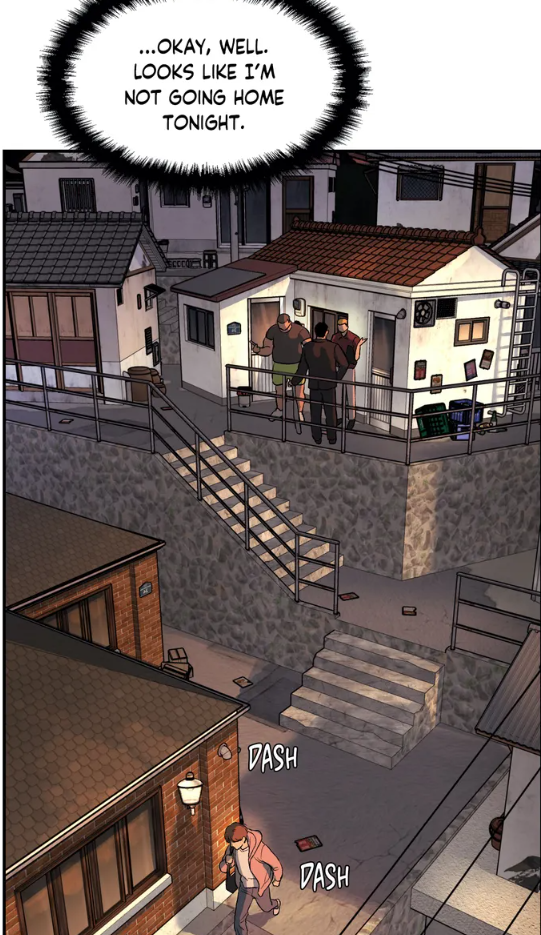 (chapter 1) The building had not only two doors, but also the plaque is placed next to the other door. It is also partially visible in this image:
 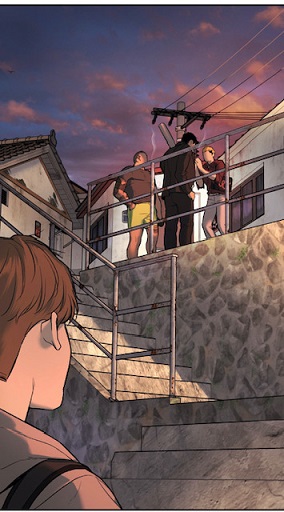 (chapter 1)
  (chapter 11), we naturally assume he is returning home—entering the same shared space he and his grandmother inhabit. But is that actually the case? A closer look reveals he is using the other entrance. On his right side, we see the electricity meter, the mailbox, and the window—the signs of an inhabited and administratively recognized unit. This suggests that Kim Dan’s official residence is behind this second door. Once again, I am showing the view of the same building from a different perspective,
 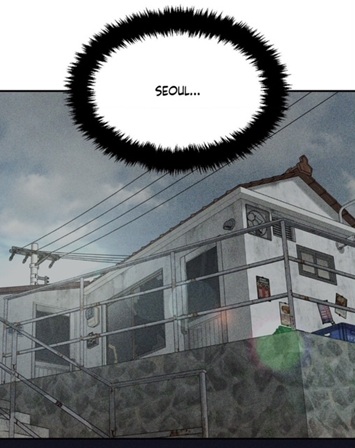 (chapter 57) where the mail box and the electricity meter are. But I have another evidence for this observation. During that night, the hamster got assaulted by Heo Manwook and his minions.
  (chapter 11) And keep in mind that after getting beaten by the Emperor, anyone could recognize the grandmother’s place from outside due to the broken window.
  (chapter 19) The moment I made this discovery, I couldn’t help myself wondering why doc Dan would go to the other door and not to the halmoni’s room.
 (chapter 11) The voice on the phone reveals something legally crucial
 (chapter 11): Kim Dan is the last remaining resident in that building. That one line reframes everything. This suggests that Kim Dan’s official residence is behind this second door. 😮 In fact, the building features
 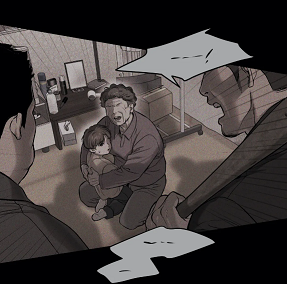 (chapter 5) When the loan shark came to collect the interest of the debts during Kim Dan’s childhood, he went straight to her door
  (chapter 5) —the door that, at the time, likely bore the blue house number plaque.
  (chapter 5) the door associated with Kim Dan in later episodes—particularly the one through which the champion entered during the confrontation with the thugs —opens inward and is placed in the corner of the right wall. The interior layouts and door directions don’t match, though the furniture is similar. This strongly suggests that these are two different units within the same building, exactly like I had observed before. The “goddess” and the hamster’s house had two doors and as such two units.
  (chapter 19) had a recollection of this moment, when he was about to leave this humble dwelling.
  (chapter 19) His move to the penthouse triggered another “move” from the past. Consequently, I am deducing that this souvenir represents the moment of the grandmother’s arrival and the departure of the hamster’s parent(s) from the other unit. But there’s more to it.
 (chapter 65) and Kim Dan the immature child, whereas according to my observations, she is legally dependent on the “hamster”. She is just a household member. As you can see, I detected a contradiction between her words and “hidden actions”, all this triggered because of the closed door. By transferring the address and registration to the physical therapist, she made it possible for him to inherit not just the space, but also the liability. That’s why he’s now the only registered person.
 (chapter 11) When he says “home,” he is referring not just to a physical place, but also to a legal and emotional placeholder—a registration number that ties him to bureaucratic existence, familial duty, and emotional manipulation. With her promise to return in that home, Shin Okja is essentially demanding he remains the legal anchor—the one who stays behind, the one who remains registered, the one who continues to carry the official burdens, even as she herself fades into invisibility. That’s how she became a “carefree” ghost in the end. It wasn’t just a promise of care, but a submission to being tethered—not to belonging, but to obligation masked as love. The irony is that by remaining legally “present,” Dan was emotionally erased.
 (chapter 65) In this panel, her words in English were ambiguous, while in the Korean version, the grandmother exposes that she was well aware that her grandson and the emperor would live together.
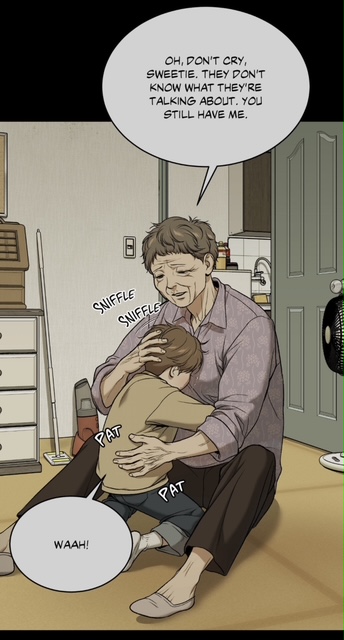 (chapter 57) That way, he became attached to her. It’s a startling reversal: the woman who claims maternal authority is
 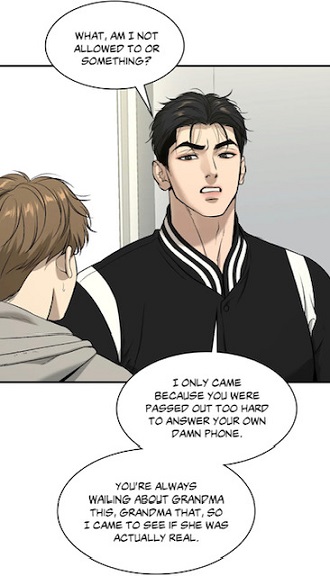 (chapter 22) This architectural division is deeply symbolic. Despite being the dependent, Dan is the one bearing responsibility—both financially and administratively. Shin Okja, on the other hand, manages to live without accountability.
 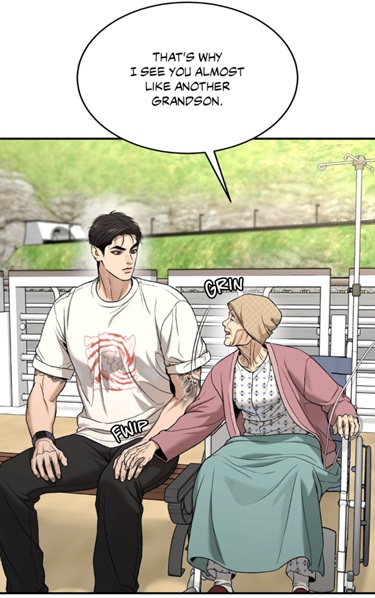 (chapter 65) Joo Jaekyung is almost her grandson!! It was, as if she was about to adopt him. Let’s not forget that he embodies all her ideals and dreams: strong, healthy, rich, famous, generous, polite and gentle! And according to my observations, she knows that the athlete owns a flat in Seoul, big enough to take a room mate.
  (chapter 16) He even showed the amount Kim Dan owned with his cellphone to the Emperor
  (chapter 17) That’s how the champion internalized that the hamster was the one with debts. This theory explicates why doc Dan is not blaming his grandmother for the debts in the end, as he signed himself loans. And now, you can imagine what happened in the past. Once he became 17 years old, she asked him to get a resident registration number. With this, he could apply for a loan in order to reimburse the grandmother’s debts. This must be one of her favors from the past:
  (chapter 5) His words imply that he had done something in the past for her. And that would be to become her guardian and take her debts. This hypothesis explicates why only in episode 11, Doc Dan was comparing the progression of the interests with a snowball system, something unstoppable.
  (chapter 11) His thoughts reflect a rather late realization that he is trapped in a system and he can not get out of it. In other words, this image oozes a certain innocence. This also explained why Joo Jaekyung had to confront him with reality in front of the hospital.
 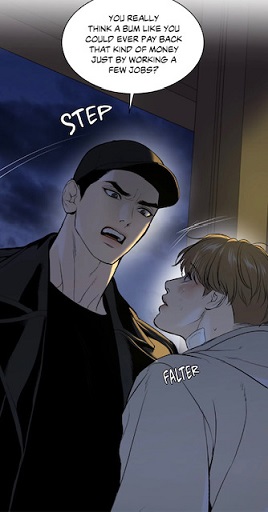 (chapter 18) The location is not random: for the halmoni, such a work place symbolizes respectability, power and money. The problem is that in the hospice, Doc Dan is not well-paid.
 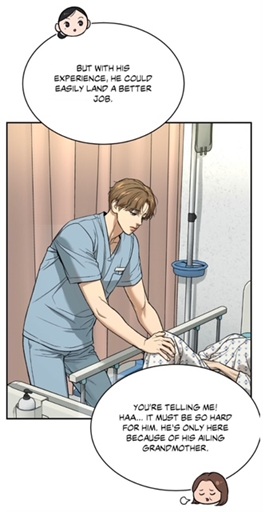 (chapter 56)
 (chapter 11) And now, it is time to return our attention to my illustration for the essay:
  As my avid readers can observe, the panel with the champion facing the blue door comes from episode 69, while the one with doc Dan comes from chapter 11. These scenes are mirroring each other. It is about concern and danger! While in episode 69, the athlete got worried, as he imagined that doc Dan’s life was in danger, in episode 11, the hamster was about to face an old threat: Heo Manwook and his minions!
  (chapter 11) But back then, he was on his own and no one paid attention to his health. Not even Shin Okja… He was truly abandoned, while the episode 69 exposes the opposite. Society in this little town takes care of people in general.
 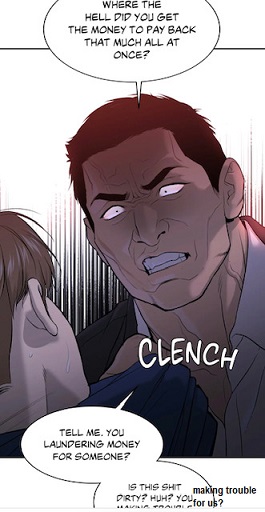 (chapter 11), he jumped to the conclusion that Dan was either prostituting himself or laundering funds. Why? It is because he had taken odd jobs, until he got hired by the dragon, Joo Jaekyung, and had such a huge income. Under this new light, it becomes comprehensible why Heo Manwook knew how to use the old lady in order to threaten doc Dan.
  (chapter 16) Like I wrote in a different analysis, I doubt that the grandma would have signed a loan by Heo Manwook. This reveals how Dan entered the contract in obscurity, without recognition or protection. He did it for Shin Okja’s sake to repay her for her support and “love”.
 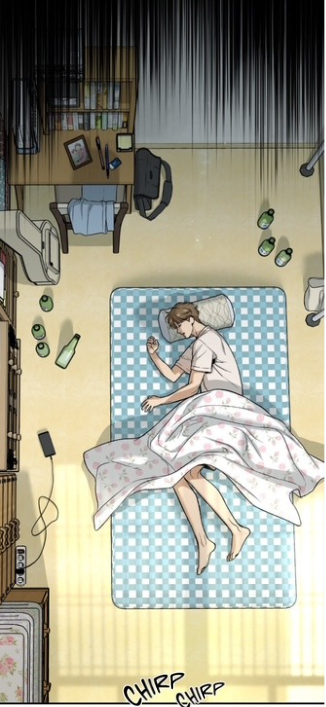 (chapter 57) Therefore I am expecting an argument between the halmoni and the inhabitants of 33-3. The landlord embodies the opposite values of Shin Okja.
 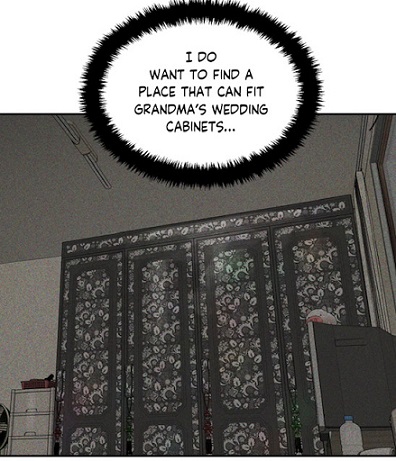 (chapter 16) Dan repeatedly calls it his grandmother’s and even dreamed of finding a new place that could house it—a gesture that underscores how much he believed she treasured the object, even though she herself never mentions it. But she never once references it, not even when returning from the hospital. The absence of interest is striking. What if the cabinet didn’t belong to her at all? Its size suggests that it predates the division of the house. Besides, according to my observation, she used to live in the other unit and I can not imagine, the halmeoni moving this furniture from one unit to the other. Perhaps it once belonged to Dan’s mother—a remnant of the original household, now misattributed to the woman who unofficially took over.
 (chapter 19) onto the object just as he projects loyalty and gratitude onto his guardian. But the silence around the cabinet speaks volumes: it is not treasured by Shin Okja, only by Dan. Much like his name on the loan, or the house number on the door, it could be a misplaced inheritance. At the same time, such an item could serve to identify doc Dan’s true origins, if the Wedding Cabinet belonged to his true family.
 (chapter 66) Changing his registration would mean stepping outside of the institution’s control and surveillance.
 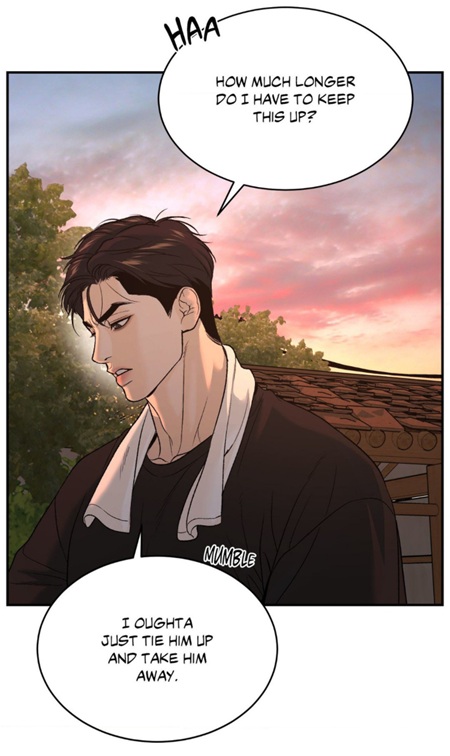 (chapter 62) Without Dan, Seoul held no meaning. But if he remains in the town past the statutory threshold, it would imply that he is ready to leave behind the world of contracts and competitions. It would mean he is now rooted—not by career, but by choice. Not by obligation, but by emotional truth.
 , released in anticipation of Chapter 70, is more than a promotional teaser. It is a moment frozen in time, yet brimming with motion—emotional, symbolic, and narrative. We see Joo Jaekyung embracing Kim Dan with both arms, pressing him tightly against his chest. There is no resistance, no distance, no tension in the frame. The palette moves from gray and brown fading into violet and pink, blooming into soft light. There is vapor, there is breath, an allusion to life. And most strikingly, there is stillness.
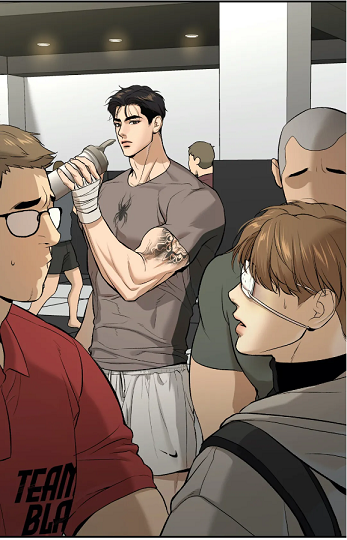 (chapter 11), every glare, and every awkward silence
 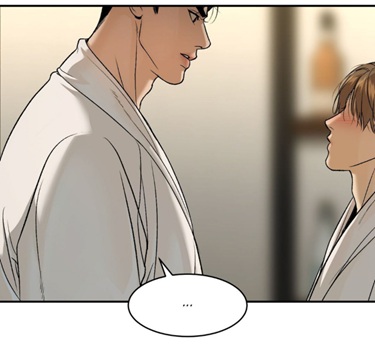 (chapter 67) between these two, this hug feels monumental.
  (chapter 29) —the constant possibility of being challenged, of losing ground, of falling from his throne. Time meant pressure. It meant movement. But now, in this image,
  (chapter 68) and the public hug on the dock in Chapter 69.
  (chapter 69)
  (chapter 68) He rests his chin not on Dan, but on his own hand, his arm propped on the edge of the bathtub. This detail is telling: even in a moment of supposed closeness, Jaekyung relies on himself for support, not on Dan. He is physically near but emotionally braced—still holding himself apart. His thoughts are private, tender, and possessive. In a rare moment of introspection, he confesses that
 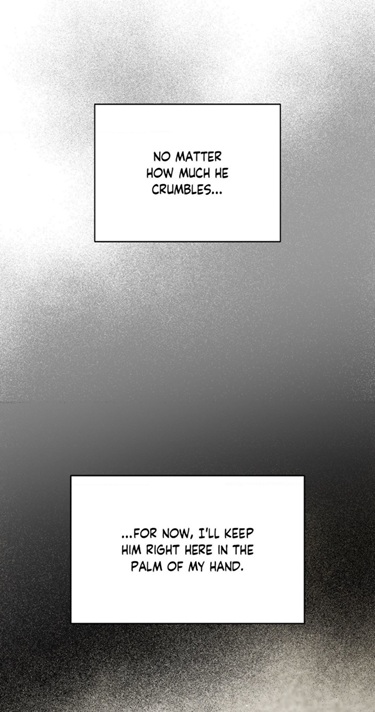 (chapter 68) This line (“I’ll keep him right here in the palm of my hand”) is deeply revealing. The champion frames care through the language of possession. The palm is open but hierarchical; it suggests that Dan is small, fragile, and dependent on Jaekyung’s will to hold or release. He does not yet see Dan as an equal. Even as he softens, his emotional vocabulary is shaped by superiority and containment. The hug is real, the sentiment sincere, but the dynamics remain unbalanced. And since Dan is asleep—unable to reciprocate, respond, or challenge—the embrace becomes more about the wolf’s soothing himself than forming a mutual bond. Furthermore, Dan is not even facing Jaekyung.
 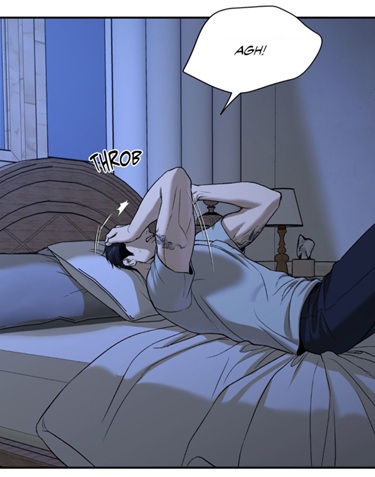 (chapter 69) The illusion of control dissipates, revealing that his earlier vow, however heartfelt, was not yet unshakable.
 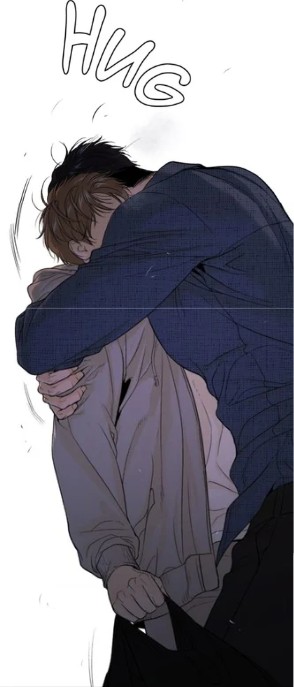 (chapter 69) rather than a moment of mutual resolution. Jaekyung offers no words, yet a silent gesture of care and vulnerability.
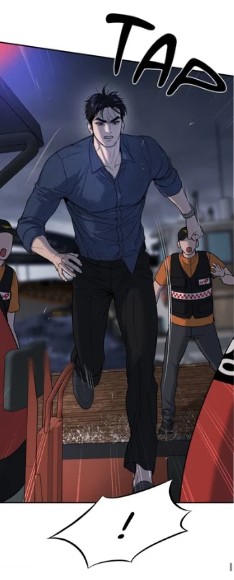 (chapter 69) that Jaekyung is wearing it, the change in angle—viewing the hug from behind—deliberately conceals it.
 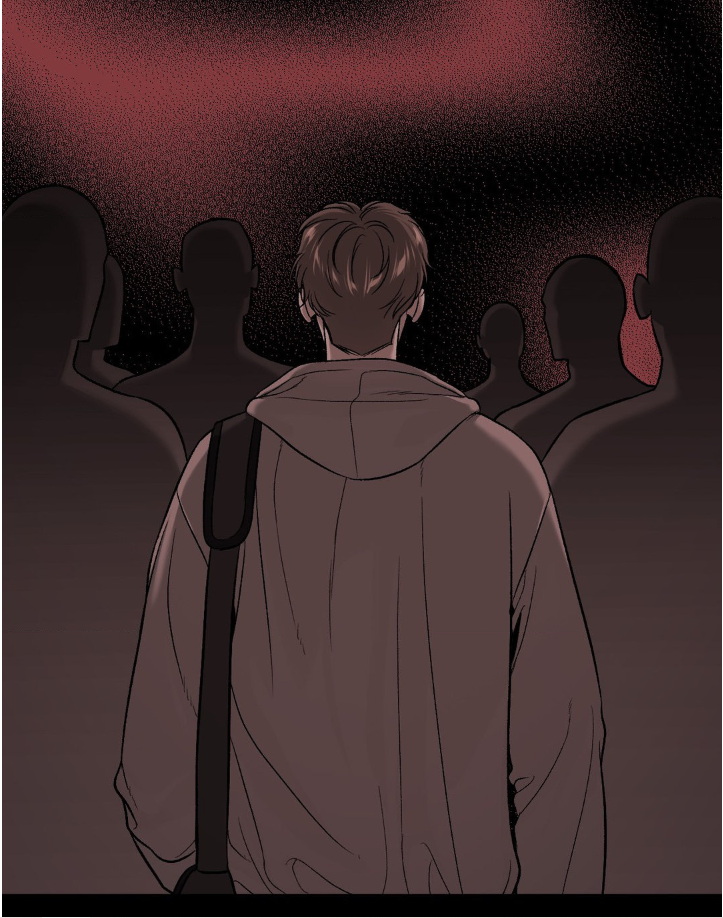 (chapter 55) In the new illustration, the hamster’s back is no longer representing anonymity and indifference, but visibility and care, for the champion is now facing his fated partner. In other words, doc Dan’s back in the teaser stands for uniqueness and high value. He can not be replaced. Moreover, doc Dan is not walking away, nor is he asleep.
 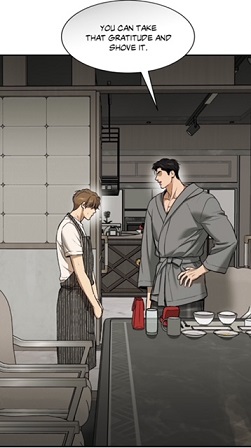 (chapter 45) Back then, the champion refused the expensive key chain, symbolizing a missed opportunity for emotional connection. Both men yearned for attention and affection, but failed to express it. Here, in contrast, the champion offers something far more meaningful than a 14,000₩ and free lodging —his unguarded embrace. And Dan, by remaining still, appreciates the moment.
  (chapter 21) Dan became fluent in a silent, physical language of care. She often asked him not to cry
  (chapter 47) and composed embraces—gestures repeated with calm precision. These touches were predictable, rhythmic, and soothing, but they also suppressed genuine emotional exchange, the symbol of toxic positivity.
 (chapter 57) the momentary pause of a hand
 (chapter 5) never still—giving the impression of involvement, of care in action. But this motion avoided vulnerability and responsibility in reality. She never clung, never trembled. Her gestures conveyed comfort but not surrender, presence but not change, and not support either. They were not truly emotionally together.
  (chapter 47) to hold her hand, to initiate closeness
  (chapter 47)
  (chapter 56). This reversal of roles placed the burden of emotional stability on his young shoulders.
 (chapter 57); I’ll come back home, once I am all better”
 (chapter 35) Instead of recoiling in fear or admiring his strength, Dan quietly states, “I think I really need to focus on Mr. Joo right now.” He does not focus on the strength or aggression, but on the pain beneath it. The burst sandbag, for him, is not a threat—it is a symbol of Jaekyung’s emotional unraveling. This silent recognition mirrors Dan’s interpretive skills developed in childhood. Just as he once learned to read a shift in his grandmother’s hand or the silence after a broken promise, he now interprets the damage to the sandbag as an unspoken plea for help. This sensitivity continues to define his bond with Jaekyung.
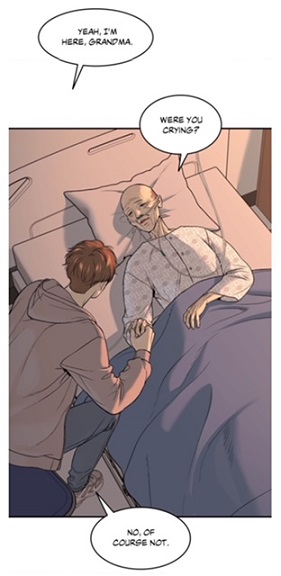 (chapter 47), to stabilize the person meant to support him. Now, he is receiving without shame or hesitation. The Emperor’s silent desperation, his refusal to hide behind ritual or false strength, creates the space for Dan to feel treasured—not pitied, but wanted.
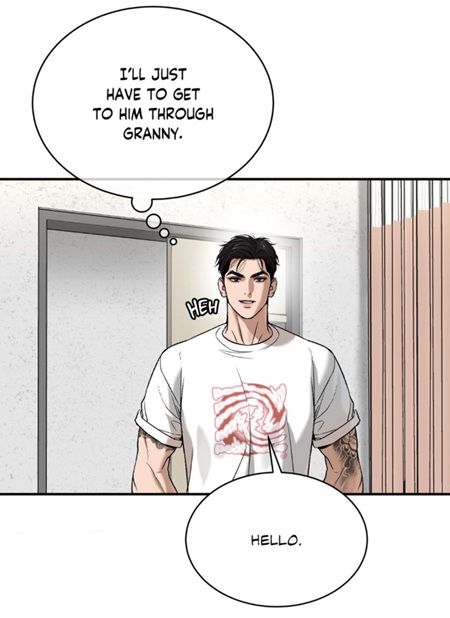 (chapter 65) or stand-ins
 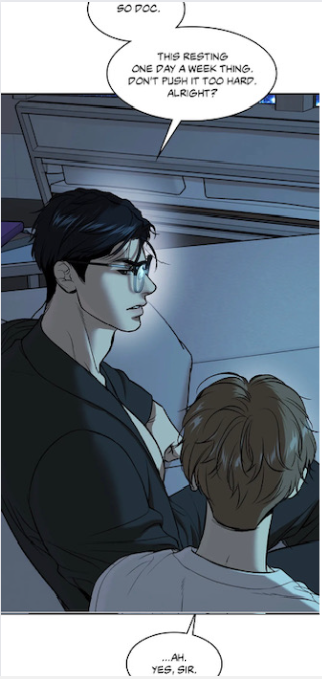 (chapter 29), ignoring Dan’s presence and concern. His rejection of the doctor’s offer of comfort or companionship underscores not only his emotional detachment but also the absence of true support from his supposed team. The manager, Park Namwook, is nowhere to be seen,
 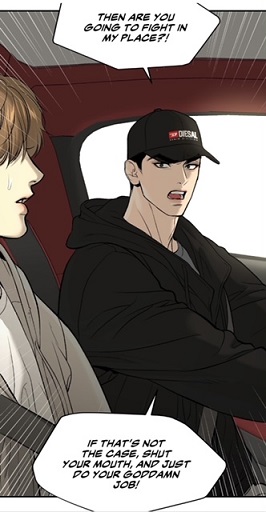 (chapter 42) or offered silence in return. He had no teamwork ability in the end contrary to the hamster who “assisted” his grandmother. But it is not surprising, since Park Namwook has always relied on his boy.
 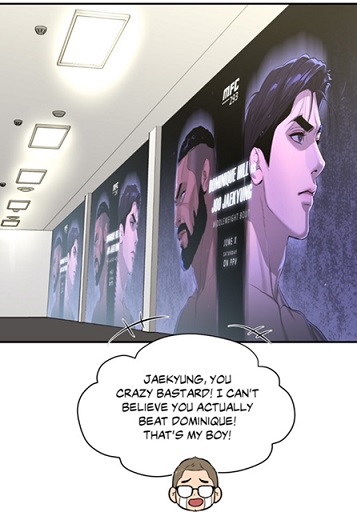 (chapter 40) Each time, they faced a problem, the athlete had to resolve it. He was the problem and the solution for everything.
  (chapter 17)
  (chapter 52) Surrounded by others, the manager attempted to discipline Jaekyung not with understanding, but through force. The slap was not an act of care—it is an assertion of dominance. It reduced Jaekyung to a volatile asset and spoiled child, not a man in pain. Striking is that this gesture actually exposed the manager’s weakness and anxiety. He was the one reacting as a spoiled child, for he masked his wrongdoing with tears.
  (chapter 52) The reason is that he couldn’t face the terrible outcome and his own responsibility. He needed a scapegoat. Thus he blamed the champion for everything. But by doing so, he refused to share the burden and the athlete’s unwell-being. Striking is that this slap served as a wake-up for the athlete. From that moment on, he stopped relying entirely on his “hyung”. He was pushed to make decisions on his own. This harsh gesture mirrors Shin Okja’s attitude toward Kim Dan,
 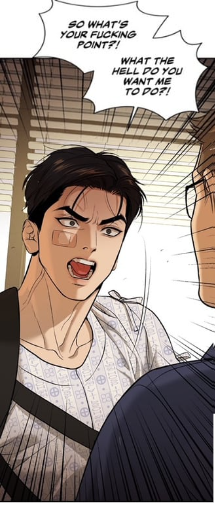 (chapter 52), seeing it as disruptive or shameful. Their guidance demanded emotional control, not emotional honesty.
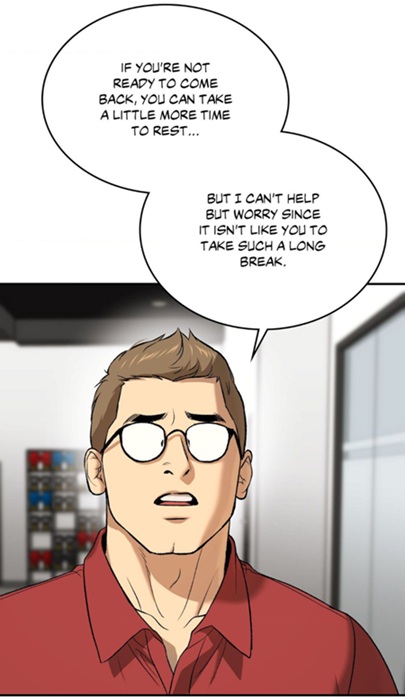 (chapter 66) or use violence to “tame the wolf”. That’s the reason why he is accepting the offer from the CEO of MFC. He is pushing the Emperor to return to the ring, but the problem is now that doc Dan was officially recognized as a member from Black Team.
 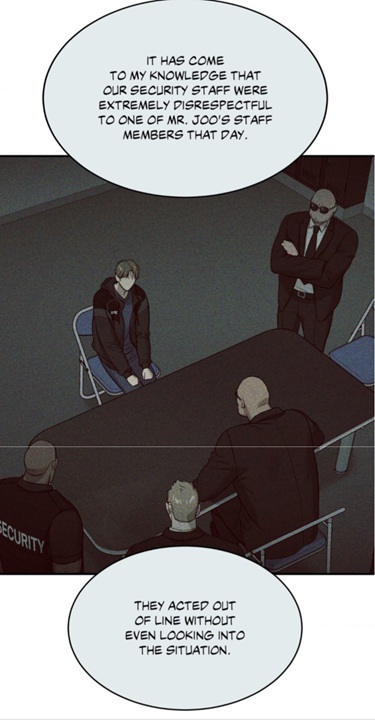 (chapter 69)

 (chapter 69) it is a harbinger of disruption. A radio broadcast delivers the warning: skies turning cloudy, strong winds forecasted at 20 to 25 meters per second. This is no ordinary breeze. It signals the arrival of a whole gale—powerful enough to topple trees, strip rooftops, and fracture routines.
 (chapter 69) as the champion’s sleek white car raced toward the tunnel, into a sky veiled by darkening clouds. This image foreshadowed the impending tempest not just in weather, but in fate. However, the celebrity didn’t pay too much attention to the warning, lost in thoughts, which is symbolized by the tunnel. The latter represents the protagonist’s ignorance, recklessness and “stubbornness” (he can not forget his loved one, he can not bear to leave his side). He races toward change, still shrouded in his old mindset, while nature prepares to strip away his last remaining believes and illusions.
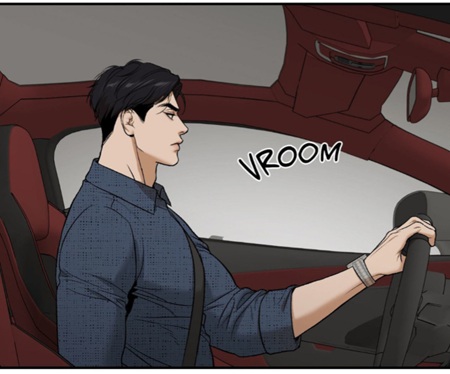 (chapter 69) Hence he is still wearing his dark blue shirt, pants and an expensive watch. But more importantly, he is now driving his white sports car. This means before meeting his hyung and the CEO, he went to the penthouse and changed not only his outfit but also his vehicle. He selected the white car,
  (chapter 69) Since the latter is a high-performance luxury model, it symbolizes wealth, speed, and prestige. That’s how he wanted to appear in front of the CEO. However, now he is going to the place where the storm will be the most violent. Because the star is still dressed in his dark blue shirt and expensive watch, I came to the following interpretation. This is not the champion in training clothes, but a man who now owns time
 (chapter 60)
 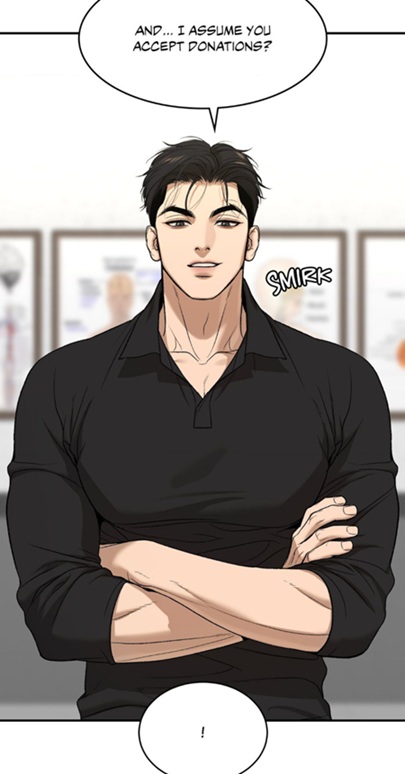 (chapter 61) No longer is he defined by his cellphone or his car, but by a reclaimed sense of agency.
 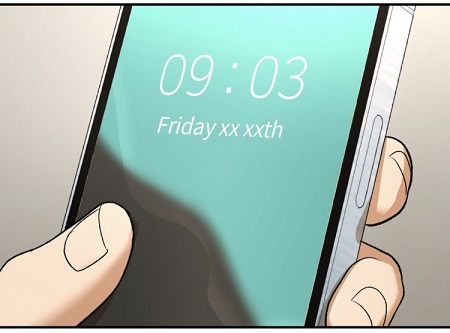 (chapter 38) or his car
 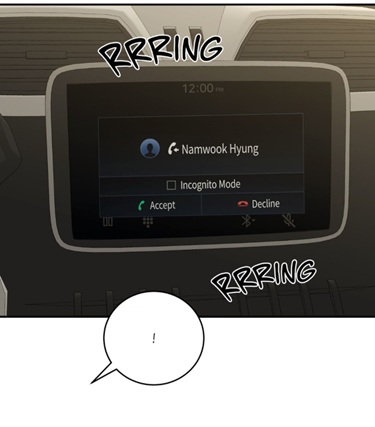 (chapter 69). Hence the manager can no longer be in touch with him.
  (chapter 66)
 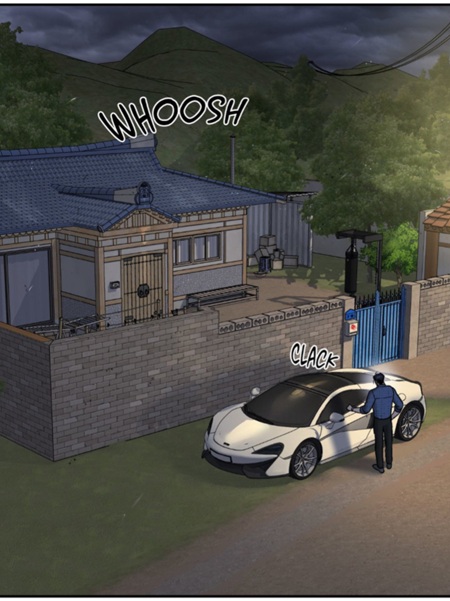 (chapter 69) might be damaged or lost to the tempest—a symbolic stripping away of status which reminded me of the way doc Dan treated the halmoni’s Wedding Cabinet.
  (chapter 53) Both instances symbolize a relinquishing of material attachments (he leaves his huge penthouse for a rented little “hostel”) and a profound shift toward emotional growth. For Jaekyung, the potential loss of his prized possession is not just about property—it marks the beginning of relying on others, accepting vulnerability, and letting go of his rigid, self-reliant identity. Similarly, the doctor’s decision to leave behind the Wedding Cabinet signals a break from the past and a readiness to build something new, no longer defined by inherited burdens or emotional debts. In both cases, possessions lose meaning. With nothing left to prove, the champion accepts vulnerability. He is no longer above asking for help, nor afraid of stillness. And that realization could only emerge under pressure.
  (chapter 57) This initial depiction – of the sparkling blue sea, the gentle rhythm of waves (shaaa), the birds in the sky, the beautiful sunset
  (chapter 59) and
 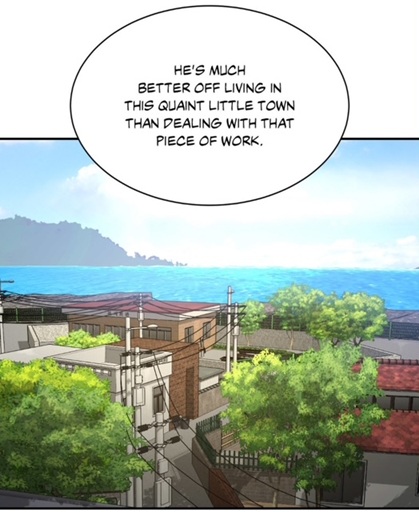 (chapter 58) daily life in slow motion—sets up a stark contrast to the approaching storm. All these images and including the elderly proclaiming
  , (chapter 65) “It’s a nice little town, isn’t it?”, lulled both the characters and readers into a false sense of permanence. But beauty is ephemeral. Storms, by nature, contradict stability. They sweep away trees, roofs—and with them, pipe dreams.
  (chapter 53) That’s why Mingwa zoomed on her gaze, but “cut” her ears, a symbol for her “deafness”. Hence she didn’t hear and feel the wind during her stroll with the champion.
 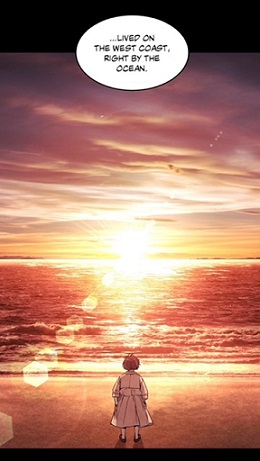 (chapter 53), bathed in the orange glow of a perfect sunset, reflected her toxic positivity—her tendency to ignore pain and erase any negative memories, including a life marked by hardship in Seoul. It encapsulated her attempt to embellish the past and project into the present
  (chapter 17), where the walls were decorated with actual postcards of beaches she had never visited. These were not souvenirs, but illusions—windows into an idealized elsewhere that helped her ignore the hardship around her.
 (chapter 47), symbolizing distance from reality. In the hospice, it is placed next to the window
  (chapter 61), revealing trees and the sky—nature encroaching. By her second stroll with Jaekyung, the image of the window reappears
  (chapter 65), subtly reminding readers of its fragility. Now, as the storm rolls in, the trees outside become potential hazards, and the window that once offered a view might shatter. Should this happen, then it will rupture her illusion of control and all her repressed fears should come to the surface.
 (chapter 56) But he misjudged her case for two reasons. First, the file had been tampered: she had received a new treatment. Secondly, he did not know her. What he saw as acceptance was actually a mix of comfort, avoidance and unresolved fear. The gale will expose the limits of both clinical assumptions and self-deception. The woman who once believed she could choose the time and manner of her death now faces nature’s blunt reminder: she is not in control of life and time—nor of anything else.
  (chapter 56) —it is a layered terrain of symbolism and vulnerability. Perched on what appears to be a peninsula
  (chapter 60) ; the docks, roads, and shops follow at level 1
  (chapter 62)
  (chapter 69); and the town proper stretches up with retaining walls
 (chapter 59) (Light of Hope) overlook the coast and the landlord’s house
 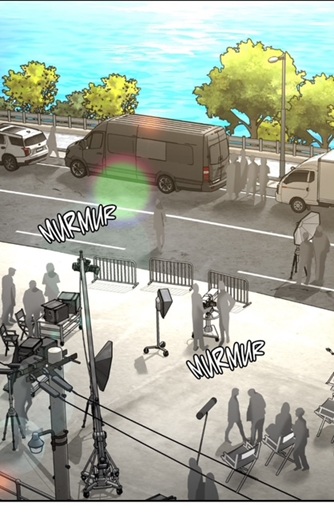 (chapter 57). I came to this deduction, as the champion could see the building from the beach, when he rescued doc Dan.
  (chapter 61) Like pointed out before, his name is misleading, for hope implies “rescue”. However, a stay in that place means that their “inhabitants” are all destined to die due to cancer. There’s no real cure there. In other words, the tempest will bring to light its true nature. The hope, just like its comfort, are illusory.
 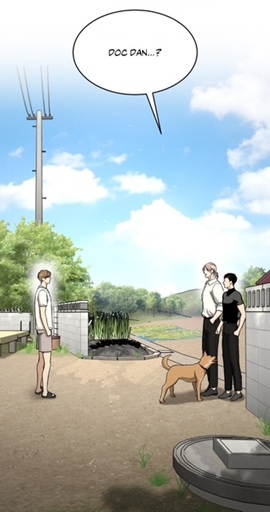 (chapter 57), fields and close to two power masts
  (chapter 57) The landlord may even encourage the fighter to adopt a puppy from Boksoon’s litter, as he can see the champion’s care and sense of responsibility—not just for himself, but for another life.
 (chapter 69) Such a confession would push the physical therapist to redefine his relationship with the celebrity: he is indeed his friend, even a close one. And if this takes place, then the doctor could start opening up as well. The tempest reveals fragility, forces new beginnings, and exposes fair-weather allies.
 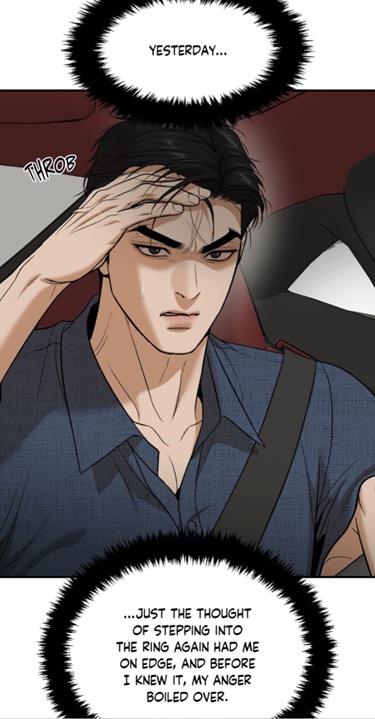 (chapter 69) The moment the champion exposes his fears and doubts, doc Dan would prove to the champion that he is no fair-weather ally contrary to Park Namwook, who pushes him back to the ring. The grandmother, so proud of her roots
  (chapter 69) would be left outside, symbolizing that this “sport” has become less central and vital in the main lead’s life. This is the first true pause in their relationship. Jaekyung, used to immediate gratification and external control, must slow down. And for the first time, he will see what he always overlooked: that meals take effort, that conversation has value, as it can help to get closer to another person. He doesn’t need the grandmother to get “through Kim Dan”.
 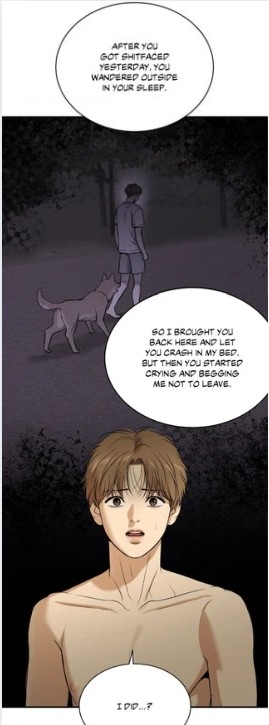 (chapter 66) Jaekyung, who has never seen the puppies, might discover them now. That discovery mirrors his gradual awareness of fragility and caretaking. For Kim Dan, nurturing the puppies symbolizes reclaiming his capacity for love and responsibility—free from obligation.
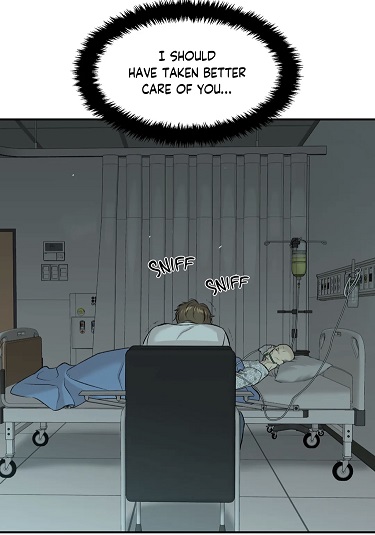 (chapter 21) and needed company.
  (chapter 21) The doctor would drop everything and rush to her side overlooking his own health. But now, with blocked roads and dangerous winds, Kim Dan cannot come—even if he wants to. He is no longer her servant or safety net. Nature has intervened where he could not set a boundary.
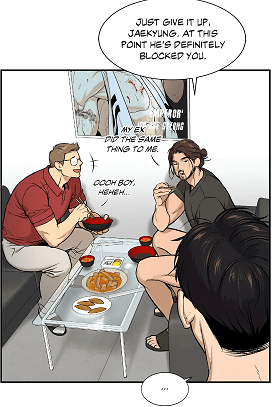 (chapter 5) Thus his anxieties should reach a new peak. His grip on the boy he used to control is gone. The storm draws a line between who remains—and who fades.
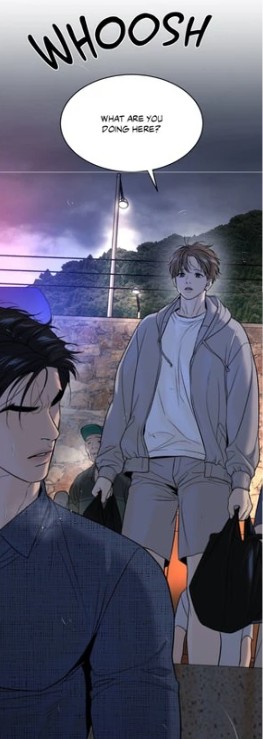 (chapter 69) That’s why he looks at the horizon. From my perspective, he is used to such events, hence when the storm hits the coast, he will be prepared mentally. Thus he could share his experiences and thoughts to the two young men.
 (chapter 53) She imagined a final golden moment—warm, serene, and nostalgic before her death. But instead, she gets gusts and branches crashing down. In that sense, the tempest is her lesson: Humans are not superior to nature. They can not control time, nature and destinies. Moreover, nature does not serve our stories. It tells its own.

 (chapter 69)
 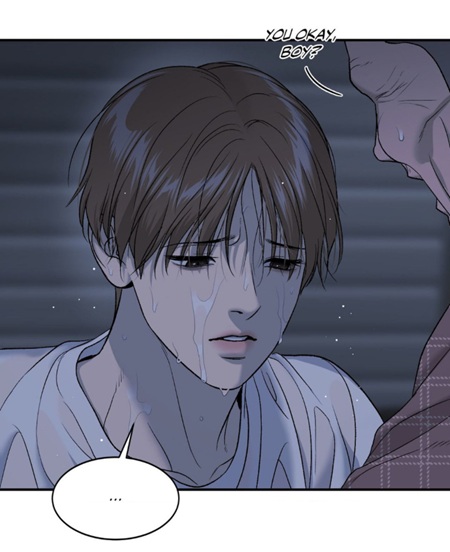 (chapter 69) These silent, parallel compositions reveal the landlord’s symbolic position as an enduring guardian: not static, but responsive. Therefore his position shifts constantly, either
  (chapter 65) in front of the couple, or behind Kim Dan in one scene, behind the champion in another.
 (chapter 65) He is like the wind, fluid and unobtrusive, adapting to the needs of the moment. His position is never rigid, therefore in the final panel he seems to have vanished.
  (chapter 46) or authority
  (chapter 65), the landlord responds to what is needed, not what is expected. His flexibility does not stem from indecision—it is born from humility and care. Another aspect contributing to this perception is his ignorance. However, the latter should not be viewed negatively. Since he doesn’t know the champion’s profession or the doctor’s familial and financial situation, he is not projecting expectations or judgments onto them. Rather than acting out of assumption, he simply observes. This is precisely why he doesn’t come across as arrogant. His lack of knowledge becomes a quiet strength—it allows him to respond with presence, not prejudice. Just as the wind moves through open spaces without imposing form or judgment, his unknowing presence allows room for others to breathe and unfold, free from predefined roles or assumptions.
 (chapter 65) He does not try to define the protagonists by their past or their titles. He lets them define themselves. While he tried to encourage doc Dan to drink and work less, as time passed on, he came to notice his suffering and accept him with his illness.
  (chapter 62) —his livelihood depends on observing the skies.
  (chapter 69) had already been shown earlier together in the crowd, I suspect that one of them might informed Kim Dan about the incident and the champion’s presence. This would align with the narrative’s kaleidoscopic structure, where certain scenes are reflected in different timelines.
 (chapter 66) Under this new light, it dawned on me that the fan was most likely handed out by a local institution—perhaps even the hospice Light of Hope, during a public health campaign or examination event. This means that he is taking good care of himself. One might argue with this interpretation, yet there exists another evidence for this perception.
  (Chapter 62) He is constantly wearing the green cap, a sign that he knows about the danger of the sun. This stands in opposition to the grandmother who would sell her vegetables without any hat.
  (chapter 57) These types of fans are typically distributed by hospitals or clinics: practical items with subtle promotional intent. But once in the landlord’s hands, it takes on symbolic weight. The number “365” does not simply represent a calendar year; it represents consistency, time, and the daily rhythm of care.
 (chapter 57), white,
  (chapter 69) and Kim Dan as “sonny”
  (chapter 59) Whether it’s due to panic, malnutrition, exhaustion, or psychological collapse, suffocation is one of the defining sensations of Kim Dan’s arc. In this context, the landlord, with his unassuming fan and grounded demeanor, emerges as a breath of fresh air—the very opposite of the heiße Luft, or “hot air,” surrounding the champion’s fabricated scandals and media distortions.
  (chapter 52)
  (chapter 69) the atmosphere grows heavier—not from external scandal, but from inner turmoil. Then Kim Dan’s puzzled reaction,
  (chapter 69) The scene becomes emotionally charged, echoing classic storm symbolism: emotional intensity, uncertainty, and the prospect of sudden change.
 (chapter 69) —his face filled with shock and disbelief—the Webtoonist added the sound effect “WHOOSH.” Under this new light, I interpreted this as more than background ambiance. It marks a pivotal turning point, as if the wind itself had cut through the fog in Joo Jaekyung’s mind, sweeping away his spiraling fear and clearing space for truth. This sudden shift in emotional atmosphere visually alters him too. Hence it is not surprising that he looks visibly younger. Not broken, but stripped of his burdens. As if the wind blew away the years of pressure, fears and rage.
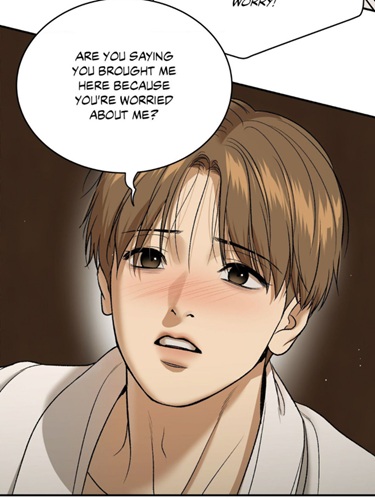 (chapter 67) Doc Dan got finally his answer to this question. Joo JAekyung is more a man of action than of pretty words. So awakening and flourishing are not something that occurs behind glass or sealed doors. It is born in the open, amidst uncertainty and confrontation. And under this new light, I reached a final insight: growth in Jinx does not happen behind closed doors or sealed windows. It happens in the open, where storms rage and air can finally circulate.
  (chapter 59) The landlord doesn’t shelter people from pain or storms. He makes sure they’re equipped to face them. And once they do, the wind is no longer a threat, but a form of grace. And now, you comprehend why the death of the puppy has not been discovered by the athlete yet. For the landlord, death is something natural and inevitable, and since doc Dan has been working at the hospice, I am quite certain that the old man imagined that doc Dan was well-equipped to deal with this situation. He must have been envisaging that Doc Dan was accustomed to it. The problem is that he doesn’t know the protagonist’s past and family.
  (chapter 58), who plays the victim while hiding his own culpability, the landlord does not engage in gossip or vilification. His silence isn’t ignorance—it is grace.
  (chapter 58) and from media
 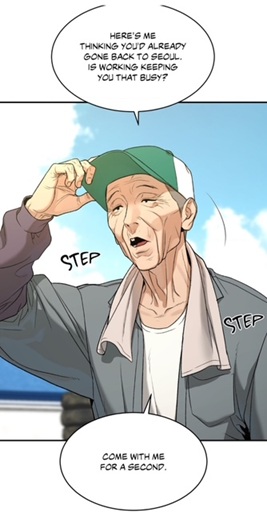 (chapter 57), but someone who understands the balance between labor and rest. He may not have a name, but he has a function. And sometimes, in storytelling, function is identity enough.
 (chapter 47)
 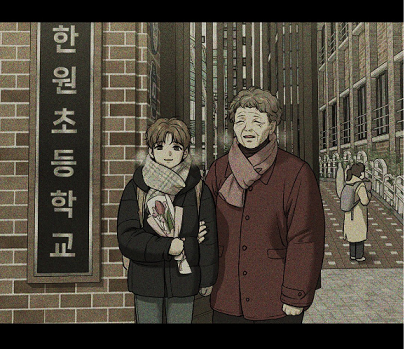 (chapter 47)
 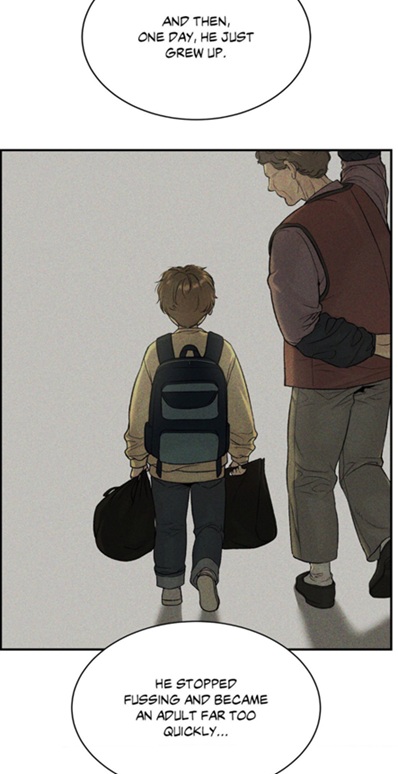 (chapter 65) but not behind. Thus the landlord’s placement
  (chapter 49) explains why he got abandoned in the locker room. It gains even more poignancy when viewed against his past. In Episode 47, while the grandmother was carrying him on her back, Kim Dan’s back is left unprotected.
 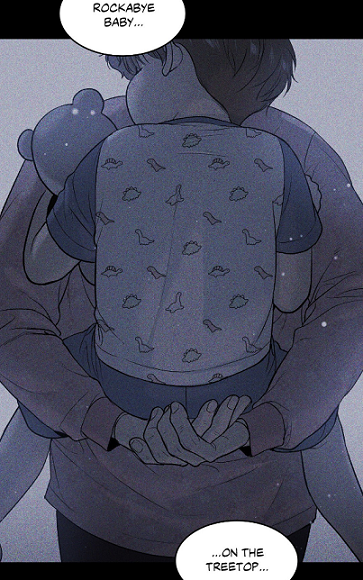 (chapter 47) Her proximity is visible, yet it lacks the symbolic protection associated with standing at someone’s back.
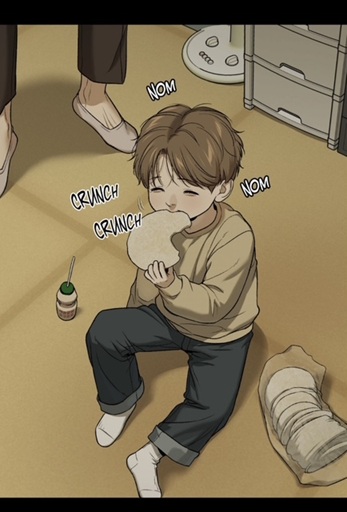 (chapter 57) The moment she offered him a snack, she distanced herself from him. Now, she is standing by his side.
  (chapter 61) —they give him the air, time, and space to grow.
  (chapter 62) Their presence—especially the landlord’s—is the embodiment of silent guardianship.
  (chapter 69) His consistent yet unobtrusive presence stands in opposition to the grandmother’s inconsistent gestures. One acted out care; the other lives it.
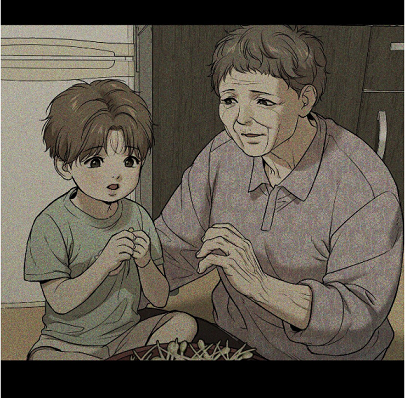 (chapter 47)
 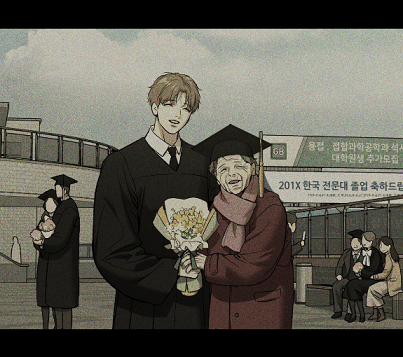 (chapter 47) Despite the rare instance of closeness captured in a photo, most scenes depict Kim Dan standing next to his grandmother, and he is the one supporting her.
  (chapter 69) This gesture, though seemingly violent, reveals something deeper—it forced Kim Dan to feel what he had been missing all along: there were people around him, he was not alone. I would even add, someone was finally standing behind him.
  (chapter 69) In that brief moment, Kim Dan is no longer alone. The landlord, as a silent guardian, and Joo Jaekyung, as a fierce protector, are both behind him—symbolically and literally.
  (chapter 69), while the star becomes the son. This trio, for now, are merely neighbors. But with the storm approaching, I am expecting that their separation may dissolve, drawing them into shared space and daily life.
 (chapter 46) Coach Yosep, Joo Jaekyung, and Park Namwook—a trio marked by authority without dialogue, control without care. In that group, the manager sowed distrust while avoiding accountability.
  (chapter 46) In the new trio, no one holds dominion over the other. There are no contracts, no strings. The landlord has no financial stake in the fighter’s success.
 (chapter 66)

 (chapter 66) quietly shapes the emotional core of the episode. At first, this detail may appear insignificant, but its narrative timing and visual prominence suggest a deeper meaning. The sudden flight of the sparrows
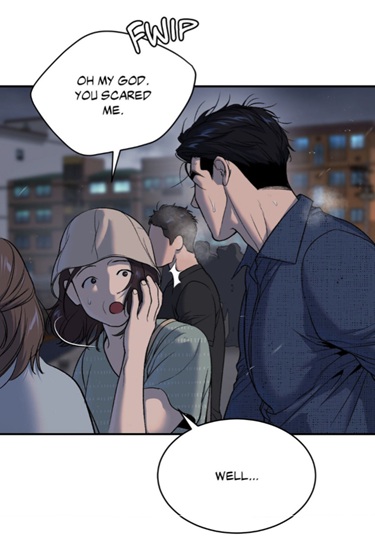 (chapter 69) —who serve as stand-ins for the broader community. In this way, their union is not just a private matter but becomes public and recognized, affirming their bond within the social fabric of the town.
 (chapter 64) or inspire the group to change its direction. In the context of Jinx, the sparrows’ existence
 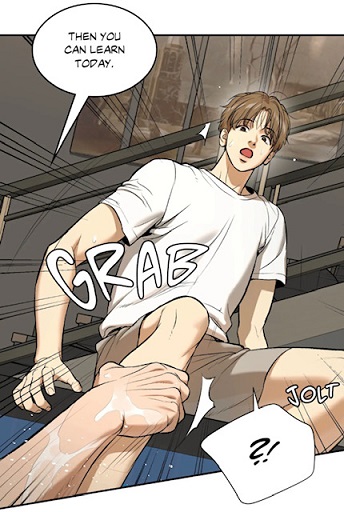 (chapter 27) a playful prank occurs without any third-party observer. The context is unambiguous: both the characters and the reader understand the action as harmless and mutually accepted, so no external framing is required.
 (chapter 69) and throws him outside
  (chapter 69) His composed presence in the background
  (chapter 62) he brings his belongings
 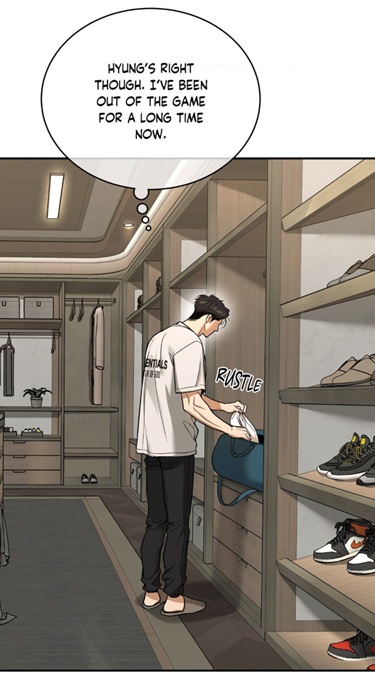 (chapter 66) gradually into his new environment, creating a personal nest.
 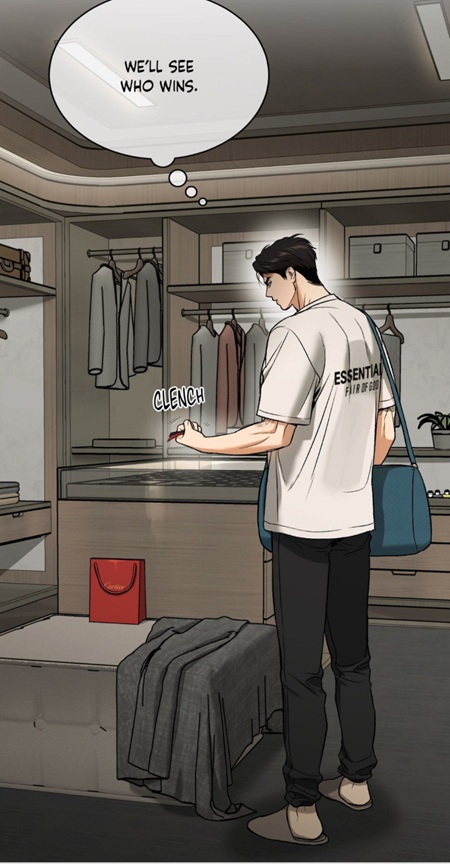 (chapter 66) a sign that this gift has now a sentimental value for the athlete. Just as sparrows persistently build and rebuild, so do the characters in Jinx adapt, settle, and grow—sometimes through trial and error, sometimes in fits and starts, but always moving toward a deeper sense of home. By moving to a smaller house, he is encouraged to select what truly matters to him. This evolution has not reached its end: the champion will keep moving his possessions to the little town. Moreover, I am more than ever convinced that we should expect the arrival of the Wedding Cabinet in that small town.
 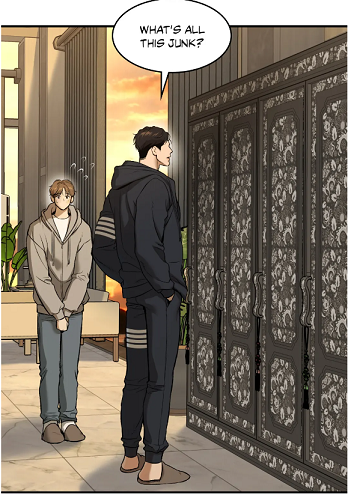 (chapter 19) To conclude, we should see the chapters from 62 to 69 as the creation of the couple’s nest and as such “home”.



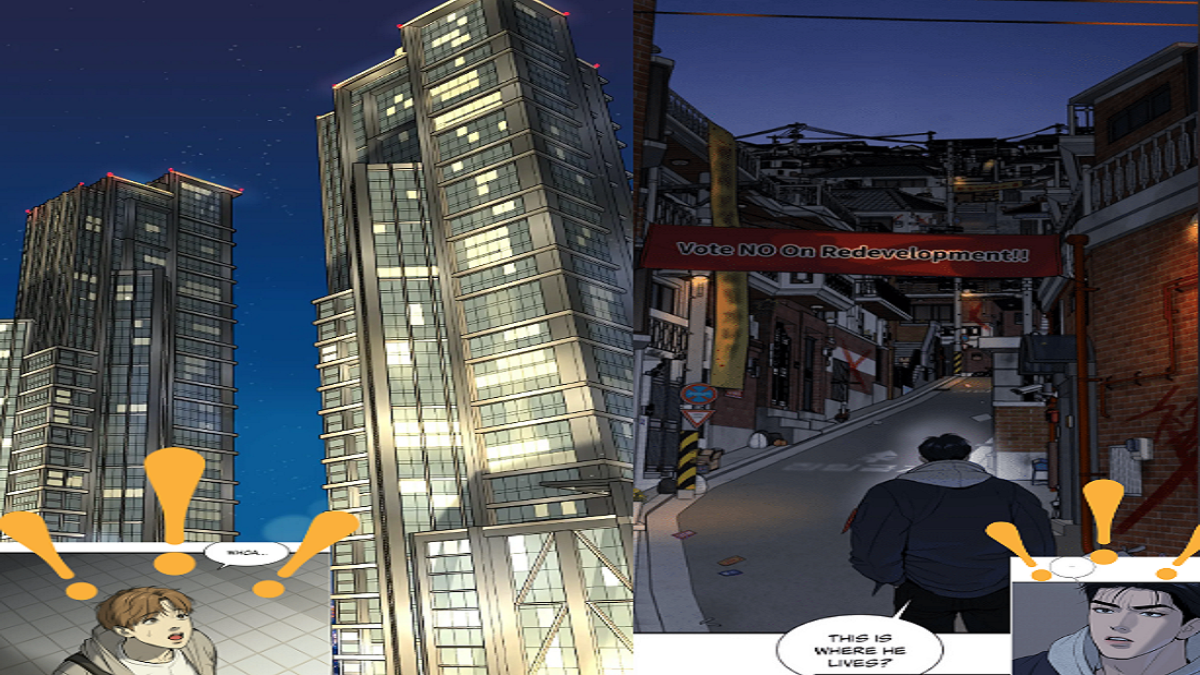
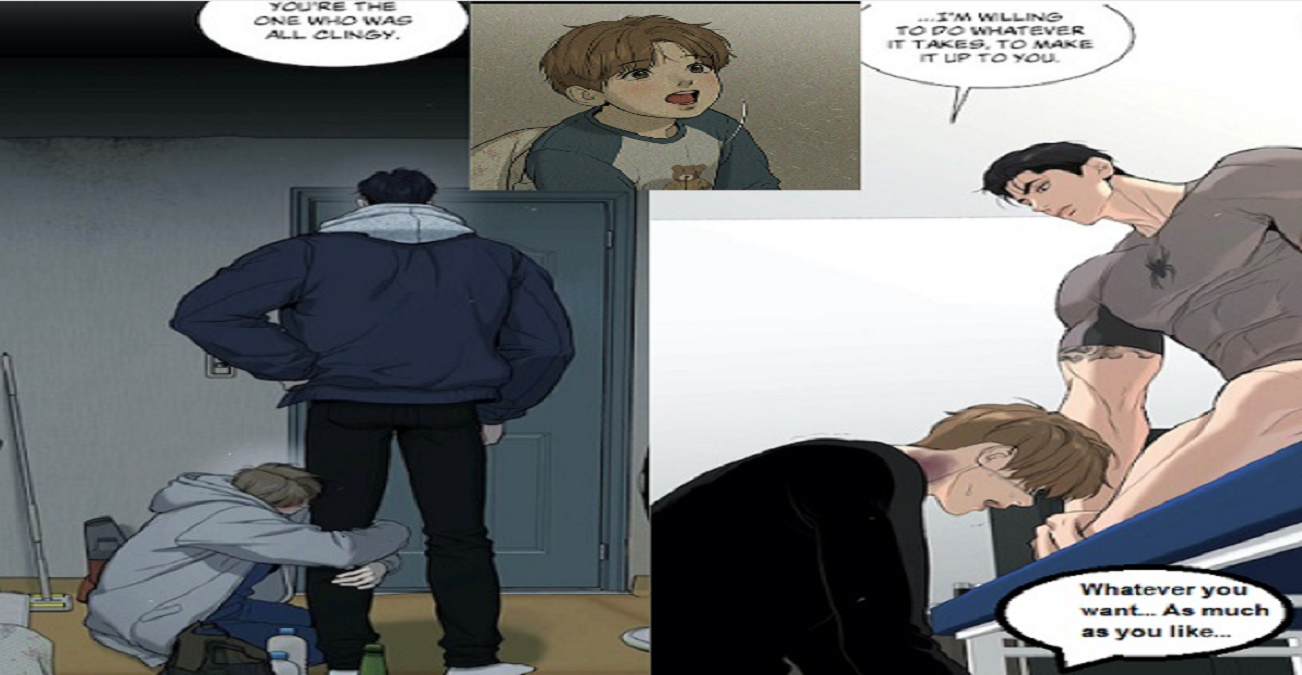

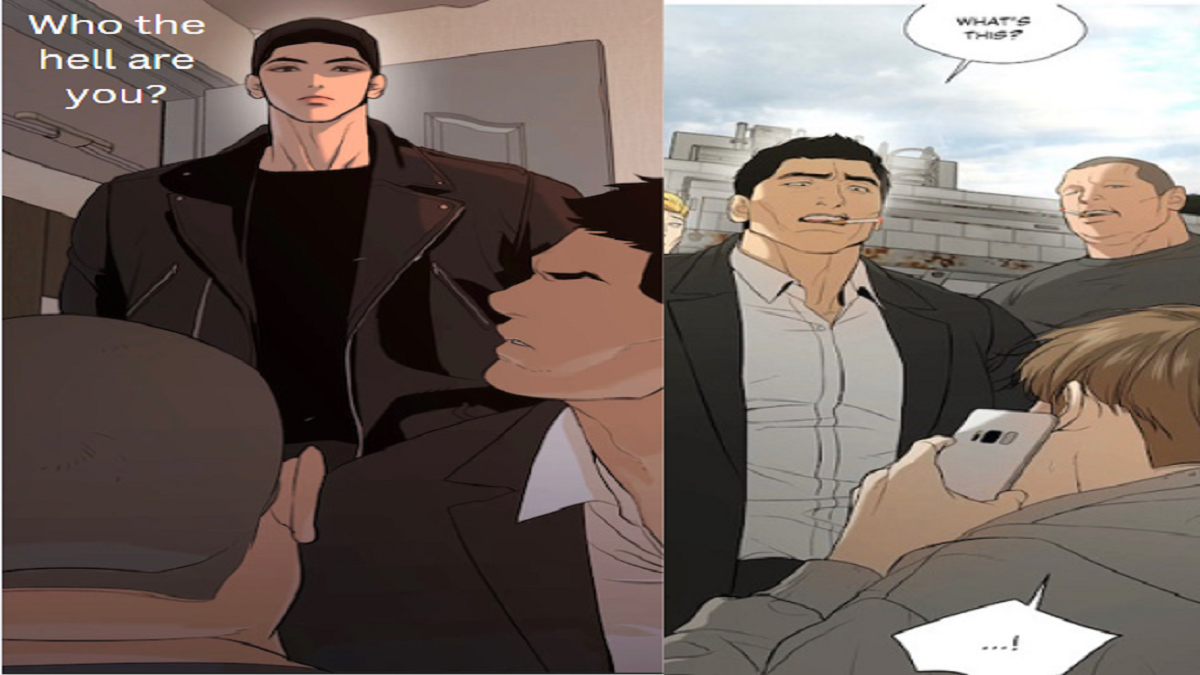


 (locked essay, with new password, switch simply the order of the words, don’t forget the space)











































 Col
Col




















































 Bebebisous33s' analyses in K-Dramaland and Manhwas