Protected: Painter Of The Night: The troublesome target 🎯 (second version)
Bebebisous33s' analyses in K-Dramaland and Manhwas
Analyses of K-dramas and Manhwas (for the most part Yaoi)

This is where you can read these manhwas. But be aware that these manhwa are mature Yaoi, which means, it is about homosexuality with explicit scenes. https://www.lezhinus.com/en/comic/painter If you want to read more essays, here is the link to the table of contents concerning Painter Of The Night: https://bebebisous33analyses.wordpress.com/2020/07/04/table-of-contents-painter-of-the-night/ Steel Under Silk: https://www.lezhinus.com/en/comic/steel_silk If you want to read more essays about this manhwa or others, here is the link to the table of contents: https://bebebisous33analyses.com/2021/06/06/table-of-contents-of-analyzed-mentioned-manhwas/
It would be great if you could make some donations/sponsoring: Ko-fi.com/bebebisous33 That way, you can support me with “coffee” so that I have the energy to keep examining manhwas. Besides, I need to cover up the expenses for this blog.
The chapter 7 confirmed my previous interpretation concerning the signification of the Korean title: Blade and flower. The main lead Lee Yeonjo is indeed the flower. However, since I am not speaking Korean, I had no idea about the meaning of his name.  (chapter 7) The young man is associated to the lotus flower.
This is very important for two reasons. First, the lotus is associated to purity and beauty indicating Lee Yeonjo’s function in the story. He will catch the attention of many characters, especially of lord Chang and Kwon Hee-Ryang so that he will be constantly on their mind. Striking is that after seeing him, the governor couldn‘t forget his face. 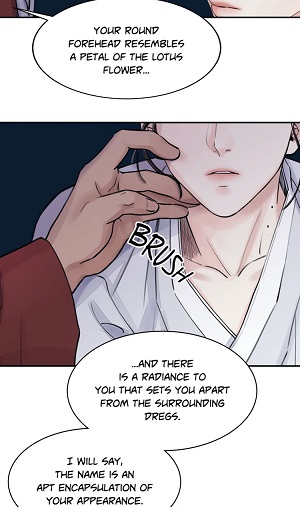 (chapter 7) After their first meeting, the governor was already dreaming of having sex with the slave. Secondly, since the lotus flower emerges from murky water, the latter could be perceived as the symbol of the court in Hamheung-castle. Therefore the court is portrayed as a place full of corruption. Because of the darkness of the place, Yeonjo’s purity can only outshine and captivate the semes’ attention. One might say that he is far from pure, for the former noble is selling his body. On the other hand, his soul and heart have remained intact. He did it for selfless reasons. It was for his brother’s sake. It demonstrates his humbleness and dedication. He was willing to give up on his pride, if it meant to save his brother. Even later, he only accepts the order from headman Choi, once he recognizes that it is his only possibility to approach his enemy. He showed great reluctance in the beginning, for he despises homosexuality. He had never imagined that Kwon Hee-Ryang liked having sex with men.
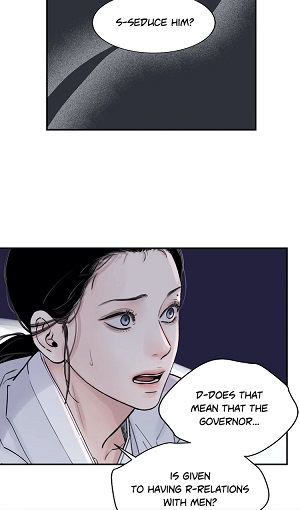 (chapter 7) This truly displays his innocence and purity. But there’s more to it. The particularity of the lotus flower is that it blossoms during the day, but once the moon appears, the lotus flower closes, but re-blooms the next morning entirely dirt-free! This can be perceived as a metaphor for Yeonjo’s future development. In my eyes, the sex sessions during the night will represent the main lead’s fights. During the night he will be far from pure and innocent, this can only be judged as an allusion to sensuality. However, this means that Lee Yeonjo will never lose his “beauty and purity“ despite these sex fights, for the next morning, he will come out as pure and innocent.
At the same time, his name Yeonjo (“lotus shines”) betrays his origins. (Chapter 7) He comes from a former noble family. How so? First, the lotus is strongly intertwined with Confucianism and Buddhism.
“In both Confucianism and Buddhism, the lotus flower is seen as a symbol of honest poverty and virtue associated with an aloofness. Poverty and virtue come from the fact that lotus flowers grow in muddy and dirty waters, yet it still has such beauty.” Quoted from https://www.korea.net/TalkTalkKorea/Spanish/community/community/CMN0000004263#:~:text=In%20both%20Confucianism%20and%20Buddhism,it%20still%20has%20such%20beauty.
Consequently, the plant came to represent the upright and faithful scholar. This new meaning was based on Chinese wordplay—lotus (lian) and uprightness (lian) which are homonyms. This explicates why during the Joseon period, Korean neo-Confucian scholars loved having quadrangular ponds with lotus flowers in their propriety. Under this new light, the manhwaphiles can comprehend why in the Painter Of The Night, all the domains from the nobles (the Lees (Painter Of The night, chapter 3), the Yoons
  (chapter 10) and the Mins
 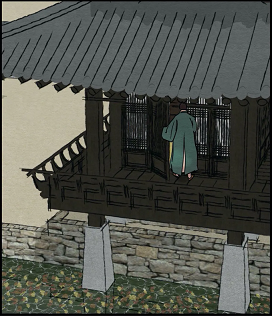 (chapter 33) have a square pond with a pavilion and lotus flowers. The pond was supposed to represent the owner: a upright and faithful scholar. 🙄 And this made me laugh, because this was the place where crimes and sins were committed. Jung In-Hun asked Baek Na-Kyum to disrespect his sponsor, to become disobedient and as such disloyal. Besides, he lied, manipulated and wounded the main lead
 (chapter 10), whereas Min, Yoon Seungho and Lee Jihwa had sex there.
  (chapter 25) All of them were far from righteous and humble scholars. That’s how I realized why the pavilion in Painter Of The Night symbolized emancipation. It was where the main protagonists got purified thanks to the lotus flower. Why? The answer is simple. The lotus flower embodies rebirth, regeneration and enlightenment.
 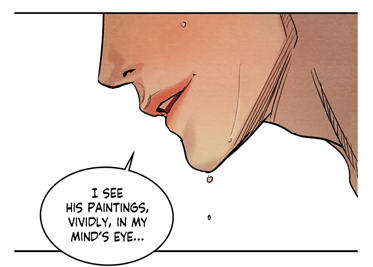 (Chapter 3) This coincides with the main lead‘s enlightenment. In the pavilion, he could perceive his sex appeal and attraction. Let’s not forget that Yoon Seungho had discovered sex through sexual abuse, and was blamed for the sexual desires from the pedophiles. Furthermore, with this new discovery, the manhwaphiles can grasp why Lee Jihwa sent his friend there.
 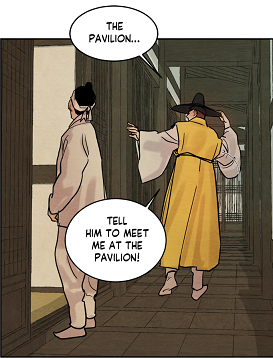 (Chapter 3) That way, the second lead could appear as an integer and down-to-earth noble. 😂 But no, it had the opposite effect: the lotus flower revealed the true nature of the relationship between the red-haired master and his friend: it was purely sexual. He loved having sex with Yoon Seungho. Furthermore, it also exposed Jihwa‘s true reflection: he was a homosexual. This signifies that the pavilion and the lotus flowers exposed the decadency of the aristocracy in this story, while they cleaned the protagonists. In my eyes, only Yoon Seungho among the aristocrats has the disposition of becoming a true scholar. Finally, it explains why the video had such a scene:
  Here, the lord is portrayed as a humble and righteous scholar. Because of this new discovery, I felt the need to examine the color of the lotus flower in the main lead‘s pond.
  What caught my attention is the following: the reflection of the patio. It gives the impression that the water is clean! However, the lotus flower needs dirt to grow. Furthermore, since the painter embodies water, I am questioning if the lotus flowers had enough water. Notice the huge gap between the level of water and the bridge. This explicates why the flowers are just raising above the water contrary to this picture.
 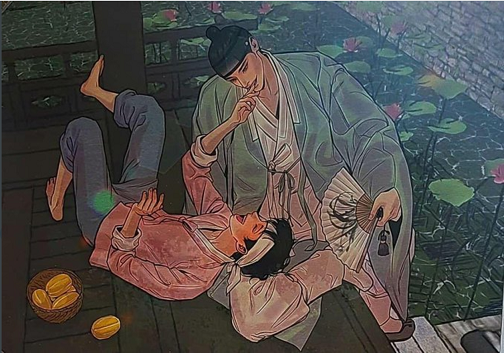 The manhwaphiles can notice the presence of the long stems. I would even say that now the number of pink lotus flowers has increased, for now they are visible on the right side of the bridge which contradicts to the picture from episode 10. Another important detail caught my attention: the color of the flower. It is a pink lotus flower.
„Pink Lotus Flowers are said to be the true flower of the Buddha. A budding pink Lotus Flower symbolises a person whose awareness is beginning to expand, while one that has reached full bloom represents a full sense of enlightenment.“ quoted from https://www.happybunch.com.sg/blog/lotus-flower/
The color pink is made by combining red with white. The color red contributes to the need for action while white brings the potential for success to the table. The combination of passion and power (Red) with purity and completeness (White) results in some of the most beautiful hues of pink. With this in mind, think about the various shades of pink. Psychologists often associate the color Pink as a sign of hope, positivity, warmth, comfort, and a sense of security. Pink is often used to diminish (or at least reduce) feelings related to anger, neglect, aggression, or even a sense of abandonment. quoted from https://www.whenyougarden.com/pink-lotus-flower-meaning/
Under this new approach, the manhwaphiles can grasp the painter’s function in Painter Of The Night. He is the pink lotus flower too. During the night, he cleansed the lord and showed his true nature (a huge libido), but the next morning, he was still as pure and innocent as before. Don‘t forget that the two main leads reflect each other. This means that the artist should be perceived as the sun too. Baek Na-Kyum could bring out Yoon Seungho from the darkness, the muddy water! Without any sun, the lotus flower can not emerge and shine. I conclude that the two protagonists have a dual nature: the lotus flower and the sun.
As a lotus flower is born in water, grows in water and rises out of water to stand above it unsoiled, so, I, born in the world, raised in the world, having overcome the world, live unsoiled by the world.”-Buddha quoted from https://www.whenyougarden.com/pink-lotus-flower-meaning/
Because of the strong connection between the lotus flower and Buddha, I come to the conclusion that Yoon Seungho‘s fateful encounter with the painter will bring him closer to religion, and make him drop his nihilistic vision he adopted from his surrogate father Kim. In my eyes, he will become truly enlightened.
And now, it is time to return our attention to Steel under Silk. When Lee Yeonjo revealed his name, the praise from the sharp and intelligent Kwon Hee-Ryang lets transpire the true thought from the governor. (chapter 7) He knows that the young boy was never born as a slave! But he is masking his new gained insight behind his compliment. Therefore it is not surprising in episode 12, the governor confronts the slave with the truth. He is well aware about Lee Yeonjo’s identity. The official killed his father in the past!! By mentioning his father’s death, Kwon Hee-Ryang is showing to Yeonjo that he won’t succeed with his revenge. The governor is no fool. Let’s not forget that the young man had planned to approach the official during his sleep in order to kill him.  (chapter 6)
Some might think that the lord is a real snake, for he is tormenting the young man with his harsh words! On the other hand, the serpent is associated to seduction and deception due to his role in the bible: the animal lied to Eva and Adam which led them to be banished from the garden of Eden. Nevertheless, as you can recognize it, Kwon Hee-Ryang is doing the opposite. He is telling the servant the uncomfortable truth. He knows very well the hatred and resent from Lee Yeonjo. Besides, the readers should keep in their mind that Yeonjo’s desire for retribution was strongly intertwined with his suicide. He knew that with such a goal, he would never escape death. He might be still alive, but he is not truly living. This explicates why the young man didn’t protest, when the governor’s assistant announced that the staff should get punished for their misbehavior (bullying the main lead). Lee Yeonjo didn’t ask for justice. Thus Kwon Hee-Ryang had to step in and defend the victim from the injustice.  (chapter 2) In fact, he got upset because of the official’s benevolence.
  (Chapter 2). Anyone in his place would have been happy and thankful. This signifies that he would have preferred getting flogged and even being hurt over true justice! This shows how deep his resent is, but also how much he is neglecting his own body. All his thoughts are revolving around payback and as such his imminent death. Then, when he cut his finger, he showed indifference again. He didn’t treat the wound, indicating that he was not treasuring his own body. This attitude could only catch the official’s notice. That’s why I believe that the confrontation in the jail should be perceived as a wake-up call for the young man, similar to the “words“ from that fateful night.
 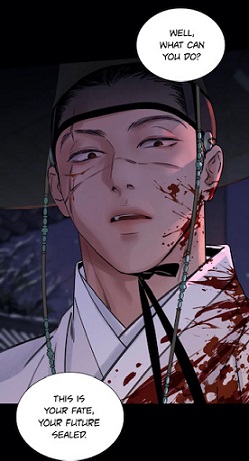 (Chapter 1) Here by saying this, he was encouraging the boy to fight back and not accept his fate.
Another important detail is the lord‘s attitude during that night. First, he was wearing a white hanbok. 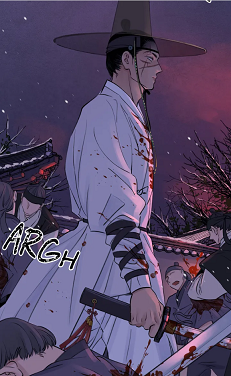 (Chapter 1) In Joseon, the color white was traditionally used for funeral. He was dressed for the occasion: there would be death during that night. Secondly, he walked through the courtyard searching for father Lee. This means that he had chosen to kill the scholar himself. He had not sent his guards or minions to do it. In other words, he was showing a certain respect towards Lee Yeongjo‘s father.
  (Chapter 1) This exposed the main lead‘s true personality. He doesn‘t mind dirtying his own hands, he is taking responsibility for his own decisions. Finally, Lee Yeonjo was just a young boy back then. He had no idea about the political context and circumstances of this purge. He perceives the king and his governor as the villains
 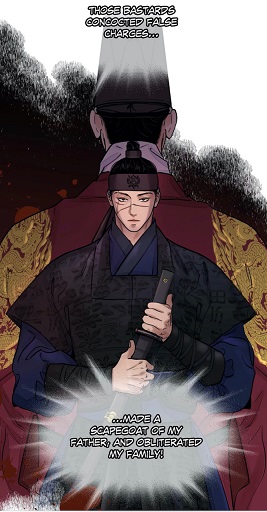 (chapter 7), for he lost everything during that night. Yet, he has no idea what kind of official his father was and why this massacre took place. Lee Yeonjo needs to distinguish the difference between the father and the official. Besides, observe that the slave is seeking revenge, and not justice. From my point of view, this second confrontation with cruel reality is necessary to put this tragedy in the bigger picture. In my eyes, it is related to the hojok.
 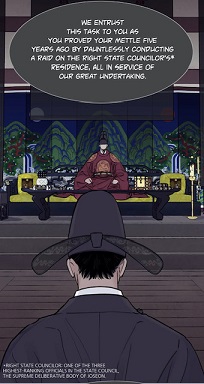 (chapter 2) If not, the king would not have mentioned the service done from 5 years ago. As a conclusion, the lotus is about to discover the reality of the murky water, while Kwon Hee-Ryang doesn’t appear to be a snake.
At the same time, I started wondering which color Yeonjo was associated: white, pink, blue or purple? From my point of view, the slave is connected to the purple lotus flower. Why? First, it is because of his white skin and blue eyes. Combined together, we have violet.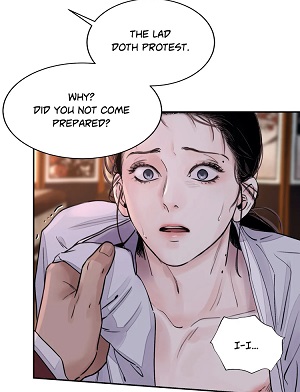 (Chapter 8) In addition, he is wearing a purple shirt.
 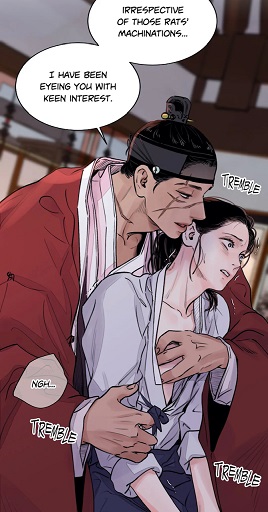 (Chapter 8) He is surrounded by rats, a metaphor for the dirty water and as such the corruption in the palace. And what is the meaning of the purple lotus flower?
A lotus flower, in general, symbolizes fertility, compassion, spiritual enlightenment, impurity. The purple lotus flower has a unique existence because it represents the Noble Eightfold Path of Mysticism. It is represented by the eight petals and how the lotus flower grows from first the deep mud to the sunlight, and then blooming for three days is a beautiful fragrant purple flowers. The purple lotus, in particular, is unique, and the color changes according to the sunlight, the moonlight, and the temperature. This gives it a glowing and magical effect of transformation. Quoted from https://www.petalrepublic.com/purple-lotus-flower-meaning/
This means that this flower is even more powerful than the pink lotus flower. This signifies that Lee Yeonjo will rediscover his original personality, he will metamorphose and give up on his suicidal thoughts. Simultaneously, the presence of the purple lotus flower indicates that it will clean the whole place and bring destruction to the hojok and others. As a conclusion, the lotus flower implies the main lead’s transformation (like for example acceptance of his sexual orientation), just like it will change others. He will find a new purpose in his life: fight for justice. So far, his thirst of revenge is connected to suicide and despair. Since his father is judged as a traitor, it is also possible that Kwon Hee-Ryang proposes him a deal. He could clean his father‘s name. But we will see.
In the third part, I had compared Kwon Hee-Ryang to a snake, and concluded that on the surface, he was not behaving like the animal from the bible in front of the slave: lies and deception. On the other hand, what did lord Chang do, when the young man got bullied? He blamed the main lead! Why? Notice that when the administrator arrived, he caught Yeonjo fighting. 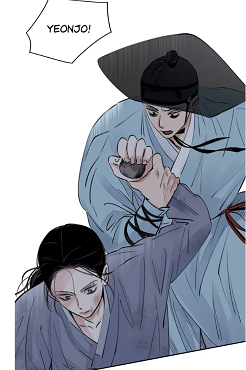 (chapter 1) This could only reinforce such a prejudice. Another reason for this misjudgment is his assistant’s report.
 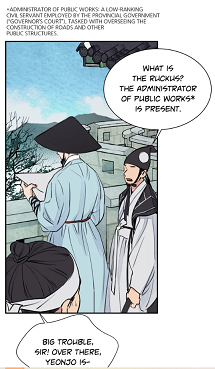 (chapter 1) The protagonist was portrayed as the one causing trouble, while in truth it was the opposite. The source for the ruckus was the noble’s favoritism towards the main lead. To sum up, lord Chang was viewing the main lead in a negative way. This interpretation is even corroborated in chapter 7:
“I hope no trouble finds him for these few days I’m away”.
His words are implying that the main lead is somehow responsible for trouble. However, the noble never realized that his indecisiveness is one of the main issues in his relationship with the main character. Since he used the brother’s sickness for his own advantage, and could obtain the slave’s body so easily, he never tried to understand Yeonjo. He knew about his hatred (chapter 7), yet he didn’t attempt to ease the main lead’s heart and mind by removing the source of his negative emotions: the injustice he felt for the loss of his family and name. But why does he resent lord Chang? Simply because as the administrator for the construction, he represents the king‘s authority. The huge gap between Lee Yeonjo and the official becomes more visible, when the protagonist changes his attitude so suddenly. The lord never tried to seek the real reason behind the sudden change of heart. Why should he, since he was gaining something?
 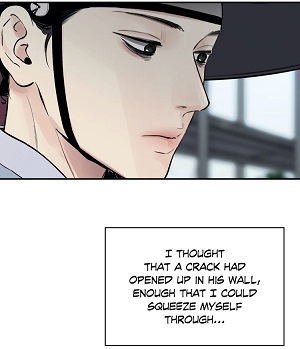 (chapter 7) He had a reason to believe in his lies so easily.
 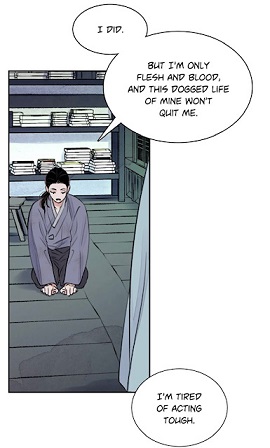 (chapter 2) He imagined that since the young man was accepting him as his sponsor and benefactor after the brother’s death, he was getting closer to obtain Yeonjo’s heart. Because of Lee Yeonjo’s attitude towards sodomy
 (chapter 1)(chapter 7), it is quite obvious that the idea of prostitution was brought up by lord Chang. In exchange for medicine and special treatment, Lee Yeonjo could help his brother. So this offer was a temptation which could only lead to issues. The young boy’s reputation suffered. That’s the reason why we shouldn’t underestimate lord Chang’s personality. He might act gentle and caring, but behind his kindness hides real selfishness. On the other hand, the submissive slave was acting in front of the administrator, so that we should question ourselves if with this suggestion, Lee Yeonjo was not acting as the snake.
When the protagonist announced that he had a change of heart, the administrator had no inclination to doubt his words. He hoped that the main lead would come to fall in love with him. It was just a matter of time. Yet it was clearly a delusion, for the simple reason that lord Chang is not assuming his own sexuality. First, the readers should pay attention to the location of their sexual encounter: a library!!  (chapter 5) It was not in his own place. The noble was not becoming responsible for his sexuality and their relationship. This explicates why the lord said that he was hurting the servant.
 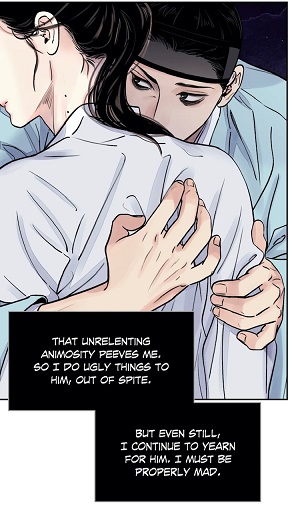 (chapter 7) Thus I come to the conclusion that lord Chang is behaving similarly to Lee Jihwa. He is yearning for Lee Yeonjo’s love without risking anything, he prefers maintaining his good reputation.
In addition, note that he used the festivities as a justification to switch his shift 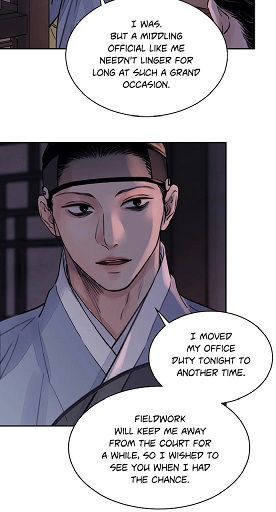 (chapter 4), while he could leave the banquet by saying that he had an office duty. No one would ever question his disappearance. That way, he wouldn’t be caught with the main lead. Naturally, the staff has ears and eyes, so that they can not be fooled. That’s the reason why he got bullied by the workers. However, lord Chang will never be confronted with the rumors, for he is a noble.
 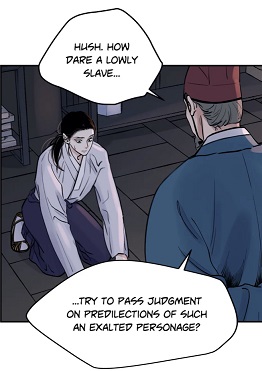 (chapter 7) Due to their social status, the servants are not allowed to show their disapproval. This explicates why Yeonjo became the target of the grapevines.
  (chapter 6) Only him will be judged and looked down. The last comment lets transpire that if the “lotus” had not been there, lord Chang wouldn’t have asked to have him as a boy toy. Note that he is portrayed as the seducer. In their eyes, he is the snake.
As you can see, the introduction in the bedchamber was the starting point for the governor to investigate the servant’s origins. (chapter 7) He knew, he was a fallen noble, and he had been hired to spy on him.  (chapter 7) This shows that the lord is never taking anything for granted. In my eyes, he is always questioning the intentions of his counterparts. That’s the reason why he can anticipate his enemies’ moves. He is always asking why. Therefore I perceive this scene as an important turning point in the protagonists’ relationship.
 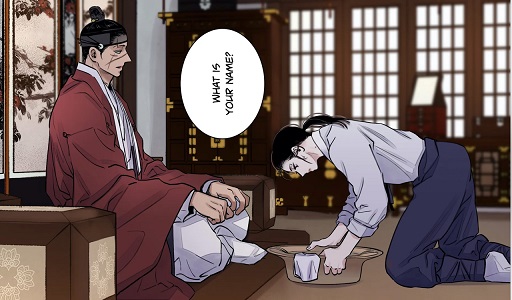 (chapter 7)
One of my followers even pointed out that Kwon Hee-Ryang was so cunning and perceptive that he appears as scary. Compared to him, Yoon Seungho looks so naive and even stupid for not being able to detect his acquaintances’ lies and anticipate their moves. But this is totally normal. We have to envision that Yoon Seungho was held captive for 10 years, and he was brainwashed. He lived for 10 years as a male kisaeng. He was never confronted with politics. Therefore he is lacking experiences, and has no knowledge of the “real world”. Kwon Hee-Ryang had to fight to climb the social ladders and get close to the monarch. The scars on his body and face are the evidence of his dedication and strong will. Since Yoon Seungho was portrayed as an innocent and simple-minded man, I realized that he must not have been the real author of the fake promise to Jung In-Hun. 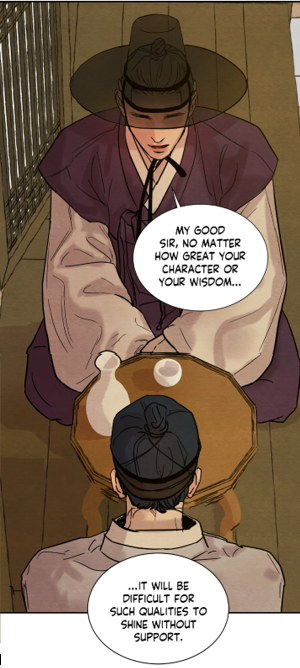 (chapter 7) Kim must have suggested him this scheme. But he had no idea that he was inviting a snake into his realm. We imagined that the butler didn’t know the learned sir, for the main lead had no idea about the man. Nevertheless, their path had crossed in the past: in the gibang.
 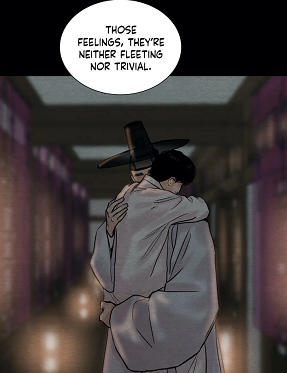 (chapter 68) How could the protagonist have paid attention to the learned sir, when he got caught by the black guard?
 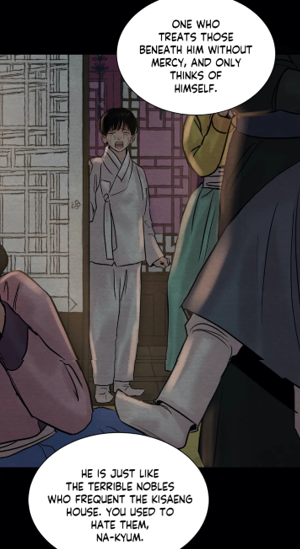 (chapter 68) Kim represents knowledge from the past. He must have remembered Baek Na-Kyum and Jung In-Hun in the past. And what did he see? A caring and gentle man… so he thought that if the scholar met the infamous Yoon Seungho, he would worry for the painter and take him away. But no… he accepted the invitation. He imagined that he had not heard the rumors, thus he spread rumors about the lord.
 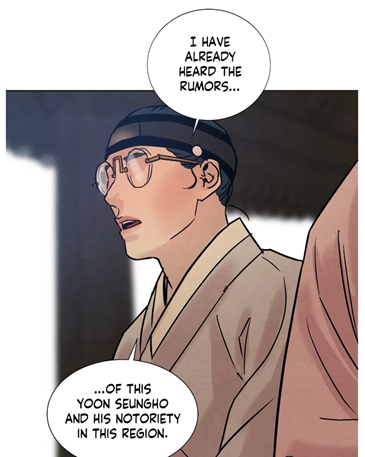 (chapter 10) He envisioned that this would upset the righteous learned sir. However, this was used to scare the low-born… When the incident with the ruined painting occurred, and the scholar didn’t intervene, the butler imagined that Jung In-Hun was protecting himself, and the painter would resent him for his passivity. Yet, the painter remained in the mansion. The assistant sensed the strong bound between these two men, so he thought that Jung had indeed feelings for Baek Na-Kyum, but he was just powerless. He projected his own thoughts onto the learned sir: “He couldn’t do anything”. That’s the reason why he let him see the rape. Everything was done to scare the teacher who had such a good reputation. Then he suggested that he should see a shaman, he hoped that the man would ask about Yoon Seungho so that the shaman would tell him that the main lead was a bird of misfortune… but Jung asked for something else: digging up the past. Notice that on the day, he was supposed to meet the former servant, the main character was given the sword
 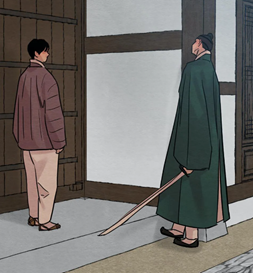 (chapter 35). Striking is that he let his master see the artist with Jung In-Hun in the courtyard. Here, the scholar was again coming back from the pond! So he was not learning. However, the stroke and the gentle words from the learned sir had one purpose: they were to remind to Yoon Seungho that the artist would only listen to Jung. He was the real master. Yes, this was the reflection from episode 30!
 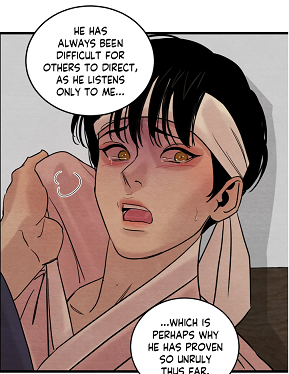 (chapter 30) And in both situations, the learned sir had escaped the noble’s wrath. In my eyes, the real target in episode 35 was the scholar. The latter was supposed to die along with the painter, but it failed. Under this new perspective, it becomes so understandable why Yoon Seungho couldn’t detect the schemes. As a lotus flower, he was still pure and innocent. He could never be the snake.
And now, we know how Kim could trick Yoon Chang-Hyeon and earn his trust: he could compliment him while laughing behind his back.  (chapter 6) Here, the lord was actually imitating the butler. And this shows the stupidity of Kim’s move. Why?
  (chapter 7) It offered indirectly a comeback for the Yoons to the palace. Furthermore, Jung In-hun seems to have succeeded the first round of the civil service examination. This is important, because this means that if Jung In-Hun is indeed dead, his disappearance will definitely involve the intervention of the authorities. Because Yoon Seungho was so innocent to plan great schemes, I can only assume that the readers were witnessing the scheming nature from the butler. And this leads me to the following observation. If the butler Kim is indeed a “snake”, this doesn’t mean that he was evil right from the start. He had a rebirth as well, but he just chose a different path. He decided to ensure that he would live in peace, and if his peace is in danger, then he can bite! And now, you comprehend why Kim felt threatened by Baek Na-Kyum. His presence could lead to the following discovery: Yoon Seungho was not a bird of misfortune, but a beautiful lotus flower! And once this lie was detected, his power based on deceptions and half-truths would get ruined.
Thanks to the painter as the lotus flower, the lord could slowly regain his freedom. But like mentioned above, the main lead is the lotus flower as well, thus Byeonduck created such a picture. This explicates why Baek Na-Kyum got purified first!!
So far, I have been describing the serpent as something negative. It is connected to the Fall of Man: lies and seduction. Nevertheless, the snake shouldn’t be perceived as something negative entirely. He embodies knowledge. Moreover, this animal has something in common with the lotus flower: it symbolizes “rebirth”.
“Snakes represent life, renewal, and rebirth. Over a period of time, snakes accumulate dirt and grime on their skin but they have the unique ability to shed their skin to get rid of the filth. Due to this quality of the snake, many people use it as a symbol of self-renewal. Just like the snake, if we are ready to shed off the past, we can rid ourselves of what was holding us back and be born again. Additionally, in many ancient cultures the snake has represented a rebirth of the physical body. For instance, in ancient Greek mythology, god Asclepius, who has a snake on his staff, is believed to remove diseases and restore the body.” quoted from https://symbolsage.com/symbols-of-rebirth-and-their-meanings/
This is relevant, because this means that the meeting between Kwon Hee-Ryang and Lee Yeonjo is announcing a rebirth. When the warrior entered his life for the first time, he brought death and destruction (chapter 1), now I believe that we are about to witness the opposite. The young slave needs to get a new goal in his life. the revenge was associated to death.
What caught my attention is the official’s comment.  (chapter 8) He has the intention to treat him as his boy toy, to keep him by his side. Anyone reading this can only get upset. He is viewing the protagonist as a plaything. But the manhwaphiles should recall that contrary to lord Chang, the governor is planning not to hide their relationship. He will improve his situation, whereas it was not the case with lord Chang. Besides, I don’t think that in the bedchamber, the official was aware that the young man rejects homosexuality. Secondly, the manhwalovers should keep in their mind that the boy was sent there to spy for headman Choi. So with such an offer, Kwon Hee-Ryang hoped to deceive his enemies, letting them think that their plan had succeeded and the governor was blinded by his lust.
As for lord Chang, the latter might have given Yeonjo medicine or excuse him from work for the brother’s funeral 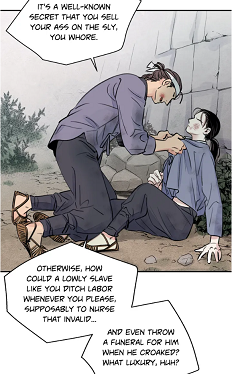 (chapter 1), but he was still working for the bureau of construction. Lord Chang as his superior never sent him to another department. He only used his connection, when the young man asked for this favor. This shows that the administrator never had the intention to change anything. He imagined that with the brother’s death, the young man would still have sex with him. This explicates why the main lead rejected the sweets from the noble.
 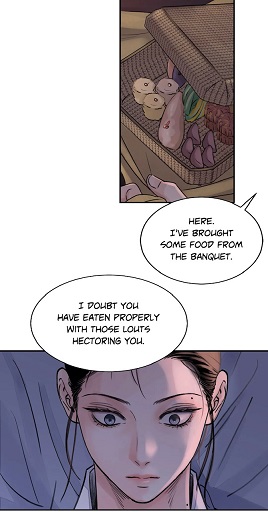 (chapter 4) This was not real kindness, for the food would never contribute to improve his living conditions. Yeonjo was still treated like a prostitute.
 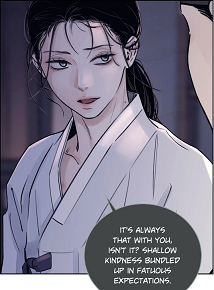 (chapter 7) The administrator might be acting, as if the slave was his lover
 (chapter 5), but this was behind closed doors. These words were just more or less lip service:
  (chapter 5) He still had leave him behind because of his work. Besides, the main lead was now acting, as if he was accepting his work as a “prostitute”. In exchange for the help, he had now to serve his benefactor. In the open, I doubt that the lord would like to be seen together having sex. Moreover, don’t forget that Yeonjo is called the son of a traitor, which could be another reason for lord Chang not to make their relationship official.
This stands in opposition to the governor’s attitude. Kwon Hee-Ryang feels no shame and embarrassment for his sexual orientation. Therefore he has sex outdoors. 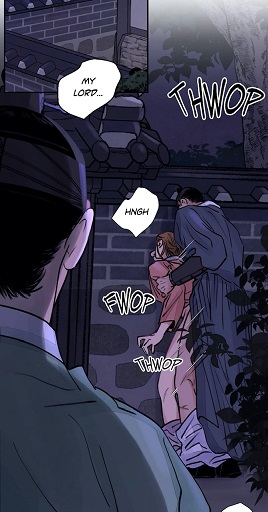 (chapter 4) He didn’t even mind being seen. He even made fun of Gisook, one of the men supporting the hojok.
  (chapter 4) That’s the reason why I believe that Kwon Hee-Ryang’s promise was honest. (chapter 8) If he became his boy toy, he would be “protected”. No one would dare to bully the slave. And now, you comprehend why Lee Yeonjo got badmouthed and bullied. (chapter 1) (chapter 6) People knew the nature of the relationship between lord Chang and Lee Yeonjo, but since the lord had never made an official statement, people could only conclude that the young man was selling himself for favors. However, the reality was the exact opposite. Lord Chang had been using his social status and wealth to obtain what he desired the most: sex.
  (chapter 4) He hoped to obtain the lotus’ love. Another important contradiction is the mark bite. While the noble with the dark circle did it without Yeonjo’s knowledge
 (chapter 5), Kwon Hee-Ryang did the exact opposite.
  (chapter 8) He was marking the slave as his possession, but he was making sure that the slave was well aware of this.
  (chapter 8) Since the governor is the son of the concubine, he came to resent social norms. This explicates why he doesn’t follow social norms. Consequently, it is not surprising that he doesn’t hide his sexual orientation. That’s the reason why I believe that the official will play a huge role as the uke’s mentor. He might be a snake in Yeonjo’s eyes, yet he is totally misjudging the man. He is not relying on his status and power, he knows that he needs to be prudent and observant in this hostile environment. That’s the reason why he can perceive people’s personality quite well. It looks like he is looking into their eyes so that he can detect their thoughts and emotions. That’s the reason why I come to the conclusion that the governor and the administrator are both snakes, but they stand for different values. Brutal honesty versus gentle hypocrisy.
Kwon Hee-Ryang is very seductive, but also gentle  (chapter 7), for he pays attention to his counterpart’s well-being. He noticed the wound, he kissed Yeonjo before the sexual encounter in order to set the mood
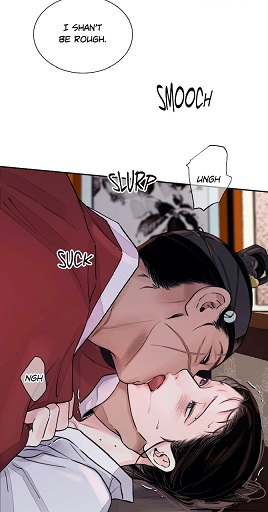 (chapter 8), while lord Chang did the exact opposite. First rough sex
  (chapter 5), then after the climax he showered the main lead with tenderness. (chapter 5) But don’t get me wrong. The governor can be rough in sex as well. Moreover, the latter is indeed a dangerous man, and he shouldn’t be underestimated. As you can detect, I fell under the spell of Kwon Hee-Ryang, and I am looking forward for the evolution of the couple’s relationship.
Feel free to comment. If you have any suggestion for topics or manhwas, feel free to ask. If you enjoyed reading it, retweet it or push the button like. My Reddit-Instagram-Tumblr-Twitter account is: @bebebisous33. Thanks for reading and for the support, particularly, I would like to thank all the new followers and people recommending my blog.
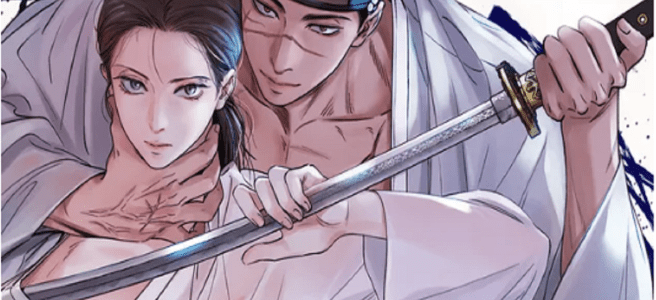
This is where you can read the manhwa. https://www.lezhinus.com/en/comic/steel_silk But be aware that this manhwa is a mature Yaoi, which means, it is about homosexuality with explicit scenes. If you want to read more essays about other manhwas, here is the link to the table of contents: https://bebebisous33analyses.com/2021/06/06/table-of-contents-of-analyzed-mentioned-manhwas/ Here you can read a second analysis about Steel Under Silk: https://bebebisous33analyses.com/2022/05/11/steel-under-silk-painter-of-the-night-the-lotus-%f0%9f%8c%b8-and-the-snake%f0%9f%90%8d/
It would be great if you could make some donations/sponsoring: Ko-fi.com/bebebisous33 That way, you can support me with “coffee” so that I have the energy to keep examining manhwas. Besides, I need to cover up the expenses for this blog.
When Lezhin US announced the release of snob’s new manhwa, many readers were surprised by the English title: Steel under Silk. They were all expecting the following title: “Blade and flower”, because this is the actual title in Korean. The blogger @Theprocrastinatingredkitty even questioned https://theprocrastinatingredkitty.tumblr.com/post/682875047499726848/in-other-unrelated-potn-news-blade-and-flower-has the reasons behind the change. How did the original title get lost in translation? Naturally, it was done on purpose, and I can’t tell exactly how this choice came to the surface. Nevertheless, I would like to give a possible answer why the English title fits perfectly to this story. But for that, I need to explain the meaning of the original title first. Then I will elaborate the signification behind the new title by including an examination of the story and characters.
Like mentioned above, it is important to elaborate the symbolism behind the original title. The blade is a synonym for the knife which embodies severance, death, sacrifice, division or even liberation. Striking is that the first chapter reflects these notions. It started when Kwon Hee-Ryang entered Lee Yeonjo’s life and killed his father in front of his eyes.  (chapter 1) From that moment on, the main character lost everything. In one single night, he became the son of a traitor, while in reality we have to imagine that the king had made a coup d’état and got rid of his opponents. This explicates why Yeonjo made the following statement: A new king!!
 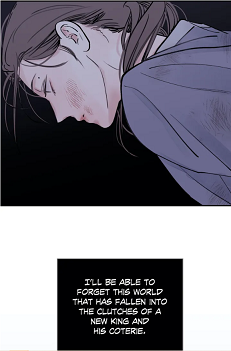 (chapter 1) In other words, Lee Yeonjo’s father was sacrificed. However, this is just the beginning, because now the king is determined to strengthen his authority and power by eliminating the hojok in Hamgil-do. This means that Kwon Hee-Ryang will have to use his blade for the monarch one more time. Simultaneously, Lee Yeonjo as a slave is seeking revenge. He plans to kill the person whom he views as responsible for his family’s death: Kwon Hee-Ryang. But the real mastermind behind this is actually the new king.
 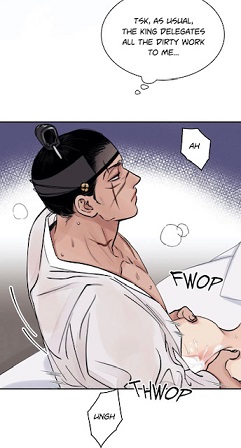 (chapter 2) The reference of the “blade” in the title implies that the relationships between the characters in the story will get affected: severance, sacrifice, liberation and death. There’s no ambiguity that lord Chang won’t be able to use Yeonjo as his boy toy like in the past, or even claim him as his lover due to Yeonjo’s closeness to the new governor Kwon Hee-Ryang. (chapter 6)
On the other hand, if I take into consideration that the main lead is carrying a sword in his hand, the blade could be a reference to this weapon. Thus I should add the signification of the sword as well. 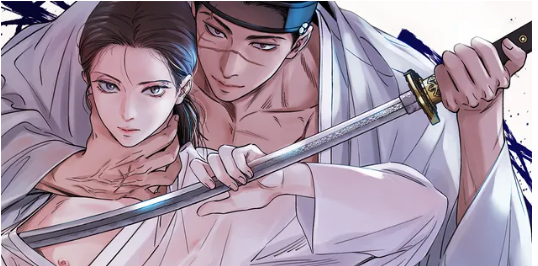 The sword symbolizes not only power, protection, authority, strength, courage, but also righteousness and justice. This explicates why the sword Excalibur was given to the king Arthur or the goddess of Justice with her covered eyes is carrying one. With her sword, she is giving justice. Therefore it is not surprising that the main lead is seeing carrying a sword. He is not just protecting the new king, he is making sure that the hojok
 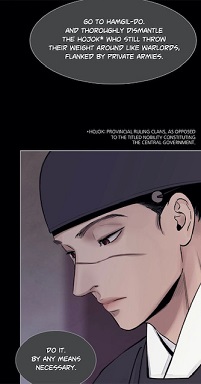 (chapter 2) are removed, for they represent a threat to the royal authority. The monarch is supposed to represent “justice”, but if there exist warlords, the latter can do whatever they please. This means, they can escape any punishment, the king can not control them. Finally, the sword should be perceived as a metaphor for the phallus (penis). As the manhwaphiles can sense, the blade is referring to the main lead Kwon Hee-Ryang. That’s the reason why I believe that when Snob chose the title, she was thinking of the two protagonists, Hee-Ryang was the blade, and the flower was the uke Lee Yeonjo.
But if the sword represents justice, why did Lee Yeonjo‘s father get removed? Let’s not forget that this story took place in 1448. 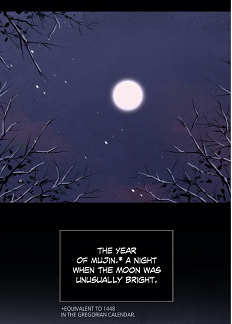 (chapter 1) That’s the reason why I looked into that historical period. This is what I found:
“King Sejo of Joseon (hangul: 세조; hanja: 世祖; 1417-1468, r. 1455-1468) was the seventh king of the Joseon Dynasty of Korea. Born in 1417 as Yi Yu, he was better known as Grand Prince Suyang. The second of King Sejong the Great’s many sons, he showed great ability at archery, horse riding, and martial arts. Suyang was also a brilliant military commander, though he never went to the battlefront himself. Although his ascent to the throne was stained with ruthless bloodshed and the forced removal of his nephew from the throne, he went on to prove himself one of the most able rulers and administrators in Korean history. […] First, he strengthened the monarchy established by Taejong, by weakening the power of the prime minister and bringing staff directly under the king’s control. The Uijongbu, the board of counselors who helped the king rule that had been established by Taejo and Taejong had been intended to give the king support and collective wisdom to assist him in running the country, but in practice, the members of the aristocracy on the board had become too influential, and held too much of the power, so Sejo restructured the government to return more power to the king. […] He restructured the military system, stationing large military garrisons in each province.” quoted from https://www.newworldencyclopedia.org/entry/King_Sejo
“From 1456 on, Sejo’s power was not again questioned. He had his way in virtually everything, and it can be said in his favor that, once established, he was a remarkably effective king. Among his achievements were lavish support of Buddhist writings and their publication, effective frontier defense, suppression of a major rebellion, and institution of the “secret censor” system, by which royal spies circulated covertly through the provinces ferreting out and summarily punishing corruption. In time these posts became themselves major focuses of graft, but the original idea of incorruptible censors had a long life in popular fiction.” quoted from https://biography.yourdictionary.com/sejo
Though the dates don’t correspond perfectly, we can perceive strong parallels between the ruling of Sejo and this faceless king, for their policy is very similar. (chapter 2) Hence I am assuming that the author was inspired by Sejo. Kwon Hee-Ryang’s biography indicates that the monarch values more merits than lineage. 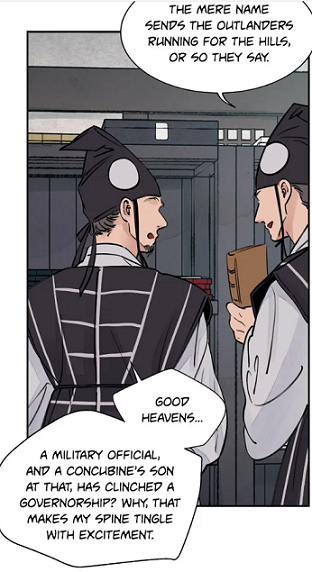 (chapter 1)The main protagonist is the son of a concubine, therefore according to social norms, he should have never expected to raise the ranks and become a governor. He is not the official son. This explains why the main lead has so many scars, and why he is willing to do the dirty work. He had to work hard to reach the top of the hierarchy. This exposes the strong will from the new governor. He never accepted his fate as the son of a concubine, who was supposed to live in the shadow. The manhwalovers should keep in their mind that in Joseon the son was supposed to inherit the mother’s social status. That’s the reason why I don’t believe that Kwon Hee-Ryang truly meant this, when he spoke to Lee Yeonjo. (chapter 1) The man could sense the main lead’s resent in his eyes and even provoked him with this statement. He didn’t want him to give up on his life. In truth he was encouraging him to fight back and not to resign. Why? It is because the noble had been put through the same experience. He had not accepted his fate as the son of a concubine. And now, you comprehend why Yeonsuk and his brother’s life were spared. Actually, they should have been killed, since the father had been labelled as a traitor. They would usually eradicate a whole household due to this principle: “guilty by association”. To conclude, the governor embodies the sword, for he is a representative of the new ruler. He was sent as a spy to eradicate corruption and eliminate the powerful lords close to the border. As you can imagine, I came to the conclusion that Lee Yeonjo represents the flower.
And now, it is time to examine the different significations of a flower. Contrary to the blade, the flower embodies life and emotions, for it is not cold. The beautiful face from Yeonjo is arousing many emotions in Kwon Hee-Ryang and lord Chang. Both feel attracted. (chapter 5) Besides, it symbolizes tenderness and temporality as well. Therefore a beholder will want to protect it. Kwon Hee-Ryang (chapter 2) and lord Chang (chapter 1) intervened and stopped the bullying from other slaves. That’s how the two semes perceive the slave due to his frail silhouette. He is small and thin, therefore he reminds them of a fragile flower which could be trampled on so easily by others. However, this is just an illusion, as we can view it in the last image. Lee Yeonjo is not afraid of fights, he will never allow others to look down on him. He can fight back, if he desires it. And this leads me to the English title.
One might reject the English title, for steel appeared during the Industrial revolution which took place in the 19th Century. Yet, the story is set in the 15th Century. Therefore we would have an anachronism. On the other hand, the readers shouldn’t overlook the alliteration, the figure of style in which a series of words, usually two or more neighboring words, have the same first consonant sound. In our case, it would be the “S”. This letter and sound is associated to the snake. 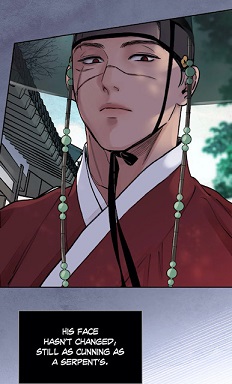 (chapter 2) As you already know, the serpent embodies cunningness, knowledge and seduction. This is important, for “silk” is a reference to the bed. As you can see, the English title gives us a totally different approach. It implies sex. Furthermore, steel symbolizes strength and invulnerability. I would even add: determination and calculation, for a metal is cold and hard. Thus I come to the deduction, steel represents strategy and power. Since steel is used in weapon, I conclude that the author desired to include the notion of a fight in the bed. Yes, here I detect some similarities to Yoon Seungho’s following doctrine: “Sex is like a battle”. The one surrendering to his feelings should be judged as the loser. Though the story has just started, the manhwalovers could sense the presence of struggle during a sex session.
  (chapter 5) No one is allowed to reveal his emotions: neither passion nor pleasure.
In addition, the readers can detect another difference from the Korean title: the vanishing of “and”. Since I had pointed out that for me, the blade and the flower represented the 2 protagonists, I came to the conclusion that Steel and Silk can not be referring to two different characters. For me, Steel under Silk represents all the main characters in this story: Lee Yeonjo, Kwon Hee-Ryang and lord Chang.
What caught my attention is Lee Yeonjo’s strength. In verity, he is not a flower. I would even say that he is as strong as Kwon Hee-Ryang. This was particularly visible in this panel. 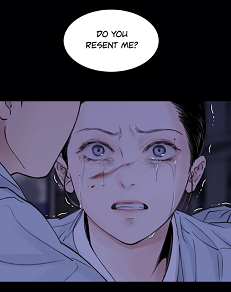 (chapter 1) He watched how the main lead killed the protagonist’s father. He never closed his eyes and looked straight into his enemy’s eyes. Note how he is clenching his jaw, a sign for hatred and strong-will. He didn’t hide his true thoughts and emotions. Furthermore, there’s blood on his face, which is quite similar to the scars from the governor. Despite the blood and the violence, the young boy never closed his eyes, while the older brother was turning his back on Kwon. And now, you comprehend why the governor feels that he has already met Lee Yeonjo. He could never forget this gaze full of resent and determination. In that scene, Lee Yeonjo showed courage.
 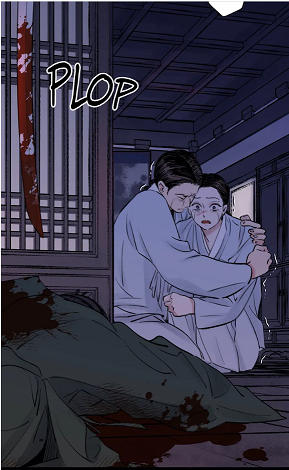 (chapter 1) He didn’t mind provoking his enemy with his daring gaze. Observe the huge contrast to the brother. The latter closed his eyes, and later turned his back on the official. This is not surprising that at the end, Yeonjuk died. He could never bear the cruelty of this world and resigned. I would say, the scene in the first episode revealed the brother’s weakness. Yeonjo might have been trembling, yet the latter was in reality the one comforting his brother. In other words, Yeonjo is a fighter. Therefore it is no coincidence that we could see him imaging how he would attack his enemy.
 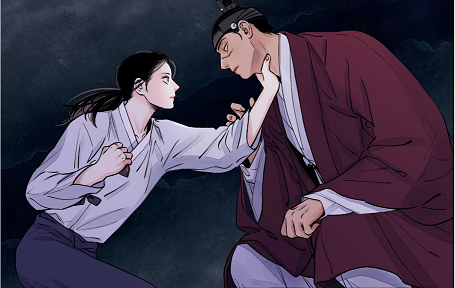 (chapter 6) But he doesn’t let his emotions cloud his judgement. This explicates why in his second meeting with the governor, he didn’t try to take his revenge on the main lead immediately. The uke is calculating, developing how he should approach the official. (chapter 6) The bed is the place where the man is totally vulnerable, for he is sleeping. But the main lead is far from stupid, he doesn‘t trust many people.
We could see how determined Lee Yeonjo was in a different area: Prostitution. Since he chose to prostitute himself for his brother’s sake, he never considered himself as a homosexual. (chapter 1) Hence it is not surprising that he rejects sodomy. For him, selling his body was just a duty, and not really a job. Therefore he forces himself to think that he shouldn’t feel any pleasure. This explicates why he is resisting and not admitting that he is aroused while having sex with lord Chang. (chapter 5) Yet, his hands and his curled toes are betraying him. This means that Lee Yeonjo’s inner struggle about pleasure will keep increasing, the more time passes on. Note that his position changed, the moment he requested from the administrator of public works his assistance and protection. Here, the main lead lied saying that he desired to live a better life. (chapter 2) Lee Yeonjo was implying that he was willing to rely on someone. Hence it is not surprising that lord Chang started treating him more like his lover in episode 5. On the other hand, since headman Choi asked the protagonist to seduce the governor, this means that the slave will be forced to use his body differently. Even if he fails in the beginning, there’s no ambiguity that the young man will be cornered at some point. How can he “seduce” his enemy, if he is as cold as steel? This will force Yeonjo to act, even to fake pleasure. Thus I am expecting that Kwon Hee-Ryang will play a huge role in the slave’s transformation, his acceptance of his sexual orientation. And this leads me to the following observation. Steel under Silk is revealing the presence of a disguise and as such of acting. Note that Lee Yeonjo has been acting tough or respectful in front of the two other main characters. He never shared his suicidal thoughts to lord Chang. He is never honest to his counterparts.
Another important aspect is that Kwon Hee-Ryang truly views the slave as weak and frail, for he caught him in two situations, where he showed vulnerability. This incited the governor to show great care towards the young man. (chapter 3) Yet, the latter doesn’t want to be judged like that. Imagine his rage, when he had to thank the governor for his help and benevolence. (chapter 2) How could be thankful towards the man who had brought misfortune to his family? He is in truth steel behind his thin body.
And this is not something that the governor is expecting from the slave. He wished to see the young man in tears, as the latter would feel extreme pleasure. But this will represent a immense hurdle for Kwon Hee-Ryang. Not only the slave resents him, but also he rejects homosexuality. Thus I am expecting that the battles in the bed won’t be easy. For the first time, the governor will meet a strong-willed opponent.
On the other hand, the governor is also represented by steel. Behind his title as an official, he hides his true function: a fighter. 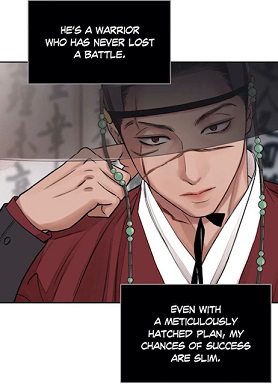 (chapter 2) As a warrior, he was tasked to eliminate the hojok. And he will use every possible mean: poisoning for example. He is a strategist exactly like Yeonjo. The only difference is that he has more experiences than the slave. The noble could perceive the betrayal from headman Choi right away and even anticipate his moves: planting spies through the kisaengs. Since the man is nominated as a governor for 2 years, the warlords are underestimating their opponent’s authority. And this observation leads me to the following conclusion. The slave was the only one who could detect Kwon Hee-Ryang’s true personality. He is a warrior and he is cunning as a snake. Why? It is because he witnessed himself that the man wouldn’t mind to dirty his hands himself. (Chapter 1) He killed the traitor himself. However, due to his “robe” as a governor, his enemies are underestimating his intelligence, ruthlessness and his strength. He can do it without any trouble, since he is backed up by the monarch himself. As a conclusion, the silk can be also a reference to the hanbok and the official robe as the governor. I have to admit that I couldn’t help myself thinking of this scene from Painter Of The Night:
  (chapter 88) The removing of the jacket made of silk… Behind the silk hides a chest made of steel… 😉
On the other hand, I have the impression that Yeonjo doesn’t know his enemy either. He is overlooking him as a governor. The slave is driven by his revenge, yet he is forgetting the importance of politics and the problems concerning the country. From my point of view, Yeonjo needs to see Kwon Hee-Ryang acting as a governor. He never saw his sense of justice, when the noble said this. (chapter 2) He was fair, as he never asked for a punishment for Yeonjo. He could perceive that he was a victim, and he didn’t condemn him because of his social status. Later he never asked for a punishment, when the domestic broke the vase as well. In fact, he valued more the slave than the broken item. 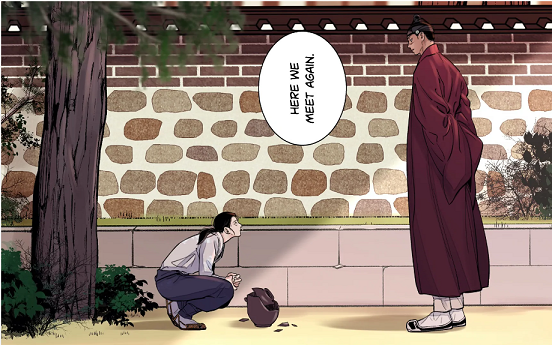 (chapter 6) Yes, Yeonjo is not paying attention to this. But it is only a matter of time, until he discovers the main lead under a different light. Notice that both are standing behind the sword, an indication that they will come to stand on the same side.
There’s no doubt that this man is in love with the slave Lee Yeonjo. This was truly perceptible in episode 5, where he kissed the main lead so tenderly. (chapter 5) Striking is that he even bit him. (chapter 5) It was, as if he was marking Yeonjo as his lover. He thought, he had finally the main lead in his hand. The latter was no longer rejecting him,  (chapter 2), he was even requesting his help and protection. Thanks to him, he would have an easier life. This explicates why the next time they met, lord Chang was particularly gentle. (chapter 5) He could even sense that Yeonjo was feeling pleasure, and it was no longer prostitution.
But lord Chang has no idea about Lee Yeonjo’s revenge. This is important, because so far, the man doesn’t have a high position in the administration. He doesn’t seem to have a lot of power. But what will he do, when he sees that Yeonjo is getting closer to the governor? Let’s not forget that he brought him to the castle himself. He will have to find a way to get back Yeonjo… either by supporting him in his request for a revenge or by getting more power, because he believed in his lies:  (chapter 2) Here, he believed that the main character had moved on and overcome the brother’s loss. That’s the reason why we should expect a transformation of lord Chang. He might raise the rank as well… So far, the administrator seems quite caring and gentle, but I have the impression that he is only showing this side towards the main lead. He showed favoritism which stands in opposition to justice. The manhwaphiles should keep in their mind that lord Chang is responsible for the construction of streets or protection walls. This means that he is in charge of many slaves. He could definitely let the workers work to exhaustion so that he could finish his projects on time. Thus I deduce that he is a man of steel as well. He could be as coldhearted as Kwon Hee-Ryang. In other words, I believe that Yeonjo will discover a new side from lord Chang. As the administrator of public work (behind his silk), he could be quite demanding and cold.
As the manhwaphiles could see, I do think that the title of “Steel Under Silk” is quite a good choice. It offers more aspects, and thanks to the metaphors, I could get new insight.
Feel free to comment. If you have any suggestion for topics or manhwas, feel free to ask. If you enjoyed reading it, retweet it or push the button like. My Reddit-Instagram-Tumblr-Twitter account is: @bebebisous33. Thanks for reading and for the support, particularly, I would like to thank all the new followers and people recommending my blog.


Please support the authors by reading the manhwas on the official websites. This is where you can read the manhwa. https://tapas.io/series/under-the-green-light But be aware that this manhwa is a mature Yaoi, which means, it is about homosexuality with explicit scenes. Here are the links, if you are interested in more analyses about this manhwa https://bebebisous33analyses.com/2022/08/16/under-the-green-light-sweet-potato-%f0%9f%a5%94/ and others: https://bebebisous33analyses.com/2021/06/06/table-of-contents-of-analyzed-mentioned-manhwas/
It would be great if you could make some donations/sponsoring: Ko-fi.com/bebebisous33 That way, you can support me with “coffee” so that I have the energy to keep examining manhwas. Besides, I need to cover up the expenses for this blog.
When people read the manhwa Under The Green Light, they can detect in the pictures the predominance of 2 two colors, green and black.  (chapter 11) It was, as if this world was monochrome. However, I started wondering why the author chose green monochrome pictures as process and as such why she selected such a title. As you can imagine, there are many possible answers, and it is up to the readers to give an answer. Thus I will try to give different explanations for the choice of JAXX. Naturally, this is my own interpretation.
I could use the different meanings of this color as a possible explanation. This pigment embodies greed, jealousy and materialism.
“being possessive and materialistic, indifferent and over-cautious, envious, selfish, greedy and miserly, devious with money, inconsiderate, inexperienced, a hypochondriac and a do-gooder.” quoted from https://www.empower-yourself-with-color-psychology.com/color-green.html
Many might be wondering why this color is associated to greed and selfishness. First, don’t forget that the dollar is green.  (chapter 11) Observe that this panel lets transpire the director Oh’s cupidity and selfishness. It was, if the money was alive looking at the man’s face, as the bag opening has the form of the eye. In addition, green is often associated to the snake, which symbolizes temptation and sin. This single image reflects the darkness of this world. Money is ruling this country and city. Therefore it is not surprising that the story begins with this picture. (chapter 1) The skyscraper symbolizes not only money and power, but the ruthlessness and immorality of Shinhae. In my eyes, this is no coincidence that the drug is hidden in the ground of the estate where the new museum should be built. Notice that Shinhae and Bumyung construction corporation are both companies whose true business is actually drug dealing. Brandon Lee and Cheon Jahwa are in truth mafia bosses, but they use money earned through legal businesses to cover up their illegal activities.
The manhwaphiles can also detect the presence of jealousy. Matthew gets quite possessive and jealous, when he sees Jin with another man in a bar. Brandon, the ex-lover and former superior of Jin, is also bothered by the presence of the arts student in the director Jin’s life. He never imagined that the protagonist would come to hate him so much for the betrayal and abandonment. However, he is underestimating Matthew’s strength and power. Finally, we could also say that this color represents Matthew Rayner perfectly, for the main lead is definitely “green”, when it comes to sex and relationship. So far, he has always lived as a loner. To sum up, the green light could be a reference to the darkness of this world where there exist only ambition, selfishness, envy and covetousness. Simultaneously, this shade would represent the characters’ feelings and personality, which I will explain more in detail below.
What caught my attention is the presence of the green light in different scenes. First, it appears in Matthew Rayner’s studio.  (chapter 5) This is connected to the sign “exit”. From my point of view, this panel could be an indication for the progression of the story. Why? It was, as if this atelier represented the whole world for Matthew, and Jin is the reason why Matthew Raynor decided to leave behind his solidary life for good. Through him, he is forced to interact with other people. Therefore he listens to the minions’ story. Notice that in the atelier, the artist can hide from people’s gaze, he can work in peace and even focus on Jin, his muse. However, for the thug, this panel has a different meaning. It forces him to recall his past, and as such to move on from this traumatizing past with Brandon Lee. Since Matthew’s studio is situated in the basement of the building, he can’t restrain himself thinking about his own past. That’s how the readers can discover that initially both protagonists have a common denominator. The thug would also live in the basement
  (chapter 5) and dreamed of escaping this “prison”. He imagined if he had money and power, his life and his minions’ could improve. Though back then, he was trapped in the dark and could barely see the light, it looks like his world hasn’t changed at all for him. He is still trapped in the blackness, although he could climb up the hierarchy in the gang. He had to pay a huge price for his success: losing his conscience and heart. Notice that in the last panel, the green seems even lighter than in this one. (chapter 1) In my eyes, Jin Cheong-Woo’s world view is even darker than before. The shade reflects Jin’s disillusionment. The main lead’s disenchantment is linked to Brandon’s betrayal and his self-hatred. Besides, the protagonist is still plagued by remorse, haunted by the death of people. Therefore he has some flashbacks
 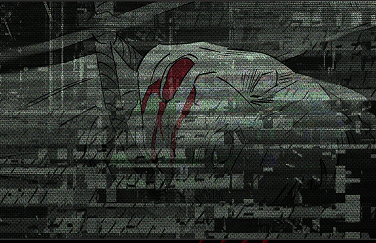 (chapter 5) He swore to be faithful to Shinhae by having the scar on his back for this reason. The pain linked to the tattoo should be a reminder that Shinhae would never be his true family. If you pay attention to his interaction with Cheon Jahwa, you can sense that he has no admiration or deep feelings for her. He serves her, because she is Shinhae’s boss and that’s it. He hopes to inherit the company (chapter 26). Their relationship is based on power, ambition, reliance and Jin’s talent. For him, Shinhae is only a family in name. In fact, it is just a company. Since his minions are still following him and even show no anger after the beating, we can clearly sense that the director has always been a loyal and dedicated person. As you can see, I perceive that black embodies Jin. This is his color, therefore he is wearing a dark suit. His regret, guilt and disappointment led him to live a colorless life. This is not surprising that this panel represents Jin’s perception.
 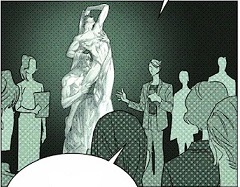 (chapter 1) He feels nothing for this statue. People surrounding the sculpture remain anonymous, for he is not paying attention to them. Every seems to be blank and cold. For him, only money and power matter. However, Jin is in truth a very passionate and strong-willed person. This explicates why his vision changes, when he thinks about sex.
  (chapter 4) And now you comprehend why the author used a different color, red. Jin is still thirsty for love and warmth, but he is in denial. Therefore it is not surprising why he is using drugs to stop his longing. These serve him as a substitute. They create an illusion, the world looks more colorful. Due to Brandon’s treason, Jin learned a terrible lesson. He would never get attached to anyone. However, as you can imagine, through Matthew’s inexperience, Jin discovered sexuality under a new light. The student is linked to purity. Yet Matthew is exactly like him, he has a huge libido, a sign that both are in truth longing for a deep affection.
That’s why the studio is the place where the two protagonists got closer. No one could see them. If someone had opened the door, his presence would have been detected. What caught my attention is that Jin and Matthew also had sex in the parking lot close to the green light. 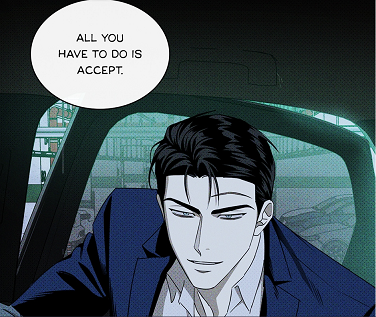 (chapter 20) Consequently, I deduce that the green light “exit” is no coincidence. Observe the parallels with the first sex session and this new sex session: basement, a new sexual experience for Matthew and the presence of the green light. From my point of view, it shows that Matthew symbolizes the exit for Jin. Thanks to him, the director will be able to leave the darkness of his world. This is no surprise that the main lead is gradually changing his attitude towards the student. He has no idea that Matthew has always admired him. But it is the same for Matthew. Thanks to the director, the student’s life will become more colorful and bright. Therefore I perceive this picture full of symbolism.
 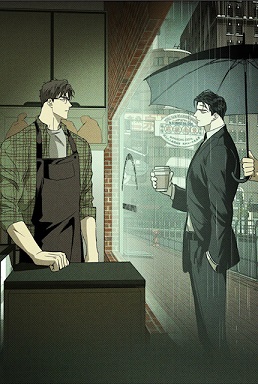 (chapter 1) Both are trapped in their own world, yet the moment Jin entered his world, therefore Matthew was able to leave his seclusion and could follow him.
So another possible explanation would be the sculptor’s eyes. He has brilliant green eyes  and in certain chapters, we discover his own thoughts. It was, as if the story was told from his perspective as well. (chapter 20) Notice that Matthew is fascined by Jin’s white skin and body. He never mentions the thug’s blush. Moreover, in this panel, the manhwaphiles can sense the absence of red.
Moreover, one detail caught my attention, the author is not just using green as procedure, she is also using points! 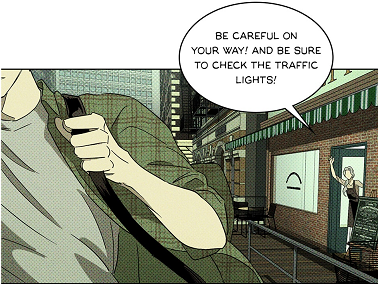 (chapter 1) Her drawings are composed by a multitude of points. So why? I couldn’t help myself connecting these two elements (green and points) to the disease: color-blindness!
  I started wondering if Matthew was not suffering from daltonism, and as such from protanopia.
  This means that he can’t see red. First, this would explain why the café owner asked the student to be prudent on his way to the museum. (chapter 1) He has to pay attention to the position of the lights, why the coffee served by Jin doesn’t taste good
  (chapter 1) , why Matthew’s clothes look so plain
  and why he is wearing glasses in the end.
  (chapter 16) There exist glasses that help people to overcome this handicap. Besides, notice that when the minions were talking to Matthew and Alex, the café owner, JAXX used a lot of purple and yellow, which reminded me of the colors perceived by people suffering from protanopia. I know, there is no guarantee that this interpretation is correct. However, I really wondered why the author would use the points in the drawings and why she would create such a panel.
  The manhwalovers can recognize Jin’s tattoo and the smear could be perceived as an indication for blood. Yes, it was, as if the letter was bleeding. However, a person suffering from daltonism can not recognize blood as such. This means that Matthew won’t be scared by a blood trail. Observe that anyone seeing Jin’s minion and even Jin would recognize that he is connected to the mafia. Striking is that this never repulsed the protagonist. In fact, he even desired to join his side. He had been looking for him all this time.
 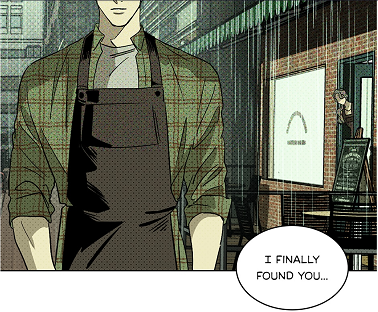 (chapter 1) Striking is that the author refused to let the readers see the character’s gaze. From my point of view, it is related to the other condition why in the artist’s world, there barely exists passion and as such red. If the manhwalovers had seen his gaze, they would have been surprised by the contrast between his words full of hope and warmth and the distant and indifferent gaze. It is already palpable by the absence of the protagonist’s smile. The character has definitely some problems. This is perceptible in the following panel:
 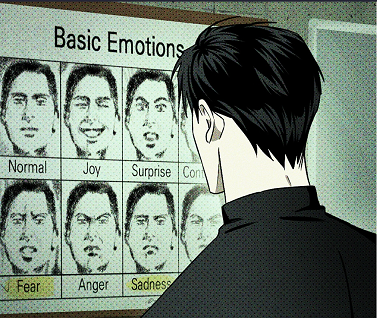 (chapter 16) The artist can not recognize people’s emotions. He needs a manual how to read them. That’s why some readers started wondering if the artist was not suffering from autism or was not a psychopath. Even Jin memorized his number on his cellphone as “psycho”. He even describes him as creepy. Moreover, the readers even imagined that he had killed the rabbit, for he was longing for its closeness. One of the reasons was that they were disturbed by the protagonist’s smile.
 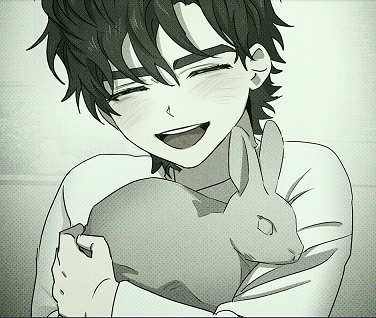 (chapter 27) The latter appeared at the wrong time, when the cute rabbit had died. For an outsider, it really looked like the young boy was rejoicing about the animal’s death. However, I believe that there could be another explanation. He could feel relieved that his rabbit would never abandon him. But autism and psychopathy are not explaining why Matthew would barely express his own emotions. That’s how I come up with this new idea.
He could be suffering from alexithymia. So what is this?
“Alexithymia: Alexithymia is when a person has difficulty identifying and expressing emotions. It is not a mental health disorder. People with alexithymia may have problems maintaining relationships and taking part in social situations. They may have a co-occurring mental health condition, such as depression, or no diagnosable mental health conditions. Alexithymia also has links with autism“. Quoted from https://www.medicalnewstoday.com/articles/326451
Now, I am quoting the signs and symptoms for this inability:
People can recognize Matthew’s personality here. The scientists could detect three causes for Alexithymia: brain injury, genetics and social environment and as such traumatic events. This means that this kind of person will feel less empathy than an average person. On the other hand, the person is different from a patient suffering from Antisocial Personality Disorder (ASDP, which many often reduce to psychopathy). A person diagnosed with Alexithymia is often anxious, overcontrolled, submissive, boring, ethically consistent, and socially conforming, whereas the prototypical individual with psychopathy is anxiety-free, under-controlled, dominant, charming, deceitful, and nonconforming. And if you paid attention to Matthew’s behavior, you will realize that he is not manipulative. In fact, when he met Jin in the orphanage, he listened to him carefully and followed his advice. Notice that he starts distancing himself from the main lead, the moment the main lead starts acting like a real boyfriend. He buys him clothes and brings him to an expensive restaurant. For the artist, who has lived all his life as a loner, this relationship with Jin generated some uneasiness. He knew that Jin would never accept to be his boyfriend. Hence he was able to push away Jin. Matthew has long internalized to mistrust people. He had experienced to be judged as a monster. Why? First, he shows no emotions on his face, and he was suspected to have killed the rabbit. Besides, people were only interested in him for his money, as he had been left with a huge inheritance. And now, you comprehend why Matthew has also been living a colorless world all this time. He had learned very early on to be on his own, to never trust anyone, to keep his distance from others, for they showed no real attachment or trust in him. He used sculpture to fill the void. The objects would never reject or abandon him. This explicates why all his creations are cold and precise. The artist has problems to feel emotions, yet he could never forget Jin and his words. That’s why the moment he met him again, he changed. What caught my attention is that JAXX used red in the background: 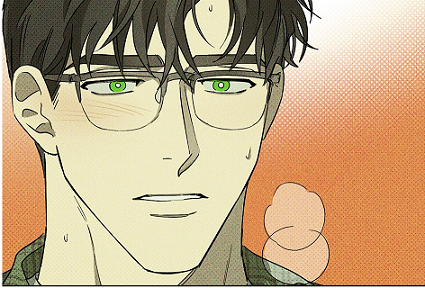 (chapter 1) For the first time, Matthew’s heart is racing, the readers can assist to the resurfacing of Matthew’s emotions which were also buried. Furthermore, the more he looked at his idol, the redder it became:
  (chapter 1) For me, the use of the red in the background reflects the character’s emotions, but the artist didn’t recognize his feelings here. He thought, it was more related to his work. This interpretation can be corroborated, when you include the scene where Matthew is doubting Jin’s affection for him. The dominant color is blue… A sign for his denial. So the moment Jin entered Matthew’s life, the latter started changing his way of life, he discovered emotions which were triggered by his sexuality. This explicates why the manhwaphiles can see more and more Matthew’s blushing. Jin stands for passion and emotions, yet behind him stands the blackness of the mafia. Since Matthew lacks a certain empathy, this is not surprising why Matthew won’t be scared by violence. Furthermore, if he can’t see blood, then he can’t get upset or scared by blood. From my point of view, Matthew could be the reason why Jin would change his life as well. Both are creating emotions and thoughts which were deeply repressed: huge abandonment issues. From my point of view, Jin is becoming more and more Matthew’s muse. And now, you comprehend why I picked up such a title: Their meeting brought light into their monochrome world. For the first time, they felt alive, since their life seems more colorful and intriguing. Since Matthew has always refused Jin’s support, the artist is showing to the gangster that money is not truly ruling this world. Power and money are no synonym for happiness. Matthew learned it at a very young age: he lost his parents who both committed suicide.
Matthew lived in isolation, because he had been betrayed and excluded by people. The starting point of his alexithymia is the suicide of his parents which left a huge scar on his heart and mind. He could sense people’s greed. They were more interested in his fortune and his background than in him. Their constant questioning bothered him so much that he wanted to be left alone. He could sense their selfishness and greed instinctively. When he was in the orphanage, the children and the personal showed no understanding for him, for the adoptive parents kept portraying him as creepy and terrible. Besides, I believe that silence could only reinforce this exclusion. From my point of view, no one ever attempted to understand him. He learned to live on his own. He knew that any kind of help was in fact a sign for deception and a trap. The adoptive parents were trying to “seduce” with their gifts (chapter 27) This explicates why later he is doubting Jin’s affection for him. When the latter offers him clothes, he can’t perceive it as sign of kindness and attachment. In truth, for him, gifts symbolize expectation and greed. Thus I come to the conclusion that the sculptor made the opposite experience from the gangster. Right from the start, he experiences the negative aspect of money and power, he could see people’s superficiality and hypocrisy. Thus he got disappointed and disenchanted, until he met Jin!! The latter was the only one who never tried to judge him and even show true concern for him. As the gangster, he only discovered the ugliness of this dark world too late. Even power and money couldn’t protect him from pain and torment.
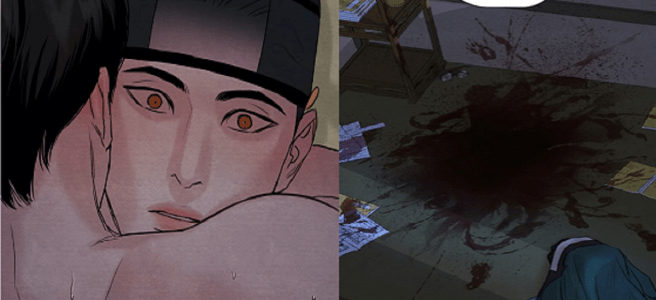
Both protagonists led a colorless life due to traumas and pain, until destiny let them meet each other. While the one sought to bring light in his abyss by taking drugs, the other discovered in arts a way to cope with his loneliness. Since they have so many common denominators (abandonment issues, scar, the orphanage, greed), this is not surprising that they got close to each other. From my point of view, Jin is showing more and more interest in Matthew’s art. The green light “exit” will incite them to leave their own world and change their life for good. While Matthew will discover more and more emotions, the other will realize “attachment” and loyalty have not completely disappeared. From my point of view, this picture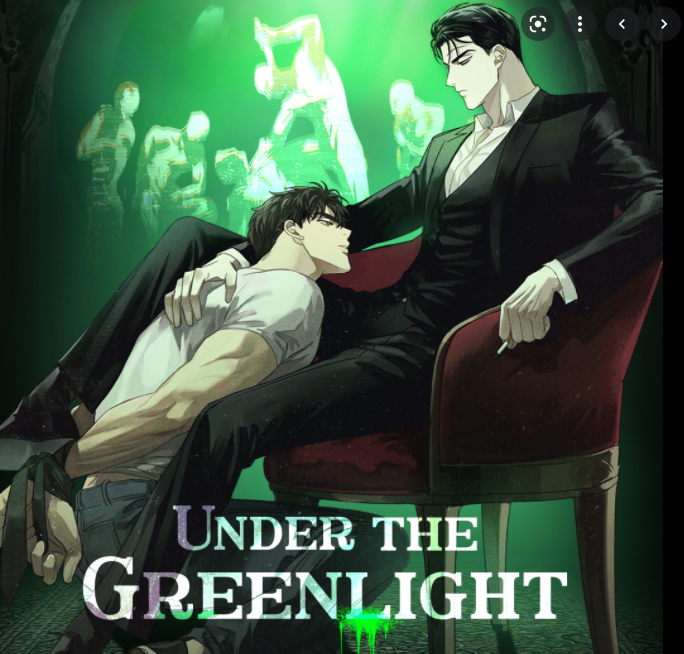 illustrates their relationship. Matthew is trapped, and can’t escape from Jin’s spell. This means that the student enters the world of the mafia because of the director. At the same time, this illustration could show the director’s terrible past. Notice that in the image the sculptor illustrates a murder scene. I detect a strong connection between the art and death. Don’t forget that the rabbit got killed, the moment the artist had finished his work. Consequently, I deduce that the end of their monochrome world is strongly intertwined with blood and death.
Feel free to comment. If you have any suggestion for topics or manhwas, feel free to ask. If you enjoyed reading it, retweet it or push the button like. My Reddit-Instagram-Tumblr-Twitter account is: @bebebisous33. Thanks for reading and for the support, particularly, I would like to thank all the new followers and people recommending my blog.

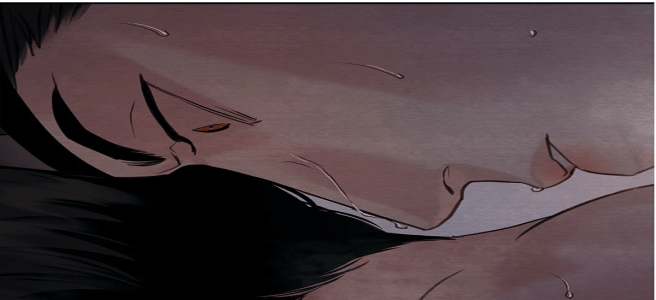

This is where you can read the manhwas. https://www.webtoons.com/en/mystery/dr-frost/list?title_no=371 https://www.lezhinus.com/en/comic/painter But be aware that this manhwa is a mature Yaoi, which means, it is about homosexuality with explicit scenes. If you want to read more essays, here is the link to the table of contents: https://bebebisous33analyses.wordpress.com/2020/07/04/table-of-contents-painter-of-the-night/
Before starting analyzing the manhwa under this aspect, it is important to define the term home. In a dictionary, this is what you find:
- the house, apartment, etc. where you live, especially with your family
- the type of family you come from
- a place where people or animals live and are cared for by people who are not their relations or owners
- someone’s or something’s place of origin, or the place where a person feels they belong
- your own country or your own area https://dictionary.cambridge.org/dictionary/english/home
As the readers can detect, home has a lot of significations. The reason is simple. It depends on the perspective. When people are asked where their home is, some will answer that their home is the place they are actually living, others will reply that it is the place where their family lives or where they were born and raised. But all have something in common: Home is where the heart is. To sum up, home is very subjective and personal.
Since home is related to our disposition (liking, family), it means that home represents a part of our identity, it even defines us. This explicates why psychologists sometimes visit their patients’ home in order to better grasp their personality and issues.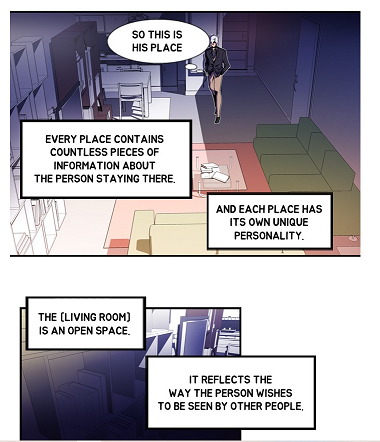 (Dr. Frost, chapter 8) As you can see, home is strongly connected to identity and personality. In other words, without home a person loses his identity. This is no coincidence that homeless people often have no ID.
Consequently, the manhwaphiles can comprehend why Baek Na-Kyum had huge abandonment issues and a low self-esteem in chapter 46.  He felt so lonely and lost, for he had no place he could call home. It was, as if he had no identity. When he deserted the mansion, he first thought of the kisaeng house and his noonas
 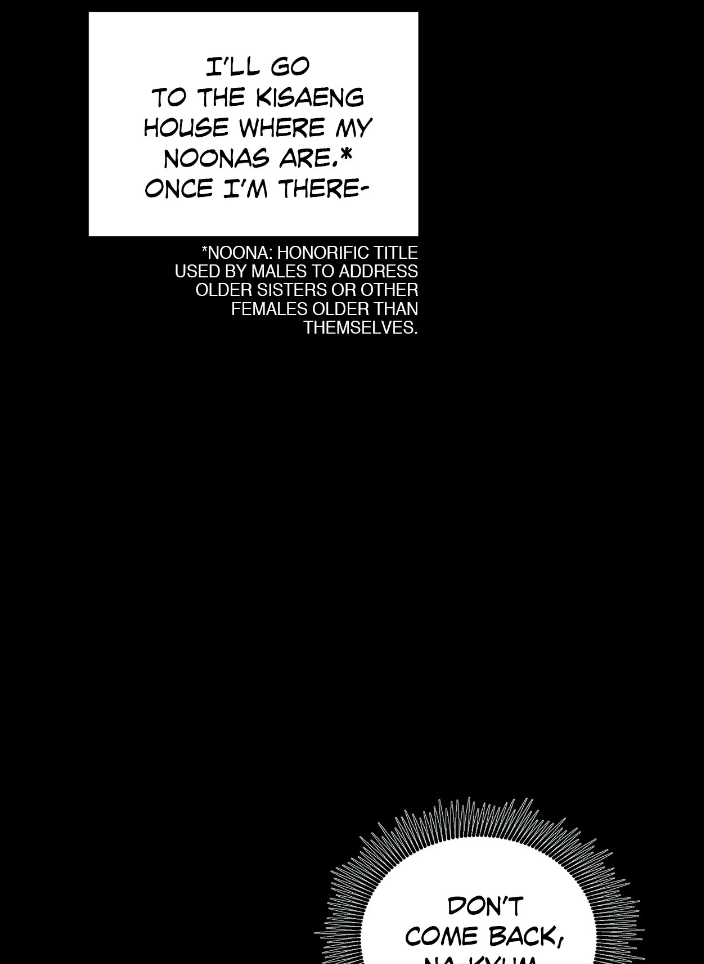 (chapter 46), until he remembered how he had been sent away by Heena noona.
 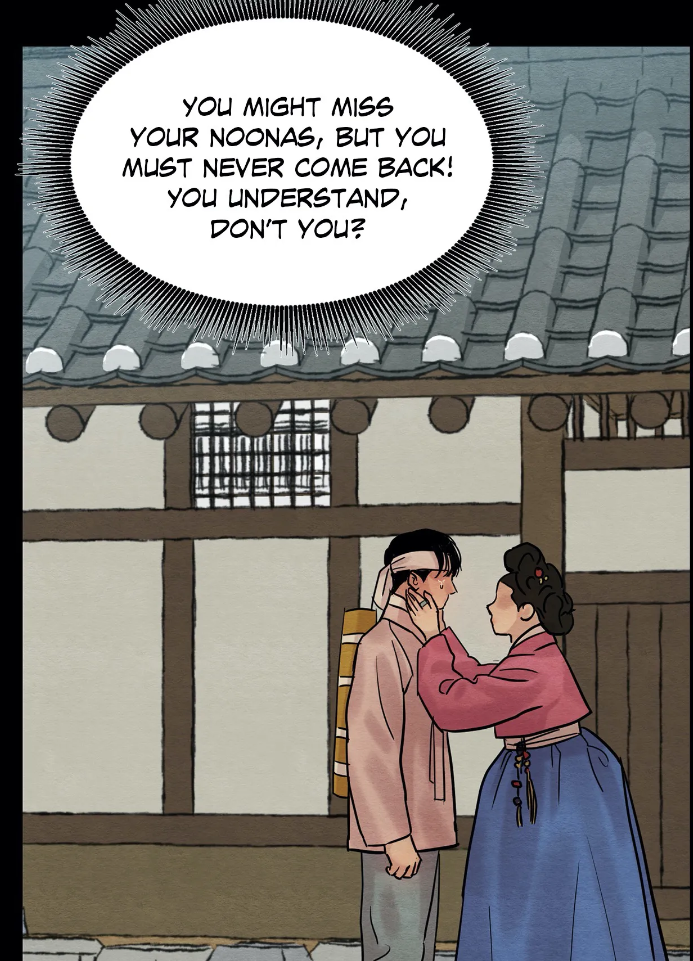 (chapter 46) This moment was terrible for the painter, because he had the impression to be abandoned a second time. Note that he is not calling the kisaeng house his home… for him, it was no longer a home, because his heart had been wounded there. Hence the manhwaphiles sense why the painter was using his mind in chapter 75
 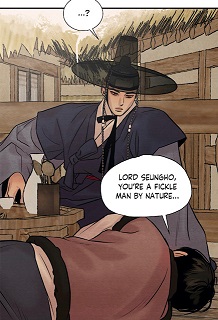 (chapter 75) and was restraining himself from falling more for Yoon Seungho. He had come to view the mansion as his home, and if he came to accept Yoon Seungho as his companion, then the latter would become his home, his family. Don’t forget my previous statement: Home is where the heart is. He was afraid of getting hurt a second time. If the lord came to have a change of heart, he could lose his new founded home.
Since the fight with Deok-Jae (which I am explaining more in details later), the painter had come to view the mansion as his home, hence he stated this to his lord: 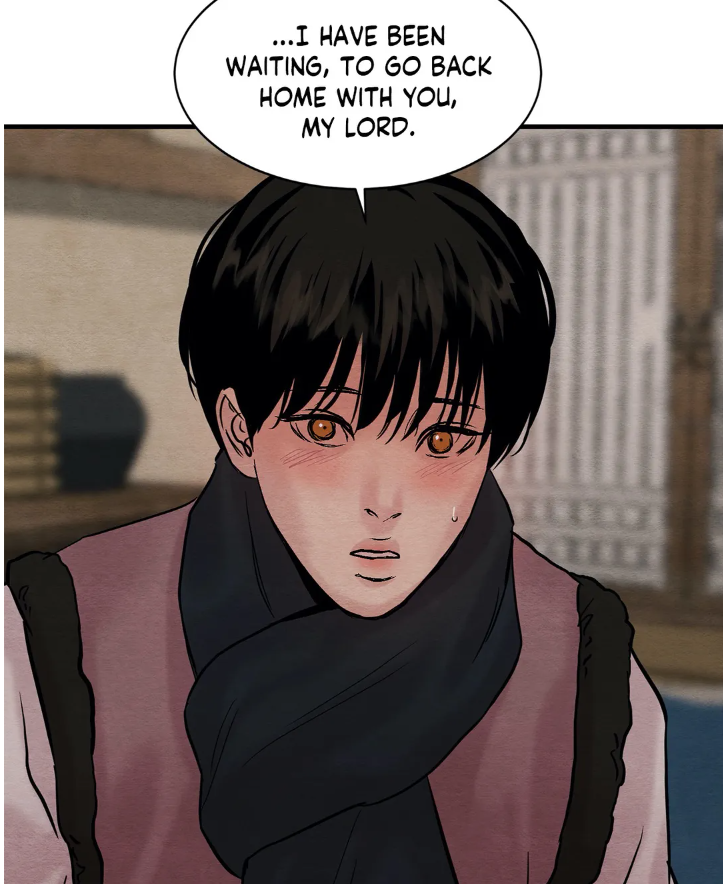 (chapter 58) And now, you comprehend why he stopped in the middle of the street during his escape. He had recalled how Heena had sent him away. (chapter 46) The painter had come to associate home to a family and as such to people. This explicates why the kisaeng had forbade him to bid farewell to his sisters. I am not saying that the kisaeng’s decision was ill-intended. She knew that if he met the kisaengs, the latter would have convinced him to stay. As you can see, he had experienced himself how his sister had abandoned him in the end. To conclude, for Baek Na-Kyum, in the past home was a synonym for family and a place.
But why would she coerce her brother to leave the gibang? Observe that she never gave her brother a choice. She never realized her wrongdoing, because she imagined that she had done it out of love, and it was for the painter’s best interests. Anyway, when Baek Na-Kyum reproached his lover his fickle nature (chapter 75), in my eyes, this perception should be applied to Heena noona who could send away her brother in such a way and never contacted him afterwards. That’s the impression she gives.  (chapter 68) Observe how she blames her brother for not contacting her, while she had strictly forbidden him to come back. At the same time, the readers should question her behavior. How come that she never showed any concern for Baek Na-Kyum for 18 months, until she found out that he was living with Yoon Seungho? Why didn’t she contact him in the first place in order to check out if he was living properly? She gave him instructions, and the main lead listened to her, and now she is reproaching him that he should have disobeyed her. In my eyes, Heena noona acts more like a person with a fickle nature. She shows great care and concern in chapter 65 and 68, but she never searched for her brother’s whereabouts before. So far, the readers can only assume that she had no idea that he had been living as a drunk, and she only discovered his whereabouts by hazard.
  (chapter 64) Yet, this is just an impression because of this scene. Yet, in season 3, Heena confided to Min, and the latter revealed the content of her confession:
  (chapter 99) The idiom “bittersweet affections” indicated that the learned sir had expressed regret and disappointment concerning Baek Na-Kyum. This means that Heena knew that Jung In-Hun’s affection towards the low-born had been changing. As you can see, I come to the conclusion that Heena was already aware of the existence of tension between the painter and his former teacher.
What caught my attention in chapter 68 is the following: 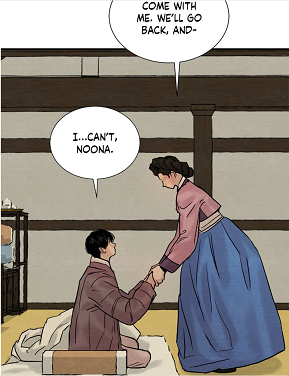 Heena noona is not even using the word “home”. At no moment, she employs this expression. When she parted from her brother in chapter 46, she mentions the noonas and when she asks her brother to follow her, she says: “Come with me”. As you can see, Heena doesn’t consider the kisaeng house her home. That’s the reason why I think that for her, the kisaeng house had been her workplace and she associated home more with people she cared about, similar to the painter. And this observation made me realize why the sister sent her brother away. Heena noona has never liked the kisaeng house, let’s not forget that she is a slave and she can not leave that place. And the guards could be judged as her wardens, they are keeping an eye on her, similar to the role played Yoon Seungho in chapter 45. For her, the kisaeng house was a synonym for prison and hell, where she kept meeting these terrible and violent rich nobles. (chapter 68) Hence in her mind, when she asked her brother to leave the kisaeng house, she imagined that she was helping the painter to escape from prison. Since she admires the scholar so much, she saw in him her helping hand. He would assist her brother to become a free man. The readers should notice that the learned sir always left the kisaeng house with the low-born
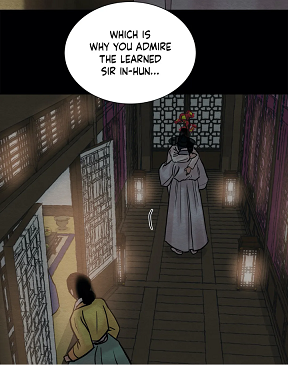 (chapter 68), when there was a ruckus. So when the kisaeng made the request to the teacher
 (chapter 46), she envisioned that he would acquiesce her request, since he had done it so many times in the past (taking care of Baek Na-Kyum and becoming responsible for him). Moreover, she knew that the artist liked and admired Jung In-Hun. For her, the scholar was a liberator, because he acted so differently towards the kisaengs and Baek Na-Kyum. That’s the reason why she thought, she was doing the right thing for her brother, while in reality she was just projecting her own desires into the artist. And this interpretation was proven correct, because when she vanished from the gibang in season 3, she was no longer dressed as a kisaeng.
 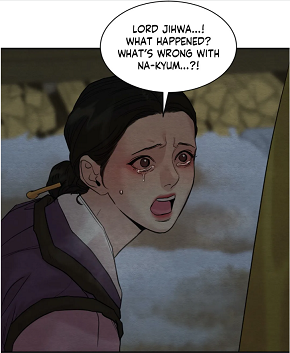 (chapter 99) She was deserting the kisaeng house, and as such the noonas. And note the parallels between chapter 46 and 97/99. In both cases, the painter couldn’t bid farewell to the other kisaengs. (chapter 46)
  (chapter 99) It is because she was using her brother. In the first desertion, her choice was influenced by her unconscious. She had just projected her own thoughts and desires onto the artist’s. In season 3, she had made a conscious choice. In exchange of her brother, she would gain her freedom. Thus she used the expression “us”
  (chapter 97) This time, it was for her own sake. But the price for her freedom was that she had to sell her brother. She could still have a clean conscience by convincing herself that Yoon Seungho had killed her idol. At the same time, she needed to fake her death.
 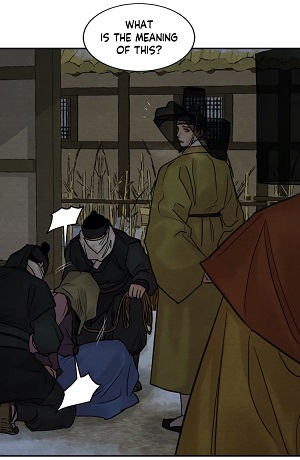 (chapter 99) [For more explanations read the analysis “Heena’s curtains”] This means that she was betraying the eonnies one more time. And that’s how I had another revelation. In my eyes, after their separation, Heena had come to view her life in the gibang differently. She had been able to perceive the good aspects of her life as a kisaeng. She could live a comfortable life and as such get new hanboks. (chapter 64) That’s why I believe that she came to forget her brother, like “out of sight, out of mind”. But how did she come to view the gibang as a place of hell? In my opinion, it is related to Yoon Seungho! She knew about his misery. Thus I am deducing that the painter’s vanishing from the gibang coincides with the end of the lord’s misery. Thus I have the impression that her definition of home came to change. It was less connected to the kisaengs and the painter, as such to family. She came to like the place.
But let’s return our attention to episode 46. (chapter 46) Because she didn’t allow her brother to speak his mind, she hurt his heart and created more wounds than before. That’s why I perceive the argument in chapter 68 as important. For the first time, Baek Na-Kyum is not listening to Heena. Since home is where the heart is, her brother could only reject her proposition to come back to the kisaeng house. He had been abandoned by the noona. However, because he was afraid of his own feelings towards the aristocrat, he created new problems with his confession. His description 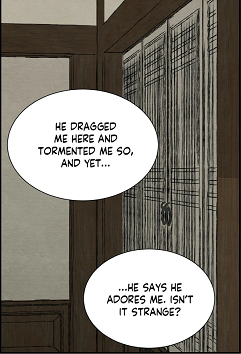
 reinforced her bad impression about Yoon Seungho. That’s why Heena noona will never believe that this place can become the artist’s true home. For her, this place can only represent a new prison, for she has a negative perception of nobles. Hence she needs to rescue her brother.
 (chapter 69) Besides, I believe that she has another reason. The lord is connected to her own guilt, but she is not admitting her responsibility. In the first version, I had expected that due to his confession, the kisaeng would never trust Baek Na-Kyum’s words later. And this was proven correct. Why? First, Heena noona embodies a certain kind of knowledge: prejudices. Because she has already experienced many things, she has the impression that she knows everything. However, she is not realizing that her world view is based on her own perception. Secondly, her superficial knowledge turns her into a blind and deaf person. What she sees and hears will be interpreted the way she perceives the world. I had even written this back then:
“Even if her brother tells her how well Yoon Seungho treats him and how much he loves his companion, she will have the impression that he has been brainwashed or coerced. Why? It’s because she has always treated her brother that way.”
In addition, she knows a part of the truth, while her brother was left in the dark entirely. Thus she reproached her brother his stupidity:  (chapter 97) Contrary to him, she knows, because she saw and heard things, when Yoon Seungho suffered! Yet, her knowledge is totally superficial, like the last panel exposes it. She just jumped to (false) conclusions. That’s how she got herself manipulated. Because of her bias, she became an easy target of deceptions. That’s the reason why she believes herself in rumors. Like the scholar said it himself,
  (chapter 29) there exists a kernel of truth in the grapevine. Moreover, with her caresses and hugs, she used love to stop her brother from speaking his mind.
  (chapter 46) That’s the reason why Baek Na-Kyum could only express himself through painting, as he had become mute. Due to her decisions and actions and the scholar’s, she contributed to turn the artist into a boy full of insecurities, unable to express himself. Consequently, Heena noona was put in front of the same choice in season 3. Note that the return of the painter to the gibang coincides with her departure. This means that due to the couple’s love session, she was reminded of her own past. She was forced to recall why she had associated the gibang to hell in the first place.
  (chapter 96) She was definitely scared in that scene. That’s the reason why at the end, she utilized her brother to leave the gibang. (chapter 97) However, the gods wanted to confront her with the true consequences of her choices. She wouldn’t live with her brother, their paths would get separated. (chapter 99) She had to choose between her brother and her life, and she selected freedom over Baek Na-Kyum. This is no coincidence that their bloody reunion happens in front of the scholar’s home.
  (chapter 99) This mirrors that her original dream was to live with her brother and the scholar, but this was just an illusion. She had hoped that once the artist was by Jung In-Hun’s side, the learned sir would come to buy her, and they would live together. She counted on the learned sir’s affection for the painter. But this was never Jung In-Hun’s intentions and he excused his behavior by putting the blame on the protagonist. (chapter 99) That’s the reason why the kisaeng mentioned the bittersweet affections. The scholar came to see the painter as a burden. This new approach gives us a clue why the artist chose the noble over his noona in chapter 68. The lord might have been violent, yet unlike all the other characters he allowed Baek Na-Kyum to be true to himself and to express his thoughts and emotions. Let’s not forget that in reality he was the only one encouraging the painter to paint, which was the commoner’s true passion. He even praised him, while even Heena couldn’t restrain herself from criticizing her brother. Freedom is an important condition for calling a place or people home, next to comfort and safety. But when the kisaeng left the gibang, it was just a fake freedom, as her safety is strongly intertwined to the benevolence of the noble protecting her! (chapter 97) Hence I come to the conclusion that Heena associates home to the learned sir and not to her brother. Exactly like the artist, she made a choice. She sided with Jung In-Hun, the poor learned sir, who got disappointed with Baek Na-Kyum. But she believes now that he is dead. Hence by leaving the kisaeng house, she doesn’t realize that she is abandoning everyone: the eonnies and Baek Na-Kyum. She has no one by her side… except the noble who sent the guards. From my point of view, she is trusting the butler.
In season 2, we could see the transformation of the meaning of home. For Baek Na-Kyum, the mansion of Yoon Seungho had become his home, like we could perceive it in chapter 46.  or in chapter 58. Why? It is related to the way he was treated by the head-maid, the butler and even Yoon Seungho. All of them considered him as part of the mansion. The head-maid gave him advices, the butler through his comment indicated that he belonged now to the mansion.
  (chapter 52) And finally Yoon Seungho treated him well on different occasions by sharing his breakfast with him or sending him to the doctor or by protecting him from Deok-Jae. Yet I believe that the decisive factor is the momentary separation. Although the painter had lost his position as favored servant, the noble never sent him away. He let him live in the study and kept treating him well. The artist could sense that despite the distance, the noble was not willing to cut ties with him. This explicates why Baek Na-Kyum resisted to the vicious servant, when the latter tried to force him to leave the property.
 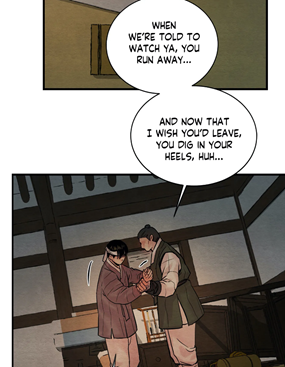 (chapter 53) This was his home now, and he wanted to protect what he had finally found. Despite the pain, he didn’t move. He was ready to do anything for his home. This gives us a glimpse of the painter’s future behavior, when his lover is targeted. There’s no doubt that he will fight for him. And now, if you compare the two following panels, you’ll realize the similarities between the two scenes: (chapter 46)
 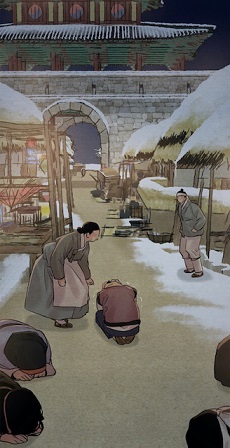 (chapter 76) In both scenes, the painter has a revelation. In chapter 46, he is alone and has no place to go. However, he is strong enough to stand on his feet, while in episode 76, he is paralyzed by fear and becomes so weak. Yet, exactly like in the first image, he feels lonely, but since he can’t escape, this position makes him realize his vulnerability. He needs help and protection. That’s why the moment he realizes the noble’s presence
 (chapter 76), he seeks his embrace and warmth.
 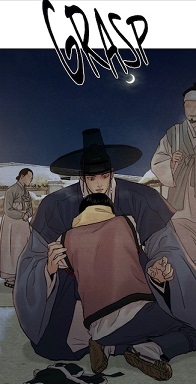 (chapter 76) Only there he feels safe. This terrible experience opened his eyes: he has to rely on someone.
 (chapter 76) Thus for the first time, he requests assistance. So while in the lord’s arms, the painter can slowly calm down, however he is still very shaken, as he has just experienced a life-threatening situation again, revealing the traumas left behind by the first abduction and the blackmail. Yet, after a while he expresses the wish to go home.
  (chapter 76) With these words, it truly outlines that the mansion has become Baek Na-Kyum’s real home, a place where he feels comfortable and secure, which represents a continuation of chapter 46. While in chapter 46, he just considered the mansion more like a refuge or shelter, now he connects it to family. It has truly become part of his identity. But the embrace on the street let him discover that Yoon Seungho could become a home too.
Striking is that there’s a difference between the Korean  and English version, when the lord replies to his request.
  In the original version, the lord is now admitting that the mansion is also his home now, whereas in the past it was just a prison and he wanted to have a companion by his side. In the English version, there’s only silence. This difference affects a lot the interpretation. By remaining silent, the noble is not acknowledging the mansion as his home, but this doesn’t mean that he has no home. In my opinion, Yoon Seungho perceives the painter as his home, hence he prefers remaining there hugging his lover. The painter gives him the warmth and love the lord has always been longing. That’s why he gives the excuse that they should stay there. It seems that the English version sounds colder than the original, yet I believe that Yoon Seungho is using his position in order to legitimate his refusal. Why do I think that the lord views the painter as his home? First, like I wrote above: Home is where the heart is. Secondly, I had already explained that Yoon Seungho would always follow the painter, because he considered him as his home and as such his family. So far, the lord has always perceived his mansion as prison and the bedchamber his cell. This explicates why the lord rejected the painter’s departure in season 3. He needed him by his side, as he had become his pillar.
 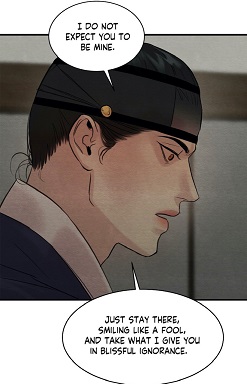 (chapter 85) Baek Na-Kyum represented the foundation of his home. Without him by his side, his “home” would crumble.
Striking in chapter 76, is that because the lord insisted to remain seated, the painter starts enjoying more and more the lord’s embrace,  hence his head moves closer to Yoon Seungho’s
 and at the end he even closes his eyes
 . From my point of view, this long and tender hug let him sense that the mansion was not truly his home, but the lord. But this was not entirely conscious. The latter has become his family. That’s why he had been longing for his presence and warmth in the last days.
  (chapter 74) This was a new version of the chapter 51 and 52. And you all know the saying:
“Absence makes the heart grow fonder”
This signifies that since both protagonists found their home, they found a part of their identity. Both protagonist could only become stronger. Thus the readers could assist to the return of the painter and lord’s memories. This is no coincidence that the painter could voice his wishes in front of his lover:  (chapter 78)
 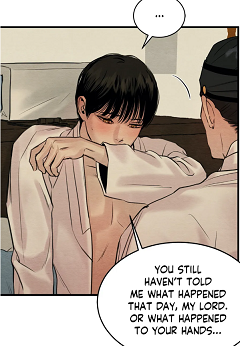 (chapter 84) And it was the same for the lord. That’s the reason why they both argued with each other and with others too. They could now stand on their own, but they still needed the support of the partner.
Under this new perspective, it becomes comprehensible why there was a change in season 3. There, both protagonists learned that home was not a place, but where the heart is. This is no coincidence that Yoon Seungho made the decision to renounce on his possessions, when he had the impression that his “bride” had died. That’s how he learned what home means. It is by his lover’s side, to be in his embrace, and not necessarily the mansion like during the argument exposed it. During the last scene, both protagonists were pushed to recognize that they are now a real family. Yoon Seungho is the painter’s home and it is the same for Baek Na-Kyum. This is perceptible in the final scene:  (chapter 102) It doesn’t matter where they are. Home is where the heart is. Hence the first question he has is:
 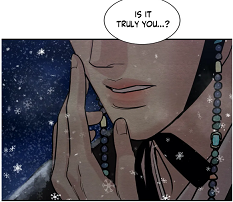 (chapter 102) As long as he is by his side, everything is fine. This new definition of home appeared, when the painter and the lord confessed to each other.
 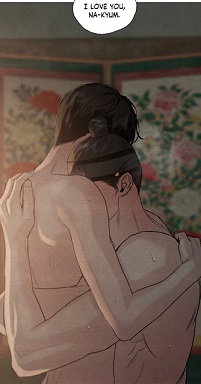 (chapter 96)
  (chapter 96) It didn’t matter where they were. Thus they could confess in a gibang. They felt safe together. And this is the same in the mountain. Observe that the painter is not asking why they are in the mountain and what the lord intended to do there. In fact, he was more focused on the past than the present. However, for the painter, home is not just a family, he liked to sleep in a warm bed and have a warm meal each day
  (chapter 68), since he had lived like a homeless for a while. Hence both will have to look for a real home, a house. Moreover, the lord will have to provide for the painter, and the latter will feel obligated to assist his lover. This means, in season 4, home should have a new definition. It is not just a family, but also the mansion and the country! Don’t forget that many people died in season 3.
Since I had elaborated above that home was part of an identity and the home would reflect the owner’s personality, I wish to examine Seungho’s bedchamber again. In other words, I will read his room: 
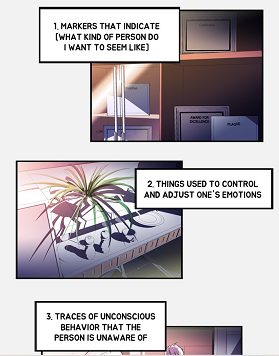 (doctor frost, chapter 9). What caught my attention is that the lord’s bedchamber is literally empty: There are only one big white vase, a red box, candles
  (chapter 55) and a windscreen.
 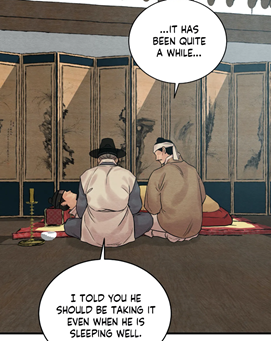 (chapter 55) The latter shows trees painted in black, there’s barely nature in the end. It mirrors the lord’s symbolic death. The emptiness of his room reflected the lord’s life. He was living like a zombie and avoided emotions, as he had no souvenir at all. Although he reads a lot, you never see them in his room. Why? It is because he separated his spirit from his body. In his bedchamber, he was a captive trapped in the past, hence he had nightmares. Moreover, I think that his bed is the source of his nocturnal panic attacks, as the colors are the same than the king’s. And now, the manhwaphiles can better comprehend why the noble has never considered his mansion a home. In this house, and in this room, he had traumatic experiences (abuse), which were so horrible that he had entirely repressed it. Nonetheless, the moment the painter calls the mansion his home, this has a huge impact on the lord’s life. The latter is now “forced” to consider the mansion as his home too. Hence in the Korean version, we have this panel: Then in season 3, the lord’s bedchamber became the painter’s bedroom too. Thus at the end of season 3, the painter visited the lord’s study in his lord’s absence.
  (chapter 98) This shows that he had conquered the bed. Season 3 exposes the painter’s conquest of the bedchamber. The turning point took place in chapter 87, when the artist went to the study on his own volition.
 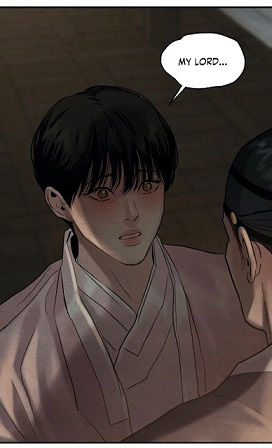 (chapter 87) I can’t help myself thinking that in season 4, the painter will bring his possessions to the bedchamber for good contrary to season 3.
 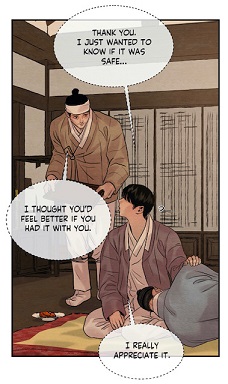 (chapter 79) The music box was brought back to the painter’s studio after the argument. Since the lord bought a music box for Baek Na-Kyum, and the latter treasures this item, it also has a special meaning for the lord too. The music box represents the lord’s heart, but the main lead didn’t grasp the true meaning, until it was too late. So far, the broken music box got neglected after their argument
 (chapter 85), yet I am still hoping for its return, for the lord had recognized its true signification to the painter afterwards.
  (chapter 85) But we shouldn’t forget the lord’s Spring poem
  (chapter 92) Little by little, the lord’s study will be filled with treasures belonging to Baek Na-Kyum which are connected to the noble. This is relevant, because thanks to them, the lord can recall the good moments with the artist. Slowly the lord’s bedroom will become more and more a study. With the arrival of souvenirs, the bedchamber will be filled with life again. This will symbolize that the lord is slowly taking over the bedchamber, and filling his room with things he likes. Where is the orchid? So far, all the nobles had plants in their room:
  (chapter 43)
  (chapter 82) Hence I am wondering if Yoon Chang-Hyeon didn’t punish his son by taking away the orchid, when he painted on the servant’s body:
  (chapter 36).
Through this examination, I could expose that each character had a different definition of home, and their perception of home was never constant. However, I have neglected one figure: Kim. The butler associates home to the mansion and nothing more. He is not even including the staff or the lords. That’s the reason why he is switching alliances all the time. But if he is on the verge of losing his mansion, he will do anything to stay there… like for example betraying Heena. Remember that she sold her brother for his own sake, and she didn’t feel deep remorse, when she saw her wounded brother. She even asked an explanation for his wounds:  (chapter 99) This new interpretation leads me to the following observation. In season 4, we will witness a new battle again, and it will be about the ownership of the mansion. Who is the true owner of the propriety? Kim, Yoon Chang-Hyeon, Yoon Seungho or lord Song?
Feel free to comment. If you have any suggestion for topics or manhwas, feel free to ask. If you enjoyed reading it, retweet it or push the button like. My instagram-tumblr-twitter account is: @bebebisous33. Thanks for reading and for the support, particularly, I would like to thank all the new followers and people recommending my blog.


This is where you can read the manhwa. https://www.lezhinus.com/en/comic/painter But be aware that this manhwa is a mature Yaoi, which means, it is about homosexuality with explicit scenes. If you want to read more essays, here is the link to the table of contents: https://bebebisous33analyses.wordpress.com/2020/07/04/table-of-contents-painter-of-the-night/
As my readers already know, Baek Na-Kyum is linked to the butterfly, hence in episode 1 from Alternative universe, the noble Baek Na-Kyum had such a lamp in his bedroom:  However, there’s another reason why the painter is associated to butterflies. It is because the protagonist used an expression with “butterflies”. It all starts in chapter 34, when the low-born witnesses Yoon Seungho’s return which makes the artist’s heart race so much.
  Just after facing Yoon Seungho in his bedroom with an almost kiss
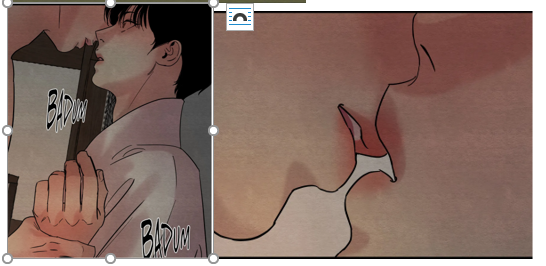 , he rushes to his study. Once arrived there, he wonders why his heart is racing so much and why he feels something in his stomach:
  (chapter 35). What caught my attention is that we have a similar scene in chapter 72: the painter is also questioning the origin of his physical reaction:
  . However, there’s a huge contrast between these two situations. First, the painter employs a different expression. It feels more real and precise than “butterflies”. From my perspective, it reflects the artist’s loss of innocence, or better said, his gained maturity. Moreover, due to his sexual experiences, he has a better understanding of his own body. Secondly, the fear has totally vanished, exposing that Yoon Seungho has truly achieved his goal. Finally, the other difference is that this time he is facing the lord himself.
 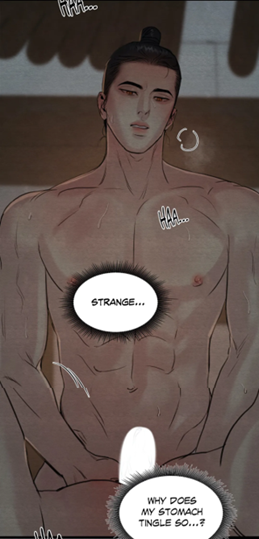 Back then, he only pondered about it after leaving the lord’s bedchamber. He was sitting behind the door. And if you recall the whole scene, you’ll notice that the artist’s heart started pounding, the moment the lord entered the bedroom. Moreover, the aristocrat removed his clothes so that the artist could see his back and later his chest. Consequently, I come to the deduction that the artist was so moved by the lord’s presence that his body was reacting immediately. This shows that both protagonists are affecting each other. One gets a huge erection, and the other feels butterflies inside. But more importantly, for the first time, the artist’s conscious was sensing his own body and the sexual attraction towards Yoon Seungho. Another parallel between these two scenes is the presence of the almost kiss: (chapter 34)
 (chapter 72). In chapter 34, he must have observed how the painter reacted, he was definitely blushing, because he repeats these gestures during their wedding night. Strangely is that when the lord approaches his mouth in chapter 72, the readers don’t witness any “butterflies”, as we can’t hear the painter’s thoughts. However, there’s no doubt that Baek Na-Kyum is excited due to the presence of his reddening and the sweat, very similar to chapter 34. Yet, I believe that the commoner doesn’t realize it yet, because all his energy is concentrated on his mouth. He has to whisper Seungho-Ya.
But there is another explication why Baek Na-Kyum’s butterflies only appear in the last part of the chapter. Until now, the artist had never truly perceived the lord in his entity. Compare this panel with the ones from chapter 31: 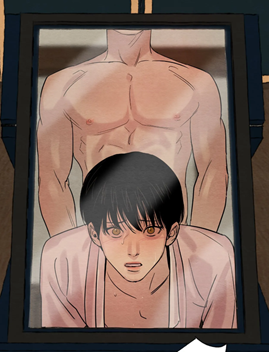 First, the manhwaphiles can observe the absence of the lord’s face and penis. Then when the lord came closer,
 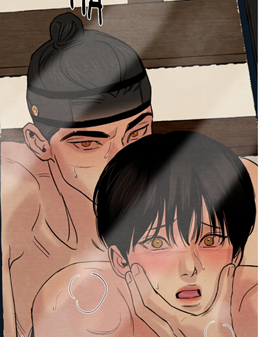 Baek Na-Kyum could only see the master’s face. Then the painter was able to view the lord’s phallus,
  , the chest and the face were hidden by the low-born’s body. It was, as if Yoon Seungho had been cut in parts, and Baek Na-Kyum was exposed to them. In other words, Yoon Seungho showed him parts of his body and not his whole body. The artist should accept them. However, like the noble pointed out, the artist was physically reacting to him:
  But since the artist was looking at the noble through the mirror, he never got to face the lord’s body in his entity. And imagine that back then, the artist was already aroused by the master’s parts. This signifies that the butterflies in chapter 72 are much stronger.
With this new observation, it becomes comprehensible that the painter is on the verge of having an orgasm by simply looking at Yoon Seungho’s body. This shows that this is more than just a physical reaction, as the lord hadn’t even entered him. The painter was so sexually aroused by the lord’s beautiful body  that just the thought and sensation of the penetration was strong enough to have him climaxed. Note that the artist’s exclamation (“oh”) is a signal that he is already feeling an immense pleasure that he can’t control, as he said the same word during his first anal orgasm
  As a conclusion, the moment Baek Na-Kyum saw the lord’s body with his erected phallus, his sexual desires had reached a new peak. This time, his “butterflies” were much more pronounced. And there’s another difference with the scene from chapter 31. The master’s gaze has softened so much, his eyes are exuding love and tenderness, while in the mirror, the noble’s gaze was colder and more calculating.
  This divergence is comprehensible, as the lord had to find a stratagem to be accepted by the artist. The use of the mirror was a calculated move, which he had already announced the night before. Moreover, he had been hurt and enraged by the commoner’s escape, hence he couldn’t show the same affection. Finally, he had no idea about his own emotions.
But now, the readers should wonder why the painter never reacted like that before. First, we have to remember that the painter’s body was numb and his mind was poisoned too, so that the noble had to free both. In the first sex marathon, he liberated the artist’s body from his torpor. However, the painterofthenight lovers should recall that this occurred again, after the scholar had killed the artist with his poisonous words (chapter 40). Moreover, let’s not forget that during the second physical emancipation  , the commoner was either not looking at him or sitting in a such a position that he couldn’t see the lord in his entirety.
  Then during their love session at the physician’s, the lord was so closed to the painter that the latter was not capable to look at his lover. Moreover, he was still avoiding the aristocrat’s gaze and face.
  The lord was also diminished, hence he was in the incapacity to stand up like that too. Besides, Yoon Seungho was afraid of a possible rejection. And during the second sex marathon, the lord was dressed
 , then later Baek Na-Kyum was no longer facing the noble:
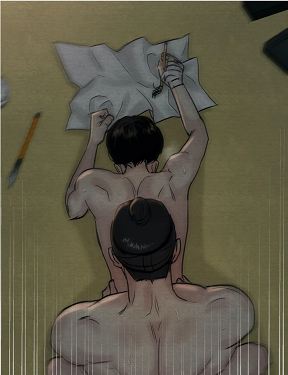 (chapter 64). Moreover, when he was able to look at the lord, he was hoping for a kiss, a sign of tenderness, which was refused. Moreover, his mind and body were still influenced by fear.
And now during their wedding night? In chapter 71, Yoon Seungho was sitting the tub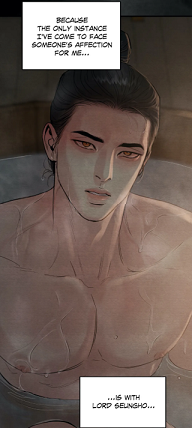 , hence the lover couldn’t view the whole body and the erected phallus. He could only sense the erection through his foot.
  . Once arrived in the bedchamber, the noble was busy making amends, hence he was on his knees. That’s why I believe that we are now witnessing a major turning point in Baek Na-Kyum’s life. From my point of view, with such an experience, the artist will recognize that his affection for his lover is much stronger than he has even imagined. I can’t help myself connecting this scene to the first wet dream the painter had. He was already so attracted to Yoon Seungho that he wished to replace Jihwa and imagined, he was lying under the lord’s body.
 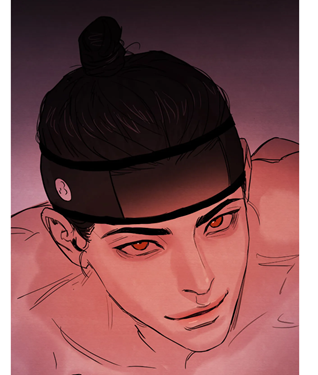 Just the view and the thought of the noble’s body aroused him so much that he had to remove himself from his trance, the moment he sensed an orgasm coming. This outlines how strong his sexual desires were. But now, it is different, because he is now excited by the lord’s gaze full of warmth and love. This is no longer about sex but about love.
And this observation leads me to the following conclusion. In my opinion, the protagonists couldn’t defeat their surrogate fathers, as long as they hadn’t truly opened their heart to someone else. But after such experiences, Seungho and Na-Kyum will never forget this night. The lord could pleasure his lover so much that the latter had such a climax in one thrust… let’s not forget that the main lead was suffering from erectile dysfunction and felt weak and powerless due to this. He was constantly reminded by Jihwa. As for the painter, he can definitely see that he is no prostitute. He has now even gained a title: “lord Na-Kyum”. The reappearance of the “butterflies” announced Baek Na-Kyum’s final sexual emancipation. In my opinion, he won’t feel shame and embarrassment afterwards, because his lover will be so happy. It is definitely possible that we get a new version of this panel:  And imagine what this signifies for the painter. He is able to make someone smile… to make someone happy, which he didn’t see in chapter 49. We shouldn’t forget that the painter had always felt excluded and had abandonment issues. In other words, he saw himself as a burden, but this can only change, if his life gets a new meaning. His presence, orgasms and smiles can make Yoon Seungho smile and happy, this can only give strength and joy to Baek Na-Kyum. Let’s not forget that Yoon Seungho is a reflection of the painter, just like the latter is a mirror for the lord.
Since the butterfly symbolizes resurrection, change, renewal, hope, endurance, and courage to embrace the transformation to make life better, the return of the painter’s butterflies inside marks his final transformation. That’s why I am certain that from that moment, the painter will never feel embarrassed and will only redden due to his attraction for Yoon Seungho.
Feel free to comment. If you have any suggestion for topics or manhwas, feel free to ask. If you enjoyed reading it, retweet it or push the button like. My instagram-tumblr-twitter account is: @bebebisous33. Thanks for reading and for the support, particularly, I would like to thank all the new followers and people recommending my blog.
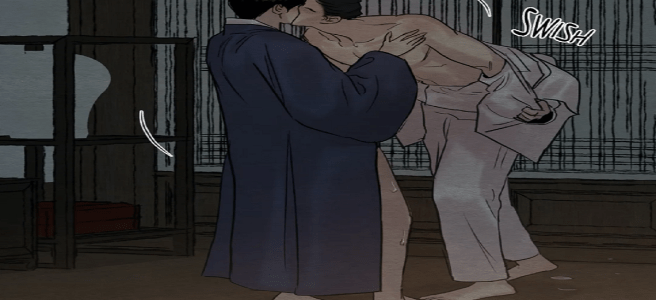


This is where you can read the manhwa. https://www.lezhinus.com/en/comic/painter But be aware that this manhwa is a mature Yaoi, which means, it is about homosexuality with explicit scenes. If you want to read more essays, here is the link to the table of contents: https://bebebisous33analyses.wordpress.com/2020/07/04/table-of-contents-painter-of-the-night/
It would be great if you could make some donations/sponsoring: Ko-fi.com/bebebisous33 That way, you can support me with “coffee” so that I have the energy to keep examining manhwas. Besides, I need to cover up the expenses for this blog.
The first reaction many readers had was to celebrate the butler’s courage, because he chose to tell his lord the truth and confront him with his true reflection. And unlike all the other characters, he mentioned one positive aspect: the lord’s good heart.  (chapter 68) In their eyes, valet Kim had turned into a hero not fearing his death. But we had another hero in this chapter, the scholar Jung In-Hun. The latter took the crying Baek Na-Kyum in his arm and brought him away from the scene, where Heena noona was getting beaten by a rich noble. (chapter 68) In her eyes, he was a hero, because he showed concern and care towards her tenderhearted brother. (chapter 68) Yet, only a few applauded Jung In-Hun for his behavior. Why? It is because many readers have already perceived his true nature: his hypocrisy and coldness hidden behind his calm demeanor and huge smiles. That’s why we need to examine more closely the behavior of these two father figures. Are they truly heroes? In order to answer this question, it is important to look at the definition of heroism and at the characteristics of a hero.
Heroism is characterized by:2
So let’s start with the scholar’s heroism. I would like to remind the reader that this scene is told from Heena noona’s perspective. If the manhwalovers observe Jung In-Hun’s action, they have the impression that the scholar is indeed helping someone in need. He is comforting the upset boy. (chapter 68) So the first condition is met. However, neither the second condition or third component are present in the teacher’s gesture. Jung In-Hun is not exposing himself to danger, risking his own life as he doesn’t come to help the real person in danger: Heena noona. Actually, the real person who needed to be rescued was the gisaeng, and not the artist. (chapter 68) Yet, the so-called hero abandoned her to her misery, as he walked away from the room. (chapter 68) This shows that he wasn’t willing to risk his life or position. There are no selflessness and sacrifice. Secondly, he did hope something in return: while consoling the kind boy, he hoped to get recognition from the gisaengs. They would see him in a positive light, hence if he came to visit the brothel again, they wouldn’t ask him for money, and I can even envision that they would give him some wine or food. Furthermore, they would allow him to roam around. No one would question, why he would come to the gisaengs. His reason was simple: he liked the tenderhearted boy. Finally, we have to question about the scholar’s appearance at the brothel. Why was he there, so dressed up? This scene is relevant, because it displays how Heena noona got manipulated in the end. The teacher used Baek Na-Kyum as tool in order to save his own skin. In reality, Jung In-Hun was there in order to get noticed by rich and powerful nobles. He hoped to find some connections, as he knew that the brothel was the place, where influential aristocrats would like to spend their time. In my opinion, this is what happened. Jung In-Hun knew the importance of Baek Na-Kyum at the brothel. From my point of view, he used this knowledge to achieve his goal. He must have approached the guest at the gisaeng, while Heena noona was serving him. But the rich aristocrat got upset that a scholar was bothering him and started beating the poor woman. Seeing this, Baek Na-Kyum cried which gave Jung In-Hun the excuse to leave the place. He needed to console the boy. While reading this, the manhwalovers sense the origin of Heena noona’s prejudices towards rich aristocrats. The latter would disregard her, because the teacher was around, as the latter was hoping to get some benefit from it. With this scene, Byeonduck exposes the origin of Heena’s blindness, which is also visible in different panels, like this one:  (chapter 68) As you can detect, the absence of her eyes reflect her blindness. The feelings she is projecting onto the painter’s are actually her own.
  (chapter 68) Now, we know why Baek Na-Kyum was so indoctrinated in the end. His own sister was also a victim of the manipulator, whom I had already diagnosed as a person suffering from a narcissistic personality disorder. Note that she uses the same vocabular than the scholar.
 (chapter 18) Hence I come to the conclusion, the teacher used the school in order to manipulate the commoners and the gisaengs. While he portrayed himself as righteous and kind, he described the powerful nobles as violent and arrogant, so that he would get the admiration from the commoners. In truth, he was deceiving them, since he looked down on them. Yet he needed them in order to get some connections to the powerful and rich nobles visiting the gisaeng house. On the other hand, since he didn’t want to get too close to the gisaengs, he employed the innocent boy as a shield, misleading Heena noona to think that Jung In-Hun had feelings for her brother. That’s why he hugs the protagonist so tightly. (chapter 68) For Heena, he was a hero, because he gave the impression that he cared for them, whereas it was the total opposite.
If we pay now attention to the butler’s behavior, it looks like the first aspect (“Acting voluntarily for the service of others who are in need“) is present in his action. He wanted to help Heena.  (chapter 67) However, the second component (“Performing actions without any expectation of reward or external gain“) doesn’t apply, because he is not doing it for free. Let’s not forget Kim’s philosophy, which was exposed in chapter 65:
 (chapter 65) He hates scandal and trouble. The gisaeng created such a uproar that Kim almost lost his credibility in front of his master.
  (chapter 65) He had two reasons for allowing her to meet the painter. First, Kim feared that she would cause more chaos in the future. Secondly, Kim realized that Baek Na-Kyum had become a huge source of trouble. He knew that the artist had been abducted, hence he got aware that Baek Na-Kyum had become a target of nobles. Furthermore, as soon as he had been returned, his sister made such a ruckus that she had turned the mansion upside down. Besides, like I had mentioned before, due to her behavior, she had put Kim in a difficult spot. Finally, he had another ground for giving his help: (chapter 65) He had seen the painter hurt in the bedchamber, so his words “Lord Yoon will not harm Nakyum” were proven wrong. Therefore I conclude, he had something to gain from his intervention. But what exactly? In my perspective, Kim wanted to get rid of the painter. The valet had already anticipated that Heena noona would ask her brother to leave the mansion. That’s why he said her this: (chapter 67) The butler anticipated her words and actions, as he is very perceptive (see chapter 23). At the same time, he told her the truth:
  (chapter 67) He had never received the authorization from his master. However, the manhwalovers should recognize that he painted his master in a rather negative light, while leaving a good impression on her.
  (chapter 67) In his mind, the butler thought that Baek Na-Kyum would leave the place right away after the harsh treatment he had received. For him, there was no doubt that no one in his right mind would stay at such a place. He knew that Yoon Seungho would come back soon. In other words, he was not helping Heena or Baek Na-Kyum here. He was doing himself a favor: his desire was to lead a peaceful life. Therefore, this explanation contradicts the first point.
As for the third point (“Recognition and acceptance of the potential risk or sacrifice made by taking heroic actions“), the manhwalovers should question this: When he granted the favor, was he putting his life at risk or was he willing to sacrifice himself? In my opinion, he was not, as he was acting behind his master’s back. He waited for the lord’s departure, then he allowed her to enter the mansion with the hope that Baek Na-Kyum would follow her right away. That’s why he was waiting outside next to the door. At the same time, he couldn’t tell her to hurry. At no moment, he was risking his life. He was using his position as the loyal valet to make decisions on his own, and even lied to the head-maid, when she questioned his behavior. (chapter 67) In my opinion, we have here a new version of the painter’s escape from the first season: Kim acting as a shadow helped the artist to run away (chapter 29-30). However, the problem is that he got caught by Yoon Seungho.
  (chapter 68) What should he do now? I would like to remind the manhwaphiles that Kim had not only disobeyed his master’s order, but he had acted, as if he was a lord. He had given the permission without Yoon Seungho’s consent.
  (chapter 68 It is important to recall that this story takes place in Joseon, therefore Kim’s action can definitely be judged as a betrayal and usurpation of power. One might argue that he desired to help Heena, yet like I exposed above, he did out of selfishness and not because he felt concerned for the painter and for her. As such, Yoon Seungho has the right to be upset. He is the master and someone is acting behind his back, overlooking his orders. Under this perspective, the head-maid appears more loyal to her lord than Kim himself. In this scene, he was only serving his own interest.
People were rejoicing that Kim became brave, because he criticized his master for his behavior. But what they failed to realize is the importance of the timing. Why now? Observe that Kim only starts confronting the main lead after Yoon Seungho threatens him with consequences:  (chapter 68). Note that the protagonist doesn’t menace to kill the gisaeng. He just desires to send her away, but he is now determined to punish his butler for his disobedience. He usurped his position, and as a lord he is allowed to do so. And that’s the moment, when Kim starts speaking the truth, which many readers associate to something positive.
However, this is important to realize that truth can also be used as manipulation. This is called paltering. Psychologists discern 3 types of lie: lie by commission, lie by omission and paltering.
“Like lying by omission, paltering can involve failing to disclose relevant information, but unlike lying by omission, paltering involves the active disclosure of true but misleading information: paltering enables would-be deceivers to actively influence a target’s beliefs” (Rogers, Zeckhauser, Gino, Norton, & Schweitzer, 2016). quoted from https://workplacepsychology.net/2016/12/18/to-deceive-using-truthful-statements-is-called-paltering/
This type of lie and manipulation is often used by politicians and even traders. They try to divert attention from the real main issue, and in our case: the butler’s disobedience and abuse of power. The other advantage is that since the paltering person is using truth as his tool, it is easier to remember and not get caught by the target. Moreover, the manipulator doesn’t have to feel guilty, as it looks like ethically more correct than lies.
That’s why it is important to look at the timing, when Kim reveals the truth. Here, I would like to bring another scene, where Kim’s first paltering was visible: chapter 50 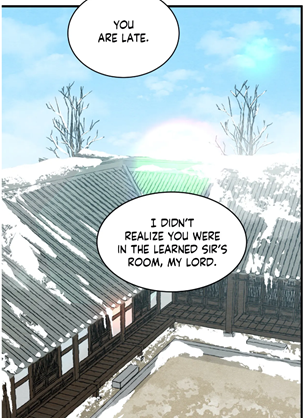
 Note, that in that chapter, the lord had the sword in his hand, and strangely the valet came late. As you can imagine, this is no coincidence. In my opinion, butler knew that something bad had happened and in order to escape his lord’s bad mood, he arrived late on purpose (lie by commission), but at the same time he revealed his knowledge about the cause for Baek Na-Kyum’s depressed mood in order to divert his master’s attention. That way, he could put the blame on the absent noble, but also on the painter. The latter had disregarded him due to the scholar’s words. At the same time, he made the lord feel insecure, because it showed him that he had behaved exactly like a client, a man obsessed with sex. That’s why with the butler’s intervention, the master had a relapse. What mattered for Kim was a peaceful life, the rest is
 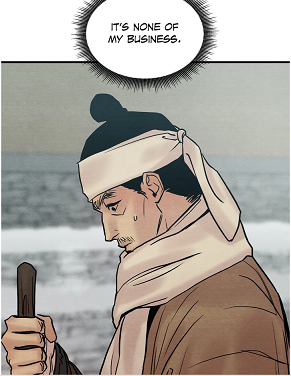 (chapter 65) Yet, he never expected such a change of behavior in the main lead, that’s why he blamed the painter afterwards. (chapter 52)
Hence I come to the conclusion that Kim’s MO is mostly paltering. And now, it is time to return our attention to the conversation between Yoon Seungho and his valet. It is important to examine each argument Kim brought up:  (chapter 68) Initially, it looks like he is appealing to the lord’s heart, but in reality the main point is the noble’s judgement. The valet is reprimanding his master for his lack of discernment. He misjudged the painter’s behavior. This is relevant because in this panel, I view a first emotional manipulation. His real intent is to make the lord doubt his own judgement, like “look, back then you made the wrong decision… therefore you could be wrong here”. But the readers know that Yoon Seungho is right. Heena is determined to take away his lover, so his initial judgement about Heena is indeed correct. In his eyes, she represents a source of thread, he might lose the artist. One might argue that Yoon Seungho is sequestring the painter which is also correct, yet like my reader Luzy pointed out, this is the painter’s decision. Neither Kim nor Heena nor Yoon Seungho have to make the decision for him. And here, Kim and Heena are trying to do so. The problem is that Kim got caught. But let’s go back to my initial thought. Kim used his knowledge (the lord’s misjudgment) in order to make his lord doubt himself. and he appealed to his emotions for that. This type of manipulation is called gaslighting:
“Gaslighting is a form of emotional abuse that’s seen in abusive relationships. It’s the act of manipulating a person by forcing them to question their thoughts, memories, and the events occurring around them. A victim of gaslighting can be pushed so far that they question their own sanity.” https://www.healthline.com/health/gaslighting#:~:text=Gaslighting%20is%20a%20form%20of,they%20question%20their%20own%20sanity.
As a conclusion, Kim made the lord feel insecure and doubt his own judgment and used facts in order to achieve his goal. The lord should rely on his butler’s discernment. But the mercy and favor for the painter are just a subterfuge, he is trying to mask his wrongdoing.
I could bring up another panel as illustration:  (chapter 68) Here, he is using the past in order to distort reality and memories while speaking truth. What Kim doesn’t mention here is his involvement in that incident.
 (chapter 65) Kim is destroying the lord’s confidence, so that Yoon Seungho will rely on Kim’s judgement.
If you pay attention to Kim’s words during that confrontation, Kim is actually utilizing many psychological and emotional manipulations:
(chapter 68) “You are so cruel to this boy”. He might be right, yet why didn’t he say anything in chapter 64?  (chapter 64) He literally looked away, because truth wasn’t helpful in this case. Feigning innocence and ignorance was more appropriate.
  (chapter 23)
 (chapter 68) (chapter 68)
 (chapter 68) Here, Kim is mentioning the past, where he played an active role between the father and son. In other words, he is reminding the master that he is acting like a mediator. However, this revelation exposes the servant’s manipulation. He was one of the causes for the falling apart between father Yoon and the eldest son. We have to imagine that he never revealed the real reason for Yoon Seungho’s rebellious nature to father Yoon. And here, he is behaving like in the past. He tries to intervene between Baek Na-Kyum, Heena noona and Yoon Seungho, as if he had the right to.
  (chapter 68) (chapter 68) he is bringing up the past to divert Yoon Seungho from the main problem: Kim abused his position. (chapter 68) making a person feel bad about herself, by giving backhanded compliments or comparing to another person. On the surface, it looks like constructive criticism, while in reality the victim is supposed to feel terrible and doubt his personality. https://www.healthline.com/health/mental-health/negging
 I have to admit that I can’t give you an illustration of all psychological tricks Kim used in this confrontation. On wikipedia, there is a whole list of different psychological manipulations, which served me as orientation. https://en.wikipedia.org/wiki/Psychological_manipulation Nonetheless, as the readers can detect, I tried to look for more info for this analysis.
After portraying Kim as a manipulator, I would like to remind my reader of two aspects: I described the butler as the gatekeeper, the one who opens the door. And now, if the manhwaphiles pay attention to this picture, (chapter 68) they will detect that the door is now open. The valet opened Pandora’s box in my opinion. That’s why Yoon Seungho was hurt and at the end ran away.  (chapter 68) He had heard, how Heena noona was comparing him to misfortune, reinforcing his negative opinion about himself.
  He had been already prepared mentally by his butler. He was as wounded as Baek Na-Kyum, when the scholar had voiced his true thoughts about the painter.
  (chapter 40) While the artist’s fate is to become a prostitute, the other is destined to bring misery. He already externalized this perception about himself in chapter 49:
 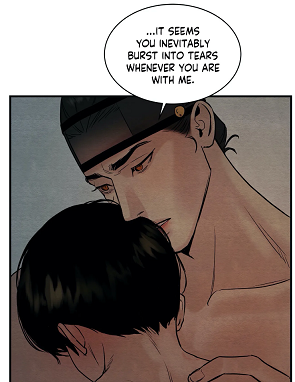 (chapter 68) For me, chapter 68 is the new version of chapter 40. That’s why I wasn’t rejoicing at all about Kim’s behavior. He was far from being honest with his truth. In reality, he used truth mixed with emotions as his ultimate tool in order to save his own skin. In other words, he functioned as the noble’s mirror.
This scene made me think of “Snow White and the 7 dwarfs”, where the mirror of truth tells the jealous queen that Snow White is far more beautiful than her. With this truth, the queen is led to take actions against the heroine and torment her. And here, we have another allusion how truth can be used as a weapon. The mirror never told the queen how to become the most beautiful woman. He never gave her any advice, it retained information: beauty can be different. It is not just the physical aspect, but it is about the personality. Therefore we could say that the mirror of Truth manipulated the queen leading her to her own demise. However, at no moment the queen never questioned the mirror of Truth and its ulterior motive. That’s exactly how Kim behaved the whole time explaining why Yoon Seungho never suspect his words. They reflected the truth. Yet the valet never intervened for his sake and for the painter’s sake. He only did, when he noticed that his lord was angry and let others take the blame, like here the father or Yoon Seungho himself. However, the readers should remember that in this scene, Kim had abused his authority. That’s also a fact.
Therefore I don’t consider Kim as a hero, quite the opposite. He is the worst manipulator, the reason why Yoon Seungho ended up with self-hatred and became violent with his swing moods. Kim isolated him, eroded his sense of reality, making him fear his own image. Besides, he didn’t even help him, when he got raped. Since Yoon Seungho has been manipulated psychologically and emotionally for years, he ended up hating himself.
“Long term effects of emotional manipulation:
That’s the reflection Kim wanted him to have, so that the latter would never question his servant’s actions. And now, this picture has another meaning for me:  (chapter 57) His gaze is only focused on his valet, not realizing that the latter is not honest with him. From my point of view, there’s a reason why Byeonduck put Jung In-Hun’s so-called heroism (chapter 68) next to the valet’s . (chapter 68) For me, she put the readers in the same situation than Heena noona’s. Just like the kisaeng, many readers expressed their admiration for the butler, because he had told the truth. They associated truth to goodness. Heena noona also watched the kindness in the scholar’s gesture leading her to think that the teacher was a honest and caring person, yet she overlooked that the teacher had in reality abandoned her. He never protected her and let her suffer. This picture truly reflects his cowardice and treachery
  (chapter 68) He slowly takes the artist in his arms. He doesn’t rush to her side, remains silent and immobile. His passivity reflects his true personality, but Heena is too focused on her young brother to grasp the situation. (chapter 68) The crying boy is used as a diversion. Besides, I am quite certain that Jung In-Hun was actually the source of her misery by trying to get attention from powerful nobles. Note that the scholar and Kim utilize both the painter’s to hide behind their misdeed. He serves as a justification why the scholar left the gisaeng behind and why Kim defied his master’s order. The domestic used kindness and pity as legitimations (chapter 68), while it was the opposite. He desired to get rid of them.
But there’s hope in my opinion. Baek Na-Kyum refused to listen to his sister’s words, which Kim hadn’t expected. Therefore he got caught, he anticipated Baek Nakyum’s eagerness to leave. (chapter 67) Secondly, by giving his master a reflection of his behavior, the valet lost his influence on the main lead. Remember that I wrote that Baek Na-Kyum served as the lord’s mirror, therefore he will take over the valet’s role. He will reveal his true reflections: his flaws and wrongdoings  (chapter 68), but also his quality: his honesty
 (chapter 58). Let’s not forget that the artist realized his dedication in chapter 58. Note the huge difference. The artist never uses others in order to judge the lord. Kim will realize soon enough the consequences of opening Pandora’s box. He might have achieved his goal (the lord won’t punish him for his disobedience), yet he lost his lord’s trust. Notice that right after this quarrel, Yoon Seungho started treating Baek Na-Kyum like a noble.
 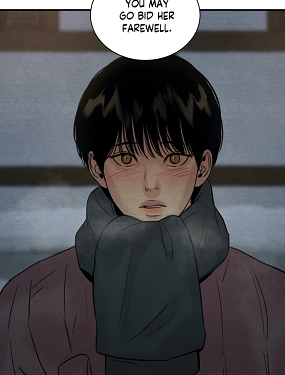 (chapter 69)
 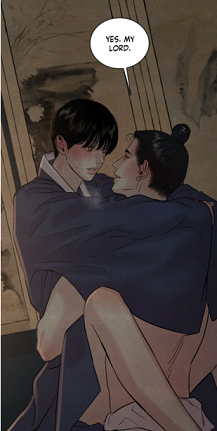 (chapter 72) From that moment on, Yoon Seungho was no longer viewing the valet as the unofficial lord. We could say that he had lost his status as “hero” in the main lead’s eyes.
Feel free to comment. If you have any suggestion for topics or manhwas, feel free to ask. If you enjoyed reading it, retweet it or push the button like. My Reddit-Instagram-Tumblr-Twitter account is: @bebebisous33. Thanks for reading and for the support, particularly, I would like to thank all the new followers and people recommending my blog.

