

Please support the authors by reading Manhwas on the official websites. This is where you can read the Manhwa: Jinx But be aware that the Manhwa is a mature Yaoi, which means, it is about homosexuality with explicit scenes. Here is the link of the table of contents about Jinx. Here is the link where you can find the table of contents of analyzed Manhwas. Here are the links, if you are interested in the first work from Mingwa, BJ Alex, and the 2 previous essays about Jinx Behind The Emp’s Shadow and The Scent Behind The Jinx
It would be great if you could make some donations/sponsoring: Ko-fi.com/bebebisous33 That way, you can support me with “coffee” so that I have the energy to keep examining Manhwas. Besides, I need to cover up the expenses for this blog.
The Wrong Forecast
Many readers were happy to discover that Joo Jaekyung and Kim Dan are about to spend a day at an amusement park. 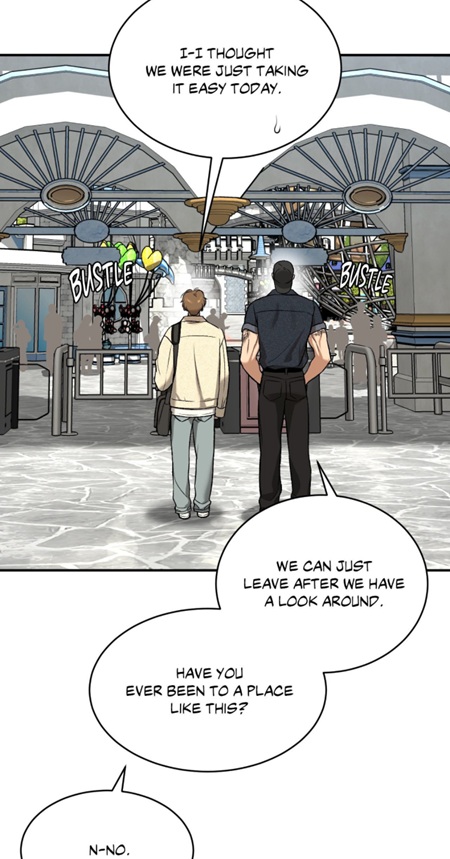 (chapter 82) Jinx-Lovers consider it as their first real date, a long-awaited moment of levity after so much pain. But perhaps we should pause and ask: why this place?
Among the brochures  (chapter 82) scattered on the table, one displays the Eiffel Tower — the obvious choice, symbol of mastery and control. Built for the Exposition Universelle of 1889, it was meant to celebrate France’s industrial power and the centenary of the Revolution — proof that bourgeoisie and steel, not kings and nobility, now ruled the sky and ground. It was even supposed to be dismantled after twenty years, yet it remained, and has since become the symbol of Paris and of France. A monument to progress, modernity, freedom, national pride and endurance.
But the man who picked up these brochures was never a tourist. In the past, Joo Jaekyung would not have chosen any destination at all. He would have stayed inside or trained, untouched by the world outside his window or the gym. 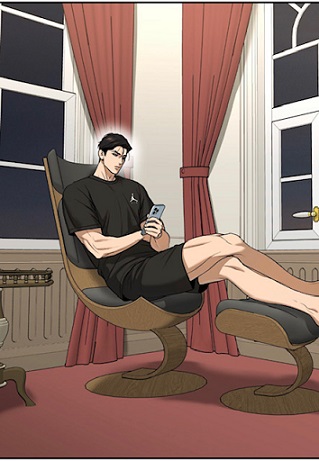 (chapter 38) Hence in the States he is here turning his back to the window and his only connection to others was through the cellphone. The cities he visited were backdrops, not experiences. He was always alone. And yet, here, something changes in Paris.
  (chapter 82) His hotel room opens onto a broad window and a balcony — an invitation to look out. Secondly, observe that he only proposed this activity after the other members had fallen sick. When doc Dan barged in his room, the champion was doing a one-handed handstand, holding his entire weight as if defying gravity itself
  (chapter 82) and proving his recovery. The posture seemed like control, yet it was closer to self-punishment — an immobility that devoured strength. Blood rushed to his heart and head, but his lungs stayed empty. It was, unconsciously, his way of treating his breathlessness. This also shows that he had no real expectation about the “rest” his manager had suggested
  (chapter 82) — the drinking, the empty and aimless trip (“check out the area”). For the wolf, such a downtime could only mean endurance, not release and excitement. By the way, such a suggestion from Park Namwook borders on stupidity and blindness. How could he propose drinking, when he had seen his “boy” indulged in alcohol before?
 (chapter 54) I guess, he must have taken the celebrity’s words at face-value. But let’s return our attention to the panel with the brochures selected by the champion. If you look carefully, you will detect the presence of 4 stars. (chapter 82) They reveal the protagonist’s thoughts and emotions. He is happy!! The news brought by doc Dan was actually good news! 😂
 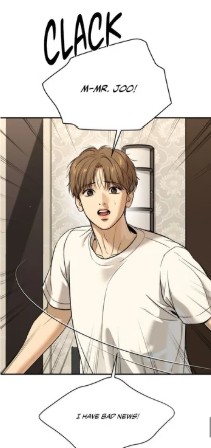 (chapter 82) How do I come to this interpretation? We have seen these stars before, during Kim Dan’s Summer Night’s Dream: the same glittering symbols of softness and excitement.

 (chapter 44) Yet, this time, the little “stars” belong to the celebrity.
For once, the fighter blushes, smiles, and dreams. 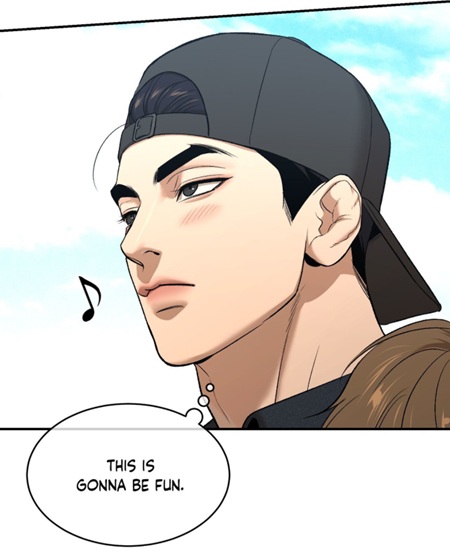 (chapter 82) His choice of the amusement park is not really about himself and his desires— it is an act of care, a wish to give happiness to someone else.
And here, I feel the need to add this information. The most famous theme park next to the capital is Eurodisney which is strongly intertwined with fairy tales (The Little Mermaid  , Sleeping Beauty
 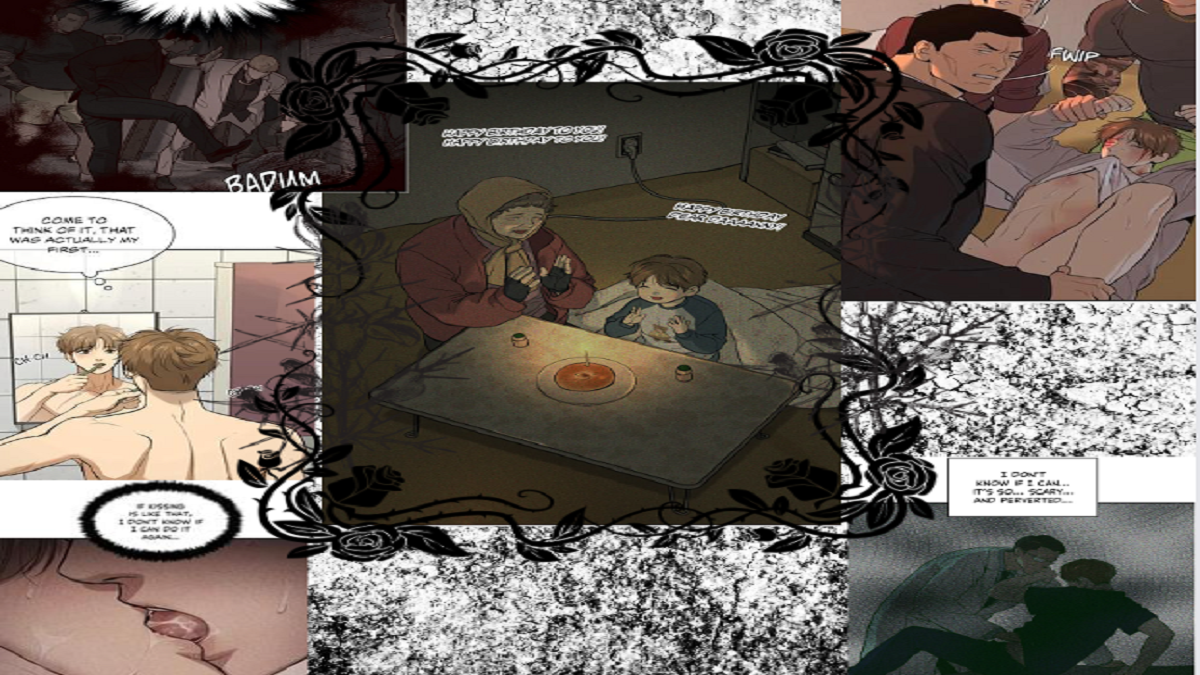 and Beauty and the Beast
 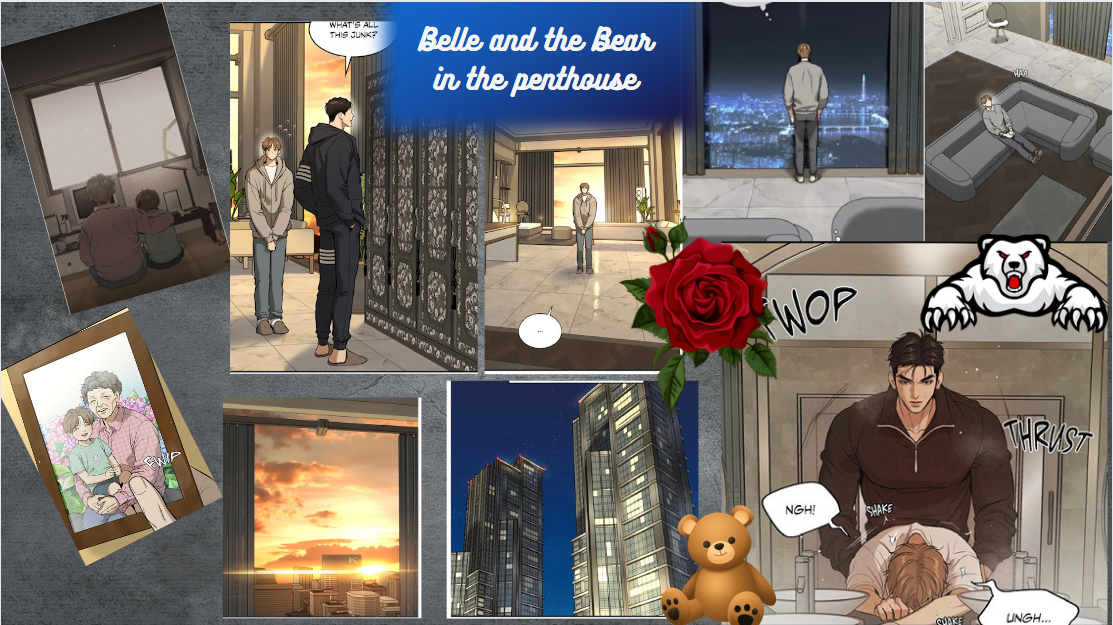 ).Hence there is the castle on the brochure. (chapter 82) This shows that my connection between the fairy tales and Jinx was correct. Eurodisney is a place built for children, stories, and families, where a person’s worth is measured not by conquest but by joy and time shared together. On the other hand, such a funfair cannot be separated from money; it is a space of paid joy, accessible only to families with a certain income. This alone explains why neither Kim Dan nor Joo Jaekyung has ever visited it before.
  (chapter 82) For both, it was financially and emotionally out of question. It grounds the symbolism of the amusement park in social reality, reminding readers that “fun” is also a form of privilege. This means that the champion is actually on his way to replace this picture:
  (chapter 65) So yes, this may look like a simple date. Yet beneath its playful surface lies the quietest revolution of all: the man who once ignored every view now opens the window, looks outward, and chooses wonder and fun over war.
When I first speculated about France, I imagined Cannes — the realm of spectacle, trophies, and bright façades. I was wrong about the destination  (chapter 81), but not about the geography and air. I had truly detected the importance of this image and its symbolism. The plane that opened this arc spoke not of luxury, but of altitude — of a life lived too high, where oxygen is rationed by pride. Below the aircraft stretch the Alps, which I had correctly identified. From there flows the athlete’s own water – Evian
 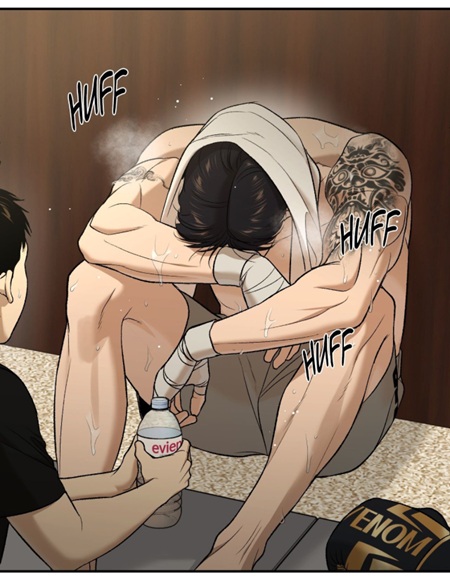 (chapter 82) (written Evien in the manhwa) — drawn from the mountain that sustains him and starves him at once.
And now, let me you ask this: what happens to a candle’s flame at high altitude? It flickers, gasps, and finally dies for lack of air. This is exactly what Mingwa foreshadowed in the promotional poster 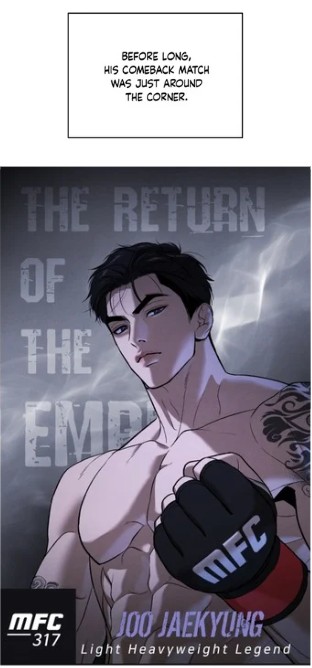 (chapter 81): the rising smoke, the suggestion of a light already suffocated. The higher they bring him, the closer he moves to extinction. Besides, the higher he climbs, the harder the fall. In other words, they are trying to break him — to make him fall — something the athlete has already sensed.
  (chapter 82)
It is no coincidence that his opponent in France is an eagle 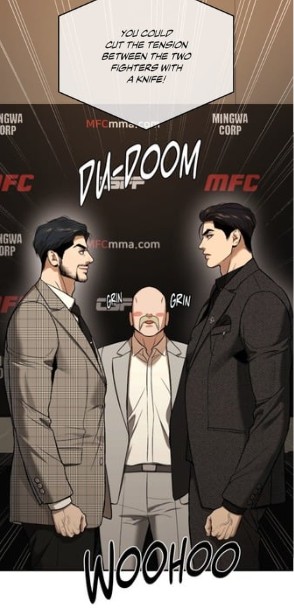 (chapter 82) — a creature of heights and thin air, born to dominate the skies where others can barely breathe. The metaphor could not be clearer: altitude is his arena, but also his undoing.
Now they are in Paris, and it is fall — not yet cold because of the presence of the sun.  (chapter 81) The air remains clear and generous, the sky washed in blue as if nothing could go wrong. Yet the trees, touched by the first copper tones, announce the slow turn of the year. It is a calm, lucid atmosphere, the kind of weather that hides transition inside serenity. The unseen Seine glides through the city like a long breath, steady and effortless.
In this luminous stillness, the champion tries, for the first time  (chapter 82), to build joy outside the ring (chapter 82) — to borrow light for someone else’s smile. Paris welcomes him not with spectacle, but with ordinary clarity: air that holds both change and peace.
So yes, this may look like a simple date. Yet beneath the gentle brightness lies something deeper: the rest is supposed to treat Joo Jaekyung’s breathlessness. (chapter 82) Everyone has noticed that the athlete has been burning out quickly during training.  (chapter 82)
So why is he struggling so much with breathing? It is more than just an altitude question.
Airport – Exhaling for the First Time
Like mentioned in the previous essay, the airport symbolizes transition, a sign that both protagonists are gradually changing, but their metamorphosis is not complete. Interesting is that Mingwa focused on the champion’s reaction at the airport which only Jinx-lovers could notice.  (chapter 81) A single breath — huu — escapes, white against the air. It looks like calm, but it isn’t. It’s the sound of a man forcing his body to obey. The clenched fist that follows betrays him: anxiety condensed into muscle.
 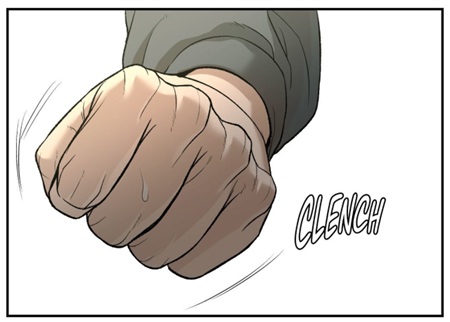 (chapter 81) The champion has descended, yet the altitude still lives inside him.
Every cell of his body is trained to equate success with survival, control with oxygen. Even here, standing on solid ground, he breathes as if a fight were about to begin. His chest expands too sharply; his breath leaves in bursts. The nervous exhale isn’t relief — it’s containment. To conclude, he is tense, because he is anxious. This time, his shoulder is not betraying him  (chapter 14), but his lungs and heart. Yet at the airport, the sportsman doesn’t realize it (chapter 81) — he is drawn eyeless, suspended in a state of self-control rather than awareness. His brief moment of meditation is still ruled by habit: the reflex of an athlete who measures calm through dominance. For him, success has always been synonymous with survival and such life. Hence later in his bedroom, he recalls his first tournament and defeat
  and makes the following resolution: (chapter 82) But there exists another reason why the athlete’s heart and lungs are betraying him.
The truth behind Joo Jaekyung’s breathlessness
Let me ask you this. When did we hear and see the champion’s breathlessness in the past? 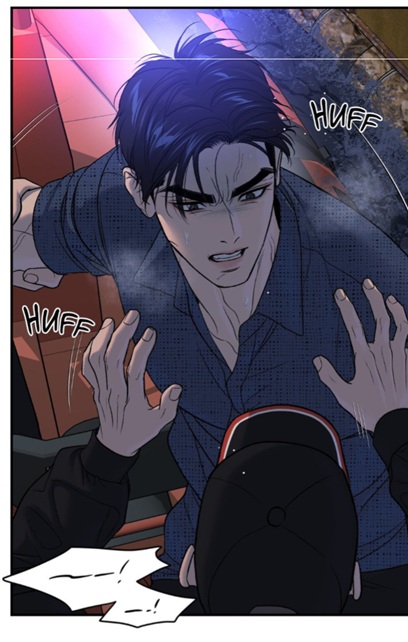 (chapter 69) Back then, he feared for doc Dan’s life and ran as if his own heart depended on it. His breathlessness wasn’t exhaustion but panic: the instinctive terror of losing the person who keeps him alive. Thus when he saw him alive on the dock, he could start breathing properly:
  (chapter 69) From HUFF to HAA… exhale versus inhale.
Seen under this light, his current symptoms are no mystery. What burns him out in training isn’t merely overwork—it’s fear disguised as stamina.  (chapter 82) His brain and heart remember that night at the dock; every harsh inhale during practice echoes that same dread of separation.
Before his collapse, the opponent Arnaud Gabriel had casually flirted with his “fated partner.”  (chapter 82) And how did the champion respond to that provocation? Like a cornered animal.
 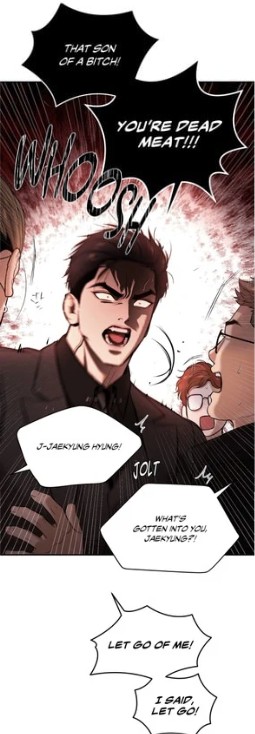 (chapter 82) He became the wolf again, not out of jealousy, but out of survival reflex—his body screaming its panic in place of words. In that instant, he was reminded that he could lose doc Dan as a partner, that the bond he relies on might not belong to him forever.. The roar emptied his chest; his lungs gave out before his pride did. There was no air left in his body… thus the heart and lung couldn’t work properly.
That’s why the “burnout” (chapter 82) after training feels different this time. It’s not a failure of strength but a signal from the body, revealing what he refuses to confess: his greatest fear is no longer defeat—it’s loss. And that’s what makes him so human. For the first time, the indestructible champion stands on the same ground as Oh Daehyun—both breathless, both weary, both trapped between expectation and emotion. The difference is that Jaekyung’s fatigue is not born of rivalry but of love. In other words, this scene announces the vanishing of the monster the manager had tried to create and preserve.  (chapter 75) The fearsome beast who once fought for dominance is gone. What remains is a tamed wolf, following his master’s voice (doc Dan) — not out of submission, but because he finally trusts where it leads.
 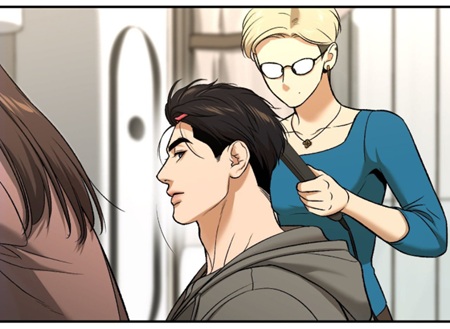 (chapter 82) He is now a tamed wolf following his master’s suggestions!
  (chapter 82) Thus the coach is now facing the couple. And now, my avid readers can understand why the champion seems almost radiant when he finds himself alone with doc Dan at the amusement park. It is not mere joy or freedom; it is the relief of finally acting from desire instead of duty (chapter 82) For once, he can do what he truly wants — to make the man beside him breathe.
The motivation behind this “date” goes beyond playfulness. It is his way of returning the gift he once received. Remember the birthday card (chapter 55): 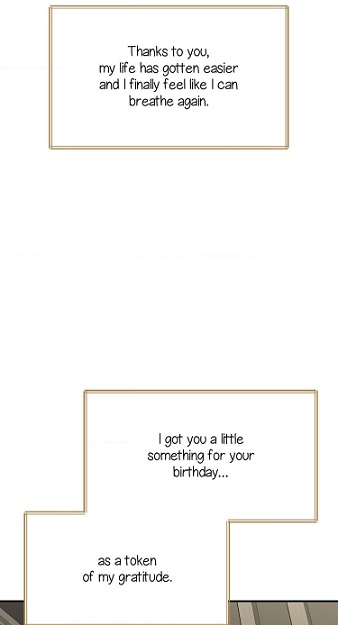 (chapter 55)
“Thanks to you, I finally feel like I can breathe again.” That card became the emblem of hope — a promise of redemption. Joo Jaekyung had been able to bring the physical therapist comfort and support in the past, so he can do it again. If he can help doc Dan breathe freely, without fear or debt, then perhaps he himself can breathe without fear as well. In other words, we should expect a confession in the future episodes.
“I Won’t Fall Again” — Gravity, Shame, and the Vow
Falling is actually the champion’s biggest fear. (chapter 82) That’s why Mingwa confronted him with reality, when she stages doc Dan’s unconscious suicidal attempt in front of the railing:  (chapter 79) The scene functions as both mirror and revelation: it forces the fighter to face the truth he has avoided all his life. In the past, he had never truly fallen. His defeats were painful, but never fatal; his failures never signified the end of a life. He could always stand up again — until now. Watching Kim Dan lean over the edge forces him to confront the difference between metaphor and mortality.
But this rises the following question. Why does he associate his first tournament (chapter 82) with fall (chapter 82)? After all, that match ended only in a knockout, not in death. The answer lies at home. The boy’s first image of defeat was not his own body in the ring, but his father’s corpse on the floor 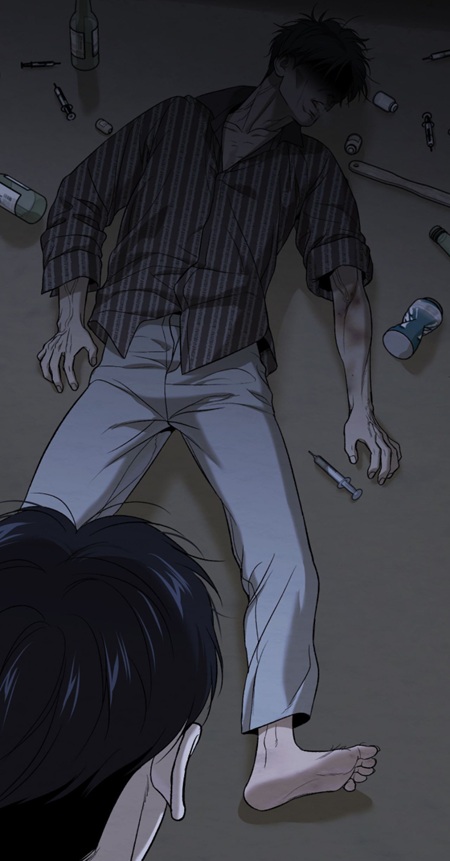 (chapter 73) – surrounded by bottles and syringes (chapter 73). Addiction, gambling, and intoxication: all ways of trying to rise above reality, to feel high, if only for a moment. Joo Jaewoong quite literally died from altitude, from chasing a false form of air. His father had tried to climb the social ladder through sport, to escape the poverty that trapped them, but he had failed. Those words
  (chapter 73), thrown like stones by the father at his son, buried themselves in the boy like shards.. They echoed like a curse — a prophecy Joo Jaekyung would spend his whole life disproving.
The young Jaekyung saw and understood. When he collapsed during his first tournament, finishing third because there were no other opponents (chapter 82), he has the same posture of that corpse — arms spread, breath gone, waiting for someone to call him back to life. Back then, his father was still alive, but didn’t care for him. However, such a position announced the future demise of Joo Jaewoong. He had fallen out of excess; he fell out of weakness. Both were conquered by gravity, one literally, the other symbolically.
But the mother’s departure turned that fall into reality. She left the house claiming that the father’s violence and failure were to blame  (chapter 72)
 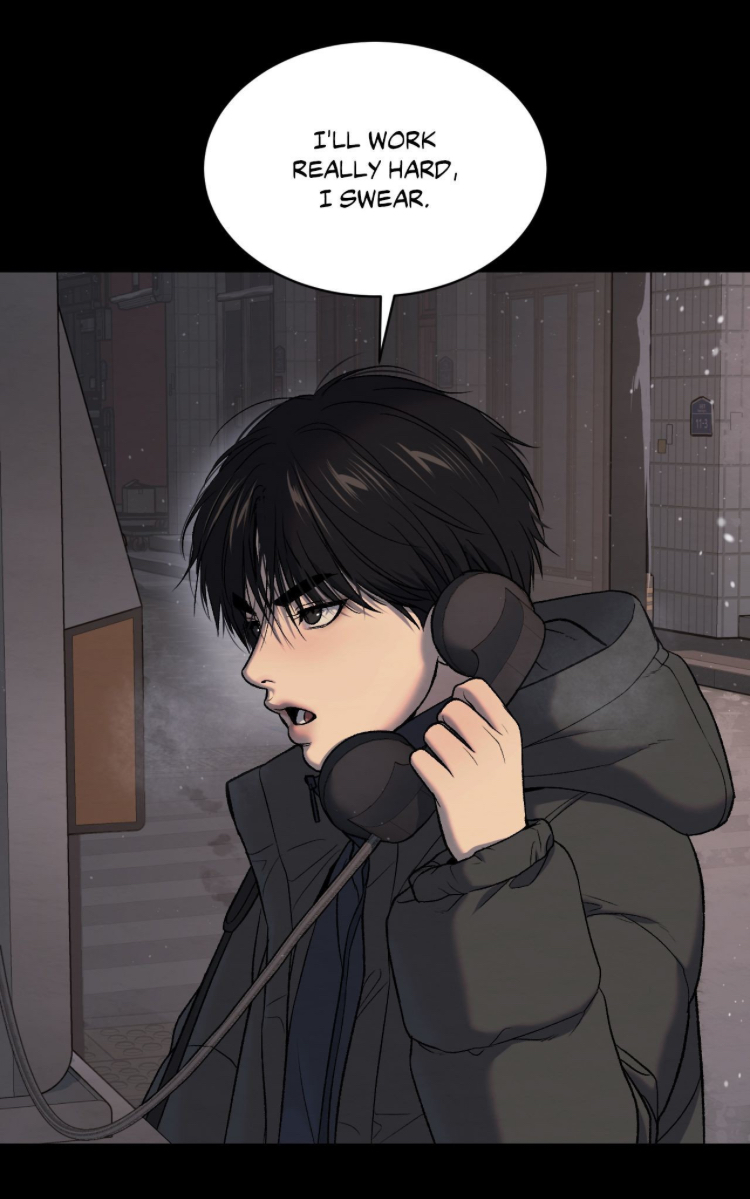 (chapter 72), yet she made no attempt to build an independent life. Her survival had always depended on his success — and when his career crumbled, she vanished with it. That’s the reason why the trash remained uncollected — a visual proof of abandonment
  (chapter 72) But the little boy failed to notice it, because he was suffering from the father’s abuse. Before leaving, she gave her son a phone number, as if absence were only temporary, as if love could be reached through a dial tone. That small gesture sustained an illusion: that she would come back if he became strong enough, rich enough, worthy enough. That illusion became the foundation of his life.
Thus he trained obsessively, demanding to compete even as an elementary student  (chapter 72) His first fight was not about trophies — it was an act of filial negotiation: a promise to buy her return. But of course, 300 dollars could not rebuild a family. His first fall became the confirmation of her silence. This explicates why he recalls his first tournament and considers it as “fall”. He had not been able to win, thus the mother could not return. He doesn’t fight for glory or passion; he fights to avoid being discarded again. So, when he says “I won’t fall again,” what he really means is “I won’t let myself be unloved again.”
In other words, he wanted to climb in order to rebuild the missing bridge to his mother.  (chapter 72) But the problem is that when he was finally able to reach his mother, the latter answered that Joo Jaekyung was too late. The mother’s words sealed the curse. He was “already grown up now”
 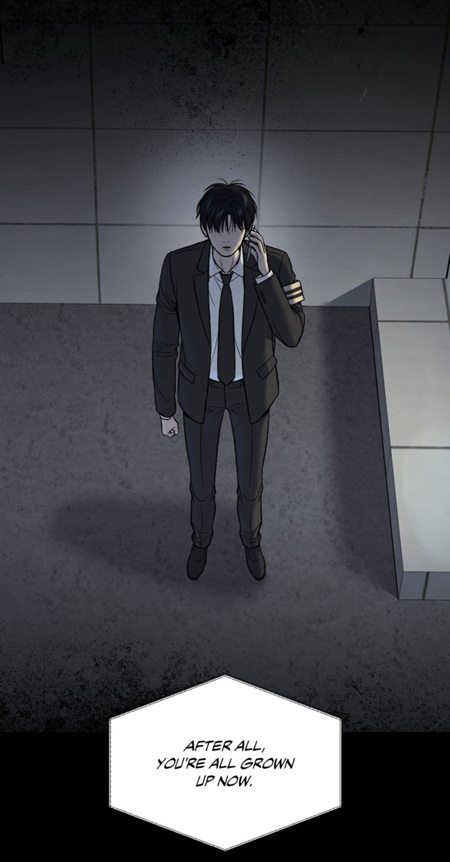 (chapter 74), hence he no longer needed her — as if maturity meant he no longer needed love. She actually implied that she had been all this time by his side.
  (chapter 74), while in reality, she had long abandoned him. Her departure turned growth into punishment, and independence into exile. This explicates why as an adult, he used money to buy people and turn them into toys. This could only make appear as a spoiled brat.
He built his entire life around that promise, standing against gravity like an inverted pillar. The body that once touched the ground became a monument to refusal. He had to reach the sky, to remain in the air. Thus he chose the penthouse as his new home.
But defying gravity comes at a cost. He trained to stay upright until breathing became difficult due to the thin air. Breathing itself became rebellion. Every gasp of air reminded him of the father’s last exhale. Every victory was a way of proving that he could resist both descent and inheritance. Yet the same vow that kept him standing also froze him in place: a man always in motion, never resting.
When Kim Dan almost fell from the railing (chapter 79), the scene echoed this primal fear. The champion’s hand reaching out was more than reflex — it was salvation in reverse. By catching the doctor, he was symbolically catching his father, his mother, and the child he once was. In that single gesture, he refused to let history repeat itself.
The sentence “I won’t fall again” is no longer just a boy’s defense; it is a man’s confession. It reveals the weight he carries: the fear of becoming the very body he once found on the floor, the terror of losing the one person who gave him air. Through doc Dan, Joo Jaekyung learns that grounding himself is not failure but healing: he must get closer to the ground to draw air back into his lungs.
And now, we can understand why he chose the amusement park over the Eiffel Tower. The fighter who once chased altitude now seeks balance at earth level. His goal is not to impress through grandeur or wealth, but to care, to laugh, to rebuild joy together.
By choosing play over pride, he is attempting to rewrite his history — to erase the legacy of his parents’ abandonment and failure. What once was a vow against falling now becomes a lesson in how to stand, breathe, and love on common ground. Hence he looked for attractions and found these brochures. He didn’t want to leave it to fate contrary to his hyung.
Breathlessness and Youth
Before focusing on the funfair, I would like to give another explanation for his sudden breathlessness. (chapter 82) In chapter 82, both Yosep and the manager interpret the champion’s shortness of breath in purely technical terms. Yosep assumes it comes from his long absence from the ring, while Park Namwook agrees — eager to reduce fatigue to mere physiology. Their reasoning sounds plausible, yet it misses the core truth.
Joo Jaekyung’s breathlessness was never an issue before.  (chapter 79) Even Park Namwook himself, only days earlier, had described the French match as
  (chapter 81) “a breeze” — a fight so effortless that it would bring some fresh air into the champion’s career. But that metaphor betrays its irony: what was supposed to refresh him is now suffocating him. The “breeze” promised by his manager has turned into lack of air.
If his lungs are giving out, it is not from lack of training, but from an excess of negative feelings. This is the paradox of his transformation. The man who once lived like stone — unyielding, heavy, immovable — is now becoming light, emotional, alive. His body, once used only for control, now responds to affection, anxiety, and loss. He is breathless because he has begun to feel again.
Interesting is that (chapter 79), the break is perceived differently, depending on the situation. (chapter 82) In one scene, the break is seen as a good opportunity, in the other not(“out of the game”). Besides, at no moment, they are using the word “recovery”, as if the man had never been surged.
What neither man notices is that the athlete’s body had already changed during that so-called “break.”
In truth, he had caught a cold  (chapter 70) — a detail no one around him ever learned. This simple fact overturns their interpretation.
 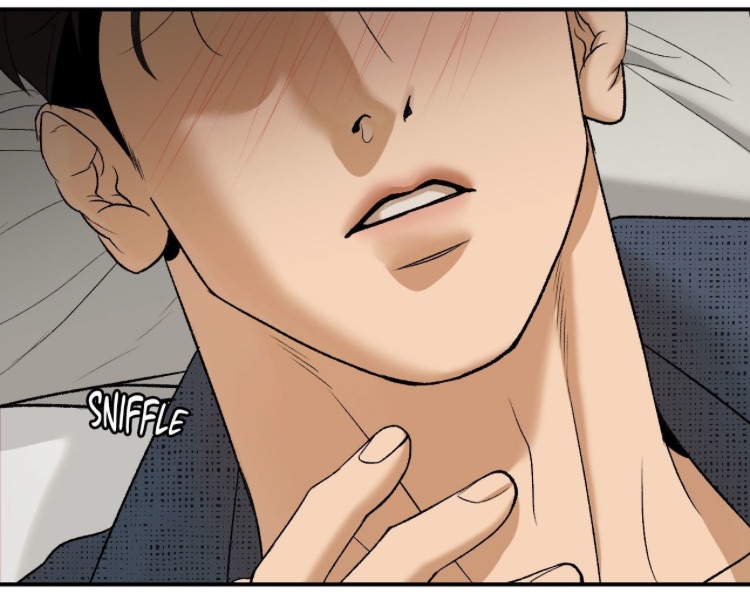 (chapter 70) The breathlessness they see now is not a decline in performance, but the residue of transformation. His body, once trained to suppress every weakness, had finally surrendered to nature.
The cold, therefore, was not an illness but a rebirth — the first genuine sign of rejuvenation.
The first sneeze burst out like a leftover gasp from the night of panic at the dock (chapter 69): an involuntary release of fear and tension. Flooded with air and emotion, his body responded the only way it knew how — by collapsing into vulnerability. It was the moment when the emperor turned into a man, when the monument learned to breathe.
This was not simple fatigue; it was renewal.
For the first time in years, his system behaved like that of a human being, not a machine. The flushed cheeks, the runny nose, the dazed look — all marked a regression to childhood, an age when feelings could still flow freely. Before, he had never been breathless, because he was living like a zombie or a machine ignoring pain. Breathlessness had once been a symptom of repression; the cold became the body’s quiet revenge, proof that he could still react, still feel.
In this sense, the cold acts as metaphorical cleansing — an expulsion of the stale air he had been holding since childhood. The “monster” that Park Namwook wished to preserve (chapter 75) was finally dissolving. What replaced it was something fragile yet alive. But Yosep and Park Namwook, more obsessed with performance and profit, mistook this renewal for decline.
This connection between breathlessness and youth extends beyond Joo Jaekyung. We’ve seen another fighter gasping for air — Seonho 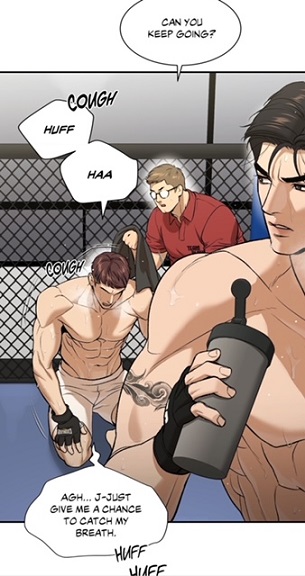 (chapter 46), whose clash with the champion exposes two different forms of frustration.
It begins with Jaekyung’s own accusation. 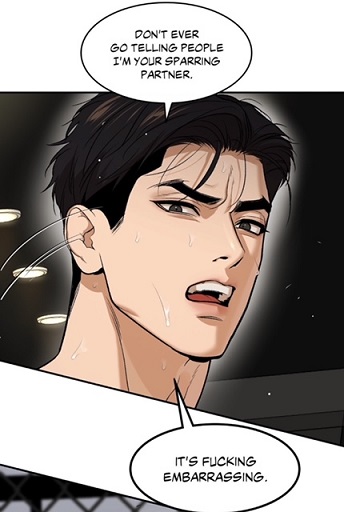 (chapter 46) He reproaches Seonho for using his title and image to promote himself, for bragging about their sparring sessions to boost his career. From his perspective, Seonho lacks both endurance and authenticity — he performs strength rather than living it.
 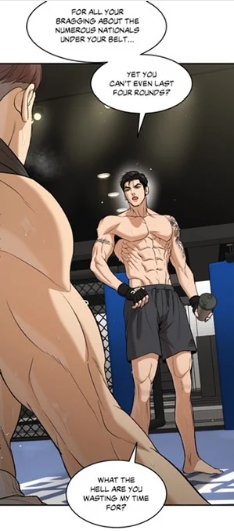 (chapter 46) For Jaekyung, such behavior is intolerable because it cheapens everything he has sacrificed to achieve.
But Seonho’s retaliation strikes closer to the heart. 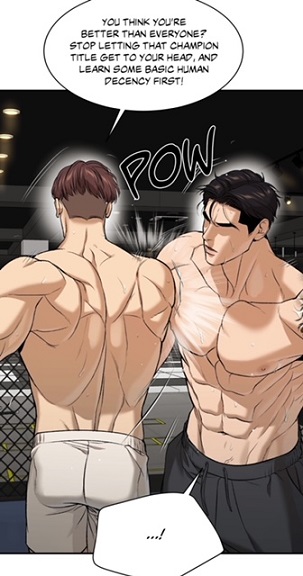 (chapter 46) He turns on Jaekyung and accuses him of arrogance — of using his champion title to look down on others. What Seonho perceives as disdain is, in truth, the athlete’s defense mechanism. The star’s detachment is not born from pride but from obligation and trauma (abandonment issues).
For years, he has been forced to be perfect — the faultless product that Yosep and Park Namwook can market and control.  (chapter 46) His perfection is not freedom; it is captivity.
The irony is cruel: Seonho envies what Jaekyung himself resents deep down. He is not happy.
One gasps because he cannot reach the summit; the other because he can never descend and have a family. Both are breathless — trapped at different altitudes of the same illusion. In this light, breathlessness becomes the shared symptom of youth distorted by ambition. For Seonho, it signals decline — the body’s inability to keep up with the illusion of eternal strength.
For Jaekyung, it marks the end of the illusion itself — the beginning of human fatigue, emotion, and rebirth.
Under this light, it became comprehensible why Seonho  (chapter 52) tried to recruit Potato, the youngest member from Team Black. He wanted to become the new idol of Hwang Yoon-Gu. He imagined that he could replace the main lead and Potato would be happy to become the new sparring partner of Seonho.
And this prepares the ground for his encounter with Arnaud Gabriel, the “eagle” who embodies yet another version of false air 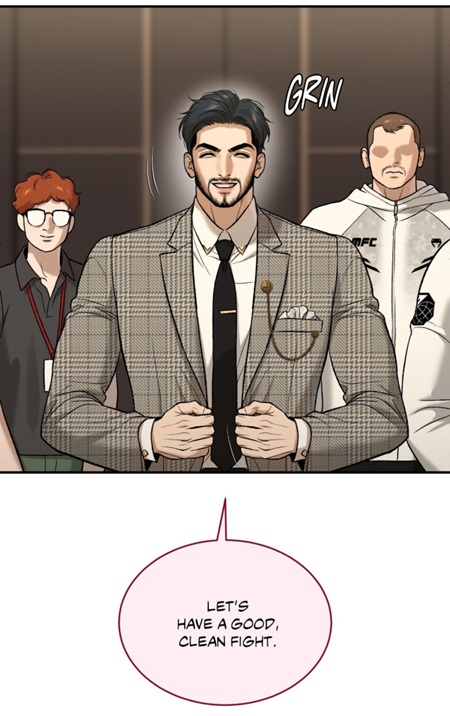 (chapter 82) — a beauty that glides but never lands. Like Seonho, Gabriel thrives on appearance — on surfaces polished by attention. His beauty, elegance, and social charisma are his weapons. He lives in the air of visibility, relying on wind — the shifting currents of social media
 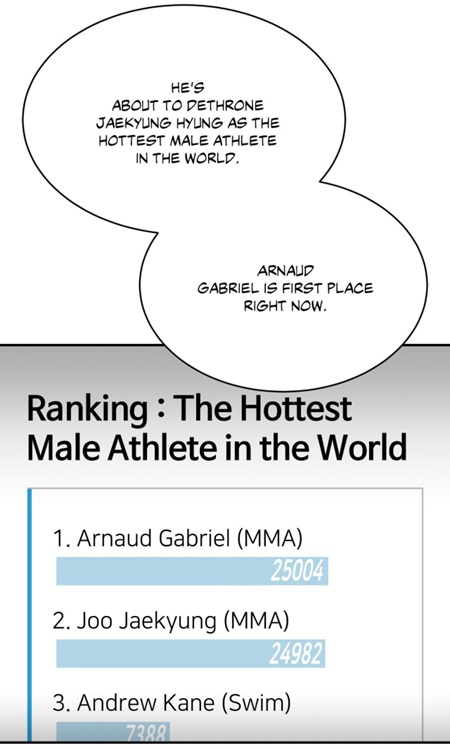 (chapter 81)
  (chapter 82) and press coverage — to lift his name higher. That’s why Mingwa made sure to show him at the press conference.
  (chapter 82) Every post, every camera flash, every headline serves as borrowed oxygen.
We see him carefully maintaining this illusion of effortless flight: (chapter 82) posing in his new suit for the press conference, his public image as flawless as his wings.
 (chapter 82) Yet beneath that composure lies dependency. Gabriel’s power exists only as long as others keep watching, as long as the wind keeps blowing. His world is made of altitude — but the higher one flies, the thinner the air becomes. But if there is no wind or air, the eagle can no longer fly. This is palpable on two occasions, his encounter with the two male leads.
When he flirts with doc Dan (chapter 82), Gabriel still speaks in French — creating an act of exclusion. The physical therapist can’t understand a word, but the eagle doesn’t care; comprehension isn’t the goal, impression is. The wink replaces language, turning seduction into spectacle. It’s not meant for dialogue but for display — a gesture meant to be seen, not felt. He imagines that he has wooed the physical therapist.
He doesn’t wait for a reply; he simply turns away, leaving Doc Dan behind. 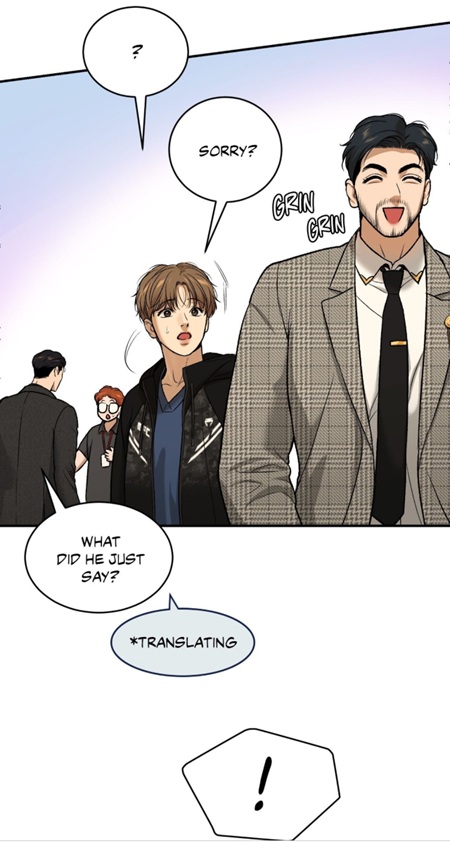 (chapter 82) The grin that follows is one of self-satisfaction and superficiality, not connection. It’s the smile of a man admiring his own reflection in another’s confusion — proof that he controls both the scene and the gaze. This shows that he had no intention to make the protagonist jealous. And it is clear that he never saw the wolf’s rage afterwards. (chapter 82)
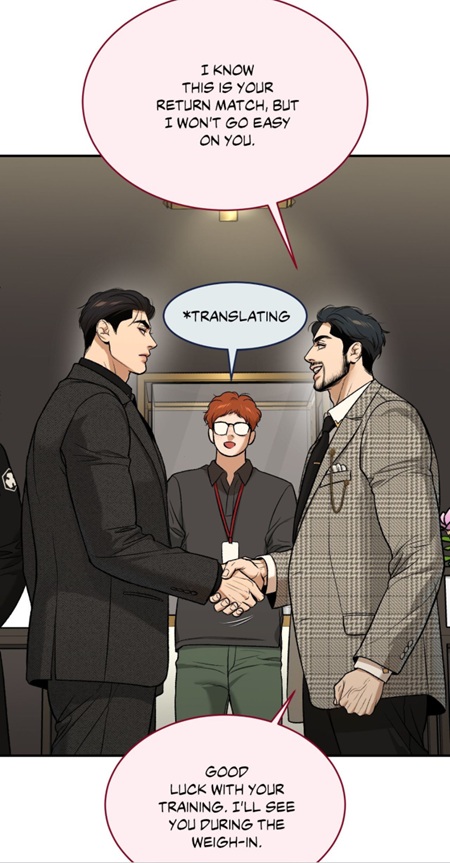
But why did he approach the Emperor, after he had left the spotlight? One might say that it was to get his attention and provoke a reaction. The same arrogance colors his handshake with Joo Jaekyung. Gabriel greets him with a polished smile and an extended hand, yet his words carry a double edge: (chapter 82)
- “I know this is your return match, but I won’t go easy on you.” Behind the polite phrasing hides mockery and calculation. The smile is diplomatic; the tone, predatory. By choosing to speak in French, through an interpreter, he asserts distance and superiority. It is not a language barrier — it is a form of hierarchy.
- “Good luck with your training,” he pretends to wish him well while quietly diminishing its target. The implication is clear: you’ll need it. The eagle knows about the champion’s surgery and exploits that knowledge beneath a façade of charm. Every word he utters, whether to Jaekyung or Dan, is a performance — a test of power disguised as civility.
Everything is pointing out that Gabriel knows more than he admits. His remark reveals that he is fully aware of the champion’s surgery and the rumors surrounding it. He could even know about the drinking and his “lack of stamina”. (chapter 82) The line echoes in irony. On the surface, it invokes sportsmanship; beneath it, it suggests that Jaekyung’s previous victories were not clean — that his reign was tainted by aggression or controversy. Yet the true paradox lies elsewhere: Gabriel himself knows that this match is anything but clean. He is exploiting Jaekyung’s weakened condition, confident that he will prevail against a half-healed opponent. That’s why the athlete was encouraged to appear in a suit.  (chapter 82) That way, his “vulnerability” would be masked. No one would question the champion’s health. And this brings me to my next observation.
This duplicity mirrors the logic of Hwang Byungchul, the old coach who once criticized Jaekyung for fighting too soon after his shoulder surgery 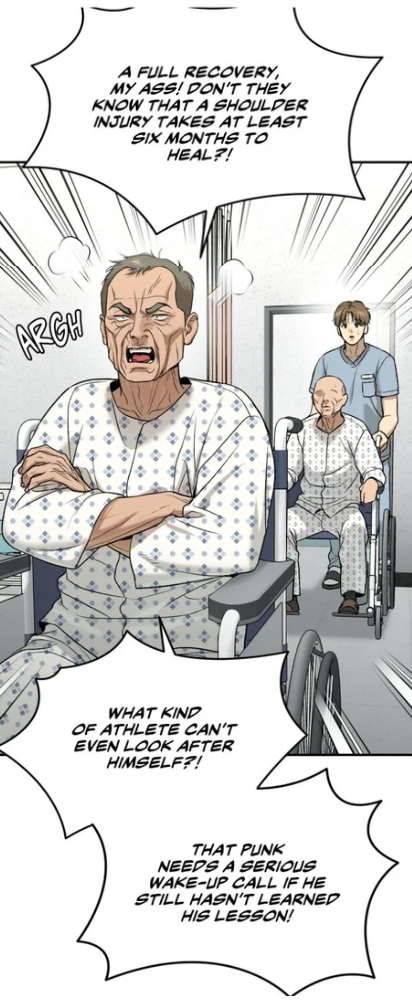 (chapter 70). Both men embody the same cruelty disguised as professionalism — one in the ring, the other from the shadows. They blame the champion for the new match, none of them question the system.
Gabriel’s arrogance, therefore, is not personal but systemic. He represents the world that raised Jaekyung: a world where weakness is mocked, empathy is absent or a lip-service, and “clean fights” exist only as public performances. That’s why he stands for fun. He has never truly challenged “dangerous opponents”. The eagle’s flight is powered by the same wind that once blew through the director’s gym — the cold air of superiority. This means that unlike Joo Jaekyung, the eagle has never faced real turbulence.
Gabriel has lived in an atmosphere of praise, never subjected to the kind of hostility that constantly surrounded the champion. He has not endured the venom of hateful comments 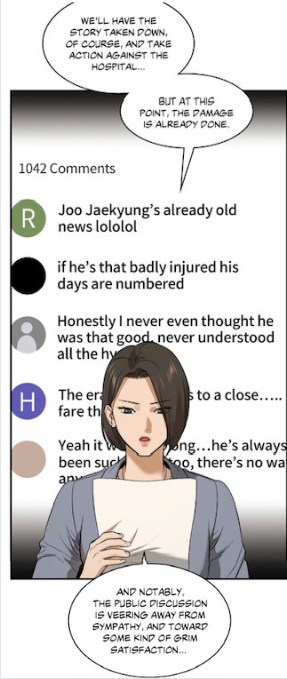 (chapter 36) or the media’s harsh verdicts after defeat
  (chapter 54), when analysts accused Jaekyung of recklessness for returning to the ring too soon, though he had problems with his shoulder. Gabriel’s fame soars above such storms — sustained by admiration, not endurance. Hence he is posting selfies.
(chapter 82) However,, Joo Jaekyung is no longer attached to his cellphone and the virtual world. What he truly wants now is real and true love from doc Dan. (chapter 82) This explains why he is seen interacting more and more directly with fans and this outside! 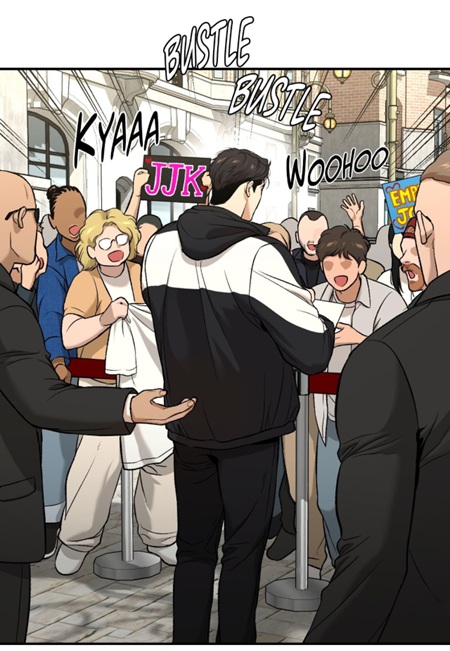 (chapter 82) He is now seen signing autographs
 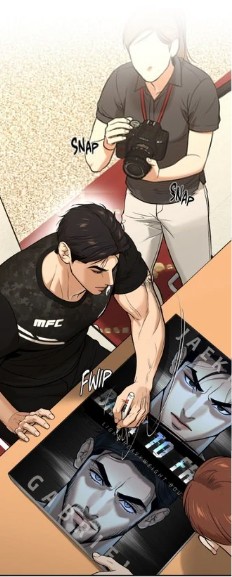 (chapter 82), whereas in the past, he was only seen in company of reporters in a secluded area.
  (chapter 40)
But this match carries a hidden danger. It was secretly arranged by the CEO, a fact still unknown to the public. Should Jaekyung win, the backlash could fall not on the loser, but on the victor. Critics could accuse the champion of avoiding a real challenge — of selecting an easy, lower-ranked opponent (chapter 81) rather than facing the fighters in first or second place.  (chapter 69) The victory would be branded as hollow, a publicity stunt rather than an athletic achievement.
Yet this very accusation could threaten Gabriel as well. By calling him weak, the same commentators who once worshipped his image would strip him of his core identity: that of an athlete. (chapter 81) He wants to be admired as the hottest male figure in the sport, but admiration without credibility is only ornament. If his skill is questioned, his entire persona collapses.
Thus, both men stand on fragile ground — one condemned for winning, the other diminished by losing. Gabriel’s elegance and Jaekyung’s strength mirror each other’s curse: both are trapped in a world where value exists only in the eyes of others, and where even victory can feel like a fall. However, this can change, if this fight becomes a true spectacle, and is born out of love! But the air that sustains Gabriel is not the same that now fills Jaekyung’s lungs.
The eagle rises through applause; the wolf begins to rise through love. Liebe verleiht Flügel (German) — love gives wings — but these wings do not lift him away from the world. They carry him closer to it, toward the ground, toward life and fun.
The Amusement Park and its Ferris Wheel — Circles of Breath and Light
If the Eiffel Tower was built to celebrate height and conquest, the Ferris wheel, 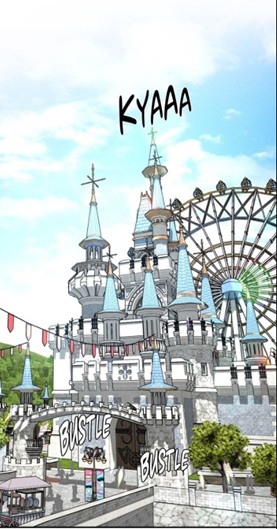 (chapter 82) first unveiled at the World’s Columbian Exposition in 1893, was created to transform height into play. Conceived by engineer George Washington Ferris as America’s answer to the Parisian tower, it sought to outshine France not through steel alone, but through motion — a structure that would rise and fall, carrying ordinary people with it. Unlike the fixed tower, the wheel invited participation: passengers would move together, share the air, rise and descend without fear. It was both monument and moment — a way to democratize the sky.
That is the kind of altitude Joo Jaekyung chooses.
After years of living at the top — in the isolating stillness of the champion’s penthouse, the rooftop — he now turns to a form of shared elevation. The Ferris wheel becomes his antidote to the rigid hierarchy that once defined his life. Here, there are no rankings, no first or second place, only circular motion. One rises while another descends, but both will meet again. It is the geometry of equality — and the perfect metaphor for breathing. This means that, by choosing the Ferris wheel, Joo Jaekyung and Kim Dan experience a gentle form of falling — one that no longer hurts.
Each rotation of the wheel is an inhale and exhale; ascent and descent, effort and release.
Inside the small cabin, air is shared. Love and life become visible through motion rather than achievement. The attraction’s design embodies the very thing Jaekyung and Dan have been learning all along: balance.
For the doctor, whose childhood was shaped by financial limits and emotional debt, the wheel offers what he never had — the chance to look at people from above, to rise without cost or guilt. For the champion, it restores what he lost — the ability to enjoy altitude without suffocating, to associate height not with fear, fame, or trauma, but with wonder. In that cabin, surrounded by laughter and sky, they can both breathe again.
But the symbolism extends further.
The Ferris wheel stands in sharp contrast to the highway, the modern symbol of depression and disconnection. As psychologists have noted, this kind of highway thinking characterizes the depressed and overdriven mind. It is the mental state of someone who keeps moving forward in a single direction — not out of purpose, but out of inertia. The brain becomes trapped in one lane, incapable of detouring, exploring, or slowing down. Over time, this creates a kind of perceptual tunnel: a world reduced to one goal, one fear, one story.
I watched this documentary, but it is in French https://www.youtube.com/watch?v=v5YcH5X5Xgo
In depression, this narrowing becomes pathological. The mind loses its ability to imagine alternatives, to see side roads or landscapes beyond the straight line ahead. Reality shrinks into a one-dimensional track — progress without perspective. The obsession with direction replaces the experience of life itself: one keeps accelerating or slowing down, chasing milestones, yet the inner landscape remains unchanged. This is how I came to connect these three scenes:
| Chapter 33 | Chapter 56 | Chapter 69 |
|---|---|---|
 That reflects the champion’s mind-set, his narrow-mindedness. But keep in mind that during that evening, the champion made a detour, he was disturbed by the destination/ goal: 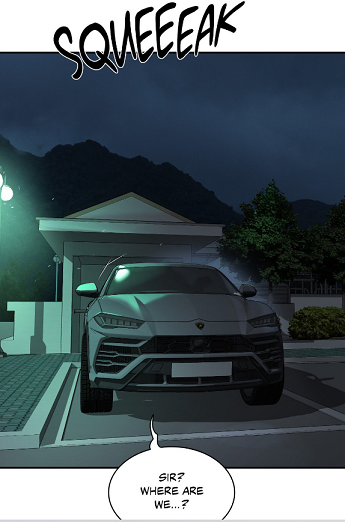 | 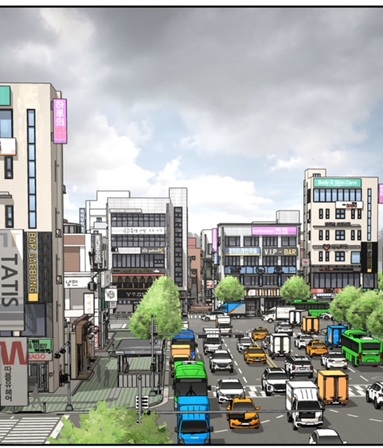 Here the athlete has only one goal: talk to doc Dan and clean the air. He has no intention to truly rekindle with him Here the athlete has only one goal: talk to doc Dan and clean the air. He has no intention to truly rekindle with him 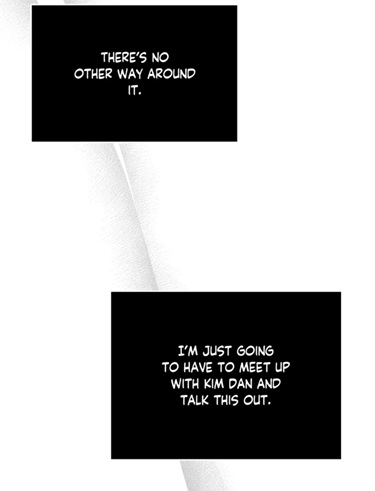 Thus he is still stuck in a traffic jam. Thus he is still stuck in a traffic jam. |  Here, there is a progression, because he can switch the lane. However, he is still driving in one direction, not looking out of the window. He is not taking his time either. These scenes illustrate the champion’s psychological confinement and mirror doc Dan’s mindset as well. Here, there is a progression, because he can switch the lane. However, he is still driving in one direction, not looking out of the window. He is not taking his time either. These scenes illustrate the champion’s psychological confinement and mirror doc Dan’s mindset as well. |
And now, look at the streets of Paris. (chapter 82) They look rather empty, yet we can see a crossroad — a sign that the champion’s mentality has improved. He is no longer narrow-minded or trapped in one lane. However, the high peak ahead represents the amusement park, because there, the destination is not important. There is no order or hierarchy either.
This is why healing requires not just rest but multi-perspectivity — the rediscovery of curves, loops, and crossings. The the funfair and Ferris wheel become the perfect antidote: it teaches that movement can be circular, playful, shared, and above all, reversible. Instead of racing toward a fixed destination, the wheel allows return, variation, and exchange. It reawakens the part of the brain that knows how to wonder. But the funfair offers other possibilities as well: the roller coasters. (chapter 82) The latter teach courage.They carry within them the echo of Jaekyung’s greatest fear: falling. But here, the fall is transformed into exhilaration. What once symbolized loss, shame, and trauma now becomes thrill and laughter. The mechanical descent reclaims the forbidden emotion; it gives the body permission to scream, to release control, to fall without dying.
Joo Jaekyung’s life before Kim Dan was precisely that: a mental highway.
Every victory led only to the next, every title erased the one before. The more he advanced, the less he lived. His body, disciplined into automation, had forgotten the curve of joy — the possibility of turning, pausing, returning. The Ferris wheel and the roller coasters break that pattern. The Ferris Wheel reintroduces circularity, where movement is not escape but rhythm, where the goal is not ascent but repetition with difference and observation. From there, you can look at your surroundings. 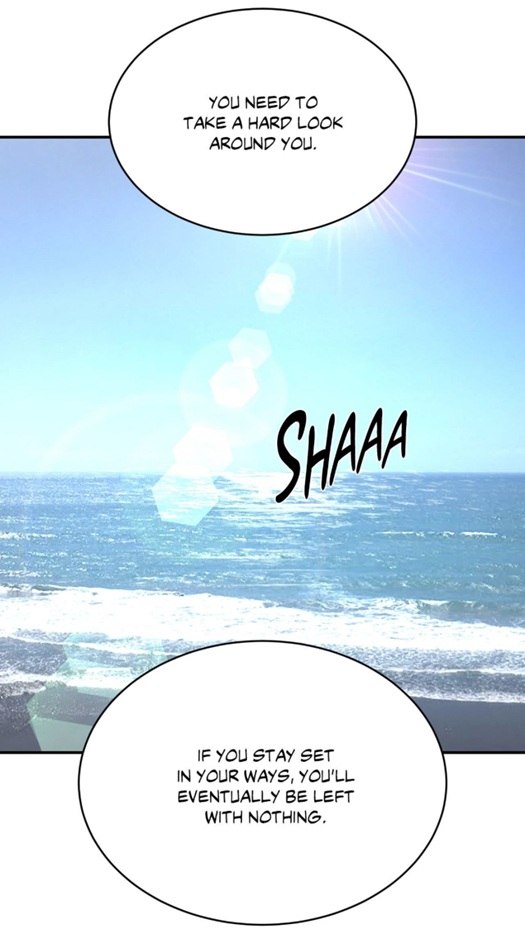 (chapter 75)
This is where Mingwa’s visual irony reaches its height.
The man who once swore, (chapter 82) now voluntarily steps into a machine that promises nothing but falling — and smiles. What once represented humiliation now produces joy. This reversal is the purest expression of healing: when what once wounded becomes what restores.
Together, the Ferris wheel and the roller coasters offer two complementary forms of breath.
One teaches rhythm — the inhale and exhale of life. The other teaches release — the scream that clears the lungs. And then, it came to my mind that such a theme park could offer bumper cars — small machines of collision and laughter. Unlike the Ferris wheel or the roller coaster, they don’t offer height or speed but contact. Here, impact is stripped of danger; the crash becomes a form of play. The goal is not to avoid others but to meet them — to touch, collide, and burst out laughing. In this attraction, aggression loses its sting and turns into connection.
One shows that peace is possible in repetition; the other shows that freedom lies in motion. Laughter becomes medicine for the two breathless men, but contrary to the past, this time, doc Dan will see the happiness written on his loved one’s face. So far, he has never paid attention to his genuine smiles: 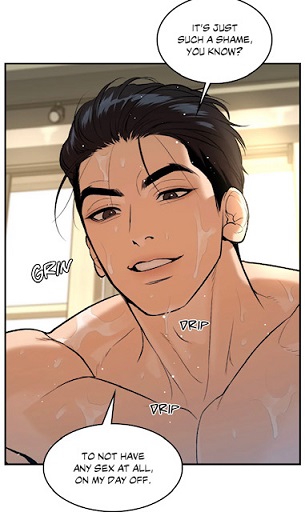 (chapter 27)
  (chapter 80) He has not grasped that he can make the champion happy. In fact, this day would represent a real break and rest, as they would learn nothing, only make new experiences so that life can appear colorful again. Here, we can see two balloons in the form of heart: green and yellow. (chapter 82) Once they enter this world, they will discover a world full of magic and lights.
And now, imagine this. If there was a love confession in that theme park, this could bring tears of joy, the opposite of these scenes  (chapter 52) a kid versus a grown-up, both rejected and silenced.
  (chapter 74) Joo Jaekyung would have achieved his goal: even vulnerable or childish, he is still lovable.
Both stand against the straight line of the highway — the depressive geometry of one-way thinking. The park and its attractions offer circles and loops instead, motions that bring one back to the self, not away from it. They turn fear into fun, control into connection.
If the highway is the architecture of burnout, the amusement park with its attractions is the architecture of recovery.
On the road, time accelerates; in the air, it expands.
On the highway, one is alone even among traffic; on the wheel, one is secluded but among people — the paradox of safe intimacy. Inside the cabin, the couple is both visible and hidden, surrounded by other voices yet enclosed in their own breath. It’s a fragile cocoon where public space becomes private moment, where affection can exist without fear of intrusion.
This is the healing structure of Jinx’s Paris arc. (chapter 82) The wheel is not a symbol of escape from the world but reconciliation with it. At the same time, it feels like a reverence to the fairy tales and their famous ending:  (chapter 41) They were destined to be together and lived happily.
It redefines air: no longer something to conquer or control, but something to share. The circular motion mirrors the psychological rhythm that both men have been denied — the ability to rise and fall without shame, to let life move through them rather than resist it.
Even the mechanics of the wheel resonate with their journey. It turns slowly, patiently; it demands trust. Once aboard, there’s no way to force speed or direction. One must surrender — to the mechanism, to the air, to the view. It is the perfect opposite of Jaekyung’s former life, where every second was measured, every breath controlled. Now, he can do nothing but sit, look, and breathe.
And there is more. The wheel’s origin — a response to France’s Eiffel Tower — completes the symbolic circle between the two monuments. The Eiffel Tower represented competition between nations, a masculine monument to progress, mastery, and endurance. The Ferris wheel transformed that spirit into something inclusive: it turned height into experience, individual triumph into collective wonder. Hence the Ferris Wheel exists in France and in other cities. This is exactly the transformation Jaekyung undergoes. The fight is no longer vertical — him against the world — but circular, relational, shared.
Seen from a distance, the wheel glows like a moving constellation — a ring of stars rotating in the night.
In the earlier chapters, stars appeared above Jaekyung’s brochures (chapter 82) to signal his quiet happiness, mirroring the stars that once surrounded Kim Dan’s laugh (chapter 44). The Ferris wheel reanimates that motif. Each cabin is a star, and together they form a galaxy of moments — proof that light can move without burning out, that joy can repeat without fading.
In that sense, the Ferris wheel is more than a date setting. It is a machine of breath: a gentle, mechanical reminder that even steel can carry tenderness, that love — not ambition — is what truly gives flight.
Love gives wings — but not the kind that seek altitude. These wings move in circles, not lines. They return to where they began, bringing both men back to the ground lighter than before. To conclude, the birthday card contained the key how to rekindle with the physical therapist and win his heart:  (chapter 55)
Feel free to comment. If you have any suggestion for topics or Manhwa, feel free to ask. If you enjoyed reading it, retweet it or push the button like. My Reddit-Instagram-Twitter-Tumblr account is: @bebebisous33. Thanks for reading and for the support, particularly, I would like to thank all the new followers and people recommending my blog.


 (chapter 26) They have watched his fights
  (chapter 23), memorized his moves and titles, and repeated the anecdotes told in gyms and on TV. They’ve heard how he was “saved” by sports from a darker path, and cheered for him as the “Emperor” — the handsomest fighter, the man who broke the arcade’s punching machine
  (chapter 26), the champion who stands above the rest. But if the champion’s life is already an open book, why did Mingwa wait so long to reveal his childhood and family? The answer is simple. It is because Joo Jaekyung has been called the Emperor till his fight against Baek Junmin! These public portraits — the friendly banter in the gym, the theatrical ring intros — show us the merchandise, not the man. They are the carefully polished surface presented to fans and fellow fighters alike, repeated so often that even those closest to him believe them. Yet behind this image
 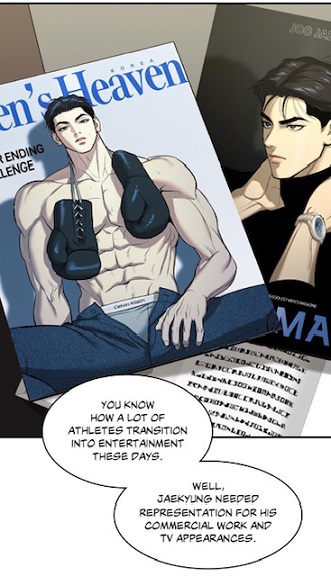 (chapter 30) lies a past left unspoken, a silence so complete that his own history became an empty space others could fill as they wished. This essay brings these two “stories” together — the Emperor and the boy. And now, you may be wondering how I came to connect the champion’s trauma to his future career as an MMA fighter. The answer lies in Joo Jaekyung’s own voice. 😮
 (chapter 70), Hwang Byungchul’s anger fell squarely on the champion.
  (Chapter 70) created the illusion that this break had been perceived as a punishment, and that Jaekyung was eager to prove himself once again. No wonder the director assumed he had given his consent.
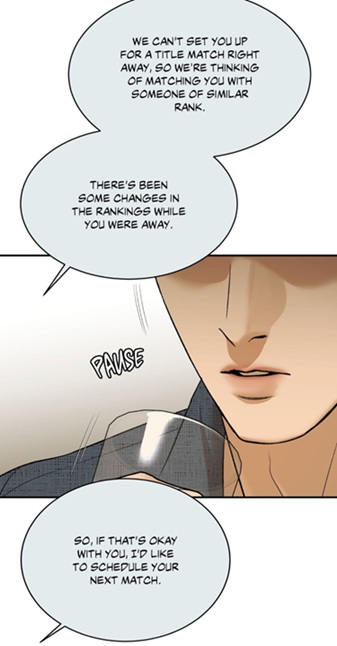 (chapter 69) By erasing these details, the public sees only two players: the Emperor and his anonymous “team.”
 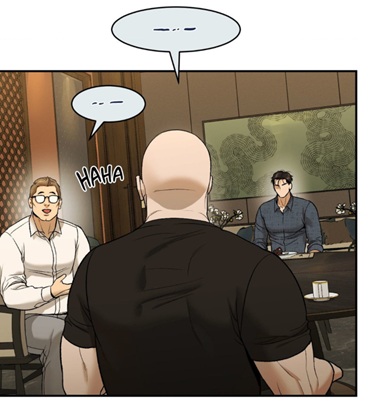 (chapter 69) It was as if the main lead, backed by his team, had personally approached MFC to request the match — an illusion strengthened by the opening line, “MFC’s former champion Joo Jaekyung will be returning to the ring this fall after serving his suspension.” This way, if the decision draws criticism, the CEO can retreat behind the fighter and his team, like they did in the past.
  (chapter 41) But that excuse would be a fiction: Jaekyung hasn’t even met those doctors or talked to the MFC match manager
  (chapter 05). He has been chasing after his fated partner. Finally, he hasn’t even signed any paper or agreed at the meeting. In fact, he remained silent for the most part of the time and the reason for this urgent meeting was his request for proper investigation concerning the switched spray:
  (chapter 67) That’s the reason why this suggestion from the CEO appeared the very next day.
  (chapter 69)
  (chapter 61), it was paired with a recommendation for rehabilitation — not an immediate return to competition. This was actually a condition for his total recovery. On the other hand, the doctor imagined or suggested that his patient wished to return to the ring so soon. No medical professional ever signed off on an autumn fight. Yet the date is already set, and the headlines frames it as a confident comeback without any medical backup. The Emperor’s name is splashed everywhere, but none of the words belong to him.
 (chapter 57) with one of his close associates — a man whose face was hidden, speaking as though he were the athlete’s voice. That interview was accompanied by a familiar victory image
 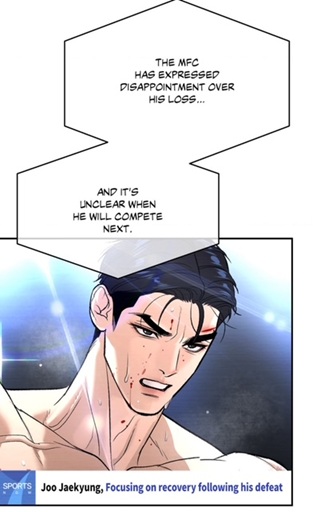 (chapter 57), a stock photo already used in other press pieces. This picture comes from after the fight in the States:
  (chapter 41), while the image released with the fall match announcement was the one from when he first won his champion title.
 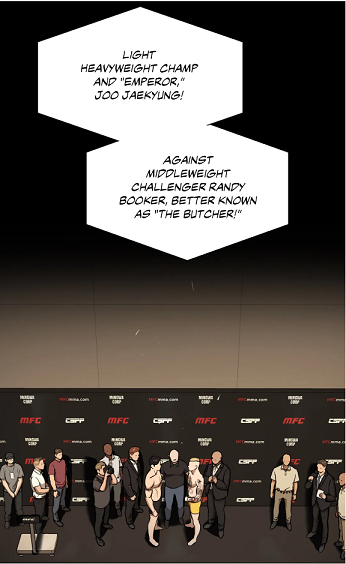 (chapter 14) seems to radiate absolute power — the kind of authority that commands armies, bends laws, and answers to no one. It is meant to ooze charisma and control, a name that suggests the bearer acts on his own will. Yet, in truth, emperors have rarely ruled alone. Behind every throne stand ministers, advisors, generals, and family factions, each shaping decisions from the shadows. An emperor who ignores these forces risks losing his crown.
 (chapter 17) He was blamed for his popularity. The man inside the crown does not act or speak freely; his words are filtered, scripted, or replaced entirely.
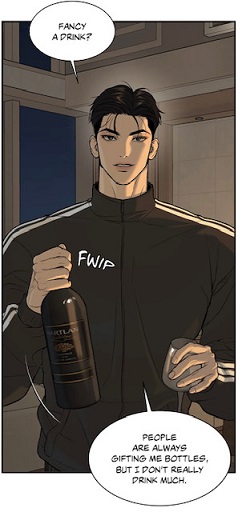 (chapter 12), never mind that he hardly drinks. The gesture fits the fantasy they’ve built around him, not the reality of a man who rejects alcohol due to his addicted father, a reminder that even the tokens of admiration are shaped by the image, not the truth. So who is this so-called close associate or “Joo Jaekyung’s team” exactly that decides for him, speaks for him, and hides behind his title? Besides, why did the journalist change from “one of his close associates” to “Joo Jaekyung’s team”?
 (chapter 57) The nickname, played for entertainment value, was another way of turning the champion into a caricature — a marketable, amusing persona instead of a man with a past and agency. It is quite telling that Park Namwook’s interview aired immediately after the anchor referred to Jaekyung as “Mama Joo Jaekyung Fighter.” This was not the lofty “Emperor” title repeated in gyms and ring intros — it was more a mocking nickname, a deliberate jab meant to provoke. In that moment, the Emperor was verbally pulled down from his pedestal, yet the images shown alongside the segment told a different story: carefully chosen shots of him as a champion, a visual echo of his marketable persona. The dissonance was striking.
 . (chapter 54) In my opinion, the man is trying to return to the past, thinking that his “popularity” can come back, not realizing that he is being manipulated himself. On the contrary, he stepped into the role of spokesperson without hesitation, speaking as if he were Jaekyung’s voice while keeping his own face and name hidden. He only speaks, when he feels safe. He can not be responsible for the champion’s recovery.
  (Chapter 52) This framing lets him claim the prestige of leadership while leaving himself room to withdraw if things go wrong. Yosep was the one notifying MFC and reporting the incident to the police, Potato explaining his discovery to Joo Jaekyung and blaming the star.
 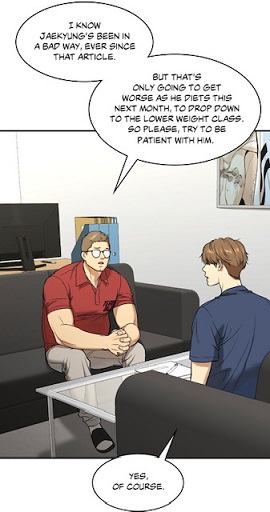 (Chapter 36) He should tolerate the celebrity’s moods and put up with everything. The manager didn’t mind, as long as he didn’t get affected. But what is the consequence of such a passive tolerance? An individual’s self-esteem can slowly erode, leading to a gradual loss of their sense of self. They may stop recognizing their own desires, needs, and rights, often without even realizing this is happening. This is because emotional exhaustion often develops subtly over time, rather than appearing as a sudden, dramatic event.
 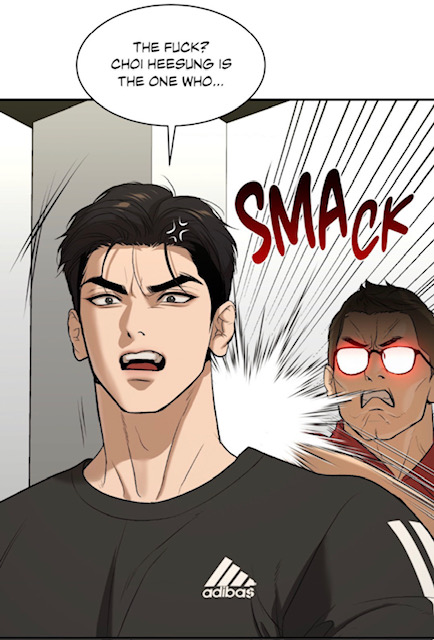 (chapter 31) when punished. In this light, Park Namwook embodies the very dynamic the article warns against: a figure who benefits from another’s compliance, maintaining control not through open dialogue, but through unspoken rules and the threat of exclusion.
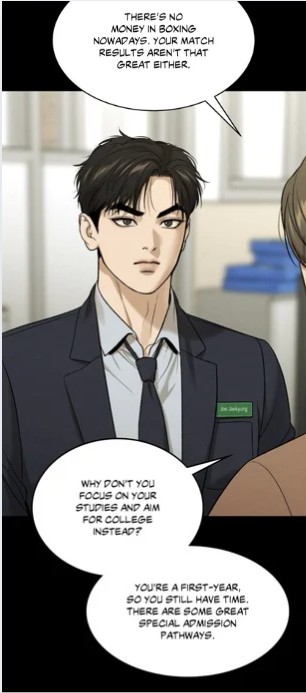 (chapter 73), by becoming a boxer, the champion wouldn’t make a lot of money. With this comment, he implied that boxing in South Korea had been losing popularity 10 years ago. This explicates why gradually, the members from Hwang Byungchul left the studio. And it was likely the same in the illegal fighting circuit.
  (chapter 73) The popularity of MMA in the States gave them the opportunity to revive fighting sports, a figure who could draw crowds and sponsors, making such events fashionable again.
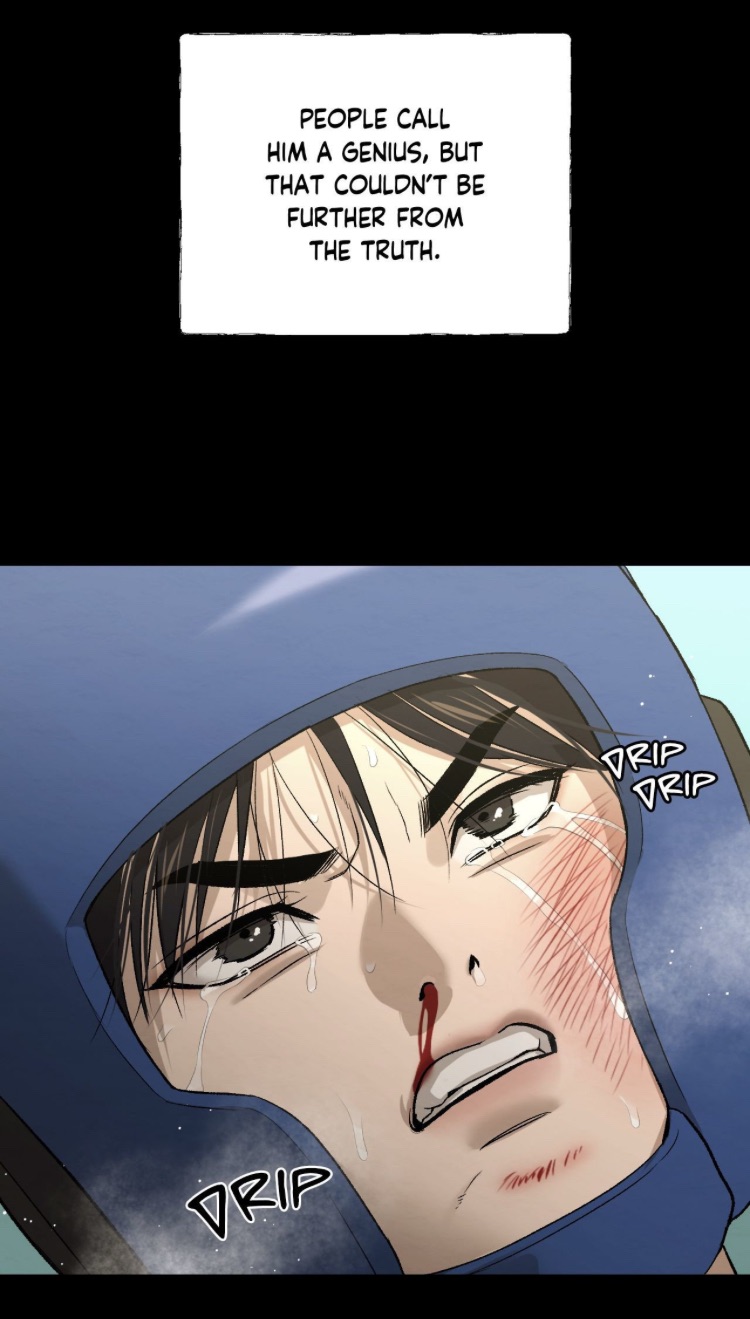 (chapter 72) instead of “hard-working,” a man who “chose sports over a dark path.” Yet if you look closely, this celebrated “ascension”
 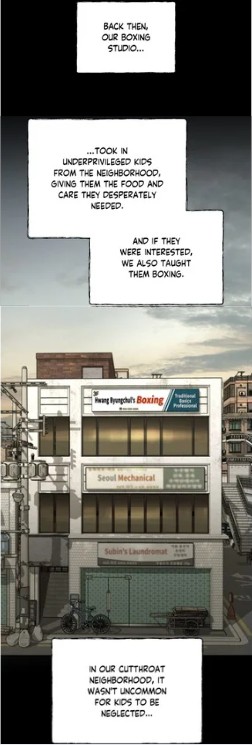 (chapter 72) isn’t tied to the director’s boxing studio at all — it’s linked to the arcade’s punching machine incident.
  (chapter 72), the scars of his family history, and the years of survival before the cage. This is history rewritten, his boxing past and family erased. Why? His origins could expose the ugly verity: the link between criminality and boxing (as such fighting sports). Secondly, because his real story, though moving, lacked the glamorous allure needed to market him. His real story would have revealed that to rise to the top, you need relentless work, not a miraculous moment. That version was never going to sell as well as the “genius” myth.
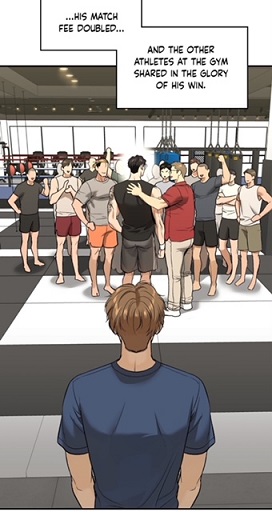 (chapter 41) Observe how the manager is acting here. He is speaking, touching the star like his prize and possession. The Emperor became the merchandise, the illusion, the bait to draw both viewers and fighters. However, being “labeled as genius” can only push desperate fighters to take a short-cut: bribes and drugs. Hence Seonho couldn’t last a whole round.
  (chapter 46) And, like any product, once it was seen as damaged, its value plummeted. The moment he “lost” his title and suffered injury (chapter 52), the dream began to unravel.
  (chapter 52) This panel captures this shift perfectly: two fighters casually dismiss him over dinner. In those words, the Emperor isn’t a mentor, a champion, or even a man — he’s a broken commodity, no longer worth the investment. The same people who once fed off his popularity are the first to abandon him when the promise of easy gain disappears.
 (chapter 22) He is even disposable. He is gradually giving more rights to his “boy”, the real director of Team Black. And the moment you perceive the manager as the main lead’s voice, you can grasp the true significance of the slap at the hospital:
 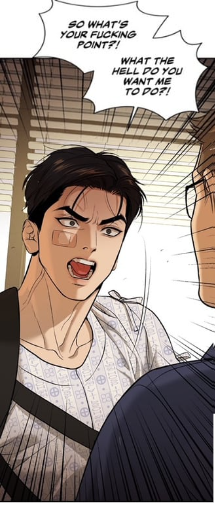 (chapter 52) For the first time, the main lead had voiced his own thoughts and emotions. He had used his real “voice”, revealed his unwell-being:
  (chapter 52) To this outburst, Park Namwook slapped Jaekyung in front of others (chapter 52).
 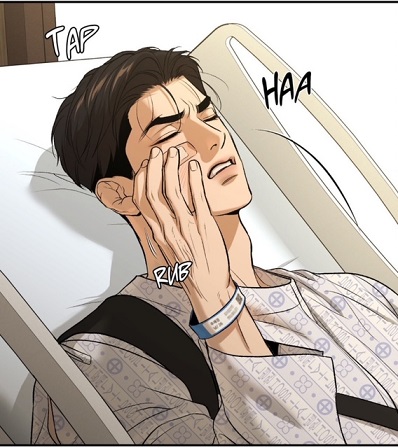 (chapter 52) He chose silence, and later avoidance, staying away from the gym. That silence was not weakness, but choice: he would listen less and less to his hyung.
 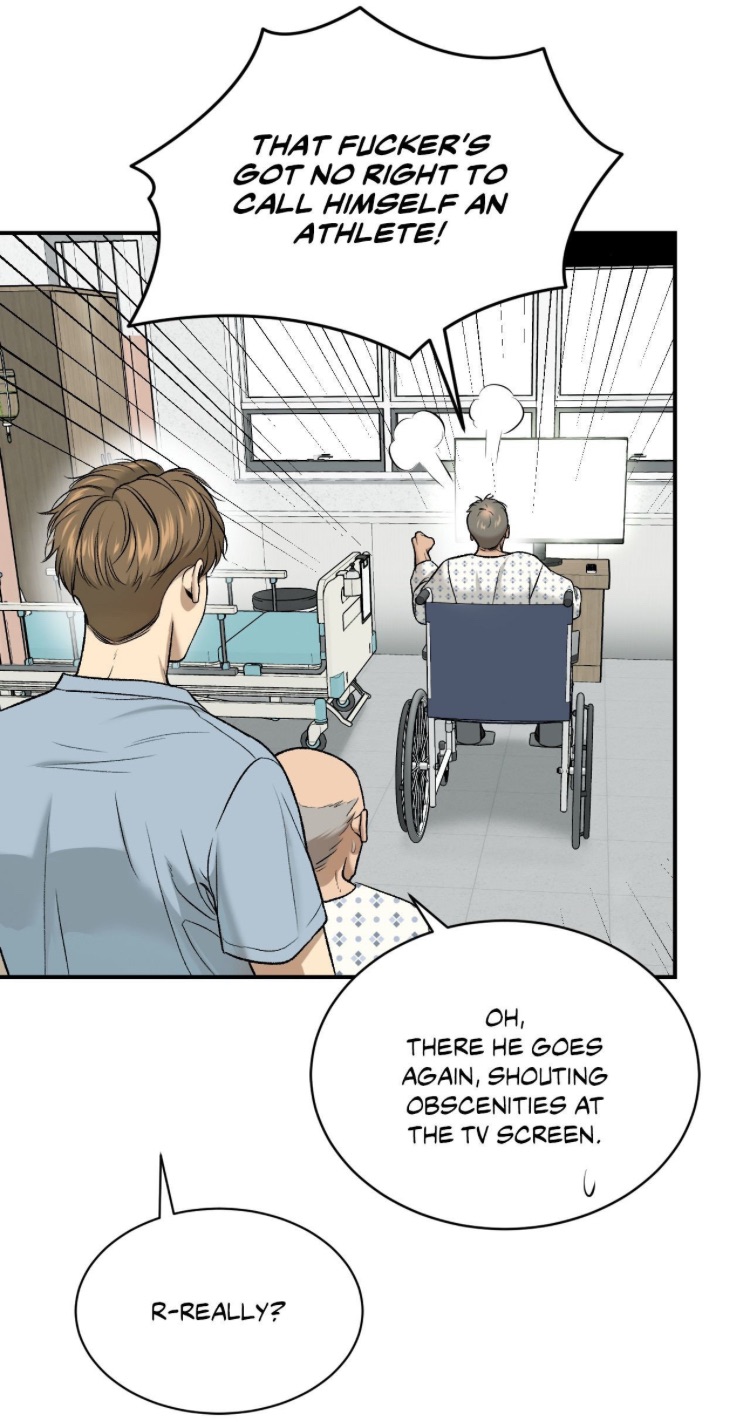 (chapter 70) and more like a product: something to be displayed, sold, and, when necessary, handled roughly to keep in line. The shift in labels is just another layer of that merchandising process — a packaging change to suit the current market, not a recognition of the man inside. To conclude, the champion has always been voiceless all this time, even here:
  (chapter 36) All he needed to do was to fight:
  (chapter 36)
 (chapter 73) — unfiltered, unmarketed, unprotected. It was raw, dangerous honesty, and it came at a cost: the loss of his voice!
 (chapter 73) Six years earlier, however, his voice had already been battered by silence. After his mother’s abandonment at age six, the only connection he retained with her was a phone number —
 (chapter 72) We don’t know how many times he called, but each time we see him do it, his face is injured.
  (chapter 72) The phone calls are therefore intertwined with the boxing studio, as though pain itself pushed him toward her. At ten, he picked up the receiver and let it ring only a few times before hanging up. The next time, in the dead of winter, he finally spoke, promising that if she returned, he would protect her from his father and make enough money to keep her safe.
 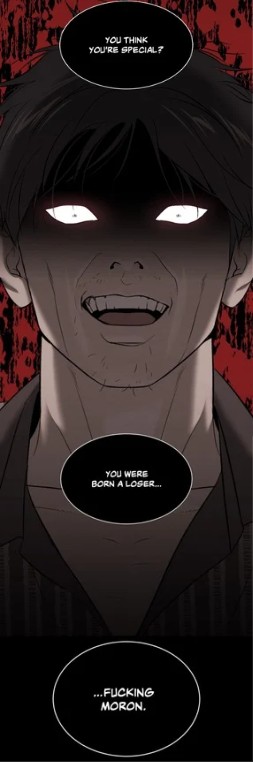 (chapter 73) that he was born a loser, that his dream was a joke. Here, the voice met not silence but resistance, mockery, and humiliation. And unlike with his mother, Jaekyung did not retreat — he cursed back.
  (chapter 55)
 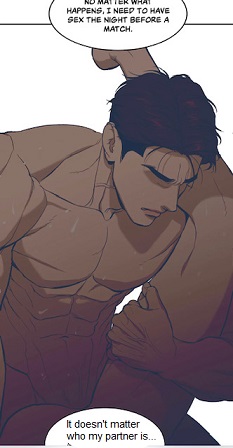 (chapter 2) — a space where he could act without having to speak. In the bedroom, as in the ring, the body could carry the conversation. Here, he could dominate, control, and release tension without the risk of verbal damage. His partners became surrogate opponents: sparring substitutes in a non-lethal match. Treating them as “toys” wasn’t only objectification; it was a form of control that, in his mind, protected both sides. Toys don’t demand answers, don’t talk back, and don’t leave you cursed with regret. They remain safely outside the territory where his voice had once done harm.
 (chapter 1) He embodies innocence and as such lack of experiences. Moreover, he talks, makes suggestions for the champion’s sake
  (chapter 27), spent time with him, asks questions, confronts, and refuses to be reduced to a body in the room. He breaks the rule of silence. With him, Jaekyung can no longer hide behind the physical alone; he is forced to speak, to explain, to voice desires and fears. He pushes Jaekyung to engage in ways he’s spent years avoiding. In this way, Kim Dan becomes the first real threat to the system the champion built after those two curses — and possibly the first person who could prove that words can be safe again. And now, you comprehend why Joo Jaekyung was moved by the birthday card
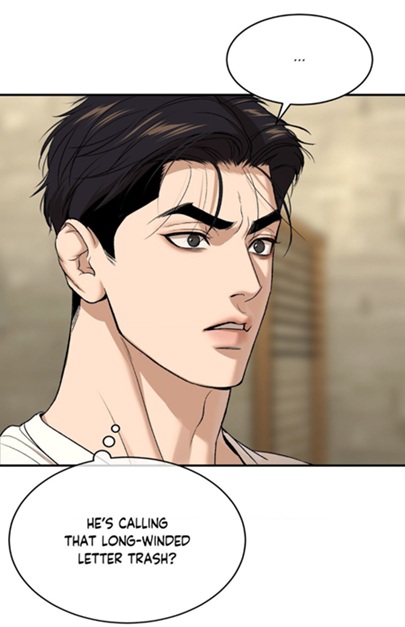 (chapter 62) To most, it might look like a simple gesture, but for him, it was a rare and precious thing — a voice that had taken the time to shape itself into words just for him.
 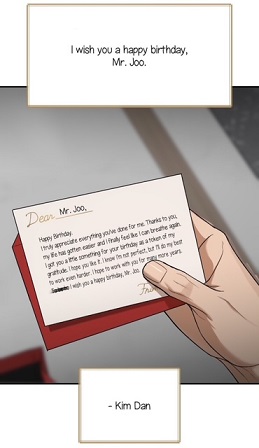 (chapter 55) After years of associating speech with either silence or harm, receiving a long-winded, carefully written message felt almost unreal. He saw the effort behind it, the deliberate choice to put thoughts and emotions into language instead of letting them fade away or turn into weapons. In that card, Kim Dan offered something neither of his parents had managed: a voice that reached him without wounding. No silence, no insult. For the champion, it wasn’t just a card — it was proof that words could be built into a gift, not a curse. The latter expressed his dreams and gratitude. Thus I deduce that the Emperor’s curse will be broken by a spell: words!
 (chapter 55) The “spell” to break it is not some grand external event, but the simple, sustained act of honest communication — something that has been denied to him since childhood.
 (chapter 68), a kiss, a pat, a caress or by simply holding hands
 . In this way, the curse that began when his voice was silenced and his hands were weaponized will only be broken when those same hands learn to speak tenderness. Look how doc Dan reacted to his public embrace:
  (chapter 71) He saw affection in the hug, but he still doubted the champion’s action.
  Until now, the design’s images have played a secondary role, yet the answer lies in a single scene from chapter 41.
  (chapter 41) Under the bright sunlight, Kim Dan reached out toward the leaves, his hand open and unguarded, as he silently thought of the man he loved. This gesture, so simple yet so revealing, became the unspoken confession that marked the start of a different kind of freedom—the freedom to feel.
 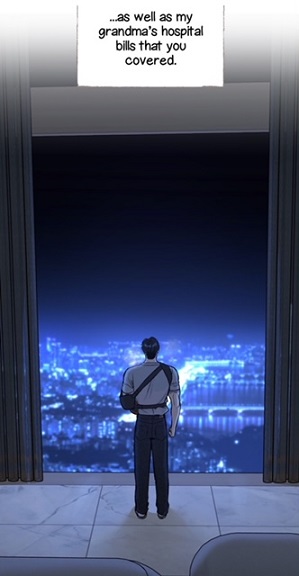 (chapter 53) The glass was an invisible barrier, offering the illusion of freedom while keeping him trapped in the moment of his unresolved trauma. The closer he stood to it, the further he was from true release, his gaze fixed outward to avoid looking inward. That’s why he had no eye in that scene:
  (chapter 55)
 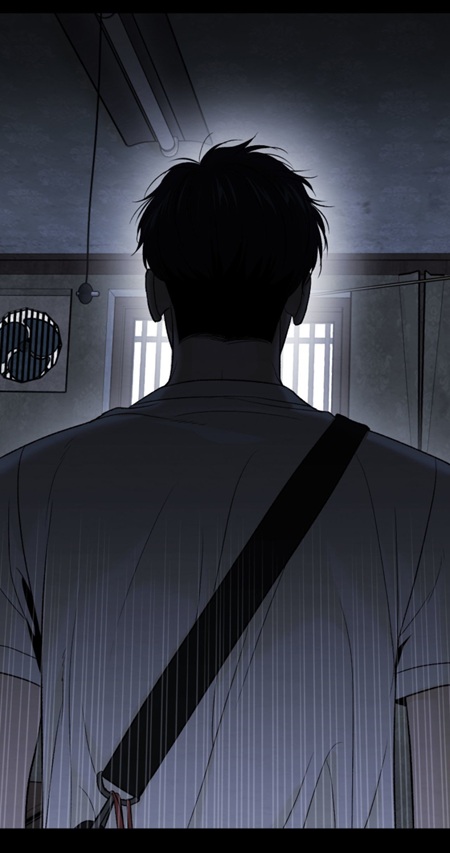 (chapter 73) reveals why that reading was correct: the penthouse window is not just a symbolic device of the present — it is the direct heir of a far older image burned into his memory. Here, as a teenager, he stands before a small barred window in the room where his father’s corpse lies. The resemblance is not visual coincidence but emotional continuity. Both windows let in light without granting escape; both present the outside world as something visible yet forever out of reach.
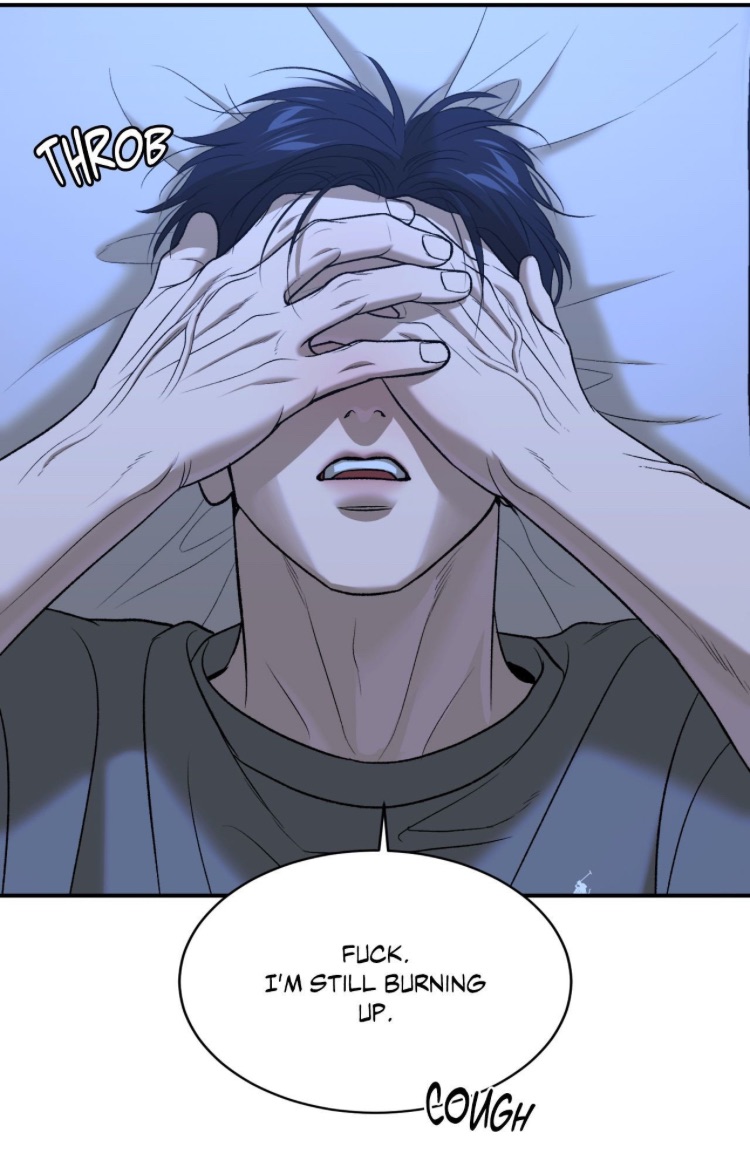 (chapter 71)
 (chapter 70) the night can also be alive, communicative, protective. In that moment, the moon becomes more than a distant light in the sky: it is a patient witness, a calm listener in the stillness, reflecting the truth he has yet to voice.
 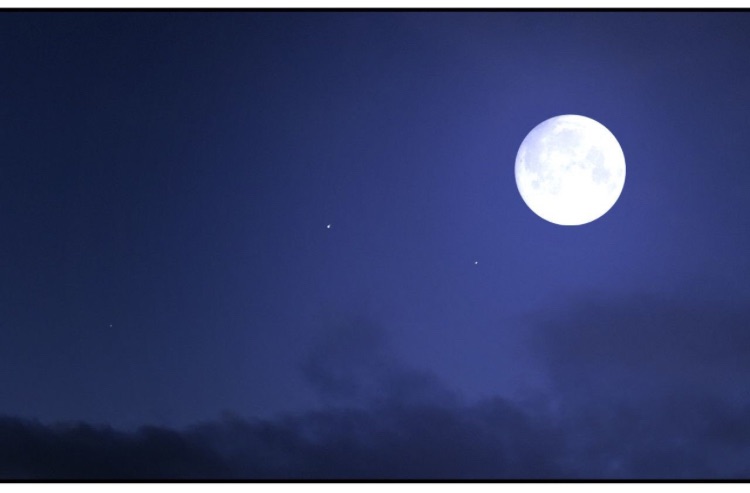 (chapter 70) Its soft glow contrasts with the blinding glare of the cage lights, suggesting that under the moon, there is space for gentleness, for hearing one’s own heartbeat and another’s words. Just as the moon guides travelers through darkness, it can guide him toward a night that does not suffocate him with loss, but offers orientation and connection.
 (chapter 60) they were his own form of therapy. In saving someone else in the night,
 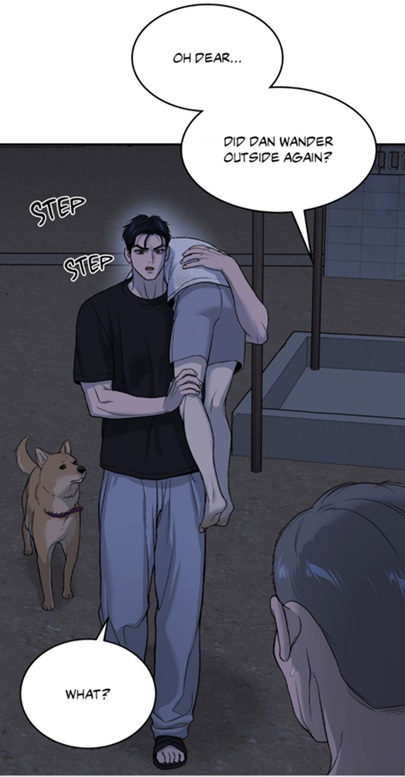 (chapter 65) he could prove to himself he was not powerless, he was valuable, capable of protecting what mattered.
  , (chapter 9) as if the champion’s volatility were a quirk (the actions of a spoiled child) to be managed rather than a wound to be healed. It is because he never talked to the champion or investigated his past. It was only about money and glory. The manufactured image of the erratic, temperamental fighter served Namwook well; it excused rough handling, justified bad press, and kept Joo Jaekyung dependent. Once the Emperor can name the truth of that night, the fiction collapses — and with it, Namwook’s control. He can only be judged as a liar and even a traitor, but we know that Joo Jaekyung has a big heart. He could love his father despite the abuse. Now, the missing link is Cheolmin!
  (chapter 13) Observe that this name is a combination between Hwang Byungchul and Baek Junmin! Under this light, my avid readers can grasp why the athlete kept his existence in the dark for so long! It is because the latter belongs to his past and knows the truth behind the Emperor! He was aware of his suffering. For him, he is not just a fighter, but someone who needed FUN in his life!

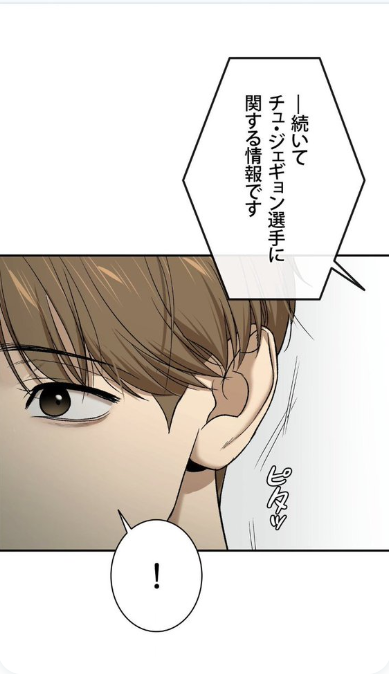 (episode 57) the reporter introduces the main lead differently: “Next, we have news regarding Joo Jaekyung.” This subtle difference is significant for three reasons.
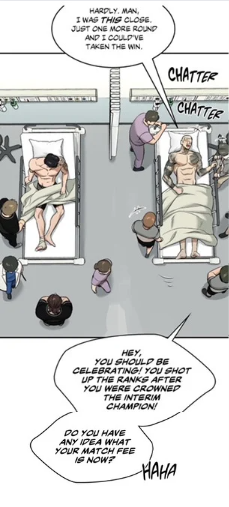 (chapter 52) and the suspension from their narrative highlights a calculated effort to erase inconvenient truths that could tarnish not only MFC’s reputation but also that of the medical professionals complicit in their schemes. Let’s not forget
  (chapter 52)
  (chapter 52), is not only a protective measure for MFC but also shields the medical professionals who facilitated the situation. Doctors at the health center failed to report the ankle injury caused by the sabotage
 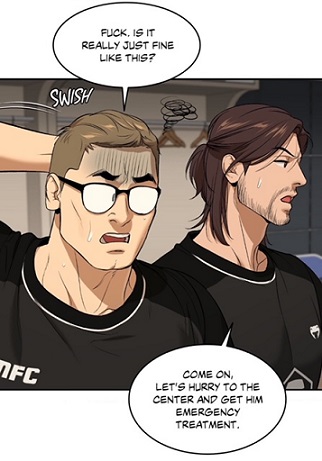 (chapter 50), further implicating them in a network of complicity and greed. Their decision to place the two fighters next to each other without proper privacy measures, such as curtains, reveals a disregard for professional ethics in favor of spectacle and profit. I would even add, the decisions from the health center’s medical staff, played a significant role in escalating the situation. By placing Joo Jaekyung and Baek Junmin next to each other post-fight, without appropriate measures like curtains to ensure separation, the health center created an environment ripe for conflict.
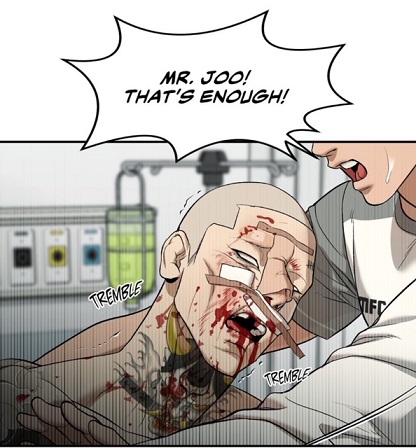 , (chapter 52) as the provoked champion lashed out in an unregulated setting. The decision to ignore these systemic failures and instead to suspend Joo Jaekyung suggests a deeper layer of complicity from the medical world, where doctors and nurses prioritized organizational demands and reputational interests over ethical responsibilities. Their failure to report the provocation and the ankle injury caused by the switched spray further highlights their alignment with MFC’s corrupt practices.
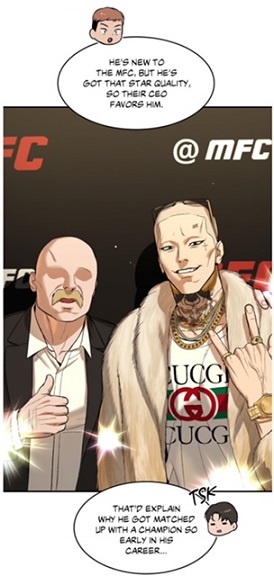 (chapter 47) and favored by MFC’s CEO, Baek Junmin has now been discarded, his relevance extinguished the moment he ceased to serve the organization’s agenda.
 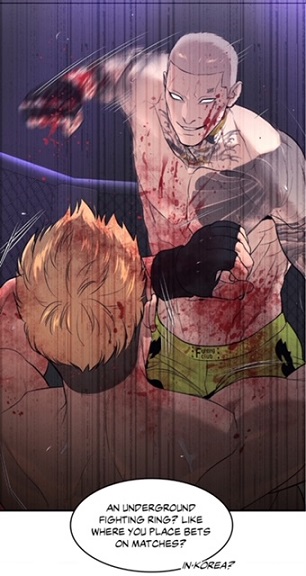 (chapter 47) His background, combined with his visible association with MFC’s CEO, positions him as a key figure who could potentially expose the organization’s darker practices.
 (chapter 49), his ultimate fate now reflects the broader cruelty and exploitation perpetuated by those in power. That’s how I realized the other signification of the cross below his left eye. The latter symbolizes his blindness in the end. The cross signifies his inability to see beyond the role he played within the system—a symbol of his naivety and misplaced confidence. Baek Junmin believed he understood the brutal reality of the fighting world, given his background in underground rings and illegal gambling. He thought his experience and cunning gave him an edge, making him untouchable or indispensable. However, his taunts to Joo Jaekyung
 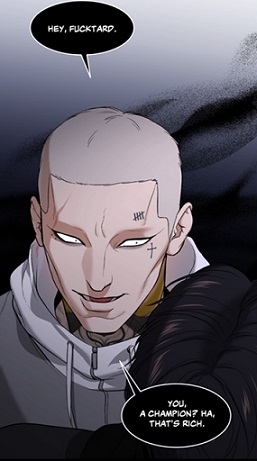 (chapter 49) reveal a man who overestimated his position within the organization.
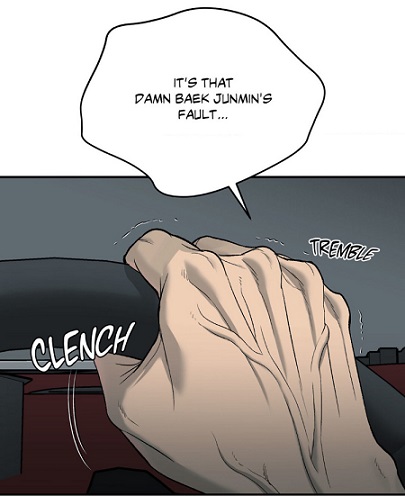 (chapter 54), it shows the athlete’s lack of reflection and insight. He hasn’t been able to discern the truth, the corruption of his “world”. This means that he needs to travel and experience a whole new world. The contrast would serve as an eye-opener for the athlete.
 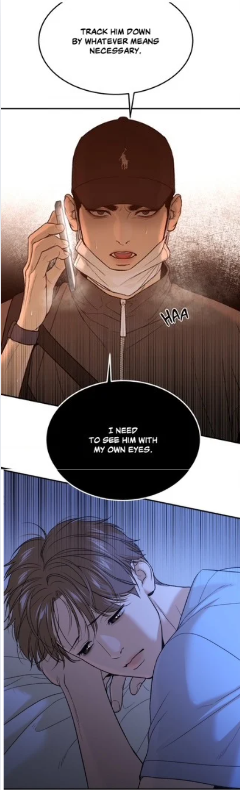 (chapter 56) released shortly after the champion’s urgent request to locate him. This timing is no coincidence. Instead, it reflects a calculated effort to manipulate both the public narrative and Kim Dan’s own perception of his role and value. By introducing the anonymous person as “one of his close associates”, it implies that the champion has already moved on from the protagonist. He is not missing him at all. At the same time, it implies that within a short time, the person was able to get the athlete’s trust which stands in opposition to this scene:
  (chapter 51) Thus I conclude that the interview serves a dual purpose: to emotionally undermine Kim Dan and to cement his estrangement from Joo Jaekyung.
 (chapter 57): his regret was not merely about using the spray but about his failure to assert himself professionally.
  (chapter 49) By complying unquestioningly with the champion’s requests, he had diminished his role, acting more like a servant than a competent physical therapist. The interview, though painful,
  (chapter 57) serves as a harsh wake-up call, forcing him to confront his own shortcomings and reevaluate his behavior.
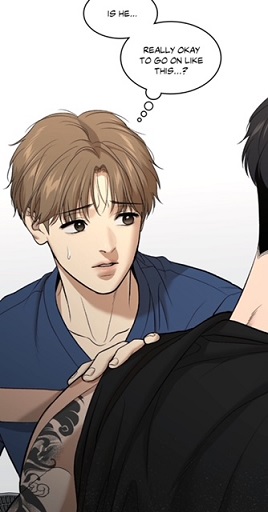 (chapter 41), drawn boundaries, and made his expertise known. I would even add that he never felt responsible for the champion’s reputation in the media
  (chapter 36) Hence he remained passive all this time. His negligence becomes more obvious, when the media released this wave of articles:
 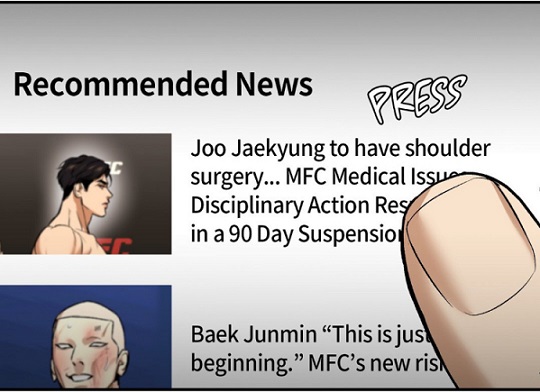 (chapter 52) Thus I discern a turning point in the doctor’s mentality. The last interview served as a painful wake-up call. This juxtaposition not only deepens Kim Dan’s understanding of his mistakes but also offers a model for the kind of professional he aspires to become. He can, if he wants to be in the spotlight:
  (chapter 41) In addition, while many Jinx-Philes are blaming the champion for his outburst,
  (chapter 50) rejection and
 (chapter 50) accusations,
 (chapter 51), the main lead is not blaming his fated partner at all. Why? It is because none of this would have happened, if he had acted as PT and trusted his own hands. He was too passive, standing by the sideline. He never became proactive.
 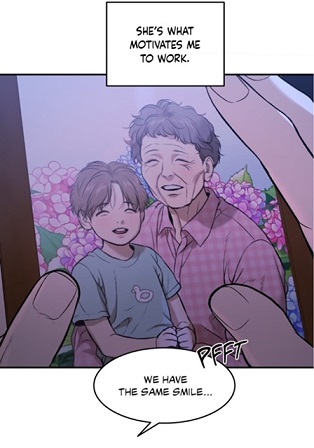 (chapter 47) his indifference and lack of professionalism. In the end, the grandmother is the reason for his lack of professionalism and neglect.
  (chapter 54) Unlike the newly hired PT, who likely has the backing of a hospital or organization, Kim Dan operates independently. This independence, while offering a degree of freedom, also makes him vulnerable. He lacks the institutional support that could shield him from the manipulative tactics of MFC. Moreover, his independence places him in direct contrast to the systemic corruption that permeates MFC and its associated entities. As someone who has already been victimized by two major deceptions—the drugged nutrition shake
  (chapter 37) and the switched spray
 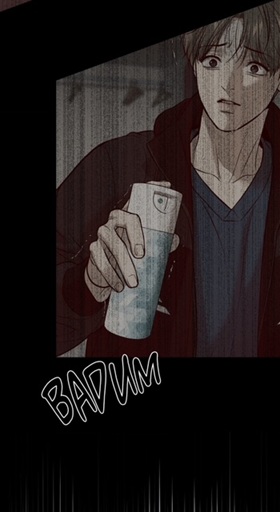 (chapter 57) —Kim Dan stands as a figure who threatens to expose the cracks in MFC’s carefully constructed facade. Let’s not forget that the incident with the poisoned beverage was swept under the rug by framing haters.


 (chapter 53) for not realizing her biggest wish: to return to the West Coast. With her words, she implies that she never had any choice. Hence she is not responsible for her “misery”. However, after reading Erich Fromm’s philosophy, it becomes clear that she must have always followed social norms and listened to authority figures (parents, husband, doctors, …). That’s how she gave up on her own freedom. One might argue that her scoop of maneuver was limited due to her poverty. However, the Mother Of Pearl Wedding Cabinet is definitely expensive and no junk
 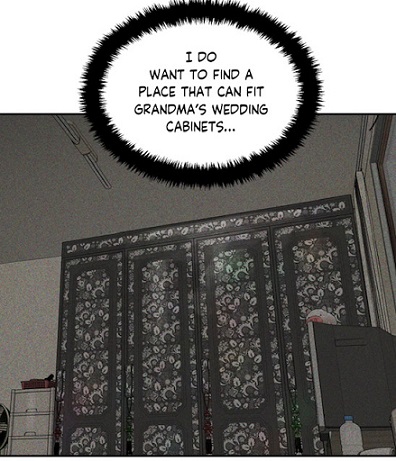 (chapter 16), especially since the latter is rather old. The grandmother could have sold it, but she never did, for the latter has a sentimental value. Consequently, I would say that she had missed her chance, and naturally her misery is the result of her own wrong choices. Under this new light, it becomes comprehensible why the grandmother portrays herself as poor who has nothing to give to her grandchild.
 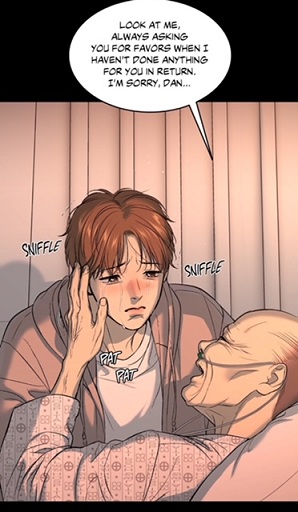 (chapter 53) As a slave, she can not become responsible for Kim Dan and his life. However, she is wrong here again. She was not entirely powerless. She could have talked about her experience with the ocean, she could have loved her grandchild more properly so that Kim Dan wouldn’t have to suffer from abandonment issues and a low self-esteem. Yes, love is something free and no one has control over the emotions of a human being. Due to her lack of self-awareness (Peter Pan Syndrom), she influenced her grandchild negatively, and the latter became a copy of herself: trapped in the past, living in an illusion and rejecting reality. Funny is that by relying on Kim Dan constantly, she was actually teaching her grandson to become accountable and independent. She was entrusting her life into his own hands. Consequently, the main lead chose to accept the deal from Joo Jaekyung during their first night and later asked for a higher salary. Finally, at the end, he chose to leave the penthouse out of obligation
  (chapter 53) (filial duty), a sign that he is not able to break free from social norms. At the same time, it displays that his feelings for Joo Jaekyung are much stronger than the ones for Shin Okja. His short time spent in the penthouse left a deep impression on him.
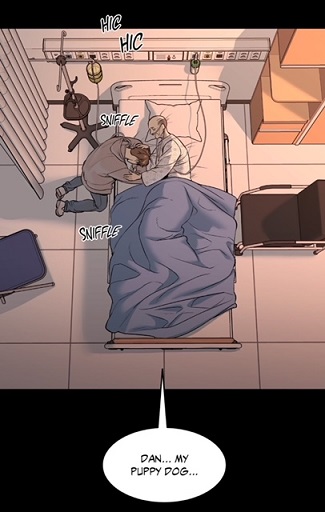 (chapter 53) Her vocabulary exposes that she became a master and in her mind, the puppy dog has to follow her owner. Therefore it is no coincidence that Mingwa created such an image:
  (chapter 53) The grandmother is now the master of her own life and Kim Dan’s. On the one hand, just before her death, she is learning to become accountable for her own life, even though I still have my doubts that she is really realizing the consequences of her choice. She is still chasing after after an illusion. As you already know, I am anticipating a rude awakening fron her part, as she can not escape from reality and her own mortality. On the other hand, with her request, she gets responsible for her grandchild’s career, and someone could criticize her for making him quit. She didn’t take his job’s obligations into consideration. Simultaneously, this image illustrates a relapse of Kim Dan. He is once again trapped, though he wished to be freed. Thus he wrote this to Joo Jaekyung:
  (chapter 53) Deep down, he would like to be recognized as a competent physical therapist. Moreover, my avid readers should recall that the champion had already noticed the change of heart in the doctor before the scheme took place.
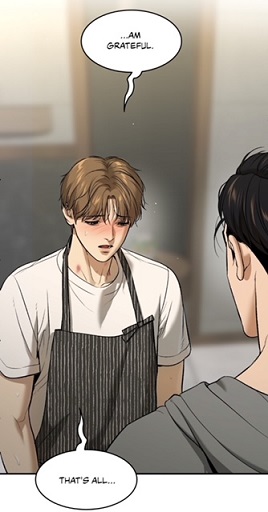
  (chapter 53) So the athlete could come to the realization that his departure was related to the grandmother’s sickness and dying wish, a new version of episode 20 and 21. However, even if the fighter helps the grandmother, he can not entirely free the physical therapist. How so? It is because the doctor has to free himself, breaking free from conformity and his own psychological constraints (lack of confidence and as such courage). And the best evidence for his servitude mentality is the absence of his love confession to the athlete. He disguised it behind gratitude.
 (Chapter 45) But how can he change his condition? I will give the answer below.
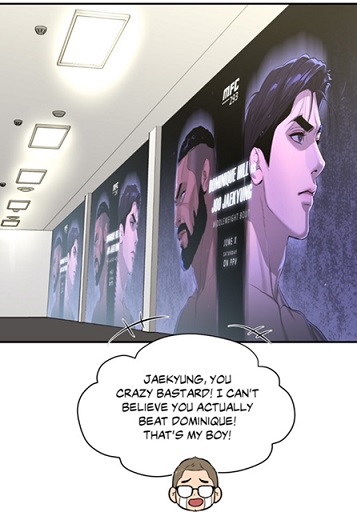 (chapter 40), though the gym belongs to the celebrity. But let’s return our attention to the American-German philosopher. The latter pointed out the importance of self-awareness and the rejection of materialism and social pressures (authority figures, conformity) in order to become truly free.
  (chapter 26) No wonder why he got so surprised by Kim Dan’s reaction in the locker room:
 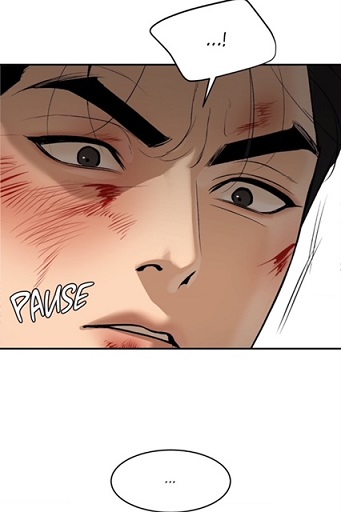 (chapter 51) He was disarmed by a single question and a shocked and disappointed face:
  (chapter 43), yet he added shortly this comment: :
 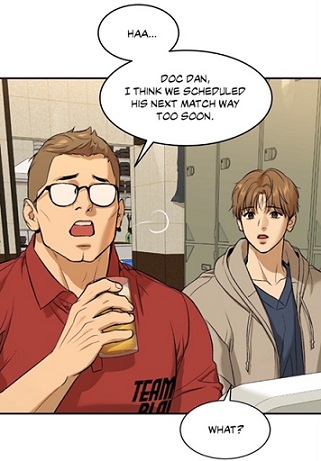 (chapter 43) The hypocrite coach utilized the personal pronoun “WE” indicating that he and his peers had played a role in the athlete’s decision. Funny is that though he complained about the schedule, he still accepted the switch of the fighter later. But he could have voiced his fears and objections. Nevertheless, he did nothing. Since I connected the halmeoni to past, I suddenly realized that the “lanista” embodies the opposite notion. He is trapped in the future, thus he is always anxious. Imagine that in that scene, they were celebrating Joo Jaekyung’s birthday, it should have been a good time. Yet, the manager kept talking about work and the future.
 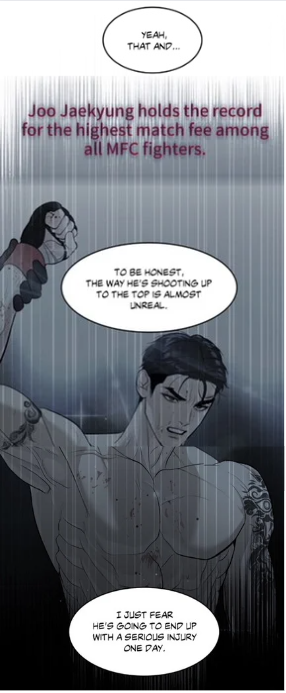 (chapter 43)
  (chapter 43) This is a sign that he was not “enjoying the present”. In my eyes, with his comments, he was actually ruining the party. Fortunately, no one paid attention to his words except the physical therapist and Yosep. By talking like that, he gives the impression that he is caring and paying attention to the fighter. Yet this is just an illusion, for he is not focused on the present. He neglected his duties, therefore the schemers were able to bring drugs to the champion’s rooms.
 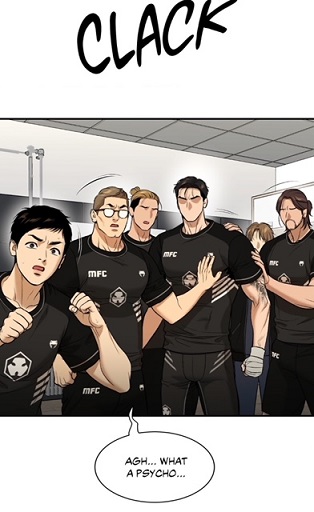 (chapter 49) Notice that he was afraid of an outburst from Joo Jaekyung in the locker room, therefore they were restraining him. This was no real protection. I am suspecting that the manager is trusting MFC and its organization. In addition, his obsession with the future explains why the athlete’s mental health has been neglected by the coach and manager. As a conclusion, Park Namwook is himself trapped in his own world: money, fear of the future and the champion‘s retirement which means the end of his own career as manager and coach. Therefore he is pushing his fighter to race against time. It is only a matter until his boy gets injured!!
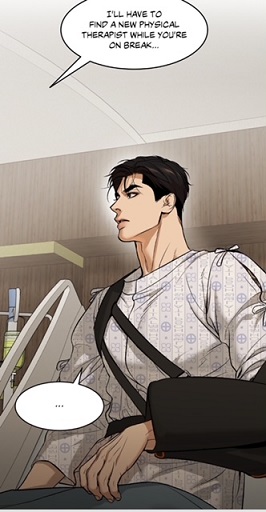 (chapter 53). The latter announces that his “boy” can take a break. What caught my attention is his idiom. The suspension got turned into a break which sounds much more positive. Interesting is that break is not only a synonym for “rest”, but also for “opportunity, chance”. This new discovery reinforces my previous interpretation: the loss of his “title” and his suspension are in verity an escape to freedom. Why? It is because he is no longer exposed to manipulations and external pressure like in episode 36:
  (chapter 36) money, social media, the agency, the lawyer, Park Namwook and Jeong Yosep. For the first time, Joo Jaekyung can think of something else other than work. Nevertheless, the athlete had not realized it yet. Striking is that the longer the fighter thought about the PT’s resignation, the longer he came to object to it.
 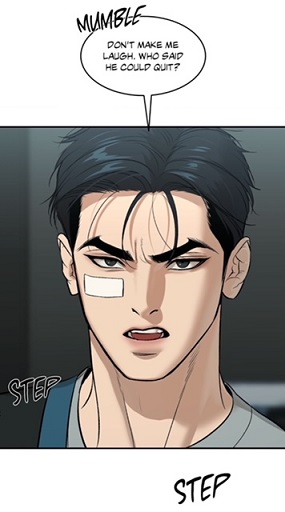 (chapter 53) This means that the fighter was acknowledging the “uke” as an important member of Team Black. In addition, he was recognizing Kim Dan’s effort and talent as PT. Moreover, it exposes the absence of change in Joo Jaekyung’s mentality. He was still “thinking” of work and fighting. It displays that the protagonist had not realized the true signification of his suspension yet. Hence the doctor’s departure was necessary. Joo Jaekyung is forced to think about his fated partner, making him forget his work and his career. His “obsession” with Kim Dan will push him to stop being a workaholic. But there is more to it.
 (chapter 21) to this
 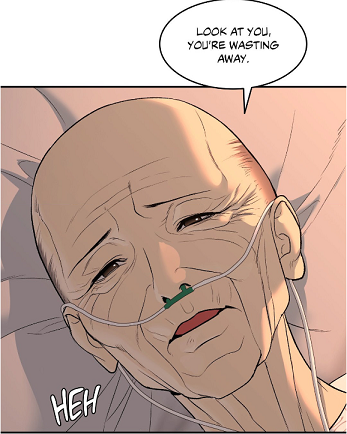 (chapter 47) Money is powerless in front of death and terrible injuries. Therefore he is lucky that his shoulder is not ruined forever. Moreover a trip represents a good metaphor for an escape, a travel is a synonym for freedom and the end of “routine”.
 (chapter 35). However, since he didn’t spend much time in his own home, he never took the time to take care of his soulmate. By leaving the city and Team Black behind, he would become truly alone (as opposition to his trips to Busan, the States) which would give him an opportunity to become more honest to himself and to Kim Dan.
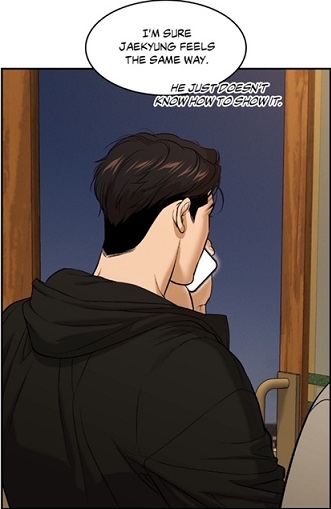 (chapter 43) In episode 1, he gave a positive feedback
 (chapter 1). Nonetheless, his words sounded more negative due to the usage of negation. Moreover, Kim Dan was too scared to take his words seriously. Consequently, it becomes obvious that Kim Dan needs to hear praises from the athlete himself. It is not just about an apology about his misjudgment, the “hamster” needs to hear from his own patient that he trusts him and his hands. Thus he wants to be needed:
  (chapter 53) This explicates why the young man kept questioning the actor’s intentions behind his gifts. He could see that the man didn’t need him. This thought displays his desire to give a meaning to his own existence as well. If he is needed, he has a reason to exist. This desire of being needed can be expressed by words, but also with the hands:
  or like this:
  (chapter 22)
 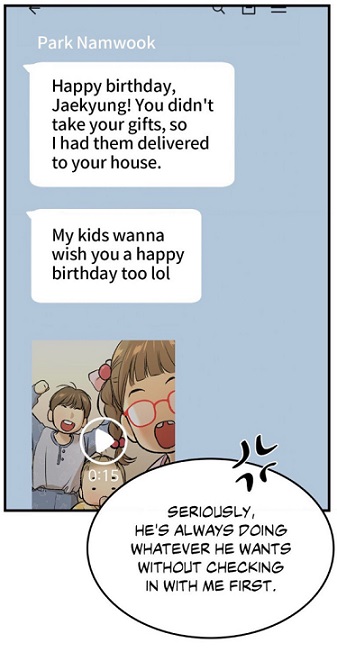 (chapter 45) so much and preferred organizing a charity event for his birthday .
  (chapter 41) Being on the receiving side makes him feel weak and powerless. He is reduced to become a passive man. Furthermore, we shouldn’t overlook that such presents are not entirely selfless. Companies or admirers have expectations from Joo Jaekyung, earning some money or getting his attention. At the same time, these presents are strongly connected to his title and fame as champion. Thus they are not taking into consideration about the athlete’s dislikes and likes. Thus he was offered a bottle of wine
  (chapter 41) The fact that the athlete organized a charity event for his birthday exposes not only his huge heart, but also that he had long recognized the power of generosity. Under this new light, it becomes comprehensible why the champion was willing to pay off the doctor’s debts.
  (chapter 18) Here, he hoped to see gratitude on his fated partner’s face, but it didn’t happen like he imagined. Yet, notice that despite their argument, Joo Jaekyung proposed to the main lead to live with him in the penthouse:
 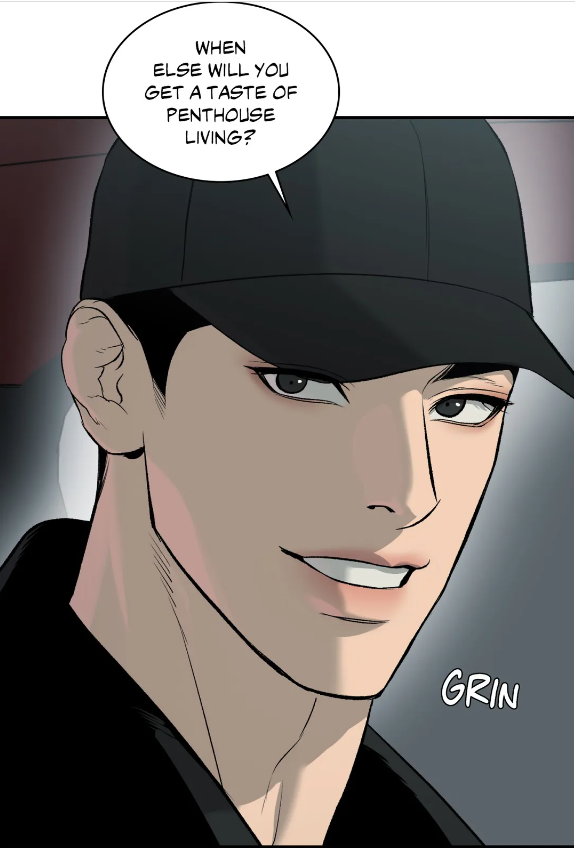 (chapter 18) His facial expression is exposing his true thoughts. He was definitely happy to help the doctor. The reason is simple. He is in control of his heart and life. This shows that deep down, the man has always had a soft heart and could find fulfillment in giving. However, the problem is that the champion had also internalized that there is nothing free in this world. Due to his past experiences, he realized that receivers would exploite his goodness. The green-haired guy was the perfect example.
  (chapter 2) Therefore it is not surprising that he kept denying his kindness to the doctor: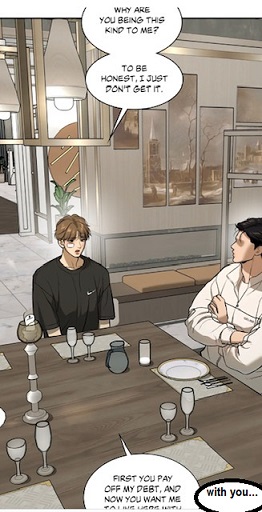
 (chapter 18) He had to, because the man was now living with him. Joo Jaekyung feared that his roommate could come to take advantage of his new position and even consider this place as his own. As you can see, the champion had long discovered the power of giving to others. Yet his problem was that he couldn’t live out this principle: he was either exploited or he has no family or close friend so far.
 (chapter 30) They both desire to be acknowledged and appreciated.
  (chapter 45) With this image, it was, as if Kim Dan wanted to be distinguished from all the stans. Yes, I do think that this has something to do their own negative feelings. However, there is a difference between Choi Heesung and Kim Dan. Note that the gifts are related to his sponsors and the agency. They were related to his work. Moreover, the gumiho rarely gave the meals or the presents personally.
  (chapter 31)
 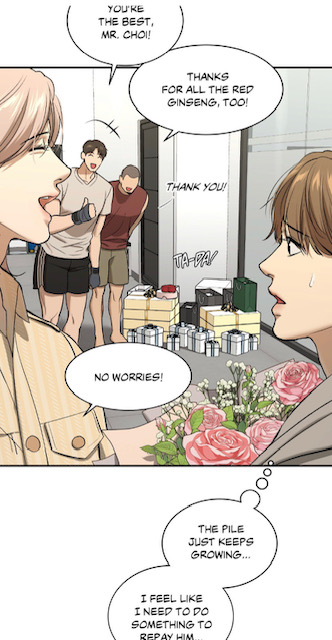 (chapter 31) Furthermore, the actor gave these things for one reason: it was to obtain the doctor’s heart or to maintain his good image as a celebrity. In other words, these gestures were not selfless at all. This explains why the athlete was so weary of such “gifts”: a return of favor or a service. But the comedian is not the only one donating things. Naturally, it is the manager Park Namwook.
  (Chapter 26)
  (chapter 36) However, my avid readers should ponder on the following aspect: how did he buy the jackets and the junk food?
 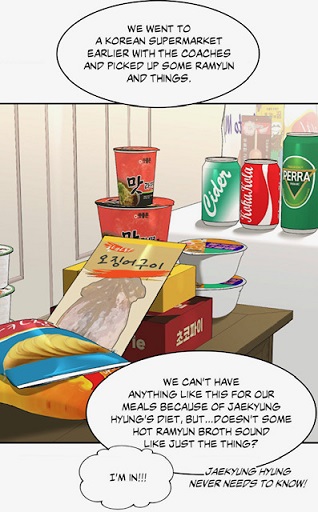 (Chapter 37) This last scene is terrible, for this purchase happened behind the boss’ back. Naturally, everything was bought with the company card!! In other words, Park Namwook’s generosity is fake, for he is not spending his own money. After this new realization, I started wondering if the athlete’s negative attitude towards Kim Dan is not the consequence of Park Namwook’s behavior as well who takes it for granted to spend money on the athlete’s account. Why did the champion anticipate an expectation from Kim Dan, when he received the keychain?
  (Chapter 45) It is because his relationship with his coach has always been based on „conditional love and expectations“. Don’t forget that the coach was particularly nice to the athlete after winning his match in Busan. He was willing to be his „servant“ in that moment. Furthermore, there exists another evidence that in episode 45 the fighter latched out on the doctor because of his unresolved feelings towards his hyung.
  (chapter 41) This frenzy was portrayed as something positive. Jinxworms can observe that the manager is mentioning the existence of „favors“. For me, it is no coincidence that in episode 45, the arrival from presents coming from his hyung coincides with the present with Kim Dan. It shows the underlying conflict between the celebrity and the former wrestler. Nevertheless, the fighter has not grasped it yet. So far, Joo Jaekyung has not tried to defy Park Namwook openly, to claim his place as the true owner of Team Black. We should see his words here as a first attempt to act as the boss
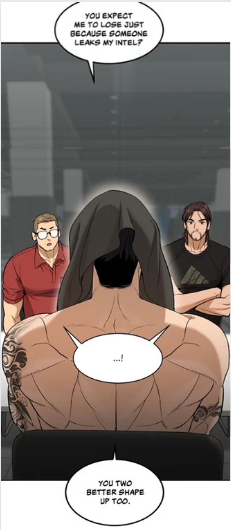 (Chapter 46) The tension reached its peak in that scene:
  That’s where the generosity from Park Namwook comes from: he gives his punches to Joo Jaekyung and takes Joo Jaekyung‘s company for granted. And now, you comprehend why I selected such a title for this essay.
 (Chapter 26) The sparring in episode 26 represents the positive version of giving a punch and taking it. The fighter was not upset about his defeat, moreover he was acting like a real teacher asking the physical therapist to overcome his own fears. On the hand, the slap at the hospital embodies the opposite notions: resent, no real teaching, no reflection, no listening, the one slapping is not overcoming his own fears and vents his anger. The give and take in episode 26 was happiness, true generosity, self-awareness, while this slap displays misery, anger, ignorance:
  (Chapter 26) The contrast not only exposes Park Namwook’s fake generosity, but also his greed and selfishness. For me, he missed the opportunity, as at the gym, Kim Dan took the chance, when the athlete was distracted. Hence in my opinion, chapter 52 was the turning point in their toxic relationship. Moreover, it signifies that the manager lost his special position as hyung. Far away from the gym, Joo Jaekyung will see Kim Dan under a different light, maybe even as a true role model, for he is wearing his heart in his hand.
 (chapter 7)
 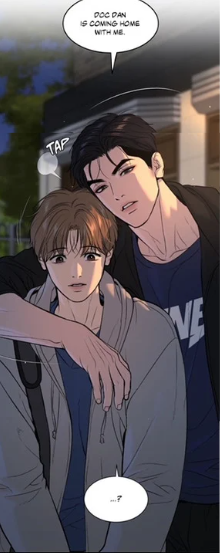 (chapter 43) He needed to seclude him from the others. But where does this possessiveness come from? In my opinion, it is not just the result of his own insecurities, but also the influence of the bad role model he had: Park Namwook. First, only in chapter 45, the manager sent congratulations from his family:
  (chapter 22) This scene at the hospital displays that the fighter had been mirroring the behavior of his counterpart: Shin Okja is sweet and kind. And who is moody, yelling, brutal ? Park Namwook:
  (chapter 43)
  (chapter 7) Therefore I conclude that this possessiveness and obsession with Kim Dan is the result of the manager’s influence. Park Namwook treated him like a possession. And this brings me to my next part. How to become happy? One might reply: by loving someone. However, how can Joo Jaekyung drop his insecurities and open his heart like that? As you can see, we need another explanation.
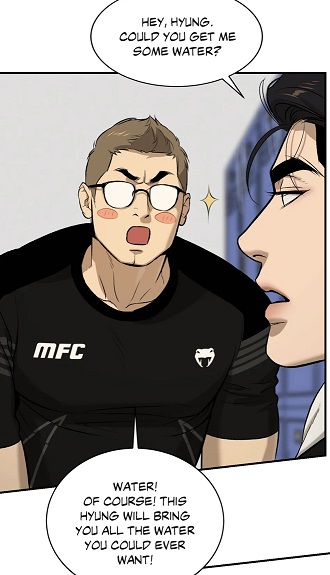 (chapter 15), but as soon as his idol lost his title and got even suspended, he yelled and slapped his fighter:
 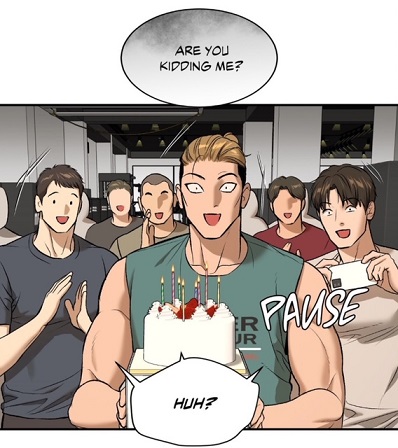 (chapter 43) This exposes his lack of engagement and indifference in the end, but this becomes even more obvious during the night:
  (chapter 43) Where was he, when his star was drunk? It was, as though he had vanished.
 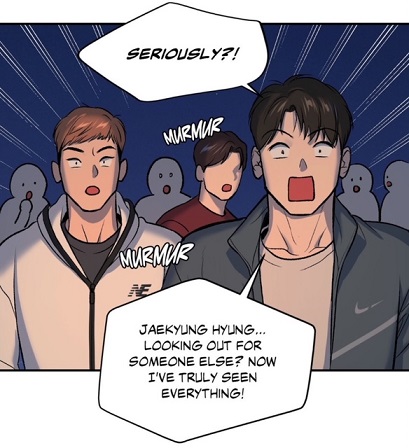 (chapter 43) But the best evidence for this interpretation is this image:
  (chapter 52) The manager is upset, because his boy lost his title and his reputation is ruined. Moreover, many members left the gym which means that the company lost a lot of money.
 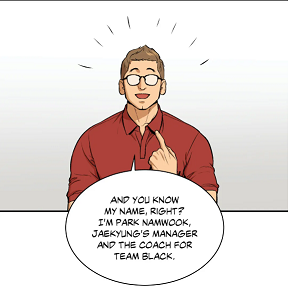 (chapter 9) However, he never presented himself as a father or a husband. It was, as if his children or wife were not a source of his happiness. Why? It is because they don’t bring money, but rather cost money. Thanks to Joo Jaekyung’s popularity, the manager could stand in the spotlight
  (chapter 40), yet notice that no fans or fighter know his name as a successful coach or manager. He is not a famous manager in the end. His income depends on the athlete’s career and victories. No wonder why he put so much pressure on his celebrity. Thus I had the following revelation: he was actually exposing his true self in front of the doctor at the restaurant.
  (chapter 40) in the States and even at the gym?
  (Chapter 43) It is because he doesn’t view the uke as a possession contrary to his „boy“. Why? It is because the young man doesn’t bring money or contribute to boast the manager’s self-esteem. In fact, Kim Dan is an expensive PT and the manager is aware of his high salary. Moreover, contrary to the hamster, Park Namwook was never seen in the penthouse, and the celebrity refused to invite the members. This is a clue that the champion could have refused to invite his coach there. The doctor’s stay at the penthouse is something Park Namwook discovered by accident.
  (Chapter 22) And now, it is important to recall that in the mode of Having, rivalry and competition are predominant. Therefore I deduce that deep down, the coach and manager sensed the physical therapist as a source of threat and rival. Therefore Jinx-philes shouldn’t be surprised that the coach did nothing to keep Kim Dan.
  (Chapter 53) Here his gestures and words should be judged as lip-services. He can even rationalize his departure: bad luck, they save a lot of money, for the next PT will have a lower salary. In addition, Kim Dan was treated as the celebrity’s possession, therefore he used him as a tool in order to compensate the actor. The manager is definitely imagining that once the break ends, things will work like before.
  (chapter 41) In his eyes, possessions and money determine someone’s values. Hence he bought an expensive keychain for his fated partner. Furthermore, I have been wondering if this spending is not related to Shin Okja, the latter could have been a spendthrift. In the essay „
 (Chapter 19). Another possibility is that she made sure that her grandchild would spend money on her:
 (chapter 22) after the departure of Joo Jaekyung, but notice how the halmeoni thanked the benefactor:
 (chapter 21) One might argue that the poor woman couldn’t do much to express her gratitude. However, this is just a deception. Shin Okja could have written a letter to express her gratitude to Joo Jaekyung. Why do you think Mingwa created two scenes with a letter or card?
  (chapter 45)
  (chapter 53) The comparison lets transpire the importance of words. The champion might have judged the keychain differently, if he had read the card. But he didn’t. Another parallel between these two scenes is the rejection of a gift! However, in the final episode, Kim Dan voiced genuine gratitude towards his benefactor. The latter had allowed him to work as his PT. With the letter, he could voice his thoughts and emotions much better. And now, you realize that Shin Okja could have acted the same way. This made me realize that deep down, she resents being poor. She likes Dan spending money on her.
 (chapter 41). He should treat the sportsman nicely (“do good”). Kim Dan is the one who should be indebted to Joo Jaekyung. However, observe what she said in front of her grandchild before: she was the one who was grateful to the main lead, and not Kim Dan!!
  (chapter 41) She should have been the one who expressed her gratitude to Joo Jaekyung, but not Kim Dan for the trip (it was work related anyway). One might argue that the poor woman is trapped in the hospital, she can not do much. But you are wrong. She could have written a letter to her benefactor which means that she would have sacrificed some of her time for the athlete. Imagine that she had sent a message to the athlete, the latter might have decided to pay a visit to her. He is not truly heartless. With this silence, she created the impression that his assistance had changed her situation.
 (chapter 22)
  (chapter 1) In other words, he was not passionate about his profession. This means that he didn’t define himself as PT due to his lack of engagement and low self-esteem. Besides, let’s not forget that he judges people based on their social status and seniority. I would even add, the main lead had not recognized the existence of his own skills (knowledge, genuineness and dedication). But by working for Joo Jaekyung, he came to enjoy his job. This explicates why he kept buying books.
  (chapter 53) He likes not only his job now, but also learning as such. This is no coincidence that education in the mode of “being” means that the focus is on learning and developing skills. Hence I still see a change in the hamster at the end of season 1:
  (chapter 23) Then he only focused on the “outcome” and not on the process. Hence he neglected them, delegated his task on the pressured athlete. The latter had to train them:
  (chapter 25) and
  (chapter 36) In my eyes, he didn’t want to play the bad guy. The meeting or his worries were more important
  (chapter 36) than their training and career. Moreover, he kept bribing them with junk food
  (chapter 26) We shouldn’t judge his words as a verity, he was just using the doctor as a false excuse. The reality is that the sparring had brought no money at all! This fight was strongly intertwined with fun. The notion of „entertaining“ stands in opposition to money. Fun means feeling emotions and being to true one’s self. In other words, Kim Dan stands for a different notion of MMA fighting: the sportsmen shouldn’t work for money, but for fun. They are artists too. This signifies that as time passed on, the members of Team Black lost their passion for fighting
  (chapter 26) and became more obsessed with possessions and fame. Potato and the remaining members represent the exceptions. They enjoyed the lessons despite the pain and struggles. The other members became dependent on external tools which led them to lose their integrity. To conclude, the reason for their disloyalty is that at the end, they had long internalized the mode of having and were just interested in getting successful.
 (special episode2 ), but also Cheolmin
  (chapter 13)
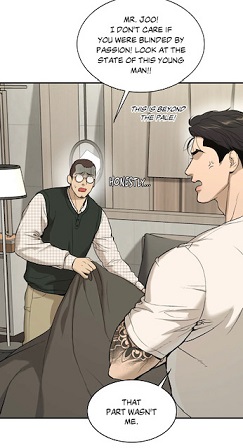 (Chapter 13) when the latter denied his responsibility. This shows that the man doesn’t mistrust people. He has faith in humans. And in this short scene, the doctor shows alle positive notions mentioned above: love, empathy, joy and creativity. Therefore I come to the following interpretation: he embodies the being mode. No wonder why he was not present in season 1. The main lead was definitely obsessed with work. Hence the moment Cheolmin’s path crosses Kim Dan’s, the funny doctor should become the hamster’s new role model.
 (chapter 48) are full of greedy people who have no problems to commit crimes in order to achieve their goals (more fame, more wealth, revenge, more connections). Baek Junmin became a champion by cheating.
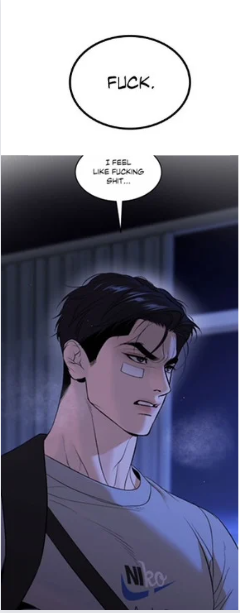 (chapter 53) He is standing at a crossroad. What does he truly want in life? Fame? More money? Or happiness and as such love and fun?


 (chapter 140)
  (chapter 149) Both were suffering from survivor guilt. To conclude, Joo Jaekyung and Kim Dan represent the bitter medicine for their scars. I mentioned “bitter”, because through their loved one, they are forced to face painful moments. That’s how they can overcome their past and discover happiness. However, while looking for a new title, I rediscovered the first illustration
  , and it suddenly made click in my head. To conclude, I had another revelation concerning episode 50.
 Consequently, while many saw this question as a “factual information” and as such as an accusation, the reality is that it gave us an insight about the sender too. The sportsman was not using the personal pronoun “I” or “me” in his inquiry. As you can see, the absence of the personal pronoun is indicating that Joo Jaekyung was in reality not referring to him and his wounds. He is not prioritizing himself, rather the doctor and his action. So this question could be prompted by curiosity or a desire to understand the person’s recent activities. Thus I deduce that the champion was asking his lover to tell him the truth. He should come clean. He desired a honest explanation. His attitude reminded me of an adult confronting his child.
 (chapter 51) But note that he never accused Kim Dan of assault, but of leaking information. That’s the reason why I don’t think that this inquiry “What have you done” was about seeking accountability. In that case, he wouldn’t have rejected the doctor’s offer. By letting him treat his wound, Kim Dan would have become responsible for the injury.
  (chapter 51) This means, the main lead recognized his responsibility. He should have checked the spray more carefully. The champion could perceive this excuse as a confession of his complicity. Hence he asked his lover if he was the spy.
 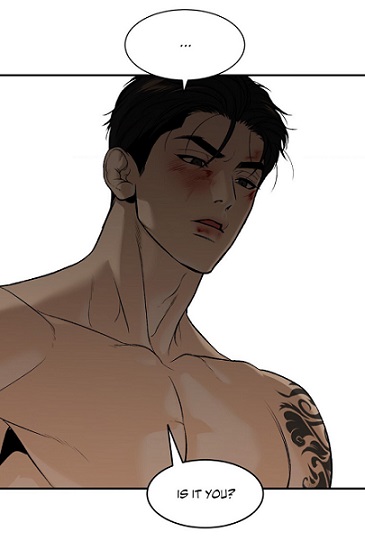 (chapter 51) This signifies that in episode 51, he dared to question his physical therapist’s loyalty. Yes, we have another “Truth or Dare” in episode 51.
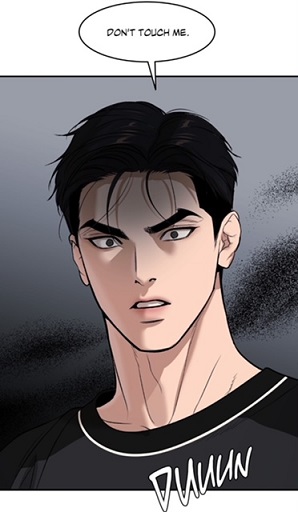 (chapter 50) This is the face of a scarred man. Yet, contrary to the past, he is not expressing his fear through rage. That’s the reason why his emotions were controlled. Under this new light, Manhwaworms grasp why the athlete asked such a question from his soulmate:
  (chapter 51) Interesting is that he was more pained by the idea of a betrayal from Kim Dan than the tie, if you compare these two panels: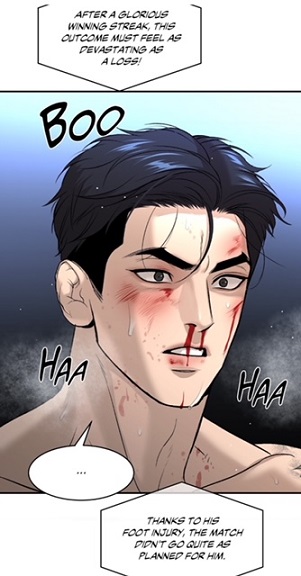
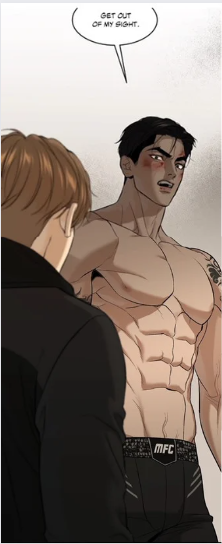 (chapter 51) On the other hand, don’t let yourself get fooled by this rude request. The reality is that the alpha didn’t chase away the doctor, in truth he was the one running away.
 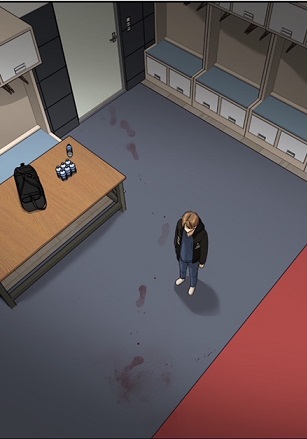 (chapter 51) Thus Kim Dan could overcome this shocking but terrible discovery: he hadn’t earned the full trust from Joo Jaekyung yet.
  (chapter 51) As my avid readers can see, my perception about chapter 50 was confirmed with episode 51. The arguments in the locker room were reflecting the quarrel in the penthouse with Choi Heesung. What is the common denominator between these two scenes? The lack of trust from Joo Jaekyung, but his private PT failed to realize it in the penthouse. Why? It’s because he chose to trust his destined partner.
 I believe you = I trust you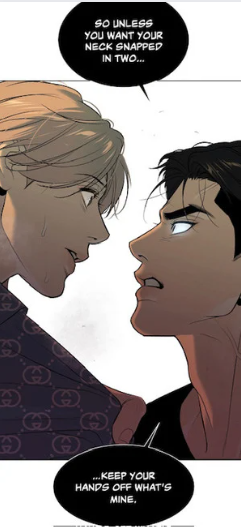


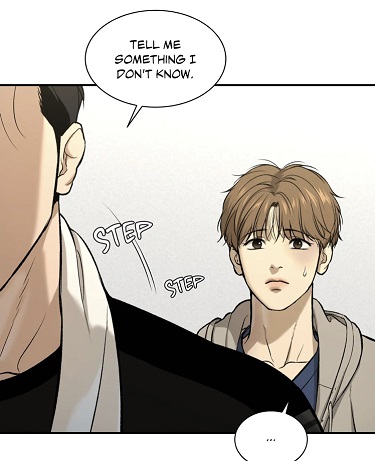 (chapter 15) He told him something that he didn’t know. Note that after the terrible meeting with the actor, Joo Jaekyung couldn’t even find the answer himself:
 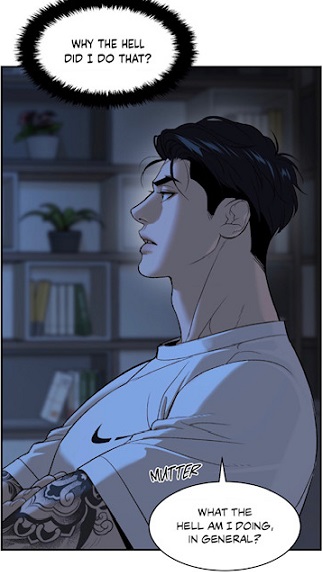 (chapter 35) He was still clueless about the trigger for his behavior. With this inquiry “You don’t trust me”, the hamster pushed his destined partner to face his biggest fear: trust someone and in particular him. This conversation can only incite him to meditate about their relationship. So while in episode 15, he behaved like a pouting child
  (chapter 15), in the latest episode, Jinx-philes can perceive his growth and maturity.
  (chapter 15) This painful incident was a wake-up call Thus I come to the following deduction. Kim Dan will try to earn the champion’s trust, whereas the champion will be forced to take a leap of faith towards Kim Dan. Contrary to episode 34, the champion could see the truth directly through the doctor’s gaze and voice:
  (chapter 34) As a conclusion, while the champion thought that his loved one had dared to cross the line, he was confronted with truth. He was biased and mistrusting his room mate and PT. This shows that though dare was the opposite choice of truth, the fighter ended up to be confronted with verity.
 (chapter 34) These questions were all rhetorical:
  (chapter 34) This signifies that in the sauna, truth was not standing in opposition to daring. The sauna reminded me of the cavern where an imugi hides, until the latter leaves its hidden place and find his star, his yeouiju. Only then, he can turn into a dragon. To conclude, because of Heesung’s pressure, the imugi had to select between daring or lie. In other words, telling the truth became the challenge itself. Heesung knew that Joo Jaekyung would never confess.
  (Chapter 34) What Heesung wanted was actually a lie by omission or commission which would have been presented as the truth. Through this game, the actor thought that he could impose his will onto the celebrity. He anticipated the athlete’s silence. This signifies that he knew about the star’s denial and turned it against him. Besides, that way Heesung could maintain his good image: he had not stolen his partner and as such there was no cheating. No one was betraying him.
 (chapter 34), but also his hand.
 (chapter 34) He caught the actor by surprise, the latter never thought that the celebrity would become violent. The redness on his face was displaying that he was barely controlling his annoyance and impatience.
  (chapter 34) However, they were in a public place, the hotel’s sauna, and the actor is a celebrity. Hence he is protected by his fame and social status. That’s the reason why the champion didn’t hit his frenemy, he had learned his lesson at the gym.
  (chapter 34) Despite his words, the gumiho still got scared. The racing of his heart is an indication of his fright. Therefore he ran away more or less after ordering his trainer not to meddle in his love life.
  (chapter 34) Note that when he did this, he avoided his counterpart’s gaze. Deep down, he knew that he shouldn’t provoke his frenemy too much. Only when he was at the door, he turned around and LIED!
  (chapter 34) Yes, after that incident, he chose to give him a fake excuse for his departure. As you can see, this conversation was strongly intertwined with the notion “truth or dare”, but both ended up lying. Whereas the champion didn’t admit any feelings, the other acted, as if there was nothing wrong and he was not scared. The gumiho thought that if he were to remove the champion from the doctor’s side, the latter would be able to open up to the actor.
  (chapter 34) What does it reveal? The actor had been projecting his own thoughts onto the future dragon too. He was the one who didn’t dare to become more honest with the physical therapist. He used work to spend time with Kim Dan. One might say that Heesung failed terribly. Yet, this is just an illusion, because his “failure” pushed him to become more honest with Kim Dan. Thereby he asked to meet the doctor again.
  (chapter 34) Yet, the message is exposing that Heesung was still lying, as he kept using work as an excuse. Hence Joo Jaekyung had to intervene again:
  (chapter 34) The champion dared to challenge his rival.
  (chapter 35) Yes, by challenging the athlete because of Kim Dan, the comedian ended up telling the truth.
  (chapter 34), but his anxiety reached a new peak, the fear that he might be abandoned. Hence he used the sandbag to vent his temper. And what did the cute puppy do during that incident? He dared to offer his help to his idol:
  (chapter 34), yet he was in total denial about the reality: it was dangerous. Deep down, the champion knew that it was impossible for him to control his lover’s time, but also his body. Besides, the other problem is that the athlete is rejecting the notion of love. By denying the existence of his own feelings, he can not claim the doctor’s heart. That’s the reason why the champion got so mad and frustrated.
  (chapter 34) He was not telling the truth, when he stated that Kim Dan was his “possession”. This explicates why he couldn’t stay by the doctor’s side
  (chapter 34) in the end. He manipulated the main lead by letting him think that he had no other choice. Yet the last panel displays his trick. It was up to the doctor to decide how he should spend his free time. Nevertheless, while people were mad at the champion for his deception, many failed to realize that the champion was actually deceiving himself. So all the tricks (episode 33 and 34) were manifestations of avoidance, the fear to face the truth: his affection for Kim Dan and this due to a past betrayal. Hence these chapters stand under the sign of silence hidden by “pranks”.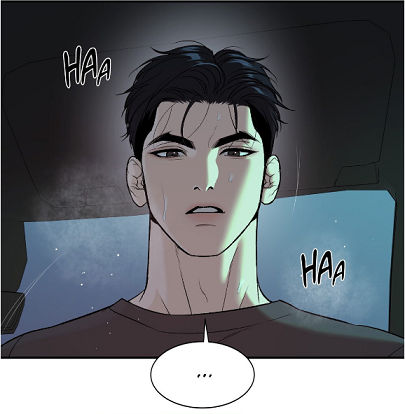
 (chapter 35) On the other hand, the artist could only tell one part of the truth: the presence of feelings. However, the deceptions in the penthouse exposed something else:
  (chapter 45) or left the doctor in the locker room in episode 51.
  (chapter 45) It is because by denying his affection, he needs to justify his presence next to him. He is his PT… forcing his enemies to portray the doctor as a traitor or a bad PT. However, they failed, as the champion is not doubting the doctor’s innocence concerning his wound on the foot. Nevertheless, the incident is not closed, as the culprit has not been brought to justice.
 (chapter 50) First, the schemers’ MO corresponds to the game Truth or Dare. Choi Gilseok asked his minion to cross the line. This explicates why they are trying to use tricks and manipulations. Daring means no truth, thus someone will be framed: Kim Dan. Yet, the plotters are not aware that thanks to the cute hamster, the alpha is turned into a mirror of truth. Hence he couldn’t get deceived by the MFC security guys:
  (chapter 40)
  (chapter 36) The lawyer, the journalist and the manager pushed him to choose “dare” and not truth! That’s why there was no interview and the leak was not investigated. He had to prove his strength.
  (chapter 37) This mysterious man dared to act as a MFC manager, though my intuition is telling me that he works for MFC. The irony is that by challenging constantly the champion, the plotters are not realizing that through their game, the truth is slowly coming to the surface. How so? In the last panel, the doctor noticed his origins: He is Korean indicating that the conspiracy started in South Korea. As you can see, Kim Dan was able to perceive a glimpse of the truth. Then at the café, Choi Gilseok confessed many things to the doctor: he owns the café, he has connections to the company F Pharmaceutical. Moreover, through this game, the champion is confronted with his fears and past. That’s how he can overcome his traumas. The doctor is the mirror revealing the monsters. Hence I come to the following deduction: the succession of new characters mirrors the champion’s past and traumas. The following characters are involved in the champion’s suffering, though the order of the appearance is exposing the gravity of the involvement: Heesung,
  (chapter 29), the journalist without a face
  (chapter 35), the “fake” MFC agent
 (chapter 42), Baek Junmin whom the champion couldn’t truly identify
  (chapter 47), then he recognized the director without naming him,
 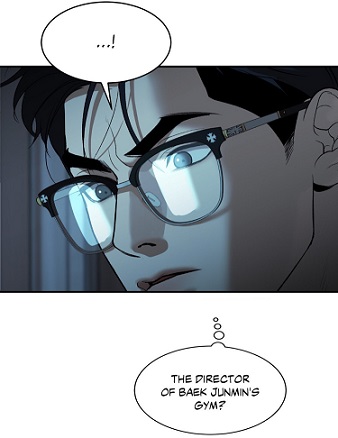 (chapter 48) and finally the ghost from the past
  (chapter 54). These characters are all connected to “Truth or Dare”.
  (chapter 50) This scene exposed that the champion repressed a certain incident which is rather common among victims of a trauma, especially people suffering from PTSD. This shows that some traumatic event took place for quite some time, but the champion acted, as if nothing had happened.
  (Doctor Frost, chapter 140 ) That’s how the champion became a zombie, he couldn’t live properly due to his untreated scars.
  (doctor Frost, chapter 139) But thanks to his fated partner, the traumatic past is slowly coming to the surface.
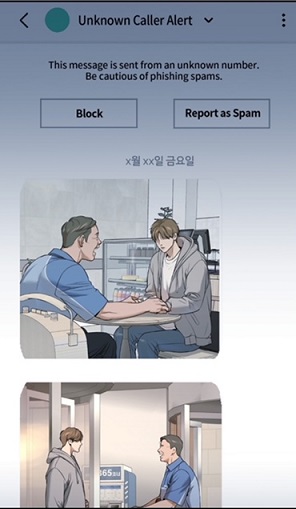 (chapter 48) The director created a stage for the betrayal. That should represent the truth, while in reality it was a lie! Nevertheless, Joo Jaekyung could perceive the truth: Kim Dan had met the director from the rival gym.
  (chapter 48) Yes, he didn’t dare to tell him what had happened. No truth… no daring which reflects the games in the sauna and the living room of the penthouse. Kim Dan could have come clean the next morning, but no. This panel explains his silence. He also mistrusted his VIP patient. He had a negative perception of his lover’s mental state. On the other hand, the champion’s attitude reminded me of a parent who has not the time to listen to his child’s problem due to work.
 (chapter 48) Should the athlete remember this night, he will realize that he was the one dismissing his physical therapist, although the doctor could have come clean later. At the same time, Joo Jaekyung’s attitude could be mirroring the parent or guardian’s in the past. They didn’t have the time or the inclination to listen to their son, hence the traumatic incident got buried.
  (chapter 27), hence truth comes to the surface! Kim Dan and Joo Jaekyung feel attracted to each other and have come to love each other. When they speak their mind, they feel comfortable around each other. Truth is strongly connected to communication. Hence the painful conversation in the locker room was necessary. “You don’t trust me?” also reflected the doctor’s attitude. He never tried to approach his room mate
 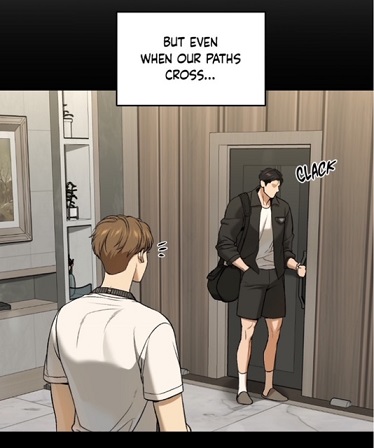 (chapter 47) and voice his true thoughts and emotions:
  (chapter 49) The latter didn’t even greet the director or acted, as if they didn’t know each other. He exposed the existence of a secret, an uncomfortable secret. Consequently, I believe that the champion could only jump to the conclusion that Kim Dan had been indeed acting behind his back, even coerced to do something.
  (chapter 51) Note that the star never came clean with the truth either.
  (Chapter 35) Through the doctor, the champion is encouraged to become honest to himself.
 (chapter 33) Simultaneously, it exposes that the champion has a secret, which is strongly intertwined with betrayal, love, money and deceptions. I couldn’t help myself thinking of “blackmail”. Kim Dan had been coerced to do something, as the director was holding something against him. Hence we have the question: “what have you done?”. Remember how the actor chose to approach the angel.
  (chapter 31) He tricked his boss by faking an injury. He put the gym under pressure, as this incident could be leaked to the outside. The whole situation reminded me of blackmail. If he did not follow his request, there could be a scandal. That’s the reason why I believe that the champion’s past is linked to blackmail as well. How is it possible? It is because of the game “truth or dare”! The latter is strongly intertwined with divulging information and crossing the line!! To sum up, this game embodies trauma, secret, leaking information, trust and overstepping a boundary or rule. This observation brings me to my next point.
 (chapter 9) And what did happen after they left the restaurant? The champion discovered the truth:
  (chapter 10)
  (chapter 10) Kim Dan was terribly poor, but he was also on his own, missing his grandmother.
 (chapter 34) “Are you drunk?” With this question, the protagonist revealed something about himself. He associates dating and love confession with drunkenness. He implies the existence of a lie. But a confession is strongly associated with verity and sincerity. On the other hand, for the sportsman, no one in his right mind would admit to be in love and in our case to love another man. For me, one part of the problem is that the champion is afraid of admitting his homosexuality. The latter is still a stigma in South Korean society. But there’s more to the game Truth or Dare. If you paid attention to the origin of the last quote, you will realize that this fun is linked to bullying and even hazing.
 (chapter 49) Furthermore, bullying is never done alone, but in groups.
  (chapter 57) There is one leader and the others are following the flow, the latter even become more proactive by making new bets and suggestions in order to ensure their own safety. As long as no one divulges the truth, the bullies are safe. But there’s more to it. Striking is that the way they coerced the champion to fight resembles to bullying too. He was manipulated with the articles, then with the advises from the lawyer and manager. Once in the States, they tried to drug him, which corresponds to a physical assault.
  (chapter 37) Finally, note that the schemers are working in teams exactly like the bullying students. Therefore I judge Park Namwook’s attitude as the teacher’s who is closing the eye to the truth. He is rather passive and puts the whole responsibility on his “boy”.
  (chapter 41) It is the champion’s choice to refuse or not the matches. The moment I associated the game with parties, peer groups and bullying, I had many revelations.
 (chapter 37) Interesting is the athlete described this night as a party which made me think of a students’ party. Therefore I couldn’t help myself wondering if the champion didn’t go to college, but due to an incident, he was forced to drop out. And the latter could be related to a party organized by students. The latter chose to cover up the incident by remaining silent. I would like to outline that the doctor got fired, though he was actually sexually harassed by his superior. The nurse never testified in his favor, she chose to close an eye to the crime.
  (chapter 1) The main lead never considered her behavior as betrayal and abandonment. In fact, he never considered the crime as a betrayal from an institution.
  (chapter 1) He put the whole blame on the hospital director himself. He is a liar. Furthermore, through these pictures
  (chapter 47)
  (chapter 47), Manhwalovers can see that Kim Dan was a loner. Therefore I doubt that he had friends during his college years. The only person he knew from his school was his mentor:
  (chapter 1) It is important, because it implies that Kim Dan avoided to socialize and participate in gatherings. Interesting is that in season 2, Jinx-philes discover that Kim Dan had been bullied in the past.


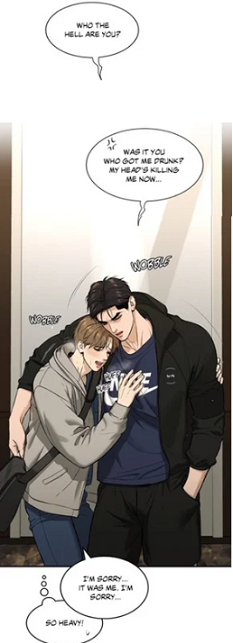
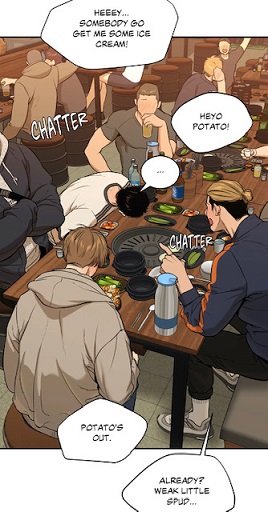 (chapter 9), yet Park Namwook made sure that the physical therapist wouldn’t be abandoned drunk. Thus he tasked his boss to bring him home. And as for Potato, it is clear that Oh Daehyun would take care of him, as he was sleeping in the dormitory next to him. In other words, no one was left behind drunk. But this scene contrasts so much to episode 43. First, no one was missing Potato. No one asked about his absence. Secondly, pay attention that the fighters invited Kim Dan to join them for another round, while they were neglecting their boss, though it was his birthday party.
 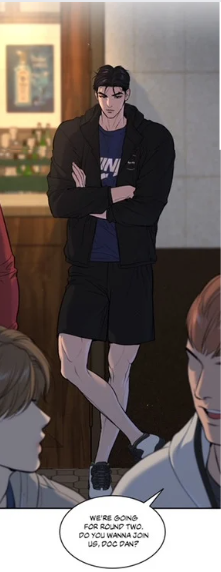 (chapter 43) Moreover, they never wondered about his physical condition. Was he drunk or not? Funny is that the intoxicated character was the one who forced Kim Dan to go home.
 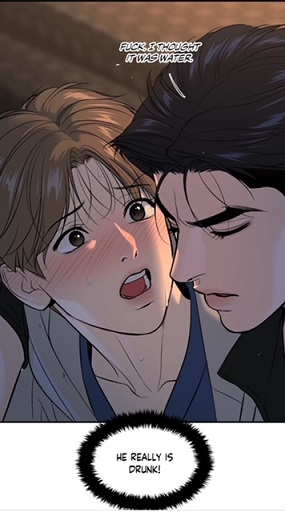 (chapter 43) That’s what a friend is supposed to do.
 (chapter 35) So the auntie could keep an eye on the judo fighter, and it was only a matter of time, until his friend would return. Nevertheless, this scene is implying a certain problem: a drunken person shouldn’t be left unguarded. Thus imagine that during a party, an unconscious person is brought to a room and left there unguarded, as the friend desires to keep partying, similar to this scene:
  (chapter 37) The person could get sexually assaulted, and no one would notice it. Secondly, I would like to outline that the hazing party from the article reminded me a lot to bullying. These freshmen were humiliated, and the perpetrator excused her behavior behind traditions and social norms. So the champion could have been betrayed by a friend, as the latter would have justified his action similarly. So instead of admitting his mistake, he could have justified the incident like this: the victim was responsible for his misery, because he was at the wrong place at the wrong time. It was just his misfortune or better said his jinx. Yes, for me, the jinx is indicating that people responsible for the champion’s traumas were denying their wrongdoings.
 (chapter 8) From my point of view, this place is not just symbolizing purification and reflection, but also indicating the presence of a wound. As soon as I connected the bathroom and as such water to pain, all the champion’s past behavior appeared in a different light. In episode 3, when he went there, he was wearing his pajamas.
  (chapter 3) Neither Kim Dan nor the protagonist were seen both naked in the shower room.
  (chapter 8)
  (chapter 20)
  (chapter 30) Therefore I perceive the champion’s last comment as relevant. In my opinion, Kim Dan’s gesture reflected the champion’s mind-set. So by saying this, Joo Jaekyung was forced to admit the absurdity of such an attitude. Therefore Manhwalovers can understand Joo Jaekyung’s annoyance at the sauna. He imagined that he would be alone there.
  (chapter 34) He feels uncomfortable naked around people… As soon as you connect this place to a wound, my avid readers can finally better interpret the champion’s irritation in episode 36:
  (chapter 36) Kim Dan’s entrance could be perceived as a violation, for the champion was naked. This intrusion caught him off-guard. But since his gaze was covered, his anxiety masked behind his anger was diminished. On the other hand, this led him to leave the bathtub undressed and have sex in the kitchen.
  (chapter 36) For me, everything is pointing out that one of the champion’s fears is intimacy with water. He has long internalized this association. Don’t forget that the sexual encounter in the swimming pool started with clothes, before they got completely removed.
 (chapter 27) Under this new perspective, I don’t think that it is a coincidence that the champion felt the need to take a shower after meeting Baek Junmin and recalling the past.
  (chapter 49) This helped him to overcome his trauma and past wound.
  (chapter 49) Yet, keep in mind that the athlete’s wounded soul is not the result of one traumatic incident, but of many anguishes.
  (chapter 8) they dared to have sex next to Oh Daehyun and the other fighter. However, note that in all these scenes, neither the doctor nor the champion were honest. They were both lying… not only to their counter-part, but also to themselves.
  (chapter 19) That’s the reason why the argument in the locker room
  (chapter 51) doesn’t represent the final moment where both main leads opened up their heart and mind to each other. They were not truly honest to themselves and to each other. There was no water… and according to me, the spray was a pepper spray, so the champion’s ankle should have been cleaned and not simply covered. For me, both characters need to prove their trust and loyalty to each other. But they are moving in the right direction, for Joo Jaekyung divulged a huge information to Kim Dan.
  (chapter 7)
  (chapter 70) His sexual orientation was exposed in high school, his friends were behind the rumor
  (chapter 70), although we have to envision that his crush played a huge part in it. Why? It is because he didn’t want to be associated with homosexuality.
  (chapter 70) Not only he cut off ties with him, but also he made sure to isolate the main lead from other students. The worst is that this person acted, as if this ostracizing had never occurred.
  (chapter 69), as if he had done nothing wrong. For me, it shows that the traitor never grasped the significance of his actions. Hence Park Sung-Woong could forget Dong-Gyun, while the latter could never forget him at all. The result from this huge betrayal was that the cute uke decided to keep his distance from people.
  (chapter 70) He could no longer trust people, he avoided meetings. In order to outline how severe betrayal trauma can be, the Webtoonist showed us the immediate effects of betrayal trauma: physical and emotional reactions
  (chapter 70)
  (chapter 70) and the long term effects:
  (chapter 69) he is trembling so much, he can not look at his former friend. Readers shouldn’t underestimate the issue. Betrayal trauma is so severe that it is comparable to being hit by a white truck. The pain is so great that it affects the brain functioning and as such personality.
 (chapter 9), trust issues
  (chapter 30), negative intrusive thoughts
  (chapter 29), withdrawal (we know nothing about his family and he dislikes going to gatherings, he is not meeting his hyung Cheolmin) and rumination: he got upset, when the hamster ignored his calls.
  (chapter 05) Then when he stayed at home,
 (chapter 32), it was clear that the doctor’s actions were constantly on his mind. He was so bothered that he had to bring him to Heesung. He made sure that Kim Dan would forget Choi Heesung in the car.
  (chapter 33) Interesting is that this trauma resembles a lot to PTSD.
 (chapter 49), the latter was not loved, as he didn’t reach the first place like his older brother. Then we have Interpersonal with Nam Dong-Gyun and his high school friend. However, since the rumor circulated at school, and no adults intervened, we could see it as a reference to Institutional betrayal. Finally, Mingwa presented the last type (partner) with Hweemin.
 (chapter 51) But why is betrayal trauma so severe? It is because everything appears as a lie, as an illusion. All the memories become tainted. The victim can only question his own senses and judgment. How could he not detect the lies? Since PTSD and betrayal trauma share some common points, it is not surprising that such persons come to blame themselves and develop huge self-loathing.
 (doctor Frost, chapter 139). And now, it is time to expose my latest observation:
  (BJ Alex, chapter 51) Ahn Jiwon caught his first lover cheating on him at a club. Interesting is that the new lover resembles a lot to Joo Jaekyung! Mingwa said that characters from BJ Alex will only appear, but Jinx is not connected to her previous work. Note that they were kissing in a public place. Moreover, the club is a location where students not only meet, but also drink alcohol together. However, once Jiwon saw Hweemin, he dragged him outside so that they could talk. In other words, the “new lover” was left behind. Thus I come to the following conclusion. Joo Jaekyung has been suffering from betrayal trauma exactly like Ahn Jiwon. He was betrayed by his guardian
  (BJ Alex, chapter 51). If this theory is true, then Mingwa would finally outline the devastating effects of Betrayal trauma on people, something she barely touched in her previous work.
 (chapter 51)

 (chapter 23) On the other hand, the physical therapist has always been associated with a hamster, like in this image.
  So how did I come to connect the main lead to a puppy dog?
  (chapter 47) It is because Shin Okja called her grandson “her puppy dog”.
 (chapter 5), but a young dog. This signifies that in the bathroom, the main lead’s true nature came to the surface due to the bad news concerning his grandmother.
  (chapter 47) Yet, a puppy embodies innocence and inexperience. Thus it needs the guidance of a mother. On the other hand, in my essays about the doctor, I kept describing him as a person who would constantly grow and mature. So “a puppy dog” would appear as a contradiction to my previous interpretation. Nonetheless, we shouldn’t forget that this was representing the grandmother’s desire. By turning him into a puppy dog, she expects from him obedience and loyalty. She is denying his right to determine his own life. He needs to follow its master. Hence this scene announces a certain regression for Kim Dan. On the other hand, I believe that this is just temporary. What the elderly woman didn’t know is that by linking him to a dog, she was freeing Kim Dan from society as well. He is now an animal. He belongs to Nature from that moment on. This animal symbolizes freedom and independency. So when the grandmother described him as a puppy dog
 (chapter 48) Furthermore, Jinx-philes could observe how the doctor had followed his instincts during the conversation with Choi Gilseok in different panels, like for example in this image.
  (chapter 48) The idiom “fishy” is a reference to smell, indicating that he was relying on his own senses. But we have another evidence that the puppy dog was using all his senses to judge his counterpart:
  (chapter 48) He rejected the touch from Choi Gilseok. That’s how he could detect the director’s hypocrisy. He refused to drink the coffee from the senior, although it had been recommended. As you can imagine, all his 5 senses were on alert, and the latter are strongly intertwined with instincts. In addition, when he asked his counterpart to go to the point and speak frankly
  (chapter 48), he was urging Choi Gilseok to drop all manners. Yet, Manhwalovers should keep in mind that the synonyms for manners are etiquette and ceremony. This proves that manners stand for civilization. But what are good manners?
 (Chapter 48) This means, he was disrespecting the elder. However, his disrespect didn’t start at the café, but in front of the gym.
  (chapter 48) He refused to take the card from the director. However, the moment his grandmother was brought up, he became obedient and accepted the invitation.
  (chapter 48) He acted out of loyalty and love for her. Nevertheless, the director’s offer for his halmoni served him to see the truth. His behavior during the conversation exposes the awakening of his wild and rebellious side. Thus we could say, Doc Dan showed more and more his rudeness. He left without asking permission and saying goodbye.
 (Chapter 48) To conclude, the conversation displayed that Kim Dan was already following his halmoni’s advice, he was living as a dog. This made me smirk, because I could detect how Joo Jaekyung had rubbed off on Kim Dan!! 😂
  These two characters symbolize true friendship. Thus I come to the following deduction: Kim Dan is about to get truly adopted by Team Black, while it looked the opposite at the end of the season. He might have been wearing a uniform and a jacket Team Black, yet there were signs that he wasn’t truly part of the team.
 (chapter 43) The cause for this issue is that Kim Dan was hired as the private Physical Therapist for the champion. He occupies a special position, for he is no fighter. Yet, he did everything to integrate his new family by treating the other members, though it was never his responsibility officially.
  (chapter 47) But for the adoption to happen, he needs to prove his loyalty. How will he do it? Once again… wait for the part with the predictions. Yes, I am taunting my attentive readers.
 (chapter 47) They could never break into the MFC! Yes, chapter 47 actually exposed the falsehood of this belief: Potato hadn’t been bringing luck to Team Black. But why? The first reason is simple. It is because of his good vibes.
  (chapter 47) She was underlining their innocence and naivety. Thus they are still ignorant of the existence of schemes in the MFC world. They have the impression that the underground fighting ring and MFC are two different worlds.
  (Chapter 47) That’s the reason why they were not expecting that their idol would get so hurt or lose the fight. Kim Dan didn’t dare to contradict them, especially when Potato asked for his opinion.
 (chapter 47) In my eyes, Doc Dan didn’t dare to ruin the maknae’s illusion about his idol, though he thought otherwise. His broken sentences and his drop of sweat are revealing his discomfort and skepticism. He was not sure about the success of his VIP client. But Kim Dan as his PT knew about the champion’s true conditions: he is not truly healthy. But why are the fighters so innocent?
 (chapter 46) It is because the success of the gym relies only on the champion’s glory and the number of members. Till the end of season 1, he has not changed his behavior yet.
  (chapter 31) It looks like I am diverting from the topic, as I am now talking about the fighters and the gym. No wonder why most of the members switched the gym, as soon as the champion lost and his reputation got tarnished. Nonetheless, keep in mind that his game with Baek Junmin ended up with a TIE. So it is not a complete defeat. In my opinion, the schemers desired to tame the Emperor, not to ruin him, as they definitely need him to make money.
  (chapter 23) Kim Dan and Yoon-Gu had no task at all. The latter were treated like playmates and nothing more. Hence the manager asked patience from the doctor.
  (chapter 46), but also by his greed. He had lost so much money. He needed to refill his pockets. Thus his wish was to “kill” the emperor and as such to ruin Team Black. In other words, he had planned the destruction of the rival gym. With the victory, Baek Junmin could replace the champion, and Choi’s gym King Of MMA would attract members. And my prediction came true. With the tie, many members from Team Black went to King Of MMA hoping that they would come to get rich and famous very quickly.
  (chapter 52) And since the other fighters from Team Black had never been able to break through MFC, it is not entirely surprising why they made such a decision. With their desertion and the champion’s ruined image, the future of the gym Team Black seems to be sealed: failure. Under this new light, my avid readers can grasp the true signification of this gesture:
  (chapter 49) It was not just about Kim Dan’s fate, but also Team Black’s. Hence he can not quit or run away. This new interpretation made me perceive the entrance of Kim Dan in the arena in a new light.
  (chapter 50) Remember how I said that the locker room had become a temple. Thus I come to the conclusion that he got baptized there. He discovered the power of his hands, similar to this scene.
  (Chapter 14) So when he comes to the arena, he is still following his instincts, unaware of his own metamorphosis. He is no longer a puppy, but a dog. Deep down, he feels that he has to be there despite his agony. He needs to be there in order to protect his home. To conclude, in the locker room, the doctor reached adulthood. Interesting is the chosen perspective from Mingwa. It was, as though he was flying high in the sky, like a yeouiju.
  (chapter 40) In this image, he has to look up, whereas in the other panel, the beholder has the impression that doc Dan is rather standing on the same level than his soulmate, the alpha Jaekyung. However, since the athlete blamed him for the incident and rejected his hand, for Kim Dan, it sounded that he was no longer needed.
  (chapter 27) Thus I come to the following conclusion. With the switch of the spray, Joo Jaekyung was forced to recognize the importance of a physical therapist. Keep in mind that till his meeting with Kim Dan, he never saw them as necessary. Even before his immanent match, he kept looking down on his soulmate.
  (chapter 42) Here, it becomes obvious that he didn’t see his PT as a partner, but as an underling.
  (chapter 35) Thus it dawned on me why Joo Jaekyung reacted so violently, when he received the golden keychain.
  (chapter 40) And that’s how the champion will come to realize that he can not live like before, as Kim Dan can not keep up to him. He is physically weaker. He desires his loved one to always look at him, to never leave his side, to stop living like a stray dog.
  (chapter 4)
  (chapter 48) Yes, these images represent a metaphor of a wandering dog. On the other hand, the shadow below the doctor is indicating that he is slowly turning into a human being out of flesh and blood. He is no longer living like a spirit.
 (chapter 53) Observe that the doctor’s shadow is getting bigger. I interpret it as a sign of his growth, and it implies that Kim Dan is leaving traces behind inviting Joo Jaekyung to follow him. In the nature, far away from the city, the wolf should be able to reconnect with his true nature: freedom, but also loyalty and family. Home is no longer a place, but a person:
  (chapter 53) As you can see, with this new interpretation, I recognized that at the end, Joo Jaekyung stopped being under the influence of PArk Namwook. The latter hasn’t recognized the true role of a PT for an athlete yet. Hence he has no problem to hire a new one.
  (chapter 29) while all the others called Yoon-Gu as Potato.
  (chapter 9) The image divulges us the origin of this nickname: coach Jeong Yosep. Yet, this shows us the naivety from the hyung. And what did the other fighters do? They simply followed the suggestion from their elder:
 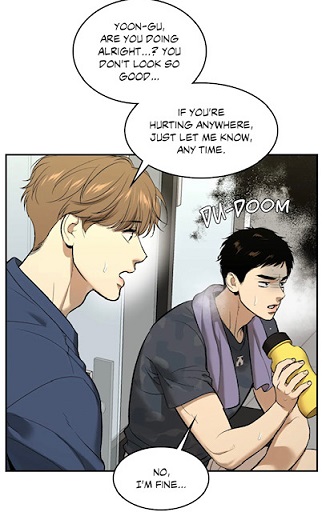 (Chapter 23) This shows that he was not infantilizing him despite judging him as a child or “puppy”.
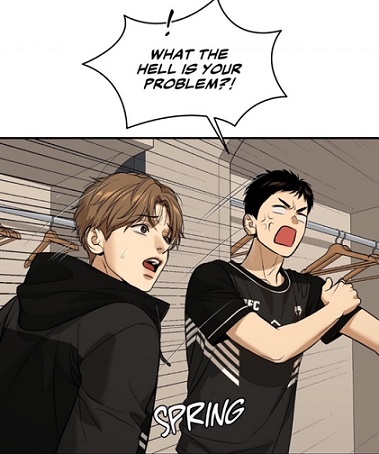 (Chapter 49) Not only he yelled, but also he protected his star by standing in the front line.
 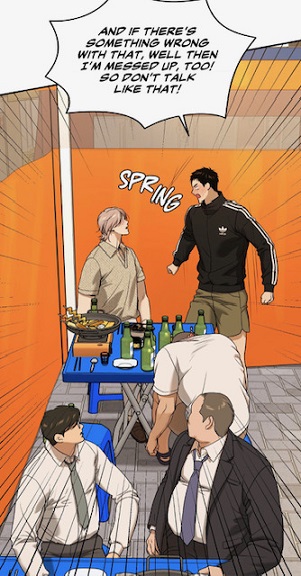 (chapter 35) He stood up, yelled and gave an order to the artist, though he is a junior. No wonder why the other guests turned around and looked at him. But this shows his strength, as he is following his instincts and as such his heart. He has already developed his own moral codex.
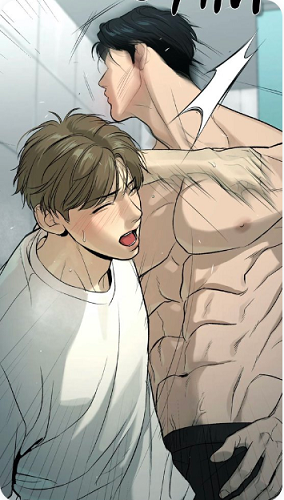 (chapter 7) He might have not wounded his partner terribly, but we shouldn’t forget that he was facing the Emperor. To conclude, by calling him Potato, the fighters were misjudging the young fighter. Kim Dan was the first one to identify him correctly. He was a dog, hence he desired to treat the champion as his master.
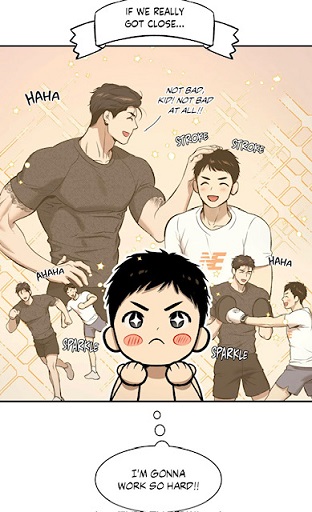 (chapter 23) His desire was to become the Emperor’s companion and as such best friend. The problem is that he was projecting his own thoughts onto the protagonist. The latter is not a dog, but a wolf. Moreover, Jinx-philes can sense that in his mind, the maknae was viewing the training as a playground. However, for the Emperor, life is like a battlefield, where death can strike at any moment. It is deadly serious. So in the star’s eyes, training has nothing to do with pleasure and fun, but survival. That’s why Joo Jaekyung received punches from his soulmate, a reminder that he needed to be careful. And that’s how Kim Dan earned the athlete’s respect.
 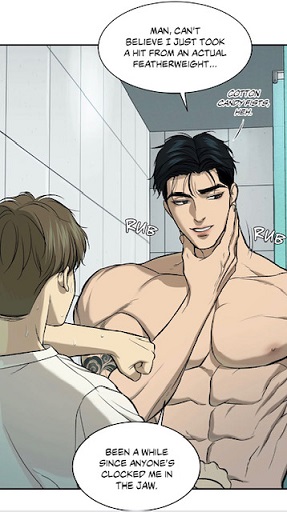 (Chapter 8) I noticed that the champion initially only listened to violence. It was, as if he had internalized this Nature’s law: the strongest prevails. No wonder why the champion didn’t react to Potato’s admiration so positively.
  (Chapter 23)
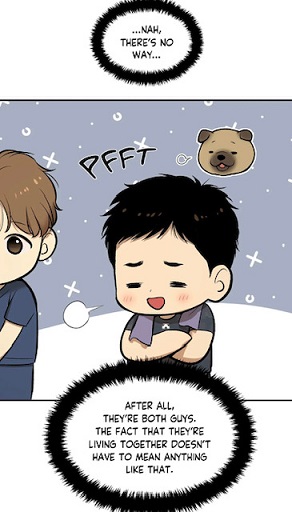 (chapter 23) Interesting is that she cut the chibi Kim Dan in half. Why? In my opinion, the main lead had not found his true self yet. She didn’t place any puppy above his head as well, because she wanted to keep her readers in the dark. However, let’s not forget that a puppy will recognize another puppy much more easily. Therefore Potato felt jealous and resentful first.
  (chapter 25) Moreover, we should interpret his nightmare like this. The puppy doc Dan had already marked his territory:
 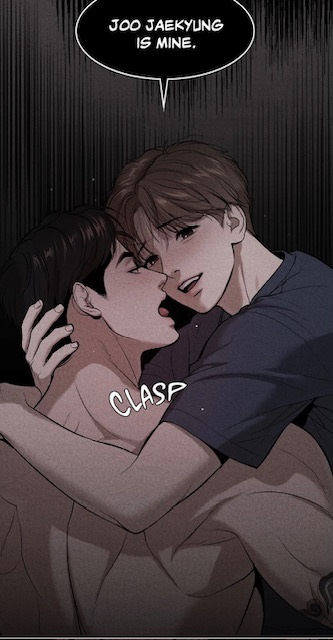 (chapter 25), though in his vision it looked like the roles were switched. The “dog” was the champion, whereas the doctor was the owner. That’s the other reason why Potato was so worked up. He preferred the strong man or beast.
 (chapter 25) The latter was trying to learn more about MMA, as he desired to improve his skills as PT.
 (Chapter 25) That’s how Potato came to offer his assistance. Interesting is that Yoon-Gu became the teacher for the physical therapist.
  (chapter 25) It is relevant, because the maknae was acting like a sunbae and not like a junior. He was given responsibility. His task was quite important compared to the coffee incident. With such a task, the cute puppy got to learn the importance of PT. This explicates why Potato always paid attention to the protagonist and his duties afterwards. Though Kim Dan had been constantly diminishing himself as physical therapist, in front of Potato he acted differently: meticulous, dedicated and caring. As you can see, this training session had huge repercussions for the chow chow.
 (Chapter 25) Hence it is not surprising that Kim Dan chose to repay Potato’s kindness by fulfilling his dream.
  (chapter 26) He was following his heart and as such his instincts. That’s the reason why money was out of question.
 (chapter 25), then he lowered his face like a moping mutt.
  (chapter 25) Because of his sacrifice and generosity, doc Dan became a role model in Potato’s eyes.
  (chapter 31) But how could he judge the actor as a danger? It is because he was using his senses as well. Don’t forget that they had bumped into each other
  (chapter 31) Secondly, since Yoon-Gu is a dog, this signifies that he can not be bought with money or presents either. Hence he could only mistrust the artist’s generosity. It is important to recall that before meeting the “angel”, Heesung would simply offer meals
  (chapter 30) and not expensive stuff like designer clothes or electronics. So Potato was not wrong either to mistrust the actor first, for the latter was indeed expecting affection in return despite his claim. He did want to date the doctor, but the puppy knew that the protagonists were together. He represented a threat to his new found home.
 (chapter 31) Heesung described him as ugly, which is actually an insult. Note the contrast. Heesung is smiling despite his words. It is because he was voicing his annoyance at Potato. The latter represented a hindrance to his courting.
 (chapter 40), the former came to appreciate the doctor much more than before.
  (chapter 40) First, he informs him about his patient’s conditions. On the other hand, it becomes obvious that he worries much more about the doctor’s health. His increasing care started with the party.
  (chapter 37) When Potato and Daehyun saw that Kim Dan was feeling down, they tried to cheer him up. Moreover, let’s not forget that when they got caught partying, the hyung tried to protect them:
  (chapter 37) Besides, Yoon-Gu witnessed the effects of the drug
  (chapter 38). Contrary to the other fighter, he touched his head. This gesture reminded me of a mother’s. And now, I know why Kim Dan saw Potato as a puppy.
 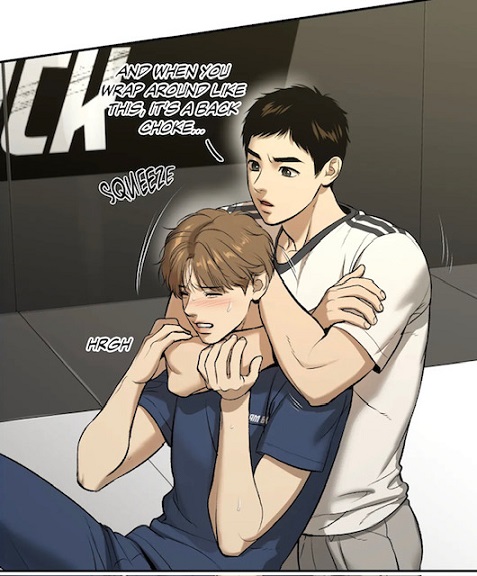 (chapter 25) On the other hand, Yoon-Gu lacks experiences, for he has never been exposed to the cruelty of this world, unlike Kim Dan or Joo Jaekyung. His fighting spirit is not developed yet.
 (Chapter 40) Therefore it is not surprising why after mentioning the incident with the MFC security guys to Park Namwook.
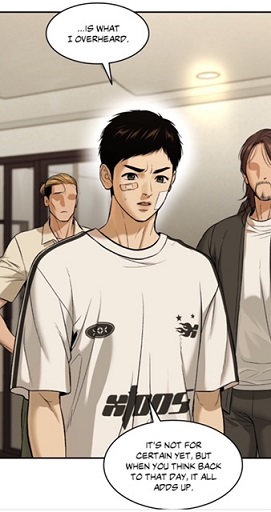 (chapter 52) He never questioned why the coach didn’t stop Kim Dan from quitting. On the other hand, I wondered how he came to change his mind about his idol. It can not be his brutality
 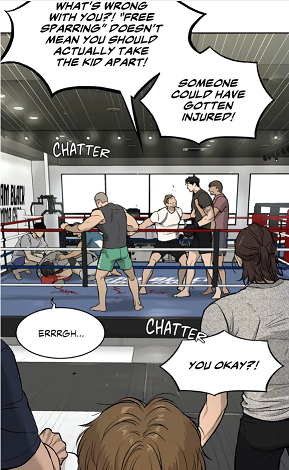 (chapter 1) and rudeness, for he didn’t criticize the athlete in the first episode or episode 7. In my eyes, the maknae lacks critical thinking. Nevertheless, we shouldn’t overlook that he followed the members’ behavior. No one from Team Black called Kim Dan and looked out for him. They all abandoned him after the match.
  (chapter 52) They only talked about the lost members, not about the physical therapist. This exposes that they didn’t treat him as one of them. To conclude, as time passes on, Yoon-Gu came to mimic and think like hyung Namwook.
  (Chapter 49) and helped him. I have to admit that the way the main lead was holding his hand reminded me a little dog.
  (chapter 49) For me, it becomes clear that the more time Potato and Kim Dan interacted together, the more the chow chow valued the job as physical therapist as significant in the career of an athlete. Besides, thanks to Kim Dan, the young puppy had the impression that he was contributing himself to his champion’s success too. It gave his presence a meaning. In other words, the puppies bonded through their jobs. That’s the reason why I am quite certain that with the recent incident, Potato will change his attitude towards Kim Dan. His vanishing made him realize how important he was to the team.
 (chapter 50) He was cheering him up! On the other hand, he still remained passive, and didn’t question the sunbaes like Park Namwook or Yosep. One thing is sure. After the last incident, he should have realized cheering someone is not truly loving someone. And this brings me to the other reason why Kim Dan was alone between 41 and 47. Yoon-Gu didn’t know doc Dan that well. He has no idea about his past and his actual situation. He can not expect the champion to act like in the States, as now the situation is different. He is already injured. Consequently, I am quite certain that it is also time for the semi-professional to reveal his true nature: he is a chow chow in verity! He sometimes acts more like a mother towards Kim Dan, though the latter is his hyung. Take the last panel as an example. Yoon-Gu is strong, extremely loyal and intelligent! His nickname Potato might be cute, but it doesn’t reflect his personality.
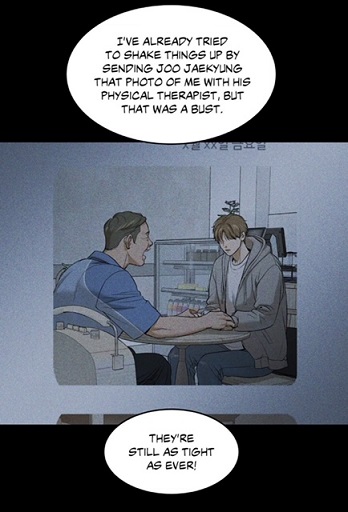 (Chapter 50) However, the doctor
 (chapter 47) was hiding his sadness and pain behind his job. How could Potato notice his suffering? Kim Dan never let his wounds transpire. Finally, we shouldn’t overlook the fact that Kim Dan never confided to the puppy dog as well. The protagonist has always been a loner, like we could see it in his memories.
  (Chapter 21) He was first of all his boss and his landlord. Yoon-Gu is not connected to the main lead because of money. The foundation of their relationship is based on trust, care and respect. Thus I deduce that Potato is on his way to become not only his first true friend, but also his second stan. He might have noticed his angelic nature in the past
 (chapter 26), but his adoration for the champion was still very strong.
  (Chapter 33) Yes, through them, the dragon and the gumiho can become real friends. So far, they had been more frenemies. They know each other’s secret
  (chapter 33), hence they can talk frankly to each other. Heesung knows that he won’t be condemned for his confession.
  (Chapter 44) And what did the doctor do during that wonderful night? He patted his lover on his head
 (chapter 44). He was telling him that he was doing a good job! One might say that he treated him like a little child. The second interpretation is that he was treating him like a pet. The dog was complimenting his lover, the wolf!
 (chapter 49) Respecting the elders! For me, Kim Dan will see red, when he hears the truth about the incident. From that moment on, he will start questioning not only seniors (manager Park Namwook), but also authorities (doctors).
  (chapter 42)
  (chapter 52) His behavior shows that he was no longer respecting social norms, respecting the elders. While in the beginning, he still followed Seonho
 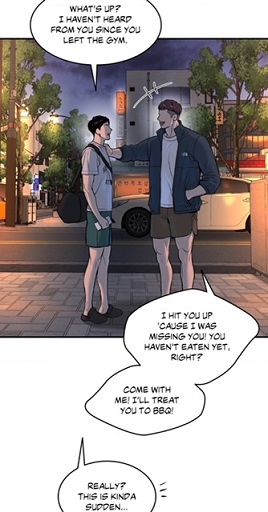 (chapter 52), at the end he chose to leave the restaurant on his own accord. Yes, he stopped being a follower of “herd mentality”.
  (chapter 26) In other words, both worlds (medical and sports) will join their hands together. Kim Dan and Joo JAekyung will learn from each other, which will naturally bring some changes at the gym. Their partnership will affect the fighters’ career in the long run. Their bodies will be protected from overuse and money will no longer be the motivation to accept a challenge. Training will be more focused on fun and teaching than on work and money.

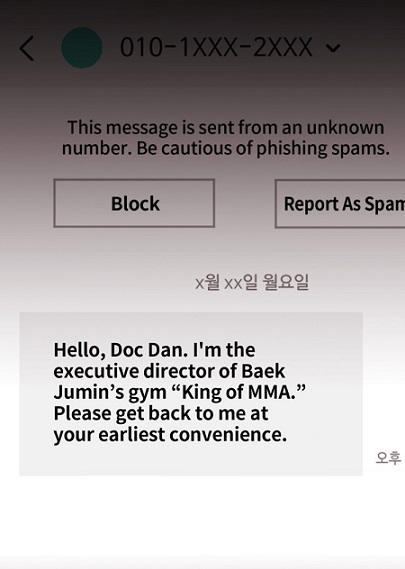 (chapter 47) Now, you are wondering why I decided to dedicate an essay about this scene. It is because the phone call and message raise a lot of questions. Why did the mysterious man call Kim Dan at such an early hour? Notice that it is in the morning, at 5. 15 am.
  (chapter 47)
  (chapter 47) The Spanish translator thought, the person calling Kim Dan was contacting him, after the doctor had met the oncologist. She imagined that not much time had passed. Yet, I believe, it is in the morning. First, it is important to place the day in the year. Since Joo Jaekyung’s birthday is on June 21st, and the next match is shortly after
 (chapter 47), I deduce that we are in July. However, the
 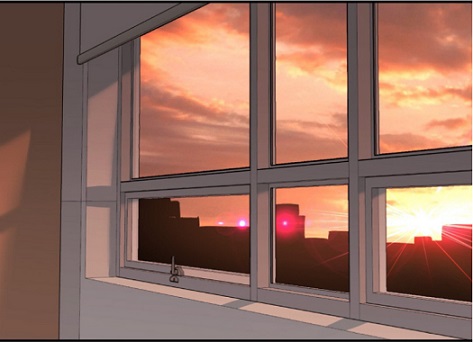 (chapter 47) It is in the morning. Moreover, the Webtoonist tipped off her avid readers with this panel:
  (chapter 47) In Korean, it is written MONDAY!! I had already detected a certain pattern. The protagonist would visit his grandmother on Sundays,
 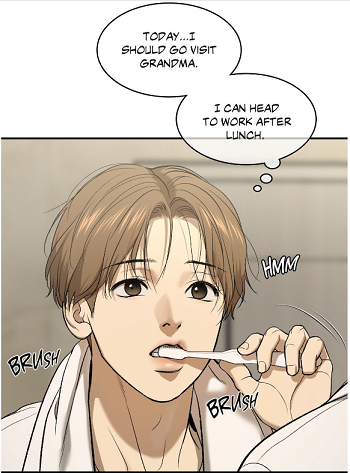 (chapter 30) as Saturdays are Kim Dan’s days. The morning in chapter 30 took place after the couple had spent their day-off together.
  (chapter 47), it was Saturday evening. Then the next day, he went to the hospital in order to get the results. After hearing the terrible news, he lost track of time. Hence he didn’t look at his cellphone contrary to episode 5.
  (chapter 5) On the other hand, I don’t think, he visited Shin Okja right after meeting Kim Miseon, for his grandma would have known that he had remained by her side the entire night. Nonetheless, her worries were about eating and not about lack of sleep.
 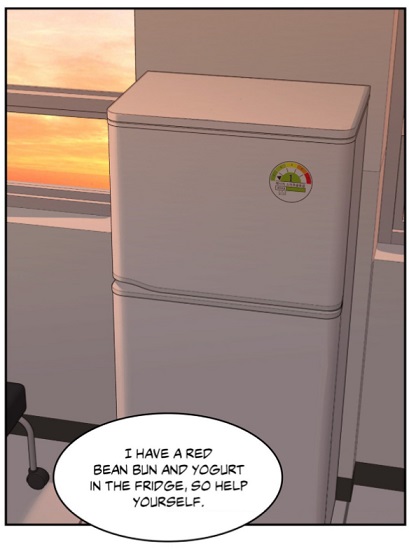 (chapter 47) Thus I come to the conclusion that he spent the whole night at the hospital like in episode 21:
 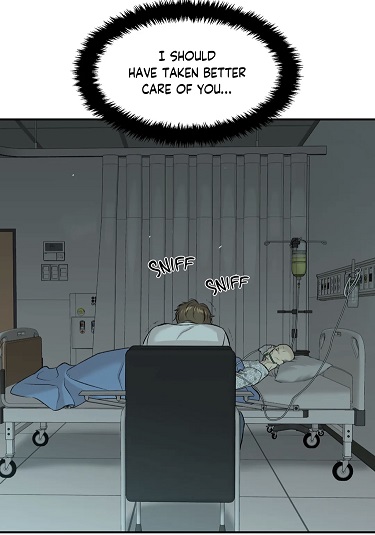 (chapter 21) This explains why the grandmother was not wearing her headgear. She was sleeping. But back then, Kim Dan returned to the penthouse at dawn.
 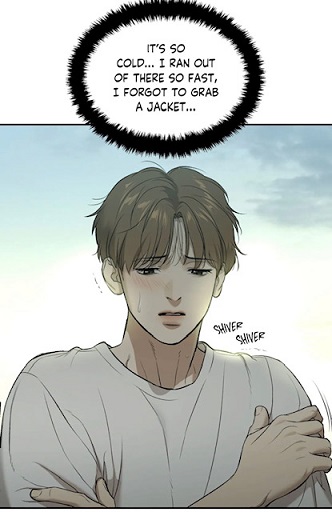 (chapter 21) Therefore the grandma didn’t notice that he had stayed by her side for quite some time, for she was asleep. Hence she requested his presence the next morning. Nonetheless, there exists another difference between chapter 47 and 21. In my eyes, Kim Dan entered her room during the night and spent some time in the bathroom.
  (chapter 47) He didn’t approach the bed the same way:
 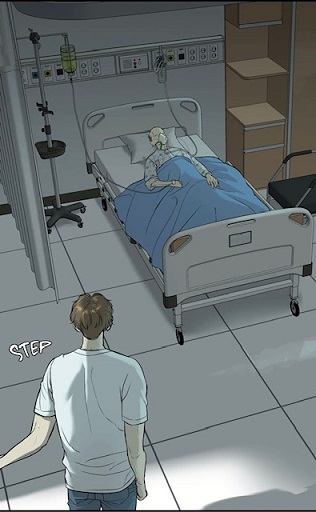 (chapter 21) However, I doubt that he spent just one hour in the restroom covering his tears by running the tap water.
 (chapter 47) Therefore he had red eyes. Furthermore, the halmoni’s name is Shin Okja, and Shin can signify “morning, dawn and daybreak”. For me, it is no coincidence. First, it was her moment to shine due to her compassion.
 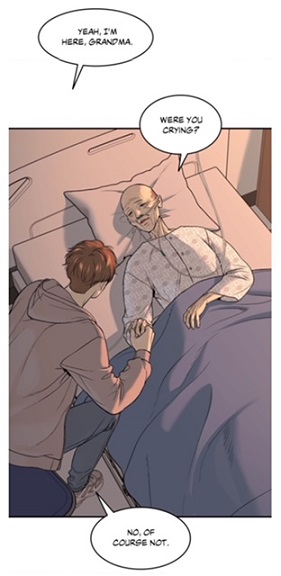 (chapter 47) In my eyes, this scene represents the positive reflection from that nightmare:
 (chapter 21) As a little boy, he had asked his grandmother to never leave his side, unaware that this meant that he should do the same. He should remain by her side too. Yet, he didn’t do it.
  (chapter 47) This observation made me realize another aspect. When he heard the diagnosis from Kim Miseon for the first time, he admitted his powerlessness.
  (chapter 5) In his eyes, he could do nothing for his grandma. But he was wrong, as he could support her by spending time with her. From my point of view, when the halmoni left home for the hospital, deep down, he must have felt abandoned. On the other hand, we shouldn’t forget that he also had other worries and problems to solve: the loan, the hospital bills and finding a job as a PT. Hence I deduce that through his grandmother, he learned the following lesson: he should spend more time with his loved ones, as they can vanish at any moment. He learned how precious time is. This remark made me realize the huge contrast between these two scenes:
 (chapter 47) He was in the bathroom crying and kept recalling the terrible monologue from the oncologist. He felt lost and trapped in the same moment. It felt like an eternity for him. But when he listened to his grandmother, bathed in the sunlight, it triggered his memory about his childhood with her.
 (Chapter 47) Not only she had kept her promise, but also through this recollection, he got a notion of time again. We could say, he could feel time again. He sensed her true nature: her mortality. It is important, because of this new realization, he can move on and focus on the future in a long term. That’s the reason why I see this scene as a new leaf for both characters:
  (chapter 47) Shin Okja is no longer a goddess, a star during the night… but a human facing her mortality. Besides, the doctor focused too much on money, not realizing that goods are irrelevant in front of death.
  Yet, I can refute this point. How so? Note that the caller only let the phone ring 3 times:
  (chapter 47) Then he left a message. This stands in opposition to Joo Jaekyung’s action in episode 5:
  (chapter 35) He desired to give the impression that he was a hard-working journalist. On the other hand, because he just sent a message, it indicates that the reporter wished to hide, to remain anonymous. In other words, he was hiding his identity behind a name. How so? It is because the champion could not hear his voice at all. Joo Jaekyung can not recognize the journalist contrary to this scene:
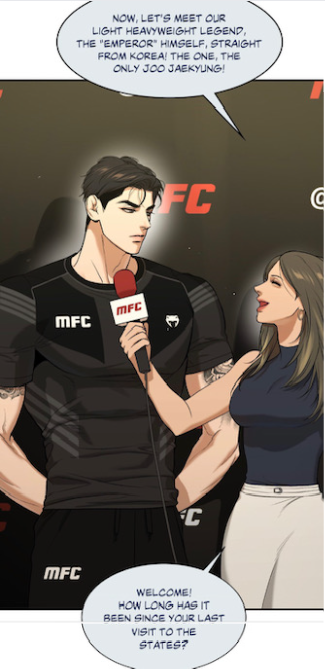 (chapter 36) This divergence reveals that the executive director has a different approach than the reporter. The former seeks to „get close to Kim Dan“, while the journalist desired to avoid the famous fighter’s wrath. Shim Yoon-Seok anticipated his reaction. Therefore I have the feeling that the mysterious man contacted the physical therapist so early to create the illusion that it was urgent. They needed him. Interesting is that when the champion received the message from Shim Yoon-Seok, he never questioned how the reporter got his contact.
  (Chapter 35) Besides, I noticed that the text from the journalist was ambiguous, especially for the readers.
 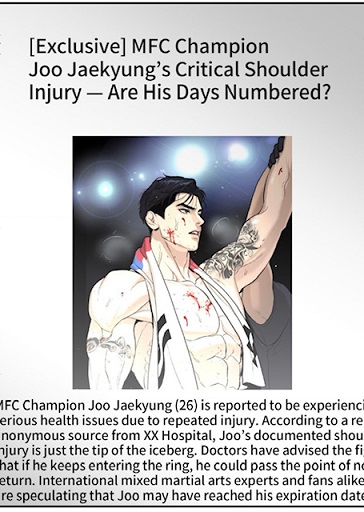 (Chapter 35) The latter doesn’t claim to be the author of the article. He doesn’t employ the possessive pronoun „my“, then the column doesn’t expose the name of the author. And we have a similar situation with the message.
 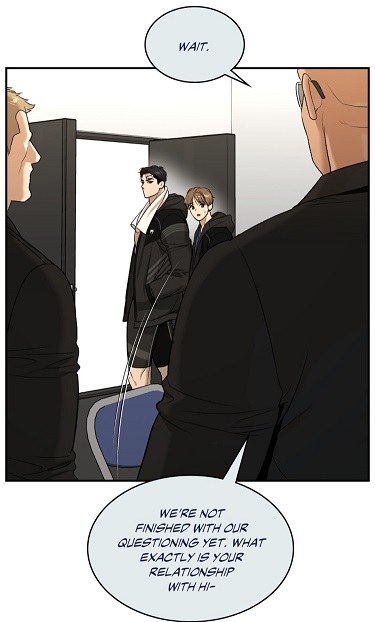 (chapter 40) A fighter, a prostitute, a lover or a physical therapist? Another difference between the two texts (35 and 47) is that
 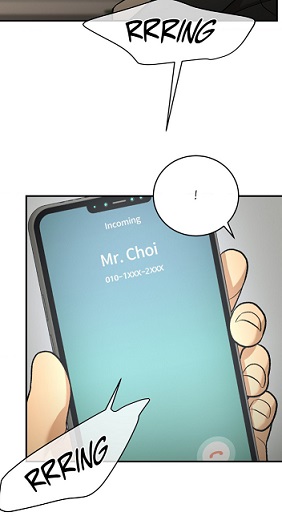 (chapter 46) And now, imagine the consequences, when Kim Dan or Joo Jaekyung reports the text as spam. Not only he doesn’t prevent the scammer from sending more texts to him, but it does let the authorities know as well that there’s a problem. Carriers might block the sender’s messages. Government bureaus might take action to prevent the scammer from messaging other cellphone users.
  (Chapter 46) And remember that Mr. Choi used this cellphone to contact his underling, a sign that their relationship was not official and should remain a secret. Hence if the line got cut, then Heo Manwook and Mr. Choi would be forced to meet. As you can imagine, the moment I discovered the connection between „carrier“ and „spam“, I couldn‘t help myself thinking that Mr. Choi might have received the CV from the courier company!!
 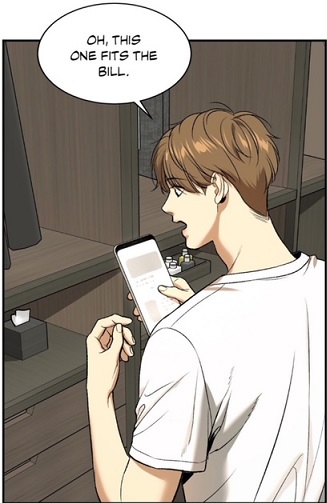 (Chapter 42) Yes, we have here a text on a cellphone too. Therefore I couldn‘t help myself laughing!! Why? It is because I believe that the schemers are thinking that Kim Dan is a member of Team Black, a fighter, and he is Joo Jaekyung‘s protégé. My reasoning is the following: since my hypothesis is that he got the doctor‘s curriculum vitae through the courier enterprise
 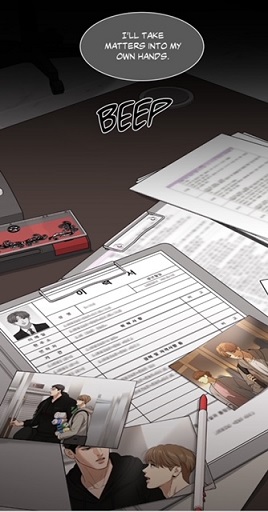 (Chapter 46), I doubt that Kim Dan mentioned that he was working as PT for Joo Jaekyung. This would have raised an eye-brow!! His side gig was supposed to be a secret implying that his official work was to be kept hidden as well. Furthermore, I am assuming that Mr. Choi must have tried to figure out Kim Dan based on his CV. He worked for a short time at the hospital and after he chose to take odd jobs. So he could have had a change of heart, he desired to pursue a different career, like for example becoming a professional MMA fighter. I don‘t think, people would mention such a hobby, as it could give a bad impression. Finally, if my theory is correct, then it signifies that Mr. Choi got tipped off by the hidden person from chapter 42.
 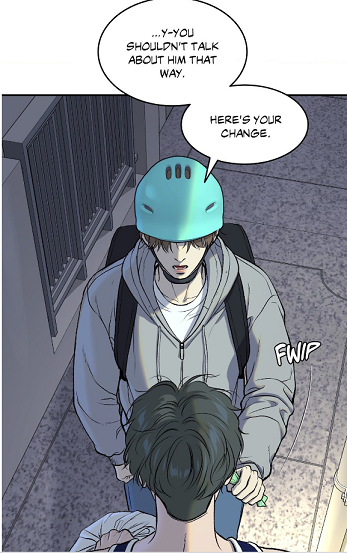 (Chapter 42) First, I thought that they knew that Kim Dan was probably his „sex partner“ as a fan, as he didn‘t object to this statement
  (chapter 42) But note that Kim Dan had protected the champion’s name and reputation first. Hence my idea is that in the mind of the anonymous observer, Kim Dan might have been left speechless for a different reason. He was described as a parasite, for he was using Joo Jaekyung‘s care and talent to become himself a professional MMA fighter!! In other words, they are mistaking him for Potato. And now, you comprehend why I added the green fox in the illustration:
  They are trying to snatch away the favorite athlete from Team Black in order to destabilize Joo Jaekyung mentally
  (Chapter 26) They could have jumped to the conclusion that Doc Dan was his stage name as a reference to his education and past, unaware that in reality it was indicating his true job. Thanks to @joojaedan, I got access to the original version.
  He is addressed as Kim Dan, and @joojaedan told me that he got addressed the same way than the fighter and Joo Jaekyung would call him. I have to admit that I let the app Deepl translate the Korean version. This is what I got:
 (Chapter 36) Moreover, this signifies that Baek Junmin is presented as the owner of the gym
  (chapter 47), as he is the face of that gym. In reality, he is just the cover, whereas the true owner is the mysterious sender of the text.
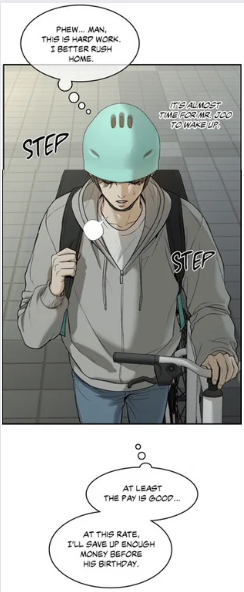 (chapter 42) He let it ring three times before texting him in order to catch the doctor’s attention, to distinguish himself from the previous calls (for his job). If so, then Mr. Choi must believe that Kim Dan is being “exploited” by the athlete. Hence the doctor would look so unhappy, when he is alone. In other words, the pictures taken in secrecy would expose the hypocrisy of the celebrity towards the main lead.
  (chapter 34) First, the star knew about the invitation from Choi Heesung. This even caught Kim Dan by surprise. This image exposes that the champion had violated the doctor’s privacy. So how did he know it? We have different possibilities, yet my idea is that he had seen the message!! Thus he replied with a text to Heesung. Besides, observe how he dissuaded the doctor from visiting the actor.
 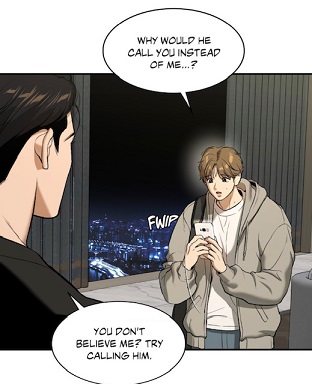 (Chapter 34) He should CALL him… a sign that the champion had not called anyone. Since Mingwa is writing like Byeonduck, I have the feeling that the message from Mr. Choi will be discovered by Joo Jaekyung. Remember how his hyungs had warned him
 (Chapter 46) But the moment the champion is confronted with such a message directly, this would be a wake-up call for Joo Jaekyung, he should treat his members much better, as the existence of his company is in jeopardy. Moreover, I am hoping that such a discovery will push Joo Jaekyung to play a trick on his enemy too, like for example he gives a task to Potato, act as a spy!!

 Kim Dan saw the calls, but he ignored them.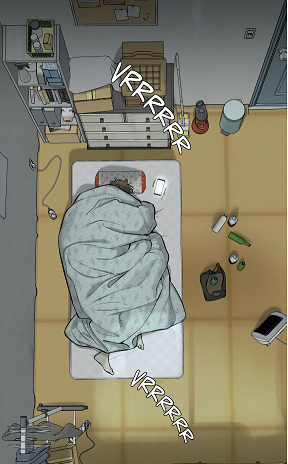
 It was another emergency call, for he needed to leave the place within a week. Interesting is that the person didn’t present himself. No name… As you already know, I am suspecting that the doctor got fooled, for I doubt he ever received any compensation for his move. He should have received money. Emergency, rejection, manipulation, interruption and spying (Heo Manwook interrogated the doctor right after)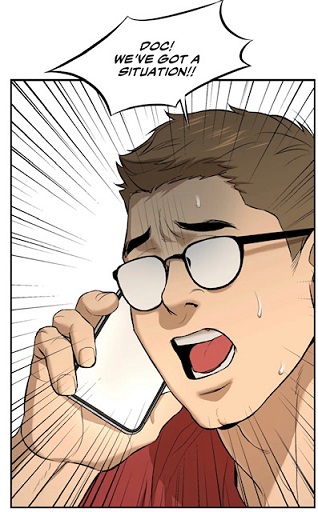


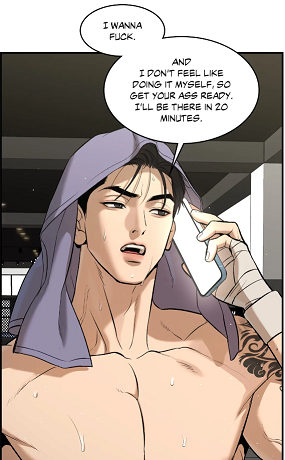
 Sex, interruption, „emergency“, as the champion didn‘t take off his shoes and put down his bag. Then during the intercourse, the doctor was called by the hospital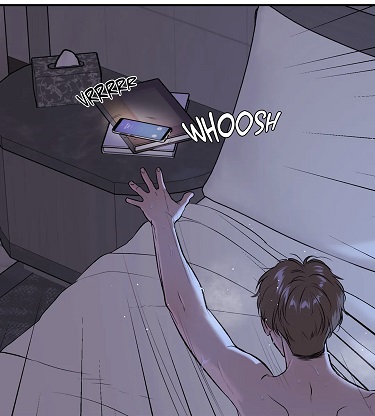
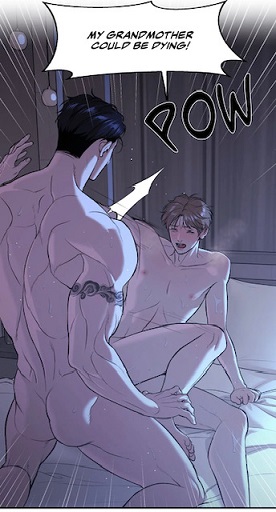
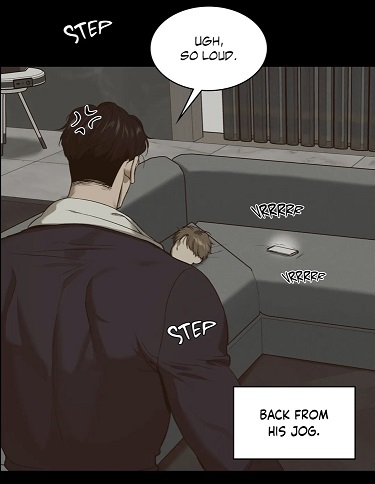
 Sex, interruption (food), secrecy, manipulation, ignorance and spying. Potato had tried to listen to their conversation.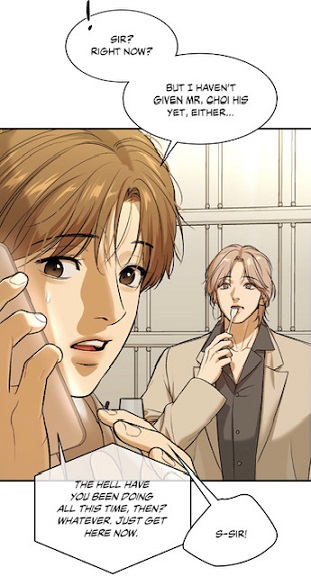
 Interesting is that here, there was no emergency from the champion‘s part. This time, Kim Dan was the one longing for the athlete.
 Sex, emergency, ignorance, manipulation, though here the victims of the trick were the two main leads.
 (Chapter 40) He has no idea that Kim Dan became the victim and got framed later.
  (Chapter 46) Furthermore, since Heo Manwook was the one who hired this man
  (Chapter 47) The MMA fighter could have been asked to fake an injury, similar to Heesung‘s plot. As for Kim Dan, his task would be to „target his shoulder, his weak point“. Another possibility is to expose his vulnerabilities. One thing is sure: their approach will fail, hence they will propose the deal to Seonho.
  (Chapter 46) What caught my attention is that this athlete definitely boosted his situation by advertising that he was the champion’s sparring partner. I doubt that the main lead‘s criticism was unfounded.
  (Chapter 46) like in episode 1
  (Chapter 46)
  (chapter 42) On the other hand, since I am predicting a failure of their scheme, they could decide to take revenge on Seonho by sending him to an illegal fighting game, where he could get badly injured. Moreover, the moment they discover how weak the red-haired man is, they could jump to the impression that Seonho deceived them!!
  (Chapter 46) But he was sitting with the others later. Consequently, I come to the deduction that he failed to discover any lead, or better said, any connection between the bets and Mr. Choi. Why? It is because he is a former champion, and professionals among MMA world must know that he works for the star.
 (Chapter 47) Joo Jaekyung needs to realize that he can not just rely on his hyungs alone, he needs the assistance from the whole staff: Kim Dan and the other fighters, as they are not known in the MMA world.

 (chapter 46) On the other hand, chapter 47 exposes that the doctor didn’t lose his interest and attention towards his boss.
  (chapter 47) This exposes that Kim Dan didn’t choose resent or indifference towards Joo Jaekyung despite the inflicted pain. On the other hand, why did I write that the celebrity is Kim Dan’s reflection? Why is the athlete the doctor’s mirror of truth? It is because Joo Jaekyung embodies his negative reflection: independency and toxic negativity. But what is the latter exactly?
 (chapter 31) It is because when the psychologist met the patient with her boyfriend for the first time, he paid attention to his micro-expressions, and more particularly to his mouth. He saw his smirk. Here, I feel the need to give an explanation how these micro-expressions were discovered.
 (chapter 30) As my avid readers can detect, the expression from the boyfriend’s mouth displeased the white-haired psychologist. He could recognize his emotion, though such facial expressions are very short-lived
 .(chapter 30) So what was the “jerk” feeling, when he was conversing with Sihyun? Cynicism.
  (chapter 31) And the reason why he stated that as soon as cynicism or scorn was present in a relationship, the couple would end up breaking up is because of John Gottham’s observations and conclusions.
 (chapter 45) We could sense it in different scenes, though I would say that his cynicism was slowly vanishing:
  (chapter 3)
 (chapter 40) This is the so-called toxic negativity. Therefore it was to expect that the champion would reject the doctor’s present. He could only doubt the sincerity behind his gesture. How so? Remember how the team desired to celebrate his birthday: a surprise party. They bought a cake…
  (chapter 43) So technically, they offered a cheap cake and got in exchange a super expensive dinner. One might say that this was just a joke. But cynical people are taking things very seriously. This is what the champion learned from this experience, the cake in exchange for a super expensive meal … and now imagine that the next morning, he received an „expensive“ present from Kim Dan which was similar to the gifts from fans (exchange of favors). It is normal that he doubted the genuineness from his doctor, not only because of his past experiences, but also because of the parties before. But there exists another reason why he had to refuse the gift: Cynicism… the end of relationship. Thus dating for the athlete was impossible.
  (chapter 8), in the office, in the car, in front of a mirror, in front of Heesung in the living room… Don’t forget that Diogenes would even masturbate in public.
  (chapter 23) The gym is like his sacred temple. Yet, the gym is just a simulacre of “nature”, as it is in the middle of Seoul. Therefore I realized why after their argument, Joo Jaekyung avoided the penthouse and Kim Dan in the end.
  (chapter 45) It symbolized everything he hates: a reminder of wealth, superficiality, attachment, secrecy and silence. It also exposed the huge difference in their mind-set. Kim Dan is not his disciple! He imagined that he had found a kindred spirit, especially after that night:
  (chapter 39) The reason is simple. The champion had finally found someone who accepted his roughness in bed and could match his stamina.
  (chapter 10) He is not resigning on designer clothes.
  (chapter 42) His dress room is the evidence of his hypocrisy. He might have encouraged Kim Dan to have sex in “public places”, yet he is still hiding his sexual orientation. Furthermore, his jinx is the evidence of his dishonesty.
  (chapter 45) He might advocate autonomy and self-sufficiency, the reality is that he likes luxury. Hence he is unable to live in harmony with nature. This shows that the fighter is in denial and is living in an illusion. Thus he can not find true happiness, for his freedom is not real. He is attached to the gym which is also strongly connected to his career as the Emperor.
  (chapter 46) With his brutal attitude, he is doing himself a disservice. Exactly like Kim Dan, he is even ruining his career and own reputation. Not only he lost 4 athletes (I am including Seonho), but also his loyal admirers are calling him a thug now:
  No one can survive on his own. This explicates why Cynics had disciples in the end. And now, you comprehend the role of Kim Dan in Joo Jaekyung’s life. It is to remind him of his true nature. He is a human and not a dog-wolf. Thus the champion recommended his PT to live elsewhere, a sign that he was indeed a human.
  (chapter 10)
 (chapter 1) Then the micro-expressions from Kim Dan exposed his lie
  (chapter 3) On the one hand, the champion’s worldview about humans got reinforced, on the other hand the doctor’s deception symbolized his purity. He was a virgin, which was contradicting his “theory” too.
 (chapter 11) He even looked like a ruler abusing his authority.
  (chapter 11)
  (chapter 11) Here, the champion thought that Kim Dan had been gambling. An emperor or ruler, especially one characterized by a lack of idealism, may embody the cynical belief that individuals are primarily driven by self-interest and that altruistic motives are rare. Therefore the celebrity rejects the notion of soulmate
  (chapter 33) or even the idea of friendship
  (chapter 10): Gamblers, laziness, no sense of hygiene etc. Consequently, he is not capable to understand the worries from Kim Dan
 (chapter 42), Park Namwook
 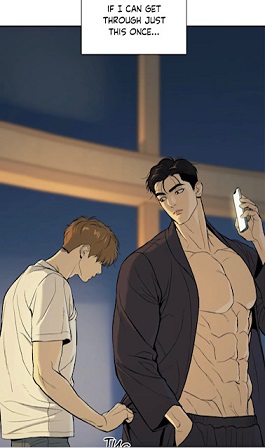 (chapter 2)
 (chapter 45) was showing the doctor’s golden heart. He was just judging his lover based on his past experiences and his negative worldview. And this brings me to list the cause for Cynicism:
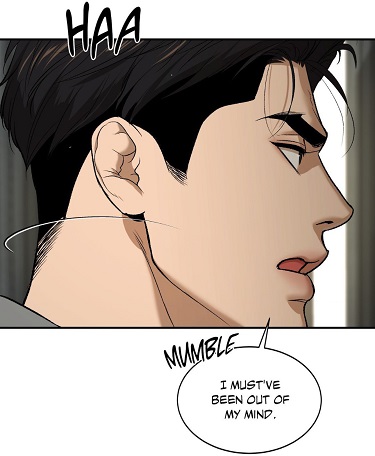 (chapter 45) He fears to be taken advantage. There is no ambiguity that his negative mind-set is definitely influenced by his childhood and family. I would even say that he must have been exposed to emotional blackmail. I came to this hypothesis, because I detected that the champion had been using “blackmail” as MO in order to control Kim Dan.
 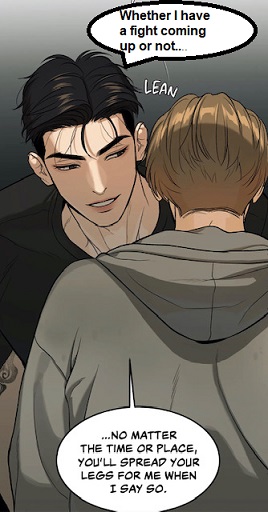 (chapter 6)
  (chapter 2) He learned through Cheolmin that he could kill him. This shows his good nature in verity. Hence he resorted to such gestures, when his cynical depression resurfaced:
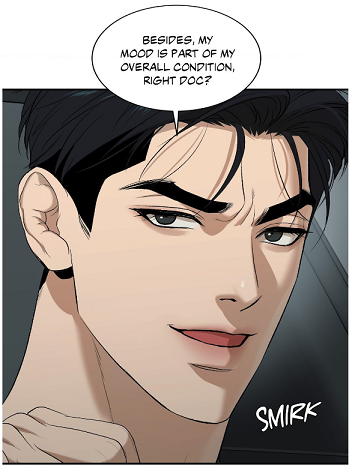 (chapter 32)
  (chapter 45) As you can see, little by little, the champion is learning to control his rage and “cynicism”. During the last argument, he didn’t touch the physical therapist at all. He still allows him to stay at his place and he is shown as caring later.
  (chapter 40) Then in episode 47, the emperor got manipulated by his so-called loyal advisors.
  (chapter 47) First, I would like to outline that neither the manager from the Entertainment agency nor his acolyte brought up the underground fighting ring and Baek Junmin’s dubious success.
  (chapter 47) With their video, they presented him as an average and reliable fighter.
  (chapter 21) Moreover, the grandmother’s mortality could serve as a reminder for the champion that he is also a human… just like the others he condemns. Besides, she embodies true selflessness and gratitude. Hence she took the champion’s hand to thank him
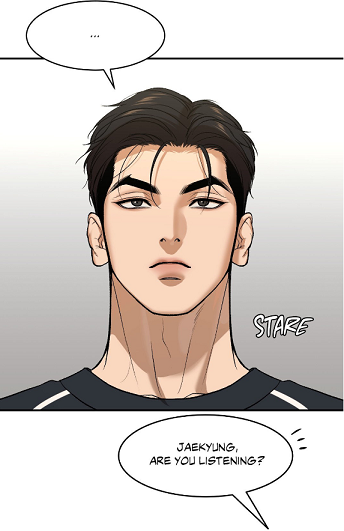 (chapter 47) Should Kim Dan divulge Baek Junmin’s connections to the underground fighting ring or simply show him the message,



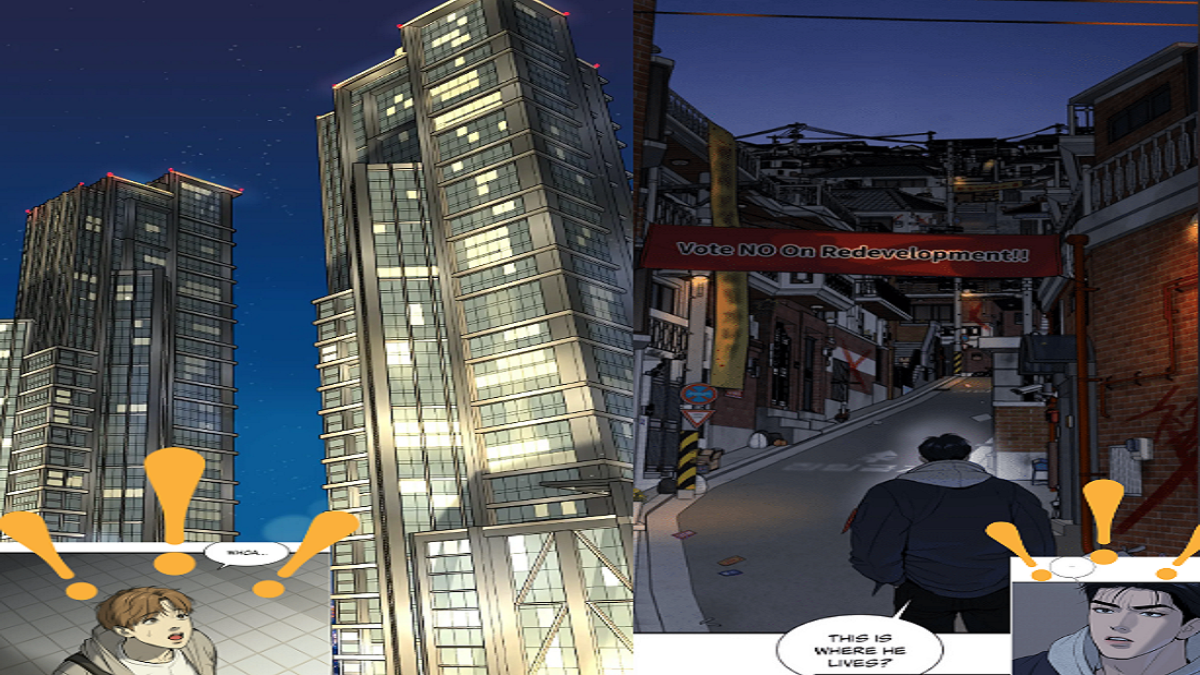



 (locked essay, with new password, switch simply the order of the words, don’t forget the space)





































 Col
Col












































 Bebebisous33s' analyses in K-Dramaland and Manhwas