

Please support the authors by reading Manhwas on the official websites. This is where you can read the Manhwa: Jinx But be aware that the Manhwa is a mature Yaoi, which means, it is about homosexuality with explicit scenes. Here is the link of the table of contents about Jinx. Here is the link where you can find the table of contents of analyzed Manhwas. Here are the links, if you are interested in the first work from Mingwa, BJ Alex, and the 2 previous essays about Jinx 🕊️🦆Voyage, Voyage 🌏🌌 (locked) and Unseen 👀 Savior🦸🏼♂️ : The Birth Of Jaegeng (locked)
It would be great if you could make some donations/sponsoring: Ko-fi.com/bebebisous33 That way, you can support me with “coffee” so that I have the energy to keep examining Manhwas. Besides, I need to cover up the expenses for this blog.

Following up on the analysis in Unseen Savior🦸🏼♂ : The Birth Of Jaegeng (locked), it is now time to dive into the symbolic and narrative weight of the meeting between Joo Jaekyung, Park Namwook, the CEO, and the mysterious woman in red. That earlier essay depicted the offer extended during this encounter as the devil’s temptation. In this piece, we will take a step back and ask an important question that may have gone unnoticed by most readers: Was this truly a lunch meeting? 😮
Lunch or “Kaffee und Kuchen”?
. (chapter 69)
At first glance, the setting may imply a formal lunch: a round table in a private room, a well-lit ambiance, and Western-style plating. Moreover, some Jinx-philes might have been reminded of the lunch between Choi Heesung and Kim Dan that took place in a similar location: 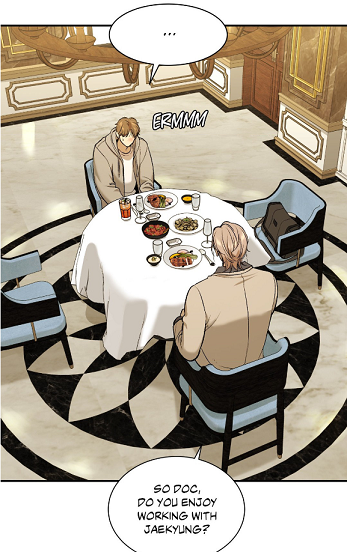 (chapter 32) Yet upon closer inspection, certain oddities stood out to me. (chapter 69) The most telling is the absence of water glasses—normally present during a full meal. Then, there are untouched knives and forks placed beside the plates, suggesting that they were arranged for formality rather than function. For cakes, such utensils are unnecessary, so they should have been removed. In contrast, the only utensils that should be used are dessert spoons. These subtle visual cues point to an unusual conclusion: this was not a full meal, but rather a dessert meeting.
This observation is further supported by a humorous yet significant moment from Chapter 43.  (chapter 43) In that scene, Kim Dan poured soju into his water cup to pace himself during a drinking session.
  (chapter 43) Joo Jaekyung, unaware, mistakes it for his own and angrily reacts upon drinking it. This moment shows how closely water glasses are associated with Korean dining culture—even in casual or alcohol-heavy settings. Hence during a meal, the characters always have
  (chapter 32) two glasses on the table. In South Korea, it is customary for restaurants to provide a glass of water to every diner, regardless of the meal’s formality or complexity. This small gesture reflects hospitality, attentiveness, and the expectation of proper nourishment. The absence of water glasses, therefore, subtly communicates indifference or even disrespect—signaling that the recipient is not truly welcome to enjoy a full meal or rest. When applied to the “dessert meeting,” this detail becomes all the more striking: a cultural standard is ignored, revealing the performative nature of the gesture. Their absence at the “dessert meeting” feels deliberate, a symbol of superficiality and arrogance. (chapter 69)
Birthday Party or Not?
Funny is that the moment I paid attention to the table and made a connection between the gatherings in episode 43 and 69, I made a huge discovery concerning the champion’s birthday party.  (chapter 43) The reason for his mistake was that they had only placed a spoon and sticks.😮 He had no glass for himself. It was, as if they had forgotten him. In other words, he was not supposed to eat and drink at his own birthday party!! 😂 (chapter 43) The absence of a rice bowl, plate, and glass in front of Joo Jaekyung, despite the presence of utensils, indeed suggests that he wasn’t expected to truly participate in the meal. In my opinion, the manager expected that the fighter would behave like in episode 9:
 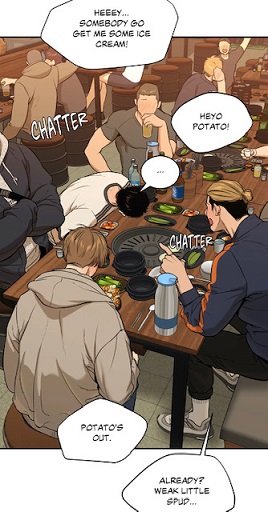 (chapter 9) It reflects a pattern: the champion is present but not included in the communal or emotional aspects of the gathering. His spoon and chopsticks function like a prop, much like the untouched knives and forks at the dessert meeting.
  (chapter 69)
Symbolically, this reinforces the idea that Park Namwook sees him not as a person with needs or preferences, but as a role—a figure to be paraded, not fed. It’s also a strong indicator of the superficial hospitality offered by Team Black. The same way MFC served only dessert as a façade of generosity, here Park Namwook maintains the appearance of inclusion without the substance of care. One might wonder if the person behind this dessert meeting is not the manager in the end. However, I can refute this hypothesis. But I will explain my reasoning elsewhere.
Why Coffee and Cake?
This revelation casts the entire interaction in a new light. Desserts traditionally symbolize sweetness, pleasure, and reward—a closing gesture in a meal meant to satisfy or celebrate. Yet here, they are served in isolation, with no nourishment preceding them. It reflects the hollowness of the offer being made to the champion. Symbolically, the sweets are fake nutrition: surface-level compensation meant to placate and divert attention. Their isolated presence, without the customary water or a full course, also exposes a certain stinginess and greed—lavish in appearance but lacking genuine generosity or investment. There is no genuine sustenance here, only an illusion of care and abundance. At the same time, it is clear that the champion avoids cakes, thus for his birthday, he only ate the strawberry. Ordering desserts indicates the indifference toward the former „Emperor“.
To further contrast the deeper meaning, it’s worth considering the German tradition of Kaffee und Kuchen. This custom involves sitting down in the late afternoon with friends or family to enjoy coffee and cake—a sincere gesture of rest, connection, and shared time. (chapter 69) The Black Forest cake served to Joo Jaekyung connects directly to this tradition, yet its context here is anything but restful. It was through observation that I noticed the dessert’s identity—its distinctive shape and cherry decoration evoking the iconic Schwarzwälder Kirschtorte (A reminder: I live in Germany). However, this symbolic dessert becomes a tool of irony: rather than promoting genuine connection or relaxation, it masks a veiled demand. The setting in Jinx is not about togetherness or leisure but manipulation under the guise of civility. Instead of offering a break, this “dessert meeting” is designed to signal the end of the champion’s rest. It pressures him to return to fighting, weaponizing the illusion of hospitality to serve a corporate agenda. This signifies that this dessert becomes a symbol not of comfort, but of interruption. It marks the end of the champion’s rest and the return to duty. Far from being an act of care, it is a veiled command.
This scene around a round table mirrors another pivotal moment 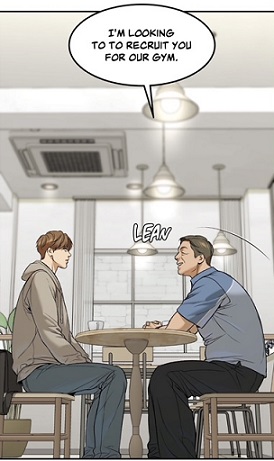 (chapter 48), the meeting between Choi Gilseok and Kim Dan. The former invited him for coffee.
 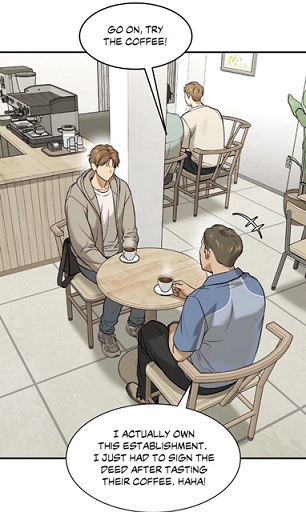 (chapted 48) At first, the gesture seemed generous—he offers a home, a car,
 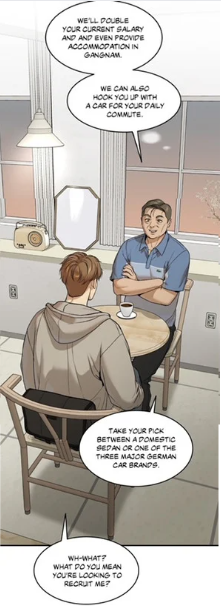 (chapter 48) and the promise to help doc Dan to get a new treatment for the grandmother.
  (chapter 48) But this so-called kindness is conditional: in exchange, Kim Dan must betray Joo Jaekyung. Striking is that director Choi only ordered coffee. But a coffee without a dessert is no real break, but a stimulant—fuel for continued work. In both this meeting and the previous one with Choi Gilseok, the core remains the same: “work”, stinginess and greed wrapped in the guise of generosity. Every sweet drink or dessert lies a hidden price. This comparison highlights that the current meeting is not for the athlete’s sake—it is meant to serve Park Namwook and the CEO, who share different but aligned goals.
In this scene, every detail is meticulously crafted to portray the illusion of equity, civility, and generosity—when in fact, it is manipulation cloaked in civility.
The Round Table and Directional Symbolism
The round table is a reference to King Arthur’s court (chapter 69), where knights would gather as equals. This allusion conjures a sense of idealized unity and fairness—values that stand in stark contrast to the characters’ actual motivations in this scene. Whereas the original Round Table emphasized equality and noble purpose, the meeting in Jinx distorts these ideals, using the circular table as a facade to mask manipulation, hierarchy, and hidden agendas, as there are no clear sides and perspectives. The characters gather not to collaborate or share truth and knowledge, but to impose control, push self-serving narratives, and pressure the champion under the guise of courtesy. Yet, the illusion of equality is shattered when we examine the seating arrangement and the design beneath the table.
The floor beneath the table is made of black marble. Black marble traditionally symbolizes sophistication, power, and mystery—often linked to wealth and elite status. In this context, it reflects the polished surface of MFC’s operation, hiding its manipulative and corrupt core. The marble’s reflective nature serves as a mirror for distorted truths, hinting at concealed motives. Interestingly, even though the floor contains no design contrary to the lunch with the actor (chapter 32), I detected a reference to the yin-yang through the clothes. (chapter 69) A symbolic balance is still conveyed through the color palette of the characters’ clothing: black and white on one side (CEO and Park Namwook), and red and blue on the other (the woman and Joo Jaekyung). This contrast references yin and yang—light and dark, passive and active, East and West. It captures the ideological and emotional tension between the characters gathered at the table, exposing how appearances veil a struggle for control, identity, and allegiance.
Each guest occupies a cardinal point based on their clothing colors, which reflect traditional Korean symbolism:
- Joo Jaekyung, wearing a dark blue shirt with black shades, represents the East (청, Cheong), associated with the color blue/green, spring, the element of wood, rebirth, and emotional clarity—but also with tradition and conformism. Ironically, though he embodies the East, he now lives on Korea’s western coastline, which emphasizes his internal conflict and transition.
- Park Namwook, in white, embodies the West (백, Baek), symbolizing the color white, the element of metal, autumn, endings, coldness, and judgment. This perfectly reflects his role as the fading, cold manager—emotionally distant and aligned with institutional power. His upcoming downfall and loss of power are foreshadowed by this placement.
- The woman in red signifies the South (적, Jeok),
 (chapter 66) linked to fire, summer (hence the reference to the trip in the States), passion, performance, and vitality—ironically twisted here into cold professionalism and superficial seduction. Her position contrasts with her symbolic warmth, highlighting the emptiness of her care. This explains why she is portrayed eyeless. She sold her “soul” to money and as such to the “devil”.
 - The CEO,
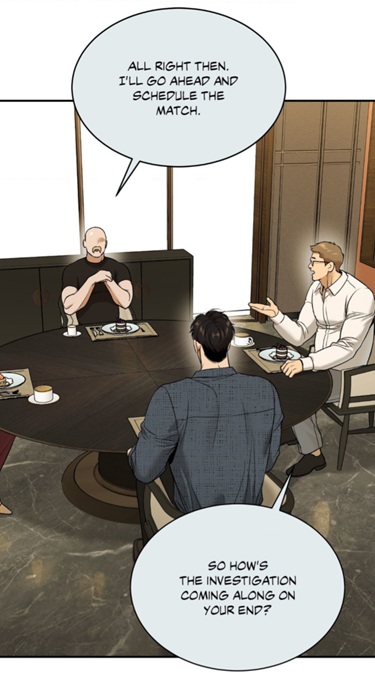 (chapter 69) wearing black, aligns with the North (흑, Heuk), associated with the color black, winter, water, authority, secrecy, and hidden control. It was, as if he was representing the missing glass of water. His position as the initiator of the meeting and his location near the window reinforce his dominance and detachment.
A second interpretation is based on physical orientation. The CEO sits in front of the window, suggesting he leads the direction of the conversation—reinforcing his alignment with the North. This would position:
- Joo Jaekyung in the South, the symbolic realm of sincerity, renewal, and emotional strength.
- Park Namwook in the East, which then implies the potential for change, growth, and conflict with the West.
- The woman in red in the West, making her Park Namwook’s symbolic counterpart and challenger.
Both readings emphasize an important underlying theme: the meeting is not just about strategy, but also about the clash of symbolic forces—tradition vs. transformation, control vs. sincerity, illusion vs. truth. These opposing tensions reflect the champion’s current state of evolution and foreshadow his rebellion against the system that once defined him. This arrangement paints a coherent symbolic tableau grounded in Korean cardinal point philosophy. Not only do the colors align (black for North, white for West, blue/green for East, red for South), but so do the personalities: the CEO as cold and calculating authority, the woman as sharp and composed evaluator, the manager as a conformist tool of the system, and the champion as the figure of emotional awakening and transformation. It also reflects their roles in the narrative: the CEO and the woman attempt to assert control from a place of detachment and oversight, while the star is awakening to his own truth, standing in contrast to their cold rationality.
The hosts clearly control the setting, tone, and tempo of the meeting. The choice of the round table is not accidental; it is meant to give the illusion of closeness and fairness, but the positions and body language expose the hierarchy. The CEO’s gesture (chapter 69), joining his hands in front of his chest, is subtle but telling. Combined with his seating near the window (symbolizing clarity or enlightenment), this gesture indicates control, restrain, self-protection and finally judgment. He’s calmly evaluating the situation and others at the table, implying a power dynamic. Bringing the hands in front of the chest can form a subconscious barrier—suggesting he is guarding himself, possibly from confrontation or uncomfortable truths, while it helps him to give a composed and confident posture. The CEO positioned near the light, faces outward, and dominates. Behind the champion is an abstract green painting 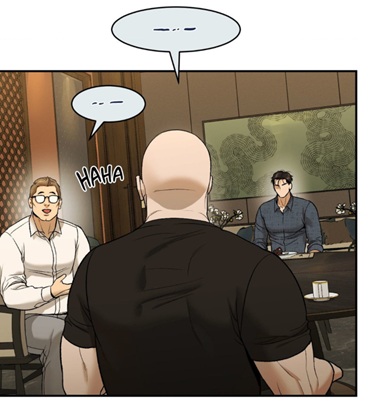 (chapter 69), which evokes confusion and corruption. This artistic backdrop continues the theme from Voyage, Voyage (life is a journey), positioning Jaekyung as mentally “adrift” within this orchestrated trap. At the same time, the green might reference the “Black Forest”—a literal and metaphorical journey ahead. Like Hansel and Gretel, he is being lured with sweets into the forest. But unlike the fairy tale, the athlete’s breadcrumb trail will not lead him home—it will lead him to Kim Dan. On the other hand, by making this connection, I couldn’t help myself thinking that exactly like Hansel and Gretel, doc Dan and his fated partner will cross the witch’s path on their journey to independence and happiness.
Color Symbolism and Character Portrayal
The characters’ clothes also reflect deeper symbolism. The CEO wears a black shirt and dark blue jeans—dark, imposing, and utilitarian, suggesting control, power, and hidden motives.  (chapter 69) Notably, this outfit marks a shift from his previous appearances: during his public pose with Baek Junmin
 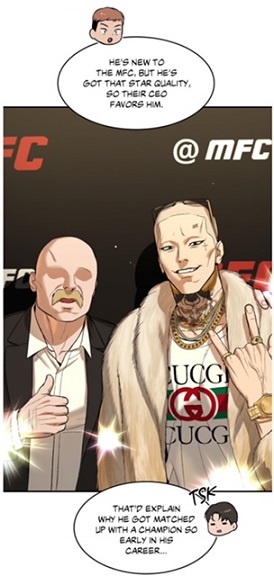 (chapter 47), he wore a formal black suit with a white shirt, signaling polished professionalism. When he met the champion in the States, his full black outfit resembled a manager’s uniform and a badge, signaling humbleness and authority but also a hands-on, corporate role.
  (chapter 37) Now, Joo Jaekyung mirrors this casual dark attire (chapter 69), which points to a lack of reverence or ceremonial respect from the CEO. The diminishing formality in the CEO’s wardrobe reveals a gradual unmasking of his character—less the respectable businessman and more the manipulative broker. His clothing now mirrors more than that of a loan shark or exploiter, revealing the raw ambition and control beneath his once-slick exterior.
The woman in red wears a vivid red suit, a clear visual signifier of power, respectability, and Western flamboyance. However, unlike a red dress—which often symbolizes femininity, seduction, and traditional gender expectations—the red suit strips away that softness and replaces it with authority and androgyny. It underscores her ambiguity as a character: she is commanding and polished, yet emotionally distant. Her attire blends masculine-coded professionalism with a bold, attention-grabbing palette, reflecting both her status within MFC and her detachment from nurturing roles. She appears calm and calculating, and her positioning and expressions make her seem less like an accessory to the meeting and more like a silent strategist. Symbolically, she represents MFC’s security system, (chapter 69) the eye that sees but does not act, like a cold and distant mother figure whose role is to supervise, protect, and feed. Yet, the dessert served to the champion feels like an affront, a form of care without understanding—especially given that Joo Jaekyung usually avoids sweets and alcohol altogether. The Black Forest contains kirschwasser, a cherry liqueur.
Park Namwook mimics the CEO with a white shirt—a deliberate act of mimicry that exposes his lack of individuality and herd mentality. (chapter 69) But the white shirt has layered meaning: it also symbolizes his ignorance and naivety. He believes the meeting is a gesture of goodwill, a “favor” from the top, and fails to question the power dynamics at play. The irony is that Park Namwook is not actually an MFC agent—he works for Joo Jaekyung as his manager. His neutrality is superficial. His grey pants further signal his moral ambiguity and lack of integrity. Far from being a righteous figure, he embodies passivity, complicity, and indifference.
Joo Jaekyung, however, wears a blue shirt darkened by shades of black 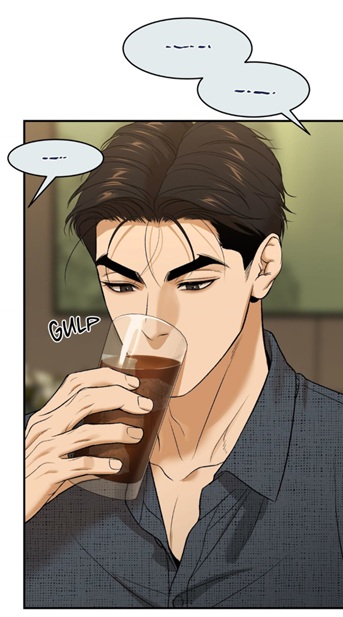 (chapter 69) —a signal of inner turmoil and his transition from his former life. Blue stands for loyalty, thought, and calm, while black alludes to his troubled past. He is evolving but not yet free.
Knights, Sweets, and Illusions
The round table conjures the Knights of the Round Table, but these “warriors” are not pursuing spiritual quests. Their prize is not the Holy Grail but money, rank, and relevance.  (chapter 69) In this world, ideals are hollow, and tradition is co-opted to mask self-interest.
The desserts themselves are symbols: 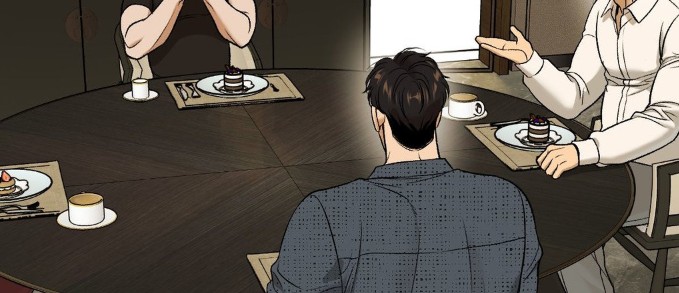 (chapter 69) the strawberry fraisier (chosen by the woman) stands for surface sweetness and seduction; the layered chocolate cake (perhaps a feuilleté) represents indulgence and opulence. Joo Jaekyung alone chose a square Black Forest cake—a form traditionally associated with structure, truth, and boundaries. Because the cake contains kirschwasser, subtly referencing the athlete’s brief brush with alcohol, it becomes clear that Park Namwook was not the one behind this order. Imagine this: under his very own eyes, the champion is encouraged to taste a strong alcohol. In my opinion, they must know that the star has been drinking. Yet, it was through Kim Dan’s presence that he stopped drinking, making this dessert an unconscious mirror of both his struggle and strength. Meanwhile, Park Namwook, ever the follower, selects the same dessert as the CEO and the same drink as the woman, revealing his pretense and pastiche once more. Since the manager has always bought junk food (chicken
 – chapter 26, hamburgers, ramen
 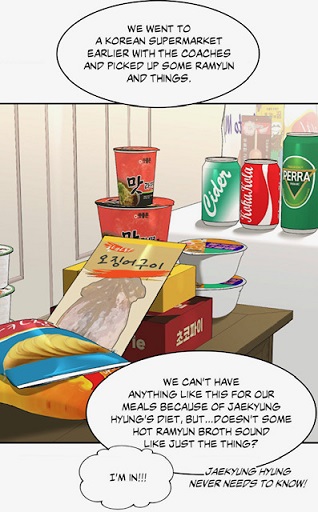 – episode 37), it becomes clear that the hyung simply has no idea about Western food in general and in particular expensive French or German dishes. That’s why he didn’t ask about the dish or questioned the champion if he should eat the deadly sweet cake. (chapter 69) The alcohol was masked by the sweetness. Moreover, let’s not forget that these “Kaffee and Kuchen” were offered by the CEO. However, the paradox is that the star didn’t fall for this trick. He chose to drink the coca while staring at the cake. (chapter 69) At no moment he felt tempted by the dish. The angel Kim Dan was protecting him from a distance. The athlete longs for homemade food:
  (chapter 22)
A Meeting Built on Fear
Since I detected some similarities with the manipulative coffee meeting between Kim Dan and Choi Gilseok, another difference stood out to me. Though doc Dan had been approached in front of the gym  (chapter 48), their meeting was not supposed to be secretive. On the other hand, because the scene was photographed
 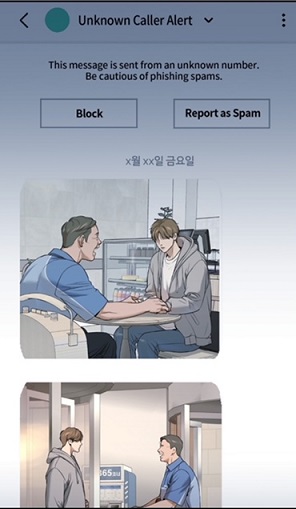 (chapter 48), it created the illusion of “betrayal” as it looked like a secret meeting”. In episode 69, the meeting is hidden from the public. In contrast to the earlier public appearance alongside Baek Junmin for the cameras (chapter 47), —where the CEO posed proudly and visibly as a form of promotional endorsement—this encounter is cloaked in secrecy. According to Park Namwook, the CEO only stopped by South Korea specifically to meet the champion, as if offering him a special privilege.
 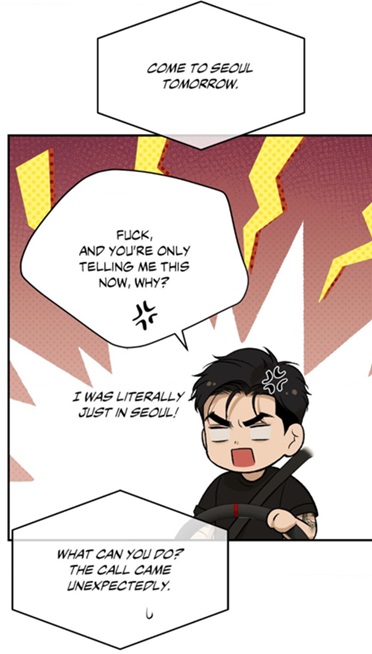 (chapter 69) This framing is deceptive: far from being a gesture of goodwill, it reveals the urgency and opportunism driving the meeting. However, this gesture is carefully staged: the CEO and the woman in red are the ones who selected the time and location of the encounter, placing the athlete in a reactive position where he must adjust his schedule to their convenience. It reinforces the illusion of privilege while concealing a dynamic of control. The meeting is designed to appear personalized, but it reflects MFC’s ethos that ‘time is money’—a business-centered logic that prioritizes efficiency over empathy. The CEO’s urgency to schedule a match, despite Jaekyung’s unclear health status, further exposes the commodification of the athlete. Notably, the proposed match is not even a title bout.
 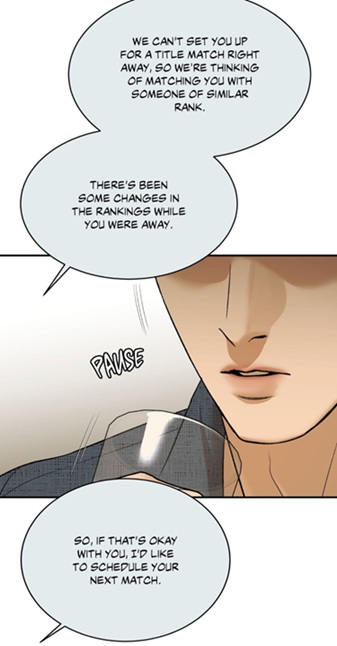 (chapter 69) This strategic omission likely serves to shield the organization from scrutiny, as a title match would demand full transparency around the champion’s ranking and physical condition—areas that may not withstand public examination. In truth, the meeting is not about offering the protagonist an opportunity, but about maintaining MFC’s narrative control while exploiting his fame. This framing is deceptive: far from being a gesture of goodwill, it reveals the urgency and opportunism driving the meeting. To conclude, the discreet setting implies that MFC is not interested in publicizing their dealings with the star, possibly to avoid scrutiny or backlash. The lack of transparency underscores the manipulative nature of this so-called “favor,” which ultimately serves the organization’s agenda, not the athlete’s interests. The problem is that this meeting is heard by doc Dan
  (chapter 69), hence the “future match” is no longer a secret.
  (chapter 69)
The core motivation behind this encounter is fear. First, due to this phone conversation, Jinx-worms could sense that the celebrity was not moving on from the past, he was still pressuring MFC to investigate the matter concerning the switched spray.  (chapter 67) He was not dropping the case. That’s the reason why the fighter is offered a match in the fall. If he is busy, then he might forget the “case”, especially since fall is right around the corner. He would be occupied training. Like mentioned in previous essays, my theory is that the CEO is involved in the scheme. This assumption got reinforced with this meeting. Striking is that the focus of the “chief of security” was the incident in the States.
  (chapter 69) By stating that the criminal belonged to a Korean gang in the States, she implied that this man had no direct connection in South Korea. In addition, with this statement, she claims that he is still in the States and the champion is safe. However, if the “fake manager” had been living in the States for a long time, he wouldn’t have spoken in Korean automatically.
  (chapter 37) In other words, she is trying to place the mastermind in South Korea.
 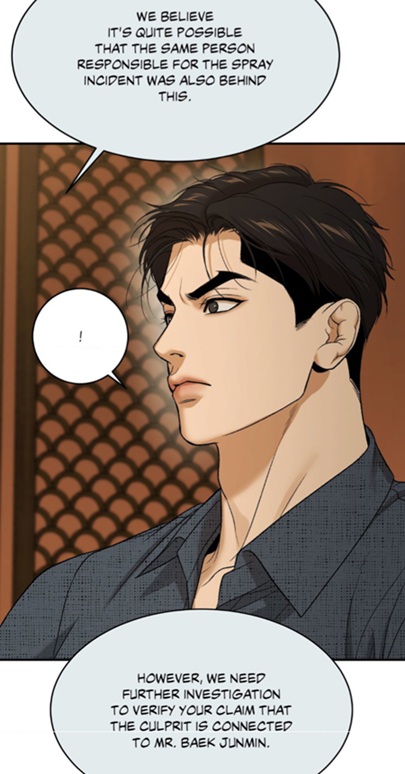 (chapter 69) This means that she is attempting to erase the involvement of MFC in the scheme. That’s why they are now offering an apology, which is naturally fake: (chapter 69) However, I believe that there’s more to it. First, the CEO is planning a schedule in the fall, but he hasn’t selected the opponent yet, a sign that they are rushing things. (chapter 69) Besides, don’t forget that the game in Seoul was rigged, hence the result was a tie. Because the cakes were all from Europe, I am suspecting that his match should take place abroad, in Europe. Moreover, since I sensed parallels between chapter 69 and 42
  (chapter 42), it dawned on me that MFC is actually treating the Emperor like a “cash cow”, they imagine that they can keep milking him. I could say, this encounter is exposing the reality to the athlete: Joo Jaekyung is treated like any other fighter. Hence there is no longer mention of Baek Junmin in the news. On the other hand, they have to vouch for Baek Junmin’s integrity (chapter 69), for the CEO had declared him that the Shotgun had that star quality. (chapter 69) In other words, they are trying to bury the case, thinking that giving him an opportunity will stop the champion from pressuring them any further.
As for Park Namwook, the latter has a similar interest. Since the athlete has been avoiding the gym, he imagines that organizing an imminent fight will push the champion to return to the gym. However, the reality is that Joo JAekyung can train anywhere, he has never needed Park Namwook by his side. Besides, he has another hidden motivation for supporting this match: his fear of being forgotten. (chapter 69) For him, the title of “champion” is not Jaekyung’s alone—it is part of his identity. Without the champion, Park Namwook is no one. His aim is to push the athlete back into the gym, to keep the wheels turning. With his words, he created the illusion that the Emperor would lose his special status and title, if he doesn‘t return to the ring soon.
But his plan is flawed. First, Jaekyung is still recovering. No one mentions his health. Unlike Chapter 41, where he referred to the MFC’s medical clearance,  (chapter 41) here the topic is avoided altogether—possibly due to the lack of actual clearance. Should a third-party hospital intervene, the match could be canceled. Secondly, Park Namwook assumes control of the timeline: a match in the fall means training now. But the champion is no longer dancing to his tune. He is meditating, admitting his exhaustion.
  (chapter 69) His priorities have changed: Kim Dan. This chapter announces a turning point of the Emperor, he is getting liberated from his “role” as Champion. Besides, if he were to lose the game, they can blame the athlete for his bad decision: he returned to the ring too soon. That’s the reason why the meeting and offer from the CEO was not revealed to the public.
One notable moment in the meeting is the aborted (fake) apology from the CEO (chapter 69) —an empty gesture blocked by Park Namwook, who clearly fears the emotional consequences of honesty. His interruption signals an unwillingness to address the past and a desperate attempt to reframe the narrative. Besides, a senior is lowering himself to a younger man, this stands in opposition to social norms, especially for the manager’s. One might say that there is a fake apology, because Joo Jaekyung is a star and champion. However, it is important to recall that he is in truth the head of Team Black. He is the true owner of the gym. He is also a head of a small company, 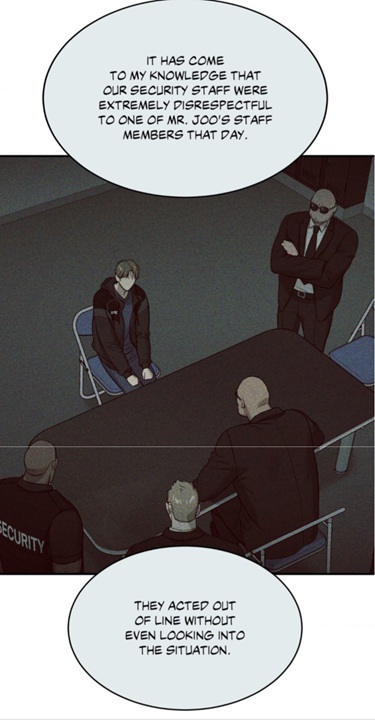 (chapter 69) So Joo JAekyung is more than a fighter and the apology (interrupted by the manager) is the evidence for this. Under this new light, Jinx-philes can understand Park Namwook’s interruption and embarassement. Not only he doesn‘t want to be reminded of his past mistakes (passivity, failure of his job, the slap), but also this apology serves as a mirror and reminder that he is not the true owner of the gym.
At the same time, the CEO and woman in red are not realizing that by acting this way (chapter 69), they were recognizing Kim Dan as a part of “Joo Jaekyung’s team”. He is no longer alone, he is on his way to develop his own “team”, far away from Park Namwook’s influence. Finally, since Mingwa made constantly references to scenes from chapter 40, we should see this meeting in front of a round table as a new version of “the interrogation scene” where Kim Dan was pressured to admit a crime and as such to say yes. Yet, at no moment the main lead said anything. On the surface, he remained silent, patient and obedient (chapter 69), but in reality his mind was elsewhere: on doc Dan!  (chapter 69) He is his unseen savior. Thanks to Kim Dan, the star remained silent and calm giving the impression that he had fallen for MFC’s trick.
There exists two other reasons why I am comparing this secret meeting (chapter 69) with the interrogation room in the States. First, he use of English throughout the entire conversation (indicated by blue speech bubbles) reinforces their arrogance and detachment. It exposes their view of Jaekyung as merely a fighter lacking education, whose linguistic skills might not allow full comprehension.  (chapter 40) This echoes Kim Dan’s confusion in Chapter 40 when interrogated in English. It also conveniently hides their ties to local authorities—acting as foreigners with no responsibility or rootedness in Korea. But this is what director Choi Gilseok confessed to the angel:
  (chapter 48) The business is rooted in the USA.
Moreover, Park Namwook’s physical placement in the room (chapter 69) reinforces his symbolic role in this dynamic. He is seated directly in front of the door, characterized by its striking orange-black motif. Rather than standing as a guardian or ally, his position evokes that of a gatekeeper—someone who controls access and restricts transparency. This is especially poignant when contrasted with Chapter 40, where Joo Jaekyung had burst into an interrogation room to protect Kim Dan 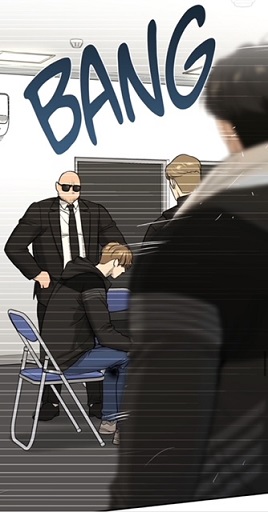 (chapter 40), effectively opening the metaphorical door to truth and protection. In this meeting, however, Park Namwook serves to contain and silence, not to defend. His placement underscores his complicity and fear—not just of the CEO or MFC, but of confronting the consequences of his own failures. But the manager is on his way for a rude awakening, he will be taught a lesson: don’t judge a book by its cover. The athlete won’t be the depressed, anxious, submissive and passive “boy” any longer. Moreover, he listened carefully to the chief of security: (chapter 69), so at some point he will remember their statement and discover the deception.
Metamorphosis and Reorientation
The square cake (chapter 69) signifies the champion’s true nature: disciplined, resilient, seeking truth. Its rigid, geometric shape symbolizes structure, balance, and clarity—reflecting his desire to make sense of his chaotic circumstances and reclaim control over his life. Unlike the circular or layered desserts of the others, the square form suggests a grounded and introspective mindset. It serves as a metaphor for his ongoing transformation: moving away from being a tool for others and toward becoming a fully autonomous individual with his own moral compass and emotional center. Kim Dan, symbolized by a circle, represents softness, unity, emotion. In Chapter 69, we see Jaekyung internalize this through the reflection in his pupil—a circular form. His new “center” is no longer the belt, the rank, or the applause.  (chapter 69) It is Kim Dan.
This shift is not just emotional but philosophical. Unlike the CEO and Park Namwook, who treat time as currency and rush through everything, Jaekyung is now learning to be present. He no longer wants to fight to survive or prove something. The ring, once a battleground, could become a place of meaning again—but only if he fights for something real.
Geography and Time
Symbolism blends into geography. Jaekyung now lives in a small town on the northwest coast of South Korea. His journey from Seoul takes hours—  (chapter 69) he leaves during the day and arrives by night.
  (chapter 69) This spatial detachment echoes his emotional separation from MFC and its toxic grip. Distance, both literal and figurative, is now his strength. The fact that he chose to return to the little town outlines that he is now considering that place as his “home” and not the penthouse. He is not realizing that his true home is doc Dan.
Conclusion
The Sweet Curse of the Round Table is a tale of control masquerading as diplomacy. The round table offers no true equality; it is a trap dressed as tradition. But Jaekyung, scarred yet evolving, is no longer fooled. His eyes have found a new center—not in gold belts or rankings, but in the quiet presence of someone who sees him as human.
And as the “blue knight,” he may one day bring other fighters to a new table—not to be ruled, but to share in a dream grounded in truth, not gold.
Interestingly, visual foreshadowing appears as early as Chapter 32.  (chapter 32) During Kim Dan’s lunch with Choi Heesung, the floor beneath their round table shows a twelve-petal flower motif—evocative of the legendary Knights of the Round Table, who were said to sit twelve strong. That earlier scene featured Heesung testing Dan, much like the fake round table later hosts a veiled test for Joo Jaekyung. The repetition of round tables masks exclusion and betrayal. These early “false” tables pave the way for a true table—one that Jaekyung might one day forge with fighters like Heesung, Potato, Oh Daehyun, and others, where loyalty and respect, not manipulation, define the bond.
For now, he eats dessert with devils. But he no longer hungers for their approval.
PS: I am suspecting that the proposed “fight” will take in Europe, but not in Italy, rather in Germany or France. Angelo should appear later as the last match.
Feel free to comment. If you have any suggestion for topics or Manhwas, feel free to ask. If you enjoyed reading it, retweet it or push the button like. My Reddit-Instagram-Twitter-Tumblr account is: @bebebisous33. Thanks for reading and for the support, particularly, I would like to thank all the new followers and people recommending my blog.



 (chapter 65) At first glance, the grandmother’s wheelchair and the ocean seem to represent opposing forces, yet they also reveal a complex relationship between power and vulnerability. Thus in this analysis, I will explore how these elements, rather than simply contradicting each other, might actually reflect a struggle to find balance between dependency and independence.
 (chapter 65), yet her portrayal of him seems unexpectedly harsh—emphasizing his flaws (smoking, drinking).
  (chapter 65) This description stands in opposition to the gumiho’s statement: he was an angel.
 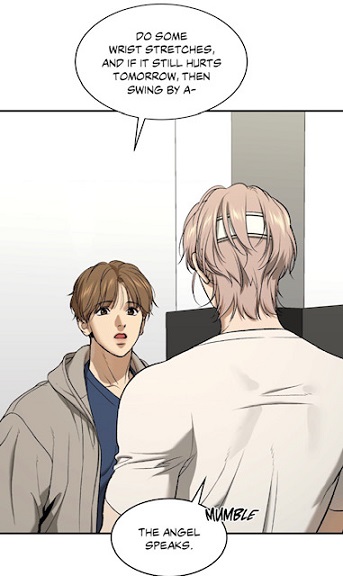 (chapter 30) It is because Kim Dan didn’t ask for money or recognition, this gesture was entirely selfless. Why would the lady badmouth the protagonist, when she requested from the champion that he brings the doctor back to Seoul?
 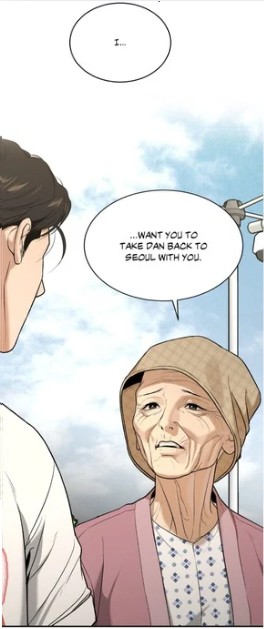 (chapter 65) Is she genuinely worried for him, or is there a hidden motive behind her request to send him back to Seoul? And why does Joo Jaekyung, usually so straightforward, respond with silence and hesitation
 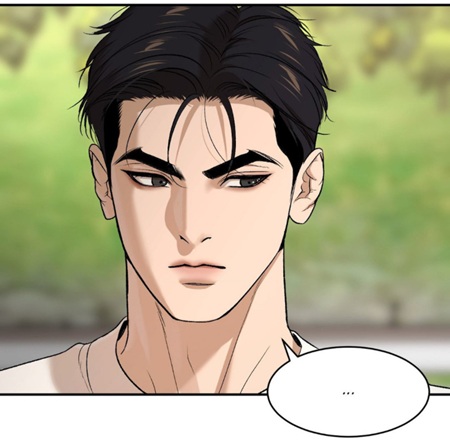 (chapter 65) or with shock?
 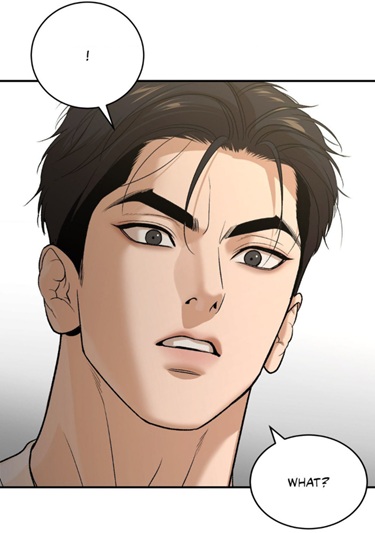 (chapter 65)
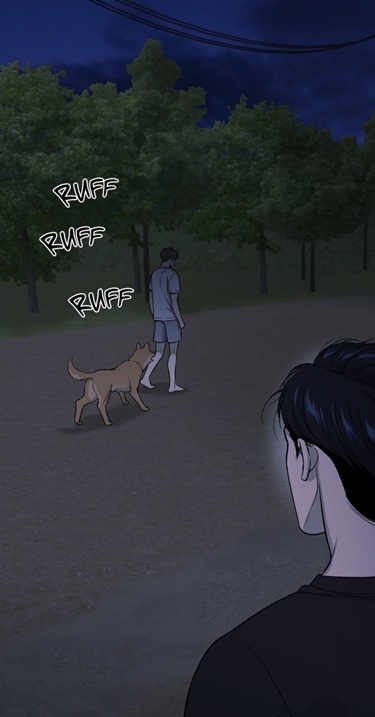 (chapter 65) His bare feet on the cold ground
  (chapter 65) suggest a longing for freedom, yet the direction of his steps remains uncertain. Whereas these walks reveal about his inner struggle, they don’t reveal the destination of his nightly strolls. Where was he going during that night? Was he going to the ocean—vast and untamed— like in episode 59,
 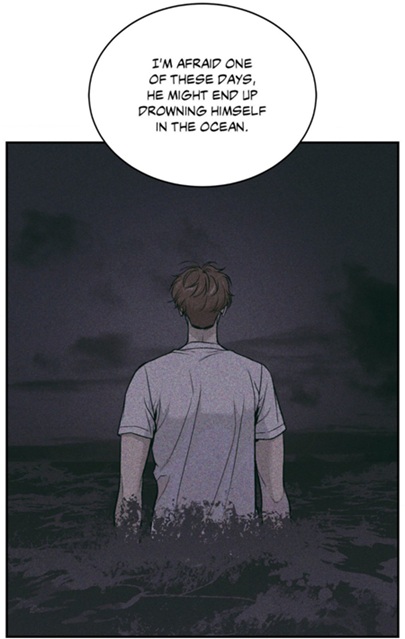 (chapter 65) or had his destination changed? These questions will be answered in the second part.
 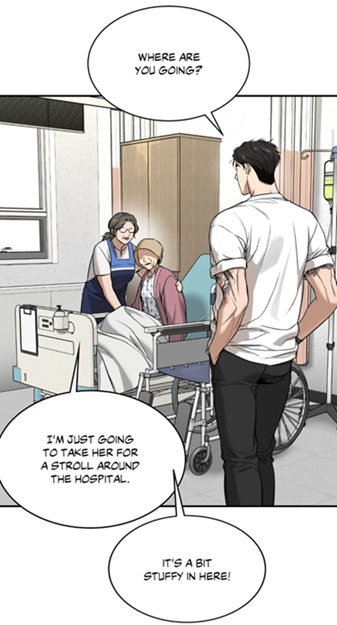 (chapter 65) This destination reflects the athlete’s desire and mind-set. He likes this place because it is quiet.
 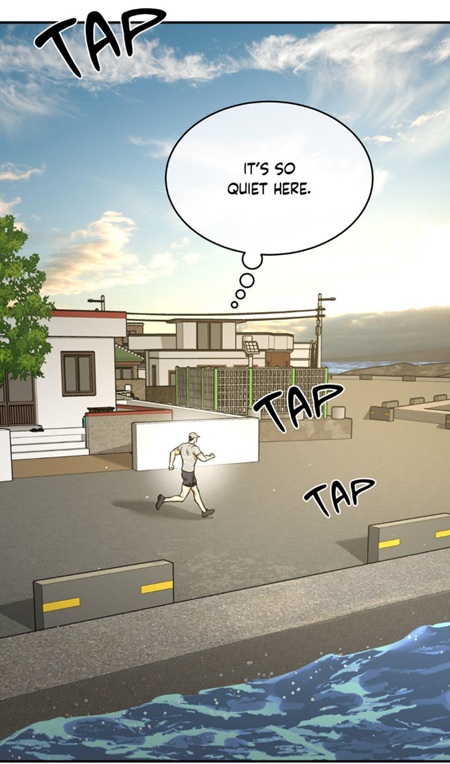 (chapter 62) From my perspective, the man has now internalized the beach to nature and privacy. Striking is the way Mingwa introduced the scenery. First, she focused on the wheel and Joo Jaekyung’s feet.
  (chapter 65) The contrast between the creaking wheels of the grandmother’s wheelchair and the steady steps of the champion immediately establishes the theme of control versus freedom. The wheelchair’s wheels represent civilization, immobility, passivity, and the grandmother’s obsession with control—over her own fate
  (chapter 65) In fact, she is just looking ahead of her. The “nice little town” is reduced to the pathway next to the beach. This observation exposes her narrow-mindedness. Because she is not truly admiring the place, I feel like she is praising the town more based on her childhood memories. This explains why she mentions her youth afterwards. Moreover, the fact that she employed the expression “isn’t it” with her description, reveals her tendency to lead the conversation. It was, as if she pushed the young man to agree to her claim. The irony is that she didn’t even wait for his reply. She explained why she was so fond of the place: her childhood memories. In her eyes, because her companion didn‘t spend his youth here, he can not connect to this town, overlooking that people can create new memories anywhere. Moreover, they are not obliged to live in the same town their whole life or to live where they spent their childhood. In other words, this frail lady has no real notion of time as such. I would even say, her gaze is not truly directed in the present or the future, she is rather obsessed with the past.
 (chapter 59) The contrast between these two images—one of the halmoni accompanied by Joo Jaekyung and the other of Kim Dan sitting alone by the ocean—exposes the stark difference in their emotional worlds and the dynamics of control and isolation that define their lives.
 (chapter 65) The sunlight high in the sky bathes the scene in brightness, suggesting a façade of warmth and clarity. This lighting aligns with the halmoni’s belief that she can influence Kim Dan through the champion, using Joo Jaekyung as an intermediary to extend her authority. The fact that she is in a wheelchair, however, subtly contradicts this impression of power, revealing her true state of passivity and reliance on others to act on her behalf. The ocean, tamed by the pathway, symbolizes her attempt to domesticate nature—
 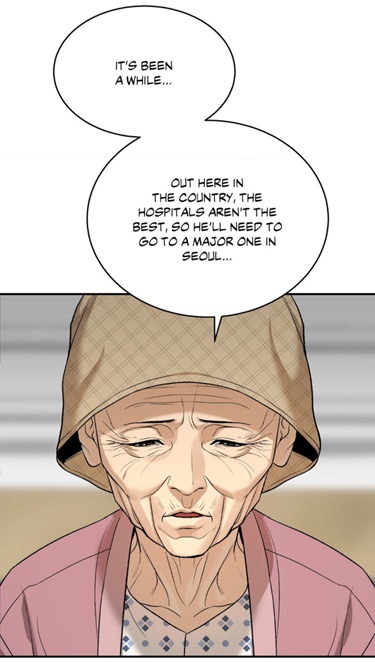 (chapter 65) just as she tries to domesticate Kim Dan’s emotions and decisions. At the same time, it exposes that the champion is still far away from his true self, but he is getting closer to become “reborn”.
 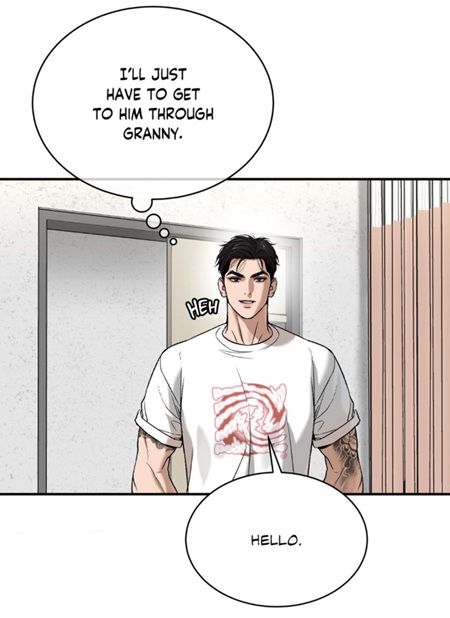 (chapter 65) the same illusion that the high sun implies. The latter can not shine if there are clouds.
 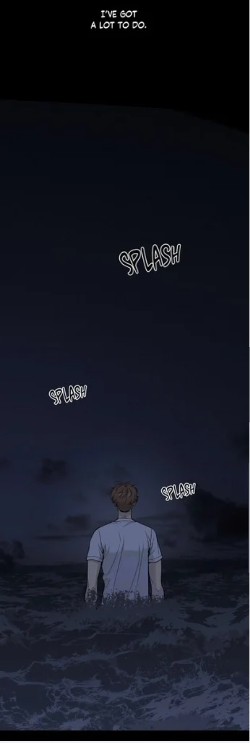 (chapter 59)
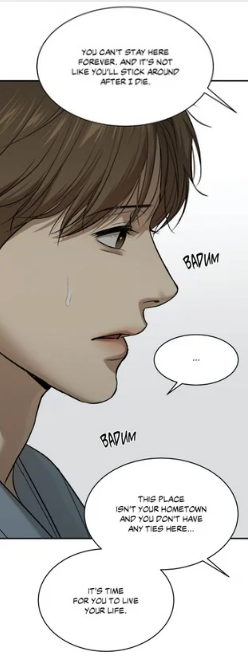 (chapter 57) By telling him that he had no ties here, she effectively erased their shared past and portraying him as a stranger in the very place she calls home. Thus I deduce that she is aware that she is racing against time. The longer the athlete stays in that place, the lower are the chances that her grandson will leave this town. She has to ensure that Joo Jaekyung doesn’t feel like settling here. I don’t think, she heard about the athlete’s involvement in the little town, for her only source of information comes from the staff
 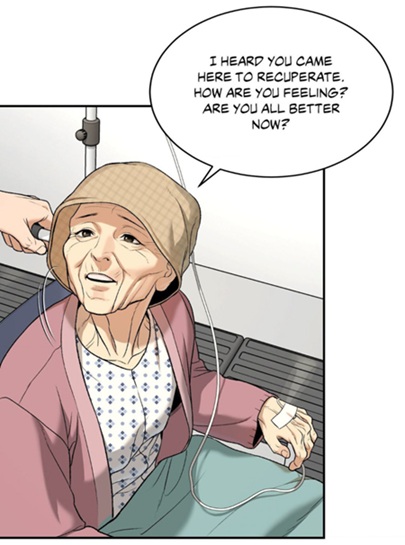 (chapter 65) and the residents from the hospice. She has no connection to the town chief and other inhabitants. This exposes how small her world is and little her knowledge is. However, her ignorance doesn’t make her an innocent “lady”, quite the opposite. – Don’t get me wrong, I don’t see her as a malicious person, just as a selfish person suffering from Peter Pan Syndrome.
  (chapter 65) Here, she claims that she only knows about the sportsman’s job thanks to the patient next door. However, she is lying, because she watched his match in the States.
  (chapter 41) The irony is that she is not realizing that she is showing her true colors.
  (chapter 21) In episode 21, the halmoni’s description of the champion as a “good friend” was, in hindsight, a superficial and self-serving characterization. At that time, she likely saw Joo Jaekyung as someone who could be beneficial for Kim Dan’s financial situation without truly caring about who he was as a person. Her interest in him was more about what he represented—a source of money and stability—rather than any genuine appreciation of his character or the impact of his presence in Kim Dan’s life. Thus she said this in front of the ocean:
  (chapter 65) If he was a good friend, then why didn’t she show more interest in him before? It is because she needs him now. Yes, this woman is a good-weather friend in the end. The term “good-weather friend” refers to someone who shows interest, support, or kindness only when it is convenient for them or when they stand to gain something. Hence she goes outside, when the sun shines. This perfectly encapsulates the grandmother’s attitude towards Joo Jaekyung. But it is the same with the champion. He only visited her,
  (chapter 61) when he thought, he needed her assistance. He used her to appear as a friend.
  (chapter 61) Yes, the conversation at the beach played an important role, for Shin Okja’s behavior serves as a distorted mirror to Joo Jaekyung’s actions and mindset, exposing the flaws and contradictions in both. When she voiced this wish
  (chapter 22) he acted out of a simplistic view of good deeds—believing that financial support alone could resolve problems and fulfill his moral obligations. His subsequent failure to visit her again reflects his tendency to distance himself emotionally once he has performed what he sees as his duty. This is reminiscent of his behavior towards Kim Dan: helping him materially but avoiding deeper emotional involvement or responsibility.
 (chapter 65), much like how Joo Jaekyung likely saw himself when paying her bills—believing that fulfilling a material need is equivalent to showing genuine concern. Park Namwook is a representative of this mind-set too.
 (chapter 45) Both characters avoid deeper emotional connections, opting instead for transactional solutions—she with her manipulations and he with his money.
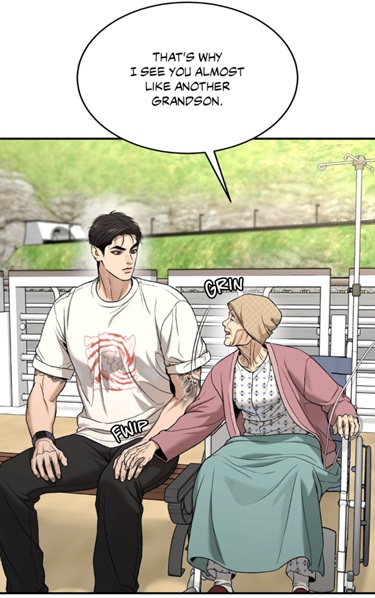 (chapter 65) is a way to offload responsibility for doc Dan while maintaining an image of concern. Both display a form of care that lacks true depth.
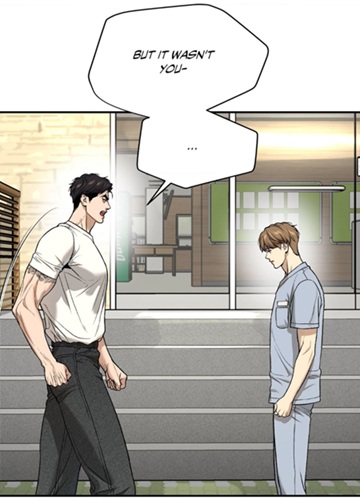 (chapter 62) Both avoid the emotional accountability that comes with their actions, preferring to distance themselves once a material obligation (debts)
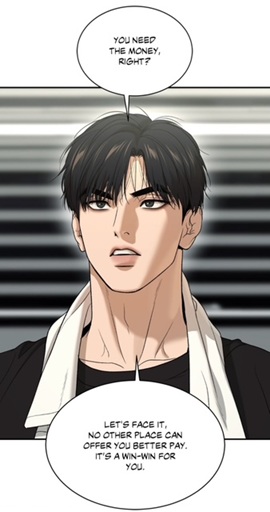 (chapter 60) is fulfilled.
 (chapter 22)
 (chapter 57) This displays that she is not entirely honest. She is not reaching out to Kim Dan in the end. Her excuse is that he refused to see a doctor
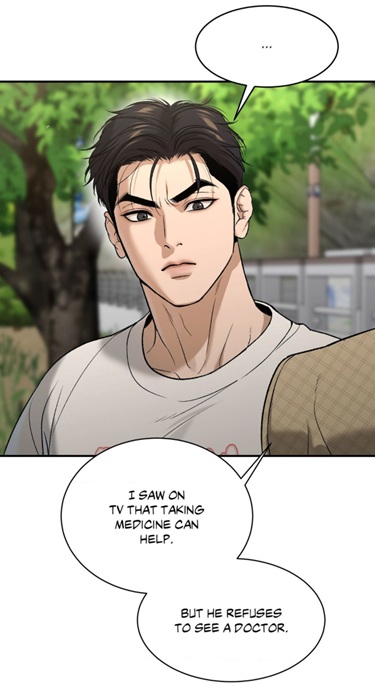 (chapter 65), but so far we never saw her making such a suggestion. It is possible that she jumped to this conclusion because she heard about this incident:
  (chapter 60) If my assumption is correct, the woman didn’t realize that this rejection was linked to Joo Jaekyung’s intervention. So if she had talked to her grandchild himself, she could have had an impact… But they are actually avoiding each other. One thing is sure: the absence of communication and avoidance between these two family members reinforced the doctor’s suffering. Imagine the consequences of her request: she is preferring locking him up in a hospital receiving drugs than giving what doc Dan has been longing: warmth, love and a home.
  (chapter 65) where both were happily smiling. The picture is the evidence that she could make Kim Dan smile despite their poverty. Moreover, it is important to recall that she introduced Kim Dan as an orphan from birth:
  (chapter 65) According to my hypothesis, this image
  (chapter 19) is linked to the doctor’s abandonment and betrayal. I have to admit that her attitude and words reminded me a lot of the director Choi Gilseok’s offer.
 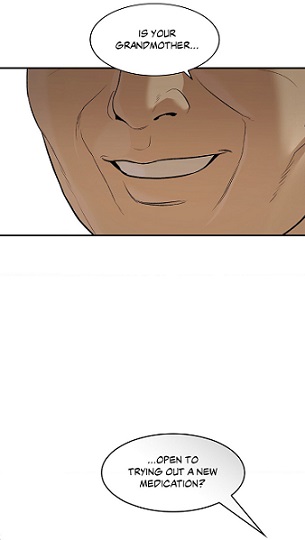 (chapter 48). Both the halmoni and Choi Gilseok embody betrayal and the theme of acting behind the back
  (chapter 48) mask a deeper betrayal. His real aim was never to assist but to control, using offers of support as bait to tie Kim Dan into a powerless position. The parallel between his proposition to Kim Dan—promising a better life in exchange for leaking information and compliance—and the halmoni’s push for Seoul’s hospitals underlines their shared strategy: make the target believe they have a choice, while the outcome is already decided. The fact that Heo Manwook, who collects Kim Dan’s debts, called Choi Gilseok “hyung” further hints at a deeper conspiracy, suggesting that the offer might have been a tool to ensnare Kim Dan from the start. He would have committed a crime (illegal drugs).
 (chapter 62) That’s the reason why he was seeking the grandmother’s support. He was hoping that she could influence him. But what he hears, shocks him:
  (chapter 65) Though they are next to each other, they are not sitting together. The wheelchair represents the invisible barrier between them. This scene contrasts with the conversation in the penthouse. And what had the athlete done during that night? He had not only shared his thoughts and issues to doc Dan, but he had asked for his wish and opinion.
 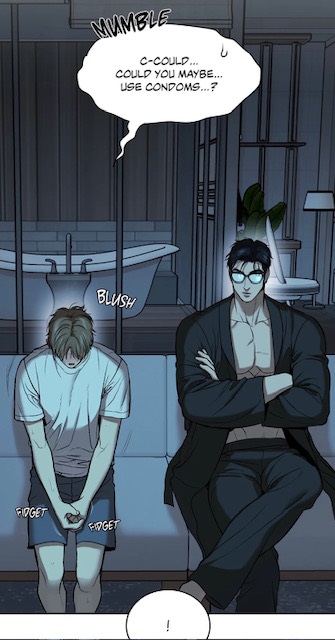 (chapter 29) He had even advised to think of himself first. As you can see, the fact that the two characters were just sitting next to each other reinforces my previous interpretation about the conversation. The grandmother was the one who had been leading the conversation, there is no real exchange of thoughts. In episode 29, the champion refused to accept the doctor’s help and suggestion. That’s the reason why I am more than ever convinced that the star won’t listen to the grandmother.
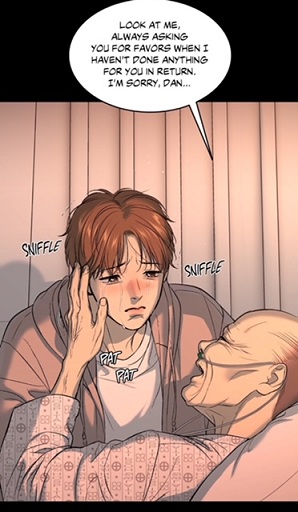 (chapter 53) She was asking for a favor again, but this time, she was begging for someone else’s generosity. No wonder why she said that she was still the same!
  (chapter 53) and watch the ocean with her grandson
  (chapter 53), but they never did it. Why? One might respond that she refused to do it.
 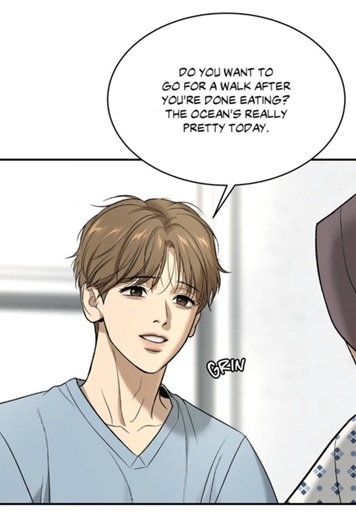 (chapter 57) But it is only partially correct. The doctor only suggested this walk to the ocean much later, when he was already suffering emotionally. This means that the grandmother would have not been able to enjoy this walk. Yes, the timing played a huge role. In fact, she confessed her crime to the star:
  (chapter 53) She never had any intention to spend some time with him. Notice the personal pronoun “we” vanished. It is only about her request: “I wanted to see the ocean”. This means that at the hospital, she never had any intention to keep Kim Dan by her side. She employed the “with you, we” in order to achieve her goal. She acted, as if they were a family. She used her illness for her own advantage. In my opinion, her request was an excuse to avoid to return to the old broken home. For her, home is a place and not a person. Therefore she couldn’t love Kim Dan properly. Her “I’m so sorry” was actually fake. She had only thought of herself… She never thought of her grandson’s future at all. This observation corroborates my previous statement: she is unable to plan for the future. What only matters to her is the past or the present. Why? It is because she doesn’t want to be plagued by remorse or regrets. And now, she is doing it again with the champion. Using emotions and fragility for her own benefits. The paradox is that this is something Joo Jaekyung has always feared his whole life. Nonetheless, he doesn’t react so violently like in the past: rejection or outburst. One might say the reason is that she is weak and terminally ill.
 (chapter 65) However, I believe that her words reached the champion’s third eye. The latter was not focusing on the grandmother, but on his fated companion. He was trying to understand why he had changed. This question was already on his mind before:
 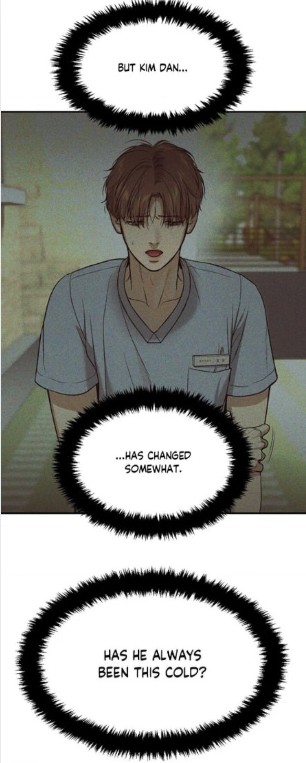 (chapter 62) And notice that the words from the grandmother
  (chapter 62) Once he has achieved his goal (reclaim his champion title), they will depart from each other. He would treat the doctor the same way than the grandmother! No wonder why doc Dan is getting angry and rejecting the offers from his destined partner. IT is only about his own selfish desires and not about doc Dan’s future and desires. Both have a similar mind-set: they don’t know what doc Dan plans to do with his life and the future…. And it shows that Joo Jaekyung was imitating the grandmother, though this suggestion was born from the following thought. Since Doc Dan was no reluctant to work for him, he imagined that maybe he would still accept to work for him for a limited time. But that’s not what Kim Dan is looking. He is longing for a home and at the same time for freedom.
 (chapter 65) The points of suspension are indicating that he is meditating on her words and suggestions. This stands in opposition to his past behavior where he got manipulated so easily.
 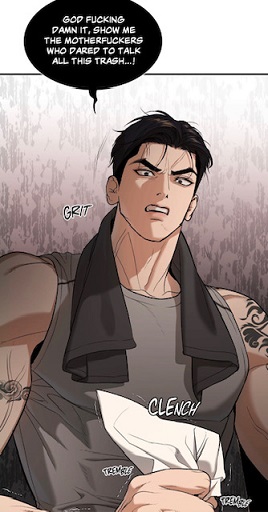 (chapter 36) The reason for this huge metamorphosis is that because of the lavender-tinted night, he learned to control his emotions.
 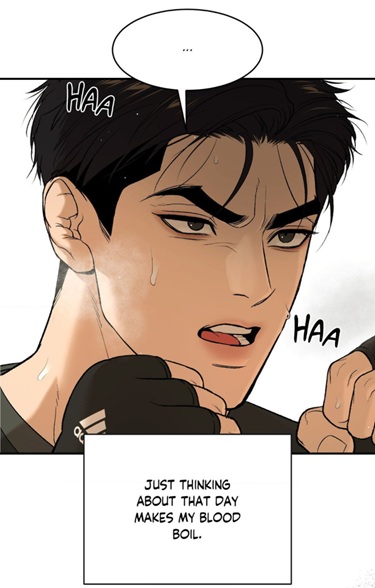 (chapter 65) He was forced to admit that he needed the “hamster”. He knew that if he reacted on these negative emotions, doc Dan would have another reason to put the blame on him. Consequently, his goal would be much further away. Secondly, though the conversation was private, their encounter was far from secretive. Both were visible, as it took place during the day. This means that the grandmother’s words in front of the ocean symbolize that they are in the open.
 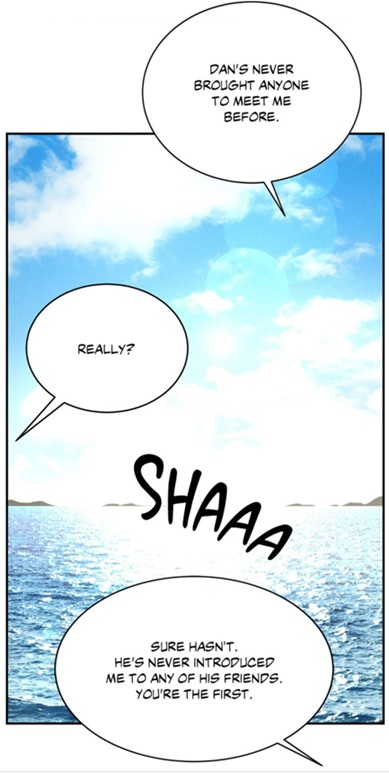 (chapter 65) According to her, Kim Dan has never introduced her to any of his friends. The celebrity would be the exception! But she is lying here. How so? Joo Jaekyung introduced himself to her on his own. It is because he answered a call from the nurse.
 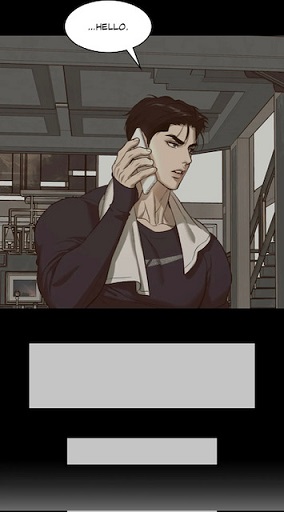 (chapter 21) It happened behind doc Dan’s back in the end. The latter was sick, but the old lady didn’t seem concerned. The second lie is this statement which is exposed with the memory:
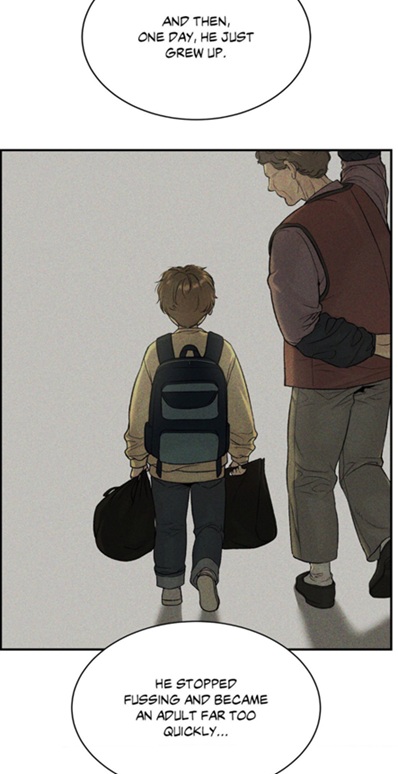 (chapter 65) Here, note that the little boy is wearing the same clothes than in the doctor’s nightmare.
 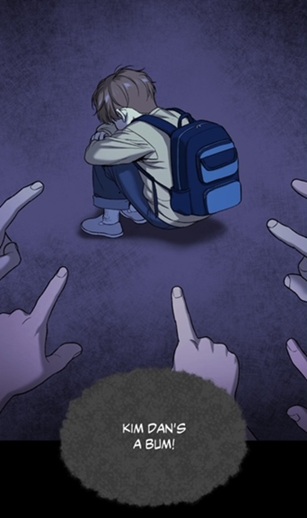 (chapter 57) She claims her ignorance why the little boy acted like an adult at such a young age. The reality is that she hasn’t forgotten the incident at all. This explicates why she confessed this to the “wolf”:
  (chapter 30) a sign that she was never a source of embarrassment for him.
  (chapter 47) Her refusal to address these deeper issues reveals that her sacrifices were less about genuine care and more about maintaining her self-image as a righteous guardian.
 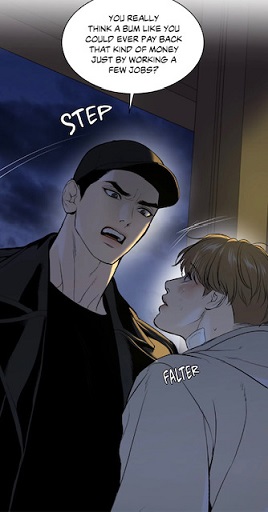 (chapter 18) What caught my attention in her revelation is her lack of enthusiasm for her own grandson.
  (chapter 65) “Is he that good?” exposes a lack of faith in her grandchild, a remark which caught the athlete by surprise. For me, he unconsciously sensed this negative aspect.
  (chapter 65) While this image is actually humorous, the grandmother’s words don’t match her body language. She is not showing any joy or smile. Therefore I comprehend why Kim Dan was so hurt by the champion’s behavior:
  (chapter 51), the absence of trust because of MONEY! She knew, he was drinking and smoking. Yet according to her, she couldn’t stop him, as she was powerless. He wouldn’t listen to her nagging. But here is the thing. She never asked him why he would act this way. Drinking and smoking were the only things he could allow himself as “fun and diversion”. In her long confession, she is diverting the attention from the causes for this rebellious behavior. Indirectly, she is portraying him as a stubborn boy who can not live on his own. In reality, she is just projecting her own desires and thoughts onto her grandson. For her, the city stands for wealth, fame, success and power.
  (chapter 65) I am suspecting that deep down, she wants him to shine for her own peace of mind.
  (chapter 61) Finally, it is important that the athlete never agreed to her “demand” or suggestion.

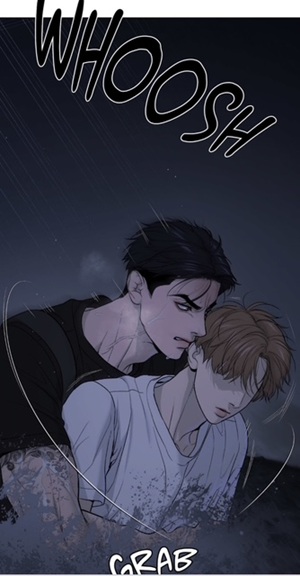 (chapter 59), the scene mirrors the iconic moment in The Little Mermaid where the mermaid saves the prince from drowning. Kim Dan, unconscious and seemingly following the voices of the hospice
 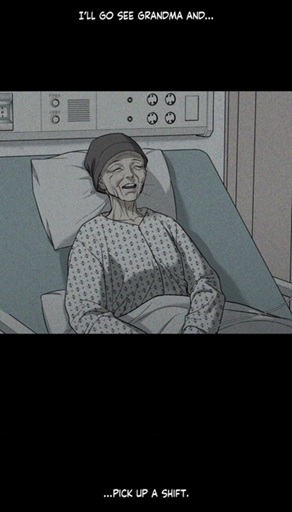 (chapter 59) —a representation of the mermaids’ song—drifts into a state of surrender, much like the prince. This act of salvation becomes a pivotal moment, connecting both characters to the themes of water, transformation, and rediscovery of purpose.
 (chapter 54), performance, and the longing for a deeper connection.
 (chapter 41), and the mermaid, as he grapples with voicelessness and the pressures of his world.
  (chapter 36) Choi Heesung, representing another prince with Potato as his bride, benefits from others’ sacrifices
  (chapter 31)
 (chapter 58) while remaining oblivious to their struggles. These parallels reveal layers of self-discovery, mutual transformation, and the pursuit of meaning. By analyzing these similarities, we uncover deeper layers of self-discovery and transformation within the narrative.
 (chapter 53) Joo Jaekyung, representing the “new world,” acts as both a source of transformation and a mirror reflecting Kim Dan’s sacrifices.
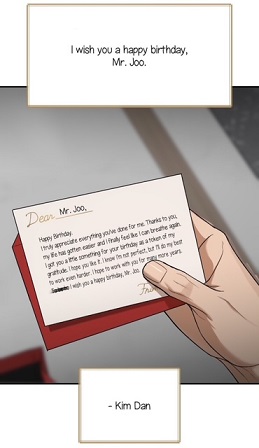 (chapter 55) and hardship
 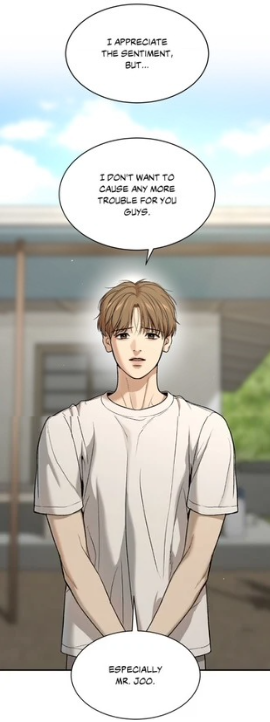 (chapter 58), yet it serves as the catalyst for his growth. Just as the little mermaid’s journey leads her to a higher spiritual purpose as a daughter of the air, Kim Dan’s experiences with Joo Jaekyung force him to confront his own worth, identity, and emotional needs. Just before he went to the ocean, he wondered about his own future and desires, a sign that he was standing at a crossroad:
 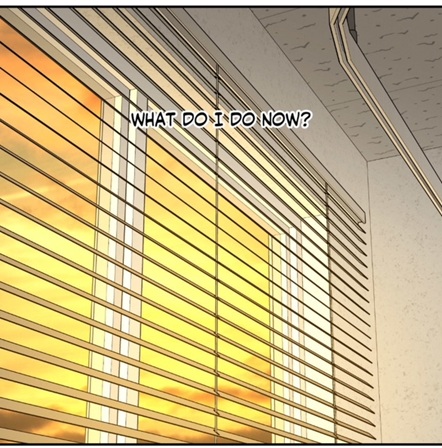 (chapter 59) However, let’s not forget that Kim Dan’s profession had been determined by Shin Okja, as the latter desired to have her grandchild taken care of her. Therefore his own desires and needs were overlooked. Traditions and social norms were used to decide about the protagonist’s life and future. His journey from voiceless suffering to self-realization echoes the mermaid’s transformation.
 (chapter 59) Like the mermaid, he has always lived disconnected from his own needs, burdened by the expectations of others—his grandmother, Heo Manwook, the doctors
 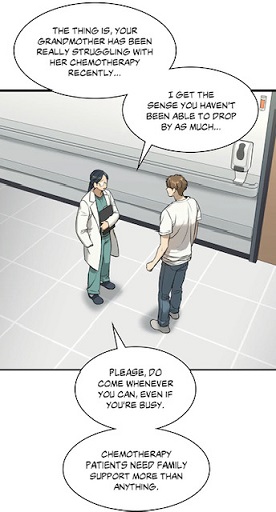 (chapter 21) , and even Joo Jaekyung.
  (chapter 59), he is not capable of crying. It is because he has been living like a ghost for the last two months. Depression, for both the mermaid and Kim Dan, manifests as a silent struggle, making their eventual transformations even more poignant.
 (chapter 1) hiding his true self behind a facade of strength and success. On the other hand, Joo Jaekyung also embodies the mermaid’s longing and sacrifice. Living in the world of MMA, a high-pressure environment where he is constantly pushed to perform, he resembles the mermaid in the underwater kingdom—a place of death and materialism where the mermaids feed on drowned humans. It is no coincidence that the fighters are displayed like mermaids in the water full of blood.
  (chapter 29) This zombie-like existence leaves him voiceless; the entertainment agency and MFC dictate his actions
 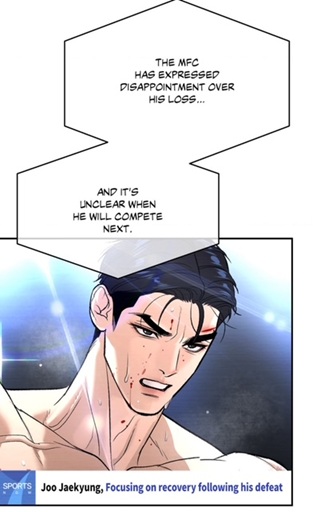 (chapter 57), only allowing him to speak when it benefits them financially.
 (chapter 27) reflects his connection to the mermaid. Water is his natural element, a place where he feels at peace, yet he has been forced to conform to a fiery world of intensity and relentless ambition.
  (chapter 19) Hence he never went to the swimming pool in his own penthouse, until Kim Dan triggered his memory and longing. This interplay of water and fire
  (chapter 52)
  (chapter 41) Joo Jaekyung’s image was exploited to lure these individuals down a darker path, highlighting how his light has been misused by those around him.
 (chapter 19)
 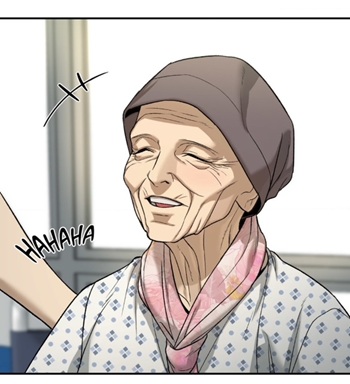 (chapter 56) as long as they were not associated with burden or suffering, while the mermaid’s grandmother celebrates the beauty and decorum of their underwater realm.
 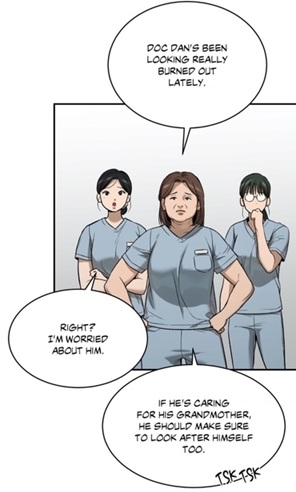 (chapter 57) He even gets blamed for his illness. These elements further emphasize how the suppression of individuality leads to yearning and eventual transformation.
 (chapter 52) This dynamic parallels the members of Team Black in Jinx. Although they are treated like Joo Jaekyung’s co-workers
  (chapter 7), in reality, he is their boss and the foundation of their success. Their indifference mirrors the mermaid sisters’ behavior; they only notice his struggles and absence when his winning streak falters, prompting many to leave the gym for the rival King of MMA. However, if we take Andersen’s fairy tale as a source of inspiration, it signifies that at some point, the remaining members of Team Black might come to “sacrifice” themselves for their “little sister,” symbolically representing Kim Dan and Joo Jaekyung. This potential act of loyalty could mirror the mermaid sisters’ gesture, showing that even belated recognition and care can lead to transformative redemption for those involved.
 (chapter 1), attracting others seeking the same level of fame and fortune.
 (chapter 46) However, the gym’s inability to produce another champion reveals its “fake gardening” nature—focused on maintaining an image rather than fostering true growth.
 (chapter 52) while merely using Joo Jaekyung’s success to boost his own ego. His plans to set up a kids’ program at the gym further underscore this self-serving nature. While presented as an effort to expand the gym’s reach, Park Namwook’s true motivation lies in financial gain, as he tries to persuade Joo Jaekyung by stating, “Kids are where the money is at.” On the one hand, this reflects his obsession with money and contrasts with the deeper, transformative intentions associated with true gardening. On the other hand, since he has himself kids, it is clear that he would like to send his own children to the kids’ program.
  (chapter 22) and a “neglected child”
 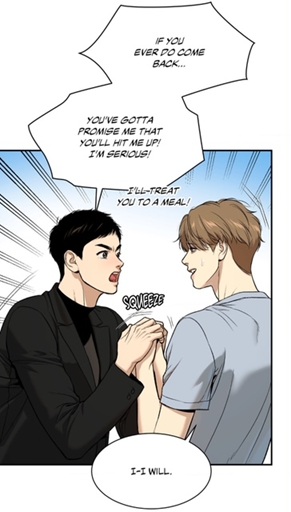 (chapter 59) further emphasizes the immaturity and lack of responsibility prevalent in this environment. In Andersen’s story, the mermaid sisters are given gardens to tend from a young age, instilling responsibility early on. Potato’s journey mirrors the mermaid sisters’ visit to the surface, as his trip to the sea represents a moment of exploration and self-discovery. While working as an actor for the first time, he realizes during his stay with Kim Dan that he has no intention of leaving Team Black.
  (chapter 58) Feeling lost without Kim Dan, he initially requests his return so that they can be together again. This longing for a companion reflects Potato’s deeper need for guidance and connection, much like the mermaid sisters who briefly visit the surface but ultimately return to their underwater world when the novelty fades. Yet, when they reach maturity and are allowed to visit the surface, the novelty of the human world quickly fades, and they return to their underwater realm indifferent to human suffering. However, notice that on his day of the departure, Potato tells Kim Dan that he won’t call him, the mermaid has to initiate the first step.
 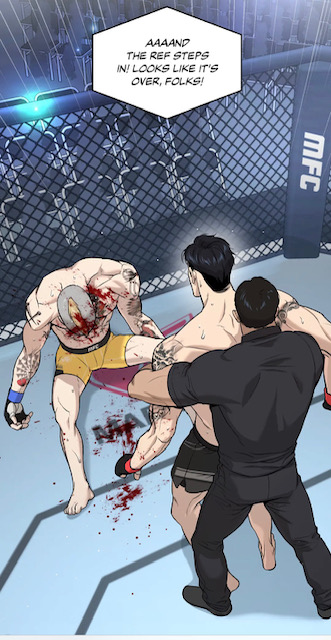 (chapter 15) strongly parallel the detached, high-pressure environment of MMA fighting. Joo Jaekyung, trained relentlessly since youth, embodies this world’s harshness, where vulnerability is a luxury rarely afforded.
 (chapter 59) suggests that Joo Jaekyung might reclaim his authentic self through activities like swimming, reconnecting with nature, and symbolically planting the seeds for a new life. Kim Dan, who cannot swim, learns from Joo Jaekyung, and together, they forge a path toward mutual healing and immortality—not in the literal sense but through finding their “soul” and purpose.
 (chapter 56) The city represents the oppressive expectations and artificial constructs that have shaped Joo Jaekyung and Kim Dan’s lives. By meeting again in the ocean, they reconnect with a more authentic and unburdened version of themselves. This transition echoes the little mermaid’s connection to the natural world as a place of solace and transformation.
 (chapter 59) They imagined that Kim Dan would be better off without Joo Jaekyung
  (chapter 58), but this assumption reveals their failure to truly understand Kim Dan’s plight. Their ignorance ties them to the selfishness and guilt that mark the couple in the fairy tale. Despite their faults, however, their actions indirectly contribute to Kim Dan’s transformation.
 (chapter 15) his kiss with Joo Jaekyung, shared in the locker room, was both an act of protection and a pivotal moment in their dynamic. Like the mermaid’s unforgettable first kiss with the prince (when he was rescued), Joo Jaekyung’s kiss in the locker room was an act of initiation, driven by his “fears” and sense of responsibility, reflecting his growing attachment to Kim Dan. The kiss symbolized his struggle to connect and protect, even as he grappled with his emotional restraint. The locker room, a symbol of physical endurance and vulnerability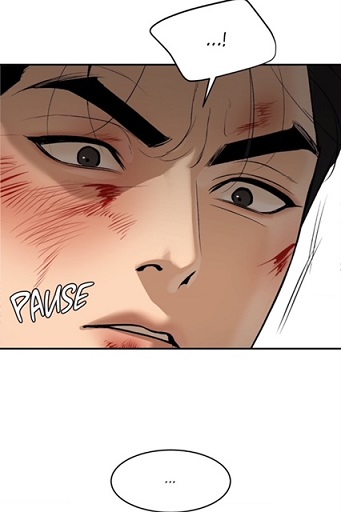
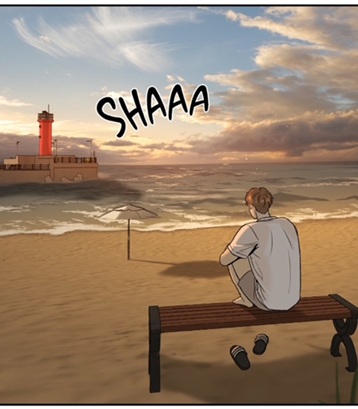 (chapter 59) finding light not in others but within himself. Through his hardships, he gains the strength to pursue his own identity and agency.
 (chapter 49) The maknae’s tears are an indication that he is no mermaid, but a human, I would even say, he still has the soul of an innocent boy.
 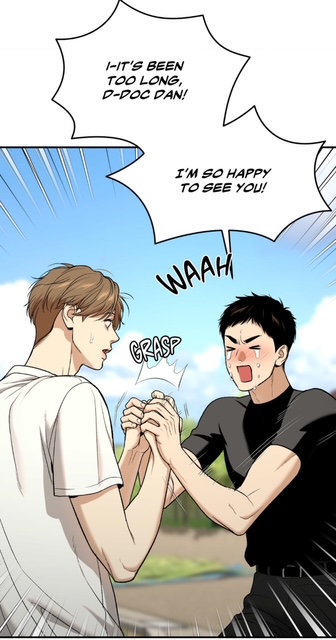 (chapter 58) reminding me of the princess looking for the voiceless mermaid. It is clear that in both stories, the mermaid left traces in the humans’ hearts.


 (chapter 53). Because the latter is slowly vanishing into the light, it looks like the champion will have difficulties to find his soulmate. However, if you pay attention to this picture, you will perceive that Kim Dan’s shadow is huge. In fact, we have to envision that the closer he gets to the “sun”, the bigger his shadow becomes. This metaphor is implying that the cute hamster is leaving a trail behind. This represents the traces he left in Joo Jaekyung’s life and heart. The farer he is, the clearer the fighter can only realize the importance of his roommate in his life. However, I believe that though Kim Dan is about to become a ghost, the huge shadow is implying that Joo Jaekyung will be able to find him quickly.
 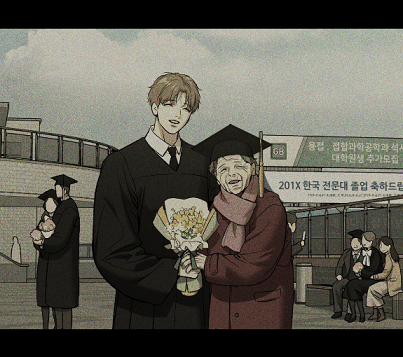 (chapter 47) You might find it strange, but everything started with the following question: where is the grandmother’s cellphone? One might argue that as an elderly woman, she doesn’t possess one. I can only reply that all the seniors I know (even my grandmother who is much older than Shin Okja) have one. Besides, let’s not forget that according to me, this image or this one
 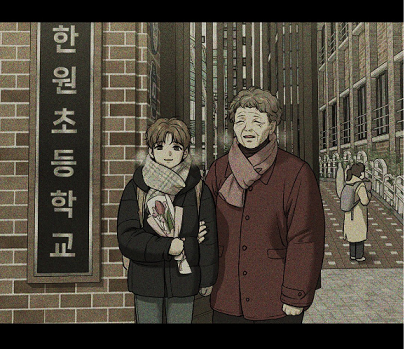 (chapter 47) represent moments where pictures were taken. I doubt that the grandmother had a camera. Then in the last picture, Kim Dan was definitely too young to have on his own cellular telephone. Finally, observe that in this panel
  (chapter 47) Before he was practically inexistent, only famous in the underground fighting ring
 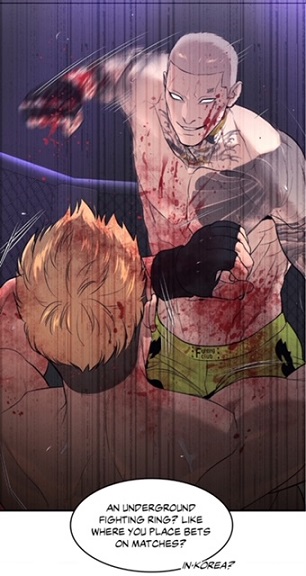 (chapter 47), and notice that the champion had even forgotten him.
 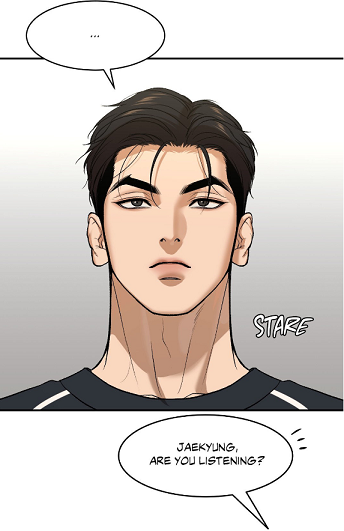 (chapter 47).Interesting is that disappearing without traces implies the notion of “the right to be forgotten”. But why would people make such a decision? Either they want to escape from their environment (abusive husband, debts, …) or they desire starting a new life afresh. So when we look back at Shotgun, it becomes clear that his new identity is to mask his dark past.
  (chapter 10)
  (chapter 21) There is no landline telephone. Its absence seems to indicate that the senior switched to a different phone. She had to have one because of the authorities (school for Kim Dan, etc.). I would even go so far to say that the elderly woman changed her phone number. But why would she change her phone?
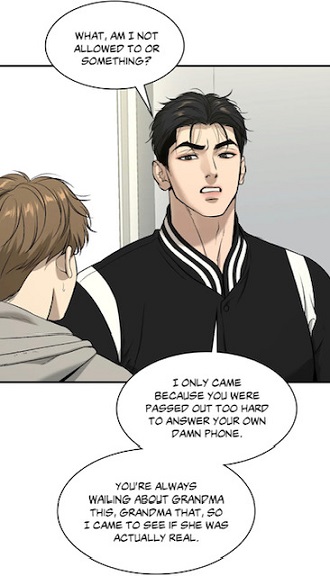 (chapter 22) He doubted her existence. Why? It is because he never heard Kim Dan talking with his grandmother over the phone. He had only mentioned her in his drunken state.
 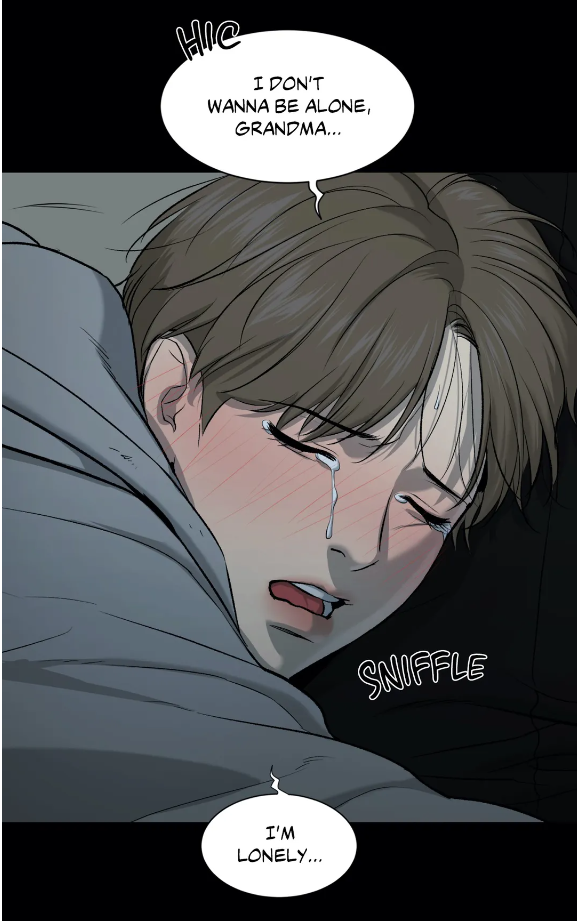 (chapter 10) Finally, he didn’t see the picture from her on the night table, for the doctor had not placed the image there yet. In other words, she appeared like a ghost to the champion. Is it a coincidence that readers only know this terminally ill woman unter the name “grandma” in Jinx (English version). I am calling her Shin Okja, because the Japanese version revealed a name. Nevertheless, by having no name in Jinx, it reinforces the impression that this woman is like a ghost.
  (chapter 21) Thus I deduce that the elderly woman must have got rid of it. One might say that at the hospital, she no longer needed it. Nevertheless, such a reasoning is too superficial and simple. I am convinced that the grandmother had other motivations as well. First, that way she was putting the whole responsibility on her grandchild. Why do you think the association called him and not the grandmother?
  (chapter 11) There is no ambiguities that she was registered there as a resident. But if she got rid of her phone, the authorities are forced to call her closest relative. Secondly, observe that Kim Dan used the cellphone to pay bills and have a look at his bank account:
  (chapter 11) In other words, by refusing to have any phone, she dropped all the debts on her grandchild. He was now responsible for their household and expenses. Yes, the question with the grandmother’s phone led me to the following observation. Little by little, Shin Okja was vanishing which reminded me of the action from Kim Dan’s parents. At the same time, with no cellphone, she forced her grandchild to visit her, to keep in touch with her. Hence I can’t stop restraining myself from feeling that the grandmother used the hospital and the nurse to control her grandchild’s moves. No wonder why Kim Miseon complained to Kim Dan about his neglect
  (chapter 22) Yes, by paying the bills, he got access to this information. However, for that he needs a person who can have access to such information:
  (chapter 13) Cheolmin who is also a doctor. Medical professionals often use the Resident Registration Number (RRN) or equivalent patient IDs provided by hospitals to manage medical records. Access to sensitive personal data like RRNs is restricted and regulated under South Korean privacy laws such as the Personal Information Protection Act (PIPA). This ensures that sensitive data is protected and only accessed when absolutely necessary for healthcare purposes. Only a doctor could detect the move to the Hospice “Light Of Hope”.
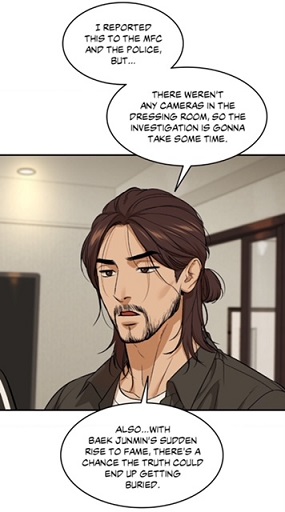 (chapter 52) If the champion doesn’t return to the gym and moves to the place where Kim Dan is without informing Team Black, they could fear the worst. The champion is the target of criminals. Finally, it is important to recall that Heo Manwook only knew how to contact Kim Dan with his address.
 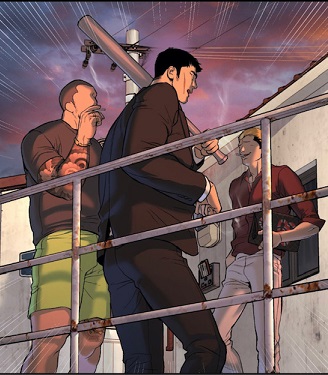 (chapter 1) He didn’t have his cellphone number at all. That’s the reason why he would come to his house to harass him. This explicates why he disliked so much the idea of Kim Dan’s move:
 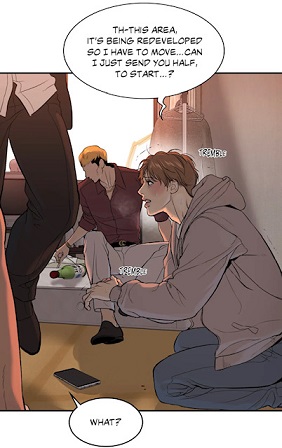 (chapter 16)
  (chapter 16) is an incorporated business. This means that Joo Jaekyung is the shareholder. So he is hiding his true power and identity behind Team Black. And since the Emperor was the victim of a hatred campaign in the media
 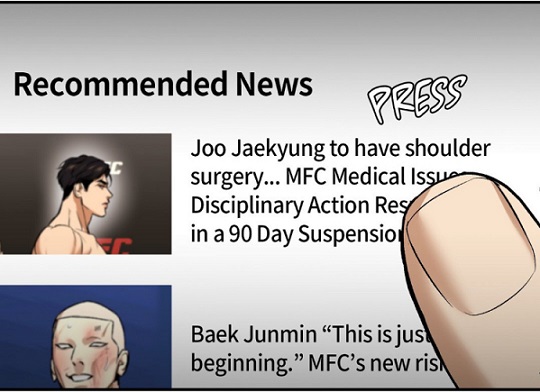 (chapter 52), his vanishing wouldn’t be surprising at all. It would be actually a normal reaction to be fed up of being online, and of being defined by the last match. What the schemers didn’t realize is that they pushed indirectly Joo Jaekyung to make the opposite decision than Baek Junmin. To disappear from the spotlight. But this can only lead him to create a whole new identity.
 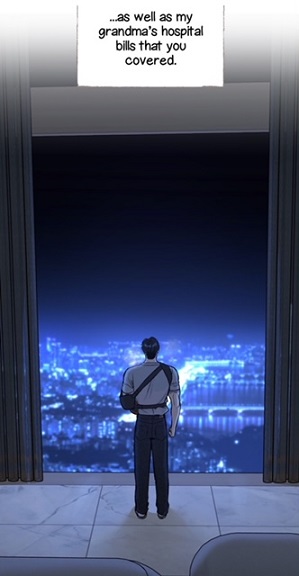 (chapter 53) It signifies that Joo Jaekyung has a way to track him down. On the other hand, should the MMA use the black card,
  (chapter 24), his relative could detect his whereabouts and moves. That’s why it is important if you desire to avoid of being detected, you need to use cash or prepaid cards to limit traceable transactions. That way, it reduces the risk of financial links to your old identity.
 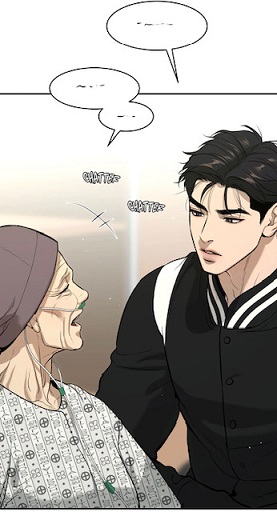 (chapter 21) Back then, many readers wondered about the content of their conversation. However, I believe, whatever it was, the champion didn’t forget her words. Furthermore, by joining Kim Dan’s side, the star will be forced to drop his routine and change his habits. And that’s how he will change.
  . He is wearing piercing, jewels and rings, and his clothes don’t look like designer clothes. Finally, remember how Kim Dan imagined his soulmate:
  (chapter 32) Yes, clothes make the man, and as such through new clothes and hair dress, you can appear as a different person. That’s how it dawned on me why the Webtoonist created such a scene:
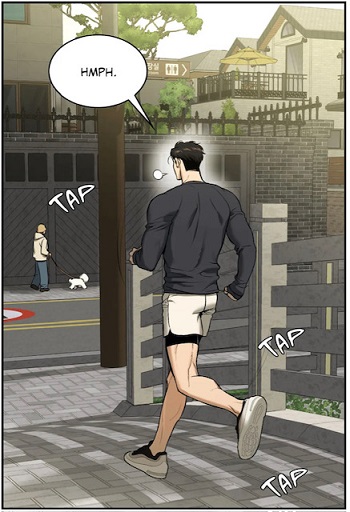
  (chapter 35) Choi Heesung made a terrible mistake, he attracted the attention from the guests at the café by covering his face. In order not to be detected as a star, the athlete has to act and dress like an average person: no fancy dress or car. And this leads me to my final point: using public transportation or the bike would represent a huge change for the Emperor. Once again, no one would suspect that a biker is a celebrity, similar to this scene:
  (chapter 21)

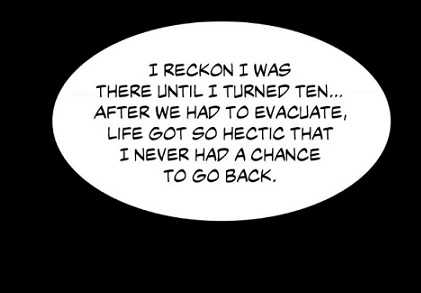 (chapter 53), she implied that she never got the chance to go to the West Coast because of him. It was, as if he had been a burden in her life (“life got so hectic”). This expression made me realize why Kim Dan came to live like a ghost. He embodies “life” for the grandmother: burden, responsibility, missed chance. It exposes her delusional mind-set. She is definitely chasing after an illusion. On the other hand, I detected that despite her words, she was not able to move her grandson’s heart. The latter was actually unwilling to leave the penthouse.
  (chapter 53) His decision was strongly connected to filial duty and not to “love”. Moreover, by fulfilling her request, he is one step closer to become free from self-blame and accountability.
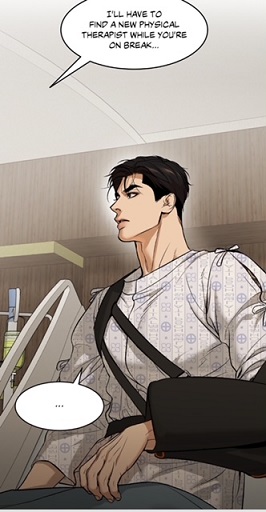 (chapter 53) Neither for the doctor nor for his “boy”.
  (chapter 52)
 (chapter 40) Though he lacked awareness in the States, for he was not present in the interrogation room, he can no longer claim to be oblivious. He knows about Kim Dan’s innocence. But why didn’t he call the physical therapist then?
  (chapter 53) Notice that before leaving the penthouse, the main lead was holding the resignation in his hand. This means that the young man had not informed Park Namwook yet. This gesture exposes that Kim Dan was convinced that the manager was his boss, the master of Team Black. Nevertheless, Jinx-lovers should detect that the “hamster” left the flat during the evening. This signifies that the PT handed out his abdication the next morning, I can’t imagine that it happened during the night, for the man has a family with kids.
 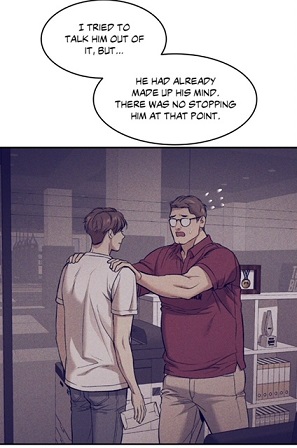 (chapter 53) By leaving the penthouse before going to the gym, it becomes clear that Park Namwook must have realized or even was informed that the doctor would no longer live with the champion, the opposite of this scene where he was caught by surprise:
 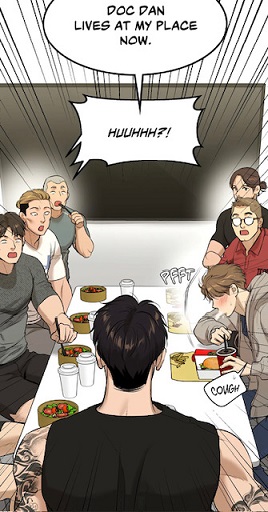 (chapter 22) That’s how I detected the second lie from the manager, lying by paltering. He just mentioned that Kim Dan was quitting, but kept silent about his departure from the penthouse. As you can see, Park Namwook was trying to reduce the main couple’s relationship to a boss-employee contract, while he was trying to act like a close acquaintance and relative from Joo Jaekyung.
  (chapter 53). This signifies that he must have spent some time at the office. To conclude, the young man didn’t vanish quickly from the gym like a ghost, similar to the PT from episode 1.
  (chapter 1) Kim Dan didn’t return to the office just to give his termination. He stayed there for quite some time. It exposes not only Kim Dan’s dedication for the athlete but also the manager’s deception. In verity, he didn’t do his best to stop him from quitting. He had time to talk to him, but chose not. He didn’t see it as an emergency. Hence there was no call! The latter symbolizes need and seriousness.
  (chapter 1)
 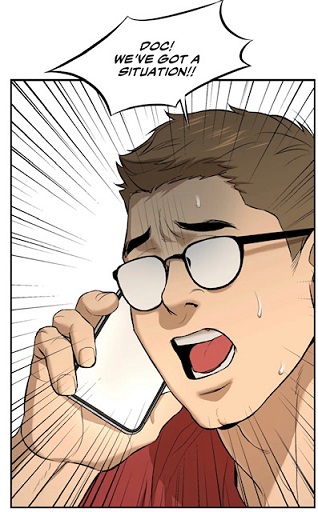 (chapter 13)
  (chapter 20) I selected only three scenes in order to prove my point, but I could give more examples (16, 17, 19, 35, 48). This new perspective corroborates my previous theory: the manager is not so innocent like he appears.
 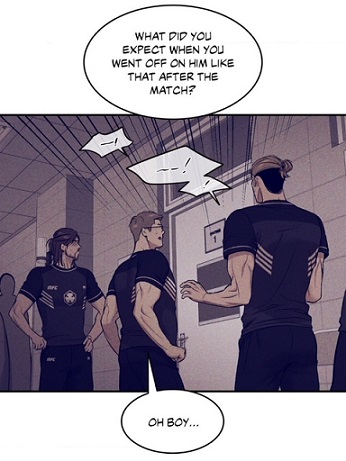 (chapter 53) He gave the impression that he was telling the truth. This incident was used to explain the doctor’s resignation. But here is the thing. If the doctor spent some time at the office in order to organize the files, why didn’t Potato stop him or tried to talk him out of it? That’s how I came to the following deduction. When Kim Dan came to the gym, the latter was empty, only the manager was there!! A new version of this scene:
  (chapter 23) Thus I deduce that all the members from Team Black were busy due to the discovery of the scheme:
 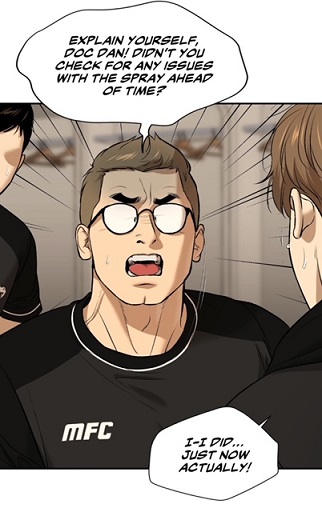 (chapter 50) Moreover, he could be blamed for the spray incident, for he failed to protect his own athlete. That’s why there was no apology from his side.
 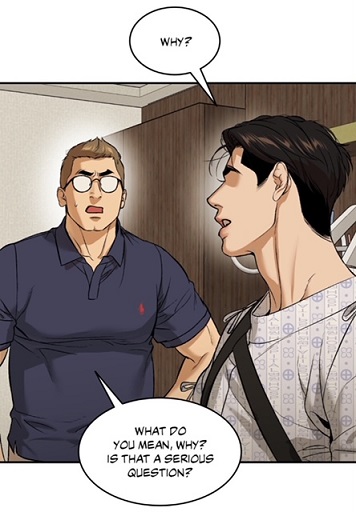 (chapter 53) Why would the physical therapist quit, if he is innocent? It is because Park Namwook said that Kim Dan did it because of the champion. It was, as if the man’s pride had been hurt:. The verity is that he was actually projecting his own thoughts onto the doctor.
  (chapter 53) He took his words to heart. Thus I come to the following deduction: Park Namwook already knew about the physical therapist’s innocence, but he chose to keep the truth from his boss to mask his own wrongdoings: his passivity and negligence. The reason is that the discovery of the scheme took place in the evening, and Kim Dan gave his letter in the morning. Moreover, some days had passed, when they showed up at the hospital. Potato’s vanishing injuries are the evidence. They waited for the right time to announce the terrible news, something similar to this:
  (chapter 48) “If we tell him now, it will only throw him off his recovery or his surgery”. Once again, he chose silence and inactivity. Thus no one called the champion or the doctor.
  (chapter 50) And what did the manager say to the protagonist?
 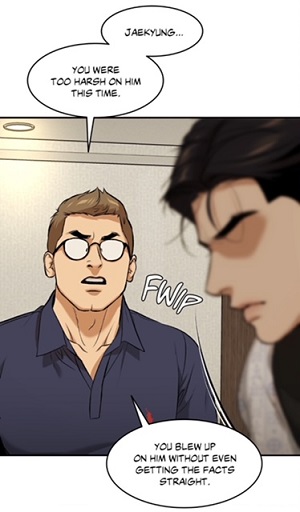 (chapter 52) He should have checked the facts. The letter is exposing the manager’s lie. He is expecting that Kim Dan vanished like the previous PT. However, contrary to the previous one, the “hamster” lived with the celebrity. Thus he left a letter to Jaekyung in the penthouse, and the manager had no way to know the existence of this message. And now, you comprehend why Kim Dan never received any phone call from Park Namwook. It is because he would have to inform him about the existence of the scheme. There was no emergency from his side, for he desired to hide his own wrongdoings (negligence, blindness and stupidity).
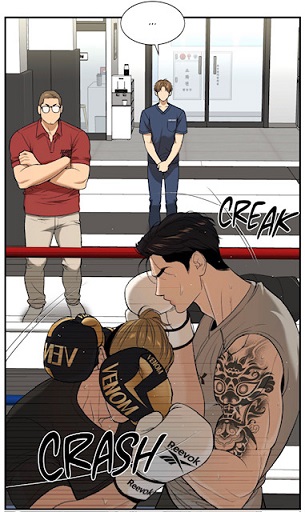 (chapter 36). No wonder why the man is passive. But his inactivity is the result of his indecisiveness (I had portrayed him as someone suffering from Decidophobia). Interesting is that making no decision is the worst people can do. Why?
 (chapter 46) In addition, this new discovery corroborates my connection between chapter 52 and 40. In my eyes, Park Namwook should be perceived as a representative of MFC. I had already compared the scheme in the States to a web and a spider, indicating that MFC is far from being a good organization. As a conclusion, the manager is an accomplice of the schemers, even if he was not involved directly. The reason is simple. With his inactivity and deceptions, he is assisting the villains. However, like explained in an earlier essay, the spider is not only connected to negative aspects. It represents wisdom, patience, creativity and even rebirth. Hence it is likely that this man will change or come to regret it at some point. Contrary to the halmoni, he has time in front of him and I am counting on the champion’s huge heart (for example like forgiveness).
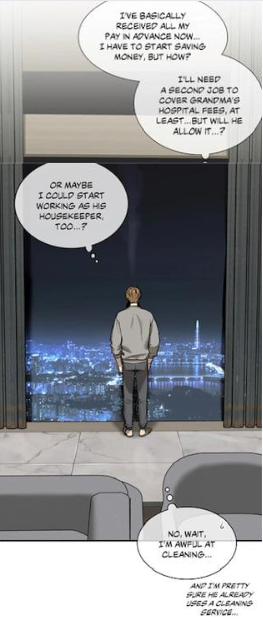 (chapter 53) Look at this. Back then, he was thinking of taking another job, a sign that he was not taking his job as PT seriously. The cause for this is that he didn’t view himself as a real PT. Nevertheless, this shows that he was not judging Joo Jaekyung as a champion, but as a man obsessed with sex:
  (chapter 19) This comparison outlines the PT’s metamorphosis. Not only his perception of Joo Jaekyung changed, but also he has become a responsible and dedicated physical therapist. He defines himself as a PT too. Hence he didn’t leave a mess behind with the files (chapter 53). His decision exposes that this was not an escape.
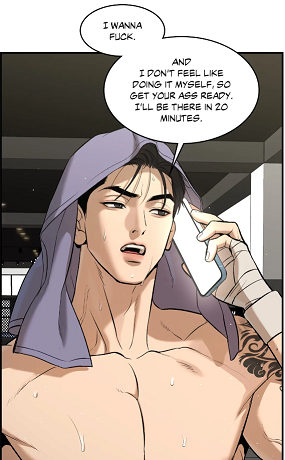 (chapter 19) Striking is that this conversation is strongly intertwined with emergency and racing against time. Back then, I had already developed the theory of the involvement of a third person in their relationship. Why would the champion think of sex suddenly after training for 10 days without any break? Jinx-philes can detect two common denominators: Break and responsibility. How so? In that chapter, Kim Dan was asked to become responsible for the “intercourse” (“I don’t feel like doing it myself, so get your ass ready”). As you can see, the contrast between these two episodes reinforces my hypothesis that the champion will be taking a break, though Park Namwook had not this in mind. The fact that he desires to hire a new PT indicates that he is already anticipating the return of Joo Jaekyung.
 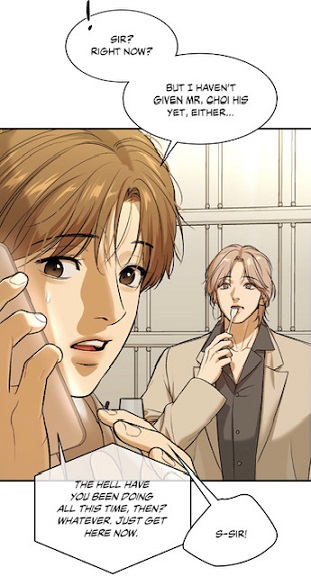 (chapter 32). Here, he prioritized his own needs and desires, he rushed things. He never took his time to understand Kim Dan or discover his life. The letter made him realize that he knows nothing about his PT. He has only noticed just now that he is reliable and honest. He is trustworthy. He even listens to him, accepts his words (he took his words to heart twice: the blame for the incident and the Wedding Cabinet). The other reason why he can not use the phone is this. He also knows that he could get blocked. This means that he will ponder how to find and approach his fated partner.
  (chapter 53) It is because for Kim Dan saying goodbye over the phone is not proper. The reason is simple. He experienced it himself as a child.
 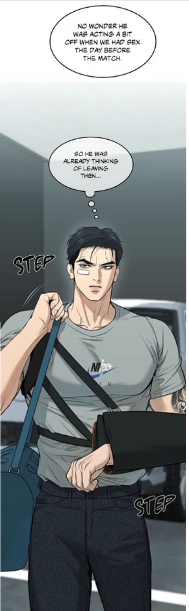 (chapter 53) He just left the hospital after a surgery and he is already carrying a heavy bag. No one is assisting him. There is no driver either. As a PT, Kim Dan can only get worried and feel bad. That’s how Kim Dan will realize that he is needed!
  (chapter 53) Even more than before!! Joo Jaekyung needs assistance and protection. From that moment on, he can grasp that his sacrifice was not the best for both of them, why his sacrifice was in reality pointless. He should have been more selfish and more confident.
 (chapter 44) He stroke his soulmate’s face, kissed his cheeks and finally his ears. His actions triggered a singular reaction in the star:
 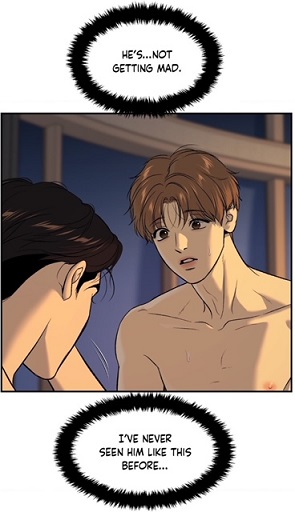 (chapter 44) This made the physical therapist’s laugh.
  (chapter 44) His genuine laugh combined with the following realization
  (chapter 44) shows that in that moment, the physical therapist rediscovered his youth again. I would even add that Jinx-philes were witnessing in this panel how Kim Dan reconnected with his inner child.
  (chapter 44) The blushing is an indication of life and innocence. But if this young man’s childish nature was brought to the surface, who was Tinker Bell during this night? Naturally Joo Jaekyung. Under the influence of soju, the man could no longer hide his true nature. He has a childish side too. In other words, he was lowering his guard. Anyone has already heard from the quote “In wine, there’s truth” (the original quote comes from Latine: “in vino veritas”). As you can see, this beautiful night corresponds to this one:
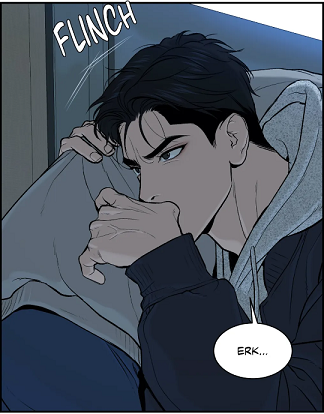

 (chapter 10) Under this light, it becomes comprehensible why Kim Dan’s beautiful night became a dream, an illusion. The young doctor had done something wrong from a moral point of view. However, because the young man had treated the champion so well before, his reward was to experience what love is.
  (chapter 44) Thanks to Tinker Bell, he could fly: he was brought to Nirvana.
  (chapter 44) The problem is that the physical therapist was reducing love to sex (“making love”). True love has to be expressed in a lot of different ways (spiritual intimacy, experiential closeness, responsibility etc) and not just through sex.
 (chapter 43) Interesting is that in that scene, the protagonist couldn’t see his lover’s face. He couldn’t detect the glimpse of a smile and his warm gaze.
  (chapter 11)
 (chapter 47) By saying that he was a puppy dog, she was implying that she would be responsible for him. Keep in mind that pet are linked to care and accountability. However, her wish is strongly connected to one single moment:
  (chapter 53) She is not thinking about the future at all. For her, it doesn’t matter, for her time is limited. Dog can be abandoned in the end, especially when the responsibility becomes a burden. That’s the reason why I believe that in verity, she was treating the protagonist more like an object than like an animal. Moreover, Jinx-philes should keep in their mind she used to describe him as a little boy, which also represents responsibility and care. Therefore I conclude that this scene didn’t stand for Kim Dan’s true home, it was just an illusion.
  (chapter 44), though the communication failed, for Joo Jaekyung was drunk. Moreover, Kim Dan kept most of his thoughts to himself, a sign that he was still guarded. Hence while Doc Dan felt at home during that night, it didn’t last long. The next morning, they became once again boss and employee.
  (chapter 19) They were no deep lingering feelings towards the grandmother’s house. In fact, before leaving, he remembered an incident, a mysterious phone call which I consider as the moment, which broke the boy’s soul and heart. For me, he was almost glad to leave this place behind.
 (chapter 30) The pajama pattern in the image appears to resemble a leopard print, which features distinct rosette-shaped spots that are commonly associated with this type of design. He also looked like a sulky “cat”.
  (chapter 30) And what was he trying to do here? To seek closeness to his new mate!
 (chapter 19), very territorial and disliking surprises. In literature, leopards often symbolize strength, courage, agility, and stealth. They are seen as solitary and powerful hunters, often representing independence or mystery. In totemic traditions, the leopard can symbolize resilience, adaptability, and personal power, often embodying a person’s inner strength and ability to face challenges.
  (chapter 26) One might argue that he laughed with Potato and Oh Daehyun in the States. But are you sure? We never saw him laughing. Only Joo JAekyung heard their laughs, but did it also belong to the hamster?
 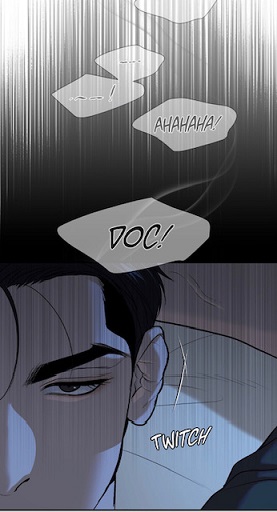 (chapter 37) Moreover, observe that during that terrible night, the athlete was wearing an t-shirt with a feline on it:
  (chapter 37) Puma was designed on it. As you can see, everything is pointing out that this man is a leopard which was mistaken to a sulky cat or a puma.
  (chapter 44) So since the champion was naked during this night, we could say that his true nature was slowly coming to the surface. As a predator, his annoyance to the strokes and kisses appears more normal and understandable:
 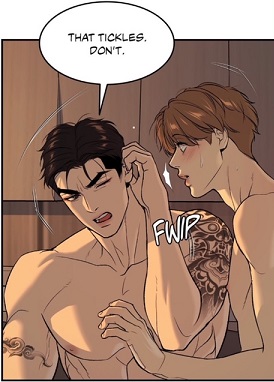 (chapter 44) Kim Dan is teaching him how to control his strength and discover playfulness. And now, imagine Kim Dan patting a leopard 😉
 (chapter 44) and the leopard fighting a wounded and isolated hyena:
 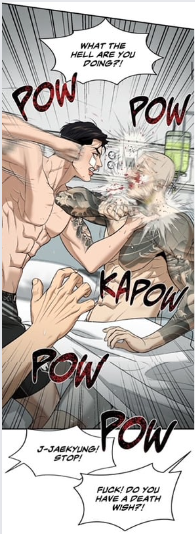 (chapter 52) But what had triggered the champion?
  (chapter 52) Eye-contact! Making direct eye contact with a leopard can be dangerous. Leopards may interpret prolonged eye contact as a threat or challenge, triggering an aggressive response. In the wild, they rely on stealth and avoid open confrontation, so they may react defensively if they feel they are being stared at. This behavior is common among many predators, as eye contact often signals dominance or confrontation. It’s generally advised to avoid direct eye contact and back away slowly if you encounter a leopard in close proximity. Baek Junmin had totally underestimated the true nature of his opponent. This could explain as well why Park Namwook is wearing his glasses all the time and even avoiding eye-contact with the emperor.
 (chapter 24), Oh Daehyun the eagle…
 (chapter 9)
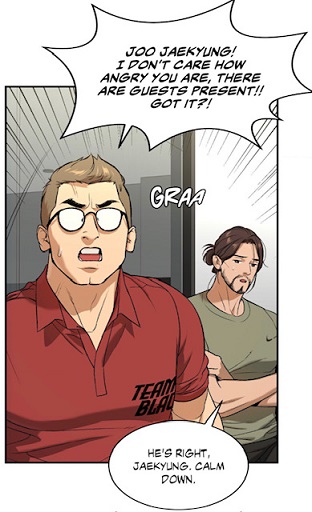 (chapter 36), slaps
 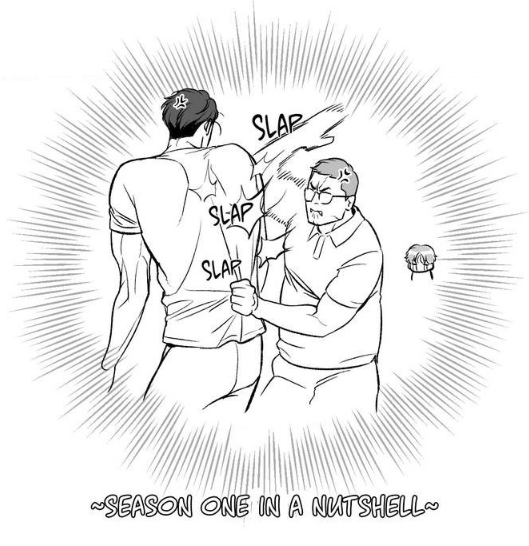 (note) and punches. But how do psychologists explain this creation?
  (chapter 26) He would destroy the arcade’s punching machines constantly, which led him to become blacklisted. This means that for the coach from Team Black, the young man was just a brutal and thoughtless thug and nothing more. He judged him based on his appearance and actions. Since he had money in order to open his own gym, he became a spoiled rich brat in the former wrestler’s eyes. But notice that the article is pointing out that the person suffering from Keinshorm Effect rejects any discussion from their counterpart because in truth, they actually dislike this person. This exposes the truth about Park Namwook: he actually resents the main lead. He only accepts him because of his success and fame. At the same time, this biased perception incites him to view himself superior to his pupil.
 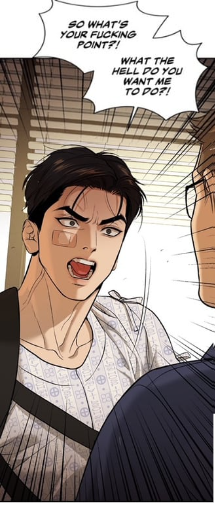 (chapter 45) The Emperor had voiced his thoughts and emotions. This shows that he was trying to have a discussion with his hyung. He desired to be heard too: he voiced his powerlessness and questioned the coach’s intention behind his previous reproach.
 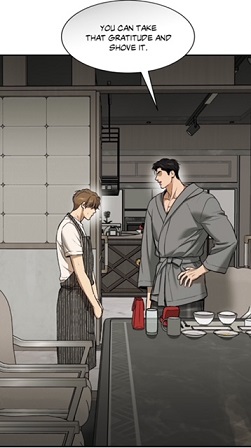 (chapter 45) While some readers still judge the athlete as a red flag and bad guy, they fail to realize that in a discussion, it is not about right and wrong. They are probably under the effect of the Heinshorm Effect due to the first bad impressions. 😉 In this discussion, both made valid points, yet both were in the wrong too. In reality, in a discussion, it is relevant to listen to the counterpart’s opinion and words. And that’s exactly what both did, though it hurt them too. But there is more to it.
  (chapter 49) Like mentioned in a previous essay, I am suspecting that the athlete was a target of bullying and the perpetrators used his weakness and isolation to their own advantage. In other words, Park Namwook only saw the young man, once the latter had started training in order to protect himself. If he could ruin the machine, then it means that he had developed some strength. Thus I deduce that he never saw the future champion crying. At the same time, his negative perception led him to think that it was not possible to reason with him. He would only understand the power of the fists and nothing else. And this brings me to my next point.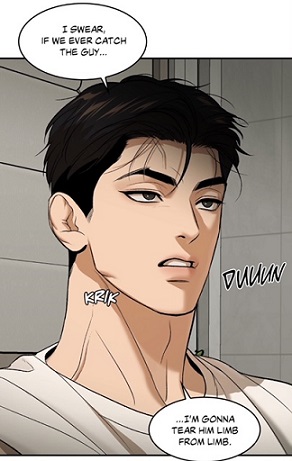

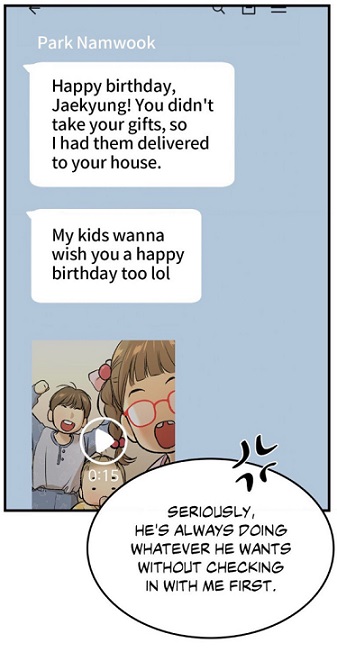 (chapter 45) This was the sign of a poor connection between these two characters. Whereas the gap between them grew bigger and bigger, the opposite happened between the two protagonists. Under this new perspective, Jinx-philes can grasp why Mingwa created so many scenes with arguments between the two main leads. They should be seen as reflections from the past.
 (chapter 29)
  (chapter 30) In the past, I used to think that this title were referring to the existence of two worlds: celebrity versus criminal world. But now I am thinking that these extreme worlds should be seen as “emotions” versus “reason” and “love versus hate” too. Idols are exposed to such extreme emotions (stalking, adoration versus hate).
  (chapter 36) In the second case, Joo Jaekyung could experience it twice during the first season. Whereas he got upset with the article from Shim Yoon-Seok
  (chapter 35), in the second one he was more composed.
 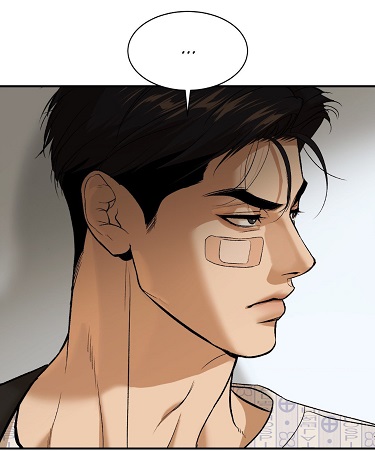 (chapter 52) He was already learning that the media were not reflecting verity. He was already distancing himself from social media. He had slowly realized that his image as star was not his true identity. At the same time, the letter contrasts with the short messages from haters. It outlines that Kim Dan’s admiration and recognition is sincere and deep. He didn’t get influenced by the media.
  (chapter 52) For him, Joo Jaekyung deserved to be suspended… he had punched his opponent at the hospital. Imagine the irony of the situation. Later, the manager used violence too, but it was excusable:
  (chapter 52) Why was Baek Junmin place next to his opponent? Someone will have to confront this man for his negligence, unfairness, stupidity and incompetence.
 (chapter 1) However, despite his biased perception about the athlete, he came to overcome all his prejudices about his boss and came to truly love the fighter. And this brings me back to this comparison:
 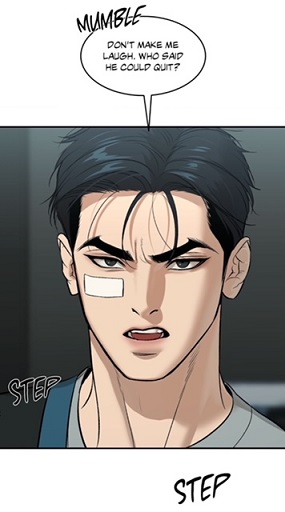 (chapter 53) This shows that he is now making his own decisions and this in the absence of his mentor. It somehow implies that the champion also stops communicating to Park Namwook. Finally, notice how he reacted after reading the letter: he truly felt bad. He was already attached emotionally and mentally to Kim Dan. As a conclusion, the season ends with the switch of the position between Kim Dan and Park Namwook. The former has already come to replace the manager. Indifference versus guilt and pain.
 (chapter 36) He wouldn’t have been allowed to voice his opinion. He would have been even suspected of spying and leaking information (lawyer and manager from the Entertainment agency). Kim Dan needed to realize and admit his love and admiration for the athlete. first in order to stop Keinshorm Effect. He needed to be a confident and competent PT and become a friend for the protagonist. Since Kim Dan stands for communication, tolerance, respect and openminded-ness, the former hyung embodies the opposite notions: silence, dislike, clouded judgement and mental rigidity. Thus I deduce that in the future, the discussions about fights will take place differently. Involvement from all the members, opening listening and Kim Dan as a PT will have the decisive right for allowing a fight or not.
 (chapter 52) The remaining members from Team Black were paying a visit to the recently surged athlete. One detail caught my attention.
  (chapter 5)
  (chapter 7) Nevertheless, the young man was struggling financially back then, he could barely buy himself some food. Nonetheless, he still took his time to visit her before going to his new work place. And this brings me back to the image from episode 22:
  (chapter 52) But there is more to it.
 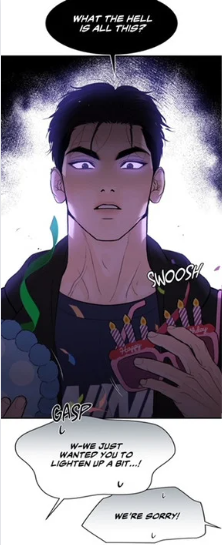 (chapter 43) He wouldn’t have liked it. He dislikes presents anyway. However, his reaction at the surprised birthday party can not be utilized as an excuse. Why? I have two reasons for this objection. First, he saw the birthday party as a disturbance to his routine (training)! That’s why he said this to the fighters:
 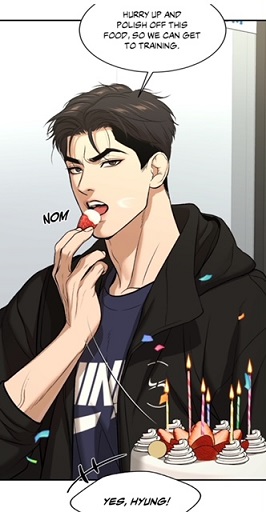 (chapter 43) They should eat the cake quickly so that the training could start. But at the hospital, he has all the time in the world. He can not train due to his injured shoulder. Hence the gift doesn’t represent a transgression at all. As for the second reason, note that the athlete ate the strawberry with the cream, with this gesture, he was sending the signal that he was accepting their present, though he didn’t eat much. Finally, by eating the strawberry, he displays his like for fruits!!
 (chapter 52) Yes, everything is revolving around money for Park Namwook. This observation leads to the following remark. The manager offered nothing to Joo Jaekyung, because he is rich. He has everything he needs. That’s how it dawned on me that so far, the coach has never offered anything to the star himself at all, not even after his victories. Just a stroke on the shoulder
  (chapter 5) and a compliment in the hallway
  (chapter 40). In fact, the one doing a favor was always Joo Jaekyung for the manager. Hence the former chose to lie about his shoulder: he is not allowed to show any sign of weakness.
  (chapter 40)
  (chapter 15) Here, the manager was willing to bring him “all the water the star could ever want”. And guess what? Water is supposed to be free! Naturally, he was replying to the champion’s request. However, I don’t think this remark is anodyne. In fact, “all the water you could ever want” is an indication that the champion is not allowed to be too greedy and Park Namwook is only willing to offer water and nothing else. It exposes Park Namwook‘s greed.
  (chapter 21) Did he spend his time with him in order to give him some comfort? The answer is always NO. Yes, Joo Jaekyung appears as a knight in shining armor compared to Park Namwook.
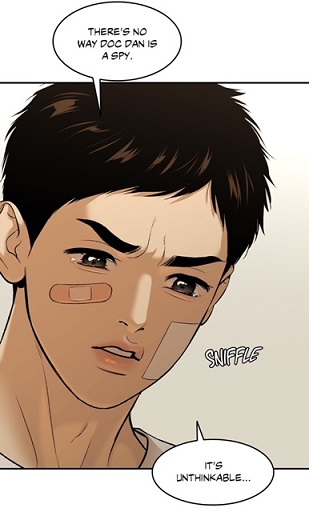 (chapter 52) Here, I am giving you a comparison with Kim Dan:
 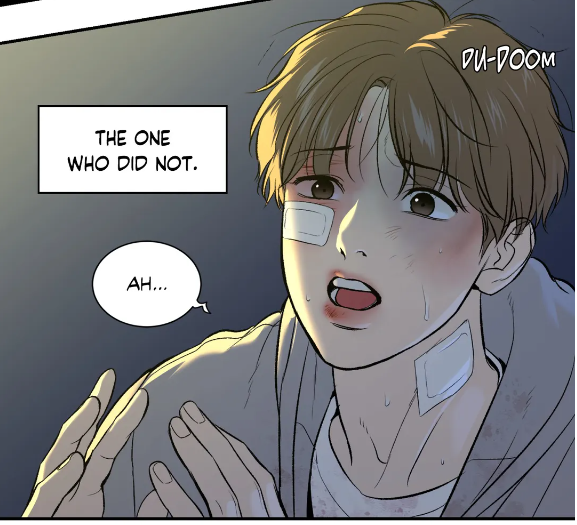 (chapter 18) The latter had just received his treatment at the hospital. The maknae and the others had not appeared, because they had gone to the hospital in order to treat the chowchow’s wounds. This shows that some time had passed, until they chose to visit the wounded and lonely star. Besides, Jeong Yosep had contacted in the main time the authorities (police, MFC)
 (chapter 15), but he didn’t offer him anything at the hospital: no book, no ginseng, no fruit…. In verity, he was the one who desired to get comfort and validation.

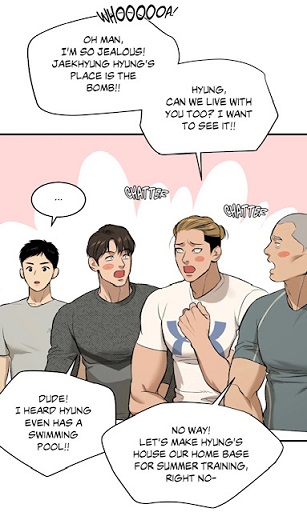 (chapter 22) It shows that ring does not necessarily possess a negative connotation. To conclude, ring is a reference to marriage (Kim Dan will become the champion’s official partner), to the MMA arena, to Team Black, but also to Mafia. We had an allusion to criminality during the sparring
  (chapter 26) and when the champion discovered the loan shark and his minions on the verge of raping Kim Dan.
 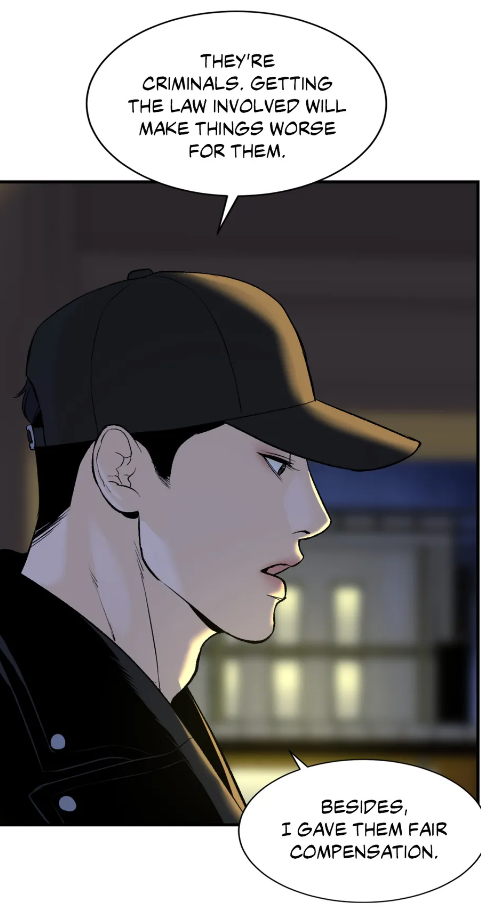 (chapter 18) The doctor is unaware of this, but one of his purposes in the champion’s life is to clean the scene, MFC and its corruption. On the other hand, the illustration contains many pictures of the two main leads having sex.
  Why? It is because the characters are acting like fighters. At bottom left, the doctor’s embrace resembles a lot to the one he used during the sparring (see the image in the middle). Their gestures are sudden and quite abrupt, which contrasts to the image on the right bottom. The kiss from the doctor holding Joo Jaekyung’s face represents the exception from all the selected panels. This shows that this Summer Night’s Dream indicates a huge transition in the sex sessions. But let’s return our attention to the images illustrating roughness. Right from the start I detected a strong connection between fighting and sex. [For more read
 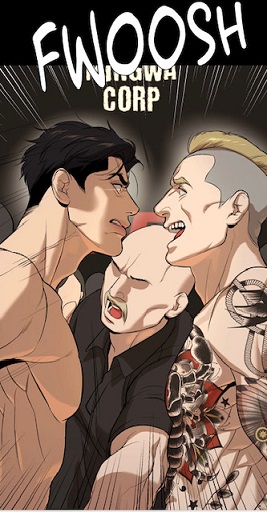 (chapter 14)
  (chapter 36)
 (chapter 29)
 (chapter 15) Funny is that conversation is permitted, yet mouth gear hinders the fighters to talk. Should they remove it constantly, the referee can judge it as a violation (“Timidity”), for the fighters can not fight, as long as they don’t wear the mouthpiece. This signifies that the sportsmen are encouraged to express their thoughts through the hands.
  (chapter 15)
 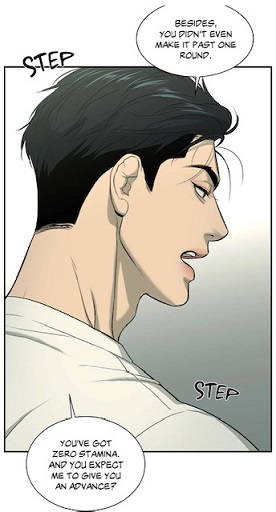 (chapter 12). The absence of kisses and caresses can be explained with the presence of mouthpiece and hand wraps in the ring. Moreover, in the arena, there is no warning up, therefore we have the explanation why the champion never included foreplay. On the other hand, the fellatio was used as the symbol for submission. The rival was always brought to his knees.
 (Chapter 6)
  (chapter 39) I would even add that the opponent’s challenge was to overcome the long intercourse. I doubt that he gave his past partners a break while having sex.
  (chapter 39) At the same time, it explains why the champion didn’t take the partner’s pleasure into consideration. It was a battle in bed, which was led by the protagonist. The latter was not only acting as MMA, but also as arbiter and MFC matchmaker. With his money, he could determine the time, the location and the duration.
 (chapter 5) Their gestures were seductive, a sign that they were not fearing the champion. The challenge was here the difference of weight. On the other hand, by approaching Joo Jaekyung, they looked confident about their skills. That’s the reason why he would have sex with them, until they passed out.
  (chapter 33) He was testing their stamina and as such he desired to demonstrate his superiority. He had to make them KO in bed. However, the green-haired uke represented an exception, because he managed not to pass out. That’s how he became the athlete’s regular partner.
  (chapter 2) This means that Joo Jaekyung failed to defeat this competitor in bed. This explicates why the “goblin” came to look down on the star. In fact, he realized that he had the upper hand.
  (chapter 2) I have to admit that this picture has always bothered me, because we can see that Joo Jaekyung was facing his bed partner. Yet we know that his favorite position was the doggy style.
  (chapter 1)
  (chapter 4)
  (chapter 8)
  (chapter 12)
  (chapter 34)
  (chapter 36)
  (chapter 39). As Jinx-philes could observe, till the night in the States, the champion privileged to have sex from behind. How do we explain the difference and when did this change occur?
  (chapter 2) The champion’s ecstasy served as a measurement to view himself as victorious. This statement implies that he was not only the fighter, but also the arbiter. This corroborates my previous statement. During sex, he was the fighter and the referee. He acted as the MFC matchmaker.
 (chapter 43) In my opinion, during that night
  (chapter 2) The goblin might have not voiced his thoughts to the celebrity before, but Joo Jaekyung could perceive his soul through the gaze and facial expressions. Hence the star’s domination was quite superficial. In fact, as time passed on, the athlete could only get bored of the goblin.
  (chapter 42) It is because there was no challenge. The guy was accustomed to the champion’s roughness. Hence he never feared the star. He could only judge him as weak. Because Joo Jaekyung was missing the thrill, he came to look for the “wimp”! On the one hand, the latter would treat him with respect
 (chapter 1), on the other hand, he would cry and tremble in his presence. Then right after the session, he left the room in a hurry.
  (chapter 1) That’s how I realized why during that night, the champion felt the need to call Kim Dan.
  (chapter 1) It is because the “hamster” had not only feared him
 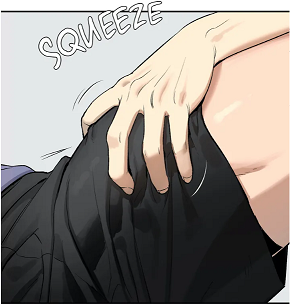 (chapter 1) He had grabbed his anaconda!! But this represents a breach of rules in MMA! That’s how I realized that the doctor’s action pushed the fighter to violate many of his own rules: interruption of the flow!
  (chapter 21) Then after facing Heesung, he stopped the intercourse too,
  (chapter 35) indicating that little by little, the champion’s mind-set was changing. At the same time, it exposes his hypocrisy. But why is he forced to accept the change of flow? It is because life is trying to teach the champion that he is not god, he is not the owner of time. This explicates why the star couldn’t determine the start of their “Wedding Night”, the doctor’s suggestion represented a new challenge.
  (chapter 3) He was defying the champion’s authority.
  (chapter 3) Despite his fear, the hamster wouldn’t become submissive like the others. While the green-haired uke faked submission and the others got defeated by KO, Kim Dan remained true to himself. He embodies honesty and modesty, the opposite values of the “goblin”.
 (chapter 4) That’s the reason why the two main leads were sleeping under the cover. This explicates why he selected the doctor as his definitive partner. I also discovered another infringement during the “Wedding Night”: the champion refused to wear any protection during sex.
 (chapter 2) Let’s not forget that during a match, they are supposed wear a sex gear. Interesting is that he grabbed the doctor by the hair
  (chapter 4). It is important, as it represents a real transgression of MMA rules indicating how powerful the doctor was. The champion needed to break rules in order to get him. Funny is that he thought that after such a long night, he had been able to submit the cute hamster, but he was totally wrong. The latter chose to ignore him.
  (chapter 5) It was, as if he was hiding from him. What caught my attention is that while he tried to get in touch with the physical therapist, he called MFC Match Manager at some point. Why? I believe that he had planned that after his huge success to organize another match very soon. As you can see, the intervention of Saturn, the god of time, taught the champion through the hard way, he was no real MFC Matchmaker. By refusing to answer his calls, Kim Dan was the one determining the time.
 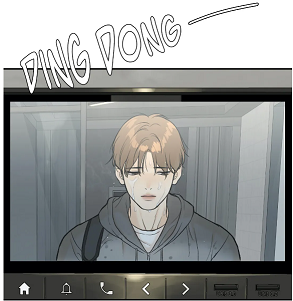 (chapter 6) Under this new light, it becomes comprehensible why the athlete offered this deal to the physical therapist:
 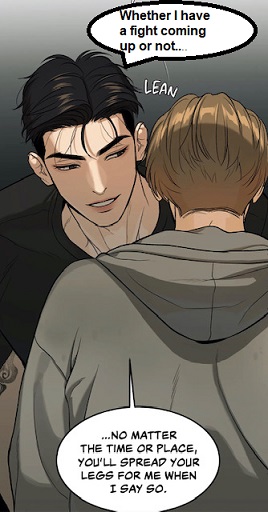 (chapter 6) He was trying to regain the upper hand in their relationship. He wished to keep his position as the owner of time. But the problem is that despite this contract, he wasn’t able to control Kim Dan. The latter chose to approach Kim Changmin
  (chapter 7), while he kept his distance from the champion. This scene made him realize that he was still powerless.
  (chapter 7) Under this new light, it becomes comprehensible why in the States, the goddess Mingwa chose to send the doctor to his room much earlier. Both protagonists were fighting against each other concerning time.
 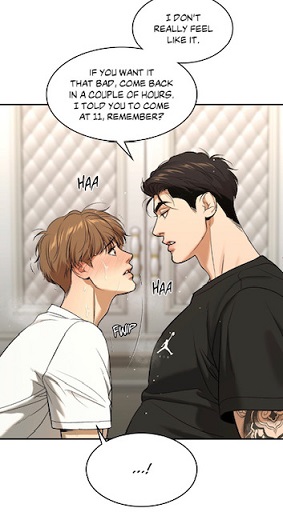 (Chapter 39) Hence I come to the conclusion that Kim Dan’s role in the champion’s life is to teach the champion that he doesn’t own time. The reason behind this lesson is simple. It is to show him how pointless it is to race against time.
  (chapter 12) or having sex in front of a mirror
  (chapter 20) or anal masturbation in a car
  (chapter 32) I could mention other defies linked to sexuality, having sex without getting noticed, either in the shower room
  (chapter 8) or during a phone call
  (chapter 24). Then we have this bet concerning the doctor’s sensitivity.
  (chapter 29), thus the champion tried an experiment:
  (chapter 29) Furthermore, notice that each time they had sex, the doctor was pressured to have sex with the champion. Kim Dan felt that he could never refuse.
  (chapter 12) On the other hand, the athlete always met some resistance
  (chapter 27) Kim Dan would never agree to the champion’s requests immediately. They would fight about the time, location and position. Furthermore, note that Kim Dan went so far to punch the protagonist:
  (chapter 7) This could only increase the athlete’s interest and obsession for the physical therapist. Although he was getting paid, the latter would never admit submission. He thought, he had achieved his goal in that scene
  (chapter 11), yet the reality taught him a tough lesson. He got to hear something terrible:
  (chapter 12) With his words, he was telling the sportsman that he was a terrible lover. He denied any admiration for him. And since sex is a synonym for wrestling in Joo Jaekyung’s eyes, doc Dan’s declaration signified that his title as champion was questioned. Though the champion came to enjoy their intercourse
  (chapter 12), it was short-lived, as the doctor fainted after one round.
 (chapter 26) Observe how the doctor reacted after the sparring took place. .
  (chapter 27) He rejected the suggestion from the champion. As Jinx-philes can detect, the sparring affected their relationship. However, the notion of consent represented more an exception than a habit. Thus I consider the scene in chapter 44 as a real turning point in their relationship.
  (chapter 44) Why? It is because this sex session will have an impact in their work, MMA. During that night, they became real fuck buddies. Sex was not related to work and fighting. But why did the notion come to the surface for the sparring? It is because MMA fight consists of challenges, which implies consent. Striking is that so far the champion never rejected a challenge. Yes, Joo Jaekyung was put in the same situation than Kim Dan in the end, but the one putting under pressure was the MFC Matchmaker and naturally the agent from Entertainment agency. Don’t forget that both are earning money thanks to events. And how did the champion got convinced by them? “You think, you can do it?” With their words, they doubted his talents
  (chapter 36) or questioned his title:
  (chapter 41) He is treated like a doll, but he is not realizing the manipulation. How can he, when Park Namwook is not detecting it either? Under this new light, Jinx-philes can grasp the real root of the argument in the car.
 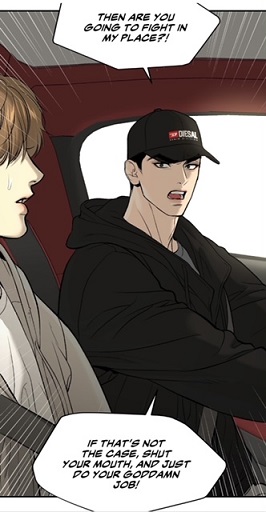 (chapter 42) There, the doctor tried to control the champion’s time, as he suggested him not to go to the training. No wonder why Joo Jaekyung reacted that way. On the other hand, the athlete replied with a defy. Thus I deduce that at some point, the doctor will react to these words. As you can see, the champion needs to learn to say NO to them. That’s the reason why I started suspecting that in episode 5, Joo Jaekyung might have planned a match, as he felt invincible thanks to Kim Dan.
 (chapter 12) And because the doctor never reacted the way the champion expected it, the latter was forced to infringe more and more MMA rules, like this one
  (grabbing the groins is forbidden). To conclude, the doctor is there to teach the champion to distinguish between love and fighting. This explicates why the physical therapist embodies violation of MMA rules. We have the perfect example in this scene:
  (chapter 25) Potato made a mistake which could have made the doctor unconscious. That way, he can expose the corruption within MFC and its implication with the mob. That’s the reason why I am more than ever convinced that Kim Dan is destined to become a MMA fighter in the end. Why? It is because he is the champion’s reflection. The moment Joo Jaekyung is no longer the fighter in the ring, but the spectator or assistant, he is forced to witness how his loved one is risking his life. So far, he never showed any interest in the fights of other members. He needs to understand why Doc Dan would advise him not to fight. And this brings me to the next remark: Kim Dan is a strong believer, like we could observe it in this scene.
 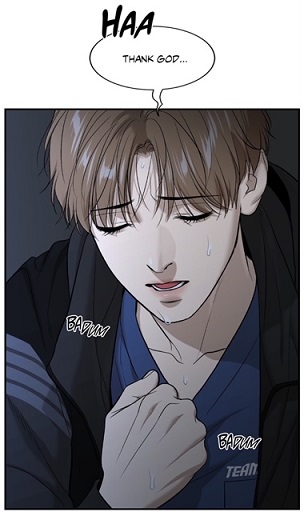 (chapter 40) This explicates why he was willing to risk his life for his sick grandmother.
 (chapter 36)
 (chapter 44) His gestures represent a transgression of MMA rules, as he had stretched his fingers towards the main lead’s face.
  (chapter 44) By taking the initiative, the physical therapist is teaching his “mentor” how to express love. Interesting is that during that scene, the athlete remained passive. It displays his consent and trust towards the doctor. He knows that the latter won’t hurt him. That’s how I realized that the kisses are strongly connected to consent. Let’s not forget that when Joo Jaekyung smooched the hamster for the first time, he took him by surprise. Because the latter felt uncomfortable, he made the following request:
  (chapter 15) This request insinuated consent. Then when the doctor smooched the champion’s ear, the latter objected to it.
  (chapter 14) Then it was out of desire
  (chapter 24) and out of excitement and attraction.
  (chapter 27) However, I noticed that it is linked to their position. They face each other. In chapter 15, Kim Dan was turned around, hence they were no longer having sex from behind.
  (chapter 15) In chapter 24, first it was from behind, but then it changed, as the star desired to see the hamster‘s erected phallus.
  (chapter 24) He wanted to make sure that the doctor would enjoy this break. Yet, what caught my attention is that in chapter 39, Kim Dan initiated the kisses and embraces, because this is what he likes.
  (chapter 39) Here, the athlete was caught by surprise, and protested, but he got silenced very quickly.
  (chapter 39) Finally, so far, it was not a ritual, hence we only had smooches in chapter 14, 24, 28 and 39. This signifies that Kim Dan is the one who will introduce kisses and embraces as rituals. Moreover, if someone were to kiss one of the protagonists, the other would view this gesture as a crime against his partner.
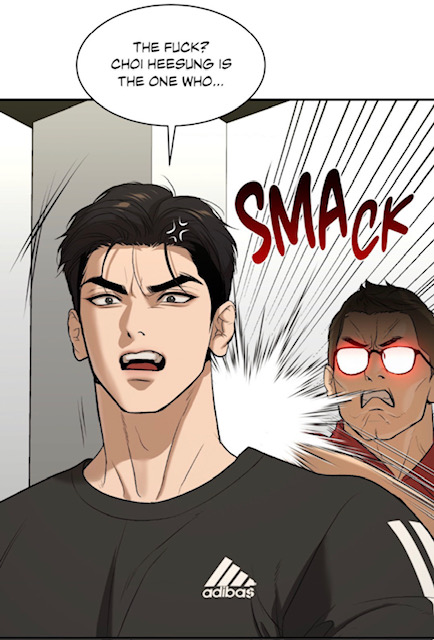 (chapter 31) That’s how I recognized the huge importance of this scene:
 (chapter 32) Joo Jaekyung entrusted his neck to the doctor. The latter stroke it for a long time. And now, you comprehend the initial hesitation from Joo Jaekyung in the hotel room:
  (chapter 39) Therefore it becomes comprehensible why in the penthouse, he allowed his lover to approach his fingers towards his face.
  (chapter 44) He felt safe. This explicates why he could fall asleep so easily.
 (chapter 39). On the other hand, since the doctor was under the influence of the drug, the champion couldn’t take the confession seriously. It is important that the champion doesn’t recognize the doctor’s feelings right away, for he needs to feel insecure. That way, he is pushed to change his behavior, to become more proactive and protective of Kim Dan. Hence I consider this Summer Night
  (chapter 34) Yes, the meeting with the artist was a challenge, he was showing to Heesung that if he tried to take away his “fighter”, he would have to fight for real. And what did the actor do during that night? He ran away, he refused to take the defy. This position
  (chapter 35) The gods were punishing him for not respecting the physical therapist.
 (chapter 44), though the doctor had not sex in mind at all. He brought him there to rest. However, the presence of fighting has not vanished totally in episode 44:
  (Chapter 44)
  (chapter 44) It shows that the power is shifting, Kim Dan is slwoly getting the upper hand in their relationship. He can control time and place.
  (chapter 29) The celebrity refused to have sex every day, for he considered it as work. Why? It is because he is associating it with fighting. This is what he had in his mind:
  (chapter 44) This means that the connection between sex and fighting is vanishing. The sportsman can actually realize that sex is leisure and resting. He had made such a suggestion in the past
  (chapter 27) But he got rejected by Kim Dan back then, because the physical therapist considered sexuality as shameful. As you can see, the doctor’s actions are changing the champion’s perception of sex. It is no longer fighting, but resting. On the other hand, the doctor can seize the occasion to express his love through his caresses and kisses. At the same time, he could use it as a treatment for his insomnia.
 (chapter 4)
  (chapter 10)
 (chapter 42)
  (chapter 42) Interesting is that the champion was also thinking a lot about the main lead, as the latter was worried by his exhaustion and his lack of appetite.
  (chapter 44) By occupying his mind, Kim Dan is winning his heart. He is reminding him of the fragility of life, but also of true courage due to his humbleness and selflessness. Hence it becomes comprehensible why I stated that the doctor would risk his life or reputation for Joo Jaekyung. He will appear as a true hero receiving the admiration from his loved one and members from Team Black. In my eyes, he will become the heart and soul of Team Black, while the champion is the face of the gym. Though the members are behaving like a family, I detected a lack of cohesion and a certain indifference. No one was missing Potato during the day of the birthday party
  (chapter 43), just like none of the coaches were wondering about the whereabouts of Kim Dan in the States.
  (chapter 40) It is important that he brings the members closer together, as there is an enemy in the shadow: the Mafia.
 (chapter 44) See the contrast to the night on the couch:
  (chapter 29) Contrary to the past
  (chapter 4) Joo Jaekyung is not hiding his pleasure. He is moaning loudly, as he has his mouth wide open. It exposes once again the increasing trust in Kim Dan. He no longer mistrusts him, in his eyes, he is no longer a prostitute. That’s how the doctor won the champion’ s heart. Now, his heart is truly beating for the doctor. Little by little, the hamster is taming the wolf. The latter needs to recognize that by loving the doctor, he will become powerful.
