Protected: Painter Of The Night: The moon 🌙in the darkness (second version)

Bebebisous33s' analyses in K-Dramaland and Manhwas
Analyses of K-dramas and Manhwas (for the most part Yaoi)

This is where you can read the manhwa. https://www.lezhinus.com/en/comic/painter But be aware that this manhwa is a mature Yaoi, which means, it is about homosexuality with explicit scenes. If you want to read more essays, here is the link to the table of contents: https://bebebisous33analyses.wordpress.com/2020/07/04/table-of-contents-painter-of-the-night/
This won‘t be a long analysis like “The end of the vicious circle”, for my main purpose here is to try to reconstruct Yoon Seungho’s terrible past, and as such its chronology.
We know now for sure that the starting point of Yoon Seungho‘s downward spiral was the incident with Jihwa.
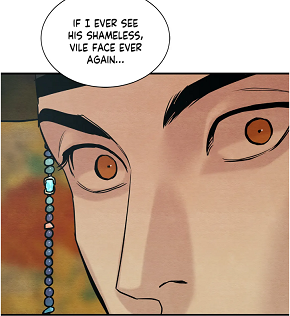
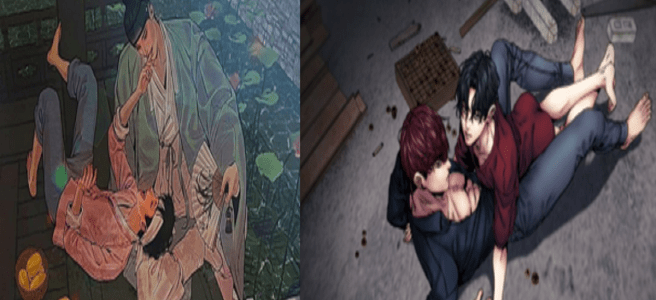
Chapter 77:  The young boy was caught doing something immoral, though like I elaborated it in my previous analysis, there‘s no doubt, the main lead was drugged, and Jihwa had been somehow manipulated. While some might see two teenagers fooling around, I have a different perspective. Then I came to realize why the perception from the manhwaphiles diverges so much. It is, because the readers are actually projecting their own thoughts and expectations. Hence this is normal that certain readers are still expecting something innocent and pure. Yet, since I believe, Yoon Seungho was never a sodomite from the start, but was turned into one, for me the smile and gaze from Yoon Seungho in that scene seemed so fake and artificial, especially if you compare it to this one:
 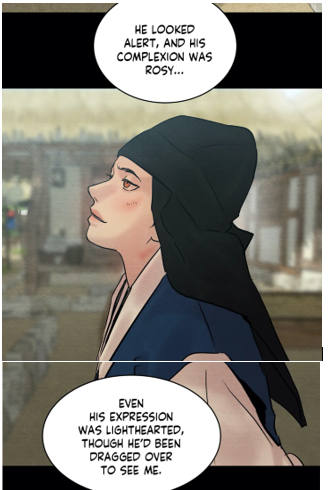 (chapter 57) versus
  (chapter 77) In the first one he oozes innocence and affection, in the other he’s in ecstasy, roofied. However, we have to envision that this smile could have just been a projection of the butler, which means that this represents a distorted memory. Like I explained in my previous essay, the noble has the same gaze than the painter under the influence of opium and alcohol.
“Date rape drugs make a sexual assault, including rape easier in one or more ways, such as:
And if you pay attention to Yoon Seungho, he was not active at all. He was behaving like the painter in chapter 54.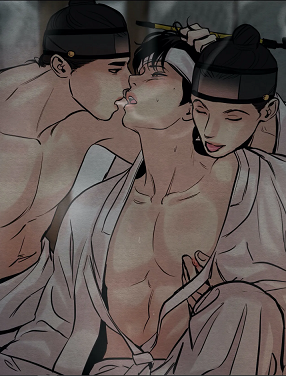
Observe the butler‘s actions. He opens the door without announcing himself. But remember the butler’s MO, it is to delay to deliver the information. We could observe this on different occasions like chapter 44 or 50. He never told the painter about the scholar’s departure (chapter 44), just like he only reported the conversation between Jung In-Hun and Baek Na-Kyum many weeks later.
 (chapter 50) That’s why I come to the conclusion that he never ran immediately to father Yoon in order to report the incident. The butler just needed to inform him later. While in the past, I used to think that he had used rumors again as an excuse, I have now a different perception. For me, it was someone else badmouthing the main lead, well aware that father Yoon feared gossips the most,
  (chapter 50) an older version of this image. This explicates why Yoon Seungho had regained consciousness and could fight back against the servants, when he got dragged to the shed.
 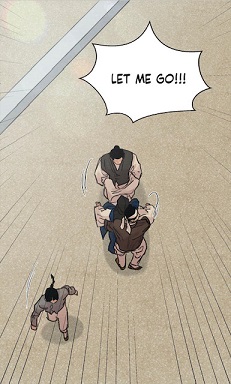 (chapter 77) Besides, observe that the main lead was sequestrated in the storage room on two occasions at least.
Hence Yoon Chang-Hyeon ordered to drag the young boy to the barn. 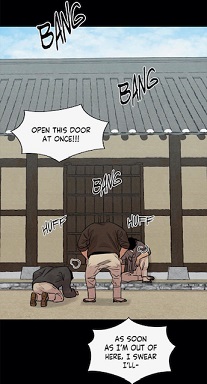 (chapter 77) However, since it happened twice, I am deducing that this was not the case for the second time. But if you pay attention to Yoon Seungho‘s bedroom, you will notice that he was living in the actual painter‘s study.
 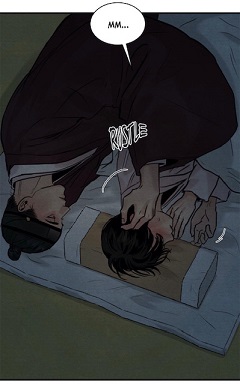 (chapter 77) And this means that the intelligent noble was in a privileged situation. Remember Jihwa’s words:
  (chapter 05) With this remark, the noble expressed a certain annoyance, for he would live next to Yoon Seungho. This truly shows that the painter’s room was a sign of Yoon Seungho‘s favoritism towards the low-born. So if the main lead had such a good reputation and was even favored by the eldest master, this signifies that he could only attract people‘s gaze. Thus some persons definitely envied or resented him, like Yoon Seung-Won and father Lee. And it occurred to me that the younger master had every reason to feel jealous of his elder brother. He might have had the impression that his father had no eyes for him. In other words, he could only benefit from such an incident. If his brother lost his father‘s favor, then he imagined that he would get noticed by his father. As you can imagine, I believe that someone must have poisoned Yoon Seung-Won‘s mind. From my point of view, only a grown-up could have access to the drug. I can‘t shake the butler‘s philosophy from my mind: „Ignorance is a blessing“! The person behind the plot knew about the children‘s weaknesses (innocence, longing for love and recognition, desire) and decided to use them to his advantage.
But then suddenly it occurred to me that chapter 77 is a reflection of episode 5. Note the resemblance. Jihwa talked here about virginity by opening the commoner’s shirt. The manhwaphiles will certainly remember that during that night, the noble got rejected, for the lord’s mind was elsewhere! 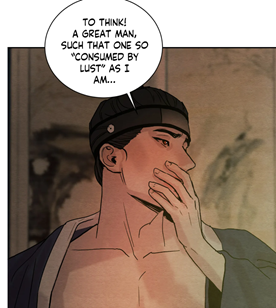 And here we have a proof that Yoon Seungho acted differently in the past. His mind was elsewhere due to the drug, but he didn’t stop his friend. Observe the similarity between the gestures:
  (chapter 5) (chapter 77) The young boy’s head stood above his childhood friend, exactly like with the painter. Jihwa also removed the shirt, but since the low-born stopped him, this signifies that Yoon Seungho had the opposite reaction. He was allowing his friend to kiss and touch him. However, the young noble couldn’t enjoy this moment, as the butler arrived so that the red-haired aristocrat ran away and abandoned him. Very early on, I had elaborated that Jihwa must have done something to his friend and ran away in order not to get caught. I had come to this deduction due to the incident with the door and the painter’s worries. He feared to have been seen.
That’s how I recognized a certain pattern in this story, the final proof that the story is built like a kaleidoscope:

 Here, the artist was imitating the red-haired aristocrat’s actions in the past. The only difference is that he was the passive one!! Striking is that both chapters have something in common: one is always seducing the other, and the latter isn’t accepting the advances. In addition, the masturbation was not disclosed to anyone, yet someone notified Jihwa about the painter’s late return.
  , but he’s avoiding the lord’s chamber. At no moment, he reports Jihwa’s trespassing, his master only discovers the assault, for he hears the commotion. The artist wouldn’t have been slapped, if the staff had immediately announced Jihwa’s visit. Striking is the aristocrat’s confession:
 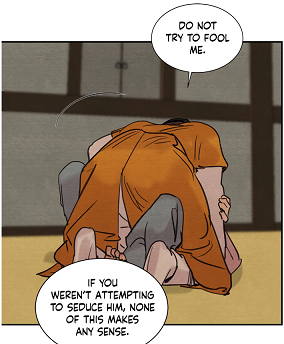 (chapter 17) Other common points with chapter 77: “seduction”, the violence of the noble, his rage because he feels that the painter is lying and had lost his virginity with Yoon Seungho. Besides, I would like to point out that the lord only discovered Jihwa’s assault through the gossip. He came too late, hence he couldn’t stop Jihwa from insulting and slapping the low-born.
  that he needed alcohol, an indication that in the past he must have struggled as well. We have to imagine that back then, he feared that his father Lee would hear about this incident, but father Yoon never let transpire the incident to the outside world. From my point of view, father Lee must have denied his son’s actions, but the aristocrat with dragon’s eyes was no fool. And remember that I used the same chapter to outline that Kim communicated the information to his master in delay. Note that in this episode, time was essential. Both figures were struggling. While the one hoped, the murder would be done soon to put an end to his suffering, the other had the impression that he was running out of time. He couldn’t change the artist’s heart and mind, too wounded.
  , but he was still looking fine. More importantly, he still trusted his butler. Father Yoon requested some medicine, for he believed that his son was not right in his mind.
  The physician presented the box full of drug which Kim has been giving to his master since his youth.
  the delayed disclosure about the crime, the servants not doing their job and gossiping, the passivity of the butler.
  and the delayed arrival of father Lee putting the blame on Yoon Seungho.
 And now pay attention to the number of the episodes: 05 – 16 (1+6 = 7) – 17 (1/ 1+6) – 50 – 57 (50+ 1+6) – 66 ( 5+1/ 5+1) – 67 (6 / 6 + 1) – 77 (1+6 /6+1) Here we have the kaleidoscope. For me this is no coincidence. But more importantly, all these chapters contain seduction, but also rejection, resistance and the presence of drug.
And by putting these chapters together, we get finally the evidence that Jihwa was the boy in the protagonist’s room. Then it came to my mind why the red-haired master was still unhappy in his relationship with Yoon Seungho. When he was wooing his friend in his youth, he saw the friend’s smile and gaze and imagined that he had been accepted. (chapter 77) I also believed that he had to envision this smile from Yoon Seungho to justify his action. An older version from this chapter: 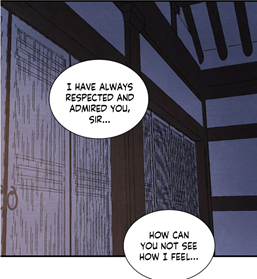 (chapter 19) That’s why Jihwa was blushing the whole time. His dream seemed to have come true!! But unfortunately, they got interrupted. But he didn’t realize that this “dream” was just an illusion, and he had been played. Because he had opened the friend’s shirt, he noticed his virginity. That’s why he had an eye for that.
 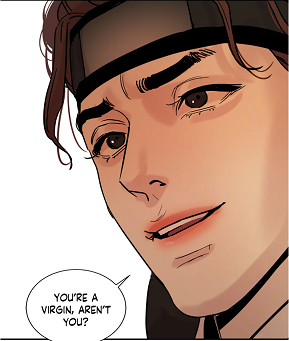 (chapter 5) He had gained this experience with his friend. Since I see some parallels between chapter 77 and the first Wedding Night, which stands for illusion and dream, it becomes even more evident that Yoon Seungho had been drugged and both young boys got played. During all these years of separation, the second lead kept his virginity intact for his friend. Once the main lead got betrayed and abandoned, Jihwa saw finally that his dream could come true. Since Yoon Seungho’s gaze had haunted him for so long, he hoped to obtain the same gaze, as in his mind it was the symbol of love and affection. Besides, he had another reason for approaching his friend. Since he had caused his downfall, deep down he imagined that if they became a real couple, then he could do as if the time of their separation had never happened. They would live, as if nothing had happened.
And now, you comprehend why Jihwa was so sure that his friend would never purse and seduce another man! (chapter 17) Yoon Seungho had never done it to him. Remember my observation: the main lead had been totally passive in the study due to the drug. In fact, he had never rejected anyone, 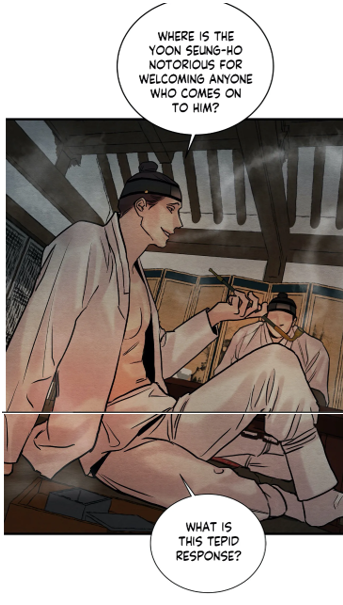 (chapter 52) because he had been trained as a kisaeng. And these observations made me recognize another important aspect: Jihwa, exactly like Baek Na-Kyum, has never discovered that sex could be a form of violence. From my point of view, the chapter 77 shows us that sexual assaults can take many different forms. Using a KO-drug is definitely a crime, but due to Jihwa’s lack of experience, he couldn’t recognize the true nature of the situation.
That’s why I believe that Jihwa will still help Min, because he feels bound to him by secrecy. He is acting like the butler, he wants to survive and not get caught, that’s his driven motivation. However, he will be cornered and forced to make a decision: save his own skin or help someone. In my first version, I had written that the moment he discovered Min’s actions, he would be able to judge the situation correctly this time. And this expectation became a reality.  (chapter 100) Black Heart taught Lee Jihwa an important lesson, the importance of consent. Someone can be forced to sex, which the second lead never truly grasped. He had to pay a huge price for the stolen kiss and his betrayal 10 years later. Interesting is that Lee Jihwa ran away, because he rejected to be responsible for the painter’s death, a synonym for Yoon Seungho’s curtains.
  (chapter 100) This is what I had also written in the first version.
However, as you can imagine, I am expecting a growth from the second lead. He will make the opposite choice than Kim, save the painter, while I am more than ever convinced that the butler won’t change his bad habit.
But let’ s return our attention to chapter 77. When the butler opened the door, the second lead ran away leaving his friend behind. But Kim didn’t report the incident right away, he started spreading some rumor. Why? It is because we have the presence of rumors in chapter 17, 50, 57, 66 and 67. And notice that 17, 57, 66 and 67, he never stopped people from gossiping, while in chapter 50 he revealed the intel as rumor.
Since all the episodes involve the unannounced visit of a noble (17, 50: here Seungho barged in the scholar’s room, 57, 66, 67), I could only come to the conclusion that father Lee was the one who paid a visit to father Yoon, and revealed the incident by naturally putting the whole blame onto Yoon Seungho. But unlike in chapter 67, father Lee visited discreetly the mansion, as he feared gossips. That’s why the physician mentions that Jihwa was supposed to have the illness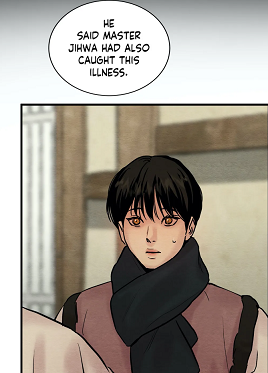 (chapter 57), but he could never identify the issue. And now, you comprehend why father Lee was red, totally embarrassed
 (chapter 67), for he was well aware of the truth. We have many possibilities here. Either someone leaked the info to the father secretly, or the son must have confided to him about the incident. Remember that in chapter 68, the painter confided to her his deepest fears and struggles. Let’s not forget that the son had hired an amateur spy in order to be updated about the events occurring in Yoon Seungho’s mansion. Consequently, I am inclined that the incident must have reached father Lee’s ears, and in order to maintain his respectability, he preferred covering up the commotion by blaming the elder son Yoon.
Since father Lee had intervened and Kim chose to reveal the “truth”, father Yoon could only perceive the incident as a truth. Consequently, father Yoon ordered his servants to drag Yoon Seungho and to confront his son. From my point of view, father Lee was questioned as well, but as you can imagine, he covered up his own son’s action. Since everyone was pointing the finger at the main lead, no one sided with the young boy. In other words, he got not only blamed, but also framed.
Right after he asked his staff to drag him to the shed as a punishment. But as you can imagine, Yoon Seungho couldn’t have any idea why his father reacted like that, for he had been drugged. He had no recollection, hence he denied the existence of the incident. However, the father chose to believe Kim, as he had the crowd. Imagine his reactions: the main lead had to hear from him what he had supposedly done. I would like to point out that victims of rape due to KO-drug suffer from immense guilt, as they showed no resistance or even seemed to “enjoy” the incident.
The valet gaslighted the poor boy by making him feel guilty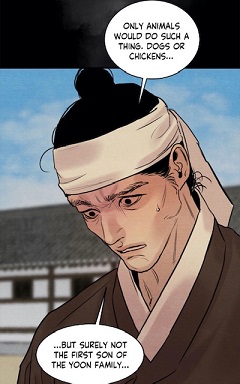 (chapter 77), but despite his harsh and cruel words, the young protagonist chose to continue trusting him and his words. Let’s not forget that Kim claimed that his father would fix his “problems”.
 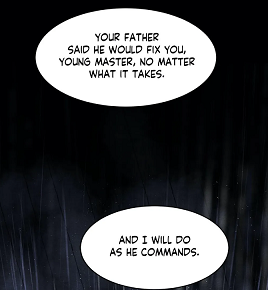 (chapter 77) From my point of view, the young master was determined to show good will and to listen to Kim’s advice.
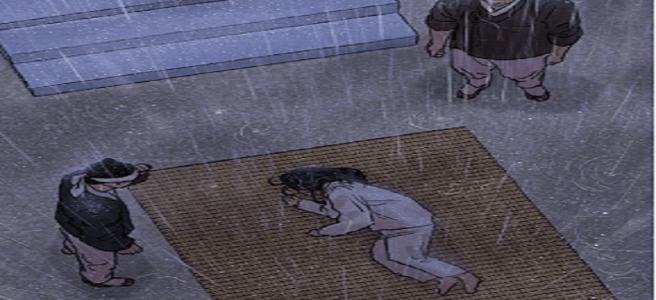
Because he was sent to the shed and we see the straw mat beating right after, we have the impression that this was the punishment he received for this incident. But this was an illusion created by the author. Why? First, when the father visited the doctor, the young boy was still looking fine. He had such a rosy complexion, and still admired and trusted the butler. However, the main lead’s gaze changed after the straw mat beating. He recognized that he had been betrayed and abandoned by Kim.  Observe the slight movement of the iris. First, the iris is directed at Kim, then it moves in the opposite direction.
  By looking away, he clearly unveils his inner thoughts and emotions: he has been betrayed and abandoned by his butler. He resents him, yet until that moment he was still willing to trust despite the multiple betrayals. He is disillusioned.
But there’s another indication that the straw mat beating didn’t occur right away. It is, because of the following panel:  (chapter 55) First, there’s no rain. Secondly, Yoon Seungho was feverish and his eyes were so bruised after the harsh punishment that I doubt he could still see clearly the boy’s gesture so from faraway. So for me, that’s the moment when he is dragged into the courtyard and not during the straw mat beating. In the past, I used to think, it was Yoon Seung-Won, but then after the latest episode I started doubting it. However, like one of my followers reminded me that Byeonduck had confirmed about Yoon Seung-Won’s identity. Yet, observe that the lord and the boy have no face. Why? It is because the two persons embody not only Yoon Chang-Hyeon and Yoon Seung-Won, but also father Lee and Lee Jihwa. The scholar Lee was the one who had asked for the flogging! That’s the reason why he said this to the lord years later:
  (chapter 82) This statement proves that he had done it before! Furthermore, the red-haired master is connected to the straw mat beating.
 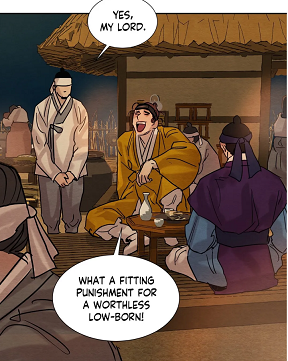 (chapter 12) This explicates why Lee Jihwa resented the brother and the father, for in his eyes they were responsible for his childhood friend’s suffering. And since the father had done it once, then he had no problem to order a second flogging or straw mat beating, just like the king Yeonjo who punished the Crown Prince Sado so brutally. So because the eldest master next to Seung-Won is dressed differently in chapter 77:
 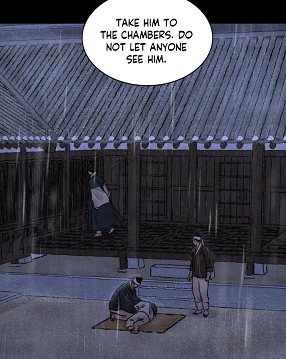 (chapter 77) I could only come to the conclusion that these two panels are not referring to the same incident.
From my point of view, Yoon Seungho received the second straw mat beating after the rape!! And this means that Kim had been present, but he had not intervened.  (chapter 65) Here, he had been brought back to the past. Remember the past mirrors the present. In my eyes, the rape of the main lead occurred at the same time than the painter’s. It took place in fall. So when did Baek Na-Kyum get sick?
It was after the first sex marathon! He was dragged to the bedchamber and due to the long sex session, he got sick. Notice the parallels:
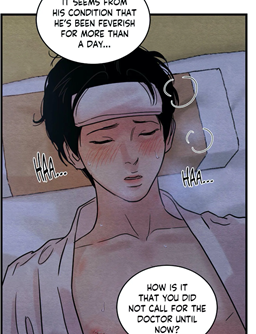 (chapter 33)
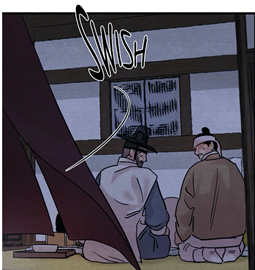 (chapter 33) Note that Yoon Seungho called for a doctor, he even carried himself to the study and waited there, until the doctor had given his prescription.
 And now, the manhwaphiles comprehend why I came to this interpretation.
What happened is the following. Once he had been abandoned by the father, the rapist could approach him and have sex with him. Kim heard the boy’s resistance, but he chose to remain outside, until the man was finished. 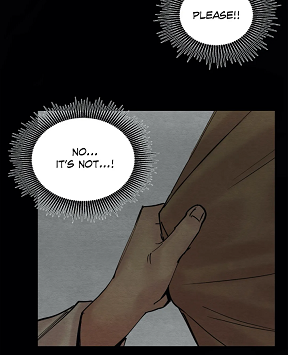 (chapter 65) I am quite sure that the butler’s passivity was justified that it was done for the main lead’s sake. However, once it was over, the butler was forced to see the consequences of his bad choice. But the valet refused to become responsible and gaslighted the young master again. If he had not kissed Lee Jihwa, if he had put his prick in the hole etc… The main character had still acted like a dog and a cat, and this time he reported it to his master directly so that the latter came to the conclusion that Yoon Seungho was still useful for him. Or the eldest master knew about it anyway. But the main lead never got to discover that Kim had heard him outside the room, but had remained silent and passive.
And now, you comprehend why Yoon Seungho was so hurt and disappointed by Kim. Kim never protected him or even defended him at all. He made sure that the young boy would be blamed and should feel guilty or he remained paralyzed and speechless. He never rushed to his care. And since father Yoon speaks “chambers”, this means that the protagonist had already become the lord Song’s “favored servant.” But he had not reached the bottom, he needed to become a kisaeng. In my eyes, the young boy got punished, as he was still refusing his role as „favored servant“. And now, you comprehend why Kim threatened the doctor in chapter 33. The latter had reminded the butler of his own wrongdoings: 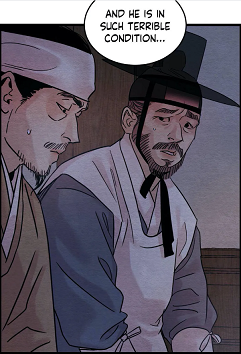 (chapter 33) Back then, he not only followed his master’s requests, but also he did nothing at all. He stayed immobile and shocked.
 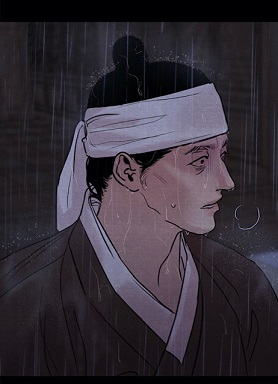 (chapter 77) I believe that when the valet looked at the young boy’s gaze and perceived his own true reflection (a disgusting and fake domestic), the man was surprised. He never imagined that he would be judged differently: (chapter 67) The main lead must have thought similarly. But due to the long exposure to abuse and to the drug, Yoon Seungho repressed these thoughts and emotions.
So if my theory is correct (Yoon Seungho was drugged), we have to question ourselves. Who benefitted the most from the protagonist’s downfall?
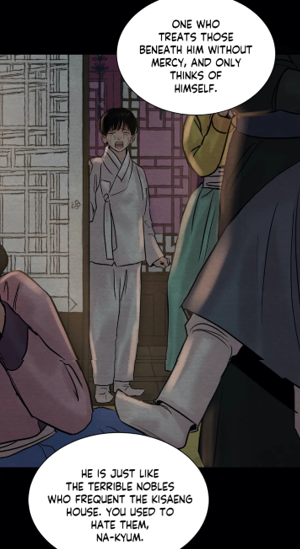 (chapter 68). Father Yoon imagined that if he had sex with a kisaeng house, he would be cured. However, something happened in the gibang. The young boy refused which forced the nobles to intervene. Yoon Seungho got dragged and tied up by the black guards. Naturally, father Yoon could only jump to the conclusion that with such a rejection, Yoon Seungho was admitting his homosexuality. This could only reinforce the prejudices the father had about his son. The irony is that with such an attempt, father Yoon exposed that he was a man obsessed with sex. He never understood that sex is strongly intertwined with love and warmth. Thus I deduce that father Yoon never associated sex to affection. For him, it was either a synonym for power, submission or duty as the noble has to make sure that he has sons to continue the legacy. With this new insight, I come to the conclusion that the man was totally fooled by his surroundings and most importantly by the rapist. Everyone lied out of selfishness and cowardice, and let the young boy take the whole burden. Hence the father truly believed in his son’s homosexuality and out of resent and contempt, when he saw an opportunity to use his son for his own career, he was trained as a kisaeng. In my eyes, this idea was definitely suggested by the pedophile, though I doubt that he was directly involved in the incident in the kisaeng house. And the man dreamed of bringing greatness to the Yoons with his “connections”. However, this was just a pyrrhic victory, as both Yoons lost more than they gained, for the rapist hadn’t kept his promise.
 That’s why I believe that the younger brother was indeed involved in the first incident misguided by the rapist, instilling his jealousy, an older version of Min and Jihwa. But the young son never imagined that his father would treat his brother like that. The panel from chapter 55 exposes Yoon Seung-Won’s guilt and silence. But as time passed on, he could still benefit from this. He finally got recognition from his father.  (chapter 86) But it was in detriment of the Yoons’ power! The father lost everything, yet the younger master didn’t suffer much from it first, until he reached adulthood. Now, the father was putting his whole hope on him, and that’s how Yoon Seung-Won realized the existence of such a burden. That’s the reason why he contacted his brother again. He hoped to get an office through his brother’s connections and power. Remember that Baek Na-Kyum’s real torment started with the arrival of the learned sir to the mansion. Hence the moment “lord Song” came to the propriety, he started scheming to achieve his goal: he was bewitched by the young protagonist, he needed to taste him. However, from my point of view, the pedophile had sent the butler for this exact purpose. He must have definitely known how Kim would behave in there. I have already exposed that for me, the butler represents the poisoned gift from chapter 19.
 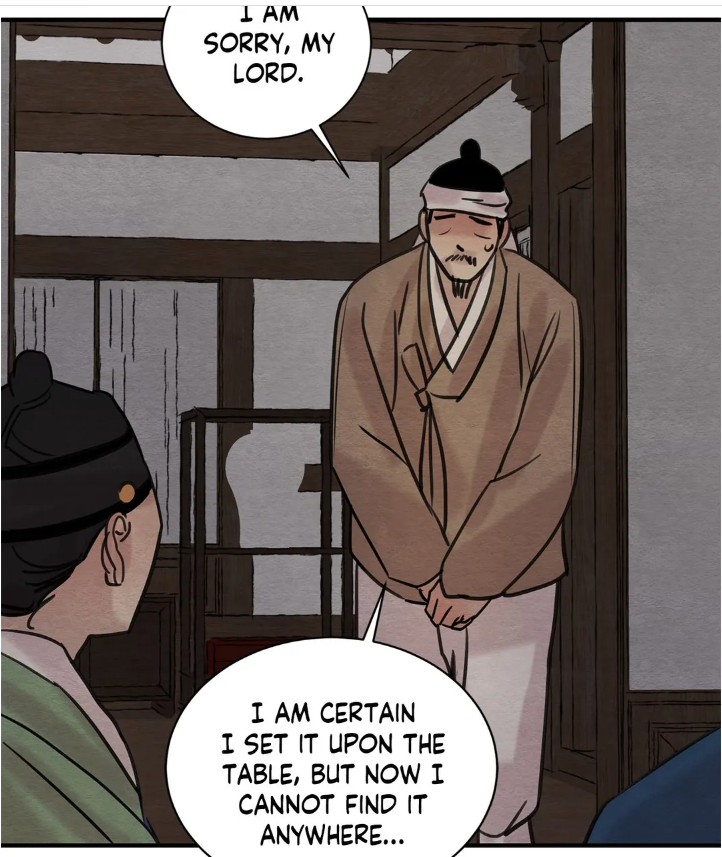 (chapter 19)
But since the whole tragedy was caused by delayed information, I deduce that timing is essential, especially when it comes to “justice”. Since the “accomplices” and “perpetratrors” never got punished, they imagined that they had escaped human justice. However, karma was waiting for them. Jihwa was never happy, though he had become the main lead’s lover. Why? It is because he had to live with his guilt. Moreover, he had wished to obtain Yoon Seungho’s love. In other words, he was living an illusion. The brother didn’t gain anything in the end, as his comfortable life and good reputation were based on Yoon Seungho’s suffering. Secondly, father Yoon almost lost everything. However, I doubt that all of them learned their lesson, just like the pedophile. This explicates why Yoon Chang-Hyeon schemed again in season 3.  (chapter 94) He hoped to appear as a good lord, while his son had mistreated his own messenger.
Feel free to comment. If you have any suggestion for topics or manhwas, feel free to ask. If you enjoyed reading it, retweet it or push the button like. My reddit-Instagram-tumblr-twitter account is: @bebebisous33. Thanks for reading and for the support, particularly, I would like to thank all the new followers and people recommending my blog.
This is where you can read the manhwa. https://www.lezhinus.com/en/comic/painter But be aware that this manhwa is a mature Yaoi, which means, it is about homosexuality with explicit scenes. If you want to read more essays, here is the link to the table of contents: https://bebebisous33analyses.wordpress.com/2020/07/04/table-of-contents-painter-of-the-night/
Since I wrote “The end of the vicious circle”, I am still trying to put all the pieces together. I had some problems with the following panels for example: I have already found a solution, but it takes some time to elaborate all the thoughts. Hence expect that the last two essays will be updated one more time, just like a third one will be released soon. The title has already been chosen: Time and crime.
However, don’t get me wrong. All my main ideas remain the same: lord Song is the king, he was targeting Yoon Seungho and fooled father Yoon. The latter accepted to offer his son as sacrifice in exchange for the throne. But now, with my new ideas inspired by my conversation with one of my followers, I can elaborate Yoon Seung-Won’s role in the past more precisely. Then I realized that for the story is centered on father-son relationship, it signifies that Jung In-Hun plays another part as well. Don’t forget that each character has multiple identities according to my theory. As example I could use Baek Na-Kyum who was supposed an old bearded painter, than a servant or a fiancée or a kisaeng. In other words, the learned sir is more than just a “surrogate father” and “teacher”.
Simultaneously, I wanted to announce that from Monday on, I am back to school, and I won’t be able to write as much as before.

This is where you can read the manhwas. https://www.lezhinus.com/en/comic/pawn https://www.lezhinus.com/en/comic/painter But be aware that these manhwas are a mature Yaoi, which means, it is about homosexuality with explicit scenes. If you want to read more essays, here is the link to the table of contents of Painter Of The Night: https://bebebisous33analyses.wordpress.com/2020/07/04/table-of-contents-painter-of-the-night/ As for The Pawn’s Revenge, this is where you can read other essays: https://bebebisous33analyses.com/2021/06/06/table-of-contents-of-analyzed-mentioned-manhwas/
Warning: I used the German version Snow White “Schneewittchen” as basis. Hence I translated myself the quotes.
Everything started with this panel: 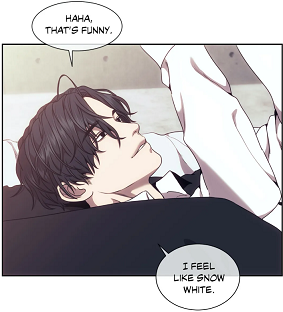 (chapter 22) The protagonist starts viewing himself as the main character from the fairytale Snow White. Hence he comes to the conclusion that since he is Snow White, then there must be a hunter and a witch, the famous stepmother of Snow White.
 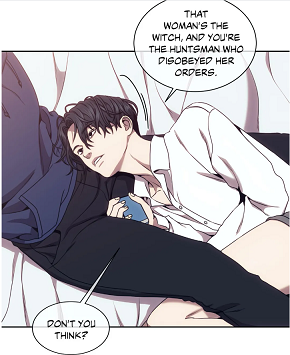 (chapter 22). That’s why he believes that Do Seong-Rok is the huntsman, while Jeon Hee Seong is the witch, because the former didn’t kill him. The former prostitute had planned to get rid of the young man, as he represented a source of danger for her. That’s why she ordered the killing to her lover. Soon after the release, an user asked Evy who was the Prince in this story. The author replied by denying his existence in this story.
What caught my attention is that there are more references of Snow White in this manhwa, like for example the presence of the shared apple. 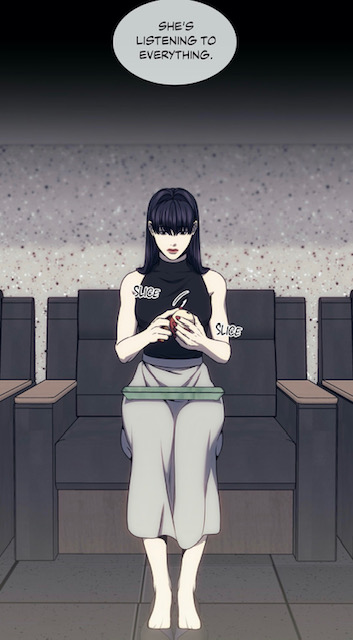 (chapter 24) Thanks to The Pawn’s Revenge, I came to recognize that even Painter Of The Night has so many common denominators with this fairytale.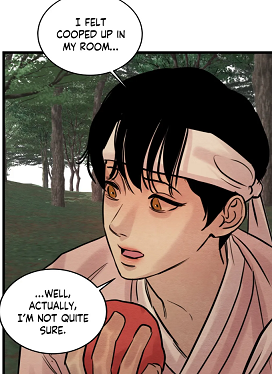
 (chapter 23) That’s the reason why I decided to compare the two manhwas with Snow White. This means, I’ll also explain why they diverge. But for that, it is necessary to explain the fairytale Snow White and its functions.
Actually, the focus of this fairytale is the daughter-mother relationship creating some rivalry and jealousy. Though there exists so many stories about this topic (for more read this article https://news.harvard.edu/gazette/story/2020/07/the-tale-of-snow-white-and-what-the-various-versions-mean-to-us/), only two are famous, the fairytale written by the brothers Grimm (19th Century) and the version from Walt Disney, “Snow White and the 7 Dwarfs” (1937).
But the famous psychologist Bruno Bettelheim, who considered tales as very important for the child’s development, looked down on the version from Walt Disney calling it “empty minded entertainment”, as the creators had modified too much the Grimms’ story to the point that it had softened and robbed the meaning of this fairytale. Why did he say that? It is because the darkness from the Grimms’ version had totally disappeared. The stepmother in Walt Disney’s version doesn’t eat the lever and lung of a boar boiled in salt in order to keep her beauty, or she doesn’t asphyxiate Snow White with a lacing strap. The jealousy had turned into more in a rivalry and competition because of beauty. Besides, the movie focused on fated love too, for the prince met Snow White as a child. As you can see, the prince plays a bigger role in the movie. For Bruno Bettelheim, only the Grimms’ version is the true one, as it truly deals with the oedipal complex.
The oedipal complex is when a young daughter feels jealous of her own mother, she is unconsciously attracted to her father. But since having such feelings is forbidden, she projects her own jealousy onto her mother. That’s why the daughter feels that her mother is jealous of her. The darkness from the child is now personified by the “mother”. I need to add that the German authors turned the mother into a stepmother in the second version. For Bettelheim, the fairytale helps a child to overcome the negative emotions (oedipal complex, jealousy, rivalry), it also helps him/her to understand the world around by giving him/her a meaning to life. Furthermore, it explains to the young daughters the future transformation unconsciously: it announces the adolescence and adulthood through sexuality. We have to imagine, when Snow White lives with the dwarfs, she is protected growing up in an environment free from sexuality. So when the Queen offers the apple and both are eating from the same apple, Snow White discovers sex and temptation. The apple is a reference to the bible. And now, you comprehend why I choose such a title. The Queen is a witch introducing Snow White to sexuality. As you can see, Bruno Bettelheim judged the fairytale from the point of view of a psychologist. Yet what he failed to realize is that fairytales have other functions.
First, fairytales were not written for just children, but also for grown-ups. They were supposed to teach lessons to the adults.
“They were meant to entertain adults while they were spinning, sewing, repairing tools, and doing chores late at night. John Updike tells us that fairy tales were the television and pornography of an earlier age, and a story like that is revelatory about the true uses of enchantment.” quoted from https://news.harvard.edu/gazette/story/2020/07/the-tale-of-snow-white-and-what-the-various-versions-mean-to-us/
How to deal for example, when a lord betrays or abandons a servant? Here, I would like to outline that the notion “family” is strongly connected to the house, and as such a household including the staff. Imagine that Snow White is a maid. Remember that the Queen acts as a lord, the head of the house, so when she orders Snow White’s execution, the young girl can only escape from this terrible fate thanks to the hunter’s fake generosity. This story shows that a servant or even daughter has no right, the lord can do whatever he wants. He won’t get sanctioned. And this remark leads me to the following statement. Bettelheim didn’t recognize that fairytales actually reflect history and the society of their period.
And now, you comprehend why the Disney version was less brutal, more romantic and the Dwarfs were portrayed as rich but hardworking miners. When the American author released the fairytale, marriage in America is associated to love. There exists the myth about fated love too. In addition, American society is promoting free market economy and hard work: American dream. Therefore we see the Dwarfs working so hard in the mine while singing. In the other version, it is just said casually. The parents are supposed to protect their children from any kind of violence, the children have even rights. Consequently the cruelty was removed. Moreover, motherhood is considered as sacred, while in the past, it was different. In the 18th Century and even before, parents didn’t ponder on how to raise their children properly. There were neither psychologist nor pediatrician nor educationalist. The children just needed to learn how to act and dress according to their social status. They were treated like small adults. However, slowly from the end of the 18th Century on, government and as such society started perceiving children differently, as a tool for their own politics. Napoleon created lycées (high schools) in order to increase his army. He promoted education, while in truth he misused it for propaganda and indoctrination. My point is that when the brothers Grimm published Snow White, people treated young children differently than in 1937 in the United States. In Germany, adults used fear to control the children!
Secondly, violence was a way to expose the children to the brutality of their world (there were many revolutions in Germany in 19th Century). But there’s more to it. And we have a proof that Snow White from the brothers Grimm reflected the society of the 19th Century: the presence of a lacing strap.
“But the old woman quickly laced and laced so tightly that Snow White lost her breath and thought she was dead.”
It was a reference to the corset. Young girls would try to lace their corset so tight that they could faint. This was one of the lessons in Snow White: “Don’t lace the corset to tight, because you could have the same fate than Snow White!” This explicates why Walt Disney didn’t include this scene in his story. The corset had vanished from fashion a long time ago. How did I realize that old fairytales are a mirror of the past? It is because when I was a P. A. of a History professor, I was asked to translate his essay about the definition of House and Foreign in late Middle Age and early modern times, and he used the fairytale “Town Musicians of Bremen” from Grimm as an example. The servants were indeed part of the House, once they were old, they would be thrown out of the mansion. The house was a synonym for family, like I mentioned above. During the Middle-Age, European cities, like Bremen, became more and more powerful leading to their emancipation from lords. Bremen like other cities became independent, hence the city councils could hire hire their own musicians. Though this fairytale was written in the 19th Century, it let transpire the social norms and mentality from a previous period. That’s why I came to the conclusion that Snow White must also reflect society from the 19th Century. I could give you another example.
In the Grimms’ version, the presence of sexuality was hidden, because it was symbolized by the apple. Since religion occupied a huge place in the 19th Century, people knew the bible. Consequently they could comprehend the message. But the moment Snow White ate the apple, she discovered sex. But note that she fell into a deep sleep right away. Once she woke up due to an accident occurring during the transportation of the coffin, Snow White had already found her husband, the prince. The latter had selected her as his bride, as he couldn’t forget her. The prince had even asked for the dwarfs’ permission.
“Then he said to the dwarves, “Let me have the coffin, and I will give you what you want for it.”
In other words, this fairy tale was promoting marriage of convenience and the interdiction of sex before marriage, while in the Disney version we have the opposite message. Since the prince kisses the protagonist, before he marries her, it implies that sex can occur before marriage.
Thus even if I consider that The Pawn’s revenge and Painter Of The Night are new versions of Snow-White, they can only be different. Now, sexuality, sexual education and homosexuality are no longer a taboo. That’s the reason why there is no hidden message concerning this topic. As a conclusion, the stories will reflect Korean society or modern society as such. The stories will teach lessons to the readers and give meaning to their life, but only if they decide to ponder about these stories.
This truly exposes that Grimms’ and Walt Disney’s Snow White is just a mirror of the past. But don’t get me wrong: these fairytales are still useful. First, like Bruno Bettelheim, they help children to forge their own identity and to navigate in the world as moral compass. Since the characters are black (evil) or white (good), the children can easily differentiate between right and wrong. Simultaneously, the fairytales prepare them to recognize that reality is more complex. We have the perfect example in Snow White (Grimm) with the huntsman.
It seems that people only remembers him as a good-hearted man, as he had pity and disobeyed the Queen’s orders. But what many don’t know or overlooked is that the huntsman embodies cowardice and selfishness. In truth, he is just a weak-hearted person and a hypocrite.
“And because she was so beautiful, the hunter took pity on her and said, “So run along, you poor child!” The wild animals will soon have eaten you, he thought, and yet he felt as if a stone had rolled from his heart, because he did not need to kill her.“
He acts kind and benevolent in front of Snow White, while in reality he envisions that she will die. At no moment, he wants to save her. She survives, because he doesn’t want to feel guilty and fate is on her side. This means, he just refuses to become responsible for her death. Others will do it for him. That way, his Queen won’t notice that he disobeyed. And notice that the moment the stepmother discovered that she had been played, the huntsman’s disobedience was not punished. Why? It is because she didn’t discover it right away. She ate the lung and lever believing that these were the parts of Snow White.
As you can see, the fairytale was teaching the meaning of fake kindness, cowardice and hypocrisy. But the irony is that in the latest movies, the huntsman was turned into a hero! In addition, it also exposes the “powerlessness” of the Queen. The huntsman could fool her due to her obsession. Simultaneously, it teaches that disobedience doesn’t lead to a death sentence. Here, I would like to point out that after the end of World War II, many German soldiers or guards from camps of concentration claimed that they didn’t dare to disobey. They just followed the orders they had received as a justification for their misdeeds. The reality is that it was just a myth. Historians could prove that no one got executed or no one was forced to become a guard in a camp of concentration.
Because of these parallels between The Pawn’s Revenge, Painter Of The Night and Snow White, I wondered if the manhwas could be considered as fairytales. The presence of violence or sexuality can not be judged as evidences that they can not be fairytales, for they are considered as old form of pornography, destined to adults too. So what is the definition of fairytale?
The story must contain the following elements:
According to this definition, The Pawn’s revenge can’t be considered as a fairytale, for there is no magic. But I would like to point out that The Pawn’s revenge still contains some “supernatural elements”. Lee Je-Oh compares the serial killer to a grim reaper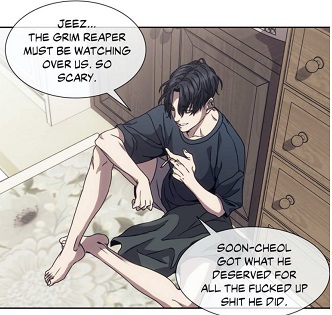 (chapter 1) or
  a god. Then the characters are often associated to animals: dog, mutt,
  snake, horse, pig, elephant, chicken
 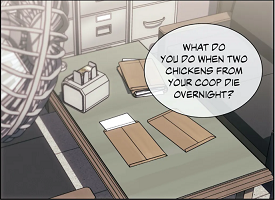 (chapter 2). Furthermore, the figures in this story are perceived as living pawns of Janggi.
  (chapter 12) Finally , I compared Jeon See Heong to a mermaid
  (chapter 6) bewitching her prey. On the other hand, the figures have a precise identity. The time and the place are quite defined. As for Painter Of The Night, it looks like the same. We know the birthdays of Yoon Seungho and Baek Na-Kyum and there’s no magic or supernatural elements. Yet, we sometimes see the presence of magic and a lustful spell.
  Imagine, in this scene we have the impression that the painter’s spirit summoned the Ghost Seungho to approach him. Striking is that this repressed desired got fulfilled. While he had his eyes closed, the lord approached him.
 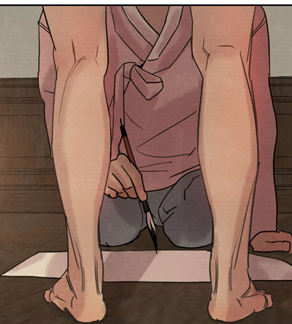 Another positive aspect is that the time and space are not defined. It’s just Joseon period, but that’s it. The mention of Hanyang can not be seen as transgression, because remember that there exists the fairytale Town Musicians of Bremen. The town has no name. Byeonduck said that her manhwa was not a historical story, but she found her inspiration in History. Besides, the trials of the two protagonists are more in the center, while Lee Je-Oh and Do Seong-Rok have already struggled, before the story starts. Consequently, Painter Of The Night resembles a lot more to a fairytale than The Pawn’s revenge, though the sentence “once upon a time” is missing.
On the surface, this comparison seems pointless, yet I wanted to expose that these stories might not entirely correspond to a fairytale, they still resemble to Snow White. Just like the fairytales, the manhwas can have a deeper meaning, for they serve the same purposes: Teach lessons to adults, incite the readers to question their own society and social norms, develop a better understanding of psychology, encourage them to become more committed, less indifferent to injustice, more thoughtful and not judge people too quickly.
In order to be able to contrast the stories to the fairytale, it is necessary to list all the elements present in Snow White from the brothers Grimm. Besides, this version resembles more to the manhwas due to the sexual content. Seduction and temptation are more obvious. Nevertheless, I will not just list the characters and the relevant items present in the fairytale, but also the topics while giving some explanations:
And now, it is time to analyze how similar the manhwas are to Snow White.
As this essay is already long and to outline the similarities, I will put the common denominators to bold. Simultaneously, I will follow the list developed above by examining the main figures.
Since the 7 Dwarves are owners of mines and seem to be very rich, I couldn’t help myself connecting these supernatural creatures to the following characters:  Contrary to the fairytale, they embody not innocence, generosity, selflessness and chastity, but the opposite: sex, hypocrisy, corruption, selfishness, ruthlessness and immorality. They are not owners of mines, but they possess brothels which reminded me of chicken farms
  . They don’t live surrounded by nature and among animals, but in the city. The animals are the humans, they are treated like chickens. In other words, they stand in opposition to the dwarves of the fairytales: corruption, urbanization, poverty and misery. They don’t work themselves, but let others work for them like slaves. Yet they act, as if they were normal citizens abiding laws. This explicates why Ma Jong-Seok hides his affection from Snow White. He can’t be labelled as homosexual. The dwarfs, associated to different vices, symbolize the negative aspects of free market economy and the problems, when the government is not strong enough or too corrupt to stop such an evolution. I could even say, we have here the negative reflection of Snow White and the 7 Dwarves from Walt Disney. Motherhood is no longer sacred, the kids are exposed to any kind of abuse.
 Snow White is now held captive in the mansion of the dwarves! He is exposed to exploitation, the perverted version of Grimes’ version. In the fairytale, the young girl was supposed to take care of the house in exchange of protection, here we have the opposite: Enslavement. The male prostitute has no choice. But what they didn’t realize is that the witch would betray them. Hence I consider the apple as the tool the witch used to get rid of her rivals! The fruit served as a diversion, she was busy listening to their affairs so that she could develop her plan to climb the social ladders.
Since Jeon Hee Seong was the one who introduced Do Seong-Rok to sex, she can definitely be seen as the witch and evil queen.  She seduced him with her experience and insight. She could read him like an open book. She knew that he was so pure and innocent, hence she compared him to a lamb. Her resemblance to the evil mother explains why she is seen with the apple. However, unlike the fairytale, the fruit doesn’t symbolize sexuality, but betrayal. She is actually spying on the boss of the red light district and his minions. She behaves exactly like the Queen, as she is not longing for warmth and love. But her wish is still different, as she wishes power and wealth. Yet, they resemble each other, as both felt somehow powerless. In the fairytale, the absence or passivity of the king, Snow White’s father, gives me the impression that the evil Queen could have been a neglected wife, and the lord selected her as his new wife, out of convenience. He needed to have a wife by his side, and couldn’t remain as a widower. She was treated like a trophy explaining his absence. But because he married her for her beauty, it signifies that she had no power. Her appearance was her source of strength, and now you comprehend why she became obsessed with her image. If she lost her beauty, she would become even more powerless than before. She had nothing else to do. Jeon Hee Seong was forced to marry Choi, and while the Queen from Snow White was neglected, the witch was abused by her husband. So both were unhappy in their marriage and life. This explains their desire to get power in their own way. As the manhwaphiles can detect, both witches have something in common: ambition and greed, though Jeon See Heong uses her beauty differently. She is aware of her own attraction and has no fear or insecurities. She doesn’t need a mirror to tell her how beautiful she is. Her body is her tool, not the mirror. Yet both have another aspect in common: they try not to do the dirty work themselves. Both hire a killer, the only difference is that due to the huntsman’s betrayal, the Queen learned her lesson. She had to do it herself, if she wanted to get rid of her rival. And this leads me to the following observation. The witch from The Pawn’s revenge has two reasons to use others for her dirty work. First, she is no queen, hence she could get charged with murders. Secondly, if we use the fairytale as a parallel, she could have a similar mindset than the huntsman. She doesn’t want to feel burdened by guilt, notice that she is never facing the consequences of her order and decisions. She didn’t see the corpse of her dead husband and the gambler Lee Soon-Cheol.
  She just communicates through a cellphone. Besides, even Do Seong-Rok felt uncomfortable after killing two people. Hence I perceive Jeon Hee Seong as less bloodthirsty than she appears to be. She could be more of a coward.
On the other hand, in the manhwa the witch is still relying on her lover, Do Seong-Rok. She got angry, when she realized that he had disobeyed her and let him become responsible for Lee Je-Oh. However, it is just a matter of time, until she gets aware that Do Seong-Rok is no longer bewitched by her. In chapter 26, he can no longer have sex with her. Hence we have a parallel with the fairytale: the allusion of aging and change. The woman is no longer attractive to him, because he has perceived her true nature. She manipulated him and he got aware that she was fake. With this, we would another similarity with the fairytale, the distinction between seeming and being. He realizes, that her promises were all an illusion.  In this scene, the manhwaphiles can sense her witchcraft.
And since Jeon Hee Seong has already chosen Ahn Jae Oh as her official partner due to his social position, it becomes understandable why her relationship with Do Seong-Rok was doomed to failure. I would say, since the police officer is on the verge to become a congressman, the protagonist could only appear weak to her. His strength were his loyalty and blinded trust. Consequently Ahn reminds me of the king from the fairytale, while I perceive Do Seong-Rok not just as the huntsman, but also as a second Snow White. First, he had dark hair and a white skin like the protagonist.  Secondly, he was as pure as Snow White. But since he was neglected and had abandonment issues, he longed for maternal warmth and love. In the Korean version, we see his father promising to come back, an indication that he had no mother. Hence I judge, Do Seong-Rok’s relationship with the witch was a form of an oedipal complex. She served as a surrogate mother, that’s how much he longed for a mother and family. The manhwaphiles will realize the common denominators: neglect and abandonment perceptible in the beginning of the fairytale. Secondly, note that Do Seong-Rok had changed the color of his hair, when he met her again. That’s why I deduce that the card she gave him should be perceived as the apple from the fairytale.
  (chapter 16) With her appearance, her words and this card, she casted a spell on him. That’s why he was so full of lust during their second encounter. The red hair could be judged as the indication of the lustful spell. Simultaneously, this color implies the loss of virginity and the beginning of adulthood. The most fascinating is that in the bedroom, two colors are prevailing: red and white, which coincidences to the red and white side of the poisoned apple from Snow White. The witch’s beauty was so strong that he had to transform himself.
  (chapter 16) This was his desire to resemble her, to get closer to her. Since he was a man, the witch didn’t see him as a rival. This explicates why she didn’t feel jealous at all. But for me, there’s no ambiguity that she filled the void left by the missing mother. Hence, since he was having sex with a surrogate mother, this can not be considered as the real discovery of sex. I conclude that when he met Lee Je-Oh, he discovered real sexuality. That’s the reason why he can no longer have any erection with the Queen. If we judge The Pawn’s revenge as a fairytale, then it teaches, homosexuality is a normality. He didn’t know about this, until he saw the male prostitute having sex with the pimp and felt aroused.
Moreover, by sleeping with him, Jeon Hee-Seong somehow committed a sin. Let’s not forget that she was already married. The woman embodies evil, for she promotes cheating, betrayal, murder, selfishness and avidity. Her ambition is to become the Queen of the red light district. This means, the readers are witnessing the raising of the evil mother, who is on the verge of becoming the Queen! But due to her greed and ambition, she doesn’t realize her own blindness. Her arrogance makes her overlook the male prostitute, Lee Je-Oh. She trusts too much her beauty, and believes to be smarter than others. Thus her arrogance is the reason why she will fail in the end. She showed her true face to Do Seong-Rok too soon, when she showed her anger,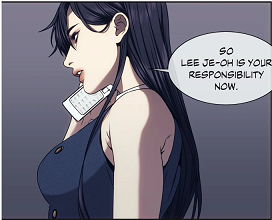 because the huntsman had disobeyed her order. The man could see a glimpse of her true personality. Due to his past experience, he had learned his lesson. In addition, she is underestimating the power of love. Thus she had planned to betray and abandon her lover, but she doesn’t anticipate the killer’s betrayal. Exactly like the stepmother, she is not reflecting on her own actions. She didn’t pay too much attention to her words over the phone and the consequences. The absence of critical thinking will be another reason why she is doomed to fail: too obsessed to reach the top. She has the impression, she is almost there, the presence of the ring offered by Ahn is the proof of her success. And now, you can see why I saw so many parallels with the fairytale.
Naturally, this is not surprising that Lee Je-Oh considers Do Seong-Rok as the huntsman. 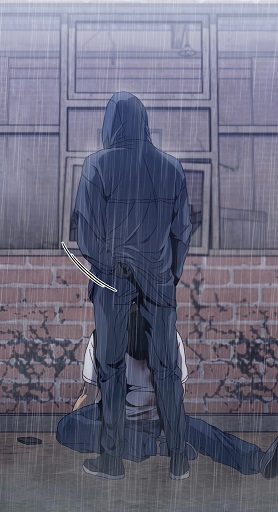 The latter’s actions resemble to the ones from Snow White. Yet, unlike the hunter, the red-haired man has not a weak heart, but a good heart. He is not a coward or a hypocrite. He can feel pity, and doesn’t fear to dirty his hands. On the other hand, he has nightmares
 , as his unconscious is telling him that he made the wrong choice. And in this scene, we have the presence of conscious and unconscious. He shouldn’t have listened to his lover’s suggestions, but he is still in denial. That’s the reason why he keeps starring
  and looking at the letter with a fake confession. Hence I believe that contrary to the hunter, he feels some remorse, as he senses that he has been tricked. In my opinion, by sleeping with her, Do Seong-Rok got tainted by her darkness. This explicates why when he strangled Ma Jeong-Sok, he had an erection.
 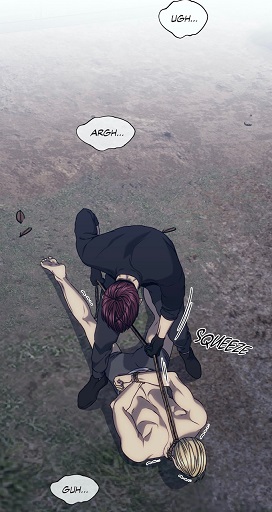 And remember that in the Grimms’ version, we had the presence of a lace in connection to Snow White. And this reinforces my interpretation that the killer is actually more a combination of both characters: the huntsman and Snow White. He has become the “perverted version” due to the Queen’s influence, he is her step-son. Striking is that Lee Je-Oh is giving him another interpretation of his wrongdoings: he liberated him from his prison and misery.
Since Jeong Hee-Seong resembles a lot to Lee Je-Oh, he appears to be indeed the real Snow White. Exactly like Do Seong-Rok and Snow White, he has dark hair, a white skin and red cheeks. Moreover, similar to the Grimms’ version, the main lead has been neglected and abandoned by his father.
Their fate seems similar, yet there is a huge difference. The male prostitute learned not to rely on others. When he tried to free himself, he didn’t ask for help, he stabbed Ma Jong-Seok himself. However, he was encouraged to use the knife by the witch, that’s how he discovered her true personality. Her beauty can no longer bewitch him. Striking is that he could already perceive her true personality, even before knowing her true identity.
In my opinion, Lee Je-Oh is actually a combination of the mirror of Truth and Snow White. Through his comments, he is confronting Do Seong-Rok and forcing him to reflect on his actions , questioning his relationship with the witch.
  But notice that he has a similar attitude with other characters. He confronts Choi Yeong-Gil with his hypocrisy and negative attitude.
  Just before the pimp is killed, he confronts him with his true personality and sins. He is responsible for the misery and death of many people.
  Once cornered, the “dwarf” is forced to confess his affection to Lee Je-Oh. Both dwarves had something in common: hypocrisy. Hence you can comprehend why I come to the conclusion, Lee Je-Oh is the mirror of truth. He embodies honesty and loyalty, just like the protagonist, he longed for a home and family.
Hence the huntsman’s “jail” corresponds more to the house of the dwarfs from the fairy tale. It’s the place where love, trust and innocence are protected. Since I have already predicted a revolution, I believe, Lee Je-Oh will give another sense to Do Seong-Rok’s murders. They will try to destroy this corrupted world full of selfishness and greed. That’s how Lee Je-Oh will become the witch’s rival. He will ruin her plan due to his sense of justice. The manhwaphiles will certainly remember that the fairytale is centered on jealousy, rivalry and competition. The young boy was already jealous that he felt the need to steal the killer. Right after having sex with him, he considers Do Seong-Rok as his boyfriend. He compliments him and caresses him
 , giving him the warmth and affection the killer had been longing.
What also caught my attention is that both Snow Whites are “corrupted”. While the one kills, the other lies, schemes and steals. This stands in opposition to “Schneewittchen” from the Grimms’ version. It is comprehensible, because both protagonists got tainted by their parents. Lee Je-Oh’s father was selfish and had no sense of responsibility, while Jeon Hee Seong desired to use the main lead’s weaknesses (isolation, lack of experience and innocence) to her advantage. This signifies, both are the products of bad parenting and a ruthless and selfish society. So if the two Snow Whites start working together and keep killing others in order to clean society, what will happen to this city? Chaos. But Lee Je-Oh would see it as delayed justice.
Why did Evy say that there was no prince in this story? My explanation is the following. Since the prince embodies “marriage” and in South Korea, homosexual marriage is not allowed, there can’t be a prince. Secondly, since I have already portrayed that the two protagonists have two functions, this signifies that both could also be perceived as the prince. They both free each other, as they give each other what they need. In the episode 27, Lee Je-Oh decided to lie to Kang Hyeon-Jong in order to protect his lover. He gave him an alibi and used the video as an evidence. This means that from now on, he is now responsible for Do Seong-Rok, just like the latter is now accountable for Lee Je-Oh’s survival. And since there’s no justice in this world, I believe that the prostitute Snow White will take matters into his own hands and give justice to others. Remember that Snow White sentenced her stepmother to death! This signifies that she gave justice herself.
As a first conclusion, though The Pawn’s Revenge doesn’t correspond to the definition of a fairytale, the manhwa and Snow White are really similar due to the topics and characters. It truly shows that such stories are a great source of inspiration. Then the readers should question themselves why the city and its inhabitants are portrayed in such a negative light. 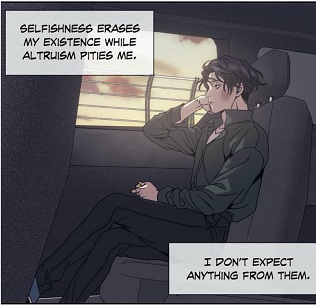 From my point of view, it is related to the huge political scandals South Korea had to face like for example with the president Park Geun-hye, and the economical boom with the development of new districts which doesn’t lead to a diminution of poverty. Then, there was the Sewol ferry incident, where many students died, while the captain and the crew abandoned them. This terrible event caused a huge mistrust in the authorities and the adults’ hypocrisy and selfishness. As the manhwaphiles can detect, I view this story as a mirror of our modern society: the failure of parents as role model, the disintegration of families… Simultaneously, it teaches the same lessons: recognize hypocrisy, selfishness and the importance of reflection. Lee Je-Oh could become the killer’s ally, the moment he recognized his own mistake. He imagined his intelligence made him superior, he underestimated the huntsman’s strong will. He might have felt pity, but he was not a fool, rather a dangerous man because of his strength. He mistook his innocence for stupidity. That’s why Snow White is superior to the witch.
As you can imagine, I won’t write the comparison with the Painter Of The Night here, for the analysis is already so long, however I would like the readers now to ponder on the following question: Who is the witch with her lustful spell, Snow White, the mirror of truth, the 7 dwarves, the huntsman and the prince in Byeonduck’s work?
Feel free to comment. If you have any suggestion for topics or manhwas, feel free to ask. If you enjoyed reading it, retweet it or push the button like. My reddit-Instagram-tumblr-twitter account is: @bebebisous33. Thanks for reading and for the support, particularly, I would like to thank all the new followers and people recommending my blog.
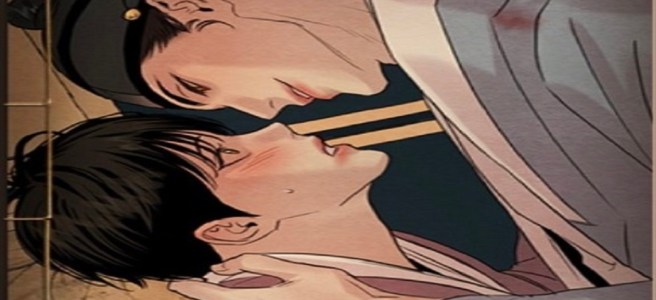

This is where you can read the manhwa. https://www.lezhinus.com/en/comic/painter But be aware that this manhwa is a mature Yaoi, which means, it is about homosexuality with explicit scenes. If you want to read more essays, here is the link to the table of contents: https://bebebisous33analyses.wordpress.com/2020/07/04/table-of-contents-painter-of-the-night/
Announcement: I updated the essay “Sins”
In the essay “Sins”, I had pointed out the parallels between episode 40 and 75. We had a stroll through town, and both main leads had a long conversation. But there’s another aspect I had overlooked, the reason why both episodes were connected to each other. While the first one stood under the sign of “responsibility”, the other embodies “regrets”. And now, the manhwaphiles can grasp the connection. The moment a person becomes responsible, he must make choices. And if the decision leads to a disaster, then the person will come to regret his choice. This explains why Jung In-Hun stood in the center of both episodes. Thus I will examine the characters’ decisions and regrets.
But before starting, I would like to outline the difference between remorse and regrets, though these expressions are often employed as synonyms. What distinguishes them from each other is the nature of the action and decision. When the person did something wrong and now feels some remorse, it means that the person acknowledges the wrongdoing. On the other hand, there’s an absence of judgement in regret. It’s totally neutral. The person just wished, he or she had made a different choice. This signifies that a person can regret a decision, but feel no remorse. In other words, he has no guilty conscience. This indication might seem anodyne, yet it is the opposite, for in Painter Of The Night, many characters feel regrets, but are not suffering from pangs of conscience. They don’t see their actions as a crime or a sin. This truly exposes that these characters are not reflecting on their actions, even the absence of remorse displays their ruthlessness and selfishness.
Naturally, remorse and regret can coexist. We had a perfect example with Jihwa. First, the red-haired master expressed regret concerning the painter’s abduction.  (chapter 61) Observe that he has realized that Baek Na-Kyum’s disappearance doesn’t change the situation. Yoon Seungho will never come to return his affection. The abduction and even the murder are totally pointless. Yet, while confessing to his “priest”, he doesn’t acknowledge the wrongdoing perpetrated against the artist, for all his thoughts are revolving around his love for Yoon Seungho. He doesn’t see the pain afflicted to Baek Na-Kyum.
He only feels remorse, when it comes to his childhood friend.  (chapter 61) For the first time, he is admitting his sins. He has always hurt his friend (the letter, the ruined painting, the topknot incident
 , chapter 59), that’s why the main lead could never reciprocate the feelings. And now, you understand why the young master Lee said this:
 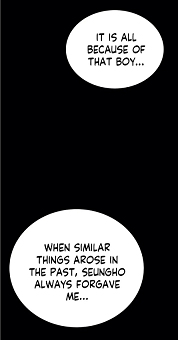 (chapter 59) Since Yoon Seungho would always overlook his wrongdoings, the latter never felt the urge to reflect on his actions. Why should he feel regret or even remorse, for their relationship never changed? But with the painter everything changed. The noble would no longer close an eye to Jihwa’s sins.
Under this new light, the manhwaphiles can grasp why Jihwa made the following reproach to his friend.  (chapter 59) Lee Jihwa used the name of lord Song on purpose, he knew definitely that this would scare and wound Yoon Seungho. I am even thinking that he imagined Yoon Seungho would behave like in the past, refusing to leave his mansion. Since I interpreted that the lord had a flashback in episode 1, I deduce Jihwa had planned with a letter to cause a flashback in Seungho, just like he had done in the past: the topknot incident. We had two clues for this signification.
First, Yoon Seungho had also triggered a flashback in his lover Na-Kyum unconsciously, when he trapped him under the bed in episode 66. 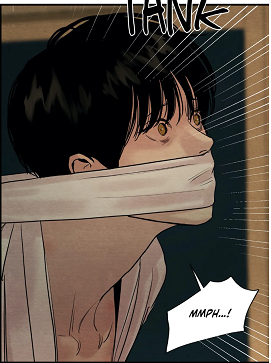 Secondly, the childhood friend had discovered the main lead’s weakness
  (chapter 59). In this panel, Yoon Seungho has a flashback. Thus, Jihwa used this to his advantage, when he was displeased with the protagonist. Nevertheless, I suspect that Lee Jihwa was not truly responsible for the topknot incident, for he had been incited by Min’s words. Yet, instead of regretting his actions, the second lead preferred putting the whole blame on the victim, which often happens with perpetrators and accomplices. He didn’t want to be confronted with his terrible reflection. So back then the young lord Lee didn’t reflect on his actions, rejected his responsibility, for he didn’t want to feel guilty. Let’s not forget that the painter is just a low-born, the second lead didn’t see him as a human.
As you can imagine, Jihwa didn’t realize his wrongdoing, when he let the painter abducted. Since he was still alive, nothing had happened. But the moment Yoon Seungho barged into his room confronting him with his bad action, the other recognized that he had indeed hurt his friend again. But unfortunately, he didn’t learn the right lesson from this experience. He started regretting that the painter was alive. He had now in his mind this: if the artist vanishes, then his crime and sin will disappear. (chapter 61) Really silly regrets! As you can see, he decided to make the opposite decision. And now, you comprehend why Lee Jihwa remained silent, when he got confronted by the Joker. 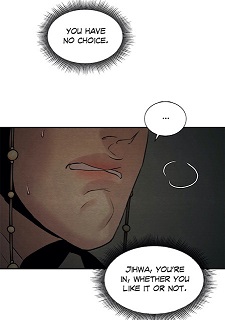 (chapter 76) Min had used his past to bind him to the second scheme. That’s his “punishment” for using the past as a way to tame his childhood friend. This truly shows Jihwa’s lack of intelligence. He never takes time to ponder over events and behaviors. He takes words and behavior as face-values. This is totally normal, for neither Yoon Seungho nor father Lee encouraged him to nurture his mind. Sure, the main lead was too hurt to take this burden. Besides, this is not his role, for he is not his guardian.
The irony is that unlike in the past, Yoon Seungho showed real leniency and forgiveness towards his friend. (chapter 67) He caused a commotion, but he never reported the incident to the authorities. Once again, we can detect father Lee’s stupidity, hypocrisy and superficiality. He didn’t scold or warn his son again despite the main lead’s request, allowing Min to influence his son in the bad way.
As a conclusion, as long as the red-haired aristocrat doesn’t acknowledge his sins towards Baek Na-Kyum, he will keep making mistakes and never learn his lessons.
Hence it is totally possible that Jihwa gets punished, when the second crime occurs, even if he is not participating actively. One might get upset and argue that he is innocent this time. But like I said it before, passivity and silence are indeed crimes! He doesn’t use his knowledge to stop a kidnapping and a rape, therefore it is failure to assist a person in danger. Moreover, the readers will certainly remember that The Joker’s second plan was to ask Jihwa to do nothing, while Min would impersonate him at the kisaeng house.
I can’t help myself thinking that Jihwa could obtain his friend’s forgiveness, though the former gets punished by the authorities. Let’s not forget that once the officers get notified, the system can not be stopped so easily. One thing is sure: Jihwa will learn to recognize the nature of a sin, real guilt and the importance of reflection. He needs to focus on education, exactly like Baek Na-Kyum. The only difference is that the latter never had the access to books and to a real good teacher. But let’s stop here with the predictions.
So the moment the young master Lee expressed his remorse in front of the criminal, the latter changed into a priest receiving a confession. Since the latter is an assassin or thief, he embodies sins and guilt. That’s why he could only become Jihwa’s mirror. The former definitely dirtied his own hands by accepting requests from nobles, while Jihwa accepted to “soil” his hands for Min’s sake by hiring No-Name. The “butcher” will teach to Jihwa the true meaning of guilt and sins. In addition, he shows him the ugly side from aristocrats through their actions. (chapter 61)
Naturally, I believe that No-Name is not different from Jihwa, putting the blame on others and not recognize his own culpability. He puts the blame on the aristocrats, as they are the masterminds behind the crimes. That’s the reason why he showed pity towars Baek Na-Kyum. 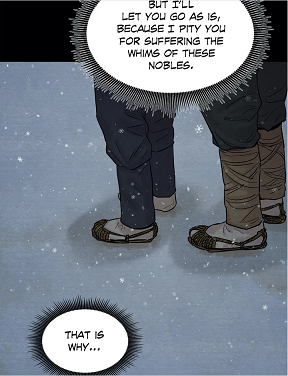 (chapter 66) With these words, he expressed a certain remorse linked to pity, yet it was limited, for he viewed the nobles as the culprits. He never included himself in the reproach, he even showed himself in a good light (“I’ll let you go”). According to him, he was benevolent and generous. But he contradicted himself, as he threatened his prey.
 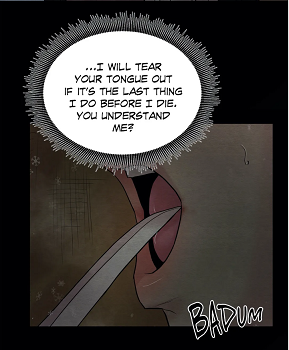 (chapter 66) Moreover, there’s no ambiguity, the painter didn’t pay attention to this confession. The Joker wanted his victim to remember his threat, thus Na-Kyum could only forget the helping hand’s “good heart”. This explicates why the painter got so frightened that he even got a nightmare, he kept remembering the mask of the Joker.
 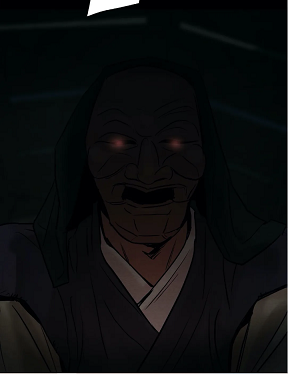 (chapter 61) As a reminder: Baek Na-Kyum never saw Nameless’ face. This image is related to Jihwa at the tavern.
 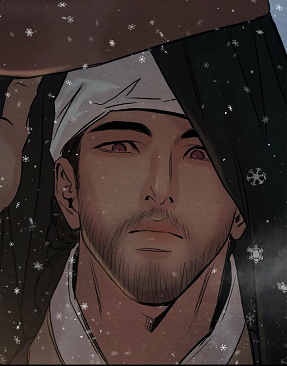 (chapter 59) His pity for the noble Jihwa was stronger than for Baek Na-Kyum’s, hence he didn’t see the negative side of his last actions. In his mind, he had truly showed his good heart! But the painter let him see in chapter 76 the real impact of his so-called “good heart”.
The latter got a flashback because of the mask and the clothes. Baek Na-Kyum noticed the mask and the colors (purple/beige), visible in the nightmare. Nonetheless, even if the aristocrats are schemers, the assistants are by no mean pure and innocent. They are accomplices, and their silence is one of the reasons why the lords are not punished. In addition, without helping hands, the nobles wouldn’t be able to commit so many wrongdoings easily, for they would be forced to witness the consequences of their own actions. (chapter 61) They might feel remorse. Jihwa got so horrified by the brutality, he had to vomit. As you can see, both second leads have a similar attitude in the beginning. This explicates why neither Jihwa nor the Joker recognized the real nature of their wrongdoing, when they took away the artist.
Yet, the incident in town served as an eye-opener for the Joker. 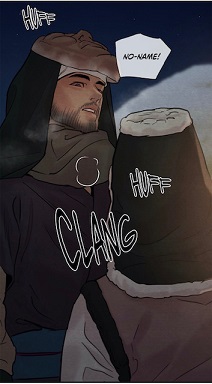 (chapter 76) The latter could realize that his action had affected Baek Na-Kyum. He definitely sensed that the artist had a panic attack and he couldn’t act, as if nothing had happened. This explicates why he kept looking at his previous target.
 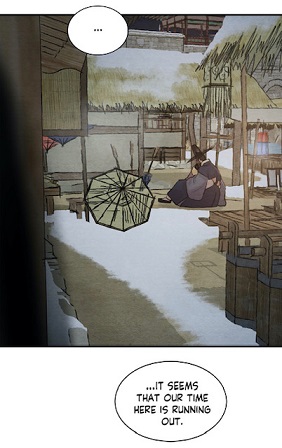 (chapter 76) He could see with his own eyes that both main characters had an affection for each other. Consequently, I deduce that he made the opposite decision from Jihwa. The low-born recognized his sin and guilt. This is the other reason why first he rejects Min’s suggestion
  and even gets infuriated
  (chapter 76), when he gets threatened by Min. He won’t act, as if nothing happened. In fact, now he has every reason to get involved again, though he is refusing the participation. He is well aware that he could get framed. Min already warned him.
 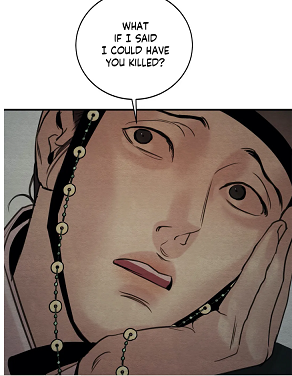 (chapter 76) That’s why exactly like in the beginning of the second season, he will remain passive by monitoring the nobles’ moves. He will definitely use other channels to get updated. And one more time, I am confirming my prediction that Nameless will play a key-role in Min’s defeat. He will definitely help the two protagonists and even Jihwa indirectly by confronting him with his true image.
As you see, I judge Nameless in a better light, though he’s a murderer. He is slowly recognizing that this world is not black and white. His actions are truly condemnable, but I have the impression, he will become Yoon Seungho’s hand of justice. As long as The Joker supports a crime, he is not blameless. His courage, patience and intelligence are his strengths, hence he was able to make the right decision in episode 76. He was no longer willing to dirty his hands for others. Hence I connect him to “pitiful regrets”.
In episode 75, the painter expressed many regrets.
One of them is that he regretted his decision to stay by the lord’s side. 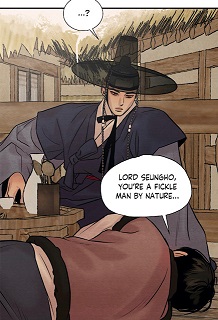 Remember that in chapter 68, he announced to his sister that he wouldn’t follow her. This could only upset his noona, hence she said this:
  (chapter 65) She implied that her brother would come to regret his choice, as he had not realized that he was pressured and it was a rushed decision. She instigated fear in her brother letting him know that such a “love” is just a trivial and temporary emotion. Since the lord had changed, exactly like his noona had predicted, the painter was starting regretting his choice, for he was getting more and more swayed by the noble’s good and kind behavior, while the other had a different evolution: he would love him less and lose his interest for him. The painter was interpreting the inexistence of love sessions as a sign of disinterest from Yoon Seungho, for the latter had always expressed his love through sex. The artist feared a change of heart from his lover. Hence the former felt awful, while in reality he was responsible for his own misery. He just needed to approach the lord himself, as the latter had already declared that he would view Baek Na-Kyum as a lord. But notice that though he was regretting, he put the blame on his lover. He didn’t want to assume the responsibility of his choice, he preferred blaming his companion. Since he had refused to listen to his “mother”, he needed to find someone else for his wrong decision.
Yet, we all know that in chapter 69, Yoon Seungho had planned to let him go, visible thanks to this image:  This was a new version of this situation:
 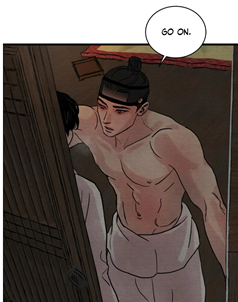 (chapter 34) The problem is that in episode 69, Yoon Seungho never let his companion know. He didn’t even show it by opening the door for him.
But the low-born’s reaction to make Yoon Seungho into the guilty one is normal, because the young man was actually imitating Heena. When the latter met her surrogate son, she put the whole blame on her brother.  (chapter 68) He is now in this situation, because he didn’t come back to the kisaeng house and he didn’t write to her. When the artist dismisses her reproach, he was just following her request, she diverts his attention by saying:
 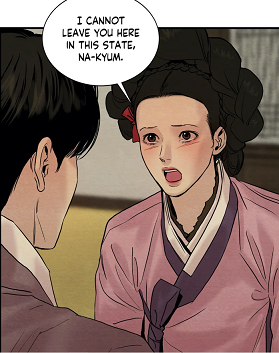 (chapter 68) With these words, she implies that that this is not the time for regret. They have more urgent matters. Because she worries so much for him, they should quickly leave the mansion. And note, at no moment she expresses regret, when she sent him away from the kisaeng house. The absence of regret and remorse from Heena is palpable in this panel too:
 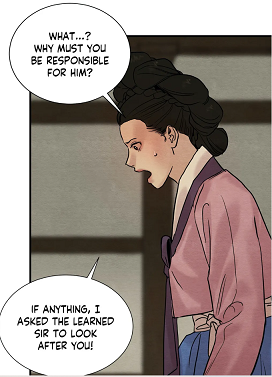 Here, she makes an allusion that if anything, Jung In-Hun is accountable for that situation, for he was supposed to look after him. As a conclusion, the head-kisaeng has never regretted her decision. She even had not the impression that she had done something wrong towards her son. Let’s not forget that she never contacted him herself during their separation and this for a long time (more than 15 months). This means, she doesn’t view herself as a sinner. Her remorseless and regretless attitude really exposes her selfishness, for she is blind to the wounds she afflicted to Baek Na-Kyum: abandonment issues.
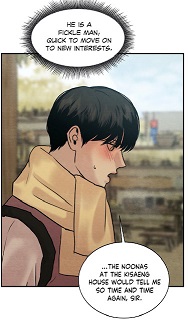
And now, you comprehend why Baek Na-Kyum copied her afterwards. Her behavior tainted on him. Furthermore, I believe that her words and attitude must have wounded her son unconsciously. He must have sensed her lack of sensitivity and selfishness deep down, explicating why he decided to put his fate into Yoon Seungho’s hands, though he feared him. With this new interpretation, it becomes understandable why the painter felt regret later. It was a combination of fears initiated by Heena’s words and his intuition, which he mistrusted now. As you can imagine, I judge his “regret” as quite silly, especially because he was contradicting himself. On the one hand, he had been pleased with the change  (chapter 74), on the other hand he judged the change as something bad: futile and superficial. So in the tavern, the artist was wishing that he had listened to his noona
  . But fortunately, his random encounter with Nameless made him realize that such thoughts were totally pointless. (For more, read the essay “Sins”) Because the lord had changed, he saved and comforted Baek Na-Kyum. He had acted the exact opposite to his attitude during and after the abduction. He rushed to his side, exactly like Baek Na-Kyum had hoped
  (chapter 60) With this incident, the painter experienced that the noble’s feelings had not changed at all, and he was indeed reliable and trustworthy. That’s why he closed his eyes at the end.
  His intuition had not misled him. This signifies that from that moment on, the painter will stick to his initial choice. He won’t leave Yoon Seungho’s side. At the same time, this incident with Nameless destroyed the little power Heena still had over her son. Now, the son is living his life as an grown-up without his mother’s interference.
But before regretting his decision to stay in the mansion, the low-born expresses his regret concerning painting. But it only occurs, when the lord gets curious about the reason why he dropped his passion. (chapter 75) He was missing painting. Deep down he wished, he hadn’t vowed to stop painting, because he was so sad and hurt. Though he felt so miserable, he saw it as an obligation, for it was his punishment. Because of him, Jung In-Hun had failed to secure a position.
 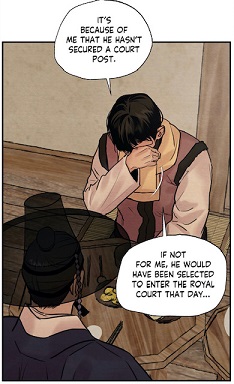 (chapter 75) This means, Baek Na-Kyum felt remorseful. He had the impression, he had done something wrong. It was, as if he had sinned, therefore losing his passion was the price he had to pay for his sin.
This topic came to the surface, because Baek Na-Kyum had started talking about his past and more precisely about his lessons revolving around sin and afterlife, reinforcing my interpretation that the kisaeng house was a place full of Christians. This truly shows that the young artist only received a religious education, because he still can neither write nor read.
In this scene, the painter looks really pitiful, for he is blaming himself entirely. The sin is so big that he accepts the scholar’s hatred towards him. 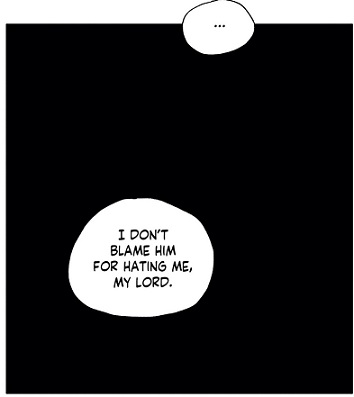 (chapter 75) This explicates why for each bad action Jung In-Hun did towards him before, the latter would still overlook the betrayal and abandonment. He accepted all of this deep down, as he felt culpable. Thus the manhwaphiles can comprehend why Jung In-Hun is still so sure about his power over the painter,
  (chapter 44) and even left him without biding goodbye, though he had hurt him so deeply before. He knows the artist’s weaknesses: his adoration for him and his so-called sin. Thus the teacher appears as remorseless. He has no regret either. He never suffered from huge pangs of conscience, when he beat him or abandoned him.
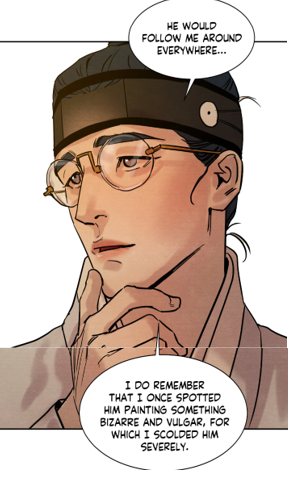 (chapter 6) His attitude resembles a lot to Heena’s.
But remember how I described this conversation in the inn. I compared it to a confession, and Yoon Seungho was a priest embodying Truth.
Back then, he just said this to Baek Na-Kyum 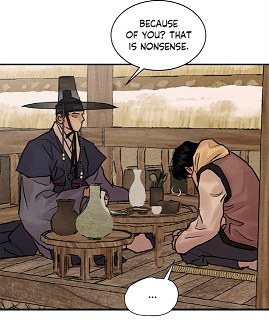 (chapter 75). He tried to free his lover from his guilty conscience. But I doubt that these words were enough for liberate the painter from his remorse. Therefore I am suspecting that in the next season, Yoon Seungho will be forced to reveal the true reason why the scholar failed to secure a high position and expose his lie to Baek Na-Kyum.
Remember how he sent a black man to dig information about the learned sir. For this story is going in circle, we have to anticipate that the protagonist will repeat this action. However, this time he could ask for the learned sir’s dirty secrets. Another possibility is that he mentions the Christian religion, for I am suspecting the scholar of using this religion to get free support from low-borns. And this attempt of separating the learned sir from the painter would definitely serve Kim’s interests, as the latter had already tried to ruin the relationship between the artist and the teacher during the first season. The butler’s initial goal was that the main lead doesn’t meddle in politics and official positions. He had to lie low in order not to attract the attention from the king.
While the painter is still attached to the scholar by his sin, the moment the truth is unveiled, the artist has no reason to feel responsible for the scholar’s fate. And now, the readers can comprehend why the artist said this to the head-kisaeng.  (chapter 68) It was not just, because he wanted to hide his true emotions and thoughts from his mother, he was still bound by his “sin”. Besides, he has other “sins” to cover up: Heena is still unaware of his illiteracy. Remember how the painter felt embarrassed. Once Baek Na-Kyum is freed from his guilty conscience, no one can stand in the way of the lovers.
Therefore I conclude that the scholar has still power over the painter, but it is just a matter of time, until the scholar’s lie is unveiled to Baek Na-Kyum. Byeonduck has already announced that Jung In-Hun’s secret and past will be revealed soon. With such a prediction, Kim will appear in a good light, as he will give the impression that he is helping his lord and the painter again. His stans will come to the deduction that I was totally wrong. However, the explanation is quite simple. Kim’s interests will be just aligned with Yoon Seungho’s. But this doesn’t mean that once the learned sir is sent away, Kim will remain passive again. In fact, this could lead the lord’s next mistake. He trusts the butler one more time, and since the butler has achieved one goal, he can let the second kidnapping occur without dirtying his hands. That way, he can become the unofficial lord of the mansion again. Since I am predicting that Jihwa will do nothing, I am expecting that the valet fakes a letter, for the butler was always connected to a fake letter.
In chapter 75, the painter felt regretful, when he had to renounce on his passion: painting. And I started pondering about this aspect. I wondered if Heena didn’t regret herself that she allowed her son to draw such erotic pictures. 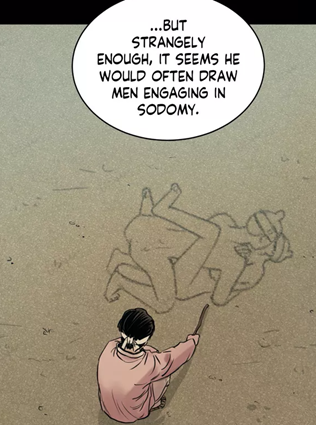 (chapter 1) We know that she neglected him, as she was too young to assume her responsibility as a mother. So maybe she regretted adopting him, hence she wanted to share her burden with others (kisaengs and the scholar). She must have resented him at some point for painting such images, as she despises sex. But then I realized one important aspect in the following panel. Heena could only see the lewd pictures, not the boy’s passion for painting. She never realized that if she had encouraged him to paint something else, he would have picked up a different topic: painting nature and landscapes.
However, since the kisaeng was overwhelmed with the task, the orphan was trapped in a kisaeng house. Besides, the young mother viewed the kisaeng house as a prison. Secondly, in this place people only come for entertainment, yet they act behind veils and closed doors. Hence he could never witness what was going on there. And if the door was open, he witnessed violence. (chapter 68)
So since Baek Na-Kyum was encaged in such a house, he could only seek for topics within his reach. Hence at some point he caught two men having sex as peeping tom. This topic fascinated him so much that he started painting. But deep down, his true desire was just painting. Since the kisaeng neglected him, she couldn’t change the topic of his drawings. That’s why she blamed Baek Na-Kyum for this passion. She associated painting to erotic pictures.
What caught my attention is that Baek Na-Kyum was so impressed by the lord’s orchid. 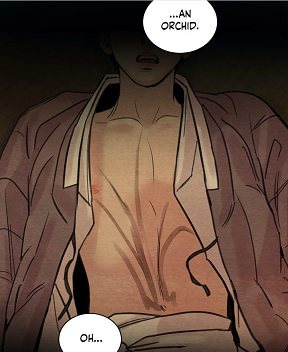 (chapter 75) Then he even created an inauguration painting with Jung In-Hun, revealing that he was inspired by his admiration and love proving that sex is not his obsession. He is just misunderstood by Heena noona. Consequently, I believe that later he will regret to have painted such an image
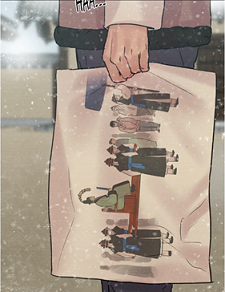 (chapter 44), as it doesn’t reflect reality. That’s why I come to the conclusion that Yoon Seungho could become the painter’s teacher, and not just his muse. As a painter himself, he will incite his companion to select other topics. Let’s not forget that the noble invited his “guest” to a hunt.
 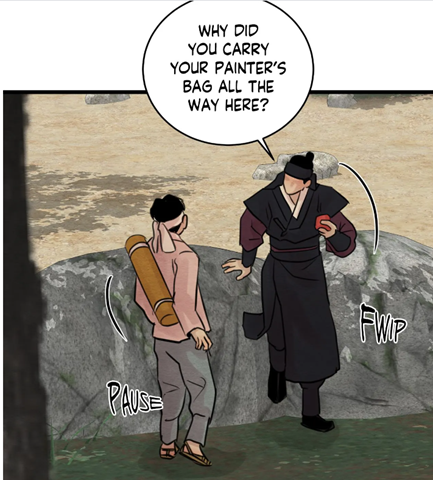 We should envisage that Yoon Seungho makes a similar request: they go outdoors so that the painter can paint a landscape.
In reality, Baek Na-Kyum became an erotic painter due to his circumstances, while his true passion was just painting. Heena never gave him the opportunity to nurture his talent, too blinded by her prejudices and belief.
But as you can imagine, though Heena and the scholar have a similar attitude, I am expecting a different evolution. The kisaeng will be confronted by her sins (not teaching her son writing and reading, misjudging the learned sir’s true nature, her abandonment and betrayal), hence she will feel immense remorse, whereas it won’t be the case for the learned sir. The latter will mostly regret his decisions by putting the blame on others. Silly regrets for Jung In-Hun, but pitiful regrets for the mother, as the latter always believed that she was acting out of love and selflessness.
Feel free to comment. If you have any suggestion for topics or manhwas, feel free to ask. If you enjoyed reading it, retweet it or push the button like. My reddit-Instagram-tumblr-twitter account is: @bebebisous33. Thanks for reading and for the support, particularly, I would like to thank all the new followers and people recommending my blog.
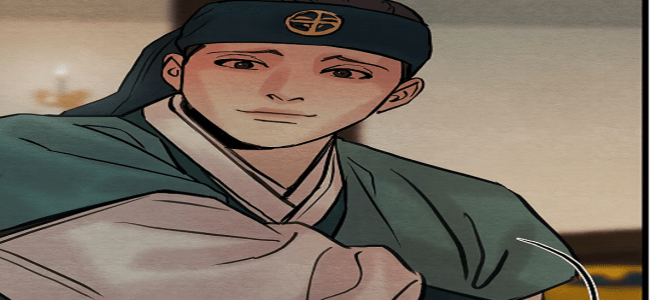
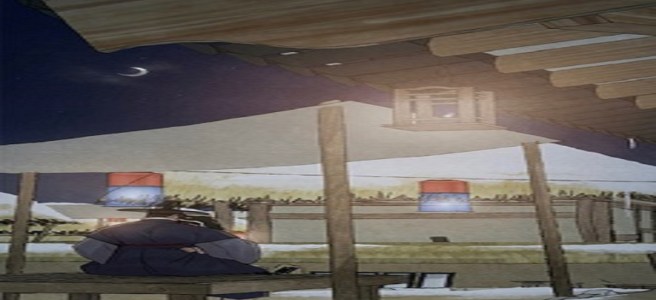

This is where you can read the manhwa. https://www.lezhinus.com/en/comic/painter But be aware that this manhwa is a mature Yaoi, which means, it is about homosexuality with explicit scenes. If you want to read more essays, here is the link to the table of contents: https://bebebisous33analyses.wordpress.com/2020/07/04/table-of-contents-painter-of-the-night/
Yesterday, the author generated a poll on Twitter. She was asking if people would like if Yoon Seung-Won got abducted and wounded, implying that he would suffer the same fate than his elder brother’s. 
In order to make sure that I didn’t misunderstand the content, I even used the app papago and it didn’t diverge at all. As you can observe, most participants agreed to this idea. This means that the author is planning an abduction and sequestration for Yoon Seung-Won. However, when the poll was still active, some users were saying that the author was asking if the readers wanted to have a happy ending or not. As you can see, the twitter generated rumors about the evolution of the story. Striking is that only 20% refused the idea of a kidnapping, because Yoon Seung-Won is handsome and he looks so innocent. They didn’t want another character to suffer again.
But what people failed to see is that none of the figures in Painter Of The Night is free from flaws and sins, not even Baek Na-Kyum! The latter was a liar in the beginning and is still one. This explicates why I still consider him as a hypocrite to a certain extent. (chapter 74) In this panel, he is showing a certain admiration for his lover, while he reproaches the “change” in the next panel. (chapter 75). As you can observe, change is linked to improvement in the first case, and to instability in the second. The manhwaphiles can still sense that the painter is not honest to his partner and to himself. Besides, let’s not forget that he is still not admitting his feelings for Yoon Seungho. Furthermore, he prefers the lord becoming responsible for him so that their love sessions would be legitimated by the master’s requests. This coincides with Heena’s intervention and influence, which shows how big her influence on Baek Na-Kyum was. The latter was raised to have prejudices and follow social norms. In other words, the painter’s flaws and sins are caused by his education. And for each sin (even white lies), he will suffer. Contrary to Christian philosophy, the characters in Painter Of The Night will not pay for their wrongdoings in their afterlife, but in their actual life. All the figures will meet their karma. That’s why Byeonduck already warned the readers that they should brace themselves for heartache in the beginning of season 3. And observe that “handsomeness” and “looking innocence” can not be an excuse for the absence of suffering, since the painter didn’t escape his karma. Therefore, Yoon Seung-Won can’t be spared just because of his beautiful face and his naivety.
And this leads me to the following conclusion. It is perfectly logical to plan an abduction for Yoon Seung-Won, and even to let him go a similar path than the main lead, though it will be much shorter. Why? It is, because the younger master resembles the painter in certain areas. He is also a hypocrite and a liar. And he became like that because of his father, just like Baek Na-Kyum’s flaws (ignorance, prejudices, hypocrisy and lies) are the result of Heena’s raising. Nevertheless, there exists a huge difference between them. The kisaeng acted like that out of selflessness. She always imagined, she was acting in her brother’s best interests, while in reality she was not recognizing that her actions actually were all selfish. On the other hand, the younger master learned from his own father that his own interest mattered the most. He witnessed how his father used and even abused his brother, therefore he started copying father Yoon’s MO and adopted his mentality. Yoon Seung-Won used his father’s authority to scare his brother and to impose his will onto him.  (chapter 35) First, he “faked” a letter saying that it was from the former official
 (chapter 35) , then he mentioned their relative in front of Yoon Seungho.
  (chapter 37) He definitely knew that his brother got hurt and scared by the mere mention of father Yoon. In the chapter 37, we could sense the young master’s lies and dishonesty. His goal was to obtain his brother’s help and sponsor. I believe that he desired to stay at his brother’s mansion in the capital too. But with his visitation, he failed, therefore he retaliated and gave the ruined painting on purpose to their father. He feigned ignorance, while in truth he hoped that his father would intervene.
 (chapter 44) But his scheme failed for two reasons. First, he forgot that his lie had consequences. Valet Kim took his words as face-value: “The letter was from the eldest master”. So the butler envisioned that father Yoon was indeed requesting his eldest son’s help. That’s why he played the trick by giving the ruined painting. He anticipated that the former official would perceive the gesture as insubordination and retaliate. However, Kim didn’t realize that when father Yoon created the scandal and cut off Yoon Seungho’s topknot, he was indeed abandoning his son for real. There’s no doubt that such a man who pays so much attention to his own image and reputation, would like to be associated to the infamous sodomite. That’s why the lord remained passive in chapter 44 and could only clench his fist out of rage. As you can see, the rumors have become Yoon Seungho’s protection. Now, he is out of reach for father Yoon and I believe, it is the same for the king. But so far, Yoon Seung-Won didn’t truly suffer due to his lies. As a conclusion, he will have to meet his karma in the future. How? The abduction would be the answer.
Then shortly after, the author released this picture on Twitter, asking the users to ponder the cause for Yoon Seung-Won’s embarrassment.  The young master seems to feel uncomfortable, as there’s a drop of sweat on his face. Moreover, he is thinking the following: “There are so many twisted-minded people in the world…”. So what happened?
We have two possibilities. Either he lied or he just used his brother’s name to get some recognition, just like he used his father’s authority in the first season. Remember how he utilized Yoon Seungho’s name to explicate why father Yoon didn’t bid farewell properly, we have to expect a new version of this. But if he lied, we would have two possibilities again. Either he said that he was sponsored by his brother or he acted, as if his family hadn’t cut ties with Yoon Seungho officially. He acted, as if the incident with the topknot had not occurred or as if their alienation had been finally removed. The manhwaphiles shouldn’t forget that in chapter 37, Yoon Seung-Won was seen visiting his brother’s mansion and he was accepted. He even got a letter from his brother delivered by Kim. Yoon Seung-Won could use this scene as a deception. One thing is sure: Seung-Won’s desire to get a high office through his brother is definitely the cause for this incident, as the young master has learned from his father that Yoon Seungho was just a tool for their family. And his dishonesty will lead to the abduction. But the new panel released by the author represents Yoon Seung-Won’s karma. He is now paying the price for his sins (selfishness, vanity and superficiality)
Let’s not forget that until he left for the capital, he lived secluded in the countryside. Therefore he was never confronted with the gossips about the topknot incident and his brother as hell-raiser directly. He might be well aware of the “prostitution” and exclusion, but he was too young to realize the real consequences of such an action. Since his father has always paid attention to their good image, the young master never envisioned the real significance of the gesture: betrayal and abandonment. The latter just judged it as banishment. That’s why he suggested to his brother to pay a visit to their father. (chapter 37) He thought that the topknot incident could be erased with a simple visitation. This truly exposes that Yoon Seung-Won has not honestly grasped the signification of the terrible event and its impact on his brother. I am even now wondering if he really knows about the extent of his bad reputation. This would explain why he couldn’t understand the presence of the fellow.
 In his mind, the elder brother was still following their father’s rules, and as such was still acting on behalf of the Yoons: Having sex in exchange for favors.
 (chapter 37) But he would lie a low profile just like in the past, when father Yoon hid his crime (prostitution) behind closed doors. Let’s not forget that Kim tried to stop him from entering the room, giving the impression that Yoon Seungho was somehow paying attention to his notoriety: sodomy would only occur behind closed doors.
So once arrived in the capital, he lets people know that he is Yoon Seungho’s brother. I can’t help myself thinking about the scholar who wanted to use the protagonist’s notoriety in order to attract attention.  (chapter 44) I believe Yoon Seung-Won could have a similar idea. Yet, the moment he acts like that, he detects how people start looking at him strangely, just like
  (chapter 01) Baek Na-Kyum reacted, when he recalled the protagonist’s identity. The young master will witness people’s disdain and shock, or they will approach him believing that he is like his brother.
  For me, “There are so many twisted-minded people in the world…” is referring to the gossips. Yoon Seung-Won will become guilty by association. That’s why he will feel uncomfortable, as he will realize what it means to be associated to such a brother. They believe that he is like Yoon Seungho, a sodomite, who is looking for favors. But Yoon Seung-Won has already internalized that sex with men is done behind closed doors.
While the father only thought about himself, when he used his eldest son as scapegoat in order to divert from his loss of power and banishment, he never realized that he ruined Yoon Seungwon’s chances for a career, especially after he served as a role model for his second son. Because the young master has learned from his own father that he can gain power and attention by utilizing Yoon Seungho, he copied his method. He learned from him the easy way how to become an important official, he never saw his father working hard. Father Yoon didn’t anticipate that his younger son would copy him and end up being stigmatized due to Yoon Seungho. Slowly, the young master will realize the father’s hypocrisy and flaws. Only through karma, Yoon Seung-Won can recognize his wrongdoings so that he can ask for his brother’s forgiveness.
Since I detect some parallels between this image and the one from chapter 1, I believe that the author will use certain elements from episode 1. That’s why I came to the idea that Yoon Seung-Won could have been lying too. 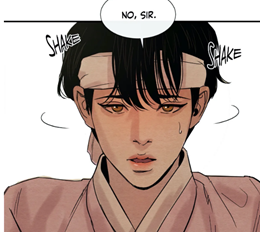 (chapter 1). It’s possible that Yoon Seung-Won lies about his brother’s support (he says “YES”) in the hope of getting connections and help. Or he acts, as if he had rekindled his relationship with his brother. But what happens is that people push him away or start looking down on him. Then the manhwaphiles will certainly recall how the artist got abducted in that scene.
  (chapter 1)
But if he attracts attention from people by using his brother’s name, this signifies that he will get the attention from Joseon’s ruler. It is definitely possible that the king is behind the brother’s abduction. One thing is sure: the person orchestrating the kidnapping values family and traditions, imagining that if the brother gets abducted, Yoon Seungho will intervene and rescue his brother. Therefore the mastermind has no idea of the impact of the topknot on Yoon Seungho’s mentality. Naturally, Min, the scholar, Heena and father Lee could be involved, as they all pay attention to social norms and notoriety too.
So when the young master arrives in Hanyang, he announces the Yoons’ return which can not escape the king’s notice. That’s how he gets abducted by the king. Since I have already portrayed the monarch as obsessive and abusive, there’s no doubt that he could never forget Yoon Seungho. By abducting the brother, the king is hoping that the brother will intervene and rescue his brother, just like he sacrificed himself in the past for his family. However, what happens is that Yoon Seungho will ignore the kidnapping, for he no longer views Yoon Seung-Won as his brother. Simultaneously, such an abduction and sequestration would help Yoon Seung-Won to recognize his father’s selfishness, greed and ruthlessness. The latter could make a similar deal with the ruler so that father Yoon can make a comeback.
In the monarch’s mind, Yoon Seungho didn’t desire to take the exam in order to keep his distance from him. But the return of the Yoons coincides with the scholar’s sponsoring, and the king could view these two elements that Yoon Seungho has regained his sanity, and is determined to use the learned sir and the family Yoon to get power over the officials and protect himself from the ruler. It is also possible that the scholar doesn’t get noticed by the ruler, for the rumors circulating about him only appeared in the countryside. 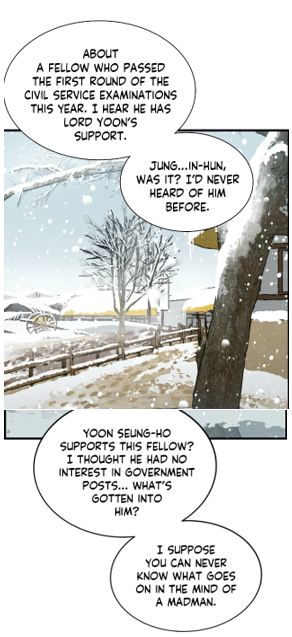 (chapter 52) That’s why it is likely that the king only pays attention to the brother’s arrival and overlooks the learned sir. Let’s not forget that he passed the first exam in the town and not in the capital. The difference between the grapevines in the countryside and the capital explicates why the monarch has not heard of Yoon Seungho’s metamorphosis yet. As a conclusion, Yoon Seung-Won’s exam will be seen as a signal that Yoon Seungho is now sane in his mind, especially if the former acts, as if he was close to his brother.
There’s no doubt that the king hasn’t forgotten him at all, but since the noble was definitely suicidal and crazy, 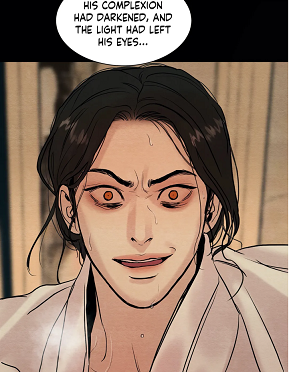 (chapter 57)
the ruler didn’t desire to face the consequences of his wrongdoings, and entrusted his lover to the so-called loyal butler Kim. This would explicate why Yoon Seungho became the owner of the Yoons’ proprieties in the countryside and in the capital. The king felt sorry and thought that by acting generous, he would make his crimes go away. Remember that Yoon Seungho chose to turn Baek Na-Kyum into a noble for his wrongdoings. 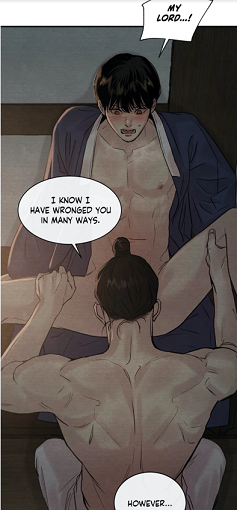
 (chapter 71) The monarch could have done the same, making Yoon Seungho the true lord of the Yoons. That’s why father Yoon chose to ruin his son’s reputation out of resent and hatred. The latter had “won”, while father Yoon was sent into exile!!
At the same time, this signifies that the valet was a double agent, he was supposed to take care of the young master, until he had recovered. 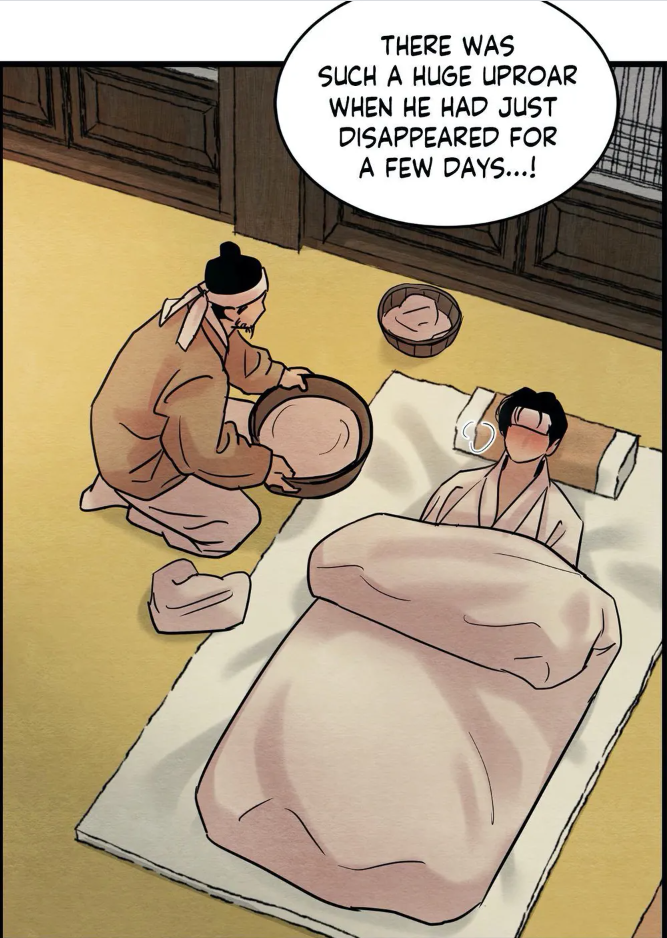 (older version of chapter 33) And under this new light, it would explain Kim’s philosophy: lie low and feign ignorance. He had to incite Yoon Seungho to fall into debauchery
 (chapter 55), that way the lord wouldn’t get the king’s attention. The latter would think, the young man was still traumatized. On the other hand, father Yoon thought that Kim was following his order: create a scandal and live in debauchery in order to divert attention from the purge of noble families close to the Yoons and father Yoon’s loss of power. Nevertheless the king was still hoping that with time, the young man would recover. So if he abducts Yoon Seung-Won, it is his way to approach his ex-lover. Since the young master is supported by his brother, the Joseon king has the impression that Yoon Seungho is avoiding him. He wants the protagonist to rekindle their relationship. And if this theory is correct, then this means that we would have a new version of the painter’s abduction in the second season. Remember that Lee Jihwa desired to get closer to Yoon Seungho by taking away the artist.
As a conclusion, the brother’s abduction definitely fits the story. In my opinion, it would even speed up the progression of the story. Simultaneously, this terrible situation would be an eye-opener for Yoon Seung-Won. Put in the same place than Yoon Seungho, he would be forced to recognize his sins and his father’s. He would recognize that lying and dishonesty are sins and as such can have terrible consequences. Remember that in the first episode, the painter’s lie caused the death of a servant, and in case of a new repetition, Yoon Seung-Won would pay his sin by getting tormented. Besides, he would be reminded of his past and recognize that back then he also betrayed and abandoned his brother. (chapter 55) He might have been stopped by the father here. Yet if he had lied before, he didn’t assume his responsibility by not revealing the truth. There’s no ambiguity that the young master was jealous of his brother in his youth, and must have lied about his brother. We already have a clue thanks to the episode from Alternative Universe:  (special episode 2)
Sure, he never anticipated such a reaction from his father, yet the moment he remained silent, he became guilty. And since the sinners are always confronted with a similar situation, this means that Yoon Seung-Won will lie for the third time. This time, he will be caught and suffer the consequences of his dishonesty. He might look handsome, but he is far from being perfect. He is just a human, while father Yoon is a monster. Consequently, the young brother has the chance to redeem himself contrary to father Yoon. Why am I am so hopeful? It is because of the shoes!! The younger master removed his shoes before approaching the door of the host’s bedchamber. With this gesture, he showed a certain respect towards his brother.  He imitated his brother in this aspect 😉, though he was not aware of this.
  (chapter 37)
  (chapter 53) Notice that Deok-Jae didn’t even remove his shoes, when he ransacked the painter’s study. Imagine, this detail only caught my attention today! That’s why I am predicting that we should see the kidnapping in a good way. Through pain, only the good persons will acknowledge their mistakes and express regrets.
That’s why this manhwa is called “PAIN”ter Of The Night, the suffering will bring enlightenment to the victims.
Feel free to comment. If you have any suggestion for topics or manhwas, feel free to ask. If you enjoyed reading it, retweet it or push the button like. My reddit-Instagram-tumblr-twitter account is: @bebebisous33. Thanks for reading and for the support, particularly, I would like to thank all the new followers and people recommending my blog.

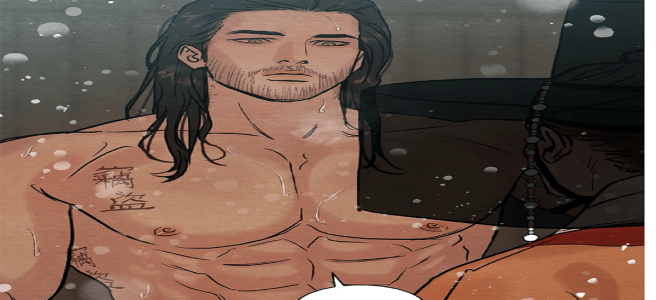


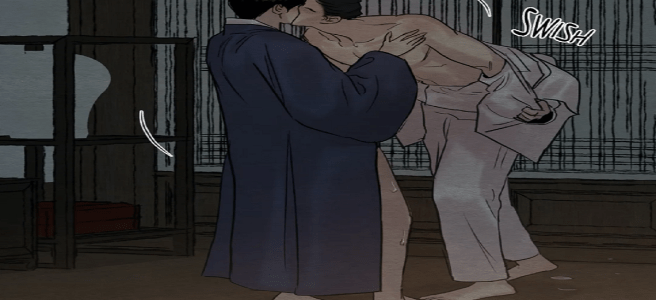
 Bebebisous33s' analyses in K-Dramaland and Manhwas