

Please support the authors by reading the manhwas on the official websites. This is where you can read the manhwa. https://www.lezhinus.com/en/comic/painter But be aware that this manhwa is a mature Yaoi, which means, it is about homosexuality with explicit scenes. If you want to read more essays, here is the link to the table of contents: https://bebebisous33analyses.wordpress.com/2020/07/04/table-of-contents-painter-of-the-night
It would be great if you could make some donations/sponsoring: Ko-fi.com/bebebisous33 That way, you can support me with “coffee” so that I have the energy to keep examining manhwas. Besides, I need to cover up the expenses for this blog.
Announcement: The essay Revenge has been updated.

1. Summary of my previous results
When I wrote the essay the shadow behind the shrine, Lezhin had only released a few panels from season 4. From these few panels, I had come to develop the following theory: Lord Shin had been killed by an elder, an old bearded man. And the latter had disguised himself, though his shoes were betraying him.  (chapter 103) The shoes were revealing that he was an official! However, the moment Jung In-Hun resurfaced, I suspected him for a moment, because he had been wearing the boots.
 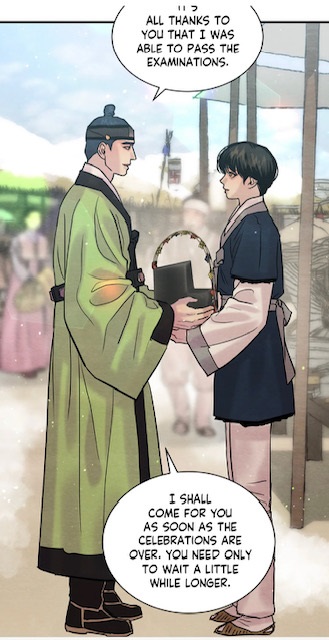 (chapter 111) Nonetheless, episode 115 exposed his true role in the conspiracy. He was just an accomplice, for he had entrusted his glasses to the author of the letter.
  (chapter 115)
2. The new discovery
So who was the shadow in the woods? Then I had a revelation. Thanks to my follower @Chikatta_11, I could distinguish the form of the shadow much better.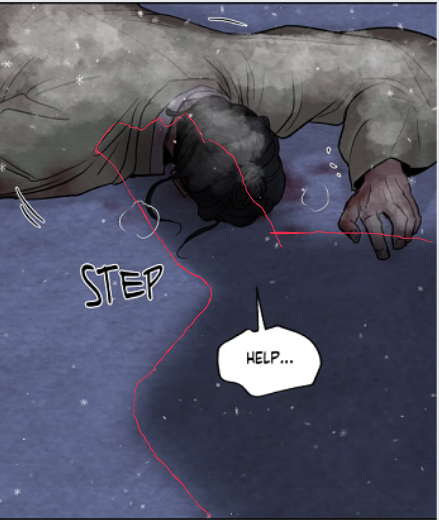 (chapter 103) The ghost is wearing the hat of an elder, a patriarch.
  (chapter 67)
Jeongjagwan (정자관) was an indoor hat worn by the noblemen . Made from horse hair, it has several peaks. https://thetalkingcupboard.com/2013/04/17/a-guide-to-joseon-hairstyles-and-headgears/
Jeongjagwan, a more angled hat worn by yangbans at home and by teachers. Quoted from https://asiasociety.org/korea/all-about-korean-traditional-hats
This signifies that the person behind the crime must have rushed, for he didn’t remove his jeongjagwan, when he chased lord Shin to the mountain. But this would contradict my idea that the person had disguised himself, for he was wearing the pants of a “low-born” due to his color: grey. (chapter 103) This reinforces my theory that the assassin was not working alone. He needed to have at least one accomplice, for he had to drive him into the woods.  (chapter 103) This had been truly a manhunt! Because both people are wearing items belonging to the upper class, I come to the deduction that the perpetrators were elders, both officials.
3. The hat and its owner
And who was wearing a jeongjagwan? So far, we only saw Father Yoon  (chapter 82) and Father Lee wearing one. But I am excluding the patriarch Yoon, as the testimony from the masked guard represents the elder’s innocence.
  (chapter 107) Besides, he doesn’t have any high position and the form of his hat is a little different (3 peaks on the side) (chapter 103) . Thus it could be father Lee or it could have been another yangban, like for example lord Shin’s father himself who was forced to kill his son.😨 And this would explain why lord Shin got so shocked, the moment he recognized the identity of the shadow
  (chapter 88) Remember what I had written in the essay “The shadow behind the shrine”. This picture exposes betrayal, something lord Shin was not expecting at all. And what is the worst betrayal? The son backstabbed by his own father! And we would have two elders involved! Naturally, this signifies that they were working together during that night.
Under this new perspective, it becomes comprehensible why lord Song mentioned this crime as a normality:  (chapter 107) If the king executed his own son, the patriarch Yoon Chang-Hyeon could do the same. It was actually justifying the violation of Confucianism. For me, this topic was brought up, because a father had been put in the very same situation! He had to sacrifice his own son. And note what the gossiping woman criticized on the street:
 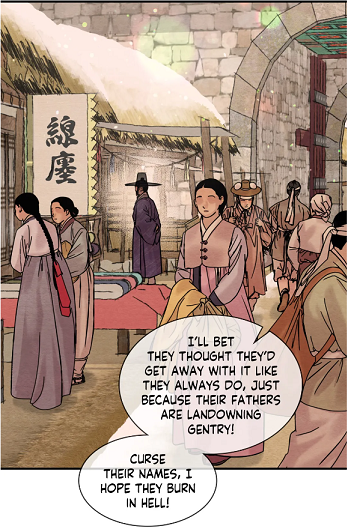 (chapter 106) The young nobles would always be protected by their fathers. Therefore it is not surprising why the schemers desired Yoon Chang-Hyeon to experience the same, the abandonment and the loss of a heir! Hence the second young master got targeted first. Thus lord Song only proposed the main lead’s assassination after making this first suggestion:
 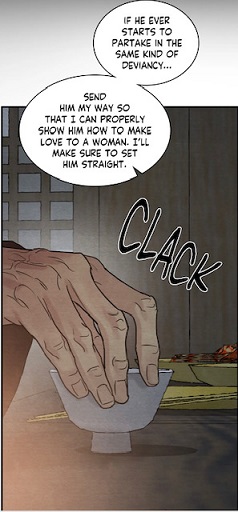 (chapter 107) He was initially trying to repeat the same action from the past, but he failed. Therefore he targeted Yoon Seungho, and this time, the elder master gave in:
  (chapter 107) However, the cause for this assassination was blackmail.
 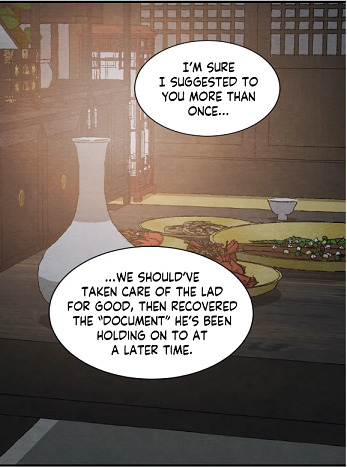 (chapter 107) It is because he needed a justification for the meddling in the Yoons’ affair. The document in question is the petition Yoon Seungwon stole from his father:
 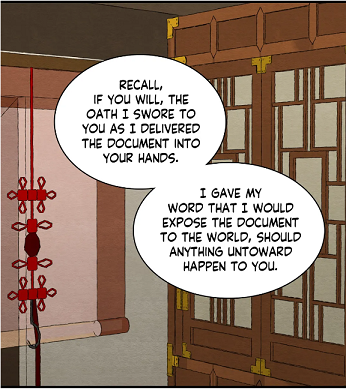 (chapter 118) This explicates why the assassination failed, as Yoon Seungho was not the real owner of the paper.
 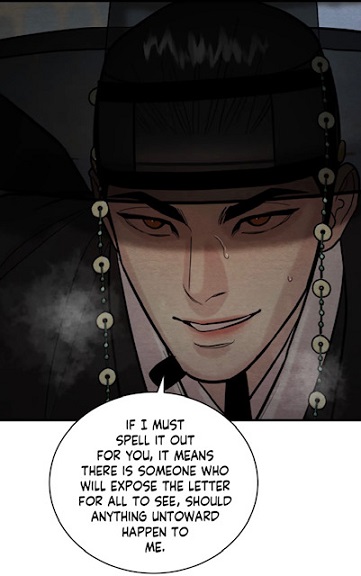 (chapter 116) In other words, both brothers were protecting each other in a certain sense. But by entrusting the petition to Baek Na-Kyum, Yoon Seungwon turned the painter into a target!
 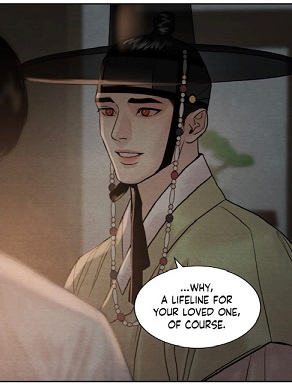 (chapter 116)
So when lord Shin recognized the face in front of him, he got shocked. (chapter 103) He thought that his father as an official would protect him, like he has always done in the past. And this observation brings me to the following panel:  (chapter 88) In the bedchamber next to Baek Na-Kyum, Yoon Seungho was recalling a memory, but he couldn’t just identify the face, for his memory had been long repressed. The latter had refused to listen to him exactly like with lord Shin in the woods: (chapter 103) Striking is that the mysterious man refused to help the injured aristocrat too. In fact, he killed him, for he represented a threat for him. Because the main lead imagined to see his father’s shadow who refused to listen to his words
 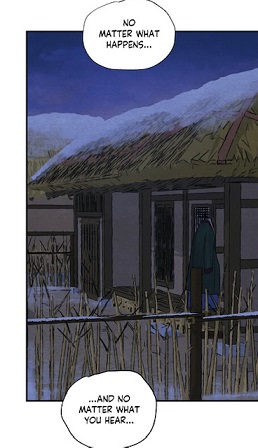 (chapter 88), I come to the conclusion that this shadow was Kim’s. (chapter 88) Why? It is because the latter has always refused to side with Yoon Seungho and embodies passivity and silence. Note that the shadow remained silent. But let’s not forget that the murderer was wearing special boots, a clue that he has a position in the administration. Because lord Song in episode 107
  (chapter 107) stated that he was no longer an official, we could exclude him as a suspect, unless he is lying. For me, he is not telling the truth. Honestly, he is wearing a purple hanbok which is actually reserved to people close to the royal family. Moreover, the hanbok has a design indicating that he is not poor, living in seclusion. Besides, let’s not forget the comment from the kisaeng welcoming him. He hadn’t come to the gibang for a while.
  (chapter 107) Why? There exist 2 possibilities. Either he lived in exile or he was living in Hanyang and working as an official. I am more tending more towards the second possibility. Why? It is because he spent a lot of money for that night in episode 107:
 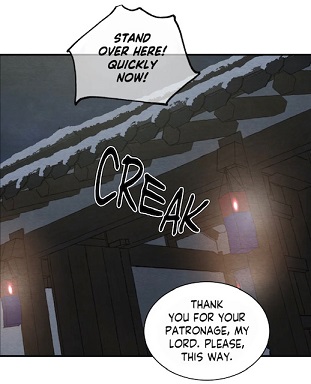 (chapter 107) Hence the kisaengs were asked to welcome the important guest at the gate. He was definitely a rich influential nobleman.
Furthermore, I would like the manwhaphiles to recall Min’s statements. He was powerful, thus he could have people killed easily 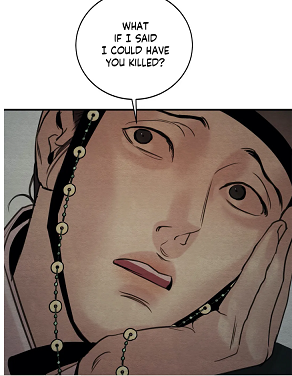 (chapter 76) or he could save Yoon Seungho, even when the latter had assassinated lord Jang
  (chapter 102) Why was he so sure? It is because his father had a high position. He was definitely relying on his father’s influence! And now, observe the evolution of the story. Black Heart is now framed for everything, he has become the scapegoat!
 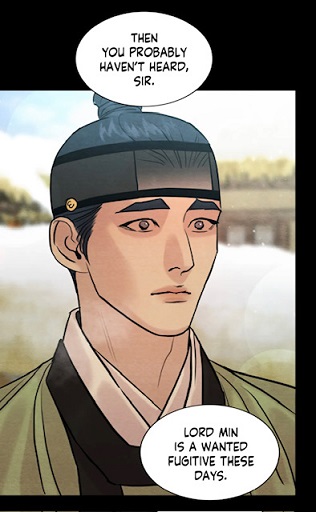 (chapter 113) This explicates why Min was accused of lord Shin’s murder.
  (Chapter 107) The purpose was to hide the intervention of a third party! Note that Yoon Seungho suspected his father immediately after visiting the burned shrine. He is not envisioning the involvement of other elders. Anyway, the blame on Black Heart signifies that the reputation of Min’s family has been tarnished, unless this gossip was created for the learned sir’s ears. If this gossip is circulating around, not only Min’s father lost his heir, but also he failed in his duty to keep the lineage
 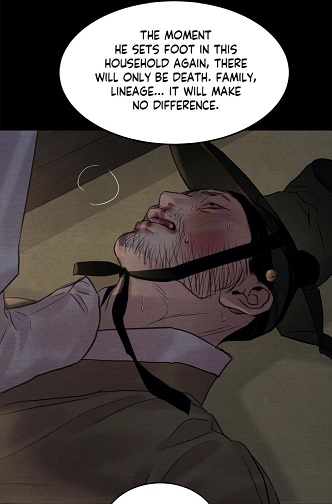 (chapter 82) Another interesting aspect is that Byeonduck revealed the names of the perpetrators in the shrine: “Lee Jihwa”, lord Jang, lord Shin, lord Park and Min. Finally, according to my theory, the Webtoonist created different people who looked like “lord Song” from episode 83
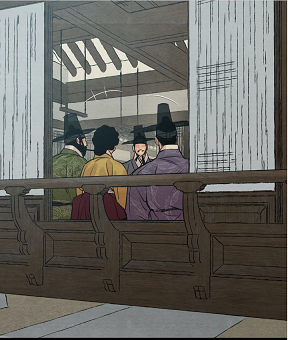 (chapter 83), for the latter had been seen wearing a purple hanbok with a design. However, the hair color, the shape of the beard and the design of the hanbok indicate that we are dealing with different people.
- chapter 107:
- Chapter 115:
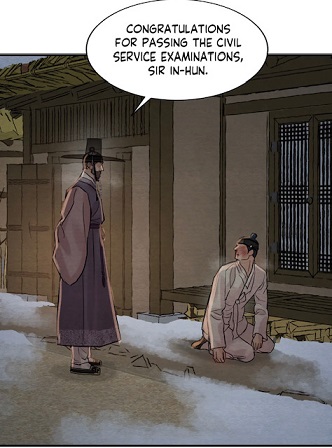
- Chapter 116:
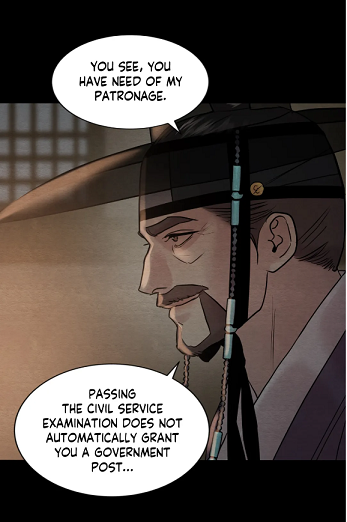
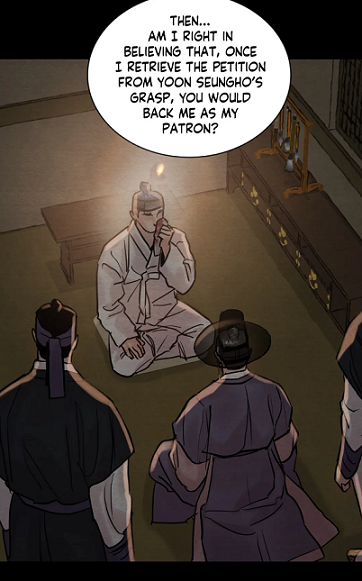
Thus I am suspecting that these men could be related to the perpetrators in the shrine. They would have a motive to target the protagonist and the Yoons in general! It is because they lost their sons, but they can not denunciate Yoon Seungho for his crime, because their involvement would be exposed. In my opinion, their crimes and lies from the past are now coming to the surface! That’s the reason why they are not seeking for justice, rather for revenge and a new purge would be the perfect.tool to bury the truth. Under this premise, it explains why Jung In-Hun was approached and was tasked to rekindle with Baek Na-Kyum.  (chapter 118) They needed him to betray Yoon Seungho.
But I have another reason to suspect an official, an elder involved in the murder of lord Shin. It is related to the Jeongjagwan and its symbolism:
Jeongjagwan is traditional Korean indoor headwear. It was designed exclusively for high-class, neo-Confucian scholars—philosophers, politicians, and public officials of the Korean Joseon state, which existed from the 14th century up until 1897. This headwear style was also used during the short period of time before Korea lost its independence—until that point the country was known as Daehan Jeguk. Similar to other horsehair hats, jeongjagwan were manufactured using a special block to shape the woven structure which was then lacquered. Its specific shape, with eight or twelve peaks, led to the jeongjagwan’s common association with mountains. The headdress was most likely shaped this way intentionally: mountains were seen as symbols of honor and wisdom and the jeongjagwan was worn to emphasize the noble origins of its owner. Just as neo-Confucianism came to Korea from China and was further developed by local philosophers, the jeongjagwan was an upgraded version of a Chinese model. Quoted from https://easteast.world/en/posts/5
Is this a coincidence that the perpetrator was wearing such a hat in the mountain? (chapter 103) I doubt it! Actually, it exposes the elders’ hypocrisy! They embodies the opposite notions: cowardice, immaturity and stupidity! As you can imagine, I am more than ever convinced that father Lee is involved in the new plot. My reasoning is the following. Who saw “lord Song” with the purple hanbok? (chapter 83) Yoon Chang-Hyeon and Yoon Seungho… thus he purchased the ghost in town (chapter 106). But the Lees were present either, yet they never talked to the guests directly.  (chapter 83) How did Lee Jihwa know his name?
 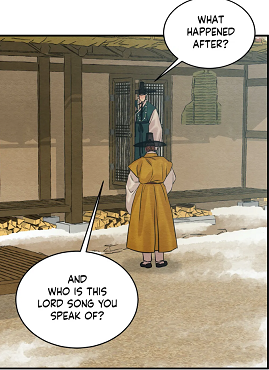 (chapter 83) And observe what the learned sir said after burning the letter:
  (chapter 115) Min has also been investigating Yoon Seungho’s past in order to find his weaknesses. However, he couldn’t find the person lord Song! As you can see, this name oozes mystery and danger. And this reinforces my theory that people have been impersonating “lord Song” and the latter’s name has become a taboo! And that would fit to No-Name’s situation.
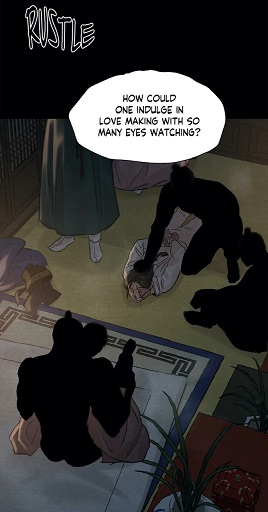
  (chapter 76) He doesn’t possess a name, and as such he has no identity. Moreover, he is wearing a mask indicating that he is playing different roles. Moreover, he often vanishes. He is like a ghost! Exactly like lord Song… Yoon Seungho only knows his name, but he has not been able to identify his face!
  (chapter 86)
4. The position of his corpse
At the end, the manhwalovers could see his corpse lying on his stomach. It was, as if the culprits didn’t wish to see lord Shin’s gaze. He had been stabbed from behind. 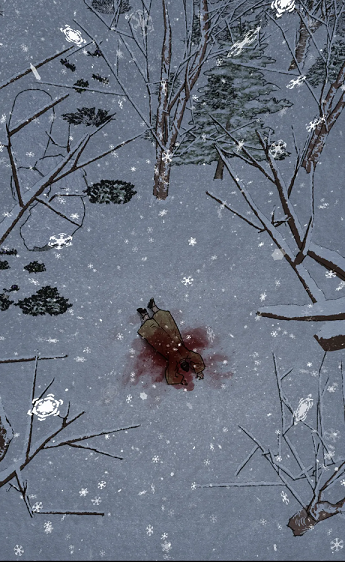 (chapter 103) Another important detail was the absence of footprints in the snow. The imprint would have revealed the identity of the perpetrators: the boots, the evidence of the involvement of officials. To conclude, the elders are responsible for the young lords’ death: Min, lord Jang, lord Park and lord Shin! By tricking Yoon Seungho and Min, the result was that they were forced to dirty their own hands.
Feel free to comment. If you have any suggestion for topics or manhwas, feel free to ask. If you enjoyed reading it, retweet it or push the button like. My Reddit-Instagram-Tumblr-Twitter account is: @bebebisous33. Thanks for reading and for the support, particularly, I would like to thank all the new followers and people recommending my blog.

 Bebebisous33s' analyses in K-Dramaland and Manhwas