

Please support the authors by reading the manhwas on the official websites. This is where you can read the manhwa. English: The Ghost’s Nocturne Korean: Night_Song But be aware that this manhwa is a mature Yaoi, which means, it is about homosexuality with explicit scenes. Here is the link, if you are interested in other manhwas: https://bebebisous33analyses.com/2021/06/06/table-of-contents-of-analyzed-mentioned-manhwas/ And these are the links to the other analyses about The Ghost’s Nocturne: 1. The Mysterious Jae Shin 2. The fragile but powerful prince 3. Devoted curses 4. Choose your fate
It would be great if you could make some donations/sponsoring: Ko-fi.com/bebebisous33 That way, you can support me with “coffee” so that I have the energy to keep examining manhwas. Besides, I need to cover up the expenses for this blog.

The title for this essay came to my mind while reading the special episode at the end of season 1. Though it was treated as a simple addition, the chapter contained so much information about Jae -Shin that it helped the Mahwaphiles to grasp how the young prince from the afterlife came to look down on humans. At the same time, through this episode, I came to develop a theory which seems to get validated in season 2. But let’s start with the examination of the special episode.
1. The forgetful mother
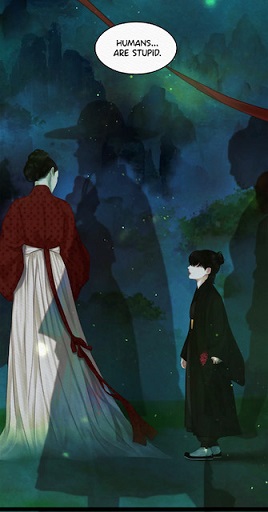 (special episode) The prince’s suffering is related to his mother, for the latter was not able to keep her promise.
 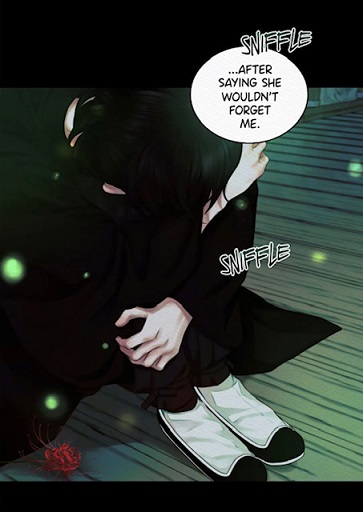 (special episode 1) When he met her on her way to the other side, she couldn’t recognize Jae-Shin, her son. (special episode) Because of her reincarnation, her soul couldn’t identify the protagonist correctly. That’s the reason why the latter was so heartbroken. But how did this incident take place? From my perspective, the woman must have looked at her son with a rather detached gaze. She was definitely intrigued, for she turned her head around. However, note that the main lead had a red spider lily in his hand, which he desired to offer her. Yet, he never came to give the flower to her, for he got stopped, the moment he saw her indifferent eyes. The authors left another clue for this interpretation and theory in the following image: (special episode) He was hiding his eyes while weeping. His position is indicating that he got wounded through the gaze. His initial reproach towards his relative implies unfaithfulness and deception, until he hears from his brothers that her oblivion is related to her human condition. He could only see this as a terrible flaw and weakness. This realization could only scare him, for he is partially a human. Just like his mother, he could forget his father and brothers at some point too.
 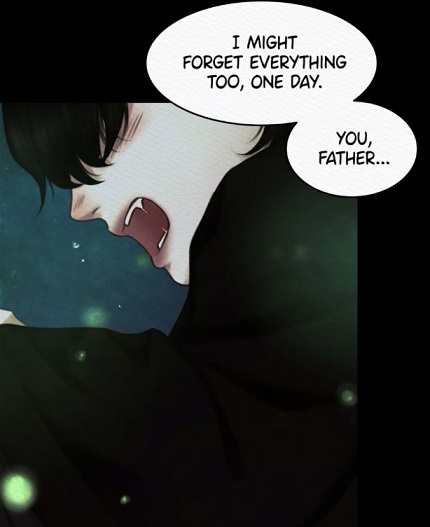 (special episode) By forgetting Yeom-Ra, Seon and Mi, he would lose his only family and as such his own identity.
According to Locke’s “memory theory”, a person’s identity only reaches as far as their memory extends into the past. In other words, who one is critically depends upon what one remembers. Thus, as a person’s memory begins to disappear, so does his identity. Quoted from https://www.scientificamerican.com/article/morals-not-memories-define-who-we-are/
His meeting with his mother’s soul generated not only some abandonment issues, but also self-hatred. He came to resent more his human nature. 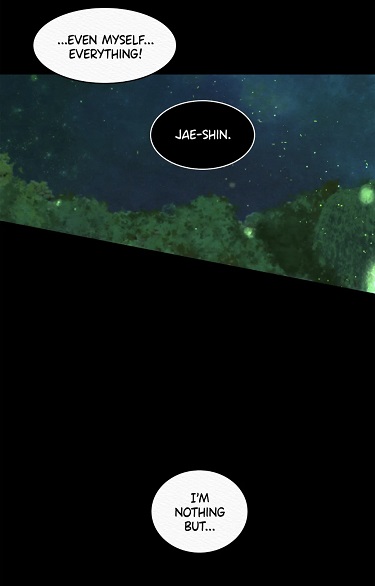 (special episode).
 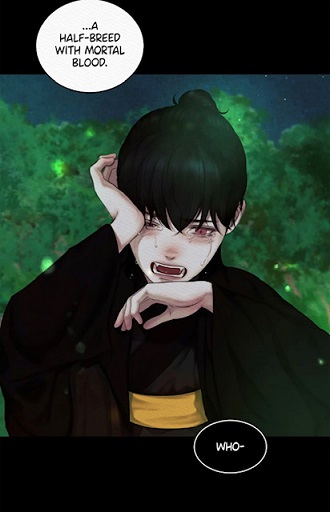 (special episode) Here, he wished to be like his brothers, but since he was growing like a human, his difference among the other ghosts and gods could only be noticed. To conclude, the painful meeting with his mother’s reincarnated soul led him to deny and reject his human nature.
  (special episode) But by doing so, he renounced his heart.
2. Seon and Mi’s intervention
On the other hand, his brothers Seon and Mi also played a huge role in his torment, for they hid the truth from the main lead. 
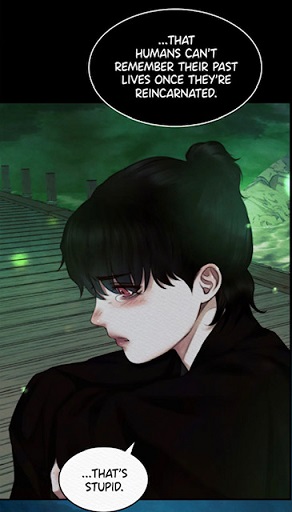 (special episode) They chose secrecy and silence believing that ignorance was in Jae-Shin’s best interest. They never imagined that Jae-Shin would be still longing for his mother and try to meet her.
 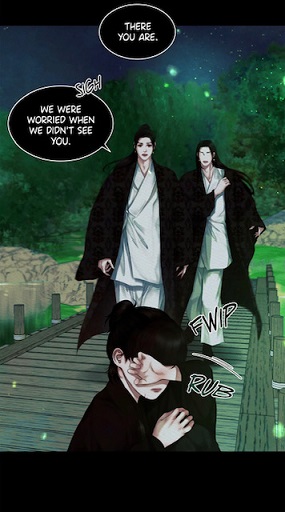 (special episode) They didn’t anticipate his move, for they thought that being surrounded by his immortal family would be enough. On the other hand, neither Seon nor Mi were aware of the gossips circulating about Jae-Shin. He was called a half-bred.
  This shows that though they tried to protect their little brother, they were not able to shield him from “reality”. He was not like them.
What caught my attention is that his bad reputation was related to his uselessness. 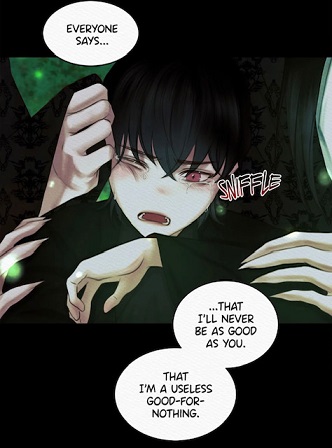 (special episode) This means that the spirits and gods in the afterlife have all a role to play, but Jae-Shin represented the exception. In order to soothe the young prince’s pain, they convinced their donsaeng to think that he could be like them.
  Thus they gave him an earing. However, if the Manhwaphiles pay attention to the reflection in the water, they will recognize the absence of Seon and Mi’s eyes. It is no coincidence, for the eyes are called “the mirror of the soul”. Since Seon and Mi are immortal, they have no soul like humans. They don’t go through reincarnation as well. As you can see, the image was exposing their distinction, but Jae-Shin didn’t notice it, for he was looking at the gift from the brothers: the earing! The latter, reflected in the river, was diverting the prince’s attention. Jae-Shin’s eyes are divulging the existence of his soul and as such his mortality. He might be very old, but he is not eternal. And now, you comprehend why Yeom-Ra turned him into a white puppy.
  (chapter 51) It indicates that Jae-Shin is on the verge of becoming an adult. In other words, the curse should be viewed as an initiation ritual marking the transition from adolescence to adulthood. Therefore it is no coincidence that the prince helped the ghost Un-Hye to remember her name. This reflects his growing maturity. With his action, he helped Seon and Mi to do their duties. Thus he got praised by his brothers.
  (chapter 53) Here, he appeared as responsible and mature contrary to the scene with the brothers at the brothel. In this scene, he reminded me more of a teenager.
 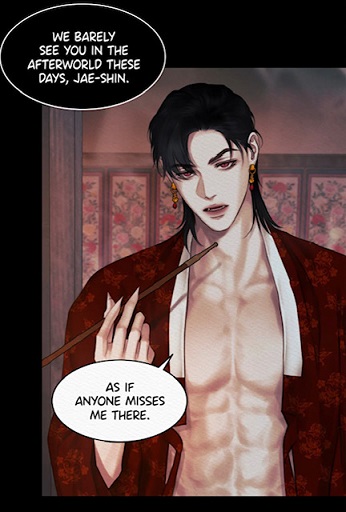 (special episode) His coldness towards Seon and Mi corresponds to his rejection of his humanity.
Because he was hugged and solaced by his caring brothers 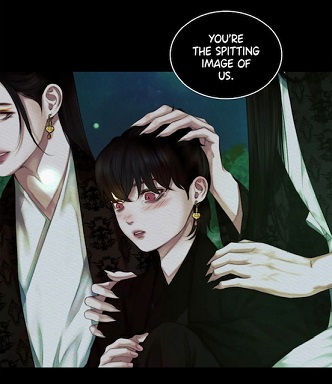 (special episode), the infamous prince voiced the wish to become like them. (special episode) This means that he wanted to receive the same task than his brothers, taking care of souls. However, since he was half-human, I believe that he was never tasked to become responsible for the book of names.
  (special episode) As time passed on, he could only feel useless. Thus he came to resent Seon and Mi. He had the impression that they had deceived him. Since he was badmouthed in the afterworld, it is not surprising that he preferred dwelling in the human world, for the humans couldn’t detect his difference.
  (special episode) It is important, because till his meeting with Lee Nok, he had not found the purpose of his long existence yet. But like Yeom-Ra stated to the other deities, Jae-Shin has a fate
  (chapter 3) This signifies that his life has a meaning and purpose.
3. Jae-Shin’s mysterious fate
And what would that be? First, he is bringing love to the afterworld. As a half-bred, he brought humanity there. This idiom has two different synonyms, society and benevolence/compassion. This is perceptible through different elements. He is badmouthed due to his different nature, a sign that the other realm is far from being tender and open-minded.  (chapter 44) The gossips reflect the disdain and alienation from the other spirits. On the other hand, the prince was also appreciated by the other divine kings Jin-Gwang and Cho-Gang
 (chapter 3) It was, as if all the kings of the afterworld considered Jae-Shin as their own “son”. Moreover, the brothers love Jae-Shin very much (special episode). Thus they did everything to console their heartbroken brother (hugging him, talking to him, giving him a present). Even when Jae-Shin is showing them a cold shoulder, they still take care of him.
  (special episode) They are always concerned, when it comes to him, but they behave differently, when it comes to humans in general. This explicates why the brothers suggest Jae-Shin to find another human, since Lee-Nok is destined to die very soon. They are slowly realizing that their brother is already falling in love with Lee Nok. They could sense his growing affection, when the latter announced that he would bring his partner to the afterworld.
  (chapter 53) Interesting is that Seon and Mi are connecting feelings to humans
 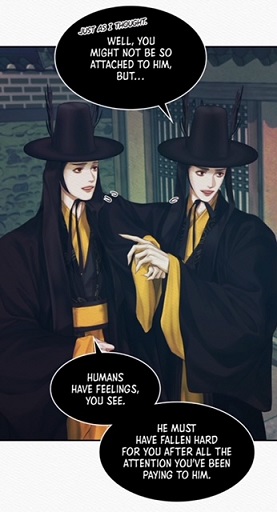 (chapter 53) not recognizing that they have developed an attachment to their donsaeng, though they are immortals. Thus you comprehend why I view Jae-Shin as the symbol of love in the end.
So in the other realm, Jae-Shin had a family and home which stands in opposition to its task. The immortal realm is responsible for karma  (chapter 3) and reincarnation of souls! It embodies “work” and “duties”.
 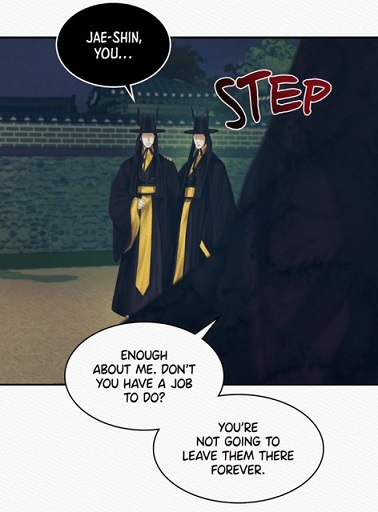 (chapter 53) Home, residence versus workplace! Under this new light, it becomes comprehensible why there existed this bad grapevine about Jae-Shin. He represented an anomaly to their world. Besides, the afterworld stands for trials and justice. On the one hand, justice should be impartial
 (chapter 1), but when Yeom-Ra sentenced his own son to exile, he showed empathy towards him. He wanted to teach him a lesson. So in my opinion, Jae-Shin symbolizes restorative justice, for he stands for empathy and love.
Restorative justice refers to “an approach to justice that seeks to repair harm by providing an opportunity for those harmed and those who take responsibility for the harm to communicate about and address their needs in the aftermath of a crime.” Quoted from ttps://www.justice.gc.ca/eng/cj-jp/rj-jr/index.html#:~:text=Restorative%20justice%20refers%20to%20“an,the%20aftermath%20of%20a%20crime.”
And we have the best example, when he helped the ghost Un-Hye to remember her name and meet her destined husband.  (chapter 53) He restored justice by repairing the harm done to these two “ghosts”, thus the queen suffered for her trick. Moreover, observe that he is defending the woman, when his brothers appear to fetch her. She is not responsible for the fiancée’s death. That’s the reason why I came to the deduction that Jae-Shin is destined to fight against the evil spirit hiding behind Queen Han Chae-Hee.
  (chapter 51) This image gives the impression that the queen is the vessel of this black shadow. The evil stepmother embodies revenge
 (chapter 21), selfishness, ruthlessness and greed, the opposite values of Jae-Shin. If Yeom-Ra’s son had been ambitious or ruthless, he would have confronted the spirits badmouthing him (special episode), he wouldn’t have longed for his mother. However, the prince has not recognized his true fate yet, for till episode 53, all his actions are motivated to lift his own curse.
  (chapter 53) These words expose his arrogance, selfishness and lack of empathy.
  (chapter 53) Like mentioned in the first analysis about Jae-Shin, his destiny is to rediscover the existence of his heart and to reconnect with his humanity, a synonym for compassion and empathy. And this brings me to the following observation concerning Lee Nok’s role:
  (chapter 54) His tears moved Jae-Shin’s heart, therefore he felt the need to wipe his tears. In that moment, he couldn’t help himself fulfilling the prince’s wish. Thanks to his intervention, Lee Nok could meet his former maid Eulsaeng. However, I would like to point out that this couldn’t have taken place, if the prince had not looked at his lover in the eyes!!
  (chapter 54) Yes, this scene confirmed my interpretation of the special episode, the importance of the gaze. Jae Shin’s fate is moved by the eye, and as such by the human soul. Thanks to Lee Nok’s gaze reflecting his pure soul, Jae-Shin is rediscovering courage, conscience and integrity! Therefore he is becoming more selfless and humble. However, such a transformation also implies suffering. As a conclusion, the locked gazes between Lee Nok and Jae-Shin are the triggers for the ghost’s metamorphosis. This explicates why the mysterious blind man warned the crown prince
  (chapter 31) about the protagonist trying to separate the couple. Moreover, the readers can grasp why the latter chose to distance himself from Jae-Shin, when he saw his hungry gaze reminding him of a monster:
  (chapter 34)
4. Jae-Shin’s second destiny
What caught my attention in this scene is that artist didn’t expose the mother’s face. (special episode) Why? Naturally, it was deliberate, because the authors desired to keep the identity of Jae-Shin’s mother a mystery. In my opinion, it is related to the promise between son and mother. (special episode) What the prince from the afterworld didn’t realize is that he was also bound by this vow. He should never forget her too, but once confronted with the reality of reincarnation, he gave up. In my eyes, he slowly repressed his memories about his mother and came to forget her. When Seon or Mi asked him about that human,  (special episode), he was referring to the mother and her new life. Let’s not forget that she was not their mother, so she was not considered as part of their family. Finally, many centuries had passed. Thus I deduce that at some point, Jae-Shin made the resolution to move on from his mother, for she could never recognize him as her son. The pronoun “Them” was employed on purpose… it was to hide her gender. But there’s more to it.
Since Ananas is working with Taoism principles, I came to the following hypothesis. Jae-Shin’s mother is Yeom. Striking is that the shaman’s vow corresponds to the promise made to Jae-Shin.  (chapter 13) She couldn’t forget her family. Her sacrifice is the expression of her love for her husband and son.
  (chapter 8) It was, as if she was punished for a past sin, the broken promise to her son.
Another important aspect is that as a spirit, her eyes are covered.  (chapter 13) But how can Jae-Shin recognize a soul? It is because of the eyes. Notice that when she got buried alive, C. R.Jade let us see her gaze one more time.
 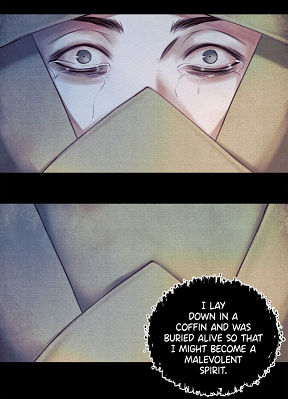 (chapter 13) Under this new light, it becomes comprehensible why the prince can not recognize his own mother.
  (chapter 13) Besides, she was given a different name: YEOM! It resembles a lot to the king of the hell of ripping tongues, Yeom-Ra. And the connection between gaze and identity got confirmed with the ghost Jeong Un-Hye.
  (chapter 51) As long as the ghost
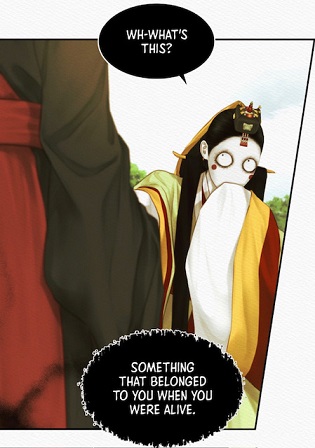 (chapter 51) had not recovered her name, she had no real eye. The moment she recollected her name, she became human again, hence she had eyes again. And now, observe how Yeom is interacting with Jae-Shin. She acts like a mother, giving him some advice
 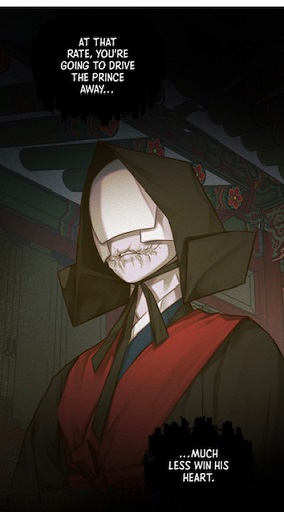 (chapter 37) Note that Yeom distinguishes herself from the other spirits, because she possesses not only her memories, but also her identity: Yeom. But was it her real name in the past? Because the ghost remembers her past life and name, Jae-Shin is jumping to the conclusion that it was her name, when she was a human. Since the brothers asked Jae-Shin about Lee Nok and that human (special episode), I assume that her death is related to (chapter 13) Lee Nok’s entrance in the afterworld.
  (special episode), for Lee Nok is 10 years younger than his stepmother.
  (chapter 2) The Manhwaphiles can detect the divergences between this coincidental encounter and his meeting with his mother. He is the one who paid no attention to the weeping kid:
  (special episode). He hasn’t even made the connection between this meeting and the present. He showed the same detachment and forgetfulness than his mother, but he was not reincarnated. In fact, this scene exposes the lack of empathy and detachment of the spirits towards humans. And this brings me to the following observation. His interaction with the Crown Prince is pushing him to remember his past and his mother.
 (chapter 44) It is important, because that’s how Jae-Shin could detect how Queen Han Chae-Hee acted like a god. His mother was supposed to remain a soul and go through reincarnation.
(special episode) Though Lee Nok returned to the human world, none of the spirits became responsible for this incident. The brothers and agents only care about the book of names (chapter 53), they never questioned why the names of the deceased appear. And it is the same for Jae-Shin. Since humans are fated to die, their destiny can not change. Yet, they are neglecting the timing and circumstances of their passing. Was it really the right time?
However, what distinguishes humans from gods and spirits is mistake and wrongdoing. 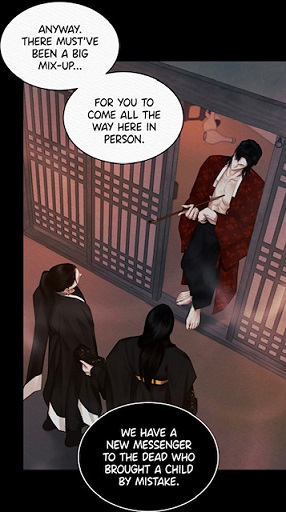 (special episode) Anyone has already heard the quote “error is human”. So how could a new messenger make a “mistake”?
 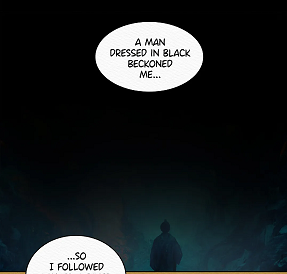 (chapter 20) Moreover, the prince’s trick in episode 1 is exposing the opposite.
  (chapter 1) The names can be switched. Nevertheless, the main lead got caught, for he is a half human. But what about the intervention of a god and king? No one would detect the trick, for it appeared naturally in the book of names.
One thing is sure: someone is playing tricks with the book of names, this explicates why the queen is stealing identities. (chapter 51) And the moment you consider Yeom as the ghost’s mother, you comprehend why the main lead is destined to fight against the evil Queen and her evil spirit!! She is responsible for turning his mother into a spirit. 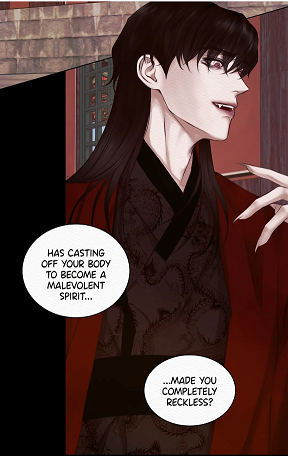 (chapter 13) If he had been by his side, he could have protected her. And if Lee Nok’s appearance in the underworld is connected to his mother’s torment, he would have more reason to fight against her.
But since the gaze is reflecting the human soul, I deduce that Queen Han Chae-Hee’s eyes are showing the absence of her soul and heart!! 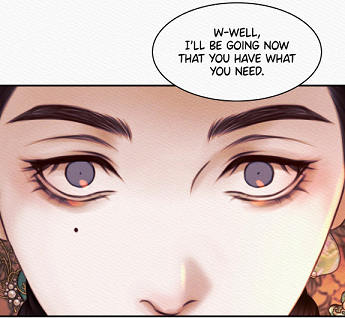 (chapter 37) Let’s not forget that soul has for synonyms heart, conscience and courage. Thus she embodies the opposite values. I have the impression that contrary to the son of Yeom-Ra, she can not enter the afterworld. She is condemned to live in the human world. But for that, she needs the sacrifice of others. Because she is feeding her own son a potion containing her hair and nails
 (chapter 37), I come to the following deduction. She is using her son as a living talisman. It was, as if she was draining her son’s life energy in order to survive. What caught my attention is that she is connected to this particular tree
  (chapter 13) It has no leaves, only red flowers. It was, as if the flowers would bloom thanks to the blood of others. This interpretation got reinforced, when Lee Nok painted a branch of the same tree
  (chapter 51) The stain on the paper resembles a lot to a drop of blood. And notice that Lee Nok was smiling
 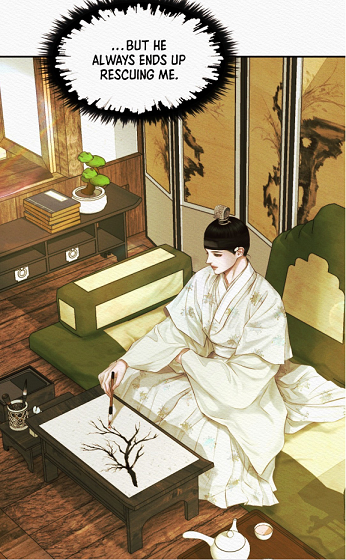 (chapter 51) while painting.
  (chapter 51) It looked like Yeom’s words had become a reality: That little thing smiled so happily like flowers in full bloom. This connection reinforced my theory that Lee Nok’s fate had been switched with Chae-Hee. Thus this observation seems to validate that the evil queen is cheating death by playing tricks with the book of names. This is not a coincidence that in that scene, the readers could detect the betrayal of the maid
  (chapter 51) Eulsaeng who had started working for the stepmother.
But let’s return our attention to the tree with red flowers. As you can imagine, I made some research and found the red cotton tree, though I can not be sure if this identification is correct. Then I found this legend about the tree:
According to one version of Mahabharata, Bheeshma once narrated the story of a proud tree to Yudhishthira to teach him the importance of humility. A long time ago, the silk cotton tree stood tall on the slopes of the Himalayas. It was extremely alluring. One day as sage Narada passed by the tree, he stopped to admire its size. He said,
“O Silk Tree, how mighty you are! Even the powerful storm cannot move your branches.
Filled with pride, the haughty tree boomed out loudly.
“That’s because the storm is my servant.”
Now sage Narada was known for being a bit of a gossip, and told Vayu, the wind god, exactly what the proud tree had told him. Vayu was furious and went thundering off to see the tree himself. When he got there, he started screaming at the tree!
“Do you know why I do not blow on you? When Lord Brahma was creating the world, he stopped to rest on one of your branches. It is out of respect for him that I keep still, but I think it is time I teach you a lesson.”
An enraged Vayu then worked himself into a great storm and blew so hard that the silk cotton tree lost all its leaves and flowers at once! That was the price the tree had to pay for his arrogance. Quoted from https://www.amarchitrakatha.com/literature_details/the-story-of-the-silk-cotton-tree/
This fits the Queen’s personality: arrogance. This wood is also strongly intertwined with ghosts. And this plant would stand in opposition to the willow in the courtyard: 
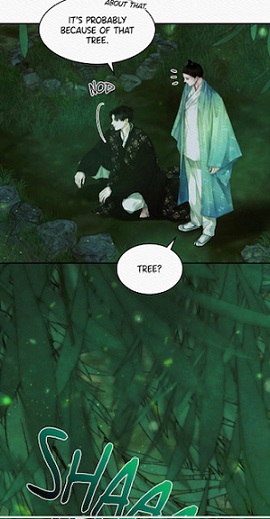 (chapter 49), for the plant embodies dream and harmony. This explicates why it can chase away spirits and ghosts.
And this leads me to my final thoughts. What is the common denominator between Yeom, Lee-Nok and the half-brother? They are all connected to sacrifice. Yeom sacrificed her life out of love for her family, for she considered the Queen as an “evil spirit”. 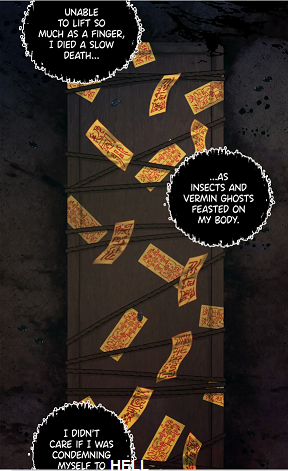 (chapter 13) Queen Yoon protected her son by accepting this dubious advice and by refusing to remove the curses.
  (chapter 21) As for the evil stepmother, she is using her son as a living talisman and as such he represents her sacrifice. (chapter 37) He is not getting better by drinking such potions, his gaze and skin are showing his poor health. Thus my theory is that Jae-Shin will come to sacrifice himself out of love for Lee Nok… but since Jeong Un-Hye and her fiancée loved each other so much
  (chapter 53), the agents were not able to bring the man to the afterworld.
 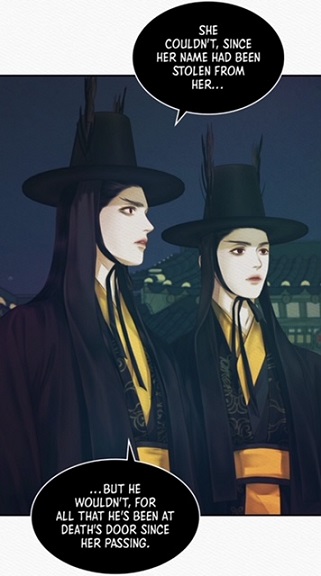 (chapter 53) They were powerless in front of affection. To conclude, this chapter and the couple were indicating the strength of love… a sign that the human heart is not so weak!! So while Jae-Shin’s gaze in this image (chapter 30) is supposed to show his monstrosity, I believe that we should see it as a reflection of his humanity and fragility, for the red spider lily symbolizes death and rebirth. Striking is that on his way to win Lee Nok’s heart, he chose the red daisy
  (chapter 37) displaying his transformation, for this flower represents passion and romance. The red daisy reflects his gradual attachment to the Crown Prince. Consequently, it becomes comprehensible why I have been predicting Jae-Shin’s sacrifice out of love.
Feel free to comment. If you have any suggestion for topics or manhwas, feel free to ask. If you enjoyed reading it, retweet it or push the button like. My Reddit-Instagram-Tumblr-Twitter account is: @bebebisous33. Thanks for reading and for the support, particularly, I would like to thank all the new followers and people recommending my blog.

 Bebebisous33s' analyses in K-Dramaland and Manhwas
It would be very thematically on point of Yeom turned out to be reincarnated mother of Jaeshin! Since there is a theme of motherhood and sacrifice in count of three , it will be odd that Yeom and Jaeshin are not connected in some way. Yeom sacrificed herself for her dead son, Queen sacrificed herself for her son so he could live while Chaehee is sacrificing her son so she could live!
As is even then Yeom already acts like a strict mother figure to Jaeshin right now so it’s already a start 👏
Jaeshin sacrificing himself would be the ultimate sign of his maturity and growth and then living eternally with Leenok as a reward. Jaeshin starts the story disillusioned , spoiled and bitter about not being approved in his chosen domain so he lives among Humans who he doesn’t even respect. But if he sacrifices himself for love and a human he would show he has become selfless and has come to appreciate love from people he already has even if they are not as many as he would like. The idea is to value and be valued not by how many one can get them.
LikeLiked by 3 people
On the other hand, Chae-Hee would be sentenced to suffer hell by getting devoured by evil spirits before vanishing into oblivion.
LikeLiked by 3 people
Yes! after making so many innocent spirits suffer it would be fitting if she suffers a backlash!
LikeLiked by 2 people
The shaman warned her about karma, she needed to do good deeds, but she chose the opposite. In my eyes, she got seduced by the power of the ghosts .
LikeLiked by 2 people
Indeed. The question now remains if its literal seduction as well in terms of who this Black ghost is and what he means to the queen
LikeLiked by 2 people
Since Chae-Hee is the negative reflection of Jae-Shin, my theory was that she is similar to him, a half-bred. But contrary to the protagonist, she was entrusted to humans.
LikeLiked by 3 people
I had to correct something in the essay. The Queen is about 10 years younger than Lee Nok. It occurred to me that Lee Nok got touched by someone from the afterworld. So this could play in favor for Jae Shin, Lee Nok could follow his lover in the afterworld.
LikeLiked by 2 people
Wait I thought the English tl said she is 10 years older? but yeah, I think of Goblin K drama and it seems like some form of immortality is in cards for both of them
LikeLiked by 1 person