
Please support the authors by reading the manhwas on the official websites. This is where you can read the manhwa: Jinx But be aware that the manhwa is a mature Yaoi, which means, it is about homosexuality with explicit scenes. Here is the link of the table of contents about Jinx. Here is the link where you can find the table of contents of analyzed manhwas. Here are the links, if you are interested in the first work from Mingwa, BJ Alex, and the 2 previous essays about Jinx To Give Or To Take? The Subtle battle between Love and Power in Jinx and Daily Jinx Advent Insight 2
It would be great if you could make some donations/sponsoring: Ko-fi.com/bebebisous33 That way, you can support me with “coffee” so that I have the energy to keep examining manhwas. Besides, I need to cover up the expenses for this blog.
In this essay I will talk about pink roses. 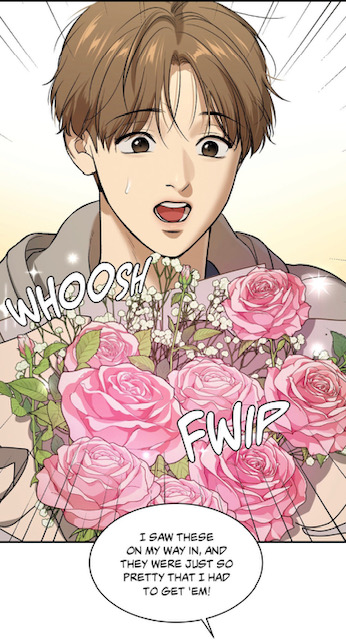 (chapter 31)
1. Pink roses and their different meanings
In the composition ““Go Away, Romeo!” (locked), I explained their meaning. Pink roses generally convey innocence, gratitude, and pure affection. They are traditionally associated with gentle emotions, making them a popular choice for expressing sincere, heartfelt sentiments without the intensity of red roses or the friendship focus of yellow roses. Interesting is that in the language of flowers, the shade of pink roses convey various shades of affection and admiration:
- Lavender Pink: Often symbolizes enchantment and fascination, making it ideal for conveying admiration that feels magical or unique.
- Deep Pink: Expresses gratitude, appreciation, and recognition, often used to say “thank you” or show deep admiration.
- Medium Pink: Represents joy and happiness, perfect for conveying general affection or light-hearted romance.
- Light Pink: Symbolizes gentleness, grace, and sympathy, often given to convey gentle love or to show empathy.
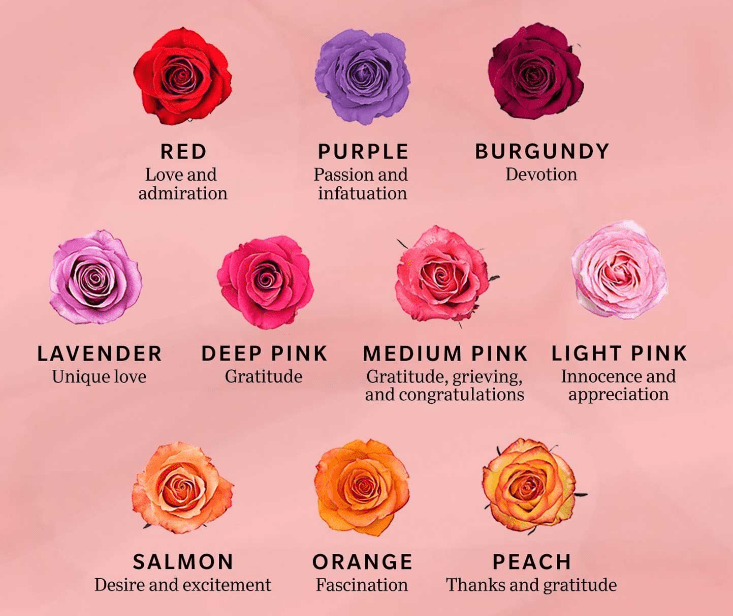
As the picture is illustrating, each hue brings a different layer of signification, adding depth to the message conveyed.
2. Heesung’s curse and the pink roses
And let’s return our attention to the gift from Choi Heesung. 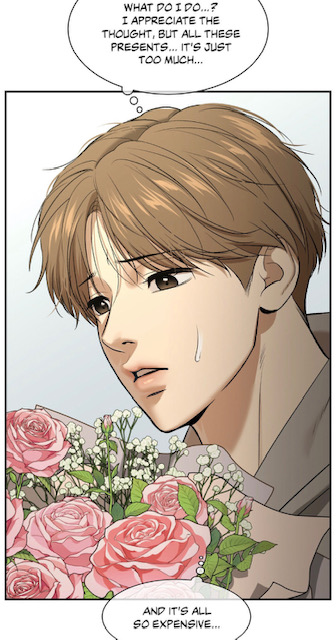 (chapter 31) They look more like the light pink rose: Innocence and admiration. However, keep in mind that back then, the gumiho was already love bombing the physical therapist with presents, a sign that he was already thinking of dating the main lead. While the bouquet of flowers was not reflecting his intentions, in verity it exposes his true thoughts unconsciously. He was simply impressed and desired to express gentleness, grace, and gratitude. This observation made me realize that the actor couldn’t identify his emotions in the end. In other words, he doesn’t know what LOVE is! That’s his curse. He mistook his feelings for love, while in reality, it was simply LUST. 😉 While the latter is important in a relationship, it only represents the first stage of love. So not overcoming this first stage, means that the relationship is doomed to fail.
3. Lust or Love?
Here I am giving a summary of the short video. The 6 differences between lust and love are the following
- Physical vs Emotional
- Weaker vs Stronger over time.
- Base on Fantasy vs Reality
- Romantic Partner vs Lifelong friend
- Thrill Seeking vs Pursuit of Stability
- Selfish vs Selfless
After watching the video or reading the summary, my avid readers can recognize the comedian’s problem. Mingwa utilized Kim Dan as an example to divulge the origins of Heesung’s curse.
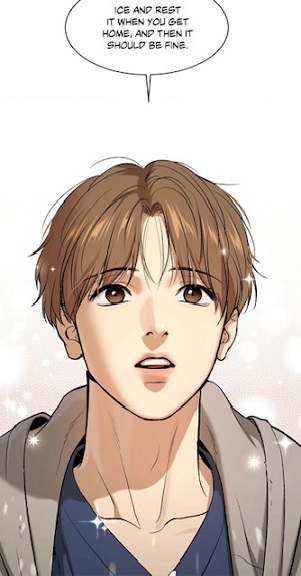
First, by offering a lot of presents, Choi Heesung didn’t try to create a real emotional connection with the physical therapist. He barely knew the doctor, he didn’t even try to get to know him at all (1st sign). The presents were quite random and came mostly from his own sponsors. His generosity was not totally genuine at all: he was trying to woo Kim Dan despite his claims (6th sign). Moreover, he already imagined that he knew him: 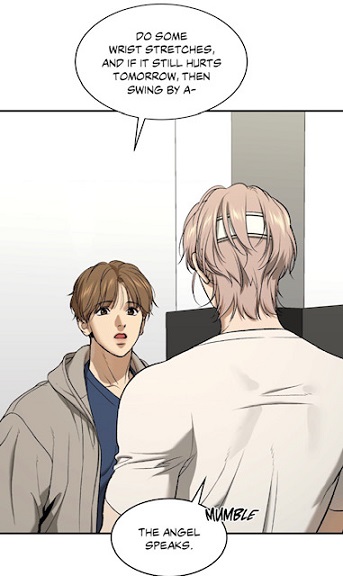 (chapter 30) “The angel speaks” outlines that he is creating a false image of the main lead. It was, as if he was living a dream which corresponds to the third characteristic. This is no coincidence that Heesung was seeing a lot of stars, when he looked at the “hamster’s face”.
  (chapter 30)
Then when he confided his thoughts and emotions to Joo Jaekyung at the bar, it becomes clear that his attraction towards his past partner was always fading away.  (chapter 33) His emotions couldn’t be maintained over time, which corresponds to the second sign.. Thus he was suddenly perceiving the unknown man as clingy and the grass would always look greener
  (chapter 33), each time he faced someone he felt attracted to. We could say, he was under the spell of his “type”. At the same time, this discovery reinforces my previous interpretation about Kim Dan’s role. The actor needed to experience rejection in order to learn that lust can not always lead to love. We could say that the doctor was the angel who freed Heesung from his terrible lust spell.
Interesting is the 4th sign. Since the doctor rejected his feelings at the café, it becomes clear that his “attraction” turned into a friendship (chapter 35), though it appears rather superficial. After their separation, Choi Heesung didn’t try to stay in touch with the protagonist.
That’s how I had the sudden revelation why Choi Heesung was doomed to fall in love with Potato. 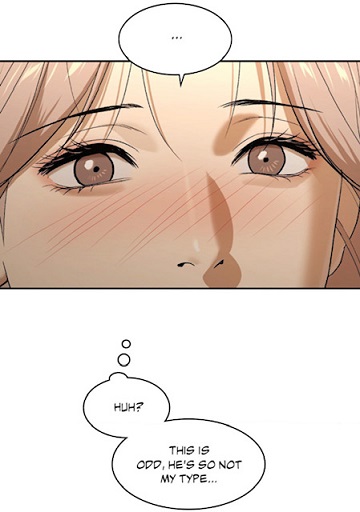 (chapter 35) Since the actor has always confused lust with love, it was necessary for him not to feel “lust” in front of Potato first. In that scene, the man was moved, not by the uke’s touch like with Kim Dan
 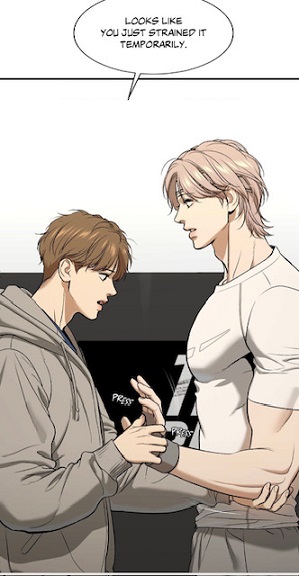 (chapter 30), but by Yoon-Gu’s words.
 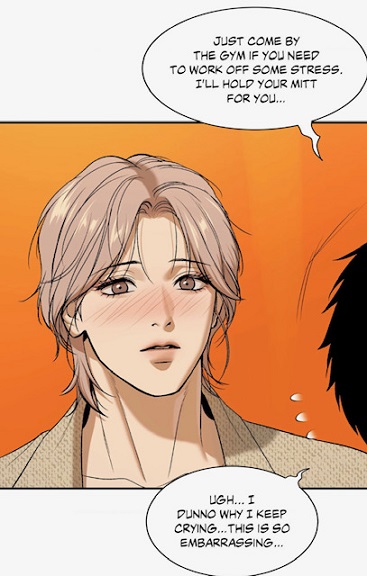 (chapter 35) The latter was offering him some help without expecting anything in return. Yes, he got attracted by his beautiful mind and heart. Through their conversation, they got to know each other. In other words, for the actor it was necessary to not experience lust, as a first stage of “love”, but to develop an emotional connection first! In addition, it becomes comprehensible why the artist suggested Potato to work as an actor.
 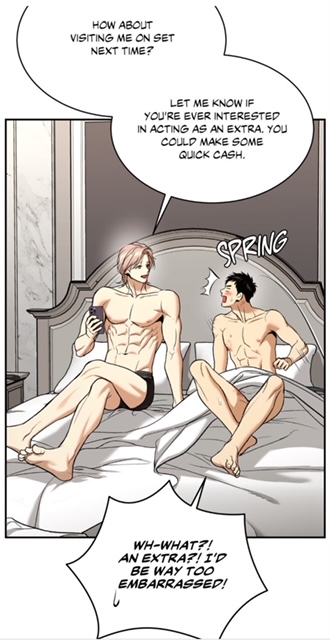 (special episode 2) It was his way to develop a longer relationship. He was trying to find the right balance between seeking thrill and pursuing stability. As a conclusion, the two special chapters display why the actor came to fall in love with Potato.
 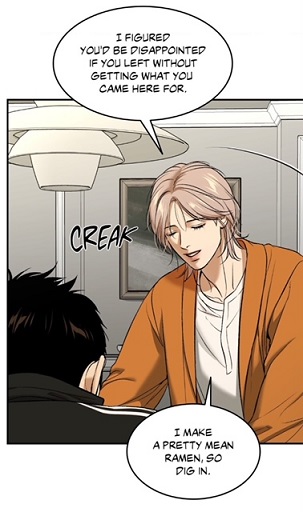 (chapter special 1) By preparing some ramen, he acted as a selfless person, though his thoughts revealed his dark side. Nevertheless, what matters the most are the actions and not the thoughts.
Thus I deduce that in the past, the artist and Joo Jaekyung had similar relationships despite their denial. Both could not create an emotional connection with their partner, for they wouldn’t talk to them. The absence of communication was the core of their problem. Moreover, both were full of prejudices, therefore they didn’t feel the need to converse with their counterpart. They would often judge their counterpart.
4. The halmoni and the pink roses
Interesting is that the light pink rose appears in a different chapter. Kim Dan selected an expensive scarf for his grandmother as a present.  (chapter 41) He bought it during his trip to the States. Interesting is that the young man chose not to bring pink roses to his grandmother. Why has he never brought flowers to his halmeoni? Chapter 31 gives us the answer:
  (chapter 31) The flowers stand for “ephemerality”, for they are destined to wilt in a very short time. Yes, this shows that deep down, Kim Dan knew how his grandmother is trying to escape from reality. He knows her likes for flowers and roses as pattern because of the bed sheets
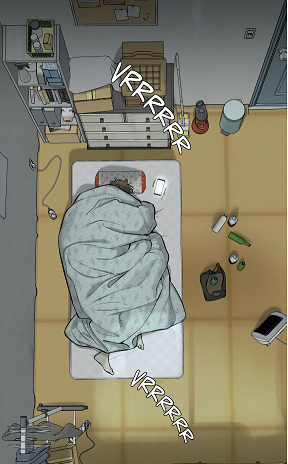 (chapter 5)
Since the scarf has light pink roses, this signifies that the doctor was conveying a similar meaning than Choi Heesung: innocence, gratitude and gentleness. It indicates that his affection is not real love in reality. How so? It is because he bought a designer neckwear. He spent all his savings for her and the nurse, as his true intention is to get acceptance and affection from these persons. Due to his grandmother, he internalized that expressing love is strongly connected to money in the end. Because the grandmother raised him, in his mind she spent a lot of money on him. But if you look carefully, you will notice that the grandmother spent more money on herself (all the things in the flat belongs to her), while she simply offered a “sweet bread and yoghurt” for his birthday 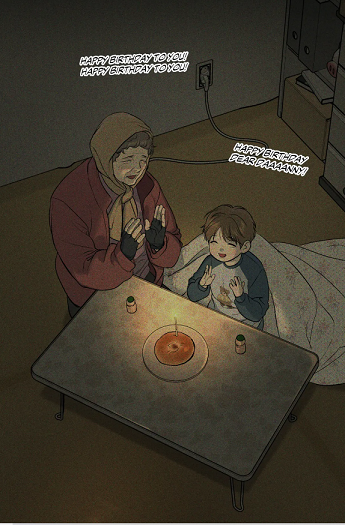 (chapter 11) or bouquets of flowers for his school career.
 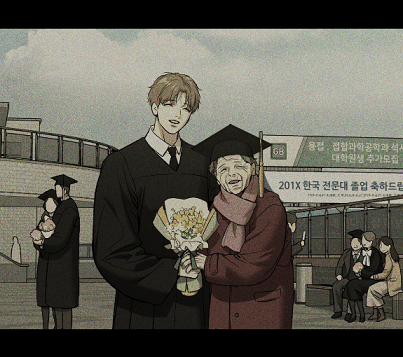 (chapter 47) Hence she generated guilt, indebtedness and obligation in her grandson. Because he was able to travel to the States, he must have felt somehow guilty, as the latter was trapped in her hospital room. Therefore he felt the need to compensate his grandmother with an expensive present.
At the same time, the design of the scarf contains not only pink roses, but also peonies and white poppies.  (chapter 41) The two flowers have the following meanings:
- Pink peony: represented by the larger, rounder flower with more layered petals, peonies often symbolize prosperity, romance, compassion, feminity and good fortune.
- White Poppy: The third flower, with a prominent yellow center and thinner petals, resembles a white poppy, which can symbolize peace, remembrance, or consolation.
Each flower has a gentle, comforting quality, reflecting themes of affection and remembrance.
According to the Peace Pledge Union, the white poppy symbol represents ‘remembrance for all victims of war, a commitment to peace and a challenge to attempts to glamorise or celebrate war’. http://www.documentingdissent.org.uk/history-of-the-white-poppy/
This exposes that Kim Dan must have known about his grandmother’s experience concerning Korean War and her evacuation. She must have mentioned her suffering and probably complained that this was the reason for her poverty. Therefore, it dawned on me why the Webtoonist created such a pattern for the neckwear.
First, in many cultures, including South Korea, peonies, roses, and white poppies can be associated with death, funerals, or remembrance.
- White roses often symbolize reverence, remembrance, and purity, which can be appropriate for funerals.
- Peonies have a complex symbolism; while often representing prosperity and romance, they can also signify compassion, which is suitable for mourning contexts.
- White poppies are strongly linked to peace and remembrance, making them common in memorials or to honor the deceased.
For me, these flowers on the scarf are announcing her imminent death, especially when you recall that flowers embody transience and temporality.
Secondly this new discovery about the white poppy confirms my previous examination: Mingwa chose to write her story like a kaleidoscope, this was the moment where war was mentioned for the first time. War was only brought up directly in chapter 53. Thus I perceive the scarf as a mirror of the grandmother’s mind-set. This reflects her inner world, the pink-tinted glasses. Whereas she imagines herself as a victim of life, she has always felt entitled for a great destiny: fortune and romance. The scarf symbolizes toxic positivity, for the main lead is avoiding an important topic: her death. But I have another clue for this interpretation in the following panel 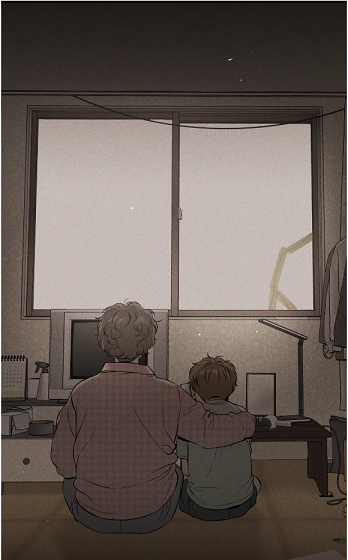 (chapter 19) But this will be the topic for the next Daily Jinx Advent Insight! 😉
Feel free to comment. If you have any suggestion for topics or manhwas, feel free to ask. If you enjoyed reading it, retweet it or push the button like. My Reddit-Instagram-Twitter-Tumblr account is: @bebebisous33. Thanks for reading and for the support, particularly, I would like to thank all the new followers and people recommending my blog.

 Bebebisous33s' analyses in K-Dramaland and Manhwas