

Please support the authors by reading Manhwas on the official websites. This is where you can read the Manhwa: Jinx But be aware that the Manhwa is a mature Yaoi, which means, it is about homosexuality with explicit scenes. Here is the link of the table of contents about Jinx. Here is the link where you can find the table of contents of analyzed Manhwas. Here are the links, if you are interested in the first work from Mingwa, BJ Alex, and the 2 previous essays about Jinx The Silent Shore and The Red Flags Behind The Flowers . This is where you can read the original version The Little Mermaid from Hans Christian Andersen
It would be great if you could make some donations/sponsoring: Ko-fi.com/bebebisous33 That way, you can support me with “coffee” so that I have the energy to keep examining Manhwas. Besides, I need to cover up the expenses for this blog.

When Joo Jaekyung dives into the water to rescue Kim Dan 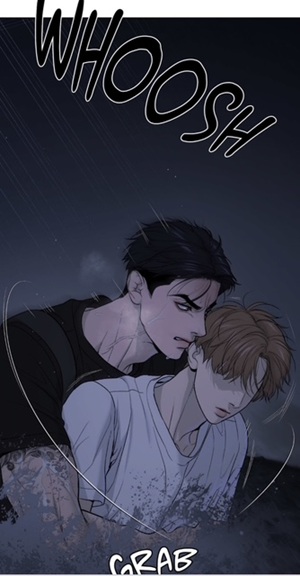 (chapter 59), the scene mirrors the iconic moment in The Little Mermaid where the mermaid saves the prince from drowning. Kim Dan, unconscious and seemingly following the voices of the hospice
  (chapter 59) —a representation of the mermaids’ song—drifts into a state of surrender, much like the prince. This act of salvation becomes a pivotal moment, connecting both characters to the themes of water, transformation, and rediscovery of purpose.
Hans Christian Andersen’s The Little Mermaid is often overshadowed by its popular Disney adaptation, yet the original fairy tale delivers a far more complex and somber narrative. Initially, the underwater world of the mermaids appears idyllic, with its enchanting gardens and harmonious existence.
Far out in the ocean, where the water is as blue as the prettiest cornflower, and as clear as crystal, it is very, very deep; so deep, indeed, that no cable could fathom it: many church steeples, piled one upon another, would not reach from the ground beneath to the surface of the water above. There dwell the Sea King and his subjects. We must not imagine that there is nothing at the bottom of the sea but bare yellow sand. No, indeed; the most singular flowers and plants grow there; the leaves and stems of which are so pliant, that the slightest agitation of the water causes them to stir as if they had life. Fishes, both large and small, glide between the branches, as birds fly among the trees here upon land. In the deepest spot of all, stands the castle of the Sea King. Its walls are built of coral, and the long, gothic windows are of the clearest amber. The roof is formed of shells, that open and close as the water flows over them. Their appearance is very beautiful, for in each lies a glittering pearl, which would be fit for the diadem of a queen. Quoted from http://hca.gilead.org.il/li_merma.html
However, as the story progresses, it becomes evident that the mermaids are seductresses, luring sailors to their deaths with their hauntingly beautiful voices. Their prosperity and gardens stem from the remains of drowned humans, tying their existence to mortality and forgetfulness.
The absence of the Sea King as an active father figure leaves the grandmother to raise the mermaids, instilling traditions, hierarchy and materialism.
his aged mother kept house for him. She was a very wise woman, and exceedingly proud of her high birth; on that account she wore twelve oysters on her tail; while others, also of high rank, were only allowed to wear six. […] ” Quoted from http://hca.gilead.org.il/li_merma.html
Among these traditions is the rule that mermaids may only visit the human world when they reach maturity, an act meant to influence them to appreciate their underwater kingdom and discourage longings for the surface. This restriction mirrors the tension between imposed norms and individual desires, as the mermaids are shaped by a world that limits their experiences until adulthood, by which time many have conformed to the values of their realm. Yet, for the little mermaid, this delayed freedom only deepens her yearning for a world beyond her own, setting her apart from her sisters. The grandmother’s role highlights the mermaids’ lack of individuality and spiritual depth, as their ultimate fate is oblivion—they vanish into sea foam upon death, unremembered and without souls.
“Yes,” replied the old lady, “they (humans) must also die, and their term of life is even shorter than ours. We sometimes live to three hundred years, but when we cease to exist here we only become the foam on the surface of the water, and we have not even a grave down here of those we love. We have not immortal souls, we shall never live again; but, like the green sea-weed, when once it has been cut off, we can never flourish more. Human beings, on the contrary, have a soul which lives forever, lives after the body has been turned to dust. It rises up through the clear, pure air beyond the glittering stars. As we rise out of the water, and behold all the land of the earth, so do they rise to unknown and glorious regions which we shall never see.” Quoted from http://hca.gilead.org.il/li_merma.html
Moreover, the mermaids’ fear of the sun, symbolized by the third sister who dives underwater to escape its burning rays, further reflects their estrangement from light and transcendence. This idyllic yet haunting world mirrors the struggles faced by the characters in Jinx, who similarly navigate environments defined by materialism  (chapter 54), performance, and the longing for a deeper connection.
Drawing from Andersen’s original themes, Jinx presents a modern reinterpretation through its characters and their relationships. Both Kim Dan and Joo Jaekyung embody aspects of the little mermaid’s journey. Kim Dan, like the mermaid, endures silent suffering, yearning for recognition and freedom from his oppressive environment. Joo Jaekyung, meanwhile, encapsulates both the prince, whose light seduces others 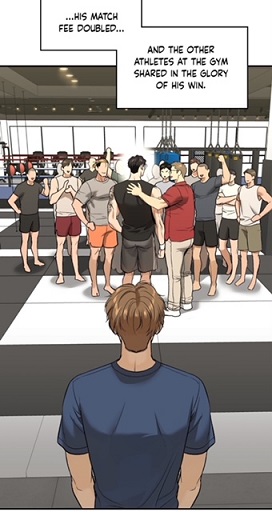 (chapter 41), and the mermaid, as he grapples with voicelessness and the pressures of his world.
  (chapter 36)
 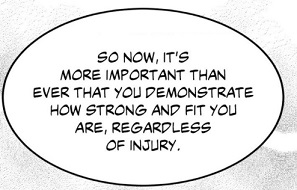 (chapter 36) Choi Heesung, representing another prince with Potato as his bride, benefits from others’ sacrifices
 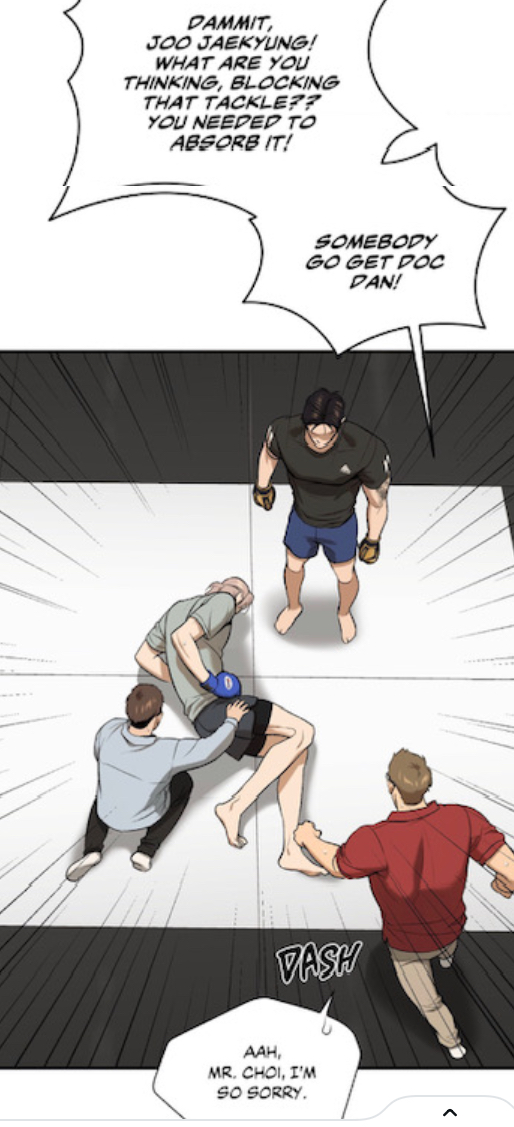 (chapter 31)
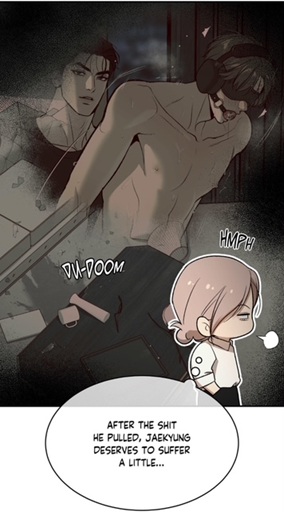 (chapter 58) while remaining oblivious to their struggles. These parallels reveal layers of self-discovery, mutual transformation, and the pursuit of meaning. By analyzing these similarities, we uncover deeper layers of self-discovery and transformation within the narrative.
The Fake Sun and Kim Dan’s Awakening
When the little mermaid first surfaces, she does not see the sun but encounters the prince instead. He becomes her “fake sun,” a symbol of misplaced hope and unfulfilled longing. Similarly, Kim Dan, who became a physical therapist due to his grandmother’s influence, is thrust into Joo Jaekyung’s world—a world he perceives as brighter, almost blinding, like the sun.  (chapter 53) Joo Jaekyung, representing the “new world,” acts as both a source of transformation and a mirror reflecting Kim Dan’s sacrifices.
In Andersen’s story, the little mermaid’s longing for the prince reflects her yearning for connection and transcendence, but it ultimately brings her pain. However, even before meeting the prince, the little mermaid longed to discover the human world. She listened intently to her sisters’ stories of their experiences on the surface, which created a deep yearning within her to explore this new realm.
“When the sisters rose, arm-in-arm, through the water in this way, their youngest sister would stand quite alone, looking after them, ready to cry, only that the mermaids have no tears, and therefore they suffer more. ‘Oh, were I but fifteen years old,’ said she: ‘I know that I shall love the world up there, and all the people who live in it.’” Quoted from http://hca.gilead.org.il/li_merma.html
Her yearning for the prince only exacerbates her desire to leave the confinement of the underwater kingdom, which she sees as restrictive, and pursue the dreams that set her apart from her sisters. Unlike her siblings, the little mermaid does not fear the sun; instead, she longs for its light and warmth. Andersen emphasizes this through her garden, which reflects her inner world and emotions:
“One arranged her flower-bed into the form of a whale; another thought it better to make hers like the figure of a little mermaid; but that of the youngest was round like the sun, and contained flowers as red as his rays at sunset. She was a strange child, quiet and thoughtful; and while her sisters would be delighted with the wonderful things which they obtained from the wrecks of vessels, she cared for nothing but her pretty red flowers, like the sun.” Quoted from http://hca.gilead.org.il/li_merma.html
The garden, overlooked by others, mirrors her unacknowledged feelings and aspirations, emphasizing her quiet longing for a brighter existence beyond the depths. Kim Dan’s relationship with Joo Jaekyung similarly oscillates between hope 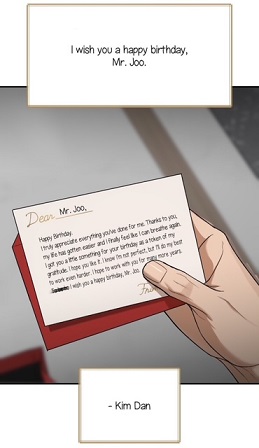 (chapter 55) and hardship
 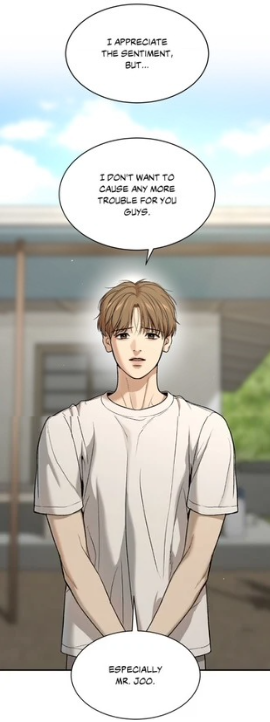 (chapter 58), yet it serves as the catalyst for his growth. Just as the little mermaid’s journey leads her to a higher spiritual purpose as a daughter of the air, Kim Dan’s experiences with Joo Jaekyung force him to confront his own worth, identity, and emotional needs. Just before he went to the ocean, he wondered about his own future and desires, a sign that he was standing at a crossroad:
  (chapter 59) However, let’s not forget that Kim Dan’s profession had been determined by Shin Okja, as the latter desired to have her grandchild taken care of her. Therefore his own desires and needs were overlooked. Traditions and social norms were used to decide about the protagonist’s life and future. His journey from voiceless suffering to self-realization echoes the mermaid’s transformation.
Depression: Disconnection and Yearning
Both Hans Christian Andersen and the little mermaid offer insights into the experience of depression. Andersen himself struggled with feelings of isolation and unreciprocated affection, which find their echo in the mermaid’s story. Her disconnection from both the underwater world and the human world mirrors the profound alienation that often accompanies depression.
The little mermaid feels different from her sisters, who eagerly conform to their traditions, while she secretly yearns for something beyond their understanding. This sense of being “other” and her inability to express her desires create a deep loneliness. Similarly, Kim Dan’s life has been marked by silent suffering and a lack of recognition for his sacrifices. 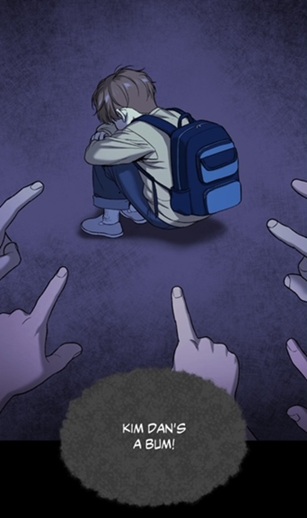 (chapter 57)
  (chapter 59) Like the mermaid, he has always lived disconnected from his own needs, burdened by the expectations of others—his grandmother, Heo Manwook, the doctors
  (chapter 21) , and even Joo Jaekyung.
  (chapter 45)
Andersen’s depiction of the mermaid’s inability to cry—”mermaids have no tears, and therefore they suffer more”—reflects the emotional numbness of depression. Kim Dan’s stoic endurance and inability to articulate his pain in season 2 resonate with this portrayal. When he is on the verge of killing himself  (chapter 59), he is not capable of crying. It is because he has been living like a ghost for the last two months. Depression, for both the mermaid and Kim Dan, manifests as a silent struggle, making their eventual transformations even more poignant.
Joo Jaekyung: The “Prince” or The Mermaid?
Joo Jaekyung’s role in Jinx is multifaceted, resembling both the prince and the mermaid from Andersen’s tale. On one hand, he is a “fake prince,” burdened by the high expectations of his surroundings and unresolved traumas. Much like the mermaid’s prince, Joo Jaekyung’s image is carefully curated,  (chapter 1) hiding his true self behind a facade of strength and success. On the other hand, Joo Jaekyung also embodies the mermaid’s longing and sacrifice. Living in the world of MMA, a high-pressure environment where he is constantly pushed to perform, he resembles the mermaid in the underwater kingdom—a place of death and materialism where the mermaids feed on drowned humans. It is no coincidence that the fighters are displayed like mermaids in the water full of blood.
  (chapter 29) This zombie-like existence leaves him voiceless; the entertainment agency and MFC dictate his actions
 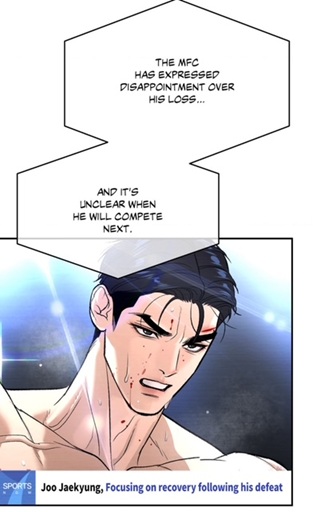 (chapter 57), only allowing him to speak when it benefits them financially.
Interestingly, Joo Jaekyung’s affinity for water  (chapter 27) reflects his connection to the mermaid. Water is his natural element, a place where he feels at peace, yet he has been forced to conform to a fiery world of intensity and relentless ambition.
  (chapter 19) Hence he never went to the swimming pool in his own penthouse, until Kim Dan triggered his memory and longing. This interplay of water and fire (chapter 53) symbolizes Joo Jaekyung’s duality: water represents his reflective and calm nature, while fire reflects the passion, turmoil, and seduction he embodies. His light, much like the mermaids’ song in Andersen’s tale, attracts others, but it often leads them astray. For example, many members of Team Black left the gym to join King of MMA, a rival gym with connections to the underground world and illegal fights.
  (chapter 52)
  (chapter 41) Joo Jaekyung’s image was exploited to lure these individuals down a darker path, highlighting how his light has been misused by those around him.
(chapter 53) The contrasting visuals of the King of MMA building (chapter 52) and Joo Jaekyung himself underscore this dichotomy. The building, with its blue tones and connection to the sky, evokes the image of a ship luring fighters into oblivion, much like the mermaid’s siren call. Interestingly, the light from the building comes from the sun, giving it the impression of naturality and hope. This creates a deceptive allure, as those who follow this path are ultimately consumed and forgotten.
In contrast, the image of Joo Jaekyung turning around is bathed in artificial light from the flash of cameras, (chapter 53) emphasizing his curated, public-facing facade. This artificiality reflects how Kim Dan, much like the public, has not yet perceived the humanity beneath Joo Jaekyung’s exterior. This dichotomy underscores Joo Jaekyung’s struggle to reclaim his identity while also highlighting Kim Dan’s journey to truly see the man behind the image. This juxtaposition highlights how Joo Jaekyung’s journey is not merely about physical survival but about reclaiming his identity and resisting the forces that seek to exploit him.
The Doctor’s Family: A Reflection of the Mermaid’s World
Kim Dan’s family background parallels the little mermaid’s environment in significant ways. The absence of the father in Kim Dan’s life placed all the responsibility on his grandmother, echoing the absence of the Sea King’s active role in his daughters’ lives. The grandmother in Kim Dan’s story shares several traits with the mermaid’s grandmother, but also presents key contrasts. Both grandmothers embody traditions, social norms, and a materialistic worldview. Shin Okja’s wedding cabinet and scarf were a source of joy and pride for her,  (chapter 19)
 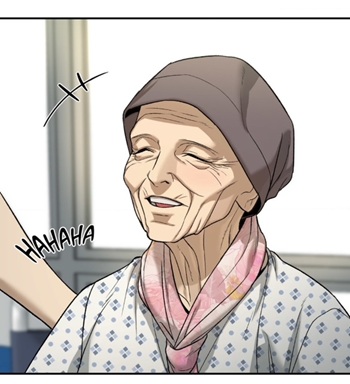 (chapter 56) as long as they were not associated with burden or suffering, while the mermaid’s grandmother celebrates the beauty and decorum of their underwater realm.
At last she reached her fifteenth year. “Well, now, you are grown up,” said the old dowager, her grandmother; “so you must let me adorn you like your other sisters;” and she placed a wreath of white lilies in her hair, and every flower leaf was half a pearl. Then the old lady ordered eight great oysters to attach themselves to the tail of the princess to show her high rank. “But they hurt me so,” said the little mermaid. “Pride must suffer pain,” replied the old lady. Oh, how gladly she would have shaken off all this grandeur, and laid aside the heavy wreath! The red flowers in her own garden would have suited her much better, but she could not help herself […] Quoted from http://hca.gilead.org.il/li_merma.html
Both women disregard the pain and desires of the protagonists—Shin Okja justifies her dependency on Kim Dan with cultural norms and his selflessness  (chapter 53), while the mermaid’s grandmother dresses her granddaughter beautifully for her first visit to the surface, disregarding the physical pain she complains about. In both cases, the protagonist’s suffering is diminished or ignored, highlighting a shared insensitivity to their emotional and physical experiences. Both grandmothers appear as rather distant and cold-hearted.
However, the mermaid’s grandmother exhibits a mental and physical strength that Shin Okja lacks. Confident and authoritative, she enforces the rules and rituals of the mermaid world, including the tradition of visiting the surface only after reaching maturity. This ritual, framed as a way to teach the young mermaids to appreciate their own realm, indirectly influences the little mermaid’s yearning for the human world. Her family could have noticed it, if they had paid attention to the sculpture in her small garden.
One arranged her flower-bed into the form of a whale; another thought it better to make hers like the figure of a little mermaid; but that of the youngest was round like the sun, and contained flowers as red as his rays at sunset. She was a strange child, quiet and thoughtful; and while her sisters would be delighted with the wonderful things which they obtained from the wrecks of vessels, she cared for nothing but her pretty red flowers, like the sun, excepting a beautiful marble statue. It was the representation of a handsome boy, carved out of pure white stone, which had fallen to the bottom of the sea from a wreck. Quoted from http://hca.gilead.org.il/li_merma.html
In contrast, Shin Okja is emotionally and physically dependent on Kim Dan, burdening him with the entirety of their survival. Her insistence on adhering to traditions reflects a passive selfishness, as she benefits from his sacrifices while escaping her own responsibilities.
Interestingly, both grandmothers play a role in inciting their grandchildren to leave their side. The mermaid’s grandmother encourages the little mermaid to explore the human world as part of their ritual, emphasizing its transience and superficiality. 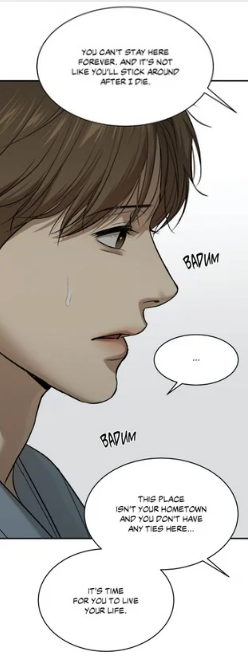 (chapter 57) Shin Okja, noticing Kim Dan’s figurative slow death under the weight of her request, subtly pushes him to seek his own path. However, this act is not entirely selfless. For Shin Okja, it represents an escape from the guilt of causing her grandson’s unhappiness, a way to absolve herself of responsibility.
Yet, the two grandmothers diverge significantly in their personal strength and awareness. The mermaid’s grandmother confidently instills traditions as a way to ground her grandchildren in their underwater identity, while Shin Okja clings to traditions to justify her dependence. Both grandmothers also embody forgetfulness and oblivion. The mermaid’s grandmother focuses on traditions and appearances, disregarding the existential yearning of the little mermaid for an immortal soul. Shin Okja similarly disregards Kim Dan’s emotional suffering, prioritizing her material needs and societal expectations. Notably, she never returned to her hometown, until she was nearing death, underscoring her detachment from legacy and emotional connection. These shared traits highlight how both grandmothers, despite their different contexts, restrict the protagonists’ growth and self-discovery, keeping them tethered to a world of conformity and unfulfilled dreams.
In both stories, the protagonists live like ghosts, overshadowed by the expectations and traditions imposed upon them. Kim Dan has always lived for his grandmother and her “dreams,” never truly pursuing his own aspirations. Similarly, the little mermaid is forced to follow traditions and live through the eyes and expectations of others. Her deepest dream of becoming human and reaching the surface is kept to herself, unknown to anyone around her. This suppression of individuality and desire reflects the stifling nature of their environments. Interestingly, the little mermaid’s garden reflects her inner world and emotions. Unlike her sisters, she does not fear the sun, and her garden is shaped like the sun with flowers as red as his rays. Yet, no one pays attention to her garden, mirroring how Kim Dan’s struggles and unwell-being are overlooked by those around him. 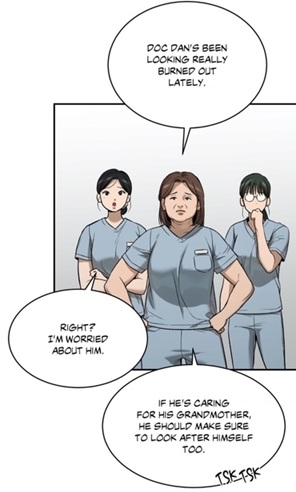 (chapter 57) He even gets blamed for his illness. These elements further emphasize how the suppression of individuality leads to yearning and eventual transformation.
The Sisters of the Mermaid and Team Black
In Andersen’s tale, the mermaid’s sisters are largely indifferent to her plight until they realize she is about to die. Their sudden sacrifice of their hair to obtain a knife from the sea witch demonstrates a delayed recognition of their sister’s suffering. Though their act is born of desperation, it comes too late to save her. The sisters, pale and sorrowful, ultimately sink back beneath the waves, leaving the mermaid to face her fate alone.  (chapter 52) This dynamic parallels the members of Team Black in Jinx. Although they are treated like Joo Jaekyung’s co-workers
  (chapter 7), in reality, he is their boss and the foundation of their success. Their indifference mirrors the mermaid sisters’ behavior; they only notice his struggles and absence when his winning streak falters, prompting many to leave the gym for the rival King of MMA. However, if we take Andersen’s fairy tale as a source of inspiration, it signifies that at some point, the remaining members of Team Black might come to “sacrifice” themselves for their “little sister,” symbolically representing Kim Dan and Joo Jaekyung. This potential act of loyalty could mirror the mermaid sisters’ gesture, showing that even belated recognition and care can lead to transformative redemption for those involved.
Gardening and Immortality
In Andersen’s tale, the mermaids tend gardens in the underwater world, a symbol of their limited existence tied to material beauty. This theme resonates in Jinx, where the gym Team Black acts as a parallel to the underwater kingdom. Like the mermaid gardens, Team Black is centered on appearances and the cultivation of superficial success. Originally created to serve Joo Jaekyung’s needs, the gym drew attention due to his achievements  (chapter 1), attracting others seeking the same level of fame and fortune.
 (chapter 46) However, the gym’s inability to produce another champion reveals its “fake gardening” nature—focused on maintaining an image rather than fostering true growth.
Park Namwook, much like the Sea King’s materialistic focus, behaves as though he owns the gym, taking pride in its reputation  (chapter 52) while merely using Joo Jaekyung’s success to boost his own ego. His plans to set up a kids’ program at the gym further underscore this self-serving nature. While presented as an effort to expand the gym’s reach, Park Namwook’s true motivation lies in financial gain, as he tries to persuade Joo Jaekyung by stating, “Kids are where the money is at.” On the one hand, this reflects his obsession with money and contrasts with the deeper, transformative intentions associated with true gardening. On the other hand, since he has himself kids, it is clear that he would like to send his own children to the kids’ program.
Interestingly, the concept of a kids’ program can be compared to the daughters of the air in Andersen’s tale.
The little mermaid perceived that she had a body like theirs, and that she continued to rise higher and higher out of the foam. “Where am I?” asked she, and her voice sounded ethereal, as the voice of those who were with her; no earthly music could imitate it. Among the daughters of the air,” answered one of them. “A mermaid has not an immortal soul, nor can she obtain one unless she wins the love of a human being. On the power of another hangs her eternal destiny. But the daughters of the air, although they do not possess an immortal soul, can, by their good deeds, procure one for themselves. We fly to warm countries, and cool the sultry air that destroys mankind with the pestilence. We carry the perfume of the flowers to spread health and restoration. After we have striven for three hundred years to all the good in our power, we receive an immortal soul and take part in the happiness of mankind. You, poor little mermaid, have tried with your whole heart to do as we are doing; you have suffered and endured and raised yourself to the spirit-world by your good deeds; and now, by striving for three hundred years in the same way, you may obtain an immortal soul.” Quoted from Quoted from http://hca.gilead.org.il/li_merma.html
The daughters of the air earn their immortal souls through good deeds, particularly by serving as unseen companions to children, influencing their growth and joy. The transformation of the little mermaid into a daughter of the air holds profound significance. Through her death, she transcends her former existence, drawing closer to her aspiration for an immortal soul. Her nature fundamentally changes—she evolves from a being defined by longing and sacrifice to one with purpose and autonomy. Her rise to the air signifies liberation from the pain and constraints of her past life, granting her a new identity. Similarly, Joo Jaekyung and Kim Dan’s struggles, marked by insomnia, loneliness, and emotional turmoil, echo this journey of transformation. (chapter 59) The ocean scene in Jinx represents the beginning of their ascent, a symbolic death of their former selves and the first step toward self-discovery and fulfillment. Like the little mermaid’s yearning for the sun and light, their encounter in the ocean marks a turn toward aspiration and the possibility of a brighter, truer existence.
However, Park Namwook’s approach twists this idea into a shallow form of “gardening” focused on profit rather than nurturing. (chapter 46) His actions reveal the disconnection between genuine care and the commodification of growth, paralleling the gym’s superficial cultivation of champions and success. When Joo Jaekyung’s streak of victories faltered after his tie with Baek Junmin, many members abandoned the gym, (chapter 52) exposing the lack of genuine loyalty and care for the champion. This mirrors the indifference of the mermaids to the plight of drowning humans, a reflection of their inhumanity. Similarly, the world of MMA fighting, like the underwater kingdom, encourages relentless training and suppresses emotional expression—vacations and rest only occur due to injury or external intervention, such as Kim Dan’s request for a day off.
Potato’s characterization as a mixture of a “spoiled child”  (chapter 22) and a “neglected child”
 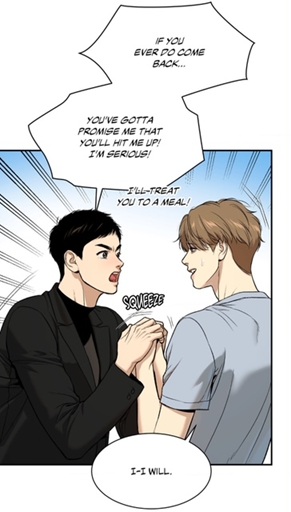 (chapter 59) further emphasizes the immaturity and lack of responsibility prevalent in this environment. In Andersen’s story, the mermaid sisters are given gardens to tend from a young age, instilling responsibility early on. Potato’s journey mirrors the mermaid sisters’ visit to the surface, as his trip to the sea represents a moment of exploration and self-discovery. While working as an actor for the first time, he realizes during his stay with Kim Dan that he has no intention of leaving Team Black.
  (chapter 58) Feeling lost without Kim Dan, he initially requests his return so that they can be together again. This longing for a companion reflects Potato’s deeper need for guidance and connection, much like the mermaid sisters who briefly visit the surface but ultimately return to their underwater world when the novelty fades. Yet, when they reach maturity and are allowed to visit the surface, the novelty of the human world quickly fades, and they return to their underwater realm indifferent to human suffering. However, notice that on his day of the departure, Potato tells Kim Dan that he won’t call him, the mermaid has to initiate the first step. (chapter 58) Just like the prince in the fairy tale, the protagonist from Jinx is treated like a servant or a play companion, but nothing more.
The prince said she should remain with him always, and she received permission to sleep at his door, on a velvet cushion. He had a page’s dress made for her, that she might accompany him on horseback. […] As the days passed, she loved the prince more fondly, and he loved her as he would love a little child, but it never came into his head to make her his wife; yet, unless he married her, she could not receive an immortal soul; and, on the morning after his marriage with another, she would dissolve into the foam of the sea. Quoted from http://hca.gilead.org.il/li_merma.html
This shows that in both stories, the humans take the mermaid’s selflessness and gentleness for granted. They don’t ask if the mermaid is feeling well. They expect them to be around them.
This lack of empathy and the absence of tears 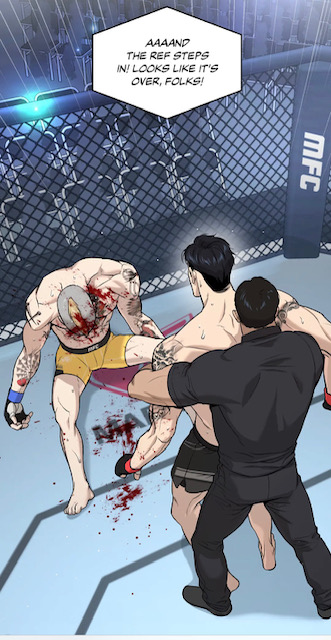 (chapter 15) strongly parallel the detached, high-pressure environment of MMA fighting. Joo Jaekyung, trained relentlessly since youth, embodies this world’s harshness, where vulnerability is a luxury rarely afforded.
By contrasting the gym’s “fake gardening” with Joo Jaekyung’s eventual journey toward authenticity, the narrative underscores the need to move beyond superficiality and reclaim one’s true self. Joo Jaekyung, after being inspired by Kim Dan, begins to metaphorically “garden” by creating his own space of renewal and growth. The ocean setting  (chapter 59) suggests that Joo Jaekyung might reclaim his authentic self through activities like swimming, reconnecting with nature, and symbolically planting the seeds for a new life. Kim Dan, who cannot swim, learns from Joo Jaekyung, and together, they forge a path toward mutual healing and immortality—not in the literal sense but through finding their “soul” and purpose.
The Ocean: Nature as a Setting for Transformation
In Jinx, the shift in the setting from the city (a symbol of civilization and its suffocating pressures) to the ocean (a symbol of nature and renewal) mirrors a pivotal change in the characters’ journeys.  (chapter 56) The city represents the oppressive expectations and artificial constructs that have shaped Joo Jaekyung and Kim Dan’s lives. By meeting again in the ocean, they reconnect with a more authentic and unburdened version of themselves. This transition echoes the little mermaid’s connection to the natural world as a place of solace and transformation.
Responsibility and Guilt: The Couple’s Role
The scene where the prince and his bride gaze at the foam, sorrowfully searching for the mermaid, mirrors Heesung and Potato’s behavior.  (chapter 59) They imagined that Kim Dan would be better off without Joo Jaekyung
  (chapter 58), but this assumption reveals their failure to truly understand Kim Dan’s plight. Their ignorance ties them to the selfishness and guilt that mark the couple in the fairy tale. Despite their faults, however, their actions indirectly contribute to Kim Dan’s transformation.
However, the mermaid’s final kiss on the prince’s bride’s forehead holds deeper symbolic meaning. The goodbye kiss, given unseen, can be interpreted as either a curse or an act of emancipation. It symbolizes her liberation from heartbreak and physical suffering. The kiss is also a farewell to the life she had sacrificed so much for, allowing her to rise as a daughter of the air. Similarly, the picture in front of the hospice could be interpreted as Kim Dan’s goodbye kiss to his friends before his own metamorphosis, marking a farewell to his old life and the start of his transformation: air.
Similarly, Kim Dan’s journey reflects a moment of quiet yet profound transformation:  (chapter 15) his kiss with Joo Jaekyung, shared in the locker room, was both an act of protection and a pivotal moment in their dynamic. Like the mermaid’s unforgettable first kiss with the prince (when he was rescued), Joo Jaekyung’s kiss in the locker room was an act of initiation, driven by his “fears” and sense of responsibility, reflecting his growing attachment to Kim Dan. The kiss symbolized his struggle to connect and protect, even as he grappled with his emotional restraint. The locker room, a symbol of physical endurance and vulnerability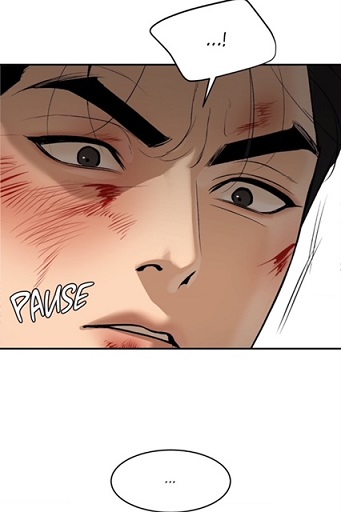
 (chapter 51), mirrors the mermaid’s longing to break free of her limitations and find meaning in her suffering.
The Daughter of the Air: Kim Dan’s Transcendence
In The Little Mermaid, the protagonist’s final transformation into a daughter of the air signifies her spiritual elevation and newfound purpose. No longer tied to the physical or the emotional pain of unrequited love, she discovers companionship and a mission—to earn an immortal soul through good deeds. This mirrors Kim Dan’s journey of finding a new identity and purpose.
The 300 years the mermaid must strive for redemption recalls the three months Kim Dan spent with Joo Jaekyung before vanishing. In this time, Kim Dan undergoes a profound change. Like the daughter of the air, Kim Dan moves closer to his own “sun,”  (chapter 59) finding light not in others but within himself. Through his hardships, he gains the strength to pursue his own identity and agency.
The “Princes” and Legacy
The story also underscores the theme of legacy, as the concept of the “prince” takes on multiple layers in Jinx. Joo Jaekyung is the central prince, undergoing his own awakening as he transitions from being an oblivious benefactor to an active participant in Kim Dan’s healing and growth. However, Heesung and even Potato emerge as “princes” in their own right. Heesung’s journey to face his flaws mirrors the prince’s search for his rescuer, while Potato’s evolution hints at a future where he might follow in Joo Jaekyung or Kim Dan’s footsteps, symbolizing a new generation of legacy. I couldn’t help myself noticing that Potato was the first one showing an interest in Kim Dan’s profession:  (chapter 49) The maknae’s tears are an indication that he is no mermaid, but a human, I would even say, he still has the soul of an innocent boy.
 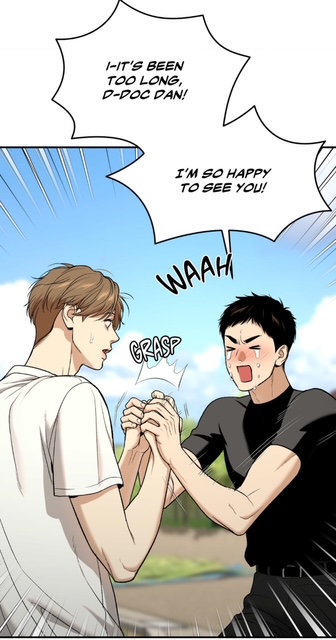 (chapter 58) reminding me of the princess looking for the voiceless mermaid. It is clear that in both stories, the mermaid left traces in the humans’ hearts.
Conclusion: Mutual Transformation
Ultimately, The Painful Mermaid’s Aspiration is a story of mutual transformation. The mermaid’s sacrifice enables the prince’s happiness, but her ultimate transcendence reflects a deeper journey of self-discovery. Similarly, Kim Dan’s suffering becomes the foundation for his growth, pushing both him and Joo Jaekyung to evolve. While the figures around them, like Heesung and Potato, remain entangled in their own struggles with guilt and identity, they contribute to the larger narrative of transformation and redemption.
Kim Dan’s journey, like the little mermaid’s, is not just about sacrifice but about rising above pain to find purpose and light. In the end, both characters achieve a form of liberation, stepping closer to the “sun” and reclaiming their voices and identities in a world that once rendered them invisible.
Feel free to comment. If you have any suggestion for topics or manhwas, feel free to ask. If you enjoyed reading it, retweet it or push the button like. My Reddit-Instagram-Tumblr-Twitter account is: @bebebisous33. Thanks for reading and for the support, particularly, I would like to thank all the new followers and people recommending my blog.

 Bebebisous33s' analyses in K-Dramaland and Manhwas
Passivity and overcoming that resulting in transformation certainly is a theme of the Little Mermaid Story and it made me realize, that is what Kim Dan needs to learn from Jaekyung ultimately. The passage about differences between Halmoni and Mermaid’s grandmother made me realize, as to why the line about Dan ( esp when he says himself) looks like her and even smiles like her a lot, exists- he is learning and insisting on imitating her passivity himself. Like how Halmoni only knows how to use her own tested coping mechanisms in life to teach her grandson to deal with his hard emotional burdens, Dan also does the same. He is aware on some level that Jaekyung is suffering and there are no back up plan emotionally if things go wrong with matches as far as chapter 30. But he chose instead to not create any conflict between him and Jaekyung and chose instead to focus on his growing feelings and how to express them the only way he knew aka treating him like Halmoni who could be amused with material gifts and sacrifices. He never sought emotional intimacy for he himself never got it from his Halmoni. This is what astounded me about the post birthday, “midsummer night’s dream” entanglement between them in season 1- he didn’t exploit Jaekyung’s drunkenness to make him tell more about himself even though he had many questions. Instead he also chose a “coward’s way out” by instead focusing on fulfilling his own intimacy related whims( which he could have done any other day if he was brave enough).
So like how she becomes responsible for Dan’s suffering, Dan also partially becomes responsible for Jaekyung’s suffering. Re-learning to take responsibility for his mistakes rather than giving up on them and choosing to end his life as a way to work with guilt does nothing for him . Without even realizing it, he has followed in the footsteps of his own parents- leaving behind someone suffering while he wallows in his own troubles and letting it consume him. Preventing people especially Jaekyung from finding him, Just like the parents made it impossible for Dan or Halmoni to find them. Making unilateral decision on his behalf on how should he deal with a “trouble” like him, .
Jaekyung coming back in his life will force his hand to take responsibility in way that his “victim” wants rather than how he wishes. That will break the generational curse of indifference and trauma that exists in the Kim family, passed down from Halmoni , to the unknown parents and now Kim Dan. For Dan is young and he has a whole life ahead of him to learn better by learning to love life via taking emotional rather than financial responsibility of another. He needs to learn that money cannot replace genuine strength in bonds constantly fearing rejection for failing to provide material affirmation is not real love.
LikeLiked by 2 people
Your comment made me realize that in his vision, the smiling halmoni is actually his own “reflection”. That’s how he views himself. On the other hand, he longed for intimacy, but he didn’t know how to initiate it, because his halmoni never did it. Moreover, if the grandmother had not made the requests, he would not have bought such a gift or have left. Though the woman has always been passive, she did meddle in their relationship and this in a negative way. Thus she shares many parallels with Heesung. This shows that her passivity was her choice, she could have done something in the past. Finally, it shows that she made many decisions, but she never took consequences of her choices, she let the others suffer.
LikeLiked by 2 people