

Please support the authors by reading Manhwas on the official websites. This is where you can read the Manhwa: Jinx But be aware that the Manhwa is a mature Yaoi, which means, it is about homosexuality with explicit scenes. Here is the link of the table of contents about Jinx. Here is the link where you can find the table of contents of analyzed Manhwas. Here are the links, if you are interested in the first work from Mingwa, BJ Alex, and the 2 previous essays about Jinx 𓇢𓆸 Prove Me Wrong Again 💢😂 and Perfect👼🏼 Defect
It would be great if you could make some donations/sponsoring: Ko-fi.com/bebebisous33 That way, you can support me with “coffee” so that I have the energy to keep examining Manhwas. Besides, I need to cover up the expenses for this blog.

In the world of Jinx, superstition often masks deep psychological wounds. Readers are well aware of Joo Jaekyung’s belief in a hex: 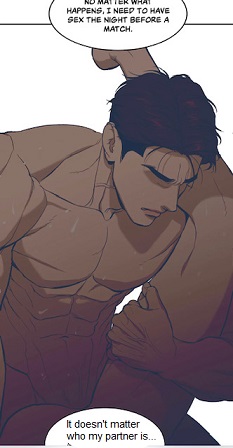 (chapter 2) his ritualistic sex before fights, his fear of losing control,
 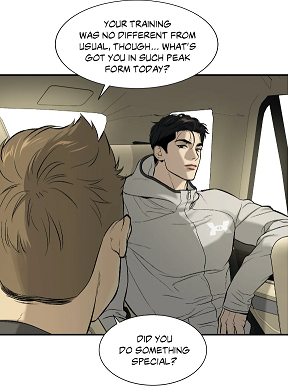 (chapter 5) his reliance on routine. Yet there is another jinx in this story, one far less visible and perhaps even more tragic: Kim Dan’s.
In earlier analyses—particularly in the essay “Jinxed: Behind The Scenes 🎬” I stated that Kim Dan, like Joo Jaekyung, might have perceived his life as cursed. This conclusion emerged from his grim familial and financial circumstances: his overwork, exploitation by the loan shark, and his identity eroded by relentless sacrifice. At that time, the interpretation leaned heavily on visible hardships and his devotion to his grandmother. His silent plea 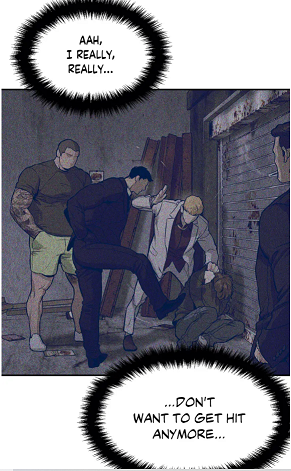 (chapter 1) was seen as the core expression of a man who believed he was doomed.
However, Season 2 invites a more nuanced reading. I came to realize that Kim Dan never consciously viewed himself as jinxed. 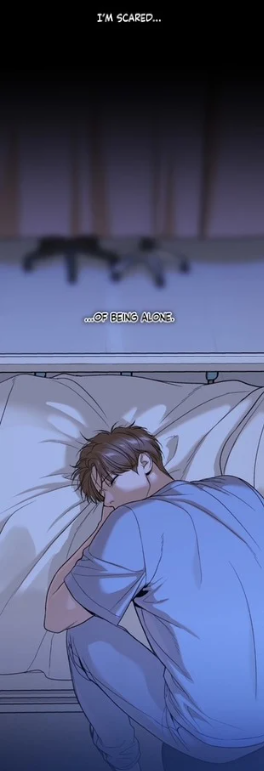 (chapter 56) In Chapter 56, Kim Dan is seen curled up next to a bed, whispering: “I’m scared… of being alone.” What makes this moment especially revealing is that he is not physically alone, for he is resting next to his grandmother. The presence of the very person who raised him should, in theory, offer comfort. And yet, the fear persists.
This contrast underscores the depth of Kim Dan’s emotional wound. His fear isn’t simply about being left in the future — it’s the echo of a past abandonment so profound that even proximity can’t soothe it. His grandmother is alive, mere steps away, yet his body curls into itself, instinctively shielding against an absence that has already been internalized.
That he doesn’t say “I’m scared of being abandoned” or “of being jinxed” shows that this fear hasn’t been processed into words or reason. It’s not part of his conscious self-concept. Unlike the celebrity, who ritualizes his fear as a “jinx” and tries to control it through actions, Kim Dan’s trauma remains trapped in silence. He doesn’t believe he is cursed — not on the surface. But emotionally, he lives as if he were. The hex exists, not in his language, but in his body.
His whispered fear in the dark — “I’m scared… of being alone” — is the clearest window into his hidden jinx. And perhaps the most heartbreaking part is this: he voices it not, when he is abandoned, but when someone is still there. That’s how deep the fear runs.  (chapter 21) And this issue didn’t begin in adulthood. In Chapter 21, Kim Dan dreams of a night from his childhood: he wakes up alone, glances around the room in quiet confusion, and softly calls out for his grandmother. The room is dim, the bed beside him empty. This image carries more than just childhood anxiety:
 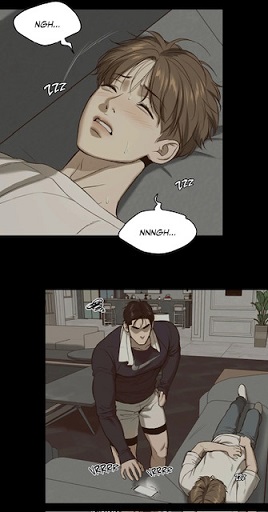 (chapter 21) It weaves together absence, silence, and the specter of loss. What’s striking is that the nightmare surfaces, not when he’s alone in the present, but after he has just returned from watching over his hospitalized grandmother.
 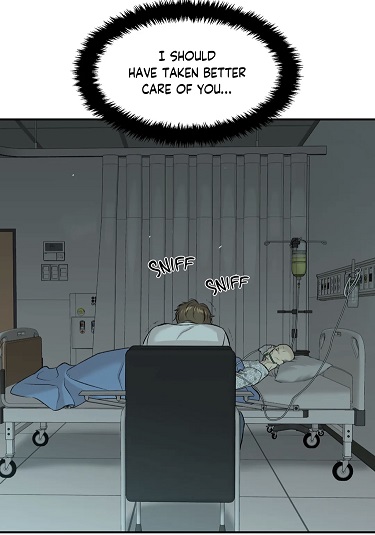 (chapter 21) He lies on the couch and dreams of a night when she vanished from their shared bed.
 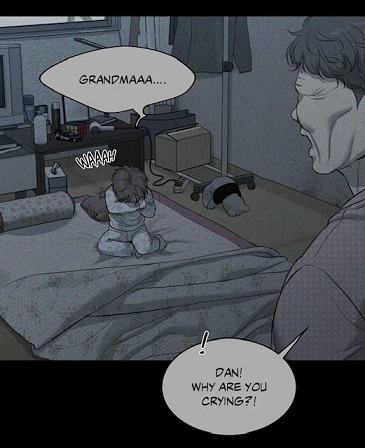 (chapter 21) This reveals how, in Kim Dan’s subconscious, the night and an empty bed have become synonymous with death. The trauma is deeply embedded, where even temporary absence is tied to the irreversibility of loss. For Kim Dan, solitude at night
  (chapter 67) is not mere loneliness—it is abandonment, it is death, it is the erasure of home. It is repressed, hidden beneath his quiet demeanor and years of survival-based behavior. Rather than a rational belief, it is a subconscious wound that only surfaces in moments of extreme vulnerability—especially at night.
So while Joo Jaekyung’s curse is shouted and choreographed  (chapter 2), the doctor’s is secret and involuntary. His actions—his fearful expressions
  (chapter 57), his pattern of emotional detachment
  (chapter 67), and his obsessive loyalty to his grandmother
 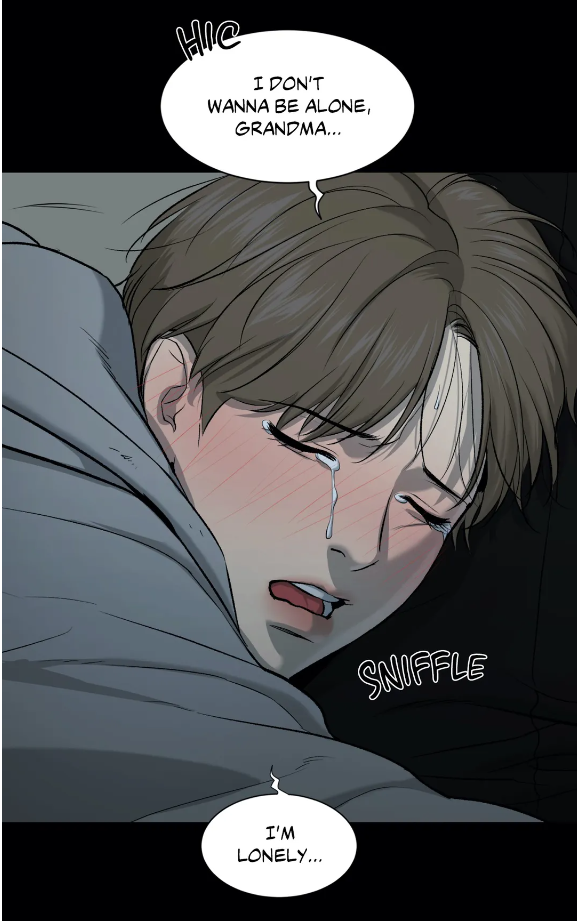 (chapter 10) signal a suppressed conviction: that he is destined to be left behind. What seemed like devotion now appears as coping; what appeared stoic was survival. And with the impending death of his grandmother, the anchor holding this hidden jinx in place is slipping away.
A Jinx Rooted in the Night
The key lies in the night. The most pivotal emotional regressions in Kim Dan’s life happen after dark. Whether it is the first night with Joo Jaekyung in Chapter 2 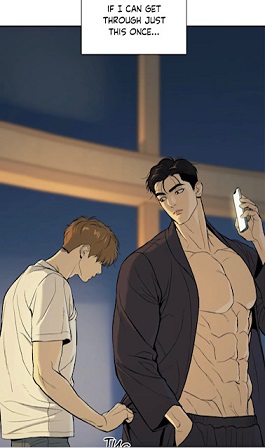 (chapter 2), the trembling kiss
 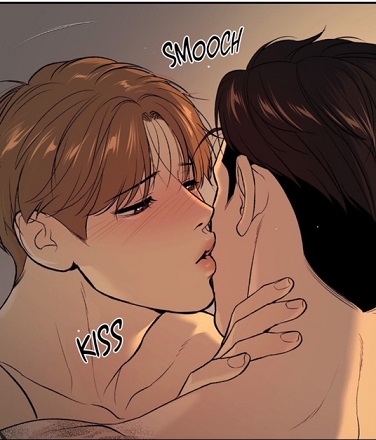 (chapter 44) and touch
  (chapter 44) in Chapter 44, the complete breakdown
 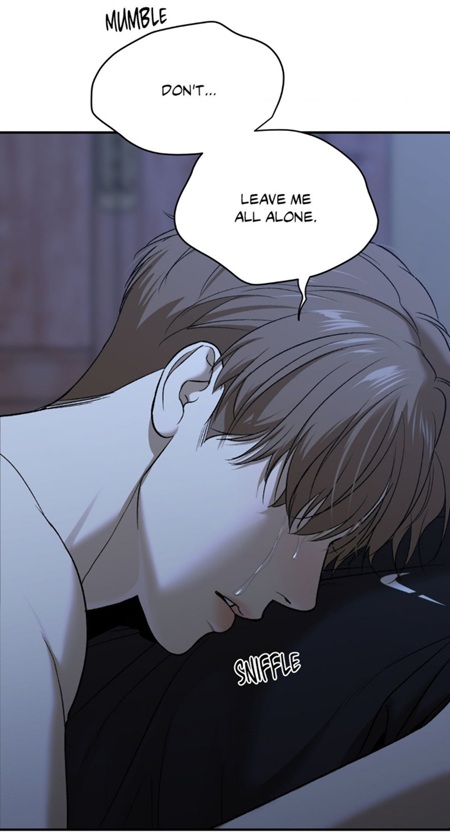 (chapter 66) in Chapter 66, or the transactional submission
 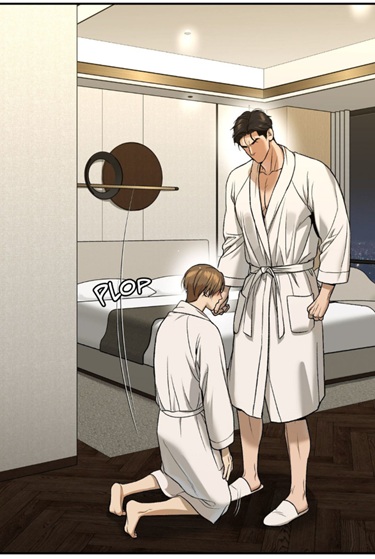 (chapter 67) in Chapter 67, nighttime becomes the stage for his unresolved trauma. These nights mirror one another and suggest an origin story that predates them all: a night when Kim Dan was abandoned by his mother.
This theory is supported by visual cues and character behavior. In Chapter 56, Kim Dan curls into himself in bed, unable to sleep. He admits silently, “I’m scared… of being alone.” That fear is not adult anxiety—it’s childhood terror. (chapter 56) The body language, the shadows, the loneliness—they evoke the image of a small child who once cried through the night, waiting for someone who never returned.
Kim Dan’s actions echo those of someone who was left too early—possibly around the age of six. Psychologists describe this stage as a turning point in emotional development. If a caregiver vanishes at that time, the child internalizes the absence as a personal fault. He grows up believing that love is conditional, that if he’s quiet, obedient, invisible—maybe no one else will leave.
Mingwa subtly ties this back to animal behavior through the inclusion of puppies. 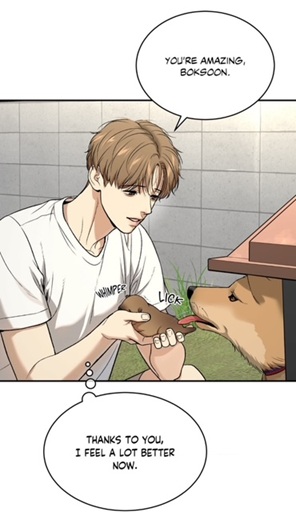 (chapter 57) A puppy needs at least eight weeks with its mother to grow emotionally secure. By drawing this parallel
 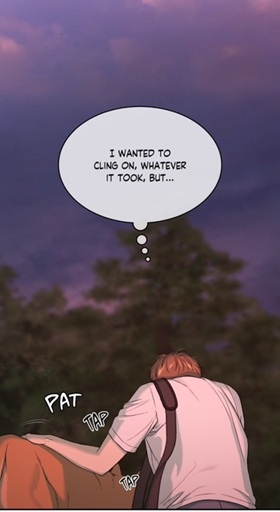 (chapter 59), the story tells us: Kim Dan was separated too soon. He was not ready.
The Role of the Grandmother: A Talisman, Not a Cure
Kim Dan’s grandmother became his emotional anchor: 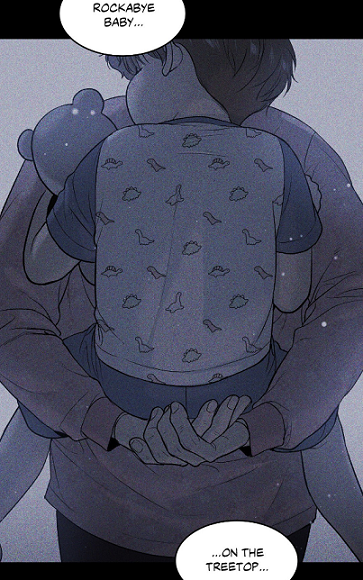 (chapter 47) the one person whose presence could keep the jinx at bay. As long as she was there, he could suppress the trauma, function, survive. She was his talisman. But she was never a healer, for she never spoke about his parents. She never addressed the core of his abandonment, like we could witness in the doctor’s nightmare:
 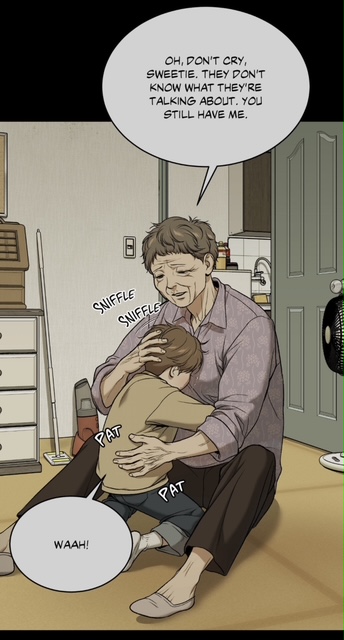 (chapter 57) And silence, when it comes to trauma, does not protect—it festers.
Her infantilization of him is also telling. 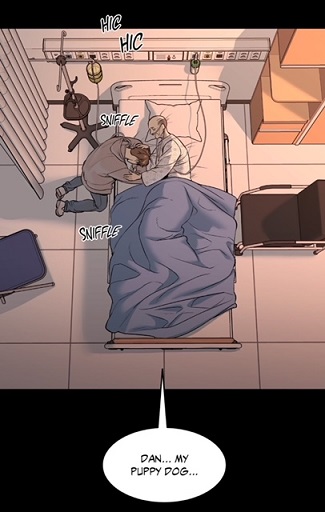 (chapter 53)
 (chapter 65) One might argue about this, for in this scene,
  (Chapter 56) he tucks her in. Their roles are reversed. He behaves like a parent, whereas in truth, he is reverting emotionally to a child terrified of being alone. This reversal highlights the internal dissonance between his outward behavior and emotional reality. Though he was forced to grow up quickly
 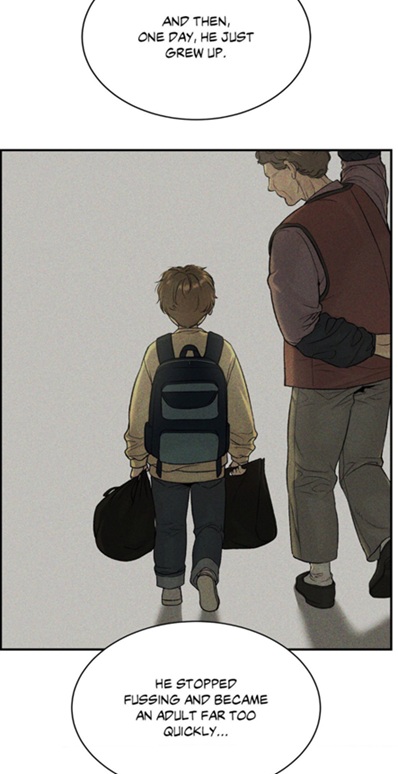 (chapter 65), he still carries the emotional wounds of a child. And from my point of view, the grandmother knows it, therefore she treats him as a child. And this observation led me to the following question: why does she still view him as a “boy”, though he has been working since his youth? It is because he can not sleep alone! What caught my attention is that she never stated, when the doctor started smoking or drinking. (chapter 65) Was it the moment, when she went to the hospital? The timing is crucial, as it can give clues about the main lead’s sleeping trouble. In episode 67, the protagonist finally exposed his cause:
  (chapter 67) This reinforces my hypothesis that his bad drinking habits are related to the absence of a loved one next to him.
In other words, he can not sleep alone and from my perspective, Shin Okja knows it, but is refusing to become responsible for this situation. (chapter 47) She witnessed this since he was a child, which explains why she never truly addressed his fear of being left behind. This would explain why the halmoni tried to send him away from the hospice in episode 56:  (chapter 56) Imagine what it means for her: her grandson is already 29 years old and he can not sleep alone. Under this perspective, Jinx-philes can grasp the relative’s reasoning. The problem is that her knowledge is actually wrong! How so? It is because the protagonist was able to sleep so well alone in the penthouse, to the point that the athlete was envious of him.
  (chapter 29) That’s how it dawned on me why Shin Okja was so determined to send back her grandson to Seoul.
The grandmother’s insistence on Kim Dan “living his life”  (chapter 65) and going back to Seoul under the guise of freedom and career advancement takes on a deeper meaning when viewed through the lens of emotional avoidance. Her words may sound supportive, but they conceal a subtle attempt to sever the emotional tie without taking responsibility for its existence. Now, rather than confronting this vulnerability head-on, she shifts focus to the one thing she believes can replace human closeness: work. A busy man has no time to wallow, no time to drink, no time to remember the empty bed. A man with a career won’t ask for someone to hold his hand at night. In that sense, her vision of “a good life” is one of functionality, not emotional fulfillment. If he works, he won’t be a burden. If he’s successful, she doesn’t have to worry. Yet this approach doesn’t cure the root wound — it just redirects it. This situation mirrors the wolf’s:
  (chapter 19) The latter is obsessed with work, while he is suffering from insomnia.
The tragedy here is that in encouraging him to grow up through labor, she’s also denying him the right to be a child — something he never got to be in the first place. Her version of love is sacrifice and survival.  (chapter 65) And the best evidence for her selfishness and neglect is her ignorance about her grandson’s plan for his future. She is not discussing with him about what he likes or dislikes. She is directing his life, like she did it in the past in the end. And while she may think she’s doing what’s best, her silence about his fears, her ignorance about his true conditions (no home, blacklisted in Seoul) and her refusal to discuss his emotional future reveal a lingering discomfort with the very idea of dependence — perhaps because it reminds her of her own failures or helplessness as a parent figure.
In the end, her encouragement to “live his life” isn’t truly about Kim Dan finding happiness or chasing dreams. It’s about the grandmother relinquishing responsibility — an emotional handoff wrapped in the language of care. (chapter 65) By urging him to return to Seoul and focus on work, she’s hoping that if he stays busy enough, he won’t have time to feel the crushing loneliness that has always shadowed him. She wants him to mature overnight, not because she believes he’s ready, but because she can no longer carry the weight of his dependency. One might say, he is already 29 years old, so she is right. In truth, this isn’t guidance — it’s guilt management. Notice that she is entrusting the main lead to the champion which is not pushing Kim Dan to become „independent“. Her attitude, summed up by the phrase “out of sight, out of mind,” unintentionally mirrors the same abandonment he experienced in the past. She is refusing to worry about him, her peace of mind matters more than his well-being and the champion’s. 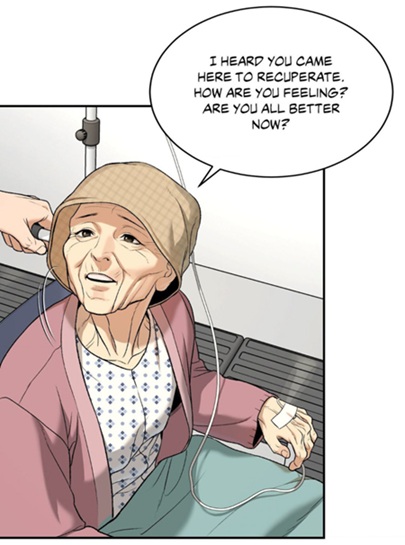 (chapter 65)
This connects directly to one of the most telling moments in Chapter 67, 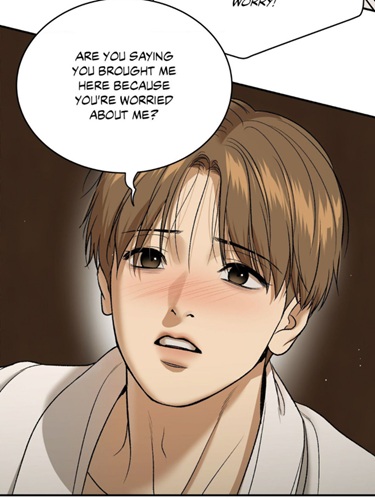 (chapter 67) when Kim Dan, eyes wide and voice trembling, asks Joo Jaekyung: “Are you saying you brought me here because you’re worried about me?” His expression reveals everything — a fragile hope for genuine concern. But the only response he gets is silence.
 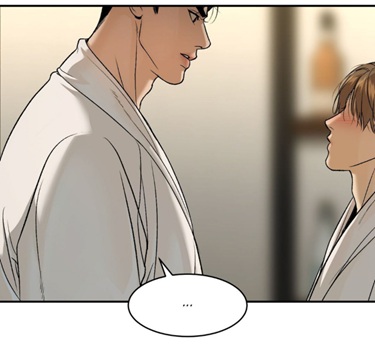 (chapter 67) This unspoken answer reverberates with painful familiarity: from his vanished mother, from his halmoni who rarely expressed love (rather gratitude and pity), and from a world that reduced him to his usefulness. What he really wants to know is: “Do I matter to you as a person?” And just like his grandmother, the champion fails to offer direct emotional reassurance. Yet unlike her, Joo Jaekyung is still learning. His silence isn’t rejection, but emotional illiteracy — a work in progress.
The irony is that while Park Namwook represents over-control disguised as concern, Shin Okja represents detachment masked as selflessness. She doesn’t want to worry anymore, so she chooses to send Kim Dan away — to someone she thinks should take over. Nonetheless, in my eyes, this isn’t responsibility; it’s avoidance. And for someone like Kim Dan, who already associates nighttime with abandonment, silence with rejection, and empty beds with death, being handed off again only reinforces his unconscious belief: I’m jinxed to be left behind.
The grandmother may never have raised a hand against him, but her silence, her emotional evasiveness, and her idealized image of herself as a “sacrificing protector” created a one-sided bond rooted more in guilt than in love. Her presence was constant, but the emotional quality of her care — the nurturing, the honest affection — was lacking. Hence she still doesn’t know that Kim Dan has no home in Seoul.  (chapter 65) And when we remember that Kim Dan tried to call her, she
 (chapter 65) replied with a silence. Here, she claims that he addressed her as “mom”, but it is possible that she was just projecting her own fears onto her grandson. Since she was by his side all the time, she feared to be seen as his mother. Like mentioned above, the mother might have been busy due to work (or sick) and asked her relative to take care of her grandchild.
Ultimately, what he longs for is simple: to be seen, talked, loved, and to be chosen — without conditions. But those around him have always expected him to be strong, quiet, grateful. So he became all of those things… at the cost of his own soul.
Shin Okja never kissed him like a mother. (chapter 57) Yet in Chapter 44, Kim Dan kisses Joo Jaekyung with soft, maternal gestures—on the cheek, on the ear.  (chapter 44) These gestures suggest he had once received such kisses, most likely from his mother. It means he remembers love, even if he doesn’t know how to process its loss.
Her insinuation that Kim Dan owes her everything created a myth of self-sacrifice—one that replaced genuine emotional closeness. She demanded gratitude, not emotional connection. She lived in the mindset of having, not being. As a result, Kim Dan grew up confusing love with obligation, gratitude, and performance. His difficulty in expressing love isn’t due to coldness or immaturity—it’s the byproduct of a dysfunctional emotional education.
This is why, even though he once confessed “I love you” to Joo Jaekyung in the States 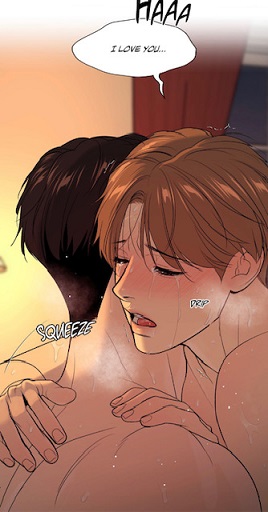 (Chapter 39), the moment is tainted. It occurred under the influence of an aphrodisiac, intertwining love with sex. Furthermore, he has never voiced this sentiment to his grandmother—perhaps because she never said it to him. It was never modeled. While others might judge Kim Dan’s emotional restraint, I desire to stay neutral. He is not an emotionally stunted adult by choice—he is a product of emotional neglect. That’s the reason why Mingwa has associated him with an angel.
 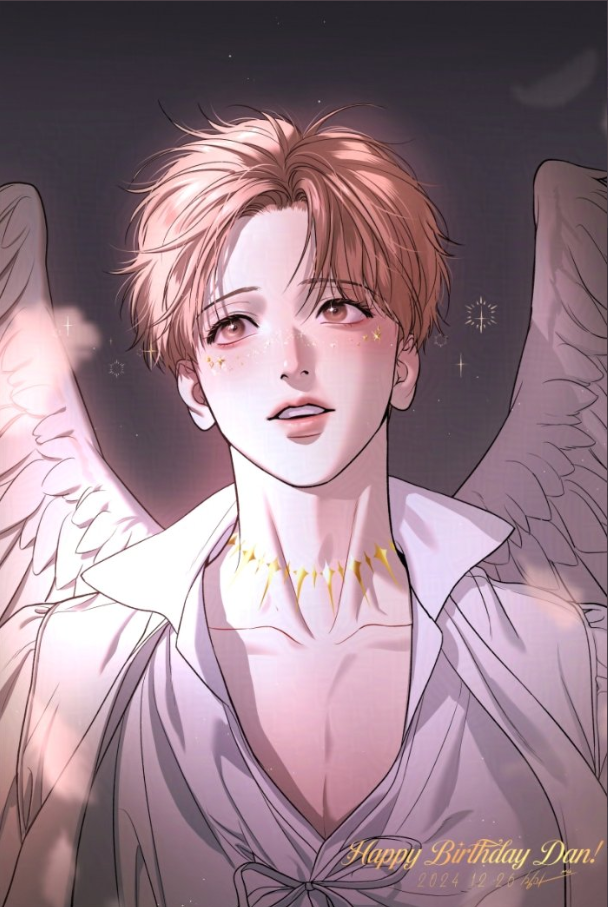 He is carrying the sins of “adults”. By likening him to an angel, Mingwa frames his pain not as weakness, but as unjust burden. He embodies purity, sacrifice, and resilience, not because he was allowed to thrive, but because he endured. The angel metaphor becomes even more striking when you think about traditional symbolism: angels don’t belong to Earth, yet they walk among the living, often suffering in silence and helping others. That’s exactly Kim Dan — out of place, bearing the consequences of others’ choices, carrying guilt, debt, and unspoken grief that were never his to begin with.
He’s carrying the sins of adults: – A school which allowed bullying
– A grandmother who turned emotional dependence into silent expectation.
– A mother who vanished, whether through death or abandonment.
– A society that reduced him to labor, debt, and obedience.
– And even a partner, at first, who used his body without recognizing his soul.
Interestingly, his emotional jinx is also spatial. When living in the penthouse, Kim Dan began to sleep peacefully 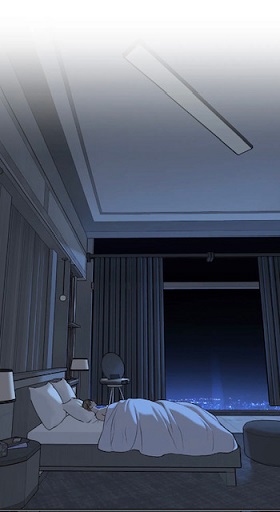 (chapter 29) —not because of physical intimacy with Joo Jaekyung, but because he felt safe. For a time, the place became his illusion of home. But when the champion showed mistrust, the illusion shattered.
  (chapter 51) The penthouse was never truly his. It was borrowed space. This explicates his refusal to spend the night there.
  (Chapter 67) Observe how Joo Jaekyung called the penthouse: not home, but his place. Due to the last altercation, the emotional safety collapsed. This experience reactivated his fear of abandonment and solidified the belief that he has no home.
  (chapter 65) Even the family photo (where and by whom it was taken is unclear) emphasizes the fragility and incompleteness of his sense of belonging.
The Secret Jinx That Must Break First
Each major night scene—Chapters 2, 44, 66, and 67—reveals another layer of the doctor’s jinx. Chapter 2 introduces the concept of the jinx explicitly: Joo Jaekyung believes he must have sex before each match, regardless of partner. This idea of impersonal routine and bodily sacrifice mirrors Kim Dan’s own subconscious belief: 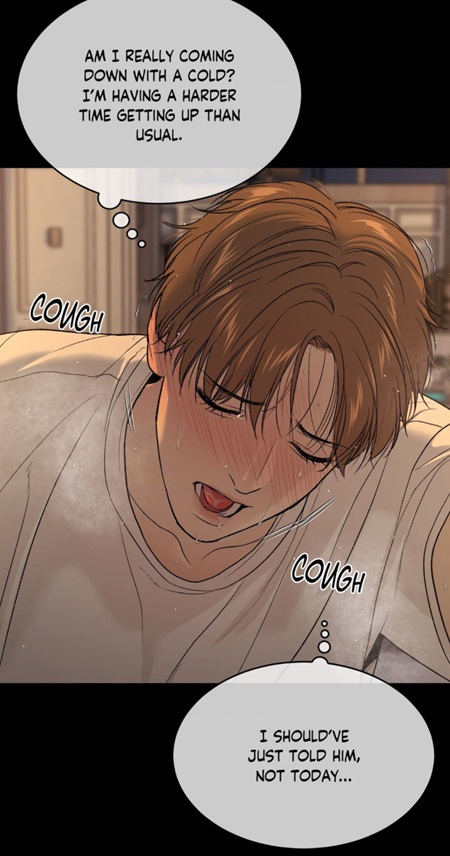 (chapter 61) that he must sacrifice his “needs” and identity to be accepted.
Yet in order to truly break Joo Jaekyung’s so-called “jinx”—which, as theorized, may stem from rigged matches and trauma masked by routine—the doctor’s hidden curse must be broken first. As long as Kim Dan sees himself as inherently unworthy and destined for abandonment, he will unconsciously reinforce a dynamic where emotional distance feels safe and predictable.
Chapter 44 shows the beginnings of intimacy (chapter 44), yet even then, it is expressed through regression. Kim Dan’s kisses are gentle, reminiscent of a child seeking comfort, not a lover expressing desire. 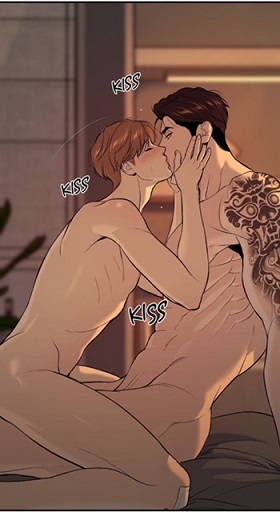 (chapter 66) Therefore it is not surprising that he laughes like a little child during that night.
  (Chapter 44) Chapter 66 represents its negative reflection, the emotional climax of this regression:
 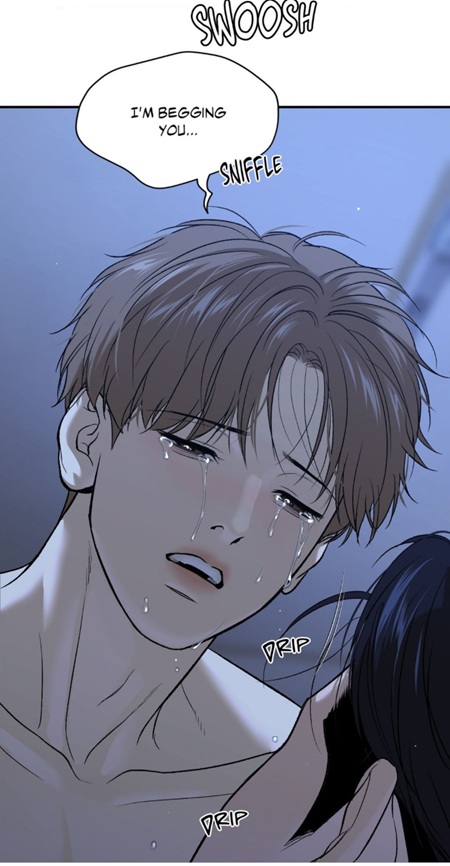 (chapter 66) he cries, begs,
 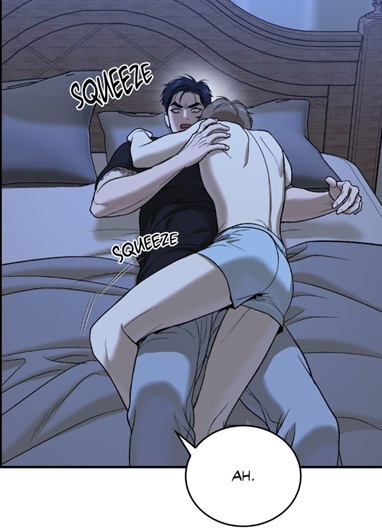 (chapter 66) holds on—“Don’t leave me.” (chapter 66) His squeezing fingers holding onto the athlete’s shirt
 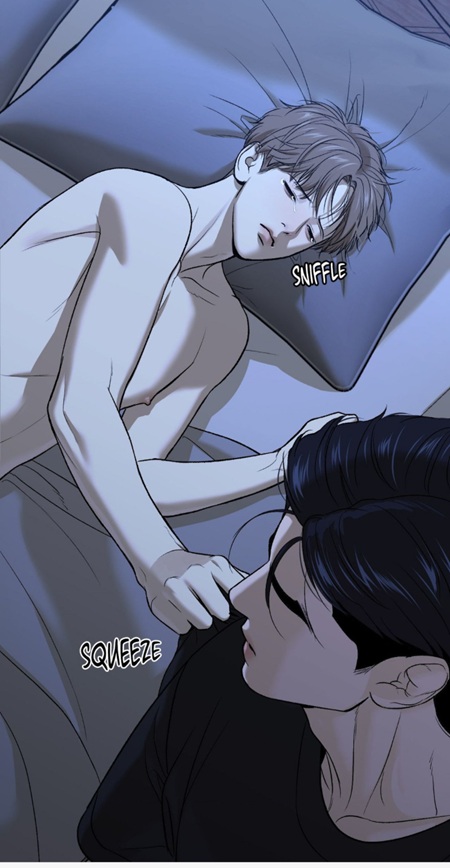 (chapter 66) and desperate pleas are not about romance—they’re about survival, longing and regret. Deep down, he wished, he had hold onto his “mother” in the past, stopped her from leaving him. Is it a coincidence that this gesture from that night mirrors the one during their first night? (chapter 2) And what had the protagonist said right after this gesture?
 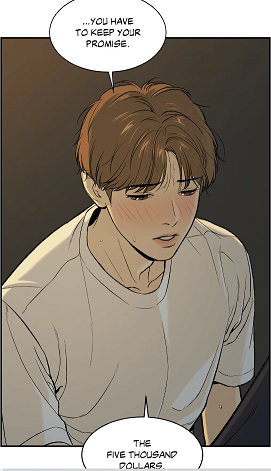 (chapter 2) He wanted the champion to keep his promise. From my point of view, the parent’s vanishing is strongly intertwined with a broken promise… And that’s exactly what the grandmother did to her own grandson: she didn’t keep her words either.
  (chapter 11)
  (chapter 53)
Then comes Chapter 67. Though no longer crying, he submits once more 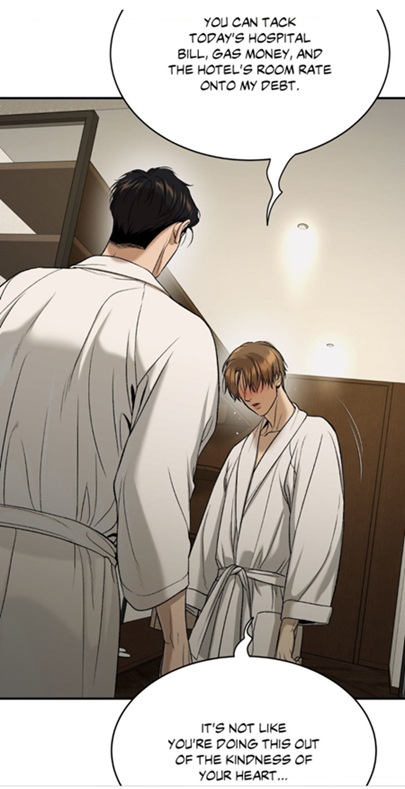 (chapter 67), but this time, with eerie detachment. He kneels before Joo Jaekyung like a servant, (chapter 67) asking for sex again. Yet the power dynamic is not as it seems. Though Kim Dan is physically lower, it is Joo Jaekyung who ultimately submits:
 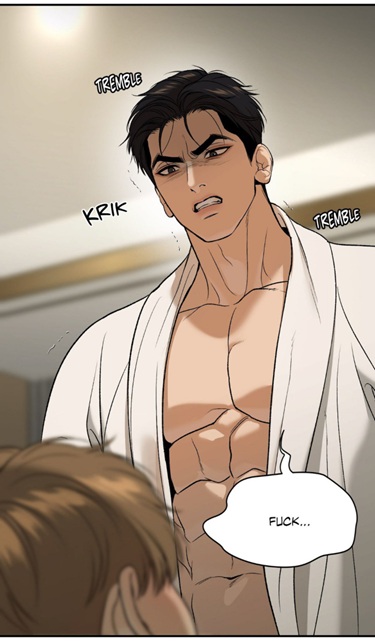 (chapter 67) his arousal betrays a loss of emotional control. Though he is on his knees, it is Joo Jaekyung who is emotionally yielding. His body betrays his composure, responding to Kim Dan’s touch and gaze. Kim Dan, watching the tremble in the fighter’s expression and the rising heat in his body, feels the shift. His soft blush is not simply one of affection or embarrassment—it’s a flicker of recognition.
 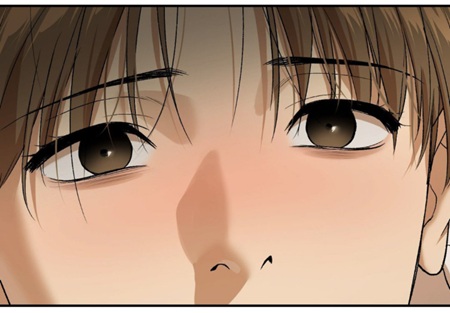 (chapter 67) He senses that the one usually in control is now unraveling. Appearances deceive: beneath this scene lies a quiet reversal of power. The blush on his cheeks is a trace of a brief moment of clarity: he sees that the person who once held all the control is now faltering.
Ultimately, this mirrors Chapter 2 once more. Back then, Kim Dan surrendered his body, believing it was his only tool for survival. But Chapter 66 reveals that even in moments of closeness 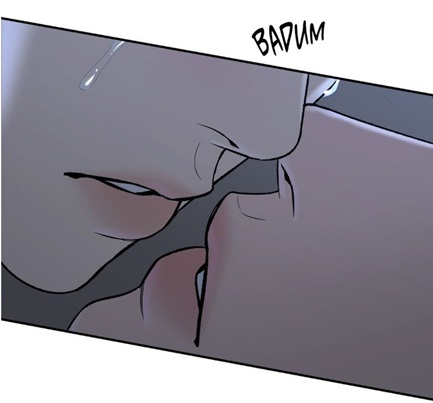 (chapter 66), his body is still a vessel for mourning. Hence there is no kiss during that blue night. Each night carries the residue of that first trauma: the night he was left alone. Whether his mother disappeared or passed away in the night, the result is the same—nighttime became synonymous with loss.
This is why he fears being alone after dark. This is why he clings to those who stay past midnight. And when Joo Jaekyung, the one person who broke that pattern, walked away, even briefly, it fractured him. 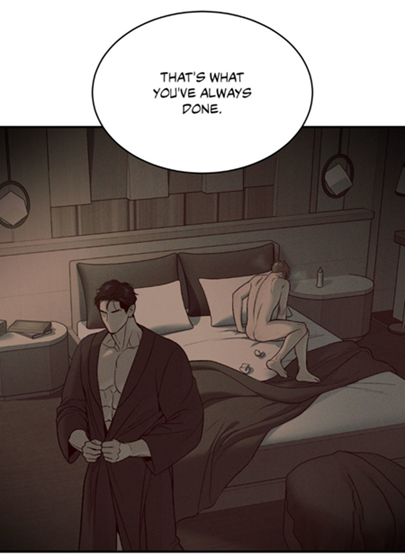 (chapter 63) His so-called jinx is not some irrational superstition. It’s a scar. It’s the quiet belief that the people he loves will vanish the moment he lets his guard down.
So while the champion’s jinx revolves around physical ritual and control, Kim Dan’s is rooted in emotional suppression and dread. Both stem from the same core wound: fear of abandonment.
But Chapter 67 deepens the tragedy: this time, he doesn’t just mourn: he gives in. The act is no longer about clinging to someone or begging them to stay. Instead, it is performed with emotional detachment, a mechanical reenactment of what once held meaning. His internal monologue (chapter 67) makes it clear: he isn’t trying to survive, he’s quietly unraveling. His decision to mix alcohol with medication is not rebellion  (chapter 67), it’s resignation. Hence he is not expecting to be cured with the pills. (chapter 67) Thus, chapter 67 reveals the darkest layer of his jinx: not fear of abandonment, but the numb certainty that love, safety, and home are illusions that always vanish with the night.
Observe the decoration on the wall: (chapter 67) It looks like the moon and Saturn are meeting each other. For me, the moon imagery in Chapter 67 is not accidental. Saturn, the planet of hardship and emotional lessons, casts its shadow over this night, mirroring the heavy atmosphere between them. When Kim Dan asks Joo Jaekyung if he brought him here out of concern, the champion remains silent—a silence louder than words. That silence is devastating. In that moment, Kim Dan’s deepest fear is realized: he is not loved, merely tolerated. And so, in an act of resignation rather than seduction,  (chapter 67) he offers sex to “settle up,” citing his own preparations like a transaction. (chapter 67) The room’s muted lighting and circular wall decor even evoke the image of an eclipse—as if the moon (emotion) is being overshadowed by Saturn (cold logic and debt). This alignment encapsulates the heart of the scene: vulnerability eclipsed by duty, affection swallowed by silence. That’s the reason why I can’t help myself thinking that Kim Dan might end up in the emergency room later. Besides, we never saw him eating before taking his pills:
 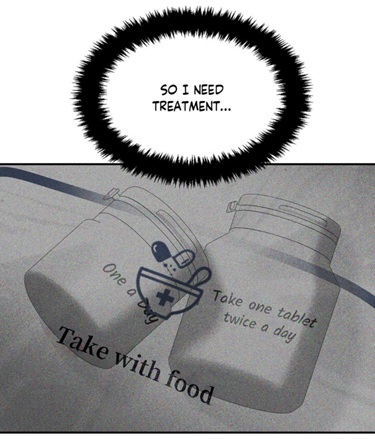 (chapter 67) while he drank alcohol with the medicine.
 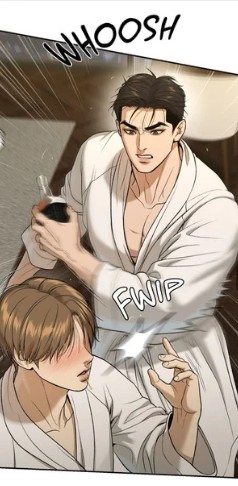 (Chapter 67) Until now, the champion has a blind faith in drugs, just like the grandmother.
A Split Between Night and Day
One of the most striking revelations is the emotional split between the protagonists. Joo Jaekyung acts like a child during the day 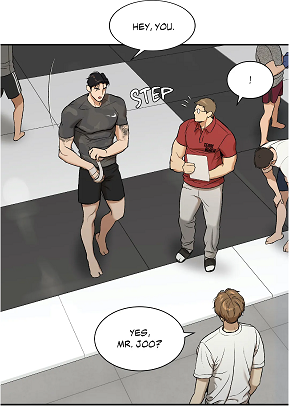 (chapter 7), while Kim Dan becomes a child during the night.
By day, Jaekyung seeks routine, praise, validation, and control. His outbursts, tantrums, and need for order mirror the emotional needs of a child. He’s the performer, the strongman, but behind that exterior lies someone seeking parental structure.
At night, Kim Dan’s walls crumble. His trauma surfaces. He cries, begs, trembles—not for pleasure, but out of fear. These breakdowns are not romantic; they’re regressive. And until these wounds are addressed, he can’t become the nurturing figure Jaekyung truly needs. This explicates why during the day, Kim Dan tries to act like an adult and rejected the champion‘s help.  (Chapter 66)
For their relationship to heal, Kim Dan’s nightmares must be addressed. Only then can he grow into the “motherly” role he’s beginning to fill during the day—someone who can offer stability, not just silent service. Until the end of season 1, his care was more rooted in duty, than real love and genuine concerns. He didn’t argue with the fighters 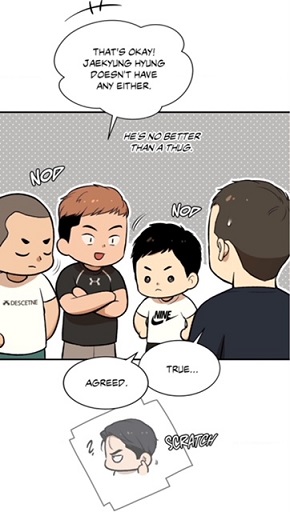 (chapter 47), when the “wolf” was portrayed as a thug, though the latter had assisted him on multiple occasions.
Conclusion: It’s Happening Again
Now, the imminent death of the grandmother and the puppy bring everything back. Kim Dan isn’t just afraid of the future—he’s haunted by the past. Their death isn’t merely a loss—it’s a reawakening of everything he suppressed. The loneliness, the silence, the night—“It’s happening again.”
But this time, he’s not numb. He’s unraveling. His subconscious belief—the doctor’s secret jinx—is finally being revealed. He is destined to be abandoned… unless something breaks the cycle. It is clear that Joo Jaekyung will be that person, but this change is definitely linked to pain. In chapter 66, for the first time, the doctor’s jinx had a voice. And it sounds a lot like: “Please… don’t leave me.” The problem is that Joo Jaekyung chose to listen to Shin Okja, rather than talk to Kim Dan.
Feel free to comment. If you have any suggestion for topics or manhwas, feel free to ask. If you enjoyed reading it, retweet it or push the button like. My Reddit-Instagram-Twitter-Tumblr account is: @bebebisous33. Thanks for reading and for the support, particularly, I would like to thank all the new followers and people recommending my blog.

 Bebebisous33s' analyses in K-Dramaland and Manhwas