This is where you can read the manhwa. https://www.lezhinus.com/en/comic/painter But be aware that this manhwa is a mature Yaoi, which means, it is about homosexuality with explicit scenes. If you want to read more essays, here is the link to the table of contents: https://bebebisous33analyses.wordpress.com/2020/07/04/table-of-contents-painter-of-the-night/
I mostly used the following website as a source of inspiration: https://idioms.thefreedictionary.com/tears
What caught my attention in chapter 76 was Min’s tear combined with the laugh 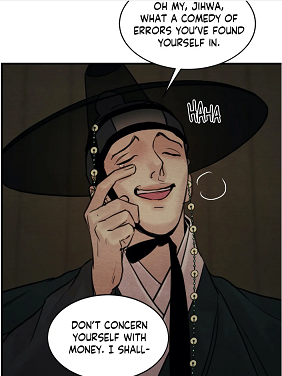 (chapter 76) which was totally new in the manhwa. We never saw such a combination: a single tear with a laugh. Moreover, for the first time, The Joker had shed a tear. The manhwalovers will certainly recall that so far, we had tears of happiness (chapter 21) and sadness
  , (chapter 59) but never tears out of laughing.😂🤣 Therefore I came to recognize the significance of this scene. First, it divulged a lot about Black Heart’s personality, and announced a turning point in his life. At the same time, this observation gave me a new idea, which I will elaborate in the second part. Striking is that until now, I had examined the painter and Jihwa’s tears, yet I had never focused on this topic itself. Hence in this analysis, I would like to study not only the weeping of the characters, but also the absence of their tears.
But before beginning with the real topic, it is necessary to define tears and their origins. There exist three types of tears:
- Basal tears: This is a normal and vital function in order to keep our eye moist.
- Reflex tears: They are triggered, when you get something in the eye, or when you cut an onion.
- Emotional tears: These are the tears, when one is overcome with emotions (sadness, joy, eg.) Striking is that these tears are richer than the two others. They contain proteins and hormones like endorphin. The latter serves to relieve stress. The fact that these tears are richer is important, because like I had mentioned in my analysis about Jihwa (Water and fire -part 1), the red-haired aristocrat’s tears are a signal of the revival of his eyes. From that moment on, he is less blind. That’s why I associated tears to life, especially if you combine it to water. Without water, there’s no life.
1. Tears and pride
The connection between tears and life is relevant, because it explains why Jung In-Hun is never seen crying. He has a heart of stone. Consequently, Byeonduck drew the learned sir next to a rock in two occasions: (chapter 6) and  (chapter 22). The rock is a metaphor of his heart: he will remain cold-hearted. Striking is that even after the humiliation during the hunt, he never shed a tear. He was only frustrated and angry at his opponent and sponsor. His huge ego had been hurt by the main lead’s mockery, but despite his wound, he chose to look up to the sky, apparently waiting that fate/karma would punish the wealthy noble for his wrongdoing. This outlines that the learned sir still believed in his superiority. In other words, Yoon Seungho had not reduced the scholar to tears with his words, which stands in opposition to the second lead’s reactions.
“To reduce someone to tears”: to cause a person to cry through insults, frustration and belittling” quoted from https://idioms.thefreedictionary.com/reduce+(one)+to+tears
In chapter 18, the main lead had reduced Lee Jihwa to cry through his reproaches and belittling.  (chapter 18)
This huge difference between the two figures (Lee Jihwa and Jung In-Hun) shows that the childhood friend is still a human despite his egoistic and prideful attitude. He was overcome with negative emotions (pain, sadness, frustration and anger), while the other only feels resent and anger. Hence through this expression (“reduce to tears”), the manhwalovers can recognize the connection between pride and tears. And if you compare both situations, you’ll notice that during their argument, the main lead lowered himself and faced his childhood friend.
This reveals that the true intention of Yoon Seungho was not to humiliate his ex-lover per se. He didn’t desire to show his superiority to him. He had acted in the moment after witnessing Jihwa’s outburst. The former felt betrayed, as the second lead had acted behind his acts on different occasions (the spy, the slapping of Baek Na-Kyum, the ruined painting). Yoon Seungho still showed a certain respect towards his ex-partner by sending him away accompanied with a servant. Note that in the woods, he left the low noble on his knees without looking back. In other words, he showed no remorse towards Jung In-Hun, while it was not the case with Jihwa. There’s no doubt that the noble was indeed moved by Jihwa’s tears. However, it wasn’t obvious, because he didn’t touch his face and wipe his tears. The readers can only grasp it, when they compare both scenes (18-22). Through this comparison, I recognized that Jihwa’s tears were connected to his wounded pride. It becomes even more evident in chapter 21. It was, as if the red-haired second lead had an outburst. We have to envision that he literary burst into tears.
“Burst into tears: to begin suddenly to cry” quoted from https://idioms.thefreedictionary.com/burst+into+tears
This explosion of emotions is visible, as the lord ruined his room.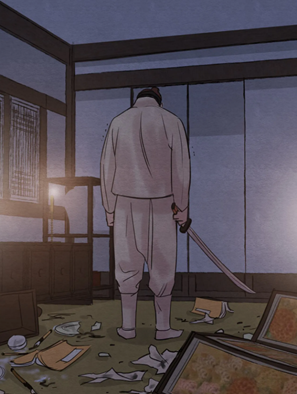 He broke out to tears. And note that in that moment he was standing with a sword in his hand, another evidence that his tears were triggered by his frustration and bruised ego mixed with sadness and anger. And now, you comprehend why he represent a negative reflection of Baek Na-Kyum, the latter embodying humbleness and modesty. However, unlike the scholar, Jihwa was slowly learning his lesson and as such changing. Since the low noble’s heart is made of stone, he will never change in my opinion.
Jihwa reached the bottom, when he got confronted by Yoon Seungho at the tavern in chapter 57. He was not only pushed to the ground, but the latter was never able to stand up in front of his friend again, contrary to chapter 18. At the end, the second lead gathered his courage and confessed his love on his knees in front of commoners. And this truly outlines that Jihwa had finally realized that his bond with his childhood friend mattered more than his pride. He had to make a choice and selected affection over his ego. 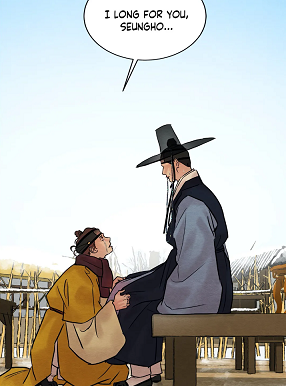 (chapter 57)
In addition, by comparing it with the episode 18, the manhwaworms can notice a divergence in the main lead’s attitude. Contrary to before, he no longer showed any respect towards his friend. He never lowered himself, but he was forced to sit down by valet Kim. For me, this is no coincidence, the sickness was a good excuse for the butler. If his master sat down, then the public humiliation would be lessened and as such, this would cause less ruckus. Important is that after his answer, Yoon Seungho left Lee Jihwa behind without paying attention to him. He never asked Kim to take care of his former lover. This displays that the gap between them had so much increased that their relationship would never be like before. This was even reinforced by the lord’s words: “Do not harbor any longing for me. There is not the slightest chance of my ever returning such sentiments.” (chapter 59)
Striking is that in the second season, Yoon Seungho was taught the same lesson by the painter. The former had to give up on his title and devalue himself in order to remain by Baek Na-Kyum’s side. That’s why in chapter 71, he called his lover Lord Na-Kyum and treated him as a master after that. But pay attention that the main lead never shed a tears due to his wounded ego. Yet this doesn’t mean that he is similar to the learned sir. In fact, the main character felt more like crying, when he was reminded of his past.  (chapter 56). This signifies that his tears are not related to pride, but to his traumas. The lord can no longer weep due to the constant exposure to physical, mental and emotional pain. However, since he has been taught not cry in the presence of the butler, in chapter 56 it was, as if he was blinking back tears.
“to blink back tears: to try to stop oneself from crying” quoted from https://idioms.thefreedictionary.com/blink+back+tears
How do I come to this conclusion? It’s because the butler avoided his master’s gaze, when the latter threw the letter (chapter 56) He acted, as if nothing was happening. Furthermore, it was the butler who asked the painter to stop crying after the rape: “Would you stop crying? Your eyes will be sore later”.(chapter 26) And since the painter’s fate is to go through the same suffering than the rich noble, it signifies that the butler must have said the same thing to his master in the past. There’s no ambiguity that father Yoon must have a similar mind-set too.
2. Tears, pain and emotions
As you can see, Yoon Seungho isn’t still capable to cry, as he has long internalized that he is not allowed to show such emotions. In his past, he was coerced to repress his tears. He was forbidden to show any emotion and pain, though he was repeatedly confronted with terrible events (rape, physical and mental abuse, gangrape, drugs, brainwashing, betrayal). This explicates why the lord chose to live as a ghost. If he was a spirit, he could no longer feel emotions and as such pain. I would like to point out the strong connection between emotion and hurt, though the latter is no emotion. It is an emotional experience. However, the chapter 56 indicates a slow transformation, as the lord feels the need to hide his gaze behind his hand and even turn away his head from Kim, like you can observe at the top of the composition. In my perspective, the lord must have sensed something in his eyes, but out of fear and habit, he preferred masking his wound.
2. 1. Baek Na-Kyum the role model
There’s a reason for Yoon Seungho’s gradual metamorphosis. Baek Na-Kyum cried, when he was physically (chapter 11, 25) and emotionally wounded (chapter 11, 41, 42)
Besides, right from the start the noble was moved by the painter’s tears, hence he felt the need to touch his face and wipe his tears. 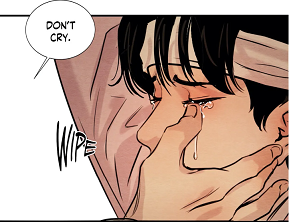 (chapter 2) And now, you can imagine which idiom I am about to bring up:
“Moved to tears”: to elicit such a strong reaction or overwhelming reaction in one that it causes one to cry. Quoted from https://idioms.thefreedictionary.com/moved+to+tears
2. 2. The painter as the trigger of emotions
Since the noble was forced to repress his emotions and as such tears, it is normal that in chapter 1, he wasn’t moved to tears. Furthermore, living without any emotion, it signifies that he couldn’t detect and recognize them in chapter 1. He never realized that he was actually showing happiness first and later a certain sadness, when he killed the servant. However, the tears from the painter (episode 1) triggered something in his heart.
He sensed a slight pain, that’s why he asked him to stop crying. Let’s not forget that right before the artist started shedding tears, the noble reminded him of the death of the servant. He put the whole blame on the low-born, as the latter had lied to him. According to the main lead, the painter was responsible for the domestic’s death. After hearing this, Baek Na-Kyum was moved to tears. This incident is important for two reasons:
- The tears are connected to empathy. He feels pity and sorry for the deceased man.
- At the same time, they also express the artist’s guilt. Note that in the shed, the low-born never denied the lord’s statement.
And now, if the manhwaphiles look at the panel again, they will notice that the noble’s behavior displays remorse and compassion. Hence he asks him to stop crying, while wiping his tears. Consequently, during the night of the rape, we have a repetition of this scene: the lord feels uncomfortable in the presence of the tears (remorse), but also a certain compassion towards the painter. However, when his hand is rejected, the main lead tries to blame the artist for the situation. But this time, Baek Na-Kyum doesn’t accept the criticism and defends his position. Furthermore, he expresses a death wish: “I hate you so much I could die, sir”. (chapter 26) Only now, I truly realize the significance of this scenes. These words pained Yoon Seungho so much that it triggered emotions, which had been buried for a long time. That’s why we witnessed an outburst: “But if I am to be hated, I might as well be hated properly. Don’t you agree?” (chapter 26) But since he had forgotten how to cry, he could only show strong emotions like pain, rage and jealousy through violence.
However, we shouldn’t overlook that the painter had mentioned his death. In my eyes, it truly exposed the lord’s fear. He couldn’t bear the thought of being separated from the painter. If the lord had been able to cry, he would have. But he could only explode and in my opinion, in that scene he hadn’t just murderous, but also suicidal thoughts. This was the first version of this panel, though the lord never expressed it: “If I killed them all, and myself, would it be easier…” (chapter 55).
By killing the learned sir, he would push the painter to kill himself and the noble would have definitely followed him in his death. And now, you comprehend why in the hallway, the lord wondered about his own reaction. This was totally new to him, he had never felt anything like that before. Simultaneously, the manhwalovers can grasp why we haven’t witnessed the lord’s weeping yet. He needed to feel pain and emotions first. As a conclusion, during that night, the lord felt guilty, empathy, envy, rage and jealousy. Therefore I interpret that by witnessing the painter’s tears, the lord was taught to feel pain and emotions. Hence he stands in opposition to the scholar who chose to vent his anger and jealousy onto the painter, each time he felt humiliated. 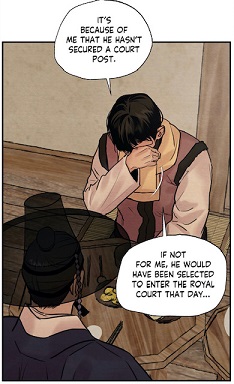 (chapter 75) This truly exposes the teacher’s cruelty and ruthlessness. We could say that the painter reinforced his admired sir’s cold-heartedness. Therefore I come to the following conclusion: Jung In-Hun will never feel remorse or empathy. He is destined to become a monster, as his wounded pride will just arouse brutality, resent and thirst for revenge.
3. Tears and indifference
Because of the strong connection between tears and emotions, I realized that the absence of tears isn’t just a sign of heartlessness, but also of indifference. There’s another person who never sheds a tear. It is the butler Kim. When in the pavilion he saw the painter lying on the ground, he was not moved to tears. The only comment he made was: “And here I was wondering why he lent me a horse…” (chapter 25) This means that he felt no empathy for the painter. However, he is different from the teacher. How? While Jung In-Hun senses no sympathy, the other tries to feel nothing. That’s why he gave his master the following advice: “Perhaps it would be best, if you did not take it to heart…” (chapter 50) In other words, Yoon Seungho should act, as if he had no heart. This explicates why he is annoyed, when he is facing someone in tears. He feels uncomfortable, especially if he is responsible for the incident. From my point of view, after Yoon Seungho got raped, the domestic made sure that the young lord would stop crying by making feel guilty and dirty. “Please!! No… It’s not…!” (chapter 65) Besides, I have the impression that he was turning his back on Yoon Seungho, when the teenager grabbed his shirt. Like I had pointed out above, tears are linked to a guilty conscience. And now, you comprehend, why Kim never cries. He is indifferent, because he doesn’t want to feel any pain and remorse. What is funny is that there exists a slang expression which connects tears to insensitivity:
“Two tears in a bucket” (rude slang): doesn’t matter, who cares. Said to express acceptance of or unconcern for the consequences of something. https://idioms.thefreedictionary.com/two+tears+in+a+bucket+fuck+it
And look at this: we always see the butler carrying a bucket around. 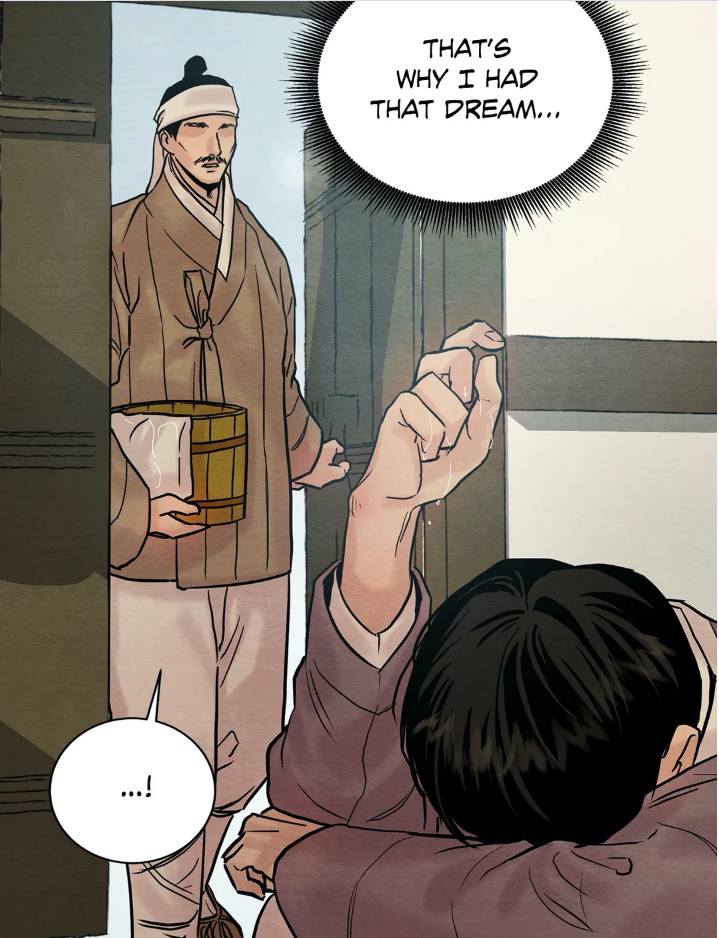 (chapter 56) I couldn’t help myself laughing, when I discovered it. I have no idea, if there’s such an expression in Korean. This slang expression comes from “to cry buckets”, which signifies that the person is like a cry baby. This new discovery made me realize that Yoon Seungho played a similar role to his admired valet than Baek Na-Kyum to his learned sir. Since the main lead was constantly facing terrible experiences, due to his cowardice and powerlessness the domestic chose not to take to heart. The more he witnessed, the more unconcerned he became. Therefore I deduce that Kim will never change his mind-set. He will prefer detachment, cowardice and blindness, because that way he is not suffering: neither regret nor heartache.
While Baek Na-Kyum contrasts so much to the valet, it means that Lee Jihwa stands between them. He is a mixture of indifference and empathy. This is particularly palpable in chapter 36. At the tavern, he cries out of frustration and anger, thereby he calls Yoon Seungho an “asshole” due to his wounded pride. Yet at the same time he feels a certain empathy for his childhood friend: “But I… know him best of all… I can… I can understand it all. Everything…” (Jihwa, chapter 36) He knows that he suffered a lot in the past. However, his compassion is quite superficial, because his bruised ego and pain are more important than his ex-lover’s traumatic past. As you can imagine, I am predicting that Jihwa will change in that aspect again. As time passes on, he will show more caring and respect towards others. However, as the readers can anticipate it, Nameless will serve him as role model. Besides, he has already triggered in him the right emotions:
- regret: “I have ruined it all myself” (Jihwa, chapter 61)
- empathy: “…I do. I pity you.” (Nameless, chapter 61)
On the other hand, the noble brings the goodness which was buried in the criminal’s heart to the surface. That’s why I come to the following deduction. Nameless might have not shed a tear until now, but he wasn’t indifferent. Contrary to the butler, he had a job, where he was forced to bury his compassion. In my opinion, he was confronted in a similar situation than Yoon Seungho. The only difference is that Nameless had to witness many wrongdoings committed on people close to him that at some point he chose to stop crying. In other words, Jihwa will teach the commoner to feel emotions (pity, caring, admiration, eg.) again so that at some point, we should expect Nameless to have tears in his eyes. Though he is not crying like the low noble and the domestic, he is not truly devoid of emotions. So far, he used his mask to protect his heart.
4. Tears and diligence
I am quite sure that you are surprised with such a heading. Nonetheless, there’s a reason for this selection. You all know the saying
“blood, sweat and tears”: a huge amount of effort, dedication and hard work. quoted from https://idioms.thefreedictionary.com/Blood+Sweat+and+Tears
What caught my attention is that neither Jung In-Hun nor Kim are seen hard-working. I had already demonstrated in the essay entitled “Jung In-Hun’s worries and problems” that the scholar was more and more stressed, when he realized that he needed to pass the exam in order to get the high position as official. Before he envisioned that the powerful noble would give him a high position without putting any effort. As for the butler, he is only forced to work hard (chapter 12, 25, 33, 56), when he has to take care of the painter. However, if you pay attention to his action, you will notice that he doesn’t work like a real intendant. That’s why I am stating that he is not diligent. He shows no real authority around the staff. He lets them eat the painter’s dishes (chapter 17) or leave the mansion without any permission (chapter 12, chapter 51). Furthermore, Deok-Jae attempted to sell the stolen red dresser. That’s why the worker in episode 29 described the household as hush-hush. There was no real control over the domestics. In my opinion, Kim is not a true hard worker, as he is not taking any responsibility in the mansion. He prefers simple tasks, like sweeping (chapter 65), bringing lunches or announcing the arrival of a guest. And this observation made me realize that the lord started working hard, the moment he desired to woo Baek Na-Kyum. He dressed up, ordered some medicine for excessive drinking, organized two hunts, started strolling through downtown. Yet, this is no real work. And note that Jihwa behaved in a similar way, when he sensed danger from the painter. He also dressed up, had to plant a spy and trespass the mansion on different occasions. From my perspective, Yoon Seungho will start working the moment he behaves like a master. He needs more than just give orders to his staff. He has to control them and pay attention to finances. From my point of view, it is also his duty to take care of them as well, as the head of the mansion. To sum up, he has to learn how to manage the mansion. That’s why I believe that the lord’s tears will only return, the moment all the conditions are met:
- hard working
- deep emotions which he can not control and repress
- emotional pain linked to his traumas
- he drops the habit to hide his face, when he is wounded. Like I mentioned above, he still hides his pain and emotions in front of his so-called loyal servant Kim.
That’s why after comparing these 5 characters concerning their “tears”, I realized Jihwa’s true position and Nameless’ role. The second lead is not truly the painter’s negative reflection. Therefore I created a table to summarize my interpretations.
| – | -/+ | + | |
| Pride | Jung In-Hun | Lee Jihwa / Yoon Seungho | Baek Na-Kyum/ Nameless |
| Empathy | Valet Kim | Lee Jihwa / Yoon Seungho | Baek Na-Kyum / Nameless |
| Diligence / hard work | Jung In-Hun / Valet Kim | Lee Jihwa / Yoon Seungho | Baek Na-Kyum / Nameless |
As you can imagine, the persons in the middle were in the beginning of Painter Of The Night selfish, lazy and quite superficial. But as time passed on, they were affected by the painter. The latter with his tears moved the lord’s heart which created a riff between the protagonist and his lover. The latter was forced to cry and as such to change.
And now, you are wondering when I will talk about Min and his tear! As you can anticipate, I can only examine him in the second part. This essay already has more than 3700 words! Furthermore, I haven’t mentioned Heena noona and Yoon Seung-Won yet. As a conclusion, there’s so much to say about the tears, which is no surprise, because many manhwaphiles call this work “PAIN”ter of the night. Many readers are crying buckets while reading this story.
Feel free to comment. If you have any suggestion for topics or manhwas, feel free to ask. If you enjoyed reading it, retweet it or push the button like. My instagram-tumblr-twitter account is: @bebebisous33. Thanks for reading and for the support, particularly, I would like to thank all the new followers and people recommending my blog.
 (chapter 76)
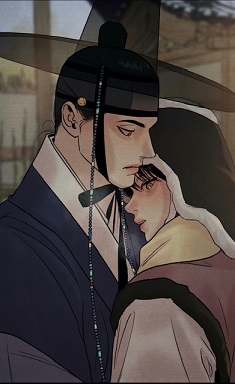 Yet, the peak was reached with the following picture, for Baek Na-Kyum and Yoon Seungho seemed to have merged as one:
  The readers can barely detect the painter’s presence: only his head and hand are visible indicating the depth of their intimacy and closeness. However, the title is mentioning the presence of a ghost. The latter can not be Yoon Seungho, because the panel above announces his official wedding with the commoner due to the presence of the red and blue lanterns called Cheongsachorong. These are used for wedding ceremony in Joseon. Therefore who is the ghost? And why do I perceive the existence of a spirit in this chapter? But before revealing the identity of the ghost, I would like to expose the reason behind such a title. While focusing on the embrace, I came to the following observation.
  ,
, 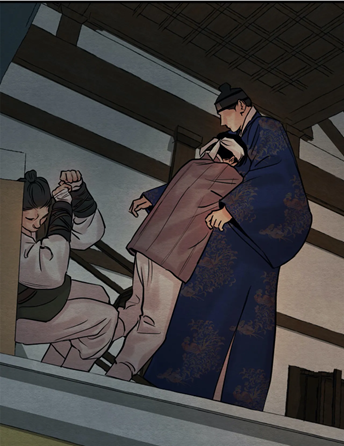 ,
,  ,
,  ,
,  ,
,  .
. due to the warmth exuding from the main lead. The painter couldn’t restrain himself from thinking about that fake embrace
 (chapter 29), therefore he chose to push away the wealthy aristocrat out of fear that he might get hurt and betrayed again. The commoner judged the embrace and warmth as a deception. This means that the low noble as a “spirit” was the reason why both protagonists couldn’t get closer. The low-born was only acknowledging Yoon Seungho as his sex partner and nothing more. Striking is that in episode 76, we have a reference to the hug from chapter 49, as the position of the painter’s head in this image
 resembles a lot to this one:
 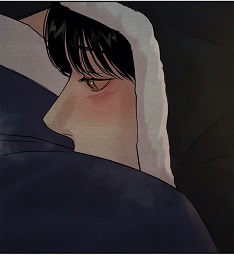 Moreover, the artist’s gaze is truly looking at his lover. We even have the impression that the artist is smelling the lord’s scent in order to reassure himself. Although the manhwaphiles couldn’t enter Baek Na-Kyum’s thoughts this time, they could perceive the change of his attitude. The embrace is no longer judged as fake. This signifies that the ghost Jung In-Hun has vanished for good, which is even reflected in a different panel:
 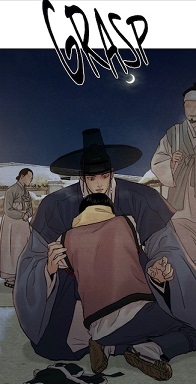 (chapter 76) The lord allowed the low-born to embrace him in front of people, whereas the scholar had to ask the commoner to follow him in a deserted alley.
 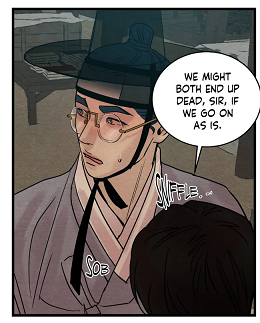 (chapter 29) The low noble feared people’s gaze, his attitude truly showed that he didn’t want to be connected to Baek Na-Kyum. His action was definitely a sign of hypocrisy and cowardice. That’s why in chapter 76, the painter could only come to the conclusion that the lord’s embrace was genuine and the lord’s feelings were not trivial. Moreover, the main character never pushed his lover away
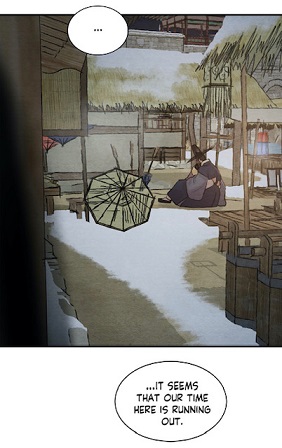 (chapter 76), he even lowered himself and sat down on the ground for a while, so that Baek Na-Kyum could calm down. Imagine, when the powerful lord arrived to the place where the main character had a panic attack, everyone was bowing in front of the noble.
 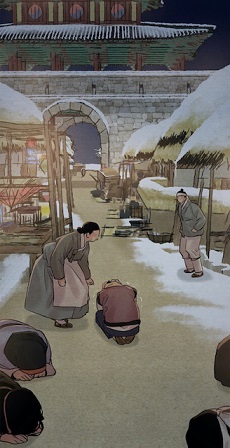 They didn’t even dare to face him, yet when he saw his lover trembling, the master lowered himself and attempted to help his partner. However, his gestures led to be misinterpreted in the beginning, hence a shop owner started interfering.
  However, he was stopped with a frightful gaze:
 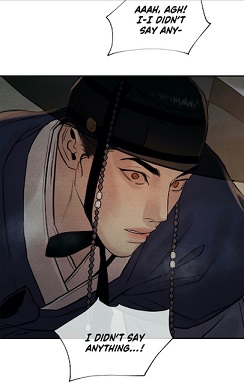 Besides, when the noble kept calling the protagonist in an informal way (Na-Kyum-Ah), people could realize his real intention. He meant no harm. In fact, he was treating the low-born like a precious treasure, who needed help.
 By calling his name Na-Kyum-Ah, the main lead tried to reassure his lover. Hearing his name made the low-born realize that he wasn’t attacked by the jester. This explains why the artist immediately embraced his companion.
  (chapter 29) The former teacher was just caught by surprise, hence “Na-Kyum” was said more or less randomly. On the other hand, Yoon Seungho used this name as a sign of intimacy. He desired to give comfort and warmth to his lover. And now, you understand why Baek Na-Kyum hugged his lover by instinct.
 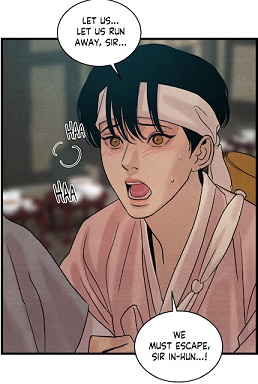 (chapter 29) thus he tried to find him. And now the mansion has become the painter’s home, just like the lord’s embrace. It is a synonym for comfort, warmth and safety. Another huge contrast is that for the first time, the painter asked for Yoon Seungho’s help directly.
 (chapter 76) Imagine that so far, he has never relied on others. Even as a low-born, he was willing to save others (Jung In-Hun or Deok-Jae or Heena
  (chapter 65). Surprising is that when he was bullied by Deok-Jae, he never complained and asked for the head-maid’s assistance or his lover’s. His attitude to never rely on others was even more perceptible in his escape in chapter 46. The cause for this behavior is linked to his abandonment issues. Due to his past, he was forced to only rely on himself. Nonetheless, in chapter 76 he changes his attitude. This shows that he is now opening up. That’s why his head rests on the lord’s shoulder completely.
  (chapter 53), hence the gentle boy needed to intervene directly. The lord was definitely deaf to the artist’s words. Striking is that here again, we had the presence of danger, the painter feared for Deok-Jae’s life. Moreover, despite his fear and shaking hands,
  (chapter 53)the commoner chose to protect the vicious servant, but Yoon Seungho too. He desired him not to let his emotions blind his behavior. The gentle and selfless man didn’t even ask for help, he stopped the noble with his body twice: first his face, then he hugged him. Striking is that in chapter 62 and 66, we had a similar situation. One of the protagonists was behaving like a ghost. In chapter 62, Yoon Seungho, who was reliving his traumatic past, almost became a demon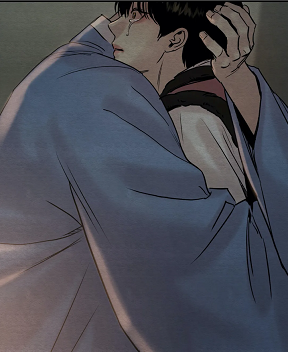
 (chapter 62), whereas in chapter 66 the artist had a flashback, hence he wasn’t himself.
  (chapter 66) This meant that in both episodes, neither the aristocrat nor the commoner could sense the lover’s comfort and warmth.
  (chapter 66) Both of them didn’t feel safe and displayed extreme fear due to betrayal and abandonment.
 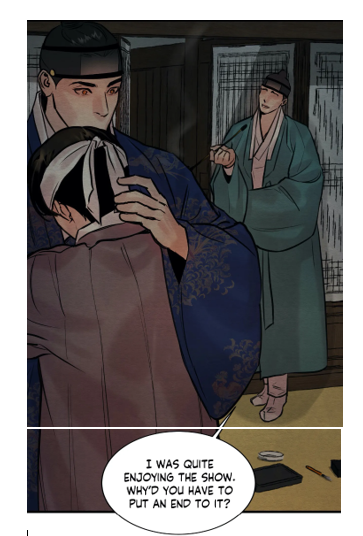 There’s no doubt that the vicious noble felt extremely jealous in both episodes (53-66). The manhwaphiles should envision that despite his rage and his terrible behavior, the artist was willing to embrace such a man, which could only make Min envious. Moreover, the low-born showed courage and even strength. He didn’t reproach anything to his sexual partner. He just attempted to calm him down.
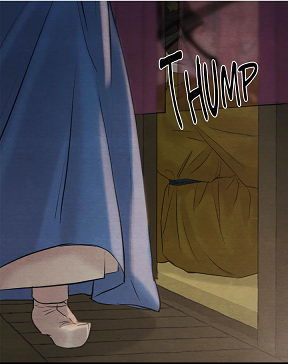 (chapter 69) That’s why he was waiting there. He imagined that the boy would be delivered to him on a silver plate, yet nothing like he had expected happened. In chapter 76, we have a new version of chapter 53. However, when Black Heart witnesses the painter’s second embrace, he can detect the huge difference.
  (chapter 54), in episode 76 Black Heart is truly defeated. And by contrasting these two scenes, it becomes obvious why Yoon Seungho assaulted his guest back then. The noble was in fact punishing The Joker for insulting his lover, as the latter was just reduced to his status: a low-born. He had no name and as such no identity. The powerful aristocrat didn’t do it in order to protect his honor, but the artist’s. At no time, the main lead was afraid of losing his reputation, he is well aware of his bad notoriety. Thus this shows that in chapter 54, the one who feared more social norms was indeed Baek Na-Kyum, which was still visible in chapter 75. That’s why the commoner denied the lord’s affection.
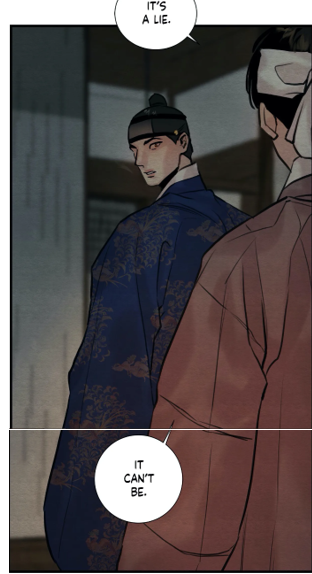 (chapter 54)The expression “it can’t be” was referring to permission and social rules. No wonder why the noble felt so hurt in the end and retaliated. He misunderstood the artist’s rejection.
 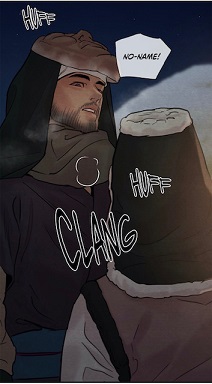 (chapter 76), the ghost from his nightmare
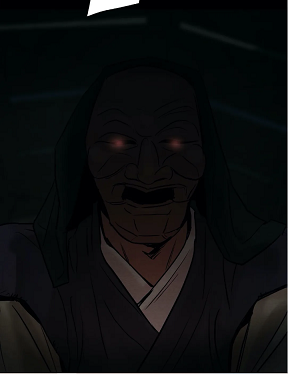 (chapter 61), the painter got so panicked that he got paralyzed. Only the lord’s embrace could calm him. As you can see, the commoner denominator between 53 and 76 is that the presence of a terrible ghost. The latter pushed the artist to embrace his lover. This time, he needed himself protection. However, Nameless was not the only ghost witnessing the protagonists’ embrace. Lord Min has already become a ghost himself in my opinion. First, he is wearing a black hanbok which I am associating to death. Moreover, because he threatens the criminal to kill him
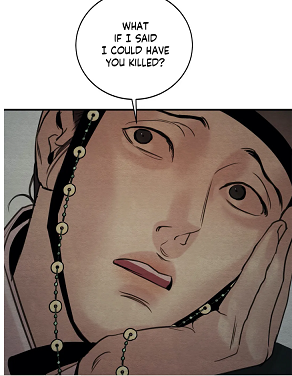 (chapter 76), I view The Joker as a grim reaper. What caught my attention is his reaction, when he saw the heartfelt hug. He had to vomit and this is no coincidence.
  (chapter 76) Observe that the color green is connected to two reactions: “to be green with envy” and “to be green” (sickly). Besides, we have in French “être vert” as a synonym for fuming, furious and disgusted. Hence it’s not surprising that it exist these emojis: 🤮🤢. Both contain green. That’s why I believe that when Min saw the embrace between the protagonists, he got so upset and disgusted that he felt the urge to vomit. It was definitely a mixture of envy and rage. However, he had to lie to the others in order to hide his “weakness”.
  (chapter 76) For me, there’s no ambiguity that The Joker was not honest here. First, he has no dark circle and red eyes like Jihwa who definitely drank again.
 (chapter 76) Besides, has Black Heart ever apologized to others? No. He didn’t even care, when he smoked opium in front of commoners. When he was asked to stop it,
 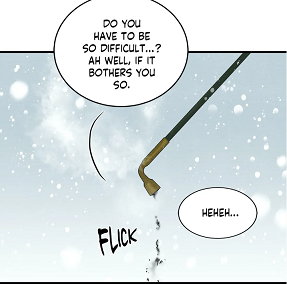 (chapter 52), he never expressed a real apology, he rather criticized the other for ruining the good mood and his fun. Besides, he looks down on low-borns and even Jihwa…
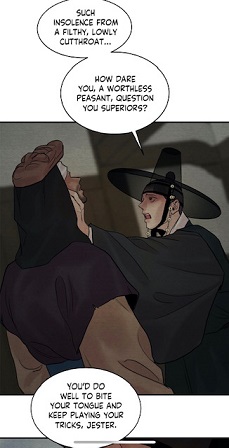 (chapter 76) so why would he apologize? It is, because he is slowly recognizing that his urges for Baek Na-Kyum are not linked to sex!! When he saw the hug
 (chapter 56) and the pattern reminds the readers of opium smoke. Contrary to Yoon Seungho who only smoked it once during that terrible party, Min chose to keep smoking opium. First, the manhwaphiles could detect that he enjoyed the kick in chapter 52.
 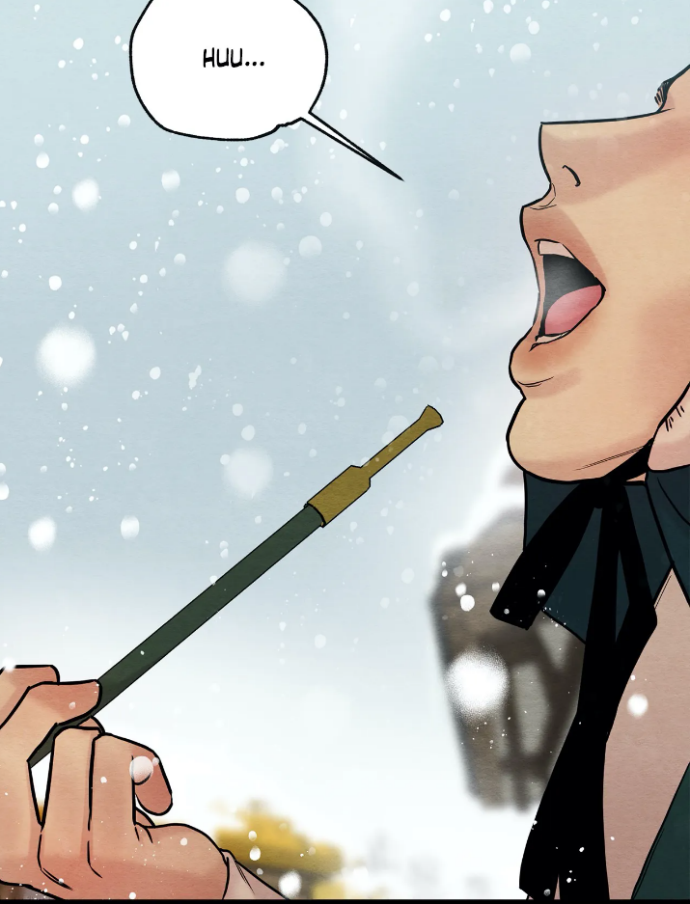 (chapter 52) Secondly, the hanbok was another indication. Finally, I perceive the lord’s nausea in chapter 76 as another evidence for Black Heart’s opium addiction. Vomiting/nausea are listed as side effects of opium. From my point of view, when he saw the happy couple in the street
 (chapter 74), he chose to smoke one pipe in order to relieve his frustration before visiting Jihwa and urging him to contact Nameless. This was a new version of chapter 56. That’s why they came both to meet the criminal.
  (chapter 76) Hence I come to the conclusion that Min is slowly turning into a ghost himself, losing his mind due to his addiction to opium and at the same time due to his greed and obsession for Baek Na-Kyum. The embrace in chapter 53 led to the kiss and indirectly it was the trigger for Min to change his original plan.
 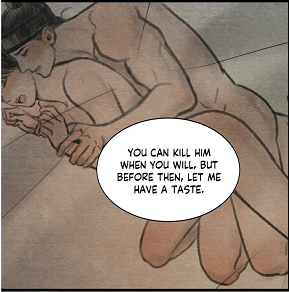 (chapter 56) Therefore I deduce that this second embrace is forcing him to change his plan again. From my point of view, he is no longer interested in tasting the painter once and have him killed afterwards. Black Heart is now determined to take away Baek Na-Kyum from Yoon Seungho. He is definitely longing for the artist’s love. He has every reason to be so jealous. The painter showed such a loyalty and courage. He is no longer fearing people’s gaze unlike in the past. Then, he even forgave his lover for his violence and mistreatment. Slowly, Min is showing his vulnerability in front of Jihwa and as such losing his power over him. He is definitely less laughing. As a conclusion, in chapter 76, the ghost Jung In-Hun vanished for good, while a new one appeared: Black Heart, who is now dressed like a grim reaper. However, there’s a huge difference, because Min has never entered Baek Na-Kyum’s mind and heart. He has no chance at all.
 (chapter 71) My explanation is the following: Baek Na-Kyum wasn’t sure how to judge the lord’s behavior. Imagine that in the morning, his lover had tied him up, while in the evening he was so gentle and calm. That’s why I believe that in this hug, the artist wasn’t certain how he should perceive the lord’s embrace. He knew that it was no longer fake, but like he explained it much later… how long would Yoon Seungho have feelings for him? Therefore I believe that in this scene, Baek Na-Kyum viewed him as an illusion, a spirit who could give him warmth and comfort.
 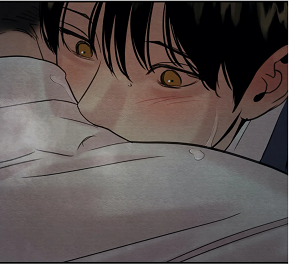 (chapter 71) Note the difference with the following picture:

 (Chapter 60) In this picture, the manhwaphiles can even hear Nameless’ explication why the lord would jump to the wrong conclusion. The expression “on his own two feet” was actually visualized by the imprints left on the snow. We know for sure that Nameless knocked out the painter before carrying him away. He carried him the same way than he did with Lee Jihwa:
  (Chapter 59) What caught my attention is that the space between the footsteps on the wood
 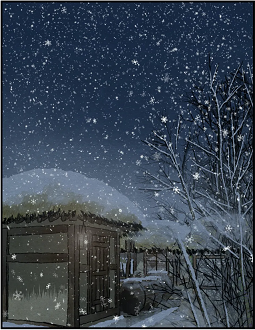 (Chapter 59) This image caught my attention for two reasons. Thanks to the analysis “The five candles”, I realized the true meaning of the pictures with landscapes. They expose the actual situation, therefore the beholder should study them under the following elements: moon or sun, air, water, earth and fire. So in this picture, you can detect the absence of the moon symbolizing the lord’s illness. He is too weak to look after his lover. Striking is that the earth element is predominant here, as the tree branches standing next to the buildings are almost touching the sky. So since the snow is falling, it indicates the presence of water and note that water is almost everywhere: in the sky, on the trees, on the ground and on the rooftops. The only element missing is fire. Yet if the manhwalovers examine the image more closely, they will detect the presence of a light hanging on the side of the restroom. However, the candle surrounded by glass is not lit. To sum up my observations, this panel exposes the predominance of water and earth and the presence of a lamp with glass. In other words, this image symbolizes butler Kim, the new version of chapter 58
  . First, let’s not forget that Kim is often seen carrying a bucket of water
 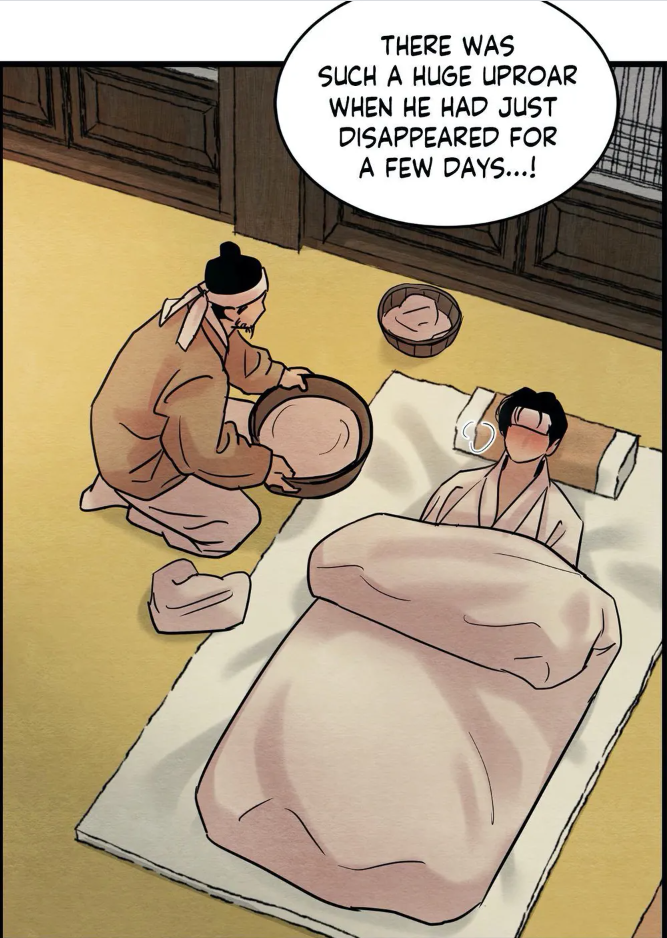 (chapter 33)
  (chapter 20)
 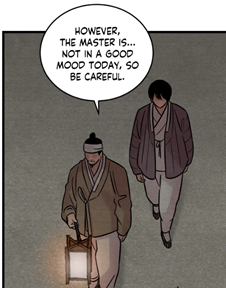 (chapter 36) But more importantly is that in the image from chapter 59, there is no light,
  (Chapter 59) Note that the painter is standing in front of the bathroom. He has just cleaned himself and note that the lamp is in the background. How is this a proof? If the painter had run away, he wouldn’t have gone to the restroom… he would have left the room right away, just like the footprints are indicating.
  (chapter 59) But since the artist was silent right away, as the Joker knocked him out immediately, the physician could have jumped to the conclusion that Baek Na-Kyum met an acquaintance. So when the vanishing of the painter was discovered, the doctor assumed that the artist had followed the person he met during that night. Honestly, I can’t blame the doctor for his “passivity”, if my assumption is correct. Due to the lord’s agitated state of mind, the doctor could only realize it afterwards. With this new discovery, it becomes more comprehensible why the physician hesitated the next morning. He didn’t know what he should do.
  (Chapter 63) If he revealed what he had heard, then he imagined that he could bring the person who had „helped“ Baek Na-Kyum to escape into trouble. Observe the presence of the drop of sweat on his face. He was definitely uncomfortable. If he testified, then he could reveal the presence of a conspiracy. Nonetheless, I believe that he had jumped to the wrong conclusion: desertion. And with this new discovery, you can understand why the butler was so worried. He had no idea what the doctor had noticed. Imagine, the valet got caught by his own method (spying behind doors), however in the physician’s case, the latter was not doing out of malevolence. He just happened to become a witness, but he had assumed something else. That’s the reason why Kim was so worried, he had seen no one, yet the doctor had observed something. Kim never imagined that such a small detail (noise) could become a threat for him. This explicates why he chose to visit the doctor during the night.
  (Chapter 64) He needed to ensure that the doctor remains silent. Many manhwaphiles will certainly recall how Kim threatened the doctor…
 (chapter 65) Back then, I had assumed that out of cowardice, he had not intervened due to Kim’s harsh words. Nonetheless, I came to a different interpretation. After recognizing how Byeonduck is tricking the readers, she gives the impression of a continuity, I believe that during that night, the butler visited two different physicians. According to my theory, there exist 3 different doctors. For more, please read the analysis “The mysterious doctor“. How did this idea come up? Simply by paying attention to the BEARD!!
  (Chapter 57) Note that the beard of this physician is covering the cheek and is straight.
 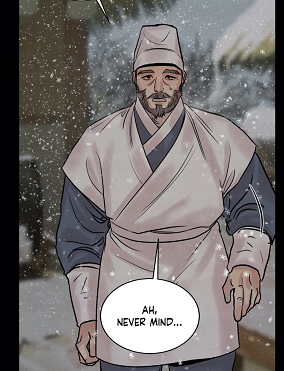 (Chapter 63) But now compare it to the physician’s beard in episode 65:
 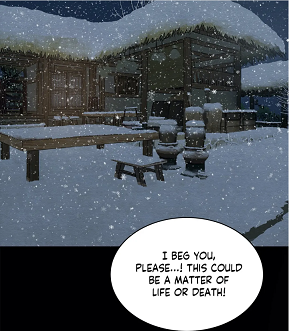 (Chapter 65) and from my point of view, he used pity to discover what the physician knew. Remember how he had used compassion the night before (chapter 57). Besides, if you contrast both statements, you will detect a contradiction. “This could be a matter of life or death“ implies that it was about saving someone, while in the second image, it is about killing someone: the other doctor! In my eyes, the valet must have begged the physician
 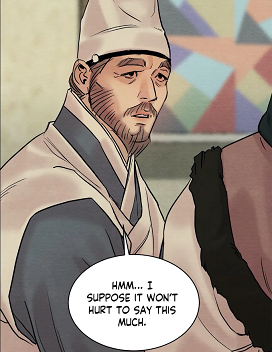 (chapter 57) to remain silent. If he revealed that he had discovered the presence of someone, then the other could get into trouble. In my opinion, the butler must have suggested that Baek Na-Kyum had tried to escape, because the lord had been abusing him. Don‘t forget that he had been treating the artist for his wrist. Then he must have seen the lord panicking too.
  (Chapter 60) But now, the manhwaphiles are probably wondering why he went to the other physician then. It was related to the lord’s behavior in the shed. He was acting like a sex-maniac.
 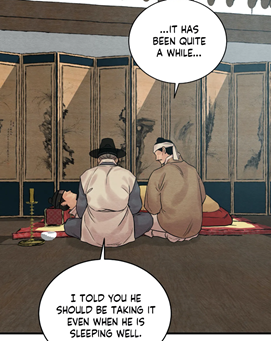 (Chapter 55) This doctor had reprimanded the butler and had been prescribing a tonic. So he visited the physician and used this opportunity to put the whole blame on the poor doctor.
  (Chapter 65) The man never saw anything, Kim just described to him how the main lead had been behaving! Yes, he was acting like Yoon Chang-Hyeon who had gone to the doctor and described the son’s illness.
  (Chapter 57)
  (chapter 61)
  (chapter 62)
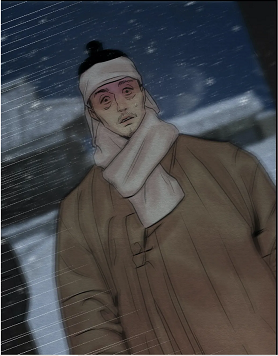 (chapter 64) He needed to confirm his death. But since the lord was having sex the whole night, the butler had to make sure to bury the truth. If the artist had fainted, then the valet would have fetched the other doctor, the one who imagined that Baek Na-Kyum had escaped. And now, you comprehend why the man hesitated to question the painter after his return:
 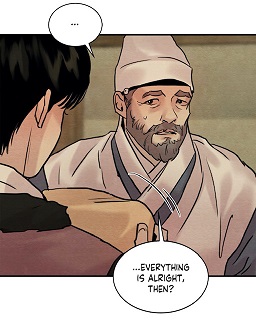 (chapter 74) He was wondering why the artist would look so fine, as he had attempted to escape before. Another evidence for this theory is the following rule: a reflection within the same season. Since the doctor had been puzzled by Yoon Seungho‘s illness, I am deducing that he had the exact opposite disposition concerning the artist. He imagined what the artist had done. He had jumped to the wrong conclusion due to the injured wrist. Besides, he was “aware“ of the lord‘s mood swings.
 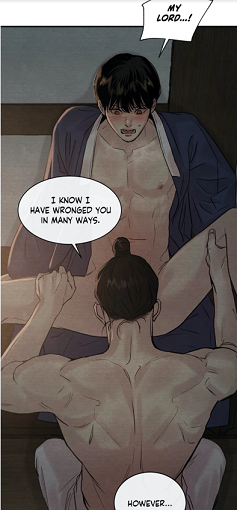 (Chapter 71) Consequently, he was not investigating the real circumstances of the abduction. But he has another reason for neglecting this aspect: he knows the culprit’s identity, unaware that unveiling the mastermind’s identity is far from enough. Real justice is to uncover truth. However, at the end of season 2, the wealthy noble was more like a teenager in love. That’s the reason why he was making a huge mistake.
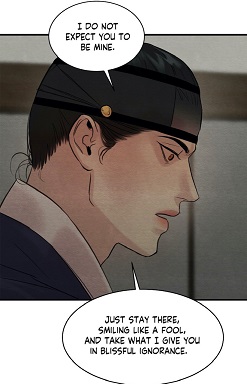 (chapter 85) He was already content if the artist would look at him, the moment you recall his first confession:
  (chapter 55). Hence in chapter 71, he’s blushing and happy, for Baek Na-Kyum is definitely starring at him with such a curiosity and desire.
 Moreover, the painter talks to him, has even accepted his advances. That’s why he is no longer paying attention to the circumstances that led him to think that the painter had run away on his own feet. As for Kim, he was running out of time, because at any moment, Baek Na-Kyum could mention his visit to the restroom or meeting the Jester. Consequently, the former had to use any trick to remove the artist. Hence he encouraged the kisaeng Heena to take away her brother.
  (Chapter 67)
 (chapter 100) Here, they revealed that the main lead had gone down on his knees, the moment he had seen the traces of fresh blood. Then note that in the shaman’s house, the lord had left a bloody foot print
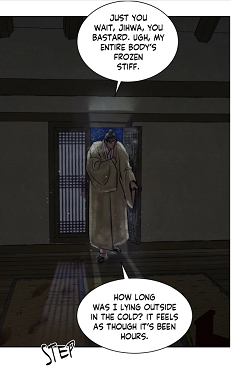 (chapter 102), yet in the snow it was no longer visible.
  (Chapter 102) Someone had erased the traces by putting mattresses on the soil. However, while the lord was walking through the mountain, he was definitely leaving a bloody trail behind
  (chapter 102), a sign that someone had been helping him. And this can only be KIM!! And the last chapter from season 3 seems to confirm my initial investigation: The butler had erased the traces from the abduction. He knew about the kidnapping and helped Lee Jihwa and the Joker.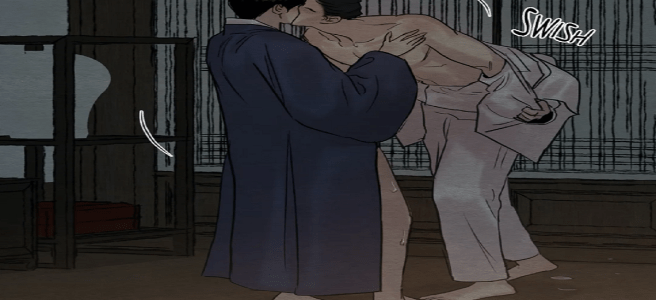
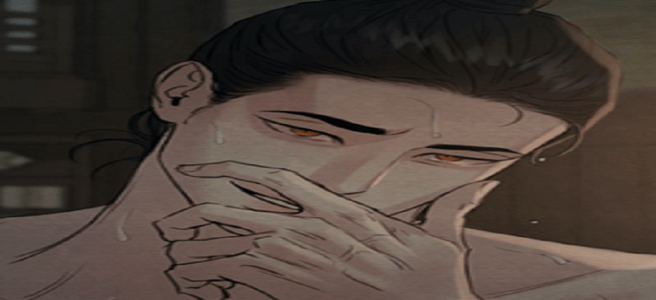
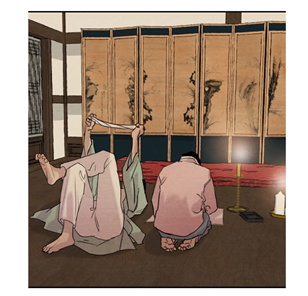 He is not only playful, but also flirtatious. Note how he puts the headband on the main lead giving him a seductive allure.
  At the same time, he acts like an innocent teenager who keeps asking questions: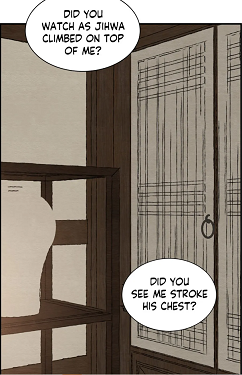
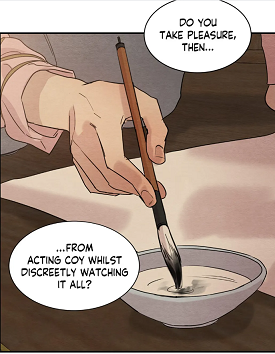 Yet, the topic is actually about sex, which contrasts so much to purity and innocence. It was, as if Yoon Seungho was behaving like a teenager discovering sexuality for the first time.
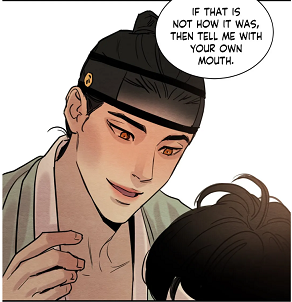 While talking, he can’t even help himself smiling. Striking is that his joke and words are used to woo the painter. He keeps getting closer and closer to Baek Na-Kyum, so that his head approaches the painter’s, before his hand starts touching his leg.
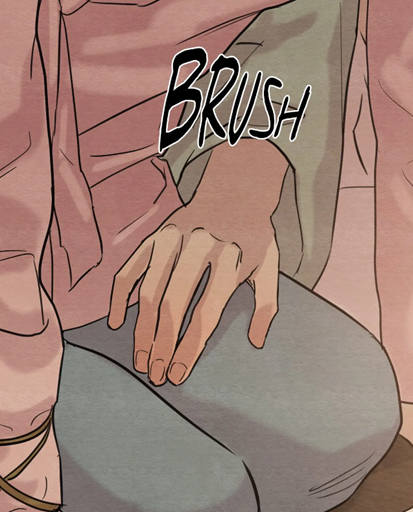 As you can detect, the scene in episode 16 is a combination of seduction and frivolity. He is so happy to be by the painter’s side, hence he is talkative. He desires to have a real conversation with the painter. On the other hand, since the topic of the conversation is revolving around sexuality, it explains why Yoon Seungho is tempting the painter. And we have a similar situation in chapter 70. Therefore there exist so many similarities between these two episodes, which I will now list:
 (chapter 16) versus
  (chapter 70)
 (chapter 70)
  (chapter 70)
 and
and 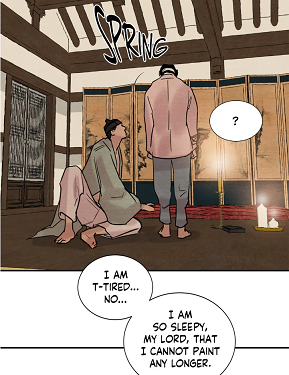 (chapter 16) versus
  the removal from his hand and
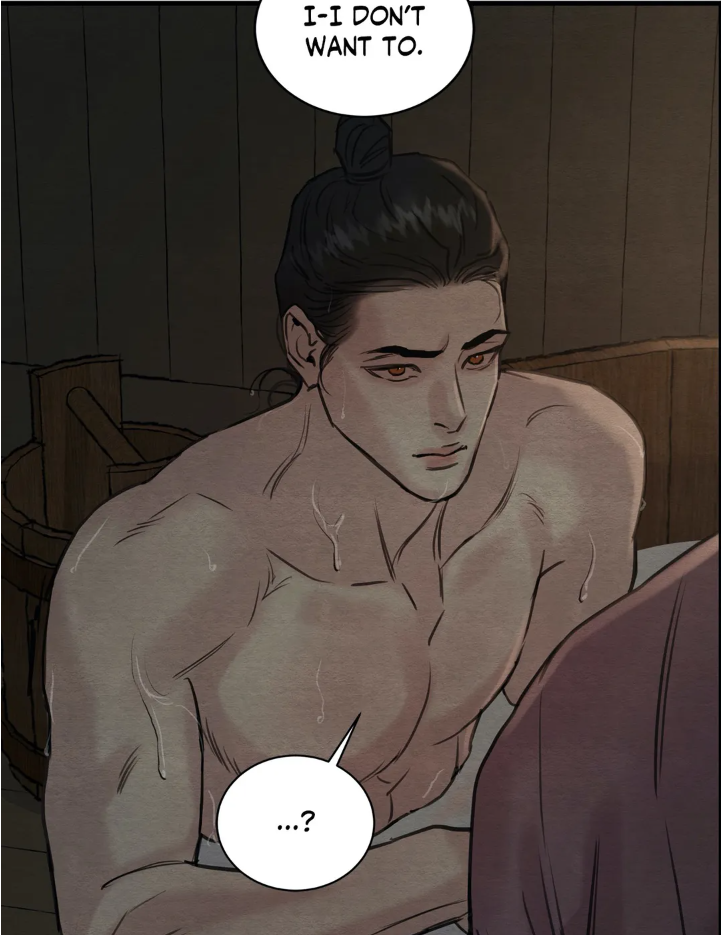 (chapter 70)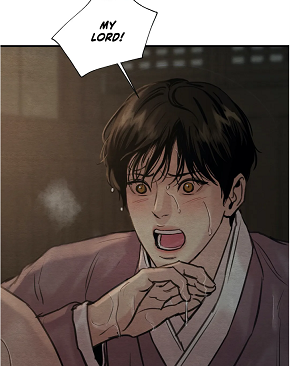
 (chapter 16) versus
  (chapter 16)
 (chapter 70)
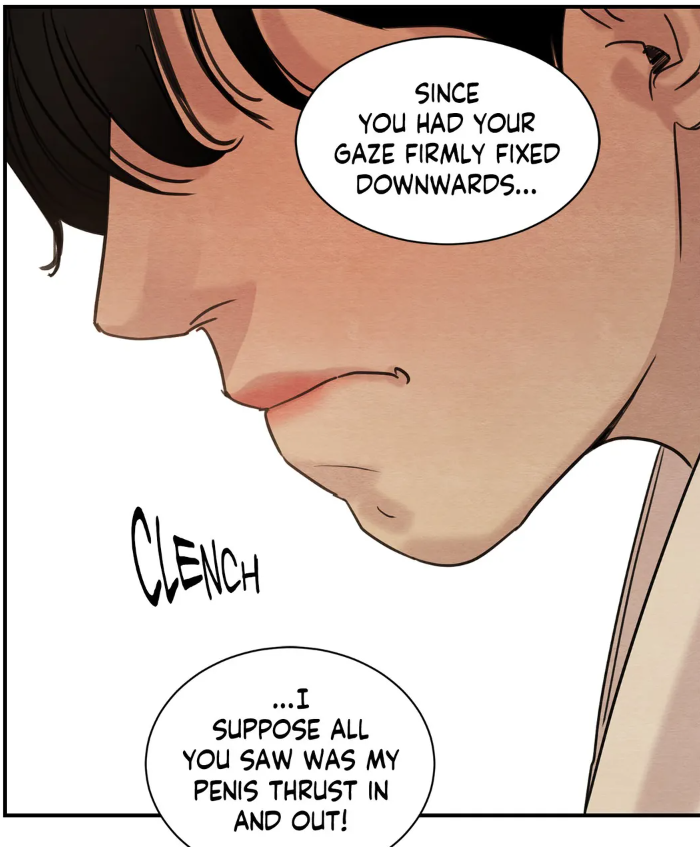 And here, we can detect the first huge difference between these two episodes. Because the artist is no longer denying his homosexuality, and as such he has finally dropped the scholar’s doctrines, he is able to perceive the aristocrat’s true personality. He is indeed moved,
 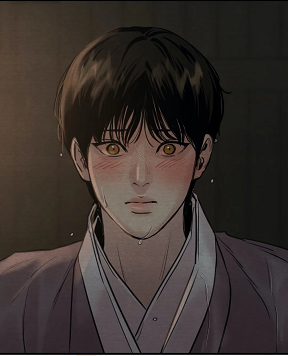 when he sees Yoon Seungho smiling after playing his prank. He blushes so much that he feels the need to hide his face,
 , when he hears the main lead calling his sister a wench. He requests respect from the lord. He is confident in his words and behavior. He even gives further explications.
 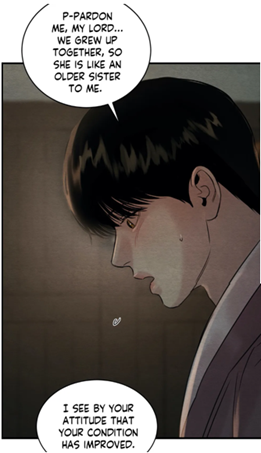 Moreover, he is no longer using fake excuses, unlike in the past. He rejects the lord’s suggestion (taking a bath together) clearly and directly without displaying any disrespect. When the lord keeps pressuring him, his justification sounds reasonable.

 (chapter 26). Yet back then both were driven by negative emotions (anger and sadness) due to their wounds. However, this time it is different. They are both calm and very careful. The two are determined to treat each other with respect.
 (Chapter 70) In other words, the bathroom is the place where the main leads can be honest to themselves, hence they are genuine to their counterpart. This is no coincidence that the painter was indeed touched, when he reminisced the lord cleaning him.
 (chapter 59) In this place, there is no rule or social class separating them, they are equal. In the washroom, there’s only purity symbolized by water. I would conclude that they are truly naked physically and mentally. That’s why they can only be honest to themselves and in front of each other.
 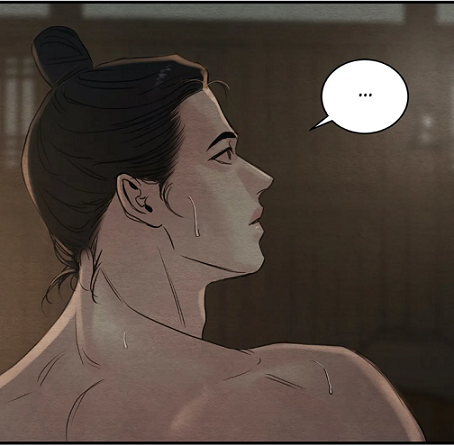 , when the painter retorts that he should mention her differently. His facial expression oozes naivety and shock. He didn’t pay attention to the idiom (“wench”), as all his thoughts were revolving about the painter’s happiness. He just desired to know if he had succeeded:
  (chapter 63: this is the master’s biggest wish) Astonishing is that the painter is not outraged by the lord’s words, as he has already sensed the lord’s true attention: the artist’s happiness. Carefully, Baek Na-Kyum corrects his master and starts describing his relationship with Heena. Consequently, the lord considers it as a good sign. Their bond has not been too damaged. Despite his mistake, the low-born is interacting with him. That’s why he takes the painter’s hand. He has the impression that the artist is opening up, hence he starts conveying his own thoughts too. The problem is that when he says this
  , he makes a huge mistake again. However, his words cause the painter to remember how the lord treated him in that room
  (chapter 66). The artist has no idea that Yoon Seungho is referring to the flashback.
  (chapter 66) Nonetheless, due to his mistake, Baek Na-Kyum retrieves his hand. The reality is that Yoon Seungho was attempting to show his concern and his remorse. Unfortunately, he chose the wrong diction, thereby his thoughts were not expressed properly. Moreover, I would like the readers to keep in mind that the lord has never apologized before. First, as a noble, he was never asked to apologize to a commoner. Secondly, it is related to his own trauma. The main lead associates the apology
 to fakeness and hypocrisy due to the butler, who keeps repeating these words
 (chapter 25)
  (chapter 65). Besides, the painter also apologized once, and back then, he was not really sincere too.
 (Chapter 11) This explicates that he misjudged the painter’s apology in chapter 62. Moreover, exactly like in episode 11, the painter had selected silence over giving a proper explanation. As you can see, silence was another reason why the couple had such huge issues in the past. It generated doubts and increased insecurities. However, in chapter 70, silence is barely present.
  (Chapter 70) Both are communicating verbally in all sincerity. In other words, this panel
  In my opinion, the skinship serves as support. The master is not just wooing the low-born, but also he desires to voice his emotions. He would like to expose his concern and affection, yet like I exposed above, he fails due to the wrong selection.
  (Chapter 70) Imagine, before he never showed any interest why the commoner refused to paint for him.
  (chapter 1) This exposes the huge transformation of Yoon Seungho. Now, he would like to be judged differently. He has already realized that he will never achieve his goal (being loved), if he is still full of insecurities and self-hatred. Nonetheless, his selfishness is still present in the bathroom, because he can’t bear being pushed away again. This interpretation is exposed with the number of white candles.
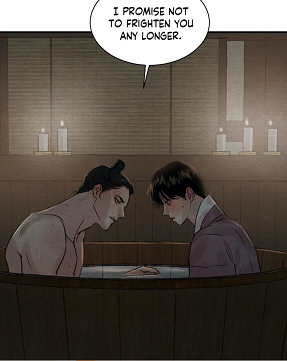 Note that on the lord’s side, there are just 2, while on the painter’s side the beholder can count three. The number 3 symbolizes harmony, completion and wisdom. This observation leads me to the deduction, the aristocrat’s transformation is not completed yet. This explains why he plays a trick by dragging him into the tub. The prank is the perfect solution in order to pursue his dream without becoming forceful or frightening. Moreover, note that he refuses to act like a master by giving him an order. From my point of view, the noble’s tone has changed. Not only his gaze

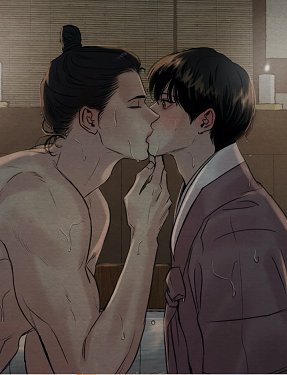
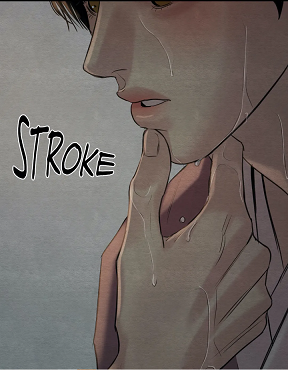
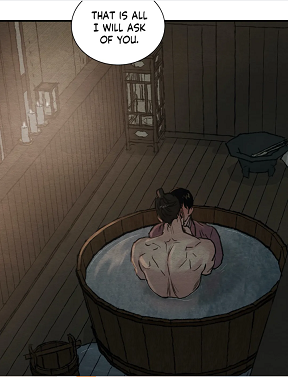 quoted from
 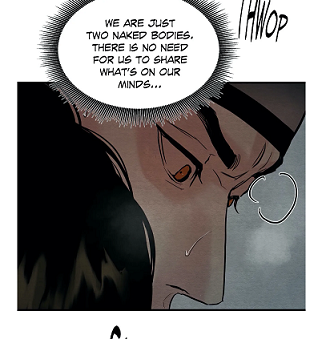 (“to share what’s on their mind”) got revived. He was once again full of hope, that’s why he felt the need to touch the painter. He wanted to share his feelings and thoughts. Unfortunately, the low-born rejected the offer
 I believe that for the first time, the low-born is able to detect a new side from the aristocrat. Imagine that the artist could not only make the noble laugh, but also smile. That’s why the painter can no longer reject the lord, as his fear is slowly disintegrating. Note that he doesn’t reject the kiss from the aristocrat.
 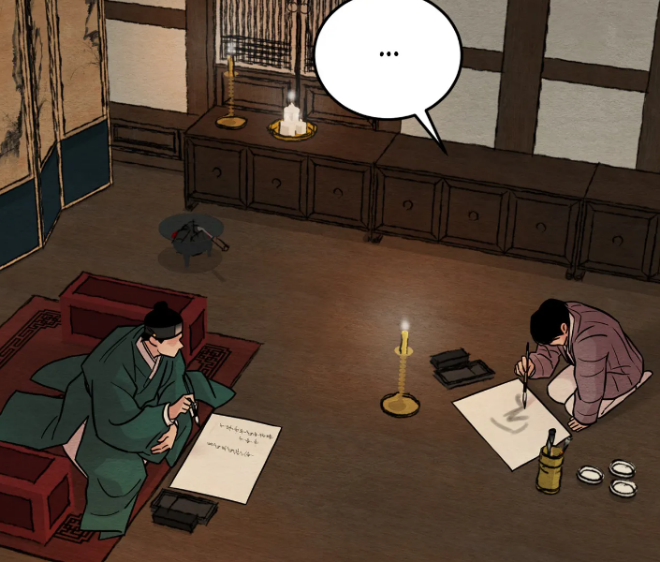 , because the butler had warned the artist not to irritate the main lead. According to him, he was in a bad mood, which was untrue.
 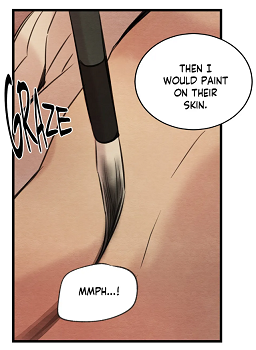 (Chapter 36) With this joke, he wanted to initiate a conversation, but unfortunately he saw the erection. Yet, the valet’s trick didn’t work completely either. Note that during that night, there was no sexual intercourse, just a fellatio. We shouldn’t forget that during that day, the painter was still feverish which the noble had noticed. So envision what would have happened, if the lord had engaged a second sex marathon. Therefore, I believe that in chapter 70, the valet is hoping that the noble will behave like the previous night
 , so that the painter’s health condition deteriorates more, or the artist gets scared and changes his mind to leave the mansion.
 (chapter 38)
  (chapter 50): caresses, embrace and kisses, the symbol of harmony, love and sincerity.
  (chapter 47) by saying that he had just made a prank. But now, you will wonder where there was a prank in chapter 46, 56 and 66.
  (Chapter 46) Deok-Jae destroyed the painter’s snowmen. There is no doubt that he would have replied the same, if he had to answer for his behavior.
 (Chapter 56) He knew that this would hurt the noble, yet note that he felt no remorse and blamed his childhood friend. However, like I pointed out, he was impersonating a person. If asked, the childhood friend would have used a similar excuse. That’s why Yoon Seungho answers in a quite similar way: he calls him “lord song”. However, he pushes him.
 (chapter 66) , he implied with his words that Jihwa played just a prank, since the painter returned alive. Yoon Seungho shouldn’t just get angry, because it was just a joke. As you can observe, all the misdeeds are reduced to a joke. It was, as though they had done nothing wrong. However, the intention is definitely different: the perpetrators intended to hurt the protagonists. And this is not surprising that the chapter 36 contains both pranks: Kim drugged the painter against his will, while the joke from the noble was harmless. And in my opinion, the episode 70 contains both pranks as well. Kim was the one who sent the painter to the aristocrat. Why do I believe this? The reason is quite simple: the servant leading the painter to the bathroom is portrayed with no eye
  (chapter 70) and is carrying a lamp similar to Kim’s
  (chapter 36). And remember that this chapter is a new version of chapter 36. In that episode, the valet was the one who brought the artist to the lord’s chamber. Moreover, the way the door is shut clearly exposes a certain violence.
  (Chapter 70) Besides, the domestic is also urging the painter to join the bathroom. From my point of view, the domestic wants to make sure that the artist arrives, before the lord leaves the bathroom. Moreover, the lord’s expression in beginning is not quite welcoming
 . So I am more inclined to think that Yoon Seungho didn’t plan it that way. And remember my explanation after the first sex marathon. The butler had placed the painter in the lord’s bed
  (chapter 34) in order to incite the latter to have sex with the commoner. Imagine, he had just regained consciousness, therefore this trick could have cost the artist’s life. And we shouldn’t forget, the butler witnessed the second sex marathon. He even viewed the flashback from the painter. Therefore in my opinion, the butler is hoping with his “prank” that the lord will act like the previous night. Furthermore, I would like to point out the presence of domestics in chapter 16 and 36. We have Deok-Jae who spied on the couple and manipulated the butler to open the door
 [theory confirmed by the author herself]. Then during that evening (chapter 36-37), Kim tried to stop Yoon Seungwon from entering the room.
 (Chapter 37) Hence this means, he was paying attention to what was happening in the bedchamber. What caught my attention are the following panels:
  (Chapter 69)

 (chapter 50) I tried to find answers by speculating. However, my assumptions were totally wrong due to the lack of information. Only time and new chapters helped me to understand the story much better. Thereby I could better anticipate its progression, and comprehend the reasons for the characters’ actions. Due to the constant examination, I made the following observations:
 (chapter 55).
 (chapter 16) Here, he was wondering how the painter was able to create the painting, while he didn’t seem to look at them the whole time. What caught my attention are two elements:
 (chapter 49) The painter expressed his thoughts: he only saw the noble as a sex toy, the main lead was the one who should give pleasure to Baek Na-Kyum. Yet despite the hurt, Yoon Seungho was willing to accept this situation. They would no longer exchange their thoughts and emotions. He was already lowering his expectations. At the same time, he couldn’t help caring for the low-born. He caressed his cheek and kissed him gently at the end.
 (chapter 50) And this scene reminded me of the main lead running to the scholar’s room in chapter 28/29
 , after witnessing the artist’s desertion. There was a time jump as well. Therefore I came to the conclusion that the night in chapter 48-49-50 has the same importance than the night with the forced sex and fellatio. This explicates why the lord has a sword again. Back then, he took the weapon due to his jealousy, hence we can definitely conclude that he is angered again due to the return of his jealousy. So chapter 50 was not only a reflection of the episode 16, but also of the episode 28-29.
 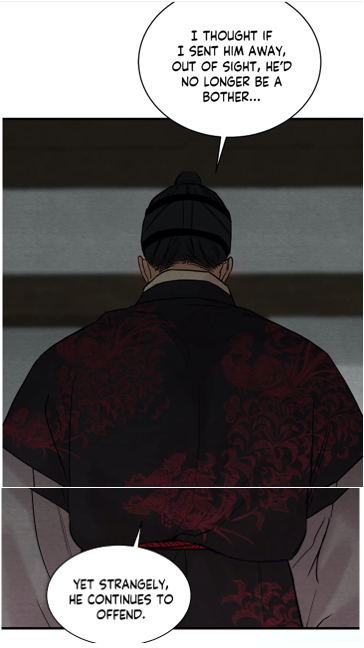 (chapter 50) What had triggered his fury and jealousy?
 (chapter 21). The paper in the book is very similar to the poem in chapter 4. Remember the theory I exposed in the essay “hypotheses about the second season”: Yoon Seungho had not returned the original poem, but given the artist his own poetry. So if he didn’t give back the scholar’s poem, then what did he do with it? I doubt that he would have kept it, hence I deduce that he must have asked his assistant to throw it away, exactly like the painter in chapter 44. However, Kim must have read it and kept it, well aware that this could be of use later. From my point of view, the butler must have entrusted it to the teacher with the hope that he would leave the mansion. And I can imagine that when Jung In-Hun left his room, he didn’t take it with him. That’s why it ended up again in the butler’s hand. However, if the lord discovered that the poem had not be thrown away, he would have realized that Kim had disobeyed him. That’s why I came to rule out the first possibility.
  , the readers should expect that this picture will be used twice during the second season. Because I already exposed that Heena noona recognized the painter’s presence due to the inauguration painting
 (chapter 65), it is definitely possible that Kim planted the picture in such a way that Yoon Seungho’s jealousy would get triggered, a new version of the panel from episode 41. Let’s not forget that the aristocrat was not present, when Baek Na-Kyum decided to discard the drawing. Kim was quite clever with this move. As he knew that the noble had now just a purely physical relationship, he could only get infuriated, when he saw the picture. He had already sensed the painter’s admiration in the drawing: the image oozes pure adoration and spiritual admiration, something Yoon Seungho has always been longing. Hence the noble could only get wounded with this terrible experience. I can imagine that Kim could have praised the picture in front of his master (a new version of chapter 44
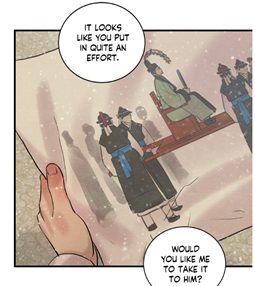 ), then added that Baek Na-Kyum had trusted him with the picture to give to Jung In-Hun. Kim hoped with this intervention not only to separate the couple, but even to have the painter killed by the main lead, a new version of chapter 35.
 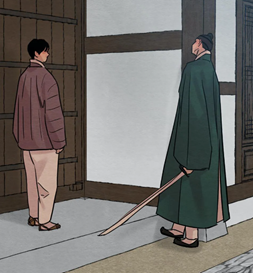 But what he didn’t expect is that the noble would rush to the teacher’s room, and not to the study. However, his delay could be explained differently. He had been busy giving the sentence to Deok-Jae, the straw mat beating. And this leads me to the following observation: denunciation. In chapter 28, Deok-Jae covered up for Kim’s betrayal, for he hoped that Kim would come to protect him.
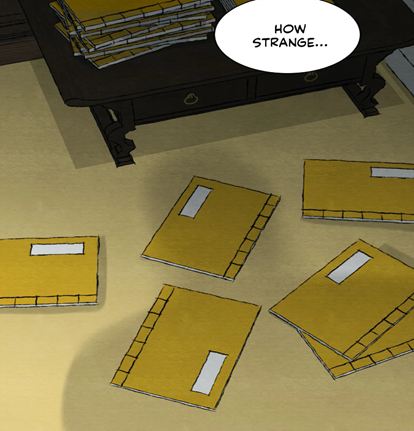
 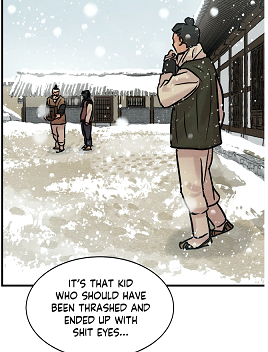 (chapter 51) The man believed the butler, because he had not covered up for him about the prank with the spoiled rice. Finally, I discovered that this expression “how strange” was used by someone else:
  (chapter 37) It was the fake servant who had mentioned the purge! This means that someone had betrayed the Yoons, tattled on them! At the same time, the words from the old bearded man implied that the patriarch Yoon had been the denunciator. Thus he could expect the purge.
 (Chapter 37) As a conclusion, the expression “how strange” is connected to denunciation and deception! I have two other evidences for this interpretation. Jihwa had also spoken like that, when he had heard from the amateur spy that his master had a change of heart! Here again, we have spying activities and denunciation.
  (chapter 13) Finally, observe that in season 3, Baek Na-Kyum is portrayed and stigmatized as a traitor.
 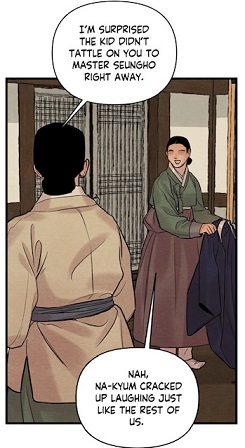 (chapter 91) The maid’s statement (“I’m surprised…”) truly exposes that the painter had such a reputation among the staff. The so-called treacherous nature of the painter served as a justification for Kim’s punishment. The butler’s kindness had been used against him. He had been sentenced to the straw mat beating, because he had allowed the noona to enter the mansion for the painter’s sake! In that scene, the maids had been tasked to leak a certain information to the couple: the existence of the kisaeng’s letters. That way, the painter could accuse his lover of his deception. He had kept away the letters from his noonas. However, the separation didn’t take place, because the painter didn’t hear the comment from the maid. He was no spy!
 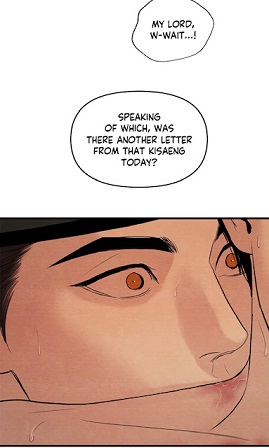 (chapter 91) But Yoon Seungho is one, for he is the surrogate son of the butler… who listens to conversations in the shadow!
  (chapter 77) His presence was undetected in the courtyard, until Bongyong wounded the painter. Here, he came out of the shadow!
  (chapter 78)
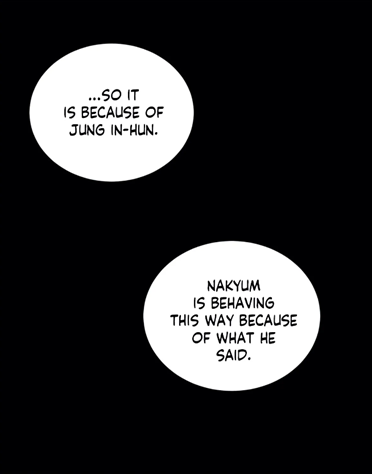 (chapter 50) That way, he could separate the couple. Due to their last sex session, he had discovered that the protagonists were getting closer to each other. He made sure to utilize Yoon Seungho’s hatred for prostitution. And keep in mind observations with the comment “How strange…”: we had spying, deception, contradiction and denunciation. The spiritual love stands in opposition to prostitution.
 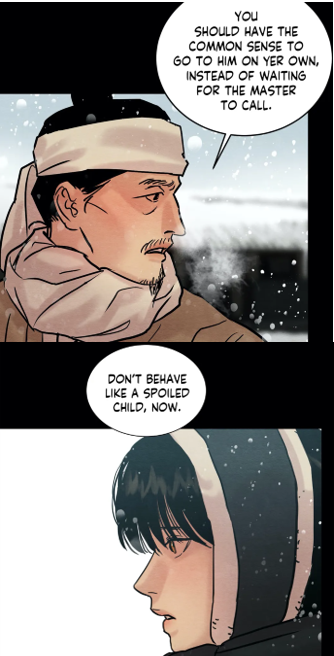 , whereas the butler didn’t consider him as a servant in chapter 23
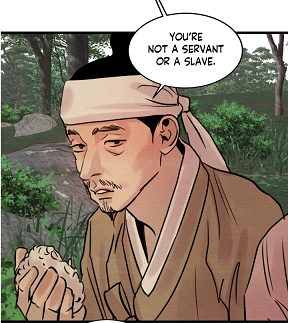 , another evidence for the valet’s hypocrisy.
  (chapter 68) or the window. This is important, because that way, he is getting prepared to fight against his biggest opponent, lord Song who stands behind Kim. However, there exists one huge difference between Kim, Yoon Seungho and Baek Na-Kyum. The protagonists are no secret agents, they are both detectives. They want to understand their partner and their past, but since both were victims of crimes, this means that their role is unveil the truth so that both can get justice.
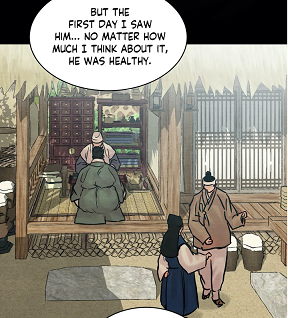 (chapter 57) And if we look at the picture, the manhwaphiles can detect that Kim seemed to have the teenager’s trust. This is visible thanks to the domestic and Yoon Seungho’s gestures. They are talking to each other in a very natural way. We can conclude that they were close, especially if I include this panel in my examination.
 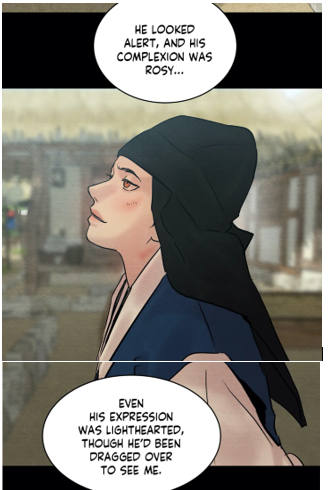 (chapter 57) The way the boy is looking up at Kim indicates that the main character is quite attached to him. And because of this scene, the manhwaworms could sense the domestic’s qualities: care, trust, affection and loyalty. But what many readers failed to realize is that servant Kim is actually following father Yoon in reality. This means that the elder master trusts this domestic. The latter is even the one who introduced the physician to the lord of the mansion.
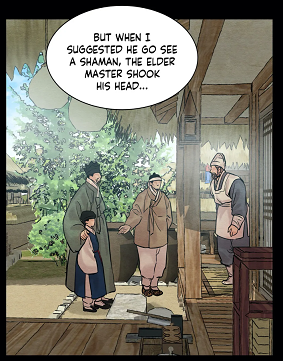 (chapter 57) That’s why I come to the conclusion that the butler Kim was in fact loyal to the elder master and not to Yoon Seungho. He might have had an affection for the teenager, yet in truth he serves the head of the family. And notice that valet Kim is still giving the expensive medicine to the protagonist, although this was ordered by father Yoon.
 (chapter 57) But more importantly, the manhwaphiles should question themselves about the nature of this medicine. It is a drug to mess up with the main lead’s health? And this clue reveals that Kim is not working for Yoon Seungho. One might argue that Kim is just following father Yoon’s orders, but the latter lives so far away, hence the eldest master has no control to threaten the butler. Hence Kim could have stopped feeding the medicine, especially after knowing how father Yoon treated the son. In other words, it looks like his loyalty to father Yoon is still intact. This is palpable in two occasions.
 (chapter 35) In this scene, the valet gives an order to his master and not an advice, since he employs the verb “must”. Why? Because he thinks, the letter was sent by the elder master. And Yoon Seung-Won knew that Kim was loyal to their father. Hence when he sent the letter, he used his father’s name and authority, but in order to maintain the illusion that father Yoon was the author, the brother also requested that valet Kim would bring back himself the reply. The deceitful brother used not only the butler’s fidelity to his advantage, but also gave the impression that father Yoon cared somehow for the black sheep. It was, as if the elder master was trying to rekindle with his older son. The readers can sense more his loyalty to the elder master, if they compare his reaction, when Yoon Seungho received the fake letter from lord Song.
 (chapter 56) Here, the domestic got scared, by just hearing the name. Nevertheless, he gave his master the advice to postpone the meeting due to his health.
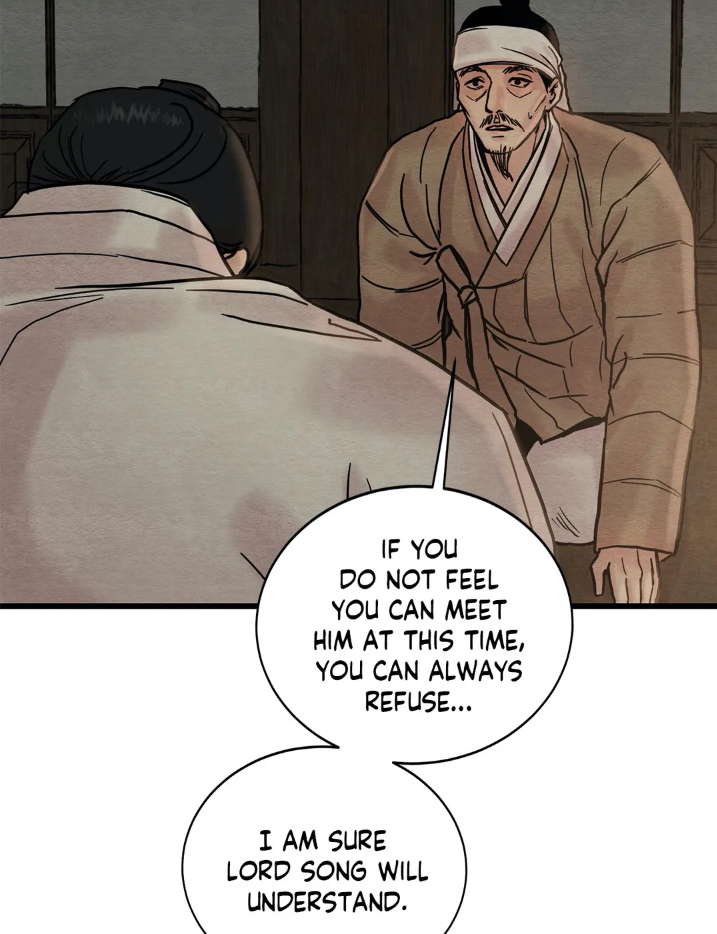 Yet, observe how he hides his discomfort and fear to his master by suggesting to postpone the meeting which exposes that he is hiding his true emotions. He justifies his advice by faking concern for his lord. Hence the lord can only have the impression, he is protecting his interest. Striking is that since we saw him scared, we have the impression that he is brave enough to propose not to the follow the invitation. My initial impression was to think that he got afraid of the name lord Song due to the lord’s traumatic past and he feared for his master’s mental health condition. However, the moment the valet realizes that the noble is on his way to meet this aristocrat, he gets so scared that he leaves the mansion immediately. So he doesn’t want them to meet.
 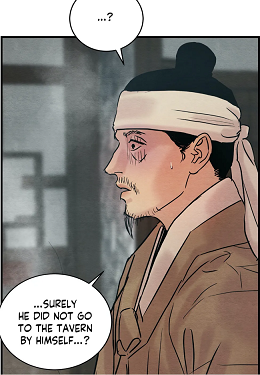 (chapter 56) Then in chapter 57,
  the butler expresses his worries concerning father Yoon. He doesn’t want the elder master to hear the news about Jihwa’s public confession, as the servant is well aware of father Yoon’s mentality.
 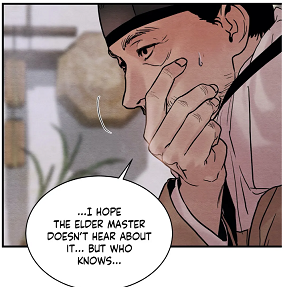 (chapter 57) He seems concerned for Yoon Seungho again. He knows that the head of the family hates homosexuality. He witnessed how the father separated Jihwa from Yoon Seungho with the excuse of an illness. He was present, when the teenager was imprisoned in the mansion.
 (chapter 57) One might question his loyalty to father Yoon, since the butler chose to remain by Yoon Seungho’s side after the topknot incident. However, I could respond that the valet saw it as his duty to keep an eye on the elder son on behalf of the head of the family. From my point of view, valet Kim decided to follow Yoon Seungho for other reasons than true loyalty to the protagonist. In the past, I used to think that he felt guilty for the main lead’s suffering. But I had to review my judgement. If he truly felt remorse, then he should have treated the eldest son differently in the mansion. Yet, he let him become a head-kisaeng. Moreover, the guilty conscience only resurfaces the moment he is confronted with a situation reminding him of his wrongdoing.
  (chapter 65) This shows that he has been successfully repressing it. In truth, he did it out of selfishness, while faking affection and loyalty to the Yoons. The readers shouldn’t forget that the head of the family decided to leave the main domain and live in the countryside. Therefore he abandoned the mansion to his eldest son. By remaining by Yoon Seungho’s side, butler Kim was ensured to have a quiet life. The man was a wreck, hence he couldn’t manage the mansion.
 (chapter 57) Furthermore, as an infamous hell-raiser, no powerful noble would be interested in him. When the purge occurred, the son had become the sacrifice and scapegoat, hence he was forced to remain at the property. And now, you can grasp where the butler’s loyalty lies. He is faithful to the mansion and property, and not to Yoon Seungho or father Yoon in reality. This explicates why he lies to Seung-Won and tries to stop him from entering the lord’s chamber. As Seung-Won is only the second son, he is not considered as the lord of mansion, while father Yoon is the senior and is supposed to be the head of the family. Because he is bound to the domain Yoon, he is definitely acting more like a dog than like a matchmaker or a father. He is able to find his owner very quickly, as if he was following his scent.
 (chapter 57) He barks like one, when he yells at Deok-Jae.
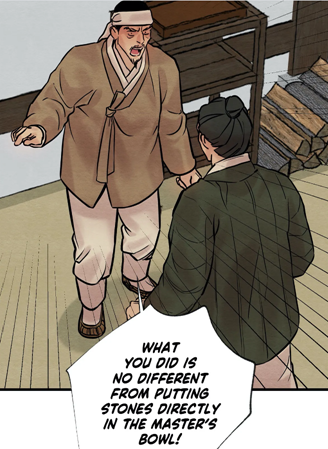 (chapter 47) He is also sent to fetch the painter, when the latter is somehow “abducted” by the scholar.
  (chapter 24) But the most conclusive evidence for this association is his rapport to the door. He is always shown next to an opened door or even often stands on the door threshold.
  (chapter 45) Since dog owners often put the sign “beware of the dog” on their door, you understand why I see it as an evidence that the valet is more as a dog than anything else. The butler is the guardian of the mansion, watching out for the owner’s safety. However, here we should comprehend it in a figurative sense. On the surface, the butler is looking out for the reputation of the Yoons, while in truth he is just focused on living a peaceful life far from trouble.
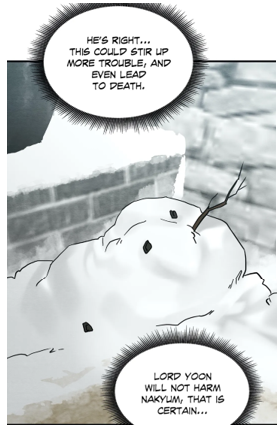 (chapter 65) That’s why in chapter 45, he let the false rumors circulate in town, because his relationship to a commoner is not revealed. This would cause a real scandal. On the surface, it looks like Kim cared for his lord and as such for the Yoons.
 (chapter 64) The dog is not only a symbol for loyalty, but also it represents obedience and secrecy. He knows what is happening in the mansion, but he won’t let it transpire to the outside world. Therefore I deduce that valet Kim is quite similar to Jihwa. He knows the main lead’s whole past and tragedy, but he doesn’t truly feel sorry for the main character, for if he revealed the truth, because it would expose his culpability.
 (chapter 12) Simultaneously, he uses his knowledge to his own advantage, similar to Jihwa, although the latter was manipulated by Kim’s lies. And if you take into consideration the role played by the dog in different mythologies, you’ll note that they all have something in common: they are guardians of the realm of death, like for example Anubis (Egyptian) or Cerberus (Greek). And since I interpreted the mansion as Yoon Seungho’s prison and compared the master to a zombie, until he met the painter, the manhwalovers can now understand the butler’s real function. He is actually the guardian of the realm of death for the lord. To sum up, he is contributing to the lord’s misery and loneliness, as he keeps him bound to the domain and family. Moreover, the gentle valet is aware of his true role, as he has internalized the social norms. As a domestic, he is supposed to serve his master with respect and obedience, which he does on the surface. However, the reality is different, as he lies to him on multiple occasions. Hence he needs to act in the shadow. Why? The real goal of the butler is to live a peaceful life without any big responsibility. As a guardian of the kingdom of death, Kim is the one who allows people to remain by Yoon Seungho’s side or not, but since the painter is affecting the noble’s life, Kim can only perceive the painter as his enemy and source of danger. Yoon Seungho might decide one day that he would like to leave the property and join the capital.
  (chapter 64) This is not the first time that the butler had a similar reaction. In chapter 26, he tries to calm down the painter asking him to stop crying, and when the latter criticizes him, the domestic decides to leave the bathroom with the excuse that he needs to fetch him new clothes.
 (chapter 26)
 (chapter 26) He is leaving the artist behind, as he doesn’t want to be confronted with his wrongdoing: his passivity and cowardice. Then when he meets the protagonist in the main way, he sees his cold and distant gaze. So he knows that his master is in a bad mental condition, yet out of fear, he still leaves the artist behind, well aware that something bad could happen. That’s why he chose to intervene in the shadow (like for example, sending a servant to the scholar) so that I am now convinced that he even witnessed what happened to Yoon Seungho, but chose to close the door. There’s a reason for this assumption. First, he is connected to an opened door. Secondly, there’s this incident with the door in chapter 16.
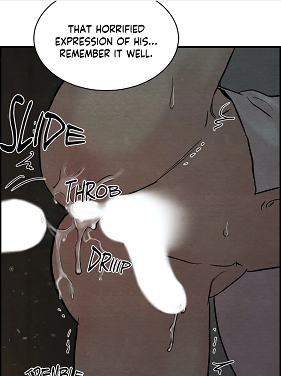 (chapter 64) He resented valet Kim for his betrayal and abandonment. That’s why I believe, in that scene, Yoon Seungho is using the same words than his rapist from back then.
  (chapter 64) In this scene he is reliving his own traumatic past, the first rape. And after it had occurred the first time, the valet must have told him this:
 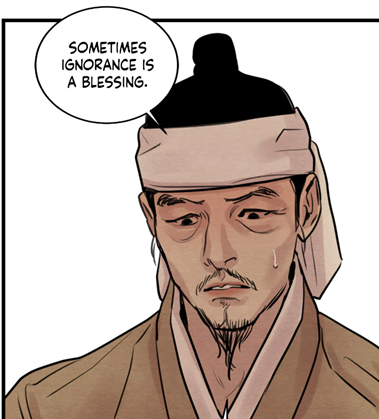 (chapter 23) This idiom exposes his attitude, he will act, as if he knew nothing. And since I revealed that father Yoon trusted Kim and the latter was loyal to him, I am now quite persuaded that father Yoon is responsible for the sexual abuse of his son first. Striking is that my theory was confirmed in chapter 65 and 74. However, the valet acted, as if nothing happened, while the teenager was blamed for letting the servant see the rape.
 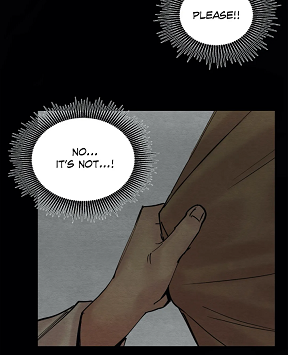 (chapter 65) It is even worse than I had anticipated, because he was even asked for assistance, but the valet turned a blind eye. The advice (“ignorance is a blessing”) expressed by the butler exposes his complicity. The valet became the willing helper of a rapist. In his eyes, he couldn’t stop it, as he was just a domestic.
 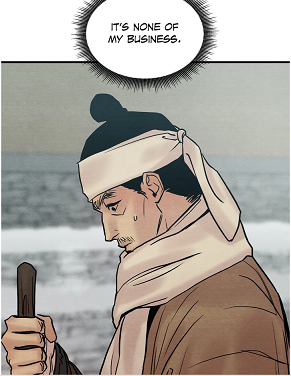 (chapter 65) Since Kim never revealed the secret of the “so-called conversion therapy” leading to the sexual abuse, father Yoon trusted his loyal servant. That’s the reason why he accepted to leave Kim behind. He knew that he would do anything to maintain the reputation of the Yoons. Furthermore, this trauma explains why the master keeps having sex outside the storage room. He is well aware that the servant will never remain there, hence he asks him in a cynical way if he wants to become a peeper.
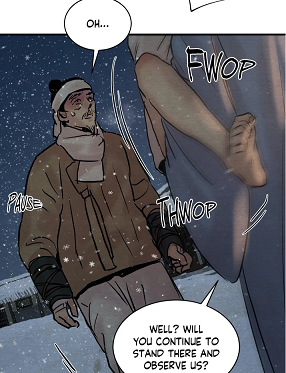 (chapter 64) Now, I can understand why Yoon Seungho has such abandonment issues. For him, valet Kim was his father, as the latter was nice and caring for him. Yet during the rape, he did nothing, as he was just a servant. And now, you understand why he feels that he has been backstabbed by his two fathers, why the main lead is using his position to keep a boundary between himself and Kim and why he is using his right as lord to keep the painter by his side. He has internalized that being a lord can protect him from pain and vulnerability. In his delirious fit, he believes that he can get what he wants. Back then, he was just a young master and not the lord of the mansion, and Kim was just a domestic. After coming to this perception, I see the chapter 64 in a different way. The chapter 64 exposes the valet’s cowardice, culpability and selfishness, hence I judge the lord’s behavior in a different light. The monster is the result of the betrayal and abandonment from two fathers, and both decided to avoid reality and see the consequences of their choices. Notice that father Yoon ran away just like the valet. But the chapter 64 could mark a turning point in Kim’s life in my opinion, as he sees the consequences of his silence. That’s why the valet decides to accept the new situation:
 (chapter 65) Baek Na-Kyum is now the lord’s companion, while in the past he used to plot against him. In that moment, the valet recognized that ignorance is not a blessing, because this doesn’t erase the event. Observe that Kim has a similar approach than Jihwa again. Since the painter returned to Yoon Seungho’s side, the noble has now the feeling that nothing happened. For the first time, Kim sees the true face of his master
  Kim hates uproars, as they represent a source of danger for his life. As you can detect, the butler is determined to protect the Yoons’ notoriety, but out of selfish reasons. The manhwaphiles should remember that in chapter 17, he asks the maids not to approach the study like that. He is determined to keep everything under cover. He disapproves the master’s actions, as they are going against social norms. As a noble, he shouldn’t have a sexual intercourse with a low-born. That’s why he let the boy desert the mansion after the rape. He didn’t do it for the artist, but for his master’s respectability, because if this was known, then the valet’s good life would be in danger. Kim has deeply internalized social norms, any deviation represent a threat to his peaceful live. Moreover, he would attract attention again. But when he witnessed the master’s despair and fury after the escape, where all the servants had to suffer the result of his decision, he chose a different strategy. Back then, I described him as his matchmaker. He tried to present his master in a better light so that the artist would have a change of heart and accept Yoon Seungho’s advances. However, now I have to admit that I have a different judgement. He was not a real matchmaker, he was trying to turn the painter into a favored servant so that the appearances would be maintained. He decided to use a similar strategy, the aphrodisiac as a first step. And with all these new discoveries, I come to the deduction that the butler was a real accomplice of father Yoon’s schemes. If they became close sexually, the painter would become a servant and take over his role as close assistant. That way, his presence in the lord’s bedchamber could be explained. That’s why he lets the painter attend the noble during his illness and even allows his presence, when the doctor is here. In other words, he would like to hide the scandalous relationship with the low-born under the pretense that he is just a favored servant.
  . (chapter 45) First, it symbolized that the painter was more than just a favored favor. But more importantly, he never cared about the item, since
  (chapter 32) Kim has no real control over the staff, although he is the right-hand of the master. His indifference and his fear for responsibility explains his lack of authority. That’s why in chapter 63, he doesn’t even attempt to correct the maids talking badly about Baek Na-Kyum, although he already knows that there’s more to it. His silence should be considered as a sign of admission, reinforcing the servants to think badly of the painter. The painter is a liar and betrayer. I have to admit that Kim’s passivity really annoyed me in that scene.
 (chapter 63) He is indeed a hypocrite, a selfish person,
 (chapter 50) This explicates why Yoon Seungho can’t trust Kim’s words in the end.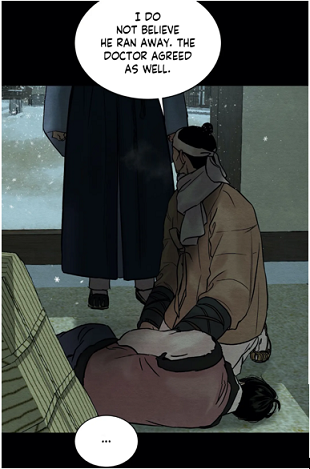
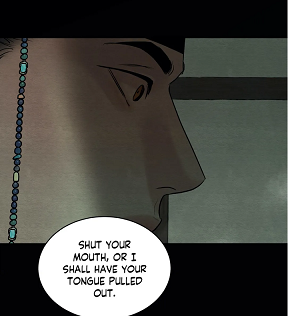 (chapter 62) In his eyes, he betrayed and abandoned him once, therefore it is definitely possible that he is lying. The longer the lord lives with the artist, the more he senses that Kim shouldn’t be trusted. This explicates why the lord’s relationship with the valet is deteriorating. In season 1, he never doubted Kim’s words, but now it has changed. The painter’s genuineness makes Yoon Seungho detect the butler’s fakeness and hypocrisy. And since the lord threatened him with the sword, I am envisaging that he will do it, the moment he feels that his loyal butler betrayed him.
  (chapter 45) The purpose of this action is simple. On the one hand, he gave the impression that he was protecting Yoon Seungho’s interest, on the other hand he was pushing the jealous servant to plot something so that Baek Na-Kyum would disappear. Kim was well aware of Jihwa’s visit in chapter 43. He knew that the second lead would do something out of jealousy. Kim needed the painter’s submissive attitude, as this could only affect his lord positively, turning the mansion into a golden cage. And while I envisaged that the shock Kim experienced during that night would make change his mind,
 (chapter 55) Many readers were able to recognize the younger master trying to walk into Yoon Seungho’s direction, while the latter was lying on the ground. Why? It was, because of the brother and father’s gestures. Father Yoon stopped his younger son to join his brother’s side with his hand, while Yoon Seung-Won’s foot is moving. Due to these actions, the manhwalovers saw it as a good sign from Yoon Seung-Won’s part. The latter desired to help his brother, yet their mean and strict father requested him not to. It looks like Yoon Seung-Won had some affection for his older brother in the past, yet the father ruined their bound. However, what the manhwaworms shouldn’t forget in this panel are the two following aspects:
 (chapter 37) The younger brother was taught his father’s principles too, but unlike Yoon Seungho, the younger brother is NOT living according to their father’s rules. This means that he is living differently. And now we have to question this: how is his life different?
  And notice the brother’s embarrassment. He avoids his brother’s gaze. He can not deny it, for if he did, he would have to reveal the true identity of the “pedophile”. Hence the younger master is humiliated. The younger master can not argue with this point. That’s the reason why I come to the conclusion that the brother has already internalized his father’s values: Yoon Seungho should keep working for the family, like he did in the past. He should use his connection. He is truly viewing his brother as an accessory for the family’s benefit. And it is time to examine the chapter 37 one more time. In the first composition, I had demonstrated that the brother was selfish, insensitive and quite arrogant, since he never asked his brother about his well-being. All his business mattered. But I can add more layers to his description and it starts with the way he was introduced.
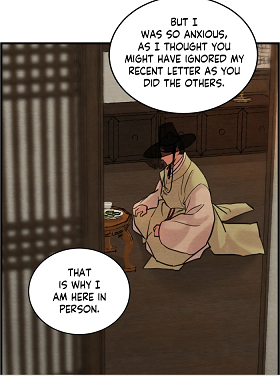 (chapter 37) However, I can bring up another evidence for this conclusion: the fake letter from lord Song.
 (chapter 56) The forged message was a new version of the letter in chapter 35. And under this light, we can judge the character in a rather negative way. He is acting like Jihwa, using his knowledge of the past to his advantage. He desires to use his father’s power over his elder brother to achieve his goal: getting the support from his older brother so that he can please his father.
  (chapter 13), Yoon Seung-Won was asked by the father to restore the family’s influence. But since he had witnessed how his father obtained his support, he thought, he could employ the same method: using Yoon Seungho. One might argue that the poor boy is pressured now by father Yoon and the weight of the expectations can be extremely burdensome. However, here I would like to point out that unlike the main lead, Yoon Seung-Won was never trapped in the mansion and not hindered to participate in the service civil examination. Furthermore, he was never exposed to any kind of violence. He was allowed to roam freely, yet in my opinion, all this time the younger master relied on his father’s power and influence. Seeing that the letters didn’t provoke any reaction, the young noble paid the lord a visit, as he was pressured by the time. And what caught my attention is that once asked about the motive of his visit, he replied to the main character:
  (chapter 37) He mentioned his father directly, but he never answered to the question properly, since he didn’t announce the true reason for his visit. Why? Since he used the name of his father in the letters and in the conversation, I can only deduce that the brother knows the true power of father Yoon over the main character. He is actually playing with the protagonist’s fear and he knows it too well. Notice his hands: they show a certain discomfort, indicating that he is well aware of the signification of his words. One might argue that he has been pressured by the father and he is just a pawn. To this, I can only retort that he is doing the same to his brother. By asking him to visit their father, he is not just requesting from his brother to reconnect with their family, but also to submit himself to father Yoon. In other words, the elder master could utilize Yoon Seungho’s connections and wealth for their family’s interest. Besides, this would signify that the father would become the main lead’s pimp again. As the new head of the family, father Yoon could decide to treat his eldest son like in the past. And if my theory of the incest is correct, then this means that Yoon Seung-Won is asking his brother to relive a hell again. This is not surprising that the lord gets upset and becomes cynical:
 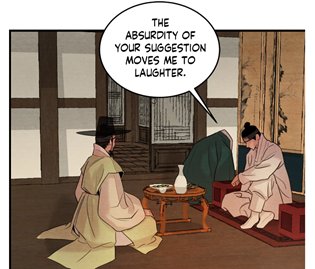 (chapter 37) Who would accept such a suggestion after getting treated like an sex toy, a prisoner and as a pariah at the end? And now envision that Yoon Seungho has been exposed to physical and sexual abuse because of his father. This scene reveals the selfishness and cowardice of the brother. This is not surprising that the lord clenches his fist, and his hand is shaking: there’s definitely fear due to the father and anger towards his brother. Yoon Seung-Won knows his father’s rules, but he doesn’t desire to apply them, as he is well aware of the meaning. And now the following panel gets another significance:
 He desires to have a private conversation and suggests his brother to send away the painter. His reason is simple: he would like to appeal to his brother’s compassion, he must be in a rather difficult situation. His father is now relying on him. But since the master of the mansion is not following this suggestion, the brother chooses to mention the father. The illness is an excuse, but Yoon Seung-Won is determined to maintain his image as a loyal and honorable son. Yet, like I pointed out earlier, the true intention with the father’s evocation is to put Yoon Seungho under pressure. And now, I would like to bring another evidence that the younger master is well aware of his brother’s fear in front of their father. He witnessed the constant abuse, and as such he noticed and internalized the brother’s anxieties. Remember that the moment Jihwa heard that the brother had visited Yoon Seungho, Jihwa chose to rush to his childhood friend’s mansion. Why? He knew that Yoon Seung-Won’s visitation would torment the main lead and provoke nightmares, indicating that this must have happened in the past well. And since the main lead is connecting his brother to his past trauma, then this reveals that the younger master is related to the protagonist’s suffering. Why? In my opinion, Yoon Seung-Won must have been favored all this time, whereas the powerful noble was just treated like a servant. In other words, even if the younger brother was weak as well, he never tried to help his brother behind his father’s back. This explains the resent from the protagonist. He can never consider him as a relative. Let’s not forget that when the elder master moved from the house, only valet Kim remained by the main lead’s side, showing that all the other servants sided with Yoon Seung-Won and the father.
 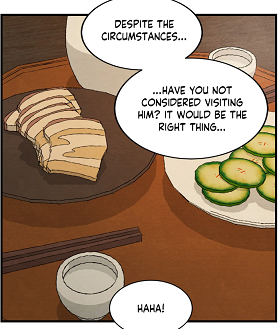 (chapter 37), while in reality he is just a hypocrite. I would even add, he is quite immoral. He lies about the illness, fakes letters in the sense that he uses his father’s name and authority. Then he utilizes social norms (“the right thing”), though he is well aware what the visit would mean for his brother. I also perceive an evidence of father Yoon’s influence in the younger master’s behavior: his words and behavior. Remember that I connected the lies to the protagonist’s dissociative episodes, indicating that the elder master must have punished his eldest son, when he imagined that he had been lied to. Observe the reaction Yoon Seung-Won has, when he realizes that Kim has been lying to him:
  (chapter 37)He gets outraged and yelled to the butler, although he is not the lord of the mansion. Striking is that he would have opened the door
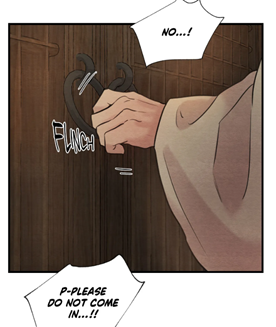 (chapter 37), if the painter hadn’t screamed through the door. Not recognizing the voice from the inside, the young man got surprised and stopped. And this single gesture outlines his disrespect towards his elder brother in reality. I had already observed his selfishness and lack of sensitivity, but with the new elements, I can definitely determine that the younger brother has indeed internalized father Yoon’s values. He treats servants and commoners like people with no right. His tone is quite strict, authoritative and rude.
 (chapter 37) But now, I would add another layer to this description. This picture could be judged as an evidence of his ruthlessness too, like my follower @nonoboy-oops suggested it. He exposes a certain satisfaction, although he used the lord’s fear of father Yoon for his own benefit. In his mind, he has achieved his goal and it doesn’t matter the way he obtained it. The manhwaphiles should remember that the lord had even difficulties to breathe and speak properly after the visitation, indicating how much the main character suffered during that conversation.
  (chapter 38) This reinforces the immorality and ruthlessness of the brother’s suggestion. With the letter, Yoon Seung-Won has the impression that in the end, the main lead bent to his will. This means that he is ignoring his brother’s reproach and rejection. But since the brother used their father’s name in order to approach his brother, it looks like, it was Yoon Seung-Won’s decision to utilize the brother. Even if this idea is not correct, and the father did use the younger son as a pawn to approach Yoon Seungho, this doesn’t diminish the atrocity of the younger master’s gesture. He is not just a pawn, but a real accomplice, because he knows his past but prefers his own comfort over his brother’s life. However, let’s not forget that during their conversation, the younger brother never spoke in the father’s name, like for example: “Father Yoon desires to reconnect with you and asks for a visit from you”. Even that way, the father’s honor would have been maintained, since the main lead was asked to pay a visit to their father unofficially. My final point for this interpretation is the importance of reputation in father Yoon’s eyes. The latter chose to act behind closed doors and maintain his image as a respectable aristocrat. By sending letters to his eldest son who is well-known in the mansion as an infamous sodomite, his image as strong lord is kind of tarnished. He is the one asking for help from his son… a humiliation in his eyes. Now, you can better comprehend why I believe that Yoon Seung-Won is not just a pawn in reality.
  That’s why he said this to the servant. By putting the blame on his older brother, he excuses his father’s behavior for not showing more concern for him. He didn’t leave the bedchamber in order to bid farewell, because the lord had been troubled due to Yoon Seungho. The latter serves again as an excuse to save the appearances. By giving the ruined painting, Yoon Seungho was indeed determined to provoke his father. He shows him his hypocrisy and the consequences of his principles. At the same time, the ruined painting illustrates his message: the Yoon family will never get a benefit from his sexual performances (“damaged image”).
  (chapter 37) Here, he envisioned that the lord’s companion was a noble due to the green hanbok. He is definitely more than just a pawn, in my eyes he has become a willing helper of father Yoon’s dictatorship, since he could profit from his situation. He is like an indoctrinated child, since he behaves like his father in a certain way. On the other hand, he has not completely lost a certain sense of morality. Since he is showing a certain discomfort during the conversation in chapter 37, it displays that he recognizes the wrongness of his request. But his interests are prioritized over his brother’s well-being. Another aspect is that he is not so brutal compared to his model, Father Yoon. But he has a common denominator with the elder master. He is also quite naïve. Hence Yoon Seungho could see right through his brother and his lies, just like the father. The master of the domain was well aware of the true purpose of his younger brother’s visitation: sponsoring. In the end, the younger master is forced to take the exam, like the scholar Jung In-Hun. I had imagined that their paths would cross, unaware that the learned sir would die before. There’s no ambiguity that Yoon Seung-Won would get annoyed and humiliated to hear that his brother chose a scholar with no connection and wealth over him.

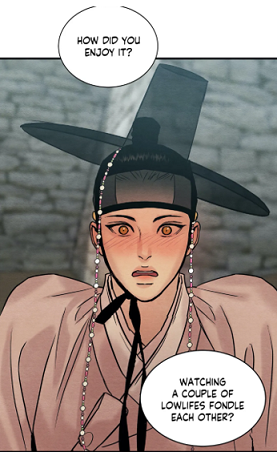
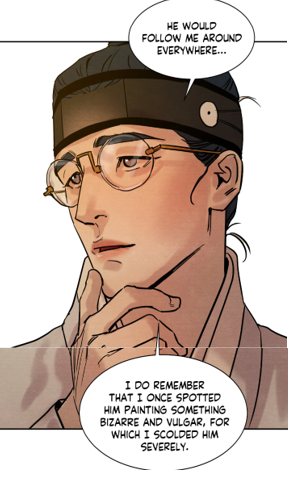

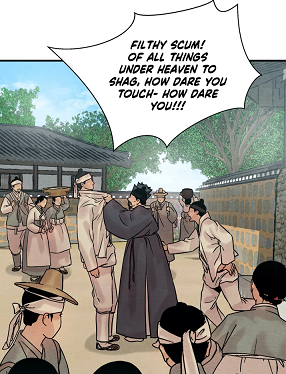 and secondly thanks to the intervention of the cat. Coincidence is a proof that they have no control over their life and love life. It was, as if the invisible hand of gods had decided to have them met. Yet, determinism doesn’t use the idea of gods or of an exterior force leading the characters to encounter each other. If you pay attention to the way they meet, you’ll realize that their decisions, influenced by their liking and living conditions, were the reasons why they met in the street. The noble Baek Na-Kyum was strolling in that part of the town because he wanted to sell his erotic paintings. So because of his hidden hobby, he is led to go to a part of the town where commoners live. In other words, the protagonist enters Yoon Seungho’s world. On the other hand, Yoon Seungho as a low-born catches Baek Na-Kyum’s attention due to his unusual attitude. He shows neither remorse nor fear in front of the angry aristocrat. He is very defiant. That’s love at first sight. However, this is true love as sexuality is immediately included, while his affection towards Jung In-Hun was more related to the innocent and pure love of a child. Striking is that Yoon Seungho is exposed for his scandalous relationship with the son of a noble family showing that he doesn’t care about social status and distinction between nobility and commoner. It is also the same for the painter who sells his erotic paintings in order to buy glasses for his servant.
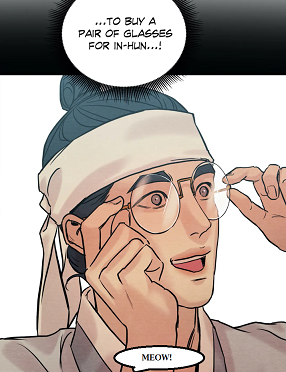 This shows that right from the start, Baek Na-Kyum has not truly internalized the hierarchical society and it is the same with the strong-willed commoner. They might not belong to the same social class but their mentality is in reality similar. Besides, they have both a strong libido and a certain sexual fantasy. Yoon Seungho is willing to have sex anywhere (f. ex. in the woodshed)
 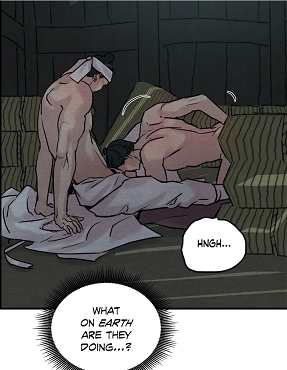 and after meeting the impressive and attractive seme, Baek Na-Kyum becomes so inspired that he creates a threesome.
  The painting could be seen as another evidence that the painter had to create such a work. There’s no real free will in the end. However, the idea of a threesome indicates that the innocent noble has indeed a kinky side which was triggered the moment he met Yoon Seungho’s eyes. And now, it explains why Yoon Seungho was destined to meet Baek Na-Kyum outside his mansion in the original manhwa.
 He had to meet him at the tavern because it was the commoner’s world and since the noble was interested in the painter, he couldn’t just send for him. The latter could refuse but in his presence, Yoon Seungho imagined that the artist would never dare to reject the offer.
 In other words, Baek Na-Kyum seems to have a predisposition to follow social norms, although in his heart, he doesn’t acknowledge societal hierarchy. He lives in his own bubble in my opinion. That’s why I come to the conclusion that Baek Na-Kyum’s inner conflicts will always represent one of their problems in the evolution of their love story. The noble will suffer pressure from his family and his servant Jung In-Hun who will betray him, making the main lead discover what love truly is. But because of their affinities, they were destined to be together.
 Due to his love for cats, the noble is led to a woodshed where he witnesses Yoon Seungho having sex with someone else. Note that the cat is the reason why he feels pleasure for the first time
  and why he gets caught in the end. If the cat had not appeared, then he would have never discovered the sexual intercourse. If he had never liked cats, he wouldn’t have played with him.
  Furthermore, he was strolling through the district where commoners live as he was on his way to sell his new painting. His so-called choices could only lead him to the place where the attractive seme was. This was no real coincidence again. Now, why a cat?
  , Yoon Seungho will be able to discover Baek Na-Kyum’s identity and the latter will be blackmailed. Notice that the merchant knows his true identity.
 The painter will have to work for Yoon Seungho, yet the reason will diverge. The commoner has already set his eyes on the artist, since he hasn’t really forgotten him.
 He remembers his face (“your eyes off”) and his words (“dirty buggery”). Their attraction was mutual and he needs to create a reason. As a conclusion, the introduction of the alternative universe makes us realize the dimension of determinism which is strongly linked to Nature (sex, cat). Baek Na-Kyum’s choice will be to acknowledge that his love for the seme is stronger than social norms, so that we can say, even if there exists determinism, there’s a certain liberty. Yet it is much more limited than it looks like as our decisions are influenced by our environment, experiences and past.